
Faculty of Engineering
|
|
|
- Dwayne Wade
- 9 years ago
- Views:
Transcription
1 180 UNSW UNDERGRADUATE HANDBOOK Faculty of Engineering A Message from the Dean This Handbook describes the many undergraduate programs available in the Faculty of Engineering at UNSW. There is a very wide choice of programs, plans and electives and we therefore suggest you spend some time reading the Handbook carefully. Whatever program you consider, it will be managed by one of our ten schools. Each school will have an advisor who can help you plan your program. In addition to the individual programs you can broaden your University experience by taking one of the wide range of combined programs which combine the BE with BSc, BA, LLB and BCom degrees. A Master of Biomedical Engineering may be studied concurrently with several of the BE programs. The Faculty of Engineering is dedicated to scholarship and research and to the facilitation of student learning. The academic staff are engaged in research and engineering practice, most of which is in collaboration with industry. This engagement with the frontiers of engineering and the related sciences ensures that students are familiar with the latest developments. In later years many students are able to participate in the work of the research teams in the Faculty. The Faculty is a major part of the international dimension of UNSW, we welcome many international students and also encourage local students to take part of their program at an overseas university. We have strong links with major research universities throughout the world. Students are encouraged to play an active role in all the University has to offer. There are many student led projects and other activities which can enhance your experience as a student at UNSW. Brendon Parker Dean Faculty of Engineering Contents Faculty Information and Assistance Who Can Help? 182 Faculty of Engineering Website 182 Entrance Requirements 182 Requirements 182 Re-enrolment Procedures 182 Faculty Centres 182 Professional Institutions 183 Summary of Programs Full-time Programs 183 Combined Degree Programs 183 Fast-Track Programs 184 Concurrent Degree Programs 184 UNSW Co-op Program 185 Transfer Programs 185 Rules for Progression and the Award of Degrees Access to Exam Information 185 Bachelor of Engineering Program Rules 185 Bachelor of Engineering Bachelor of Science Program Rules 185 Bachelor of Engineering Master of Engineering Science Program Rules 186 Faculty Rules for Progression 186 Honours 186 Industrial Experience Requirements 186 Program Revision 186 Program Rules and Information Faculty of Engineering All Schools 3715 Bachelor of Engineering Bachelor of Commerce 187 School of Chemical Engineering and Industrial Chemistry 3040 Chemical Engineering Chemical Engineering Part-time Food Science and Technology Food Science and Technology (Honours) Food Science and Technology Part-time Industrial Chemistry Industrial Chemistry Part-time 192 Combined/Concurrent Degree Programs 3042 Chemical Engineering/Bachelor of Science Chemical Engineering/Bachelor of Arts Chemical Engineering/Bachelor of Commerce Chemical Engineering/Master of Biomedical Engineering Industrial Chemistry/Bachelor of Science Industrial Chemistry/Bachelor of Arts Industrial Chemistry/Bachelor of Commerce 196 Fast-Track Programs with Master of Engineering Science 3040 Chemical Engineering/Master of Engineering Science Industrial Chemistry/Master of Engineering Science 197 School of Civil and Environmental Engineering 3620 Civil Engineering Environmental Engineering 200 Combined/Concurrent Degree Programs 3730 Civil Engineering/Bachelor of Science Civil Engineering/Bachelor of Arts Civil Engineering/Bachelor of Commerce Civil Engineering/Bachelor of Laws Civil Engineering/Mining Engineering Civil Engineering/Environmental Engineering Environmental Engineering/Bachelor of Science Environmental Engineering/Bachelor of Arts Environmental Engineering/Bachelor of Commerce Environmental Engineering/Bachelor of Laws 208 Fast-Track Programs with Master of Engineering Science 3620 Civil Engineering/Master of Engineering Science Environmental Engineering/Master of Engineering Science 208
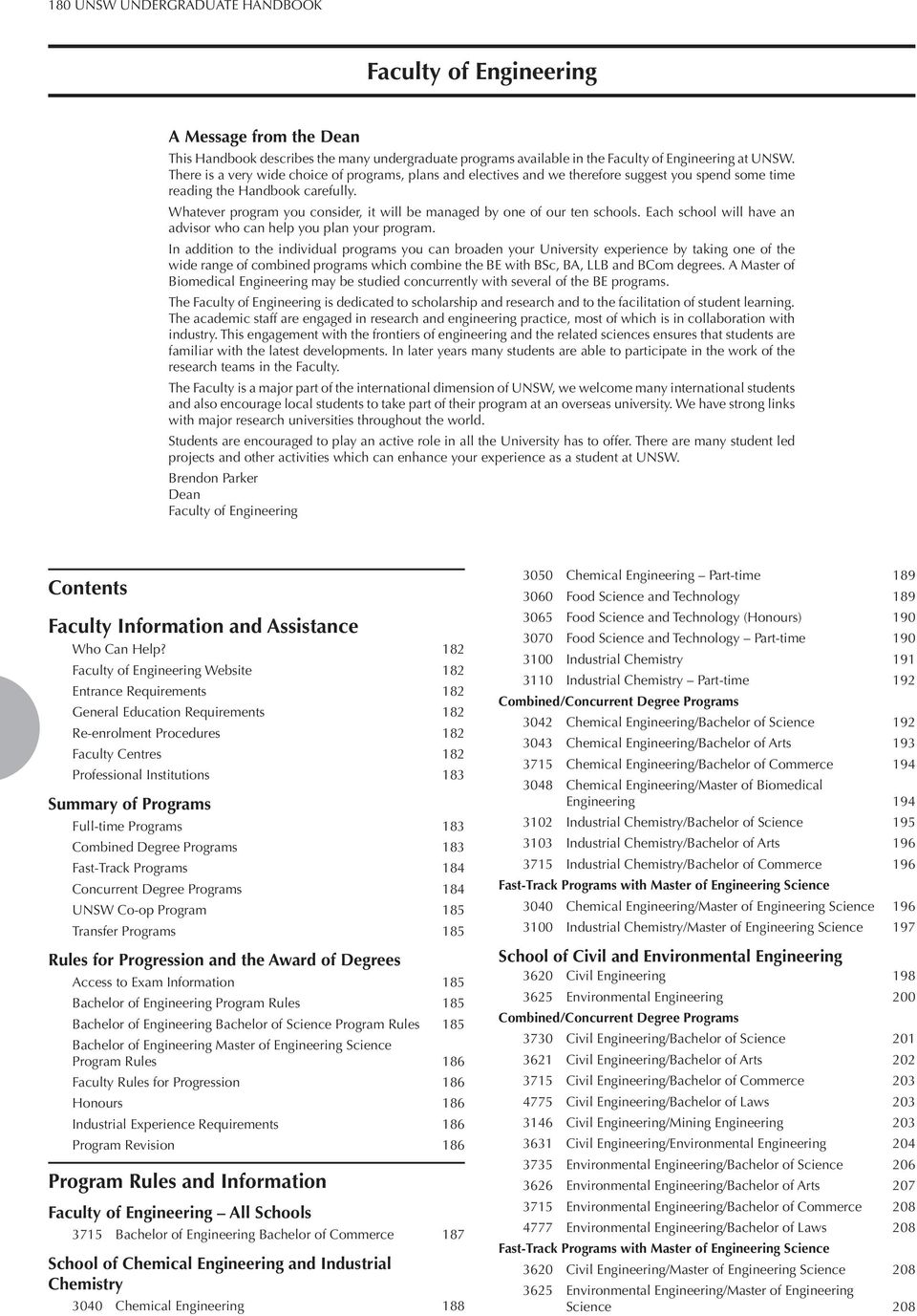
2 ENGINEERING 181 School of Computer Science and Engineering 3645 Computer Engineering Bioinformatics Software Engineering Computer Science 213 Combined/Concurrent Degree Programs 3726 Computer Engineering/Bachelor of Science Computer Engineering/Bachelor of Arts Computer Engineering/Bachelor of Commerce Computer Engineering/Master of Biomedical Engineering Bioinformatics/Bachelor of Science Bioinformatics/Bachelor of Arts Bioinformatics /Bachelor of Commerce Bioinformatics/Master of Biomedical Engineering Software Engineering/Bachelor of Science Software Engineering/Bachelor of Arts Software Engineering/Bachelor of Commerce Software Engineering/Master of Biomedical Engineering Computer Science/Bachelor of Science Computer Science/Bachelor of Arts Computer Science/Bachelor of Digitial Media 225 Fast-Track Programs with Master of Engineering Science 3645 Computer Engineering/Master of Information Technology Bioinformatics/Master of Information Technology Software Engineering/Master of Information Technology 226 School of Electrical Engineering and Telecommunications 3640 Electrical Engineering Telecommunications Photonic Engineering 230 Combined/Concurrent Degree Programs 3725 Electrical Engineering/Bachelor of Science Electrical Engineering/Bachelor of Arts Electrical Engineering/Bachelor of Commerce Electrical Engineering/Master of Biomedical Engineering Telecommunications/Bachelor of Science Telecommunications/ Bachelor of Arts Telecommunications/ Bachelor of Commerce Telecommunications/Master of Biomedical Engineering Photonic Engineering/Bachelor of Science Photonic Engineering/Bachelor of Commerce 238 Fast-Track Programs with Master of Engineering Science 3640 Electrical Engineering/Master of Engineering Science Telecommunications Engineering/Master of Engineering Science 238 School of Mechanical and Manufacturing Engineering (incorporating Aerospace Engineering, Mechatronic Engineering and Naval Architecture) 3710 Bachelor of Engineering Aerospace Engineering 239 Manufacturing Engineering and Management 239 Mechanical Engineering 239 Mechatronic Engineering 239 Naval Architecture Bachelor of Engineering/Bachelor of Science Aerospace Engineering/Bachelor of Science 243 Manufacturing Engineering and Management/ Bachelor of Science 243 Mechanical Engineering/Bachelor of Science 243 Mechatronic Engineering/Bachelor of Science 243 Naval Architecture/Bachelor of Science Bachelor of Engineering/Bachelor of Arts Aerospace Engineering/Bachelor of Arts 243 Manufacturing Engineering and Management/ Bachelor of Arts 243 Mechanical Engineering/Bachelor of Arts 243 Mechatronic Engineering/Bachelor of Arts 243 Naval Architecture/Bachelor of Arts Bachelor of Engineering/Bachelor of Commerce 244 Bachelor of Engineering/Master of Biomedical Engineering 3683 Mechanical Engineering/Master of Biomedical Engineering Mechatronic Engineering/Master of Biomedical Engineering 245 Fast-Track Programs with Master of Engineering Science 3710 Manufacturing Engineering and Management/ 8710 Master of Engineering Science Mechanical Engineering/ 8710 Master of Engineering Science Mechatronic Engineering/ 8710 Master of Engineering Science 245 School of Mining Engineering 3140 Mining Engineering 246 Combined/Concurrent Degree Programs 3142 Mining Engineering/Bachelor of Science Mining Engineering/Bachelor of Arts Mining Engineering/Bachelor of Commerce Civil Engineering and Mining Engineering 249 Fast-Track Programs with Master of Engineering Science 3140 Mining Engineering/Master of Engineering Science 249 School of Petroleum Engineering 3045 Petroleum Engineering 250 Combined/Concurrent Degree Programs 3047 Petroleum Engineering/Bachelor of Science Petroleum Engineering/Bachelor of Commerce 251 School of Photovoltaic and Renewable Energy Engineering 3642 Photovoltaics and Solar Energy Renewable Energy Engineering 253 Combined/Concurrent Degree Programs 3655 Photovoltaics and Solar Energy/Bachelor of Science Photovoltaics and Solar Energy/Bachelor of Arts Photovoltaics and Solar Energy/Bachelor of Commerce 3658 Renewable Energy Engineering/Bachelor of Science Renewable Energy Engineering/Bachelor of Commerce 257 School of Surveying and Spatial Information Systems 3741 Surveying and Spatial Information Systems 257 Combined/Concurrent Degree Programs 3746 Surveying and Spatial Information Systems/Bachelor of Science Surveying and Spatial Information Systems/Bachelor of Arts Surveying and Spatial Information Systems/Bachelor of Commerce 260 Fast-Track Programs with Master of Engineering Science 3741 Bachelor of Engineering (Surveying & Spatial Information Systems)/Master of Engineering Science 261

3 182 UNSW UNDERGRADUATE HANDBOOK Graduate School of Biomedical Engineering Concurrent Degree Programs 3757 Bachelor of Engineering (Bioinformatics)/ Master of Biomedical Engineering Bachelor of Engineering (Chemical Engineering)/ Master of Biomedical Engineering Bachelor of Engineering (Computer Engineering)/ Master of Biomedical Engineering Bachelor of Engineering (Electrical Engineering)/ Master of Biomedical Engineering Bachelor of Engineering (Materials Science)/ Master of Biomedical Engineering Bachelor of Engineering (Mechanical Engineering)/ Master of Biomedical Engineering Bachelor of Engineering (Mechatronic Engineering)/ Master of Biomedical Engineering Bachelor of Engineering (Software Engineering)/ Master of Biomedical Engineering Bachelor of Engineering (Telecommunications Engineering)/Master of Biomedical Engineering 261 Faculty Information and Assistance The entry for the Faculty of Engineering is divided into separate sections for each school/unit. Before reading Rules for Progression and the Award of Degrees, you must read the general information at the front of this Faculty entry and then read the opening sections for each of the schools within the Faculty. These sections cover all degrees and diplomas offered by the Faculty. Detailed information on each course then appears under Course Descriptions at the end of this Handbook, which includes pre/corequisite details, class hours, units of credit, etc. You will find that almost any program of study you wish to undertake has courses from other schools, and even other faculties. This means that in your engineering program, courses are listed from other schools in the Faculty of Engineering, each with its own identifying code, as well as from the school in which you are planning to study. If, for example, this is Mechanical and Manufacturing Engineering (MECH), all the courses for Mechanical and Manufacturing Engineering are described in the section for that school. As Mechanical and Manufacturing Engineering also includes Aerospace Engineering (AERO), Manufacturing Engineering and Management (MANF), Mechatronic Engineering (MTRN) and Naval Architecture (NAVL), these courses are also included with the school. For a full list of courses offered by the University refer to the Online Handbook at or visit the Faculty website and refer to the relevant school. Please note: Most undergraduate programs in the Faculty of Engineering are currently under revision, subject to approval by the University Council. Students commencing in 2006 should refer to the Online Handbook ( for up-todate information about program structures. Who Can Help? This section of the Handbook is designed as a detailed source of information in all matters related to the Faculty of Engineering. If you require advice about enrolment, degree requirements, progression within programs, course content and requirements, contact the appropriate school representative listed below: Faculty of Engineering, Dean s Office Ms Donna Bailey, Room 605, Building K17 Tel: (02) School of Chemical Engineering and Industrial Chemistry Ms Vanessa Werfel, Room 314, Applied Science Building Tel: (02) School of Civil and Environmental Engineering Ms Karenne Irvine, Room 406, Civil Engineering Building Tel: (02) School of Computer Science and Engineering Student Office, Ground Floor, K17 Building Tel: (02) or (02) School of Electrical Engineering and Telecommunications Ms Gladys Fong, School Office, Electrical Engineering Building Tel: (02) School of Mechanical and Manufacturing Engineering Associate Professor Philip Mathew, Room 107, Mechanical and Manufacturing Engineering Building Tel: (02) School of Mining Engineering Dr Paul Hagan, Room 158, Old Main Building Tel: (02) School of Petroleum Engineering Ms Jennifer Lippiatt, Room LG11, Petroleum Engineering Building Tel: (02) School of Photovoltaic & Renewable Energy Engineering Ms Trichelle Burns, Room LG11, Electrical Engineering Building Tel: (02) School of Surveying and Spatial Information Systems Mr Leon Daras, School Office, Room 426, Electrical Engineering Building Tel: (02) Graduate School of Biomedical Engineering School Office, 5th Floor, Samuels Building Tel: (02) Important: As changes may be made to information provided in this Handbook, students should frequently consult the official noticeboards of the schools, the University and the Online Handbook at The Faculty of Engineering Website This Faculty of Engineering website provides information about programs, courses, research interests, news and current events. The website also contains links to all the schools, units, centres and affiliated research institutes of the Faculty, as well as staff and student information resources. Entrance Requirements Students with a UAI (or equivalent) greater than 85 will be considered for admission based on performance in their Australian 2 studies and/or tertiary or post-secondary qualifications and/or overseas qualifications equivalent to Australian studies. Students eligibile to apply to UNSW via UAC and with ranks in the range apply for entry through Multiple Criteria Entry (MCE). Other international applicants apply directly to UNSW. For further details about Multiple Criteria Entry, please refer to the website Requirements Students must satisfy the requirements. This is usually 12 UOC taken in the second and third years of their studies. If a student is in a combined degree program with a reduced requirement and then reverts to the single degree program, the usual requirements for that program apply. Each Faculty has responsibility for deciding what courses can be counted towards the requirement for their students. The Faculty of Engineering is committed to providing the widest range of choice of electives for its students. It strongly encourages students to make the best use of this flexibility. Please contact your School Office for further information on electives available to you. For a more detailed explanation of the requirements and objectives of and a guide to the choice of specific courses, students should refer to the section in this Handbook or the Online Handbook at Re-enrolment Procedures All current students are able to re-enrol via the web using myunsw. This means that, in most cases, students will be able to enrol and drop classes without the need to fill in forms or attend their program office. Further information, including details on how and when to enrol for 2006 using myunsw, is available via myunsw ( It is the responsibility of students to enrol in a program consistent with the rules governing re-enrolment and admission to the degree. Faculty Centres ARC Centre of Excellence in Advanced Silicon Photovoltaics and Photonics

4 ENGINEERING 183 Director: Scientia Professor Stuart Wenham In 2003, the ARC Centre of Excellence in Advanced Silicon Photovoltaics and Photonics was established by the Australian Research Council. This new Centre of Excellence was established to coordinate previously independent world-leading programs conducted under the Key Centre for Photovoltaic Engineering, the PV Special Research Centre, and the Special Research Centre for Third Generation Photovoltaics including all collaborating organisations. This re-organisation aims at increasing the coordination, cross-fertilisation and concentration of effort of the previously separate Centres, as well as launching new initiatives in the commercial application of recent contributions to silicon photonics. The proposed program of research for the Centre falls into the following strands: Silicon wafer-based ( first generation ) photovoltaic approaches, applying the group s leadership in both laboratory and commercial technologies to the key issues facing photovoltaics over the coming decade. Silicon thin-film ( second generation ) approaches. Third generation photovoltaic approaches, capable of performance higher than single junctions, continuing the highly assessed program being conducted within the SRC for Third Generation Photovoltaics. Silicon photonics, including the development of high-efficiency silicon-based light emitters and high speed modulators for microelectronics. The first three strands address issues relevant to the PV industry over the next 20 years, while the fourth applies insights and technology developed in our PV work to the broader microelectronics area. Professional Institutions 1. Institution of Engineers Australia The professional body for engineering in Australia is Institution of Engineers Australia, which has as its first objective the promotion of the science and practice of engineering in all its branches. Institution of Engineers Australia has its national headquarters in Canberra and functions through a series of divisions, the local one being the Sydney Division. Within each division are branches representing the main interests within the profession, e.g. civil, mechanical, electrical, engineering management and environmental engineering. Students of an approved school of engineering may join the Institution as a student member. Student members receive the monthly publications Engineers Australia and Student News and have access to other publications at preferential rates. Student members are invited to participate in the Excellence Award for Work Experience, the National Young Engineer of the Year Award and to avail themselves of other Engineers Australia services including the Mentor Scheme and industrial experience guidance. For more information and membership application forms, contact Institution of Engineers Australia, Sydney Division, 1st Floor, 118 Alfred Street, Milsons Point 2061, telephone (02) , website 2. The Institution of Surveyors, Australia and the Spatial Sciences Institute, Australia During their undergraduate years, students in the Surveying and Spatial Information Systems program are encouraged to take the first steps in joining in the activities of the professional bodies which represent them: the Institution of Surveyors and the Spatial Sciences Institute. The aims of the bodies are to promote scientific, technical and educational aspects of Surveying and Spatial Information Systems and to maintain high professional standards of practice and conduct. Student members receive the journals of the Institutes and Azimuth, which is published by the NSW Division of the Institution. Membership also entitles the student to attend all meetings of the Institution and to attend the annual SSI Congress at a special concessional rate. Membership application forms are available at the office of the School of Surveying and Spatial Information Systems and from the Institution Office, Third Floor, Guild House, 363 Pitt Street, Sydney Websites and 3. The Association of Professional Engineers, Scientists and Managers, Australia APESMA is a professional organisation that represents the industrial interests of its members with a major focus on providing advice and assistance on employment related matters, including individual representation and improving salaries and conditions for professional engineers, scientists and managers. Students are invited to become affiliate members (free of charge) of the Association while they are studying. This membership gives students access to information and advice on industrial experience, salary rates for graduates and contracts of employment. Student members receive The Student Update, a publication designed specifically for students, three times a year. This gives students some practical insight into aspects of the workplace to which they may not have given much thought, in particular the employment issues that affect them as professional engineers. More information and student membership application forms can be obtained from APESMA, Level 1, 491 Kent Street, Sydney 2000, telephone: , website Summary of Programs Please note: Most undergraduate programs in the Faculty of Engineering are currently under revision, subject to approval by the University Council. Students commencing in 2006 should refer to the Online Handbook ( for up-todate information about program structures. Full-time Programs The Faculty of Engineering offers the following full-time undergraduate programs: Bachelor of Engineering BE in: Aerospace Engineering 3710 Bioinformatics 3647 Chemical Engineering 3040 Civil Engineering 3620 Computer Engineering 3645 Electrical Engineering 3640 Environmental Engineering 3625 Industrial Chemistry 3100 Manufacturing Engineering and Management 3710 Mechanical Engineering 3710 Mechatronic Engineering 3710 Mining Engineering 3140 Naval Architecture 3710 Petroleum Engineering 3045 Photonics Engineering 3644 Photovoltaics & Solar Energy 3642 Renewable Energy Engineering 3657 Software Engineering 3648 Surveying and Spatial Information Systems 3741 Telecommunications 3643 Bachelor of Science BSc Computer Science 3978 Food Science and Technology 3060 Food Science and Technology (Honours) 3065 Bachelor of Science (Technology) BSc(Tech) Chemical Engineering 3050 Food Science and Technology 3070 Industrial Chemistry 3110 Combined Degree Programs Full-time programs are available for the award of the following degrees: Bachelor of Engineering Bachelor of Science BE BSc ( duration) in: Aerospace Engineering 3711 Bioinformatics 3755 Chemical Engineering 3042 Civil Engineering 3730 Computer Engineering 3726 Electrical Engineering 3725 Environmental Engineering 3735 Industrial Chemistry 3102 Manufacturing Engineering and Management 3711 Mechanical Engineering 3711 Mechatronic Engineering 3711 Mining Engineering 3142 Naval Architecture 3711 Petroleum Engineering 3047 Photonic Engineering 3634 Photovoltaics and Solar Energy 3655

5 184 UNSW UNDERGRADUATE HANDBOOK Renewable Energy Engineering 3658 Software Engineering 3651 Surveying and Spatial Information Systems 3746 Telecommunications 3641 Bachelor of Engineering Bachelor of Arts BE BA ( duration) in: Aerospace Engineering 3712 Bioinformatics 3756 Chemical Engineering 3043 Civil Engineering 3621 Computer Engineering 3722 Electrical Engineering 3720 Environmental Engineering 3626 Industrial Chemistry 3103 Manufacturing Engineering and Management 3712 Mechanical Engineering 3712 Mechatronic Engineering 3712 Mining Engineering 3144 Naval Architecture 3712 Photovoltaics and Solar Energy 3656 Software Engineering 3652 Surveying and Spatial Information Systems 3747 Telecommunications 3646 Bachelor of Engineering Bachelor of Commerce BE BCom ( duration) in: Software Engineering 3653 (5. duration) in: Bioinformatics Engineering 3715 Chemical Engineering 3715 Civil Engineering 3715 Computer Engineering 3715 Electrical Engineering 3715 Environmental Engineering 3715 Industrial Chemistry 3715 Manufacturing Engineering and Management 3715 Mechanical Engineering 3715 Mechatronic Engineering 3715 Mining Engineering 3715 Petroleum Engineering 3715 Photonics Engineering 3715 Photovoltaics & Solar Energy 3715 Renewable Energy Engineering 3715 Surveying and Spatial Information Systems 3715 Telecommunications 3715 Bachelor of Engineering Bachelor of Laws BE LLB (6 years duration) in: Civil Engineering 4775 Environmental Engineering 4777 Bachelor of Engineering Bachelor of Engineering BE BE ( duration) in: Civil Engineering and Mining Engineering 3146 Civil Engineering and Environmental Engineering 3631 Bachelor of Science Bachelor of Science BSc BSc (4 years duration) in: Computer Science 3983 Bachelor of Science Bachelor of Arts BSc BA (4 years duration) in: Computer Science 3968 Bachelor of Science Bachelor of Digital Media BSc BDM (4 years duration) in: Computer Science and Digital Media 3982 Bachelor of Engineering Master of Engineering (BE ME) or Master of Science (BE MSc) Admission Guidelines: An applicant for the BE ME or BE MSc program should, at the time of application, be enrolled in the 4.5-year fast-track Faculty of Engineering BE MEngSc program and have just completed the requirements for the BE component at a minimum of Honours Class 2 or equivalent. Applications to transfer to the ME or MSc degree should be made to the Registrar. Period of Candidature for ME MSc Degree: The normal period is three academic sessions (full-time). In special cases, this can be reduced by up to two academic sessions. The maximum period of registration is six academic sessions (full-time). It is expected that such candidates complete the entire BE ME or BE MSc program in (which includes a Summer Session in their 5th year), and that they would be enrolled on a full-time basis. Coursework: Candidates who have completed the BE component of the BE MEngSc program (and who have hence successfully completed 12 units of credit of postgraduate coursework in their 4th year of study) are considered to have fully satisfied the Faculty of Engineering requirement for ME or MSc coursework. Award of ME MSc Degree: As for the standard research ME or MSc program. That is, the award of the ME or MSc degree is on the basis of a thesis which embodies the result of an investigation, or design, or engineering development. Fast-Track Programs Bachelor of Engineering Master of Engineering Science BE MEngSc Students may undertake a 4.5-year (10 semesters) full-time fast-track program leading to the awards of a Bachelor of Engineering and a Master of Engineering Science in an approved discipline (see below) of the Faculty of Engineering. In the School of Computer Science and Engineering this program is the Bachelor of Engineering and Master of Information Technology. The purpose of the program is to offer an accelerated completion of a postgraduate coursework program in engineering to high achieving students. The program will be fully accredited and will provide students with in-depth specialist training to facilitate employment in discipline specific consulting practices and other specialist areas of the profession. The fast-track program structure will thus encourage completion of a first postgraduate coursework program, and lay the groundwork for lifelong learning. (4 1/2 years duration) in: Bioinformatics 3647 Chemical Engineering 3040 Civil Engineering 3620 Computer Engineering 3645 Electrical Engineering 3640 Environmental Engineering 3625 Industrial Chemistry 3100 Manufacturing Engineering & Management 3710 Mechanical Engineering 3710 Mechatronic Engineering 3710 Mining Engineering 3140 Software Engineering 3648 Surveying and Spatial Information Systems 3741 Telecommunications 3643 Fast-Track Programs Bachelor of Engineering Master of Commerce These programs are no longer offered to commencing students. Students who enrolled prior to 2004 only are eligible to do these programs. Please contact your School Office if you require further information. Concurrent Degree Programs Full-time programs are available for the award of the following degrees: Bachelor of Engineering Master of Biomedical Engineering BE MBiomedE Students may undertake a five-year full-time program leading to the awards of a Bachelor of Engineering (in an approved discipline) and a Master of Biomedical Engineering. The purpose of a program is to offer accelerated completion of a postgraduate coursework program to high-achieving students. Students are required to maintain a Credit average in the first three years in order to continue enrolment in the postgraduate component of the program. ( duration) in: Bioinformatics 3757 Chemical Engineering 3048 Computer Engineering 3728 Electrical Engineering 3727 Materials Science 3138 Mechanical Engineering 3683 Mechatronic Engineering 3688 Software Engineering 3749 Telecommunications 3723
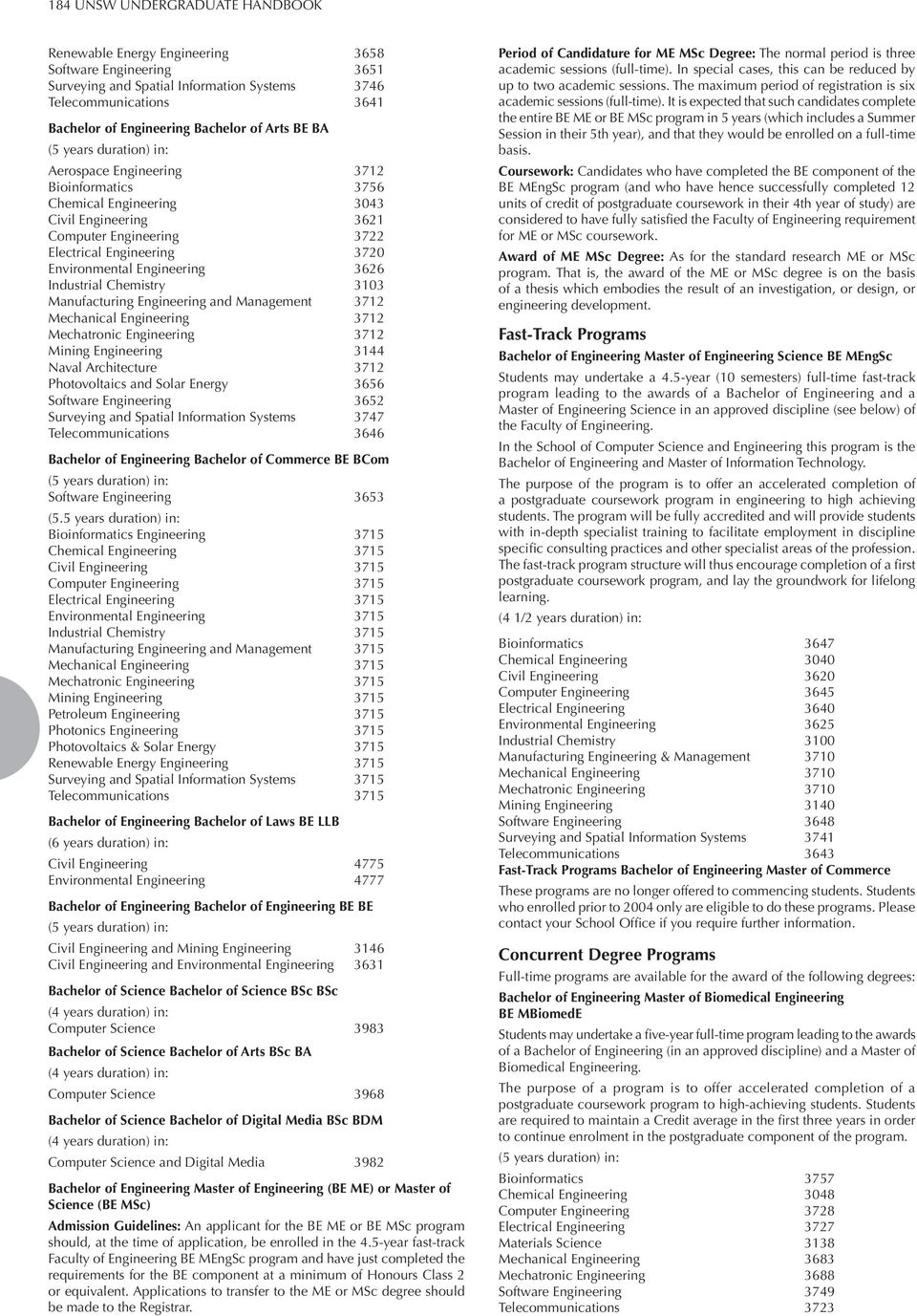
6 ENGINEERING 185 UNSW Co-op Program The UNSW Co-op Program is a scholarship program set up by industry and the University of New South Wales, which provides money and industry training for selected undergraduate students in disciplines in Commerce, Science and Engineering. The UNSW Co-op Program offer scholarships for five-year programs in: Chemical Engineering, Industrial Chemistry, Computer Science, Electrical Engineering, Telecommunications, Material Science and Engineering, Mechanical and Manufacturing Engineering, Mining Engineering, Petroleum Engineering, Photovoltaics and Solar Energy, and Surveying and Spatial Information Systems. Applicants should have achieved a particular academic standard (UAI 95.7 or equivalent), however, if you are expecting a UAI of at least 93.8, it would still be worth applying. Students are selected as Co-op Scholars largely on the basis of their personal skills, leadership potential and motivation, as well as their non-academic achievements. Applications close the end of September each year with interviews held at UNSW at the beginning of December. For more details see your School Careers Adviser or contact the UNSW Co-op Program office on (02) or visit Transfer Programs Students transferring to UNSW after successful completion of part of an engineering degree program at an Australian university would normally be admitted with advanced standing into the degree programs offered by the Faculty of Engineering. Students who have completed part of an undergraduate program in one school may apply through UAC for a transfer to a program in another school of the Faculty with credit for relevant courses completed. However, as there are significant differences in the various programs, students are not necessarily granted exemption from the same number of courses as they have completed in the program to which the transfer is made. Enrolment quotas apply to undergraduate programs and the number of places available for transfer is limited and offers will be made on a competitive basis. Formal advanced standing procedures apply for entry into the following Bachelor of Engineering (BE) programs at the UNSW with full credit. BE in Aerospace Engineering The Faculty has approved an arrangement whereby students who satisfy the requirements of the first two years of a Mechanical Engineering four-year degree program at any Australasian tertiary institution may be admitted to Years 3 and 4 of the program leading to the Bachelor of Engineering degree in Aerospace Engineering. The proviso is that Head of the School is satisfied that the courses studied at the other institution are equivalent, and he gives his recommendation. BE in Naval Architecture The Faculty has approved an arrangement whereby students who satisfy the requirements of the first two years of a Mechanical Engineering four-year degree program at any Australasian tertiary institution may be admitted to Years 3 and 4 of the program leading to the Bachelor of Engineering degree in Naval Architecture. The proviso is that Head of the School is satisfied that the courses studied at the other institution are equivalent, and he gives his recommendation. Rules for Progression and the Award of Degrees Access to Exam Information Students in the Faculty of Engineering may request access to their own final examination scripts and may request consultation with the examiner on their performance provided that a written application is made to the program authority no later than fifteen working days after the date of official release of results. Bachelor of Engineering Program Rules 1. The Bachelor of Engineering is awarded following the completion of a minimum of 192 units of credit. 2. The specific requirements for the Bachelor of Engineering in the various disciplines are set out in the relevant sections in this Handbook. 3. The degree may be awarded with Honours, based upon the overall performance in the program and in accordance with Faculty and School policies. Honours are awarded in the following classes Class 1, Class 2 Division 1, Class 2 Division The standard duration of the program is four years, or eight sessions, of full-time study each comprising. Students may undertake the program over a longer period on the basis of part-time study. 5. Each student is required to complete a minimum of 60 days of approved experience in industry prior to graduation. 6. electives may only be attempted after the student has attempted at least. Bachelor of Engineering Bachelor of Science Program Rules To qualify for the Bachelor of Engineering and the Bachelor of Science a student must complete successfully courses that total at least 240 units of credit and include: (a) in the Faculty of Engineering: courses making up a full 4-year engineering program described in the degree requirements for the BE specialisation for which the student is enrolled; and (b) in the Faculty of Science: at least 102 units of credit comprising a major in an approved disciplinary stream described in Table A of the Science Handbook, or a major in Computer Science; and (c) at least 60 days of approved Industrial Training (required for the award of the BE degree). Exclusions The following combined degree combinations are specifically excluded: BE in Computer Engineering BSc in Computer Science BE in Software Engineering BSc in Computer Science Requirements for the BE and BSc degrees with Honours (a) BE with Honours On completion of the requirements for the combined degrees a student may qualify for the award of the BE degree with Honours in accordance with the rules for the BE program of specialisation and the Faculty of Engineering rules for calculation of the grade of Honours (1st Class Honours: a weighted average of 75% or greater; 2nd Class Honours Division i: a weighted average of 70% or greater; 2nd Class Honours Division ii: a weighted average of 65% or greater, a student being awarded the highest grade of Honours for which they qualify). (b) BSc with Honours On completion of the requirements for the combined degrees a student may be qualified to enrol in an Honours program in the Bachelor of Science and to qualify for the award of the BSc with Honours after successfully completing an additional year of study (48 UOC) as specified in the rules of the Faculty of Science. Programs of study The programs of study which may be taken for the degrees of Bachelor of Engineering and Bachelor of Science are governed by the normal rules for award of the BE and BSc in the Faculty of Engineering and the Faculty of Science respectively, which specify: (i) units of credit; (ii) corequisites, prerequisites, assumed knowledge; (iii) the structure of the degree program; and (iv) any special conditions. Award of the degrees (i) A candidate for the award of the degrees of Bachelor of Engineering or Bachelor of Science as part of a combined degree program shall not be eligible to be awarded either degree until he or she has completed both degree requirements. (ii) A student who completes the requirements for both the BE and BSc degrees shall receive at graduation a separate testamur for each of the degrees. (iii) A student may apply to discontinue the combined BE BSc programs and elect to complete either the BE or BSc degree in accordance with the rules governing award of that degree. Following discontinuation of one of the programs (BE or BSc), courses which count toward that program may not in general count toward the remaining single degree unless they meet the single degree requirements in their own right. Administration of the programs (i) A student s general program will be administered by the Faculty of Engineering and delegated to administration by the school governing the Engineering specialisation.

7 186 UNSW UNDERGRADUATE HANDBOOK (ii) Students programs will be administered by the Faculty of Science for the BSc component of the program and by the Faculty of Engineering for the BE part of the program. (iii) The Faculty of Science and the Faculty of Engineering shall jointly exercise authority in any matter concerning the combined programs not otherwise covered by these rules. Enrolment (i) An application to enrol as a candidate for the combined program shall be made through the UAC, or on the prescribed form for international students which shall be lodged with the Registrar at least two calendar months before the commencement of the session in which enrolment is to begin. (ii) The candidate shall be enrolled as either a full-time or part-time student. Students are enrolled in combined undergraduate programs, leading to the award of two degrees, each in a different faculty, and therefore meet their requirements. Program structure Contained in the University Handbook are typical program stuctures for each of the schools within the Faculty of Engineering, and for the Faculty of Science. The programs may be varied by students according to the rules governing electives, prerequisites and corequisites and progression within each program. Subject to pre and corequisites and progression rules, students may take courses at any time during the program; it is the responsibility of each student to ensure that the rules governing award of the degrees have been met and that the program of study in each session of enrolment is feasible with regards to progression and timetabling. Admission Requirements (i) Local HSC students: Local students apply through the UAC. Students admitted to the combined program will have to meet the requirement for entry to the combined program, which ensures that the requirements for entry to both the BSc and the relevant BE program are met (i.e. the higher of the two requirements has to be met). (ii) International students: International students will be assigned an equivalent rank to enable their performance to be compared to that of local HSC students, using criteria determined by the Admissions Office. Students have to apply to the Admissions Office using the application forms (paper or electronic) provided for the purpose. International students completing 2 in Australia apply directly to the UAC. An admission requirement similar to that for local students will have to be met. (iii) Admission to later stages of the program: Students may be admitted to the combined degree program having satisfied part of the requirements for either the BSc or the BE component of the degree (or part of the requirements for both), either at UNSW or at another institution. Students will be admitted on the basis of an equivalent rank, determined by the Admissions Office, equivalent to that required for local HSC students in the year of entry. Students will be offered advanced standing in accordance with normal practice for the BE and BSc degrees. Students will apply using the procedures appropriate for either local HSC students or international students (above). Bachelor of Engineering Master of Engineering Science Program Rules 1. The minimum duration of the program is 4. (including a summer semester at the end of the 4th year) leading to the award of the two degrees Bachelor of Engineering (BE) and Master of Engineering Science (MEngSc). In the School of Computer Science and Engineering, the award is Bachelor of Engineering (BE) and Master of Information Technology (MIT). 2. Students must study all courses in the sequence approved by the Faculty of Engineering and are not permitted to enrol in any graduate course until the first six semesters of the program are successfully completed. 3. A minimum average of 65% in the first 3 years of the BE program is required for consideration for entry to the fast track degree program. 4. Honours grading for the BE degree will be based on performance in the first 4 years of study, with course weightings in accordance with School guidelines. The 12 units of credit of graduate coursework undertaken in are thus counted for both degrees. 5. Normal Student Contributions/fees apply to the first 8 semesters of the program (including the 12 units of credit of MEngSc courses completed in ) consistent with other undergraduate programs within the Faculty. Fees for the remaining 36 units of credit of the MEngSc program will be 75% of the current fee for the standard 48 units of credit MEngSc. Faculty Rules for Progression Progression in all undergraduate programs in the Faculty of Engineering is permitted by course. However: 1. Programs will continue to be stated and timetabled by year or stage and it cannot be guaranteed that non-standard programs can be completed in the minimum number of years. Students are not permitted to enrol in courses with clashing timetables. 2. Students must satisfy the relevant prerequisite and corequisite requirements. This will usually necessitate students completing or attempting all courses of a particular year or stage before proceeding to a course in the next part of a program. Further details are available from schools. A prerequisite course is one which must be completed prior to enrolment in the course for which it is prescribed. A corequisite course is one which must either be completed successfully before or be studied concurrently with the course for which it is prescribed. 3. Only in exceptional circumstances will students be allowed to enrol in a program containing courses from more than two consecutive years of the program or totalling more than 27 units of credit. Students repeating courses will be expected to choose a program that includes previously failed courses and limits their units of credit. Details of these limits are available from School offices and may only be exceeded with the express permission of the Head of School. A failed elective may be replaced by another elective. 4. Notwithstanding the above, before students can enrol in any nonstandard programs, such program must meet with the approval of the Head of School. A non-standard program is one which involves enrolment in courses from more than one year or stage, or comprises courses which are not normally included in the program for a particular year. For Academic Standing rules please refer to the General University Rules and Student Information section in this Handbook. Honours In the Bachelor of Engineering degree programs the same formal program is offered to both Pass students and to those aiming at Honours. Honours will be awarded for meritorious performance over the program: special attention is paid to a candidate s performance in the final year courses and thesis project. In the cases of combined degrees, such as the BE BA or the BE BSc, the award of the BA or BSc degree at Honours level requires two additional sessions of study. Students wishing to gain a degree at Honours level in Arts or in Science as part of their combined degree program must meet all the relevant requirements of the Faculty of Arts and Social Sciences or the Faculty of Science and of the appropriate school concerned. Students may enrol for the Honours year only on the recommendation of the Head of their School in the Faculty of Engineering and with the approval of the Head of the appropriate Arts or Science School. For Honours in Science, approval must also be sought from the Science Cross Faculty Standing Committee or its delegated authorities. AUSTUDY support is available for the combined degree program including the Honours level. Industrial Experience Requirements All students must complete at least 60 working days of approved industrial experience (or professional practice in the case of Surveying and Spatial Information Systems students) prior to enrolment in the final year of their program. The award of the degree is dependent on the completion of the requisite periods of industrial employment at a standard approved by the University. Program Revision Following any program revision, students whose progression is normal are entitled to complete under the version of the program that applied when they first enrolled. Alternatively, they may transfer to the revised program with credit for all courses completed at the time the revised program is introduced. Program Rules and Information Faculty of Engineering All Schools Please note: Most undergraduate programs in the Faculty of Engineering are currently under revision, subject to approval by the University Council. Students commencing in 2006 should refer to the Online Handbook ( for up-todate information about program structures.

8 ENGINEERING Bachelor of Engineering Bachelor of Commerce BE BCom units of credit The Faculty of Engineering and the Faculty of Commerce and Economics offer a combined degree program which qualifies students for two degrees after five and a half years of successful study: the Bachelor of Engineering (potentially with Honours) and the Bachelor of Commerce (for which an Honours program requires an additional 48 UOC). This combined degree is offered in the following Engineering disciplines: Bioinformatics Engineering Chemical Engineering Civil Engineering Computer Engineering Electrical Engineering Environmental Engineering Industrial Chemistry Manufacturing Engineering and Management Mechanical Engineering Mechatronic Engineering Mining Engineering Petroleum Engineering Photonics Engineering Photovoltaics & Solar Energy Renewable Energy Engineering Software Engineering (program code 3653) Surveying and Spatial Information Systems Telecommunications Requirements for the Bachelor of Engineering and the Bachelor of Commerce degrees To qualify for the Bachelor of Engineering and the Bachelor of Commerce a student must complete successfully courses that total at least 264 units of credit and include: (a) in the Faculty of Engineering: courses making up at least 168 units of credit described in the degree requirements for the BE specialisation for which the student is enrolled; and (b) in the Faculty of Commerce: at least 96 units of credit comprising a major of at least 48 units of credit in an approved disciplinary stream and a minor of 24 units of credit of approved session courses of which no more than 12 units may be level 1 courses; prescribed level 1 introductory courses; or suitable electives to make up the full 96 UOC; and (c) at least 60 days of approved Industrial Training (required for the award of the BE degree). Administration of the Programs (i) A student s general program will be administered by the Faculty of Engineering and delegated to administration by the school governing the engineering specialisation. (ii) Students programs will be administered by the Faculty of Commerce and Economics for the BCom component of the program and by the Faculty of Engineering for the BE part of the program. (iii) The Faculty of Commerce and Economics and the Faculty of Engineering shall jointly exercise authority in any matter concerning the combined programs not otherwise covered by these rules. Enrolment (i) An application to enrol as a candidate for the combined program shall be made through UAC to the following programs: BE in Software Engineering BCom (HECS), (FEE) BE in all other programs BCom (HECS), (FEE), or on the prescribed form for international students which shall be lodged with the Registrar at least two calendar months before the commencement of the session in which enrolment is to begin. (ii) The candidate shall be enrolled as either a full-time or part-time student. Program Objectives and Learning Outcomes The program is intended for potential engineers who wish to become more aware of economic and social aspects of the engineering profession, and skilled in technical management. It is expected that those taking this program would progress to entrepreneurial and managerial roles. A full range of commerce and engineering careers will still be open to those who qualify with both components of the combined degree program. Most engineers progress to technical management roles, and these programs will strengthen the commerce background in addition to providing the engineering skills. Increasingly, engineers also find employment in the commercial sector, and the combined programs will provide a good background for those entering banking, consultancy etc. Students wishing to enter the purely commercial sector will benefit from technical and numerate strengths obtained as part of the engineering program. Stage 1 Science & Engineering courses Science & Engineering courses Stage 2 Science & Engineering courses Commerce courses Stage 3 Commerce courses Science & Engineering courses Stage 4 Science & Engineering courses Commerce courses Science & Engineering courses Commerce courses Stage 5 Science & Engineering courses Science & Engineering courses Stage 6 Commerce courses Honours (a) BE with Honours (24 UOC) (24 UOC) (24 UOC) (24 UOC) (24 UOC) (24 UOC) (12 UOC) (12 UOC) (12 UOC) (12 UOC) (24 UOC) (24 UOC) On completion of the requirements for the combined degrees a student may qualify for the award of the BE degree with Honours in accordance with the rules for the BE program of specialisation and the Faculty of Engineering rules for calculation of the grade of Honours (1st Class Honours: a weighted average of 75% or greater; 2nd Class Honours Division i: a weighted average of 70% or greater; 2nd Class Honours Division ii: a weighted average of 65% or greater, a student being awarded the highest grade of Honours for which they qualify). (b) BCom with Honours On completion of the requirements for the combined degrees a student may be qualified to enrol in an Honours program in the Bachelor of Commerce and to qualify for the award of the BCom with Honours after successfully completing an additional year of study (48 UOC) as specified in the rules of the Faculty of Commerce. The programs of study which may be taken for the degrees of Bachelor of Engineering and Bachelor of Commerce are governed by the normal

9 188 UNSW UNDERGRADUATE HANDBOOK rules for award of the BE and BCom in the Faculty of Engineering and the Faculty of Commerce respectively, which specify: (i) units of credit; (ii) corequisites, prerequisites, assumed knowledge; (iii) the structure of the degree program; and (iv) any special conditions. Award of the Degrees (i) A student who completes the requirements for both the BE and BCom degrees shall receive at graduation a separate testamur for each of the degrees. (ii) A student may apply to discontinue the combined BE BCom programs and elect to complete either the BE or BCom degree in accordance with the rules governing award of that degree. Following discontinuation of one of the programs (BE or BCom), courses which count toward that program will not in general count toward the remaining single degree unless they meet the single degree requirements in their own right. School of Chemical Engineering and Industrial Chemistry Head of School: Associate Professor Michael Brungs Administrative Officer: Vivienne Brennan Director, Teaching and Learning: Associate Professor Vicki Chen The School offers a Bachelor of Engineering in both Chemical Engineering and Industrial Chemistry, together with a Bachelor of Science in Food Science and Technology. The duration of these degree programs is four years full-time. Six year part-time programs in Chemical Engineering and Industrial Chemistry are also available, leading to a Bachelor of Science (Technology). The School also offers a Bachelor of Science (Honours) in Food Science and Technology and a 3 year Bachelor of Science (Food Science and Nutrition major) program. The Bachelor of Engineering degrees are accredited by the Institution of Engineers Australia and the Royal Chemical Institute. The Bachelor of Engineering in Chemical Engineering is also accredited by the Institution of Chemical Engineers (UK). Graduates of both Food Science and Technology programs qualify for membership of the Australian Institute of Food Science and Technology, the US Institute of Food Technologists and may qualify for membership of the Royal Australian Chemical Institute. Combined degree programs are also available for suitably qualified students. These are the Bachelor of Engineering Bachelor of Science and the Bachelor of Engineering Bachelor of Arts. Also available are Bachelor of Engineering Bachelor of Commerce. A concurrent Bachelor of Engineering Master of Biomedical Engineering is also available in Chemical Engineering. The School offers a fast-track program over 4.5 years full-time, the Bachelor of Engineering and Master of Engineering Science (BE MEngSc), which allows flexibility of choice between formal coursework and project work and also a 5 year BE ME or MSc (Chem Eng). Chemical Engineering is the application of the principles of the physical sciences, together with the principles of economics and human relations, to fields in which matter undergoes a change in state, energy content or composition. The chemical engineer is generally responsible for the design, construction and operation of plant and equipment used in the chemical processing industries. Chemical Engineers are employed in a very wide range of industries including the chemical, minerals, pharmaceutical, food and energy industries. Many chemical engineers work in environmental management, research and development business, management and computer applications. Industrial chemists have a strong foundation in the basic sciences, particularly chemistry, in addition to their engineering skills. Their roles range from solving problems in forefront research areas, to the successful operation of Australia s manufacturing industry. Industrial chemists characterise and select raw materials, develop environmentally responsible routes for the production of commodity materials and chemicals, control chemical plan and processes and verify the quality of the product. Industrial chemists are capable of fulfilling a multiplicity of roles as research scientists, development chemists, technical representatives and as plant/company managers. Food Science and Technology involves an understanding of the basic sciences and the application of this knowledge to food manufacture from the point of production, through handling, processing, preservation, distribution and marketing, up to consumption and utilisation by consumers. It is concerned with food processes, commodities, composition and quality (including sensory properties, safety and nutritional value). The study of Food Science and Technology integrates many scientific disciplines. Its bases are in chemistry, physics, biochemistry, microbiology, and molecular biology. The challenges are to increase the availability, variety, quality and quantity of foods economically and in line with the needs of the world population. The Australian industry has a major role to play in supplying high quality foods to overseas markets and there is a national and international demand for professionally trained people prepared to accept responsibility for the production, quality and safety of this food. The programs provide basic preparation for food science and technology careers in the food industry, the public sector, education, research, the food service industry, public health, management and marketing. Graduates may also find careers in health and environmental sciences, management of food resources, and communication and in areas such as dietetics after further training. For the award of Honours, students need to have distinguished themselves in the formal work, in other assignments as directed by the Head of the School, and in the final year project, for which a thesis is required. It is compulsory that, before completion of the program, students in both the Chemical Engineering and Industrial Chemistry full-time programs must obtain a minimum of twelve weeks professionally oriented or industrial experience. Students in the part-time programs in Chemical Engineering and Industrial Chemistry must complete an approved program of industrial experience of not less than twelve months prior to the award of the degree. Please note: Most undergraduate programs in the Faculty of Engineering are currently under revision, subject to approval by the University Council. Students commencing in 2006 should refer to the Online Handbook ( for up-todate information about program structures Chemical Engineering (Full-time) Bachelor of Engineering BE 4 years 192 units of credit This program extends over four years and students study full-time during the day for twenty-eight weeks of each year (excluding examination and recess periods). The Director of Teaching and Learning may approve various program patterns involving full-time or part-time study. This program is also available as a combined degree program with BE (Chem Eng) BSc (program 3042), BE (Chem Eng) BA, (program 3043), BE(Chem Eng) BCom, program 3715, the concurrent degree BE (Chem Eng) MBiomedE, (program 3048), and the fast track program BE(Chem Eng) MEngSc, (program 3040, plan CEICL13040). For more information, please contact Director, Teaching and Learning. CEIC1010 Introduction to the Chemical Industry (3 UOC) CEIC1020 Introduction to Chemical Engineering CEIC1030 Communication & Business Skills CHEM1011 Fundamentals of Chemistry 1A CHEM1021 Fundamentals of Chemistry 1B MATH1131 Mathematics 1A MATH1231 Mathematics 1B MECH0130 Engineering Drawing and Solid Modelling (3 UOC) PHYS1111 Fundamentals of Physics* PHYS1169 Physics 1 (Chem,Mech,Min Eng) * If PHYS1111 is taken, then PHYS1229 MUST be taken in S2 CEIC2011 Instrumental Analysis - Theory (3 UOC) CEIC2012 Instrumental Analysis - Practical (3 UOC) CEIC2020 Introduction to Numerical Methods (3 UOC) CEIC2110 Material & Energy Balances (3 UOC)

10 ENGINEERING 189 CEIC2120 Fluid Flow (3 UOC) CEIC2130 Heat Transfer (3 UOC) CHEN2050 Chemical Engineering Laboratory 1 (3 UOC) CHEN2061 Introduction to Process Chemistry 1 CHEN2062 Introduction to Process Chemistry 2 (3 UOC) CHEN2140 Mass Transfer (3 UOC) ELEC0809 Electrical Engineering 1C (3 UOC) MATH2020 Mathematics 2A (3 UOC) MATH2030 Mathematics 2B (3 UOC) MATH2899 Applied Statistics for Chemical Engineers (3 UOC) (3 UOC) BIOT3100 Fundamentals of Biotechnology (3 UOC) CEIC3010 Reaction Engineering (4 UOC) CEIC3070 Process Control (4 UOC) CEIC3110 Thermodynamics (3 UOC) CHEN3021 Systems Modelling & Analysis (3 UOC) CHEN3022 Process Modelling & Optimisation (3 UOC) CHEN3031 Advanced Transport Phenomena (3 UOC) CHEN3062 Particles, Separation, Heat Exchangers and Pressure Vessels CHEN3065 Plant and Equipment Design (4 UOC) CHEN3067 Process Design & Economics (3 UOC) CHEN3068 Process Design & Safety (3 UOC) CHEN3080 Chemical Engineering Practice 2 (3 UOC) CEIC4070 Laboratory Automation Science (4 UOC) CEIC4101 Professional Electives Advanced (3 UOC) CEIC4102 Professional Electives Extended (3 UOC) CEIC4106 Professional Electives (3 UOC) CEIC4120 Management & Plant Operation CHEN4031 Environmental Management 1 (3 UOC) CHEN4081 Design Project (8 UOC) CHEN4091 Research Project Theory (3 UOC) CHEN4092 Research Project Practice (12 UOC) (3 UOC) Please refer to Requirements under Faculty Information and Assistance in this Handbook. Honours For the award of Honours in the Chemical Engineering and Industrial Chemistry programs, students need to have distinguished themselves in the formal work, in other assignments as directed by the Head of the School, and in the final year project, for which a thesis is required. For program rules relating to the Bachelor of Engineering, please refer to the Rules for Progression and Award of Degrees under Faculty Information and Assistance in this Handbook. Industrial Experience Requirements It is compulsory that, before completion of the program, students in both the Chemical Engineering and Industrial Chemistry full-time programs must obtain a minimum of twelve weeks professionally oriented or industrial experience. Students in the part-time programs in Chemical Engineering and Industrial Chemistry must complete an approved program of industrial experience of not less than twelve months prior to the award of the degree Further Requirements Students are expected to possess a calculator having exponential capabilities, however, more advanced calculators and personal computers, will be found useful. In examinations, students may be required to use calculators supplied by the University, so that no student will have an unfair advantage over another. Further information may be obtained from the Head of School. Students of both Chemical Engineering and Industrial Chemistry are advised to have a copy of Perry J H Ed. Chemical Engineers Handbook 6th Ed. McGraw-Hill. This book is used extensively for most courses and units. Certain courses and units do not have specified textbooks and in these cases reference books are used or printed notes supplied. If you are required to complete a varied program of physics or maths in your first year (i.e. General Maths or Fundamentals of Physics), then students are not permitted to undertake studies in higher options of other courses. Professional Recognition Successful completion of the BE degree program is accepted by the Institution of Chemical Engineers, the Institution of Engineers, Australia, and Royal Australian Chemical Institute as sufficient academic qualification for corporate membership Chemical Engineering (Part-time) Bachelor of Science (Technology) BSc(Tech) 6 years 144 units of credit Six year part-time program leading to the award of the degree of Bachelor of Science (Technology) in Chemical Engineering is intended for students who are employed in relevant industries and who wish to prepare for a degree mainly by part-time attendance. They consist of the first 3 years of the respective full-time program, but undertaken over a six year period. As part of the requirements for the award of the BSc(Tech) degree, students are required to complete an approved program of industrial training of not less than one year prior to the award of the degree. Industrial training should normally be completed concurrently with attendance in the program, but with the approval of the Head of School, may be completed after completion of the prescribed program of study. Students who qualify for the award of the BSc(Tech) degree and who wish to proceed to the award of a BSc or BE degree will normally be required to complete further work which will involve at least one year of full-time attendance. Holders of the degree of BSc(Tech) or BSc(Eng) will be eligible to proceed to the award of the degree of Master of Science or Master of Engineering, please refer to course regulations relating to these degrees. Transfer is also possible from full-time programs to the part-time BSc (Tech) degree program, but a period of approved industrial experience must be gained before graduation. This requirement will apply to students transferring from BSc and BE degree programs within the Faculty. Further details of part time programs can be obtained from the Director of Teaching and Learning. The structure of this part-time program is similar to the full-time program (BE Chemical Engineering 3040) only over a longer period. Please refer to the 3040 Chemical Engineering program entry for more information. For academic rules relating to this program, please refer to the entry for the full-time program (BE Chemical Engineering 3040) and contact the Faculty of Engineering for more information. Note that as part of the requirements for the award of the BSc(Tech) degree, students are required to complete an approved program of industrial training of not less than one year prior to the award of the degree or with the approval of the Head of School, may be completed after completion of the prescribed program of study Food Science and Technology (Full-time) Bachelor of Science BSc 4 years 192 units of credit This program is designed to provide depth and breadth in the relevant physical and biological sciences on which food science and technology is based. It is strongly recommended that students obtain, before the completion of the program and during recess periods, as much

11 190 UNSW UNDERGRADUATE HANDBOOK professionally oriented or industrial experience as possible. The BSc program in Food Science and Technology (3060) is Pass or Honours, determined by academic performance in Stages 2-4. BIOS1201 Molecules, Cells and Genes FOOD1120 Introduction to Food Science FOOD1130 The Food industry MATH1031 Mathematics for Life Sciences MATH1041 Statistics for Life and Social Sciences PHYS1111 Fundamentals of Physics CHEM1011 Fundamentals of Chemistry 1A CHEM1031 Higher Chemistry 1C CHEM1021 Fundamentals of Chemistry 1B CHEM1041 Higher Chemistry 1D CHEM2921 Food Chemistry 1 FOOD1230 Food Choice FOOD3220 Nutrition MICR2201 Fundamentals of Microbiology and Immunology BIOC2181 Fundamentals of Biochemistry BIOC2291 Fundamentals of Molecular Biology courses (12 UOC) CHEM3811 Food Chemistry 2 FOOD1360 Food Processing Principles FOOD1370 Food Preservation: Principles and Applications FOOD1380 Unit Operations in Food Processing FOOD1390 Product Design and Development FOOD2320 Food Microbiology FOOD2330 Quality Assurance and Control FOOD2340 Food Safety Stream A FOOD5400 Industry Liaison* FOOD1400 Project FOOD1480 Minor Project Plus a combination of electives to total 30 or 36 units of credit from the following list. BIOT3011 Biotechnology A BIOT3021 Biotechnology B BIOT3071 Commercial Biotechnology ECON1101 Microeconomics 1 ECON1102 Macroeconomics 1 FOOD1470 Postharvest Technology of Food FOOD1490 Advanced Food Chemistry FOOD2350 Forensic Food Science FOOD2480 Advanced Food Microbiology FOOD2490 Analytical Microbiology FOOD3440 Advanced Nutrition FOOD4450 Advanced Food Processing INFS1603 Business Data Management MARK1012 Marketing Fundamentals PHPH2101 Physiology 1A PHPH2201 Physiology 1B Or such other electives as approved by the Head of School. FOOD courses taken within the School must total at least 36 units of credit. Please note FOOD1470 and FOOD2490 will not be offered in Stream B: Industry Module Program FOOD5400 Industry Liaison* FOOD5410 Industry Practicum (24 UOC) Plus Electives (18 UOC) *During Stage 4 of the program, excursions are made to various food industries. Detailed reports of some of these visits may be required. Requirements Students in this program must also satisfy the requirements. This is usually 12 UOC taken in second and third year studies. For further information, please refer to the section in this Handbook. For academic requirements relating to this program, please refer to and contact the School of Chemical Engineering and Industrial Chemistry for more information. Further Information During the program, excursions are made to various food industries. Detailed reports of some of these visits may be required. Professional Recognition Graduates of this program qualify for membership of the Australian Institute of Food Science and Technology, the US Institute of Food Technologists, and may qualify for mebership of the Royal Australian Chemical Institute. The program provides basic preparation for food science and technology careers in the food industry, the public sector, education, research, the food service industry, public health, management and marketing. Graduates may also find careers in health and environmental sciences, management of food resources and food wastes, and communication, and in areas such as dietetics after further training Honours in Food Science Bachelor of Science (Honours) BSc(Hons) 1 year 48 units of credit This is a one-year full-time Honours program in Food Science. It is designed to provide extensive research training in some aspects of Food Science and Technology at undergraduate level. The research orientation of the program, compared to the Graduate Diploma, facilitates entry into a research higher degree (MSc/PhD) upon completion of Honours at a satisfactory level. Entry to the program requires satisfactory completion of a Bachelor degree, or equivalent, in an area considered relevant to Food Science and Technology. Students who have completed a four year Bachelor program, in which Honours has already been awarded, are specifically excluded. The major component of the program is an extensive research project, conducted throughout one year of full-time study. Candidates also take 6 units of credit of courses within the School, or such other courses as approved by the program coordinator. Honours is awarded on the basis of performance in the research project and satisfactory completion of coursework. Compulsory Courses FOOD9410 Honours Research Project (21 UOC) FOODXXXX* *Courses offered in Food Science and Technology or as approved by the program coordinator and dependent upon the background of the candidate. Units of credit for coursework courses may be concentrated in one session. For academic requirements relating to this program, please refer to and contact the School of Chemical Engineering and Industrial Chemistry for more information Food Science and Technology (Part-time) Bachelor of Science (Technology) BSc(Tech) 6 years 144 units of credit
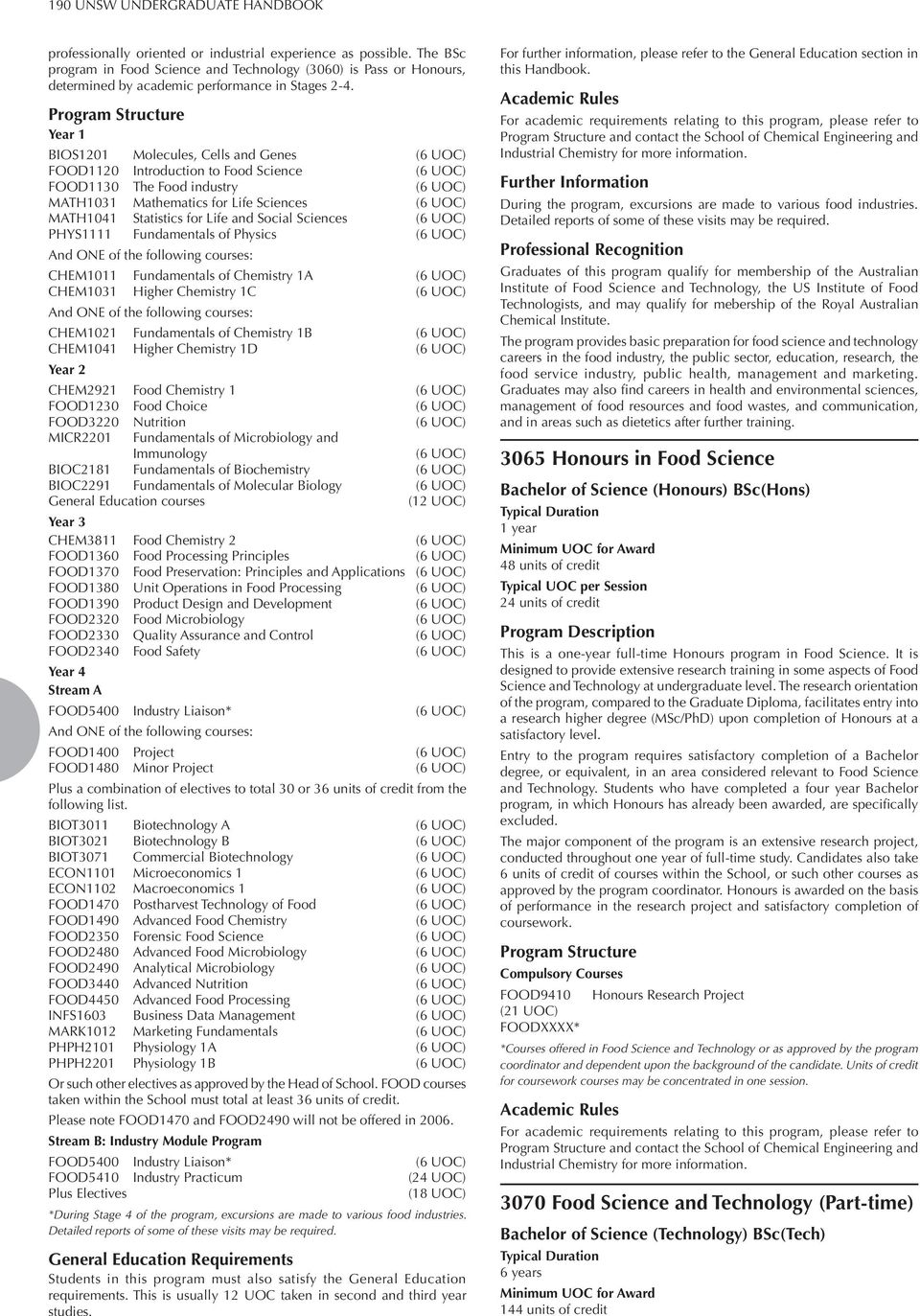
12 ENGINEERING 191 This program is designed for students who are employed in the food processing industries. It extends over six part-time years of study, and leads to the award of the degree of Bachelor of Science (Technology). Students are required to complete an approved program of industrial training of not less than twelve months prior to the award of the degree. Industrial training should normally be undertaken concurrently with attendance in the program, but with the approval of the Head of Department may be completed after completion of the prescribed program of study. The program covers the same subject matter as the first three years of the full-time program: For the first two years students follow a common program in which general biology is taken, and thereafter specialise in the biological sciences, which are fundamental to the study of food science and technology. The courses of Stages 4, 5 and 6 may be available only in daytime classes, and substantial daytime release from industry may be required. Students who have completed the requirements of this program and have qualified for the award of the degree of Bachelor of Science (Technology) may proceed to the award of the degree of Bachelor of Science by attending for one full-time year and completing the courses listed in of the full-time program. Students desiring to proceed to the award of a BSc degree must apply to the Head of the Department not later than 31 December of the year in which the sixth stage is completed. Years 1 and 2 BIOS1201 Molecules, Cells and Genes FOOD1120 Introduction to Food Science FOOD1130 The Food Industry MATH1031 Mathematics for Life Sciences MATH1041 Statistics for Life and Social Sciences PHYS1111 Fundamentals of Physics CHEM1011 Fundamentals of Chemistry 1A CHEM1031 Higher Chemistry 1C CHEM1021 Fundamentals of Chemistry 1B CHEM1041 Higher Chemistry 1D Note: Physics, Mathematics and Statistics are usually taken as Stage 1, the other courses as Stage 2 CHEM2921 Food Chemistry 1 FOOD1230 Food Choice BIOC2181 Fundamentals of Biochemistry BIOC2291 Fundamentals of Molecular Biology MICR2201 Fundamentals of Microbiology and Immunology FOOD3220 Nutrition (12 UOC) Year 5 CHEM3811 Food Chemistry 2 FOOD2320 Food Microbiology FOOD2330 Quality Assurance and Control FOOD2340 Food Safety Year 6 FOOD1360 Food Processing Principles FOOD1370 Food Preservation: Principles and Applications FOOD1380 Unit Operations in Food Processing FOOD1390 Product Design and Development Requirements Students in this program must also satisfy the requirements. This is usually 12 UOC taken in second and third year studies. For further information, please refer to the section in this Handbook. For academic requirements relating to this program, please refer to and contact the School of Chemical Engineering and Industrial Chemistry for more information. Professional Recognition Graduates of this program qualify for membership of the Australian Institute of Food Science and Technology, the US Institute of Food Technologists, and may qualify for membership of the Royal Australian Chemical Institute. The program provides basic preparation for food science and technology careers in the food industry, the public sector, education, research, the food service industry, public health, management and marketing. Graduates may also find careers in health and environmental sciences, management of food resources and food wastes, and communication, and in areas such as dietetics after further training Industrial Chemistry (Full-time) Bachelor of Engineering BE 4 years 192 units of credit Industrial Chemistry is a four-year professional program that is concerned with the application of science and technology to the chemical industry. Successful completion of the program is accepted by the Royal Australian Chemical Institute and the Institution of Engineers, Australia as sufficient academic qualification for full corporate membership. The Director of Teaching and Learning may approve various program patterns involving full-time and part-time study. This program can form part of combined degrees with BE (Ind Chem) BSc (program 3102), BE (Ind Chem)/BA (program 3103),BE (Ind Chem)/BCom (Program 3715) and also the fast-track program BE (Ind Chem)/MEngSc (plan CEICL13100). For more details contact the Director of Teaching and Learning, School of Chemical Engineering & Industrial Chemistry. CEIC1010 Introduction to the Chemical Industry (3 UOC) CEIC1020 Introduction to Chemical Engineering CHEM1011 Fundamentals of Chemistry 1A CHEM1021 Fundamentals of Chemistry 1B MATH1131 Mathematics 1A MATH1231 Mathematics 1B MECH0130 Engineering Drawing and Solid Modelling (3 UOC) PHYS1111 Fundamentals of Physics* PHYS1169 Physics 1 (Chem, Mech, Min Eng) CEIC1030 Communication & Business Skills PHYS1211 Energy and Environmental Physics * If PHYS1111 is taken then PHYS1229 must be taken in S2 CEIC2011 Instrumental Analysis - Theory (3 UOC) CEIC2012 Instrumental Analysis - Practical (3 UOC) CEIC2020 Introduction to Numerical Methods (3 UOC) CEIC2110 Material & Energy Balances (3 UOC) CEIC2120 Fluid Flow (3 UOC) CEIC2130 Heat Transfer (3 UOC) CHEM2021 Organic Chemistry CHEM2839 Inorganic Chemistry INDC2040 Physical Process Chemistry MATH2020 Mathematics 2A (3 UOC) MATH2030 Mathematics 2B (3 UOC) MATH2899 Applied Statistics for Chemical Engineers (3 UOC) (3 UOC) BIOT3100 Fundamentals of Biotechnology (3 UOC) CEIC3010 Reaction Engineering (4 UOC) CEIC3070 Process Control (4 UOC)
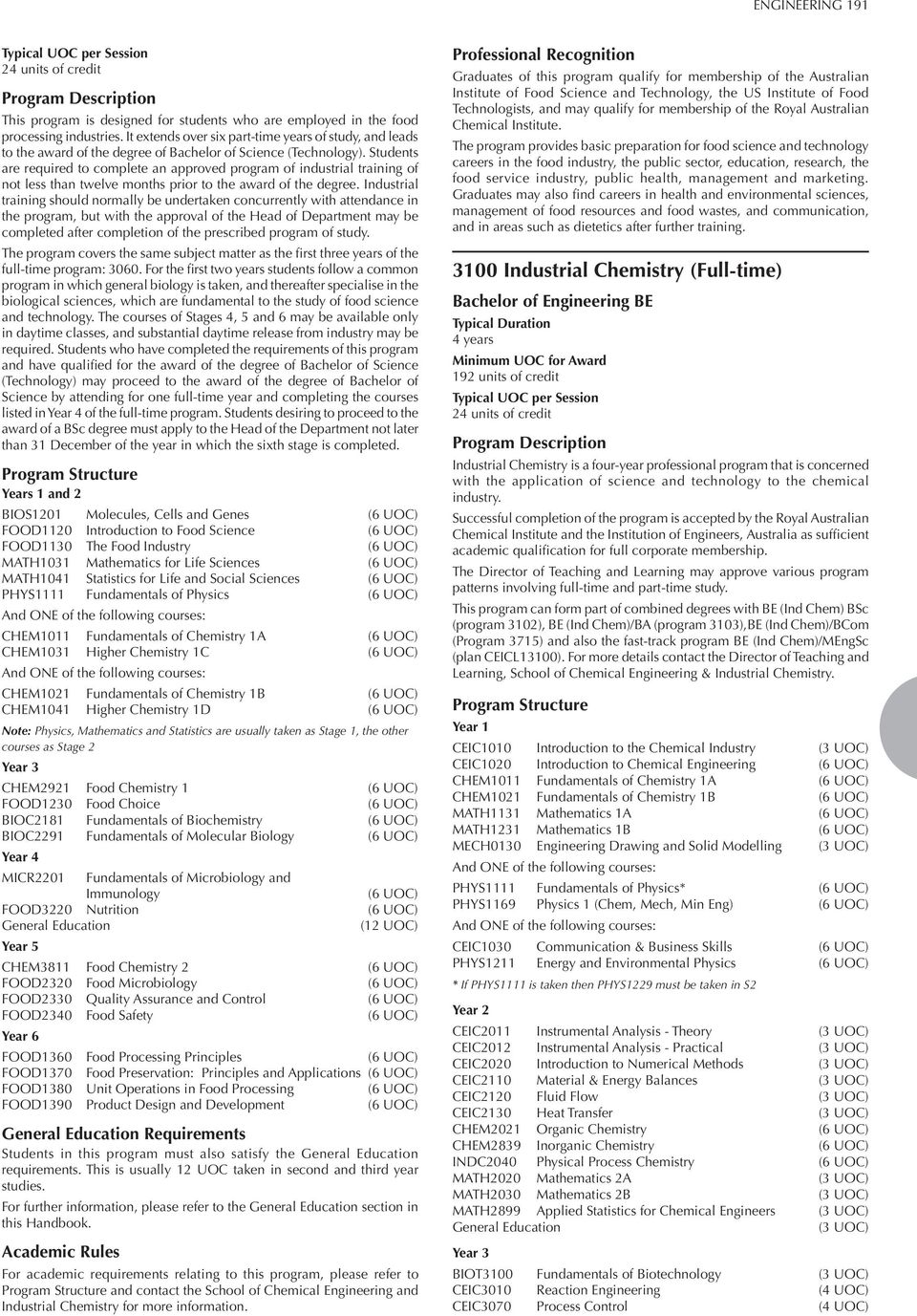
13 192 UNSW UNDERGRADUATE HANDBOOK CEIC3110 Thermodynamics (3 UOC) CHEM3829 Organic Chemistry INDC3051 Process Chemistry & Operation (4 UOC) INDC3110 Industrial & Environmental Chemistry INDC3120 Industrial Chemistry Practice POLY3011 Polymer Science (3 UOC) POLY3012 Polymer Science (3 UOC) CEIC4070 Laboratory Automation Science (4 UOC) CEIC4105 Professional Electives (3 UOC) CEIC4120 Management & Plant Operation INDC4061 Process Design A (4 UOC) INDC4062 Process Design B (4 UOC) INDC4091 Research Project Theory (12 UOC) INDC4092 Research Project (12 UOC) (3 UOC) Please refer to Requirements under Faculty Information and Assistance in this Handbook. For program rules relating to the Bachelor of Engineering, please refer to the Rules for Progression and Award of Degrees under Faculty Information and Assistance in this Handbook Industrial Chemistry (Part-time) Bachelor of Science (Technology) BSc(Tech) 6 years 144 units of credit This six-year part-time program leading to the award of the degree of Bachelor of Science (Technology) in Industrial Chemistry is intended for students who are employed in relevant industry and who wish to prepare for a degree mainly by part-time attendance. As part of the requirements for the award of the BSc(Tech) degree, students are required to complete an approved program of industrial training of not less than one year prior to the award of the degree. Industrial training should normally be completed concurrently with attendance in the program, but with the approval of the Head of School, may be completed after completion of the prescribed program of study. Students who qualify for the award of the BSc(Tech) degree and who wish to proceed to the award of a BSc degree will normally be required to complete further work which will involve at least one year of full-time attendance. Holders of the degree of BSc(Tech) or BSc(Eng) will be eligible to proceed to the award of the degree of Master of Science or Master of Engineering, refer to course regulations relating to these degrees. Transfer is also possible from full-time programs to the part-time BSc(Tech) degree program, but a period of approved industrial experience must be gained before graduation. This requirement will apply to students transferring from BSc and BE degree programs within the Faculty. Part time programs consist of first 3 years of the respective full-time program - undertaken over a six year period. Details of part time programs can be obtained from the Director of Teaching and Learning. Please refer to the full-time BE Industrial Chemistry (Program 3100) and contact the School of Chemical Engineering & Industrial Chemistry for information regarding the. For academic requirements relating to this program, please refer to and contact the School of Chemical Engineering and Industrial Chemistry for more information. Industrial Experience Students are required to complete an approved program of industrial training of not less than one year prior to the award of the degree. Industrial training should normally be completed concurrently with attendance in the program, but with the approval of the Head of School, may be completed after completion of the prescribed program of study Chemical Engineering/Bachelor of Science Bachelor of Engineering Bachelor of Science BE BSc 240 units of credit The combined program of five years full-time study enables a student in the school to qualify for the award of the two degrees of Bachelor of Engineering and Bachelor of Science (BE BSc). Graduates from this course will have a broader range of complementary computing and engineering skills that will greatly enhance both their employment and career prospects. The School of Chemical Engineering and Industrial Chemistry administers the program. CEIC1020 Introduction to Chemical Engineering CHEM1011 Fundamentals of Chemistry 1A CHEM1021 Fundamentals of Chemistry 1B COMP1011 Computing 1A COMP1021 Computing 1B MATH1131 Mathematics 1A MATH1231 Mathematics 1B PHYS1111 Fundamentals of Physics PHYS1169 Physics 1 (Chem, Mech, Min Eng) CEIC2011 Instrumental Analysis - Theory (3 UOC) CEIC2110 Material & Energy Balances (3 UOC) CEIC2120 Fluid Flow (3 UOC) CEIC2130 Heat Transfer (3 UOC) CHEN2050 Chemical Engineering Laboratory 1 (3 UOC) CHEN2061 Introduction to Process Chemistry 1 CHEN2062 Introduction to Process Chemistry 2 (3 UOC) CHEN2140 Mass Transfer (3 UOC) COMP2011 Data Organisation MATH1081 Discrete Mathematics MATH2020 Mathematics 2A (3 UOC) MATH2030 Mathematics 2B (3 UOC) MATH2899 Applied Statistics for Chemical Engineers (3 UOC) CEIC3010 Reaction Engineering (4 UOC) CEIC3070 Process Control (4 UOC) CEIC3110 Thermodynamics (3 UOC) CEIC4103 Professional Electives (3 UOC) CHEN3021 Systems Modelling & Analysis (3 UOC) CHEN3022 Process Modelling & Optimisation (3 UOC) CHEN3031 Advanced Transport Phenomena (3 UOC) CHEN3062 Particles, Separation, Heat Exchangers and Pressure Vessels CHEN3065 Plant and Equipment Design (4 UOC) CHEN3080 Chemical Engineering Practice 2 (3 UOC) COMP2021 Digital System Structures COMP2041 Software Construction: Techniques and Tools CEIC2012 Instrumental Analysis - Practical (3 UOC) CEIC4104 Professional Electives (3 UOC) CHEN3067 Process Design & Economics (3 UOC) CHEN3068 Process Design & Safety (3 UOC)

14 ENGINEERING 193 Plus Computing elective S1 Plus 2 Computing electives 6 UOC each S1 & S2 Plus 2 Computing electives 6 UOC each S1 & S2 Plus elective course* S2 Year 5 CEIC4070 Laboratory Automation Science (4 UOC) CEIC4101 Professional Elect Advanced (3 UOC) CEIC4102 Professional Electives Extended (3 UOC) CEIC4106 Professional Electives (3 UOC) CEIC4120 Management & Plant Operation CHEN4031 Environmental Management 1 (3 UOC) CHEN4081 Design Project (8 UOC) CHEN4091 Research Project Theory (3 UOC) CHEN4092 Research Project Practice (12 UOC) Plus elective course* (3 UOC) *either Computer Science or Chemical Engineering/Industrial Chemistry Honours For the award of Honours in the Chemical Engineering and Industrial Chemistry programs, students need to have distinguished themselves in the formal work, in other assignments as directed by the Head of the School, and in the final year project, for which a thesis is required. For academic rules relating to the combined degree Bachelor of Engineering Bachelor of Science, please refer to the Rules for Progression and Award of Degrees under Faculty Information and Assistance in this Handbook. Industrial Experience Requirements It is compulsory that, before completion of the program, students in both the Chemical Engineering and Industrial Chemistry full-time programs must obtain a minimum of twelve weeks professionally oriented or industrial experience. Students in the part-time programs in Chemical Engineering and Industrial Chemistry must complete an approved program of industrial experience of not less than twelve months prior to the award of the degree Further Requirements Students are expected to possess a calculator having exponential capabilities, however, more advanced calculators and personal computers, will be found useful. In examinations, students may be required to use calculators supplied by the University, so that no student will have an unfair advantage over another. Further information may be obtained from the Head of School. Students of both Chemical Engineering and Industrial Chemistry are advised to have a copy of Perry J H Ed. Chemical Engineers Handbook 6th Ed. McGraw-Hill. This book is used extensively for most courses and units. Certain courses and units do not have specified textbooks and in these cases reference books are used or printed notes supplied. If you are required to complete a varied program of physics or maths in your first year (i.e. General Maths or Fundamentals of Physics), then students are not permitted to undertake studies in higher options of other courses. Professional Recognition Successful completion of the BE degree program is accepted by the Institution of Chemical Engineers, the Institution of Engineers, Australia, and Royal Australian Chemical Institute as sufficient academic qualification for corporate membership Chemical Engineering/Bachelor of Arts Bachelor of Engineering Bachelor of Arts BE BA 240 units of credit The combined program of five years full-time study enables a student in the school to qualify for the award of the degrees of Bachelor of Engineering and Bachelor of Arts. Since Engineering and Arts programs can have a common content, such as mathematics and physics, approximately two additional sessions of study are required to gain the additional qualifications of Bachelor of Arts. In general this additional study is taken concurrently with the BE program and both can be completed within 10 sessions. The program is open to all students who satisfy both the Chemical Engineering and Arts entry conditions. Students may enter directly in or may apply to transfer from the normal engineering program after completion of at least one year if they have a credit or higher average or permission from the Head of School. The BE BA programs are administered by the School of Chemical Engineering. The School requires the student to obtain the approval of the Faculty of Arts and Social Sciences for the BA components of their program. The School of Chemical Engineering must approve the final program timetable. For the, please refer to the below and contact the Faculty of Engineering for more information. Honours For the award of Honours in the Chemical Engineering and Industrial Chemistry programs, students need to have distinguished themselves in the formal work, in other assignments as directed by the Head of the School, and in the final year project, for which a thesis is required. 1. Students must complete 60 units of credit in the BA program with no more than obtained at Level 1 (i.e. courses designed for students in their first year of study). Of these 24 Level 1 units of credit, no more than 12 units of credit may be from any one sequence of study. 2. Students must complete a major sequence (42 units of credit) in one of the following areas: Australian Studies Chinese Studies Development Studies Education English European Studies Environmental Studies* Film French German Studies Greek History History and Philosophy of Science Indonesian Studies Japanese Studies Korean Studies Linguistics Media, Culture & Technology Music Philosophy Policy Studies Political Economy Politics and International Relations Russian Studies Sociology & Anthropology Spanish & Latin American Studies Theatre & Performance Studies Women s and Gender Studies *Students completing an Environmental Studies major sequence must complete, in addition to the 30 Upper Level units of credit specified, 6 level 1 units of credit in an approved course. Students must also complete a minor sequence of 24 units of credit on one of the other areas listed above. 3. Except for courses completed as part of the Environmental Studies major sequence, no more than 12 units of credit may be obtained from courses in the BA program which are offered by schools outside the Faculty of Arts and Social Sciences. 4. No course included for credit in the BE programs can be included in the 60 units of credit required at Rule 1 for the BA program. 5. Students must complete the full requirements of the program 3040 BE in Chemical Engineering or 3100 BE in Industrial Chemistry except that they are exempt from the requirement of the BE BSc program. However, students will not be eligible for graduation for the BE
15 194 UNSW UNDERGRADUATE HANDBOOK until a minimum of 12 units of credit of the BA have been successfully completed. 6. Students who complete the requirements for the BA program and the first two years of the BE BA program may proceed to graduation with the degree of Bachelor of Arts. 7. Students may be awarded Honours in the BA by successful completion of an Honours year. It should be noted that entry into a particular BA Honours program will require completion of courses additional to those specified under rules The total units of credit in the combined program is 5 x 48 = 240. For academic rules relating to the Bachelor of Engineering component of this combined program, please refer to the Rules for Progression and Award of Degrees under Faculty Information and Assistance in this Handbook. Industrial Experience Requirements It is compulsory that, before completion of the program, students in both the Chemical Engineering and Industrial Chemistry full-time programs must obtain a minimum of twelve weeks professionally oriented or industrial experience. Students in the part-time programs in Chemical Engineering and Industrial Chemistry must complete an approved program of industrial experience of not less than twelve months prior to the award of the degree Further Requirements Students are expected to possess a calculator having exponential capabilities, however, more advanced calculators and personal computers, will be found useful. In examinations, students may be required to use calculators supplied by the University, so that no student will have an unfair advantage over another. Further information may be obtained from the Head of School. Students of both Chemical Engineering and Industrial Chemistry are advised to have a copy of Perry J H Ed. Chemical Engineers Handbook 6th Ed. McGraw-Hill. This book is used extensively for most courses and units. Certain courses and units do not have specified textbooks and in these cases reference books are used or printed notes supplied. If you are required to complete a varied program of physics or maths in your first year (i.e. General Maths or Fundamentals of Physics), then students are not permitted to undertake studies in higher options of other courses. Professional Recognition Successful completion of the BE degree program is accepted by the Institution of Chemical Engineers, the Institution of Engineers Australia and Royal Australian Chemical Institute as sufficient academic qualification for corporate membership Chemical Engineering/Bachelor of Commerce BE BCom Please refer to the program entry for 3715 Bachelor of Engineering Bachelor of Commerce under Program Rules and Information in this Handbook. Information about the program structure can be found in the Online Handbook program entry for 3715 BE BCom under the area of specialisation Chemical Engineering Chemical Engineering/Master of Biomedical Engineering Bachelor of Engineering Master of Biomedical Engineering BE MBiomedE 240 units of credit At the end of the 5th year, you will graduate with BE in Chemical Engineering and MBiomedE. The program is based on modified 3040 with additional courses in preparation for Masters. A summary is provided below with further details in the section Graduate School of Biomedical Engineering. Students must maintain a 65 Credit average to retain their enrolment in MBiomedE. BIOM1001 Professional Biomedical Studies (3 UOC) BIOM2010 Biomedical Engineering Practice (3 UOC) CEIC1020 Introduction to Chemical Engineering CHEM1011 Fundamentals of Chemistry 1A CHEM1021 Fundamentals of Chemistry 1B MATH1131 Mathematics 1A MATH1231 Mathematics 1B MECH0130 Engineering Drawing and Solid Modelling (3 UOC) PHYS1169 Physics 1 (Chem, Mech, Min Eng) (3 UOC) CEIC2011 Instrumental Analysis - Theory (3 UOC) CEIC2012 Instrumental Analysis - Practical (3 UOC) CEIC2020 Introduction to Numerical Methods (3 UOC) CEIC2110 Material & Energy Balances (3 UOC) CEIC2120 Fluid Flow (3 UOC) CEIC2130 Heat Transfer (3 UOC) CHEN2050 Chemical Engineering Laboratory 1 (3 UOC) CHEN2061 Introduction to Process Chemistry 1 CHEN2062 Introduction to Process Chemistry 2 (3 UOC) CHEN2140 Mass Transfer (3 UOC) ELEC0809 Electrical Engineering 1C (3 UOC) MATH2020 Mathematics 2A (3 UOC) MATH2030 Mathematics 2B (3 UOC) Biomedical Engineering Elective BIOM9420 Clinical Laboratory Science BIOT3100 Fundamentals of Biotechnology (3 UOC) CEIC3010 Reaction Engineering (4 UOC) CEIC3070 Process Control (4 UOC) CEIC3110 Thermodynamics (3 UOC) CHEN3021 Systems Modelling & Analysis (3 UOC) CHEN3022 Process Modelling & Optimisation (3 UOC) CHEN3031 Advanced Transport Phenomena (3 UOC) CHEN3062 Particles, Separation, Heat Exchangers and Pressure Vessels CHEN3065 Plant and Equipment Design (4 UOC) CHEN3080 Chemical Engineering Practice 2 (3 UOC) MATH2899 Applied Statistics for Chemical Engineers (3 UOC) (3 UOC) BIOM5930 Research Project A CEIC4104 Professional Electives (3 UOC) CEIC4130 Plant Operation (3 UOC) CHEN3067 Process Design & Economics (3 UOC) CHEN3068 Process Design & Safety (3 UOC) PHPH2101 Physiology 1A PHPH2201 Physiology 1B Biomedical Engineering ENG Electives (18 UOC) Year 5 BIOM5002 Thesis Part B (9 UOC) BIOM9410 Regulatory Req of Biomed Tech CEIC4070 Laboratory Automation Science (4 UOC) CHEN4031 Environmental Management 1 (3 UOC) CHEN4081 Design Project (8 UOC) ONE Biomedical Engineering Elective And one of the following options: BIOM9913 Project Report (12 UOC) or TWO Biomedical Engineering Electives (12 UOC) Biomedical Electives Preferred electives BIOM9311 Mass Transfer in Medicine BIOM9321 Physiological Fluid Mechanics BIOM9332 Biocompatibility BIOM9440 Biomedical Practical Measures BIOM9613 Medical Instrumentation

16 ENGINEERING 195 Other electives ANAT2511 Fundamentals of Anatomy BIOM9027 Medical Imaging BIOM9060 Biomedical Systems Analysis BIOM9450 Clinical Information Systems BIOM9541 Mechanics of the Human Body BIOM9551 Biomechanics of Physical Rehabilitation BIOM9601 Biomedical Applications of Microcomputers 1 BIOM9621 Biological Signal Analysis BIOM9701 Dynamics of the Cardiovascular System Please refer to Requirements under Faculty Information and Assistance in this Handbook. Honours For the award of Honours in the Chemical Engineering and Industrial Chemistry programs, students need to have distinguished themselves in the formal work, in other assignments as directed by the Head of the School, and in the final year project, for which a thesis is required. For program rules relating to the Bachelor of Engineering, please refer to the Rules for Progression and Award of Degrees under Faculty Information and Assistance in this Handbook. Industrial Experience Requirements All students must complete at least 60 working days of approved industrial experience (or professional practice in the case of Surveying and Spatial Information Systems students) prior to enrolment in the final year of their program. The award of the degree is dependent on the completion of the requisite periods of industrial employment at a standard approved by the University. Further Requirements Students are expected to possess a calculator having exponential capabilities, however, more advanced calculators and personal computers, will be found useful. In examinations, students may be required to use calculators supplied by the University, so that no student will have an unfair advantage over another. Further information may be obtained from the Head of School. Students of both Chemical Engineering and Industrial Chemistry are advised to have a copy of Perry J H Ed. Chemical Engineers Handbook 6th Ed. McGraw-Hill. This book is used extensively for most courses and units. Certain courses and units do not have specified textbooks and in these cases reference books are used or printed notes supplied. If you are required to complete a varied program of physics or maths in your first year (i.e. General Maths or Fundamentals of Physics), then students are not permitted to undertake studies in higher options of other courses. Professional Recognition Successful completion of the BE degree program is accepted by the Institution of Chemical Engineers, the Institution of Engineers, Australia, and Royal Australian Chemical Institute as sufficient academic qualification for corporate membership Industrial Chemistry/Bachelor of Science Bachelor of Engineering Bachelor of Science BE BSc 240 units of credit This combined program of five years full-time study enables a student in the school to qualify for the award of both BE in Industrial Chemistry and Bachelor of Science. Graduates from this program will have a broader range of complementary computing, chemistry and engineering skills that will greatly enhance both their employment and career prospects. The School of Chemical Engineering and Industrial Chemistry administers the program. Successful completion of the BE in Industrial Chemistry program is accepted by the Institution of Engineers Australia and the Royal Australian Chemical Institute as sufficient academic qualification for corporate membership. CEIC1020 Introduction to Chemical Engineering CHEM1011 Fundamentals of Chemistry 1A CHEM1021 Fundamentals of Chemistry 1B COMP1011 Computing 1A COMP1021 Computing 1B MATH1131 Mathematics 1A MATH1231 Mathematics 1B PHYS1169 Physics 1 (Chem, Mech, Min Eng) CEIC2011 Instrumental Analysis - Theory (3 UOC) CEIC2012 Instrumental Analysis - Practical (3 UOC) CEIC2110 Material & Energy Balances (3 UOC) CEIC2120 Fluid Flow (3 UOC) CEIC2130 Heat Transfer (3 UOC) CHEM2021 Organic Chemistry COMP2011 Data Organisation INDC2040 Physical Process Chemistry MATH1081 Discrete Mathematics MATH2020 Mathematics 2A (3 UOC) MATH2030 Mathematics 2B (3 UOC) MATH2899 Applied Statistics for Chemical Engineers (3 UOC) CEIC3010 Reaction Engineering (4 UOC) CEIC3070 Process Control (4 UOC) CEIC3110 Thermodynamics (3 UOC) CEIC4103 Professional Electives (3 UOC) CHEM2031 Inorganic Chemistry and Structure COMP2021 Digital System Structures COMP2041 Software Construction: Techniques and Tools INDC3051 Process Chemistry & Operation (4 UOC) INDC3110 Industrial & Environmental Chemistry INDC3120 Industrial Chemistry Practice POLY3011 Polymer Science (3 UOC) POLY3012 Polymer Science (3 UOC) CEIC4101 Professional Electives Advanced (3 UOC) CEIC4102 Professional Electives Extended (3 UOC) 2 x Computing Electives (12 UOC) 2 x Computing Electives (12 UOC) Plus additional Elective Course 6 UOC (Either Computer Science or Chemical Engineering/Industrial Chemistry) Year 5 CEIC4070 Laboratory Automation Science (4 UOC) CEIC4105 Professional Electives (3 UOC) INDC4061 Process Design A (4 UOC) INDC4062 Process Design B (4 UOC) INDC4091 Research Project Theory (12 UOC) INDC4092 Research Project (12 UOC) Elective course* (3 UOC) *Either Computer Science or Chemical Engineering/Industrial Chemistry For academic rules relating to the combined degree Bachelor of Engineering Bachelor of Science, please refer to the Rules for Progression and Award of Degrees under Faculty Information and Assistance in this Handbook. Industrial Experience Requirements All students must complete at least 60 working days of approved industrial experience (or professional practice in the case of Surveying and Spatial Information Systems students) prior to enrolment in the final year of their program. The award of the degree is dependent on the completion of the requisite periods of industrial employment at a standard approved by the University.

17 196 UNSW UNDERGRADUATE HANDBOOK 3103 Industrial Chemistry/Bachelor of Arts Bachelor of Engineering Bachelor of Arts BE BA 240 units of credit The combined program of five years full-time study enables a student in the school to qualify for the award of the degrees of Bachelor of Engineering and Bachelor of Arts. Since Engineering and Arts programs can have common content, such as mathematics and physics, ordinarily only two additional sessions of study are required to gain the additional qualifications of Bachelor of Arts. In general this additional study is taken concurrently with the BE program and both can be completed within 10 sessions. This program is open to all students who satisfy both the Industrial Chemistry and Arts entry conditions. Students may enter directly in Year 1 or may apply to transfer from the normal engineering program after completion of at least one year if they have a credit or higher average or from permission by the Head of School. The BE BA programs are administered by the School of Industrial Chemistry. The School requires the student to obtain the approval of the Faculty of Arts and Social Sciences for the BA components of their program. The School of Industrial Chemistry must approve the final program timetable. Please refer to the below and contact the School of Industrial Chemistry and the Faculty of Arts and Social Sciences for information on the. 1. Students must complete 60 units of credit in the BA program with no more than obtained at Level 1 (i.e. courses designed for students in their first year of study). Of these 24 Level 1 units of credit, no more than 12 units of credit may be from any one sequence of study. 2. Students must complete a major sequence (42 units of credit in one of the following areas: Australian Studies Chinese Studies Development Studies Education English European Studies Environmental Studies* Film French German Studies Greek History History and Philosophy of Science Indonesian Studies Japanese Studies Korean Studies Linguistics Media, Culture & Technology Music Philosophy Policy Studies Political Economy Politics and International Relations Russian Studies Sociology & Anthropology Spanish & Latin American Studies Theatre & Performance Studies Women s and Gender Studies * Students completing an Environmental Studies major sequence must complete, in addition to the 30 Upper Level units of credit specified, 6 level 1 units of credit in an approved course. Students must also complete a minor sequence of 24 units of credit on one of the other areas listed above. 3. Except for courses completed as part of the Environmental Studies major sequences, no more than 12 units of credit may be obtained from subjects in the BA program which are offered by Schools outside the Faculty of Arts and Social Sciences. 4. No course included for credit in the BE programs can be included in the 60 units of credit required at Rule 1 for the BA program. 5. Students must complete the full requirements of the program 3100 BE in Industrial Chemistry except that they are exempt from the General Studies requirement of the BE program. However, students will not be eligible for graduation for the BE until a minimum of 12 units of credit of the BA have been successfully completed. 6. Students who complete the requirements for the BA program and the first two years of the BSc program may proceed to graduation with the degree of Bachelor of Arts. 7. Students may be awarded Honours in the BA by successful completion of an Honours year. It should be noted that entry into a particular BA Honours program will require completion of courses additional to those specified under rules The total units of credit in the combined program is 5 x 48 = 240. For academic rules relating to the combined degree Bachelor of Engineering Bachelor of Science, please refer to the Rules for Progression and Award of Degrees under Faculty Information and Assistance in this Handbook. Industrial Experience Requirements All students must complete at least 60 working days of approved industrial experience (or professional practice in the case of Surveying and Spatial Information Systems students) prior to enrolment in the final year of their program. The award of the degree is dependent on the completion of the requisite periods of industrial employment at a standard approved by the University Industrial Chemistry/Bachelor of Commerce BE BCom Please refer to the program entry for 3715 Bachelor of Engineering Bachelor of Commerce under Program Rules and Information in this Handbook. Information about the program structure can be found in the Online Handbook program entry for 3715 BE BCom under the area of specialisation Industrial Chemistry. Fast Track Programs with Master of Engineering Science 3040 Chemical Engineering/Master of Engineering Science Plan CEICL13040 Bachelor of Engineering Master of Engineering Science BE MEngSc Students may undertake a 4. (10 semesters) full-time fast-track program leading to the awards of a Bachelor of Engineering and a Master of Engineering in Chemical Engineering. Students undertake the first three years (6 semesters) of the BE program in Chemical Engineering. Subject to satisfying a minimum performance over these three years (see Rules for Progression and the Award of Degrees ), they (a) substitute 12 units of credit of the standard 4th year BE degree program with a School approved 12 units of credit of graduate coursework in their 4th year; (b) undertake 12 units of credit of project/thesis work over the Summer (9th) semester; and (c) undertake of graduate coursework in the 10th semester (first half of their 5th year). Students need to apply, at the end of, to the Director of Teaching and Learning for entry into the program. The School of Chemical Engineering and Industrial Chemistry administers the program. Stage 1 to Stage 3 Same as program 3040
18 ENGINEERING 197 Total Units of Credit: 48 each Stage Stage 4 CEIC4070 Automation Science (4 UOC) Selected Postgraduate Course Selected Postgraduate Course CEIC4120 Management and Plant Operation CHEN4031 Environmental Management 1 (3 UOC) CHEN4081 Design Project (8 UOC) CHEN4091 Research Project Theory (3 UOC) CEIC4095 Special Research Project Practice (9 UOC) (3 UOC) Stage 5 (Summer Semester) CEIC8320 Graduate Thesis (12 UOC) Stage 5 (Session 1) 4 postgraduate elective courses, totalling 24 UOC Industrial Chemistry/Master of Engineering Science Plan CEICL13100 Bachelor of Engineering Master of Engineering Science BE MEngSc Students may undertake a 4. (10 semesters) full-time fast-track program leading to the awards of a Bachelor of Engineering and a Master of Engineering in Industrial Chemistry. Students undertake the first three years (6 semesters) of the BE program in Industrial Chemistry. Subject to satisfying a minimum performance over these three years (see Rules for Progression and the Award of Degrees ), they (a) substitute 12 units of credit of the standard 4th year BE degree program with a School approved 12 units of credit of graduate coursework in their 4th year; (b) undertake 12 units of credit of project/thesis work over the summer (9th) semester; and (c) undertake of graduate coursework in the 10th semester (first half of their 5th year). Students need to apply, at the end of, to the Director of Teaching and Learning for entry into the program. The School of Chemical Engineering and Industrial Chemistry administers the program. Stage 1 to Stage 3 Same as program 3100 Total Units of Credit: 24 each Stage Stage 4 CEIC4070 Automation Science (4 UOC) CEIC8XXX Postgraduate Course CEIC8XXX Postgraduate Course CEIC4120 Management and Plant Operation INDC4061 Process Design A (4 UOC) INDC4062 Process Design B (4 UOC) CEIC4096 Research Project Theory Extended CEIC4095 Special Research Project Practice (9 UOC) (3 UOC) Stage 5 (Summer Semester) CEIC8320 Graduate Thesis (12 UOC)_ Stage 5 (Session 1) 4 CEIC8XXX postgraduate courses totalling 24 UOC School of Civil and Environmental Engineering Head of School: Professor NJ Ashbolt Senior Administrative Officer: Ms KM Irvine Executive Assistant: Vacant The School undertakes teaching and research in the specialist disciplines of engineering construction and management, geotechnical engineering, structural engineering, transport engineering, water engineering and environmental engineering. The School comprises specialist staff with a broad spectrum of expertise across the disciplines of Civil and Environmental Engineering. The Centre for Water and Waste Technology is located within the School. In addition to extensive laboratory facilities on the Kensington campus, the School operates the Heavy Structures Laboratory at Govett Street, Randwick, and the Water Research Laboratory at King Street, Manly Vale. The latter complex houses the School s Water Reference Library. The School offers programs 3620 and 3625 leading to the award of degrees of Bachelor of Engineering in Civil Engineering (BE) and Bachelor of Engineering in Environmental Engineering (BE), at Pass or Honours level. In the Civil Engineering program, students may elect to major in structural engineering, geotechnical engineering, transport engineering, water engineering or engineering construction and management. These programs can be taken on a four year full-time basis, on a part-time basis or on a combined full-time/part-time basis subject to the approval of the Head of School. Intending part-time students are advised that all courses are offered only in the day-time. Part-time students will normally take two years for each equivalent full-time year. Alternatively, the programs may be taken in a sandwich form in which a student, after completing the first year of the program on a full-time basis, gains industrial experience during one or more periods of employment by taking leave of absence for an entire academic year. The School also offers a range of combined degree programs which combine the Bachelor of Engineering degrees in Civil or Environmental Engineering with a range of other undergraduate degree programs and postgraduate degrees in engineering and other disciplines. These combined degree programs provide students with the opportunity to broaden their education and to complete two degrees with a significant saving in time. The combined degree programs include: Five year full-time programs 3146 leading to the award of the degrees of Bachelor of Engineering in Civil Engineering and Bachelor of Engineering in Mining Engineering (BE BE), and 3631 leading to the degrees of Bachelor of Engineering in Civil Engineering and Bachelor of Engineering in Environmental Engineering (BE BE). Five year full-time programs 3730 and 3735 leading to the award of the degrees of Bachelor of Engineering in Civil and Environmental Engineering, respectively, and Bachelor of Science (BE BSc). Five year full-time programs 3621 and 3626 leading to the award of the degrees of Bachelor of Engineering in Civil and Environmental Engineering, respectively, and Bachelor of Arts (BE BA). Five and one half year full-time programs 3715 leading to the award of the degrees Bachelor of Engineering in Civl and Environmental Engineering and Bachelor of Commerce (BE BCom). Four and one half year full-time programs 3620 and 3625 leading to the award of the degrees of Bachelor of Engineering in Civil and Environmental Engineering, respectively, with 8612 Master of Engineering Science. Six year full-time programs 4775 and 4777 leading to the award of the degrees of Bachelor of Engineering in Civil and Environmental Engineering, respectively, and Bachelor of Laws (BE LLB). The broad objective of the School s undergraduate programs is to develop well-educated graduates with the basic skills, attributes and knowledge required to practise as professional engineers. The desired skills are those that enable graduates to be problem solvers; critical thinkers; life long learners; good communicators; team players; independent investigators; effective managers; self-motivated; and economically, environmentally and socially aware. It is intended that these attributes are developed in students at the same time that they gain knowledge in a broad range of disciplines. In addition, an objective of the programs is to provide the skills and knowledge in a social context. Integrating courses in each year of each program (the Engineering Practice courses) have been introduced to achieve this objective. Honours Honours is awarded to students who have achieved above average results and who undertake an Honours thesis in their final year. A weighted average is calculated for each student. A different weighting factor for each year of the program is applied to the marks in each course by units of credit as follows: x 1 x 2 x 2 x 4 x 5 Although Industrial training is now part of course CVEN4126 it is assigned a further nominal value of 3 units of credit in in the Honours calculation. For combined degree programs, only the marks obtained in the standard Civil or Environmental Engineering courses are used in the calculation. A weighted average mark in the range of will result in a recommendation for Honours 2/2. A weighted average mark in the range of will result in a recommendation for Honours 2/1.

19 198 UNSW UNDERGRADUATE HANDBOOK A weighted average mark of 75 and above will result in a recommendation for Honours 1. Professional Recognition Both the BE in Civil Engineering and the BE in Environmental Engineering are fully accredited by the Institution of Engineers, Australia, meeting the examination requirements for admission to graduate and corporate membership of the Institution. Substantial or complete recognition is accorded to the BE programs by overseas engineering institutions. Industrial Experience Industrial experience is an integral part of the programs. This can be taken within Australia or overseas. Students must complete at least 60 days of approved industrial experience. Students are strongly recommended to gain as much industrial experience as possible during the session breaks throughout their period of study. Computing Requirements Information regarding recommended computing equipment for the programs offered by the School is available on the website Please note: Most undergraduate programs in the Faculty of Engineering are currently under revision, subject to approval by the University Council. Students commencing in 2006 should refer to the Online Handbook ( for up-todate information about program structures Civil Engineering Bachelor of Engineering BE 4 years 192 units of credit Civil Engineering offers opportunities to become involved in projects that enhance the overall quality of life. Civil engineers design, construct, manage, operate and maintain the infrastructure that supports modern society including buildings, bridges, roads and highways, tunnels, airfields, dams, ports and harbours, railways, new mines, water supply and sewerage schemes, irrigation systems and flood mitigation works. The profession is very broad and affords opportunities for involvement in many specialist activities. In the Civil Engineering program students may elect to major in structural engineering, geotechnical engineering, transport engineering, water engineering or engineering construction and management. This program can be taken on a four-year full-time basis, on a part-time basis or on a combined full-time part-time basis subject to the approval of the Head of School. Intending part-time students are advised that all courses are offered only in the daytime. Part-time students will normally take two years for each equivalent full-time year. Alternatively, the program may be taken in a sandwich form in which a student, after completing the first year of the program on a full-time basis, gains industrial experience during one or more periods of employment by taking leave of absence for an entire academic year. The School also offers the combined degrees BE (Civil Eng)/BE (Mining Eng) (program 3146), BE (Civil Eng)/BE (Env Eng) (program 3631), BE (Civil Eng)/BA (program 3621), BE (Civil Eng)/BSc (program 3730), BE (Civil Eng)/BCom (program 3715), BE (Civil Eng)/LLB (Law) (program 4775), and also the fast track program BE/MEngSc (plan CVENG13620). Program Objectives and Learning Outcomes The broad objective of the School s undergraduate programs is to develop well-educated graduates with the basic skills, attributes and knowledge required to practise as professional engineers. The desired skills are those that enable graduates to be problem solvers; critical thinkers; life long learners; good communicators; team players; independent investigators; effective managers; self-motivated; and economically, environmentally and socially aware. It is intended that these attributes are developed in students at the same time that they gain knowledge in a broad range of disciplines. In addition, an objective of the programs is to provide the skills and knowledge in a social context. Integrating courses in each year of each program (the Engineering Practice courses) have been introduced to achieve this objective. Plan CVENA13620 CVEN1021 Civil Engineering Practice 1A (4 UOC) CVEN1022 Civil Engineering Practice 1B CVEN1023 Statics (4 UOC) CVEN1024 Dynamics (4 UOC) CVEN1025 Computing (4 UOC) CVEN1026 Engineering Materials 1 (4 UOC) PHYS1279 Physics 1 (Civil Engineering) (4 UOC) CHEM1011 Fundamentals of Chemistry 1A CHEM1031 Higher Chemistry 1C MATH1131 Mathematics 1A MATH1141 Higher Mathematics 1A MATH1231 Mathematics 1B MATH1241 Higher Mathematics 1B CVEN2022 Civil Engineering Practice 2 (3 UOC) CVEN2023 Mechanics of Solids (3 UOC) CVEN2025 Engineering Computations 1 (3 UOC) CVEN2026 Engineering Materials 2 (3 UOC) CVEN2125 Systems Engineering (3 UOC) CVEN2126 Engineering Construction 1 (3 UOC) CVEN2222 Geotechnical Engineering 1 (3 UOC) CVEN2322 Structural Engineering 1 CVEN2525 Intro to Water Engineering (3 UOC) GMAT0442 Surveying for Civil Engineers (3 UOC) GMAT0491 Survey Camp (3 UOC) MATH2019 Engineering Mathematics 2CE CVEN3023 Civil Engineering Practice 3A (3 UOC) CVEN3024 Civil Engineering Practice 3B (3 UOC) CVEN3025 Engineering Computations 2 (3 UOC) CVEN3125 Engineering Construction 2 (3 UOC) CVEN3126 Engineering Management 1 (3 UOC) CVEN3222 Geotechnical Engineering 2 (3 UOC) CVEN3223 Geotechnical Engineering 3 (3 UOC) CVEN3322 Structural Engineering 2 CVEN3324 Structural Engineering 3 (3 UOC) CVEN3438 Transport Planning and Environment (3 UOC) CVEN3448 Transport Engineering (3 UOC) CVEN3526 Water Resources Engineering (3 UOC) CVEN3527 Water Engineering (3 UOC) Students achieving a School weighted average mark exceeding 62 (calculated from all courses in Years 1 to 3 of the BE program) are eligible to undertake an Honours thesis in (CVEN4000 in S1 and CVEN4001 in S2). CVEN4126 Engineering Management 2 (3 UOC) CVEN4225 Geotechnical Engineering 4 (3 UOC) CVEN4323 Structural Engineering 4 (3 UOC) CVEN4526 Water and Wastewater Treatment (3 UOC) Plus TWO of the following four electives: CVEN4000 Honours Thesis Part A CVEN4027 Civil Engineering Practice 4A CVEN4028 Civil Engineering Practice 4B CVEN4029 Civil Engineering Practice 4C All students not undertaking the Honours thesis are required to select two majors. Students undertaking the Honours thesis are required to undertake one major plus at least 8 units of credit of electives taken from one other discipline area. To complete a major, all three 4 units of credit elective subjects (listed for each discipline below) must be undertaken. CVEN4001 Honours Thesis Part B (4 UOC)
20 ENGINEERING 199 Construction and Management Major CVEN4139 CVEN4149 CVEN4159 Advanced Construction and Project Management Professional Level Project Management Tools and Skills Advanced Construction Technology and Engineering Geotechnical Engineering Major (4 UOC) (4 UOC) (4 UOC) CVEN4279 Rock and Slope Engineering (4 UOC) CVEN4289 Site Investigations and Dam Engineering (4 UOC) CVEN4299 Advanced Topics in Geotechnical Engineering (4 UOC) Structural Engineering Major CVEN4339 Design of Bridges (4 UOC) CVEN4349 Special Topics in Concrete, Steel and Composite Structures (4 UOC) CVEN4359 Structural Analysis and Finite Elements (4 UOC) Transport Engineering Major CVEN4439 Transport Operations and Systems Design (4 UOC) CVEN4449 Traffic Management and Control (4 UOC) CVEN4459 Transport and Environment (4 UOC) Water Engineering Major CVEN4539 Advanced Water Quality and Treatment (4 UOC) CVEN4549 Advanced Catchment and Coastal Processes (4 UOC) CVEN4559 Advanced Water Engineering (4 UOC) The School offers a range of specialist plans in the civil engineering program, which are available to high achieving students. Basically students complete most of the requirements of the standard plan CVENA13620 with specialist replacements for some courses in Years 2, 3 and especially Year 4 of the program. Students achieving a School weighted average mark of less than 65 (calculated from all courses in Years 1 to 3 of the BE program) are ineligible to continue in the plan and must transfer into and complete the standard of the academic plan CVENA CVENJS3620 Civil and Structural Engineering Plan Replace CVEN2022 with CVEN2032 Civil/ Structural Engineering Practice 2 Replace CVEN3023 with CVEN3032 Civil/ Structural Engineering Practice 3A Replace CVEN3024 with CVEN3033 Civil/ Structural Engineering Practice 3B Replace CVEN4526 with CVEN4324 Structural Engineering Case Study CVEN4339, CVEN4349 and CVEN4359 are compulsory CVENKS3620 Civil and Geotechnical Engineering Plan Replace CVEN2022 with CVEN2062 Civil/Geotechnical Engineering Practice 2 Replace CVEN3023 with CVEN3062 Civil/Geotechnical Engineering Practice 3A Replace CVEN3024 with CVEN3063 Civil/Geotechnical Engineering Practice 3B Replace CVEN4526 with CVEN4226 Engineering Geology and Geotechnical Models CVEN4279, CVEN4289 and CVEN4289 are compulsory CVENLS3620 Civil Engineering and Project Management Plan Same as CVENA Replace CVEN3023 with CVEN3012 Civil Engineering and Project Management Practice 3A Replace CVEN3024 with CVEN3013 Civil Engineering and Project Management Practice 3B Replace CVEN3438 with CVEN3127 Management of Projects Replace CVEN4526 with CVEN4127 Planning and Control of Projects CVEN4139, CVEN4149 and CVEN4159 are compulsory CVENMS3620 Civil and Transport Engineering Plan Same as CVENA Replace CVEN3023 with CVEN3042 Civil/Transport Engineering Practice 3A Replace CVEN3024 with CVEN3043 Civil/Transport Engineering Practice 3B Replace CVEN4526 with CVEN4421 Transport Engineering 2 CVEN4439, CVEN4449 and CVEN4459 are compulsory CVENNS3620 Civil, Water and Coastal Engineering Plan Replace CVEN2022 with CVEN2052 Civil/Water Engineering Practice 2 Replace CVEN3023 with CVEN3052 Civil/Water Engineering Practice 3A Replace CVEN3024 with CVEN3053 Civil/Water Engineering Practice 3B Replace CVEN3125 with CVEN3528 Sustainable Catchment and Coastal Systems Replace CVEN4126 with CVEN4533 Transport and Fate of Pollutants CVEN4539, CVEN4549 and CVEN4559 are compulsory Please refer to Requirements under Faculty Information and Assistance in this Handbook. Honours Honours is awarded to students who have achieved above average results and who undertake an Honours Thesis in their Final Year. A School weighted average mark is calculated for each student. A different weighting factor for each year of the program is applied to the marks in each course by units of credit as follows: x 1 x 2 x 2 x 4 x 5 Industrial training is assigned a nominal value of 3 units of credit in Year 4 in the Honours calculation. For combined degree programs only the marks obtained in the standard Civil or Environmental Engineering courses are used in the calculation. A School weighted average mark in the range of will result in a recommendation for Honours 2/2. A School weighted average mark in the range of will result in a recommendation for Honours 2/1. A School weighted average mark of and above will result in a recommendation for Honours 1. For program rules relating to the Bachelor of Engineering and General Rules for Progression, please refer to the Rules for Progression and Award of Degrees under Faculty Information and Assistance in this Handbook. Industrial Experience Industrial experience is an integral part of the programs. This can be taken within Australia or overseas. Students must complete at least sixty days of approved industrial experience. Students are strongly recommended to gain as much industrial experience as possible during the session breaks throughout their period of study. Students who have had suitable experience in industry prior to commencement may qualify for exemption from completing further industrail training. Computing Requirements For information about computing requirements, please refer to the School website: computing Professional Recognition The BE in Civil Engineering is fully accredited by the Institution of Engineers, Australia, meeting the examination requirements for admission

21 200 UNSW UNDERGRADUATE HANDBOOK to graduate and corporate membership of the Institution. Substantial or complete recognition is accorded to the BE programs by overseas engineering institutions Environmental Engineering Bachelor of Engineering BE 4 years 192 units of credit Environmental engineers are concerned with the environmental impact of engineering activities. They apply their broad knowledge of engineering and environmental processes in identifying environmental problems and in developing effective solutions to them. They also coordinate the activities of specialist groups such as biologists, ecologists and geologists within major projects. The discipline of environmental engineering embraces parts of civil engineering, with emphasis on management, systems design, water, geotechnical and transport engineering, together with aspects of chemical engineering, applied and biological sciences and environmental studies. The School also offers the combined degrees BE (Civil Eng)/BE (Env Eng) (program 3631), BE (Env Eng)/BA (program 3626), BE (Env Eng)/BSc (program 3735),BE (Env Eng)/BCom (program 3715) BE (Env Eng)/LLB (Law) (program 4777) and also the fast track program BE/MEngSc (plan CVENH13625). Program Objectives and Learning Outcomes The broad objective of the School s undergraduate programs is to develop well-educated graduates with the basic skills, attributes and knowledge required to practise as professional engineers. The desired skills are those that enable graduates to be problem solvers; critical thinkers; life long learners; good communicators; team players; independent investigators; effective managers; self-motivated; and economically, environmentally and socially aware. It is intended that these attributes are developed in students at the same time that they gain knowledge in a broad range of disciplines. In addition, an objective of the programs is to provide the skills and knowledge in a social context. Integrating courses in each year of each program (the Engineering Practice courses) have been introduced to achieve this objective. CVEN1023 Statics (4 UOC) CVEN1024 Dynamics (4 UOC) CVEN1025 Computing (4 UOC) CVEN1026 Engineering Materials 1 (4 UOC) CVEN1531 Introduction to Water and Atmospheric Chemistry (4 UOC) CVEN1721 Environmental Engineering Practice 1A (4 UOC) CVEN1722 Environmental Engineering Practice 1B MATH1131 Mathematics 1A MATH1141 Higher Mathematics 1A MATH1231 Mathematics 1B MATH1241 Higher Mathematics 1B CHEM1011 Fundamentals of Chemistry 1A CHEM1031 Higher Chemistry 1C BIOS1101 Evolutionary and Functional Biology CEIC0010 Mass Transfer and Material Balances (3 UOC) CVEN2023 Mechanics of Solids (3 UOC) CVEN2025 Engineering Computations 1 (3 UOC) CVEN2125 Systems Engineering (3 UOC) CVEN2222 Geotechnical Engineering 1 (3 UOC) CVEN2525 Introduction to Water Engineering (3 UOC) CVEN2722 Environmental Engineering Practice 2 (3 UOC) GEOS1711 Planet Earth (3 UOC) GMAT0753 Introduction to Spatial Information Systems (3 UOC) INDC4120 Chemistry of the Industrial Environment (3 UOC) MATH2019 Engineering Mathematics 2CE BIOS3301 Population and Community Ecology for Environmental Engineers (3 UOC) CEIC0050 Atmospheric Process Chemistry (3 UOC) CVEN3025 Engineering Computations 2 (3 UOC) CVEN3126 Engineering Management 1 (3 UOC) CVEN3222 Geotechnical Engineering 2 (3 UOC) CVEN3223 Geotechnical Engineering 3 (3 UOC) CVEN3438 Transport Planning and Environment (3 UOC) CVEN3526 Water Resources Engineering (3 UOC) CVEN3527 Water Engineering (3 UOC) CVEN3531 Aquatic Chemistry (3 UOC) CVEN3723 Environmental Engineering Practice 3A (3 UOC) CVEN3724 Environmental Engineering Practice 3B (3 UOC) CVEN3725 Waste Management (3 UOC) CVEN3726 Environmental Policy (3 UOC) Students achieving a School weighted average mark exceeding 62 (calculated from all subjects in years 1 to 3 of the BE Program) are eligible to undertake an Honours thesis in (CVEN4000 in S1 and CVEN4001 in S2). CVEN4126 Engineering Management 2 (3 UOC) CVEN4225 Geotechnical Engineering 4 (3 UOC) CVEN4526 Water and Wastewater Treatment (3 UOC) CVEN4533 Transport & Fate of Pollutants (3 UOC) Plus TWO of the following four electives: CVEN4000 Honours Thesis Part A CVEN4727 Environmental Engineering Practice 4A CVEN4728 Environmental Engineering Practice 4B CVEN4729 Environmental Engineering Practice 4C All students not undertaking the Honours thesis are required to select two majors. Students undertaking the Honours thesis are required to undertake one major plus at least 8 units of credit of electives taken from one other discipline area. To complete a major, all three 4 units of credit elective courses (listed for each discipline below) must be undertaken. CVEN4001 Honours Thesis Part B (4 UOC) Geotechnical Engineering Major CVEN4269 Environmental Geotechnics (4 UOC) CVEN4289 Site Investigations and Dam Engineering (4 UOC) Plus ONE of the following two electives: CVEN4279 Rock and Slope Engineering (4 UOC) CVEN4299 Advanced Topics in Geotechnical Engineering (4 UOC) Transport Engineering Major CVEN4439 Transport Operations and Systems Design (4 UOC) CVEN4449 Traffic Management and Control (4 UOC) CVEN4459 Transport and Environment (4 UOC) Water Engineering Major CVEN4539 Advanced Water Quality and Treatment (4 UOC) CVEN4549 Advanced Catchment and Coastal Processes (4 UOC) CVEN4569 Advanced Environmental Systems (4 UOC) Chemical Engineering Major CEIC3010 Reaction Engineering (4 UOC) CHEN2062 Introduction to Process Chemistry 2 (3 UOC) CEIC3070 Process Control (4 UOC) Geography Major Any TWO of the following three courses: GEOH3921 Coastal Resource Management GEOS3731 Geomorphology GEOS3761 Environmental Change The School offers a range of specialist plans in the Environmental Engineering program which are avilable to high achieving students. Basically students complete most of the requirements of the standard
22 ENGINEERING 201 plan CVENBS3625 with specialist replacements for some courses in Years 2, 3 and especially of the program. Students achieving a School weighted average mark of less than 65 (calculated from all courses in Years 1 to 3 of the BE program) are ineligible to continue in the plan and must transfer into and complete the standard of the academic plan CVENB CVENPS3625 Environmental and Geotechnical Engineering Plan Replace CVEN2722 with CVEN2732 Environmental/Geotechnical Engineering Practice 2 Replace CVEN3438 with CVEN3225 Geotechnical Mapping and Logging Replace CVEN3723 with CVEN3733 Environmental/Geotechnical Engineering Practice 3A Replace CVEN3724 with CVEN3734 Environmental/Geotechnical Engineering Practice 3B Replace CVEN4126 with CVEN4226 Engineering Geology and Geotechnical Models CVEN4269, CVEN4279 and CVEN4289 are compulsory. CVENQS3625 Environmental and Transport Engineering Plan Same as CVENB13625 Replace CVEN3531 with CVEN3448 Transport Engineering Replace CVEN3723 with CVEN3743 Environmental/Transport Engineering Practice 3A Replace CVEN3724 with CVEN3744 Environmental/Transport Engineering Practice 3B replace CVEN4126 with CVEN4421 Transport Engineering 2 CVEN4439, CVEN4449 and CVEN4459 are compulsory CVENRS3625 Environmental, Water and Waste Engineering Plan Replace CVEN2722 with CVEN2752 Environmental/Water Engineering Practice 2 Replace CEIC0050 with CVEN3528 Sustainable Catchment and Coastal Systems Replace CVEN3723 with CVEN3753 Environmental/Water Engineering Practice 3A Replace CVEN3724 with CVEN3754 Environmental/Water Engineering Practice 3B Replace CVEN4126 with CVEN4528 Surf, Water and Groundwater Environments CVEN4539, CVEN4549 and CVEN4569 are compulsory Please refer to Requirements under Faculty Information and Assistance in this Handbook. Honours Honours is awarded to students who have achieved above average results and who undertake an Honours Thesis in their Final Year. A School weighted average mark is calculated for each student. A different weighting factor for each year of the program is applied to the marks in each course by units of credit as follows: x 1 x 2 x 2 x 4 x 5 Industrial training is assigned a nominal value of 3 units of credit in in the Honours calculation. For combined degree programs only the marks obtained in the standard Civil or Environmental Engineering courses are used in the calculation. A School weighted average mark in the range of will reult in a recommendation for Honours 2/2. A School weighted average mark in the range of will result in a recommendation for Honours 2/1. A School weighted average mark of and above will result in a recommendation for Honours 1. For program rules relating to the Bachelor of Engineering and General Rules for Progression, please refer to the Rules for Progression and Award of Degrees under Faculty Information and Assistance in this Handbook. Industrial Experience Industrial experience is an integral part of the programs. This can be taken within Australia or overseas. Students must complete at least sixty days of approved industrial experience. Students are strongly recommended to gain as much industrial experience as possible during the session breaks throughout their period of study. Students who have had suitable experience in industry prior to commencement may qualify for exemption from completing further industrial training. Professional Recognition The BE in Environmental Engineering is fully accredited by the Institution of Engineers, Australia, meeting the examination requirements for admission to graduate and corporate membership of the Institution. Substantial or complete recognition is accorded to the BE programs by overseas engineering institutions. Computing Requirements For information about computing requirements, please refer to the School website: computing 3730 Civil Engineering/Bachelor of Science Bachelor of Engineering Bachelor of Science BE BSc 240 units of credit Students may seek to undertake a five-year full-time combined program leading to the award of the degrees of Bachelor of Engineering in Civil Engineering and Bachelor of Science (BE BSc). The School of Civil and Environmental Engineering administer the program. Students should seek advice from the School Office. With the combined degree program, students can add their choice of a Science, Mathematics or Computer Science program to the standard, professionally accredited Civil Engineering program offered by the School of Civil and Environmental Engineering. The School of Civil and Environmental Engineering is the academic unit responsible for the program. The School will consult with the Faculty of Science in approving the BSc component of the program. Students must satisfy admission requirements for both the BE in Civil Engineering and BSc programs or may transfer from the BE in Civil Engineering program after completion of at least one year, if they have a Credit or higher average. Course credits can accrue simultaneously for both component degrees where there is an overlap of courses from the Civil Engineering program and Science program. CVENA Science Plan All the courses in the Civil Engineering program. The courses in the Civil Engineering program except that 12 units of credit of Science courses are substituted for CVEN2222, CVEN2022 and. Science courses to total at least 36 units of credit and CVEN2222, CVEN2022, CVEN3025, CVEN3125 Science courses to total at least 18 units of credit and CVEN3126, CVEN3222, CVEN3223, CVEN3322, CVEN3324, CVEN3438, CVEN3448, CVEN3526, CVEN3527.
23 202 UNSW UNDERGRADUATE HANDBOOK Year 5 Science courses to total at least 6 units of credit in S1 in lieu of one civil engineering major (12 units of credit). Otherwise standard program in Civil Engineering. The degrees of Bachelor or Engineering and Bachelor of Science may be conferred as a Pass degree or as an Honours degree. There are two classes of Honours, Class 1 and Class 2 in two divisions. The award and grade of Honours in the BE are made in recognition of superior performance throughout the program with a greater weighting on courses in the later years. The BSc can be awarded Honours on the successful completion of an Honours year. It should be noted that entry into a particular Honours program might require completion of additional courses. 1. The program is a five year full-time combined program leading to the award of the two degrees of Bachelor of Engineering and Bachelor of Science (BE BSc). 2. The five years of the program include at least 108 units of credit in the Science program and a minimum of 240 units of credit in total. 3. The 108 Science program units of credit must include a minimum of 36 and a maximum of 48 level 1 units of credit and all courses prescribed in a specific program as outlined in the Science section in this Handbook must be completed. A major sequence (42 units of credit of Level 2 and 3 courses with at least 18 units of credit of Level 3 courses) in a Science discipline is also a requirement of the Science program. 4. Students must satisfy the normal prerequisites for entry to Bachelor of Science Program and to individual courses therein. Also, students must satisfy the normal prerequisites for entry to Civil Engineering and to individual courses therein. 5. Students desiring to enrol in the BSc degree program at Honours level are not able to complete the program in five years and must obtain approval from the School of Civil and Environmental Engineering and the Faculty of Science for their programs. With the approval of the relevant school and of the Head of the School of Civil and Environmental Engineering, a student may follow a standard Honours program in the Science program which can be completed by an additional year of study. 6. The degrees of Bachelors of Engineering and Bachelor of Science are not awarded until the completion of the full five-year program. 7. Students contemplating enrolling in this program should consult fully with the Faculty of Science and with the School of Civil and Environmental Engineering before enrolment. 8. There will be a testamur for each degree in the combined program. 9. Students must complete the full requirements of the BE in Civil Engineering (code 3620) except that: a) CVEN3023 and CVEN3024 are exempted; b) the requirement is exempted; and c) a final year engineering major (12 units of credit) is exempted. 10. Group A and Group B courses listed in Rule 12 below will count towards satisfying requirements of both rules 2 and 9 above. The courses in Group B may not satisfy requirements for progression within science programs. 11. Students may apply for exemption from the requirements of Rule 9 for the courses listed in Rule 12 below in Group B on the basis of courses/requirements in parentheses. 12. Exemptions will be granted for the courses in Group C below with respect to Rule 9 on the basis of the requirements within parentheses. Group A MATH1131 or MATH1141, MATH1231 or MATH1241, CHEM1011 or CHEM1031, PHYS1279 Group B PHYS1279 (PHYS1121), CHEM1011 (CHEM1021), MATH2019 (at least 12 units of credit of non-statistics level II mathematics), CVEN2025 (at least 3 units of credit of level II Statistics). Group C CVEN3025 (at least 3 units of credit of level III Applied Mathematics). 13. Students wishing to major in Physics must consult with the School of Physics and the School of Civil & Environmental Engineering in regards to choice of courses. 14. A typical structure of a combined Engineering/Science program is set out above in the section. Subject to timetable restrictions, the full range of Science programs is available to Civil Engineering students. 15. The total units of credit in the program is 240. Industrial Experience Industrial experience is an integral part of the programs. This can be taken within Australia or overseas. Students must complete at least sixty days of approved industrial experience. Students are strongly recommended to gain as much industrial experience as possible during the session breaks throughout their period of study. Students who have had suitable experience in industry prior to commencement may qualify for exemption from completing further industrial training. Computing Requirements For information about computing requirements, please refer to the School website: computing Professional Recognition The BE in Civil Engineering is fully accredited by the Institution of Engineers, Australia, meeting the examination requirements for admission to graduate and corporate membership of the Institution. Substantial or complete recognition is accorded to the BE programs by overseas engineering institutions Civil Engineering/Bachelor of Arts Bachelor of Engineering Bachelor of Arts BE BA 240 units of credit With this combined degree program, students can add their choice of an Arts program to the standard, professionally accredited Civil Engineering (3620) program offered by the School of Civil and Environmental Engineering. It provides flexibility in the choice of courses within the full Arts program and enables students to gain a broad education in Arts and Social Sciences, as well as specialised studies in Civil Engineering. Because Engineering and Arts programs can have a common content, such as mathematics and physics, two additional sessions of study is required to gain the additional qualification of Bachelor of Arts. In general, this additional study is taken concurrently with the BE program and both can be completed in ten sessions. Eligibility The program is open to all students who satisfy both the Civil Engineering (3620) and Arts entry conditions. Students may enter directly in Year 1 or may apply to transfer from the normal engineering program after completion of at least one year if they have a credit or higher average. Transfer after the second year may result in students taking more than minimum time to complete the combined program. Organisation The BE BA program is administered by the School of Civil and Environmental Engineering. The School will consult with the Faculty of Arts and Social Sciences in approving the BA component of the program. The School of Civil and Environmental Engineering must approve the final program and timetable. Students should start discussing their program with representatives of the School and the Faculty of Arts and Social Sciences as early as possible. Students should themselves determine the Arts program that they wish to undertake. The Arts and Social Sciences section in this Handbook describes the options. There are no special rules on what courses should be included in each year. Students should schedule the Arts and Engineering components to suit their preferences, while meeting the constraints of timetables and prerequisites. Program Objectives and Learning Outcomes The broad objective of the School s undergraduate programs is to develop well-educated graduates with the basic skills, attributes and knowledge required to practise as professional engineers. The desired skills are those that enable graduates to be problem solvers; critical thinkers; life long learners; good communicators; team players; independent investigators; effective managers; self-motivated; and economically, environmentally and socially aware.
24 ENGINEERING 203 It is intended that these attributes are developed in students at the same time that they gain knowledge in a broad range of disciplines. In addition, an objective of the programs is to provide the skills and knowledge in a social context. Integrating courses in each year of each program (the Engineering Practice courses) have been introduced to achieve this objective. CVENA13621 and Arts Plan Please refer to the below and contact the School of Civil and Environmental Engineering for information on the of this degree. Computing Requirements For information about computing requirements, please refer to the School website: computing Honours Honours is awarded to students who have achieved above average results and who undertake an Honours Thesis in their Final Year. A School weighted average mark is calculated for each student. A different weighting factor for each year of the program is applied to the marks in each course by units of credit as follows: x 1 x 2 x 4 x 5 Industrial training is assigned a nominal value of 3 units of credit in in the Honours calculation. For combined degree programs only the marks obtained in the standard Civil or Environmental Engineering courses are used in the calculation. A School weighted average mark in the range of will result in a recommendation for Honours 2/2. A weighted average mark in the range of will result in a recommendation for Honours 2/1. A weighted average mark of 75.0 and above will result in a recommendation for Honours Students must complete 60 units of credit in the BA program, with no more than obtained at Level 1 (ie in courses designed for students in their first year of study). Of these 24 Level 1 units of credit, no more than 12 units of credit may be from any one sequence of study. 2. Students must complete a major sequence (42 units of credit) in one of the following areas: Australian Studies Chinese Studies Development Studies Education English European Studies Film French German Studies Greek History History & Philosophy of Science Indonesian Studies Japanese Studies Korean Studies Linguistics Media, Culture & Technology Music Philosophy Policy Studies Political Economy Politics and International Relations Russian Studies Sociology and Anthropology Spanish & Latin American Studies Theatre & Performance Studies Women s and Gender Studies 3. Except for courses completed as part of the major sequence, no more than 12 units of credit may be obtained from courses in the BA program which are offered by schools outside the Faculty of Arts and Social Sciences. 4. No course included for credit in the BE program can be included in the 60 units of credit required at Rule 1 for the BA program 5. Students must complete the full requirements of Program 3620 BE in Civil Engineering except that they are exempt from the requirements of the BE program. However, students will not be eligible for graduation for the BE until a minimum of 12 units of credit of the BA program have been successfully completed. 6. Students who complete the requirements for the BA program and the first two years of the BE program may proceed to graduation with the degree of Bachelor of Arts. 7. Students may be awarded Honours in the BA by successful completion of Honours year. It should be noted that entry into a particular BA Honours program might require completion of courses additional to those specified under Rules The total units of credit in the program is 240 For academic rules relating to the Bachelor of Engineering component of this combined program, please refer to the Rules for Progression and Award of Degrees under Faculty Information and Assistance in this Handbook. Industrial Experience Industrial experience is an integral part of the program. This can be taken within Australia or overseas. Students must complete at least sixty days of approved industrial experience. Students are strongly recommended to gain as much industrial experience as possible during the session breaks throughout their period of study. Students who have had suitable experience in industry prior to commencement may qualify for exemption from completing further industrial training. Professional Recognition The BE in Civil Engineering is fully accredited by the Institution of Engineers, Australia, meeting the examination requirements for admission to graduate and corporate membership of the Institution. Substantial or complete recognition is accorded to the BE programs by overseas engineering institutions Civil Engineering/Bachelor of Commerce BE BCom Please refer to the program entry for 3715 Bachelor of Engineering Bachelor of Commerce under Program Rules and Information in this Handbook Civil Engineering/Bachelor of Laws Bachelor of Engineering Bachelor of Laws BE LLB CVENA14775 and Laws Plan This program provides students with professional qualifications in areas of very great importance to the community. The program is attractive to students who have in mind a career involving construction or general engineering and the law. Most large developments raise a formidable range of legal issues and there is a need for highly qualified personnel who are able to understand both the engineering and the legal dimensions of development, both in Australia and overseas. The Faculty of Law administers this program. For full details, see the entry under the Faculty of Law in this Handbook Civil Engineering/Mining Engineering Bachelor of Engineering Bachelor of Engineering BE BE 240 units of credit Students may enrol directly into Program 3146 or apply to transfer from Program 3620 (Civil Engineering) any time before the commencement of. The first three years of the combined degree program are identical to program The first three years is administered by the School of Civil & Environmental Enginnering, with the final two years administered by the School of Mining Engineering. Students aim to complete the mining requirements in four additional sessions. Students considering this option should discuss the above arrangements with the relevant program authorities.
25 204 UNSW UNDERGRADUATE HANDBOOK Plans CVENAD3146 and MINEFD3146 (Full-time program) CVEN1021 Civil Engineering Practice 1A (4 UOC) CVEN1022 Civil Engineering Practice 1B CVEN1023 Statics (4 UOC) CVEN1024 Dynamics (4 UOC) CVEN1025 Computing (4 UOC) CVEN1026 Engineering Materials 1 (4 UOC) PHYS1279 Physics 1 (Civil Engineering) (4 UOC) CHEM1011 Fundamentals of Chemistry 1A CHEM1031 Higher Chemistry 1C MATH1131 Mathematics 1A MATH1141 Higher Mathematics 1A MATH1231 Mathematics 1B MATH1241 Higher Mathematics 1B Total hours per week - Session 1: 20 Total hours per week - Session 2: 20 Total units of credit: 48 CVEN2022 Civil Engineering Practice 2 (3 UOC) CVEN2023 Mechanics of Solids (3 UOC) CVEN2025 Engineering Computations 1 (3 UOC) CVEN2026 Engineering Materials 2 (3 UOC) CVEN2125 Systems Engineering (3 UOC) CVEN2126 Engineering Construction 1 (3 UOC) CVEN2222 Geotechnical Engineering 1 (3 UOC) CVEN2322 Structural Engineering 1 CVEN2525 Introduction to Water Engineering (3 UOC) GMAT0442 Surveying for Civil Engineers (3 UOC) GMAT0491 Survey Camp (3 UOC) MATH2019 Engineering Mathematics 2CE Total Hours per week - Session 1: 20 Total hours per week - Session 2: 20 Total units of credit: 48 CVEN3023 Civil Engineering Practice 3A (3 UOC) CVEN3024 Civil Engineering Practice 3B (3 UOC) CVEN3025 Engineering Computations 2 (3 UOC) CVEN3125 Engineering Construction 2 (3 UOC) CVEN3126 Engineering Management 1 (3 UOC) CVEN3222 Geotechnical Engineering 2 (3 UOC) CVEN3223 Geotechnical Engineering 3 (3 UOC) CVEN3322 Structural Engineering 2 CVEN3324 Structural Engineering 3 (3 UOC) CVEN3438 Transport Planning and Environment (3 UOC) CVEN3448 Transport Engineering (3 UOC) CVEN3526 Water Resources Engineering (3 UOC) CVEN3527 Water Engineering (3 UOC) Total hours per week - Session 1: 22 Total hours per week - Session 2: 22 Total units of credit: 48 CVEN4225 Geotechnical Engineering 4 (3 UOC) MINE3410 Coal Mining Systems MINE3420 Metal Mining Systems Choose one of the following courses: CVEN4126 Engineering Management 2 (3 UOC) CVEN4323 Structural Engineering 4 (3 UOC) CVEN4526 Water and Wastewater Treatment (3 UOC) Choose one of the following courses: CVEN4027 Civil Engineering Practice 4A CVEN4028 Civil Engineering Practice 4B CVEN4029 Civil Engineering Practice 4C Total hours per week Session 1: 18 Total units of credit: 24 Choose one major comprising 12 units of credit Construction and Management Major CVEN4139 Advanced Construction and Project Management CVEN4149 Professional Level Project Management Tools and Skills CVEN4159 Advanced Construction Technology and Engineering Structural Engineering Major (4 UOC) (4 UOC) (4 UOC) CVEN4339 Design of Bridges (4 UOC) CVEN4349 Special Topics in Concrete, Steel and Composite Structures (4 UOC) CVEN4359 Structural Analysis and Finite Elements (4 UOC) Transport Engineering CVEN4439 Transport Operations and Systems Design (4 UOC) CVEN4449 Traffic Management and Control (4 UOC) CVEN4459 Transport and Environment (4 UOC) Water Engineering Major CVEN4539 Advanced Water Quality and Treatment (4 UOC) CVEN4549 Advanced Catchment and Coastal Processes (4 UOC) CVEN4559 Advanced Water Engineering (4 UOC) MINE3500 Mine Workplace Environment MINE3710 Mine Economics and Business Systems Total hours per week Session 2: 21 Total units of credit: 24 Year 5 MINE4210 Mine Planning MINE4300 Geotechnical Engineering MINE4410 Industry Applications MINE4420 Thesis A MINE4500 Sustainable Mining Practices (3 UOC) MINE4700 Mining Law And one of the following courses: MINE4220 Coal Mine Design and Evaluation Project (9 UOC) MINE4230 Metal Mine Design and Evaluation Project (9 UOC) MINE4240 Mine Design and Evaluation (9 UOC) And choose two from the following three electives: MINE4800 Mine Simulation and Modelling (3 UOC) MINE4805 Mineral Process Technology (3 UOC) MINE4810 Comp Methods in Geomechanics (3 UOC) For program rules relating to the Bachelor of Engineering and General Rules for Progression, please refer to the Rules for Progression and Award of Degrees under Faculty Information and Assistance in this Handbook Civil Engineering/Environmental Engineering Bachelor of Engineering Bachelor of Engineering BE BE 240 units of credit The program provides students with professional qualifications in areas of great importance to the community. The program is attractive to students who have in mind a career involving environmental issues and infrastructure development. The School of Civil and Environmental Engineering administers the program. Plans CVENAD3631 and CVENBD3631 CVEN1021 Civil Engineering Practice 1A (4 UOC) CVEN1022 Civil Engineering Practice 1B CVEN1023 Statics (4 UOC)
26 ENGINEERING 205 CVEN1024 Dynamics (4 UOC) CVEN1025 Computing (4 UOC) CVEN1026 Engineering Materials 1 (4 UOC) PHYS1279 Physics 1 (Civil Engineering) (4 UOC) CHEM1011 Fundamentals of Chemistry 1A CHEM1031 Higher Chemistry 1C MATH1131 Mathematics 1A MATH1141 Higher Mathematics 1A MATH1231 Mathematics 1B MATH1241 Higher Mathematics 1B CHEM1021 Fundamentals of Chemistry 1B CVEN2023 Mechanics of Solids (3 UOC) CVEN2025 Engineering Computations 1 (3 UOC) CVEN2026 Engineering Materials 2 (3 UOC) CVEN2126 Engineering Construction 1 (3 UOC) CVEN2322 Structural Engineering 1 CVEN2525 Introduction to Water Engineering (3 UOC) GEOS1711 Planet Earth (3 UOC) GMAT0442 Surveying for Civil Engineers (3 UOC) GMAT0491 Survey Camp (3 UOC) MATH2019 Engineering Mathematics 2CE BIOS1101 Evolutionary and Functional Biology CEIC0010 Mass Transfer and Material Balances (3 UOC) CVEN2125 Systems Engineering (3 UOC) CVEN2222 Geotechnical Engineering 1 (3 UOC) CVEN3126 Engineering Management 1 (3 UOC) CVEN3322 Structural Engineering 2 CVEN3324 Structural Engineering 3 (3 UOC) CVEN3438 Transport Planning and Environment (3 UOC) CVEN3448 Transport Engineering (3 UOC) CVEN3526 Water Resources Engineering (3 UOC) CVEN3527 Water Engineering (3 UOC) GMAT0753 Introduction to Spatial Information Systems (3 UOC) INDC4120 Chemistry of the Industrial Environment (3 UOC) CVEN2022 Civil Engineering Practice 2 (3 UOC) CVEN2722 Environmental Engineering Practice 2 (3 UOC) BIOS3301 Population and Community Ecology for Environmental Engineers (3 UOC) CEIC0050 Atmospheric Process Chemistry (3 UOC) CVEN3025 Engineering Computations 2 (3 UOC) CVEN3125 Engineering Construction 2 (3 UOC) CVEN3222 Geotechnical Engineering 2 (3 UOC) CVEN3223 Geotechnical Engineering 3 (3 UOC) CVEN3531 Aquatic Chemistry (3 UOC) CVEN3725 Waste Management (3 UOC) CVEN3726 Environmental Policy (3 UOC) CVEN4323 Structural Engineering 4 (3 UOC) CVEN3023 Civil Engineering Practice 3A (3 UOC) CVEN3723 Environmental Engineering Practice 3A (3 UOC) CVEN3024 Civil Engineering Practice 3B (3 UOC) CVEN3724 Environmental Engineering Practice 3B (3 UOC) Geography Elective Year 5 Students achieving a School weighted average mark exceeding 62 (calculated from all courses in Years 1 to 4 of the BE program) are eligible to undertake an Honours thesis in (CVEN4000 in S1 and CVEN4001 in S2). CVEN4126 Engineering Management 2 (3 UOC) CVEN4225 Geotechnical Engineering 4 (3 UOC) CVEN4526 Water and Wastewater Treatment (3 UOC) CVEN4533 Transport & Fate of Pollutants (3 UOC) Plus TWO of the following electives: CVEN4000 Honours Thesis Part A CVEN4027 Civil Engineering Practice 4A CVEN4028 Civil Engineering Practice 4B CVEN4029 Civil Engineering Practice 4C CVEN4727 Environmental Engineering Practice 4A CVEN4728 Environmental Engineering Practice 4B CVEN4729 Environmental Engineering Practice 4C All students not undertaking the Honours thesis are required to select two majors. Students undertaking the Honours thesis are required to undertake one major plus at least 8 units of credit of electives taken from one other discipline area. To complete a major, all three 4 units of credit elective subjects (listed for each discipline below) must be undertaken. CVEN4001 Honours Thesis Part B (4 UOC) Construction and Management Major CVEN4139 (4 UOC) CVEN4149 (4 UOC) CVEN4159 (4 UOC) Geotechnical Major Advanced Construction and Project Management Professional Level Project Management Tools and Skills Advanced Construction Technology and Engineering Any 3 of the following 4 courses: CVEN4269 Environmental Geotechnics (4 UOC) CVEN4279 Rock and Slope Engineering (4 UOC) CVEN4289 Site Investigations and Dam Engineering (4 UOC) CVEN4299 Advanced Topics in Geotechnical Engineering (4 UOC) Structures Major CVEN4349 Special Topics in Concrete, Steel and Composite Structures (4 UOC) CVEN4359 Structural Analysis and Finite Elements (4 UOC) CVEN4339 Design of Bridges (4 UOC) Transport Major CVEN4439 Transport Operations and Systems Design (4 UOC) CVEN4449 Traffic Management and Control (4 UOC) CVEN4459 Transport and Environment (4 UOC) Water Major Any 3 of the following 4 courses: CVEN4539 Advanced Water Quality and Treatment (4 UOC) CVEN4549 Advanced Catchment and Coastal Processes (4 UOC) CVEN4559 Advanced Water Engineering (4 UOC) CVEN4569 Advanced Environmental Systems (4 UOC) Note each major strand is divided into at least three courses each of 4 units of credit. A major consists of undertaking 12 units of credit in a given strand. Students may also take elective components of 4 units of credit each offered from different strands. Please refer to Requirements under Faculty Information and Assistance in this Handbook. Honours Honours is awarded to students who have achieved above average results and who undertake an Honours Thesis in their Final Year. A School weighted average mark is calculated for each student. A different weighting factor for each year of the program is applied to the marks in each course by units of credit as follows: x 1 x 2 x 2 x 4 x 5 Industrial training is assigned a nominal value of 3 units of credit in in the Honours calculation. For combined degree programs only the marks obtained in the standard Civil and Environmental Engineering courses are used in the calculation. A weighted average mark in the range of will result in a recommendation for Honours 2/2. A weighted average mark in the range of will result in a recommendation for Honours 2/1. A weighted average mark of 75.0 and above will result in a recommendation for Honours 1.
27 206 UNSW UNDERGRADUATE HANDBOOK 1. Students must satisfy the normal program and course prerequisites for Environmental Engineering and Civil Engineering. 2. The degrees of Bachelor of Engineering may be conferred as Pass or Honours degrees. There are two classes of Honours, Class 1, and Class 2, in two divisions. The award and grade of Honours are made in recognition of superior performance throughout the program with greater weighting on courses in the later years. The course can lead to the award of the University Medal in either Civil or Environmental Engineering. 3. There will be a testamur for each degree in the combined program. 4. Students must satisfy admission requirements for both the BE in Civil and Environmental Engineering for direct admission or may transfer from either the Civil or the Environmental BE program after completion of the first year with a weighted average mark of 65 or greater. 5.The total units of credit in the program is 240 Industrial Experience Industrial experience is an integral part of the programs. This can be taken within Australia or overseas. Students must complete at least sixty days of approved industrial experience. Students are strongly recommended to gain as much industrial experience as possible during the session breaks throughout their period of study. Students who have had suitable experience in industry prior to commencement may qualify for exemption from completing further industrial training. Computing Requirements For information about computing requirements, please refer to the School website: computing Professional Recognition Both the BE in Civil Engineering and the BE in Environmental Engineering are fully accredited by the Institution of Engineers, Australia, meeting the examination requirements for admission to graduate and corporate membership of the Institution. Substantial or complete recognition is accorded to the BE programs by overseas engineering institutions Environmental Engineering/Bachelor of Science Bachelor of Engineering Bachelor of Science BE BSc 240 units of credit Students may seek to undertake a five-year full-time combined program leading to the award of the degree of Bachelor of Engineering in Environmental Engineering and Bachelor of Science (BE BSc). The School of Civil and Environmental Engineering administers the program. With the combined degree program, students can add their choice of a Science, Mathematics or Computer Science program to the standard, professionally accredited Environmental Engineering program offered by the School of Civil and Environmental Engineering. The School of Civil and Environmental Engineering is the academic unit responsible for the program. The School will consult with the Faculty of Science in approving the BSc component of the program. Students must satisfy admission requirements for both the BE in Environmental Engineering and BSc programs or may transfer from the BE in Environmental Engineering program after completion of at least one year if they have a credit or higher average. Course credits can accrue simultaneously for both component degrees where there is an overlap of courses from the Environmental Engineering program and the Science Program. Program Objectives and Learning Outcomes The broad objective of the School s undergraduate programs is to develop well-educated graduates with the basic skills, attributes and knowledge required to practise as professional engineers. The desired skills are those that enable graduates to be problem solvers; critical thinkers; life long learners; good communicators; team players; independent investigators; effective managers; self-motivated; and economically, environmentally and socially aware. Students will be able to combine this with the skills learnt from the Science portion of the combined degree. CVENB13735 and Science Plan All the year 1 courses in the Environmental Engineering course The year 2 courses in the Environmental Engineering program, except that 12 units of credit of Science courses are substituted for CVEN2222, CVEN2722 and. Science courses to total at least 36 units of credit and CVEN2222, CVEN2722, CVEN3025, CVEN3126 Science courses to total at least and BIOS3301, CEIC0050, CVEN3222, CVEN3223, CVEN3526, CVEN 3527, CVEN3531 and CVEN 3726 Year 5 Science courses to total at least 12 units of credit in S2 in lieu of one environmental engineering major (12 units of credit) and CVEN3438 and CVEN3725 in lieu of one of CVEN4727, CVEN4728 or CVEN4729 in S1. Otherwise the Standard program in Environmental Engineering. The degrees of Bachelor of Engineering and Bachelor of Science may be conferred as a Pass degree or as an Honours degree. There are two classes of Honours, Class 1 and Class 2 in two divisions. The award and grade of Honours in the BE are made in recognition of superior performance throughout the program with a greater weighting on courses in the later years. The BSc can be awarded Honours on the successful completion of an Honours year. It should be noted that entry into a particular Honours program might require completion of additional courses. 1. The program is a five year full-time combined program leading to the award of the two degrees of Bachelor of Engineering and Bachelor of Science (BE BSc). 2. The five years of the program include at least 108 units of credit in the Science program and a minimum of 240 units of credit in total. 3. The 108 Science program units of credit must include a minimum of 36 and a maximum of 48 level 1 units of credit and all courses prescribed in a specific program as outlined in the Science section in this Handbook must be completed. 4. Students must satisfy the normal prerequisites for entry to Bachelor of Science Program and to individual courses therein. Also, students must satisfy the normal prerequisites for entry to Environmental Engineering and to individual courses therein. 5. Students desiring to enrol in the BSc degree program at Honours level are not able to complete the program in five years and must obtain approval from the School of Civil and Environmental Engineering and the Faculty of Science for their programs. With the approval of the relevant school and of the Head of the School of Civil and Environmental Engineering, a student may follow a standard Honours program in the Science program which can be completed by an additional year of study. 6. The degrees of Bachelors of Engineering and Bachelor of Science are not awarded until the completion of the full five-year program. 7. Students contemplating enrolling in this program should consult fully with the Faculty of Science and with the School of Civil and Environmental Engineering before enrolment. 8. There will be a testamur for each degree in the combined program. 9. Students must complete the full requirements of the BE in Environmental Engineering (code 3625) except that: a) CVEN3723 and CVEN3724 are exempted; b) the requirement is exempted; c) a final year engineering major (12 units of credit) is exempted; and d) final year engineering electives are to be selected from the Geotechnical, Transport, Water and Chemical Engineering majors. 10. Group A and Group B courses below will count towards satisfying requirements of both rules 2 and 9 above. The courses in Group B may not satisfy requirements for progression within science programs.
28 ENGINEERING Students may apply for exemption from the requirements of Rule 9 for the courses listed in Rule 12 below Group B on the basis of courses/ requirements in parentheses. 12. Exemptions will be granted for the courses in Group C below with respect to Rule 9 on the basis of the requirements within parentheses. Group A CHEM1011, CHEM1031, MATH1131 or MATH1141, MATH1231 or MATH1241, BIOS1101 Group B CVEN1531 (CHEM1021), MATH2019 (at least 12 units of credit of nonstatistics level II mathematics), CVEN2025 (at least 3 units of credit of level II Statistics), GEOS1711 (GEOS1721), BIOS3301 (BIOS3111). Group C CVEN3025 (at least 3 units of credit of level III applied mathematics). 13. Students wishing to major in Physics must consult with the School of Physics and the School of Civil & Environmental Engineering in regards to choice of courses. 14. A typical structure of a combined Engineering/Science program is set out above in the section. Subject to timetable restrictions, the full range of Science programs is available to Environmental Engineering students. 15. The total units of credit in the program is 240. Industrial Experience Industrial experience is an integral part of the program. This can be taken within Australia or overseas. Students must complete at least sixty days of approved industrial experience. Students are strongly recommended to gain as much industrial experience as possible during the session breaks throughout their period of study. Students who have had suitable experience in industry prior to commencement may qualify for exemption from completing further industrial training. Further Requirements The School of Civil and Environmental Engineering is the academic unit responsible for the program. The School will consult with the Faculty of Science in approving the BSc component of the program. Students must satisfy admission requirements for both the BE in Environmental Engineering and BSc programs or may transfer from the BE in Environmental Engineering program after completion of at least one year if they have a credit or higher average. Course credits can accrue simultaneously for both component degrees where there is an overlap of courses from the Environmental Engineering program and Science and Mathematics programs. Computing Requirements For information about computing requirements, please refer to the School website: computing Professional Recognition The BE in Environmental Engineering is fully accredited by the Institution of Engineers, Australia, meeting the examination requirements for admission to graduate and corporate membership of the Institution. Substantial or complete recognition is accorded to the BE programs by overseas engineering institutions Environmental Engineering/Bachelor of Arts Bachelor of Engineering Bachelor of Arts BE BArts 240 units of credit With this combined degree program, students can add their choice of an Arts program to the standard, professionally accredited Environmental Engineering (3625) program offered by the School of Civil and Environmental Engineering. It provides flexibility in the choice of courses within the full Arts program and enables students to gain a broad education in Arts and Social Sciences, as well as specialised studies in Environmental Engineering. Because Engineering and Arts programs can have a common content, such as mathematics and physics, two additional sessions of study is required to gain the additional qualification of Bachelor of Arts. In general, this additional study is taken concurrently with the BE program and both can be completed in ten sessions. Eligibility The program is open to all students who satisfy both the Environmental Engineering (3625) and Arts entry conditions. Students may enter directly in or may apply to transfer from the normal engineering program after completion of at least one year if they have a credit or higher average. Transfer after the second year may result in students taking more than minimum time to complete the combined program. The BE BA program is administered by the School of Civil and Environmental Engineering. The School will consult with the Faculty of Arts and Social Sciences in approving the BA component of the program. The final program and timetable must be approved by the School of Civil and Environmental Engineering. Students should start discussing their program with representatives of the School and the Faculty of Arts and Social Sciences as early as possible. Students should themselves determine the Arts program that they wish to undertake. The Arts and Social Sciences section in this Handbook describes the options. There are no special rules on what courses should be included in each year. Students should schedule the Arts and Engineering components to suit their preferences, while meeting the constraints of timetables and prerequisites. Students will need to refer to the Faculty of Arts and Social Sciences section in this Handbook. CVENB13626 and Arts Plan Please contact the School of Civil and Environmental Engineering and the Faculty of Arts for the of this combined degree. Honours Honours is awarded to students who have achieved above average results and who undertake an Honours Thesis in their Final Year. A School weighted average is calculated for each student. A different weighting factor for each year of the program is applied to the marks in each course by units of credit as follows: x 1 x 2 x 4 x 5 1. Students must complete 60 units of credit in the BA program, with no more than obtained at Level 1 (ie in courses designed for students in their first year of study). Of these 24 Level 1 units of credit, no more than 12 units of credit may be from any one school or department. 2. Students must complete a major sequence (42 units of credit) in one of the following areas : Australian Studies Chinese Studies Development Studies Education English European Studies Film French German Studies Greek History History and Philosophy of Science Indonesian Studies Japanese Studies Korean Studies Linguistics Media, Culture & Technology Music Philosophy
29 208 UNSW UNDERGRADUATE HANDBOOK Policy Studies Political Economy Politics and International Relations Russian Studies Sociology and Anthropology Spanish & Latin American Studies Theatre & Performance Studies Women s and Gender Studies 3. Except for courses completed as part of the major sequence, no more than 12 units of credit may be obtained from courses in the BA program which are offered by schools outside the Faculty of Arts and Social Sciences. 4. No course included for credit in the BE program can be included in the 60 units of credit required at Rule 1 for the BA program 5. Students must complete the full requirements of Program 3625 in Environmental Engineering except that they are exempt from the General Education requirements of the BE program. However, students will not be eligible for graduation for the BE until a minimum of 12 units of credit of the BA program have been successfully completed. 6. Students who complete the requirements for the BA program and the first two years of the BE program may proceed to graduation with the degree of Bachelor of Arts. 7. Students may be awarded Honours in the BA by successful completion of Honours year. It should be noted that entry into a particular BA Honours program might require completion of courses additional to those specified under Rules The total units of credit in the program is 240. For academic rules relating to the Bachelor of Engineering component of this combined program, please refer to the Rules for Progression and Award of Degrees under Faculty Information and Assistance in this Handbook. Industrial Experience Industrial experience is an integral part of the programs. This can be taken within Australia or overseas. Students must complete at least sixty days of approved industrial experience. Students are strongly recommended to gain as much industrial experience as possible during the session breaks throughout their period of study. Professional Recognition Both the BE in Civil Engineering and the BE in Environmental Engineering are fully accredited by the Institution of Engineers, Australia, meeting the examination requirements for admission to graduate and corporate membership of the Institution. Substantial or complete recognition is accorded to the BE programs by overseas engineering institutions. Computing Requirements For information about computing requirements, please refer to the School website: computing 3715 Environmental Engineering/Bachelor of Commerce BE BCom Please refer to the program entry for 3715 Bachelor of Engineering Bachelor of Commerce under Program Rules and Information in this Handbook Environmental Engineering/Bachelor of Laws Bachelor of Engineering Bachelor of Laws BE LLB CVENB14777 and Laws Plan This program provides students with professional qualifications in areas of very great importance to the community. The program is attractive to students who have in mind a career involving environmental issues, engineering and the law. Most large developments raise a formidable range of legal issues, and there is a need for highly qualified personnel who are able to understand both the engineering and the legal dimensions of development, both in Australia and overseas. The Faculty of Law administers this program. For full details, see entry under the Faculty of Law in this Handbook. Fast-Track Programs with Master of Engineering Science 3620 Civil Engineering/Master of Engineering Science Plan CVENG13620 Bachelor of Engineering Master of Engineering Science BE MEngSc 3625 Environmental Engineering/Master of Engineering Science Plan CVENH13625 Bachelor of Engineering Master of Engineering Science BE MEngSc Students may undertake a 4.5 year full-time fast-track program leading to the awards of either Bachelor of Engineering in Civil Engineering or Environmental Engineering and Master of Engineering Science. Program of Study Students undertake the first three years of the standard BE program in either Civil or Environmental Engineering. Subject to satisfying a minimum performance over these three years they (a) complete standard S1 program of without Honours thesis (b) substitute 12 units of credit of the standard BE degree program with a School approved 12 units of credit of graduate coursework in their ; (c) undertake a 12 units of credit of project/thesis work over the Summer (9th) Semester; and (d) undertake of graduate coursework in the 10th semester (first half of their 5th year) in the following areas: Environmental Engineering, Project Management, Technology Management, Geotechnical Engineering, Transport Engineering, Coastal Engineering and Management, Groundwater Studies, Hydrology and Water Resources, Waste Management, Water Quality Management, and Water and Wastewater Treatment. It may not be possible to complete a specialisation in all sub disciplines in this fast-track mode. School of Computer Science and Engineering Head of School: Professor PJ Compton Associate Head of School: Associate Professor WH Wilson Student Office Manager: Miss CJ Nock Undergraduate Program Directors: Dr A Mahidadia (Computer Engineering) Associate Professor S Parameswaran (Computer Engineering) Associate Professor K Robinson (Software Engineering) Associate Professor A Hoffmann (Computer Science) Dr TD Lambert (Computer Science & Computer Science Honours) Dr B Gaeta (Bioinformatics) The School of Computer Science and Engineering and the School of Electrical Engineering and Telecommunications have joint responsibility for the curriculum of the Computer Engineering program. The staff of the School of Computer Science and Engineering is grouped into research groups of Architecture, Artificial Intelligence, Computer Networks, Computer Systems, Database and Software Engineering. Courses in these areas are offered to students taking major studies in Computer Science or Computer Engineering, while introductory-level computing courses are available more generally to students studying Science, Arts or Engineering. Computer Science has links with discrete mathematics, which furnishes the theory behind the algorithms that computer software implements, and electrical engineering, which supplies the present technology underlying physical computing devices. The School of Computer Science and Engineering, together with the School of Electrical Engineering and Telecommunications, jointly administers the BE Computer Engineering The BE Software Engineering 3648 is jointly managed with the School of Information Systems. The BE MBiomedE programs 3728, 3749, and 3757 are managed in conjunction with the Graduate School of Biomedical Engineering. The Bachelor of Engineering Bioinformatics 3647 is offered in collaboration with the Faculty of Science. The School of Computer Science and Engineering also offers the program Bachelor of Science Computer Science Computer Science is offered as a major in the combined BE BSc programs, BSc BA, BSc BSc, BSc LLB and more recently, BSc BDigMed. It is offered as a minor in the program, BSc (Science and Mathematics) The School also offers a major sequence in computing within the BA 3400 and BSocSc 3420.
30 ENGINEERING 209 Summary of Undergraduate Programs Normal full-time Bachelor of Engineering Duration 3645 BE in Computer Engineering 4 years 3647 BE in Bioinformatics 4 years 3648 BE in Software Engineering 4 years 3651 BE BSc in Software Engineering 3652 BE BA in Software Engineering 3653 BE BCom in Software Engineering 3722 BE BA in Computer Engineering 3726 BE BSc in Computer Engineering 3715 BE BCom in Computer Engineering BE MBiomedE in Computer Engineering 3749 BE MBiomedE in Software Engineering 3755 BE BSc in Bioinformatics 3756 BE BA in Bioinformatics 3715 BE BCom in Bioinformatics BE MBiomedE in Bioinformatics Bachelor of Science Duration 3978 BSc in Computer Science 3 years (Pass) 3978 BSc in Computer Science 4 years (Hons) Combined BE BSc in Computer Science Duration 3042 BE BSc in Chemical Engineering 3102 BE BSc in Industrial Chemistry 3641 BE BSc in Telecommunications 5years 3711 BE BSc in Aerospace Engineering 3711 BE BSc in Manufacturing Management 3711 BE BSc in Mechanical Engineering 3711 BE BSc in Mechatronic Engineering 3711 BE BSc in Naval Architecture 3725 BE BSc in Electrical Engineering 3730 BE BSc in Civil Engineering 3735 BE BSc in Environmental Engineering 3746 BE BSc in Surveying and Spatial Information Systems Combined BSc BDigMed Duration 3982 BSc Computer Science Bachelor of Digital Media Combined BSc BSc Duration 4 years (Pass) 3983 BSc BSc in Computer Science 4 years (Pass) Combined BSc with Other Degrees Duration 3529 BCom BSc Commerce/Science 4 years (Pass) 3935 BSc BSoc Sc Science/Social Science 4 years (Pass) 3968 BSc BA Science/Arts 4 years (Pass) 4770 BSc LLB Science/Law For a description of the combined BE BSc programs, see the entries in this Handbook for the Schools conducting the Engineering major. Majors in the program 3978 are also offered in Computer Science and Psychology, Computer Science and Geography, and Computer Science and Philosophy. For the BA degree program, see the Arts and Social Sciences section in this Handbook and for the BSc LLB program, see the Law section in this Handbook. For the BSc BA and BSc BSoc, see the Science entry in this Handbook. For the BSc BCom, see the Commerce entry in this Handbook. Computing Requirements Information regarding recommended computing equipment and software for the program is available from the School of Computer Science and Engineering Student Office. Courses It may not be possible for computing students to enrol in General Education courses which are similar in content to the courses offered in their respective degree program. For a comprehensive list, please refer to the CSE website: gened.html Please note: Most undergraduate programs in the Faculty of Engineering are currently under revision, subject to approval by the University Council. Students commencing in 2006 should refer to the Online Handbook ( for up-todate information about program structures Computer Engineering Bachelor of Engineering BE 4 years 192 units of credit The School of Computer Science and Engineering and the School of Electrical Engineering and Telecommunications have joint responsibility for the curriculum of the Computer Engineering program. The staff of the School of Computer Science and Engineering is grouped into research groups of Architecture, Artificial Intelligence, Computer Systems, Database and Software Engineering. Courses in these areas are offered to students taking major studies in Computer Science or Computer Engineering, while introductory-level computing courses are available more generally to students studying Science, Arts or Engineering. Computer Science has links with discrete mathematics, which furnishes the theory behind the algorithms that computer software implements, and electrical engineering, which supplies the present technology underlying physical computing devices. Plan COMPB13645 ELEC1011 Electrical Engineering 1 MATH1081 Discrete Mathematics PHYS1131 Higher Physics 1A PHYS1231 Higher Physics 1B COMP1011 Computing 1A COMP1711 Higher Computing 1A COMP1021 Computing 1B COMP1721 Higher Computing 1B MATH1131 Mathematics 1A MATH1141 Higher Mathematics 1A MATH1231 Mathematics 1B MATH1241 Higher Mathematics 1B ACCT9003 Introduction to Accounting Principles (3 UOC) COMP2121 Microprocessors and Interfacing COMP3111 Software Engineering COMP3222 Digital Circuits and Systems ELEC2031 Circuits and Systems (3 UOC) ELEC2032 Electronics and Systems (3 UOC) MATH2859 Probability, Statistics and Information (3 UOC) COMP2011 Data Organisation COMP2711 Higher Data Organisation MATH2510 Real Analysis (3 UOC) MATH2610 Higher Real Analysis (3 UOC) MATH2520 Complex Analysis (3 UOC) MATH2620 Higher Complex Analysis (3 UOC) Plus
31 210 UNSW UNDERGRADUATE HANDBOOK COMP3211 Computer Architecture COMP3711 Software Project Management ELEC3006 Electronics A TELE3013 Telecommunication Systems 1 COMP3231 Operating Systems COMP3891 Extended Operating Systems COMP3120 Introduction to Algorithms (3 UOC) MATH2509 Linear Algebra for Engineers (3 UOC) Plus 2 Electives Plus (12 UOC) (3 UOC) COMP4910 Thesis Part A (3 UOC) COMP4911 Thesis Part B (15 UOC) COMP4920 Professional Issues and Ethics (3 UOC) Plus 4 Electives (24 UOC) Plus Elective Courses (3 UOC) 1. The Program Director must approve the program selected by each student. Not all electives are offered in each session. Students are advised each year of the timetable of available electives. It may be possible to substitute other electives run by the participating schools, apart from those listed below, but this is not permitted if it unduly restricts the range of courses studied overall. 2. Electives for Stages 3 and 4 total 36 units of credit (6 courses of 6 units of credit, or equivalent) and are selected from Groups N, S, CE3, CE4, and D (see below), with these restrictions: i) At least 6 units of credit must be taken from Group N ii) At least 12 units of credit must be taken from Group CE4. iii) At most 12 units of credit may be counted from Group S. Group N Networks Electives COMP3331 Computer Networks and Applications COMP3931 Extended Computer Networks and Applications TELE3018 Data Networks 1 TELE4352 Data Networks 2 Group S Science Electives MATH2301 Mathematical Computing MATH2400 Finite Mathematics (3 UOC) MATH3411 Information, Codes and Ciphers PHYS2010 Mechanics (3 UOC) PHYS2020 Computational Physics (3 UOC) PHYS2040 Quantum Physics (3 UOC) Group CE3 Level-3 Computer Engineering Electives COMP3141 Software System Design and Implementation ELEC3004 Signal Processing and Transform Methods ELEC3014 Systems and Control 1 ELEC3016 Electronics B TELE9301 Switching System Design TELE9303 Network Management COMP3131 Programming Languages and Compilers COMP3151 Foundations of Concurrency COMP3161 Concepts of Programming Languages COMP3311 Database Systems COMP3411 Artificial Intelligence COMP3421 Computer Graphics COMP3431 Robotic Software Architecture COMP3441 Cryptography and Security COMP3511 Human Computer Interaction Group CE4 Level-4 Computer Engineering Electives COMP4001 Object-Oriented Software Development COMP4003 Industrial Software Development COMP4132 Advanced Functional Programming COMP4133 Advanced Compiler Construction COMP4151 Algorithm Verification COMP4211 Advanced Architectures and Algorithms COMP4411 Experimental Robotics COMP4412 Introduction to Modal Logic COMP4415 First-order Logic COMP4416 Intelligent Agents COMP4418 Knowledge Representation COMP4511 User Interface Design and Construction COMP9116 Software System Development Using the B-Method and B-Toolkit COMP9117 Software Architecture COMP9242 Advanced Operating Systems COMP9243 Distributed Systems COMP9314 Next Generation Database Systems COMP9315 Database Systems Implementation COMP9318 Data Warehousing & Data Mining COMP9321 E-Commerce Systems Implementation Infrastructure COMP9332 Network Routing and Switching COMP9333 Advanced Computer Networks COMP9334 Systems Capacity Planning COMP9417 Machine Learning COMP9444 Neural Networks COMP9515 Pattern Recognition COMP9517 Computer Vision COMP9519 Multimedia Authoring COMP9790 Principles of Global Navigation Satellite System (GNSS) Positioning COMP9791 Modern Navigation & Positioning Technologies ELEC4042 Signal Processing 2 ELEC4205 Electrical Energy Systems ELEC4216 Electrical Drive Systems ELEC4240 Power Electronics ELEC4412 Control of Continuous-time Systems ELEC4413 Control of Discrete-time Systems ELEC4483 Biomedical Instrumentation, Measurement and Design ELEC4503 Electronics C ELEC4522 Microelectronics Design and Technology ELEC9344 Speech & Audio Processing ELEC9370 Digital Image Processing Systems SOLA3540 Applied Photovoltaics TELE4313 Optical Communications TELE4323 Digital Modulation and Coding TELE4333 Wireless Data Communication Systems TELE4343 Source Coding and Compression TELE4352 Data Networks 2 TELE4353 Mobile and Satellite Communication Systems TELE4354 Network Management TELE4363 Telecommunications Systems 2 TELE9337 Advanced Networking COMP9231 Integrated Digital Systems ELEC4532 Integrated Digital Systems Requirements Students in this program must also satisfy the requirements. This is usually 12 UOC taken in second and third year studies. For further information, please refer to section in this Handbook. It may not be possible for computing students to enrol in General Education courses which are similar in content to the courses offered in their respective degree program. For a comprehensive list, please refer to the CSE website: gened.html Honours Honours will be awarded to students who have achieved superior grades in courses over the whole program including the successful completion of a thesis at sufficient standard. Weighted average marks required for Honours grades are given below: The School of Computer Science and Engineering uses an internal method for calculating this average, the information provided by New South Student is not used for this purpose. Honours Class 1: WA greater than or equal to 75 Honours Class 2: Division 1: WA equal to 70 up to and including 74 Division 2: WA equal to 65 up to and including 69 For program rules relating to the Bachelor of Engineering, please refer to the Rules for Progression and Award of Degrees under Faculty Information and Assistance in this Handbook.
32 ENGINEERING 211 Industrial Training All students in the BE in Computer Engineering, Bioinformatics Engineering and Software Engineering programs must complete at least 60 days of approved Industrial Training before the end of. Computing Requirements Information regarding recommended computing equipment and software for the program is available from the School of Computer Science and Engineering Student Office. Further Requirements 1. A HSC Maths mark of is required in Maths Extension 1 or a mark of in Maths Extension 2 or a UAI >97 in order to do COMP A mark of at least 75DN is required in COMP1011 or COMP1711 in order to do COMP A mark of at least 75DN is required in COMP1021 or COMP1721 in order to do COMP2711. Professional Recognition The Institution of Engineers, Australia The professional body for engineering in Australia is the Institution of Engineers, Australia (IEAust), which has as its first objective the promotion of the science and practice of engineering in all its branches. The IEAust has its national headquarters in Canberra and functions through a series of divisions, the local one being the Sydney Division. Within each division are branches representing the main interests within the profession, e.g. civil, mechanical, electrical, engineering management and environmental engineering. Students of an approved school of engineering may join the Institution as a student member (StudIEAust). Student members receive the monthly publication Engineers Australia and for a small fee they also receive The Transactions which contains articles on a particular branch of engineering. Student members are invited to participate in the Excellence Award for Work Experience, the National Young Engineer of the Year Award and to avail themselves of other IEAust services including the Mentor Scheme and industrial experience guidance. For more information and membership application forms, contact The Institution of Engineers, Australia, Sydney Division, 1st Floor, 118 Alfred Street, Milsons Point 2061, telephone , website Bioinformatics Bachelor of Engineering BE 4 years 192 units of credit The School of Computer Science and Engineering and the Faculty of Science jointly administer the Bioinformatics program. Day-today administration is conducted through the Computer Science and Engineering Student Office, to which enquiries should be directed. The stages of the program are shown below. It should be noted that it is possible to adapt the program by moving courses, subject to prerequisite requirements. Approval should be obtained for changes. The School also offers the combined degrees BE (Bioinformatics)/BA (program 3756), BE (Bioinformatics)/BSc (program 3755), the concurrent degree BE (Bioinformatics)/MBiomedE (program 3757), and also the fasttrack program BE/MEngSc (plan BINFL13647). Plan COMPB13647 BINF1001 Bioinformatics 1 BIOS1201 Molecules, Cells and Genes BIOS1101 Evolutionary and Functional Biology CHEM1021 Fundamentals of Chemistry 1B CHEM1041 Higher Chemistry 1D CHEM1011 Fundamentals of Chemistry 1A CHEM1031 Higher Chemistry 1C COMP1011 Computing 1A COMP1711 Higher Computing 1A COMP1021 Computing 1B COMP1721 Higher Computing 1B MATH1131 Mathematics 1A MATH1141 Higher Mathematics 1A MATH1231 Mathematics 1B MATH1241 Higher Mathematics 1B BINF2001 Bioinformatics 2 BIOC2201 Principles of Molecular Biology (Advanced) COMP2041 Software Construction: Techniques and Tools LIFE2101 Introductory Biochemistry & Microbiology MATH1081 Discrete Mathematics BIOS2021 Genetics BIOS2621 Genetics (Advanced Level) COMP2011 Data Organisation COMP2711 Higher Data Organisation MATH2801 Theory of Statistics MATH2901 Higher Theory of Statistics BINF3001 Bioinformatics 3 BIOC3121 Molecular Biology of Nucleic Acids COMP3311 Database Systems COMP3711 Software Project Management And one of the following courses: COMP3121 Algorithms and Programming Techniques COMP3821 Extended Algorithms and Programming Techniques 3 Electives (2 electives in S1 and 1 elective in S2. At least one from Life Science and one from COMP/MATH) (18 UOC) (3 UOC) BINF4910 Thesis Part A (3 UOC) BINF4911 Thesis Part B (12 UOC) BINF4920 Professional Issues and Ethics for Bioinformatics (3 UOC) 3 electives (at least one from Life Science and one from COMP/MATH) (18 UOC) (9 UOC) Electives for Stages 3 and 4 total 42 units of credit and are selected from the lists below: Electives BIOC3111 Molecular Biology of Proteins BIOC3151 Human Genetics and Variation BIOC3281 Recombinant DNA Techniques BIOC3291 Genes, Genomes & Evolution BIOT3011 Biotechnology A BIOT3061 Biopharmaceuticals COMP2121 Microprocessors and Interfacing COMP3111 Software Engineering COMP3411 Artificial Intelligence COMP3431 Robotic Software Architecture COMP3231 Operating Systems COMP3891 Extended Operating Systems
33 212 UNSW UNDERGRADUATE HANDBOOK COMP3331 Computer Networks and Applications COMP3931 Extended Computer Networks and Applications MATH2831 Linear Models MATH2931 Higher Linear Models Electives BIOT3071 Commercial Biotechnology COMP3151 Foundations of Concurrency COMP3222 Digital Circuits and Systems COMP3511 Human Computer Interaction COMP4511 User Interface Design and Construction COMP9243 Distributed Systems COMP9314 Next Generation Database Systems COMP9318 Data Warehousing & Data Mining COMP9333 Advanced Computer Networks COMP9417 Machine Learning COMP9444 Neural Networks MATH3821 Statistical Modelling and Computing MICR3011 Microbial Physiology MICR3021 Microbial Genetics MATH3801 Probability and Stochastic Processes MATH3901 Higher Probability and Stochastic Processes MATH3811 Statistical Inference MATH3911 Higher Statistical Inference Other level 3 MATH electives may also be considered. Other level 3/4/9 COMP courses not listed are permitted. Requirements Students in this program must also satisfy the requirements. This is usually 12 UOC taken in second and third year studies. For further information, please refer to the section in this Handbook. It may not be possible for computing students to enrol in General Education courses which are similar in content to the courses offered in their respective degree program. For a comprehensive list, please refer to the CSE website: gened.html Honours Honours will be awarded to students who have achieved superior grades in courses over the whole program including the successful completion of a thesis at sufficient standard. Weighted average marks required for Honours grades are given below: The School of Computer Science and Engineering uses an internal method for calculating this average, the information provided by New South Student is not used for this purpose. Honours Class 1: WA greater than or equal to 75 Honours Class 2: Division 1: WA equal to 70 up to and including 74 Division 2: WA equal to 65 up to and including 69 For program rules relating to the Bachelor of Engineering, please refer to the Rules for Progression and Award of Degrees under Faculty Information and Assistance in this Handbook. Industrial Training All students in the BE in Computer Engineering, Bioinformatics Engineering and Software Engineering programs must complete at least 60 days of approved Industrial Training before the end of. Further Information and Requirements 1. A HSC Maths mark of is required in Maths extension 1 or a mark of in Maths Extension 2 or a UAI >97 in order to do COMP A mark of at least 75DN is required in COMP1011 or COMP1711 in order to do COMP A mark of at least 75DN is required in COMP1021 or COMP1721 in order to do COMP2711 Computing Requirements Information regarding recommended computing equipment and software for the program is available from the School of Computer Science and Engineering Student Office. Professional Recognition The Institution of Engineers, Australia The professional body for engineering in Australia is the Institution of Engineers, Australia (IEAust), which has as its first objective the promotion of the science and practice of engineering in all its branches. The IEAust has its national headquarters in Canberra and functions through a series of divisions, the local one being the Sydney Division. Within each division are branches representing the main interests within the profession, e.g. civil, mechanical, electrical, engineering management and environmental engineering. Students of an approved school of engineering may join the Institution as a student member (StudIEAust). Student members receive the monthly publication Engineers Australia and for a small fee they also receive the transactions that contains articles on a particular branch of engineering. Student members are invited to participate in the Excellence Award for Work Experience, the National Young Engineer of the Year Award and to avail themselves of other IEAust services including the Mentor Scheme and industrial experience guidance. For more information and membership application forms, contact The Institution of Engineers, Australia, Sydney Division, 1st Floor, 118 Alfred Street, Milsons Point 2061, telephone , website Software Engineering Bachelor of Engineering BE 4 years 192 units of credit The School of Computer Science and Engineering and the School of Information Systems, Technology and Management jointly administer the Software Engineering Program. Day-to-day administration is conducted through the Computer Science and Engineering Student Office, to which enquiries should be directed. The stages of the program are shown below. It should be noted that it is possible to adapt the program by moving courses, subject to prerequisite requirements. Approval should be obtained for changes. The School also offers the combined degrees BE (Software Eng)/BSc (program 3651), BE (Software Eng)/BA (program 3652), BE (Software Eng)/BCom (program3715), the concurrent degree BE (SoftwareEng)/ MBiomedE (program3749) and also the fast track program BE (Software Eng)/MEngSc (plan SENGL13648). Plan SENGAI3648 INFS1603 Business Data Management INFS1611 Requirements Engineering (3 UOC) MATH1081 Discrete Mathematics MATH2400 Finite Mathematics (3 UOC) SENG1031 Software Engineering Workshop 1 COMP1011 Computing 1A COMP1711 Higher Computing 1A MATH1131 Mathematics 1A MATH1141 Higher Mathematics 1A COMP1021 Computing 1B COMP1721 Higher Computing 1B - Free Electives
34 ENGINEERING 213 COMP2121 Microprocessors and Interfacing COMP2111 System Modelling and Design COMP3711 Software Project Management INFS2603 Systems Analysis and Design MATH2859 Probability, Statistics and Information (3 UOC) SENG2010 Software Engineering Workshop 2A (3 UOC) SENG2020 Software Engineering Workshop 2B (3 UOC) COMP2011 Data Organisation COMP2711 Higher Data Organisation - Free Electives COMP3141 Software System Design and Implementation INFS2607 Business Data Networks SENG3010 Software Engineering Workshop 3A (3 UOC) SENG3020 Software Engineering Workshop 3B (3 UOC) SE Electives (24 UOC) SENG4910 Thesis Part A SENG4911 Thesis Part B (12 UOC) SENG4921 Professional Issues and Ethics SE Electives (24 UOC) Electives The 8 options (48 units) for stages 3 and 4 are chosen from a list that includes all third and fourth stage COMP, INFS courses and some MATH courses. See SE electives. Electives and more information can be found on the School s website at www/seng/se-electives/ Requirements Students in this program must also satisfy the requirements. This is usually 12 UOC taken in second and third year studies. For further information, please refer to the section in this Handbook. It may not be possible for computing students to enrol in General Education courses which are similar in content to the courses offered in their respective degree program. For a comprehensive list, please refer to the CSE website: gened.html Honours Honours will be awarded to students who have achieved superior grades in courses over the whole program including the successful completion of a thesis at a sufficient standard. Weighted average marks required for Honours grades are given below: The School of Computer Science and Engineering uses an internal method for calculating this average, the information provided by New South Student is not used for this purpose. Honours Class 1: WA greater than or equal to 75 Honours Class 2: Division 1: WA equal to 70 up to and including 74 Division 2: WA equal to 65 up to and including 69 For program rules relating to the Bachelor of Engineering, please refer to the Rules for Progression and Award of Degrees under Faculty Information and Assistance in this Handbook. Industrial Training Requirements All students in the BE in Computer Engineering, Bioinformatics Engineering and Software Engineering programs must complete at least 60 days of approved Industrial Training before the end of. Computing Requirements Information regarding recommended computing equipment and software for the program is available from the School of Computer Science and Engineering Student Office. Professional Recognition The Institution of Engineers, Australia The professional body for engineering in Australia is the Institution of Engineers, Australia (IEAust), which has as its first objective the promotion of the science and practice of engineering in all its branches. The IEAust has its national headquarters in Canberra and functions through a series of divisions, the local one being the Sydney Division. Within each division are branches representing the main interests within the profession, e.g. civil, mechanical, electrical, engineering management and environmental engineering. Students of an approved school of engineering may join the Institution as a student member (StudIEAust). Student members receive the monthly publication Engineers Australia and for a small fee they also receive the transactions that contains articles on a particular branch of engineering. Student members are invited to participate in the Excellence Award for Work Experience, the National Young Engineer of the Year Award and to avail themselves of other IEAust services including the Mentor Scheme and industrial experience guidance. For more information and membership application forms, contact The Institution of Engineers, Australia, Sydney Division, 1st Floor, 118 Alfred Street, Milsons Point 2061, telephone , website Further Requirements 1. A HSC Maths mark of is required in Maths Extension 1 or a mark of in Maths Extension 2 or a UAI >97 in order to do COMP A mark of at least 75DN is required in COMP1011 or COMP1711 in order to do COMP A mark of at least 75DN is required in COMP1021 or COMP1721 in order to do COMP2711. Computing Requirements Information regarding recommended computing equipment and software for the program is available from the School of Computer Science and Engineering Student Office Computer Science Bachelor of Science BSc 3 years 144 units of credit Entry to this program is restricted to students who have been offered a place directly via UAC (UAC code ). Computer Science involves the study of the design, construction and uses of computer systems. It is concerned with the representation of data and data structures in computer systems and the design of algorithms for automatic manipulation of this information by programming languages and machine systems. It is very much concerned with the design and development of hardware and software tools by which computer applications may be developed, but not so much with the applications themselves. It is, however, noted that non-computing elements (such as human interface or psychological aspects) can often dictate the level of success of computing systems. At UNSW, particular emphasis is given to comprehension of the basic principles behind computing tools, operating systems, compilers and translators, and computer hardware. Students in other programs may take some Level 1 and Level 2 Computer Science courses. Level 3 studies in Computer Science are only available in other specified combined programs. Appropriate disciplines are Physics and Computing, Mathematics and Computer Science. Minors - that is, recognised sequences of related courses in disciplines other than Computer Science - are available in the Computer Science program. For details, see the Science program 3970 entry in this Handbook. Plan COMPA13978 MATH1081 Discrete Mathematics COMP1011 Computing 1A COMP1711 Higher Computing 1A
35 214 UNSW UNDERGRADUATE HANDBOOK COMP1021 Computing 1B COMP1721 Higher Computing 1B MATH1131 Mathematics 1A MATH1141 Higher Mathematics 1A MATH1231 Mathematics 1B MATH1241 Higher Mathematics 1B Plus Electives (18 UOC) Computer Science has mathematics and computing courses in year 1, representing five out of eight courses for a full-time student. Electives are chosen from areas such as Physics, Information Systems, Chemistry, Philosophy, Psychology, Geography, and Economics. COMP2121 Microprocessors and Interfacing COMP2041 Software Construction: Techniques and Tools COMP2920 Professional Issues and Ethics (3 UOC) COMP2011 Data Organisation COMP2711 Higher Data Organisation Electives (21 UOC) Four of the ten courses in comprise core computing. The remainders are electives. Common electives include mathematics (many choices), psychology, geography, biology, chemistry, physics, economics, arts, more first year courses (maximum 12 UOC), material that follows on from first-year electives and information systems. COMP3111 Software Engineering Level 3/4 Computer Science Electives (24 UOC) Electives (12 UOC) Between five and seven computing courses (selected from available Level 3 and 4 courses) are taken in. Students proceeding to the Honours year must take at least six Level 3 courses in computing or other disciplines. Level 3 Computing Electives COMP3131 Programming Languages and Compilers COMP3141 Software System Design and Implementation COMP3151 Foundations of Concurrency COMP3161 Concepts of Programming Languages COMP3211 Computer Architecture COMP3222 Digital Circuits and Systems COMP3311 Database Systems COMP3411 Artificial Intelligence COMP3421 Computer Graphics COMP3431 Robotic Software Architecture COMP3441 Cryptography and Security COMP3511 Human Computer Interaction One of the following: COMP3121 Algorithms and Programming Techniques COMP3821 Extended Algorithms and Programming Techniques One of the following: COMP3231 Operating Systems COMP3891 Extended Operating Systems One of the following: COMP3331 Computer Networks and Applications COMP3931 Extended Computer Networks and Applications Level 4 Computing Electives COMP4001 Object-Oriented Software Development COMP4003 Industrial Software Development COMP4133 Advanced Compiler Construction COMP4151 Algorithm Verification COMP4418 Knowledge Representation COMP4511 User Interface Design and Construction COMP9314 Next Generation Database Systems COMP9231 Integrated Digital Systems COMP9243 Distributed Systems COMP9318 Data Warehousing & Data Mining COMP9321 E-Commerce Systems Implementation Infrastructure COMP9332 Network Routing and Switching COMP9333 Advanced Computer Networks COMP9334 Systems Capacity Planning COMP9417 Machine Learning COMP9444 Neural Networks COMP9515 Pattern Recognition COMP9517 Computer Vision COMP9519 Multimedia Authoring COMP9790 Principles of Global Navigation Satellite System (GNSS) Positioning (6UOC) COMP9791 Modern Navigation & Positioning Technologies With the approval of the Program Director or nominee, students in this program wishing to fulfil the requirements for a major in a second discipline, as well as the Computer Science requirements, may substitute a course from the other discipline for one of the Level 3/4 Computer Science courses. Students who have met the required prerequisites may also select electives from comp COMP4XXXX and COMP9XXX courses. Requirements Students in this program must also satisfy the requirements. This is usually 12 UOC taken in second and third year studies. For further information, please refer to the section in this Handbook. It may not be possible for computing students to enrol in General Education courses which are similar in content to the courses offered in their respective degree program. For a comprehensive list, please refer to the CSE website: gened.html Honours Honours (Optional) COMPAH3978 Computer Science Honours takes one year full-time or two years of part-time study. Normally, students are expected to have attained an average mark of 65 (according to NewSouth Student calculations) to qualify for entry to the Honours year. Students who do not meet this expectation may be admitted in special circumstances. Students who have graduated with a three-year computer science degree from UNSW or another university can apply for admission to Honours. Application forms are available from the Student Office of Computer Science and Engineering in K17 G01. Detailed information about the program is available at the Honours website at: COMP4910 (3 UOC) COMP4911 (15 UOC) Computing Electives Thesis Part A Thesis Part B Level 3/4 Computer Science Courses (subject to approval) Level 4 Computer Science Courses (subject to approval of the Program Director) (12 UOC) (18 UOC) Computer Science Honours students must at least complete 18UOC level 4 elective courses. Students may substitute level 4 courses from other schools with the permission of the Program Director. Please refer to for the Academic Requirements relating to this program. 1. A HSC Maths mark of is required in Maths Extension 1 or a mark of in Maths Extension 2 or a UAI> 97 in order to do COMP A mark of at least 75DN is required in COMP1011 or COMP1711 in order to do COMP A mark of at least 75DN is required in COMP1021 or COMP1721 in order to do COMP Students may take COMP3111 Software Engineering in either semester. 5. Electives, COMP electives and courses may be allocated between first and second semesters according to the student s preference, but the total units of credit per semester should be 24. COMP3111 is offered in both semesters.
36 ENGINEERING 215 Computing Requirements Information regarding recommended computing equipment and software for the program is available from the School of Computer Science Engineering Student Office Computer Engineering/Bachelor of Science Bachelor of Engineering Bachelor of Science BE BSc 240 units of credit With this combined degree program students can add a science program to the standard, professionally accredited engineering program BE in Computer Engineering offered by the School of Computer Science & Engineering. All science majors within program 3970 are available. Students who achieve a creditable performance, 65CR average after one or two years of their Computer Engineering program, may apply to transfer to the combined BE in Computer Engineering/BSc program. There are no special rules on what to include in each year. Students should schedule the science and engineering components to suit their preferences while meeting the constraints of timetables and prerequisites. The Faculty of Science section in this Handbook describes the options and the School of Computer Science and Engineering Student Office can supply sample programs showing what previous students have arranged. In addition to the BE program, students must complete a minimum of 60 units of credit in Science courses, including a major sequence in an approved area. The Science office must approve the Science component while the School of Computer Science & Engineering will approve the final program and schedule. In the Faculty of Engineering, Honours are awarded for superior performance in the standard program. In the Faculty of Science, the award of Honours requires a separate program involving at least one further year of study. Program Objectives and Learning Outcomes Combined Degree Programs - Computer Engineering Students in Computer Engineering who maintain a high average performance may qualify for the award of two degrees in five years of combined full-time study in which the requirements of the degrees have been merged. The degrees referred to here are the Bachelor of Engineering (Computer Engineering)/Bachelor of Arts BE BA and the Bachelor of Engineering (Computer Engineering)/Bachelor of Science BE BSc. Students wishing to gain a degree at Honours level in Arts or Science as part of their combined degree program shall meet all the relevant requirements of the Faculty concerned and of the appropriate schools. Students wishing to enrol in, transfer into, or continue in a combined program shall have complied with all the requirements for prerequisite study, sequencing and academic attainment (a credit average, i.e. 65%) of both the program authorities concerned. Students who commence a combined program, but subsequently do not wish to proceed with both areas of study, or who fail to maintain a credit average performance, should revert to a single degree program with appropriate credit for courses completed. Students in a combined degree program are exempt from all General Education requirements. However, if the student reverts to the single degree program, the usual requirements for that program apply. There will be a testamur for each part of the combined degree program. Students who complete the BE program first may proceed to graduation with the degree of Bachelor of Engineering in the usual way. Plan COMPB13726 Please refer to the program entry for 3645 BE in Computer Engineering and contact the School of Computer Science and Engineering and the Faculty of Science for more information. Honours Honours will be awarded to students who have achieved superior grades in courses over the whole program including the successful completion of a thesis at sufficient standard. Weighted average marks required for Honours grades are given below: The School of Computer Science and Engineering uses an internal method for calculating this average, the information provided by New South Student is not used for this purpose. Honours Class 1: WA greater than or equal to 75 Honours Class 2: Division 1: WA equal to 70 up to and including 74 Division 2: WA equal to 65 up to and including 69 For academic rules relating to the Bachelor of Engineering component of this combined program, please refer to the Rules for Progression and Award of Degrees under Faculty Information and Assistance in this Handbook. Industrial Training All students in the BE in Computer Engineering, Bioinformatics Engineering and Software Engineering programs must complete at least 60 days of approved Industrial Training before the end of. Further Requirements 1. A HSC Maths mark of is required in Maths Extension 1 or a mark of in Maths Extension 2 or a UAI >97 in order to do COMP A mark of at least 75DN is required in COMP1011 or COMP1711 in order to do COMP A mark of at least 75DN is required in COMP1021 or COMP1721 in order to do COMP2711. Computing Requirements Information regarding recommended computing equipment and software for the program is available from the School of Computer Science and Engineering Student Office. Professional Recognition The Institution of Engineers, Australia and the Australian Computer Society. For more information, please refer to Professional Recognition in the program entry for 3645 Computer Engineering Computer Engineering/Bachelor of Arts Bachelor of Engineering Bachelor of Arts BE BA 240 units of credit Anyone who meets the entry requirements for both Computer Engineering and Arts is eligible for the combined program. Students may enter directly in first year or may apply to transfer from the normal Engineering program later, although with late transfer it might not be possible to complete the program in minimum time. The BE in Computer Engineering BA combined program requires the completion of 240 UOC, including at least 60 UOC of Arts courses, and must contain a major sequence of 42 UOC at stages 2 and 3 in a single Arts discipline. Students in this combined program are exempt from the requirement. The major Arts discipline may not be Computer Science. The Faculty of Arts and Social Sciences must approve the Arts component while the School of Computer Science & Engineering will approve the final program and schedule. In the Faculty of Engineering, Honours are awarded for superior performance in the standard program. In the Faculty of Arts, the award of Honours requires a separate program involving at least one further year of study.
37 216 UNSW UNDERGRADUATE HANDBOOK Program Objectives and Learning Outcomes Combined Degree Programs - Computer Engineering Students in Computer Engineering who maintain a high average performance may qualify for the award of two degrees in five years of combined full-time study in which the requirements of the degrees have been merged. The degrees referred to here are the Bachelor of Engineering (Computer Engineering)/Bachelor of Arts BE BA and the Bachelor of Engineering (Computer Engineering)/Bachelor of Science BE BSc. Students wishing to gain a degree at Honours level in Arts or Science as part of their combined degree program shall meet all the relevant requirements of the Faculty concerned and of the appropriate schools. Students wishing to enrol in, transfer into, or continue in a combined program shall have complied with all the requirements for prerequisite study, sequencing and academic attainment (a credit average, i.e. 65%) of both the program authorities concerned. Students who commence a combined program, but subsequently do not wish to proceed with both areas of study, or who fail to maintain a credit average performance, should revert to a single degree program with appropriate credit for courses completed. Students in a combined degree program are exempt from all General Education requirements. However, if the student reverts to the single degree program, the usual requirements for that program apply. There will be a testamur for each part of the combined degree program. Students who complete the BE program first may proceed to graduation with the degree of Bachelor of Engineering in the usual way. Plan COMPB13722 Please refer to the program entry for 3645 BE in Computer Engineering and contact the School of Computer Science and Engineering and the Faculty of Arts and Social Sciences for more information. Honours Honours will be awarded to students who have achieved superior grades in courses over the whole program including the successful completion of a thesis at sufficient standard. Weighted average marks required for Honours grades are given below: The School of Computer Science and Engineering uses an internal method for calculating this average, the information provided by New South Student is not used for this purpose. Honours Class 1: WA greater than or equal to 75 Honours Class 2: Division 1: WA equal to 70 up to and including 74 Division 2: WA equal to 65 up to and including 69 For academic rules relating to the Bachelor of Engineering component of this combined program, please refer to the Rules for Progression and Award of Degrees under Faculty Information and Assistance in this Handbook. Industrial Training All students in the BE in Computer Engineering, Bioinformatics Engineering and Software Engineering programs must complete at least 60 days of approved Industrial Training before the end of. Further Requirements 1. A HSC Maths mark of is required in Maths Extension 1 or a mark of in Maths Extension 2 or a UAI> 97 in order to do COMP A mark of at least 75DN is required in COMP1011 or COMP1711 in order to do COMP A mark of at least 75DN is required in COMP1021 or COMP1721 in order to do COMP2711. Computing Requirements Information regarding recommended computing equipment and software for the program is available from the School of Computer Science and Engineering Student Office. Professional Recognition The Institution of Engineers, Australia, and the Australian Computer Society. For more information, please refer to Professional Recognition in the program entry for 3645 Computer Engineering Computer Engineering/Bachelor of Commerce BE BCom Please refer to the program entry for 3715 Bachelor of Engineering Bachelor of Commerce under Program Rules and Information in this Handbook Computer Engineering/Master of Biomedical Engineering Bachelor of Engineering Master of Biomedical Engineering BE MBiomedE 240 units of credit The BE (Computer Engineering) /Master of Biomedical Engineering concurrent degree program is offered jointly through the School of Computer Science and Engineering and the Graduate School of Biomedical Engineering. Plan COMPB13728 BIOM1001 Professional Biomedical Studies (3 UOC) BIOM2010 Biomedical Engineering Practice (3 UOC) CHEM1817 Chemistry 1ME (3 UOC) MATH1090 Discrete Mathematics for Electrical Engineers (3 UOC) PHYS1131 Higher Physics 1A PHYS1231 Higher Physics 1B COMP1011 Computing 1A COMP1711 Higher Computing 1A MATH1131 Mathematics 1A MATH1141 Higher Mathematics 1A COMP1021 Computing 1B COMP1721 Higher Computing 1B MATH1231 Mathematics 1B MATH1241 Higher Mathematics 1B ACCT9003 Introduction to Accounting Principles (3 UOC) ANAT2511 Fundamentals of Anatomy BIOM9420 Clinical Laboratory Science COMP2121 Microprocessors and Interfacing COMP3111 Software Engineering ELEC1011 Electrical Engineering 1 COMP2011 Data Organisation COMP2711 Higher Data Organisation MATH2510 Real Analysis (3 UOC) MATH2610 Higher Real Analysis (3 UOC) MATH2520 Complex Analysis (3 UOC) MATH2620 Higher Complex Analysis (3 UOC) (3 UOC) COMP3211 Computer Architecture COMP3222 Digital Circuits and Systems
38 ENGINEERING 217 COMP3711 Software Project Management ELEC2031 Circuits and Systems (3 UOC) ELEC2032 Electronics and Systems (3 UOC) MATH2859 Probability, Statistics and Information (3 UOC) COMP3231 Operating Systems COMP3891 Extended Operating Systems COMP3120 Introduction to Algorithms (3 UOC) MATH2509 Linear Algebra for Engineers (3 UOC) Biomedical Engineering elective COMP Elective (3 UOC) BIOM5920 Thesis A (3 UOC) BIOM9027 Medical Imaging COMP4920 Professional Issues and Ethics (3 UOC) ELEC3006 Electronics A PH2121 Principles of Physiology A PHPH2221 Principles of Physiology B TELE3013 Telecommunication Systems 1 COMP electives (12 UOC) Year 5 BIOM5921 Thesis B (15 UOC) BIOM9410 Regulatory Req of Biomed Tech And ONE of the following options: BIOM9913 Project Report (12 UOC) or 2 BIOM9xxx electives totalling 12 UOC Plus BIOM9xxx electives totalling 12 UOC Preferred Biomedical Engineering Electives BIOM9440 Biomedical Practical Measures BIOM9450 Clinical Information Systems BIOM9613 Medical Instrumentation Other Biomedical Engineering Electives BIOM9012 Biomedical Statistics BIOM9050 Microprocessors and Circuit Design for Biomedical Engineers BIOM9060 Biomedical Systems Analysis BIOM9311 Mass Transfer in Medicine BIOM9321 Physiological Fluid Mechanics BIOM9332 Biocompatibility BIOM9430 Electromedical Standards BIOM9432 Chemistry and Physics of Synthetic and Biological Polymers (Introductory Polymer Chemistry) BIOM9510 Introductory Biomechanics BIOM9541 Mechanics of the Human Body BIOM9551 Biomechanics of Physical Rehabilitation BIOM9561 Mechanical Properties of Biomaterials BIOM9601 Biomedical Applications of Microcomputers 1 BIOM9621 Biological Signal Analysis BIOM9701 Dynamics of the Cardiovascular System SESC9451 Experimental Biomechanics Requirements Students in this program must also satisfy the requirements. This is usually 12 UOC taken in second and third year studies. It may not be possible for computing students to enrol in General Education courses which are similar in content to the courses offered in their respective degree program. For a comprehensive list, please refer to the CSE website: gened.html For program rules relating to the Bachelor of Engineering, please refer to the Rules for Progression and Award of Degrees under Faculty Information and Assistance in this Handbook. Industrial Training All students in the BE in Computer Engineering, Bioinformatics Engineering and Software Engineering programs must complete at least 60 days of approved Industrial Training before the end of. Further Requirements 1. A HSC Maths mark of is required in Maths Extension 1 or a mark of in Maths Extension 2 or a UAI> 97 in order to do COMP A mark of at least 75DN is required in COMP1011 or COMP1711 in order to do COMP A mark of at least 75DN is required in COMP1021 or COMP1721 in order to do COMP2711. Computing Requirements Information regarding recommended computing equipment and software for the program is available from the School of Computer Science and Engineering Student Office. Professional recognition The Institution of Engineers, Australia. For more information, please refer to Professional Recognition in the program entry for 3645 Computer Engineering Bioinformatics/Bachelor of Science Bachelor of Engineering Bachelor of Science BE BSc 240 units of credit The combined Bachelor of Engineering in Bioinformatics/Bachelor of Science program allows students to study additional Science courses in their Bioinformatics program to gain a broader understanding of the various scientific disciplines that contribute to Bioinformatics (such as mathematics, statistics and chemistry) or constitute major application areas of bioinformatics (for example, medical sciences or biotechnology). Students must meet the entry requirements for the BE (Bioinformatics) program and the Bachelor of Science program, and must complete the courses and electives required by the Bioinformatics program (3647) as well as 60 additional units of credit in Science courses, including an approved major sequence of 42 UOC at Stages 2 and 3. Combined programs are exempt from the requirement. Approved majors are listed in Table A of the BSc program (3970). The stages of a generic combined program are shown below. It should be noted that it is possible to adapt the program by moving courses, subject to prerequisite requirements and overall program requirements. The School of Computer Science and Engineering Student Office can supply examples of specific combined programs. Plan BINFB13755 BINF1001 Bioinformatics 1 BIOS1201 Molecules, Cells and Genes BIOS1101 Evolutionary and Functional Biology CHEM1021 Fundamentals of Chemistry 1B CHEM1041 Higher Chemistry 1D CHEM1011 Fundamentals of Chemistry 1A CHEM1031 Higher Chemistry 1C COMP1011 Computing 1A COMP1711 Higher Computing 1A COMP1021 Computing 1B COMP1721 Higher Computing 1B MATH1131 Mathematics 1A MATH1141 Higher Mathematics 1A
39 218 UNSW UNDERGRADUATE HANDBOOK MATH1231 Mathematics 1B MATH1241 Higher Mathematics 1B BIOC2201 Principles of Molecular Biology (Advanced) COMP2041 Software Construction: Techniques and Tools LIFE2101 Introductory Biochemistry & Microbiology MATH1081 Discrete Mathematics BIOS2021 Genetics BIOS2621 Genetics (Advanced Level) MATH2801 Theory of Statistics MATH2901 Higher Theory of Statistics Plus 2 Science majors level 1 or 2 (6 UOC S1 and 6 UOC S2) BINF2001 Bioinformatics 2 BIOC3121 Molecular Biology of Nucleic Acids COMP3311 Database Systems COMP2011 Data Organisation COMP2711 Higher Data Organisation Plus 2 Science majors level 2 (6 UOC S1 and 6 UOC S2) Plus 1 elective Plus 2 Courses BINF3001 Bioinformatics 3 BINF4920 Professional Issues and Ethics for Bioinformatics (3 UOC) COMP3711 Software Project Management And one of the following courses: COMP3121 Algorithms and Programming Techniques COMP3821 Extended Algorithms and Programming Techniques Plus 4 level 3 Science majors Plus 1 elective (24 UOC) (6UOC) Overall electives in Stages 3 and 4 must include at least one computer science and one life science elective. Year 5 BINF4910 Thesis Part A (3 UOC) BINF4911 Thesis Part B (12 UOC) Plus 2 Level 3 Science majors (12 UOC) Plus 3 Year s 3/4/5 electives (18 UOC) and 4 Electives BIOC3111 Molecular Biology of Proteins BIOC3151 Human Genetics and Variation BIOC3281 Recombinant DNA Techniques BIOC3291 Genes, Genomes & Evolution BIOT3011 Biotechnology A BIOT3061 Biopharmaceuticals COMP2121 Microprocessors and Interfacing COMP3111 Software Engineering COMP3411 Artificial Intelligence MICR3021 Microbial Genetics One of the following: COMP3331 Computer Networks and Applications COMP3931 Extended Computer Networks and Applications Year 5 Electives BIOT3071 Commercial Biotechnology COMP3151 Foundations of Concurrency COMP3222 Digital Circuits and Systems COMP3511 Human Computer Interaction COMP9314 Next Generation Database Systems COMP9318 Data Warehousing & Data Mining COMP9333 Advanced Computer Networks COMP9417 Machine Learning COMP9444 Neural Networks MATH3821 Statistical Modelling and Computing MICR3011 Microbial Physiology Level 3 MATH electives and other COMP3/4/9 electives may also be considered. Electives must include at least one life science and at least one COMP course. Requirements Students in this program must also satisfy the requirements. This is usually taken in second and third year studies. For further information, please refer to the section in this Handbook. It may not be possible for computing students to enrol in General Education courses which are similar in content to the courses offered in their respective degree program. For a comprehensive list, please refer to the CSE website: gened.html Honours Honours will be awarded to students who have achieved superior grades in courses over the whole program including the successful completion of a thesis at sufficient standard. Weighted average marks required for Honours grades are given below. The School of Computer Science and Engineering uses an internal method for calculating this average, the information provided by New South Student is not used for this purpose. Honours Class 1: WA greater than or equal to 75 Honours Class 2: Division 1: WA equal to 70 up to and including 74 Division 2: WA equal to 65 up to and including 69 For academic rules relating to the Bachelor of Engineering component of this combined program, please refer to the Rules for Progression and Award of Degrees under Faculty Information and Assistance in this Handbook. Industrial Training All students in the BE in Computer Engineering, Bioinformatics Engineering and Software Engineering programs must complete at least 60 days of approved Industrial Training before the end of. Further Requirements 1. A HSC Maths mark of is required in Maths extension 1 or a mark of in Maths Extension 2 or a UAI > 97 in order to do COMP A mark of at least 75DN is required in COMP1011 or COMP1711 in order to do COMP A mark of at least 75DN is required in COMP1021 or COMP1721 in order to do COMP2711. Computing Requirements Information regarding recommended computing equipment and software for the program is available from the School of Computer Science and Engineering Student Office. Career Information The Institution of Engineers, Australia For more information, please refer to Professional Recognition in the program entry for 3647 Bioinformatics Bioinformatics/Bachelor of Arts Bachelor of Engineering Bachelor of Arts BE BA 240 units of credit Students qualify for the award of the two degrees of Bachelor of Engineering (Bioinformatics) and Bachelor of Arts. This cross-disciplinary program allows students to add their choice of Arts major to the standard Bioinformatics program and obtain the broader education offered by Arts and Social Sciences. Students must meet the entry requirements for the BE (Bioinformatics) program and the Bachelor of Arts program, and must complete the courses and electives required by the Bioinformatics program (3647) as well as 60 additional units of credit in arts courses, including an approved major sequence of 42UOC at stages 2 and 3. Approved majors are given in List A of the Bachelor of Arts (3400) program. Combined programs are exempt from the requirement.
40 ENGINEERING 219 The stages of a generic combined program are shown below. It should be noted that it is possible to adapt the program by moving courses, subject to prerequisite requirements and overall program requirements. The School of Computer Science and Engineering Student Office can supply examples of specific programs. Plan BINFB13756 BINF1001 Bioinformatics 1 BIOS1201 Molecules, Cells and Genes BIOS1101 Evolutionary and Functional Biology CHEM1021 Fundamentals of Chemistry 1B CHEM1041 Higher Chemistry 1D CHEM1011 Fundamentals of Chemistry 1A CHEM1031 Higher Chemistry 1C COMP1011 Computing 1A COMP1711 Higher Computing 1A COMP1021 Computing 1B COMP1721 Higher Computing 1B MATH1131 Mathematics 1A MATH1141 Higher Mathematics 1A MATH1231 Mathematics 1B MATH1241 Higher Mathematics 1B BIOC2201 Principles of Molecular Biology (Advanced) COMP2041 Software Construction: Techniques and Tools LIFE2101 Introductory Biochemistry & Microbiology MATH1081 Discrete Mathematics BIOS2021 Genetics BIOS2621 Genetics (Advanced Level) MATH2801 Theory of Statistics MATH2901 Higher Theory of Statistics Plus 2 Arts major level 1 (6 UOC S1 and 6 UOC S2) BINF2001 Bioinformatics 2 BIOC3121 Molecular Biology of Nucleic Acids COMP3311 Database Systems COMP2011 Data Organisation COMP2711 Higher Data Organisation Plus Arts major level 2 Plus Arts major level 2 or Arts elective Plus 2 electives (12 UOC) BINF3001 Bioinformatics 3 BINF4920 Professional Issues and Ethics for Bioinformatics (3 UOC) COMP3711 Software Project Management And one of the following courses: COMP3121 Algorithms and Programming Techniques COMP3821 Extended Algorithms and Programming Techniques 2 Arts major level 2 (12 UOC) 2 Arts major level 2 or Arts elective (12 UOC) Level 3 elective Note: Overall electives in stages 3 and 4 must include at least one computer science elective and one life science elective. Year 5 BINF4910 Thesis Part A (3 UOC) BINF4911 Thesis Part B (12 UOC) Plus 2 level 3 Arts major Plus 3 Years 3 or 4 or 5 electives Years 3 and 4 Electives (12 UOC) (18 UOC) BIOC3111 Molecular Biology of Proteins BIOC3151 Human Genetics and Variation BIOC3281 Recombinant DNA Techniques BIOC3291 Genes, Genomes & Evolution BIOT3011 Biotechnology A BIOT3061 Biopharmaceuticals COMP2121 Microprocessors and Interfacing COMP3111 Software Engineering COMP3411 Artificial Intelligence COMP3431 Robotic Software Architecture MATH3801 Probability and Stochastic Processes MATH3901 Higher Probability and Stochastic Processes MICR3021 Microbial Genetics And ONE of the following: COMP3331 Computer Networks and Applications COMP3931 Extended Computer Networks and Applications Year 5 Electives BIOT3071 Commercial Biotechnology COMP3151 Foundations of Concurrency COMP3222 Digital Circuits and Systems COMP3511 Human Computer Interaction COMP9314 Next Generation Database Systems COMP9333 Advanced Computer Networks COMP9417 Machine Learning COMP9444 Neural Networks MATH3811 Statistical Inference MATH3821 Statistical Modelling and Computing MATH3911 Higher Statistical Inference MICR3011 Microbial Physiology Level 3 MATH electives and other COMP3/4/9 electives may also be considered. Electives must include at least one life science and at least one COMP course. For academic rules relating to the Bachelor of Engineering component of this combined program, please refer to the Rules for Progression and Award of Degrees under Faculty Information and Assistance in this Handbook. Industrial Training All students in the BE in Computer Engineering, Bioinformatics Engineering and Software Engineering programs must complete at least 60 days of approved Industrial Training before the end of. Further Requirements 1. A HSC Maths mark of is required in Maths extension 1 or a mark of in Maths Extension 2 or a UAI > 97 in order to do COMP A mark of at least 75DN is required in COMP1011 or COMP1711 in order to do COMP A mark of at least 75DN is required in COMP1021 or COMP1721 in order to do COMP2711. Computing Requirements Information regarding recommended computing equipment and software for the program is available from the School of Computer Science and Engineering Student Office. Professional Recognition The Institution of Engineers, Australia For more information, please refer to Professional Recognition in the program entry for 3647 Bioinformatics Bioinformatics/Bachelor of Commerce BE BCom Please refer to the program entry for 3715 Bachelor of Engineering Bachelor of Commerce under Program Rules and Information in this Handbook.
41 220 UNSW UNDERGRADUATE HANDBOOK 3757 Bioinformatics/Master of Biomedical Engineering Bachelor of Engineering Master of Biomedical Engineering BE MBiomedE 240 units of credit The BE (Bioinformatics)/Master of Biomedical Engineering concurrent degree program is offered jointly through the School of Computer Science and Engineering, the Faculty of Science and the Graduate School of Biomedical Engineering. The combined Bachelor of Engineering in Bioinformatics/Master of Biomedical Engineering program allows students to combine the software engineering/molecular biology focus of bioinformatics with the broader engineering and medical emphases of the biomedical engineering program. Students who are enrolled in a joint program are expected to maintain a Credit (65%) average across courses taken from each of the composite programs. Students who fail to meet this condition will be counselled about their suitability to remain in the combined program. The stages of a generic combined program are shown below. It should be noted that it is possible to adapt the program by moving courses, subject to prerequisite requirements and overall program requirements. Plan BINFA13757 BINF1001 Bioinformatics 1 BIOS1201 Molecules, Cells and Genes COMP1011 Computing 1A COMP1711 Higher Computing 1A COMP1021 Computing 1B COMP1721 Higher Computing 1B MATH1131 Mathematics 1A MATH1141 Higher Mathematics 1A MATH1231 Mathematics 1B MATH1241 Higher Mathematics 1B CHEM1011 Fundamentals of Chemistry 1A CHEM1031 Higher Chemistry 1C BIOS1101 Evolutionary and Functional Biology CHEM1021 Fundamentals of Chemistry 1B CHEM1041 Higher Chemistry 1D Students who have completed HSC Biology with a mark of 75 or above may replace BIOS1101 by any of BIOS2021 or BIOS2621 in. Students who complete BIOS2201 or BIOS2621 in will choose an elective in BINF2001 Bioinformatics 2 BIOC2201 Principles of Molecular Biology (Advanced) BIOM2010 Biomedical Engineering Practice (3 UOC) COMP2041 Software Construction: Techniques and Tools COMP3711 Software Project Management LIFE2101 Introductory Biochemistry & Microbiology MATH1090 Discrete Mathematics for Electrical Engineers (3 UOC) COMP2011 Data Organisation COMP2711 Higher Data Organisation MATH2801 Theory of Statistics MATH2901 Higher Theory of Statistics (3 UOC) BINF3001 Bioinformatics 3 BIOC3121 Molecular Biology of Nucleic Acids COMP3311 Database Systems COMP3121 Algorithms and Programming Techniques COMP3821 Extended Algorithms and Programming Techniques BIOS2021 Genetics BIOS2621 Genetics (Advanced Level) 2 BIOM 9XXX Biomedical Engineering electives (6 UOC each) 1 Bioinformatics elective from the list below: BIOC3281 Recombinant DNA Techniques BIOT3061 Biopharmaceuticals COMP2121 Microprocessors and Interfacing COMP3331 Computer Networks and Applications COMP3931 Extended Computer Networks and Applications MATH2831 Linear Models MATH2931 Higher Linear Models 2 BIOM9XXX Biomedical Engineering electives (12 UOC) (3 UOC) 2 Bioinformatics electives from or list below: BINF4920 Professional Issues and Ethics for Bioinformatics (3 UOC) BIOC3111 Molecular Biology of Proteins BIOC3151 Human Genetics and Variation BIOC3291 Genes, Genomes & Evolution BIOM5001 Thesis Part A BIOT3011 Biotechnology A BIOT3071 Commercial Biotechnology COMP3111 Software Engineering COMP3151 Foundations of Concurrency COMP3222 Digital Circuits and Systems COMP3411 Artificial Intelligence COMP3511 Human Computer Interaction COMP4511 User Interface Design and Construction COMP9243 Distributed Systems COMP9314 Next Generation Database Systems COMP9333 Advanced Computer Networks COMP9417 Machine Learning COMP9444 Neural Networks MATH3821 Statistical Modelling and Computing MICR3011 Microbial Physiology MICR3021 Microbial Genetics PHPH2101 Physiology 1A PHPH2201 Physiology 1B MATH3801 Probability and Stochastic Processes MATH3901 Higher Probability and Stochastic Processes MATH3811 Statistical Inference MATH3911 Higher Statistical Inference Year 5 BIOM5904 Thesis Part B (12 UOC) BIOM9410 Regulatory Req of Biomed Tech BIOM9XXX or COMP9XXX 1 Biomedical engineering elective+ BIOM9913 Project Report (12 UOC) BIOMXXX or 2 Bioinformatics electives from Stage 3/4 list Industrial Training Level 3 MATH electives and other level 3/4/9 COMP electives may be also considered. Electives must include at least two life science electives and at least two COMP or MATH electives.
42 ENGINEERING 221 +Can be substituted for a level 9 COMP elective, preferably from the Stage 4 Bioinformatics elective list. Recommended Biomedical Engineering Electives: BIOM9027 Medical Imaging BIOM9332 Biocompatibility BIOM9420 Clinical Laboratory Science BIOM9440 Biomedical Practical Measures BIOM9450 Clinical Information Systems BIOM9613 Medical Instrumentation Note that the BE (Bioinformatics) program allows a variation in standard prerequisites for some courses. Bioinformatics students who want to enrol in these courses will need to request manual enrolment after consultation with the program authority. Requirements UNSW wants all students to develop skills in a broad range of areas, not just in their specific study discipline, and so students in all degrees are required to undertake a number of general studies courses outside their discipline. It may not be possible for Bioinformatics Engineering students to enrol in general education courses that are similar in content to the courses offered in the Bioinformatics Engineering degree. For a comprehensive list, please refer to the CSE website: For academic requirements relating to this program, please refer to and contact the School of Computer Science and Engineering for more information. Industrial Training Requirement At least 60 days of approved industrial training must be completed before graduation. Industrial Training should be concurrent with enrolment and is best accumulated in the summer recesses at the end of Years 2 and 3, but must be completed by the end of. Opportunities exist for 6 months industrial placement in. Further Requirements Assumed Knowledge Assumed knowledge for Mathematics (MATH1131); students will be expected to have achieved the equivalent of a combined mark of at least 100 in HSC Mathematics and HSC Mathematics Extension 1. Failure to meet this required knowledge means that General Mathematics (MATH1011) will have to be taken first. Assumed knowledge for English: at least band 3 in 2 Unit Standard English. Professional Recognition Accreditation will be sought from Engineers Australia and the Australian Computing Society. Career Opportunities Data analysis and software development in drug companies, biotechnology companies and medical and biological research institutes. Graduates from this course will also be well trained to take up careers in other areas of computational data analysis, such as in banks and insurance companies. They could also pursue careers in other more general areas of computing Software Engineering/Bachelor of Science Bachelor of Engineering Bachelor of Science BE BSc 240 units of credit The stages of a generic combined program are shown below. It should be noted that it is possible to adapt the program by moving courses, subject to prerequisite requirements and the overall requirements given under below. Day to day administration of this program is conducted through the Computer Science and Engineering Student Office, to which enquiries should be directed. Plan SENGA13651 Stage 1 INFS1603 Business Data Management INFS1611 Requirements Engineering (3 UOC) MATH1081 Discrete Mathematics MATH2400 Finite Mathematics (3 UOC) SENG1031 Software Engineering Workshop 1 Stage I Science electives COMP1011 Computing 1A COMP1711 Higher Computing 1A COMP1021 Computing 1B COMP1721 Higher Computing 1B Stage 2 COMP2121 Microprocessors and Interfacing COMP2111 System Modeling and Design COMP2411 Logic and Logic Programming COMP3711 Software Project Management INFS2603 Systems Analysis and Design MATH2859 Probability, Statistics and Information (3 UOC) SENG2010 Software Engineering Workshop 2A (3 UOC) SENG2020 Software Engineering Workshop 2B (3 UOC) Stage 2 Science electives (12 UOC) COMP2011 Data Organisation COMP2711 Higher Data Organisation Stage 3 COMP3141 Software System Design and Implementation INFS2607 Business Data Networks SENG3010 Software Engineering Workshop 3A (3 UOC) SENG3020 Software Engineering Workshop 3B (3 UOC) SE Electives (24 UOC) Stage 2 Science Electives Stage 4 Stage 2 or 3 Science electives Stage 3 Science electives Stage 5 (30 UOC) (18 UOC) SENG4910 Thesis Part A SENG4911 Thesis Part B (12 UOC) SENG4921 Professional Issues and Ethics SE Electives (24 UOC) Honours Honours will be awarded to students who have achieved superior grades in courses over the whole program including the successful completion of a thesis at sufficient standard. Weighted average marks required for Honours grades are given below: The School of Computer Science and Engineering uses an internal method for calculating this average, the information provided by New South Student is not used for this purpose. Honours Class 1: WA greater than or equal to 75 Honours Class 2: Division 1: WA equal to 70 up to and including 74 Division 2: WA equal to 65 up to and including 69 The BE (Software Engineering)/BSc combined program requires the completion of 240 UOC, including at least 84 UOC of science courses, and must contain a major sequence of 42 UOC at Stages 2 and 3, with at least 18 UOC at Stage 3 in a single science discipline. To satisfy the requirement of the combined program, the free electives and the General Education electives of the standard Software Engineering program are assigned to science electives. The science content of the generic combined program consists of: 18 UOC of Mathematics in Stages 1 and 2; 6 UOC of Science electives in Stage 1; 12 UOC of Science electives in Stage 2; 6 UOC of Science electives in Stage 3; an extra stage of 48 UOC of Science courses This yields a possible total of 90 UOC of Science. Combined Programs are exempt from the requirement.
43 222 UNSW UNDERGRADUATE HANDBOOK The major Science discipline may not be Computer Science. Students who are enrolled in a combined program are expected to maintain a credit (65% or higher) average across courses taken from each of the composite programs. Students who fail to meet this condition will be counselled about their suitability to remain in the combined program. Refer to the School of Computer Science and Engineering website for examples of specific SE/Science programs: Industrial Training Requirements All students in the BE in Computer Engineering, Bioinformatics Engineering and Software Engineering programs must complete at least 60 days of approved Industrial Training before the end of. Further Requirements 1. A HSC Maths mark of is required in 2 & 3 units Maths or in 3 & 4 units Maths or a UAI > 97 in order to do COMP A mark of at least 75DN is required in COMP1011 or COMP1711 in order to do COMP A mark of at least 75DN is required in COMP1021 or COMP1721 in order to do COMP The chosen courses must form a major sequence of 42 units of credit at stages 2 and To satisfy prerequisites it may be necessary to use a different arrangement of courses than shown above. 6. All students in the BE/BSc Software Engineering/Science program must complete at least 60 days of approved Industrial Training before the end of Year 5 to fulfill the requirements of SENG4903 in stage 5. Professional Recognition The Institution of Engineers, Australia For more information, please refer to Professional Recognition in the program entry for 3648 Software Engineering Software Engineering/Bachelor of Arts Bachelor of Engineering Bachelor of Arts BE BA 240 units of credit Day-to-day administration of this program is conducted through the Computer Science and Engineering Student Office, to which enquiries should be directed. The stages of the program are shown below. It should be noted that it is possible to adapt the program by moving courses, subject to prerequisite requirements. Approval should be obtained for changes. Plan SENGA13652 INFS1603 Business Data Management INFS1611 Requirements Engineering (3 UOC) MATH1081 Discrete Mathematics MATH2400 Finite Mathematics (3 UOC) SENG1031 Software Engineering Workshop 1 Stage 1 Arts electives COMP1011 Computing 1A COMP1711 Higher Computing 1A COMP1021 Computing 1B COMP1721 Higher Computing 1B MATH1131 Mathematics 1A MATH1141 Higher Mathematics 1A Stage 2 COMP2121 Microprocessors and Interfacing COMP2111 System Modeling Design COMP2411 Logic and Logic Programming COMP3711 Software Project Management INFS2603 Systems Analysis and Design MATH2859 Probability, Statistics and Information (3 UOC) SENG2010 Software Engineering Workshop 2A (3 UOC) SENG2020 Software Engineering Workshop 2B (3 UOC) Arts electives (12 UOC) COMP2011 Data Organisation COMP2711 Higher Data Organisation Stage 3 COMP3141 Software System Design and Implementation INFS2607 Business Data Networks SENG3010 Software Engineering Workshop 3A (3 UOC) SENG3020 Software Engineering Workshop 3B (3 UOC) SE Electives (18 UOC) Arts electives (12 UOC) Stage 4 SE electives Arts electives (42 UOC) Stage 5 SENG4910 Thesis Part A SENG4911 Thesis Part B (12 UOC) SENG4921 Professional Issues and Ethics SE electives (24 UOC) 1. The chosen Arts courses must include a major sequence of 42 UOC. 2. To satisfy prerequisites it may be necessary to use a different arrangement of courses than shown above. 3. To accommodate particular sequences of Arts electives it may be necessary to change the distribution of SE electives between stages 3, 4 and 5. The BE (Software Engineering)/BA combined program requires the completion of 240 units of credit, including at least 60UOC (Units of Credit) of Arts courses, and must contain a major sequence of 42UOC at stages 2 and 3 in a single Arts discipline. To satisfy the requirement of the combined program, the free electives and the electives of the standard Software Engineering program are assigned to Arts electives. Combined Programs are exempt from the requirement. The major Arts discipline may not be Computer Science. Students who are enrolled in a combined program are expected to maintain a credit (65% or higher) average across courses taken from each of the composite programs. Students who fail to meet this condition will be counselled about their suitability to remain in the combined program. The stages of a generic combined program are shown above. In general, it will be necessary to adapt the program by moving courses to meet the requirements of particular Arts majors. This generic program can accommodate 72 units of credit of Arts electives. Refer to the School of Computer Science and Engineering website for examples of specific SE/Arts programs: The Faculty of Arts and Social Science should approve all Arts programs. Further Requirements 1. An HSC Maths mark of is required in 2 & 3 Unit Maths or in 3 & 4 Unit Maths or a UAI >97 in order to do COMP A mark of at least 75DN is required in COMP1011 or COMP1711 in order to do COMP A mark of at least 75DN is required in COMP1021 or COMP1721 in order to do COMP The chosen courses must form a major sequence of 42 UOC. 5. To satisfy prerequisites it may be necessary to use a different arrangement of courses than shown above. 6. To accommodate particular sequences of Arts electives it may be necessary to change the distribution of SE electives between stages 3, 4 and All students in the BE/BA Software Engineering/Arts program must complete at least 60 days of approved Industrial Training before the end of Year 5 to fulfill the requirements of SENG4903 in Stage 5.
44 ENGINEERING Software Engineering/Bachelor of Commerce Bachelor of Engineering Bachelor of Commerce BE BCom 240 units of credit Day to day administration of this program is conducted through the Computer Science and Engineering Student Office, to which enquiries should be directed. The stages of the program are shown below. It should be noted that it is possible to adapt the program by moving courses, subject to prerequisite requirements. Approval should be obtained for changes. Plan SENGA13653 ACCT1501 Accounting and Financial Management 1A INFS1603 Business Data Management INFS1611 Requirements Engineering (3 UOC) MATH1081 Discrete Mathematics MATH2400 Finite Mathematics (3 UOC) SENG1031 Software Engineering Workshop 1 COMP1011 Computing 1A COMP1711 Higher Computing 1A COMP1021 Computing 1B COMP1721 Higher Computing 1B MATH1131 Mathematics 1A MATH1141 Higher Mathematics 1A ACCT1511 Accounting and Financial Management 1B COMP2121 Microprocessors and Interfacing COMP2111 System Modeling and Design COMP2411 Logic and Logic Programming COMP3711 Software Project Management ECON1101 Microeconomics 1 INFS2603 Systems Analysis and Design MATH2859 Probability, Statistics and Information (3 UOC) SENG2010 Software Engineering Workshop 2A (3 UOC) SENG2020 Software Engineering Workshop 2B (3 UOC) COMP2011 Data Organisation COMP2711 Higher Data Organisation COMP3141 Software System Design and Implementation ECON1102 Macroeconomics 1 INFS2607 Business Data Networks SENG3010 Software Engineering Workshop 3A (3 UOC) SENG3020 Software Engineering Workshop 3B (3 UOC) SE Electives (24 UOC) Stage 4 Faculty of Commerce & Economics Electives Stage 5 (48 UOC) SENG4910 Thesis Part A SENG4911 Thesis Part B (12 UOC) SENG4921 Professional Issues and Ethics Software Engineering Electives (24 UOC) At least 3 UOC of the Software Engineering electives must be chosen from INFS courses. Please Note 1. The above staging of the program represents one possible sequence of courses. The staging of the courses may be modified, subject to prerequisites and timetabling. In particular, the FCE and SE electives may be redistributed. 2. Further information regarding SE electives can be found at The Bachelor of Engineering in Software Engineering Bachelor of Commerce combined program requires the following: At least 96 units of credit from the courses offered by the Faculty of Commerce and Economics (FCE) including: ACCT 1501, ACCT1511, ECON1101, ECON1102, and Completion of a major of at least 48 units of credit in an FCE approved disciplinary stream and a minor of in INFS courses of which no more than 12 units of credit may be Level 1 courses. No more than 60 units of credit of Level 1 FCE courses; 6 units of credit of first year mathematics courses as required for the Software Engineering program, and at least 6 units of credit in statistics and mathematics chosen from ECON1203, MATH1041, MATH1141, MATH1081, MATH2400, MATH2859, MATH2801, MATH2901, MATH2841, or alternative statistics and mathematics courses approved by the program advisor. Students who are enrolled in a combined program are expected to maintain a Credit (65% or higher) average across courses taken from each of the composite programs. Students who fail to meet this condition will be counselled about their suitability to remain in the combined program. The stages of a generic combined program are shown above. In general, it will be necessary to adapt the program by undertaking courses to meet the requirements of particular Commerce majors. This generic program accommodates 96 UOC of courses from FCE. The Faculty of Commerce and Economics should approve the BCom program Software Engineering/Master of Biomedical Engineering Bachelor of Engineering Master of Biomedical Engineering BE MBiomedE 240 units of credit The BE (Software Engineering)/Master of Biomedical Engineering concurrent degree program is offered jointly through the School of Computer Science and Engineering and the Graduate School of Biomedical Engineering. Students who are enrolled in a joint program are expected to maintain a Credit (65%) average across courses taken from each of the composite programs. Plan SENGA13749 BIOM2010 Biomedical Engineering Practice (3 UOC) INFS1603 Business Data Management INFS1611 Requirements Engineering (3 UOC) MATH1081 Discrete Mathematics MATH2400 Finite Mathematics (3 UOC) SENG1031 Software Engineering Workshop 1 COMP1011 Computing 1A COMP1711 Higher Computing 1A MATH1131 Mathematics 1A MATH1141 Higher Mathematics 1A
45 224 UNSW UNDERGRADUATE HANDBOOK COMP1021 Computing 1B COMP1721 Higher Computing 1B (3 UOC) BIOM1001 Professional Biomedical Studies (3 UOC) COMP2121 Microprocessors and Interfacing COMP2111 System Modeling and Design COMP3711 Software Project Management INFS2603 Systems Analysis and Design INFS2607 Business Data Networks MATH2859 Probability, Statistics and Information (3 UOC) SENG2010 Software Engineering Workshop 2A (3 UOC) SENG2020 Software Engineering Workshop 2B (3 UOC) COMP2011 Data Organisation COMP2711 Higher Data Organisation Biomedical Engineering Elective S1 S1 (3 UOC) COMP2411 Logic and Logic Programming COMP3141 Software System Design and Implementation PHPH2101 Physiology 1A PHPH2201 Physiology 1B SENG3010 Software Engineering Workshop 3A (3 UOC) SENG3020 Software Engineering Workshop 3B (3 UOC) Software Engineering Electives (18 UOC) BIOM5909 Thesis Part A (3 UOC) SENG4921 Professional Issues and Ethics Biomedical Engineering Electives (18 UOC) Software Engineering Electives (18 UOC) Year 5 BIOM5904 Thesis Part B (12 UOC) And ONE of the following options: BIOM9913 Project Report (12 UOC) or 2 Biomedical Electives (12 UOC) Biomedical Engineering Electives Software Engineering Electives Preferred Biomedical Engineering Electives (18 UOC) BIOM9321 Physiological Fluid Mechanics BIOM9332 Biocompatibility BIOM9420 Clinical Laboratory Science BIOM9440 Biomedical Practical Measures BIOM9613 Medical Instrumentation Other Biomedical Engineering Electives BIOM9027 Medical Imaging BIOM9050 Microprocessors and Circuit Design for Biomedical Engineers BIOM9060 Biomedical Systems Analysis BIOM9430 Electromedical Standards BIOM9450 Clinical Information Systems BIOM9510 Introductory Biomechanics BIOM9541 Mechanics of the Human Body BIOM9601 Biomedical Applications of Microcomputers 1 BIOM9621 Biological Signal Analysis BIOM9701 Dynamics of the Cardiovascular System Requirements UNSW wants all students to develop skills in a broad range of areas, not just in their specific study discipline, and so students in all degrees are required to undertake a number of general studies courses outside their discipline. It may not be possible for Computer Engineering students to enrol in general education courses that are similar in content to the courses offered in the Computer Engineering degree. For a comprehensive list, please refer to the CSE website: current/gened.html For academic requirements relating to this program, please refer to and contact the School Office for more information Computer Science/Bachelor of Science Bachelor of Science Bachelor of Science (Computer Science) BSc BSc 4 years 192 units of credit With this combined degree program, students can add a Science program to the standard, professionally accredited BSc in Computer Science program offered by the School of Computer Science and Engineering. All Science majors within program 3970 are available. Students who meet the entry requirements for the BSc in Computer Science program 3978 and for the Bachelor of Science program 3970 may apply to enter the combined Bachelor of Science Bachelor of Science (Computer Science) program. Students should schedule the Science and Computer Science components to suit their preferences while meeting constraints of timetables and prerequisites. The Science Faculty section in this Handbook describes the Science options and the School of Computer Science and Engineering Student Office can supply sample programs indicating what previous students have arranged. In addition to the BSc in Computer Science program 3978, students must complete a minimum of 84 units of credit in Science courses, including a major sequence in an approved area. The Science office must approve the Science component while the School of Computer Science and Engineering will approve the final program and schedule. The award of Honours in either the Science or the Computer Science program requires at least one further year of study. Students wishing to gain a degree at Honours level as part of their combined degree program shall meet all the relevant requirements of the faculty concerned and of the appropriate schools. Such students may enrol for the Honours year only on the recommendation of both the program authorities concerned. Plan COMPA13983 Sample Program: Choose ONE of the following courses: COMP1011 Computing 1A COMP1711 Higher Computing 1A COMP1021 Computing 1B COMP1721 Higher Computing 1B MATH1131 Mathematics 1A MATH1141 Higher Mathematics 1A MATH1231 Mathematics 1B MATH1241 Higher Mathematics 1B Plus Science Electives, Level 1 (24 UOC) COMP2121 Microprocessors and Interfacing COMP2041 Software Construction: Techniques and Tools MATH1081 Discrete Mathematics COMP2011 Data Organisation COMP2711 Higher Data Organisation Plus Science Electives, Level 2 (24 UOC) COMP3111 Software Engineering Plus Level 3/4 Computer Science Electives (18 UOC) Plus Science Electives, Levels 2 & 3 (24 UOC)
46 ENGINEERING 225 COMP2920 Professional Issues and Ethics (3 UOC) Plus Level 3/4 Computer Science Electives Plus Other Computer Science Electives Plus Science Electives, Levels 2 & 3 (12 UOC) Plus Electives (15 UOC) Courses External courses which may be included here and count towards the 84 UOC Computer Science electives, include: MATH2301, MATH3411/ 3301, TELE3013, PHYS1601 & 2601 and any of ELEC1011, 2031, 2032, 2042, 3004, 3006, 3014, 3016, 3017, 3041, 4042, 4412, 4413, 4503, 4522 and Requirements Students in this program may also need to satisfy the requirements. It may not be possible for computing students to enrol in courses which are similar in content to the courses offered in their respective degree program. For a comprehensive list, please refer to the CSE website: courses/gened.html For academic requirements relating to this program, please refer to and contact the School of Computer Science and Engineering for more information Computer Science/Bachelor of Arts Bachelor of Science Bachelor of Arts BSc BA 4 years 192 units of credit The double degree of BSc (Computer Science) BA normally requires an additional stage of study, and enables students to complete the requirements of the BSc (Computer Science) and in a school, department, or program of the Faculty of Arts and Social Sciences. For admission to the program, students must satisfy the entry requirements for both the BSc (Computer Science) and the Faculty of Arts and Social Sciences. Students in this program must complete 192 units of credit of study. Students are required to undertake courses totalling 84 units of credit from the Science component and also 84 units of credit from the Arts component of which 42 units of credit would be from an approved major sequence (refer to Lists A and B in the rules for program 3400 Bachelor of Arts, in the Faculty of Arts and Social Science section of this Handbook). The remaining may be taken from either area. Students should enrol in at least 24 Level 1 units of credit and no more than 36 Level 1 within the Arts component of the program. Of these, no more than 12 units of credit can be taken in any one school or department. The award of Honours in either the Arts and Social Sciences or the Computer Science component requires at least a further year of study, and the Honours year is subject to the admission requirements of the corresponding Arts and Social Sciences program or the Honours program in Computer Science. The School of Computer Science and Engineering administers this degree. The specific requirements for the BSc Computer Science are described in the Engineering section of the Handbook, under program code 3978 BSc Computer Science. Plan COMPA13968 MATH1081 Discrete Mathematics COMP1011 Computing 1A COMP1711 Higher Computing 1A COMP1021 Computing 1B COMP1721 Higher Computing 1B MATH1131 Mathematics 1A MATH1141 Higher Mathematics 1A MATH1231 Mathematics 1B MATH1241 Higher Mathematics 1B COMP2121 Microprocessors and Interfacing COMP2041 Software Construction: Techniques and Tools COMP2920 Professional Issues and Ethics (3 UOC) COMP2011 Data Organisation COMP2711 Higher Data Organisation COMP3111 Software Engineering Plus Level 3/4 Computer Science Electives (24 UOC) For academic requirements relating to this program, please refer to and contact the School of Computer Science and Engineering for more information ComputerScience/Bachelor of Digital Media Bachelor of Science Bachelor of Digital Media BSc BDM 4 years 192 units of credit The BSc (Computer Science) BDM combined program provides both a technical and creative foundation to the development and use of computer graphics. It also allows specialisation in the final semester in either the technical or creative strand of computer graphics and associated fields. Plan COMPA13982 Plan DIGMA13982 Sample Program: SOMA1600 Language of Digital Media SOMA1604 Introduction to Digital Media SOMA1608 Digital Composite 1 SOMA2602 Sound Media 1 MATH1081 Discrete Mathematics COMP1011 Computing 1A COMP1711 Higher Computing 1A COMP1021 Computing 1B COMP1721 Higher Computing 1B MATH1131 Mathematics 1A MATH1141 Higher Mathematics 1A COMP2041 Software Construction: Techniques and Tools MATH2400 Finite Mathematics (3 UOC) MATH2859 Probability, Statistics & Information (3 UOC) SOMA1603 Digital Video 1 SOMA2607 Multimedia 1 SOMA2609 3D Graphics & Modelling 1 COMP2011 Data Organisation COMP2711 Higher Data Organisation
47 226 UNSW UNDERGRADUATE HANDBOOK Plus COFA elective Plus SMA or CSE elective COMP3111 Software Engineering COMP3421 Computer Graphics SAHT3614 Screen Culture Plus COFA electives Plus Level 3/4 Computer Science Electives (12 UOC) Plus SMA or CSE elective (12 UOC) SOMA3610 Digital Studio SOMA3616 Professional Practice SOMA3612 Professional Portfolio SAHT3613 Digital Theory and Aesthetics Plus SMA or CSE electives Plus Level 3/4 Computer Science Electives (18 UOC) Requirements Students in this program are exempt from requirements. For academic requirements relating to this program, please refer to and contact the School of Computer Science and Engineering for more information. Fast-Track Programs with Master of Engineering Science 3645 Computer Engineering/Master of Engineering Science Plan COMPL13645 Bachelor of Engineering Master of Engineering Science BE MEngSc Students may undertake 4. (10 semesters) full-time combined program leading to the award of a Bachelor of Engineering and a Master of Engineering Science in Computer Engineering. Students undertake the first three years (6 semesters) of the BE program in Computer Engineering. Subject to satisfying 75% over Years 2 and 3 (see Rules for Progression and the Award of Degrees), they (a) substitute 12 units of credit of the standard 4th year BE degree program with a School approved 12 units of credit of graduate coursework in their 4th year; (b) they undertake a 12 units of credit of project/thesis work over the summer (9th) semester; and (c) they undertake of graduate coursework in the 10th semester (first half of their 5th year) Bioinformatics/Master of Engineering Science Plan BINFL13647 Bachelor of Engineering Master of Engineering Science BE MEngSc Students may undertake 4. (10 semesters) full-time fast-track program leading to the award of a Bachelor of Engineering and a Master of Engineering Science in Bioinformatics. Students undertake the first three years (6 semesters) of the BE program in Bioinformatics. Subject to satisfying a minimum performance over these three years (see Rules for Progression and the Award of Degrees), they (a) substitute 12 units of credit of the standard 4th year BE degree program with a School approved 12 units of credit of graduate coursework in their 4th year; (b) they undertake a 12 units of credit of project/thesis work over the summer (9th) semester; and (c) they undertake of graduate coursework in the 10th semester (first half of their 5th year) Software Engineering/Master of Engineering Science Plan SENGL13648 Bachelor of Engineering Master of Engineering Science BE MEngSc Students may undertake a 4. (10 semesters) full-time fast-track program leading to the award of a Bachelor of Engineering and a Master of Engineering Science in Software Engineering. Students undertake the first three years (6 semesters) of the BE program in Software Engineering. Subject to satisfying 75% over years 2 and 3 (see Rules for Progression and the Award of Degrees ), they (a) substitute 12 units of credit of the standard 4th year BE degree program with a School approved 12 units of credit of graduate coursework in their 4th year; (b) they undertake a 12 units of credit of project/thesis work over the summer (9th) semester; and (c) they undertake of graduate coursework in the 10th semester (first half of their 5th year). School of Electrical Engineering and Telecommunications Head of School: Professor BG Celler Director of Academic Studies: Associate Professor E Ambikairajah Administrative Officers: Ms. G. Fong The School comprises several discipline areas indicating shared research interests and teaching commitments: Telecommunications; Signal Processing; Energy Systems; Microelectronics; Photonics; Systems and Control. Electrical Engineering and Telecommunications has close links with the pure sciences and mathematics. Its technology is changing rapidly and the School s teaching and research programs are constantly being updated to meet the challenges of present and future needs. The School offers undergraduate and graduate training in all branches of the professions of electrical engineering and telecommunications. Our degree programs are accredited by the Institution of Engineers, Australia, as meeting the requirements for admission to graduate membership. The School is also associated with the Australian Photonics Co-operative Research Centre which conducts research into optical fibre communication devices and technology. A very vibrant Co-op program is offered for Electrical Engineering and Telecommunications students. Co-operative scholarships are funded by Australia s premier industries. Summary of Undergraduate Programs Normal full-time Single Degree Programs Duration 3640 BE in Electrical Engineering 4 years 3643 BE in Telecommunications 4 years 3644 BE in Photonic Engineering 4 years Combined Degree Programs 3646 BE BA in Telecommunications 3720 BE BA in Electrical Engineering 3725 BE BSc in Electrical Engineering 3641 BE BSc in Telecommunications 3634 BE BSc in Photonic Engineering 3715 BE BCom in Electrical Engineering BE BCom in Photonic Engineering BE BCom in Telecommunications 5. Fast-Track Programs 3640 BE MEngSc in Electrical Engineering BE MEngSc in Telecommunications 4. Concurrent Degree Programs 3723 BE MBiomedE in Telecommunications 3727 BE MBiomedE in Electrical Engineering Options within Electrical Engineering include: Telecommunications, Computer Systems, Systems & Control, Energy Systems, Microelectronics, Signal Processing. The undergraduate curricula are progressively revised to provide flexible training to suit the future needs of students. Individual student needs can be further met by substitution provisions within the programs. Combined Degree Programs Combined degree programs lead to the award of the Bachelor of Engineering in either Electrical Engineering or Telecommunications, combined with a Bachelor degree in Arts or Science (usually Computer Science, Mathematics or Physics). There is a fast-track degree available which leads to the awards of Bachelor of Engineering in either Electrical Engineering or Telecommunications and Master of Engineering Science. With the Graduate School of Biomedical Engineering, there is also available a concurrent degree program leading to the award of Bachelor of Engineering/Master of Biomedical Engineering. Students who are in combined degree programs must maintain a Credit average performance (i.e. 65% weighted average mark) in order to stay in the program. Guidelines for Substitution of Courses To suit the special abilities or needs of individual students, a limited number of course substitutions is permitted within each program. Any such substitution must have prior approval of the Head of School. 1. The substituted course is of at least the same length and level as the prescribed course. 2. Core courses are normally substituted with courses covering similar material.
48 ENGINEERING Students may substitute for two of the Professional Electives, courses of suitable level and difficulty from areas relevant to the profession of Electrical Engineering. One of these substitutions may be a elective from within the School. Substitution of one postgraduate course within the School is permitted, provided that the student has passed Electrical Engineering and Telecommunications courses at an adequate level and a similar course is not offered at the undergraduate level. 4. Substitution is not permitted if it unduly restricts the range of courses studied to only one area of electrical engineering or computer systems. 5. Substitution is normally not permitted in or. Guide to Industrial Training Requirement Each student is personally responsible for ensuring the completion of the full 60 days compulsory industrial training prescribed as part of the requirements for the award of the degree. Industrial training should be concurrent with enrolment and is best accumulated in the summer recesses at the end of Years 2 and 3, but must be completed by the end of. Students should be involved in general work with professional engineers and take an active part in their work in the design of simple equipment, solving of engineering problems, or any other work which is relevant to the profession of engineering. At the end of each period of employment every student must submit a report, typically words, summarising the work done, the training received and including a description of the organisation of the company. Industrial training will be assessed as a compulsory part of the course ELEC4011 Ethics and Electrical Engineering Practice. Students must complete the industrial training requirement in order to receive a completed assessment for this course. Please note: Most undergraduate programs in the Faculty of Engineering are currently under revision, subject to approval by the University Council. Students commencing in 2006 should refer to the Online Handbook ( for up-todate information about program structures Electrical Engineering Bachelor of Engineering BE 4 years 192 units of credit The School offers undergraduate and graduate training in all branches of the professions of electrical engineering and telecommunications. The Degree programs are accredited by The Institution of Engineers, Australia as meeting the requirements for admission to graduate membership. The School is also associated with the Australian Photonics Co-operative Research Centre which conducts research into Optical Fibre communication devices and technology. A very vibrant Co-op program is offered for Electrical Engineering and Telecommunications students. Co-operative scholarships are funded by Australia s premier industries. Options within Electrical Engineering include: Telecommunications, Photonics, Systems & Control, Energy Systems, Microelectronics, Signal Processing. The undergraduate curricula are being progressively revised to provide flexible training to suit the future needs of students. Individual student needs can be further met by substitution provisions within the programs. ELEC1010 Introduction to Electrical Engineering (3 UOC) ELEC1011 Electrical Engineering 1 MATH1090 Discrete Mathematics for Electrical Engineers (3 UOC) MATH1141 Higher Mathematics 1A PHYS1131 Higher Physics 1A COMP1091 Solving Problems with Software ELEC1041 Digital Circuits MATH1241 Higher Mathematics 1B PHYS1231 Higher Physics 1B Note: MATH1141 and MATH1241 may be taken at the ordinary level (MATH1131 and MATH1231). COMP2091 Computing 2 ELEC2031 Circuits and Systems (3 UOC) MATH2111 Higher Several Variable Calculus PHYS2939 Physics 2 (Electrical Engineering) (3 UOC) ELEC2015 Electromagnetic Applications (3 UOC) ELEC2032 Electronics and Systems (3 UOC) ELEC2042 Real Time Instrumentation (3 UOC) MATH2509 Linear Algebra for Engineers (3 UOC) MATH2620 Higher Complex Analysis (3 UOC) MATH2859 Probability, Statistics and Information (3 UOC) And TWO courses in Session 1 and TWO General Education courses in Session 2. Note: MATH2620 and MATH2111 may be taken at the ordinary level (MATH2520 and MATH2011). ELEC2041 Microprocessors & Interfacing ELEC3004 Signal Processing and Transform Methods ELEC3005 Electric Energy 1 ELEC3006 Electronics A ELEC3014 Systems and Control 1 ELEC3017 Electrical Engineering Design TWO Electives from the following: COMP2011 Data Organisation ELEC3015 Electric Energy 2 ELEC3016 Electronics B ELEC3041 Real Time Engineering TELE3013 Telecommunication Systems 1 TELE3018 Data Networks 1 Students who intend to major in particular disciplines should note that certain elective courses may be prerequisites for the Professional Electives they choose in. COMP2011 may be taken at the higher level (COMP2711). ELEC4010 Project Management for Professional Services (3 UOC) ELEC4910 Thesis Part A (3 UOC) And THREE Professional Electives ELEC4011 Ethics & Elec. Eng. Practice (3 UOC) ELEC4911 Thesis Part B (9 UOC) And TWO Professional Electives Note: The Thesis may only be taken by students with an Honours-level weighted average at the end of. Other students enrol in the Group Thesis (ELEC4914 and ELEC4915). Students who intend to major in particular disciplines should note that certain Year 3 elective courses may be prerequisites for the Professional Electives they choose in. COMP2011 may be taken at the higher level (COMP2711). Professional Electives Microelectronics ELEC4503 Electronics C ELEC4522 Microelectronics Design and Technology ELEC4532 Integrated Digital Systems Systems and Control ELEC4412 Control of Continuous-time Systems ELEC4413 Control of Discrete-time Systems
49 228 UNSW UNDERGRADUATE HANDBOOK Energy Systems ELEC4205 Electrical Energy Systems ELEC4216 Electrical Drive Systems ELEC4240 Power Electronics SOLA3540 Applied Photovoltaics Signal Processing ELEC4042 Signal Processing 2 ELEC4483 Biomedical Instrumentation, Measurement and Design Telecommunications TELE4313 Optical Communications TELE4323 Digital Modulation and Coding TELE4333 Wireless Data Communication Systems TELE4343 Source Coding and Compression TELE4352 Data Networks 2 TELE4353 Mobile and Satellite Communication Systems TELE4354 Network Management TELE4363 Telecommunications Systems 2 Computer Systems COMP3111 Software Engineering COMP3211 Computer Architecture COMP3231 Operating Systems COMP3311 Database Systems COMP3411 Artificial Intelligence MATH3411 Information, Codes and Ciphers Business Administration ELEC4444 New Business Creation Professional Elective courses in Computer Systems area require either COMP2011 or COMP2021 as a prerequisite. Because of timetable clashes, not all combinations of courses are possible. The program selected by each student must be approved by the Head of School. Not all electives are offered each session, nor is the full range available to part-time students. Students are advised each year of the timetable of available electives. Please refer to Requirements under Faculty Information and Assistance in this Handbook. Honours In the Bachelor of Engineering degree programs the same formal program is offered to both Pass students and to those aiming at Honours. Honours will be awarded for meritorious performance over the program: special attention is paid to a candidate s performance in the final year courses and thesis project. In the cases of combined degrees, such as the BE BA or the BE BSc, the award of the BA or BSc degree at Honours level requires two additional sessions of study. Students wishing to gain a degree at Honours level in Arts or in Science as part of their combined degree program must meet all the relevant requirements of the Faculty of Arts and Social Sciences or the Faculty of Science and of the appropriate school concerned. Students may enrol for the Honours year only on the recommendation of the Head of their School in the Faculty of Engineering and with the approval of the Head of the appropriate Arts or Science School. For Honours in Science, approval must also be sought from the Science Cross Faculty Standing Committee or its delegated authorities. AUSTUDY support is available for the combined degree program including the Honours level. For program rules relating to the Bachelor of Engineering, please refer to the Rules for Progression and Award of Degrees under Faculty Information and Assistance in this Handbook. Industrial Training Each student is personally responsible for ensuring the completion of the full 60 days compulsory industrial training prescribed as part of the requirements for the award of the degree. Industrial Training should be concurrent with enrolment and is best accumulated in the summer recesses at the end of Years 2 and 3, but must be completed by the end of. Students should in general work with professional engineers and take an active part in their work in the design of simple equipment, solving of engineering problems, or any other work which is relevant to the profession of Engineering. At the end of each period of employment every student must submit a report, typically words, summarising the work done, the training received and including a description of the organisation of the company. Industrial Training will be assessed as a compulsory part of the course ELEC4011 Ethics and Electrical Engineering Practice. Students must complete the industrial training requirement in order to receive a completed assessment for this course. Part-time Programs After completing full-time, it is possible for students to progress with a program which has a part-time load (less than 18 units of credit in any session). Very few undergraduate courses are offered in the evenings and students need to be able to attend classes as the timetable demands. Formal part-time programs, that provide courses at times suited to parttime students, are not offered. Further Information Guidelines for Substitution of Courses To suit the special abilities or needs of individual students a limited number of course substitutions is permitted within each program. Any such substitution must have prior approval of the Head of School. 1. The substituted course is of at least the same length and level as the prescribed course. 2. Core courses are normally substituted with courses covering similar material. 3. Students may substitute for two of the Professional Electives, courses of suitable level and difficulty from areas relevant to the profession of Electrical Engineering. One of these substitutions may be a elective from within the School. Substitution of one postgraduate course within the School is permitted, provided that the student has passed Electrical Engineering and Telecommunications courses at an adequate level and a similar course is not offered at the undergraduate level. 4. Substitution is not permitted if it unduly restricts the range of courses studied to only one area of electrical engineering or computer systems. 5. Substitution is normally not permitted in or. Computing Requirements Information regarding recommended computing equipment for the courses offered by the School is available from the School Office or the School s computer resources website Telecommunications Bachelor of Engineering BE 4 years 192 units of credit The School offers undergraduate and graduate training in all branches of the professions of electrical engineering and telecommunications. The Degree programs are accredited by The Institution of Engineers, Australia as meeting the requirements for admission to graduate membership. The School is also associated with the Australian Photonics Co-operative Research Centre which conducts research into Optical Fibre communication devices and technology. A very vibrant Co-op program is offered for Electrical Engineering and Telecommunications students. Co-operative scholarships are funded by Australia s premier industries. Options within Electrical Engineering include: Telecommunications, Photonics, Systems & Control, Energy Systems, Microelectronics, Signal Processing. The undergraduate curricula are being progressively revised to provide flexible training to suit the future needs of students. Individual student needs can be further met by substitution provisions within the programs.
50 ENGINEERING 229 ELEC1011 Electrical Engineering 1 MATH1090 Discrete Mathematics for Electrical Engineers (3 UOC) MATH1141 Higher Mathematics 1A PHYS1131 Higher Physics 1A TELE1010 Introduction to Telecommunications (3 UOC) COMP1091 Solving Problems with Software ELEC1041 Digital Circuits MATH1241 Higher Mathematics 1B PHYS1231 Higher Physics 1B Note: MATH1141 and MATH1241 may be taken at the ordinary level (MATH1131 and MATH1231). COMP2091 Computing 2 ELEC2031 Circuits and Systems (3 UOC) ELEC2041 Microprocessors & Interfacing MATH2111 Higher Several Variable Calculus MATH2859 Probability, Statistics and Information (3 UOC) ELEC2032 Electronics and Systems (3 UOC) ELEC2042 Real Time Instrumentation (3 UOC) MATH2509 Linear Algebra for Engineers (3 UOC) MATH2620 Higher Complex Analysis (3 UOC) TELE3018 Data Networks 1 Two courses Note: MATH2620 and MATH2111 may be taken at the ordinary level (MATH2520 and MATH2011). ELEC3006 Electronics A PHYS2939 Physics 2 (Electrical Engineering) (3 UOC) TELE3013 Telecommunication Systems 1 TELE4352 Data Networks 2 One course (3 UOC) ELEC3004 Signal Processing and Transform Methods ELEC3017 Electrical Engineering Design TELE3015 High Freq Electromagnetics (3 UOC) One course (3 UOC) ONE Elective from the following: COMP2011 Data Organisation ELEC3014 Systems and Control 1 ELEC3016 Electronics B ELEC3041 Real Time Engineering Notes: Students who intend to major in particular disciplines should note that certain elective courses may be prerequisites for the Professional Electives they choose in. COMP2011 may be taken at the higher level (COMP2711) ELEC4010 Project Management for Professional Services (3 UOC) TELE4354 Network Management TELE4363 Telecommunications Systems 2 TELE4910 Thesis Part A (3 UOC) ONE Professional Elective ELEC4011 Ethics and Electrical Engineering Practice (3 UOC) TELE4911 Thesis Part B (9 UOC) TWO Professional Electives (12 UOC) Note: The Thesis is taken by students with an Honours-level weighted average at the end of. Other students enrol in the Group Thesis (TELE4914 and TELE4915). Professional Electives Microelectronics ELEC4503 Electronics C ELEC4522 Microelectronics Design and Technology ELEC4532 Integrated Digital Systems Systems & Control ELEC4412 Control of Continuous-time Systems ELEC4413 Control of Discrete-time Systems Signal Processing ELEC4042 Signal Processing 2 ELEC4483 Biomedical Instrumentation, Measurement and Design Telecommunications TELE4313 Optical Communications TELE4323 Digital Modulation and Coding TELE4333 Wireless Data Communication Systems TELE4352 Data Networks 2 TELE4343 Source Coding and Compression TELE4353 Mobile and Satellite Communication Systems TELE4354 Network Management TELE4363 Telecommunications Systems 2 Note: TELE4363, TELE4352 and TELE4354 are Core courses for BE in Telecommunications students. Computer Systems COMP3111 Software Engineering COMP3211 Computer Architecture COMP3231 Operating Systems COMP3311 Database Systems COMP3411 Artificial Intelligence MATH3411 Information, Codes and Ciphers Business Administration ELEC4444 New Business Creation Professional Elective courses in the Computer Systems area require either COMP2011 or COMP2021 as a prerequisite. Because of timetable clashes, not all combinations of courses are possible. The program selected by each student must be approved by the Head of School. Not all electives are offered each session, nor is the full range available to part-time students. Students are advised each year of the timetable of available electives. Please refer to Requirements under Faculty Information and Assistance in this Handbook. Honours In the Bachelor of Engineering degree programs the same formal program is offered to both Pass students and to those aiming at Honours. Honours will be awarded for meritorious performance over the program: special attention is paid to a candidate s performance in the final year courses and thesis project. In the cases of combined degrees, such as the BE BA or the BE BSc, the award of the BA or BSc degree at Honours level requires two additional sessions of study. Students wishing to gain a degree at Honours level in Arts or in Science as part of their combined degree program must meet all the relevant requirements of the Faculty of Arts and Social Sciences or the Faculty of Science and of the appropriate school concerned. Students may enrol for the Honours year only on the recommendation of the Head of their School in the Faculty of Engineering and with the approval of the Head of the appropriate Arts or Science School. For Honours in Science, approval must also be sought from the Science Cross Faculty Standing Committee or its delegated authorities. AUSTUDY support is available for the combined degree program including the Honours level. For program rules relating to the Bachelor of Engineering, please refer to the Rules for Progression and Award of Degrees under Faculty Information and Assistance in this Handbook. Industrial Training Requirements Each student is personally responsible for ensuring the completion of the full 60 days compulsory industrial training prescribed as part of the requirements for the award of the degree. Industrial Training should be concurrent with enrolment and is best accumulated in the summer recesses at the end of Years 2 and 3, but must be completed by the end of.
51 230 UNSW UNDERGRADUATE HANDBOOK Students should in general work with professional engineers and take an active part in their work in the design of simple equipment, solving of engineering problems, or any other work which is relevant to the profession of Engineering. At the end of each period of employment every student must submit a report, typically words, summarising the work done, the training received and including a description of the organisation of the Company Industrial Training will be assessed as a compulsory part of the course ELEC4011 Ethics and Electrical Engineering Practice. Students must complete the industrial training requirement in order to receive a completed assessment for this course. Further Information Guidelines for Substitution of Courses To suit the special abilities or needs of individual students a limited number of course substitutions is permitted within each program. Any such substitution must have prior approval of the Head of School. 1. The substituted course is of at least the same length and level as the prescribed course. 2. Core courses are normally substituted with courses covering similar material. 3. Students may substitute for two of the Professional Electives, courses of suitable level and difficulty from areas relevant to the profession of Electrical Engineering. One of these substitutions may be a elective from within the School. Substitution of one postgraduate course within the School is permitted, provided that the student has passed Electrical Engineering and Telecommunications courses at an adequate level and a similar course is not offered at the undergraduate level. 4. Substitution is not permitted if it unduly restricts the range of courses studied to only one area of electrical engineering or computer systems. 5. Substitution is normally not permitted in or. Computing Requirements Information regarding recommended computing equipment for the courses offered by the School is available from the School Office or the School s computer resources website Photonic Engineering Bachelor of Engineering BE 4 years 192 units of credit The School offers undergraduate and graduate training in all branches of the professions of electrical engineering and telecommunications. The Degree programs are accredited by The Institution of Engineers, Australia as meeting the requirements for admission to graduate membership. The School is also associated with the Australian Photonics Co-operative Research Centre which conducts research into Optical Fibre communication devices and technology. A very vibrant Co-op program is offered for Electrical Engineering and Telecommunications students. Co-operative scholarships are funded by Australia s premier industries. Options within Electrical Engineering include: Telecommunications, Photonics, Systems & Control, Energy Systems, Microelectronics, Signal Processing. The undergraduate curricula are being progressively revised to provide flexible training to suit the future needs of students. Individual student needs can be further met by substitution provisions within the programs. ELEC1011 Electrical Engineering 1 MATH1090 Discrete Mathematics for Electrical Engineers (3 UOC) MATH1141 Higher Mathematics 1A PHTN1010 Introduction to Photonics (3 UOC) PHYS1131 Higher Physics 1A COMP1091 Solving Problems with Software ELEC1041 Digital Circuits MATH1241 Higher Mathematics 1B PHYS1231 Higher Physics 1B Note: MATH1141 and MATH1241 may be taken at the ordinary level (MATH1131 and MATH1231) COMP2091 Computing 2 ELEC2031 Circuits and Systems (3 UOC) MATH2111 Higher Several Variable Calculus MATH2859 Probability, Statistics and Information (3 UOC) PHYS2030 Laboratory A (3 UOC) PHYS2040 Quantum Physics (3 UOC) ELEC2032 Electronics and Systems (3 UOC) ELEC2042 Real Time Instrumentation (3 UOC) MATH2130 Higher Mathematical Methods for Differential Equations (3 UOC) MATH2509 Linear Algebra for Engineers (3 UOC) MATH2620 Higher Complex Analysis (3 UOC) PHYS2050 Electromagnetism (3 UOC) Note: MATH2111, MATH2620 and MATH2130 may be taken at the ordinary level (MATH2011, MATH2520 and MATH2120. ELEC3004 Signal Processing and Transform Methods ELEC3006 Electronics A PHYS3030 Electromagnetism (Advanced) (3 UOC) PHYS3770 Laser and Spectroscopy Lab (3 UOC) One 6UOC Courses needs to be taken in Session 1. ELEC3017 Electrical Engineering Design PHYS3060 Advanced Optics (3 UOC) PHYS3310 Physics of Solid State Devices (3 UOC) TELE3013 Telecommunication Systems 1 6 UOC electives from the following courses: COMP2011 Data Organisation ELEC2041 Microprocessors & Interfacing ELEC3014 Systems and Control 1 PHYS3010 Quantum Mechanics (Advanced) (3 UOC) PHYS3080 Solid State Physics (3 UOC) TELE3018 Data Networks 1 Notes: The elective courses ELEC2041, PHYS3010 and PHYS3080 are scheduled in Session 1 only. In this case, the elective can be moved to Session 2. PHYS3030 may be taken at the ordinary level (PHYS3230). ELEC4010 Project Management for Professional Services (3 UOC) ELEC4910 Thesis Part A (3 UOC) PHYS4979 Photonic Devices TELE4313 Optical Communications One Professional Elective ELEC4011 Ethics and Electrical Engineering Practice (3 UOC) ELEC4911 Thesis Part B (9 UOC) Two Professional Electives (12UOC) Notes: The Thesis may only be taken by students with an Honours level weighted average at the end of. Other students should enrol in the Group Thesis (ELEC4914 and ELEC4915). Students who intend to major in particular disciplines should note that certain Year 3 elective courses may be prerequisites for the Professional Electives they choose in.
52 ENGINEERING 231 Professional Electives Microelectronics ELEC4503 Electronics C ELEC4522 Microelectronics Design and Technology Energy Systems ELEC4240 Power Electronics Systems and Control ELEC4412 Control of Continuous-time Systems ELEC4413 Control of Discrete-time Systems Signal Processing ELEC4042 Signal Processing 2 ELEC4483 Biomedical Instrumentation, Measurement and Design PHTN4310 Optical Signal Processing Telecommunications TELE4314 Optical Communication Systems TELE4323 Digital Modulation and Coding TELE4333 Wireless Data Communication Systems TELE4343 Source Coding and Compression TELE4352 Data Networks 2 TELE4353 Mobile and Satellite Communication Systems TELE4363 Telecommunications Systems 2 Computer Systems COMP3111 Software Engineering COMP3311 Database Systems COMP3411 Artificial Intelligence MATH3411 Information, Codes and Ciphers Business Administration ELEC4444 New Business Creation Physics PHYS4949 Advanced Topics in Physics Note: Professional Elective courses in Computer Systems area require either COMP2011 or COMP2021 as a prerequisite. Because of timetable clashes, not all combinations of courses are possible. The program selected by each student must be approved by the Head of School. Not all electives are offered each session, nor is the full range available to part-time students. Students are advised each year of the timetable of available electives. Please refer to Requirements under Faculty Information and Assistance in this Handbook For program rules relating to the Bachelor of Engineering, please refer to the Rules for Progression and Award of Degrees under Faculty Information and Assistance in this Handbook. Industrial Training Each student is personally responsible for ensuring the completion of the full 60 days compulsory industrial training prescribed as part of the requirements for the award of the degree. Industrial Training should be concurrent with enrolment and is best accumulated in the summer recesses at the end of Years 2 and 3, but must be completed by the end of. Students should in general work with professional engineers and take an active part in their work in the design of simple equipment, solving of engineering problems, or any other work which is relevant to the profession of Engineering. At the end of each period of employment every student must submit a report, typically words, summarising the work done, the training received and including a description of the organisation of the Company. Industrial Training will be assessed as a compulsory part of the course ELEC4011 Ethics and Electrical Engineering Practice. Students must complete the industrial training requirement in order to receive a completed assessment for this course. Further Information Guidelines for Substitution of Courses To suit the special abilities or needs of individual students a limited number of course substitutions is permitted within each program. Any such substitution must have prior approval of the Head of School. 1. The substituted course is of at least the same length and level as the prescribed course. 2. Core courses are normally substituted with courses covering similar material. 3. Students may substitute for two of the Professional Electives, courses of suitable level and difficulty from areas relevant to the profession of Electrical Engineering. One of these substitution may be a elective from within the School. Substitution of one postgraduate course within the School is permitted, provided that the student has passed Electrical Engineering and Telecommunications courses at an adequate level and a similar course is not offered at the undergraduate level. 4. Substitution is not permitted if it unduly restricts the range of courses studied to only one area of electrical engineering or computer systems. 5. Substitution if normally not permitted in and. Computer Requirements Information regarding recommended computing equipment for the courses offered by the School is available from the School Office or the School s computer resource website Electrical Engineering/Bachelor of Science Bachelor of Engineering Bachelor of Science BE BSc 240 units of credit Combined degree programs lead to the award of the Bachelor of Engineering in either Electrical Engineering or Telecommunications, combined with a Bachelor degree in Arts or Science (usually Computer Science, Mathematics or Physics). Students who are in the combined degrees program must maintain a credit average performance (i.e. 65% weighted average mark) in order to stay in the program. These programs qualify candidates for the award of two degrees in five years of combined full-time study in which the requirements of the degrees have been merged. As for Program 3640 COMP2091 Computing 2 ELEC2031 Circuits and Systems (3 UOC) ELEC2041 Microprocessors & Interfacing MATH2111 Higher Several Variable Calculus PHYS2939 Physics 2 (Electrical Engineering) (3 UOC) Science Elective/Core Science Elective ELEC2015 Electromagnetic Applications (3 UOC) ELEC2032 Electronics and Systems (3 UOC) MATH2620 Higher Complex Analysis (3 UOC) MATH2859 Probability, Statistics and Information (3 UOC) Notes: The Core/Elective course will be PHYS2999 for Science with a Physics major, COMP2011 or COMP2711 & COMP2041 for Computer Science, and is a free elective for either Science with a Mathematics major. For a Science Major other than Computer Science, COMP1021 can be moved to Session 2 to enable a Session 1 elective to be taken. MATH2620 and MATH2111 may be taken at the ordinary level (MATH2520 and MATH2011).
53 232 UNSW UNDERGRADUATE HANDBOOK ELEC3004 Signal Processing and Transform Methods ELEC3005 Electric Energy 1 ELEC3006 Electronics A Science Elective ELEC2042 Real Time Instrumentation (3 UOC) ELEC3014 Systems and Control 1 ELEC3017 Electrical Engineering Design MATH2509 Linear Algebra for Engineers (3 UOC) One ELEC Elective () Four Science Electives One Science Elective One ELEC Elective () Two Electives [Science, ELEC ()] Note: ELEC () electives are chosen from the Elective list for It will be possible to delay/advance electives by 1 or more sessions to enable as flexible a choice as possible, providing the structure of the program (i.e units of credit in each session) is maintained, and that ultimately all required core and elective courses are taken. Year 5 As for of Program 3640 Honours In the Bachelor of Engineering degree programs the same formal program is offered to both Pass students and to those aiming at Honours. Honours will be awarded for meritorious performance over the program: special attention is paid to a candidate s performance in the final year courses and thesis project. In the cases of combined degrees, such as the BE BA or the BE BSc, the award of the BA or BSc degree at Honours level requires two additional sessions of study. Students wishing to gain a degree at Honours level in Arts or in Science as part of their combined degree program must meet all the relevant requirements of the Faculty of Arts and Social Sciences or the Faculty of Science and of the appropriate school concerned. Students may enrol for the Honours year only on the recommendation of the Head of their School in the Faculty of Engineering and with the approval of the Head of the appropriate Arts or Science School. For Honours in Science, approval must also be sought from the Science Cross Faculty Standing Committee or its delegated authorities. AUSTUDY support is available for the combined degree program including the Honours level. For program rules relating to the Bachelor of Engineering, please refer to the Rules for Progression and Award of Degrees under Faculty Information and Assistance in this Handbook. Industrial Training Each student is personally responsible for ensuring the completion of the full 60 days compulsory industrial training prescribed as part of the requirements for the award of the degree. Industrial training should be concurrent with enrolment and is best accumulated in the summer recesses at the end of Years 2 and 3, but must be completed by the end of. Students should be involved in general work with professional engineers and take an active part in their work in the design of simple equipment, solving of engineering problems, or any other work which is relevant to the profession of engineering. At the end of each period of employment every student must submit a report, typically words, summarising the work done, the training received and including a description of the organisation of the company. Industrial training will be assessed as a compulsory part of the course ELEC4011 Ethics and Electrical Engineering Practice. Students must complete the industrial training requirement in order to receive a completed assessment for this course. Further Information Guidelines for Substitution of Courses For Guidelines for Substitution of Courses, please refer to the program entry for 3640 Electrical Engineering Electrical Engineering/Bachelor of Arts Bachelor of Engineering Bachelor of Arts BE BA 240 units of credit Combined degree programs lead to the award of the Bachelor of Engineering in either Electrical Engineering or Telecommunications, combined with a Bachelor degree in Arts or Science (usually Computer Science, Mathematics or Physics). Students who are in the combined degrees program must maintain a credit average performance (i.e. 65% weighted average mark) in order to stay in the program. These programs qualify candidates for the award of two degrees in five years of combined full-time study in which the requirements of the degrees have been merged. All combined degree programs are administered by the School of Electrical Engineering and Telecommunications. As for Program 3640 COMP2091 Computing 2 ELEC2031 Circuits and Systems (3 UOC) ELEC2041 Microprocessors & Interfacing MATH2111 Higher Several Variable Calculus PHYS2939 Physics 2 (Electrical Engineering) (3 UOC) Arts Elective/Core Arts Elective ELEC2015 Electromagnetic Applications (3 UOC) ELEC2032 Electronics and Systems (3 UOC) MATH2620 Higher Complex Analysis (3 UOC) MATH2859 Probability, Statistics and Information (3 UOC) Note: COMP2091 can be moved to Session 2 to enable a Session 1 elective to be taken. MATH2620 and MATH2111 may be taken at the ordinary level (MATH2520 and MATH2011). COMP1091 and COMP2091 may be taken at the ordinary level (COMP1711 and COMP1721). ELEC3004 Signal Processing and Transform Methods ELEC3005 Electric Energy 1 ELEC3006 Electronics A Arts Elective ELEC2042 Real Time Instrumentation (3 UOC) ELEC3014 Systems and Control 1 ELEC3017 Electrical Engineering Design MATH2509 Linear Algebra for Engineers (3 UOC) One ELEC Elective () Four Arts Electives One Arts Elective One ELEC Elective () Two Electives [Art, ELEC ()]
54 ENGINEERING 233 Note: ELEC () electives are chosen from the Elective list for It will be possible to delay/advance elective by 1 or more session to enable as flexible a choice as possible, providing the structure of the program (i.e. units of credit in each session) is maintained, and that ultimately all required core and elective courses are taken. Year 5 As for of Program 3640 Honours In the Bachelor of Engineering degree programs the same formal program is offered to both Pass students and to those aiming at Honours. Honours will be awarded for meritorious performance over the program: special attention is paid to a candidate s performance in the final year courses and thesis project. In the cases of combined degrees, such as the BE BA or the BE BSc, the award of the BA or BSc degree at Honours level requires two additional sessions of study. Students wishing to gain a degree at Honours level in Arts or in Science as part of their combined degree program must meet all the relevant requirements of the Faculty of Arts and Social Sciences or the Faculty of Science and of the appropriate school concerned. Students may enrol for the Honours year only on the recommendation of the Head of their School in the Faculty of Engineering and with the approval of the Head of the appropriate Arts or Science School. For Honours in Science, approval must also be sought from the Science Cross Faculty Standing Committee or its delegated authorities. AUSTUDY support is available for the combined degree program including the Honours level. 1. Students must complete 60 units of credit in the BA program with no more than obtained at Level 1 (i.e. subjects designed for students in their first year of study). Of these 24 Level 1 units of credit, no more than 12 units of credit may be from any one school of department. 2. Students must complete a major sequence (42 units of credit) in one of the following areas: Australian Studies Chinese Studies Development Studies Education English Environmental Studies* European Studies Film French German Studies Greek History History and Philosophy of Science Indonesian Studies Japanese Studies Korean Studies Linguistics Media, Culture & Technology Music Philosophy Policy Studies Political Economy Politics and International Relations Russian Studies Sociology & Anthropology Spanish & Latin American Studies Theatre & Performance Studies Women s and Gender Studies *Students completing an Environmental Studies major sequence must complete, in addition to the 30 Upper Level units of credit specified, 6 level 1 units of credit in an approved course. Students must also complete a minor sequence of 24 units of credit on one of the other areas listed above. 3. Except for courses completed as part of the Environmental Studies major sequences, no more than 12 units of credit may be obtained from subjects in the BA program which are offered by schools outside the Faculty of Arts and Social Sciences. 4. No subject included for credit in the BE programs can be included in the 60 units of credit required at Rule 1 for the BA program. 5. Students must complete the full requirements of the program 3640 BE in Electrical Engineering except that they are exempt from the General Education requirement of the BE BSc program. However, students will not be eligible for graduation for the BE until a minimum of 12 units of credit of the BA have been successfully completed. 6. Students who complete the requirements for the BA program and the first two years of the BE BA program may proceed to graduation with the degree of Bachelor of Arts. 7. Students may be awarded Honours in the BA by successful completion of an Honours year. It should be noted that entry into a particular BA Honours program will require completion of courses additional to those specified under rules The total units of credit in the combined program is 5 x 48 = 240. For academic rules relating to the Bachelor of Engineering component of this combined program, please refer to the Rules for Progression and Award of Degrees in this Handbook. Industrial Training Each student is personally responsible for ensuring the completion of the full 60 days compulsory industrial training prescribed as part of the requirements for the award of the degree. Industrial training should be concurrent with enrolment and is best accumulated in the summer recesses at the end of Years 2 and 3, but must be completed by the end of. Students should be involved in general work with professional engineers and take an active part in their work in the design of simple equipment, solving of engineering problems, or any other work which is relevant to the profession of engineering. At the end of each period of employment every student must submit a report, typically words, summarising the work done, the training received and including a description of the organisation of the company. Industrial training will be assessed as a compulsory part of the course ELEC4011 Ethics and Electrical Engineering Practice. Students must complete the industrial training requirement in order to receive a completed assessment for this course. Further Information Computing Requirements Information regarding recommended computing equipment for the courses offered by the School is available from the School Office or the School s computer resources website. Guidelines for Substitution of Courses For Guidelines for Substitution of Courses, please refer to the program entry for 3640 Electrical Engineering Electrical Engineering/Bachelor of Commerce BE BCom Please refer to the program entry for 3715 Bachelor of Engineering Bachelor of Commerce under Program Rules and Information in this Handbook. Information about the program structure can be found in the Online Handbook program entry for 3715 BE BCom under the area of specialisation Electrical Engineering Electrical Engineering/Master of Biomedical Engineering Bachelor of Engineering Master of Biomedical Engineering BE MBiomedE 240 units of credit A Bachelor of Engineering degree in Electrical Engineering and a Master of Biomedical Engineering degree (BE MBiomedE) can both be completed in five years of concurrent study. Students must maintain a 65% Credit average to retain their enrolment in MBiomedE.
55 234 UNSW UNDERGRADUATE HANDBOOK BIOM1001 Professional Biomedical Studies (3 UOC) ELEC1011 Electrical Engineering 1 MATH1090 Discrete Mathematics for Electrical Engineers (3 UOC) PHYS1131 Higher Physics 1A and ONE of the following courses: MATH1131 Mathematics 1A MATH1141 Higher Mathematics 1A BIOM2010 Biomedical Engineering Practice (3 UOC) CHEM1817 Chemistry 1ME (3 UOC) COMP1091 Solving Problems with Software PHYS1231 Higher Physics 1B and ONE of the following courses: MATH1231 Mathematics 1B MATH1241 Higher Mathematics 1B BIOM9420 Clinical Laboratory Science COMP2091 Computing 2 ELEC2031 Circuits and Systems (3 UOC) MATH2011 Several Variable Calculus PHYS2939 Physics 2 (Electrical Engineering) (3 UOC) ELEC1041 Digital Circuits ELEC2015 Electromagnetic Applications (3 UOC) ELEC2032 Electronics and Systems (3 UOC) MATH2509 Linear Algebra for Engineers (3 UOC) MATH2859 Probability, Statistics and Information (3 UOC) and ONE of the following courses: MATH2520 Complex Analysis (3 UOC) MATH2620 Higher Complex Analysis (3 UOC) (3 UOC) ELEC2041 Microprocessors & Interfacing ELEC3004 Signal Processing and Transform Methods ELEC3006 Electronics A ELEC4010 Project Management for Professional Services (3 UOC) (3 UOC) ELEC2042 Real Time Instrumentation (3 UOC) ELEC3014 Systems and Control 1 ELEC3017 Electrical Engineering Design ELEC4011 Ethics and Electrical Engineering Practice (3 UOC) Plus one Biomedical Engineering Elective BIOM9430 Electromedical Standards ELEC3005 Electric Energy 1 PHPH2101 Physiology 1A Plus one Biomedical Engineering Elective BIOM5910 Thesis Part A ELEC4483 Biomedical Instrumentation, Measurement and Design PHPH2201 Physiology 1B Plus one Electrical Engineering Elective from Stage 3 List Year 5 BIOM5911 Thesis Part B Two Biomedical Engineering Electives (12 UOC) One Electrical Engineering Professional Elective BIOM9410 Regulatory Req of Biomed Tech BIOM9913 Project Report (12 UOC) Plus one Electrical Engineering Elective from Stage 3 List Preferred Biomedical Engineering Electives BIOM9027 Medical Imaging Other Biomedical Engineering Electives BIOM9060 Biomedical Systems Analysis BIOM9510 Introductory Biomechanics BIOM9701 Dynamics of the Cardiovascular System SESC9451 Experimental Biomechanics ANAT2511 Fundamentals of Anatomy BIOM9321 Physiological Fluid Mechanics BIOM9332 Biocompatibility BIOM9440 Biomedical Practical Measures BIOM9450 Clinical Information Systems BIOM9541 Mechanics of the Human Body BIOM9551 Biomechanics of Physical Rehabilitation BIOM9561 Mechanical Properties of Biomaterials Electrical Engineering & Telecommunications Stage 3 Elective List Electronics ELEC3016 Electronics B Energy Systems ELEC3015 Electric Energy 2 Control ELEC3014 Systems and Control 1 ELEC3041 Real Time Engineering Telecommunications TELE3013 Telecommunication Systems 1 TELE3018 Data Networks 1 Computer Systems COMP2021 Digital System Structures COMP2711 Higher Data Organisation Electrical Engineering & Telecommunications Professional Electives Electronics ELEC4503 Electronics C ELEC4522 Microelectronics Design and Technology ELEC4532 Integrated Digital Systems Control ELEC4412 Control of Continuous-time Systems ELEC4413 Control of Discrete-time Systems Energy Systems ELEC4205 Electrical Energy Systems ELEC4216 Electrical Drive Systems ELEC4240 Power Electronics SOLA3540 Applied Photovoltaics Signal Processing ELEC4042 Signal Processing 2 ELEC4483 Biomedical Instrumentation, Measurement and Design Business Administration ELEC4444 New Business Creation Telecommunications TELE4313 Optical Communications TELE4323 Digital Modulation and Coding TELE4333 Wireless Data Communication Systems TELE4343 Source Coding and Compression TELE4352 Data Networks 2 TELE4353 Mobile and Satellite Communication Systems TELE4354 Network Management TELE4363 Telecommunications Systems 2 Computer Systems COMP3231 Operating Systems COMP3411 Artificial Intelligence COMP3111 Software Engineering COMP3211 Computer Architecture COMP3311 Database Systems MATH3411 Information, Codes and Ciphers
56 ENGINEERING 235 Requirements Students in this program must also satisfy the requirements. This is usually 12 UOC taken in second and third year studies. Each Faculty has responsibility for deciding what courses are able to be counted towards the requirement for their students. The Faculty of Engineering is committed to providing the widest range of choice of general education electives for its students. It strongly encourages students to make the best use of this flexibility. Please contact your School Office for further information on electives available to you. For further information, please refer to the section in this Handbook. For academic requirements relating to this program, please refer to and contact the School of Electrical Engineering and Telecommunications for more information Telecommunications/Bachelor of Science Bachelor of Engineering Bachelor of Science BE BSc 240 units of credit Combined degree programs lead to the award of the Bachelor of Engineering in either Electrical Engineering or Telecommunications, combined with a Bachelor degree in Arts or Science (usually Computer Science, Mathematics or Physics). Students who are in the combined degrees program must maintain a credit average performance (i.e. 65% weighted average mark) in order to stay in the program. These programs qualify candidates for the award of two degrees in five years of combined full-time study in which the requirements of the degrees have been merged. As for Program 3643 COMP2091 Computing 2 ELEC2031 Circuits and Systems (3 UOC) ELEC2041 Microprocessors & Interfacing MATH2111 Higher Several Variable Calculus MATH2859 Probability, Statistics and Information (3 UOC) ELEC2032 Electronics and Systems (3 UOC) MATH2620 Higher Complex Analysis (3 UOC) TELE3018 Data Networks 1 Science Core/Elective Science Elective Notes: The Core/Elective subject will be PHYS2999 for Science with a Physics major, COMP2011 or COMP2711 and COMP2041 for Computer Science, and is a free elective for either Science with a Mathematics major. For a Science Major other than Computer Science, COMP1021 can be moved to Session 2 to enable a Session 1 elective to be taken. MATH2620 and MATH2111 may be taken at the ordinary level (MATH2520 and MATH2011). ELEC2042 Real Time Instrumentation (3 UOC) ELEC3006 Electronics A PHYS2939 Physics 2 (Electrical Engineering) (3 UOC) TELE3013 Telecommunication Systems 1 TELE4352 Data Networks 2 ELEC3004 Signal Processing and Transform Methods ELEC3017 Electrical Engineering Design MATH2509 Linear Algebra for Engineers (3 UOC) TELE3015 High Freq Electromagnetics (3 UOC) Science Elective FOUR Science Electives (24 UOC) ELEC3041 Real Time Engineering THREE /4 Science Electives (18 UOC) Note: It will be possible to delay/advance electives by 1 or more sessions to enable as flexible a choice as possible, providing the structure of the program (i.e units of credit in each session) is maintained, and that ultimately all required core and elective courses are taken. Year 5 As for of Program Honours In the Bachelor of Engineering degree programs the same formal program is offered to both Pass students and to those aiming at Honours. Honours will be awarded for meritorious performance over the program: special attention is paid to a candidate s performance in the final year courses and thesis project. In the cases of combined degrees, such as the BE BA or the BE BSc, the award of the BA or BSc degree at Honours level requires two additional sessions of study. Students wishing to gain a degree at Honours level in Arts or in Science as part of their combined degree program must meet all the relevant requirements of the Faculty of Arts and Social Sciences or the Faculty of Science and of the appropriate school concerned. Students may enrol for the Honours year only on the recommendation of the Head of their School in the Faculty of Engineering and with the approval of the Head of the appropriate Arts or Science School. For Honours in Science, approval must also be sought from the Science Cross Faculty Standing Committee or its delegated authorities. AUSTUDY support is available for the combined degree program including the Honours level. For academic rules relating to the combined degree Bachelor of Engineering Bachelor of Science, please refer to the Rules for Progression and Award of Degrees under Faculty Information and Assistance in this Handbook. Industrial Training Requirements Each student is personally responsible for ensuring the completion of the full 60 days compulsory industrial training prescribed as part of the requirements for the award of the degree. Industrial training should be concurrent with enrolment and is best accumulated in the summer recesses at the end of Years 2 and 3, but must be completed by the end of. Students should be involved in general work with professional engineers and take an active part in their work in the design of simple equipment, solving of engineering problems, or any other work which is relevant to the profession of engineering. At the end of each period of employment every student must submit a report, typically words, summarising the work done, the training received and including a description of the organisation of the company. Industrial training will be assessed as a compulsory part of the course ELEC4011 Ethics and Electrical Engineering Practice. Students must complete the industrial training requirement in order to receive a completed assessment for this course. Further Information Computing Requirements Information regarding recommended computing equipment for the courses offered by the School is available from the School Office or the School s computer resources website. Guidelines for Substitution of Courses For Guidelines for Substitution of Courses, please refer to the program entry for 3643 Telecommunications.
57 236 UNSW UNDERGRADUATE HANDBOOK 3646 Telecommunications/Bachelor of Arts Bachelor of Engineering Bachelor of Arts BE BA 240 units of credit Combined degree programs lead to the award of the Bachelor of Engineering in either Electrical Engineering or Telecommunications, combined with a Bachelor degree in Arts or Science (usually Computer Science, Mathematics or Physics). Students who are in the combined degrees program must maintain a Credit average performance (i.e. 65% weighted average mark) in order to stay in the program. These programs qualify candidates for the award of two degrees in five years of combined full-time study in which the requirements of the degrees have been merged. All combined degree programs are administered by the School of Electrical Engineering and Telecommunications. As for Program 3643 COMP2091 Computing 2 ELEC2031 Circuits and Systems (3 UOC) ELEC2041 Microprocessors & Interfacing MATH2111 Higher Several Variable Calculus MATH2859 Probability, Statistics and Information (3 UOC) ELEC2032 Electronics and Systems (3 UOC) MATH2620 Higher Complex Analysis (3 UOC) TELE3018 Data Networks 1 Arts /Core/ Elective Arts Elective Note: The Elective/Core subject will be PHYS2999 for Science with a Physics major, COMP2011 or COMP2711 & COMP2041 for Computer Science, and is a free elective for either Science with a Mathematics major or Arts. For Arts, or a Science Major other than Computer Science, COMP1021 can be moved to Session 2 to enable a Session 1 elective to be taken. MATH2620 and MATH2111 may be taken at the ordinary level (MATH2520 and MATH2011). ELEC2042 Real Time Instrumentation (3 UOC) ELEC3006 Electronics A PHYS2939 Physics 2 (Electrical Engineering) (3 UOC) TELE3013 Telecommunication Systems 1 TELE4352 Data Networks 2 ELEC3004 Signal Processing and Transform Methods ELEC3017 Electrical Engineering Design MATH2509 Linear Algebra for Engineers (3 UOC) TELE3015 High Freq Electromagnetics (3 UOC) Arts/Elective FOUR Arts Electives (24 UOC) ELEC3041 Real Time Engineering THREE /4 Arts Electives (18 UOC) Note: It will be possible to delay/advance electives by 1 or more sessions to enable as flexible a choice as possible, providing the structure of the program (i.e units of credit in each session) is maintained, and that ultimatley all required core and elective courses are taken. Year 5 As for of Program For Arts, in addition to the BE course, students must complete 60 units of credit offered by the Arts faculty, comprising a major sequence within Arts. is not required for a combined degree program, with the exception of the BE MBiomedE program. A mathematics major is not normally permitted for the BA. The BE BSc combined degree is more appropriate for this. There will be a testamur for each part of a combined degree program. Testamurs for the BE BA, the BE BSc and the BE MBiomedE are awarded at a single graduation ceremony Telecommunications/Bachelor of Commerce BE BCom Please refer to the program entry for 3715 Bachelor of Engineering Bachelor of Commerce under Program Rules and Information in this Handbook. Information about the program structure can be found in the Online Handbook program entry for 3715 BE BCom under the area of specialisation Telecommunications Telecommunications/Master of Biomedical Engineering Bachelor of Engineering Master of Biomedical Engineering BE MBiomedE 240 units of credit A Bachelor of Telecommunications degree in Electrical Engineering and a Master of Biomedical Engineering degree (BE MBiomedE) can both be completed in five years of concurrent study. Students must maintain a 65% Credit average to retain their enrolment in MBiomedE. BIOM1001 Professional Biomedical Studies (3 UOC) ELEC1011 Electrical Engineering 1 MATH1090 Discrete Mathematics for Electrical Engineers (3 UOC) PHYS1131 Higher Physics 1A MATH1131 Mathematics 1A MATH1141 Higher Mathematics 1A BIOM2010 Biomedical Engineering Practice (3 UOC) CHEM1817 Chemistry 1ME (3 UOC) COMP1091 Solving Problems with Software PHYS1231 Higher Physics 1B MATH1231 Mathematics 1B MATH1241 Higher Mathematics 1B BIOM9420 Clinical Laboratory Science COMP2091 Computing 2 ELEC2031 Circuits and Systems (3 UOC) MATH2011 Several Variable Calculus MATH2859 Probability, Statistics and Information (3 UOC)
58 ENGINEERING 237 ELEC1041 Digital Circuits ELEC2032 Electronics and Systems (3 UOC) ELEC2042 Real Time Instrumentation (3 UOC) MATH2509 Linear Algebra for Engineers (3 UOC) TELE3018 Data Networks 1 MATH2520 Complex Analysis (3 UOC) MATH2620 Higher Complex Analysis (3 UOC) ELEC3004 Signal Processing and Transform Methods ELEC3006 Electronics A ELEC4010 Project Management for Professional Services (3 UOC) PHYS2939 Physics 2 (Electrical Engineering) (3 UOC) TELE4352 Data Networks 2 ELEC3017 Electrical Engineering Design ELEC4011 Ethics and Electrical Engineering Practice (3 UOC) TELE3013 Telecommunication Systems 1 TELE3015 High Freq Electromagnetics (3 UOC) One Biomedical Elective BIOM9430 Electromedical Standards ELEC2041 Microprocessors & Interfacing PHPH2101 Physiology 1A One Electrical Engineering Elective from Stage 3 List BIOM5910 Thesis Part A PHPH2201 Physiology 1B TELE4354 Network Management Year 5 BIOM5911 Thesis Part B TELE4363 Telecommunications Systems 2 One Biomedical Engineering Elective One Biomedical Engineering or One Electrical Professional Elective Year 5 BIOM9410 Regulatory Req of Biomed Tech ONE of the following options: BIOM9913 Project Report (12 UOC) or Two Biomedical Electives (12 UOC) Plus One Biomedical Engineering Elective Preferred Biomedical Engineering Electives BIOM9613 Medical Instrumentation BIOM9027 Medical Imaging BIOM9440 Biomedical Practical Measures Other Biomedical Engineering Electives BIOM9060 Biomedical Systems Analysis BIOM9510 Introductory Biomechanics BIOM9601 Biomedical Applications of Microcomputers 1 BIOM9701 Dynamics of the Cardiovascular System SESC9451 Experimental Biomechanics ANAT2511 Fundamentals of Anatomy BIOM9311 Mass Transfer in Medicine BIOM9321 Physiological Fluid Mechanics BIOM9332 Biocompatibility BIOM9450 Clinical Information Systems BIOM9541 Mechanics of the Human Body BIOM9551 Biomechanics of Physical Rehabilitation BIOM9561 Mechanical Properties of Biomaterials Electrical Engineering & Telecommunications Stage 3 Elective List Electronics ELEC3016 Electronics B Energy Systems ELEC3015 Electric Energy 2 Control ELEC3014 Systems and Control 1 ELEC3041 Real Time Engineering Telecommunications TELE3013 Telecommunication Systems 1 TELE3018 Data Networks 1 Computer Systems COMP2011 Data Organisation COMP2711 Higher Data Organisation Electrical Engineering & Telecommunications Professional Electives Electronics ELEC4503 Electronics C ELEC4522 Microelectronics Design and Technology ELEC4532 Integrated Digital Systems Control ELEC4412 Control of Continuous-time Systems ELEC4413 Control of Discrete-time Systems Energy Systems ELEC4205 Electrical Energy Systems ELEC4216 Electrical Drive Systems ELEC4240 Power Electronics SOLA3540 Applied Photovoltaics Signal Processing ELEC4042 Signal Processing 2 ELEC4483 Biomedical Instrumentation, Measurement and Design Business Administration ELEC4444 New Business Creation Telecommunications TELE4313 Optical Communications TELE4323 Digital Modulation and Coding TELE4333 Wireless Data Communication Systems TELE4343 Source Coding and Compression TELE4352 Data Networks 2 TELE4353 Mobile and Satellite Communication Systems TELE4354 Network Management TELE4363 Telecommunications Systems 2 Computer Systems COMP3111 Software Engineering COMP3211 Computer Architecture COMP3231 Operating Systems COMP3311 Database Systems COMP3411 Artificial Intelligence MATH3411 Information, Codes and Ciphers Please refer to Requirements under Faculty Information and Assistance in this Handbook. For academic requirements relating to this program, please refer to and contact the School of Electrical Engineering and Telecommunications for more information Photonic Engineering/Bachelor of Science Bachelor of Engineering Bachelor of Science BE BSc 240 units of credit
59 238 UNSW UNDERGRADUATE HANDBOOK This combined degree program leads to the award of the Bachelor of Engineering in Photonic Engineering, combined with a Bachelor degree in Science (usually Computer Science, Mathematics or Physics). Students who are in the combined degrees program must maintain a Credit average performance (i.e. 65% weighted average mark) in order to stay in the program. These programs qualify candidates for the award of two degrees in five years of combined full-time study in which the requirements of the degrees have been merged. ELEC1011 Electrical Engineering 1 (6UOC) MATH1090 Discrete Maths for Elec Eng (3UOC) PHTN1010 Intro to Photonics (3UOC) PHYS1131 Higher Physics 1A (6UOC) And one of the following courses: MATH1131 Mathematics 1A (6UOC) MATH1141 Higher Mathematics 1A (6UOC) COMP1091 Solving Problems with Software (6UOC) ELEC1041 Digital Circuits (6UOC) PHYS1231 Higher Physics 1B (6UOC) And one of the following courses: MATH1231 Mathematics 1B (6UOC) MATH1241 Higher Mathematics 1B (6UOC) COMP2091 Computing 2 (6UOC) ELEC2031 Circuits and Systems (3UOC) MATH2859 Prob. Stats and Information (3UOC) PHYS2030 Laboratory A (3UOC) PHYS2040 Quantum Physics (3UOC) And one of the following courses: MATH2011 Several Variable Calculus (6UOC) MATH2111 Higher Severable Variable Calc (6UOC) ELEC2032 Electronics and Systems (3UOC) MATH2130 Higher Math Methods for DEs (3UOC) MATH2509 Linear Algebra for Engineers (3UOC) PHYS2050 Electgromagnetism (3UOC) Plus two Science Core Courses 6 UOC, totalling 12 UOC ELEC2042 Real Time Instrumentation (3UOC) ELEC3006 Electronics A (6UOC) PHYS3030 Electromagnetism (Advanced) (3UOC) PHYS3770 Laser and Spectroscopy Lab (3UOC) And one of the following courses: MATH2520 Complex Analysis (3UOC) MATH2620 Higher Complex Analysis (3UOC) Plus one Science Elective ELEC3004 Signal Processing & Transform (6UOC) ELEC3017 Electrical Engineering Design (6UOC) PHYS3060 Advanced Optics (3UOC) PHYS3310 Physics of Solid State Devices (3UOC) Plus one 3 rd Year Electrical Engineering Elective (6UOC) Four Science Electives 6 UOC each, totaling 24 UOC TELE3013 Telecommunications Systems 1 (6UOC) Plus one Science Elective (6UOC) Plus two Science Electives 6 UOC, totalling 12 UOC Year 5 ELEC4010 Project Mgt for Pro. Services (3UOC) PHYS4979 Photonic Devices (6UOC) TELE4313 Optical Communications (6UOC) And one of the following courses: ELEC4910 Theis Part A (3UOC) ELEC4914 Group Thesis Part A (3UOC) Plus one Electrical Engineering Professional Elective ELEC4011 Ethics & Elec. Eng. Practice (3UOC) And one of the following courses: ELEC4911 Thesis Part B (9UOC) ELEC4915 Group Thesis Part B (9UOC) Plus two Electrical Engineering Professional Electives 6 UOC each, totaling 12 UOC For academic rules relating to the combined degree Bachelor of Engineering Bachelor of Science, please refer to the Rules for Progression and Award of Degrees under Faculty Information and Assistance in this Handbook Photonic Engineering/Bachelor of Commerce BE BCom Please refer to the program entry for 3715 Bachelor of Engineering Bachelor of Commerce under Program Rules and Information in this Handbook. Information about the program structure can be found in the Online Handbook program entry for 3715 BE BCom under the area of specialisation Photonic Engineering. Fast Track Programs with Master of Engineering Science 3640 Electrical Engineering/Master of Engineering Science Plan ELECD13640 Bachelor of Engineering Master of Engineering Science BE MEng Sc 3643 Telecommunications/Master of Engineering Science Plan TELED13643 Bachelor of Engineering Master of Engineering Science BE MEng Sc Students may undertake a 4. (10 semesters) full-time fast-track program leading to the awards of a Bachelor of Engineering and a Master of Engineering Science in Electrical Engineering or Telecommunications. Students undertake the first three years (6 semesters) of the BE program in Electrical Engineering or Telecommunications. Subject to satisfying a minimum performance over these three years (see Rules for progression and the Award of Degrees), they (a) substitute 12 units of credit of the standard 4th year BE degree program with a School approved 12 units of credit of graduate coursework in their 4th year; (b) undertake a 12 units of credit of project/thesis work over the Summer (9th) semester; and (c) undertake of graduate coursework in the 10th semester (first half of their 5th year). School of Mechanical and Manufacturing Engineering (incorporating Aerospace Engineering, Mechatronic Engineering and Naval Architecture) Head of School: Professor H Kaebernick Executive Assistant to Head of School: Associate Professor P Mathew Administrative Officer: Mrs G Jance The School offers a Bachelor of Engineering program with plans in Aerospace Engineering, Manufacturing Engineering and Management, Mechanical Engineering, Mechatronic Engineering and Naval Architecture. Also offered are combined degree programs with Science or Arts, and Bachelor/Master degree programs with Biomedical Engineering or Engineering Science.
60 ENGINEERING 239 No formal part-time programs are offered by the School. However, it is possible for students to undertake studies with a reduced load of courses. Students intending to take a reduced load are advised that very few undergraduate courses are offered in the evening. Summary of Programs and Plans The plans under program 3710, which lead to the award of the degree of Bachelor of Engineering (BE), are designed to provide the appropriate academic training for the professional engineer in the fields of Aerospace Engineering, Manufacturing Engineering and Management, Mechanical Engineering, Mechatronic Engineering and Naval Architecture. The first two years of these plans are identical, whilst the third and fourth years of the plans contain a number of common courses. Elective courses provide for a limited degree of specialisation in the fourth year of the Mechanical Engineering and Mechatronic Engineering plans. The Aerospace Engineering, Manufacturing Engineering and Management, and Naval Architecture plans do not have elective components. Each student is required to submit a thesis at the end of the final year and to present a seminar on the topic of the thesis. The School also offers combined programs with Science (3711) or Arts (3712) leading to the award of the degrees of Bachelor of Engineering and Bachelor of Science (BE BSc) and Bachelor of Engineering and Bachelor of Arts (BE BA) respectively. These combined programs enable students to major in the areas of Computer Science, Materials Science, Mathematics, Physics, Statistics or another relevant field, in addition to studying their chosen Engineering plan. The School, in addition, offers combined programs with Commerce (3715) under the faculty with the following areas of specialisations Manufacturing Engineering and Management, Mechanical Engineering and Mechatronic Engineering, leading to the award of the degrees of Bachelor of Engineering and Bachelor of Commerce. For rules for progression in this program, the student s attention is directed to the Faculty Rules of Progression for program 3715 contained in this Handbook. Bachelor/Masters programs are also available. After five years of study, Mechanical and Mechatronic Engineering students may obtain a Bachelor of Engineering/Master of Biomedical Engineering (BE MBiomedE) degree. After four and a half years of study, Manufacturing Engineering and Management, Mechanical Engineering and Mechatronic Engineering students may obtain a Bachelor of Engineering/Master of Engineering Science (BE MEngSc) degree. Industrial Experience Industrial experience is an integral part of the programs. This can be taken within Australia or overseas. Students must complete a total of 60 working days of industrial experience. A written report describing this experience is a requirement to passing the common, fourth year course MECH4001, Communications for Professional Engineers. Recognition The Institution of Engineers, Australia, recognises the degree of BE in any of the undergraduate programs offered by the School as meeting the examination requirements for admission to graduate and corporate membership. Substantial or complete recognition is accorded to the BE degree programs by overseas engineering institutions. The award of the BE degree in Aerospace Engineering is recognised by the Royal Aeronautical Society as giving exemption from the formal examination requirements for corporate membership. Advancement from graduate membership to associate membership grade is awarded on a case by case basis after a further period of some years of professional experience. The award of the BE degree in Naval Architecture is recognised by the Royal Institution of Naval Architects (RINA), London, as the academic qualification for corporate membership of that body. Program Progression Guidelines The student s attention is directed to the Faculty Rules for Progression under Rules for Progression and Award of Degrees in this Handbook. In addition, the following points should be noted: A student who is faced with compiling a timetable comprising courses from two academic years must give preference to courses from the lower year. For students taking the Manufacturing Engineering and Management plan, the accounting courses GENC1001, GENC1002 or GENC1003 should not be chosen as they partially duplicate core course ACCT9003. Thesis Arrangements The course MECH4001 Communications for Professional Engineers must only be taken in conjunction with either MECH4003 Thesis A or MECH4004 Thesis B. MECH4003 and MECH4004 must be undertaken in two consecutive sessions which are the final two sessions of candidature. A student must not be enrolled in more than in any session involving MECH4003 and MECH4004. A single thesis project is commenced in MECH4003 and completed in MECH4004. MECH4004 carries the mark for the thesis project. MECH4003 is graded satisfactory (SY)/ failure (FN). If a student receives a failure (FN) in MECH4003, a student cannot proceed with MECH4004. If the project is abandoned during MECH4004, or if MECH4004 is failed, then the satisfactory (SY) for MECH4003 is changed to failure (FN). To complete the degree, a completely new topic must be chosen and the student must enrol again in both MECH4003 and MECH4004. (For BE MBiomedE students, read BIOM5001 instead of MECH4003 and BIOM5002 instead of MECH4004) Programs and Plans UNSW terminology uses the concept of plans within programs. Most students are in one plan within a program. For example, a BE mechanical engineering student in program 3710 is in plan MECHA The fifth character A indicates the standard plan. Other examples are: BE Aerospace Engineering AEROA13710 BE Mechatronic Engineering MTRNA Combined degree BE BA and BE BSc students and BE MBiomedE students are in two plans simultaneously throughout their five years; one engineering and the other arts, science or biomedical engineering respectively. For example: BE Manufacturing Engineering/BA French major MANFA13712 and FRENA13712 BE Naval Architecture/BSc Physics major NAVLA13711 and PHYSA13711 BE Mechatronic Engineering/MBiomedE MTRNA13688 and BIOMA The BE degree is only completed after five years. BE MEngSc students are in the standard single degree plan and program for the first three years. In fourth year they transfer to a special plan within the same program. For example: BE Mechatronic Engineering/MEngSc MTRNA13710 (Years 1 3), MTRNL13710 (). The BE degree is completed after four years. In fifth year they transfer to the appropriate postgraduate program described in the Postgraduate Handbook. Please note: Most undergraduate programs in the Faculty of Engineering are currently under revision, subject to approval by the University Council. Students commencing in 2006 should refer to the Online Handbook ( for up-todate information about program structures Bachelor of Engineering BE Aerospace Engineering (plan AEROA13710) Manufacturing Engineering and Management (plan MANFA13710) Mechanical Engineering (plan MECHA13710) Mechatronic Engineering (plan MTRNA13710) Naval Architecture (plan NAVLA13710) 4 years 192 units of credit The plans under program 3710, which lead to the award of the degree of Bachelor of Engineering (BE), are designed to provide the appropriate academic training for the professional engineer in the fields of Aerospace Engineering, Manufacturing Engineering and Management, Mechanical
61 240 UNSW UNDERGRADUATE HANDBOOK Engineering, Mechatronic Engineering and Naval Architecture. The first two years of these plans are identical whilst the third and fourth years of the plans contain a number of common courses. Elective courses provide for a limited degree of specialisation in the fourth year of the Mechanical Engineering and Mechatronic Engineering plans. The Aerospace Engineering, Manufacturing Engineering and Management, and Naval Architecture plans do not have elective components. Each student is required to submit a thesis at the end of the final year and to deliver a seminar on the topic of the thesis. The School also offers combined programs with Science, 3711, Arts, 3712 or Commerce, 3715, leading to the award of the degrees of Bachelor of Engineering and Bachelor of Science (BE BSc),Bachelor of Engineering and Bachelor of Arts (BE BA) or Bachelor of Engineering and Bachelor of Commerce (BE BCom) respectively. These combined programs enable students to major in the area of computer science, materials science, mathematics, physics, statistics, commerce or another relevant field, in addition to studying their chosen engineering plan. Bachelor/Masters programs are also available. After five years of study, Mechanical and Mechatronic Engineering students may obtain Bachelor of Engineering/Master of Biomedical Engineering (BE MBiomedE) degrees. After four and a half years of study, Manufacturing Engineering and Management, Mechanical Engineering and Mechatronic Engineering students may obtain Bachelor of Engineering/Master of Engineering Science (BE MEngSc) degree. Programs and Plans The University s New South Solutions computer software uses the concept of plans within programs. Most students are in one plan within a program. For example, a BE mechanical engineering student in program 3710 is in plan MECHA The fifth character A indicates the standard plan. Other examples are: BE Aerospace engineering AEROA13710; BE Manufacturing Engineering and Management MANFA13710; BE Mechatronic Engineering MTRNA1310; BE Naval Architecture NAVLA Double degree BE BA, BE BSc and BE MBiomedE students are in two plans simultaneously throughout their five years; one engineering and the other arts, science or biomedical engineering respectively. For example BE Manufacturing Engineering/BA French major MANFA13712 and FRENA13712 BE Naval Architecture/BSc Physics major NAVL13711 and PHYSA13711 BE Mechatronic Eengineering/MBiomedE MTRNA13688 and BIOMA13688 The BE degree is only completed after five years. Doube degree BE MEngSc students are in the standard degree plan and program for the first three years. In fourth year they transfer to a special plan within the same program. For example: BE Mechatronic Engineering/MEngSc MTRNA13710 (years 1-3), MTRNL13710 (year 4). The BE degree is completed after four years. In fifth year they transfer to the appropriate postgraduate program described in the Postgraduate Handbook. of all plans CHEM1817 Chemistry 1ME (3 UOC) MANF1130 Introduction to Manufacturing MATH1131 Mathematics 1A MATH1231 Mathematics 1B MATS9520 Engineering Materials (3 UOC) MECH1120 Design and the Engineering Profession (3 UOC) MECH1300 Engineering Mechanics 1 MECH1400 Mechanics of Solids 1 MECH1500 Computing 1M (3 UOC) PHYS1169 Physics 1 (Chem, Mech, Min Eng) of all plans ELEC0807 Electrical Engineering 1E MATH2029 Engineering Mathematics 2A MATH2039 Engineering Mathematics 2B (3 UOC) MATH2839 Statistics SM (3 UOC) MECH2101 Machine Design A (3 UOC) MECH2102 Machine Design B (3 UOC) MECH2300 Engineering Mechanics 2 (3 UOC) MECH2411 Mechanics of Solids 2A (3 UOC) MECH2412 Mechanics of Solids 2B (3 UOC) MECH2611 Fluid Mechanics A (3 UOC) MECH2612 Fluid Mechanics B (3 UOC) MECH2711 Thermodynamics A (3 UOC) MECH2712 Thermodynamics B (3 UOC) Elective (3 UOC) Aerospace Engineering (plan AEROA13710) Years 3 and 4 The Aerospace Engineering plan covers the analysis, design and operation of aircraft and spacecraft. Graduates work mainly on the design and manufacture of flight vehicles, their operation with major or satellite airlines and research for civil and military aerospace organisations. Owing to the international nature of the aerospace industry, the topics studied cover a similar area and, in general, to the same depth of understanding as professional training programs in aerospace in other industrial countries. The aerospace industry is one of Australia s major exporters of high value added manufactured goods. The Faculty has approved an arrangement whereby students who satisfy the requirements of the first two years of a Mechanical Engineering four year degree program at any Australasian tertiary institution may be admitted to Years 3 and 4 of the plan leading to the Bachelor of Engineering degree in Aerospace Engineering. The proviso is that the Head of the School is satisfied that the courses studied at the other institution are equivalent and gives their recommendation. HPW S1 S2 UOC AERO3101 Aerospace Design 1A 3-3 AERO3102 Aerospace Design 1B AERO3400 Analysis of Aerospace Structures AERO3610 Aerodynamics and Propulsion AERO3620 Flight Dynamics and Systems 3-3 MECH3000 Professional Responsibilities MECH3203 Engineering Experimentation A 2-3 MECH3211 Linear Systems Analysis 3-3 MECH3330 Vibration Analysis MECH3400 Mechanics of Solids MECH3520 Programming and Numerical Methods 3-3 MTRN3212 Principles of Control Elective 2-3 Elective 2-3 Elective AERO4101 Aerospace Design 2A 3-3 AERO4102 Aerospace Design 2B AERO4401 Analysis of Aerospace Structures 2A 3-3 AERO4402 Analysis of Aerospace Structures 2B AERO4610 Advanced Aerodynamics and Propulsion 6-6 AERO4620 Aerospace Vehicle Dynamics and Avionics MANF4430 Management for Engineers 6-6 MECH4001 Communications for Professional Engineers MECH4003 Thesis A 0-6 MECH4004 Thesis B Manufacturing Engineering and Management (plan MANFA13710) Years 3 and 4 The Manufacturing Engineering and Management plan is designed for students with engineering ability whose interests lie in the planning, development and control of manufacturing or service operations. In the Manufacturing Engineering and Management courses, the problems associated with the practical economics of manufacturing operations are stressed. The aim is to provide students with the education necessary to carry out an industrial job and to examine it critically in the light of economic efficiency. Traditional engineering programs do not embrace the problems which are characteristic of Manufacturing Engineering and Management. These problems include the analysis of a product to ensure satisfactory functioning with regard to methods and sequence of manufacturing operations; the disposition of buildings and of equipment within them to permit efficient handling of materials; the avoidance of bottlenecks; the related problems of quality and cost control, testing and inspection;
62 ENGINEERING 241 labour and personnel relations; and, finally, the problem of distribution and sales. The financial and economic aspects are studied as the problem in manufacturing has not been solved until the final translation of the product into money has been accomplished successfully. While it is not intended to develop an expert in accounting practice or economics, it is intended to produce an engineer with an appreciation of the problems of cost and one who can apply considerations of ultimate economy to all industrial problems. The techniques of operations research may be applied here, where mathematical models of real-life situations are constructed and manipulated to yield optimal solutions as guides to management. An engineer trained in Manufacturing Engineering and Management may initially be employed in any of the following major areas of industrial activity: industrial economic analysis; planning and control of production; product and process design; methods engineering; operations research. HPW S1 S2 UOC ACCT9003 Introduction to Accounting Principles 2-3 MANF3210 Product Manufacture 6-6 MANF3300 Design of Manufacturing Facilities MANF3420 Industrial Experimentation MANF3500 Computers in Manufacturing MANF3601 Manufacturing Operations Analysis A 3-3 MANF3602 Manufacturing Operations Analysis B MECH3000 Professional Responsibilities MECH3211 Linear Systems Analysis 3-3 MTRN3212 Principles of Control MTRN3530 Computing Applications in Mechanical Systems 3-3 Elective 2-3 Elective 2-3 Elective HPW S1 S2 UOC MANF4011 Analysis of Manufacturing Systems A 2-3 MANF4012 Analysis of Manufacturing Systems B MANF4300 Design of Manufacturing Facilities MANF4430 Management for Engineers 6-6 MANF4440 Strategic Manufacturing Management 3-3 MANF4500 Computers in Manufacturing MANF4601 Computer Aided Production Management A 3-3 MANF4602 Computer Aided Production MECH4001 Management B Communications for Professional Engineers MECH4003 Thesis A 0-6 MECH4004 Thesis B Mechanical Engineering (plan MECHA13710) Years 3 and 4 The Mechanical Engineering plan provides a versatile, comprehensive coverage of areas involving the conception and design of machinery and mechanical plant, the supervision of its construction, operation and maintenance, the planning and supervision of large engineering projects, and general engineering management. Due to its wide range, a number of options are provided as Technical Elective courses in the final year. These are preferentially linked to provide a direction appropriate to the needs of Australian industry and to the specific interests of students, although some flexibility is available if required. Typical fields which may be encompassed by the plan include building services, computeraided design, power generation, energy and environmental systems, gas and liquid handling, bio-mechanics, materials handling, control systems, and transport. An emphasis is placed on the application of engineering science, development and management in these fields. HPW S1 S2 UOC MECH3000 Professional Responsibilities MECH3101 Machine Systems Design A 3-3 MECH3102 Machine Systems Design B MECH3203 Engineering Experimentation A 2-3 MECH3204 Engineering Experimentation B MECH3211 Linear Systems Analysis 3-3 MECH3300 Engineering Mechanics MECH3330 Vibration Analysis MECH3400 Mechanics of Solids MECH3520 Programming and Numerical Methods 3-3 MECH3601 Thermofluid System Design 3-3 MECH3602 Advanced Thermodynamics MTRN3212 Principles of Control Elective 2-3 Elective 2-3 Elective MANF4430 Management for Engineers 6-6 MECH4001 Communications for Professional Engineers MECH4003 Thesis A 0-6 MECH4004 Thesis B Technical Electives 6-12 Technical Electives Mechanical Engineering Technical Electives of Technical Elective courses are required. They may be selected from the postgraduate list of courses of the School or from Years 3 and 4 courses from other plans run by the School. Prerequisite and corequisite requirements must be satisfied. Approval is required for the selection of any course from outside the School. Due to staff availability and to demand, it is likely that not all of the Technical Electives will be always on offer. Students are advised in November which Technical Electives will be offered in the following year. Mechatronic Engineering (plan MTRNA13710) Years 3 and 4 The Mechatronic Engineering plan provides the student with the ability to acquire a hybrid range of skills based on mechanics, electronics and computing. Whilst there is a comprehensive coverage of mechanical engineering and design areas, the plan enables a deeper understanding of the principles supporting the conception, design, construction, maintenance, integration and repair of intelligent machines. Typical examples of these machines are robots, white goods, cameras, automated test equipment and transport vehicles. Typical fields which may be encompassed by the plan include building services, computer controlled plant, manufacturing, robotics and materials handling. An emphasis is placed on the application of engineering science, development and management in these fields. HPW S1 S2 UOC ELEC2042 Real Time Instrumentation MECH3000 Professional Responsibilities MECH3101 Machine Systems Design A 3-3 MECH3203 Engineering Experimentation A 2-3 MECH3204 Engineering Experimentation B MECH3211 Linear Systems Analysis 3-3 MECH3300 Engineering Mechanics MECH3330 Vibration Analysis MECH3400 Mechanics of Solids MTRN3201 Digital Logic for Mechatronics 3-3 MTRN3202 Microprocessor Control MTRN3212 Principles of Control MTRN3530 Computing Applications in Mechanical Systems 3-3 Elective 2-3 Elective 2-3 Elective MANF4430 Management for Engineers 6-6 MECH3601 Thermofluid System Design 3-3 MECH4001 Communications for Professional Engineers MECH4003 Thesis A 0-6 MECH4004 Thesis B MTRN4221 Industrial Robotics 3-3 Technical Elective x - 6 Technical Electives - x 12 Mechatronic Engineering Technical Electives 18 units of credit of Technical Elective courses are required. It is recommended that they be primarily chosen from the Preferred Electives
63 242 UNSW UNDERGRADUATE HANDBOOK List given below. Included must be at least one of COMP3111, COMP3331 or ELEC3041. However they may, with approval, be selected from the postgraduate list of courses of the School or from Years 3 and 4 courses from other undergraduate plans run by the School. Prerequisite and corequisite requirements must be satisfied. Approval is required for the selection of any course from outside the School. Due to staff availability and to demand, it is likely that not all of the Technical Electives listed will be always on offer. Students are advised in November which Technical Electives will be offered in the following year. HPW Preferred Electives List S1 S2 COMP3111 Software Engineering 5 or 5 6 COMP3331 Computer Networks and Applications 5 or 5 6 UOC ELEC3041 Real Time Engineering MTRN9211 Modelling and Control of Mechatronic Systems MTRN9222 Intelligent Machines 3-6 MTRN9223 Machine Condition Monitoring 3-6 Naval Architecture (plan NAVLA13710) Years 3 and 4 Naval Architecture is the branch of engineering which is concerned with the design, building and utilisation of all types of ships and marine vehicles. Naval architects must be conversant with a wide variety of skills, including most forms of engineering and architecture. This is because a ship or a boat must be a completely self-sufficient vehicle containing a number of systems and able to withstand the loads from the sea. Yachts, fishing boats, frigates, ferries, catamarans and pleasure craft are just a few of the types of vessels that are studied during the program. The Faculty has approved an arrangement whereby students who satisfy the requirements of the first two years of a Mechanical Engineering four year degree program at any Australasian tertiary institution may be admitted to Years 3 and 4 of the program leading to the Bachelor of Engineering degree in Naval Architecture. The proviso is that the Head of the School is satisfied that the courses studied at the other institution are equivalent and gives their recommendation. HPW S1 S2 UOC MECH3000 Professional Responsibilities MECH3211 Linear Systems Analysis 3-3 MECH3330 Vibration Analysis MECH3400 Mechanics of Solids MECH3520 Programming and Numerical Methods 3-3 MTRN3212 Principles of Control NAVL3100 Principles of Ship Design NAVL3110 Ship Practice 3-3 NAVL3400 Ship Structures NAVL3603 Ship Hydromechanics A 6-6 NAVL3604 Ship Hydromechanics B NAVL3700 Ship Propulsion Elective 2-3 Elective 2-3 Elective MANF4430 Management for Engineers 6-6 MECH4001 Communications for Professional Engineers MECH4003 Thesis A 0-6 MECH4004 Thesis B NAVL4101 Design of High-speed Craft 3-3 NAVL4102 Design of Yachts NAVL4111 Ship Design Project A 3-3 NAVL4112 Ship Design Project B NAVL4401 Ship Structures 2A 3-3 NAVL4402 Ship Structures 2B NAVL4710 Ship Standards 3-3 NAVL4720 Marine Engineering Honours In the Bachelor of Engineering degree programs the same formal program is offered to both Pass students and to those aiming at Honours. Honours will be awarded for meritorious performance over the program: Special attention is paid to a candidate s performance in the final year courses and thesis project. In the cases of combined degrees, such as the BE BA or the BE BSc, the award of the BA or BSc degree at Honours level requires two additional sessions of study. Students wishing to gain a degree at Honours level in Arts or in Science as part of their combined degree program must meet all the relevant requirements of the Faculty of Arts and Social Sciences or the Faculty of Science and of the appropriate school concerned. Students may enrol for the Honours year only on the recommendation of the Head of their School in the Faculty of Engineering and with the approval of the Head of the appropriate Arts or Science School. For Honours in Science, approval must also be sought from the Science Cross Faculty Standing Committee or its delegated authorities. AUSTUDY support is available for the combined degree program including the Honours level. For program rules relating to the Bachelor of Engineering, please refer to the Rules for Progression and Award of Degrees under Faculty Information and Assistance in this Handbook. Program Progression Guidelines The student s attention is directed to the Rules for Progression & the Award of Degrees under Faculty Information and Assistance in this Handbook. In addition, the following points should be noted: A student who is faced with compiling a timetable comprising courses from two academic years must give preference to courses from the lower year. Thesis Arrangements The course MECH4001 Communications for Professional Engineers must only be taken in conjunction with either MECH4003 Thesis A or MECH4004 Thesis B. MECH4003 and MECH4004 must be undertaken in two consecutive sessions which are the final two sessions of candidature. A student must not be enrolled in more than in any session involving MECH4003 and MECH4004. A single thesis project is commenced in MECH4003 and completed in MECH4004. MECH4004 carries the mark for the thesis project. MECH4003 is graded satisfactory (SY)/ failure (FN). If a student receives a failure (FN) in MECH4003, a student cannot proceed with MECH4004. If the project is abandoned during MECH4004, or if MECH4004 is failed, then the satisfactory (SY) for MECH4003 is changed to failure (FN). To complete the degree, a completely new topic must be chosen and the student must enrol again in both MECH4003 and MECH4004. (For BE MBiomedE students, read BIOM5001 instead of MECH4003 and BIOM5002 instead of MECH4004) Industrial Experience Requirements Industrial experience is an integral part of the programs. This can be taken within Australia or overseas. Students must complete a total of sixty working days of industrial experience. A written report describing this experience is a requirement to passing the common, fourth year course MECH4001, Communications for Professional Engineers. Professional Recognition The Institution of Engineers, Australia, recognises the degree of BE in any of the undergraduate programs offered by the School as meeting the examination requirements for admission to graduate and corporate membership. Substantial or complete recognition is accorded to the BE degree programs by overseas engineering institutions. The award of the BE degree in Aerospace Engineering is recognised by the Royal Aeronautical Society as giving exemption from the formal examination requirements for corporate membership. Advancement from graduate membership to associate membership grade is awarded on a case by case basis after a further period of some years of professional experience. The award of the BE degree in Naval Architecture is recognised by the Royal Institutiion of Naval Architects (RINA), London, as the academic qualification for corporate membership of that body. For students taking the Manufacturing Engineering and Management plan, the accounting courses GENC1001, GENC1002 or GENC1003 should not be chosen as they partially duplicate course course ACCT9003.
64 ENGINEERING Bachelor of Engineering Bachelor of Science BE BSc Aerospace Engineering (plan AEROA Science plan) Manufacturing Engineering and Management (plan MANFA Science plan) Mechanical Engineering (plan MECHA Science plan) Mechatronic Engineering (plan MTRNA Science plan) Naval Architecture (plan NAVLA Science plan) 240 units of credit with a minimum of 102 units of credit from Science Faculty The combined degree program of five years full-time study enables a student to qualify for the degrees of Bachelor of Engineering and Bachelor of Science (BE BSc). Every session of the program contains only the standard 24 Units of Credit of courses and hence workload should not be greater than in a single degree program. The combined degree program is administered by the School of Mechanical and Manufacturing Engineering. For the Bachelor of Science the student selects a second plan based on an approved major sequence of courses. A major sequence is defined to comprise 42 Units of Credit of courses at Levels 2 and 3 with at least 18 Units of Credit being at Level 3. Overall, in the combined degree program, at least 84 units of credit must be taught by Science. In some BSc majors, science courses specific to engineering degrees, e.g. PHYS1169 Physics 1CME, MATH2029 Engineering Mathematics 2A, will be exchanged for courses within that major. The general layout for the combined degree is given below. Detailed outlines for each combination of engineering and science are available from the School. Students who commence the program and do not complete the Engineering component may take out a BSc degree on completion of all Science requirements. Similarly, students not wishing to complete the BSc degree, may transfer to a plan under the single degree Engineering program and be given appropriate credit for courses satisfactorily completed. Plans within this program: Aerospace Engineering (plan AEROA Science plan) Manufacturing Engineering and Management (plan MANFA Science plan) Mechanical Engineering (plan MECHA Science plan) Mechatronic Engineering (plan MTRNA Science plan) Naval Architecture (plan NAVLA Science plan) CHEM1817 Chemistry 1ME (3 UOC) MANF1130 Introduction to Manufacturing MATH1131 Mathematics 1A MATH1231 Mathematics 1B MATS9520 Engineering Materials (3 UOC) MECH1120 Design and the Engineering Profession (3 UOC) MECH1500 Computing 1M (3 UOC) PHYS1169 Physics 1 (Chem, Mech, Min Eng) Plus 12 units of credits of Science courses MATH2029 Engineering Mathematics 2A MATH2039 Engineering Mathematics 2B (3 UOC) MATH2839 Statistics SM (3 UOC) MECH1300 Engineering Mechanics 1 MECH1400 Mechanics of Solids 1 MECH2611 Fluid Mechanics A (3 UOC) MECH2612 Fluid Mechanics B (3 UOC) MECH2711 Thermodynamics A (3 UOC) MECH2712 Thermodynamics B (3 UOC) Plus 12 units of credit of Science courses. ELEC0807 Electrical Engineering 1E MECH2101 Machine Design A (3 UOC) MECH2102 Machine Design B (3 UOC) MECH2300 Engineering Mechanics 2 (3 UOC) MECH2411 Mechanics of Solids 2A (3 UOC) MECH2412 Mechanics of Solids 2B (3 UOC) MECH3000 Professional Responsibilities (3 UOC) Plus of Science courses. S1 engineering plan, less 6 units of credit Plus 6 units of credit Science courses (18 UOC) S2 engineering plan, less & MECH3000 Professional Responsibilities (18 UOC) Plus 6 units of credit Science course Year 5 S1 engineering plan. S2 engineering plan. For academic rules relating to the combined degree Bachelor of Engineering Bachelor of Science, please refer to the Rules for Progression and Award of Degrees under Faculty Information and Assistance in this Handbook Bachelor of Engineering Bachelor of Arts BE BA Aerospace Engineering (plan AEROA Arts plan) Manufacturing Engineering and Management (plan MANFA Arts plan) Mechanical Engineering (plan MECHA Arts plan) Mechatronic Engineering (plan MTRNA Arts plan) Naval Architecture (plan NAVLA Arts plan) 240 units of credit With this combined degree program students can add their choice of an Arts plan to a professionally accredited engineering plan in Aerospace Engineering, Manufacturing Engineering and Management, Mechanical Engineering, Mechatronic Engineering or Naval Architecture. Thus every session of the combined degree program contains only the standard 24 Units of Credit of courses and hence the workload should not be greater than in a single degree program. Students may enter directly in or may apply to transfer from the normal engineering program later, although with late transfer it might not be possible to complete the course in minimum time. In this case the student will have to prescribe their own engineering plan following discussion with the School. The full range of Arts plans is available. Because the Engineering and Arts plans have common content, such as mathematics and physics, only one more year of study is required to gain the additional qualification of Bachelor of Arts. Program Objectives and Learning Outcomes Please contact the School of Mechanical & Manufacturing Engineering and the Faculty of Arts for information on the Program Objectives and Learning Outcomes. Plans within this program:
65 244 UNSW UNDERGRADUATE HANDBOOK Aerospace Engineering (plan AEORA Arts plan) Manufacturing Engineering and Management (plan MANFA Arts plan) Mechanical Engineering (plan MECHA Arts plan) Mechatronic Engineering (plan MTRNA Arts plan) Naval Architecture (plan NAVLA Arts plan) Eligibility Anyone who meets the entry requirements for both Engineering and Arts is eligible for the combined program. Rules 1. In addition to their chosen engineering plan, students must complete a major sequence approved arts plan containing at least 60 units of credit of courses. Mathematics majors are not usually permitted. BE BSc combined degrees are more appropriate for this. 2. There will be a testamur for each part of the combined degree program. 3. Students who complete the BE program first may proceed to graduation with the degree of Bachelor of Engineering in the usual way provided they have also completed 12 Units of Credit in. Further Information Organisation The BE BA program is administered by the School of Mechanical and Manufacturing Engineering. Students should start discussing their program with representatives of the School and the Faculty of Arts and Social Sciences as soon as possible - preferably well before enrolment. Enquiries should be directed to the Executive Assistant to the Dean of the Faculty of Arts and Social Sciences. Students should work out for themselves the arts program they would like to add to their chosen engineering plan. The Arts and Social Sciences Faculty section in this Handbook describes the options, and the School of Mechanical and Manufacturing Engineering can supply sample plans showing what previous students have arranged. Although the Arts and Social Sciences Faculty section in this Handbook lists courses from the Faculties of Engineering and Science, it is not permissible for BE BA students to include these courses. There are no special rules on what to include in each year. Students should schedule the arts and engineering components to suit their preferences while meeting the constraints of timetables and prerequisites. The sample plans can help here too. The Arts component must be approved by the Faculty of Arts and Social Sciences. The final program and schedule must be approved by the School Mechanical, Manufacturing or Mechatronic Engineering/Bachelor of Commerce BE BCom Please refer to the program entry for 3715 Bachelor of Engineering Bachelor of Commerce under Program Rules and Information in this Handbook Mechanical Engineering/ Master of Biomedical Engineering Bachelor of Engineering Master of Biomedical Engineering BE MBiomedE 240 units of credit A Bachelor of Engineering degree in Mechanical Engineering and a Master of Biomedical Engineering degree (BE MBiomedE) can both be completed in five years of concurrent study. Biomedical Engineering Electives For a full list of Biomedical Engineering Electives, refer to the Graduate School of Biomedical Engineering in the Postgraduate Handbook. BIOM1001 Professional Biomedical Studies (3 UOC) BIOM2010 Biomedical Engineering Practice (3 UOC) CHEM1817 Chemistry 1ME (3 UOC) MANF1130 Introduction to Manufacturing MATH1131 Mathematics 1A MATH1231 Mathematics 1B MECH1120 Design and the Engineering Profession (3 UOC) MECH1300 Engineering Mechanics 1 MECH1400 Mechanics of Solids 1 PHYS1169 Physics 1 (Chem, Mech, Min Eng) BIOM9420 Clinical Laboratory Science ELEC0807 Electrical Engineering 1E MATH2029 Engineering Mathematics 2A MATH2039 Engineering Mathematics 2B (3 UOC) MATH2839 Statistics SM (3 UOC) MATS9520 Engineering Materials (3 UOC) MECH1500 Computing 1M (3 UOC) MECH2411 Mechanics of Solids 2A (3 UOC) MECH2412 Mechanics of Solids 2B (3 UOC) MECH2611 Fluid Mechanics A (3 UOC) MECH2612 Fluid Mechanics B (3 UOC) MECH2711 Thermodynamics A (3 UOC) MECH2712 Thermodynamics B (3 UOC) ANAT2511 Fundamentals of Anatomy MECH2101 Machine Design A (3 UOC) MECH2102 Machine Design B (3 UOC) MECH2300 Engineering Mechanics 2 (3 UOC) MECH3203 Engineering Experimentation A (3 UOC) MECH3204 Engineering Experimentation B (3 UOC) MECH3211 Linear Systems Analysis (3 UOC) MECH3300 Engineering Mechanics 3 (3 UOC) MECH3330 Vibration Analysis (3 UOC) MECH3520 Programming & Numerical Methods (3 UOC) MECH3601 Thermofluid System Design (3 UOC) MECH3602 Advanced Thermodynamics (3 UOC) MTRN3212 Principles of Control (3 UOC) 1 Biomedical Engineering Elective BIOM5001 Thesis Part A MANF4430 Management for Engineers MECH3101 Machine Systems Design A (3 UOC) MECH3102 Machine Systems Design B (3 UOC) MECH3400 Mechanics of Solids 3 (3 UOC) MECH4001 Communications for Professional Engineers (3 UOC) PHPH2121 Principles of Physiology A PHPH2221 Principles of Physiology B 1 Biomedical Engineering Elective 1 Mechanical Engineering Technical (6UOC) Year 5 BIOM5002 Thesis Part B (9 UOC) BIOM9410 Regulatory Req of Biomed Tech MECH3000 Professional Responsibilities (3 UOC) Biomedical Engineering Electives (24 UOC) Electives Masters Thesis Masters Thesis BIOM9913 Project Report can be taken instead of 12 UOC of Biomedical Engineering Electives. Requirements Students in this program must also satisfy the requirements. This is usually 6 UOC taken in the final year of studies. Each Faculty has responsibility for deciding what courses are able to be counted towards the requirement for their students. The Faculty of Engineering is committed to providing the widest range of choice of general education electives for its students. It strongly encourages students to make the best use of this flexibility. Please contact
66 ENGINEERING 245 your School Office for further information on electives available to you. For further information, please refer to the section in this Handbook. For academic requirements relating to this program, please refer to Program Structure and contact the School of Mechanical and Manufacturing Engineering for more information Mechatronic Engineering/Master of Biomedical Engineering Bachelor of Engineering Master of Master of Biomedical Engineering BE MBiomedE 240 units of credit A Bachelor of Engineering degree in Mechatronic Engineering and a Master of Biomedical Engineering degree (BE MBiomedE) can both be completed in five years of concurrent study. BIOM1001 Professional Biomedical Studies (3 UOC) BIOM2010 Biomedical Engineering Practice (3 UOC) CHEM1817 Chemistry 1ME (3 UOC) MANF1130 Introduction to Manufacturing MATH1131 Mathematics 1A MATH1231 Mathematics 1B MECH1120 Design and the Engineering Profession (3 UOC) MECH1300 Engineering Mechanics 1 MECH1400 Mechanics of Solids 1 PHYS1169 Physics 1 (Chem,Mech,Min Eng) BIOM9420 Clinical Laboratory Science ELEC0807 Electrical Engineering 1E MATH2029 Engineering Mathematics 2A MATH2039 Engineering Mathematics 2B (3 UOC) MATH2839 Statistics SM (3 UOC) MATS9520 Engineering Materials (3 UOC) MECH1500 Computing 1M (3 UOC) MECH2411 Mechanics of Solids 2A (3 UOC) MECH2412 Mechanics of Solids 2B (3 UOC) MECH2611 Fluid Mechanics A (3 UOC) MECH2612 Fluid Mechanics B (3 UOC) MECH2711 Thermodynamics A (3 UOC) MECH2712 Thermodynamics B (3 UOC) ANAT2511 Fundamentals of Anatomy MECH2101 Machine Design A (3 UOC) MECH2102 Machine Design B (3 UOC) MECH2300 Engineering Mechanics 2 (3 UOC) MECH3203 Engineering Experimentation A (3 UOC) MECH3204 Engineering Experimentation B (3 UOC) MECH3211 Linear Systems Analysis (3 UOC) MECH3300 Engineering Mechanics 3 (3 UOC) MECH3330 Vibration Analysis (3 UOC) MTRN3201 Digital Logic for Mechatronics (3 UOC) MTRN3202 Microprocessor Control (3 UOC) MTRN3212 Principles of Control (3 UOC) MTRN3530 Computing Applcts in Mech.Sys. (3 UOC) Biomedical Engineering Elective BIOM5001 Thesis Part A ELEC2042 Real Time Instrumentation (3 UOC) MANF4430 Management for Engineers MECH3101 Machine Systems Design A (3 UOC) MECH3400 Mechanics of Solids 3 (3 UOC) MECH3601 Thermofluid System Design (3 UOC) MECH4001 Communications for Professional Engineers (3 UOC) MTRN4221 Industrial Robotics (3 UOC) PHPH2121 Principles of Physiology A PHPH2221 Principles of Physiology B Biomedical Engineering Elective Year 5 BIOM5002 Thesis Part B (9 UOC) BIOM9410 Regulatory Req of Biomed Tech BIOM9613 Medical Instrumentation MECH3000 Professional Responsibilities (3 UOC) Biomedical Engineering Electives (12UOC) Mtrn Technical Elective Electives Masters Thesis Masters Thesis BIOM9913 Project Report can be taken instead of 12 UOC of Biomedical Engineering electives. Biomedical Engineering Electives For a full list of Biomedical Engineering Electives, refer to the Graduate School of Biomedical Engineering in the Postgraduate Handbook. Requirements Students in this program need to satisfy the requirements of 6 units of credit which is taken in the final of the studies. For further information, please refer to the section in this Handbook. Each Faculty has responsibility for deciding what courses are able to be counted towards the requirement for their students. The Faculty of Engineering is committed to providing the widest range of choice of general education electives for its students. It strongly encourages students to make the best use of this flexibility. Please contact your School Office for further information on electives available to you. For academic requirements relating to this program, please refer to Program Structure and contact the School of Mechanical and Manufacturing Engineering for more information. Fast-Track Program with Master of Engineering Science 3710 Bachelor of Engineering/8710 Master of Engineering Science BE MEngSc A Bachelor of Engineering degree in Manufacturing Engineering and Management, in Mechanical Engineering, or in Mechatronic Engineering, and a Master of Engineering Science degree (BE MEngSc) can both be completed in four and a half years of study. Students undertake the first three years (6 sessions) of the standard BE plan in Manufacturing Engineering and Management, in Mechanical Engineering, or in Mechatronic Engineering. Subject to satisfying a minimum performance requirement over these three years (see below), they (a) substitute 12 units of credit of the standard BE degree plan with 12 units of credit of approved postgraduate coursework in their fourth year, (b) they undertake 12 units of credit of project/thesis work over the Summer (9th) Session, and (c) they undertake 24 units of credit of postgraduate coursework in the 10th session (first half of their fifth year). There will be a testamur for each degree. The degree of Bachelor of Engineering will be awarded on the satisfactory completion of the first eight sessions. Admission Requirements Admission to the BE MEngSc will require a credit grade average by the end of Manufacturing Engineering and Management Years 1, 2 and 3 (plan MANFA13710) Students in Years 1 and 2 are enrolled in the standard single degree Manufacturing Engineering and Management plan MANFA13710 within program 3710.
67 246 UNSW UNDERGRADUATE HANDBOOK (plan MANFL13710) In, students transfer to the special plan MANFL13710 within program Compared to the standard plan for Session 1 of, the postgraduate course MANF9471 Manufacturing Strategy is substituted for MANF4440 Strategic Manufacturing Management and for MANF4500 Computers in Manufacturing 2. In Session 2, the postgraduate course MANF9340 Factory Automation is substituted for MANF4300 Design of Manufacturing Facilities 2. HPW S1 S2 UOC MANF4011 Analysis of Manufacturing Systems A 2-3 MANF4012 Analysis of Manufacturing Systems B MANF4430 Management for Engineers 6-6 MANF4601 Computer Aided Production Management A 3-3 MANF4602 Computer Aided Production Management B MECH4001 Communications for Professional Engineers MECH4003 Thesis A 0-6 MECH4004 Thesis B MANF9340 Factory Automation MANF9471 Manufacturing Strategy Manufacturing Engineering and Management After, students, having completed their engineering program, change to MEngSc program Summer Session between and Year 5 Students undertake a 12 UOC project, MANF9010. Year 5 24 UOC of courses are selected from the School s postgraduate courses. It is suggested that consideration be given to the courses making up the Manufacturing Engineering and Management specialisation plans outlined in the Postgraduate Handbook. Attribution of a specialisation on the Master of Engineering Science testamur may not be possible if project MANF9010 has been taken instead of certain courses. Consult the School for direction on this matter Mechanical Engineering Years 1, 2 and 3 (plan MECHA13710) Students in Years 1 and 2 are enrolled in the standard single degree Mechanical Engineering plan MECHA13710 within program (plan MECHL13710) In, students transfer to the special plan MECHL13710 within program This plan requires that a minimum of 12 units of credit of postgraduate courses must be selected as part of the Technical Electives requirement. Typically this means that a minimum of 12 units of credit of MECH9*** courses are selected Mechanical Engineering After, students, having completed their engineering program, change to MEngSc program Summer Session between and Year 5 Students undertake a 12 UOC project, MECH9010. Year 5 24 UOC of courses are selected from the School s postgraduate courses. It is suggested that consideration be given to the courses making up the Mechanical specialisation plans outlined in the Postgraduate Handbook Mechatronic Engineering Years 1, 2 and 3 (plan MTRNA13710) Students in Years 1 and 2 are enrolled in the standard single degree Mechatronic Engineering plan MTRNA13710 within program (plan MTRNL13710) In, students transfer to the special plan MTRNL13710 within program This plan requires that a minimum of 12 units of credit of postgraduate courses must be selected as part of the 18 units of credit Technical Electives requirement. Typically this means that a minimum of 12 units of credit of MTRN9*** courses are selected Mechatronic Engineering After, students, having completed their engineering program, change to MEngSc program Summer Session between and Year 5 Students undertake a 12 UOC project, MTRN9010. Year 5 24 UOC of courses are selected from the School s postgraduate courses. It is suggested that consideration be given to the courses making up the Mechatronic specialisation plans outlined in the Postgraduate Handbook. School of Mining Engineering Head of School: Professor BK Hebblewhite Director - Undergraduate Studies: Dr Paul Hagan Administrative Assistants: Mrs Carol Bell, Mrs Kim Russell Mining Engineering offers a diverse range of career path options, high salary levels and excellent opportunities for career progression. This is because it is a global profession that encompasses a wide range of activities involving people, technology, equipment, financial resources, community and government. Mining Engineering is concerned with the safe, economic and environmentally sustainable recovery, processing and marketing of mineral resources from the earth. The Mining Engineering degree program includes elements from other disciplines including geology, metallurgy, commerce, economics and management. This means that graduates possessing knowledge of mining processes within this framework are very versatile and can progress rapidly both within the mining industry and in those sectors affiliated to the industry. Career opportunities exist in areas such as operations and project management, and technical design at mine sites; corporate management within mining organisations; engineering design, geotechnical engineering, environmental engineering, risk management and technology developments with consultants, research organisations and equipment manufacturers; specialist mining software design and development with IT organisations; mine planning and design, financial evaluation and feasibility studies with merchant banks, stock brokers, mining organisations and consultants; policy formulation, administration and regulation with government; as well as opportunities in quarrying, tunnelling for infrastructure development in urban areas, education and training. Mining engineering is an international profession with the major mining companies operating in many parts of South East Asia, Africa, South and North America and Europe. Our graduates have the flexibility and opportunity to travel in their work if they so desire. Mining Engineering graduates are trained to be versatile, adaptable and responsive to change in a physically and mentally challenging career. Further details can be found at our website at The School offers a four year full-time program in Mining Engineering leading to the award of the degree of Bachelor of Engineering at Pass or Honours level. A five year combined degree program is also available with Civil Engineering, Science or Arts. After graduation, mining engineers who choose to develop careers in operations management gain further practical experience to obtain a Mine Manager s Certificate of Competency, in either Coal or Metalliferous Mining. Formal arrangements are in place with the University of Newcastle and the University of Tasmania for students who have completed a specified program to be admitted with advanced standing to of the program at UNSW. Recognition of students from other institutions or graduates of other disciplines may also be considered for advanced standing to the program. Please note: Most undergraduate programs in the Faculty of Engineering are currently under revision, subject to approval by the University Council. Students commencing in 2006 should refer to the Online Handbook ( for up-todate information about program structures Mining Engineering Bachelor of Engineering BE 4 years 192 units of credit
68 ENGINEERING 247 of the program includes courses that cover the sciences to provide the foundation for many of the engineering courses offered in. Year 3 is largely devoted to fundamental courses in mining engineering while provides advanced instruction in aspects essential for all mining engineers. In addition, the fourth year offers a range of electives that allow students to supplement their studies with a minor specialisation. A number of courses are also prescribed in the program. In keeping with the international career opportunities, students are encouraged to undertake a foreign culture/language course as a General Education elective. An important requirement in the fourth year is for students to undertake personal research or a study project in mining or minerals engineering for which they are required to submit a dissertation for examination. High achieving students who have maintained a Distinction average grade can also choose to undertake a research project in Years 2 and 3 of the program. For the award of Honours at the conclusion of the program, students will need to have distinguished themselves in the formal course work, in other assignments as directed by the Head of School and in the final year research project. Some courses in the program require students to attend field trips as part of the learning process. This provides an opportunity for students to gain immediate practical insight into the application of the theoretical concepts presented in courses. In the undergraduate program, it is compulsory for students to gain practical experience in the mining industry during successive long recesses. A minimum of 80 days needs to be completed on which a student must submit a report and give a presentation on the experience before graduation. The School assists students as much as possible in securing suitable vacation employment. Program Objectives and Learning Outcomes The School offers a four year full-time program in Mining Engineering leading to the award of the degree of Bachelor of Engineering at Pass or Honours level. A five year combined degree program is also available in Civil Engineering, in Science, and in Arts. After graduation, mining engineers who choose to develop careers in operations management gain further practical experience to obtain a Mine Manager s Certificate of Competency, in either Coal or Metalliferous Mining. Formal arrangements are in place with the University of Newcastle and the University of Tasmania for students who have satisfactorily completed a specified program to be admitted with advanced standing to of the program at UNSW. Recognition of students from other institutions or graduates of other disciplines may also be considered for advanced standing to the program. CHEM1817 Chemistry 1ME (3 UOC) GEOS1111 Fundamentals of Geology MATH1131 Mathematics 1A MATH1231 Mathematics 1B MATS9410 Materials for Mining Engineers (3 UOC) MINE1010 Introduction to Mining Engineering MINE1020 Mining Industry Practice MINE1300 Applied Mechanics PHYS1169 Physics 1 (Chem, Mech, Min Eng) ELEC0809 Electrical Engineering 1C (3 UOC) GMAT0443 Surveying for Mining Engineers (3 UOC) MATH2029 Engineering Mathematics 2A MATH2039 Engineering Mathematics 2B (3 UOC) MINE2010 Mining Project Development MINE2310 Structural Mechanics MINE2320 Mining Stress Analysis (3 UOC) MINE2500 Fluids & Thermodynamics MINE2700 Mining Data Analysis (3 UOC) Plus 3 x Electives totalling 9 units of credit GEOS3300 Mine Geology (3 UOC) MINE3210 Resource Mining Control System (3 UOC) MINE3300 Mining Geomechanics MINE3410 Coal Mining Systems MINE3420 Metal Mining Systems MINE3500 Mine Workplace Environment MINE3610 Excavation Engineering MINE3620 Mine Infrastructure & Services (3 UOC) MINE3710 Mine Economics and Business Systems MINE3800 Mineral Processing (3 UOC) MINE4210 Mine Planning MINE4220 Coal Mine Design and Evaluation Project (9 UOC) MINE4230 Metal Mine Design and Evaluation Project (9 UOC) MINE4240 Mine Design and Evaluation (9 UOC) MINE4300 Geotechnical Engineering MINE4410 Industry Applications MINE4420 Thesis A MINE4500 Sustainable Mining Practices (3 UOC) MINE4700 Mining Law Plus Elective totalling 3 units of credit (see below) Plus totalling 3 units of credit Mining Electives (select one) MINE4800 Mine Simulation and Modelling (3 UOC) MINE4805 Mineral Process Technology (3 UOC) MINE4810 Comp Methods in Geomechanics (3 UOC) OR students may select the following: Students may enrol in one 6 UOC course from the following graduate courses offered by the Institute of Environmental Studies (IES), subject to approval of the Head of School and availability and approval of the IES in lieu of one Mining elective (3 UOC) and MINE4500 (3 UOC). BIOS9001 Fundamental Knowledge in Environmental Management: Ecology ECON5125 Fundamental Knowledge in Environmental Management: Economics IEST5001 Frameworks for Environmental Management IEST5002 Tools for Environmental Management LAWS3439 Fundamental Knowledge in Environmental Management: Law Requirements Please refer to the Requirements under Faculty Information and Assistance in this Handbook. Honours In the Bachelor of Engineering degree programs the same formal program is offered to both Pass students and to those aiming at Honours. Honours will be awarded for meritorious performance over the program: special attention is paid to a candidate s performance in the final year courses and thesis project. In the cases of combined degrees, such as the BE BA or the BE BSc, the award of the BA or BSc degree at Honours level requires two additional sessions of study. Students wishing to gain a degree at Honours level in Arts or in Science as part of their combined degree program must meet all the relevant requirements of the Faculty of Arts and Social Sciences or the Faculty of Science and of the appropriate school concerned. Students may enrol for the Honours year only on the recommendation of the Head of their School in the Faculty of Engineering and with the approval of the Head of the appropriate Arts or Science School. For Honours in Science, approval must also be sought from the Science Cross Faculty Standing Committee or its delegated authorities. AUSTUDY support is available for the combined degree program including the Honours level. For program rules relating to the Bachelor of Engineering, please refer to the Rules for Progression and Award of Degrees under Faculty Information and Assistance in this Handbook. Industrial Experience Requirements All students must complete at least 80 working days of approved industrial experience (or professional practice in the case of Surveying and Spatial Information Systems students) prior to enrolment in the final year of their program. The award of the degree is dependent on the completion of the requisite periods of industrial employment at a standard approved by the University.
69 248 UNSW UNDERGRADUATE HANDBOOK Professional Recognition The award of the BE degree in Mining Engineering from UNSW is a recognised tertiary qualification required for corporate membership of the Australasian Institution of Mining and Metallurgy (AusIMM). On completion of the degree, a Mining Engineer may apply for Graduate Membership of the AusIMM. Following three years relevant experience after graduation, graduates may apply for Corporate Membership of the Institute. The BE degree in Mining Engineering is also required in some jurisdictions to obtain the statutory qualification of Mine Manager Mining Engineering/Bachelor of Science Bachelor of Engineering Bachelor of Science BE BSc 240 units of credit This option is available to students wishing to supplement their Mining Engineering degree with courses from the Faculty of Science. The minimum time to complete this combined program is five years. The selection of specialisations in the Science component is quite flexible. it is important, however, that students discuss their interests with the relevant program authorities as programs may need to be individually tailored to suit each student. Also, students must undertake the BSc in accordance with the requirements for the award of a BSc degree. There may be restrictions on course availability due to timetabling constraints. A more structured program is available in the BE(Mining)/BSc(Computer Science) program. This combination is an excellent choice for students who have a strong computing interest. Details of this program are available from the School of Mining Engineering. Please note that there may be a minimum UAI requirement for entry to the combined BE BSc degree. Please contact the School of Mining Engineering for information regarding this combined degree. Please contact the School of Mining Engineering for information regarding the. For program rules relating to the Bachelor of Engineering, please refer to the Rules for Progression and Award of Degrees under Faculty Information and Assistance in this Handbook Mining Engineering/Bachelor of Arts Bachelor of Engineering Bachelor of Arts BE BA 240 units of credit A wide range of options are available in this 5 year combined degree. The Bachelor of Arts degree must be completed in accordance with the requirements for the award of a BA. Students interested in this combined degree must discuss their planned program with the individual program Authorities. There may be restrictions on course availability due to timetabling constraints. Please note that there may be a minimum UAI requirement for entry to the combined BE/BA degree. Please contact the School of Mining Engineering for more information. Please contact the School of Mining Engineering and the Faculty of Arts for information on the. Honours In the Bachelor of Engineering degree programs the same formal program is offered to both Pass students and to those aiming at Honours. Honours will be awarded for meritorious performance over the program: special attention is paid to a candidate s performance in the final year courses and thesis project. In the cases of combined degrees, such as the BE BA or the BE BSc, the award of the BA or BSc degree at Honours level requires two additional sessions of study. Students wishing to gain a degree at Honours level in Arts or in Science as part of their combined degree program must meet all the relevant requirements of the Faculty of Arts and Social Sciences or the Faculty of Science and of the appropriate school concerned. Students may enrol for the Honours year only on the recommendation of the Head of their School in the Faculty of Engineering and with the approval of the Head of the appropriate Arts or Science School. For Honours in Science, approval must also be sought from the Science Cross Faculty Standing Committee or its delegated authorities. AUSTUDY support is available for the combined degree program including the Honours level. These combined programs of five years full-time study enable students in the School to qualify for the award of the degrees of Bachelor of Engineering and Bachelor of Arts. With these programs students can add their choice of an Arts major to the standard professionally accredited Mining Engineering program. It provides flexibility in course choice within the full Arts program and enables students to obtain the broader education offered by the Arts and Social Sciences. Since Engineering and Arts programs can have a common content, such as mathematics and physics, approximately two additional sessions of study are required to gain the additional qualifications of Bachelor of Arts. In general, this additional study is taken concurrently with the BE program and both can be completed within 10 sessions. The programs are open to all students who satisfy both the Mining Engineering and Arts entry conditions. Students may enter directly in or may apply to transfer from the normal engineering program after completion of at least one year if they have a credit or higher average or permission from the Head of School. The BE BA programs are administered by the School of Mining Engineering. The School requires the student to obtain the approval of the Faculty of Arts and Social Sciences for the BA components of their program. The School of Mining Engineering must approve the final program timetable. 1. Students must complete 60 units of credit in the BA program with no more than obtained at Level 1 (i.e. subjects designed for students in their first year of study). Of these 24 Level 1 units of credit, no more than 12 units of credit may be from any one school of department. 2. Students must complete a major sequence (42 units of credit) in one of the following areas: Australian Studies Chinese Studies Development Studies Education English Environmental Studies* European Studies Film French German Studies Greek History History and Philosophy of Science Indonesian Studies Japanese Studies Korean Studies Linguistics Media, Culture & Technology Music Philosophy Policy Studies Political Economy Politics and International Relations Russian Studies Sociology & Anthropology Spanish & Latin American Studies Theatre & Performance Studies Women s and Gender Studies
70 ENGINEERING 249 *Students completing an Environmental Studies major sequence must complete, in addition to the 30 Upper Level units of credit specified, 6 level 1 units of credit in an approved course. Students must also complete a minor sequence of 24 units of credit on one of the other areas listed above. 3. Except for courses completed as part of the Environmental Studies major sequences, no more than 12 units of credit may be obtained from courses in the BA program which are offered by schools outside the Faculty of Arts and Social Sciences. 4. No course included for credit in the BE programs can be included in the 60 units of credit required at Rule 1 for the BA program. 5. Students must complete the full requirements of the program 3140 BE in Mining Engineering except that they are exempt from the General Education requirement of the BE program. However, students will not be eligible for graduation for the BE until a minimum of 12 units of credit of the BA have been successfully completed. 6. Students who complete the requirements for the BA program and the first two years of the BE BA program may proceed to graduation with the degree of Bachelor of Arts. 7. Students may be awarded Honours in the BA by successful completion of an Honours year. It should be noted that entry into a particular BA Honours program will require completion of courses additional to those specified under rules The total units of credit in the combined program is 5 x 48 = 240. Industrial Experience Requirements All students must complete at least 80 working days of approved industrial experience (or professional practice in the case of Surveying and Spatial Information Systems students) prior to enrolment in the final year of their program. The award of the degree is dependent on the completion of the requisite periods of industrial employment at a standard approved by the University Mining Engineering/Bachelor of Commerce BE BCom Please refer to the program entry for 3715 Bachelor of Engineering Bachelor of Commerce under Program Rules and Information in this Handbook Civil Engineering/Mining Engineering Bachelor of Engineering Bachelor of Engineering BE BE Students initially enrol in courses in the Bachelor of Engineering (Civil Engineering) program 3620 which is administered by the School of Civil Engineering. The first three and one half years of the combined degree program are therefore identical to the 3620 program. After completing six sessions in the 3620 program, students may apply to enter the Bachelor of Engineering in Mining Engineering program 3146 which is administered by the School of Mining Engineering and aim to complete the mining requirements in four additional sessions. Students considering this option should discuss the above arrangements with the relevant program authorities. For more information, please refer to the entry under the School of Civil and Environmental Engineering in this Handbook Fast Track Program with Master of Engineering Science 3140 Mining Engineering/Master of Engineering Science Plan MINEP13140 Bachelor of Engineering Master of Engineering Science BE MEngSc Students may undertake a four and one half years (10 semesters) full-time combined program leading to the awards of a Bachelor of Engineering and a Master of Engineering in Mining Engineering. Students undertake the first three years (six semesters) of the BE program in Mining Engineering. Subject to satisfying a minimum performance over these three years (see Rules for Progression and the Award of Degrees ), they must (a) substitute 12 UOC in the standard Yr4 BE degree program with a School approved 12 UOC of graduate coursework in their 4th year; (b) undertake a 12 UOC project/thesis work over the Summer (9th) Semester; and (c) undertake 24 UOC of graduate coursework in the tenth semester (first half of their 5th year). to Same as program 3140 HPW S1 S2 Mining Management Specialisation Option UOC MINE4210 Mine Planning 5-6 MINE4300 Geotechnical Engineering 5-6 MINE8210 Management Systems B* - 6 MINE4410 Industry Applications 4-6 MINE4220 Coal Mine Design & Evaluation Project or MINE4230 Metal Mine Design & Evaluation Project or MINE4240 Mine Design & Evaluation Project MINE4420 Thesis A MINE8220 Mine Feasibility, Planning and OR Project Evaluation - B* Mining Geomechanics Specialisation Option MINE4210 Mine Planning 5-6 MINE8140 Mining Geomechanics B* - 6 MINE4700 Mining Management MINE4410 Industry Applications 4-6 MINE4220 Coal Mine Design & Evaluation Project or MINE4230 Metal Mine Design & Evaluation Project or MINE4240 Mine Design & Evaluation Project MINE4420 Thesis A MINE8760 Mine Geology and Geophysics for Mining Operations - B* B* indicates course is presented in block format contact School for further details. Year 5 (Summer Session) MINE8000 Graduate Project 6-12 Year 5 Session 1 During Session 1, students undertake four 6 UOC Mining MEngSc courses according to their specialisation and subject to timetabling constraints. School of Petroleum Engineering Director: Professor WV Pinczewski Petroleum Engineering is a specialised engineering discipline which prepares graduates for careers in the oil and gas industries. Its related operations apply physical, mathematical and engineering principles to identify and solve problems associated with exploration, exploitation, drilling, production and all the related economic and management problems associated with the recovery of hydrocarbons and alternative sources of energy from deep beneath the earth s surface. The School of Petroleum Engineering offers both undergraduate and postgraduate programs as well as open learning programs on the Internet leading to the award of Graduate Diploma, Graduate Certificate and Master of Engineering Science degrees in Petroleum Engineering. The undergraduate program for the award of a Bachelor of Engineering in Petroleum Engineering requires four years of full-time study. This degree is fully accredited and recognised internationally. Entry is normally into of the program. Students who satisfy the requirements of other full-time engineering degree programs at UNSW or any other Australian tertiary institution may be admitted into or of the undergraduate Petroleum Engineering program. These students will need to complete an appropriately modified or Year 3 of the program as the case demands. The same requirements apply to students from accredited tertiary institutions in other countries. The award of Honours in the Petroleum Engineering program requires students to have distinguished themselves in the formal work, as well as in related assignments and industrial training periods as advised by the Director of Undergraduate Studies of the School.
71 250 UNSW UNDERGRADUATE HANDBOOK Please note: Most undergraduate programs in the Faculty of Engineering are currently under revision, subject to approval by the University Council. Students commencing in 2006 should refer to the Online Handbook ( for up-todate information about program structures Petroleum Engineering Bachelor of Engineering BE 4 years 192 units of credit The undergraduate program for the award of a Bachelor of Engineering in Petroleum Engineering requires four years of full-time study. This degree is fully accredited and recognised internationally. Entry is normally into of the program. Students who satisfy the requirements of other full-time engineering degree programs at UNSW or any other Australian tertiary institution may be admitted into or of the undergraduate Petroleum Engineering program. These students will need to complete an appropriately modified or Year 3 of the program as the case demands. The same requirements apply to students from accredited tertiary institutions in other countries. The award of Honours in the Petroleum Engineering program requires students to have distinguished themselves in the formal work, as well as in related assignments and industrial training periods as advised by the Director of Undergraduate Studies of the School. This program extends over four years and students study full-time during the day for 28 weeks of each year (excluding examinations and recess periods). Successful completion of the BE degree program is accepted by the Institution of Engineers Australia, and the Institution of Chemical Engineers as sufficient academic qualification for corporate membership. The Director of Undergraduate Studies may approve various program patterns involving full-time or part-time studies. Program Objectives and Learning Outcomes Petroleum Engineering is a specialised engineering discipline which prepares graduates for careers in the oil and gas industries. Its related operations apply physical, mathematical and engineering principles to identify and solve problems associated with exploration, exploitation, drilling, production and all the related economic and management problems associated with the recovery of hydrocarbons and alternative sources of energy from deep beneath the earth s surface. CEIC1020 Introduction to Chemical Engineering CHEM1011 Fundamentals of Chemistry 1A MECH0130 Engineering Drawing and Solid Modelling (3 UOC) PHYS1169 Physics 1 (Chem, Mech, Min Eng) PTRL1010 Introduction to the Petroleum Industry (3 UOC) PTRL1013 Computing - Petroleum Engineers PTRL1016 Reservoir Rock & Fluid Properties MATH1131 Mathematics 1A MATH1141 Higher Mathematics 1A MATH1231 Mathematics 1B MATH1241 Higher Mathematics 1B CEIC2110 Material & Energy Balances (3 UOC) CEIC2120 Fluid Flow (3 UOC) CEIC2130 Heat Transfer (3 UOC) GEOS3321 Fundamentals of Petroleum Geology MATH2020 Mathematics 2A (3 UOC) MATH2030 Mathematics 2B (3 UOC) MATH2899 Applied Statistics for Chemical Engineers (3 UOC) PTRL2010 Business Communication Skills PTRL2014 Fluid Dynamics in Porous Media (3 UOC) PTRL2015 Well Drilling Equipment & Operations (3 UOC) PTRL2016 Introduction to Petrophysics (3 UOC) Electives Students must take 3 units of credit of electives in SESC1580 Risk Management 1 (3 UOC) SESC3020 Occupational Health and Safety Law 1 (3 UOC) PTRL3008 Reservoir Engineering A PTRL3009 Reservoir Engineering B PTRL3013 Reservoir Characterisation and Modelling (3 UOC) PTRL3016 Field Development Geology for Petroleum Engineers (3 UOC) PTRL3023 Formation Evaluation PTRL3024 Drilling Fluids & Cementing Techniques PTRL3025 Petroleum Economics Electives Students must take 6 units of credit of electives in COMP4920 Professional Issues and Ethics (3 UOC) GEOS3341 Special Topics in Petroleum Geoscience (3 UOC) PTRL3021 Design Project for Petroleum Engineers SESC3101 Risk Assessment and Safety Engineering GEOS3331 Petroleum Reservoir Geophysics MARK1012 Marketing Fundamentals PTRL4001 Integrated Oil/Gas Field Evaluation (9 UOC) PTRL4015 Numerical Reservoir Simulation (3 UOC) PTRL4016 Natural Gas Engineering (3 UOC) PTRL4017 Well Technology PTRL4018 Petroleum Production Engineering (3 UOC) SESC9221 Major Hazards Management Electives Students must take 6 UOC of electives in INFS1603 Business Data Management SESC3310 Social Issues in Science and Technology (3 UOC) SESC4310 Industrial Safety Management (3 UOC) Requirements Please refer to Requirements under Faculty Information and Assistance in this Handbook. Honours In the Bachelor of Engineering degree programs the same formal program is offered to both Pass students and to those aiming at Honours. Honours will be awarded for meritorious performance over the program: special attention is paid to a candidate s performance in the final year courses and thesis project. In the cases of combined degrees, such as the BE BA or the BE BSc, the award of the BA or BSc degree at Honours level requires two additional sessions of study. Students wishing to gain a degree at Honours level in Arts or in Science as part of their combined degree program must meet all the relevant requirements of the Faculty of Arts and Social Sciences or the Faculty of Science and of the appropriate school concerned. Students may enrol for the Honours year only on the recommendation of the Head of their School in the Faculty of Engineering and with the approval of the Head of the appropriate Arts or Science School. For Honours in Science, approval must also be sought from the Science Cross Faculty Standing Committee or its delegated authorities. AUSTUDY support is available for the combined degree program including the Honours level. For program rules relating to the Bachelor of Engineering, please refer to the Rules for Progression and Award of Degrees under Faculty Information and Assistance in this Handbook. Industrial Experience Requirements All students must complete at least 60 working days of approved industrial experience (or professional practice in the case of Surveying and Spatial Information Systems students) prior to enrolment in the final year of their program. The award of the degree is dependent on the completion of the requisite periods of industrial employment at a standard approved by the University.
72 ENGINEERING Petroleum Engineering/Bachelor of Science Bachelor of Engineering Bachelor of Science BE BSc 240 units of credit Students may seek to undertake a five-year full-time combined program leading to the award of the degree of Bachelor of Engineering in Petroleum Engineering and Bachelor of Science (BE BSc). The School of Petroleum Engineering is the academic unit responsible for the program. All programs must be approved by both the Faculty of Engineering and the Faculty of Science. The School will consult with the Faculty of Science in approving the BSc component of the program. Students must satisfy admission requirements for both the BE in Petroleum Engineering and BSc programs. With the combined degree program, students complete a full, professionally accredited 4-year Engineering program (which includes Science courses) and add an additional 5th year to augment the Science component of the combined degree program. In all, a minimum of 102 units of credit of science courses must be taken with the combined program, which must include a Science major defined in Table A in the Science Handbook, or an approved major in Computer Science where this is permitted. For program rules relating to the Bachelor of Engineering, please refer to the Rules for Progression and Award of Degrees under Faculty Information and Assistance in this Handbook Petroleum Engineering/Bachelor of Commerce BE BCom Please refer to the program entry for 3715 Bachelor of Engineering Bachelor of Commerce under Program Rules and Information in this Handbook. School of Photovoltaic and Renewable Energy Engineering Head of School: Dr R.P. Corkish Director of Academic Studies: Scientia Professor S.R. Wenham Director of Research: Scientia Professor M.A. Green Undergraduate Coordinator: Dr J.E. Cotter Postgraduate Coordinator: Dr A.B. Sproul Research Coordinator: A/Prof A. G. Aberle Student Administration Manager: Ms. T. Burns The need for the School of Photovoltaic and Renewable Energy Engineering has arisen due to rapid growth and evolution in the photovoltaic industry in recent years, with considerable demand by industry for UNSW developed technologies and appropriately trained engineers across the entire photovoltaic and renewable energy sectors. It originally comprised three centres established by the Australian Research Council: the Photovoltaics Special Research Centre, the Key Centre for Teaching and Research in Photovoltaic Engineering, and the Special Research Centre for Third Generation Photovoltaics. However, in 2003, the UNSW Centre of Excellence for Advanced Silicon Photovoltaics and Photonics was established merging the three centres into one. The School offers undergraduate and postgraduate training encompassing all aspects of the photovoltaic and renewable energy sectors. Innovative teaching techniques have been developed to enhance the learning environment. UNSW academics in the photovoltaic field have been consistently ranked amongst the leaders worldwide through international peer review. This team has held the world record for silicon solar cell efficiencies for almost two decades and has been responsible for developing the most successfully commercialised new photovoltaic technology internationally throughout the same period. Summary of Undergraduate Programs Normal Full-time Single Degree Programs Duration 3642 BE in Photovoltaics and Solar Energy 4 years 3657 BE in Renewable Energy Engineering 4 years Combined Degree Programs * Duration 3655 BE in Photovoltaics and Solar Energy/ Bachelor of Science 3656 BE in Photovoltaics and Solar Energy/ Bachelor of Arts 3658 BE in Renewable Energy Engineering/ Bachelor of Science 3715 BE in Photovoltaics & Solar Energy or BE in Renewable Energy Engineering/ Bachelor of Commerce 5. *Please note: The School is in the process of obtaining approval for a BE in Renewable Energy Engineering / Bachelor of Arts. Please see the School Office if you would like to know more about this proposed program. Please note: Most undergraduate programs in the Faculty of Engineering are currently under revision, subject to approval by the University Council. Students commencing in 2006 should refer to the Online Handbook ( for up-todate information about program structures Photovoltaics and Solar Energy Bachelor of Engineering BE 4 years 192 units of credit The undergraduate engineering degree in Photovoltaics (PV) and Solar Energy was established in 2000 and is a four-year full-time program. It is the first of its kind internationally and won the Education and Awareness Award at the 2004 Energy and Water Green Globe Awards held by the Department of Energy, Utilities and Sustainability. The program has been established in response to rapid growth in the industry in recent years in both manufacturing capacity and job creation. In 2004 global manufacturing of solar cells expanded by 67% - growth reminiscent of the electronics industry in the booming 1980s. The program includes training in technology development, manufacturing, quality control, reliability and lifecycle analysis, cell interconnection and encapsulation, a range of solar cell applications, system design, maintenance and fault diagnosis, marketing, policy development and the use of other renewable energy technologies. Considerable emphasis is placed on gaining hands-on experience of working with PV devices, modules and systems. Second Area of Specialisation The cross-disciplinary nature of photovoltaics and renewable energy applications necessitates many PV engineers possessing broad engineering backgrounds or else working in teams with other engineers. A good example is the UNSW Solar Car Project involving PV engineers, electronics engineers, control engineers, mechanical engineers, chemical engineers, power engineers, biomedical engineers, computer engineers, and communications engineers, etc. Therefore it is important for photovoltaic engineers to have a broader understanding of other engineering disciplines. A unique feature of this program is that in, students have the opportunity to select one of ten possible strands to complement their education in Photovoltaics and Solar Energy. Each strand comprises 18 units of credit with the opportunity to subsequently select additional electives in the corresponding area in the final two years, subject to the approval of the Undergraduate Coordinator. The strands available are
73 252 UNSW UNDERGRADUATE HANDBOOK listed below and cover areas such as computing, electronics, mathematics, mechanical engineering, civil engineering, physics, chemical engineering, and architecture. Students may also formulate their own strands subject to approval of the Undergraduate Coordinator. Program Objectives and Learning Outcomes The broad objective of the program is to produce well educated graduates with the basic skills, attributes and knowledge required to practice as professional engineers. The program aims to produce graduates that are self-motivated; lifelong learners; critical thinkers; problem solvers; independent investigators; team players; good communicators; effective managers; and are environmentally, socially and ethically responsible. More specifically, the School hopes to train and educate engineers to cater for the needs of the rapidly growing and evolving photovoltaics industry. Students in each course are assessed by way of assignments, tutorials, laboratory/project work and formal examinations. In a small number of courses/projects students are also assessed on their communication, leadership skills and project management through seminar presentations, reports and their demonstrated ability to manage a group/project. Plan SOLAA13642 ELEC1011 Electrical Engineering 1 ELEC1041 Digital Circuits MATH1141 Higher Mathematics 1A MATH1241 Higher Mathematics 1B PHYS1131 Higher Physics 1A PHYS1231 Higher Physics 1B SOLA1050 Introduction to Photovoltaics, Solar Energy and Computing 1 SOLA1051 Introduction to Photovoltaics, Solar Energy and Computing 2 (3 UOC) SOLA1060 Chemical Processes for Renewable Energy Systems (3 UOC) Note: MATH1141 and MATH1241 may be taken at the lower level (MATH1131 and MATH1231) MATH2120 Mathematical Methods for Differential Equations (3 UOC) MATH2859 Probability, Statistics and Information (3 UOC) SOLA2020 Photovoltaic Technology and Manufacturing SOLA2051 Project in Photovoltaics and Solar Energy 1 SOLA2052 Project in Photovoltaics and Solar Energy 2 SOLA2053 Sustainable & Renewable Energy Technologies SOLA2060 Introduction to Electronic Devices (3 UOC) Selected Strand (12 UOC) Elective (3 UOC) Note: SOLA2060 is offered every second year and will not be offered in ELEC2031 Circuits and Systems (3 UOC) SOLA3010 Photovoltaics in the Built Environment SOLA3507 Solar Cells SOLA3540 Applied Photovoltaics Professional Electives (18 UOC) Selected Strand (continued) (3 UOC) Note: SOLA3507 is offered every second year and will not be offered in ELEC4010 Project Management for Professional Services (3 UOC) ELEC4011 Ethics and Electrical Engineering Practice (3 UOC) SOLA4910 Thesis Part A SOLA4911 Thesis Part B (12 UOC) SOLA4012 Grid-Connected Photovoltaic Systems Professional Electives (12 UOC) elective Notes: Where students have a weighted average mark (WAM) less than 65, they should enrol in the group thesis SOLA4914 and SOLA4915. SOLA4012 is offered every second year and will not be offered in Years 2 & 3 Strand Options Please note that the strands listed below are subject to change and may not be available every year. Strand 1 Computing Choose one of the following courses: COMP1011 Computing 1A COMP1711 Higher Computing 1A And choose one of the following courses: COMP1021 Computing 1B COMP1721 Higher Computing 1B And choose from the following to complete the strand: COMP3111 Software Engineering ELEC2041 Microprocessors & Interfacing Or ONE of the following courses: COMP2011 Data Organisation COMP2711 Higher Data Organisation Note: Students must choose whether to take Computing 1A, Computing 1B and Data Organisation at the ordinary or higher level Strand 2 Electronics ELEC2032 Electronics and Systems (3 UOC) ELEC2042 Real Time Instrumentation (3 UOC) ELEC3006 Electronics A And choose from the following to complete the strand: ELEC3017 Electrical Engineering Design ELEC4240 Power Electronics ELEC4503 Electronics C ELEC4522 Microelectronics Design and Technology Strand 3 Electric Energy ELEC2015 Electromagnetic Applications (3 UOC) ELEC3005 Electric Energy 1 MATH2011 Several Variable Calculus PHYS2939 Physics 2 (Electrical Engineering) (3 UOC) Strand 4 Communications and Control ELEC2032 Electronics and Systems (3 UOC) ELEC2042 Real Time Instrumentation (3 UOC) MATH2011 Several Variable Calculus And choose from the following to complete the strand: ELEC3004 Signal Processing and Transform Methods ELEC3014 Systems and Control 1 TELE3013 Telecommunication Systems 1 Strand 5 Mathematics MATH2011 Several Variable Calculus MATH2509 Linear Algebra for Engineers (3 UOC) MATH2520 Complex Analysis (3 UOC) And choose one from the following to complete the strand: MATH3041 Mathematical Modelling MATH3121 Mathematical Methods MATH3241 Fluid Dynamics MATH3261 Atmosphere-Ocean Dynamics Strand 6 Mechanical Engineering MECH2611 Fluid Mechanics A (3 UOC) MECH2612 Fluid Mechanics B (3 UOC) MECH2711 Thermodynamics A (3 UOC) MECH2712 Thermodynamics B (3 UOC) And choose from the following to complete the strand: MECH3601 Thermofluid System Design (3 UOC) MECH3602 Advanced Thermodynamics (3 UOC) MECH9720 Solar Thermal Energy Design MECH9740 Power Plant Engineering Strand 7 Civil Engineering CVEN1021 Civil Engineering Practice 1A (4 UOC) CVEN1023 Statics (4 UOC) CVEN1026 Engineering Materials 1 (4 UOC) CVEN2023 Mechanics of Solids (3 UOC) CVEN2026 Engineering Materials 2 (3 UOC) Strand 8 Chemical Engineering CEIC1020 Introduction to Chemical Engineering CEIC2110 Material & Energy Balances (3 UOC) CEIC2120 Fluid Flow (3 UOC) CEIC2130 Heat Transfer (3 UOC) CEIC3110 Thermodynamics (3 UOC)
74 ENGINEERING 253 Strand 9 Physics MATH2011 Several Variable Calculus PHYS2040 Quantum Physics (3 UOC) PHYS2060 Thermal Physics (3 UOC) And choose from the following to complete the strand: PHYS3010 Quantum Mechanics (Advanced) (3 UOC) PHYS3020 Statistical Physics (3 UOC) PHYS3080 Solid State Physics (3 UOC) PHYS3210 Quantum Mechanics (3 UOC) PHYS3310 Physics of Solid State Devices (3 UOC) PHYS3770 Laser and Spectroscopy Lab (3 UOC) PHYS3080 has PHYS3010 or PHYS3210 and PHYS3020 as co-requisites PHYS3310 has PHYS3080 as a pre-requisite Strand 10 Faculty of the Built Environment BENV1072 Design for Energy Efficiency And choose from the following to complete the strand: BENV1242 Computer-Aided Design (3 UOC) BENV1341 Design Modelling & Visualisation (3 UOC) BENV2103 Environmental Planning (3 UOC) BENV2720 Introduction to Lighting and Acoustics (4 UOC) BENV2901 City Planning Today (3 UOC) BLDG1050 Structures 1 BLDG1211 Construction Technology 1A BLDG1212 Construction Technology 1B BLDG1212 requires completion of BLDG Construction Technology 1A Professional Electives for Years 3 & 4 Because of timetable clashes not all combinations or courses are possible MECH9720 Solar Thermal Energy Design MECH9740 Power Plant Engineering SOLA5050 Renewable Energy Policy and International Programs SOLA5051 Life Cycle Assessment SOLA5052 Biomass SOLA5053 Wind Energy Converters SOLA5054 PV Stand-Alone System Design & Installation SOLA5055 Semiconductor Devices SOLA5056 Sust.Energy Developing Country SOLA5058 Special Topic in Photovoltaics SOLA5059 Industrial Elective SOLA5060 Industrial Elective (3 UOC) SOLA5061 Industrial Elective (3 UOC) SOLA5508 High Efficiency Silicon Solar Cells Note: The following courses are offered every second year and will not be offered in 2006: SOLA5051, SOLA5053, SOLA5054, SOLA5055, SOLA5508. Electives can also be chosen from the courses listed as electives for Electrical Engineering, Mechanical Engineering, Civil Engineering, Environmental Engineering, Computer Science and Engineering and Chemical Engineering for which appropriate prerequisite requirements have been satisfied and which conform to the credit point requirements. Approval to substitute these electives for SOLA professional electives must be sought from the Undergraduate Coordinator. Substitutions will be restricted to a maximum of two. The program selected by each student must be approved by the Head of School. Not all electives are available each session or each year, nor is the full range available to part-time students. Students are advised each year of the timetable of available electives. Substitution is not permitted if it unduly restricts the range of subjects studied to only one area of Photovoltaic Engineering. Please refer to Requirements under Faculty Information and Assistance in this Handbook. Honours In the Bachelor of Engineering degree programs the same formal program is offered to both Pass students and to those aiming at Honours. Honours will be awarded for meritorious performance over the program: special attention is paid to a candidate s performance in the final year courses and thesis project. For program rules relating to the Bachelor of Engineering, please refer to the Rules for Progression and Award of Degrees under Faculty Information and Assistance in this Handbook. Industrial Experience Requirements All students must complete at least 60 working days of approved industrial experience prior to enrolment in the final year of their program. The award of the degree is dependent on the completion of the requisite periods of industrial employment at a standard approved by the University Renewable Energy Engineering Bachelor of Engineering BE 4 years 192 units of credit This program commenced in 2003 and is a four year full-time program. Discussions on course content have been held with Australian manufacturers, major end-users, the former NSW Sustainable Energy Development Authority, the Australian CRC for Renewable Energy and the industry representative association, Solar Energy Industries Association of Australia. All these organisations have representatives on the Advisory Committee established for the School of Photovoltaic and Renewable Energy Engineering. Consultation has also taken place as necessary with other schools within UNSW. In particular, the plans for this program have been developed in collaboration with the School of Mechanical Engineering, the School of Electrical Engineering and Telecommunications and the Faculty of the Built Environment. All of these schools will be offering courses within the new program. Approximately half the material for this new program is in common with the program in Photovoltaics and Solar Energy. However, this new program in Renewable Energy Engineering encompasses a wider range of renewable energy technologies and their use. These include electricity generation from solar thermal systems, photovoltaics, wind turbines, biomass, tidal energy, geothermal systems, and also includes the important areas of solar architecture and the design of energy efficient housing. Program Objectives and Learning Outcomes The broad objective of the program is to produce well educated graduates with the basic skills, attributes and knowledge required to practice as professional engineers. The program aims to produce graduates that are self-motivated; lifelong learners; critical thinkers; problem solvers; independent investigators; team players; good communicators; effective managers; and are environmentally, socially and ethically responsible. More specifically, the School hopes to train and educate engineers to cater for the needs of the rapidly growing and evolving renewable energy industry. Students in each course are assessed by way of assignments, tutorials, laboratory/project work and formal examinations. In a small number of courses/projects students are also assessed on their communication, leadership skills and project management through seminar presentations, reports and their demonstrated ability to manage a group/project. Plan SOLAA13657 ELEC1011 Electrical Engineering 1 ELEC1041 Digital Circuits MATH1141 Higher Mathematics 1A MATH1241 Higher Mathematics 1B PHYS1131 Higher Physics 1A PHYS1231 Higher Physics 1B SOLA1055 Introduction to Renewable Energy Technologies 1 SOLA1056 Introduction to Renewable Energy Technologies2 (3 UOC) SOLA1060 Chemical Processes for Renewable Energy Systems (3 UOC)
75 254 UNSW UNDERGRADUATE HANDBOOK Note: MATH1141 and MATH1241 may be taken at the ordinary level (MATH1131 and MATH1231). MATH2509 Linear Algebra for Engineers (3 UOC) MATH2859 Probability, Statistics and Information (3 UOC) MECH2611 Fluid Mechanics A (3 UOC) MECH2612 Fluid Mechanics B (3 UOC) MECH2711 Thermodynamics A (3 UOC) MECH2712 Thermodynamics B (3 UOC) SOLA1172 Solar Architectural Technologies (9 UOC) SOLA2060 Introduction to Electronic Devices (3 UOC) SOLA5050 Renewable Energy Policy and International Programs SOLA5051 Life Cycle Assessment Electives Note: SOLA2060 and SOLA5051 are offered every second year and will not be offered in MECH9720 Solar Thermal Energy Design SOLA2053 Sustainable & Renewable Energy Technologies SOLA3010 Photovoltaics in the Built Environment SOLA3540 Applied Photovoltaics SOLA5053 Wind Energy Converters Professional Electives (12 UOC) Electives Note: SOLA5053 is offered every second year and will not be offered in ELEC4010 Project Management for Professional Services (3 UOC) ELEC4011 Ethics and Electrical Engineering Practice (3 UOC) SOLA4912 Thesis in Renewable Energy Engineering. Part A (9 UOC) SOLA4913 Thesis in Renewable Energy Engineering Part B (9 UOC) SOLA5052 Biomass Professional Electives (18 UOC) Professional Electives ARCH1271 Architectural Technologies 3 BENV1072 Design for Energy Efficiency ELEC2015 Electromagnetic Applications (3 UOC) ELEC3005 Electric Energy 1 ELEC3015 Electric Energy 2 MATH2011 Several Variable Calculus MECH3602 Advanced Thermodynamics (3 UOC) PHYS2939 Physics 2 (Electrical Engineering) (3 UOC) SOLA2020 Photovoltaic Technology and Manufacturing SOLA3507 Solar Cells SOLA4012 Grid-Connected Photovoltaic Systems SOLA5054 PV Stand-Alone System Design & Installation SOLA5055 Semiconductor Devices SOLA5056 Sust.Energy Developing Country SOLA5508 High Efficiency Silicon Solar Cells Notes: ELEC2015, PHYS2939 and MATH2011 cannot be taken without course authority permission. The following courses are offered every second year and will not be offered in 2006: SOLA3507, SOLA4012, SOLA5054, SOLA5055, SOLA5508. With the program authority s permission, courses can also be chosen from amongst the electives offered by other Schools, provided that appropriate pre-requisites have been satisfied and they conform to the units of credit requirements. Please refer to Requirements under Faculty Information and Assistance in this Handbook. Honours In the Bachelor of Engineering degree programs the same formal program is offered to both Pass students and to those aiming at Honours. Honours will be awarded for meritorious performance over the program: special attention is paid to a candidate s performance in the final year courses and thesis project. For program rules relating to the Bachelor of Engineering, please refer to the Rules for Progression and Award of Degrees under Faculty Information and Assistance in this Handbook. Industrial Experience Requirements All students must complete at least 60 working days of approved industrial experience prior to enrolment in the final year of their program. The award of the degree is dependent on the completion of the requisite periods of industrial employment at a standard approved by the University Photovoltaics and Solar Energy/Bachelor of Science Bachelor of Engineering Bachelor of Science BE BSc 240 units of credit Students may seek to undertake a five-year full-time combined program leading to the award of the degrees of Bachelor of Engineering in Photovoltaics and Solar Energy and a Bachelor of Science (BE BSc). Students complete a full professionally accredited 4-year Engineering program (which includes Science courses) and add an additional 5th year to augment the Science component of the combined degree program. Program Objectives and Learning Outcomes The broad objective of the program is to produce well educated graduates with the basic skills, attributes and knowledge required to practice as professional engineers. The program aims to produce graduates that are self-motivated; lifelong learners; critical thinkers; problem solvers; independent investigators; team players; good communicators; effective managers; and are environmentally, socially and ethically responsible. More specifically, the School hopes to train and educate engineers to cater for the needs of the rapidly growing and evolving photovoltaics industry. Students in each course are assessed by way of assignments, tutorials, laboratory/project work and formal examinations. In a small number of courses/projects students are also assessed on their communication, leadership skills and project management through seminar presentations, reports and their demonstrated ability to manage a group/project. Offering the Photovoltaics and Solar Energy Engineering program in combination with a Bachelor of Science, enables students with broader interests to simultaneously pursue a second degree which will extend their skill set and knowledge beyond the professionally oriented engineering program. Plan SOLAA13655 Students should start discussing their program with representatives of the Faculty of Science as soon as possible, preferrably well before enrolment in. Enquiries should be directed to the Executive Officer in the Science Student Centre, or the Associate Dean for Student Affairs in the Faculty of Science. Students should work out for themselves the Science program they would like to add to the Photovoltaics and Solar Energy Engineering program. The Faculty of Science section in this Handbook describes the options. There are no special rules on what to include in each year. Students should schedule the Science and Engineering components to suit their preferences while meeting the constraints of timetables and prerequisites. The Science component must be approved by the Faculty of Science. The final program and schedule must be approved by the School of Photovoltaic and Renewable Energy Engineering. Honours (a) BE with Honours On completion of the requirements for the combined degree a student may qualify for the award of the BE degree with Honours in accordance with the rules for the BE in Photovoltaics and Solar Energy Engineering and the Faculty of Engineering rules for calculation of the grade of Honours (1st Class Honours: a weighted average of 75% or greater; 2nd Class Honours Division 1: a weighted avergae of 70% or greater; 2nd Class Honours Division 2: a weighted average of 65% or greater, a student being awarded the highest grade of Honours for which they qualify).
76 ENGINEERING 255 (b) BSc with Honours On completion of the requirements of the combined degree a student may be qualified to enrol in an Honours program in the Bachelor of Science and to qualify for the award of the BSc with Honours after successfully completing an additional year of study (48 Units of Credit) as specified in the rules of the Faculty of Science. To qualify for the Bachelor of Engineering and Bachelor of Science a student must complete successfully courses that total at least 240 units of credit and include: (a) In the Faculty of Engineering: Courses making up a full 4-year engineering program described in the degree requirements for the Photovoltaics and Solar Energy Engineering program; and (b) In the Faculty of Science: At least 102 units of credit comprising a major in an approved disciplinary stream described in the Science section of this Handbook, or a major in Computer Science; and (c) At least 60 days of approved industrial training (required for the award of the BE degree) To meet these requirements, as part of their BE in Photovoltaics and Solar Energy program, students need to complete a strand offered within the Faculty of Science. Please see a list of strands in the program entry for 3642 BE in Photovoltaics and Solar Energy in this Handbook Photovoltaics and Solar Energy/Bachelor of Arts Bachelor of Engineering Bachelor of Arts BE BA 240 units of credit With this combined degree program, students can add their choice of Arts program to the standard Engineering program offered by the School of Photovoltaic and Renewable Energy Engineering. The full range of Arts courses is available. Because the Engineering and Arts programs have many common objectives and content, such as mathematics and physics, only one more year of study is normally required to gain the additional qualification of Bachelor of Arts. Students should start discussing their program with the Faculty of Arts and Social Sciences office as soon as possible, preferably well before enrolment in. Students should work out for themselves the Arts program they would like to add to their chosen Engineering program. The Faculty of Arts and Social Sciences section in this Handbook describes the options. The Arts component must be approved by the Faculty of Arts and Social Sciences. The final program and schedule must be approved by the School of Photovoltaic and Renewable Energy Engineering.. Program Objectives and Learning Outcomes The broad objective of the program is to produce well educated graduates with the basic skills, attributes and knowledge required to practice as professional engineers. The program aims to produce graduates that are self-motivated; lifelong learners; critical thinkers; problem solvers; independent investigators; team players; good communicators; effective managers; and are environmentally, socially and ethically responsible. More specifically, the School hopes to train and educate engineers to cater for the needs of the rapidly growing and evolving photovoltaics industry. Students in each course are assessed by way of assignments, tutorials, laboratory/project work and formal examinations. In a small number of courses/projects students are also assessed on their communication, leadership skills and project management through seminar presentations, reports and their demonstrated ability to manage a group/project. Offering the Photovoltaics and Solar Energy Engineering program in combination with a Bachelor of Arts, enables students with broader interests to simultaneously pursue a second degree which will extend their skill set and knowledge beyond the professionally oriented engineering program. This program comprises five years of full-time study where, in addition to the BE program, students must complete 60 units of credit comprising a major sequence offered by the Faculty of Arts and Social Sciences. Students must apply through UAC for admission into or transfer to this combined program. There are no special rules on what to include in each year. Students should schedule the Arts and Engineering components to suit their preferences while meeting the constraints of timetables and prerequisites. Students who commence this program but subsequently do not wish to proceed with both areas of study, should apply in writing to the Program Authority for permission to revert to the single degree program. Please contact the School of Photovoltaic and Renewable Energy Engineering and the Faculty of Arts and Social Sciences for more information. Honours In the Bachelor of Engineering degree programs the same formal program is offered to both Pass students and to those aiming at Honours. Honours will be awarded for meritorious performance over the program: special attention is paid to a candidate s performance in the final year courses and thesis project. In the cases of combined degrees, such as the BE BA, the award of the BA degree at Honours level requires two additional sessions of study. Students wishing to gain a degree at Honours level in Arts as part of their combined degree program must meet all the relevant requirements of the Faculty of Arts and Social Sciences and of the appropriate school concerned. Students may enrol for the Honours year only on the recommendation of the Head of their School in the Faculty of Engineering and with the approval of the Head of the appropriate School in the Faculty of Arts and Social Sciences. AUSTUDY support is available for the combined degree program including the Honours level. 1. In additional to the BE program, students must complete 60 units of credit in the BA program with no more than obtained at Level 1 (i.e. in courses designed for students in their first year of study). Of these 24 Level 1 units of credit, no more than 12 units of credit may be from any one school of department. 2. Students must complete a major sequence (42 units of credit) in one of the following areas: Australian Studies Chinese Studies Development Studies Education English Environmental Studies* European Studies Film French German Studies Greek History History and Philosophy of Science Indonesian Studies Japanese Studies Korean Studies Linguistics Media, Culture & Technology Music Philosophy Policy Studies Political Economy Politics and International Relations Russian Studies Sociology & Anthropology Spanish & Latin American Studies Theatre & Performance Studies Women s and Gender Studies
77 256 UNSW UNDERGRADUATE HANDBOOK *Students completing an Environmental Studies major sequence must complete, in addition to the 30 Upper Level units of credit specified, 6 level 1 units of credit in an approved course. Students must also complete a minor sequence of 24 units of credit on one of the other areas listed above. 3. Except for courses completed as part of the Environmental Studies major sequences, no more than 12 units of credit may be obtained from subjects in the BA program which are offered by schools outside the Faculty of Arts and Social Sciences. 4. No course included for credit in the BE program can be included in the 60 units of credit required at Rule 1 for the BA program. 5. Students are exempt from the requirement of the BE program. However, students will not be eligible for graduation for the BE until a minimum of 12 units of credit of the BA have been suuccessfully completed. 6. Students who complete the requirements for the BA program and the first two years of the BE BA program may proceed to graduation with the degree of Bachelor of Arts. 7. Students may be awarded Honours in the BA by successful completion of an Honours year. It should be noted that entry into a particular BA Honours program will require completion of courses additional to those specified under rules The total units of credit in the combined program is 5 x 48 = 240. There will be a separate testamur for each part of the combined degree program. For academic rules relating to the Bachelor of Engineering component of this combined program, please refer to the Rules for Progression and Award of Degrees under Faculty Information and Assistance in this Handbook. Industrial Experience Requirements All students must complete at least 60 working days of approved industrial experience prior to enrolment in the final year of their program. The award of the degree is dependent on the completion of the requisite periods of industrial employment at a standard approved by the University Photovoltaics & Solar Energy/Bachelor of Commerce BE BCom Please refer to the program entry for 3715 Bachelor of Engineering Bachelor of Commerce under Program Rules and Information in this Handbook Renewable Energy Engineering/Bachelor of Science Bachelor of Engineering Bachelor of Science BE BSc 240 units of credit Students may seek to undertake a five-year full-time combined program leading to the award of two degrees,a Bachelor of Engineering in Renewable Energy Engineering, and a Bachelor of Science (BE BSc). The program is administered by the School of Photovoltaic and Renewable Energy Engineering, however students should seek advice from the Faculty of Science regarding the science component of their program. All programs must be approved by both the School of Photovoltaic and Renewable Energy Engineering and the Faculty of Science. Program Objectives and Learning Outcomes The broad objective of the program is to produce well educated graduates with the basic skills, attributes and knowledge required to practice as professional engineers. The program aims to produce graduates that are self-motivated; lifelong learners; critical thinkers; problem solvers; independent investigators; team players; good communicators; effective managers; and are environmentally, socially and ethically responsible. More specifically, the School hopes to train and educate engineers to cater for the needs of the rapidly growing and evolving photovoltaics industry. Students in each course are assessed by way of assignments, tutorials, laboratory/project work and formal examinations. In a small number of courses/projects students are also assessed on their communication, leadership skills and project management through seminar presentations, reports and their demonstrated ability to manage a group/project. Offering the Renewable Energy Engineering program in combination with a Bachelor of Science, enables students with broader interests to simultaneously pursue a second degree which will extend their skill set and knowledge beyond the professionally oriented engineering program. With the combined degree program, students complete a full, professionally accredited 4-year Engineering program (which includes Science courses) and add an additional 5th year to augment the Science component of the combined degree program. In all, a minimum of 102 Units of Credit of Science courses must be taken within the combined program, which must include a Science Major defined in Table A in the Science Handbook, or an approved Major in Computer Science where this is permitted (Computer Science may not be combined with any other computing degree). For Renewable Energy Engineering students to meet this criteria, they are required to substitute 12 units of credit of approved Science courses for SOLA5050 and SOLA5051 which form part of the standard Renewable Energy Engineering (3657) program. Approved science courses include any course that forms part of the Maths or Physics strand in the Photovoltaics and Solar Energy (3642) program. Students will then have the opportunity to take SOLA5050 and SOLA5051 in their 3rd or 4th year as a professional elective. Students will need to complete Course Substitution Forms for these substitutions which are available from the School Office. Award of the Degrees (i) A student who completes the requirements for both the BE and BSc degrees shall receive at graduation a separate testamur for each of the degrees. (ii) Both testamurs will be awarded at the same graduation ceremony. (iii) A student may apply to discontinue the combined BE BSc programs and elect to complete either the BE or the BSc degree in accordance with the rules governing award of that degree. Following the discontinuation of one of the programs (BE or BSc), courses which count toward that program will not in general count toward the remaining single degree unless they meet the single degree requirements in their own right. Enrolment (i) An application to enrol as a candidate for the combined program shall be made through UAC,or on the prescribed form for international students which shall be lodged with the Registrar at least two calendar months before the commencement of the session in which enrolment is to begin. (ii) The candidate shall be enrolled as either a full-time or part-time student. Honours BE with Honours: On completion of the requirements for the combined degree a student may qualify for the award of the BE degree with Honours in accordance with the rules for the BE program of specialisation and the Faculty of Engineering rules for calculation of the grade of Honours (1st Class Honours: a weighted average of 75% or greater; 2nd Class Honours Division i: a weighted average of 70% or greater; 2nd Class Honours Division ii: a weighted average of 65% or greater, a student being awarded the highest grade of Honours for which they qualify). BSc with Honours: On completion of the requirements for the combined degree a student may be qualified to enrol in an Honours program in the Bachelor of Science and to qualify for the award of the BSc with Honours after successfully completing an additional year of study (48 UOC) as specified in the rules of the Faculty of Science. For academic requirements relating to this program, please refer to and contact the School of Photovoltaic and Renewable Energy Engineering for more information.
78 ENGINEERING Renewable Energy Engineering/Bachelor of Commerce BE BCom Please refer to the program entry for 3715 Bachelor of Engineering Bachelor of Commerce under Program Rules and Information in this Handbook. School of Surveying and Spatial Information Systems Head of School: Professor C. Rizos Administrative Officer: Mr L Daras The School s undergraduate programs involve an integrated approach to the measurement, analysis, storage, management, distribution and application of spatially-referenced data. Spatial data underpins many applications in modern society, and the range of spatial technologies and applications is expanding rapidly. A graduate from the School may choose to enter the profession of surveying or an associated spatial information discipline. For further information on the School s programs and research visit An education in surveying deals with topics such as satellite positioning, geodesy, mapping, survey measurement technologies and computations, as applied to applications such as engineering and cadastral surveying, and land management and development in general. With the selection of the appropriate elective courses, a graduate may choose instead to specialise in Spatial Information Systems (SIS), a fast moving IT area. Topics include computing, databases, geographic information systems, GPS technologies, digital mapping, remote sensing and image analysis. SIS applications include land information and resource management, navigation, and telematics Bachelor of Engineering in Surveying & SIS The BE in Surveying and SIS is a four year full-time degree program. This program aims to prepare a graduate for a broad range of career opportunities in the various branches of surveying and the numerous SIS disciplines. To this end, the program covers general scientific and IT principles, as well as specialised surveying and SIS topics. This specialisation is provided for through the provision of a wide range of elective courses offered in the third and fourth year of the program. The degree of BE in Surveying and SIS is recognised by the Board of Surveyors of NSW as meeting the requirements for entry as a candidate to become a Registered Surveyor. The degree is also recognised by the Institution of Surveyors, Australia, and the Institution of Engineers Australia, for admission as corporate members Bachelor of Engineering in Surveying & SIS / Bachelor of Science This combined degree program of five years full-time study enables a student to qualify for the award of the two degrees of Bachelor of Science and Bachelor of Engineering in Surveying & SIS. This program is open to all students who satisfy both the Surveying & SIS and Science entry conditions. The program is designed for those wishing to broaden their career options Bachelor of Engineering in Surveying & SIS / Bachelor of Arts With this combined five year degree program, students can add their choice of an Arts major to the standard, professionally accredited engineering program offered by the School of Surveying and Spatial Information Systems. The program is open to all students who satisfy both the Engineering and Arts entry conditions. The program provides flexibility in the choice of courses within the full Arts program, and enables students to gain a broad education in Arts and Social Sciences, as well as undertake specialised studies in Surveying and SIS Bachelor of Engineering in Surveying & SIS/Bachelor of Commerce This combined degree of five 1 2 years full-time study enables a student to qualify for the award of the two degrees Bachlor of Engineering and Bachelor of Commerce. Please refer to full details under Program Rules and Information in this Handbook Bachelor of Engineering in Surveying & SIS / Master of Engineering Science Students may undertake a five year full-time fast-track program leading to the award of the degrees of BE in Surveying & SIS and a Masters of Engineering Science. The aim of the program is to offer an accelerated postgraduate coursework program to high achieving students. In addition to the undergraduate BE degree, graduates receive in-depth specialist training to facilitate employment in discipline specific consulting practices and other specialised disciplines. There is a testamur awarded for each degree. The BE degree will be awarded on the satisfactory completion of the first four years of the program. Professional Practice / Industrial Experience Students are required to complete at least 60 days of Professional Practice experience in each of the above programs. Please note: Most undergraduate programs in the Faculty of Engineering are currently under revision, subject to approval by the University Council. Students commencing in 2006 should refer to the Online Handbook ( for up-todate information about program structures Surveying and Spatial Information Systems Bachelor of Engineering BE 4 years 192 units of credit The BE in Surveying and SIS is a four year, full time degree program. This program aims to prepare a graduate for a broad range of career opportunities in the various branches of Surveying and the numerous SIS disciplines. To this end the program covers general scientific and IT principles, as well as specialised Surveying and Spatial Information topics. Specialisation is provided for through the provision of elective courses offered in the third and fourth year of the program. The degree of BE in Surveying and SIS is recognised by the Board of Surveying and Spatial Information of New South Wales as meeting the requirements for entry as a candidate to become a Registered Surveyor. The degree is also recognised by the Institution of Surveyors, New South Wales, the Spatial Sciences Institute and the Institution of Engineers Australia, for admission as corporate members. Program Objectives and Learning Outcomes Please contact the School of Surveying & Spatial Information Systems for information on the Program Objectives and Learning Outcomes. GMAT1100 Principles of Surveying GMAT1150 Survey Methods& Computations GMAT1200 Visualisation of Spatial Data GMAT1300 Computing Applications in Geomatics GMAT1400 Land Studies in Geomatics PHYS1189 Physics 1 (Geomatic Engineering) MATH1131 Mathematics 1A MATH1141 Higher Mathematics 1A MATH1231 Mathematics 1B MATH1241 Higher Mathematics 1B GMAT2100 Electronic Surveying Instrumentation: Principles & Practice GMAT2110 Electronic & GPS Positioning Technologies GMAT2200 Geographic Information Systems & CAD GMAT2300 Analysis of Observations (3 UOC) GMAT2350 Computing for Spatial Information Sciences (3 UOC) GMAT2700 Geometry of Coordinate Reference Systems
79 258 UNSW UNDERGRADUATE HANDBOOK MATH2019 Engineering Mathematics 2CE MATH2829 Statistics SU (3 UOC) PHYS2969 Physics of Measurement (Geomatic Engineering) (3 UOC) Note: PHYS2969 may not be offered every year. It can be done in or 3. The program structure for Years 3 and 4 of the program depends on the electives chosen by students. GMAT3200 Geospatial Information Techniques and Applications GMAT3400 Cadastral Surveying 1 (3 UOC) GMAT3410 Land Economics & Valuation (3 UOC) GMAT3500 Photogrammetry and Remote Sensing GMAT3150 Field Projects courses Session 1 Electives (12 UOC) Session 2 Electives Electives: BENV2901 City Planning Today (3 UOC) COMP1011 Computing 1A CVEN0646 Water and Wastewater Engineering (3 UOC) GMAT3100 Surveying Applications MATH1081 Discrete Mathematics Electives: COMP1011 Computing 1A COMP1021 Computing 1B COMP2011 Data Organisation CVEN0656 Soil & Pavement Engineering (3 UOC) GMAT3450 Cadastral Surveying 2 (3 UOC) MATH1081 Discrete Mathematics GMAT4000 Thesis Part A (3 UOC) GMAT4001 Thesis Part B (9 UOC) GMAT4700 Project Management 1 (3 UOC) GMAT4750 Project Management 2 (3 UOC) GMAT4850 Surveying and Spatial Information Systems for Sustainability (3 UOC) Session 1 Electives (15UOC) Session 2 Electives (12 UOC) Electives Any remaining electives and GEOH3911 Environmental Impact Assessment GMAT4020 Project in Surveying and SIS GMAT4400 Land Management & Development Project 1 GMAT4410 Land Subdivision & Development (3 UOC) GMAT4450 Land Management & Development Project 2 GMAT4900 Principles of Global Navigation Satellite System (GNSS) Positioning GMAT4910 Modern Navigation & Positioning Technologies GMAT9211 Introduction to Geodesy MINE3410 Coal Mining Systems PLAN1122 Development Processes PLAN2111 Economics of Planning and Development The following electives 5 HPW, 6UOC courses may be chosen once COMP1011, COMP1021 and MATH1081 have been completed: COMP2021 Digital System Structures COMP2041 Software Construction: Techniques and Tools COMP2411 Logic and Logic Programming COMP3111 Software Engineering COMP3121 Algorithms and Programming Techniques COMP3131 Programming Languages and Compilers COMP3211 Computer Architecture COMP3221 Microprocessors and Embedded Systems COMP3231 Operating Systems COMP3311 Database Systems COMP3331 Computer Networks and Applications COMP3411 Artificial Intelligence COMP3511 Human Computer Interaction and other electives with the approval of the Head of School. The School has available a list of suggested subject selections for course streams in Cadastral Surveying and Land Development as well as GPS and Geographic Information Systems. Please contact the School Office. Total HPW Session 1 & 2 depends on electives chosen Total units of credit: 48 Please refer to Requirements under Faculty Information and Assistance in this Handbook. Honours In the Bachelor of Engineering degree programs the same formal program is offered to both pass students and to those aiming at Honours. Honours will be awarded for meritorious performance over the program: special attention is paid to a candidate s performance in the final year courses and thesis project. In the cases of combined degrees, such as the BE BA or the BE BSc, the award of the BA or BSc degree at Honours level requires two additional sessions of study. For program rules relating to the Bachelor of Engineering, please refer to the Rules for Progression and Award of Degrees under Faculty Information and Assistance in this Handbook. Industrial Experience Requirements All students must complete at least 60 working days of approved professional practice prior to enrolment in the final year of their program. The award of the degree is dependent on the completion of the requisite periods of professional practice at a standard approved by the University. Field Excursions Students may have to complete a number of field projects as part of their program and are expected to complete all necessary fieldwork for any course. They must be prepared to pay all the appropriate costs associated with these field projects, and must be in attendance at all scheduled examinations, except in exceptional circumstances. Professional Recognition The degree of BE in Surveying and Spatial Information Systems is recognised by the Board of Surveying and Spatial Information of New South Wales as meeting requirements for entry as a candidate to become a Registered Surveyor in New South Wales. The degree is recognised by the Institution of Surveyors, New South Wales, the Spatial Sciences Institute, and the Institution of Engineers Australia (IEAust.) for admission as corporate members. Students wishing to become Registered Surveyors after graduation are advised to gain practical experience under a Registered Surveyor during their program. Details are obtainable from the Registrar, Board of Surveying and Spatial Information of NSW, P.O. Box 143, Bathurst NSW Surveying and Spatial Information Systems/Bachelor of Science Bachelor of Engineering Bachelor of Science BE BSc 240 units of credit This combined degree program of five years full-time study enables a student to qualify for the award of the two degrees of Bachelor of Engineering in Surveying & SIS and Bachelor of Science. This program is open to all students who satisfy both the Surveying & SIS and Science entry conditions. The program is designed for those wishing to broaden their career options. COMP1011 Computing 1A GMAT1100 Principles of Surveying PHYS1189 Physics 1 (Geomatic Engineering)
80 ENGINEERING 259 MATH1131 Mathematics 1A MATH1141 Higher Mathematics 1A COMP1021 Computing 1B GMAT1150 Survey Methods& Computations MATH1231 Mathematics 1B MATH1241 Higher Mathematics 1B and GMAT elective either GMAT1400 Land Studies in Geomatics or GMAT1200 Visualisation of Spatial Data GMAT2100 Electronic Surveying Instrumentation: Principles & Practice GMAT2700 Geometry of Coordinate Reference Systems MATH1081 Discrete Mathematics MATH2829 Statistics SU (3 UOC) PHYS2969 Physics of Measurement (Geomatic Engineering) (3 UOC) COMP2011 Data Organisation GMAT2110 Electronic & GPS Positioning Technologies GMAT2200 Geographic Information Systems & CAD GMAT2300 Analysis of Observations (3 UOC) and free elective GMAT3200 Geospatial Information Techniques and Applications GMAT3400 Cadastral Surveying 1 (3 UOC) COMP2xxx (a level 2 computing elective) electives CVEN0646 Water and Wastewater Engineering (3 UOC) GMAT3100 Surveying Applications course/s GMAT4700 Project Management 1 (3 UOC) GMAT4850 Surveying and Spatial Information Systems for Sustainability (3 UOC) COMP3 (a level 3 computing elective) GMAT electives from: GMAT4400 Land Management & Development Project 1 GMAT4410 Land Subdivision & Development (3 UOC) GMAT4900 Principles of Global Navigation Satellite System (GNSS) Positioning GMAT4750 Project Management 2 (3 UOC) COMP3XXX (a level 3 computing elective) and GMAT electives from: GMAT4020 Project in Surveying and SIS GMAT4450 Land Management & Development Project 2 GMAT4910 Modern Navigation & Positioning Technologies GMAT9211 Introduction to Geodesy Year 5 GMAT4000 Thesis Part A (3 UOC) COMP3 (2 level 3 Comp Science & Engineering electives totalling 12 units of credit) Year 5 electives (totalling 9 units of credit) GMAT4001 Thesis Part B (9 UOC) COMP3xxx (a level 3 Comp Scie & Eng. elective), and Year 5 electives (9 units of credit). Year 5 electives may be chosen from any of the remaining GMAT electives or COMP level 3 or 4 courses. Other arrangements of electives are possible with the approval of the Head of School. The School of Surveying and Spatial Information Systems is the program authority. Students may choose to do 3 units of in, and another 3 units in. It is possible to revert to the single BE (Surveying and Spatial Information Systems) degree; progress and conversion will be determined on an individual student basis by the program authority. Honours In the Bachelor of Engineering degree programs the same formal program is offered to both Pass students and to those aiming at Honours. Honours will be awarded for meritorious performance over the program: special attention is paid to a candidate s performance in the final year courses and thesis project. In the cases of combined degrees, such as the BE BA or the BE BSc, the award of the BA or BSc degree at Honours level requires two additional sessions of study. Students wishing to gain a degree at Honours level in Arts or in Science as part of their combined degree program must meet all the relevant requirements of the Faculty of Arts and Social Sciences or the Faculty of Science and of the appropriate school concerned. Students may enrol for the Honours year only on the recommendation of the Head of their School in the Faculty of Engineering and with the approval of the Head of the appropriate Arts or Science School. For Honours in Science, approval must also be sought from the Science Cross Faculty Standing Committee or its delegated authorities. AUSTUDY support is available for the combined degree program including the Honours level. For academic rules relating to the combined degree Bachelor of Engineering Bachelor of Science, please refer to the Rules for Progression and Award of Degrees under Faculty Information and Assistance in this Handbook. Industrial Experience Requirements All students must complete at least 60 working days of approved professional practice prior to enrolment in the final year of their program. The award of the degree is dependent on the completion of the requisite periods of profession practice at a standard approved by the University. Field Excursions Students may have to complete a number of field projects as part of their program and are expected to complete all necessary fieldwork for any course. They must be prepared to pay all the appropriate costs associated with these field projects, and must be in attendance at all scheduled examinations, except in exceptional circumstances. Professional Recognition The degree of BE in Surveying and Spatial Information Systems is recognised by the Board of Surveying and Spatial Information of New South Wales as meeting requirements for entry as a candidate to become a Registered Surveyor in New South Wales. The degree is recognised by the Institution of Surveyors, New South Wales, the Spatial Sciences Institute, and the Institution of Engineers Australia (IEAust.) for admission as corporate members. Students wishing to become Registered Surveyors after graduation are advised to gain practical experience under a Registered Surveyor during their program. Details are obtainable from the Registrar, Board of Surveying and Spatial Information of NSW, P.O. Box 143, Bathurst NSW Surveying and Spatial Information Systems/Bachelor of Arts Bachelor of Engineering Bachelor of Arts BE BA 240 units of credit With this combined five year degree program, students can add their choice of an Arts major to the standard, professionally accredited
81 260 UNSW UNDERGRADUATE HANDBOOK engineering program offered by the School of Surveying and Spatial Information Systems. The program is open to all students who satisfy both the Engineering and Arts entry conditions. The program provides flexibility in the choice of courses within the full Arts program and enables students to gain a broad education in Arts and Social Sciences, as well as to engage in specialised studies in Surveying and Spatial Information Systems. The program is administered by the School of Surveying and Spatial Information Systems. Students should start discussing their program with representatives of the School and the Faculty of Arts and Social Sciences as soon as possible, preferably well before enrolment. Students should work out for themselves the BA program they would like to add to their Surveying and Spatial Information Systems program. The Faculty of Arts and Social Sciences section in this Handbook describes the options, and the School of Surveying and Spatial Information Systems can supply sample programs. There are no special rules on what to include in each, year. Students should schedule the Arts and Surveying and Spatial Informatrion Systems components to suit their preferences whilst meeting the constraints of timetables and prerequisites. The Arts component must be approved by the Faculty of Arts and Social Sciences. The final program and schedule must be approved by the School of Surveying and Spatial Information Systems. Honours In the Bachelor of Engineering degree programs the same formal program is offered to both Pass students and to those aiming at Honours. Honours will be awarded for meritorious performance over the program: special attention is paid to a candidate s performance in the final year courses and thesis project. In the cases of combined degrees, such as the BE BA or the BE BSc, the award of the BA or BSc degree at Honours level requires two additional sessions of study. Students wishing to gain a degree at Honours level in Arts or in Science as part of their combined degree program must meet all the relevant requirements of the Faculty of Arts and Social Sciences or the Faculty of Science and of the appropriate school concerned. Students may enrol for the Honours year only on the recommendation of the Head of their School in the Faculty of Engineering and with the approval of the Head of the appropriate Arts or Science School. For Honours in Science, approval must also be sought from the Science Cross Faculty Standing Committee or its delegated authorities. AUSTUDY support is available for the combined degree program including the Honours level. 1. In additional to the BE program, students must complete 60 units of credit in the BA program with no more than obtained at Level 1 (i.e. in courses designed for students in their first year of study). Of these 24 Level 1 units of credit, no more than 12 units of credit may be from any one school of department. 2. Students must complete a major sequence (42 units of credit) in one of the following areas: Australian Studies Chinese Studies Development Studies Education English Environmental Studies* European Studies Film French German Studies Greek History History and Philosophy of Science Indonesian Studies Japanese Studies Korean Studies Linguistics Media, Culture & Technology Music Philosophy Policy Studies Political Economy Politics and International Relations Russian Studies Sociology & Anthropology Spanish & Latin American Studies Theatre & Performance Studies Women s and Gender Studies *Students completing an Environmental Studies major sequence must complete, in addition to the 30 Upper Level units of credit specified, 6 level 1 units of credit in an approved course. Students must also complete a minor sequence of 24 units of credit on one of the other areas listed above. 3. Except for courses completed as part of the Environmental Studies major sequences, no more than 12 units of credit may be obtained from subjects in the BA program which are offered by schools outside the Faculty of Arts and Social Sciences. 4. No course included for credit in the BE program can be included in the 60 units of credit required at Rule 1 for the BA program. 5. Students are exempt from the requirement of the BE program. However, students will not be eligible for graduation for the BE until a minimum of 12 units of credit of the BA have been suuccessfully completed. 6. Students who complete the requirements for the BA program and the first two years of the BE BA program may proceed to graduation with the degree of Bachelor of Arts. 7. Students may be awarded Honours in the BA by successful completion of an Honours year. It should be noted that entry into a particular BA Honours program will require completion of courses additional to those specified under rules The total units of credit in the combined program is 5 x 48 = 240. There will be a separate testamur for each part of the combined degree program. For academic rules relating to the Bachelor of Engineering component of this combined program, please refer to the Rules for Progression and Award of Degrees under Faculty Information and Assistance in this Handbook. Industrial Experience Requirements All students must complete at least 60 working days of approved professional practice prior to enrolment in the final year of their program. The award of the degree is dependent on the completion of the requisite periods of professional practice at a standard approved by the University. Field Excursions Students may have to complete a number of field projects as part of their program and are expected to complete all necessary fieldwork for any course. They must be prepared to pay all the appropriate costs associated with these field projects, and must be in attendance at all scheduled examinations, except in exceptional circumstances. Professional Recognition The degree of BE in Surveying and Spatial Information Systems is recognised by the Board of Surveying and Spatial Information of New South Wales as meeting requirements for entry as a candidate to become a Registered Surveyor in New South Wales. The degree is recognised by the Institution of Surveyors New South Wales, the Spatial Sciences Institute, and the Institution of Engineers Australia (IEAust.) for admission as corporate members. Students wishing to become Registered Surveyors after graduation are advised to gain practical experience under a Registered Surveyor during their program. Details are obtainable from the Registrar, Board of Surveying and Spatial Information of NSW, P.O. Box 143, Bathurst NSW Surveying & Spatial Information Systems/Bachelor of Commerce BE BCom Please refer to the program entry for 3715 Bachelor of Engineering Bachelor of Commerce under Program Rules and Information in this Handbook.
82 ENGINEERING 261 Fast Track program with Master of Engineering Science 3741 Surveying and Spatial Information Systems/Master of Engineering Plan GMATL13741 Bachelor of Engineering Master of Engineering Science BE MEngSc Students may undertake a 4. (10 semesters) full-time fast-track program leading to the awards of a Bachelor of Engineering and a Master of Engineering in Surveying and Spatial Information Systems. Students undertake the first three years (6 semesters) of the BE program in Surveying and Spatial Information Systems. Subject to satisfying a minimum performance over these three years (see Rules for Progression and the Award of Degrees, they (a) substitute 12 units of credit of the standard 4th year BE degree program with a School approved 12 units of credit of graduate coursework in their 4th year; (b) undertake a 12 units of credit of project/thesis work over the Summer (9th) Semester; and (c) undertake of graduate coursework in the 10th semester (first half of their 5th year). Graduate School of Biomedical Engineering Head of School: Professor BK Milthorpe The Graduate School of Biomedical Engineering is an interdisciplinary unit which promotes and coordinates biomedical engineering studies and research being conducted by various schools and departments within the University and its teaching hospitals. Biomedical Engineering is the application of engineering techniques and analysis to problem solving in medicine and the biological sciences. The engineering disciplines embraced within the scope of Biomedical Engineering include: Electrical Engineering, Mechanical Engineering, Computer Engineering, Materials Science, Chemical Engineering, and Bioinformatics. Biomedical Engineering provides a direct input to enhancing the quality and scope of health care through the application of engineering analysis to biological systems and introducing engineering principles to medical and surgical interventions. The Graduate School of Biomedical Engineering, in conjunction with the Schools of Mechanical and Manufacturing Engineering, Electrical Engineering and Telecommunications, Computer Science and Engineering, Material Science and Engineering, and Chemical Engineering and Industrial Chemistry, offers concurrent degree programs which allow the completion of a Bachelor of Engineering and a Master of Biomedical Engineering within a 5 year period. Formal graduate courses in Biomedical Engineering are offered. These are: the Master of Biomedical Engineering, the Master of Engineering Science in Biomedical Engineering, and the Graduate Diploma in Biomedical Engineering. Opportunities are provided for graduate research leading to the award of the degrees of Master of Science, Master of Engineering and Doctor of Philosophy. Concurrent Degree Programs The concurrent degree programs are specifically designed for undergraduate students wishing to pursue a career in Biomedical Engineering. These programs allow students to enter an integrated course which provides both the prerequisite engineering education and the specialist Biomedical Engineering training. Biomedical Engineering is available in concurrent degrees with Mechanical Engineering, Mechatronic Engineering, Electrical Engineering, Computer Engineering, Software Engineering, Chemical Engineering, Materials Science, TelecommunicationsEngineering, and Bioinformatics Students are expected to perform at a Credit average (65%) or better in their first three years to be permitted to progress to the Masters component of a concurrent degree program. Students who at the end of, do not satisfy the requirements for progression to the Masters component may complete the Bachelor of Engineering. At the completion of the Bachelor of Engineering, students may enrol in the Graduate Diploma in Biomedical Engineering with advanced standing for biomedical subjects previously completed. Students may elect at any time to revert to the BE program. If, once entering a concurrent degree program, students wish to revert to the normal BE programs they will need to satisfy the requirements for the BE as set out in the relevant sections of this Handbook. Since the concurrent degree programs introduce subjects additional to those in the BE, the student reverting to the normal BE program may require up to an additional year to achieve a BE after completing years 3 or 4 of the concurrent degree program. Professional Recognition The Institution of Engineers, Australia, recognises the Bachelor of Engineering components of the BE/MBiomedE courses as meeting the examination requirements for admission to graduate and corporate membership. In addition, examination requirements are met for membership of the Institution s College of Biomedical Engineering. The degrees are accorded substantial or complete recognition by overseas engineering institutions. Please note: Most undergraduate programs in the Faculty of Engineering are currently under revision, subject to approval by the University Council. Students commencing in 2006 should refer to the Online Handbook ( for up-todate information about program structures. Bachelor of Engineering Master of Biomedical Engineering BE MBiomedE Please contact Biomedical Engineering or go to the Biomedical Engineering website ( for specific information on the concurrent degrees: 3757 Bachelor of Engineering (Bioinformatics)/Master of Biomedical Engineering 3048 Bachelor of Engineering (Chemical Engineering)/Master of Biomedical Engineering 3728 Bachelor of Engineering (Computer Engineering)/Master of Biomedical Engineering 3727 Bachelor of Engineering (Electrical Engineering)/Master of Biomedical Engineering 3138 Bachelor of Engineering (Materials Science)/Master of Biomedical Engineering 3683 Bachelor of Engineering (Mechanical Engineering)/Master of Biomedical Engineering 3688 Bachelor of Engineering (Mechatronic Engineering)/Master of Biomedical Engineering 3749 Bachelor of Engineering(Software Engineering)/Master of Biomedical Engineering 3723 Bachelor of Engineering (Telecommunications Engineering)/Master of Biomedical Engineering Courses offered in each program can be found listed under the relevant undergraduate teaching school. Further Study Postgraduate coursework programs in Biomedical Engineering are also offered. These are the Master of Biomedical Engineering, the Master of Engineering Science in Biomedical Engineering, and the Graduate Diploma in Biomedical Engineering. Biomedical Engineering research programs offerings are the Master of Science, Master of Engineering and PhD. Research areas can be found listed in the Postgraduate Handbook or on the school website:
INTEGRATED DEGREE PROGRMAS Duration UAC Code HECS BE ME (Electrical) with Minor 5 years 425150 (Bachelor of Engineering Master of Engineering)
 Frequently Asked Questions Undergraduate Programs School of Electrical Engineering & Telecommunications WHAT PROGRAMS ARE OFFERED BY THE SCHOOL? The School offers a range of single and dual degree programs.
New Health Science Courses
 New Health Science Courses The University of Western Sydney is introducing a new set of flexible health science courses in 2010. The new approach responds to the demand for healthcare professionals, especially
FACULTY OF ENGINEERING
 Calendar 2003-04 UNIVERSITY of GLASGOW FACULTY OF ENGINEERING DEAN: Professor John W Hancock BSc PHD DATES OF SEMESTERS Semester 1: 30th September 2003-23rd January 2004 Christmas Vacation: 22nd December
FACULTY OF ECONOMICS AND BUSINESS AND THE FACULTY OF LAW PROPOSAL FOR MASTERS OF INTERNATIONAL BUSINESS AND LAW
 FACULTY OF ECONOMICS AND BUSINESS AND THE FACULTY OF LAW PROPOSAL FOR MASTERS OF INTERNATIONAL BUSINESS AND LAW 1. Content and Purpose This proposal is for a Masters in International Business and Law.
ENROLMENT POLICY GUIDELINES FOR ADMISSION
 ENROLMENT POLICY GUIDELINES FOR ADMISSION For undergraduate courses, normal entry is determined on the basis of academic merit a completed Higher School Certificate (HSC) or equivalent and the Australian
How To Get A Degree In Australia
 Made by the Academic Board of Monash University Version incorporating amendments as at 21 March 2013 Part 1 - General 1. Masters degrees The masters degrees that may be undertaken in the faculty are specified
How To Become A Doctor Of Philosophy (Clinical Psychology)
 Doctor of Philosophy (Clinical Psychology) Working Rules THE AUSTRALIAN NATIONAL UNIVERSITY COLLEGE OF MEDICINE, BIOLOGY & ENVIRONMENT DOCTOR OF PHILOSOPHY (CLINICAL PSYCHOLOGY) Definitions WORKING RULES
Telecommunications Postgraduate coursework programs
 Telecommunications Postgraduate coursework programs Never Stand Still Engineering Electrical Engineering and Telecommunications Your future. Your choice. If you currently work in the telecommunications
Master of Clinical Psychology (Program 7601- coursework) Doctor of Philosophy (Clinical Psychology) (Program 9064 research)
 Graduate Programs in Clinical Psychology Master of Clinical Psychology (Program 7601- coursework) Doctor of Philosophy (Clinical Psychology) (Program 9064 research) In 2015, the Research School of Psychology
Course Regulations for Degrees of Bachelor and Integrated Master
 Course Regulations for Degrees of Bachelor and Integrated Master Version No. Description Author Approval Effective Date 2.0 Course Regulations for Degrees of Bachelor and Integrated Master 2013-14 J Kyle
FACULTY OF ENGINEERING
 Calendar 2004-05 UNIVERSITY of GLASGOW FACULTY OF ENGINEERING DEAN: Professor John W Hancock BSc PhD DATES OF SEMESTERS Semester 1: 28th September 2004-21st January 2005 Christmas Vacation: 20th December
UNIVERSITY OF CANTERBURY Bachelor of Science with Honours
 1 UNIVERSITY OF CANTERBURY Bachelor of Science with Honours 2005 Calendar, pp 341 344 Section A 1. Purpose of Proposal To replace the existing four-year Bachelor of Science with Honours, (BSc(Hons)), undergraduate
PROPOSAL FOR ACADEMIC DEVELOPMENT NEW COURSES
 PROPOSAL FOR ACADEMIC DEVELOPMENT NEW COURSES SECTION 1 1. Name of Award Course MASTER IN STRATEGIC PUBLIC RELATIONS GRADUATE DIPLOMA IN STRATEGIC PUBLIC RELATIONS GRADUATE CERTIFICATE IN STRATEGIC PUBLIC
STUDY ABROAD AND MASTER OF ENGINEERING SCIENCE HANDBOOK
 UQ ENGINEERING CHINA PARTNER PROGRAM 3+1+1 STUDY ABROAD AND MASTER OF ENGINEERING SCIENCE HANDBOOK WELCOME TO THE UNIVERSITY This document details the process used within the Faculty of Engineering, Architecture
School of Electrical Engineering and Telecommunications
 School of Electrical Engineering and Telecommunications Masters By Coursework Never Stand Still Faculty of Engineering School of Electrical Engineering and Telecommunications Electrical Engineering With
Academic Registrar, Academic Administration [email protected] (07) 373 57334
 Bachelor Degree (AQF Level 7) Policy Approving authority Approval date Academic Committee 20 August 2015 (6/2015 meeting) Advisor Next scheduled review 2020 Academic Registrar, Academic Administration
Electrical Engineering Postgraduate coursework programs
 Electrical Engineering Postgraduate coursework programs Never Stand Still Engineering Electrical Engineering and Telecommunications Your future. Your choice. Postgraduate study in electrical engineering
Ordinance for Master s Degree Programme
 Ordinance for Mter s Degree Programme 1. Degrees Offered 2. Admission Requirements 3. Admission and Registration Procedures 4. Academic Requirements and Regulations 5. Grading system 6. Conduct of Examination
Common Rules Courses leading to the Awarding of a Professional Doctorate (Research) Doctor of
 Common Rules Courses leading to the Awarding of a Professional Doctorate (Research) Doctor of Version: 3.00 Approved: Council Date: 20 June 2008 Administered: Governance Next Review: June 2011 COMMON RULES
UNIVERSITY OF WOLLONGONG www.uow.edu.au
 82 LAW A UOW Bachelor of Laws (LLB) degree provides an excellent foundation for a career in legal practice, and it also opens up a diverse range of other career options as well (see Graduate Destinations,
2. Design principles for UNSW postgraduate coursework programs
 THE STRUCTURE OF POSTGRADUATE COURSEWORK PROGRAMS PROCEDURE Policy Hierarchy Link Structure of Postgraduate Coursework Programs Policy Responsible Officer Vice-President and Deputy Vice-Chancellor (Academic)
How To Get A Social Work Degree In Hku.Hku.Hk
 FACULTY OF SOCIAL 93 SOCIAL DEGREES OFFERED Website: http://www.hku.hk/socsc/ Title Abbreviation to be used JUPAS Code in the application form Bachelor of Social Sciences BSS 6717 BSocSc Bachelor of Social
THE AUSTRALIAN NATIONAL UNIVERSITY COLLEGE OF BUSINESS AND ECONOMICS
 THE AUSTRALIAN NATIONAL UNIVERSITY COLLEGE OF BUSINESS AND ECONOMICS RESEARCH SCHOOL OF FINANCE, ACTUARIAL STUDIES AND APPLIED STATISTICS HONOURS SCHOLARHSIP 1. INTRODUCTION CONDITIONS OF AWARD Each year
GIRNE AMERICAN UNIVERSITY TEACHING AND EXAMINATION BY LAW FOR ASSOCIATE AND BACHELOR S DEGREES
 GIRNE AMERICAN UNIVERSITY TEACHING AND EXAMINATION BY LAW FOR ASSOCIATE AND BACHELOR S DEGREES Name 1. This by law is referred to as the Girne American University Teaching and Examination By law for Associate
ADMISSION TO HIGHER DEGREEE RESEARCH PROGRAMS. Effective date. 16 March 2016. This procedure applies to admission to all HDR programs at UNSW
 PROCEDURE Area covered ADMISSION TO HIGHER DEGREEE RESEARCH PROGRAMS This Procedure is University-wide Version 2.0 Approval date 16 March 2016 Effective date 16 March 2016 Next review date March 2019 Policy
Doctor in Engineering (EngD) Additional Regulations
 UCL Academic Manual 2015-16 Chapter 8: Derogations and Variations Doctor in Engineering (EngD) Additional Regulations Contact: Lizzie Vinton, Assessment Regulations and Governance Manager, Academic Services,
The titles for Master's by Research degree are MLitt., MSc. and MEngSc.
 Masters by Research Definition The Master's by Research degree is designed for students to develop advanced skills in carrying out independent and sustained research. The thesis demonstrates a critical
DEGREES AND QUALIFICATIONS
 DEGREES AND QUALIFICATIONS Entry Requirements 8 Master of Engineering 9 Master of Science 10 Master of Science 11 (Environmental Sciences) Master of Science (Research) 12 Master of Science (Technology)
FACULTY OF SCIENCE. General Information. 2013-2014 Calendar Proof
 FACULTY OF SCIENCE General Office: I.U.C. Physics & Administration Building, Room 109 Mailing Address: Faculty of Science, University of New Brunswick, P.O. Box 4400, Fredericton, N. B., Canada, E3B 5A3
POSTGRADUATE COURSEWORK INDEX
 POSTGRADUATE WORK INDEX AGRICULTURE & ENVIRONMENT SCIENCE VETERINARY SCIENCE 2014 NATURAL SCIENCEs This is quick index guide to the postgraduate coursework programs available to in 2014. This is where
Rules for the PhD Programme at the Graduate School, Arts
 Rules for the PhD Programme at the Graduate School, Arts Table Of Contents 1. Purpose, structure, etc.... 1 1.1. Purpose... 1 1.2. Organisation... 1 2. Admission etc. to the PhD programme... 2 2.1. The
1. Regulations for Professional Doctorate Qualifications. 1.1.1 These regulations apply to all Professional Doctorate degrees at Unitec.
 PROGRAMME REGULATIONS Professional Doctorate Regulations 1. Regulations for Professional Doctorate Qualifications 1.1 Summary 1.1.1 These regulations apply to all Professional Doctorate degrees at Unitec.
International Business. Faculty of Business and Economics. Postgraduate Courses International Business 2014. Master of International Business
 Faculty of Business and Economics Postgraduate Courses International Business 2014 International Business Master of International Business AUSTRALIA CHINA INDIA ITALY MALAYSIA SOUTH AFRICA www.monash.edu/business-economics
Calendar 2014-15 DEGREES, DIPLOMAS AND CERTIFICATES AWARDED IN CONJUNCTION WITH THE GLASGOW SCHOOL OF ART
 Calendar 2014-15 DEGREES, DIPLOMAS AND CERTIFICATES AWARDED IN CONJUNCTION WITH THE GLASGOW SCHOOL OF ART CONTENTS LIST Page Appeals by Students... 4 Introduction... 4 Degrees of Bachelor of Arts in Design,
Information Technology
 Monash is the only research-intensive, Group of Eight university to have a dedicated IT faculty. What makes at Monash University special? Quality instruction and varied choice: At Monash, students learn
Calendar 2012-13 DEGREES, DIPLOMAS AND CERTIFICATES AWARDED IN CONJUNCTION WITH THE GLASGOW SCHOOL OF ART
 Calendar 2012-13 DEGREES, DIPLOMAS AND CERTIFICATES AWARDED IN CONJUNCTION WITH THE GLASGOW SCHOOL OF ART CONTENTS LIST Page Appeals by Students... 4 Introduction... 4 Degrees of Bachelor of Arts in Design,
APAC Accreditation Assessment Summary Report
 APAC Accreditation Assessment Summary Report Higher Education Provider University of Western Australia, School of Psychology Date of Determination 15 April 2013 Standards Version June 2010 ver 10 Programs
Faculty of Information Technology
 Faculty of 71 Faculty of Formal establishment of the Faculty of is subject to Council approval Faculty officers Academic Dean tba Prior to the election of the Academic Dean, contact Dr CB Hallam (Bachelor
Monash Update Special Issue: 2016 Course Portfolio
 Special Issue/2015 Monash Update Special Issue: 2016 Course Portfolio Welcome Over the past year we have reviewed our course portfolio. Our commitment at Monash is to provide students with choice and empowering
Medicine, Nursing and Health Sciences. Postgraduate Degrees. School of Nursing and Midwifery. www.med.monash.edu/nursing
 Medicine, Nursing and Health Sciences Postgraduate Degrees School of Nursing and Midwifery Monash University is ranked in the top 100 of World universities and is the only Australian member of the prestigious
Calendar 2010-11 DEGREES, DIPLOMAS AND CERTIFICATES AWARDED IN CONJUNCTION WITH THE GLASGOW SCHOOL OF ART
 Calendar 2010-11 DEGREES, DIPLOMAS AND CERTIFICATES AWARDED IN CONJUNCTION WITH THE GLASGOW SCHOOL OF ART Contents Page Appeals 4 Introduction.. 4 Degrees of Bachelor of Arts in Design and Bachelor of
Bachelor Degree Programs & Specific Regulations
 SECTION SIX Bachelor Degree Programs & Specific Regulations Bachelor of Ministry - BMin Bachelor of Theology BTh Bachelor of Ministry (Honours) BMin(Hons) Bachelor of Theology (Honours) - BTh(Hons) 1 BACHELOR
E. DOCTOR OF THEOLOGY (ThD) AWARD SUMMARY. Qualifications for Admission to Candidature
 E. DOCTOR OF THEOLOGY (ThD) AWARD SUMMARY Qualifications for Admission to Candidature Duration Structure English Proficiency A person may apply for admission to the ThD if he or she has obtained or is
Combined Bachelor s/master s Degree Program Sponsored by the Graduate School and the Honors Program
 Combined Bachelor s/master s Degree Program Sponsored by the Graduate School and the Honors Program The Honors Program provides students with the opportunity to plan a curriculum leading to both the Bachelor's
How To Accredit A Psychology Program At The University Of Melbourne
 1 APAC Accreditation Assessment Summary Report Higher Education Provider Name of the Psychology Academic Organisational Unit (AOU) University of Melbourne Melbourne School of Psychological Sciences Date
Physical Education, Sport and Exercise Sciences
 Physical Education, Sport and Exercise Sciences: Contents 373 Physical Education, Sport and Exercise Sciences Contents Degree, Diploma, and Certificate Regulations page Bachelor of Physical Education 375
APAC Accreditation Assessment Summary Report
 APAC Accreditation Assessment Summary Report Higher Education Provider University of New South Wales, School of Psychology Date of Determination 11 November 2013 s Version Version 10, June 2010 Programs
REGULATIONS FOR FIRST DEGREE CURRICULA 1
 REGULATIONS FOR FIRST DEGREE CURRICULA 1 (See also General Regulations) UG 1 Definitions: For the purpose of regulations and syllabuses for all first degree curricula unless otherwise defined An academic
Calendar 2011-12 DEGREES, DIPLOMAS AND CERTIFICATES AWARDED IN CONJUNCTION WITH THE GLASGOW SCHOOL OF ART
 Calendar 2011-12 DEGREES, DIPLOMAS AND CERTIFICATES AWARDED IN CONJUNCTION WITH THE GLASGOW SCHOOL OF ART CONTENTS LIST Page Appeals by Students... 4 Introduction... 4 Degrees of Bachelor of Arts in Design,
2014 Course Enrolment Guide
 2014 Course Enrolment Guide School of Business North Sydney, NSW Melbourne, VIC Brisbane, QLD Master of Commerce Graduate Diploma in Commerce Graduate Certificate in Commerce This Guide is provided to
electrical and computer engineering AT CURTIN
 Bachelor of in: Electrical Power Electronic and Communication Computer Systems Double Degrees degrees with Computer Science degrees with Physics degrees with Commerce electrical and computer engineering
Bachelor of Applied Management and Graduate Diplomas
 PG3 Bachelor of Applied Management and Graduate Diplomas Faculty of Business and Information Technology Programme Guide 2016 Course of study and programme specific completion requirements. This programme
STUDY AT ONE OF THE WORLD S BEST UNIVERSITIES
 STUDY AT ONE OF THE WORLD S BEST UNIVERSITIES WHY AT UOW Psychology at UOW connects you with people, programs and technology to enhance your learning experience. 1. RECOGNISED AUSTRALIA-WIDE When peak
COURSE REGULATIONS SCHOOL OF NURSING AND MIDWIFERY. MASTER OF NURSING (COURSEWORK) MNurs COURSE CODE: 5114
 COURSE REGULATIONS SCHOOL OF NURSING AND MIDWIFERY MASTER OF NURSING (COURSEWORK) MNurs COURSE CODE: 5114 THESE COURSE REGULATIONS ARE EFFECTIVE FROM 1.1.2014 SCHOOL OF NURSING AND MIDWIFERY 1. These Course
Faculty of Medicine, Nursing and Health Sciences: Undergraduate Degrees and Diplomas Regulations
 Faculty of Medicine, Nursing and Health Sciences: Undergraduate Degrees and Diplomas Regulations Made by the Academic Board of Monash University Version incorporating amendments as at 1 March 2012 Part
MASTER OF FINANCIAL PLANNING COURSE BROCHURE. Your success is how we measure our own
 MASTER OF FINANCIAL PLANNING COURSE BROCHURE Your success is how we measure our own Contents Master of Financial Planning 4 Graduate Diploma of Financial Planning 5 Graduate Certificate of Financial Planning
Colin Arrowsmith RMIT University School of Mathematical and Geospatial Sciences Melbourne, Australia
 Colin Arrowsmith RMIT University School of Mathematical and Geospatial Sciences Melbourne, Australia Ali Demirci Fatih University, Department of Geography, İstanbul-Turkey The aim The content Material
FACULTY OF LAW & FINANCIAL STUDIES
 Calendar 2003-04 UNIVERSITY of GLASGOW FACULTY OF LAW & FINANCIAL STUDIES DEAN: Professor Noreen Burrows LLB PHD Senior Adviser of Studies (Accountancy): Margaret Milner BA MAcc Senior Adviser of Studies
FACULTY OF EDUCATION. DEAN: Dr Hirek Kwiatkowski MA MEd PhD Chief Adviser of Studies: Kevin Clancy MA MLitt MEd DATES OF SEMESTERS
 Calendar 2004-05 UNIVERSITY of GLASGOW FACULTY OF EDUCATION DEAN: Dr Hirek Kwiatkowski MA MEd PhD Chief Adviser of Studies: Kevin Clancy MA MLitt MEd DATES OF SEMESTERS Semester 1: 28th September 2004-21st
What are the Program and Course Regulations
 What are the Program and Course Regulations (GWC) 2 General Program Time Limits The Offer of Admission will define the program term time limits for the Ph.D. programs. The number of terms specified in
Credit, Advanced Standing and Accelerated Entry Policy (MPF1293)
 Credit, Advanced Standing and Accelerated Entry Policy (MPF1293) RELEVANT LEGISLATION Statute 11.1 Courses, Enrolment & Assessment Regulation 11.1.A2 - Courses, Selection, Admission and Assessment SCOPE
Applying to Lincoln University
 Applying to Lincoln University How to apply Print this form and complete it. Send the completed form to Study Options, 83 Alma Road, Clifton, Bristol, BS8 2DP, with your supporting documents. Supporting
Launch Your Career! Launch Your Career! Master of Business Degree Programs Administration (MBA) Graduate Diploma in Business. Administration (MBA)
 Formerly Formerly UIC UIC SYDNEY SYDNEY Launch Your Career! Launch Your Career! Master of Business Degree Programs Administration (MBA) Master of Business Discipline of Accounting Administration (MBA)
COLLEGE OF SOCIAL SCIENCES
 Calendar 2011-12 COLLEGE OF SOCIAL SCIENCES HEAD OF COLLEGE: Professor Anne Anderson Dean of Graduate Studies: Dr Ralf St Clair Dean of Learning & Teaching: Professor Tom Guthrie DATES OF SEMESTERS Semester
RULES APPROVED BY SENATE 18-10-2012 RULES SCHEDULE
 RULES APPROVED BY SENATE 18-10-2012 RULES SCHEDULE GENERAL UNIVERSITY RULES Amendment of Rules Enrolment and Academic Progression Rules... 1 Fee Rules... 3 General Award Rules... 5 PROGRAM RULES Business
2014 Course Enrolment Guide
 2014 Course Enrolment Guide School of Business North Sydney, NSW Melbourne, VIC Brisbane, QLD Bachelor of Accounting and Finance This Guide is provided to assist you to select your units for the 2014 academic
Part one: Programme Specification
 Part one: Programme Specification Course record information Name and level of final award: Name and level of intermediate awards: Awarding body/institution: Status of awarding body/institution: Location
CONTENTS 1. Program Details: 2. Entry Requirements: 3. Pathways/ admission 3. Course Rationale 5. Course Structure: 6.
 CONTENTS 1. Program Details:... 2 2. Entry Requirements: 2 3. Pathways/ admission... 3-8 3. Course Rationale... 8 5. Course Structure:... 9 6. Subject Outlines... 10 1 Program Handbook: Doctor of Ministry
PROGRAM RULES. Bachelor of Medicine, Bachelor of Surgery
 PROGRAM RULES 1. Definitions In these rules clinical placement, and clinical placement course see definition in PPL 3.10.04 Placement Courses; clinical School means an organisational unit within the School
FACULTY RULES FACULTY OF COMMERCE
 FACULTY RULES FACULTY OF COMMERCE General Information Bachelor of Business Science The degree of Bachelor of Business Science is a four-year career-focused degree premised on the application of quantitative
University of Strathclyde Calendar 2009-10. Part 2A. Regulations for Degrees of Bachelor and Integrated Master
 University of Strathclyde Calendar 2009-10 Part 2A Regulations for Degrees of Bachelor and Integrated Master ISBN 1 85098 590 2 ISSN 0305-3180 University of Strathclyde 2009 The University of Strathclyde
Faculty of Economic and Financial Sciences
 POSTGRADUATE PROGRAMMES DEGREES v DIPLOMAS Faculty of Economic and Financial Sciences FACULTY OF ECONOMIC AND FINANCIAL SCIENCES HONOURS DEGREES Name of programme BCom Hons (Accounting) 10 BCom Hons (Accounting
Accounting. Faculty of Business and Economics. Postgraduate Courses in Accounting 2014
 Faculty of Business and Economics Postgraduate Courses in Accounting 2014 Accounting Graduate Diploma in Accounting Master of Professional Accounting Master of Professional Accounting (Advanced) Master
DIVISIONS AND THEIR DEPARTMENTS
 DIVISIONS AND THEIR DEPARTMENTS Australian Centre for Educational Studies The Australian Centre for Educational Studies (ACES) brings together Macquarie University s expertise in education across the lifespan
Guidelines for the Presentation of the Australian Higher Education Graduation Statement
 Guidelines for the Presentation of the Australian Higher Education Graduation Statement November 2013 Introduction The Australian Higher Education Graduation Statement (AHEGS) is the Australian equivalent
This Programme Schedule applies to the Master of Applied Practice (MAppPrac) Level 9, 180 credits.
 PROGRAMME REGULATIONS Programme Schedule Master of Applied Practice To be read in conjunction with the Masters Generic Regulations. 1. Programme Schedule This Programme Schedule applies to the Master of
Recent research demonstrates the market need for this qualification:
 Proposal for Academic Development Amendment to an existing course Faculty/Board of Studies: Faculty of Economics and Business Contact person: Associate Professor Deborah Brennan, Chair of Discipline of
The Department of Education. in Science and Technology
 The Department of Education in Science and Technology Graduate Studies M.Sc. and Ph.D. Programs January 2013 Table of Contents 1. Overview: M.Sc. and Ph.D. Graduate Studies programs in Science and Technology
ENROLMENT GUIDE 2014
 Faculty of Science, Bachelor of Psychology Enrolment Guide 2014 THE UNIVERSITY OF SYDNEY FACULTY OF SCIENCE ENROLMENT GUIDE 2014 Bachelor of Psychology Please make sure you read and understand this guide
Supplementary Regulations for the International Bachelor of Science Foundation Programme
 1 Supplementary Regulations for the International Bachelor of Science Foundation Programme REGULATIONS 1 The International Bachelor of Science Foundation Programme will be available in Biological Science,
Business. HANNE AASEN Norway Master of Business Advanced graduate
 Business HANNE AASEN Norway Master of Business Advanced graduate Studying an Advanced Masters Degree allowed me to specialise solely in my key interest, marketing. The subjects were both creative and practical,
N/A N/A. Programme duration: 1 year full time - September (semester 1) and January (Semester 2) starts, 2 years parttime N/A.
 Faculty of Engineering & Informatics Programme Specification Programme title: MSc Information Technology Management Academic Year: 2015-2016 Degree Awarding Body: Partner(s), delivery organisation or support
SCHOLARSHIPS REGULATION FOR HELLENES
 SCHOLARSHIPS REGULATION FOR HELLENES 2015 1 GENERAL TERMS & CONDITIONS The Onassis Foundation grants scholarships for postgraduate studies in Greece and abroad to individuals with Greek nationality or
SCOPING PROPOSAL. A suite of Graduate Certificate s in the Faculty of Education including:
 1 SCOPING PROPOSAL A suite of Graduate Certificate s in the Faculty of Education PROJECT NAME: A suite of Graduate Certificate s in the Faculty of Education including: Graduate Certificate in International