
ArcGIS 9. Installing ArcIMS 9 on Red Hat Linux
|
|
|
- Adele Shaw
- 9 years ago
- Views:
Transcription
1 ArcGIS 9 Installing ArcIMS 9 on Red Hat Linux

2 Table Of Contents Introduction...1 Introduction...1 Overview...2 What s included with ArcIMS 9.0?...2 ArcIMS components...2 Five steps to get ArcIMS up and running...7 What you need to get ArcIMS running...7 Questions, feedback, and information...9 Questions and feedback...9 ArcIMS Knowledge Base...9 Using ArcIMS Help...9 Visit the ESRI home page on the Internet...9 ESRI education solutions...10 Installation flowchart...11 Upgrading to ArcIMS Existing ArcIMS users...13 Step 1: Verify system requirements...15 Step 1: Verify system requirements...15 Hardware configuration...15 System software...16 Additional system requirements...18 To obtain an authorization file...22 Step 2: ArcIMS configuration...23 Step 2: Planning an ArcIMS site configuration...23 Overview...23 Common site configuration scenarios...25 Step 3a: Installing ArcIMS Step 3a: Installing ArcIMS overview...37 To install ArcIMS Performing a typical installation...38 How to prepare to install ArcIMS...38 i

3 Table Of Contents How to install ArcIMS...39 Installing ArcIMS custom application server connectors...42 How to prepare to install ArcIMS custom Application Server Connectors...43 How to install ArcIMS custom Application Server Connectors...43 Installing ArcIMS Manager Applications...46 How to prepare to install ArcIMS Manager Applications...46 How to install ArcIMS Manager Applications...47 Installing ArcIMS Service Administrator...49 How to set up your machine to administer ArcIMS Services...49 How to set up your machine to administer ArcSDE Services...49 Installing multiple Spatial Servers on additional machines...50 ArcIMS Authorization file...51 How to prepare to install ArcIMS Spatial Server...51 How to install ArcIMS Spatial Server...51 Installing additional ArcIMS Monitors...55 Installing ArcIMS Metadata Explorer...57 The following are required to successfully install Metadata Explorer:...57 How to prepare to install ArcIMS Metadata Explorer...57 How to install ArcIMS Metadata Explorer...57 Installing ArcIMS in console mode...60 Step 3b: ArcIMS post installation setup...61 Step 3b: Post installation overview...61 ArcIMS Authorization...63 ArcIMS configuration...66 Site Information Converter...72 Web server and servlet engine configuration...75 Step 4: Configure your Web server...81 Step 4: Configure your Web server...81 How to automatically configure your Web server using the post installation setup...81 How to manually configure your Web server...81 How to use the Diagnostics tool to test your ArcIMS installation...82 Configuring your Web server for ArcIMS Service Administrator...83 Configuring your Web server for ArcIMS Metadata Explorer...84 ii

4 Table Of Contents Configuring ServletExec for Apache...85 Creating virtual directories...85 Using the Diagnostics tool to test your ArcIMS installation...86 Configuring ServletExec for Apache for ArcIMS Service Administrator...87 Configuring ServletExec for Apache for Metadata Explorer...88 Configuring Apache 2.0.4x with Tomcat 4.1.xx (mod_jk2) for ArcIMS...89 Creating virtual directories...90 Using the Diagnostics tool to test your ArcIMS installation...91 Configuring Apache 2.0.4x with Tomcat 4.1.xx (mod_jk2) for Service Administrator...92 Configuring Apache x with Tomcat 4.1.xx (mod_jk2) for Metadata Explorer 93 Step 5: Configure ArcIMS...95 Step 5: Configure ArcIMS...95 Using ArcIMS with a proxy server...95 Starting the ArcIMS processes...96 Running ArcIMS...97 Adding additional installation components...99 Adding additional installation components...99 How to add ArcIMS installation components...99 Installing ArcIMS Viewer Installing ArcIMS Viewer Overview Setting up the ArcIMS host computer on UNIX/LINUX Setting up ArcExplorer - Java Edition on a remote UNIX/LINUX machine Intranet and Internet clients Installing ArcIMS Viewer on HP-UX Installing J2SE JRE on a remote HP-UX machine Internet clients only Internet and Intranet clients Installing ArcIms Viewer on a remote HP-UX machine Internet clients only Intranet clients only Installing ArcIMS Viewer on IBM AIX Installing J2SE JRE on a remote IBM AIX machine Internet clients only iii

5 Table Of Contents Internet and Intranet clients Installing ArcIMS Viewer on a remote IBM AIX machine Internet clients only Intranet clients only Installing ArcIMS Viewer on Microsoft Windows Installing ArcIMS Viewer on Internet Explorer 5.0 on Microsoft Windows Uninstalling ArcIMS Viewer Installing ArcIMS Viewer on Internet Explorer 5.5 and 6.0 on Microsoft Windows Uninstalling ArcIMS Viewer Installing ArcIMS Viewer on Netscape 4.75 or 6 on Microsoft Windows Uninstalling ArcIMS Viewer Installing ArcIMS Viewer on Red Hat Linux Installing J2SE JRE on a remote LINUX machine Internet clients only Internet and Intranet clients Installing ArcIMS Viewer on a remote Red Hat LINUX machine Internet clients only Intranet clients only Installing ArcIMS Viewer on Solaris Installing J2SE JRE on a remote Solaris machine Internet clients only Internet and Intranet clients Installing ArcIMS Viewer on a remote Solaris machine Internet clients only Intranet clients only Uninstalling ArcIMS How to prepare to uninstall ArcIMS How to uninstall ArcIMS Troubleshooting Troubleshooting Online Troubleshooting articles: Troubleshooting ArcIMS Installation: Troubleshooting Web server & servlet engine: iv
6 Table Of Contents Troubleshooting Application start up after installation: v

7

8 Introduction Introduction ESRI ArcIMS is Internet Map Server (IMS) software for authoring, designing, publishing, and administering Internet mapping applications. ArcIMS allows Web clients, map servers, data servers, and the Web server to communicate with one another. Use this guide to get ArcIMS up and running. If you are new to ArcIMS, start with the installation for your platform and install the features that have been preselected; referred to as a typical installation. A typical installation is when your Web site uses the resources of one computer; Web server software and ArcIMS are installed on the same computer. This configuration is useful for those with limited resources or light server loads. Once you are familiar with ArcIMS, use this guide to help define your site configuration and install ArcIMS on a distributed system. This book assumes you have a Web server and servlet engine installed and operational and know how to administer the Web server, stop and start services/daemons, and create virtual directories. It also assumes knowledge of the Internet and related terminology. 1

9 ArcIMS 9.0 for Linux Install Guide Overview ESRI ArcIMS is Internet Map Server (IMS) software for authoring, designing, publishing, and administering Internet mapping applications. ArcIMS allows Web clients, map servers, data servers, and the Web server to communicate with one another. What s included with ArcIMS 9.0? The following are included with ArcIMS 9.0: The installation CD with ArcIMS software. See Using ArcIMS for details on working with ArcIMS. To find out about ArcIMS customization, see Customizing ArcIMS, a five-book documentation series you can install with the software. The ArcXML Programmer s Reference Guide, a programming guide for customizing map configuration files, is also included with the software. For a printable version of Installing ArcIMS, see ArcIMS Online for a PDF for your platform. Documentation for ArcIMS is included on the ESRI Software Documentation Library CD. ArcExplorer Java Edition is included with ArcIMS and is documented in Using ArcExplorer Java Edition. ServletExec 5.0 is included on the ArcIMS CD under the ServletExec folder. See the ServletExec readme and the ServletExec installation guide, located in this folder, for more information on installing ServletExec. Note: The digital books included with ArcIMS are in PDF (Portable Document Format). To view and print PDF files, you will need to install the Adobe Acrobat Reader. Visit the Adobe Web page to download Adobe Acrobat Reader. ArcIMS components ArcIMS is made up of: ArcIMS Manager/Manager Applications ArcIMS Application Server ArcIMS Application Server Connectors ArcIMS Spatial Servers ArcIMS Service Administrator ArcIMS Viewers 2
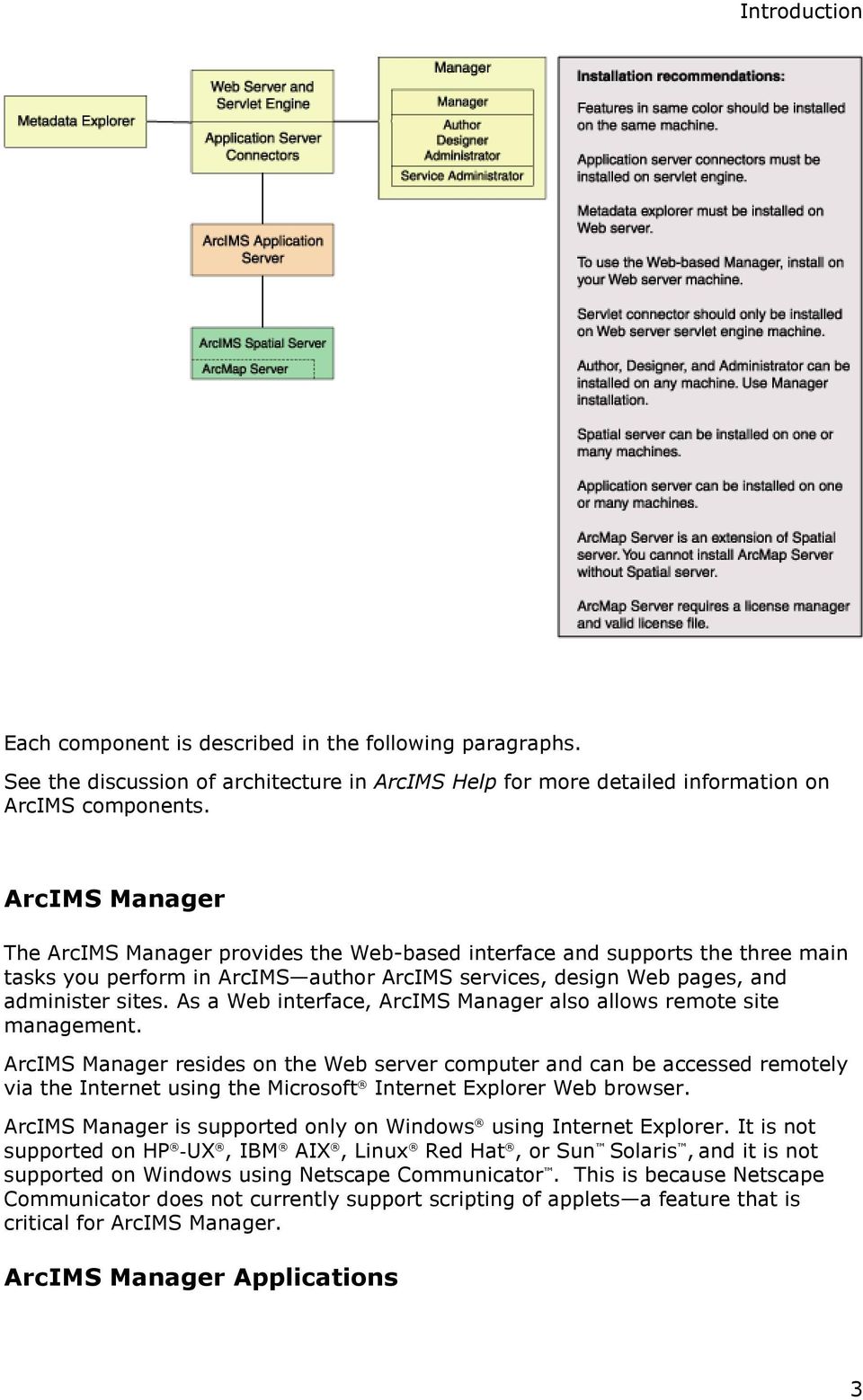
10 Introduction Each component is described in the following paragraphs. See the discussion of architecture in ArcIMS Help for more detailed information on ArcIMS components. ArcIMS Manager The ArcIMS Manager provides the Web-based interface and supports the three main tasks you perform in ArcIMS author ArcIMS services, design Web pages, and administer sites. As a Web interface, ArcIMS Manager also allows remote site management. ArcIMS Manager resides on the Web server computer and can be accessed remotely via the Internet using the Microsoft Internet Explorer Web browser. ArcIMS Manager is supported only on Windows using Internet Explorer. It is not supported on HP -UX, IBM AIX, Linux Red Hat, or Sun Solaris, and it is not supported on Windows using Netscape Communicator. This is because Netscape Communicator does not currently support scripting of applets a feature that is critical for ArcIMS Manager. ArcIMS Manager Applications 3
11 ArcIMS 9.0 for Linux Install Guide The ArcIMS Manager Applications Author, Designer, and Administrator are also provided as independent applications that run outside a Web browser. They are included with a Manager installation and can be installed on any computer. ArcIMS Service Administrator The ArcIMS Service Administrator is a remote site administration tool and can be used as an alternative to or in conjunction with ArcIMS Administrator. The ArcIMS Service Administrator uses the JavaServer Pages (JSP) tag libraries and the Java API (application program interface) of the ArcIMS Java Connector. The ArcIMS Service Administrator is installed with a typical installation and a Manager installation on Windows and with a typical installation and ArcIMS Manager Applications installation on UNIX/Linux. When choosing to install ArcIMS Metadata Explorer or ArcIMS Manager (or ArcIMS Manager Applications), you do not have to install the Java connector because the files are included with these installation features. The ArcSDE Services Monitor is also available to administer ArcSDE. To administer ArcSDE on Windows or Solaris, an installation of the optional ArcSDE Services Monitor component on the ArcSDE Server is required; on other flavors of UNIX/Linux, a custom installation of the ArcSDE Services Monitor is required on the ArcSDE Server. The ArcIMS Service Administrator presents a unified interface for managing ArcIMS and ArcSDE services. See ArcIMS Help for details on using ArcIMS Service Administrator. ArcIMS Application Server The ArcIMS Application Server handles the incoming requests and tracks which ArcIMS Services are running on which ArcIMS Spatial Servers. The ArcIMS Application Server hands off a request to the appropriate Spatial Server. The Application Server is written as a Java application and runs as a Windows service or a daemon process (on UNIX/Linux ). It may reside on any computer. ArcIMS Application Server Connectors The ArcIMS Application Server Connectors are used to connect the Web server to the ArcIMS Application Server. Each instance of a connector is dedicated to one Web server and must be installed on the same computer as the Web server; however, a single Web server can support several connectors. 4

12 Introduction The ArcIMS Servlet Connector is the standard connector used for ArcIMS. It uses the ArcIMS language, ArcXML, to communicate from the Web server to the ArcIMS Application Server. The ArcIMS Servlet Connector provides Map Service-level user password authentication. You need the ArcIMS Servlet Connector to administer your ArcIMS site and author and design ArcIMS Web pages. The WMS connector for ArcIMS is installed with the Servlet connector and enables ArcIMS to work within the OCG WMS specification. In addition to the ArcIMS Servlet Connector, you can use the following connectors to link the Web server to the ArcIMS Application Server: ColdFusion Connector ActiveX Connector Java Connector.NET Link The ColdFusion and ActiveX connectors work with custom clients and translate their own languages into ArcXML. The ArcIMS Java Connector communicates with the ArcIMS Application Server via a Java application or JSP client. The.NET Link Runtime and Developer Help allows you to integrate ArcIMS functionality within a.net application. Samples can be installed with the software. For more information on these custom connectors, see the Customizing ArcIMS series located on the ESRI Software Documentation Library CD. The ArcIMS Java Connector runs on Windows and UNIX/Linux, the ColdFusion Connector runs on Windows and Solaris, and the ActiveX Connector and.net Link run on Windows only. ArcIMS Spatial Servers The ArcIMS Spatial Server is the backbone of ArcIMS. ArcIMS Spatial Servers process requests for maps and related information and serve the data to the client. For ArcIMS Metadata Service, ArcGIS and ArcSDE are required. ArcMap Server installs ArcObjects runtime files. ArcMap Server only runs on Windows, HP-UX and Solaris platforms. ArcIMS Spatial Servers run on a Windows 5

13 ArcIMS 9.0 for Linux Install Guide NT Server, Windows NT Workstation, Windows 2000, Windows 2000 Server, Windows XP, Windows Server 2003, or UNIX/Linux. A graphics card is not required. ArcIMS Viewers ArcIMS provides client-side viewers: ArcIMS HTML Viewer ArcIMS Java Viewer Metadata Explorer The ArcIMS Viewers determine the functionality and graphical look of your Web site. The viewer is what appears in the Web browser when someone accesses your Web site. The Java Viewers require a one time ArcIMS Viewer download to the client user s computer, and are only compatible with Web browsers that support Java plug-in functionality. See Installing ArcIMS Viewer for instructions regarding the Java client download. The Metadata Explorer can only be used to view metadata from an ArcIMS Metadata Service. The Metadata Explorer can be installed by selecting this feature during the ArcIMS installation. See Creating and Using Metadata Services for information on Metadata Explorer. 6
14 Introduction Five steps to get ArcIMS up and running There are five steps required to get ArcIMS running: 1. Verify that your site meets ArcIMS system requirements. 2. Plan your ArcIMS site configuration. 3. Install ArcIMS. This includes the installation and post installation setup. 4. Configure your Web server. 5. Configure ArcIMS. These steps are outlined below. For the latest requirements or for any changes to the Installation Guide, see the Support site for ArcIMS. What you need to get ArcIMS running Step 1: Verify that your site meets ArcIMS system requirements Hardware configuration Memory requirements Disk space System software Operating system Web server Servlet engine Java 2 Platform Standard Edition Runtime Environment (J2SE JRE) Web browser Authorization file (required for Spatial Server and ArcMap Server) Java 2 Platform Standard Edition SDK (J2SE SDK) (required for Java Connector, Metadata Explorer and Service Administrator) Fonts Step 2: Plan your ArcIMS site configuration ArcIMS Typical Configuration All on a single computer ArcIMS Custom Configuration ArcIMS Application Server Connectors ArcIMS Custom Configuration ArcIMS ArcMap Server (Windows and Solaris only) 7

15 ArcIMS 9.0 for Linux Install Guide ArcIMS Custom Configuration ArcIMS Manager Applications ArcIMS Custom Configuration ArcIMS Service Administrator ArcIMS Custom Configuration ArcSDE Services Monitor ArcIMS Custom Configuration ArcIMS Spatial Servers ArcIMS Custom Configuration Metadata Explorer Step 3: Install ArcIMS Step 3a - Complete the installation for the features you select Step 3b - Complete the post installation setup for the features you installed Step 4: Configure your Web server Step 4 is required if you did not configure your Web server, using the Web Server- Servlet Engine Configuration option, in the post installation (Step 3b). Configure your Web server and servlet engine. Create virtual directories. Step 5: Configure ArcIMS Using ArcIMS with a proxy server Starting the ArcIMS processes Running ArcIMS See the installation flowchart for an overview of the steps required to get ArcIMS running:installation flowchart Go to Step 1: Verify that your site meets system requirements 8

16 Introduction Questions, feedback, and information There are a number of options to provide feedback or obtain further information. Questions and feedback ArcIMS Help provides information on how to contact ESRI Technical Support with questions or comments. All questions and comments should be forwarded to ESRI Technical Support. Phone Fax [email protected]. Hours 6:00 a.m to 6:00 p.m. Pacific time, Monday through Friday, except ESRI holidays. If you are outside the United States, please contact your local ESRI distributor. ArcIMS Knowledge Base The ArcIMS Knowledge Base is a database that contains: Frequently Asked Questions How To instructions Troubleshooting tips Error messages You can search the Knowledge Base using keywords, or you can browse through folders that contain information on different topics relating to ArcIMS. You can access the ArcIMS Knowledge Base from the ESRI support site at Using ArcIMS Help If you need more information about a specific topic or procedure, use ArcIMS Help from within ArcIMS. You can locate what you need by searching the table of contents, finding terms in the index, or finding the number of times a term appears in a section. Visit the ESRI home page on the Internet Visit the ESRI home page at for up-to-date information on ESRI software and services. It is an invaluable resource in helping you expand your understanding of geographic information system (GIS) technology and Internet mapping. Visit the ArcIMS home page at for the latest information about ArcIMS including a showcase of ArcIMS-enabled Web sites. 9
17 ArcIMS 9.0 for Linux Install Guide ESRI education solutions ESRI provides educational opportunities related to geographic information science, GIS applications, and technology. You can choose among instructor-led courses, Web-based courses, and self-study workbooks to find education solutions that fit your learning style and pocketbook. For more information, go to 10
18 Introduction Installation flowchart 11

19

20 Upgrading to ArcIMS 9.0 Existing ArcIMS users Before installing ArcIMS 9.0, users should perform the following, depending on the version of ArcIMS installed. ArcIMS 4.0 users should be aware of the following: ArcIMS 9.0 creates a new directory named ArcIMS when installed. It is possible to have both ArcIMS 4.0 and ArcIMS 9.0 on the same system. However, there are many areas that can cause problems, and it is recommended that you run only one version of ArcIMS on your computer. See Uninstalling ArcIMS 4.0 for details. Java 2 Platform Standard Edition Java Runtime Environment (J2SE JRE) version is installed with ArcIMS 9.0. The JRE installation location is <ArcIMS installation directory>/arcims/jre. See Supported Software Environments for Web servers and Servlet Engines supported for ArcIMS 9.0. See What s new with ArcIMS in ArcIMS Help for information on the what's new at ArcIMS 9.0. ArcIMS users should be aware of the following: ArcIMS 9.0 installs to a directory names ArcIMS. It is possible to have both ArcIMS and ArcIMS 9.0 on the same system. However, there are many areas that can cause problems, and it is recommended that you run only one version of ArcIMS on your computer. See Uninstalling ArcIMS for details. Java 2 Platform Standard Edition Java Runtime Environment (J2SE JRE) version is installed with ArcIMS 9.0. The JRE installation location is <ArcIMS installation directory>/arcims/jre. See Supported Software Environments for Web servers and Servlet Engines supported for ArcIMS 9.0. See What s new with ArcIMS in ArcIMS Help for information on the differences between ArcIMS and ArcIMS

21 ArcIMS 9.0 for Linux Install Guide Upgrading Metadata to 9.0 At ArcIMS 9.0, the tables associated with a Metadata Service have changed to improve performance and scalability. This change requires you to upgrade the metadata tables in the database before starting your Metadata Service in ArcIMS 9.0. Performing this upgrade will not delete any metadata documents published to your metadata database. Detailed instructions for performing an upgrade can be found in Creating and Using Metadata Services. 14
22 Step 1: Verify system requirements Step 1: Verify system requirements The following system requirements are required to run ArcIMS on Red Hat LINUX. Hardware configuration Memory Requirements Manager Applications 64 MB of RAM recommended ArcIMS Application Server: 256 MB of RAM recommended ArcIMS Spatial Server: 256 MB of RAM recommended per CPU HTML Viewers: 64 MB of RAM recommended Java Viewers and ArcExplorer Java Edition: 128 MB of RAM recommended All components: 256 MB of RAM recommended per CPU Disk Space Requirements A typical installation 420 MB A complete installation 731 MB Temp space requirements The ArcIMS setup program requires 120 MB of temporary space for the extraction of installer resources. By default, installer resources are extracted to the system /tmp 15
23 ArcIMS 9.0 for Linux Install Guide directory. If the required space is not available in the /tmp directory, the setup program will attempt to extract installer resources to the user's HOME directory. If the required space is not available in the user's HOME directory, the setup program will report an error indicating this problem. You may specify an alternate /tmp location by setting the following environment variable: For c shell: $ setenv IATEMPDIR /your/temp/space/directory For bourne shell: $ IATEMPDIR=/your/temp/space/directory $ export IATEMPDIR If the directory indicated by IATEMPDIR does not exist, the setup program will report an error indicating this problem. System software The following system software is required to run ArcIMS. Operating system Red Hat Enterprise Linux 3.0 AS/ES ArcIMS is only supported on Linux machines that adhere to the x86 architecture (32 bit). ArcIMS is not supported if the operating system (binary) has been modified. ArcIMS is not supported on a developer's release of an operating system. Tips ESRI recommends that you execute ArcIMS from a C shell. The 16
24 Step 1: Verify system requirements instructions in this installation document are for a C shell environment setup only. The X Windows environment must be installed to use ArcIMS. X Windows is usually installed by default with the operating system. Remote installations To install ArcIMS remotely using the setup program dialogs, run the command xhost + to enable the X Windows display of a remote machine before running the setup program. On the machine used to view the setup program dialogs, set the DISPLAY environment variable to this machine. Web server and servlet engine ArcIMS works in conjunction with Web server software. A Web server must be installed and operational in order to start serving maps. For information on setting up your Web server and Servlet Engine visit System administration access to the Web server computer is necessary, and knowing how to stop and start your Web server is mandatory. ArcIMS is fully supported on the following Web servers: Apache Web Server for Linux with Jakarta-Tomcat as its servlet engine (hereafter referred to as Tomcat) Apache Web Server for Linux with ServletExec as its servlet engine The servlet engine must use Java 2 Platform Standard Edition Runtime Engine (J2SE JRE) or Java 2 Platform Standard Edition Software Development Kit (J2SE JDK) or higher. See Supported Software Environments for other Web servers and their ESRI support level. ServletExec 5.0 AS users If you are using ServletExec 5.0 AS and you did not install it from the ArcIMS CD, you will need to verify that you are using ServletExec native adapter version 5.0c or greater. See 4 for directions on determining the version of the ServletExec AS native adapter you have installed. ArcIMS Supports ServletExec 5.0 (patch level c or greater). If you do not have ServletExec 5.0 (patch level c or greater) installed you can obtain it from the ArcIMS CD or from the New Atlanta Web site. 17
25 ArcIMS 9.0 for Linux Install Guide Java 2 Platform Standard Edition Java Runtime Environment (J2SE JRE) Java 2 Platform Standard Edition Java Runtime Environment (J2SE JRE) version is installed with ArcIMS 9.0. J2SE JRE will be installed in <ArcIMS installation directory>/arcims/jre. Tips J2SE JRE 1.3.1_03, 1.3.1_04, 1.4.0_01 and 1.4.0_03 are NOT supported for use with ArcIMS 9.0. For the latest information on ArcIMS system requirements, see support.esri.com Additional system requirements ArcIMS Spatial Server ArcIMS Spatial Server requires an authorization file. See the topic To obtain an authorization file. ArcIMS Service Administrator requirements The following software is required to use the ArcIMS Service Administrator: Java 2 Platform Standard Edition Software Development Kit (J2SE SDK) or higher. The J2SE SDK is available from Refer to your Web server documentation for supported J2SE SDK versions. Tip J2SE SDK 1.3.1_03, 1.3.1_04, 1.4.0_01 and 1.4.0_03 are NOT supported for use with ArcIMS 9.0. ArcIMS Metadata Service requirements The following software is required to use the ArcIMS Metadata Service: ArcGIS 9.0 or higher ArcSDE 9.0 or higher for Oracle, DB2 and SQL Server Metadata Explorer requirements The following software is required to use the Metadata Explorer: Java 2 Platform Standard Edition Software Development Kit (J2SE SDK) or higher. The J2SE SDK is available from 18
26 Step 1: Verify system requirements Refer to your Web server documentation for supported J2SE SDK versions. Tip J2SE SDK 1.3.1_03, 1.3.1_04, 1.4.0_01 and 1.4.0_03 are NOT supported for use with ArcIMS 9.0. Web browser for ArcIMS Viewers HTML Viewer: Netscape Communicator or 7 The Java Viewers require that a one time download including the Java 2 Plugin and ArcIMS Viewer be installed. Java Standard Viewer: Netscape Communicator or 7 The Java Custom Viewer doesn t run in Netscape Communicator. Tips See Supported Software Environments for the latest support information. All Web pages created on UNIX/Linux can be viewed on Windows. See the ArcIMS install guide for Windows for Web browser requirements on Windows. Font requirement ArcIMS components other than the Application Server and Connectors require TrueType fonts. ArcIMS will not function properly unless the fonts are installed. Copy the following fonts. LucidaBrightRegular.ttf LucidaSansRegular.ttf LucidaTypewriterRegular.ttf Note: These fonts will be installed with ArcIMS at <ArcIMS installation directory>/jre/lib/fonts. You can execute the Font requirement steps after installing ArcIMS. Put these fonts in the following directory: /usr/lib/x11/fonts/truetype Note: You might need to create the TrueType directory if it does not exist. Register the fonts with the X Font Server: 19
27 ArcIMS 9.0 for Linux Install Guide su cd /usr/lib/x11/fonts/truetype ttmkfdir -d. -o fonts.scale cp fonts.scale fonts.dir chkfontpath -a /usr/lib/x11/fonts/truetype Tip To install Chinese HKSCS font, see Chinese HKSCS Font topic. ArcIMS Application Server Connectors ArcIMS Application Server requires the following optional software if you will be creating custom Viewers using JSP. Java 2 Platform Standard Edition Software Development Kit (J2SE SDK) or higher. The J2SE SDK is available from Refer to your Web server documentation for supported J2SE SDK versions. Tip J2SE SDK 1.3.1_03, 1.3.1_04, 1.4.0_01 and 1.4.0_03 are NOT supported for use with ArcIMS 9.0. For Java Connector information, see Customizing ArcIMS Using the Java Connector. ArcSDE The following versions of ArcSDE are supported by ArcIMS: Metadata users only ArcSDE 9.0 or higher for Oracle, DB2 and SQL Server Other users ArcSDE 8.0.x, ArcSDE 8.1.x, ArcSDE 8.2, or ArcSDE 8.3 or higher ArcSDE for Coverages 8.0.x, 8.1.x, 8.2, or 8.3. To view ArcIMS map services in ArcGIS ArcGIS or higher is needed. ArcGIS will only work if msxml3.dll is present and registered on the client machine. For information on obtaining msxml3.dll see the ESRI Knowledge Base article Note: If ArcIMS and ArcGIS are on the same machine, they must be of the same version. 20
28 Step 1: Verify system requirements 21
29 ArcIMS 9.0 for Linux Install Guide To obtain an authorization file Visit for information on obtaining an authorization file. 22
30 Step 2: ArcIMS configuration Step 2: Planning an ArcIMS site configuration An ArcIMS site can consist of one or more computers, depending upon the needs of your site. It is therefore advisable to plan your ArcIMS site configuration before installing ArcIMS. This section includes an overview, and some common site configuration scenarios to help get you started on planning your ArcIMS site configuration. Overview The ArcIMS architecture and functionality has been engineered specifically to serve geographic data and services on the Internet. The software is designed so that it is easy to create maps, develop Web pages that communicate with the maps, and administer the ArcIMS site. The software is also designed for distribution across a network and for scalability as the demand for maps increase. An ArcIMS site consists of one or more computers where the ArcIMS host (ArcIMS Manager (includes Manager, Manager Applications and Service Administrator), Application Server Connectors and ArcIMS Application Server), ArcIMS Spatial Servers and data reside. The Application Server Connectors, ArcIMS Application Server, and ArcIMS Spatial Server are the components needed to create and manage services that process requests and responses. The ArcIMS framework also requires a Web server, Java Runtime Environment (J2SE JRE), and servlet engine. For more information on these components see the Overview topic of the Install Guide Introduction. The ArcIMS site management applications (Manager, Author, Designer and Administrator, and Service Administrator), provide access to ArcIMS components for authoring maps, administering ArcIMS services and Spatial Servers, and designing Web sites. If you want to use the Web based Manager, it is strongly recommended that Manager be installed on your Web server machine. The Manager Applications (Author, Designer and Administrator) can be used on any machine. A Manager installation will install Manager, Manager Applications (Author, Designer and Administrator) and Service Administrator. There are many possible ArcIMS site configurations. Some sites run all ArcIMS components on a single computer while other sites are comprised of multiple computers. Configurations will vary depending on the available computer resources and the mapping services provided. For ArcIMS Spatial Servers, processing speed and the ability to handle the load are important. Will the ArcIMS Services perform process-intensive functions or create basic map displays? How many services will be created at one time? Will the Web server computer be dedicated to the Web site or used for other purposes as well? Answers to these types of questions will assist in planning an ArcIMS site configuration. 23
31 ArcIMS 9.0 for Linux Install Guide Configure an ArcIMS site based on the anticipated number of simultaneous users visiting the site and the number of maps generated each day. For example, a Web site with very few anticipated users, averaging 100 to 1,000 maps per day, could run from one computer. A high volume Web site, with 100,000 to 1,000,000 maps per day, should be distributed to multiple ArcIMS Spatial Servers. When planning your ArcIMS site configuration, there are some installation recommendations to take into account. The installation configuration diagram above illustrates ArcIMS installation features and some of the installation recommendations. The ArcIMS features in the installation configuration diagram, illustrated in the same color, should be installed on the same machine. The Application Server Connectors must be installed on your Web server machine. Metadata Explorer must be installed on your Web server machine. To use Manager (the Web-based application used to author, design and administer), it is recommended that Manager be installed on your Web server machine. The ArcIMS Servlet Connector should only be installed on the Web server machine. The Manager Applications (Author, Designer and Administrator) can be installed on any machine. To install these applications, perform a Manager 24
32 Step 2: ArcIMS configuration installation. A Manager installation will install Manager and Author, Designer and Administrator, and Service Administrator. Spatial Server can be installed on one machine or many machines. Each Spatial Server installation needs to know the name of the machine where the Application Server is installed. The post installation will prompt you for the name of the Application Server and edit the monitor.properties file accordingly. One Spatial Server can not support multiple Application Servers, but one Application Server can support multiple Spatial Servers. An ArcGIS Authorization File is required to install ArcIMS Spatial Server. Application Server can be installed on one machine or many machines. Each Application Server installation needs to know the name of the Web server. The post installation will prompt you for the name of the Web Server and edit the site preferences and diagnostics property files. ArcMap Server is an extension of Spatial Server. You can not install ArcMap Server without installing Spatial Server. An ArcGIS Authorization File is required to install ArcMap Server. ArcMap Server is only available on Windows and Solaris platforms. ArcSDE Services Monitor can exist on any machine where ArcSDE is installed. ArcIMS background processes There are three background processes (Windows services or UNIX/Linux daemons) associated with ArcIMS: ArcIMS Application Server 9.0. The Application Server service is installed with the ArcIMS Application Server. ArcIMS Monitor 9.0. The Monitor service is installed with Spatial Server and ArcSDE Services Monitor. ArcIMS Tasker 9.0. The Tasker service is installed with the ArcIMS Application Server. Common site configuration scenarios This section presents a series of common configuration scenarios that illustrate how to distribute various installation components across various computer platforms. ArcIMS site on one machine Multiple ArcIMS Spatial Servers Dedicated Web server machine Multiple Application Servers ArcIMS site on one machine 25
33 ArcIMS 9.0 for Linux Install Guide The ArcIMS site must have a Web server configured and communicating with a servlet engine before installing ArcIMS. The entire ArcIMS site on one machine is referred to as a typical installation. This installation consists of the ArcIMS host (ArcIMS Manager, Application Server Connectors and ArcIMS Application Server) and ArcIMS Spatial Server installed on the Web server machine. A typical installation of ArcIMS will install Manager, the ArcIMS Application Server, the default ArcIMS Application Server Connector (the Servlet Connector), and the ArcIMS Spatial Server. Additionally, a typical ArcIMS installation will install Metadata Explorer, and some selected samples and documentation. This site configuration is useful for those with limited resources or light server loads. If you are new to ArcIMS, start with this site configuration. See Performing a typical installation for steps on installing these ArcIMS components on the same computer. Multiple ArcIMS Spatial Servers Additional ArcIMS Spatial Servers can be added to the ArcIMS site configuration, as the number of requests increases, if redundancy needs to be built in or to optimize performance. There is no one formula for determining how many ArcIMS Spatial Servers are needed. The Spatial Server configuration will vary among ArcIMS sites depending on the number and size of services, time required to process requests, number of requests, Web and network traffic, and other factors specific to the site. 26
34 Step 2: ArcIMS configuration Since it is possible to have multiple ArcIMS Spatial Servers on multiple machines, a mechanism is needed to manage these Spatial Servers and the services running on them. ArcIMS uses a Virtual Server concept to manage services on multiple ArcIMS Spatial Servers. See the ArcIMS technical paper, ArcIMS 4 Architecture and Functionality, located on and the ArcIMS Help for more information on managing Spatial Servers and Virtual Servers. Spatial Servers can be distributed across an ArcIMS site in several ways as illustrated below. This configuration illustrates two ArcIMS Spatial Server on the same machine. To set up your machine with more than one ArcIMS Spatial Server on the same machine, see the topic Installing additional ArcIMS Monitors. For the additional ArcIMS Spatial Server (Monitor service/background process) running on the same machine, an additional ArcIMS Application Server is required. For more information on additional ArcIMS Spatial Servers on the same machine, see the ArcIMS Help, and the ArcIMS High-Availability Site Configuration whitepaper, available in PDF from the ESRI Support Site. This configuration illustrates two ArcIMS Spatial Servers on multiple machines. 27
35 ArcIMS 9.0 for Linux Install Guide To install multiple ArcIMS Spatial Servers on additional machines, see the topic Installing multiple ArcIMS Spatial Servers on additional computers. Dedicated Web server machine Your site may require your Web server to be on one machine while the ArcIMS components reside on a different machine. In this configuration, the Application Server Connectors must reside on the same machine as the Web server. 28
36 Step 2: ArcIMS configuration If your Application Server is on a different machine than your Application Server Connector, some additional configuration of the Application Server Connector is required. If you are using the Servlet Connector, the Web server-servlet engine configuration available in the post installation will automatically edit your Esrimap_prop file with the Application Server name you provide. If you are using the ColdFusion Connector see the CustomizingColdFusion.pdf for details on the servername attribute value for any action. For the Java Connector see the CustomizingJavaConnector.pdf for information on the ConnectionProxy object or the tcpconnection.tag. If you will be using Manager, Service Administrator and/or Metadata Explorer, it is also recommended that Manager, and/or Metadata Explorer be installed on the Web server machine. If you will be using Metadata Explorer and/or Service Administrator, J2SE JDK or higher is required on this machine. See the topic Verify your system requirements for system requirement information. Multiple ArcIMS Application Servers The ArcIMS Application Server runs as a background process (Windows service or UNIX/Linux daemon) and handles the load distribution of incoming requests. The Application Server also catalogs which services are running on which ArcIMS Spatial Servers. Using this information, the Application Server dispatches an incoming request to the appropriate Spatial Server. Installing multiple ArcIMS Application Servers on different machines can improve load distribution of incoming requests and help create redundancy (failover). Installing the ArcIMS Application Server on a different machine to other ArcIMS components is common in a secure network environment where the Web server is located in the DMZ. The DMZ is established by an outside firewall. See the technical articles for ArcIMS located at for more information on system design strategies. For high-volume implementations of ArcIMS, it is possible to have a single Web server communicate with several Application Servers in round-robin or failover configuration. If used for round-robin, the Application Server will rotate requests among the specified Application Servers. If used for failover, the back-up Application Server will serve maps when the primary Application Server machine is inaccessible. To support multiple Application Servers, the Application Server names and ports must be added to the Esrimap_prop file, located in your Web server's servlet directory. If more than one Application server is specified in the Esrimap_prop file, you cannot administer multiple Application Servers with Administrator. To administer multiple Application Servers, you can use the Service Administrator (installed with the Manager installation feature). 29
37 ArcIMS 9.0 for Linux Install Guide Below is an example of a multiple Application Server set up: Steps to set up this scenario: 1. Set up a public Web server machine. This machine will serve the Web sites to users. 1. Verify you meet system requirements, including that your Web server and servlet engine are running and communicating. For information on setting up your Web server and Servlet Engine visit IMPORTANT: You will be using Service Administrator to administer the Application Servers. Service Administrator will be installed on this machine by the Manager feature. J2SE SDK is required to use Service Administrator. 30
38 Step 2: ArcIMS configuration The document linked above includes instructions on installing J2SE SDK for your Web server and servlet engine configuration. 2. Run the ArcIMS setup. Choose to install the following (Uncheck all other ArcIMS installation features so that these features will not be installed): Expand the Application Server Connectors feature, select to install the Servlet Connector only. Select to install Manager 3. Follow the installation directions on the screen. 4. During the post installation setup you will be required to provide the following information: The location of your Website and Output directories. In this scenario the Website and Output directories will be created on this machine, as this machine will be used to serve the Web sites. Choose the default directory, or change the location and create these directories on a different local drive. Select to share your Output and Website directories by checking the box on the create Website and Output dialog box. Your Application Server machine will need to be able to access these directories (discussed in detail when setting up Application Server machines). The location of your Axl directory. In this scenario the Axl directories will be created on this machine, as this machine will be used to serve the Web sites. Choose the default directory, or change the location and create these directories on a different local drive. The name of your Web server. Enter this machine's Web server host name. By default the host name of this machine will be provided. The Application Server name and ports. In this scenario you will have two Application Servers, for now enter the machine name where one of these Application Servers will be installed. By default the host name of this machine will be provided, change this to the host name of one of your Application Server machines. Your Web server and servlet engine information. If you are using a Web server and servlet engine that is automatically configured for you, configuration will be performed by the post installation setup. 5. At the end of the post installation setup you will be required to stop and restart your Web server to apply configuration changes. 6. Share the directory containing the data you will be using (if it is local data and not ArcSDE data). Each Spatial Server machine must be able to access 31
39 ArcIMS 9.0 for Linux Install Guide the data for map services created. The AXL files must be accessible by the Application Server. 2. Create Application Server machine 1 This will be the main Application Server machine. This machine will host the ArcIMS Application Server and the ArcIMS Spatial Server. The service Administrator will be used to administer this ArcIMS Application Server. We will also create an identical set up on another machine, which will be the back-up machine for failover. 1. Verify you meet system requirements. 2. Install the following ArcIMS features (Uncheck all other ArcIMS installation features so that these features will not be installed): Application Server Spatial Server only 3. Follow the installation directions on the screen. 4. During the post installation setup you will be required to provide the following information: The location of your Website and Output directories. In this scenario browse to the Website and Output directories located on your public Web server machine (for example, UNC pathname \\publicwebserver\arcims). Your public Web server machine will be used to serve the Web sites. The location of your Axl directory. Browse to your public Web server machine (for example, UNC pathname \\publicwebserver\arcims). Your AXL directory will be created by default under C:\ArcIMS on your public Web server machine. All Application Servers accessing the AXL files will share the files at this location. 32
40 Step 2: ArcIMS configuration The name of your Web server. Enter this machine's Web server host name. By default the host name of this machine will be provided. The Application Server name, and registry and connector ports. Enter this machine name, where this Application Server has been installed. By default the host name of this machine will be provided. Your system domain, username and password to administer ArcIMS background processes. Enter the domain, username and password of the ArcIMS installation account. This account must have administrator privileges. 5. Each AXL file references the path to the data used. Verify that the path to the data is accessible by the Spatial Servers that are registered with the Application Servers, on Application Server machine 1 and Application Server machine 2. In general, the path to the data must be valid from the perspective of any Spatial Server. It is recommended that the path used be a UNC pathname. 3. Create Application Server machine 2 This machine will be identical to Application Server machine 1. If used for roundrobin, it will rotate requests among the two Application Servers. If used for failover, it will serve maps when Application Server machine 1 is inaccessible. This machine, like Application Server machine 1, will host ArcIMS Application Server and ArcIMS Spatial Server. Service Administrator will be used to administer the Application Server. Follow the same steps above to set up Application Server machine 2, as you did to set up Application Server machine 33
41 ArcIMS 9.0 for Linux Install Guide 4. Configure the public Web server machine for multiple Application Servers 1. Find and open in a text editor the Esrimap_prop file located on your public Web server machine in the Web server servlets directory. The following lists common default servlet directories for specific Web server and servlet engine combinations on Windows: Apache with Tomcat: C:\<Tomcat installation directory>\webapps\servlet\web-inf\classes Apache with ServletExec: C:\Program Files\New Atlanta\ServletExec AS\se-<instance name>\servlets IBM HTTP Server with WebSphere: C:\Websphere\AppServer\installedApps\sampleApp.ear\def ault_app.war\web-inf\classes Sun Java System 6.0 (formerly Sun ONE): C:\iplanet\servers\docs\servlet Microsoft IIS with JRun: C:\Program Files\Allaire\Jrun\servlets Microsoft IIS with ServletExec: C:\Program Files\New Atlanta\ServletExec ISAPI\Servlets Microsoft IIS with Tomcat: C:\<Tomcat installation directory>\webapps\root\web-inf\classes Oracle Application Server: C:\Oracle\iAS\Apache\Jserv\servlets WebLogic: C:\bea\wlserver70\config\<mydomain>\applications\Defau ltwebapp\web-inf\classes 2. Edit the AppServerMachine parameter in the Esrimap_prop file with the names of the Application Servers you installed (The names of Application Server Machine 1 and Application Server Machine 2, for example, appservermachine1,appservermachine2) 3. Edit the AppServerClientPort parameter in the Esrimap_prop file with the registry port numbers of the Application Servers you installed (for example, 5300,5300). 34
42 Step 2: ArcIMS configuration 4. For round-robin, leave the failover parameter in the Esrimap_prop file set to false. 5. For failover, set the failover parameter in the Esrimap_prop file to true. This will specify that requests should be sent to the first Application Server machine listed, until it fails to return a response, then requests will be sent to the next Application Server listed. 6. After editing the Esrimap_prop file, save changes and stop and restart your Web server. 5. Create your map services for both Application Servers. The Service Administrator will be used to administer the ArcIMS Application Servers. If you met all system requirements, and you used the post installation setup to configure your Web server, the Service Administrator will have been set up. If you manually configured your Web server you must manually configure your Web server for Service Administrator (see Configure your Web server for Service Administrator). To access Service Administrator open your browser (on any machine), and type: server machine name>/esriadmin For example: By default the log in page for Application Server 1 will be displayed. The Application Server specified in the esriadmin.properties file determines the default log in page displayed. Provide the user name and password to log in to administer Application Server 1. To administer Application Server 2, adapt the URL as follows: server machine name>/esriadmin/logincheck.jsp?host=<application Server Machine 2>&port=<appservermachine2port> 35
43 ArcIMS 9.0 for Linux Install Guide For example: &port=5300 For more information on using Service Administrator, see the ArcIMS Help. Services created on each Application Server should be completely identical. The image below illustrates the parameters used in this scenario to create new services on Application Server machine 1 and Application Server machine 2. The public Web server machine serves the Web sites to the users, so the output files should be stored on this machine. The Server output locations were manually changed to point to the public Web server machine (In this example, "publicwebserver" will be the host name of your public Web server machine). In this example, the Axl file used is also stored on the public Web server machine, the UNC pathname to the Axl file is provided in the File Path field. Once you have determined your ArcIMS site configuration, see Step 3a: Installing ArcIMS. 36
44 Step 3a: Installing ArcIMS 9.0 Step 3a: Installing ArcIMS overview The ArcIMS 9.0 install consists of two parts, the installation and the post installation. The installation is the setup process where you determine what installation features you would like to install. The setup program will install the files required for these features. The post installation is the setup process that completes your ArcIMS installation. In the post installation setup, depending on what features were installed, you will be able to authorize ArcIMS for use, configure ArcIMS, set up the Site Information Converter, and configure your Web server-servlet engine. See the post installation setup section for more information. To successfully install ArcIMS 9.0, both the installation and post installation must be completed. To install ArcIMS 9.0 Choose the installation steps for your configuration: Perfoming a typical installation Installing ArcIMS custom Application Server Connectors Installing ArcIMS Manager Applications Installing ArcIMS Service Administrator Installing multiple ArcIMS Spatial Servers Installing additional ArcIMS Monitors Installing Metadata Explorer Installing ArcIMS in console mode 37
45 ArcIMS 9.0 for Linux Install Guide Performing a typical installation In this installation scenario, your Web site uses the resources of one computer; Web server software and ArcIMS are installed on the same computer. This configuration is useful for those with limited resources or light server loads. If you are new to ArcIMS, start with this installation and install the pre-selected features; referred to as a typical installation. The main ArcIMS features installed with a typical ArcIMS installation are highlighted in the diagram below. Note: All Application Server connectors are not installed; by default a typical installation installs the Servlet Connector. A typical ArcIMS installation assumes that your machine has met system requirements, and a Web server and servlet engine are installed and communicating. For more information on these features see the Overview and ArcIMS site configuration topics. You can access Manager remotely from any computer using your Internet Explorer web browser; you only need one Manager per ArcIMS web site. The ArcIMS Host is considered to be the ArcIMS Manager, Application Server Connectors and ArcIMS Application Server. The ArcIMS Host is typically installed on the Web server machine. A typical ArcIMS installation, as described below, will install the ArcIMS Host and ArcIMS Spatial Server on the same machine as your Web server. ArcIMS Spatial Server requires an Authorization file, you will be required to browse to the location of the authorization file during the post installation setup. See the topic To obtain an authorization file. How to prepare to install ArcIMS 1. Verify that your site meets the system requirements. For system requirement information see Step 1: Verify system requirements 38
46 Step 3a: Installing ArcIMS Make sure that the user account that installs ArcIMS has write permissions to the installation directory. Note: For security reasons, don't install ArcIMS as super user. ESRI recommends that you create a separate user account for installing and administering ArcIMS. 3. Execute the SetupArcIMS script located on the ArcIMS CD. How to install ArcIMS During the installation you will be asked to read the license agreement and accept it, or exit if you don't agree with the terms. The ArcIMS install allows you to select the features you would like to install. By default the features of a typical ArcIMS installation are selected to be installed. A typical installation includes the features most commonly installed on one machine. The main features installed with a typical ArcIMS installation are highlighted in the diagram above (note: All Application Server connectors are not installed; by default a typical installation installs the Servlet Connector). For more information on these features see the Overview and ArcIMS site configuration topics. 39
47 ArcIMS 9.0 for Linux Install Guide The ArcIMS installation consists of a collection of features and sub-features. An example of a feature is Application Server, which consists of a subfeature, Site Information Converter. Many ArcIMS installation features contain sub-features. These features can be added a later stage. See Adding additional installation components for more information. To complete the installation, follow the directions on the screen. Complete the post installation setup After completing the ArcIMS installation, you will be provided with the opportunity to begin the post installation setup. The following ArcIMS post installation options are required to successfully complete a typical ArcIMS installation: ArcIMS Configuration Web Server-Servlet Engine Configuration ArcIMS Authorization If you select a typical post installation setup these post installation options are automatically selected. See The Post Installation topic for information on the post installation setup. Before you begin ArcIMS, if you did not choose to automatically configure your Web server-servlet Engine in the post installation, you must complete Step 4: Configure your Web Server, either manually or by running the post installation setup again. Tip The Spatial Server uses TrueType fonts located in: /usr/lib/x11/fonts/truetype. ArcIMS Author and ArcExplorer Java use fonts from the font.properties file located at: <JREHOME>/lib or <$JAVA_HOME>/lib You can modify the font property file for your own font by following the instructions from this link: When choosing to install ArcIMS Metadata Explorer or ArcIMS Manager Applications, you do not have to install the Java connector because the files are included with these installation features. 40
48 Step 3a: Installing ArcIMS
49 ArcIMS 9.0 for Linux Install Guide Installing ArcIMS custom application server connectors In this installation scenario, you select an ArcIMS Application Server Connector depending on the development environment you plan to use for creating Web pages. The available Application Server Connectors on Linux are ArcIMS Servlet Connector, and Java Connector. The Application Server Connectors reside on the Web server computer. Each Web server can have more than one Application Server Connector, as long as they are of different types. The Servlet Connector is the standard ArcIMS Connector. The typical installation installs this connector. You need this connector if you plan to administer Web pages or use the Web design tools in ArcIMS (Author and Designer). The Servlet Connector also provides MapService-level user password authentication. The Servlet Connector also provides MapService-level user password authentication. The WMS connector for ArcIMS is installed with the Servlet connector see the WMS connector section for steps to enable ArcIMS to work within the OCG WMS specification. The Java Connector communicates with the ArcIMS Application Server and a JSP client. The ColdFusion connector is not available on Linux. See System requirements for requirements for the ColdFusion connector. Tip These instructions describe an ArcIMS custom Application Server connector installation only. To install the ArcIMS Manager Applications, ArcIMS Application Server and ArcIMS Spatial Server, refer to Performing a typical 42
50 Step 3a: Installing ArcIMS 9.0 installation. How to prepare to install ArcIMS custom Application Server Connectors Perform the following steps on the computer where you want to install ArcIMS Application Server and custom Connectors: 1. Verify that your site meets the system requirements. For system requirement information see Step 1: Verify system requirements 2. Make sure that the user account that installs ArcIMS has write permissions to the installation directory. Note: For security reasons, don't install ArcIMS as super user. ESRI recommends that you create a separate user account for installing and administering ArcIMS. 3. Execute the SetupArcIMS script located on the ArcIMS CD. How to install ArcIMS custom Application Server Connectors During the installation you will be asked to read the license agreement and accept it, or exit if you don't agree with the terms. At the Choose Product Components dialog, from the Install Set dropdown list, select Custom. By default, the features installed by a typical installation are selected. Unselect all the features you do not wish to install. The Application Server Connectors feature contains the Java Connector and Servlet Connector. Select the custom Application Server Connector you would like to install. 43
51 ArcIMS 9.0 for Linux Install Guide There are also Application Server Connector Documentation and Samples available to install. Select the Samples you would like to install. Documentation is available from the ESRI Software Documentation Library CD. To complete the installation, follow the directions on your screen. Tips The ArcIMS Servlet Connector is already installed if you previously performed a typical ArcIMS installation. When choosing to install ArcIMS Metadata Explorer or ArcIMS Manager Applications, you do not have to install the Java connector because the files are included with these installation features. The OGC WMS Connector can also be downloaded from: Complete the post installation setup 44
52 Step 3a: Installing ArcIMS 9.0 The following ArcIMS post installation options are required to successfully install custom Application Server Connectors: ArcIMS Configuration Web Server-Servlet Engine Configuration (required only if the ArcIMS Servlet Connector was installed) If you select a typical post installation setup these post installation options are automatically selected. See The Post Installation topic for information on the post installation setup options. Additional configuration steps for custom Application Server Connectors Before the installation is complete, configure the connector you installed: ArcIMS Java Connector ArcIMS Servlet Connector WMS connector Tips To install the Z39.50 Connector see Installing Metadata Explorer. 45
53 ArcIMS 9.0 for Linux Install Guide Installing ArcIMS Manager Applications In this installation scenario, ArcIMS Manager Applications Author, Designer, and Administrator can be installed on any computer on your network. ArcIMS Manager Applications do not require a Web browser. ArcIMS Manager Applications (Author, Designer, and Administrator), may be used on any machine. This is optimal for UNIX/Linux users since ArcIMS Manager (the Webbased application) is not available for the UNIX/Linux environment. ArcIMS Manager Applications are installed with the typical installation; you only need one ArcIMS Manager installation per site. For more information on ArcIMS Manager and ArcIMS Manager Applications, see Overview. Tip Note: These instructions describe an ArcIMS Manager Applications only installation. To install ArcIMS Spatial Server, ArcIMS Application Server, and Application Server Connectors, refer to Performing a typical installation. How to prepare to install ArcIMS Manager Applications 46
54 Step 3a: Installing ArcIMS Verify that your site meets the system requirements. For system requirement information see Step 1: Verify system requirements 2. Make sure that the user account that installs ArcIMS has write permissions to the installation directory. Note: For security reasons, don't install ArcIMS as super user. ESRI recommends that you create a separate user account for installing and administering ArcIMS. 3. Execute the SetupArcIMS script located on the ArcIMS CD. How to install ArcIMS Manager Applications During the installation you will be asked to read the license agreement and accept it, or exit if you don't agree with the terms. At the Choose Product Components dialog, from the Feature Set dropdown list, select Custom. By default, the features installed by a typical installation are selected. Unselect all the features you do not wish to install. Select Manager to install the Manager Applications. To complete the installation, follow the directions on your screen. Complete the post installation setup 47
55 ArcIMS 9.0 for Linux Install Guide The following ArcIMS post installation options are required to successfully install Manager Applications: ArcIMS Configuration If you select a typical post installation setup these post installation options are automatically selected. See The Post Installation topic for information on the post installation setup options. Tip ArcIMS Author and ArcExplorer Java use fonts from the font.properties file located at: <JREHOME>/lib or <$JAVA_HOME>/lib You can modify the font property file for your own font by following the instructions from this link: When choosing to install ArcIMS Metadata Explorer or ArcIMS Manager Applications, you do not have to install the Java connector because the files are included with these installation features. 48
56 Step 3a: Installing ArcIMS 9.0 Installing ArcIMS Service Administrator The ArcIMS Service Administrator is a remote site administration tool and can be used as an alternative to or in conjunction with ArcIMS Administrator. The ArcIMS Service Administrator uses the JavaServer Pages (JSP) tag libraries and the Java API (application program interface) of the ArcIMS Java Connector. Java 2 Platform Standard Edition Software Development Kit (J2SE SDK) is required for ArcIMS Service Administrator. How to set up your machine to administer ArcIMS Services The ArcIMS Service Administrator is installed with a typical installation and with an installation of Manager. If you plan to administer only ArcIMS Services, you need to: 1. Install ArcIMS using a typical installation. 2. Configure ArcIMS Service Administrator for your Web server. Tip When choosing to install ArcIMS Metadata Explorer or ArcIMS Manager Applications, you do not have to install the Java connector because the files are included with these installation features. How to set up your machine to administer ArcSDE Services The ArcIMS Service Administrator can also be used to administer ArcSDE. To administer ArcSDE on UNIX/Linux, you need to do the following: 1. Install ArcIMS Manager Applications on the computer where you wish to use ArcIMS Service Administrator. 2. Configure ArcIMS Service Administrator for your Web server. 3. Install and set up the optional ArcSDE Administrator component on the ArcIMS Spatial Server computer. 49
57 ArcIMS 9.0 for Linux Install Guide Installing multiple Spatial Servers on additional machines In this installation scenario, several computers run ArcIMS Spatial Server and communicate with the ArcIMS Host. One computer, the ArcIMS Host, runs Web server software with ArcIMS Manager, ArcIMS Application Server, and Application Server Connectors while, on other computers, ArcIMS Spatial Server runs. All ArcIMS Spatial Servers must point back to the ArcIMS Host, and the ArcIMS Host must be able to communicate with the ArcIMS Spatial Servers. To install additional ArcIMS Monitor processes on the same machine, see the topic Installing additional ArcIMS Monitors. There are four parts to setting up a multiple ArcIMS Spatial Server configuration: 1. Obtain your Authorization files for each machine where Spatial Server will be installed. See To obtain an authorization file for more information. 2. Install ArcIMS Spatial Server (includes preparing to install, and installing) 3. Complete the post installation setup 4. Complete the additional installation steps for multiple ArcIMS Spatial Servers All the necessary steps are described within this topic. 50
58 Step 3a: Installing ArcIMS 9.0 ArcIMS Authorization file Spatial Server requires an Authorization File. Each machine installing this feature will require a unique authorization file. For information on obtaining an authorization file, see the topic To obtain an authorization file. If you installed ArcIMS Spatial Server, the post installation option ArcIMS Authorization will configure your machine using the authorization file you received from Customer Service. How to prepare to install ArcIMS Spatial Server 1. Obtain an authorization file for each machine you will install ArcIMS Spatial Server on. 2. Verify that your site meets the system requirements. For system requirement information see Step 1: Verify system requirements 3. Make sure that the user account that installs ArcIMS has write permissions to the installation directory. Note: For security reasons, don't install ArcIMS as super user. ESRI recommends that you create a separate user account for installing and administering ArcIMS. 4. Execute the SetupArcIMS script located on the ArcIMS CD. How to install ArcIMS Spatial Server During the installation you will be asked to read the license agreement and accept it, or exit if you don't agree with the terms. The ArcIMS install allows you to select the features you would like to install. 51
59 ArcIMS 9.0 for Linux Install Guide At the Choose Product Components dialog, from the Feature Set dropdown list, select Custom. By default, the features installed by a typical installation are selected. Unselect all the features you do not wish to install. Select Spatial Server to install ArcIMS Spatial Server on your machine. To complete the installation, follow the directions on the screen. Complete the post installation setup After completing the ArcIMS installation, you will be provided with the opportunity to begin the post installation setup. The following post installation features are required to successfully complete an ArcIMS Spatial Server installation: ArcIMS Configuration ArcIMS Authorization If you select a typical post installation setup this post installation option is automatically selected. See The Post Installation topic for information on the post installation setup options. 52
60 Step 3a: Installing ArcIMS 9.0 Additional installation steps required for multiple Spatial Servers: 1. Make sure the following directories are mounted and visible on this computer: The server output directory that was established as a virtual directory on your Web server. The output directory would have been created during the Web Server - Servlet Engine Configuration in the post installation on you host machine, if selected, or during your manual configuration of the Web server as described in Step 4: Configure your Web server. All data directories referenced in all your map configuration files. Note: These directories must be mounted using exactly the same pathnames as on the Web server computer; for example, if your map configuration files reference data located in the directory /machine2/data, then /machine2 must be mounted on this computer as well. The path /net/machine/machine2/data is not considered the same, and ArcIMS will not work. 2. Verify that your ArcIMS Monitor process is started. To manually start ArcIMS Monitor, navigate to the $AIMSHOME/Xenv directory and type the following:./aimsmonitor start & To start the ArcIMS Monitor process at system boot, refer to the instructions provided in the file $AIMSHOME/Xenv/aimsmonitor. 3. Start ArcIMS Administrator on the Web server computer (or do a Site Refresh in Administrator if it is already running) to see the new Spatial Server listed under Servers. After installing an ArcIMS Spatial Server, see ArcIMS Help for details on how to administer the ArcIMS Spatial Server. See ArcIMS Help for more information on configuring your Web site. Tips When you install ArcIMS Spatial Servers on a system where you already have an existing ArcIMS 9.0 site configuration, you need to manually add a Metadata Server virtual server. See ArcIMS Help for details on configuring virtual servers for ArcIMS. The Spatial Server uses TrueType fonts located in: /usr/lib/x11/fonts/truetype. 53
61 ArcIMS 9.0 for Linux Install Guide 54
62 Step 3a: Installing ArcIMS 9.0 Installing additional ArcIMS Monitors These instructions describe how to use the ServiceInstaller utility to install and uninstall additional ArcIMS Monitor processes as background services on UNIX/Linux. The utility is based on the free JavaService utility available from Alexandria Software Consulting ( The following license information comes from the Alexandria Software Consulting website: By downloading and/or using this software you agree to abide by the following license: Copyright (c) 2000, Alexandria Software Consulting. All rights reserved. Redistribution and use in source and binary forms, with or without modification, are permitted provided that the following conditions are met: Redistributions of source code must retain the above copyright notice, this list of conditions, and the following disclaimer. Neither name of Alexandria Software Consulting nor the names of the contributors may be used to endorse or promote products derived from this software without specific prior written permission. THIS SOFTWARE IS PROVIDED BY THE COPYRIGHT HOLDERS AND CONTRIBUTORS "AS IS" AND ANY EXPRESS OR IMPLIED WARRANTIES, INCLUDING, BUT NOT LIMITED TO, THE IMPLIED WARRANTIES OF MERCHANTABILITY AND FITNESS FOR A PARTICULAR PURPOSE ARE DISCLAIMED. IN NO EVENT SHALL THE COPYRIGHT HOLDERS OR CONTRIBUTORS BE LIABLE FOR ANY DIRECT, INDIRECT, INCIDENTAL, SPECIAL, EXEMPLARY, OR CONSEQUENTIAL DAMAGES (INCLUDING, BUT NOT LIMITED TO, PROCUREMENT OF SUBSTITUTE GOODS OR SERVICES; LOSS OF USE, DATA, OR PROFITS; OR BUSINESS INTERRUPTION) HOWEVER CAUSED AND ON ANY THEORY OF LIABILITY, WHETHER IN CONTRACT, STRICT LIABILITY, OR TORT (INCLUDING NEGLIGENCE OR OTHERWISE) ARISING IN ANY WAY OUT OF THE USE OF THIS SOFTWARE, EVEN IF ADVISED OF THE POSSIBILITY OF SUCH DAMAGE. These instructions assume that ArcIMS is already installed and working in a single application server setup. To install ArcIMS see the topic Performing a typical installation. The second Monitor service added to a machine cannot point to the same ArcIMS Application Server as the first Monitor service on that machine. Step #1: Setting up the additional Monitor 55
63 ArcIMS 9.0 for Linux Install Guide 1. Create an additional folder - Monitor2, for the new Monitor service under $AIMSHOME 2. Copy the following properties files from $AIMSHOME/Monitor folder to $AIMSHOME/Monitor2 folder: Monitor.properties Monitor_Res.properties Monitor_Res_en_US.properties Sde.properties (available based on installed components) 3. Open the Monitor2\Monitor.properties file and, Edit the registryhost property in Monitor2\Monitor.properties to point to the remote AppServer. Edit the listenerport property so that the additional Monitor Service communicates with its AppServer on a different listener port. For example: listenerport (assuming this port is not already being used) Note: The default Monitor listenerport is set as 5050 The second Monitor service added to a machine cannot point to the same ArcIMS Application Server as the first Monitor service on that machine. Step #2: Setting up your aimsmonitor scripts 1. Make a copy of aimsmonitor (in $AIMSHOME/Xenv) as aimsmonitor2 and make it an executable. 2. In aimsmonitor2 change the line below: $JAVA_HOME/bin/java $java_options -cp $AIMSHOME/Middleware/lib/aimsmutil.jar:$AIMSHOME/Manager/lib/jsde8 2_sdk.jar:$AIMSHOME/Manager/lib/jsde82_sdkres.jar:$AIMSHOME/Monito r com.esri.mtier.imsstopmonitor $AIMSHOME/Monitor/Monitor.properties >> $MONITOR_LOGFILE 2>&1 so that Monitor/Monitor.properties is replaced with Monitor2/Monitor.properties. Step #3: Run aimsmonitor2 aimsmonitor2 start & 56
64 Step 3a: Installing ArcIMS 9.0 Installing ArcIMS Metadata Explorer In this installation scenario, you install Metadata Explorer and Gazetteer data to view metadata from an ArcIMS Metadata Service. Java 2 Platform Standard Edition Software Development Kit (J2SE SDK) is required for ArcIMS Metadata Explorer. Tip These instructions describe a Metadata Explorer and Gazetteer data installation only. To install the ArcIMS Manager, ArcIMS Application Server, ArcIMS Spatial Server, and Application Server Connectors, refer to Performing a typical installation. The following are required to successfully install Metadata Explorer: 1. Java 2 Platform Standard Edition Software Development Kit (J2SE SDK). 2. Metadata Explorer should be installed on your Web server machine. How to prepare to install ArcIMS Metadata Explorer 1. Verify that your site meets the system requirements. For system requirement information see Step 1: Verify system requirements 2. Make sure that the user account that installs ArcIMS has write permissions to the installation directory. Note: For security reasons, don't install ArcIMS as super user. ESRI recommends that you create a separate user account for installing and administering ArcIMS. 3. Execute the SetupArcIMS script located on the ArcIMS CD. How to install ArcIMS Metadata Explorer 57
65 ArcIMS 9.0 for Linux Install Guide During the installation you will be asked to read the license agreement and accept it, or exit if you don't agree with the terms. The ArcIMS install allows you to select the features you would like to install. At the Choose Product Components dialog, from the Feature Set dropdown list, select Custom. By default, the features installed by a typical installation are selected. Unselect all the features you do not wish to install. The Metadata feature contains Metadata Explorer, Gazetteer Data and the Z39.50 Connector. Select Metadata Explorer and other features you would like to install. There is also Metadata Explorer Documentation available to install. Documentation is available on the ESRI Software Documentation Library CD. To complete the installation, follow the directions on the screen. 58
66 Step 3a: Installing ArcIMS 9.0 Tip See Creating and Using Metadata Services for information on Metadata Explorer. Complete the post installation setup. The following ArcIMS post installation option is required to successfully install ArcIMS Metadata Explorer: Web server-servlet Engine configuration. You need to configure your Web server to use ArcIMS Metadata Explorer. If you choose to use the automated Web server-servlet Engine configuration provided in the post installation setup, this step will be completed for you (see Web server-servlet Engine configuration). If you manually configure your Web server and Servlet Engine (see Step 4: Configure your Web Server) you will need to also manually configure your web server for ArcIMS Metadata Explorer. For information on manually configuring your Web server for ArcIMS Metadata Explorer see configure your Web server to use ArcIMS Metadata Explorer. Tip If you choose to install the Z39.50 Connector, you will need to configure the connector before you can use it. See Configuring the Z39.50 connector. When choosing to install ArcIMS Metadata Explorer or ArcIMS Manager Applications, you do not have to install the Java connector because the files are included with these installation features. 59
67 ArcIMS 9.0 for Linux Install Guide Installing ArcIMS in console mode The ArcIMS setup can also be run in console mode. This runs the setup without the graphical user interface. To install ArcIMS in console mode: 1. Use the following command:./setuparcims -c 2. Follow the directions on your screen to install ArcIMS. 3. Launch the post installation setup in console mode using the following command:./setuparcims_postinstall -c 4. Follow the directions on your screen to complete the post installation setup. 5. The setup will provide information on launching the Web server - servlet engine configuration in console mode. You must be logged in as root to perform this task. 60
68 Step 3b: ArcIMS post installation setup Step 3b: Post installation overview You must complete the ArcIMS post installation setup to successfully configure your ArcIMS installation for use. You can complete the post installation during the initial installation, or you can run the post installation setup at a later time by running the arcims/tools/setuparcims_postinstall script. Choose a Typical or a Custom post installation setup. A Typical post installation setup will guide you through the basic configurations for the features you installed. A Typical post installation setup will automatically choose the necessary post installation options required for your installation. Select a Custom installation to choose from any of the available post installation setup options. 61
69 ArcIMS 9.0 for Linux Install Guide The available post installation setup options depend on what features were installed. If a post installation setup option is unavailable it will not be displayed. ArcIMS 9.0 offers the following post installation setup options: ArcIMS Configuration Site Information Converter Web Server-Servlet Engine Configuration ArcIMS Authorization 62
70 Step 3b: ArcIMS post installation setup ArcIMS Authorization ArcIMS Spatial Server and ArcIMS ArcMap Server require an authorization file for use. Each machine installing these features will require an authorization file. For information on obtaining an authorization file, see the topic To obtain an authorization file. If you installed ArcIMS Spatial Server and/or ArcIMS ArcMap Server, the post installation option ArcIMS Authorization will configure your machine using the authorization file you received from Customer Service. To re-configure your machine with an updated authorization file, run through this post installation option again. To launch the post installation setup at a later time, run the arcims/tools/setuparcims_postinstall script. Provide the following information to successfully configure your machine using your authorization file: Choose your ArcIMS Authorization option You can configure your machine using two methods: 63
71 ArcIMS 9.0 for Linux Install Guide Browse to the location of the authorization file Manually enter the authorization information Choose the method in which you will provide the authorization file information. You can also choose to configure ArcIMS Authorization later. But, you will need to configure your machine using an authorization file before using ArcMap Server or ArcIMS Spatial Server. Browsing to an authorization file on disk If you chose the option to browse to an authorization file on disk, you are required to Choose or enter the location of your authorization file that you received from customer service. Manually entering the authorization information 64
72 Step 3b: ArcIMS post installation setup If you chose the option to manually enter the authorization information, you are required to provide the following information: (This information can be obtained from the authorization file you received by mail, , telephone or fax) Feature name License version Time-out date Registration number License key 65
73 ArcIMS 9.0 for Linux Install Guide ArcIMS configuration Selecting the ArcIMS Configuration post installation setup option will configure any of the following, depending on what features you installed: website and output directories Working directory Netscape installation directory Web server hostname and protocol Hostname, registry port and connector port for Application Server communication System Environment variables Set a location to store ArcIMS Web sites and temporary output files Your ArcIMS Web sites will be stored in the website directory. Provide a location to store your ArcIMS Web sites, or accept the default location. A website directory will be created in this location. 66
74 Step 3b: ArcIMS post installation setup Your ArcIMS Web site output will be stored in the output directory. Provide a location to store your ArcIMS Web site output files, or accept the default location. An output directory will be created in this location. Provide a working directory A working directory (Axl directory) is created where your ArcIMS project files will be stored. Provide the Netscape application location 67
75 ArcIMS 9.0 for Linux Install Guide The location of your Netscape application is required if you choose to install Manager Applications. If you have not installed Netscape, you may open another window and do so now. Typically the location of your Netscape application can be determined by running the "which netscape" or "whereis netscape" command. For example, your Netscape Application may be located at /usr/dt/bin/netscape. Provide Web server host name and protocol 68
76 Step 3b: ArcIMS post installation setup Enter your Web server host name (this may be appended with your domain.com). By default your machine name, followed by esri.com will be provided. Select the protocol used by your Web server host computer. For Protocol, specify HTTP or HTTPS protocol. Provide Application Server information 69
77 ArcIMS 9.0 for Linux Install Guide Enter the name of the machine where the Application Server is installed. Your machine name is provided as you Application Server host name by default. The Registry Port default is The ArcIMS Spatial Server, Monitor, and Tasker communicate with the ArcIMS Application Server via the Registry port. The Connector port default is The Servlet Connector and ArcIMS Application Server communicate via the Connector port. System Environment Variables edited 70
78 Step 3b: ArcIMS post installation setup A list of required edits is displayed. The post installation setup can make these changes to your system environment variables for you. If you do not allow the post installation setup to make these edits, to successfully complete your ArcIMS installation you must make the edits manually. A temporary file containing the necessary edits is created for you. The temporary file is located at: $HOME/ArcIMS_envVars.txt. The following variables will be edited: AIMSHOME = <ArcIMS installation directory>/arcims JAVA_HOME = $AIMSHOME/jre PATH = $AIMSHOME/bin:$JAVA_HOME/bin LD_LIBRARY_PATH = $AIMSHOME/lib:$AIMSHOME/bin:$AIMSHOME/raster/bin/x86linux For additional information see Setting up your ArcIMS account. 71
79 ArcIMS 9.0 for Linux Install Guide Site Information Converter This post installation option is only available if the Site Information Converter was selected to be installed. By default the Site Information Converter is not selected to be installed. To install the Site Information Converter, at the Select Features dialog box, expand the Application Server feature to view the sub-features. Application Server contains the Site Information Converter sub-feature. Select the Site Information Converter sub-feature to install. To access the Select Features dialog box after installation, execute the SetupArcIMS script located on the ArcIMS CD. At the Choose Product Components dialog, from the Install Set dropdown list, select Custom. The features installed on your machine are selected. Unselect all the features you do not wish to re-install, and select the new features you would like to add. The Site Information Converter can be used to convert existing ArcIMS 3.1 Site Information for use with ArcIMS 9.0. The serialized EsrimapCatalog.ser and EsrimapCookies.ser files will be replaced by ArcIMSSite.sez and ArcIMSFolders.sez, respectively. Select Convert ArcIMS 3.1 Site Information The ArcIMS 3.1 EsrimapCatalog.ser file is the ArcIMS site configuration file that stores the information about the servers that are started and the services that are 72
80 Step 3b: ArcIMS post installation setup running. The ArcIMS 3.1 EsrimapCookies.ser file contains ArcIMS folders such as MapNotes and EditNotes. Starting at ArcIMS 4.0, these files have been replaced by ArcIMSSite.sez and ArcIMSFolders.sez, respectively. Before uninstalling ArcIMS 3.1, it is recommended that you back up your ArcIMS EsrimapCatalog.ser and EsrimapCookies.ser files. Browse to the location of your ArcIMS 3.1 serialized files The ArcIMS 9.0 post installation setup will prompt you for the location of the EsrimapCatalog.ser and EsrimapCookies.ser files and will convert them to ArcIMSSite.sez and ArcIMSfolders.sez files. The newly created *.sez files will contain ArcIMS 3.1 site information that can be used by the ArcIMS 9.0 Application Server. Note that the existing EsrimapCatalog.ser and EsrimapCookies.ser files will not be deleted. If you choose not to convert the files in the post installation, you can manually convert *.ser files using the SerConverter utility. The ArcIMS 9.0 installation program installs a SerConverter utility with a typical installation and where ArcIMS Application Server or ArcIMS Spatial Server are installed. After completing the ArcIMS 9.0 installation, you can manually convert the *.ser files to *.sez files using the SerConverter utility as follows: 1. Stop the ArcIMS Tasker, ArcIMS Monitor, and ArcIMS Application Server processes in that order: 73
81 ArcIMS 9.0 for Linux Install Guide./aimstasker stop./aimsmonitor stop./aimsappsrvr stop 2. Edit the SerConverter.properties file. In a text editor, open the $AIMSHOME/Middleware/SerConverter.properties file and change the line workingdirectory=/<arcims Installation Directory>/Middleware/SerConverter to the full path to the location of your ArcIMS 9.0 SerConverter folder. 3. Change the line inputdirectory=<installation Path to ArcIMS 3.1>/Middleware/Application_Server to the full path of the location of your ArcIMS 3.1 *.ser files. 4. Change the line outputdirectory=/<arcims Installation Directory>/arcims/Middleware/Application_Server to the full path of the location of your ArcIMS 9.0 Application_Server folder. 5. Save and close the file. 6. The SerConverter utility requires that the AIMSHOME and JAVA_HOME variables be set before running the utility. See Setting up your ArcIMS Account, or Step 5: Configure ArcIMS for details. 7. Run the $AIMSHOME/bin/aimsserc script by issuing the command: $AIMSHOME/bin/aimsserc. The EsrimapCatalog.ser and EsrimapCookies.ser files will be converted to new files called ArcIMSSite.sez and ArcIMSFolders.sez. The newly created.*sez files will contain ArcIMS 3.1 site information that can be used by the ArcIMS 9.0 Application Server. Note that the existing EsrimapCatalog.ser and EsrimapCookies.ser files will not be deleted. 8. Start the ArcIMS Application Server, ArcIMS Monitor, and the ArcIMS Tasker processes:./aimsappsrvr start &./aimsmonitor start &./aimstasker start & Tip The Metadata Server virtual server in ArcIMS 9.0 will not show up in the converted ArcIMS site. The ArcIMS site is capable of running it, however, you need to manually create the virtual server and save the site configuration. See ArcIMS Help for details on creating a virtual server. 74
82 Step 3b: ArcIMS post installation setup Web server and servlet engine configuration You must have a Web server and Servlet Engine installed and operational before you can configure them for ArcIMS. For information on setting up your Web server and Servlet Engine visit For supported Web servers and Servlet Engines, See Step 1: Verify system requirements. After you have installed your Web server and Servlet Engine you must verify that they are communicating with each other. If your Web server and Servlet Engine do not appear to be successfully communicating with each other, see your Servlet Engine's Web site for further information. ServletExec 5.0 AS users If you are using ServletExec 5.0 AS and you did not install it from the ArcIMS CD, you will need to verify that you are using ServletExec native adapter version 5.0c or greater. See 4 for directions on determining the version of the ServletExec AS native adapter you have installed. ArcIMS Supports ServletExec 5.0 (patch level c or greater). If you do not have ServletExec 5.0 (patch level c or greater) installed you can obtain it from the ArcIMS CD or from the New Atlanta Web site. Automated Web server - Servlet Engine configuration is provided for the following: Apache 2.0.4x with ServletExec 5.0 Apache 2.0.4x with Tomcat 4.1.xx (mod_jk2) You can run the post installation setup at any time by running the ArcIMS/tools/SetupArcIMS_PostInstall script. Select the Web server-servlet Engine configuration that you installed 75
83 ArcIMS 9.0 for Linux Install Guide If your Web server-servlet Engine configuration is not listed select I will manually configure my Web server - servlet engine. If you select I will manually configure my Web server - servlet engine you will need to manually configure your Web server before using ArcIMS. See Step 4: Configure your Web Server for steps on manually configuring your Web server. ArcIMS Service Administrator configuration The ArcIMS Service Administrator is a remote site administration tool that allows you to administer ArcIMS and ArcSDE services. If you plan to use the ArcIMS Service Administrator the post installation setup can configure it for you. 76
84 Step 3b: ArcIMS post installation setup The ArcIMS Service Administrator requires the Java 2 Platform Standard Edition Software Development Kit (J2SE SDK). If you choose to use the ArcIMS Service Administrator you will be required to provide your J2SE SDK installation directory. Provide your JDK installation directory 77
85 ArcIMS 9.0 for Linux Install Guide If you are using the ArcIMS Service Administrator, and/or you installed Metadata Explorer, you will be required to provide your Java 2 Platform Standard Edition Software Development Kit (J2SE SDK) installation directory. If you have not installed the J2SE SDK you can open another window and do so now. Provide information on your Web server-servlet Engine You will be required to provide some information on the Web server and Servlet Engine you are configuring. The information required will vary depending on your Web server-servlet Engine configuration. For Apache with Tomcat using mod_jk2 You will be required to provide the following information: Apache installation directory (for example, /disk1/apache_2.0.46) Tomcat installtion directory (for example, /disk1/tomcat4.1.24/jakartatomcat ) For Apache with ServletExec You will be required to provide the following information: Apache installation directory (for example, /disk1/apache_2.0.46) 78
86 Step 3b: ArcIMS post installation setup ServletExec installation directory (for example, /disk1/newatlanta/servletexecas) The ServletExec instance name you will be using for ArcIMS Run the Web server configuration setup To automatically configure your Web server, based on the information provided during the post installation setup, follow these steps: open another window log on as "root" Run the command provided on the Web server configuration screen (for example <ArcIMS installation location>/arcims/tools/setuparcims_webconfig Follow the directions on your screen If you do not want to automatically configure your Web server for ArcIMS the configuration must be completed manually. To manually configure your Web server for ArcIMS, see Step 4: Configure your Web server. 79
87 ArcIMS 9.0 for Linux Install Guide If you chose to use the ArcIMS Services Administrator, and/or you installed Metadata Explorer, the ArcIMS Web Server Configuration Setup will automatically configure these for use. NOTE: During the ArcIMS Web Server Configuration Setup, Web services will be stopped and restarted. If you do not want your Web services stopped at this time, exit the setup and run the Web Server Configuration Setup at a later time. When the ArcIMS Web server configuration setup is complete, you are provided with directions to use the ArcIMS Diagnostics tool to test your ArcIMS installation. For manual Web server Servlet Engine configuration see Step 4: Configure your Web server for the following: Apache 2.0.4x with ServletExec 5.0 Apache 2.0.4x with Tomcat 4.1.xx (mod_jk2) 80
88 Step 4: Configure your Web server Step 4: Configure your Web server You must have a Web server and Servlet Engine installed and operational before they can be configured for ArcIMS. For information on setting up your Web server and Servlet Engine visit For supported Web servers and Servlet Engines, See Step 1: Verify system requirements. After you have installed your Web server and Servlet Engine you must verify that they are communicating with each other. If your Web server and Servlet Engine do not appear to be successfully communicating with each other, see your Servlet Engine's Web site for further information. Your Web server and Servlet Engine can be configured automatically using the post installation setup, or they can be configured manually. ServletExec 5.0 AS users If you are using ServletExec 5.0 AS and you did not install it from the ArcIMS CD, you will need to verify that you are using ServletExec native adapter version 5.0c or greater. See 4 for directions on determining the version of the ServletExec AS native adapter you have installed. ArcIMS Supports ServletExec 5.0 (patch level c or greater). If you do not have ServletExec 5.0 (patch level c or greater) installed you can obtain it from the ArcIMS CD or from the New Atlanta Web site. How to automatically configure your Web server using the post installation setup To automatically configure your Web server and Servlet Engine use the post installation setup. See the Web Server-Servlet Engine Configuration option for information on the following automated Web server Servlet Engine configurations: Apache 2.0.4x with ServletExec 5.0 Apache 2.0.4x with Tomcat 4.1.xx (mod_jk2) If you have Metadata Explorer installed, and/or are using ArcIMS Service Administrator, the post installation setup will also configure your Web server to work with these applications. How to manually configure your Web server 81
89 ArcIMS 9.0 for Linux Install Guide If you did not use the post installation to configure your Web server, you must do so manually. To manually configure your Web server and Servlet Engine for ArcIMS use these steps: Apache 2.0.4x with ServletExec 5.0 Apache 2.0.4x with Tomcat 4.1.xx (mod_jk2) If you manually configured your Web server and Servlet Engine, and you will be using Metadata Explorer or the ArcIMS Services Administrator, verify your system requirements, install the features required, then configure your Web server for use with these features using the steps below: Configuring your Web server for ArcIMS Metadata Explorer Configuring your Web server for ArcIMS Service Administrator How to use the Diagnostics tool to test your ArcIMS installation After Configuring your Web server and Servlet engine, follow these steps to use the ArcIMS Diagnostics tool to test your ArcIMS installation: 1. Open <ArcIMS Installation Directory>/arcims/Xenv/arcims_Diagnostics/arcims_Diagnostics.html in web browser. The ArcIMS Diagnostics tool displays. 2. Select your Web server protocol, type your Web server name including domain, and type your port number. The default is Click 1 to test the ArcIMS Servlet Connector. 4. Click 2 to test the ArcIMS Application Server. If these tests are successful, your ArcIMS Application Server and ArcIMS Servlet Connector are configured correctly. If you receive an error message, select the error number in the dropdown list and click View. The error number and a description display. Follow the instructions in the description to fix the problem and try the Diagnostics tool again. 82
90 Step 4: Configure your Web server Configuring your Web server for ArcIMS Service Administrator If you did not configure your Web server Servlet Engine using the post installation setup and you wish to use ArcIMS Service Administrator to remotely administer ArcIMS services, you must configure your Web server: Apache 2.0.4x with ServletExec 5.0 Apache 2.0.4x with Tomcat 4.1.xx (mod_jk2) To configure your Web server Servlet Engine using the post installation setup, select the Web server Servlet Engine configuration option in the post installation setup and see Web Server - Servlet Engine Configuration for more information. 83
91 ArcIMS 9.0 for Linux Install Guide Configuring your Web server for ArcIMS Metadata Explorer If you did not configure your Web server Servlet Engine using the post installation setup and you wish to use ArcIMS Metadata Explorer, you must configure your Web server: Apache 2.0.4x with ServletExec 5.0 Apache 2.0.4x with Tomcat 4.1.xx (mod_jk2) To configure your Web server Servlet Engine using the post installation setup, select the Web server Servlet Engine configuration option in the post installation setup and see Web Server - Servlet Engine Configuration for more information. 84
92 Step 4: Configure your Web server Configuring ServletExec for Apache After installing ArcIMS, you must configure your Web server for ArcIMS. If your Web server and servlet engine are not operational, contact your system administrator before you proceed. See for information on problems with ServletExec. 1. Stop Apache and Servlet Exec. 2. Copy the following from <ArcIMS Installation Directory>/arcims/Middleware/servlet_connector to <ServletExec Installation Directory>/NewAtlanta/ServletExecAS/se-<instance-name>/Servlets: com directory Esrimap_prop ServletConnector_Res.properties ServletConnector_Res_en_US.properties WMSEsrimap_prop 3. Open the Esrimap_prop file in a text editor. 4. Change the value of appservermachine to the name of your Application Server computer. For example: appservermachine=<server name>.esri.com 5. Save and close the file. Creating virtual directories 6. After installing ArcIMS, you must create virtual directories for output and website. A virtual directory is a mapped location on the web server to a physical path. 7. Open the file <Apache Installation Directory>/conf/httpd.conf. 8. In the Alias section, add the following for web site and server output: Alias /output /<Path to output directory>/output <Directory /<Path to output directory>/output > Options Indexes MultiViews AllowOverride None Order allow,deny Allow from all </Directory> Alias /website /<Path to website directory>/website <Directory /<Path to website directory>/website > Options Indexes MultiViews AllowOverride None Order allow,deny Allow from all </Directory> 9. For the web pages designed in ArcIMS to start automatically, make sure your DirectoryIndex line includes default.htm. For example: DirectoryIndex index.html default.htm 85
93 ArcIMS 9.0 for Linux Install Guide 10. Save and close the file. Using the Diagnostics tool to test your ArcIMS installation 11. Start the Apache and ServletExec services. 12. Open <ArcIMS Installation Directory>/arcims/Xenv/ArcIMS_Diagnostics/ArcIMS_Diagnostics.html in Netscape. The ArcIMS Diagnostics tool displays. 13. Select your Web server protocol, type your Web server name including domain, and type your port number. The default is Click 1 to test the ArcIMS Servlet Connector. If this test is successful, your ArcIMS Servlet Connector is configured correctly. If you receive an error message, select the error number in the dropdown list and click View. The error number and a description are displayed. Follow the instructions in the description to fix the problem and try the Diagnostics tool again. See Configuring ServletExec for Service Administrator for information on configuring ArcIMS Service Administrator. See Configuring ServletExec for Metadata Explorer for information on configuring Metadata Explorer. See Step 5: Configure ArcIMS for the final step required to get ArcIMS running. 86
94 Step 4: Configure your Web server Configuring ServletExec for Apache for ArcIMS Service Administrator If you wish to use ArcIMS Service Administrator to remotely administer ArcIMS services, you must configure your Web server: 1. Start the Apache and ServletExec services. 2. In your web browser, type to open ServletExec Admin. 3. On the left sidebar under Servlets, click manage and verify that JSP10Servlet has been loaded. 4. On the left sidebar under Servlets, click aliases and verify that there is an entry for *.jsp that points to JSP10Servlet. 5. In the left sidebar under Web Applications, click manage. 6. Click Add Web Application. 7. For Application Name, type: esriadmin 8. For URL Context Path, type: /esriadmin This is the name you will use to run ArcIMS Service Administrator. Note: The context path you specify is case sensitive. The context path you specify is case sensitive. You might want to create more than one Web Application with path names like ESRIadmin or ESRIADMIN pointing to the ArcIMS Service Administrator. 9. For Location, type: <ArcIMS Installation Directory>/Administrator/esriadmin 10. Click Submit and close ServletExec Admin. 11. Open the file <Apache Installation Directory>/conf/httpd.conf. 12. Add the following to the bottom of the httpd.conf AddHandler servlet-exec jsp ServletExecApplications <localhost> /esriadmin <Location /esriadmin> SetHandler servlet-exec </Location> 13. Stop and Start Apache web server and ServletExec and close the Services window. See ArcIMS Help for information. See Configuring ServletExec for Metadata Explorer for information on configuring Metadata Explorer. See Step 5: Configuring ArcIMS for the final step required to get ArcIMS running. 87
95 ArcIMS 9.0 for Linux Install Guide Configuring ServletExec for Apache for Metadata Explorer If you wish to use Metadata Explorer, you must configure your Web server: 1. Start the Apache and ServletExec services. 2. In your web browser, type to open ServletExec Admin. 3. On the left sidebar under Servlets, click manage and verify that JSP10Servlet has been loaded. 4. On the left sidebar under Servlets, click aliases and verify that there is an entry for *.jsp that points to JSP10Servlet. 5. In the left sidebar under Web Applications, click manage. 6. Click Add Web Application. 7. For Application Name, type: metadataexplorer 8. For URL Context Path, type: /metadataexplorer This is the name you will use to run Metadata Explorer. Note: The context path you specify is case sensitive. You might want to create more than one Web Application with path names like MetadataExplorer or METADATAEXPLORER pointing to the ArcIMS Metadata Explorer. 9. For Location, type: <ArcIMS Installation Directory>/Metadata/metadataexplorer 10. Click Submit and close ServletExec Admin. 11. Open the file <Apache Installation Directory>/conf/httpd.conf. 12. Add the following to the bottom of the httpd.conf AddHandler servlet-exec jsp ServletExecApplications <localhost> /metadataexplorer <Location /metadataexplorer> SetHandler servlet-exec </Location> 13. Stop and Start Apache web server and ServletExec and close the Services window. See Creating and Using Metadata Services for information on Metadata Explorer. See Configuring ServletExec for Service Administrator for information on configuring Service Administrator. See Step 5: Configuring ArcIMS for the final step required to get ArcIMS running. 88
96 Step 4: Configure your Web server Configuring Apache 2.0.4x with Tomcat 4.1.xx (mod_jk2) for ArcIMS After installing ArcIMS on your system, you must configure the Apache Web Server and Tomcat for ArcIMS. These following steps assume Apache and Tomcat are running successfully. If your Web server and servlet engine are not operational, contact your system administrator before you proceed. See for information on problems with Apache and Tomcat. Follow these steps to configure Apache 2.0.4x with Tomcat 4.1.xx (mod_jk2): 1. Make sure that tomcat and apache are not running. 2. Copy the arcimsservletconnector.war file from <ArcIMS Installation Directory>/ArcIMS/ Middleware/servlet_connector/arcimsservletconnector.war to $CATALINA_HOME/webapps directory. Note: where $CATALINA_HOME is the Tomcat installation directory. 3. Start and Stop the Tomcat and Apache services. 4. Under $CATALINA_HOME/webapps directory, rename arcimsservletconnector directory to servlet. cd $CATALINA_HOME/webapps mv arcimsservletconnector servlet 5. Open the Esrimap_prop file located in $CATALINA_HOME/webapps/servlet/WEB- INF/classes directory in a text editor. 6. Change the value of appservermachine to the name of your Application Server computer. For example: appservermachine=<server name>.esri.com. 7. Save and close the file. 8. Edit the workers2.properties file located in $APACHE_HOME/conf directory to include the following lines: [uri:/servlet/*] info=arcims servlet connector 89
97 ArcIMS 9.0 for Linux Install Guide Creating virtual directories After installing ArcIMS, you must create virtual directories for output and Website. A virtual directory is a mapped location on the Web server to a physical path. 9. Open the file <Apache Installation Directory>/conf/httpd.conf. 10. In the Alias section, add the following for Web site and server output: Alias /output /<Path to output directory>/output <Directory /<Path to output directory>/output > Options Indexes MultiViews AllowOverride None Order allow,deny Allow from all </Directory> Alias /website /<Path to Website directory>/website <Directory /<Path to Website directory>/website > Options Indexes MultiViews AllowOverride None Order allow,deny Allow from all </Directory> 11. For the Web pages designed in ArcIMS to start automatically, make sure your DirectoryIndex line includes default.htm. For example: DirectoryIndex index.html default.htm 12. Save and close the file. 13. Start the Tomcat and Apache services by typing: setenv JAVA_HOME <J2SE SDK Installation Directory> setenv PATH $JAVA_HOME/bin:$PATH <Tomcat Installation Directory>/bin/startup.sh <Apache Installation Directory>/bin/apachectl start 90
98 Step 4: Configure your Web server Using the Diagnostics tool to test your ArcIMS installation 13. Verify that your ArcIMS installation was successful. a. Open <ArcIMS Installation Directory>/arcims/Xenv/ArcIMS_Diagnostics/ArcIMS_Diagnostics.html in Netscape. The ArcIMS Diagnostics tool displays. b. Select your Web server protocol, type your Web server name including domain, and type your port number. The default is 80. c. Click 1 to test the ArcIMS Servlet Connector. If this test is successful, your ArcIMS Servlet Connector is configured correctly. If you receive an error message, select the error number in the dropdown list and click View. The error number and a description display. Follow the instructions in the description to fix the problem and try the Diagnostics tool again. See Configuring Apache 2.0.4x with Tomcat 4.1.xx (mod_jk2) for ArcIMS Service Administrator for information on configuring ArcIMS Service Administrator. See Configuring Apache 2.0.4x with Tomcat 4.1.xx (mod_jk2) for Metadata Explorer for information on configuring Metadata Explorer. See Step 5: Configure ArcIMS for instructions on running ArcIMS. 91
99 ArcIMS 9.0 for Linux Install Guide Configuring Apache 2.0.4x with Tomcat 4.1.xx (mod_jk2) for Service Administrator If you wish to use ArcIMS Service Administrator to remotely administer ArcIMS services, you must configure your Web server. Follow these steps to configure Apache 2.0.4x with Tomcat 4.1.xx (mod_jk2) for Service Administrator: 1. Navigate to <ArcIMS Installation Directory>/arcims/Administrator and copy esriadmin.war to $CATALINA_HOME/webapps directory. Note: $CATALINA_HOME is the Tomcat installation directory. 2. In a text editor, open <ArcIMS Installation Directory>/arcims/Middleware/Application_Server/AppServer.properties. 3. Find preferencefile= and edit it to point to the sitepreferences.properties file: preferencefile=<arcims Installation Directory>/arcims/Middleware/Application_Server/sitePreferences.propert ies 4. Save and close the file. 5. Stop the Tomcat and Apache services. 6. Start the Tomcat and Apache services by typing: setenv JAVA_HOME <J2SE SDK Installation Directory> setenv PATH $JAVA_HOME/bin:$PATH <Tomcat Installation Directory>/bin/startup.sh <Apache Installation Directory>/bin/apachectl start See ArcIMS Help for information. See Configuring Apache 2.0.4x with Tomcat 4.1.xx (mod_jk2) for Metadata Explorer for information on configuring Metadata Explorer. See Step 5: Configuring ArcIMS for the final step required to get ArcIMS running. 92
100 Step 4: Configure your Web server Configuring Apache x with Tomcat 4.1.xx (mod_jk2) for Metadata Explorer If you wish to use Metadata Explorer, you must configure your Web server. Follow these steps to configure Apache 2.0.4x with Tomcat 4.1.xx (mod_jk2) for Metadata Explorer: 1. Navigate to <ArcIMS Installation Directory>/arcims/Metadata and copy the MetadataExplorer directory to $CATALINA_HOME/webapps. Note: $CATALINA_HOME is the Tomcat installation directory. 2. Stop the Tomcat and Apache services. 3. Start the Tomcat and Apache services by typing: setenv JAVA_HOME <J2SE SDK Installation Directory> setenv PATH $JAVA_HOME/bin:$PATH <Tomcat Installation Directory>/bin/startup.sh <Apache Installation Directory>/bin/apachectl start See Creating and Using Metadata Services for information on Metadata Explorer. See Configuring Apache 2.0.4x with Tomcat 4.1.xx (mod_jk2) for ArcIMS Service Administrator for information on configuring ArcIMS Service Administrator. See Step 5: Configuring ArcIMS for the final step required to get ArcIMS running. 93
101
102 Step 5: Configure ArcIMS Step 5: Configure ArcIMS Perform the following activities to set up your ArcIMS environment: Using ArcIMS with a proxy server Starting the ArcIMS processes Running ArcIMS ESRI recommends that you execute ArcIMS from a C shell. The following instructions are for a C shell environment setup. Using ArcIMS with a proxy server Use the Proxy Server properties to specify whether your LAN uses a proxy server to connect to the Internet. A proxy server is a computer on your LAN that connects to the Internet without compromising the security of your internal network. If you are not sure how your LAN connects to the Internet, contact your system administrator. If you use proxy servers, then set the appropriate properties in the aimsproxy.properties file, which is located in your $HOME directory. If your LAN uses a proxy server to connect to the Internet for HTTP protocol requests: 1. Open $AIMSHOME/Xenv/aimsproxy.properties in a text editor. 2. Set the HostName and Port of the proxy server to use. For example: httpproxyhost=proxy.esri.com httpproxyport= After editing the aimsproxy.properties file, copy it to your $HOME directory: cp $AIMSHOME/Xenv/aimsproxy.properties $HOME If your LAN connects to the Internet via a proxy server using a secure HTTP protocol (HTTPS): 1. Open $AIMSHOME/Xenv/aimsproxy.properties in a text editor. 2. Set the HostName and Port of the https proxy server to use. For example: httpsproxyhost=httpsproxy.esri.com httpsproxyport= After editing the aimsproxy.properties file, copy it to your $HOME directory: cp $AIMSHOME/Xenv/aimsproxy.properties $HOME 95
103 ArcIMS 9.0 for Linux Install Guide If your LAN doesn t use a proxy server and is directly connected to the Internet, do not set these properties. By default, they are not set. Starting the ArcIMS processes Three scripts are located in the $AIMSHOME/Xenv directory. These scripts are used to start the ArcIMS processes. They are: aimsappsrvr Starts and Stops the ArcIMS Application Server aimsmonitor Starts and Stops the ArcIMS Monitor aimstasker Starts and Stops the ArcIMS Tasker Note: To start the ArcIMS Monitor process at system boot, refer to the instructions provided in the file $AIMSHOME/Xenv/automatic_startup_instructions. The ArcIMS processes rely on property files for some of their information. These files are located at: Application Server: $AIMSHOME/Middleware/ Application_Server/AppServer.properties Monitor: $AIMSHOME/Monitor/Monitor.properties Tasker: $AIMSHOME/Middleware/Tasker/Tasker.properties Each file contains a description of the various settings. Follow the descriptions to customize the processes. The Monitor.properties and the Tasker.properties files should be edited prior to starting the aimsmonitor and aimstasker processes. The Monitor.properties and the Tasker.properties files were edited during the ArcIMS post installation setup to include the Application Server name. 1. To start the processes manually, navigate to the $AIMSHOME/Xenv directory and start the services in the following order: 1../aimsappsrvr start & 2../aimsmonitor start & 3../aimstasker start & 2. To test the processes, open /<ArcIMS Installation Directory>/arcims/Xenv/ArcIMS_Diagnostics/ArcIMS_Diagnostics.html in Netscape. The ArcIMS Diagnostics displays. a. Select your Web server protocol, type your Web server name including domain, and type your port number. The default is 80. b. Click 2 to test the ArcIMS Application Server. If this test is successful, your ArcIMS Application Server is configured correctly. If you receive an error message, select the error number in the dropdown list. The error number and a description display. Follow the instructions in the description to fix the problem and try the Diagnostics tool again. 3. To stop the processes manually, navigate to the $AIMSHOME/Xenv directory and stop the services in the following order: 1../aimstasker stop 96
104 Step 5: Configure ArcIMS 2../aimsmonitor stop 3../aimsappsrvr stop Running ArcIMS The various ArcIMS components can be launched by typing the following commands at the system prompt: aimsadmin aimsauthor aimsdesigner The scripts are located in the $AIMSHOME/bin directory and are accessed by including this directory in the $PATH variable. You are ready to use ArcIMS. 97
105
106 Adding additional installation components Adding additional installation components If you did not choose to add other ArcIMS components during the initial installation, they can be added later using the setup program. Tip Adding additional installation components requires access to the original installation source. This includes the ArcIMS CD or the network location if you installed from a network source. How to add ArcIMS installation components 1. Execute the SetupArcIMS script located on the ArcIMS CD. 2. At the Choose Product Components dialog, from the Install Set dropdown list, select Custom. The features installed on your machine are selected. Unselect all the features you do not wish to re-install, and select the new features you would like to add. In the graphic below, Manager has been selected as the installation feature to add. 99
107 ArcIMS 9.0 for Linux Install Guide Tip If ArcMap Server is not listed in the Choose Product Components dialog box, this feature is not available to install. 100
108 Installing ArcIMS Viewer Installing ArcIMS Viewer Overview The ArcIMS Viewer installation allows your end users to view ArcIMS Web sites created using the Java Viewers. The client is supported on Windows 98, Windows NT, Windows 2000, Windows XP, HP-UX, IBM AIX, Linux Red Hat, and Sun Solaris; 128 MB of RAM are required for the Java clients. Tip You must uninstall ArcExplorer Java Edition on your Windows computer before you install ArcIMS Viewer. The items installed are: Java Plug-in or higher (if needed) ESRI ArcIMS Viewer ArcExplorer Java 9.0 To install ArcIMS Viewer see the section for your platform: Installing ArcIMS Viewer on HP-UX Installing ArcIMS Viewer on IBM AIX Installing ArcIMS Viewer on Linux Red Hat Installing ArcIMS Viewer on Microsoft Windows Installing ArcIMS Viewer on Sun Solaris 101
109 ArcIMS 9.0 for Linux Install Guide Setting up the ArcIMS host computer on UNIX/LINUX To provide Internet clients with the ability to download the ArcIMS Viewer from an ArcIMS Web site, the ArcIMS Web site Administrator must verify that the directory install, and the file install.htm are located in you ArcIMS website directory (for example, /disk1/website/install). For information on the ArcIMS Website directory specific to the type of Web server you are using, see Configuring your Web server for HP-UX, IBM AIX, Linux Red Hat, or Sun Solaris. If you are using Sun Java System Web server, you must make changes to support the use of ArcIMS Viewer. See the instructions for Configuring your Sun Java System Web server for ArcIMS Viewer. Once you have set up the ArcIMS Host computer, the next step is to install J2SE JRE or higher on a remote HP-UX, IBM AIX, Linux Red Hat, or Sun Solaris computer. 102
110 Installing ArcIMS Viewer Setting up ArcExplorer - Java Edition on a remote UNIX/LINUX machine Intranet and Internet clients Check with your ArcIMS system administrator if you do not know what $AEJHOME should be set to. 1. To enable ArcExplorer Java Edition, set the following variable in your.cshrc file: setenv AEJHOME <ArcExplorer Installation Directory>/aej90exe 2. In your.cshrc file, add $AEJHOME/bin to your $PATH variable or set an alias to the startup script: set path = ( $path $AEJHOME/bin ) or alias aejava $AEJHOME/bin/aejava 3. To enable ArcExplorer Java Edition Help, copy the aimsclient.properties file from <ArcExplorer Installation Directory>/Xenv to your $HOME directory, open the file in a text editor, and edit the values for: WebBrowser=<Netscape Installation Directory>/netscape AEJavaHelp=<ArcExplorer Installation Directory>/aej90exe/Help/aejava_help.htm Save and close the file. 4. Source your.cshrc file: source.cshrc 5. To start ArcExplorer Java Edition, type: aejava You can now use ArcExplorer Java Edition to view local data and ArcIMS services. Tips If your remote IBM AIX computer accesses an ArcIMS Web site created using the Java Standard Viewer on Windows or Solaris, then you will encounter the following warning message: You need a font named Arial to view data from this server. Click OK. This is just a warning message, and it should not affect the functionality of the Java Standard Viewer. 103
111 ArcIMS 9.0 for Linux Install Guide Installing ArcIMS Viewer on HP-UX The ArcIMS Host computer runs the ArcIMS Web site, and the ArcIMS remote computer accesses the Web site from a Web browser via the Intranet or Internet. An Intranet client has NFS access to the ArcIMS Host, and an Internet client has only HTTP access. Tip ArcIMS Web sites created using the Java Custom Viewer cannot be viewed from an HP-UX remote computer. To view ArcIMS Web sites created using the ArcIMS Java Standard Viewer, the following components must be installed on the remote computer: J2SE JRE (the Java Plug-in is included with JRE ) ArcIMS Viewer If the remote computer has ArcIMS Manager or ArcExplorer Java Edition installed, the J2SE JRE and ArcIMS Viewer are already available on it. If not, Internet clients are prompted to install these via the ArcIMS Viewer installation. Intranet clients can copy the necessary components to their computer. See Installing ArcIMS Viewer on a remote HP-UX computer. There are four steps required to set up a remote ArcIMS Viewer: 1. Setting up the ArcIMS Host computer 2. Installing J2SE JRE on a remote HP-UX computer 3. Installing ArcIMS Viewer on a remote HP-UX computer 4. Setting up ArcExplorer Java Edition on a remote computer The steps have different instructions for Internet and Intranet clients, where appropriate. 104
112 Installing ArcIMS Viewer Installing J2SE JRE on a remote HP-UX machine Internet clients only When a remote HP-UX computer tries to access an ArcIMS Java Standard Web site, the application automatically detects whether the J2SE JRE or higher and the Plug-in are installed. If not, the browser is redirected to the HP Web site to download J2SE JRE If you have already installed J2SE JRE but still receive the redirect message, the Plug-in may not be configured properly. Skip to Step 3 below for instructions on configuring J2SE JRE and the Plug-in. Internet and Intranet clients 1. Register and follow the instructions to download and install JRE. 2. ESRI recommends that you increase the Java VM memory parameters. Open the Java Plug-in Control Panel and set the required memory parameters in the field named Java Run Time parameters to -Xms10m -Xmx256m and click Apply. The Java Plug-in Control Panel is located at <J2SE JRE Installation Directory>/bin/ControlPanel. 3. Configure J2SE JRE: a. Make sure the correct J2SE JRE is being used. Add the following to your.cshrc file: setenv JAVA_HOME <J2SE JRE Installation Directory> set path = ( $JAVA_HOME/bin $path) b. Source the.cshrc file: source.cshrc Once you have J2SE JRE installed, the next step is to install ArcIMS Viewer. 105
113 ArcIMS 9.0 for Linux Install Guide Installing ArcIms Viewer on a remote HP-UX machine Internet clients only 1. Once you have installed J2SE JRE and configured JPI, close your browser to clear the cache and reopen it. 2. Type the URL to the ArcIMS Web site: 3. The ArcIMS Viewer installer, AEJava.bin is downloaded to your $HOME directory. 4. To install the ArcIMS Viewer, grant execute permissions to the AEJava.bin file and execute it. 5. At the language screen, choose a language and click OK. 6. At the Location of J2SE JRE screen, choose the location where you installed J2SE JRE or higher. This should be the same as what your $NPX_JRE _PATH variable is set to in Step 4 of Installing J2SE JRE on a remote HP-UX computer. Click Next. Note: You must have write access to the lib and bin directories in JRE. 7. At the Introduction screen, click Next. 8. At the Installation Directory screen, choose the installation directory and click Install. The installer creates a directory called AEJava at this location. Note: The Viewer JAR files and libraries are installed directly into the J2SE JRE directory that you selected in Step 8. See the install.log file located in AEJava/UninstallerData for a list of where each file is copied. 9. At the Install Complete screen, click Done. 10. Close the browser to clear the cache, and reopen it. You are now ready to view ArcIMS Web pages created using the Java Standard Viewer. Proceed to Setting up ArcExplorer Java Edition on a remote UNIX/Linux computer. Intranet clients only Check with your ArcIMS system administrator if you do not know what $AEJHOME should be set to. 1. Copy the Viewer *.jar files to your J2SE JRE ext directory: cp $AEJHOME/lib/*.jar $NPX_JRE _PATH/lib/ext 2. Add $AEJHOME/lib to your SHLIB_PATH in your.cshrc file: setenv SHLIB_PATH $AEJHOME/lib:$SHLIB_PATH You are now ready to view ArcIMS Web pages created using the Java Standard Viewer. Proceed to Setting up ArcExplorer-Java Edition on a remote UNIX/Linux computer. 106
114 Installing ArcIMS Viewer Installing ArcIMS Viewer on IBM AIX The ArcIMS Host computer runs the ArcIMS Web site, and the ArcIMS remote computer accesses the Web site from a Web browser via the Intranet or Internet. Tip ArcIMS Web sites created using the Java Custom Viewer cannot be viewed from an AIX remote computer. An Intranet client has NFS access to the ArcIMS Host, and an Internet client has only HTTP access. To view ArcIMS Web sites created using the ArcIMS Java Standard Viewer, the following components must be installed on the remote computer: J2SE JRE or higher (the Java Plug-in is included with JRE ArcIMS Viewer If the remote computer has ArcExplorer Java Edition installed, the J2SE JRE and ArcIMS Viewer are already available on it. If not, Internet clients are prompted to install these via the ArcIMS Viewer installation. Intranet clients can copy the necessary components to their computer. See Installing ArcIMS Viewer on a remote AIX computer. There are four steps required to set up a remote ArcIMS Viewer: 1. Setting up the ArcIMS Host computer on UNIX/Linux 2. Installing J2SE JRE or higher on a remote IBM AIX computer 3. Installing ArcIMS Viewer on a remote IBM AIX computer 4. Setting up ArcExplorer Java Edition on a remote UNIX/Linux computer The steps have different instructions for Internet and Intranet clients, where appropriate. 107
115 ArcIMS 9.0 for Linux Install Guide Installing J2SE JRE on a remote IBM AIX machine Internet clients only When a remote computer tries to access an ArcIMS Java Standard Web site, the application automatically detects whether the J2SE JRE and Plug-in are installed. If it does not detect your J2SE JRE or higher, you are directed to the following IBM Web site to download J2SE JRE 1.4.1: ibm.com/developerworks/java/jdk/aix/service.html?SDFticket= If you have already installed J2SE JRE or higher, but it is not detected, the Plug-in may not be configured properly. Skip to Step 4 below for instructions on configuring J2SE JRE and the Plug-in. Internet and Intranet clients The URL for the IBM J2SE JRE download is ibm.com/developerworks/java/jdk/aix/service.html?SDFticket= 1. Register and follow the instructions to download the JRE. 2. ESRI recommends that you increase the Java VM memory parameters. Open the Java Plug-in Control Panel located at <J2SE JRE Installation Directory>/bin/JavaPluginControlPanel. Set the required memory parameters in the field named Java Run Time Parameters: -Xms10m Xmx256m Click Apply. 3. Make sure that you add $JAVA_HOME/bin to LIBPATH. See System requirements for more information. 4. Configure J2SE JRE: a. Make sure the correct J2SE JRE is being used. Add the following to your.cshrc file: setenv JAVA_HOME <J2SE JRE Installation Directory> set path = ( $JAVA_HOME/bin $path) b. Source the.cshrc: source.cshrc c. For Netscape to use the correct Plug-in, copy the javaplugin.a file from your $JAVA_HOME/bin directory to your Netscape plugin directory: cp <J2SE JRE Installation Directory>/bin/javaplugin.a <Netscape Installation Directory>/plugins Once you have J2SE JRE 1.4.1installed, the next step is to install ArcIMS Viewer. 108
116 Installing ArcIMS Viewer Installing ArcIMS Viewer on a remote IBM AIX machine Internet clients only 1. Once you have installed JRE, close your browser to clear the cache and reopen it. 2. Type the URL to the ArcIMS Web site: 3. The ArcIMS Viewer installer, AEJava.bin is downloaded to your $HOME directory. 4. To install the ArcIMS Viewer, grant execute permissions to the AEJava.bin file and execute it. 5. At the language screen, choose a language and click OK. 6. At the Location of J2SE JRE screen, choose the location where you installed J2SE JRE or higher. This should be the same as what your $JAVA_HOME variable is set to in step 3 of Installing J2SE JRE or higher on a remote computer. Click Next. Note: You must have write access to the lib and bin directories in JRE. 7. At the Introduction screen, click Next. 8. At the Installation Directory screen, choose the installation directory and click Install. The installer creates a directory called AEJava at this location. Note: The Viewer JAR files and libraries are installed directly into the J2SE JRE directory that you selected in Step 8. See the install.log file located in AEJava/UninstallerData for a list of where each file is copied. 9. At the Install Complete screen, click Done. 10. Close the browser to clear the cache, and reopen it. You are now ready to view ArcIMS Web pages created using the Java Standard Viewer. Proceed to Setting up ArcExplorer-Java Edition on a remote UNIX/Linux computer. Intranet clients only Check with your ArcIMS system administrator if you do not know what $AEJHOME should be set to. 1. Copy the Viewer *.jar files to your J2SE JRE ext directory: cp $AEJHOME/lib/*.jar <J2SE JRE Installation Directory>/lib/ext 2. Add $AEJHOME/lib to your LIBPATH in your.cshrc file: setenv LIBPATH $AEJHOME/lib:$LIBPATH 109
117 ArcIMS 9.0 for Linux Install Guide You are now ready to view ArcIMS Web pages created using the Java Standard Viewer. Proceed to Setting up ArcExplorer-Java Edition on a remote UNIX/Linux computer. 110
118 Installing ArcIMS Viewer Installing ArcIMS Viewer on Microsoft Windows To install ArcIMS Viewer on Windows 98, Windows NT, Windows 2000, or Windows XP, perform the following instructions for your Web browser: Installing ArcIMS Viewer on Internet Explorer 5.0 Installing ArcIMS Viewer on Internet Explorer 5.5 and 6.0 Installing ArcIMS Viewer on Netscape 111
119 ArcIMS 9.0 for Linux Install Guide Installing ArcIMS Viewer on Internet Explorer 5.0 on Microsoft Windows To install ArcIMS Viewer on Windows 98, Windows NT, Windows 2000, or Windows XP: 1. Type the URL to the ArcIMS Web site: Note: If you do not have the correct Java Plug-in, you will be prompted to install Java 2 Runtime Environment, otherwise skip to step At the Security Warning screen for Java Plug-in, click Yes. 3. At the Locale selection screen, click Install. 4. At the Software License Agreement screen, click Yes. 5. At the Choose Destination Location screen, click Next. J2SE JRE is installed on your computer, and the ArcIMS Viewer installation begins. Note: You may see steps 6 and 7, otherwise skip to step Install on Demand displays if Java Virtual Machine is needed, click Download. 7. A Security Warning for Microsoft Virtual Machine displays. Click Yes. 8. At the Security Warning screen for InstallAnywhere Web Installer, click Yes. 9. Click Start Installer for Windows. 10. At the language screen, choose English and click OK. 11. At the Welcome screen, click Next. 12. At the J2SE JRE and Java Plug-in screen, click Next. 13. At the Installation Directory screen, click Next. 14. At the Location of J2SE JRE screen, highlight the correct path and click Install. 15. At the Summary screen, click Next. 16. At the Install Complete screen, click Done. 17. Close your browser to clear the cache and reopen it. 18. Type the URL to the Web site: Now you can access the ArcIMS Web site. Note: If you receive the following error message, 'Problem in opening a connection to the installer on the Server. It is possible that the installer cannot be found or has a different name,' tell your ArcIMS system administrator to refer to the instructions for Configuring your Sun Java System (formerly Sun ONE) 6.0 Web server for ArcIMS Viewer. Uninstalling ArcIMS Viewer 112
120 Installing ArcIMS Viewer To uninstall ArcIMS Viewer: 1. Click Start > Settings > Control Panel and double-click Add/Remove Programs on Windows NT, or Change/Remove on Windows 2000; or click Start > Control Panel and double-click Add or Remove Programs on Windows XP. 2. Click ArcGIS ArcIMS Viewer and click Add/Remove on Windows NT or Change/Remove on Windows 2000 or Windows XP. 113
121 ArcIMS 9.0 for Linux Install Guide Installing ArcIMS Viewer on Internet Explorer 5.5 and 6.0 on Microsoft Windows To install ArcIMS Viewer on Windows 98, Windows NT, Windows 2000, or Windows XP: 1. Type the URL to the ArcIMS Web site: Note: If you do not have the correct Java Plug-in, you will be prompted to install Java 2 Runtime Environment, otherwise skip to step At the Security Warning screen for Java Plug-in, click Yes. 3. At the Locale selection screen, click Install. 4. At the Java 2 Runtime Environment Software License Agreement screen, click Yes. 5. At the Choose Destination Location screen, click Next. J2SE JRE is installed on your computer, and the ArcIMS Viewer installation begins. Note: You may see steps 6 and 7, otherwise skip to step Install on Demand displays if Java Virtual Machine is needed, click Download. 7. A Security Warning for Microsoft Virtual Machine displays. Click Yes. 8. At the Security Warning screen for InstallAnywhere Web Installer, click Yes. 9. Click Start Installer for Windows. 10. At the language screen, choose English and click OK. 11. At the Welcome screen, click Next. 12. At the J2SE JRE and Java Plug-in screen, click Next. 13. At the Installation Directory screen, click Next. 14. At the Location of J2SE JRE screen, highlight the correct path and click Install. If you do not highlight the path, the ArcIMS Viewer installation will not be complete. 15. At the Summary screen, click Next. 16. At the Install Complete screen, click Done. 17. Close your browser to clear the cache and reopen it. 18. Type the URL to the Web site: Now you can access the ArcIMS Web site. Note: If you receive the following error message, 'Problem in opening a connection to the installer on the Server. It is possible that the installer cannot 114
122 Installing ArcIMS Viewer be found or has a different name,' tell your ArcIMS system administrator to refer to the instructions for Configuring your Sun Java System (formerly Sun ONE) 6.0 Web server for ArcIMS Viewer. Uninstalling ArcIMS Viewer To uninstall ArcIMS Viewer: 1. Click Start > Settings > Control Panel and double-click Add/Remove Programs on Windows NT, or Change/Remove on Windows 2000; or click Start > Control Panel and double-click Add or Remove Programs on Windows XP. 2. Click ArcGIS ArcIMS Viewer and click Add/Remove on Windows NT or Change/Remove on Windows 2000 or Windows XP. 115
123 ArcIMS 9.0 for Linux Install Guide Installing ArcIMS Viewer on Netscape 4.75 or 6 on Microsoft Windows To install ArcIMS Viewer on Windows 98, Windows NT, Windows 2000, or Windows XP: 1. Type the URL to the ArcIMS Web site: Note: If you do not have the correct Java Plug-in, you will be prompted to install Java 2 Runtime Environment, otherwise skip to step At the Plug-in not loaded screen, click Get the Plug-in. 3. After being directed to the Java Web site, you will be prompted to download Java 2 Runtime Environment. Follow the instructions. (If the you are not automatically prompted to download, click the download link for Windows on the Java 2 Runtime Page.) 4. Install JRE. 5. Type the URL to the ArcIMS Web site: 6. On Netscape 6.0, at the Java Plug-in security warning, select Grant this session. On Netscape 4.75, at the Java Security screen, select Grant. 7. Click Start Installer for Windows. 8. At the language screen, choose English and click OK. 9. At the Welcome screen, click Next. 10. At the J2SE JRE and Java Plug-in screen, click Next. 11. At the Installation Directory screen, click Next. 12. At the Summary screen, click Next. 13. At the Location of J2SE JRE screen, highlight the correct path and click Install. 14. At the Install Complete screen, click Done. 15. Close your browser to clear the cache and reopen it. 16. Type the URL to the Web site: Now you can access the ArcIMS Web site. Note: If you receive the following error message, 'Problem in opening a connection to the installer on the Server. It is possible that the installer cannot be found or has a different name,' tell your ArcIMS system administrator to refer to the instructions for Configuring your Sun Java System (formerly Sun ONE) 6.0 Web server for ArcIMS Viewer. Uninstalling ArcIMS Viewer 116
124 Installing ArcIMS Viewer To uninstall ArcIMS Viewer: 1. Click Start > Settings > Control Panel and double-click Add/Remove Programs on Windows NT, or Change/Remove on Windows 2000; or click Start > Control Panel and double-click Add or Remove Programs on Windows XP. 2. Click ArcGIS ArcIMS Viewer and click Add/Remove on Windows NT or Change/Remove on Windows 2000 or Windows XP. 117
125 ArcIMS 9.0 for Linux Install Guide Installing ArcIMS Viewer on Red Hat Linux The ArcIMS Host computer runs the ArcIMS Web site, and the ArcIMS remote computer accesses the Web site from a Web browser via the Intranet or Internet. An Intranet client has NFS access to the ArcIMS Host, and an Internet client has only HTTP access. Tip ArcIMS Web sites created using the Java Custom Viewer cannot be viewed from a Linux remote computer. To view ArcIMS Web sites created using the ArcIMS Java Standard Viewer, the following components must be installed on the remote computer: J2SE JRE or higher (the Java Plug-in is included with JRE ) ArcIMS Viewer If the remote computer has ArcIMS Manager or ArcExplorer Java Edition installed, the J2SE JRE and ArcIMS Viewer are already available on it. If not, Internet clients are prompted to install these via the ArcIMS Viewer installation. Intranet clients can copy the necessary components to their computer. See Installing ArcIMS Viewer on a remote Linux computer. There are four steps required to set up a remote ArcIMS Viewer: 1. Setting up the ArcIMS Host computer 2. Installing J2SE JRE or higher on a remote computer 3. Installing ArcIMS Viewer on a remote Linux computer 4. Setting up ArcExplorer-Java Edition on a remote computer The steps have different instructions for Internet and Intranet clients, where appropriate. 118
126 Installing ArcIMS Viewer Installing J2SE JRE on a remote LINUX machine Internet clients only When a remote Linux computer tries to access an ArcIMS Java Standard Web site, the application automatically detects whether the J2SE JRE and the Plug-in are installed. If not, the browser is redirected to the Sun Web site to download J2SE JRE If you have already installed J2SE JRE or higher but still receive the redirect message, the Plug-in may not be configured properly. Skip to Step 4 below for instructions on configuring J2SE JRE and the Plug-in. Internet and Intranet clients The URL for the Linux J2SE JRE or higher download is 1. Register and follow the instructions to download and install JRE. 2. ESRI recommends that you increase the Java VM memory parameters. Open the Java Plug-in Control Panel and set the required memory parameters in the field named Java Run Time parameters to -Xms10m -Xmx256m and click Apply. The Java Plug-in Control Panel is located at <J2SE JRE Installation Directory>/bin/ControlPanel. 3. Execute the J2SE JRE script for Linux. 4. Configure J2SE JRE: a. Make sure the correct J2SE JRE is being used. Add the following to your.cshrc file: setenv JAVA_HOME <J2SE JRE Installation Directory> set path = ( $JAVA_HOME/bin $path) b. Source the.cshrc file: source.cshrc Once you have J2SE JRE 1.4.2, the next step is to install ArcIMS Viewer. 119
127 ArcIMS 9.0 for Linux Install Guide Installing ArcIMS Viewer on a remote Red Hat LINUX machine Internet clients only 1. Once you have installed J2SE JRE and configured JPI, close your browser to clear the cache and reopen it. 2. Type the URL to the ArcIMS Web site: 3. The ArcIMS Viewer installer, AEJava.bin is downloaded to your $HOME directory. 4. To install the ArcIMS Viewer, grant execute permissions to the AEJava.bin file and execute it. 5. At the language screen, choose a language and click OK. 6. At the Location of J2SE JRE screen, choose the location where you installed J2SE JRE or higher. This should be the same as what your $NPX_JRE _PATH variable is set to in Step 4 of Installing J2SE JRE or higher on a remote Linux computer. Click Next. Note: You must have write access to the lib and bin directories in JRE. 7. At the Introduction screen, click Next. 8. At the Installation Directory screen, choose the installation directory and click Install. The installer creates a directory called AEJava at this location. Note: The Viewer JAR files and libraries are installed directly into the J2SE JRE directory that you selected in Step 8. See the install.log file located in AEJava/UninstallerData for a list of where each file is copied. 9. At the Install Complete screen, click Done. 10. Close the browser to clear the cache, and reopen it. You are now ready to view ArcIMS Web pages created using the Java Standard Viewer. Proceed to Setting up ArcExplorer Java Edition on a remote UNIX/Linux computer. Intranet clients only Check with your ArcIMS system administrator if you do not know what $AEJHOME should be set to. 1. Copy the Viewer *.jar files to your J2SE JRE ext directory: cp $AEJHOME/lib/*.jar $NPX_JRE _PATH/lib/ext 2. Add $AEJHOME/lib to your LD_LIBRARY_PATH in your.cshrc file: setenv LD_LIBRARY_PATH $AEJHOME/lib:$LD_LIBRARY_PATH You are now ready to view ArcIMS Web pages created using the Java Standard Viewer. Proceed to Setting up ArcExplorer-Java Edition on a remote UNIX/Linux computer. 120
128 Installing ArcIMS Viewer 121
129 ArcIMS 9.0 for Linux Install Guide Installing ArcIMS Viewer on Solaris The ArcIMS Host computer runs the ArcIMS Web site, and the ArcIMS remote computer accesses the Web site from a Web browser via the Intranet or Internet. An Intranet client has NFS access to the ArcIMS Host, and an Internet client has only HTTP access. Tip ArcIMS Web sites created using the Java Custom Viewer cannot be viewed from a Solaris remote computer. To view ArcIMS Web sites created using the ArcIMS Java Standard Viewer, the following components must be installed on the remote computer: J2SE JRE or higher (the Java Plug-in is included with JRE ) ArcIMS Viewer If the remote computer has ArcIMS Manager or ArcExplorer Java Edition installed, the J2SE JRE and ArcIMS Viewer are already available on it. If not, Internet clients are prompted to install these via the ArcIMS Viewer installation. Intranet clients can copy the necessary components to their computer. See Installing ArcIMS Viewer on a remote Solaris computer. There are four steps required to set up a remote ArcIMS Viewer: 1. Setting up the ArcIMS Host computer 2. Installing J2SE JRE on a remote computer 3. Installing ArcIMS Viewer on a remote Solaris computer 4. Setting up ArcExplorer Java Edition on a remote computer The steps have different instructions for Internet and Intranet clients, where appropriate. 122
130 Installing ArcIMS Viewer Installing J2SE JRE on a remote Solaris machine Internet clients only When a remote Solaris computer tries to access an ArcIMS Java Standard Web site, the application automatically detects whether the J2SE JRE and the Plug-in are installed. If not, the browser is redirected to the Sun Web site to download J2SE JRE If you have already installed J2SE JRE but still receive the redirect message, the Plug-in may not be configured properly. Skip to Step 4 below for instructions on configuring J2SE JRE and the Plug-in. Note: If you use J2SE JRE 1.3.1, you need to install the required Sun OS patches listed on the java.sun.com Web site for Solaris: Internet and Intranet clients The URL for the Sun J2SE JRE download is 1. Register and follow the instructions to download and install JRE. 2. ESRI recommends that you increase the Java VM memory parameters. Open the Java Plug-in Control Panel and set the required memory parameters in the field named Java Run Time parameters to -Xms10m -Xmx256m and click Apply. The Java Plug-in Control Panel is located at <J2SE JRE Installation Directory>/bin/ControlPanel. 3. Execute the J2SE JRE script for Solaris. Note: Be sure to check the Solaris patch requirements for the JPI and J2SE JRE prior to installing these components. 4. Configure J2SE JRE: a. Make sure the correct J2SE JRE is being used. Add the following to your.cshrc file: setenv JAVA_HOME <J2SE JRE Installation Directory> set path = ( $JAVA_HOME/bin $path) b. Source the.cshrc file: source.cshrc Once you have J2SE JRE installed, the next step is to install ArcIMS Viewer. 123
131 ArcIMS 9.0 for Linux Install Guide Installing ArcIMS Viewer on a remote Solaris machine Internet clients only 1. Once you have installed J2SE JRE and configured JPI, close your browser to clear the cache and reopen it. 2. Type the URL to the ArcIMS Web site: 3. The ArcIMS Viewer installer, AEJava.bin is downloaded to your $HOME directory. 4. To install the ArcIMS Viewer, grant execute permissions to the AEJava.bin file and execute it. 5. At the language screen, choose a language and click OK. 6. At the Location of J2SE JRE screen, choose the location where you installed J2SE JRE or higher. This should be the same as what your $NPX_JRE _PATH variable is set to in Step 4 of Installing J2SE JRE or higher on a remote Solaris computer. Click Next. Note: You must have write access to the lib and bin/sparc directories in JRE. 7. At the Introduction screen, click Next. 8. At the Installation Directory screen, choose the installation directory and click Install. The installer creates a directory called AEJava at this location. Note: The Viewer JAR files and libraries are installed directly into the J2SE JRE directory that you selected in Step 8. See the install.log file located in AEJava/UninstallerData for a list of where each file is copied. 9. At the Install Complete screen, click Done. 10. Close the browser to clear the cache, and reopen it. You are now ready to view ArcIMS Web pages created using the Java Standard Viewer. Proceed to Setting up ArcExplorer Java Edition on a remote UNIX/Linux computer. Intranet clients only Check with your ArcIMS system administrator if you do not know what $AEJHOME should be set to. 1. Copy the Viewer *.jar files to your J2SE JRE ext directory: cp $AEJHOME/lib/*.jar $NPX_JRE _PATH/lib/ext 2. Add $AEJHOME/lib to your LD_LIBRARY_PATH in your.cshrc file: setenv LD_LIBRARY_PATH $AEJHOME/lib:$LD_LIBRARY_PATH You are now ready to view ArcIMS Web pages created using the Java Standard Viewer. Proceed to Setting up ArcExplorer-Java Edition on a remote UNIX/Linux computer. 124
132 Installing ArcIMS Viewer 125
133
134 Uninstalling ArcIMS 9.0 To uninstall ArcIMS 9.0 follow the directions below. To uninstall other versions of ArcIMS, see the appropriate install guide. How to prepare to uninstall ArcIMS Before uninstalling ArcIMS, you may want to backup the following files. These files can not be directly used with the new version of the software that you install, but they can be used as a reference when reconfiguring your site..axl files located in the <ArcIMS Installation Directory>\arcims\Metadata Any aimsacl.xml files (including those used by the ArcIMS Servlet Connector, Java Connector, and Z39.50 Connector. Any files that have been manually configured to meet your ArcIMS site needs, including AppServer.properties, Esrimap_prop, aimsmeta.properties, Monitor.properties, WMSEsrimap_prop, and <ArcIMS Installation Directory>\ArcIMS\Server\etc.cfg files. Any.ser and/or.sez files How to uninstall ArcIMS You must remove the following items to uninstall ArcIMS: 1. launch the Uninstall from <ArcIMS installation directory>/arcims/tools/uninstallarcims. Follow the directions on your screen. 2. After the setup has successfully uninstalled ArcIMS. Remove the following from the appropriate Web server location: com directory Esrimap_prop ServletConnector_Res.properties ServletConnector_Res_en_US.properties WMSEsrimap_prop For example: Apache with ServletExec: <ServletExec Installation Directory>/NewAtlanta/ServletExecAS/se-<instance-name>/Servlets Apache with Tomcat: <Tomcat Installation Directory>/webapps/ROOT/WEB- INF/classes; esriadmin and metadataexplorer directories from <Tomcat Installation Directory>/webapps, if applicable Sun Java System (formerly Sun ONE) 6: com directory from <Sun Java System (formerly Sun ONE) 6 Installation Directory>/servers/docs/servlet; Esrimap_prop, ServletConnector_Res.properties, ServletConnector_Res_en_US.properties and WMSEsrimap_prop files from <Sun 127
135 ArcIMS 9.0 for Linux Install Guide Java System (formerly Sun ONE) 6 Installation Directory>/servers/https- <localhost>.<domain>.com/config IBM HTTP Server with WebSphere: <WebSphere Installation Directory>/AppServer/servlets Oracle Application Server: <OAS Installation Directory>/Apache/Jserv/servlets WebLogic: <WebLogic Installation Directory>/bea/wlserver70/config/mydomain/applications/DefaultWebApp/WEB- INF/classes Note: If you are using Sun Java System (formerly Sun ONE) 6.0 with ArcIMS, before Sun Java System (formerly Sun ONE) 6.0 will restart you must remove all references to ArcIMS from the web-apps.xml file located in <Sun Java System (formerly Sun ONE) 6.0 Installation Directory>/servers/https-<localhost>.<domain>.com/config 128
136 Troubleshooting Troubleshooting Online Troubleshooting articles: Troubleshooting ArcIMS Installation: ArcIMS Viewer must be removed before installing ArcIMS Post installation setup - Web server servlet engine configuration completed with errors Error: Please enter a valid username on your domain (Windows only) AdminSiteApplet is not found for Manager Troubleshooting Web server & servlet engine: Jakarta Tomcat service fails to start due to internal error HowTo: Update ServletExec to use a new version of JRE (Windows only) Tomcat service fails to start Check out for information on setting up your Web server and servlet engine. Troubleshooting Application start up after installation: Unable to login to Administrator in ArcIMS Add virtual server failed (LINUX only) Map service not available due to fonts missing ArcIMS services or Tomcat stop immediately after starting Reset ArcIMS so that Administrator prompts for new user information HowTo: Create a scripts virtual directory in IIS HowTo: View error messages generated by Administrator, Author, and ArcExplorer Java while developing an ArcIMS site HowTo: Enable Complete Logging for the ArcIMS Application Server and Spatial Server Unable to add ArcMapImage Service because the ArcMap image server is not showing up Unable to create an ArcMap Image Service "Requested Map Service not available" error in HTML viewer 129
137 ArcIMS 9.0 for Linux Install Guide URL is invalid, or ArcIMS is not running in Administrator Copyright 2004 ESRI. All rights reserved. ArcGIS, ArcInfo, ArcSDE, ArcExplorer, ArcMap, ArcCatalog and ArcIMS are trademarks, registered trademarks, or service marks of ESRI in the United States, the European Community, or certain other jurisdictions. Other companies and products mentioned herein are trademarks or registered trademarks of their respective trademark owners. 130
24x7 Scheduler Multi-platform Edition 5.2
 24x7 Scheduler Multi-platform Edition 5.2 Installing and Using 24x7 Web-Based Management Console with Apache Tomcat web server Copyright SoftTree Technologies, Inc. 2004-2014 All rights reserved Table
CA Identity Manager. Installation Guide (WebLogic) r12.5 SP8
 CA Identity Manager Installation Guide (WebLogic) r12.5 SP8 This documentation, which includes embedded help systems and electronically distributed materials, (hereinafter referred to as the Documentation
ServletExec TM 6.0 Installation Guide. for Microsoft Internet Information Server SunONE Web Server Sun Java System Web Server and Apache HTTP Server
 ServletExec TM 6.0 Installation Guide for Microsoft Internet Information Server SunONE Web Server Sun Java System Web Server and Apache HTTP Server ServletExec TM NEW ATLANTA COMMUNICATIONS, LLC 6.0 Installation
Verax Service Desk Installation Guide for UNIX and Windows
 Verax Service Desk Installation Guide for UNIX and Windows March 2015 Version 1.8.7 and higher Verax Service Desk Installation Guide 2 Contact Information: E-mail: [email protected] Internet: http://www.veraxsystems.com/
StreamServe Persuasion SP5 Supported platforms and software
 StreamServe Persuasion SP5 Supported platforms and software Reference Guide Rev A StreamServe Persuasion SP5 Reference Guide Rev A 2001-2010 STREAMSERVE, INC. ALL RIGHTS RESERVED United States patent #7,127,520
Application Servers - BEA WebLogic. Installing the Application Server
 Proven Practice Application Servers - BEA WebLogic. Installing the Application Server Product(s): IBM Cognos 8.4, BEA WebLogic Server Area of Interest: Infrastructure DOC ID: AS01 Version 8.4.0.0 Application
Installing Autodesk MapGuide 6.5 Service Pack 1
 Installing Autodesk MapGuide 6.5 Service Pack 1 This document describes how to install the Autodesk MapGuide 6.5 Service Pack 1. For late-breaking installation updates and known issues, please refer to
System Requirements - Table of Contents
 Page 1 of 12 System Requirements - Table of Contents CommNet Server CommNet Agent CommNet Browser CommNet Browser as a Stand-Alone Application CommNet Browser as a Remote Web-Based Application CommNet
bbc Installing and Deploying LiveCycle ES2 Using JBoss Turnkey Adobe LiveCycle ES2 November 30, 2011 Version 9
 bbc Installing and Deploying LiveCycle ES2 Using JBoss Turnkey Adobe LiveCycle ES2 November 30, 2011 Version 9 2011 Adobe Systems Incorporated and its licensors. All rights reserved. Installing and Deploying
SIEMENS. Teamcenter 11.2. Windows Server Installation PLM00013 11.2
 SIEMENS Teamcenter 11.2 Windows Server Installation PLM00013 11.2 Contents Part I: Getting started with Teamcenter server installation Requirements and overview.............................................
System Requirements - CommNet Server
 System Requirements - CommNet Page 1 of 11 System Requirements - CommNet The following requirements are for the CommNet : Operating System Processors Microsoft with Service Pack 4 Microsoft Advanced with
Installation Instructions for Version 8 (TS M1) of the SAS System for Microsoft Windows
 Installation Instructions for Version 8 (TS M1) of the SAS System for Microsoft Windows Table of Contents Chapter 1, Introduction...1 Terminology and Symbols Used in this Document...1 SASROOT Directory...1
VERSION 9.02 INSTALLATION GUIDE. www.pacifictimesheet.com
 VERSION 9.02 INSTALLATION GUIDE www.pacifictimesheet.com PACIFIC TIMESHEET INSTALLATION GUIDE INTRODUCTION... 4 BUNDLED SOFTWARE... 4 LICENSE KEY... 4 SYSTEM REQUIREMENTS... 5 INSTALLING PACIFIC TIMESHEET
HP Business Availability Center
 HP Business Availability Center for the Windows and Solaris operating systems Software Version: 8.05 Business Process Monitor Administration Document Release Date:September 2010 Software Release Date:
IUCLID 5 Guidance and support. Installation Guide Distributed Version. Linux - Apache Tomcat - PostgreSQL
 IUCLID 5 Guidance and support Installation Guide Distributed Version Linux - Apache Tomcat - PostgreSQL June 2009 Legal Notice Neither the European Chemicals Agency nor any person acting on behalf of the
Installing and Configuring Adobe LiveCycle 9.5 Connector for Microsoft SharePoint
 What s new Installing and Configuring Adobe LiveCycle 9.5 Connector for Microsoft SharePoint Contents Introduction What s new on page 1 Introduction on page 1 Installation Overview on page 2 System requirements
How To Install An Aneka Cloud On A Windows 7 Computer (For Free)
 MANJRASOFT PTY LTD Aneka 3.0 Manjrasoft 5/13/2013 This document describes in detail the steps involved in installing and configuring an Aneka Cloud. It covers the prerequisites for the installation, the
System requirements. Java SE Runtime Environment(JRE) 7 (32bit) Java SE Runtime Environment(JRE) 6 (64bit) Java SE Runtime Environment(JRE) 7 (64bit)
 Hitachi Solutions Geographical Information System Client Below conditions are system requirements for Hitachi Solutions Geographical Information System Client. 1/5 Hitachi Solutions Geographical Information
CA SiteMinder. Web Agent Installation Guide for Apache-based Servers 12.51
 CA SiteMinder Web Agent Installation Guide for Apache-based Servers 12.51 This Documentation, which includes embedded help systems and electronically distributed materials (hereinafter referred to as the
Quark Publishing Platform 10.1 ReadMe
 Quark Publishing Platform 10.1 ReadMe CONTENTS Contents Quark Publishing Platform 10.1 ReadMe...6 Quark Publishing Platform components...7 Compatibility matrix...7 Server components...10 Other optional
VERITAS Backup Exec TM 10.0 for Windows Servers
 VERITAS Backup Exec TM 10.0 for Windows Servers Quick Installation Guide N134418 July 2004 Disclaimer The information contained in this publication is subject to change without notice. VERITAS Software
http://docs.trendmicro.com
 Trend Micro Incorporated reserves the right to make changes to this document and to the products described herein without notice. Before installing and using the product, please review the readme files,
Novell ZENworks Asset Management 7.5
 Novell ZENworks Asset Management 7.5 w w w. n o v e l l. c o m October 2006 INSTALLATION GUIDE Table Of Contents 1. Installation Overview... 1 If you are upgrading... 1 Installation Choices... 1 ZENworks
Installation and Release Bulletin Replication Server Messaging Edition 15.7.1 for Linux, Microsoft Windows, and UNIX
 Installation and Release Bulletin Replication Server Messaging Edition 15.7.1 for Linux, Microsoft Windows, and UNIX Document ID: DC01091-01-1571-01 Last revised: November 13, 2012 Topic Page 1. Accessing
Sybase Replication Agent
 Installation Guide Sybase Replication Agent 15.0 [ Linux, Microsoft Windows, and UNIX ] DOCUMENT ID: DC38268-01-1500-02 LAST REVISED: October 2007 Copyright 1998-2007 by Sybase, Inc. All rights reserved.
Ahsay Replication Server v5.5. Administrator s Guide. Ahsay TM Online Backup - Development Department
 Ahsay Replication Server v5.5 Administrator s Guide Ahsay TM Online Backup - Development Department October 9, 2009 Copyright Notice Ahsay Systems Corporation Limited 2008. All rights reserved. Author:
MIGS Payment Client Installation Guide. EGate User Manual
 MIGS Payment Client Installation Guide EGate User Manual April 2004 Copyright The information contained in this manual is proprietary and confidential to MasterCard International Incorporated (MasterCard)
Version 3.8. Installation Guide
 Version 3.8 Installation Guide Copyright 2007 Jetro Platforms, Ltd. All rights reserved. This document is being furnished by Jetro Platforms for information purposes only to licensed users of the Jetro
FileNet Business Activity Monitor (BAM) Release Notes
 FileNet Business Activity Monitor (BAM) Release Notes Release 3.6.0 September 2006 FileNet is a registered trademark of FileNet corporation. All other product and brand names are trademarks or registered
CA SiteMinder. Policy Server Installation Guide. r12.0 SP2
 CA SiteMinder Policy Server Installation Guide r12.0 SP2 This documentation and any related computer software help programs (hereinafter referred to as the "Documentation") are for your informational purposes
HP Application Lifecycle Management
 HP Application Lifecycle Management Software Version: 11.00 Installation Guide Document Release Date: October 2010 Software Release Date: October 2010 Legal Notices Warranty The only warranties for HP
Upgrading Your Web Server from ClientBase Browser Version 2.0 or Above to Version 2.1.1
 Upgrading Your Web Server from ClientBase Browser Version 2.0 or Above to Version 2.1.1 Introduction Successful ClientBase Browser usage depends on proper hardware, setup and installation. This section
ivos Technical Requirements V06112014 For Current Clients as of June 2014
 ivos Technical Requirements V06112014 For Current Clients as of June 2014 The recommended minimum hardware and software specifications for ivos version 4.2 and higher are described below. Other configurations
Simba XMLA Provider for Oracle OLAP 2.0. Linux Administration Guide. Simba Technologies Inc. April 23, 2013
 Simba XMLA Provider for Oracle OLAP 2.0 April 23, 2013 Simba Technologies Inc. Copyright 2013 Simba Technologies Inc. All Rights Reserved. Information in this document is subject to change without notice.
http://docs.trendmicro.com
 Trend Micro Incorporated reserves the right to make changes to this document and to the products described herein without notice. Before installing and using the product, please review the readme files,
Installation Guide for Pulse on Windows Server 2012
 MadCap Software Installation Guide for Pulse on Windows Server 2012 Pulse Copyright 2014 MadCap Software. All rights reserved. Information in this document is subject to change without notice. The software
System Administration Training Guide. S100 Installation and Site Management
 System Administration Training Guide S100 Installation and Site Management Table of contents System Requirements for Acumatica ERP 4.2... 5 Learning Objects:... 5 Web Browser... 5 Server Software... 5
CA IdentityMinder. Installation Guide (WebLogic) 12.6
 CA IdentityMinder Installation Guide (WebLogic) 12.6 This Documentation, which includes embedded help systems and electronically distributed materials, (hereinafter referred to as the Documentation ) is
CA SiteMinder. Web Agent Installation Guide. r12.0 SP3. 6th Edition
 CA SiteMinder Web Agent Installation Guide r12.0 SP3 6th Edition This Documentation, which includes embedded help systems and electronically distributed materials, (hereinafter referred to as the Documentation
Hitachi Backup Services Manager Certified Configurations Guide 6.5
 Hitachi Backup Services Manager Certified Configurations Guide 6.5 Doc ID:MK-96APT014-02 i ii Chapter 0Preface Thank you for purchasing Hitachi TM Backup Services Manager powered by APTARE. About This
Installation Guide for Pulse on Windows Server 2008R2
 MadCap Software Installation Guide for Pulse on Windows Server 2008R2 Pulse Copyright 2014 MadCap Software. All rights reserved. Information in this document is subject to change without notice. The software
CA SiteMinder. Web Agent Installation Guide for Apache-based Servers. r12.5. 2nd Edition
 CA SiteMinder Web Agent Installation Guide for Apache-based Servers r12.5 2nd Edition This Documentation, which includes embedded help systems and electronically distributed materials, (hereinafter referred
AIMS Installation and Licensing Guide
 AIMS Installation and Licensing Guide Version 9 2603 Camino Ramon Suite 110 San Ramon, CA 94583 Toll Free: 800-609-8610 Direct: 925-217-5170 FAX: 925-217-0853 Email: [email protected] Limited Warranty
Archive Attender Version 3.5
 Archive Attender Version 3.5 Getting Started Guide Sherpa Software (800) 255-5155 www.sherpasoftware.com Page 1 Under the copyright laws, neither the documentation nor the software can be copied, photocopied,
Installation Guide. Version 10.2
 Installation Guide Version 10.2 The software supplied with this document is the property of RadView Software and is furnished under a licensing agreement. Neither the software nor this document may be
Installation and Deployment
 Installation and Deployment Help Documentation This document was auto-created from web content and is subject to change at any time. Copyright (c) 2016 SmarterTools Inc. Installation and Deployment SmarterStats
v5.2 Installation Guide for Websense Enterprise v5.2 Embedded on Cisco Content Engine
 v5.2 Installation Guide for Websense Enterprise v5.2 Embedded on Cisco Content Engine Websense Enterprise Installation Guide 1996 2004, Websense, Inc. All rights reserved. 10240 Sorrento Valley Rd., San
IBM WebSphere Application Server Version 7.0
 IBM WebSphere Application Server Version 7.0 Centralized Installation Manager for IBM WebSphere Application Server Network Deployment Version 7.0 Note: Before using this information, be sure to read the
Quark Publishing Platform 9.5 ReadMe
 Quark Publishing Platform 9.5 ReadMe CONTENTS Contents Quark Publishing Platform 9.5 ReadMe...5 Quark Publishing Platform components...6 Compatibility matrix...6 Server components...7 Other optional components...8
CA Business Intelligence
 CA Business Intelligence Installation Guide r2.1 This documentation and any related computer software help programs (hereinafter referred to as the Documentation ) is for the end user s informational purposes
Readme File for All Platforms
 Essbase Spreadsheet Services Release 7.1 Readme File for All Platforms This file contains the following sections: What is Essbase Spreadsheet Services?... 1 New Features in this Release... 2 Platforms
SMART Vantage. Installation guide
 SMART Vantage Installation guide Product registration If you register your SMART product, we ll notify you of new features and software upgrades. Register online at smarttech.com/registration. Keep the
Installation and configuration of Real-Time Monitoring Tool (RTMT)
 Installation and configuration of Real-Time Monitoring Tool (RTMT) How to install and upgrade RTMT, page 1 Services, servlets, and service parameters on server, page 5 Navigation of RTMT, page 6 Nonconfigurable
Quark Publishing Platform 10.1.1 ReadMe
 Quark Publishing Platform 10.1.1 ReadMe CONTENTS Contents Quark Publishing Platform 10.1.1 ReadMe...5 Quark Publishing Platform components...6 Compatibility matrix...6 Server components...9 Other optional
Web Development Kit Applications Language Pack Installation and Release Notes
 Web Development Kit Applications Language Pack Installation and Release Notes Version 5.3 SP2 April 2006 Copyright 1994-2006 EMC Corporation. All rights reserved. Revision History: January 31, 2006: Updated
IBM WebSphere Application Server V8.5 lab Basic Liberty profile administration using the job manager
 IBM WebSphere Application Server V8.5 lab Basic Liberty profile administration using the job manager Scenario You are a system administrator responsible for managing web application server installations.
Installation Guide. Release 3.1
 Installation Guide Release 3.1 Publication number: 613P10303; September 2003 Copyright 2002-2003 Xerox Corporation. All Rights Reserverved. Xerox, The Document Company, the digital X and DocuShare are
Quark Publishing Platform 10.2 ReadMe
 Quark Publishing Platform 10.2 ReadMe CONTENTS Contents Quark Publishing Platform 10.2 ReadMe...5 Quark Publishing Platform components...6 Compatibility matrix...6 Server components...9 Other optional
IBM License Metric Tool Version 7.2.2. Installing with embedded WebSphere Application Server
 IBM License Metric Tool Version 7.2.2 Installing with embedded WebSphere Application Server IBM License Metric Tool Version 7.2.2 Installing with embedded WebSphere Application Server Installation Guide
Oracle Product Data Quality
 Oracle Product Data Quality Oracle DataLens Server Installation Guide Version 55 E18261-01 August 2010 Oracle Product Data Quality Oracle DataLens Server Installation Guide, Version 55 E18261-01 Copyright
Feature and Technical
 BlackBerry Enterprise Server for Microsoft Exchange Version: 5.0 Service Pack: 4 Feature and Technical Overview Published: 2013-11-07 SWD-20131107160132924 Contents 1 Document revision history...6 2 What's
Tivoli Access Manager Agent for Windows Installation Guide
 IBM Tivoli Identity Manager Tivoli Access Manager Agent for Windows Installation Guide Version 4.5.0 SC32-1165-03 IBM Tivoli Identity Manager Tivoli Access Manager Agent for Windows Installation Guide
Symantec NetBackup Getting Started Guide. Release 7.1
 Symantec NetBackup Getting Started Guide Release 7.1 21159722 Contents NetBackup Getting Started Guide... 5 About NetBackup... 5 How a NetBackup system works... 6 How to make a NetBackup system work for
Symantec Backup Exec TM 11d for Windows Servers. Quick Installation Guide
 Symantec Backup Exec TM 11d for Windows Servers Quick Installation Guide September 2006 Symantec Legal Notice Copyright 2006 Symantec Corporation. All rights reserved. Symantec, Backup Exec, and the Symantec
new Business Online Technical Troubleshooting Guide
 new Business Online Technical Troubleshooting Guide TABLE OF CONTENTS How to install Java 1.6 Page 3 How to install Java 1.6 without ActiveX control Page 6 How to uninstall Java Runtime Environment Page
CA SiteMinder. Agent for IIS Installation Guide. r12.0 SP3
 CA SiteMinder Agent for IIS Installation Guide r12.0 SP3 This documentation, which includes embedded help systems and electronically distributed materials, (hereinafter referred to as the Documentation
Topaz Installation Sheet
 Topaz Installation Sheet P/N 460924001E ISS 08FEB12 Content Introduction... 3 Recommended minimum requirements... 3 Setup for Internet Explorer:... 4 Topaz installation... 10 Technical support... 14 Copyright
Kony MobileFabric. Sync Windows Installation Manual - WebSphere. On-Premises. Release 6.5. Document Relevance and Accuracy
 Kony MobileFabric Sync Windows Installation Manual - WebSphere On-Premises Release 6.5 Document Relevance and Accuracy This document is considered relevant to the Release stated on this title page and
ArcGIS 9. Installation Guide: Workgroup for Microsoft SQL Server Express
 ArcGIS 9 Installation Guide: Workgroup for Microsoft SQL Server Express Copyright 2006 ESRI All Rights Reserved. Printed in the United States of America. The information contained in this document is the
FileMaker Server 13. Getting Started Guide
 FileMaker Server 13 Getting Started Guide 2007 2013 FileMaker, Inc. All Rights Reserved. FileMaker, Inc. 5201 Patrick Henry Drive Santa Clara, California 95054 FileMaker and Bento are trademarks of FileMaker,
Quark Publishing Platform 9.5.1.1 ReadMe
 Quark Publishing Platform 9.5.1.1 ReadMe TABLE DES MATIÈRES Table des matières Quark Publishing Platform 9.5.1.1 ReadMe...5 Quark Publishing Platform components...6 Compatibility matrix...6 Server components...8
FEATURE COMPARISON BETWEEN WINDOWS SERVER UPDATE SERVICES AND SHAVLIK HFNETCHKPRO
 FEATURE COMPARISON BETWEEN WINDOWS SERVER UPDATE SERVICES AND SHAVLIK HFNETCHKPRO Copyright 2005 Shavlik Technologies. All rights reserved. No part of this document may be reproduced or retransmitted in
VERITAS Backup Exec 9.1 for Windows Servers Quick Installation Guide
 VERITAS Backup Exec 9.1 for Windows Servers Quick Installation Guide N109548 Disclaimer The information contained in this publication is subject to change without notice. VERITAS Software Corporation makes
Prerequisites and Configuration Guide
 Prerequisites and Configuration Guide Informatica Support Console (Version 2.0) Table of Contents Chapter 1: Overview.................................................... 2 Chapter 2: Minimum System Requirements.................................
DocuShare Installation Guide
 DocuShare Installation Guide Publication date: February 2011 This document supports DocuShare Release 6.6.1 Prepared by: Xerox Corporation DocuShare Business Unit 3400 Hillview Avenue Palo Alto, California
How To Upgrade A Websense Log Server On A Windows 7.6 On A Powerbook (Windows) On A Thumbdrive Or Ipad (Windows 7.5) On An Ubuntu 7.3.2 (Windows 8) Or Windows
 Websense v7.6 Install or Upgrade Checklist Greetings from Websense Technical Support. Most Websense upgrades complete successfully, and from my years of troubleshooting, I have learned a number of steps
Symantec Backup Exec 12.5 for Windows Servers. Quick Installation Guide
 Symantec Backup Exec 12.5 for Windows Servers Quick Installation Guide 13897290 Installing Backup Exec This document includes the following topics: System requirements Before you install About the Backup
Installation Guide. SAP Control Center 3.3
 Installation Guide SAP Control Center 3.3 DOCUMENT ID: DC01002-01-0330-01 LAST REVISED: November 2013 Copyright 2013 by SAP AG or an SAP affiliate company. All rights reserved. No part of this publication
Table of Contents Introduction and System Requirements 9 Installing VMware Server 35
 Table of Contents Introduction and System Requirements 9 VMware Server: Product Overview 10 Features in VMware Server 11 Support for 64-bit Guest Operating Systems 11 Two-Way Virtual SMP (Experimental
FileMaker Server 7. Administrator s Guide. For Windows and Mac OS
 FileMaker Server 7 Administrator s Guide For Windows and Mac OS 1994-2004, FileMaker, Inc. All Rights Reserved. FileMaker, Inc. 5201 Patrick Henry Drive Santa Clara, California 95054 FileMaker is a trademark
FileMaker Server 11. Getting Started Guide
 FileMaker Server 11 Getting Started Guide 2004 2010 FileMaker, Inc. All Rights Reserved. FileMaker, Inc. 5201 Patrick Henry Drive Santa Clara, California 95054 FileMaker and Bento are trademarks of FileMaker,
MEGA Web Application Architecture Overview MEGA 2009 SP4
 Revised: September 2, 2010 Created: March 31, 2010 Author: Jérôme Horber CONTENTS Summary This document describes the system requirements and possible deployment architectures for MEGA Web Application.
QuickDNS 4.6 Installation Instructions
 QuickDNS 4.6 Installation Instructions for Windows, Solaris, Linux, FreeBSD and Mac OS Table of Contents INTRODUCTION 3 QuickDNS system requirements 3 INSTALLING QUICKDNS MANAGER 4 Windows installation
Integration Service Database. Installation Guide - Oracle. On-Premises
 Kony MobileFabric Integration Service Database Installation Guide - Oracle On-Premises Release 6.5 Document Relevance and Accuracy This document is considered relevant to the Release stated on this title
PN 00651. Connect:Enterprise Secure FTP Client Release Notes Version 1.2.00
 PN 00651 Connect:Enterprise Secure FTP Client Release Notes Version 1.2.00 Connect:Enterprise Secure FTP Client Release Notes Version 1.2.00 First Edition This documentation was prepared to assist licensed
SNOW LICENSE MANAGER (7.X)... 3
 SYSTEM REQUIREMENTS Products Snow License Manager Snow Inventory Server, IDR, IDP Client for Windows Client for Linux Client for Unix Client for OS X Oracle Scanner External Data Provider Snow Distribution
RSM Web Gateway RSM Web Client INSTALLATION AND ADMINISTRATION GUIDE
 RSM Web Gateway RSM Web Client INSTALLATION AND ADMINISTRATION GUIDE Installation and Administration Guide RSM Web Client and RSM Web Gateway 17 August, 2004 Page 1 Copyright Notice 2004 Sony Corporation.
ilaw Installation Procedure
 ilaw Installation Procedure This guide will provide a reference for a full installation of ilaw Case Management Software. Contents ilaw Overview How ilaw works Installing ilaw Server on a PC Installing
WhatsUp Gold v16.3 Installation and Configuration Guide
 WhatsUp Gold v16.3 Installation and Configuration Guide Contents Installing and Configuring WhatsUp Gold using WhatsUp Setup Installation Overview... 1 Overview... 1 Security considerations... 2 Standard
Chapter 1: Introduction to ArcGIS Server
 Chapter 1: Introduction to ArcGIS Server At a high level you can think of ArcGIS Server as software that helps you take your geographic information and make it available to others. This data can be distributed
Installation Guide. Sybase Control Center 3.2
 Installation Guide Sybase Control Center 3.2 DOCUMENT ID: DC01002-01-0320-02 LAST REVISED: August 2011 Copyright 2011 by Sybase, Inc. All rights reserved. This publication pertains to Sybase software and
Teamcenter 10.1. Installation on Windows Servers Guide. Publication Number PLM00013 J
 Teamcenter 10.1 Installation on Windows Servers Guide Publication Number PLM00013 J Proprietary and restricted rights notice This software and related documentation are proprietary to Siemens Product Lifecycle
Core Protection for Virtual Machines 1
 Core Protection for Virtual Machines 1 Comprehensive Threat Protection for Virtual Environments. Installation Guide e Endpoint Security Trend Micro Incorporated reserves the right to make changes to this
Introduction and Overview
 Inmagic Content Server Workgroup 10.00 Microsoft SQL Server 2005 Express Edition Installation Notes Introduction and Overview These installation notes are intended for the following scenarios: 1) New installations
Novell Access Manager
 J2EE Agent Guide AUTHORIZED DOCUMENTATION Novell Access Manager 3.1 SP3 February 02, 2011 www.novell.com Novell Access Manager 3.1 SP3 J2EE Agent Guide Legal Notices Novell, Inc., makes no representations
Teamcenter 10.1. Installation on UNIX and Linux Servers Guide. Publication Number PLM00011 J
 Teamcenter 10.1 Installation on UNIX and Linux Servers Guide Publication Number PLM00011 J Proprietary and restricted rights notice This software and related documentation are proprietary to Siemens Product
HP OpenView Service Desk
 HP OpenView Service Desk Installation Guide Software Version: 5.10 For Windows and UNIX Operating Systems Manufacturing Part Number: None Document Release Date: April 2007 Software Release Date: August