
bbc Installing and Deploying LiveCycle ES2 Using JBoss Turnkey Adobe LiveCycle ES2 November 30, 2011 Version 9
|
|
|
- Emil Pierce
- 10 years ago
- Views:
Transcription
1 bbc Installing and Deploying LiveCycle ES2 Using JBoss Turnkey Adobe LiveCycle ES2 November 30, 2011 Version 9

2 2011 Adobe Systems Incorporated and its licensors. All rights reserved. Installing and Deploying Adobe LiveCycle ES2 Using JBoss Turnkey November 30, 2011 This guide is licensed for use under the terms of the Creative Commons Attribution Non-Commercial 3.0 License. This License allows users to copy, distribute, and transmit the guide for noncommercial purposes only so long as (1) proper attribution to Adobe is given as the owner of the guide; and (2) any reuse or distribution of the guide contains a notice that use of the guide is governed by these terms. The best way to provide notice is to include the following link. To view a copy of this license, visit Adobe, the Adobe logo, Acrobat, Flash, FrameMaker, LiveCycle, PageMaker, and Photoshop are either registered trademarks or trademarks of Adobe Systems Incorporated in the United States and/or other countries. IBM is a trademark of International Business Machines Corporation in the United States, other countries, or both. Intel and Pentium are trademarks or registered trademark of Intel Corporation or its subsidiaries in the U.S. and other countries. Oracle, Java, Solaris, and Sun are trademarks or registered trademarks of Oracle and/or its affiliates. Red Hat is a registered trademarks of Red Hat, Inc. in the United States and other countries. Linux is the registered trademark of Linus Torsvalds in the U.S. and other countries. Microsoft, SharePoint, Windows, and Windows Server are either registered trademarks or trademarks of Microsoft Corporation in the United States and/or other countries. All other trademarks are the property of their respective owners. Adobe Systems Incorporated, 345 Park Avenue, San Jose, California 95110, USA.

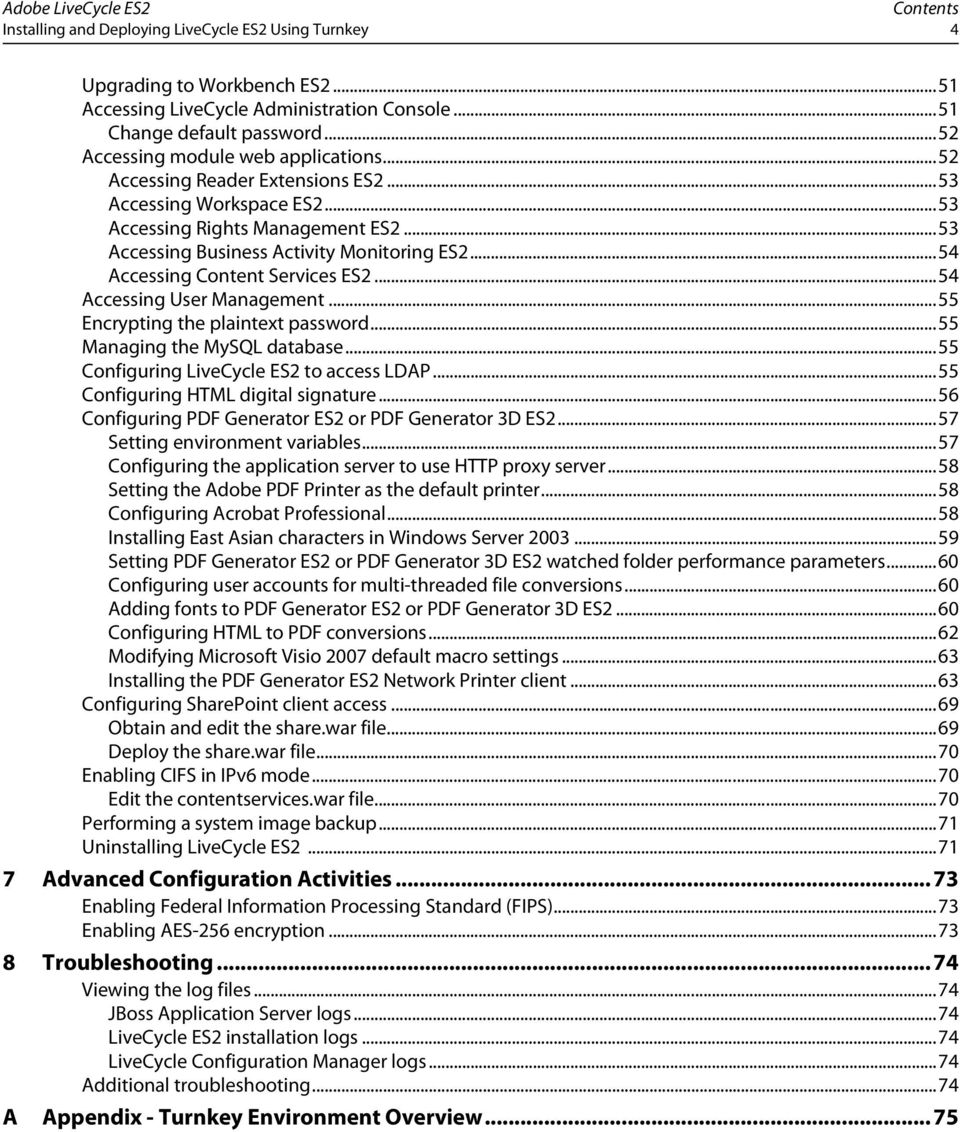
3 Contents About This Document Installing and Configuring LiveCycle ES2 (Turnkey) System prerequisites Development versus production environments...10 Additional prerequisites...10 Hardware...10 Operating system...11 Web browser support...11 Partial turnkey database preconfiguration...14 Application server...14 LiveCycle Reader Extensions ES2 credential...14 Before you install...14 Configuration for 64-bit Windows Server 2008, Windows 7 or Vista installations...15 Preconfiguration for PDF Generator ES2 and PDF Generator 3D ES Installing and Configuring - Express Mode Installing LiveCycle ES2 using Express Mode...18 Install service packs...20 Configuring LiveCycle ES Configuring LiveCycle ES2 using Express Mode...21 Next steps Installing and Configuring - Custom Mode Checking the installer...25 Installing LiveCycle ES2 using Custom Mode...26 Install service packs...28 Configuring LiveCycle ES Next steps Installing and Configuring - Partial Turnkey Installing LiveCycle ES2 using Partial Turnkey option...35 Install service packs...38 (Business Activity Monitoring) Configuring BAM data source...38 Configuring LiveCycle ES Configuring LiveCycle ES2 using Partial Turnkey Express mode...39 Configuring LiveCycle ES2 using Partial Turnkey Custom Mode...42 (Business Activity Monitoring) Configure BAM settings...47 Next steps Post-Deployment Activities Restarting the JBoss services...48 Disabling status pages for JBoss...48 Setting the correct date, time, and time zone...49 Manually enabling SSL for JBoss...49 Enabling SSL for JBoss...49 Installing LiveCycle ES2.5 Solution Accelerators

4 Contents Installing and Deploying LiveCycle ES2 Using Turnkey 4 Upgrading to Workbench ES Accessing LiveCycle Administration Console...51 Change default password...52 Accessing module web applications...52 Accessing Reader Extensions ES Accessing Workspace ES Accessing Rights Management ES Accessing Business Activity Monitoring ES Accessing Content Services ES Accessing User Management...55 Encrypting the plaintext password...55 Managing the MySQL database...55 Configuring LiveCycle ES2 to access LDAP...55 Configuring HTML digital signature...56 Configuring PDF Generator ES2 or PDF Generator 3D ES Setting environment variables...57 Configuring the application server to use HTTP proxy server...58 Setting the Adobe PDF Printer as the default printer...58 Configuring Acrobat Professional...58 Installing East Asian characters in Windows Server Setting PDF Generator ES2 or PDF Generator 3D ES2 watched folder performance parameters...60 Configuring user accounts for multi-threaded file conversions...60 Adding fonts to PDF Generator ES2 or PDF Generator 3D ES Configuring HTML to PDF conversions...62 Modifying Microsoft Visio 2007 default macro settings...63 Installing the PDF Generator ES2 Network Printer client...63 Configuring SharePoint client access...69 Obtain and edit the share.war file...69 Deploy the share.war file...70 Enabling CIFS in IPv6 mode...70 Edit the contentservices.war file...70 Performing a system image backup...71 Uninstalling LiveCycle ES Advanced Configuration Activities Enabling Federal Information Processing Standard (FIPS)...73 Enabling AES-256 encryption Troubleshooting Viewing the log files...74 JBoss Application Server logs...74 LiveCycle ES2 installation logs...74 LiveCycle Configuration Manager logs...74 Additional troubleshooting...74 A Appendix - Turnkey Environment Overview... 75
5 About This Document This document explains how to install and configure Adobe LiveCycle ES2 (Enterprise Suite) for Red Hat JBoss and MySQL by using the turnkey method. The turnkey method automatically installs and configuresthe product and is the recommended installation option for rapid evaluation, development, and small production deployments. Who should read this document? This document is intended for users who are installing, configuring, administering, or deploying LiveCycle ES2. These users include evaluators, administrators, or developers who are responsible for installing, configuring, administering, or deploying LiveCycle ES2. The information provided is based on the assumption that anyone reading this document is familiar with the Microsoft Windows operating systems and web environments. Conventions used in this document This document uses the following naming conventions for common file paths. Name Default value Description [LiveCycleES2 root] C:\Adobe\Adobe LiveCycle ES2\ The installation directory that is used for all LiveCycle ES2 modules. This directory contains subdirectories for LiveCycle Configuration Manager, the LiveCycle ES2 SDK, and each LiveCycle ES2 solution component installed. [JBossES2 root] C:\Adobe\Adobe LiveCycle ES2\jboss The home directory of the application server that runs LiveCycle ES2. [Adobe_JAVA_HOME] C:\Adobe\Adobe LiveCycle ES2\Java The home directory of the Java JDK installed by the LiveCycle ES2 turnkey. Additional information The resources in this table can help you learn about LiveCycle ES2. For information about General information about LiveCycle ES2 and the modules What s new in this LiveCycle ES2 release LiveCycle ES2 release information and last-minute changes that occur to the product See LiveCycle ES2 Overview What s New for LiveCycle ES2 LiveCycle ES2 Release Notes 5

6 About This Document Installing and Deploying LiveCycle ES2 Using Turnkey 6 For information about LiveCycle ES2 terminology Upgrading Other services and products that integrate with LiveCycle ES2 LiveCycle ES2 modules All documentation available for LiveCycle ES2 Patch updates, technical notes, and additional information about this product version See LiveCycle ES2 Glossary Upgrading to LiveCycle ES2 from 8.x (for JBoss Turnkey) Adobe Development Center Adobe LiveCycle ES2 (Enterprise Suite) Adobe LiveCycle ES2 documentation LiveCycle Technical Support

7 1 Installing and Configuring LiveCycle ES2 (Turnkey) This chapter describes how to install LiveCycle ES2 by using the turnkey method. The turnkey installation option is most appropriate for rapid installations of evaluation, developer, and small production environments. The turnkey installation automatically performs all of the tasks that are required to install and configure LiveCycle ES2 on a JBoss Application Server with a local MySQL database (or a remote database you have preconfigured) running on Microsoft Windows only. You can choose the turnkey method during the installation process. The following information is included in this document: A description of the system requirements for installing the LiveCycle ES2 turnkey. Backing up the LiveCycle ES (8.x) data. All the steps required to initiate and complete the installation. (When you complete these steps, LiveCycle ES2 is running on JBoss and ready to accept requests.) Details about what you can do next, including accessing LiveCycle Administration Console and User Management, and accessing some of the web applications that may be available (depending on the LiveCycle ES2 modules you have licensed). Note: LiveCycle ES2 turnkey installer disables JBoss JMS services, therefore, the JMS service of LiveCycle Foundation is unavailable. The sample for LiveCycle Foundation JMS service will not work. To enable LiveCycle Foundation JMS service and the samples, revert the steps described in the section Remove JMS and clustering configuration files in the Preparing to Install guide. Turnkey installation overview The turnkey installation performs the following tasks: Installs the product files Installs the required Sun JDK version 1.6.0_14. Installs JBoss Application Server (with Apache Tomcat servlet container embedded) Installs the MySQL 5.0 database (not included with Partial Turnkey option) Starts LiveCycle Configuration Manager Configures and assembles the LiveCycle ES2 EAR files in either express mode or custom mode Deploys LiveCycle ES2 to JBoss Initializes the database (either the Local MySQL 5.0 database or, with the Partial Turnkey option, the remote database) Supports LiveCycle ES2 Business Activity Monitoring ES2 on JBoss out of the box Deploys required components to JBoss Configures the LiveCycle Reader Extensions ES2 Rights credential Imports the product samples 7

8 Installing and Configuring LiveCycle ES2 (Turnkey) Installing and Deploying LiveCycle ES2 Using Turnkey 8 You can also run the turnkey install in the command line mode. You can use this option if you are installing LiveCycle ES2 on a computer that does not support GUI. If you use the command line option, you must also use the command line option to uninstall LiveCycle ES2. Turnkey installation architecture The following diagram illustrates a LiveCycle ES2 Turnkey installation. Some of the components are optional as part of the turnkey installation. For example: LDAP Directory Server - you do not need to authenticate with LDAP to set up LiveCycle users. For lab trials and testing purposes, you can use LiveCycle ES2 User Management (available from LiveCycle Administration Console) to create new user accounts. Partial Turnkey - External database server - the typical turnkey installation includes a preconfigured MySQL database. Connectors - LiveCycle ES2 can connect to your ECM vendor s datasource (if applicable) Note: The above illustration shows LiveCycle Workbench ES2 required for creating and deploying processes to the LiveCycle ES2 server. To install LiveCycle Workbench ES2, refer to Installing Your Development Environment. Optional Business Activity Monitoring ES2 deployment With the LiveCycle ES2 turnkey installation, you can install and configure LiveCycle Business Activity Monitoring ES2 as a standalone application. This option automatically performs all of the tasks that are required to install and configure Business Activity Monitoring ES2 on a Windows server. Performance increases when BAM is installed on a standalone server independent of LiveCycle ES2 server. Note: LiveCycle Business Activity Monitoring ES2 is only supported on 64-bit operating systems. If you install BAM using the turnkey option it will install a standalone version of JBoss on your server. Therefore, if you are installing BAM along with other LiveCycle ES2 components your server will have two instances of JBoss installed.
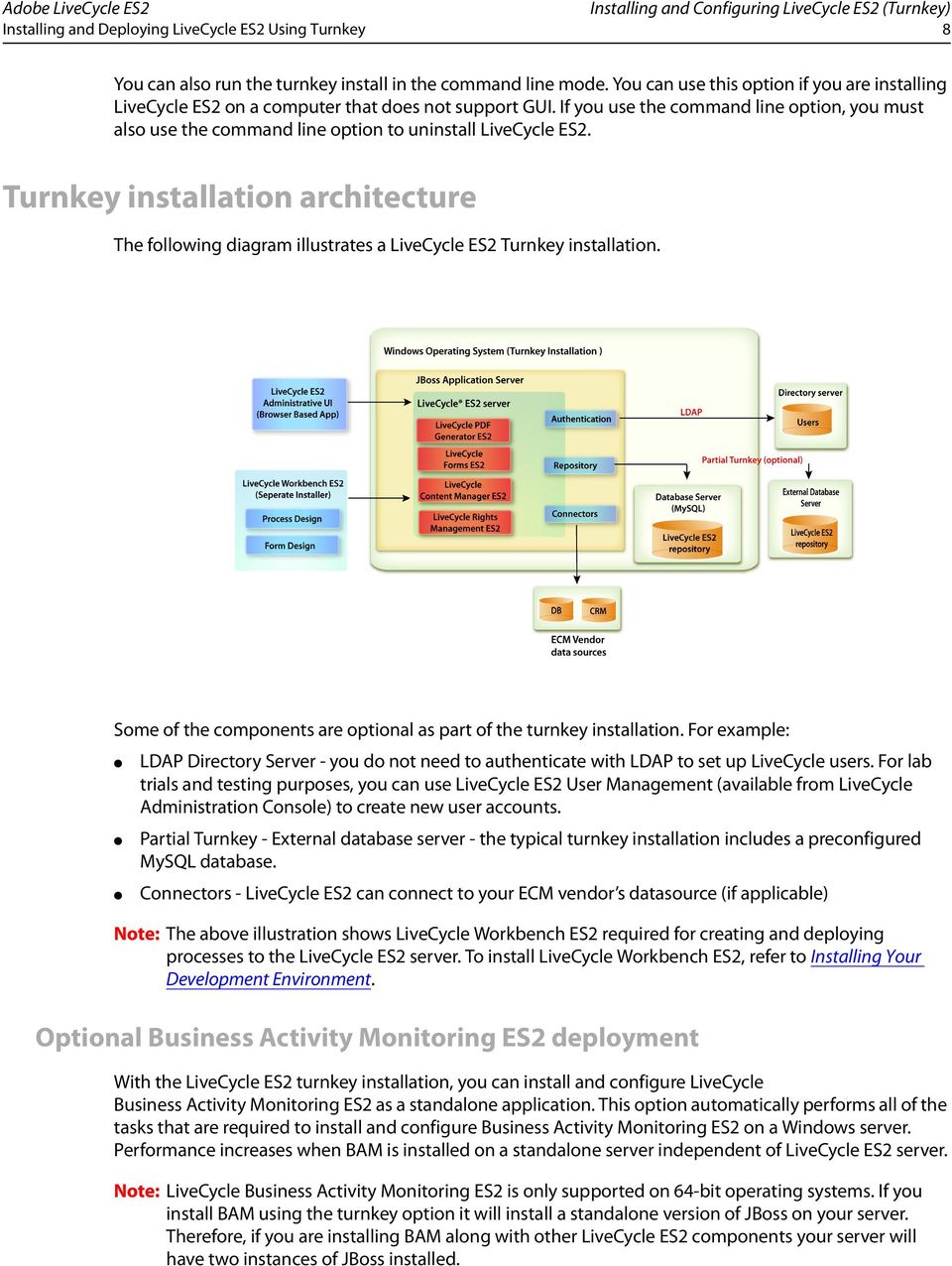
9 Installing and Configuring LiveCycle ES2 (Turnkey) Installing and Deploying LiveCycle ES2 Using Turnkey 9 The following diagram illustrates a LiveCycle ES2 turnkey deployment and a standalone BAM installation.

10 2 System prerequisites This section provides the hardware and software requirements to install LiveCycle ES2 using the turnkey method. 2.1 Development versus production environments Use the turnkey installation to install all the modules on a single system for development and evaluation. Ensure that your target computer has at least 4 GB RAM. In addition, install LiveCycle Business Activity Monitoring ES2 on a different 64-bit Windows server. Business Activity Monitoring ES2 is not supported on 32-bit systems, but other LiveCycle ES2 components are supported on 32-bit operating systems. For production use, deploy Business Activity Monitoring ES2 on a separate application server. For larger production use, Business Activity Monitoring ES2 must be installed on a dedicated system running both a 64-bit operating system and application server. 2.2 Additional prerequisites Before you install LiveCycle ES2, ensure that you have the following prerequisite hardware and software installed: Hardware on page 10 Operating system on page 11 Web browser support on page 11 Application server on page 14 Partial turnkey database preconfiguration on page 14 LiveCycle Reader Extensions ES2 credential on page 14 Additionally, if you include LiveCycle PDF Generator ES2 as part of your LiveCycle ES2 solution, complete the following tasks before you begin the installation: Granting the Logon As Service right when installing PDF Generator ES2 or PDF Generator 3D ES2 on page 16 Installing Acrobat for PDF Generator ES2 or PDF Generator 3D ES2 on page Hardware For any installation, these settings are recommended as the minimum: Disk space for installation: 3 GB (an additional 3 GB is required if you are using an ESD download and not installing from a DVD) System temporary space during installation: 5.4 GB Memory for running LiveCycle ES2: 3.4 GB Processor: Intel Pentium 4 or equivalent, 1.6 GHz, or higher processor 10
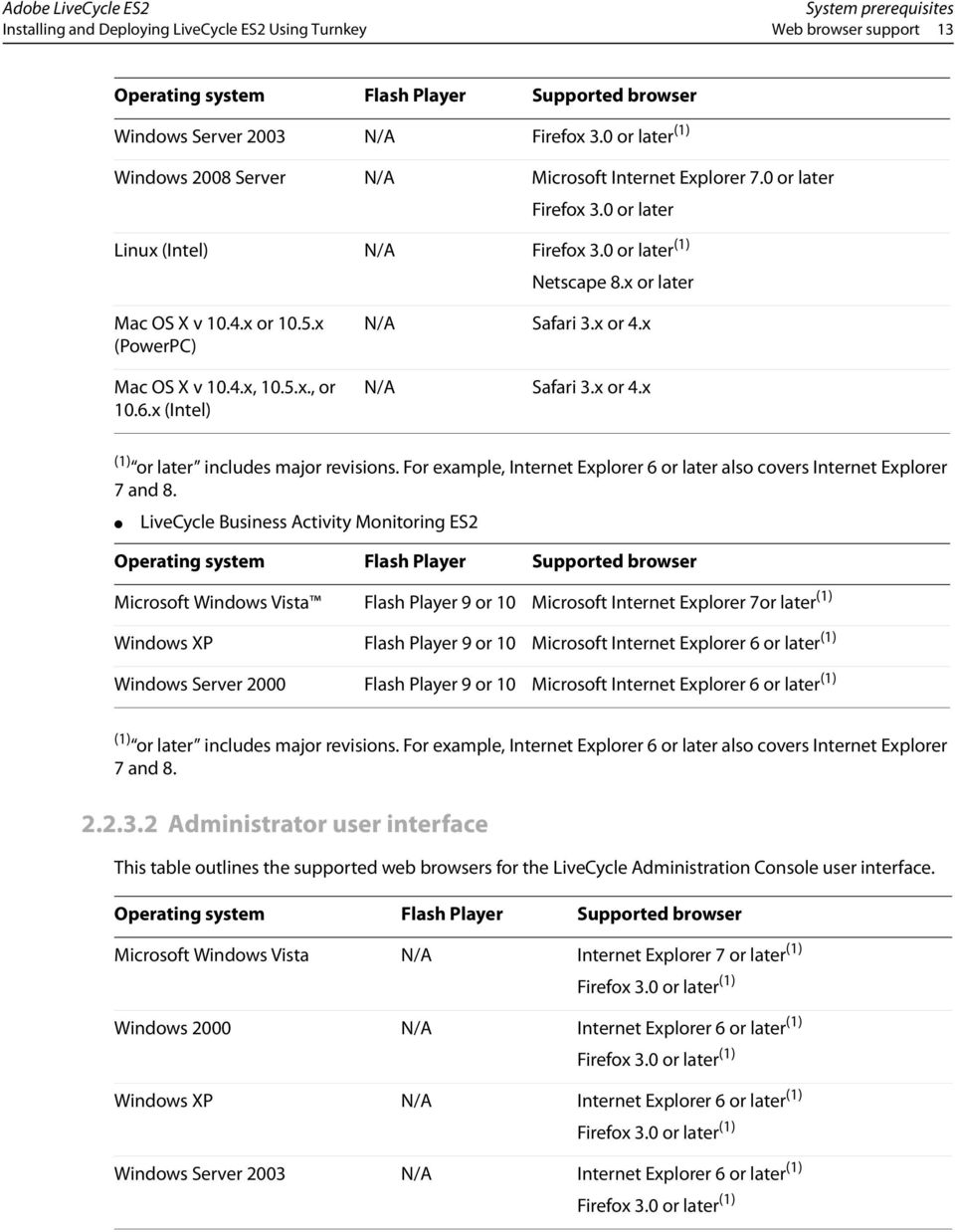
11 System prerequisites Installing and Deploying LiveCycle ES2 Using Turnkey Operating system Operating system The turnkey method supports the following Microsoft Windows operating systems: Windows Server 2003 Standard and Enterprise Edition SP2 running on 32-bit and 64-bit architectures. Windows Server 2003 Standard and Enterprise Edition R2 SP2 running on 32-bit, 64-bit, and VMWare ESX/GSX architectures Windows Server 2008 Standard and Enterprise Edition running on 64-bit architectures (required for production environment) Business Activity Monitoring ES2 requires 64-bit operating system. If you want to install BAM also on the same machine, choose a 64-bit Windows operating system for installing LiveCycle ES2. For preconfiguration settings on Windows Server 2008 Enterprise Edition environment, see Configuration for 64-bit Windows Server 2008, Windows 7 or Vista installations on page 15. Note: Microsoft Windows XP (SP2 or SP3), Windows Vista (32-bit and 64-bit), and Windows 7 (32-bit and 64-bit) are supported for LiveCycle ES2 evaluation and development. Business Activity Monitoring ES2 is not supported on Windows 7. Note: You must have administrator privileges on Windows. If you run the installer using an account that does not have these privileges, you will be prompted for the credentials of an account with administrator privileges Web browser support This section outlines the supported web browsers for the LiveCycle ES2 user interfaces. Although LiveCycle ES2 turnkey only installs on Windows, the end-user user interfaces can be accessed remotely from computers running on other operating systems. Refer to the following tables for supported web browsers. To view some LiveCycle ES2 modules, you must install a supported version of Flash Player available from End-user user interface End-user components include these modules: LiveCycle Workspace ES2 (Flash Player required) Note: Adobe Flash Player or later is required for Workspace ES2 or for using form guides in Workspace ES2. LiveCycle Reader Extensions ES2 (Flash Player required) LiveCycle Rights Management ES2 (Flash Player required) LiveCycle PDF Generator ES2 and LiveCycle PDF Generator 3D ES2 (browser only) LiveCycle Content Services ES2 (browser only)

12 System prerequisites Installing and Deploying LiveCycle ES2 Using Turnkey Web browser support 12 Operating system Flash Player Supported browser Microsoft Windows Vista Flash Player 9 or 10 Microsoft Internet Explorer 7 or later (1) Firefox 3.0 or later (1) Windows 2000 Flash Player 9 or 10 Internet Explorer 6 or later (1) Firefox 3.0 or later (1) Windows XP Flash Player 9 or 10 Internet Explorer 6 or later (1) Firefox 3.0 or later (1) Microsoft Windows 7 Flash Player 9 or 10 Microsoft Internet Explorer 8.0 or later Firefox 3.0 or later Windows Server 2003 Flash Player 9 or 10 Internet Explorer 6 or later (1) Firefox 3.0 or later (1) Microsoft Windows Server 2008 Mac OS X v 10.4.x or 10.5.x (PowerPC) Mac OS X v 10.4.x, 10.5.x., or 10.6.x (Intel) Flash Player 9 or 10 Microsoft Internet Explorer 7 or later (1) Firefox 3.0 or later (1) Flash Player 9 or 10 Firefox 3.0 or later (not for Workspace ES2) (1)(2) Safari 3.x or 4.x (Workspace ES2 and Content Services ES2 require version or later) Flash Player 9 or 10 Firefox 3.0 or later (not for Workspace ES2) (1)(2) Safari 3.x or 4.x (Workspace ES2 and Content Services ES2 require version or later) (1) or later includes major revisions. For example, Internet Explorer 6 or later also covers Internet Explorer 7 and 8. (2) Workspace ES2 supports Internet Explorer and Firefox on Windows but only Safari or later on the Mac. LiveCycle Forms ES2 Operating system Flash Player Supported browser Microsoft Windows Vista N/A Microsoft Internet Explorer 6 or later (1) Firefox 3.0 or later (1) Netscape 8.x or later Windows XP N/A Microsoft Internet Explorer 6 or later (1) Firefox 3.0 or later (1) Netscape 8.x or later Windows 7 N/A Microsoft Internet Explorer 7.0 or later Firefox 3.0 or later

13 System prerequisites Installing and Deploying LiveCycle ES2 Using Turnkey Web browser support 13 Operating system Flash Player Supported browser Windows Server 2003 N/A Firefox 3.0 or later (1) Windows 2008 Server N/A Microsoft Internet Explorer 7.0 or later Firefox 3.0 or later Linux (Intel) N/A Firefox 3.0 or later (1) Netscape 8.x or later Mac OS X v 10.4.x or 10.5.x (PowerPC) Mac OS X v 10.4.x, 10.5.x., or 10.6.x (Intel) N/A Safari 3.x or 4.x N/A Safari 3.x or 4.x (1) or later includes major revisions. For example, Internet Explorer 6 or later also covers Internet Explorer 7 and 8. LiveCycle Business Activity Monitoring ES2 Operating system Flash Player Supported browser Microsoft Windows Vista Flash Player 9 or 10 Microsoft Internet Explorer 7or later (1) Windows XP Flash Player 9 or 10 Microsoft Internet Explorer 6 or later (1) Windows Server 2000 Flash Player 9 or 10 Microsoft Internet Explorer 6 or later (1) (1) or later includes major revisions. For example, Internet Explorer 6 or later also covers Internet Explorer 7 and Administrator user interface This table outlines the supported web browsers for the LiveCycle Administration Console user interface. Operating system Flash Player Supported browser Microsoft Windows Vista N/A Internet Explorer 7 or later (1) Firefox 3.0 or later (1) Windows 2000 N/A Internet Explorer 6 or later (1) Firefox 3.0 or later (1) Windows XP N/A Internet Explorer 6 or later (1) Firefox 3.0 or later (1) Windows Server 2003 N/A Internet Explorer 6 or later (1) Firefox 3.0 or later (1)
14 System prerequisites Installing and Deploying LiveCycle ES2 Using Turnkey Partial turnkey database preconfiguration 14 (1) or later includes major revisions. For example, Microsoft Internet Explorer 6 or later also covers Microsoft Internet Explorer 7 and Partial turnkey database preconfiguration The Partial Turnkey option allows you to use your existing database with the preconfigured JBoss application server. The following database types are supported: MySQL , (recommended) Microsoft SQL Server 2005 SP2, 2008 Oracle 10g, 11g If you are using your existing database, configure the database as specified in the Creating the LiveCycle ES2 Database section in the Preparing to Install LiveCycle ES2 (single server) guide Application server The turnkey method supports JBoss (which includes the Apache Tomcat servlet container) LiveCycle Reader Extensions ES2 credential If you are installing LiveCycle Reader Extensions ES2, ensure that you have a valid credential and password. If you do not have this information, contact your Adobe account representative. You can skip importing the Reader Extensions ES2 credential during the installation process and install it later using the trust store component in LiveCycle Administration Console. 2.3 Before you install Before you begin installinglivecycle ES2, read through the following information to ensure that your installation runs smoothly: To reduce the time to complete the installation, install LiveCycle ES2 either by using a local copy of the installation file set or directly from the DVD instead of installing from a shared network location. Ensure that the installation media that you received is not damaged. If you copy the installer media to the hard disk of your computer, ensure that you copy the entire DVD contents on to the hard disk. If you downloaded the installer file set, verify its integrity using an MD5 check sum utility. Use this utility to check the MD5 check sum values with the value displayed on the Adobe download web site. You can use a tool such as WinMD5. To avoid installation errors, do not copy the DVD install image to a directory path which exceeds the maximum path length limitation. Typically, long network paths cause this error. See for more information. Download any patch updates for LiveCycle ES2 available from LiveCycle Technical Support. To improve the speed of installation on Windows, disable any on-access virus scanning software for the duration of the installation. The turnkey installation creates the following Windows services, which, by default, are set to run automatically on startup: JBoss for Adobe LiveCycle ES2

15 System prerequisites Installing and Deploying LiveCycle ES2 Using Turnkey Configuration for 64-bit Windows Server 2008, Windows 7 or Vista installations 15 MySQL for Adobe LiveCycle ES2 (not applicable if you selected the Partial turnkey option) These services manage the application server and the database for the turnkey installation. You can start, stop, and pause these services by using the Windows Services Control Manager. To open the Windows Services Control Manager, go to Control Panel > Administrative Tools > Services. Using this tool, you can also configure the services to start when the computer starts or to require manual startup. Note: If JBoss and MySQL are already installed, you must stop the services before you run the turnkey installation and set the services to be started manually. By default, the turnkey installation places LiveCycle ES2 components in the C:\Adobe\Adobe LiveCycle ES2\ directory (referred to as the [LiveCycleES2 root] directory). Caution: If you choose to install to a non-default directory, do not use the name test as your directory name (for example, C:\test) or the MySQL install process will fail. By default, JBoss is installed to and run from the [LiveCycleES2 root]/jboss directory. When LiveCycle Configuration Manager is started, you can choose Express Mode or Custom Mode: Express Mode: Completes the configuration using default values for parameters and limited configuration screens. Express Mode is recommended if you do not want any special system configuration. Custom Mode: Allows you to customize the system configuration. Custom Mode configuration requires advanced knowledge of LiveCycle ES2, JBoss Application Server and the MySQL database. Custom Mode is recommended if you want to configure your system in a specific way or want more control over the tasks that LiveCycle Configuration Manager completes Configuration for 64-bit Windows Server 2008, Windows 7 or Vista installations On 64-bit Windows Server 2008 or Vista operating systems, modify the Admin Approval Mode security option as follows: 1. Go to Start > Control Panel > Administrative Tools > Local Security Policy > Local Policies > Security Options. 2. Locate User Account Control: Behavior of the elevation prompt for administrators in Admin Approval Mode and set it to Elevate without prompting. 3. Restart your computer. Caution: The Windows User Account Control (UAC) must remain disabled for PDF Generator ES2 or PDF Generator 3D ES2 to work properly. You can run the installation and configuration process by turning on the UAC with the Elevate without prompting option enabled. However, you must disable UAC to run PDF Generator ES2 or PDF Generator 3D ES2. If you are installing and configuring on an evaluation system, you can enable the UAC on the computer after you have deployed to your production computer or uninstalled PDF Generator ES2 or PDF Generator 3D ES2. Disable the Windows UAC on Vista: 1. To access the System Configuration Utility, go to Start > Run and in the Open: box enter MSCONFIG. 2. Click the Tools tab and scroll down and select Disable UAC.

16 System prerequisites Installing and Deploying LiveCycle ES2 Using Turnkey Preconfiguration for PDF Generator ES2 and PDF Generator 3D ES Click Launch to run the command in a new window. 4. When finished, close the command window and close the System Configuration window. 5. Restart your computer. To enable the UAC again, repeat the steps above and select Enable UAC before clicking Launch. Disable the Windows UAC on Server 2008: 1. Go to Start > Control Panel > User Accounts > Turn User Account Control on or off. 2. Deselect the Use User Account Control (UAC) to help protect your computer option and then click OK. 3. Restart the computer. To enable the UAC again, repeat the steps above and select the Use User Account Control (UAC) to help protect your computer option before restarting the computer. Disable the Windows UAC on Windows 7: 1. To access the System Configuration Utility, go to Start > Run and in the Open: box enter MSCONFIG. 2. Click the Tools tab and scroll down and select Change UAC Settings. 3. Click Launch to run the command in a new window. 4. Adjust the slider to the Never notify level. 5. When finished, close the command window and close the System Configuration window. 6. Restart your computer. To enable the UAC again, repeat the steps above and adjust the slider to a desired level before restarting your computer Preconfiguration for PDF Generator ES2 and PDF Generator 3D ES2 Before you install PDF Generator ES2 or LiveCycle PDF Generator 3D ES2, complete the tasks listed in the following two sections. To enable native application support for PDF Generator ES2 or LiveCycle PDF Generator 3D ES2, grant the Logon As Service right to the Microsoft Administrator in Windows before you begin the turnkey installation. With native application file support, PDF Generator ES2 and PDF Generator 3D ES2 can convert files from native formats such as Microsoft Word to Adobe PDF format Granting the Logon As Service right when installing PDF Generator ES2 or PDF Generator 3D ES2 If you are installing PDF Generator ES2 or PDF Generator 3D ES2 on any Windows operating system, grant the Logon As Service right to the user that installs LiveCycle ES2.

17 System prerequisites Installing and Deploying LiveCycle ES2 Using Turnkey Preconfiguration for PDF Generator ES2 and PDF Generator 3D ES2 17 To set the Logon As Service right: 1. Select Start > Control Panel > Administrative Tools > Local Security Policy > Local Policies > User Rights Assignment. 2. Double-click Log on as a service and click Add User or Group. 3. Type the user name for the Microsoft Administrator and click OK Installing Acrobat for PDF Generator ES2 or PDF Generator 3D ES2 LiveCycle PDF Generator ES2 or PDF Generator 3D ES2 can convert many native file formats to PDF. Such native file formats include Microsoft Word, Microsoft Excel, Microsoft PowerPoint, Microsoft Project, Microsoft Visio, Corel WordPerfect, Adobe Photoshop (CS2 only), Adobe FrameMaker, and Adobe PageMaker. If you plan to use PDF Generator ES2 or PDF Generator 3D ES2 native application format conversion or optical character recognition (OCR) generation, install Acrobat 9.2 Professional Extended on the computer where PDF Generator ES2 will run before you run the LiveCycle ES2 installation program. You can also install Acrobat 9.2 later and perform some additional manual tasks. If you do not want to configure PDF Generator ES2 or PDF Generator 3D ES2 to support this functionality, you do not need to install or upgrade to Acrobat 9.2 Professional Extended. However, it is recommended that you upgrade to Acrobat 9.2 Professional Extended in order to support conversions that use Microsoft Office To install Acrobat 9.2 Professional Extended for PDF Generator ES2 or PDF Generator 3D ES2: 1. Uninstall any other version of Acrobat by using the Add/Remove Programs window in the Windows Control Panel. 2. Restart your computer if prompted. 3. Install Acrobat 9.2 Professional Extended by running the AutoPlay.exe file from the installation media or folder which contains the installer file set. 4. Follow the instructions on the Acrobat installer screens.

18 3 Installing and Configuring - Express Mode When installing LiveCycle you can choose various installation and configuration options to help you customize your turnkey installation. Here are the turnkey installation options: Express Mode: Completes the configuration using defaults and limited configuration screens. Express Mode is recommended if you do not want any special system configuration. In addition, you can use Express Mode (BAM only) to completes the configuration for LiveCycle Business Activity Monitoring ES2 using default values and limited configuration screens. Custom Mode: Allows you to customize the system configuration and requires some advanced knowledge of LiveCycle ES2, JBoss Application Server and the MySQL database. See Installing and Configuring - Custom Mode on page 25. Partial Turnkey: Completes the configuration of LiveCycle ES2 using a preconfigured JBoss application server. However, this option allows you to configure your own database and point to this database during installation and configuration. See Installing and Configuring - Partial Turnkey on page Installing LiveCycle ES2 using Express Mode Before you install LiveCycle ES2, review the following: System prerequisites on page 10 Before you install on page 14 To install LiveCycle ES2 using Turnkey: 1. Do one of the following: From the download site, download and extract the entire JBoss_DVD.zip file (the LiveCycle ES2 Electronic Software Download or ESD file) to your file system. Be sure to keep the directory hierarchy unchanged from the JBoss_DVD.zip file. After extracting the ZIP file, launch the installer using one of the following methods: Navigate to the \livecycle_server\9.0\ livecycle_server folder and double-click the run_windows_installer.bat file to launch the appropriate LiveCycle ES2 installer. (32-bit systems)double-click the install.exe file from the \livecycle_server\9.0\disk1\instdata\windows\vm folder (64-bit systems) double-click the install.exe file from the \livecycle_server\9.0\disk1\instdata\windows_64bit\vm folder 18
19 Installing and Configuring - Express Mode Installing and Deploying LiveCycle ES2 Using Turnkey Installing LiveCycle ES2 using Express Mode 19 From the JBoss DVD, navigate to the \livecycle_server\9.0 folder. Launch the installer using one of the following methods: Navigate to the \livecycle_server\9.0\ livecycle_server folder and double-click the run_windows_installer.bat file. This script determines the correct LiveCycle ES2 installer and run it. (32-bit systems)double-click the install.exe file from the \livecycle_server\9.0\disk1\instdata\windows\vm folder (64-bit systems) double-click the install.exe file from the \livecycle_server\9.0\disk1\instdata\windows_64bit\vm folder 2. When prompted, select the language for installation, and then click OK. 3. On the Introduction screen, click Next. 4. Accept the default directory as listed or click Choose and navigate to the directory where you want to install the product, and then click Next. This directory is referred to as [LiveCycleES2 root]. Note: The installation directory path cannot be longer than 40 characters. Also, the installation directory path cannot have international characters. 5. In the Choose Installation Type screen, select the installation type and click Next: Select Turnkey under Typical as the installation type for a typical turnkey installation. Turnkey option installs LiveCycle ES2, JBoss application server, MySQL database, and JDK 1.6.0_14. Note: For Manual installations, see the Installing and Deploying LiveCycle ES2 guide for your application server and review all preparatory steps in Preparing to Install LiveCycle ES2 before continuing. 6. (Turnkey option only) On the Turnkey Installation Options screen, select Include BAM with LiveCycle if your turnkey installation is on a 64-bit Windows operating system. However, it is recommended that you install Business Activity Monitoring on a separate machine. 7. C lick Next. 8. (Turnkey with preconfigured MySQL only) Set the MySQL root administrator password and, optionally, type your MySQL port number. Note: MySQL does not allow special characters or spaces in the user name or password. Ensure that you record this password for future reference. To verify that the port number is available for use, click Test. If the port is available, the installer displays a green check mark. If the port is in use, the installer displays a red X. If the port is in use, type a new port number and repeat the process until you find a port that is available. Clicking Reset populates the port box with the default port number (PDF Generator ES2 and PDF Generator 3D ES2 on Windows Server 2003 only) In the Administrative Credentials screen, select Yes, enable native application support for PDF Generator ES2 and enter the user name and password, and click Next. The native application support functionality allows you to convert documents in native applications such as Microsoft Word to Adobe PDF. However, you must install these native applications on the same server as you are installing PDF Generator ES2 and PDF Generator 3D ES2.

20 Installing and Configuring - Express Mode Installing and Deploying LiveCycle ES2 Using Turnkey Install service packs 20 Note: PDF Generator 3D ES2 requires native application support to convert 3D files to PDF. Adobe Acrobat version 9.2 is required to configure support for native Windows applications. For information about installing Acrobat 9.2, see Preconfiguration for PDF Generator ES2 and PDF Generator 3D ES2 on page 16. Note: The password for the Microsoft Office user must not contain two consecutive $ characters (for example, dollar$$). Caution: You must provide the correct administrator name and password; otherwise, LiveCycle ES2 will not run. Use the same administrator account you used in Preconfiguration for PDF Generator ES2 and PDF Generator 3D ES2 on page 16. This administrator account name must be the same user who installed Microsoft Office on the system and include the Windows Machine Name prefix if that user is not a local account on the target computer. Do not use either localhost or the IP address of the Windows Server. 10. Read the Adobe LiveCycle ES2 Server License Agreement and, if you agree, select Yes, and then click Next. 11. (Turnkey with preconfigured MySQL only) Read the MySQL License Agreement and, if you agree, select Yes, and then click Next. 12. Read the JBoss Application Server License Agreement and, if you agree, select Yes and then click Next. 13. Review the preinstallation summary, and then click Install. The installation program displays the progress of the installation. This process takes several minutes to complete. 14. Review the Release Notes and click Next. 15. Review the post-installation summary information and choose one of these options: If no service pack updates are required, ensure that Start the LiveCycle Configuration Manager is selected, and then click Done. If service pack updates are required or if you are installing LiveCycle Content Services ES2, deselect this option and click Done to exit the installer. (New for 9.5) If you plan to install LiveCycle ES2.5 Solution Accelerators, you are required to first apply LiveCycle ES2 service pack 2 or later and install LiveCycle ES2.5 Solution Accelerators. In that case, deselect this option and click Done to continue with Installing and Deploying LiveCycle ES2.5 Solution Accelerators before you run LiveCycle Configuration Manager. Note: You can run LiveCycle Configuration Manager by using the ConfigurationManager.bat file located in [LiveCycleES2 root]\configurationmanager\bin folder. 3.2 Install service packs Before you complete the configuration using LiveCycle Configuration Manager, apply the latest LiveCycle ES2 service packs. These updates are at LiveCycle Technical Support.

21 Installing and Configuring - Express Mode Installing and Deploying LiveCycle ES2 Using Turnkey Configuring LiveCycle ES Configuring LiveCycle ES2 To configure LiveCycle ES2: 1. If you are continuing from the LiveCycle ES2 installation, proceed to step 2; otherwise, navigate to the [LiveCycleES2 root]\configurationmanager\bin folder and run the ConfigurationManager.bat script. 2. On the LiveCycle Configuration Manager Welcome screen, click Next. 3. Ensure that Upgrade from LiveCycle ES2 8.0.x, Upgrade from LiveCycle 8.2.1, and Install the LiveCycle 7.x Compatibility Layer are deselected. If you are performing a LiveCycle upgrade you should review the appropriate LiveCycle turnkey upgrade guide. 4. Click Next. 5. On the Turnkey Mode screen, select Express Mode (recommended for quick deployments) and proceed to the next section Configuring LiveCycle ES2 using Express Mode Express Mode completes the configuration by using default values and limited configuration screens. You can view the configuration progress at any time by clicking View Progress Log. To configure LiveCycle ES2 using Express Mode: 1. Select the required modules, and click Next. 2. On the Configure Turnkey JBoss SSL screen, add the information to configure the SSL certificate. Note: JBoss Turnkey only automatically configures SSL for LiveCycle ES2, not including LiveCycle Business Activity Monitor ES2. You must configure SSL for LiveCycle Business Activity Monitor ES2 manually. 3. (LiveCycle Content Services ES2 only) On the LiveCycle Content Services ES2 Configuration screen, review the Content Services ES2 configuration information and click Configure. 4. (Content Services ES2 only) When the configuration for Content Services ES2 is completed, click Next. 5. (LiveCycle Content Services ES2 - CIFS option only) On the LiveCycle Content Services ES2 CIFS Configuration screen, set the parameters that CIFS requires: CIFS Server Name: The CIFS server name by which the Content Services repository will be accessible. For example, cifs-servername. Alternate IP Address: IP Address of the CIFS server. Primary WINS Server IP: The Windows Internet Name Service (WINS) server to dynamically map the IP address to the computer names. It is used to resolve the local domain. It is the IP address of the Primary WINS server. Its value can be found using the ipconfig/all command. Secondary WINS Server IP: The IP address of the secondary WINS server. Its value can be found using ipconfig/all command. BroadCast IP: The broadcast IP address which is used to resolve the local domain. 6. (LiveCycle Content Services ES2 - CIFS option only) Click Configure to configure Content Services ES2. When complete, click Next.
22 Installing and Configuring - Express Mode Installing and Deploying LiveCycle ES2 Using Turnkey Configuring LiveCycle ES2 using Express Mode (LiveCycle Content Services ES2 only) On the LiveCycle Content Services ES2 Module Configuration screen, select the AMPS to configure in LiveCycle Content Services ES2. Select F1 to display the help on this topic. 8. (LiveCycle Content Services ES2 - only) Click Configure to configure Content Services ES2 modules. When complete, click Next. 9. (LiveCycle ES2 Forms, LiveCycle ES2 Output and LiveCycle ES2 PDF Generator only) This selection allows you to install three service specific sample applications. Forms IVS is a sample application which allows you to verify that LiveCycle Forms is properly deployed and running. Click Include IVS EARs in deployment set to install these sample files. Note: Do not deploy the IVS EAR files in a production environment. 10. Click Start to start the express configuration process. 11. When the deployment and express mode configuration are complete, click Next. 12. (Configure Connector for EMC Documentum only) On this screen, do one of the following tasks: Leave the Configure Connector for EMC Documentum Content Server option deselected to manually configure EMC Documentum later, and then click Next. Select the option, enter the appropriate version and directory path, and then click Verify. When complete, click Next and complete the tasks on the following screens: On the EMC Documentum Content Server Settings screen, enter the required values and then click Next. On the Configure Adobe Connector for EMC Documentum screen, click Configure Documentum Connector. When complete, click Next. 13. (Configure Connector for IBM Content Manager only) On this screen, do one of the following tasks: Leave the Configure Connector for IBM Content Manager option deselected to manually configure IBM Content Manager later, and then click Next. Select the option, enter the appropriate directory path, and then click Verify. When complete, click Next and complete the tasks on the following screens: On the IBM Content Manager Server Settings screen, enter the required values and then click Next. On the Configure Adobe Connector for IBM Content Manager screen, click Configure IBM Content Manager Connector. When complete, click Next. On the Required Manual Configurations for LiveCycle Connector for IBM Content Manager screen, review and perform the manual steps listed and then click Next. 14. (Configure Connector for IBM FileNet only) On this screen, do one of the following tasks: Leave the Configure Connector for IBM FileNet Content Manager option deselected to manually configure IBM FileNet later, and then click Next.
23 Installing and Configuring - Express Mode Installing and Deploying LiveCycle ES2 Using Turnkey Configuring LiveCycle ES2 using Express Mode 23 Select the option, enter the appropriate version and directory path, and then click Verify. When complete, click Next and complete the following screens: On the IBM FileNet Content Server Settings screen, enter the required values and then click Next. On the Configure Connnector for IBM FileNet Process Engine screen, enter the appropriate version (if enabled) and directory path, and then click Verify. When complete, click Next. On the IBM FileNet Process Engine Server Settings screen, enter the required values and then click Next. On the Configure Adobe Connector for IBM FileNet screen, click Configure FileNet Connector. When complete, click Next. On the Required Manual Configurations for LiveCycle Connector for IBM FileNet Content Manager screen, review and perform the manual steps listed and then click Next. 15. (Configure ECM Connectors only) On the Verify Configurations screen, do one of the following: If you are configuring the connectors for the first time or have modified any of the configurations on the previous screens, leave the Restart Application Server option selected and click Validate Configurations. When successfully validated, click Next. If you are configuring the connector after LiveCycle ES2 configuration, deselect the option and click Validate Configurations. When successfully validated, click Next. 16. In the Administrator user credentials for LiveCycle server machine dialog box, enter the user name and password of a user with administrative privileges on the server machine. Click Add. You must add at least one administrative user for Windows 2008 Server. For Windows 2003 Server, Linux, and Solaris, adding a user is not mandatory. Multithreaded conversions are not supported on the AIX platform. Note: On Windows 2008 Server, User Account Control (UAC) must be disabled for the users you add. To disable UAC, click Control Panel > User Accounts > Turn User Account Control on or off and deselect Use User Account Control (UAC) to help protect your computer. Click OK. Your changes become effective when the system is restarted. Note: Users that you add on Linux/Solaris platforms must have sudo privileges. 17. (Only when LiveCycle Configuration Manager is running locally on a server machine) In the LiveCycle PDFGenerator System Readiness Test dialog box, click Start to validate if the system has been appropriately configured for PDF Generator ES Review the System Readiness Tool Report and click Next. 19. (Reader Extensions ES2 only) In the LiveCycle Reader Extensions ES2 Credential Configuration dialog box, choose one of these options: Browse to the location of your Reader Extensions ES2 Rights credential file, type your credential password as provided by Adobe, type the name for the configured credential that will be displayed in the Reader Extensions ES2 application, click Configure, and then click Next. To skip this step, select Configure Later Using LiveCycle Administration Console and click Next. You can configure the Rights credential from LiveCycle Administration Console(Settings > Trust Store Management > Local Credentials). 20. On the LiveCycle ES2 Samples Import screen, choose one of these options: Click Import to import the LiveCycle ES2 Samples and then click Next.
24 Installing and Configuring - Express Mode Installing and Deploying LiveCycle ES2 Using Turnkey Next steps 24 To skip this step, select Skip LiveCycle ES2 Samples Import and click Next. You can import the samples later by restarting LiveCycle Configuration Manager and choosing to import the samples. Caution: Do not import the LiveCycle ES2 Samples if either of these options apply to your implementation: If you are deploying LiveCycle ES2 to a production system. importing the samples creates users with default passwords, which may be a security concern for your production environment. If you are deploying the services for Connector for EMC Documentum or Connector for IBM FileNet, you can import the samples into the Documentum repository or FileNet object store after you configure, enable, and activate the ECM to be the repository provider by using LiveCycle Administration Console. 21. Review the LiveCycle Configuration Manager task summary list and click Next. 22. Review the Next Steps information. When finished, click Finish to exit LiveCycle Configuration Manager. 23. After you finish configuring LiveCycle ES2, complete the post-configuration activities that apply to your solution implementation. (See Post-Deployment Activities on page 48.) 24. If you reconfigued SSL or you are running LiveCycle Configuration Manager on a server where you have already configured LiveCycle ES2 you must restart JBoss for the SSL configuration to take affect. 3.4 Next steps If you used LiveCycle Configuration Manager to configure and deploy LiveCycle ES2, you can now complete the post-deployment tasks. (See Post-Deployment Activities on page 48.)
25 4 Installing and Configuring - Custom Mode When installing LiveCycle you can choose various installation and configuration options to help you customize your turnkey installation. Here are the turnkey installation options: Custom Mode: Allows you to customize the system configuration and requires some advanced knowledge of LiveCycle ES2, JBoss Application Server and the MySQL database. Custom Mode is recommended if you want to configure your system in a specific way or want more control over the tasks that LiveCycle Configuration Manager completes. This chapter contains all the information to install and configure using turnkey custom mode. Express Mode: Completes the configuration using defaults and limited configuration screens. Express Mode is recommended if you do not want any special system configuration. Refer to Installing and Configuring - Express Mode on page 18 for information to install and configure using turnkey express mode. This chapter contains all the information to install and configure using turnkey express mode. Express Mode (BAM only): Completes the configuration for LiveCycle ES2 Business Activity Monitor using defaults and limited configuration screens. Express Mode is recommended if you do not want any special system configuration. Refer to Installing and Configuring - Express Mode on page 18 for information to install and configure using turnkey express mode. Partial Turnkey: Completes the configuration of LiveCycle ES2 using a preconfigured JBoss application server. However, this option allows you to configure your own database and point to this database during installationa and configuration. Refer to Installing and Configuring - Partial Turnkey on page 35 for information to install and configure using Partial turnkey option. 4.1 Checking the installer Observe the following best practices with the installer files before you begin the installation process. Check the DVD installation media: Ensure that the installation media that you received is not damaged. If you copy the installer media contents to the hard disk of your computer where you are installing LiveCycle ES2, ensure that you copy the entire DVD contents on to the hard disk. To avoid installation errors, do not copy the DVD install image to a directory path that exceeds the Windows maximum path length limit. Check the downloaded files: If you downloaded the installer from the Adobe web site, verify the integrity of the installer file using the MD5 checksum. Use a tool such as WinMD5 to calculate and compare the MD5 checksum of the downloaded file with the checksum published on the Adobe download web page. Expanding the downloaded archive files: If you downloaded the ESD from the Adobe web site, extract the entire [appserver]_dvd.zip (Windows) archive file to your computer. Note: Be sure to keep the directory hierarchy unchanged from the original ESD file. 25
26 Installing and Configuring - Custom Mode Installing and Deploying LiveCycle ES2 Using Turnkey Installing LiveCycle ES2 using Custom Mode Installing LiveCycle ES2 using Custom Mode Before you install LiveCycle ES2, make sure you have reviewed the following sections: System prerequisites on page 10 Installing LiveCycle ES2 using Custom Mode on page 26 To install LiveCycle ES2 using Turnkey: 1. Do one of the following: From the download site, download and extract the entire JBoss_DVD.zip file (the LiveCycle ES2 Electronic Software Download or ESD file) to your file system. Be sure to keep the directory hierarchy unchanged from the JBoss_DVD.zip file. After extracting the ZIP file, launch the installer using one of the following methods: Navigate to the livecycle_server folder and double-click the run_windows_installer.bat file. This file will determine the correct LiveCycle ES2 installer and run it. (for 32 bit systems) double-click the install.exe file from the \livecycle_server\9.0\disk1\instdata\windows\vm folder (for 64 bit systems) double-click the install.exe file from the \livecycle_server\9.0\disk1\instdata\windows_64bit\vm folder From the JBoss DVD, navigate to the livecycle_server folder. Launch the installer using one of the following methods: Navigate to the livecycle_server directory and double-click the run_windows_installer.bat file. This file will determine the correct LiveCycle ES2 installer and run it. (for 32 bit systems) double-click the install.exe file from the \livecycle_server\9.0\disk1\instdata\windows\vm folder (for 64 bit systems) double-click the install.exe file from the \livecycle_server\9.0\disk1\instdata\windows_64bit\vm folder 2. When prompted, select the language for the installation to use, and then click OK. 3. On the Introduction screen, click Next. 4. Accept the default directory as listed or click Choose and navigate to the directory where you want to install the product, and then click Next. This directory is referred to as [LiveCycleES2 root]. Note: The installation directory path cannot be longer than 40 characters. Also, the installation directory path cannot have international characters. 5. In the Choose Installation Type screen, select the installation type and click Next: Select Turnkey under Typical as the installation type for a typical turnkey installation. This installs LiveCycle ES2, JBoss application server, MySQL database, and JDK 1.6.0_14. Select Partial Turnkey under Custom if you want to use a database other than the preconfigured MySQL database and JDK. LiveCycle ES2 and JBoss application server are installed by default. Select Manual if you want a custom install using any database, application server, and JDK. Do not select this option for a turnkey installation. This option is selected if you are installing on a server with JBoss and a database already installed.
27 Installing and Configuring - Custom Mode Installing and Deploying LiveCycle ES2 Using Turnkey Installing LiveCycle ES2 using Custom Mode 27 Note: For Manual installations, see the Installing and Deploying LiveCycle ES2 guide for your application server and review all preparatory steps in Preparing to Install LiveCycle ES2 before continuing. 6. On the Turnkey Installation Options screen, select Include BAM with LiveCycle if your turnkey installation is on a 64-bit Windows operating system. However, it is recommended that you install Business Activity Monitoring ES2 on a separate machine. Note: Business Activity Monitoring ES2 is not supported on a 32-bit Windows operating system. 7. Click Next. 8. Set the MySQL 5.0 root administrator password and, optionally, type your MySQL port number (for version 5.0). Ensure that you record this password for future reference. MySQL does not support the use of special characters or spaces in the user name or password. Ensure that your password adheres to this restriction. To verify that the port number is available for use, click Test. If the port is available, the installer displays a green check mark. If the port is in use, the installer displays a red X. If the port is in use, type a new port number and repeat the process until you find a port that is available. Clicking Reset populates the port box with the default port number (PDF Generator ES2 and PDF Generator 3D ES2 on Windows Server 2003 only) In the Adminstrative Credentials screen, select Yes, enable native application support for PDF Generator ES2 and enter the user name and password, and click Next. The native application support functionality allows you to convert native applications, such as Microsoft Word, to PDF. However, you must install these native applications on the same server as you are installing PDF Generator ES2 and PDF Generator 3D ES2. Note: PDF Generator 3D ES2 requires native application support to convert 3D files to PDF. Adobe Acrobat version 9.2 is required to configure support for native Windows applications. For information about installing Acrobat 9.2, see Installing Acrobat for PDF Generator ES2 or PDF Generator 3D ES2 on page 17. Note: The password for the user must not contain two consecutive $ characters (for example, dollar$$) as this causes the install wizard to return an invalid credentials error. Caution: You must provide the correct administrator name and password; otherwise, LiveCycle ES2 will not run. Use the same administrator account you used in Installing Acrobat for PDF Generator ES2 or PDF Generator 3D ES2 on page 17. This administrator account must be the same account which was used to install Microsoft Office on the system and include the Windows Machine Name prefix if that user is not a local account on the target computer. Do not use either localhost or the IP address of the Windows Server. 10. Read the Adobe LiveCycle ES2 Server License Agreement and, if you agree, select I accept, and then click Next. 11. Read the MySQL License Agreement and, if you agree, select I accept, and then click Next. 12. Read the JBoss Application Server License Agreement and, if you agree, select I accept and then click Next. 13. Review the preinstallation summary, and then click Install. The installation program displays the progress of the installation. This process may take several minutes to complete. 14. Review the Release Notes and click Next.
28 Installing and Configuring - Custom Mode Installing and Deploying LiveCycle ES2 Using Turnkey Install service packs Review the post-installation summary information and choose one of these options: If no service pack updates are required, ensure that Start the LiveCycle Configuration Manager is selected, and then click Done. If service pack updates are required or if you are installing LiveCycle Content Manager, deselect this option and click Done to continue with the following sections before you run LiveCycle Configuration Manager. (New for 9.5) If you plan to install LiveCycle ES2.5 Solution Accelerators, you are required to first apply LiveCycle ES2 service pack 2 or later and install LiveCycle ES2.5 Solution Accelerators. In that case, deselect this option and click Done to continue with Installing and Deploying LiveCycle ES2.5 Solution Accelerators before you run LiveCycle Configuration Manager. Note: If you deselect Start the LiveCycle Configuration Manager and exit the installer, you can run LiveCycle Configuration Manager by using the ConfigurationManager.bat file located in [LiveCycleES2 root]\configurationmanager\bin 4.3 Install service packs Before you complete the configuration using LiveCycle Configuration Manager, apply the latest LiveCycle ES2 service packs. These updates are available from LiveCycle Technical Support. 4.4 Configuring LiveCycle ES2 To configure LiveCycle ES2 using Custom Mode: 1. If you are continuing from the LiveCycle ES2 installation, proceed to step 3; otherwise, navigate to the [LiveCycleES2 root]\configurationmanager\bin folder and run ConfigurationManager.bat. 2. When prompted, select the language for LiveCycle Configuration Manager to use, and then click OK. 3. On the Welcome screen, click Next. 4. On the Upgrade Tasks Selection screen, ensure that none of the upgrade options are selected, and then click Next. Note: The Install the LiveCycle 7.x Compatibility Layer option is available for any install or upgrade scenario. Choose this option if you are installing LiveCycle ES2 on a development system on which you plan to use client applications originally developed with LiveCycle 7.x. 5. On the Turnkey Mode screen, select Custom Mode. Custom Mode allows you to customize the system configuration and requires some advanced knowledge. You can view the configuration progress at any time by clicking View Progress Log. 6. On the Module Selection screen, ensure that the LiveCycle ES2 modules that you have licensed and want to deploy are selected, and then click Next. Note: You do not need to deploy all of your licensed modules at the same time. You can rerun LiveCycle Configuration Manager later to deploy more modules. 7. (LiveCycle 7.x compatibility layer only) On the LiveCycle 7.x compatibility screen, deselect any LiveCycle 7.x product for which you do not want merge the compatibility layer, and then click Next.
29 Installing and Configuring - Custom Mode Installing and Deploying LiveCycle ES2 Using Turnkey Configuring LiveCycle ES On the Task Selection screen, ensure that all the available tasks are selected, and then click Next. Note: The Configure Application Server and Validate Application Server Configuration tasks are not available for selection for JBoss turnkey. The JBoss turnkey method does not support these tasks because the application server is already configured for LiveCycle ES2. 9. (LiveCycle 7.x compatibility layer only) On the Extract LiveCycle 7.x Configuration Data screen, click Start to extract the data from the LiveCycle 7.x EAR files. When the process is finished, click Next. Note: This screen appears only if the LiveCycle 7.x product has extractable data. 10. On the Configure LiveCycle ES2 (1 of 5) screen, click Configure and, when the EAR files have been configured, click Next. Depending on the number of modules that are included in the configuration, this process may take several minutes to complete. Click View Progress Log to view the status of the EAR file configuration. 11. (LiveCycle 7.x compatibility layer only) On the Apply LiveCycle 7.x Compatibility screen, click Start to add the compatibility layer to the LiveCycle ES2 EAR files, and then click Next to continue. 12. On the Configure LiveCycle ES2 (2 of 5) screen, set the directories that LiveCycle ES2 will use to access fonts and store temporary data that is associated with processing jobs, and then click Next. Tip: Edit the configuration only if you need to change any of the values on this screen. (Optional) To change the default location of the Adobe server fonts directory, type the path or browse to the directory. Accept the value in the Customer fonts directory box. If you did not specify a location for the customer fonts directory, this box appears empty, and you can choose to specify a new location for your customer fonts. (Accepting the empty box accepts the default font directory location.) Note: Your right to use fonts provided by parties other than Adobe is governed by the license agreements provided to you by such parties in connection with those fonts, and is not covered under your license to use Adobe software. Adobe recommends that you review and ensure you are in compliance with all applicable non-adobe license agreements before using non-adobe fonts with Adobe software, particularly with respect to use of fonts in a server environment. (Optional) To change the default location of the System fonts directory, type the path or browse to the directory. (Optional) To enable FIPS, ensure that Enable FIPS is selected. Select this option only if you require the Federal Information Processing Standards (FIPS) to be enforced. Note: Any modification to the System fonts directory or Enable FIPS values made on this screen will not be configured during the upgrade process. You must manually update your system fonts directories and enable the FIPS option in LiveCycle Administration Console after configuration is complete. See Core Configurations in the LiveCycle ES2 Administration Help. 13. On the Configure LiveCycle ES2 (3 of 5) screen, accept the default location for the Location of the temporary directory, or enter the path or browse to it. Click Next to continue. 14. On the Configure LiveCycle ES2 (4 of 5) screen, accept the default location for the Global document storage directory path, or click Browse to specify the fully qualified path. 15. On the Configure Persistent Document Storage (5 of 5) screen, select either Use GDS or Use Database. 16. Click Configure to configure the persistent document storage method and when the process is finished, click Next.
30 Installing and Configuring - Custom Mode Installing and Deploying LiveCycle ES2 Using Turnkey Configuring LiveCycle ES (LiveCycle Content Services ES2 only) On the LiveCycle Content Services ES2 Configuration screen, set the parameters that Content Services ES2 will use: Deploy Type: Select single server for the turnkey installation. Content storage root directory: The root directory used by Content Services ES2. Enable CIFS: Select this option to allow mapping to a networked Content Services ES2 space. Note: The content storage root directory should either point to LiveCycle ES (8.x) content storage root directory or to a new location into which you have copied the contents of LiveCycle ES (8.x) content storage root directory to this new directory created. 18. (LiveCycle Content Services ES2 only) Click Configure to configure Content Services ES2. When complete, click Next. 19. (LiveCycle Content Services ES2 - CIFS option only) On the LiveCycle Content Services ES2 CIFS Configuration screen, set the parameters that Content Services ES2 CIFS requires: CIFS Server Name: Specify the name through which the Content Services ES2 Repository will be accessible. By default, LiveCycle Configuration Manager populates the server name of the LiveCycle ES2 server with a attached to it. For example, if the LiveCycle ES2 server name is lcserver, the CIFS Server name will be populated as lcservera. You must ensure that the CIFS server name that you specify is unique within the network. Choose the CIFS Server Implementation: Select the type of CIFS implementation supported on the server as one of the following: Windows Native (DLL Based): Click Browse to select the path (usually, C:\Windows\system32) to where LiveCycle ES2 LiveCycle Configuration Manager will copy the DLL files. JAVA (Socket Based): Specify the alternate IP address assigned to the CIFS Server, and how the server name will be resolved in the local domain. For example, if the primary IP is , assign as the alternate IP. Ensure that this IP is not allocated to any other machine on the network. Use WINS Server or Broadcast to resolve Local Domain: Select the method used to resolve local domain. Broadcast: Specify the broadcast address (subnet mask) of the network segment in the local domain. For example, In Broadcast mode, the CIFS server and clients must be in the same subnet. WINS Server: Specify the IP addresses of the primary and secondary WINS servers. For example, If WINS server is selected, the clients can reside in any subnet in the local domain. 20. (LiveCycle Content Services ES2 - CIFS option only) Click Configure to configure Content Services ES2. When complete, click Next. 21. (LiveCycle Content Services ES2 only) On the LiveCycle Content Services ES2 Module Configuration screen, select the AMPS to configure in LiveCycle Content Services ES2. Select F1 to display the help on this topic. 22. (LiveCycle Content Services ES2 only) Click Configure to configure Content Services ES2 modules. When complete, click Next. 23. On the Configure LiveCycle ES2 Summary screen, click Next.
31 Installing and Configuring - Custom Mode Installing and Deploying LiveCycle ES2 Using Turnkey Configuring LiveCycle ES (If you selected Configure SSL only) On the Configure turnkey JBoss SSL screen, enter all the required values and click Configure JBoss SSL, or select the Skip configuration option, and then click Next. 25. (Forms ES2, Output ES2 and PDF Generator ES2 only) Select the Include IVS EARs in deployment set option to install three service specific sample applications. For example, Forms IVS is a sample application that allows you to verify that Forms ES2 is properly deployed and running. Note: Do not deploy the IVS EAR files in a production environment. 26. (PDF Generator ES2 only) On the Configure Acrobat For LiveCycle PDF Generator ES2 screen, click Configure to run the configuration script. When complete, click Next. 27. On the Deploy LiveCycle ES2 EARs screen, select the EAR files you want to deploy to JBoss, click Deploy and when complete, click Next. 28. On the LiveCycle ES2 Database Initialization screen, verify the host and port information, and then click Initialize. The database initialization task creates tables in the database, adds default data to the tables, and creates basic roles in the database. When the initialization completes successfully, click Next. 29. (Business Activity Monitoring ES2 only) On the Deploy LiveCycle Business Activity Monitoring ES2 EAR screen, select the EAR file, click Deploy and when complete, click Next. 30. (Business Activity Monitoring ES2 only) On the Initialize Business Activity Monitoring ES2 screen, provide the information for the following fields: Database type: The database on which BAM Server metadata is running. For the turnkey installation this value should be mysql. BAM Host: The name or IP address of the computer that hosts the application server on which BAM Server is running. BAM HTTP Port: The HTTP service port that the BAM server uses (for example 8080) for JBoss. 31. On the LiveCycle ES2 Server Information screen, type the LiveCycle ES (8.x) administrator password, and click Verify Server Connection. When the validation is complete, click Next. Caution: By default, the LiveCycle ES2 User ID is administrator and the password is password. After completing the initial configuration, you should change the default password in LiveCycle Administration Console. (See Installing LiveCycle ES2.5 Solution Accelerators on page 51.) Note: The server information that appears on this screen represents default values for the deployment. Verifying the server connection helps narrow troubleshooting in case failures that occur in the deployment or validation. If the connection test passes but deployment or validation fails in the next few steps, connectivity issues can be eliminated from the troubleshooting process (Business Activity Monitoring ES2 only) Click Initialize to begin the initialization process and, when initialization is complete, click Next to continue. 33. (Central Migration service only) Select Include Central Migration service in deployment if you are licensed to configure LiveCycle ES2 with Central Pro or Web Output Pak, and then click Next. 34. On the LiveCycle Component Deployment screen, click Deploy. The components deployed at this time are Java archive files that plug into the LiveCycle ES2 service container for purposes of deploying, orchestrating, and executing services. When the deployment has completed successfully, click Next.
32 Installing and Configuring - Custom Mode Installing and Deploying LiveCycle ES2 Using Turnkey Configuring LiveCycle ES On the LiveCycle Component Deployment Validation screen, click Validate. LiveCycle Configuration Manager validates that the Java archive files are deployed to and running on the LiveCycle ES2 server. When the validation is completed successfully, click Next. 36. On the Configure LiveCycle Components screen, select the modules to configure, and then click Next. The screens that appear next depend on your selection on this screen. 37. (Configure Connector for EMC Documentum only) On this screen, do one of the following tasks: Leave the Configure Connector for EMC Documentum Content Server option deselected to manually configure EMC Documentum later, and then click Next. Select the option, enter the appropriate version and directory path, and then click Verify. When complete, click Next and complete the tasks on the following screens: On the EMC Documentum Content Server Settings screen, enter the required values and then click Next. On the Configure Adobe Connector for EMC Documentum screen, click Configure Documentum Connector. When complete, click Next. 38. (Configure Connector for IBM Content Manager only) On this screen, do one of the following tasks: Leave the Configure Connector for IBM Content Manager option deselected to manually configure IBM Content Manager later, and then click Next. Select the option, enter the appropriate directory path, and then click Verify. When complete, click Next and complete the tasks on the following screens: On the IBM Content Manager Server Settings screen, enter the required values and then click Next. On the Configure Adobe Connector for IBM Content Manager screen, click Configure IBM Content Manager Connector. When complete, click Next. On the Required Manual Configurations for LiveCycle Connector for IBM Content Manager screen, review and perform the manual steps listed and then click Next. 39. (Configure Connector for IBM FileNet only) On this screen, do one of the following tasks: Leave the Configure Connector for IBM FileNet Content Manager option deselected to manually configure IBM FileNet later, and then click Next. Select the option, enter the appropriate version and directory path, and then click Verify. When complete, click Next and complete the following screens: On the IBM FileNet Content Server Settings screen, enter the required values and then click Next. On the Configure Connnector for IBM FileNet Process Engine screen, enter the appropriate version (if enabled) and directory path, and then click Verify. When complete, click Next. On the IBM FileNet Process Engine Server Settings screen, enter the required values and then click Next. On the Configure Adobe Connector for IBM FileNet screen, click Configure FileNet Connector. When complete, click Next. On the Required Manual Configurations for LiveCycle Connector for IBM FileNet Content Manager screen, review and perform the manual steps listed and then click Next. 40. (Configure ECM Connectors only) On the Verify Configurations screen, do one of the following:
33 Installing and Configuring - Custom Mode Installing and Deploying LiveCycle ES2 Using Turnkey Configuring LiveCycle ES2 33 If you are configuring the connectors for the first time or have modified any of the configurations on the previous screens, leave the Restart Application Server option selected and click Validate Configurations. When successfully validated, click Next. If you are configuring the connector after LiveCycle ES2 configuration, deselect the option and click Validate Configurations. When successfully validated, click Next. 41. (LiveCycle PDF Generator ES2 only) On the Configure Acrobat For LiveCycle PDF Generator ES2 screen, click Configure to run the configuration script. When complete, click Next. Note: This screen appears only when LiveCycle Configuration Manager is running locally on a server machine. 42. On the LiveCycle ES2 Server Information screen, type the password for the LiveCycle ES2 server in the Password box. If this is your first time installing LiveCycle ES2, type password. 43. (Configure LiveCycle PDF Generator ES2 only) On the Administrator user credentials for LiveCycle server machine screen, enter the user name and password of a user with administrative privileges on the server machine. Click Add. You must add at least one administrative user for Windows 2008 Server. For Windows 2003 Server, Linux, and Solaris, adding a user is not mandatory. Multi-threaded conversions are not supported on the AIX platform. Note: On Windows 2008 Server, User Account Control (UAC) must be disabled for the users you add. To disable UAC, click Control Panel > User Accounts > Turn User Account Control on or off and deselect Use User Account Control (UAC) to help protect your computer. Click OK. Your changes become effective when the system is restarted. Note: Users that you add on Linux/Solaris platforms must have sudo privileges. 44. (Only for LiveCycle PDF Generator ES2 when LiveCycle Configuration Manager is running locally on a server machine) On the LiveCycle PDF Generator System Readiness Test screen, click Start to validate if the system has been appropriately configured for PDF Generator ES Review the System Readiness Tool Report and click Next. Note: If no credential was configured on your LiveCycle ES (8.x) system, then the following screen appears instead. 46. (LiveCycle Reader Extensions ES2 only) On this screen, specify the following details that are associated with the Reader Extensions ES2 credential that activates the Module services: Credential file: The path and file name of the Reader Extensions ES2 credential (.pfx or.p12 file type). Credential password: The password that is associated with the credential. This password was provided with the credential file. User-defined name for the credential: The name (or alias) that LiveCycle Configuration Manager gives the credential when it is configured. If you are installing Reader Extensions ES2 for the first time, this name can be any name. If you are upgrading from Reader Extensions ES2, you must use the name of your LiveCycle 7.x Rights credential for LiveCycle ES2. If you use a different name, you
34 Installing and Configuring - Custom Mode Installing and Deploying LiveCycle ES2 Using Turnkey Next steps 34 will have to modify code in existing custom applications or, in a future LiveCycle ES2 release, your existing LiveCycle 7.x QPACs. This name appears in the Reader Extensions ES2 web interface, as well as the alias used to reference the credential through SDK calls. You can create any unique name for the Reader Extensions ES2 credential. Tip: You can skip this step at this time by selecting Configure later using LiveCycle Administration Console. You can configure the Reader Extensions ES2 credential by using LiveCycle Administration Console after the deployment is completed. (After you log in to LiveCycle Administration Console, click Settings > Trust Store Management > Local Credentials.) Click Configure and then Click Next. 47. (Optional) On the LiveCycle ES2 Samples Import screen, do one of the following: Click Import to import the LiveCycle ES2 Samples, and then click Next. To skip this step, select Skip LiveCycle ES2 Samples Import and click Next. You can import the samples at a later date by restarting LiveCycle Configuration Manager and choosing to import the samples. Caution: Do not import the LiveCycle ES2 Samples if either of these options apply to your situation: If you are deploying LiveCycle ES2 to a production system, importing the samples creates users with default passwords, which may be a security concern for your production environment. 48. When the import completes successfully, click Next. 49. On the Summary page, click Next. 50. Review the Next Steps information. When finished, click Finish to exit LiveCycle Configuration Manager. Note: After you configure LiveCycle ES2, complete the post-configuration activities that apply to your solution implementation.(see Post-Deployment Activities on page 48.) 51. If you configured SSL, you must restart JBoss for the SSL configuration to take affect. 4.5 Next steps If you used LiveCycle Configuration Manager to configure and deploy LiveCycle ES2, you can now complete the post-deployment tasks. (See Post-Deployment Activities on page 48.)
35 5 Installing and Configuring - Partial Turnkey When installing LiveCycle ES2, you can choose various installation and configuration options to help you customize your turnkey installation. Here are the turnkey installation options: Partial Turnkey: Completes the configuration of LiveCycle ES2 using a preconfigured JBoss application server. However, this option allows you to configure your own database and point to this database during installation and configuration. This chapter contains all the information to install and configure using the Partial turnkey option. Express Mode: Completes the configuration using defaults and limited configuration screens. Express Mode is recommended if you do not want any special system configuration. Refer to Installing and Configuring - Express Mode on page 18 for information to install and configure using turnkey express mode. A sub option of the express mode is: Express Mode (BAM only): Completes the configuration for LiveCycle Business Activity Monitoring ES2 using defaults and limited configuration screens. Express Mode is recommended if you do not want any special system configuration. Refer to Installing and Configuring - Express Mode on page 18 for information to install and configure using turnkey express mode. Custom Mode: Allows you to customize the system configuration and requires some advanced knowledge of LiveCycle ES2, JBoss Application Server and the MySQL database. Custom Mode is recommended if you want to configure your system in a specific way or want more control over the tasks that LiveCycle Configuration Manager completes. Refer to Installing and Configuring - Custom Mode on page 25 for information to install and configure using the Partial Turnkey mode. 5.1 Installing LiveCycle ES2 using Partial Turnkey option Before you install LiveCycle ES2, make sure you have reviewed the following sections: System prerequisites on page 10 Partial turnkey database preconfiguration on page 14 To install LiveCycle ES2 using Turnkey: 1. Do one of the following: 35
36 Installing and Configuring - Partial Turnkey Installing and Deploying LiveCycle ES2 Using Turnkey Installing LiveCycle ES2 using Partial Turnkey option 36 From the download site, download and extract the JBoss_DVD.zip file (the LiveCycle ES2 Electronic Software Distribution or ESD file) to your file system. Be sure to keep the directory hierarchy unchanged from the JBoss_DVD.zip file. After the JBoss_DVD.zip file is extracted, extract the following zipped directories: \additional, \livecycle_server, and \third_party. After extracting the zipped directory files, you can launch the installer using one of the following methods: Navigate to the \livecycle_server\9.0\ livecycle_server folder and double-click the run_windows_installer.bat file. This file will determine the correct LiveCycle ES2 installer and run it. (for 32-bit systems) double-click the install.exe file from the \livecycle_server\9.0\disk1\instdata\windows\vm folder (for 64-bit systems) double-click the install.exe file from the \livecycle_server\9.0\disk1\instdata\windows_64bit\vm folder From the JBoss DVD, navigate to the \livecycle_server\9.0 folder. You can launch the installer using one of the following methods: Navigate to the \livecycle_server\9.0\ livecycle_server folder and double-click the run_windows_installer.bat file. This file will determine the correct LiveCycle ES2 installer and run it. (for 32-bit systems) double-click the install.exe file from the \livecycle_server\9.0\disk1\instdata\windows\vm folder (for 64-bit systems) double-click the install.exe file from the \livecycle_server\9.0\disk1\instdata\windows_64bit\vm folder 2. When prompted, select the language for installation, and then click OK. 3. On the Introduction screen, click Next. 4. Accept the default directory as listed or click Choose and navigate to the directory where you want to install the product, and then click Next. This directory is referred to as [LiveCycleES2 root]. Note: The installation directory path cannot be longer than 40 characters. Also, the installation directory path cannot have international characters. 5. In the Choose Installation Type screen, select the installation type and click Next: Select Partial Turnkey under Custom if you want to use a database other than the preconfigured MySQL database. LiveCycle ES2, JBoss application server, and Sun JDK are installed by default. 6. On the Turnkey Installation Options screen, select one of the following options: LiveCycle ES2 and LiveCycle Business Activity Monitoring ES2 Note: Selecting this option results in a separate JBoss installation being installed to support Business Activity Monitoring ES2. LiveCycle ES2 only LiveCycle Business Activity Monitoring ES2 only 7. In the Database section: If installing a new database: select Include the turnkey MySQL (MySQL 5.0).
37 Installing and Configuring - Partial Turnkey Installing and Deploying LiveCycle ES2 Using Turnkey Installing LiveCycle ES2 using Partial Turnkey option 37 If using existing database: select Use my Database and select the database type you are using. 8. Click Next. 9. (PDF Generator ES2 and PDF Generator 3D ES2 on Windows Server 2003 only) In the Administrative Credentials screen, select Enable native application support for PDF Generator ES2 and enter the user name and password, and click Next. The native application support functionality allows you to convert native applications, such as Microsoft Word, to PDF. However, you must install these native applications on the same server as you are installing PDF Generator ES2 and PDF Generator 3D ES2. Note: If you are deploying LiveCycle ES2 to a cluster, you must select No and manually configure each node in the cluster. (Turnkey does not support deployment into a cluster. Refer to the application server-specific LiveCycle ES2 clustering guide.) Note: PDF Generator 3D ES2 requires native application support to convert 3D files to PDF. Adobe Acrobat version 9.2 is required to configure support for native Windows applications. For information about installing Acrobat 9.2, see Preconfiguration for PDF Generator ES2 and PDF Generator 3D ES2 on page 16. Note: The password for the Microsoft Office user must not contain two consecutive $ characters (for example, dollar$$) as this causes the install wizard to return an invalid credentials error. Caution: You must provide the correct administrator name and password; otherwise, LiveCycle ES2 will not run. Use the same administrator account you used in Preconfiguration for PDF Generator ES2 and PDF Generator 3D ES2 on page 16. This administrator account name must be the same user who installed Microsoft Office on the system and include the Windows Machine Name prefix if that user is not a local account on the target computer. Do not use either localhost or the IP address of the Windows Server. 10. Read the Adobe LiveCycle ES2 Server License Agreement and, if you agree, select Yes, and then click Next. 11. Read the JBoss Application Server License Agreement and, if you agree, select Yes and then click Next. 12. Review the preinstallation summary, and then click Install. The installation program displays the progress of the installation. This process may take several minutes to complete. 13. Review the Release Notes and click Next. 14. Review the post-installation summary information and choose one of these options: If no service pack updates are required, ensure that Start the LiveCycle Configuration Manager is selected, and then click Done. If service pack updates are required or if you are installing LiveCycle Content Services ES2, deselect this option and click Done to continue with the following sections before you run LiveCycle Configuration Manager. (New for 9.5) If you plan to install LiveCycle ES2.5 Solution Accelerators, you are required to first apply LiveCycle ES2 service pack 2 or later and install LiveCycle ES2.5 Solution Accelerators. In that case, deselect this option and click Done to continue with Installing and Deploying LiveCycle ES2.5 Solution Accelerators before you run LiveCycle Configuration Manager.
38 Installing and Configuring - Partial Turnkey Installing and Deploying LiveCycle ES2 Using Turnkey Install service packs 38 Note: If you deselect Start the LiveCycle Configuration Manager and exit the installer, you can run LiveCycle Configuration Manager by using the ConfigurationManager.bat file located in [LiveCycleES2 root]\configurationmanager\bin 5.2 Install service packs Before you complete the configuration using LiveCycle Configuration Manager, apply the latest LiveCycle ES2 service packs. These updates are at LiveCycle Technical Support. 5.3 (Business Activity Monitoring) Configuring BAM data source If you selected LiveCycle ES2 and LiveCycle Business Activity Monitoring ES2 or Business Activity Monitoring ES2 on the Turnkey Installation Options screen, and you selected Use my Database, you must complete these steps before proceeding with the LiveCycle Configuration Manager. 1. Ensure you have created databases for BAM server. If not, please refer to section Creating and configuring the BAM Server metadata database and geography database in Installing and Deploying LiveCycle ES2 for JBoss. 2. (MySQL Only) For BAM server, if the LiveCycle ES2 server is a remote server and database is MySQL, you need to grant remote access privileges to BAM server. In the MySQL command, type: grant all privileges on *.* to 'root@remoteip' identified by 'password'; flush privileges; Where remoteip is the database server IP address, and the user/password are root/password. 3. To configure data sources for BAM server: Ensure that you have installed the drivers for the types of databases you are using. Refer to section Installing database drivers on JBoss Application Server for BAM Server in Installing and Deploying LiveCycle ES2 for JBoss. Modify BAM datasource file adobe-ds.xml. Refer to section Configuring the BAM Server datasource for databases in Installing and Deploying LiveCycle ES2 for JBoss. 5.4 Configuring LiveCycle ES2 To configure LiveCycle ES2: 1. If you are continuing from the LiveCycle ES2 installation, proceed to step 2; otherwise, navigate to the [LiveCycleES2 root]\configurationmanager\bin folder and run ConfigurationManager.bat. 2. On the LiveCycle Configuration Manager Welcome screen, click Next. 3. Ensure that Upgrade from LiveCycle ES2 8.0.x, Upgrade from LiveCycle 8.2.1, and Install the LiveCycle 7.x Compatibility Layer are deselected. 4. Click Next. 5. On the Partial Turnkey Installation screen, click Next.
39 Installing and Configuring - Partial Turnkey Installing and Deploying LiveCycle ES2 Using Turnkey Configuring LiveCycle ES2 using Partial Turnkey Express mode On the Datasource configuration screen, configure the database connection string and click Test Database Connection to ensure the connection is configured properly. 7. On the Application Server configuration screen, click Configure. 8. Click Next. 9. The Partial turnkey option offers you two options to complete your configuration: Express mode - See Configuring LiveCycle ES2 using Partial Turnkey Express mode on page 39 Custom mode - See Configuring LiveCycle ES2 using Partial Turnkey Custom Mode on page Configuring LiveCycle ES2 using Partial Turnkey Express mode Express Mode completes the configuration by using defaults and limited configuration screens. You can view the configuration progress at any time by clicking View Progress Log from LiveCycle Configuration Manager. To configure LiveCycle ES2 using Express Turnkey mode (Partial): 1. Review the list of modules, ensure the appropriate options are selected, and click Next. 2. (LiveCycle ES2 Connectors for ECM only) Review the LiveCycle ES2 connector configuration information and click Next. 3. (LiveCycle Content Services ES2 only) On the LiveCycle Content Services ES2 Configuration screen, review the Content Services ES2 configuration information and click Configure. 4. (Content Services ES2 only) When the configuration for Content Services ES2 is completed, click Next. 5. (LiveCycle Content Services ES2 - CIFS option only) On the LiveCycle Content Services ES2 CIFS Configuration screen, set the parameters that Content Services ES2 CIFS requires: CIFS Server Name: The CIFS server name by which the Content Services repository will be accessible. By default, the name of the server on which you are installing LiveCycle ES2 is populated in this field, appended with a. For example, if the servername is lcserver, the CIFS Server Name field is populated as lcservera. Alternate IP Address: IP address of the CIFS server. Primary WINS Server IP: The Windows Internet Name Service (WINS) server to dynamically map the IP address to the computer names. It is used to resolve the local domain. It is the IP address of the Primary WINS server. Its value can be found using the ipconfig/all command. Secondary WINS Server IP: The IP address of the secondary WINS server. Its value can be found using ipconfig/all command. BroadCast IP: The broadcast IP address which is used to resolve the local domain. 6. (LiveCycle Content Services ES2 - CIFS option only) Click Configure to configure Content Services ES2. When complete, click Next. 7. (LiveCycle Content Services ES2 only) On the LiveCycle Content Services ES2 Module Configuration screen, select the AMPS to configure in LiveCycle Content Services ES2. Select F1 to display the help on this topic.
40 Installing and Configuring - Partial Turnkey Installing and Deploying LiveCycle ES2 Using Turnkey Configuring LiveCycle ES2 using Partial Turnkey Express mode (LiveCycle Content Services ES2 only) Click Configure to configure Content Services ES2 modules. When complete, click Next. 9. (LiveCycle ES2 Forms, LiveCycle ES2 Output and LiveCycle ES2 PDF Generator only) This selection allows you to install three service specific sample applications. Forms IVS is a sample application which allows you to verify that LiveCycle Forms is properly deployed and running. Click Include IVS EARs in deployment set to install these sample files. Note: Do not deploy the IVS EAR files in a production environment. 10. Click Start to start the express configuration process. 11. When the deployment and express mode configuration are complete, click Next. 12. (If PDF Generator ES2 is included in the components selected for installation) In the Configure Acrobat For LiveCycle PDFGenerator dialog box, click Configure. After Acrobat is configured, click Next. Note: This dialog box appears only when LiveCycle Configuration Manager is running locally on a server machine. 13. In the Administrator user credentials for LiveCycle server machine dialog box, enter the user name and password of a user with administrative privileges on the server machine. Click Add. You must add at least one administrative user for Windows 2008 Server. For Windows 2003 Server, Linux, and Solaris, adding a user is not mandatory. Multithreaded conversions are not supported on the AIX platform. Note: On Windows 2008 Server, User Account Control (UAC) must be disabled for the users you add. To disable UAC, click Control Panel > User Accounts > Turn User Account Control on or off and deselect Use User Account Control (UAC) to help protect your computer. Click OK. Your changes become effective when the system is restarted. Note: Users that you add on Linux/Solaris platforms must have sudo privileges. 14. (Only when LiveCycle Configuration Manager is running locally on a server machine) In the LiveCycle PDFGenerator System Readiness Test dialog box, click Start to validate if the system has been appropriately configured for PDF Generator ES Review the System Readiness Tool Report and click Next. 16. If you installed Reader Extensions ES2, choose one of these options: Browse to the location of your Reader Extensions ES2 Rights credential file, type your credential password as provided by Adobe, type the name for the configured credential that will be displayed in the Reader Extensions ES2 application, click Configure, and then click Next. To skip this step and complete the Rights credential configuration by using LiveCycle Administration Console, select Configure Later Using LiveCycle Administration Console and click Next. To configure the Rights credential at a later time, log in to LiveCycle Administration Console and click Settings > Trust Store Management > Local Credentials. 17. On the LiveCycle ES2 Samples Import screen, choose one of these options: Click Import to import the LiveCycle ES2 Samples and then click Next.
41 Installing and Configuring - Partial Turnkey Installing and Deploying LiveCycle ES2 Using Turnkey Configuring LiveCycle ES2 using Partial Turnkey Express mode 41 To skip this step, select Skip LiveCycle ES2 Samples Import and click Next. You can import the samples at a later date by restarting LiveCycle Configuration Manager and choosing to import the samples. Caution: Do not import the LiveCycle ES2 Samples if either of these options apply to your situation: If you are deploying LiveCycle ES2 to a production system. Importing the samples creates users with default passwords, which may be a security concern for your production environment. If you are deploying the services for Connector for EMC Documentum or Connector for IBM FileNet and you want to import LiveCycle ES2 Samples into the Documentum repository or FileNet object store, skip this step. You can import the samples after you configure, enable, and activate the ECM to be the repository provider by using LiveCycle Administration Console. (See Advanced Configuration Activities on page 73.) 18. Review the LiveCycle Configuration Manager task summary list and click Next. 19. Review the Next Steps information. When finished, click Finish to exit LiveCycle Configuration Manager. 20. After you finish configuring LiveCycle ES2, you must complete the post-configuration activities that apply to your solution implementation. (See Post-Deployment Activities on page 48.) After you configure LiveCycle ES2, complete the post configuration for BAM settings. (See (Business Activity Monitoring) Configure BAM settings on page 47). At this point, the installation of LiveCycle ES2 is complete.
42 Installing and Configuring - Partial Turnkey Installing and Deploying LiveCycle ES2 Using Turnkey Configuring LiveCycle ES2 using Partial Turnkey Custom Mode Configuring LiveCycle ES2 using Partial Turnkey Custom Mode Custom Mode allows you to customize the system configuration and requires some advanced knowledge. You can view the configuration progress at any time by clicking View Progress Log. To configure LiveCycle ES2 using Custom Mode: 1. On the Turnkey Mode screen, select Custom Mode. Custom Mode allows you to customize the system configuration and requires some advanced knowledge. You can view the configuration progress at any time by clicking View Progress Log. 2. On the Solution Component Selection screen, ensure that the LiveCycle ES2 modules that you have licensed and want to deploy are selected, and then click Next. Note: You do not need to deploy all of your licensed components at the same time. You can rerun LiveCycle Configuration Manager later to deploy more modules. 3. (LiveCycle 7.x Compatibility Layer only) On the LiveCycle 7.x compatibility screen, deselect any LiveCycle 7.x product for which you do not want merge the compatibility layer, and then click Next. 4. On the Task Selection screen, ensure that all the available tasks are selected, and then click Next. Note: The Configure Application Server and Validate Application Server Configuration tasks are not available for selection for JBoss turnkey. The JBoss turnkey method does not support these tasks because the application server is already configured for LiveCycle ES2. 5. (LiveCycle 7.x Compatibility Layer only) On the Extract LiveCycle 7.x Configuration Data screen, click Start to extract the data from the LiveCycle 7.x EAR files. When the process is finished, click Next. 6. On the Configure LiveCycle ES2 (1 of 5) screen, click Configure and, when the EAR files have been configured, click Next. Depending on the number of modules that are included in the configuration, this process may take several minutes to complete. Click View Progress Log to view the status of the EAR file configuration. 7. (LiveCycle 7.x Compatibility Layer only) On the Apply LiveCycle 7.x compatibility screen, click Start to merge the compatibility layer with the LiveCycle ES2 EAR files. When the process is finished, click Next. 8. On the Configure LiveCycle ES2 (2 of 5) screen, set the directories that LiveCycle ES2 will use to access fonts and store temporary data that is associated with processing jobs, and then click Next. Tip: Click Edit configurations only if you need to change any of the values on this screen. (Optional) To change the default location of the Adobe server fonts directory, type the path or browse to the directory. Accept the value in the Customer fonts directory box. If you did not specify a location for the customer fonts directory, this box appears empty, and you can choose to specify a new location for your customer fonts. (Accepting the empty box accepts the default font directory location.) Note: Your right to use fonts provided by parties other than Adobe is governed by the license agreements provided to you by such parties in connection with those fonts, and is not covered under your license to use Adobe software. Adobe recommends that you review and ensure you are in compliance with all applicable non-adobe license agreements before using non-adobe fonts with Adobe software, particularly with respect to use of fonts in a server environment. (Optional) To change the default location of the System fonts directory, type the path or browse to the directory.
43 Installing and Configuring - Partial Turnkey Installing and Deploying LiveCycle ES2 Using Turnkey Configuring LiveCycle ES2 using Partial Turnkey Custom Mode 43 To enable FIPS, ensure that Enable Federal Information Processing Standards (FIPS) cryptography is selected. Select this option only if you require FIPS to be enforced. Note: You can also configure FIPS in the LiveCycle Administration Console after deploying LiveCycle ES2. After logging into LiveCycle Administration Console, click Settings > Core System > Core Configurations. 9. On the Configure LiveCycle ES2 (3 of 5) screen, accept the default location for the Location of the temporary directory, or click Edit configurations to specify the fully qualified path. If editing, enter the path or browse to it. Click Next to continue. 10. On the Configure LiveCycle ES2 (4 of 5) screen, accept the default location for the Global document storage directory path, or click Edit configurations to specify the fully qualified path. If editing, enter the path or browse to it. 11. On the Configure Persistent Document Storage (5 of 5) screen, select either Use GDS or Use Database. 12. Click Configure to configure the GDS directory and when the process is finished, click Next. 13. (LiveCycle Content Services ES2 only) On the LiveCycle Content Services ES2 Configuration screen, set the parameters that Content Services ES2 will use: Deploy Type: Select single server for the turnkey installation. Content storage root directory: The root directory used by Content Services ES2. Enable CIFS: Select this option to allow mapping to a networked Content Services ES2 space. 14. (LiveCycle Content Services ES2 only) Click Configure to configure Content Services ES2. When complete, click Next. 15. (LiveCycle Content Services ES2 - CIFS option only) On the LiveCycle Content Services ES2 CIFS Configuration screen, set the parameters that Content Services ES2 CIFS requires: CIFS Server Name: The CIFS server name by which the Content Services repository will be accessible. By default, the name of the server on which you are installing LiveCycle ES2 is populated in this field, appended with a. For example, if the servername is lcserver, the CIFS Server Name field is populated as lcservera. Alternate IP Address: IP Address of the CIFS server. Primary WINS Server IP: The Windows Internet Name Service (WINS) server to dynamically map the IP address to the computer names. It is used to resolve the local domain. It is the IP address of the Primary WINS server. Its value can be found using the ipconfig/all command. Secondary WINS Server IP: The IP address of the secondary WINS server. Its value can be found using the ipconfig/all command. BroadCast IP: The broadcast IP address which is used to resolve the local domain. 16. (LiveCycle Content Services ES2 - CIFS option only) Click Configure to configure Content Services ES2. When complete, click Next. 17. (LiveCycle Content Services ES2 only) On the LiveCycle Content Services ES2 Module Configuration screen, select the AMPS to configure in LiveCycle Content Services ES2. Select F1 to display the help on this topic. 18. (LiveCycle Content Services ES2 only) Click Configure to configure Content Services ES2 modules. When complete, click Next.
44 Installing and Configuring - Partial Turnkey Installing and Deploying LiveCycle ES2 Using Turnkey Configuring LiveCycle ES2 using Partial Turnkey Custom Mode On the Configure LiveCycle ES2 Summary screen, click Next. 20. (Connectors for ECM only) Review the LiveCycle ES2 connector configuration information, perform the necessary steps, and then click Next. 21. (If you selected Configure SSL only) On the Configure turnkey JBoss SSL screen, enter all the required values and click Configure JBoss SSL, or select the Skip configuration option, and then click Next. 22. (LiveCycle Forms ES2, LiveCycle Output ES2 and LiveCycle PDF Generator ES2 only) Select the Include IVS EARs in deployment set option to install three service specific sample applications. For example, Forms IVS is a sample application that allows you to verify that Forms ES2 is properly deployed and running. Note: Do not deploy the IVS EAR files in a production environment. 23. On the Deploy LiveCycle ES2 EARs screen, select the EAR files you want to deploy to JBoss, click Deploy and when complete, click Next. 24. On the LiveCycle ES2 Server Information screen, enter the required values, click Verify Server Connection, and then click Next. Caution: By default, the LiveCycle ES2 User ID is administrator and the password is password. After completing the initial configuration, you should change the default password in LiveCycle Administration Console. (See Installing LiveCycle ES2.5 Solution Accelerators on page 51.) 25. (Business Activity Monitoring only) On the Initialize Business Activity Monitoring screen, provide the information for the following fields: Database type: The database on which BAM Server metadata is running. BAM Host: The name or IP address of the computer that hosts the application server on which BAM Server is running. BAM HTTP Port: The HTTP service port that the BAM server uses (for example 8080 for JBoss). 26. (Business Activity Monitoring only) Click Initialize to begin the initialization process and, when initialization is complete, click Next to continue. 27. (Business Activity Monitoring only) Click Verify Server Connection to ensure that the information for the default JBoss server is correct. This information will be used when you log in to LiveCycle Administration Console. When the test completes successfully, click Next. 28. (Central Migration service only) Select Include Central Migration service in deployment if you are licensed to configure LiveCycle ES2 with Central Pro or Web Output Pak, and then click Next. 29. On the LiveCycle Component Deployment screen, click Deploy. The components deployed at this time are Java archive files that plug into the LiveCycle ES2 service container for purposes of deploying, orchestrating, and executing services. When the deployment has completed successfully, click Next. 30. On the LiveCycle Component Deployment Validation screen, click Validate. LiveCycle Configuration Manager validates that the Java archive files are deployed to and running on the LiveCycle ES2 server. When the validation is completed successfully, click Next. 31. On the Configure LiveCycle Components screen, select the modules to configure, and then click Next. The screens that appear next depend on your selection on this screen. 32. (Configure Connector for EMC Documentum only) On this screen, do one of the following tasks:
45 Installing and Configuring - Partial Turnkey Installing and Deploying LiveCycle ES2 Using Turnkey Configuring LiveCycle ES2 using Partial Turnkey Custom Mode 45 Leave the Configure Connector for EMC Documentum Content Server option deselected to manually configure EMC Documentum later, and then click Next. Select the option, enter the appropriate version and directory path, and then click Verify. When complete, click Next and complete the tasks on the following screens: On the EMC Documentum Content Server Settings screen, enter the required values and then click Next. On the Configure Adobe Connector for EMC Documentum screen, click Configure Documentum Connector. When complete, click Next. 33. (Configure Connector for IBM Content Manager only) On this screen, do one of the following tasks: Leave the Configure Connector for IBM Content Manager option deselected to manually configure IBM Content Manager later, and then click Next. Select the option, enter the appropriate directory path, and then click Verify. When complete, click Next and complete the tasks on the following screens: On the IBM Content Manager Server Settings screen, enter the required values and then click Next. On the Configure Adobe Connector for IBM Content Manager screen, click Configure IBM Content Manager Connector. When complete, click Next. On the Required Manual Configurations for LiveCycle Connector for IBM Content Manager screen, review and perform the manual steps listed and then click Next. 34. (Configure Connector for IBM FileNet only) On this screen, do one of the following tasks: Leave the Configure Connector for IBM FileNet Content Manager option deselected to manually configure IBM FileNet later, and then click Next. Select the option, enter the appropriate version and directory path, and then click Verify. When complete, click Next and complete the following screens: On the IBM FileNet Content Server Settings screen, enter the required values and then click Next. On the Configure Connector for IBM FileNet Process Engine screen, enter the appropriate version (if enabled) and directory path, and then click Verify. When complete, click Next. On the IBM FileNet Process Engine Server Settings screen, enter the required values and then click Next. On the Configure Adobe Connector for IBM FileNet screen, click Configure FileNet Connector. When complete, click Next. On the Required Manual Configurations for LiveCycle Connector for IBM FileNet Content Manager screen, review and perform the manual steps listed and then click Next. 35. (Configure ECM Connectors only) On the Verify Configurations screen, do one of the following: If you are configuring the connectors for the first time or have modified any of the configurations on the previous screens, leave the Restart Application Server option selected and click Validate Configurations. When successfully validated, click Next. If you are configuring ECM Connectors after the LiveCycle ES2 configuration, deselect the option and click Validate Configurations. When successfully validated, click Next. 36. (Configure LiveCycle PDF Generator ES2 only) On the Configure Acrobat For LiveCycle PDF Generator ES2 screen, click Configure to run the configuration script. When complete, click Next.
46 Installing and Configuring - Partial Turnkey Installing and Deploying LiveCycle ES2 Using Turnkey Configuring LiveCycle ES2 using Partial Turnkey Custom Mode 46 Note: This screen appears only when LiveCycle Configuration Manager is running locally on a server machine. 37. On the LiveCycle ES2 Server Information screen, type the password for the LiveCycle ES2 server in the Password box. If this is your first time installing LiveCycle ES2, type password. 38. On the Administrator user credentials for LiveCycle server machine screen, enter the user name and password of a user with administrative privileges on the server machine. Click Add. You must add at least one administrative user for Windows 2008 Server. For Windows 2003 Server, Linux, and Solaris, adding a user is not mandatory. Multi-threaded conversions are not supported on the AIX platform. Note: On Windows 2008 Server, User Account Control (UAC) must be disabled for the users you add. To disable UAC, click Control Panel > User Accounts > Turn User Account Control on or off and deselect Use User Account Control (UAC) to help protect your computer. Click OK. Your changes become effective when the system is restarted. Note: Users that you add on Linux/Solaris platforms must have sudo privileges. 39. (LiveCycle Configuration Manager running locally on a server machine) On the LiveCycle PDF Generator System Readiness Test screen, click Start to validate if the system has been appropriately configured for PDF Generator ES Review the System Readiness Tool Report and click Next. 41. (Configure LiveCycle Reader Extensions ES2 credential only) On this screen, specify the following details that are associated with the Rights credential that activates the solution component services: LiveCycle Reader Extensions ES2 Rights credential: The path and file name of the Rights credential (.pfx or.p12 file type). LiveCycle Reader Extensions ES2 Rights credential password: The password that is associated with the credential. This password was provided with the credential file. Name for the configured Rights credential: The name (or alias) that LiveCycle Configuration Manager gives the credential when it is configured. If you are installing Reader Extensions ES2 for the first time, this name can be any name. If you are upgrading from Reader Extensions ES2, you must use the name of your LiveCycle 7.x Rights credential for LiveCycle ES2. If you use a different name, you will have to modify code in existing custom applications or, in a future LiveCycle ES2 release, your existing LiveCycle 7.x QPACs. This name appears in the Reader Extensions ES2 web interface, as well as the alias used to reference the credential through SDK calls. You can create any unique name for the Rights credential. Tip: You can skip this step at this time by selecting Configure later using LiveCycle Administration Console. You can configure the Rights credential by using LiveCycle Administration Console after the deployment is completed. (After you log in to LiveCycle Administration Console, click Settings > Trust Store Management > Local Credentials.) 42. On the LiveCycle ES2 Samples Import screen, do one of the following: Click Import to import the LiveCycle ES2 Samples, and then click Next. To skip this step, select Skip LiveCycle ES2 Samples Import and click Next. You can import the samples at a later date by restarting LiveCycle Configuration Manager and choosing to import the samples.
47 Installing and Configuring - Partial Turnkey Installing and Deploying LiveCycle ES2 Using Turnkey (Business Activity Monitoring) Configure BAM settings 47 Caution: Do not import the LiveCycle ES2 Samples if either of these options apply to your situation: If you are deploying LiveCycle ES2 to a production system, importing the samples creates users with default passwords, which may be a security concern for your production environment. If you are deploying the services for Connector for EMC Documentum or Connector for IBM FileNet and you want to import LiveCycle ES2 Samples into the Documentum repository or FileNet object store, skip this step. You can import the samples after you configure, enable, and activate the ECM to be the repository provider by using LiveCycle Administration Console. 43. When the import completes successfully, click Next. 44. On the Summary page, click Next. 45. Review the Next Steps information. When finished, click Finish to exit LiveCycle Configuration Manager. Note: After you configure LiveCycle ES2, complete the post-configuration activities that apply to your solution implementation. (See Post-Deployment Activities on page 48.) After you configure LiveCycle ES2, complete the post configuration for BAM settings. (See (Business Activity Monitoring) Configure BAM settings on page 47). 46. If you configured SSL, you must restart JBoss for the SSL configuration to take affect. 5.5 (Business Activity Monitoring) Configure BAM settings For Business Activity Monitoring, after you complete the configuration using LiveCycle Configuration Manager, complete the following configuration for BAM. For LiveCycle Process Management ES2, to connect to BAM server, refer to Configuring LiveCycle Process Management ES2 for BAM Server in Installing and Deploying LiveCycle ES2 for JBoss. 5.6 Next steps To Access BAM dashboard, ensure you have configured the BAM Server system. Refer to Configuring Business Activity Monitoring in Installing and Deploying LiveCycle ES2 for JBoss. If you used LiveCycle Configuration Manager to configure and deploy LiveCycle ES2, you can now complete the post-deployment tasks. (See Post-Deployment Activities on page 48.)
48 6 Post-Deployment Activities This section details post-installation tasks and describes how to get started using LiveCycle ES2 modules and services after they are installed, configured, and deployed to your application server: Restarting the JBoss services on page 48 Disabling status pages for JBoss on page 48 Setting the correct date, time, and time zone on page 49 Manually enabling SSL for JBoss on page 49 Installing LiveCycle ES2.5 Solution Accelerators on page 51 (Optional) Upgrading to Workbench ES2 on page 51 Accessing module web applications on page 52 Accessing User Management on page 55 Encrypting the plaintext password on page 55 Managing the MySQL database on page 55 Configuring LiveCycle ES2 to access LDAP on page 55 Configuring HTML digital signature on page 56 Configuring PDF Generator ES2 or PDF Generator 3D ES2 on page 57 Configuring SharePoint client access on page 69 Enabling CIFS in IPv6 mode on page 70 Performing a system image backup on page 71 Uninstalling LiveCycle ES2 on page Restarting the JBoss services After completing the LiveCycle ES2 installation, restart the JBoss service to ensure that it is in a clean running state. After an install, JBoss service will be in a high-memory-use initialization state. 6.2 Disabling status pages for JBoss Due to a possible information disclosure issue, remove access to the JBoss status page by following these steps for your version of the application server. To disable the status page for JBoss Application Server 4.2.1: 1. Locate [JBossES2 root]/server/lc_turnkey/deploy/ jbossweb.deployer/root.war/web-inf, and open the web.xml file in an editor. 2. Comment out the servlet and servlet-mapping tags as follows: <!-- <servlet> <servlet-name>status Servlet</servlet-name> 48
49 Post-Deployment Activities Installing and Deploying LiveCycle ES2 Using Turnkey Setting the correct date, time, and time zone 49 <servlet-class>org.jboss.web.tomcat.service.statusservlet </servlet-class> </servlet> <servlet-mapping> <servlet-name>status Servlet</servlet-name> <url-pattern>/status</url-pattern> </servlet-mapping> --> 3. Save and close the file. 6.3 Setting the correct date, time, and time zone Setting the correct date, time, and time zone on all servers connected to your LiveCycle ES2 environment will ensure that time-dependent modules, such as LiveCycle Digital Signatures ES2 and LiveCycle Reader Extensions ES2, will function correctly. For example, if a signature appears to have been created in the future, it will not validate. Servers that require synchronization are database servers, LDAP servers, HTTP servers and J2EE servers. 6.4 Manually enabling SSL for JBoss During Turnkey installation, the JBoss application server is set up with Secure Sockets Layer (SSL) disabled by default. Enable SSL for JBoss if you want to use Rights Management with Adobe Acrobat for securing documents. Enabling SSL requires a signed certificate issued by a trusted certificate authority (CA) like VeriSign. However, you can also generate and use a self-signed certificate to enable SSL. Following broad tasks are involved in enabling SSL for JBoss on a Turnkey installation: 1. Create a keystore using the keytool utility that ships with the Java SDK. 2. Generate the certificate or use a certificate issued by a CA. 3. Copy the keystore and the certificate files to the JBoss root configuration folder C:\Adobe\Adobe LiveCycle ES2\jboss\server\lc_turnkey\conf. 4. Import the certificate into [Adobe_JAVA_HOME]\lib\security\cacerts. 5. Update the JBoss server.xml file to uncomment the SSL configuration settings and specify reference attributes for the certificate. 6. Restart the JBoss server to apply your changes Enabling SSL for JBoss You can configure SSL for JBoss using LiveCycle Configuration Manager. If you skipped this option, this section describes how to manually configure SSL.
50 Post-Deployment Activities Installing and Deploying LiveCycle ES2 Using Turnkey Enabling SSL for JBoss 50 X.500 distinguished names are used as identifiers when you generate a keystore and a certificate. The keytool command that you use to generate a certificate supports the following subparts for the dname option: CN: The complete hostname of the machine for which you re creating the certificate. For example, machine.adobe.com. OU: The name of a small organizational unit, such as a department or a division. For example, Purchase. O: The name of the organization. For example, Adobe Systems. L: The name of a locality or city. For example, San Jose. S: The name of a state or province. For example, California. C: A two letter country code. For example, US. To enable SSL for JBoss on a Turnkey installation 1. Navigate to [Adobe_JAVA_HOME]/bin and type the following command to create the keystore: keytool -genkey -dname "CN=Host Name, OU=Group Name, O=Company Name, L=City Name, S=State, C=Country Code" -alias "LC Cert" keyalg rsa -keypass key_password -keystore keystorename.keystore Replace [Adobe_JAVA_HOME] with the name of the directory where the JDK is installed, and replace the text in bold with values that correspond to your environment. The Host Name is the fully qualified domain name of the application server. 2. Enter the keystore_password when prompted for a password. Note: The keystore_password entered at this step may be the same password (key_password) that you entered in step 1, or may be different. 3. Copy the keystorename.keystore file to the [appserver root]\server\lc_turnkey\conf directory by typing the following command: copy keystorename.keystore [JBoss_ES2 root]/server/lc_turnkey/conf 4. Export the certificate file by typing the following command: keytool -export -alias "LC Cert" -file LC_cert.cer -keystore [appserver root]\server\lc_turnkey\conf\keystorename.keystore 5. Enter the keystore_password when prompted for a password. 6. Copy the LC_cert.cer file to the [appserver root] conf directory by typing the following command: copy LC_cert.cer [appserver root]\server\lc_turnkey\conf 7. View the contents of the certificate by typing the following command: keytool -printcert -v -file [appserver root]\server\lc_turnkey\conf\lc_cert.cer 8. If necessary, provide write access to the cacerts file in [Adobe_JAVA_HOME]\lib\security. Right-click the cacerts file, select Properties, and then deselect the Read-only attribute. 9. Import the certificate by typing the following command: keytool -import -alias LC Cert -file LC_cert.cer -keystore [Adobe_JAVA_HOME]\lib\security\cacerts
51 Post-Deployment Activities Installing and Deploying LiveCycle ES2 Using Turnkey Installing LiveCycle ES2.5 Solution Accelerators Type changeit as the password. changeit is the default password for a Java installation. 11. When prompted if you Trust this certificate? [no]:,type yes. The confirmation "Certificate was added to keystore is displayed. 12. In a text editor, open the file [JBossES2_root]\server\lc_turnkey\deploy\jboss-web.deployer\server.xml. 13. Uncomment the following lines in the server.xml file: <!-- SSL/TLS Connector configuration using the admin devl guide keystore <Connector port="8443" address="${jboss.bind.address}" maxthreads="100" strategy="ms" maxhttpheadersize="8192" emptysessionpath="true" scheme="https" secure="true" clientauth="false" keystorefile="${jboss.server.home.dir}/conf/keystorefile.keystore" keystorepass="keystorepass" sslprotocol = "TLS" /> --> 14. For the keystorefile attribute in server.xml, specify the path of the keystore file you created. Specify keystore_password for the keystorepass attribute in server.xml. 15. Save the server.xml file. 16. Restart the application server: From the Windows Control Panel, click Administrative Tools, and then click Services. Select JBoss for Adobe LiveCycle ES2. Select Action > Stop. Wait for the status of the service to appear as stopped. Select Action > Start. 6.5 Installing LiveCycle ES2.5 Solution Accelerators *New for 9.5* If you are planning to install LiveCycle ES2.5 Solution Accelerators, you are required to first apply LiveCycle ES2 service pack 2 or later and install LiveCycle ES2.5 Solution Accelerators. However, note that you need to rerun LiveCycle Configuration Manager after installing LiveCycle ES2.5 Solution Accelerators. For more information about installing Solution Accelerators, see Installing and Deploying LiveCycle ES2.5 Solution Accelerators. 6.6 Upgrading to Workbench ES2 Once you have completed your LiveCycle ES2 server upgrade and verified that it is working properly, you must install the new version of Workbench ES2 in order to continue creating and modifying your LiveCycle ES2 applications. See Installing Your Development Environment. 6.7 Accessing LiveCycle Administration Console LiveCycle Administration Console is the web-based portal for accessing various configuration pages, where you set run-time properties that control the way LiveCycle ES2 operates. When you log in to
52 Post-Deployment Activities Installing and Deploying LiveCycle ES2 Using Turnkey Change default password 52 LiveCycle Administration Console, you can access User Management, watched folder, and client configuration, as well as administrative configuration options for other services. Access Applications and Services, which administrators use for deploying services to a production environment, from within LiveCycle Administration Console. The default user name and password for logging in to LiveCycle Administration Console is administrator and password. After you log in the first time, you can access User Management and change the password of the LiveCycle ES2 administrator account. (See Accessing User Management on page 55.) Before you access LiveCycle Administration Console, LiveCycle ES2 must be deployed and running on your application server. For information about using the administration web pages, see LiveCycle Administration Console Help (available from the Help menu of the LiveCycle Administration Console home page). To access LiveCycle Administration Console: 1. Open a web browser and enter this URL: (local deployment using the default port) 2. Log in using the default user name and password: User name: administrator Password: password 3. Click Login. 4. Click Services to access the services pages, and click Settings to access the Core System Settings, User Management, and Trust Store Management pages Change default password LiveCycle ES2 creates one or more default users during the installation. The password for these users is in the product documentation and is publicly available. You must change this default password, depending on your security requirements. The LiveCycle ES2 administrator user password is set to password by default. You must change it in LiveCycle Administration Console > User Management. 6.8 Accessing module web applications After LiveCycle ES2 is deployed, you can access the web applications that are associated with the following modules: LiveCycle Reader Extensions ES2 LiveCycle Workspace ES2 LiveCycle Rights Management ES2 LiveCycle Business Activity Monitoring ES2 LiveCycle Content Services ES2 For information about using Reader Extensions ES2, Workspace ES2, and Rights Management ES2, see the Help that is available within each application.
53 Post-Deployment Activities Installing and Deploying LiveCycle ES2 Using Turnkey Accessing Reader Extensions ES2 53 Access the web applications using the default administrator permissions and create additional users and roles so that others can log in and use the applications. (See User Management Help, which is also available within LiveCycle Administration Console Help or the User Management page.) Accessing Reader Extensions ES2 5. Open a web browser and enter this URL: (local deployment using the default port) 6. Log in using the default user name and password: User name: administrator Password: password Note: You must have administrator or super user privileges to log in using the default user name and password. To allow other users to access Reader Extensions ES2, you must create the user accounts in User Management and grant the users the Reader Extensions Web Application role Accessing Workspace ES2 7. Open a web browser and enter this URL: (local deployment using the default port) 8. Log in using the default user name and password: User name: administrator Password: password Accessing Rights Management ES2 To log in to Rights Management ES2, you must be assigned the LiveCycle Rights Management End User role. All new and existing users, including the Super Administrator, are not granted the LiveCycle Rights Management End User role by default. You must create a user account with the LiveCycle Rights Management End User role in User Management, or grant the End User role to existing users. Then, log in to Rights Management ES2 by using the login information that is associated with the user you create. To access the Rights Management ES2 web application: 1. Open a web browser and enter this URL: (local deployment using the default port) 2. Log in using the default user name and password: User name: Administrator or any user who has the Rights Management ES2 End User role Password: Password for the user account entered above Note: Restart the application server if you cannot log in as a user other than administrator. For information about setting up users and roles and configuring SSL for Rights Management ES2, see Administering LiveCycle ES2.
54 Post-Deployment Activities Installing and Deploying LiveCycle ES2 Using Turnkey Accessing Business Activity Monitoring ES2 54 When a user adds a principal user to a policy entry in Rights Management ES2, no principal users are visible by default, because the My Policies policy set does not include a domain. To add visible users and groups, you can change the My Policies configuration in the Rights Management ES2 administration web application to add a domain. All the users in the added domains are visible and can be added to a user policy. (see Administering LiveCycle ES2) Accessing Business Activity Monitoring ES2 1. Launch Internet Explorer and enter the appropriate URL: (local deployment using the default port) (local deployment using the default port) 2. Log in using the default user name and password: User name: CognosNowAdmin Password: manager To populate BAM Dashboard: Perform the following steps to synchronize LiveCycle ES2 process data into BAM. 1. Log into BAM Workbench. 2. Click the Workbench tab, and select Public Folders. 3. Locate Data Stream AdobeEvent and select AdobeEvent. 4. From the Activities list, click Disable and then on the popup dialog, click Disable Dependencies. 5. Select AdobeEvent, and then from the Activities list, click Enable and then on the popup dialog, click Enable All. 6. Repeat steps 3 to 5 for all other Data Streams. To reset BAM recovery log directory for backup and restore BAM: BAM recovery log directory is set to../server/lc_turnkey/logs for JBoss by default. You can set a separate directory used for BAM recovery log directory so that you won't loss data if you forget to backup the DEFAULTRECOVERYLOGGER file during for restore. 1. Log into BAM Workbench. 2. On the Administration Console tab, click System Settings In the Configure list, select Checkpoint Configuration. 4. Locate the Recovery Log Directory and make the required changes Accessing Content Services ES2 Note: Apply the LiveCycle Contentspace ES2 Administrator or LiveCycle Contentspace ES2 roles for a new user to log in to this web application. To enable users to log in, create the users in User Management and grant them the appropriate role.
55 Post-Deployment Activities Installing and Deploying LiveCycle ES2 Using Turnkey Accessing User Management Open a web browser and enter this URL: (local deployment using the default port) 6. Log in using the default user name and password: User name: administrator Password: password 6.9 Accessing User Management User Management allows administrators to maintain a database of all users and groups. The database can be synchronized with one or more third-party user directories to include users and groups from those databases. User Management provides authentication, authorization, and user management for LiveCycle ES2 modules, including Reader Extensions ES2, Workspace ES2, Rights Management ES2, LiveCycle Process Management ES2, and LiveCycle Forms ES2. To access User Management: 1. Open a web browser and enter this URL: (local deployment using the default port) 2. Log in using the default user name and password: User name: administrator Password: password 3. Click Settings > User Management. Note: For information about configuring users with User Management, click User Management Help in the upper-right corner of the User Management page Encrypting the plaintext password To encrypt the plaintext password in the data source configuration, go to here: and search on EncryptingDataSourcePasswords Managing the MySQL database The turnkey installation and configuration supports the transaction-safe storage engine (InnoDB) in MySQL. This means that all document services must operate in the same storage engine and have consistent version support. (See MySQL InnoDB Storage Engine.) 6.12 Configuring LiveCycle ES2 to access LDAP If you did not previously configure Lightweight Directory Access Protocol (LDAP), you can use the following procedure as a guideline when configuring User Management to support authentication using LDAP.
56 Post-Deployment Activities Installing and Deploying LiveCycle ES2 Using Turnkey Configuring HTML digital signature 56 Note: Skip these steps if you configured LDAP for previous LiveCycle products. LDAP configurations are migrated during the upgrade process. To configure User Management with LDAP: 1. Open a web browser, navigate to and log in. (See Accessing module web applications on page 52.) 2. Click Settings > User Management > Domain Management, and click New Enterprise Domain. 3. In the ID box, type a unique identifier for the domain. 4. In the Name box, type a descriptive name for the domain. 5. Click Add Authentication and, in the Authentication Provider list, select LDAP. 6. Click OK and, on the page that appears, click Add Directory. 7. In the Profile Name box, type a name, and then click Next. 8. Specify values in the Server, Port, SSL, and Binding boxes, as required. 9. Under Populate Page With, select a directory settings option (for example, select Default Sun ONE values), and then click Next. 10. Configure User Settings as required, and then click Next 11. Configure Group Settings as required, and then click either Test or Finish. 12. (Optional) Test your configuration: Click Test. In the Test Directory pane, in the Find box, enter an object name and, in the using box, select the object s type, such as Login ID. Click Test. If successful, your object s details are displayed. You can then click Back. 13. Click Finish to exit the Add Directory page, and then click OK again. Note: Sync the LDAP server to ensure that the new settings take effect Configuring HTML digital signature To use the HTML digital signature feature of Forms ES2, complete the following procedure. To enable HTML digital signature: 1. Manually deploy the [LivecycleES2 root]/deploy/adobe-forms-ds.ear file to your application server. 2. Log in to LiveCycle Administration Console and click Services > LiveCycle Forms ES2. 3. Select HTML Digital Signature Enabled and then click Save.
57 Post-Deployment Activities Installing and Deploying LiveCycle ES2 Using Turnkey Configuring PDF Generator ES2 or PDF Generator 3D ES Configuring PDF Generator ES2 or PDF Generator 3D ES2 If you installed LiveCycle PDF Generator ES2 or LiveCycle PDF Generator 3D ES2 as part of your LiveCycle ES2 solution, complete the following tasks: Setting environment variables on page 57 Configuring the application server to use HTTP proxy server on page 58 Setting the Adobe PDF Printer as the default printer on page 58 Configuring Acrobat Professional on page 58 Installing East Asian characters in Windows Server 2003 on page 59 Setting PDF Generator ES2 or PDF Generator 3D ES2 watched folder performance parameters on page 60 Configuring user accounts for multi-threaded file conversions on page 60 Adding fonts to PDF Generator ES2 or PDF Generator 3D ES2 on page 60 Configuring HTML to PDF conversions on page 62 Modifying Microsoft Visio 2007 default macro settings on page 63 Installing the PDF Generator ES2 Network Printer client on page Setting environment variables If you installed PDF Generator ES2 or PDF Generator 3D ES2 and configured it to convert files to PDF, for some file formats, you must manually set an environment variable that contains the absolute path of the executable that is used to start the corresponding application. This table lists the native applications for which PDF Generator ES2 or PDF Generator 3D ES2 requires you to set up environment variables. Application Environment variable Example Acrobat 9.3 Acrobat_PATH C:\Program Files\Adobe\Acrobat 9.3\Acrobat\Acrobat.exe Adobe FrameMaker FrameMaker_PATH C:\Program Files\Adobe\FrameMaker7.1\FrameMaker.exe Notepad Notepad_PATH C:\WINDOWS\Notepad.exe OpenOffice.org OpenOffice_PATH C:\Program Files\OpenOffice.org 3.0 Adobe PageMaker PageMaker_PATH C:\Program Files\Adobe\PageMaker 7.0\PageMaker.exe WordPerfect WordPerfect_PATH C:\Program Files\WordPerfect Office 12\Programs\wpwin12.exe Note: The OpenOffice_PATH environment variable is set to the installation folder instead of the path to the executable.
58 Post-Deployment Activities Installing and Deploying LiveCycle ES2 Using Turnkey Configuring the application server to use HTTP proxy server 58 You do not need to set up the paths for Microsoft Office applications such as Word, PowerPoint, Excel, Visio, and Project, or for AutoCAD. The Generate PDF service starts these applications automatically if they are installed on the server Configuring the application server to use HTTP proxy server If the computer that LiveCycle ES2 is running on uses proxy settings to access external websites, the application server should be started with the following values set as Java Virtual Machine (JVM ) arguments: -Dhttp.proxyHost=[server host] -Dhttp.proxyPort=[server port] Choose one of the following procedures to start your application server with HTTP proxy host setting. To add the setting to JBoss: 1. Ensure that the JBoss Application Server is stopped. 2. From command line, edit the run script in the [JBossES2 root]/bin/ directory: (Windows) run.bat 3. Add the following text to the script file: Set JAVA_OPTS=%JAVA_OPTS% -Dhttp.proxyHost=[server host] -Dhttp.proxyPort=[server port] 4. Save and close the file Setting the Adobe PDF Printer as the default printer Set the Adobe PDF Printer to be the default printer on the server. If the Adobe PDF Printer is not set as the default, PDF Generator ES2 or PDF Generator 3D ES2 cannot convert files successfully. To set the default printer: 1. Select Start > Printers and Faxes. 2. In the Printers and Faxes window, right-click Adobe PDF and select Set as Default Printer Configuring Acrobat Professional This procedure can be completed after you run LiveCycle Configuration Manager and deploy LiveCycle ES2 to the application server. To configure Acrobat Professional Extended for use with PDF Generator ES2 or PDF Generator 3D ES2: 1. If an earlier version (8.1 or earlier) of Acrobat is installed, uninstall it by using Add or Remove Programs in the Windows Control Panel. 2. Do one of the following: If you are using the media, insert the Acrobat Professional Extended CD.
59 Post-Deployment Activities Installing and Deploying LiveCycle ES2 Using Turnkey Installing East Asian characters in Windows Server If you are using the ESD downloads, download Acrobat Professional Extended from your ESD location. 3. Install Acrobat Professional Extended by running the AutoPlay.exe file. 4. Navigate to the additional\scripts folder on the LiveCycle ES2 installation media. 5. Run the following batch file: Acrobat_for_PDFG_Configuration.bat [LiveCycleES2 root]/pdfg_config 6. Open Acrobat and select Help > Check for updates > Preferences. 7. Deselect Automatically check for Adobe updates. To validate the Acrobat Professional Extended installation: 1. Navigate to a PDF file on your system and double-click it to open it in Acrobat. If the PDF file opens successfully, Acrobat Professional Extended is installed correctly. 2. If the PDF file does not open correctly, uninstall Acrobat and reinstall it. Note: Ensure that you dismiss all the Acrobat dialog boxes that are displayed after the Acrobat installation is completed and disable the automatic updates for Acrobat. Set the Acrobat_PATH environment variable to point to Acrobat.exe (such as C:\Program Files\ Adobe\Acrobat 9.0\Acrobat\Acrobat.exe). To configure native application support: 1. Install and validate Acrobat as described in the previous procedure. 2. Set Adobe PDF printer as the default printer. 3. (PDF Generator 3D ES2) Register the DLL file located at [LiveCycleES2 root]\plugins\x86_win32\ PDFG3dAddin.dll Installing East Asian characters in Windows Server 2003 When HTML files are converted to PDF by using PDF Generator ES2 or PDF Generator 3D ES2, some East Asian languages, such as Japanese, Korean, and Chinese, and also right-to-left languages, such as Arabic, Armenian, Georgian, Hebrew, Indic, Thai, and Vietnamese, may not be displayed in the PDF file. To ensure that these languages are displayed in Windows Server 2003, appropriate fonts must be present on the client and server. To install East Asian characters in Windows Server 2003: 1. Select Start > Control Panel and open Regional and Language Options. 2. Click the Languages tab and select Install Files for East Asian Languages. 3. Click the Advanced tab and select all the options under Code Page Conversion Tables. If converted PDF files are still missing fonts, verify that the Arial Unicode MS (TrueType) font (ARIALUNI.TTF) is present in the C:\WINDOWS\Fonts directory.
60 Post-Deployment Activities Installing and Deploying LiveCycle ES2 Using Turnkey Setting PDF Generator ES2 or PDF Generator 3D ES2 watched folder performance parameters Setting PDF Generator ES2 or PDF Generator 3D ES2 watched folder performance parameters To avoid java.io.ioexception error messages indicating that not enough disk space is available to perform PDF conversions using a watched folder, you can modify the settings for PDF Generator ES2 or PDF Generator 3D ES2 in LiveCycle Administration Console. To set performance parameters for PDF Generator ES2 or PDF Generator 3D ES2: 1. Log in to LiveCycle Administration Console and click Services > Application and Services > Service Management, and click PDFGConfigService in the list of services. 2. On the Configure PDFGConfigService page, set the following values: PDFG Cleanup Scan Seconds: 1800 Job Expiration Seconds: 6000 Server Conversion Timeout: Configuring user accounts for multi-threaded file conversions By default, PDF Generator ES2 can convert only one OpenOffice, Microsoft Word, or PowerPoint document at a time. If you enable multi-threaded conversions, PDF Generator ES2 can convert more than one of the documents concurrently by launching multiple instances of OpenOffice or PDFMaker (which is used to perform the Word and PowerPoint conversions). Note: Only Microsoft Word 2007 and Microsoft PowerPoint 2007 are supported with multi-threaded file conversions. Microsoft Excel 2003 or 2007 versions are not supported. If you need to enable multi-threaded file conversion, you must first perform the tasks outlined in the Enabling multi-threaded file conversions section of the Preparing to Install LiveCycle ES2 (Single Server)guide. Add a user account: 1. In LiveCycle Configuration Manager, click Services > LiveCycle PDF Generator ES2 > User Accounts. 2. Click Add and enter the user name and password of a user who has administrative privileges on the LiveCycle ES2 server. If you are configuring users for OpenOffice, dismiss the initial OpenOffice activation dialogs. Note: If you are configuring users for OpenOffice, the number of instances of OpenOffice cannot be greater than number of user accounts specified in this step. 3. Restart the LiveCycle ES2 server Adding fonts to PDF Generator ES2 or PDF Generator 3D ES2 LiveCycle ES2 provides a central repository of fonts named Adobe LiveCycle ES2 Fonts Management, which is accessible to all LiveCycle ES2 modules. Make the extra fonts available to non-livecycle ES2 applications on the server so that PDF Generator can use these fonts to create PDF documents that are created with these applications.
61 Post-Deployment Activities Installing and Deploying LiveCycle ES2 Using Turnkey Adding fonts to PDF Generator ES2 or PDF Generator 3D ES Non-LiveCycle applications The following list contains non-livecycle ES2 applications that PDF Generator ES2 or PDF Generator 3D ES2 can use for PDF generation on the server side: Windows-only Applications Microsoft Office Word Microsoft Office Excel Microsoft Office PowerPoint Microsoft Office Project Microsoft Office Visio Microsoft Office Publisher AutoDesk AutoCAD Corel WordPerfect Adobe Photoshop CS Adobe FrameMaker Adobe PageMaker Adobe Acrobat Professional Extended Multiplatform applications OpenOffice Writer OpenOffice Calc OpenOffice Draw OpenOffice Impress Note: In addition to these applications, your list may include additional applications that you added. Of the above applications, the OpenOffice Suite (which includes Writer, Calc, Draw, and Impress) is available on Windows, Solaris, and Linux platforms, whereas other applications are available on Windows only Adding new fonts to Windows applications only All the Windows-only applications that are mentioned above can access all the fonts that are available in the C:\Windows\Fonts (or equivalent) folder. In addition to C:\Windows\Fonts, each of these applications may have its own private fonts folders. Therefore, if you plan to add any custom fonts to the LiveCycle ES2 fonts repository, ensure that the same fonts are available to the Windows-only applications also by copying these fonts to either C:\Windows\Fonts or to an equivalent folder. Your custom fonts must be licensed under an agreement that allows you to use them with the applications that have access to these fonts.
62 Post-Deployment Activities Installing and Deploying LiveCycle ES2 Using Turnkey Configuring HTML to PDF conversions Adding new fonts to OpenOffice Suite Adding custom fonts to OpenOffice Suite is explained on the OpenOffice Fonts-FAQ page at In addition, OpenOffice Suite has these resources about the fonts-related behavior: OpenOffice Fonts Troubleshooting Guide at Some of the text in this guide is applicable only to OpenOffice 1.x and therefore may be obsolete for OpenOffice 3.x and above. Importing Fonts into OpenOffice 2.1 at font_import_wiz.html. Even though this blog mentions OpenOffice 2.1, the instructions that are mentioned should be applicable to OpenOffice 2.2 and later Adding new fonts to other applications If you added support for PDF creation in other applications, see the Help for these applications to add new fonts. In Windows, copying your custom fonts to the C:\Windows\Fonts (or equivalent) folder should be sufficient Configuring HTML to PDF conversions The HTML-to-PDF conversion process is designed to use the settings from Acrobat 9 that override the settings from LiveCycle PDF Generator ES2. Note: This configuration is required to enable the HTML-to-PDF conversion process, otherwise this conversion type will fail. To configure the HTML-to-PDF conversion: 1. Install and validate Acrobat as described in Configuring Acrobat Professional on page Locate the pdfgen.api file in the [LiveCycleES2 root]\plugins\x86_win32 directory and copy it to [Acrobat root]\acrobat\plug_ins directory Enabling support for Unicode fonts in HTML to PDF conversions Caution: The HTML-to-PDF conversion fails if a zipped input file contains HTML files with double-byte characters in filenames. To avoid this problem, do not use double-byte characters when naming HTML files. 1. Copy the Unicode font to any of the following directories as appropriate for your system: [Windows root]\windows\fonts [Windows root]\winnt\fonts 2. Modify the font-name mapping in the cffont.properties file located in the [LiveCycleES2 root]/adobe-generatepdf-dsc.jar file: Extract this archive, and locate the cffont.properties file and open it in an editor.
63 Post-Deployment Activities Installing and Deploying LiveCycle ES2 Using Turnkey Modifying Microsoft Visio 2007 default macro settings 63 In the comma-separated list of Java font names, add a map to your Unicode system font for each font type. In the example below, kochi mincho is the name of your Unicode system font. dialog=arial, Helvetica, kochi mincho dialog.bold=arial Bold, Helvetica-Bold, kochi mincho... Save and close the properties file, and then repackage and redeploy the adobe-generatepdf-dsc.jar file. Note: On a Japanese operating system, specify the font mapping in the cffont.properties.ja file as well, which takes precedence over the standard cffont.properties file. Tip: Fonts in the list are searched from left to right, using the first font found. HTML-to-PDF conversion logs return a list of all the font names that are found in the system. To determine the font name you need to map, add the font to one of the directories above, restart the server, and run a conversion. You can determine from the log files the font name to use for mapping. To embed the font in the generated PDF files, set the embedfonts property in the cffont.properties file to true (the default is false) Modifying Microsoft Visio 2007 default macro settings When a Microsoft Visio 2007 file containing macros is submitted for conversion, the resultant Microsoft Office Visio Security Notice dialog causes the conversion to time out. To successfully convert files that contain macros, the default macro settings in Visio must be changed. Change the default Visio 2007 macro settings: In Visio 2007, click Tools > Trust Center > Macro Settings and select either of the following options and then click OK: Disable all macros without notification Enable all macros Installing the PDF Generator ES2 Network Printer client PDF Generator ES2 includes an executable file to install the PDF Generator ES2 network printer on a client computer. After the installation is complete, a PDF Generator ES2 printer is added to the list of existing printers on the client computer. This printer can then be used to send documents for conversion to PDF. Note: The PDF Generator ES2 Network Printer Client (wizard) is supported on 32-bit Windows platforms only. If the PDFG Network Printer fails to install on Windows, use the operating system s native Add Printer utility and configure it as described in To configure PDFG Network Printer on Windows using the native Add Printer wizard: on page 64. To install the PDF Generator ES2 Network Printer Client: 1. Ensure that you successfully installed PDF Generator ES2 on your server. 2. From a Windows client computer, enter the following URL in your web browser, where [server] is the name of the server where you installed PDF Generator ES2 and [port] is the application server port used:
64 Post-Deployment Activities Installing and Deploying LiveCycle ES2 Using Turnkey Installing the PDF Generator ES2 Network Printer client On the Configure Internet Port screen, select Use the specified user account and provide the credentials of a LiveCycle user who has the PDFG Administrator/User role. This user must also have an address that can be used to receive the converted files. To have this security setting apply to all users on the client computer, select Use the same security options for all users, and then click OK. Upon successful installation, a dialog box appears, indicating that The Printer Adobe LiveCycle PDF Generator ES2 has been successfully installed. 4. Click OK. You will now have a printer named Adobe LiveCycle PDF Generator ES2 in your list of available printers. To configure PDFG Network Printer on Windows using the native Add Printer wizard: 1. Click Start > Printers and Faxes and double-click Add Printer. 2. Click Next, select A network printer, or a printer attached to another computer, and then click Next. 3. Select Connect to a printer on the internet or on a home or office network and type the following URL for the PDFG printer, where [server] is the server name and [port] is the port number where the server is running: 4. On the Configure Internet Port screen, select Use the specified user account and provide valid User Management credentials. 5. In the Printer Driver Select box, choose any standard PostScript-based printer driver (for example, HP Color LaserJet PS). 6. Complete the installation by choosing appropriate options (for example, setting this printer as default). Note: The user credentials used while adding the printer must have a valid ID configured in User Management to receive the response. 7. Configure the service s sendmail service. Provide a valid SMTP server and authentication information in the service s configuration options. To install and configure the PDF Generator ES2 Network Printer Client using Proxy server port forwarding 1. Configure port forwarding on the CC Proxy server on a particular port to the LiveCycle ES2 server, and disable the authentication at proxy server level (since LiveCycle ES2 uses its own authentication). If a client connects to this Proxy server on the forwarded port, then all the requests will be forwarded to the LiveCycle ES2 server. 2. Install PDFG Network Printer using the following URL: server]:[forwarded port]/pdfg-ipp/install. 3. Provide the necessary credentials for authentication of the PDFG Network Printer. 4. The PDFG Network Printer will be installed on the client machine which you can use for PDF conversion using the firewall protected LiveCycle ES2 server.
65 Post-Deployment Activities Installing and Deploying LiveCycle ES2 Using Turnkey Installing the PDF Generator ES2 Network Printer client 65 If you installed the Connector for IBM FileNet service as part of your LiveCycle ES2 solution, you must configure the service to connect to the FileNet object store. To configure the connector using FileNet 4.x or FileNet 5.0 and CEWS transport: 1. Open the application server run file in a text editor. The run file is as follows: (Windows) [appserver root]/bin/run.bat (UNIX) [appserver root]/bin/run.sh 2. Add the location of the FileNet Configuration files as a Java option to the application server start command, and then save the file. Note: If JBoss is running as a service, add the Java option in the registry where other JVM arguments are defined. -Dwasp.location= <configuration files location> For example, using a default FileNet Application Engine installation on a Windows operating system, add this Java option: -Dwasp.location=C:/Progra~1/FileNet/AE/CE_API/wsi 3. If your deployment uses the Process Engine Connector service, copy the file [appserver root]\client\logkit.jar to the following directory: (Manually-configured JBoss) [appserver root]/server/all/lib (Adobe-preconfigured JBoss) [appserver root]/server/lc_<db-name>/lib 4. Locate the adobe-component-ext.properties file in the [appserver root]/bin folder (if the file does not exist, create it). 5. Add a new system property that provides the location of these FileNet Application Engine JAR files: javaapi.jar soap.jar wasp.jar builtin_serialization.jar (FileNet 4.0 only) wsdl_api.jar jaxm.jar jaxrpc.jar saaj.jar jetty.jar runner.jar p8cjares.jar Jace.jar (optional) pe.jar Note: Add the pe.jar file only if your deployment uses the IBMFileNetProcessEngineConnector service. The new system property should reflect this structure:
66 Post-Deployment Activities Installing and Deploying LiveCycle ES2 Using Turnkey Installing the PDF Generator ES2 Network Printer client 66 [component id].ext=[jar files and/or folders] For example, using a default FileNet Application Engine installation on a Windows operating system, add the following system property on a new line with no line breaks and end the line with a carriage return: Note: The following text contains formatting characters for line breaks. If you copy this text to a location outside this document, remove the formatting characters when you paste it to the new location. Note: For FileNet 4.x, add following.jar files com.adobe.livecycle.connectorforibmfilenet.ext= C:/Program Files/FileNet/AE/CE_API/lib2/javaapi.jar, C:/Program Files/FileNet/AE/Workplace/WEB-INF/lib/soap.jar, C:/Program Files/FileNet/AE/CE_API/wsi/lib/wasp.jar, C:/Program Files/FileNet/AE/CE_API/wsi/lib/builtin_serialization.jar, C:/Program Files/FileNet/AE/CE_API/wsi/lib/wsdl_api.jar, C:/Program Files/FileNet/AE/CE_API/wsi/lib/jaxm.jar, C:/Program Files/FileNet/AE/CE_API/wsi/lib/jaxrpc.jar, C:/Program Files/FileNet/AE/CE_API/wsi/lib/saaj.jar, C:/Program Files/FileNet/AE/CE_API/wsi/lib/jetty.jar, C:/Program Files/FileNet/AE/CE_API/wsi/lib/runner.jar, C:/Program Files/FileNet/AE/CE_API/lib2/p8cjares.jar, C:/Program Files/FileNet/AE/CE_API/lib/Jace.jar, C:/Program Files/FileNet/AE/Workplace/WEB-INF/lib/pe.jar Note: Add C:/Program Files/FileNet/AE/Workplace/WEB-INF/lib/pe.jar only if your deployment uses the IBMFileNetProcessEngineConnector service. Note: For FileNet 4.5, remove the line C:/Program Files/FileNet/AE/CE_API/wsi/lib/builtin_serialization.jar, Note: For FileNet 5.0, add following.jar files C:/Program Files/FileNet/AE/CE_API/lib/Jace.jar, C:/Program Files/FileNet/AE/CE_API/lib2/javaapi.jar, C:/Program Files/FileNet/AE/CE_API/lib2/log4j.jar, C:/Program Files/FileNet/AE/Router/lib/mailapi.jar, C:/Program Files/FileNet/AE/Workplace/WEB-INF/lib/pe.jar C:/Program Files/FileNet/AE/CE_API/lib/stax-api.jar, C:/Program Files/FileNet/AE/CE_API/lib/xlxpScanner.jar C:/Program Files/FileNet/AE/CE_API/lib/xlxpScannerUtils.jar C:/Program Files/FileNet/AE/Router/java/jre/lib/xml.jar 6. (FileNet Process Engine Connector only) Configure the connection properties for the process engine as follows: Using a text editor, create a file with the following content as a single line and end the line with a carriage return: RemoteServerUrl = cemp: wsi/fncews40dime/
67 Post-Deployment Activities Installing and Deploying LiveCycle ES2 Using Turnkey Installing the PDF Generator ES2 Network Printer client 67 Save the file as WcmApiConfig.properties in a separate folder, and add the location of the folder that contains the WcmApiConfig.properties file to the adobe-component-ext.properties file. For example, if you save the file as c:/pe_config/wcmapiconfig.properties, add the path c:/pe_config to the adobe-component-ext.properties file. Note: The filename is case-sensitive. 7. Locate the login-config.xml file in the following folder and add the following application policy as a child of the <policy> node: (Manually-configured JBoss) [appserver root]/server/all/conf (Adobe-preconfigured JBoss) [appserver root]/server/lc_<db-name>/conf <application-policy name = "FileNetP8WSI"> <authentication> <login-module code = "com.filenet.api.util.wsiloginmodule" flag = "required" /> </authentication> </application-policy> 8. (FileNet Process Engine Connector only) If your deployment uses the process engine, add the following node to the login-config file: <application-policy name = "FileNetP8"> <authentication> <login-module code = "com.filenet.api.util.wsiloginmodule" flag = "required" /> </authentication> </application-policy> 9. If the application server is not currently running, start the server. Otherwise, stop and then restart the server. 10. If JBoss runs as as service, start (or restart) the JBoss for Adobe LiveCycle ES2 service. 11. Open a web browser and enter this URL: Log in using the default user name and password: User name: administrator Password: password 13. Click Services > LiveCycle ES2 Connector for IBM FileNet. 14. Provide all of the required FileNet repository information and, under Repository Service Provider Information, select IBM FileNet Repository Provider. If your deployment uses the optional process engine service, under Process Engine Settings, select Use Process Engine Connector Service and specify the process engine settings. For more information, click the Help link in the upper-right corner of the page. Note: The credentials that you provide in this step are validated later when you start the IBM FileNet repository services. If the credentials are not valid, an error is thrown and the services will not start. 15. Click Save and navigate to Services > Applications and Services > Service Management.
68 Post-Deployment Activities Installing and Deploying LiveCycle ES2 Using Turnkey Installing the PDF Generator ES2 Network Printer client Select the check box next to each of these services and then click Start: IBMFileNetAuthProviderService IBMFileNetContentRepositoryConnector IBMFileNetRepositoryProvider IBMFileNetProcessEngineConnector (if configured) If any of the services do not start correctly, verify the settings entered in step Do one of the following tasks: To use the FileNet Authorization service (IBMFileNetAuthProviderService) to display content from a FileNet object store in the Resources view of Workbench ES2, continue with this procedure. Using the FileNet Authorization service overrides the default LiveCycle ES2 authorization and must be configured to log in to Workbench ES2 by using FileNet credentials. To use the LiveCycle ES2 repository, log in to Workbench ES2 by using the LiveCycle ES2 super administrator credentials (by default, Administrator and password). The credentials provided in step 14 use the default LiveCycle ES2 authorization service for accessing the default repository in this case. 18. Restart your application server. 19. Log in to LiveCycle Administration Console and click Settings > User Management > Domain Management. 20. Click New Enterprise Domain and then type a domain ID and name. The domain ID is the unique identifier for the domain. The name is a descriptive name for the domain. Note: When using MySQL for your LiveCycle ES2 database, use only single-byte (ASCII) characters for the ID. (See Adding enterprise domains in LiveCycle ES2 Administration Help.) 21. Add a custom authentication provider: Click Add Authentication. In the Authentication Provider list, select Custom. Select IBMFileNetAuthProviderService and then click OK. 22. Add an LDAP authentication provider: Click Add Authentication. In the Authentication Provider list, select LDAP and then click OK. 23. Add an LDAP directory: Click Add Directory and, in the Profile Name box, type a unique name, and then click Next. Specify values for the Server, Port, SSL, Binding, and Populate page with options. If you select User for the Binding option, you must also specify values for the Name and Password fields. (Optional) Select Retrieve Base DN to retrieve base domain names, as required. When finished, click Next. Configure the user settings, click Next, configure group settings as required, and then click Next. For details about the settings, click Help link in the upper-right corner of the page. 24. Click OK to exit the Add Directory page, and then click OK again.
69 Post-Deployment Activities Installing and Deploying LiveCycle ES2 Using Turnkey Configuring SharePoint client access Select the new enterprise domain and click Sync Now. Depending on the number of users and groups in your LDAP network and the speed on your connection, the synchronization process may take several minutes. (Optional) To verify the status of the synchronization, click Refresh and view the status in the Current Sync State column. 26. Navigate to Settings > User Management > Users and Groups. 27. Search for users that were synchronized from LDAP and perform these tasks: Select one or more users and click Assign Role. Select one or more LiveCycle ES2 roles and click OK. Click OK a second time to confirm the role assignment. Repeat this step for all users you want to assign roles to. For more information, click the Help link in the upper-right corner of the page. 28. Start Workbench ES2 and log in using the following credentials for the IBM FileNet repository: User name: [username]@[repository_name] Password: [password] The FileNet object store should now be visible in the Resources view within Workbench ES2. If you do not log in using the username@repository name, Workbench ES2 attempts to log in to the default repository specified in step (Optional) If you intend to install the LiveCycle ES2 Samples for Connector for IBM FileNet, create a FileNet object store named Samples and install the samples in that object store. After you configure your Connector for IBM FileNet service, it is recommended that you see LiveCycle ES2 Administration Help. for information about configuring Workbench ES2 functions properly with your FileNet repository Configuring SharePoint client access You can configure Microsoft SharePoint clients to access content services from LiveCycle ES2. For this, you should add the SharePoint Alfresco Module Package using LiveCycle Configuration Manager. The SharePoint AMP file (adobe-vti-module.amp) is available in [LiveCycleES2 root]\livecycle_es_sdk\misc\contentservices folder. After you add the SharePoint AMP, perform the following steps: Obtain and edit the share.war file Alfresco CMS uses the file share.war to connect with Content Services ES2. You should modify the share.war file to enable SharePoint clients to access Content Services ES2. 1. Obtain the share.war from the Alfresco installation. See your Alfresco documentation for more details. 2. Copy the file share.war to a directory in your file system. 3. Use a file archive utility such as WinRar to open the share.war file.
70 Post-Deployment Activities Installing and Deploying LiveCycle ES2 Using Turnkey Deploy the share.war file From the file archive utility window, extract the file WEB-INF/classes/alfresco/webscript-framework-config.xml and open it using a text editor. 5. Locate the line <endpoint-url> and change it to <endpoint-url> 6. Save and close the file Deploy the share.war file 1. Open the archive file adobe-contentservices.ear using an archive utility such as WinRar from the [JBossES2 root]/server/lc_turnkey/deploy/ directory. 2. Add the updated share.war file to the adobe-contentservices.ear archive that is opened in the archive utility window. 3. From the file archive utility window, extract the file application.xml to a folder in the local file system, and open it using a text editor. This file is in the adobe-contentservices.ear\meta-inf directory. 4. Add the following lines under the <application > tag: <module id="share"> <web> <web-uri>share.war</web-uri> <context-root>/share</context-root> </web> </module> 5. Copy the updated application.xml file back to the adobe-contentservices.ear archive. 6. Save and close the archive. 7. Deploy the updated EAR file by copying the updated EAR file to the [JBossES2 root]/server/lc_turnkey/deploy/ directory Enabling CIFS in IPv6 mode If you want to enable CIFS for Content Services ES2 on an IPv6 implementation, you must explicitly add an additional IPv6 address to the machine that hosts LiveCycle ES2. This IPv6 address should be a static IP address that resides in the same subnet as the clients. You need to do the following tasks after you configure LiveCycle ES2 using LiveCycle Configuration Manager. Typically, you should pause the LiveCycle Configuration Manager after the EAR file configuration and then edit the EAR file. After you have edited the EAR file, you can go back to the LiveCycle Configuration Manager to deploy the updated EAR file along with other selected EAR files Edit the contentservices.war file 1. Navigate to [LiveCycleES2 root]\configurationmanager\export directory. 2. Use a file archive utility such as WinRar to open the contentservices.war file.
71 Post-Deployment Activities Installing and Deploying LiveCycle ES2 Using Turnkey Performing a system image backup From the file archive utility window, extract the file contentservices.war\web-inf\classes\alfresco\file-services-custom.xml and open it using a text editor. 4. Locate the following line and change it by adding ipv6= enabled : <tcpipsmb platforms="linux,solaris,macosx,windows,aix"/> to <tcpipsmb platforms="linux,solaris,macosx,windows,aix" ipv6="enabled"/> 5. Save and close the file 6. From the file archive utility window, extract the file contentservices.war\web-inf\classes\alfresco\extension\file-servers-proper ties into a folder in the local file system, and open it using a text editor. 7. Locate the line cifs.ipv6=disabled and replace it with cifs.ipv6=enabled. 8. Save and close the file. 9. Copy the updated file-servers-custom.xml file into the archive under contentservices.war\web-inf\classes\alfresco\extension\. 10. Save the contentservices.war file. After you update the EAR files, you should use the LiveCycle Configuration Manager to deploy the updated EAR file Performing a system image backup After LiveCycle ES2 is installed and deployed into production areas and before the system is live, it is recommended that you perform a system image backup on servers to which LiveCycle ES2 is implemented. The LiveCycle ES2 database, GDS directory, and application servers must be part of this backup. This is a complete system backup that you can use to restore the contents of your computer if your hard drive or entire computer stops working. See the LiveCycle ES2 Backup and Recovery topic in LiveCycle ES2 Administration Help Uninstalling LiveCycle ES2 The LiveCycle ES2 uninstaller allows you to selectively remove JBoss, MySQL or LiveCycle ES2 components if you have a turnkey installation. Before removing MySQL, back up any data you want to keep. To remove the product files: 1. Select Start > Control Panel > Add or Remove Programs, click LiveCycle ES2 and click Remove. 2. Select JBoss and MySQL to remove these components along with the LiveCycle ES2 components. 3. Follow the on-screen instructions and then click Finish. 4. Restart your computer if prompted to do so.
72 Post-Deployment Activities Installing and Deploying LiveCycle ES2 Using Turnkey Uninstalling LiveCycle ES2 72 Note: If you choose to retain JBoss/MySQL while uninstalling LiveCycle ES2, you can remove these applications later using the Add or Remove Programs utility in Microsoft Windows. Attempts to remove JBoss/MySQL may fail if a JDK is not installed on the server.
73 7 Advanced Configuration Activities This section describes advanced post-installation tasks that you may require for your LiveCycle ES2 environment. The following topics are discussed: Enabling Federal Information Processing Standard (FIPS) Enabling AES-256 encryption 7.19 Enabling Federal Information Processing Standard (FIPS) LiveCycle ES2 provides a FIPS mode to restrict data protection to Federal Information Processing Standard (FIPS) approved algorithms using the RSA BSAFE Crypto-C 2.1 encryption module. If you did not enable this option by using LiveCycle Configuration Manager during LiveCycle ES2 configuration or if you enable it but want to turn it off, you can change this setting through LiveCycle Administration Console. Modifying FIPS mode requires you to restart the server. FIPS mode does not support Acrobat versions earlier than 7.0. If FIPS mode is enabled and the Encrypt With Password and Remove Password processes include the Acrobat 5 setting, the process fails. In general, when FIPS is enabled, the Assembler service does not apply password encryption to any document. If this is attempted, a FIPSModeException is thrown, indicating that Password encryption is not permitted in FIPS mode. Additionally, the PDFsFromBookmarks element is not supported in FIPS mode when the base document is password-encrypted. To turn FIPS mode on or off: 1. Log in to LiveCycle Administration Console. 2. Click Settings > Core System Settings > Configurations. 3. Select Enable FIPS to enable FIPS mode or deselect it to disable FIPS mode. 4. Click OK and restart the application server. Note: LiveCycle ES2 software does not validate code to ensure FIPS compatibility. It provides a FIPS operation mode so that FIPS-approved algorithms are used for cryptographic services from the FIPS-approved libraries (RSA) Enabling AES-256 encryption To use AES 256 encryption for PDF files, obtain and install the Java Cryptography Extension (JCE) Unlimited Strength Jurisdiction Policy files. These files replace the local_policy.jar and US_export_policy.jar files in the [JAVE_HOME]/lib/security folder. For example, if you are using Sun JDK 1.6, copy the downloaded files to the [LiveCycleES2 root]/java/jdk1.6.0_14/lib/security folder. You can download these files from Java SE Downloads. 73
74 8 Troubleshooting This section provides details about troubleshooting LiveCycle ES Viewing the log files Events, such as run-time or startup errors, are recorded to the application server log files. If you have problems deploying to the application server, you can use the log files to help you find the problem. Use any text editor to open the log files JBoss Application Server logs The JBoss Application Server log files are in the [LiveCycleES2 root]/jboss/server/all/log directory. These log files are provided: boot.log server.log.[yyyy-mm-dd] server.log LiveCycle ES2 installation logs The installation log files, adobe_es2_server_install.log and adobe_es2_server_install_jboss_service.log are in the temp\tmp directory LiveCycle Configuration Manager logs The LiveCycle Configuration Manager log files are in the [LiveCycleES2 root]\configurationmanager\log directory. 8.2 Additional troubleshooting For additional troubleshooting information, refer to Troubleshooting LiveCycle ES2. 74
75 A Appendix - Turnkey Environment Overview This table provides an overview of the environment for each of the LiveCycle ES2 turnkey installations. Turnkey installation for JBoss J2EE application server: JBoss Servers: All Database: MySQL Windows services: MySQL for Adobe LiveCycle ES2 JBoss for Adobe LiveCycle ES2 JBoss for Adobe LiveCycle BAM ES2 Primary Ports: 8080 (Web port) 8888 (BAM port) Processes: Mysqld-max-nt.exe [MySQL] java.exe (JBoss all server) Partial Turnkey for JBoss J2EE application server: JBoss Servers: All Database: MySQL , (recommended) Microsoft SQL Server 2005 SP2, 2008 Oracle 10g, 11g Windows services: JBoss for Adobe LiveCycle ES2 JBoss for Adobe LiveCycle BAM ES2 Primary Ports: 8080 (Web port) 8888 (BAM port) Processes: java.exe (JBoss all server) 75
Installing and Configuring Adobe LiveCycle 9.5 Connector for Microsoft SharePoint
 What s new Installing and Configuring Adobe LiveCycle 9.5 Connector for Microsoft SharePoint Contents Introduction What s new on page 1 Introduction on page 1 Installation Overview on page 2 System requirements
INSTALLING AND DEPLOYING ADOBE LIVECYCLE ES4 FOR WEBSPHERE
 INSTALLING AND DEPLOYING ADOBE LIVECYCLE ES4 FOR WEBSPHERE Legal notices Legal notices For legal notices, see http://help.adobe.com/en_us/legalnotices/index.html. iii Contents Chapter 1: About This Document
bbc Installing Your Development Environment Adobe LiveCycle ES July 2007 Version 8.0
 bbc Installing Your Development Environment Adobe LiveCycle ES July 2007 Version 8.0 2007 Adobe Systems Incorporated. All rights reserved. Adobe LiveCycle ES 8.0 Installing Your Development Environment
DocuShare Installation Guide
 DocuShare Installation Guide Publication date: February 2011 This document supports DocuShare Release 6.6.1 Prepared by: Xerox Corporation DocuShare Business Unit 3400 Hillview Avenue Palo Alto, California
DocuShare Installation Guide
 DocuShare Installation Guide Publication date: May 2009 This document supports DocuShare Release 6.5/DocuShare CPX Release 6.5 Prepared by: Xerox Corporation DocuShare Business Unit 3400 Hillview Avenue
http://docs.trendmicro.com
 Trend Micro Incorporated reserves the right to make changes to this document and to the products described herein without notice. Before installing and using the product, please review the readme files,
Verax Service Desk Installation Guide for UNIX and Windows
 Verax Service Desk Installation Guide for UNIX and Windows March 2015 Version 1.8.7 and higher Verax Service Desk Installation Guide 2 Contact Information: E-mail: [email protected] Internet: http://www.veraxsystems.com/
Installation Guide for Pulse on Windows Server 2008R2
 MadCap Software Installation Guide for Pulse on Windows Server 2008R2 Pulse Copyright 2014 MadCap Software. All rights reserved. Information in this document is subject to change without notice. The software
Configuring ADOBE LIVECYCLE ES4 Application Server Cluster using WEBSPHERE
 Configuring ADOBE LIVECYCLE ES4 Application Server Cluster using WEBSPHERE Legal notices Legal notices For legal notices, see http://help.adobe.com/en_us/legalnotices/index.html. iii Contents Chapter 1:
http://docs.trendmicro.com
 Trend Micro Incorporated reserves the right to make changes to this document and to the products described herein without notice. Before installing and using the product, please review the readme files,
Installation Guide for Pulse on Windows Server 2012
 MadCap Software Installation Guide for Pulse on Windows Server 2012 Pulse Copyright 2014 MadCap Software. All rights reserved. Information in this document is subject to change without notice. The software
HP Business Availability Center
 HP Business Availability Center for the Windows and Solaris operating systems Software Version: 8.05 Business Process Monitor Administration Document Release Date:September 2010 Software Release Date:
Novell ZENworks Asset Management 7.5
 Novell ZENworks Asset Management 7.5 w w w. n o v e l l. c o m October 2006 INSTALLATION GUIDE Table Of Contents 1. Installation Overview... 1 If you are upgrading... 1 Installation Choices... 1 ZENworks
Quick Start Guide for VMware and Windows 7
 PROPALMS VDI Version 2.1 Quick Start Guide for VMware and Windows 7 Rev. 1.1 Published: JULY-2011 1999-2011 Propalms Ltd. All rights reserved. The information contained in this document represents the
Enterprise Manager. Version 6.2. Installation Guide
 Enterprise Manager Version 6.2 Installation Guide Enterprise Manager 6.2 Installation Guide Document Number 680-028-014 Revision Date Description A August 2012 Initial release to support version 6.2.1
Quick Install Guide. Lumension Endpoint Management and Security Suite 7.1
 Quick Install Guide Lumension Endpoint Management and Security Suite 7.1 Lumension Endpoint Management and Security Suite - 2 - Notices Version Information Lumension Endpoint Management and Security Suite
Sharp Remote Device Manager (SRDM) Server Software Setup Guide
 Sharp Remote Device Manager (SRDM) Server Software Setup Guide This Guide explains how to install the software which is required in order to use Sharp Remote Device Manager (SRDM). SRDM is a web-based
Oracle Product Data Quality
 Oracle Product Data Quality Oracle DataLens Server Installation Guide Version 55 E18261-01 August 2010 Oracle Product Data Quality Oracle DataLens Server Installation Guide, Version 55 E18261-01 Copyright
Reconfiguring VMware vsphere Update Manager
 Reconfiguring VMware vsphere Update Manager vsphere Update Manager 6.0 This document supports the version of each product listed and supports all subsequent versions until the document is replaced by a
SMART Vantage. Installation guide
 SMART Vantage Installation guide Product registration If you register your SMART product, we ll notify you of new features and software upgrades. Register online at smarttech.com/registration. Keep the
Pearl Echo Installation Checklist
 Pearl Echo Installation Checklist Use this checklist to enter critical installation and setup information that will be required to install Pearl Echo in your network. For detailed deployment instructions
Embarcadero Performance Center 2.7 Installation Guide
 Embarcadero Performance Center 2.7 Installation Guide Copyright 1994-2009 Embarcadero Technologies, Inc. Embarcadero Technologies, Inc. 100 California Street, 12th Floor San Francisco, CA 94111 U.S.A.
Installation Guide. Release 3.1
 Installation Guide Release 3.1 Publication number: 613P10303; September 2003 Copyright 2002-2003 Xerox Corporation. All Rights Reserverved. Xerox, The Document Company, the digital X and DocuShare are
4.0 SP1 (4.0.1.0) November 2014 702P03296. Xerox FreeFlow Core Installation Guide: Windows Server 2008 R2
 4.0 SP1 (4.0.1.0) November 2014 702P03296 Installation Guide: Windows Server 2008 R2 2014 Xerox Corporation. All rights reserved. Xerox, Xerox and Design, FreeFlow, and VIPP are trademarks of Xerox Corporation
VERSION 9.02 INSTALLATION GUIDE. www.pacifictimesheet.com
 VERSION 9.02 INSTALLATION GUIDE www.pacifictimesheet.com PACIFIC TIMESHEET INSTALLATION GUIDE INTRODUCTION... 4 BUNDLED SOFTWARE... 4 LICENSE KEY... 4 SYSTEM REQUIREMENTS... 5 INSTALLING PACIFIC TIMESHEET
Quark Publishing Platform 9.5 ReadMe
 Quark Publishing Platform 9.5 ReadMe CONTENTS Contents Quark Publishing Platform 9.5 ReadMe...5 Quark Publishing Platform components...6 Compatibility matrix...6 Server components...7 Other optional components...8
Installing and Configuring vcenter Multi-Hypervisor Manager
 Installing and Configuring vcenter Multi-Hypervisor Manager vcenter Server 5.1 vcenter Multi-Hypervisor Manager 1.1 This document supports the version of each product listed and supports all subsequent
OnCommand Performance Manager 1.1
 OnCommand Performance Manager 1.1 Installation and Setup Guide For Red Hat Enterprise Linux NetApp, Inc. 495 East Java Drive Sunnyvale, CA 94089 U.S. Telephone: +1 (408) 822-6000 Fax: +1 (408) 822-4501
SAP BusinessObjects Business Intelligence Suite Document Version: 4.1 Support Package 3-2014-05-07. Patch 3.x Update Guide
 SAP BusinessObjects Business Intelligence Suite Document Version: 4.1 Support Package 3-2014-05-07 Table of Contents 1 Document History....3 2 Introduction....4 2.1 About this Document....4 2.1.1 Constraints....4
VERITAS Backup Exec TM 10.0 for Windows Servers
 VERITAS Backup Exec TM 10.0 for Windows Servers Quick Installation Guide N134418 July 2004 Disclaimer The information contained in this publication is subject to change without notice. VERITAS Software
Quick Start Guide for Parallels Virtuozzo
 PROPALMS VDI Version 2.1 Quick Start Guide for Parallels Virtuozzo Rev. 1.1 Published: JULY-2011 1999-2011 Propalms Ltd. All rights reserved. The information contained in this document represents the current
NSi Mobile Installation Guide. Version 6.2
 NSi Mobile Installation Guide Version 6.2 Revision History Version Date 1.0 October 2, 2012 2.0 September 18, 2013 2 CONTENTS TABLE OF CONTENTS PREFACE... 5 Purpose of this Document... 5 Version Compatibility...
Quark Publishing Platform 9.5.1.1 ReadMe
 Quark Publishing Platform 9.5.1.1 ReadMe TABLE DES MATIÈRES Table des matières Quark Publishing Platform 9.5.1.1 ReadMe...5 Quark Publishing Platform components...6 Compatibility matrix...6 Server components...8
ProSystem fx Workpaper Manager. Installation Guide
 ProSystem fx Workpaper Manager Installation Guide July 2014 Copyright 2014, CCH INCORPORATED, a part of Wolters Kluwer. All Rights Reserved. Material in this publication may not be reproduced or transmitted,
Installation Guide. SAP Control Center 3.3
 Installation Guide SAP Control Center 3.3 DOCUMENT ID: DC01002-01-0330-01 LAST REVISED: November 2013 Copyright 2013 by SAP AG or an SAP affiliate company. All rights reserved. No part of this publication
Quark Publishing Platform 10.1 ReadMe
 Quark Publishing Platform 10.1 ReadMe CONTENTS Contents Quark Publishing Platform 10.1 ReadMe...6 Quark Publishing Platform components...7 Compatibility matrix...7 Server components...10 Other optional
JAMF Software Server Installation Guide for Linux. Version 8.6
 JAMF Software Server Installation Guide for Linux Version 8.6 JAMF Software, LLC 2012 JAMF Software, LLC. All rights reserved. JAMF Software has made all efforts to ensure that this guide is accurate.
QuickStart Guide for Managing Computers. Version 9.2
 QuickStart Guide for Managing Computers Version 9.2 JAMF Software, LLC 2013 JAMF Software, LLC. All rights reserved. JAMF Software has made all efforts to ensure that this guide is accurate. JAMF Software
vcenter Chargeback User s Guide
 vcenter Chargeback 1.6 This document supports the version of each product listed and supports all subsequent versions until the document is replaced by a new edition. To check for more recent editions
Using EMC Documentum with Adobe LiveCycle ES
 Technical Guide Using EMC Documentum with Adobe LiveCycle ES Table of contents 1 Deployment 3 Managing LiveCycle ES development assets in Documentum 5 Developing LiveCycle applications with contents in
Identikey Server Windows Installation Guide 3.1
 Identikey Server Windows Installation Guide 3.1 Disclaimer of Warranties and Limitations of Liabilities Disclaimer of Warranties and Limitations of Liabilities The Product is provided on an 'as is' basis,
FileMaker Server 10. Getting Started Guide
 FileMaker Server 10 Getting Started Guide 2007-2009 FileMaker, Inc. All rights reserved. FileMaker, Inc. 5201 Patrick Henry Drive Santa Clara, California 95054 FileMaker, the file folder logo, Bento and
DESLock+ Basic Setup Guide Version 1.20, rev: June 9th 2014
 DESLock+ Basic Setup Guide Version 1.20, rev: June 9th 2014 Contents Overview... 2 System requirements:... 2 Before installing... 3 Download and installation... 3 Configure DESLock+ Enterprise Server...
FileMaker Server 8. Administrator s Guide
 FileMaker Server 8 Administrator s Guide 1994-2005 FileMaker, Inc. All Rights Reserved. FileMaker, Inc. 5201 Patrick Henry Drive Santa Clara, California 95054 FileMaker is a trademark of FileMaker, Inc.,
Core Protection for Virtual Machines 1
 Core Protection for Virtual Machines 1 Comprehensive Threat Protection for Virtual Environments. Installation Guide e Endpoint Security Trend Micro Incorporated reserves the right to make changes to this
XenClient Enterprise Synchronizer Installation Guide
 XenClient Enterprise Synchronizer Installation Guide Version 5.1.0 March 26, 2014 Table of Contents About this Guide...3 Hardware, Software and Browser Requirements...3 BIOS Settings...4 Adding Hyper-V
Version 3.8. Installation Guide
 Version 3.8 Installation Guide Copyright 2007 Jetro Platforms, Ltd. All rights reserved. This document is being furnished by Jetro Platforms for information purposes only to licensed users of the Jetro
Symantec Backup Exec 2010 R2. Quick Installation Guide
 Symantec Backup Exec 2010 R2 Quick Installation Guide 20047221 The software described in this book is furnished under a license agreement and may be used only in accordance with the terms of the agreement.
The cloud server setup program installs the cloud server application, Apache Tomcat, Java Runtime Environment, and PostgreSQL.
 GO-Global Cloud 4.1 QUICK START SETTING UP A WINDOWS CLOUD SERVER AND HOST This guide provides instructions for setting up a cloud server and configuring a host so it can be accessed from the cloud server.
System Requirements - CommNet Server
 System Requirements - CommNet Page 1 of 11 System Requirements - CommNet The following requirements are for the CommNet : Operating System Processors Microsoft with Service Pack 4 Microsoft Advanced with
IDENTIKEY Server Windows Installation Guide 3.2
 IDENTIKEY Server Windows Installation Guide 3.2 Disclaimer of Warranties and Limitations of Liabilities Disclaimer of Warranties and Limitations of Liabilities The Product is provided on an 'as is' basis,
Quark Publishing Platform 10.1.1 ReadMe
 Quark Publishing Platform 10.1.1 ReadMe CONTENTS Contents Quark Publishing Platform 10.1.1 ReadMe...5 Quark Publishing Platform components...6 Compatibility matrix...6 Server components...9 Other optional
Symantec Backup Exec 12.5 for Windows Servers. Quick Installation Guide
 Symantec Backup Exec 12.5 for Windows Servers Quick Installation Guide 13897290 Installing Backup Exec This document includes the following topics: System requirements Before you install About the Backup
System Requirements - Table of Contents
 Page 1 of 12 System Requirements - Table of Contents CommNet Server CommNet Agent CommNet Browser CommNet Browser as a Stand-Alone Application CommNet Browser as a Remote Web-Based Application CommNet
System Administration Training Guide. S100 Installation and Site Management
 System Administration Training Guide S100 Installation and Site Management Table of contents System Requirements for Acumatica ERP 4.2... 5 Learning Objects:... 5 Web Browser... 5 Server Software... 5
JAMF Software Server Installation Guide for Windows. Version 8.6
 JAMF Software Server Installation Guide for Windows Version 8.6 JAMF Software, LLC 2012 JAMF Software, LLC. All rights reserved. JAMF Software has made all efforts to ensure that this guide is accurate.
Installing and Configuring WhatsUp Gold
 Installing and Configuring WhatsUp Gold This guide provides information about installing and configuring WhatsUp Gold v14.2, including instructions on how to run the WhatsUp web interface through an Internet
DS License Server. Installation and Configuration Guide. 3DEXPERIENCE R2014x
 DS License Server Installation and Configuration Guide 3DEXPERIENCE R2014x Contains JAVA SE RUNTIME ENVIRONMENT (JRE) VERSION 7 Contains IBM(R) 64-bit SDK for AIX(TM), Java(TM) Technology Edition, Version
Quark Publishing Platform 10.2 ReadMe
 Quark Publishing Platform 10.2 ReadMe CONTENTS Contents Quark Publishing Platform 10.2 ReadMe...5 Quark Publishing Platform components...6 Compatibility matrix...6 Server components...9 Other optional
AIMS Installation and Licensing Guide
 AIMS Installation and Licensing Guide Version 9 2603 Camino Ramon Suite 110 San Ramon, CA 94583 Toll Free: 800-609-8610 Direct: 925-217-5170 FAX: 925-217-0853 Email: [email protected] Limited Warranty
Deltek Costpoint 7.1.1. New Installation Guide for Microsoft SQL Server
 Deltek Costpoint 7.1.1 New Installation Guide for Microsoft SQL Server March 28, 2016 While Deltek has attempted to verify that the information in this document is accurate and complete, some typographical
Kony MobileFabric. Sync Windows Installation Manual - WebSphere. On-Premises. Release 6.5. Document Relevance and Accuracy
 Kony MobileFabric Sync Windows Installation Manual - WebSphere On-Premises Release 6.5 Document Relevance and Accuracy This document is considered relevant to the Release stated on this title page and
Oracle WebCenter Content Service for Microsoft Exchange
 Oracle WebCenter Content Service for Microsoft Exchange Installation and Upgrade Guide 10g Release 3 (10.3) November 2008 Oracle WebCenter Content Service for Microsoft Exchange Installation and Upgrade
FileMaker Server 7. Administrator s Guide. For Windows and Mac OS
 FileMaker Server 7 Administrator s Guide For Windows and Mac OS 1994-2004, FileMaker, Inc. All Rights Reserved. FileMaker, Inc. 5201 Patrick Henry Drive Santa Clara, California 95054 FileMaker is a trademark
Team Foundation Server 2013 Installation Guide
 Team Foundation Server 2013 Installation Guide Page 1 of 164 Team Foundation Server 2013 Installation Guide Benjamin Day [email protected] v1.1.0 May 28, 2014 Team Foundation Server 2013 Installation Guide
System Requirements for LAW PreDiscovery Software ( LAW ) LAW PreDiscovery Software Installation Guide
 System Requirements for ( LAW ) Installation Guide Version 5.2, May 2008 Copyright Copyright LexisNexis and the Knowledge Burst logo are registered trademarks of Reed Elsevier Properties Inc., used under
FileMaker Server 11. Getting Started Guide
 FileMaker Server 11 Getting Started Guide 2004 2010 FileMaker, Inc. All Rights Reserved. FileMaker, Inc. 5201 Patrick Henry Drive Santa Clara, California 95054 FileMaker and Bento are trademarks of FileMaker,
QPS 9.2 ReadMe...5. QPS components...6
 QPS 9.2 ReadMe CONTENTS Contents QPS 9.2 ReadMe...5 QPS components...6 Components updated in this version...6 Compatibility matrix...6 Server components...7 Other optional components...8 Client components...8
IBM WebSphere Application Server Version 7.0
 IBM WebSphere Application Server Version 7.0 Centralized Installation Manager for IBM WebSphere Application Server Network Deployment Version 7.0 Note: Before using this information, be sure to read the
ProSystem fx Engagement. Installation Guide
 ProSystem fx Engagement Installation Guide October 2013 Copyright 2013, CCH INCORPORATED and/or its affiliates. All Rights Reserved. Material in this publication may not be reproduced or transmitted, in
Server Software Installation Guide
 Server Software Installation Guide This guide provides information on...... The architecture model for GO!Enterprise MDM system setup... Hardware and supporting software requirements for GO!Enterprise
NTP Software File Auditor for Windows Edition
 NTP Software File Auditor for Windows Edition An NTP Software Installation Guide Abstract This guide provides a short introduction to installation and initial configuration of NTP Software File Auditor
SC-T35/SC-T45/SC-T46/SC-T47 ViewSonic Device Manager User Guide
 SC-T35/SC-T45/SC-T46/SC-T47 ViewSonic Device Manager User Guide Copyright and Trademark Statements 2014 ViewSonic Computer Corp. All rights reserved. This document contains proprietary information that
Portions of this product were created using LEADTOOLS 1991-2009 LEAD Technologies, Inc. ALL RIGHTS RESERVED.
 Installation Guide Lenel OnGuard 2009 Installation Guide, product version 6.3. This guide is item number DOC-110, revision 1.038, May 2009 Copyright 1992-2009 Lenel Systems International, Inc. Information
Symantec Backup Exec TM 11d for Windows Servers. Quick Installation Guide
 Symantec Backup Exec TM 11d for Windows Servers Quick Installation Guide September 2006 Symantec Legal Notice Copyright 2006 Symantec Corporation. All rights reserved. Symantec, Backup Exec, and the Symantec
LifeSize Control Installation Guide
 LifeSize Control Installation Guide April 2005 Part Number 132-00001-001, Version 1.0 Copyright Notice Copyright 2005 LifeSize Communications. All rights reserved. LifeSize Communications has made every
LiveCycle Software Compatibility Matrix
 LiveCycle Software Compatibility Matrix Version 2.0 February 5, 2008 For General Distribution 1 of 47 Version 2.0 Table of Contents Document Revision History... 3 Software LiveCycle Policy... 4 Currently
Scholastic Reading Inventory Installation Guide
 Scholastic Reading Inventory Installation Guide For use with Scholastic Reading Inventory version 2.0.1 or later and SAM version 2.0.2 or later Copyright 2011 by Scholastic Inc. All rights reserved. Published
Installing Management Applications on VNX for File
 EMC VNX Series Release 8.1 Installing Management Applications on VNX for File P/N 300-015-111 Rev 01 EMC Corporation Corporate Headquarters: Hopkinton, MA 01748-9103 1-508-435-1000 www.emc.com Copyright
Remote Filtering Software
 Remote Filtering Software Websense Web Security Websense Web Filter v7.5 1996 2010, Websense, Inc. All rights reserved. 10240 Sorrento Valley Rd., San Diego, CA 92121, USA Published 2010 The products and/or
HP Client Automation Standard Fast Track guide
 HP Client Automation Standard Fast Track guide Background Client Automation Version This document is designed to be used as a fast track guide to installing and configuring Hewlett Packard Client Automation
Open Text Document Management, edocs DM Release Notes Version 6.0.5 CU3. December 4,2009
 Open Text Document Management, edocs DM Release Notes Version 6.0.5 CU3 December 4,2009 2 edocs DM Release Notes Contents 1 Introduction... 3 2 About edocs DM 6.0.5 CU3... 4 2.1 New Features... 4 3 Packaging
StruxureWare Power Monitoring 7.0.1
 StruxureWare Power Monitoring 7.0.1 Installation Guide 7EN02-0308-01 07/2012 Contents Safety information 5 Introduction 7 Summary of topics in this guide 7 Supported operating systems and SQL Server editions
Synchronizer Installation
 Synchronizer Installation Synchronizer Installation Synchronizer Installation This document provides instructions for installing Synchronizer. Synchronizer performs all the administrative tasks for XenClient
FileMaker Server 13. Getting Started Guide
 FileMaker Server 13 Getting Started Guide 2007 2013 FileMaker, Inc. All Rights Reserved. FileMaker, Inc. 5201 Patrick Henry Drive Santa Clara, California 95054 FileMaker and Bento are trademarks of FileMaker,
DameWare Server. Administrator Guide
 DameWare Server Administrator Guide About DameWare Contact Information Team Contact Information Sales 1.866.270.1449 General Support Technical Support Customer Service User Forums http://www.dameware.com/customers.aspx
PN 00651. Connect:Enterprise Secure FTP Client Release Notes Version 1.2.00
 PN 00651 Connect:Enterprise Secure FTP Client Release Notes Version 1.2.00 Connect:Enterprise Secure FTP Client Release Notes Version 1.2.00 First Edition This documentation was prepared to assist licensed
Installation and Configuration Guide for Windows and Linux
 Installation and Configuration Guide for Windows and Linux vcenter Operations Manager 5.7 This document supports the version of each product listed and supports all subsequent versions until the document
Symantec NetBackup Getting Started Guide. Release 7.1
 Symantec NetBackup Getting Started Guide Release 7.1 21159722 Contents NetBackup Getting Started Guide... 5 About NetBackup... 5 How a NetBackup system works... 6 How to make a NetBackup system work for
File Auditor for NAS, Net App Edition
 File Auditor for NAS, Net App Edition Installation Guide Revision 1.2 - July 2015 This guide provides a short introduction to the installation and initial configuration of NTP Software File Auditor for
Reconfiguring VMware vsphere Update Manager
 Reconfiguring VMware vsphere Update Manager vsphere Update Manager 5.5 This document supports the version of each product listed and supports all subsequent versions until the document is replaced by a
insync Installation Guide
 insync Installation Guide 5.2 Private Cloud Druva Software June 21, 13 Copyright 2007-2013 Druva Inc. All Rights Reserved. Table of Contents Deploying insync Private Cloud... 4 Installing insync Private
Fuse ESB Enterprise Installation Guide
 Fuse ESB Enterprise Installation Guide Version 7.1 December 2012 Integration Everywhere Installation Guide Version 7.1 Updated: 08 Jan 2014 Copyright 2012 Red Hat, Inc. and/or its affiliates. Trademark
v7.1 Technical Specification
 v7.1 Technical Specification Copyright 2011 Sage Technologies Limited, publisher of this work. All rights reserved. No part of this documentation may be copied, photocopied, reproduced, translated, microfilmed,
026-1010 Rev 7 06-OCT-2011. Site Manager Installation Guide
 026-1010 Rev 7 06-OCT-2011 Site Manager Installation Guide Retail Solutions 3240 Town Point Drive NW, Suite 100 Kennesaw, GA 30144, USA Phone: 770-425-2724 Fax: 770-425-9319 Table of Contents 1 SERVER
Configuration Manager Error Messages
 Adobe Enterprise & Developer Support Knowledge Article ID: c4698 bc Configuration Manager Error Messages This document provides a list of error messages that you may see when using the Configuration Manager
MAS 90. Installation and System Administrator's Guide 4WIN1010-02/04
 MAS 90 Installation and System Administrator's Guide 4WIN1010-02/04 Copyright 1998-2004 Best Software, Inc. All rights reserved. Rev 02 Contents Chapter 1 Introduction 1 How to Use This Manual 1 Graphic
Release Date May 10, 2011. Adeptia Inc. 443 North Clark Ave, Suite 350 Chicago, IL 60654, USA
 Adeptia Suite 5.2 Installation Guide Release Date May 10, 2011 Adeptia Inc. 443 North Clark Ave, Suite 350 Chicago, IL 60654, USA Copyright Copyright 2000-2010 Adeptia, Inc. All rights reserved. Trademarks
Enterprise Vault Installing and Configuring
 Enterprise Vault Installing and Configuring Enterprise Vault 6.0 Legal Notice Copyright 2005 Symantec Corporation. All rights reserved. Symantec, the Symantec Logo, VERITAS, the VERITAS Logo, and Enterprise