
Housing Statistics in the European Union 2010
|
|
|
- Tabitha Owen
- 9 years ago
- Views:
Transcription
1 Housing Statistics in the European Union 2010

2 2

3 Housing Statistics in the European Union The Hague: Ministry of the Interior and Kingdom Relations Edited by Kees Dol and Marietta Haffner OTB Research Institute for the Built Environment, Delft University of Technology September

4 4

5 Contents Housing Statistics in the European Union Structure of the Report List of Abbreviations Chapter 1 General Data Population (*1,000), 1 January F Population change (%), Land area, population and population density F Population Density (per km 2 ), Population projection (*1,000) and change (%) F Forecasted population change (%), Population by age (%), 1 January, F Dependent population < 15 years and > 64 years (% of total population), Population forecast by age (%), 1 January Old age dependency ratio (%) F Old age dependency ratio (%), 2010 and Total fertility rate Private households (*1,000) Distribution of household size (%) F Distribution of household size %, Average number of persons per household Immigration, emigration and net migration (*1,000) Asylum applications submitted Population by citizenship, Population by origin (*1,000), Harmonised unemployment rates % F Harmonised unemployment rates %, GDP per capita at current prices ( ) F GDP per capita at current prices ( ), GDP per capita in Purchasing Power Standards F GDP per capita in Purchasing Power Standards (EU = 100) Gross fixed residential capital formation in housing at current prices (% of GDP) At risk of poverty rate before and after social transfers Most recent and forthcoming censuses and national housing condition survey Chapter 2 Quality of the Housing Stock Average useful floor area per dwelling and per person (m 2 ) Average number of rooms per dwelling and per new dwelling Bath/shower, hot running water and central heating in total dwelling stock (as % of dwelling stock) Age distribution of housing stock Dwellings in multi-family building in 2009 / high-rise residential buildings in Chapter 3 Availability of Housing Types of accomodation also included in dwelling stock in Table Dwelling stock by type of building (*1,000) Dwellings per 1,000 inhabitants Vacant conventional dwellings (% of total dwelling stock) Occupied dwelling stock by tenure (%)

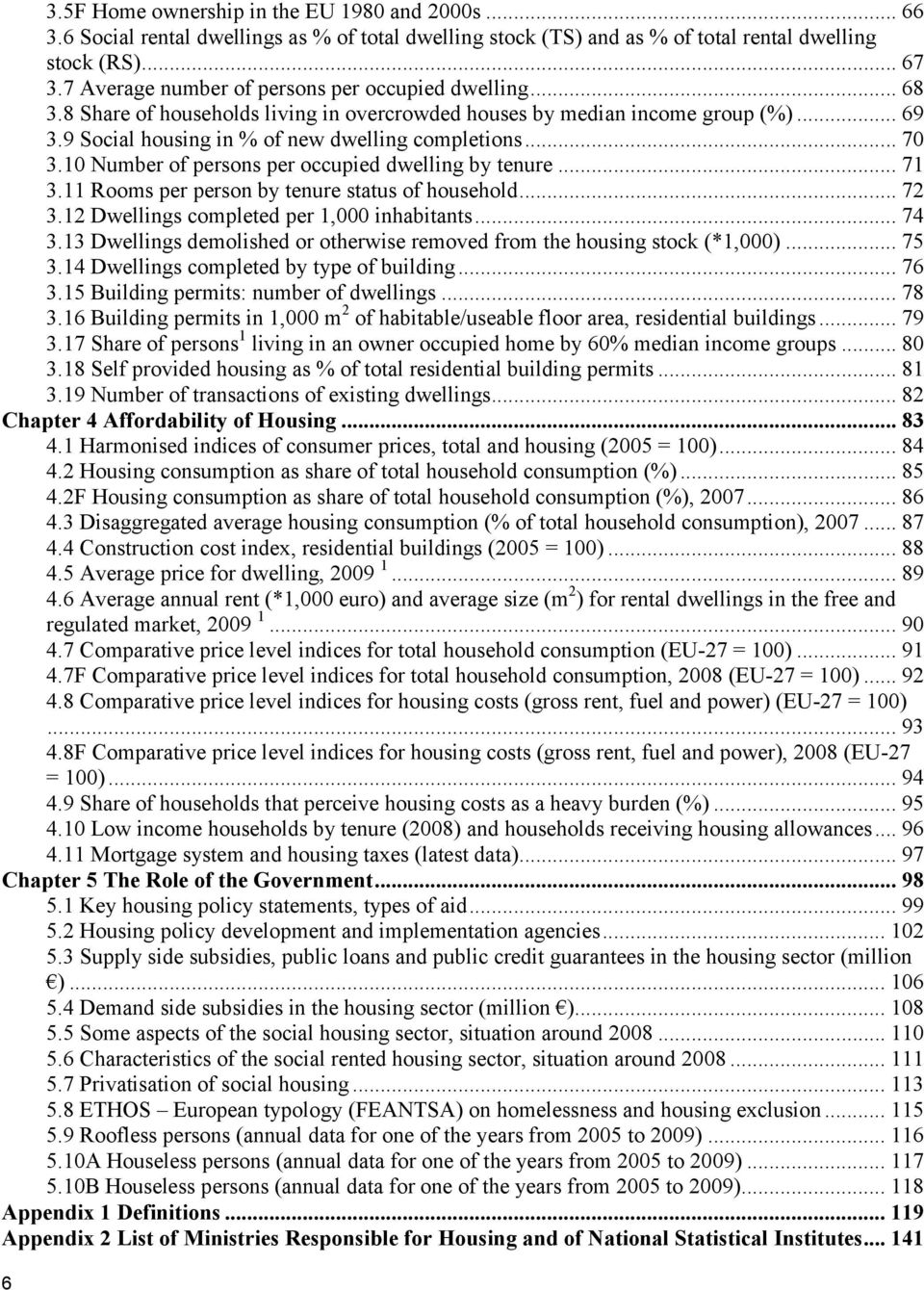
6 3.5F Home ownership in the EU 1980 and 2000s Social rental dwellings as % of total dwelling stock (TS) and as % of total rental dwelling stock (RS) Average number of persons per occupied dwelling Share of households living in overcrowded houses by median income group (%) Social housing in % of new dwelling completions Number of persons per occupied dwelling by tenure Rooms per person by tenure status of household Dwellings completed per 1,000 inhabitants Dwellings demolished or otherwise removed from the housing stock (*1,000) Dwellings completed by type of building Building permits: number of dwellings Building permits in 1,000 m 2 of habitable/useable floor area, residential buildings Share of persons 1 living in an owner occupied home by 60% median income groups Self provided housing as % of total residential building permits Number of transactions of existing dwellings Chapter 4 Affordability of Housing Harmonised indices of consumer prices, total and housing (2005 = 100) Housing consumption as share of total household consumption (%) F Housing consumption as share of total household consumption (%), Disaggregated average housing consumption (% of total household consumption), Construction cost index, residential buildings (2005 = 100) Average price for dwelling, Average annual rent (*1,000 euro) and average size (m 2 ) for rental dwellings in the free and regulated market, Comparative price level indices for total household consumption (EU-27 = 100) F Comparative price level indices for total household consumption, 2008 (EU-27 = 100) Comparative price level indices for housing costs (gross rent, fuel and power) (EU-27 = 100) F Comparative price level indices for housing costs (gross rent, fuel and power), 2008 (EU-27 = 100) Share of households that perceive housing costs as a heavy burden (%) Low income households by tenure (2008) and households receiving housing allowances Mortgage system and housing taxes (latest data) Chapter 5 The Role of the Government Key housing policy statements, types of aid Housing policy development and implementation agencies Supply side subsidies, public loans and public credit guarantees in the housing sector (million ) Demand side subsidies in the housing sector (million ) Some aspects of the social housing sector, situation around Characteristics of the social rented housing sector, situation around Privatisation of social housing ETHOS European typology (FEANTSA) on homelessness and housing exclusion Roofless persons (annual data for one of the years from 2005 to 2009) A Houseless persons (annual data for one of the years from 2005 to 2009) B Houseless persons (annual data for one of the years from 2005 to 2009) Appendix 1 Definitions Appendix 2 List of Ministries Responsible for Housing and of National Statistical Institutes
7 Housing Statistics in the European Union 2010 Kees Dol and Marietta Haffner Delft University of Technology Introduction This is the 12th edition of Housing Statistics. While in 1991 the first version of Housing Statistics contained information on the 12 countries of the European Community, nowadays it contains information on the 27 member states of the European Union (EU). As housing is no formal EU policy field and much housing data are not collected by Eurostat, the statistical office of the EU, the aim of this booklet is to provide easy access to relevant statistics on the housing markets in the EU-countries. These statistics will otherwise not be so simple to collect. Some of them can indeed be found in the databases of Eurostat as it offers a rich source for housing related themes like demographic and economic indicators. More detailed data on housing can be found at national statistical institutes and housing ministries who, via the internet, often provide housing data in English. A growing number of statistics on the housing and living conditions of EU households can be found on the Eurostat website, collected with the annual Eurostat survey Social Inclusion and Living Conditions (SILC). Still, the search on all these websites and documents may take some time, hence the aim of the Housing Statistics. This Housing Statistics edition is the first one since the 2005/2006-version. One reason for not publishing the data too frequently is that housing stock and demographic characteristics generally change slowly over time. The Global Financial Crisis has however had an impact on housing market data like price developments, new construction and transactions of existing dwellings. Another reason to update the housing statistics is that an overview of EU Housing data is not complete without the new member states Bulgaria and Romania. The 2010-edition contains an update of the information of the 2006-edition. As some data of the edition were no longer readily available, a couple of tables cannot return in this version. In exchange for these deletions, we (re)introduced some information with which the effect of the Global Financial Crisis on the housing markets can be monitored, such as data on house price development and building permits. The 2010-edition also contains data on homelessness which FEANTSA, the umbrella organization of the homelessness people has kindly allowed us to include. We thank FEANTSA for this. We also thank the focal points at the national ministries responsible for housing for delivering most of the other data in Housing Statistics in the European Union The first requests were sent to the focal points in March The deadline was extended to the end of July 2010, the point in time when the production of the booklet was taken in hand. 7
8 Outcomes As in the previous editions, this edition of Housing Statistics in the European Union contains too much information to describe everything in detail. In this synthesis of outcomes we focus on some important themes that affect housing markets in the European Union: demography, changes in housing stock and the Global Financial Crisis. Population People need a roof above their heads and ideally this would be a house with some minimum qualities. This objective can be traced every national policy statement on housing by individual EU-27 governments (see Table 5.1), but the specific ambitions may vary per member state. The relation between demography and housing need has always been evident with housing policy makers. Housing need also depends on population size and household composition. Housing Statistics in the European Union 2010 provides some insights in past and future demographic development. Demographic developments have varied strongly within the EU in the past decades. In the last decades population declined in a couple of Eastern European member states. Fertility is low in these countries while also emigration plays a role. In the Western European countries population has grown at different rates. Some of the largest nations like Germany, Italy and France experienced a much lower rate of population growth after 2000 than before 2000 (Table 1.1). Other Western European countries are also expected to experience smaller growth rates in the future. Population projections indicate ageing of the entire EU population, albeit at different rates per country (Table 1.5 and 1.6). Population decline may eventually lead to an oversupply of housing in certain nations or regions. Apart from population decline, the data indicate that households across the EU have become smaller: this is a result of more older (and thus smaller) households but also fewer children and more young single person households. While population decline might reduce housing demand (only when the number of households declines as well), the larger number of smaller households, both young and old, will counter the decline, up to some point at least. Changes in housing stock Housing stock only changes slowly in numbers and quality. Although certain countries build many tens of thousands of dwellings annually, new construction only accounts for a few percents of the existing housing stock. Hence, the quality profile of the dwelling stock changes gradually and only if new construction (and refurbishment) differs substantially from the existing stock. However, the data show new houses in general have more space in terms of square metres (and rooms) than the existing dwelling stock, so from this perspective the quality of dwellings gradually is increasing (Table 2.1). Another change in the dwelling stock in the past decades is the change in tenure form generally from renting to owning. Home ownership is now a common tenure in the EU (Table 3.5). Tenure can be changed in a relatively short timeframe because it does not need physical adaption of the dwellings. The best examples are some of the former Communist states, where vast numbers of rental dwellings were practically given away to sitting tenants. Another example of relatively rapid change can be found in Western Europe where the British Right to Buy allowed a large number of public tenants to become home owners since the 1980s. 8

9 A number of European countries now have quite a longstanding tradition of home ownership. These are the Southern European countries while in Northern Europe, Belgium and Ireland fall into this category. In other countries home ownership has experienced a substantial growth compared with the late 1970s/early 1980s. Countries with the fastest growth rates are the Netherlands and the UK. Although home ownership has increased, the (fragmented) data for Western European countries that invested heavily in social housing after WWII reveal that social/public housing still plays a role (Table 3.6). In many of these countries the market share of the social housing sector has not declined very much after 1990 (Austria, Denmark, France, Finland, and Sweden). Currently the Netherlands has the largest social housing sector by market share. However, we must take into account that the definition of social housing many times covers very different target groups. In the Netherlands and Sweden for instance official policy indicates that social/public housing is accessible to quite a broad layer of society. Housing markets and the crisis As the majority of households in the EU own a home, the growth of home ownership also resulted in an expansion of mortgage debt. Although this Introduction is not the stage for describing the process in detail that led to the current Global Financial Crisis, we might state that it is essentially a result of the marriage between mortgage markets and housing markets. Home ownership is in much demand during economic prosperity, and house price increases go hand in hand with economic growth. Steep increases in house prices may even attract many speculative buyers. Evidence indeed reveals that many countries experienced substantial GDP per capita growth (Table 1.16), while prices in the owner occupied sector boomed in the mid 2000s 1. In many countries the residential construction industry also fared well with the higher demand for dwellings, most notably in Ireland, Spain and Cyprus (see Tables 1.20 and 3.15). Also transactions, the sales of existing owner occupied dwellings, reached high levels in the years leading up to the crisis (Table 3.19). As the crisis definitively unfolded with the fall of the Lehman Brothers investment bank in the second half of 2008, house price increases came to a halt, while new residential construction and transactions of existing dwellings were severely affected in many countries. However, individual national housing markets reacted differently to the crisis. In some nations house prices, residential construction and transactions dropped, while in other countries the data suggest a limited impact. It is still too early to establish whether the latter housing markets will be impacted with some delay or whether for some reason they will never be affected substantially. It is thus impossible to put all countries in one box. 1 In the previous version of Housing Statistics, the table with house price development was abandoned, obviously due to limited data availability. In the next version of Houaing Statistics it may be worthwhile to include house price development data again. The annual publication Hypostat by the European Mortgage Federation and publications like Philip Arestis, Peter Mooslechner and Karin Wagner (2010) Housing Market Challenges in Europe and the United States, published by Palgrave MacMillan, reveal that many countries have series of data, although often limited to parts of the housing stock or specific regions /cities. 9

10 10

11 Structure of the Report The content of this report is structured in the following way. Chapter 1 General data presents a range of general data on the demographic and socio-economic context of housing. Chapter 2 Quality of the housing stock deals with the quality of the housing stock, concentrating on the average useful floor area, amenities and age of the housing stock. Chapter 3 Availability of housing is devoted to the availability of housing, including the distribution of different types of housing by tenure. Chapter 4 Affordability of housing looks at the affordability of housing and illustrates the weight of housing in household budgets, the different indexes which offer an overview of the changes in the cost of housing, and trends in mortgage lending. Chapter 5 The role of government focuses on the role of government and of state intervention in the housing market, paying particular attention to public expenditure on housing and to the existence and characteristics of social housing. Because the content of the concepts used in the various tables may vary between countries, Appendix 1 offers an overview of how Member States as well as international organizations define these concepts. Appendix 2 presents a list of the national ministries responsible for housing and of national statistical institutes, without whom this report would not have been possible. 11
12 12

13 List of Abbreviations Countries AT Austria BE Belgium BG Bulgaria CY Cyprus CZ Czech Republic DE Germany (FRG = Federal Republic of Germany = former West Germany, GDR = German Democratic Republic = former East Germany) DK Denmark EE Estonia ES Spain FI Finland FR France GR Greece HU Hungary IE Ireland IT Italy LT Lithuania LU Luxembourg LV Latvia MT Malta NL Netherlands PL Poland PT Portugal RO Romania SE Sweden SI Slovenia SK Slovak Republic UK United Kingdom (GB = Great Britain = UK excl. the Channel Islands and the Isle of Man) EU European countries which have joined Europe before 2004 (AT, BE, DK, FI, FR, DE, GR, IE,IT, LU, NL, PT, ES, SE, UK) EU-10 European countries which have joined Europe after 2004 (CY, CZ, EE, HU, LV, LT, MT, PL, SK, SL) EU European countries plus 10 which have joined Europe after 2004 EU-27 EU-25 plus two countries which have joined Europe from 1 January 2007 (BG and RO) Symbols na not available blank space From the Housing Statistics 2010 version the editors have used blank spaces if the countries did not provide data and did not explicitly state that these data were unavailable. nap not applicable p provisional value b break in series 13

14 14

15 Chapter 1 General Data 15

16 16

17 1.1 Population (*1,000), 1 January Change (%) Austria 7,546 7,563 7,645 7,944 8,002 8,201 8,355 p 10.7% Belgium 9,855 9,858 9,948 10,131 10,239 10,446 10, % Bulgaria 8,191 7,761 7,607 p Cyprus % Czech Republic 10,316 10,334 10,362 10,333 10,278 10,221 10, % Denmark 5,122 5,111 5,135 5,216 5,330 5,411 5, % Estonia 1,472 1,523 1,571 1,448 1,372 1,348 1, % Finland 4,771 4,894 4,974 5,099 5,171 5,237 5,326 p 11.6% France 53,731 55,157 56,577 57,753 60,545 62,773 64,351 p 19.8% Germany 78,180 77,709 79,113 81,539 82,163 82,501 82,002 p 4.9% Greece 9,584 9,920 10,121 10,595 10,904 11,083 11,260 p 17.5% Hungary 10,709 10,657 10,375 10,337 10,222 10,098 10,031 p -6.3% Ireland 3,393 3,544 3,507 3,601 3,778 4,109 4,450 p 31.2% Italy 56,388 56,588 56,694 56,844 56,924 58,462 60, % Latvia 2,509 2,570 2,668 2,501 2,382 2,306 2, % Lithuania 3,404 3,529 3,694 3,643 3,512 3,425 3, % Luxembourg % Malta p 28.1% Netherlands 14,091 14,454 14,893 15,424 15,864 16,306 16, % Poland 35,413 37,063 38,038 38,581 38,654 38,174 38,136 p 7.7% Portugal 9,714 10,009 9,920 10,018 10,195 10,529 10, % Romania 22,133 22,687 23,211 22,712 22,455 21,659 21, % Slovak Republic 4,963 5,145 5,288 5,356 5,399 5,385 5, % Slovenia 1,893 1,949 1,996 1,990 1,988 1,998 2, % Spain 37,242 38,353 38,826 39,343 40,050 43,038 45, % Sweden 8,303 8,343 8,527 8,816 8,861 9,011 9,256 p 11.5% United Kingdom 56,285 56,596 57,459 57,944 58,785 60,060 61, % EU , , ,724 p For definitions see Appendix 1 Source: Eurostat (tps00001) 17

18 1.1F Population change (%), Latvia Estonia Hungary Romania Lithuania Czech Republic Germany Italy Slovenia Denmark Poland Slovak Republic Belgium Portugal United Kingdom Austria Sweden Finland Netherlands Greece France Spain Malta Ireland Luxembourg Cyprus -20% -10% 0% 10% 20% 30% 40% 50% 60% Source: Eurostat 18

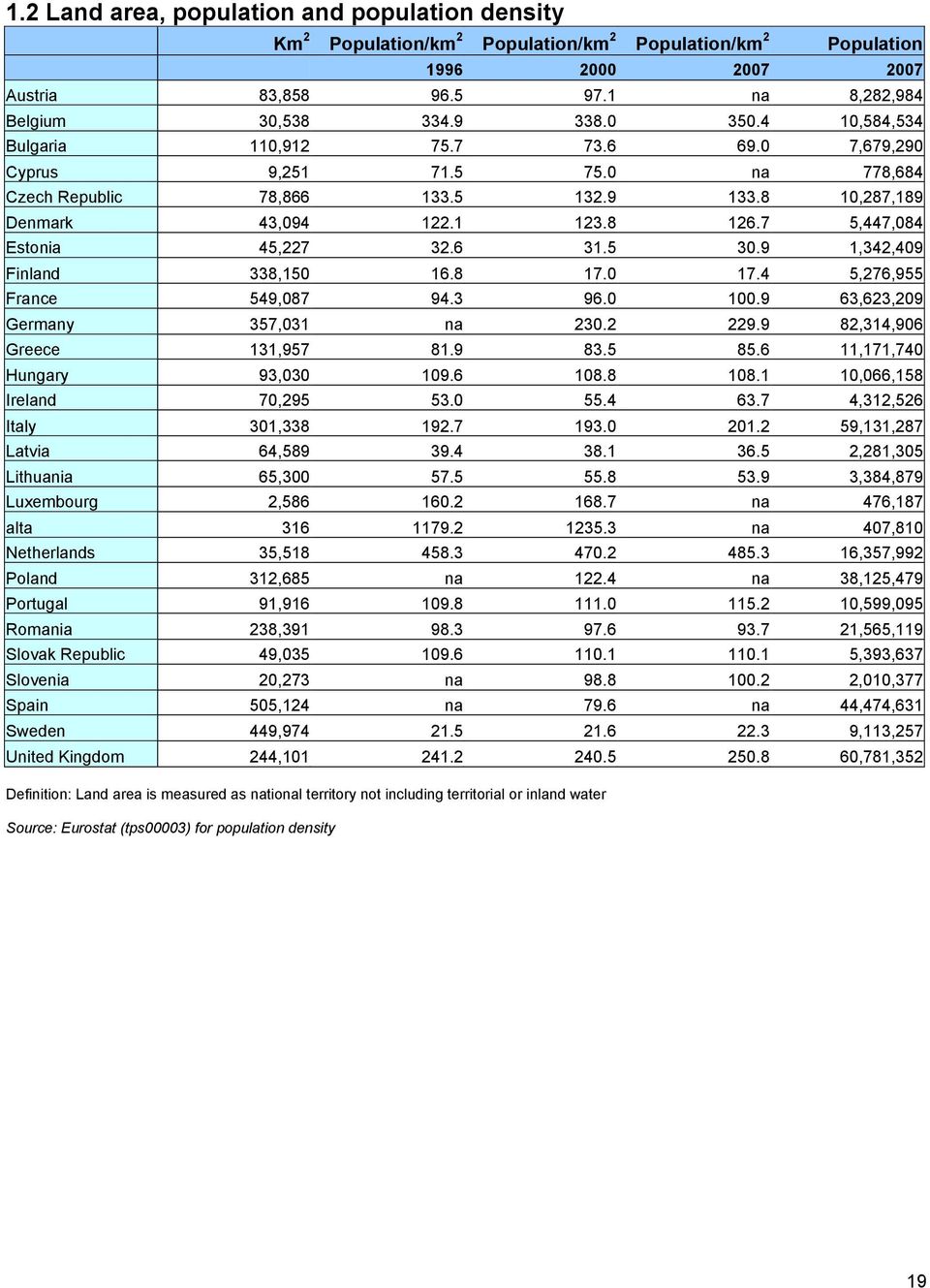
19 1.2 Land area, population and population density Km 2 Population/km 2 Population/km 2 Population/km 2 Population Austria 83, na 8,282,984 Belgium 30, ,584,534 Bulgaria 110, ,679,290 Cyprus 9, na 778,684 Czech Republic 78, ,287,189 Denmark 43, ,447,084 Estonia 45, ,342,409 Finland 338, ,276,955 France 549, ,623,209 Germany 357,031 na ,314,906 Greece 131, ,171,740 Hungary 93, ,066,158 Ireland 70, ,312,526 Italy 301, ,131,287 Latvia 64, ,281,305 Lithuania 65, ,384,879 Luxembourg 2, na 476,187 alta na 407,810 Netherlands 35, ,357,992 Poland 312,685 na na 38,125,479 Portugal 91, ,599,095 Romania 238, ,565,119 Slovak Republic 49, ,393,637 Slovenia 20,273 na ,010,377 Spain 505,124 na 79.6 na 44,474,631 Sweden 449, ,113,257 United Kingdom 244, ,781,352 Definition: Land area is measured as national territory not including territorial or inland water Source: Eurostat (tps00003) for population density 19
20 1.2F Population Density (per km 2 ), AT, CY, LU, PL, ES = 2000; Malta not included in map, value = 1,235 Source: Eurostat (tps00003) for population density (figures are rounded) 20

21 1.3 Population projection (*1,000) and change (%) Change (%) Austria 8,405 8,570 8,723 8,988 9,122 9,127 9% Belgium 10,784 11,070 11,322 11,745 12,033 12,194 13% Bulgaria 7,564 7,382 7,188 6,753 6,330 5,923-22% Cyprus ,072 1,167 1,251 52% Czech Republic 10,394 10,497 10,543 10,420 10,158 9,892-5% Denmark 5,512 5,591 5,661 5,808 5,882 5,895 7% Estonia 1,333 1,323 1,311 1,267 1,221 1,181-11% Finland 5,337 5,429 5,501 5,569 5,521 5,448 2% France 62,583 64,203 65,607 67,982 69,898 71,044 14% Germany 82,145 81,858 81,472 80,152 77,821 74,491-9% Greece 11,307 11,476 11,556 11,573 11,567 11,445 1% Hungary 10,023 9,964 9,893 9,651 9,352 9,061-10% Ireland 4,614 5,052 5,404 5,881 6,221 6,531 42% Italy 60,017 60,929 61,421 61,868 62,002 61,240 2% Latvia 2,247 2,200 2,151 2,033 1,913 1,804-20% Lithuania 3,337 3,275 3,220 3,083 2,912 2,737-18% Luxembourg % Malta % Netherlands 16,503 16,717 16,896 17,208 17,226 16,909 2% Poland 38,092 38,068 37,960 36,975 35,219 33,275-13% Portugal 10,723 10,947 11,108 11,317 11,452 11,449 7% Romania 21,334 21,103 20,834 20,049 19,161 18,149-15% Slovak Republic 5,407 5,427 5,432 5,332 5,115 4,859-10% Slovenia 2,034 2,053 2,058 2,023 1,958 1,878-8% Spain 46,673 49,381 51,109 52,661 53,290 53,229 14% Sweden 9,306 9,588 9,853 10,270 10,470 10,672 15% United Kingdom 61,984 63,792 65,683 69,224 72,009 74,506 20% EU , , , , , ,303 3% Source: Eurostat Europop
22 1.3F Forecasted population change (%), Bulgaria Latvia Lithuania Romania Poland Estonia Slovak Republic Hungary Germany Slovenia Czech Republic Malta Greece Italy Finland Netherlands Portugal Denmark Austria Belgium France Spain Sw eden United Kingdom Luxembourg Ireland Cyprus -30% -20% -10% 0% 10% 20% 30% 40% 50% 60% Source: Eurostat 22
23 1.4 Population by age (%), 1 January, 2009 <15 years years years years years 80+ years years >64 years Total*1,000 Austria ,355 Belgium ,750 Bulgaria ,607 Cyprus Czech Republic ,468 Denmark ,511 Estonia ,340 Finland ,326 France ,351 Germany ,002 Greece ,260 Hungary ,031 Ireland ,450 Italy ,045 Latvia ,261 Lithuania ,350 Luxembourg Malta Netherlands ,486 Poland ,136 Portugal ,627 Romania ,499 Slovak Republic ,412 Slovenia ,032 Spain ,828 Sweden ,256 United Kingdom ,635 EU ,724 1 = 1 January 2008 Source: Eurostat 23
24 1.4F Dependent population < 15 years and > 64 years (% of total population), 2009 Slovak Republic Poland Czech Republic Cyprus Malta Romania Slovenia Bulgaria Latvia Lithuania Hungary Spain Ireland Luxembourg Estonia Austria Netherlands Portugal Greece Finland United Kingdom Belgium Germany Italy Denmark Sweden France Source: Eurostat 0,0 5,0 10,0 15,0 20,0 25,0 30,0 35,0 40,0 <15 years >64 years 24
25 1.5 Population forecast by age (%), 1 January 2030 <15 years years years years years 80+ years years >64 years Total *1,000 Austria ,872 Belgium ,596 Bulgaria ,648 Cyprus ,055 Czech Republic ,259 Denmark ,745 Estonia ,249 Finland ,502 France ,157 Germany ,117 Greece ,392 Hungary ,500 Ireland ,787 Italy ,066 Latvia ,003 Lithuania ,041 Luxembourg Malta Netherlands ,009 Poland ,362 Portugal ,149 Romania ,710 Slovak Republic ,242 Slovenia ,992 Spain ,837 Sweden ,148 United Kingdom ,385 Source: Eurostat EUROPOP 2008 and TU Delft calculations on tables by individual age. Total does not fully add to the forecast in Table
26 1.6 Old age dependency ratio (%) Austria Belgium Bulgaria Cyprus Czech Republic Denmark Estonia Finland France na Germany Greece Hungary Ireland Italy Latvia Lithuania Luxembourg Malta Netherlands Poland Portugal Romania Slovak Republic Slovenia Spain Sweden United Kingdom EU Definition: population 65 and older / population years Source: Eurostat (tsdde510) 26
27 1.6F Old age dependency ratio (%), 2010 and 2030 Ireland Slovak Cyprus Poland Luxembourg Malta Romania Czech Netherlands Lithuania Slovenia Hungary Spain United Denmark Estonia Latvia Bulgaria Finland France Austria Belgium Portugal Sweden Greece Italy Germany ,0 5,0 10,0 15,0 20,0 25,0 30,0 35,0 40,0 45,0 50,0 Source: Eurostat 27
28 1.7 Total fertility rate Austria Belgium na 1.76 na Bulgaria na Cyprus na Czech Republic Denmark Estonia na Finland France 1.95 na Germany 1.56 na Greece Hungary Ireland Italy na Latvia 1.90 na na Lithuania Luxembourg Malta Netherlands Poland Portugal Romania Slovak Republic Slovenia Spain Sweden United Kingdom na For definition see Appendix 1 Source: Eurostat (tsdde220) 28
29 1.8 Private households (*1,000) Austria 4 2,669 2,973 3,276 3,475 3,537 3,567 3,598 Belgium 3,608 3,890 4,237 4,439 4,523 4,569 na Bulgaria Cyprus na Czech Republic 3,791 3,984 4,216 5 Denmark 6 2,062 2,265 2,434 2,488 2,517 2,530 2,548 Estonia 7 na na Finland 1,782 2,037 2,295 2,430 2,477 2,499 2,517 France 19,044 21,478 24,240 25,876 26,633 27,005 Germany 8 24,811 34,681 38,124 39,178 39,722 40,076 Greece 2,974 3,203 3,674 Hungary 3,719 3,890 3,863 3,837 3,810 Ireland 880 1,015 1,251 Italy 18,632 19,909 21,811 23,600 24,282 24,641 Latvia na na Lithuania na na 1,354 Luxembourg Malta na na na Netherlands 5,006 6,061 6,801 7,091 7,191 7,242 7,313 Poland 10,948 11,970 13,337 Portugal 2,924 3,147 3,651 Romania 7,365 7,381 7,384 Slovak Republic 1,660 1,832 2,072 na na na na Slovenia Spain 10,025 11,299 13,086 14,865 16,280 16,741 na Sweden 9 3,498 3,830 4,363 4,441 4,477 4,555 na United Kingdom ,214 24,121 24,200 25,200 Private household: The usual definitions concern the ''same address'' or sharing common arrangements such as meals and rent, see definitions in Appendix 1 1 AT, GR, IT, LU, PT, SI = 1981; FR = CZ, GR, IT, LU, PT = 1991; PL = CZ, GR, HU, IT, LU, PT = 2001; SI = Annual average 5 Housekeeping units (see Appendix 1) 6 Households in dwellings 7 Annual average estimation 8 Ex-GDR 1981 = 6,510; From 1991 onwards, reunited Germany 9 From 1995 onwards the values are for housekeeping units 10 Values are for mid-year and only for GB 2005 = 2004 Source: National Statistics Institutes CZ Population and Housing Census: , , EE HBS IT Census 1981, 1991, 2001 LU EU-SILC 2005, 2008 MT Data for provided from EU-SILC PL National Census 1978, 1988; National Population and Housing Census 2002 SK Population and Housing Census , , SI Censuses 1981, 1991 and Data for 1991 recalculated according to the 2002 Census methodology ES Encuesta Continua de Presupuestos Familiares 2000 and Encuesta de Presupuestos Familiares UK Data 2005 = 2004 Social Trends, No.40, 2010 edition, Office for National Statistics 29
30 1.9 Distribution of household size (%) 1 person 2 persons 3 persons 4 persons 5+ persons Austria Belgium Bulgaria Cyprus 10 na 22 na 17 na 26 na 25 na Czech Republic 24 na 26 na 19 na 22 na 9 na Denmark Estonia Finland France Germany Greece na na na na na Hungary Ireland Italy Latvia na 24 na na 30 na na 23 na na 15 na na 8 na Lithuania na na na na na na na na na na Luxembourg Malta Netherlands Poland Portugal Romania na na na na na Slovak Republic na na na na na Slovenia 17 na 18 na 22 na 24 na 19 na Spain Sweden United Kingdom (CY, NL = 1982; CZ, FI, HU, SK, SE = 1980; PL = 1978) 2004 (CZ, IT, PT, SK = 2001; SI = 2002) 2008 (AT, DK, FI, NL, UK = 2009; EE = 2007; FR, IT = 2006) 30
31 1 Annual average, private households 2 Households in dwellings 3 3 and 4 persons combined = Ex-FRG; from 2004 = Reunited Germany 5 Private households 6 Data for GB Source: National statistical institutes CZ Population and Housing Census: and EE HBS 1996 GR Population Census 2001 HU 1980 Census and 2005 Micro Census IT Population and Housing Census 2001 LT 2001 Population and Housing Census data MT 1981 = 1985 Census PL National Census 1978; National Population and Housing Census 2002 RO Family Budgets Survey 2008 SI Census 2002 ES Census Encuesta Continua de Presupuestos Familiares Encuesta de Presupuestos Familiares 2008 SE 1981 Census UK Data 2004: Social Trends, No.36, 2006 edition, Office for National Statistics; 2009: Social Trends, No.40, 2010 edition, Office for National Statistics 31
32 1.9F Distribution of household size %, Sw eden Finland Germany Denmark Netherlands Austria France Belgium Estonia United Kingdom Luxembourg Hungary Italy Slovak Republic Poland Latvia Ireland Greece Malta Spain Romania Portugal 0% 10% 20% 30% 40% 50% 60% 70% 80% 90% 100% 1 GR, HU, IE, LV, PL, PT, SK = 2004 No recent data available for BG, CY, CZ, LT, SI and more 32
33 1.10 Average number of persons per household Austria Belgium 2.7 na na na Bulgaria Cyprus Czech Republic Denmark Estonia na na Finland France Germany na Greece Hungary Ireland Italy Latvia na na Lithuania na na 2.6 Luxembourg Malta 9 na na na Netherlands Poland Portugal Romania Slovak Republic na na na na Slovenia Spain na Sweden na United Kingdom For definitions of households, see Appendix 1. There are two slightly different concepts here, the dwelling household and the housekeeping unit. We cannot always be sure which concept is being used in practice in each particular case. Compare also Table BE, GR = 1981; CY, FR = 1982, PL = CY = 1992; CZ, GR, LU, SK = 1991; PL = CZ, GR, SK, ES = 2001; FR = 1999; PL = IE, GR, UK = Population = Total of households and institutional population; 2005 and later only private households 6 Population = Total of households and institutional population, years 1982 and From 1991 onwards, reunited Germany 8 Population = Total of households and institutional population, years 1981, 1991 and = LFS estimate onwards: Private households only Source: National statistical institutes AT 2004 Austria Labour Force Census Statistics, IIBW CZ Population and Housing Census: , , GR Households Budget Survey 2004 IT Istat, Sample Survey on Households Consumption MT Data for from EU-SILC PL National Census 1978, 1988; National Population and Housing Census 2002 SI From population and Housing Census 1981, 1991 and Data for 1991 recalculated according to the 2002 Census methodology SK Population and Housing Census , ES Census Encuesta Continua de Presupuestos Familiares Encuesta de Presupuestos Familiares UK Data 2004: Social Trends, No.36, 2006 edition, Office for National Statistics 33
34 1.11 Immigration, emigration and net migration (*1,000) I E Net I E Net I E Net I E Net I E Net Austria na na Belgium 4 na na 30.2 na na 29.5 na na Bulgaria Cyprus na na 8.7 na na 6.0 na na 4.0 Czech Republic Denmark Estonia 91.0 na na na na na na na na na na Finland France 91.0 na na na na na na 92.2 na na 71.0 Germany Greece 7 na na 63.9 na na 77.3 na na 29.4 na na Hungary Ireland Italy Latvia Lithuania Luxembourg Malta Netherlands Poland Portugal 8 na na -39 na na 22.0 na na 47.0 na na 3.1 Romania Slovak Republic Slovenia Spain Sweden United Kingdom 10 na na Net migration (Net) = Immigrants (I) - Emigrants (E) 34
35 1. IE: 1990 = AT = 1997; BE = CZ, DK = 2009; FR = Net migration (Net) = Immigrants (I) - Emigrants (E) - automatically cancelled persons 5. Data for 1990 cover also internal migration between the Czech and the Slovak Republic (Czechoslovakia was a single state) thousand immigrants from the Slovak Republic and 7.7 thousand emigrants to the Slovak Republic. Remaining 2.3 thousand immigrants and 4.1 thousand emigrants from/to abroad 6. From October 3, 1990 onwards, reunited Germany, data for 1990 is na, instead Net migration includes natural population increase (births minus deaths); excluding immigration of Greek citizens 8. Long-term emigration for non-national citizens with residential permits. Net migration used in the calculation of population estimates, based on final results of Census 1991 adjusted by the coverage errors 9. Emigrants: Permanent, temporary and seasonal emigrants 10. Year ending in April. A migrant is defined as a person who resided abroad for a year or more and on entering has declared the intention to reside in the United Kingdom for a year or more, vice versa for a migrant from the UK. Excluding migration between the UK and the Irish Republic and also between the Channel Islands and the Isle of Man and the rest of the world with effect from 1988 Source: National statistical institutes F Office National des Migrations UK statistics for 2005 and 2008 source is 35
36 1.12 Asylum applications submitted Austria 6,724 22,789 18,285 22,460 13,350 11,920 Belgium 5,387 12,945 42,690 12,575 8,870 11,575 Bulgaria na na 1, Cyprus na na 650 7,715 4,540 6,780 Czech Republic na na 8,790 3,590 2,730 1,585 Denmark 8,698 5,292 10,345 2,280 1,960 2,225 Estonia na na Finland 18 2,743 3,170 3,595 2,275 1,405 France 28,925 54,813 38,745 49,735 30,750 29,160 Germany 73, ,063 78,565 28,915 21,030 19,165 Greece 1,400 4,100 3,085 9,050 12,265 25,115 Hungary na na 7,800 1,610 2,115 3,420 Ireland na 60 10,940 4,305 4,240 3,935 Italy 5,400 3,570 15,195 9,345 10,350 14,055 Latvia na na Lithuania na na Luxembourg Malta na na 160 1,165 1,270 1,380 Netherlands 5,644 21,208 43,895 12,345 14,465 7,100 Poland na na 4,660 5,240 4,225 7,205 Portugal Romania na na 1, Slovak Republic na na 1,555 3,550 2,850 2,640 Slovenia na na 9,245 1, Spain 2,300 8,647 7,925 5,050 5,295 7,195 Sweden 14,500 29,420 16,285 17,530 24,320 36,205 United Kingdom 6,200 38,000 80,315 30,840 28,320 27,905 1 Data for 2005, 2006 and 2007 provisional Source: Eurostat, (DS ); series runs until
37 1.13 Population by citizenship, 2008 Total Nationals EU-27 foreigners Other foreigners Austria 8,318,592 7,483, , ,440 Belgium 10,666,866 9,695, , ,025 Bulgaria 7,640,238 7,615,836 3,608 20,794 Cyprus 789, ,000 81,300 44,000 Czech Republic 10,381,130 10,033, , ,133 Denmark 5,475,751 5,177,301 93, ,284 Estonia 1,340,935 1,111,600 8, ,000 Finland 5,300,484 5,167,776 47,193 85,515 France 63,753,140 60,079,000 1,283,000 2,391,000 Germany 82,217,837 74,962,442 2,515,508 4,739,887 Greece 11,213,785 10,307, , ,100 Hungary 10,045,401 9,868, ,806 75,774 Ireland 4,401,335 3,847, , ,622 Italy 59,619,290 56,186, ,435 2,498,216 Latvia 2,270,894 1,855,401 7, ,560 Lithuania 3,366,357 3,323,423 2,669 40,265 Luxembourg 483, , ,018 28,871 Malta 410, ,830 8,188 7,272 Netherlands 16,405,399 15,717, , ,411 Poland 38,115,641 38,057,799 25,032 32,810 Portugal 10,617,575 10,171, , ,501 Romania 21,528,627 21,502,527 5,971 20,129 Slovak Republic 5,400,998 5,360,094 25,909 14,995 Slovenia 2,025,866 1,957,245 4,112 64,509 Spain 45,283,259 40,021,164 2,112,623 3,149,472 Sweden 9,182,927 8,658, , ,503 United Kingdom 61,175,586 57,154,800 1,614,800 2,406,000 Source: Eurostat (migr_pop1ctz) source data adapted by TU Delft 37
38 1.14 Population by origin (*1,000), 2009 Born in country Born in Born outside Total other EU-27 EU-27 Austria 7,078, , ,609 8,355,260 Belgium na na na na Bulgaria na na na na Cyprus na na na na Czech Republic 10,083, , ,104 10,467,542 Denmark 5,024, , ,218 5,511,451 Estonia 1,115,488 15, ,528 1,340,415 Finland 5,107,688 76, ,735 5,326,314 France 56,911,818 2,091,182 4,953,930 63,956,930 Germany 71,524,920 3,399,707 7,077,729 82,002,356 Greece 10,013, , ,170 11,260,402 Hungary na na na na Ireland 3,764, , ,318 4,450,030 Italy 55,669,828 1,391,149 2,984,091 60,045,068 Latvia 1,909,258 37, ,872 2,261,294 Lithuania 3,129,751 28, ,233 3,349,872 Luxembourg 330, ,581 31, ,500 Malta 385,920 13,519 14, ,607 Netherlands 14,692, ,129 1,383,615 16,485,787 Poland 36,067, ,469 1,568,330 37,867,903 Portugal 9,844, , ,667 10,627,250 Romania na na na na Slovakia 2,132 29,982 5,391,781 5,423,895 Slovenia 1,788,903 28, ,403 2,032,362 Spain 39,488,826 2,282,149 4,057,197 45,828,172 Sweden 7,974, , ,955 9,256,347 United Kingdom 53,888,436 2,127,295 4,577,363 60,593,094 Source: Eurostat (migr_pop3ctb) 38
39 1.15 Harmonised unemployment rates % Number of unemployed (*1,000) 2009 Austria Belgium Bulgaria na Cyprus na Czech Republic Denmark Estonia Finland France Germany Greece na Hungary Ireland Italy na Latvia Lithuania Luxembourg Malta Netherlands Poland Portugal Romania na Slovak Republic Slovenia Spain Sweden United Kingdom Source: Eurostat (tsiem110 and DS ) 39
40 1.15F Harmonised unemployment rates %, 2009 Source: Eurostat (tsiem110 and DS ) 40
41 1.16 GDP per capita at current prices ( ) Austria 16,900 22,900 25,900 29,600 33,800 na Belgium na 21,400 24,600 28,900 32,200 31,300 Bulgaria 1,200 1,200 1,700 2,800 4,500 na Cyprus na 10,900 14,500 18,000 21,700 na Czech Republic na 4,100 6,000 9,800 14,200 na Denmark 20,800 26,600 32,500 38,300 42,400 40,500 Estonia na 2,000 4,500 8,300 12,000 10,200 Finland 21,900 19,600 25,500 30,000 34,700 32,000 France 16,800 20,200 23,700 27,400 30,400 na Germany na 23,600 25,100 27,200 30,400 29,400 Greece 1 na 9,500 12,600 17,600 21,300 21,100 Hungary na 3,400 5,000 8,800 10,500 9,300 Ireland na 18,100 27,600 39,100 40,900 na Italy 15,700 15,100 20,900 24,400 26,200 25,200 Latvia na 1,500 3,600 5,700 10,200 8,300 Lithuania na 1,400 3,500 6,100 9,600 8,000 Luxembourg 22,900 38,600 50,200 65,099 80,500 na Malta na 7,300 10,800 11,800 13,800 13,800 Netherlands 15,500 20,700 26,300 31,500 36,200 34,500 Poland na 2,800 4,900 6,400 9,500 na Portugal na 8,700 12,000 14,100 15,700 15,400 Romania 1,237 1,210 1,809 3,688 6,499 5,400 Slovak Republic na 2,800 4,100 7,100 12,000 11,700 Slovenia na 8,000 10,800 14,400 18,400 17,100 Spain na 11,600 15,700 20,900 23,900 22,800 Sweden 22,500 22,000 30,000 32,600 35,400 30,800 United Kingdom 14,000 15,200 27,200 30,400 29,600 25, , 2008 and 2009 = provisional value Source: Eurostat (DS ) 41
42 1.16F GDP per capita at current prices ( ), 2008 Luxembourg Denmark Ireland Netherlands Sweden Finland Austria Belgium France Germany United Kingdom Italy Spain Cyprus Greece Slovenia Portugal Czech Republic Malta Estonia Slovak Republic Hungary Latvia Lithuania Poland Romania Bulgaria Source: Eurostat 42
43 1.17 GDP per capita in Purchasing Power Standards Austria Belgium Bulgaria Cyprus Czech Republic Denmark Estonia Finland France Germany Greece Hungary Ireland Italy Latvia Lithuania Luxembourg Malta Netherlands Poland Portugal Romania na na Slovak Republic Slovenia Spain Sweden United Kingdom EU Break in series = provisional value Source: Eurostat (tsieb010) 43
44 1.17F GDP per capita in Purchasing Power Standards (EU = 100) Luxembourg Ireland Netherlands Austria Sweden Denmark Finland United Kingdom Germany Belgium France Spain Italy Cyprus Greece Slovenia Czech Republic Malta Portugal Estonia Slovak Republic Hungary Lithuania Latvia Poland Romania Bulgaria Source: Eurostat 44
45 1.18 Gross fixed residential capital formation in housing at current prices (% of GDP) Austria Belgium na na na na na na na na na na na na na na Bulgaria na na na na na na na na na na na na na na Cyprus na na na Czech Republic na na na na Denmark Estonia na na na na Finland France Germany na na na Greece na na na Hungary na na na na Ireland na na Italy Latvia na na na na Lithuania na na na na Luxembourg na Malta na na na na Netherlands Poland na na na na Portugal na na na na na na na na na na na na na na Romania na na na na na na Slovak Republic na na na na Slovenia na na na na Spain Sweden United Kingdom na na na na Source: data 1980 through 1995 from previous Issues Housing Statistics 2000 and onwards Eurostat, calculation by TU Delft Calculation by Eurostat tables = nama_pi6_c / nama_gdp_c 45
46 1.19 At risk of poverty rate before and after social transfers Before social transfer 1 After social transfer Austria Belgium Bulgaria na na Cyprus na na na na Czech Republic na na na na Denmark na na na Estonia na na Finland na na France Germany Greece Hungary na Ireland Italy Latvia na na Lithuania na na Luxembourg Malta na na Netherlands Poland na na Portugal Romania na na Slovak Republic na na na na Slovenia na na Spain Sweden na na na : 9 12 United Kingdom The value indicates the share of persons with an equivalised disposable income, before social transfers, below the risk-of-poverty threshold, which is set at 60% of the national median equivalised disposable income (after social transfers). Retirement and survivor's pensions are counted as income before transfers and not as social transfers 2. The value indicates the share of persons with an equivalised disposable income below the risk-of-poverty threshold, which is set at 60% of the national median equivalised disposable income (after social transfers) 3. Break in series Source: 1995 = Eurostat as in Housing Statistics in the EU 2006 Source: 2000, 2005 and 2008 = Eurostat (tsisc020 and tsisc030) 46
47 1.20 Most recent and forthcoming censuses and national housing condition survey Most recent Forthcoming Most recent housing Forthcoming housing census/sample census/sample condition survey condition survey Austria 15 May Belgium (Flanders region) 2005 (wallon region) Bulgaria Cyprus 1 October Not planned Czech Republic 1 March na Denmark 1 1. January January Estonia 21 March Finland 31 December December December December 2010 France No More Germany Greece 1 17 March Hungary 1 February na Ireland ca 2011 Italy 21 October October Latvia 31 March Lithuania Luxembourg 15 February 2001 February February 2001 February 2011 Malta Still to be decided Netherlands Poland 20 May Portugal 12 March March Romania Slovak Republic 26 May Not planned Slovenia 3 31 March na na Spain Sweden United Kingdom na 1. DK: Combination of Building and Dwelling register and Central Population Register; FR: General Population Census; DE Zusatzerhebung zum mikrosensus; GR: National Population and Housing Census. Population sample surveys are held halfway trough each decade; ES: Population Census and Housing Census 2. Continual census from Some content will be included in SILC survey 4. Seperate, but similar censuses in England, Wales, Scotland and Northern Ireland Source: National statistical institutes, Ireland: Department of the Environment, Heritage and Local Gorvernment 47
48 48
49 Chapter 2 Quality of the Housing Stock 49
50 50
51 2.1 Average useful floor area per dwelling and per person (m 2 ) Year Total dwelling stock (m 2 /dwelling) Year Dwellings completed (m 2 /dwelling) Year Occupied dwelling stock (m 2 /person) Austria Belgium na Bulgaria Cyprus - na na Czech Republic Denmark Estonia Finland France Germany Greece Hungary Ireland Italy Latvia Lithuania Luxembourg Malta na Netherlands Poland Portugal na Romania Slovak Republic Slovenia Spain Sweden United Kingdom See list of definitions "Floor area: useful" in Appendix 1 1 Main residencies only (Micro census) 2 Permanently occupied dwellings only 3 Dwellings is used for dwellings built after Private building activity, new dwellings and approvals according to permits issued for new dwellings and extensions 5 Estimate 6 Including primary and secondary residences 7 The figures refer to England, not the UK 8 Figures are for households - i.e. they do not include vacant dwellings Source: National statistical institutes CZ and SK Population and Housing Census 2001 DK Housing Census 2009 FR Enquête logement INSEE 2006 GR Population and Housing Censuses IE Department of the Environment, Heritage and Local Government LU Housing Observatory - Ministry of Housing; estimation from EU-SILC 08 data and "Statistique des Logements Achevés" 2007 from Statec ES EPF 51
52 2.2 Average number of rooms per dwelling and per new dwelling Year Total dwelling stock Year Dwellings completed Austria Belgium Bulgaria Cyprus Czech Republic Denmark Estonia Finland France Germany Greece Hungary Ireland Italy Latvia Lithuania Luxembourg Malta na Netherlands Poland Portugal Romania Slovak Republic Slovenia Spain Sweden United Kingdom Definitions differ between countries (see the entries for ''room'' in Appendix 1) and the most important difference is how the kitchen is treated. Many countries use a definition that includes a minimum number of square metres and this also affects whether or not a kitchen is counted. In the following countries a kitchen is always or at least usually not counted as a room: Austria, Czech Republic, Denmark, France and Lithuania 1 Main residences, includes kitchen (4 m2 or more) 2 Permanently occupied dwellings only 3 Including kitchen 4 Dwellings built after Total stock of 'conventional' dwellings 6 Estimate 7 Occupied dwellings, kitchen not included 8 Mainland only 9 England: not the UK Source: National statistical institutes CZ and SK Population and Housing Census GR Census 2001 FR Enquête logement 2006, INSEE IE Department of the Environment, Heritage and Local Government LU Housing Observatory - Ministry of Housing MT Census of Population and Housing 2005 ES EPF 52
53 2.3 Bath/shower, hot running water and central heating in total dwelling stock (as % of dwelling stock) Year Bath/shower Year Hot running water Year Central heating Austria na Belgium Bulgaria Cyprus na Czech Republic Denmark na Estonia Finland France Germany - na - na Greece na Hungary Ireland na Italy Latvia Lithuania Luxembourg Malta Netherlands Poland Portugal na Romania Slovak Republic Slovenia na Spain 2008 na Sweden United Kingdom See ''equipment of dwellings'' in Appendix 1 1 Main residences 2 (Permanently) occupied dwellings 3 Can include categories like district heating, central/zone heating and self-contained central heating 4 Availability of water heater or solar water heater 5 Excluding air conditioning stand alone units 6 The figures refer to England, not the UK Source: National statistical institutes CZ and SK Population and Housing Census 2001 DK Housing Census 2009 FR Enquête logement 2006, INSEE GR 2001 Housing Census LU Housing Observatory - Ministry of Housing; estimation from EU-SILC 08 RO 2002 Housing Census, 2008 Family Budget Survey ES EPF 53
54 2.4 Age distribution of housing stock Year < > 2000 Austria Belgium Bulgaria Cyprus na Czech Republic Denmark Estonia Finland France Germany Greece na Hungary Ireland Italy Latvia Lithuania Luxembourg Malta Netherlands Poland Portugal Romania Slovak Republic Slovenia Spain Sweden United Kingdom / na na Dwellings classified by the period in which the construction of the building containing them was completed. 1 (Permanently) occupied dwellings , , Estimate 4 From 1981 and onwards 5 Difference of percentage totals 100% due to unknown age of stock 6 < 1945 covers convential dwellings 7 < 1919, , , , , > <1915, , , , , , > <1919, , , , , , > <1944, , , , , > <1919, , , , , > <1920, , , , , > <1906, , , , , , > <1918, , , , , > <1910, , , , , , > Data include holiday dwellings 17 Main residences only: <1920, , , , , <1919, , , , >1984 Source: National statistical institutes CZ Population and Housing Census 2001 DK Housing Census 2009 FR Enquête logement 2006 GR Housing Census 2001 MT Census of Population and Housing 2005 ES Censo de poblacion y viviendas
55 2.5 Dwellings in multi-family building in 2009 / high-rise residential buildings in 2004 Austria Share of multi-family and high-rise dwellings in total dwelling stock Multi-family dwellings (%) 1 High-rise dwellings (%) Belgium Bulgaria Cyprus na na Czech Republic Denmark Estonia 70.3 na Finland France Germany Greece 40.6 na Hungary Ireland 8.6 na Italy Latvia 71.4 na Lithuania 61.2 na Luxembourg Malta na na Netherlands Poland Portugal Romania na na Slovak Republic Slovenia Spain Sweden 54.6 na United Kingdom 'High-rise dwellings'' are dwellings in residential buildings that contain several dwellings and have more than four storeys 1. CZ, HU, LU, PL, SK, ES = 2004; FR= 2006; IT, PT, ES, SE = The share of multi-family dwellings in this table is not comparable to the figures in Table 3.1 Two-dwelling buildings are not included in Table 2.5 but they are included in multi-family buildings in Table 3.1 for Germany and Slovenia. For Spain the figures in Table 2.5 refer to the whole dwelling stock but in Table 3.1 they refer to principal dwellings 3. Permanently occupied dwellings only Source: Sustainable Refurbishment of High-Rise Residential Buildings and Restructuring of Surrounding Areas in Europe, Commissioned by: Ministery of Housing, Spatial Planning and the Environment, Netherlands: To: PRC Bouwcentrum Int. Environment, Netherlands DK Statistics Denmark and BBR FR Enquête logement 2006 HU Hungarian Housing Conditions Survey 2003 ES Encuesta de Presupuestos Familiares. Instituto Nacional de Estadística SK Population and Housing Census
56 56
57 Chapter 3 Availability of Housing 57
58 58
59 3.1 Types of accomodation also included in dwelling stock in Table 3.2 Summer Second Collective Hotels Caravans Ships Vacant Nonor winter homes homes dwellings permanent homes Austria habitation Belgium Bulgaria Cyprus Czech Republic Denmark Estonia Finland France Germany Greece Hungary Ireland Italy Latvia Lithuania Luxembourg Malta Netherlands Poland Portugal Romania Slovak Republic Slovenia Spain Sweden United Kingdom (+) Yes; (-) No 1 Refers to Censuses 1981, 1991 and In "main residences" none of the categories is included. 2 Only summer or winter homes that are occupied are included in dwelling stock 3 Non-permanent habitation only includes caravans, garages and cellars 4 National Census of Population and Dwellings, 2002 Source: National statistical institutes IE Department of the Environment, Heritage and Local Government LU Housing Observatory - Ministry of Housing SK Population and Housing Census
60 3.2 Dwelling stock by type of building (*1,000) T MF OF T MF OF T MF OF T MF OF T MF OF Austria 6 7 3,052 1,573 1,479 3, ,693 3,858 1,977 1,881 3,429 1,734 1,695 3,598 1,854 1,744 Belgium 3,811 na na 3,882 na na na na na 4,820 na na 5,043 1,430 3,613 Bulgaria na na na na na na na na na na na na Cyprus na na na na na Czech Republic 9 3,495 1,890 1,605 3,706 2,181 1,525 3,828 2,196 1,632 na na na na na na Denmark 2, ,197 2, ,381 2,726 1,000 1,467 2,778 1,028 1,513 2,680 1,087 1,594 Estonia 519 na na 647 na na 622 na na na na Finland 1,838 1, ,210 1, ,512 1,498 1,014 2,572 1,583 1,052 2,784 1,659 1,126 France 24,717 10,957 13,760 26,976 11,721 15,255 28,221 12,281 15,940 29,495 12,734 16,761 31,264 13,642 17,622 Germany ,406 na na 26,327 18,575 7,752 37,630 27,227 10,402 38,587 27,675 10,912 39,268 27,962 11,306 Greece 3,999 na na 4,652 na na 5,465 na na na na na na na na Hungary 3,542 na na 3,853 na na 4,043 1,674 2,369 4,134 na na 4,303 Ireland 901 na na 1,162 na na 1,406 na na 1,619 na na Italy na na na na na na 27,269 20,367 6,902 na na na Latvia 772 na na , Lithuania na na na 1,159 na na 1,356 na na 1,292 na na 1,308 Luxembourg na na na na na na na na na Malta 107 na na na na na 127 na na na na na 139 Netherlands 4,849 na na 5,892 na na 6,651 na na 6,810 1,968 4,842 7,107 2,059 5,047 Poland 9,794 na na 11,022 na na 11,845 na na 12,683 na na 13,150 Portugal na na na na na na 5,005 na na 5,318 na na 5,537 Romania na na na 8,006 na na 7,908 na na 8,176 na na 8,329 Slovak Republic , , , ,711 na na 1,767 Slovenia 11 na na na 695 na na na na Spain 11 1,458 na na 1,722 na na 14,184 9,777 4,407 na na na 25,129 Sweden 6 3,670 2,043 1,626 4,045 2,171 1,874 4,294 2,331 1,963 4,380 2,382 1,997 4,503 2,461 2,042 United Kingdom 21,517 na na 23,383 na na 25,283 na na 23,500 na na T = Total, MF = Multi-family and OF = One-family See the definitions in Appendix 1, Particular attention should be paid to how secondary homes and vacant dwellings are treated in different countries. See also Table 3.1. The concept of onefamily is defined to include detached, semi-detached and row houses. However, in a few cases the concept may have been interpreted literally so that the statistics provided are for detached houses 60
61 1. AT = 1981; FR = AT, CZ = 1991; CY, FR = AT, CY, CZ, IT, HU, SK = 2001; IT, FR, SI, ES = AT, BE, LV, LT, PT = FR, PT = 2006; LV, LU PL, RO SK, SE = 2008; MT = OF = Buildings with one or two dwellings 7. Occupied dwellings 8. One-family includes single house/dwelling and back yard houses. Multi-family includes semi detached or doublet dwellings, row houses, apartment blocks and dwellings in partly residential buildings 9. Permanently occupied dwellings; Multi-family: Block of flats including other buildings. One-family: Family house - may have up to three individual dwellings, up to two over-ground levels and one under-ground level and an attic 10. Includes Ex-GDR since The share of multi-family dwellings in this table is not comparable to the figures in Table 2.5. Two-dwelling buildings are included in Multi-family buildings in Table 3.1 but they are not included in Multi-family buildings in Table 2.5 for Germany and Slovenia. For Spain the figures in Table 3.1 year 2002 refer to principal dwellings but in Table 2.5 they refer to the whole dwelling stock 12. Year expert estimate Source: National statistical institutes and UN/ECE CZ Data 1980, 1991 and 2001: Population and Housing Census: , , DK Housing Census FR: Enquêtes logement IT Data 2001: Census 2001 LU Data 2004 and 2008: estimation - EU-SILC 2004 and 2008 MT Data 2005: Census of Population and Housing 2005 SK Data 1980, 2001: Population and Housing Census: , ES Data 2009: Ministerio de Vivienda UK Data 2004: Social Trends, No.36, 2006 edition, Office for National Statistics 61
62 3.3 Dwellings per 1,000 inhabitants Austria Belgium Bulgaria Cyprus Czech Republic Denmark Estonia Finland France Germany Ex-GDR Greece na na Hungary Ireland Italy Latvia Lithuania na Luxembourg Malta 297 na Netherlands Poland Portugal 349 na Romania na Slovak Republic Slovenia na na 358 Spain Sweden United Kingdom See the definitions of dwelling stock in Appendix 1. Particular attention should be paid to how secondary homes and vacant dwellings are treated in different countries. See also Table 3.1 'Principal dwelling': Dwellings that are usually occupied most of the year 1 GR, IT, LU, PT = FR = 1992; IT = CY, FR = 2002; GR, HU, IT = 2001; PT = FR = AT, DK, EE, FI, HU, NL = Inhabitants in main residence only 7 Occupied dwellings only; housing census 8 Dwelling units in buildings with housing space. Includes Ex-GDR since Dwelling stock is defined as the total number of conventional (permanent) habitable residential buildings whether occupied or not Source: National statistical institutes IE Department of the Environment, Heritage and Local Government LU Housing observatory - Ministry of Housing. Estimation from Statec, EU-SILC 2004 and 2008 inquiry PL Data 2001: National Census of Population and Dwellings SK Data 1980, 1991, 2001: Population and Housing Census: , , ES Dwelling stock: Housing Census 1981, 2001; 1990: estimate. Source 2005 and 2008 Minisiterio de vivienda y Cifras oficiales de poblacion (Padron municipal) UK Data 2004: Social Trends, No. 36, 2006 edition, Office for National Statistics 62
63 3.4 Vacant conventional dwellings (% of total dwelling stock) Around 2000 % Around 2009 % Austria na - na - Belgium na - na - Bulgaria na - na - Cyprus na - Czech Republic na - Denmark Estonia Finland France Germany Greece na - Hungary na - Ireland na - Italy na - Latvia Lithuania na - Luxembourg Malta na - Netherlands Poland na - Portugal na - Romania na - na - Slovak Republic Slovenia na - Spain na - Sweden United Kingdom na - Second dwellings should be excluded. However, in practice, some countries may include them, which may help to explain some high values See also the definitions of ''dwelling: vacant'' in Appendix 1 1. Conventional dwellings that were not occupied as usual residence. Including available dwellings to become usual residence, second houses and for demolition 2. Excluding Ex-GDR 1993; including Ex-GDR Including second, vacancy and abandoned homes 4. Secondary dwellings included 5. Unoccupied dwellings intended for permanent occupancy and temporary and seasonal occupancy, so called second dwellings. 6. Dwellings ready to be rented. Rental multi-family dwellings 7. The figures refer to England (1 April) Source: National statistical institutes CZ Population and Housing Census DK Housing Census FR Recensement de la population 2006 IE Department of the Environment, Heritage and Local Government LT Population and Housing Census 2002 LU Statec MT Census of Population and Housing 2005 PL National Housing Census 2002 ES Ministerio de vivienda. Estimate of estimation SK Population and Housing Census
64 3.5 Occupied dwelling stock by tenure (%) R OO CO O R OO CO O R OO CO O R OO CO O R OO CO O Austria x x x x x 4 Belgium x x x x Bulgaria Cyprus x x x 18 na na na na na na na na Czech Republic na na na na na na na na Denmark Estonia na na na na na na na na na na na na x 0 Finland France x x x x 4 Germany x x 0 na na na na x x 0 Ex-GDR x x 0 na na na na x x 0 Greece x x x x 6 na na na na Hungary x x x x 1 Ireland x x 3 na na na na x 0 Italy x x x x x 13 Latvia na na na na x x 0 Lithuania 10 na na na na na na na na 7 91 na na na na na na na na na na Luxembourg x x x x x 1 Malta na na na na na na na na x x x 3 Netherlands x x x x x 0 Poland 11 na na na na na na na na Portugal x x x 4 na na na na na na na na Romania 12 na na na na na na na na na na na na x 1 Slovak Republic 13 na na na na Slovenia 14 na na na na na 61 x 39 na na na na 9 84 x 7 na na na na Spain x x x x x 2 Sweden United Kingdom x x x x 0 X = No cooperative sector R = Rent, 00 = Owner-occupied, CO = Cooperative and O = Other Other includes BE: (rent) free dwellings; FR: tenancy of a furnished unit, sub tenancy and free housing; FI: empty dwellings; IT: free right of user; ES: vacant or unknown dwellings 64
65 1. BE, Ex-GDR, GR, LU, PT, ES, UK = 1981; CY = 1982; FR = BE, CZ, GR, IE, PT, SK, ES = 1991; CY = 1992; DE, Ex-GDR = CY, CZ, GR, HU, IT, LU, PT, SK, SI, SE = 2001; FR = BE, DE, Ex-GDR, MT = 2002; HU = 2005; ES = AT, BE, DK, NL = 2009; EE = 2010; FR = 2006; MT = 2005, PL = BE; IE: occupied dwellings; AT: annual average; principal dwellings and 1992: Households, 2001: Conventional dwellings 8. Refers to stock statistics given in Table Excluding Ex-GDR 10. Data on occupied conventional dwellings. The tenure status of 2% of the dwellings are not indicated 11. Co-operative dwellings refer to dwellings with ownership titles. No precise estimation available on how many owner-occupied dwellings are in fact rented (black economy). Estimation by housing ministry and statistical offices that about 5% of owner-occupied stock is illegally rented. 12. Other includes dwellings with tenure status "gratuities" (without paying rent) 13. Year expert estimate 14. Other in 1991 includes rented and rent free dwellings; other in 2002 includes free of rent dwellings 15. Co-operative dwellings: Housing co-operatives based on tenant-ownership. A small fraction (<1% of total dwelling stock) consists of co-operative rental dwellings Source: National statistical institutes FR Enquête logement 2006 HU 2000 = 2001 Census IT 2000 = 2001 Census IE Department of the Environment, Heritage and Local Government LT Population and Housing Census 2001 MT Data Household Budgetary Survey 2000; Census of Population and Housing 2005 RO Family Budgets Survey_2008 SK Data : Population and Housing Census: , SL Population and Housing Census 1991, 2000 ES Ministerio de vivienda. Estimate of estimation. Principal dwellings for 'regimen de tenencia' UK Data 2004-source: Social Trends, No. 36, 2006 edition, Office for National Statistics 65
66 3.5F Home ownership in the EU 1980 and 2000s Hungary Spain Ireland Greece Italy Luxembourg United Kingdom Belgium Finland France Austria Netherlands Denmark Sweden Germany Romania Slovak Republic Estonia Slovenia Poland Latvia 0% 20% 40% 60% 80% 100% 120% era Comment: In this graph, the cooperative sectors of Denmark, Poland and Sweden have been included as owner occupied dwellings 66
67 3.6 Social rental dwellings as % of total dwelling stock (TS) and as % of total rental dwelling stock (RS) % of TS % of RS % of TS % of RS % of TS % of RS % of TS % of RS % of TS % of RS Austria 6 na na na Belgium na 18 na Bulgaria na na na na na na na na Cyprus na na na na na na na na Czech Republic na na na na na na Denmark Estonia na na na na na na Finland na 39 na France Germany 7 na na na na na na Greece Hungary na na na na na na Ireland Italy Latvia na na na na na na Lithuania na na na na na na na na Luxembourg na na na na na na na na na na Malta na na na na na na 6 28 na na Netherlands Poland 8 na na na na na na Portugal na 34 na 26 na 21 na na Romania na na na na na na na na Slovak Republic 9 na na Slovenia 10 na na na na na na 6 73 Spain na na 2 21 na na na na na na Sweden United Kingdom See list of definitions "Social housing association/organisation" and "Social versus private rental dwelling" Some general comments: GR: No public ownership. Organization for Housing Assistance To Working People has the right to operate as social landlord however, SE: semi-public, non-profit dwellings; FI: government-subsidized rental housing of municipalities and non-profit housing societies; UK: including dwellings owned by housing associations; SK social housing defined as municipal rental dwellings 1. AT, BE, PT, UK = 1981; FR = AT, BE, PT, SK = 1991; FR = 1992; IT = AT, BE, FI, PT, SK = 2001; FR = 1999; SE = DE, HU, MT = 2005; IE, FR = AT, DK, NL = 2009; FR = 2006; PL = Including communities and non-profit housing societies 7. D: 1993 (excluding Ex-DDR), 2004 (including Ex-DDR) 8. Estimates for social rental dwellings 9. Year expert estimate based on data from Statistical Office of the Slovak Republic; 10. Occupied conventional dwellings (non profit and social renting) as % of occupied rented dwellings and % of total dwelling stock (occupied and vacant) Source: National statistical institutes FR Enquête logement 2006 IE Department of the Environment, Heritage and Local Government for 2004 Census of Population 2002 IT Elaboration on Istat and Federcasa data SK Data : Population and Housing Census: , UK Data 2004: Social Trends, No. 36, 2006 edition, Office for National Statistics 67
68 3.7 Average number of persons per occupied dwelling Austria Belgium Bulgaria Cyprus na Czech Republic na Denmark Estonia na 2.1 Finland France Germany Greece na na Hungary Ireland Italy na 2.4 Latvia Lithuania na Luxembourg Malta na na Netherlands Poland Portugal na Romania na na na Slovak Republic Slovenia Spain na 2.8 Sweden United Kingdom na Compare the household concept to the one in Table 1.8. The main reason for differences between values in these two tables is that more than one household could share one dwelling. Although the concept is well defined, in practice, the total dwelling stock may be used in the calculation instead of only occupied dwellings. 1 AT, GR, LU, PT, ES = AT, GR, PT, SK, ES = 1991; DE = BE, GR, HU, PT, SK, ES = 2001; FR, DE, LU, HU = DE, MT = 2005; LT = AT, DK, EE, FI, NL = 2009; BE = 2007; FR, DE = Population in permanently occupied dwellings (household) 7 Average number of persons per total dwelling stock 8 From 1993 onwards - reunited Germany 9 Average number of persons per occupied dwelling stock; year expert estimate 10 UK: Excluding persons in communal establishments Source: National statistical institutes DK Housing Census CZ Population and Housing Census: , , FR Enquête logement 2006 LU Housing Observatory - Ministry of Housing; estimation from EU-SILC 08 MT Census of Population and Housing 2005 RO Family Budgets Survey SK Data 1980, : Population and Housing Census: , , ES Ministerio de vivienda. INE 68
69 3.8 Share of households living in overcrowded houses by median income group (%) < 60 % median income > 60% median income < 60 % median income > 60% median income Austria Belgium Bulgaria na na Cyprus Czech Republic Denmark Estonia Finland France Germany Greece Hungary Ireland Italy Latvia Lithuania Luxembourg Malta Netherlands Poland Portugal Romania na na Slovakia Slovenia Spain Sweden United Kingdom na na Source: Eurostat tables ilc_lvho05a 69
70 3.9 Social housing in % of new dwelling completions In total In total In total In rental housing In rental housing In rental housing sector sector sector sector sector sector Austria na na Belgium 25 6 na 6 na 6 Bulgaria Cyprus na na na na Czech Republic Denmark Estonia na na na na na na Finland 4 na 17 na 12 na 13 France Germany 12 3 na Greece Hungary 83 5 na na na na Ireland na 9 na 7 Italy na 2 na na na na Latvia na 1 Lithuania 0 0 na na Luxembourg na na na na Malta na na na na Netherlands Poland na 7 na 8 na 7 Portugal na na na na Romania na na na 9 na 4 Slovak Republic Slovenia na na na na Spain na 13 na 10 na 16 Sweden United Kingdom na 14 na 11 For descriptions of social housing in the different countries - see Tables 5.5 en 5.6, as well as Appendix 1 1. BE, LU, NL, PL, RO = 2008; DE = 2008; FR = Estimate 3. Completions of Limited Profit Housing Association 4. Housing starts (not completions) 5. France Germany Data based on permits new buildings and extensions (Private Building Activity) and on the work start deeds (for Workers Housing Organization's Activity intended as the Public Building Activity). 8. Year Rental dwellings by housing associations Source: Ministries responsible for housing AT Statistics Austria, IIBW FR ENL 2006 UK Data 2004 source: Social Trends, No.36, 2006 edition, Office for National Statistics 70
71 3.10 Number of persons per occupied dwelling by tenure Year Social Private Owner Cooperative Total or public rental rental occupied Dwelling stock Austria x 2.3 Belgium x 2.3 Bulgaria Cyprus x 3.1 Czech Republic Denmark Estiona - na na na x na Finland na 2.1 France x 2.3 Germany x 2.1 Greece Hungary Ireland x 3.0 Italy x 2.4 Latvia 2008 na na na x 2.4 Lithuania 2001 na na na x 2.8 Luxembourg x na Malta x 2.9 Netherlands x 2.3 Poland na Portugal 2001 na na 2.9 x 2.1 Romania 2008 na na na x 2.6 Slovak Republic 2001 na na Slovenia x 2.9 Spain x 2.8 Sweden United Kingdom x 2.3 x = Non-existent 1 Main residences 2 Social, public and private rental together 3 Social rental sector does not exist in Greece 4 Number of occupants per dwelling with another type of ownership 5 Includes dwellings rented from the Church 6 Great Britain 7 Including housing associations Source: National statistical institutes CZ and SK Population and Housing Census 2001 DK Housing census GR Population and Housing Censuses 2001 IT Elaboration on data Istat and Federcasa LU Housing Observatory - Ministry of Housing; estimation from EU-SILC 08 PL National Housing Census 71
72 3.11 Rooms per person by tenure status of household T O R T O R T O R T O R Austria Belgium na na na na na na Bulgaria Cyprus na na na na na na na na na Czech Republic na na na na na na Denmark na na na Estonia na na na na na na Finland na na na France Germany na na 2.2 na na Greece na na na na na na Hungary na na na 1.0 na na 1.0 na na 1.1 na na Ireland Italy na na na na na na Latvia na na na na na na na na na 1.2 na na Lithuania na na na na na na na na na Luxembourg Malta na na na Netherlands Poland 1.0 na na na na na 1.3 na na Portugal na na na Romania 0.9 na na 0.9 na na 1.0 na na 1.0 na na Slovak Republic 1.0 na na 1.0 n na na na na na na na Slovenia na na na na na na Spain na na na Sweden United Kingdom na na na T = total, O = owner occupied, R = rented 72
73 1 MT, SK = CZ, MT, SK = 2001; PL = EE, SE = 2004; FR = AT, HU, NL = T = Total, O = owner, R = rent and other Source: EU and 2000: Eurostat EU-10 and 2005: National Statistic Institutes CZ Population and Housing Census FR Enquêtes logement 1996, 2001 and 2006 GR Population and Housing Censuses LU = Housing Observatory, estimation from the EU-SILC Inquiry 2004 and 2008 MT Census of Population and Housing 1995, 2005; Household Budgetary Survey 2000 data PL National Census Data 2002 SK Population and Housing Censuses 1991 and
74 3.12 Dwellings completed per 1,000 inhabitants Austria Belgium Bulgaria Cyprus Czech Republic 7.9 na Denmark Estonia 9.8 na Finland France Germany na Greece Hungary Ireland Italy na na na na Latvia na na na Lithuania 8.3 na Luxembourg na na Malta 15.5 na na na na na na na na Netherlands Poland Portugal Romania na na Slovak Republic na na Slovenia 7.2 na Spain na Sweden United Kingdom Average for Data for 1991 Source: UNECE, National statistical institutes IE Department of the Environment, Heritage and Local Government LV Ministry of Regional Development and Local Governments ES Ministerio de Vivienda y Padrón municipal de habitantes(ine) 74
75 3.13 Dwellings demolished or otherwise removed from the housing stock (*1,000) Austria na na na na Belgium na na na na na Bulgaria Cyprus Czech Republic 16.0 na na na Denmark na na na na na na na na Estonia na na na na Finland na na na na na na na na na France 1 na Germany 5 na na na 21.5 na na Greece 4 na na na na Hungary Ireland Italy na na na na na na na na na na Latvia na na na na Lithuania na na Luxembourg na na na na na na na na na na Malta na na na na na na na na Netherlands Poland na na na na Portugal 1 4 na na 0.6 na na na Romania na na na na na Slovak Republic na na na Slovenia Spain na Sweden United Kingdom na na na 1 AT = 1981, 1986, 1989, 1997, 1999, 2003; BE = 1984, 1992; CY = 2002; FR = 1994, 2002; PT = 1991; SI = 1991; ES = 1984, Only occupied dwellings 3 Estimate 4 Only demolished dwellings 5 Approved removals/demolitions. Figure may include removals/demolitions that have been approved but not executed 6 Only multi-family dwellings Source: National statistical institutes IE Department of the Environment, Heritage and Local Government ES Ministerio de vivienda. Estimation 75
76 3.14 Dwellings completed by type of building T MF OF T MF OF T MF OF T MF OF T MF OF *1,000 % % *1,000 % % *1,000 % % *1,000 % % *1,000 % % Austria na na Belgium Bulgaria Cyprus 9 na na 8 na na 5 na na 6 na na Czech Republic 4 81 na na 45 na na Denmark Estonia 14 na na Finland France Germany Greece na na 120 na na na na Hungary Ireland 28 na na 20 na na Italy 287 na na 176 na na na na na na na Latvia na Lithuania 8 28 na na Luxembourg Malta 5 na na na na na na na na na na na na na na Netherlands Poland na na 134 na na Portugal 9 41 na na 66 na na 111 na na Romania na na na 49 na na 26 na na 30 na na 67 na na Slovak Republic Slovenia Spain 263 na na na na Sweden United Kingdom na na 205 na na 178 na na 206 na na T = Total; MF = Multi-family; OF = One-family (for descriptions, see Table 3.1) Total dwellings completed during the year, by all building activities. A dwelling is a room or suite of rooms and its accessories in a permanent building or structural separated part which has been built, rebuilt, converted, etc. 76
77 1 CY = 2002; EE, LV, LT, LU, PT, UK = CZ, FR, DE, HU, LT, PL, PT, RO = 2008; LU = : not comparable to other figures 4 Dwellings in family houses (family houses have up to three dwellings) 5 Data refer to dwelling starts 6 According to the distribution of Multi-family and One-family buildings: Excluding Ex-GDR up to 1990; Including Ex-GDR from Private building activity and improvements, according to permits issued for new buildings and extensions 8 One family = one or two-dwelling buildings 9 The distribution of Multi-family and One-family dwellings 2003 refers to Building Permits. 10 From 1990 and onwards, including dwellings for occasional use (e.g. holiday homes) Source: National statistical institutes AT Statistics Austria, Ministry of Finance, IIBW DK Housing Census FR Comptes du logement IE Department of the Environment, Heritage and Local Government PT Eurostat ES Ministerio de vivienda 77
78 3.15 Building permits: number of dwellings Austria 36,200 66,700 41,500 40,200 42,300 na na 35,800 38,900 35,800 31,000 28,100 Belgium 42,156 45,095 52,230 59,384 61,155 53,922 52,596 45,407 Bulgaria Cyprus Czech Republic 2 32,087 29,407 35,097 38,927 39,944 41,628 43,747 43,796 43,531 37,319 Denmark 19,121 12,898 17,192 20,723 24,401 28,595 31,067 36,069 35,826 24,165 16,094 7,016 Estonia 995 1,076 1,430 3,156 3,419 9,447 9,151 12,863 8,925 5,468 2,081 Finland 58,710 19,289 36,939 30,162 31,235 35,923 35,046 37,135 36,370 33,609 27,061 27,513 France 268, , , , , , , , , ,300 Germany 406, , , , , , , , , , , ,939 Greece 120,240 70,862 89, , , , , , , ,865 79,601 61,490 Hungary 42,913 39,053 44,709 47,867 48,762 59,241 57,459 51,490 44,826 44,276 43,862 28,400 Ireland 78,509 69,314 78, ,653 99,352 78,755 84,397 67,584 40,556 Italy 184, , , , , , , ,271 Latvia na na na 1,102 1,717 2,090 3,129 4,039 5,077 4,471 2,573 1,378 Lithuania Luxembourg 3,796 2,676 3,411 2,846 2,956 3,364 3,919 4,692 4,411 4,934 4,017 3,695 Malta Netherlands 89,745 98,405 78,563 62,326 67,183 72,454 76,180 83,273 96,447 87,918 87,198 72,646 Poland 145,800 90, , ,800 87, , , , , , ,800 Portugal 95,731 81,207 76,862 73,552 71,685 65,103 45,366 Romania na na na na 30,380 27,644 34,346 43,542 51,059 56,618 61,092 48,833 Slovak Republic 5,935 6,541 9,884 12,128 14,607 14,065 16,586 19,796 20,592 18,116 28,321 20,325 Slovenia Spain na na 366, , , , , , , , , ,663 Sweden na na 18,454 21,972 18,671 25,385 28,390 34,239 45,261 28,951 24,220 19,325 United Kingdom 3 148, , , , , , , , ,430 90,320 1 EE, FR = Refers to flats 3 Dwelling starts; years are fiscal years 1999/2000, 2000/2001 and onwards Source: National Statistics Institutes ES Ministerio de Fomento IE CSO: Based on planning permission statistics for new houses and apartments, inserted by editors of Housing Statistics in the EU UK Department of the Communities, Housing and Planning Statistics, Table 2.1 (refers to fiscal years) inserted by editors of Housing Statistics in the EU 78
79 3.16 Building permits in 1,000 m 2 of habitable/useable floor area, residential buildings Austria 3,596 6,168 4,241 4,101 4,355 6,511 6,960 6,584 5,878 5,326 Belgium 4,508 4,858 5,424 6,151 6,310 5,556 5,521 4,836 Bulgaria Cyprus Czech Republic 4,443 4,763 4,918 4,962 4,227 Denmark 6,697 6,022 9,214 9,550 9,147 9,308 9,838 11,528 13,549 10,850 9,238 5,413 Estonia ,311 1, Finland 6,195 2,138 4,189 3,498 3,700 4,338 4,387 4,770 4,710 4,271 3,356 3,045 France 33,300 32,900 34,300 35,300 38,400 41,600 45,700 47,800 47,000 Germany na na 39,684 33,993 32,864 36,184 32,715 29,025 29,930 21,605 20,612 20,906 Greece 14,551 8,465 11,303 13,459 16,037 15,317 14,514 22,791 15,455 13,012 9,966 7,950 Hungary 4,047 4,398 4,381 5,375 5,277 4,520 4,130 4,025 4,004 Ireland Italy 15,053 15,114 16,323 17,563 19,899 20,479 19,144 18,383 Latvia na na na ,018 1,457 1,931 2, Lithuania Luxembourg na na na na na na na na na na na na Malta Netherlands 12,824 15,348 14,356 11,892 12,362 13,611 14,033 15,202 17,658 16,281 16,131 12,994 Poland na na na na na na na 12,200 17,100 25,100 23,400 Portugal Romania na na na na 4,253 4,447 5,477 7,293 9,530 12,027 14,952 8,827 Slovak Republic na na na na na na na na na na na na Slovenia Spain Sweden na na 2,510 2,735 2,497 3,283 3,768 4,584 5,922 4,260 3,604 2,602 United Kingdom Source: National Statistics Institutes ES Ministerio de Fomento 79
80 3.17 Share of persons 1 living in an owner occupied home by 60% median income groups < 60% median > 60% median < 60% median > 60% median income income All income income All Austria Belgium Bulgaria na na na Cyprus Czech Republic Denmark Estonia Finland France Germany Greece Hungary Ireland Italy Latvia Lithuania Luxembourg Malta Netherlands Poland Portugal Romania na na na Slovakia Slovenia Spain Sweden United Kingdom na na na Data refer to persons and not households Source: Eurostat (ilc_lvho02) 80
81 3.18 Self provided housing as % of total residential building permits Austria na na na na na Belgium Bulgaria Cyprus Czech Republic Denmark na na na na na na na na na na na na Estonia Finland na na na na na na na na na na na na France Germany na na na na na na na na na na na na Greece na na na na na na na na na na na na Hungary Ireland Italy na na na na na na na na na na na na Latvia na na na na na na na na na na na na Lithuania Luxembourg na na na na na na na na na na na na Malta Netherlands Poland Portugal Romania Slovak Republic na na Slovenia Spain na na na Sweden 2 na na United Kingdom Definition self provided housing: private individual commissions architect and builder to build a house for own use. Self building or partly self building is also within this category 1 One-dwelling-buildings as percentage of total residential building permits 2 Individually built one- or two-dwelling building(s) Source: National statistical institutes BE FOD Economie ES Ministerio de Fomento 81
82 3.19 Number of transactions of existing dwellings Austria na na na na na na na na na na na na Belgium 107, , ,741 Bulgaria Cyprus Czech Republic Denmark 82,084 93,583 93,513 89,573 89,465 92, , ,713 93,754 85,674 66,875 Estonia 36,264 38,264 41,817 40,523 46,972 50,589 62,905 62,824 49,788 34,431 26,550 Finland 47,144 56,322 68,540 68,757 68,112 71,347 73,939 81,208 77,121 77,884 70,245 71,001 France 684, ,000 Germany na na na na na na na na na 835, ,000 na Greece na na na na na na na na na na na na Hungary Ireland 23,337 28,613 47,567 39,785 53,737 58,212 54,287 61,933 60,698 48,250 29,586 15,337 Italy 519, , , , , , , , , , , ,000 Latvia na 1,285 22,195 29,842 39,017 49,496 60,536 65,491 76,469 61,798 41,422 33,026 Lithuania Luxembourg na na na na na na na na na 7,073 5,926 6,764 Malta Netherlands na 155, , , , , , , , , , ,000 Poland na na na na na 74,300 74,300 74,300 74,300 74,300 74,300 Portugal Romania Slovak Republic na na na na na na na na na na na na Slovenia Spain na na na na na na 553, , , , , ,910 Sweden 1 54,295 41,877 50,946 50,674 51,615 54,253 56,248 59,224 58,751 64,221 56,983 51,865 United Kingdom 1 One and two family dwellings Source: National statistical institutes FR CGEDD-Meedmindice INSEE notaires IE Department of the Environment, Heritage and Local Government: Housing Statistics, Loan approvals existing dwellings IT ANCE on data of Territory Agency LU Housing Observatory - Ministry of Housing 82
83 Chapter 4 Affordability of Housing 83
84 4.1 Harmonised indices of consumer prices, total and housing (2005 = 100) Total Housing Total Housing Total Housing Total Housing Total Housing Austria Belgium Bulgary Cyprus Czech Republic Denmark Estonia Finland France Germany Greece Hungary Ireland Italy Latvia Lithuania Luxembourg Malta Netherlands Poland Portugal Romania Slovak Republic Slovenia Spain Sweden United Kingdom Housing includes rents, water, electricity gas and other fuels Source: Eurostat. Tables total HICP and HICP housing (teicp040) 84
85 4.2 Housing consumption as share of total household consumption (%) Austria na Belgium na na Bulgaria na na na na na Cyprus na na Czech Republic na na Denmark na na na na Estonia na na Finland France Germany na na Greece na na Hungary na na Ireland na Italy Latvia na na na Lithuania na na na Luxembourg na Malta na na Netherlands na Poland na na Portugal na na na Romania na na na Slovak Republic na na Slovenia na na Spain na na Sweden na na na na na United Kingdom Housing consumption consists of the consumption of housing, water, electricity, gas and other fuels At current prices (% of total household consumption expenditure) Source: Eurostat (nama_co3_c) 85
86 4.2F Housing consumption as share of total household consumption (%), 2007 Slovak Republic Finland France Germany Poland Belgium Luxembourg Netherlands Romania Latvia Czech Republic Austria Ireland Italy United Kingdom Estonia Hungary Slovenia Spain Greece Lithuania Cyprus Malta 0,0 5,0 10,0 15,0 20,0 25,0 30,0 Source: Eurostat 86
87 4.3 Disaggregated average housing consumption (% of total household consumption), 2007 Total housing Actual rents Imputed rent Maintenance Water Electricity, Total consumption for housing for owner and repair of supply and gas and other consumption occupied the dwelling miscellaneous fuels by households housing services on housing relating to the dwelling (Euro/inhabitant) Austria ,700 Belgium ,600 Bulgaria na na na na na na na Cyprus ,000 Czech Republic ,300 Denmark na na na na na na 5,300 Estonia ,300 Finland ,100 France ,100 Germany ,800 Greece ,400 Hungary ,000 Ireland ,000 Italy ,200 Latvia ,200 Lithuania Luxembourg ,500 Malta ,100 Netherlands ,500 Poland ,100 Portugal na na na na na na na Romania Slovak Republic ,400 Slovenia ,700 Spain ,400 Sweden na na na na na na 4,400 United Kingdom na Source: Eurostat (nama_co2_c) 87
88 4.4 Construction cost index, residential buildings (2005 = 100) Austria Belgium na Bulgaria na na na na na na Cyprus na Czech Republic na Denmark Estonia Finland France Germany Greece Hungary na Ireland na Italy 1 na na na na na na Latvia na Lithuania Luxembourg Malta na na na na na na Netherlands Poland na Portugal na Romania na Slovak Republic Slovenia na Spain Sweden United Kingdom Series stopped in 2000 Source: Eurostat, TU Delft-adaption of teiis510 quarterly data 88
89 4.5 Average price for dwelling, Existing dwellings Newly completed dwellings Average Average Average Average Average Average Average price for one price size per price for one price size per construction dwelling (euro/m 2 ) dwelling dwelling (euro/m 2 ) dwelling cost (euro*1,000) (m 2 ) (euro*1,000) (m 2 ) (euro/m 2 ) Austria na 1, na 1, ,520 Belgium 173 na na na na na na Bulgaria Cyprus na na na na na na na Czech Republic na , Denmark 293 1, na na na na Estonia 120 na Finland 157 1, , na France 2 na 2, na 2,500 na na Germany na na na na na na na Greece , , Hungary na na na na na Ireland Italy , na na na na Latvia na Lithuania na na na na na na na Luxembourg , , na Malta 10 na 815-1, na >1, Netherlands Poland na na na na na na 585 Portugal 146 1, na na na na Romania na na na na na na na Slovak Republic 12 na na na na na na max 513 Slovenia na na na na na na na Spain 233 1, , Sweden , na na 130 2,614 United Kingdom 256 na na na na na na For definition of dwelling see Appendix 1 1. AT, EE, FR, DE, GR, MT, PL, SK, UK = 2004; BE, CZ, IT, SE = For dwellings in apartment buildings 3. For dwellings in apartment buildings and family houses 4. Attica Region 5. Over-estimation because data do not refer to low-income regions. 6. Newly and relatively new (up to 7 years) completed dwellings. 7. Source for average size is planning permissions. 8. Main metropolitan areas 9. Apartments only 10. Apartments euro 130,000; maisonettes euro 185,000; and terraced houses euro 230, Shell form 12. Average construction cost per dwelling defines the maximum level of construction cost of municipal rental housing supported by direct subsidies from the state budget 13. Newly completed dwellings that are collectively built, conventional one- or two dwelling buildings (i.e. separately built one-family houses are not included) 14. Price for one or two family dwelling. Source: Ministries responsible for housing and national statistical institutes AT for prices: Austrian Chamber of Commerce, IIBW. For construction costs 2001: Statistica Austria IT Nomisma
90 4.6 Average annual rent (*1,000 euro) and average size (m 2 ) for rental dwellings in the free and regulated market, Free Market Regulated market Average rent Average size Average rent Average size per dwelling per dwelling (m 2 ) per dwelling per dwelling (m 2 ) Austria Belgium na na 2.4 na Bulgaria Cyprus na na Czech Republic Denmark na na Estonia na na Finland France Germany na na Greece Hungary Ireland 12.0 na 1.9 na Italy na Latvia Lithuania Luxembourg Malta Netherlands Poland na na na na Portugal 7.8 na na na Romania na na na na Slovak Republic 5 na na 59.8 Slovenia na na na na Spain Sweden United Kingdom 8.9 na na "Regulated" market average rent per dwelling = average rent for social landlord and local authority housing tenants 1. BE, CZ, DK, EE, IE, PL = 2004; CY, LT, UK = 2003; DK = 2002; IT, LV, LT, ES, SE = Regulated market = Limited Profit Housing Association + public housing. LPHA frequently asks for additional upfront payments from the tenants, which is not included in the data 3. Dwellings located in a great agglomeration 4. For regulated market 5. Average size per dwelling in the free market from Population and Housing Census 2001 for total occupied housing stock; average size per dwelling in regulated market is data regarding newly completed municipal rental housing in England only Source: Ministries responsible for Housing and national statistical institutes GR National Statistical Service of Greece, Households Accounts Research 2004/05 I FedercasaL LU Housing Observatory. EU-SILC 04 90
91 4.7 Comparative price level indices for total household consumption (EU-27 = 100) Austria Belgium Bulgaria Cyprus Czech Republic Denmark Estonia Finland France Germany Greece Hungary Ireland Italy Latvia Lithuania Luxembourg Malta Netherlands Poland Portugal Romania Slovak Republic Slovenia Spain Sweden United Kingdom Source: Eurostat (prc_ppp_ind E011) 91
92 4.7F Comparative price level indices for total household consumption, 2008 (EU- 27 = 100) Source: Eurostat (prc_ppp_ind E011) (rounded) 92
93 4.8 Comparative price level indices for housing costs (gross rent, fuel and power) (EU-27 = 100) Austria Belgium Bulgaria Cyprus Czech Republic Denmark Estonia Finland France Germany Greece Hungary Ireland Italy Latvia Lithuania Luxembourg Malta Netherlands Poland Portugal Romania Slovak Republic Slovenia Spain Sweden United Kingdom EU Source: Eurostat (prc_ppp_ind A0104) 93
94 4.8F Comparative price level indices for housing costs (gross rent, fuel and power), 2008 (EU-27 = 100) Source: Eurostat tables prc_ppp_ind A0104 (rounded) 94
95 4.9 Share of households that perceive housing costs as a heavy burden (%) Households With Without Households With Without with heavy financial financial with heavy financial financial financial burden burden financial burden burden burden burden Austria Belgium Bulgaria na na na Cyprus Czech Republic Denmark Estonia Finland France Germany Greece Hungary Ireland Italy Latvia Lithuania Luxembourg Malta Netherlands Poland Portugal Romania na na na Slovak Republic Slovenia Spain Sweden United Kingdom na na na Source: Eurostat (ilc_mded04) 95
96 4.10 Low income households by tenure (2008) and households receiving housing allowances Percentages of persons living in low income households Total Owner Rent 60% of median equivalised income in PPS 1 Percentage of households receiving housing allowance Average Personal Aid (euro/year per household) Austria , ,622 Belgium ,791 Bulgaria ,303 Cyprus ,059 Czech Republic , Denmark , ,764 Estonia ,328 9 Finland , ,951 France , ,470 Germany , Greece ,480 Hungary ,640 na na Ireland ,772 Italy , ,188 Latvia , Lithuania ,502 Luxembourg ,550 na na Malta , Netherlands , ,708 Poland , Portugal ,886 Romania ,173 Slovak Republic , na Slovenia ,536 Spain ,770 na na Sweden , ,979 3 United Kingdom , Low-income households are defined as having an income less than 60% of median equivalised net income 2. Housing allowances can only be received by households with children and by households in the ages without children. In addition, there is a special housing allowance for pensioners that is granted to persons and not to households. The number of pensioners (including both old-age and sickness pensions) receiving housing allowances amounted to 409,000 persons in These comprise about 4.4% of total population. 3. Average personal aid is per number of households receiving aid, not per total number of households. Source for percentage of low income households by tenure: Eurostat DS Source for 60% median net equivalised net income: Eurostat (ilc_di03) and TU Delft calculation Other data provided by national statistical institutes GR Income and Condition of Life Research, 2007 SE The Swedish Social Insurance Agency 96
97 4.11 Mortgage system and housing taxes (latest data) Usual length Average Tax on Mortgage Indirect VAT on VAT on of contracts loan-to-value imputed related taxes (VAT) social new rehabilitation (new mortage (LTV) ratio rent interest on new homes in % or maintenance loans) in years (new mortage (Y/N) relief homes in % in % loans) in % Austria N N Belgium Y Y Bulgaria Cyprus na na Czech Republic Y Y Denmark Y Y Estonia na na Finland Y Y France N Germany up to N N (Y/N) Greece Y 3 Y Hungary na na Ireland Y Y Italy Y Y Latvia max 85 Y N Lithuania Y Y 18.0 Luxembourg max 80 Y Y Malta Y Y 8 exempt 9 Netherlands Y Y 19.0 Poland Y Y Portugal Y Y 0.0 Y Y Romania na 19.0 Slovak Republic N N Slovenia na na Spain N 10 N Sweden Y 13 Y United Kingdom na 70 N N For housing area less than 120 m2 and more than 120 m2 VAT= 20%; in f.h.<350 m2 VAT= 10% and >350m2 VAT= 20% 2. Length: usual in LTV is the typical maximum LTV (with or without government guarantee) 3. For housing area more than 120 m 2 4. Deduction of interest payments less than 15% of the taxable income 5. Transfer tax etc., as percentage of the objective (taxable) value 6. Tax is already included in acquisition of building materials, costs of construction, etc. 7. The average was 27.7 years based on the records of one of the two largest banks % interest rate deduction on loans below MTL 35,000 (1 MTL = 2.32 euro as of 2 November 2004) 9. Malta has obtained derogation from the VAT EU Sixth Directive to keep exempt without credit the purchase of new buildings and building land. 10. Income tax: imputed rent is not applicable to principal dwellings, but is applied to secondary and unoccupied dwellings 11. Income tax: a deduction on fiscal rate of a percentage of the investment (principal + interest) in the acquisition of principal dwellings is applied. 12. This rate is not applied to all kinds of social dwellings, but only to "social housings of special regime" and "social housing of public promotion". 13. Tenant owners' society pays tax on imputed rent, but so do not owners occupied. However, Sweden has a municipal property charge which has replaced the government property tax on dwellings. Both are based on the assessed market value of the dwelling, even though the charge has a rather low maximum ceiling Source: Ministries responsible for housing and national statistical institutes 97
98 Chapter 5 The Role of the Government 98
99 5.1 Key housing policy statements, types of aid Country Key housing policy aims Type of aid Construction aid (Y/N) Austria The aim of housing policy is to combine the strengths of the markets with the backing of the state to achieve affordable housing Y for the majority of the population. Belgium The aim is to promote home ownership and provide sufficient social housing. Y Y Bulgaria The main aims of the state housing policy, established in the National Housing Strategy of the Republic of Bulgaria, adopted by the Government, are: Y 1. putting an end to the deterioration of the condition of the existing residential buildings through the implementation of the National Programme for Renovation of Residential Buildings in the Republic of Bulgaria; 2. creation of a functioning mechanism for providing new affordable houses by means of: a. increasing the number of municipal rental buildings; b. promoting the establishment of housing associations; c. integrating public and private rental buildings. Cyprus Czech Republic Denmark Estonia Finland France Germany Greece Hungary Ireland Italy The primary aims of the housing policy are: 1. to assist low- and middle-income households to acquire a house through tax benefits, subsidised prices and low interest loans, and 2. to continue the improvement and refurbishment of the refugee housing estates. The aim is to create conditions under which every household is able to secure adequate housing, appropriate to its needs and financial situation, either by its own means or with the State s assistance. The main aim of the housing policy is through a comprehensive supply of housing to ensure that good and healthy housing is available to all of the population. The aim is to provide all residents with an option to choose their place of dwelling and to create conditions in the housing market (through legal regulation, institutional regulation and support measures) that would allow owners, tenants and citizen-initiated housing organisations to solve their problems independently and to carry out individual housing strategies. Housing policy in Finland aims to ensure a socially and regionally balanced and stable housing market, to eliminate homelessness, to improve the quality of housing, to ensure that housing is available at reasonable cost and to make it easier for people and families to find housing that corresponds to their current housing needs. Housing policy in France is predicated on the assumption that, in order for each person to be housed according to his/her wishes, action must be taken on each link in the housing chain. This includes: facilitating home ownership and stimulating private rental and social housing output. An important task is to devise the range of housing policies necessary to address the increased regional differentiation of housing markets. At the same time, national housing policy has to make a reasonable contribution to the main political challenges like private retirement provisions by promoting owner occupied housing, reducing energy consumption, improving the living conditions for families with children in cities and stabilising the labour market. The housing policy is mainly orientated to the promotion of home-ownership, through a rational and effective financing and taxation system. The key objectives are: support for young families with children to buy their own flat; support for low-income households through the increase of rental stock; subsidies for energy-saving renovation of pre-fabricated buildings. The aim is to enable all households to have available an affordable dwelling of good quality suited to their needs, in a good environment and, as far as possible, at the tenure of their choice. The 2009 National Housing Plan (Article. 11, D.L. 112/ Law of 6 August 2008, n. 133) introduces the fundamental contents of a new housing plan designed to address in a direct and organic way the housing problem Among the main aspects that characterise it, the plan include a new broader concept of social housing as overcome of the traditional forms of public housing and defining the strategic role for the country of social and urban regeneration. The main targets of this plan are: o o o Integrated national and local real estate funds. Increase of public housing asset (founds from state, regions, municipalities and other public bodies and from asset sales). Financial promotion of housing (including private). na Y na na Y Y Y Y na na Y Aid to family (Y/N) Y na Y Y na Y Y Y Y na na Y 99
100 Latvia Lithuania Luxembourg Malta Netherlands Poland Portugal Romania Slovak Republic Slovenia Spain o Facilitating a cooperative housing. o Integrated plans (including also social housing). o New housing and refurbishment of public social housing. The housing policy aim is to provide all residents with an option to choose their place of dwelling and to create the conditions in the housing market (through legal regulation, institutional regulation and support measures) that would allow owners, tenants and citizen-initiated housing organisations to offer affordable dwelling. The Concept Paper on Housing Policy, published in 1996, defines the main task of national housing policy as the advancement of access to good-quality housing for all residents at a reasonable cost. A Housing Policy Strategy for is currently being developed by the Ministry of Regional Development and Local Governments. The Strategy will determine state housing policy for the next 14 years and will include housing policy main principles, aims and futures action trends that will reflect housing policy development priorities. The key objectives of the Government s housing programme entitled Dwelling are: o to encourage private initiative, including joint public-private initiative, in the fields of housing construction and apartment supervision; o to develop the housing market while maintaining a level of non-commercial housing; o to promote good dwelling design and o to encourage the insulation and physical renewal of dwellings. The housing policy (for the period ) will persist in an integrated approach, in particular concerning the joints displacement - housing - professional (and leisure) activities which are essential for constructing durable cities and village agglomerations of quality. In the spirit of the law Housing Pact ( ) and of the draft Plan sectoriel logement (sectoral housing plan), this policy will be carried out by the Government in close cooperation with the municipalities, which have now - besides their competences in urban and municipal planning - instruments to intervene directly in the housing sector functioning mainly according to the balance between housing demand and supply. The Sectoral Housing Plan will be finalised in the short-term. As the public housing promoters shall play a more important role in the housing sector, the structure and missions of the National Housing Fund ( Fonds du logement ) will be reorganised (main problem in Luxembourg = the price of building land is very expensive, especially in/around the capital and the main cities). Housing policy aims at encouraging home-ownership; providing decent housing for all; subsidising the adaptation and repair of dwellings; providing subsidised rented accommodation for low-income and other target groups; developing the affordable housing building programmes; stimulating the rental market and the use of vacant housing stock; increasing the accessibility of residential premises; providing sheltered housing for the target groups; and encouraging collaboration between private and nongovernmental enterprises in accessing cheaper land for housing and improving the maintenance of the social housing stock. The aim is to accelerate the restructuring of neighbourhoods and housing production, especially in cities; to achieve and maintain a sound, sustainable living climate; to tackle unsafe and run-down neighbourhoods and to prevent other areas from declining in this way; to promote home-ownership; to make city living more attractive for middle and higher income households and to ensure that housing is affordable. The aim is to lower construction cost and improve the availability of financial resources; to ensure the expansion of housing for rental purposes provided both by the private and non-profit sectors; to improve the spatial mobility of the workforce through the potential of the existing housing stock; to revitalise urban areas; to provide support for municipalities as well as non-government organisations in respect of the provision of temporary accommodation. Article 65 of the Portuguese constitution defines the right to housing. Within this context, the Government is required to adopt a housing policy that ensures that all citizens have access to adequate housing, and to provide the resources and instruments necessary to implement this policy. The main objectives are ensuring a sustainable development framework for human settlements and the supply of decent homes for everybody; ensuring decent living conditions for disadvantaged persons; creating appropriate technical and financial instruments for addressing the housing demand; ensuring technical and methodological tools necessary for implementing programme aimed to improving the quality of living conditions and the social mix. The aim is to modify support measures for housing development so that they provide appropriately differentiated state support for construction housing intended for the various income groups within the population. The National Housing Programme for the period aims to enable the construction of 10,000 new dwellings annually and to meet all housing needs in the country, including social housing needs. The key aim of the Central Government housing financing plans is to assist people to have access to housing by increasing the proportion of subsidised housing on the principal dwelling market, assisting would-be first home buyers up to the age of 35 the na na Y na Y Y Y Y Y N Y na na Y na N Y Y Y Y Y Y 100
101 Sweden recipients of 80% of the funds, boosting the subsidised rental market, giving preferential funding treatment to specific target groups, supporting the revitalisation of cities and neighbourhoods by encouraging their rehabilitation and encouraging a more rational and sustainable use of building land, especially that is intended mainly for subsidised public housing. General goal: The objective of housing policy is long term well functioning housing markets where the demand of consumers meet a supply of housing that corresponds to the [housing] needs of consumers. Demand side related goals: o Freedom of choice in the housing markets, o Reasonable housing costs, o Good possibilities to enter the housing markets. Supply side related goals: o Well functioning housing markets with a long term, stable regulatory framework with predictable conditions for building, management and owning of dwellings of all forms of tenure, o Housing markets that contribute to a well functioning labour market in all parts of the country, o A well functioning competition in the construction industry and in the housing markets, o Long term sustainable dwellings of good quality. Y but to be phased out after United Kingdom na Y Source: Regular National Report on Housing Developments in European Countries, Synthesis Report. Authors: Michelle Norris and Patrick Shiels, The Housing Unit, Department of the Environment, Heritage and Local Government, Dublin, November 2004; for the Housing Statistics 2010 publication several updates have been provided by the National Ministries responsible for housing. Y 101
102 5.2 Housing policy development and implementation agencies Country Policy development Policy implementation agencies Sector Public Austria Central Government: raising of funds, civil law. Regional Government, LPHA (Limited Profit Housing Association, non profit organisation). X Belgium Central Government. Local authorities, the housing associations, public service X housing associations, housing funds and social service agencies Regional level: three regional Governments for the for each region. Flanders, Wallonia and Brussels-capital regions. Bulgaria Central Government. Central Government, municipalities. X Cyprus Central Government. The Cyprus Land Development Corporation and the Housing Finance Corporation, Ministry of Interior, Department of Town Planning and Housing. Czech Republic Central Government. Local Government. X X Denmark Central Government. Central and local Government. Estonia Central Government. Central Government, local Government and the Estonian Credit and Export Guarantee Fund (KredEx). Finland Central Government. The Housing Finance and Development Centre of Finland (ARA) and local authorities. France Central and Local Government. Local Government, municipalities, local agencies (Offices publics d HLM, Societès anonyms, SEM, cooperatives). Germany Greece 102 Federal Government (General legal and economic conditions in housing, legal provisions and cofinancing of housing allowances, design of social housing policy and contribution to state investment, general contribution to state and local housing investments and subsidies). Governments of the Federal States (design of technical and structural requirements for buildings, design of procedures for applying for planning permission). Local authorities (general jurisdiction for local housing conditions, urban planning and legal sanctioning of land supply, planning and provision of local infrastructure). Central Government (provision of financial assistance for first-time acquisition of housing through tax benefits and interest rate subsidies; direct provision of low-cost new owner-occupied housing to workers and cash allowances to renters; improvement of older and new residential areas; public support for the housing of natural disaster victims, e.g. earthquakes, and categories of special needs, e.g. refugees, ROM populations). Regional Government (approval of physical planning for housing programmes of the public sector. Local Government (proposals for the improvement of older and new residential areas; public support for the housing of natural disaster victims, e.g. earthquakes, and categories of special needs, e.g. refugees, ROM populations). Governments of the Federal States (implementation of Social Housing Policy, co financing of housing allowances) and Local Authorities (housing provision for low-income households. Disbursement of housing allowances, housing costs for long-term unemployment and social welfare recipients). Local Authorities (participation in the procedure of approval of physical planning projects and for the implementation of social housing programmemes and urban renewal programmemes. X 6% social rental sector. X Private and cooperative X X 41% owner occupied, 53% privately financed rental sector including cooperative sector. X
103 Hungary Central Government and local Government. na X X Ireland Central Government (The Department of the Environment, Heritage and Local Government is the central body responsible for housing policy, distribution of capital funding and coordinating the activities of local authorities). Local Government (housing policy is implemented locally by 89 housing authorities and the voluntary and co-operative housing sector. X X Italy Central Government (minimum standard of housing service, personal housing allocation, pilot programmes). Regional Government (housing policies, financing, regulation). Local Government (local housing policies). Local independent agencies. Municipalities, Private cooperative sector. Latvia Central Government. The Housing Agency. X X Lithuania Central Government. The Housing Agency and local Government. Luxembourg Central Government. Municipalities. Central Government (Housing Ministry: granting of substantial housing aids to individuals and promoters), Public housing promotors (construction of subsidised dwellings for sale at moderate costs) and construction of social rental dwellings). X Malta Central Government and the Housing Authority. The Housing Authority and Malta Environment and Planning Authority. Netherlands Central Government. Ministry of the Interior and Kingdom Relations. X X Poland Regional Government (regional development plans housing included within integrated urban renewal projects). Ministry of Construction. X X X X Portugal Romania Slovak Republic Slovenia Local Government (local housing policies). Central Government. Municipalities Cooperatives Central Government (housing policy development) Local authorities provide access to housing land for constructions, own and manage the social housing stock. Central Government (legal framework, financial tools, regulation). Higher territorial Units (regional Housing policy). Local self Government (local housing policies, social housing construction, land-territorial planning). The state shall have the following competencies and tasks in particular in the housing sphere: o determining housing policy in the development and spatial plans of the state; o determining the national housing programme and providing funds for its implementation; o taking care of developmental research activity in the housing sphere; Housing and Urban Rehabilitation Institute Guidelines for state aid and subsidised loans to local programmes of housing and rehabilitation for municipalities and cooperatives. Aid for rental through grants to low income households Providing land for housing construction; framework of rehabilitation programmes; management and maintenance of municipal housing stock. Promoting affordable housing (for ownership or rental). The Ministry of Regional Development and Tourism, local authorities, the National Housing Agency. Central Government (The Ministry of Construction and Regional Development, the State Housing Development Fund (till 30 June 2010). The Ministry of Economy and Construction, the State Housing Development Fund (from 1 July 2010)). And local Government The Housing Fund of the Republic of Slovenia, a public fund (hereinafter: the Fund) shall be a public financial and real estate fund founded for financing and implementing the National Housing Programme, stimulating housing Construction, renovation and maintenance of housing and residential buildings. The founder of the Fund shall be the Republic of Slovenia (Nonprofit housing organisations). Municipality competencies and tasks in particular in the housing X X X X X X X X 103
104 Spain o o o monitoring the level of rents by types of rental housing on the level of regions and the state; founding and appointing a housing council and its members; keeping records, registers and statistical bases for monitoring and implementing housing policy; founding the National Council for the Protection of Tenant Rights. The State can intervene in the housing sector due to its responsibilities concerning the basis of the general economic and planning policy and taken into account the factor that the housing sector is very relevant for the national economy. That is why the State has applied several financing housing schemes during more than the last 20 years, while the Autonomous Communities have set up their own housing policies, with different degrees of magnitude and public Financial funds involved. Central Government (basic housing policies, financing, regulation). Regional Government (implementation of basic housing policies, possible regional housing policies, financing and regulation) Local Government (locals housing policies). sphere: o adopting and realising the municipal housing programme; o providing funds for construction, obtaining and leasing nonprofit and residential buildings devoted to the temporary solution of the housing needs of persons at social risk; o encouraging various forms of providing self-owned and rental housing; o providing funds for subsidising rents and for extraordinary help in the use of housing; o ensuring conditions for developing various forms of Construction and renovation with relevant land and standards policies; o adopting guidelines for project planning, construction and renovation of housing, deriving from local particularities, including the external appearance of residential buildings; o determining permitted activities that may be performed in part of a dwelling; keeping a register of housing. A municipality shall ensure obtaining rental and self-owned housing in particular: o by co-investing with the Housing Fund of the Republic of Slovenia, a public fund; o by annuity purchase of housing and leasing it out; o by the sale of housing on instalment purchase (financial leasing); o by co-investing with public and private investors and similar; o with funds from the national budget; o with funds devoted to regional development and development of rural areas; o with funds of the European Union and similar. A non-profit housing organisation shall be a legal person founded for obtaining, managing and leasing non-profit housing and obtaining and managing its own housing under special conditions. Conditions referred to in the previous paragraph shall be prescribed by the minister and relate above all to the method of doing business and directing profit, use of obtained land and managing it, handing out work in all phases of obtaining housing by competition, respecting prescribed standards and norms and deciding rents. Regional (mainly) and local Government. Local public agencies, cooperative and private sector for housing construction. X X 104
105 Sweden United Kingdom Housing policy in general is carried out on two levels. Legislation and financing conditions are state issues. In principle however, housing is the responsibility of the municipalities. Central Government: legislation and financing conditions including housing subsidies and benefits. Local Government: the municipalities are responsible for housing planning and provide access to housing land. They also adopt guidelines for housing provision and give owners directives to Municipal Housing Company (MHC). Office of the Deputy Prime Minister (for England) Scottish Executive, National Assembly for Wales, the Northern Ireland Assembly. Central, regional and local Governments as well as MHC. Local authorities Associations. X X X Source: National ministries responsible for housing 105
106 5.3 Supply side subsidies, public loans and public credit guarantees in the housing sector (million ) Austria Year Direct supply side subsidies for housing State budget Thereof (%) from Regional or local budget Newly provided public loans for housing State budget Thereof (%) from Regional or local budget Total outstanding public loans Public sector guarantees Belgium ,638 Regional gov. Bulgaria Cyprus Czech Republic na na na Central gov. Central and regional Denmark gov. Estonia Central gov. Finland na na 1 9,400 2 Yes France , , ,300 Local gov. Germany Greece na na na 0 na na 0 na Hungary Ireland ,896 Yes Italy , na na na na Latvia Lithuania Luxembourg na na na na na na na na Central gov. Malta Netherlands Poland 4 Portugal na na na na na Central gov. "First Home" Romania Programme 6 Slovak Republic ,653 Central gov. Slovenia Spain na na na 8 na Sweden Central gov. United Kingdom 106
107 The terms "central government" and "state" are used to refer to national authorities. Subsidies should be interpreted as public expenditures for the production and renovations of housing. The concept might be treated differently in practice in different countries. So we cannot rule out the possibility that some type or types of subsidies are not included in some country values. This could, for instance, apply to interest subsidies 1. Amount of interest subsidy; interest subsidized loans are financed by a bank or other financial institution and the government pays interest subsidy 2. Direct state loans during Public loans are financed through the Housing Finance Agency (HFA). The HFA advances funds to local authorities 4. In Poland the main position in the state budget are expenditures based on "past obligation" from former socialist era. It is hard to comprise them either to supply or demand side subsidies. Moreover, the precise expenditure in regional and local budget is unknown. The estimations show that in 2009 over 90% of total direct expenditure on housing is covered from local budget ,73 million concerning different types of interest subsidies; 4,544 million concerning public expenditure for housing renovation million in this programme 7. Supply side subsidies: no data available about regional governments (Comunidades Autónomas) 8. The state does not provide public loans for housing. However, there are agreements with credit entities that provide "prestamos convenidos". These are loans under advantageous conditions Source: National ministries responsible for housing H Ministry of Local Government I For Regions elaboration on 2008 budget laws ES Ministerio de Economia y Hacienda 107
108 5.4 Demand side subsidies in the housing sector (million ) Year Total volume of direct demand side subsidies State budget Thereof (%) from Regional or local budget Austria Belgium Bulgaria Cyprus Total volume of indirect support Czech Republic Denmark na Estonia Finland France Germany na Greece na na na 0 na Hungary Ireland Italy na na na na na Latvia Lithuania Luxembourg Malta Netherlands Poland Portugal Romania Slovak Republic na Slovenia Spain Sweden United Kingdom Demand side subsidies normally include subsidies to owner-occupied sector for the production or renovation by owner-occupiers of their own homes. However, there is a possibility that some countries may treat this as a supply side subsidy in their statistics 108
109 1. Indirect support includes tax deduction for housing loans and the amount of subsidy and premium in the interest subsidy for loans of young people buying their first home 2. Indirect support includes interest rate subsidies on mortgage loans and the reduction of VAT on new houses 3. Direct demand side subsidies include subsidies to owners for renovation of own homes (1,07 million ); rent subsidies for the young (16,5 million ); subsidies to support increased urban rents, as result of the new Urban Rental Regime ( 0,039 million ) 4. Supply side subsidies: no data available about regional governments (Comunidades Autónomas) Sources: National ministries responsible for housing DE National statistics, Bundesagentur für Arbeit HU Ministry of Local Government 109
110 5.5 Some aspects of the social housing sector, situation around 2008 Who is the landlord? 1 Does a legal framework exist? Is this sector called ''social''? Sector defined as General Interest Service? Austria a,b,c Yes Yes, although usually ''subsidized housing'' Yes Belgium a,b Yes Yes na Bulgaria Cyprus 2 a Yes Yes na Czech Republic a,b Yes No, Municipal rental housing No Denmark a,b Yes In general terms the words often used are na common'' or ''non-profit housing'' Estonia a Yes No, Municipal rental housing na Finland a,b Yes Yes Yes France b Yes Yes Yes Germany a,b,c Yes Yes, Social housing na Greece 3 a Yes Yes Yes Hungary a Yes No, Municipal rental housing na Ireland a,b Yes Yes na Italy a,b Yes Yes Yes Latvia a,c Yes Yes No, as general Lithuania a Yes Yes na Luxembourg a,b,c Yes Yes (also called "subsidized housing") na Malta 4 a Yes Yes na Netherlands a,b Yes Yes Yes Poland a,b,c Yes Yes Yes Portugal a,b,c Yes Yes, Controlled cost housing na Romania a Yes Yes, Low cost housing Yes Slovak Republic a Yes No, Municipal rental housing No Slovenia a,c Yes No, Non-profit sector na Spain a,b,c and d Yes Yes, Social rental housing subsector Sweden b Yes No, Public utility housing sector (incl. MHC's) United Kingdom Yes 7 na 1. a = Public entity (state, region, municipality) b = Legal entity operating on a non-profit principle (public beneficial associations, housing associations, etc.) c = Private legal or physical person d = Other 2. There is no social housing in Cyprus as defined in many other European countries. However, as a result of the partition of the island in 1974, there are 13,500 refugee-households (5.9% of the total number of households) living in housing estates (constructed and maintained by the government) free of charge 3. The Workers Housing Organization. 4. However, private physical persons also play part in the provision of subsidised housing 5. This sector is not explicitly defined as a General Interest Service, but it has got most of the characteristics needed to be defined as such 6. The Swedish Public Utility Housing Sector, mainly MHC's are not defined as providing services of general economic interest as they provide housing to all kind of households. Presently this sector is characterised by operating on a not-for-profit basis. 7. See Table 5.8 Source: Ministries responsible for housing
111 5.6 Characteristics of the social rented housing sector, situation around 2008 Housing construction is directly supported from public resources Management is supported from public resources (operating subsidies) Rent control is applied (cost rents, rents based on tenants' incomes, etc.) Dwellings are explicitly targeted at groups of people with limited incomes or socially vulnerable households 1 Tenant protection in this sector is stronger than in the private (profit oriented) rental sector Tenants do not participate financially in the construction cost 2 Tenants have to move when they no longer fulfill the criteria for belonging to the targeted groups Cost control is applied in construction Is a maximum income level required for a household to have access to social housing? They are minimum income level required for a household to have access to social housing? Austria O/T O/T Belgium na na na Bulgaria Cyprus na na na Czech Republic Denmark na na na Estonia na na Finland N 10 N France O/T N Germany O/T O Greece 11 Hungary O/T - Ireland T 12 N Italy O/T N Latvia na na na Lithuania na na na Luxembourg Yes N Malta Yes - Netherlands T N Poland , Portugal Romania Slovak Republic Slovenia Spain O/T Sweden N N United Kingdom na - na na na na na na na na (+) Correct, (-) Not correct; 0 = ownership, T = rent, N = nobody
112 1. Persons not eligible according to the given criteria are not allowed to make use of this rented sector 2. Loan instalments as part of rents are not considered as financial participation 3. Considerable parts of the private rental sector are equally protected 4. They have to move within six months 5. Not immediately 6. Only for the elderly, the disabled and the youth - not for family housing 7. 2% of the total construction cost is financed through resident's deposits 8. Generally not, but Estonia's current legal regulations give local governments the right to establish a rent ceiling on living space that is municipal property 9. Not according to legislation, but in practice 10. Tenants are eligible for state-subsidised rented accommodation according to their need, income and financial circumstances 11. There is no social rental sector 12. Public Housing is allocated in accordance with a scheme of letting priorities. Income is a factor taken into account in these letting priorities 13. Not move - but the tenant has to pay higher rent 14. The Housing Authority, the major social housing provider in Malta, does apply cost control in the construction of its housing units 15. Dwellings provided by certain social housing investors (towarzystwa budownictwa społecznego - social housing associations) can be partly cofinanced by tenants. Their maximum contribution cannot exceed 30% of construction cost 16. In housing built after It depends on each Autonomous Community's legal framework 18. On same conditions as private developers 19. Cost-base principle combined with a utility value principle determine rent differences between dwellings of different quality (i.e. with regard to different characteristics, for example, size, planning, solutions, modernity, location, etc.). Rents in MHC sector are normative for rents in the private sector, but from 2011 the rent negotiations will also include the private sector 20. The rent setting system is designed to insure that tenants have a real, not only formal security of tenure. Source: National ministries responsible for housing 112
113 5.7 Privatisation of social housing Is privatization of social housing Austria allowed? (Y/N) Y 3 Who decides? a,d 1 4 Criteria of price determination d 2 5 Average price per dwelling (euro*1000) Number of privatized public rental dwellings since 1989 Number of privatized co-operative dwellings since 1989 na 0 na Belgium na na na na na Bulgaria Cyprus na na na na na Czech Republic Y b d 7 na na na na Denmark Y b,c,d a Estonia N nap nap nap nap nap nap Finland Y a) tenant ( not always possible) d (construction cost) na na nap b) The Housing Fund on application (in the cases of whole houses) France Y a b Germany nap c a,b na na na na Greece 9 nap nap nap nap nap nap nap Hungary Y e (local government) d (according to regulations na 326,365 na 2004 of local government) Ireland Y a,b d Italy Y c na ,325 na 2005 b ,000 na 2008 Latvia Y a a,b ,793 na 2005 Lithuania na na na na na na Luxembourg Y c b 46 6,168 Malta Y c na na 13 na 2004 Netherlands Y c b , Poland Y c,d b na 600,000 (municipal dwellings) ,000 Portugal Y ,000 (company dwellings) a,b a 26 12,000 na 2005 Romania na na na na na na Slovak Republic Y/N 17 c d na 343, , Slovenia Y c b na 139,100 na 1994 Spain Sweden Y Y e 20 d 21 na na na 2006 c a 32,841 na 2008 United Kingdom Y d na na 2,161,200 na
114 1. a. national government; b. regional government; c. social landlord; d. tenant; e. other 2. a. market price; b. conventional price; d. other (description) 3. Broad application of "Right to Buy" in the social sector. In 2001 some limited Profit Housing Association with as many as 60,000 dwellings were privatised 4. It is legally defined that tenants get a "Right to Buy" after 10 years, if an upfront payment of more than 50 euro/m2 is required 5. Judicially determined or fix-price at the beginning of the rent contract 6. By 2004 there were some 55,000 dwellings with a legal "Right to Buy". The privatisation process has just started. It is estimated that only 10-15% of this dwellings are sold to the tenants 7. It is determined by municipalities (it has to be in accordance with state aid principles) 8. From sample survey of 50% of municipal flats ,000 dwellings are built by state loans or interest subsidy. After repayment of state loans and end of interest period the rental social housing has no more legislative limitations for the selection of tenants and rent setting the total social stock was 402,000, so 85,000 dwellings have no more of these limitations. 10. There is no social rental sector in Greece. 11. Since the purchase of houses is determined on the basis of market value less appropriate discounts for duration of tenancy, the value of improvement works and grants to each purchaser is euro 3, The latest figures available for average net price are 2003 figures. Using 2003 figures, the average net price was euro 68,984 after all discounts, allowances for improvements works carried out by all tenants, and grants to each purchaser of euro 3,810 are deducted from the price 13. Privitisation approved by the regional government to Since 1995; housing stock of municipalities (51%) and employers (49%) 16. Since 1994; privatization into cooperative ownership title 17. It is possible to sell to the tenants 18. Public rental housing built before 2001 can be privatized, but public rental housing built after 2001 with support from public budgets is not allowed to be privatised 19. Dwelling price is calculated under the conditions set by law 20. Most of social housing is for sale. The privatisation of these dwellings is allowed under conditions, but the dwelling continues being considered as a social dwelling for at least 30 years. Social housing for rent also can be sold under certain conditions but not before certain fixed periods of time 21. National governement determine general conditions and the Autonomous Communities determine specific conditions and give the dwelling's owner permission to privatisation on a case by case basis 22. Prices are determinated in each Housing Plan: some dwellings can be sold at market prices, some at fixed prices 23. Municipal housing companies (Allmannyttan) can sell properties to the private sector but then they are no longer considered public housing Source: National ministries responsible for housing 114
115 Houseless Roofless * 5.8 ETHOS European typology (FEANTSA) on homelessness and housing exclusion Operational category Living Situation Generic definition 1 People Living Rough 1.1 Public space or external space Living in the streets or public spaces, without a shelter that can be defined as living quarters 2 People in emergency accommodation 3 People in accommodation for the homeless 2.1 Night shelter People with no usual place or residence who make use or overnight shelter, low threshold shelter Homeless hostel Temporary Accommodation Transitional supported accommodation Where the period of stay is intended to be short term 4 People in Women s Shelter 4.1 Women s shelter accommodation Women accommodated due to experience of domestic violence and where the period of stay is intended to be short term 5 People in accommodation for immigrants Temporary accommodation / reception centers Migrant workers accommodation Immigrants in reception or short term accommodation due to their immigrant status * Vertical column refers to Conceptual Category Source: FEANTSA European Federation of National Organisations Working with the Homeless (2009) 'European Review of Statistics on Homelessness in Europe'. FEANTSA, Brussels (more information available in this publication). 115
116 5.9 Roofless persons (annual data for one of the years from 2005 to 2009) Roofless, entirely (1.1) Overnight shelter (2.1) Austria 1 1,113 1,149 Belgium 2, Czech Republic 1,868 5,232 Denmark 552 na Estonia 1,800 1,480 Finland France 5, ,774 Germany 18,000 Greece Hungary 2, ,468 7 Ireland 110 1,388 Italy ,152 8 Latvia na 3,288 Lithuania na na Luxembourg Netherlands na 1,806 Poland 366 5,599 Portugal 1, Slovenia na na Spain 8,218 4,058 Sweden 900 United Kingdom ,952 Number between brackets refers to ETHOS label see Table 5.8 BG, CY, MT, RO, SK not under study in the cited report 1 Excludes Vienna and Steiermark counties 2 Brussels 3 Flanders and Brussels 4 Refers to both roofless and overnight shelter 5 Year = Main cities 7 Budapest 8 Milan 9 Lisbon 10 England Source: FEANTSA European Federation of National Organisations Working with the Homeless (2009) 'European Review of Statistics on Homelessness in Europe'. FEANTSA, Brussels 116
117 5.10A Houseless persons (annual data for one of the years from 2005 to 2009) Temporary Transitional Homeless hostel (3.1) accommodation (3.2) supported accommodation (3.3) Austria 3,740 2,668 na Belgium 7,535 2,162 Czech Republic 4,542 na na Denmark 6,674 Estonia 90 2,606 na Finland 1, na France 74,266 39,274 4,619 Germany 254,000 Greece Hungary 7,016 na Ireland Italy 1,152 Latvia na na na Lithuania 1,977 Luxembourg Netherlands ,251 na Poland 17,261 Portugal 2 2, na Slovenia 540 na 290 Spain 6,572 Sweden 178 4,272 United Kingdom 3 5,250 62,230 48,500 Number between brackets refers to ETHOS label see Table 5.8 BG, CY, MT, RO, SK not under study in the cited report 1 Year = Mainland Portugal 3 England Source: FEANTSA European Federation of National Organisations Working with the Homeless (2009) 'European Review of Statistics on Homelessness in Europe'. FEANTSA, Brussels 117
118 5.10B Houseless persons (annual data for one of the years from 2005 to 2009) Women's Shelters (4.1) Reception Immigrants (5.1) Migrant Workers Hostels (5.2) Austria 3,143 1, Belgium ,000 na Czech Republic 36 1 na na Denmark 1,893 1,843 na Estonia na 35 na Finland 4,035 na France na 40,009 62,500 Germany na 2 63,900 na Greece na Hungary 1,536 1, ,000 3 Ireland 53 6,604 na Italy ,412 na Latvia 49 2,428 6,269 5 Lithuania 1, Luxembourg Netherlands 2,158 20,131 na Poland 326 5,216 na Portugal na Slovenia na Spain 4,144 5,254 na Sweden ,700 na United Kingdom 17,545 35,590 na Number between brackets refers to ETHOS label see Table 5.8 BG, CY, MT, RO, SK not under study in the cited report 1 Prague 2 Separate structure to homeless sector 3 Year = Milan 5 Year = Asylum homes Source: FEANTSA European Federation of National Organisations Working with the Homeless (2009) 'European Review of Statistics on Homelessness in Europe'. FEANTSA, Brussels 118
119 Appendix 1 Definitions 119
120 120
121 This appendix sets out the definitions applied by Member States and certain international organisations for some of the concepts used in this report. The following concepts are covered: - Asylum applications - At risk of poverty - Dependency ratio - Dwellings - Dwelling vacant - Dwelling stock - Equipment of dwellings - Floor area: useful - Fertility rate (Total) - Gross domestic product (GDP) - GDP per capita in PPS - HICP Harmonised Indices of Consumer Prices (2005= 100) - Household - Housekeeping unit - Housing census and/or housing condition survey - Overcrowded houses - Population forecast - Population (Total) - Purchasing Power Standards (PPS) - Purchasing Power Parities (PPP) - Room - Social Housing association/organisation - Social versus private rental dwelling - Total unemployment rate (%) - Unemployment Asylum applications Eurostat. These figures refer to all persons who apply on an individual basis for asylum or similar protection, irrespective of whether they lodge their application on arrival at the border, or from inside the country, and irrespective of whether they entered the country legally or illegally. Due to different methods of collecting the information, data from different countries may not be entirely comparable. At risk of poverty Eurostat. Share of persons with an equivalised disposable income below the risk-of-poverty threshold, which is set at 60% of the national median equivalised disposable income (after social transfers). This share is calculated before social transfers (original income including pensions but excluding all other social transfers) and after social transfers (total income). 121
122 Dependency ratio Eurostat. The dependency ratio is a measure of the portion of a population, which is composed of dependents (people who are too young or too old to work). The dependency ratio is equal to the number of individuals aged below 15 or above 65 divided by the number of individuals aged 15 to 64. A rising dependency ratio is a concern in many countries that are facing an aging population, since it becomes difficult for pension and social security systems to provide for a significantly older, non working population. Dwellings Eurostat. Dwellings are buildings that are used entirely or primarily as residences, including any associated structures, such as garages, and all permanent fixtures customarily installed in residences; movable structures, such as caravans, used as principal residences of households are included. UNECE. A dwelling is a room or suite of rooms and its accessories in a permanent building or structurally separate part thereof which has been built, rebuilt, converted, etc. and is intended for private habitation. It should have a separate access to a street (direct or via a garden or grounds) or to a common space within the building (staircase, passage, gallery, etc.). Detached rooms for habitation that are clearly built, rebuilt, converted, etc., to be used as a part of the dwelling should be considered as a part thereof. (A dwelling may thus be constituted of separate buildings within the same enclosure, provided they are clearly intended for habitation by the same private household, e.g. a room or rooms above a detached garage, occupied by servants or other members of the household.) Austria. A dwelling is a (set of) room(s), including annexed rooms, which represents a closed unit and which includes as a minimum standard a kitchen or a room with cooking facilities. Mobile dwellings, barracks, and dwellings without a kitchen are not considered dwellings. Belgium. A dwelling is a house or part of a house, a mobile dwelling (ship or caravan) or emergency dwelling {barracks, etc.1 intended for occupation by a family and used as such. Cyprus. A dwelling is a room or suite of rooms and its accessories in a permanent building that was built, rebuilt or converted for habitation by a household. Denmark. A dwelling is a connected area in a building approved for a five-year occupation period. It has one or more rooms, a private entrance and a separate address. A proper dwelling must have its own kitchen. Estonia. A dwelling is a one-family house or a section of a two-family or terraced house or flat, which consists of one or more rooms and meets sanitary engineering requirements and is suitable as a permanent residence. Finland. A dwelling refers to a room or a set of rooms which is intended for year-round habitation. It is furnished with a kitchen, a kitchenette or a cooking area. It has a floor area of at least seven square metres and is furnished with accessories and facilities necessary for occupancy. Every dwelling must have direct access from the street or from a public or communal staircase, etc. A single-family house may be entered through an enclosed porch or veranda. A dwelling is regarded as a separate set of premises constituting a part of a whole comprising two or more dwellings. A dwelling located in a building which has been classified as a residential centre is regarded as a normal dwelling if it has more than one room including a kitchen), at least a kitchen or kitchenette, a flush toilet and a shower, bath or indoor sauna. France. A dwelling is a separate and independent housing unit. Mobile dwellings, such as caravans and boats, are not considered dwellings. Germany. A dwelling is the sum of all the rooms that make the running of a household possible and which always includes a kitchen or a room with cooking facilities. In principle, a dwelling has its own entrance which can be closed off from the immediate external surroundings, a stairwell or a (entrance) hall; it also has water facilities, a (kitchen) sink and toilet, which may also be located outside the dwelling. Hungary. Dwelling is a unit of places (rooms) with specific functions (living room, cooking place, sanitary place etc.), in general technically (architecturally) connected to each other, intended for human accommodation, stay (home) or converted into dwelling and also suitable for living at present, which has a separate entrance from a public place, courtyard or from a collectively used place inside the building (staircase, corridor etc.). The group of premises technically (architecturally) connected to each-other by internal doors, corridors have been regarded in 122
123 the enumeration as one dwelling, even if one or more of the internal doors had been temporarily blocked (but not bricked up). Dwelling might be occupied or vacant. Greece. A dwelling is a separate, independent set of premises, which were specifically built, rebuilt or converted for occupation. It also includes premises which were not intended for occupation but were occupied at the time of the census. A so-called regular dwelling is a permanent and independent structure consisting of at least one standard room intended for occupation by a private household. Ireland. A private dwelling is the room or set of rooms occupied by a private household in a permanent housing unit. There is thus a one-to-one correspondence between such private households and private dwellings. Italy. A dwelling is a set of rooms or even a single useful room, intended to be occupied by a family. It has an independent entrance onto the street or onto a landing, yard or terrace, Latvia. A dwelling is a private single-family house or flat in a residential or non-residential building. A dwelling consists of one or several rooms and auxiliary premises. It is intended for habitation the whole year long and must have direct access to the street or to the common space within the building (a staircase, common passageway, gallery, etc.). Auxiliary premises are kitchens, corridors, toilets, bathrooms, closets and built-in closets. In addition to these, reference is made to rooms used for cultural and household purposes and healthcare services in hostels and social care institutions are also considered as auxiliary premises. Lithuania. A dwelling is an individual house or flat in a residential or non-residential building, or a separate room(s) with shared facilities. It has a separate entrance from the street or from a common space within the building, or from other shared facilities. Rooms with a separate entrance but that are intended for habitation are also an integral part of the dwelling. Luxembourg. A dwelling is a separate and independent set of premises that is intended to provide people with shelter. It has an entrance of its own giving access to a common space. A dwelling can be occupied by one or more families. Malta. A dwelling means any building or unit thereof used for residential purposes. This is generally defined as a room or suite of rooms and its accessories (e.g. halls, corridors) in a permanent building or in a structurally separate part thereof which, by the way it was built, rebuilt or converted, was intended for habitation by one private household all the year round and that is not being entirely used for non-residential purposes at the time of the Census. It should have a separate access to the street, direct or via a garden or grounds, or to a common space within the building (staircase, passage, etc.), but it need not necessarily have a bathroom or toilet available for the exclusive use of its occupants. Netherlands. A building or part of a building that, according to its construction or reconstruction, is intended to be permanently inhabited by a one-person or multi-person single or multi-member household. Portugal. A dwelling is a room or a set of rooms and annexes forming part of a permanent building or being structurally separate from it By way of its design, a dwelling is intended for the permanent housing of a family and was not intended to be used entirely for other purposes at the time of the Census, Romania. A dwelling is the built unit consisting of one or several rooms, situated at the same floor or at different floors of the building, generally endowed with annexes (kitchen, bath, etc.) or other functional spaces (pantries, lumber rooms etc.), functionally independent, with separate entrance (from staircase, yard or street) and which was built, transformed or arranged for being used, in principle, by only one household. The following were not considered as dwellings: - rooms from collective housing units (rooms from hostels, bedrooms from boarding schools or children hostels, students or elderly people hostels, hospital rooms etc.) which were not permanent dwellings for one or several households; - rooms from household buildings or annexes isolated from the usual dwelling, occupied by members of the same household; - guard rooms, rooms used by the staff working in shifts; - living spaces inhabited due to necessity, respectively spaces which were not intended for habitation but which, at the enumeration date, were permanently inhabited by households that did not have another permanent dwelling. These were separately enumerated. 123
124 Slovak Republic. A dwelling is a room or a suite of rooms and its accessories integrated into a functional unit with its own entrance and is designed for habitation. Slovenia. A dwelling is any structurally unified whole intended for residence, with one or more rooms, with or without appropriate auxiliary spaces (kitchen, bathroom, toilet, hallway, larder, etc.) and with at least one independent entrance. Spain. The Household's Primary Residence: each room or group of rooms and their outbuildings, occupying the same building or an area structurally separated from it, that are destined for occupation (in view of the way that they were built, refurbished or transformed) by one or more households and that, at the date of the interview, are not being used for other purposes. This definition also includes: - Permanent lodgings: improvised enclosures, made out of waste materials (tins, boxes, etc.), neither conceived nor refurbished for residential purposes, but constituting the main and habitual residence of one or more households (from shanty to mill, store, cave, natural refuge, etc.); - A family housing unit located in a collective housing building, when the dwelling is allocated to the staff (management, administrative or service personnel) of the establishment; - Household's Primary Residence (Vivienda Familiar Principal): the household's housing unit used as the principal residence by one or more households. Family housing units include Household's Primary Residence, second homes and vacant dwellings. Second Homes: not the principal family home, at the disposal of the household for more than three months per year (occupied by either the owner or the tenant), and destined to be seasonally, periodically or sporadically used for the relaxation or leisure of household members (weekends, holidays, etc,), or for other purposes. Sweden. A dwelling has its own kitchen or kitchenette. It can also be another type of dwelling with its own entrance from a secluded hall, stairwell or the like. United Kingdom. A dwelling is a building or any part of a building that forms a separate and self-contained set of premises designed to be occupied by a single family. Dwelling vacant Austria. According to the census, a vacant dwelling is a dwelling that is not used as a residence. Such a dwelling is often used as a second residence by the owner or is used as a rented vacation home or is destined to be let by the owner to someone for a fixed period of time. Cyprus. A vacant dwelling is a conventional dwelling, which was not occupied at the date of the Census, was used as second home or a tourist apartment or was awaiting demolition. Denmark. A vacant dwelling is a dwelling with no person registered at the address. This includes a routine vacancy. Finland. A vacant dwelling is not permanently occupied, i.e. nobody is legally living in it this category also includes temporarily occupied dwellings. France. A vacant dwelling is an accommodation available for sale or letting or a new dwelling which is completed, but not yet occupied at the survey date. This includes a routine vacancy. Germany. A dwelling is considered to be unoccupied if it is neither let nor used by its owners and was not a leisure holiday home at the date of the survey. Thus dwellings that are temporarily vacant are included in this category. Greece. There is no official definition. However a vacant dwelling is taken to be a permanent, independent structure consisting of at least one regular room intended for habitation by a private household, which was found empty at the date of the census. Hungary. The dwelling is regarded as vacant when at the enumeration reference date it had not been used by anybody as a living place, or a place of stay, or used even without formal registration, i.e. not even one person had been enumerated in it. 124
125 Ireland. All classifications relate to occupied housing units only. Statistics of unoccupied housing units were not compiled because of the difficulty of determining in many cases, whether unoccupied accommodations could be regarded as habitable or not. Italy. A vacant dwelling is defined as a dwelling with no permanent occupant. Lithuania. Vacant refers to a dwelling that, at the time of the Census, has no usual resident but can become the usual residence of at least one person. Luxembourg. Vacant housing is defined as a dwelling unit that was unoccupied when the Survey was carried out. This includes all dwellings that are unoccupied, or that are awaiting the repair, reconversion or completion of the construction work. Malta. A vacant dwelling is a dwelling which is not occupied. A distinction is made between temporarily vacant dwellings, which would be used as summer residences, and permanently vacant dwellings, which would not be used as second or holiday homes. Netherlands. A vacant dwelling is an accommodation available for sale or letting, or a new dwelling which is completed, but not yet occupied at the survey date. Portugal. A vacant dwelling is a dwelling that, on the day of the census, was available on the housing market. Slovak Republic. A vacant dwelling is a dwelling without an occupant at the precise moment of the Census. A dwelling in a non-refurbished recreation cottage is also considered as un-occupied. Slovenia. Vacant dwellings are temporarily unoccupied or abandoned dwellings. A temporarily unoccupied dwelling is a dwelling that is new and not yet settled in, or a dwelling that is vacant because of moving, refurbishing or repairs or a dwelling whose owner lives in another dwelling who neither uses nor lets said dwelling to other people. An unoccupied (abandoned) dwelling is a dwelling that has been abandoned for a long time because the owner moved away and did not let the dwelling to other people or because the owner died and the heirs did not let the dwelling to other people or use it for leisure and recreation. Spain. According to the census, a family dwelling is considered to be unoccupied when it is not used as a regular residence or as a second or holiday home, if it is not in a state of dilapidation. Sweden. Vacant dwellings include dwellings available for rent and newly completed dwellings that are not yet occupied. United Kingdom. Vacant housing is defined as a unit of accommodation that is unoccupied at a particular point in time. This includes dwellings that are empty between changing occupants or undergoing modernisation, repair or conversion, or awaiting demolition, or newly completed but not occupied. Dwelling stock UNECE. The dwelling stock includes only conventional (permanent) dwellings, whether occupied or not. The simple term "dwelling" is generally used instead of "conventional dwelling". The dwelling stock does not include rustic (semi-permanent) and improvised housing units (e.g. huts, cabins, shanties), mobile housing units (e.g. trailers, caravans, tents, wagons, boats) and housing units not intended for human habitation but in use for the purpose (e.g. stables, barns, mills, garages, warehouses). Increases in the dwelling stock consist of increases in the number of dwellings due to new construction and increases due to other types of building activity (restoration, extension, conversion). In principle, increases in the number of dwellings without building activity (conversion of one dwelling into two or more dwellings, or of space used for non-residential purposes into one or more dwellings without building activity) are also taken into account, but increases due to these factors are likely to be of little quantitative importance. New construction: The erection of an entirely new structure, whether or not the site on which it is built was previously occupied. Decreases in the dwelling stock consist of the following components: - dwellings becoming definitely empty (e.g. because they are declared unfit for habitation or because it is evident that they will not again be occupied permanently), whether demolished or not, included in this category are also dwellings which, after having become unfit for habitation, are subsequently restored and effectively reinstated (as indicated above, the restoration of the dwelling should be recorded as an increase in the dwelling stock); 125
126 - dwellings fit for habitation but demolished, e.g. to make way for the construction or extension of factories, the construction of new roads or the widening of existing roads; - dwellings destroyed by fire, floods, subsidence or other catastrophes; - decreases in the number of dwellings resulting in the conversion of two or more dwellings into one dwelling or of one or more dwellings into non-residential accommodation (with or without building activity). Equipment of dwellings UNECE. The definitions of the various types of equipment distinguished in the classifications are as follows: Fixed bath or shower - Dwellings are counted as equipped with fixed bath or shower if at least one of these types of equipment is installed inside the dwelling. Central heating - Dwellings are considered as centrally heated if heating is provided either from a community heating centre or from an installation built in the building or in the dwelling, established for heating purposes, without regard to the source of energy. Floor area: useful UNECE. Useful floor space is the floor space of dwellings measured inside the outer walls, excluding cellars, non-habitable attics and, in multi-dwelling houses, common spaces. Living floor space is the total area of rooms falling under the concept of "room" as defined above. Austria. The useful floor space is defined as the floor space of all rooms and kitchen(s). In single-family housing units, the useful floor space also includes the (entrance) hall and the stairways. Balconies and terraces as well as cellars and lofts are excluded, except when they are used for residential purposes. Rooms used for both residential and commercial purposes are included. Belgium. The useful floor area includes all the rooms in the building, excluding cellars, storehouses as well as spaces reserved for industrial, commercial or agricultural purposes. Cyprus. The useful floor space is the floor space of dwellings measured within the inner walls, excluding cellars, non-habitable attics etc. and, in the case of multi-dwelling buildings, common spaces. Denmark. The total living space is the sum of all habitable rooms, including the kitchen, bath, and toilet, and also the useful living area under the ceiling. According to building regulations, the area of the rooms used for habitation in the basement is included together with the area of the kitchen, bath, and toilet. The space is measured from the outside of the exterior wall (gross floor space). The space also includes portions of the access paths. Estonia. The total floor area of functionally connected rooms (bedrooms, dining rooms, living rooms, etc.) and secondary rooms (kitchen, hall, bathroom, toilet, pantry, storage room, built-in cupboards, etc.) necessary or suitable for habitation. Finland. The floor space of a dwelling is located inside the walls enclosing the dwelling. It includes the space for ancillary facilities such as cloakrooms, bathrooms, hobby-rooms, fireplace rooms, indoor saunas, washrooms and dressing rooms, and rooms used as offices, provided that they are used by the employees. The floor space of a dwelling excludes garages, cellars, saunas located in unfurnished basements, unheated storage spaces, balconies, porches, verandas, outer antechambers and non habitable attic-spaces. Germany. Included is all the space within the outer walls, no matter whether the dwelling is owned, occupied or rented. Floor space in extensions outside the outer walls is included if the space is used as part of the dwelling. To calculate the usable floor area, the following rules are used: Fully included: floor area of spaces with a height of at least 2 metres; Included by half: floor area of spaces with a height of more than one metre but less than two metres; Included by half: floor area of balconies, loggias, etc. 126
127 Greece. The useful floor area is defined as the whole floor area of dwellings, including the width of the outer walls. Hungary. Useful floor area is the part of the total area surrounded by plastered walls where the inner height reaches 1.90 m. Ireland. Floor area is defined as the floor space of dwellings measured inside the outer walls, excluding cellars, non-habitable attics and in multi-dwelling houses, common spaces. Italy. The useful floor space is defined as the floor space of dwellings measured inside the outer walls, excluding passage thresholds and door and window frames. Latvia. The total useful floor space includes kitchens, living rooms, bedrooms and auxiliary rooms, as well as cellars and premises to be used in common by the owners of the housing units. Lithuania. The useful floor space of a dwelling is the total floor space of habitable rooms, other premises (kitchens, corridors, built-in cabinets and other ancillary premises) and commercial areas. The useful floor space does not include the floor space of balconies, unheated attics, cellars and garages. Luxembourg. The useful floor space is defined by the General Census as the sum of the area of the habitable rooms, confined within the inner walls. The kitchen (under four square metres), the bath, the toilet, tiny rooms and access paths are excluded. This definition also excludes the loft and the ceiling, unless they are habitable. Netherlands. The useful floor area (measured internally) of a dwelling is the sum of the gross floor areas of the storeys of that dwelling at floor level, excluding: a) spaces which are used for professional or business activities; b) spaces which were destined for dwelling purposes and which received a permit for professional or business activities; c) the relative share of (floor area) of common spaces which can be attributed to the spaces considered under a. and b; d) crawl space at the bottom of the building; e) common spaces to the extent that these are not common spaces comprising spaces of non-independent dwellings; f) garage(s) accessible or not accessible via the interior spaces of the dwelling; g) covered or not covered exterior spaces such as balconies, loggias and roof terraces; h) spaces with a clear height of less than 1.5 metre; i) storage spaces which are or are not accessible via interior spaces of the dwelling and to the extent they are not cupboards with a floor area of 1.5 square metres or less; j) ground base area of the walls which surround the dwelling. Portugal. The useful floor space is the floor space of dwellings measured inside the inner walls, excluding entrance halls, corridors, bathrooms and toilet rooms, cellars and other similar areas. Romania. Useful floor space is the floor space of dwellings measured inside the outer walls, excluding cellars, non-habitable attics and, in condominiums, common spaces. It includes the living rooms, bedrooms, bathrooms, kitchens/kitchenettes, deposit areas and hallways. Slovak Republic. The useful floor space is defined as the total floor space of all habitable rooms (including the kitchen, corridor, bath and toilet, etc.). Balconies and terraces as well as cellars and lofts are excluded. Slovenia. The useful floor space of a dwelling covers the usable area of the rooms, kitchen and other auxiliary premises, the area of enclosed terraces and verandas and the area of built-in cupboards. The area of the cellar, attic (unfit for habitation) and of the common areas in apartment buildings are not taken into consideration. Spain. The useful floor space is defined as the area between the exterior walls of the dwelling, including balconies. It therefore comprises not only the living space, but also the area of corridors, the entrance hall, bathrooms and other parts that are not strictly living spaces. Sweden. The useful floor space of a dwelling is defined as the floor space contained within the walls which enclose each flat. 127
128 Fertility rate (Total) Eurostat. The mean number of children that would be born alive to a woman during her lifetime if she were to pass through her childbearing years conforming to the fertility rates by age of a given year. It is therefore the completed fertility of a hypothetical generation, computed by adding the fertility rates by age for women in a given year (the number of women at each age IS assumed to be the same). The total fertility rate is also used to indicate the replacement level fertility; in more developed countries, a rate of 2.1 is considered to be replacement level. Gross domestic product (GDP) Eurostat. Gross domestic product (GOP) is a measure of a country s economic activity. It is defined as the value of all goods and services produced less the value of any goods or services used in their creation. GDP per capita in PPS Eurostat (index EU-25 =100). Gross domestic product (GOP) is a measure of economic activity. It is defined as the value of all goods and services produced less the value of any goods or services used in their creation. The volume index of GOP per capita in Purchasing Power Standards (PPS) is expressed in relation to the European Union IEU-25) average set to equal 100. If the index of a country is higher than 100, this country's level of GOP per head is higher than the EU average and vice versa. Basic figures are expressed in PPS, i.e. a common currency that eliminates the differences in price levels between countries, thus allowing meaningful volume comparisons of GDP between countries. Please note that the index, calculated from PPS figures and expressed with respect to EU-25 = 100, is intended for cross-country comparisons rather than for temporal comparisons. Please consider that this indicator has been rescaled, i.e. data is expressed in relation to EU-25 = 100. Thus, they are not comparable with previous data based on EU-15 = 100. HICP Harmonised Indices of Consumer Prices (2005=100). Eurostat. Concept: Harmonised Indices of Consumer Prices (HICPs) are used in the assessment of inflation convergence as required under Article 121 of the Treaty of Amsterdam. They form the basis for the Monetary Union Index of Consumer Prices (MUICPI), the European Index of Consumer Prices (EICP) and the European Economic Area Index of Consumer Prices (EEAICP). HICPs are compiled on the basis of a legislated methodology that is binding for all Member States. Classification: The common classification for Harmonised Indices of Consumer Prices is the COICOP (Classification Of Individual COnsumption by Purpose). A version of this classification ICOICOP/HICP) has been specially adapted for the HICPs. Sub-indices published by Eurostat are based on this classification. Household Eurostat. A household is a small group of persons who share the same living accommodation, who pool some, or all, of their income and wealth and who consume certain types of goods and services collectively, mainly housing and food. Collective households such as boarding houses, halls of residence and hospitals and the persons living in them are excluded. Austria. Private households comprise people living communally, with relationships being irrelevant in determining a household. Institutional households (nursing homes, prisons, boarding schools, etc.) are excluded. Private households comprise all persons living in the household in question during the reference week. Belgium. A household is a family consisting of a person who lives alone or of two and more persons, related by family ties or not, who occupy the same dwelling and live there together. A distinction can be made between 128
129 private and collective families. Monastic communities, military barracks, prisons, orphanages and old people's homes are considered collective families. Private families constitute all other families. Cyprus. A household comprises one or more persons, irrespective of their relationship, who live together in the same dwelling, have common catering arrangements and share at least one meal a day. Denmark. A household consists of all the persons who live together at the same address (dwelling). Germany. A household consists of all persons who live and run a household together, i.e. who jointly finance their living costs. Greece. Every person, related or not, living together in the same housing unit and sharing meals with the family members is considered a household member. A distinction is made, however, between regular members and temporary guests. Persons, who, on account of the nature of their work, cannot have regular meals with the household, are considered as household members if they actually belong to the family. Strangers are considered as household members if they have at least one principal meal a day with the family or with the head of the household, in which case they are reported as boarders. Otherwise, they are considered as a separate (usually one-person) household. Estonia. A household is a group of persons living in a common main dwelling (at the same address) and sharing joint financial and/or food resources and whose members consider themselves to be members of one household. A household can also consist of one member only. The present study covers non-institutional households only. Therefore, all the persons living in nursing homes, prisons, abbeys and other similar places are not included in the survey. Finland. According to the Central Population Register, a household consists of the persons who occupy the same dwelling on a permanent basis. Persons living in collective households such as dormitories and residence halls whose living quarters do not meet certain requirements specified in the definition of a dwelling have been omitted from the household population. France. All the persons who live in a dwelling form a household. Hungary. A (private) household is a group of persons living together in a common housing unit or in a part of it, bearing together, at least partly, the costs of living (e.g. daily expenses, meals. Persons living in the same dwelling but on the basis of independent tenure status are not considered as persons living in the same household even if the above conditions are fulfilled. Ireland. A private household is defined as a group of persons living together (usually but not necessarily related), jointly occupying the whole of a private dwelling, flat or temporary dwelling and sharing a common budget. A person who lives alone or a person who occupies only part of the living accommodation but does not normally share a common budget with the other occupants is regarded as constituting a separate household. Households containing more than one family unit are also distinguished from one-person households. Households occupying caravans or other temporary dwellings are included as private households, but most tabulations concerning private households are compiled for private households in permanent housing units and, therefore, exclude all such temporary dwellings. A non-private household refers to a boarding house, a hotel, a guest house, barracks, a hospital, a nursing home, a boarding school, a religious institution, a welfare institution, a prison or a boat, etc. However, owners and managers of hotels, principals of boarding schools, persons in charge of various other types of institutions and members of staff who, together with their families, occupy flats on the premises are classified as private households. Italy. A household is understood to be a group of persons linked by bonds of marriage, kinship, affinity, adoption, guardianship or affection, who live together and have their habitual residence in the same municipality (even if they are not yet registered in the register of residents of the municipality itself). A family may also consist of only one person. Latvia. A household refers to a person or a group of persons bound by a family relationship or any other personal relationship, having common subsistence expenditures and inhabiting the same housing unit (house, flat, etc.), the maintenance costs of which are jointly paid by said persons. Lithuania. A household is a group of persons who live in the same dwelling, share the same budget and have meals together or one person living alone. Members of a household do not necessarily comprise a family or a marital relationship. 129
130 Luxembourg. A household consists of either one person or of two or more persons, whether they are mutually related by family ties or not, who Jive in the same dwelling and form a common unit. Collective households meet two criteria. They are integrated in an institution and their members must adhere to common rules. All households that are not collective households are considered as private households. Malta. A household consists of one person living alone or two or more persons living together and sharing food and the essentials for living. Netherlands. Any single person or any group of two or more persons who live together in a dwelling and run a common household, meaning thereby that every family is considered as a separate household. Poland. A private household is either: - A one-person household, i.e. a person who lives alone in a separate housing unit or who occupies, as a lodger, a separate room (or rooms) of a housing unit but is not related to any of the other occupants of the housing unit, thus not forming part of a multi-person household as defined below. - A multi-person household, i.e. a group of two or more persons who join to occupy the whole or part of a housing unit and to provide themselves with food and possibly with other means of subsistence. Members of the group may contribute to the common household budget to a greater or lesser extent. Portugal. The conventional household is the independent person occupying part or all of a housing unit. It can also be a group of persons living in the same housing unit, occupying part or all of the housing unit and bound by a de jure or de facto kinship, or other occupants thereof who, although not being related with the family, contribute in the purchase of food or in paying the rent. The institutional household refers to a group of persons who, independently of their ties of kinship, live in a collective housing unit, comply with common rules of discipline, are beneficiaries of the aims of the institution and are governed by an entity within or outside the group. Romania. The household means one or several persons who usually lived together, relatives or not and who managed altogether (contributing to the supply and consumption of food and other key goods), entirely or partly participating in the income and expenditure budget. The household also included elderly people or other persons under the household s care, children under family placement, hosted persons or those hired for housekeeping works, which usually lived and managed the household together with the other household members. Slovak Republic. A household consists of persons who occupy the same dwelling on a permanent basis. Slovenia. A household is a group of people living together and sharing their income in order to cover basic living costs (accommodation, food, other consumer goods, etc.) or a person living alone. Spain. A household is defined as people living in the main family housing unit or in a part of it, and consuming and sharing food paid out of the same budget. A household does not include household help and guests. Sweden. A household consists of persons who are registered in the same municipality and live in the same dwelling. United Kingdom. A household is defined as a person living alone or a group of people who share common housekeeping or a living room. The determining factor is how they share their accommodation. The relationship of the people in the household is irrelevant. Housekeeping unit Sweden. A housekeeping unit is a household of individuals who live together in the same dwelling, prepare and have meals together and who share the housekeeping. Housing census and/or housing condition survey Austria. In addition to the housing census (the last one took place on 15 May 2001), the Microcensus - a questionnaire - provides a quarterly and an annual average for each year, a short housing condition survey (last figures, 1999). The survey is related only to principal residences (in 1999: 87% of the total dwelling stock). Belgium. The housing census is organised by the National Statistical Institute every 10 years or so, concomitantly with the population census. The last census was held on 1 March An exhaustive listing was 130
131 made by means of questionnaires sent to households. However, the last census left vacant dwellings and second homes out of account. The census lists dwellings according to type, occupation status, surface area, and number of rooms, age, fittings, method of heating and the number of occupants. In addition to the census, regional authorities undertake housing quality surveys by random sampling. These surveys refer to a limited number of dwellings, which are visited by pollsters. The methods and reference dates used in Flanders differ from those used in Wallonia. Cyprus. A housing census was carried out in October Since then, general questions on housing were included in the population censuses of 1992 and Denmark. Since 1976, it has been possible to draw information on the population and on the number of dwellings from a number of administrative public records and computer-based registers. These registers have made it possible to produce a new housing census each year (by 1 January). In practice, the census is made by computer by matching addresses in the Building and Dwelling Register and in the Central Population Register. Finland. It is possible to abstract information about the population and the number of dwellings from administrative computer-based registers. These registers make it possible to produce a housing census each year. Germany. A census of buildings and dwellings is made every four years, generally in combination with a population, occupational or employment census, Basic statistical data are gathered on buildings (including the nature, size and year of construction, heating system and type of power supply) and dwellings (including the size, fittings and rent). Respondents are interviewed by pollsters (in interviews), Greece. The latest National Population/Housing Census was held on 17 March It was preceded by the Census of Buildings in December These censuses are held every ten years. The next population/housing census will be held in March 2001 and the next building census in December Greece follows the principles and recommendations of the United Nations. A population sample survey is held halfway through each decade. In the last one, the sample was of 3% of the population. Ireland. The data for the census is gathered every five years by way of a household questionnaire completed by the head of household. The house condition survey, which is carried out every ten years and which covers 30,000 dwellings (3% of stock), examines the condition of the housing stock including: - the level of unfitness that exists in the stock, - the need for conservation/improvement works, - the extent of overcrowding and involuntary sharing in the stock. Italy. The housing census is part of the general census consisting of a direct survey. Questionnaires are completed by all households and analysed by the Istituto Naziona/e di Statistica (ISTAT). Data are available at the following address: Lithuania. The 2001 Population and Housing Census data: The Census questionnaire is completed by the head of the household and concerns some of the characteristics of the household's principal dwelling (type, age of building, size, status of ownership, comfort...). Luxembourg. Questionnaires are completed by all households. The results are verified and analysed by the Service Central de la Statistique et des Etudes Econorniques (STATEC). Malta. The Census of Population and Housing is organised by the Department of Information of the Maltese Government every ten years. The last Census was taken on the 26th November 1995, collecting a wide range of details and other information in respect of persons and housing accommodations. Netherlands. The housing census applies to a sample of about 80,000 households. This so-called Housing Demand Survey (Woningbehoeftenonderzoek) is held every four years. The last one was in From 1999 to 2001, the Housing Demand Survey applies to a yearly sample of 15,000 households. Topics which are mentioned in the survey are among others, income, intention to move, cost-of-living and situation of lodging. The House Condition Survey (KWR), which will be carried out in 2000/2001 covers 15,000 dwellings. 131
132 Poland. The main data source on households is the population census. The latest National Population and Housing Census was held on 20 May The next population and housing census is planned to take place around Portugal. Data are gathered by a questionnaire. Romania. The Population and Housing Census was carried out during the period of March in 2002 according to the principle of free statement. The Housing Census was carried out simultaneously with the Population Census. The next population and housing census is planned to take place in October Slovak Republic. The housing census is combined with the population census every ten years (last 2001). Slovenia. The censuses in Slovenia are organised by the National Statistical Office every 10 years, except for the last census which was held 11 years after the previous one (the last three censuses took place on 31 March 1981, 1991, 2002). The main observation units in all three censuses were: population, households and dwellings. In addition to these, agricultural holdings were enumerated in the 1981 and 1991 censuses and buildings in 2002 Census. We do not perform surveys on housing conditions. Methodological explanations, questionnaires, definitions and data on the 2002 Census in Slovenia are also available in our website: Spain. The housing census has as its primary aims: inventory of dwellings, knowledge of the structure of dwellings and basis for statistical studies on a national and international scale. The housing census (Censo de Viviendas) is carried out jointly with the population census (Censo de Poblacion). The combination of both studies not only helps to determine how many people there are and what the communal living characteristics are, but also where they Jive, how they are grouped, what their patterns of dwelling use are and which amenities and services are available to them, according to geographic areas; e.g. it lists all the places used for residence regardless of whether they have been designed as such (family dwellings, fixed or mobile accommodations). It comprises the set of operations of compilation, summary, valuation and analysis and publication of the data related to housing. They are classified in family houses, lodgings and collective establishments. The 1991 Population and Housing Census is primarily based on the Building Census which precedes it. It is carried out in the whole of Spain. Census procedures. Every municipal district is divided into statistical sections. There are less than 4000 sections. The section is the basic unit for gathering information. Different questionnaires are used. The questionnaires are designed to use the municipal registration method (except the one for non-family dwellings without listing persons). The sample for the 1991 Population and Housing Census refers to 10% of the census sections. The Central Services and Provincial Offices of the National Institute of Statistics are responsible for the Population and Housing Census, in co-operation with the local councils. The census officer distributes, collects, and checks the correct completion of the questionnaires and offers advice. He also fulfils a role in reviewing the questionnaires, and in recording and processing the data. An appraisal of the quality of the censuses is also carried out by means of an Assessment Survey. Sweden. In the 1990 census, data were collected both by using questionnaires and by drawing data from administrative records. The questionnaire for individuals was mailed to all persons registered (de jure population) in Sweden of 16 years of age or older. The respondents then mailed the completed questionnaire to the local examination board. Owners of one- and two-dwelling houses answered the questions regarding housing on the individual questionnaire. Owners of multi-dwelling houses answered the questions regarding housing on the individual questionnaire and on a special real estate questionnaire. The local examination board checked the questionnaires and, whenever necessary, called back for missing information. Once the coding and entering work was completed, the questionnaire was linked with demographic, employment and place of work, industry, sector of employment, regional codes, and income data. Although the census was previously carried out every fifth year, there was no census in 1995 and none thereafter. In the future, data will be collected using administrative registers. This method will require a register containing all dwellings. Such a register is currently being created. All dwellings intended as permanent living quarters will be included as well as dwellings for seasonal and secondary use. Once the register of dwellings is complete, there will also be a change in the Swedish national registration system. Presently, the property on which a person lives is the place the person is associated with in the national registration. As there might be several dwellings on the same property, it is currently not possible to define a specific household by using administrative registers only. In the future though, the national registration will specifically refer to the dwelling in 132
133 which one lives. That way, it will be possible to produce household statistics that can be combined with the aforementioned housing statistics. United Kingdom. The main data source is the population census carried out every ten years by a self completed questionnaire by every household in the country. Separate, but similar censuses are held in England, Wales, Scotland and Northern Ireland. House condition surveys are carried out in England, Wales, and Scotland, and assessments are made in Northern Ireland, but not necessarily at the same time and the results may not be directly comparable. Overcrowded houses Eurostat. More than one person per room. Population forecast Eurostat. Population projections involve making population estimates or producing the most plausible figures for the years to come. Estimates are made using the latest available figures for the population on 1 January. In general, key assumptions are made with respect to mortality, fertility and migration by sex and by age, and ageing techniques are applied to the population pyramid from year to year. Population (Total) Eurostat. The inhabitants of a given area on 1 January of the year in question (or, in some cases, on 31 December of the previous year). The population size is based on data from the most recent census adjusted by the components of population change produced since the last census, or based on population registers. Purchasing Power Standards (PPS) Eurostat. Purchasing Power Standard (PPS) shall mean the artificial common reference currency unit used in the European Union to express the volume of economic aggregates for the purpose of spatial comparisons in such a way as to eliminate price level differences between countries. Economic volume aggregates in PPS are obtained by dividing their original value in national currency units by the respective PPP. The PPS thus buys the same given volume of goods and services in all countries, whereas different amounts of national currency units are needed to buy this same volume of goods and services in individual countries, depending on the price level. The calculation of GDP in PPS is intended to allow for the comparison of levels of economic activity of different sized economies irrespective of their price levels. It is less suited for comparisons over time. Eurostat compiles PPP and presents them in the auxiliary indicators domain. PPP and related economic indicators are constructed primarily for spatial comparison and not for comparison over time. Therefore any comparison of results of different years must be made keeping this in mind. Particularly, GDP in PPS should not be used to derive growth rates. Purchasing Power Parities (PPP) Eurostat. Purchasing Power Parities (PPP) are currency conversion rates that convert national currencies to a common currency called Purchasing Power Standards (PPS), eliminating the differences in price levels between countries in the process of conversion and thus allowing meaningful volume comparisons of GOP and its aggregates between countries. In other words, PPP are both price deflators and currency converters. PPP and related economic indicators are constructed primarily for spatial comparison and not for comparison over time. Therefore any comparison of results of different years must be made while keeping this in mind. 133
134 Room UNECE. A room is defined as a space in a dwelling enclosed by walls, reaching from the floor to the ceiling or roof covering, and of a size large enough to hold a bed for an adult (four square metres at least) and at least two metres high in respect of the major area of the ceiling. In this category should fall normal bedrooms, dining rooms, living rooms, habitable attics, servants' rooms, kitchens and other separate spaces intended for dwelling purposes. Kitchenettes, corridors, verandas, lobby, etc., as well as bathrooms and toilets, should not be counted as rooms. Austria. Residential rooms are defined as rooms for residential purposes with a floor area of no less than 4 m 2. Rooms which serve for the seasonal lodging of tourists are included in the definition. Excluded from the definition are: kitchens (at present), annexed rooms like antechambers, entrance halls, bathrooms, cellars, rooms for professional purposes and rooms which serve for touristic purposes (not for own residential purposes). Belgium. Rooms are spaces for the basic needs of communal life (rest, recreation, study) or used as such. Rooms include kitchens, dining-rooms, bedrooms, rooms for domestic servants, drawing rooms, studios, habitable attics and cellars and other spaces usually constructed for such purposes. Rooms are separated from each other by partitions reaching from the floor to the ceiling, and can contain a bed for an adult. In this definition, other spaces needed by the family, such as bathrooms, washing rooms, water closets and stairways are not included. Cyprus. A room is a space in a dwelling of at least four square metres. Corridors, verandas, halls, bathrooms and toilets (even if of more than four square metres) do not count as rooms. Denmark. A room in a dwelling is a room which is in such a condition that it can be lived in. This means that the size, insulation, windows, floor and walls of the room must comply with legal requirements. Rooms that are designed for a special purpose (such as a kitchen, bathroom, hall, utility room, storage room in the cellar or attic, etc.) are excluded. Finland. A room is a space with one or more windows, a floor area of at least seven square metres and an average height of at least two metres. A hall, porch, bed recess and the like are not counted as rooms. A kitchen is a room unless stated otherwise. France. Rooms are spaces which have a residential function. Spaces which are exclusively used for professional purposes are not counted as rooms; neither are halls, built-in cupboards, bathrooms, alcoves, water closets and verandas. Kitchens would only be included if they had an area of more than 12 square metres. Germany. A room is a space intended for habitation and with a surface of at least six square metres. Spaces (e.g. a kitchen) which are smaller than six square metres, as well as annexed spaces (such as a hall, bathroom and storage room) are not counted as rooms. Greece. A room is defined as a space in a dwelling which is large enough to contain a bed for an adult, which has a surface of at least four square metres, is at least two metres high, lighted from outside through a window or glass door, and which is intended for residential purposes. Spaces which do not fulfil these conditions are not counted as regular rooms. This concerns kitchens with a floor space of less than seven square metres, as well as washing rooms, bathrooms, toilets or cellars, irrespective of their dimensions. Hungary. The room is a premise of at least 4 m2 total surface, with natural lighting and ventilation (having door(s) and window(s)), used for sleeping or daily activities (bedroom, children's room, dining room, etc.). Classification of dwellings by number of rooms had been based on the total number of rooms irrespective of the size, surface of the rooms. As such: a housing unit with a living room (of more than 12 m2 surface) and with two half-rooms (of less than 12 m2 surface) had been regarded as a dwelling with three rooms. Category 4-X rooms is the total of the dwellings having four or more rooms. Ireland. Room includes a kitchen but excludes a kitchenette, scullery, bathroom, toilet, consulting room, office or shop. Italy. A room is understood to be the space in a dwelling which receives direct light and air and is of a sufficient size to contain at least one bed (bedrooms, dining rooms, studies, living rooms, etc.). A kitchen and spaces obtained from the attics are included when they meet the requirements. 134
135 Lithuania. A room is defined as space in a dwelling enclosed by walls reaching from the floor to the ceiling (roof covering) with a height of at least two metres and large enough (at least four square metres to hold a bed for an adult. Types of rooms include living rooms, bedrooms, habitable attics and other separate spaces used or intended for dwelling purposes, and rooms for professional or business purposes. Kitchens, corridors, verandas, porches, bathrooms or toilets are not considered as rooms. Luxembourg. Rooms with a residential function, larger than four square metres are included in the definition. Bathrooms, toilets, entrances and halls are excluded. Cellars will only be considered a room if they are furnished. Malta. This is defined as a space that is enclosed by walls reaching from the floor to the ceiling or roof covering, or at least to a height of two meters above the ground, of a size large enough to hold a bed for an adult (four square meters at least) and at least two meters high in respect of the major area of the ceiling. Thus normal bedrooms, dining rooms, living rooms, living cellars, kitchens and other separate spaces used or intended for habitation all count as rooms. Kitchenettes, corridors, verandas and halls do not count as rooms; nor do bathrooms, laundry rooms and toilets (even if they are of more than four square metres). Netherlands. Rooms exclude halls, stairways, toilets, bathrooms, toilets and open attics. Portugal. A room is a space in a housing unit demarcated by walls of at least two metres in height in most areas and with an area of at least four square metres. Bathrooms, toilets, entrances and halls are excluded. Romania. A room is a space existing in a dwelling serving for habitation of at least 4 m 2 and at least 2 m high on the largest part of its area, naturally lighted either directly through windows and/or external doors or indirectly through verandas by means of windows and/or doors or through other living rooms with French windows. The following were considered as rooms: bedrooms, dinning rooms, guest rooms, study room (library room), rooms in attics, inhabitable cellars, service rooms (housekeepers rooms) as well as the corridors meeting the conditions related to area, height and lightening of a living room and were used for habitation, not only as passing spaces. The following were not considered as rooms: kitchens, as well as baths, toilets, even if exceeding 4 m 2 ; corridors, verandas, utilitarian rooms (laundries, drying rooms) and vestibules; Slovak Republic. Habitable rooms larger than eight square metres are included in the definition. If the kitchen is the only room in a dwelling, it is included in the total number of rooms. Slovenia. A room is a space intended for habitation and is separated from other residential areas by means of walls. It receives direct daylight and its floor space is at least six square metres. Spain. A room is any space situated in a family dwelling that meets three requirements: is enclosed by walls that are at least two metres high, has sufficient floor space to contain a bed for an adult, and has a height of at least two metres over most of the floor area. Basements, lofts and storage rooms would only be counted as rooms if they formed an integral part of the dwelling (direct interconnection, without being separated from it by means of interior stairs) or if they were used for residential or professional purposes (dining room, lounges, offices, etc.). Terraces are considered rooms if they are fully enclosed and meet the basic requirements giving them the status of rooms. Corridors, open terraces, covered galleries and antechambers are never considered as rooms, even they meet the basic requirements. Sweden. A room is a space with direct daylight from windows and a floor space of at least six square metres. Also a kitchen is counted as a room. United Kingdom. The definition of room excludes small kitchens if they are less than two metres wide, all bathrooms and water closets, halls and stairs. Cellars would only be included if they were in a habitable condition. Social housing association/organisation Austria. Social housing associations are cooperative societies or societies which benefit from a favorable tax treatment (LPHA, Limited Profit Housing Association, non-profit organisation). Moreover, they are under the obligation to use their capital for no other purpose than for non-profit purposes and for their capital to be used to finance ongoing construction activities. Belgium. The mission of the three Regional Housing Corporations (Walloon Housing Company, Flemish Housing Company and Brussels-Capital Housing Company) and the local housing corporations consists in building and managing social housing units. These bodies receive public funding. 135
136 Cyprus. There is no official definition. A social housing organisation is considered to be the semi-public agency which usually builds dwellings or allocates funds to low-income households. Denmark. A social housing organisation has to be approved by the minister of housing. The social rental dwelling receives public grants. The sum of the rent and the public grants must balance the costs on the accounts. France. The bodies managing subsidised rent accommodations are bodies created for this purpose. There are two major groups of HLM organisations: public establishments and HLM companies. Within the public sphere, there are the public HLM offices and the public development and construction offices (OPAC: Office public d'amenagement et de construction). The public offices of the HLM are public administrative establishments which are created on the initiative of local authorities (communes, departements). The second group consists of private companies (sociétès anonymes d'hlm). The SA HLMs are subjected to legislation covering public limited companies and are non-profit organisations, although they are able to distribute dividends. They are created on the initiative of private companies, Chambers of Commerce, institutions collecting employers' contributions in the construction sector, mutualist organisations, etc. Germany. Housing associations and rural community undertakings are organisations recognised as non-profitmaking under the "Non-Profit-Making Housing Act" or the "Imperial Communities Act". This group of investors includes state housing policy bodies, such as the "Homestead Associations". All other housing corporations are not considered as housing associations or rural community undertakings, irrespective of whether they are combined within an association of housing corporations or an association of private housing associations. Greece. There is no official definition. A social housing organisation is considered as the organisation which disposes of social funds of its own. These funds can be used for the beneficiaries of the organisation for low-cost houses or loans on the basis of social-economic criteria (OEK, Organismos Ergatikls Katoikias). Italy. In Italy, social housing organisations include independent social housing institutes which now go under a variety of names (Atc, Aler, Ater, etc.) assigned to them by Regional Authorites and are regionally controlled public agencies. Social housing for middle-income groups is also provided by housing cooperatives. Ireland. Voluntary and non-profit housing organisations which are approved by the Minister for the Environment and by the local Government under section 6 (Miscellaneous Provisions) of the "Housing Act", Latvia. Social house refers to housing that belongs to the municipality and which rents the apartments in this building to low-income people. Low cost social house is a new or reconstructed multi-apartment social housing the building of which cost 150 LVL/m 2 (around 240 Euro) but whose reconstruction cost 50 LVL/m 2 (around 80 Euro). Malta. Social housing associations providing social housing in Malta would include the Housing Authority, the Department of Construction and Maintenance, the Department of Social Housing and the Department of Lands. Netherlands. Private bodies created for the construction and management of social dwellings are called housing associations (corporaties). They manage the majority of the social rental stock. Local authorities manage the rest. Portugal. In Portugal, the municipalities, housing cooperatives and construction companies build social housing units, which receive government support through tax and financial benefits. Slovak Republic. The non-profit housing organisations are bodies established for the purpose of providing social rental housing under the Act on Non-Profit Organisations. They are created for the construction and management of social rental dwellings and may receive public subsidies for the construction thereof. Nevertheless, local authorities manage the majority of the social rental housing stock which is mainly built by municipalities. Spain. Subsidised housing bodies are considered as organisations which provide housing at state, Autonomous Community or municipal level in compliance with special rules and are under the obligation to use their budgetary resources in specific ways. At central level, the Ministry of Development (through the Directorate General for Housing, Architecture and Planning) is responsible for implementing state housing policies. Since the Autonomous Communities have assumed exclusive powers with regard to housing, there are services and departments through which the Communities are empowered to undertake housing projects which may either be complementary to the State's Housing Plan or independent of it. Sweden. See under "Social versus private rental dwelling". 136
137 United Kingdom. Housing associations are societies, bodies of trustees or companies established for the purpose of providing housing accommodation on a non-profit making basis. Social versus private rental dwelling Austria. Social rental dwellings are the rental dwellings which are constructed by communities or by non-profit housing associations. Private rental dwellings include all other types of rental dwellings. This concerns dwellings constructed by natural (private) persons, corporations or societies. Belgium. Social rental dwellings are dwellings that are constructed or owned by public institutions, which rent these dwellings to persons with low incomes (and who are eligible for social welfare). Private rental dwellings are dwellings that belong to private persons and are intended to be rented out to private persons. Cyprus. Home ownership falls within the exclusive scope of the private sector, except for refugee housing, which is regulated by the public sector. The public sector has always aimed at owner-occupation. Denmark. Social rental dwellings are rented out by a non-profit housing association. These housing associations must be approved by the Minister of Housing. Social rental dwellings receive public grants. The income from the rent and public subsidies must balance out in the accounts. Private rental dwellings are dwellings not rented by non-profit housing associations, but for instance, by a private individual, a company, etc. Germany. Rental dwellings are dwellings which are not owned by the occupants or by any other member of the household. A distinction is made between the social and private rental dwellings constructed in or after Social rental dwellings are rental dwellings for which financial aid is received. The rest of the category consists of private rental dwellings. Greece. Home ownership exclusively falls under the private sector. No dwelling stock is publicly owned, either by central government or by local authorities. The public sector has always aimed at owner-occupation. But public building activities aimed at the supply of housing are minimal compared to private housing activities. In 1988, the Organisation for Housing Assistance (OEK) to Working People was given the right to let some of the dwellings it constructs or buys in regions with housing deficiencies to its beneficiaries. The rental conditions, the amount of the rent and other necessary details are decided by the administration on a case by case basis. Finland. A social rental dwelling is financed with a state-subsidised housing loan. It concerns public communities and non-profit housing societies. Residents are selected on social grounds, e.g. means tested. Private rental dwellings are owned by private (physical) and legal persons and also by public communities when the dwelling is not subsidised by the government. France. The distinction between social and private rental dwellings is made on the basis of the status of the owner of the dwellings. Social rental dwellings are dwellings owned by HLM-bodies. Other social housing benefiting from state subsidies is owned by the Societes d'economie Mixte (SEM) or by the Societe Centrale Immobiliere de la Caisse des Depots et Consignation (CDC). These latter categories have regulated rent, but do not have the HLM status. Italy. The difference between private rental dwellings and social rental dwellings owned by public organisations arises from the criteria used to choose a tenant and the level of rent. In public social housing the rent is determined by the Region. The amount of rent is set administratively. Whereas private owners operate on the open market, public corporations select their tenants on the basis of social criteria by means of priority lists settled out by municipality. Luxembourg. The stock of the municipalities, the Fonds pour le Logement à Cout Madéré, and the Sociétè Nationale des Habitations à Bon Marché is considered as the social dwelling stock. Social rental dwellings fall under special laws regulating the construction of such dwellings, their transfer on the basis of leasehold tenure or on the basis of the transfer of ownership. Only those households which do not own, use or have a right to occupy a dwelling are eligible to occupy social rental dwellings. Malta. Social Housing units are dwellings owned by the Government and rented to the occupants at subsidised rates. Netherlands. Social rental dwellings are subsidised, relatively cheap rental dwellings, built and rented out by a housing association or by a municipality. 137
138 Portugal. Social rental dwellings are dwellings promoted and managed by central and local administrations or by non-profit associations, with rents fixed according to the size and the income of the household and below market prices. Market rental rates are applicable to private rental dwellings. Romania. The local authorities are responsible for organising and administrating social services and are the main providers of services for homeless people, although NGOs are also involved in providing homeless services. According to The Frame Law of decentralisation, social housing is a shared responsibility between local and central authorities. The local authority co-finances the construction of social houses, makes the distribution of social houses and manages them. Private rental dwellings are part of the private sector, and the rent is not regulated by law. Slovak Republic. There is no formal definition of social housing in Slovakia. Dwellings constructed by municipalities or non-profit housing organisations are considered as social housing. These dwellings can be subsidised or financed with favourable state loans. Occupants are selected according to the income level of the household. Private rental dwellings are owned by individuals or legal bodies where the owner is not the same person as the occupant and where the construction of the dwelling is not subsidised by the Government. Spain. The difference between (subsidised) social rental housing and private housing refers to the fact that in the former the amount of rent is set administratively (a given percentage is applied to the price of the dwelling) and is updated every year by applying the consumer price index. Social rental dwellings are subsidised as well. Other rental dwellings are private rental dwellings. Sweden. Sweden has by definition no social housing. There is however public non-profit housing. About half of the rental sector (mainly consisting of multi-family housing) is owned by non-profit municipally owned housing companies. The other half is privately owned and for profit. No restrictions (e.g. income ceilings) apply as to the groups that may rent the flats owned by public non-profit companies. Through the rent-setting system the rent level in the public non-profit sector virtually determines the rent level in the private for-profit rental sector. The rent for a privately owned dwelling may not substantially exceed the rent for an equivalent dwelling rented from a public non-profit company in the same locality. United Kingdom. The division between social and private rental dwellings no longer gives two mutually exclusive categories, as rented from housing association is both social rent and private rent. Social rental dwellings also include those owned and managed by local (government) authorities. The remainder of the private rented sector consists of privately financed dwellings used for rental. Total unemployment rate (%) Eurostat. Unemployment rates represent unemployed persons as a percentage of the labour force. The labour force is the total number of people employed and unemployed. Unemployed persons comprise persons aged 15 to 74 who were: a) without work during the reference week, b) currently available for work, i.e. were available for paid employment or self-employment before the end of the two weeks following the reference week, c) actively seeking work, i.e. had taken specific steps in the four-week period ending with the reference week to seek paid employment or self-employment or who found a job to start later, i.e. within a period of at most three months. Unemployment International Labour Organization (ILO). In accordance with the ILO standards adopted by the 13th and 14th International Conference of Labour Statisticians (ICLS), for the purposes of the Community labour force sample survey, unemployed persons comprise persons aged 15 to 74 who were: a) without work during the reference week, i.e. neither had a job nor were at work (for one hour or more) in paid employment or self-employment, 138
139 b) currently available for work, i.e. were available for paid employment or self-employment before the end of the two weeks following the reference week, c) actively seeking work, i.e. had taken specific steps in the four-week period ending with the reference week to seek paid employment or self-employment or who found a job to start later, i.e. within a period of at most three months. For the purposes of point 1(c), the following are considered as specific steps: - having been in contact with a public employment office to find work, upon the initiative of the person concerned (renewing registration for administrative reasons only is not an active step), - having been in contact with a private agency (temporary work agency, firm specialising in recruitment, etc.) to find work, - applying to employers directly, - asking among friends, relatives, unions, etc., to find work, - placing or answering job advertisements, - studying job advertisements, - taking a recruitment test or examination or being interviewed, - looking for land, premises or equipment, - applying for permits, licences or financial resources. Education and training are considered as ways of improving employability but not as methods of seeking work. Persons without work and in education or training will only be classified as unemployed if they are 'currently available for work' and seeking work, as defined in points 1(b) and (c). Lay-offs are classified as unemployed if they do not receive any significant wage or salary (significant is set at 50%) from their employer and if they are 'currently available for work' and seeking work. Layoffs are treated as a case of unpaid leave initiated by the employer, including leave paid out of the government budget or by funds (16 th ICLS). In this case, lay-offs are classified as employed if they have an agreed date of return to work and if this date falls within a period of three months. During the off-season, seasonal workers cannot be considered having a formal attachment to their high-season job, because they do not continue to receive a wage or salary from their employer although they may have received an assurance of return to work. If they are not at work during the off-season, they are classified as unemployed only if they are currently available for work and seeking work, as defined in points l(b) and l(c). 139
140 140
141 Appendix 2 List of Ministries Responsible for Housing and of National Statistical Institutes 141
142 142
143 Austria Bundesministerium für Wirtschaft, Familie und Jugend Stubenring 1 A-1010 Wien Statistik Austria Guglgasse 13 A-1110 Wien Belgium Région de Bruxelles-Capitale/Brussel Hoofdstedelijk Gewest Ministère de larégion de Bruxelles-Capitale Aménagement du territoire et logement Rue du progrès 80, bte Bruxelles Région Wallonne Direction generale de l'aménagement du territoire, du logement et du patrimoine 1, rue des Brigades d Irlande 5100 Jambes (Namur) mrw.wallonie.be/dgatlp/dgatlp Vlaamse Gemeenschap Administratie Ruimtelijke Ordening en Huisvesting Phoenixgebouw Koning Albert II laan 19, Bus Brussel Statistics Belgium Rue de Louvain 44/ Bruxelles Bulgaria Ministry of Regional Development and Public Works Kiril and Metodiy street, Sofia 143
144 Cyprus Ministry of Interior Department of Town Planning and Housing CY-1454 Nicosia Statistical Service of the Republic of Cyprus Michalakis Karaolis Str. CY-1444 Nicosia Czech Republic Ministry for Regional Development Staromestske namesti 6 CZ Praha 1 Czech Statistical Olliee Na padesatem 81 CZ Praha 10 Denmark Ministry of Social Affairs Holmens Kanal 22 DK-1060 København K Statistics Denmark Sejføgade (11 DK-2100 København ø Estonia Ministry of Economic Affairs and Communications Harju str. 11 EST Tallinn Statistical Office of Estonia Endla 15 EST Tallinn 144
145 Finland Ministry of the Environment P.O. Box35 FIN Government Statistics Finland Tyopajankatu 13 FIN Helsinki France Ministry of I'Equipement DGUHC Arche Sud F Paris La Defense Cedex The National Institute for Statistics and Economic Studies (lnsee) 18 Boulevard Adolphe Pinard F Paris (14th arrondissement) Germany Federal Ministry of Transport, Building and Urban Affairs Unit SW30 D Berlin Federal Statistical Office Germany Gustav Stresemann Ring 11 D Wiesbaden Greece Ministry for the Environment, Physical Planning and Public Works Directory General for Urban Planning Directory for Housing Department for Housing Policy 36, Trikalon Street (GR) Athens National Statistical Service of Greece 46, Piraeus Street (GR) Athens 145
146 Hungary Ministry of Local Government (Önkormányzati Minisztérium) József A. u. 2-4 H-1051 Budapest Postal address: P.O.Box 314, Zip Code: 1903 Hungarian Central Statistical Office Keleti Károly u. 5-7 H-1024 Budapest portal.ksh.hu Ireland Housing Policy and Finance Section Department of the Environment, Heritage and Local Government Custom House Dublin 1 Ireland Central Statistics Office Ireland Ardee Road Rathmines Dublin 6 Ireland Italy Ministero delle Infrastrutture Direzione generale per l'edilizia residenziale e le politiche urbane e abitative Via Nomentana, Rome Istat - Istituto Nazionale di Statistica Via Cesare Balbo Rome Latvia Ministry of Regional Development and Local Governments Laeplesa street 27 Riga, LV 1011 Central Statistical Bureau of Latvia Laeplesa street 1 Riga, LV
147 Lithuania Ministry of the Environment A Jaksto St. 4/9 LT-1105 Vilnius Statistics Lithuania Gedimino av. 29 LT Vilnius Luxembourg Ministère des Classes Moyennes, du Tourisme et du Logement Département du Logement 6, Avenue Emile Reuter L-2420 Luxembourg Statec 13, rue Erasme B.P.304 L-2013 Luxembourg wwwstatee.public.lu/fr/index.html wwwstatistiques.publie.lu/fr/ Malta Ministry for the Family and Social Solidarity Palazzo Ferreria 310, Republic Street CMR02 Valletta, Malta National Statistics Office Lascaris Warf CMR02 Valletta Malta Netherlands Ministry of the Interior and Kingdom Relations P.O. Box NL-2500 EA The Hague Statistics Netherlands Prinses Beatrixlaan 428 NL-2273 XZ Voorburg 147
148 Poland Ministry of Construction ul. Wspolna 2 PL Warszawa wwwmb.gov.pl Central Statistical Office AI. Niepodleglosci 208 PL Warsaw Portugal Ministry for Environment and Spatial Planning Secretary of State for Spatial Planning and Cities Rua de O Século, 51 P Lisboa Statistics Portugal Avenida António José de Almeida P Lisboa Romania Ministry of Regional Development and Tourism 17, Apolodor St., North Side, Sector 5, Bucharest, RO National Institute of Statistics 16 Libertatii Bvd., Bucharest 5, Slovak Republic Ministry of Construction and Regional Development of the Slovak Republic Prievozskà 2/B SK Bratislava 26 (till 30 June 2010) Ministry of Economy and Construction of the Slovak Republic Mierová 19 SK Bratislava (from 1 July 2010) Statistical Office of the Slovak Republic Mileticova 3 SK Bratislava 148
149 Slovenia Ministry of the Environment and Spatial Planning Dunajska 48 SLO-1000 Ljubljana Statistical Office of the Republic of Slovenia Vocarski pot 12 SLO-1000 Ljubljana Spain Ministerio de Vivienda Paseo de la Castellana, 112 E Madrid INE, Institituto Nacional de Estadistica Paseo de la Castellana 183 E Madrid Sweden Ministry of Sustainable Development Division for Housing, Building and Planning Tegelbacken 2 S Stockholm The National Board of Housing, Building and Planning Box 534 S Karlskrona Statistics Sweden Karlavägen 100 S Stockholm United Kingdom Department for Communities and Local Government Housing Statistics Division Eland House Bressenden Place UK-London SW1 E 5DU Office for National Statistics 1 Drummond Gate UK-London SW1V
150 150
SURVEY ON THE TRAINING OF GENERAL CARE NURSES IN THE EUROPEAN UNION. The current minimum training requirements for general care nurses
 SURVEY ON THE TRAINING OF GENERAL CARE NURSES IN THE EUROPEAN UNION This survey serves as a background document for the discussion of the Commission's legislative proposal to modernize the minimum requirements
ERMInE Database. Presentation by Nils Flatabø SINTEF Energy Research. ERMInE Workshop 2 - Northern Europe Oslo, 1. November 2006
 ERMInE Database Presentation by Nils Flatabø SINTEF Energy Research ERMInE Workshop 2 - Northern Europe Oslo, 1. November 26 Overview Content of the Ermine Database Electronic Questionnaire RTD&D Data
The coverage rate of social benefits. Research note 9/2013
 Research note 9/2013 SOCIAL SITUATION OBSERVATORY INCOME DISTRIBUTION AND LIVING CONDITIONS APPLICA (BE), EUROPEAN CENTRE FOR THE EUROPEAN CENTRE FOR SOCIAL WELFARE POLICY AND RESEARCH (AT), ISER UNIVERSITY
How To Study The Small Ruminant Population In The European Land Animals
 1 Joint Research Centre (JRC) Economic Analysis of Electronic Identification (EID) of Small Ruminants in Member States IPSC - Institute for the Protection and Security of the Citizen Ispra - Italy http://ipsc.jrc.ec.europa.eu/
EUROPE 2020 TARGET: EARLY LEAVERS FROM EDUCATION AND TRAINING
 EUROPE 2020 TARGET: EARLY LEAVERS FROM EDUCATION AND TRAINING By 2020, the share of early leavers from education and training (aged 18-24) should be less than 10% Early school leaving 1 is an obstacle
ENTERING THE EU BORDERS & VISAS THE SCHENGEN AREA OF FREE MOVEMENT. EU Schengen States. Non-Schengen EU States. Non-EU Schengen States.
 ENTERING THE EU BORDERS & VISAS THE SCHENGEN AREA OF FREE MOVEMENT An area without internal borders where EU citizens and non-eu nationals may move freely EU Schengen States Non-Schengen EU States IS Azores
Implementing the cooperation mechanisms of the RES directive current status and open questions
 Implementing the cooperation mechanisms of the RES directive current status and open questions Corinna Klessmann, Ecofys Germany RE-SHAPING Workshop, Vilnius, 16.05.2011 Supported by Intelligent Energy
Monitoring the social impact of the crisis: public perceptions in the European Union (wave 6) REPORT
 Eurobarometer Monitoring the social impact of the crisis: public perceptions in the European Union (wave 6) REPORT Fieldwork: December 2011 Publication: April 2012 This survey has been requested by Directorate-General
Dublin, March 2013. EPSO Network of Experts in the field of Personnel Selection 14th March 2013
 Dublin, March 2013 EPSO Network of Experts in the field of Personnel Selection 14th March 2013 On-going and upcoming competitions AD2012 by Citizenship AD2012 Citizenship %EU Population validated application
72/2015-21 April 2015
 72/2015-21 April 2015 Provision of deficit and debt data for 2014 - first notification Euro area and EU28 government deficit at 2.4% and 2.9% of GDP respectively Government debt at 91.9% and 86.8% In 2014,
Poverty and Social Exclusion in Central, Eastern and South-Eastern European Member States. Michael Knogler
 Department of Economics Policy Issues No. May 1 Institut für Ost- und Südosteuropaforschung Landshuter Straße, D-937 Regensburg Telefon: ++9 (9 1) 93 5-1 E-Mail: [email protected] Internet: www.ios-regensburg.de
Comparison of annuity markets (OECD National Annuity Markets: Features and Implications, Rusconi 2008) Mercer
 May 2009 Retirement Income/Annuities Around the World What US Policy Makers Might Learn Barbara Marder, Baltimore Global Defined Contribution Consulting Leader www.mercer.com 1 Comparison of annuity markets
RETAIL FINANCIAL SERVICES
 Special Eurobarometer 373 RETAIL FINANCIAL SERVICES REPORT Fieldwork: September 211 Publication: April 212 This survey has been requested by the European Commission, Directorate-General Internal Market
OVERVIEW OF PURCHASE AND TAX INCENTIVES FOR ELECTRIC VEHICLES IN THE EU
 01.04.2014 OVERVIEW OF PURCHASE AND TAX INCENTIVES FOR ELECTRIC VEHICLES IN THE EU This table provides an overview of the incentives that are granted in the Member States of the European Union for the
Minimum Wage Protection Current German and European Debates
 Årskonferanse i Fafo Østforum Fire år etter EU-utvidelsen: Status og framtidsperspektiver Oslo, 3 June 2008 Minimum Wage Protection Current German and European Debates Thorsten Schulten Wirtschafts- und
RETAIL FINANCIAL SERVICES
 Special Eurobarometer 373 RETAIL FINANCIAL SERVICES REPORT Fieldwork: September 211 Publication: March 212 This survey has been requested by Directorate-General Internal Market and Services and co-ordinated
Our patent and trade mark attorneys are here to help you protect and profit from your ideas, making sure they re working every bit as hard as you do.
 Our patent and trade mark attorneys are here to help you protect and profit from your ideas, making sure they re working every bit as hard as you do. Our people work with everyone from multi-nationals
INNOVATION IN THE PUBLIC SECTOR: ITS PERCEPTION IN AND IMPACT ON BUSINESS
 Flash Eurobarometer INNOVATION IN THE PUBLIC SECTOR: ITS PERCEPTION IN AND IMPACT ON BUSINESS REPORT Fieldwork: February-March 22 Publication: June 22 This survey has been requested by the European Commission,
User language preferences online. Analytical report
 Flash Eurobarometer 313 The Gallup Organization Flash Eurobarometer European Commission User language preferences online Analytical report Fieldwork: January 2011 Publication: May 2011 This survey was
INNOBAROMETER 2015 - THE INNOVATION TRENDS AT EU ENTERPRISES
 Eurobarometer INNOBAROMETER 2015 - THE INNOVATION TRENDS AT EU ENTERPRISES REPORT Fieldwork: February 2015 Publication: September 2015 This survey has been requested by the European Commission, Directorate-General
EUROPEAN AREA OF SKILLS AND QUALIFICATIONS
 EUROPEAN AREA OF SKILLS AND QUALIFICATIONS REPORT Fieldwork: April - May 2014 Publication: June 2014 This survey has been requested by the European Commission, Directorate-General for Education and Culture
EUROPEAN YOUTH: PARTICIPATION IN DEMOCRATIC LIFE
 Flash Eurobarometer EUROPEAN YOUTH: PARTICIPATION IN DEMOCRATIC LIFE REPORT Fieldwork: April 2013 Publication: May 2013 This survey has been requested by the European Commission, Directorate-General for
Private Sector Debt Dívida do Sector Privado. dossiers. Economic Outlook Conjuntura Económica. Conjuntura Económica.
 dossiers Economic Outlook Private Sector Debt Dívida do Sector Privado Last Update Última Actualização:12/08/2015 Portugal Economy Probe (PE Probe) Prepared by PE Probe Preparado por PE Probe Copyright
Broadband Coverage in Europe Final Report 2009 Survey Data as of 31 December 2008. DG INFSO 80106 December 2009 IDATE 1
 Broadband Coverage in Europe Final Report 2009 Survey Data as of 31 December 2008 DG INFSO 80106 December 2009 IDATE 1 Table of contents 1. Methodological notes...5 2. Executive summary...7 3. European
Social dumping and free movement: Overview of current issues from an economic point of view
 Social dumping and free movement: Overview of current issues from an economic point of view Prof. dr. Jozef Pacolet & Frederic De Wispelaere Design Charles & Ray Eames - Hang it all Vitra Statistics on
Finnish foreign trade 2014 Figures and diagrams. 27.2.2015 FINNISH CUSTOMS Statistics 1
 Finnish foreign trade 214 Figures and diagrams 27.2.215 FINNISH CUSTOMS Statistics 1 IMPORTS, EXPORTS AND TRADE BALANCE 199-214 7 billion e 6 5 4 3 2 1-1 9 91 92 93 94 95 96 97 98 99 1 2 3 4 5 6 7 8 9
CO2 BASED MOTOR VEHICLE TAXES IN THE EU IN 2015
 CO2 BASED MOTOR VEHICLE TAXES IN THE EU IN 2015 COUNTRY AT (AUSTRIA) BE (BELGIUM) BG (BULGARIA) CO2/FUEL CONSUMPTION TAXES A fuel consumption tax (Normverbrauchsabgabe or NoVA) is levied upon the first
EUROPE 2020 TARGETS: RESEARCH AND DEVELOPMENT
 EUROPE 2020 TARGETS: RESEARCH AND DEVELOPMENT Research, development and innovation are key policy components of the EU strategy for economic growth: Europe 2020. By fostering market take-up of new, innovative
THE ROLE OF PUBLIC SUPPORT IN THE COMMERCIALISATION OF INNOVATIONS
 Flash Eurobarometer THE ROLE OF PUBLIC SUPPORT IN THE COMMERCIALISATION OF INNOVATIONS REPORT Fieldwork: January February 2014 Publication: May 2014 This survey has been requested by the European Commission,
DOCTORAL (Ph.D) THESIS
 DOCTORAL (Ph.D) THESIS UNIVERSITY OF KAPOSVÁR FACULTY OF ECONOMIC SCIENCE Department of Finance and Economics Head of Doctors School: DR. GÁBOR UDOVECZ Doctor of the Hungarian Academy of Sciences Supervisor:
I have asked for asylum in the EU which country will handle my claim?
 EN I have asked for asylum in the EU which country will handle my claim? A Information about the Dublin Regulation for applicants for international protection pursuant to article 4 of Regulation (EU) No
Voluntary health insurance and health care reforms
 Voluntary health insurance and health care reforms Sarah Thomson Senior Research Fellow, European Observatory Deputy Director, LSE Health IMF conference, Paris, 21 st June 2011 Health financing policy
EUROPE 2020 TARGET: TERTIARY EDUCATION ATTAINMENT
 EUROPE 2020 TARGET: TERTIARY EDUCATION ATTAINMENT Low tertiary or equivalent education attainment levels create skills bottlenecks in knowledgeintensive economic sectors and hamper productivity, innovation
Study on comparison tools and third-party verification schemes
 Justice and Consumers Study on comparison tools and third-party verification schemes ECCG 25/03/2015 Julien Brugerolle JUST E6 Introduction Study objectives Explore consumer behavioural patterns in the
Public Debt and Contingent Liabilities: A Cross-Country Comparison
 Public Debt and Contingent Liabilities: A Cross-Country Comparison Melchior Vella and Gevit Duca * 1. Contingent Liabilities 1.1 What are contingent liabilities? Contingent liabilities are obligations
Unmarried births turn UK into the family breakdown capital of Western Europe
 Unmarried births turn UK into the family breakdown capital of Western Europe Harry Benson, The Marriage Foundation, October 2014 Family breakdown affecting children can only come from one of two sources:
EUROPEAN SEMESTER THEMATIC FICHE ACCESS TO FINANCE
 EUROPEAN SEMESTER THEMATIC FICHE ACCESS TO FINANCE Access to finance is key to business development. Investment and innovation are not possible without adequate financing. A difficulty in getting finance
YOUNG PEOPLE AND DRUGS
 Eurobarometer YOUNG PEOPLE AND DRUGS REPORT Fieldwork: June 2014 Publication: August 2014 This survey has been requested by the European Commission, Directorate-General for Justice and co-ordinated by
Short Analytical Web Note 3/2015
 Short Analytical Web Note 3/2015 This analytical web-note contains an extensive update of the main demographic trends for the EU and a labour-market supplement which outlines the potential consequences
BUSINESS-TO-BUSINESS ALTERNATIVE DISPUTE RESOLUTION IN THE EU
 Flash Eurobarometer BUSINESS-TO-BUSINESS ALTERNATIVE DISPUTE RESOLUTION IN THE EU REPORT Fieldwork: March-April 22 Publication: November 22 This survey has been requested by Directorate-General for Justice
EUROPEAN CITIZENS DIGITAL HEALTH LITERACY
 Flash Eurobarometer EUROPEAN CITIZENS DIGITAL HEALTH LITERACY REPORT Fieldwork: September 2014 Publication: November 2014 This survey has been requested by the European Commission, Directorate-General
EUROPEANS SATISFACTION WITH RAIL SERVICES
 Flash Eurobarometer 382a EUROPEANS SATISFACTION WITH RAIL SERVICES SUMMARY Fieldwork: September 2013 Publication: December 2013 This survey has been requested by the European Commission, Directorate-General
Alcohol Consumption in Ireland 1986-2006 A Report for the Health Service Executive
 Alcohol Consumption in Ireland 1986-2006 A Report for the Health Service Executive Prepared by Dr. Ann Hope This report should be referenced: Hope, A. (2007). Alcohol consumption in Ireland 1986-2006.
Family Law. Analytical Report
 Flash Eurobarometer European Commission Family Law Analytical Report Fieldwork: June 2006 Report: October 2006 Flash Eurobarometer 188 The Gallup Organization This survey was requested by Directorate-General
European Research Council
 ERC Starting Grant Outcome: Indicative statistics Reproduction is authorised provided the source ERC is acknowledged ERCEA/JH. ERC Starting Grant: call Submitted and selected proposals by domain Submitted
The road to tenure neutral policies
 The road to tenure neutral policies Stop promising universal home ownership Marja Elsinga September 11, 2012 1 Delft University of Technology Challenge the future The road to tenure neutral policies 2
Taxation of tobacco products in the European Union. Frank Van Driessche DG Taxation and Customs Union May 2006
 1 Taxation of tobacco products in the European Union Frank Van Driessche DG Taxation and Customs Union May 2006 2 Legislation on taxation Directive 92/79/EEC (Approximation of taxes on cigarettes) Directive
INVESTING IN INTANGIBLES: ECONOMIC ASSETS AND INNOVATION DRIVERS FOR GROWTH
 Flash Eurobarometer INVESTING IN INTANGIBLES: ECONOMIC ASSETS AND INNOVATION DRIVERS FOR GROWTH REPORT Fieldwork: January February 213 Publication: May 213 This survey has been requested by the European
ATTITUDES OF EUROPEANS TOWARDS BUILDING THE SINGLE MARKET FOR GREEN PRODUCTS
 Flash Eurobarometer 367 ATTITUDES OF EUROPEANS TOWARDS BUILDING THE SINGLE MARKET FOR GREEN PRODUCTS SUMMARY Fieldwork: December 2012 Publication: July 2013 This survey has been requested by the European
HOW COMPANIES INFLUENCE OUR SOCIETY: CITIZENS VIEW
 Flash Eurobarometer HOW COMPANIES INFLUENCE OUR SOCIETY: CITIZENS VIEW REPORT Fieldwork: October-November 2012 Publication: April 2013 This survey has been requested by the European Commission, Directorate-General
GDP per capita, consumption per capita and comparative price levels in Europe
 Economy and finance Author: Lars SVENNEBYE Statistics in focus 2008 GDP per capita, consumption per capita and comparative price levels in Europe Final results for 2005 and preliminary results for 2006
Special Eurobarometer 431 DATA PROTECTION REPORT
 Special Eurobarometer 431 DATA PROTECTION REPORT Fieldwork: March 2015 Publication: June 2015 This survey has been requested by the European Commission, Directorate-General for Justice and Consumers and
COMMISSION STAFF WORKING DOCUMENT STATISTICAL ANNEX. Accompanying the document
 EUROPEAN COMMISSION Brussels, 28.11.2014 SWD(2014) 346 final COMMISSION STAFF WORKING DOCUMENT STATISTICAL ANNEX Accompanying the document REPORT FROM THE COMMISSION TO THE EUROPEAN PARLIAMENT, THE COUNCIL,
European judicial training 2014. Justice
 European judicial training 2014 Justice Europe Direct is a service to help you find answers to your questions about the European Union. Freephone number (*): 00 800 6 7 8 9 10 11 (*) Certain mobile telephone
Broadband Coverage in Europe Final Report 2011 Survey Data as of 31 December 2010. DG INFSO 80106 C December 2011 IDATE 1
 Broadband Coverage in Europe Final Report 2011 Survey Data as of 31 December 2010 DG INFSO 80106 C December 2011 IDATE 1 Table of contents 1. Methodological notes...6 2. Executive summary...8 3. European
Size and Development of the Shadow Economy of 31 European and 5 other OECD Countries from 2003 to 2015: Different Developments
 January 20, 2015 ShadEcEurope31_January2015.doc Size and Development of the Shadow Economy of 31 European and 5 other OECD Countries from 2003 to 2015: Different Developments by Friedrich Schneider *)
Family Law. Fieldwork: June 2006 Report: October 2006
 The Gallup Organization Flash EB N o 188 Consular Protection and Family Law Flash Eurobarometer European Commission Family Law Summary Fieldwork: June 06 Report: October 06 Flash Eurobarometer 188 The
JRC SCIENTIFIC AND POLICY REPORTS
 JRC SCIENTIFIC AND POLICY REPORTS Global Resources Use and Pollution, Volume 1 / Production, Consumption and Trade (-2008) Authors Iñaki Arto, Aurélien Genty, José Manuel Rueda-Cantuche, Alejandro Villanueva
European Research Council
 ERC Advanced Grants 2011 Outcome: Indicative Statistics Reproduction is authorised provided that the source ERC is acknowledged NB: In these graphs grantee refers to a candidate selected for ERC funding
4 Distribution of Income, Earnings and Wealth
 4 Distribution of Income, Earnings and Wealth Indicator 4.1 Indicator 4.2a Indicator 4.2b Indicator 4.3a Indicator 4.3b Indicator 4.4 Indicator 4.5a Indicator 4.5b Indicator 4.6 Indicator 4.7 Income per
E-COMMUNICATIONS AND TELECOM SINGLE MARKET HOUSEHOLD SURVEY
 Special Eurobarometer 414 E-COMMUNICATIONS AND TELECOM SINGLE MARKET HOUSEHOLD SURVEY REPORT Fieldwork: January 2014 Publication: March 2014 This survey has been requested by the European Commission, Directorate-General
COMMISSION STAFF WORKING DOCUMENT. Progress towards the common European objectives in education and training (2010/2011) Indicators and benchmarks
 EUROPEAN COMMISSION Brussels, xxx SEC(2011) xxx COMMISSION STAFF WORKING DOCUMENT Progress towards the common European objectives in education and training (2010/2011) Indicators and benchmarks EN EN Preface
Household saving rate higher in the EU than in the USA despite lower income Household income, saving and investment, 1995-2007
 Economy and finance Authors: Peeter LEETMAA, Hervé RENNIE, Béatrice THIRY Statistics in Focus 29/2009 Household saving rate higher in the EU than in the A despite lower income Household income, saving
Towards a safer use of the Internet for children in the EU a parents perspective. Analytical report
 Flash Eurobarometer 248 The Gallup Organisation Analytical Report Flash EB N o 251 Public attitudes and perceptions in the euro area Flash Eurobarometer European Commission Towards a safer use of the Internet
The Legal Protection Insurance Market in Europe. October 2013
 The Legal Protection Insurance Market in Europe October 2013 The Legal Protection Insurance Market in Europe October 2013 In its latest publication RIAD, the International Association of Legal Protection
NERI Quarterly Economic Facts Summer 2012. 4 Distribution of Income and Wealth
 4 Distribution of Income and Wealth 53 54 Indicator 4.1 Income per capita in the EU Indicator defined National income (GDP) in per capita (per head of population) terms expressed in Euro and adjusted for
Special Eurobarometer 390 CYBER SECURITY REPORT
 Special Eurobarometer 390 CYBER SECURITY REPORT Fieldwork: March 2012 Publication: July 2012 This survey has been requested by the European Commission, Directorate-General Home Affairs and co-ordinated
ERGP (12) 33 ERGP report on data collection ERGP REPORT WITH DATA ON INDICATORS ON THE POSTAL MARKET
 ERGP REPORT WITH DATA ON INDICATORS ON THE POSTAL MARKET April 2013 Contents List of Tables... 3 List of Figures... 3 Country codes... 5 Executive Summary... 6 Part 1 Background and objectives... 8 Part
Broadband markets Digital Agenda Scoreboard 1 2014
 Broadband markets Digital Agenda Scoreboard 2014 1 Broadband coverage: Basic broadband is available to everyone in the EU, while fixed technologies cover 97% leaving 6 million homes unconnected. Next Generation
ANALYSIS OF THE STAKEHOLDER CONSULTATION ON
 ANALYSIS OF THE STAKEHOLDER CONSULTATION ON Science and Technology, the key to Europe s future: guidelines for future European policy to support research COM(353)2004 DG Research, European Commission,
168/2014-4 November 2014. At risk of poverty or social exclusion 2 rate in the EU28, 2008-2013 (% of total population)
 168/2014-4 November 2014 At risk of poverty or social exclusion in the EU28 More than 120 million persons at risk of poverty or social exclusion in 2013 Almost 1 out of every 4 persons in the EU in this
The energy industry and energy price issues in Slovakia during recent years 1
 The energy industry and energy price issues in Slovakia during recent years 1 Ing. Mikulá Cár, PhD. National Bank of Slovakia The energy industry and energy prices are becoming a subject of political decisions
MEN AND WOMEN WITH DISABILITIES IN THE EU: STATISTICAL ANALYSIS OF THE LFS AD HOC MODULE AND THE EU-SILC
 MEN AND WOMEN WITH DISABILITIES IN THE EU: STATISTICAL ANALYSIS OF THE LFS AD HOC MODULE AND THE EU-SILC STUDY FINANCED BY DG EMPLOYMENT, SOCIAL AFFAIRS AND EQUAL OPPORTUNITIES (CONTRACT NO. VC/2005/0320
ATTITUDES OF EUROPEANS TOWARDS BUILDING THE SINGLE MARKET FOR GREEN PRODUCTS
 Eurobarometer ATTITUDES OF EUROPEANS TOWARDS BUILDING THE SINGLE MARKET FOR GREEN PRODUCTS REPORT Fieldwork: December 2012 Publication: July 2013 This survey has been requested by the European Commission,
Special Eurobarometer 423 CYBER SECURITY REPORT
 Special Eurobarometer 423 CYBER SECURITY REPORT Fieldwork: October 2014 Publication: February 2015 This survey has been requested by the European Commission, Directorate-General for Home Affairs and co-ordinated
EN 106 EN 4. THE MOBILE USE OF THE INTERNET BY INDIVIDUALS AND ENTERPRISES. 4.1. Introduction
 4. THE MOBILE USE OF THE INTERNET BY INDIVIDUALS AND ENTERPRISES 4.1. Introduction This chapter looks at mobile use of the internet by individuals and enterprises, benefiting from new data collected in
COMPANIES ENGAGED IN ONLINE ACTIVITIES
 Flash Eurobarometer 413 COMPANIES ENGAGED IN ONLINE ACTIVITIES SUMMARY Fieldwork: January-February 2015 Publication: May 2015 This survey has been requested by the European Commission, Directorate-General
E-Communications Household Survey. Report. Fieldwork: November - December 2009 Publication: October 2010. Special Eurobarometer 335
 Special Eurobarometer 335 European Commission E-Communications Household Survey Report Fieldwork: November - December 2009 Publication: October 2010 Special Eurobarometer 335 / Wave TNS Opinion & Social
THE EUROPEAN EMERGENCY NUMBER 112
 Flash Eurobarometer 368 THE EUROPEAN EMERGENCY NUMBER 112 SUMMARY Fieldwork: January 2013 Publication: February 2013 This survey has been requested by the European Commission, Directorate-General for Communications
E-COMMUNICATIONS HOUSEHOLD SURVEY
 Special Eurobarometer 396 E-COMMUNICATIONS HOUSEHOLD SURVEY REPORT Fieldwork: February - March 2013 Publication: November 2013 This survey has been requested by the European Commission, Directorate-General
Health and long-term care in the European Union
 Special Eurobarometer European Commission Health and long-term care in the European Union Fieldwork: May June 2007 Publication: December 2007 Report Special Eurobarometer 283/ Wave 67.3 TNS Opinion & Social
Report on the Possibility for Insurance Companies to Use Hedge Funds 1
 CEIOPS-DOC-06/05 Rev.1 Report on the Possibility for Insurance Companies to Use Hedge Funds 1 December 2005 1. Introduction The purpose of this survey is to gather information at Community level on the
BUILDING THE DIGITAL SINGLE MARKET CROSS BORDER DEMAND FOR CONTENT SERVICES
 Special Eurobarometer 366 BUILDING THE DIGITAL SINGLE MARKET CROSS BORDER DEMAND FOR CONTENT SERVICES REPORT Fieldwork: April - May 2011 This survey has been requested by the European Commission, Directorate-General
Europeans and mobility: first results of an EU-wide survey
 Europeans and mobility: first results of an EU-wide survey Are Europeans ready to seize the opportunities that mobility offers in today's labour markets? Are EU citizens aware of their rights and opportunities?
Finnish foreign trade 2013 Figures and diagrams. 7.2.2014 TULLI Tilastointi 1
 Finnish foreign trade 213 Figures and diagrams 7.2.214 TULLI Tilastointi 1 IMPORTS, EXPORTS AND BALANCE OF TRADE 199-213 billion e 7 6 5 4 3 2 1-1 9 91 92 93 94 95 96 97 98 99 1 2 3 4 5 6 7 8 9 1 11 12
Responsible Research and Innovation (RRI), Science and Technology
 Special Eurobarometer 401 Responsible Research and Innovation (RRI), Science and Technology REPORT Fieldwork: April - May 2013 Publication: November 2013 This survey has been requested by the European
EUF STATISTICS. 31 December 2013
 . ESTIMATES OF EU TURNOVER VOLUMES. Turnover volumes by product, allocation and notification (Estimates of EU s, Millions of ) Estimate of the EU % on Turnover Significance of the sample on total turnover
Special Eurobarometer 423 CYBER SECURITY SUMMARY
 Special Eurobarometer 423 CYBER SECURITY SUMMARY Fieldwork: October 2014 Publication: February 2015 This survey has been requested by the European Commission, Directorate-General for Home Affairs and co-ordinated
WOMEN IN DECISION-MAKING POSITIONS
 Special Eurobarometer 376 WOMEN IN DECISION-MAKING POSITIONS REPORT Fieldwork: September 2011 Publication: March 2012 This survey has been requested by Directorate-General Justice and co-ordinated by Directorate-
PUBLIC ATTITUDES TOWARDS ROBOTS
 Special Eurobarometer 382 PUBLIC ATTITUDES TOWARDS ROBOTS REPORT Fieldwork: February - March 2012 Publication: September 2012 This survey has been requested by Directorate-General for Information Society
Special Eurobarometer 379 FUTURE OF EUROPE REPORT. This survey has been requested by the European Commission, Directorate-General for Communication.
 Special Eurobarometer 379 FUTURE OF EUROPE REPORT Fieldwork: December 2011 Publication: April 2012 This survey has been requested by the European Commission, Directorate-General for Communication. http://ec.europa.eu/public_opinion/index_en.htm
SURVEY OF SCHOOLS: ICT IN EDUCATION COUNTRY PROFILE: CZECH REPUBLIC
 SURVEY OF SCHOOLS: ICT IN EDUCATION COUNTRY PROFILE: CZECH REPUBLIC November 2012 This report was prepared by the Contractor: European Schoolnet and University of Liège under contract SMART 2010/0039.
Computing our Future Computer programming and coding in schools in Europe. Anja Balanskat, Senior Manager European Schoolnet
 Computing our Future Computer programming and coding in schools in Europe Anja Balanskat, Senior Manager European Schoolnet ABOUT THE SURVEY What do Ministries currently think about the topic? Curricula
SMALL AND MEDIUM-SIZED ENTERPRISES' ACCESS TO FINANCE
 EUROPEAN SEMESTER THEMATIC FICHE SMALL AND MEDIUM-SIZED ENTERPRISES' ACCESS TO FINANCE Thematic fiches are supporting background documents prepared by the services of the Commission in the context of the
I have asked for asylum in the EU which country will handle my claim?
 EN I have asked for asylum in the EU which country will handle my claim? A Information about the Dublin Regulation for applicants for international protection pursuant to article 4 of Regulation (EU) No
SMEs access to finance survey 2014
 EUROPEAN COMMISSION MEMO Brussels, 12 November 2014 SMEs access to finance survey 2014 This memo outlines the results of a survey undertaken by the European Commission to provide policy makers with evidence
Program Proposal: European Network of Young Entrepreneurs Ambassadors
 Program Proposal: European Network of Young Entrepreneurs Ambassadors 1. CONTEXT This is a pilot project which aims to ensure that experiences, good practices and learnt lessons are exchanged and reinforced