
Beth Shelly PT, DPT, WCS, BCB PMB
|
|
|
- Joella Moore
- 9 years ago
- Views:
Transcription
1 The patient doesn't want anything "invasive": What can we offer? Case driven workshop on intractable overactive bladder Workshop 11 Dr Beth Shelly PT, DPT, WCS, BCB PMD International Continence Society Annual Meeting October 20, 2014 Rio de Janeiro, Brazil Mrs R is a 67 year old female with a 3 year history of gradually increasing mixed UI. She has undergone urethral dilation twice and is now taking Flomax to increase flow. Urodynamics shows small bladder capacity (Vmax 200 ml), incomplete urethral relaxation. Fluoroscope shows mildly trabeculated bladder wall. Negative PVR. Medications have been reviewed by the physician and found to be uninvolved in her UI. PMH - RA, osteoporosis, GERD, COPD, IBS, fibromyalgia with chronic wide spread pain, restless leg syndrome, constipation. Childhood sexual abuse. Patient also reports she had "urinary trouble" as a child. Social history - Patient is retired but active, drives, and does her own housework. She participates in water exercise once per week. Symptoms - patient reports UI several times per day of a small amount. Usually with urgency but occasionally with sneezing, bending, and lifting. Nocturia once per night. Patient notes UI upon standing from the toilet (post void UI) and has hesitancy and intermittency. She reports lower abdominal pain and a feeling of falling out at the perineum. Tests and measures ICIQ - 7/21 PFDI /300 PFIQ /300 Measured bladder dairy - F24-11, Vmax 250 ml, Vage ml, nocutria - 1 to 2, average voiding interval 1 to 3 hrs with urgency 4 to 5 times per day, fluid intake 1200 to 2800 ml mostly water. Manual examination - external no evidence of PFM elevation, left adductor very tender to palpation, Strength of PFM 2/5, with 3 second hold and poor relaxation. Moderate tenderness with palpation of PFM on the left and mild anterior wall laxity. Problem list Urinary dysfunction - MUI and obstructive symptoms possibly related to poor PFM function with weakness and poor relaxation Chronic pain syndrome with pain on palpation in the pelvis Constipation and poor bladder habits. Patient was started on bowel empting routine, 1 1/2 hr voiding interval, 1500 ml water per day, and 3 second PFM exercises with equal focus on contraction and relaxation. Bladder training and PFM exercises were advanced with education and EMG training. Massage of the vaginal PFM, left adductor and left piriformis with home stretches was added.

2 One month re-evaluation - voiding with only 2 stops and feels empty after void. No post void dribbling, and 3 hr day voiding schedule. Urgency 2 times per week and no UI. Vaginal PFM strength 3/5 with 10 second hold and fairly good relaxation on EMG. Minimal tenderness on palpation of PFM. Two month follow up - some mild POP symptoms, no UI, occasional urgency, encouragement given to continue self management. ICIQ - 0 = 100% better PFDI /300 = 73% better PFIQ /300 = 69.2% better Ideal Candidates for behavioral management of OAB Self-toileting with good balance and finger dexterity Mentally active without cognitive limitation Motivated to participate in treatments Intact neurological system No urinary tract infection Absence of sudden onset urgency Lifestyle changes Weight loss o First line treatment for morbidly and moderately obese women (ICI 2013 grade A) o Surgical weight loss (Bump 1992) and conservative weight loss (Subak 2005) decrease UUI Fluid modifications type, amount, timing o Decrease fluid intake by 25% (not lower than one liter per day) (ICI 2013 grade B, Cardozo 2011, AUA grade B) o Decrease caffeine and diet soft drinks, has been associated with decreased OAB symptoms (ICI 2013 grade B, Cardozo 2011, AUA grade B) Bladder Training and PFM training Bladder training - overall cure from 12% to 73%, overall improvement rates 57% to 87% Bladder training and PFM training - effectively resolved UI in women, statically significant for better QOL (Wallace Cochrane, Shamliyan RCTs, ICI 2013 grade B AUA grade B) Bladder training and PFM training - more effective together than either treatment alone (Dougherty 2002, Elser 1999, Kafri 2013, ICI 2013 grade B) Bladder training and anticholinergics are better than either alone, (Alhasso Cochrane, Burgio 2000, Berghmans 2000, AUA grade C)

3 Other treatments for resistant OAB Constipation - resolution of constipation significantly improves urgency and frequency in older patients (Charach 2001) Electrical stimulation - vaginal or rectal electrical stimulation (10 to 12 Hz). Might be better than no treatment (ICI 2013 grade B, Berghamans 2007) theory neuromodulation Relaxation training and meditation o Theory - Relaxation training decreases sympathetic nervous system activation and thus decreases irritation of bladder leading to less OAB (level 5) o Anxiety scores higher in patient with dry OAB (Knight 2012) o Deep breathing and guided imagery 15 min audio tape 2x/day for 2 weeks, > 50% UUI (Abbasy 2009) Acidic foods and fluids o Theory - resistant OAB may have a component of neural hypersensitivity which may be aggravated by acidic foods and fluids. (level 5) o Consider decreasing acidic food intake and baking soda water Overactive and painful PFM (also called hypertonus PFM, PFM spasm, high-tone PFM) o Muscle is unable to relax and may contract during functions such as defecation or micturition resulting in obstructive voiding or defecation, dyspareunia, pelvic pain o Overactive PFM occurs in patients with OAB and contributes to dysfunction (Messelink 1999) o Overactive PFM can be related to (Lukban 2002) Voiding dysfunction Urgency Frequency Pelvic pain o Viscero-muscular reflex - irritated bladder signals increase irritation of the PFM and vice versa o Treated with - manual stretching, EMG relaxation of PFM Cognitive therapy o "Overactivity is due to a loss of balance between the lower urinary tract and the nervous system" (Mattiasson 2007) o Treatment of the nervous system can affect bladder sensations and OAB (level 5) o Education on normal bladder pattern helps restore normal pattern (Wyman 2009) o Bladder training reestablishes CNS control of micturition reflex through improved cortical suppression of sensory stimuli from an uninhibited bladder and improved cortical inhibition of an overactive detrussor muscle (Paraiso 2006) o The urgency challenge Make a list of urgency triggers, in order of difficulty and provide graded exposure to desensitize Sit in front of running water and suppress urge with gradually increasing volumes of urine Do not void upon returning home or leaving the house with gradually increasing volumes of urine

4 If OAB is still resistant Recheck the accuracy of the records cognitive, emotional, stress / time limitations Track adherence to bladder schedule and PFM exercises keep continual diary Insensible UI - wetness can be sweat or vaginal discharge, consider the colored urine test. Shorten interval even more if the patient does not have decrease UI with voiding intervals of 30 to 60 minutes then potential for success is low. Consider need for further testing and more invasive interventions References Abbasy SA, Michelfelder A, Kenton K, Mueller ER, FitzGerald MP. Home-Based Cognitive Therapy For Overactive Bladder. Journal of Urology. 2009; 181(4) Supplement 1:561 Alhasso AA, McKinlay J, Patrick K, Stewart L. Anticholinergic drugs versus non-drug active therapies for overactive bladder syndrome in adults. Cochrane Incontinence Group January Berghmans HC, et al. Conservative treatment of urge urinary incontinence in women: a systematic review of randomized clinical trials. Br J Urol Int. 2000;85: Berghmans B. Electrical stimulation for OAB. in Evidenced based physical therapy for the pelvic floor eds Bo, Berghmans, Morkved, Van Kampen. Elsevier Bump RC, Sugerman HJ, Fantl JA, McClish DK. Obesity and lower urinary tract function in women: effect of surgically induced weight loss. Am J Obstet Gynecol 1992;167: Burgio KL, Locher JL, Goode PS. Combined behavioral and drug therapy for urge incontinence in older women. J Am Geriatr Soc. 2000;48: Cardozoz L. Systematic review of overactive bladder therapy in females. CUAJ 2011;5(5Suppl2):S Charach G, Greenstein A, Rabinovich P, et al. Alleviating constipation in the elderly improves lower urinary tract symptoms. Gerontology 2001;47: Dougherty MC, Dwyer JW, Pendergast JF, et al. A randomized trial of behavioral management for continence with older rural women. Res Nurs Health. 2002;25:3-13. Elser DM, Wyman JF, McClish DK, Robinson D, Fantl JA, Bump RC. The effect of bladder training, pelvic floor muscle training, or combination training on urodynamic parameters in women with urinary incontinence. Neurourol Urodyn. 1999;18: Gormley EA, et al. Diagnosis and treatment of overactive bladder (non-neurogenic) in adults: AUA/SUFU guideline. American Urological Association; Society of Urodynamics, Female Pelvic Medicine & Urogenital Reconstruction. J Urol Dec;188(6 Suppl):

5 Kafri R, et al. Randomized trial of a comparison of rehabilitation or drug therapy for urgency urinary incontinence: 1 year follow up, Int Urogynecol J 2013;24: Knight S, et al. Comparison of pelvic floor muscle performance, anxiety, quality of life and life stress in women with dry overactivity bladder compared to asymptomatic women. BJU Int 2012;109(11): Lukban JC, Whitmore KE. Pelvic floor muscle re-education treatment of the overactive bladder and painful bladder syndrome. Clin Obstet Gynecol. 2002;45: Messelink EJ. The overactive bladder and the role of the pelvic floor muscles. BJU Int Mar;83 Suppl 2:31-5. Mattiasson A. Overactive Bladder introduction. in Evidenced based physical therapy for the pelvic floor eds Bo, Berghmans, Morkved, Van Kampen. Elsevier Moore K, et al. Adult conservative management, in Incontinence 5th ICI Paraiso MFR, Abate G. Timed voiding and fluid management. In: Davila GW, Ghoniem GM, Wexner SD (eds.). Pelvic Floor Dysfunction- A Multidisciplinary Approach. Springer Verlag, London: Shafik A, Shafik IA. Overactive bladder inhibition in response to pelvic floor muscle exercises. World J Urol 2003;20: Shamliyan TA, Kane RL, Wyman J, Wilt TJ, Systematic Review: Randomized, Controlled Trials of Nonsurgical Treatments for Urinary Incontinence in Women. Annals of Internal Medicine. 18 March 2008, Volume 148 Issue 6, Pages Subak L, Whitcomb E, Shen H, et al. Weight loss; a novel and effective treatment for urinary incontinence. J Urol 2005;174: Wallace SA, Roe B, Williams K, Palmer M. Bladder training for urinary incontinence in adults. Cochrane incontinence group. January Wyman JF, Burgio KL, Newman DK. Practical aspects of lifestyle modifications and behavioral interventions in the treatment of overactive bladder and urgency urinary incontinence. Int J Clin Pract 2009;63(8):

Female Urinary Incontinence
 Female Urinary Incontinence Molly Heublein, MD Assistant Professor Clinical Medicine UCSF Women s Health Primary Care Disclosures I have nothing to disclose. 1 Objectives Review the problem Feel confident
Urinary Incontinence Definitions
 (AADL) Program Urge Stress Overflow Functional Mixed DHIC (Detrussor hyperreflexia with impaired contractility) Reflex Incontinence Leakage of urine (usually larger volumes) because of inability to delay
Fecal incontinence (Encopresis) It is the fecal incontinence condition observed in children with chronic constipation over 1-2 years.
 WHAT IS DYSFUNCTIONAL URINATION (URINATION FUNCTION DISORDER)? It stands for the urination phase disorders, which appear due to wrongly acquired urination habits during the toilet training of some neurologically
Female Urinary Disorders and Pelvic Organ Prolapse
 Female Urinary Disorders and Pelvic Organ Prolapse Richard S. Bercik, M.D. Director, Division of Urogynecology & Reconstruction Pelvic Surgery Department of Obstetrics, Gynecology & Reproductive Sciences
Overactive bladder syndrome (OAB)
 Overactive bladder syndrome (OAB) Exceptional healthcare, personally delivered What is OAB? An overactive bladder or OAB is where a person regularly gets a sudden and compelling need or desire to pass
Overview of Urinary Incontinence in the Long Term Care Setting
 Overview of Urinary Incontinence in the Long Term Care Setting Management Strategies for the Nursing Assistant Ann M. Spenard RN, C, MSN Courtney Lyder ND, GNP Learning Objectives Describe common types
Management of Neurogenic Bladder Disorders
 Management of Neurogenic Bladder Disorders Andrea Staack, MD, PhD Pelvic Reconstructive Surgery, Urinary Incontinence & Female Urology Department of Urology Loma Linda University, CA What will you learn
1 ST JAMAICAN PAEDIATRIC NEPHROLOGY CONFERENCE
 in association with 1 ST JAMAICAN PAEDIATRIC NEPHROLOGY CONFERENCE Jamaica Conference Centre Kingston, Jamaica October 4 th 2014 VOIDING DISORDERS IN CHILDREN Dr. Colin Abel Paediatric Urologist Bustamante
URINARY INCONTINENCE CASE PRESENTATION #1. Urinary Incontinence - History 2014/10/07. Structure of the Female Lower Urinary Tract
 Bladder pressure 2014/10/07 Structure of the Female Lower Urinary Tract Ureter URINARY INCONTINENCE Clinical Clerkship Lecture Series Outer peritoneal coat Detrusor smooth muscle Mucosa Trigone Proximal
The Well Woman Centre. Adult Urinary Incontinence
 The Well Woman Centre Adult Urinary Incontinence 1 Adult Urinary Incontinence... 3 Stress Incontinence Symptoms... 3 Urge Incontinence Symptoms... 4 Mixed Incontinence Symptoms... 5 Where to Start?...
Urinary Incontinence. Patient Information Sheet
 Urinary Incontinence Patient Information Sheet What is urinary incontinence (UI)? UI happens when you are not able to control when you urinate and you wet yourself. How common is urinary incontinence?
Topic review: Clinical presentation and diagnosis of urinary incontinence in the elderly. Prapa Pattrapornpisut 7 June 2012
 1 Topic review: Clinical presentation and diagnosis of urinary incontinence in the elderly Prapa Pattrapornpisut 7 June 2012 2 Urinary incontinence Definition the complaint of any involuntary leakage of
Urinary Incontinence (Involuntary Loss of Urine) A Patient Guide
 Urinary Incontinence (Involuntary Loss of Urine) A Patient Guide Urinary Incontinence (Urine Loss) This booklet is intended to give you some facts on urinary incontinence - what it is, and is not, and
Overactive bladder and urgency incontinence
 Overactive bladder and urgency incontinence As a health care provider you can make a significant difference to the quality of life of patients like these by addressing urinary incontinence, introducing
Bowel and Bladder Dysfunction in MS. Tracy Walker, WOCN, MSCN, FNP C Nurse Practitioner MS Institute at Shepherd Center. Bladder Dysfunction
 Bowel and Bladder Dysfunction in MS Tracy Walker, WOCN, MSCN, FNP C Nurse Practitioner MS Institute at Shepherd Center Bladder Dysfunction Approximately 75% of people with MS experience bladder problems
Incontinence. What is incontinence?
 Incontinence What is incontinence? Broadly speaking, the medical term incontinence refers to any involuntary release of bodily fluids, but many people associate it strongly with the inability to control
Classification of Mixed Incontinence
 european urology supplements 5 (2006) 837 841 available at www.sciencedirect.com journal homepage: www.europeanurology.com Classification of Mixed Incontinence Christopher Chapple * Sheffield Hallam University,
Adult Urodynamics: American Urological Association (AUA)/Society of Urodynamics, Female Pelvic Medicine & Urogenital Reconstruction (SUFU) Guideline
 Adult Urodynamics: American Urological Association (AUA)/Society of Urodynamics, Female Pelvic Medicine & Urogenital Reconstruction (SUFU) Guideline RECOMMENDATIONS 1 Conditional: Clinicians who are making
Urinary Incontinence FAQ Sheet
 Urinary Incontinence FAQ Sheet Are you reluctant to talk to your doctor about your bladder control problem? Don t be. There is help. Loss of bladder control is called urinary incontinence. It can happen
OAB (Overactive Bladder)
 OAB (Overactive Bladder) PharmCon is accredited by the Accreditation Council for Pharmacy Education as a provider of continuing pharmacy education. This webcast has been supported by an educational grant
Overactive Bladder (OAB)
 Overactive Bladder (OAB) Overactive bladder is a problem with bladder storage function that causes a sudden urge to urinate. The urge may be difficult to suppress, and overactive bladder can lead to the
PROCEEDINGS INCIDENCE AND PREVALENCE OF STRESS URINARY INCONTINENCE * Ananias C. Diokno, MD ABSTRACT
 INCIDENCE AND PREVALENCE OF STRESS URINARY INCONTINENCE * Ananias C. Diokno, MD ABSTRACT Urinary incontinence is a worldwide problem that affects millions of women, although the magnitude of the problem
Pediatric Incontinence
 Alberta Aids to Daily Living P R O G R A M Pediatric Incontinence PROGRAM MANDATE: The Alberta Aids to Daily Living (AADL) program helps Albertans with a long-term disability, chronic illness or terminal
symptoms of Incontinence
 Types, causes and symptoms of Urinary Incontinence Aims and Objectives Aim: To have an understanding of the types and causes of urinary incontinence. Objectives: To be aware of the incidence and prevalence
Normal bladder function requires a coordinated effort between the brain, spinal cord, and the bladder.
 .. Urinary Incontinence Urinary incontinence is not an inevitable part of aging, and it is not a disease. The loss of bladder control - called urinary incontinence - affects between 13 and 17 million adult
Role of the Wound Ostomy Continence Nurse or Continence Care Nurse in Continence Care
 Role of the Wound Ostomy Continence Nurse or Continence Care Nurse in Continence Care Background Incontinence (i.e., loss of bladder and/or bowel control) is a significant health care problem, which affects
Bladder and Bowel Control
 Bladder and Bowel Control Dr Sue Woodward Lecturer, Florence Nightingale School of Nursing and Midwifery 2 Why do we need to understand anatomy? Normal physiology Normal adult bladder capacity = 450-500mls
A review of antimuscarinic prescribing for urinary incontinence in primary care
 A review of antimuscarinic prescribing for urinary incontinence in primary care Seema Gadhia On behalf of NHS Buckinghamshire Medicines Management Team In Collaboration with Introduction Urinary incontinence
STROKE CARE PLAN: BLADDER & BOWEL CONTINENCE
 Urinary incontinence related to loss of ability to identify and respond to need to urinate; involuntary bladder contractions, increased nightly urine production, difficulty communication need to urinate
Mixed urinary incontinence - sling or not sling
 Mixed urinary incontinence - sling or not sling 吳 銘 斌 Ming-Ping Wu, M.D.,Ph.D. Director, Div. Urogynecology & Pelvic Floor Reconstruction, Chi Mei Foundation Hospital, Tainan, Taiwan Assistant Professor,
Bladder and Bowel Assessment Ann Yates Director of Continence Services. 18/07/2008 Cardiff and Vale NHS Trust
 Bladder and Bowel Assessment Ann Yates Director of Continence Services Types of continence problems Bladder Stress incontinence Urgency and urge Incontinence Mixed incontinence Obstructive incontinence
Non-surgical Treatments for Urinary Incontinence. A Review of the Research for Women
 Non-surgical Treatments for Urinary Incontinence A Review of the Research for Women Is This Information Right for Me? Yes, if: You are a woman who is older than 18. You are having trouble holding your
Saint Mary s Hospital. Gynaecology Service Warrell Unit. Overactive Bladder. Information for Patients
 Saint Mary s Hospital Gynaecology Service Warrell Unit Overactive Bladder Information for Patients What is Overactive Bladder (OAB)? OAB is a condition that causes you to need to pass urine more often
Question ID: 6 Question type: Intervention Question: Does treatment of overactive bladder symptoms prevent falls in the elderly?
 PRIORITY BRIEFING The purpose of this briefing paper is to aid Stakeholders in prioritising topics to be taken further by PenCLAHRC as the basis for a specific evaluation or implementation projects. QUESTION
Case Based Urology Learning Program
 Case Based Urology Learning Program Resident s Corner: UROLOGY Case Number 21 CBULP 2011 068 Case Based Urology Learning Program Editor: Associate Editors: Manager: Case Contributors: Steven C. Campbell,
Gwen Griffith Clinical Nurse Specialist Bolton NHS foundation Trust
 Gwen Griffith Clinical Nurse Specialist Bolton NHS foundation Trust Overview Setting the Scene Beginning of the journey & specialist nurse role Why people with MS experience bladder problems MS and the
Learning Resource Guide. Understanding Incontinence. 2000 Prism Innovations, Inc. All Rights Reserved
 Learning Resource Guide Understanding Incontinence 2000 Prism Innovations, Inc. All Rights Reserved ElderCare Online s Learning Resource Guide Understanding Incontinence Table of Contents Introduction
PROCEDURE FOR THE ASSESSMENT OF ADULTS AND CHILDREN WITH BLADDER OR BOWEL DYSFUNCTION
 PROCEDURE FOR THE ASSESSMENT OF ADULTS AND CHILDREN WITH BLADDER OR BOWEL DYSFUNCTION First Issued Issue Version One Purpose of Issue/Description of Change Planned Review Date Procedure for the effective
Lower Urinary Tract Symptoms (LUTS) in Middle-Aged and Elderly Men
 Prostatic Diseases Lower Urinary Tract Symptoms (LUTS) in Middle-Aged and Elderly Men JMAJ 47(12): 543 548, 2004 Tomonori YAMANISHI Associate Professor, Department of Urology, Dokkyo University School
Daily Habits and Urinary Incontinence
 Effects of Daily Habits on the Bladder Many aspects of our daily life influence bladder and bowel function. Sometimes our daily habits may not be in the best interest of the bladder. A number of surprisingly
CARE PROCESS STEP EXPECTATIONS RATIONALE
 URINARY INCONTINENCE CARE PROCESS STEP EXPECTATIONS RATIONALE ASSESSMENT/PROBLEM RECOGNITION 1. Did the staff and physician seek and document risk factors for urinary incontinence and any history of urinary
Case Study Activity: Managing Overactive Bladder in the Community Pharmacy Answers to Interactive Questions and Resources
 Case Study Activity: Managing Overactive Bladder in the Community Pharmacy Answers to Interactive Questions and Resources Case 1: Identifying Overactive Bladder Activity Preview Overactive bladder (OAB)
The overactive bladder and bladder retraining
 Oxford University Hospitals NHS Trust The overactive bladder and bladder retraining Information for patients Normal bladder function Your bladder normally stores urine produced by your kidneys. The kidneys
Urinary Incontinence. Causes of Incontinence. What s Happening?
 National Institute on Aging AgePage Urinary Incontinence Sarah loves to spend time with her friends talking about her grandchildren and going to exercise classes with neighbors. But she s started to have
1 in 3 women experience Stress Urinary Incontinence.
 A PATIENT S GUIDE 1 in 3 women experience Stress Urinary Incontinence. It s time to talk about SUI Get the facts. This Patient s Guide is intended as a public resource on the issue of Stress Urinary Incontinence
URINARY INCONTINENCE IN WOMEN
 URINARY INCONTINENCE IN WOMEN Definition Urinary incontinence (UI) is defined as involuntary loss of urine that is a social or hygienic problem (International Continence Society, 1973) Magnitude of the
URINARY INCONTINENCE
 URINARY INCONTINENCE What is urinary incontinence? Urinary incontinence is the uncontrollable loss of urine. The amount of urine leaked can vary from only a few drops when you cough or sneeze to entirely
150640_Brochure_B 4/12/07 2:58 PM Page 2. Patient Information. Freedom From an Enlarged Prostate
 150640_Brochure_B 4/12/07 2:58 PM Page 2 Patient Information Freedom From an Enlarged Prostate 150640_Brochure_B 4/12/07 2:58 PM Page 3 GreenLight Laser Therapy 1 150640_Brochure_B 4/12/07 2:58 PM Page
Urinary Incontinence: an overview!! Neil Harris Consultant Urological Surgeon, Leeds
 Urinary Incontinence: an overview!! Neil Harris Consultant Urological Surgeon, Leeds Content 1. Epidemiology of pelvic floor dysfunction Urinary incontinence Bowel dysfunction Sexual dysfunction 2. Treatment
It usually presents with a sudden urge to urinate that is very difficult to delay and may be associated with leakage. Other features include:
 visited on Page 1 of 5 View this article online at http://patient.info/doctor/overactive-bladder Overactive Bladder This PatientPlus article is written for healthcare professionals so the language may
Women suffer in silence
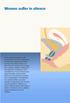 Women suffer in silence Stress urinary incontinence is the involuntary loss of urine resulting from increased intra-abdominal pressure. In people who suffer with this condition, forms of exertion such
TIBIAL NERVE STIMULATION: ONE OF SEVERAL NEW OPTIONS FOR THE MANAGEMENT OF OVERACTIVE BLADDER IN WOMEN
 TIBIAL NERVE STIMULATION: ONE OF SEVERAL NEW OPTIONS FOR THE MANAGEMENT OF OVERACTIVE BLADDER IN WOMEN Scott A Farrell MD Professor Dept of Obstetrics and Gynaecology Dalhousie University Declaration of
NICE Pathways bring together all NICE guidance, quality standards and other NICE information on a specific topic.
 Initial assessment and investigation of urinary incontinence bring together all NICE guidance, quality standards and other NICE information on a specific topic. are interactive and designed to be used
Urinary Incontinence. Anatomy and Terminology Overview. Moeen Abu-Sitta, MD, FACOG, FACS
 Urinary Incontinence Anatomy and Terminology Overview Moeen Abu-Sitta, MD, FACOG, FACS Purpose Locate and describe the anatomy of the Female Urinary System Define terminology related to Incontinence Describe
Primary Care management of Overactive Bladder (OAB)
 DERBYSHIRE JOINT AREA PRESCRIBING COMMITTEE (JAPC) Primary Care management of Overactive Bladder (OAB) Prescribing Tips All medicines for OAB have similar dose-related efficacy. More than one agent (up
SECTION H: BLADDER AND BOWEL. H0100: Appliances. Item Rationale Health-related Quality of Life. Planning for Care
 SECTION H: BLADDER AND BOWEL Intent: The intent of the items in this section is to gather information on the use of bowel and bladder appliances, the use of and response to urinary toileting programs,
BLADDER CONTROL DURING PREGNANCY AND AFTER THE BIRTH OF YOUR BABY
 BLADDER CONTROL DURING PREGNANCY AND AFTER THE BIRTH OF YOUR BABY Information Leaflet Your Health. Our Priority. Page 2 of 8 Contents Stress incontinence... 3 Pelvic floor exercises... 3 Urgency and frequency...
Regain Control of Your Active Life Treatment Options for Incontinence and Pelvic Organ Prolapse
 Regain Control of Your Active Life Treatment Options for Incontinence and Pelvic Organ Prolapse Nearly one quarter of all women in the United States have some sort of pelvic floor disorder such as urinary
Urinary incontinence and Prolapse. Dr Zeelha Abdool Consultant OBGYN Steve Biko Academic Hospital
 Urinary incontinence and Prolapse Dr Zeelha Abdool Consultant OBGYN Steve Biko Academic Hospital Definitions: IUGA/ICS standardized terminology Urinary incontinence (symptom): complaint of involuntary
GENUINE STRESS AND URGE INCONTINENCE PROTOCOL
 GENUINE STRESS AND URGE INCONTINENCE PROTOCOL Using the NeuroTrac ETSTM in combination of electrostimulation and EMG Biofeedback in the treatment of female urinary incontinence. Anna Pawlaczyk Specialist
SOGC Recommendations for Urinary Incontinence
 The quality of evidence is rated, and recommendations are made using the criteria described by the Canadian Task Force on Preventive Health Care. Clinical Practice Guidelines: The Evaluation of Stress
COMMITTEE FOR PROPRIETARY MEDICINAL PRODUCTS (CPMP)
 The European Agency for the Evaluation of Medicinal Products Evaluation of Medicines for Human Use London, 18 December 2002 COMMITTEE FOR PROPRIETARY MEDICINAL PRODUCTS (CPMP) NOTE FOR GUIDANCE ON THE
Dr Eva Fong. Urologist Auckland
 Dr Eva Fong Urologist Auckland Urinary incontinence: Treatment options GPCME 2013 Eva Fong Urologist Urinary incontinence Is not normal part of aging or childbearing We can make it better Urinary incontinence:
FEMALE INCONTINENCE REVIEW
 200 S. Wenona Suite 298 Steven L. Jensen, M.D. 5400 Mackinaw, Suite 4302 Bay City, MI 48706 Frank H. Kim, M.D. Saginaw, MI 48604 Telephone (989) 895-2634 Adult & Pediatric Urologists (989) 791-4020 Fax
Prevention & Treatment of De Novo Stress Incontinence after POP. Andy Vu, DO, FACOG UNT Health Science Center Fort Worth, TX.
 Prevention & Treatment of De Novo Stress Incontinence after POP Andy Vu, DO, FACOG UNT Health Science Center Fort Worth, TX Surgery Presenter Disclosure No Conflict of Interest to disclose No Financial
Overactive Bladder (OAB) Content of the lecture
 Overactive bladder (OAB) : Introduction and Medical Management R.J. Opsomer Cliniques St Luc, labo d urodynamique, UCL - Bruxelles Overactive Bladder (OAB) Content of the lecture The syndrome of Overactive
Bladder Health Promotion
 Bladder Health Promotion Community Awareness Presentation Content contributions provided by the Society of Urologic Nurses (SUNA) National Association for Continence (NAFC) Simon Foundation for Continence
Urinary Incontinence. Types
 Urinary Incontinence Leakage of urine is called urinary incontinence. It is a common problem in women. Some women occasionally leak small amounts of urine. At other times, leakage of urine is frequent
Managing Changes in Your Bladder Function After Cancer Treatment
 Managing Changes in Your Bladder Function After Cancer Treatment Information for cancer survivors UHN Read this resource to learn: What a urinary problem is What causes it What you can do to improve your
Female Urinary Incontinence
 Female Urinary Incontinence Molly Heublein, MD Assistant Professor Clinical Medicine UCSF Women s Health Primary Care Disclosures I have nothing to disclose. Objectives Which is most true? Review the problem
Urinary Incontinence in Women. Susan Hingle, M.D. Department of Medicine
 Urinary Incontinence in Women Susan Hingle, M.D. Department of Medicine Background Estimated 13 million Americans with urinary incontinence Women are affected twice as frequently as men Only 25% will seek
Efficacy of behavioural training in treating symptoms of urinary urgency and urge urinary incontinence
 Journal of the Association of Chartered Physiotherapists in Women s Health, Autumn 2011, 109, 14 19 CASE REPORT Efficacy of behavioural training in treating symptoms of urinary urgency and urge urinary
Managing Overactive Bladder
 Patient Educational Material Managing Overactive Bladder The bladder s job is pretty simple: hold urine until full, then empty when we get to a restroom. When you have an overactive bladder, the bladder
Urinary Continence. Second edition FAST FACTS. by Julian Shah and Gary Leach. Anatomy and physiology 7. Investigations and diagnosis 11
 FAST FACTS Urinary Continence Second edition Indispensable Guides to by Julian Shah and Gary Leach Clinical Practice Anatomy and physiology 7 Investigations and diagnosis 11 Detrusor instability 28 Primary
Lifestyle and Behavioral Changes Improving Urinary Urgency, Frequency and Urge Incontinence
 Lifestyle and Behavioral Changes Improving Urinary Urgency, Frequency and Urge Incontinence Manage your Fluid Intake: There is no scientific evidence that states we need eight 8 oz. glasses (64 oz.) of
A Physical Therapist s Perspective
 You Can Do Something About INCONTINENCE A Physical Therapist s Perspective American Physical Therapy Association 1 You Can Do Something About Urinary Incontinence Incontinence, involuntary loss of bladder
Pelvic Floor Exercises for Women
 Pelvic Floor Exercises for Women Exceptional healthcare, personally delivered What are pelvic floor muscles? They are layers of muscles stretching like a hammock from the pubic joint at the front of the
Conservative Management of Urinary Incontinence
 SOGC CLINICAL PRACTICE GUIDELINE No. 186, December 2006 Conservative Management of Urinary Incontinence This guideline has been reviewed and approved by the Executive and Council of the Society of Obstetricians
Primary Care Management Guidelines Female Urinary Incontinence. Overview of Lecture
 Primary Care Management Guidelines Female Urinary Incontinence Professor Don Wilson Department of Women s and Children s Health Dunedin School of Medicine University of Otago GP Teaching for Roy Morris,
Urinary Continence Management after a. Stroke. Liz Mackey, CNC Stroke Clinical Coordinator Western Health
 Urinary Continence Management after a Stroke Liz Mackey, CNC Stroke Clinical Coordinator Western Health Royal Women s Hospital Innervation of the Bladder Neuromuscular coordination for control of both
9/24/2015. Incontinence and Prolapse 2015 Primary Care Update CME Symposium. Objectives. Mark Memo, DO, FACS NEO Urology September 25-27
 Incontinence and Prolapse 2015 Primary Care Update CME Symposium Mark Memo, DO, FACS NEO Urology September 25-27 Objectives Incontinence Pelvic Organ Prolapse Vaginal Mesh Litigation 1 Urinary Incontinence
Bladder Health Promotion
 Bladder Health Promotion Community Awareness Presentation endorsed by the Society of Urologic Nurses (SUNA) National Association for Continence( NAFC) Simon Foundation for Continence This presentation
Stress incontinence in Women
 Stress incontinence in Women Exceptional healthcare, personally delivered Operations for Stress Incontinence Introduction Stress incontinence is a medical word used to describe the type of leakage that
Night frequency None 1 2 3 4 5 6 7 8 9 10. Not enough warning before needing to urinate. none mild moderate severe
 {Patient Label} SYMPTOMS SURVEY: FREQUENCY: How many times do you urinate during the day and get up from sleep to urinate at night? Day frequency 3 4 5 6 7 8 9 10 11 12 13 14 15 More Night frequency None
Drinking fluids and how they affect your bladder
 Drinking fluids and how they affect your bladder Contact us Patient Advice and Liaison Service (PALS) To make comments or raise concerns about the Trust s services, please contact PALS. Ask a member of
Get the Facts, Be Informed, Make YOUR Best Decision. Pelvic Organ Prolapse
 Pelvic Organ Prolapse ETHICON Women s Health & Urology, a division of ETHICON, INC., a Johnson & Johnson company, is dedicated to providing innovative solutions for common women s health problems and to
Urodynamics in Neuro-Urology
 Urodynamics in Neuro-Urology R Hamid MD (Res), FRCS (Urol) Consultant Urologist London Spinal Injuries Unit, Stanmore & University College London Hospitals Micturition Micturition can be visualized as
THE MANAGEMENT OF URINARY INCONTINENCE WITHIN A STROKE UNIT POPULATION REENA DHAMI STROKE CNS EPSOM & ST.HELIER UNIVERSITY HOSPITALS
 THE MANAGEMENT OF URINARY INCONTINENCE WITHIN A STROKE UNIT POPULATION REENA DHAMI STROKE CNS EPSOM & ST.HELIER UNIVERSITY HOSPITALS Definition Urinary Incontinence is AN INABILITY TO HOLD URINE until
Patient Questionnaire for Men
 Patient Questionnaire for Men Please fill out the following questionnaire to the best of your ability prior to your first appointment. Your physical therapist will review your responses during your initial
WHAT IS INCONTINENCE?
 CNA Workbook WHAT IS INCONTINENCE? Incontinence is the inability to control the flow of urine or feces from your body. Approximately 26 million Americans are incontinent. Many people don t report it because
Consumer summary Minimally invasive techniques for the relief of stress urinary incontinence
 ASERNIP S Australian Safety and Efficacy Register of New Interventional Procedures Surgical Consumer summary Minimally invasive techniques for the relief of stress urinary incontinence (Adapted from the