
By Michael Block, PhD
|
|
|
- David Lenard Henderson
- 9 years ago
- Views:
Transcription
1 By Michael Block, PhD IHS offers a diversity of options for obtaining continuing education credit: seminars and classroom training, institutional courses, online studies, and distance learning programs. This article represents yet another opportunity. Upon successful completion of the accompanying test on page 27, you will earn one CEU. (Please check with your licensing board to verify acceptance of continuing education credit for this activity.) This article and test are also available on the IHS website at www. ihsinfo.org. We have heard about the research indicating that happy customers tell eight friends about their positive experiences with a service or product while unhappy, dissatisfied customers tell their tale to 16 people (Deming, 1982). A patient s initial experience has a huge impact on his overall acceptance and satisfaction of our services. Achieving an accurate and custom initial fitting will have a huge impact on initial satisfaction and the overall success of a professional practice. There are two hearing aid functions designed to create a level of precision in setting and matching gain targets. These are in situ audiometry and integrated real-ear measures. In general, in situ audiometry corrects the hearing threshold levels (HTLs) for the insertion effects of the hearing aid. This correction allows the target gains to represent the hearing loss more accurately. The real-ear measures enable the hearing aid to match those target gains with more precision. The result is a fitting that is based on the actual characteristics of your patient rather than average data. In many cases, the hearing aid fitting software has a builtin audiometer to obtain hearing levels with the hearing aid in the ear. This procedure is called in situ audiometry. In situ is a Latin phrase meaning in place and is used in many different contexts, often indicating that measurements or observations are made without disturbing the original environment. In the case of hearing instruments, it refers to measurements taken with the hearing aid in its natural location: correctly fitted in the ear. When we measure hearing levels in situ we have the opportunity to observe how standardized audiometric hearing levels will vary because of the influence of residual ear canal volume. The procedure also accounts for the effects of the depth of the instrument in the ear canal, the effectiveness of the seal in the ear canal, the effects of venting, and the specific receiver in that instrument. A demonstration of how the hearing aid insertion depth will affect the real-ear gain is shown in Figure 1. In this chart, zero represents the average real-ear insertion response (REIR) and the curves represent the mathematical variation one could expect if the depth of the hearing instrument insertion were increased and decreased one and two standard deviations. The data suggest that deviations from normal can be more than 10dB. Gain targets calculated without considering a 10dB increase in REIR will overestimate the amount of gain needed and result in a fitting that requires extensive adjustments to achieve acceptable listening levels (DeJonge, 1996). When we are using the fitting software to set the target and perform the initial adjustments we rely exclusively on the hearing levels obtained during the audiologic evaluation. The fitting formulas used to set the target gain contain the proper algorithms to compute the gain targets based on the desired input levels and hearing instrument style. However, these algorithms are all based on average data. By including data obtained for your specific patient and his or her specific hearing instrument, we are adding a level of customization that your patients expect from the sophisticated digital technology used today. The in situ audiometer may also allow the direct measurement of in situ loudness levels. Thus, you can obtain customized loudness discomfort levels (LDL) measures using the same tools you use to Dr. Block is an audiologist who works in the education and training department at Starkey Laboratories. Correspondence: [email protected]. THE HEARING PROFESSIONAL 7

2 measure in situ hearing levels. The importance of having the correct LDL in the fitting of the hearing aid cannot be overstated. According to Mueller and Bentler (2008) many patients are still not being fitted with the proper maximum output. They recommend pre-fitting frequency-specific LDL measures and post-fitting loudness verification. In situ audiometry allows you to customize the targets for your specific patient and, by doing so, improve the accuracy of the fitting. As a result, all the other processes operate with the same customized accuracy. Once the channel gain is set for all input levels, the feedback cancellation algorithm computes a cancellation filter precisely for the hearing aid you have fit to your patient. The general compression parameters are set up to provide the proper gain adjustment for soft, comfortable, and loud inputs based on your patient s auditory thresholds corrected for the insertion effects of the hearing instrument. By customizing the fitting process for your patient s hearing instrument, you will save valuable patient contact time. The initial fitting will be based on your patient s requirements rather than average data and will result in much more acceptable baseline settings. In turn, this will reduce the time needed for troubleshooting complaints such as those associated with high-frequency gain, occlusion, or tolerance issues. The result is more time for patient counseling and training and improved initial patient satisfaction. To evaluate the effect of insertion depth in a real-world environment we measured the differences between insertearphone and in situ thresholds for CIC and ITC fittings (Ioannou, 2000). The results are shown in Figure 2. Thirty ears were fitted with CICs and ten ears were fitted with ITCs. Prior to the fittings, HTLs were measured using ER-3A insert ear phones. After the hearing aids were fit, the HTLs were retested using in situ measures. Typically, CIC fittings result in a deeper insertion compared to ITC fittings. The results showed the expected trend. CICs produce smaller residual cavities compared to ITCs and thus the differences between conventional HTL and CIC in situ HTL were greater than the same comparisons for ITC fittings. We also found that the differences increased with test frequency. In general, however, using the conventional HTL overestimated the size of the residual cavity and would have resulted in a fitting that had more gain than was needed. This relates to findings presented in MarkeTrak VI (Kochkin, 2002). More than 80% of respondents in that survey felt that hearing aids should make loud sounds less painful and should offer improved sound quality compared to the unaided condition. One reason might be that deeper-than-average fittings will produce more amplification than needed on the first fit. Unless it is adjusted during followup, these fittings will result in an initial complaint that loud sounds are too loud. To further investigate the perceptual effects of insertion depth variations, 18 participants with an average age of 66 (44 to 74 years) were fitted with multi-memory hearing devices. All participants were previous users of well-fit hearing aids based on probe-microphone verification. For each participant, one memory was best fit using HTLs measured using conventional ER-3A insert earphones. A second memory was best fit using HTLs measured in situ. The participants did not know how each memory was set and the memory settings were counterbalanced among the participants. Each participant was instructed to switch both sides of the binaural fitting to the same memory in each phase of the study. The participants were asked to rate various listening situations for clarity, loudness, naturalness of the sound, and overall sound quality. Their memory preference was recorded. The results showed that 11 participants, about 61%, preferred the fitting based on the in situ responses. Six preferred the ER-3 based fitting and one had no preference (Ioannou, 2000). This small-scale, in-house study demonstrates what we found over several years of clinical experience with in situ measurements. The ability to apply tools to customize the response for the specific hearing instrument as it is fit to the patient will provide a more accurate fit and increased patient satisfaction. Once the HTLs are corrected for the hearing aid insertion effects, the hearing aid must be calibrated so that its gain response matches the gain targets. The best method to calibrate the gain response is to measure the relationship between the 2cc coupler measures used in manufacturing Figure 1. Effects of changes in canal length and diameter on the REIG (DeJonge, 1996). In the figure, zero represents a normal canal length of 32mm. Each standard deviation adds or subtracts 2mm. 2 SD = 28mm, 1 SD = 30mm, +1 SD = 34mm and +2 SD = 36mm. 8 Figure 2. Effect of hearing aid style on hearing levels measured with insert earphones and in situ audiometry. Zero represents the hearing threshold levels obtained with ER-3A insert earphones. The change in HL is shown for in situ thresholds performed with CIC and ITC fittings (Ioannou, 2000). Figure 3. Derivation of RECD. Left panel shows SPL as a function of frequency in a 2cc coupler and in an ear canal, generated by the same transducer, driven by the same voltage. The right panel shows the RECD as a function of frequency, calculated as real-ear SPL minus coupler SPL.

3 Figure 4. Real-ear aided gain for nine ears using the same hearing aid settings. The red curves are individual REAR. The black curve is the mean REAR. Figure 5. An example of predicted real-ear aided gain based on average RECD (orange) and measured RECD (green). Actual real-ear aided gain (dark blue) was measured with a commercial REM system. Figure 6. Mean deviation from NAL-R target as a function of frequency using measured RECD. with the patient s actual residual cavities. That is, to measure the differences between the sound pressure level (SPL) generated in the patient s ear to the SPL generated in the 2cc coupler. In this way, the hearing aid gain algorithm knows exactly how much voltage is needed to produce the required gain in each frequency band. This calibration can only be done directly using probe-microphone measures. Probe-microphone or real-ear measurements as a technique for objectively verifying the performance characteristics of a hearing aid are recommended as a best practice in hearing aid fittings (Valente, 2006). However, it is not widely used for reasons such as expense, time limitations, and the need for cumbersome equipment. As a result, about 60% of hearing professionals do not use real-ear measurements (Kirkwood, 2006). An efficient method for using real-ear measurements is available in fitting software that integrates a key measure into the fitting process. This method uses the real-ear coupler difference (RECD). The acoustic characteristics of a hearing aid are quantified in a standard 2cc coupler. Such coupler responses are defined in the ANSI standards (ANSI 1996) and are used to describe hearing aid performance. However, coupler responses are not designed to indicate the performance of the hearing aid in an actual ear. We can estimate the real-ear response of a hearing instrument if the coupler response and the difference between the coupler response and the real-ear response are known. That estimation is the RECD. Its derivation is simple: measure the output of a signal in the real-ear, measure the same signal in a coupler, and then subtract the coupler SPL from the real-ear SPL (Figure 3). Once the RECD is measured, adding it to a known coupler response provides a means of predicting the real-ear response from the coupler response. Hearing aid manufacturers generally use an RECD in their fitting software to calculate a simulated real-ear response, which is then displayed as part of the fitting software. The hearing aid has the stored coupler response of the hearing aid and, by adding an average RECD, that coupler response can predict the real-ear response. An average RECD is used since the actual RECD of the ear under test is not known. The use of average RECD data creates a mismatch between the gain required to match the target and the gain produced by the hearing aid. RECD varies considerably from one ear to another in the adult population as shown in Figure 4. In this study, the same hearing aid was fit to a number of different ears, without changing any settings, and probe microphone measures were taken (Yanz and Olson, 2006). Differences in the acoustic characteristics of the ear canals are quite apparent and speak to the need for individual measures to add precision to the fitting rather than relying on average data. The target match will be inaccurate for the individual ear to the extent that the average RECD is different for the ear under test. Figure 4 shows a range of variation in excess of 15dB. It is clear that to create a precise target gain match, the use of average RECDs falls short. To assist the hearing professional with the measurement of the patient s RECDs we have developed a system that allows the hearing instrument itself to measure the patient s RECDs and use those data to predict the real-ear aided response. The use of individual RECDs provides not only a precise gain target match but also allows programming changes with the same precision. Can a simple system built into a hearing aid produce results with the same accuracy and reliability as a standard real-ear system? To examine the accuracy of the Integrated REM system, we compared the predicted real-ear gain obtained with a commercial real-ear system. An example is shown in Figure 5. Initially the predicted real-ear gain based on the average RECD (orange line) is compared to the gain obtained using the measured RECD (green line) for the same patient. We can observe the difference between the predicted gain based on average data compared to data measured in the patient s ear. We then added the gain measured by standard real-ear equipment (blue line, Audio Scan VeriFit) to judge the accuracy of the gain prediction using Integrated REM. In this case, the predicted gain using a commercial real-ear system matches that using the Integrated REM system. In the same study we examined the results of 52 target matches and found that the Integrated REM system matched a standard NAL-R target within ± 3dB (Figure 6). The results using the Integrated REM system were as accurate and reliable as those obtained with a standard commercial system (Yanz and Olson, 2006). Although the RECD allows us to predict real-ear SPL from coupler SPL, the real-ear aided response (REAR) is also affected by the hearing aid style. As the style of the hearing aid becomes smaller, the location of the microphone changes. In general, the microphone is closer to the THE HEARING PROFESSIONAL 9

4 Figure 7. The relative effects of microphone location for several hearing aid styles. Figure 8. Components of an individual REAR. The 2 cc coupler data are stored with the hearing aid while the standard MLE for the hearing aid style are part of the fitting system data. The individually measured RECD adds the precision not afforded by using an average RECD. entrance to the ear canal as we go from BTE to CIC. These microphone location effects (MLE) are consistent. Data collected in our research facility showing corrections for MLEs as a function of frequency are stored in the Inspire OS software for each model (Figure 7). These corrections are used to add one more degree of precision based on hearing aid style. The coupler response is stored in the hearing aid. The MLE is stored in the fitting software based on the style selected. The RECD is measured from the patient s ear. Thus, an accurate prediction of an individual s real-ear aided response is achieved according to the following formula: REAR = coupler response + RECD + MLE. A graphic representation of how the RECD is used to model the response of the hearing aid is shown in Figure 8. When we use the fitting software to change the hearing aid response, the changes are made to the coupler response. The MLE and measured RECD then correct the coupler response to reflect the specific patient characteristics. We have seen how the basic hearing test data can be customized to reflect the actual patient s performance with a hearing aid and how those data are used to develop hearing aid gain targets specific for that individual. In addition, we learned how individually-measured RECDs are integrated into the fitting software display models to accurately represent the response in the patient s ear. These two systems in concert allow us to monitor the actual response of the hearing aid during the initial fitting and as we make fitting adjustments. It is clear that in order for sophisticated fitting software to develop a precision first fit it must have the most accurate data. Reliance on average data to convert HTLs to target gain predictions and the use of average RECDs to match those targets does not offer the patient the best initial results. The key to a successful fitting is in the patient s experience on the day of his first hearing aid fitting. Using data obtained directly from your patient will ensure the most accurate initial fitting and will help deliver high patient satisfaction. THP DeJonge R (1996). Real-Ear Measures: Individual variation and measurement error. In: Valente, M. Hearing Aids: Standards, Options and Limitations. New York, Theime Medical Publishers, pg Deming W E (1982). Out of the Crisis. MA: MIT Center for Engineering Study. Ioannou M (2000). An evaluation of in-situ audiometry. Starkey Laboratories, unpublished research. Kochkin S (2002). MarkeTrak VI, Consumers rate improvements sought in hearing instruments, Hearing Review, Vol. 9:11, pp Kochkin S, Rogin C (2000). Quantifying the obvious: The impact of hearing instruments on quality of life. The Hearing Review, Vol. 7:1 pp Mueller G, Bentler R (2008). How loud is allowed? It s a three-peat! The Hearing Journal, 2008:61(4), pp Valente M, Abrams H, Benson D, et al. (2006). Guidelines for the audiological management of adult hearing impairment. Audiology Today, Vol. 18:5. Yanz J, Olson L (2006). Open-Ear Fittings: An Entry into Hearing Care for Mild Losses. Hearing Review, Vol. 13:2. SeeUsinBooth219 Discovery Warranties has been a significant factor in building both my practice and strong, ongoing relationships with my clients. Discovery s generous rebate program fulfills its promise of generating revenues through warranty sales and renewals. Martha Artz-Cain, BC-HIS Hearing Aid Services, Inc. Winchester, Virginia American National Standards Institute (1996). Specification of Hearing Aid Characteristics. (ANSI S ). New York: American National Standards Institute Best Coverage Best Service Best Price 10

5 For continuing education credit, complete this test and send the answer section at the bottom of the page to: International Institute for Hearing Instruments Studies Middlebelt Rd., Ste. 4, Livonia, MI certificate of completion from the International Institute for Hearing Instruments Studies (IIHIS). education unit (CEU). 1. How does the hearing aid insertion depth affect the real-ear gain? a. A deeper insertion results in more gain than average. b. A shallower insertion results in less gain than average. c. A variation of 10dB or more from average is not uncommon. d. All of the above. 2. Real-ear measures are considered a best practice yet 60% of hearing professionals do not use them for the following reason(s): a. The equipment is too expensive. b. The procedure takes too much time. c. The equipment is cumbersome to use. d. All of the above. 3. Microphone location effects represent the location of a hearing aid microphone: a. On the hearing aid faceplate. b. For BTEs only. c. The change in frequency response caused by receiver size. d. In relation to the entrance to the ear canal. 4. What would be the perceptual effect for your patient if the residual cavity was smaller than average? a. The hearing aid would sound too loud. b. The hearing aid would sound too weak. c. High- and low-pitched sounds would be confused. d. There would be no perceptual difference. 5. What two functions have the ability to add precision to the initial hearing aid fitting? a. Coupler measurements and microphone location effects. b. Style selection and hearing levels. c. In situ audiometry and real-ear measures. d. ER-3A earphones and the NAL-R fitting rule. 6. What is the RECD? a. The real-ear compression definition. b. The real-ear capacity difference. c. The real-ear coupling diagram. d. The real-ear coupler difference. 7. When study participants were asked to rate their preferences for in situ based fittings compared to hearing level based fittings, the in situ based fittings were preferred by more than half of them. a. True b. False 8. The measured RECD and the average RECD: a. Are the same for most patients. b. Can vary as much as 15dB. c. Are both available in many hearing aid fitting systems. d. Are derived from KEMAR. 9. Which statements about 2cc coupler measurements are not true: a. They are defined by ANSI standards. b. They are used to describe hearing aid performance. c. They can indicate performance of a hearing aid in an actual ear. d. They are used in a hearing aid test box. 10. In a study of 52 ears, integrated real-ear measures matched a standard NAL-R target: a. Within a 10 db range. b. The targets did not match at all. c. They matched ± 3dB. d. None of the above. Name Address ANSWER SECTION (Circle the correct response from the test questions above.) City State/Province Zip/Postal Code Office Telephone SS/SI# Professional and/or Academic Credentials: (PHOTOCOPY THIS FORM AS NEEDED) Please check one: $29.00 (member) $59.00 (non-member) 1. a b c d 2. a b c d 3. a b c d 4. a b c d 5. a b c d 6. a b c d 7. a b 8. a b c d 9. a b c d 10. a b c d THE HEARING PROFESSIONAL 27

Step-by-Step RECD Guide
 Precision Audiometric Instruments www.medrx-usa.com Step-by-Step RECD Guide The RECD task involves 4 steps: 1 - Complete Calibration of the Speakers and Probe Tube 2 - Measure an Ear Response 3 - Perform
Prescriptive Fitting Algorithms: New and Improved! Michelle Mattingly, Au.D. and Lisa Perhacs, Au.D.
 1 Prescriptive Fitting Algorithms: New and Improved! Michelle Mattingly, Au.D. and Lisa Perhacs, Au.D. TM 2 What is the goal of a prescriptive algorithm? Optimize audibility Optimize speech intelligibility
Stream Boost: All About That Bass
 Carreen Pederson, M.A., & Alyson Gruhlke, Au.D. Stream Boost is an automatic feature that activates hearing aid settings optimized for high-quality streamed audio. Stream Boost settings are not part of
Everybody has the right to
 Everybody has the right to good hearing The Guide TO Hearing satisfaction for more people Beltone was founded on the act of helping a friend to enjoy life more. Since 19, we have provided knowledge, tools,
Integrating best practice in hearing care
 Integrating best practice in hearing care Accurate fi t t i n g, easy verification True DSL Targets for accurate target transparency SPLogram view for easy fit-to-target verification EasyRECD for adjusting
The impact of using real ear measures to calculate prescriptive targets on hearing aid follow-up visits
 Washington University School of Medicine Digital Commons@Becker Independent Studies and Capstones Program in Audiology and Communication Sciences 2013 The impact of using real ear measures to calculate
360 Programming Guide
 360 Programming Guide TABLE OF CONTENTS Toolbar......................... 2 Status Bar....................... 2 FastTrack by Ufit................ 3 FastTrack Client Screen.......... 3 FastTrack Instruments
instruction guide Version 2.2 Table of contents
 instruction guide Version 2.2 Table of contents Programming in Unitron TrueFit software................................. 2 Main menu........................................................... 3 Tool bar
ASU Speech & Hearing Clinic Hearing Aid Services
 ASU Speech & Hearing Clinic Hearing Aid Services Thank you for considering the ASU Speech & Hearing Clinic for your hearing healthcare needs. The purchase and fitting of hearing instruments is a very important
Wisconsin Department of Health & Family Services Division of Disability and Elder Services Bureau of Aging & Long Term Care Resources
 Waiver Wise Technical Assistance for the Community Options Program Waiver COP-W Wisconsin Department of Health & Family Services Division of Disability and Elder Services Bureau of Aging & Long Term Care
OTICON RIA pro OTICON RIA
 product information Oticon Ria is built on the new Inium platform and is our best performing hearing solution in the essential category. The audiological features in Ria provide users essential listening
Instructions for the use of E-A-RTONE 3A. Insert Earphones. Revised 1997 per ANSI S3.6-1996 and ISO 389-2:1994 12/99
 Instructions for the use of E-A-RTONE 3A Insert Earphones Revised 1997 per ANSI S3.6-1996 and ISO 389-2:1994 12/99 INTRODUCTION Congratulations on the purchase of your new E-A-RTONE 3A Insert Earphones.
A PROFESSIONAL PRACTICE PROFILE
 A PROFESSIONAL PRACTICE PROFILE FOR HEARING HEALTH PROFESSIONALS The International Hearing Society has adopted the following practice profile as a comprehensive declaration of dispensing characteristics
Pediatric Fitting Guide
 Pediatric Fitting Guide October 2013 / Phonak Target 3.2 This guide aims to provide a detailed introduction to Phonak Target Junior Mode for hearing care professionals who fit children of all ages. Introduction...
Trends In Amplification. Clinical Protocols for Hearing Instrument Fitting in the Desired Sensation Level Method
 Trends In Amplification VOLUME 9, NUMBER 4, 2005 Clinical Protocols for Hearing Instrument Fitting in the Desired Sensation Level Method Marlene Bagatto, AuD,* Sheila Moodie, MClSc,* Susan Scollie, PhD,*
GUIDELINES FOR HEARING AID FITTING FOR ADULTS
 GUIDELINES FOR HEARING AID FITTING FOR ADULTS By Rony Ganguly MSc, Clinical Scientist (Audiology) and Peter Ferguson FISHAA, FSHAA, Fd.Sc.HAA., BSc (Pharm), MPSI Introduction The aim of these protocols
application note Directional Microphone Applications Introduction Directional Hearing Aids
 APPLICATION NOTE AN-4 Directional Microphone Applications Introduction The inability to understand speech in noisy environments is a significant problem for hearing impaired individuals. An omnidirectional
PREFERRED PRACTICE GUIDELINE FOR THE PRESCRIPTION OF HEARING AIDS TO ADULTS
 PREFERRED PRACTICE GUIDELINE FOR THE PRESCRIPTION OF HEARING AIDS TO ADULTS 5060-3080 Yonge Street, Box 71 Toronto, Ontario M4N 3N1 416-975-5347 1-800-993-9459 www.caslpo.com Approved: Dec. 2000 Reformatted:
PURE TONE AUDIOMETRY Andrew P. McGrath, AuD
 PURE TONE AUDIOMETRY Andrew P. McGrath, AuD Pure tone audiometry is the standard behavioral assessment of an individual s hearing. The results of pure tone audiometry are recorded on a chart or form called
A Hearing Aid Primer
 A Hearing Aid Primer Includes: Definitions Photographs Hearing Aid Styles, Types, and Arrangements WROCC Outreach Site at Western Oregon University This hearing aid primer is designed to define the differences
The Essentials of Fitting Hearing Aids to Babies
 The Essentials of Fitting Hearing Aids to Babies Marlene P. Bagatto, Au.D., Ph.D. 1 ABSTRACT Fitting hearing aids to infants requires special consideration at each stage of the process. In the assessment
Hearing Tests And Your Child
 HOW EARLY CAN A CHILD S HEARING BE TESTED? Most parents can remember the moment they first realized that their child could not hear. Louise Tracy has often told other parents of the time she went onto
1000+ AUDIOMETER OPERATING INSTRUCTIONS
 1000+ AUDIOMETER OPERATING INSTRUCTIONS AMBCO Model 1000+ is a microprocessor controlled pure tone air conduction audiometer with automated screening test feature. INDEX A. Getting Started Patient Instructions
PURE TONE AUDIOMETER
 PURE TONE AUDIOMETER V. Vencovský, F. Rund Department of Radioelectronics, Faculty of Electrical Engineering, Czech Technical University in Prague, Czech Republic Abstract Estimation of pure tone hearing
The advantage in the ear. A Phonak, customized
 The advantage in the ear A Phonak, customized 2 3 The advantage of getting it right We invite you to discover our amazing custom made products, and to embrace our market leading technology for clients
APPLICATION NOTE. Ear Simulator for Telephonometry. Use of Wideband Ear Simulator Type 4195
 APPLICATIO OTE Ear Simulator for Telephonometry Use of Wideband Ear Simulator Type 4195 Wideband Ear Simulator Type 4195 has been designed to match the ear simulators in Head and Torso Simulator Type 4128-C
PRODUCT INFORMATION oticon ALtA PRo oticon ALtA
 PRODUCT INFORMATION oticon ALtA PRo oticon ALtA Oticon Alta is built on the Inium platform and is our best performing hearing solution with our most advanced technologies. The audiology in Alta provides
What Audio Engineers Should Know About Human Sound Perception. Part 2. Binaural Effects and Spatial Hearing
 What Audio Engineers Should Know About Human Sound Perception Part 2. Binaural Effects and Spatial Hearing AES 112 th Convention, Munich AES 113 th Convention, Los Angeles Durand R. Begault Human Factors
Hearing Tests And Your Child
 How Early Can A Child s Hearing Be Tested? Most parents can remember the moment they first realized that their child could not hear. Louise Tracy has often told other parents of the time she went onto
A Professional Practice Profile for Hearing Health Professionals
 A Professional Practice Profile for Hearing Health Professionals Hearing instrument dispensing includes several professions that overlap. There are traditional hearing aid dispensers, board certified hearing
HEARING SCREENING FOR CHILDREN
 PURPOSE Audiologic (hearing) screening identifies those persons who are likely to have hearing impairments or disorders that may interfere with body function/structure and/or activity/participation as
British Society of Audiology and British Academy of Audiology
 NOTE Although care has been taken in preparing the information supplied by the British Society of Audiology and British Academy of Audiology, the BSA & BAA do not and cannot guarantee the interpretation
HEARING SCREENING: PURE TONE AUDIOMETRY
 HEARING SCREENING: PURE TONE AUDIOMETRY QUALIFIED SCREENERS 7-005.01 For the purposes of the school officials verifying that a qualified screener is carrying out the required screening activity, the qualified
3M E-A-RTONE 3A and 5A Audiometric Insert Earphones
 34-8708-1478-6 GZXO$ 3M 3A and 5A Audiometric Insert Earphones www.3m.eu/safety GZXO$ INTRODUCTION Congratulations on the purchase of your new 3A or 5A Insert Earphones. Whether you are performing comprehensive
Testing FM Systems on the FP35 Hearing Aid Analyzer -1-
 Testing FM Systems on the FP35 Hearing Aid Analyzer -1- Testing FM Systems on the FP35 Hearing Aid Analyzer Introduction This workbook describes how to test FM systems with the FP35 Hearing Aid Analyzer
Magnitude of Hearing Loss and Open Ear Fittings
 Magnitude of Hearing Loss and Open Ear Fittings Elizabeth Talmage, AuD 1 Mia Rosenfeld, PhD 2 Ginny Alexander, MS 3 1 Bay Pines VA Healthcare System, Bay Pines, FL 2 VA Tennessee Valley Healthcare System,
Guidelines for Hearing Aid Fitting for Adults
 ASHA Ad Hoc Committee on Hearing Aid Selection and Fitting Reference this material as: American Speech-Language-Hearing Association. (1998). for Hearing Aid Fitting for Adults []. Available from www.asha.org/policy.
Does premium listening require premium hearing aids?
 Does premium listening require premium hearing aids? Effectiveness of basic and premium hearing aids on speech understanding and listening effort outcomes. Jani Johnson, Jingjing Xu, Robyn Cox Presented
Questions and Answers for Parents
 Questions and Answers for Parents There are simple, inexpensive tests available to detect hearing impairment in infants during the first days of life. In the past, most hearing deficits in children were
Pediatric Whitepaper. Electrophysiological Threshold Estimation and Infant Hearing Instrument Fitting
 Pediatric Whitepaper January 2010 Electrophysiological Threshold Estimation and Infant Hearing Instrument Fitting Merethe Lindgaard Fuglholt, M.A. Oticon A/S, Pediatric Audiology Abstract This paper addresses
Hearcentres Guide to Hearing Aid Terminology
 Hearcentres Guide to Hearing Aid Terminology Sophisticated modern hearing aids use a number of complicated technologies and techniques to ensure great improvements in hearing. Not only are the terms used
Essential hearing technology, shaped for life
 Essential hearing technology, shaped for life P E R F O R M A N C E L I N E Premium INIUM WIRELESS Advanced Essential Improved Performance Reduced Listening Effort Improved PersonalisATION premium ADVANCED
GUIDELINES ON THE ACOUSTICS OF SOUND FIELD AUDIOMETRY IN CLINICAL AUDIOLOGICAL APPLICATIONS
 NOTE Although care has been taken in preparing the information supplied by the British Society of Audiology, the BSA does not and cannot guarantee the interpretation and application of it. The BSA cannot
Using Your Fitting Software This guide provides comprehensive, task-based information about all the fitting software features.
 Gravity Fitting Software User's Manual part #: S0273-01 Rev A Using Your Fitting Software This guide provides comprehensive, task-based information about all the fitting software features. You may access
Purchasing Hearing Aids What You Need to Know
 Purchasing Hearing Aids What You Need to Know Thank you for interest in. Contained in this package is some valuable information to help you understand our company and to make an informed decision about
DAILY BIOLOGIC CHECK OF AUDIOMETERS
 DAILY BIOLOGIC CHECK OF AUDIOMETERS An audiometer must be checked before each day of use or if a problem is suspected with the equipment during use. After the audiometer is turned on, the operator should
Case Study THE IMPORTANCE OF ACCURATE BEHAVIOURAL TESTING IN INFANT HEARING AID FITTINGS
 Case Study THE IMPORTANCE OF ACCURATE BEHAVIOURAL TESTING IN INFANT HEARING AID FITTINGS Andrea Kelly, PhD, MNZAS Auckland District Health Board Suzanne Purdy, PhD, MNZAS University of Auckland Asymmetrical
The Role of the Educational Audiologist 2014. Introduction:
 The Role of the Educational Audiologist 2014. Introduction: As the current CHAIR of the BAEA I felt that it was time for the Role of the Educational Audiologist to be updated. There has been a period of
Hearing Solutions. Feature Chart 4 Feature Summary 6. Feature Chart 14 Feature Summary 16
 HEARING SOLUTIONS catalog 13 Hearing Solutions 3 Series Feature Chart 4 Feature Summary 6 Wi Series Feature Chart 14 Feature Summary 16 Xino Xino Feature Chart 24 Xino Feature Summary 26 Xino Tinnitus
Vibrant Soundbridge Implantable Hearing System
 Vibrant Soundbridge Implantable Hearing System Kristin M. Avitabile, MS, CCC-A Clinical Manager, Southeastern U.S. MED-EL Corporation Hearing Technology Hearing Aids Mild to severe HL Problems with feedback
5th Congress of Alps-Adria Acoustics Association NOISE-INDUCED HEARING LOSS
 5th Congress of Alps-Adria Acoustics Association 12-14 September 2012, Petrčane, Croatia NOISE-INDUCED HEARING LOSS Davor Šušković, mag. ing. el. techn. inf. [email protected] Abstract: One of
C HAPTER TEN. Electroacoustic Verification Measures with Modern Hearing Instrument Technology. Susan D. Scollie and Richard C. Seewald.
 C HAPTER TEN Electroacoustic Verification Measures with Modern Hearing Instrument Technology Susan D. Scollie and Richard C. Seewald Introduction Modern-day hearing instruments offer a wide variety of
DIAGNOSTIC TESTING GUIDELINES for Audiology
 DIAGNOSTIC TESTING GUIDELINES for Audiology In 1999, the Illinois legislature passed the Hearing Screening for Newborns Act. By December 31, 2002, hospitals delivering babies were required to provide hearing
How To Test If A Cell Phone With Selective Amplification Improves Speech Recognition And Hearing Perception
 J Am Acad Audiol 20:109 118 (2009) Evaluation of Cellular Phone Technology with Digital Hearing Aid Features: Effects of Encoding and Individualized Amplification DOI: 10.3766/jaaa.20.2.4 Carol L. Mackersie*
PS 29M DUAL CHANNEL BELTPACK IN METAL CASE
 PS 29M DUAL CHANNEL BELTPACK IN METAL CASE USER MANUAL October 2013 This product is designed and manufactured by: ASL Intercom BV Zonnebaan 42 3542 EG Utrecht The Netherlands Phone: +31 (0)30 2411901 Fax:
UNIVERSITY OF LONDON GOLDSMITHS COLLEGE. B. Sc. Examination Sample CREATIVE COMPUTING. IS52020A (CC227) Creative Computing 2.
 UNIVERSITY OF LONDON GOLDSMITHS COLLEGE B. Sc. Examination Sample CREATIVE COMPUTING IS52020A (CC227) Creative Computing 2 Duration: 3 hours Date and time: There are six questions in this paper; you should
Interference to Hearing Aids by Digital Mobile Telephones Operating in the 1800 MHz Band.
 Interference to Hearing Aids by Digital Mobile Telephones Operating in the 1800 MHz Band. Reference: EB968 Date: January 2008 Author: Eric Burwood (National Acoustic Laboratories) Collaborator: Walter
Convention Paper Presented at the 112th Convention 2002 May 10 13 Munich, Germany
 Audio Engineering Society Convention Paper Presented at the 112th Convention 2002 May 10 13 Munich, Germany This convention paper has been reproduced from the author's advance manuscript, without editing,
Guidelines for Fitting Hearing Aids to Young Infants. Version 2.0. February 2014
 Guidelines for Fitting Hearing Aids to Young Infants Version 2.0 February 2014 Rachel Feirn 1 (Editor) 1 Formerly of Children s Hearing Centre, University Hospitals Bristol, UK These guidelines were originally
HEARING AID REGULATION 196/2001 [Authority Repealed]
![HEARING AID REGULATION 196/2001 [Authority Repealed]](/thumbs/28/12797170.jpg "HEARING AID REGULATION 196/2001 [Authority Repealed]") PDF Version [Printer-friendly - ideal for printing entire document] HEARING AID REGULATION 196/2001 [Authority Repealed] Published by Quickscribe Services Ltd. Updated To: [deposited August 24, 2001] Important:
PDF Version [Printer-friendly - ideal for printing entire document] HEARING AID REGULATION 196/2001 [Authority Repealed] Published by Quickscribe Services Ltd. Updated To: [deposited August 24, 2001] Important:
4.2. Desktop Fitting Guide. Content. August 2015
 4.2 August 2015 Desktop Fitting Guide This guide provides you with a detailed introduction to latest hearing instrument fitting with Phonak Target. www.phonakpro.com/target_guide Please also find the [News]
Custom Hearing Aids. In-The-Ear, In-The-Canal, Completely-In-Canal. Operations Manual
 Custom Hearing Aids In-The-Ear, In-The-Canal, Completely-In-Canal Operations Manual Table of Contents Overview Features, Controls and Identification.... 1 Preparation Batteries.... 4 Battery Indicators....
Once your baby has good head control and can turn towards something interesting, a more advanced behavioural procedure can be used.
 How do we test the hearing of babies and children? An audiologist will select from a range of different tests to evaluate your child s hearing. The choice of test depends on the information that is needed
Hearing Test Results from 2009 Audio Engineering Society Convention Testing funded by Shure
 Page 1 of 8 Hearing Test Results from 29 Audio Engineering Society Convention Testing funded by Shure SUMMARY The 127 th Audio Engineering Society (AES) convention was held in New York, New York from October
International Hearing Society s Position Statement on the Audioprosthology Title
 International Hearing Society s Position Statement on the Audioprosthology Title The International Hearing Society (IHS) wants to make it understood that consumer protection is of paramount importance
Direct and Reflected: Understanding the Truth with Y-S 3
 Direct and Reflected: Understanding the Truth with Y-S 3 -Speaker System Design Guide- December 2008 2008 Yamaha Corporation 1 Introduction Y-S 3 is a speaker system design software application. It is
The NAL Percentage Loss of Hearing Scale
 The NAL Percentage Loss of Hearing Scale Anne Greville Audiology Adviser, ACC February, 2010 The NAL Percentage Loss of Hearing (PLH) Scale was developed by John Macrae of the Australian National Acoustic
Practice Standards for Hearing Service Providers
 Practice Standards for Hearing Service Providers The WCB has been unsuccessful in obtaining input from the SASLPA for the development of practice standards and a fee schedule to cover hearing service providers
Manual Analysis Software AFD 1201
 AFD 1200 - AcoustiTube Manual Analysis Software AFD 1201 Measurement of Transmission loss acc. to Song and Bolton 1 Table of Contents Introduction - Analysis Software AFD 1201... 3 AFD 1200 - AcoustiTube
A set of courses constituting an area of specialization designed to help educate the Beltone network.
 Pathways & Curriculums Curriculums A set of courses constituting an area of specialization designed to help educate the Beltone network. Pathways A series of curriculums defined in terms of competencies
MDHearingAidAIR Diagram
 MDHearingAidAIR Diagram Thin Tubing Thin Tubing Base Microphone Volume Dial (on/off switch) Hearing Aid Body Program Button Battery Compartment Stabilizer Bar 6 ComfortTIP TM (Open). Steps and Assembling
Unilateral (Hearing Loss in One Ear) Hearing Loss Guidance
 Unilateral (Hearing Loss in One Ear) Hearing Loss Guidance Indiana s Early Hearing Detection and Intervention Program Before universal newborn hearing screening, most children with unilateral hearing loss
Early vs. Late Onset Hearing Loss: How Children Differ from Adults. Andrea Pittman, PhD Arizona State University
 Early vs. Late Onset Hearing Loss: How Children Differ from Adults Andrea Pittman, PhD Arizona State University Heterogeneity of Children with Hearing Loss Chronological age Age at onset Age at identification
Pricing Modifier. Informational Modifier
 1 National Provider of a hearing aid 01 220 22 RT, LT, 50 per repair of a hearing aid 20 220 31, 32, 99 RT, LT, 50 per repair of a hearing aid 24 220 31, 32 RT, LT, 50 per repair of a hearing aid 25 220
C HAPTER T WELVE. Hearing Aid Verification: Old Concepts and New Considerations. H. Gustav Mueller. Establishing a Fitting Goal.
 C HAPTER T WELVE Hearing Aid Verification: Old Concepts and New Considerations H. Gustav Mueller There are several components that typically are included in a comprehensive protocol for the selection and
The E-Scope Electronic Stethoscope Catalog of Products April 25, 2012
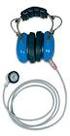 The E-Scope Electronic Stethoscope Catalog of Products April 25, 2012 Cardionics, 910 Bay Star Blvd., Webster, Texas 77598 USA Telephone: 281-488-5901 Toll-free USA & Canada 1-800-364-5901 Web: www.cardionics.com
The Accuracy of 0 db HL as an Assumption of Normal Hearing
 The Accuracy of 0 db HL as an Assumption of Normal Hearing Introduction An operating assumption of diagnostic audiology is that hearing level of a young adult with no known hearing loss or history of noise
Pure Tone Hearing Screening in Schools: Revised Notes on Main Video. IMPORTANT: A hearing screening does not diagnose a hearing loss.
 Pure Tone Hearing Screening in Schools: Revised Notes on Main Video (Notes are also available for Video segments: Common Mistakes and FAQs) IMPORTANT: A hearing screening does not diagnose a hearing loss.
MA 25 Operating Manual
 MA 25 Operating Manual MAICO Diagnostics 10393 West 70 th Street Eden Prairie, MN 55344, USA Toll Free 888.941.4201 MA 25 Operating Manual Table of Contents Page 1.... Introduction... 1 2.... Description...
E-A-R/Aearo Technologies E-A-RCAL SM Laboratory 7911 Zionsville Road Indianapolis, IN 46268-1657 [email protected]
 Original April 24, 2007 Revised June 21, 2007 E-A-R/Aearo Technologies E-A-RCAL SM Laboratory 7911 Zionsville Road Indianapolis, IN 46268-1657 [email protected] INTRODUCTION The E-A-RFit TM Validation
Fundamental Components of Hearing Aid Fitting for Infants. Josephine Marriage PhD
 Fundamental Components of Hearing Aid Fitting for Infants Josephine Marriage PhD Neonatal Hearing Screening Screening efforts have far out stripped our habilitation efforts, leaving parents with diagnosis
Introduction Ericsson Handheld Telephone 1341-B
 Ericsson Handheld Telephone 1341-B 2 Contents General 5 The Mobile Telephone Network 6 Base Station and Cell 7 Radio Channels 7 Radio Coverage 8 Transmission Control and Communication 9 Quality Control
The Top 5 Things You Should Know Before Buying Hearing Aids
 S p e c i a l R e p o r t The Top 5 Things You Should Know Before Buying Hearing Aids Dr. Mary Anne Larkin, Au. D. Board Certified Doctor of Audiology Advanced Hearing Care The Top 5 Things You Should
Predicting Hearing Aid Gain Values for Enhancing the Speech Intelligibility Using Correlation Algorithm
 Universal Journal of Biomedical Engineering 3(3): 15-21, 2015 DOI: 10.13189/ujbe.2015.030301 http://www.hrpub.org Predicting Hearing Aid Gain Values for Enhancing the Speech Intelligibility Using Correlation
PRODUCT SHEET OUT1 SPECIFICATIONS
 OUT SERIES Headphones OUT2 BNC Output Adapter OUT1 High Fidelity Headphones OUT1A Ultra-Wide Frequency Response Headphones OUT3 see Stimulators OUT100 Monaural Headphone 40HP Monaural Headphones OUT101
Figure1. Acoustic feedback in packet based video conferencing system
 Real-Time Howling Detection for Hands-Free Video Conferencing System Mi Suk Lee and Do Young Kim Future Internet Research Department ETRI, Daejeon, Korea {lms, dyk}@etri.re.kr Abstract: This paper presents
National Institutes of Health
 National Institutes of Health Hearing Conservation Program Division of Occupational Health & Safety May 2013 In compliance with 29CFR1910.95, this document provides information and services for the effective
Intermediate School District 917 CLASSIFICATION DESCRIPTION Educational Audiologist Department: Special Education
 Title of Immediate Supervisor: Assistant Director of Special Education Intermediate School District 917 Department: Special Education FLSA Status: Exempt Accountable For (Job Titles): None Pay Grade Assignment:
Your Hearing ILLUMINATED
 Your Hearing ILLUMINATED INFORMATION FROM YOUR HEARING CARE PROFESSIONAL REDISCOVER your hearing and reconnect 1 with the important things you might have been missing. Your sense of hearing is a vital
Audiometric (Hearing) Screening September November 2013
 Audiometric (Hearing) Screening September November 2013 Sample Report QLD Prepared by: Name of Technician Qualified Audiometric Technicians INTRODUCTION Australasian Safety Services provided on-site audiometric
LOW COST HARDWARE IMPLEMENTATION FOR DIGITAL HEARING AID USING
 LOW COST HARDWARE IMPLEMENTATION FOR DIGITAL HEARING AID USING RasPi Kaveri Ratanpara 1, Priyan Shah 2 1 Student, M.E Biomedical Engineering, Government Engineering college, Sector-28, Gandhinagar (Gujarat)-382028,