
Wholesale power market liquidity: consultation on a Secure and Promote licence condition
|
|
|
- Ambrose Freeman
- 9 years ago
- Views:
Transcription
1 Promoting choice and value for all gas and electricity customers Wholesale power market liquidity: consultation on a Secure and Promote Consultation Reference: 163/12 Contact: Phil Slarks, Senior Economist Publication date: 5 December 2012 Team: Wholesale Markets Response deadline: 15 February 2013 Tel: [email protected] Overview: Ofgem s liquidity project seeks to ensure that the wholesale power market supports effective competition, delivering benefits for consumers in terms of lower bills, greater choice and better service. Ofgem has been concerned that poor electricity wholesale market liquidity is posing a barrier to effective competition and entry in the generation and supply markets, thereby preventing consumers from benefitting fully from competition. This document provides our latest update on the progress of the market. Overall, our objectives remain unmet. However, we note continued progress in relation to the near-term market. We also note early signs of progress in ensuring that independent suppliers can access the products they need in order to hedge. Based on these developments, this document sets out for consultation the option of a Secure and Promote. This would aim to lock in the positive industry-led initiatives we have seen and potentially push for further progress in some areas. In parallel, we will continue to develop the Mandatory Auction mechanism on which we consulted in February 2012 and which remains an option for intervention. We will continue to monitor developments in the market and will ensure that our further policy work fully considers these developments as we work towards a final decision on intervention. The deadline for responses to this consultation is 15 February Ofgem/Ofgem E-Serve 9 Millbank, London SW1P 3GE
2 Context Ofgem s principal objective is to protect the interests of present and future consumers. 1 In accordance with this objective, we are concerned with making sure that liquidity in the GB power market is sufficient to underpin competitive generation and supply markets. Under the Third Package 2, Ofgem also has a duty to promote the integrated European energy market. Ofgem considers that improvements to power market liquidity are consistent with this objective, and is mindful of the need to promote integration when considering any interventions. This consultation represents the latest step in Ofgem s liquidity project, through which we have been monitoring GB power market liquidity and considering interventions that could ensure liquidity is improved. We have always maintained that we would prefer to see industry initiatives deliver the required improvements. However, we have a firm preference for intervention in the event that insufficient or slow progress could be imposing costs on consumers. Associated documents Retail Market Review: GB Wholesale market liquidity update, 16 July %20open%20letter.pdf Retail Market Review: Intervention to enhance liquidity in the GB power market, 22 February 2012, Reference: 21/12 oc.pdf The Retail Market Review: Findings and initial proposals, 21 March 2011, Reference: 34/ This includes the interests of consumers in the fulfilment by Ofgem, when carrying out its functions as designated regulatory authority for Great Britain, of the objectives set out in Article 40(a) to (h) of the Gas Directive and Article 36(a) to (h) of the Electricity Directive. 2 The term Third Package refers to Directive 2009/73/EC of the European Parliament and of the Council of 13 July 2009 (Gas Directive) and Directive 2009/72/EC of the European Parliament and of the Council of 13 July 2009 (Gas Directive) and Directive 2009/72/EC of the European Parliament and of the Council of 13 July 2009 (Electricity Directive), concerning common rules for the internal market in natural gas and electricity respectively. 2
3 Contents Executive Summary... 4 Effective wholesale markets can deliver benefits for consumers... 4 Current status of the market... 4 Options for intervention... 5 Under any intervention option, we remain committed to meeting all three objectives Next steps Context and market developments... 6 Background: progress against Ofgem s liquidity objectives... 6 Assessment of the market against our objectives... 7 The policy context Conclusion: a mixed and evolving picture The Secure and Promote Licence Condition An approach which builds on industry developments Structure of the S&P Securing existing developments Securing objective one: Ensuring fair and reasonable terms in trading agreements Securing objective three: ensuring continued liquidity on day-ahead auction platforms Promoting further developments Market-led progress towards objective two Promoting objective two: options for intervention A market maker obligation An alternative approach to promoting objective two: an obligation to trade We welcome views on which S&P model we should pursue Update on the Mandatory Auction Progress since February Next steps Appendices Appendix 1 Consultation responses and questions Appendix 2 Illustrative draft Secure and Promote Licence Condition Appendix 3 MA further design work: buy-side rules and auction mechanism Appendix 4 Reporting requirements Appendix 5 Glossary Appendix 6 Feedback questionnaire

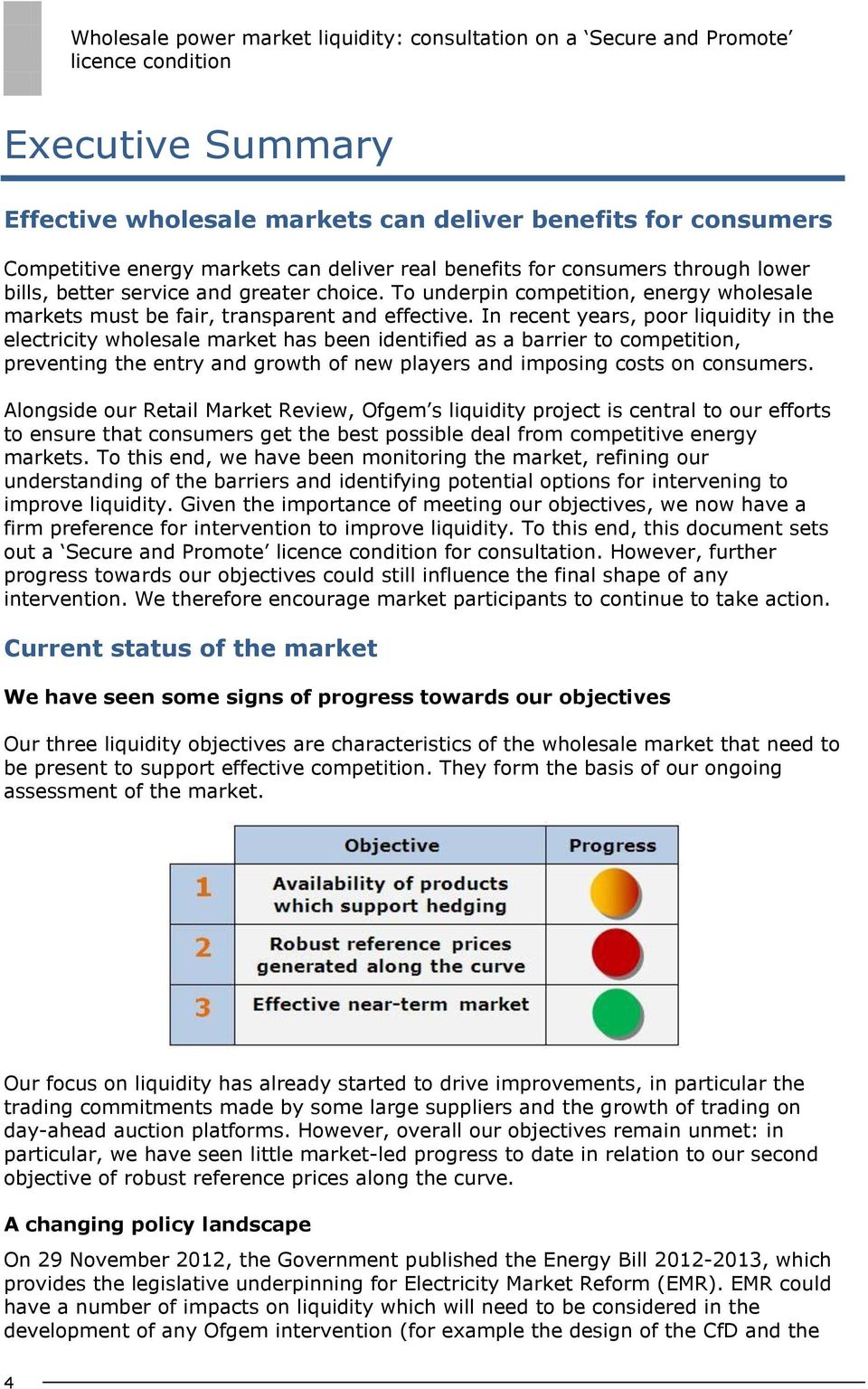
4 Executive Summary Effective wholesale markets can deliver benefits for consumers Competitive energy markets can deliver real benefits for consumers through lower bills, better service and greater choice. To underpin competition, energy wholesale markets must be fair, transparent and effective. In recent years, poor liquidity in the electricity wholesale market has been identified as a barrier to competition, preventing the entry and growth of new players and imposing costs on consumers. Alongside our Retail Market Review, Ofgem s liquidity project is central to our efforts to ensure that consumers get the best possible deal from competitive energy markets. To this end, we have been monitoring the market, refining our understanding of the barriers and identifying potential options for intervening to improve liquidity. Given the importance of meeting our objectives, we now have a firm preference for intervention to improve liquidity. To this end, this document sets out a Secure and Promote for consultation. However, further progress towards our objectives could still influence the final shape of any intervention. We therefore encourage market participants to continue to take action. Current status of the market We have seen some signs of progress towards our objectives Our three liquidity objectives are characteristics of the wholesale market that need to be present to support effective competition. They form the basis of our ongoing assessment of the market. Our focus on liquidity has already started to drive improvements, in particular the trading commitments made by some large suppliers and the growth of trading on day-ahead auction platforms. However, overall our objectives remain unmet: in particular, we have seen little market-led progress to date in relation to our second objective of robust reference prices along the curve. A changing policy landscape On 29 November 2012, the Government published the Energy Bill , which provides the legislative underpinning for Electricity Market Reform (EMR). EMR could have a number of impacts on liquidity which will need to be considered in the development of any Ofgem intervention (for example the design of the CfD and the 4
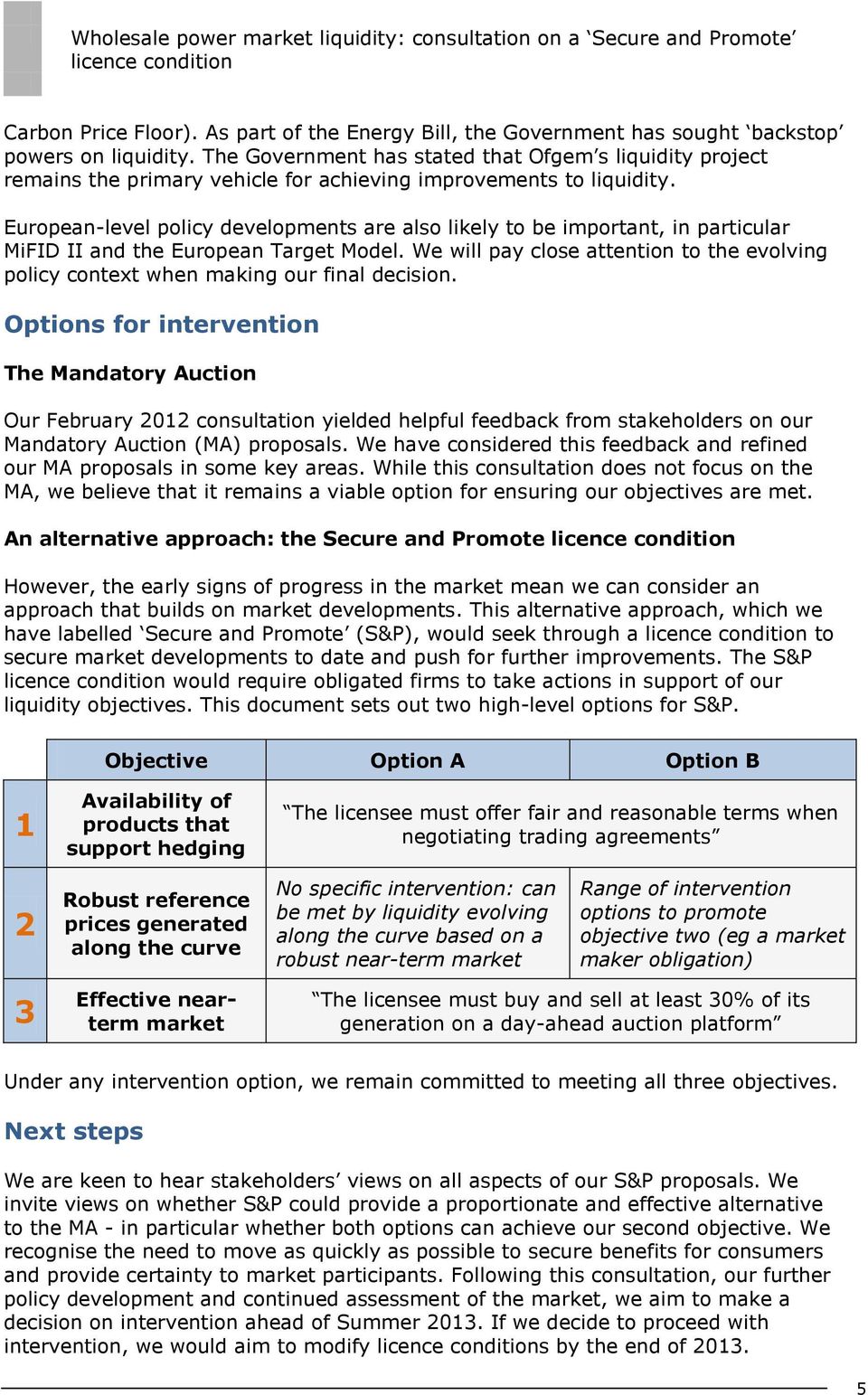
5 Carbon Price Floor). As part of the Energy Bill, the Government has sought backstop powers on liquidity. The Government has stated that Ofgem s liquidity project remains the primary vehicle for achieving improvements to liquidity. European-level policy developments are also likely to be important, in particular MiFID II and the European Target Model. We will pay close attention to the evolving policy context when making our final decision. Options for intervention The Mandatory Auction Our February 2012 consultation yielded helpful feedback from stakeholders on our Mandatory Auction (MA) proposals. We have considered this feedback and refined our MA proposals in some key areas. While this consultation does not focus on the MA, we believe that it remains a viable option for ensuring our objectives are met. An alternative approach: the Secure and Promote However, the early signs of progress in the market mean we can consider an approach that builds on market developments. This alternative approach, which we have labelled Secure and Promote (S&P), would seek through a to secure market developments to date and push for further improvements. The S&P would require obligated firms to take actions in support of our liquidity objectives. This document sets out two high-level options for S&P. Objective Option A Option B 1 Availability of products that support hedging The licensee must offer fair and reasonable terms when negotiating trading agreements 2 Robust reference prices generated along the curve No specific intervention: can be met by liquidity evolving along the curve based on a robust near-term market Range of intervention options to promote objective two (eg a market maker obligation) 3 Effective nearterm market The licensee must buy and sell at least 30% of its generation on a day-ahead auction platform Under any intervention option, we remain committed to meeting all three objectives. Next steps We are keen to hear stakeholders views on all aspects of our S&P proposals. We invite views on whether S&P could provide a proportionate and effective alternative to the MA - in particular whether both options can achieve our second objective. We recognise the need to move as quickly as possible to secure benefits for consumers and provide certainty to market participants. Following this consultation, our further policy development and continued assessment of the market, we aim to make a decision on intervention ahead of Summer If we decide to proceed with intervention, we would aim to modify s by the end of
6 1. Context and market developments Chapter Summary We provide an assessment of progress towards our liquidity objectives. This draws on our updated evaluation of key market metrics, as well as feedback from market participants since our July 2012 open letter. Our assessment shows that two of our three liquidity objectives remain unmet, although there has been continued growth in trading on day-ahead auction platforms and some progress in improving access to hedging products for some market participants. Because of these early signs of progress and the evolving policy context, we conclude that now is not an appropriate time to launch a major regulatory intervention in the market. Question 1: Do you agree with our assessment of market developments? Question 2: Do you agree with our description of the policy and regulatory context affecting liquidity? Question 3: Are there other factors that we have not identified that may be posing a barrier to improvements in liquidity? Background: progress against Ofgem s liquidity objectives 1.1. Ofgem s three liquidity objectives represent characteristics of the wholesale electricity market that are necessary to support effective competition: 1. Availability of products that support hedging 2. Robust reference prices along the curve 3. An effective near-term market In February 2012, we assessed the market against these objectives. We suggested that the growth in volumes on the day-ahead market meant that objective three was being met. However, progress towards our first two objectives was limited, providing a rationale for intervention targeted at these objectives. Our July 2012 open letter updated this assessment. We found that while objective two remained unmet, there had been some positive market-led developments in relation to objective one. Since the open letter, we have continued to monitor the market and have held further discussions with stakeholders in order to assess progress towards our objectives This chapter sets out our most recent assessment of the wholesale market. It notes continued progress in the near-term markets, reinforcing our assessment that objective three is being met. We also note continued signs of progress towards objective one, in the form of the trading commitments made by some vertically integrated suppliers. However, trading along the curve remains thin, meaning that objective two robust reference prices is not being met at present. 6

7 1.4. The wider policy landscape has also continued to evolve. The latter part of this chapter provides an overview of this policy context. It notes a complex and evolving picture, with both positive and negative potential impacts on liquidity. Assessment of the market against our objectives Overall: churn Aggregate churn has continued to deteriorate 1.5. The churn rate is a high-level indicator of wholesale market liquidity. Churn measures the number of times a unit of generation is traded before being delivered to the final customer. Liquid markets are commonly characterised by a high churn rate, with each unit of output being traded many times. We have previously found that churn in the GB wholesale electricity market is low in comparison to the GB wholesale gas market and to other European wholesale electricity markets Churn is a broad indicator, which does not necessarily measure whether our specific objectives are met: for example, it does not provide any indication of the availability of specific products. However churn provides a high-level view of levels of trading in the market and the progress of the market over time. It is therefore useful to monitor alongside our other metrics. Figure 1 GB Annual Churn 7

8 1.7. Figure 1 updates our assessment of churn in the GB wholesale electricity market. Churn continued to fall in the first three quarters of This continues the downward trend since 2009, reversing the increase observed between 2005 and We note the downward trend in churn in some other markets (such as Nordpool 3 ) in this period, highlighting that wider factors may be affecting trading in energy markets and contributing to the decline in liquidity in recent years. For example, risk capital available to financial firms has fallen due to the financial crisis. Some stakeholders have also suggested that widening capacity margins due to the fall in economic activity may be dampening incentives to trade forward. This effect may be reversed if margins become tighter in the coming years. Objective one: Availability of products that support hedging While the depth of trading along the curve remains limited, some independent suppliers report improvements 1.9. In order to compete effectively, firms need to hedge by trading in products months or years ahead of delivery. This enables them to manage the risk posed by movements in the wholesale power price. In order for objective one to be met, these products must be present in the wholesale market and accessible to a wide range of market participants One indicator of the availability of products in the forward market is the proportion of the OTC market that is traded months and years ahead of delivery. Figure 2 shows a mixed picture for OTC trading beyond a year ahead of delivery. There has been a slight decline in baseload trading over a year ahead, primarily due to a fall in the trading of products over 24 months out. However, there was a slight increase in trading of peak products more than a year ahead While the high-level data suggests little progress, feedback from market participants gives a more nuanced picture. We noted in our July 2012 open letter that some large vertically-integrated suppliers have made commitments aimed at facilitating access to the market for independent market participants. In particular, some have tried to take into account the unique needs of smaller suppliers. Since the open letter, we have heard support for these commitments from some independent suppliers. However, concerns remain that these approaches have not been adopted by all large suppliers and that further work is needed in some specific areas, such as credit and collateral. Some independent suppliers also remain sceptical about the 3 Based on information from Nordreg (2012), Nordic Market report 2012, Report 3/2012: %20publication.pdf 8

9 durability of voluntary commitments, noting the risk of them being removed at any time. Figure 2 OTC Trading in Longer-dated Products Objective two: Robust reference prices along the curve Bid-offer spreads remain wide compared to gas In order to be able to participate effectively in the wholesale market, market participants need confidence that prices in the market reflect underlying supply and demand conditions. This also provides a basis for investment in generation. One practical application of reference prices is for the Feed-in Tariff with Contracts for Difference (FiT-CfD) under the Government s EMR programme The bid-offer spread gives an indication of price robustness. A tight bid-offer spread shows that arbitrage opportunities are being exhausted by the presence of a number of active players in the market. A tight bid-offer spread gives market participants confidence that they can buy and sell at a price which reflects underlying demand and supply conditions In our July 2012 assessment we noted a widening of bid-offer spreads for most of the longer-dated products analysed. Since then spreads have continued to widen for most longer-dated products (for example, the Season+4 products shown in 9

10 figure 3). This reverses the trend observed in 2011 where spreads were falling along the curve. Bid-offer spreads for electricity products have widened and remain higher than spreads seen in the gas market. Figure 3: Bid-offer Spreads for Season+4 Products Trading in financial products has increased but volumes remain low and volatile A number of stakeholders have suggested that increased trading in financial products could help to meet our objectives. Financial products do not require firms to take a physical market position, which could ease access for participants such as financial players. Participation by financial players could increase overall depth and levels of trading as well as providing innovative solutions that enable smaller market participants to access the market. 4 Some parties point to Nordpool as an example of a more liquid market that features high traded volumes in financial products Figure 4 updates our assessment of trading in financial products. Traded volumes have increased since late However, other than a sharp spike in March 2012, there is no clear upward trend. Financial products make up less than 3 percent of volumes traded in the wholesale market so far in Participation by financial players can therefore help in achieving both objectives one and two. 10

11 Figure 4 Trading in Financial Products The majority of financial products traded are for delivery within 12 months, and nearly all are baseload. 5 For financial products to meet objective two fully, we would need to see both greater volumes traded in these products and for that trading to spread along the forward curve. We note that a number of factors may be inhibiting financial trading and discuss these further in chapter four We also recognise that progress towards objective two may be being inhibited by policy uncertainty (see below). We hope that further progress towards objective two may be possible as this uncertainty is removed. Objective three: Effective near-term market There has been continued growth in trading on day-ahead auction platforms An effective near-term market enables market participants to shape their contracted volumes to their expected physical positions. Failure to match supply and demand exposes market participants to imbalance risk and the associated imbalance charges Our July 2012 open letter noted a sustained increase in volumes on dayahead auctions after a number of players signed gross-bidding agreements (see 5 A small volume of peak was traded in July

12 chapter three for more detail). Figure 5 shows that this growth has continued. We may see further increases in volumes on these platforms following the implementation of day-ahead market coupling. Trading in day-ahead auctions could also be bolstered by the Government s proposal that the GB zone price produced by the GB hub could be the source of the reference price for the intermittent CfD Many market participants have expressed their confidence that the day-ahead power market is functioning effectively. However we note that some remain sceptical about the growth of day-ahead auction platforms and the extent to which these volumes are actually available to a range of market participants or whether they are bought and sold by the same players without meaningfully adding to liquidity. Figure 5 Day-ahead Auction Trading (N2EX and APX) Intraday trading The other key aspect of the near-term market is trading on the day of delivery, or intraday trading. In February we noted that, while it has been raised by some intermittent generators, intraday liquidity is not currently a widely-held area of concern. We have not heard significant feedback to contradict this view in recent months. As mentioned below, Ofgem s Electricity Balancing Significant Code Review 6 DECC (2012) Feed-in Tariff with Contracts for Difference: Operational Framework, p53: electricity-market-reform-annex-a.pdf 12

13 is considering options that may affect intraday liquidity. It is also worth noting that the Government is planning to take powers in the Energy Bill to improve routes to market for independent renewable generators. 7 We will stay in contact with the Government s work to consider policy options that would support routes to market for intermittents and will pay attention to the interactions with the liquidity project. The policy context The assessment of the market set out above must be considered in the context of the policy landscape currently facing the electricity wholesale market. A number of projects are ongoing which have the potential to have both positive and negative impacts on liquidity. Electricity Market Reform Central to the wholesale electricity market policy context is the Government s Electricity Market Reform (EMR) programme. On 29 November 2012, the Government published the Energy Bill , which will provide the legislative underpinning for EMR. It also provided further detail on the shape of the EMR package, including the Operational Framework, which set out further detail on the design of the FiT-CfD, which will support investment in low-carbon generation EMR has the potential to affect market liquidity in a number of ways. One prominent interaction is the relationship between liquidity and the CfD. The CfD will require a liquid market on which to base the reference price. Once in place, the CfD could itself affect market liquidity by encouraging generators to trade in the markets from which the reference price is drawn, to minimise their basis risk. The Government s Operational Framework indicates that the CfD reference price for baseload generators could be based on a basket of forward market products. 8 The Government intend to confirm the source of the baseload CfD reference price in July We will continue to consider the implications of the CfD design for electricity market liquidity as it emerges and will be keen to hear views from stakeholders The Energy Bill also contains backstop powers to enable the Government to act on liquidity, in the event that industry action or Ofgem intervention does not meet their objectives. We recognise the potential for regulatory uncertainty to inhibit trading. We therefore welcome any suggestions from stakeholders about how Ofgem and the Government can minimise uncertainty and any consequent negative impacts on liquidity. 7 DECC (2012) Electricity Market Reform: policy overview, 29 November 2012, pp electricity-market-reform-policy-overview-.pdf 8 DECC (2012) Feed-in Tariff with Contracts for Difference: Operational Framework, 29 November 2012, p55: 13

14 European legislation Various changes are also being made to European legislation which could have an impact on energy trading. The Regulation on Energy Market Integrity and Transparency (REMIT) 9 is a European Union regulation which prohibits insider trading and market manipulation in the energy sector. It will require wholesale energy market participants to report energy market transactions to the Agency for the Cooperation of Energy Regulators (ACER) and to publish inside information. Ofgem is expected to receive investigative and enforcement powers under REMIT in the first half of Another significant change is the revision to the Markets in Financial Instruments Directive (MiFID II), which defines which products and firms fall within European financial regulation. MiFID II sets the scope of other pieces of financial legislation, including the European Market Infrastructure Regulation (EMIR), which sets out rules on the requirements for compulsory clearing of eligible OTC derivatives. MiFID II is currently going through European Union policy making processes. We expect further clarity on the eventual shape of MiFID II early in 2013, once the text of the directive becomes finalised The integrity of markets is vital to ensure that they deliver benefits for consumers. However, some stakeholders have suggested that the changes brought forward through legislation such as REMIT and MiFID II could increase costs for firms trading in the wholesale energy markets and have an adverse impact on liquidity. Evaluating the impact of legislation that is still under development is obviously challenging, but we would be keen to hear further feedback from stakeholders about the potential impact of this European legislation on liquidity. We will continue to consider the potential consequences of this legislation when developing options for interventions to support liquidity. European Target Model The European Target Model sets out a vision for cross-border trade in electricity, which is to be achieved through legally-binding network codes. The objective of the Target Model is to remove policy barriers to trading electricity between markets. As a National Regulatory Agency, Ofgem has a role in implementing the Target Model A core feature of the European Target Model is market coupling at the dayahead stage, where interconnector capacity will be allocated in response to price signals. GB will participate in market coupling through a GB hub, which will pool the liquidity on the GB day-ahead auctions and provide a single reference price. 9 Regulation (EU) No 1227/2011 of the European Parliament and of the Council of 25 October 2011 on wholesale energy market integrity and transparency. 14
15 1.32. We anticipate that interconnectors (IFA and BritNed) will implement coordinated market coupling as part of the North-West European market coupling project in June Bearing in mind the potential benefits for GB consumers from integrated European wholesale markets, Ofgem is keen to see the implementation of market coupling and will be monitoring progress to ensure it remains on track. Electricity Balancing Significant Code Review Ofgem launched its Electricity Balancing Significant Code Review (SCR) on 1 August The objective of the SCR is to ensure that the balancing arrangements provide incentives for sufficient investment in capacity to maintain an efficient level of security of supply. It will consider how to improve price signals to make them more reflective of the costs of balancing, incentivise participants to balance and improve overall efficiency of the balancing arrangements Changes to the balancing arrangements could have an impact on liquidity by altering the incentives for market participants to trade to ensure they are in balance. As the SCR is still at an early stage, the potential impacts on liquidity are still uncertain. We will continue to consider the interactions between the liquidity project and the SCR proposals as they develop. Conclusion: a mixed and evolving picture It would not be appropriate to identify an intervention to support liquidity at this stage Two of our three liquidity objectives are unmet. We still have significant concerns that the market is not providing the longer-term products and price signals that market participants need. As a result, we have a strong preference for intervention to improve liquidity. However, we note some signs of improvement in relation to objective one. We also note the potential for other developments such as the prospect of a market in financial products to lead to further progress towards our objectives in the future. Further to this we have highlighted the evolving policy context and the positive and negative effects that this could have on liquidity. Bearing in mind the signs of progress towards our objectives and the evolving policy landscape, we do not believe now is the best time to make a final assessment of the need to intervene to support liquidity and what that intervention should be The early signs of progress in the market provide us with an opportunity to consider an approach that builds on the positive market developments we have seen to date. With this in mind, the next three chapters set out our proposals for a Secure and Promote. 10 Ofgem (2012), Electricity Balancing Significant Code Review (SCR) Initial Consultation, 1 August 2012, Reference 108/12: 15
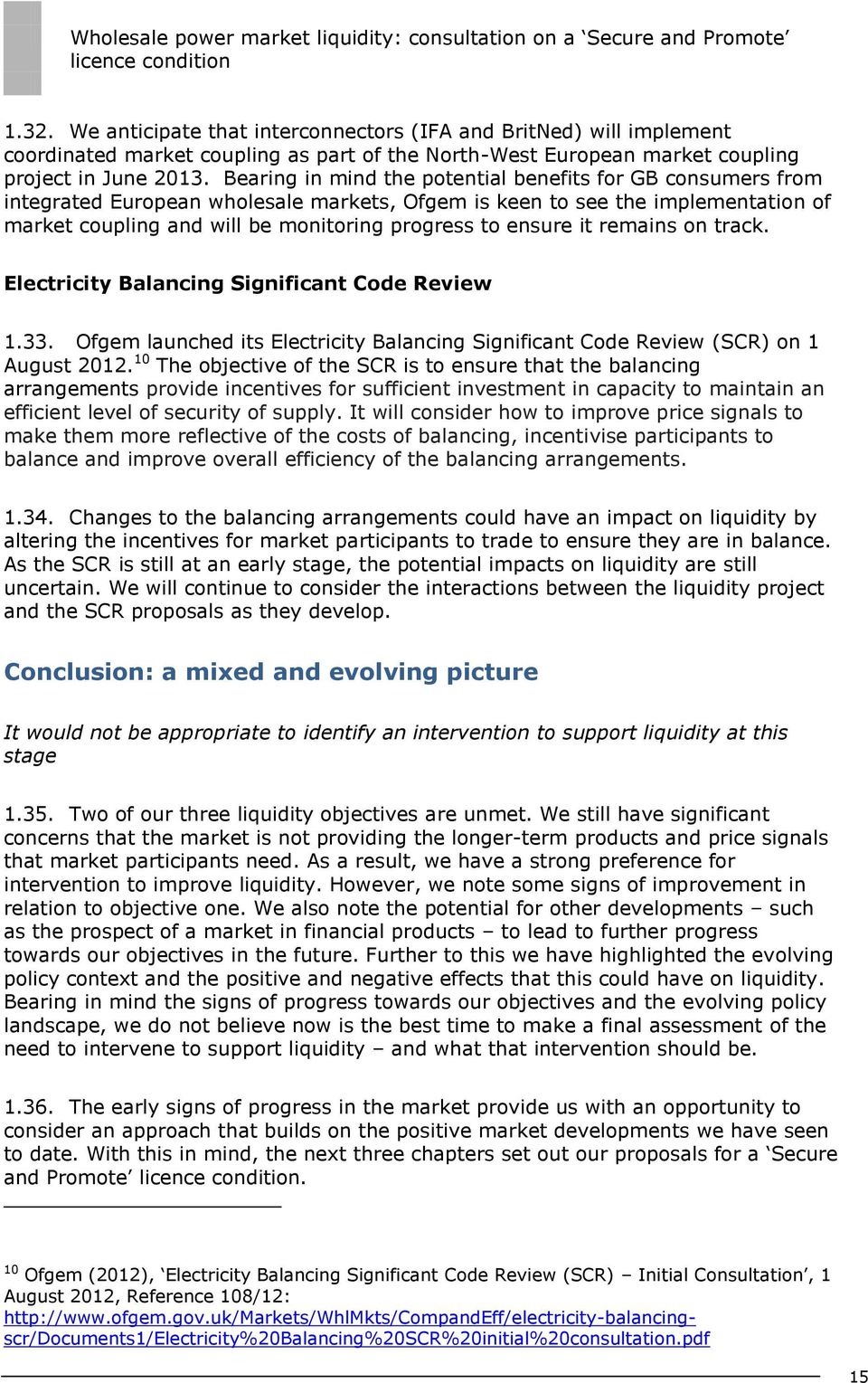
16 Figure 6 Summary of Progress Towards our Objectives GB wholesale power market objectives Market Developments Impact on Objective Overall market liquidity Churn has continued to decline in Availability of products which support hedging Robust reference prices generated along the curve Effective nearterm market The proportion of baseload products traded beyond a year ahead remains limited for all products Commitments to trade with small suppliers made by some of the large verticallyintegrated players, although feedback from independent suppliers is mixed Since the initial increase in trading in financial products in late 2011, growth in volume traded has been limited. Financial products make up less than 3% of overall traded volumes so far in 2012 The narrowing of spreads seen in 2011 has reversed throughout 2012 to date, suggesting a deterioration of liquidity and reduced consensus over the market price Volumes traded on near-term exchanges continuing to grow 16
17 2. The Secure and Promote Licence Condition Chapter Summary As noted in the previous chapter, we have seen positive market-led developments that represent progress towards objectives one and three. Based on these developments, we are considering an intervention which would lock in progress against our objectives to date. It could also push for further action where the market has not made progress. In this chapter we explain the rationale for a Secure and Promote and set out its high-level design. These are initial proposals: we welcome feedback from stakeholders on all design elements set out in this chapter and the following two chapters. Question 4: Do you agree that the Secure and Promote model presented in this document could help to meet our objectives? Question 5: Does our proposed structure for Secure and Promote seem appropriate? Question 6: Do you think the proposed Secure and Promote model would be a more effective intervention than the Mandatory Auction? An approach which builds on industry developments 2.1. Our liquidity objectives remain unmet. It is therefore necessary for us to continue to develop options for intervention to improve liquidity. In February, we consulted on proposals for a Mandatory Auction (MA): a monthly auction in a range of key forward market products. During the consultation, industry stakeholders expressed a number of concerns about our proposals. While the MA remains a viable intervention option (see chapter five), we have been exploring whether there are alternative approaches to meeting our objectives. In particular, we are keen to ensure that any intervention takes account of the positive developments noted in the previous chapter In this light, we are considering the case for an intervention that builds on existing market developments. We have developed an approach that we have named Secure and Promote (S&P). Through a, S&P would aim to secure existing positive developments and potentially push for further developments in areas where we have not seen progress to date. S&P could: ensure existing developments are durable locking in positive developments through a would provide confidence to market participants that they will continue and can be relied on. embed best practice ensures the roll out of emerging best practice across the market. 17
18 drive further improvements where our objectives are unmet by market developments, S&P could spur further progress. This is particularly important in relation to our second objective (robust reference prices along the curve) Our S&P model also builds on proposals that have been made by some stakeholders for a -based approach to improving liquidity. These proposals have been extremely helpful in developing our thinking on the S&P. We will be keen to continue discussions with these stakeholders during the consultation. Structure of the S&P Nature of the obligation 2.4. Our three liquidity objectives provide the starting point for S&P. The licence condition would require the licensees to perform specified actions to support the achievement of our objectives There are two high-level approaches to the S&P on which we are consulting: Option A securing developments (and spreading best practice) in relation to objectives one and three; not directly intervening in relation to objective two, on the basis that liquidity would spread along the curve from the increasingly liquid near-term markets. Option B securing developments in relation to objectives one and three; and proceeding with intervention of some form to ensure objective two is met as quickly as possible Figure 7 provides a high-level indication of the actions that licensees could be required to perform under each option. Figure 7 Illustrative actions under each Secure and Promote option Objective Option A Option B 1 Availability of products that support hedging The licensee must offer fair and reasonable terms when negotiating trading agreements 2 Robust reference prices generated along the curve No specific intervention: can be met by liquidity evolving along the curve based on a robust near-term market (see chapter four for detail) Intervention to promote objective two (eg through a market maker obligation) 3 Effective nearterm market The licensee must buy and sell at least 30% of its generation on a day-ahead auction platform 18

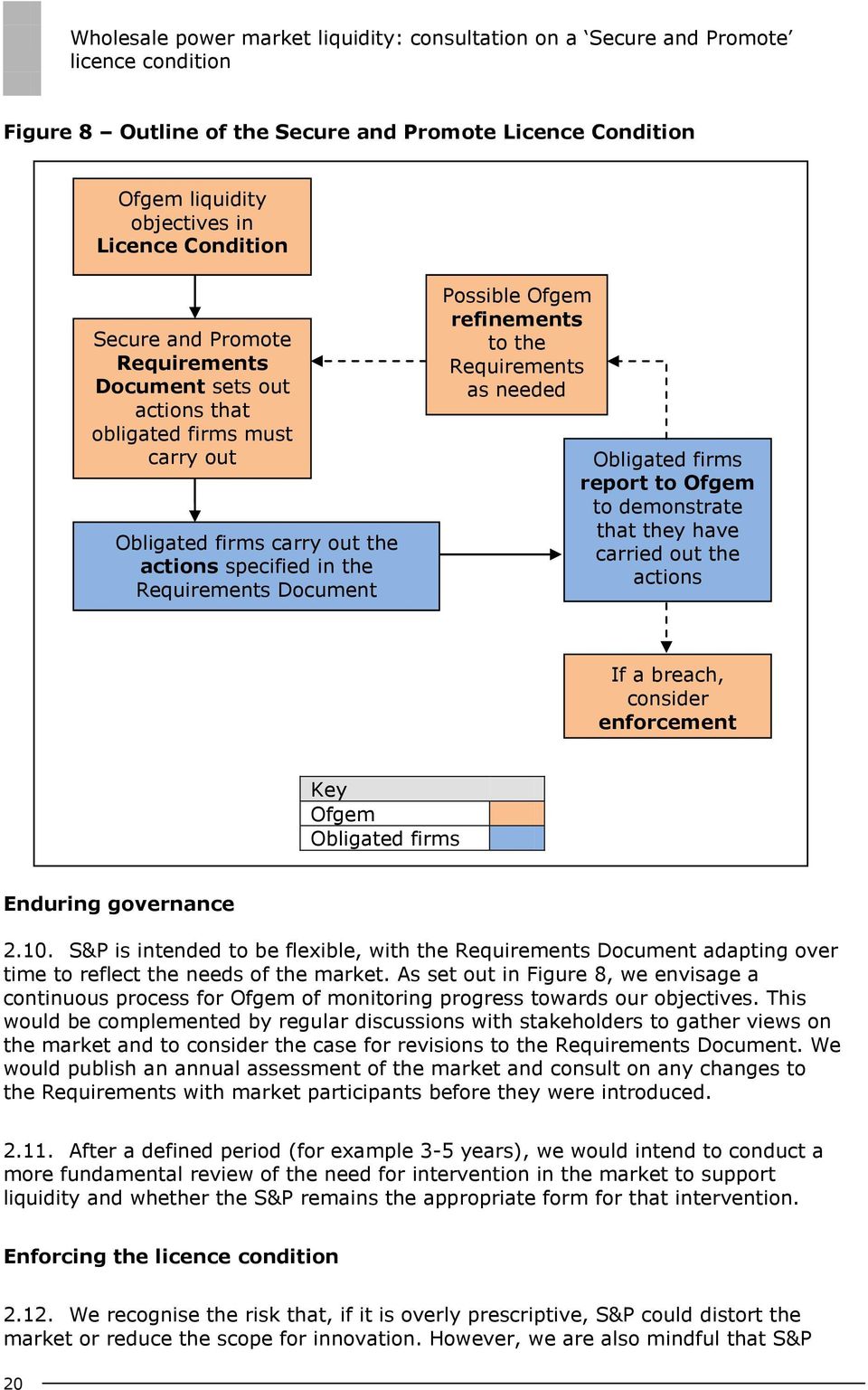
19 Obligated parties 2.7. Our initial proposal is that the would apply to the six large, vertically integrated suppliers. 11 The reasons for this are: The purpose of the intervention would be to remove barriers to more effective competition in the generation and supply particularly domestic supply markets. It would therefore seem appropriate for the obligation to rest with parties that hold a strong position in those related markets. The six large vertically integrated suppliers control around 99% of the domestic supply market and 70% of the generation market. 12 We would be concerned that imposing the obligation and associated costs on other players could restrict the growth of these players, further inhibiting competition and posing a barrier to entry. By their nature, the large vertically integrated companies may be able to meet the obligation more cheaply and easily than other parties. For example, they have more sophisticated trading capabilities, enabling them to minimise the cost of performing actions such as market making or trading through the day-ahead auction. Limiting the obligation to these parties would ensure that the overall cost of the obligation is not disproportionate. The large vertically integrated companies also have an inherent need to both buy and sell volumes on a regular basis, something that would be required by this However, we recognise that there are other large players that may be able to meet the obligation at reasonable cost and risk. We will therefore give further thought to the question of who faces the obligation. We welcome evidence on the rationale for, and the costs of, including other firms in the obligation. Legal structure 2.9. Our initial proposal for the high-level structure of the S&P is set out in Figure 8 below. An illustrative can be found in appendix two. Under our initial proposal, the legal basis of the S&P would be a special in the generation licence, inserted only for the obligated parties. 14 The detailed requirements that the licensees would face would be set out in a separate Trading Requirements Document (those detailed requirements set out in chapters three and four). For all aspects of S&P, the licensee would have to report regularly to Ofgem on its progress in performing the actions (see appendix four). 11 Centrica, EDF Energy, E.ON, RWE Npower, Scottish Power and SSE. 12 Ofgem (2011) Retail Market Review: Findings and Initial Proposals, p5: 13 While this is true to some extent with most market participants, the large verticallyintegrated companies may have a greater ability to integrate both buying and selling power into their standard wholesale market trading operations. 14 We are open to views as to whether it would be preferable to have a standard licence condition in the generation licence, switched on only for the obligated parties. 19

20 Figure 8 Outline of the Secure and Promote Licence Condition Ofgem liquidity objectives in Licence Condition Secure and Promote Requirements Document sets out actions that obligated firms must carry out Obligated firms carry out the actions specified in the Requirements Document Possible Ofgem refinements to the Requirements as needed Obligated firms report to Ofgem to demonstrate that they have carried out the actions If a breach, consider enforcement Key Ofgem Obligated firms Enduring governance S&P is intended to be flexible, with the Requirements Document adapting over time to reflect the needs of the market. As set out in Figure 8, we envisage a continuous process for Ofgem of monitoring progress towards our objectives. This would be complemented by regular discussions with stakeholders to gather views on the market and to consider the case for revisions to the Requirements Document. We would publish an annual assessment of the market and consult on any changes to the Requirements with market participants before they were introduced After a defined period (for example 3-5 years), we would intend to conduct a more fundamental review of the need for intervention in the market to support liquidity and whether the S&P remains the appropriate form for that intervention. Enforcing the We recognise the risk that, if it is overly prescriptive, S&P could distort the market or reduce the scope for innovation. However, we are also mindful that S&P 20
21 must provide clarity for licensees about the actions they must perform. We also need to allow for successful enforcement action to be taken if a licensee is not supporting our objectives. The S&P model we propose in this document attempts to balance these factors. Any decision related to the opening of an investigation into a breach of this condition would be made in accordance with the Enforcement Guidelines on Complaints and Investigations 15 and would take the specific facts of the matter into account, including whether or not we believe a particular action taken by the company was a genuine attempt to support our objectives. Advantages of the Secure and Promote approach We have previously set out the key principles for the design of any liquidity intervention. 16 Figure 9 considers S&P against these design principles: Figure 9: How Secure and Promote meets our design principles Design Principles Aligns with what currently works well in the market Allows GB to evolve towards becoming an integrated part of a wider European market Takes account of the Government s Electricity Market Reform (EMR)......and developments in EU legislation? Evaluation Based on existing market developments Locking in increase in day-ahead volumes may aid progress towards the European Target Model; S&P is flexible to adjust as Target Model develops Locking in increase in day-ahead auction volumes could support robust reference price for intermittent CfD We will consider the Government s detailed proposals for the baseload CfD reference price as they emerge Uncertainty remains over final shape of MiFID II Does not impose unreasonable costs In line with better regulation principles: based on existing market developments which should limit costs Enforcement Guidelines on Complaints and Investigations : % pdf 16 Ofgem (2011), Ofgem s Retail Market Review update and next steps (liquidity proposals), 22 June 2011: %20letter.pdf 17 As with previous rounds of consultation, we would anticipate making a formal request for information during the consultation period on the costs of meeting the obligation. 21
22 3. Securing existing developments Chapter Summary Where we have seen market-led progress towards our objectives, S&P would aim to lock in this progress. This will ensure that (i) these developments are enduring and (ii) that best practice is rolled out across the market. This chapter sets out our approach for securing the developments in relation to those objectives where we have seen market-led progress to date: objectives one and three. Question 7: Do you have any views on the requirements we have set out for trading commitments in particular those points listed under outstanding design challenges on page 25? Question 8: Do you have any views on our proposed approach to securing existing developments in relation to day-ahead auctions in particular those points listed under outstanding design challenges on page 28? 3.1. Under either S&P option set out in chapter two, we would seek to lock in the positive developments we have seen in the market to date and ensure that best practice is rolled out across the market. This chapter sets out our approach to securing progress made in the trading terms offered to independent suppliers and on day-ahead auction platforms. Securing objective one: ensuring fair and reasonable terms in trading agreements 3.2. Ofgem s first liquidity objective relates to the availability of products which support hedging. As noted in chapter one, market participants suggest that there has been some progress towards meeting this objective. Since the February 2012 consultation, we have seen some large vertically integrated suppliers make commitments to trade with independent suppliers on more reasonable terms, including through smaller clip sizes, more transparent pricing and an improved approach to credit and collateral. We think that commitments such as these could play an important role in ensuring that existing independent suppliers and new entrants have access to products that support hedging thereby meeting objective one. This view is supported by the positive response from some stakeholders to the commitments that have already been made However, this progress is not yet sufficient to fully meet objective one. We have repeatedly received feedback that, in some instances, some large vertically integrated players are not responding effectively to requests to trade from other market participants particularly independent suppliers. This manifests itself in a failure to offer the products and volumes these firms need; by offering contract terms that they find difficult to accept; or by failing to respond in a timely manner to requests for trading. The result is to limit the access of some independent suppliers 22
23 to the wholesale market, preventing them from competing effectively in the retail market We recognise that this is a complex area: terms that are considered fair and reasonable by one party may not be by another. However, our initial view is that there could be benefit to an approach which clarifies what is expected in these trading agreements and ensures that best practice is spread across the market. The aim of S&P in relation to objective one 3.5. The existing high-level, voluntary commitments may be insufficient to provide independent suppliers with certainty that they will be able to access the wholesale market in the future. For trading commitments to achieve objective one, they need to be enduring, transparent and consistently applied across all licensees. To ensure this occurs, we propose to secure existing developments by setting out requirements that S&P licensees must adhere to when negotiating trading agreements with independent suppliers. If successful, this could facilitate access to the wholesale market for these parties and enable them to compete effectively. Trading commitments: the detailed requirements 3.6. This element of the S&P would require that: The licensee must offer fair and reasonable terms when negotiating trading agreements 3.7. The would be accompanied by a set of requirements outlining in detail what licensees would have to offer as a part of fair and reasonable terms. Figure 10 sets out our indicative proposals for these requirements and summarises our rationale in each case: 23
24 Figure 10: Illustrative requirements for ensuring fair and reasonable terms in trading agreements Element Requirements Rationale Clip Size If requested, licensee must trade clip sizes as small as 0.1MW. To reflect volume needs of small players. Product Range Fair Pricing Credit and Collateral Response to trading requests Licensee must offer a range of standard products in baseload from week-ahead to Season+4 and peak from week-ahead to Season+3. Licensee must provide quotes for products based on a recognised market index. The pricing methodology must be shared with the counterparty. Any administrative costs should be itemised. Licensee must offer reasonable credit and collateral arrangements, based on a bespoke calculation in relation to each counterparty eg through an independent assessment 18 of creditworthiness. Licensee must respond to requests in a timely manner: responding to initial requests for trading agreements within 20 working days and subsequent requests to trade within 5 working days. Includes a range of standard products that enable market participants to hedge and compete effectively. It may be possible to include shaped products eg standard domestic profiles in this list. Ensures prices are calculated fairly and transparently. Ensures risk of trading with individual counterparty is reflected in collateral required. Ensures that trading agreements can be negotiated within a reasonable timeframe and that subsequent requests to trade are executed in a timely manner. Transparency Licensee must publicise its approach in each of the areas above, eg on its public website. Will increase transparency and confidence; sets clear expectations for trading negotiations. Scope Licensee must be prepared to reflect these characteristics in all trading agreements with independent suppliers (eg those who supplied less than 1TWh in the previous year). Targets S&P at parties facing the highest barriers to wholesale market participation. 18 Independent assessments of the creditworthiness of participants without a credit rating are used elsewhere in the electricity market. For example, Schedule 1 of the Distribution Connection and Use of System Agreement (DCUSA) includes reference to credit scores provided by recognised credit assessment agencies. We are interested whether such assessments could play a role in determining creditworthiness for the sale of wholesale power. 24
25 3.8. As with other aspects of S&P, each year, the licensee would be required to report on their approach to these requirements and provide evidence that the obligation had been met. See appendix four for more detail on the sorts of evidence we would expect to receive from licensees. Trading commitments: key outstanding design questions 3.9. We particularly welcome feedback on the following issues: Credit and Collateral we recognise that credit and collateral arrangements are a key issue for independent suppliers seeking to trade. However, we are also aware that this is a complex area where market participants pursue different approaches. We welcome feedback on whether our proposal could deliver benefits for independent suppliers at a reasonable cost, or whether stakeholders have other proposals that could address the challenge posed by credit and collateral requirements. Products some independent suppliers say that they need access to shaped products, as they enable them to obtain shape without multiple trades. We can see the clear potential benefits of including shaped products within S&P. However, because shaped products are bespoke, they do not sit easily in a high-level regulatory framework. For example, it seems difficult to impose a particular approach to the pricing of shaped products. We welcome views on whether the obligation should incorporate particular shaped products (for example a standard domestic profile). Scope the trading commitments could either be targeted at supporting access to the wholesale market for independent suppliers or could apply to all of a licensee s dealings in the wholesale market. Our initial view is that these trading commitments should be targeted specifically at independent suppliers, as these parties face particular problems (for example in relation to clip sizes) that other parties in the market do not. This would also minimise the costs of the obligation and enable licensees to take a more targeted approach. We welcome feedback on whether this proposal is appropriate, and if so, what the threshold used to target the trading commitments should be. Securing objective three: ensuring continued liquidity on dayahead auction platforms Ofgem s third liquidity objective is the development of an effective near-term market. As noted in chapter one, we have seen good progress in relation to this objective. A key reason for this is the growth in volumes traded on day-ahead auction platforms. This increase has been driven to a large extent by the grossbidding agreements that have become a feature of the GB market over the last year. 25
26 3.11. Gross bidding involves participating on both the buy and sell sides of an auction. A firm may enter into a gross bidding agreement with a platform in return for reduced trading fees. Over the last year or so, all of the large verticallyintegrated suppliers in the GB market have signed gross bidding agreements on dayahead auctions. These involve agreements to trade a volume equivalent to at least 30% of their generation on both sides of the auction. Gross bidding agreements are present in Nordpool, which is often highlighted as a liquid and effective market. There is also an increased focus on trading at the day-ahead stage in other European countries as part of the European Target Model for electricity The increased volumes at the day-ahead stage could provide: an effective near-term market where firms can shape their positions and minimise their exposure to charges under the balancing mechanism 19 a robust settlement price for financial products, helping liquidity to develop along the curve (see chapter four) a liquid reference price for the intermittent CfD under the Government s EMR proposals price signals for the efficient allocation of interconnector capacity under market coupling as part of the European Target Model We want to ensure that the progress that has already been made on nearterm markets is durable, and that day-ahead auctions will continue to be liquid. Under our S&P proposals, the large vertically integrated suppliers would be required to maintain the volumes of trading implied by gross bidding agreements through a. As this would not involve new actions by those parties we have currently proposed as the licensees, we believe this aspect of the may carry minimal additional cost. Day-ahead auctions: detailed requirements Our proposals for this element of Secure and Promote are set out in Figure 11 below: 19 We have received feedback that, since the increase in volumes traded on the day-ahead auction, some firms are finding it easier to meet their shaping needs. 26
27 Figure 11: Illustrative requirements for securing traded volumes on day-ahead auction platforms Element Requirements Rationale Required actions Licensee must buy 20 and sell... Ensures activity on both sides of the auction, with benefits to both the generation and supply markets. Volume...at least 30% of its annual generation... Secures the volume in existing gross bidding agreements. Calculating volume on an annual basis should minimise reporting costs. No clear benefits from basing the obligation on a shorter time period. Platform...through a day-ahead auction (or auctions). Allows firms to meet the obligation on either an existing day-ahead auction platform, or on a new entrant platform. (All platforms will be connected to a single pool of liquidity via the GB hub). Information provision Licensee must provide Ofgem with a statement of its annual generation volume, as well as a list of the generating units whose output is included. Licensee must provide Ofgem with a report from its day-ahead auction provider(s), setting out the volumes bought and sold over the course of the year. Provides evidence that a firm is meeting its obligation. 20 We would expect the to allow an obligated firm to fulfil part of the obligation through its affiliates (eg its supply business). 27
28 Securing traded volumes on day-ahead auction platforms: outstanding design questions We particularly welcome feedback on the following issues: Impact most stakeholders have pointed to gross bidding as a positive step forward for liquidity in the GB power market. However, others have questioned the value of increased trading driven by gross bidding. We are not aware of any potential strategies that would mean gross bidding is harmful or reduces market liquidity. However, we remain interested in hearing views on this point, particularly where evidence is provided in support of these views. Platforms we recognise the value of choice and competition in the platform market. While we believe there is a rationale for securing the increase of volumes traded on day-ahead auctions, we believe this could be accomplished through any day-ahead auction connected to the GB hub. Maintaining competition between auction providers would help to ensure that fees remain at competitive levels and that a high level of service continues to be offered to market participants. However, we welcome views on whether this obligation would have unintended consequences for the platform market. Volume we currently consider that securing the existing volume (30% of generation) stated in gross bidding agreements would be sufficient. However, we would be interested in views about whether it would be appropriate to specify a different volume in the. As with other elements of S&P, the percentage contained in this obligation would be subject to ongoing review once the obligation is in place Under any model of S&P introduced to improve liquidity, we would aim to secure the developments in relation to objective one and three for example through the mechanisms set out in this chapter. However, in relation to objective two, the next chapter first asks whether we should seek to intervene, before going on to consider which intervention model we should pursue. 28
29 4. Promoting further developments Chapter Summary While the market has made progress in relation to objectives one and three, there has been little progress in relation to objective two: robust reference prices along the curve. The market may develop naturally to meet this objective, with liquidity spreading along the curve from near-term markets. However, we must also consider the case for intervention to ensure this objective is met. This chapter considers the case for intervention in support of this objective and sets out one possible intervention mechanism: a market maker obligation. Question 9: Will trading along the curve naturally develop from the nearterm market? Question 10: Should Ofgem intervene to ensure that robust reference prices along the curve develop? Question 11: Is market-making the most appropriate intervention option to promote robust reference prices along the curve? What is your view on the trading obligation option that is outlined on page 34? Question 12: Do you have any views on the design of the market making intervention outlined in this document in particular those points listed under outstanding design challenges on page 33? Market-led progress towards objective two 4.1. Ofgem s second liquidity objective robust reference prices along the curve remains unmet. Unlike objectives one and three, the market has shown limited progress towards meeting this objective to date. Consequently there are no clear market developments that could be secured through the S&P approach at this stage. We must therefore consider whether an intervention is needed to promote the achievement of this objective and if so, what shape that intervention should take. Will liquidity in forward markets evolve naturally from near-term liquidity? 4.2. One view is that liquidity in forward markets and robust reference prices in these markets will develop naturally from improvements we have seen in nearterm liquidity. One reason for this is that near-term liquidity provides participants with greater confidence that, if they trade along the curve, they will be able to adjust their positions close to delivery One avenue through which this could occur is a growth in financial futures products. During the February 2012 consultation, it was suggested by several parties that liquidity along the curve could develop through longer-dated financial products which take the day-ahead auction as a reference price. One prerequisite for financial futures products is a robust near-term reference price, against which these products can be settled. The recent increase in volumes traded on day-ahead auctions may 29
30 now be providing this. With S&P underpinning the volumes in the day-ahead auction, market participants may have the confidence to increase trading of financial products in the knowledge that the reference market will be sufficiently liquid. The GB hub should further improve the reference price, as it will remove any price divergence between the different day-ahead auctions. As noted in chapter one, the combination of a liquid physical market in the near-term and a longer-term market in financial products is the model seen in Nordpool, which is often highlighted as a good example of a liquid market. Some market participants suggest that the GB market is evolving towards that model When considering whether financial products could in time meet Ofgem s liquidity objectives, there are reasons to be cautious. As noted in chapter one, the volumes traded in financial products remain low and are not yet on a clear upward trend. Trading in financial products has made up less than 3% of overall wholesale market trading so far in The trading that does exist is sporadic and concentrated in products traded less than 6 months ahead of delivery. We have heard from some stakeholders that the slow progress to date may have been caused by difficulties with the signup process for trading in financial products. We hear that these issues are gradually being resolved and there has been growth in the number of firms registered to trade these products. Over time this may result in an increase in the volumes traded. Views have also been expressed that the planned move of financial products to the OTC brokered screen could improve the visibility of these products to traders and hence encourage trading In our July 2012 open letter, we expressed an interest in exploring whether financially-settled products are capable of meeting the needs of independent market participants. Following the letter, we have had some initial discussions on this question with stakeholders. The view from most independent players is that they are largely indifferent between hedging through physical or financial products and that financial products could meet their needs (although some noted the potential sign up costs for trading these products as a barrier). We would be interested in any further views from stakeholders on this point. Evolution of existing exchange platforms 4.6. One stakeholder has suggested that the existing exchange platforms could gradually extend their product offering along the curve, encompassing first weeks, then months, then seasons ahead of delivery. Over time, this could create a one stop shop for wholesale market products, enabling market participants to make efficient use of their collateral and reducing the need to sign Grid Trade Master Agreements (GTMAs) with a wide range of players. We would be interested in hearing stakeholders views on this proposal. In particular, we would be interested in understanding how quickly this extension could occur and in what products. We welcome views on the need for intervention to ensure objective two is met 4.7. The lack of existing industry-led progress means that addressing objective two through the S&P approach is challenging. With any regulatory intervention, there 30
31 is always the possibility for unintended consequences. In this context, some stakeholders may suggest that an approach which allows the market to organically build on developments in near-term markets may be preferable. We welcome stakeholders views on the likelihood of liquidity and robust reference prices developing along the forward curve in the absence of regulatory intervention. Promoting objective two: options for intervention 4.8. There is a risk that waiting for market developments to deliver objective two could lead to further delay in the achievement of our objectives, imposing costs on consumers. We have therefore considered a number of intervention approaches that would enable us to promote robust reference prices within the S&P framework. A market maker obligation 4.9. At this stage, our lead option for intervention in relation to objective two is to require the licensees to market make in key forward market products, subject to requirements defined by Ofgem. The regular posting of bid and offer prices for a range of key products by licensees would reveal their view of the market price for these products. The presence of several market makers would support this process, by providing arbitrage opportunities and enabling a consensus view of the market price to develop The liquidity project has previously considered market making as a standalone intervention. In our February 2012 consultation, we highlighted that, while we see its merits, a market making obligation was not our preferred intervention when trying to target both objectives one and two through a single intervention. However, the S&P approach enables us to consider our objectives individually. With objective one potentially secured through a separate mechanism, the case for a market maker aimed at objective two is stronger. In addition, since the February consultation, stakeholders have continued to express the view that the market maker has the potential to be an effective intervention to support liquidity, and that the design challenges we have identified with the mechanism can be addressed. As noted below, we continue to have concerns in some of these areas (for example in relation to the regulation of bid-offer spreads), but welcome proposals from market participants on how these challenges can be overcome. Market making: detailed requirements As with the obligations set out in chapter three, the market making obligation would be based on a set of detailed requirements. Our initial view of these requirements is set out in figure 12 below: 21 The presence of multiple market makers could allow the market bid-offer spread to be narrower than the bid-offer spread posted by an individual market maker. 31
32 Figure 12: Illustrative requirements for a market maker Element Requirements Rationale Platform Products The licensee is required to market make on any standard, commonly used GB power trading platform. The licensee must post bids and offer prices in the following products (either financial or physical): Baseload: Month+1, Month+2, Quarter+1, Season+1, Season+2, Season+3, Season+4 Peak: Month+1, Month+2, Quarter+1, Season+1, Season+2, Season+3. Ensures prices posted are accessible to other market participants. Not prescriptive, to avoid distortions. Ensures that prices are available along the curve in a range of baseload and peak products. Takes into account of difficulty of pricing products beyond the Carbon Price Floor horizon. Availability The licensee must post prices for more than 50% of the market opening time in any given calendar month. Ensures reference prices available for majority of market opening while limiting costs for licensees. Obligation to trade Maximum trade size Bid-offer spreads If requested, the licensee must be willing to trade at quoted prices. At any particular quoted bid or offer price, licensee must be willing to trade up to 10MW. The licensee must maintain a spread between the bid and offer price for each product which: - Allows significant volumes to be traded over the course of a year - Is not significantly larger than spreads posted in existing market making arrangements in GB and in other European energy markets - Is not significantly wider than spreads posted by other licensees. Ensures that prices quoted are a genuine reflection of licensee s view of the market price and provides product availability for other market participants. Most common trade size for forward products. Limits the costs imposed on an licensee eg due to short-term divergence from the market price. Ensures that the licensee is not able to frustrate aims of intervention by maintaining a wide spread between the bid and offer price. However, does not specify maximum bid-offer spreads, as this could risk distorting the market price. The spreads may differ across different products, reflecting the varying risks in pricing those products. 32
33 Market making: outstanding design challenges There are certain design issues in relation to the market making requirement on which we would particularly welcome views from stakeholders: Bid-offer spreads as noted in previous rounds of consultation, we would be concerned that regulation of bid-offer spreads could risk distorting the price. In the model above, we have aimed to limit bid-offer spreads to ensure the mechanism would be effective, while stopping short of placing explicit regulatory limits on them, which could distort prices. We welcome comments from stakeholders on whether the approach we have proposed strikes the best possible balance between ensuring effectiveness and limiting distortions or whether it would be better for Ofgem to place explicit limits on the allowable bid-offer spread. In the latter case, we would appreciate specific views on how such limits should be set. Cost we recognise that market making imposes certain costs and risks on the market maker. The requirements we set out in figure 12 above aim to limit this cost: for example, by limiting the maximum trade size that the licensee must execute. However, we also note that, in most cases, the market maker will profit from trading. 22 Over time, we would expect this profit to outweigh any losses resulting from occasional mispricing (accidental deviation from the market price). In general, responses to the request for information issued in June 2011 on the costs of market making suggest that the costs are proportionate. However, we welcome further feedback on this point: during this consultation phase we intend to make a further request for information based on the S&P model we have set out in this document. MiFID II MiFID II is still going through EU policy making processes. However, under some current proposals, there is the possibility that carrying out market making could limit access to certain exemptions from the regulations. 23 Falling within MiFID II and related European financial regulations 24 could have cost implications for obligated firms. We hope that more clarity will become available over the next few months about the final shape of MiFID II. In the meantime we welcome views from market participants about the relationship between market making under S&P and MiFID II, especially the extent of any costs and risks imposed by the obligation. 22 Due to the difference between the price at which the trade is executed and the mid-price. 23 For example, the draft European Parliament legislative resolution on MiFID II, dated 5 October 2012, limited the applicability of the ancillary business exemption (Article 2(1)(i)) to firms that are not acting as a market maker in relation to commodity derivatives. 24 Particularly the European Market Infrastructure Regulation (EMIR) and the Capital Requirements Directive (CRD IV). 33
34 An alternative approach to promoting objective two: an obligation to trade Some stakeholders have proposed an alternative approach that could promote progress towards objective two, based around an obligation to trade. The key elements of this obligation are: The licensee would be required to trade (any combination of buying or selling) a specified volume on any standard trading platform. This volume would be calculated as a function of its total generation and supply volumes. The obligated volume would be split across a range of forward market products (for example, Front Month to Season+4) in baseload and peak variants, with the proportion allocated on a descending profile from near to longer-term. The volume in each product would be specified by Ofgem. The licensee would be required to trade a minimum percentage (eg 5%) of the annual requirement in each month. This would guarantee a minimum level of trading throughout the year. The licensee would have to report to Ofgem on the volumes traded at the end of each month This alternative approach would be simpler than the market maker obligation. It could avoid some of the design problems of the market maker, such as the need to regulate bid-offer spreads: the need to buy or sell the obligated volume should ensure that licensees price at a competitive level. If successfully designed, it could also facilitate continuous trading, something that some stakeholders suggested the MA would not deliver However, our chief concern with this model is that a requirement to trade a particular volume could create distressed buyers or sellers as licensees try to meet their obligation. If this causes the obligation to be met by trading at an artificially low or high price it would prevent the intervention meeting our second objective: robust reference prices. It could also potentially expose licensees to disproportionate costs. To counter this, it may be that any deviation from the market price will quickly be eradicated through arbitrage by other players (for example financial participants). However, bearing in mind the limited participation of financial players in the market at present it may not be safe to assume that this arbitrage will occur One important element of this model that we have not specified above is the potential size of the trading obligation and how the volumes would be distributed along the curve. It may be that, to have a significant impact on liquidity and provide continuous trading, the obligation would need to be relatively large (for example, larger than the 25 percent obligation suggested for the MA). We recognise that these aspects of the design are important and we will be doing further work on these 34
35 points during the consultation period. In the meantime, we welcome thoughts from stakeholders on how large the obligation would need to be under a trading obligation and what the distribution across products should be. More generally, we would like to hear views from all stakeholders on the merits of a trading obligation. Incorporating the MA within the S&P model One potential alternative approach to intervening to meet objective two would be through introducing the MA, alongside the obligations we have suggested in chapter three. This is in line with our view that MA can deliver robust prices (see chapter five and appendix three for more details). However, we recognise that, bearing in mind the costs and risks associated with an intervention as substantial as the MA, introducing it purely as a mechanism to achieve objective two may not be proportionate. However, we would welcome thoughts from stakeholders on this approach. We welcome views on which S&P model we should pursue We recognise that any regulatory intervention has drawbacks, many of which are identified above and have been discussed in previous rounds of consultation. It is for this reason that we have always favoured market-led solutions to poor liquidity. This document has proposed two broad alternative approaches to the S&P licence condition: one which focuses on securing existing market developments as a platform for further market-led progress in relation to objective two; and one which pushes for further progress on objective two through some sort of regulatory intervention. We welcome views from market participants on which of these two alternative approaches we should pursue Market-led developments in relation to objective two could potentially reduce the need for regulator-led intervention, through providing opportunities for Ofgem to secure market-led improvements. We therefore encourage market participants to continue to identify measures that could help to meet objective two. 35
36 5. Update on the Mandatory Auction Chapter Summary Following the February 2012 consultation, we have continued to refine the design of the Mandatory Auction (MA). We believe that the MA offers a viable intervention mechanism to meet our liquidity objectives. While this consultation focuses on our Secure and Promote proposals, this chapter provides an update on our thinking in relation to certain key aspects of the design of the MA. Question 13: Do you have any views on the MA design issues discussed in this chapter? Question 14: Do you believe that a hub approach to pool liquidity across multiple MA platforms is a viable option? Progress since February 2012 Consultation feedback 5.1. Our February 2012 consultation document set out our proposals for a Mandatory Auction (MA), which would require obligated parties to auction 25% of their generation in key longer-dated products each month. 25 The consultation roadtested these proposals with stakeholders. We received many useful responses to the consultation which formed an important part of our ongoing policy development process This new consultation is primarily designed to obtain feedback on our Secure and Promote proposals. However, this chapter provides a brief update to stakeholders on some of the key MA design issues that we have focused on since the consultation. Selecting the MA Platform 5.3. In the February 2012 consultation document, we set out two potential approaches for identifying the platform to host the MA: one in which Ofgem procured 25 Chapter 4 of our February 2012 consultation document discussed the detailed MA design: 26 Appendix three of the July 2012 open letter provided a brief summary of responses to the February consultation document: pen%20letter.pdf 36
37 the MA platform, and one in which platforms were individually procured by each of the obligated parties A key result of our further design work has been to highlight the importance of a single auction process. Responses to our February consultation document strongly emphasised the importance of a single pool of liquidity and raised concerns about the prospect of multiple MA platforms individually procured by the obligated parties. A single pool of liquidity would help the auction clearing price to provide a robust reference price (objective two), reducing opportunities for manipulation in the auction and ensuring that the buy-side rules worked effectively. In addition, it would contribute to ensuring that firms were able to fully meet their hedging needs through the MA (objective one) However, the above arguments imply that a single auction process is needed, rather than necessarily a single platform. Trading on multiple MA platforms could be brought together in a unified auction process by a hub. This would be a similar concept to the GB hub, which will unite GB day-ahead auction trading to facilitate market coupling. 27 This would enable a single, liquid MA, while at the same time maintaining competition between platform providers to provide trading services. This competition could drive lower fees and improved service for market participants However, a hub would bring significant challenges. It would require legal and financial infrastructure to knit together trading on the different platforms, which could make its development costly, complex and liable to delays. Alongside the direct costs of procuring and operating the hub, there might also need to be collateral arrangements to underpin trading between platforms across the hub. This could impose additional costs which may limit participation by independent firms in the MA As part of our further design work, we will continue to consider the feasibility of a hub approach. We invite views from stakeholders on the cost and complexity of a hub process, and whether these would be outweighed by the benefits. Buy-side rules 5.8. Following comments made by stakeholders in response to the February consultation, we have carried out further work on the buy-side rules with auction design experts. This work has given us confidence that the buy-side rules would help the MA to produce robust prices and would ensure that all market participants could benefit from trading in the MA. The buy-side rules remain broadly as presented in the February consultation document, with some minor refinements. 27 However, the GB hub is different to a hub under the MA, as it is only a mechanism for aggregating bids and offers, with the actual coupling algorithm sitting at the European level. 37
38 5.9. Our work with auction experts has also suggested a lead option for the auction mechanism: a simultaneous ascending clock mechanism. More detail on the conclusions of our work on the buy-side rules can be found in appendix three. Products Our February 2012 consultation set out an indicative list of products that would be sold through the MA. A variety of views on products were expressed in responses to the February consultation. One frequent comment noted the difficulty of trading products beyond the point at which the Carbon Price Floor has been set (products from Season+5 onwards). We also received feedback that there may be limited demand for peak at the far end of the curve and that it is difficult to price these products accurately. Separately, our further policy work has suggested that the balance of front month products could create uncertainty for market participants in relation to their physical position close to delivery We are therefore considering a number of amendments to the indicative product list we published in February. Figure 13 below shows the February product list, with our proposed changes. However, it is important to note that, should a decision be made to proceed with the MA, the actual product list offered by the MA would be developed further in consultation with an industry working group. Figure 13: Updated indicative product list Baseload Balance of Front Month Month+1 Month+2 Quarter+1 Season+1 Season+2 Season+3 Season+4 Season+5 Peak Balance of Front Month Month+1 Month+2 Quarter+1 Season+1 Season+2 Season+3 Season+4 Next steps on the MA As noted in this chapter and the two preceding it, we would like to consider whether ongoing market developments could provide the basis for an alternative intervention, such as the S&P model outlined above. However, we will continue to develop the design of the MA to ensure it is a robust option for intervention. While the consultation at this stage focuses on the S&P, we welcome thoughts from stakeholders on the design issues identified in this chapter. 38
39 6. Next steps Consultation on our Secure and Promote proposals 6.1. This consultation opens a detailed discussion on our Secure and Promote proposals. We are keen to hear views from stakeholders on all aspects of these proposals. We would strongly encourage written responses to this consultation, particularly on the questions set out in this document. However, we are also keen to meet face to face (or remotely): please contact us if you would like to arrange a meeting. As with previous rounds of consultation, we intend to hold roundtable meetings to discuss our proposals collectively with a range of stakeholders. These roundtables will be scheduled for the New Year: please contact us if you would like to be added to the invitation list We will also do further analysis on the costs of our Secure and Promote proposals, including costs to the potential obligated parties. As with the Mandatory Auction, we intend to issue a request for information to potential obligated firms during the consultation period, in order to gather information on the possible costs of complying with the Secure and Promote. Market developments can still meet our objectives 6.3. Given the importance of ensuring that the wholesale market functions effectively, we now have a strong preference for intervention to improve liquidity. However, further progress towards our objectives can still be taken into account in the design of any intervention. We therefore hope that market participants will continue to identify and support ways to improve liquidity and meet our objectives. In particular, we hope to see further market-led progress in relation to our second objective: robust reference prices along the curve. It should be noted that the S&P model we have proposed is intended to build on market developments, rather than preclude them. The MA also remains a potential intervention option: the decision on whether to introduce the MA and its design if it is introduced would also be heavily influenced by any further market developments. Milestones 6.4. We recognise that the improvements to the market that we want to see take time. However, we cannot wait indefinitely: if the wholesale market is inhibiting competition and imposing costs on consumers this must be addressed as soon as possible. We therefore intend to make a decision on whether to proceed with an intervention and the shape of any intervention ahead of Summer If we decide to proceed with intervention, we would aim to modify s by the end of
40 Appendices Index Appendix Name of Appendix Page Number 1 Consultation responses and questions Illustrative draft Secure and Promote Licence Condition MA further design work: buy-side rules and auction mechanism 4 Reporting requirements 49 5 Glossary 50 6 Feedback questionnaire
41 Appendix 1 Consultation responses and questions 1.1. Ofgem would like to hear the views of interested parties in relation to any of the issues set out in this document We would especially welcome responses to the specific questions which we have set out at the beginning of each chapter heading and which are replicated below Responses should be received by 15 February 2013 and should be sent to: Phil Slarks Wholesale Markets Ofgem 9 Millbank London SW1P 3GE [email protected] 1.4. Unless marked confidential, all responses will be published by placing them in Ofgem s library and on its website Respondents may request that their response is kept confidential. Ofgem shall respect this request, subject to any obligations to disclose information, for example, under the Freedom of Information Act 2000 or the Environmental Information Regulations Respondents who wish to have their responses remain confidential should clearly mark the document/s to that effect and include the reasons for confidentiality. It would be helpful if responses could be submitted both electronically and in writing. Respondents are asked to put any confidential material in the appendices to their responses Next steps: Having considered the responses to this consultation, Ofgem intends to make a decision on whether to intervene and the shape of that intervention in ahead of Summer Any questions on this document should, in the first instance, be directed to Phil Slarks, Martin Bell or Leigh Rafferty, at the contact details above. 41
42 CHAPTER: One Question 1: Do you agree with our assessment of market developments? Question 2: Do you agree with our description of the policy and regulatory context affecting liquidity? Question 3: Are there other factors that we have not identified that may be posing a barrier to improvements in liquidity? CHAPTER: Two Question 4: Do you agree that the Secure and Promote model presented in this document could help to meet our objectives? Question 5: Does our proposed structure for Secure and Promote seem appropriate? Question 6: Do you think the proposed Secure and Promote model would be a more effective intervention than the Mandatory Auction? CHAPTER: Three Question 7: Do you have any views on the requirements we have set out for trading commitments in particular those points listed under outstanding design challenges on page 25? Question 8: Do you have any views on our proposed approach to securing existing developments in relation to day-ahead auctions in particular those points listed under outstanding design challenges on page 28? CHAPTER: Four Question 9: Will trading along the curve naturally develop from the near-term market? Question 10: Should Ofgem intervene to ensure that robust reference prices along the curve develop? Question 11: Is market-making the most appropriate intervention option to promote robust reference prices along the curve? What is your view on the trading obligation option that is outlined on page 34? Question 12: Do you have any views on the design of the market making intervention outlined in this document in particular those points listed under outstanding design challenges on page 33? CHAPTER: Five Question 13: Do you have any views on the MA design issues discussed in this chapter? Question 14: Do you believe that a hub approach to pool liquidity across multiple MA platforms is a viable option? 42
43 Appendix 2 Illustrative draft Secure and Promote Licence Condition In order to help stakeholders evaluate our proposals for a Secure and Promote, we have included an illustrative version of the below. Please note that, if a decision was taken by the Authority to proceed with Secure and Promote, there would be a statutory consultation on the according to the standard licence modification process. Electricity Generation Licence Special Condition X: Trading Requirements X.1 Paragraphs X.2 to X.7 shall cease to have effect in this licence on such date as the Authority may specify in a direction given to the Licensee or to all Relevant Licensees. X.2 The Licensee shall, with effect from such date as the Authority may specify in a direction given to the Licensee: (a) (b) comply, and procure that its Affiliates comply, with the Trading Requirements in the Trading Requirements Document; report (in accordance with the reporting requirements in the Trading Requirements Document) to the Authority in respect of its and its Affiiliates compliance with the Trading Requirements in the Trading Requirements Document. X.3 Paragraph X.2(a) does not prevent the Licensee or its Affiliates from trading in Products or on platforms in addition to those the subject of Trading Requirements within sub-paragraphs(i) and (ii) of paragraph X.4(c). X.4 For the purposes of this condition Trading Requirements Document means the document so entitled and issued by the Authority on or before the date on which this licence was modified to include this condition, as from time to time modified by the Authority in accordance with paragraph X.5, setting out: (a) (b) certain characteristics of the wholesale electricity market the existence of which would, in the Authority s opinion, evidence the achievement of the relevant objective; the basis on which compliance by Relevant Licensees with the Trading Requirements is intended to contribute to achieving the relevant objective by promoting the characteristics referred to in sub-paragraph (a); 43
44 (c) requirements in relation to the trading of Products by a Relevant Licensee and its Affiliates (such requirements being Trading Requirements ), including: (i) (ii) (iii) (iv) (v) (vi) Products which they will trade; platforms on which they will trade those Products; minimum volumes of different Products which they will trade in particular periods; the basis on which they will price their offers to trade such Products; the terms (including terms as to counterparty credit and collateral) on which they will agree to trade Products which are the subject of requirements within sub-paragraphs (i) to (iv)); and practices to be followed by them in offering and entering into agreements to trade Products which are the subject of requirements within sub-paragraphs (i) to (iv); (d) requirements as to reporting to the Authority by Relevant Licensees in respect of their compliance with the Trading Requirements. X.5 If the Authority, after consultation with Relevant Licensees and such other persons as the Authority shall decide, considers that a modification of the Trading Requirements Document would better facilitate achieving the relevant objective, and gives a direction to Relevant Licensees specifying the modification and the date with effect from which it shall take effect, the Trading Requirements Document shall be modified in accordance with such direction. X.6 For the purposes of this condition the "relevant objective" is facilitating competition in the generation and supply of electricity, by promoting the development of liquidity in the wholesale electricity market, including: (a) (b) (c) the availability in the wholesale electricity market of Products which enable persons that generate, supply or consume electricity to hedge their positions into the longer term; the availability of robust reference prices (published by price reporting agencies, trading platforms or elsewhere) for Products for delivery in the longer term; the effectiveness of the market for Products in the shorter term. 44
45 X.7 For the purposes of this condition: Product "Relevant Licensee" trading means a traded electricity product (for delivery in Great Britain), including a product settled financially. means the holder of a generation licence which includes this condition. includes buying and selling, and entering and offering to enter into agreements to buy or sell, Products; and trade shall be construed accordingly. 45
46 Appendix 3 MA further design work: buy-side rules and auction mechanism Auction mechanism 3.1. Our work with auction design experts suggested a lead option for the MA mechanism: a simultaneous ascending clock auction. This format has been used in other European energy markets. 28 In each monthly auction, all products would be auctioned simultaneously, through multiple rounds of increasing prices. Bidders would receive information about the excess demand for each product after each round. As prices rise, bidding would continue until demand fell to equal the volume available for sale. All units of a product would be sold at the single clearing price The ascending clock mechanism helps the price discovery process, as the multiple rounds allow for greater information provision to participants. 29 Auctioning products simultaneously allows firms to consider all the products together when bidding and to adjust their demand in response to information from across the range of auctions. With a proxy bidding function, a firm could participate by simply submitting its demand curve at the start of the auction. This could help smaller market participants with fewer trading resources to participate in the auction This auction format should also help obligated firms to protect themselves against below market prices. This is because a firm can bid as a net buyer at low prices, and a net seller at high prices. At an individual level, this protects the obligated firm against low prices, as it can buy back all its obligated volume when prices are below its perception of the market price. Overall, this should also help the robustness of the auction, as if all obligated firms follow this strategy, there will be excess demand up to the market price. Buy-side rules Our design allows obligated firms on the buy-side As set out in our February consultation document, our initial MA design would allow obligated firms to participate on the buy-side of the auction. We believe that this is necessary to ensure there is sufficient demand to provide a robust clearing price in the MA. For obligated firms, buy-side participation would allow them to prevent the sale of their power at below-market prices. This would remove the need for reserve prices, which would otherwise require Ofgem regulation. 28 For example, it has been used in Virtual Power Plant auctions in France and Spain. 29 The only information provided would be the excess demand at the end of each round this prevents information about an individual firm s bidding behaviour becoming identifiable. 46
47 ...subject to buy-side rules 3.5. With the obligated parties participating on both sides of the auction, buy-side rules would act as an important safeguard in the MA. 30 They would prevent an obligated party from perfectly matching its demand and supply volumes, leaving itself indifferent to the clearing price of the auction. This strategy might be pursued if an obligated firm wanted to minimise its participation in the MA. This behaviour would reduce the effectiveness of the MA, as the firm would be contributing neither to price formation (objective two), nor to product availability (objective one). Buyside rules are therefore necessary to prevent this strategy, and to incentivise obligated firms to bid in line with their view of market prices. Following feedback, we have considered the design of the rules further 3.6. The February consultation document included an outline of the buy-side rules, but concerns were expressed by some respondents that buy-side rules might distort the outcome of the auction. In particular, some were worried that the rules would lead to volatility in the auction clearing price. Concerns were also raised that the buy-side rules could increase the risk of distressed trading. To address these concerns, we worked with auction design experts to evaluate and refine the buy-side rules. In general, this work has given us confidence that the buy-side rules would prevent gaming, without leading to distortions in the outcome of the MA. This work has also suggested two clarifications to the rules: Buy-side rules apply to bidding behaviour, rather than the actual volumes bought and sold. The buy-side rules would apply to an obligated firm s bids for volumes within 20% of its obligated volume for a particular product. Within this range, the obligated firm would be compelled to bid at a single price ( crossover price ). Creating the possibility of being left with a net position provides the firm with an incentive to reveal its true valuation and therefore to contribute to the price discovery process. However, it is important to note that, because the buy-side rules constrain bidding rather than the outcome of the auction, the actual net position that the obligated party is left with could be less than 20% of its obligated volume. No individual auction participant can buy more than half the obligated volume for a particular product in an auction. This would limit the possibility of one or two firms artificially bidding prices up above fair value. 30 The rationale for buy-side rules was first discussed in the February consultation document, pp
48 Updated formulation of the buy-side rules 3.7. The buy-side rules remain similar to the illustrative rules laid out in the February consultation document. 31 Based on the refinements noted above, the updated statement of the buy-side rules would be: All market participants are permitted to participate on the buyside, as well as the sell-side, of the Mandatory Auction. Rule one: Each obligated party is subject to an additional restriction - for each product, it must bid a single price throughout the interval where its net position is within 20% of its mandatory sale quantity for that product. Rule two: No firm may bid for more than half the total obligated volume for a product in the auction Figure 14 below shows the constraint on an obligated firm s bidding. Figure 14 Updated buy-side rules Price No additional restriction on the bidding of an obligated firm in this green zone Rule one obligated firm must bid a single crossover price within grey zone No additional restriction on the bidding of an obligated firm in this green zone Rule two no firm can bid for more than half of the total obligated volume 80% Firm s obligated volume 120% Quantity 31 See page 33 of the February consultation document. 48
49 Appendix 4 Reporting requirements Under S&P, the licensee would be required to report on their efforts to meet the obligations set out in the Trading Requirements Document. This would include providing Ofgem with evidence which demonstrates how they have met the requirements of each mechanism in the S&P model. At this stage we are proposing that the licensee provides quarterly, high-level progress updates, and a detailed annual report. The table below outlines our initial thoughts on the level of detail and type of evidence that would be expected in these reports: Mechanism Quarterly progress reports Annual report Trading commitments Market making Day-ahead auctions High-level indicators of trading activities with independent suppliers, eg: number of independent suppliers with whom the licensee has traded number of trading agreements signed market index on which prices are based Name of platform(s) used to meet the obligation Percentage of market opening hours for which prices were posted in each calendar month Volumes traded in each product Volumes bought and sold through day-ahead auctions each month Detailed information on trading activities with independent suppliers, eg: names of independent suppliers with whom a new agreement has been signed names of independent suppliers with whom the licensee has traded over the year total volumes/number of trades in each product outline of approach taken to credit and collateral outline of pricing methodology Same items as quarterly reports, plus: Details of time periods that are to be considered as meeting the obligation, including the spreads posted in these periods Annual generation volume (and list of the generation units whose output is included) A report from licensee s dayahead auction provider(s), confirming volumes bought and sold over the course of the year 49
50 Appendix 5 Glossary A Agency for the Cooperation of Energy Regulators (ACER) ACER is a European Union body which cooperates with EU institutions and stakeholders, notably National Regulatory Authorities (NRAs) and European Networks of Transmission System Operators (ENTSOs), to deliver a series of instruments for the completion of a single energy market. APX APX Group is a holding company owning and operating energy exchange markets in the Netherlands, UK and Belgium. APX-ENDEX, a subsidiary of APX Group, provides exchange trading, central clearing & settlement and data distribution services. B Barrier to entry A factor that may restrict a firm s entry into a market. Baseload product A product which provides for the delivery of a flat rate of electricity in each hourly period over the period of the contract. Bid-offer spread The bid-offer spread shows the difference between the price quoted for an immediate sale (offer) and an immediate purchase (bid) of the same product; it is often used as a measure of liquidity. Britned The electricity interconnector between GB and the Netherlands. Broker A broker handles and intermediates between orders to buy and sell. For this service, a commission is charged which, depending upon the broker and the size of the transaction, may or may not be negotiated. 50
51 C Carbon Price Floor A minimum price for carbon released during electricity generation in the UK. The Carbon Price Floor will come into effect from Churn rate Churn is typically measured as the volume traded as a multiple of the underlying consumption or production level of a commodity. Clearing The process by which a central organisation acts as an intermediary and assumes the role of a buyer and seller for transactions in order to reconcile orders between transacting parties. Clip size The size (usually in MW) of the contract to be traded. Collateral A borrower will pledge collateral (securities, cash etc) in order to demonstrate their ability to meet their obligations to repay monies loaned. The collateral serves as protection for a lender against a borrower's risk of default. Contract for Difference (CfD) A contract where the payoff is defined as the difference between a pre-agreed strike price and a reference price (determined in relation to an underlying commodity). The Government has proposed the use of CfDs as part of Electricity Market Reform. CfDs under EMR are intended to encourage investment in low-carbon generation by providing greater long-term revenue certainty to investors. Curve A time-series of prices for near to longer-term products. D Day-ahead market A form of spot market where products are traded for delivery in the following day. Department of Energy and Climate Change (DECC) The British Government department responsible for energy and climate change policy. 51
52 E Electricity Market Reform (EMR) EMR is the Government s approach to reforming the electricity system to ensure the UK s future electricity supply is secure, low-carbon and affordable. Exchange A type of platform on which power products are sold. Typically an exchange would allow qualifying members to trade anonymously with other parties and the risks between parties would be managed by a clearing service. F Financial contracts Whenever a contract s value at maturity is settled with a monetary transaction. Forward trading The trading of commodities to be delivered at a future date. Forward products may be physically settled by delivery or financially settled. G Grid Trade Master Agreement A Grid Trade Master Agreement (GTMA) is a legal agreement between the two parties in a trade that sets out terms in relation to financially settling the contract and physically delivering the power. H Hedging Transactions which fix the future price of a good or service, and thereby remove exposure to the daily (or spot) price of a good or service. This enables those purchasing a good or service to reduce the risk of short term price movements. I ICE Intercontinental Exchange, an American financial company that operates Internetbased marketplaces which trade futures and over-the-counter (OTC) energy and commodity contracts as well as derivative financial products. 52
53 IFA The electricity interconnector between GB and France. Imbalance The difference between a party s contracted position and metered position measured on a half-hourly basis. M Market Coupling Market coupling is a method for integrating electricity markets in different areas, applied across a number of European countries. N N2EX The N2 Exchange, a GB electricity market platform, which is operated by Nasdaq OMX and Nord Pool Spot AS. Nord Pool Nord Pool, the Nordic Power Exchange, a single power market for Norway, Denmark, Sweden and Finland. O Off-peak product A product which provides for the delivery of a flat rate of electricity for the period of the day when demand is typically lowest for the duration of the contract. Over the Counter (OTC) Trading of financial instruments, including commodities, that takes place directly between counterparties. This is in contrast to exchange-based trading where the exchange acts as a counterparty to all trades. P Peak product A product which provides for the delivery of a flat rate of electricity for the period of the day when demand is typically highest for the duration of the contract. 53
54 Physical settlement Whenever a contract at maturity results in an exchange of the contracted good for its contracted value. Product The type of contract available. Examples include day-ahead, weekly, weekend, block seasonal, year, etc. Standard products are those that are widely traded on wellestablished terms, so exchanges generally deal in standard products. By contrast, structured products are those where the terms are precisely tailored to match the contract buyer s requirements, and they usually involve variable contract volumes and/or non-standard volumes and durations. R Reference price A price for a product which has been revealed through enough trading for it to be considered reflective of the product s real market value. Retail Market Review (RMR) Ofgem s Retail Market Review aims to encourage and equip consumers to engage effectively so that they can get the best deal from the energy market. The latest consultation on RMR was published in October S Shaped product A shaped product is a contract which specifies different amounts of electricity to be delivered at different times. A bespoke shaped product with half-hour granularity could specify a different volume for every half-hour period of the contract s duration. 54
55 Appendix 6 Feedback questionnaire 6.1. Ofgem considers that consultation is at the heart of good policy development. We are keen to consider any comments or complaints about the manner in which this consultation has been conducted. In any case we would be keen to get your answers to the following questions: 1. Do you have any comments about the overall process, which was adopted for this consultation? 2. Do you have any comments about the overall tone and content of the report? 3. Was the report easy to read and understand, could it have been better written? 4. To what extent did the report s conclusions provide a balanced view? 5. To what extent did the report make reasoned recommendations for improvement? 6. Please add any further comments? 6.2. Please send your comments to: Andrew MacFaul Consultation Co-ordinator Ofgem 9 Millbank London SW1P 3GE [email protected] 55
Liquidity Secure and Promote - Monitoring update
 Liquidity Secure and Promote - Monitoring update Yasmin Valji 27/10/15 Reminder: Structure of the intervention For objective 1 (availability of products to support hedging): Secure fair trading terms for
A new electricity market for Northern Ireland and Ireland from 2016 - Integrated Single Electricity Market (I-SEM)
 A new electricity market for Northern Ireland and Ireland from 2016 - Integrated Single Electricity Market (I-SEM) Non-technical summary High level design Draft Decision Paper SEM -14-047 June 2014 1 INTRODUCTION
Market reference prices
 Market reference prices CfD Expert Group workshop 27 September 2013 Agenda Introduction / aims of the session Quick overview (10.00 11.30) Setting the intermittent reference price Setting the baseload
Annex A Feed-in Tariff with Contracts for Difference: Operational Framework
 Annex A Feed-in Tariff with Contracts for Difference: Operational Framework November 2012 Contents Executive Summary... 5 Document Overview... 9 1. Introduction... 10 The Energy Bill: The Legal Framework
Response by NIE Energy (PPB)
 NIE Energy Limited Power Procurement Business (PPB) Review of K factors & Supply Margins and Tariff Structure Review Consultation Paper CER-09-093 Response by NIE Energy (PPB) 11 September 2009. Introduction
Contents. 3 Executive summary. 7 Chapter 1 The energy consumers use and the prices they pay. 9 Chapter 2 Wholesale energy markets
 Contents 3 Executive summary 7 Chapter 1 The energy consumers use and the prices they pay 9 Chapter 2 Wholesale energy markets 15 Chapter 3 The influence of the six large energy companies across generation
Exploring key Questions around Entry to the UK Energy Supply Market for Small Firms
 Exploring key Questions around Entry to the UK Energy Supply Market for Small Firms Professor S.C. Lenny Koh Liam Goucher April 2014 Executive Summary The GB Energy market is facing period of unprecedented
Data Communications Company (DCC) price control guidance: process and procedures
 Guidance document Contact: Tricia Quinn, Senior Economist Publication date: 27 July 2015 Team: Smarter Metering Email: [email protected] Overview: The Data and Communications Company (DCC) is required
August 2000. A Review of the Development of Competition in the Industrial and Commercial Gas Supply Market
 August 2000 A Review of the Development of Competition in the Industrial and Commercial Gas Supply Market Executive summary This document explains the conclusions of Ofgem s 1999 review of the development
The UK Electricity Market Reform and the Capacity Market
 The UK Electricity Market Reform and the Capacity Market Neil Bush, Head Energy Economist University Paris-Dauphine Tuesday 16 th April, 2013 Overview 1 Rationale for Electricity Market Reform 2 Why have
Government response: EMR consultation on industry code and licence modifications
 Government response: EMR consultation on industry code and licence modifications June 2014 Crown copyright 2014 Copyright in the typographical arrangement and design rests with the Crown. This publication
EXPLANATORY MEMORANDUM TO THE CONTRACTS FOR DIFFERENCE (ELECTRICITY SUPPLIER OBLIGATIONS) REGULATIONS 2014. 2014 No. [XXXX]
![EXPLANATORY MEMORANDUM TO THE CONTRACTS FOR DIFFERENCE (ELECTRICITY SUPPLIER OBLIGATIONS) REGULATIONS 2014. 2014 No. [XXXX]](/thumbs/39/19228373.jpg "EXPLANATORY MEMORANDUM TO THE CONTRACTS FOR DIFFERENCE (ELECTRICITY SUPPLIER OBLIGATIONS) REGULATIONS 2014. 2014 No. [XXXX]") EXPLANATORY MEMORANDUM TO THE CONTRACTS FOR DIFFERENCE (ELECTRICITY SUPPLIER OBLIGATIONS) REGULATIONS 2014 2014 No. [XXXX] 1. This explanatory memorandum has been prepared by the Department for Energy
EXPLANATORY MEMORANDUM TO THE CONTRACTS FOR DIFFERENCE (ELECTRICITY SUPPLIER OBLIGATIONS) REGULATIONS 2014 2014 No. [XXXX] 1. This explanatory memorandum has been prepared by the Department for Energy
Electricity market reform: policy overview
 Electricity market reform: policy overview May 2012 Contents Introduction... 3 Electricity Market Reform... 6 The Move to EMR... 21 Costs and Benefits of EMR... 24 EMR in the Devolved Administrations...
Competition in British household energy supply markets
 Date: October 2014 Competition in British household energy supply markets An independent assessment Prepared by: Robert Buckley, Anna Moss Cornwall Energy About Cornwall Energy Cornwall Energy s team of
Duncan Burt Head of Commercial Operation National Grid. The Office of Gas and Electricity Markets 9 Millbank London SW1P 3GE
 National Grid House Warwick Technology Park Gallows Hill, Warwick CV34 6DA The Office of Gas and Electricity Markets 9 Millbank London SW1P 3GE 16 June 2015 Duncan Burt Head of Commercial Operation National
Making CfDs work for renewable generators
 Making CfDs work for renewable generators This is in two parts. 1 st a brief introduction to the Green Power Auction Market. 2 nd gives more detail on the structure and follows on. We consider this a critical
Competition and entry in the GB electricity retail market
 Competition and entry in the GB electricity retail market A REPORT PREPARED FOR ENERGY UK January 2011 Frontier Economics Ltd, London. January 2011 Frontier Economics i Competition and entry in the GB
EMR: Consultation on industry code and licence modifications
 EMR: Consultation on industry code and licence modifications January 2014 Department of Energy and Climate Change 3 Whitehall Place London SW1A 2AW Telephone: 0300 068 4000 Website: https://www.gov.uk/government/organisations/department-of-energy-climate-change
June 2015. Position Paper Contribution to the debate on electricity market design and capacity markets
 June 2015 Position Paper Contribution to the debate on electricity market design and capacity markets Eurogas is the association representing the European gas wholesale, retail and distribution sectors.
Proposed debt assignment protocol for prepayment customers. A consultation document
 Proposed debt assignment protocol for prepayment customers A consultation document Summary Ofgem is committed to removing any unnecessary barriers preventing customers from switching suppliers. This document
How To Understand The Energy Market In The Britain
 The United Kingdom Key issues Further investment in the UK electricity network infrastructure and generation is needed for delivery of 2020 targets. In particular, greater interconnection is needed. Successive
Electricity settlement reform moving to halfhourly
 Electricity settlement reform moving to halfhourly settlement Launch Statement Publication date 4 April 2014 Contact: Jonathan Amos and Jeremy Adams- Strump Team: Smarter Markets Tel: 0207 901 7000 Email:
PAYMENT SERVICE PROVIDER ACCESS
 PAYMENT SERVICE PROVIDER ACCESS Widening access and choice February 2016 A Bacs white paper 1 FOREWORD This is an exciting time for the financial services industry. As the market evolves, Bacs is keen
Date: 13 September 2013. Dear Colleague. Decision: New typical domestic consumption values
 To all retail energy market participants, price comparison websites, consumer groups and other interested parties Direct Dial: 020 7901 1846 Email: [email protected] Date: 13 September 2013
ESRI Research Note. The Irish Electricity Market: New Regulation to Preserve Competition Valeria di Cosmo and Muireann Á. Lynch
 ESRI Research Note The Irish Electricity Market: New Regulation to Preserve Competition Valeria di Cosmo and Muireann Á. Lynch Research Notes are short papers on focused research issues. They are subject
Investing in renewable technologies CfD contract terms and strike prices
 Investing in renewable technologies CfD contract terms and strike prices December 2013 Crown copyright 2013 You may re-use this information (not including logos) free of charge in any format or medium,
Contract for Difference for non-uk Renewable Electricity Projects
 Contract for Difference for non-uk Renewable Electricity Projects August 2014 Crown copyright 2014 URN 14D/291 You may re-use this information (not including logos) free of charge in any format or medium,
Harmonisation of electricity generation transmission tariffs. A EURELECTRIC contribution to ACER s scoping exercise
 Harmonisation of electricity generation transmission tariffs A EURELECTRIC contribution to ACER s scoping exercise December 2015 EURELECTRIC is the voice of the electricity industry in Europe. We speak
2. Executive Summary. Emissions Trading Systems in Europe and Elsewhere
 2. Executive Summary With the introduction of CO 2 emission constraints on power generators in the European Union, climate policy is starting to have notable effects on energy markets. This paper sheds
IMPACT OF GB S ELECTRICITY MARKET REFORM ON INTERCONNECTIONS, CONSEQUENCES ON NORDIC MARKET Michel Martin, 3 April 2014
 IMPACT OF GB S ELECTRICITY MARKET REFORM ON INTERCONNECTIONS, CONSEQUENCES ON NORDIC MARKET Michel Martin, 3 April 2014 PÖYRY MANAGEMENT CONSULTING ENERGY Pöyry offices (c) grafikdienst.com Pöyry Management
Financial Settlement Strategy
 Financial Settlement Strategy We are seeking stakeholders views on the questions set out in this consultation document. If you have any comments on the paper please contact: [email protected]
Rule change request. 18 September 2013
 Reform of the distribution network pricing arrangements under the National Electricity Rules to provide better guidance for setting, and consulting on, cost-reflective distribution network pricing structures
Key Points. Ref.:EBF_007865E. Brussels, 09 May 2014
 Ref.:EBF_007865E Brussels, 09 May 2014 Launched in 1960, the European Banking Federation is the voice of the European banking sector from the European Union and European Free Trade Association countries.
Summary of Submissions Received on the Consultation on Strengthening Statutory Payment Oversight Powers and the Reserve Bank s Responses
 Summary of Submissions Received on the Consultation on Strengthening Statutory Payment Oversight Powers and the Reserve Bank s Responses October 2013 2 SECTION ONE: INTRODUCTION 1. In March 2013, the Reserve
Response to direct consultation questions
 Consultation on proposals for the levels of banded support under the Renewables Obligation for the period 2013-17 and the Renewables Obligation (Scotland) Order 2011 Response by RenewableUK RenewableUK
Electricity Market Reform: Consultation on Proposals for Implementation
 Electricity Market Reform: Consultation on Proposals for Implementation October 2013 2 Electricity Market Reform: Consultation on Proposals for Implementation Presented to Parliament by the Secretary of
Disclaimer: All costs contained within this report are indicative and based on latest market information. 16 th March 2015
 Disclaimer: All costs contained within this report are indicative and based on latest market information 16 th March 2015 FD SUMMARY The make up of the electricity bill is changing, with non-commodity
The Retail Market Review Final domestic proposals
 Promoting choice and value for all gas and electricity customers The Retail Market Review Final domestic proposals Consultation on policy effect and draft licence conditions Reference: 40/13 Contact: David
Consultation: Auditing and ethical standards
 Consultation Financial Reporting Council December 2014 Consultation: Auditing and ethical standards Implementation of the EU Audit Directive and Audit Regulation The FRC is responsible for promoting high
Foratom event 29 April 2015
 Foratom event 29 April 2015 New nuclear in the UK and Electricity Market Reform Colin Parker Head of European Liaison - EDF Energy 1 April 2015 EDF Energy plc. All rights reserved. EDF Energy A UK energy
Investing in the Infrastructure for Energy Markets
 Investing in the Infrastructure for Energy Markets Executive Summary: The European Commission, energy ministers and energy regulatory authorities have recognised that, if the European electricity and gas
Electricity Market Reform: policy overview
 Electricity Market Reform: policy overview November 2012 2 ELECTRICITY MARKET REFORM: POLICY OVERVIEW Presented to Parliament by the Secretary of State for Energy and Climate Change by Command of Her Majesty
Review of remote casino, betting and bingo regulatory return and gambling software regulatory return. Consultation document
 Review of remote casino, betting and bingo regulatory return and gambling software regulatory return Consultation document October 2013 Contents 1 Introduction 3 2 Background and context 5 3 Reasons for
NERA Analysis of Energy Supplier Margins
 7 December 2009 NERA Analysis of Energy Supplier Margins By Graham Shuttleworth Even though wholesale energy prices have fallen recently, gas and electricity suppliers are earning very little margin on
Request for feedback on the revised Code of Governance for NHS Foundation Trusts
 Request for feedback on the revised Code of Governance for NHS Foundation Trusts Introduction 8 November 2013 One of Monitor s key objectives is to make sure that public providers are well led. To this
Response to the Energy White Paper Issues Paper PREPARED BY EMC ENGINEERING FOR THE AUSTRALIAN GOVERNMENT DEPARTMENT OF INDUSTRY
 Response to the Energy White Paper Issues Paper PREPARED BY EMC ENGINEERING FOR THE AUSTRALIAN GOVERNMENT DEPARTMENT OF INDUSTRY i P a g e www.energym adeclean.com CONTENTS
Dear Colleague, Summary
 System Operators, Transmission and Transportation System Owners, Generators, Shippers, Suppliers, Customers, Investors and other interested parties Date: 20 December 2013 Dear Colleague, Consultation on
European Market Infrastructure Regulation (EMIR): Pension fund exemption on central clearing
 European Market Infrastructure Regulation (EMIR): Pension fund exemption on central clearing Finding a solution for cash variation margin remains the main concern Executive Summary The fundamental issue
ENA Submission to the Parliamentary Renewable and Sustainable Energy Group Inquiry into the access and management of renewables and the Grid
 1 ENA Submission to the Parliamentary Renewable and Sustainable Energy Group Inquiry into the access and management of renewables and the Grid 1.0 Introduction 1.1 Energy Networks Association (ENA) is
Secondary and short term natural gas markets International experiences
 Secondary and short term natural gas markets International experiences Bogotá, 13 th May 2011 Presented by: Dan Harris Principal The Brattle Group Copyright 2011 The Brattle Group, Inc. www.brattle.com
AER reference: 52454; D14/54321 ACCC_09/14_865
 Commonwealth of Australia 2014 This work is copyright. In addition to any use permitted under the Copyright Act 1968, all material contained within this work is provided under a Creative Commons Attribution
npower EMR Explained Session The Energy Event 10 th & 11 th September 2013
 npower EMR Explained Session The Energy Event 10 th & 11 th September 2013 Welcome Chris Billing, Head of Indirect Sales, npower Agenda > 13.30 Welcome & introduction Chris Billing EMR Pulse Survey Results
ANNEX B FEED-IN TARIFF WITH CONTRACTS FOR DIFFERENCE: DRAFT OPERATIONAL FRAMEWORK
 ANNEX B FEED-IN TARIFF WITH CONTRACTS FOR DIFFERENCE: DRAFT OPERATIONAL FRAMEWORK 1 CONTENTS Introduction...3 Section A Price Setting...8 Section B CfD Allocation... 18 Section C CfD Terms Pre Commissioning...
(Legislative acts) REGULATIONS
 24.3.2012 Official Journal of the European Union L 86/1 I (Legislative acts) REGULATIONS REGULATION (EU) No 236/2012 OF THE EUROPEAN PARLIAMENT AND OF THE COUNCIL of 14 March 2012 on short selling and
EMR: Consultation on Balancing and Settlement Code subsidiary documents
 EMR: Consultation on Balancing and Settlement Code subsidiary documents URN: 14D/108 April 2014 Department of Energy and Climate Change 3 Whitehall Place London SW1A 2AW Telephone: 0300 068 4000 Website:
This seeks to define Contracts for Difference (CfDs) and their relevance to energy related development in Copeland.
 Contracts for Difference and Electricity Market Reform LEAD OFFICER: REPORT AUTHOR: John Groves Denice Gallen Summary and Recommendation: This seeks to define Contracts for Difference (CfDs) and their
CAPACITY MECHANISMS IN EU POWER MARKETS
 CAPACITY MECHANISMS IN EU POWER MARKETS Can we progress to bilateral energy options? Simon Bradbury Ultimately, European renewable targets mean that prices and dispatch patterns will be dictated by wind
ELECTRICITY MARKET REFORM (EMR) & THE ENERGY BILL INENCO OVERVIEW
 ELECTRICITY MARKET REFORM (EMR) & THE ENERGY BILL INENCO OVERVIEW February 2014 ELECTRICITY MARKET REFORM (EMR) & THE ENERGY BILL The Energy Bill is the government s flagship energy policy. There have
Contracts for Difference - the new support regime for low carbon generation
 Contracts for Difference - the new support regime for low carbon generation James Taylor Raj Bavishi 11 November 2014 UK Incentive Regimes Small scale Feed in Tariffs and the Renewables Obligations have
MiFID II Level 2 and energy trading:
 MiFID II Level 2 and energy trading: How to further specify the ancillary activity exemption in Article 2? 17 April 2015 1. Introduction The undersigned associations believe that open, robust, liquid,
G100 VIEWS HIGH FREQUENCY TRADING. Group of 100
 G100 VIEWS ON HIGH FREQUENCY TRADING DECEMBER 2012 -1- Over the last few years there has been a marked increase in media and regulatory scrutiny of high frequency trading ("HFT") in Australia. HFT, a subset
Universities Superannuation Scheme 2014 Actuarial Valuation
 Universities Superannuation Scheme 2014 Actuarial Valuation A consultation on the proposed assumptions for the scheme s technical provisions and recovery plan October 2014 Contents Introduction 3 Background
Government response: EMR consultation on BSC subsidiary documents
 Government response: EMR consultation on BSC subsidiary documents June 2014 Crown copyright 2014 Copyright in the typographical arrangement and design rests with the Crown. This publication (excluding
Effective downside risk management
 Effective downside risk management Aymeric Forest, Fund Manager, Multi-Asset Investments November 2012 Since 2008, the desire to avoid significant portfolio losses has, more than ever, been at the front