
Electricity settlement reform moving to halfhourly
|
|
|
- Leonard Warner
- 10 years ago
- Views:
Transcription

1 Electricity settlement reform moving to halfhourly settlement Launch Statement Publication date 4 April 2014 Contact: Jonathan Amos and Jeremy Adams- Strump Team: Smarter Markets Tel: [email protected] Overview: The electricity settlement process places incentives on suppliers to buy energy to meet their customers demand in each half hour of the day. At present, most consumers do not have meters capable of recording half-hourly consumption data. Instead, they are settled using estimates of their usage in each half hour. The roll-out of smart and advanced meters that can record half-hourly consumption and be remotely read presents an opportunity to improve the accuracy and timeliness of the settlement process. As part of the Smarter Markets Programme, Ofgem is leading a project to realise this opportunity. Following a period of scoping, we consider that it is in consumers interests to be settled against their half-hourly consumption data. In this document, we explain our reasoning and set out our plans for examining how this can be achieved through the settlement project. Ofgem/Ofgem E-Serve 9 Millbank, London SW1P 3GE

2 Context The roll-out of smart and advanced metering has the potential to transform energy markets, contributing to the achievement of a low-carbon energy sector, helping to maintain security of energy supplies and promoting quality and value for all consumers. Our principal objective is to protect the interests of existing and future gas and electricity consumers. Therefore, we have an important role to play in helping consumers to realise the benefits of smart and advanced metering. We have established the Smarter Markets Programme to help drive reforms to market arrangements that will be necessary to realise the opportunity the roll-out brings to make retail energy markets work better for consumers. This work is an important part of Ofgem s forward work programme for One of the projects under the Smarter Markets Programme concerns the electricity settlement process. This process places incentives on suppliers to buy energy to meet their customers demand. Following a period of scoping, this document sets out how we plan to progress the settlement project. Associated documents All documents are available at Direction to the Balancing and Settlement Code (BSC) Panel to consult on a revised proposed implementation date for BSC Modification Proposal 272, February 2014 Creating the right environment for demand-side response: next steps, December 2013 Balancing and Settlement Code Modification Proposal 272 draft impact assessment, October 2013 Creating the right environment for demand-side response, April 2013 Way forward on longer-term electricity settlement reform, March 2013 ii

3 Contents Executive Summary Introduction... 2 Settlement process... 2 Ofgem s Smarter Markets Programme... 3 Electricity settlement project The case for settlement reform... 8 The potential for smart metering to improve settlement... 8 Benefits of settlement using half-hourly consumption data... 9 Supporting other regulatory reform Conclusion Next steps for the settlement project Structure of the settlement project Scope of work Approach Stakeholder engagement Appendices Appendix 1 - Glossary iii
4

5 Executive Summary The roll-out of smart and advanced metering is an opportunity to make retail energy markets work better for consumers. We are committed to helping realise this opportunity. Our vision is for smarter markets that are more efficient, dynamic and competitive. Our vision will not be realised without changes to the arrangements that underpin how market participants interact with each other and consumers. Ofgem has established the Smarter Markets Programme to help drive these changes. One of our areas of focus is electricity settlement. This process charges suppliers for any difference between the amount of energy they purchase and the amount their customers consume in each half hour of the day. A more dynamic and efficient market, in which consumers use energy more efficiently through demand-side response (DSR), is an essential part of our vision. DSR can help to reduce consumer bills, including by delaying or avoiding investment in generation and network capacity. It can also lower carbon emissions and enhance security of supply. Settlement reform will be necessary to help create the right environment for DSR. Reform can also help realise our vision for smarter markets by reducing risks for smaller suppliers and new entrants. At present, the large majority of consumers are settled on estimates of their consumption through a process that lasts 14 months and in some cases longer. With smart and advanced metering, these consumers will have meters that can record their half-hourly (HH) consumption for the first time. This presents an opportunity to improve accuracy in the allocation of energy and network costs across suppliers. It will allow for suppliers to be charged for the electricity their customers have actually consumed, as opposed to using estimates. Smart and advanced meters can also be remotely read so settlement can happen more quickly and efficiently. We consider that it is in consumers interests to be settled against their HH consumption data from smart and advanced meters. Continuing to use profiling for settlement will not fully realise the benefits of smart metering or deliver our vision for smarter energy markets. Using HH data for settlement will place stronger incentives on suppliers to help customers move load to periods when electricity is cheapest. Using consumers HH data, in conjunction with a faster process, can also improve the efficiency of market arrangements and promote competition by reducing the risks of entering the market. From April 2014, our settlement project will examine options for how domestic and smaller non-domestic consumers can be settled against their HH consumption data. The existing process includes arrangements for settling a small number of the largest consumers using their HH data. Our project will look at how to improve this process so that it can accommodate more consumers. We will also look at the options for transitioning to any new arrangements. We will publish a document at the end of the next stage of work at the end of this year. All stakeholders will have the opportunity to input to our work. We will establish an expert group in 2014 to help us shortlist options for using half-hourly data in settlement. 1
6 1. Introduction 1.1. One of the projects under the Smarter Markets Programme relates to electricity settlement. Over the past year, we have been exploring how the settlement process may need to change to support the transition to smarter energy markets and the best approach to progress reform In this chapter, we provide an overview of the settlement process. We then introduce the Smarter Markets Programme and the settlement project. Settlement process 1.3. One of the principles of the electricity market is that participants should trade bilaterally to meet the needs of energy consumers. Suppliers have incentives to match the amount of energy they buy with the amount used by their customers: they are charged for the difference between the volume of energy that they buy and what their customers consume. 1 The process for comparing contracted and metered positions, and determining the charges to be paid for any imbalance, is called settlement. This process is set out in the Balancing and Settlement Code (BSC) and is performed for every half hour settlement period. Through the Electricity Balancing Significant Code Review, Ofgem is taking steps to make imbalance charges more reflective of the costs of balancing For each settlement period, market participants can trade up to one hour before real time. National Grid Electricity Transmission (NGET), in its role as the System Operator, then compares the volume of energy scheduled to be brought onto the system with its forecast for demand. If necessary, it will take action to manage any residual difference between supply and demand The Supplier Volume Allocation (SVA) arrangements set out the rules for determining how much each supplier s customers use in each settlement period. The information generated through this process is used in settlement to charge suppliers for any mismatch between contracted and metered positions. It is also used to allocate other charges, such as those suppliers pay for using the transmission and distribution networks and those relating to government programmes designed to increase the use of low-carbon technologies Under the current arrangements set out in the BSC, a small number of consumers must be settled against their actual half-hourly (HH) consumption because their average maximum demand exceeds 100kW in defined circumstances. A supplier can also elect to settle HH any consumer with an appropriate meter. However, in practice very few sites are voluntarily settled HH at present. 1 Other market participants including generators are also subject to settlement. 2
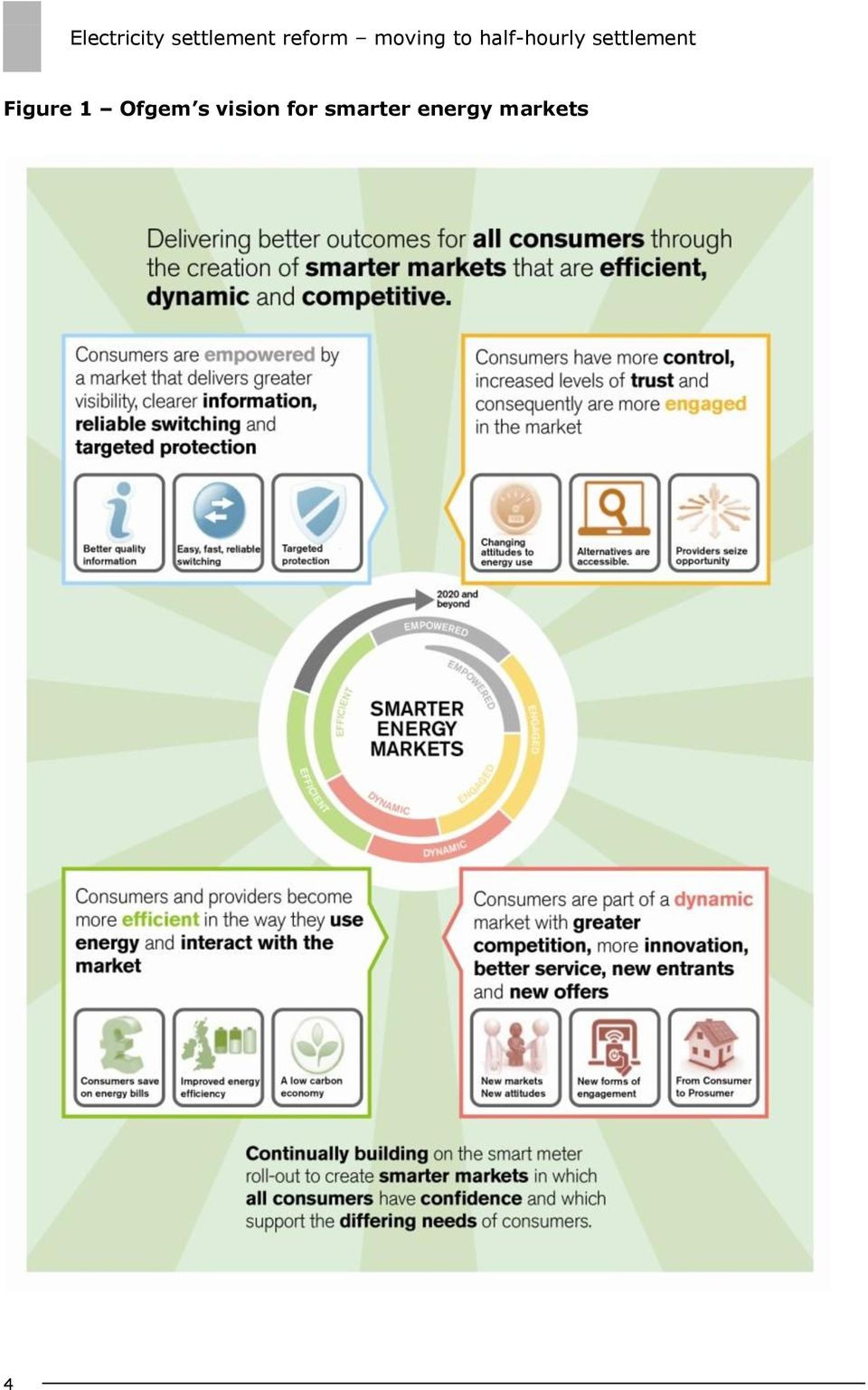
7 1.7. Historically, most consumers have not had meters capable of recording HH consumption. As such, they are settled non-half-hourly (NHH). This involves grouping consumers into one of eight Profile Classes. Using sample data, load profiles are created that estimate the HH consumption shape of the average consumer in each Profile Class. These load profiles are used to allocate energy used to each half-hour period. While overall metered electricity will be accurate, the timing of when this electricity was consumed will be estimated in line with the load profile The SVA arrangements also set out rules for determining the amount of energy exported onto the distribution network in each settlement period. As with consumption, some sites that export energy are settled HH but others are not. The SVA arrangements also describe rules for calculating consumption of unmetered equipment (such as traffic lights). Table 1 provides a breakdown of energy settled through these arrangements. Table 1 Breakdown of energy settled through the SVA arrangements (as of December 2012) Import metered (energy used) Non-half-hourly Half-hourly Type Number Annual energy Number Annual energy Export metered (energy generated) 29,730, TWh 120, TWh 3, TWh 3, TWh Unmetered supplies 28, TWh TWh Source: ELEXON Ofgem s Smarter Markets Programme 1.9. The roll-out of smart and advanced meters to domestic and non-domestic consumers can transform how retail energy markets operate. These meters will be capable of recording electricity consumption in each half hour of the day. They can also be remotely read, removing the need to visit the customer s premises to obtain a meter reading. For the purposes of this document, we refer to smart and advanced metering collectively as smart unless otherwise stated Our vision as set out in Figure 1 is for smarter energy markets that are more efficient, dynamic and competitive. The foundation of this vision is being established by our Retail Market Review reforms that aim to build trust and engagement through the creation of a simpler, clearer and fairer market. Smart metering will help deliver the same objectives by giving consumers ready access to information on their consumption, enabling them to make better choices about how they consume energy and the products they buy. Greater consumer engagement, together with the potential that smart metering presents for innovation, can create a more dynamic market with better service, new products and services, and new entrants. Some of these products and services can help consumers to use energy more efficiently, lowering bills and helping the transition to a low-carbon economy. 3
8 Figure 1 Ofgem s vision for smarter energy markets 4
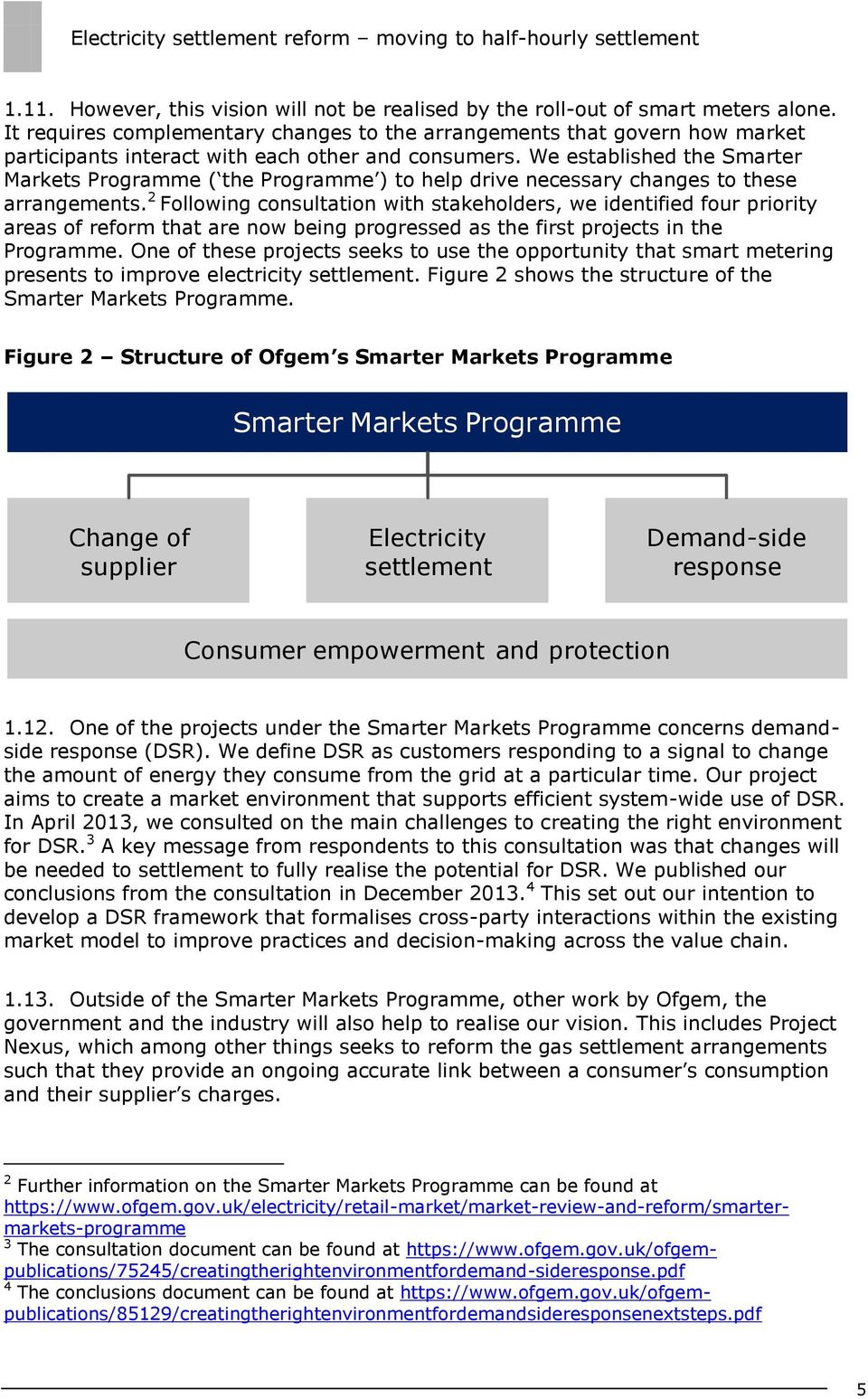
9 1.11. However, this vision will not be realised by the roll-out of smart meters alone. It requires complementary changes to the arrangements that govern how market participants interact with each other and consumers. We established the Smarter Markets Programme ( the Programme ) to help drive necessary changes to these arrangements. 2 Following consultation with stakeholders, we identified four priority areas of reform that are now being progressed as the first projects in the Programme. One of these projects seeks to use the opportunity that smart metering presents to improve electricity settlement. Figure 2 shows the structure of the Smarter Markets Programme. Figure 2 Structure of Ofgem s Smarter Markets Programme Smarter Markets Programme Change of supplier Electricity settlement Demand-side response Consumer empowerment and protection One of the projects under the Smarter Markets Programme concerns demandside response (DSR). We define DSR as customers responding to a signal to change the amount of energy they consume from the grid at a particular time. Our project aims to create a market environment that supports efficient system-wide use of DSR. In April 2013, we consulted on the main challenges to creating the right environment for DSR. 3 A key message from respondents to this consultation was that changes will be needed to settlement to fully realise the potential for DSR. We published our conclusions from the consultation in December This set out our intention to develop a DSR framework that formalises cross-party interactions within the existing market model to improve practices and decision-making across the value chain Outside of the Smarter Markets Programme, other work by Ofgem, the government and the industry will also help to realise our vision. This includes Project Nexus, which among other things seeks to reform the gas settlement arrangements such that they provide an ongoing accurate link between a consumer s consumption and their supplier s charges. 2 Further information on the Smarter Markets Programme can be found at 3 The consultation document can be found at 4 The conclusions document can be found at 5
10 Electricity settlement project Reform of the settlement process is critical to the realisation of our vision for smarter energy markets. Settlement is central to the allocation of costs to suppliers (including energy and network costs) and therefore has important implications for retail competition. In particular, more accurate settlement would improve incentives on suppliers to offer new products and services that reward consumers for using energy more efficiently. It also affects the efficiency of market arrangements because of the costs incurred in managing the process The roll-out of smart meters provides an opportunity to improve the accuracy of settlement and shorten the process. As discussed in the next chapter, we consider that it is in consumers interests to be settled using their HH consumption data from smart meters. From April 2014, the settlement project will examine how this can be achieved Over the past year, we have scoped out how the settlement process may need to change and considered the best way to progress work to deliver reform. To inform this work, we conducted extensive stakeholder engagement. This included bilateral meetings with suppliers, distribution network operators, demand aggregators, ELEXON and agents responsible for collecting and preparing data for settlement. We also presented at industry forums and held two workshops that were attended by a wide range of stakeholders, including consumer groups. 5 Our work has complemented analysis conducted by other parties including ELEXON s Profiling and Settlement Review Group. 6 Settling larger non-domestic consumers using HH consumption data BSC Modification Proposal 272 ( P272 ) would require consumers in Profile Classes 5-8 to be settled using their HH consumption data from 1 April These consumers are required to have advanced meters from 6 April 2014 and are conventionally considered to be the largest non-domestic consumers currently settled using profiles. Around 155,000 sites would be affected by P Ofgem is responsible for deciding whether P272 should be implemented. We published an impact assessment on this modification for consultation in October Our analysis shows that P272 is in the interests of existing and future consumers. However, current arrangements for charging for use of the distribution network are not fit-for-purpose to allow consumers in Profile Classes 5-8 to be settled against their HH consumption data. Work is ongoing to address this issue. Therefore, we wrote to the BSC Panel in February 2014 directing it to consult on a 5 Materials from the workshops can be found at 6 The Profiling and Settlement Review Group reports to the BSC Panel and is tasked with maintaining the integrity of the settlement process in the short to medium term as smart meters are rolled out. 7 P272 impact assessment consultation can be found at 6
11 revised implementation date for P272 to allow our decision to take account of ongoing changes to the distribution charging arrangements. 8 In our letter, we recommended that the BSC Panel consult on a date that falls between April and June P272 would enable larger non-domestic consumers to realise the benefits of settlement using HH consumption data. Therefore, the settlement project under the Smarter Markets Programme will focus on domestic and smaller non-domestic consumers. These consumers are currently assigned to Profile Classes Our letter to the BSC Panel can be found at 7

12 2. The case for settlement reform 2.1. In this chapter, we set out our conclusions from the scoping work we have undertaken over the past year: that it is in consumers interests to be settled against their half-hourly (HH) consumption data from smart meters. The chapter explains the opportunity that smart metering presents to improve the existing settlement process and how settling against HH consumption data would help to transform the market to the benefit of consumers. We also describe how settlement using HH data could realise benefits by supporting delivery of reforms outside of our settlement project. The potential for smart metering to improve settlement 2.2. The settlement process was designed to support the introduction of competition in the retail market in the late 1990s. While settlement operates on a HH basis, at the time it was not cost effective to install HH-capable metering in all homes and businesses. Instead, profiling was used to estimate consumption in each half hour for the large majority of consumers connected to the distribution network However, profiling insulates suppliers from the true cost of their customers consumption. In any half-hour period, using estimates may mean that a supplier is allocated more or less energy than their customers actually consumed. This could be particularly pronounced for smaller suppliers. Due to the size of their portfolio, the consumption of their NHH customers in aggregate is less likely to reflect the national load profiles that are used for settlement With the roll-out of smart metering, it will be possible for the first time for suppliers to pay for the energy that their customers actually consume. This is because smart meters will record consumption for every half-hour period in the day. Settling consumers against their HH consumption data could also enable suppliers network charges to better reflect the costs of transporting energy to their customers Inaccuracy in the allocation of energy volumes affects the costs that suppliers incur in purchasing and transporting energy. Through imbalance charging, suppliers currently have incentives to contract with generators to meet the amount of energy they will be allocated through profiling rather than what their customers actually consume We consider that, wherever possible, costs should be allocated to those responsible. More accurate allocation of energy and network costs will support the transition to smarter energy markets, to the benefit of consumers. This is explored further below. 8

13 Benefits of settlement using half-hourly consumption data 2.7. Based on our analysis to date, we consider that settling consumers against their HH data will help realise our vision for smarter energy markets by creating a dynamic market with more efficient use of energy by: helping to put in place the right environment for more demand-side response (DSR) enabling suppliers to forecast demand more accurately, helping to strengthen competition and reduce costs improving the efficiency of the settlement process For each of the above, we outline the benefits for consumers. We then explain how using HH data in settlement would help to realise these benefits. Helping to put in place the right environment for more DSR 2.9. Creating a more dynamic market, in which consumers participate more actively through DSR, is a fundamental element of our vision for smarter energy markets. This will become more important with an increasingly inflexible and intermittent generation mix and the need for distribution networks to cope with the additional load imposed by electric vehicles and heat pumps as part of a move to a low-carbon energy system. Benefits for consumers Consumers have always had the potential to shift their load. Smart metering now allows this potential to be realised. The need to exploit this is driven by an increasing focus on managing the investment costs for generation and network capacity, and changes in the way that electricity is used. Moreover, as this potential is unlocked, new competitive opportunities arise, offering an avenue for innovation and allowing suppliers and potential new entrants to differentiate their offerings and find ways to engage consumers through new products and services. This in turn will increase competition between suppliers, helping to create a market that delivers better outcomes for consumers, including improved customer service and more competitive pricing The dynamic impacts of competition are inherently hard to quantify. As reflected in our proposal to make a market investigation reference to the Competition and Markets Authority, we have real concerns that competition is not working as well as it could. 9 This reinforces the importance of steps to use the opportunity that smart metering presents to strengthen competition. 9 Further information on the market investigation reference can be found at 9
14 2.12. To encourage DSR, suppliers can offer financial incentives to their customers for shifting consumption. For example, by offering time-of-use (ToU) tariffs that charge different prices at different times of the day. Where consumers participate actively in the market by moving load, they can benefit immediately from lower bills. DSR can also improve the overall operation of the electricity system for all consumers, helping to reduce bills, strengthen security of supply and promote sustainability. Shifting demand can lower bills by reducing the average costs of generation. This is because, at times of peak demand, the average costs of plants used tends to be higher than at off-peak periods. Load shifting can delay or reduce the need for investment in generation and network assets. Generation and network infrastructure is built to meet peak demand. By moving load to off-peak periods, DSR can reduce the requirement for additional generation and network capacity. DSR availability can also provide the system with spare capacity. This could reduce the volume of generation capacity which needs to be available to maintain any security-of-supply level. Load shifting can also promote sustainability by supporting efficient use of intermittent, low-carbon generation on the system, particularly from wind. Wind farms are less predictable than coal or gas generation. DSR provides a way of managing this variability, by increasing or lowering demand depending on weather conditions. This can support the transition to a low-carbon electricity system as well as reduce costs for consumers by avoiding other more expensive ways of managing intermittent generation The value of DSR is likely to increase in the future, making more flexible demand increasingly important. Connection of larger volumes of low-carbon generation will reduce the flexibility and predictability of supply. At the same time, if heating and transport electrification expectations are met, overall electricity consumption is expected to rise. If consumers can be more flexible about how they use electricity, this could help avoid the costs of upgrading or building infrastructure to accommodate these future challenges. Realising benefits by using HH data in settlement Settling consumers against their HH consumption data will expose suppliers to the actual costs of purchasing and transporting energy. As a result, suppliers will have stronger incentives to reduce these costs by signalling to consumers how the cost of energy varies across the day, rewarding them for moving load to periods when electricity is cheapest. Suppliers that do not take steps to work with their customers risk losing market share to competitors. 10

15 2.15. By contrast, the current system, which relies on load profiles to estimate consumption for consumers settled non-half-hourly (NHH), does not give suppliers sufficient incentives to encourage their customers to participate actively in the market by shifting load. This is because load profiles assume all consumers have the same consumption pattern. Therefore, suppliers do not receive the benefits if their customers change when they use energy. In this way, profiling acts as a limiting factor to realising the benefits described above The NHH arrangements, using profiles, do provide some, albeit limited incentives on suppliers to encourage DSR among their customers. Where a customer has appropriate metering, such as a smart meter, it is possible to configure the profile to accommodate static ToU tariffs, where the prices applied at different periods and when these periods fall are set in advance However, offering static ToU tariffs through the NHH arrangements will not allow the full benefits of DSR to be realised. For consumers on such tariffs, their consumption in each half hour is still based on estimates. As a result, suppliers remain insulated from the true value of any changes in when their customers use energy. This dampens the incentives on suppliers to encourage DSR. It also affects the reward suppliers can provide to consumers for shifting load and hence the products they offer. Some stakeholders have also highlighted the difficulty of configuring the NHH settlement arrangements to accommodate new ToU tariffs, preventing or delaying suppliers from bringing new products to market Moreover, changes in how electricity is generated and used, as set out above, increases the benefits that can be realised from dynamic ToU tariffs, where the price or pricing structure vary in response to changes in market conditions (for example, where levels of wind generation drop off). Dynamic ToU tariffs could allow suppliers to unlock more of the value of DSR and hence pass on larger cost savings to consumers. These tariffs cannot be offered to consumers with smart meters through the existing NHH arrangements Similar limitations exist in relation to alternative ways of delivering DSR, for example through contractual arrangements allowing direct load control at times of particular system stress We consider that settling all consumers using their HH consumption data is likely to be necessary to maximise the potential of a more flexible demand side in a smarter energy market. Without this requirement for all consumers, the commercial incentives on suppliers are unlikely to deliver load shifting away from periods of highest demand when DSR may be most valuable If suppliers can choose electively which consumers to settle against HH consumption data, there is a risk that they will target customers with flatter consumption profiles. This would allow them to reduce their costs without any need for behaviour change. At the same time, suppliers are unlikely to offer ToU tariffs to consumers that use electricity at peak times or move them to settlement using HH consumption data. This is because the prices they offer are unlikely to be competitive with other suppliers flat tariffs that are settled against a profile. As a result, these 11
16 consumers will not receive the price signals needed to encourage them to change their consumption behaviour We recognise that not all consumers will be willing or able to shift load. Assessing the distributional impacts on consumers of ToU tariffs is a priority for the Smarter Markets Programme. We will continue to build on the work already undertaken, including in future phases of the settlement project. However, the benefits of a more dynamic market with greater DSR will benefit even those consumers that do not change their behaviour because of the wider improvements to market efficiency, security of supply and sustainability. Enabling suppliers to forecast demand more accurately Settling consumers against their HH consumption data can enable suppliers to better forecast demand, strengthening competition and reducing costs. Benefits for consumers Suppliers have incentives to forecast the amount of energy that they will be allocated through settlement. If suppliers can forecast more accurately, their purchases will more closely match the amount of energy that their customers use in each settlement period. This would reduce the extent to which suppliers as a group are in imbalance, which in turn could reduce the number of balancing actions that the System Operator needs to take. Consumers could benefit where it is cheaper for suppliers to contract forward for energy as a result of more accurate forecasting compared to the costs of the balancing actions taken by the System Operator The ability for suppliers to forecast demand more accurately would also reduce imbalance risk. This in turn can strengthen competition by reducing the costs of entering the market. Realising benefits by using HH data in settlement In any half hour period, the total energy allocated is unlikely to match the volume that is used, largely because of profiling. 10 The difference is spread across all suppliers. Therefore, suppliers must take account of this in their forecasting. The amount of energy that will be spread across suppliers can be difficult to predict, especially for new entrants that are less familiar with historical trends By contrast, using actual HH data in settlement would largely remove use of profiles in settlement. This could enable more accurate demand forecasting, by removing or reducing the amount of energy that is spread across all suppliers. 10 See ELEXON analysis at 12

17 2.28. We recognise that profiling insulates suppliers from unexpected customer behaviour in any settlement period. In contrast, settling against HH data would fully expose suppliers to incorrect forecasting of HH demand. In a market with more DSR, forecasting would also need to take account of changes in consumption in response to a signal. Managing these risks could require investment in forecasting systems. Some suppliers have also argued that they would need historical HH consumption data before forecasting could improve. Improving the efficiency of the settlement process Suppliers incur costs in managing the settlement process. A more efficient settlement process could reduce some of these costs and remove barriers to entry. Benefits for consumers The costs of managing the settlement process stem from meeting the requirements for collecting and preparing data to the timescales set out in the Balancing and Settlement Code, among other things. The costs of some activities could increase from using HH data in settlement. This is because of the need to manage larger volumes of consumption data. Further work will be needed to estimate these costs in the next phase of work However, at the same time, using HH data in settlement could significantly improve the efficiency and simplicity of the settlement process by improving data quality and removing the need to maintain load profiles. Costs could also be reduced by using the opportunity that smart metering presents to shorten the settlement process A more efficient settlement process could also strengthen competition. New entrants to the market will incur lower costs in understanding the settlement arrangements. Moreover, the risks associated with managing the settlement process would be reduced. This is of particular relevance to smaller suppliers, who have less ability to absorb such risks. Realising benefits by using HH data in settlement Below we explain how smart metering can realise these benefits by improving data quality, shortening settlement timescales and reducing the costs of maintaining load profiles. Data quality The quality of consumption data is critical to allocating energy volumes accurately through settlement. We define data quality in terms of the correct settlement of accurate meter readings. This is distinct from whether the energy allocated to a supplier in each half hour is based on actual consumption data or an estimate, which also has implications for settlement accuracy as discussed above. 13
18 2.35. Errors undermine data quality and arise for a variety of reasons. Some of these reasons derive from the NHH arrangements. This is because the arrangements for estimating consumption in each half hour are complex and involve multiple steps. This creates many points of potential failure. Moreover, the complexity makes errors, however they arise, difficult to detect and remedy Errors in data quality can impact suppliers in a number of ways. In particular, they create a gap between the amount of energy that a supplier is allocated through settlement and the amount it has sold to its customers. They can also affect a supplier s imbalance position (metered volumes as compared to contracted volumes), for example where a supplier is unaware of an error that means it is allocated less or more than it expects through settlement. To manage these risks, suppliers can employ data quality teams or may add a premium to customer bills Using HH data in settlement is more straightforward compared to profiling. Errors are less likely to occur and, when they do arise, they are easier to detect and remedy. This can reduce the costs that suppliers incur in managing the risks associated with errors. Shortening settlement timescales The process for comparing contracted and metered volumes for each settlement period and charging for any imbalance is repeated at set intervals called settlement runs. The first of these runs occurs around three weeks after real time. Suppliers put up collateral with ELEXON to cover an estimate of their imbalance charges over this period. The final run occurs 14 months after real time (although in some circumstances charges can continue to change up to 28 months after real time). Fluctuation in energy charges after the first settlement run creates risks for suppliers. To mitigate this risk, they set aside capital to cover any changes The ability to read smart meters remotely enables the settlement timetable to be streamlined. This could include bringing forward the first and last settlement run, as well as reducing the number of runs in between. As a result, it could reduce the collateral suppliers put up with ELEXON to cover the period to the first settlement run, as well as the capital set aside to mitigate subsequent changes in imbalance charges. Maintaining load profiles For consumers settled NHH, profiles are created by recording and analysing HH consumption data from a representative sample of customers. The costs of this activity are shared across all suppliers according to market share. Using HH data in settlement could reduce the costs in maintaining profiles as the vast majority of sites would be settled using accurate HH data. 14

19 Supporting other regulatory reform Settling consumers against their HH consumption data can support reforms to the regulatory framework that lie outside the scope of our settlement project. Like our settlement project, these reforms aim to help deliver secure, sustainable and affordable energy supplies for consumers One example is Ofgem s Electricity Balancing Significant Code Review (EBSCR), which concerns the calculation of the prices market participants pay for imbalance. Existing imperfections in this calculation dampen the incentives on generators and suppliers to contract efficiently to cover what they produce or their customers use respectively. The EBSCR was launched to address these concerns, with the objective of strengthening security of supply and the efficiency of balancing. Suppliers behaviour in the wholesale market is influenced by imbalance prices and the volumes they are allocated through settlement. Therefore, our settlement project will complement the work of the EBSCR to strengthen incentives to balance by improving the accuracy of volume allocation Another example is Ofgem s work to encourage distribution network operators (DNOs) to attain an efficient level of losses on their network. As part of previous electricity distribution price controls that set the amount of revenue DNOs can collect, Ofgem introduced a losses incentive mechanism. This mechanism used settlement data to calculate the volume of losses on the network. However, volatility in settlement data has made it difficult for Ofgem to set fair targets for DNOs. As a consequence, since Ofgem has not had a losses incentive mechanism based on settlement data. Settling consumers against HH consumption data will improve the accuracy of settlement data. This would give a more accurate view of losses on the network, potentially improving the effectiveness of any output-based incentive mechanism included as part of future distribution price controls. Conclusion Continuing with profiling will not fully realise the benefits of smart metering or our vision for smarter energy markets that better serve the interests of consumers. Therefore, we consider it is in consumers interests to be settled against their HH consumption data Without settlement reform, suppliers would remain insulated from the true costs of their customers consumption. Settling consumers against their actual HH data from smart meters would fully expose suppliers to the difference in cost across the day of purchasing and transporting energy. As a result, suppliers will be able to realise the financial benefits of reducing their actual costs by encouraging consumers to use energy more efficiently. This could transform the competitive dynamics of the market to the benefit of consumers. It will be increasingly important given future changes to our generating mix Using actual HH data, together with a faster process, can also make settlement more efficient and reduce the risk of operating in the market, removing 15
20 barriers to entry. However, further work is needed to understand the extent of these benefits in the context of potential costs involved in managing more granular data. 16

21 3. Next steps for the settlement project 3.1. In this chapter, we set out the next steps for the settlement project. We first explain that we will structure into two stages our work to examine how consumers can be settled against their half-hourly (HH) consumption data. We then describe the objective, scope and approach for the first stage of our work and explain how stakeholders can get involved. Structure of the settlement project 3.2. Figure 3 shows how we plan to progress the settlement project. The next phase of work will consist of two stages. In the first, we will develop and then shortlist options for using actual HH data in settlement. In the second, we will undertake a detailed assessment of the shortlisted options. Figure 3 Next phase of the settlement project Stage 1 Stage 2 Option development Initial assessment Detailed assessment April 2014 December 2014 Autumn We will publish an update on progress at the end of the first stage in December This document will also set out how we plan to complete the second stage of work, in which we will undertake further analysis on the shortlisted options. Our detailed assessment in the second stage will consider the costs and distributional impacts of using HH data in settlement compared to the baseline of the existing arrangements, as well as the impacts across the supply chain. Stakeholders will have the opportunity to provide input to this assessment. At the conclusion of the second stage, our ambition is to come to a view on whether there should be a requirement to settle all consumers against their HH consumption data Ofgem will lead the next phase of work to identify and assess the options for using HH data in settlement. We do not consider that industry would deliver this work in a timely way because their interests are not sufficiently aligned with those of consumers. In particular, suppliers are likely to incur costs in using HH data in settlement, for example from upgrading back-office systems. At the same time, not all the benefits will flow to them directly or immediately. This includes some of the benefits of demand-side response, such as lower carbon emissions and stronger security of supply. In line with our statutory duty to protect the interests of existing and future consumers, we consider that Ofgem should lead the development and assessment of options. 17
22 3.5. At the end of the next phase of work, further work may be needed to implement any changes to settlement or other market arrangements. Industry will have an important role to play in delivering these changes. We will consider further how this work can be progressed in a timely way in the best interests of consumers The rest of this chapter focuses on the first stage of work. We describe the scope of work, the approach we will take and how we plan to engage stakeholders. Scope of work 3.7. The next stage of the settlement project will focus on the Supplier Volume Allocation (SVA) arrangements. Under the SVA arrangements, there are different ways to settle energy that is used ( import ) or generated ( export ), depending on whether it is settled HH or non-half-hourly (NHH) and metered or unmetered. Our project will focus on import and export energy that is metered and is currently settled using profiles under the NHH arrangements. In this way, we will focus on those consumers that will receive smart meters and have the greatest potential to benefit from being settled against their HH data. Our project will not consider how profiling could be improved by the roll-out of smart metering Consumers already settled using HH data will be outside the scope of our project. These consumers can already realise the benefits of settlement against their HH data. Unmetered supplies will also be out of scope. These sites make up a small proportion of overall consumption and moreover, are not part of the smart meter roll-out. We recognise that our work could have implications for the settlement of consumers currently settled against their HH data and unmetered supplies. We will identify and consider these interactions Other aspects of the trading arrangements set out in the Balancing and Settlement Code (BSC) are outside the scope of the project. This includes the Central Volume Allocation arrangements 11 and the length of the HH settlement period. Also out of scope will be the calculation of imbalance charges, which is being considered by Ofgem s Electricity Balancing Significant Code Review. Our work will not consider the options for changing the arrangements relating to the collateral that suppliers put up with ELEXON 12 or the Performance Assurance Framework (PAF) 13, with the exception of the rules regarding the volume of energy that needs to be settled on actual meter readings as described in Table 2. We recognise that our work will need to identify the impacts of using HH data in settlement across all these areas and other aspects of the market arrangements outside the BSC. 11 The Central Volume Allocation arrangements determine volumes for sites connected to the transmission network. 12 Suppliers and other market participants put up collateral with ELEXON to cover unpaid imbalance charges and other trading charges in case they default. 13 Among other things, the PAF is designed to provide assurance that energy is allocated to suppliers efficiently, correctly and accurately. 18
23 Approach In developing options, the project will focus on two main areas that can be varied, namely: the process for obtaining and preparing data for settlement when and how to transition to a new set of arrangements. Developing options for obtaining and preparing data for settlement Within the SVA arrangements, there is already a process for settling consumers using HH data. Currently over 120,500 sites are settled through this process Drawing on the existing arrangements as a starting point, our project will look at how to optimise those arrangements to accommodate the millions of domestic and smaller non-domestic sites settled through the NHH arrangements. This could require significant changes. Table 2 shows those aspects of the settlement process on which we will initially focus In developing options, we will take into account the work of the Profiling and Settlement Review Group (PSRG) to shorten settlement timescales in the short to medium term. We recognise the importance of coordinating across our work and that of the PSRG. Both Ofgem and ELEXON are committed to sharing information and project plans. We are also committed to meeting regularly to avoid duplication of effort and to ensure the outcomes of the respective projects align We will also identify interactions with other parts of the regulatory framework that could weaken incentives to use actual HH data in settlement or impose costs on doing so. We will consider the best way to manage these interactions One such interaction is with the framework for data access and privacy for smart meters. This framework limits when suppliers can access HH data from smart meters only at domestic and micro-business premises. It does not apply to advanced meters at present. We will take this framework into account in developing options. For example, we will look at whether making consumption data anonymous could address concerns around data privacy. From this analysis, we can consider whether there is a need to revisit the framework in the context of using HH data from smart meters in settlement. 14 If P272 is approved, consumers in Profile Classes 5-8 will be moved to the existing arrangements for settlement using HH data. This change will affect over 155,000 sites. 19
24 Table 2 Aspects of the settlement process that we plan to focus on initially For consideration Centralisation of agents responsible for data processing (DP) and aggregation (DA) Methodology for estimating consumption for each settlement period when no meter data is available Number and timing of settlement runs Performance standards for submission of consumption data What will be explored At present, suppliers appoint agents to obtain and prepare consumption data for settlement. With the advent of smart meters, and associated reforms, the roles of agents are changing. Some stakeholders have suggested that, in the context of these changes, centralisation of DP and DA functions could support improved data quality and decreased costs in managing the settlement process. We will look at the potential for centralising these functions to support better outcomes for consumers. 15 HH data from smart meters may occasionally be incorrect or unavailable for some sites, for instance if it is not possible to obtain a remote reading from the meter. Currently, the SVA arrangements contain rules for estimating consumption for HH sites in such instances. These rules rely on manual processes and may not be appropriate for settling larger numbers of consumers using actual HH data. We will examine the options for estimating consumption when data is not available. The remote capability of smart metering is an opportunity to shorten settlement timescales by reducing the number of runs and moving them closer to real time. The length of the settlement process has implications for the risks and costs of operating in the market. We will examine the options for reducing the number and timing of settlement runs. The remote capability of smart metering is an opportunity to look at how suppliers perform against standards for how much energy is settled on actual meter readings at different settlement runs. This has implications for the costs that suppliers incur in managing the settlement process. We will look at performance standards when we examine the number and timing of settlement runs. This is the only element of the PAF we will consider in developing options. 15 Initially, consideration of centralisation of DP and DA functions was assigned to the change of supplier project in the Smarter Markets Programme. However, this project has provisionally concluded that centralisation is not required to improve the speed and reliability of the transfer process. Nevertheless, stakeholders have suggested that other drivers for centralisation still remain, and that further consideration would most appropriately sit in the settlement project. 20
25 Developing options for the transition to new arrangements In the next phase, we will identify: options for when the transition to using HH data in settlement could begin, in terms of when to implement changes to the SVA arrangements options for managing the transition, in terms of the process and the rules suppliers need to follow Each option will have different implications on the impact of using HH data in settlement on consumers. Central to this work will be consideration of the risks different options pose to consumers. For instance, as discussed in chapter two, scenarios could arise where suppliers move some types of consumers before others for their own competitive advantage. There are also risks that consumers who move last to the new arrangements face increased charges during the transition period as fewer consumers pick up the costs of maintaining the NHH arrangements. Assessing options After we have identified options for the process of settlement and the transition, we will conduct a comparative assessment of these options. To do this, we will use a framework to assess how well each option contributes to our vision for smarter energy markets that are more efficient, dynamic and competitive. We expect this will consider the likely costs of respective options, the cost savings they could return and the impact they would have on competition We will then shortlist the options for obtaining and processing data for settlement and the options for transitioning to new arrangements that have the greatest potential to deliver for consumers. These will then be combined into viable reform packages that will form the main output of the first stage of work. Stakeholder engagement We are committed to continuing and extending our engagement with stakeholders. To inform our analysis, we plan to set up an expert group consisting of parties with an interest in settlement reform, including larger and smaller suppliers, network operators, consumer groups and agents responsible for preparing data for settlement. This group will allow us to harness industry s technical knowledge of settlement and understand the impact that change could have on consumers. It will help us to develop the options for using actual HH data in settlement and to undertake the comparative assessment We plan to invite stakeholders to join the expert group in May with a view to holding our first meeting in June. We are committed to remaining transparent throughout this process and keeping informed interested parties who are not on the expert group. We will publish all expert group papers on our website and will also 21
26 update industry through our biannual newsletter on the Smarter Markets Programme We will also continue to seek input from the Smarter Markets Coordination Group (SMCG) throughout the next stage of our work on electricity settlement. This group includes senior-level representatives from key stakeholders with an interest in the Smarter Markets Programme and is tasked with providing strategic direction to our work. 16 In the first instance, we plan to seek views from the SMCG on the proposed membership of the expert group and its work plan. 16 More information on the SMCG can be found at: 22
27 Appendices Index Appendix Name of Appendix Page Number 1 Glossary 24 23
28 Appendix 1 - Glossary A Advanced meter The electricity supply licence defines an advanced meter as one that must be capable of recording half-hourly consumption data and of providing suppliers with remote access to this data. B Balancing and Settlement Code (BSC) The BSC contains the governance arrangements for electricity balancing and settlement in Great Britain. Balancing and Settlement Code (BSC) Panel The Balancing and Settlement Code (BSC) Panel is established and constituted pursuant to and in accordance with Section B of the BSC. It is responsible for ensuring that the provisions of the BSC are given effect: fully, promptly, fairly, economically, efficiently, transparently and in such a manner as will promote effective competition in the generation, supply, sale and purchase of electricity. D Data Collector As part of the settlement process, the party appointed by an electricity supplier to retrieve and process meter readings to meet the requirements set out in the Balancing and Settlement Code. Data access and privacy framework The government has developed a data access and privacy policy framework to ensure domestic and micro business consumers have greater control of the energy consumption data held on their smart meters. Data Aggregator As part of the settlement process, the party appointed by an electricity supplier to package up consumption data to meet the requirements set out in the Balancing and Settlement Code. Demand-side response (DSR) Actions taken by consumers to change the amount of energy they take off the grid at particular times in response to a signal, such as a price. 24
29 Distribution network operator (DNOs) The companies that are licensed by Ofgem to maintain and manage the electricity distribution networks in Great Britain. Dynamic time-of-use tariff A time-of-use tariff that provides for price or pricing structures to vary at short notice in response to market events, subject to contractual terms. E Electricity supplier A company licensed by Ofgem to sell energy to and bill customers in Great Britain. ELEXON The organisation responsible for administering the Balancing and Settlement Code (BSC). The role and powers, functions and responsibilities of ELEXON are set out in Section C of the BSC. I Imbalance charge The charges that suppliers (and other market participants) pay for any difference between contracted and metered volumes. See also settlement process. M Micro business The electricity supply licence defines a micro-business consumer as one which: has an equivalent consumption of not more than 100,000 KWh; or employs fewer than 10 employees (or their FTE equivalent) and their turnover or balance sheet is no greater than 2m. N National Grid Electricity Transmission (NGET) NGET is the System Operator for the electricity transmission system in Great Britain, with responsibility for making sure that electricity supply and demand stay in balance and the system remains within safe technical and operating limits. Non-half-hourly settlement (NHH) As part of the settlement process, the arrangements for estimating how much energy a supplier s consumers use in each settlement period based on meter readings spanning longer intervals. These consumers are not settled using half-hourly consumption data. 25
30 O Ofgem The Office of Gas and Electricity Markets (Ofgem) is responsible for protecting gas and electricity consumers in Great Britain. It is governed by the Gas and Electricity Markets Authority. P Performance Assurance Framework (PAF) Under the Balancing and Settlement Code (BSC), the PAF is in place to provide that: energy is allocated between suppliers efficiently, correctly and accurately; suppliers and the agents they appoint to support the settlement process transfer metering system data efficiently and accurately; calculations and allocations of energy and the associated trading charges are performed in line with the requirements set out in the BSC. Profile Class Consumers that are not settled using actual meter readings for each settlement period are grouped into one of eight Profile Classes. For each Profile Class, a load profile is created that estimates the consumption shape of the average consumer. This load profile (or variations of it) is used to determine the consumption in each half hour for all consumers assigned to the Profile Class. See also non-half-hourly settlement. Profiling and Settlement Review Group (PSRG) The PSRG reports to the Balancing and Settlement Code Panel and is tasked with maintaining the integrity of the settlement arrangements in the short to medium term as smart meters are rolled out R Retail Market Review The Retail Market Review was an Ofgem project with the aims of making the retail energy market work better at serving the interests of consumers and enabling individual consumers to get a better deal from energy suppliers. S Settlement period The period over which contracted and metered volumes are reconciled. This is defined as a period of 30 minutes. See also settlement process. 26
31 Settlement process Settlement places incentives on generators and suppliers to contract efficiently to cover what they produce or their customers consume respectively. For suppliers, it operates by charging for any difference between the volume of electricity that they buy and the volume that their customers consume. Significant Code Review (SCR) The SCR process is designed to facilitate complex and significant changes to a range of industry codes. It provides a role for Ofgem to undertake a review of a code-based issue and play a leading role in facilitating code changes through the review process. Smart meter A meter which, in addition to traditional metering functionality (measuring and registering the amount of energy that passes through it), is capable of providing additional functionality, for example recording consumption in each half hour of the day and of being remotely read. It must also comply with the technical specification set out by the government. Smarter Markets Programme The Smarter Markets Programme is Ofgem s way of coordinating our work to use the opportunity that smart metering presents to make retail energy markets work better for consumers. Static time-of-use tariff A time-of-use tariff that fixes in advance the peak and off-peak periods and the prices applied at these times. Supplier Volume Allocation (SVA) arrangements Within the Balancing and Settlement Code, the arrangements for allocating energy volumes to suppliers in each half hour of the day. System Operator The entity charged with operating the Great Britain high voltage electricity transmission system, currently National Grid Electricity Transmission Plc. T Time-of-use (ToU) tariffs Energy tariffs that charge different prices at different times of the day, week, month or year. See also dynamic time-of-use tariff and static time-of-use tariff. 27
32 U Unmetered supply Electronic equipment that draws a current and is connected to the distribution network without a meter recording its energy consumption. 28
Final Report. Profile Class 1 4: Mandating HH Settlement Cost Benefit Analysis. Executive Summary
 Profile Class 1 4: Mandating HH Settlement Cost Benefit Analysis Executive Summary ELEXON is reviewing the profiling and settlement arrangements for suppliers of domestic and commercial customers. This
Data Communications Company (DCC) price control guidance: process and procedures
 Guidance document Contact: Tricia Quinn, Senior Economist Publication date: 27 July 2015 Team: Smarter Metering Email: [email protected] Overview: The Data and Communications Company (DCC) is required
Committee on the Northern Territory s Energy Future. Electricity Pricing Options. Submission from Power and Water Corporation
 Committee on the Northern Territory s Energy Future Electricity Pricing Options Submission from Power and Water Corporation October 2014 Power and Water Corporation 1. INTRODUCTION On 21 August 2014, the
ENA Submission to the Parliamentary Renewable and Sustainable Energy Group Inquiry into the access and management of renewables and the Grid
 1 ENA Submission to the Parliamentary Renewable and Sustainable Energy Group Inquiry into the access and management of renewables and the Grid 1.0 Introduction 1.1 Energy Networks Association (ENA) is
Rule change request. 18 September 2013
 Reform of the distribution network pricing arrangements under the National Electricity Rules to provide better guidance for setting, and consulting on, cost-reflective distribution network pricing structures
Non Traditional Business Models: Supporting transformative change in the energy market
 Non Traditional Business Models: Supporting transformative change in the energy market Response by Community Energy England, Regen SW, Community Energy Coalition and 10:10 SUMMARY This is a collaborative
Disclaimer: All costs contained within this report are indicative and based on latest market information. 16 th March 2015
 Disclaimer: All costs contained within this report are indicative and based on latest market information 16 th March 2015 FD SUMMARY The make up of the electricity bill is changing, with non-commodity
Decision. Moving to reliable next-day switching. Contact: Andrew Wallace, Senior Manager. Publication date: 10 February 2015 Team: Retail Markets
 ` Moving to reliable next-day switching Decision Contact: Andrew Wallace, Senior Manager Publication date: 10 February 2015 Team: Retail Markets Tel: 020 7901 7067 Email: [email protected] Overview:
Financial Settlement Strategy
 Financial Settlement Strategy We are seeking stakeholders views on the questions set out in this consultation document. If you have any comments on the paper please contact: [email protected]
Realising the benefits of smart meters for consumers and industry
 Realising the benefits of smart meters for consumers and industry ERAA smart meter Working Paper 1 Suite 3, Level 5, 189 Kent Street Sydney NSW 2000 T (02) 8241 1800 E [email protected] www.eraa.com.au
NERA Analysis of Energy Supplier Margins
 7 December 2009 NERA Analysis of Energy Supplier Margins By Graham Shuttleworth Even though wholesale energy prices have fallen recently, gas and electricity suppliers are earning very little margin on
Energy Networks Association. Electricity Demand Side Response Working Group. Demand Side Response Shared Services Framework Concept Paper
 Energy Networks Association Electricity Demand Side Response Working Group Demand Side Response Shared Services Framework Concept Paper For Industry Consultation Contents Executive Summary 3 1 Demand Side
EXPLANATORY MEMORANDUM TO THE CONTRACTS FOR DIFFERENCE (ELECTRICITY SUPPLIER OBLIGATIONS) REGULATIONS 2014. 2014 No. [XXXX]
![EXPLANATORY MEMORANDUM TO THE CONTRACTS FOR DIFFERENCE (ELECTRICITY SUPPLIER OBLIGATIONS) REGULATIONS 2014. 2014 No. [XXXX]](/thumbs/39/19228373.jpg "EXPLANATORY MEMORANDUM TO THE CONTRACTS FOR DIFFERENCE (ELECTRICITY SUPPLIER OBLIGATIONS) REGULATIONS 2014. 2014 No. [XXXX]") EXPLANATORY MEMORANDUM TO THE CONTRACTS FOR DIFFERENCE (ELECTRICITY SUPPLIER OBLIGATIONS) REGULATIONS 2014 2014 No. [XXXX] 1. This explanatory memorandum has been prepared by the Department for Energy
EXPLANATORY MEMORANDUM TO THE CONTRACTS FOR DIFFERENCE (ELECTRICITY SUPPLIER OBLIGATIONS) REGULATIONS 2014 2014 No. [XXXX] 1. This explanatory memorandum has been prepared by the Department for Energy
Finance and Policy Committee. Date: 14 October 2014. Item 17: TfL Energy Purchasing 2017 to 2020. This paper will be considered in public.
 Finance and Policy Committee Date: 14 October 2014 Item 17: TfL Energy Purchasing 2017 to 2020 This paper will be considered in public 1 Summary 1.1 This paper: (a) reviews the current purchasing strategy
European Distribution System Operators for Smart Grids
 European Distribution System Operators for Smart Grids Response to the European Commission s public consultation on a new energy market design October 2015 Executive summary The European Distribution System
June 2015. Position Paper Contribution to the debate on electricity market design and capacity markets
 June 2015 Position Paper Contribution to the debate on electricity market design and capacity markets Eurogas is the association representing the European gas wholesale, retail and distribution sectors.
Asset Management Policy March 2014
 Asset Management Policy March 2014 In February 2011, we published our current Asset Management Policy. This is the first update incorporating further developments in our thinking on capacity planning and
MANDATORY ROLLOUT OF INTERVAL METERS FOR ELECTRICITY CUSTOMERS
 July 2004 Interval Meter Rollout MANDATORY ROLLOUT OF INTERVAL METERS FOR ELECTRICITY CUSTOMERS Final decision 2nd Floor, 35 Spring St Melbourne VIC 3000 Australia Phone: 61 3 9651 0222, Fax: 61 3 9651
Demand Response Market Overview. Glossary of Demand Response Services
 Demand Response Market Overview Glossary of Demand Response Services Open Energi has partnered with Tarmac to provide Demand Response What s inside... Market Overview Balancing Electricity Supply and Demand
Appendix 8.6: Gas and electricity settlement and metering
 Appendix 8.6: Gas and electricity settlement and metering Contents Page Introduction... 1 Gas settlement... 3 Electricity settlement... 12 Smarter energy markets... 16 Potential inefficiencies in gas and
How To Read The Unitholders Of The Kukon Island Power Station
 E.ON s UK Consolidated Segmental Report for the year ended 31 December 2012 Introduction In accordance with the Electricity Generation Licence Condition 16 - Financial Information Reporting, and the Electricity
ENERGY METERING A CONSULTATION ON SMART METERING FOR ELECTRICITY AND GAS
 ENERGY METERING A CONSULTATION ON SMART METERING FOR ELECTRICITY AND GAS MAY 2009 Contents Page Executive Summary 5 How to Respond 9 Summary of Consultation Questions 11 1 Introduction 13 2 Proposals
Fixed + Protect Electricity supply contracts explained for large business customers
 Fixed + Protect Electricity supply contracts explained for large business customers 2/7 Fixed + Protect explained We fix your unit price, with a generous tolerance on how much your electricity use can
Smart metering A REPORT PREPARED FOR CENTRICA. October 2007. Frontier Economics Ltd, London.
 Smart metering A REPORT PREPARED FOR CENTRICA October 2007 Frontier Economics Ltd, London. i Frontier Economics October 2007 Smart metering Executive summary...1 1.1 Introduction...1 1.2 The case for
Fixed + Peace of Mind Electricity supply contracts explained for large business customers
 Fixed + Peace of Mind Electricity supply contracts explained for large business customers 2/7 Fixed + Peace of Mind explained This contract guarantees your unit price will stay fixed in all but exceptional
Moving to reliable next-day switching
 Moving to reliable next-day switching Consultation - supplementary appendices Contact: Andrew Wallace Publication date: 16 June 2014 Team: Smarter Markets Response deadline: 11 August 2014 Tel: 020 7901
Competition and Markets Authority Energy market investigation: Notice of possible remedies Response of Smart DCC Ltd
 Competition and Markets Authority Energy market investigation: Response of Smart DCC Ltd 05 August 2015 DCC Public Page 1 of 7 1 Executive summary 1. Smart DCC Ltd, known as the Data and Communications
HH SETTLEMENT FOR DYNAMICALLY SWITCHED METERS (IMPACT ASSESSMENT) COLLATED RESPONSES
 OVERVIEW 9 responses were received to the PSRG consultation on Half Hourly Settlement for Dynamically Switched Meters (Impact Assessment) (issued on 5 November 2014). Additional comments were received
Power NI: tariff methodology
 Research and Information Service Paper 12/14 23 September 213 NIAR 640-13 Aidan Stennett Power NI: tariff methodology 1 Introduction The following paper supplements Northern Ireland Assembly Research and
A Smart Grid Electricity Price Plan. OSPE Energy Policy Presentation
 A Smart Grid Electricity Price Plan OSPE Energy Policy Presentation OSPE policy seminars can be downloaded at: h8p://www.ospe.on.ca/default.asp?page=pres_lib#peo OSPE Energy Task Force June 2015 2 Outline
Updated SCER Demand Side Participation Program December 2013
 Updated SCER Demand Side Participation Program December 2013 The Standing Council on Energy and Resources (SCER) has adopted this framework to guide its demand side participation (DSP) work. The framework
Electricity Terminology. Simplifying energy management
 Simplifying energy management AMR Automated Meter Reading - automatic collection of data from meters which is transferred to a central database for billing and/or analysis. Balancing Mechanism The mechanism
European Distribution System Operators for Smart Grids. Position paper on Electric Vehicles Charging Infrastructure
 European Distribution System Operators for Smart Grids Position paper on Electric Vehicles Charging Infrastructure European Distribution System Operators for Smart Grids Position paper on ELECTRIC VEHICLES
Fixed + Protect Electricity supply contracts explained for large business customers
 Fixed + Protect Electricity supply contracts explained for large business customers 2/7 Fixed + Protect explained We fix your unit price, with a generous tolerance on how much your electricity use can
Duncan Burt Head of Commercial Operation National Grid. The Office of Gas and Electricity Markets 9 Millbank London SW1P 3GE
 National Grid House Warwick Technology Park Gallows Hill, Warwick CV34 6DA The Office of Gas and Electricity Markets 9 Millbank London SW1P 3GE 16 June 2015 Duncan Burt Head of Commercial Operation National
DISCLOSURE NOTES. How the accounts are presented. Generation
 DISCLOSURE NOTES As a result of changes in SSE s management and reporting structure in 2011/12 and in the interests of improved transparency, SSE s financial statements for the year ending March 2012 were
EMR: Consultation on Balancing and Settlement Code subsidiary documents
 EMR: Consultation on Balancing and Settlement Code subsidiary documents URN: 14D/108 April 2014 Department of Energy and Climate Change 3 Whitehall Place London SW1A 2AW Telephone: 0300 068 4000 Website:
Consultation on Global Settlement in the SEM for Northern Ireland
 Consultation on Global Settlement in the SEM for Northern Ireland 1 Table of Contents 1. Purpose of this Paper... 3 2. Introduction... 3 3. Background... 5 4. Residual Volume... 6 5. Drivers for Change...
The Gas and Electricity Regulated Providers (Redress Scheme) Order 2008. Consultation Document
 The Gas and Electricity Regulated Providers (Redress Scheme) Order 2008 Consultation Document URN 13D/305 07 January 2014 2 The Gas and Electricity Regulated Providers (redress scheme) Order 2008 Department
Review of the Energy Savings Scheme. Position Paper
 Review of the Energy Savings Scheme Position Paper October 2015 Contents Executive summary... 3 Energy Savings Scheme Review Report package... 3 Expanding to gas... 3 Target, penalties and duration...
SHE Transmission. 2015_10_30 Transmission Losses Strategy Rev 2.0 October 2015
 SHE Transmission 2015_10_30 Transmission Losses Strategy Rev 2.0 October 2015 Summary This paper presents SHE Transmission s views and approach on the impact of transmission losses on the transmission
The Retail Market Review Final domestic proposals
 Promoting choice and value for all gas and electricity customers The Retail Market Review Final domestic proposals Consultation on policy effect and draft licence conditions Reference: 40/13 Contact: David
Energy storage in the UK and Korea: Innovation, Investment and Co-operation Appendix 4.1: Stakeholder interviews from Korea
 Energy storage in the UK and Korea: Innovation, Investment and Co-operation Appendix.1: Stakeholder interviews from Korea Peter Taylor & Lloyd Davies, University of Leeds Appendix.1: Stakeholder interviews
Anthony Price Swanbarton Limited, Dairy Farm, Pinkney, Malmesbury, Wiltshire, SN16 0NX Telephone +44 1666 840948
 SMARTER GRID AND SMARTER STORAGE HOW DO BUSINESS AND TECHNOLOGY MEET? Anthony Price Swanbarton Limited, Dairy Farm, Pinkney, Malmesbury, Wiltshire, SN16 0NX Telephone +44 1666 840948 Introduction The technical
Dear Colleague, Summary
 System Operators, Transmission and Transportation System Owners, Generators, Shippers, Suppliers, Customers, Investors and other interested parties Date: 20 December 2013 Dear Colleague, Consultation on
SP Energy Networks 2015 2023 Business Plan
 Environmental Discretionary Reward Scheme 1 SP Energy Networks 2015 2023 Business Plan Executive summary SP Distribution Ltd SP Manweb plc July 2013 RIIO ED1 Business Plan 2015 to 2023 2 A Message from
A Virtual Power Plant to balance wind energy - A Canadian Smart Grid Project. Number of customers
 PowerShift Atlantic will demonstrate one of the world s first virtual power plants designed to allow for more effective integration and balancing of wind power onto the power grid. The project is a collaborative
LONG-TERM OUTLOOK FOR GAS TO 2 35
 LONG-TERM OUTLOOK FOR GAS TO 2 35 Eurogas is the association representing the European gas wholesale, retail and distribution sectors. Founded in 1990, its members are some 50 companies and associations
METER DATA MANAGEMENT FOR THE SMARTER GRID AND FUTURE ELECTRONIC ENERGY MARKETPLACES
 METER DATA MANAGEMENT FOR THE SMARTER GRID AND FUTURE ELECTRONIC ENERGY MARKETPLACES Sebnem RUSITSCHKA 1(1), Stephan MERK (1), Dr. Heinrich KIRCHAUER (2), Dr. Monika STURM (2) (1) Siemens AG Germany Corporate
a description of the various categories of embedded generators
 Guidance Embedded Generation This document provides: a description of the various categories of embedded generators an outline of the types of bilateral agreements that owners/lead Parties of embedded
The participation of non-generation activities in the GB Capacity Market. Department for Energy & Climate Change
 The participation of non-generation activities in the GB Capacity Market Department for Energy & Climate Change 22 January 2015 Presentation today 1 Environmental & Energy Aid Guidelines and nongeneration
A report to Elexon. July 2014 STORAGE BUSINESS MODELS IN THE GB MARKET
 STORAGE BUSINESS MODELS IN THE GB MARKET A report to Elexon STORAGE BUSINESS MODELS IN THE GB MARKET Contact details Name Email Telephone Simon Bradbury [email protected] 01865812239 Anthony Price
Appendix 10: Improving the customer experience
 Appendix 10: Improving the customer experience Scottish Water is committed to delivering leading customer service to all of our customers. This means we deliver the following activities: We will ensure
UK Government Information Economy Strategy
 Industrial Strategy: government and industry in partnership UK Government Information Economy Strategy A Call for Views and Evidence February 2013 Contents Overview of Industrial Strategy... 3 How to respond...
Working with ElectraLink to provide innovative analytics services for DNOs
 Working with ElectraLink to provide innovative analytics services for DNOs The DNO Challenges With the unprecedented level of change taking place in the electricity market, Distribution Network Operators
Main variations of business models for Flexible Industrial Demand combined with Variable Renewable Energy
 Innovative Business Models for Market Uptake of Renewable Electricity unlocking the potential for flexibility in the Industrial Electricity Use Main variations of business models for Flexible Industrial
EMR: Consultation on industry code and licence modifications
 EMR: Consultation on industry code and licence modifications January 2014 Department of Energy and Climate Change 3 Whitehall Place London SW1A 2AW Telephone: 0300 068 4000 Website: https://www.gov.uk/government/organisations/department-of-energy-climate-change
The Future of London s Power Supply
 The Future of London s Power Supply SPECIAL INTEREST PAPER CITY OF LONDON CORPORATION REPORT PREPARED BY STEPHEN JONES ASSOCIATES AND SOUTH EAST ECONOMICS The Future of London s Power Supply is published
Wholesale power market liquidity: consultation on a Secure and Promote licence condition
 Promoting choice and value for all gas and electricity customers Wholesale power market liquidity: consultation on a Secure and Promote Consultation Reference: 163/12 Contact: Phil Slarks, Senior Economist
Smart grid promotion policy and activity in Sweden Sweden day, October 23, Smart City Week 2013
 Smart grid promotion policy and activity in Sweden Sweden day, October 23, Smart City Week 2013 Karin Widegren, Director Swedish Coordination Council for Smart Grid Outline of presentation Who we are -
Measurement of Banks Exposure to Interest Rate Risk and Principles for the Management of Interest Rate Risk respectively.
 INTEREST RATE RISK IN THE BANKING BOOK Over the past decade the Basel Committee on Banking Supervision (the Basel Committee) has released a number of consultative documents discussing the management and
EDF ENERGY S CONSOLIDATED SEGMENTAL STATEMENT YEAR ENDED 31 DECEMBER 2013
 This Consolidated Segmental Statement ( CSS ) satisfies Standard Licence Condition 19A of the Gas and Electricity Supply Licences and Standard Licence Condition 16B of the Electricity Generation Licence.
ESRI Research Note. The Irish Electricity Market: New Regulation to Preserve Competition Valeria di Cosmo and Muireann Á. Lynch
 ESRI Research Note The Irish Electricity Market: New Regulation to Preserve Competition Valeria di Cosmo and Muireann Á. Lynch Research Notes are short papers on focused research issues. They are subject
Clean Energy Council submission to Queensland Competition Authority Regulated Retail Electricity Prices for 2014-15 Interim Consultation Paper
 Clean Energy Council submission to Queensland Competition Authority Regulated Retail Electricity Prices for 2014-15 Interim Consultation Paper Executive Summary The Clean Energy Council (CEC) supports
Proposed debt assignment protocol for prepayment customers. A consultation document
 Proposed debt assignment protocol for prepayment customers A consultation document Summary Ofgem is committed to removing any unnecessary barriers preventing customers from switching suppliers. This document
AER Issues Paper Tariff Structure Statement Proposals Victorian Electricity Distribution Network Service Providers
 20 January 2016 Australian Energy Regulator GPO Box 520 Melbourne VIC 3001 Via email: [email protected] AER Issues Paper Tariff Structure Statement Proposals Victorian Electricity Distribution Network
Power Trading and Retail System. empowering. smarter trading. across the energy value chain. Smart energy. Powering progress
 Power Trading and Retail System empowering smarter trading across the energy value chain Smart energy. Powering progress In today s turbulent and increasingly complex energy markets, Atos Worldgrid PTRS
Harmonisation of electricity generation transmission tariffs. A EURELECTRIC contribution to ACER s scoping exercise
 Harmonisation of electricity generation transmission tariffs A EURELECTRIC contribution to ACER s scoping exercise December 2015 EURELECTRIC is the voice of the electricity industry in Europe. We speak
Digital Strategy. Digital Strategy. 2015 CGI IT UK Ltd. Digital Innovation. Enablement Services
 Digital Strategy Digital Strategy Digital Innovation Enablement Services 2015 CGI IT UK Ltd. Contents Digital strategy overview Business drivers Anatomy of a solution Digital strategy in practice Delivery
QUALITY OF SERVICE DISCRETIONARY REWARD SCHEME GAS DISTRIBUTION NETWORK OPERATORS ENTRY FORM
 QUALITY OF SERVICE DISCRETIONARY REWARD SCHEME GAS DISTRIBUTION NETWORK OPERATORS ENTRY FORM Please note that the deadline for receipt of applications is 5pm, 15 May 2009. GDN DETAILS: (please complete)