
11 Surface water intake and small dams. Revised by Nhamo Masanganise
|
|
|
- Myra Hunt
- 9 years ago
- Views:
Transcription
1 11 Surface water intake and small dams Revised by Nhamo Masanganise

2 11 Surface water intake and small dams 11.1 River water intake Groundwater may be the preferred source (chapter 10), but the most convenient source of water for small communities is frequently a natural stream or river close by. The two most important criteria in judging the suitability of the surface water source are the quality of the water and the reliability of the flow. In tropical countries, rivers and streams often have a wide seasonal fluctuation in flow. This also affects the quality of the water. In wet periods the water may be low in dissolved solids concentration but often of a high turbidity. In dry periods river flows are low and the load of dissolved solids is more concentrated. Mountain streams sometimes carry a high silt load but the mineral content is mostly low and human pollution is generally absent. In plains and estuaries, rivers usually flow slowly except when there is a flood. The water may be relatively clear but it is almost always polluted, and extensive treatment is necessary to render it fit for drinking and domestic purposes. The quality of river water does not usually differ much across the width and depth of the riverbed. Whenever practicable a river intake should be sited where there is adequate flow; at a level that allows gravity supply to minimise pumping costs; upstream of densely populated and farming areas to reduce silt inflow; upstream of cattle watering places, washing places and sewer outlets (to eliminate pollution of the water); upstream of bridges (to reduce velocity/turbulence). Intake designs aim to avoid clogging and scouring and to ensure the stability of the structure even under flood conditions. Where the river transports no boulders or rolling stones, an unprotected intake may be adequate (fig. 11.1). Fig Unprotected river intake 252

3 Chapter 11 Where protection of the intake is deemed necessary, intake structures of the type shown in figure 11.2 may be suitable. They can be constructed of concrete, stone (masonry) or brick. Fig River intake structure The bottom of the intake structure should be at least 1 m above the riverbed to prevent any boulders or rolling stones from entering. The intake structure must always include one or more baffles or screens to keep out debris and floating matter such as tree trunks and branches. It is advisable to use passive screening that does not create turbulent flow conditions. To reduce the drawing in of silt and suspended matter, the velocity of flow through the intake should be low, preferably less than 0.1 m/s. To make use of the natural current to help cleaning of screens, the following tips are suggested: The screen axis must be parallel to the current flow Dead-end approach channels should be avoided as they collect debris Adequate water cover must be provided all around the screen More information about different types of screens is given in section A river intake always requires a sufficient depth of water in the river. A submerged weir may have to be constructed downstream of the intake to ensure that the necessary 253

4 depth of water will be available even in dry periods. This type of weir is only a small structure and cannot be expected to provide any storage or flow balancing. Ideally the weir should be founded on rock, to provide the best conditions with regard to bearing capacity, seepage and safety against sliding. Soils with a clay/silt content that reduces permeability and increases cohesion, but with low plasticity are also acceptable as foundation materials. A key at the upstream toe of the weir will improve stability and an upstream apron will extend the seepage path and thus reduce seepage. A weir stability calculation chart is given in table Table 11.1 Weir Stability Calculation Chart Item Desription Force Lever Moments H V arm Overtuning Restoring P1 r w x D x H H/2 + P2 r w x H 2 x 0.5 H/3 + Pt r w x T 2 x 0.5 T/3 - W0 r w x D x C 0.5 S+2C/3 + W1 r m x C x H B-C/2 + W2 r m x H x S x 0.5 2S/3 + Ws r w x T x DS x Up1 r w x T x B x uplift factor B/2 - Up2 r w x (H+D-T) x B x 0.5 x B/3 - uplift factor TOTALS S DIM C = D = H = T = S = B = NB: B = C + S 254

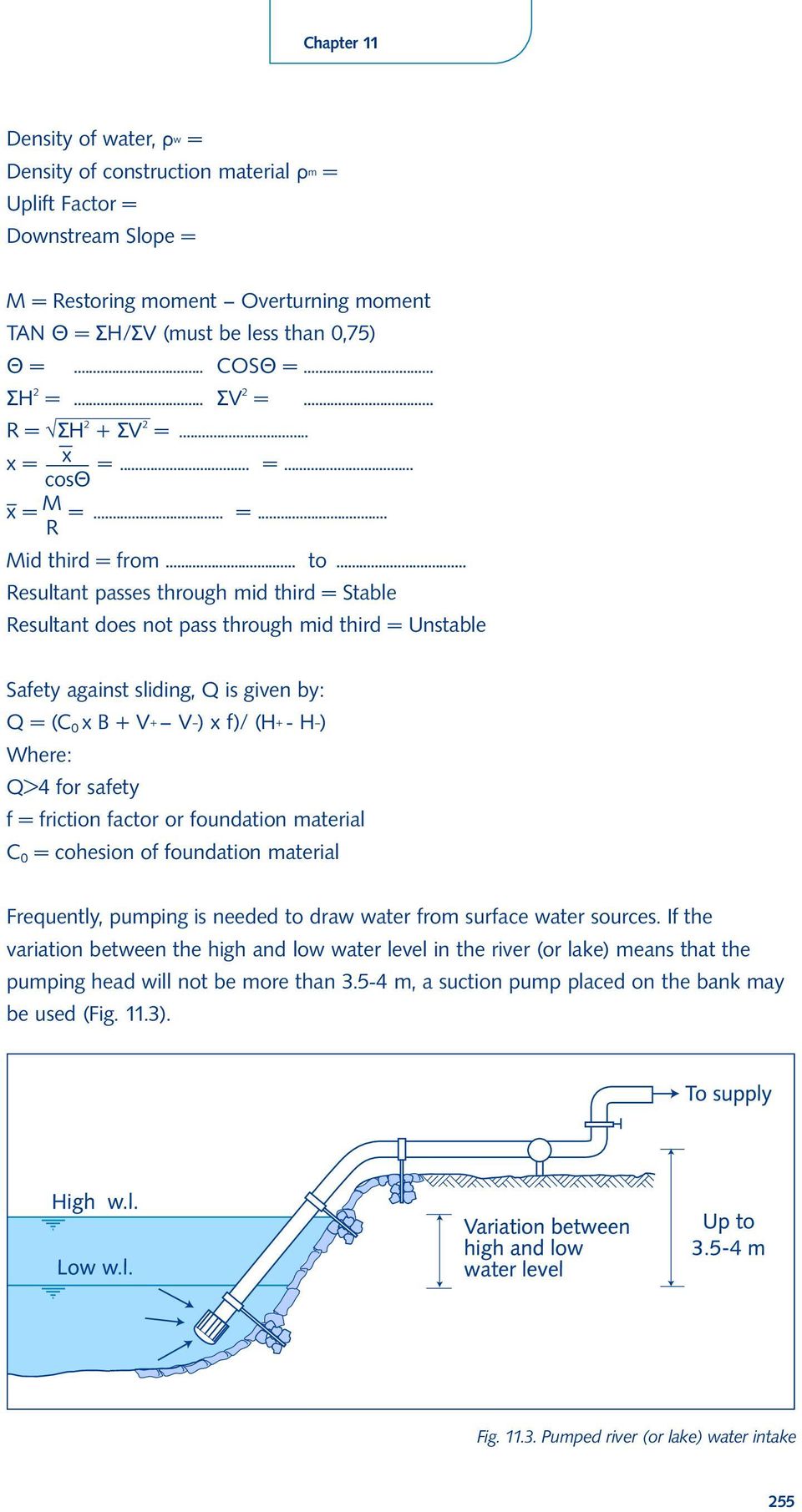
5 Chapter 11 Density of water, r w = Density of construction material r m = Uplift Factor = Downstream Slope = M = Restoring moment Overturning moment TAN U = SH/SV (must be less than 0,75) U =... COSU =... SH 2 =... SV 2 =... R = SH 2 + SV 2 =... x = x =... =... cosu x = M =... =... R Mid third = from... to... Resultant passes through mid third = Stable Resultant does not pass through mid third = Unstable Safety against sliding, Q is given by: Q = (C0 x B + V + V ) x f)/ (H + - H ) Where: Q>4 for safety f = friction factor or foundation material C0 = cohesion of foundation material Frequently, pumping is needed to draw water from surface water sources. If the variation between the high and low water level in the river (or lake) means that the pumping head will not be more than m, a suction pump placed on the bank may be used (Fig. 11.3). Fig Pumped river (or lake) water intake 255
6 A different intake arrangement is needed if the required pumping head exceeds m. One arrangement worth considering uses a sump constructed in the bank of the river (or lake). The river (or lake) water is collected with infiltration drains laid under the riverbed and flows under gravity into the sump. As the lowest water level in the sump will probably be too deep for a suction pump placed above ground, the water is usually drawn with a submersible pump, or a spindle-driven pump, positioned down in the sump Lake water intake Fig Bank river intake using infiltration drains The quality of lake water is influenced by self-purification through aeration, bio-chemical processes, and settling of suspended solids. The water can be very clear, of low organic content and with high oxygen saturation. Usually, human and animal pollution only present a health hazard near the lake shores. At some distance from the shore, the lake water has generally a low density of pathogenic bacteria and viruses. However, algae may be present, particularly in the upper layers of lakes. In deep lakes, wave action and turbulence caused by the wind striking the surface will not affect the deeper strata. As there is no mixing, a thermal stratification will develop, with the warmer upper water layers floating on top of the cooler deeper ones. As a result the deeper water layers may differ in quality from the upper water. The thermal stratification can be fairly stable, especially under tropical conditions. Figure 11.5 gives an example. In colder climates the winter temperature of the upper water can drop below that of the lower layers and inversion of water layers will occur. 256

7 Chapter 11 Fig Water quality variation with depth in a deep lake (Indonesia) Thermal stratification should be taken into account when choosing the location and depth of a lake water intake for water supply purposes. The presence of algae in the upper water layers is another relevant factor. In deep lakes with water of a low nutrient content (nitrates, phosphates, etc.), the chemical quality of the water will be much the same throughout the full depth. For water supply purposes, water from deeper strata will have the advantage of a practically constant temperature. Provision should be made to withdraw the water at some depth below the surface (fig 11.6). In some instances a multi-level intake structure can be constructed to take advantage of the aerated water on the surface (Fig. 11.7). Fig Variable depth lake water intake 257

8 Fig Multi-level intake (Adapted from Twort et al., 1994) Fig Intake structure at bottom of shallow lake 11.3 Typical intake constructions For small community water supplies only small quantities of water are needed and often very simple intake structures can be used. With a per capita water use of 30 litres/day and the peak intake 4 times the average water demand, 1000 people would require an intake capacity of only 1.4 l/s. A 150 mm diameter intake pipe would be sufficient to keep the entrance velocity 0.1 m/s. If an entrance velocity of 0.5 m/s were allowed, a pipe as small as 60 mm would be adequate. For small capacity intakes, simple arrangements using flexible plastic pipe can be used (fig. 11.9). Another intake construction using a floating barrel to support the intake pipe is shown in figure The water is pumped from the well sump. 258

9 Chapter 11 Fig Simple water intake structure Fig Float intake 11.4 Small dams and village ponds There are many small communities whose only source of water supply is a small dam or pond. These are called "hafir" (Sudan), "tapkis" (Nigeria), "represa" (South America), "tank" (India), "pond" (Eastern Africa), or other local names. In this handbook they are all referred to as small dams or village ponds. Small dams and village ponds vary in area from small to large ones of several hectares. They may be entirely natural in origin - depressions in flat areas - or specially constructed for the purpose. If man-made, they may have been excavated for the express purpose of holding water or they may be pits from which clay for building has been taken. Many are a combination of natural and man-made pools, which have been deepened or enlarged over the years to increase their holding capacity. Some are to be found inside villages or small towns. More often, they are located just outside the village area. In India they are often stocked with fish, which provides a valuable source of food for the villagers. 259

10 Unfortunately they are also used for washing and bathing. More often than not they are polluted, hazardous at best, and potential spreaders of epidemics. Too often they harbour high densities of pathogenic bacteria, viruses and parasites that account for incalculable numbers of illnesses and deaths, particularly amongst children. The water may be full of silt or colloidal matter, especially immediately after the rains. Some village ponds have been in existence for centuries; they may be full of aquatic vegetation. Some are the recipients of refuse of all sorts. Others are relatively well kept, beautiful in appearance and a distinctive feature of the landscape. In practice, it is impossible to prevent the pollution of these small dams and village ponds. By their very nature they are at the lowest point of the surrounding area and the entire village drainage finds its way into them. In a newly excavated pond, construction of an intake presents no difficulty if carried out before the tank fills. In an established pond, work must be done while the water is in use. Probably all the work will be done by hand and no special tools will be available. In ponds where the water has high turbidity the water is best drawn from just below the surface. A floating intake device may be suitable. Plastic pipe could be used instead of galvanised iron for the collecting pipe. The floating support may be made of bamboo or other locally available materials. The presence of algae and other aquatic vegetation, as well as fish, in the pond will make it necessary to fix a strainer around the intake. The level of the intake opening must be below the lowest draw-off point if siphoning is to be avoided. A well may be dug close to the bank and the intake pipe either thrust (using a heavy jack) or driven from the well into the pond. The pipe is then capped while the well is lined with masonry or concrete, and the floating intake fixed. The well should be deepened to form a sump, which will allow some settlement of suspended matter. For obvious reasons, the water from these ponds is not suitable for drinking. Unless reliable and effective water treatment (central or home-based) is applied, villagers must be discouraged to drink it; a health campaign should highlight the serious health risks from this water Operational and protectional issues River and lake intakes are usually located at a distance from the community. Therefore the caretaker needs a good schedule and routine to visit the intake as they will not be permanently there. During high river discharge daily visits are advisable to remove floating material and debris from the screens and weir. Checks for any damage of intake, bank protection and weir from heavy material (e.g. trees) or from heavy flow 260

11 Chapter 11 from debris need to be made. During low river discharge the visits can be less frequent. Then the checks are more related to the surface water level and in case of the variable intake point to adjust the intake point. Siltation of weirs is common for most rivers. This is due to the settlement of sediment present in the river water. Several times per year during high river discharges, the weir sluice gates are opened to flush out the accumulated sediment behind the weir. Monitoring of these operational issues by the water agency is needed. The construction of surface water intakes are sturdy and easy damage is not expected. Because usually there will not be a permanent supervision of the site, special protection of the site is recommended. When pumps are involved special arrangements must be made to prevent theft of engines/motors and pumps. The area around the intake needs to be fenced to keep animals out and also to discourage people of entering; this will reduce the risk of accidents Screens In water supply engineering, screens are used for various purposes: Removal of floating and suspended matter of large size which otherwise might clog pipelines, damage pumps and other mechanical equipment, or interfere with the satisfactory operation of the treatment processes. Fixed screens are used for this purpose and they are cleaned on site by hand or mechanically. Clarification of the water by removal of suspended matter even of small size, to lighten the load on the subsequent treatment processes. In particular screens are used to prevent filters from becoming clogged too rapidly. Screening is done by passing the water through closely spaced bars, gratings or perforated plates. It does not change the chemical or bacteriological quality of the water. It serves to retain coarse material and suspended matter larger than the screen openings. Even when screened-out material forms a filtering mat of deposits, the screening still is purely of a mechanical nature. Bar screens usually consist of steel strips or bars spaced at cm. If the amount of material ex-pected to be screened out is small, the bars are set quite steeply, at an angle of to the horizontal, and cleaning is done by hand using rakes. If larger amounts will be retained, cleaning by hand should still be feasible; to facilitate the cleaning work, the bars should be placed at an angle of to the horizontal (Fig ). 261

12 The water should flow towards the bar screen at a quite low velocity, m/s. Once the water has passed the screen, the flow velocity should be at least m/s in order to prevent the settling out of suspended matter. Fig Fixed bar screen In the openings between the bars the velocity of flow should be limited to a maximum of 0.7 m/s; otherwise soft, deformable matter will be forced through the screen openings. A clean screen will allow the water to pass with a head loss of only a few centimetres. However, the head loss rises sharply when the clogging of the screen builds up. Regular cleaning should keep the head loss limited to m head of water. Allowing for delayed cleaning and mechanical failures, it is good practice to design a bar screen for a head loss of m. 262

13 Chapter 11 Bibliography Avery, P. (1989). Sediment control at intakes: a design guide. Bedford, UK, BHRA Fluid Engineering. Bridger, G.A. (1988). Rural water supply. (Design manual; no. D1). Ratmalana, Sri Lanka, National Water Supply and Drainage Board. Lauterjung, H. and Schmidt, G. (1989). Planning of intake structures. Braunschweig, Germany, Vieweg. Twort A.C.; Law F.N.I.; Crowley F.W. and Ratnayaka D.D. (1994). Water supply. London, UK, Edward Amold Publishers. Bureau of Reclamation (1973). Design of small dams. Washington, DC, USA, Bureau of Reclamation. Wood, J.L. and Richardson, J. (1975). Design of small water storage and erosion control dams. Fort Collins, CO, USA, Colorado State University. 263

14 264

Outlet stabilization structure
 Overview of Sedimentation and Erosion Control Practices Practice no. 6.41 Outlet stabilization structure Erosion at the outlet of channels, culverts, and other structures is common, and can cause structural
Detention Ponds. Detention Ponds. Detention Ponds. Detention Ponds. Detention Ponds. Detention Ponds. CIVL 1112 Detention Ponds - Part 1 1/12
 CIVL 1112 - Part 1 1/12 The water cycle, also known as the hydrologic cycle, describes the continuous movement of water on, above and below the surface of the Earth. The water cycle, also known as the
DESCRIPTION OF STORMWATER STRUCTURAL CONTROLS IN MS4 PERMITS
 DESCRIPTION OF STORMWATER STRUCTURAL CONTROLS IN MS4 PERMITS Phase I MS4 permits require continuous updating of the stormwater system inventory owned and operated by the MS4. They also include inspection
SUSTAINABLE URBAN DRAINAGE SYSTEMS
 overflow can lead into a permeable conveyance system to increase further the benefit and reduce the need for pipe systems. Pollutant removal rates have been shown to be high, with some pollutants being
Index. protection. excavated drop inlet protection (Temporary) 6.50.1 6.51.1. Block and gravel inlet Protection (Temporary) 6.52.1
 6 Index inlet protection excavated drop inlet protection (Temporary) 6.50.1 HARDWARE CLOTH AND GRAVEL INLET PROTECTION Block and gravel inlet Protection (Temporary) sod drop inlet protection ROCK DOUGHNUT
A perforated conduit such as pipe, tubing or tile installed beneath the ground to intercept and convey ground water. or structures.
 BMP: SUBSURFACE DRAIN Definition A perforated conduit such as pipe, tubing or tile installed beneath the ground to intercept and convey ground water. PurRoses 1. To prevent sloping soils from becoming
Homeowners and Home Buyers Guide to Wells and Private Sewage Systems
 Homeowners and Home Buyers Guide to Wells and Private Sewage Systems What every homeowner should know about living with a well and a private sewage system. YOUR ENVIRONMENTAL SYSTEMS Out of sight out of
CHAPTER 3A Environmental Guidelines for STREAM CROSSING BY ALL-TERRAIN VEHICLES
 GOVERNMENT OF NEWFOUNDLAND AND LABRADOR DEPARTMENT OF ENVIRONMENT AND LABOUR CHAPTER 3A Environmental Guidelines for STREAM CROSSING BY ALL-TERRAIN VEHICLES WATER RESOURCES MANAGEMENT DIVISION Water Investigations
City of Shelbyville Site Inspection Checklist
 City of Shelbyville Site Inspection Checklist General Information Project Name: KYR10 Permit Number: Date: Project Location: Contractor: Conractor Representative: Inspector's Name: Title: Signature : Weather
16. Storm water drainage
 16. Storm water drainage There are three principal ways to dispose of rainwater from roofs, courtyards and paved areas: storm water sewers, soakaways and collection in storage tanks. Storm water sewers,
Chapter 3 CULVERTS. Description. Importance to Maintenance & Water Quality. Culvert Profile
 Chapter 3 CULVERTS Description A culvert is a closed conduit used to convey water from one area to another, usually from one side of a road to the other side. Importance to Maintenance & Water Quality
Watershed Works Manual
 National Rural Employment Guarantee Act Watershed Works Manual DRAINAGE LINE TREATMENT: GABION STRUCTURE Baba Amte Centre for People s Empowerment Samaj Pragati Sahayog September 2006 Drainage Line Treatment:
Stormwater/Wetland Pond Construction Inspection Checklist
 : Construction Inspection ChecklistsTools Stormwater/Wetland Pond Construction Inspection Checklist Project: Location: Site Status: Date: Time: Inspector: SATISFACTORY/ UNSATISFACTORY COMMENTS Pre-Construction/Materials
Storm Drain Inlet Protection
 Objectives EC Erosion Control SE Sediment Control TR Tracking Control WE Wind Erosion Control Non-Stormwater NS Management Control Waste Management and WM Materials Pollution Control Legend: Primary Objective
Swamp Area Passive Treatment System Kettle Creek Watershed, Clinton County, PA
 Swamp AMD Chemistry Swamp Area Passive Treatment System Kettle Creek Watershed, Clinton County, PA A Technical Report for Trout Unlimited and the Kettle Creek Watershed Association Prepared by Hedin Environmental
Sand and Silt Removal from Salmonid Streams
 Sand and Silt Removal from Salmonid Streams Stream bank erosion Poor land use practices Sources of Sand and Silt Impacts of Sand and Silt Interstitial spaces infilled Little or no flow through the streambed
Construction Site Inspection Checklist for OHC000004 By making use of some simple Best Management Practices (BMPs) a construction site operator can
 Construction Site Inspection Checklist for OHC000004 By making use of some simple Best Management Practices (BMPs) a construction site operator can do his or her share to protect Ohio's water resources
NJ650.1404 Interception Drainage
 NJ650.1404 Interception Drainage Interception drainage is used to intercept surface and subsurface water. The investigation, planning, and construction of surface interception drains follow the requirements
Property Care White Papers. Site Drainage: Monitor and Maintain
 Monitor and Maintain Site Drainage Good site drainage is an important part of keeping water issues from affecting the building. The upkeep of existing systems should be an important part of any maintenance
Storm Drain Inlet Protection - IP
 Storm Drain Inlet Protection - IP DEFINITION A temporary protective device formed around a storm drain drop inlet to trap sediment. PURPOSE To prevent sediment from entering storm drainage systems, prior
Waterway Technote Drains
 Waterway Technote Drains Contents Benefits of good drain practice 1 Are your drains healthy? 2 The Sustainable Dairying Water Accord 3 Planning drain maintenance 3 Fencing and clearing 3 Bank shaping (battering)
Flash Flood Science. Chapter 2. What Is in This Chapter? Flash Flood Processes
 Chapter 2 Flash Flood Science A flash flood is generally defined as a rapid onset flood of short duration with a relatively high peak discharge (World Meteorological Organization). The American Meteorological
4.3 Cisterns and Rain Barrels
 4.3 Cisterns and Rain Barrels Rain barrels, cisterns, and tanks are structures designed to intercept and store runoff from rooftops. Rain barrels are used on a small scale while cisterns and tanks may
How To Plan A Buffer Zone
 Backyard Buffers Protecting Habitat and Water Quality What is a buffer? A buffer (also called a riparian buffer area or zone) is the strip of natural vegetation along the bank of a stream, lake or other
Sewerage Management System for Reduction of River Pollution
 Sewerage Management System for Reduction of River Pollution Peter Hartwig Germany Content page: 1 Introduction 1 2 Total emissions 3 3 Discharge from the wastewater treatment plants 4 4 Discharge from
SEPTIC SYSTEMS. 1. Building sewer connects the building plumbing to the septic tank.
 SEPTIC SYSTEMS Who Has A Septic System? Approximately 30 percent of Connecticut s population is served by on-site subsurface sewage disposal systems (a.k.a. septic systems). This means a large percentage
Type of Sewer Systems. Solomon Seyoum
 Type of Sewer Systems Solomon Seyoum 0 Learning objectives Upon completion of this lecture, the participants will be able to differentiate between types of sewer systems and discuss different aspects of
WHAT YOU NEED TO KNOW ABOUT LIVING NEAR INDIANA COAL MINES
 WHAT YOU NEED TO KNOW ABOUT LIVING NEAR INDIANA COAL MINES Who Should Read This Guide? Home Buyers/Owners Lending Institutions Landowners Developers Local Officials Construction Design Realtors Companies
Permeable Pavement Construction Guide
 Permeable Pavement Construction Guide Permeable pavement at Olympic Park, Waitakere Final Construction result What are permeable pavements? Permeable pavements are hard surface paving systems that reduce
Storm Drain Inlet Protection
 Categories EC Erosion Control SE Sediment Control TC Tracking Control WE Wind Erosion Control Non-Stormwater NS Management Control Waste Management and WM Materials Pollution Control Legend: Primary Category
WASTEWATER TREATMENT OBJECTIVES
 WASTEWATER TREATMENT OBJECTIVES The student will do the following: 1. Define wastewater and list components of wastewater. 2. Describe the function of a wastewater treatment plant. 3. Create a wastewater
SECTION 5. Sediment Control Measures
 SECTION 5 Sediment Control Measures 60. STORM DRAIN INLET PROTECTION When Runoff from earth change activities will discharge to a catch basin or storm drain inlet. A newly constructed catch basin or storm
SE-10 STORM DRAIN INLET PROTECTION. Objectives
 STORM DRAIN INLET PROTECTION SE-10 Objectives Erosion Control - EC Sediment Control - SE Tracking Control - TC Wind Erosion Control - WE Non-Storm Water Management - NS Waste and Materials Management -
RIPRAP From Massachusetts Erosion and Sediment Control Guidelines for Urban and Suburban Areas http://www.mass.gov/dep/water/laws/policies.
 RIPRAP From Massachusetts Erosion and Sediment Control Guidelines for Urban and Suburban Areas http://www.mass.gov/dep/water/laws/policies.htm#storm Definition: A permanent, erosion-resistant ground cover
STANDARD AND SPECIFICATIONS FOR STORM DRAIN INLET PROTECTION
 STANDARD AND SPECIFICATIONS FOR STORM DRAIN INLET PROTECTION Design Criteria Drainage Area The drainage area for storm drain inlets shall not exceed one acre. The crest elevations of these practices shall
Homeowner s Guide to Drainage
 Homeowner s Guide to Drainage a scottsdale homeowner s guide to drainage produced by the city of scottsdale s stormwater management division Transportation Department TABLE OF CONTENTS Introduction 2 Drainage
Septic Records and Maintenance Guidelines
 1 Septic Records and Maintenance Guidelines Proper design, installation, and maintenance of your septic system will maximize your system's life. It will prevent failures that can be unsightly, foul-smelling,
Septic Tank Maintenance Information
 Septic Tank Maintenance Information This section has been adapted from materials developed by the Rouge RAP Advisory Council On-site Septic Subcommittee, which included representatives from Oakland, Wayne
BMP #: Dry Wells / French Drains
 Structural BMP Criteria BMP #: Dry Wells / French Drains A Dry Well, or French Drain, is a variation on an Infiltration Trench that is designed to temporarily stores and infiltrate rooftop runoff. Key
Emergency Spillways (Sediment basins)
 Emergency Spillways (Sediment basins) DRAINAGE CONTROL TECHNIQUE Low Gradient Velocity Control Short-Term Steep Gradient Channel Lining Medium-Long Term Outlet Control Soil Treatment Permanent [1] [1]
Basements and Deep Building Construction Policy 2014
 Basements and Deep Building Construction Policy 2014 APPROVAL Council / CEO 27 October 2014 VERSION NO: Version 1.0 TRIM REF: 14/67838 REVIEW 30/10/2019 RESPONSIBLE EXECUTIVE General Manager City Assets
LYNDE CREEK WATERSHED EXISTING CONDITIONS REPORT CHAPTER 12 - STORMWATER MANAGEMENT
 Whitby CLOCA Whitby CLOCA LYNDE CREEK WATERSHED EXISTING CONDITIONS REPORT CHAPTER 12 - STORMWATER MANAGEMENT June 2008 TABLE OF CONTENTS 1.0 INTRODUCTION... 3 2.0 STUDY AREA AND SCOPE... 4 3.0 METHODOLOGY...
Indiana State Department of Health Construction Guidelines for Gravity and Flood-Dose Trench Onsite Systems
 Indiana State Department of Health Construction Guidelines for Gravity and Flood-Dose Trench Onsite Systems The septic tank-absorption field sewage treatment system is composed of two major elements; the
BLACK/HARMONY/FAREWELL CREEK WATERSHED EXISTING CONDITIONS REPORT CHAPTER 12 - STORMWATER MANAGEMENT
 Harmony Creek subwatershed Harmony Creek subwatershed BLACK/HARMONY/FAREWELL CREEK WATERSHED EXISTING CONDITIONS REPORT CHAPTER 12 - STORMWATER MANAGEMENT April 2011 TABLE OF CONTENTS 1.0 INTRODUCTION...
DIVISION OF WATER QUALITY CONSTRUCTION GRANTS & LOANS SECTION FAST TRACK AUDIT CHECKLIST
 DIVISION OF WATER QUALITY CONSTRUCTION GRANTS & LOANS SECTION FAST TRACK AUDIT CHECKLIST CERTIFICATION 1. Did the engineer submit a certificate of completion utilizing the appropriate page of the issued
Module 3. Irrigation Engineering Principles. Version 2 CE IIT, Kharagpur
 Module 3 Irrigation Engineering Principles Lesson 9 Regulating Structures for Canal Flows Instructional objectives On completion of this lesson, the student shall be able to learn: 1. The necessity of
Storm Drain Inlet Protection for Construction Sites (1060)
 Storm Drain Inlet Protection for Construction Sites (1060) Wisconsin Department of Natural Resources Conservation Practice Standard I. Definition A temporary device installed in or around a storm drain
Small Dam Repair The Stone Lake Dam Story. Joe Barron, P.E. SynTerra formerly the Fletcher Group, Inc. 148 River St. Suite 220 Greenville, S.C.
 Small Dam Repair The Stone Lake Dam Story Joe Barron, P.E. SynTerra formerly the Fletcher Group, Inc. 148 River St. Suite 220 Greenville, S.C. 29601 1 Historical background of Stone Lake A series of three
Land Disturbance, Erosion Control and Stormwater Management Checklist. Walworth County Land Conservation Department
 Land Disturbance, Erosion Control and Stormwater Management Checklist Walworth County Land Conservation Department The following checklist is designed to assist the applicant in complying with the Walworth
Water Recycles poster
 Water Recycles poster The "Water ReCycles" poster is designed for students of all ages. It shows the natural water cycle and humans influence on water resources. Raincloud illustration The raincloud in
Mosquito Control Guidelines
 Appendix G Mosquito Control Guidelines This appendix presents the guidance for designing and maintaining stormwater treatment measures to control mosquitoes from ACCWP s Vector Control Plan. Project sponsors
CEE 370 Fall 2015. Laboratory #3 Open Channel Flow
 CEE 70 Fall 015 Laboratory # Open Channel Flow Objective: The objective of this experiment is to measure the flow of fluid through open channels using a V-notch weir and a hydraulic jump. Introduction:
8 Spring water tapping. Andrew Tayong
 8 Spring water tapping Andrew Tayong 8 Spring water tapping 8.1 Introduction Springs are found mainly in mountainous or hilly ter-rain. A spring may be defined as a place where a na-tural outflow of groundwater
Module 7 (Lecture 24 to 28) RETAINING WALLS
 Module 7 (Lecture 24 to 28) RETAINING WALLS Topics 24.1 INTRODUCTION 24.2 GRAVITY AND CANTILEVER WALLS 24.3 PROPORTIONING RETAINING WALLS 24.4 APPLICATION OF LATERAL EARTH PRESSURE THEORIES TO DESIGN 24.5
Phosphorus. Phosphorus Lake Whatcom Cooperative Management. www.ecy.wa.gov/programs/wq/nonpoint/phosphorus/phosphorusban.html
 Phosphorus Phosphorus Brochure Lake Whatcom Cooperative Management Reducing Phosphorus Website Washington State Department of Ecology www.ecy.wa.gov/programs/wq/nonpoint/phosphorus/phosphorusban.html Nutrients
Module 7: Hydraulic Design of Sewers and Storm Water Drains. Lecture 7 : Hydraulic Design of Sewers and Storm Water Drains
 1 P age Module 7: Hydraulic Design of Sewers and Storm Water Drains Lecture 7 : Hydraulic Design of Sewers and Storm Water Drains 2 P age 7.1 General Consideration Generally, sewers are laid at steeper
Open Channel Flow 2F-2. A. Introduction. B. Definitions. Design Manual Chapter 2 - Stormwater 2F - Open Channel Flow
 Design Manual Chapter 2 - Stormwater 2F - Open Channel Flow 2F-2 Open Channel Flow A. Introduction The beginning of any channel design or modification is to understand the hydraulics of the stream. The
How To Build A Road Into A Lake In The North Of The Korean Island Of Hongkoon
 3D view of intake - looking upstream from the west bank New intake access track forming upstream bund The intake is located at grid ref 204791,888654. The intake screen arrangement is a drop bar type screen
Gravity-fed schemes. Technical brief. Introduction
 Part of a series of WaterAid technology briefs. Available online at www.wateraid.org/ technologies January 2013 Introduction A gravity-fed supply from a small upland river, stream or spring, impounded
Chapter 12 - HYDROLOGICAL MEASUREMENTS
 Water Quality Monitoring - A Practical Guide to the Design and Implementation of Freshwater Quality Studies and Monitoring Programmes Edited by Jamie Bartram and Richard Ballance Published on behalf of
Planning, Health and Environment Division
 18 Planning, Health and Environment Division A Planning Guide to Sustainable Drainage Systems Introduction Working in co-operation with the Environment Agency, Severn Trent Water Ltd., the Highway Authority
PRIVATE TREATMENT CONTROL BMP OPERATION AND MAINTENANCE VERIFICATION FORM BIORETENTION FACILITIES, VEGETATED SWALES & HIGHER RATE BIOFILTERS
 BIORETENTION FACILITIES, VEGETATED SWALES & HIGHER RATE BIOFILTERS Check here for Address or phone number change the fiscal year (July 1 June 30), and date(s) maintenance was performed. Under Inspection,
Topic 8: Open Channel Flow
 3.1 Course Number: CE 365K Course Title: Hydraulic Engineering Design Course Instructor: R.J. Charbeneau Subject: Open Channel Hydraulics Topics Covered: 8. Open Channel Flow and Manning Equation 9. Energy,
Properly maintaining your septic system will help reduce the. It s Your Septic System. Homeowner s Guide. Here s How to Take Care of It
 Homeowner s Guide for Maintenance and Care of On-Site Sewage Systems It s Your Septic System Here s How to Take Care of It Properly maintaining your septic system will help reduce the possibility of health
septic systems What is a Septic System? How does a Septic System Work?
 septic systems What is a Septic System? A septic system is a private sewage treatment system. They are common in rural areas where there are no municipal sewage pipes for homes, farms, businesses or other
R E S I D E N T I A L H O U S I N G
 HL 252 Rev. April 1997 R E S I D E N T I A L H O U S I N G CONTROLLING EXTERNALWATER PROBLEMS FOR RESIDENCES I II III IV V Lot Drainage Gutter Water Management Foundation Waterproofing Floor Slab Waterproofing
5.0 OVERVIEW OF FLOOD DAMAGE REDUCTION MEASURES
 5.0 OVERVIEW OF FLOOD DAMAGE REDUCTION MEASURES Flood damage reduction consists of two basic techniques structural and non-structural. Structural methods modify the flood and take the flood away from people
Scheduling Maintenance for Infiltration Basins and Trenches
 Visual Inspection for Infiltration Practices Visual inspection is a rapid assessment procedure for qualitatively evaluating the functionality of a stormwater best management practice (BMP). Visual inspections
Pervious Pavers. By: Rich Lahren. Hebron Brick & Block Supply
 Pervious Pavers By: Rich Lahren Hebron Brick & Block Supply Stormwater Management and Control Issues Past emphasis was on flood control Today s emphasis is also on pollution More impermeable areas are
Looking after your Septic Tank System
 Looking after your Septic Tank System Name: Bought to you by Address: File this in your property file. 0800 TO FLUSH Call 0800 TO FLUSH 1 What do you know about your septic tank system? Just like your
BRIDGES ARE relatively expensive but often are
 Chapter 10 Bridges Chapter 10 Bridges Bridg Bridges -- usually the best, but most expensive drainage crossing structure. Protect bridges against scour. BRIDGES ARE relatively expensive but often are the
RECOMMENDED PROGRAM FOR WELL AND SEPTIC SYSTEM REAL ESTATE TRANSACTION INSPECTIONS
 Contra Costa Environmental Health 2120 Diamond Blvd., Suite 200 Concord, CA 94520 Phone: (925) 692-2500 Fax: (925) 692-2504 www.cchealth.org/eh/ RECOMMENDED PROGRAM FOR WELL AND SEPTIC SYSTEM REAL ESTATE
STRUCTURES. 1.1. Excavation and backfill for structures should conform to the topic EXCAVATION AND BACKFILL.
 STRUCTURES 1. General. Critical structures may impact the integrity of a flood control project in several manners such as the excavation for construction of the structure, the type of foundation, backfill
Storm Drain Inlet Protection for Construction Sites (1060)
 Storm Drain Inlet Protection for Construction Sites (1060) Wisconsin Department of Natural Resources Conservation Practice Standard I. Definition A temporary device installed in or around a storm drain
SUMP PUMP. City of Ann Arbor & C O L L E C T I O N S Y S T E M G L O S S A R Y
 Foundation A foundation is the bottom part of a building. It s the element that anchors the building to the ground and transmits the building s gravity load directly to the earth. Water damage weakens
CITY UTILITIES DESIGN STANDARDS MANUAL
 CITY UTILITIES DESIGN STANDARDS MANUAL Book 2 (SW) SW9 June 2015 SW9.01 Purpose This Chapter provides information for the design of open channels for the conveyance of stormwater in the City of Fort Wayne.
APPENDIX F. RESIDENTIAL WATER QUALITY PLAN: ALLOWABLE BMP OPTIONS
 APPENDIX F. RESIDENTIAL WATER QUALITY PLAN: ALLOWABLE BMP OPTIONS The following section provides descriptions, advantages, limitations, and schematics of allowable best management practices (BMPs) for
WATER QUALITY MONITORING AND APPLICATION OF HYDROLOGICAL MODELING TOOLS AT A WASTEWATER IRRIGATION SITE IN NAM DINH, VIETNAM
 WATER QUALITY MONITORING AND APPLICATION OF HYDROLOGICAL MODELING TOOLS AT A WASTEWATER IRRIGATION SITE IN NAM DINH, VIETNAM LeifBasherg (1) OlujZejlllJul Jessen (1) INTRODUCTION The current paper is the
Waste Handling & Disposal
 Objectives Cover Contain Educate Reduce/Minimize Product Substitution Description Improper storage and handling of solid wastes can allow toxic compounds, oils and greases, heavy metals, nutrients, suspended
SANITARY SEWER SPECIFICATIONS
 SANITARY SEWER SPECIFICATIONS OCTOBER 2003 HARVEST-MONROVIA WATER, SEWER, AND FIRE PROTECTION AUTHORITY SECTION 1.00 1.10 Purpose The purpose of this document is to assemble the sewer specifications, policies,
Seattle Public Utilities. Natural Drainage Systems (NDS) Maintenance Manual
 Seattle Public Utilities Natural Drainage Systems (NDS) Maintenance Manual 1 Revision Date: December 2007 2 Table of Contents I. Overview... 4 II. How to Use This Manual... 4 III. NDS Contacts... 4 List
Preventing water damage in the basement
 Preventing water damage in the basement Thousands of home insurance claims are filed every year. Some losses are major, others aren t, but they re always an inconvenience and usually avoidable! As prevention
9.00 THE USE OF HUNTER LAND DRAINAGE PERFORATED PIPES. Hunter Underground Systems
 9.00 THE USE OF HUNTER LAND DRAINAGE PERFORATED PIPES Hunter Underground Systems 9.01 General 9.02 Surface water Drainage 9.03 Groundwater Drainage 9.04 Dispersal of Septic Tank Effluent 9.01 The use of
On Site Treatment Systems
 On Site Treatment Systems Introduction In cases where houses require to be located in the countryside,(i.e. where no sewerage is available),it is necessary to provide a specific on-site treatment system
Glen Hills Area: Septic System and Public Sewer Q & A Information Sheet Page 1
 Glen Hills Area: Septic System and Public Sewer Q & A Information Sheet Page 1 The Montgomery County Dept. of Environmental Protection, in cooperation with the Dept. of Permitting Services and the Washington
Small Dam Hazard Assessment Inventory
 Small Dam Hazard Assessment Inventory What would happen if your dam were to fail? This is a question that most dam owners hope they will never have to answer. However it is a question you, as a responsible
Table 4.9 Storm Drain Inlet Protetion Applicable for
 BMP C220: Storm Drain Inlet Protection Purpose To prevent coarse sediment from entering drainage systems prior to permanent stabilization of the disturbed area. Conditions of Use Type of Inlet Protection
The Hydrologic Cycle. precipitation evaporation condensation transpiration infiltration surface runoff transport groundwater water table.
 The Hydrologic Cycle Page 1 of 1 Name Directions: The hydrologic cycle consists of the processes that change and move water through the earth s system. Use the terms below to label the hydrologic cycle.
Frequently Asked Questions about Septic Systems
 What is a septic tank? Where is my septic tank located? Do septic tanks last forever? What should and should not go into my septic tank? How can I tell if my septic tank is working properly? Why should
Protect Your Home From Flooding. A guide for Lethbridge Residents
 Protect Your Home From Flooding A guide for Lethbridge Residents Every year, millions of litres of water flow into the City of Lethbridge s stormwater and wastewater collection systems from residential
Stormwater Ponds. c ıty of a bı le ne st or m wat e r utı lıty dıv ısı on
 CLEAN WATER FACT SHEET Stormwater Ponds c ıty of a bı le ne st or m wat e r utı lıty dıv ısı on Rapid growth in the City of Abil ene and consequent development, as well as construction of culverts, drains,
SEPTIC TANK SYSTEMS. Single purpose septic tank receives toilet wastes (blackwater) or sullage (greywater) only.
 SEPTIC TANK SYSTEMS There are three common types of septic tank systems in Tasmania Single purpose septic tank receives toilet wastes (blackwater) or sullage (greywater) only. Dual purpose (or all-waste)
WATER CONSERVATION TECHNICAL BRIEFS
 WATER CONSERVATION TECHNICAL BRIEFS TB 2 Rainwater Harvesting and Artificial Recharge to Groundwater SAI Platform August 2009 This document has been produced for internal information purposes only among
CLIFTY CREEK PLANT MADISON, INDIANA
 2015 DAM AND DIKE INSPECTION REPORT GERS-15-018 CLIFTY CREEK PLANT MADISON, INDIANA PREPARED BY GEOTECHNICAL ENGINEERING AEP SERVICE CORPORATION 1 RIVERSIDE PLAZA COLUMBUS, OHIO Annual Dam and Dike Inspection
ources of Drinking Water
 The drop on water Sources of Drinking Water Did you know that 40 per cent of Nova Scotians get their water privately from a drilled well, a dug well, or a surface water source? The other 60 per cent rely
piles of debris that accumulate after a rain such as leaves, trash, twigs, etc., water stains on fences and buildings, or salts extruded on bricks,
 Extension Education Center 423 Griffing Avenue, Suite 100 Riverhead, New York 11901-3071 t. 631.727.7850 f. 631.727.7130 ASSESSING DRAINAGE PROBLEMS How can you tell the difference between a drainage problem
RESTORING streams to reduce flood loss
 RESTORING streams to reduce flood loss Flood Loss Reduction the Natural Way Flood disasters have become a regular Floods can devastate local occurrence. One in your community may have communities. threatened