
IBM Tivoli Storage Manager for Mail Version Data Protection for Microsoft Exchange Server Installation and User's Guide IBM
|
|
|
- Rosemary Norman
- 9 years ago
- Views:
Transcription
1 IBM Tivoli Storage Manager for Mail Version Data Protection for Microsoft Exchange Server Installation and User's Guide IBM

2

3 IBM Tivoli Storage Manager for Mail Version Data Protection for Microsoft Exchange Server Installation and User's Guide IBM
4 Note: Before you use this information and the product it supports, read the information in Notices on page 225. Fourth edition (December 2015) This edition applies to version 7, release 1, modification 4 of IBM Tivoli Storage Manager for Mail: Data Protection for Microsoft Exchange Server (product number 5608-E06) and to all subsequent releases and modifications until otherwise indicated in new editions. Copyright IBM Corporation 1998, US Government Users Restricted Rights Use, duplication or disclosure restricted by GSA ADP Schedule Contract with IBM Corp.
5 Contents Tables vii About this publication ix Who should read this publication ix Publications x Reading syntax diagrams x New for Data Protection for Microsoft Exchange Server Version xiii Chapter 1. Getting started Data Protection for Microsoft Exchange Server capabilities Volume Shadow Copy Service framework Data protection in VSS environments Data backup processing Database backup types Data backup methods Policy management with Data Protection for Microsoft Exchange Server Data restore processing VSS fast restore processing VSS instant restore processing VSS backups that are restored to alternate databases Mailbox restore operations Data Protection for Exchange Server with IBM SAN Volume Controller and IBM Storwize V IBM System Storage requirements Automated Tivoli Storage Manager server failover for data recovery Chapter 2. Installing, upgrading, and migrating Prerequisites Installing and configuring Data Protection for Microsoft Exchange Server Installing Data Protection for Exchange Server.. 29 Completing the installation configuration Verifying the configuration Customizing the configuration Installing Data Protection for Exchange Server on a local system Implementing a silent (unattended) installation of Data Protection for Microsoft Exchange Server Silently installing Data Protection for Exchange Server with the setup program Silently installing Data Protection for Exchange Server with the Microsoft Installer program.. 35 Creating and testing a silent installation package on a DVD or a file server Silent installation error messages Upgrading Data Protection for Microsoft Exchange Server Data Protection for Exchange Server migration.. 38 Managing migrated backups to a Database Availability Group node Chapter 3. Configuring Proxy node definitions for VSS backups Required node names for basic VSS operations 42 Required node names for basic VSS offloaded backups Specifying configuration parameters for Tivoli Storage Manager Specifying Data Protection for Exchange Server DAG member name parameters Specifying configuration and options files in non-default locations Setting user preferences Data Protection properties Configuring Data Protection for Microsoft Exchange Server by using the Tivoli Storage Manager Configuration Wizard Verifying the configuration Configuring a Data Protection for Microsoft Exchange Server remote system to integrate with Tivoli Storage Manager Configuring Data Protection for Microsoft Exchange Server by using the Mailbox Restore Only Configuration Wizard Manually configuring Data Protection for Exchange Server for TSM Configuration Configuring the computer that runs the Exchange Server Configuring the Tivoli Storage Manager server 65 Configuring the system that runs offloaded backups Configuring your system for mailbox restore operations Configuring mailbox history handling for improved performance Verifying the configuration of Data Protection for Exchange Server Transitioning Exchange Server backups from Tivoli Storage FlashCopy Manager to Tivoli Storage Manager Configuring the Tivoli Storage Manager server 74 Configuring the computer that runs the Exchange Server Examples of IBM SAN Volume Controller and IBM Storwize V7000 configuration scenarios Chapter 4. Protecting data Prequisites Security requirements for backup and restore operations Software requirements for backup and restore operations Copyright IBM Corp. 1998, 2015 iii

6 Software requirements for mailbox restore operations VSS backup methods Database Availability Group backup and restore operations Starting Microsoft Management Console Starting the Data Protection for Exchange Server command-line interface Managing Data Protection for Exchange Server installations remotely Adding remote systems Determining managed storage capacity Backing up Exchange Server data Ensuring successful MAPI connections Backing up Exchange Server data by using VSS 94 Mounting Exchange Server backups Deleting Exchange Server backups Restoring Exchange Server data Setting data restore options in Microsoft Management Console Restoring an Exchange Server database Restoring a Database Availability Group database backup Complete restore or replacement of Exchange Server Restoring mailbox data Individual mailbox recovery Restoring mailbox data Restoring mailbox messages interactively with the Mailbox Restore Browser Restoring mailboxes directly from Exchange database files Restoring a deleted mailbox or items from a deleted mailbox Viewing, printing, and saving reports Chapter 5. Automating Preparing to use Windows PowerShell cmdlets with Data Protection for Exchange Server Cmdlets for Microsoft Management Console Cmdlets for protecting Microsoft Exchange Server data Automating tasks Tivoli Storage Manager task scheduler Chapter 6. Troubleshooting Diagnosing problems Diagnosing VSS issues Determining that the problem is a Data Protection for Exchange issue or a general VSS issue Resolving reproducible problems Troubleshooting VSS backup and restore operations Troubleshooting mailbox restore errors Troubleshooting VSS and SAN Volume Controller, Storwize V7000, or DS Resolving problems with IBM Support Gathering trace and log files Gathering installation log files to debug installation problems Gathering traces for the Data Protection client when using VSS technology Gathering information about Exchange with VSS before calling IBM Gathering information about Exchange Server with VSS before you call IBM Viewing and modifying system information ing files to IBM Support Online IBM support Chapter 7. Performance tuning LAN-free data movement Chapter 8. Reference information Command-line overview Backup command Backup syntax Backup positional parameters Backup optional parameters Examples: backup command Changetsmpassword command Changetsmpassword syntax Changetsmpassword positional parameters Changetsmpassword optional parameters Example: changetsmpassword command Delete backup command Delete Backup syntax Delete Backup positional parameters Delete Backup optional parameters Help command Help syntax Help optional parameters Mount backup command Mount Backup syntax Mount backup positional parameter Mount Backup optional parameters Query Exchange command Query Exchange syntax Query Exchange optional parameters Query Managedcapacity command Query policy command Query TDP command Query TDP syntax Query TDP optional parameters Examples: query tdp command Query TSM command Query TSM syntax Query TSM positional parameters Query TSM optional parameters Examples: query tsm command Restore command Restore syntax Restore positional parameters Restore optional parameters Restorefiles command Restorefiles syntax Restorefiles positional parameters Restorefiles optional parameters iv IBM Tivoli Storage Manager for Mail: Data Protection for Microsoft Exchange Server Installation and User's Guide
7 Restor box command Restor box syntax Restor box positional parameters Restor box optional parameters Examples: restor box command Set command Set syntax Set positional parameters Set optional parameters Examples: set command Unmount backup command Unmount Backup syntax Unmount Backup positional parameter Unmount Backup optional parameters Frequently asked questions Appendix. Accessibility features for the Tivoli Storage Manager product family Notices Glossary Index Contents v
8 vi IBM Tivoli Storage Manager for Mail: Data Protection for Microsoft Exchange Server Installation and User's Guide

9 Tables 1. Data Protection for Microsoft Exchange Server capabilities Data Protection for Exchange Server VSS backup types Exchange Server 2013 Recoverable Items folder contents Commands for creating a silent installation package Required node names for basic VSS operations Required node names for basic VSS offloaded backups Diagnostics modes and their usage Options for integrity checking Database restore options Database restore options Restore options Selecting mailboxes to restore Previewing and filtering mailbox items Restoring a mailbox to another mailbox or.pst file Cmdlets to protect Microsoft Exchange Server data Backup compressed values Backup encryption type values Backup client-deduplicated values Backup supports instant restore values 172 Copyright IBM Corp. 1998, 2015 vii

10 viii IBM Tivoli Storage Manager for Mail: Data Protection for Microsoft Exchange Server Installation and User's Guide

11 About this publication With Data Protection for Microsoft Exchange Server software you can back up online Microsoft Exchange Server databases to Tivoli Storage Manager storage. Data Protection for Microsoft Exchange Server provides a connection between an Exchange Server and a Tivoli Storage Manager server. This connection allows Exchange data to be protected and managed by Tivoli Storage Manager server. Tivoli Storage Manager is a client/server licensed product that provides storage management services in a multi-platform computer environment. This publication provides information about installing, configuring, and protecting data with Data Protection for Microsoft Exchange Server. Who should read this publication This publication is intended for system installers, system users, Tivoli Storage Manager administrators, and system administrators. In this publication, it is assumed that you have an understanding of the following applications: v Microsoft Exchange Server v Tivoli Storage Manager server v Tivoli Storage Manager Backup-Archive Client v Tivoli Storage Manager Application Program Interface v Microsoft Volume Shadow Copy Service (VSS) technology (knowledge of this application is only assumed if you plan to perform VSS operations) It is also assumed that if you are using the following operating systems or the directory service, you understand the technology: v Windows Server 2008 v Windows Server 2008 R2 v Windows Server 2012 v Windows Server 2012 R2 v Active Directory It is also assumed that you understand one of the following storage systems that is used for the database: v Any storage device that implements the VSS provider interface as defined in the VSS system provider overview section of this document v IBM System Storage Disk Storage Models DS3000, DS4000, DS5000 v IBM System Storage SAN Volume Controller (SVC) v IBM Storwize V7000 Disk System v IBM XIV Storage System Model 2810 (Gen2) v IBM System Storage DS8000 series Copyright IBM Corp. 1998, 2015 ix
12 Publications Reading syntax diagrams The Tivoli Storage Manager product family includes IBM Tivoli Storage FlashCopy Manager, IBM Tivoli Storage Manager for Space Management, IBM Tivoli Storage Manager for Databases, and several other storage management products from IBM. To view IBM product documentation, see IBM Knowledge Center. The section describes how to read the syntax diagrams that are used in this publication. To read a syntax diagram, follow the path of the line. Read from left to right, and top to bottom. v The symbol indicates the beginning of a syntax diagram. v The symbol at the end of a line indicates the syntax diagram continues on the next line. v The symbol at the beginning of a line indicates a syntax diagram continues from the previous line. v The symbol indicates the end of a syntax diagram. Syntax items, such as a keyword or variable, can be: v On the line (required element) v Above the line (default element) v Below the line (optional element) Syntax diagram description Abbreviations: Uppercase letters denote the shortest acceptable truncation. If an item is entirely in uppercase letters, it cannot be truncated. Example KEYWOrd You can type the item in any combination of uppercase or lowercase letters. In this example, you can enter KEYWO, KEYWORD, or KEYWOrd. Symbols: Enter these symbols exactly as they are displayed in the syntax diagram. * Asterisk { } Braces : Colon, Comma = Equal Sign - Hyphen () Parentheses. Period ' Single quotation mark Space " Quotation mark x IBM Tivoli Storage Manager for Mail: Data Protection for Microsoft Exchange Server Installation and User's Guide

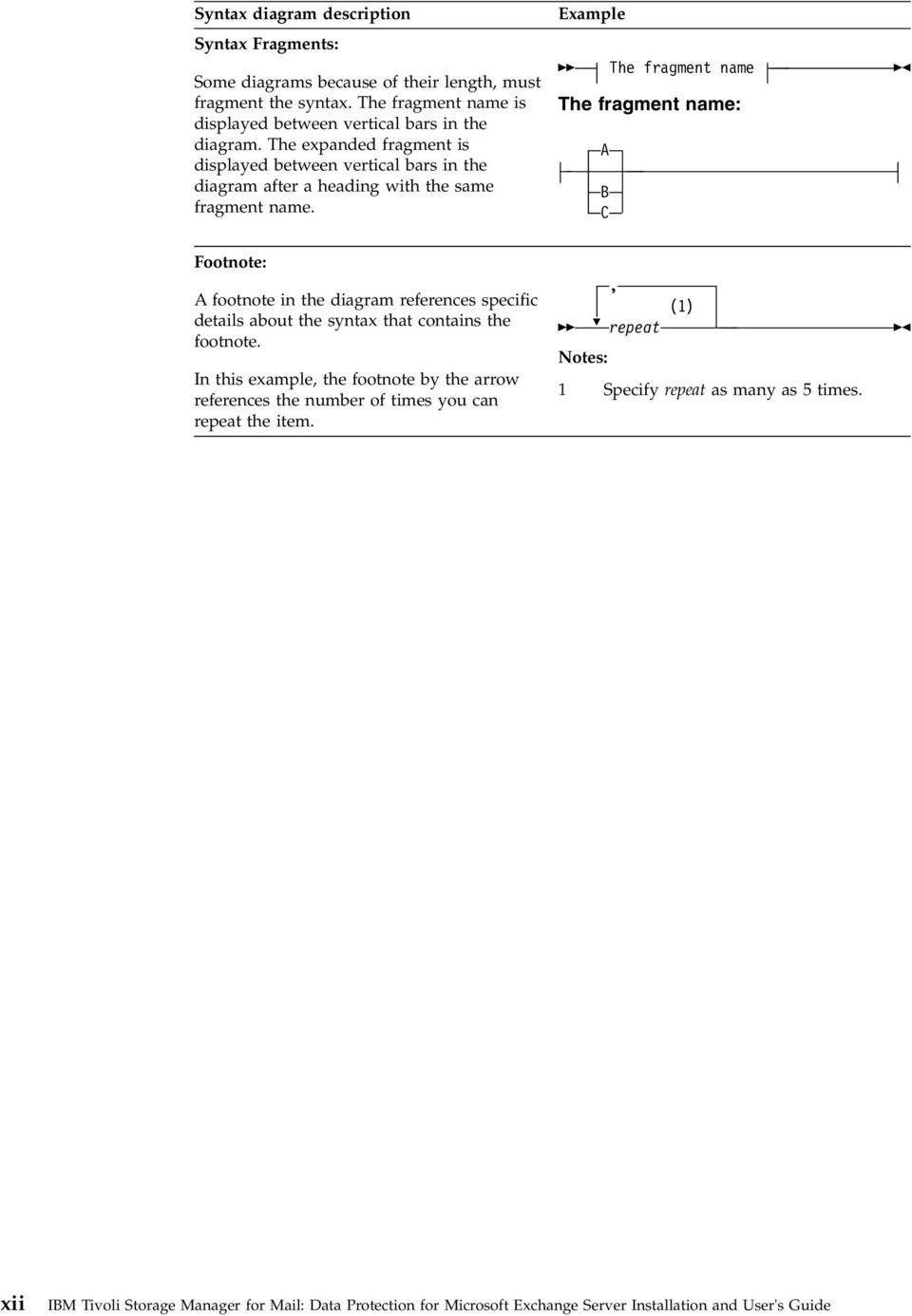
13 Syntax diagram description Variables: Italicized lowercase items (var_name) denote variables. Example KEYWOrd var_name In this example, you can specify a var_name when you enter the KEYWORD command. Repetition: An arrow that points to the left means you can repeat the item. A character or space within an arrow means you must separate the repeated items with that character or space. repeat, repeat Required Choices: When two or more items are in a stack and one of them is on the line, specify one item. A B C In this example, you must choose A, B, or C. Optional Choice: When an item is below the line, that item is optional. In the first example, you can choose A or nothing at all. When two or more items are in a stack below the line, all of them are optional. In the second example, you can choose A, B, C, or nothing at all. A A B C Defaults: Defaults are above the line. The default is selected unless you override it. You can override the default by including an option from the stack below the line. A B C In this example, A is the default. You can override A by choosing B or C. You can also specify the default explicitly. Repeatable Choices: A stack of items followed by an arrow pointing to the left means you can select more than one item or, in some cases, repeat a single item., A B C In this example, you can choose any combination of A, B, or C. About this publication xi

14 Syntax diagram description Syntax Fragments: Some diagrams because of their length, must fragment the syntax. The fragment name is displayed between vertical bars in the diagram. The expanded fragment is displayed between vertical bars in the diagram after a heading with the same fragment name. Example The fragment name The fragment name: A B C Footnote: A footnote in the diagram references specific details about the syntax that contains the footnote. In this example, the footnote by the arrow references the number of times you can repeat the item., (1) repeat Notes: 1 Specify repeat as many as 5 times. xii IBM Tivoli Storage Manager for Mail: Data Protection for Microsoft Exchange Server Installation and User's Guide
15 New for Data Protection for Microsoft Exchange Server Version Data Protection for Microsoft Exchange Server includes new features and changes. New and changed information is indicated by a vertical bar ( ) to the left of the change. Restoring Microsoft Exchange mailboxes when database files are moved or deleted In this release, Administrators can now run mailbox restore operations when application protection for Microsoft Exchange server is enabled for VM backup, and when changes occur after the backup is created. These mailbox restore operations do not require manual intervention and relate only to mailboxes whose database EDB and log file locations are changed after the VM backup is created. Run instant restore operations on IBM and non-ibm storage systems In Microsoft Windows Server 2012 or later, you can use Tivoli Storage FlashCopy Manager to run instant restore operations on IBM and non-ibm storage systems. You must have a Tivoli Storage FlashCopy Manager licence to avail of this feature. Tip: For more information on running instant restore operations on IBM and non-ibm storage systems, see the New for Tivoli Storage FlashCopy Manager Version section in the IBM Tivoli Storage FlashCopy Manager Installation and User's Guide for Windows. Copyright IBM Corp. 1998, 2015 xiii

16 xiv IBM Tivoli Storage Manager for Mail: Data Protection for Microsoft Exchange Server Installation and User's Guide

17 Chapter 1. Getting started With IBM Tivoli Storage Manager for Mail: Data Protection for Microsoft Exchange Server, you can back up and restore Microsoft Exchange Server databases to Tivoli Storage Manager storage or local shadow volumes. A local shadow volume contains data that is stored on shadow volumes, which are local to a disk storage system. Data Protection for Exchange Server provides a connection between an Exchange Server and a Tivoli Storage Manager, which allows Exchange Server data to be protected and managed by Tivoli Storage Manager. Data Protection for Exchange Server protects Exchange Server data and improves the availability of Exchange Server databases. Data Protection for Exchange Server backs up and restores Microsoft Exchange Server databases to Tivoli Storage Manager storage or local shadow volumes. You can use a command-line interface or graphical user interface (GUI) to back up and restore Exchange Server databases. Beginning with Exchange Server 2010, Microsoft no longer supports the Microsoft Legacy application programming interface (API) for streaming backup and restore operations. Microsoft supports the use of Volume Shadow Copy Service (VSS) technology for backup and restore operations. Data Protection for Exchange Server uses the Tivoli Storage Manager API to communicate with the Tivoli Storage Manager, and the Exchange API to communicate with Exchange Server. In addition to these APIs, Data Protection for Exchange Server VSS operations require the Tivoli Storage Manager backup-archive client (VSS Requestor) and Microsoft VSS to produce an online snapshot (point-in-time consistent copy) of Exchange Server data. You must install Data Protection for Exchange Server on the same system as the Exchange Server. Data Protection for Exchange Server also supports backup and restore operations in a Database Availability Group (DAG) environment. Related concepts: Prerequisites on page 27 Data Protection for Microsoft Exchange Server capabilities Data Protection for Microsoft Exchange Server helps you to protect and manage Exchange Server environments by facilitating the backup, restore, and recovery of Exchange Server data. The following table lists the tasks that you can perform with Data Protection for Microsoft Exchange Server: Table 1. Data Protection for Microsoft Exchange Server capabilities Feature Referred to as: More information: Back up Exchange Server databases by using Microsoft VSS VSS backup VSS data backups on page 8 Copyright IBM Corp. 1998,
18 Table 1. Data Protection for Microsoft Exchange Server capabilities (continued) Feature Referred to as: More information: Back up Exchange Server Database Availability Group (DAG) databases to a common node so that you can manage all DAG members with a single policy Back up databases to the Tivoli Storage Manager server by using an alternate system to a production system Restore database backups that are on Tivoli Storage Manager storage to their original location Restore database backups that are on local shadow volumes by using file-level copy mechanisms Restore database backups that are on local shadow volumes by using hardware-assisted volume-level copy mechanisms Restore a database backup to a recovery database, alternate database, or relocated database Restore individual mailboxes and mailbox item-level data from Data Protection for Microsoft Exchange Server backups Set up remote computers in the same or a different domain to manage Exchange Server backup and restore operations. Query the managed capacity for database backups that are on local shadow volumes Delete a backup of an Exchange Server database Manage policy for database backups that are on local shadow volumes Integrate with Tivoli Storage FlashCopy Manager Manage Tivoli Storage Manager database backup policy Issue the restorefiles command to restore database backups to flat files without involving the Exchange Server Back up to DAG node Offloaded backup VSS restore VSS Fast Restore VSS Instant Restore Restore into Mailbox restore Remote system management query managedcapacity command delete backup command policy commands Advanced VSS support Server policy restorefiles command Managing Exchange Database Availability Group members by using a single policy on page 19 Offloaded VSS backups on page 8 VSS restore characteristics on page 4 VSS fast restore processing on page 20 VSS instant restore processing on page 21 VSS backups that are restored to alternate databases on page 22 Restoring mailbox data on page 102 Managing Data Protection for Exchange Server installations remotely on page 90 Query Managedcapacity command on page 165 Delete backup command on page 154 Query policy command on page 166 Transitioning Exchange Server backups from Tivoli Storage FlashCopy Manager to Tivoli Storage Manager on page 73 How policy affects backup management on Data Protection for Exchange Server on page 12 Restorefiles command on page IBM Tivoli Storage Manager for Mail: Data Protection for Microsoft Exchange Server Installation and User's Guide

19 Volume Shadow Copy Service framework Volume Shadow Copy Service (VSS) provides a common interface model to generate and manage online snapshots of Exchange Server data. The Microsoft VSS service manages and directs three VSS software components that are used during VSS operations: the VSS writer, the VSS Requestor, and the VSS provider. The VSS writer is the application that stores data on the source volumes. The VSS Requestor is the backup software. The VSS provider is the combined hardware and software that generates the snapshot volume. The VSS system provider creates and maintains snapshots on local shadow volumes and refers to the default VSS provider that is available with Windows Server. If you use the Windows VSS system provider, no configuration is required. However, you can make changes by using the VSSADMIN commands. With a VSS hardware and software copy provider, you can create shadow copies of running volumes on demand. A hardware provider uses a hardware storage adapter or controller to manage shadow copies at the hardware level. Data Protection for Exchange Server software does not control the VSS hardware provider. The VSS hardware provider is controlled by the hardware vendor. Install and configure the VSS hardware and software provider as required. Data protection in VSS environments The characteristics of VSS backups can affect your backup management tasks. As you decide your backup strategies, be aware of the following VSS backup guidelines. As you decide your backup and restore strategies, be aware of VSS requirements and guidelines. Related tasks: Backing up Exchange Server data on page 92 VSS backup characteristics Backups can be stored on local shadow volumes, a Tivoli Storage Manager server, or at both locations. You can define different policy settings for each backup location. You can offload backups from Tivoli Storage Manager server storage to another system as resource relief for production servers. In addition, you can restore backups to flat files. Databases must have unique names. If a database has the same name as another database, but the capitalization differs, the software does not differentiate between case. When you back up Exchange Server data by using Data Protection for Exchange Server, VSS backups have the following characteristics: v Backups provide an Exchange Server database integrity check function, but do not provide a zeroing function. v You can run full, copy, differential and incremental backups. v You can restore a backup to a local disk only on the same system. v You can back up Exchange Server Database Availability Group (DAG) databases under a common DAG node name, regardless of which DAG member runs the Chapter 1. Getting started 3

20 backup. You can create the backup from an active or passive copy. When you back up data to a common node, the backups are managed by a common policy, and you can restore the backup to any Exchange Server under the same DAG node. VSS backup requirements Plan your VSS backup strategy to optimize the performance of your backup operations and to avoid potential problems. Follow these guidelines when you plan for VSS backups: v When you perform VSS operations, ensure that at least 200 MB of free disk space is on your Windows System Drive. This space is used to store the metadata files for Data Protection for Exchange Server. v Use basic disks, which are initialized for basic storage. A basic disk consists of basic volumes, such as primary partitions, extended partitions, and logical drives. v If you plan to keep VSS snapshot backups only on local shadow volumes, know how to implement the configuration options of your VSS hardware provider. For example, if your VSS hardware provider supports a full-copy snapshot versus a copy-on-write snapshot mechanism, full-copy type implementations have greater disk storage requirements. However, full-copy type implementations do not rely on the original volume to restore the data and are less risky. Copy-on-write implementations require less disk storage but rely on the original volume to restore the data. v If you run parallel VSS backups, stagger the start time of the backups by at least 10 minutes. This interval ensures that the snapshot operations do not overlap. v If you run parallel VSS backups, configure the parallel instance backups so that snapshots of the same volumes are not created. v If you run parallel VSS backups, ensure that parallel backups do not create a snapshot of the same Logical Unit Number (LUN). v Do not place multiple volumes on the same LUN. Configure a single volume, single partition, and single LUN as one-to-one. v Do not set the ASNODENAME option in the dsm.opt file when you use Data Protection for Exchange Server. Setting the ASNODENAME option can cause VSS data backups and VSS restore operations to fail. VSS restore characteristics In a VSS restore operation, VSS backups (Exchange database files and log files) that are on Tivoli Storage Manager server storage are restored to their original location on the Exchange Server. The following characteristics are true of a VSS data restore operation: v If you use a hardware provider, the disks that contain Exchange Server data are configured as basic disks. v You can restore data by using full, copy, incremental, and differential backup methods. v You can restore data from a VSS backup to an alternate database. v Data is restored at the database level. v You can restore one or more databases from a VSS snapshot backup on Tivoli Storage Manager server storage. v You can restore a VSS backup directly from Tivoli Storage Manager server storage to an alternate system. 4 IBM Tivoli Storage Manager for Mail: Data Protection for Microsoft Exchange Server Installation and User's Guide
21 v You can restore data in a Database Availability Group (DAG) environment. v You can restore data from a DAG replica on Exchange Server 2010 or later backup versions to the production server. v You cannot use VSS fast restore or VSS instant restore operations with Microsoft Windows Server 2008 or later versions. v VSS restore operations place data directly into the production database, unless you specify the /intodb parameter. VSS restore requirements Unless otherwise specified, a VSS restore operation refers to all restore types that use VSS, including VSS restore, VSS fast restore, and VSS instant restore operations. Install any Microsoft VSS-related urgent fixes. As you decide your restore strategies, consider the following VSS requirements. v Unless you issue the /INTODB parameter on the restore command, a VSS restore operation ignores the recovery database and data is stored in the production database. v If you use a VSS hardware provider, the disks that contain Exchange Server data are configured as basic disks. v For VSS restore operations, you must dismount the restored database. v When a VSS restore operation from local shadow volumes is complete, zero bytes are transferred because no data (0) is restored from the Tivoli Storage Manager server. v When you use Data Protection for Microsoft Exchange Server, do not set the ASNODENAME option in the dsm.opt file. If you set the ASNODENAME option, VSS backups and VSS restore operations might fail. VSS instant restore A VSS instant restore operation overwrites the entire contents of the source volumes. v If you do not want to overwrite the source volumes, ensure that you set the Instant Restore option to No in Microsoft Management Console (MMC). v VSS instant restore processing requires that the local disk is not accessed by other applications, for example, Windows Explorer. v Before you run a VSS instant restore operation in an Exchange Server 2013 environment, stop the Exchange Search Host Controller Service on the active node. v When you run a VSS instant restore operation, verify that there is no other data on the volumes that are being restored. v If you perform a VSS restore of a database that was relocated (system file path, log file path, or database file path), you must use the Restore Into function and specify the same database name as the one you are restoring. The restore operation fails if you do not specify the same database name. v When you run the Restore Into function, VSS instant restore operations are automatically disabled. v Before you start a VSS instant restore operation, ensure that any previous background copies that contain the volumes that are being restored are completed. XIV, SAN Volume Controller, or Storwize V7000 with space-efficient target volumes do not need to be completed. Chapter 1. Getting started 5
22 VSS fast restore In a VSS fast restore operation, if you do not want to overwrite all the files on the original volume, mount the snapshot. Copy only the files that you want to restore. Database Availability Group (DAG) environment You can perform data restore operations in a Database Availability Group (DAG) environment including restoring an Exchange Server 2010 or later backup from a DAG replica into the production server. v Before you run a VSS instant restore operation in a DAG environment, stop the Microsoft Exchange Replication Service on the active node. v Restore your backups to the active database copy. v v If you back up data to a local system, you can restore the snapshot only to the same system. However, backups to a local server can be restored only on the server where the backup is created. v To restore a backup to a server that is hosting a passive database copy, make the copy active before you restore the backup. When the backup is restored, you can move the active database copy back to the passive state. VSS operations in IBM N-series and NetApp environments You must consider storage space limitations when you perform VSS operations in environments that contain IBM N-series and NetApp systems. Snapshots that are created by using the IBM N-series and NetApp snapshot provider are stored on the same volume where the LUN are located. Disk space that is used by a local backup consists only of the blocks that changed since the last local backup was created. You can use the following formula to determine how much space is required for each local backup: Amount of data changed per hour * number of hours before a local backup expires In addition, Write Anywhere File Layout (WAFL) reserves space, that is, blocks equal to two times the specified size of the LUN to be used. This space reservation ensures that write operations are allowed for virtual disks. The following example shows how to calculate the size of the volumes: Database size of an Exchange database: 100GB Number of local backups to be kept: 3 Snapshot for TSM backup: 1 duration for TSM backup: 2hr Backup frequency: 3hrs The duration before a local backup is expired: 9 hrs Amount of data changed/added/deleted per hr: 50MB Space required for each local backup: 50*9= 450 MB Space required for 3 local backups + 1 TSM backup: 450*3 + 50*2 = 1450 MB The volume size required for the database: 100*2 (space reservation) = GB 6 IBM Tivoli Storage Manager for Mail: Data Protection for Microsoft Exchange Server Installation and User's Guide
23 Data backup processing Data Protection for Exchange Server can use the Microsoft Volume Shadow Copy Service (VSS) framework to produce a point-in-time, consistent, online copy of Exchange Server data. Database backup types With Data Protection for Exchange Server, you can use the common interface in the Volume Shadow Copy Service (VSS) framework to create database backups. You can back up Data Protection for Exchange Server data by using the following methods: Table 2. Data Protection for Exchange Server VSS backup types VSS backup types Full backup Copy backup Incremental backup With this method, Data Protection for Exchange Server backs up the specified database and associated transaction logs. With this method, Data Protection for Exchange Server does not delete transaction log files after the backup. Otherwise, this type is similar to a full backup. Use a copy backup to create a full backup of the Exchange Server database without disrupting any backup processes that use an incremental or differential backup. With this method, Data Protection for Exchange Server backs up only transaction logs. Transaction log files are not deleted if the backup fails. Differential backup When you restore an Exchange Server database from an incremental backup, you must complete the following tasks: v Restore the last full backup. v Restore any other incremental backups that occur between the full backup and the incremental backup. v Restore the incremental backup. With this method, Data Protection for Exchange Server backs up transaction logs. When you follow a full backup with only differential backups, the last full backup and the last differential backup contain all the data that is required to restore the database to the most recent state. When you restore an Exchange Server database from a differential backup, you must complete the following tasks: v Restore the last full backup. v Restore this differential backup, but no other differential backups. Chapter 1. Getting started 7
24 Attention: When you enable circular logging, you cannot use differential or incremental backups. Data loss might occur if the log wraps before the incremental or differential backup ends. Data backup methods You can use Volume Shadow Copy Service (VSS) to back up Data Protection for Exchange Server data. You can run Exchange Server backup operations in a Database Availability Group (DAG) environment. VSS data backups You can store VSS backups on local VSS shadow volumes, or, when integrated with Tivoli Storage Manager, in Tivoli Storage Manager server storage. VSS backups eliminate the need for the server or file system to be in backup mode for an extended time. The length of time to complete the snapshot is measured in seconds, not hours. In addition, a VSS backup allows a snapshot of large amounts of data at one time because the snapshot works at the volume level. You must ensure that sufficient space is available for the snapshot at the storage destination. Both storage destinations require space to store the snapshot until the data transfer to the Tivoli Storage Manager server is complete. After the data transfer to the server is complete, VSS backups that are stored locally on VSS shadow volumes are directly accessible by the system. The snapshot volume is released and the space can be reused. v For data that is backed up to local VSS shadow volumes, the snapshot backup is on the shadow copy volume. v For data that is backed up only to Tivoli Storage Manager server storage, a local snapshot backup is run and the data on the local snapshot volume is sent to the Tivoli Storage Manager server. v For data that is backed up to VSS shadow volumes and Tivoli Storage Manager server, the local snapshot volume is retained as a local backup after the transfer to the Tivoli Storage Manager server is complete. If you store VSS backups both locally and to Tivoli Storage Manager server, and the maximum number of local backup versions to be maintained is reached, the oldest local backup version expires to create the new snapshot for the backup to Tivoli Storage Manager server storage. The maximum number of local backup versions that are maintained is set in the Tivoli Storage Manager policy. Offloaded VSS backups By running an offloaded backup, you can move the backup load from the production system to another system. You can reduce the load on network, I/O, and processor resources during backup processing. Use the RemoteDSMAGENTNode parameter to run an offloaded system. Ensure that you install a VSS hardware provider, which supports transportable shadow copy volumes,on the production and secondary systems. 8 IBM Tivoli Storage Manager for Mail: Data Protection for Microsoft Exchange Server Installation and User's Guide
25 Database Availability Group backups You can use the high-availability feature of Database Availability Group (DAG) backups for enhanced data and service availability, and automatic recovery from failures. You can use Exchange Server 2010 or later versions with DAG backups to improve Exchange Server data backups and data recovery. Beginning with Exchange 2013 SP1, you can also back up Exchange Server databases in a Database Availability Group (DAG) environment without a Cluster Administrative Access Point (CAAP). A DAG environment includes the following functions: v A group of up to 16 mailbox servers that can host up to 100 mailbox databases v Up to 16 online copies of a database (1 active database and up to 15 passive databases) v Synchronous or lagged replication. With lagged replication, you can delay the replaying of logs on target databases if, for example, there are time differences between source and target databases. v Automatic migration and failover of active database copies The following figure illustrates a DAG environment: Chapter 1. Getting started 9
26 REDMOND Load Balancer Client Access Server Array Hub Transport / Witness MBX1 MBX2 MBX3 MBX4 DB1 DB2 DB3 DB4 DB2 DB3 DB4 DB1 Active DB3 DB4 DB1 DB2 Passive DB4 DB1 DB2 DB3 Lagged Figure 1. Sample DAG environment Database copies are mirrored on any node within the DAG. You can complete the following tasks: v Query DAG database copies, including status. v Manage full, copy, incremental, and differential backups of active and passive databases within a DAG. You can create a backup from any active database copy, any passive synchronous copy, or any lagged copy within the DAG. If you back up a lagged database copy, it might take more time to restore the backup because the lagged copy can have more transaction logs to restore and replay. As a best practice, create your backup from a passive synchronous copy and not a lagged copy. v Move an active database copy to other nodes. v Query all DAG database copy backups. v Restore all DAG database copy backups. 10 IBM Tivoli Storage Manager for Mail: Data Protection for Microsoft Exchange Server Installation and User's Guide
27 v Restore data into an active database, from either active or passive database copy backups. v Restore data into a recovery or alternate database. v Process Individual Mailbox Restore (IMR) operations from a DAG database copy backup. v Delete DAG database copy backups. Policy management with Data Protection for Microsoft Exchange Server With Data Protection for Microsoft Exchange Server, you can manage and configure storage management policies for backups. A backup policy determines how backups on local shadow volumes are managed and retained. Although Tivoli Storage Manager policy determines how Data Protection for Microsoft Exchange Server backups are managed on Tivoli Storage Manager storage, backup retention on local shadow volumes is determined by version and time-based policies. Ensure that sufficient local storage space is available on local shadow volumes for a VSS backup. In addition, verify that enough available storage space is assigned to the volumes to accommodate your backup operations. The shadow copy volume that is the storage destination of a snapshot must have sufficient space for the snapshot. Environment and storage resources also affect how many backup versions are maintained on local shadow volumes. The amount of space that is required depends on the VSS provider that you use. How backups expire based on policy Backups expire based on Data Protection for Exchange Server policy. Expiration is the process by which Exchange Server backup objects are identified for deletion when the expiration date is past or the maximum number of backup versions that must be retained is reached. The date on which data expires depends on the business needs that are identified by the recovery point objective (RPO) and the recovery time objective (RTO) of your enterprise. For example, legal, operational, and application requirements affect how data must be protected to meet these RPO and RTO demands. With Data Protection for Exchange Server, you can specify the number of snapshot backups to retain and the length of time to retain them. Backups can expire during a query, backup, or restore operation of a Data Protection for Exchange Server session. For Exchange Database Availability Group (DAG) backups that use the DAG node, only the system on which the backup is created can cause a local backup to expire. If a new backup is created on a different system, and it exceeds the number of backups to be retained, the oldest backup expires from the Data Protection for Exchange Server. An expired backup can no longer be restored. However, the physical storage for that backup version is not released until the next time the original system runs a backup, query, or delete operation. Chapter 1. Getting started 11
28 You specify the number of backup copies that are retained. When the maximum number of backup copies is reached, the oldest backup expires and is deleted. You can specify the maximum number of backup copies in a Data Protection for Exchange Server policy. A backup copy is retained for a maximum number of days. The maximum number of days that a backup can be retained is specified in the Data Protection for Exchange Server policy. How policy affects backup management on Data Protection for Exchange Server A Tivoli Storage Manager policy determines how Data Protection for Exchange Server backups are managed on Tivoli Storage Manager storage and on local shadow volumes when the environment is configured for VSS operations. The Tivoli Storage Manager server recognizes Data Protection for Exchange Server as a node. Data that is backed up to Tivoli Storage Manager storage from the Data Protection for Exchange Server node is stored and managed according to settings that you specify in the Tivoli Storage Manager server policy. The Tivoli Storage Manager policy manages the VSS backups that are placed in Tivoli Storage Manager server storage pools. The Tivoli Storage Manager server manages VSS backups. If you use IBM Tivoli Storage Manager for Copy Services and upgrade to Data Protection for Exchange Server, with the license for Tivoli Storage Manager for Copy Services, you can store VSS backups to local shadow volumes. Tivoli Storage Manager requires that sufficient storage space is available to create shadow volumes for VSS backup processing. Even when the VSS backup destination is the Tivoli Storage Manager server, storage space to create a shadow volume is still required temporarily. The number of local backup versions that are maintained by the Tivoli Storage Manager server is determined by the value that is specified by the Tivoli Storage Manager server verexists parameter, which is defined in the copy group of the management class to which the local backup belongs. It is not necessary to allocate target sets when you use the VSS system provider. When you do not use the VSS system provider, the number of target volume sets that are allocated for local backups must be equal to the value of the verexists parameter. Target volume sets are not applicable to IBM XIV Storage Systems. For example, if verexists=3, then at least three sets of target volumes must be allocated for the backup to complete successfully. If only two sets of target volumes are allocated, the third and subsequent backup attempts fail. If more sets of target volumes exist than the number specified by the verexists parameter, these sets are ignored by the Tivoli Storage Manager server. A high number of local backup versions cannot be stored. If you want to have n number of local backup versions, set the verexists parameter to n + 1. If you keep only one backup, the same disk is reused. The process initially removes the existing backup and attempts the new backup. If the new backup fails, no backups exist. 12 IBM Tivoli Storage Manager for Mail: Data Protection for Microsoft Exchange Server Installation and User's Guide
29 If you retain multiple backups, the oldest backup is removed before another backup is created. If the new backup fails, you might have one less backup than specified by the policy. For example, if you specify that you want to retain five backups, but the last backup fails, you might have only four backup versions. Ensure that you specify a verexists value that meets your VSS backup goals. If you have limited storage space for VSS operations and are restricted to a verexists=1 setting, set the backup destination to BOTH. This option stores the backup on local shadow volumes and sends a copy to Tivoli Storage Manager server storage. You can change and delete VSS backups that Data Protection for Exchange Server creates and stores on local shadow volumes. From the command-line interface, for example, issue the Microsoft VSSADMIN DELETE SHADOWS command to remove a VSS backup that is managed by Tivoli Storage Manager. Tivoli Storage Manager is not able to prevent the backup from being removed. In this instance, Tivoli Storage Manager detects that the backup is removed and reconciles its index of available backups with what is on local shadow volumes. Because backups can be removed, establish a strategy that protects VSS backup data that is stored on local shadow volumes from being compromised. When you use the configuration wizard in the GUI, the VSSPOLICY parameter is set in the tdpexc.cfg file. Depending on the policy management settings, you can reuse a logical unit number (LUN) for a new backup. When a backup is requested and the maximum number of versions is reached, the software deletes the oldest snapshot (backup) to make space for the snapshot. If the new request fails after the oldest snapshot is deleted, you have one less backup version than expected. You must manage the policy for local backups to reconcile the local backup repository with the information that is stored on the Tivoli Storage Manager server. For example, if target volume LUNs that are used for a local backup are removed from the storage system, the information that represents the backup on the Tivoli Storage Manager server must be reconciled. Similarly, if a Tivoli Storage Manager server policy determines that a local backup copy is no longer needed, the local backup manager must free the target volume LUNs to the storage system. The local backup manager is released so that these LUNs can be used for future backup operations. Tivoli Storage Manager automatically detects when these situations occur and completes the reconciliation. Consider the scenario where you use a two-member Database Availability Group (DAG), named MEMBER1 and MEMBER2. When you complete a backup to LOCAL on MEMBER1 and complete more backups on MEMBER2, the backups to LOCAL on MEMBER1 do not expire until the next time you back up, query, or delete data on MEMBER1. In this scenario, you might use more storage than specified by verexists. Chapter 1. Getting started 13
30 Recommended Tivoli Storage Manager policy settings When you use Data Protection for Microsoft Exchange Server, verify that the policy contains the recommended settings. Domain A policy domain contains policy sets, management classes, and copy groups. Create a policy domain on the Tivoli Storage Manager server to be used exclusively for Data Protection for Exchange Server backups. Policy sets Policy sets contain management classes (which contain copy groups) that determine the rules by which Data Protection for Exchange Server backups are performed and managed. Define the policy set to the policy domain to which Data Protection for Exchange Server backups belong. The policy set must be activated and only one policy set can be active in the policy domain. Management class A management class is a policy object that users can bind to each file to specify how the file is managed. Define a management class for backups on local shadow volumes, and a management class for backups on Tivoli Storage Manager server storage. Different management classes provide the opportunity for specialized policies for each storage destination. For example, you can maintain six versions of local VSS backups of a given storage group (verexists=6) while you maintain only two versions of the same storage group on Tivoli Storage Manager server storage (verexists=2). In addition, you can create a separate management class for copy backup types for use in long term storage. Such policies can maximize storage resources and provide more control over your storage strategy. Important: Because VSS backup processing requires sufficient storage space to create shadow volumes, ensure that you specify verexists=n+1 to keep n backups on local shadow volumes. You can have five active backups of the same storage group because legacy backups on Tivoli Storage Manager server storage, VSS backups on Tivoli Storage Manager server storage (COPY and FULL), and VSS backups on local shadow volumes (COPY and FULL) all have different Tivoli Storage Manager server naming and therefore, can each have their own management class. Ensure that you plan your backup strategy before you define management classes. Copy group A copy group controls how backup versions are generated, located, and expired. Define the copy group as a backup copy group and not as an archive copy group. Because Data Protection for Exchange Server stores all objects as backup objects on Tivoli Storage Managerin backup storage pools, an archive copy group is not required, although an archive copy group can exist. The following backup copy group parameters significantly influence your backup policy: VERExists Determines the maximum number of Exchange Server database backup versions to retain for databases that exist on the Data Protection for Exchange Server client system. 14 IBM Tivoli Storage Manager for Mail: Data Protection for Microsoft Exchange Server Installation and User's Guide
31 VERDeleted Determines the maximum number of Exchange Server database backup versions to retain for databases that were deleted from the Data Protection for Exchange Server client system after being backed up by Tivoli Storage Manager. RETExtra Determines the number of days to retain an Exchange Server database backup version after that version becomes inactive. RETOnly Determines the number of days to retain the last Exchange Server database backup version of a database that was deleted from the Data Protection for Exchange Server client system. Because of version limit, incremental backups are not expired. Only one version of an incremental backup object exists at a time because incremental backups are always uniquely named. However, all legacy backup objects for an Exchange Server storage group are inactivated when a new full backup of that Exchange Server storage group is completed. VSS backup objects remain active. The retention period that is set in the RETOnly parameter controls the expiration of incremental backup objects. When you set the value of the RETOnly parameter for incremental backups, the value must be, at a minimum, as long as the value that is set for the full backup objects to which the incremental backups are associated. You can use the same management class for incremental backups and the full backup objects (that are retained the longest) to ensure that an adequate value is used. However, when a new legacy full backup of that Exchange Server storage group is completed, all legacy backup objects for an Exchange Server storage group are inactivated. In this scenario VSS backup objects remain active. MODE, SERialization, FREQuency Because theses parameters settings do not apply to Data Protection for Exchange Server, accept the default values. When you plan a backup strategy, as a best practice, consult with the Tivoli Storage Manager server administrator about recommended parameter settings. Storage pool A storage pool is a named set of storage volumes and the destination that is used by the Tivoli Storage Manager server to store data. A single restore operation can require a full backup, a differential backup, and multiple incremental backups. Use collocation if backups are stored on removable media. Specify collocation by file space (define stgpool COLlocate=FILespace) if you plan to restore multiple storage groups in parallel. Tip: As a best practice, use collocation because data for any one storage group is stored within one Tivoli Storage Manager server file space. Chapter 1. Getting started 15
32 Creating a local backup policy A local backup policy determines how different backup versions are retained on local shadow volumes. Before you begin Backup retention on local shadow volumes is determined by your overall backup strategy, the type and number of VSS backup version on Tivoli Storage Manager and on the local shadow volumes, and time-based policies. Ensure that there is sufficient local storage space on local shadow volumes. The amount of space that is required depends on the VSS provider that you use. Procedure 1. Start Microsoft Management Console (MMC). 2. In the navigation tree, click IBM Tivoli Storage Manager. 3. Select an Exchange Server, SQL Server, or File System instance. 4. In the Actions pane, click Properties. 5. From the list of available property pages, select Policy Management. 6. Add, delete, or update local policies for data retention. When you add a policy, specify a unique policy name. Double-click the policy to edit a policy field. To retain an unlimited number of snapshots, or to retain snapshots for an unlimited number of days, specify NL. 7. Click Save. What to do next After you add a policy, you can bind a backup to that policy. Updates to existing, bound policies do not take effect until the next backup is run. Specifying policy binding statements Bind policy statements to associate Microsoft Exchange Server backups to a management policy. About this task A default policy binds any backups that are not explicitly bound to a named policy. Policy binding is available in environments with or without a Tivoli Storage Manager server. For Exchange Database Availability Groups (DAG), all the DAG members that share the DAG node must use the same VSS policy. Tip: Use the same policy binding method for Exchange Server backups. Define a policy statement in the configuration file. Procedure Specify the policy-binding statements to use to bind snapshots to a policy. Manually add the binding statements in the respective configuration file that defines the policy statements. Policy-binding statements in the Data Protection for Exchange Server configuration files might look similar to the information in the following table. 16 IBM Tivoli Storage Manager for Mail: Data Protection for Microsoft Exchange Server Installation and User's Guide
33 server name object name backup type backup dest mgmt class VSSPOLICY * "Accounting" FULL LOCAL MC_1 VSSPOLICY SERVER_3 "Human Resources" INCR LOCAL MC_6 Binding backups to a policy You can add, update, delete, or change the processing order of binding statements. About this task A backup policy determines how backups on local shadow volumes are managed and retained. Procedure 1. Start Microsoft Management Console (MMC). 2. In the navigation tree, click IBM Tivoli Storage Manager. 3. Select an Exchange Server instance. 4. In the Actions pane, click Properties. 5. From the list of available property pages, select VSS Policy Binding. 6. Add, update, delete, or change the processing order of existing binding statements. Tip: You can use an asterisk (*) as a wildcard character to represent all characters. For example, in the Server field, enter the asterisk to bind the policy to all Exchange Servers. 7. Optional: To change the processing order, use Move Up and Move Down. Policies are processed from the bottom to the top of the file, and processing stops at the first match. Tip: To ensure that more specific statements are processed before general statements, list the more general specification before the more specific statement. 8. Save the binding statement. 9. Optional: Verify new or updated policies and bindings. a. Run one or more test backup operations. b. On the Recover tab, verify the management classes that are bound to the test backups. VSSPOLICY statements for backup types For VSS backups, VSSPOLICY statements are used to associate VSS backups with management classes. When you change from legacy backups to VSS backups, consider the VSSPOLICY statements that you set for the backup. The VSSPOLICY statements are in a configuration file, for example, tdpexc.cfg. A configuration file can include multiple VSSPOLICY statements. The configuration file is read from the bottom to the top of the file. VSSPOLICY statements in the tdpexc.cfg file are similar to the INCLUDE statements that are specified in the Tivoli Storage Manager backup-archive client in the dsm.opt file. If no VSSPOLICY statements are included in the configuration file, or if the VSSPOLICY statements do not match the type of backup that is created, the Chapter 1. Getting started 17
34 default management class for the policy domain is used. Backup expiration parameters for the default management class might differ from the settings that are used for preexisting legacy backups. For example, the backup expiration period might be set to 30 days. This setting means that after 30 days, the backup is deleted. Verify that the backups expire according to the business needs of your environment. If you change the tdpexc.cfg file, you must restart the Tivoli Storage Manager client acceptor daemon (CAD), Tivoli Storage Manager remote client agent (DSMAgent), and the Tivoli Storage Manager Scheduler Service for Exchange Server. If the DSMAgent service state is set to Manual (Started), stop the service. The DSMAgent service starts when a VSS backup is initiated, but if the service is started and you change the policy settings, the policy settings do not take effect until you restart the service. Sample VSSPOLICY statements The following example shows the syntax of a VSSPOLICY statement: VSSPOLICY srv_name db-name backup-type backup-dest mgmtclass where: v srv_name defines the Exchange Server name. You can enter an asterisk (*) as a wildcard character to match all Microsoft Exchange Servers. v db-name defines the database name. You can enter an asterisk (*) as a wildcard character to match all Microsoft Exchange Server groups. Because the name can include a space, use the quotation marks to encapsulate the database name. v backup-type defines the backup type for example, FULL or COPY. You can enter an asterisk (*) as a wildcard character to match all backup types. v backup-dest defines the backup destination. Use the TSM option to back up data to Tivoli Storage Manager, the LOCAL option to back up data to a local disk, enter an asterisk (*) as a wildcard character to match both backup destinations. v mgmtclass defines the Tivoli Storage Manager management class that is used to bind the types of specified backups. In the following example, the VSSPOLICY statement is commented out. Before you can use this policy statement, you must remove the asterisk character (*) from the first column of each line * Sample VSSPOLICY Statements * * These statements are used to bind VSS backup to specific TSM * Server management classes. Adjust the statements to meet your * needs and remove the leading asterisks to make them operational. * Note: Matching of these policy bindings are from the bottom up. ********************************************************************** * Server Database Name BU Type BU Dest. Mgmt Class * VSSPOLICY * * FULL TSM IUG_TSM VSSPOLICY * * COPY TSM IUG_TSM_COPY VSSPOLICY * * COPY LOCAL IUG_COPY VSSPOLICY * * FULL LOCAL IUG_LOCAL VSSPOLICY * "HR" FULL LOCAL MCLASS3 VSSPOLICY SERVER1 "ACT" * LOCAL MCLASS2 VSSPOLICY SERVER1 "SG 1" * TSM IUG1 ********************************************************************** 18 IBM Tivoli Storage Manager for Mail: Data Protection for Microsoft Exchange Server Installation and User's Guide
35 In the preceding example, the following policy rules are specified: v Any VSS backups of the SG 1 database on the Exchange Server SERVER1 to Tivoli Storage Manager are bound to the management class IUG1. v Any VSS backups of the ACT database on the Exchange Server SERVER1 to LOCAL are bound to the management class MCLASS2. v Full VSS backups of the HR database on any Exchange Server to LOCAL are bound to the management class MCLASS3. v Full VSS backups of any other database on any other Exchange Server to LOCAL are bound to the management class IUG_LOCAL. v Copy VSS backups of any other database on any other Exchange Server to LOCAL are bound to the management class IUG_COPY. v Copy VSS backups of any other database on any other Exchange Server to Tivoli Storage Manager are bound to the management class IUG_TSM_COPY. v Full VSS backups of any other database on any other Exchange Server to Tivoli Storage Manager are bound to the management class IUG_TSM. v Any type of backup matches a rule because of the wildcard VSSPOLICY statements at the top of the file. Use these types of statements so that you explicitly state what management class is used. Managing Exchange Database Availability Group members by using a single policy For Microsoft Exchange Server databases in a Database Availability Group (DAG) environment, several online copies of a database are maintained for high availability. To reduce the number of database backups that are created, set up Data Protection for Exchange Server to back up database copies from different DAG members under a single DAG node. About this task You can prevent Data Protection for Exchange Server from backing up each database copy separately by backing up the database copies under a single Database Availability Group (DAG) node. All database copies can be managed as a single entity regardless of where the database copies are backed up from, and whether the backup copies are active or passive at the time of the backup. You can set up a minimum interval between database backups, which ensures that the database copies are not backed up at the same time or backed up too frequently. Procedure 1. Use the Tivoli Storage Managerconfiguration wizard to configure the DAG node. Ensure that all the DAG members are configured with the same DAG node name. v For VSS backups to Tivoli Storage Manager, specify a node name in the DAG Node field on the TSM Node Names page in the wizard. This node is used to back up all the DAG. 2. Grant permission to the DAG member server to act as a proxy for the DAG node. Issue the proxynode command for each member server in the DAG. For example, issue the following commands: register node backup_archive_client_node password register node data_protection_node password grant proxynode target=data_protection_node agent=backup_archive_client_node Chapter 1. Getting started 19
36 register node DAG_node password grant proxynode target=dag_node agent=backup_archive_client_node grant proxynode target=dag_node agent=data_protection_node Tip: If you do not use the configuration wizard to configure the Tivoli Storage Manager server, you must define the proxies and assign proxynode authority to the backup-archive client node and the Data Protection node. 3. For a stand-alone configuration, ensure that the DAG node and the node are in the same policy domain. 4. Create a backup schedule and specify the /MINIMUMBACKUPINTERVAL parameter with the backup command. For example, to back up one copy of a database that contains multiple copies, complete the following steps: a. Create a command script that is named C:\BACKUP.CMD by issuing this command: TDPEXCC BACKUP DB1 FULL /MINIMUMBACKUPINTERVAL=60 b. Copy the BACKUP.CMD file to all the DAG members. c. Create one schedule and associate all the nodes with this schedule. 5. Run the schedule by using the Tivoli Storage Manager scheduler. When the backup schedule runs, the minimum backup interval is observed and only one backup is created. What to do next Data restore processing To decrease the load on the production Exchange Server, you can specify that the backups are taken from a valid passive database copy. If a valid passive copy is not available, the backup copy is created from the active copy of the database. To add this specification, specify the /PREFERDAGPASSIVE on the backup command, for example: TDPEXCC BACKUP DB1 FULL /MINIMUMBACKUPINTERVAL=60 /PREFERDAGPASSIVE Data Protection for Exchange Server can use the Microsoft Volume Shadow Copy Service (VSS) framework to complete fast and instant restores of database backups. You also restore VSS backups to an alternate database and complete Exchange mailbox restore operations. In a VSS restore operation, you restore one or more databases from a VSS backup on Tivoli Storage Manager server storage to the original location on the Exchange Server. VSS fast restore processing A VSS fast restore operation restores data from a local snapshot. A VSS fast restore operation overwrites any files that exist at the time of the snapshot on the original source location. The file is overwritten with the version stored on the snapshot. Data is overwritten even if a file is marked read-only. You can use VSS fast restore operations for the following tasks: v Restore Exchange Server VSS backups, full, copy, incremental, and differential backup types. v Restore data at the database level. v Restore a VSS backup to an alternate database. v Restore a backup from a DAG replica to the production server. 20 IBM Tivoli Storage Manager for Mail: Data Protection for Microsoft Exchange Server Installation and User's Guide
37 v Restore a backup from a relocated database to the production server. v Restore local database backups to only the system that created the backup. VSS instant restore processing A VSS instant restore operation restores data by using a hardware-assisted restore method. A FlashCopy operation is an example of a hardware-assisted restore method. Instant restore processing is done at the volume level. Even though Exchange Server data is restored relatively quickly, the transaction logs must be replayed after a restore operation. The time of recovery for the database increases as the number of logs to be replayed increases. VSS instant restore is typically used to restore local VSS backups of the SAN-attached volumes from IBM System Storage SAN Volume Controller, IBM System Storage DS8000 series, IBM Storwize V7000, or XIV. The VSS instant restore process requires a VSS hardware provider. For Exchange Server data, you cannot use instant restore processing for differential and incremental backups. The data that is to be restored must be on a storage system that is valid for VSS instant restore operations. If data is not on an XIV, SAN Volume Controller, or Storwize V7000 systems with space-efficient target volumes, you must ensure that background copies that use the volumes are restored. You can manually disable VSS instant restore processing so that Tivoli Storage FlashCopy Manager uses VSS fast restore. Instant restore processing is automatically disabled for these VSS restore operations: v Restore data to an alternate location v Restore data to an recovery database v Restore files by issuing the restorefiles command When you plan to implement VSS instant restore operations, consider the following guidelines: v IBM System Storage DS8000 series requires IBM System Storage Support for Microsoft Volume Shadow Copy Service software. v SAN Volume Controller requires IBM System Storage Support for Microsoft Volume Shadow Copy Service software. v Storwize V7000 requires IBM System Storage Support for Microsoft Volume Shadow Copy Service software. v XIV has separate VSS Provider software. v Backups can be restored only to the same storage system from which they are backed up. For instant restore operations, use the devices that are listed here: Storage Architecture Support for Tivoli Storage FlashCopy Manager ( Chapter 1. Getting started 21
38 VSS backups that are restored to alternate databases Data Protection for Exchange Server can restore an Exchange Server database backup or DAG active or passive database copy backup, to a recovery database or to an alternate (or relocated) database. This restore method is called restore into. If you are restoring a relocated database, use the restore into function. You must specify the same database name as the one you are restoring. Note: If you use the restore into function, VSS instant restore capability is automatically disabled. Backups to local shadow volumes can be restored only to the system where the backups are created. Mailbox restore operations By using Data Protection for Microsoft Exchange Server, you can restore an entire mailbox or selected mailbox items to the original mailbox, another online mailbox on the same server, or to a Unicode or non-unicode.pst file. Restriction: In the Mailbox Restore view of Microsoft Management Console (MMC), you can restore mail items to Unicode and non-unicode.pst files. In the Mailbox Restore Browser view, however, you can restore mail items to only non-unicode.pst files. The Recoverable Items folder is a storage area in a mailbox that contains operational data about the mailbox. Depending on the Exchange Server functions that you enabled for the mailbox, you can recover and restore the following types of mail items in the Recoverable Items folder: v Deleted item retention v Single item recovery v In-place hold v Litigation hold v Mailbox audit-logging v Calendar logging Typically, a mailbox is set up to protect mail items from being accidentally or maliciously deleted, or to retrieve mail items during litigation or investigations. Mailbox-enabled functions You can verify whether a mailbox is enabled for mailbox restore operations by running the following Exchange Powershell cmdlets. In the examples, the mailbox is for George Clark: Deleted item retention Get-Mailbox "george clark" FL RetentionHoldEnabled, RetainDeletedItemsFor, RetainDeletedItemsUntilBackup Single item recovery Get-Mailbox "george clark" FL SingleItemRecoveryEnabled In-place hold Get-Mailbox "george clark" FL InPlaceHolds 22 IBM Tivoli Storage Manager for Mail: Data Protection for Microsoft Exchange Server Installation and User's Guide
39 Litigation hold Get-Mailbox "george clark" FL LitigationHoldEnabled Mailbox audit-logging Get-Mailbox "george clark" FL AuditEnabled, AuditLogAgeLimit Calendar logging Get-Mailbox "george clark" FL CalendarVersionStoreDisabled Mail items in the Recoverable Items folder In the mailbox restore views in Microsoft Management Console (MMC), you can recover and restore mail items from the subfolders within the Recoverable Items folder. You can also complete this task by issuing the restor box command. The following table lists the subfolders that are included in the Recoverable Items folder. Table 3. Exchange Server 2013 Recoverable Items folder contents Recoverable Items subfolder Mailbox-enabled functions Subfolder contents Deletions Deleted item retention Contains mail items that a user deleted from the Deleted Items folder in their mailbox Versions Purges v In-place hold v Litigation hold v Single item recovery v Litigation hold v Single item recovery Contains the original and modified copies of the deleted mail items Contains all mail items that a user hard deleted, that is, purged from their mailbox Audits Mailbox audit-logging Contains audit log entries Discovery Holds In-place hold Contains mail items that are to be protected from deletion and match hold query parameters Calendar Logging Calendar logging Contains calendar changes that occur within a mailbox Restriction: v You cannot restore the Recoverable Items folder and subfolder hierarchy to a mailbox restore destination. You can restore only the contents of the folders. v You cannot create a subfolder in the Recoverable Items folder in a mailbox. v You can restore the Recoverable Items content for a public folder mailbox but not for each public folder in the public folder mailbox. Related reference: Restorefiles command on page 184 Related information: %29.aspx Chapter 1. Getting started 23
40 Data Protection for Exchange Server with IBM SAN Volume Controller and IBM Storwize V7000 The way in which you configure the VSS provider for IBM SAN Volume Controller and IBM Storwize V7000 controls the type of FlashCopy operation that runs when you create a VSS snapshot. The VSS provider that you use with IBM SAN Volume Controller and IBM Storwize V7000 must have the following characteristics: v If the VSS provider is configured to use incremental FlashCopy, you can take only one backup version. Each VSS snapshot request for a source volume causes an incremental refresh of the same target volume. When you delete the VSS snapshot, it is removed from the VSS inventory. If you create another VSS snapshot of the same source volume, the process results in an incremental refresh of the target volume. The following guidelines apply when you use Data Protection for Exchange Server with SAN Volume Controller- based storage: v Do not use a combination of space-efficient and fully allocated target volumes. Choose to use either space-efficient or fully allocated volumes for FlashCopy targets. Provision enough target volumes in the SAN Volume Controller VSS_FREE volume group for the backup versions you require. If you use fully allocated target volumes, the capacity size of those volumes must match the size of the source volumes. v If space-efficient virtual disks (VDisks) are used for backup targets, set the IBM VSS provider background copy value to zero by entering the ibmvcfg set backgroundcopy 0 command. To activate the changes, restart the IBM VSS system service after you enter the command. You can transition your data from fully allocated targets to space-efficient targets by using fully allocated targets as if those targets are space-efficient when the background copy rate is set to 0. v To determine how much storage space is required for each local backup, the backup LUNs require the same amount of storage space as the original LUNs. For example, if you have a 100 GB database on a 200 GB LUN, you need a 200 GB LUN for each backup version. v Do not use a combination of persistent and nonpersistent VSS snapshots. v Do not mix COPY and NOCOPY FlashCopy relationships from the same source volume or volumes. v Enable the autoexpand option for the space-efficient target volumes to avoid out-of-space conditions. v Allocate enough space for space-efficient target volumes to hold 120 % of the data that is expected to change on the source volume in the time between snapshots. For example, if a database changes at a rate of 20 % per day, VSS backups complete every six hours, and a steady rate of change throughout the day is assumed. The expected change rate between snapshots is 5 % of the source volume (20/4). Therefore, the allocated space for the space-efficient target volumes is to be 1.2 times 5 % equal to 6 % of the source volume size. If the rate of change is not consistent throughout the day, allocate enough space to the target volumes to accommodate the highest expected change rate for the period between snapshots. You can use VSS instant restore operations with Data Protection for Exchange Server when multiple backup versions exist on IBM SAN Volume Controller and IBM Storwize V7000 space-efficient target volumes. 24 IBM Tivoli Storage Manager for Mail: Data Protection for Microsoft Exchange Server Installation and User's Guide
41 v Do not delete snapshots manually. Allow Data Protection for Exchange Server when multiple backup versions exist on IBM SAN Volume Controller and IBM Storwize V7000 space-efficient target volume to delete backup versions that are based on the defined policy to ensure that deletion occurs in the correct order. IBM System Storage requirements If you use IBM System Storage DS8000 series, SAN Volume Controller, or Storwize V7000 storage systems, be aware of database, log, file, and LUN settings. Follow these guidelines when you plan for IBM System Storage: v Place database files on a separate and dedicated logical volume. v Place logs on a separate logical volume. v Do not place non-exchange data on storage volumes that are dedicated to Exchange. v When you use hardware snapshot providers, ensure that the database LUNs are dedicated to only one database or application. v If you delete a local snapshot that is stored on a IBM SAN Volume Controller or IBM Storwize V7000 space-efficient volume (SEV) that has multiple dependent targets, delete the snapshots in the same order in which you created the snapshots. You must delete the oldest one first, followed by the second oldest. v In a IBM SAN Volume Controller or IBM Storwize V7000 environment, if you use multiple target FlashCopy mappings, a mapping might stay in the copying state after all the source data is copied to the target. This situation can occur if mappings that started earlier and use the same source disk are not yet fully copied. In this instance, schedule local backups for IBM SAN Volume Controller and IBM Storwize V7000 storage systems at intervals that are greater than the time required for the background copy process to complete. Automated Tivoli Storage Manager server failover for data recovery If you use Data Protection for Exchange Server with the Tivoli Storage Manager configuration, Data Protection for Exchange Server can automatically fail over to the secondary server for data recovery when there is an outage on the Tivoli Storage Manager server. The Tivoli Storage Manager server that Data Protection for Exchange Server connects to for backup services is called the primary server. If the primary server is set up for node replication, the client node data on the primary server can be replicated to another Tivoli Storage Manager server, which is the secondary server. Depending on your configuration, the following nodes must be set up for replication on the primary server: v Data Protection node v VSS requestor node (also called the DSM agent node) v Remote DSM agent node (for offloaded backups to the primary server) v Exchange Server Database Availability Group (DAG) node for backups of databases in a DAG During normal operations, connection information for the secondary server is automatically sent to Data Protection for Exchange Server from the primary server. The secondary server information is saved to the client options file (dsm.opt). No manual intervention is required by you to add the information for the secondary server. Chapter 1. Getting started 25
42 Each time the backup-archive client logs on to the server for backup services, it attempts to contact the primary server. If the primary server is unavailable, the backup-archive client automatically fails over to the secondary server. In failover mode, you can restore data that is replicated to the secondary server. When the primary server is online again, the backup-archive client automatically fails back to the primary server the next time the backup-archive client connects to the server. Requirements: To ensure that automated client failover can occur, Data Protection for Exchange Server must meet the following requirements: v Data Protection for Exchange Server must be at least at V7.1 level or later. v The primary server, secondary server, and backup-archive client must be at least at V7.1 level or later. v The primary and secondary servers must be set up for node replication. v The following nodes must be configured for replication with the replstate=enabled option in each node definition on the server: Data Protection node VSS requestor node Remote DSM agent node for offloaded backups DAG node, if applicable v Before the connection information for the secondary server can be sent to Data Protection for Exchange Server, the following processes must occur: You must back up data at least one time to the primary server. The following nodes must be replicated at least one time to the secondary server: - Data Protection node - DAG node, if applicable Restriction: The following restrictions apply to Data Protection for Exchange Server during failover: v Any operation that requires data to be stored on the Tivoli Storage Manager server, such as backup operations, are not available. You can use only data recovery functions, such as restore or query operations. v Schedules are not replicated to the secondary server. Therefore, schedules are not run while the primary server is unavailable. v If the primary server goes down before or during node replication, the most recent backup data is not successfully replicated to the secondary server. The replication status of the file space is not current. If you restore data in failover mode and the replication status is not current, the recovered data might not be usable. You must wait until the primary server comes back online before you can restore the data. 26 IBM Tivoli Storage Manager for Mail: Data Protection for Microsoft Exchange Server Installation and User's Guide
43 Chapter 2. Installing, upgrading, and migrating Before you start the installation process, review the appropriate prerequisite information, including hardware and software requirements. Prerequisites Before you install Data Protection for Microsoft Exchange Server, ensure that your system meets the minimum hardware, software, and operating system requirements. Hardware and software requirements change over time due to maintenance updates and the addition of operating system, application, and other software currency support. For the latest requirements, review the Hardware and Software Requirements technote that is associated with the level of your Data Protection for Exchange Server program. This technote is available at this web page: TSM for Mail - All Requirement Documents ( docview.wss?uid=swg ) Follow the link to the requirements technote for your specific release or update level. Installation process might require a reboot If you do not install all of the prerequisites before starting the installation process, the installation process might require a reboot. As part of the installation process, one or more Microsoft C++ redistributable packages are installed, if they are not already installed on the Windows workstation. These packages can also be automatically updated by the Windows Update service. If the packages are updated, the update can cause the system to reboot when you start the installation program. Additionally, because the Microsoft Visual Studio C++ redistributable package is a shared Windows component, other applications that have dependencies on the package might be stopped or restarted by Windows as part of the installation or upgrade of the C++ redistributable package. Schedule installations and upgrades during a maintenance window when other applications are not be adversely affected if they are stopped or restarted when the C++ redistributable package is installed. Monitor other applications after the installation is complete. If applications stopped and did not restart, restart the applications. Minimum hardware requirements The following hardware is required to install Data Protection for Exchange Server: Hardware for an x64 system Compatible hardware that is supported by the Windows operating system and Exchange Server Copyright IBM Corp. 1998,
44 Virtualization environment resources If you operation in a virtualization environment with Data Protection for Exchange Server, review these resources. For more information about virtualization environments that can be used with Data Protection for Exchange Server, see this web page: Tivoli Storage Manager (TSM) guest support for Virtual Machines and Virtualization ( Installing and configuring Data Protection for Microsoft Exchange Server You can quickly install and configure Data Protection for Exchange Server to start protecting your Exchange Server data. Before you begin Before you install and configure Data Protection for Exchange Server, verify that you satisfy the hardware and software requirements. You can obtain the installation package from the product DVD or from an IBM download site. v If you obtain the package from the product DVD, ensure that the installation files are visible on the DVD drive. v If you obtain the package from an IBM download site, you must extract the installation files. About this task Data Protection for Exchange Server is available in both licensed and maintenance packages. The installation process differs based on the package type. Licensed package Includes a license enablement file that is only available from your software distribution channel, such as Passport Advantage, and includes the initial General Availability release of a product or component. Maintenance update (fix pack or interim fix package) Available from the maintenance delivery channel, and can sometimes be used to refresh the software distribution channel. Maintenance packages do not contain license enablement files and must be installed after a licensed package. For information about how to install a fix pack or interim fix package, see the README.FTP file. The README.FTP file is available in the same directory where the maintenance package is downloaded. Related concepts: Security requirements for backup and restore operations on page IBM Tivoli Storage Manager for Mail: Data Protection for Microsoft Exchange Server Installation and User's Guide
45 Installing Data Protection for Exchange Server Procedure 1. Log on to the system as an administrator. 2. Download the appropriate package file from one of the following websites, or you can access the files from the product DVD: v For a first time installation or a new release go to Passport Advantage at IBM Passport Advantage. Passport Advantage is the only website from which you can download a licensed package file. v For a maintenance fix, go to this FTP site and to the directory that contains the maintenance fix version that you require, Index of Data Protection for Microsoft Exchange Server patch files (ftp://public.dhe.ibm.com/storage/ tivoli-storage-management/patches/tivoli-data-protection/ntexch/). 3. If you download the package from one of the download sites, complete the following steps: a. Verify that you have enough space to store the installation files when they are extracted from the product package. b. Change to the directory where you placed the executable file. Tip: In the next step, the files are extracted to the current directory. The path must contain no more than 128 characters. Extract the installation files to an empty directory. Do not extract the files to a directory that contains previously extracted files, or any other files. c. Either double-click the executable file, or enter the following command on the command line to extract the installation files. The files are extracted to the current directory. package_name.exe where package_name is like this example: TIV-TSMEXC-Win.exe 4. Follow the installation instructions that are displayed. 5. Click Finish. 6. If you plan to use VSS operations, you must install the most recent version of the Tivoli Storage Manager backup-archive client. The backup-archive client is also the VSS Requestor and is available separately. Completing the installation configuration Procedure 1. To start the MMC, click Start > All Programs > Tivoli Storage Manager > Data Protection for Microsoft Exchange Server > DP for Exchange Management Console. If you did not previously configure Data Protection for Exchange Server, the Tivoli Storage Manager configuration wizard starts automatically. 2. If the Tivoli Storage Manager configuration wizard does not start automatically, click Manage > Configuration > Wizards in the navigation tree, select the wizard, and click Start in the Actions pane. 3. Complete the following pages of the wizard: Data Protection Selection Select Exchange Server as the application to protect. Requirements Check Click any Failed or Warnings links to resolve errors. Chapter 2. Installing, upgrading, and migrating 29
46 If you do not have all the user roles that are required for individual mailbox restore operations, click the Warnings link and follow the wizard prompts to add the missing Exchange Server roles. If you are a member of the Exchange Organization Management group and have sufficient role-based access control (RBAC) permissions, you can automatically add the missing roles. If you are not a member of the Exchange Organization Management group and have insufficient RBAC permissions, you must manually add the missing roles. TSM Node Names Specify the Tivoli Storage Manager node names to use for the applications that you want to protect. v In the VSS Requestor field, enter the node name that communicates with the VSS Service to access the Exchange data. This node name is the Tivoli Storage Manager client node name, also known as the DSM agent node name. v In the Data Protection for Exchange field, enter the node name where the Data Protection for Exchange Server application is installed. This node stores the Data Protection for Exchange Server backups. If you configure the DAG Node, the DAG database backups are not stored under the Data Protection node. The backups are stored under the DAG node. Regardless, the Data Protection node must be defined. v In the DAG Node field, enter the node name that you want to use to back up databases in an Exchange Server Database Availability Group. With this setting, all active and passive copies of the databases are backed up to the same file space on the Tivoli Storage Manager server. The database copies are managed as a single entity, regardless of which Database Availability Group member they were backed up from. This setting can prevent Data Protection for Exchange Server from making too many backups of the same database. Important: On the Tivoli Storage Manager server, ensure that you register the DAG node. All DAG members need proxy authority to run backups on behalf of the DAG node. TSM Server Settings Specify the Tivoli Storage Manager server address, and choose whether to have the wizard configure the Tivoli Storage Manager server. Alternatively, you can view and change the commands that the configuration wizard uses to configure the Tivoli Storage Manager server, or run manually run the commands. Custom Configuration Click Default in most situations, or click Custom to enter all service-related information. TSM Configuration Wait for all components to be provisioned and configured. Click Re-run if there are any problems. Click the Failed or Warnings link for more information if any problems remain. Completion The configuration status is displayed. Select the VSS Diagnostics check box to begin VSS verification. 30 IBM Tivoli Storage Manager for Mail: Data Protection for Microsoft Exchange Server Installation and User's Guide
47 If you do not use the wizard to configure the Tivoli Storage Manager server, the Tivoli Storage Manager administrator must configure the server before verification can be completed. If the wizard does not configure the server, it provides a link to a macro that can be provided to the Tivoli Storage Manager administrator as an example of one way to configure the server. Verifying the configuration Procedure 1. Verify that VSS is working correctly. If the VSS Diagnostics check box is selected at the completion of the configuration wizard, the VSS Diagnostics wizard is displayed. You can also start this wizard by clicking Manage > Diagnostics, and clicking VSS Diagnostics in the Actions pane. Do not run these tests if you are already using SAN Volume Controller or Storwize V7000 space-efficient snapshots on your computer. Doing so can result in the removal of previously existing snapshots. 2. Complete the following pages in the VSS Diagnostics wizard: Snapshot Volume Selection Select the volumes that you want to test and review the VSS provider and writer information. VSS Snapshot Tests Review event log entries that are logged as the persistent and non-persistent snapshots are taken, and resolve any errors. Completion Review the test status and click Finish. 3. Verify that Data Protection for Exchange Server is configured properly: a. Click the Automate tab. An integrated command line is available in the task window. You can use the interface to enter PowerShell cmdlets or command-line interface commands. The output is displayed in the main window. b. Change PowerShell to Command Line. c. Click the folder icon, and select the verify_exc.txt file. Then, click Open. These commands are displayed in the command-line pane: query tdp query tsm query exchange d. With the cursor in the command-line pane, press Enter to run the commands to verify your configuration. The configuration is verified when these commands run without warnings or errors. e. When verification is complete, you can use Data Protection for Exchange Server to back up and restore Exchange Server data. f. Back up and restore a set of test data. Chapter 2. Installing, upgrading, and migrating 31
48 Customizing the configuration Procedure After you successfully configure Data Protection for Exchange Server, define your policy settings and scheduled operations to meet your business requirements. Related concepts: Security requirements for backup and restore operations on page 81 Installing Data Protection for Exchange Server on a local system You can install Data Protection for Exchange Server from a DVD. The setup wizard guides you through the process of installing Data Protection for Exchange Server. Before you begin Before you install and configure Data Protection for Exchange Server, verify that you satisfy the hardware and software requirements. You can obtain the installation package from the product DVD or from an IBM download site. v If you obtain the package from the product DVD, ensure that the installation files are visible on the DVD drive. v If you obtain the package from an IBM download site, you must extract the installation files. About this task Data Protection for Exchange Server is available in both licensed and maintenance packages. The installation process differs between these two package types. Licensed package Includes a license enablement file that is only available from your software distribution channel, such as Passport Advantage, and includes the initial General Availability release of a product or component. Maintenance update (fix pack or interim fix package) Available from the maintenance delivery channel, and can sometimes be used to refresh the software distribution channel. Maintenance packages do not contain license enablement files and must be installed after a licensed package. Procedure For information about how to install a fix pack or interim fix package, see the README.FTP file. The README.FTP file is available in the same directory where the maintenance package is downloaded. Install Data Protection for Exchange Server by using the setup wizard. The wizard installs the product and any prerequisites such as the.net Framework and Report Viewer. 1. Log on as an administrator. 2. Download the appropriate package file from one of the following websites, or you can access the files from the product DVD: 32 IBM Tivoli Storage Manager for Mail: Data Protection for Microsoft Exchange Server Installation and User's Guide
49 v For a first time installation or a new release go to Passport Advantage at IBM Passport Advantage. Passport Advantage is the only website from which you can download a licensed package file. v For a maintenance fix, go to this FTP site and to the directory that contains the maintenance fix version that you require, Index of Data Protection for Microsoft Exchange Server patch files (ftp://public.dhe.ibm.com/storage/ tivoli-storage-management/patches/tivoli-data-protection/ntexch/). 3. If you download the package from one of the download sites, complete the following steps: v Verify that you have enough space to store the installation files when they are extracted from the product package. v Change to the directory where you placed the executable file. Tip: In the next step, the files are extracted to the current directory. The path must contain no more than 128 characters. Extract the installation files to an empty directory. Do not extract the files to a directory that contains previously extracted files, or any other files. v Either double-click the executable file, or enter the following command on the command line to extract the installation files. The files are extracted to the current directory. package_name.exe where package_name is like this example: TIV-TSMEXC-Win.exe 4. Follow the installation instructions that are displayed. 5. If prompted, restart your system before the installation is completed. 6. Click Finish. Microsoft Management Console (MMC) is shared among Data Protection for Exchange Server, Data Protection for SQL Server, and Tivoli Storage FlashCopy Manager. If one of these products is installed in a location other than the default location, the setup wizard defaults to the existing installation directory. Use the same directory when you install any of these products on the same computer. The default base directory is c:\program files\tivoli. Related concepts: Prerequisites on page 27 Implementing a silent (unattended) installation of Data Protection for Microsoft Exchange Server To implement a silent installation of Data Protection for Exchange Server, you can use the setup program or the Microsoft Installer program. The installation package can be made available on a DVD or in a shared directory on a file server. About this task A silent installation is useful when Data Protection for Exchange Server must be installed on a number of different computers with identical hardware. For example, a company might distribute 25 Exchange Server installations across 25 different sites. To ensure a consistent configuration and to avoid having 25 different people enter Data Protection for Exchange Server parameters, an administrator can choose to produce an unattended installation package and make it available to the 25 sites. Chapter 2. Installing, upgrading, and migrating 33
50 The installation package can be placed on a DVD and sent to each of the remote sites, or the package can be placed in a shared directory on a file server for distribution across the different sites. To implement a silent installation of Data Protection for Exchange Server, you can use the setup program or the Microsoft Installer program. Silently installing Data Protection for Exchange Server with the setup program You can use the setup program to silently install Data Protection for Exchange Server. Before you begin You must install two components: Data Protection for Exchange Server Management Console and Data Protection for Exchange Server. The setup programs for these components are on the installation media (where x: is your DVD drive): Data Protection for Exchange Server Management Console setup program (64-bit) x:\fcm\x64\mmc\4140\enu\setup.exe Data Protection for Exchange Server setup program (64-bit) x:\fcm\x64\exc\7140\enu\setup.exe The Data Protection for Exchange Server Management Console and Data Protection for Exchange Server must be installed from an account that is a member of the local Administrators group for the system on which the Exchange Server is running. Procedure 1. Issue the following commands to silently install both components to the default installation directories: x:\fcm\x64\mmc\4140\enu\setup.exe /s /v/qn x:\fcm\x64\exc\7140\enu\setup.exe /s /v/qn where x: is your DVD drive. 2. The following examples are commands that specify the target directory, the features, start suppression, and logging. Specify each command on a single line. x:\fcm\x64\mmc\4140\enu\setup.exe /s /v INSTALLDIR=\ C:\Program Files\Tivoli\ ADDLOCAL=\ Client\ TRANSFORM=1033.mst REBOOT=ReallySuppress /qn /l*v \ C:\Temp\DpExcMmcSetupLog.txt\ x:\fcm\x64\exc\7140\enu\setup.exe /s /v INSTALLDIR=\ C:\Program Files\Tivoli\tsm\ ADDLOCAL=\ Client\ TRANSFORM=1033.mst REBOOT=ReallySuppress /qn /l*v \ C:\Temp\DpExcSetupLog.txt\ 3. Review these guidelines as you complete the installation process: v You must place a backslash (\) character before each quotation mark that is within an outer set of quotation marks ("). v For a single-line command, press Enter only when all the parameters are entered. v You must place quotation marks (") around the following text: A directory path that contains spaces. An argument that specifies multiple features. Although you must use quotation marks around the complete argument, you must still place a backslash (\) character before each internal quotation mark. 34 IBM Tivoli Storage Manager for Mail: Data Protection for Microsoft Exchange Server Installation and User's Guide
51 v All features that are listed in a custom installation must be listed after the addlocal option. v Setting the rebootyesno option to No applies only to the installation of the Data Protection for Exchange Server software. The installation package includes a number of prerequisites that is installed by Data Protection for Exchange Server. Ensure that all the prerequisites are installed before starting the silent installation, then set the rebootyesno option to No so that no system restart is required after the silent installation process finishes. Batch files usage in silent installations You can create a batch file to begin the silent installation with the parameters that you want to use. The following script is a sample script (c:\setup.bat) of an unattended off rem =================================== rem sample silent install script rem call x:\fcm\x64\mmc\4140\enu\setup.exe /s /v"installdir=\"c:\program Files\Tivoli\" ADDLOCAL=\"Client\" TRANSFORM=1033.mst REBOOT=ReallySuppress /qn /l*v \"C:\Temp\DpExcMmcSetupLog.txt\"" rem call x:\fcm\x64\exc\7140\enu\setup.exe /s /v"installdir=\"c:\program Files\Tivoli\tsm\" ADDLOCAL=\"Client\" TRANSFORM=1033.mst REBOOT=ReallySuppress /qn /l*v \"C:\Temp\DpExcSetupLog.txt\"" rem ==================================== rem code could be added after the rem installation completes to rem customize the dsm.opt files rem if desired rem ==================================== Silently installing Data Protection for Exchange Server with the Microsoft Installer program You can use the Microsoft Installer (MSI) program, msiexec.exe, to implement a silent installation of Data Protection for Exchange Server. Before you begin Data Protection for Exchange Server must be installed from an account that is a member of the local Administrators group for the system on which the Exchange Server is running. Important: Unlike the setup.exe and setupfcm.exe programs, the msiexec.exe program does not include a number of prerequisites that are required by Data Protection for Exchange Server. When you use msiexec.exe, you must install all prerequisites manually. Before you install and configure Data Protection for Exchange Server, verify that you satisfy the hardware and software requirements. About this task The following examples show how to use the msiexec command to install the Data Protection for Exchange Server Management Console and Data Protection for Exchange Server. Chapter 2. Installing, upgrading, and migrating 35
52 Procedure 1. To install the Data Protection for Exchange Server Management Console, issue each of these msiexec commands on a single line. msiexec /i x:\fcm\x64\mmc\4140\enu\ibm Tivoli Storage Manager for Mail - MS Exchange - Management Console.msi RebootYesNo= No Reboot= Suppress ALLUSERS=1 INSTALLDIR= c:\program files\tivoli ADDLOCAL= Client TRANSFORM=1033.mst /qn /l*v c:\temp\dpexcmmclog.txt Where x: is your DVD drive. 2. To install Data Protection for Exchange Server, issue each of these msiexec commands on a single line: msiexec /i x:\fcm\x64\exc\7140\enu\ibm Tivoli Storage Manager for Mail - MS Exchange.msi RebootYesNo= No Reboot= Suppress ALLUSERS=1 INSTALLDIR= c:\program files\tivoli\tsm ADDLOCAL= Client TRANSFORM=1033.mst /qn /l*v c:\temp\dpexclog.txt Where x: is your DVD drive. What to do next Important: v You must place quotation marks around the following items: A directory path that contains spaces. An argument that specifies multiple features. Although you must use quotation marks around the complete argument, you must still place a backslash before each internal quotation mark. v All features that are listed in a custom installation must be specified after the addlocal option. Related concepts: Prerequisites on page 27 Creating and testing a silent installation package on a DVD or a file server The administrator can choose to make an installation package available by burning a DVD or placing the package in a shared directory on a file server. Before you begin Before you begin, you must choose a location for the package. If you are burning a DVD, it is convenient to use a staging directory. If you are placing the package on a file server, you can use a staging directory or build the package directly on the file server. About this task Typically, the installation package contains the Data Protection for Exchange Server code distribution files and a batch file for a silent installation. Procedure 1. Issue the following commands to create the package: Table 4. Commands for creating a silent installation package Command mkdir c:\tdpdpkg Description Create a staging directory for the silent-install package 36 IBM Tivoli Storage Manager for Mail: Data Protection for Microsoft Exchange Server Installation and User's Guide
53 Table 4. Commands for creating a silent installation package (continued) Command cd /d c:\tdpdpkg xcopy g:\*.*. /s copy c:\setup.bat Description Go to the staging directory Copy the DVD distribution files to the staging directory Replace the existing setup.bat with the one created in the previous step This example uses c:\tdpdpkg as a staging directory. 2. After you create the installation package, test the silent installation. 3. After you complete the test, place the package on a DVD or make it available from a shared directory. 4. After you make the package available on a DVD or from a shared directory, complete these steps to run the silent installation package on another computer. Option Description From a silent installation package on DVD: Enable the autostartoption to cause the silent installation to begin as soon as the DVD is inserted into the drive. If you do not enable the autostartoption, start the setup.bat file from the root of the DVD by issuing the following command: cd /d g:\ setup.bat From a distribution directory: If the package is placed in a shared directory that is called tdpdpkg at \\machine1\d$, another computer can run the net use x: \\machine1\d$ command to share the drive as drive x. You can issue the following command: cd /d x:\tdpdpkg setup.bat In either case, the silent installation begins. Allow enough time for the unattended installation to complete. No visual cues exist to inform you when the installation is finished, although you can add visual cues to the batch file. Silent installation error messages The setup.exe program can produce error messages if it cannot start properly. In most cases, administrators encounter these messages when a severe error occurs. Users rarely see these messages. When you get an error message, it displays in a message box. Every error message has a number. These messages are system error messages and there is no way to suppress them in your script. Upgrading Data Protection for Microsoft Exchange Server You can upgrade Data Protection for Exchange Server from an earlier version of the software. Procedure 1. Download the updates. 2. To install the updates, run setupfcm.exe. 3. To start Microsoft Management Console (MMC), click Start > All Programs > Tivoli Storage Manager > Data Protection for Microsoft Exchange Server > DP for Exchange Management Console. When you start MMC after you install Chapter 2. Installing, upgrading, and migrating 37
54 the updates, the configuration wizard automatically starts. The configuration wizard guides you through the process of provisioning and installing the remaining files. Depending on the software licenses that are found on the system, the configuration process varies. The wizard provides instructions to guide you through the process. 4. If the configuration wizard does not start automatically, click IBM Tivoli Storage Manager in the navigation tree, and click Configuration. Then, double-click Wizards. Data Protection for Exchange Server migration You can migrate data from earlier versions of Data Protection for Exchange Server. After you upgrade from an older version of Data Protection for Exchange Server to a newer version, you can use VSS data restore operations to restore VSS backups that were originally created with the older version of the software. Managing migrated backups to a Database Availability Group node When you configure Data Protection for Exchange Server to back up databases in a DAG to a common DAG node, all DAG databases are backed up with the new DAG node name. Before you begin If you are migrating from a version that is earlier than Data Protection for Exchange Server V6.4, manage the backups from the previous versions by following these guidelines: v Do not mix backups that are created with previous versions of Data Protection for Exchange Server with new backups that are created by using the DAG node. To separate the backups, keep the previous backups under the previous Data Protection node name that is defined in the dsm.opt file in the C:\Program Files\Tivoli\tsm\TDPExchange directory, and use a new DAG node name to store the new backups. v v To view or restore a backup that is stored under the previous node name, you must change the Data Protection for Exchange Server configuration. You must manually delete backups over time assuming that the old backups are no longer useful. Procedure 1. After you complete your migration, ensure that the first backup you do is a full backup. 2. To view and restore backups that are stored under the previous Data Protection node name, complete these steps: a. Remove the DAG Node by using the General properties page, configuration wizard, or the set command on the command-line interface. b. Restart or refresh Microsoft Management Console (MMC) or command-line interface. c. Click the Recover tab in MMC, or run a tdpexcc query tsm * command. Because the DAG Node parameter is not set, Data Protection for Exchange Server lists the backups that are stored under the Data Protection for Exchange Server node. 38 IBM Tivoli Storage Manager for Mail: Data Protection for Microsoft Exchange Server Installation and User's Guide
55 d. Proceed to restore one or more of the listed backups. 3. If required, delete the backups that are expired. Related concepts: Policy management with Data Protection for Microsoft Exchange Server on page 11 Chapter 2. Installing, upgrading, and migrating 39
56 40 IBM Tivoli Storage Manager for Mail: Data Protection for Microsoft Exchange Server Installation and User's Guide
57 Chapter 3. Configuring You can use configuration wizards to configure Data Protection for Microsoft Exchange Server, or you can complete the steps manually. For best results, be guided by the step-by-step instructions in the configuration wizards. About this task The following list identifies the ways to configure Data Protection for Microsoft Exchange Server software by using the configuration wizard. TSM Configuration When you select the TSM Configuration configuration option, you configure Data Protection for Microsoft Exchange Server to work with Tivoli Storage Manager server. Data Protection for Microsoft Exchange Server must be installed on your system. A Tivoli Storage Manager server must be available to communicate with Data Protection for Microsoft Exchange Server. Mailbox Restore Only When you select the Mailbox Restore Only configuration option, you configure Data Protection for Microsoft Exchange Server to restore mailboxes from Exchange database.edb files. Additional data protection features are not available. This option is ideal when you only want to restore mailboxes from.edb files and do not want the additional Data Protection for Microsoft Exchange Server software functionality. The functionality offered with this configuration option is included in the other configuration options. Proxy node definitions for VSS backups Because Data Protection for Exchange Server use the Tivoli Storage Manager backup-archive client to implement VSS backup operations, you must use node names specifically for VSS operations. In addition, you must use a node name for where Data Protection for Exchange Server is installed. As part of the configuration procedure, a proxy relationship is defined for these node names. By default, this proxy relationship is defined when you run the configuration wizard. Follow the guidelines in this topic to manually complete the configuration. The proxy relationship allows node names to process operations on behalf of another node name. When you register these nodes to the Tivoli Storage Manager server for VSS operations, do not specify the Tivoli Storage Manager USerid=NONE parameter. VSS operations fail when this parameter is specified. Two types of node names are defined in proxy node relationships: v Target node: A node name that controls data backup and restore operations and also owns the data on the Tivoli Storage Manager server. This node name is specified in the Data Protection for Exchange Server dsm.opt file. v Agent node: A node name that processes operations on behalf of a target node. This node name is specified in the backup-archive client dsm.opt file. Copyright IBM Corp. 1998,
58 To define these nodes, issue the backup-archive client grant proxy command. For example: GRANT PROXY TARGET=dpexc_node_name AGENT=dsmagent_node_name Required node names for basic VSS operations VSS operations require specific node name settings. To process basic VSS operations, you must have one target node and one agent node. Table 5. Required node names for basic VSS operations Proxy node type Node name Where to specify Target node Agent node The Data Protection for Exchange Server node name The Local DSMAGENT Node name that must match the backup-archive client node name Use the nodename option in the Data Protection for Exchange Server options file (dsm.opt) Use the localdsmagentnode parameter in the Data Protection for Exchange Server configuration file (tdpexc.cfg) Note: For basic VSS operations, the agent node and target node are on the same system. Required node names for basic VSS offloaded backups VSS offloaded backups require specific node name settings. To complete VSS offloaded backups, you must have one target node and two agent nodes: Table 6. Required node names for basic VSS offloaded backups Proxy node type Node name Where to specify Target node Data Protection for Exchange Server node name Use the nodename option in the Data Protection for Exchange Server options file (dsm.opt) Agent node Local DSMAGENT Node Use the localdsmagentnode parameter in the Data Protection for Exchange Server configuration file (tdpexc.cfg) Agent node Remote DSMAGENT Node Use the remotedsmagentnode parameter in the Data Protection for Exchange Server configuration file (tdpexc.cfg) Target node This node name is where Data Protection for Exchange Server is installed. This node name (specified with the nodename option in the dsm.opt file) is referred to as the Data Protection for Exchange Server node name. Agent node - Local DSMAGENT Node This node name is where the backup-archive client and VSS provider are installed. This node processes the VSS operations because Data Protection for Exchange Server do not process VSS operations. 42 IBM Tivoli Storage Manager for Mail: Data Protection for Microsoft Exchange Server Installation and User's Guide
59 This node name is referred to as the Local DSMAGENT Node and is specified with the localdsmagentnode parameter in the Data Protection for Exchange Server configuration file (tdpexc.cfg by default). To specify this parameter with the Properties window of Microsoft Management Console (MMC), select VSS backup. From the Properties window, you can update the Local DSMAGENT Node name. Otherwise, use the tdpexcc set command to specify this parameter. Agent node - Remote DSMAGENT Node This node name is a separate system that must also have the backup-archive client, VSS provider, and the Exchange System Management Tools installed (make sure you install the same level of the Exchange System Management Tools that is installed on your Exchange production server). This node moves VSS snapshot data from local shadow volumes to the Tivoli Storage Manager server. It is also responsible for doing the Exchange Integrity Check. This node name is referred to as the Remote DSMAGENT Node and is specified with the remotedsmagentnode parameter in the Data Protection for Exchange Server configuration file (tdpexc.cfg by default). To specify this parameter with the Properties window of MMC, select VSS backup. From here, you can update the Remote DSMAGENT Node name. Otherwise, use the tdpexcc set command to specify this parameter. The choice of available systems depends on whether the systems have access to the local shadow volumes that contain the VSS snapshot backups. This node name is only valid for VSS environments that support shadow copies that can be transported. You cannot specify the node name if you are using the default VSS system provider. Ensure that the localdsmagentnode and remotedsmagentnode are registered to the same Tivoli Storage Manager server that is specified in the Data Protection for Exchange Server options file (dsm.opt) and the backup-archive client options file (also dsm.opt). Specifying configuration parameters for Tivoli Storage Manager After Data Protection for Exchange Server is registered to Tivoli Storage Manager, you must configure the node name, password, the communications method, and the appropriate parameters to connect to the Tivoli Storage Manager server. About this task Parameter values are stored in an options file that is located by default in the Data Protection for Exchange Server installation directory. Procedure 1. Use a text editor to edit the dsm.optoptions file. The dsm.opt options file includes the following parameters, which are necessary for initial configuration: COMMMethod Specify the communication protocol to use between the Data Protection for Exchange Server node and the Tivoli Storage Manager server. Depending on the commmethod option that you choose, specify one of the following connectivity parameters for the commmethod values. Chapter 3. Configuring 43
60 v For VSS backups, specify the COMMMethod option in the Data Protection for Exchange Server options file. v For VSS backups, specify the COMMMethod option in the backup-archive client options file that is used as the local DSMAGENT node. If the environment is configured for VSS offloaded backups, also specify the COMMMethod option in the backup-archive client options file that is used as the remote DSMAGENT node. NODename Specify the Tivoli Storage Manager node name that Tivoli Storage Manager uses to identify the system that runs Data Protection for Exchange Server. PASSWORDAccess Specify either the default generate value to generate a password automatically, or specify the prompt password to respond to a request for a password. 2. Optional: modify the default values for the following parameters: CLUSTERnode Leave this option blank. The default value is used. COMPRESSIon DEDUPLication Specify the compression yes option if any of the following conditions exist: v The network adapter has a data overload v Communications between Data Protection for Exchange Server and Tivoli Storage Manager server are over a low-bandwidth connection v Heavy network traffic exists v You can also use the compressalways yes option (with the compression yes setting) to specify that file compression must continue even if the file grows as a result of data compression. Specify the compression no option if any of the following conditions exist: v The computer that runs Data Protection for Exchange Server has a processor overload; the added processor usage might cause issues for other applications that include the server. You can monitor processor and network resource usage with the Performance Monitor program that is included with Windows. v You are not constrained by network bandwidth; you can achieve the best performance by leaving the compression no option unchanged and enabling hardware compaction on the tape drive, which also reduces storage requirements. For VSS backups, specify the COMPRESSIon option in the backup-archive client options file that is used as the local DSMAGENT node. If the environment is configured for VSS offloaded backups, specify the COMPRESSIon option in the backup-archive client options file that is used as the remote DSMAGENT node. 44 IBM Tivoli Storage Manager for Mail: Data Protection for Microsoft Exchange Server Installation and User's Guide
61 Specify whether the Tivoli Storage Manager API deduplicates data before the data is sent to the Tivoli Storage Manager server. Specify Yes or No. The value applies only if Tivoli Storage Manager allows client-side data deduplication. When you specify both deduplication and ENABLELANFree options, the deduplication option is ignored. You can enable client-side data deduplication by specifying DEDUPLICATION YES in the dsm.opt file. ENABLECLIENTENCRYPTKEY Specify this option to encrypt databases during backup and restore processing by generating one random encryption key per session. Restriction: You can back up encrypted VSS databases only to the Tivoli Storage Manager server. You cannot back up encrypted data to a Data Protection for Exchange Server. You can specify DES56 (56 bit), AES128 (128 bit), or AES256 (256 bit). The most secure data encryption method is AES256. In the options file, you must also specify the databases that you want to encrypt by adding an include statement with the include.encrypt option. For VSS backups, specify the encryption options in the backup-archive client options file that is used as the local DSMAGENT node. If the environment is configured for VSS offloaded backups, specify the encryption options in the backup-archive client options file that is used as the remote DSMAGENT node. If you make changes in the backup-archive client options file, ensure that you restart the Tivoli Storage Manager Client Acceptor Daemon (CAD) service for the Exchange or SQL Server. ENABLELANFree If you run data backup and restore operations in a LAN-free environment, specify ENABLELANFree yes in the DSMAGENT (VSS Requestor) options file. INCLUDE and EXCLUDE To set policy for VSS backups, specify the VSSPOLICY statement in the Data Protection for Exchange Server configuration file. The general include and exclude syntax is similar to the following syntax: include "objectnamespecification" [ManagementClassName] exclude "objectnamespecification" where objectnamespecification is as follows: ExchangeServerName\ExchangeDatabaseName\...\backupType and where backuptype is one of the following types: full, copy, incr, diff This example binds mailbox history objects to management class CLASS4: INCLUDE "\...\MAILBOXINFO\...\*" CLASS4 Chapter 3. Configuring 45
62 What to do next You can create more Data Protection for Exchange Serveroptions files to point to another Tivoli Storage Manager server. You can create more than one options file, where each file contains different parameters to use with a single Tivoli Storage Manager server. Specifying Data Protection for Exchange Server DAG member name parameters You must register the system where Data Protection for Exchange Server is installed to the Tivoli Storage Manager server with a Database Availability Group (DAG) member name. About this task When you configure Data Protection for Exchange Server, the Tivoli Storage Manager configuration wizard manages the creation of the Tivoli Storage Manager nodes and node attributes. You can customize the configuration template script to add additional node attributes, for example, backup compression. Alternatively, to customize Tivoli Storage Manager nodes, you can use the Administrative client options with the DSMADMC command. The DAG member name owns and manages all Data Protection for Exchange Server data that is backed up to the Tivoli Storage Manager server. Procedure 1. Specify the DAG member name with the nodename option in the dsm.opt options file. By default, the dsm.opt options file is in the Data Protection for Exchange Server installation directory. 2. To run VSS operations, register DAG member names for more systems if required. 3. Configure the following Tivoli Storage Manager parameters when you register your Data Protection for Exchange Server DAG member name to the Tivoli Storage Manager server: v MAXNUMMP Specify the maximum number of mount points that a client node is allowed to use on the Tivoli Storage Manager server during a backup operation. v TXNGroupmax Specify the number of files that are transferred as a group between Data Protection for Exchange Server and the Tivoli Storage Manager server, between transaction commit points. This parameter must have a value of 12 or greater. v COMPRESSIon Specify whether the backup-archive client node compresses data before it sends the data to the Tivoli Storage Manager server during a backup operation. For VSS operations, specify COMPression=Yes in the backup-archive client options file (dsm.opt) in the backup-archive client directory. 46 IBM Tivoli Storage Manager for Mail: Data Protection for Microsoft Exchange Server Installation and User's Guide
63 Specifying configuration and options files in non-default locations The Data Protection for Microsoft Exchange Server software uses default configuration and options files. If you want to use non-default configuration and options files, use command-line parameters to specify alternative configuration and option files when you start Data Protection for Microsoft Exchange Server. Before you begin The information in this procedure does not apply to managing remote Data Protection for Microsoft Exchange Server installations. About this task MMC that is used for Data Protection for Microsoft Exchange Server software is started with the flashcopymanager.exe file. The flashcopymanager.exe file accepts the following parameters: /mscfilename=filename # Name of the MMC snap-in control file /author # Opens the MMC console in author mode. For example: flashcopymanager.exe parameter1=filename parameter2=filename... The flashcopymanager.exe file accepts the following parameters to set the configuration files: /EXCCONFigfile=filename # Exchange configuration file /EXCOPTFfile=filename # Exchange OPT file Procedure Setting user preferences Start MMC with the parameters by using flashcopymanager.exe. You can also start and run multiple instances of MMC concurrently. With the command-line parameters, each instance operates by using a different configuration that is based on the specified configuration and option files. Use the property pages in the Data Protection Properties window to customize Data Protection for Exchange Server configuration preferences. Before you begin The property pages customize preferences such as logging of activity, how languages and information are displayed, and tune performance. The information about the General property page is required to back up data, but the properties are set when you complete the configuration wizard. When configuring preferences, consider the backup strategy, resource needs, policy settings, and hardware environment of your system. Procedure To configure user preferences, complete the following steps: 1. In the navigation tree of Microsoft Management Console (MMC), select the SQL instance for which you want to edit preferences. Chapter 3. Configuring 47
64 2. Click Properties in the Actions pane. 3. Edit the property page and click OK to save your changes and close the window. What to do next Tip: You can also view or edit properties for the dashboard and the Management Console. To open the properties window, click Dashboard in the navigation tree, and click Properties in the Actions pane. Data Protection properties Use property pages to customize your configuration preferences. The available property pages for a workload vary depending on whether it is configured for the stand-alone environment or the Tivoli Storage Manager environment. You can view or edit property pages by selecting a workload from the Protect and Recover Data node in the navigation tree of the Management Console, and clicking Properties in the Actions pane. Server Information Use the Server Information property page to obtain information about the server that provides backup services. The fields that display depends on whether the product is configured for a stand-alone snapshot environment or for a Tivoli Storage Manager environment. Note: References to the stand-alone snapshot environment are specific to Tivoli Storage FlashCopy Manager. Node name Specifies the name that is used to identify the client node for stand-alone backup operations or backup operations to Tivoli Storage Manager server. TSM API version Specifies the version of the Tivoli Storage Manager application programming interface (API). Server name For backups to Tivoli Storage Manager, specifies the name of the Tivoli Storage Manager server that you are connected to. For a stand-alone configuration, Virtual Server is displayed. Server Network Host name Specifies the network host name for the Tivoli Storage Manager server. For a stand-alone configuration, FLASHCOPYMANAGER is displayed. Server type For backups to Tivoli Storage Manager, specifies the type of operating system of the Tivoli Storage Manager server. For a stand-alone configuration, Virtual Platform is displayed. Server version Specifies the version of the Tivoli Storage Manager server. 48 IBM Tivoli Storage Manager for Mail: Data Protection for Microsoft Exchange Server Installation and User's Guide
65 Compression mode Specifies whether compression is used during backup operations to the Tivoli Storage Manager server. The possible values are Yes, No, and Client Determined. Domain name Specifies the policy domain that the node belongs to. A policy domain contains one or more policy sets. For Exchange systems, the domain name, policy set, and management class are listed for the Data Protection node. To get these parameters for the DAG node, log on to the Tivoli Storage Manager server or contact your Tivoli Storage Manager server administrator. Active Policy Set Specifies the policy set that is active for the policy domain. A policy set contains one or more management class definitions. Default Management Class The default policy or management class that contains attributes. These attributes determine how long backup versions are stored, where backup versions are stored, and how many backup versions are retained. Server Password Use the Server Password property page to change the password for the Data Protection node that you use to access the Tivoli Storage Manager server. This property page applies only to Tivoli Storage Manager configurations. The following fields are displayed in the property page: Old password Type the Tivoli Storage Manager password that you want to change. New password Type a new password. Follow the Tivoli Storage Manager server password policy rules. Confirm new password Type the new password again. Click OK to save your changes. Policy Management Use the Policy Management property page to add or update a backup policy, which controls how different backup versions are retained on local shadow volumes on stand-alone snapshot configurations. Backup retention on local shadow volumes is determined by version and time-based policies. Ensure that sufficient local storage space is available on local shadow volumes for your VSS backup. The amount of storage space that is required depends on the VSS Provider that you use. The following fields are displayed in the property page: Policy Specify the unique name of a backup policy for the stand-alone configuration. Number of Snapshots to keep Specify the number of backup versions to retain on local shadow volumes. Enter a value from 1 to Type NL to retain as many backup versions as permitted by available storage space. The default value is 2. Chapter 3. Configuring 49
66 This parameter does not apply to incremental backup versions of Exchange Server data. Incremental backups do not participate in expirations because of version limit because there is never more than one version of an incremental backup object. There is only one version of an incremental backup object because incremental backups are always uniquely named. Days to keep a Snapshot Specify the number of days to retain backup versions on local shadow volumes. Enter a value from 0 to Type NL to retain as many backup versions as permitted by available storage space. When the value is set to 0, snapshots are kept for the current day. The default value is 30. VSS Policy Binding Use the VSS Policy Binding property page to bind storage snapshots to back up policies or management classes. VSS policies determine how backups are managed and retained. VSS policy statements are processed from the end to the beginning and processing stops when the first matching statement is reached. To ensure that more specific statements are processed, specify the more general specification before the more specific ones. The policy statements do not take effect on existing or new backups until the next backup is issued. Managed Capacity Use the Managed Capacity property page to track the capacity of managed storage. The information that is provided can assist you with storage capacity planning during activities such as license renewal. Diagnostics Use the Diagnostics property page to select the type of tracing to run on various components of Data Protection for Microsoft Exchange Server. When you encounter a problem, open the Diagnostics property page. Select the diagnostic mode that you want to use by clicking Normal, Complete, or Custom. Then, click Begin to start the trace. Close the property page. Re-create the problem, open the Diagnostics property page, and click End to stop the tracing and collect the data. If you are using this property page from the Dashboard property sheet, you can run trace only for Microsoft Management Console (MMC). Diagnostic modes The following diagnostic mode is available in the Diagnostics property page from the Dashboard property sheet: MMC - use this mode to set tracing for only MMC. The following diagnostic modes are available in the Diagnostics property page in the workload property sheets. The type of tracing that is enabled for each mode is listed in the table. Specific trace flags, and guidance on when to use each mode is also listed. 50 IBM Tivoli Storage Manager for Mail: Data Protection for Microsoft Exchange Server Installation and User's Guide
67 Table 7. Diagnostics modes and their usage Mode Normal Complete Components traced along with trace flags used MMC, DP (service), API (service,api_detail) MMC, DP (service), API (service,api_detail), Agent (service) When to use If using legacy operations, you can use this mode as it results in small output size Use for VSS operations, results in large output size Custom Any combination Use if specific flags are needed Normal Click Normal to collect trace and log files for legacy operations. Not applicable for Data Protection for Microsoft Exchange Server. Complete Click Complete to collect trace and log files for VSS operations. Custom Click Custom, then click the check mark icon to select the trace and log files that you want to collect. Use this mode only if specific trace flags are required. Enable snapin tracing Select this box to enable tracing of MMC. Click Review to view the trace file. Set Default Trace Flags ClickSet Default Trace Flags to set the most commonly requested trace flags. Enable Data Protection tracing Select this box to enable tracing of Data Protection for Microsoft Exchange Server operations. Click Review to view the trace file. Add or update trace flags in the field. Enable DSM Agent tracing Select this box to enable tracing for the Tivoli Storage Manager client node. You must restart the client acceptor service before you start the trace. Click Review to view the trace file. Add or update trace flags in the field. Enable API tracing Select this box to enable tracing for the Tivoli Storage Manager API. Click Review to view the trace file. Add or update trace flags in the field. Select diagnostic files and click to send a diagnostic to an IBM service representative with the selected files attached. You must configure your information before you can send the data to an IBM service representative. To configure your information, go to the Dashboard and click Properties. Then, click to open the property page. Screenshot This function is enabled after you click Begin. Click Screenshot to open the Diagnostic Screenshot Tool. This tool is a modeless dialog that remains open until you close it or click End or Cancel. Chapter 3. Configuring 51
68 Click Add New Screenshot to add a screen capture to the FlashCopyManager\ProblemDetermination folder. The screen capture can be selected with other diagnostic data. Tracing details for each component All trace files are stored in the flashcopymanager folder, which is C:\Program Files\Tivoli\flashcopymanager by default. When you click End, these files are automatically copied, compressed, and stored in the C:\Program Files\Tivoli\flashcopymanager\problemdetermination folder along with other information. MMC Options are stored in MMC user settings file. The following files are created as a result of the diagnostic functions: TraceFm.trc TraceUx.trc Data Protection Tracing options are stored in MMC user settings file and passed to the Data Protection component as part of the command. The following file is generated: Agent API TraceFileExc.trc Tracing options are stored in the VSS requestor dsm.opt file. The following file is generated: TraceFileAgent.trc Tracing options are stored in the respective Data Protection dsm.opt file. The following file is generated: TraceFileExcAPI.trc General (Exchange) Use the General (Exchange) property page to specify general preferences for the Exchange Server workload. This property page applies only if your workload is configured to back up data to Tivoli Storage Manager. Temporary log restore path Specify the default temporary path to use when you restore logs and patch files. For best performance, specify a path that is on a different physical device than the current active logger. If you do not enter a path, the default is the value of the TEMP environment variable. When you run a full restore, copy restore, or database copy restore, all log files that are in the specified path are erased. Back up DAG databases to common node Specify the node name that you want to use to back up databases from a Database Availability Group (DAG) on Exchange Server With this setting, all active and passive copies of the databases are backed up to the same file space on the Tivoli Storage Manager server. The database copies are managed as a single entity, regardless of which Database Availability Group member they were backed up from. When you use this setting, Tivoli Storage Manager applies the same policy across all DAG members, regardless of which DAG member ran the backup. Temporary database restore path Specify the directory where the database files that are being restored are temporarily located. Ensure that the directory provides enough space to store the entire mailbox database file. If you do not specify a directory, the 52 IBM Tivoli Storage Manager for Mail: Data Protection for Microsoft Exchange Server Installation and User's Guide
69 database files are restored into a directory that is specified by the TEMP environment variable. This option is only available for mailbox restore operations. Alias of temporary mailbox Specifies the alias of a mailbox to use as a temporary storage location during mailbox restore operations. The temporary mailbox is used during restore operations of mailboxes that were deleted, re-created, or moved since the time of the backup. By default, the mailbox restore operation uses the administrator user's mailbox as a temporary storage location. Exchange client access server Specify the name of the Client Access Server (CAS) that you want to use. This field is available only for Microsoft Exchange Server By default, Tivoli Storage FlashCopy Manager uses the local server as the CAS if the local server has the CAS role installed. The CAS that is defined by the logon user mailbox database is used if the local server does not have the CAS role installed. You can find the name of the current CAS, which is defined by the current logon user mailbox database, by running this Exchange Management Shell command: Get-MailboxDatabase -Identity <logon user mailbox database> select RpcClientAccessServer To use a different CAS, you can define the CAS to be used here. Restore mail messages as unread Select this check box to specify that restored mail messages are marked as unread. Backup mailbox history Select this check box if you are using mailbox restore operations and you want the mailbox history to be backed up. Tip: If you do not intend to run mailbox restore operations, clear this check box. This action can improve backup performance. Logging Use the Logging property page to specify activity log preferences. Log File Name Specifies the name of the file in which activities are logged. Enable pruning Specifies that older entries from the log are to automatically be deleted. By default, log pruning is activated and performed daily. Number of days to keep old entries Specifies the number of days to keep old entries in the log before they are pruned. By default, 60 days of log entries are saved in the pruning process. Prune now Click this option to delete older entries from the Data Protection for Exchange Server activity log when a command runs. Chapter 3. Configuring 53
70 Regional Use the Regional property page to set preferences that affect how languages and information are displayed and logged. Regional and Language options Select this option to set preferences for Microsoft Management Console (MMC). MMC uses the same regional settings as the Windows system. Language Select the language to use for log files and the command-line interface. Date Format Select a date format to use for log files and the command-line interface. The available choices represent several ways to place the month (mm), day (dd), year (yyyy), and period of day (a.m. or p.m.). The default date format is mm/dd/yyyy. Time Format Select a time format to use for log files and the command-line interface. The available choices represent several ways to place the hour (hh), minutes (mm), and seconds (ss). The default time format is hh:mm:ss. Number Format Select a number format to use for log files and the command-line interface. The available choices represent several ways to place the decimal, comma, and spaces. The default number format is xxx,xxx.dd. Match MMC Language Select this option to change MMC regional settings to match the system's regional and language options. By selecting this option, the number, date, and time formats are matched to the default formats of the selected language. VSS Options Use the VSS Options property page to configure preferences that are used during VSS backup and restore operations. Default Backup Destination Select the default storage location for your backups. Tip: You must have the Tivoli Storage FlashCopy Manager license to use the Tivoli Storage Manager software. If you have only the Data Protection license, only the Tivoli Storage Manager option is enabled. You can select from the following storage locations: TSM Local Both The backup is only stored on Tivoli Storage Manager server storage. For Exchange Server, Tivoli Storage Manager server is the default backup destination. The backup is only stored on local disk. The backup is stored on both Tivoli Storage Manager server storage and local disk. For Tivoli Storage Manager configurations, the backups can be stored on a local disk, but managed on the Tivoli Storage Manager server. The Tivoli Storage Manager server maintains the metadata or information about where the local snapshot is stored. Local DSMAGENT Node name Specify the node name for the DSM Agent node of the local client system that creates the VSS backups. 54 IBM Tivoli Storage Manager for Mail: Data Protection for Microsoft Exchange Server Installation and User's Guide
71 Remote DSMAGENT Node name Specify the node name of the system that moves the VSS data to Tivoli Storage Manager server storage during offloaded backups. If you do not use offloaded backups, you can leave this field blank. Import VSS snapshots only when needed Select the check box to have Data Protection for Exchange Server import VSS snapshots to the Windows system where the snapshots are created. The check box is selected by default. During backup processing, transportable snapshots are automatically created and imported to storage systems when the snapshots are required. Ensure that the check box is selected if you want to take the following actions: v Import the VSS snapshots to a local server v Keep more than 100 backup versions v Extend the number of LUNs that the server can use, for example, in a VMWare environment Tip: If you work in a VMware environment and want to use VMware vmotion, ensure that the LUNs are correctly zoned to the ESX hosts. The import process maps the VSS snapshot to the ESX host where the Windows virtual machine is running. Clear the check box if you do not want to create transportable VSS snapshots during backup processing and automatically import the snapshot to storage systems after the backup is completed. During Instant Restore, automatically stop and restart necessary Microsoft Exchange services When this option is selected, during instant restore operations, the following Microsoft Exchange services are, as necessary, automatically stopped and restarted: v (DAG environments only) Exchange Replication Service v (Exchange 2013 only) Exchange Search Host Controller Service Custom Settings Use the Custom Settings property page to set your filtering options and control the amount of information that is returned from the server. Select Show Refresh Options in the toolbar in the Recover view. In environments where thousands or millions of backup objects are stored on the Tivoli Storage Manager server, it can be helpful to disable the automatic refresh mode. You can click Refresh Options and use the toolbar to switch between manual and automatic refresh mode. Automatic and manual refresh modes differ in the following ways: v In automatic refresh mode, a view automatically refreshes the first time that you select it. If there are thousands or millions of objects on the server, the refresh can take a long time to complete. v In manual refresh mode, the view is not automatically refreshed. A name filter is available on the Refresh Options toolbar that you can use to narrow down the number of objects selected. After you enter a name pattern, you can click Refresh. By using manual refresh mode and limiting your query by using filters, Chapter 3. Configuring 55
72 you can reduce the amount of information that is returned from the server. Reducing the amount of information that is returned from the server can improve query and restore performance. You can also specify a wildcard character (*) in the name pattern to assist your filtering effort. MAPI Settings If you use Exchange Server 2013, use the MAPI Settings property page to verify that the user mailbox is online. You can also view and update the MAPI registry key that enables Data Protection for Exchange Server to connect to the Exchange Server. Data Protection for Exchange Server automatically generates a default value for the registry key. Edit the registry key only if the default value is incorrect. The values that you enter override the registry key that is in the HKEY_CURRENT_USER\Software\Microsoft\Windows NT\Current Version\Windows Messaging Subsystem directory. If you modify the registry incorrectly, the connection to the Exchange Server might fail. You can use this property page only if you use Exchange Server 2013 or later versions. RpcHttpProxyMap_TSM Change the registry key values to reflect the correct domain, endpoint, and Remote Procedure Call (RPC) authentication methods for your environment. By default, the format is: Domain=Proxy Server,RpcHttpAuthenticationMethod, RpcAuthenticationMethod,IgnoreSslCert For example: companyname.local= where: v Domain value is the domain suffix of the personalized server ID, for example, companyname.local. Specify any domain or a substring of a domain, or the asterisk (*) and question mark (?) wildcard characters, for example, *.companyname.local. v Proxy Server value is the RPC proxy server that has the Client Access Server (CAS) role. Specify the fully qualified domain name (FQDN) of the RPC proxy server. Precede the FQDN by for an HTTP connection, or for an HTTPS connection. For example, v RpcHttpAuthenticationMethod value is the method that is used to authenticate RPC-over-HTTP connections. Specify NTLM, Basic, Negotiate, or WinNT. v RpcAuthenticationMethod value is the method that is used to authenticate RPC-over-TCP connections. Specify NTLM, Negotiate, WinNT, Anonymous, or None. v IgnoreSslCert value indicates whether the Exchange Server validates SSL certificates. For the Exchange Server to ignore invalid certificates, specify False. Domain Change the domain name to reflect the correct domain if for example, you have multiple domains, or the default domain value is incorrect. To match 56 IBM Tivoli Storage Manager for Mail: Data Protection for Microsoft Exchange Server Installation and User's Guide
73 all domains, enter the asterisk (*) wildcard character. When you change this domain value, the Domain value of the registry key automatically updates in the RpcHttpProxyMap_TSM field. Use HTTPS authentication Select this check box if RPC-over-HTTPS is enabled for the Exchange Server that is hosting the MAPI profile. Otherwise, clear this check box to ensure that HTTP authentication is used for RPC-over-HTTP connections. When you change this authentication value, the RpcAuthenticationMethod value of the registry key automatically updates in the RpcHttpProxyMap_TSM field. Related tasks: Ensuring successful MAPI connections on page 92 Configuring Data Protection for Microsoft Exchange Server by using the Tivoli Storage Manager Configuration Wizard Configuration requirements for Data Protection for Exchange Server, Tivoli Storage Manager, and other applications vary. The requirements depend on which Data Protection for Exchange Server features you want to use. For example, if you plan to use VSS operations, the Tivoli Storage Manager backup-archive client, serving as the VSS Requestor, must also be installed and configured. Before you begin When you are remotely configuring Data Protection for Exchange Server, you must first install Tivoli Storage FlashCopy Manager for Windows on the Data Protection node server, as shown in the example that is used in the procedure. You must then run the Tivoli Storage Manager Configuration Wizard, on at least one occasion, on the Data Protection node server. Procedure 1. Start Microsoft Management Console (MMC) by clicking Start > All Programs > Tivoli Storage Manager > Data Protection for Microsoft Exchange Server > DP for Exchange Management Console. 2. From the start page, click Configuration. Alternatively, from the navigation tree, go to the Configuration node. Then, double-click Wizards. 3. In the results pane, double-click TSM Configuration to open the Tivoli Storage Manager Configuration Wizard. 4. Follow the instructions on the pages of the wizard and click Next to move to the next page. a. In the Data Protection Selection page, select Exchange Server. Click Next. b. Review the results of the requirements check and ensure that you address any errors or warnings. Click Show Details to view a list of individual requirement results. v If you do not have a license for the application that you are configuring, the license requirement check fails. You must either go back to the Data Protection Selection page and clear the selected application to proceed with the configuration, or obtain the necessary license v If you do not have all the user roles that are required for individual mailbox restore operations, click the Warnings link and follow the wizard prompts to add the missing Exchange Server roles. If you are a member of the Exchange Organization Management group and have sufficient Chapter 3. Configuring 57
74 role-based access control (RBAC) permissions, you can automatically add the missing roles. If you are not a member of the Exchange Organization Management group and have insufficient RBAC permissions, you must manually add the missing roles. c. In the TSM Node Names page, specify the Tivoli Storage Manager node names, which exist on the same system, to use for the applications that you want to protect. v In the VSS Requestor field, enter the node name that communicates with the VSS service to access the Exchange Server data. v In the Data Protection for Exchange field, enter the node name where the Data Protection application is installed. This node name is used to store the Data Protection for Exchange Server backups. If you configure the DAG Node on this wizard page, Exchange Server DAG database backups are not stored under the Data Protection for Exchange Server node. The backups are stored under the DAG node. v In the DAG Node field, enter the node name that you want to use to back up databases in an Exchange Server DAG. With this setting, backups from all DAG members that are configured to use the DAG node are backed up to a common file space on the Tivoli Storage Manager server. The database copies are managed as a single entity, regardless of which DAG member they are backed up from. This setting can prevent Data Protection for Exchange Server from making too many backups of the same database. Ensure that you configure all of your DAG members that have copies of the same database so that all use the same DAG node. On the Tivoli Storage Manager server, ensure that you register the DAG node name. All of the DAG member nodes (the Data Protection nodes) must be granted proxynode authority to run backups on behalf of the DAG node. All of the DSM Agent nodes (the backup-archive client nodes) must also be granted proxynode authority. If you do not want to manually update these properties, you can use the configuration wizard to set the properties on the Tivoli Storage Manager server. Create a node name that can help you to distinguish the type of backup that runs. For example, if your host name is MALTA, you can name the VSS Requestor node name MALTA, and you can create a Data Protection node name that is called MALTA_EXC. For an Exchange configuration, the DAG node name does not need to relate to the VSS Requestor or the Data Protection for Exchange Server node name. For example, you can name it TSMDAG. d. Enter information for the Tivoli Storage Manager server that you are connecting to and click Next to continue. v In the Tivoli Storage Manager Server Address field, enter the TCP/IP domain name or a numeric IP address for the Tivoli Storage Manager server that contains the backups. Obtain this information from your Tivoli Storage Manager server administrator. v In the Tivoli Storage Manager Server Port field, enter the port number for the Tivoli Storage Manager server that contains the backups. Obtain this information from your Tivoli Storage Manager administrator. v Specify whether to have the wizard to configure the Tivoli Storage Manager server for you by generating a configuration macro file. 58 IBM Tivoli Storage Manager for Mail: Data Protection for Microsoft Exchange Server Installation and User's Guide
75 If you click No, the macro file is available at the final page of the wizard and can be provided to the Tivoli Storage Manager administrator as an example of one way to configure the Tivoli Storage Manager server to support application data protection. If you click Yes, the wizard starts the macro during the Configuration step in the wizard. Review the macro file and update it if needed. After you click Yes, enter the following information in the appropriate fields and perform the following actions: The name of the Tivoli Storage Manager administrator account. The password for the Tivoli Storage Manager administrator. Click Test Communications if you want to test your connection with the Tivoli Storage Manager server. This option is not available until the VSS Requestor is installed. Click Review/Edit to review or update the Tivoli Storage Manager macro file. Alternatively, you can review the macro file and directly run the commands on the Tivoli Storage Manager server. e. Select the Default configuration setting. When you select the Default configuration setting, the VSS Requestor is configured in addition to the applications that you selected. The client and agent services are also registered and configured, and a schedule to support historical managed capacity is defined. f. Review the results of the configuration process. Click Show Details to view a list of individual configuration results. 5. Click Finish in the Completion page. 6. Optional: For a VSS configuration, verify that the Run VSS diagnostics when this wizard exits option is selected. When this option is selected, a diagnostic process tests the VSS snapshots on your system after you complete the wizard. Attention: If the configuration is for space-efficient target volumes for SAN Volume Controller or Storwize V7000, testing VSS snapshots deletes previous backups that are created for the volumes that are selected in the test wizard. Related concepts: Security requirements for backup and restore operations on page 81 Verifying the configuration After you configure Data Protection for Exchange Server, verify that the configuration wizard automatically installs the Tivoli Storage Manager backup-archive client. Procedure 1. In MMC, click the Automate tab to access the integrated command-line interface. 2. Click the Open folder icon, and select the verify_exc.txt file. 3. Click Open. These commands are displayed in the command-line pane: query tdp query tsm query exchange 4. With the cursor in the command-line panel, press Enter to run the commands and verify your configuration. The following examples show the command output that each command generates. v Command: query tdp Chapter 3. Configuring 59
76 C:\Program Files\Tivoli\tsm\TDPExchange>tdpexcc query tdp IBM Tivoli Storage Manager for Mail: Data Protection for Microsoft Exchange Server Version 7, Release 1, Level 3.0 (C) Copyright IBM Corporation 1998, All rights reserved. Data Protection for Exchange Preferences BACKUPDESTination... LOCAL CLIENTAccessserver... DAGNODe... FCMDAG2 DATEformat... 1 LANGuage... ENU LOCALDSMAgentnode... PEGUVM1 LOGFile... tdpexc.log LOGPrune MOUNTWait... Yes NUMberformat... 1 REMOTEDSMAgentnode... PEGUVM2 STOPservicesonir... Yes STOR BOXInfo... Yes TEMPDBRestorepath... C:\temp\DB TEMPLOGRestorepath... C:\temp\LOG TIMEformat... 1 IMPORTVSSSNAPSHOTSONLYWhenneeded... Yes The operation completed successfully. (rc = 0) v Command: query tsm C:\Program Files\Tivoli\tsm\TDPExchange>tdpexcc query tsm IBM Tivoli Storage Manager for Mail: Data Protection for Microsoft Exchange Server Version 7, Release 1, Level 2.0 (C) Copyright IBM Corporation 1998, All rights reserved. Tivoli Storage Manager Server Connection Information Nodename... PEGUVM1_EXC Network Host Name of Server... fvtseries11esx6 TSM API Version... Version 7, Release 1, Level 1.42 Server Name... FVTSERIES11ESX6_SERVER1 Server Type... Windows Server Version... Version 7, Release 1, Level 0.0 Compression Mode... Client Determined Domain Name... FCM_PDEXC Active Policy Set... STANDARD Default Management Class... STANDARD The operation completed successfully. (rc = 0) v Command: query exchange 60 IBM Tivoli Storage Manager for Mail: Data Protection for Microsoft Exchange Server Installation and User's Guide
77 C:\Program Files\Tivoli\tsm\TDPExchange>tdpexcc query exchange IBM Tivoli Storage Manager for Mail: Data Protection for Microsoft Exchange Server Version 7, Release 1, Level 2.0 (C) Copyright IBM Corporation 1998, All rights reserved. Querying Exchange Server to gather database information, please wait... Microsoft Exchange Server Information Server Name: PEGUVM1 Domain Name: cvtdomain1.local Exchange Server Version: (Exchange Server 2010) Databases and Status Mailbox Database Circular Logging - Disabled DAG Status - None Recovery - False Mailbox Database PEGUVM1_DB5G_local Circular Logging - Disabled DAG Status - None Recovery - False PEGUVM1_DB5G_local PEGUVM1_DB7L_sevsvc Circular Logging - Disabled DAG Status - Passive (Healthy) Recovery - False PEGUVM1_DB7L_sevsvc PEGUVM1_DB8K_stdsvc Circular Logging - Disabled DAG Status - Active Recovery - False PEGUVM1_DB8K_stdsvc Online Online Online Online Volume Shadow Copy Service (VSS) Information Writer Name : Microsoft Exchange Writer Local DSMAgent Node : PEGUVM1 Remote DSMAgent Node : PEGUVM2 Writer Status : Online Selectable Components : 4 The operation completed successfully. (rc = 0) Configuring a Data Protection for Microsoft Exchange Server remote system to integrate with Tivoli Storage Manager By using the TSM Configuration Wizard, you can configure a remote system to communicate with a Tivoli Storage Manager server. Before you begin On the local system, verify the following system requirements: v Windows 7, Windows 8, Windows 2008, Windows 2008 R2, Windows 2012, Windows 2012 R2, or a later version is installed Chapter 3. Configuring 61
78 v PowerShell version 3.0 or later is installed, if you are running Windows 7, Windows 8, Windows 2008, or Windows 2008 R2. On Windows 2012 and later versions, PowerShell version 4.0 is installed by default. On the remote system, verify the following system requirements: v Windows 2008, Windows 2008 R2, Windows 2012, Windows 2012 R2, or a later version is installed v Windows PowerShell version 3.0 or later is installed, if you are running Windows 2008, or Windows 2008 R2. On Windows 2012 and later versions, PowerShell version 4.0 is installed by default. v The required workload is configured. Procedure 1. On the local system, start Microsoft Management Console (MMC). 2. From MMC, use Manage Computers to add the remote system. 3. In the navigation tree, verify that the remote system is displayed. 4. Click Manage > Configuration > Wizards. 5. Select TSM Configuration. 6. On the Data Protection Selection page, verify that the following information is entered correctly: v The remote computer name in the window title. v The correct system information. 7. Select the application to be configured and click Next. 8. For Exchange or SQL Server, the license check might fail. If the test fails, provide the file path and name for the location on the remote server. 9. On the TSM Node Names page, verify that the following information is entered correctly: v VSS Requestor v The Data Protection or file system name, depending on the application that is configured For systems with a Database Availability Group (DAG) or an AlwaysOn Availability Group, the corresponding DAG node or AlwaysOn node is detected. 10. On the TSM Server Settings page, type the server name and port number. 11. For the Would you like this wizard to configure your TSM server? question, select Yes. 12. Click Review / Edit. If the domain is not entered correctly, update the information. Click OK. 13. On the Custom Configuration page, select Default. 14. On the Configuration page, click Show Details. Verify the progress and status of the configuration. 15. Click Finish to complete the wizard. What to do next To verify that the configuration is set up correctly, complete the following steps: 1. In the navigation tree, for the remote system, expand Protect and Recover and click the application that is configured. 62 IBM Tivoli Storage Manager for Mail: Data Protection for Microsoft Exchange Server Installation and User's Guide
79 2. Open the Properties and click Server Information. Verify that the correct information is displayed. 3. Query the components and verify that a successful backup can be completed. Configuring Data Protection for Microsoft Exchange Server by using the Mailbox Restore Only Configuration Wizard Configuration requirements for Data Protection for Exchange Server, Tivoli Storage Manager, and other applications vary. The requirements depend on which Data Protection for Exchange Server features you want to use. For example, if you plan on using VSS operations, the Tivoli Storage Manager backup-archive client (serving as the VSS Requestor), must also be installed and configured. Procedure 1. Start Microsoft Management Console (MMC) by clicking Start > All Programs > Tivoli Storage Manager > Data Protection for Microsoft Exchange Server > DP for Exchange Management Console. 2. From the start page, click Configuration. Alternatively, from the tree view, go to the Configuration node. Then, double-click Wizards. 3. In the results pane, double-click Mailbox Restore Only to open the Mailbox Restore Only Configuration Wizard. 4. Follow the instructions on the pages of the wizard. Review the results of the requirements check. Correct any errors or warnings in the requirements check. a. Click Show Details to view a list of individual requirement results. If you do not have all the user roles that are required for individual mailbox restore operations, click the Warnings link and follow the wizard prompts to add the missing Exchange Server roles. If you are a member of the Exchange Organization Management group and have sufficient role-based access control (RBAC) permissions, you can automatically add the missing roles. If you are not a member of the Exchange Organization Management group and have insufficient RBAC permissions, you must manually add the missing roles. b. Click Next to move to the next page of the wizard. 5. Click Finish in the Completion page. Related concepts: Security requirements for backup and restore operations on page 81 Manually configuring Data Protection for Exchange Server for TSM Configuration For best results, use the configuration wizards to configure Data Protection for Exchange Server. The wizards provide you with a step-by-step guide of the configuration requirements. However, if you prefer to do these steps manually, follow these configuration instructions. Chapter 3. Configuring 63
80 Configuring the computer that runs the Exchange Server Perform these steps on the computer where the Exchange Server is installed and running. Before you begin Before you begin, ensure that the Exchange Server is running. If you configure the DSM Agent node (the backup-archive client node) manually, ensure that you set the PASSWORDAccess option togenerate in the dsm.opt file for the Tivoli Storage Manager backup-archive client. Also ensure that the stored password for the DSMAGENT Node is valid. Procedure 1. Specify your Data Protection for Exchange Server node name and communication method in the dsm.opt file that is located by default in the Data Protection for Exchange Server installation directory. 2. Using the set command, specify your Data Protection for Exchange Server preferences (date format, log file) in the tdpexc.cfg file in the Data Protection for Exchange Server installation directory. 3. (VSS only) If you are configuring Data Protection for Exchange Server in an Exchange Server Database Availability Group (DAG) environment, issue the set command to create a common node name for backing up DAG servers. For example: tdpexcc set DAGNODe=TSMDAG1 Where TSMDAG1 is the DAG node name that is used to back up all databases in a DAG, regardless of which DAG member the database is backed up from. Important: On the Tivoli Storage Manager server, ensure that you register the DAG node. All DAG members need proxy authority to run backups on behalf of the DAG node. 4. If you schedule more than one DAG member to back up a database, and you must prevent DAG databases from being backed up too frequently, set the minimum amount of time, in minutes, that passes before a database can be backed up again by using the /MINimumbackupinterval. This parameter must be specified as part of a backup command script that is run by the Tivoli Storage Manager scheduler. For example, include the following statement in the C:\BACKUP.CMD script: tdpexcc backup DB1 full /minimumbackupinterval=60 5. Optional: To reduce the load on a production Exchange Server in a DAG, you can specify the /PREFERDAGPASsive parameter. If a healthy passive database copy is not available, this parameter backs up a passive database copy. The backup is created from the active database copy. This parameter must be specified as part of a backup command script that is run by the Tivoli Storage Manager scheduler. For example, include the following statement in a C:\BACKUP.CMD script: tdpexcc backup DB1 full /minimumbackupinterval=60 /preferdagpassive 6. (VSS only) Specify your VSSPOLICY statement in your Data Protection for Exchange Server configuration file. Exchange servers that use the same DAG node name must share the VSS Policy. 7. (VSS only) Configure the Tivoli Storage Manager backup-archive client if it is not already configured. If the backup-archive client is already configured, you 64 IBM Tivoli Storage Manager for Mail: Data Protection for Microsoft Exchange Server Installation and User's Guide
81 can use existing client services. The backup-archive client Setup Wizard can guide you through the configuration process. In the backup-archive client GUI menu, select Utilities > Setup Wizard > Help me configure the TSM Backup Archive Client. The node name for this system is referred to as the Local DSMAGENT Node and is specified with the localdsmagentnode parameter in the Data Protection for Exchange Server configuration file (tdpexc.cfg). For more information about installing the Tivoli Storage Manager backup-archive client for Windows, see Installing the Tivoli Storage Manager backup-archive clients ( SSGSG7_7.1.4/client/c_inst_baunix.html). 8. (VSS only) Install and configure the Tivoli Storage Manager Client Acceptor Service (CAD) if it is not already installed and configured. In the backup-archive client GUI menu, select Utilities > Setup Wizard > Help me configure the TSM Web Client. Make sure that the CAD service is running before you proceed to the next step. 9. (VSS only) Install and configure the Tivoli Storage Manager Remote Client Agent Service (DSMAGENT) if it is not already installed and configured. In the backup-archive client GUI menu, select Utilities > Setup Wizard > Help me configure the TSM Web Client. If a DSMAGENT is already installed and configured, you can use the existing one. 10. (VSS only) Install Tivoli Storage FlashCopy Manager if you want to manage local persistent VSS snapshots, which are created for VSS backups to LOCAL, VSS Instant Restores, and you want to run offloaded backups. 11. (VSS only) Add the Microsoft Exchange Server binary path to the PATH statement in the system environment variables. For example: "C:\Program Files\Microsoft\Exchange Server\V15\Bin" Verify that ESEUTIL.EXE tool exists in this directory. This tool is used by Data Protection for Exchange Server to run automatic integrity checks on the VSS backup. 12. (VSS only) Install and configure a VSS provider. Consult the VSS provider documentation for information about configuration of that software. You do not need to install and configure any components if you use the default Windows VSS System Provider. 13. (VSS only) Define storage space to hold VSS backups that is on local shadow volumes. Define enough space to store all copies of the VSS backups as designated by your policies. Provisioning storage space to manage VSS snapshots depends on the VSS provider that you use. Consult the VSS Provider documentation for more details. Related concepts: Proxy node definitions for VSS backups on page 41 Configuring the Tivoli Storage Manager server Complete these steps on the Tivoli Storage Manager server. Before you begin Ensure that the Tivoli Storage Manager server is available. Procedure 1. Define the policy domains, policy sets, management classes, copy groups, and storage pools. Choose what is necessary to meet your Data Protection for Exchange Server backup and restore requirements. For VSS operations, Tivoli Storage Manager server authentication must be on. Chapter 3. Configuring 65
82 2. Register your Data Protection for Exchange Server node name and password by issuing the Tivoli Storage Manager register node command. For example, for VSS operations, this node is the target node. When you register nodes to the Tivoli Storage Manager server specifically for VSS operations, do not specify the Tivoli Storage Manager USerid=NONE parameter. VSS operations fail when this parameter is specified. 3. If not already defined, register your Tivoli Storage Manager backup-archive client node name and password for the system where the Exchange Server is installed. For example, this agent node is the Local DSMAGENT Node for VSS operations. 4. (VSS only) If you plan to run offloaded backups from a particular system, first register the Tivoli Storage Manager backup-archive client node name and password for the system. For example, the agent node is the Remote DSMAGENT Node. BAOFF is used here (and in Step 5) to differentiate between this Remote DSMAGENT Node and the Local DSMAGENT Node (Step 3). You can replace BAOFF with the node name of your backup-archive client, and remove the BAOFF from the grant proxynode command. 5. (VSS only) Define the proxy node relationship (for the target node and agent nodes) by issuing the Tivoli Storage Manager grant proxynode command. For example: grant proxynode target=dag node name agent=banodename 6. If you created a node name for backing up databases in an Exchange Server Database Availability Group (DAG), ensure that the following tasks are complete. a. Register the Tivoli Storage Manager backup-archive client and DAG node names and passwords with the Tivoli Storage Manager register node command. b. Ensure that the Tivoli Storage Manager administrator issues the grant proxynode command for each member server in the DAG to grant permission to the DAG member server to act as a proxy for the DAG node. If the configuration wizard is not used to configure the Tivoli Storage Manager server, the proxies must be defined. In addition, the backup archive client node and the Data Protection node require proxynode authority. The backup archive client node also requires proxynode authority to act on behalf of the Data Protection node. For example, the Tivoli Storage Manager administrator can issue the following commands on the Tivoli Storage Manager server: register node backup_archive_client_node password register node data_protection_node password grant proxynode target=data_protection_node agent=backup_archive_client_node register node DAG_node password grant proxynode target=dag_node agent=backup_archive_client_node grant proxynode target=dag_node agent=data_protection_node What to do next If any warning messages are displayed during the configuration process, resolve the issue noted in the warning. Some warnings include a link to a macro that you can use to configure Tivoli Storage Manager. Other warnings have links to web sites where you can download the packages that you require to successfully complete the configuration process. 66 IBM Tivoli Storage Manager for Mail: Data Protection for Microsoft Exchange Server Installation and User's Guide
83 Configuring the system that runs offloaded backups Perform the following steps on the computer that is running the offloaded backups: This task is for VSS operations only. Procedure 1. Configure the Tivoli Storage Manager backup-archive client if it is not already configured. If the backup-archive client is already configured, you can use existing client services. In the backup-archive client GUI menu, select Utilities > Setup Wizard > Help me configure the TSM Backup Archive Client. The node name for this system is called the Remote DSMAGENT Node and is specified with the remotedsmagentnode parameter in the Data Protection for Exchange Server configuration file (tdpexc.cfg) on the local, not offload, system. 2. Install and configure the Tivoli Storage Manager Client Acceptor (CAD) Service and the Remote Client Agent Service (DSMAGENT) if these services are not already installed. If a client CAD Service is already installed and configured, you can use an existing one. Use the backup-archive client Setup Wizard to guide you through the CAD installation process by selecting Utilities > Setup Wizard > Help me configure the TSM Web Client. 3. Install the Microsoft Exchange Server management tools from the Microsoft Exchange Server installation media. Take note of the Microsoft Exchange Server Management tools binary directory (for example: C:\Program Files\Microsoft\Exchange Server\V15\Bin). Verify that the ESEUTIL.EXE tool is stored in this directory. Data Protection for Exchange Server uses this tool to run automatic integrity checking of the VSS backup. Also, the Exchange Server does not need to be installed or running on this system. Only the Microsoft Exchange Server management tools must be installed on this system. For more information about the necessary license requirements, see the Microsoft Exchange Server documentation. 4. Add the Microsoft Exchange Server binary path to the PATH statement in the system environment variables. For example: "C:\Program Files\Microsoft\Exchange Server\V15\Bin" 5. Install and configure a VSS provider if you do not use the default system VSS provider. Consult the VSS provider documentation for information about the configuration of that software. Configuring your system for mailbox restore operations To use the Data Protection for Microsoft Exchange Server mailbox restore feature, you must complete more configuration in the configuration wizard. About this task Because of an Exchange Server requirement, the Data Protection for Microsoft Exchange Server configuration wizard checks that user permissions and software versions are correct. v Ensure that you have the role-based access control (RBAC) permissions to complete individual mailbox restore operations. v Install the correct version of Microsoft Exchange Server MAPI Client and Collaboration Data Objects on the Exchange server from which you are running the mailbox restore operations. Download and install the Exchange MAPI and Microsoft Outlook MAPI on different servers. Do not install Microsoft Outlook 2010 or 2013 on the same Chapter 3. Configuring 67
84 server that Data Protection for Microsoft Exchange Server uses for mailbox restore operations. Conflicts might occur in the MAPI configurations. Procedure 1. If you are using an incorrect Microsoft Exchange Server MAPI Client and Collaboration Data Objects version, click the Warnings link and go to the site where you can download the correct version. 2. If you do not have all the management roles for individual mailbox restore operations, click the Warnings link and follow the wizard prompts to add the missing Exchange roles. If you are a member of the Exchange Organization Management group, you can automatically add the missing roles. If you are not a member of the Exchange Organization Management group, you must manually add the missing roles. 3. Configure the Client Access Server (CAS) role to run Mailbox Restore operations on Exchange Server 2010 or later versions. For more information about specifying the CAS with the set command, see the Set syntax command. Related concepts: Security requirements for backup and restore operations on page 81 Related reference: Set syntax on page 208 Configuring mailbox history handling for improved performance Mailbox history includes only the mailboxes from databases than are backed up. If you back up mailbox history with a version of Data Protection for Exchange Server earlier than version 7.1, you can manually delete the old mailbox history. About this task Data Protection for Exchange Server backs up a new set of mailbox history data. With the new mailbox history data, you can experience better performance when you back up mailbox history. It is also easier to find the mailbox when you restore a mailbox. Additionally, when you retrieve mailbox history, the mailbox names can be displayed in multiple languages. Deleting the old mailbox history is not required. If you delete the old mailbox history data, you lose the location history information for the deleted and moved mailboxes in the backup copies that earlier versions of Data Protection for Exchange Server. Procedure 1. Issue the following command to save the mailbox history to a file: tdpexcc q tsm /showmailboxinfo > E:\MyMailboxHistory.txt Keep this file for reference. You can use the backup copy when you need location information for the deleted and moved mailboxes 2. If you must restore a mailbox from the old backup copies, and the mailbox location changes before you delete the mailbox history, use the /MAILBOXORIGLOCATION parameter to restore the mailbox. After the old backup copies expire, mailbox history works without you having to specify the /MAILBOXORIGLOCATION parameter. 68 IBM Tivoli Storage Manager for Mail: Data Protection for Microsoft Exchange Server Installation and User's Guide
85 3. Complete the following steps to delete the old mailbox history from the Tivoli Storage Manager server. a. Start the Tivoli Storage Manager command-line administrative interface, dsmadmc.exe. b. Log on to the Tivoli Storage Manager server. c. Issue the following command to query the filespace name: Query FIlespace node_name file_space_name The format of the filespace name for mailbox history is DomainName\MAILBOXINFO. For example, the following command queries the filespace for the mailbox history for the CXCLAB_EXC node. The node_name is the DAGNODE name, or the Exchange Server node name when the DAGNODE is not being used. tsm: FCM>QUERY FILESPACE CXCLAB_EXC *MAILBOXINFO The following results are displayed: Node Name Filespace FSID Platform Filespace Is Files- Capacity Pct Name Type pace Util Unicode? CXCLAB_EXC cxcserver.- 52 TDP MSE- API:ExcD- No 0 KB 0.0 com\mailb- xchg ata OXINFO 4. Issue the following command to delete the filespace for the old mailbox history while bearing in mind that all previous backups, including backups of Exchange Server 2010 data, might be deleted if you do not enter the command correctly. DELete FIlespace node_name file_space_name\mailboxinfo For example, the following command deletes the filespace for the mailbox history for the CXCLAB_EXC node: tsm: FCM>DELETE FILESPACE CXCLAB_EXC cxcserver.com\mailboxinfo Verifying the configuration of Data Protection for Exchange Server Common errors might occur when a VSS operation runs. If commands complete without errors or warnings, you have verification that the Data Protection for Exchange Server configuration is correct. You can also verify that your Exchange Server is ready to run VSS operations. Verifying the server configuration from the integrated command line The configuration is verified as correct when these commands complete without errors or warnings. Procedure 1. Click the Automate tab to access the integrated command-line interface. 2. On the lower half of the screen, click the Open folder icon, and select the verify_exc.txt file. 3. Click Open. These commands are displayed in the command-line panel: query tdp query tsm query exchange Chapter 3. Configuring 69
86 4. With the cursor in the command-line panel, press Enter to run the commands and verify your configuration. The following examples show the command output that each command generates. Command: query tdp C:\Program Files\Tivoli\tsm\TDPExchange>tdpexcc query tdp IBM Tivoli Storage Manager for Mail: Data Protection for Microsoft Exchange Server Version 7, Release 1, Level 2.0 (C) Copyright IBM Corporation 1998, All rights reserved. Data Protection for Exchange Preferences BACKUPDESTination... LOCAL CLIENTAccessserver... DAGNODe... FCMDAG2 DATEformat... 1 LANGuage... ENU LOCALDSMAgentnode... PEGUVM1 LOGFile... tdpexc.log LOGPrune MOUNTWait... Yes NUMberformat... 1 REMOTEDSMAgentnode... PEGUVM2 STOPservicesonir... Yes STOR BOXInfo... Yes TEMPDBRestorepath... C:\temp\DB TEMPLOGRestorepath... C:\temp\LOG TIMEformat... 1 IMPORTVSSSNAPSHOTSONLYWhenneeded... Yes The operation completed successfully. (rc = 0) Command: query tsm C:\Program Files\Tivoli\tsm\TDPExchange>tdpexcc query tsm IBM Tivoli Storage Manager for Mail: Data Protection for Microsoft Exchange Server Version 7, Release 1, Level 2.0 (C) Copyright IBM Corporation 1998, All rights reserved. Tivoli Storage Manager Server Connection Information Nodename... PEGUVM1_EXC Network Host Name of Server... fvtseries11esx6 TSM API Version... Version 7, Release 1, Level 1.42 Server Name... FVTSERIES11ESX6_SERVER1 Server Type... Windows Server Version... Version 7, Release 1, Level 0.0 Compression Mode... Client Determined Domain Name... FCM_PDEXC Active Policy Set... STANDARD Default Management Class... STANDARD The operation completed successfully. (rc = 0) Command: query exchange 70 IBM Tivoli Storage Manager for Mail: Data Protection for Microsoft Exchange Server Installation and User's Guide
87 C:\Program Files\Tivoli\tsm\TDPExchange>tdpexcc query exchange IBM Tivoli Storage Manager for Mail: Data Protection for Microsoft Exchange Server Version 7, Release 1, Level 2.0 (C) Copyright IBM Corporation 1998, All rights reserved. Querying Exchange Server to gather database information, please wait... Microsoft Exchange Server Information Server Name: PEGUVM1 Domain Name: cvtdomain1.local Exchange Server Version: (Exchange Server 2010) Databases and Status Mailbox Database Circular Logging - Disabled DAG Status - None Recovery - False Mailbox Database PEGUVM1_DB5G_local Circular Logging - Disabled DAG Status - None Recovery - False PEGUVM1_DB5G_local PEGUVM1_DB7L_sevsvc Circular Logging - Disabled DAG Status - Passive (Healthy) Recovery - False PEGUVM1_DB7L_sevsvc PEGUVM1_DB8K_stdsvc Circular Logging - Disabled DAG Status - Active Recovery - False PEGUVM1_DB8K_stdsvc Online Online Online Online Volume Shadow Copy Service (VSS) Information Writer Name : Microsoft Exchange Writer Local DSMAgent Node : PEGUVM1 Remote DSMAgent Node : PEGUVM2 Writer Status : Online Selectable Components : 4 The operation completed successfully. (rc = 0) Verifying the Exchange Server is ready to start VSS operations Complete the following tests to verify that your Exchange Server is ready to run VSS operations. Before you begin v For best results, complete these tests before you install Tivoli Storage Manager. v Test the core VSS function first. VSS function can be validated with the Windows Server-embedded DISKSHADOW command. The DISKSHADOW command is available for Windows Server 2008, Windows Server 2008 R2, or later operating systems. Chapter 3. Configuring 71
88 About this task The following list identifies the DISKSHADOW tests to complete before any Tivoli Storage Manager components are installed. Procedure 1. Test non-persistent shadow copy creation and deletion as follows: v Run DISKSHADOW in a command window v DISKSHADOW>begin backup v DISKSHADOW>add volume f: (Database volume) v DISKSHADOW>add volume g: (Log volume) v DISKSHADOW>create v DISKSHADOW>end backup v DISKSHADOW>list shadows all (this process might take a few minutes) v DISKSHADOW>delete shadows all Note: Volumes on drive F and drive G represent the Exchange Database and log volumes. Repeat this test four times, and verify that the Windows Event Log contains no errors. 2. Test persistent shadow copy creation and deletion as follows: v Run DISKSHADOW in a command window v DISKSHADOW>set context persistent v DISKSHADOW>begin backup v DISKSHADOW>add volume f: (Database volume) v DISKSHADOW>add volume g: (Log volume) v DISKSHADOW>create v DISKSHADOW>end backup v DISKSHADOW>list shadows all (This process might take a few minutes) v DISKSHADOW>delete shadows all Note: Volumes on drive F and drive G represent the Exchange Server database and log volumes. Repeat this test four times, verify that the Windows Event Log contains no errors. 3. Test non-persistent transportable shadow copy creation and deletion as follows: v Run DISKSHADOW on a command window v DISKSHADOW>set context persistent v DISKSHADOW>set option transportable v DISKSHADOW>begin backup v DISKSHADOW> add volume f: (Database volume) v DISKSHADOW> add volume g: (Log volume) v DISKSHADOW>set metadata c:\metadata\exchangemeta.cab (specify the path where you want the metadata to be stored) v DISKSHADOW> create v DISKSHADOW>end backup v Manually copy the exchangemeta.cab file from the source server to the offload server and run these two commands: DISKSHADOW>LOAD METADATA path to exchangemeta.cab DISKSHADOW>IMPORT 72 IBM Tivoli Storage Manager for Mail: Data Protection for Microsoft Exchange Server Installation and User's Guide
89 DISKSHADOW>list shadows all (This process might take a few minutes) DISKSHADOW>delete shadows all Note: Volumes f: and g: represent the Exchange Server database and log volumes. Repeat this test four times, and verify that the Windows Event Log contains no errors. What to do next When these tests complete without errors, you can install Tivoli Storage Manager. Use the DiskShadow tool for verification. The DiskShadow tool is preinstalled on the Windows Server operating system. Note: On the last step of the configuration wizard, a VSS diagnostic check is run to verify the VSS setup. Any warnings must be fixed before you finish the configuration and start a Data Protection for Exchange Server operation. Common errors returned from VSS operations You can diagnose the cause of common errors that might occur when a VSS operation runs. The following two errors are commonly returned: ANS1017E (RC-50) Session rejected: TCP/IP connection failure This message is displayed when the Tivoli Storage Manager backup-archive client CAD is either not running or is not configured properly. ANS1532E (RC5722) Proxy Rejected: Proxy authority is not granted to this node. This message is displayed when the Tivoli Storage Manager server is not configured correctly for the proxy nodes. Transitioning Exchange Server backups from Tivoli Storage FlashCopy Manager to Tivoli Storage Manager Configure Tivoli Storage FlashCopy Manager so that you can access both a local and Tivoli Storage Manager server. Use this approach if you move to a Tivoli Storage Manager environment and want to continue interacting with locally managed snapshots until policy marks them for expiration. Before you begin If you use the Standalone and Tivoli Storage Manager server configuration wizards to configure Tivoli Storage FlashCopy Manager, you do not need to manually implement the following procedures. To interact with a Tivoli Storage Manager, run the TSM configuration wizard. To interact with a Tivoli Storage FlashCopy Manager server, run the Standalone configuration wizard. You can move from one type of server to another by running the corresponding configuration wizard at any time. About this task If you do not use the configuration wizards, coordinate efforts with your Tivoli Storage Manager server administrator to complete the following manual tasks. Some of the following command examples are formatted on multiple lines. Issue each command on a single line. Chapter 3. Configuring 73
90 Configuring the Tivoli Storage Manager server Procedure 1. Select or create the policy definitions that are used for each type of backup you plan to use. You can provide the administrator with the existing local-defined policy settings in your Tivoli Storage FlashCopy Manager stand-alone environment. Use the GUI or the command-line interface of Data Protection for Microsoft Exchange Server to retrieve this information. 2. Register your Data Protection for Microsoft Exchange Server node name and password with the Tivoli Storage Manager register node command. For example: register node DPnodename DPpassword 3. If not already defined in the Tivoli Storage Manager, register the Tivoli Storage Manager backup-archive client node name and password for the workstation where the Exchange server is installed. For example: register node BAnodename BApassword 4. Define the proxy node relationship for the Target Node and agent nodes with the Tivoli Storage Manager grant proxynode command. For example: grant proxynode target=dp agent=banodename Configuring the computer that runs the Exchange Server Procedure 1. In the directory where the Data Protection for Microsoft Exchange Server is installed, make a copy of the options file named dsm.opt. After you begin by using the Tivoli Storage Manager server, the copy is used for access to the Tivoli Storage FlashCopy Manager stand-alone environment. One method of making the copy is to start the Exchange command-line prompt from the Tivoli Storage FlashCopy Manager Snapin: In the Tivoli Storage FlashCopy Manager Snapin Tree view, an Exchange server node is displayed for each Exchange server instance on the computer. a. Select an Exchange server instance in the tree view. The integrated command line and an Actions pane are displayed. b. Start the Data Protection for Microsoft Exchange Server command line from the Actions pane. Select: Launch Command Line c. To make a copy of the options file, enter: copy dsm.opt dsm_local.opt 2. In the same directory, make a copy of the Data Protection for Microsoft Exchange Server configuration file. For example: copy tdpexc.cfg tdpexc_local.cfg Preserve the contents of the local configuration file under these conditions: v You specified policy bindings during the use of Tivoli Storage FlashCopy Manager. v You are updating the policy bindings to reflect changes in your policy specifications for your Tivoli Storage Manager server usage. 3. In the Tivoli Storage Manager backup-archive client installation directory, make a copy of the VSS requestor options file named dsm.opt. Use the Windows copy command. For example: C:\Program Files\Tivoli\TSM\baclient>copy dsm.opt dsm_local.opt 74 IBM Tivoli Storage Manager for Mail: Data Protection for Microsoft Exchange Server Installation and User's Guide
91 4. In all of the files named dsm.opt, modify the TCPSERVERADDRESS line. Replace FLASHCOPYMANAGER with the IP address of the Tivoli Storage Manager server. For example: TCPServeraddress To accomplish this task, use a text editor like Notepad or Wordpad. 5. To access the Tivoli Storage FlashCopy Manager stand-alone environment during the transition period, open a Windows command prompt and change the directory to the Tivoli Storage Manager backup-archive client installation directory. This path is the default: C:\Program Files\Tivoli\TSM\baclient Create an alternative Windows service for the Tivoli Storage Manager Client Acceptor service by using the dsmcutil command. For example: dsmcutil install cad /name:tsmcad4local /node:my_backup-archive_client_node /password:my_tsm_server_password /optfile: C:\Program Files\Tivoli\TSM\baclient\dsm_local.opt /httpport:1583 For more information about using the dsmcutil command, see dsmcutil command ( com.ibm.itsm.client.doc/c_cfg_dsmcutil_usewin.html). 6. Create an alternate Windows service for the Tivoli Storage Manager remote agent service. For example: dsmcutil install cad /name:tsmcad4remote /node:my_backup-archive_client_node /password:my_tsm_server_password /optfile: C:\Program Files\Tivoli\TSM\baclient\dsm_remote.opt /httpport: Edit the dsm_local.opt file in the Data Protection for Microsoft Exchange Server installation directory. Add this line: HTTPPORT Start the alternate Tivoli Storage Manager Client Acceptor service: dsmcutil start /name:tsmcad4local 9. Stop and restart the original Tivoli Storage Manager Client Acceptor service so that the new values in the dsm.opt file are activated. You can do this action through the Windows Services GUI or by using the dsmcutil command: dsmcutil stop /name: TSM Remote Client Agent dsmcutil stop /name: TSM Client Acceptor dsmcutil start /name: TSM Client Acceptor 10. As backups start occurring and are managed in the Tivoli Storage Manager server environment, phase out the remaining backups that are created in the Tivoli Storage FlashCopy Manager stand-alone environment. You can choose between two ways of achieving the phase-out: a. In the Tivoli Storage FlashCopy Manager stand-alone environment, define a time-based policy that automatically causes the old backups to expire and delete. For example, if you want to expire each backup after it is 30 days old, update the time-based policy by using the command: tdpexcc update policy mypolicy /daysretain=30 /tsmoptfile=dsm_local.opt /configfile=tdpexc_local.cfg You can also change these parameters by using the Local Policy Management dialog that is accessed from the Utilities menu of the Data Chapter 3. Configuring 75
92 Protection for Microsoft Exchange Server Backup/Restore GUI. For information about how to start the GUI, see the section that describes how to access the Tivoli Storage FlashCopy Manager stand-alone environment. The process of expiring backups when their age exceeds the daysretain limit depends upon a basic function that is run in the stand-alone environment. The function must include an operation that queries the backups.if you do not regularly use the stand-alone environment client, you can use a scheduler to periodically start a command such as: tdpexcc query tsm * /all /tsmoptfile=dsm_local.opt /configfile=tdpexc_local.cfg For example, if your backups are created each week, then you can schedule the query command to run weekly to cause the expiration of out-of-date backups. The last backup that is created while you run the stand-alone environment, is not automatically deleted by the process of expiring the backups. For that result, use the explicit delete operation, as described next. b. Alternatively, you can explicitly delete each backup when you determine that it is no longer needed. Use the Data Protection for Microsoft Exchange Server delete backup command, or the Delete Backup (right mouse-click menu option) in the GUI Restore tab. 11. To access the Tivoli Storage FlashCopy Manager stand-alone environment: a. Open the Automate tab to access the integrated command-line prompt. b. Start Tivoli Storage FlashCopy Manager stand-alone commands by appending the /tsmoptfile option, for example: tdpexcc query tsm * /all /tsmoptfile=dsm_local.opt /configfile=tdpexc_local.cfg c. Start the Tivoli Storage FlashCopy Manager GUI by issuing this command at the command prompt. flashcopymanager.exe /tsmoptfile=dsm_local.opt /configfile=tdpexc_local.cfg 12. If necessary, start the Tivoli Storage FlashCopy Manager stand-alone environment to restore from a backup that was created in that environment. 13. When the transition is complete and you no longer need access to the Tivoli Storage FlashCopy Manager stand-alone environment, you can remove the alternate services. To remove the services, use the Windows Services GUI or the dsmcutil command: dsmcutil remove /name:tsmagent4local dsmcutil remove /name:tsmcad4local Examples of IBM SAN Volume Controller and IBM Storwize V7000 configuration scenarios Configuration examples are scenarios that you can use to help you plan your data backup and recovery solutions. Production application data is on standard volumes. Keep 14 snapshot backup versions. Use minimum storage space for snapshot backup versions. A full physical copy is not required. Complete two VSS backups per day. SAN Volume Controller and Storwize V7000 settings Create 14 space-efficient target volumes for each source volume to 76 IBM Tivoli Storage Manager for Mail: Data Protection for Microsoft Exchange Server Installation and User's Guide
93 be protected. Enable the autoexpand option for the space-efficient target volumes. Add the space-efficient target volumes to the VSS_FREE pool. VSS Provider settings Set the background copy rate to 0. settings Set the policy to retain 14 local backup versions. Schedule snapshot backups as required by setting the backup destination option to LOCAL. After 14 VSS backups are completed, the 15th VSS backup causes the oldest backup to be deleted and reuses that target set. Production application data is on standard volumes. Keep one snapshot backup version. Use minimum storage space for snapshot backup versions. A full physical copy is not required. Perform one VSS backup per day and send the backup to Tivoli Storage Manager. SAN Volume Controller and Storwize V7000 settings Create two space-efficient target volumes for each source volume to be protected. Enable the autoexpand option for the space-efficient target volumes. Add the space-efficient target volumes to the VSS_FREE pool. VSS Provider settings Set the background copy rate to 0. settings Set the policy to retain two local backup versions. Schedule snapshot backups as required by setting the backup destination to BOTH Set the policy for local snapshot backups to retain n+1 backup versions so that n snapshot backups are available for restore. Otherwise, a local backup version might not be available if a VSS backup fails after the prior backup was deleted. Production application data is on standard volumes. Keep one snapshot backup version. A full physical copy is required. Minimize space usage of background copies. Perform one VSS backup per day and send the backup to Tivoli Storage Manager. SAN Volume Controller and Storwize V7000 settings Create one standard target volume for each source volume to be protected. Add standard target volumes to the VSS_FREE pool. VSS Provider settings Use the default background copy rate of 50. Configure a custom value to use incremental FlashCopy. settings Set the policy to retain one local backup version. Schedule snapshot backups as required by setting the backup destination to BOTH. When you use incremental FlashCopy backup processing, the VSS provider does not delete the single snapshot target set even though FlashCopy Manager software deletes the prior VSS snapshot before it creates a new snapshot. Chapter 3. Configuring 77
94 Production application data is on standard volumes. Keep two snapshot backup versions. Full physical copies are required for local backup versions. Begin VSS backups every 12 hours with one backup sent to Tivoli Storage Manager daily. SAN Volume Controller and Storwize V7000 settings Create three standard target volumes for each source volume to be protected. Add standard target volumes to the VSS_FREE pool. VSS Provider settings Use the default background copy rate of 50. settings Set the policy to retain three local backup versions. Schedule VSS backups as follows: set the backup destination to LOCAL at 11:00, set the backup destination to BOTH at 23:00. Set the policy for local snapshot backups to retain n+1 backup versions so that you can restore n snapshot backups. Production application data is on standard volumes. Keep four snapshot backup versions. Use minimum storage space for snapshot backup versions. A full physical copy is not required. Perform VSS backups every six hours with one backup daily sent to Tivoli Storage Manager. SAN Volume Controller and Storwize V7000 settings Create five space-efficient target volumes for each source volume to be protected. Enable the autoexpand option for the space-efficient target volumes. Add space-efficient target volumes to the VSS_FREE pool. VSS Provider settings Use the default background copy rate of 0. settings Set the policy for local snapshot backups to retain five local backup versions. Schedule VSS backups as follows: set the backup destination to LOCAL at 06:00, 12:00, and 18:00, set the backup destination to BOTH at 00:00. - Set policy to retain n+1 backup versions so that n snapshot backups are available for restore Production application data is on space-efficient volumes. Keep two snapshot backup versions. A full physical copy is required for local backup versions. Perform VSS backups every six hours with one backup daily sent to Tivoli Storage Manager. SAN Volume Controller and Storwize V7000 settings Create three space-efficient target volumes for each source volume to be protected. Allocate the same percentage of real storage as for source volumes. Add space-efficient target volumes to the VSS_FREE pool. VSS Provider settings Use the default background copy rate of 50. settings Set the policy to retain three local backup versions. Schedule VSS backups as follows: set the backup destination to LOCAL at 06:00, 12:00, and 18:00, set the backup destination to BOTH at 00: IBM Tivoli Storage Manager for Mail: Data Protection for Microsoft Exchange Server Installation and User's Guide
95 Set the policy for local snapshot backups to retain n+1 backup versions so that n snapshot backups are available for restore operations. This setting allows thin provisioning for both source and target volumes, and allows them to grow together. Chapter 3. Configuring 79
96 80 IBM Tivoli Storage Manager for Mail: Data Protection for Microsoft Exchange Server Installation and User's Guide
97 Chapter 4. Protecting data Prequisites You can back up and restore your Microsoft Exchange Server data by using Microsoft Management Console (MMC) or the command-line interface. About this task If required, you can manage your installations remotely. Note: For information about protecting Microsoft Exchange Server data in VMware environments, see the chapter that explains in-guest application protection in the Data Protection for VMware User's guide. With Data Protection for Microsoft Exchange Server, you can back up and restore Exchange Server data and protect your Exchange Server environment. You can use Data Protection for Exchange Server to run backup and restore operations in a Database Availability Group (DAG) environment. A DAG consists of mailbox servers that provide recovery from database, server, or network failures. DAGs provide continuous replication and continuous mailbox availability. Security requirements for backup and restore operations For Data Protection for Exchange Server security, users who are logged on to the Exchange Server must have role-based access control (RBAC) permissions to access mailboxes and to complete mailbox restore tasks. If your user name is authorized by the security policy in your organization, you can add user names in the Exchange Organization Management role group or subgroups. Users whose name is in the Exchange Organization Management role group or subgroups can complete mailbox restore operations. Users whose name is not in the Exchange Organization Management role group or subgroups might experience slower performance when completing restore operations. You must define a minimum set of management roles and role scope for the Exchange user. v Set the role and scope: Management roles Active Directory Permissions, Databases, Disaster Recovery, Mailbox Import Export, View-Only Configuration, and View-Only Recipients. To restore an Exchange 2013 public folder mailbox, the Exchange user must also have the Public Folders management role. To restore mail to a Unicode PST file, the Exchange user must have the Mailbox Import Export management role. The following Exchange Powershell cmdlet sets RBAC permissions: New-RoleGroup -Name "My Admins" -Roles "Active Directory Permissions", "Databases", "Disaster Recovery", "Mailbox Import Export", "Public Folders", "View-Only Configuration", "View-Only Recipients" -Members operator1 Copyright IBM Corp. 1998,
98 The preceding example creates a new group, My Admins, with minimum roles to run Data Protection for Exchange Server, and assigns user operator1 to this group. The operator1 user can run Data Protection for Exchange Server but with limited Exchange privileges, for example, the user cannot create or remove a user mailbox. Management role scope Ensure that the following Exchange objects are in the management role scope for the user name who is logged on to the Exchange Server: The Exchange Server that contains the required data The recovery database that Data Protection for Exchange Server creates The database that contains the active mailbox The database that contains the active mailbox of the user who completes the restore operation v Verify that the Exchange user name is a member of a local Administrator group, and has an active Exchange mailbox in the domain. By default, Windows adds the Exchange Organization Administrators group to other security groups, including the local Administrators group. For Exchange users who are not members of the Exchange Organization Management group, you must manually add the user account to the local Administrators group. By using the Local Users and Groups tool on the computer of the domain member, select Administrative tools> Computer Management > Local Users and Groups tool. On a domain controller computer that does not have a local Administrators group or Local Users and Groups tool, manually add the user account to the Administrators group in the domain by selecting Administrative tools > Active Directory Users and Computers tool. Software requirements for backup and restore operations To protect Microsoft Exchange Server 2010 and 2013 data, verify that your environment is set up correctly. Ensure that your environment is set up to meet the following requirements. Microsoft Exchange Server 2010 and 2013 requirements Data Protection for Exchange Server requires that you have local Administrator privileges. Membership in the Organization Management group is not required because you might not want to grant Organization Management group permissions to all Exchange Server backup and restore operators. Instead, you can define customized role-based access control (RBAC) roles and management role scope so that Exchange Server users can run only limited operations within a limited scope. Microsoft Exchange Server 2013 requirements In Exchange Server 2013 mailbox restore operations, the MAPI clients must use the Remote Procedure Call over HTTP protocol (RPC over HTTPS, also known as Outlook Anywhere). You cannot use the RPC over TCP because Microsoft does not use that protocol. Use Exchange Server 2013 CU2 or later versions, and download the correct MAPI. These software requirements are documented in the Hardware and Software Requirements technote at this location: TSM for Mail - All Requirement Documents ( 82 IBM Tivoli Storage Manager for Mail: Data Protection for Microsoft Exchange Server Installation and User's Guide
99 docview.wss?uid=swg ). Follow the link to the requirements technote for your specific release or update level. After you configure your environment, mailbox restore operations work in the same way as with previous versions of Microsoft Exchange Server. Software requirements for mailbox restore operations When you restore mailboxes and mailbox data, you can choose where to restore the mail and how to restore the mail. You can restore mailbox data from the GUI or command-line interface. From these interfaces, you can restore data interactively by using the Mailbox Restore Browser or directly from Exchange Server database files. When you restore mailboxes and mailbox data on Exchange Server 2010 or later, ensure that your environment is set up to meet the following requirements: v Ensure that the administrator account that is used to perform the mailbox restore operation has an active Exchange mailbox in the domain. v Ensure that the user name who is logged in has role-based access control (RBAC) permissions to complete individual mailbox restore operations. v Ensure that the directory where you restore a mailbox has enough temporary disk space to store the entire mailbox database and log files. To specify the restore directory path, use the following settings on the General property page for the Exchange Server workload: Temporary Log Restore Path Temporary Database Restore Path If you do not specify a directory, the database files are restored into a directory that is specified by the TEMP environment variable. v Ensure that the correct version of Microsoft Exchange Server MAPI Client and Collaboration Data Objects is installed on the Exchange Server that you use to run the mailbox restore operations. The correct version is identified in the Hardware and Software Requirements technote that is associated with the level of your software. This technote is available at this web page: TSM for Mail - All Requirement Documents ( docview.wss?uid=swg ) Follow the link to the requirements technote for your specific release or update level. The amount of time that is needed to complete the restore process depends on the size of the mailbox databases, the network speed, and the number of mailboxes to process. VSS backup methods Depending on your Exchange Server environment, you can run only full backups, full plus incremental backups, or full plus differential backups. Your backup strategy might also include backing up data to Tivoli Storage Manager or local shadow volumes. As you consider Exchange Server backup methods, understand all aspects of Exchange Server disaster recovery and the backup recommendations that Microsoft provides. Follow these guidelines: v Do not implement incremental and differential backups together. Chapter 4. Protecting data 83
100 v If you choose a strategy that involves incremental or differential backups, you must disable circular logging on the databases of the Exchange Server. Full backup method Use the full backup method during low usage times because a full backup can take a long time to run. However, the restore process is the most efficient because only the most recent full backup is restored. Full backup plus incremental backup method Use the full backup plus incremental backup method when the normal backup schedule or network capacity cannot support a full backup. To minimize the effect on the backup schedule and network traffic during peak times, you can run a periodic full backup, followed by a series of incremental backups. For example, you can schedule full backups on the weekend and incremental backups during the week. You can run full backups during low usage times and when increased network traffic can be tolerated. If you use this backup strategy, modify the Tivoli Storage Manager storage management policies to ensure that all incremental backups are collocated on the Tivoli Storage Manager server. In this way, you can improve data restore performance by reducing the number of media mounts that are necessary to restore a series of incremental backups. Full backup plus differential backup method Use the full backup plus differential backup method if your backup schedule and network capacity can facilitate backing up all transaction logs that accumulate between full backup operations. This strategy requires that only one differential backup plus the last full backup be transferred to complete a restore operation. However, the same amount of data must be transferred in the differential image, as in the series of incremental backup operations. Therefore, a full backup plus differential backup policy increases network traffic and Tivoli Storage Manager storage usage. This policy assumes that the differential backups are processed as often as the incremental backups. Consider the potential advantages and whether you can justify the additional resources that are necessary to resend all prior transaction logs with each subsequent differential backup. Tivoli Storage Manager backups versus local shadow volumes backups When you create a policy for your backups, you must choose whether to back up data to Tivoli Storage Manager storage versus VSS disks. Data backups to Tivoli Storage Manager typically takes longer to process than backups to local shadow volumes. Backing up Exchange Server data to Tivoli Storage Manager is necessary when long-term storage is required. For example, saving Exchange Server data on tape for archival purposes requires long-term storage. Tivoli Storage Manager backups are also necessary for disaster recovery situations when the disks that are used for local backups are unavailable. 84 IBM Tivoli Storage Manager for Mail: Data Protection for Microsoft Exchange Server Installation and User's Guide
101 By maintaining multiple backup copies on Tivoli Storage Manager server storage, a point-in-time copy is available if backups on the local shadow volumes become corrupted or deleted. Local shadow volumes When you back up data to local shadow volumes, ensure that sufficient local storage space is assigned to the local shadow volumes. Create different sets of policies for backups to both local shadow volumes and to Tivoli Storage Manager server storage. If you use a VSS provider other than the Windows VSS System Provider, follow the backup recommendations of the VSS provider. You can run backups to local shadow volumes by time and backup versions. It is more effective to base policy for local backups on version limits because local snapshots are created more frequently and VSS storage provisioning and space limitations apply. In Database Availability Group (DAG) environments, all of the DAG members must use the same local VSS policy. Environment and storage resources also impact how many backup versions you can maintain on local shadow volumes for VSS fast restore and VSS instant restore operations, and on Tivoli Storage Manager server for VSS restore operations. Database Availability Group backup and restore operations To optimize use of available server resources, Database Availability Group (DAG) members often store a subset of the Exchange Server databases in a combination of active and passive copies. Typical DAG configuration In the following example, three copies of five databases span five servers in a DAG. This configuration ensures that two servers in the DAG never have the same set of database copies. The configuration also provides greater resilience to failures. Specifically, three servers must fail before the servers lose access to a database. Chapter 4. Protecting data 85
102 Database Availability Group EX1 EX2 EX3 EX4 EX5 DB1 DB4 DB2 DB5 DB3 DB2 DB5 DB3 DB1 DB4 DB3 DB1 DB4 DB2 DB5 Figure 2. Typical DAG configuration Typical data protection deployments in DAG environments You can back up data from any DAG member and restore the data to any DAG member. You can also back up data from either the active or passive copy. Full and incremental database backups do not have to be completed from the same DAG member. All databases included in a VSS type backup are integrated. The following figure illustrates a deployment of a backup task that is distributed across DAG members. Database Availability Group EX1 EX2 EX3 Install Data Protection client on each node DB1 DB1 DB1 DB2 DB2 DB2 Active DB3 DB3 DB3 Passive Figure 3. Example of backups that are distributed across DAG members 86 IBM Tivoli Storage Manager for Mail: Data Protection for Microsoft Exchange Server Installation and User's Guide
103 To specify a backup of all DAG nodes, issue the same backup command on each node. The command file contains separate backup commands per database. For example: tdpexcc backup DB1 full /minimumbackupinterval=60 /preferdagpassive tdpexcc backup DB2 full /minimumbackupinterval=60 /preferdagpassive tdpexcc backup DB3 full /minimumbackupinterval=60 /preferdagpassive In this deployment, one schedule applies to all nodes. The same backup command file is used for each node. The following figure illustrates another possible backup task distribution across DAG members. Database Availability Group EX1 EX2 EX3 EX4 EX5 Install Data Protection client on all nodes DB1 DB4 DB2 DB5 DB3 DB2 DB5 DB3 DB1 DB4 Active DB3 DB1 DB4 DB2 DB5 Passive Figure 4. Another example of backups distributed across DAG members In this deployment, one schedule applies to all nodes. The same backup command file is used for for all nodes. The command file contains separate backup commands per database on that node. For example: tdpexcc backup DB1 full /minimumbackupinterval=60 /preferdagpassive tdpexcc backup DB2 full /minimumbackupinterval=60 /preferdagpassive tdpexcc backup DB3 full /minimumbackupinterval=60 /preferdagpassive Best practices for backing up a Database Availability Group When you back up data, distribute the backup workload for scalability and isolate backup activity to a dedicated backup node. When you isolate backup activity, it minimizes the impact to production databases. As a best practice, identify all replica copies of the same database and eliminate redundant backups of the same databases. You can apply retention policies to databases. Back up databases from any node in the availability group and run restore operations from any node in the availability group. Chapter 4. Protecting data 87
104 Complete backups for replicated database copies from the same Exchange Server. Additionally, complete backups on the passive database copies. When you backup passive database copies, you do not increase the load on the production Exchange Server. When you back up databases, follow these guidelines: v Use a DAG member to store DAG database backups. v Ensure that the same VSS policy applies to all DAG members. v Ensure that the first backup is a FULL backup when you move backups to DAG member backups. v Ensure that previous backups are manually deleted after you move backups to DAG member backups, assuming that those backups are no longer needed. v Run backups from a passive database copy to avoid increasing the load on the active databases. v Schedule all DAG members that have a copy of the database to back up the database at the same time. To set the minimum amount of time before a backup of another DAG copy of the same database is allowed, specify the MINIMUMBACKUPINTERVAL parameter. When you specify this parameter, only one backup is taken per backup cycle. v If the Exchange Server database belongs to a DAG and is an active database copy, specify the /EXCLUDEAGACTIVE parameter to exclude the databases from the backup. v If the Exchange Server database belongs to a DAG and is a passive database copy, specify the /EXCLUDEDAGPASSIVE parameter to exclude the databases from the backup. v If the Exchange Server database does not belong to a DAG, specify the /EXCLUDENONDAGDBS parameter to exclude the databases from the backup. v To a backup is to be taken from a passive copy unless no valid passive copy is available, specify the /PREFERDAGPASSIVE parameter. v To bypass an integrity check if two or more valid database copies exist in a DAG, specify the /SKIPINTEGRITYCHECK parameter. Best practices for restoring a Database Availability Group In a DAG environment, you must restore databases on an active database copy. To restore to a passive database copy, you must first move the copy to the active state. After the restore operation is complete, you can move the active database copy to the passive state. If you back up data to a local system, you can complete data restore operations only on the Exchange Server where the backup is taken. Starting Microsoft Management Console After you complete the configuration process, start Microsoft Management Console (MMC) to protect your Exchange Server data. Before you begin If you try to use Data Protection for Exchange Server before you complete the configuration process, the software does not function correctly. 88 IBM Tivoli Storage Manager for Mail: Data Protection for Microsoft Exchange Server Installation and User's Guide
105 About this task Data Protection for Exchange Server software is displayed in MMC as a plug-in. MMC uses a navigation tree to organize the computer data that is registered. Each computer icon that is followed by the word Dashboard represents a physical computer. When you register a computer, information about the computer is collected and stored. Password information is encrypted and stored separately. The computers that are registered are tracked with a globally unique identifier (GUID). The GUID is used when you back up and restore data. You can create groups of computers. These groups consolidate information when you view the dashboard, prepare reports, and run group commands. By default, the computers in a group are selected when you complete tasks for the group, but you can select more computers in the tree to include in an operation. Procedure To start MMC, click Start > All Programs > Data Protection for Microsoft Exchange Server > DP for Exchange Management Console. Starting the Data Protection for Exchange Server command-line interface You can start the Data Protection for Exchange Server command-line interface by using a Windows command prompt with administrative privileges. Alternatively, you can start the command-line interface from Microsoft Management Console (MMC). Procedure 1. Start MMC. 2. In the navigation tree, select the computer node where you want to run the commands. 3. Expand the Protect and Recover Data node. 4. In the navigation tree, select an Exchange Server node. 5. Click the Automate tab. An integrated command line is available in the task window. You can use the interface to enter PowerShell cmdlets or command-line interface commands. The output is displayed in the main window. 6. From the drop-down list, change PowerShell to Command Line. Related information: Command-line overview on page 143 Chapter 4. Protecting data 89
106 Managing Data Protection for Exchange Server installations remotely From a single Data Protection for Exchange Server installation you can manage all of the Data Protection for Exchange Server installations in your enterprise. Before you begin Your system must run Microsoft Windows 2008 or later versions, PowerShell 3.0 or later, and Data Protection for Exchange Server. On Windows 2012 and later versions, PowerShell version 4.0 is installed by default. For information about downloading, installing, and enabling Windows PowerShell, see this web page: Microsoft Windows Management Framework 3.0 Downloads ( Procedure Enable remote management for Data Protection for Exchange Server installations by issuing the following Windows PowerShell command. Enable-PSRemoting -force This command enables remote management in most environments. If you use Microsoft Exchange, complete the following steps: 1. On the primary system, issue the following command: enable-wsmancredssp -role client -delegatecomputer remote_computername 2. On each remote system that runs Microsoft Exchange, issue the following command: enable-wsmancredssp -role server 3. Add the Data Protection for Exchange Server servers to the trusted hosts list by issuing the following command on each remote system: Set-Item WSMan:\localhost\Client\TrustedHosts -Value remote_server_name -Force 4. Verify that Windows PowerShell Remoting is configured correctly by issuing the following cmdlet. invoke-command -computername remote_computername -scriptblock {pwd} -Credential administrator 5. After you make configuration changes, restart the winrm service by entering the following command: Restart-Service winrm Adding remote systems You can add remote systems in MMC. Procedure 1. From Microsoft Management Console (MMC), in the Actions pane, click Manage Computers. 2. Verify that the local system is listed in both the Tree Nodes and Computers panes. 3. From the Tree Nodes pane, click the add icon. The icon is green and resembles the symbol for addition. 4. Type the name and description for the new tree node. 5. From the Computers pane, click the add icon. The computers that you add are associated with the tree node that you are creating. If you add only one computer, the tree node type can be either Dashboard or Group. If you add 90 IBM Tivoli Storage Manager for Mail: Data Protection for Microsoft Exchange Server Installation and User's Guide
107 more than one computer, the tree node type is Group. If you add only one computer, from the Tree Nodes pane, you can toggle between the Dashboard and Group types. 6. Type the system name and a description. For systems that are not in the domain, provide the fully qualified address. Alternatively, to select a system that is based on another system in the domain or to read a list of computers from a file, on the Computers pane, click Import. Clicking Import. displays a dialog called Add Computers. From the Add Computers dialog, there are two tabs: Active Directory and Import. To complete the Add Computers dialog window entries, complete the following steps: a. For the Active Directory tab, complete these fields Domain The current domain is displayed. The domain cannot be changed. Location The organizational unit that is used to search for computers. The default value is displayed. Name By default, the wildcard character (*) is displayed. You can leave the default value or enter a specific name. Account The current account is displayed. If you want to use a different account, click Search to search the domain for other computers. The Search capability is enabled only when the Location and Name fields have values. b. For the Import tab, browse to find a comma-separated values (.CSV) file that contains computer entries. After you find a.csv file and click Import, the contents of the.csv file are read as entries and are added to the list. The following.csv file is an example of a valid.csv file for the import activity: NewNode1,Group1,CurrentUser,Test node 1 NewNode2 NewNode3,,Description of NewNode3 NewNode4,Group2,CurrentUser,Test node 4 The first column (the node name) is required. The other data columns are optional. The list is processed by position. For the group, if a group does not exist, the group is created. 7. From the Computers pane, click Test Connection. The test status is reported in the Message column of the Computers table. 8. Click OK to close the Manage Computers window. 9. Verify that the tree node is listed in the navigation tree. The remote node does not have all of the functionality available for local systems. For example, entries for learning, online support, and favorite links are not displayed. For tree node type Dashboard, the main window displays the Protect, Recover, and Automate tabs. For tree node type Group, the main window displays the Group Dashboard, Group Reports, and Group Commands tabs. 10. After you add systems, you can remove (delete) the systems. You can also select the system to edit the properties, including tree node type, that you entered when you added the system. If you want to change the order of the systems that are displayed in the navigation tree, use the GUI controls from the Manage Computers window. Chapter 4. Protecting data 91
108 Determining managed storage capacity You can track the capacity of managed storage assets. This information can be useful when you are calculating storage requirements for license renewal. About this task Typically, the capacity that is used by server data differs from the capacity of the volume that contains that data. For example, a set of databases might require a capacity of 1 GB and be on a 10 GB volume. When a snapshot of the volume is created, the Data Protection for Exchange Server managed capacity measurement is 10 GB. Procedure 1. From Microsoft Management Console (MMC), select an Exchange Server instance. 2. On the Protect tab, click Properties in the Action pane. 3. Select Managed Capacity from the list of available property pages. The managed capacity is calculated and displayed. 4. To view a list of the volumes that contain backups and their respective managed capacities, click Show Details. Backing up Exchange Server data By using Microsoft Volume Shadow Copy Service (VSS), you can back up Exchange Server data and mount the backup if required. About this task Data Protection for Exchange Server tracks and stores mailbox location history, which is used to automate mailbox restore operations. This action causes a delay to occur before each backup. In small or centralized Active Directory environment, the delay might be a few seconds or minutes. In large or geographically dispersed environments, the delay might take more time. If you do not plan to use mailbox restore, you can safely disable mailbox history. Related concepts: Data protection in VSS environments on page 3 Data backup processing on page 7 Ensuring successful MAPI connections If you use Exchange Server 2013, use the MAPI Settings property page to verify that the user mailbox is online. You can also view and update the MAPI registry key that enables Data Protection for Exchange Server to connect to the Exchange Server. Before you begin Ensure that the correct version of Microsoft Exchange Server MAPI Client and Collaboration Data Objects is installed on the Exchange Server. The correct version is identified in the Hardware and Software Requirements technote that is associated with the level of your software. 92 IBM Tivoli Storage Manager for Mail: Data Protection for Microsoft Exchange Server Installation and User's Guide
109 About this task For mailbox restore operations to succeed in Exchange Server 2013 environments, the MAPI client must use Remote Procedure Call over HTTPS (RPC over HTTPS), also known as Outlook Anywhere. You cannot use RPC over TCP. Procedure 1. From Microsoft Management Console (MMC), select an Exchange Server instance. 2. On the Protect tab, click Properties in the Action pane. 3. Select MAPI Settings from the list of property pages. 4. Verify that the following information is correct in the Exchange Server environment: v Th box alias field shows the mailbox that you are logged in to. Verify that you can open the mailbox in Microsoft Outlook or Outlook Web Access (OWA). v The Exchange Profile Server field shows the correct mailbox endpoint on the Exchange Server that has the Client Access Server (CAS) role. Verify that you can open the target mailbox in Outlook or OWA. 5. Edit the registry key only if the default value is incorrect. Use one of the following methods. v Enter the registry key value in the RpcHttpProxyMap_TSM field. v Enter the Domain field value and select or clear the Use HTTPS authentication check box. When you change either of these values, the values of the registry key automatically updates in the RpcHttpProxyMap_TSM field. Consider that the values that you enter override the registry key that is in the HKEY_CURRENT_USER\Software\Microsoft\Windows NT\Current Version\Windows Messaging Subsystem directory. If you modify the registry incorrectly, the connection to the Exchange Server might fail. RpcHttpProxyMap_TSM Change the registry key values to reflect the correct domain, endpoint, and Remote Procedure Call (RPC) authentication methods for your environment. By default, the following format is used. Domain=Proxy Server,RpcHttpAuthenticationMethod, RpcAuthenticationMethod,IgnoreSslCert For example: companyname.local= where: v Domain value is the domain suffix of the personalized server ID, for example, companyname.local. Specify any domain or a substring of a domain, or the asterisk (*) and question mark (?) wildcard characters, for example, *.companyname.local. v Proxy Server value is the RPC proxy server that has the Client Access Server (CAS) role. Specify the fully qualified domain name (FQDN) of the RPC proxy server. Precede the FQDN by for an HTTP connection, or for an HTTPS connection. For example, Chapter 4. Protecting data 93
110 v RpcHttpAuthenticationMethod value is the method that is used to authenticate RPC-over-HTTP connections. Specify NTLM, Basic, Negotiate, or WinNT. v RpcAuthenticationMethod value is the method that is used to authenticate RPC-over-TCP connections. Specify NTLM, Negotiate, WinNT, Anonymous, or None. v IgnoreSslCert value indicates whether the Exchange Server validates SSL certificates. For the Exchange Server to ignore invalid certificates, specify False. Domain Change the domain name to reflect the correct domain if for example, you have multiple domains, or the default domain value is incorrect. To match all domains, enter the asterisk (*) wildcard character. When you change this domain value, the Domain value of the registry key automatically updates in the RpcHttpProxyMap_TSM field. Use HTTPS authentication Select this check box if RPC-over-HTTPS is enabled for the Exchange Server that is hosting the MAPI profile. Otherwise, clear this check box to ensure that HTTP authentication is used for RPC-over-HTTP connections. When you change this authentication value, the RpcAuthenticationMethod value of the registry key automatically updates in the RpcHttpProxyMap_TSM field. Related tasks: Specifying configuration parameters for Tivoli Storage Manager on page 43 Troubleshooting MAPI connection issues on page 130 Related reference: MAPI Settings on page 56 Backing up Exchange Server data by using VSS By using Microsoft Volume Shadow Copy Service (VSS), you can back up Exchange Server data and mount the backup if required. Before you begin v You must have a VSS provider that is configured for your environment. v If you back up Exchange Server databases in a Database Availability Group (DAG) environment, and you want to back up your databases to a common node, ensure that you set up a DAG node name (DAGNODE). Tip: Backing up DAG databases to a common node is helpful when you want to manage backups with a single policy, regardless of which DAG server completes the backup. You can set up the DAG node name in the DAG Node field in the TSM Node Names page of the Tivoli Storage Manager configuration wizard, or in the Back up DAG databases to common node field in the General properties page for your Exchange Server workload. Procedure 1. Start Microsoft Management Console (MMC) and click Exchange Server in the navigation tree. 2. On the Protect tab, select one or more databases to back up. Alternatively, click the Protect Data shortcut in the start page of MMC. 94 IBM Tivoli Storage Manager for Mail: Data Protection for Microsoft Exchange Server Installation and User's Guide
111 a. Filter the list of available databases in the results pane by entering a keyword in the Search field. b. If you are running backup operations in an Exchange Server DAG environment, you can back up an active database copy or passive database copy. View the copy status in the DAG Status column on the Protect tab. 3. Specify the backup options. If the backup options are not displayed, click Show Backup Options. v To use offloaded backups, set the Offload option to True. If you use offloaded backups, specify the remote client node,remotedsmagentnode, that runs the VSS offloaded backups on a remote computer. This option applies only to VSS backups. v Select Skip Integrity Check and choose one of the following options. Table 8. Options for integrity checking Task Bypass integrity checking for all database and log files Run integrity checking to verify that all database and log files are free of errors Bypass integrity checking for database files only if at least two valid copies of a database (one active and one passive copy) exist in a DAG Bypass integrity checking for database and log files only if at least two valid copies of a database (one active and one passive copy) exist in a DAG Action Select Yes Select No This option is the default. Select Skip Database Check If Healthy Select Skip Database And Log Check If Healthy v If you are scheduling the backup of databases in an Exchange Server DAG, set the Minimum Backup Interval value to the minimum amount of time, in minutes, before a backup of another copy of the same DAG database can begin. The default value is 0, which means that you can back up the database again immediately after a backup operation of that database is complete. The time of the last database backup is determined from the Exchange Server and not the Tivoli Storage Manager server. This option specifies that only one database copy can be backed up within a time frame. This option prevents all members in a DAG from backing up the database. Specify this setting for tasks that are scheduled to run when you click Run Scheduled. v If you are scheduling the backup of databases in an Exchange Server DAG, set PreferDAGPassive option to True to skip the backup for an active database copy unless no valid passive copy is available. If no valid passive copy is available, the backup is created from the valid active database copy. Specify this setting for tasks that are scheduled to run when you click Run Scheduled. 4. In the Actions pane, click Backup Destination to specify whether you want the data to be backed up to your local server, a Tivoli Storage Manager server, or both. 5. Optional: Choose a mode for the current task: v Run Interactively: Click this item to run the current task interactively. This selection is the default. Chapter 4. Protecting data 95
112 v Run Scheduled: Click this item to convert the current action into a scheduled task. When you select this item, the schedule wizard runs the command that is required to complete the task. 6. To create the backup, select the backup action in the Actions pane. You can run a full, copy, incremental, or differential backup with the VSS backup method. Related concepts: VSS backup requirements on page 4 Offloaded VSS backups on page 8 Related tasks: Restoring a Database Availability Group database backup on page 100 Related reference: Backup command on page 144 Mounting Exchange Server backups To see a copy of Exchange Server data from a specific point in time, mount a snapshot backup. About this task A copy of data from a specific time is also known as a point-in-time consistent copy or online snapshot. Restriction: You cannot use Microsoft Management Console (MMC) to mount a backup to a different server. To mount a VSS snapshot to a remote server, enter the mount backup command at the command line. Procedure 1. Start MMC. 2. Click Recover Data in the welcome page of MMC. 3. In the Actions pane on the Recover tab, click Mount Backup. 4. Either type the path to the empty NTFS or ReFS folder where you want to mount the backup or browse to find the path. Click OK. On the Recover tab, the backup that you mounted is displayed. 5. In the Actions pane, select the Explore and Unmount Backup tasks for the backup that you mounted. Deleting Exchange Server backups You can remove an Exchange Server backup that you created with the VSS backup method. Use this procedure only for deletions that are outside the scope of your standard policy management deletions. Before you begin Typically, backups are deleted automatically based on user-defined policy management settings. This procedure is necessary only if you must delete backups that are outside the scope of Tivoli Storage FlashCopy Manager policy definitions. If you back up Exchange Server Database Availability Group (DAG) databases to Tivoli Storage Manager, you can delete the database backup from the DAG member to a local shadow volume only from the Exchange Server on which the backup is created. 96 IBM Tivoli Storage Manager for Mail: Data Protection for Microsoft Exchange Server Installation and User's Guide
113 If you delete a remotely-mounted backup, the snapshots and the relationship between the source and target volumes on the storage device are also deleted. However, the target volume that is imported and mounted might continue to exist. In addition, the target volume might not be available to the server where the remote mount occurred. The operations to the target volume depend on the VSS hardware provider and the storage device implementation. After the maximum number of remotely-mounted backup versions or the maximum number of days to retain a backup is exceeded, the associated backup is expired and deleted. Procedure 1. Start Microsoft Management Console (MMC). 2. Click Recover Data in the welcome page of MMC. 3. On the Recover tab for the Exchange Server instance, select View: Database Restore. In the Results pane, browse to and select one or more database backups to delete. 4. In the Actions pane, click Delete Backup. While a backup is being deleted, two tasks are displayed in the task window to show that the deletion is in progress, and that the view is being refreshed. Restoring Exchange Server data You can restore an Exchange Server database backup to a recovery database or to an alternate (or relocated) database. You can also restore a replicated database copy in a Database Availability Group (DAG). Related concepts: Data backup processing on page 7 Setting data restore options in Microsoft Management Console To optimize the data restore process for your environment, modify the default options that are available in Microsoft Management Console (MMC). Procedure 1. On the Recover tab, select Database Restore. 2. Click Show Restore Options to modify the default restore options as follows: Chapter 4. Protecting data 97
114 Table 9. Database restore options Option Auto Select From Server Instant Restore Action For this option, specify a value of Yes (default) to quickly select the backup objects to restore. With automatic selection, when you select the most recent backup to restore, all associated backups are automatically selected, up to the previous full backup. When you specify Yes, the automatic selection option applies to full backups, differential backups, and incremental backups, but not to copy backups. This option affects backups in the following ways: v When you click a differential backup, the associated full backup is also selected. v When you click an incremental backup, the associated full backup and all associated earlier incremental backups are also selected. v For VSS backup, automatically selects all databases that were backed up together to the local destination. However, databases that were backed up to Tivoli Storage Manager are not automatically selected. Enter the name of the server where the original backup is completed. The default value is the local server. For this option, specify a value of Yes to use volume-level snapshot restore (instant restore) for local VSS backups if the backup exists on SAN-attached volumes. Specify a value of No to disable instant restore, which bypasses volume-level copy and uses file-level copy (fast restore) to restore the files from a local VSS backup. The default value is Yes, which uses volume-level snapshot restore if it is available. This option is available for VSS operations only. If you use instant restore for SAN Volume Controller earlier than version 5.1 or DS8000, ensure that any previous background copies that involve the volumes that are being restored are completed before you initiate the instant restore. This option is automatically set to No during restore into operations. In an instant restore operation, files on the destination file system are overwritten. Incremental and differential backups are automatically converted to file-level restores. An instant restore operation requires that the drive or volume where the mailbox database is located must be available. Any other process or application must not have access to the drive or volume. Mount Databases After Restore For this option, specify a value of Yes to automatically mount databases after backups are recovered. No is the default value for this option. 98 IBM Tivoli Storage Manager for Mail: Data Protection for Microsoft Exchange Server Installation and User's Guide
115 Table 9. Database restore options (continued) Option Replay Restored AND Current Logs Replay Restored Logs ONLY Run Recovery Action For this option, specify a value of Yes to replay any transaction log entries that are displayed in the current active transaction log. This log includes both current and restored logs. Yes is the default value for this option. You cannot specify this option for instant restore operations. For this option, specify a value of Yes to replay only restored logs. No is the default value for this option. For this option, specify a value of Yes to complete the database restore operation. Recovery cannot run if the databases are not online. Restoring an Exchange Server database You can use the restore into function to restore an Exchange Server database backup to a recovery database or alternate database. You can also restore a DAG active or passive database copy to a recovery database or alternate database. Before you begin v Ensure that your system is set up to use the DAG node name (DAGNODE). You can specify the DAG node name in the DAG Node field in the TSM Node Names page of the Tivoli Storage Manager configuration wizard, or in the Back up DAG databases to common node field in the General properties page for your Exchange Server workload. v You can restore mailboxes with the Mailbox Restore Browser or Mailbox Restore functions. In some rare cases, however, you might want to restore data into a recovery database or alternate database. Ensure that a recovery database or alternate database exists before you attempt the restore operation. About this task v For database backups in the Exchange Server Database Availability Group (DAG) environment, you can restore a database regardless of which DAG member the database was backed up from because all database copies are backed up by using a single DAG node. Local backups must be restored on the node where the backup was completed. v Running any type of restore into function automatically disables VSS instant restore capability. When you restore a database by using instant restore processing, data that exists in the destination database is overwritten, and is no longer available after restore processing is complete. When you restore a database by using the restore into function, you restore data to an alternate target destination. The data is not restored to the original source destination. For the restore operation to be successful, the alternate target destination must be of equal or greater size as the original source volume. v To complete restore operations, backups must be taken on the same version of Exchange Server. v You cannot use multiple instances of Data Protection for Microsoft Exchange Server to restore databases into the recovery database simultaneously. Chapter 4. Protecting data 99
116 Procedure 1. From Microsoft Management Console (MMC), create the recovery database if one does not exist. You can also use PowerShell commands (cmdlets) to do this step. 2. Use Data Protection for Exchange Server to restore the mailbox database. 3. From MMC, right-click the backup that you want to restore, and click Restore Into, or select the backup and click Restore Into in the Actions pane. For example, if Maildb1 is the name of the relocated database that you are restoring, the command-line entry is as follows: TDPEXCC RESTore Maildb1 FULL /INTODB=Maildb1 4. When you restore data to a recovery database, specify the option to replay restored logs only; otherwise the restore can fail. a. Issue /recover=applyrestoredlogs at the command prompt. b. On the Restore tab, select Replay Restored Logs ONLY. Only transaction logs that are contained in the backup are applied to the mailbox database when a recovery database restore operation is processing. Related concepts: VSS restore requirements on page 5 Software requirements for mailbox restore operations on page 83 Related reference: Restore command on page 176 Restoring a Database Availability Group database backup You can restore a replicated database copy in a Database Availability Group (DAG). About this task You can use Exchange Management Shell commands, which are provided in parentheses. Procedure 1. Make the database that you want to restore active (Move- Activ boxDatabase). 2. Suspend replication of all passive copies of the database (Suspend- MailboxDatabaseCopy). 3. Unmount the active mailbox database (Dismount-Database). 4. If you are using VSS instant restore, and the During Instant Restore, automatically stop and restart necessary Microsoft Exchange services option is not selected in Microsoft Management Console (MMC), or the STOPSERVICESONIR parameter is set to NO at the command line, stop the following replication services on all copies of the database. v (DAG environments only) Exchange Replication Service v (Exchange Server 2013 only) Exchange Search Host Controller Service 5. Restore the database and logs by using the command line or MMC. Restriction: The database must not be mounted automatically after the restore. If you use MMC, ensure that the Mount Databases After Restore option is set to No in the Restore pane. If you use the command line, set the /mountdatabases parameter to NO. 100 IBM Tivoli Storage Manager for Mail: Data Protection for Microsoft Exchange Server Installation and User's Guide
117 However, if the During Instant Restore, automatically stop and restart necessary Microsoft Exchange services option is selected, or the STOPSERVICESONIR parameter is set to YES, you can set the Mount Databases After Restore option to YES. 6. If the service is stopped, start the replication service before you mount the active mailbox database. Otherwise, the database mount fails (Mount-Database). 7. Verify the health of the database before you update or reseed to replicated database copies. (Get-MailboxDatabaseCopyStatus) 8. Update or reseed all replicas (Updat boxDatabaseCopy). By completing this step, you can help to avoid potential transaction log synchronization problems that might arise if replication is resumed directly. 9. Move the active database to the server that you want (Move- Activ boxDatabase). Related reference: Restore command on page 176 Complete restore or replacement of Exchange Server You can completely recover Exchange Server 2010 or later versions. Restoring mailbox data For more information, see this article: Backup, Restore, and Disaster Recovery ( In environments that run Microsoft Exchange Server 2010 or later versions, you can use the Data Protection for Exchange Server mailbox restore feature to run individual mailbox and item-level recovery operations. Individual mailbox recovery Data Protection for Exchange Server backs up at the database level, and also restores individual items from the database backup. Backing up Exchange servers at the mailbox item-level can cause the following issues: v Insufficient scalability as item-level backups that are run hourly on each day of the week still prove to be an inadequate solution. v More resource strain is added to the production servers. v Since database backups are still done, the Exchange data is duplicated as item-level backups. The same data is backed up a second time. To address these issues, Microsoft provides these features in Exchange: v Deleted Item Restore can be configured to keep items within the Exchange Server databases, even after they are deleted. This option enables the items to be restored later. v Deleted Mailbox Restore can be configured to keep mailboxes within the Exchange Server databases, even after they are deleted. This option enables the items to be restored or reconnected later. v The recovery database enables a database to be restored to a special database. Wizards and tools are provided by Exchange to extract data from this database. This process can be done without disrupting the production servers. Chapter 4. Protecting data 101
118 Restoring mailbox data Data Protection for Exchange Server backs up mailbox data at the database level, and also restores individual mailbox items from the database backup. Before you begin You must have role-based access control (RBAC) permissions to complete individual mailbox restore operations. If you plan to restore mail or folders by using a Simple Mail Transfer Protocol (SMTP) server, ensure that you configure the SMTP server before you start a restore operation. To set the configuration in the Management Console, right-click Dashboard in the tree view and select Properties. From the property page, enter the SMTP server and port. About this task v You can restore an entire mailbox or selected mailbox items to the original mailbox, another online mailbox on the same server, or to a Unicode.pst file. When you restore a mailbox to the mailbox restore destination, Data Protection for Exchange Server automatically restores the mail items in the Recoverable Items folder. You cannot restore the Recoverable Items folder and subfolder hierarchy to a mailbox restore destination. You can restore only the mail items in the folders. The mail items that you can restore depends on whether the mailbox is enabled for mailbox restore operations. You can restore the Recoverable Items content for a public folder mailbox but not for each public folder in the public folder mailbox. You can exclude the mail items in the Recoverable Items folder in mailbox restore operations. You cannot create a subfolder in the Recoverable Items folder in a mailbox. v In Exchange Server 2013, you can restore a public folder mailbox database, a public folder mailbox, or only a part of the mailbox, for example, a specific public folder. To restore an Exchange 2013 public folder mailbox, the Exchange user must have the Public Folders management role. You can restore a public folder mailbox only to an existing public folder mailbox that is on the Exchange Server. You can restore a public folder only to an existing public folder. The public folder on the Exchange Server must have the same folder path as the public folder to be restored. If the public folder is deleted from the public folder mailbox on the Exchange Server, you must re-create the public folder with the same folder path as the public folder to be restored, before you start the restore operation. As a best practice, restore public folder mailboxes separately from user mailboxes. Select only one public folder mailbox to restore at a time if you want to restore a specific public folder in the mailbox, or if you want to restore to a different public folder mailbox than the original mailbox. If you restore multiple mailboxes in a single restore operation, and at least one of the mailboxes is a public folder mailbox, the mailboxes are restored only to their original mailbox locations. You cannot specify a filter or an alternate mailbox destination. 102 IBM Tivoli Storage Manager for Mail: Data Protection for Microsoft Exchange Server Installation and User's Guide
119 You might restore to a different public folder mailbox than the original mailbox if, for example, the public folder is relocated after the time of the backup. Before you complete the public folder restore operation, ensure that the public folder exists with the same folder path in the alternate mailbox location. v In Exchange Server 2010 or later, you can restore an archive mailbox or a part of the mailbox, for example, a specific folder. You can restore archive mailbox messages to a mailbox that is on the Exchange Server, to an archive mailbox, or to an Exchange Server.pst file. If you enable a user mailbox to be archived, ensure that the user is logged on to that mailbox at least once before you complete a backup and restore operation on the mailbox. v If you restore multiple mailboxes, and you want to retain the recovery database after the restore operation is complete, ensure that all the mailboxes are in the same recovery database. v By default, Data Protection for Exchange Server restores the latest backup that is available for the specified mailbox. The amount of time that it takes to complete the restore process depends on the size of the mailbox databases, the network speed, and the number of mailboxes to process. Procedure 1. Start Microsoft Management Console (MMC) and select Exchange Server in the navigation tree. 2. On the Recover tab for the Exchange Server instance, select the Mailbox Restore view. 3. Select one or more mailboxes to restore. A list of mailboxes that are backed up is displayed. If you restore mail to a Unicode personal folder (.pst) file, or you restore a mailbox that is deleted or re-created after the time of the backup, Data Protection for Exchange Server requires a temporary mailbox to store the mailbox messages. Create a temporary mailbox by setting the Alias of temporary mailbox option on the Properties page, under the General tab. Tip: Ensure that the temporary mailbox that you create is on a database with enough disk storage capacity to accommodate all of the mailbox items that you are restoring. 4. Optional: By default, the entire mailbox is restored. You can use the Item-Level Mailbox Filters to identify individual messages to restore: a. Click Show Filter Options and Add Row. b. In the Column Name field, click the down arrow and select an item to filter. v You can filter public mailbox folders only by the Folder Name column. v You can filter Unicode.pst files only by Backup Date, Folder Name, and All Content filters. v You can filter by backup date, and click the default date and time to edit the table cell. To change the date, click the arrow at the end of the cell. The calendar date selection tool is displayed. After you select a date, to display the date in the field, press Enter. To edit the time, enter the time by using the 12-hour clock time convention such as 2 p.m. When you specify a backup date, Data Protection for Exchange Server searches for a backup that corresponds to that exact date. If a backup Chapter 4. Protecting data 103
120 with that exact date is not found, Data Protection for Exchange Server selects the first backup after that date. c. In the Operator field, select an operator. d. In the Value field, specify a filter value. e. If you want to filter on more items, click Add Row. 5. Specify the restore options by clicking Show Restore Options. Table 10. Database restore options Task Keep Recovery Database After Restore Mailbox Mailbox Original Location Mark Restored Messages As Unread Use Existing Recovery Database Action Use this option to retain a recovery database after a mailbox restore operation is complete. The default value is No. If you set the value to Yes, Data Protection for Exchange Server automatically retains the recovery database after mailbox restore processing. If the alias of the mailbox to restore is not displayed in the list of mailboxes, specify the alias. This option overrides any selected mailboxes. Use this option only if the mailbox was deleted or re-created since the time of the selected backup, and mailbox history is disabled. Specify the Exchange Server and the database where the mailbox was at the time of the backup. Use the following format: server-name,db-name, for example, serv1,db1. Use this option to automatically mark the mailbox messages as unread after the restore operation is completed. The default value is Yes. Use this option to restore the mailbox from an existing recovery database. The default value is Yes. If you set the value to No and a recovery database is mounted on the server before you restore the mailbox, Data Protection for Exchange Server automatically removes the recovery database during mailbox restore processing. 6. To complete the restore operation, click one of the following Restore options. Table 11. Restore options Task Restore Mail to Original Location Action Select this action to restore mail items to their location at the time of the backup operation. 104 IBM Tivoli Storage Manager for Mail: Data Protection for Microsoft Exchange Server Installation and User's Guide
121 Table 11. Restore options (continued) Task Restore Mail to Alternate Location Restore Mail to non-unicode PST file Action Select this action to restore the mail items to a different mailbox. Note: If deleted mail items or tasks are flagged in the Recoverable Items folder of a mailbox, the items are restored with the flag attribute to the Flagged Items and Tasks view in the target mailbox. Select this action to restore the mail items to a non-unicode personal folders (.pst) file. When you restore mail items to a.pst file with one selected mailbox, you are prompted for a file name. When you restore mail items to a.pst file with more than one selected mailbox, you are prompted for a directory location. Each mailbox is restored to a separate.pst file that reflects the name of the mailbox at the specified directory. Restore Mail to Unicode PST file If the.pst file exists, the file is used. Otherwise, the file is created. Restriction: The contents of each folder cannot exceed 16,383 mail items. Select this action to restore the mail items to a Unicode.pst file. When you restore mail items to a.pst file with one selected mailbox, you are prompted for a file name. When you restore mail items to a.pst file with more than one selected mailbox, you are prompted for a directory location. You can enter a standard path name (for example, c:\pst\mailbox.pst) or a UNC path (for example, \\server\c$\pst\ mailbox.pst). When you enter a standard path, the path is converted to a UNC path. If the UNC is a non-default UNC path, enter the UNC path directly. Each mailbox is restored to a separate.pst file that reflects the name of the mailbox at the specified directory. If the.pst file exists, the file is used. Otherwise, the file is created. Chapter 4. Protecting data 105
122 Table 11. Restore options (continued) Task Restore Public Folder Mailbox Action Select this action to restore a public folder mailbox to an existing online public folder mailbox. You can filter the mailbox and restore a specific public folder to an existing online public folder. In the Folder to be restored field, enter the name of the public folder that you want to restore. If you are restoring a subfolder in a parent folder, specify the full folder path in this format: parent_folder_name/sub_folder_name. To restore all subfolders in a parent folder, use parent_folder_name/*. If the full folder path includes spaces, enclose the folder path in double quotation marks, and do not append a backslash character (\) at the end of the folder path. Restore Mail to Archive Mailbox You can also restore all or part of a public folder mailbox to a different public folder mailbox than the original mailbox. In the Target public folder mailbox field, specify the destination public folder mailbox that you want to restore to. This action applies to a primary mailbox or an archive mailbox. Select this action to restore all or part of either type of mailbox to the original archive mailbox or to an alternate archive mailbox. You can filter the archive mailbox and restore a specific mailbox folder. In the Folder to be restored field, enter the name of the folder in the archive mailbox that you want to restore. If you are restoring a subfolder in a parent folder, specify the full folder path in this format: parent_folder_name/sub_folder_name. To restore all subfolders in a parent folder, use parent_folder_name/*. If the full folder path includes spaces, enclose the folder path in double quotation marks, and do not append a backslash character (\) at the end of the folder path. Exclude recoverable mail items while restoring the mailbox In the Target archive mailbox field, specify the archive mailbox destination that you want to restore to. Apply this action if you are restoring an online, public folder, or archive mailbox to an original mailbox, alternate mailbox, or to a Unicode.pst file. Specify a value of Yes to exclude the mail items in the Recoverable Items folder in mailbox restore operations. No is the default value. 106 IBM Tivoli Storage Manager for Mail: Data Protection for Microsoft Exchange Server Installation and User's Guide
123 Related concepts: Security requirements for backup and restore operations on page 81 Related tasks: Troubleshooting a MAPI error that prevents multiple mailboxes restoring in a Microsoft Exchange 2013 environment on page 130 Related reference: Restor box command on page 189 Restoring mailbox messages interactively with the Mailbox Restore Browser You can use the Mailbox Restore Browser to interactively restore a mailbox or items from a mailbox on an Exchange Server. Before you begin You must have role-based access control (RBAC) permissions to complete individual mailbox restore operations. If you plan to restore mail or folders by using a Simple Mail Transfer Protocol (SMTP) Server, ensure that you configure the SMTP Server before you start a restore operation. Set the configuration in Microsoft Management Console (MMC) by right-clicking Dashboard in the navigation tree and selecting Properties. Then, in the property page, enter the SMTP server and port. Download and install the Exchange MAPI and Microsoft Outlook MAPI on different servers. Do not install Microsoft Outlook 2010 or 2013 on the same server that Data Protection for Exchange Server uses for mailbox restore operations. Conflicts might occur in the MAPI configurations. About this task v You can restore an entire mailbox or selected mailbox items to the original mailbox, another online mailbox on the same server, or to a Unicode.pst file. When you restore a mailbox to the mailbox restore destination, Data Protection for Exchange Server automatically restores the mail items in the Recoverable Items folder. You cannot restore the Recoverable Items folder and subfolder hierarchy to a mailbox restore destination. You can restore only the mail items in the folders. The mail items that you can restore depends on whether the mailbox is enabled for mailbox restore operations. You can restore the Recoverable Items content for a public folder mailbox but not for each public folder in the public folder mailbox. You can exclude the mail items in the Recoverable Items folder in mailbox restore operations. You cannot create a subfolder in the Recoverable Items folder in a mailbox. The Mailbox Restore Browser displays folders that are normally hidden from view, for example, in the Recoverable Items folder. Folder names in the Recoverable Items folder are internal to Microsoft Exchange and are not translated by Microsoft. Therefore, if you use a language other than English, the folder names still display in English. v In Exchange Server 2013, you can restore a public folder mailbox database, a public folder mailbox, or only a part of the mailbox, for example, a specific Chapter 4. Protecting data 107
124 public folder. However, you cannot restore individual messages in a public folder by using the Mailbox Restore Browser interface. To restore an Exchange 2013 public folder mailbox, the Exchange user must have the Public Folders management role. You can restore a public folder mailbox only to an existing public folder mailbox that is on the Exchange Server. You can restore a public folder only to an existing public folder. The public folder on the Exchange Server must have the same folder path as the public folder to be restored. If the public folder is deleted from the public folder mailbox on the Exchange Server, you must re-create the public folder with the same folder path as the public folder to be restored, before you start the restore operation. As a best practice, restore public folder mailboxes separately from user mailboxes. Select only one public folder mailbox to restore at a time if you want to restore a specific public folder in the mailbox, or if you want to restore to a different public folder mailbox than the original mailbox. If you restore multiple mailboxes in a single restore operation, and at least one of the mailboxes is a public folder mailbox, the mailboxes are restored only to their original mailbox locations. You cannot specify a filter or an alternate mailbox destination. You might restore to a different public folder mailbox than the original mailbox if, for example, the public folder is relocated after the time of the backup. Before you complete the public folder restore operation, ensure that the public folder exists with the same folder path in the alternate mailbox location. v If you restore multiple mailboxes, and you want to retain the recovery database after the restore operation is complete, ensure that all the mailboxes are in the same recovery database. v By default, Data Protection for Exchange Server restores the latest backup that is available for the specified mailbox. Restriction: Only mailboxes within the same database can be restored in a single mailbox restore action. Procedure 1. Start MMC. 2. Under the Protect and Recover Data node in the navigation tree, select Exchange Server. 3. On the Recover panel, click View > Mailbox Restore Browser. 4. In the Select Source window, specify the mailbox that you want to restore. Choose from the actions in the following table: Table 12. Selecting mailboxes to restore Task Browse mailboxes and select one to restore Action 1. From the drop-down list, select Browse Mailboxes. 2. Select a mailbox. 3. Click OK. Tip: Use the Search field to filter the mailboxes. You can also sort the mailboxes by columns. 108 IBM Tivoli Storage Manager for Mail: Data Protection for Microsoft Exchange Server Installation and User's Guide
125 Table 12. Selecting mailboxes to restore (continued) Task Specify a mailbox to restore by name Restore a mailbox backup that was created at a specific time Review the mailbox backups that are available to restore before you complete the restore operation Restore a mailbox that was deleted or re-created after the time of the backup Browse all databases in a backup Action 1. In the Mailbox Name field, enter the name of the mailbox to restore. 2. Click OK. 1. In the Backup Date/Time field, click the default date and time to edit the details. 2. To change the date, click the calendar icon, select a date, and press Enter. 3. To change the time of day, use the 12-hour system convention such as 2 p.m. 4. Click OK. 1. From the drop-down list, select Browse Mailboxes. 2. Select a mailbox for which backups exist. 3. From the Available Database Backups list, review the backups that are available for the mailbox and select a backup version to restore. 4. Ensure that the Backup Date/Time field reflects the time stamp for the selected mailbox backup. 5. Click OK. In the Actions pane, click Properties, and on the General page, enter the temporary mailbox alias. Tip: If you do not enter the alias, the mailbox restore operation uses the administrator mailbox as a temporary storage location. 1. From the drop-down list, select Browse Databases. 2. Select a database. 3. Click OK. Tip: Use the Search field to filter the databases. You can also sort the mailboxes by columns. After the selected mailbox is restored to the recovery database, the restored mailbox and folders are displayed in the results pane. 5. In the results pane, browse the folders and messages that are contained within the selected mailbox. Choose from the following actions to select the mailbox, folder, or message to restore: Chapter 4. Protecting data 109
126 Table 13. Previewing and filtering mailbox items Task Preview mailbox items Filter mailbox items Action 1. Select a mailbox item to display its contents in the preview pane. 2. When an item contains an attachment, click the attachment icon to preview its contents. Click Open or save the item by clicking Save. Use the filter options to narrow the list of folders and messages in the result pane. 1. Click Show Filter Options and Add Row. 2. Click the down arrow in the Column Name field and select an item to filter. You can filter by folder name, subject text, and so on. You can filter public mailbox folders only by the Folder Name column. When you select All Content, the mailbox items are filtered by attachment name, sender, subject, and message body. 3. In the Operator field, select an operator. 4. In the Value field, specify a filter value. 5. If you want to filter on more items, click Add Row. 6. Click Apply Filter to filter the messages and folders. 6. In the Actions pane, click the folder or messages restore task that you want to run. If you click Save Mail Message Content, which becomes available only when a message is selected in the preview pane, a Windows Save File window is displayed. Specify the location and message name and click Save. The Restore Progress window opens and shows the progress of the restore operation. Data Protection for Exchange Server restores the mailbox backup to its original mailbox location. 7. To restore a mailbox or mailbox item to either of the following locations, complete the following steps. Choose from the actions in the following table: Table 14. Restoring a mailbox to another mailbox or.pst file Task Restore a mailbox or mailbox item to a different mailbox Action 1. On the Actions pane, click Open Exchange Mailbox. 2. Enter the alias of the mailbox to identify it as the restore destination. 3. Drag the source mailbox to the destination mailbox on the results pane. Restriction: You cannot drag mail items or subfolders in the Recoverable Items folder to a destination mailbox. 110 IBM Tivoli Storage Manager for Mail: Data Protection for Microsoft Exchange Server Installation and User's Guide
127 Table 14. Restoring a mailbox to another mailbox or.pst file (continued) Task Restore a mailbox to an Outlook personal folders (.pst) file Action 1. On the Actions pane, click Open non-unicode PST File. 2. When the Windows File window opens, select an existing.pst file or create a.pst file. 3. Drag the source mailbox to the destination.pst file on the results pane. Restriction: You can use the Mailbox Restore Browser only with non-unicode.pst files. Restore Public Folder Mailbox Select this action to restore a public folder mailbox to an existing online public folder mailbox. You can filter the mailbox and restore a specific public folder to an existing online public folder. In the Folder to be restored field, enter the name of the public folder that you want to restore. If you are restoring a subfolder in a parent folder, specify the full folder path in this format: parent_folder_name/sub_folder_name. To restore all subfolders in a parent folder, use parent_folder_name/*. If the full folder path includes spaces, enclose the folder path in double quotation marks, and do not append a backslash character (\) at the end of the folder path. You can also restore all or part of a public folder mailbox to a different public folder mailbox than the original mailbox. In the Target public folder mailbox field, specify the destination public folder mailbox that you want to restore to. In the Actions pane, the Close Exchange Mailbox and Close PST File tasks are displayed only when a destination mailbox or.pst file is opened. 8. Optional: Remove the recovery database by clicking Close Mailbox to Restore. This option is displayed only after a recovery database is created. Data Protection for Exchange Server removes the recovery database and cleans up the restored files. If you do not select Close Mailbox to Restore, the recovery database is not removed even if you exit MMC. If MMC also detects a recovery database that is created outside of Data Protection for Exchange Server, it automatically connects to it. When you complete your mailbox restore tasks, you must manually remove the recovery database. You cannot use the Close Mailbox to Restore option. Related concepts: Mailbox restore operations on page 22 Related tasks: Troubleshooting mailbox restore errors on page 128 Chapter 4. Protecting data 111
128 Restoring mailboxes directly from Exchange database files If the backup database (EDB) file and log files are available on the disk of a supported Microsoft Exchange Server, you can restore an individual mailbox directly from the EDB file. Before you begin If you use Tivoli Storage Manager for Virtual Environments software, review the following guidelines before you restore the mailbox: v You can use Tivoli Storage Manager for Virtual Environments to back up an Exchange Server in a virtual machine. For more information about the backup command, see Backup command ( knowledgecenter/ss8tdq_7.1.4/ve.user/r_ve_vmcli_backup.html). v To restore mailboxes from the backups that are created by Tivoli Storage Manager for Virtual Environments, mount the virtual volumes that contain the EDB file and log files with read/write access. You can obtain read/write access by clearing the Mount virtual volume as read only check box. v If the log files are on a different volume than the EDB file, mount the volume that contains the log files on an unused drive letter. In this way, you can apply the transaction logs to the EDB file. If you use Data Protection for Exchange Server to back up the Exchange Server, you can enter the following command to restore the database files to a local disk: tdpexcc RESTOREFILES Verify that read/write access to the EDB file is available. Verify that the Exchange Server transaction log files are available. Procedure 1. From the Exchange server, start Data Protection for Exchange Server. 2. After you log on to Data Protection for Exchange Server, in the navigation area, select the Exchange Server node and the Recover tab. The Mailbox Restore Browser view opens. 3. In the Actions pane, click Open EDB File on Disk. 4. In the window, enter or browse to the location of the EDB file. 5. In the window, enter or browse to the location of the log file directory. Specifying a path to the log file directory is not required. However, the amount of time that is necessary to complete the restore operation is reduced when you provide the log file directory path. 6. Click OK. The EDB file is opened and the mailboxes are displayed. 7. Select the mailbox that you want to restore and the type of restore that you want to complete. For example, you can restore a mailbox to a PST file. 8. When the restore operation is complete, click Close Mailbox to Restore. You are prompted to save or delete the recovery database folder. Related reference: Restor box command on page IBM Tivoli Storage Manager for Mail: Data Protection for Microsoft Exchange Server Installation and User's Guide
129 Restoring a deleted mailbox or items from a deleted mailbox You can use the Data Protection for Exchange Server mailbox restore operation to restore a mailbox (or items from a mailbox) that was deleted from an Exchange Server. Before you begin If you are restoring a mailbox that was deleted or re-created since the time of the backup, you must specify a temporary mailbox with enough storage capacity to accommodate all the mailbox items that you are restoring. Specify a temporary mailbox by setting the /TEMPMAILBOXAlias parameter. If the /TEMPMAILBOXAlias parameter is not set, the default mailbox is the logon user mailbox. Procedure Decide where the mailbox data from the deleted mailbox is to be restored. With the mailbox restore operation, you have three options as follows: 1. Restore the deleted mailbox data to the original location. Before you run the mailbox restore operation, re-create the mailbox that is using Exchange. 2. Restore the deleted mailbox data into an active alternative mailbox in an online Exchange Server. 3. Restore the deleted mailbox data into an Exchange Server personal folders (.pst) file. Related reference: Restor box optional parameters on page 193 Restor box command on page 189 Viewing, printing, and saving reports You can access reports on recent activity and historical managed capacity. You can determine which licenses and software are installed. Procedure 1. Select Reporting in the Manage section. A list of available reports is displayed. Each report provides a summary of the report contents. 2. Select a report from the list. The selected report displays. 3. To print or save the current report, click the appropriate icon at the top of the report. Chapter 4. Protecting data 113
130 114 IBM Tivoli Storage Manager for Mail: Data Protection for Microsoft Exchange Server Installation and User's Guide
131 Chapter 5. Automating With Data Protection for Exchange Server automation capability, you can run commands from the command line, create scripts, schedule tasks, and use Microsoft Management Console (MMC) to start tasks. The tasks that you can automate are based on the scripts and schedules that you create. About this task Data Protection for Exchange Server supports you automating tasks from the command-line interface or Microsoft Windows PowerShell command prompt (Version 3.0 or later). You can also use the Automate tab in the MMC. Preparing to use Windows PowerShell cmdlets with Data Protection for Exchange Server Data Protection for Exchange Server includes a set of Windows PowerShell cmdlets to help you manage Data Protection for Exchange Server components in your environment. About this task You can issue the cmdlets that are provided with Data Protection for Exchange Server in Windows environments. Data Protection for Exchange Server cmdlets help support a seamless management environment and greatly improve remote management and automation capabilities. You can aggregate cmdlets together to form commands and use the large volume of existing cmdlets from other vendors. Before you use the cmdlets, complete the following steps. Procedure 1. Log on to the system as an administrator. 2. From a Windows PowerShell command prompt, issue the following command: set-executionpolicy remotesigned 3. Import the Windows PowerShell modules from the TDPExchange folder: v FmModuleExc.dll v FmModuleMMC.dll From the Windows PowerShell command prompt, import modules, with the administrator credentials, as follows: a. Navigate to the TDPExchange folder. b. Issue the following commands: import-module.\fmmoduleexc.dll import-module.\fmmodulemmc.dll c. (Optional) To use the cmdlets in these modules any time that you start Windows PowerShell, add the following lines to your profile. The following path is the default profile path. Copyright IBM Corp. 1998,
132 $path = (get-itemproperty -path "HKLM:\SOFTWARE\IBM\TDPExchange\ currentversion\mmc" -ea SilentlyContinue).path if ($null -ne $path) { dir "$path\fmmodule*.dll" select -expand fullname import-module -force -Global } What to do next For information about creating, running, monitoring, and troubleshooting scripts with cmdlets, see Windows PowerShell 3.0 or later documentation. For more information about Windows PowerShell cmdlets, consistent naming patterns, parameters, arguments, and syntax, see this web page as a starting point:microsoft TechNet: Getting Started with Windows PowerShell ( en-us/library/hh aspx). Cmdlets for Microsoft Management Console The following list identifies the cmdlets that you can use when interacting with Microsoft Management Console (MMC). v Clear-FcmMmcManagedCapacityHistory v Clear-FcmMmcScheduledActivityHistory v Disable-FcmMmcSchedule v Enable-FcmMmcSchedule v Get-FcmMmcActivity v Get-FcmMmcComputerInformation v Get-FcmMmcManagedCapacityHistory v Get-FcmMmcReport v Get-FcmMmcSchedule v Get-FcmMmcScheduledActivity v New-FcmMmcSchedule v Remove-FcmMmcSchedule v Set-FcmMmcSchedule v Start-FcmMmcSchedule To view the details about a specific cmdlet, run the Get-Help cmdlet with the cmdlet name. For example: Get-Help New-FcmMmcSchedule To continue the example, to see examples for the cmdlet, enter: get-help New-FcmMmcSchedule -examples For more information, enter: get-help New-FcmMmcSchedule -detailed For technical information, enter: get-help New-FcmMmcSchedule -full For online product information, enter: get-help New-FcmMmcSchedule -online For information about a specific parameter, enter: 116 IBM Tivoli Storage Manager for Mail: Data Protection for Microsoft Exchange Server Installation and User's Guide
133 help New-FcmMmcSchedule -Parameter backupdestination To display the help in a separate window, include the -showwindow parameter with the help command. Cmdlets for protecting Microsoft Exchange Server data The following table identifies the cmdlets that you can use to protect Microsoft Exchange Server data. Table 15. Cmdlets to protect Microsoft Exchange Server data. The following table identifies the cmdlets that you can use to protect Microsoft Exchange Server data. Cmdlet name Related command-line interface command Short description Add-DpExcPolicy tdpexcc create policy Create a policy for Data Protection for Exchange Server. Backup-DpExcComponent tdpexcc backup Back up a Microsoft Exchange Server database. Copy-DpExcPolicy tdpexcc copy policy Copy an existing policy. Dismount-DpExcBackup tdpexcc unmount backup Dismount a backup. Get-DpExcBackup tdpexcc query tsm * Query backups. Get-DpExcComponent tdpexcc query exchange Query the Exchange Server for all databases that are available for backup. Get-DpExcConfig tdpexcc query tdp Display configuration information. Get-DpExcConnection tdpexcc query tsm Query a list of the current values set in the configuration file for Tivoli Storage Manager. Get-DpExcInformation tdpexcc query exchange Query general local Exchange Server information. Get- DpExcMailboxLocationHistory tdpexcc q tsm /showmailboxinfo Query the mailbox location history. Get-DpExcManagedCapacity tdpexcc query managedcapacity Query managed capacity for Microsoft Exchange Server. Get-DpExcPolicy tdpexcc query policy Display policy information. Mount-DpExcBackup tdpexcc mount backup Mount a backup to provide access to the files that the backup contains. Remove-DpExcBackup tdpexcc delete backup Remove the backup. Remove-DpExcPolicy tdpexcc delete policy Delete the policy. Reset-DpExcTsmPassword tdpexcc changetsmpassword Change the Tivoli Storage Manager password used by Data Protection for Exchange Server. Restore-DpExcBackup tdpexcc restore Restore a backup. Restore-DpExcMailbox tdpexcc restore mailbox Restore a mailbox. Set-DpExcConfig tdpexcc set paramname Set the application configuration parameters in a configuration file. Set-DpExcPolicy tdpexcc update policy Update a policy. To view the details about a specific cmdlet, run the Get-Help cmdlet with the cmdlet name. For example: Get-Help Backup-DpExcComponent To continue the example, to see examples for the cmdlet, enter: Chapter 5. Automating 117
134 Automating tasks get-help Backup-DpExcComponent -examples For more information, enter: get-help Backup-DpExcComponent -detailed For technical information, enter: get-help Backup-DpExcComponent -full For online product information, enter: get-help Backup-DpExcComponent -online For information about a specific parameter, enter: help Backup-DpExcComponent -Parameter backupdestination To display the help in a separate window, include the -showwindow parameter with the help command. You can automate a workload by entering Windows PowerShell cmdlets or command-line interface commands in the integrated command line. About this task You use the Automate view to work with commands. You can create, save, store, and schedule commands to run at the scheduled time. Procedure 1. To open the Automate view, select a workload that you want to work with and click Automate. An integrated command line is available in the task window from which you can enter PowerShell cmdlets or command-line interface commands. 2. Change PowerShell to Command Line. 3. To run a command, type a command in the details pane and click the Execute icon. You can issue the commands with or without specifying tdpexcc. For example, for each selected workload instance, you can enter a single command or multiple commands, such as: q tsm q exc You can also run a saved task by clicking the Open icon, selecting the command file, and clicking the Execute icon. The output is displayed in the main window. 4. Click the Save icon and follow the prompts to save a command for future use. 5. To schedule a command, click the Schedule this command icon to open the scheduling wizard. Follow the prompts in the wizard to create a schedule for the command. The output of the command is displayed in the results pane. 6. (Optional) Save or send the command output to an address. What to do next You can automate commands from the Protect, Recover, Schedule, and Task List views in Microsoft Management Console (MMC): 1. Start MMC and select the Exchange Server instance in the navigation tree. 118 IBM Tivoli Storage Manager for Mail: Data Protection for Microsoft Exchange Server Installation and User's Guide
135 2. Click the tab for the task you want to do (Protect or Recover). 3. Automate the command by using one of the following methods: Result pane Select the item for your task in the result pane, and select Run Scheduled in the toolbar menu. Click the appropriate task in the Action pane. When the schedule wizard starts, enter the information for each prompt to create a scheduled task. Task List pane When a task is submitted, it displays in the task list pane. Select the appropriate task, then click Schedule command script in the task list toolbar. When the schedule wizard starts, enter the information for each prompt to create a scheduled task. Tivoli Storage Manager task scheduler You can also right-click a task in the Task List pane and click Copy. Then, click the Automate tab and paste the command in the field. Review these guidelines when you define a Tivoli Storage Manager schedule. v If you use the Tivoli Storage Manager-prompted scheduling mode, ensure that the Data Protection for Exchange Server option file specifies the tcpclientaddress and tcpclientport options. If you want to run more than one scheduler service, use the same tcpclientaddress. However, you must use different values for tcpclientport in addition to the different node names. As an example, you might want to run more than one scheduler service when you schedule Data Protection for Exchange Server and the regular Windows backup client. You can use server-prompted scheduling only when TCP/IP communication is used. By default, Data Protection for Exchange Server uses the client polling schedule mode. v If you make any changes that affect the scheduler in the Data Protection for Exchange Server options file, restart the scheduler to activate the changes. For example, the Tivoli Storage Manager server address, the schedule mode, or the client TCP address or port can affect the scheduler. To restart the scheduler, issue the following commands: net stop "Data Protection for Exchange Server Scheduler" net start "Data Protection for Exchange Server Scheduler" v The default Tivoli Storage Manager scheduler log file (dsmsched.log) contains status information for the Tivoli Storage Manager scheduler. In this example, the file is in this path: d:\program Files\Tivoli\TSM\TDPExchange\dsmsched.log You can override this file name by specifying the schedlogname option in the Data Protection for Exchange Server options file. v Data Protection for Exchange Server creates a log file with statistics about the backed up database objects when the /logfile parameter is specified during the tdpexcc command. Outputs from the scheduled commands are sent to the scheduler log file (dsmsched.log). After scheduled work is completed, check the log to verify that the work is completed successfully. When a scheduled command is processed, the scheduler log might contain the following entry: Scheduled event eventname completed successfully Chapter 5. Automating 119
136 This result indicates that Tivoli Storage Manager successfully issued the scheduled command that is associated with the eventname. No attempt is made to determine whether the command succeeded or failed. To assess the success or failure of the command, evaluate the return code from the scheduled command in the scheduler log. The scheduler log entry for the command return code is prefaced with the following text: Finished command. Return code is: If any scheduled backups fail, the scheduler script exits with the same error code as the failed backup command. A non-zero error code means that the backup failed. v If passwordaccess generate is not specified in the dsm.opt file, then the Tivoli Storage Manager password must be specified on the tdpexcc command. To specify the password, use the /tsmpassword parameter in the command file that is run by the scheduler (excfull.cmd). You can also specify the password on the Data Protection for Exchange Server command line. For example: tdpexcc query tsm /tsmnode=mars1 /tsmpassword=newpassword 120 IBM Tivoli Storage Manager for Mail: Data Protection for Microsoft Exchange Server Installation and User's Guide
137 Chapter 6. Troubleshooting Diagnosing problems Data Protection for Exchange supports you in protecting Microsoft Exchange databases. About this task If you encounter a problem, you typically start with a symptom, or set of symptoms, and trace the root cause. Problem determination, however, is not the same as problem solving. During the process of problem determination, you might obtain sufficient information to enable you to solve the problem. In some cases, you cannot solve a problem even after you determine its cause. For example, a performance problem might be caused by a limitation of your hardware One of the most difficult challenges of troubleshooting in a client-server environment is determining which component is the origin of the problem. VSS diagnostic wizards are available to help you test VSS snapshots on your system. You can determine whether the source of the problem is a general VSS issue or a Tivoli Storage Manager issue. Diagnosing VSS issues You can test VSS persistent, non-persistent, and resync snapshots on your system with the assistance of a VSS diagnostics wizard. Before you begin Attention: Do not run these tests if you are already using SAN Volume Controller or Storwize V7000 space-efficient snapshots on your computer. If you do so, existing snapshots might be removed. Procedure 1. Start Microsoft Management Console (MMC). 2. To open the diagnostics wizard, complete these steps: a. Click Diagnostics in the results pane of the welcome page. b. In the Actions pane, click VSS Diagnostics. A list of volumes are displayed, and the status of each test is displayed when it is completed. 3. To view the results of the persistent and non-persistent snapshot testing, complete these steps: a. Select the volumes or mount points to test and click Next. b. Click Show VSS Information to view details about the VSS providers, writers, and snapshots that are available on your system. The results of the persistent and non-persistent snapshot testing displays as Passed or Failed. 4. To view the results of the resync snapshot testing, complete these steps: Copyright IBM Corp. 1998,
138 Note: VSS ResyncLUNs API instant restore tests will revert the data on the volume to an earlier time. Do not enable these instant restore tests on production volumes as data loss may occur. a. To test if the selected volumes support the VSS ResyncLuns API, select a volume and then click Next. b. Verify that the Testing resync snapshot field indicates a successful result. The results of the resync snapshot testing display as Passed or Warning. Note: On non-ibm storage devices, resync snapshots are necessary only for instant restore. Resync snapshots have no impact on backup and fast restore on non-ibm storage devices. 5. Review the results of the snapshot testing and click Next. The final results of the persistent and non-persistent snapshot testing display as Success or Unsuccessful. 6. Depending on the results, complete these steps: v If the testing status is a success, click Finish and exit the wizard. v If the testing status is not successful, click Previous and review information in the Rule dialog. 7. Return to the Management window and begin backup operations. Determining that the problem is a Data Protection for Exchange issue or a general VSS issue The Data Protection client interacts closely with the backup-archive client (DSMAGENT). The client completes all of the Virtual Shadow Copy Service (VSS) operations. You can test the connectivity between the Data Protection client and the Tivoli Storage Manager and determine whether the source of the problem is the Microsoft VSS service or with the Tivoli Storage Manager. About this task v The vssadmin and diskshadow tools are applications that can run backups that use the Microsoft Exchange VSS APIs. vssadmin A utility that is installed with your operating system. It can show current volume shadow copy backups and all installed shadow copy writers and providers in the command window. diskshadow The diskshadow tool is available on Windows 2008 server and 2008 R2. With these tools, you can determine the following items: Verify VSS provider configurations Rule out any possible VSS problems before you run the Tivoli Storage Manager VSS functions That you might have a VSS configuration problem or a real hardware problem if an operation does not work with diskshadow or vssadmin That you might have a Tivoli Storage Manager problem if an operation works with diskshadow or vssadmin but not with the Tivoli Storage Manager v For VSS operations, you can re-create the problem with the Microsoft diskshadow tool. If you are able to re-create the problem with the diskshadow tool, the source of the problem is likely to be within the VSS provider or the Exchange server. 122 IBM Tivoli Storage Manager for Mail: Data Protection for Microsoft Exchange Server Installation and User's Guide
139 Procedure 1. Test the connectivity between the Data Protection client and the Tivoli Storage Manager DSMAgent. a. Select the Exchange workload that you want to work with and click the Automate tab to open the Automate view. b. To verify that your installation and configuration is correct, issue the Query Exchange command in the lower details pane and click Execute (or Enter). Alternatively, issue the TDPEXCC QUERY EXCHANGE command on the computer where the Exchange server is installed. The results are displayed in the pane. The TDPEXCC QUERY EXCHANGE command returns information about the following items: v Exchange server status v Circular logging v VSS components The following example shows a sample of the output that is generated by the TDPEXCC QUERY EXCHANGE command: Volume Shadow Copy Service (VSS) Information Writer Name : Microsoft Exchange Writer Local DSMAgent Node : SERVERA Writer Status : Online Selectable Components : 4 If the TDPEXCC QUERY EXCHANGE command does not return all of this information, you might have a proxy configuration problem. Contact the Tivoli Storage Manager server administrator to have the correct server GRANT PROXY commands that are issued to enable proxy authority for nodes. If all of the information returned to you seems correct, proceed to the next step. 2. To determine whether the problem is with the Microsoft VSS service or a problem within the Tivoli Storage Manager code, use the vssadmin and diskshadow tools to re-create the error as follows: a. Issue VSSADMIN commands, as shown in this example: VSSADMIN LIST WRITERS VSSADMIN LIST PROVIDERS VSSADMIN LIST SHADOWS The VSSADMIN LIST SHADOWS command does not list shadow copies of SAN-attached volumes. The vssadmin tool uses Microsoft Software Shadow Copy provider to list the shadow copies that are created. b. Before you install Tivoli Storage Manager for Mail, test the core VSS function. Do the following diskshadow testing before you install any Tivoli Storage Manager components: v Test non-persistent shadow copy creation and deletion by issuing the following DISKSHADOW commands: diskshadow>set verbose on diskshadow>begin backup diskshadow>add volume f: (database volume) diskshadow>add volume g: (log volume) diskshadow>create diskshadow>end backup diskshadow>list shadows all diskshadow>delete shadows all diskshadow>list shadows all Chapter 6. Troubleshooting 123
140 Volumes f: and g: represent the Exchange database and log volumes. Repeat issuing thediskshadow commands four times and verify that the Windows event log file contains no errors. v Test persistent shadow copy creation and deletion by issuing the following DISKSHADOW commands: diskshadow>set context persistent diskshadow>set verbose on diskshadow>begin backup diskshadow>add volume f: (database volume) diskshadow>add volume g: (log volume) diskshadow>create diskshadow>end backup diskshadow>list shadows all (this might take a few minutes) diskshadow>delete shadows all diskshadow>list shadows all Volumes f: and g: represent the Exchange database and log volumes. Repeat issuing the diskshadow commands four times and verify that the Windows event log file contains no errors. v Test persistent transportable shadow copy creation and deletion by issuing the following DISKSHADOW commands: diskshadow>set context persistent diskshadow>set option transportable diskshadow>add volume f: (database volume) diskshadow>add volume g: (log volume) diskshadow>set metadata c:\metadata\exchangemeta.cab (the path where you want the metadata stored) diskshadow>create You must copy the exchangemeta.cab file from the source server to the offload server. After you copy the file, issue the following commands: diskshadow>load metadata newpath/exchangemeta.cab diskshadow>import diskshadow>list shadows all (this might take a few minutes) diskshadow>delete shadows all Volumes f: and g: represent the Exchange database and log volumes. Repeat issuing the diskshadow commands four times and verify that the Windows event log file contains no errors. 3. Perform the following tests to ensure that VSS is working correctly: a. Test nonpersistent shadow copy creation and deletion: v Run DISKSHADOW k: l: where k: and l: are the Exchange Server database and log volumes. v Repeat the previous step 4 times. v Inspect the Windows Event Log to ensure that the results are appropriate. b. Test persistent shadow copy creation and deletion: v Run DISKSHADOW -p k: l: where k: and l: are the Exchange Server database and log volumes. Run DISKSHADOW -da if you do not have enough space. v Repeat the previous step 4 times. v Inspect the Windows Event Log to ensure that the results are appropriate. c. Test nonpersistent transportable shadow copy creation and deletion (VSS Hardware Provider environments only): v Run DISKSHADOW -p -t=export.xml k:l: where k: and l: are the Exchange Server database and log volumes. 124 IBM Tivoli Storage Manager for Mail: Data Protection for Microsoft Exchange Server Installation and User's Guide
141 v Copy the resultant export.xml file from computer 1 to computer 2 before you continue to the next step. v On the computer you have set aside for offload, run DISKSHADOW -i=export.xml v Inspect the Windows Event Log to ensure that things look appropriate. If any of these tests fail repeatedly, you have a hardware configuration problem or a real VSS Problem. Consult your hardware documentation for known problems or search Microsoft Knowledge Database for any information. If all tests pass, continue to Step Re-create your specific problem by using diskshadow. If you can re-create your problem, only through a series of steps (for example: a backup fails only when you perform two consecutive local backups), try to perform those same tests by using diskshadow. v Exchange VSS backups to Local are simulated by running a diskshadow persistent snapshot. v Exchange VSS backups to the Tivoli Storage Manager are simulated by running a diskshadow nonpersistent snapshot. v Exchange VSS backups to Local and to the Tivoli Storage Manager are simulated by running a diskshadow persistent snapshot. v Offloaded Exchange VSS backups to the Tivoli Storage Manager are simulated by running a diskshadow nonpersistent, transportable snapshot. See the diskshadow documentation for the specific commands for performing backups. If you can re-create the problem, it most likely is a general VSS issue. See the Microsoft Knowledge Database for information. If your operation passes successfully with diskshadow, it most likely is a Tivoli Storage Manager or Data Protection for Exchange client problem. What to do next For more information, see this technote: Verifying VSS functionality for the Data Protection Exchange backup ( docview.wss?uid=swg ) Resolving reproducible problems When a component fails to operate as designed, try to reproduce the problem and capture information about the current operating environment at the time of the error. You can troubleshoot VSS backup and restore operations, mailbox restore errors, and VSS and SAN Volume Controller, Storwize V7000, or DS8000 problems. Chapter 6. Troubleshooting 125
142 Troubleshooting VSS backup and restore operations If you encounter a problem during VSS backup and restore processing, attempt to reproduce the problem in your environment. Before you begin If a VSS backup fails, verify that sufficient disk space is available to store the snapshot. Procedure 1. Try the operation that failed again. 2. Restart the Tivoli Storage Manager services, including the TSM Client Acceptor and the TSM Remote Client Agent. 3. If the problem still exists, close other applications, especially those applications that interact with Exchange, for example, antivirus applications. Retry the operation that failed. 4. If the problem persists, look for information in the event logs: tdpexc.log and dsmerror.log. You can also review the messages in the Windows event log. Log entries might exist to help you identify the VSS event that triggers the issue. 5. If you do not find a resolution to the problem in the log files, complete the following steps: a. Shut down the Exchange server or the computer. b. Restart the Exchange server or the computer. c. Run the operation that failed. Failovers from VSS instant restore processing to VSS fast restore processing If an error occurs early in a VSS instant restore operation, the error might cause the stystem to fail over to VSS fast restore processing. However, if an errors occurs later in the instant restore operation, instant restore processing might fail without failing over to fast restore processing. About this task Errors in VSS instant restore operations might occur, for example, if the volume where the restored database is stored is used by another process. Procedure Check the error message in the dsmerror.log file. Troubleshooting VSS limitations with IBM SAN Volume Controller and IBM Storwize V7000 When you run a Tivoli Storage FlashCopy Manager for Exchange Server VSS backup (non-offloaded) to a Tivoli Storage Manager server, the IBM SAN Volume Controller or IBM Storwize V7000 LUNs can sometimes remain mapped to the Windows host even though the backup is complete. Procedure Use a backup destination other than Tivoli Storage Manager server (BOTH or LOCAL). 126 IBM Tivoli Storage Manager for Mail: Data Protection for Microsoft Exchange Server Installation and User's Guide
143 Results When you run two Tivoli Storage FlashCopy Manager for Exchange Server VSS backups and if the volumes are large, or the background copy rate is set to a low number, or both conditions occur, the second VSS backup might be presented to be in a hang state. Typically, the Exchange Server data is on IBM SAN Volume Controller or IBM Storwize V7000 disks. However, the second backup is waiting for the IBM SAN Volume Controller or IBM Storwize V7000 background copy of the first backup to complete before proceeding. IBM SAN Volume Controller or IBM Storwize V7000 does not allow two background copies of the same volume to occur at the same time. You might not know that the second backup is waiting for the first background copy to complete. You might also see timeout errors if the previous IBM SAN Volume Controller or IBM Storwize V7000 background copy takes too long. What to do next To resolve timeout issues, schedule VSS backups so that enough time elapses between backups, or increase the copy rate of the IBM SAN Volume Controller or IBM Storwize V7000 background copy. Troubleshooting VSS limitations with IBM N-series and NetAppFAS series If you plan to run VSS backups with backup destination set to LOCAL, understand the limitations in the VSS Provider for NetApp FAS series and IBM N-series, and in SnapDrive 4.2 and earlier versions, that affect the way in which you can run your VSS backup operations. You must configure your environment correctly to avoid snapshot deletions, backup failure, and out-of-space conditions on the production volumes. Before you begin v Ensure that a NAS file server LUN that is used by Exchange Server databases is fully dedicated to the database. Exchange Server databases cannot share LUNs. v Ensure that a NAS filer LUN that is used by Exchange Server databases is the only LUN on the filer volume. For example, if the Exchange Server uses four LUNs, four corresponding filer volumes must exist, where each volume contains one LUN. v If the NetApp volume type is Traditional, ensure that VSS backups with backup destination set to LOCAL are bound to a management class that has verexists=1. This setting is not required if flexible volumes are used. v Ensure that VSS backups with backup destination set to LOCAL are either a full or copy backup. You cannot mix local backups of type FULL and COPY. v Ensure that VSS backups with backup destination set to TSM are a full or copy backup. There are no restrictions on Tivoli Storage Manager backups. v When you run VSS backups, ensure that previous backups finish completely before you start a new backup. To avoid issues on Exchange Server, the VSS service, and, the NAS filer, avoid backup overlaps. About this task The following backup procedure is an example that shows how to optimally run VSS backups by using both Tivoli Storage Manager and local backup destinations. The following assumptions apply to this example backup procedure: Chapter 6. Troubleshooting 127
144 v Stated configuration requirements are in place. v Daily VSS full backups to a local destination occurs every four hours - 12 a.m., 4 a.m., 8 a.m., 12 p.m., 4 p.m., 8 p.m. v The VSS backup to Tivoli Storage Manager takes one hour to complete. v The VSS backup to a local destination takes five minutes to complete. Procedure Set your daily VSS full back schedule to run in one of the following ways: v Run daily VSS full backups to a local destination every four hours - 12 a.m., 4 a.m., 8 a.m., 12 p.m., 4 p.m., 8 p.m. v Run daily VSS full backups to Tivoli Storage Manager storage by one of the following two methods: Set backupdestination to BOTH to run at 12 a.m. Because this setting runs a 12 a.m. backup to a local destination, do not separately schedule a 12 a.m. backup to a local destination. Set full offloaded-backup to run at 1 a.m. No VSS local backup is available to restore VSS backups between 1 a.m. and 4 a.m., when the next VSS backup to a local destination occurs. v Set weekly VSS full backups to run to Tivoli Storage Manager, as an offloaded backup, at 5 a.m. Troubleshooting mailbox restore errors If you encounter a mailbox restore error, determine whether the problem is reproducible on other Exchange servers. About this task Some of the mailbox restore errors that you might encounter include MAPI connection issues to the mailbox, insufficient role-based access control (RBAC) permissions to complete the restore operation, or issues with the Mailbox Restore Browser feature. Troubleshooting insufficient RBAC roles and permissions For the following mailbox restore errors, ensure that the RBAC roles and management role scope are set on the Exchange objects for the Exchange user. Procedure 1. If a mailbox fails to open and the error message indicates a missing RBAC permission, ensure that the user who is logged on to the mailbox has the required RBAC roles, and the management scope for those roles includes the database that contains the mailbox. Then, open the mailbox again. 2. If a mailbox restore operation fails and the error message indicates a missing RBAC permission, ensure that the user who is logged on to the mailbox has the required RBAC roles, and the management scope for those roles includes the source and target databases. Then, restart the restore operation. Related concepts: Security requirements for backup and restore operations on page IBM Tivoli Storage Manager for Mail: Data Protection for Microsoft Exchange Server Installation and User's Guide
145 Troubleshooting mailbox permissions, authentication methods, and registry key settings in a Microsoft Exchange 2013 environment To resolve mailbox restore errors in an Exchange Server 2013 environment, ensure that the Exchange Server mailbox permissions, authentication methods, registry key settings, and the Client Access Server (CAS) role are configured correctly. Procedure 1. Grant full access permission to the user who is logged on to the target mailbox. When the administrator mailbox is used, Exchange Server 2013 usually blocks full access permission for the administrator by default. 2. To restore an Exchange 2013 public folder mailbox, ensure that the Exchange user has the Public Folders management role. 3. Log on to an Exchange Server 2013 mailbox as the Exchange Server administrator and ensure that sufficient storage space is available in the administrator mailbox. 4. Ensure that you can access the mailbox that you logged on to and the target mailbox in either Microsoft Outlook or Outlook Web Access. 5. Specify an Exchange Server 2013 CAS by setting the CLIENTACCESSServer=servername parameter. If you are using a load balancer, set the CLIENTACCESSServer parameter to point to the CAS instead of the load balancer. 6. Open the administrator mailbox and the target mailbox. On the Actions pane in the Mailbox Restore Browser interface, click Open Exchange Mailbox. 7. Verify that the MAPI registry key, RpcHttpProxyMap_TSM, is correct to enable Data Protection for Exchange Server to connect to the Exchange Server. Use one of the following methods: v Check the registry key that is in the HKEY_CURRENT_USER\Software\Microsoft\ Windows NT\Current Version\Windows Messaging Subsystem directory. Change the registry key values to reflect the correct domain, endpoint, and Remote Procedure Call (RPC) authentication methods for your environment. For example, you might specify HTTPS as the authentication method if RPC-over-HTTPS connections ares enabled for the Exchange Server that is hosting the MAPI profile. Otherwise, you might use HTTP authentication for RPC-over-HTTP connections. v Use the MAPI Settings property page in Microsoft Management Console (MMC) to ensure that the MAPI registry key is correct. Change the registry key values to reflect the correct domain, endpoint, and Remote Procedure Call (RPC) authentication methods for your environment. By default, the following registry key format is used. Domain=Proxy Server,RpcHttpAuthenticationMethod, RpcAuthenticationMethod,IgnoreSslCert where: v Domain value is the domain suffix of the personalized server ID, for example, companyname.local. Specify any domain or a substring of a domain, or the asterisk (*) and question mark (?) wildcard characters, for example, *.companyname.local. v Proxy Server value is the RPC proxy server that has the Client Access Server (CAS) role. Specify the fully qualified domain name (FQDN) of the RPC proxy server. Precede the FQDN by for an HTTP connection, or for an HTTPS connection. For example, exchange.companyname.com Chapter 6. Troubleshooting 129
146 v RpcHttpAuthenticationMethod value is the method that is used to authenticate RPC-over-HTTP connections. Specify NTLM, Basic, Negotiate, or WinNT. v RpcAuthenticationMethod value is the method that is used to authenticate RPC-over-TCP connections. Specify NTLM, Negotiate, WinNT, Anonymous, or None. v IgnoreSslCert value indicates whether the Exchange Server validates SSL certificates. For the Exchange Server to ignore invalid certificates, specify False. The default registry key looks like the following example: contoso.com= Troubleshooting MAPI connection issues Procedure To diagnose MAPI-to-mailbox connection issues, enter the TDPMAPI TESTMAPI command with these parameters: /MAILBOXALIAS This parameter is the alias name for the mailbox that you are logged on to. The parameter refers to the alias for the user and is the portion of the address before symbol. Run this command for the mailbox to be restored and the mailbox that you are logged on to. /EXCSERVER (Exchange Server 2010 environments) This parameter is the name of the Exchange Server that has the Client Access Server (CAS) role. By default, the parameter points to the local server. Use the Exchange PowerShell command, get-exchangeserver fl, to determine the Exchange Server that defined the CAS role for the mailbox database. You must specify this parameter when a CAS Load Balancer exists within the environment. (Exchange Server 2013 environments) This parameter is the name of the mailbox endpoint of the user who is logged in. Use the Exchange Powershell command, whoami Get-Mailbox fl ExchangeGUID, to determine the value. You must specify this parameter for Exchange Server /TRACEFILE This parameter is the file name that is used to store the output from tracing operations. By default, tracing is turned off. You can qualify the file name by specifying a drive and a full directory path. You must have write permissions for the user that runs the command. Troubleshooting a MAPI error that prevents multiple mailboxes restoring in a Microsoft Exchange 2013 environment When you restore multiple mailboxes on a server that is running Exchange Server 2013, the mailbox restore operation might partially fail and report a MAPI error. About this task In Exchange Server 2013, Client Throttling Policy (the RcaMaxConcurrency parameter), specifies how many concurrent connections you can maintain at one time. If you attempt to make more concurrent requests than the RcaMaxConcurrency parameter allows, the new connection attempt fails. However, the existing connections remain valid. 130 IBM Tivoli Storage Manager for Mail: Data Protection for Microsoft Exchange Server Installation and User's Guide
147 Procedure Increase the RcaMaxConcurrency value for the logon user mailbox. For more information about this setting, see Microsoft documentation: Exchange 2013 Client Throttling ( bb232205(v=exchg.150).aspx) Troubleshooting issues with the Mailbox Restore Browser interface on remote systems An error can occur when many mailboxes are queried on a remote system, which causes an out-of-memory exception. About this task If you complete a mailbox restore task on the remote system, the list of mailboxes might not be displayed in the Source mailbox navigation tree of MMC. You might see the following message: Error: Processing data for a remote command failed with the following error message: The WSMan provider host process did not return a proper response. A provider in the host process may have behaved improperly. For more information, see the about_remote_troubleshooting Help topic.operationstopped: (<Machine_Name>:String) [], PSRemotingTransportExceptionJobFailure Procedure To resolve the out-of-memory exception, increase the default memory value for the remote Powershell session. For example, to increase the maximum of memory that is allocated per shell to 4 GB, issue the following cmdlets at the Microsoft Windows PowerShell command line. Set-Item WSMan:\localhost\Shell\MaxMemoryPerShellMB 4096 Set-Item WSMan:\localhost\Plugin\Microsoft.PowerShell\Quotas\MaxMemoryPerShellMB 4096 Restart-Service winrm Troubleshooting an SMTP restore issue that occurs when you restore with large attachments in the Mailbox Restore Browser interface If you restore an with an attachment that is larger than 3 MB to an SMTP server, a Microsoft fix is required. About this task You might see the following error message: QFD: System.Net.Mail - SmtpClient class throws exceptions if file attachment is over 3 MB Procedure Resolve the issue by applying the fix that is available at this web page: Microsoft Connect Visual Studio and.net Framework Downloads ( support.microsoft.com/kb/ ) Chapter 6. Troubleshooting 131
148 Troubleshooting a limitation with deleted mailbox history in the Mailbox Restore Browser interface Data Protection for Exchange Server does not record the time when mailboxes are deleted. About this task After a mailbox is deleted, the Available Database Backups list in the Mailbox Restore Browser continues to list database backups that contained the mailbox prior to its deletion. From the Available Database Backups list, ensure that the backup version that you select, for the restore task, contains a copy of the mailbox. If the database backup is completed after the mailbox was deleted, the mailbox is not available for the restore. Troubleshooting VSS and SAN Volume Controller, Storwize V7000, or DS8000 If you experience VSS and SAN Volume Controller, Storwize V7000, or DS8000 problems, use these troubleshooting tips to help you discount some common configuration issues. Procedure 1. Verify connectivity to the CIMOM (Common Information Model Object Manager) as follows: a. Refer to your SAN Volume Controller, Storwize V7000, or DS8000 documentation. b. Run the IBMVCFG LIST command. The default location is %Program Files%\IBM\Hardware Provider for VSS-VDS. c. Issue the IBMVCFG SHOWCFG command to view the provider configuration information. 2. Verify CIMOM operational issues as follows: a. If your backup or restore operation fails, check the IBMVSS.log file. If the backup or restore failure is from a CIMOM failure, the log displays output similar to the following example: Wed Jan 13 17:34: Calling AttachReplicas Wed Jan 13 17:34: AttachReplicas: 909ms Wed Jan :34: returnvalue: Wed Jan 13 17:34: AttachReplicas returned: Wed Jan 13 17:34: IBMVSS: AbortSnapshots A return value of 0 means that it was successful. b. To determine why a backup or restore operation failed, look at the log files. The files are generated by the CLI or graphical user interface (GUI), depending on how you run your operation. The log files might provide more information about the failure. 3. If the failure seems to be for a different reason than a CIMOM failure, verify your host configuration. Run the latest support levels of the software for SAN Volume Controller, Storwize V7000, or DS If you are unable to resolve these problems, provide the following information to IBM Support: 132 IBM Tivoli Storage Manager for Mail: Data Protection for Microsoft Exchange Server Installation and User's Guide
149 v Information that is listed in the Tivoli Storage Manager diagnostic information section v HBA type, firmware, and driver levels v SDD version v SAN Volume Controller microcode version (if applicable) v DS8000 microcode version (if applicable) v Storwize V7000 microcode version (if applicable) v SAN Volume Controller or Storwize V7000 Master Console version (if applicable) v For DS8000, the CIM Agent version (if applicable) v IBMVSS.log v IBMVDS.log v Application Event Log v System Event Log Resolving problems with IBM Support Contact IBM Support for further assistance if you have a problem that you are unable to solve by applying maintenance fixes, reproducing the issue, or using the information in previous topics. IBM Support might request to see some or all of the trace and log files while investigating a problem that you report. About this task Also, you might be asked to set a trace the Data Protection client when using VSS technology, and then collect the log. IBM Support uses the information that is captured in the log file to trace a problem to its source or to determine why an error occurred. Gathering trace and log files Data Protection for Exchange Server uses several components. Each component is in its own directory along with its respective troubleshooting files. By using the Trace and Log Files view, you can easily view these files in a central location. About this task The following files are examples of the files that you can view, including default log and trace files: Examples of Data Protection for Exchange Server default log and trace files: v Installation directory: C:\Program Files\Tivoli\TSM\TDPExchange v dsierror.log v tdpexc.log v TraceFileExc.trc If the tdpexc.log is defined in a path other than the default C:\Program Files\Tivoli\TSM\TDPExchange\tdpexc.log, the reports do not include the following information for scheduled backup and restore operations: v Task completion v Type of data protection activity v Amount of data protection activity Chapter 6. Troubleshooting 133
150 The charts and reports display only information that is present in the default log file tdpexc.log. Examples of VSS requestor default log and trace files: v Installation directory: C:\Program Files\Tivoli\TSM\baclient v dsmerror.log Examples of IBM VSS provider for SAN Volume Controller, Storwize V7000, and DS8000 log files Procedure v IBMVDS.log v IBMVss.log 1. When you encounter a problem in the Management Console, create trace files by using the Diagnostics property page. a. Click Properties > Diagnostics, and click Begin. b. Close the property page and reproduce the problem. c. Open the Diagnostics property page and click Stop. Clicking the Diagnostics button is the preferred method for gathering information to send to your service representative. This method gathers all the information that is needed. Even if a problem occurs only on the command-line interface, command, you can always gather information by using the Automate tab. The log files are displayed in the Trace and Log Files view. 2. Click the trace or log file that you want to view. The contents of the file are displayed in the results pane. Gathering installation log files to debug installation problems If a problem occurs during the installation process, gather details about the installation process. You can create a detailed log file of the failed installation that can help IBMSupport to analyze and evaluate the problem. About this task The installation wizard collects log files for the installation process. To help you quickly resolve problems, IBMSupport needs the following information: v Operating system level v Service pack v Description of the hardware that is installed and operating in the production environment v Installation package (from the DVD or downloaded) and level v Any Windows event log that is relevant to the failed installation v Windows services that were active during the failed installation (for example, antivirus software) v Whether you are logged on to the local system console (not through a terminal server) v Whether you are logged on as a local administrator, not a domain administrator (cross-domain installations are not supported) 134 IBM Tivoli Storage Manager for Mail: Data Protection for Microsoft Exchange Server Installation and User's Guide
151 Procedure 1. To create a detailed log file (setup.log) of the failed installation, enter the following command to run the setup program (setup.exe): setup /v"l*v setup.log" 2. To view the log files, go to Manage > Diagnostics > Trace And Log Files on the navigation pane. The log files are listed in the upper window pane. When you select the log file, the file is displayed in the lower window pane. Gathering traces for the Data Protection client when using VSS technology You must gather traces for Data Protection for Exchange Server, the Tivoli Storage Manager application programming interface (API), and the DSMAGENT processes to ensure a good diagnosis of the Volume Shadow Copy Service (VSS) operation. About this task To diagnose Data Protection for Exchange VSS operational problems, gather these traces: v Data Protection for Exchange trace v Tivoli Storage Manager API trace v DSMAGENT trace v Exchange VSS Writer tracing Procedure 1. Gather the Data Protection for Exchange trace as follows: a. To create the trace flag, issue the /TRACEFILE and /TRACEFLAGS command-line options with the following example command: TDPEXCC BACKUP SG1 FULL /TRACEFILE=DPTRACE.TXT /TRACEFLAG=SERVICE b. Enable tracing for FlashCopy Manager. For information about how to enable tracing, see Viewing trace and log files for IBM Tivoli Storage FlashCopy Manager for Windows ( SS36V9_4.1.3/com.ibm.itsm.fcm.win.doc/t_fcm_diag_traceandlogfiles.html)). 2. Gather the Tivoli Storage Manager API trace as follows: Enable tracing with the DP/Exchange dsm.opt file and the TRACEFILE and TRACEFLAGS keywords. The following text is an example of the entry in the DP/Exchange dsm.opt file: TRACEFILE APITRACE.TXT TRACEFLAG SERVICE 3. Gather the DSMAGENT trace as follows: Enable tracing with the dsmagent (baclient) dsm.opt file and the TRACEFILE and TRACEFLAGS keywords. The following text is an example of the entry in the dsmagent (baclient) dsm.opt file: TRACEFILE AGTTRACE.TXT TRACEFLAG SERVICE PID TID ENTER ALL_VSS SBRM RESTORE The trace flag, in this instance, is ALL_VSS (you might need different traceflags, depending on the circumstance). 4. Gather the Exchange VSS Writer trace. Event logging is the only extra tracing that can be turned on. Complete these steps to modify the level of event logging for the Exchange Store Writer: a. Open Microsoft Management Console (MMC). b. Find the server object. Chapter 6. Troubleshooting 135
152 c. Right-click the server on which you want to increase the logging level and click Properties or Manage Diagnostic Logging Properties, depending on the Exchange version. d. Click the Diagnostics Logging tab. e. Expand the MSExchangeIS node in the Services pane and click System. f. Click Exchange writer in the Categories pane and select the logging level. g. Click Apply and then OK to close the Properties window. 5. Enable the Volume ShadowCopy service debug trace features in Windows. For information about enabling debug tracing, see the following web pages: v How to enable the Volume Shadow Copy service's debug tracing features in Microsoft Windows Server 2003 and Windows 2008 ( support.microsoft.com/kb/887013) v Using Tracing Tools with VSS ( windows/desktop/dd765233%28v=vs.85%29.aspx) Gathering information about Exchange with VSS before calling IBM The Data Protection client depends on the operating system and the Exchange application. Collecting all the necessary information about the environment can significantly assist Support in determining the source of problem. Procedure Gather as much of the following information as possible before you contact IBM Support: v The exact level of the Windows operating system, including all service packs and hotfixes that were applied. v The exact level of the Exchange Server, including all service packs and hotfixes that were applied. v The exact level of Data Protection for Exchange with Volume Shadow Copy Service (VSS) Backup/Restore support. v The exact level of the Tivoli Storage Manager API. v The exact level of the Tivoli Storage Manager server. v The exact level of the Tivoli Storage Manager backup-archive client. v The exact level of the Tivoli Storage Manager storage agent (if LAN-free environment). v The Tivoli Storage Manager server platform and operating system level. v The output from the Tivoli Storage Manager server QUERY SYSTEM command. v The output from the Data Protection for Exchange TDPEXCC QUERY EXCHANGE command. v The device type (and connectivity path) of the Exchange databases and logs. v (SAN only) The specific hardware that is being used. For example: HBA, driver levels, microcode levels, SAN Volume Controller or Storwize V7000 levels, DS8000 hardware details. v Permissions and the name of the user ID being used to run backup and restore operations. v The name and version of antivirus software. v (SAN only) The VSS hardware provider level. 136 IBM Tivoli Storage Manager for Mail: Data Protection for Microsoft Exchange Server Installation and User's Guide
153 v The VSS hardware provider log files. See the documentation of the specific VSS hardware provider on how to enable tracing and collect the trace log files. v (SAN only) The IBM CIM agent level for DS8000, SAN Volume Controller, or Storwize V7000. v A list of vendor-acquired Exchange applications that are running on the system. v A list of other applications that are running on the system. v A list of the steps that are needed to re-create the problem (if the problem can be re-created). v If the problem cannot be re-created, list the steps that caused the problem. v Does the problem occur on other Exchange servers? Gathering information about Exchange Server with VSS before you call IBM You can collect several log files and other data for Data Protection for Exchange Server server diagnosis. About this task The Management Console (MMC) automatically collects information in a package file, which you can send to Support. To collect this information manually, refer to the following file list. Procedure 1. Gather as many of the following files as possible before you contact IBM Support. v The contents of the C:\Program Files\Tivoli\tsm\baclient\adsm.sys\ vss_staging directory and subdirectories. Gather the appropriate directories if you are using the VSSALTSTAGINGDIR option. v The Data Protection for Exchange Server configuration file. The default configuration file is tdpexc.cfg. v The Data Protection for Exchange Server Tivoli Storage Manager API options file. The default options file is dsm.opt. v The Tivoli Storage Manager registry hive export. v The Exchange Server registry hive export. v The Tivoli Storage Manager Server activity log. The Data Protection client logs information to the server activity log. A Tivoli Storage Manager administrator can view this log for you if you do not have a Tivoli Storage Manager administrator user ID and password. v If the Data Protection client is configured for LAN-free data movement, also collect the options file for the Tivoli Storage Manager storage agent. The default name for this file is dsmsta.opt. v Any screen captures or command-line output of failures or problems. 2. Gather the following Tivoli Storage Manager log files, which can indicate the date and time of a backup, the data that is backed up, and any error messages or completion codes that might help to determine your problem: v The Data Protection for Exchange Server log file. The default location of this file is C:\Program Files\Tivoli\TSM\TDPExchange\tdpexc.log v The Tivoli Storage Manager API Error log file. The default location of this file is C:\Program Files\Tivoli\TSM\TDPExchange\dsierror.log Chapter 6. Troubleshooting 137
154 v The DSMAGENT error log file. The default location of this file is C:\Program Files\Tivoli\TSM\baclient\dsmerror.log v The dsmcrash.dmp and DSMAGENT crash log file, if requested. The default location is C:\Program Files\Tivoli\TSM\baclient\dsmcrash.log. Important: The Windows event log receives information from the Exchange Server and many different components that are involved during a Volume Shadow Copy Service (VSS) operation. Export the event log to a text file format. 3. Use the Data Protection for Exchange console to list the events that originate by Data Protection for Exchange. Select Dashboard - ServerName > Diagnostics > System Information and double-click the dpevents.ps1 script in the PowerShell section of the System Information page. On Windows Server 2008 or later, You can use PowerShell scripting to list the events information. You can also use the export function from within the Event Viewer to do this function. The utility, by default, produces a tabular listing of all event log records in three sections (one section per event log type). Specify the type of event log you require by using one of the following /L parameters: /L Application /L Security /L System The following example generates output only for the application and system event logs: cscript c:\windows\system32\eventquery.vbs /L Application >eq_app.out cscript c:\windows\system32\eventquery.vbs /L System >eq_sys.out You can use the /V parameter to receive detailed (verbose) output: cscript c:\windows\system32\eventquery.vbs /V >eq.out cscript c:\windows\system32\eventquery.vbs /L System /V >eq_sys.out You can use the /FO parameter to specify tabular, list, or comma-separated (CSV) output. You can use the following methods to specify the output: /FO TABLE /FO LIST /FO CSV The default format is TABLE. The LIST output puts each column of the record on a separate line. This technique is similar to how the Tivoli Storage Manager administrator's command-line interface (CLI) displays output when it is too wide for tabular display. The CSV output can be loaded into a spreadsheet or database tool for easier viewing. The following example generates a detailed CSV file of the application log: cscript c:\windows\system32\eventquery.vbs /L Application /FO CSV /V >eq_app.out You can get more help information for the tool by using the following example: cscript c:\windows\system32\eventquery.vbs /? 4. To increase the number of events that are logged by the Microsoft Exchange Writer, use the Set-EventLogLevel PowerShell cmdlet command. For more information about the Set-EventLogLevel PowerShell cmdlet command, see the Microsoft documentation. The following VSS provider log files can also be helpful, if applicable: v System Provider - (Windows Event Log) 138 IBM Tivoli Storage Manager for Mail: Data Protection for Microsoft Exchange Server Installation and User's Guide
155 v IBM System Storage SAN Volume Controller, IBM Storwize V7000, or IBM System Storage DS8000 series - %Program Files%\IBM\Hardware Provider for VSS\IBMVss.log v NetApp - %Program Files%\SnapDrive\*.log v XIV - zip up all of the files in the C:\Windows\Temp\xProvDotNet directory Viewing and modifying system information You can view and edit scripts that provide information about system components including, for example, Windows-related services for Data Protection for Microsoft Exchange Server, Windows event log entries, and Volume Shadow Copy Service (VSS) information. About this task The System Information view is extensible. You can take advantage of this flexibility to add and share customized scripts. Procedure 1. Open the System Information view as follows: a. Click Diagnostics in the results pane of the welcome page. b. Double-click System Information in the results pane. A list of scripts is displayed in the results pane of the System Information view. The types of scripts that are displayed are PowerShell scripts, Windows Management Instrumentation scripts, and Tivoli Storage Manager scripts. 2. Add, update, or delete your scripts, as follows: Action Add your own scripts View or edit an existing script Delete a script Steps 1. Click New in the Actions pane. 2. If you want to copy your scripts directly to the ProgramFiles\Tivoli\ FlashCopyManager\Scripts directory, make sure that your scripts follow these extension requirements: v v v PowerShell scripts: filename.ps1 Windows Management Instrumentation (WMI) scripts: filename.wmi Tivoli Storage Manager scripts: filename.tsm Tivoli Storage FlashCopy Manager uses the file type extension to determine how to run the script. 1. From the list of script files in the results pane, select the name of a script that you want to view or edit. Tip: The name of the script is displayed in the Actions pane. Click the name of the script in the Actions pane to reveal or hide a list of actions to process. 2. To open the script file for viewing or editing, click Command Editor in the Actions pane. 3. View or edit the script. 4. Click OK to save your changes, or click Cancel to exit the System Information Command Editor without saving any changes. 1. From the list of script files in the results pane, select the name of a script that you want to delete. Tip: The name of the script is displayed in the Actions pane. Click the name of the script in the Actions pane to reveal or hide a list of actions to process. 2. Click Delete in the Actions pane. Chapter 6. Troubleshooting 139
156 ing files to IBM Support You can send diagnostic information to IBM Support. Before you begin About this task The Support files feature collects all detected configuration, option, system information, trace, and log files. It also collects information about services, operating systems, and application versions. These files are compressed and then attached in an . Procedure 1. Start the Microsoft Management Console (MMC). 2. Click Diagnostics in the results pane of the welcome page. 3. Click the Support files icon in the Action pane. 4. Enter the required information in the various fields and click Done. The information is sent to the designated support personnel and the dialog closes. Results Files are collected, compressed, and stored in the flashcopymanager\ problemdetermination folder. The files are deleted and replaced each time that you the support files. If the feature is not configured, or is blocked by a firewall, or if the files are large, use another method to transfer them. You can copy the files directly from the flashcopymanager\problemdetermination folder and transfer the files to another site by using another method such as FTP. Online IBM support Multiple online support resources are available for you to use. The following list identifies where you can find information online: v Tivoli Storage Manager wiki ( community/wikis/home?lang=en#!/wiki/tivoli%20storage%20manager). v Storage Management community on Service Management Connect ( v Tivoli Storage Manager for Mail ( tivostormanaformail). Enter the search term to narrow the search criteria for your support requirements. Examples of search terms that you might use include an authorized program analysis report (APAR) number, release level, or operating system. 140 IBM Tivoli Storage Manager for Mail: Data Protection for Microsoft Exchange Server Installation and User's Guide
157 Chapter 7. Performance tuning Many factors can affect the backup and restore performance of your Exchange Server. Some of these factors, such as hardware configuration, network type, and capacity, are not within the scope of Data Protection for Exchange Server. Some options that are related to Data Protection for Exchange Server can be tuned for optimum performance. In addition, the following issues affect performance: v Database backups to local shadow volumes eliminates the transfer of data to the Tivoli Storage Manager server. v During VSS backup processing, the consistency of the database backup is verified. Therefore, backup processing time can be significant. You can improve backup processing performance when you specify the /SKIPINTEGRITYCHECK options with the backup command to bypass integrity checking. Restriction: If you bypass integrity checking, the backup that is stored on Tivoli Storage Manager server might not be valid and data loss can occur, unless the database that you are backing up is in a Database Availability Group (DAG) environment and has at least two valid copies (one active and one passive copy). v The time that is required to complete a snapshot, ranges from seconds to minutes, depending on the type of VSS provider used. Depending on the size of the database and log files, integrity checking can delay the completion of the backup. v Backup-archive client settings can affect performance when you back up data to the Tivoli Storage Manager server. v Performing Data Protection for Exchange Server VSS backups from an Exchange Server DAG passive copy can offload I/O and possibly processor resources from the production server. If the update for Tivoli Storage Manager server APAR IC86558 is not applied, apply the update. For VSS backups, the RESOURCEUTILIZATION client option is also important. This option increases or decreases the capacity of the client to create multiple sessions. The higher the value, the more sessions the client can start. The range for the option is from 1 to 10. If you run multiple backups in parallel, stagger the backup times by several minutes. The staggered backup times ensure that the snapshots are not created at the same time. When you use VSS, only one snapshot set can be created at a time. Related tasks: Specifying configuration parameters for Tivoli Storage Manager on page 43 Managing Exchange Database Availability Group members by using a single policy on page 19 Binding backups to a policy on page 17 Copyright IBM Corp. 1998,
158 LAN-free data movement Running Data Protection for Exchange Server in a LAN-free environment means that data can be directly sent to storage devices. When you implement a LAN-free environment, data bypasses potential network congestion. However, you must be properly equipped to operate in a LAN-free environment. For more information about setting up a LAN-free environment, see LAN-free client-data backup: Scenario ( knowledgecenter/sssqzw_7.1.1/com.ibm.itsm.sta.doc/c_scenario_lanfree.html). In addition to specific LAN-free requirements, you must specify the following options. For VSS backups, specify these options in the backup-archive client options file. enablelanfree yes This option specifies whether to enable an available LAN-free path. lanfreecommmethod Specifies a communication protocol. lanfreetcpport Specifies the TCP/IP port number where the Tivoli Storage Manager Storage Agent is listening. lanfreetcpserveraddress Specifies the TCP/IP address for a Tivoli Storage Manager Storage Agent. For more information about these options, see Installing and configuring the client ( com.ibm.itsm.sta.doc/t_extlib_inst_client.html)). 142 IBM Tivoli Storage Manager for Mail: Data Protection for Microsoft Exchange Server Installation and User's Guide
159 Chapter 8. Reference information Command-line overview Reference information includes the backup and restore commands that you can issue at the command-line interface as an alternative to using Microsoft Management Console (MMC). The name of the Data Protection for Exchange Server command-line interface is tdpexcc.exe. This program is in the directory where Data Protection for Exchange Server is installed. Command-line parameter characteristics The command-line parameters have the following characteristics: v Positional parameters do not include a leading slash (/) or dash (-). v Optional parameters can display in any order after the required parameters. v Optional parameters begin with a forward slash (/) or a dash (-). v Minimum abbreviations for keywords are indicated in uppercase text. v Some keyword parameters require a value. v For those keyword parameters that require a value, the value is separated from the keyword with an equal sign (=). v If a parameter requires more than one value after the equal sign, the values are separated with commas. v Each parameter is separated from the others by using spaces. v If a parameter value includes spaces, the value must be enclosed in double quotation marks. v A positional parameter can display only once per command invocation. Command-line interface help Issue the tdpexcc? or tdpexcc help command to display help for the command-line interface. You can see more specific help for commands by entering a command like the following example: tdpexcc help backup, where backup is an example of a command. Related tasks: Starting the Data Protection for Exchange Server command-line interface on page 89 Copyright IBM Corp. 1998,
160 Backup command Use the backup command to run Exchange Server database backups from the Exchange Server to Tivoli Storage Manager server storage. Microsoft Exchange Server considers the wildcard character (*) to be an invalid character when used in database names. Databases that contain the wildcard character (*) in their name are not backed up. When a full VSS snapshot backup (created for back up to local shadow volumes) is run, the backup remains active until the backup version is expired on the Tivoli Storage Manager server according to the defined server policy. As a result, different active backups can exist at the same time: v VSS local (full) v VSS local (copy) v VSS Tivoli Storage Manager server (full) v VSS Tivoli Storage Manager server (copy) The Exchange database file size might increase as a result of increased database commitments that are triggered by backup operations. This behavior is standard for the Microsoft Exchange server. For IBM SAN Volume Controller and IBM Storwize V7000 storage systems, only one backup is allowed to occur while the background copy process is pending. A new backup is not started until the background copy process for the previous backup is completed. As a result, local backups for IBM SAN Volume Controller and IBM Storwize V7000 storage systems must be initiated at a frequency that is greater than the time required for the background copy process to complete. Data Protection for Exchange Server supports the following types of backup: Full Back up the entire database and transaction logs. If a successful integrity check and backup are obtained, the Exchange Server truncates the committed log files. Incremental Back up the transaction logs. If a successful integrity check and backup are obtained, the Exchange Server deletes the committed log files. Differential Back up the transaction logs but do not delete them. Copy Back up the entire database and transaction logs. Do not delete the transaction logs. Backup syntax To view available options and truncation requirements, use the backup command. TDPEXCC command TDPEXCC BACKup * FULL dbname1,...,dbnamen backuptype COPY INCRemental DIFFerential 144 IBM Tivoli Storage Manager for Mail: Data Protection for Microsoft Exchange Server Installation and User's Guide
161 /BACKUPDESTination= TSM LOCAL BOTH /CONFIGfile= tdpexc.cfg configfilename /DAGNODE= nodename /EXCLUDEDAGACTive /EXCLUDEDAGPASsive /EXCLUDENONDAGDbs /EXCLUDEDB= DB1, DB2,...DBN /LOGFile= tdpexc.log logfilename /LOGPrune= 60 numdays No /MINimumbackupinterval= numberofminutes /MOUNTWait= Yes No /OFFLOAD /PREFERDAGPASsive /Quiet /SKIPINTEGRITYCHECK No Yes SKIPDBCHECKIFHEALTHY SKIPDBANDLOGCHECKIFHEALTHY /TSMNODe= tsmnodename dsm.opt /TSMOPTFile= tsmoptfilename /TSMPassword= tsmpassword /Updat boxInfoOnly Backup positional parameters Positional parameters immediately follow the backup command and precede the optional parameters. The following positional parameters specify the object to back up: * db-name1,...,db-namen backuptype * Back up all databases sequentially. db-name Back up the specified database. If separated by commas, ensure that there is no space between the comma and the database name. If any database name contains blanks, enclose the database name in double quotation marks. The database name is case sensitive. The following positional parameters specify the type of backup to run: FULL COPY INCRemental DIFFerential Chapter 8. Reference information 145
162 FULL COPY Back up the entire database and transaction logs, and if a successful backup is obtained, truncate the transaction logs. Back up the entire database and transaction logs, do not truncate the transaction logs. INCRemental Back up the transaction logs, and if a successful backup is obtained, truncate the transaction logs. DIFFerential Back up the transaction logs but do not truncate them. Backup optional parameters Optional parameters follow the backup command and positional parameters. /BACKUPDESTination=TSM LOCAL BOTH Use the /BACKUPDESTination parameter to specify the location where the backup is stored. You can specify: TSM LOCAL BOTH The backup is stored on Tivoli Storage Manager server storage only. This option is the default value. The backup is stored on local shadow volumes only. The backup is stored on Tivoli Storage Manager server storage and local shadow volumes. /CONFIGfile=configfilename Use the /CONFIGfile parameter to specify the name (configfilename) of the Data Protection for Exchange Server configuration file that contains the values to use for a backup operation. The configfilename variable can include a fully qualified path. If the configfilename variable does not include a path, the Data Protection for Exchange Server installation directory is used. If the /CONFIGfile parameter is not specified, or if the configfilename variable is not specified, the default value is tdpexc.cfg. If the configfilename variable includes spaces, enclose the entire /CONFIGfile parameter entry in double quotation marks. For example: /CONFIGfile="c:\Program Files\file.cfg" /DAGNODe=nodename Specify the node name that you want to use to back up the databases in an Exchange Server Database Availability Group. With this setting, backups from all Database Availability Group members that are configured to use the DAG node are backed up to a common file space on the Tivoli Storage Manager server. The database copies are managed as a single entity, regardless of which Database Availability Group member they are backed up from. This setting can prevent FlashCopy Manager for Microsoft Exchange Server from making too many backups of the same database. /EXCLUDEDAGACTive Use the /EXCLUDEDAGACTive parameter to exclude databases from the backup if they belong to a Database Availability Group and are an active database copy. 146 IBM Tivoli Storage Manager for Mail: Data Protection for Microsoft Exchange Server Installation and User's Guide
163 /EXCLUDEDAGPASsive Use the /EXCLUDEDAGPASsive parameter to exclude the databases from backup if they belong to a Database Availability Group and are a passive database copy. /EXCLUDENONDAGDbs Use the /EXCLUDENONDAGDbs parameter to exclude the databases from backup if they do not belong to a Database Availability Group. /EXCLUDEDB=db-name,... Use the /EXCLUDEDB parameter to exclude the specified databases from the backup operation. /LOGFile=logfilename Use the /LOGFile parameter to specify the name of the activity log file that is generated by Data Protection for Exchange Server. The logfilename variable identifies the name of the activity log file. If the specified log file does not exist, a new log file is created. If the specified log file exists, new log entries are appended to the file. The logfilename variable can include a fully qualified path. However, if no path is specified, the log file is written to the Data Protection for Exchange Server installation directory. If the logfilename variable includes spaces, enclose the entire /LOGFile parameter entry in double quotation marks. For example: /LOGFile="c:\Program Files\mytdpexchange.log" If the /LOGFile parameter is not specified, log records are written to the default log file, tdpexc.log. The /LOGFile parameter cannot be turned off, logging always occurs. When you use multiple simultaneous instances of Data Protection for Exchange Server to complete operations, use the /LOGFile parameter to specify a different log file for each instance used. This function directs logging for each instance to a different log file and prevents interspersed log file records. Failure to specify a different log file for each instance can result in unreadable log files. /LOGPrune=numdays No When you prune log data, you can discard some of the generated logs according to detailed filtering criteria that you set. Depending on the option that you set for the /LOGPrune parameter, some days of data are saved. By default, 60 days of log entries are saved. The option No can be entered to disable log pruning. Regardless of the option that you set for this parameter, you can explicitly request log pruning at any time. Considerations: v For numdays, the range is 0 to A value of 0 deletes all entries in the activity log file except for the current command entries. v If you specify no, the log file is not pruned. v If you do not specify /LOGPrune, the default value is that specified by the logprune configurable option in the configuration file. The default value is 60. Chapter 8. Reference information 147
164 v If you specify /LOGPrune, its value is used instead of the value that is stored in the configuration file. Specifying this parameter does not change the value in the configuration file. v You can specify /LOGPrune without specifying numdays or no; in this case, the default value, 60, is used. v Changes to the value of the TIMEformat or DATEformat parameter can result in an unwanted pruning of the log file. If you are running a command that might prune the log file, and the value of the TIMEformat or DATEformat parameter is changed, complete one of the following to prevent unintentional pruning of the log file: Make a copy of the existing log file. Specify a new log file with the /LOGFile parameter or logfile setting. /MINimumbackupinterval=numberOfMinutes If you are scheduling the backup of databases in an Exchange Server Database Availability Group, specify the minimum amount of time, in minutes, before a backup of another copy of the same Database Availability Group database can begin. The range is Setting this parameter specifies that only one database copy can be backed up within a time frame. This option prevents all of the members in a Database Availability Group from backing up the database, which would be redundant and invalidate the Tivoli Storage Manager storage management policy. /MOUNTWait=Yes No Use the /MOUNTWait parameter to specify whether Data Protection for Exchange Server is to wait for removable media to mount (such as tapes or CDs) or to stop the current operation. This situation occurs when the Tivoli Storage Manager server is configured to store backup data on removable media and waits for a required storage volume to be mounted. You can specify: Yes No Wait for tape mounts. This option is the default. Do not wait for tape mounts. /OFFLOAD Specify this parameter to complete the integrity check and backup of files to Tivoli Storage Manager on the system that is specified by the remotedsmagentnode instead of the local system. This parameter is only valid when /backupdestination=tsm. This parameter requires a VSS provider that supports transportable shadow copies. You cannot specify the parameter with the default Windows VSS System Provider. /PREFERDAGPASsive If you are scheduling the backup of databases in an Exchange Server Database Availability Group, set this parameter to back up a passive database in an Exchange Server Database Availability Group unless no valid passive copy is available. If no valid passive copy is available, the backup is created from the active database copy. /Quiet This parameter prevents status information from being displayed. The level of information that is written to the activity log is not affected. /SKIPINTEGRITYCHECK Use the /SKIPINTEGRITYCHECK parameter to specify whether Data Protection for Exchange Server bypasses the integrity checking of databases and log files, or automatically runs the integrity checking of databases and log files. 148 IBM Tivoli Storage Manager for Mail: Data Protection for Microsoft Exchange Server Installation and User's Guide
165 You can specify the following values: No Yes Run integrity checking to verify that all database and log files do not contain integrity issues. This option is the default. Bypass integrity checking of all database and log files during backup processing. SKIPDBCHECKIFHEALTHY Bypass integrity checking of database files only if at least two valid copies of a database (one active and one passive copy) exist in a Database Availability Group (DAG). SKIPDBANDLOGCHECKIFHEALTHY Bypass integrity checking of all database and log files during backup processing only if at least two valid copies of a database (one active and one passive copy) exist in a DAG. Attention: If you do not specify a value with the /SKIPINTEGRITYCHECK parameter, integrity checking of database and log files is bypassed. If you bypass integrity checking, the backup that is stored on Tivoli Storage Manager server might not be valid, or data loss can occur. /TSMNODe=tsmnodename Use the tsmnodename variable to refer to the Tivoli Storage Manager node name that Data Protection for Exchange Server uses to log on to the Tivoli Storage Manager server. You can store the node name in the Tivoli Storage Manager options file (dsm.opt). This parameter overrides the value in the Tivoli Storage Manager options file if PASSWORDACCESS is set to PROMPT. This parameter is not valid when PASSWORDACCESS is set to GENERATE in the options file. /TSMOPTFile=tsmoptfilename Use the tsmoptfilename variable to identify the Data Protection for Exchange Server options file. The file name can include a fully qualified path name. If no path is specified, the directory where Data Protection for Exchange Server is installed is searched. If the tsmoptfilename variable includes spaces, enclose the entire /TSMOPTFile parameter entry in double quotation marks. For example: /TSMOPTFile="c:\Program Files\file.opt" The default is dsm.opt. /TSMPassword=tsmpassword Use the tsmpassword variable to refer to the Tivoli Storage Manager password that Data Protection for Exchange Server uses to log on to the Tivoli Storage Manager server. If you specified PASSWORDACCESS GENERATE in the Data Protection for Exchange Server options file (dsm.opt), you do not need to supply the password here because the one that is stored in the registry is used. However, to store the password in the registry, you must specify the Tivoli Storage Manager password the first time that Data Protection for Exchange Server connects to the Tivoli Storage Manager server. If you do specify a password with this parameter when PASSWORDACCESS GENERATE is in effect, the command-line value is ignored unless the Chapter 8. Reference information 149
166 password for this node is not yet stored in the registry. In that case, the specified password is stored in the registry and used when you run this command. If PASSWORDACCESS PROMPT is in effect, and you do not specify a password value on the command line, then you are prompted for a password. The Tivoli Storage Manager password that Data Protection for Exchange Server uses to log on to the Tivoli Storage Manager server can be up to 63 characters in length. /Updat boxInfoOnly Specify the /Updat boxInfoOnly parameter to update only the mailbox history information in Microsoft Exchange Server database backups, for example: tdpexcc backup DB1 full /Updat boxInfoOnly where DB1 is the database name, and full is the type of database backup. Restriction: This parameter does not back up the Exchange Server database. Examples: backup command The examples in this topic show you how to use the backup command. This example shows how to run a full VSS backup of exactly one copy of a database that contains multiple copies in an Exchange Server Database Availability Group (DAG). The command instructs Data Protection for Exchange Server to back up only the database KEENVM1_M_DB1 if a minimum of 60 minutes passes since the latest backup of the database, and if no other member in the FCMDAG2 Database Availability Group is backing it up. Include this command in a command script (for example, c:\backup.cmd). Then, define a Tivoli Storage Manager schedule that starts this command script, and associate all DAG nodes to this schedule. tdpexcc backup KEENVM1_M_DB1 full /minimumbackupinterval=60 This example shows how to run a full VSS backup of one valid passive copy of a database that contains multiple copies in an Exchange Server Database Availability Group (DAG). If a valid passive copy is not available, the active database copy is backed up. The command instructs Data Protection for Exchange Server to back up only the passive copy of database KEENVM1_M_DB1 if a minimum of 60 minutes passes since the latest backup of the database, and if no other member in the FCMDAG2 Database Availability Group is backing it up. If no passive database copy is available, back up the active database copy. Include this command in a command script (for example, c:\backup.cmd). Define a Tivoli Storage Manager schedule that starts this command script, and associate all DAG nodes to this schedule. tdpexcc backup KEENVM1_M_DB1 full /minimumbackupinterval=60 /preferdagpassive 150 IBM Tivoli Storage Manager for Mail: Data Protection for Microsoft Exchange Server Installation and User's Guide
167 Changetsmpassword command To change the Tivoli Storage Manager password that is used by Data Protection for Exchange Server, use the changetsmpassword command. The password is used to log on to the Tivoli Storage Manager server. If you do not enter the old and new passwords, Data Protection for Exchange Server prompts you for the old and new passwords. Data Protection for Exchange Server does not display the password on the screen. The Tivoli Storage Manager password that Data Protection for Exchange Server uses to log on to the Tivoli Storage Manager server can be up to 63 characters in length. Changetsmpassword syntax Use the changetsmpassword command syntax diagrams as a reference to view available options and truncation requirements. TDPEXCC command TDPEXCC CHANGETSMPassword oldpassword newpassword verifypassword /CONFIGfile= tdpexc.cfg configfilename /LOGFile= tdpexc.log logfilename /LOGPrune= 60 numdays No /TSMNODe= tsmnodename /TSMOPTFile= dsm.opt tsmoptfilename Changetsmpassword positional parameters Positional parameters immediately follow the changetsmpassword command and precede the optional parameters. oldpassword newpassword verifypassword oldpassword Specifies the current password that is used by Data Protection for Exchange Server. newpassword Specifies the new password that is used by Data Protection for Exchange Server. verifypassword Specifies the new password again for verification. Chapter 8. Reference information 151
168 Changetsmpassword optional parameters Optional parameters follow the changetsmpassword command and positional parameters. /CONFIGfile=configfilename Use the /configfile parameter to specify the name of the Data Protection for Exchange Server configuration file that contains the values for the Data Protection for Exchange Server configuration options. The configfilename variable can include a fully qualified path. If the configfilename variable does not include a path, the Data Protection for Exchange Server installation directory is used. If the /configfile parameter is not specified, or if the configfilename variable is not specified, the default value is tdpexc.cfg. If the configfilename variable includes spaces, enclose the entire /configfile parameter entry in double quotation marks. For example: /CONFIGfile="c:\Program Files\file.cfg" /LOGFile=logfilename Use the /logfile parameter to specify the name of the activity log file that is generated by Data Protection for Exchange Server. The logfilename variable identifies the name of the activity log file. If the specified log file does not exist, a new log file is created. If the specified log file exists, new log entries are appended to the file. The logfilename variable can include a fully qualified path. However, if no path is specified, the log file is written to the Data Protection for Exchange Server installation directory. If the logfilename variable includes spaces, enclose the entire /logfile parameter entry in double quotation marks. For example: /LOGFile="c:\Program Files\mytdpexchange.log" If the /logfile parameter is not specified, log records are written to the default log file, tdpexc.log. The /logfile parameter cannot be turned off, logging always occurs. When you use multiple simultaneous instances of Data Protection for Exchange Server to perform operations, use the /logfile parameter to specify a different log file for each instance used. This function directs logging for each instance to a different log file and prevents interspersed log file records. Attention: Failure to specify a different log file for each instance can result in unreadable log files. /LOGPrune=numdays No When you prune log data, you can discard some of the generated logs according to detailed filtering criteria that you set. Depending on the option that you set for the /LOGPrune parameter, a certain number of days of data are saved. By default, 60 days of log entries are saved. The option No can be entered to disable log pruning. Regardless of the option that you set for this parameter, you can explicitly request log pruning at any time. Considerations: 152 IBM Tivoli Storage Manager for Mail: Data Protection for Microsoft Exchange Server Installation and User's Guide
169 v For numdays, the range is 0 to A value of 0 deletes all entries in the activity log file except for the current command entries. v If you specify no, the log file is not pruned. v If you do not specify /LOGPrune, the default value is that specified by the logprune configurable option in the configuration file. The default value is 60. v If you specify /LOGPrune, its value is used instead of the value that is stored in the configuration file. Specifying this parameter does not change the value in the configuration file. v You can specify /LOGPrune without specifying numdays or no; in this case, the default value, 60, is used. v Changes to the value of the TIMEformat or DATEformat parameter can result in an unwanted pruning of the log file. If you are running a command that might prune the log file, and the value of the TIMEformat or DATEformat parameter is changed, complete one of the following to prevent unintentional pruning of the log file: Make a copy of the existing log file. Specify a new log file with the /LOGFile parameter or logfile setting. /TSMNODe=tsmnodename Use the tsmnodename variable to refer to the Tivoli Storage Manager node name that Data Protection for Exchange Server uses to log on to the Tivoli Storage Manager server. You can store the node name in the Tivoli Storage Manager options file (dsm.opt). This parameter overrides the value in the Tivoli Storage Manager options file if PASSWORDACCESS is set to PROMPT. This parameter is not valid when PASSWORDACCESS is set to GENERATE in the options file. /TSMOPTFile=tsmoptfilename Use the tsmoptfilename variable to identify the Data Protection for Exchange Server options file. The file name can include a fully qualified path name. If no path is specified, the directory where Data Protection for Exchange Server is installed is searched. If the tsmoptfilename variable includes spaces, enclose the entire /tsmoptfile parameter entry in quotation marks. For example: /TSMOPTFile="c:\Program Files\file.opt" The default is dsm.opt. Example: changetsmpassword command The following example changes the Tivoli Storage Manager password that is used by Data Protection for Exchange Server: tdpexcc changetsmpassword oldpw newpw newpw Chapter 8. Reference information 153
170 Delete backup command To delete a VSS backup of an Exchange Server database, use the delete backup command. To complete a Data Protection for Exchange Server delete backup, you must have local registry rights for all versions of Exchange Server. When a full VSS snapshot backup is completed, the backup remains active until the backup version is deleted by issuing the delete backup command, or until the backup version is expired by VSS according to the defined policy. Two different active backups can exist at the same time: v Full backup, and any associated incremental backups and differential backups. v Copy backup, and any associated incremental backups and differential backups. When you delete an active full or copy backup, the state of the previous active full or copy backup changes from inactive to active. However, the current active incremental or differential backup is not deleted. The backup seems to be erroneously associated with the newly active full or copy backup. Also, the incremental or differential backup (associated with the previous inactive full or copy backup that changed to active) remains inactive. This inactive incremental or differential backup might not display in the query output unless the /all parameter is specified with the query fcm command. Delete Backup syntax Use the delete backup command syntax diagrams as a reference to view available options and truncation requirements. TDPEXCC command TDPEXCC, DELete BACKup * FULL database_name1,...,database_namen backuptype COPY INCRemental DIFFerential /BACKUPDESTination= backupdestination or tdpexc.cfg TSM LOCAL /CONFIGfile= tdpexc.cfg configfilename /DAGNODE= nodename /FROMEXCSERVer= local Exchange server server-name /LOGFile= tdpexc.log [or cfg value] logfilename 154 IBM Tivoli Storage Manager for Mail: Data Protection for Microsoft Exchange Server Installation and User's Guide
171 /LOGPrune= 60 [or cfg value] numdays No /OBJect= objectname /OLDerthan= days /Quiet /TSMNODe= tsmnodename dsm.opt /TSMOPTFile= tsmoptfilename /TSMPassword= tsmpassword Delete Backup positional parameters Positional parameters immediately follow the delete backup command and precede the optional parameters. The following positional parameters specify the backup to delete: * database_name Attention: * Delete the active backups of all databases. database_name Delete a backup of the specified database name. The active backup is deleted unless you specify a different backup with the /object parameter. When multiple active incremental backups exist, the /object parameter must be specified with the delete command. Multiple entries are separated by commas. If separated by commas, ensure that there is no space between the comma and the database name. If any database name contains blanks, enclose the database name in double quotation marks. v Be careful to delete only the backups you want. v Deleting incremental or differential backups can cause loss of recovery points. v Deleting a full backup might cause incremental or differential backups to remain in a suspended state and are considered useless without a corresponding full backup. The following positional parameters specify the type of delete backup to perform: FULL COPY INCRemental DIFFerential FULL COPY Delete full type backups. Delete copy type backups. INCRemental Delete incremental type backups. DIFFerential Delete differential type backups. Chapter 8. Reference information 155
172 Delete Backup optional parameters Optional parameters follow the delete backup command and positional parameters. /BACKUPDESTination=TSM LOCAL Use the /backupdestination parameter to specify the location from where the backup is to be deleted. The default is the value (if present) specified in the Data Protection for Exchange Server preferences file (tdpexc.cfg). If no value is present, the backup is deleted from Tivoli Storage Manager server storage. You can specify: TSM LOCAL The backup is deleted from Tivoli Storage Manager server storage. This option is the default value. The backup is deleted from the local shadow volumes. /CONFIGfile=configfilename Use the /configfile parameter to specify the name (configfilename) of the Data Protection for Exchange Server configuration file that contains the values to use for a delete backup operation. The configfilename variable can include a fully qualified path. If the configfilename variable does not include a path, the Data Protection for Exchange Server installation directory is used. If the /configfile parameter is not specified, or if the configfilename variable is not specified, the default value is tdpexc.cfg. If the configfilename variable includes spaces, enclose the entire /configfile parameter entry in double quotation marks. For example: /CONFIGfile="c:\Program Files\file.cfg" /DAGNODe=nodename Specify the node name that you want to use to back up the databases in an Exchange Server Database Availability Group. With this setting, backups from all Database Availability Group members that are configured to use the DAG node are backed up to a common file space on the Tivoli Storage Manager server. The database copies are managed as a single entity, regardless of which Database Availability Group member they are backed up from. This setting can prevent FlashCopy Manager for Microsoft Exchange Server from making too many backups of the same database. /FROMEXCSERVer=server-name Use the /fromexcserver parameter to specify the name of the Exchange Server where the original backup was performed. The default is the local Exchange Server. However, you must specify the name if the Exchange Server is not the default. /LOGFile=logfilename Use the /logfile parameter to specify the name of the activity log file that is generated by Data Protection for Exchange Server. The logfilename variable identifies the name of the activity log file. If the specified log file does not exist, a new log file is created. If the specified log file exists, new log entries are appended to the file. The logfilename variable can include a fully-qualified path. However, if no path is specified, the log file is written to the Data Protection for Exchange Server installation directory. 156 IBM Tivoli Storage Manager for Mail: Data Protection for Microsoft Exchange Server Installation and User's Guide
173 If the logfilename variable includes spaces, enclose the entire /logfile parameter entry in double quotation marks. For example: /LOGFile="c:\Program Files\mytdpexchange.log" If the /logfile parameter is not specified, log records are written to the default log file, tdpexc.log. The /logfile parameter cannot be turned off, logging always occurs. When using multiple simultaneous instances of Data Protection for Exchange Server to perform operations, use the /logfile parameter to specify a different log file for each instance used. This directs logging for each instance to a different log file and prevents interspersed log file records. Failure to specify a different log file for each instance can result in unreadable log files. /LOGPrune=numdays No Use the /logprune parameter to disable log pruning or to explicitly request that the log be pruned for one command run. By default, log pruning is enabled and performed once per day. The numdays variable represents the number of days to save log entries. By default, 60 days of log entries are saved in the pruning process. You can use the Data Protection for Exchange Server GUI or the set command to change the defaults so that log pruning is disabled, or so that more or less days of log entries are saved. If you use the command line, you can use the /logprune parameter to override these defaults. When the value of the /logprune variable numdays is a number in the range , the log is pruned even if log pruning has already been performed for the day. Changes to the value of the timeformat or dateformat parameter can result in the log file being pruned unintentionally. If the value of the timeformat or dateformat parameter has changed, prior to issuing a Data Protection for Exchange Server command that might prune the log file, perform one of the following actions to prevent the log file from being pruned: v Make a copy of the existing log file. v Specify a new log file with the /logfile parameter or logfile setting. /OBJect=objectname Use the /object parameter to specify the name of the backup object that you want to delete. The object name uniquely identifies each backup object and is created by Data Protection for Exchange Server. Use the Data Protection for Exchange Server query tsm * /all command to view the names of all available backup objects. The /object parameter is used to delete only one incremental backup at a time. When multiple active incremental backups exist, the /object parameter must be specified with the delete command. If it is not specified, the delete command fails. /OLDerthan=days Use the /olderthan parameter to specify how old backup files can be before they are deleted. The days variable can range from There is no default value for/olderthan. /Quiet This parameter prevents status information from being displayed. The level of information that is written to the activity log is not affected. Chapter 8. Reference information 157
174 Help command /TSMNODe=tsmnodename Use the tsmnodename variable to refer to the Tivoli Storage Manager node name that Data Protection for Exchange Server uses to log on to the Tivoli Storage Manager server. You can store the node name in the Tivoli Storage Manager options file (dsm.opt). This parameter overrides the value in the Tivoli Storage Manager options file if PASSWORDACCESS is set to PROMPT. This parameter is not valid when PASSWORDACCESS is set to GENERATE in the options file. /TSMOPTFile=tsmoptfilename Use the tsmoptfilename variable to identify the Data Protection for Exchange Server options file. The file name can include a fully qualified path name. If no path is specified, the directory where Data Protection for Exchange Server is installed is searched. If the tsmoptfilename variable includes spaces, enclose the entire /tsmoptfile parameter entry in double quotation marks. For example: /TSMOPTFile="c:\Program Files\file.opt" The default is dsm.opt. /TSMPassword=tsmpassword Use the tsmpassword variable to refer to the Tivoli Storage Manager password that Data Protection for Exchange Server uses to log on to the Tivoli Storage Manager server. If you specified PASSWORDACCESS GENERATE in the Data Protection for Exchange Server options file (dsm.opt), you do not need to supply the password here because the one that is stored in the registry is used. However, to store the password in the registry, you must specify the Tivoli Storage Manager password the first time Data Protection for Exchange Server connects to the Tivoli Storage Manager server. If you do specify a password with this parameter when PASSWORDACCESS GENERATE is in effect, the command-line value is ignored unless the password for this node has not yet been stored in the registry. In that case, the specified password is stored in the registry and used when you run this command. If PASSWORDACCESS PROMPT is in effect, and you do not specify a password value on the command line, then you are prompted for a password. The Tivoli Storage Manager password that Data Protection for Exchange Server uses to log on to the Tivoli Storage Manager server can be up to 63 characters in length. To display help for Data Protection for Exchange Server commands, use the tdpexcc help command. This command lists one or more commands and their parameters. If you cannot see all of the help on a screen, set the width of your screen display to a value greater than 80 characters. For example, set the screen width to 100 characters. 158 IBM Tivoli Storage Manager for Mail: Data Protection for Microsoft Exchange Server Installation and User's Guide
175 Help syntax Use the help command syntax diagrams as a reference to view available options and truncation requirements. TDPEXCC command TDPEXCC? HELP * command * subcommand Help optional parameters Optional parameters follow the Data Protection for Exchange Server help command. Mount backup command The following optional parameters specify the help to be displayed: * command Identifies the specific Data Protection for Exchange Server command that is to be displayed. If you use the asterisk (*) wildcard character, help for all Data Protection for Exchange Server commands is displayed. The valid command names are shown: BACKup CHANGETSMPassword HELP MOUNT Query RESTore RESTOREFIles RESTOR box SET * subcommand Help can be displayed for commands that have several subcommands, for example, the query command. If you do not specify a subcommand or asterisk (*) wildcard character, help for all Data Protection for Exchange Server query commands is displayed. The valid subcommand names for the query command are shown: EXCHange managedcapacity policy TDP TSM To mount backups, use the mount backup command. Chapter 8. Reference information 159
176 Mount Backup syntax Use the mount backup command syntax diagrams as a reference to view available options and truncation requirements. TDPEXCC command TDPEXCC MOUNT BACKup comp name[(<object-id>)]=mount point root dir [,comp name=mount point root dir] /CONFIGfile= tdpexc.cfg configfilename /LOGFile= tdpexc.log logfilename /LOGPrune= 60 numdays No /REMOTECOMPUTER= computername /REMOTECOMPUTERUser= user /REMOTECOMPUTERPassword= passwd /TSMNODe= tsmnodename dsm.opt /TSMOPTFile= tsmoptfilename /TSMPassword= tsmpassword Mount backup positional parameter The positional parameters immediately follow the mount backup command and precede the optional parameters. The following positional parameters specify the objects to mount: component name[(object-id)]=mount point root dir[,component name=mount point root dir] component name[(object-id)] Specify the backup of a local Exchange database. mount point root dir Specify the absolute path to the directory where the snapshots are going to be displayed as mount point directories. The directory must be empty. If not empty, an error is reported. The list must contain all non-qualified objects or all qualified objects. The list cannot contain a combination of non-qualified objects and qualified objects. Specify the list by using the following syntax: mount backup object-1[(object-1-id)]= mount-point-1[,object-2[(object-2-id)] =mount-point-2...] For example: 160 IBM Tivoli Storage Manager for Mail: Data Protection for Microsoft Exchange Server Installation and User's Guide
177 tdpexcc mount backup excdb( )=f:\emptyfolder Mount Backup optional parameters Optional parameters follow the mount backup command and positional parameters. /CONFIGfile=configfilename Use the /configfile parameter to specify the name (configfilename) of the Data Protection for Exchange Server configuration file that contains the values to use for a mount backup operation. The configfilename variable can include a fully qualified path. If the configfilename variable does not include a path, the Data Protection for Exchange Server installation directory is used. If the /configfile parameter is not specified, or if the configfilename variable is not specified, the default value is tdpexc.cfg. If the configfilename variable includes spaces, enclose the entire /configfile parameter entry in double quotation marks. For example: /CONFIGfile="c:\Program Files\tdpexc.cfg" /LOGFile=logfilename Use the /logfile parameter to specify the name of the activity log file that is generated by Data Protection for Exchange Server. The logfilename variable identifies the name of the activity log file. If the specified log file does not exist, a new log file is created. If the specified log file exists, new log entries are appended to the file. The logfilename variable can include a fully qualified path. However, if no path is specified, the log file is written to the Data Protection for Exchange Server installation directory. If the logfilename variable includes spaces, enclose the entire /logfile parameter entry in double quotation marks. For example: /LOGFile="c:\Program Files\tdpexc.log" If the /logfile parameter is not specified, log records are written to the default log file, tdpexc.log. The /logfile parameter cannot be turned off, logging always occurs. /LOGPrune=numdays No When you prune log data, you can discard some of the generated logs according to detailed filtering criteria that you set. Depending on the option that you set for the /LOGPrune parameter, a certain number of days of data are saved. By default, 60 days of log entries are saved. The option No can be entered to disable log pruning. Regardless of the option that you set for this parameter, you can explicitly request log pruning at any time. Considerations: v For numdays, the range is 0 to A value of 0 deletes all entries in the activity log file except for the current command entries. v If you specify no, the log file is not pruned. v If you do not specify /LOGPrune, the default value is that specified by the logprune configurable option in the configuration file. The default value is 60. Chapter 8. Reference information 161
178 v If you specify /LOGPrune, its value is used instead of the value that is stored in the configuration file. Specifying this parameter does not change the value in the configuration file. v You can specify /LOGPrune without specifying numdays or no; in this case, the default value, 60, is used. v Changes to the value of the TIMEformat or DATEformat parameter can result in an unwanted pruning of the log file. If you are running a command that might prune the log file, and the value of the TIMEformat or DATEformat parameter is changed, complete one of the following to prevent unintentional pruning of the log file: Make a copy of the existing log file. Specify a new log file with the /LOGFile parameter or logfile setting. /REMOTECOMPUTER=computername Enter the computer name or IP address of the remote system where the backup was created. /REMOTECOMPUTERUser=user Enter the user name that is used to log on to the server specified with the REMOTECOMPUTER parameter. If a domain is required to log on with the domain account, enter Domain\User. To log on to the local account, the domain is not required. There is no default value. /REMOTECOMPUTERPassword=passwd Enter the password for the user name that is specified with the REMOTECOMPUTERUser parameter. There is no default value. /TSMNODe=tsmnodename Use the tsmnodename variable to refer to the Tivoli Storage Manager node name that Data Protection for Exchange Server uses to log on to the Tivoli Storage Manager server. You can store the node name in the Tivoli Storage Manager options file (dsm.opt). This parameter overrides the value in the Tivoli Storage Manager options file if PASSWORDACCESS is set to PROMPT. This parameter is not valid when PASSWORDACCESS is set to GENERATE in the options file. /TSMOPTFile=tsmoptfilename Use the tsmoptfilename variable to identify the Tivoli Storage Manager options file. The file name can include a fully qualified path name. If no path is specified, the directory where Data Protection for Exchange Server is installed is searched. If the tsmoptfilename variable includes spaces, enclose the entire /tsmoptfile parameter entry in double quotation marks. For example: /TSMOPTFile="c:\Program Files\dsm.opt" The default is dsm.opt. /TSMPassword=tsmpassword Use the tsmpassword variable to refer to the Tivoli Storage Manager password that Data Protection for Exchange Server uses to log on to the Tivoli Storage Manager server. If you specified PASSWORDACCESS GENERATE in the Data Protection for Exchange Server options file (dsm.opt), supplying the password is not necessary here because the one that is stored in the registry is used. However, to store the password in the registry, you must specify the Tivoli 162 IBM Tivoli Storage Manager for Mail: Data Protection for Microsoft Exchange Server Installation and User's Guide
179 Query Exchange command Storage Manager password the first time Data Protection for Exchange Server connects to the Tivoli Storage Manager server. If you do specify a password with this parameter when PASSWORDACCESS GENERATE is in effect, the command-line value is ignored unless the password for this node is not yet stored in the registry. In that case, the specified password is stored in the registry and used when you run this command. If PASSWORDACCESS PROMPT is in effect, and you do not specify a password value on the command line, then you are prompted for a password. The Tivoli Storage Manager password that Data Protection for Exchange Server uses to log on to the Tivoli Storage Manager server can be up to 63 characters in length. To query the local Exchange Server for general information, use the query exchange command. The query exchange command returns the following information: v Exchange Server name and version v Domain name v Names of all databases v Status (online, offline) of all databases v Circular logging status (enabled, disabled) v The following VSS information: Writer name Local DSMAgent node Remote DSMAgent node Writer status (online, offline) Number of selectable components Query Exchange syntax Use the query exchange command syntax diagrams as a reference to view available options and truncation requirements. TDPEXCC command TDPEXCC Query EXCHange /CONFIGfile= tdpexc.cfg filename /LOGFile= tdpexc.log logfilename /LOGPrune= 60 numdays No Chapter 8. Reference information 163
180 Query Exchange optional parameters Optional parameters follow the query exchange command. /CONFIGfile=filename Use the /CONFIGfile parameter to specify the name (filename) of the Data Protection for Exchange Server configuration file that contains the values to use for a query exchange operation. The filename variable can include a fully qualified path. If the filename variable does not include a path, the Data Protection for Exchange Server installation directory is used. If the /CONFIGfile parameter is not specified, or if the filename variable is not specified, the default value is tdpexc.cfg. If the filename variable includes spaces, enclose the entire /CONFIGfile parameter entry in double quotation marks. For example: /CONFIGfile="c:\Program Files\file.cfg" /LOGFile=logfilename Use the /LOGFile parameter to specify the name of the activity log file that is generated by Data Protection for Exchange Server. The logfilename variable identifies the name of the activity log file. If the specified log file does not exist, a new log file is created. If the specified log file exists, new log entries are appended to the file. The logfilename variable can include a fully qualified path. However, if no path is specified, the log file is written to the Data Protection for Exchange Server installation directory. If the logfilename variable includes spaces, enclose the entire /LOGFile parameter entry in double quotation marks. For example: /LOGFile="c:\Program Files\mytdpexchange.log" If the /LOGFile parameter is not specified, log records are written to the default log file, tdpexc.log. The /LOGFile parameter cannot be turned off, logging always occurs. When you use multiple simultaneous instances of Data Protection for Exchange Server to perform operations, use the /LOGFile parameter to specify a different log file for each instance used. This function directs logging for each instance to a different log file and prevents interspersed log file records. Failure to specify a different log file for each instance can result in unreadable log files. /LOGPrune=numdays No When you prune log data, you can discard some of the generated logs according to detailed filtering criteria that you set. Depending on the option that you set for the /LOGPrune parameter, a certain number of days of data are saved. By default, 60 days of log entries are saved. The option No can be entered to disable log pruning. Regardless of the option that you set for this parameter, you can explicitly request log pruning at any time. Considerations: v For numdays, the range is 0 to A value of 0 deletes all entries in the activity log file except for the current command entries. v If you specify no, the log file is not pruned. v If you do not specify /LOGPrune, the default value is that specified by the logprune configurable option in the configuration file. The default value is IBM Tivoli Storage Manager for Mail: Data Protection for Microsoft Exchange Server Installation and User's Guide
181 Query Managedcapacity command v If you specify /LOGPrune, its value is used instead of the value that is stored in the configuration file. Specifying this parameter does not change the value in the configuration file. v You can specify /LOGPrune without specifying numdays or no; in this case, the default value, 60, is used. v Changes to the value of the TIMEformat or DATEformat parameter can result in an unwanted pruning of the log file. If you are running a command that might prune the log file, and the value of the TIMEformat or DATEformat parameter is changed, complete one of the following to prevent unintentional pruning of the log file: Make a copy of the existing log file. Specify a new log file with the /LOGFile parameter or logfile setting. To determine the amount of managed capacity in use, and to assist with your storage planning, use the query managedcapacity command. Purpose The query managedcapacity command displays capacity that relates to the volumes that are represented in local inventory that is managed by Data Protection for Exchange Server. You can issue this command on all Windows operating systems that are supported by Data Protection for Exchange Server. TDPEXCC command: Query MANAGEDCAPacity TDPEXCC Query MANAGEDCAPacity /Detailed Parameters /Detailed Results in a detailed listing of snapped volumes. If this option is not specified, then only the total capacity is displayed. In this example, the tdpexcc query managedcapacity command displays the total amount of managed capacity in use in the local inventory. The following output is displayed: Total Managed Capacity : GB (133,844,426,752 bytes) In this example, the tdpexcc query managedcapacity /detailed command displays a detailed listing of total amount of managed capacity and the snapped volumes in use. The following output is displayed: Chapter 8. Reference information 165
182 IBM FlashCopy Manager for Mail: FlashCopy Manager for Microsoft Exchange Server Version 7, Release 1, Level 3.0 (C) Copyright IBM Corporation 1998, All rights reserved. Total Managed Capacity : GB (34,353,438,720 bytes) Volume : M: Managed Capacity : GB (17,176,719,360 bytes) Volume : F: Managed Capacity : GB (17,176,719,360 bytes) Total Managed Capacity : 1, MB (1,069,253,632 bytes) Query policy command To query local policy information, use the query policy command. Query Policy This command is used to list the attributes of a policy. TDPEXCC command TDPEXCC Query POLicy policyname * When you specify *, all policies are queried. The results of the query are displayed: Connecting to Exchange Server, please wait... Policy Number of snapshots to keep Days to keep a snapshot EXCPOL 3 60 STANDARD 2 30 Query TDP command To query a list of the current values that are set in the configuration file for Data Protection for Exchange Server, use the query tdp command. Query TDP syntax Use the query TDP command syntax diagrams as a reference to view available options and truncation requirements. TDPEXCC command: Query TDP TDPEXCC Query TDP /CONFIGfile= tdpexc.cfg configfilename 166 IBM Tivoli Storage Manager for Mail: Data Protection for Microsoft Exchange Server Installation and User's Guide
183 /LOGFile= tdpexc.log logfilename /LOGPrune= 60 numdays No Query TDP optional parameters Optional parameters follow the query TDP command. /CONFIGfile=configfilename Use the /CONFIGfile parameter to specify the name (configfilename) of the Data Protection for Exchange Server configuration file that contains the values to use for a query TDP operation. The configfilename variable can include a fully qualified path. If the configfilename variable does not include a path, the Data Protection for Exchange Server installation directory is used. If the /CONFIGfile parameter is not specified, or if the configfilename variable is not specified, the default value is tdpexc.cfg. If the configfilename variable includes spaces, enclose the entire /CONFIGfile parameter entry in double quotation marks. For example: /CONFIGfile="c:\Program Files\file.cfg" /LOGFile=logfilename Use the /LOGFile parameter to specify the name of the activity log file that is generated by Data Protection for Exchange Server. The logfilename variable identifies the name of the activity log file. If the specified log file does not exist, a new log file is created. If the specified log file exists, new log entries are appended to the file. The logfilename variable can include a fully qualified path. However, if no path is specified, the log file is written to the Data Protection for Exchange Server installation directory. If the logfilename variable includes spaces, enclose the entire /LOGFile parameter entry in double quotation marks. For example: /LOGFile="c:\Program Files\mytdpexchange.log" If the /LOGFile parameter is not specified, log records are written to the default log file, tdpexc.log. The /LOGFile parameter cannot be turned off, logging always occurs. When you use multiple simultaneous instances of Data Protection for Exchange Server to perform operations, use the /LOGFile parameter to specify a different log file for each instance used. This function directs logging for each instance to a different log file and prevents interspersed log file records. Failure to specify a different log file for each instance can result in unreadable log files. /LOGPrune=numdays No When you prune log data, you can discard some of the generated logs according to detailed filtering criteria that you set. Depending on the option that you set for the /LOGPrune parameter, a certain number of days of data are saved. By default, 60 days of log entries are saved. The option No can be entered to disable log pruning. Regardless of the option that you set for this parameter, you can explicitly request log pruning at any time. Chapter 8. Reference information 167
184 Considerations: v For numdays, the range is 0 to A value of 0 deletes all entries in the activity log file except for the current command entries. v If you specify no, the log file is not pruned. v If you do not specify /LOGPrune, the default value is that specified by the logprune configurable option in the configuration file. The default value is 60. v If you specify /LOGPrune, its value is used instead of the value that is stored in the configuration file. Specifying this parameter does not change the value in the configuration file. v You can specify /LOGPrune without specifying numdays or no; in this case, the default value, 60, is used. v Changes to the value of the TIMEformat or DATEformat parameter can result in an unwanted pruning of the log file. If you are running a command that might prune the log file, and the value of the TIMEformat or DATEformat parameter is changed, complete one of the following to prevent unintentional pruning of the log file: Make a copy of the existing log file. Specify a new log file with the /LOGFile parameter or logfile setting. Examples: query tdp command This output example provides a sample of the text, messages, and process status that displays when the query tdp command is used. The following code sample includes output for a VSS configuration: IBM Tivoli Storage Manager for Mail: Data Protection for Microsoft Exchange Server Version 7, Release 1, Level 3.0 (C) Copyright IBM Corporation 1998, All rights reserved. Data Protection for Exchange Preferences BACKUPDESTination... LOCAL CLIENTAccessserver... DAGNODe... DAG1 DATEformat... 1 LANGuage... ENU LOCALDSMAgentnode... TIVVM400 LOGFile... tdpexc.log LOGPrune MOUNTWait... Yes NUMberformat... 1 REMOTEDSMAgentnode... TEMPDBRestorepath... TEMPLOGRestorepath... TIMEformat... 1 IMPORTVSSSNAPSHOTSONLYWhenneeded... Yes Completed 168 IBM Tivoli Storage Manager for Mail: Data Protection for Microsoft Exchange Server Installation and User's Guide
185 Query TSM command To display Tivoli Storage Manager server information, use the query tsm command. This command displays the following information: v Tivoli Storage Manager node name v Network host name of the server v Tivoli Storage Manager API version v Server name, type, and version v Compression mode v Domain v Active policy set v Default management class This command also displays a list of backups that are stored on the Tivoli Storage Manager server that match the databases that are entered. Active and inactive objects are displayed. However, only the active backup objects are displayed by default. To include inactive backup versions in the list, use the /all optional parameter. Query TSM syntax To view available options and truncation requirements, use the query TSM command. TDPEXCC command TDPEXCC Query TSM * FULL dbname1,...,dbnamen backuptype COPY INCRemental DIFFerential /ACtive /ALl tdpexc.cfg /CONFIGfile= filename /DAGNODE= nodename /DEtail /FROMEXCSERVer= local Exchange server server-name /LOGFile= tdpexc.log logfilename /LOGPrune= 60 numdays No /REMOTECOMPUTER= computername /REMOTECOMPUTERUser= user /REMOTECOMPUTERPassword= passwd /SHOWMAILBOXInfo Chapter 8. Reference information 169
186 /TSMNODe= nodename dsm.opt /TSMOPTFile= filename /TSMPassword= password Query TSM positional parameters Positional parameters immediately follow the query TSM command and precede the optional parameters. The following positional parameters specify the object to query. If none of these positional parameters are specified, only the Tivoli Storage Manager API and Tivoli Storage Manager server information is displayed: * dbname * Query all backup objects for all databases. dbname Query all backup objects for the specified database. Multiple entries are separated by commas. The following positional parameters specify the type of backup to query. If this parameter is not specified, all backup types are displayed: FULL COPY INCRemental DIFFerential FULL COPY Query only full backup types Query copy backup types only INCRemental Query only incremental backup types DIFFerential Query only differential backup types Query TSM optional parameters Optional parameters follow the query TSM command and positional parameters. /ACtive Use the /ACtive parameter to display active backup objects only. This setting is the default setting. /ALl Use the /ALl parameter to display both active and inactive backup objects. If the /ALl parameter is not specified, only active backup objects are displayed. /CONFIGfile=filename Use the /CONFIGfile parameter to specify the name of the Data Protection for Exchange Server configuration file that contains the values for the Data Protection for Exchange Server configuration options. The filename variable can include a fully qualified path. If the filename variable does not include a path, the Data Protection for Exchange Server installation directory is used. If the /CONFIGfile parameter is not specified, or if the filename variable is not specified, the default value is tdpexc.cfg. If the filename variable includes spaces, enclose the entire /CONFIGfileparameter entry in double quotation marks. For example: 170 IBM Tivoli Storage Manager for Mail: Data Protection for Microsoft Exchange Server Installation and User's Guide
187 /CONFIGfile="c:\Program Files\file.cfg" /DAGNODe=nodename Specify the node name that you want to use to back up and restore the databases in an Exchange Server Database Availability Group (DAG). With this setting, backups from all DAG members that are configured to use the DAG node are backed up to a common file space on the Tivoli Storage Manager server. The database copies are managed as a single entity, regardless of which DAG member they were backed up from. This setting can prevent Data Protection for Exchange Server from making too many backups of the same database. /DEtail Use the /DEtail parameter to display comprehensive information about the status of the Tivoli Storage Manager server, including the following details: v Backup compressed Table 16. Backup compressed values Value Yes No Unknown Status One or more objects are compressed. No objects are compressed. It is not known whether the backup is compressed, which includes backups before Data Protection for Exchange Server version 6.3. v Backup encryption type Table 17. Backup encryption type values Value None AES-256 AES-128 DES-56 Unknown Status None of the objects are encrypted. The objects are encrypted with AES-256 encryption. The most secure data encryption method is AES256. The objects are encrypted with AES-128 encryption. The objects are encrypted with DES-56 encryption. It is not known whether the objects in the database are encrypted, which includes backups before Data Protection for Exchange Server version 6.3. v Backup client-deduplicated Table 18. Backup client-deduplicated values Value Yes No Unknown Status One or more objects are client-side deduplicated. No objects are client-side deduplicated. It is not known whether the backup is client-side deduplicated, which includes backups before Data Protection for Exchange Server version 6.3. Chapter 8. Reference information 171
188 v Backup supports instant restore Table 19. Backup supports instant restore values Value Yes No Unknown Status One or more objects support instant restore. No objects support instant restore. The backup might not support instant restore. This setting applies to backups before Data Protection for Exchange Server version 6.3. /FROMEXCSERVer=servername Use the /fromexcserver parameter to specify the name of the Exchange Server where the original backup is completed. The default is the local Exchange Server. However, you must specify the name if the Exchange Server is not the default. If a DAG node is specified by using the dagnode parameter, Data Protection for Exchange Server uses this node name instead of the Data Protection for Exchange Server node to back up databases in an Exchange Server Database Availability Group. Therefore, the query tsm command automatically displays the backups that were created by the other DAG members, without having to specify the /fromexcserver parameter. /LOGFile=logfilename Use the /LOGFile parameter to specify the name of the activity log file that is generated by Data Protection for Exchange Server. The logfilename variable identifies the name of the activity log file. If the specified log file does not exist, a new log file is created. If the specified log file exists, new log entries are appended to the file. The logfilename variable can include a fully qualified path. However, if no path is specified, the log file is written to the Data Protection for Exchange Server installation directory. If the logfilename variable includes spaces, enclose the entire /LOGFile parameter entry in double quotation marks For example: /LOGFile="c:\Program Files\mytdpexchange.log" If the /LOGFile parameter is not specified, log records are written to the default log file, tdpexc.log. The /LOGFile parameter cannot be turned off; logging always occurs. When you use multiple simultaneous instances of Data Protection for Exchange Server to complete operations, use the /LOGFile parameter to specify a different log file for each instance used. This function directs logging for each instance to a different log file and prevents interspersed log file records. Failure to specify a different log file for each instance can result in unreadable log files. /LOGPrune=numdays No When you prune log data, you can discard some of the generated logs according to detailed filtering criteria that you set. Depending on the option that you set for the /LOGPrune parameter, a certain number of days 172 IBM Tivoli Storage Manager for Mail: Data Protection for Microsoft Exchange Server Installation and User's Guide
189 of data are saved. By default, 60 days of log entries are saved. The option No can be entered to disable log pruning. Regardless of the option that you set for this parameter, you can explicitly request log pruning at any time. Considerations: v For numdays, the range is 0 to A value of 0 deletes all entries in the activity log file except for the current command entries. v If you specify no, the log file is not pruned. v If you do not specify /LOGPrune, the default value is that specified by the logprune configurable option in the configuration file. The default value is 60. v If you specify /LOGPrune, its value is used instead of the value that is stored in the configuration file. Specifying this parameter does not change the value in the configuration file. v You can specify /LOGPrune without specifying numdays or no; in this case, the default value, 60, is used. v Changes to the value of the TIMEformat or DATEformat parameter can result in an unwanted pruning of the log file. If you are running a command that might prune the log file, and the value of the TIMEformat or DATEformat parameter is changed, complete one of the following to prevent unintentional pruning of the log file: Make a copy of the existing log file. Specify a new log file with the /LOGFile parameter or logfile setting. /REMOTECOMPUTER=computername Enter the IP address or host name for the remote system where you want to query the data backups. /REMOTECOMPUTERUser=user Enter the user name that is used to log on to the server specified with the REMOTECOMPUTER parameter. If a domain is required to log on with the domain account, enter Domain\User. To log on to the local account, the domain is not required. There is no default value. /REMOTECOMPUTERPassword=passwd Enter the password for the user name that is specified with the REMOTECOMPUTERUser parameter. There is no default value. /SHOWMAILBOXInfo Use the /SHOWMAILBOXInfo parameter to display mailbox history information in backup databases. /TSMNODe=nodename Use the tsmnodename variable to refer to the Tivoli Storage Manager node name that Data Protection for Exchange Server uses to log on to the Tivoli Storage Manager server. You can store the node name in the Tivoli Storage Manager options file (dsm.opt). This parameter overrides the value in the Tivoli Storage Manager options file if PASSWORDACCESS is set to PROMPT. This parameter is not valid when PASSWORDACCESS is set to GENERATE in the options file. /TSMOPTFile=optfilename Use the optfilename variable to identify the Data Protection for Exchange Server options file. Chapter 8. Reference information 173
190 The file name can include a fully qualified path name. If no path is specified, the directory where Data Protection for Exchange Server is installed is searched. If the optfilename variable includes spaces, enclose the entire /TSMOPTFile parameter entry in double quotation marks. For example: /TSMOPTFile="c:\Program Files\file.opt" The default is dsm.opt. /TSMPassword=password Use the password variable to refer to the Tivoli Storage Manager password that Data Protection for Exchange Server uses to log on to the Tivoli Storage Manager server. If you specified PASSWORDACCESS GENERATE in the Data Protection for Exchange Server options file (dsm.opt), supplying the password here is not necessary because the one that is stored in the registry is used. However, to store the password in the registry, you must specify the Tivoli Storage Manager password the first time that Data Protection for Exchange Server connects to the Tivoli Storage Manager server. If you do specify a password with this parameter when PASSWORDACCESS GENERATE is in effect, the command-line value is ignored unless the password for this node is not yet stored in the registry. In that case, the specified password is stored in the registry and used when you run this command. If PASSWORDACCESS PROMPT is in effect, and you do not specify a password value on the command-line interface, you are prompted for a password. The Tivoli Storage Manager password that Data Protection for Exchange Server uses to log on to the Tivoli Storage Manager server can be up to 63 characters in length. Examples: query tsm command The query tsm command displays information about the Tivoli Storage Manager API and Tivoli Storage Manager server. The following example includes output from the tdpexcc query tsm command: IBM Tivoli Storage Manager for Mail: Data Protection for Microsoft Exchange Server Version 7, Release 1, Level 3.0 (C) Copyright IBM Corporation 1998, All rights reserved. Tivoli Storage Manager Server Connection Information Nodename... MALTA_EXC NetWork Host Name of Server... GIJOE TSM API Version... Version 7, Release 1, Level 2.0 Server Name... GIJOE_SERVER1_230 Server Type... Windows Server Version... Version 7, Release 1, Level 2.0 Compression Mode... Client Determined Domain Name... FCM_PDEXC Active Policy Set... STANDARD Default Management Class... STANDARD Completed 174 IBM Tivoli Storage Manager for Mail: Data Protection for Microsoft Exchange Server Installation and User's Guide
191 For backups that are created from an Exchange Server Database Availability Group (DAG) member, both the DAG node name and the name of the server on which that backup was run are displayed with the query tsm command. The following example queries the Tivoli Storage Manager server for the backup objects that were backed up under the DAG node name DAG2 from DAG member server TIVVM483: Command: Output: tdpexcc query tsm * IBM Tivoli Storage Manager for Mail: Data Protection for Microsoft Exchange Server Version 7, Release 1, Level 3.0 (C) Copyright IBM Corporation 1998, All rights reserved. Querying Tivoli Storage Manager server for a list of database backups, please wa it... Connecting to TSM Server as node TIVVM483_EXC... Connecting to Local DSM Agent TIVVM Using backup node DAG2... DAG Database : DAG2 : RATTEST_DAGDB Backup Date Size S Fmt Type Loc Object Name /27/ :11: MB A VSS full Srv MB Logs MB File 03/27/ :02: MB A VSS incr Srv MB Logs The following example queries the Tivoli Storage Manager server in detail for the backup objects that were backed up under the DAG node name DAG2 from DAG member server TIVVM483: Command: Output: tdpexcc query tsm * /detail Chapter 8. Reference information 175
192 IBM Tivoli Storage Manager for Mail: Data Protection for Microsoft Exchange Server Version 7, Release 1, Level 3.0 (C) Copyright IBM Corporation 1998, All rights reserved. Querying Tivoli Storage Manager server for a list of database backups, please wa it... Connecting to TSM Server as node TIVVM483_EXC... Connecting to Local DSM Agent TIVVM Using backup node DAG2... Backup Object Information Exchange Server Name... TIVVM483 Database Availability Group... DAG2 Backup Database Name... RATTEST_DAGDB Backup Method... VSS Backup Location... Srv Backup Object Type... full Mounted as... Backup Object State... Active Backup Creation Date / Time... 03/27/ :11:14 Backup Compressed... No Backup Encryption Type... None Backup Client-deduplicated... No Backup Supports Instant Restore... No Backup Object Size / Name MB / (From DBC opy) Backup Object Size / Name MB / Logs Backup Object Size / Name MB / File Restore command To restore a backup from Tivoli Storage Manager storage to an Exchange server, use the restore command. When you use the restore command, remember the following guidelines: v When you restore inactive backups or active incremental backups, use the /object parameter to specify the name of the backup object to restore. This object name uniquely identifies the backup instance in Tivoli Storage Manager storage. You can issue a tdpexcc query tsm * command to obtain a list of the object names. If the tdpexcc restore dbname incr command is entered (without the /object parameter) to restore multiple active incremental backups, all multiple active incremental backups are restored sequentially. The /object parameter is used to restore only one incremental backup at a time. v To initiate recovery, you must use the /recover parameter when you restore the last backup object. In addition, the value of /templogrestorepath is not the same value as the current location. If the value is the same, the database can become corrupted. Specify /recover=applyalllogs to replay the restored-transaction log entries and the current active-transaction log entries. Specify /recover=applyrestoredlogs to replay only the restored-transaction log entries. The current active-transaction log entries are not replayed. When you choose this option for a restore, your next backup must be a full or copy backup. Failure to use the /recover parameter when you restore the last backup set leaves the databases unmountable. 176 IBM Tivoli Storage Manager for Mail: Data Protection for Microsoft Exchange Server Installation and User's Guide
193 v Specify /mountdatabases=yes if you are restoring the last backup set and you want the database mounted automatically after the recovery is completed. With Microsoft Exchange Server, you cannot specify the asterisk (*) wildcard character in database names. Databases that contain the asterisk (*) wildcard character in their name are not backed up. The GUI provides an easy-to-use, flexible interface to help you complete a restore operation. The interface presents information in a way that allows multiple selection and, in some cases, automatic operation. Important: If the Windows event log, Data Protection for Exchange Server log file, or a command error indicates that a restore operation failed, this failure might be caused by the restore.env file that remains behind. This file is created by the Microsoft restore interface and is used for debugging the restore failure. This file is named Ennrestore.env where Enn is the base name of the restored transaction log files. After the restore error is resolved, remove any remaining restore.env files before you attempt the next restore operation. For more information, see the following Microsoft web page: Restore.env file documentation Data Protection for Exchange Server supports the following types of restore: Full Copy Restore a full backup. Restore a copy backup. Incremental Restore an incremental backup. Differential Restore a differential backup. Related tasks: Restoring an Exchange Server database on page 99 Restoring a Database Availability Group database backup on page 100 Restore syntax Use the restore command syntax diagrams as a reference to view available options and truncation requirements. TDPEXCC command TDPEXCC RESTore * FULL database_name1,...,database_namen COPY INCRemental DIFFerential /BACKUPDESTination= backupdestination or tdpexc.cfg TSM LOCAL Chapter 8. Reference information 177
194 /CONFIGfile= tdpexc.cfg configfilename /DAGNODE= nodename /ERASEexistinglogs= Yes No /FROMEXCSERVer= local Exchange server server-name /INSTANTRESTORE= Yes No /INTODB= into-db-name /LOGFile= tdpexc.log logfilename /LOGPrune= 60 numdays No /MOUNTDAtabases= No Yes /MOUNTWait= Yes No /OBJect= current active backup object object-name /Quiet /RECOVer= APPLYALLlogs APPLYRESToredlogs /TEMPLOGRESTorepath= path-name /TSMNODe= tsmnodename dsm.opt /TSMOPTFile= tsmoptfilename /TSMPassword= tsmpassword Restore positional parameters Positional parameters immediately follow the restore command and precede the optional parameters. The following positional parameters specify the object to restore: * database_name1,...,database_namen * Restore all database names sequentially. database_name Restore the specified database. Multiple entries are separated by commas. If separated by commas, ensure that there is no space 178 IBM Tivoli Storage Manager for Mail: Data Protection for Microsoft Exchange Server Installation and User's Guide
195 between the comma and the database name. If any database name contains blanks, enclose the database name in double quotation marks. The following positional parameters specify the type of restore to perform: FULL COPY INCRemental DIFFerential FULL COPY Restore a Full type backup. Restore a Copy type backup. INCRemental Restore an Incremental type backup. DIFFerential Restore a Differential type backup Restore optional parameters Optional parameters follow the restore command and positional parameters. /BACKUPDESTination=TSM LOCAL Use the /BACKUPDESTination parameter to specify the location from where the backup is to be restored. The default is the value (if present) specified in the Data Protection for Exchange Server preferences file (tdpexc.cfg). If no value is present, the backup is restored from Tivoli Storage Manager server storage. You can specify: TSM LOCAL The backup is restored from Tivoli Storage Manager server storage. TSM is the default value. The backup is restored from the local shadow volumes. /CONFIGfile=configfilename Use the /CONFIGfile parameter to specify the name of the Data Protection for Exchange Server configuration file that contains the values for the Data Protection for Exchange Server configuration options. The configfilename variable can include a fully qualified path. If the configfilename variable does not include a path, the Data Protection for Exchange Server installation directory is used. If the /CONFIGfile parameter is not specified, or if the configfilename variable is not specified, the default value is tdpexc.cfg. If the configfilename variable includes spaces, enclose the entire /CONFIGfile parameter entry in double quotation marks. For example: /CONFIGfile="c:\Program Files\file.cfg" /DAGNODe=nodename Specify the node name that you want to use to back up the databases in an Exchange Server Database Availability Group. With this setting, backups from all Database Availability Group members that are configured to use the DAG node are backed up to a common file space on the Tivoli Storage Manager server. The database copies are managed as a single entity, regardless of which Database Availability Group member they are backed up from. This setting can prevent FlashCopy Manager for Microsoft Exchange Server from making too many backups of the same database. /ERASEexistinglogs=YES NO Use the /ERASEexistinglogs parameter to erase the existing transaction log Chapter 8. Reference information 179
196 files for the database that is being restored before you restore the specified databases. If you do not erase existing data, existing transaction logs can be reapplied when the Exchange databases are mounted. This parameter is valid only when you restore a VSS FULL or VSS COPY backup of Exchange Server databases. /FROMEXCSERVer=server-name Use the /FROMEXCSERVer parameter to specify the name of the Exchange Server where the original backup was done. The default is the local Exchange Server. However, you must specify the name if the Exchange Server is not the default. If a DAG node is specified by using the /dagnode parameter, Data Protection for Exchange Server uses this node name instead of the Data Protection for Exchange Server node to back up databases in an Exchange Server Database Availability Group. Therefore, the restore command automatically restores the backups that were created by the other DAG members, without having to specify the /fromexcserver parameter. /INSTANTREStore=YES NO Use the /INSTANTREStore parameter to specify whether to use volume level snapshot or file level copy to restore a VSS backup on local shadow volumes. A SAN Volume Controller, Storwize V7000, or IBM System Storage DS8000 series storage system is required to perform VSS instant restore operations. You can specify: YES NO Use volume level snapshot restore for a VSS backup on local shadow volumes if the backup exists on volumes that support it. YES is the default. Use file level copy to restore the files from a VSS backup on local shadow volumes. Bypassing volume-level copy means that Exchange database files, log files, and the checkpoint file are the only data overwritten on the source volumes. When you run VSS instant restore operations, you must make sure that any previous background copies (that involve the volumes that are being restored) are completed before initiating the VSS instant restore. The /INSTANTREStore parameter is ignored and VSS instant restore capabilities are automatically disabled when doing any type of VSS restore into operation. When you run a VSS instant restore in a Database Availability Group (DAG) environment, do not choose the option that automatically mounts the databases after the recovery is completed. As described in the Database Availability Group considerations section, to run the VSS instant restore for databases in a DAG environment, you must stop the Microsoft Exchange Replication service before doing the VSS instant restore or the restore fails. In this case, after the VSS instant restore is completed, start the Microsoft Exchange Replication service and then finally mount the database. /INTODB=into-db-name Use the /INTODB parameter to specify the name of the Exchange Server database into which the VSS backup is restored. The database name must be specified with the into-db-name variable. For example, if RDB is the name of the database into which the VSS backup is restored, the command-line entry would be as follows: TDPEXCC RESTore Maildb1 FULL /INTODB=RDB 180 IBM Tivoli Storage Manager for Mail: Data Protection for Microsoft Exchange Server Installation and User's Guide
197 However, when you restore a database that is relocated (system file path, log file path, or database file path), you must specify the same database name as the one you are restoring. For example, if Maildb1 is the name of the relocated database that is being restored, the command-line entry would be as follows: TDPEXCC RESTore Maildb1 FULL /INTODB=Maildb1 Considerations: v There is no default value. v To restore into a Recovery Database (RDB) or alternate database, an RDB or alternate database must exist before you attempt the restore operation. /LOGFile=logfilename Use the /LOGFile parameter to specify the name of the activity log file that is generated by Data Protection for Exchange Server. The logfilename variable identifies the name of the activity log file. If the specified log file does not exist, a new log file is created. If the specified log file exists, new log entries are appended to the file. The logfilename variable can include a fully qualified path. However, if no path is specified, the log file is written to the Data Protection for Exchange Server installation directory. If the logfilename variable includes spaces, enclose the entire /LOGFile parameter entry in double quotation marks. For example: /LOGFile="c:\Program Files\mytdpexchange.log" If you do not specify the /LOGFile parameter, log records are written to the default log file, tdpexc.log. The /LOGFile parameter cannot be turned off, logging always occurs. When you using multiple simultaneous instances of Data Protection for Exchange Server to perform operations, use the /LOGFile parameter to specify a different log file for each instance used. This function directs logging for each instance to a different log file and prevents interspersed log file records. Failure to specify a different log file for each instance can result in unreadable log files. /LOGPrune=numdays No Use the /LOGPrune parameter to disable log pruning or to explicitly request to prune the log for one command run. By default, log pruning is enabled and done once per day. The numdays variable represents the number of days to save log entries. By default, 60 days of log entries are saved in the pruning process. You can use the Data Protection for Exchange Server GUI or the set command to change the defaults so that log pruning is disabled, or so that more or less days of log entries are saved. If you use the command line, you can use the /LOGPrune parameter to override these defaults. When the value of the /LOGPrune variable numdays is a number in the range 0 to 9999, the log is pruned even if log pruning is already done for the day. Changes to the value of the TIMEformat or DATEformat parameter can result in prunning the log unintentionally. If the value of the TIMEformat or DATEformat parameter is changed, before you issue a Data Protection for Exchange Server command that might prune the log file, do one of the following actions to prevent the log file from being pruned: Chapter 8. Reference information 181
198 v Make a copy of the existing log file. v Specify a new log file with the /logfile parameter or logfile setting. /MOUNTDAtabases=No Yes Use the /MOUNTDAtabases parameter to specify whether to mount the databases after the restore operation is completed. Specify one of the following values: Yes No Mount the databases after the restore operation is completed. Do not mount the databases after the restore operation is completed. No is the default. /MOUNTWait=Yes No Use the /MOUNTWait parameter to specify whether Data Protection for Exchange Server is to wait for removable media to mount (such as tapes or CDs) or to stop the current operation. This situation occurs when the Tivoli Storage Manager server is configured to store backup data on removable media and waits for a required storage volume to be mounted. You can specify: Yes No Wait for tape mounts. This option is the default. Do not wait for tape mounts. /OBJect=object-name Use the /OBJect parameter to specify the name of the backup object you want to restore. The object name uniquely identifies each backup object and is created by Data Protection for Exchange Server. Use the Data Protection for Exchange Server query tsm command to view the names of the backup objects. If the tdpexcc restore dbname incr command is entered (without the /OBJect parameter) to restore multiple active incremental backups, all multiple active incremental backups are restored sequentially. The /OBJect parameter is used to restore only one incremental backup at a time. /Quiet This parameter prevents status information from being displayed. The level of information that is written to the activity log is not affected. /RECOVER=APPLYRESToredlogs APPLYALLlogs Use this parameter to specify whether or not you want to run recovery after you restore an object. This parameter is specified on the last backup object restored. To initiate recovery, use the /RECOVER parameter when you restore the last backup object. In addition, the value of /TEMPLOGRESTorepath is not to be the same value as the current location. If the value is the same, the database can become corrupted. Failure to use the /RECOVER parameter when you restore the last backup set leaves the databases unmountable. If this situation occurs, you can either restore the last backup again and specify the /RECOVER=value option or you can use the Microsoft ESEUTIL /cc command to run recovery manually. Specify one of the following values when you use this parameter: APPLYALLlogs Specify /recover=applyalllogs to replay the restored-transaction log entries AND the current active-transaction log entries. Any transaction logs entries that are displayed in the current active-transaction log are replayed. This option is the default. 182 IBM Tivoli Storage Manager for Mail: Data Protection for Microsoft Exchange Server Installation and User's Guide
199 APPLYRESToredlogs Specify /recover=applyrestoredlogs to replay only the restored-transaction log entries. The current active-transaction log entries are not replayed. When you choose this option for a restore, your next backup must be a full or copy backup. Considerations: v When you restore multiple backup objects, the /RECOVER option is to be used on the restore of the last object. If you specify /RECOVER=APPLYRESToredlogs when doing a restore, the next backup must be a full backup. /TEMPLOGRESTorepath=path-name Use the /TEMPLOGRESTorepath parameter to specify the default temporary path to use when you are restoring logs and patch files. For best performance, this logger is to be on a different physical device than the current active-transaction logger. If you do not specify the /TEMPLOGRESTorepath parameter, the default value is the value that is specified by the /TEMPLOGRESTorepath option in the Data Protection for Exchange Server configuration file. The default Data Protection for Exchange Server configuration file is tdpexc.cfg. If you do not specify the /TEMPLOGRESTorepath parameter, and the /TEMPLOGRESTorepath value does not exist in the Data Protection for Exchange Server configuration file, the TEMP environment variable value is used. When you run a FULL or COPY restore operation, all log files in the path that is specified by the /TEMPLOGRESTorepath parameter are erased. In addition, the value of /TEMPLOGRESTorepath is not to be the same value as the current location. If the value is the same, the database can become corrupted. Do not specify double-byte characters (DBCS) within the temporary log path. /TSMNODe=tsmnodename Use the tsmnodename variable to refer to the Tivoli Storage Manager node name that Data Protection for Exchange Server uses to log on to the Tivoli Storage Manager server. You can store the node name in the Tivoli Storage Manager options file (dsm.opt). This parameter overrides the value in the Tivoli Storage Manager options file if PASSWORDACCESS is set to PROMPT. This parameter is not valid when PASSWORDACCESS is set to GENERATE in the options file. /TSMOPTFile=tsmoptfilename Use the tsmoptfilename variable to identify the Data Protection for Exchange Server options file. The file name can include a fully qualified path name. If no path is specified, the directory where Data Protection for Exchange Server is installed is searched. If the tsmoptfilename variable includes spaces, enclose the entire /TSMOPTFile parameter entry in double quotation marks. For example: /TSMOPTFile="c:\Program Files\file.opt" Chapter 8. Reference information 183
200 Restorefiles command The default is dsm.opt. /TSMPassword=tsmpassword Use the tsmpassword variable to refer to the Tivoli Storage Manager password that Data Protection for Exchange Server uses to log on to the Tivoli Storage Manager server. If you specified PASSWORDACCESS GENERATE in the Data Protection for Exchange Server options file (dsm.opt), supplying the password here is not necessary because the one that is stored in the registry is used. However, to store the password in the registry, you must specify the Tivoli Storage Manager password the first time Data Protection for Exchange Server connects to the Tivoli Storage Manager server. If you do specify a password with this parameter when PASSWORDACCESS GENERATE is in effect, the command-line value is ignored unless the password for this node is not yet stored in the registry. In that case, the specified password is stored in the registry and used when you run this command. If PASSWORDACCESS PROMPT is in effect, and you do not specify a password value on the command line, then you are prompted for a password. The Tivoli Storage Manager password that Data Protection for Exchange Server uses to log on to the Tivoli Storage Manager server can be up to 63 characters in length. To restore the flat files from a specified Data Protection for Exchange Server backup into a specified directory, use the restorefiles command. When working with the restorefiles command, follow these guidelines: v This command does not require an Exchange Server to be installed on, or accessible from the system where the restorefiles command is run. v Files can be restored to an alternative system or to an alternative directory on the same system as the Exchange Server. v The command continues until it succeeds, or until the destination volume does not contain enough space for the operation. v When you restore files from an inactive backup or an active incremental backup, use the /object parameter to specify the name of the backup object. The object name uniquely identifies the backup instance in Tivoli Storage Manager server storage. A list of backup object names is obtained by issuing the query tsm command. v This command is only available on the command-line interface. It is not available in the Data Protection for Exchange Server graphical user interface. v The restorefiles command overwrites files that exist and have the same name. v If a log file from an incremental backup has the same name as the log file from the full backup operation, you can run two consecutive restorefiles commands to the same directory: For a full backup, enter the following command: tdpexcc restorefiles DB1 FULL /into=d:\temprestore For an incremental restore with backed up log files, enter the following command: tdpexcc restorefiles DB1 INCR /into=d:\temprestore 184 IBM Tivoli Storage Manager for Mail: Data Protection for Microsoft Exchange Server Installation and User's Guide
201 v When you use the restorefiles command to restore local VSS backups, the command must be issued from the system on which the snapshot was created. Related concepts: Mailbox restore operations on page 22 Restorefiles syntax Use the restorefiles command syntax diagrams as a reference to view available options and truncation requirements. TDPEXCC command TDPEXCC RESTOREFIles * FULL database_name,database_namen COPY INCRemental DIFFerential /CONFIGfile= tdpexc.cfg configfilename /DAGNODE= nodename /FROMEXCSERVer= local machine name server-name /INTO= current path path /LOGFile= tdpexc.log logfilename /LOGPrune= 60 numdays No /MOUNTWait= Yes No /OBJect= current active backup object object-name /Quiet /TSMNODe= tsmnodename /TSMOPTFile= dsm.opt tsmoptfilename /TSMPassword= tsmpassword Restorefiles positional parameters Positional parameters immediately follow the restorefiles command and precede the optional parameters. The following positional parameters specify the object to restore: * database_name1,...,database_namen * Sequentially restore all flat files for the database. dbname Restore the specified database files. Multiple entries are separated by commas. Chapter 8. Reference information 185
202 The following positional parameters specify the type of backup from which the files are restored: FULL COPY INCRemental DIFFerential FULL COPY Restore the files from a Full type backup for VSS. Restore the files from a Copy type backup for VSS. INCRemental Restore the files from an Incremental type backup for VSS. DIFFerential Restore the files from a Differential type backup for VSS. Restorefiles optional parameters Optional parameters follow the restorefiles command and positional parameters. /BACKUPDESTINATION VSS backups can have a backup destination of TSM or LOCAL. /CONFIGfile=configfilename Use the /configfile parameter to specify the name of the Data Protection for Exchange Server configuration file that contains the values for the Data Protection for Exchange Server configuration options. The configfilename variable can include a fully qualified path. If the configfilename variable does not include a path, the Data Protection for Exchange Server installation directory is used. If the /configfile parameter is not specified, or if the configfilename variable is not specified, the default value is tdpexc.cfg. If the configfilename variable includes spaces, enclose the entire /configfile parameter entry in double quotation marks. For example: /CONFIGfile="c:\Program Files\file.cfg" /DAGNODe=nodename Specify the node name that you want to use to back up the databases in an Exchange Server Database Availability Group. With this setting, backups from all Database Availability Group members that are configured to use the DAG node are backed up to a common file space on the Tivoli Storage Manager server. The database copies are managed as a single entity, regardless of which Database Availability Group member they are backed up from. This setting can prevent FlashCopy Manager for Microsoft Exchange Server from making too many backups of the same database. /FROMEXCSERVer=server-name Use the /fromexcserver parameter to specify the name of the Exchange Server where the original backup was done. The default is the local Exchange Server name. If a DAG node is specified by using the /dagnode parameter, Data Protection for Exchange Server uses this node name instead of the Data Protection for Exchange Server node to back up databases in an Exchange Server Database Availability Group. Therefore, the restore command automatically restores the backups that were created by the other DAG members, without having to specify the /fromexcserver parameter. /INTO=pathname Use the /into parameter to specify the root directory where files must be restored. The restorefiles operation creates a subdirectory under the root directory that contains the name of the database. Restored files are placed 186 IBM Tivoli Storage Manager for Mail: Data Protection for Microsoft Exchange Server Installation and User's Guide
203 in that subdirectory. If the /into parameter is not specified, the files are restored into the directory where the restorefiles command is issued. /LOGFile=logfilename Use the /logfile parameter to specify the name of the activity log file that is generated by Data Protection for Exchange Server. The logfilename variable identifies the name of the activity log file. If the specified log file does not exist, a new log file is created. If the specified log file exists, new log entries are appended to the file. The logfilename variable can include a fully qualified path. However, if no path is specified, the log file is written to the Data Protection for Exchange Server installation directory. If the logfilename variable includes spaces, enclose the entire /logfile parameter entry in double quotation marks. For example: /LOGFile="c:\Program Files\mytdpexchange.log" If the /logfile parameter is not specified, log records are written to the default log file, tdpexc.log. The /logfile parameter cannot be turned off, logging always occurs. When you use multiple simultaneous instances of Data Protection for Exchange Server to run operations, use the /logfile parameter to specify a different log file for each instance used. This parameter directs logging for each instance to a different log file and prevents interspersed log file records. Failure to specify a different log file for each instance can result in unreadable log files. /LOGPrune=numdays No When you prune log data, you can discard some of the generated logs according to detailed filtering criteria that you set. Depending on the option that you set for the /LOGPrune parameter, a certain number of days of data are saved. By default, 60 days of log entries are saved. The option No can be entered to disable log pruning. Regardless of the option that you set for this parameter, you can explicitly request log pruning at any time. Considerations: v For numdays, the range is 0 to A value of 0 deletes all entries in the activity log file except for the current command entries. v If you specify no, the log file is not pruned. v If you do not specify /LOGPrune, the default value is that specified by the logprune configurable option in the configuration file. The default value is 60. v If you specify /LOGPrune, its value is used instead of the value that is stored in the configuration file. Specifying this parameter does not change the value in the configuration file. v You can specify /LOGPrune without specifying numdays or no; in this case, the default value, 60, is used. v Changes to the value of the TIMEformat or DATEformat parameter can result in an unwanted pruning of the log file. If you are running a command that might prune the log file, and the value of the TIMEformat or DATEformat parameter is changed, complete one of the following to prevent unintentional pruning of the log file: Make a copy of the existing log file. Chapter 8. Reference information 187
204 Specify a new log file with the /LOGFile parameter or logfile setting. /MOUNTWait=Yes No Use the /mountwait parameter to specify whether Data Protection for Exchange Server waits for removable media to mount (such as tapes or CDs) or to stop the current operation. This situation occurs when the Tivoli Storage Manager server is configured to store backup data on removable media and waits for a required storage volume to be mounted. You can specify: Yes No Wait for tape mounts. This option is the default. Do not wait for tape mounts. /OBJect=object name Use the /object parameter to specify the name of the backup object files that you want to restore. The object name uniquely identifies each backup object and is created by Data Protection for Exchange Server. Use the Data Protection for Exchange Server query tsm * command to view the names of the backup objects. /Quiet This parameter prevents status information from being displayed. The level of information that is written to the activity log is not affected. /TSMNODe=tsmnodename Use the tsmnodename variable to refer to the Tivoli Storage Manager node name that Data Protection for Exchange Server uses to log on to the Tivoli Storage Manager server. You can store the node name in the Tivoli Storage Manager options file (dsm.opt). This parameter overrides the value in the Tivoli Storage Manager options file if PASSWORDACCESS is set to PROMPT. This parameter is not valid when PASSWORDACCESS is set to GENERATE in the options file. /TSMOPTFile=tsmoptfilename Use the tsmoptfilename variable to identify the Data Protection for Exchange Server options file. The file name can include a fully qualified path name. If no path is specified, the directory where Data Protection for Exchange Server is installed is searched. If the tsmoptfilename variable includes spaces, enclose the entire /tsmoptfile parameter entry in double quotation marks. For example: /TSMOPTFile="c:\Program Files\file.opt" The default is dsm.opt. /TSMPassword=tsmpassword Use the tsmpassword variable to refer to the Tivoli Storage Manager password that Data Protection for Exchange Server uses to log on to the Tivoli Storage Manager server. If you specified PASSWORDACCESS GENERATE in the Data Protection for Exchange Server options file (dsm.opt), supplying the password here is not necessary because the one that is stored in the registry is used. However, to store the password in the registry, you must specify the Tivoli Storage Manager password the first time Data Protection for Exchange Server connects to the Tivoli Storage Manager server. If you do specify a password with this parameter when PASSWORDACCESS GENERATE is in effect, the command-line value is ignored unless the 188 IBM Tivoli Storage Manager for Mail: Data Protection for Microsoft Exchange Server Installation and User's Guide
205 Restor box command password for this node is not yet stored in the registry. In that case, the specified password is stored in the registry and used when you run this command. If PASSWORDACCESS PROMPT is in effect, and you do not specify a password value on the command line, then you are prompted for a password. The Tivoli Storage Manager password that Data Protection for Exchange Server uses to log on to the Tivoli Storage Manager server can be up to 63 characters in length. To restore mailbox-level data or mailbox-item-level data from Data Protection for Exchange Server backups, use the restor box command. The restor box command applies to any Data Protection for Exchange Server VSS backups: v VSS backups that are stored on Tivoli Storage Manager server v VSS backups that are stored on local shadow volumes When you use the restor box command, follow these guidelines: v Ensure that you have the required role-based access control (RBAC) permissions to complete individual mailbox restore operations. v You can restore multiple mailboxes in a single mailbox restore operation. v You can use the restor box command to restore data to a mailbox on the Exchange Server or to an Exchange Server.pst file. When you restore to a Unicode.pst file, except for the Folder Name and All Content filters, the filters are ignored. The amount of time that is needed to complete the restore process depends on the size of the mailbox databases, the network speed, and the number of mailboxes to process. For non-unicode.pst files, you can limit the range of the mailbox data to restore by using the /mailboxfilter parameter to specify filters that are based on the following mailbox message elements: Sender name Folder name Message body Subject line Attachment name Range of the message delivery date and time v You can use the restor box command on the primary Exchange Server or on an alternate Exchange Server that is in the same domain. v In Exchange 2013, you can use the restor box command to restore a public folder mailbox database, a public folder mailbox, or only a part of the mailbox, for example, a specific public folder. To restore an Exchange 2013 public folder mailbox, you must have the Public Folders management role. You can restore a public folder mailbox only to an existing public folder mailbox that is on the Exchange server. You can restore a public folder only to an existing public folder. The public folder on the Exchange server must have the same folder path as the public folder to be restored. If the public folder is deleted from the public folder Chapter 8. Reference information 189
206 mailbox on the Exchange server, you must re-create the public folder with the same folder path as the public folder to be restored, before you start the restore operation. As a best practice, restore public folder mailboxes separately from user mailboxes. Select only one public folder mailbox to restore at a time if you want to restore a specific public folder in the mailbox, or if you want to restore to a different public folder mailbox than the original mailbox. If you restore multiple mailboxes in a single restore operation, and at least one of the mailboxes is a public folder mailbox, the mailboxes are restored only to their original mailbox locations. You cannot specify a filter or an alternate mailbox destination. You can restore to a different public folder mailbox than the original mailbox if, for example, the public folder was relocated since the time of the backup. Before you complete the public folder restore operation, ensure that the public folder exists with the same folder path in the alternate mailbox location. v In Exchange Server 2010 or later, you can use the restor box command to restore an archive mailbox or only a part of the mailbox, for example, a specific folder. You can restore archive mailbox messages to an existing mailbox on the Exchange server, to an archive mailbox, or to an Exchange Server.pst file. If you enable a user mailbox to be archived, ensure that the user is logged on to that mailbox at least once before you complete a backup and restore operation on the mailbox. v You can use the restor box command with the following parameter and options: Set the /KEEPRDB parameter option to Yes to retain a recovery database after one or more mailboxes are restored. Set the parameter value to No to automatically remove the recovery database after mailbox restore processing. Regardless of the option that you set, Data Protection for Exchange Server retains the recovery database if the mailbox restore operation fails after the recovery database is successfully restored. If you restore multiple mailboxes, and you want to retain the recovery database after the restore operation is complete, ensure that all mailboxes are in the same recovery database. Set the /USEEXISTINGRDB parameter option to Yes to restore a mailbox from an existing recovery database. Set the parameter value to No to automatically remove the existing recovery database during mailbox restore processing. Set the /mailboxoriglocation parameter to specify the server and the database where the mailbox is at the time of backup. You set this option when the mailbox history is disabled and when the mailbox that you are restoring is either moved or deleted since the time of the backup. If a mailbox is deleted or re-created since the time of the backup, you must use a temporary mailbox with enough capacity to contain all of the mailbox items that you are restoring. The mailbox of the user who is logged in is used as temporary mailbox by default. You can set the /tempmailboxalias optional parameter by selecting Properties from the Actions pane. In the Data Protection Properties window, select the General page, where you can specify the temporary log restore path, the temporary database restore path and the alias of the temporary mailbox. v You can use the restor box command to recover and restore different types of mail items in the Recoverable Items folder. The mail items that you can restore depends on whether the mailbox is enabled for mailbox restore operations. 190 IBM Tivoli Storage Manager for Mail: Data Protection for Microsoft Exchange Server Installation and User's Guide
207 You cannot restore the Recoverable Items folder and subfolder hierarchy to a mailbox restore destination. You can restore only the contents of the folders. You cannot add a subfolder to the Recoverable Items folder in a mailbox. Related tasks: Restoring mailboxes directly from Exchange database files on page 112 Restoring mailbox data on page 102 Restor box syntax Use the restor box command syntax diagram as a reference to view available options and truncation requirements. TDPEXCC command, TDPEXCC RESTOR box original-mailboxname original-mailboxnamen /CONFIGfile= tdpexc.cfg configfilename /DAGNODE= nodename /EXCLUDEDUMPster= No Yes /FROMArchive /KEEPRDB= No Yes /LOGFile= tdpexc.log logfilename /LOGPrune= 60 numdays No (1) /MAILBOXFILTER= ATTACHMENTNAME,attachmentname-search-text ENDDATETIME,end-date,end-time FOLDER,original-folder-name MESSAGEBODY,messagebody-search-text SENDER,sender-name STARTDATETIME,start-date,start-time SUBJECT,subject-search-text ALLCONTENT,allcontent-search-text /MAILBOXORIGLOCATION= server-name,db-name /MAILBOXRESTOREDAte= restore-date /MAILBOXRESTORETime= restore-time Chapter 8. Reference information 191
208 /MAILBOXRESTOREDESTination= /MAILBOXRESTOREDESTination options /MOUNTWait= Yes No /TEMPDBRESTorepath= path-name /TEMPLOGRESTorepath= path-name /TEMPMAILBOXAlias= tempmailbox-alias /TSMNODe= tsmnodename dsm.opt /TSMOPTFile= tsmoptfilename /TSMPassword= tsmpassword Yes /USEEXISTINGRDB= No /MAILBOXRESTOREDESTination options: EXCHANGE,target-mailboxname,target-foldername PST,non-Unicode-pst-filename-path UNICODEPST,Unicode-pst-filename-path ARCHIV BOX,target-mailboxname,target-foldername Notes: 1 You can specify the /MAILBOXFILTER parameter multiple times however, you must specify each /MAILBOXFILTER subparameter only once. Restor box positional parameters Positional parameters immediately follow the restor box command and precede the optional parameters. original-mailboxname Use this parameter to specify the name of the mailbox to restore from. The mailbox name can be either the mailbox-alias, the mailbox-display name, or the mailbox globally unique identifier (GUID). The original-mailboxname parameter is required. To specify more than one name, separate them by commas. If any mailbox name contains blanks, enclose the entire mailbox name in double quotation marks. 192 IBM Tivoli Storage Manager for Mail: Data Protection for Microsoft Exchange Server Installation and User's Guide
209 Restor box optional parameters Optional parameters follow the restor box command and positional parameters. /CONFIGfile=configfilename Use the /configfile parameter to specify the name of the Data Protection for Microsoft Exchange Server configuration file that contains the values for the Data Protection for Microsoft Exchange Server configuration options. The configfilename variable can include a fully qualified path. If the configfilename variable does not include a path, the Data Protection for Microsoft Exchange Server installation directory is used. If the /configfile parameter is not specified, or if the configfilename variable is not specified, the default value is tdpexc.cfg. If the configfilename variable includes spaces, enclose the entire /configfile parameter entry in double quotation marks. For example: /CONFIGfile="c:\Program Files\file.cfg" /DAGNODe=nodename Specify the node name that you want to use to back up the databases in an Exchange Server Database Availability Group. With this setting, backups from all Database Availability Group members that are configured to use the DAG node are backed up to a common file space on the Tivoli Storage Manager server. The database copies are managed as a single entity, regardless of which Database Availability Group member they are backed up from. This setting can prevent FlashCopy Manager for Microsoft Exchange Server from making too many backups of the same database. /FROMArchive Use the /FROMArchive parameter only if you are restoring an archive mailbox and you specify the mailbox alias of the primary mailbox. If you specify the primary mailbox alias and you do not specify this parameter option, by default, the primary mailbox is restored. To restore an archive mailbox to another archive mailbox, specify both the /FROMArchive and the /MAILBOXRESTOREDESTination=ARCHIV BOX,target-mailboxname parameters. For example: tdpexcc restor box "OriginalArchiv boxName" /FROMArchive /MAILBOXRESTOREDESTination=ARCHIV BOX,"TargetArchiv boxName" /EXCLUDEDUMPster=No Yes Use the /EXCLUDEDUMPster parameter to specify whether Data Protection for Exchange Server includes or excludes the mail items in the Recoverable Items folder in mailbox restore operations. You can specify the following values: No Yes Restore the mail items in the Recoverable Items folder to a mailbox restore destination. This option is the default. Do not restore the mail items in the Recoverable Items folder to a mailbox restore destination. If you are restoring the mailbox of George Clark, for example, you can exclude the Recoverable Items folder contents as shown in the following example: tdpexcc restor box "George Clark" /EXCLUDEDUMPster=YES /USEEXISTINGRDB=NO /KEEPRDB=NO Chapter 8. Reference information 193
210 /KEEPRDB=No Yes Use the /KEEPRDB parameter to specify whether Data Protection for Microsoft Exchange Server retains a recovery database for reuse in mailbox restore operations, or automatically removes the recovery database after mailbox restore operations. You can specify the following values: No Yes Do not retain a recovery database for mailbox restore operations. Remove the recovery database after mailbox restore processing. This option is the default. Retain the recovery database for mailbox restore operations. /LOGFile=logfilename Use the /logfile parameter to specify the name of the activity log file that is generated by Data Protection for Microsoft Exchange Server. The logfilename variable identifies the name of the activity log file. If the specified log file does not exist, a new log file is created. If the specified log file exists, new log entries are appended to the file. The logfilename variable can include a fully qualified path. However, if no path is specified, the log file is written to the Data Protection for Microsoft Exchange Server installation directory. If the logfilename variable includes spaces, enclose the entire /logfile parameter in double quotation marks. For example: /LOGFile="c:\Program Files\mytdpexchange.log" If you do not specify the /logfile parameter, log records are written to the default log file, tdpexc.log. The /logfile parameter cannot be turned off, logging always occurs. When you use multiple simultaneous instances of Data Protection for Microsoft Exchange Server to process operations, use the /logfile parameter to specify a different log file for each instance that is used. This parameter directs logging for each instance to a different log file and prevents interspersed log file records. Note: Failure to specify a different log file for each instance can result in unreadable log files. /LOGPrune=numdays No When you prune log data, you can discard some of the generated logs according to detailed filtering criteria that you set. Depending on the option that you set for the /LOGPrune parameter, some days of data are saved. By default, 60 days of log entries are saved. The option No can be entered to disable log pruning. Regardless of the option that you set for this parameter, you can explicitly request log pruning at any time. Considerations: v For numdays, the range is 0 to A value of 0 deletes all entries in the activity log file except for the current command entries. v If you specify no, the log file is not pruned. v If you do not specify /LOGPrune, the default value is that specified by the logprune configurable option in the configuration file. The default value is IBM Tivoli Storage Manager for Mail: Data Protection for Microsoft Exchange Server Installation and User's Guide
211 v If you specify /LOGPrune, its value is used instead of the value that is stored in the configuration file. Specifying this parameter does not change the value in the configuration file. v You can specify /LOGPrune without specifying numdays or no; in this case, the default value, 60, is used. v Changes to the value of the TIMEformat or DATEformat parameter can result in an unwanted pruning of the log file. If you are running a command that might prune the log file, and the value of the TIMEformat or DATEformat parameter is changed, complete one of the following to prevent unintentional pruning of the log file: Make a copy of the existing log file. Specify a new log file with the /LOGFile parameter or logfile setting. /MAILBOXFILTER=ATTACHMENTNAME ENDDATETIME FOLDER MESSAGEBODY SENDER STARTDATETIME SUBJECT ALLCONTENT Use the /MAILBOXFILTER parameter to specify filters to restrict the mailbox data that is restored. When you are restoring to a Unicode.pst file, you can apply only the FOLDER and ALLCONTENT filters. You can apply only the FOLDER filter when you are restoring a public folder to an online public folder, or when you are restoring an archive mailbox folder. You can specify multiple filters; however, you must specify each filter one time. For each filter that you specify, a separate /MAILBOXFILTER parameter must be used. For example: tdpexcc.exe restor box dchang /MAILBOXFILTER=STARTDATETIME,07/01/2013 /MAILBOXFILTER=ENDDATETIME,07/31/2013 Mailbox data that matches a combination of all filters that are specified is restored. If no filters are specified, by default, all data in the mailbox is restored. Specify one of the following filters when you use this parameter: ATTACHMENTNAME,attachmentname-search-text Use /MAILBOXFILTER=attachmentname attachmentname-search-text to restore only the mailbox messages that contain a match of the specified text within a message attachment name. The match is not case-sensitive. For example, an attachmentname-search-text of Rob matches the attachment name: Rob, robert.txt, PROBE, and probe.pdf. Enclose the attachmentname-search-text variable in double quotation marks. Note: The ATTACHMENTNAME filter does not match the attachment names of encrypted mailbox messages. If a mailbox message is encrypted, it is skipped by the ATTACHMENTNAME filter. ENDDATETIME,end-date[,end-time] Use /MAILBOXFILTER=enddatetime,end-date,end-time to restore only the mailbox messages that are sent or received earlier than the specified date and time. The end-date variable is required. Use the same date format for the end-date that you selected with the DATEFORMAT option in the Data Protection for Exchange options file. Chapter 8. Reference information 195
212 The end-time variable is optional. Use the same time format for the end-time variable that you selected with the TIMEFORMAT option in the Data Protection for Exchange options file. The ENDDATETIME filter date and time must be later than the STARTDATETIME filter date and time. If no time is specified, all messages that are sent or received on that date are restored. FOLDER,folder-name Use /MAILBOXFILTER=folder,original-folder-name to restore only the mailbox messages that are in the specified folder within the original mailbox. The match is not case-sensitive. Enclose the original-folder-name variable in double quotation marks. v To filter a public folder to restore, ensure that you are restoring the folder to an existing public folder that has the same folder path as the public folder to be restored. If the original public folder is deleted after the time of the backup, re-create the public folder. Specify the full path to the folder. If the full directory path includes spaces, enclose the directory path in double quotation marks, and do not append a backslash character (\) at the end of the directory path. For example, to restore a folder that is named "SubFolder" under "ParentFolder", specify "ParentFolder/SubFolder" as the folder path. To restore all folders in a parent folder, use ParentFolder/*. v To restore a specific folder in an archive mailbox, ensure that you specify the full directory path to the folder. To restore an archive mailbox to another archive mailbox, you must specify both the /MAILBOXFILTER=folder,original-foldername parameter and the /MAILBOXRESTOREDESTination=ARCHIV BOX,targetmailboxname parameter. For example: tdpexcc restor box "OriginalArchiv boxName" /MailboxFilter=folder,"folderA" /MAILBOXRESTOREDESTination= ARCHIV BOX,"TargetArchiv boxName" v To restore the folder of a mailbox to a Unicode.pst file, ensure that you specify the /MAILBOXFILTER=FOLDER parameter with the /MAILBOXRESTOREDESTination=UNICODEPST parameter. Specify the full directory path to the folder. For example, to restore a folder that is named "SubFolder" under "ParentFolder", specify "ParentFolder/SubFolder" as the folder path. To restore all folders in a parent folder, use ParentFolder/*. v To restore only the mail items in the Deletions subfolder of the Recoverable Items/ folder, specify the /MAILBOXFILTER=FOLDER parameter with the correct folder value for the target destination. As shown in the following example, if you are restoring mail items to the original mailbox, specify the Deletions folder. tdpexcc restor box "george clark" /MailboxFilter=folder, "Deletions" If you are restoring mail items to a Unicode.pst file, specify the full folder path to the Deletions folder. tdpexcc restor box "george clark" /MailboxFilter=folder, "Recoverable Items/Deletions" /KEEPRDB=NO /USEExistingrdb=NO /MAILBOXRESTOREDESTination=UNICODEPST,c:\gclark.pst 196 IBM Tivoli Storage Manager for Mail: Data Protection for Microsoft Exchange Server Installation and User's Guide
213 MESSAGEBODY,messagebody-search-text Use /MAILBOXFILTER=messagebody,messagebody-search-text to restore only the mailbox messages that contain a match of the specified text within the message body. The match is not case-sensitive. For example, a messagebody-search-text of Rob matches the message body text: Rob, robert, PROBE, and probe. Enclose the messagebody-search-text variable in double quotation marks. The MESSAGEBODY filter does not match the message body of encrypted mailbox messages. If a mailbox message is encrypted, it is skipped by the MESSAGEBODY filter. SENDER,sender-name Use /MAILBOXFILTER=sender,sender-name to restore only the mailbox messages that are received from the specified message sender. Enclose the sender-name variable in double quotation marks. STARTDATETIME,start-date[,start-time] Use /MAILBOXFILTER=startdatetime,start-date,start-time to restore only the mailbox messages that are sent or received after the specified date and time. The start-date variable is required. Use the same date format for the start-date that you selected with the DATEFORMAT option in the Data Protection for Exchange options file. The start-time variable is optional. Use the same time format for the start-time variable that you selected with the TIMEFORMAT option in the Data Protection for Exchange options file." The STARTDATETIME filter date and time must be earlier than the ENDDATETIME filter date and time. If no time is specified, all messages that are sent or received on that date are restored. SUBJECT,subject-search-text Use /MAILBOXFILTER=subject,subject-search-text to restore only the mailbox messages that contain a match of the specified text within the message subject line. The match is not case-sensitive. For example, a subject-search-text of Rob matches the subject text: Rob, robert, PROBE, and probe. Enclose the subject-search-text variable in double quotation marks. ALLCONTENT,allcontent-search-text Use /MAILBOXFILTER=allcontent,allcontent-search-text to restore only the mailbox messages that contain a match of the specified text that is contained within the message sender, message subject line, message body, or message attachment. The match is not case-sensitive. For example, an allcontent-search-text of Rob matches Rob, robert, PROBE, and probe contained within the message sender, the subject line, or the message body. Enclose the allcontent-search-text variable in double quotation marks. Chapter 8. Reference information 197
214 The ALLCONTENT filter does not match the message body of encrypted mailbox messages. If a mailbox message is encrypted, the ALLCONTENT filter matches only text that is contained within the message sender or the subject line. /MAILBOXORIGLOCATION=server-name,db-name Use the /mailboxoriglocation parameter to specify the Exchange Server and the database where the mailbox is at the time of backup. If you do not specify the /mailboxoriglocation parameter, the default value is the location (found in the mailbox location history) of the mailbox to restore from, for the backup time specified. If no mailbox location history is available, the default value is the current active location of the mailbox. server-name db-name The name of the Exchange Server where the mailbox is at the time of backup. The name of the database where the mailbox is at the time of backup. The /mailboxoriglocation parameter is only necessary if the mailbox to be restored from is moved or deleted after the time of the backup, and no mailbox location history is available. This parameter is case-sensitive. Data Protection for Microsoft Exchange Server 6.1 (or later versions) maintains mailbox location history. A restor box operation from a backup that is processed by Data Protection for Microsoft Exchange Server before version 6.1 fails if the /mailboxoriglocation parameter is not specified for mailboxes that meet one or both of the following conditions: v The mailbox to be restored is moved. The mailbox is not in the same server and the same database where the mailbox is at the time of the backup. v The mailbox to be restored is deleted and the restore destination is to an alternate mailbox or to a.pst file. For example: TDPEXCC RESTOR BOX johngrimshawe /MAILBOXORIGLOCATION=serv1,mbdb1 /MAILBOXRESTOREDAte=03/06/2013 /MAILBOXRESTOREDESTination=PST,c:\team54\rcvr.pst /MAILBOXRESTOREDAte=restore-date Use the /mailboxrestoredate parameter with or without the /mailboxrestoretime parameter to establish a date and time to restore mailbox data from. A mailbox is restored from the earliest backup that completed after the date and time is established by the /mailboxrestoredate and the /mailboxrestoretime parameters. The backup after the specified time is selected because, if an earlier backup is selected, Data Protection for Microsoft Exchange Server misses the s that are sent between the time of the backup and the specified time. By selecting the first backup after the specified time, Data Protection for Microsoft Exchange Server ensures that all of the s, up to the specified time, are restored. Specify the appropriate date in the restore-date variable; use the same format that you selected with the DATEFORMAT option in the Data Protection for Microsoft Exchange Server options file. 198 IBM Tivoli Storage Manager for Mail: Data Protection for Microsoft Exchange Server Installation and User's Guide
215 If restore-date orrestore-time values are not specified, no date and time is established. By default the mailbox is restored from the most recent available backup. If either restore-date or restore-time is specified, then the mailbox is restored from the earliest backup that is taken after the established restoration date and time. If no backup of the mailbox after the established date and time is found, by default the mailbox is restored from the most recent available backup. v If you specify both restore-date and restore-time, this selection establishes the mailbox restoration period. v If you specify restore-date, and you do not specify restore-time, restore-time defaults to a value of 23:59:59. This selection establishes the restore-date at the specified date. v If you specify restore-time without restore-date, then restore-date defaults to the current date. This selection establishes the restoration date and time as the current date at the specified restore-time. v Only default time and date formats are accepted. If you use a format other than the default format to specify the time and date, the date and time is ignored. /MAILBOXRESTORETime=restore-time Use the /mailboxrestoretime parameter with or without the /mailboxrestoredate parameter to establish a date and time to restore a mailbox from. A mailbox is restored from the earliest backup that completed after the date and time is established by the /mailboxrestoredate and the /mailboxrestoretime parameters. The backup after the specified time is selected because, if an earlier backup is selected, Data Protection for Microsoft Exchange Server misses the s that are sent between the time of the backup and the specified time. By selecting the first backup after the specified time, Data Protection for Microsoft Exchange Server ensures that all of the s, up to the specified time, are restored. Specify the appropriate time in the restore-time variable; use the same format that you selected with the TIMEFORMAT option in the Data Protection for Microsoft Exchange Server options file. If restore-date and restore-time values are not specified, no date and time is established. By default the mailbox is restored from the most recent available backup. If either restore-date or restore-time is specified, the mailbox is restored from the earliest backup that completed after the established date and time. If no backup of the mailbox after the established date and time is found, by default the mailbox is restored from the most recent available backup. v If you specify both restore-date and restore-time, this selection establishes the mailbox restoration period. v If you specify restore-date, and you do not specify restore-time, restore-time defaults to a value of 23:59:59. This selection establishes the restore-date at the specified date. v If you specify restore-time without restore-date, then restore-date defaults to the current date. This selection establishes the restoration date and time as the current date at the specified restore-time. /MAILBOXRESTOREDESTination=EXCHANGE PST UNICODEPST ARCHIV BOX Use the /mailboxrestoredestination parameter to specify the destination to restore the mailbox data to. Chapter 8. Reference information 199
216 If you do not specify the /mailboxrestoredestination parameter, by default, the EXCHANGE option is used and the /mailboxrestoredestination is not required. The default system behavior is to restore mailbox data to the original location in the original active mailbox. When you restore multiple mailboxes with the same restor box command, the default system behavior is to restore mailbox data into each original active mailbox. Mailbox items are merged into the mailbox destination. If a mailbox item exists in the mailbox destination, that item is not restored. You must specify one of the following values when you use this parameter: EXCHANGE,[target-mailboxname,target-foldername] Use the /mailboxrestoredestination=exchange option to restore mailbox messages into a live Exchange Server. The EXCHANGE option is the default option. If you specify the /mailboxrestoredestination=exchange option without specifying any variables, the result is the same as not specifying the /mailboxrestoredestination parameter. The mailbox data is restored to the original location in the original active mailbox. Use /mailboxrestoredestination=exchange,targetmailboxname,target-foldername to restore mailbox messages into a destination other than the original location in the original active mailbox. The mailbox messages are restored into a subfolder of the specified folder within the target mailbox. The target mailbox can be the original mailbox or an alternate mailbox. When you restore multiple mailboxes with the same restor box command, this option restores the mailbox data into a subfolder (designated by each original mailbox-alias) of the specified target folder in the active mailbox. The folders from the corresponding original mailbox, which contain the restored mailbox messages, are in each subfolder. The specified folder in the target mailbox contains a subfolder that is designated by the original mailbox alias name. Subfolders that contain the restored mailbox messages are in each parent subfolder. These child subfolders have the folder structure of the original mailbox. target-mailboxname Specify the target mailbox-alias or the target mailbox-display name. The target mailbox must be an active mailbox. If the target-mailboxname variable includes spaces, enclose the entry in double quotation marks. To restore a specific public folder to an alternate public folder mailbox, specify both the /MAILBOXFILTER=folder,original-folder-name parameter and the /MAILBOXRESTOREDESTination=EXCHANGE,targetpublicfolder-mailboxname parameter. For example: tdpexcc restor box "OriginalPublicFolderMailbox" /MailboxFilter=folder,"folderA" /MAILBOXRESTOREDESTination= EXCHANGE,"TargetPublicFolderMailbox" You can restore a public folder only to an existing public folder on the Exchange server. If the public folder is 200 IBM Tivoli Storage Manager for Mail: Data Protection for Microsoft Exchange Server Installation and User's Guide
217 relocated to an alternate mailbox destination after the time of the backup, ensure that it exists in the alternate mailbox location with the same folder path as the folder to be restored. The restore operation does not automatically re-create the public folder in the destination mailbox. target-foldername The target-foldername variable specifies the mailbox folder in the target mailbox to restore mailbox messages to. If you restore a mailbox to a different destination than the original mailbox, the mailbox folders are restored in the destination mailbox under a folder that is named original-mailbox_mailbox-guid. In the process, the Recoverable Items folders are restored. If you specify the target-mailboxname variable and the target mailbox is not the original mailbox, you must specify a folder name. However, when you restore to a mailbox in a target public folder, do not specify a target folder name. A folder name is not required for public folder restore operations. If the mailbox folder specified by the target-foldername variable does not exist in the target mailbox, a folder with the target folder name is created in the target mailbox except for public folder mailboxes. The target folder contains one subfolder for each original-mailbox that is restored (designated by each original-mailbox alias). The folders from the corresponding original mailbox, which contain the restored mailbox messages, are in each subfolder. If you did not specify the /mailboxfilter parameter, the target folder that you specified contains, within the subfolder that is designated by the original mailbox alias, all the folders that are in the mailbox that you are restoring from. If you specified the /mailboxfilter parameter, the subfolder within the folder that you specified contains only the folders with messages that match the filter criteria. If the target-foldername variable includes spaces, enclose the entire target-foldername variable entry in double quotation marks. For example: /MAILBOXRESTOREDESTination=EXCHANGE,Kerry,"temp folder" When you restore multiple mailboxes with the same restor box command, and you specify a target folder, each original-mailbox is restored to the target folder in the target mailbox. The target folder contains one subfolder for each original-mailbox that is restored (designated by each original mailbox alias). The folders from the corresponding original mailbox, which contain the restored mailbox messages, are in each subfolder. For example, this restor box operation restores mailboxes "andrew baker" and "sally wood" to the folder "previous_acctmngr" in the target mailbox "mary brown": restor box "andrew baker","sally wood" /mailboxrestoredest=exchange,"mary brown",previous_acctmngr Chapter 8. Reference information 201
218 The restored mailbox messages are placed in folders that are copied from the original mailboxes that use the following folder structure: mary brown (target mailbox) >-previous_acctmngr (specified folder) >-abaker (original-mailbox1 alias) >-Inbox (restored folder from mailbox1) >-Outbox (restored folder from mailbox1) >-My Accts (restored folder from mailbox1) >-swood (original-mailbox2 alias) >-Inbox (restored folder from mailbox2) >-Outbox (restored folder from mailbox2) >-New Accnts (restored folder from mailbox2) PST,non-Unicode-pst-filename-path Use /mailboxrestoredestination=pst,non-unicode-pst-filenamepath to restore mailbox data to an Exchange Server personal folders (.pst) file. The mailbox data that is restored is in non-unicode format. You can include the non-unicode-pst-filename-path variable to specify the destination where the restor box operation writes the.pst file. The non-unicode-pst-filename-path can be either a fully qualified path to a.pst file or a directory path. If you do not specify a path, the.pst file is written to the current directory. v You can specify non-unicode-pst-filename-path as a fully qualified path to a.pst file to restore all mail to that.pst file. TDPEXCC RESTOR BOX gclark /mailboxrestoredestination=pst,c:\mb\dept54\vpo.pst The.pst directory must exist before you use the restor box command. The.pst file is created if it does not exist. If you are restoring more than one mailbox and you specify a fully qualified path to a.pst file, all the mailbox data is restored to the one.pst file specified. Inside the.pst file, the parent-level folder name is the mailbox-alias-name, followed by the rest of the mailbox folders. v You can specify non-unicode-pst-filename-path as a directory path to have Tivoli Storage FlashCopy Manager for Exchange Server create a.pst file by using the mailbox-alias-name of the mailbox that is being restored, and store the.pst file in the specified directory. For example, the.pst file name of the restored mailbox "George Clark"(gclark) is gclark.pst. TDPEXCC RESTOR BOX "george clark" /mailboxrestoredestination=pst,c:\mb\dept54\ The.pst directory must exist before you use the restor box command. If the.pst file does not exist, the file is created. If you restore multiple mailboxes with the same restor box command, and you specify a directory path, each mailbox is restored into a separate.pst file. For example, if mailboxes John (john1), John Oblong (oblong), and Barney Olef (barneyo) are restored and the specified directory path is c:\finance, all mailboxes are restored into the c:\finance directory as shown: c:\finance\john1.pst c:\finance\oblong.pst c:\finance\barneyo.pst 202 IBM Tivoli Storage Manager for Mail: Data Protection for Microsoft Exchange Server Installation and User's Guide
219 The.pst directory must exist before you use the restor box command. The mailbox data that is restored by using /mailboxrestoredestination=pst,non-unicode-pst-filename-path must be less than 2 GB. If the non-unicode-pst-filename-path variable includes spaces, enclose the entire non-unicode-pst-filename-path variable entry in double quotation marks and do not append a backslash character (\) at the end of folder path. For example: TDPEXCC RESTOR BOX "george clark" /mailboxrestoredestination=pst,"c:\mb\dept54\access group" UNICODEPST,Unicode-pst-filename-path Use /mailboxrestoredestination=unicodepst,unicode-pstfilename-path to restore mailbox data to an Exchange Server personal folders (.pst) file. The mailbox data that is restored is in Unicode format. You can include the Unicode-pst-filename-path variable to specify the destination where the restor box operation writes the.pst file. The Unicode-pst-filename-path can be either a fully qualified UNC path to a.pst file or a directory path. If you do not specify a path, the.pst file is written to the current directory. If you specify a non-unc path (such as c:\dir\mailbox.pst), Tivoli Storage FlashCopy Manager for Exchange Server tries to convert it to a UNC path for you, but it might not work for custom UNC paths or shares. v You can specify Unicode-pst-filename-path as a fully qualified path to a.pst file to restore all mail to that.pst file. TDPEXCC RESTOR BOX gclark /mailboxrestoredestination=unicodepst,c:\mb\dept54\vpo.pst Important: The.pst directory must exist before you use the restor box command. The.pst file is created if it does not exist. If you are restoring more than one mailbox and you specify a fully qualified path to a.pst file, all the mailbox data is restored to the one.pst file specified. Inside the.pst file, the parent-level folder name is the mailbox-alias-name, followed by the rest of the mailbox folders. v You can specify Unicode-pst-filename-path as a directory path to have Tivoli Storage FlashCopy Manager for Exchange Server create a.pst file by using the mailbox-alias-name of the mailbox that is being restored, and store the.pst file in the specified directory. For example, the.pst file name of the restored mailbox "George Clark"(gclark) is gclark.pst. TDPEXCC RESTOR BOX "george clark" /mailboxrestoredestination=unicodepst,c:\mb\dept54 The.pst directory must exist before you use the restor box command. If the.pst file does not exist, the file is created. If you restore multiple mailboxes with the same restor box command, and you specify a directory path, each mailbox is restored into a separate.pst file. For example, if mailboxes John (john1), John Oblong (oblong), and Barney Olef (barneyo) are restored and the specified directory path is c:\finance, all mailboxes are restored into the c:\finance directory as shown: Chapter 8. Reference information 203
220 c:\finance\john1.pst c:\finance\oblong.pst c:\finance\barneyo.pst v To restore only the mail items in the Deletions subfolder of the Recoverable Items/ folder, specify the /MAILBOXFILTER=FOLDER parameter with the correct folder value for the target destination. As shown in the following example, if you are restoring mail items to a Unicode.pst file, specify the full folder path to the Deletions folder. tdpexcc restor box "george clark" /MailboxFilter=folder, "Recoverable Items/Deletions" /KEEPRDB=NO /USEExistingrdb=NO /MAILBOXRESTOREDESTination=UNICODEPST,c:\gclark.pst If the Unicode-pst-filename-path variable includes spaces, enclose the entire Unicode-pst-filename-path variable entry in double quotation marks and do not append a backslash character (\) at the end of folder path. For example: TDPEXCC RESTOR BOX "george clark" /mailboxrestoredestination=unicodepst,"c:\mb\dept54\access group" ARCHIV BOX,[target-mailboxname,target-foldername] Use /MAILBOXRESTOREDESTination with the ARCHIV BOX and /FROMARCHIVE parameters to restore archive mailbox messages to its original archive mailbox or to an alternate archive mailbox. Use /MAILBOXRESTOREDESTination=ARCHIV BOX,targetmailboxname to specify the archive mailbox destination that you want to restore to. You can also specify a target folder name in the archive mailbox. To restore an archive mailbox into a specific folder of an archive mailbox, specify both the /FROMArchive parameter and the /MAILBOXRESTOREDESTination=ARCHIV BOX,targetmailboxname,target-foldername parameters. For example: tdpexcc restor box "OriginalFolderName" /FROMArchive /MAILBOXRESTOREDESTination=ARCHIV BOX,"TargetFolderName" "foldera" If you specify the /MAILBOXRESTOREDESTination=ARCHIV BOX parameter without specifying a target mailbox destination, the mailbox messages are restored to the original location in the original archive mailbox. /MOUNTWait=Yes No Use the /mountwait parameter to specify whether Data Protection for Microsoft Exchange Server waits for removable media to mount (such as tapes or CDs) or to stop the current operation. This situation occurs when the Tivoli Storage Manager server is configured to store backup data on removable media and waits for a required storage volume to be mounted. You can specify: Yes No Wait for tape mounts. This option is the default. Do not wait for tape mounts. /TEMPDBRESTorepath=path-name Use the /tempdbrestorepath parameter to specify the default temporary path to use when you restore mailbox database files. If you do not specify the /tempdbrestorepath parameter, the default value is the value that is specified by the TEMPDBRESTOREPATH option in the Data 204 IBM Tivoli Storage Manager for Mail: Data Protection for Microsoft Exchange Server Installation and User's Guide
221 Protection for Exchange configuration file. The default Data Protection for Microsoft Exchange Server configuration file is tdpexc.cfg. If the TEMPDBRESTOREPATH value does not exist in the Data Protection for Microsoft Exchange Server configuration file, the TEMP environment variable value is used. If the path-name variable includes spaces, enclose the entire /tempdbrestorepath parameter entry in double quotation marks. For example: TDPEXCC RESTOR BOX richgreene /tempdbrestorepath="h:\exchange Restore Directory" v Do not specify a value of /TEMPDBRESTorepath that is the same value as the location of the active database. If the value is the same, the database might become corrupted. v Choose a temporary database-restore location that has enough space to hold the entire restore for the database. For better performance, the current active-transaction logger is to be on a different physical device from the paths that are specified by the values of the /TEMPDBRESTorepath parameter and the /TEMPDBRESTorepath parameter. The paths that are specified by the values of the /TEMPDBRESTorepath parameter and the /TEMPDBRESTorepath parameter can be on the same or separate physical devices from each other. Do not specify double-byte characters (DBCS) within the temporary database-restore path. /TEMPLOGRESTorepath=path-name Use the /templogrestorepath parameter to specify the default temporary path to use when you restore logs and patch files. If you do not specify the /templogrestorepath parameter, the default value is the value that is specified by the TEMPLOGRESTOREPATH option in the Data Protection for Exchange configuration file. The default Data Protection for Microsoft Exchange Server configuration file is tdpexc.cfg. If you do not specify the /templogrestorepath parameter and the TEMPLOGRESTOREPATH value does not exist in the Data Protection for Microsoft Exchange Server configuration file, the TEMP environment variable value is used. v Do not specify a value of /TEMPLOGRESTorepath that is the same value as the current location for the database that is used for recovery. If the value is the same, the database might become corrupted. v Choose a temporary log-restore location that has enough space to hold all the log and patch files. For better performance, the current active-transaction logger is to be on a different physical device from the paths that are specified by the values of the /TEMPLOGRESTorepath parameter and the /TEMPLOGRESTorepath parameter. The paths that are specified by the values of the /TEMPLOGRESTorepath parameter and the /TEMPLOGRESTorepath parameter can be on the same or separate physical devices from each other. Do not specify double-byte characters (DBCS) within the temporary log-restore path. /TSMNODe=tsmnodename Use the tsmnodename variable to refer to the Tivoli Storage Manager node name that Data Protection for Microsoft Exchange Server uses to log on to the Tivoli Storage Manager server. Chapter 8. Reference information 205
222 You can store the node name in the Tivoli Storage Manager options file (dsm.opt). This parameter overrides the value in the Tivoli Storage Manager options file if PASSWORDACCESS is set to PROMPT. This parameter is not valid when PASSWORDACCESS is set to GENERATE in the options file. /TSMOPTFile=tsmoptfilename Use the tsmoptfilename variable to identify the Data Protection for Microsoft Exchange Server options file. The file name can include a fully qualified path name. If no path is specified, the directory where Data Protection for Microsoft Exchange Server is installed is searched. If the tsmoptfilename variable includes spaces, enclose the entire /tsmoptfile parameter entry in double quotation marks. For example: /TSMOPTFile="c:\Program Files\file.opt" The default is dsm.opt. /TSMPassword=tsmpassword Use the tsmpassword variable to refer to the Tivoli Storage Manager password that Data Protection for Microsoft Exchange Server uses to log on to the Tivoli Storage Manager. If you specified PASSWORDACCESS GENERATE in the Data Protection for Microsoft Exchange Server options file (dsm.opt), supplying the password here is not necessary because the one that is stored in the registry is used. However, to store the password in the registry, you must specify the Tivoli Storage Manager password the first time that Data Protection for Microsoft Exchange Server connects to the Tivoli Storage Manager server. If you do specify a password with this parameter when PASSWORDACCESS GENERATE is in effect, the command-line value is ignored unless the password for this node is not yet stored in the registry. In that case, the specified password is stored in the registry and used when you run this command. If PASSWORDACCESS PROMPT is in effect, and you do not specify a password value on the command line, then you are prompted for a password. The Tivoli Storage Manager password that Data Protection for Microsoft Exchange Server uses to log on to the Tivoli Storage Manager server can be up to 63 characters in length. /USEEXISTINGRDB=Yes No Use the /USEEXISTINGRDB parameter to specify whether Data Protection for Microsoft Exchange Server restores mailboxes from an existing recovery database, or automatically removes an existing recovery database during mailbox restore operations. You can specify the following values: Yes No Use an existing recovery database for mailbox restore operations. This option is the default option. Do not use an existing recovery database for mailbox restore operations. Remove the recovery database during mailbox restore processing. 206 IBM Tivoli Storage Manager for Mail: Data Protection for Microsoft Exchange Server Installation and User's Guide
223 Set command Examples: restor box command You can combine the use of the /KEEPRDB and /USEEXISTINGRDB parameter options with the restormailbox command. Example: Use an existing recovery database for mailbox operations Use an existing recovery database for restore mailbox operations so that you do not have to restore the recovery database again. tdpexcc restor box <MB> /USEEXISTINGRDB=Yes Example: Retain a recovery database for mailbox operations Retain a recovery database after a mailbox restore operation so that you can use the recovery database for other restore operations. tdpexcc restor box <MB> /KEEPRDB=YES Example: Retain a recovery database for multiple mailbox restore operations, and then remove it Because you restore multiple mailboxes at different times, you want to retain the recovery database after the first mailbox restore operation and use it for subsequent restore operations. When you restore the final mailbox, you remove the recovery database. tdpexcc restor box <MB_1> /KEEPRDB=YES tdpexcc restor box <MB_2> /USEEXISTINGRDB=YES tdpexcc restor box <MB_n> /KEEPRDB=NO Example: Restore multiple mailboxes simultaneously Simultaneously restore multiple mailboxes and ensure that the recovery database is automatically removed after each mailbox is restored. tdpexcc restor box <MB_1>,<MB_2> /KEEPRDB=NO Example: Restore multiple mailboxes from an existing recovery database Simultaneously restore multiple mailboxes from an existing recovery database. Tip: Mailboxes that are not in the recovery database are bypassed during restore processing, and are indicated in the console output. Restore the remaining mailboxes that are not in the recovery database. tdpexcc restor box <MB_1>,<MB_2>...<MB_n> /USEEXISTINGRDB=YES /KEEPRDB=NO tdpexcc restor box <MB_1>,<MB_2>...<MB_n> /USEEXISTINGRDB=NO /KEEPRDB=NO To set the Data Protection for Exchange Server configuration parameters in a configuration file, use the set command. The values that you set are saved in a Data Protection for Exchange Server configuration file. The default file is tdpexc.cfg. Configuration values can also be set in the Data Protection Properties window in Microsoft Management Console (MMC). For command invocations other than this command, the value of a configuration parameter that is specified in a command overrides the value of the configuration parameter that is specified in the Data Protection for Exchange Server configuration file. When you use this command, if you do not override a value for the configuration file parameter, the values in the default configuration file are used. Chapter 8. Reference information 207
224 Set syntax Use the set command syntax diagrams as a reference to view available options and truncation requirements. TDPEXCC command: SET LOCAL TDPEXCC SET BACKUPDESTINATION= TSM BOTH CLIENTACcessserver= servername DAGNODe= nodename DATEformat= MM/DD/YYYY DD-MM-YYYY YYYY-MM-DD DD.MM.YYYY YYYY.MM.DD YYYY/MM/DD DD/MM/YYYY IMPORTVSSSNAPSHOTSONLYWhenneeded= Yes No LOCALDSMAGENTNODE= nodename LOGFile= tdpexc.log logfilename 60 LOGPrune= No Yes MOUNTWait= No NUMberformat= 1 n,nnn.dd 2 n,nnn,dd 3 n nnn,dd 4 n nnn.dd 5 n.nnn,dd 6 n'nnn,dd REMOTEDSMAGENTNODE= nodename Yes STOR BOXInfo= No TEMPDBRestorepath= pathname TEMPLOGRestorepath= pathname TIMEformat= 1 HH:MM:SS 2 HH,MM,SS 3 HH.MM.SS 4 HH:MM:SSA/P /CONFIGfile= tdpexc.cfg configfilename Related tasks: Configuring your system for mailbox restore operations on page IBM Tivoli Storage Manager for Mail: Data Protection for Microsoft Exchange Server Installation and User's Guide
225 Set positional parameters Positional parameters immediately follow the set command and precede the optional parameters. The following positional parameters specify the values in the Data Protection for Exchange Server configuration file. You can set one value for each tdpexcc set command that you run: BACKUPDESTination=TSM LOCAL BOTH Use the BACKUPDESTINATION positional parameter to specify the storage location for your backup. You can specify these options: TSM The backup is stored on Tivoli Storage Manager server storage only. This option is the default. LOCAL The backup is stored only on local shadow volumes. BOTH The backup is stored on both Tivoli Storage Manager server storage and local shadow volumes. CLIENTACcessserver=servername The servername variable refers to the name of the server you use to access the client. /DAGNODe=nodename Specify the node name that you want to use to back up the databases in an Exchange Server Database Availability Group. With this setting, backups from all Database Availability Group members that are configured to use the DAG node are backed up to a common file space on the Tivoli Storage Manager server. The database copies are managed as a single entity, regardless of which Database Availability Group member they are backed up from. This setting can prevent FlashCopy Manager for Microsoft Exchange Server from making too many backups of the same database. DATEformat=dateformatnum Use the DATEformat positional parameter to select the format that you want to use to display dates. The dateformatnum variable displays the date in one of the following formats. Select the format number that corresponds to the format that you want to use. 1 (Default) MM/DD/YYYY 2 DD-MM-YYYY 3 YYYY-MM-DD 4 DD.MM.YYYY 5 YYYY.MM.DD 6 YYYY/MM/DD 7 DD/MM/YYYY Changes to the value of the dateformat parameter can result in an undesired pruning of the Data Protection for Exchange Server log file (tdpexc.log by default). You can avoid losing existing log file data by doing one of the following actions: v After you change the value of the dateformat parameter, make a copy of the existing log file before you run Data Protection for Exchange Server. Chapter 8. Reference information 209
226 v Specify a new log file with the /logfile parameter. IMPORTVSSSNAPSHOTSONLYWhenneeded Use the /IMPORTVSSSNAPSHOTSONLYWhenneeded parameter to specify whether Data Protection for Exchange Server automatically imports VSS snapshots to the Windows system where the snapshots are created. Specify one of the following values: Yes No Import VSS snapshots to the Windows system where the snapshots are created. The option is the default. During backup processing, transportable snapshots are automatically created and imported to storage systems when the snapshots are required. This option is the default. Do not create transportable VSS snapshots during backup processing, and do not automatically import the snapshot to storage systems after the backup is completed. LOCALDSMAgentnode=nodename Specify the node name of the local system that runs the VSS backups. This positional parameter must be specified for VSS operations to be processed. LOGFile=logfilename Use the LOGFile positional parameter to specify the name of the activity log file that is generated by Data Protection for Exchange Server. The Data Protection for Exchange Server activity log records significant events, such as completed commands and error messages. The logfilename variable identifies the name of the activity log file. If the specified log file does not exist, a new log file is created. If the specified log file exists, new log entries are appended to the file. The logfilename variable can include a fully qualified path. However, if no path is specified, the log file is assigned to the Data Protection for Exchange Server installation directory. /LOGPrune=numdays No When you prune log data, you can discard some of the generated logs according to detailed filtering criteria that you set. Depending on the option that you set for the /LOGPrune parameter, some days of data are saved. By default, 60 days of log entries are saved. The option No can be entered to disable log pruning. Regardless of the option that you set for this parameter, you can explicitly request log pruning at any time. Considerations: v For numdays, the range is 0 to A value of 0 deletes all entries in the activity log file except for the current command entries. v If you specify no, the log file is not pruned. v If you do not specify /LOGPrune, the default value is that specified by the logprune configurable option in the configuration file. The default value is 60. v If you specify /LOGPrune, its value is used instead of the value that is stored in the configuration file. Specifying this parameter does not change the value in the configuration file. v You can specify /LOGPrune without specifying numdays or no; in this case, the default value, 60, is used. 210 IBM Tivoli Storage Manager for Mail: Data Protection for Microsoft Exchange Server Installation and User's Guide
227 v Changes to the value of the TIMEformat or DATEformat parameter can result in an unwanted pruning of the log file. If you are running a command that might prune the log file, and the value of the TIMEformat or DATEformat parameter is changed, complete one of the following to prevent unintentional pruning of the log file: Make a copy of the existing log file. Specify a new log file with the /LOGFile parameter or logfile setting. MOUNTWait=Yes No Use the MOUNTWait positional parameter to specify whether Data Protection for Exchange Server waits for removable media to mount (such as tapes or CDs) or to stop the current operation. This situation occurs when the Tivoli Storage Manager server is configured to store backup data on removable media and waits for a required storage volume to be mounted. Specify Yes for Data Protection for Exchange Server to wait until all initial volumes of any required removable media are made available to the Tivoli Storage Manager server before the command completes. Specify No for Data Protection for Exchange Server to end the command (if removable media are required). An error message displays. NUMberformat=fmtnum Use the NUMberformat positional parameter to specify the format you want to use to display numbers. The fmtnum variable displays numbers by using one of the following formats. Select the format number that corresponds to the format you want to use. 1 (Default) n,nnn.dd 2 n,nnn,dd 3 n nnn,dd 4 n nnn.dd 5 n.nnn,dd 6 n'nnn,dd REMOTEDSMAgentnode=nodename Specify the node name of the system that moves the VSS data to Tivoli Storage Manager server storage during offloaded backups. STOR BOXInfo=Yes No The STOR BOXInfo parameter is used to track mailbox history for moved and deleted mailboxes. By default, this parameter is set to Yes. If you do not plan to use mailbox restore, you can set this option to No. When the option is set to No, Data Protection for Exchange Server does not back up the mailbox history. In large or geographically dispersed domains, more time is required to complete the backup mailbox history task. In this scenario, you can reduce the amount of time that is required to complete the backup mailbox history task by setting the option for STOR BOXInfo to No. When you set the option for STOR BOXInfo to No, mailboxes that are not moved or are not deleted can be restored normally. Moved and deleted mailbox restores can use the /MAILBOXORIGLOCATION parameter (of the Restor box command) to specify the mailbox location at the time of the backup. Chapter 8. Reference information 211
228 TEMPDBRESTorepath=pathname To specify the default temporary path to use with mailbox database files, use the TEMPDBRESTorepath positional parameter. If you do not enter a path, the default value is the value of the TEMP environment variable. If the path name includes spaces, you must enclose the entire TEMPDBRESTorepath positional parameter entry in double quotation marks. For example: TDPEXCC SET TEMPDBRESTorepath="h:\Exchange Restore Directory" Attention: Do not specify a value of TEMPDBRESTorepath that is the same value as the location of the active database. If the value is the same, the database might become corrupted. Choose a temporary database-restore location that has enough space to hold the entire restore for the database. Tip: For better performance, ensure that the current active-transaction logger is on a different physical device from the paths that are specified by the values of the templogrestorepath parameter setting and the tempdbrestorepath parameter setting. The paths that are specified by the values of the templogrestorepath parameter setting and the tempdbrestorepath parameter setting can be on the same or separate physical devices from each other. Restriction: Do not specify double-byte characters (DBCS) within the temporary database-restore path. TEMPLOGRESTorepath=pathname To specify the default temporary path to use when you are restoring logs and patch files, use the TEMPLOGRESTorepath positional parameter. If you do not enter a path, the default value is the value of the TEMP environment variable. If the path name includes spaces, you must enclose the entire TEMPDBRESTorepath positional parameter entry in double quotation marks. For example: TEMPLOGRESTorepath="c:\Program Files\templog" Attention: Do not specify a value of TEMPDBRESTorepath that is the same value as the current location for the database that is used for recovery. If the value is the same, the database might become corrupted. Choose a temporary log-restore location that has enough space to hold all the log and patch files. Tip: For better performance, the current active-transaction logger is to be on a different physical device from the paths that are specified by the values of the templogrestorepath parameter setting and the tempdbrestorepath parameter setting. The paths that are specified by the values of the templogrestorepath parameter setting and the tempdbrestorepath parameter setting can be on the same or separate physical devices from each other. 212 IBM Tivoli Storage Manager for Mail: Data Protection for Microsoft Exchange Server Installation and User's Guide
229 Restriction: Do not specify double-byte characters (DBCS) within the temporary log-restore path. TIMEformat=formatnumber Use the TIMEformat positional parameter to specify the format in which you want system time that is displayed. The formatnumber variable displays time in one of the following formats. Select the format number that corresponds to the format you want to use. 1 (Default) HH:MM:SS 2 HH,MM,SS 3 HH.MM.SS 4 HH:MM:SSA/P Set optional parameters Optional parameters follow the set command and the positional parameters. /CONFIGfile=configfilename Use the /configfile parameter to specify the name of the Data Protection for Exchange Server configuration file in which these values are set. The configfilename variable can include a fully qualified path. If the configfilename variable does not include a path, the Data Protection for Exchange Server installation directory is used. If the /configfile parameter is not specified, or if the configfilename variable is not specified, the default value is tdpexc.cfg. If the configfilename variable includes spaces, enclose the entire /configfile parameter entry in double quotation marks. For example: /CONFIGfile="c:\Program Files\file.cfg" Examples: set command The following examples provide a sample of the text, messages, and process status that displays when you use the set command. The following command specifies the file exchange.log, in the d:\tsm\tdpexchange directory, as the Data Protection for Exchange Server log file instead of the default Data Protection for Exchange Server log file, tdpexc.log, in the directory where Data Protection for Exchange Server is installed. An example of the output is displayed. Command Output tdpexcc set logfile=d:\tsm\tdpexchange\exchange.log IBM Tivoli Storage Manager for Mail: Data Protection for Microsoft Exchange Server Version 7, Release 1, Level 3.0 (C) Copyright IBM Corporation 1998, All rights reserved. ACO5054I The preference has been set successfully. The following example sets FCMDAG2 as the DAG node name in the configuration file. Command Chapter 8. Reference information 213
230 Output tdpexcc set dagnode=fcmdag2 IBM Tivoli Storage Manager for Mail: Data Protection for Microsoft Exchange Server Version 7, Release 1, Level 3.0 (C) Copyright IBM Corporation 1998, All rights reserved. ACN5054I The preference has been set successfully. The following statement is added to the tdpexc.cfg configuration file: DAGNODe Unmount backup command FCMDAG2 To unmount backups that are previously mounted and are managed by Tivoli Storage FlashCopy Manager for Exchange Server, use the unmount backup command. Unmount Backup syntax Use the unmount backup command syntax diagrams as a reference to view available options and truncation requirements. TDPEXCC command TDPEXCC UNMOUNT BACKup mount point root directory /CONFIGfile= tdpexc.xml configfilename /LOGFile= tdpexc.log logfilename /LOGPrune= 60 numdays No /REMOTECOMPUTER= computername /REMOTECOMPUTERUser= user /REMOTECOMPUTERPassword= passwd /TSMNODe= tsmnodename dsm.opt /TSMOPTFile= tsmoptfilename /TSMPassword= tsmpassword 214 IBM Tivoli Storage Manager for Mail: Data Protection for Microsoft Exchange Server Installation and User's Guide
231 Unmount Backup positional parameter The positional parameter immediately follows the unmount backup command and precedes the optional parameters. mount points root directory Absolute path to the directory where the snapshots are displayed as mount point directories. For example: mount points root dir Unmount Backup optional parameters Optional parameters follow the unmount backup command and positional parameters. /CONFIGfile=configfilename Use the /configfile parameter to specify the name (configfilename) of the configuration file that contains the values to use for an unmount backup operation. The configfilename variable can include a fully qualified path. If the configfilename variable does not include a path, the installation directory is used. If the /configfile parameter is not specified, or if the configfilename variable is not specified, the default value is tdpexc.cfg. If the configfilename variable includes spaces, enclose the entire /configfile parameter entry in double quotation marks. For example: /CONFIGfile="c:\Program Files\tdpexc.cfg" /LOGFile=logfilename Use the /logfile parameter to specify the name of the activity log file that is generated by Tivoli Storage FlashCopy Manager for Exchange Server. The logfilename variable identifies the name of the activity log file. If the specified log file does not exist, a new log file is created. If the specified log file exists, new log entries are appended to the file. The logfilename variable can include a fully qualified path. However, if no path is specified, the log file is written to the Tivoli Storage FlashCopy Manager for Exchange Server installation directory. If the logfilename variable includes spaces, enclose the entire /logfile parameter entry in double quotation marks. For example: /LOGFile="c:\Program Files\tdpexc.log" If the /logfile parameter is not specified, log records are written to the default log file, tdpexc.log. The /logfile parameter cannot be turned off, logging always occurs. /LOGPrune=numdays No When you prune log data, you can discard some of the generated logs according to detailed filtering criteria that you set. Depending on the option that you set for the /LOGPrune parameter, a certain number of days of data are saved. By default, 60 days of log entries are saved. The option No can be entered to disable log pruning. Regardless of the option that you set for this parameter, you can explicitly request log pruning at any time. Considerations: v For numdays, the range is 0 to A value of 0 deletes all entries in the activity log file except for the current command entries. Chapter 8. Reference information 215
232 v If you specify no, the log file is not pruned. v If you do not specify /LOGPrune, the default value is that specified by the logprune configurable option in the configuration file. The default value is 60. v If you specify /LOGPrune, its value is used instead of the value that is stored in the configuration file. Specifying this parameter does not change the value in the configuration file. v You can specify /LOGPrune without specifying numdays or no; in this case, the default value, 60, is used. v Changes to the value of the TIMEformat or DATEformat parameter can result in an unwanted pruning of the log file. If you are running a command that might prune the log file, and the value of the TIMEformat or DATEformat parameter is changed, complete one of the following to prevent unintentional pruning of the log file: Make a copy of the existing log file. Specify a new log file with the /LOGFile parameter or logfile setting. /REMOTECOMPUTER=computername Enter the computer name or IP address of the remote system where the backup was created. /REMOTECOMPUTERUser=user Enter the user name that is used to log on to the server specified with the REMOTECOMPUTER parameter. If a domain is required to log on with the domain account, enter Domain\User. To log on to the local account, the domain is not required. There is no default value. /REMOTECOMPUTERPassword=passwd Enter the password for the user name that is specified with the REMOTECOMPUTERUser parameter. There is no default value. /TSMNODe=tsmnodename Use the tsmnodename variable to refer to the Tivoli Storage Manager node name that Tivoli Storage FlashCopy Manager uses to log on to the Tivoli Storage Manager server. You can store the node name in the Tivoli Storage Manager options file (dsm.opt). This parameter overrides the value in the Tivoli Storage Manager options file if PASSWORDACCESS is set to PROMPT. This parameter is not valid when PASSWORDACCESS is set to GENERATE in the options file. /TSMOPTFile=tsmoptfilename Use the tsmoptfilename variable to identify the Tivoli Storage Manager options file. The file name can include a fully qualified path name. If no path is specified, the directory where Tivoli Storage FlashCopy Manager is installed is searched. If the tsmoptfilename variable includes spaces, enclose the entire /tsmoptfile parameter entry in double quotation marks. For example: /TSMOPTFile="c:\Program Files\file.opt" The default is dsm.opt. /TSMPassword=tsmpassword Use the tsmpassword variable to refer to the Tivoli Storage Manager password that Tivoli Storage FlashCopy Manager uses to log on to the Tivoli Storage Manager server. 216 IBM Tivoli Storage Manager for Mail: Data Protection for Microsoft Exchange Server Installation and User's Guide
233 Frequently asked questions If you specified PASSWORDACCESS GENERATE in the Tivoli Storage FlashCopy Manager options file (dsm.opt), supplying the password is not necessary here because the one that is stored in the registry is used. However, to store the password in the registry, you must specify the Tivoli Storage Manager password the first time Tivoli Storage FlashCopy Manager connects to the Tivoli Storage Manager server. If you do specify a password with this parameter when PASSWORDACCESS GENERATE is in effect, the command-line value is ignored unless the password for this node is not yet stored in the registry. In that case, the specified password is stored in the registry and used when you run this command. If PASSWORDACCESS PROMPT is in effect, and you do not specify a password value on the command line, then you are prompted for a password. The Tivoli Storage Manager password that Tivoli Storage FlashCopy Manager uses to log on to the Tivoli Storage Manager server can be up to 63 characters in length. Review the answers to the following frequently asked questions about Data Protection for Microsoft Exchange Server. How do I compress my Data Protection for Microsoft Exchange Server backups? Use the compression option to instruct the Tivoli Storage Manager API to compress data before the data is sent to the Tivoli Storage Manager server. Compression reduces traffic and storage requirements. For VSS backups, specify the compression option in the backup-archive client options file that is used as the Local DSMAGENT Node. If the environment is configured for VSS offloaded backups, you must also specify the compression option in the backup-archive client options file that is used as the Remote DSMAGENT Node. Review the compression information in the client documentation before you compress your data. How do I encrypt my Data Protection for Microsoft Exchange Server backups? Use the enableclientencryptkey and encryptiontype options to encrypt Microsoft Exchange databases during backup and restore processing. For VSS backups, specify the encryption options in the backup-archive client options file that is used as the Local DSMAGENT Node. If the environment is configured for VSS offloaded backups, you must also specify the encryption options in the backup-archive client options file that is used as the Remote DSMAGENT Node. Review the encryption information in the client documentation before you encrypt your databases. How do I deduplicate my Data Protection for Microsoft Exchange Server backups? Use the deduplication option to enable client-side data deduplication. Client-side data deduplication is used by the Tivoli Storage Manager API to remove redundant data during backup processing before the data is transferred to the Tivoli Storage Manager server. For VSS backups, specify the deduplication option in the backup-archive client options file that is used as the Local DSMAGENT Node. If the environment is configured for VSS offloaded backups, you must also specify the deduplication option in the backup-archive client options file Chapter 8. Reference information 217
234 that is used as the Remote DSMAGENT Node. Review the deduplication information in the client documentation before you encrypt your databases. How do I verify that I have Microsoft Exchange Server MAPI Client and Collaboration Data Objects correctly installed to complete Data Protection for Microsoft Exchange Server mailbox restore operations on my Exchange Server? When you use the configuration wizard in the Microsoft Management Console (MMC) to configure Data Protection for Microsoft Exchange Server, the wizard completes a requirements check. This check verifies whether the Microsoft Exchange Server MAPI Client and Collaboration Data Objects is correctly installed. You can also issue the tdpmapi.exe testmapi command to verify whether the MAPI is installed correctly. How does a Data Protection for Microsoft Exchange Server mailbox restore operation really do mailbox-level and mailbox item-level restores? When a mailbox restore operation is initiated, Data Protection for Microsoft Exchange Server completes the following actions: 1. Starts a session with the Tivoli Storage Manager server. 2. Queries the Tivoli Storage Manager server for a list of available backups. 3. Selects an appropriate backup that is based on user input. 4. When necessary, create an Exchange recovery database. 5. Restores the selected backup into the Exchange recovery database. 6. Copies individual mailboxes or individual mailbox items from the Exchange recovery database into the specified destination. 7. Removes the Exchange recovery database and the associated files. Can I back up and restore a Database Availability Group (DAG) copy? Exchange Server DAG replica copies can be backed up and restored by using the VSS method. What is a VSS restore into operation? A VSS restore into operation can be completed on VSS backups. A VSS restore into operation allows a VSS backup of data to be restored into the recovery database, an alternate database, or a relocated database. Are VSS restores restored into the recovery database? Yes, VSS restores can be restored into the recovery database or into an alternate database. Why does the VSS instant restore fail over to a VSS fast restore? A failover can occur if the Exchange data is on storage systems that are not supported for VSS instant restore. How does VSS instant restore work? VSS instant restore is a volume-level hardware-assisted copy where target volumes (that contain the snapshot) are copied back to the original source volumes. A SAN Volume Controller, Storwize V7000, XIV, or IBM System Storage DS8000 series storage system is required to complete VSS instant restores. Now that I am completing VSS operations, why are there so many active backups? Tivoli Storage Manager policy manages VSS backups on local shadow 218 IBM Tivoli Storage Manager for Mail: Data Protection for Microsoft Exchange Server Installation and User's Guide
235 volumes and on Tivoli Storage Manager server storage. This management allows for different policies, which can lead to an increase in the number of active backups. Can I use UNC drive letters with VSS offloaded backups? No, Data Protection for Microsoft Exchange Server VSS offloaded backups do not process correctly if the Exchange database or log location are specified with UNC-based drive letters. For example, the following path uses UNC drive letters and is not supported in a VSS offloaded backup: \\host_srv1\c$\program Files\Exchsrvr\First Database The following path is specified correctly: C:\Program Files\Exchsrvr\First Database Drive-based names are supported when you use a volume mount point. For example: X:\Exch_Mount_Point\Program Files\Exchsrvr\First Database However, UNC-based naming (as shown in the following example) is not supported when you use a volume mount point: \\host_srv1\x$\exch_mount_point\program Files\Exchsrvr\First Database Why do I receive a TCP/IP timeout failure when I have Windows internal VSS tracing turned on? Data Protection for Microsoft Exchange Server VSS operations might timeout with a TCP/IP failure when Windows internal VSS tracing is turned on because of the additional time that is required to write entries to the trace file. You can avoid this issue by increasing the values for the Tivoli Storage Manager server commtimeout and idletimeout options or by decreasing the amount of Windows internal VSS tracing. How do I complete a mailbox-level and an item-level backup and restore for Exchange? With the Data Protection for Microsoft Exchange Server mailbox restore feature, you can complete individual mailbox recovery and item-level recovery operations in Microsoft Exchange Server environments on Data Protection for Microsoft Exchange Server backups. Can I restore a Data Protection for Microsoft Exchange Server database backup to flat files without using an Exchange Server? Can I restore a Data Protection for Microsoft Exchange Server database backup to a flat file without interrupting the Data Protection for Microsoft Exchange Server Server? Yes, use the restorefiles command. For more information, see Restorefiles command on page 184. How do I schedule Data Protection for Microsoft Exchange Server backups? You can schedule Data Protection for Microsoft Exchange Server backups by using the Tivoli Storage Manager backup-archive client scheduler or the MMC scheduler. How do I know whether my backup ran successfully? A message displays that states the backup completed successfully. In addition, thetdpexchange service for backup starts and finishes displays messages in the Event Viewer. The Task Manager in the MMC provides centralized information about the status of your tasks. Processing information is also available in the following files: Chapter 8. Reference information 219
236 v Data Protection for Microsoft Exchange Server log file (default: tdpexc.log) This file indicates the date and time of a backup, data backed up, and any error messages or completion codes. v Tivoli Storage Manager server activity log Data Protection for Microsoft Exchange Server logs information about backup and restore commands to the Tivoli Storage Manager server activity log. A Tivoli Storage Manager administrator can view this log for you if you do not have a Tivoli Storage Manager administrator user ID and password. v Tivoli Storage Manager API error log file (default: dsierror.log) To prevent unsuccessful backups, refer to the following facts: v An incremental backup of an Exchange Server database can fail if a previous full backup attempt of the same database that ended prematurely. If you receive Data Protection for Microsoft Exchange Server errors ACN3025E or ACN4226E, complete a full backup of the database. v A backup can fail if necessary transaction logs are deleted or truncated. An error message is displayed stating that log files or patch files are missing. Perform the following steps to recover from this type of backup failure: 1. Verify that only one product is completing backups on your system. 2. Perform a full backup. 3. If an error is still encountered, shut down and restart the Exchange Server, then complete a full backup. 4. If an error persists, restart the system and complete a full backup. How do the Exchange Server transaction logs get truncated? The log truncation can seem delayed because Exchange must make sure all log updates are sent and committed in all copies (active and passive) before it truncates the logs. A backup product, for example, Tivoli Storage Manager, completes a full backup and reports the backup is successful to Exchange. The Exchange server processes the actual log file truncation. You see evidence of this notification to truncate logs in the Windows Event log. What do I do when the following Tivoli Storage Manager server error message is displayed: ANR9999D snmode.c(xxxx): Error validating inserts, and so on You do not need to do anything because this message can be ignored. Installing a later version of Tivoli Storage Manager server prevents this message from being displayed. Do I use the same nodename as used by my backup-archive client? No, you must use different node names. What happens if I bypass integrity checking of database backups? In a Database Availability Group (DAG) environment, you can bypass integrity checking only when the database that you are backing up has at least two healthy copies of a database (one active and one passive copy). However, if you directly bypass integrity checking by setting the /SKIPINTEGRITYCHECK=YES parameter, the backup that is stored on Tivoli Storage Manager server might not be valid, or data loss can occur. To ensure that at least one active and one passive database copy are available before you skip integrity checking, set the 220 IBM Tivoli Storage Manager for Mail: Data Protection for Microsoft Exchange Server Installation and User's Guide
237 /SKIPINTEGRITYCHECK=SkipDbCheckIfHealthy or /SKIPINTEGRITYCHECK=SkipDbAndLogCheckIfHealthy parameters. If you bypass integrity checking and the database is not recoverable because of errors, you must contact the software vendor to resolve the issue. Chapter 8. Reference information 221
238 222 IBM Tivoli Storage Manager for Mail: Data Protection for Microsoft Exchange Server Installation and User's Guide
239 Appendix. Accessibility features for the Tivoli Storage Manager product family Accessibility features help users who have a disability, such as restricted mobility or limited vision to use information technology products successfully. Accessibility features The IBM Tivoli Storage Manager family of products includes the following accessibility features: v Keyboard-only operation using standard operating-system conventions v Interfaces that support assistive technology such as screen readers The command-line interfaces of all products in the product family are accessible. Tivoli Storage Manager Operations Center provides the following additional accessibility features when you use it with a Mozilla Firefox browser on a Microsoft Windows system: v Screen magnifiers and content zooming v High contrast mode The Operations Center and the Tivoli Storage Manager server can be installed in console mode, which is accessible. The Operations Center help system is enabled for accessibility. For more information, click the question mark icon on the help system menu bar. Vendor software The Tivoli Storage Manager product family includes certain vendor software that is not covered under the IBM license agreement. IBM makes no representation about the accessibility features of these products. Contact the vendor for the accessibility information about its products. IBM and accessibility See the IBM Human Ability and Accessibility Center ( for information about the commitment that IBM has to accessibility. Copyright IBM Corp. 1998,
240 224 IBM Tivoli Storage Manager for Mail: Data Protection for Microsoft Exchange Server Installation and User's Guide
241 Notices This information was developed for products and services offered in the U.S.A. IBM may not offer the products, services, or features discussed in this document in other countries. Consult your local IBM representative for information on the products and services currently available in your area. Any reference to an IBM product, program, or service is not intended to state or imply that only that IBM product, program, or service may be used. Any functionally equivalent product, program, or service that does not infringe any IBM intellectual property right may be used instead. However, it is the user's responsibility to evaluate and verify the operation of any non-ibm product, program, or service. IBM may have patents or pending patent applications covering subject matter described in this document. The furnishing of this document does not grant you any license to these patents. You can send license inquiries, in writing, to: IBM Director of Licensing IBM Corporation North Castle Drive, MD-NC119 Armonk, NY United States of America For license inquiries regarding double-byte character set (DBCS) information, contact the IBM Intellectual Property Department in your country or send inquiries, in writing, to: Intellectual Property Licensing Legal and Intellectual Property Law IBM Japan Ltd , Nihonbashi-Hakozakicho, Chuo-ku Tokyo , Japan The following paragraph does not apply to the United Kingdom or any other country where such provisions are inconsistent with local law: INTERNATIONAL BUSINESS MACHINES CORPORATION PROVIDES THIS PUBLICATION "AS IS" WITHOUT WARRANTY OF ANY KIND, EITHER EXPRESS OR IMPLIED, INCLUDING, BUT NOT LIMITED TO, THE IMPLIED WARRANTIES OF NON-INFRINGEMENT, MERCHANTABILITY OR FITNESS FOR A PARTICULAR PURPOSE. Some states do not allow disclaimer of express or implied warranties in certain transactions, therefore, this statement may not apply to you. This information could include technical inaccuracies or typographical errors. Changes are periodically made to the information herein; these changes will be incorporated in new editions of the publication. IBM may make improvements and/or changes in the product(s) and/or the program(s) described in this publication at any time without notice. Any references in this information to non-ibm websites are provided for convenience only and do not in any manner serve as an endorsement of those websites. The materials at those websites are not part of the materials for this IBM product and use of those websites is at your own risk. Copyright IBM Corp. 1998,
242 IBM may use or distribute any of the information you supply in any way it believes appropriate without incurring any obligation to you. Licensees of this program who want to have information about it for the purpose of enabling: (i) the exchange of information between independently created programs and other programs (including this one) and (ii) the mutual use of the information which has been exchanged, should contact: IBM Corporation 2Z4A/ Burnet Road Austin, TX US Such information may be available, subject to appropriate terms and conditions, including in some cases, payment of a fee. The licensed program described in this document and all licensed material available for it are provided by IBM under terms of the IBM Customer Agreement, IBM International Program License Agreement or any equivalent agreement between us. Any performance data contained herein was determined in a controlled environment. Therefore, the results obtained in other operating environments may vary significantly. Some measurements may have been made on development-level systems and there is no guarantee that these measurements will be the same on generally available systems. Furthermore, some measurements may have been estimated through extrapolation. Actual results may vary. Users of this document should verify the applicable data for their specific environment. Information concerning non-ibm products was obtained from the suppliers of those products, their published announcements or other publicly available sources. IBM has not tested those products and cannot confirm the accuracy of performance, compatibility or any other claims related to non-ibm products. Questions on the capabilities of non-ibm products should be addressed to the suppliers of those products. This information contains examples of data and reports used in daily business operations. To illustrate them as completely as possible, the examples include the names of individuals, companies, brands, and products. All of these names are fictitious and any similarity to the names and addresses used by an actual business enterprise is entirely coincidental. COPYRIGHT LICENSE: This information contains sample application programs in source language, which illustrate programming techniques on various operating platforms. You may copy, modify, and distribute these sample programs in any form without payment to IBM, for the purposes of developing, using, marketing or distributing application programs conforming to the application programming interface for the operating platform for which the sample programs are written. These examples have not been thoroughly tested under all conditions. IBM, therefore, cannot guarantee or imply reliability, serviceability, or function of these programs. The sample programs are provided "AS IS", without warranty of any kind. IBM shall not be liable for any damages arising out of your use of the sample programs. 226 IBM Tivoli Storage Manager for Mail: Data Protection for Microsoft Exchange Server Installation and User's Guide
243 Each copy or any portion of these sample programs or any derivative work, must include a copyright notice as follows: Portions of this code are derived from IBM Corp. Sample Programs. Copyright IBM Corp. _enter the year or years_. All rights reserved. Trademarks IBM, the IBM logo, and ibm.com are trademarks or registered trademarks of International Business Machines Corp., registered in many jurisdictions worldwide. Other product and service names might be trademarks of IBM or other companies. A current list of IBM trademarks is available on the Web at "Copyright and trademark information" at Adobe is a registered trademark of Adobe Systems Incorporated in the United States, and/or other countries. Linear Tape-Open, LTO, and Ultrium are trademarks of HP, IBM Corp. and Quantum in the U.S. and other countries. Intel and Itanium are trademarks or registered trademarks of Intel Corporation or its subsidiaries in the United States and other countries. Linux is a registered trademark of Linus Torvalds in the United States, other countries, or both. Microsoft, Windows, and Windows NT are trademarks of Microsoft Corporation in the United States, other countries, or both. Java and all Java-based trademarks and logos are trademarks or registered trademarks of Oracle and/or its affiliates. UNIX is a registered trademark of The Open Group in the United States and other countries. Terms and conditions for product documentation Permissions for the use of these publications are granted subject to the following terms and conditions. Applicability These terms and conditions are in addition to any terms of use for the IBM website. Personal use You may reproduce these publications for your personal, noncommercial use provided that all proprietary notices are preserved. You may not distribute, display or make derivative work of these publications, or any portion thereof, without the express consent of IBM. Commercial use You may reproduce, distribute and display these publications solely within your enterprise provided that all proprietary notices are preserved. You may not make derivative works of these publications, or reproduce, distribute or display these publications or any portion thereof outside your enterprise, without the express consent of IBM. Rights Except as expressly granted in this permission, no other permissions, Notices 227
244 licenses or rights are granted, either express or implied, to the publications or any information, data, software or other intellectual property contained therein. IBM reserves the right to withdraw the permissions granted herein whenever, in its discretion, the use of the publications is detrimental to its interest or, as determined by IBM, the above instructions are not being properly followed. You may not download, export or re-export this information except in full compliance with all applicable laws and regulations, including all United States export laws and regulations. IBM MAKES NO GUARANTEE ABOUT THE CONTENT OF THESE PUBLICATIONS. THE PUBLICATIONS ARE PROVIDED "AS-IS" AND WITHOUT WARRANTY OF ANY KIND, EITHER EXPRESSED OR IMPLIED, INCLUDING BUT NOT LIMITED TO IMPLIED WARRANTIES OF MERCHANTABILITY, NON-INFRINGEMENT, AND FITNESS FOR A PARTICULAR PURPOSE. Privacy policy considerations IBM Software products, including software as a service solutions, ( Software Offerings ) may use cookies or other technologies to collect product usage information, to help improve the end user experience, to tailor interactions with the end user, or for other purposes. In many cases no personally identifiable information is collected by the Software Offerings. Some of our Software Offerings can help enable you to collect personally identifiable information. If this Software Offering uses cookies to collect personally identifiable information, specific information about this offering s use of cookies is set forth below. This Software Offering does not use cookies or other technologies to collect personally identifiable information. If the configurations deployed for this Software Offering provide you as customer the ability to collect personally identifiable information from end users via cookies and other technologies, you should seek your own legal advice about any laws applicable to such data collection, including any requirements for notice and consent. For more information about the use of various technologies, including cookies, for these purposes, see IBM s Privacy Policy at and IBM s Online Privacy Statement at in the section entitled Cookies, Web Beacons and Other Technologies, and the IBM Software Products and Software-as-a-Service Privacy Statement at IBM Tivoli Storage Manager for Mail: Data Protection for Microsoft Exchange Server Installation and User's Guide
245 Glossary A glossary is available with terms and definitions for the IBM Tivoli Storage Manager family of products. See Tivoli Storage Manager glossary. To view glossaries for other IBM products, see terminology/. Copyright IBM Corp. 1998,
246 230 IBM Tivoli Storage Manager for Mail: Data Protection for Microsoft Exchange Server Installation and User's Guide
247 Index Special characters /BACKUPDESTination parameter and restore command 179 /ERASEexistinglogs parameter and restore command 179 /FROMEXCSERVer parameter and restore command 180 /INSTANTREStore parameter and restore command 180 /INTODB parameter and restore command 180 /LOGFile parameter and restore command 181 /LOGPrune parameter and restore command 181 /MOUNTDAtabases parameter and restore command 182 /MOUNTWait parameter and restore command 182 /OBJect parameter and restore command 182 /Quiet parameter and restore command 182 /RECOVER parameter and restore command 182 /TEMPLOGRESTorepath parameter and restore command 183 /TSMNODe parameter and restore command 183 /TSMOPTFile parameter and restore command 183 /TSMPassword parameter and restore command 184 /BACKUPDESTination parameter and backup command 146 /CONFIGfile parameter and backup command 146 and restore command 179 /EXCLUDEDAGACTive parameter and backup command 146 /EXCLUDEDAGPASsive parameter and backup command 147 /EXCLUDEDB parameter and backup command 147 /EXCLUDENONDAGDbs parameter and backup command 147 /LOGFile parameter and backup command 147 /MOUNTWait parameter and backup command 148 /OFFLOAD parameter and backup command 148 /Quiet parameter and backup command 148 /TSMNODe parameter and backup command 149 /TSMOPTFile parameter and backup command 149 /TSMPassword parameter and backup command 149 backup command and /logfile parameter 147 and /BACKUPDESTination parameter 146 and /CONFIGfile parameter 146 and /EXCLUDEDAGPASsive parameter 147 and /EXCLUDEDB parameter 147 and /EXCLUDENONDAGDbs parameter 147 and /MOUNTWait parameter 148 and /OFFLOAD parameter 148 and /Quiet parameter 148 and /SKIPINTEGRITYCHECK parameter 148 and /TSMNODe parameter 149 and /TSMOPTFile parameter 149 and /TSMPassword parameter 149 and /Updat boxInfoOnly parameter 150 and/excludedagactive parameter 146 set command and /IMPORTVSSSNAPSHOTSONLYWhenneeded parameter 210 A accessibility features 223 APAR 140 auto select option, GUI 98 automated failover overview 25 B backing up Exchange Server data 94 backing up Exchange Server data in a DAG environment 94 backup command line 145 copy description 7 database copy description 7 differential description 7 full 83 description 7 full plus differentials 83 full plus incremental 83 incremental description 7 storage group command line 155 backup command 144 and /logfile parameter 156 and /logprune parameter 157 and /MINimumbackupinterval parameter 148 and /preferdagpassive parameter 148 and /quiet parameter 157 DAG backup and /MINimumbackupinterval parameter 148 and /preferdagpassive parameter 148 example 150 overview 144 scheduling backup command and /MINimumbackupinterval parameter 148 Copyright IBM Corp. 1998,
248 backup command (continued) scheduling backup command (continued) and /preferdagpassive parameter 148 backup methods 8 backup strategy 83 full backup 83 full plus differentials 83 full plus incremental 83 Tivoli Storage Manager versus local shadow volumes 83 VSS cluster 127 backupdestination parameter and delete backup command 156 and set command 209 C capacity determining managed storage 92 changetsmpassword command and /configfile parameter 152 and /logfile parameter 152 and /tsmnode parameter 153 and /tsmoptfile parameter 153 example 153 syntax diagram 151 circular logging 7 cluster VSS 127 command 169 policy 166 command line parameters /backupdestination and set 209 /configfile and query exchange 164 and query tdp 167 and set 213 /FROMArchive and restor box 193 /localdsmagentnode and set 210 /logfile and set 210 /mailboxoriglocation and restor box 198 /mailboxrestoredate and restor box 198 /mailboxrestoredestination and restor box 199 /mailboxrestoretime and restor box 199 /mountwait and set 211 /quiet and backup 157 /Quiet and restore 182 /remotedsmagentnode and set 211 /tempdbrestorepath and restor box 204 and set 212 /templogrestorepath and restor box 205 and set 212 /Quiet and backup 148 command-line interface overview 143 command-line parameters /backupdestination and restore 156 and restorefiles 186 /BACKUPDESTination and restore 179 /configfile and changetsmpassword 152 and delete backup 156 and mount backup 161 and restorefiles 186 and restor box 193 and unmount backup 215 /dateformat and set 209 /ERASEexistinglogs and restore 179 /EXCLUDEDUMPster and restor box 193 /fromexcserver and delete backup 156 and restorefiles 186 /FROMEXCSERVer and restore 180 /INSTANTREStore and restore 180 /into and restorefiles 186 /INTODB and restore 180 /KEEPRDB and restor box 194 /logfile and backup 156 and changetsmpassword 152 and mount backup 161 and query exchange 164 and query tdp 167 and restorefiles 187 and restor box 194 and unmount backup 215 /LOGFile and restore 181 /logprune and backup 157 /LOGPrune and restore 181 /mailboxfilter and restor box 195 /MINimumbackupinterval and backup 148 /MOUNTDAtabases and restore 182 /mountwait and restorefiles 188 and restor box 204 /MOUNTWait and restore 182 /numberformat and set 211 /object and delete backup 157 and restorefiles 188 /OBJect and restore IBM Tivoli Storage Manager for Mail: Data Protection for Microsoft Exchange Server Installation and User's Guide
249 command-line parameters (continued) /olderthan and delete backup 157 /preferdagpassive and backup 148 /quiet and restorefiles 188 /RECOVER and restore 182 /SHOWMAILBOXInfo and query tsm 173 /TEMPLOGRESTorepath and restore 183 /timeformat and set 213 /tsmnode and changetsmpassword 153 and mount backup 162 and restore 158 and restorefiles 188 and restor box 205 and unmount backup 216 /TSMNODe and restore 183 /tsmoptfile and changetsmpassword 153 and mount backup 162 and restore 158 and restorefiles 188 and restor box 206 and unmount backup 216 /TSMOPTFile and restore 183 /tsmpassword and mount backup 162 and restore 158 and restorefiles 188 and restor box 206 and unmount backup 216 /TSMPassword and restore 184 /USEEXISTINGRDB and restor box 206 /BACKUPDESTination and backup 146 /CONFIGfile and backup 146 and restore 179 /EXCLUDEDAGACTive and backup 146 /EXCLUDEDAGPASsive and backup 147 /EXCLUDEDB and backup 147 /EXCLUDENONDAGDbs and backup 147 /IMPORTVSSSNAPSHOTSONLYWhenneeded and set 210 /LOGFile and backup 147 /MOUNTWait and backup 148 /OFFLOAD and backup 148 /SKIPINTEGRITYCHECK and backup 148 command-line parameters (continued) /TSMNODe and backup 149 /TSMOPTFile and backup 149 /TSMPassword and backup 149 /Updat boxInfoOnly and backup 150 and local 186 and tsm 186 and vss 186 dagnode 146, 156, 179, 186, 193, 209 commands query exchange 163 query managedcapacity 165 query tdp 166 query tsm 169 set 207 communication protocol option 43 compressalways option 44 compression option 44 configfile parameter and changetsmpassword command 152 and delete backup command 156 and mount backup command 161 and query exchange command 164 and query tdp command 167 and restorefiles command 186 and restor box command 193 and set command 213 and unmount backup command 215 configuration manual procedure Exchange Server 64 Tivoli Storage Manager server 65 options 43 procedure offloaded backups 67 wizard 61 configuration files non-default locations 47 configuration preferences Data Protection for Microsoft Exchange Server 47 configure Data Protection for Exchange Server with DAG node 61 configuring binding policy 16 Data Protection for Microsoft Exchange Server 41, 57 Data Protection for Microsoft Exchange Server with Tivoli Storage Manager 61 policy 16 quick instructions 28 continuous replication 9, 85 copy backup description 7 custom settings 55 D DAG 1, 19, 81 DAG node configuration 61 dagnode parameter 146, 156, 179, 186, 193, 209 Index 233
250 data protection Exchange with VSS backup-restore support gathering information before calling IBM 136 Exchange with VSS backup/restore support determining the issue 122 gathering files before calling IBM 137 general help 121 tracing when using VSS 135 troubleshooting 132 Data Protection for Exchange Server backups 8 commands 143 configuring options 43 creating an installation package on a DVD 36 exclude processing 45 include processing 45 LAN-free description 142 operating environment 1 overview 1 policy settings 12 registering 46 VSS planning 3 Data Protection for Exchange Server GUI starting 81, 88 Data Protection for Exchange Server silent installation playing back the installation 36 Data Protection for Exchange Server tasks automating 118 Data Protection for Exchange Server tasks 118 Data Protection for Microsoft Exchange Server configuring 41, 57 features 1 installing on a local system 32 overview 81 performance 141 quick configuration 28 quick installation 28 restore types 20 silent installation 33 silent installation with batch file 35 Data Protection for Microsoft Exchange Server scripts adding 139 editing 139 viewing 139 Data Protection for Microsoft Exchange Server silent installation setup error messages 37 Data Protection for Microsoft Exchange Server trace and log files viewing 133 Data Protection for Microsoft Exchange Server VSS backup policy binding 17 Database Availability Group 1 backup and restore 9, 85 database availability groups 81 database copy backup description 7 dateformat parameter and set command 209 delete backup command and /backupdestination parameter 156 and /configfile parameter 156 and /fromexcserver parameter 156 and /object parameter 157 and /olderthan parameter 157 syntax diagram 154 deleting Exchange Server VSS backups 96 developerworks wiki 140 diagnosing VSS issues for Data Protection for Exchange Server 121 diagnostics properties 50 differential backup description 7 disability 223 dsm.opt file 43 clusternode 44 communication protocol 43 compressalways 44 compression 44 enableclientencryptkey 45 enablelanfree 45 encryptiontype 45 include.encrypt 45 nodename 44 E support files 140 enableclientencryptkey option 45 enablelanfree option 45 encryption 45 encryptiontype option 45 example backup command 150 changetsmpassword command 153 query tdp command 168 query tsm command 174 restor box command 207 set command 213 excfull.log 119 Exchange backup DAG environment 94 VSS GUI 94 Exchange Database Availability Group managing with single policy 19 Exchange restore DAG environment 97 VSS GUI 97 Exchange Server backup DAG environment 92 VSS GUI 92 Exchange Server VSS backup deleting 96 mounting 96 Exchange VSS restore considerations 5 Exchange VSS restore considerations 5 exclude processing 45 EXCLUDEDUMPster parameter and restor box command 193 excsched.log 119 expiring VSS backup s policy 11 F failover overview 25 FAQ IBM Tivoli Storage Manager for Mail: Data Protection for Microsoft Exchange Server Installation and User's Guide
251 features 1 files Data Protection for Exchange Server options 149, 158, 162, 184, 188 Data Protection for Microsoft Exchange Server options 206 dsm.opt 43 excfull.log 119 excsched.log 119 tdpexc.cfg and backup command 146 and changetsmpassword command 152 and delete backup command 156 and mount backup command 161 and query exchange command 164 and query tdp command 167 and restore command 179, 183 and restorefiles command 186 and restor box command 193, 204, 205 and set command 213 and unmount backup command 215 tdpexc.log 220 and backup command 147 and changetsmpassword command 152 and delete backup command 156 and mount backup command 161 and query exchange command 164 and query tdp command 167 and restore command 181 and restorefiles command 187 and restor box command 194 and set command 210 and unmount backup command 215 tdpexcc.exe 143 Tivoli Storage FlashCopy Manager options 216 Tivoli Storage Manager options file 153 flat files 219 Frequently asked questions 217 from server option, GUI 98 FROMArchive parameter and restor box command 193 fromexcserver parameter and delete backup command 156 and restorefiles command 186 full backup description 7 strategy 83 full plus differential backup strategy 83 full plus incremental backup strategy 83 G general properties for Exchange Server 52 graphical user interface (GUI) restore options 97 GUI DAG Exchange backup 92, 94 DAG Exchange restore 97 Exchange VSS backup 92, 94 Exchange VSS restore 97 individual mailbox restore 102 restore options 99 guidelines VSS restore 5 H help command syntax diagram 159 I IBM Knowledge Center x IBM SAN Volume Controller and IBM Storwize V7000 using Data Protection for Exchange Server 24, 76 IBM System Storage DS8000 series requirements 25 include processing 45 include.encrypt option 45 incremental backup description 7 individual mailbox restor box command line 192 individual mailbox restore GUI 102 installation configuring options 43 registering Data Protection for Exchange Server 46 installing creating an installation package on a DVD 36 on a local system 32 quick instructions 28 silently with batch file 35 installing Data Protection for Microsoft Exchange Server on multiple servers (silent) 33 unattended (silent) 33 into parameter and restorefiles command 186 K KEEPRDB parameter and restor box command 194 keyboard 223 Knowledge Center x L LAN-free description 142 local backup policy setting 16 localdsmagentnode parameter and set command 210 logfile parameter and changetsmpassword command 152 and delete backup command 156 and mount backup command 161 and query exchange command 164 and query tdp command 167 and restorefiles command 187 and restor box command 194 and set command 210 and unmount backup command 215 logging circular 7 logging properties 53 logprune parameter 147, 152, 161, 164, 167, 172, 187, 194, 210, 215 and delete backup command 157 Index 235
252 M mailbox restor box command line 192 mailbox history handling 68 mailbox restore guidelines 83 overview 22 mailbox restore operations permissions 81 security 81 mailboxfilter parameter and restor box command 195 mailboxoriglocation parameter and restor box command 198 mailboxrestoredate parameter and restor box command 198 mailboxrestoredestination parameter and restor box command 199 mailboxrestoretime parameter and restor box command 199 managed storage determining capacity 92 managing with single policy Exchange Database Availability Group 19 MAPI ensuring successful connections 92 MAPI settings for Exchange Server 56, 92 migration 38 mailbox history handling 68 MINimumbackupinterval parameter and backup command 148 MMC GUI starting 81, 88 mount backup command and /configfile parameter 161 and /logfile parameter 161 and /tsmnode parameter 162 and /tsmoptfile parameter 162 and /tsmpassword parameter 162 syntax diagram 160 mounting Exchange Server VSS backups 96 mountwait parameter and restorefiles command 188 and restor box command 204 and set command 211 msiexec.exe used for silent installation 35 N New in Data Protection for Exchange Server Version node name Data Protection for Exchange Server 46 offloaded backup 42 proxy nodes 41 VSS 42 nodename option 44 numberformat parameter and set command 211 O object parameter and delete backup command 157 and restorefiles command 188 xiii offloaded backup configuration procedure 67 node names 42 offloaded VSS backup overview 8 olderthan parameter and delete backup command 157 operating environment 1 optional parameters 186 options GUI restore mountdatabases 98 run recovery 99 options files non-default locations 47 overview 1, 81 offloaded VSS backup 8 VSS backup 8 P parameters /backupdestination and delete backup command 156 and restorefiles command 186 and set command 209 /BACKUPDESTination and restore command 179 /configfile and changetsmpassword command 152 and delete backup command 156 and mount backup command 161 and query exchange command 164 and query tdp command 167 and restorefiles command 186 and restor box command 193 and set command 213 and unmount backup command 215 /dateformat and set command 209 /ERASEexistinglogs and restore command 179 /EXCLUDEDUMPster and restor box command 193 /FROMArchive and restor box command 193 /fromexcserver and delete backup command 156 and restorefiles command 186 /FROMEXCSERVer and restore command 180 /INSTANTREStore and restore command 180 /into and restorefiles command 186 /INTODB and restore command 180 /KEEPRDB and restor box command 194 /localdsmagentnode and set command 210 /logfile and changetsmpassword command 152 and delete backup command 156 and mount backup command 161 and query exchange command 164 and query tdp command IBM Tivoli Storage Manager for Mail: Data Protection for Microsoft Exchange Server Installation and User's Guide
253 parameters (continued) /logfile (continued) and restorefiles command 187 and restor box command 194 and set command 210 and unmount backup command 215 /LOGFile and restore command 181 /logprune and delete backup command 157 /LOGPrune and restore command 181 /mailboxfilter and restor box command 195 /mailboxoriglocation and restor box command 198 /mailboxrestoredate and restor box command 198 /mailboxrestoredestination and restor box command 199 /mailboxrestoretime and restor box command 199 /MINimumbackupinterval and backup command 148 /MOUNTDAtabases and restore command 182 /mountwait and restorefiles command 188 and restor box command 204 and set command 211 /MOUNTWait and restore command 182 /numberformat and set command 211 /object and delete backup command 157 and restorefiles command 188 /OBJect and restore command 182 /olderthan and delete backup command 157 /preferdagpassive and backup command 148 /quiet and delete backup command 157 and restorefiles command 188 /Quiet and restore command 182 /RECOVER and restore command 182 /remotedsmagentnode and set command 211 /SHOWMAILBOXInfo and query tsm command 173 /tempdbrestorepath and restor box command 204 and set command 212 /templogrestorepath and restor box command 205 and set command 212 /TEMPLOGRESTorepath and restore parameter 183 /timeformat and set command 213 /tsmnode and changetsmpassword command 153 and mount backup command 162 parameters (continued) /tsmnode (continued) and restore command 158 and restorefiles command 188 and restor box command 205 and unmount backup command 216 /TSMNODe and restore command 183 /tsmoptfile and changetsmpassword command 153 and mount backup command 162 and restore command 158 and restorefiles command 188 and restor box command 206 and unmount backup command 216 /TSMOPTFile and restore command 183 /tsmpassword and mount backup command 162 and restore command 158 and restorefiles command 188 and restor box command 206 and unmount backup command 216 /TSMPassword and restore command 184 /USEEXISTINGRDB and restor box command 206 /BACKUPDESTination and backup command 146 /CONFIGfile and backup command 146 and restore command 179 /EXCLUDEDAGACTive and backup command 146 /EXCLUDEDAGPASsive and backup command 147 /EXCLUDEDB and backup command 147 /EXCLUDENONDAGDbs and backup command 147 /IMPORTVSSSNAPSHOTSONLYWhenneeded and set command 210 /LOGFile and backup command 147 /MOUNTWait and backup command 148 /OFFLOAD and backup command 148 /Quiet and backup command 148 /SKIPINTEGRITYCHECK and backup command 148 /TSMNODe and backup command 149 /TSMOPTFile and backup command 149 /TSMPassword and backup command 149 /Updat boxInfoOnly and backup command 150 dagnode 146, 156, 179, 186, 193, 209 parameters, described optional /logprune 147, 152, 161, 164, 167, 172, 187, 194, 210, 215 performance 141 policy 17 Index 237
254 policy (continued) binding 16 binding Data Protection for Microsoft Exchange Server VSS backups 17 configuring 16 expiring VSS backup 11 setting local policy 16 policy command overview 166 policy management properties 49 policy settings Data Protection for Exchange Server and Tivoli Storage Manager 12 preferdagpassive parameter and backup command 148 preferences 48 printing reports 113 product support 140 properties custom settings 55 diagnostics 50 general Exchange Server 52 logging 53 MAPI settings 56, 92 policy management 49 regional settings 54 VSS 54 property pages 48 proxy nodes 41 publications x Q query exchange command and /configfile parameter 164 and /logfile parameter 164 overview 163 syntax diagram 163 query managedcapacity command overview 165 query tdp command and /configfile parameter 167 and /logfile parameter 167 example 168 overview 166 syntax diagram 166 query tsm 169 query tsm command and /SHOWMAILBOXInfo parameter 173 example 174 overview 169 quiet parameter and delete backup command 157 and restorefiles command 188 R RBAC permissions 81 recovery database procedure 99 regional properties 54 registration 46 remote system configuration 61 remotedsmagentnode parameter and set command 211 replay option, GUI 99 replication copies 9, 85 reports viewing, printing, and saving 113 requirements 25 IBM System Storage DS8000 series 25 SAN Volume Controller 25 Storwize V XIV 25 restore 20 command line 178 database 20 mailbox 22 restorefiles command 20 transaction log 20 types 20 restore command and /BACKUPDESTination parameter 179 and /ERASEexistinglogs parameter 179 and /FROMEXCSERVer parameter 180 and /INSTANTREStore parameter 180 and /INTODB parameter 180 and /LOGFile parameter 181 and /LOGPrune parameter 181 and /MOUNTDAtabases parameter 182 and /MOUNTWait parameter 182 and /OBJect parameter 182 and /Quiet parameter 182 and /RECOVER parameter 182 and /TEMPLOGRESTorepath parameter 183 and /tsmnode parameter 158 and /TSMNODe parameter 183 and /tsmoptfile parameter 158 and /TSMOPTFile parameter 183 and /tsmpassword parameter 158 and /TSMPassword parameter 184 and /CONFIGfile parameter 179 overview 176 syntax diagram 177 restore considerations Exchange VSS 5 restore guidelines Exchange VSS 5 restore operations using the GUI auto select option 98 from server option 98 instant restore 98 replay option 99 restore options 97 restore options GUI mountdatabases 98 run recovery 99 restorefiles 186 snapshot backup 219 restorefiles command and /configfile parameter 186 and /fromexcserver parameter 186 and /into parameter 186 and /logfile parameter 187 and /mountwait parameter 188 and /object parameter 188 and /quiet parameter 188 and /tsmnode parameter 188 and /tsmoptfile parameter 188 and /tsmpassword parameter IBM Tivoli Storage Manager for Mail: Data Protection for Microsoft Exchange Server Installation and User's Guide
255 restorefiles command (continued) backups 184 syntax diagram 185 restor box individual mailbox command line 192 mailbox command line 192 restor box command and /configfile parameter 193 and /EXCLUDEDUMPster parameter 193 and /FROMArchive parameter 193 and /KEEPRDB parameter 194 and /logfile parameter 194 and /mailboxfilter parameter 195 and /mailboxoriglocation parameter 198 and /mailboxrestoredate parameter 198 and /mailboxrestoredestination parameter 199 and /mailboxrestoretime parameter 199 and /mountwait parameter 204 and /tempdbrestorepath parameter 204 and /templogrestorepath parameter 205 and /tsmnode parameter 205 and /tsmoptfile parameter 206 and /tsmpassword parameter 206 and /USEEXISTINGRDB parameter 206 example 207 overview 189 syntax diagram 191 restoring data Exchange Server Exchange Server Mailbox Restore Browser 107 Role Based Access Control permissions 81 S saving reports 113 security requirements 81 sending support files by using 140 Service Management Console 140 set command and /backupdestination parameter 209 and /configfile parameter 213 and /dateformat parameter 209 and /localdsmagentnode parameter 210 and /logfile parameter 210 and /mountwait parameter 211 and /numberformat parameter 211 and /remotedsmagentnodee parameter 211 and /tempdbrestorepath parameter 212 and /templogrestorepath parameter 212 and /timeformat parameter 213 example 213 overview 207 syntax diagram 208 setup.exe used for silent installation 34 SHOWMAILBOXInfo parameter and query tsm command 173 silent installation of Data Protection for Microsoft Exchange Server 33 silent installtion with setup.exe 34 starting Data Protection for Exchange Server GUI 81, 88 starting (continued) MMC GUI 81, 88 storage determining managed capacity 92 storage group backup command line 155 VSS backup GUI 92, 94 VSS restore GUI 97 storage management, policy 11 Storwize V7000 requirements 25 syntax diagrams changetsmpassword command 151 delete backup command 154 help command 159 mount backup command 160 query exchange command 163 query tdp command 166 restore command 177 restorefiles command 185 restor box command 191 set command 208 unmount backup command 214 T tdpexc.cfg file and backup command 146 and changetsmpassword command 152 and delete backup command 156 and mount backup command 161 and query tdp command 167 and restore command 179, 183 and restorefiles command 186 and restor box command 193, 204, 205 and set command 213 and unmount backup command 215 query exchange 164 tdpexc.log file and backup command 147 and changetsmpassword command 152 and delete backup command 156 and mount backup command 161 and query exchange command 164 and query tdp command 167 and restore command 181 and restorefiles command 187 and restor box command 194 and set command 210 and unmount backup command 215 tdpexcc.exe overview 143 tempdbrestorepath parameter and restor box command 204 and set command 212 templogrestorepath parameter and restor box command 205 and set command 212 timeformat parameter and set command 213 Tivoli Storage FlashCopy Manager transitioning backups 73 Tivoli Storage Manager policy settings 12 Index 239
256 Tivoli Storage Manager options file 153 transaction log restore 20, 176 TSM Configuration wizard 61 tsmnode parameter and changetsmpassword command 153 and mount backup command 162 and restore command 158 and restorefiles command 188 and restor box command 205 and unmount backup command 216 tsmoptfile parameter and changetsmpassword command 153 and mount backup command 162 and restore command 158 and restorefiles command 188 and restor box command 206 and unmount backup command 216 tsmpassword parameter and mount backup command 162 and restore command 158 and restorefiles command 188 and restor box command 206 and unmount backup command 216 VSS writer 3 VSSPOLICY, statements 17 X XIV requirements 25 U unmount backup command and /configfile parameter 215 and /logfile parameter 215 and /tsmnode parameter 216 and /tsmoptfile parameter 216 and /tsmpassword parameter 216 syntax diagram 214 USEEXISTINGRDB parameter and restor box command 206 using Data Protection for Exchange Server with IBM SAN Volume Controller and IBM Storwize V , 76 V viewing reports 113 viewing system information for Data Protection for Microsoft Exchange Server 139 VSS cluster 127 N-series and NetApp storage 6 node names 42 overview 3 proxy nodes 41 restore into alternate locations 22, 99 VSS backup characteristics 3 overview 8 planning requirements 4 VSS fast restore method 20 VSS instant restore method 21 VSS planning 3 VSS properties 54 VSS provider 3 VSS Requestor IBM Tivoli Storage Manager for Mail: Data Protection for Microsoft Exchange Server Installation and User's Guide
257
258 IBM Product Number: 5608-E06 Printed in USA
IBM Tivoli Storage Manager for Databases Version 7.1.4. Data Protection for Microsoft SQL Server Installation and User's Guide IBM
 IBM Tivoli Storage Manager for Databases Version 7.1.4 Data Protection for Microsoft SQL Server Installation and User's Guide IBM IBM Tivoli Storage Manager for Databases Version 7.1.4 Data Protection
IBM Tivoli Storage Manager for Databases Version 7.1.3. Data Protection for Microsoft SQL Server Installation and User's Guide IBM
 IBM Tivoli Storage Manager for Databases Version 7.1.3 Data Protection for Microsoft SQL Server Installation and User's Guide IBM IBM Tivoli Storage Manager for Databases Version 7.1.3 Data Protection
Tivoli Storage Manager
 Tivoli Storage Manager for Mail Version 5.3 Data Protection for Microsoft Exchange Server Installation and User s Guide SC32-9058-03 Tivoli Storage Manager for Mail Version 5.3 Data Protection for Microsoft
IBM Tivoli Storage Manager for Databases Version 7.1. Data Protection for Microsoft SQL Server Installation and User's Guide
 IBM Tioli Storage Manager for Databases Version 7.1 Data Protection for Microsoft SQL Serer Installation and User's Guide IBM Tioli Storage Manager for Databases Version 7.1 Data Protection for Microsoft
Data Protection for Microsoft Exchange Server Installation and User's Guide
 IBM Tioli Storage Manager for Mail Version 6.4 Data Protection for Microsoft Exchange Serer Installation and User's Guide GC27-4009-01 IBM Tioli Storage Manager for Mail Version 6.4 Data Protection for
Data Protection for Exchange: A Look Under the Hood
 Tivoli Storage Manager for Mail -- Data Protection for Exchange: A Look Under the Hood Del Hoobler Oxford University TSM Symposium 2007 September 2007 Disclaimer This presentation describes potential future
IBM Tivoli Storage Manager for Virtual Environments Version 7.1.3. Data Protection for Microsoft Hyper-V Installation and User's Guide IBM
 IBM Tivoli Storage Manager for Virtual Environments Version 7.1.3 Data Protection for Microsoft Hyper-V Installation and User's Guide IBM IBM Tivoli Storage Manager for Virtual Environments Version 7.1.3
Tivoli Storage Manager for Databases
 Tivoli Storage Manager for Databases Version 5 Release 4 Data Protection for Oracle for UNIX and Linux Installation and User s Guide SC32-9064-03 Tivoli Storage Manager for Databases Version 5 Release
Administration GUIDE. Exchange Database idataagent. Published On: 11/19/2013 V10 Service Pack 4A Page 1 of 233
 Administration GUIDE Exchange Database idataagent Published On: 11/19/2013 V10 Service Pack 4A Page 1 of 233 User Guide - Exchange Database idataagent Table of Contents Overview Introduction Key Features
CA ARCserve and CA XOsoft r12.5 Best Practices for protecting Microsoft Exchange
 CA RECOVERY MANAGEMENT R12.5 BEST PRACTICES CA ARCserve and CA XOsoft r12.5 Best Practices for protecting Microsoft Exchange Overview Benefits The CA Advantage The CA ARCserve Backup Support and Engineering
IBM Tivoli Storage Manager for Virtual Environments Version 7.1.6. Data Protection for VMware User's Guide IBM
 IBM Tivoli Storage Manager for Virtual Environments Version 7.1.6 Data Protection for VMware User's Guide IBM IBM Tivoli Storage Manager for Virtual Environments Version 7.1.6 Data Protection for VMware
TSM for Advanced Copy Services: Today and Tomorrow
 TSM for Copy Services and TSM for Advanced Copy Services: Today and Tomorrow Del Hoobler Oxford University TSM Symposium 2007 September 2007 Disclaimer This presentation describes potential future enhancements
Tivoli Flashcopy Manager Update and Demonstration
 Tivoli Flashcopy Manager Update and Demonstration Dave Canan IBM March 2 nd, 2011 Session:9092 Topics Tivoli Flashcopy Manager Functionality Flashcopy Manager Backup and Restore Configuration Details Flashcopy
Technical Note P/N 300-011-099 REV A05 September 20, 2010
 EMC NetWorker Microsoft Exchange 2010 Backup and Recovery Support with EMC NetWorker Technical Note P/N 300-011-099 REV A05 September 20, 2010 This technical note describes the backup and recovery procedure
IBM Tivoli Storage FlashCopy Manager Overview Wolfgang Hitzler Technical Sales IBM Tivoli Storage Management [email protected]
 IBM Tivoli Storage FlashCopy Manager Overview Wolfgang Hitzler Technical Sales IBM Tivoli Storage Management [email protected] Why Snapshots Are Useful for Backup Faster backups without taking applications
IBM Tivoli Storage Manager Version 7.1.4. Introduction to Data Protection Solutions IBM
 IBM Tivoli Storage Manager Version 7.1.4 Introduction to Data Protection Solutions IBM IBM Tivoli Storage Manager Version 7.1.4 Introduction to Data Protection Solutions IBM Note: Before you use this
SnapManager 7.0 for Microsoft Exchange Server
 SnapManager 7.0 for Microsoft Exchange Server Installation and Administration Guide NetApp, Inc. 495 East Java Drive Sunnyvale, CA 94089 U.S. Telephone: +1 (408) 822-6000 Fax: +1 (408) 822-4501 Support
Session 1494: IBM Tivoli Storage FlashCopy Manager
 Session 1494: IBM Tivoli Storage FlashCopy Manager Protecting your business-critical applications with IBM Tivoli Storage FlashCopy Manager 2011 IBM Corporation Session 1494: IBM Tivoli Storage FlashCopy
IBM Tivoli Storage Manager for Enterprise Resource Planning Version 6.4.1. Data Protection for SAP HANA Installation and User's Guide
 IBM Tivoli Storage Manager for Enterprise Resource Planning Version 6.4.1 Data Protection for SAP HANA Installation and User's Guide IBM Tivoli Storage Manager for Enterprise Resource Planning Version
SnapManager 6.1 for Microsoft Exchange Server
 SnapManager 6.1 for Microsoft Exchange Server Installation and Administration Guide NetApp, Inc. 495 East Java Drive Sunnyvale, CA 94089 U.S. Telephone: +1 (408) 822-6000 Fax: +1 (408) 822-4501 Support
Tivoli Storage Flashcopy Manager for Windows - Tips to implement retry capability to FCM offload backup. Cloud & Smarter Infrastructure IBM Japan
 Tivoli Storage Flashcopy Manager for Windows - Tips to implement retry capability to FCM offload backup Cloud & Smarter Infrastructure IBM Japan Rev.1 2013 IBM Corporation Abstract Tivoli Storage Flashcopy
Hyper-V Protection. User guide
 Hyper-V Protection User guide Contents 1. Hyper-V overview... 2 Documentation... 2 Licensing... 2 Hyper-V requirements... 2 Windows Server 2012 Hyper-V support... 3 2. Hyper-V protection features... 3
IBM Tivoli Storage Manager for Databases Version 7.1.3. Data Protection for Microsoft SQL Server Messages IBM
 IBM Tivoli Storage Manager for Databases Version 7.1.3 Data Protection for Microsoft SQL Server Messages IBM IBM Tivoli Storage Manager for Databases Version 7.1.3 Data Protection for Microsoft SQL Server
VSS Backup Solution for Exchange Server 2007 and Symantec Backup Exec 12.5 using ETERNUS VSS Hardware Provider
 VSS Backup Solution for Exchange Server 2007 and Symantec Backup Exec 12.5 using ETERNUS VSS Hardware Provider System Configuration Guide November 2009 Fujitsu Limited Table of Contents 1. Executive Summary...
WHITE PAPER: DATA PROTECTION. Veritas NetBackup for Microsoft Exchange Server Solution Guide. Bill Roth January 2008
 WHITE PAPER: DATA PROTECTION Veritas NetBackup for Microsoft Exchange Server Solution Guide Bill Roth January 2008 White Paper: Veritas NetBackup for Microsoft Exchange Server Solution Guide Content 1.
VERITAS NetBackup 6.0 for Microsoft Exchange Server
 VERITAS NetBackup 6.0 for Microsoft Exchange Server System Administrator s Guide for Windows N152688 September 2005 Disclaimer The information contained in this publication is subject to change without
EMC NetWorker Module for Microsoft for Exchange Server VSS
 EMC NetWorker Module for Microsoft for Exchange Server VSS Release 3.0 SP1 User Guide P/N 302-000-096 REV 03 Copyright 2007-2014 EMC Corporation. All rights reserved. Published in the USA. Published February,
SnapManager 7.1 for Microsoft Exchange Server
 SnapManager 7.1 for Microsoft Exchange Server Administration Guide NetApp, Inc. 495 East Java Drive Sunnyvale, CA 94089 U.S. Telephone: +1 (408) 822-6000 Fax: +1 (408) 822-4501 Support telephone: +1 (888)
EMC NetWorker Module for Microsoft for Exchange Server VSS
 EMC NetWorker Module for Microsoft for Exchange Server VSS Version 9.0 User Guide 302-001-753 REV 02 Copyright 2007-2015 EMC Corporation. All rights reserved. Published in USA. Published October, 2015
EMC NetWorker Module for Microsoft for Exchange Server VSS
 EMC NetWorker Module for Microsoft for Exchange Server VSS Version 8.2 Service Pack 1 User Guide 302-001-233 REV 01 Copyright 2007-2015 EMC Corporation. All rights reserved. Published in USA. Published
How To Install The Exchange Idataagent On A Windows 7.5.1 (Windows 7) (Windows 8) (Powerpoint) (For Windows 7) And Windows 7 (Windows) (Netware) (Operations) (X
 Page 1 of 208 User Guide - Exchange Database idataagent TABLE OF CONTENTS OVERVIEW Introduction Key Features Add-On Components Customized Features for Your Exchange Version Terminology SYSTEM REQUIREMENTS
Hyper-V Protection. User guide
 Hyper-V Protection User guide Contents 1. Hyper-V overview... 2 Documentation... 2 Licensing... 2 Hyper-V requirements... 2 2. Hyper-V protection features... 3 Windows 2012 R1/R2 Hyper-V support... 3 Custom
BackupAssist v6 quickstart guide
 New features in BackupAssist v6... 2 VSS application backup (Exchange, SQL, SharePoint)... 3 System State backup... 3 Restore files, applications, System State and mailboxes... 4 Fully cloud ready Internet
IBM TSM for Microsoft Office SharePoint Server 2007 Backup and Restore Solution IBM System Storage DS4000 Series & AvePoint DocAve 4.
 IBM TSM for Microsoft Office SharePoint Server 2007 Backup and Restore Solution IBM System Storage DS4000 Series & AvePoint DocAve 4.1 Document Date: April 24, 2008 Authors: David West i, David Hartman
User Guide - Exchange Public Folder idataagent
 Page 1 of 191 User Guide - Exchange Public Folder idataagent TABLE OF CONTENTS OVERVIEW Introduction Key Features Add-On Components Terminology SYSTEM REQUIREMENTS - EXCHANGE PUBLIC FOLDER IDATAAGENT DEPLOYMENT
BackupAssist v6 quickstart guide
 Using the new features in BackupAssist v6... 2 VSS application backup (Exchange, SQL, SharePoint)... 2 Backing up VSS applications... 2 Restoring VSS applications... 3 System State backup and restore...
Technical Note P/N 300-011-099 REV A02 May 07, 2010
 EMC NetWorker Microsoft Exchange 2010 Backup and Recovery Support with EMC NetWorker Technical Note P/N 300-011-099 REV A02 May 07, 2010 This technical note describes the backup and recovery procedure
Using Hitachi Protection Manager and Hitachi Storage Cluster software for Rapid Recovery and Disaster Recovery in Microsoft Environments
 Using Hitachi Protection Manager and Hitachi Storage Cluster software for Rapid Recovery and Disaster Recovery in Microsoft Environments Robert Burch, Advanced Technical Consultant Leland Sindt, Principal
How To Use A Microsoft Networker Module For Windows 8.2.2 (Windows) And Windows 8 (Windows 8) (Windows 7) (For Windows) (Powerbook) (Msa) (Program) (Network
 EMC NetWorker Module for Microsoft Applications Release 2.3 Application Guide P/N 300-011-105 REV A03 EMC Corporation Corporate Headquarters: Hopkinton, MA 01748-9103 1-508-435-1000 www.emc.com Copyright
Data Protection Manager for Exchange 2010 and the IBM Storwize V7000 with SAN Based Replica Creation and Recovery
 Data Protection Manager for Exchange 2010 and the IBM Storwize V7000 with SAN Based Replica Creation and Recovery Installation and Configuration Guide Revised: July 2011 Version: 2.7.4 Exchange 2010 backup
IBM Tivoli Composite Application Manager for Microsoft Applications: Microsoft Exchange Server Agent Version 6.3.1 Fix Pack 2.
 IBM Tivoli Composite Application Manager for Microsoft Applications: Microsoft Exchange Server Agent Version 6.3.1 Fix Pack 2 Reference IBM Tivoli Composite Application Manager for Microsoft Applications:
EMC NetWorker Module for Microsoft Applications Release 2.3. Application Guide P/N 300-011-105 REV A02
 EMC NetWorker Module for Microsoft Applications Release 2.3 Application Guide P/N 300-011-105 REV A02 EMC Corporation Corporate Headquarters: Hopkinton, MA 01748-9103 1-508-435-1000 www.emc.com Copyright
How To Manage Your Email On A Microsoft Powerbook 2.5 (For Microsoft) On A Macbook 2 (For A Mac) On An Iphone Or Ipad (For An Ipad) On Your Pc Or Macbook
 Page 1 of 285 User Guide - Exchange Mailbox idataagent TABLE OF CONTENTS OVERVIEW Introduction Key Features Add-On Components Terminology SYSTEM REQUIREMENTS - EXCHANGE MAILBOX IDATAAGENT DEPLOYMENT -
Acronis Backup & Recovery 11.5
 Acronis Backup & Recovery 11.5 Update 2 Backing Up Microsoft Exchange Server Data Copyright Statement Copyright Acronis International GmbH, 2002-2013. All rights reserved. Acronis and Acronis Secure Zone
Symantec NetBackup Blueprints
 Symantec NetBackup Blueprints Blueprint for Microsoft Exchange Symantec Backup and Recovery Technical Services Symantec NetBackup Blueprints 1 Symantec NetBackup Blueprints Preface/disclaimer Notice This
Hitachi Application Protector User Guide for Microsoft SQL Server
 Hitachi Application Protector User Guide for Microsoft SQL Server FASTFIND LINKS Document Organization Product Version Getting Help Contents MK-91HAP007-06 Copyright 2011-2014 Hitachi, Ltd., Hitachi Data
Welcome to the IBM Education Assistant module for Tivoli Storage Manager version 6.2 Hyper-V backups. hyper_v_backups.ppt.
 Welcome to the IBM Education Assistant module for Tivoli Storage Manager version 6.2 Hyper-V backups. Page 1 of 21 You are familiar with Tivoli Storage Manager version 5.5 or higher. Page 2 of 21 When
WHITE PAPER VSS BACKUP SOLUTION FOR EXCHANGE SERVER 2007
 WHITE PAPER [VSS BACKUP SOLUTION FOR EXCHANGE SERVER 2007] WHITE PAPER VSS BACKUP SOLUTION FOR EXCHANGE SERVER 2007 VSS BACKUP SOLUTION FOR EXCHANGE SERVER 2007 AND SYMANTEC BACKUP EXEC 12.5 USING ETERNUS
Acronis Backup & Recovery 11.5. Backing Up Microsoft Exchange Server Data
 Acronis Backup & Recovery 11.5 Backing Up Microsoft Exchange Server Data Copyright Statement Copyright Acronis International GmbH, 2002-2012. All rights reserved. Acronis and Acronis Secure Zone are registered
Protecting Exchange 2010
 Protecting Exchange 2010 Introduction With the introduction of Exchange 2010, many new Exchange features have been added or refined in the areas of mailbox recovery, mail archiving, and system robustness.
Acronis Backup & Recovery 11.5. Update 2. Backing Up Microsoft Exchange Server Data
 Acronis Backup & Recovery 11.5 Update 2 Backing Up Microsoft Exchange Server Data Copyright Statement Copyright Acronis International GmbH, 2002-2013. All rights reserved. Acronis and Acronis Secure Zone
SnapManager 5.0 for Microsoft Exchange Best Practices Guide
 NETAPP TECHNICAL REPORT SnapManager 5.0 for Microsoft Exchange s Guide Shannon Flynn, NetApp November 2008 TR-3730 Table of Contents 1 EXECUTIVE SUMMARY... 3 1.1 PURPOSE AND SCOPE... 3 1.2 INTENDED AUDIENCE...
WHITE PAPER PPAPER. Symantec Backup Exec Quick Recovery & Off-Host Backup Solutions. for Microsoft Exchange Server 2003 & Microsoft SQL Server
 WHITE PAPER PPAPER Symantec Backup Exec Quick Recovery & Off-Host Backup Solutions Symantec Backup Exec Quick Recovery & Off-Host Backup Solutions for Microsoft Exchange Server 2003 & Microsoft SQL Server
User's Guide - Beta 1 Draft
 IBM Tivoli Composite Application Manager for Microsoft Applications: Microsoft Hyper-V Server Agent vnext User's Guide - Beta 1 Draft SC27-2319-05 IBM Tivoli Composite Application Manager for Microsoft
Using IBM Tivoli Storage Manager to Back Up Microsoft Exchange with VSS
 Front cover Using IBM Tivoli Storage Manager to Back Up Microsoft Exchange with VSS Fast backup and restore of Microsoft Exchange Databases Integration with VSS Use hardware-based copy services Charlotte
IBM Tivoli Composite Application Manager for Microsoft Applications: Microsoft Hyper-V Server Agent Version 6.3.1 Fix Pack 2.
 IBM Tivoli Composite Application Manager for Microsoft Applications: Microsoft Hyper-V Server Agent Version 6.3.1 Fix Pack 2 Reference IBM Tivoli Composite Application Manager for Microsoft Applications:
Integrating Data Protection Manager with StorTrends itx
 Integrating Data Protection Manager with StorTrends itx INTEGRATING DATA PROTECTION MANAGER WITH STORTRENDS ITX 2 1. Introduction 2 2. Test Environment 2 Requirements 2 3. Setting up the Application Servers
Enterprise Backup and Restore technology and solutions
 Enterprise Backup and Restore technology and solutions LESSON VII Veselin Petrunov Backup and Restore team / Deep Technical Support HP Bulgaria Global Delivery Hub Global Operations Center November, 2013
System Protection for Hyper-V Whitepaper
 Whitepaper Contents 1. Introduction... 2 Documentation... 2 Licensing... 2 Hyper-V requirements... 2 Definitions... 3 Considerations... 3 2. About the BackupAssist Hyper-V solution... 4 Advantages... 4
System Protection for Hyper-V User Guide
 User Guide BackupAssist User Guides explain how to create and modify backup jobs, create backups and perform restores. These steps are explained in more detail in a guide s respective whitepaper. Whitepapers
WHITE PAPER: ENTERPRISE SECURITY. Symantec Backup Exec Quick Recovery and Off-Host Backup Solutions
 WHITE PAPER: ENTERPRISE SECURITY Symantec Backup Exec Quick Recovery and Off-Host Backup Solutions for Microsoft Exchange Server 2003 and Microsoft SQL Server White Paper: Enterprise Security Symantec
10135A: Configuring, Managing, and Troubleshooting Microsoft Exchange Server 2010
 10135A: Configuring, Managing, and Troubleshooting Microsoft Exchange Server 2010 Course Number: 10135A Course Length: 5 Day Course Overview This instructor-led course will provide you with the knowledge
Postgres Plus xdb Replication Server with Multi-Master User s Guide
 Postgres Plus xdb Replication Server with Multi-Master User s Guide Postgres Plus xdb Replication Server with Multi-Master build 57 August 22, 2012 , Version 5.0 by EnterpriseDB Corporation Copyright 2012
Technical Notes. EMC NetWorker Performing Backup and Recovery of SharePoint Server by using NetWorker Module for Microsoft SQL VDI Solution
 EMC NetWorker Performing Backup and Recovery of SharePoint Server by using NetWorker Module for Microsoft SQL VDI Solution Release number 9.0 TECHNICAL NOTES 302-001-760 REV 01 September, 2015 These technical
Acronis Backup Advanced for Exchange. Version 11.5 Update 3. Backing Up Microsoft Exchange Server Data
 Acronis Backup Advanced for Exchange Version 11.5 Update 3 Backing Up Microsoft Exchange Server Data Copyright Statement Copyright Acronis International GmbH, 2002-2014. All rights reserved. Acronis and
Exchange DAG backup and design best practices
 Exchange DAG backup and design best practices Brien M. Posey Modern Data Protection Built for Virtualization Database Availability Groups (DAGs) are the primary fault-tolerant mechanism used for protecting
Veritas NetBackup for Microsoft Exchange Server Administrator s Guide
 Veritas NetBackup for Microsoft Exchange Server Administrator s Guide Windows Release 6.5 Veritas NetBackup for Microsoft Exchange Server Administrator s Guide Copyright 2002-2007 Symantec Corporation.
Acronis Backup Advanced Version 11.5 Update 6
 Acronis Backup Advanced Version 11.5 Update 6 APPLIES TO THE FOLLOWING PRODUCTS Advanced for Exchange BACKING UP MICROSOFT EXCHANGE SERVER DATA Copyright Statement Copyright Acronis International GmbH,
Scheduler Job Scheduling Console
 Tivoli IBM Tivoli Workload Scheduler Job Scheduling Console Feature Level 1.3 (Revised December 2004) User s Guide SC32-1257-02 Tivoli IBM Tivoli Workload Scheduler Job Scheduling Console Feature Level
SnapManager 4.0 for Microsoft Exchange
 SnapManager 4.0 for Microsoft Exchange Best Practice Guide Shannon Flynn, NetApp January, 2007 TR-3541 Table of Contents 1. Executive Summary... 4 1.1 Purpose and Scope... 4 1.2 Intended Audience... 4
User Guide - Exchange Database idataagent
 User Guide - Exchange Database idataagent TABLE OF CONTENTS OVERVIEW Introduction Key Features Add-On Components Customized Features for Your Exchange Version Terminology SYSTEM REQUIREMENTS - EXCHANGE
Hyper-V backup implementation guide
 Hyper-V backup implementation guide A best practice guide for Hyper-V backup administrators. www.backup-assist.ca Contents 1. Planning a Hyper-V backup... 2 Hyper-V backup considerations... 2 2. Hyper-V
Monitoring Agent for Microsoft Exchange Server 6.3.1 Fix Pack 9. Reference IBM
 Monitoring Agent for Microsoft Exchange Server 6.3.1 Fix Pack 9 Reference IBM Monitoring Agent for Microsoft Exchange Server 6.3.1 Fix Pack 9 Reference IBM Note Before using this information and the product
Symantec NetBackup for Microsoft Exchange Server Administrator s Guide
 Symantec NetBackup for Microsoft Exchange Server Administrator s Guide for Windows Release 7.5 Symantec NetBackup for Microsoft Exchange Server Administrator s Guide The software described in this book
Outline SSS6422 - Microsoft Windows Server 2008 Hyper-V Virtualization
 Outline SSS6422 - Microsoft Windows Server 2008 Hyper-V Virtualization Duration: Three consecutive Saturdays About this Course This instructor led course teaches students how to implement and manage Windows
IBM Tivoli Storage Manager for Linux Version 7.1.5. Installation Guide IBM
 IBM Tivoli Storage Manager for Linux Version 7.1.5 Installation Guide IBM IBM Tivoli Storage Manager for Linux Version 7.1.5 Installation Guide IBM Note: Before you use this information and the product
EMC Backup and Recovery for Microsoft SQL Server 2008 Enabled by EMC Celerra Unified Storage
 EMC Backup and Recovery for Microsoft SQL Server 2008 Enabled by EMC Celerra Unified Storage Applied Technology Abstract This white paper describes various backup and recovery solutions available for SQL
Hyper-V Cloud Practice Builder. Disaster Recovery Using DPM 2010
 Hyper-V Cloud Practice Builder Disaster Recovery Using DPM 2010 The Hyper-V Cloud Practice Builder from Microsoft Enterprise Services can help Microsoft partners by: Accelerating practice development by
IBM TSM for SharePoint 6.1 VSS Backup and Restore Solution Guide IBM System Storage DS6000 & DS8000 with DocAve 5.1.2.1
 IBM TSM for SharePoint 6.1 VSS Backup and Restore Solution Guide IBM System Storage DS6000 & DS8000 with DocAve 5.1.2.1 Document Date: June 2009 Authors: David West i, David Hartman ii Document version:
How to protect, restore and recover SQL 2005 and SQL 2008 Databases
 How to protect, restore and recover SQL 2005 and SQL 2008 Databases Introduction This document discusses steps to set up SQL Server Protection Plans and restore protected databases using our software.
Hyperoo 2 User Guide. Hyperoo 2 User Guide
 1 Hyperoo 2 User Guide 1 2 Contents How Hyperoo Works... 3 Installing Hyperoo... 3 Hyperoo 2 Management Console... 4 The Hyperoo 2 Server... 5 Creating a Backup Array... 5 Array Security... 7 Previous
Symantec NetBackup for Microsoft Exchange Server Administrator s Guide
 Symantec NetBackup for Microsoft Exchange Server Administrator s Guide for Windows Release 7.6 Symantec NetBackup for Microsoft Exchange Server Administrator's Guide The software described in this book
Features - Microsoft Data Protection Manager
 Page 1 of 63 Features - Microsoft Data Protection Manager TABLE OF CONTENTS OVERVIEW SYSTEM REQUIREMENTS - MICROSOFT DATA PROTECTION MANAGER INSTALLATION Install the Microsoft Data Protection Manager BACKUP
Business Intelligence Tutorial
 IBM DB2 Universal Database Business Intelligence Tutorial Version 7 IBM DB2 Universal Database Business Intelligence Tutorial Version 7 Before using this information and the product it supports, be sure
EMC DOCUMENTUM xplore 1.1 DISASTER RECOVERY USING EMC NETWORKER
 White Paper EMC DOCUMENTUM xplore 1.1 DISASTER RECOVERY USING EMC NETWORKER Abstract The objective of this white paper is to describe the architecture of and procedure for configuring EMC Documentum xplore
User s Guide: Beta 1 Draft
 IBM Tivoli Composite Application Manager for Microsoft Applications: Microsoft Exchange Server Agent vnext User s Guide: Beta 1 Draft SC23-6593-06 IBM Tivoli Composite Application Manager for Microsoft
How to protect, restore and recover Exchange 2003 and Exchange 2007 databases
 How to protect, restore and recover Exchange 2003 and Exchange 2007 databases Introduction This document covers protection, restoration and recovery of Exchange Storage Groups. After data is protected
Backing up Microsoft SQL Server
 Front cover Draft Document for Review February 21, 2008 1:24 pm SG24-6148-01 Backing up Microsoft SQL Server with IBM Tivoli Storage Manager Strategic planning and implementation considerations for effective
MICROSOFT EXCHANGE 2003. best practices BEST PRACTICES - DATA STORAGE SETUP
 MICROSOFT EXCHANGE 2003 best practices BEST PRACTICES - DATA STORAGE SETUP TABLE OF CONTENTS E-mail has become a business critical communication tool 3 Build a disaster recovery solution with VSS and Data
NetVault : Backup. for Exchange Server. User s Guide. Application Plugin Module (APM) version 4.1 MEG-101-4.1-EN-01 10/29/09
 NetVault : Backup Application Plugin Module (APM) for Exchange Server version 4.1 User s Guide MEG-101-4.1-EN-01 10/29/09 Copyrights NetVault: Backup APM for Exchange Server User s Guide Software Copyright
Symantec NetBackup for Microsoft Exchange Server Administrator s Guide
 Symantec NetBackup for Microsoft Exchange Server Administrator s Guide for Windows Release 7.5 Symantec NetBackup for Microsoft Exchange Server Administrator s Guide The software described in this book
Windows Server 2008 Hyper-V Backup and Replication on EMC CLARiiON Storage. Applied Technology
 Windows Server 2008 Hyper-V Backup and Replication on EMC CLARiiON Storage Applied Technology Abstract This white paper provides an overview of the technologies that are used to perform backup and replication
Introduction. Part I Introduction to Exchange Server 2010 1
 Contents Introduction xxix Part I Introduction to Exchange Server 2010 1 Chapter 1 Introduction to Exchange Server 2010 3 Part II Brief History of Exchange Servers 4 New Features in Exchange Server 2010
Metalogix SharePoint Backup. Advanced Installation Guide. Publication Date: August 24, 2015
 Metalogix SharePoint Backup Publication Date: August 24, 2015 All Rights Reserved. This software is protected by copyright law and international treaties. Unauthorized reproduction or distribution of this
How To Backup At Qmul
 TSM Backup and Restore Strategy and Overview (Draft) Prepared by: Trevor Leigh Version: 1.1 Page 1 of 13 Document Owner: Name/Position Steve Wicks, Servers & Storage Manager Revision History Version Description
Designing and Deploying Messaging Solutions with Microsoft Exchange Server 2010 Service Pack 2 20465B; 5 days, Instructor-led
 Designing and Deploying Messaging Solutions with Microsoft Exchange Server 2010 Service Pack 2 20465B; 5 days, Instructor-led Course Description This five-day, instructor-led course provides you with the
Symantec NetBackup OpenStorage Solutions Guide for Disk
 Symantec NetBackup OpenStorage Solutions Guide for Disk UNIX, Windows, Linux Release 7.6 Symantec NetBackup OpenStorage Solutions Guide for Disk The software described in this book is furnished under a
Acronis Backup & Recovery 11. Backing Up Microsoft Exchange Server Data
 Acronis Backup & Recovery 11 Backing Up Microsoft Exchange Server Data Copyright Acronis, Inc., 2000-2012. All rights reserved. Acronis and Acronis Secure Zone are registered trademarks of Acronis, Inc.
HP Data Protector. Granular Recovery Extension User Guide for Microsoft Exchange Server. Software Version: 9.00. Document Release Date: June 2014
 HP Data Protector Software Version: 9.00 Granular Recovery Extension User Guide for Microsoft Exchange Server Document Release Date: June 2014 Software Release Date: June 2014 Legal Notices Warranty The