
Ligamentous and Tendon Injuries About the Ankle
|
|
|
- Myrtle Shanna Richards
- 9 years ago
- Views:
Transcription
1 Ligamentous and Tendon Injuries About the Ankle Dec. 8, 2004 Brecht & Watnik 2004, OTA Presentations Krause 2003, Miller s Review Course Mizel et al 2004, ICL 53 OKU Foot & Ankle 3

2 Outline Anatomy Sprains Syndesmotic Injuries Achilles Tendon Peroneal Tendon Posterior Tibial Tendon

3 Consequences Injuries that leave the ankle unstable change the ankle articulation premature articular cartilage damage

4 Anatomy

5 Bony mortise Ankle Anatomy Talar body is wider anterior less stability with plantarflexion and internal rotation

6 Medial Collateral Ligaments Superficial Deltoid Superficial talotibial Naviculotibial Calcaneotibial fibers Deep Deltoid Deep Anterior talotibial Deep Posterior talotibial

7 Lateral Collateral Ligaments Anterior Talofibular Ligament First injured in lateral sprain with plantarflexed ankle Calcaneofibular Ligament Strongest lateral ligament First injured in lateral sprain with dorsiflexed ankle Posterior Talofibular Ligament

8 Syndesmosis 1. Anterior inferior tibiofibular ligament 2. Posterior inferior tibiofibular ligament 3. Transverse tibiofibular ligament 4. Interosseous ligament

9 Tendons Achilles Posterior Tibial FDL and FHL Tibialis Anterior Vessels Saphenous vein Posterior tibial artery Nerves Tibial nerve posteriorly Anatomy
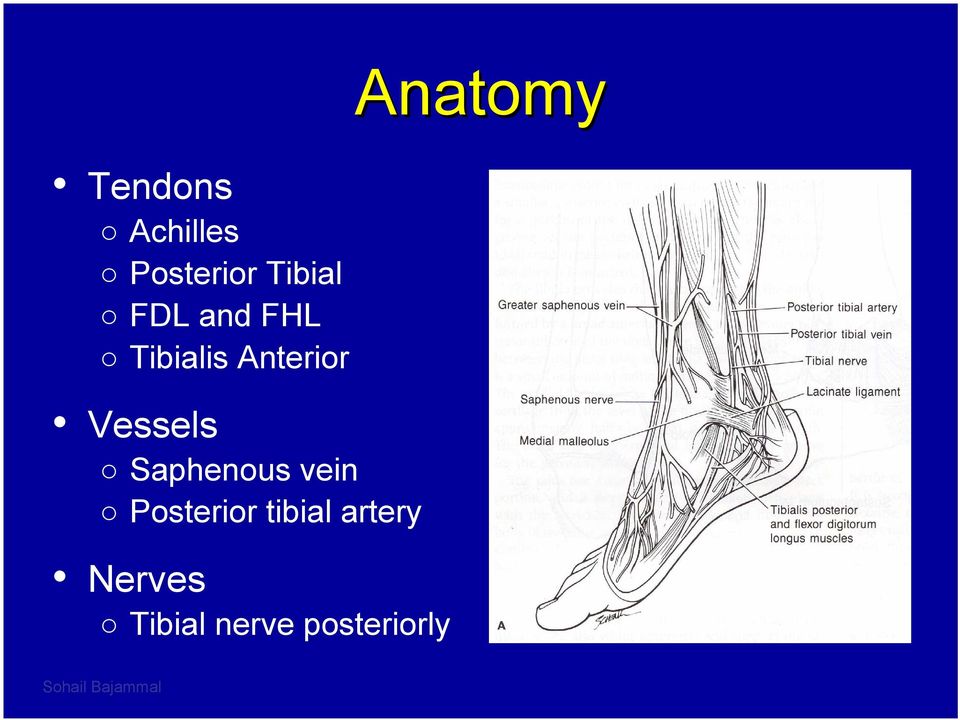
10 Anatomy Tendons Peroneus Brevis Peroneus Longus Nerves Superficial peroneal Sural

11 Anatomy Extensor retinaculum Tendons Tibialis Anterior EHL EDL Dorsalis Pedis Artery Deep Peroneal Nerve

12 Ankle - History Injury: Description of the injury Position of the ankle during the injury Able to continue to play or bear weight Previous injury Site of injury Pain: Exacerbation with weight bearing or different phase of gait (heal rise) Morning pain (Achilles tendinitis, plantar fasciitis)

13 Ankle Physical Look: Standing & Sitting Gait Deformity, Alignment (hindfoot, midfoot, forefoot) Feel: Medial and lateral malleoli Deltoid ligament ATFL, CFL, and PTFL Move: ROM ankle, subtalar, midfoot, forefoot Tightness of Achilles

14 Ankle Physical Neurovascular exam Pulses, cap refill, hair distribution, stocking sensation Superficial and Deep Peroneal Sural Saphenous Medial and Lateral plantar Tibial nerves

15 Ankle Physical Special Tests: Anterior drawer test for ATFL Talar tilt to assess CFL Squeeze test to look for syndesmotic injury Shoe pattern

16 Anterior Drawer Test Sitting position Foot in 25 of plantarflexion Stabilize the tibia with one hand Grasp the heel with the other hand The foot is pulled anteriorly and allowed to rotate internally as it translates Positive: >10 mm translation or > 3 mm anterior translation compared with contralateral

17 Talar Tilt Foot in neutral position Inversion stress applied Compare with the other side Positive: Talar tilt > 9 or >3 more than the contralateral side

18 Ankle Sprains Acute Sprains Chronic Ankle Instability

19 Ankle Sprains Most common ligamentous injury One sprain / day / 10,000 people 20-40% intermittent chronic problems (Garrick, Am J Sports Med, 1977) More common on the lateral aspect

20 Ankle Sprains Most common mechanism of ankle injury is inversion stress with plantarflexion ankle fracture, sprain, or syndesmotic injury Abduction or adduction are other mechanisms

21 Common Ligaments Injured Anterior Talofibular Ligament (ATFL): 90% Taut in Plantarflexion Calcaneofibular Ligament (CFL): 25% Taut in Dorsiflexion Posterior Talofibular Ligament (PTFL)
22 Ankle Sprain Missed Injuries Syndesmotic Injury Peroneal tendon subluxation Posterior tibial tendon tear/dysfunction Achilles tendon tear 5 th metatarsal base fracture Midfoot injuries Lateral talar process/dome fracture Anterior process of calcaneus fracture
23 Ankle Radiographs AP of the Ankle AB < 5mm is normal BC > 10 mm is normal
24 Ankle Radiographs Mortise View Ankle internally rotated AB clear space BC Talocrural angle (83 ) Medial clear space <4 mm
25 Ankle Stress Radiographs Inversion Stress (Talar Tilt) view Ankle in plantarflexion Positive: Talar tilt > 9 or Talar tilt >3 more than the contralateral side External rotation view Useful in identifying syndesmotic injury
26 Ankle Stress Radiographs Anterior drawer stress view Positive: >10 mm translation or >3 mm anterior translation compared with contralateral Incongruency of ankle
27
28 Ankle Sprain Classification Histologic Classification Grade I: Stretching, no tearing Grade II: Partial macroscopic tearing Grade III: Complete rupture
29 Ankle Sprain Classification Anatomic Classification Grade I ATFL disruption Grade II ATFL and CFL disruption Grade III Complete ligamentous disruption Clinical Grading Clinical Grading Grade I: Stress tests normal Grade II: pain swelling, ± positive stress tests Grade III: Severe pain swelling, +ve stress tests
30 Lateral Ankle Sprains Commonly missed diagnoses Peroneal tendon injuries Achilles injuries FX s Lateral process of talus Anterior process of calcaneus Fifth metatarsal Lisfranc injuries Osteochondritis dessicans
31 Lateral Ankle Sprains Lateral Process # of the Talus
32 Lateral Ankle Sprains X-rays are based on careful physical exam MRI rarely indicated in the acute setting Consider stressing syndesmosis and lisfranc joints if injury is suspected
33 RICE Ankle Sprain Treatment Immobilize: ankle brace initially and protected weight bearing for Grade I & II Bracing or taping for 4-6 weeks depending on activity Severe sprain may require up to 6 months of protective bracing Physiotherapy: ROM exercises Peroneal strengthening and proprioceptive training Return to sports when able to cut without pain
34 Ankle Sprain Treatment Grade III? walking boot or a cast for 4 6 weeks Extended period of protective bracing Return to play criteria remain the same R/O syndesmosis injury (high ankle sprain)
35 Lateral Ankle Sprains Surgical Treatment Acute repair: NO, unless other injuries Symptomatic chronic instability: May require surgical intervention Anatomic Brostrom repair favored over nonanatomic rerouting procedures
36 Medial Ankle Sprain 5% ankle sprains Forced eversion Injury to deltoid ligament Associated with syndesmotic injury and/or Weber C fibula #
37 Medial Ankle Sprain Tenderness/swelling over deltoid External rotation test elicits pain in the deltoid and possibly in syndesmosis
38 Medial Ankle Sprain AP, Lat, Oblique ankle x-rays to assess mortise and syndesmosis Medial joint space widening Syndesmotic widening Presence fibula # Consider external rotation stress x-rays if syndesmotic disruption is suspected
39 Medial Ankle Sprain Management Stable (no talar subluxation) Similar to lateral sprains RICE, early wgt bearing, early ROM, functional brace, functional rehab Unstable (talar subluxation) No talar subluxation is acceptable Anatomic reduction and surgical stabilization of syndesmosis
40 Chronic Ankle Instability Continued instability or recurrent injury despite rehabilitation and proprioceptive training Mechanical vs. Functional Instability Protective Bracing vs. Surgical treatments Direct Repair Nonanatomic Reconstruction
41 Direct Anatomic Repair Gould Modification of Broström Repair of the ATFL Repair of the CFL Reefing of the lateral extensor retinaculum May be modified to advance the ligaments through drill holes or use of suture anchors
42
43 Modified Broström Postoperative Protocol: 2-3 weeks immobilization Then, removable boot & active ROM Strengthening exercise 4-6 weeks
44 Poor Outcome of Direct Repair Instability > 10 years Arthropathy Generalized Hypermobility: Ehlers-Danlos syndrome Marfan syndrome Osteogenesis imperfecta BJHS: Benign Joint Hypermobility Syndrome Rigid hindfoot varus (Coleman block test)
45 Nonanatomic Reconstructions These procedures use the peroneal tendons or other grafts to reconstruct the lateral ligamentous complex More restricted ankle and subtalar motion (Colville, JAAOS, 1998)
46 Syndesmosis Injury
47 Syndesmosis Injury 10% of ankle sprains Rupture of the interosseous ligaments between the tibia and fibula with or without fibular fracture Medial malleolar fracture or deltoid ligament rupture Persistent instability and gap in the joint after bimalleolar fixation
48 Syndesmosis Exam Squeeze Test Squeeze the syndesmosis above the ankle pain Abduction-External Rotation Stress Test Further instability with external rotation (may be shown with x-ray)
49 Syndesmotic (High) Ankle Sprains AP/LAT/OBLIQUE ankle x-rays Syndesmotic widening Medial joint space widening Presence of fibula FX External rotation stress x-rays Severe pain associated with normal x- rays Must get tib/fib xrays to rule out high fibula fracture
50 Syndesmosis Injury Classification Type I straight lateral talar subluxation Type II plastic deformation of the fibula with Type I Type III posterior rotatory displacement of the fibula and talus Type IV diastasis of the tibia and fibula with superior displacement of the talus
51 Syndesmosis Injury Treatment Non-displaced without fracture May consider casting for 6 weeks (high ankle sprain) Surgical treatment with syndesmotic screws Displaced Surgical treatment with syndesmotic screws
52 Syndesmosis Injury Reduce the syndesmosis with a large clamp under fluoro Place 1.5 cm proximal to the plafond Place with 30 degrees anterior angulation Do not use lag screw technique
53 Syndesmosis Controversies Number of Screws One vs. two, 3.5 mm screw vs. 4.5 mm screw Number of Cortices Three vs. four cortices Ankle position during placement Classically dorsiflexion was advocated Tornetta showed no difference with plantarflexion
54 Syndesmosis Post-Op Place in a cast or removable boot NWB for 6 weeks (43 days) Premature weight bearing may break screws and lead to syndesmosis widening Weight bearing will break screws, but does not cause clinical problems May consider screw removal after 3 months
55 Achilles Tendon Tendonitis (Tendinitis) Rupture (Acute & Chronic)
56 Achilles Tendon Anatomy cm long cm diameter Avascular zone 2-6 cm proximal to insertion Fibers rotate 90 degrees at insertion
57 Achilles Tendonitis Overuse Over-Pronation Non-Insertional Athletes Insertional Older, Sedentary Patients Enthesopathy
58 Achilles Tendonitis Non-Insertional Paratendonitis (Paratenonitis) Paratendonitis (Paratenonitis) with Tendinosis Tendinosis Hypovascular Zone 4 cm Proximal to Insertion
59 Treatment of Non-Insertional Non-Operative: Activity/Shoe Modification NSAIDs, Ice Stretching, Heel Lift Surgical: Paratenon Debridement Achilles Debridement +/- FHL Transfer
60 Achilles Tendonitis Insertional Older Pts/Recreational Athletes Haglunds Deformity Posterolateral Prominence Retrocalcaneal Bursitis
61 Treatment of Insertional Activity Modification Stretching Padding Shoe Adjustment Posterior Heel Debridement NEVER EVER STEROIDS
62 Achilles Tendon Rupture History Acute pain in the back of the ankle with contraction Average age 35 Steroids, fluorquinolones, and chronic overuse may predispose to rupture Pathology Rupture occurs 2 6 cm above the Achilles insertion in a watershed area
63 Achilles Tendon Rupture Physical Exam Tenderness over achilles tendon Palpable defect Positive Thompson s s test: NO plantarflexion
64 Achilles Tendon Injury X-ray Lateral ankle X-ray to exclude avulsion from the calcaneus MRI May be useful to diagnose partial rupture only
65 Achilles Tendon Ruptures Nonoperative treatment Weaker tendon Higher risk rerupture (10-15%) Slower return to sport No surgical morbidity Lower cost
66 Achilles Tendon Rupture Non-Operative Splint in plantarflexion for 2 wk Short leg cast or boot with progressive dorsiflexion and weight bearing starting at 4 6 weeks after injury Heel lift used in boot and footwear Resistance exercises started at 8 weeks Return to sports in 4 6 months May take 12 months to regain maximal plantarflexion power
67 Achilles Tendon Ruptures Surgical repair Superior tendon strength Lower risk rerupture (1-3%) Quicker return to sport (3 months) Surgical Complications (11%) Infection Dehiscence, Skin edge necrosis Sural nerve injury Increased cost
68 Achilles Tendon Rupture Surgical treatment Preferred for athletes Medial incision avoids the sural nerve Percutaneous vs. Open treatments described Isolate the paratenon as a separate layer
69 Achilles Tendon Ruptures Surgical repair Younger active patients Nonoperative treatment Older sedentary patients Patients with increased risk of soft tissue complications IDDM Smokers Vascular disease
70 Percutaneous Achilles Repair
71 Achilles Tendon Avulsion Treatment includes ORIF of avulsion or reinsertion on the calcaneus with suture anchors
72 Chronic Achilles Rupture Chronic rupture may be reconstructed with FHL, FDL, or slip from gastrocnemius
73 Achilles Tendon Ruptures Achilles Tendon Ruptures Reconstruction of neglected rupture with peroneus longus and plantaris weave
74 Peroneal Tendons Tendinitis Instability Tears
75 Peroneal Tendinitis No peroneal sheath swelling Eversion Pain Treatment: NSAIDs Stretching Orthosis Lateral Wedge
76 Peroneal Tendon Instability Peroneal tendons course behind the distal fibula The peroneus brevis may have degenerative changes if the injury is not identified in a timely fashion
77 Peroneal Tendon Instability The peroneal retinaculum may be avulsed from the fibula or calcaneus or lifted up enough to allow tendon dislocation
78 Eckert Classification of Peroneal Tendon Instability
79 Peroneal Tendon Instability Forceful contraction of peroneals during sudden dorsiflexion and inversion Usually cutting sport Frequently misdiagnosed as ankle sprain
80 Peroneal Tendon Instability Tenderness/swelling retromalleolar area Active eversion may demonstrate subluxing tendons X-rays may reveal a small avulsion FX off the posterior lateral malleolus MRI may reveal subluxed tendons
81 Peroneal Tendon Instability Conservative treatment Casting in slight plantarflexion and inversion for 6 weeks non weight bearing Allows the retinaculum to heal if the tendons can be reduced closed Successful if the injury is identified early
82 Peroneal Tendon Instability Surgery ORIF bone fragment if possible Repair retinaculum if possible Soft tissue reconstruction with sling for retinaculum ± Deepen groove
83 Peroneal Tendon Instability Bone block surgeries such as Kelly s or DuVries modification Debridement of peroneus brevis may be necessary if degenerative changes are present and tenodesis
84 Peroneal Tendon Instability Surgery Deepening of the groove has become more popular Post Operative Care NWB for 6 weeks Passive motion after 2 weeks Strengthening after 6 weeks
85 Peroneal Tendon Tears Rare Peroneus longus is more common H/o Ankle Sprain Clinical / Subclinical Peroneal Instability Peroneal Sheath Swelling Retrofibular Tenderness MRI Useful False Negatives
86 Peroneal Tendon Tears Immobilization Surgery Repair: if < 50% tear Tenodesis: if > 50% Stabilize Tendons
87 Posterior Tibial Tendon Dysfunction (PTTD)
88 Posterior Tibial Tendon Anatomy Arises from posterior aspect intermuscular septum Inserts on tarsal bones Avascular zone posterior to medial malleolus High frictional load posterior to medial malleolus
89 Posterior Tibial Tendon Functions Balances the pull of peroneals Inverts & stabilizes hindfoot during toe-off Protects the spring ligament Locks transverse tarsal joint Maintains height of longitudinal arch What happens if it doesn t t work?
90 PTT Dysfunction Attenuation of Medial Structures Arch Failure Hindfoot Valgus Inability to Lock TT Joint Gastrosoleus pulls through TT Joint Unopposed P. Brevis Forefoot Abduction Calc-Fib Impingement Lateral Hindfoot Pain Hindfoot/Ankle Arthritis
91 Posterior Tibial Tendon Dysfunction Theories Intrinsic: Inflammatory Degenerative Vascular Symptomatic accessory navicular Extrinsic: Steroid injection Traumatic
92 PTTD Typical Patients Middle Aged, Overweight, Females ± History of Trauma Pre-existing Flatfoot Infrequently Bilateral (?)
93 PTTD - History More commonly an attritional rupture over time than an acute rupture Flat foot and midfoot pain Sports with quick changes of direction may put increased force on tendon Late stages: sinus tarsi pain from impingement
94 PTTD - Physical Hindfoot valgus, midfoot collapse, forefoot abduction too many toes sign Achilles contracture Special Tests: Inversion Strength Testing in Maximum Eversion: Weakness & tenderness Single-Limb Heel Rise: Lack of supination of the foot and inversion of the heel while rising on toes Flexible vs. rigid deformity
95 Too Many Toes sign
96 Single-Limb Heel Rise
97 PTTD X-rays Weight Bearing Lateral Talus-1st MT Line Weight Bearing AP Foot Talus-1st MT Line TN Coverage Angle Standing AP Ankle MRI: method of choice in imaging posterior tibial tendon
98 PTT Disorders Classification Johnston & Strom 1989 Stage I: Pain and tenderness, no deformity Stage II: Flexible deformity Stage III: Rigid hindfoot deformity
99 PTT Disorders Classification Myerson 1996 Tenosynovitis: Medial pain, heel rise Stage I: Medial pain, flexible hindfoot, heel rise Stage II: Lateral pain, flexible valgus hindfoot, heel rise Stage III: Lateral pain, rigid valgus hindfoot, heel rise Stage IV: Lateral pain, rigid valgus hindfoot, valgus inclination of talus, heel rise
100 PTTD Stage I Treatment Non-operative: Immobilization NSAIDs? ± Steroid Injection Arch Support Surgical: Tenosynovectomy (be prepared to do FDL Transfer)
101 PTTD Stage III & IV Treatment Non-operative: NSAIDs Accomodative rigid ankle-foot orthosis (AFO) Arizona brace Surgical: Arthrodesis: Isolated Arthrodesis (TN) Subtalar Arthrodesis ± FDL Transfer Triple Arthrodesis ± TAL
102 PTTD Stage II Treatment Controversial Non-Operative (⅔ effective): Immobilization Shoe Modification (Arch Support) Hinged AFO Surgical (very controversial): Soft tissue procedures Bony procedures
103 PTTD Stage II Surgical Treatment Soft Tissue Procedures:? PTT Repair FDL Transfer FHL Transfer ± Spring Ligament Imbrication
104 PTTD Stage II Surgical Treatment Bony Procedures: Medial Displacement Calcaneal Osteotomy Lateral Column Lengthening Through Calcaneal Neck or CC Joint Isolated Arthrodeses ±TAL
105 PTTD Stage II Surgical Treatment Combined Procedures FDL/Medial Displacement Osteotomy FDL/Lateral Column Lengthening FDL/Double Calcaneal Osteotomy FDL/ST Arthrodesis ±TAL ± Spring Ligament Repair
Syndesmosis Injuries
 Syndesmosis Injuries Dr. Alex Rabinovich Outline Anatomy Injury types and classification Treatment options Nonoperative vs. Operative Indications for operative Operative technique Postoperative management
Sports Injuries of the Foot and Ankle. Dr. Travis Kieckbusch August 7, 2014
 Sports Injuries of the Foot and Ankle Dr. Travis Kieckbusch August 7, 2014 Foot and Ankle Injuries in Athletes Lateral ankle sprains Syndesmosis sprains high ankle sprain Achilles tendon injuries Lisfranc
Ankle Sports injuries. Ben Yates
 Ankle Sports injuries Ben Yates Common Extra-articular Conditions Lateral collateral ligament sprains (grades 1,2,3) Functional instability Mechanical instability Achilles tendonopathy (Achillodynia) superficial
Semmelweis University Department of Traumatology Dr. Gál Tamás
 Semmelweis University Department of Traumatology Dr. Gál Tamás Anatomy Ankle injuries DIRECT INDIRECT Vertical Compression (Tibia plafond Pilon) AO 43-A,B,C Suppination (adduction + inversion) AO 44-A
George E. Quill, Jr., M.D. Louisville Orthopaedic Clinic Louisville, KY
 George E. Quill, Jr., M.D. Louisville Orthopaedic Clinic Louisville, KY The Ankle Sprain That Won t Get Better With springtime in Louisville upon us, the primary care physician and the orthopaedist alike
Chapter 5. Objectives. Normal Ankle Range of Motion. Lateral Ankle Sprains. Lateral Ankle Sprains. Assessment of Lateral Ankle Sprains
 Objectives Chapter 5 Assessment of Ankle & Lower Leg Injuries Review the following components of injury assessment related to the ankle and lower leg Stress tests Special tests Normal Ankle Range of Motion
Rehabilitation Guidelines for Lateral Ankle Reconstruction
 UW HEALTH SPORTS REHABILITATION Rehabilitation Guidelines for Lateral Ankle Reconstruction The ankle is a very complex joint. There are actually three joints that make up the ankle complex: the tibiotalar
Posttraumatic medial ankle instability
 Posttraumatic medial ankle instability Alexej Barg, Markus Knupp, Beat Hintermann Orthopaedic Department University Hospital of Basel, Switzerland Clinic of Orthopaedic Surgery, Kantonsspital Baselland
Malleolar fractures Anna Ekman, Lena Brauer
 Malleolar fractures Anna Ekman, Lena Brauer How to use this handout? The left column is the information as given during the lecture. The column at the right gives you space to make personal notes. Learning
PHYSICAL EXAMINATION OF THE FOOT AND ANKLE
 PHYSICAL EXAMINATION OF THE FOOT AND ANKLE Presenter Dr. Richard Coughlin AOFAS Lecture Series OBJECTIVES 1. ASSESS 2. DIAGNOSE 3. TREAT HISTORY TAKING Take a HISTORY What is the patient s chief complaint?
Outline. The Agony of the Foot: Disclosure. Plantar Fasciitis. Top 5 Foot and Ankle Problems in Primary Care. Daniel Thuillier, M.D.
 The Agony of the Foot: Top 5 Foot and Ankle Problems in Primary Care Daniel Thuillier, M.D. Assistant Professor of Clinical Orthopaedics University of California San Francisco Plantar Fasciitis Achilles
Acute Ankle Injuries, Part 1: Office Evaluation and Management
 t June 08, 2009 Each acute ankle injury commonly seen in the office has associated with it a mechanism by which it can be injured, trademark symptoms that the patient experiences during the injury, and
PROTOCOLS FOR INJURIES TO THE FOOT AND ANKLE
 PROTOCOLS FOR INJURIES TO THE FOOT AND ANKLE I. DIGITAL FRACTURES A. Background Digital fractures commonly occur in the workplace and are usually the result of a crush injury from a falling object, or
The Ankle Sprain That Won t Get Better. By: George E. Quill, Jr., M.D. With springtime in Louisville upon us, the primary care physician and the
 The Ankle Sprain That Won t Get Better By: George E. Quill, Jr., M.D. With springtime in Louisville upon us, the primary care physician and the orthopaedist alike can expect to see more than his or her
8 Ankle sprain. 8.1 Introduction. 8.2 Anatomy. OrthopaedicsOne Articles. Contents
 8 Ankle sprain Contents Introduction Anatomy Clinical Presentation Pathogenesis Classification (Staging) Imaging Conservative Treatment Operative Treatment Postoperative Care Outcome Complications Controversy
Anatomic Percutaneous Ankle Reconstruction of Lateral Ligaments (A Percutaneous Anti ROLL)
 Anatomic Percutaneous Ankle Reconstruction of Lateral Ligaments (A Percutaneous Anti ROLL) Mark Glazebrook James Stone Masato Takao Stephane Guillo Introduction Ankle stabilization is required when a patient
.org. Ankle Fractures (Broken Ankle) Anatomy
 Ankle Fractures (Broken Ankle) Page ( 1 ) A broken ankle is also known as an ankle fracture. This means that one or more of the bones that make up the ankle joint are broken. A fractured ankle can range
Foot and Ankle Injuries in the Adolescent Athlete
 Foot and Ankle Injuries in the Adolescent Athlete Kevin Latz, MD Children s Mercy Hospital Center for Sports Medicine Foot and Ankle Injuries Very common Influenced by the unique properties of growth plates
INJURIES OF THE HAND AND WRIST By Derya Dincer, M.D.
 05/05/2007 INJURIES OF THE HAND AND WRIST By Derya Dincer, M.D. Hand injuries, especially the fractures of metacarpals and phalanges, are the most common fractures in the skeletal system. Hand injuries
4/13/2016. Injury Rate (%) Common Foot and Ankle Injuries in the Football Player Surgery or Not. Common Injuries. Common Injuries
 Injury Rate (%) Common Foot and Ankle Injuries in the Football Player Surgery or Not Ankle Foot Collegiate 12 3 High School 18 3 Youth 15 4 Daniel Murawski, MD April 22, 2016 1 2 Common Injuries Lateral
AOBP with thanks to: Dawn Dillinger, DO Kyle Bodley, DO
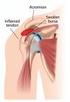 AOBP with thanks to: Dawn Dillinger, DO Kyle Bodley, DO Common maneuvers in some sports that can increase risk for injury Jumping Pivoting while running Sudden stopping while running Maneuvering a ball
ORTHOARIZONA Shelden L. Martin, M.D.
 ORTHOARIZONA Shelden L. Martin, M.D. Common Foot Procedures - Physical Therapy Guidelines 1. Hallux Rigidus: Cheilectomy with and without concomitant osteotomies. Hallux Rigidus refers to the limitation
Imaging of Lisfranc Injury
 November 2011 Imaging of Lisfranc Injury Greg Cvetanovich, Harvard Medical School Year IV Agenda Case Presentation Introduction Anatomy Lisfranc Injury Classification Imaging Treatment 2 Case Presentation
Field Evaluation and Management of Non-Battle Related Knee and Ankle Injuries by the ATP in the
 Field Evaluation and Management of Non-Battle Related Knee and Ankle Injuries by the ATP in the JF Rick Hammesfahr, MD Editor s Note: Part Three consists of ankle injury evaluation and taping. Part Two
Ankle Injury/Sprains in Youth Soccer Players Elite Soccer Community Organization (ESCO) November 14, 2013
 Ankle Injury/Sprains in Youth Soccer Players Elite Soccer Community Organization (ESCO) November 14, 2013 Jeffrey R. Baker, DPM, FACFAS Weil Foot and Ankle Institute Des Plaines, IL Ankle Injury/Sprains
Foot and Ankle Complaints
 Foot and Ankle Complaints INTRODUCTION Anatomy and Function Foot Ankle Common complaints Common diagnoses FOOT AND ANKLE ANATOMY 26 bones and 2 sesamoids Forefoot Metatarsals phalanges Midfoot 5 tarsals
LATERAL PAIN SYNDROMES OF THE FOOT AND ANKLE
 C H A P T E R 3 LATERAL PAIN SYNDROMES OF THE FOOT AND ANKLE William D. Fishco, DPM The majority of patient encounters with the podiatrist are secondary to pain in the foot and/or ankle. If we draw an
QUESTION I HAVE BEEN ASKED TO REHAB GRADE II AND III MCL INJURIES DIFFERENTLY BY DIFFERENT SURGEONS IN THE FIRST 6WEEKS FOLLOWING INJURY.
 QUESTION I HAVE BEEN ASKED TO REHAB GRADE II AND III MCL INJURIES DIFFERENTLY BY DIFFERENT SURGEONS IN THE FIRST 6WEEKS FOLLOWING INJURY. SOME ARE HINGE BRACED 0-90 DEGREES AND ASKED TO REHAB INCLUDING
Lower Leg and Ankle Injuries. Ankle Injuries. Ankle Anatomy. Jon DeBord, PT, MS, ATC, SCS. Rehab Summit 2008. Most common injury in sports.
 Lower Leg and Ankle Injuries Jon DeBord, PT, MS, ATC, SCS Rehab Summit 2008 Ankle Injuries Most common injury in sports 38-45% of all sportsrelated injuries 86% are sprains Mechanism Forceful inversion
Clinical Analysis of Foot Problems
 Clinical Analysis of Foot Problems by Karen S. Seale, M.D. Introduction Orthotists are vital members of the foot care team. Their expertise and special interests in materials and biomechanics add a unique
Podo Pediatrics Identifying Biomechanical Pathologies
 Podo Pediatrics Identifying Biomechanical Pathologies David Lee, D.P.M., D. A.B.P.S. Purpose Identification of mechanical foot and ankle conditions Base treatments Knowing when to refer to a podiatrist
LEG, ANKLE AND FOOT INJURIES. Evaluation and Treatment of Leg, Ankle and Foot Injuries. Jeff Roberts, MD, CAQSM
 LEG, ANKLE AND FOOT INJURIES Evaluation and Treatment of Leg, Ankle and Foot Injuries Jeff Roberts, MD, CAQSM 159 Leg, Ankle, and Foot Injuries in Athletes Jeff Roberts MD CAQSM Objectives Leg Stress Fracture
Comprehensive Solutions for Tendon and Ligament Reconstruction using the Bio-Tenodesis Screw System
 Comprehensive Solutions for Tendon and Ligament Reconstruction using the Bio-Tenodesis Screw System Lateral Ankle Reconstruction FDL Tendon Transfer FHL Tendon Transfer Flexor to Extensor Transfer FDL/EDL
A compressive dressing that you apply around your ankle, and
 Ankle Injuries & Treatment The easiest way to remember this is: R.I.C.E. Each of these letters stands for: Rest. Rest your ankle. Do not place weight on it if it is very tender. Avoid walking long distances.
Case Log Guidelines for Foot and Ankle Orthopaedic Surgery Review Committee for Orthopaedic Surgery
 Case Log Guidelines for Foot and Ankle Orthopaedic Surgery Review Committee for Orthopaedic Surgery The ACGME Case Log System for Foot and Ankle Orthopaedic Surgery allows fellows to document their operative
CHAPTER 58 Ankle and Foot
 CHAPTER 58 Ankle and Foot Riyad B. Abu-Laban and Nicholas G.W. Rose To him whose feet hurt, everything hurts. Socrates The ankle and foot are highly evolved structures designed to support the body s weight
The Flatfoot. Flatfoot: Terminology, Treatment, & Importance of Cobey View page 1 of 10. Are You Smarter Than a 5 th Grader? Podiatrist?
 & Importance of Cobey View page 1 of 10 Society of Skeletal Radiology 2010 The Flatfoot Adult PTT Acquired Surgeries Flatfoot Terminology, Treatment, & Importance of Cobey View I have nothing to disclose
OS TRIGONUM SYNDROME. Incidence: 10% unilateral and 2% bilateral in general population 1. Bilateral occurs in 50% of os trigonum population 4.
 OS TRIGONUM SYNDROME Incidence: 10% unilateral and 2% bilateral in general population 1. Bilateral occurs in 50% of os trigonum population 4. Mechanism of Injury: Os trigonum syndrome occurs due to repetitive,
BodyZone Physiotherapy for Ankle Welcome to BodyZone Physiotherapy's patient resource about ankle sprain and instability.
 BodyZone Physiotherapy for Ankle Welcome to BodyZone Physiotherapy's patient resource about ankle sprain and instability. An ankle sprain is a common injury and usually results when the ankle is twisted,
Lateral Ankle Instability Repair using TWINFIX Ti 3.5 mm Suture Anchors
 *smith&nephew ANKLE TECHNIQUE GUIDE Lateral Ankle Instability Repair using TWINFIX Ti 3.5 mm Suture Anchors Prepared in Consultation with: James Calder, MD KNEE HIP SHOULDER EXTREMITIES Lateral Ankle Instability
Predislocation syndrome
 Predislocation syndrome Sky Ridge Medical Center, Aspen Building Pre-dislocation syndrome, capsulitis, and metatarsalgia are all similar problems usually at the ball of the foot near the second and third
Common Foot & Ankle Sports Injuries
 Common Foot & Ankle Sports Injuries Symptoms Related to Abnormal Foot Biomechanics & their Differential Diagnosis Daniel Pang BSc (Hon) P&O, Cped Certified Pedorthist (USA) Only 10% of foot having structure
HEEL PAIN. Differential diagnosis. 1. Insertional Plantar fascitis. 2. Enthesis. 3. Heel pad atrophy. 4. Tarsal tunnel syndrome
 HEEL PAIN Differential diagnosis 1. Insertional Plantar fascitis 2. Enthesis 3. Heel pad atrophy 4. Tarsal tunnel syndrome 5. Calcaneal stress fracture 6. Haglund s syndrome 7. Posterior ankle impingement
Case Report Reconstructive Osteotomy for Ankle Malunion Improves Patient Satisfaction and Function
 Case Reports in Orthopedics Volume 2015, Article ID 549109, 5 pages http://dx.doi.org/10.1155/2015/549109 Case Report Reconstructive Osteotomy for Ankle Malunion Improves Patient Satisfaction and Function
CPME Memorandum Proper Logging of Surgical Procedures November 15, 2012
 For the procedure codes listed below, the program director must review each entry to determine proper usage. 1.13 other osseous digital procedure not listed above 2.3.10 other first ray procedure not listed
Arches. Foot Injuries. Medial Longitudinal Arch. Lateral Longitudinal Arch. Transverse Arch. Arch Strains
 Arches Foot Injuries Three arches in the foot: 1) Lateral longitudinal arch 2) Medial longitudinal arch 3) Transverse arch These arches are maintained and supported by the wedging of the interlocking tarsal
Clinical Integration of Osteopathic Manipulative Medicine
 Clinical Integration of Osteopathic Manipulative Medicine Family Medicine / Emergency Medicine / Orthopedic: Ankle sprain Author: Joe Lau OMS-IV, Theodore Flaum, DO Introduction: Ankle sprain, a.k.a. sprained
.org. Lisfranc (Midfoot) Injury. Anatomy. Description
 Lisfranc (Midfoot) Injury Page ( 1 ) Lisfranc (midfoot) injuries result if bones in the midfoot are broken or ligaments that support the midfoot are torn. The severity of the injury can vary from simple
Hand and Upper Extremity Injuries in Outdoor Activities. John A. Schneider, M.D.
 Hand and Upper Extremity Injuries in Outdoor Activities John A. Schneider, M.D. Biographical Sketch Dr. Schneider is an orthopedic surgeon that specializes in the treatment of hand and upper extremity
Calcaneus (Heel Bone) Fractures
 Copyright 2010 American Academy of Orthopaedic Surgeons Calcaneus (Heel Bone) Fractures Fractures of the heel bone, or calcaneus, can be disabling injuries. They most often occur during high-energy collisions
Ankle ligament injuries
 ARTIGO DE REVISÃO Ankle ligament injuries Per A.F.H. Renström, M.D., Ph.D. 1 and Scott A. Lynch, M.D. 2 ABSTRACT Acute ankle ligament sprains are common injuries. The majority of these occur during athletic
Achilles Tendon Repair, Operative Technique
 *smith&nephew ANKLE TECHNIQUE GUIDE Achilles Tendon Repair, Operative Technique Prepared in Consultation with: C. Niek van Dijk, MD, PhD KNEE HIP SHOULDER EXTREMITIES Achilles Tendon Repair, Operative
Rehabilitation Guidelines for Achilles Tendon Repair
 UW HEALTH SPORTS REHABILITATION Rehabilitation Guidelines for Achilles Tendon Repair The Achilles tendon is the strongest and thickest tendon in the body. It attaches the calf muscles (soleus and gastrocnemius)
.org. Posterior Tibial Tendon Dysfunction. Anatomy. Cause. Symptoms
 Posterior Tibial Tendon Dysfunction Page ( 1 ) Posterior tibial tendon dysfunction is one of the most common problems of the foot and ankle. It occurs when the posterior tibial tendon becomes inflamed
ORTHOPAEDIC KNEE CONDITIONS AND INJURIES
 11. August 2014 ORTHOPAEDIC KNEE CONDITIONS AND INJURIES Presented by: Dr Vera Kinzel Knee, Shoulder and Trauma Specialist Macquarie University Norwest Private Hospital + Norwest Clinic Drummoyne Specialist
Biomechanical Explanations for Selective Sport Injuries of the Lower Extremity
 Biomechanical Explanations for Selective Sport Injuries of the Lower Extremity DR. LEE S. COHEN Podiatric Consultant: Philadelphia Eagles Philadelphia 76ers Philadelphia Wings Understanding Normalcy What
By Agnes Tan (PT) I-Sports Rehab Centre Island Hospital
 By Agnes Tan (PT) I-Sports Rehab Centre Island Hospital Physiotherapy Provides aids to people Deals with abrasion and dysfunction (muscles, joints, bones) To control and repair maximum movement potentials
Non Operative Management of Common Fractures
 Non Operative Management of Common Fractures Mr Duy Thai Orthopaedic Surgeon MBBS, FRACS (Ortho), Dip Surg Anat NOT ALL FRACTURES NEED TO BE FIXED FRACTURE CLINIC EMERGENCY DEPARTMENTS GENERAL PRACTITIONERS
Council on Podiatric Medical Education
 CPME MEMORANDUM November 15, 2012 TO: Program Directors and Residents FROM: Council on Podiatric Medical Education SUBJECT: By conference call in October 2012, members of the Council's Residency Review
Primary Care of the Ankle and Foot. Christian T. Royer, MD Baylor University Medical Center Foot and Ankle Surgery
 Primary Care of the Ankle and Foot Christian T. Royer, MD Baylor University Medical Center Foot and Ankle Surgery Outline Plantar Fasciitis Metatarsalgia Morton s Neuroma Ankle Sprains and Sequelae Achilles
Most active and intricate part of the upper extremity Especially vulnerable to injury Do not respond well to serious trauma. Magee, 2008. pg.
 PTA 216 Most active and intricate part of the upper extremity Especially vulnerable to injury Do not respond well to serious trauma Magee, 2008. pg. 396 28 bones Numerous articulations 19 intrinsic muscles
The Land of Os: Accessory Ossicles of the Foot
 The Land of Os: Accessory Ossicles of the Foot Susan Cross, Anshul Rastogi, Rosy Jalan; Dept of Radiology, Barts Health NHS Trust, London, UK Contact: [email protected] Pictorial review Abstract
RX: Custom Thermoplastic AFO Compliance Documentation
 RX: Custom Thermoplastic AFO Compliance Documentation Doctor Name: Phone: Patient Name: HICN: DOB: Indicate Quality ARIZONA THERMOPLASTIC ARTICULATED AFO, DORSI-ASSIST CROW L4631 A bivalved custom molded
Structure & Function of the Ankle and Foot. A complicated model of simplicity that you really think little about until you have a problem with one.
 Structure & Function of the Ankle and Foot A complicated model of simplicity that you really think little about until you have a problem with one. The Foot and Ankle Terminology Plantar flexion Dorsi flexion
November 2012 Case Study. Authors: Kyle Nagle, MD, MPH; Karl Fry, PT, DPT, OCS; David Bernhardt, MD
 CC: Right foot pain November 2012 Case Study Authors: Kyle Nagle, MD, MPH; Karl Fry, PT, DPT, OCS; David Bernhardt, MD HPI: A 17 year old female cross country runner presents with right foot pain. At a
Screening Examination of the Lower Extremities BUY THIS BOOK! Lower Extremity Screening Exam
 Screening Examination of the Lower Extremities Melvyn Harrington, MD Department of Orthopaedic Surgery & Rehabilitation Loyola University Medical Center BUY THIS BOOK! Essentials of Musculoskeletal Care
MODIFIED STRAYER GASTROCNEMIUS RECESSION: A Technique Guide for the Supine Positioned Patient
 C H A P T E R 4 5 MODIFIED STRAYER GASTROCNEMIUS RECESSION: A Technique Guide for the Supine Positioned Patient M. Jay Groves, IV, DPM Gastrosoleal equinus is a common deforming force on the foot and ankle.
OBJECTIVE EVALUATION OF FUNCTIONAL ANKLE INSTABILITY AND BALANCE EXERCISE TREATMENT. Copyright 2014
 OBJECTIVE EVALUATION OF FUNCTIONAL ANKLE INSTABILITY AND BALANCE EXERCISE TREATMENT By Copyright 2014 Tarang Kumar Jain D.P.T., University of Kansas Medical Center, 2012 B.P.T., MGM Medical College, DAVV
CHRONIC HEEL PAIN AN ESSAY. Submitted For Fulfillment Of Master Degree in Orthopedic Surgery. Ahmed Ali Mohammed El Sayed M.B.B.ch
 CHRONIC HEEL PAIN AN ESSAY Submitted For Fulfillment Of Master Degree in Orthopedic Surgery BY Ahmed Ali Mohammed El Sayed M.B.B.ch Under Supervision Of Prof. Dr. AHMED AMIN GALAL Professor of Orthopedic
Common foot and ankle ballet injuries
 Common foot and ankle ballet injuries The instrument through which dance speaks is also the instrument through which life is lived... the human body Martha Graham, 1979 How Can We Help You? Physical therapy
ANKLE AND FOOT INJURIES
 PART 1 ANKLE AND FOOT INJURIES Sprain of the lateral ankle ligaments is a very common injury. Approximately 25000 people experience it each day in the U.S., and 6000 people a day in France. A sprained
The Knee Internal derangement of the knee (IDK) The Knee. The Knee Anatomy of the anteromedial aspect. The Knee
 Orthopedics and Neurology James J. Lehman, DC, MBA, FACO University of Bridgeport College of Chiropractic Internal derangement of the knee (IDK) This a common provisional diagnosis for any patient with
Last Review Date August 2015 Version 1.1 Page 1 of 11
 Title: Protocol for the Management of Lower Leg, Ankle and Foot Injuries Document Owner: Deirdre Molloy Document Author: Deirdre Molloy Presented to: Care & Clinical Policies Date: August 2015 Ratified
Sports Related Fractures of the Foot and Ankle
 Sports Related Fractures of the Foot and Ankle Patrick Ebeling, MD Orthopedic Foot and Ankle Surgeon Twin Cities Orthopedics Burnsville, MN No disclosures Sports Related Fractures of 5 th Metatarsal Fractures
Ankle Fractures - OrthoInfo - AAOS. Copyright 2007 American Academy of Orthopaedic Surgeons. Ankle Fractures
 Copyright 2007 American Academy of Orthopaedic Surgeons Ankle Fractures "I broke my ankle." A broken ankle is also known as an ankle "fracture." This means that one or more of the bones that make up the
Eric M. Kutz, D.O. Arlington Orthopedics Harrisburg, PA
 Eric M. Kutz, D.O. Arlington Orthopedics Harrisburg, PA 2 offices 805 Sir Thomas Court Harrisburg 3 Walnut Street Lemoyne Mechanism of injury Repetitive overhead activities Falls to the ground Falls with
Wrist and Hand. Patient Information Guide to Bone Fracture, Bone Reconstruction and Bone Fusion: Fractures of the Wrist and Hand: Carpal bones
 Patient Information Guide to Bone Fracture, Bone Reconstruction and Bone Fusion: Wrist and Hand Fractures of the Wrist and Hand: Fractures of the wrist The wrist joint is made up of the two bones in your
Elbow Injuries and Disorders
 Elbow Injuries and Disorders Introduction Your elbow joint is made up of bone, cartilage, ligaments and fluid. Muscles and tendons help the elbow joint move. There are many injuries and disorders that
.org. Achilles Tendinitis. Description. Cause. Achilles tendinitis is a common condition that causes pain along the back of the leg near the heel.
 Achilles Tendinitis Page ( 1 ) Achilles tendinitis is a common condition that causes pain along the back of the leg near the heel. The Achilles tendon is the largest tendon in the body. It connects your
Evaluation and Treatment of Ankle Syndesmosis Injuries
 55 Evaluation and Treatment of Ankle Syndesmosis Injuries David A. Porter, MD, PhD Abstract Athletes sustain ankle syndesmosis injuries far less frequently than they do lateral ankle sprains; however,
Calcaneal Fracture and Rehabilitation
 1 Surgical Indications and Considerations Calcaneal Fracture and Rehabilitation Anatomic Considerations: The calcaneus articulates with the talus superiorly at the subtalar joint. The three articulating
Hamstring Apophyseal Injuries in Adolescent Athletes
 Hamstring Apophyseal Injuries in Adolescent Athletes Kyle Nagle, MD MPH University of Colorado Department of Orthopedics Children s Hospital Colorado Orthopedics Institute June 14, 2014 Disclosures I have
ANKLE INSTABILITY The Brostrom-Gould Procedure
 CHAPTER 6 ANKLE INSTABILITY The Brostrom-Gould Procedure Steuem R. Carter, D.P.M. Mickey D. Stapp, D.P.M. Soft iissue injuries of the laleral ankle are extremely common and account for nearly one-third
Rheumatoid Arthritis of the Foot and Ankle
 Copyright 2011 American Academy of Orthopaedic Surgeons Rheumatoid Arthritis of the Foot and Ankle Rheumatoid arthritis is a chronic disease that attacks multiple joints throughout the body. It most often
Osteoarthritis progresses slowly and the pain and stiffness it causes worsens over time.
 Arthritis of the Foot and Ankle Arthritis is the leading cause of disability in the United States. It can occur at any age, and literally means "pain within a joint." As a result, arthritis is a term used
Plantar fascia. Plantar Fasciitis (pain in the heel of the foot)
 ! Plantar fascia Plantar Fasciitis (pain in the heel of the foot) Plantar Fasciitis is the most common foot problem seen in runners and is often associated with an increase in running mileage. Typically
Shoulder Injuries. Why Bother? QAS Injury Prevalence. Screening Injury 29.2% 12 month cumulative injury prevalence. Dr Simon Locke
 Shoulder Injuries Dr Simon Locke Why Bother? Are shoulder and upper limb injuries common? Some anatomy What, where, what sports? How do they happen? Treatment, advances? QAS Injury Prevalence Screening
DARCO MRS. Locked Plating System for Reconstructive Rearfoot Surgery
 DARCO MRS Locked Plating System for Reconstructive Rearfoot Surgery DARCO MRS Locked plating system for reconstructive rearfoot surgery System Basics The DARCO MRS plating system for the rearfoot has been
Rotator Cuff Tears in Football
 Disclosures Rotator Cuff Tears in Football Roger Ostrander, MD Consultant: Mitek Consultant: On-Q Research Support: Arthrex Research Support: Breg Research Support: Arthrosurface 2 Anatomy 4 major muscles:
I. Ankle and Foot Orthotics: (AFO) are considered medical necessary when One or more of the following are met:
 Moda Health Plan, Inc. Medical Necessity Criteria Subject: Origination Date: 05/2015 Revision Date(s): Developed By: Medical Criteria Committee Effective 07/01/2015 Ankle-Foot Orthotics (AFO) Page 1 of
PATHOLOGIC GAIT -- MUSCULOSKELETAL. Focal Weakness. Ankle Dorsiflexion Weakness COMMON GAIT ABNORMALITIES
 Pathological Gait I: Musculoskeletal - 1 PATHOLOGIC GAIT -- MUSCULOSKELETAL Normal walking is the standard against which pathology is measured Efficiency is often reduced in pathology COMMON GAIT ABNORMALITIES
The Five Most Common Pathomechanical Foot Types (Rearfoot varus, forefoot varus, equinus, plantarflexed first ray, forefoot valgus)
 The Five Most Common Pathomechanical Foot Types (Rearfoot varus, forefoot varus, equinus, plantarflexed first ray, forefoot valgus) Pathomechanical foot types usually refer to structural deformities that
Rehabilitation Guidelines for Knee Multi-ligament Repair/Reconstruction
 UW Health Sports Rehabilitation Rehabilitation Guidelines for Knee Multi-ligament Repair/Reconstruction The knee joint is comprised of an articulation of three bones: the femur (thigh bone), tibia (shin
5/13/2015. NATA Position Statements. Implementing the NATA Position Statement Recommendations for Ankle Sprain Rehab: An Evidence-Based Approach
 Implementing the NATA Position Statement Recommendations for Ankle Sprain Rehab: An Evidence-Based Approach Thomas W. Kaminski, PhD, ATC, FNATA, FACSM, RC Fellow Professor/Director of Athletic Training