
Brocade Network Advisor
|
|
|
- Horatio Gibson
- 9 years ago
- Views:
Transcription
1 12 June 2015 Brocade Network Advisor Installation and Migration Guide Supporting Network Advisor

2 2015, Brocade Communications Systems, Inc. All Rights Reserved. Brocade, the B-wing symbol, Brocade Assurance, ADX, AnyIO, DCX, Fabric OS, FastIron, HyperEdge, ICX, MLX, MyBrocade, NetIron, OpenScript, VCS, VDX, and Vyatta are registered trademarks, and The Effortless Network and the On-Demand Data Center are trademarks of Brocade Communications Systems, Inc., in the United States and in other countries. Other brands and product names mentioned may be trademarks of others. Notice: This document is for informational purposes only and does not set forth any warranty, expressed or implied, concerning any equipment, equipment feature, or service offered or to be offered by Brocade. Brocade reserves the right to make changes to this document at any time, without notice, and assumes no responsibility for its use. This informational document describes features that may not be currently available. Contact a Brocade sales office for information on feature and product availability. Export of technical data contained in this document may require an export license from the United States government. The authors and Brocade Communications Systems, Inc. assume no liability or responsibility to any person or entity with respect to the accuracy of this document or any loss, cost, liability, or damages arising from the information contained herein or the computer programs that accompany it. The product described by this document may contain open source software covered by the GNU General Public License or other open source license agreements. To find out which open source software is included in Brocade products, view the licensing terms applicable to the open source software, and obtain a copy of the programming source code, please visit Brocade Communications Systems, Incorporated Corporate and Latin American Headquarters Brocade Communications Systems, Inc. 130 Holger Way San Jose, CA Tel: Fax: [email protected] European Headquarters Brocade Communications Switzerland Sàrl Centre Swissair Tour B - 4ème étage 29, Route de l'aéroport Case Postale 105 CH-1215 Genève 15 Switzerland Tel: Fax: [email protected] Asia-Pacific Headquarters Brocade Communications Systems China HK, Ltd. No. 1 Guanghua Road Chao Yang District Units 2718 and 2818 Beijing , China Tel: Fax: [email protected] Asia-Pacific Headquarters Brocade Communications Systems Co., Ltd. (Shenzhen WFOE) Citic Plaza No. 233 Tian He Road North Unit th Floor Guangzhou, China Tel: Fax: [email protected] Document History Title Publication number Summary of changes Date Brocade Network Advisor Installation and Migration Guide New document August 2012 Brocade Network Advisor Installation and Migration Guide Update for 12.0 December 2012 Brocade Network Advisor Installation and Migration Guide Update for 12.1 July 2013 Brocade Network Advisor Installation and Migration Guide Update for February 2014 Brocade Network Advisor Installation and Migration Guide Update for July 2014 Brocade Network Advisor Installation and Migration Guide Update for August 2014 Brocade Network Advisor Installation and Migration Guide Update for April 2015 Brocade Network Advisor Installation and Migration Guide Update for June 2015
3 Contents About This Document In this chapter vii How this document is organized vii Supported hardware and software viii What s new in this document xvii Document conventions xviii Text formatting xviii Notes xviii Key terms xviii Notice to the reader xix Additional information xix Brocade resources xix Other industry resources xix Getting technical help xx Document feedback xxi Chapter 1 Installation System requirements Server and client operating system requirements Memory, host, and disk space requirements Operating system cache requirements Browser requirements Client and server system requirements Downloading the software Pre-installation requirements Additional pre-installation requirements for UNIX systems Installing the application Mapping the loopback address to the local host Headless installation Additional pre-installation requirements for UNIX systems (headless installation) Performing a headless installation on Windows and UNIX systems Troubleshooting the Linux headless installation Collecting supportsave on Windows and Linux Client-only installation Installing the client-only application Brocade Network Advisor Installation and Migration Guide iii

4 Chapter 2 Chapter 3 Network Advisor Configuration Configuring Network Advisor Accessing the Network Advisor interfaces Logging into a server Launching a remote client Clearing previous versions of the remote client Launching the SMC on Windows Launching the SMC on Linux Launching the SMIA Configuration Tool Launching the SMIA Configuration Tool remote client Syslog troubleshooting Finding the process Stopping the process Installing the ODBC driver Installing the ODBC driver on Windows systems Installing the ODBC driver on Linux systems Smart Card driver installation Installing the Smart Card driver on the local client Installing the Smart Card driver on the remote client Detecting and correcting a default Linux Smart Card driver...36 Configuring an explicit server IP address Product improvement Enabling product improvement data transfer Disabling product improvement data transfer Data transfer Configuring remote client access to the database Data Migration Upgrading the license Supported migration paths DCFM migration paths INM migration paths EFCM and Fabric Manager migration paths Pre-migration requirements Pre-migration requirements when migrating from one server to another Additional pre-migration requirements on UNIX systems Additional trial requirements Migrating data Cross flavor migration Migration rollback Migration rollback due to insufficient space iv Brocade Network Advisor Installation and Migration Guide

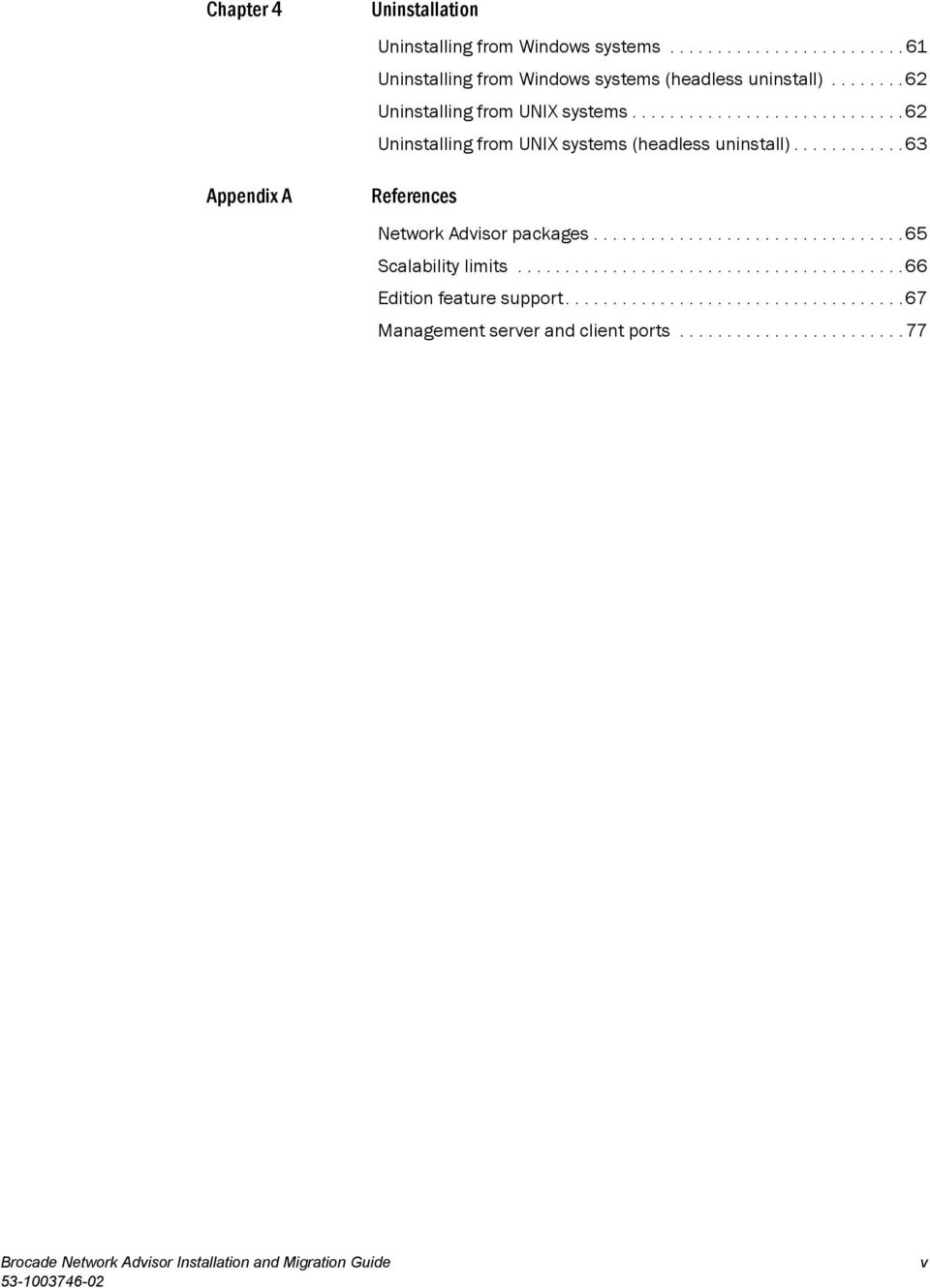
5 Chapter 4 Appendix A Uninstallation Uninstalling from Windows systems Uninstalling from Windows systems (headless uninstall) Uninstalling from UNIX systems Uninstalling from UNIX systems (headless uninstall) References Network Advisor packages Scalability limits Edition feature support Management server and client ports Brocade Network Advisor Installation and Migration Guide v
6 vi Brocade Network Advisor Installation and Migration Guide

7 About This Document In this chapter How this document is organized vii Supported hardware and software viii What s new in this document xvii Document conventions xviii Notice to the reader xix Additional information xix Getting technical help xx Document feedback xxi How this document is organized This document is organized to help you find the information that you want as quickly and easily as possible. The document contains the following components: Chapter 1, Installation, provides system and pre-installation requirements as well as step-by-step installation instructions. Chapter 2, Network Advisor Configuration, provides step-by-step instructions to configure a fresh Network Advisor installation. Chapter 3, Data Migration, provides pre-migration requirements as well as step-by-step instructions for migrating data from a previous release of Network Advisor. Chapter 4, Uninstallation, provides step-by-step instructions for performing a partial or full uninstall of Network Advisor. Appendix A, References, provides the following information for quick lookup: - Network Advisor packages - Scalability limits - Edition feature support - Management server and client ports Brocade Network Advisor Installation and Migration Guide vii

8 Supported hardware and software TABLE 1 In those instances in which procedures or parts of procedures documented here apply to some devices but not to others, this guide identifies exactly which devices are supported and which are not. Although many different software and hardware configurations are tested and supported by Brocade Communications Systems, Inc. for Network Advisor , documenting all possible configurations and scenarios is beyond the scope of this document. Fabric OS hardware and software support The following firmware platforms are supported by this release of Network Advisor : Fabric OS 5.0 or later in a pure Fabric OS fabric Fabric OS 6.0 or later in a mixed fabric Fabric OS 7.0 or later Discovery of a Secure Fabric OS fabric in strict mode is not supported. The hardware platforms in Table 1 are supported by this release of Network Advisor Fabric OS-supported hardware Device name Terminology used in documentation Firmware level required Brocade 200E switch 16-port, 4 Gbps FC Switch Brocade 300 switch 24-port, 8 Gbps FC Switch Fabric OS v6.1.0 or later Brocade 4012 switch Brocade 4016 switch Brocade 4018 switch Brocade 4020 switch Embedded 12-port, 4 Gbps FC Switch Embedded 16-port, 4 Gbps FC Switch Embedded 18-port, 4 Gbps FC Switch Embedded 20-port, 4 Gbps FC Switch Brocade 4024 switch Embedded 24-port, 4 Gbps FC Switch Fabric OS v5.3.1 or later Brocade 4100 switch 32-port, 4 Gbps FC Switch Brocade 4900 switch 64-port, 4 Gbps FC Switch Fabric OS v5.2.0 or later Brocade 5000 switch 32-port, 4 Gbps FC Interop Switch Fabric OS v5.2.1 or later Brocade 5100 switch 40-port, 8 Gbps FC Switch Fabric OS v6.1.0 or later Brocade 5300 switch 80-port, 8 Gbps FC Switch Fabric OS v6.1.0 or later Brocade 5410 embedded switch Embedded 12-port, 8 Gbps Switch Fabric OS v6.1.0 or later Brocade 5424 embedded switch Embedded 24-port, 8 Gbps Switch Fabric OS v6.1.0 or later Brocade 5431 embedded switch Embedded 16-port, 8 Gbps Stackable Switch Fabric OS v7.2.0 or later Brocade 5450 embedded switch Embedded 16-port, 8 Gbps Switch Fabric OS v6.2.0 or later Brocade 5460 embedded switch Embedded 24-port, 8 Gbps Switch Fabric OS v6.1.0_emb or later Brocade 5470 embedded switch Embedded 24-port, 8 Gbps Switch Fabric OS v6.1.0 or later Brocade 5480 embedded switch Embedded 24-port, 8 Gbps Switch Fabric OS v6.1.0 or later viii Brocade Network Advisor Installation and Migration Guide

9 TABLE 1 Fabric OS-supported hardware (Continued) Device name Terminology used in documentation Firmware level required Brocade 6505 switch 24-port, 16 Gbps Edge switch Fabric OS v7.0.1 or later Brocade M6505 embedded switch 24-port, 16 Gbps embedded switch Fabric OS v7.2.0 or later Brocade 6510 switch 48-port, 16 Gbps switch Fabric OS v7.0.0 or later Brocade 6520 switch 96-port, 16 Gbps switch Fabric OS v7.1.0 or later Brocade 6547 embedded switch 48-port, 16 Gbps embedded switch Fabric OS v7.2.0 or later Brocade 7500 Extension switch 4 Gbps Router, Extension Switch Fabric OS v5.1.0 or later Brocade 7500E Extension switch 4 Gbps Extension Switch Fabric OS v5.1.0 or later Brocade AP7600 switch 4 Gbps 32-port Switch Fabric OS v6.1.0 or later Brocade 7800 switch 8 Gbps Extension Switch Fabric OS v6.3.0 or later Brocade 7840 switch 16 Gbps 24-FC port, 18 GbE port Switch Fabric OS v7.3.0 or later Brocade 8000 switch 8 Gbps 8-FC port, 10 GbE 24-DCB port Switch Fabric OS v6.1.2_cee Brocade 8470 FCoE embedded switch FCoE Embedded Switch Fabric OS v6.3.1_cee Brocade VA-40FC switch 8 Gbps 40-port Switch Brocade Encryption Switch 8 Gbps Encryption Switch Fabric OS v6.1.1_enc or later Brocade director Brocade director with FC4-16, FC4-32, and FC4-48 Blades Brocade director with FR4-18i Blades Director Chassis Director Chassis with 4 Gbps 16-FC port, 4 Gbps 32-FC port, and 4 Gbps 48-FC port Director Chassis with 4 Gbps router, extension blades Fabric OS v5.2.0 or later (FC4-48) Fabric OS v5.1.0 or later (FR4-18i) Brocade director with FC4-16IP Blades Director Chassis with 4 Gbps 8-FC port and 8 GbE iscsi blades Fabric OS v5.2.0 or later (FC4-16IP) Brocade director with FC10-6 Blades Director Chassis with 10 Gbps 6-port ISL blades Fabric OS v5.3.0 or later (FC10-6) Brocade DCX 1, 2 8-slot Backbone Chassis Fabric OS v6.0.0 or later Brocade DCX 1, 2 with FC8-16, FC8-32, and FC8-48 Blades Brocade DCX 1, 2 with FC8-64 Blades Brocade DCX 1, 2 with FR4-18i Blades 8-slot Backbone Chassis with 8 Gbps 16-FC port, 8 Gbps 32-FC port, and 8 Gbps 48-FC port blades 8-slot Backbone Chassis with 8 Gbps 64-FC port blades 8-slot Backbone Chassis with 4 Gbps Router, Extension blade Fabric OS v6.0.0 or later Fabric OS v6.4.0 or later Fabric OS v6.0.0 or later Brocade DCX 1, 2 with FC10-6 Blades 8-slot Backbone Chassis with FC 10-6 ISL Blade Fabric OS v6.2.0 or later Brocade DCX 1, 2 with FS8-18 Blades 8-slot Backbone Chassis with Encryption Blade Fabric OS v6.1.1_enc or later Brocade DCX 1, 2 with FX8-24 Blades Brocade DCX 1, 2 with FCoE10-24 Blades 8-slot Backbone Chassis with 8 Gbps 12-FC port, 10 GbE ports, 2-10 GbE ports blade 8-slot Backbone Chassis with 10 Gbps 24-port FCoE blade Fabric OS v6.3.1_cee Fabric OS v6.3.1_cee Brocade DCX-4S 4-slot Backbone Chassis Fabric OS v6.0.0 or later Brocade DCX-4S with FC8-16, FC8-32, and FC8-48 Blades 4-slot Backbone Chassis with 8 Gbps 16-FC port, 8 Gbps 32-FC port, and 8 Gbps 48-FC port blades Fabric OS v6.2.0 or later Brocade Network Advisor Installation and Migration Guide ix
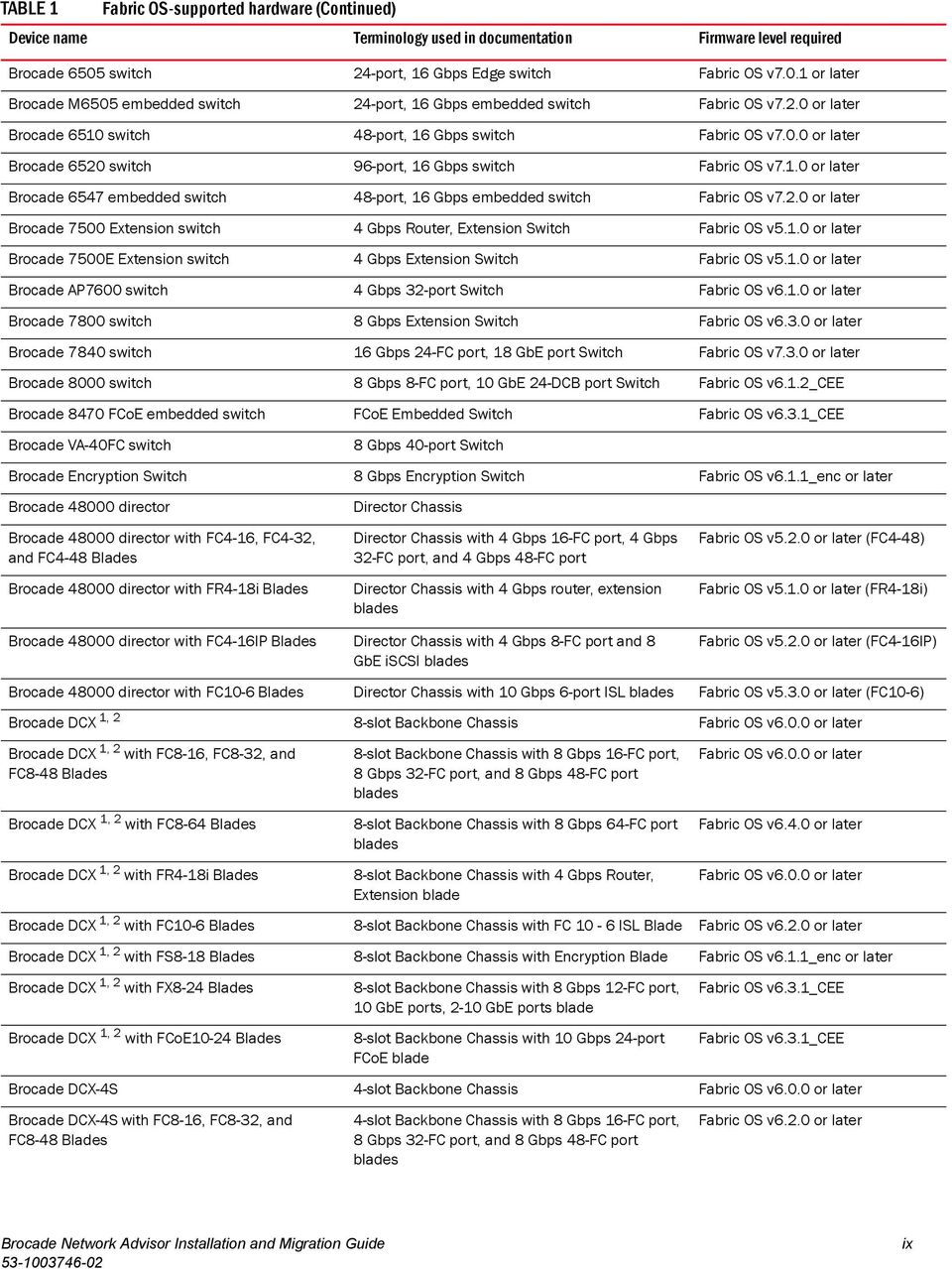
10 TABLE 1 Fabric OS-supported hardware (Continued) Device name Terminology used in documentation Firmware level required Brocade DCX-4S with FC8-64 Blades Brocade DCX-4S with FR4-18i Blades 4-slot Backbone Chassis with 8 Gbps 64-FC port blades 4-slot Backbone Chassis with 4 Gbps Router, Extension blade Fabric OS v6.4.0 or later Fabric OS v6.2.0 or later Brocade DCX-4S with FC10-6 Blades 4-slot Backbone Chassis with FC 10-6 ISL Blade Fabric OS v6.2.0 or later Brocade DCX-4S with FS8-18 Blades 4-slot Backbone Chassis with Encryption Blade Fabric OS v6.1.1_enc or later Brocade DCX-4S with FX8-24 1, 2 Blades Brocade DCX-4S with FCoE10-24 Blades 4-slot Backbone Chassis with 8 Gbps 12-FC port, 10 GbE ports, 2-10 GbE ports blade 4-slot Backbone Chassis with 10 Gbps 24-port FCoE blade Fabric OS v6.3.1_cee Fabric OS v6.3.0 or later Brocade DCX Gbps 4-slot Backbone Chassis Fabric OS v7.0.0 or later Brocade DCX with FS8-18 Encryption Blades Brocade DCX with FC8-64 and FX8-24 1, 2 Blades Brocade DCX with FC16-32 and FC16-48 Blades Brocade DCX with FC8-32E and FC8-48E Blades Brocade DCX with FC16-64 Blades 16 Gbps 4-slot Backbone Chassis with Encryption blades 16 Gbps 4-slot Backbone Chassis with 8 Gbps 64-port and 8 Gbps Router Extension blades 16 Gbps 4-slot Backbone Chassis with 16 Gbps 32-port and 16 Gbps 48-port blades 16 Gbps 4-slot Backbone Chassis with 8 Gbps 32-port and 8 Gbps 48-port blades 16 Gbps 4-slot Backbone Chassis with 16 Gbps 64-port blades Fabric OS v6.1.1_enc or later Fabric OS v7.0.0 or later Fabric OS v7.0.0 or later Fabric OS v7.0.1 or later Fabric OS v7.3.0 or later Brocade DCX , 2 16 Gbps 8-slot Backbone Chassis Fabric OS v7.0.0 or later Brocade DCX , 2 with FS8-18 Encryption Blades Brocade DCX , 2 with FC8-64 and FX8-24 Blades Brocade DCX , 2 with FC16-32 and FC16-48 Blades Brocade DCX , 2 with FCoE10-24 Blades Brocade DCX ,2 with FA4-18 Application Platform Blade 16 Gbps 8-slot Backbone Chassis with Encryption blades 16 Gbps 8-slot Backbone Chassis with 8 Gbps 64-port and 8 Gbps Router Extension blades 16 Gbps 8-slot Backbone Chassis with 16 Gbps 32-port and 16 Gbps 48-port blades 16 Gbps 8-slot Backbone Chassis with 10 Gbps 24-port FCoE blade 16 Gbps 8-slot Backbone Chassis with 16 Gbps 64-port blades Application Platform blade Fabric OS v6.1.1_enc or later Fabric OS v6.4.0 or later Fabric OS v7.0.0 or later Fabric OS v7.0.0 or later Fabric OS v7.3.0 or later FC8-16 Blade FC 8 GB 16-port blade Fabric OS v6.2.0 or later FC8-32 Blade FC 8 GB 32-port blade Fabric OS v6.2.0 or later FC8-32E Blade 3 FC 8 GB 32-port blade Fabric OS v7.0.1 or later FC8-48 Blade 3 FC 8 GB 48-port blade Fabric OS v6.2.0 or later FC8-48E Blade FC 8 GB 48-port blade Fabric OS v7.0.1 or later FC8-64 Blade FC 8 GB 64-port blade Fabric OS v6.4.0 or later FC10-6 Blade FC 10-6 ISL blade Fabric OS v6.2.0 or later FC16-32 Blade 16 Gbps 32-port blade Fabric OS v7.0.0 or later x Brocade Network Advisor Installation and Migration Guide

11 TABLE 1 Fabric OS-supported hardware (Continued) Device name Terminology used in documentation Firmware level required FC16-48 Blade 16 Gbps 48-port blade Fabric OS v7.0.0 or later FC16-64 Blade 16 Gbps 64-port blade Fabric OS v7.3.0 or later FCoE10-24 Blade 4 10 Gbps FCoE Port Router Blade Fabric OS v6.3.0 or later FR4-18i Blade 4 Gbps Router Extension blade Fabric OS v5.1.0 or later FS8-18 Encryption Blade Encryption Blade Fabric OS v6.1.1_enc or later FX8-24 Blade 1, 2 8 Gbps Router Extension Blade Fabric OS v6.4.0 or later 1. Professional can discover, but not manage, this device. Use the device s Element Manager, which can be launched from the Connectivity Map, to manage the device. This device cannot be used as a Seed switch. 2. Professional Plus Trial and Licensed version can discover, but not manage, this device. Use the device s Element Manager, which can be launched from the Connectivity Map, to manage the device. This device cannot be used as a Seed switch. 3. Only supported on the DCX and DCX chassis. 4. Only supported on the DCX, DCX-4S, and DCX chassis. TABLE 2 IronWare hardware and software support The following firmware platforms are supported by this release of Network Advisor : BigIron e (sustaining mode) or later FastIron or later NetIron or later ServerIron (JetCore) 11.0 (sustaining mode) or later ServerIron ADX or later TurboIron (sustaining mode) or later For platform-specific firmware requirements, refer to Table 2. Table 2 lists the hardware platforms supported by this release of Network Advisor , the terminology used in the documentation, as well as any specific firmware requirements. IronWare-supported hardware Device name Terminology used in documentation Firmware level required BigIron family Ethernet Chassis BigIron e or b BigIron RX-4 (BI-RX-4-AC) Ethernet Chassis, 4 interface slots BigIron e or b BigIron RX-8 (BI-RX-8-AC) Ethernet Chassis, 8 interface slots BigIron e or b BigIron RX-16 (BI-RX-16-AC-A) Ethernet Chassis, 16 interface slots BigIron e or b Brocade 6910 Ethernet Access Switch Ethernet Access Switch release , loader version FastIron family Ethernet switch See individual device. FastIron CX 624S (FCX624S) FastIron CX 648S (FCX648S) FastIron CX 624S-HPOE (FCX624S-HPOE) Ethernet L2/L3 Edge switch, 24 1GbE RJ45 ports Ethernet L2/L3 Edge switch, 48 1GbE RJ45 ports Ethernet L2/L3 Edge switch, 24 1GbE RJ45 ports, 24 POE+ ports FastIron and later FastIron and later FastIron and later Brocade Network Advisor Installation and Migration Guide xi

12 TABLE 2 IronWare-supported hardware (Continued) Device name Terminology used in documentation Firmware level required FastIron CX 648S-HPOE (FCX648S-HPOE) Ethernet L2/L3 Edge switch, 48 1GbE RJ45 ports, 48 POE+ ports FastIron and later FastIron CX 624S-F (FCX624S-F) Ethernet L2/L3 Edge switch, 20 SFP ports FastIron and later FastIron CX 624-E (FCX624-E) FastIron CX 624-I (FCX624-I) FastIron CX 648-E (FCX648-E) FastIron CX 648-I (FCX648-I) Ethernet L2/L3 Edge switch, 24 1GbE RJ45 ports Ethernet L2/L3 Edge switch, 24 1GbE RJ45 ports Ethernet L2/L3 Edge switch, 48 1GbE RJ45 ports Ethernet L2/L3 Edge switch, 48 1GbE RJ45 ports FastIron and later FastIron and later FastIron and later FastIron and later ICX 6610 Stackable switch family Campus LAN Edge stackable switch FastIron and later Hyper Edge stacking requires FastIron 8.0 or later ICX Stackable switch ICX Stackable switch ICX F Stackable switch ICX P Stackable switch ICX P Stackable switch 24 RJ-45 ports Campus LAN Edge stackable switch 48 RJ-45 ports Campus LAN Edge stackable switch 24 SFP ports Campus LAN Edge stackable switch 24 PoE ports Campus LAN Edge stackable switch 48 PoE ports Campus LAN Edge stackable switch FastIron and later Hyper Edge stacking requires FastIron 8.0 or later FastIron and later Hyper Edge stacking requires FastIron 8.0 or later FastIron and later Hyper Edge stacking requires FastIron 8.0 or later FastIron and later Hyper Edge stacking requires FastIron 8.0 or later FastIron and later Hyper Edge stacking requires FastIron 8.0 or later ICX switch 24-port Campus LAN switch FastIron and later ICX HPOE switch 24-port Campus LAN HPOE switch FastIron and later ICX switch 48-port Campus LAN switch FastIron and later ICX HPOE switch 48-port Campus LAN HPOE switch FastIron and later ICX 6450 stacking switch Campus LAN stacking switch FastIron 8.0 or later ICX switch 24-port Campus LAN switch FastIron and later ICX Base L3 router 24-port Campus LAN Base L3 router FastIron and later ICX Base router 24-port Campus LAN Base router FastIron and later ICX Premium router 24-port Campus LAN Premium router FastIron and later ICX HPOE switch 24-port Campus LAN HPOE switch FastIron and later ICX HPOE Base L3 router 24-port Campus LAN HPOE Base L3 router FastIron and later ICX HPOE Base router 24-port Campus LAN HPOE Base router FastIron and later xii Brocade Network Advisor Installation and Migration Guide

13 TABLE 2 IronWare-supported hardware (Continued) Device name Terminology used in documentation Firmware level required ICX HPOE Premium router 24-port Campus LAN HPOE Premium router FastIron and later ICX switch 48-port Campus LAN switch FastIron and later ICX Base L3 router 48-port Campus LAN Base L3 router FastIron and later ICX Base router 48-port Campus LAN Base router FastIron and later ICX Premium router 48-port Campus LAN Premium router FastIron and later ICX HPOE switch 48-port Campus LAN HPOE switch FastIron and later ICX HPOE Base L3 router 48-port Campus LAN HPOE Base L3 router FastIron and later ICX HPOE Base router 48-port Campus LAN HPOE Base router FastIron and later ICX HPOE Premium router 48-port Campus LAN HPOE Premium router FastIron and later ICX 6430 IronStack switch 24-port Campus LAN stackable switch FastIron and later ICX 6430 IronStack Base L3 router Campus LAN Base L3 stackable router FastIron and later ICX 6430 IronStack Base router Campus LAN Base stackable router FastIron and later ICX 6430 IronStack Premium router Campus LAN Premium stackable router FastIron and later ICX 6450 IronStack switch 48-port Campus LAN stackable switch FastIron and later Hyper Edge stacking requires FastIron 8.0 or later ICX switch 24-port Campus LAN switch FastIron and later ICX Base L3 router 24-port Campus LAN Base L3 router FastIron and later ICX router 24-port Campus LAN router FastIron and later ICX HPOE switch 24-port Campus LAN HPOE switch FastIron and later ICX HPOE Base L3 router 24-port Campus LAN HPOE Base L3 router FastIron and later ICX HPOE Base router 24-port Campus LAN HPOE Base router FastIron and later ICX switch 48-port Campus LAN switch FastIron and later ICX Base L3 router 48-port Campus LAN Base L3 router FastIron and later ICX router 48-port Campus LAN router FastIron and later ICX HPOE switch 48-port Campus LAN HPOE switch FastIron and later ICX HPOE Base L3 router 48-port Campus LAN HPOE Base L3 router FastIron and later ICX HPOE Base router 48-port Campus LAN HPOE Base router FastIron and later ICX G switch 24-port 1G Campus LAN switch FastIron and later ICX G Base L3 router 24-port 1G Campus LAN Base L3 router FastIron and later ICX G router 24-port 1G Campus LAN router FastIron and later ICX switch 24-port Campus LAN switch FastIron and later ICX Base L3 router 24-port Campus LAN Base L3 router FastIron and later ICX router 24-port Campus LAN router FastIron and later ICX HPOE switch 24-port Campus LAN HPOE switch FastIron and later Brocade Network Advisor Installation and Migration Guide xiii

14 TABLE 2 IronWare-supported hardware (Continued) Device name Terminology used in documentation Firmware level required ICX HPOE Base L3 router 24-port Campus LAN HPOE Base L3 router FastIron and later ICX HPOE Base router 24-port Campus LAN HPOE Base router FastIron and later ICX switch 48-port Campus LAN switch FastIron and later ICX Base L3 router 48-port Campus LAN Base L3 router FastIron and later ICX router 48-port Campus LAN router FastIron and later ICX HPOE switch 48-port Campus LAN HPOE switch FastIron and later ICX HPOE Base L3 router 48-port Campus LAN HPOE Base L3 router FastIron and later ICX HPOE Base router 48-port Campus LAN HPOE Base router FastIron and later ICX F switch 48 SFP ports Campus LAN switch FastIron and later ICX F Base L3 router 48 SFP ports Campus LAN Base L3 router FastIron and later ICX F router 48 SFP ports Campus LAN router FastIron and later ICX Q switch 26 10/40 GbE QSFP+ ports FastIron and later ICX F switch 48 1/10 GbE SFP+ ports and six 10/40 GbE QSFP+ ports ICX C switch 48 1/10 GbE RJ-45 ports and six 10/40 GbE QSFP+ ports FastIron and later FastIron and later FastIron GS FastIron GS-STK FastIron LS FastIron LS-STK Ethernet L2/L3 Access switch Ethernet L2/L3 Access switch, stackable Enterprise LAN switch Enterprise LAN switch, stackable FastIron SuperX/SX Enterprise LAN chassis FSX and later FastIron SX 800 and FastIron SX 1600 Enterprise LAN chassis FSX and later FastIron 8-port 10 GbE SFP Blade FastIron 24-port Fiber SFP GbE Blade FastIron 24-port GbE Cu Blade FastIron 2-port 10GbE SFP+ Blade FastIron Edge Switch X-Series 8-port 10 GbE SFP Blade 24-port Fiber SFP GbE Blade 24-port GbE Cu Blade 2-port 10GbE SFP+ Blade Enterprise LAN Edge switch FastIron Edge X 424 Enterprise LAN Edge switch, 24 10/100/1000 Mbps ports FastIron Edge X 624 Enterprise LAN Edge switch, 24 10/100/1000 Mbps ports FastIron Edge X 448 Enterprise LAN Edge switch, 48 10/100/1000 Mbps ports FastIron Edge X 648 Enterprise LAN Edge switch, 48 10/100/1000 Mbps ports FastIron Edge X 424HF Enterprise LAN Edge switch, /1000 Mbps SFP ports FastIron Edge X 624HF Enterprise LAN Edge switch, /1000 Mbps SFP ports xiv Brocade Network Advisor Installation and Migration Guide

15 TABLE 2 IronWare-supported hardware (Continued) Device name Terminology used in documentation Firmware level required FastIron WS devices Enterprise Campus switch Motorola Controllers RFS4000 series Wireless controller Mobility 5.1 Motorola Controllers RFS6000 series Wireless controller Mobility 5.1 Motorola Controllers RFS7000 series Wireless controller Mobility 5.1 Motorola Access Point 7131 Wireless access point Mobility (standalone mode) Mobility (adaptive mode) Motorola Access Point 7131N Wireless access point Mobility (standalone mode) Mobility (adaptive mode) Motorola Access Point 5181 Wireless access point Mobility 2.5.X (standalone mode) Mobility (adaptive mode) Motorola Access Point 6511 Wireless access point Mobility (adaptive mode) NetIron family Ethernet routers NetIron or NetIron MLX (Supported regardless of license configuration) NetIron MLXe (Supported regardless of license configuration) NetIron XMR (Supported regardless of license configuration) NetIron CES 2048CX (NI-CES-2048CX-AC) (Supported regardless of license configuration) NetIron CER (Supported regardless of license configuration) Ethernet router NetIron or Ethernet Core router NetIron or Ethernet Backbone router NetIron or Ethernet Carrier router NetIron or Ethernet Edge router NetIron or NetIron XMR/MLX 2-Port 100GbE Module 2-Port 100GbE Module NetIron NetIron XMR/MLX 20-port 10GbE Module 20-port 10GbE Module NetIron NetIron MLX 4-Port 10GbE Module 4-port 10GbE Module NetIron NetIron MLX MR2 Module Management Module NetIron NetIron MLX 4-port 10 GbE IPSEC-M 4-port 10 GbE IPSEC-M Blade NetIron NetIron MLX 2-Port 100-GbE (X2) CFP2 2-port 100 GbE (X2) CFP2 Blade NetIron NetIron MLX 20-Port 10-GbE/1GBE (X2) 20-port 10 GbE (X2) Blade NetIron ServerIron family ServerIron ADX 1000 Application product Application switch ServerIron ADX 1000F Application Fiber switch ADX or later ServerIron ADX U Application Delivery chassis ADX or later ServerIron ADX U Application Delivery chassis ADX or later TurboIron Family Data Center switch d or or later Brocade Network Advisor Installation and Migration Guide xv

16 TABLE 2 IronWare-supported hardware (Continued) Device name Terminology used in documentation Firmware level required TurboIron 24X (T1-24X-AC) Data Center switch d or or later Brocade 6650 Switch Data Center switch FastIron 7.5 and later Brocade 6650 Base L3 Router Data Center base L3 router FastIron 7.5 and later Brocade 6650 Router Data Center router FastIron 7.5 and later 1 The Management application cannot discover or manage wireless access points running Mobility 5.1. TABLE 3 Network OS hardware and software support Network Advisor supports the Network OS firmware platform. For platform-specific firmware requirements, if any, refer to Table 3. Table 3 lists the hardware platforms supported by this release of Network Advisor , the terminology used in the documentation, as well as any specific firmware requirements. Network OS-supported hardware Device name Terminology used in documentation Firmware level required Brocade VDX Gbps connection blade VDX Gbps connection blade 2.1.1_fuj Brocade VDX 2740 switch VDX 2740 switch 4.0.0_bbd Brocade VDX 2746 switch VDX 2746 switch 6.0 or later Brocade VDX 6710 switch VDX 6710 switch 2.1 or later Brocade VDX switch VDX switch 2.1 or later Brocade VDX switch VDX switch 2.1 or later Brocade VDX switch VDX switch 2.1 or later Brocade VDX switch VDX switch 2.1 or later Brocade VDX 6740 switch VDX 6740 switch 4.0 or later Brocade VDX 6740T switch VDX 6740T switch 4.0 or later Brocade VDX 6740T-1G switch VDX 6740T-1G switch 4.1 or later Brocade VDX S switch VDX S switch or later Brocade VDX Q switch VDX switch 6.0 or later Brocade VDX switch VDX switch 3.0 or later Brocade VDX switch VDX switch 3.0 or later Brocade VDX 8770 with 40G/10G Base-T/100G by line card VDX 8770 switch with 40G/10G Base-T/100G by line card 4.1 or later xvi Brocade Network Advisor Installation and Migration Guide
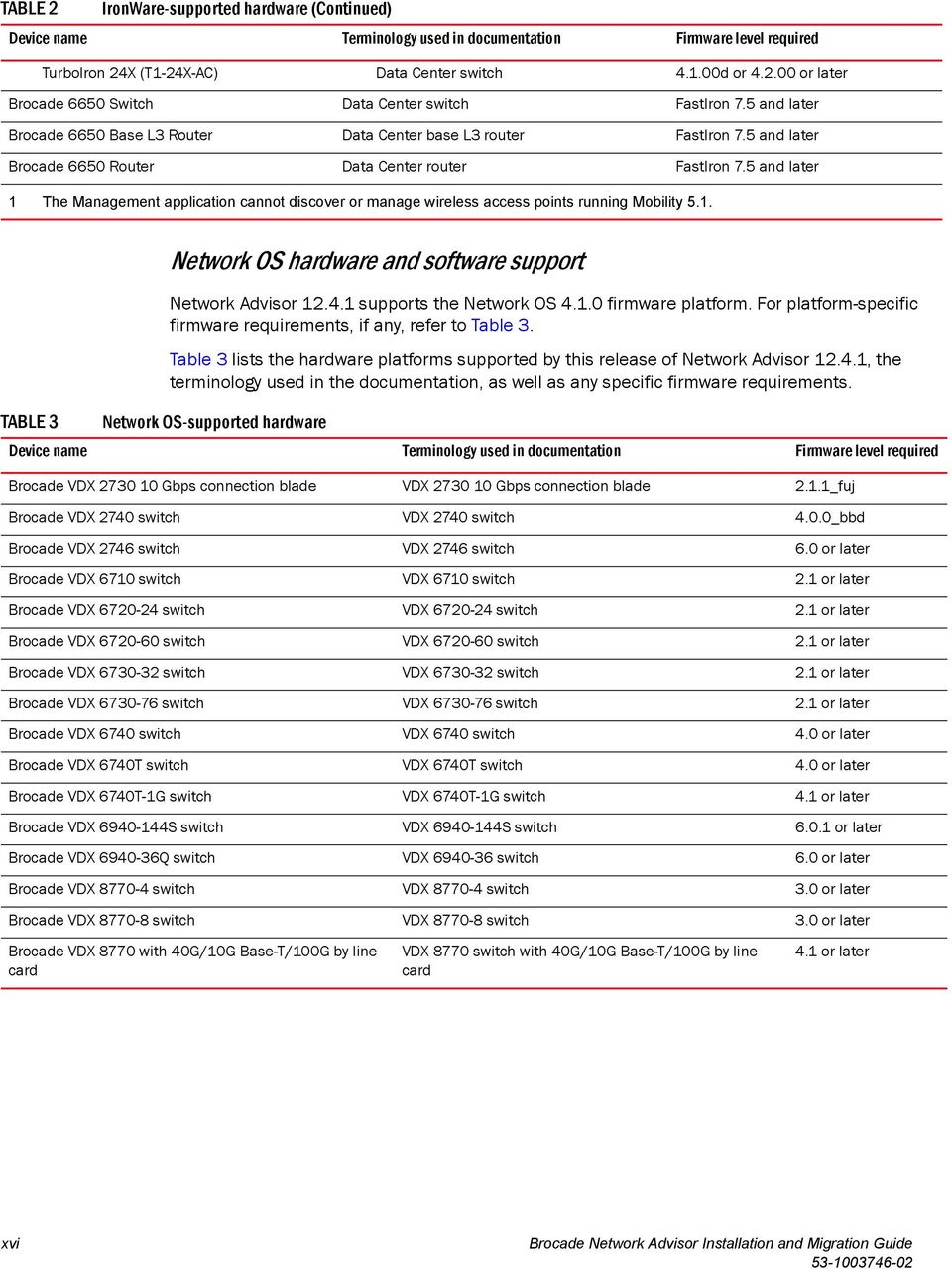
17 HBA hardware and software support The following firmware platforms are supported by this release of Network Advisor : Adapter Software or later The hardware platforms in Table 4 are supported by this release of Network Advisor TABLE 4 HBA-supported hardware Device name Terminology used in documentation Firmware level required Brocade 415 Host Bus Adapter Brocade 425 Host Bus Adapter Brocade 815 Host Bus Adapter Brocade 825 Host Bus Adapter Brocade 1860 Fabric Adapter 4 Gbps 1-port HBA 4 Gbps 2-port HBA 8 Gbps 1-port HBA 8 Gbps 2-port HBA 16 Gbps FC HBA mode 10 Gbps CNA mode 10 Gbps NIC mode Adapter Software or later Brocade 1867 HBA 16 Gbps Mezzanine HBA Adapter Software or later Emulex LPe12002-M8 Emulex LPe16002B QLogic QLE2562-CK QLogic QLE2672-CK 8 Gbps 2-port HBA 16 Gbps 2-port HBA 8 Gbps 2-port FC HBA x4 PCIe PCI Express 3.0 x4 / PCI Express 2.0 x8 low profile 16 Gbps Fibre Channel x 2 What s new in this document The following changes have been made since this document was last released: Information that was added: - None Information that was changed: - Supported hardware and software - Supported migration paths - Scalability limits Information that was deleted: - None For further information about new features and documentation updates for this release, refer to the release notes. Brocade Network Advisor Installation and Migration Guide xvii

18 Document conventions This section describes text formatting conventions and important notice formats used in this document. Text formatting The narrative-text formatting conventions that are used are as follows: bold text italic text code text Identifies command names Identifies the names of user-manipulated GUI elements Identifies keywords and operands Identifies text to enter at the GUI or CLI Provides emphasis Identifies variables Identifies paths and Internet addresses Identifies document titles Identifies CLI output Identifies command syntax examples For readability, command names in the narrative portions of this guide are presented in mixed lettercase: for example, switchshow. In actual examples, command lettercase is all lowercase. Notes The following notices and statements are used in this manual. They are listed below in order of increasing severity of potential hazards. A note provides a tip, guidance, or advice, emphasizes important information, or provides a reference to related information. Key terms For definitions specific to Brocade and Fibre Channel, see the technical glossaries on MyBrocade. See Brocade resources on page xix for instructions on accessing MyBrocade. For definitions of SAN-specific terms, visit the Storage Networking Industry Association online dictionary at: xviii Brocade Network Advisor Installation and Migration Guide

19 Notice to the reader This document may contain references to the trademarks of the following corporations. These trademarks are the properties of their respective companies and corporations. These references are made for informational purposes only. Corporation Linus Torvalds Microsoft Corporation Netscape Communications Corporation Red Hat, Inc. Oracle The Open Group VMware, Inc. Referenced trademarks and products Linux Windows, Windows NT, Internet Explorer Netscape Red Hat, Red Hat Network, Maximum RPM, Linux Undercover Sun, Solaris, Sun Fire, Sun Ultra, Java Plug-in UNIX VMware Additional information This section lists additional Brocade and industry-specific documentation that you might find helpful. Brocade resources To get up-to-the-minute information, go to to register at no cost for a user ID and password. White papers, online demonstrations, and data sheets are available through the Brocade website at: For additional Brocade documentation, visit the Brocade website: Release notes are available on the MyBrocade website. Other industry resources For additional resource information, visit the Technical Committee T11 website. This website provides interface standards for high-performance and mass storage applications for Fibre Channel, storage management, and other applications: For information about the Fibre Channel industry, visit the Fibre Channel Industry Association website: Brocade Network Advisor Installation and Migration Guide xix
20 Getting technical help Contact your switch support supplier for hardware, firmware, and software support, including product repairs and part ordering. To expedite your call, have the following information available: 1. Management Application Serial Number To obtain the Management application serial number, select Help > License. The License dialog box displays. 2. General Information Switch model Switch operating system version Software name and software version, if applicable Error numbers and messages received supportsave command output Detailed description of the problem, including the switch or fabric behavior immediately following the problem, and specific questions Description of any troubleshooting steps already performed and the results Serial console and Telnet session logs syslog message logs 3. Switch Serial Number The switch serial number and corresponding bar code are provided on the serial number label, as illustrated below: FT00X0054E9 The serial number label is located as follows: Brocade 300, 4100, 4900, 5100, 5300, 7500, 7800, 7840, 8000, VA-40FC, and Brocade Encryption Switch On the switch ID pull-out tab located inside the chassis on the port side on the left Brocade 5000 On the switch ID pull-out tab located on the bottom of the port side of the switch Brocade 7600 On the bottom of the chassis Brocade Inside the chassis next to the power supply bays Brocade DCX and DCX On the bottom right on the port side of the chassis, directly above the cable management comb Brocade DCX-4S and DCX On the bottom right on the port side of the chassis xx Brocade Network Advisor Installation and Migration Guide

21 4. World Wide Name (WWN) Use the licenseidshow command to display the WWN of the chassis. If you cannot use the licenseidshow command because the switch is inoperable, you can get the WWN from the same place as the serial number, except for the Brocade DCX. For the Brocade DCX, DCX-4S, and DCX , access the numbers on the WWN cards by removing the Brocade logo plate at the top of the nonport side of the chassis. Document feedback Quality is our first concern at Brocade and we have made every effort to ensure the accuracy and completeness of this document. However, if you find an error or an omission, or you think that a topic needs further development, we want to hear from you. Forward your feedback to: [email protected] Provide the title and version number of the document and as much detail as possible about your comment, including the topic heading and page number and your suggestions for improvement. Brocade Network Advisor Installation and Migration Guide xxi
22 xxii Brocade Network Advisor Installation and Migration Guide
23 Installation Chapter 1 In this chapter System requirements Downloading the software Pre-installation requirements Installing the application Headless installation Client-only installation System requirements Use the following sections to determine if you have met the requirements for this application: Server and client operating system requirements Memory, host, and disk space requirements Operating system cache requirements Browser requirements Client and server system requirements Brocade Network Advisor Installation and Migration Guide 1
24 1 System requirements TABLE 5 Server and client operating system requirements Table 5 summarizes the required operating system (OS) for servers and the packages supported by each OS version. It is recommended that you run Network Advisor on a dedicated machine to avoid conflicts with other applications that use the same resources and ports (such as SNMP, web server, and so on). Enterprise edition (SAN or IP) and Professional Plus edition (SAN or IP) are not supported on 32-bit operating systems. You must migrate to a 64-bit operating system. SAN with SMI Agent + IP edition is not supported on 32-bit operating systems. If the required operating system is not available, a warning message displays during installation. Server operating system requirements Operating system Version Guest OS version Supported packages Windows Standard edition (x86 32-bit) - 8 Enterprise (x86 32-bit) Enterprise (x86 32-bit) R2 Data Center Edition (x86 64-bit) R2 Standard Edition (x86 64-bit) R2 Enterprise Edition (x86 64-bit) Data Center Edition (x86 64-bit) Standard Edition (x86 64-bit) R2 Data Center Edition (x86 64-bit) R2 Standard Edition (x86 64-bit) - 8 Enterprise (x86 64-bit) Enterprise (x86 64-bit) SAN with SMI Agent Professional IP only Professional SMI Agent only SAN with SMI Agent IP only SMI Agent only SAN with SMI Agent + IP 2 Brocade Network Advisor Installation and Migration Guide
25 System requirements 1 TABLE 5 Server operating system requirements (Continued) Operating system Version Guest OS version Supported packages Linux - RedHat Enterprise 6.4 Advanced (x86 32-bit) - RedHat Enterprise 6.5 Advanced (x86 32-bit) - RedHat Enterprise 6.6 Advanced (32-bit) - RedHat Enterprise 7.0 Advanced (x86 32-bit) - SuSE Enterprise Server 11.3 (32-bit) - SuSE Enterprise Server 12 (32-bit) - Oracle Enterprise 6.4 (x86 32-bit) - Oracle Enterprise 6.5 (x86 32-bit) - Oracle Enterprise 7.0 (32-bit) - RedHat Enterprise 6.4 Advanced (x86 64-bit) - RedHat Enterprise 6.5 Advanced (x86 64-bit) - RedHat Enterprise 6.6 Advanced (x86 64-bit) - RedHat Enterprise 7.0 Advanced (x86 64-bit) - SuSE Enterprise Server 11.3 (x86 64-bit) - SuSE Enterprise Server 12 (x86 64-bit) - Oracle Enterprise 6.4 (x86 64-bit) - Oracle Enterprise 6.5 (x86 64-bit) - Oracle Enterprise 7.0 (x86 64-bit) Guest VMs - VMware ESXi VMware ESXi Microsoft Hyper-V (Hyper-V Server 2008 R2, Windows Server 2012, Windows Server 2012 R2 Data Center) - KVM (RH 6.5) Supports all server OS versions available for Windows and Linux. SAN with SMI Agent Professional IP only Professional SMI Agent only SAN with SMI Agent IP only SMI Agent only SAN with SMI Agent + IP Supports all packages available for Windows and Linux. 1. It is recommended that you run all Network Advisor virtual CPUs on a single physical CPU. Table 6 summarizes the required OS for clients. Network Advisor clients are supported on 32-bit and 64-bit Windows and Linux systems. If you are managing more than 9000 SAN ports or 200 IP devices, the client is not supported on 32-bit systems. Brocade Network Advisor Installation and Migration Guide 3
26 1 System requirements TABLE 6 Operating system Windows Linux Client operating system requirements Version - 7 Enterprise (x86 32-bit) - 8 Enterprise (x86 32-bit) Enterprise (x86 32-bit) R2 Data Center Edition (x86 64-bit) R2 Standard Edition (x86 64-bit) R2 Enterprise Edition (x86 64-bit) Data Center Edition (x86 64-bit) Standard Edition (x86 64-bit) R2 Data Center Edition (x86 64-bit) R2 Standard Edition (x86 64-bit) - 7 Enterprise (x86 64-bit) - 8 Enterprise (x86 64-bit) Enterprise (x86 64-bit) - RedHat Enterprise 6.4 Advanced (x86 32-bit) - RedHat Enterprise 6.5 Advanced (x86 32-bit) - RedHat Enterprise 6.6 Advanced (x86 32-bit) - RedHat Enterprise 7.0 Advanced (x86 32-bit) - SuSE Enterprise Server 11.3 (32-bit) - SuSE Enterprise Server 12 (32-bit) - Oracle Enterprise 6.4 (x86 32-bit) - Oracle Enterprise 6.5 (x86 32-bit) - Oracle Enterprise 7.0 (32-bit) - RedHat Enterprise 6.4 Advanced (x86 64-bit) - RedHat Enterprise 6.5 Advanced (x86 64-bit) - RedHat Enterprise 6.6 Advanced (x86 64-bit) - RedHat Enterprise 7.0 Advanced (x86 64-bit) - SuSE Enterprise Server 11.3 (x86 64-bit) - SuSE Enterprise Server 12 (x86 64-bit) - Oracle Enterprise 6.4 (x86 64-bit) - Oracle Enterprise 6.5 (x86 64-bit) - Oracle Enterprise 7.0 (x86 64-bit) Guest VMs - VMware ESXi VMware ESXi Microsoft Hyper-V (Hyper-V Server 2008 R2, Windows Server 2012, Windows Server 2012 R2 Data Center) - KVM (RH 6.5) Guest OS version Supports all client OS versions available for Windows and Linux. 4 Brocade Network Advisor Installation and Migration Guide
27 System requirements 1 Memory, host, and disk space requirements Memory requirements are only applicable when there are no other applications running on the Network Advisor server. Paging space should be equal to or exceed the physical memory size. To manage more than 9000 SAN ports or 200 IP devices, you must have a 16 core processor. To efficiently manage more than 9000 SAN ports or 200 IP devices, it is recommended to allocate a minimum of 2 GB client memory and 6 GB server memory. If you use sflow, it is recommended that you add an additional 100 GB of disk space. It is recommended that you add an additional 40 GB of disk space for the default temporary directory. If you enable periodic supportsave or configure the Network Advisor server as the Upload Failure Data Capture location for monitored switches, you must add additional disk space. Each switch supportsave file is approximately 5 MB and each Upload Failure Data Capture file is approximately 500 KB. To determine the disk space requirements, multiply the frequency of scheduled supportsave files by 5 MB and the expected Upload Failure Data Capture files by 500 KB before the planned periodic purge activity. Table 7 summarizes the memory, host, and disk space requirements for a remote client. TABLE 7 Resources Memory, Host, and Disk space requirements for remote client Required Installed Memory 4 GB Processor Core Count 2 Disk Space 1 GB Brocade Network Advisor Installation and Migration Guide 5
28 1 System requirements Table 8 summarizes the minimum system requirements for server (plus 1 client) installation. TABLE 8 Minimum system requirements for server (plus 1 client) installation Resources Professional Edition Professional Plus or Enterprise Edition Installed Memory Processor Core Count (including physical and logical cores) 4 GB (32-bit) 6 GB (64 bit) 2 2 Table 9 summarizes the recommended system requirements for server (plus 1 client) installation. 6 GB Disk Space 10 GB 20 GB TABLE 9 Recommended system requirements for server (plus 1 client) installation Resources Small Medium Large Installed Memory 16 GB 16 GB 16 GB Processor Core Count (including physical and logical cores) Disk Space 20 GB 80 GB 100 GB Operating system cache requirements It is recommended that you use the System managed size (the OS allocates the required cache); however, if you choose to use a custom size, make sure you use the following memory settings for your operating system. The virtual memory requirements for Windows system is 1 GB for minimum paging file size and 4 GB for maximum paging file size TABLE 10 Linux swap space requirements Installed physical memory (RAM) size Recommended swap size 4 GB 4 GB Greater than 4 GB and less than 8 GB Greater than or equal to 8 GB and less than 64 GB Equal to the amount of RAM 5 time the amount of RAM For networks with more than 9000 ports, the recommended memory allocation is 6 GB. 6 Brocade Network Advisor Installation and Migration Guide
29 System requirements 1 Browser requirements The launch of Network Advisor and the launch of Element Manager (Web Tools) from the application are supported from the following browsers with a Java plug-in: Browsers - Windows Internet Explorer or later on Windows - Firefox 24 or later on Windows or Linux - Google Chrome 33 or later on Windows Java Plug-ins For the current supported JRE version for Network Advisor and Web Tools, refer to the Release Notes. For higher performance, use a 64-bit JRE. If the minimum system requirement is not met, you will be blocked from the configuration and an error message will be displayed. For the website listing patch information, go to Client and server system requirements Network Advisor is not supported in a Network Address Translation (NAT) environment where the server and client are on different sides of the NAT Server. Network Advisor has the following client and server system requirements: In the Professional edition, a single server supports a single client, which must be a local client only. In Professional Plus and Enterprise editions, a single server supports a maximum of 25 clients, which can be local on a 64-bit server or remote on 32-bit and 64-bit servers. In Professional Plus and Enterprise editions, a single server supports a maximum of 25 clients, which can be local or remote on 64-bit servers. To support more than 8 clients, you must make the following changes to your configuration: - Increase the server memory size. You can configure the server memory size from the Options dialog box, Memory Allocations pane. For instructions, refer to the Network Advisor User Manual or online help. - Increase the PostgreSQL database shared buffers memory allocation to 1024 MB by editing the Install_Home\data\databases\postgresql.conf file. Brocade Network Advisor Installation and Migration Guide 7
30 1 Downloading the software Downloading the software You can download the software and documentation from the MyBrocade website. 1. Go to the MyBrocade website Enter your user ID and password. If you do not already have a MyBrocade account, you can create one. 3. Select MyBrocade from the Take me to list, if necessary. 4. Click LOG IN. 5. Click downloads on the main page. 6. Select Management Software from the Download by list. 7. Click Brocade Network Advisor in the Product Name list. 8. Select the highest version number for the latest GA code. For example, click Brocade Network Advisor 12.3.x, then click Brocade Network Advisor Brocade GA. To download the documentation, click Brocade Network Advisor Manuals and then select the manual you want to download. 9. Select one of the following links to download the software: Network Advisor GA for Windows Network Advisor GA for Linux You can also access the release notes and md5 Checksum from this location. 10. Read the Export Compliance, select the certification check box, and click Submit. 11. Read the Brocade End User License Agreement and click I Accept. 12. Click Save on the File Download dialog box. 13. Browse to the location where you want to save the software and click Save. 8 Brocade Network Advisor Installation and Migration Guide
31 Pre-installation requirements 1 Pre-installation requirements Before you install Network Advisor, make sure you meet the following requirements. Make sure all system requirements have been met prior to installation. For specific system requirements, refer to System requirements on page 1. If you are running Professional Plus or Enterprise edition on a 32-bit machine, you must migrate to a 64-bit machine within your current release, then you can migrate to Network Advisor If you are running SAN with SMI Agent + IP on a 32-bit machine, you must migrate to a 64-bit machine within your current release, then you can migrate to Network Advisor To avoid errors, close all instances of the application before beginning the installation or uninstallation procedures. For UNIX system, if you still receive error messages after closing the application, enter the following commands: #ps -ef grep -i to list the process IDs #kill -9 Process_ID where Process_ID is any Management application process Additional pre-installation requirements for UNIX systems Make sure that an X Server is available for display and is configured to permit X Client applications to display from the host on which they are installing the Network Advisor server (typically, this simply requires that the systems console be present and running with a logged-in user on the X Server-based desktop session, such as KDE, GNOME, and so on). If this is a headless unit with no console, refer to Additional pre-installation requirements for UNIX systems (headless installation) on page 12. Make sure that the DISPLAY environment variable is correctly defined in the shell with a valid value (for example, to display to the local console, export DISPLAY=:0.0, or to display to a remote system that has an X Server running, export DISPLAY=Remote_IP_address:0.0). You may also need to consider a firewall that might block the display to the X Server, which listens by default on TCP port 6000 on the remote host. To display to a remote system, you need to permit the remote display of the X Server by running the xhost +IP command, where IP is the IP address of the Network Advisor server host from the X-based desktop of the remote system. Make sure you test the DISPLAY definition by running the xterm command, from the same shell from which you run install.bin. A new X terminal window to the destination X Server display should open. For Linux OS with the SELinux security policy enabled, make sure you complete the following steps. 1. Disable the SELinux security policy using the setenforce 0 command. 2. Install the application (refer to Installing the application on page 10). 3. Enable the SELinux security policy using the setenforce 1 command. Brocade Network Advisor Installation and Migration Guide 9
32 1 Installing the application Installing the application Before you install the application, make sure your system meets the minimum pre-installation requirements (refer to Pre-installation requirements on page 9). If you are migrating data, refer to Data Migration on page 43. SAN with SMI Agent + IP Network Advisoris not supported on 32-bit Windows systems. For more information, refer to Pre-migration requirements on page 48. On Windows systems, you must be an Administrator with Read and Write privileges to install Network Advisor. On UNIX systems, you must be the root user to install Network Advisor. To install the new application version, complete the following steps. 1. Choose one of the following options: For Windows systems, navigate to the Download_Location\Application_Name\windows\ directory, right-click install.exe and select Run as administrator. For UNIX systems, complete the following steps. a. On the Management application server, navigate to the following directory: Download_Location/Application_Name/UNIX_Platform/bin b. Type the following at the command line: ulimit -n 2000 c. Type the following at the command line:./install.bin OR sh install.bin On Linux systems, if you double-click the install.bin file, select Run. Do not select Run in Terminal. 2. Click Next on the Introduction screen. 3. Read the agreement on the License Agreement screen, select I accept the terms of the License Agreement, and click Next. 4. Select the usual location for your system application files (for example, D:\Program Files\Application_Name or opt/application_name) on the Select Install Folder screen and click Next. Do not install to the root directory. For example, C:\ (Windows) or /root (UNIX). 5. Review the displayed installation summary on the Pre-Installation Summary screen and click Install. 10 Brocade Network Advisor Installation and Migration Guide
33 Installing the application 1 6. Make sure the Launch Configuration check box is selected (default) on the Installation Complete screen, and click Done. If a minimum of 10 GB space is not available on your server during installation, a warning message displays and installation fails. If the localhost is not mapped to the loopback address, an error message displays. You must map the loopback address to the localhost (refer to Mapping the loopback address to the local host on page 11) before you configure the application. If the localhost is mapped to the loopback address, the configuration wizard displays. To configure the application, refer to one of the following sections: If this is a fresh installation, refer to Network Advisor Configuration on page 17. If you are upgrading from a previous version and need to migrate data, refer to Data Migration on page 43. For Linux systems, the following lists the folder permissions configured during installation: Install_Home 775 conf 775 conf/schema folder (including sub-folders) 775 data 775 database 700 db (including sub -folders) 775 temp 775 support 777 All other folders 774 Mapping the loopback address to the local host To map the loopback address to the local host, complete the following steps. 1. Open the hosts file. For Windows, the hosts file is located in the WINDOWS\system32\drivers\etc directory. For Linux, the hosts file is located in the /etc directory 2. Add the following entries: # For IPV4 machine localhost # For IPV6 enabled machine localhost ::1 localhost Brocade Network Advisor Installation and Migration Guide 11
34 1 Headless installation 3. Save and close the file. To configure the application, refer to one of the following sections: If this is a fresh installation, refer to Network Advisor Configuration on page 17. If you are upgrading from a previous version and need to migrate data, refer to Data Migration on page 43. Headless installation Headless installation, also known as silent mode installation, is fully supported on all platforms. Once initiated, the headless installation requires minimal user interaction and runs based on the default values provided. Headless installation performs the actual installation; however, you must use the Configuration wizard in graphical user interface mode to copy data and settings, configure the FTP or SCP server, configure IP, and configure server ports. Before you install Network Advisor, make sure you meet the following requirements. Make sure all system requirements have been met prior to installation. For specific system requirements, refer to System requirements on page 1. Additional pre-installation requirements for UNIX systems (headless installation) An X Server display is required, even when performing a headless installation, to run the initial configuration. Before you install Network Advisor, complete the following: Make sure that an X Server is available for display and is configured to permit X Client applications to display from the host on which they are installing the Network Advisor server (typically, this simply requires that the system console be present and running with a logged-in user on the X Server-based desktop session, such as KDE, GNOME, and so on). The DISPLAY can be any host X Server (for example, DISPLAY can be set to display the configuration to another UNIX system that has an X-based desktop). Make sure that the DISPLAY environment variable is correctly defined in the shell with a valid value (for example, to display to the local console, export DISPLAY=:0.0, or to display to a remote system that has an X Server running, export DISPLAY=Remote_IP_Address:0.0). To display to a remote system, you need to permit the remote display of the X Server by running the xhost +IP command, where IP is the IP address of the Network Advisor server host, on a local terminal window of the X-based desktop of the remote system. You may also need to consider a firewall that might block the display to the X Server, which listens by default on TCP port 6000 on the remote host. Make sure you test the DISPLAY definition by running the xterm command from the same shell from which you run install.bin. A new X terminal window to the destination X Server display should open. 12 Brocade Network Advisor Installation and Migration Guide
35 Headless installation 1 Performing a headless installation on Windows and UNIX systems To perform a headless installation through the CLI, download the software (refer to Downloading the software on page 8). For Windows systems, complete the following steps: 1. Select Start > Programs > Accessories, right-click Command Prompt and select Run as administrator. 2. Execute this command: install.exe -i silent -DHEADLESS_CONFIG_MODE="false 3. From the Install_Home/bin directory, execute this command: configwizard.bat -DHEADLESS_CONFIGURATION=Property_File -DHEADLESS=true where Property_File is the absolute path of the headless installation property file. For UNIX systems, complete the following steps: 1. Open a UNIX shell and execute this command: sh install.bin -i silent -DHEADLESS_CONFIG_MODE="false 2. From the Install_Home/bin directory, execute this command: sh configwizard -DHEADLESS_CONFIGURATION=Property_File -DHEADLESS=true where Property_File is the absolute path of the headless installation property file. The application installs in silent mode using default settings. To configure the application, refer to one of the following sections: If this is a fresh installation, refer to Network Advisor Configuration on page 17. If you are upgrading from a previous version and need to migrate data, refer to Data Migration on page 43. Troubleshooting the Linux headless installation If you have completed all of the pre-installation requirements and you are still unable to install the application, run the following commands on the host. 1. Go to Install_Home/ (the directory containing install.bin). 2. Execute strace -f -F -v -s o NetworkAdvisorinstall.txt./install.bin. 3. Execute rpm -qa >> system.txt. 4. Execute ps -elf >> system.txt. 5. Execute md5sum install.bin >> system.txt. 6. Execute df -k >> system.txt. 7. Execute sh -c "xterm -e echo nothing >> system.txt 2>&1". 8. Execute env >> system.txt. 9. Execute sh -c "DISPLAY=:0.0 xterm -e echo nothing >> system.txt 2>&1". 10. Execute zip support1.zip NetworkAdvisorinstall.txt system.txt. Brocade Network Advisor Installation and Migration Guide 13
36 1 Client-only installation Send the support1.zip file output from the above (containing install.txt and system.txt) to Technical Support. This file will help Technical Support isolate the issue. Collecting supportsave on Windows and Linux To collect server supportsave, run the script file located at: <BNA_HOME>\bin\commandsupportsave Once the script file is triggered, the server supportsave is collected at the following location: <BNA_HOME>\support Client-only installation You can install a client-only application on a machine other than the server (without using a web browser) by creating a client bundle on the server, and then copying and installing that client on another machine. Installing the client-only application The client bundle is supported only on a 64-bit OS. To download the client bundle, the browser operating system and server operating system must be the same. The download client is bundled with the Netwok Advisor server java runtime environment package. 1. Click the client bundle and download the file. 2. Extract the client bundle. 3. Navigate to the extract_location\bin directory and run the appropraite.bat file. For Windows, navigate to C:\Users\user_name\desktop\windows-clientbundle\bin) and run dcmclient.bat. For Linux, navigate to opt/linux-clientbundle/bin and run dcmclient. If you modify the data in the Options dialog box, the Client bundle must be triggered manually. For Windows, navigate to Install_Home\bin) and run create-client-bundle.bat. For Linux, navigate to Install_Home\bin) and run create-client-bundle. The Network Advisor Log In dialog box displays. 14 Brocade Network Advisor Installation and Migration Guide
37 Client-only installation 1 4. Enter the IP address of the Network Advisor server in the Network Address list. The server must be the exact same version, edition, starting port number, and network size as the client. You can remove a server from the Network Address list by selecting the IP address and clicking Delete. 5. Enter your user name and password. The defaults are Administrator and password, respectively. Do not enter Domain\User_Name in the User ID field for LDAP server authentication. 6. Select or clear the Save password check box to choose whether you want the application to remember your password the next time you log in. 7. Click Login. 8. Click OK on the Login Banner dialog box. The Network Advisor application displays. Brocade Network Advisor Installation and Migration Guide 15
38 1 Client-only installation 16 Brocade Network Advisor Installation and Migration Guide
39 Network Advisor Configuration Chapter 2 In this chapter Configuring Network Advisor Accessing the Network Advisor interfaces Performance collection for SMI-A only Syslog troubleshooting Installing the ODBC driver Smart Card driver installation Configuring an explicit server IP address Product improvement Configuring remote client access to the database Configuring Network Advisor If you have not installed the application, refer to Installation on page 1. If you are migrating data, refer to Data Migration on page 43. To configure Network Advisor, complete the following steps. 1. Click Next on the Welcome screen. 2. Click No, don t any copy data and settings (default) on the Copy Data and Settings (Migration) screen and click Next. You cannot migrate data from an earlier release of Network Advisor to after you complete the configuration. To migrate data from a previous management application version, refer to Data Migration on page 43. Brocade Network Advisor Installation and Migration Guide 17
40 2 Configuring Network Advisor 3. Select one of the following options on the Package screen and click Next. SAN with SMI Agent IP SAN with SMI Agent + IP (default) SMI Agent Only (Go to step 8.) SMI Agent is not supported in a Professional edition configuration. If you choose to install only the SMI Agent, the configuration defaults to the SAN Enterprise package. When you open the Network Advisor client, a License dialog displays, where you must enter a SAN Enterprise license key to use the client. If you enter a SAN Professional Plus license key, you must downgrade your license and restart all services for the changes to take affect. For instructions, refer to the user manual or online help. 4. Select one of the following options on the Installation Type screen and click Next. The DCX and DCX Backbone chassis require the Enterprise edition. Network Advisor - Licensed version (default) Continue with step 5. Requires you to enter a license key during configuration to enable features and configuration. Network Advisor days Trial Go to step 6. Enables you to manage IP, SAN, or SAN and IP networks from a single interface for 120 days. ATTENTION If you choose to install Trial, once the trial period ends (120 days), you must upgrade to Licensed software. Network Advisor - Professional Go to step 6. Bundled with Fabric OS and IronWare OS devices to manage small IP or SAN networks from a single interface. SMI Agent is not available with Professional. 5. (Licensed software only) If you are installing licensed software, browse to the license file (.xml) and click Next on the Server License screen. You can also copy (Ctrl+c) and paste (Ctrl+v) the license key in to the License Key field. The License Key field is not case-sensitive. If you use the SAN with SMI Agent +IP Enterprise license key, Event-based collection for IP discovery will be turned off. If you use the SAN with SMI Agent +IP Enterprise license key, a message displays. Click No on the message to remain on the Server License screen and edit the license key. Click Yes to close the message and continue with step Brocade Network Advisor Installation and Migration Guide
41 Configuring Network Advisor 2 6. Complete the following steps on the FTP/SCP/SFTP Server screen. a. Choose one of the following options: Select Built-in FTP/SCP/SFTP Server (default) to configure an internal FTP/SCP/SFTP server and select one of the following options: - Select Built-in FTP Server to configure an internal FTP server This is the default option. The internal FTP server uses a default account and port 21. You can configure your own account from the Options dialog box. For instructions, refer to the Network Advisor User Manual or online help. - Select Built-in SCP/SFTP Server to configure an internal SCP/SFTP server The internal SCP/SFTP server uses a default account and port 22. You can configure your own account from the Options dialog box. For instructions, refer to the Network Advisor User Manual or online help. Select External FTP/SCP/SFTP Server to configure an external FTP server. You can configure the external FTP server settings from the Options dialog box. For instructions, refer to the Network Advisor User Manual or online help. b. Click Next. If port 21 or 22 is busy, a message displays. Click OK to close the message and continue. Once the Management application is configured make sure port 21 or 22 is free and restart the Server to start the FTP/SCP/SFTP service. If you use an FTP/SCP/SFTP server that is not configured on the same machine as the Management application, the Firmware Repository feature will not be available. 7. Configure the database password on the Database Administrator Password (dcmadmin) screen by completing the following steps. a. Choose one of the following options: To use the default password, select Default password. This is the default option. The default is password. To configure a new password, select New password and enter a new password in the Password and Confirm Password fields. The password must be between 8 and 15 alphanumeric characters. Special characters except single quote ( ) are allowed. b. Click Next. Brocade Network Advisor Installation and Migration Guide 19
42 2 Configuring Network Advisor 8. Complete the following steps on the Server IP Configuration screen. If the Management server or client has multiple Network Interface Cards and if any of these interfaces are not plugged in, you must disable them; otherwise, the following features do not work properly: Server impact Configuration wizard (does not display all IP addresses) Trap and Syslog auto registration Report content (Ipconfiguration element does not display all server IP addresses) Network OS configuration backup through FTP Trace dump through FTP Client impact Options dialog box (does not display all IP addresses) Firmware import and download dialog box Firmware import for Fabric OS and Network OS products FTP button in Technical Support Repository dialog box Technical supportsave of Fabric OS, Network OS, and Host products through FTP a. Select an address from the Server IP Configuration list. For Professional software, the Server IP Configuration address is set to localhost by default. You cannot change this address. For SMI Agent, if the Server IP Configuration list contains a duplicate IP address or is empty, an error message displays and the configuration wizard closes. If the hostname contains invalid characters, the host name does not display in the list. Valid characters include alphanumeric and dash (-) characters. The IP address is selected by default. If Domain Name System (DNS) is not configured for your network, do not select the hostname option from the Server IP Configuration list. Selecting the hostname option prevents clients and devices from communicating with the server. 20 Brocade Network Advisor Installation and Migration Guide
43 Configuring Network Advisor 2 b. Select an address from the Switch - Server IP Configuration Preferred Address list. Select Any from the Switch - Server IP Configuration Preferred Address list to enable switch and server communication with one of the reachable IP address present in the server. By default, Any option is selected. or Select an IP address from the Switch - Server IP Configuration Preferred Address list. The preferred IP address is used for switch and server communication. If the selected IP address changes, you will be unable to connect to the server. To change the IP address after configuration, refer to Configuring an explicit server IP address on page 38. c. Click Next. 9. Complete the following steps on the Server Configuration screen (Figure 1). FIGURE 1 Server Configuration screen a. Enter a port number in the Web Server Port # (HTTPS) field (default is 443). b. Enable HTTP redirection to HTTPS by selecting the Redirect HTTP Requests to HTTPS check box. When you enable HTTP redirection, the server uses port 80 to redirect HTTP requests to HTTPS. You can configure the server port settings from the Options dialog box (Server Port pane). For instructions, refer to the Network Advisor User Manual or online help. c. Enter a port number in the Database Port # field (default is 5432). Do not use a port number below d. Enter a port number in the Starting Port Number field (default is 24600). For Professional software, the server requires 11 consecutive free ports beginning with the starting port number. For Trial and Licensed software, the server requires 11 consecutive free ports beginning with the starting port number. Brocade Network Advisor Installation and Migration Guide 21
44 2 Configuring Network Advisor e. Enter a port number in the Syslog Port Number field (default is 514). If the default syslog port number is already in use, you will not receive any syslog messages from the device. To find and stop the process currently running on the default Syslog port number, refer to Syslog troubleshooting on page 29. f. Enter a port number in the SNMP Port Number field (default is 162). g. Enter a port number in the TFTP Port Number field (default is 69). h. Click Next. If you enter a syslog port number already in use, a message displays. Click No on the message to remain on the Server Configuration screen and edit the syslog port number. Click Yes to close the message. If you enter a port number already in use, a Warning displays next to the associated port number field. Edit that port number and click Next. If you are configuring Professional software, go to step 13. If you are configuring IP Enterprise, go to step (SAN with SMI Agent + IP or SAN with SMI Agent) Complete the following steps on the SMI Agent Configuration screen. a. Enable the SMI Agent by selecting the Enable SMI Agent check box. b. Enable the SLP by selecting the Enable SLP check box, if necessary. Only enabled after you select the Enable SMI Agent check box. c. Enable the SSL by selecting the Enable SSL check box, if necessary. Only enabled after you select the Enable SMI Agent check box. d. Enter the SMI Agent port number in the SMI Agent Port # field (default is 5989 if SSL Enabled is selected; otherwise, the default is 5988). e. Click Next. 22 Brocade Network Advisor Installation and Migration Guide
45 Configuring Network Advisor (SAN Enterprise or SMI Agent) Select one of the following options on the SAN Network Size screen and click Next: Port count is equal to the total number of switch ports across all fabrics. SAN with SMI Agent + IP edition is not supported on a 32-bit Windows system. Small (managing up to 2000 switch ports, 1-20 domains) Medium (managing up to 5000 switch ports, domains) Large (managing up to switch ports, domains) For full performance and dashboard functionality, the Large option of the SAN Enterprise edition only supports 5000 switch ports on a 32-bit system. If you are configuring IP Enterprise, continue with step 12; otherwise, go to step (IP Enterprise) Select one of the following options on the IP Network Size screen and click Next: Port count is equal to the total number of all managed product ports. SAN with SMI Agent + IP edition is not supported on a 32-bit Windows system. Small (managing up to 1-20 products) Medium (managing up to products) Large (managing up to products) 13. Enable feature usage data transfer from the application by selecting the Yes, I want to participate option. If you do not want to participate in feature usage data transfer, make sure the No, Thank You option is selected. You can stop participating at any time. To view an example of the usage data, click View Example Data. To stop participating in feature usage data transfer after configuration, refer to Product improvement on page Verify your configuration information on the Server Configuration Summary screen and click Next. 15. Complete the following steps on the Start Server screen. a. (Trial and Licensed only) Select the Start SMI Agent check box, if necessary. Only enabled if you enabled SMI Agent on the SMI Agent Configuration screen. b. (Trial and Licensed only) Select the Start SLP check box, if necessary. Only enabled if you enabled SLP on the SMI Agent Configuration screen. Brocade Network Advisor Installation and Migration Guide 23
46 2 Accessing the Network Advisor interfaces c. Select the Start Client check box, if necessary. Only displays if you selected SAN with SMI Agent + IP or SAN with SMI Agent on the Package screen. d. Click Finish. After all of the services are started, the Log In dialog box displays. To make changes to the configuration, you can re-launch the configuration wizard (refer to Configuring an explicit server IP address on page 38). 16. Enter your user name and password. The defaults are Administrator and password, respectively. Do not enter Domain\User_Name in the User ID field for LDAP server authentication. 17. Click Login. 18. Click OK on the Network Advisor Login Banner. Accessing the Network Advisor interfaces Use the following procedures to access Network Advisor from the server and client as well as to access the Server Management Console and the SMI Agent Configuration Tool. Logging into a server You must log into a server to monitor your network. You must have an established user account on the server to log in. 1. Double-click the desktop icon or open the application from the Start menu. The Log In dialog box displays. 2. Log into another server by entering the IP address to the other server in the Network Address field. The server must be the exact same version, edition, starting port number, and network size as the client. You can remove a server from the Network Address list by selecting the IP address and clicking Delete. 24 Brocade Network Advisor Installation and Migration Guide
47 Accessing the Network Advisor interfaces 2 3. Enter your user name and password. The defaults are Administrator and password, respectively. Do not enter Domain\User_Name in the User ID field for LDAP server authentication. 4. Select or clear the Save password check box to choose whether you want the application to remember your password the next time you log in. 5. Click Login. 6. Click OK on the Login Banner dialog box. The Network Advisor application displays. Launching a remote client The remote client link in the Start menu does not automatically upgrade when you upgrade the Management application. You must clear the previous version from the Java cache. To clear the previous version, refer to Clearing previous versions of the remote client on page 26. The remote client requires Oracle JRE. For the current supported JRE version for Network Advisor, refer to the Release Notes. For the website listing patch information, go to For higher performance, use a 64-bit JRE. If you are managing more than 9000 SAN ports or 200 IP devices, the client is not supported on 32-bit systems. 1. Choose one of the following options: Open a web browser and enter the IP address of the Network Advisor server in the Address bar. If the web server port number does not use the default (443 if is SSL Enabled; otherwise, the default is 80), you must enter the web server port number in addition to the IP address. For example, IP_Address:Port_Number. If this is the first time you are accessing this version of Network Advisor, this creates a start menu shortcut automatically in Network Advisor program directory. For Linux systems, remote client shortcuts are not created. Select Network Advisor (Server_IP_Address) in the Network Advisor directory from the start menu. The Network Advisor web client login page displays. 2. Click Desktop Client. The Network Advisor web start page displays. 3. Click the Network Advisor web start link. The Log In dialog box displays. Brocade Network Advisor Installation and Migration Guide 25
48 2 Accessing the Network Advisor interfaces 4. Log into another server by entering the IP address to the other server in the Network Address field. The server must be the exact same version, edition, starting port number, and network size as the client. You can remove a server from the Network Address list by selected the IP address and clicking Delete. 5. Enter your user name and password. The defaults are Administrator and password, respectively. Do not enter Domain\User_Name in the User ID field for LDAP server authentication. 6. Select or clear the Save password check box to choose whether you want the application to remember your password the next time you log in. 7. Click Login. 8. Click OK on the Login Banner dialog box. The Network Advisor application displays. Clearing previous versions of the remote client The remote client link in the Start menu does not automatically upgrade when you upgrade the Management application. You must clear the previous version from the Java cache. To clear the Java cache, complete the following steps. 1. Select Start > Settings > Control Panel > Java. The Java Control Panel dialog box displays. 2. Click View on the General tab. The Java Cache Viewer dialog box displays. 3. Right-click the application and select Delete. 4. Click Close on the Java Cache Viewer dialog box. 5. Click OK on the Java Control Panel dialog box. To create a remote client link in the Start menu, refer to Launching a remote client on page Brocade Network Advisor Installation and Migration Guide
49 Accessing the Network Advisor interfaces 2 Launching the SMC on Windows Open the Server Management Console from the Start menu on the Network Advisor server. You can also drag the SMC icon onto your desktop as a short cut. Launching the SMC on Linux The Server Management Console is a graphical user interface and should be launched from the XConsole on Linux systems. Double-click the SMC icon on your desktop. OR 1. On the Network Advisor server, go to the following directory: Install_Directory/bin 2. Type the following at the command line:./smc OR sh smc Launching the SMIA Configuration Tool 1. Launch the Server Management Console from the Start menu. 2. Click Configure SMI Agent. The SMIA Configuration Tool Log In dialog box displays. 3. Enter your user name and password. The defaults are Administrator and password, respectively. 4. Click Login. Brocade Network Advisor Installation and Migration Guide 27
50 2 Accessing the Network Advisor interfaces Launching the SMIA Configuration Tool remote client The remote client link in the Start menu does not automatically upgrade when you upgrade the Management application. You must clear the previous version from the Java cache. To clear the previous version, refer to Clearing previous versions of the remote client on page 26. The remote client requires Oracle JRE. For the current supported JRE version for Network Advisor, refer to the Release Notes. For the website listing patch information, go to 1. Choose one of the following options: Open a web browser and enter the IP address of the Network Advisor server in the Address bar. If the web server port number does not use the default (443 if is SSL Enabled; otherwise, the default is 80), you must enter the web server port number in addition to the IP address. For example, IP_Address:Port_Number. If this is the first time you are accessing this version of Network Advisor, this creates a start menu shortcut automatically in Network Advisor program directory. For Linux systems, remote client shortcuts are not created. Select Network Advisor (Server_IP_Address) in the Network Advisor directory from the start menu. The Network Advisor web client login page displays. 2. Click Desktop Client. The Network Advisor web start page displays. 3. Click the SMIA Configuration Tool web start link. The SMIA Configuration Tool Log In dialog box displays. 4. Enter your user name and password. The defaults are Administrator and password, respectively. 5. Select or clear the Save password check box to choose whether you want the application to remember your password the next time you log in. 6. Click Login. The SMIA Configuration Tool displays. 28 Brocade Network Advisor Installation and Migration Guide
51 Syslog troubleshooting 2 Syslog troubleshooting If the default syslog port number is already in use, you will not receive any syslog messages from the device. Use one of the following procedures (depending on your operating system), to determine which process is running on the syslog port and to stop the process. Finding the process 1. Open a command window. 2. Choose one of the following options: On Linux systems, type netstat nap grep 514 and press Enter. The process running on port 514 displays. Example output: UDP 0 0 ::ffff:127:0:0:1:514 :::* On Windows systems, type netstat anb find /i 514 and press Enter. The process running on port 514 displays. Example output: UDP 127:0:0:1:514 *:* Stopping the process Choose one of the following options: On Linux systems, type kill -9 ProcessID, where ProcessID is the ID of the process you want to stop, and press Enter. For example, kill On Windows systems, type taskkill /F /PID ProcessID, where ProcessID is the ID of the process you want to stop, and press Enter. For example, taskkill /F /PID "3328". OR 1. Select Ctrl + Shift + Esc to open Windows Task Manager. 2. Click the Processes tab. 3. Click the PID column header to sort the processes by PID. 4. Select the process you want to stop and click End Process. Brocade Network Advisor Installation and Migration Guide 29
52 2 Installing the ODBC driver Installing the ODBC driver You must have the Open Database Connectivity (ODBC) driver to allow remote clients to export data and generate reports. The ODBC driver enables you to configure the data source name (DSN) for the Network Advisor database. Installing the ODBC driver on Windows systems You must have the Open Database Connectivity (ODBC) driver to allow remote clients to export data and generate reports. The ODBC driver enables you to configure the data source name (DSN) for the Network Advisor database. To install the ODBC driver, complete the following steps. 1. Right-click psqlodbc.exe, located olocated where you downloaded the software (Download_Home/BROCADE/Network Advisor/odbc/Windows), and select Run as administrator. 2. Install the file to the usual location for your system s application files (for example, C:\Program Files\Network Advisor ODBC Driver) on the Select Install Folder screen and click Next. If you select an invalid location, the ODBC driver is installed in a different location than where the ODBC executable drivers are located. 3. On the Ready to Install screen, click Next. 4. Click Finish to complete the installation. Adding the data source on Windows systems To add the data source, complete the following steps. 1. Select Start > Settings > Control Panel > Administrative Tools. 2. Right-click Data Sources (ODBC) and select Run as administrator. The ODBC Data Source Administrator dialog box displays. If the ODBC Data Source Administrator dialog box does not display, select Start > Run, type %windir%\syswow64\odbcad32.exe, and press Enter. 3. Click the System DSN tab. 4. Click Add. The Create a New Data Source dialog box displays. 5. Select PostgreSQL Unicode. 6. Click Finish. The PostgreSQL Unicode ODBC Driver (psqlodbc) Setup dialog box displays. 7. Enter a name for the data source in the Datasource field. 8. Enter the description of the Network Advisor database in the Description field. 9. Enter the name of the Network Advisor database in the Database field. 30 Brocade Network Advisor Installation and Migration Guide
53 Installing the ODBC driver Select enable or disable from the SSL Mode list to specify whether or not to use SSL when connecting to the database. 11. Enter the IP address or host name of the Network Advisor server in the Server field. 12. Enter the database server port number in the Port Number field. 13. Enter the database user name in the User Name field. 14. Enter the password in the Password field. 15. Click Test to test the connection. You can also use the Windows ODBC Driver Manager to add the DSN for the Linux database server. 16. Click OK on the Connection Test dialog box. 17. Click Save. 18. Click OK on the ODBC Data Source Administrator dialog box. Installing the ODBC driver on Linux systems You must have the Open Database Connectivity (ODBC) driver to allow remote clients to export data and generate reports. The ODBC driver enables you to configure the data source name (DSN) for the Network Advisor database. To install the ODBC driver, complete the following steps. 1. Execute the following command in the terminal: > su >chmod 777 psqlodbc.bin >./psqlodbc.bin For 32-bit Linux systems, the installer file is located where you downloaded the software (Download_Home/BROCADE/Network Advisor/odbc/Linux/psqlodbc.bin. For 64-bit Linux systems, the installer file is located where you downloaded the software (Download_Home/BROCADE/Network Advisor/odbc/Linux_64/psqlodbc.bin. 2. On the Setup psqlodbc screen, click Next. 3. Install the file to the usual location for your system s application files (for example, /opt/postgresql/psqlodbc) on the Installation Directory screen and click Next. If you select an invalid location, the ODBC driver is installed in a different location than where the ODBC executable drivers are located. 4. On the Ready to Install screen, click Next. 5. On the Completing the psqlodbc Setup Wizard screen, click Finish to complete the installation. Brocade Network Advisor Installation and Migration Guide 31
54 2 Installing the ODBC driver Adding the datasource on Linux systems Before you edit the INI files, install Network Advisor (refer to Installation on page 1) and make sure the PostgreSQL database is up and running. For RedHat and Oracle Enterprise systems, the odbc.ini and odbcinst.ini files are located in /etc. For SUSE systems, the odbc.ini and odbcinst.ini files are located in /etc/unixodbc. 1. Open the odbc.ini file in an editor and enter the datasource information as follows: [TestDB] Description = PostgreSQL 9.2 Driver = /opt/postgresql/psqlodbc/lib/psqlodbcw.so Database = dcmdb Servername = UserName = dcmadmin Password = passw0rd Port = Save and close the odbc.ini file. 3. Open the odbcinst.ini file in a text editor and make sure that the driver path information is correct. After you install the PostgreSQL ODBC driver, the odbcinst.ini should automatically update the driver path. If the driver path is not updated, add the following: [psqlodbc] Description=PostgreSQL ODBC driver Driver=/opt/PostgreSQL/psqlODBC/lib/psqlodbcw.so 4. Save and close the odbcinst.ini file. Testing the connection on Linux systems To test the connection, complete the following steps. 1. Download and install Open Office. 2. Select File > New > Database. The Database Wizard displays. 3. On the Select database screen, complete the following steps. a. Select the Connect to an existing database option. b. Select ODBC from the list. c. Click Next. 4. On the Set up ODBC connection screen, complete the following steps. a. Click Browse. The datasource saved in the odbc.ini file is populated in the Datasource dialog box. b. Select the datasource and click OK on the Datasource dialog box. c. Click Next. 32 Brocade Network Advisor Installation and Migration Guide
55 Installing the ODBC driver 2 5. On the Set up user authentication screen, complete the following steps. a. Enter the database user name in the User name field. b. Select the Password required check box. c. Click Test Connection to test the connection. The Authentication Password dialog box displays. d. Enter the database password in the Password field and click OK. e. Click OK on the Connection Test dialog box. For 32-bit Linux systems, if an error message (file not found while testing the connection) displays, copy the lib files from the <postgressql path>/lib/* directory to the /usr/lib/ directory. For 64-bit Linux systems, if an error message (cannot open library) displays, complete the following steps: 1. Execute the following command: export LD_LIBRARY_PATH=/opt/PostgreSQL/8.4/lib/:/usr/lib64/:/opt/PostgreSQL/p sqlodbc/lib/:$ld_library_path 2. Navigate to the Postgres ODBC library (default location is opt/postgresql/psqlodbc/lib/). 3. Create a list of missing libraries by executing the following command: ldd psqlodbcw.so Missing files display as: libodbc.so.1=> not found 4. Find shared libraries with the same name as the missing library by executing the following command: find name libodbc.so* 5. Create a soft link for libodbc.so.1 pointing to libodbc.so by executing the following command: ln -s libodbc.so.1 libodbc.so f. Click Next. 6. On the Save and proceed screen, click Finish. Brocade Network Advisor Installation and Migration Guide 33
56 2 Smart Card driver installation Smart Card driver installation Windows operating systems do not require smart card drivers to be installed separately; the driver is bundled with the operating system. However, you must install a smart card driver for the Linux operating systems. You must install both the special USB Chip/Smart Card Interface Device (USB CCID) and the PC/SC IFD driver. You can download the source code and compile it from one of the following websites: USB CCID (ccid tar.bz2) Open Source URL: Muscle PC/SC IFD Driver (pcsc-lite tar.gz) Open Source URL: id= The Encryption Manager Client within Network Advisor provides the binary code on both platforms for installation. You must uncompress or untar the file depending on the platform. The procedures for the local client and the remote client configurations follow. The thirdparty/pscs-lite linux-x86.tar.gz file can be found on the Network Advisor software download. Installing the Smart Card driver on the local client 1. Verify that the /opt directory exists. If the /opt directory does not exist, create an /opt directory. If you want to install the driver in a different directory, create that directory. Otherwise, skip this step. > su > mkdir /opt 2. Copy the appropriate pscs file for your platform (Linux) from the DVD and rename the file as pcsc-lite linux-x86.tar.gz file. 3. Log in as the superuser to untar the pcsc-lite linux-x86.tar.gz file. > su > cd /opt > gunzip pcsc-lite linux-x86.tar.gz > tar -xvf pcsc-lite linux-x86.tar After the pcsc_lite_ tar file is extracted, the necessary binary, library, and smart card drivers are stored in the /opt/pcsc directory. 4. If you installed a pcsc directory into a location other than /opt, modify the pcscctl script to change /opt to the directory you specified in step 1. > cd <new_dir> > vi pcscctl Search for /opt and change it to the name of the new directory. 34 Brocade Network Advisor Installation and Migration Guide
57 Smart Card driver installation 2 5. Create a soft link into the system directory. This is to support the automatic restart of the pcscd daemon upon system restart. If you installed the pcsc directory into the /opt directory, just create the soft link. Otherwise, use the name of the new directory in place of /opt. S.u.s.e> ln s /opt/pcsc/pcscctl /etc/init.d/pcscd S.u.s.e> chkconfig --add pcscd or redhat> ln s /opt/pcsc/pcscctl /etc/init.d/pcscd redhat> chkconfig --add pcscd Before you enter chkconfig --add pcscd, you can enter chkconfig list grep pcscd to verify that the pcscd file is already on the list. If it already exists, you do not need to enter chkconfig add pcscd. After you reboot the system, you should expect the following links under /etc/rc2.d, /etc/rc3.d, /etc/rc3.d, /etc/rc4.d, and /etc/rc5.d. lrwxrwxrwx 1 root root 15 Jul 28 01:50 S94pcscd ->../init.d/pcscd For some Linux vendors, the Smart Card driver may come with the operating system. In this case, extra system configuration may be needed. For more information, refer to Detecting and correcting a default Linux Smart Card driver on page Start the pcscd daemon or stop the pcscd daemon. To start pcscd, type: > /opt/pcsc/pcscctl start To stop pcscd, type: > /opt/pcsc/pcscctl stop Brocade Network Advisor Installation and Migration Guide 35
58 2 Smart Card driver installation Installing the Smart Card driver on the remote client 1. Complete steps 1 through 4 in Installing the Smart Card driver on the local client on page Run the following commands to support remote clients (Web Start). > cd /usr/lib > ln s /opt/pcsc/lib/libpcsclite.so. If a soft link exists on libpcsclite.so, make sure that the final file is linked to /opt/pcsc/lib/libpcsclite.so.xxx. It is recommended that you back up the original. Example > ls l libpcsc* lrwxrwxrwx 1 root root 20 Aug 4 16:16 libpcsclite.so -> libpcsclite.so lrwxrwxrwx 1 root root 20 Jun 4 12:30 libpcsclite.so.1 -> libpcsclite.so lrwxrwxrwx 1 root root 34 Aug 5 14:36 libpcsclite.so > mv libpcsclite.so libpcsclite.so org > ln -s /opt/pcsc/lib/libpcsclite.so libpcsclite.so > ls l libpcsc* lrwxrwxrwx 1 root root 20 Aug 4 16:16 libpcsclite.so -> libpcsclite.so lrwxrwxrwx 1 root root 20 Jun 4 12:30 libpcsclite.so.1 -> libpcsclite.so lrwxrwxrwx 1 root root 34 Aug 5 14:36 libpcsclite.so > /opt/pcsc/lib/libpcsclite.so rwxr-xr-x 1 root root Aug 4 16:17 libpcsclite.so org Detecting and correcting a default Linux Smart Card driver This section applies to the Linux system only. Some Linux systems may provide a default Smart Card driver and have their own setup to activate it. In this case, you must use the driver provided with Network Advisor. Otherwise, there could be an incompatibility issue between the driver and the native library that could cause a driver detection failure. Complete the following steps to discover whether a default driver already exists and how to reconfigure the driver environment. 1. Detect a different Smart Card driver by running the following commands: > cd / > find. name pcscd print If the results contain pcscd, and it is not located under /opt/pcsc or /etc/init.d/pcscd, a different driver exists on the system. 2. Make sure the pcscd file on the /etc/init.d directory is linked to /opt/pcsc/pcscctl by running the following commands: > cd /etc/init.d > ls l pcscd lrwxrwxrwx 1 root root 17 Jul 28 01:29 pcscd -> /opt/pcsc/pcscctl 36 Brocade Network Advisor Installation and Migration Guide
59 Smart Card driver installation 2 3. If there is an existing pcscd script in this directory, you can move and rename this file before you overwrite it. > mv /etc/init.d/pcscd /etc/init.d/pcscd.org 4. Create a soft link using the following command. > ln s /opt/pcsc/pcscctl /etc/init.d/pcscd The existing pcscd.org script in this directory implies that a different driver version exists. You can compare the existing one with the one under /opt/pcsc/pcscd/sbin. If the size is different and the existing pcscd script contains the following information, you must clean up the driver configuration. The example below shows a different pscsd.org script and how to do the configuration cleanup. The configuration level is 2345, the start priority is 25, and the stop priority is 88. > more /etc/init.d/pcscd #!/bin/sh # # pcscd Starts the pcscd Daemon # # chkconfig: Remove the existing pcscd start priority file by deleting the file as SNNpcscd, where NN is the start priority. For example, from the preceding step, the file name is S25pcscd. > find /etc/. name S25pcscd exec rm {} \; -print > sync;sync;sync > reboot After the reboot, the new configuration from the /opt/pcsc/pcscctl file should be under the /etc/rc2.d, /etc/rc3.d, /etc/rc4.d, and /etc/rc5.d directories. lrwxrwxrwx 1 root root 15 Jul 28 01:50 S94pcscd ->../init.d/pcscd 6. For the remote client, ensure that the Smart Card native library is linked to the one under /opt/pcsc/lib. > cd / > find. name libpcsclite.so* -print If the library libpcsclite.so* exists in multiple locations, you must ensure that there is only one library under /lib or /usr/lib, and that it is linked to the library on /opt/pcsc/lib correctly. For example, to find a copy of the library on /lib, use the following commands. > cd /lib > ls al libpcsclite.so If a copy of the library exists, either remove it or save it as a backup. To find a copy of the library on /usr/lib, use the following commands. > cd /usr/lib > ls al libpcsclite.so Use this copy for the soft link. > ln s /opt/pcsc/lib/libpcsclite.so /usr/lib/. Brocade Network Advisor Installation and Migration Guide 37
60 2 Configuring an explicit server IP address Configuring an explicit server IP address If you selected a specific IP address from the Server IP Configuration screen during installation and the selected IP address changes, you will not be able to connect to the server. To connect to the new IP address, you must manually update the IP address information. To change the IP address, complete the following steps. 1. Choose one of the following options: On Windows systems, select Start > Programs > Network Advisor > Network Advisor Configuration. On UNIX systems, execute sh Install_Home/bin/configwizard in terminal. 2. Click Next on the Welcome screen. 3. Click Yes on the confirmation message. 4. Click Next on the FTP Server screen. 5. Complete the following steps on the Server IP Configuration screen. a. Select an address from the Server IP Configuration list. The host name does not display in the list if it contains invalid characters. Valid characters include alphanumeric and dash (-) characters. The IP address is selected by default. If DNS is not configured for your network, do not select the hostname option from the Server IP Configuration list. Selecting the hostname option prevents clients and devices from communicating with the server. b. Select an IP address from the Switch - Server IP Configuration Preferred Address list. The preferred IP address is used for switch and server communication. or Select Any from the Switch - Server IP Configuration Preferred Address list to enable switch and server communication with one of the reachable IP address present in the server. By default, Any option is selected. c. Click Next. 6. Click Next on the Server Configuration screen. 7. (SAN with SMI Agent or SAN with SMI Agent + IP packages) Click Next on the SMI Agent Configuration screen. 8. Verify your Server Name on the Server Configuration Summary screen and click Next. 9. Click Finish on the Start Server screen. 10. Click Yes on the restart server confirmation message. 38 Brocade Network Advisor Installation and Migration Guide
61 Product improvement Enter your user name and password and click Login. The defaults are Administrator and password, respectively. Do not enter Domain\User_Name in the User ID field for LDAP server authentication. 12. Click OK on the Login Banner. Product improvement To improve its products, Brocade is collecting usage statistics from the field. If you agree to participate in the program, the Network Advisor server will transmit data back to the secure Brocade web server (HTTPS). The Brocade web server is hosted in a Brocade network. Brocade collects the following usage data: Installation details - The version information (such as Major, Minor, Revision, and Patch) - The Edition (such as Enterprise, Professional Plus, or Professional) - The Package (such as SAN, IP, or SAN + IP) - Whether SSL is enabled or not - Generates a unique identifier based on the MAC address - The operating system (such as Windows or Linux) User actions - Top level menu actions - Tool bar actions - Right-click menu actions Feature details - Feature name - Button identifier (such as OK, Help, or Cancel, and so on) Enabling product improvement data transfer You can enable feature usage data transfer during installation or migration. For more information, refer to Installation on page 1. You can also enable data transfer from the Options dialog box once your system is up and running. To enable feature usage data transfer from the application, complete the following steps. 1. Select Server > Options. The Options dialog box displays. 2. Select Product Improvement in the Category list. 3. Select the Yes, I want to participate option. To view an example of the usage data, click View Example Data. 4. Click OK to save your selection and close the Options dialog box. Brocade Network Advisor Installation and Migration Guide 39
62 2 Product improvement Disabling product improvement data transfer You can disable feature usage data transfer from the Options dialog box once your system is up and running. To disable feature usage data transfer from the application, complete the following steps. 1. Select Server > Options. The Options dialog box displays. 2. Select Product Improvement in the Category list. 3. Select the No, thank you option. 4. Click OK to save your selection and close the Options dialog box. Data transfer If you agree to participate in the program, these are the actions that occur on the client and server. 1. You log in to the Network Advisor client. The main window displays. 2. The application automatically schedules a timer. The timer is configured with an initial delay of 5 minutes and an interval of 24 hours. 3. Once scheduled, the client triggers the scheduled data transfer. 4. The client checks the reachability of the Brocade web server for the data transfer to make sure that the client workstation has HTTP connectivity. If the Brocade web server is reachable, the client schedules the timer. 5. The client triggers the schedule to run in 5 minutes and then every 24 hours thereafter. 6. When the scheduled timer runs, the client requests the server to transfer the usage data. 7. The server determines the availability of the data based on the following details: Last transfer timestamp must be greater than 24 hours to avoid frequent data uploads. Data must be available for transfer. Data availability is determined by the difference between the last data transfer and the current data. 8. The client requests a data transfer. If data is available, the server nominates the client to transfer data. Once nominated, any further upload requests are denied. If the nominated client s session is ended or stuck, the session is invalidated and the state is cleared. 9. The nominated client requests the server to prepare the data. 10. The server compiles the usage data text file into a.zip file using the following naming convention: UUID_usagedata_file_creataion_timestamp, where UUID is the unique identification of the server based on the MAC address. 40 Brocade Network Advisor Installation and Migration Guide
63 Configuring remote client access to the database When the file is successfully created, the client changes the state of the data transfer to Uploading and transmits the data. The client transmits the data securely to the Brocade web server using the Apache HTTP Components third-party library. The client communicates with the Brocade web server using an authorization token. 12. When the transfer is complete, the client updates the Brocade web server database with the transfer status (success or failure). The client also triggers an application event with the following details: success or failure, source client IP address, and source user name. Configuring remote client access to the database 1. Open the pg_hba.conf file (in the Install_Home\data\databases\ directory). 2. To allow all IPv4 remote connections for all users, search for the following text and uncomment the second line: # IPv4 remote connections (Uncomment below line to allow all IPv4 remote users): #host all all /0 md5 3. To allow all IPv6 remote connections for all users, search for the following text and uncomment the second line: # IPv6 remote connections (Uncomment below line to allow all IPv6 remote users): #host all all ::0/0 md5 4. To allow access to a specific IPv4 address, search for the following text and uncomment the second line: # Uncomment below line and provide IPV4 address to allow specific IPv4 remote user #host all all <IPV4 address>/32 md5 5. To allow access to a specific IPv6 address, search for the following text and uncomment the second line: # Uncomment below line and provide IPV6 address to allow specific IPv6 remote user #host all all <IPV6 address>/128 md5 6. Save and close the file. Brocade Network Advisor Installation and Migration Guide 41
64 2 Configuring remote client access to the database 42 Brocade Network Advisor Installation and Migration Guide
65 Data Migration Chapter 3 In this chapter Upgrading the license Supported migration paths Pre-migration requirements Migrating data Cross flavor migration Migration rollback Upgrading the license The quickest and simplest method of moving from one package to another is to enter the new license information on the Network Advisor License dialog box. The following tables list the available upgrade paths. TABLE 11 SAN upgrade paths Current software release SAN Professional SAN Professional Plus Licensed version SAN Enterprise Trial SAN Enterprise Licensed version TABLE 12 IP upgrade paths Current software release IP Professional To software release SAN Professional Plus or Licensed version SAN Enterprise Trial or Licensed version SAN + IP Professional Plus Licensed version SAN + IP Enterprise Licensed version SAN Enterprise Licensed version SAN + IP Professional Plus Licensed version SAN + IP Enterprise Licensed version SAN Enterprise Licensed version SAN + IP Enterprise Trial or Licensed version SAN + IP Enterprise Licensed version To software release IP Base Trial or Licensed version SAN + IP Professional Plus Licensed version SAN + IP Enterprise Licensed version Brocade Network Advisor Installation and Migration Guide 43
66 3 Upgrading the license TABLE 12 IP upgrade paths Current software release IP Base Trial IP Base Licensed version (lower count) TABLE 13 SAN + IP upgrade paths Current software release To software release IP Base Licensed version SAN + IP Professional Plus Licensed version SAN + IP Enterprise Licensed version IP Base Licensed version (higher count) SAN + IP Enterprise Licensed version To software release SAN + IP Professional SAN + IP Professional Plus Licensed version SAN + IP Enterprise Trial SAN + IP Professional Plus Licensed version SAN + IP Enterprise Trial or Licensed version SAN + IP Enterprise Licensed version SAN + IP Enterprise Licensed version 1. Select Help > License. The Network Advisor License dialog box displays. 2. Browse to the license file (.xml) and click Update. 3. Click OK on the Network Advisor License dialog box. 4. Click OK on the message. The Client closes after updating the license successfully. Restart the Server from the Server Management Console for the changes to take effect. 5. Open the application (double-click the desktop icon or open from the Start menu). The Log In dialog box displays. 6. Enter your user name and password. The defaults are Administrator and password, respectively. If you migrated from a previous release, your user name and password do not change. Do not enter Domain\User_Name in the User ID field for LDAP server authentication. 7. Select or clear the Save password check box to choose whether you want the application to remember your password the next time you log in. 8. Click Login. 9. Click OK on the Network Advisor Login Banner. 44 Brocade Network Advisor Installation and Migration Guide
67 Supported migration paths 3 Supported migration paths Enterprise and Professional Plus editions are not supported on 32-bit servers. To migrate Enterprise and Professional Plus editions to a 64-bit server, refer to Pre-migration requirements when migrating from one server to another on page 48. Direct migration is not supported on pre-12.2.x releases. Table 14 shows the migration paths from DCFM and INM. Table 15 shows the migration paths from Network Advisor 12.1.X or earlier releases. Network Advisor 11.1.X includes , , , , , and Network Advisor 11.2.X includes , , and TABLE 14 DCFM and INM release migration path Network Advisor DCFM 10.4.X DCFM 10.4.X > Network Advisor 11.1.X > Network Advisor 12.0.X > Network Advisor 12.3.X Network Advisor INM 3.3 INM 3.3.X > Network Advisor 11.0.X > Network Advisor 11.1.X > Network Advisor 12.0.X > Network Advisor 12.3.X Network Advisor TABLE 15 Pre-12.1.X release migration path Network Advisor Network Advisor 11.0.X Network Advisor 11.0.X > Network Advisor 11.1.X > Network Advisor 12.0.X > Network Advisor 12.3.X Network Advisor Network Advisor 11.1.X Network Advisor 11.1.X > Network Advisor 12.0.X > Network Advisor 12.3.X Network Advisor Network Advisor 11.2.X Network Advisor 11.2.X > Network Advisor 12.0.X > Network Advisor 12.3.X Network Advisor Brocade Network Advisor Installation and Migration Guide 45
68 3 Supported migration paths TABLE 15 Pre-12.1.X release migration path (Continued) Network Advisor Network Advisor 11.3.x Network Advisor 11.3.X > Network Advisor 12.0.X > network Advisor 12.1.X > Network Advisor 12.3.X Network Advisor Network Advisor 12.0.x Network Advisor 12.0.X > Network Advisor 12.1.x > Network Advisor 12.3.X Network Advisor Network Advisor 12.1.x Network Advisor 12.1.x > Network Advisor 12.3.X Network Advisor TABLE 16 Table 16 shows the direct migration paths from the Network Advisor or later Professional, Trial, and Licensed versions. For the step-by-step migration procedures, refer to Migrating data on page 52. Network Advisor 12.2.X includes only Network Advisor 12.3.X includes , , , , and Network Advisor version migration paths Current version Professional version Trial Version Licensed Version Enterprise Professional Plus Enterprise Network Advisor 12.2.X 1 Professional Yes 2 Yes 2 Yes 2 Yes 2 Network Advisor 12.2.X 1 Professional Plus Trial No Yes 2 Yes 2 Yes 2 Network Advisor 12.2.X 1 Professional Plus Licensed No No Yes 2 Yes 2 Network Advisor 12.2.X 1 Enterprise Trial No Yes 2 No Yes 2 Network Advisor 12.2.X 1 Enterprise Licensed No Yes 2 No Yes 2 Network Advisor 12.3.X/ Professional Yes 2 Yes 2 Yes 2 Yes 2 Network Advisor 12.3.X/ Professional Plus Trial No Yes 2 Yes 2 Yes 2 Network Advisor 12.3.X/ Professional Plus Licensed No No Yes 2 Yes 2 Network Advisor 12.3.X/ Enterprise Trial No Yes 2 No Yes 2 Network Advisor 12.3.X/ Enterprise Licensed No No No Yes 2 Network Advisor Professional Yes 2 Yes 2 Yes Yes Network Advisor Professional Plus Trial No Yes Yes Yes Network Advisor Professional Plus Licensed No Yes Yes Yes Network Advisor Enterprise Trial No Yes Yes Yes Network Advisor Enterprise Licensed No Yes Yes Yes 46 Brocade Network Advisor Installation and Migration Guide
69 Supported migration paths 3 1. Network path migration is not supported from Network Advisor 12.2.X on a 32-bit machine to Network Advisor on a 64-bit machine. 2. Local path migration is only supported when you partially uninstall the current version. Network path migration (whether the current version is fully installed or partially uninstalled) is always supported. Table 17 shows the migration paths from SMI Agent only. For the step-by-step migration procedures, refer to Migrating data on page 52. TABLE 17 SMI Agent only migration paths Current version Professional version Trial version Licensed Version SMI Agent only Professional Plus Enterprise Professional Plus Enterprise Network Advisor 12.2.X /12.3.X/12.4.X SMI Agent only No No No No No Yes DCFM migration paths Before you migrate from DCFM to Network Advisor 11.0.X, , , or , you must reset your DCFM password back to the default (password). You cannot migrate directly from DCFM 10.0.X, DCFM 10.1.X, or DCFM 10.3.X to Network Advisor You must first migrate to DCFM 10.4.X, then migrate to Network Advisor 11.1.X, then migrate to Network Advisor 12.0.X, then migrate to Network Advisor 12.2.X, and then migrate to Network Advisor To migrate from DCFM 10.0.X, DCFM 10.1.X, or DCFM 10.3.X to DCFM 10.4.X, contact your customer representative. To migrate from DCFM 10.4.X to Network Advisor 11.1.X, refer to the Network Advisor Migration Guide for Network Advisor 11.1.X. INM migration paths You cannot migrate directly from INM to Network Advisor You must first migrate to Network Advisor 11.0.X, then migrate to Network Advisor 11.1.X, then migrate to Network Advisor 12.0.X, then migrate Network Advisor to 12.2.X, and then migrate to Network Advisor To migrate from INM to Network Advisor 11.1.X, contact your customer representative. EFCM and Fabric Manager migration paths You cannot migrate directly from EFCM or Fabric Manager to Network Advisor To migrate from EFCM or Fabric Manager, you must first migrate to DCFM 10.3.X, then migrate to Network Advisor 11.1.X, then migrate to Network Advisor 12.0.X, then migrate to Network Advisor 12.2.X, and then migrate to Network Advisor For more information about migrating from EFCM or Fabric Manager to DCFM 10.3.X, contact your customer representative. Brocade Network Advisor Installation and Migration Guide 47
70 3 Pre-migration requirements Pre-migration requirements Before you install Network Advisor, make sure you meet the following pre-migration requirements: Make sure all system requirements have been met prior to installation. For specific system requirements, refer to System requirements on page 1. Check for and install the latest Java patches for your operating system. For the current supported JRE version for Network Advisor and Web Tools, refer to the Release Notes. For the website listing patch information, go to Fully back up your current Management application data on your management server. Close all instances of the application before migrating. Install Network Advisor on the same system as your current Management application. If you are migrating within the same release or you are migrating from Professional to Licensed software, make sure to partially uninstall (refer to Uninstallation on page 61) the application. Partial data migration is not supported from pre releases. If you are migrating data from a partially uninstalled source, complete the following steps. 1. Re-install your current Network Advisor version on the same machine and migrate the partially uninstalled data. If your current release is pre-11.3.x, you must migrate to Network Advisor or later. Refer to Table 14 on page 45 for the release migration path. 2. Install Network Advisor 12.1 (refer to Installation on page 1) on the same machine and migrate your data (refer to Migrating data on page 52). Pre-migration requirements when migrating from one server to another If you are migrating from Network Advisor 12.2.X, 12.3.X, or 12.4.X on a 32-bit Windows server to Network Advisor on a 64-bit Windows server, complete the following steps. 1. Back up the server for 12.2.X, 12.3.X, or 12.4.X using Options > Server Backup on the 32-bit Windows server. 2. Install Network Advisor 12.2.X, 12.3.X, or 12.4.X on the 64-bit Windows server. 3. Select SMC > Restore to restore the backup on the 32-bit Windows server. 4. Install Network Advisor on the 64-bit Windows server. Perform seamless migration to Network Advisor (refer to Migrating data on page 52). If you are migrating from a pre-12.2.x release on a 32-bit Windows server to Network Advisor on a 64-bit Windows server, complete the following steps. 1. Install and migrate to Network Advisor 12.2.X, 12.3.X, or 12.4.X in the same machine (refer to Supported migration paths on page 45). 2. Back up the server using Options > Server Backup on the 32-bit Windows server. 3. Install the same version (12.2.X, 12.3.X, or 12.4.X) on the 64-bit Windows server. 4. Select SMC > Restore to restore the backup on the 32-bit Windows server. 48 Brocade Network Advisor Installation and Migration Guide
71 Pre-migration requirements 3 5. Install Network Advisor on the 64-bit Windows server. Perform seamless migration to Network Advisor (refer to Migrating data on page 52). If you are migrating from Network Advisor 12.2.X, 12.3.X, or 12.4.X on a 32-bit Linux server to Network Advisor on a 64-bit pure Linux server, complete the following steps. 1. Back up the server for 12.2.X, 12.3.X, or 12.4.X using Options > Server Backup on the 32-bit Linux server. 2. Install the same version (12.2.X, 12.3.X, or 12.4.X) on the 64-bit pure Linux server. 3. Select SMC > Restore to restore the backup on the 32-bit Linux server. 4. Install Network Advisor on the 64-bit pure Linux server. Perform seamless migration to Network Advisor (refer to Migrating data on page 52). If you are migrating from a pre-12.2.x release on a 32-bit Linux server to Network Advisor on a 64-bit pure Linux server, complete the following steps. 1. Install and migrate to Network Advisor 12.2.X, 12.3.X, or 12.4.X on the 32-bit Linux server (refer to Supported migration paths on page 45). 2. Back up the server using Options > Server Backup on the 32-bit Linux server. 3. Install the same version (12.2.X, 12.3.X, or 12.4.X) on the 64-bit pure Linux server. 4. Select SMC > Restore to restore the backup on the 32-bit Linux server. 5. Install Network Advisor on the 64-bit pure Linux server. Perform seamless migration to Network Advisor (refer to Migrating data on page 52). If you are migrating from Network Advisor 12.2.X, 12.3.X, or 12.4.X on a 32-bit Linux server to Network Advisor on a 64-bit Linux server (32-bit compatible), complete the following steps. 1. Back up the server for Network Advisor 12.2.X, 12.3.X, or 12.4.X using Options > Server Backup on the 32-bit Linux server. 2. Install Network Advisor 12.2.X, 12.3.X, or 12.4.X on the 64-bit Linux server (32-bit compatible). 3. Select SMC > Restore to restore the backup on the 32-bit Linux server. 4. Install Network Advisor on the 64-bit Linux server (32-bit compatible). Perform seamless migration to Network Advisor (refer to Migrating data on page 52). If you are migrating from a pre-12.2.x release on a 32-bit Linux server to Network Advisor on a 64-bit Linux server (32-bit compatible), complete the following steps. 1. Install and migrate to Network Advisor 12.2.X, 12.3.X, or 12.4.X on the 32-bit Linux server (refer to Supported migration paths on page 45). 2. Back up the server using Options > Server Backup on the 32-bit Linux server. 3. Install Network Advisor 12.2.X, 12.3.X, or 12.4.X on the 64-bit Linux server (32-bit compatible). 4. Select SMC > Restore to restore the backup on the 32-bit Linux server. 5. Install Network Advisor on the 64-bit Linux server (32-bit compatible). Perform seamless migration to Network Advisor (refer to Migrating data on page 52). Brocade Network Advisor Installation and Migration Guide 49
72 3 Pre-migration requirements If you are migrating from a pre release on one server to another server, complete the following steps. Migrating using this procedure requires that the server versions are the same (32-bit to 32-bit or 64-bit to 64-bit). If you are migrating from a pre release, you must first migrate to Network Advisor 12.0.X on the current server (refer to Table 14 on page 45 for the release migration path). 1. Install Network Advisor 12.2.X on your new machine (refer to Installation on page 1) and migrate your data ( Migrating data on page 52) using the network path. 2. Install Network Advisor on your new machine (refer to Data Migration on page 43) and migrate your data ( Migrating data on page 52). If you are migrating from a Network Advisor 12.2.X release on a 32-bit server to Network Advisor on a 64-bit server, complete the following steps. 1. Back up the Network Advisor 12.2.X server data on your current 32-bit machine. For instructions, refer to Configuring backup in the Brocade Network Advisor User Manual or online help. 2. Install Network Advisor 12.2.X on your new 64-bit machine (refer to Installation on page 1). 3. Restore the server backup from your original 32-bit machine. For instructions, refer to Restoring data in the Brocade Network Advisor User Manual or online help. 4. Install Network Advisor on the 64-bit Windows server (refer to Data Migration on page 43) and migrate your data ( Migrating data on page 52). If you are migrating from a Windows server that is no longer supported to a supported Windows server, complete the following steps. For a list of supported operating system servers, refer to Table 5 on page 2. If you are migrating from a pre-12.0.x release, you must first migrate to Network Advisor 12.0.X on your current server (refer to Table 14 on page 45 for the release migration path). 1. Install Network Advisor 12.2.X on your current machine (refer to Installation on page 1) and migrate your data ( Migrating data on page 52). 2. Install Network Advisor on your new machine (refer to Data Migration on page 43) and migrate your data ( Migrating data on page 52). If you are migrating from a Linux server that is no longer supported to a supported Linux server, complete the following steps. For a list of supported operating system servers, refer to Table 5 on page 2. If you are migrating from a pre-12.0.x release, you must first migrate to Network Advisor 12.0.X on your current server (refer to Table 14 on page 45 for the release migration path). 1. Install Network Advisor 12.2.X on your current machine (refer to Installation on page 1) and migrate your data ( Migrating data on page 52). 2. Back up the server data on your current machine. For instructions, refer to Configuring backup in the Brocade Network Advisor User Manual or online help. 3. Install Network Advisor 12.2.X on the supported server (refer to Data Migration on page 43). 50 Brocade Network Advisor Installation and Migration Guide
73 Pre-migration requirements 3 4. Restore the server backup from your original server. For instructions, refer to Restoring data in the Brocade Network Advisor User Manual or online help. 5. Install Network Advisor on your new machine (refer to Data Migration on page 43) and migrate your data ( Migrating data on page 52). Cross-OS migration is not supported; however, you can restore a Windows OS backup to a Linux OS and vice versa. If you are migrating from one OS to another, complete the following steps. If you are migrating from a pre-12.0.x release, you must first migrate to Network Advisor 12.2.X on your current server (refer to Table 14 on page 45 for the release migration path). 1. Install Network Advisor (refer to Installation on page 1) on the current machine and migrate your data (refer to Migrating data on page 52). 2. Back up the server data on your current machine. For instructions, refer to Configuring backup in the Brocade Network Advisor User Manual or online help. 3. Install Network Advisor (refer to Installation on page 1) on the new machine. 4. Restore the server backup from your original machine. For instructions, refer to Restoring data in the Brocade Network Advisor User Manual or online help. Additional pre-migration requirements on UNIX systems Make sure that the current application services are running. 1. Go to Install_Home/bin. 2. Execute./smc or sh smc. 3. Click the Services tab. The tab lists the DCFM services. 4. Click Start, if necessary. Make sure that an X Server is available for display and is configured to permit X Client applications to display from the host on which they are installing the Network Advisor Server (typically, this simply requires that the systems console be present and running with a logged-in user on the X Server-based desktop session, such as KDE, GNOME, and so on). Make sure that the DISPLAY environment variable is correctly defined in the shell with a valid value (for example, to display to the local console, export DISPLAY=:0.0, or to display to a remote system that has an X Server running, export DISPLAY=Remote_IP_Address:0.0). You may also need to consider a firewall that might block the display to the X Server which listens by default on TCP port 6000 on the remote host. To display to a remote system you need to permit the remote display of the X Server by running command xhost +IP, where IP is the IP address of the Network Advisor server host from the X-based desktop of the remote system. Make sure you test the DISPLAY definition by running the command xterm from the same shell from which you run install.bin. A new X terminal window to the destination X Server display should open. Brocade Network Advisor Installation and Migration Guide 51
74 3 Migrating data Additional trial requirements Two versions of the Management application (DCFM, INM, or Network Advisor) cannot reside on the same host unless there are two guest operating systems on the same host. Data collected during the Trial cannot be migrated back to the Professional software. Once the Enterprise trial period expires, you must upgrade to Licensed software. Migrating data The quickest and simplest method of moving from one package to another is to enter the new license information on the Network Advisor License dialog box. To upgrade from a previous release, refer to Upgrading the license on page 43. If you have not installed the application, refer to Installation on page 1. If an error occurs while migrating from version or earlier to version , it rolls back to the earlier version. Migration rollback is not supported if you are performing headless migration. Trial to Professional software migration is not supported. Licensed software to Trial software migration is not supported. Enterprise software to Professional Plus software migration is not supported. SAN with SMI Agent + IP is not supported on 32-bit systems. To migrate data from a previous version, complete the following steps. 1. Click Next on the Welcome screen. 2. Choose one of the following options: If data is detected on your system, the Copy Data and Settings from previous releases screen displays. To migrate data from the previous version installed (automatically detected), select Yes, from the following location. Continue with step 3. If data is not detected, the Copy Data and Settings from previous releases screen displays. Complete the following steps: a. Select Yes, from this machine or on network and click Browse to browse to the installation directory. 52 Brocade Network Advisor Installation and Migration Guide
75 Migrating data 3 b. Click Next on the Copy Data and Settings from previous releases screen. Continue with step 3. If you are migrating from a 32-bit server, you will need to browse to the shared directory of the 32-bit server on the Copy Data and Settings from previous releases screen. If you are migrating to the same install location (as the previous version), you will need to browse to the renamed directory on the Copy Data and Settings from previous releases screen. 3. Click Start on the Data Migration screen. Data migration may take several minutes. When data migration is complete, the previous version is partially uninstalled. 4. Click Next on the Data Migration screen. If you have products associated with the Brocade North America or Brocade International Call Home centers, a message displays. To map these Call Home centers to the Brocade Call Home center after migration, click Yes. To not map these Call Home centers, click No. Make sure you configure the Brocade Call Home center (refer to the Brocade Network Advisor User Manual or online help). If you are migrating from Professional or Trial software, continue with step 5. If you are migrating from Licensed software, go to step 6. Brocade Network Advisor Installation and Migration Guide 53
76 3 Migrating data 5. Select one of the following options on the Installation Type screen and click Next. The DCX and DCX Backbone chassis require Enterprise edition. Network Advisor - Licensed version Continue with step 6. Requires you to enter a license key during configuration to enable features and configuration. Network Advisor days Trial Go to step 7. Enables you to manage IP, SAN, or SAN and IP networks from a single interface for 120 days. ATTENTION If you choose to install Trial, once the trial period ends (120 days), you must upgrade to Licensed software. Network Advisor - Professional Go to step 7. Bundled with Fabric OS and IronWare OS devices to manage small IP or SAN networks from a single interface. 6. Choose one of the following options on the Server License screen: If you are migrating from a licensed source, the source license information displays. Click Next. Continue with step 7. If you are migrating from Professional or Trial software to Licensed software, browse to the license file (.xml) and click Next. Continue with step 7. The License Key field is not case-sensitive. Downgrading the license from the current configuration during migration is not supported. 7. Complete the following steps on the FTP/SCP/SFTP Server screen. The default selection reflects the previous edition configuration. a. Choose one of the following options: Select Built-in FTP/SCP/SFTP Server to configure an internal FTP/SCP/SFTP server and select one of the following options: - Select Built-in FTP Server to configure an internal FTP server The internal FTP server uses a default account and port 21. You can configure your own account from the Options dialog box. For instructions, refer to the Network Advisor User Manual or online help. - Select Built-in SCP/SFTP Server to configure an internal SCP/SFTP server The internal SCP/SFTP server uses a default account and port 22. You can configure your own account from the Options dialog box. For instructions, refer to the Network Advisor User Manual or online help. Select External FTP/SCP/SFTP Server to configure an external FTP server. You can configure the external FTP server settings from the Options dialog box. For instructions, refer to the Network Advisor User Manual or online help. 54 Brocade Network Advisor Installation and Migration Guide
77 Migrating data 3 b. Click Next. If port 21 or 22 is busy, a message displays. Click OK to close the message and continue. Once the Management application is configured make sure port 21 or 22 is free and restart the Server to start the FTP/SCP/SFTP service. If you use an FTP/SCP/SFTP Server which is not configured on the same machine as the Management application, the Firmware Repository feature will not be available. 8. Complete the following steps on the Server IP Configuration screen. If the Management server or client has multiple Network Interface Cards and if any of these interfaces are not plugged in, you must disable them; otherwise, the following features do not work properly: Server impact Configuration wizard (does not display all IP addresses) Trap and Syslog auto registration Report content (Ipconfiguration element does not display all server IP addresses) Network OS configuration backup through FTP Trace dump through FTP Client impact Options dialog box (does not display all IP addresses) Firmware import and download dialog box Firmware import for Fabric OS and Network OS products FTP button in Technical Support Repository dialog box Technical supportsave of Fabric OS, Network OS, and Host products through FTP a. Select an address from the Server IP Configuration list. For Professional software, the Server IP Configuration address is set to localhost by default. You cannot change this address. For SMI Agent, if the Server IP Configuration list contains a duplicate IP address or is empty, an error message displays and the configuration wizard closes. Brocade Network Advisor Installation and Migration Guide 55
78 3 Migrating data b. Select an address from the Switch - Server IP Configuration Preferred Address list. If the hostname contains invalid characters, the host name does not display in the list. Valid characters include alphanumeric and dash (-) characters. The IP address is selected by default. If DNS is not configured for your network, do not select the hostname option from either the Server IP Configuration or Switch - Server IP Configuration Preferred Address list. Selecting the hostname option prevents clients and devices from communicating with the Server. If you select a specific IP address from the Server IP Configuration screen and the selected IP address changes, you will not be able to connect to the server. To change the IP address, refer to Configuring an explicit server IP address on page 38. c. Click Next. 9. Complete the following steps on the Server Configuration screen. FIGURE 2 Server Configuration screen a. Enter a port number in the Web Server Port # (HTTPS) field (default is 443). b. Enable HTTP redirection to HTTPS by selecting the Redirect HTTP Requests to HTTPS check box. When you enable HTTP redirection, the server uses port 80 to redirect HTTP requests to HTTPS. You can configure the server port settings from the Options dialog box (Server Port pane). For instructions, refer to the Network Advisor User Manual or online help. c. Enter a port number in the Database Port # field (default is 5432). Do not use a port number below Brocade Network Advisor Installation and Migration Guide
79 Migrating data 3 d. Enter a port number in the Starting Port # field (default is 24600). For Professional software, the server requires 11 consecutive free ports beginning with the starting port number. For Trial and Licensed software, the server requires 11 consecutive free ports beginning with the starting port number. e. Enter a port number in the Syslog Port # field (default is 514). If the default syslog port number is already in use, you will not receive any syslog messages from the device. To find and stop the process currently running on the default Syslog port number, refer to Syslog troubleshooting on page 29. f. Enter a port number in the SNMP Port # field (default is 162). g. Enter a port number in the TFTP Port # field (default is 69). h. Click Next. If you enter a syslog port number already in use, a message displays. Click No on the message to remain on the Server Configuration screen and edit the syslog port number. Click Yes to close the message and continue with step 10. If you enter a port number already in use, a warning displays next to the associated port number field. Edit that port number and click Next. If you are configuring Professional software, go to step 13. If you are configuring IP Enterprise, go to step (SAN with SMI Agent + IP or SAN with SMI Agent) Complete the following steps on the SMI Agent Configuration screen. a. Enable the SMI Agent by selecting the Enable SMI Agent check box. b. Enable the SLP by selecting the Enable SLP check box, if necessary. Only enabled after you select the Enable SMI Agent check box. c. Enable the SSL by selecting the Enable SSL check box, if necessary. Only enabled after you select the Enable SMI Agent check box. d. Enter the SMI Agent port number in the SMI Agent Port # field (default is 5989 if SSL Enabled is selected; otherwise, the default is 5988). e. Click Next. Brocade Network Advisor Installation and Migration Guide 57
80 3 Migrating data 11. (SAN Enterprise or SMI Agent) Select one of the following options on the SAN Network Size screen and click Next: Port count is equal to the total number of switch ports across all fabrics. Small (managing up to 2000 switch ports, 1-20 domains) Medium (managing up to 5000 switch ports, domains) Large (managing up to switch ports, domains) If you are configuring IP Enterprise, continue with step 12; otherwise, go to step (IP Enterprise) Select one of the following options on the IP Network Size screen and click Next: Port count is equal to the total number of all managed product ports. Small (managing up to 1-20 products) Medium (managing up to products) Large (managing up to products) 13. Enable feature usage data transfer from the application by selecting the Yes, I want to participate option. You can stop participating at any time. To view an example of the usage data, click View Example Data. To stop participating in feature usage data transfer after configuration, refer to Product improvement on page Verify your configuration information on the Server Configuration Summary screen and click Next. 15. Complete the following steps on the Start Server screen. a. (Trial and Licensed only) Select the Start SMI Agent check box, if necessary. b. (Trial and Licensed only) Select the Start SLP check box, if necessary. c. Select the Start Client check box, if necessary. d. Click Finish. After all of the services are started, the Log In dialog box displays. To make changes to the configuration, you can re-launch the configuration wizard (refer to Configuring an explicit server IP address on page 38). 16. Enter your user name and password. The defaults are Administrator and password, respectively. If you migrated from a previous release, your user name and password do not change. Do not enter Domain\User_Name in the User ID field for LDAP server authentication. 17. Click Login. 18. Click OK on the Network Advisor Login Banner. 58 Brocade Network Advisor Installation and Migration Guide
81 Cross flavor migration 3 Cross flavor migration To migrate from Brocade Network Advisor 12.2.X to a non-brocade Network Advisor , complete the following steps. 1. Install Brocade Network Advisor 12.2.X (refer to Installing the application on page 10). 2. Install non-brocade Network Advisor (refer to Installing the application on page 10). 3. Migrate the supported (partial or full) data from Brocade Network Advisor 12.2.X (refer to Migrating data on page 52) to the Non-Brocade Network Advisor by browsing to the Brocade Network Advisor location on the Copy Data and Setting screen. If the Non-Brocade Network Advisor does not support SAN + IP, it is recommended that you install SAN only Brocade Network Advisor and then migrate to Non-Brocade SAN + IP Network Advisor. Migration rollback Migration rollback is not supported if you are performing headless migration. Migration rollback is triggered when a failure occurs while migrating to a different version of Brocade Network Advisor. After successful rollback, the previous version will be running and the destination version will be uninstalled. The destination version failure logs and the source version supportsave will be zipped and stored at the source BNA_HOME\support folder in the following format. Zip file format, Migration_Failure_SupportSave_<Time stamp>.zip Migration rollback due to insufficient space When migration rollback fails due to insufficient space, you can either increase the disk space and try rollback or cancel the migration rollback. The destination version is uninstalled manually if you cancel the migration rollback. Use the following commands, to retrieve the source version. For Windows Install_Home>bin>dbsvc install Install_Home>bin>dbsvc start Install_Home>bin>service.bat dcmsvc install Install_Home>bin>service.bat dcmsvc start For Windows, if SLP is enabled Install_Home>cimom>bin>slpd.bat -install Install_Home>cimom>bin>slpd.bat -start For Windows, if CIMOM is enabled Install_Home>bin>service.bat cimomsvc install Install_Home>bin>service.bat cimomsvc start Brocade Network Advisor Installation and Migration Guide 59
82 3 Migration rollback For Linux Install_Home>bin>sh dbsvc start Install_Home>bin>sh service dcmsvc start For Linux, if SLP is enabled Install_Home>bin>sh slpsvc start For Linux, if CIMOM is enabled Install_Home>bin>sh service cimomsvc start 60 Brocade Network Advisor Installation and Migration Guide
83 Uninstallation Chapter 4 In this chapter Uninstalling from Windows systems Uninstalling from Windows systems (headless uninstall) Uninstalling from UNIX systems Uninstalling from UNIX systems (headless uninstall) This section provides step-by-step instructions to uninstall Network Advisor and SMI Agent from both Windows and UNIX systems. Network Advisor is installed on a separate directory from your previous version; therefore, you do not need to uninstall the previous version immediately. However, you cannot run both versions simultaneously. Uninstalling from Windows systems Follow these instructions to uninstall the Network Advisor and SMI Agent from your Windows system. 1. Select Start > Programs > Network Advisor > Uninstall Network Advisor. 2. Select one of the following options on the Uninstall Option screen: Partial Uninstall Configuration and performance data is retained to be re-used by the new installation. This is the default option. Full Uninstall All data is removed. 3. Click Uninstall. 4. Click Done on the Uninstall Complete screen. Brocade Network Advisor Installation and Migration Guide 61
84 4 Uninstalling from Windows systems (headless uninstall) Uninstalling from Windows systems (headless uninstall) If the application was installed using the headless installation, complete the following steps to uninstall Network Advisor and SMI Agent from your Windows server. 1. Open a command prompt. 2. Choose one of the following options: To partially uninstall Network Advisor (configuration and performance data is retained to be re-used by the new installation), execute Install_Home\Uninstall_Network Advisor \Uninstall_Network Advisor exe f <absolute path of partial uninstall property file>. To fully uninstall Network Advisor (all data is removed), execute Install_Home\Uninstall_Network Advisor \Uninstall_Network Advisor exe f <absolute path of full uninstall property file>. When uninstallation is complete, an Uninstallation complete message displays. You must manually delete the Install_Home/silent folder. Uninstalling from UNIX systems Follow these instructions to uninstall the Network Advisor and SMI Agent from your UNIX system. The Uninstall folder is retained. 1. Go to Install_Home/Uninstall_Network_Advisor12_4_1. 2. Execute./Uninstall_Network_Advisor12_4_1. 3. Select one of the following options on the Uninstall Option screen: Partial Uninstall Configuration and performance data is retained to be re-used by the new installation. This is the default option. Full Uninstall All data is removed. 4. Click Uninstall. 5. Click Done on the Uninstall Complete screen. 62 Brocade Network Advisor Installation and Migration Guide
85 Uninstalling from UNIX systems (headless uninstall) 4 Uninstalling from UNIX systems (headless uninstall) If the application was installed using the headless installation, complete the following steps to uninstall Network Advisor and SMI Agent from your UNIX server. 1. Go to Install_Home/Uninstall_Network_Advisor12_4_1. 2. Choose one of the following options: To partially uninstall Network Advisor (configuration and performance data is retained to be re-used by the new installation), execute Uninstall_Network_Advisor 12_4_1 f <absolute path of partial uninstall property file>. To fully uninstall Network Advisor (all data is removed), execute.\uninstall_network_advisor 12_4_1 f <absolute path of full uninstall property file>. When uninstallation is complete, an Uninstallation complete message displays. You must manually delete the Install_Home/silent folder. Brocade Network Advisor Installation and Migration Guide 63
86 4 Uninstalling from UNIX systems (headless uninstall) 64 Brocade Network Advisor Installation and Migration Guide
87 References Appendix A In this appendix Network Advisor packages Scalability limits Edition feature support Management server and client ports Network Advisor packages Table 18 summarizes the packages and available editions for each package. TABLE 18 Package Packages and versions Editions SAN with SMI Agent +IP Enterprise (trial and licensed) Professional Plus (trial and licensed) Professional SAN with SMI Agent Enterprise (trial and licensed) Professional Plus (trial and licensed) Professional IP Enterprise (trial and licensed) Professional SMI Agent : Network Advisor clients are not available in the SMI Agent only package. Clients are not required when other management tools are used the SMI Agent. For a list of the supported scalablility limits for Network Advisor by edition, refer to Scalability limits on page 66. Brocade Network Advisor Installation and Migration Guide 65
88 A Scalability limits Scalability limits Table 18 summarizes the scalability limits supported for Network Advisor by edition. TABLE 19 Supported scalability limits by Network Advisor edition Enterprise edition Small Medium Large SAN Professional Plus + IP Base edition Professional edition SAN Switch Ports SAN Switches and Access Gateways SAN Devices SAN Fabrics IP Switches (supported) 1200 (recommended) (with performance monitoring on up to ports) MPLS Switches Not supported. VDX Switches Managed Hosts vcenters VMs (inlcudes powered down VMs) ESX Hosts The IP switch count includes MPLS and VDX switches. Virtual Fabrics are counted as fabrics when calculating the managed count limits. SMI Agent is not supported on Professional edition. Professional Plus is not supported for the IP package. Supported network latency between Network Advisor server and client or server and devices is 100ms. 66 Brocade Network Advisor Installation and Migration Guide
89 Edition feature support A Edition feature support Table 20 details whether the features are supported in the Professional, Professional Plus, or Enterprise versions, or only through the Element Manager of the device. TABLE 20 SAN features supported Feature Professional Professional Plus Enterprise AAA (Authentication, Authorization, and Auditing) Authentication and authorization configuration No Yes Yes Access Gateway (AG) management AG display Yes Yes Yes Support for firmware download, supportsave, performance statistics, and configuration file management Yes Yes Yes Active session management Yes Yes Yes Bottleneck detection Configuration No Yes Yes Statistics No Yes Yes Badge on topology and product tree Yes Yes Yes Show affected host No Yes Yes Call Home support Support for all call home centers No Yes Yes SupportSave for Fabric OS switches No Yes Yes Support for appending the last 30 events in a call home event for -based call home centers No Yes Yes Certificate management NO Yes Yes COMPASS No Yes Yes Configuration management Configuration repository management No Yes Yes Firmware download Yes Yes Yes Manual backup Yes Yes Yes : Professional only supports one switch at a time. Save configuration Yes Yes Yes : Professional only supports one switch at a time. Periodic configuration backup and persistence No Yes Yes Replicate switch configuration No Yes Yes Dashboard Yes Yes Yes DCB configuration management Yes Yes Yes DCX backbone chassis discovery and management No No Yes Diagnostic port test No Yes Yes Digital diagnostic Yes Yes Yes Brocade Network Advisor Installation and Migration Guide 67
90 A Edition feature support TABLE 20 SAN features supported (Continued) Feature Professional Professional Plus Enterprise Encryption Layer 2 FC support Yes Yes Yes Encryption configuration and monitoring Yes Yes Yes Access Gateway Cisco interop support Yes Yes Yes Device decommissioning Yes Yes Yes End device connectivity Collection Views Yes Yes Yes Fabric binding No Yes Yes Fabric Watch Hardware Ports Admin Router Admin Name Server Fault management Element Manager Element Manager Element Manager Element Manager Element Manager Element Manager Element Manager Element Manager Element Manager Element Manager Element Manager Element Manager Element Manager Element Manager Element Manager Element Manager Element Manager Element Manager Show switch events Yes Yes Yes Show fabric events Yes Yes Yes Syslog registration and forwarding Yes Yes Yes SNMP trap registration and forwarding Yes Yes Yes Trap configuration, credentials, and customization Yes Yes Yes Event forwarding No Yes Yes Event custom report No Yes Yes Event processing (event policies and pseudo events) No Yes Yes Common SNMP/Trap registration Yes Yes Yes FCIP management FCIP configuration wizard Yes Yes Yes Iperf and IP trace route Yes Yes Yes FCoE management FCoE configuration Yes Yes Yes Migration from DCFM Yes Yes Yes FICON/CUP 68 Brocade Network Advisor Installation and Migration Guide
91 Edition feature support A TABLE 20 SAN features supported (Continued) Feature Professional Professional Plus Enterprise Cascaded FICON configuration wizard No No Yes Cascaded FICON Fabric merge wizard No No Yes PDCM Matrix Firmware management and supportsave Element Manager Element Manager Firmware download Yes Yes Yes Capture SupportSave Yes Yes Yes Flow Vision No Yes Yes Frame monitor No Yes Yes HBA management HBA management Yes Yes Yes VM management Yes Yes Yes Driver/DIOS management No Yes Yes Fabric assigned WWN No Yes Yes HBA Server and Storage port mapping No Yes Yes High Integrity Fabric No Yes Yes IPv6 Server - Switch support Yes Yes Yes iscsi discovery Yes Yes Yes Layer 2 trace route No Yes Yes License No Yes Yes MAPS management No Yes Yes Meta-SAN Routing configuration Domain ID configuration Yes No Yes Yes Name Server Yes Yes Yes Open Trunking Support Display trunks on the topology Yes Yes Yes Display trunks properties Yes Yes Yes Display marching ants Yes Yes Yes Display connections properties Yes Yes Yes Brocade Network Advisor Installation and Migration Guide 69
92 A Edition feature support TABLE 20 SAN features supported (Continued) Feature Professional Professional Plus Enterprise Performance management - SNMP monitoring Real Time Performance collection, display, and reports Yes Yes Yes Historical Performance collection, display, and reports No Yes Yes Thresholds No Yes Yes Top talkers - Supported on SAN switches and Access Gateway No Yes Yes Marching ants No Yes Yes Data aging No Yes Yes End-to-End monitors No Yes Yes Policy Monitor Yes Yes Yes Port Administration Element Manager Element Manager Element Manager Port Fencing No Yes Yes Port group configuration No No Yes REST API No Yes Yes Reports Yes Yes Yes Generate reports Yes Yes Yes View reports Yes Yes Yes Performance reports Yes Yes Yes FCR reports Yes Yes Yes SCOM plug-in support No Yes Yes Security management Replicate switch policy configuration No Yes Yes SNMP configuration Yes Yes Yes L2 ACL configuration : Only supported on DCB devices. Yes Yes Yes 70 Brocade Network Advisor Installation and Migration Guide
93 Edition feature support A TABLE 20 SAN features supported (Continued) Feature Professional Professional Plus Enterprise SMI Agent Server Profile Fabric Profile Indication Sub Profile Zone Control Sub Profile Enhanced Zoning and Enhanced Zoning Control Sub Profile FDMI (Fabric Device Management Interface) Sub Profile Fabrics Virtual Fabrics Sub Profile Topology View Sub Profile FC HBA (Fibre Channel Host Bus Adapter) Profile Fan, Power Supply, and Sensor Profiles Inter Fabric Routing (FCR) Profile Trunking CP Blade Sub Profile CEE (Converged Enhanced Ethernet) Launch In Context Profile Switch Profile Role Based Authorization (CEE ACL) Profile N port Virtualizer (AG NPIV) Profile Profile Registration Sub Profile Object Manager Adapter Sub Profile Fabric Views Sub Profile Physical Package Sub Profile Software Sub Profile Access Points Sub Profile Location Sub Profile Fabric Switch Partitioning Sub Profile FC Initiator Ports Sub Profile Fabric and Host discovery SAN Zoning Switch configuration management Basic configurations through the Element Manager No Yes Yes Yes Yes Yes Switch port enable/disable through right-click menu Yes Yes Yes Technical SupportSave Yes Yes Yes Telnet Yes Yes Yes : Telnet through the server is only supported on Windows systems. Tools launcher (Setup Tools) No Yes Yes Troubleshooting and Diagnostics Device connectivity troubleshooting wizard Yes Yes Yes Trace route and Ping Yes Yes Yes Fabric device sharing No Yes Yes User management No Yes Yes View management No Yes Yes Brocade Network Advisor Installation and Migration Guide 71
94 A Edition feature support TABLE 20 SAN features supported (Continued) Feature Professional Professional Plus Enterprise Virtual fabric support Discovery Yes Yes Yes Configuration No Yes Yes VLAN management Yes Yes Yes VM Plugin Support No Yes Yes Web Element Manager Yes Yes Yes Zoning Member selection Yes Yes Yes Zone editing Yes Yes Yes Live fabric library scope Yes Yes Yes QoS support Yes Yes Yes Zone alias support Yes Yes Yes Delete Zone database No Yes Yes Impact analysis Yes Yes Yes Remove offline devices No Yes Yes TI Zones Yes Yes Yes Device to Zone / zoneset participation analysis Yes Yes Yes LSAN Zones No Yes Yes Rolling back to an activated zone database No Yes Yes Import or export a zone database No Yes Yes Table 21 details whether the IP features are fully or partially supported in the Professional or Licensed versions. TABLE 21 IP features supported Feature Professional Base Licensed version Base with Licensed Ethernet Fabrics Base with Unlicensed Ethernet Fabrics 802.1ag support (MPLS and VLAN management) No Yes Yes Yes AAA (Authentication, Authorization, and Auditing) Authentication and authorization configuration No Yes Yes Yes Address Finder No Yes Yes Yes ADP management No Yes Yes Yes AMPP (port profile) No Yes Yes No Call Home support Support for all call home centers No Yes Yes Yes Support for appending the last 30 events in a call home event for -based call home centers No Yes Yes Yes 72 Brocade Network Advisor Installation and Migration Guide
95 Edition feature support A TABLE 21 IP features supported (Continued) Feature Professional Base Licensed version Base with Licensed Ethernet Fabrics Base with Unlicensed Ethernet Fabrics Change management Partial support Yes Yes Yes CLI configuration management No Yes Yes Yes CLI Element Manager Yes Yes Yes Yes Configuration management Configuration snapshot No Yes Yes Yes Configuration repository management Yes Yes Yes Yes Manual backup : Professional only supports one product at a time. Save configuration : Professional only supports one switch at a time. Yes Yes Yes Yes Yes Yes Yes Yes Save configuration for VCS-enabled switches No Yes Yes Yes Periodic configuration backup and persistence No Yes Yes Yes Replicate switch configuration No Yes Yes Yes Product configuration - Setting baselines - Search No Yes Yes Yes Change tracking No Yes Yes Yes Configuration wizard Product configuration - create, edit, and deploy. Yes Yes Yes Yes Interface payload sflow configuration : Professional only supports one product at a time. Product Payloads: - CLI configuration - CLI product monitoring Yes Yes Yes Yes No Yes Yes Yes Dashboard Yes Yes Yes Yes DCB configuration management Yes Yes Yes Yes Deployment management Yes Yes Yes Yes Discovery IP disovery Yes Yes Yes Yes VCS disovery : Professional supports one cluster member. Fabric Watch : Only supported on DCB switches. Hardware Ports Yes Yes Yes Yes Element Manager Element Manager Element Manager Element Manager Element Manager Element Manager Element Manager Element Manager Brocade Network Advisor Installation and Migration Guide 73
96 A Edition feature support TABLE 21 IP features supported (Continued) Feature Professional Base Licensed version Base with Licensed Ethernet Fabrics Base with Unlicensed Ethernet Fabrics Admin Router Admin Name Server Fault Management Element Manager Element Manager Element Manager Element Manager Element Manager Element Manager Element Manager Element Manager Element Manager Element Manager Element Manager Element Manager Show switch events Yes Yes Yes Yes Syslog registration and forwarding Yes Yes Yes Yes SNMP trap registration and forwarding Yes Yes Yes Yes Trap configuration, credentials, and customization Yes Yes Yes Yes Event forwarding No Yes Yes Yes Event custom report No Yes Yes Yes Event processing (event policies and pseudo events) No Yes Yes Yes Common SNMP/Trap registration Yes Yes Yes Yes FCoE configuration management Yes Yes Yes Yes Firmware Management and SupportSave Firmware download Yes Yes Yes Yes Capture SupportSave Yes Yes Yes Yes GSLB management No Yes Yes Yes HBA management HBA management Yes Yes Yes Yes VM management No Yes Yes Yes Driver/DIOS management No No No No Fabric assigned WWN No No No No IPv6 Server - Product support : Only supported in the application when IPv6 is supported on the product. Yes Yes Yes Yes Layer 2 trace route No Yes Yes No License No Yes Yes Yes MLX/XMR management No Yes Yes Yes MPLS management No Yes Yes Yes LSP No Yes Yes Yes VCID pool No Yes Yes Yes VLL manager No Yes Yes Yes 74 Brocade Network Advisor Installation and Migration Guide
97 Edition feature support A TABLE 21 IP features supported (Continued) Feature Professional Base Licensed version Base with Licensed Ethernet Fabrics Base with Unlicensed Ethernet Fabrics VLL monitor No Yes Yes Yes VPLS manager No Yes Yes Yes VPLS monitor No Yes Yes Yes Performance management - SNMP monitoring Real Time Performance collection, display, and reports Yes Yes Yes Yes Historical Performance collection, display, and reports No Yes Yes Yes Thresholds No Yes Yes Yes Data aging No Yes Yes Yes Performance management - Traffic Analysis (sflow) sflow configuration payload (Configuration Wizard) No Yes Yes Yes Monitoring reports No Yes Yes No Accounting reports No Yes Yes Yes Custom reports No Yes Yes Yes Policy Monitor Yes Yes Yes Yes Power Center Yes Yes Yes Yes Reports IP product inventory report Yes Yes Yes Yes SSL Certificate management No Yes Yes Yes Third Party Device support No Yes Yes Yes Security management MAC filter configuration Yes Yes Yes Yes L2 ACL configuration Yes Yes Yes Yes L3 ACL configuration Yes Yes Yes Yes Services Yes Yes Yes Yes Networks Yes Yes Yes Yes Switch configuration management Basic configurations through the Element Manager Yes Yes Yes Yes Telnet Yes Yes Yes Yes Tools launcher (Setup Tools) No Yes Yes Yes Topology management Yes Yes Yes Yes User Management No Yes Yes Yes VCS Trace Route Trace route Yes Yes Yes Yes Historical Graphs/Tables No Yes Yes Yes Brocade Network Advisor Installation and Migration Guide 75
98 A Edition feature support TABLE 21 IP features supported (Continued) Feature Professional Base Licensed version Base with Licensed Ethernet Fabrics Base with Unlicensed Ethernet Fabrics VIP Server management No Yes Yes Yes VLAN management Yes Yes Yes Yes VM Plugin Support No Yes Yes Yes Web Element Manager Yes Yes Yes Yes Web Tools/Fabric Watch Yes Yes Yes Yes Zoning Member selection Yes Yes Yes Yes Zone editing Yes Yes Yes Yes Live fabric library scope Yes Yes Yes Yes Zone alias support Yes Yes Yes Yes Delete Zone database No Yes Yes Yes Impact analysis Yes Yes Yes Yes Remove offline devices No Yes Yes Yes Device to Zone / zoneset participation analysis Yes Yes Yes Yes LSAN Zones No Yes Yes Yes Rolling back to an activated zone database No Yes Yes Yes Import or export a zone database No Yes Yes Yes 76 Brocade Network Advisor Installation and Migration Guide
99 Management server and client ports A Management server and client ports The Management application has two parts: the Server and the Client. The Server is installed on one machine and stores device-related information; it does not have a user interface. To view information through a user interface, you must log in to the Server through a Client. The Server and Clients may reside on the same machine, or on separate machines. If you are running Professional, the server and the client must be on the same machine. In some cases, a network may utilize virtual private network (VPN) or firewall technology, which can prohibit communication between Products and the Servers or Clients. In other words, a Server or Client can find a Product, appear to log in, but is immediately logged out because the Product cannot reach the Server or Client. To resolve this issue, check to determine if the ports in the table below need to be opened up in the firewall. Professional edition does not support remote clients. Table 22 lists the default port numbers and whether or not it needs to be opened up in the firewall and includes the following information: Port Number The port at the destination end of the communication path. Ports The name of the port. Transport The transport type (TCP or UDP). Description A brief description of the port. Communication Path The source to destination values. Client and Server refer to the Management application client and server unless stated otherwise. Product refers to the Fabric OS, Network OS, or IronWare OS devices. Open in Firewall Whether the port needs to be open in the firewall. For bi-directional protocols, you must open the firewall port bi-directionally. TABLE 22 Port usage and firewall requirements Port Number Ports Transport Description Communication Path Open in Firewall 20 1 FTP Port (Control) TCP FTP Control port for internal FTP server 21 1 FTP Port (Data) TCP FTP Data port for internal FTP server 22 2 SSH or SCP or SFTP TCP Secure telnet and secure upload and download to product 23 Telnet TCP Telnet port from server/client to product 25 2 SMTP Server port TCP SMTP Server port for communication if you use notifications without SSL Client Server Product Server Client Server Product Server Server Product Client Product Product Server Server Product Client Product Server SMTP Server Yes Yes Yes Yes Yes Brocade Network Advisor Installation and Migration Guide 77
100 A Management server and client ports TABLE 22 Port usage and firewall requirements (Continued) Port Number Ports Transport Description Communication Path Open in Firewall 49 2 TACACS+ Authentication port TCP TACACS+ server port for authentication if you use TACACS+ as an external authentication 69 TFTP UDP File upload/download to product 80 2 Management application HTTP server TCP Non-SSL HTTP/1.1 connector port if you use secure client-server communication. You need this port for HTTP redirection Server TACACS+ Server Product-Server Client Server Yes Yes Yes 80 1 Product HTTP server TCP Product non-ssl http port for http and CAL communication if you do not use secure communication to the product Product non-ssl http port for http and CAL communication if you do not use secure communication to the product and you do not use the Management application server proxy Server Product Yes Client Product Yes SNMP port UDP Default SNMP port Server Product Yes SNMP Trap port UDP Default SNMP trap port Product-Server Yes LDAP Authentication Server Port UDP TCP LDAP server port for authentication if you use LDAP as an external authentication 443 1, 2 HTTPS server TCP HTTPS (HTTP over SSL) server port if you use secure client - server communication HTTPS (HTTP over SSL) server port if you use secure communication to the product 443 HTTPS (HTTP over SSL) server port if you use secure communication to the product and you do not use the Management application server proxy HTTPS (HTTP over SSL) server port if you use vcenter discovery SMTP Server port for SSL TCP SMTP Server port for communication if you use notifications with SSL Server LDAP Server Yes Client-Server Yes Server Product Yes Client Product Yes Server-vCenter Server Server-SMTP Server Syslog Port UDP Default Syslog Port Product Server Managed Host - Server Yes Yes Yes 78 Brocade Network Advisor Installation and Migration Guide
101 Management server and client ports A TABLE 22 Port usage and firewall requirements (Continued) Port Number Ports Transport Description Communication Path Open in Firewall LDAP Authentication SSL port TCP LDAP server port for authentication if you use LDAP as an external authentication and SSL is enabled RADIUS Authentication Server Port UDP RADIUS server port for authentication if you use RADIUS as an external authentication RADIUS Accounting Server Port UDP RADIUS server port for accounting if you use RADIUS as an external authentication 5432 Database port TCP Port used by database if you access the database remotely from a third-party application 5988 SMI Server port TCP SMI server port on the Management application and the CIM/SMI port on HBAs if you use SMI Agent without SSL , 2 SMI Server port with SSL enabled TCP SMI Agent port on the Management application and the CIM/SMI port on HBAs if you use SMI Agent with SSL sflow UDP Receives sflow data from products if you are monitoring with sflow , 2 JBoss remoting connector port TCP Use for service location. Uses SSL for privacy. Server LDAP Server Server RADIUS Server Server RADIUS Server Remote ODBC Database SMI Client- Server Server-Managed Host SMI Agent Server Client Server-Managed Host Product-Server Client Server Yes Yes Yes Yes Yes Yes Yes Yes Yes Yes , 2 JBoss Transaction Services Recovery Manager port TCP Not used remotely. Server Yes , 2 JBoss Transaction Status Manager port TCP Not used remotely. Server Yes , 2 HornetQ Netty port TCP Use for JMS (Java Message Service), async messages from server to client. Uses SSL for privacy , 2 JMX remoting connector port TCP Management console port for native connector (JMX) Client Server Client Server Yes Yes , 2 JBoss https management port TCP TCP Management console port for HTTPS based management Client Server Yes , 2 Fault Management CIM Indication Listener Port TCP Used for HBA management Managed Host - Server , 2 HCM Proxy CIM Indication Listener port TCP Used for HBA management Managed Host - Server Yes Yes Brocade Network Advisor Installation and Migration Guide 79
102 A Management server and client ports TABLE 22 Port usage and firewall requirements (Continued) Port Number Ports Transport Description Communication Path Open in Firewall Reserved for future use TCP Not used Client - Server No Reserved for future use TCP Not used Client - Server No Reserved for future use TCP Not used Client - Server No HCM Agent discovery port TCP Used for HBA management via JSON Launch in Context (LIC) client hand shaking port TCP Client port used to check if a Management application client opened using LIC is running on the same host : If this port is in use, the application uses the next available port. Server - Managed Host Yes Client No 1. Port does not need to be open in the firewall for Professional edtion. 2. The default port number. You must use the same port number for all products or hosts managed by the Management server. This port is configurable in the Management server; however, some products and firmware versions do not allow you to configure a port. 80 Brocade Network Advisor Installation and Migration Guide
Brocade Network Advisor
 18 Aug 2014 Brocade Network Advisor SAN Installation and Migration Guide Supporting Network Advisor 12.3.1 Copyright 2006-2013 Brocade Communications Systems, Inc. All Rights Reserved. Brocade, Brocade
Brocade Network Advisor
 04 December 2015 Brocade Network Advisor Software Licensing Guide Supporting Network Advisor 12.4.3 2015, Brocade Communications Systems, Inc. All Rights Reserved. Brocade, the B-wing symbol, Brocade Assurance,
Virtual Connect Enterprise Manager Server Guide
 53-1004163-02 06 May 2016 Virtual Connect Enterprise Manager Server Guide Supporting Network Advisor 14.0.1 Copyright 2016 Brocade Communications Systems, Inc. All Rights Reserved. ADX, Brocade, Brocade
Migrating from Brocade IronView Network Manager to Brocade Network Advisor
 Migrating from Brocade IronView Network Manager to Brocade Network Advisor Brocade Network Advisor continues Brocade leadership in network management with a unified SAN/IP network management software platform.
BASCS in a Nutshell Study Guide for Exam 160-020 Brocade University Revision 03-2012
 BASCS in a Nutshell Study Guide for Exam 160-020 Brocade University Revision 03-2012 2013 Brocade Communications Corporate Headquarters - San Jose, CA USA T: (408) 333-8000 [email protected] European Headquarters
Switch Types, Blade IDs, and Product Names
 TECH NOTE Switch Types, Blade IDs, and Product Names Maps switch type and blade IDs output in the CLI to device names The following tables list Brocade switch type codes and blade IDs as they appear in
53-1002934-02 09 September 2013. Web Tools. Administrator s Guide. Supporting Fabric OS v7.2.0
 09 September 2013 Web Tools Administrator s Guide Supporting Fabric OS v7.2.0 Copyright 1999-2013 Brocade Communications Systems, Inc. All Rights Reserved. ADX, AnyIO, Brocade, Brocade Assurance, the B-wing
53-1002756-01 14 December 2012. Web Tools. Administrator s Guide. Supporting Fabric OS v7.1.0
 14 December 2012 Web Tools Administrator s Guide Supporting Fabric OS v7.1.0 Copyright 2006-2012 Brocade Communications Systems, Inc. All Rights Reserved. Brocade, Brocade Assurance, the B-wing symbol,
BROCADE NETWORK ADVISOR
 DATA SHEET www.brocade.com BROCADE NETWORK ADVISOR NETWORK MANAGEMENT Simplified Network Management for Today s Increasingly Dynamic Networks HIGHLIGHTS Simplifies operations by providing an intuitive
Brocade 5600 vrouter License and Entitlement Management
 13 November 2015 Brocade 5600 vrouter License and Entitlement Management Reference Guide Supporting Brocade 5600 vrouter 4.0R1 2015, Brocade Communications Systems, Inc. All Rights Reserved. ADX, Brocade,
Brocade SAN Scalability Guidelines: Brocade Fabric OS v7.x
 Brocade SAN Scalability Guidelines: Brocade Fabric OS v7.x Version 7.2, update 1 Dated: February 5, 2014 This document provides scalability guidelines that can be used to design and deploy extremely stable
Brocade Network Advisor High Availability Using Microsoft Cluster Service
 Brocade Network Advisor High Availability Using Microsoft Cluster Service This paper discusses how installing Brocade Network Advisor on a pair of Microsoft Cluster Service nodes provides automatic failover
Brocade Network Advisor: CLI Configuration Manager
 Brocade Network Advisor: CLI Configuration Manager Brocade Network Advisor is a unified network management platform to manage the entire Brocade network, including both SAN and IP products. This technical
Brocade SAN Analytics Management Pack
 25 February 2015 Brocade SAN Analytics Management Pack for VMware vrealize Operations Management Suite User s Guide Version 2.0 Copyright 2014 Brocade Communications Systems, Inc. All Rights Reserved.
Diagnostics and Troubleshooting Using Event Policies and Actions
 Diagnostics and Troubleshooting Using Event Policies and Actions Brocade Network Advisor logs events and alerts generated by managed devices and the management server and presents them through the master
Advanced Web Tools. Administrator s Guide. Supporting Fabric OS v4.4.0. Supporting SilkWorm 3016, 3250, 3850, 3900, 4100, 12000, 24000
 Advanced Web Tools Administrator s Guide Supporting Fabric OS v4.4.0 Supporting SilkWorm 3016, 3250, 3850, 3900, 4100, 12000, 24000 Publication Date: 9/15/2004 Copyright 2004, Brocade Communications Systems,
ETHERNET FABRICS REVOLUTIONIZES VIRTUALIZED DATA CENTERS. Phillip Coates - [email protected] Brocade Systems Engineer Manager ANZ
 ETHERNET FABRICS REVOLUTIONIZES VIRTUALIZED DATA CENTERS Phillip Coates - [email protected] Systems Engineer Manager ANZ Devices Server Virtualization 22B INTERNET-CONNECTED DEVICES BY 2020 Source: IMS
BROCADE OPTICS FAMILY
 DATA SHEET www.brocade.com BROCADE OPTICS FAMILY ENTERPRISE LAN SWITCHING Highly Reliable, Brocade- Qualified Optics HIGHLIGHTS Rigorously tested for performance and reliability by Brocade Hot-swappable
Brocade and EMC Solution for Microsoft Hyper-V and SharePoint Clusters
 Brocade and EMC Solution for Microsoft Hyper-V and SharePoint Clusters Highlights a Brocade-EMC solution with EMC CLARiiON, EMC Atmos, Brocade Fibre Channel (FC) switches, Brocade FC HBAs, and Brocade
53-1003139-01 27 June 2014. Fabric OS. Software Licensing Guide. Supporting Fabric OS 7.3.0
 27 June 2014 Fabric OS Software Licensing Guide Supporting Fabric OS 7.3.0 2014, Brocade Communications Systems, Inc. All Rights Reserved. Brocade, the B-wing symbol, Brocade Assurance, ADX, AnyIO, DCX,
How To Connect Virtual Fibre Channel To A Virtual Box On A Hyperv Virtual Machine
 Virtual Fibre Channel for Hyper-V Virtual Fibre Channel for Hyper-V, a new technology available in Microsoft Windows Server 2012, allows direct access to Fibre Channel (FC) shared storage by multiple guest
53-1000114-05 13 February 2012. Fabric OS. Password Recovery Notes. Supporting Fabric OS v6.x, v5.x, v4.x, v3.x, v2.6.x
 13 February 2012 Fabric OS Password Recovery Notes Supporting Fabric OS v6.x, v5.x, v4.x, v3.x, v2.6.x Copyright 2012 Brocade Communications Systems, Inc. All Rights Reserved. Brocade, the B-wing symbol,
VCS Monitoring and Troubleshooting Using Brocade Network Advisor
 VCS Monitoring and Troubleshooting Using Brocade Network Advisor Brocade Network Advisor is a unified network management platform to manage the entire Brocade network, including both SAN and IP products.
NETWORK FUNCTIONS VIRTUALIZATION. The Top Five Virtualization Mistakes
 WHITE PAPER www.brocade.com NETWORK FUNCTIONS VIRTUALIZATION The Top Five Virtualization Mistakes Virtualization is taking the IT world by storm. After years of IT build-out, virtualization suddenly fixes
53-1002684-01 17 December 2012. ServerIron ADX. Firewall Load Balancing Guide. Supporting Brocade ServerIron ADX version 12.5.00
 17 December 2012 ServerIron ADX Firewall Load Balancing Guide Supporting Brocade ServerIron ADX version 12.5.00 2012 Brocade Communications Systems, Inc. All Rights Reserved. Brocade, the B-wing symbol,
Nutanix Hyperconverged Appliance with the Brocade VDX ToR Switch Deployment Guide
 January 8, 2016 Nutanix Hyperconverged Appliance with the Brocade VDX ToR Switch Deployment Guide 2016 Brocade Communications Systems, Inc. All Rights Reserved. Brocade, Brocade Assurance, the B-wing symbol,
53-1003240-02 15 August 2014. Fabric OS. Upgrade Guide. Supporting Fabric OS v7.3.0
 15 August 2014 Fabric OS Upgrade Guide Supporting Fabric OS v7.3.0 2014, Brocade Communications Systems, Inc. All Rights Reserved. Brocade, the B-wing symbol, Brocade Assurance, ADX, AnyIO, DCX, Fabric
Deploying Brocade Network Advisor in a Secure Environment
 Deploying Brocade Network Advisor in a Secure Environment To ensure secure data center operations, the data handled by Brocade Network Advisor must be protected from misuse. This paper describes techniques
Ten Ways to Optimize Your Microsoft Hyper-V Environment with Brocade
 WHITE PAPER Server Connectivity Ten Ways to Optimize Your Microsoft Hyper-V Environment with Brocade To maximize the benefits of network connectivity in a virtualized server environment, Brocade works
Cloud Optimized Performance: I/O-Intensive Workloads Using Flash-Based Storage
 WHITE PAPER Cloud Optimized Performance: I/O-Intensive Workloads Using Flash-Based Storage Brocade continues to innovate by delivering the industry s first 16 Gbps switches for low latency and high transaction
Building Tomorrow s Data Center Network Today
 WHITE PAPER www.brocade.com IP Network Building Tomorrow s Data Center Network Today offers data center network solutions that provide open choice and high efficiency at a low total cost of ownership,
Brocade and McAfee Change the Secure Networking Landscape with High Performance at Lowest TCO
 WHITE PAPER www.brocade.com IP NETWORK SECURITY Brocade and McAfee Change the Secure Networking Landscape with High Performance at Lowest TCO The Non-Stop Secure Network, a Brocade and McAfee joint solution,
How to Configure Intel Ethernet Converged Network Adapter-Enabled Virtual Functions on VMware* ESXi* 5.1
 How to Configure Intel Ethernet Converged Network Adapter-Enabled Virtual Functions on VMware* ESXi* 5.1 Technical Brief v1.0 February 2013 Legal Lines and Disclaimers INFORMATION IN THIS DOCUMENT IS PROVIDED
QLogic 3810, QLogic 5000 Series, and QLogic 5800V Series Switch Firmware. Version 7.4.0.29.00. Table of Contents
 QLogic 3810, QLogic 5000 Series, and QLogic 5800V Series Switch Firmware Version 7.4.0.29.00 50949-16 Rev A QLogic Corporation All rights reserved Table of Contents 1 Overview 2 Installing the Firmware
Brocade One Data Center Cloud-Optimized Networks
 POSITION PAPER Brocade One Data Center Cloud-Optimized Networks Brocade s vision, captured in the Brocade One strategy, is a smooth transition to a world where information and applications reside anywhere
53-1003169-03 15 September 2014. Web Tools. Administrator's Guide. Supporting Fabric OS v7.3.0
 15 September 2014 Web Tools Administrator's Guide Supporting Fabric OS v7.3.0 2014, Brocade Communications Systems, Inc. All Rights Reserved. Brocade, the B-wing symbol, Brocade Assurance, ADX, AnyIO,
Ethernet Fabrics: An Architecture for Cloud Networking
 WHITE PAPER www.brocade.com Data Center Ethernet Fabrics: An Architecture for Cloud Networking As data centers evolve to a world where information and applications can move anywhere in the cloud, classic
The HBAs tested in this report are the Brocade 825 and the Emulex LPe12002 and LPe12000.
 Emulex HBA Product Evaluation Evaluation report prepared under contract with Emulex Corporation Introduction Emulex Corporation commissioned Demartek to evaluate its 8 Gbps Fibre Channel host bus adapters
53-1003126-02 15 August 2014. Access Gateway. Administrator's Guide. Supporting Fabric OS v7.3.0
 15 August 2014 Access Gateway Administrator's Guide Supporting Fabric OS v7.3.0 2014, Brocade Communications Systems, Inc. All Rights Reserved. Brocade, the B-wing symbol, Brocade Assurance, ADX, AnyIO,
Brocade Compatibility Matrix
 Brocade Compatibility Matrix May 2012 Corporate Headquarters Brocade Communications Systems, Inc. 130 Holger Way San Jose, CA 95134 Tel: +1-408-333-8000 Fax: +1-408-333-8101 Email: [email protected] European
Cloud-Optimized Performance: Enhancing Desktop Virtualization Performance with Brocade 16 Gbps
 Cloud-Optimized Performance: Enhancing Desktop Virtualization Performance with Brocade 16 Gbps Discussing the enhancement of Desktop Virtualization using 16 Gbps Fibre Channel and how it improves throughput
Brocade Fabric OS DATA CENTER. Target Path Selection Guide. 53-1003916-03 January 4, 2016
 January 4, 2016 DATA CENTER Brocade Fabric OS Target Path Selection Guide Brocade Fabric OS (Brocade FOS) Target Path releases are recommended code levels for Brocade Fibre Channel switch platforms. Use
Basic System. Vyatta System. REFERENCE GUIDE Using the CLI Working with Configuration System Management User Management Logging VYATTA, INC.
 VYATTA, INC. Vyatta System Basic System REFERENCE GUIDE Using the CLI Working with Configuration System Management User Management Logging Vyatta Suite 200 1301 Shoreway Road Belmont, CA 94002 vyatta.com
Data Center Evolution without Revolution
 WHITE PAPER www.brocade.com DATA CENTER Data Center Evolution without Revolution Brocade networking solutions help organizations transition smoothly to a world where information and applications can reside
Windows Host Utilities 6.0.2 Installation and Setup Guide
 Windows Host Utilities 6.0.2 Installation and Setup Guide NetApp, Inc. 495 East Java Drive Sunnyvale, CA 94089 U.S.A. Telephone: +1 (408) 822-6000 Fax: +1 (408) 822-4501 Support telephone: +1 (888) 463-8277
BROCADE FABRIC VISION TECHNOLOGY FREQUENTLY ASKED QUESTIONS
 FAQ BROCADE FABRIC VISION TECHNOLOGY FREQUENTLY ASKED QUESTIONS Introduction This document answers frequently asked questions about Brocade Fabric Vision technology. For more information about Fabric Vision
Solution Guide: Brocade Server Application Optimization for a Scalable Oracle Environment
 Solution Guide: Brocade Server lication Optimization for a Scalable Oracle Environment Optimize the performance and scalability of Oracle applications and databases running Oracle Enterprise Linux (OEL)
Windows Host Utilities 6.0 Installation and Setup Guide
 Windows Host Utilities 6.0 Installation and Setup Guide NetApp, Inc. 495 East Java Drive Sunnyvale, CA 94089 U.S.A. Telephone: +1 (408) 822-6000 Fax: +1 (408) 822-4501 Support telephone: +1 (888) 4-NETAPP
Monitoring and Alerting Policy Suite
 DRAFT For Brocade Review only 14 November 2013 Monitoring and Alerting Policy Suite Administrator s Guide Supporting Fabric OS v7.2.0a DRAFT For Brocade Review only Copyright 2010-2013 Brocade Communications
SANsurfer FC HBA Manager Application User s Guide for OEMs
 Q Simplify SANsurfer FC HBA Manager Application User s Guide for OEMs Management Application for SANblade Fibre Channel Host Bus Adapters FS0054603-00 C Page i SANsurfer FC HBA Manager Application User
HP Converged Infrastructure Solutions
 HP Converged Infrastructure Solutions HP Virtual Connect and HP StorageWorks Simple SAN Connection Manager Enterprise Software Solution brief Executive summary Whether it is with VMware vsphere, Microsoft
Fibre Channel over Ethernet: Enabling Server I/O Consolidation
 WHITE PAPER Fibre Channel over Ethernet: Enabling Server I/O Consolidation Brocade is delivering industry-leading oe solutions for the data center with CNAs, top-of-rack switches, and end-of-row oe blades
SANbox Manager Release Notes Version 1.03.28 50208-06 Rev A
 SANbox Manager Release Notes Version 1.03.28 50208-06 Rev A This software is licensed by QLogic for use by its customers only. Copyright (c) 2001 QLogic Corporation All rights reserved Version 1.03.28
Brocade Virtual Traffic Manager: Virtual Appliance Installation and Getting Started Guide
 53-1003859-01 20 July 2015 Brocade Virtual Traffic Manager: Virtual Appliance Installation and Getting Started Guide Supporting 10.1 Copyright 2015 Brocade Communications Systems, Inc. All Rights Reserved.
Fabric OS Encryption Administrator's Guide
 29 May 2015 Fabric OS Encryption Administrator's Guide Supporting HP Secure Key Manager (SKM) and HP Enterprise Secure Key Manager (ESKM) Supporting Fabric OS 7.4.0a 2015, Brocade Communications Systems,
Multi-Chassis Trunking for Resilient and High-Performance Network Architectures
 WHITE PAPER www.brocade.com IP Network Multi-Chassis Trunking for Resilient and High-Performance Network Architectures Multi-Chassis Trunking is a key Brocade technology in the Brocade One architecture
Deploying SAP on Microsoft SQL Server 2008 Environments Using the Hitachi Virtual Storage Platform
 1 Deploying SAP on Microsoft SQL Server 2008 Environments Using the Hitachi Virtual Storage Platform Implementation Guide By Sean Siegmund June 2011 Feedback Hitachi Data Systems welcomes your feedback.
Implementing Red Hat Enterprise Linux 6 on HP ProLiant servers
 Technical white paper Implementing Red Hat Enterprise Linux 6 on HP ProLiant servers Table of contents Abstract... 2 Introduction to Red Hat Enterprise Linux 6... 2 New features... 2 Recommended ProLiant
Fabric OS Encryption Administrator's Guide
 29 May 2015 Fabric OS Encryption Administrator's Guide Supporting NetApp Lifetime Key Manager (LKM) and KeySecure Storage Secure Key Supporting Fabric OS 7.4.0a 2015, Brocade Communications Systems, Inc.
HP StorageWorks 8Gb Simple SAN Connection Kit quick start instructions
 HP StorageWorks 8Gb Simple SAN Connection Kit quick start instructions Congratulations on your purchase of the 8Gb Simple SAN Connection Kit. This guide provides procedures for installing the kit components,
Brocade SDN/OpenFlow. Norival Figueira Office of the CTO. January 9, 2015 2014/2015 BROCADE COMMUNICATIONS SYSTEMS, INC. ALL RIGHTS RESERVED.
 Brocade SDN/OpenFlow Norival Figueira Office of the CTO January 9, 2015 2014/2015 BROCADE COMMUNICATIONS SYSTEMS, INC. ALL RIGHTS RESERVED. 1 Legal Disclaimer All or some of the products detailed in this
Brocade Fabric Vision Technology Frequently Asked Questions
 Brocade Fabric Vision Technology Frequently Asked Questions Introduction This document answers frequently asked questions about Brocade Fabric Vision technology. For more information about Fabric Vision
HiCommand Dynamic Link Manager (HDLM) for Windows Systems User s Guide
 HiCommand Dynamic Link Manager (HDLM) for Windows Systems User s Guide MK-92DLM129-13 2007 Hitachi Data Systems Corporation, ALL RIGHTS RESERVED Notice: No part of this publication may be reproduced or
Configuration Maximums VMware Infrastructure 3
 Technical Note Configuration s VMware Infrastructure 3 When you are selecting and configuring your virtual and physical equipment, you must stay at or below the maximums supported by VMware Infrastructure
Monitoring and Alerting Policy Suite
 01 October 2015 Monitoring and Alerting Policy Suite Administrator's Guide Supporting Fabric OS v7.4.0 2015, Brocade Communications Systems, Inc. All Rights Reserved. ADX, Brocade, Brocade Assurance, the
Scalable Approaches for Multitenant Cloud Data Centers
 WHITE PAPER www.brocade.com DATA CENTER Scalable Approaches for Multitenant Cloud Data Centers Brocade VCS Fabric technology is the ideal Ethernet infrastructure for cloud computing. It is manageable,
Brocade VCS Fabric Technology with the EMC VNX5300
 Junet 2015 Brocade VCS Fabric Technology with the EMC VNX5300 Test Report Supporting Network OS 6.0.1 2015, Brocade Communications Systems, Inc. All Rights Reserved. ADX, Brocade, Brocade Assurance, the
The Road to SDN: Software-Based Networking and Security from Brocade
 WHITE PAPER www.brocade.com SOFTWARE NETWORKING The Road to SDN: Software-Based Networking and Security from Brocade Software-Defined Networking (SDN) presents a new approach to rapidly introducing network
Introducing Brocade VCS Technology
 WHITE PAPER www.brocade.com Data Center Introducing Brocade VCS Technology Brocade VCS technology is designed to revolutionize the way data center networks are architected and how they function. Not that
StarWind iscsi SAN: Configuring Global Deduplication May 2012
 StarWind iscsi SAN: Configuring Global Deduplication May 2012 TRADEMARKS StarWind, StarWind Software, and the StarWind and StarWind Software logos are trademarks of StarWind Software that may be registered
Table of Contents Introduction and System Requirements 9 Installing VMware Server 35
 Table of Contents Introduction and System Requirements 9 VMware Server: Product Overview 10 Features in VMware Server 11 Support for 64-bit Guest Operating Systems 11 Two-Way Virtual SMP (Experimental
Emulex 8Gb Fibre Channel Expansion Card (CIOv) for IBM BladeCenter IBM BladeCenter at-a-glance guide
 Emulex 8Gb Fibre Channel Expansion Card (CIOv) for IBM BladeCenter IBM BladeCenter at-a-glance guide The Emulex 8Gb Fibre Channel Expansion Card (CIOv) for IBM BladeCenter enables high-performance connection
8Gb Fibre Channel Adapter of Choice in Microsoft Hyper-V Environments
 8Gb Fibre Channel Adapter of Choice in Microsoft Hyper-V Environments QLogic 8Gb Adapter Outperforms Emulex QLogic Offers Best Performance and Scalability in Hyper-V Environments Key Findings The QLogic
Converged Networking Solution for Dell M-Series Blades. Spencer Wheelwright
 Converged Networking Solution for Dell M-Series Blades Authors: Reza Koohrangpour Spencer Wheelwright. THIS SOLUTION BRIEF IS FOR INFORMATIONAL PURPOSES ONLY, AND MAY CONTAIN TYPOGRAPHICAL ERRORS AND TECHNICAL
Trend Micro Incorporated reserves the right to make changes to this document and to the products described herein without notice.
 Trend Micro Incorporated reserves the right to make changes to this document and to the products described herein without notice. Before installing and using the software, please review the readme files,
Deploying Brocade VDX 6720 Data Center Switches with Brocade VCS in Enterprise Data Centers
 WHITE PAPER www.brocade.com Data Center Deploying Brocade VDX 6720 Data Center Switches with Brocade VCS in Enterprise Data Centers At the heart of Brocade VDX 6720 switches is Brocade Virtual Cluster
User s Guide QConvergeConsole
 User s Guide QConvergeConsole 2400, 2500, 3200, 8100, 8200 Series SN0054669-00 C User s Guide QConvergeConsole 2400, 2500, 3200, 8100, 8200 Series Information furnished in this manual is believed to be
Best Practices Guide: Network Convergence with Emulex LP21000 CNA & VMware ESX Server
 Best Practices Guide: Network Convergence with Emulex LP21000 CNA & VMware ESX Server How to deploy Converged Networking with VMware ESX Server 3.5 Using Emulex FCoE Technology Table of Contents Introduction...
Brocade Solution for EMC VSPEX Server Virtualization
 Reference Architecture Brocade Solution Blueprint Brocade Solution for EMC VSPEX Server Virtualization Microsoft Hyper-V for 50 & 100 Virtual Machines Enabled by Microsoft Hyper-V, Brocade ICX series switch,
Sage ERP MAS 90 Sage ERP MAS 200 Sage ERP MAS 200 SQL. Installation and System Administrator's Guide 4MASIN450-08
 Sage ERP MAS 90 Sage ERP MAS 200 Sage ERP MAS 200 SQL Installation and System Administrator's Guide 4MASIN450-08 2011 Sage Software, Inc. All rights reserved. Sage, the Sage logos and the Sage product
HP SCOM Management Packs User Guide
 HP SCOM Management Packs User Guide Abstract This guide describes the HP extensions for Microsoft System Center Operations Manager that are provided as part of HP Insight Control for Microsoft System Center.
PARALLELS SERVER BARE METAL 5.0 README
 PARALLELS SERVER BARE METAL 5.0 README 1999-2011 Parallels Holdings, Ltd. and its affiliates. All rights reserved. This document provides the first-priority information on the Parallels Server Bare Metal
ThinkServer RD540 and RD640 Operating System Installation Guide
 ThinkServer RD540 and RD640 Operating System Installation Guide Note: Before using this information and the product it supports, be sure to read and understand the Read Me First and Safety, Warranty, and
Doubling the I/O Performance of VMware vsphere 4.1
 White Paper Doubling the I/O Performance of VMware vsphere 4.1 with Broadcom 10GbE iscsi HBA Technology This document describes the doubling of the I/O performance of vsphere 4.1 by using Broadcom 10GbE
SC-T35/SC-T45/SC-T46/SC-T47 ViewSonic Device Manager User Guide
 SC-T35/SC-T45/SC-T46/SC-T47 ViewSonic Device Manager User Guide Copyright and Trademark Statements 2014 ViewSonic Computer Corp. All rights reserved. This document contains proprietary information that
Oracle Database Scalability in VMware ESX VMware ESX 3.5
 Performance Study Oracle Database Scalability in VMware ESX VMware ESX 3.5 Database applications running on individual physical servers represent a large consolidation opportunity. However enterprises
Get the Most Out of Data Center Consolidation
 WHITE PAPER www.brocade.com DATA CENTER Get the Most Out of Data Center Consolidation Brocade networking solutions help ensure that organizations benefit from decreased costs and increased business agility
VERITAS NetBackup TM 6.0
 VERITAS NetBackup TM 6.0 System Administrator s Guide, Volume II for UNIX and Linux N15258B September 2005 Disclaimer The information contained in this publication is subject to change without notice.
VERITAS Bare Metal Restore 4.6 for VERITAS NetBackup
 VERITAS Bare Metal Restore 4.6 for VERITAS NetBackup System Administrator s Guide for UNIX and Windows N09870C Disclaimer The information contained in this publication is subject to change without notice.
Job Management Partner 1/Performance Management - Remote Monitor for Virtual Machine Description, User's Guide and Reference
 Job Management Partner 1 Version 10 Job Management Partner 1/Performance Management - Remote Monitor for Virtual Machine Description, User's Guide and Reference 3021-3-353(E) Relevant program products
FOR SERVERS 2.2: FEATURE matrix
 RED hat ENTERPRISE VIRTUALIZATION FOR SERVERS 2.2: FEATURE matrix Red hat enterprise virtualization for servers Server virtualization offers tremendous benefits for enterprise IT organizations server consolidation,
FastIron Ethernet Switch Software Defined Networking (SDN)
 31 March 2015 FastIron Ethernet Switch Software Defined Networking (SDN) Configuration Guide Supporting FastIron Software Release 08.0.30 2015, Brocade Communications Systems, Inc. All Rights Reserved.
IMPLEMENTING VIRTUALIZED AND CLOUD INFRASTRUCTURES NOT AS EASY AS IT SHOULD BE
 EMC AND BROCADE - PROVEN, HIGH PERFORMANCE SOLUTIONS FOR YOUR BUSINESS TO ACCELERATE YOUR JOURNEY TO THE CLOUD Understand How EMC VSPEX with Brocade Can Help You Transform IT IMPLEMENTING VIRTUALIZED AND
RED HAT ENTERPRISE VIRTUALIZATION FOR SERVERS: COMPETITIVE FEATURES
 RED HAT ENTERPRISE VIRTUALIZATION FOR SERVERS: COMPETITIVE FEATURES RED HAT ENTERPRISE VIRTUALIZATION FOR SERVERS Server virtualization offers tremendous benefits for enterprise IT organizations server
BROCADE DATA CENTER FABRIC MANAGER (DCFM) FREQUENTLY ASKED QUESTIONS
 FAQ BROCADE DATA CENTER FABRIC MANAGER (DCFM) FREQUENTLY ASKED QUESTIONS Overview Brocade Data Center Fabric Manager (DCFM ) is a new solution for managing enterpriseclass data center environments. Combined