
A grade of C or better in previous English courses.
|
|
|
- Gerald Palmer
- 9 years ago
- Views:
Transcription
1 Course of Study Information Page COURSE TITLE Creative Writing DISTRICT COURSE NUMBER (#0128) Rationale: Course Description that will be in the Course Directory: How Does this Course align with or meet State and District content standards? NCLB Core Subjects: CDE CALPADS Course Descriptors: (See Page 2 for Definitions) 4-DIGIT STATE COURSE CODE (COMPLETED BY SILT) 2113 To offer students a class that will allow and encourage an interest in literature as an art form, and will help them develop as writers of fiction. Creative Writing is a fiction course that will combine such creative processes as journaling and peer critiquing with more analytical processes and expository writing about literature. Within the California English Language Arts Content Standards are creative writing standards. This class will aid students in this area in particular, but will also aid students toward competency in all the English Language Arts Standards. Select up to two that apply: Arts Civics and Government Not Core Subject Economics History English Mathematics Foreign Language Reading / Language Arts Geography Science CTE TECH PREP COURSE INDICATORS Tech Prep (32) Tech Prep & ROP (33) ROP N/A CTE COURSE CONTENT CODE CTE Introductory (01) CTE Concentrator (02) CTE Completer (03) INSTRUCTIONAL LEVEL CODE Remedial (35) Honors UC-Certified (39) Honors Non UC-Certified (34) College (40) N/A Length of Course: Year Semester Grade Level(s): Credit: Number of units: 10 Meets graduation requirements Request for UC "a g requirements College Prep Elective Career Technical Prerequisites: A grade of C or better in previous English courses. Department(s): English District Sites: ORHS, PHS, UMHS Board of Trustees COS Adoption Date: Textbooks / Instructional Materials: May 17, 2011 NA Funding Source: Board of Trustees Textbook Adoption Date: NA Page 1 of 23 F6143A 12/8/10 (doc)

2 Definitions CALPADS CTE Technical Prep Instructional Level Code Instructional Level Honors, UC Certified Instructional Level Honors, non UC Certified Instructional Level College California Longitudinal Pupil Achievement Data System A course within a CTE technical career pathway or program that has been articulated with a postsecondary education or through an apprenticeship program of at least 2 years following secondary instruction. Represents a nonstandard instructional level at which the content of a specific course is either above or below a standard course instructional level. These levels may be identified by the actual level of instruction or identified by equating the course content and level of instruction with a state or nationally recognized advanced course of study, such as IB or AP. Includes all AP courses. Requires Board approval. Includes ACE courses. Equivalent to college course and content, but not an AP course. Not related to section, but to course. Page 2 of 23 F6143A 12/8/10 (doc)
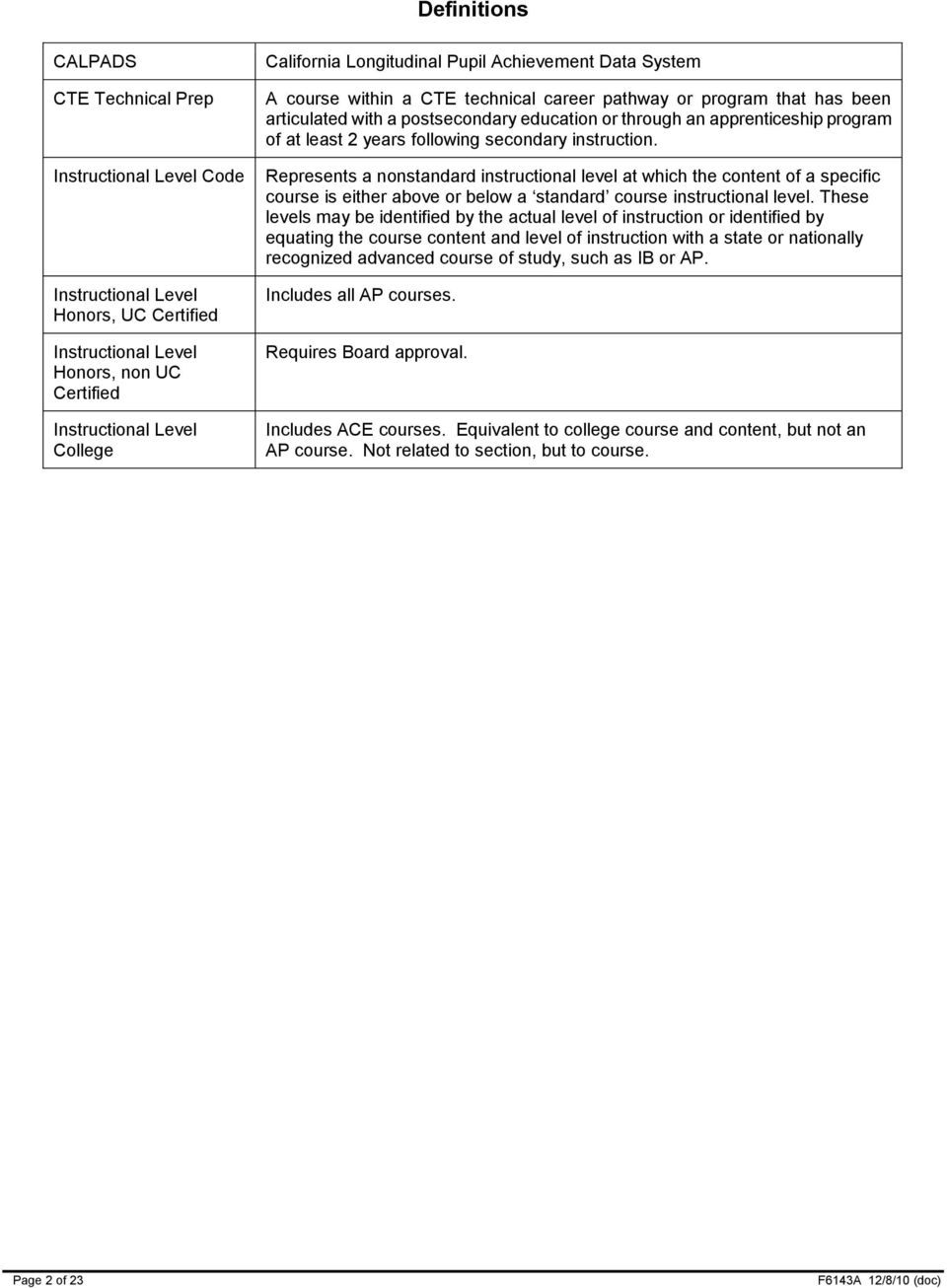
3 Course Title: Creative Writing (#0128) TABLE OF CONTENTS STATE CONTENT STANDARD # CONTENT STANDARD/UNIT TOPIC PAGE Unit 1: Introduction to Fiction, Journals, and the Workshop Process 4 Unit 2: Setting 6 Unit 3: Characterization 8 Unit 4: Plot and Conflict 10 Unit 5: Dialogue 12 Unit 6: Point of View 14 Unit 7: Symbolism and Theme 16 Unit 8: Tone and Voice 18 Unit 9: Revision, Editing, and Rewriting 20 Unit 10: Submission and Publication 22 Page 3 of 23 F6143A 12/8/10 (doc)
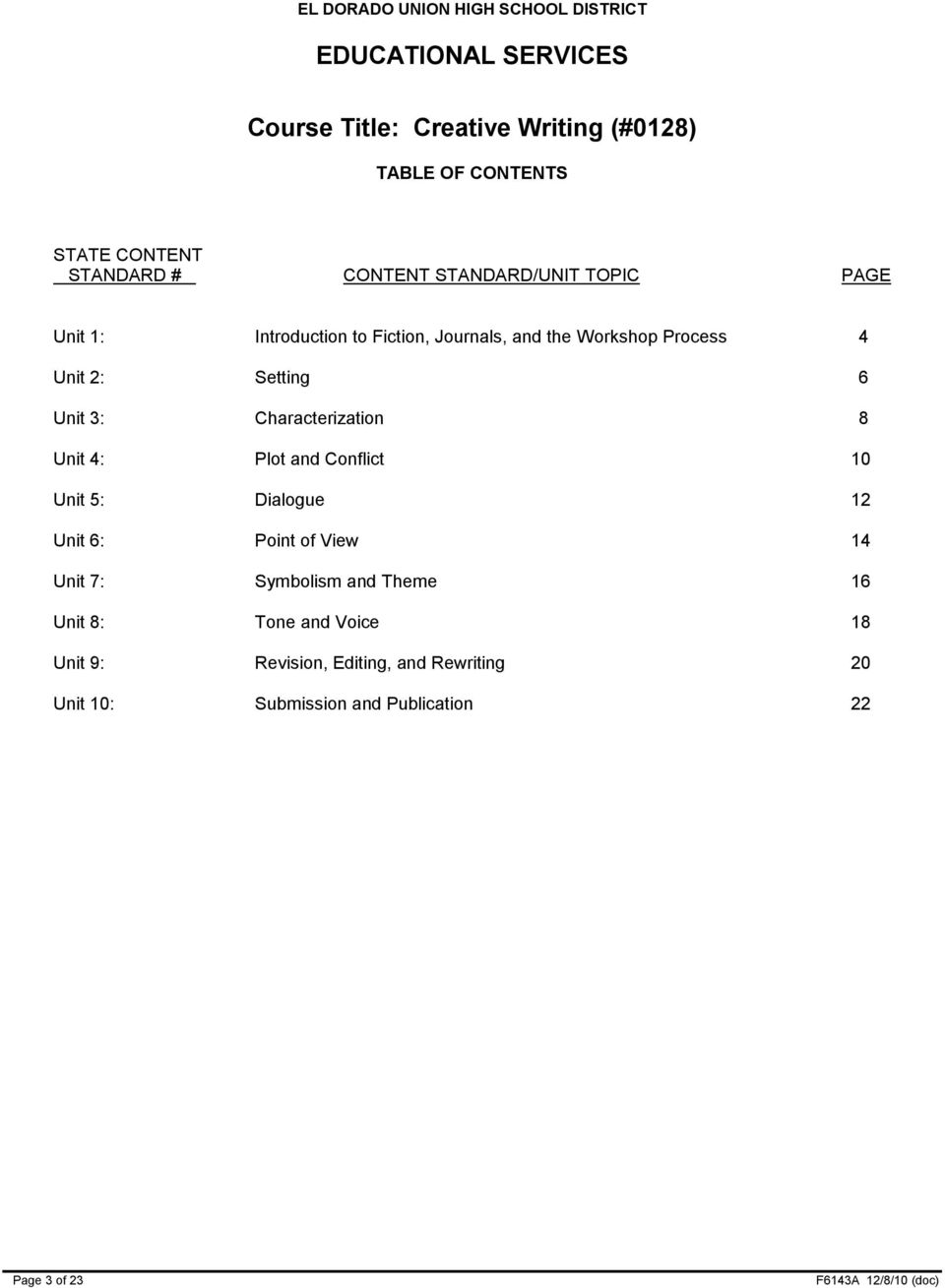
4 Department: English / Language Arts Course Title: Creative Writing (#0128) UNIT/STANDARD #: LEARNING OUTCOME: Unit 1: Introduction to Fiction, Journals and the Workshop Process To help students understand the beginnings of fiction as an art form and as a sociological and psychological marker for people in all cultures, to introduce students to the use of journals, and to introduce students to peer evaluation, critiquing, and the workshop process. LEARNING OUTCOME INSTRUCTIONAL STRATEGIES ASSESSMENTS INTERVENTIONS 1. What students will learn, know, and be able to do? (Must be aligned to state content standards.) Understand the history and origins of fiction and will examine different genres. Learn to use daily journal writing as a means of exploring ideas, understanding the writing process, and practicing the techniques of fiction writing. Learn to read his own work aloud and accept feedback from his peers; learn to critique other students work constructively and kindly. 2. Instructional strategies that will be used to engage students. Students will 1) Lecture and discussion on early fiction: styles, genres, and historical periods 2) Students will visit to peruse fiction section and create a list of genres; then, students compile lists of elements of fiction that occur in different genres. 3) Students will keep a daily journal. On some days students will write freely, while on other days they will have prescribed topics or ideas. For example, they will write for 15 minutes about a favorite place or about an emotion. 4) Students will read Colette s The Other Wife and discuss it in workshop fashion, offering their views on what works in the story and what does not. 5) Students will read short pieces of their own to the class for practice in giving and receiving criticism. 3. How will we know that students have learned? Include both Formative (for learning) and Summative (of learning) assessment examples. Students will share their writing with the class and receive peer and teacher evaluations. Student conference with one-on-one work with the teacher regarding improvements, and progress will be monitored by teacher and student. 4. What will we do if students don t learn? Student will practice skills until they are improved. 5. What will we do if students already know it? There is no mastery in creative writing. All students can improve their skills. Page 4 of 23
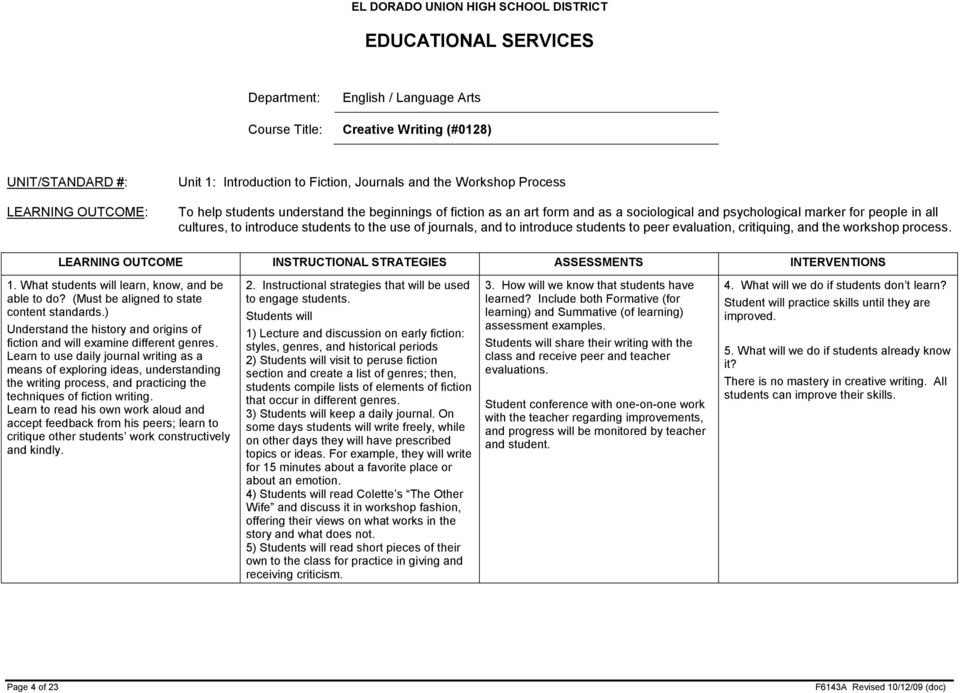
5 The students will demonstrate mastery of the following content standards: Content Area Standards (Please identify the source) Narrative Analysis of Grade-Level-Appropriate Text 3.2 Analyze the way in which the theme or meaning of a selection represents a view of comment on life, using textual evidence to support the claim. 3.3 Analyze the ways in which irony, tone, mood, the author s style, and the sound of language achieve specific rhetorical or aesthetic purposes or both. Writing 1.2 Use point of view, characterization, style, and related elements for specific rhetorical and aesthetic purposes. 1.5 Use language in natural, fresh, and vivid ways to establish a specific tone. Research and Technology 1.9 Revise text to highlight the individual voice, improve sentence variety and style, and enhance subtlety of meaning and tone in ways that are consistent with the purpose, audience, and genre. Writing Applications (Genres and their Characteristics) 2.1 Write fictional, autobiographical, or biographical narratives. 2.2 Write responses to literature. Written and Oral Language Conventions 1.1 Demonstrate control of grammar, diction, and paragraph and sentence structure and an understanding of English usage. 1.2 Produce legible work that shows accurate spelling and correct punctuation and capitalization. 1.3 Reflect appropriate manuscript requirements in writing. 2.3 Deliver oral responses to literature. Page 5 of 23
6 Department: English / Language Arts Course Title: Creative Writing (#0128) UNIT/STANDARD #: LEARNING OUTCOME: Unit 2: Setting Students will study the use of setting in fiction and will begin to incorporate detailed settings in their own writing. LEARNING OUTCOME INSTRUCTIONAL STRATEGIES ASSESSMENTS INTERVENTIONS 1. What students will learn, know, and be able to do? (Must be aligned to state content standards.) Understand the use of setting in fiction. Use the five senses in creating a setting. Understand and use setting as backdrop and a means of creating tone or atmosphere. Understand and use setting as a driving force in the plot. Understand and use setting as character Enhancement. Understand the function of setting in a novel. 2. Instructional strategies that will be used to engage students. Students will read Jack London s To Build A Fire and the opening of Edgar Allan Poe s The Fall of the House of Usher, and will discuss how the settings determine much of what the stories will be about. Students will write descriptions of settings in an attempt to create distinct tones, atmospheres, and/or backdrops. Students will take short walking tours around campus and will describe in their journals a variety of settings. Read Stephen Crane s The Open Boat and discuss the use of setting as antagonist. Students write short exercises in creating settings that help to show something about the character in that setting. Students will begin reading Of Mice and Men, and will begin analysis of Steinbeck s use of setting. 3. How will we know that students have learned? Include both Formative (for learning) and Summative (of learning) assessment examples. Students will share their writing with the class and receive peer and teacher evaluations. Student conference with one-on-one work with the teacher regarding improvements, and progress will be monitored by teacher and student.. 4. What will we do if students don t learn? Student will practice skills until they are improved. 5. What will we do if students already know it? There is no mastery in creative writing. All students can improve their skills. Page 6 of 23

7 The students will demonstrate mastery of the following content standards: Content Area Standards (Please identify the source) Narrative Analysis of Grade-Level-Appropriate Text 3.2 Analyze the way in which the theme or meaning of a selection represents a view of comment on life, using textual evidence to support the claim. 3.3 Analyze the ways in which irony, tone, mood, the author s style, and the sound of language achieve specific rhetorical or aesthetic purposes or both. Writing 1.2 Use point of view, characterization, style, and related elements for specific rhetorical and aesthetic purposes. 1.5 Use language in natural, fresh, and vivid ways to establish a specific tone. Research and Technology 1.9 Revise text to highlight the individual voice, improve sentence variety and style, and enhance subtlety of meaning and tone in ways that are consistent with the purpose, audience, and genre. Writing Applications (Genres and their Characteristics) 2.1 Write fictional, autobiographical, or biographical narratives. 2.2 Write responses to literature. Written and Oral Language Conventions 1.1 Demonstrate control of grammar, diction, and paragraph and sentence structure and an understanding of English usage. 1.2 Produce legible work that shows accurate spelling and correct punctuation and capitalization. 1.3 Reflect appropriate manuscript requirements in writing. 2.3 Deliver oral responses to literature. Page 7 of 23
8 Department: English / Language Arts Course Title: Creative Writing (#0128) UNIT/STANDARD #: LEARNING OUTCOME: Unit 3: Characterization Students will study the use of characterization in fiction, and will learn to use different methods of characterization in their own writing. LEARNING OUTCOME INSTRUCTIONAL STRATEGIES ASSESSMENTS INTERVENTIONS 1. What students will learn, know, and be able to do? (Must be aligned to state content standards.) Learn the differences between direct and indirect characterization. Learn to create indirect characterization through the use of a character s actions, thoughts, appearance, speech and other characters thoughts and dialogue about a character. Analyze the function of indirect characterization in a novel. 2. Instructional strategies that will be used to engage students. Students will read and discuss Chapter 3: Character in The Truth About Fiction. Students will read John Updike s A&P and will discuss how Updike has used indirect characterization. Students will write short scenes in which they create characters without using any direct characterization. Students will discuss and make notes on the characterization in Of Mice and Men. 3. How will we know that students have learned? Include both Formative (for learning) and Summative (of learning) assessment examples. Students will share their writing with the class and receive peer and teacher evaluations. Student conference with one-on-one work with the teacher regarding improvements, and progress will be monitored by teacher and student. 4. What will we do if students don t learn? Student will practice skills until they are improved. 5. What will we do if students already know it? There is no mastery in creative writing. All students can improve their skills. Page 8 of 23

9 The students will demonstrate mastery of the following content standards: Content Area Standards (Please identify the source) Narrative Analysis of Grade-Level-Appropriate Text 3.2 Analyze the way in which the theme or meaning of a selection represents a view of comment on life, using textual evidence to support the claim. 3.3 Analyze the ways in which irony, tone, mood, the author s style, and the sound of language achieve specific rhetorical or aesthetic purposes or both. Writing 1.2 Use point of view, characterization, style, and related elements for specific rhetorical and aesthetic purposes. 1.5 Use language in natural, fresh, and vivid ways to establish a specific tone. Research and Technology 1.9 Revise text to highlight the individual voice, improve sentence variety and style, and enhance subtlety of meaning and tone in ways that are consistent with the purpose, audience, and genre. Writing Applications (Genres and their Characteristics) 2.1 Write fictional, autobiographical, or biographical narratives. 2.2 Write responses to literature. Written and Oral Language Conventions 1.1 Demonstrate control of grammar, diction, and paragraph and sentence structure and an understanding of English usage. 1.2 Produce legible work that shows accurate spelling and correct punctuation and capitalization. 1.3 Reflect appropriate manuscript requirements in writing. 2.3 Deliver oral responses to literature. Page 9 of 23

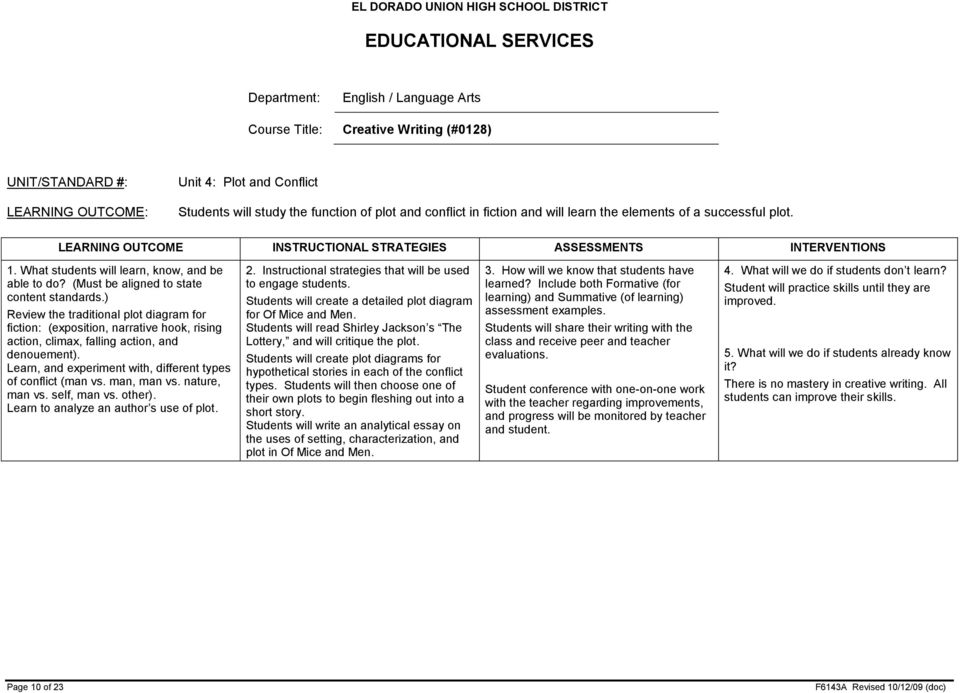
10 Department: English / Language Arts Course Title: Creative Writing (#0128) UNIT/STANDARD #: LEARNING OUTCOME: Unit 4: Plot and Conflict Students will study the function of plot and conflict in fiction and will learn the elements of a successful plot. LEARNING OUTCOME INSTRUCTIONAL STRATEGIES ASSESSMENTS INTERVENTIONS 1. What students will learn, know, and be able to do? (Must be aligned to state content standards.) Review the traditional plot diagram for fiction: (exposition, narrative hook, rising action, climax, falling action, and denouement). Learn, and experiment with, different types of conflict (man vs. man, man vs. nature, man vs. self, man vs. other). Learn to analyze an author s use of plot. 2. Instructional strategies that will be used to engage students. Students will create a detailed plot diagram for Of Mice and Men. Students will read Shirley Jackson s The Lottery, and will critique the plot. Students will create plot diagrams for hypothetical stories in each of the conflict types. Students will then choose one of their own plots to begin fleshing out into a short story. Students will write an analytical essay on the uses of setting, characterization, and plot in Of Mice and Men. 3. How will we know that students have learned? Include both Formative (for learning) and Summative (of learning) assessment examples. Students will share their writing with the class and receive peer and teacher evaluations. Student conference with one-on-one work with the teacher regarding improvements, and progress will be monitored by teacher and student. 4. What will we do if students don t learn? Student will practice skills until they are improved. 5. What will we do if students already know it? There is no mastery in creative writing. All students can improve their skills. Page 10 of 23
11 The students will demonstrate mastery of the following content standards: Content Area Standards (Please identify the source) Narrative Analysis of Grade-Level-Appropriate Text 3.2 Analyze the way in which the theme or meaning of a selection represents a view of comment on life, using textual evidence to support the claim. 3.3 Analyze the ways in which irony, tone, mood, the author s style, and the sound of language achieve specific rhetorical or aesthetic purposes or both. Writing 1.2 Use point of view, characterization, style, and related elements for specific rhetorical and aesthetic purposes. 1.5 Use language in natural, fresh, and vivid ways to establish a specific tone. Research and Technology 1.9 Revise text to highlight the individual voice, improve sentence variety and style, and enhance subtlety of meaning and tone in ways that are consistent with the purpose, audience, and genre. Writing Applications (Genres and their Characteristics) 2.1 Write fictional, autobiographical, or biographical narratives. 2.2 Write responses to literature. Written and Oral Language Conventions 1.1 Demonstrate control of grammar, diction, and paragraph and sentence structure and an understanding of English usage. 1.2 Produce legible work that shows accurate spelling and correct punctuation and capitalization. 1.3 Reflect appropriate manuscript requirements in writing. 2.3 Deliver oral responses to literature. Page 11 of 23
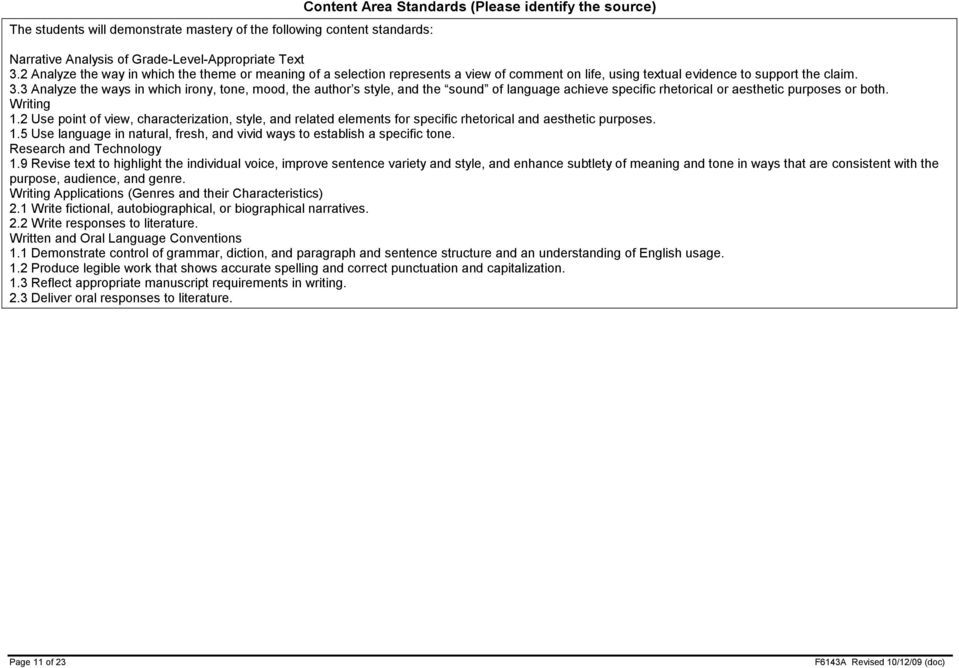
12 Department: English / Language Arts Course Title: Creative Writing (#0128) UNIT/STANDARD #: LEARNING OUTCOME: Unit 5: Dialogue Students will study to uses of and will learn to use dialogue in fiction. LEARNING OUTCOME INSTRUCTIONAL STRATEGIES ASSESSMENTS INTERVENTIONS 1. What students will learn, know, and be able to do? (Must be aligned to state content standards.) Learn the mechanics of written dialogue. Analyze different authors use of dialogue to convey information about characters and plot. Learn to create character through dialogue. Learn to use dialogue to further a plot. 2. Instructional strategies that will be used to engage students. Students will read and discuss Chapter 7: Point of View in The Truth About Fiction. Students will read excerpts from several teacher-provided stories, and will determine the point of view of each narrator. Students will read John O Hara s Do You Like It Here? and will analyze why the author chose the third-person limited narration. Students will write a scene using a firstperson narrator. Students will rewrite the same scene using a third-person limited narrator. Students will rewrite the same scene a third time using a third-person omniscient narrator. Students will analyze the use of each type of point of view used in their scenes (above), and will then flesh out their scene/story using the point of view that will best serve the story they mean to tell. 3. How will we know that students have learned? Include both Formative (for learning) and Summative (of learning) assessment examples. Students will share their writing with the class and receive peer and teacher evaluations. Student conference with one-on-one work with the teacher regarding improvements, and progress will be monitored by teacher and student. 4. What will we do if students don t learn? Student will practice skills until they are improved. 5. What will we do if students already know it? There is no mastery in creative writing. All students can improve their skills. Page 12 of 23
13 The students will demonstrate mastery of the following content standards: Content Area Standards (Please identify the source) Narrative Analysis of Grade-Level-Appropriate Text 3.2 Analyze the way in which the theme or meaning of a selection represents a view of comment on life, using textual evidence to support the claim. 3.3 Analyze the ways in which irony, tone, mood, the author s style, and the sound of language achieve specific rhetorical or aesthetic purposes or both. Writing 1.2 Use point of view, characterization, style, and related elements for specific rhetorical and aesthetic purposes. 1.5 Use language in natural, fresh, and vivid ways to establish a specific tone. Research and Technology 1.9 Revise text to highlight the individual voice, improve sentence variety and style, and enhance subtlety of meaning and tone in ways that are consistent with the purpose, audience, and genre. Writing Applications (Genres and their Characteristics) 2.1 Write fictional, autobiographical, or biographical narratives. 2.2 Write responses to literature. Written and Oral Language Conventions 1.1 Demonstrate control of grammar, diction, and paragraph and sentence structure and an understanding of English usage. 1.2 Produce legible work that shows accurate spelling and correct punctuation and capitalization. 1.3 Reflect appropriate manuscript requirements in writing. 2.3 Deliver oral responses to literature. Page 13 of 23

14 Department: English / Language Arts Course Title: Creative Writing (#0128) UNIT/STANDARD #: LEARNING OUTCOME: Unit 6: Point of View Students will study the uses of and will learn to use point of view in fiction. LEARNING OUTCOME INSTRUCTIONAL STRATEGIES ASSESSMENTS INTERVENTIONS 1. What students will learn, know, and be able to do? (Must be aligned to state content standards.) Learn about and be able to identify different points of view in fiction; firstperson narration, third-person limited narration, and third-person omniscient narration. Learn to use first-person narration. Learn to use third-person limited narration. Learn to use third-person omniscient narration. Practice choosing which type of narration will best serve a certain story. 2. Instructional strategies that will be used to engage students. Students will read and discuss Chapter 7: Point of View in The Truth About Fiction. Students will read excerpts from several teacher-provided stories, and will determine then point of view of each narrator. Students will read John O Hara s Do You Like It Here? and will analyze why the author chose the third-person limited narration. Students will write a scene using a firstperson narrator. Students will rewrite the same scene using a third-person limited narrator. Students will rewrite the same scene a third time using a third-person omniscient narrator. Students will analyze the use of each type of point of view used in their scenes (above), and will then flesh out their scene/story using the point of view that will best serve the story they mean to tell. 3. How will we know that students have learned? Include both Formative (for learning) and Summative (of learning) assessment examples. Students will share their writing with the class and receive peer and teacher evaluations. Student conference with one-on-one work with the teacher regarding improvements, and progress will be monitored by teacher and student. 4. What will we do if students don t learn? Student will practice skills until they are improved. 5. What will we do if students already know it? There is no mastery in creative writing. All students can improve their skills. Page 14 of 23

15 The students will demonstrate mastery of the following content standards: Content Area Standards (Please identify the source) Narrative Analysis of Grade-Level-Appropriate Text 3.2 Analyze the way in which the theme or meaning of a selection represents a view of comment on life, using textual evidence to support the claim. 3.3 Analyze the ways in which irony, tone, mood, the author s style, and the sound of language achieve specific rhetorical or aesthetic purposes or both. Writing 1.2 Use point of view, characterization, style, and related elements for specific rhetorical and aesthetic purposes. 1.5 Use language in natural, fresh, and vivid ways to establish a specific tone. Research and Technology 1.9 Revise text to highlight the individual voice, improve sentence variety and style, and enhance subtlety of meaning and tone in ways that are consistent with the purpose, audience, and genre. Writing Applications (Genres and their Characteristics) 2.1 Write fictional, autobiographical, or biographical narratives. 2.2 Write responses to literature. Written and Oral Language Conventions 1.1 Demonstrate control of grammar, diction, and paragraph and sentence structure and an understanding of English usage. 1.2 Produce legible work that shows accurate spelling and correct punctuation and capitalization. 1.3 Reflect appropriate manuscript requirements in writing. 2.3 Deliver oral responses to literature. Page 15 of 23

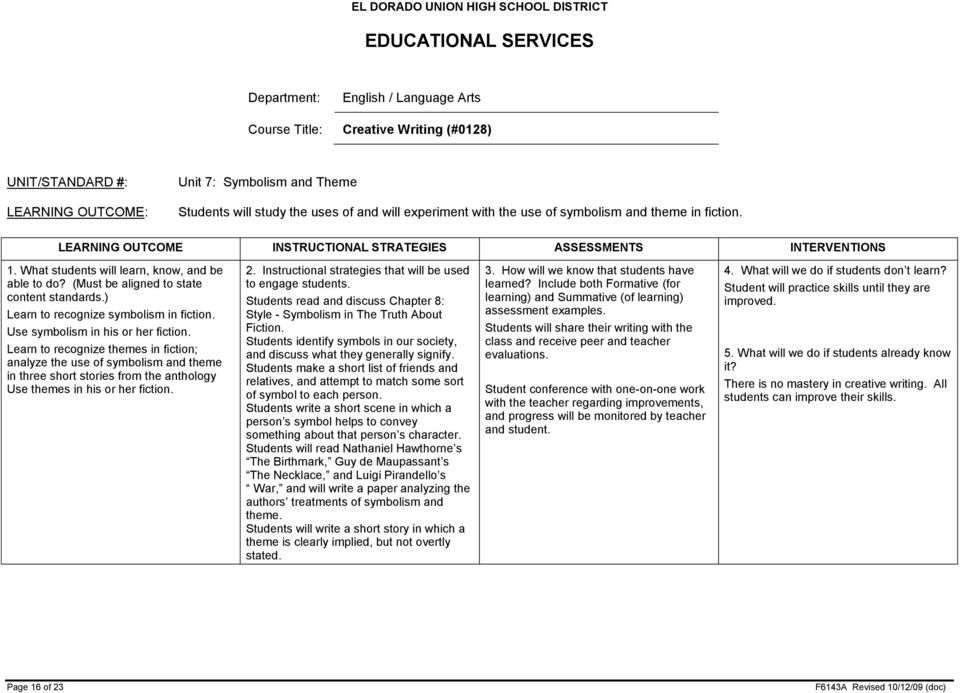
16 Department: English / Language Arts Course Title: Creative Writing (#0128) UNIT/STANDARD #: LEARNING OUTCOME: Unit 7: Symbolism and Theme Students will study the uses of and will experiment with the use of symbolism and theme in fiction. LEARNING OUTCOME INSTRUCTIONAL STRATEGIES ASSESSMENTS INTERVENTIONS 1. What students will learn, know, and be able to do? (Must be aligned to state content standards.) Learn to recognize symbolism in fiction. Use symbolism in his or her fiction. Learn to recognize themes in fiction; analyze the use of symbolism and theme in three short stories from the anthology Use themes in his or her fiction. 2. Instructional strategies that will be used to engage students. Students read and discuss Chapter 8: Style - Symbolism in The Truth About Fiction. Students identify symbols in our society, and discuss what they generally signify. Students make a short list of friends and relatives, and attempt to match some sort of symbol to each person. Students write a short scene in which a person s symbol helps to convey something about that person s character. Students will read Nathaniel Hawthorne s The Birthmark, Guy de Maupassant s The Necklace, and Luigi Pirandello s War, and will write a paper analyzing the authors treatments of symbolism and theme. Students will write a short story in which a theme is clearly implied, but not overtly stated. 3. How will we know that students have learned? Include both Formative (for learning) and Summative (of learning) assessment examples. Students will share their writing with the class and receive peer and teacher evaluations. Student conference with one-on-one work with the teacher regarding improvements, and progress will be monitored by teacher and student. 4. What will we do if students don t learn? Student will practice skills until they are improved. 5. What will we do if students already know it? There is no mastery in creative writing. All students can improve their skills. Page 16 of 23
17 The students will demonstrate mastery of the following content standards: Content Area Standards (Please identify the source) Narrative Analysis of Grade-Level-Appropriate Text 3.2 Analyze the way in which the theme or meaning of a selection represents a view of comment on life, using textual evidence to support the claim. 3.3 Analyze the ways in which irony, tone, mood, the author s style, and the sound of language achieve specific rhetorical or aesthetic purposes or both. Writing 1.2 Use point of view, characterization, style, and related elements for specific rhetorical and aesthetic purposes. 1.5 Use language in natural, fresh, and vivid ways to establish a specific tone. Research and Technology 1.9 Revise text to highlight the individual voice, improve sentence variety and style, and enhance subtlety of meaning and tone in ways that are consistent with the purpose, audience, and genre. Writing Applications (Genres and their Characteristics) 2.1 Write fictional, autobiographical, or biographical narratives. 2.2 Write responses to literature. Written and Oral Language Conventions 1.1 Demonstrate control of grammar, diction, and paragraph and sentence structure and an understanding of English usage. 1.2 Produce legible work that shows accurate spelling and correct punctuation and capitalization. 1.3 Reflect appropriate manuscript requirements in writing. 2.3 Deliver oral responses to literature. Page 17 of 23

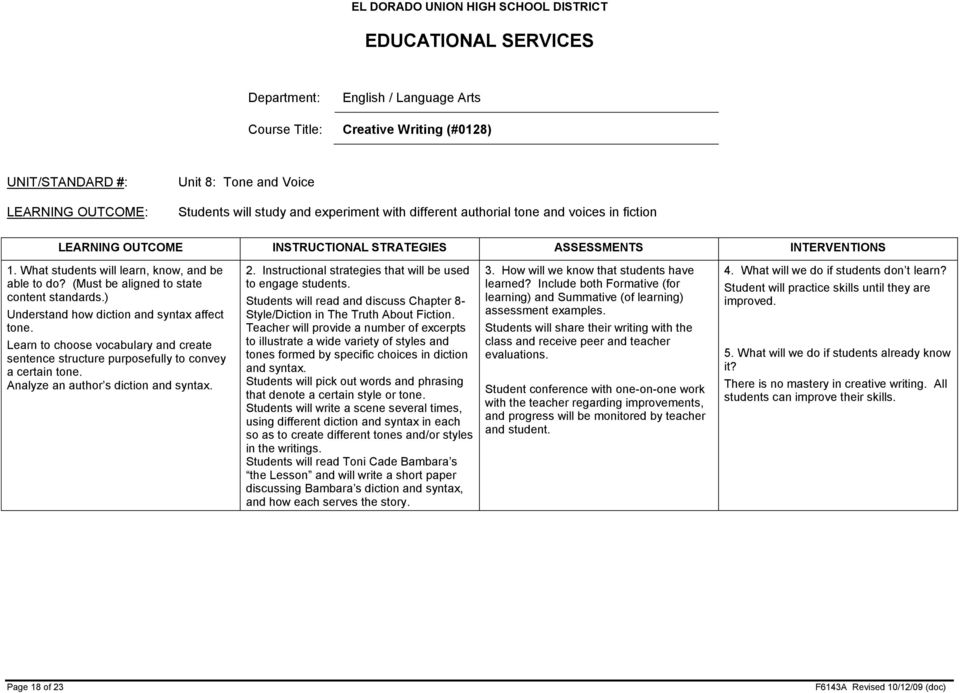
18 Department: English / Language Arts Course Title: Creative Writing (#0128) UNIT/STANDARD #: LEARNING OUTCOME: Unit 8: Tone and Voice Students will study and experiment with different authorial tone and voices in fiction LEARNING OUTCOME INSTRUCTIONAL STRATEGIES ASSESSMENTS INTERVENTIONS 1. What students will learn, know, and be able to do? (Must be aligned to state content standards.) Understand how diction and syntax affect tone. Learn to choose vocabulary and create sentence structure purposefully to convey a certain tone. Analyze an author s diction and syntax. 2. Instructional strategies that will be used to engage students. Students will read and discuss Chapter 8- Style/Diction in The Truth About Fiction. Teacher will provide a number of excerpts to illustrate a wide variety of styles and tones formed by specific choices in diction and syntax. Students will pick out words and phrasing that denote a certain style or tone. Students will write a scene several times, using different diction and syntax in each so as to create different tones and/or styles in the writings. Students will read Toni Cade Bambara s the Lesson and will write a short paper discussing Bambara s diction and syntax, and how each serves the story. 3. How will we know that students have learned? Include both Formative (for learning) and Summative (of learning) assessment examples. Students will share their writing with the class and receive peer and teacher evaluations. Student conference with one-on-one work with the teacher regarding improvements, and progress will be monitored by teacher and student. 4. What will we do if students don t learn? Student will practice skills until they are improved. 5. What will we do if students already know it? There is no mastery in creative writing. All students can improve their skills. Page 18 of 23
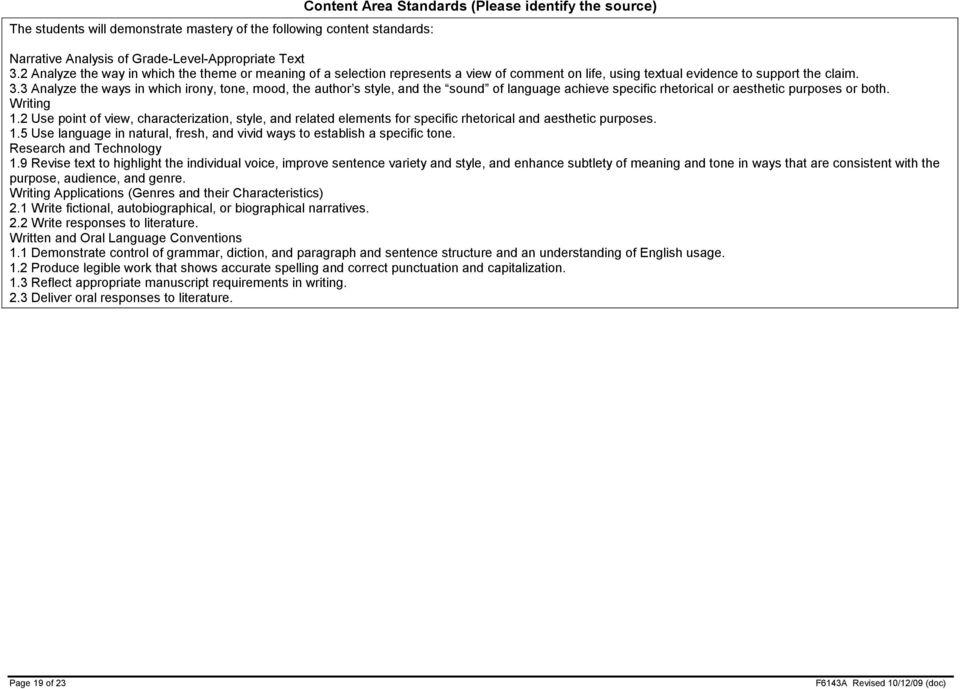
19 The students will demonstrate mastery of the following content standards: Content Area Standards (Please identify the source) Narrative Analysis of Grade-Level-Appropriate Text 3.2 Analyze the way in which the theme or meaning of a selection represents a view of comment on life, using textual evidence to support the claim. 3.3 Analyze the ways in which irony, tone, mood, the author s style, and the sound of language achieve specific rhetorical or aesthetic purposes or both. Writing 1.2 Use point of view, characterization, style, and related elements for specific rhetorical and aesthetic purposes. 1.5 Use language in natural, fresh, and vivid ways to establish a specific tone. Research and Technology 1.9 Revise text to highlight the individual voice, improve sentence variety and style, and enhance subtlety of meaning and tone in ways that are consistent with the purpose, audience, and genre. Writing Applications (Genres and their Characteristics) 2.1 Write fictional, autobiographical, or biographical narratives. 2.2 Write responses to literature. Written and Oral Language Conventions 1.1 Demonstrate control of grammar, diction, and paragraph and sentence structure and an understanding of English usage. 1.2 Produce legible work that shows accurate spelling and correct punctuation and capitalization. 1.3 Reflect appropriate manuscript requirements in writing. 2.3 Deliver oral responses to literature. Page 19 of 23
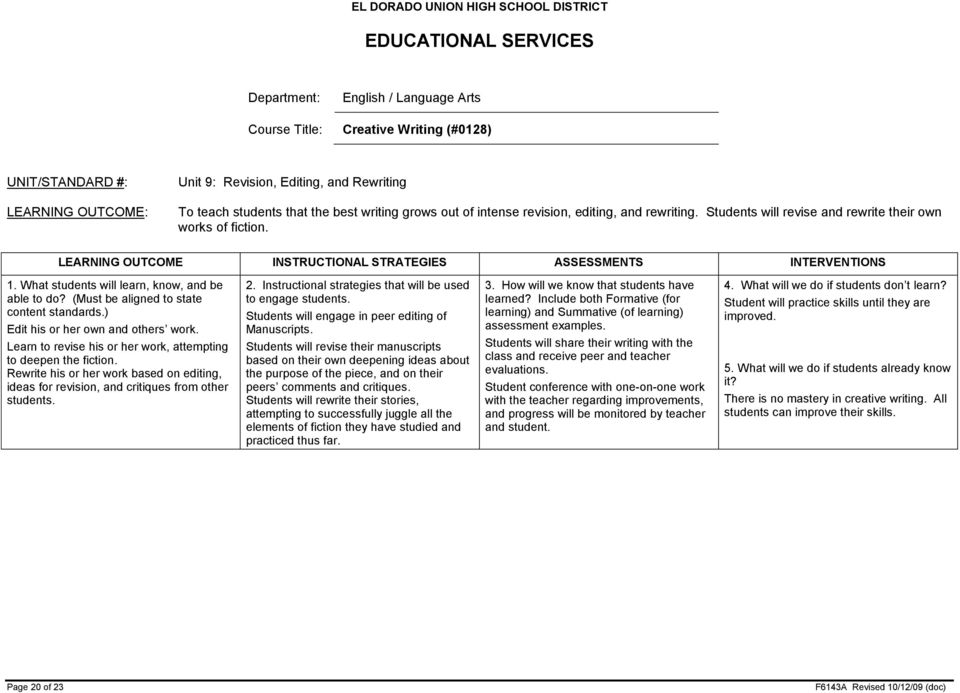
20 Department: English / Language Arts Course Title: Creative Writing (#0128) UNIT/STANDARD #: LEARNING OUTCOME: Unit 9: Revision, Editing, and Rewriting To teach students that the best writing grows out of intense revision, editing, and rewriting. Students will revise and rewrite their own works of fiction. LEARNING OUTCOME INSTRUCTIONAL STRATEGIES ASSESSMENTS INTERVENTIONS 1. What students will learn, know, and be able to do? (Must be aligned to state content standards.) Edit his or her own and others work. Learn to revise his or her work, attempting to deepen the fiction. Rewrite his or her work based on editing, ideas for revision, and critiques from other students. 2. Instructional strategies that will be used to engage students. Students will engage in peer editing of Manuscripts. Students will revise their manuscripts based on their own deepening ideas about the purpose of the piece, and on their peers comments and critiques. Students will rewrite their stories, attempting to successfully juggle all the elements of fiction they have studied and practiced thus far. 3. How will we know that students have learned? Include both Formative (for learning) and Summative (of learning) assessment examples. Students will share their writing with the class and receive peer and teacher evaluations. Student conference with one-on-one work with the teacher regarding improvements, and progress will be monitored by teacher and student. 4. What will we do if students don t learn? Student will practice skills until they are improved. 5. What will we do if students already know it? There is no mastery in creative writing. All students can improve their skills. Page 20 of 23
21 The students will demonstrate mastery of the following content standards: Content Area Standards (Please identify the source) Narrative Analysis of Grade-Level-Appropriate Text 3.2 Analyze the way in which the theme or meaning of a selection represents a view of comment on life, using textual evidence to support the claim. 3.3 Analyze the ways in which irony, tone, mood, the author s style, and the sound of language achieve specific rhetorical or aesthetic purposes or both. Writing 1.2 Use point of view, characterization, style, and related elements for specific rhetorical and aesthetic purposes. 1.5 Use language in natural, fresh, and vivid ways to establish a specific tone. Research and Technology 1.9 Revise text to highlight the individual voice, improve sentence variety and style, and enhance subtlety of meaning and tone in ways that are consistent with the purpose, audience, and genre. Writing Applications (Genres and their Characteristics) 2.1 Write fictional, autobiographical, or biographical narratives. 2.2 Write responses to literature. Written and Oral Language Conventions 1.1 Demonstrate control of grammar, diction, and paragraph and sentence structure and an understanding of English usage. 1.2 Produce legible work that shows accurate spelling and correct punctuation and capitalization. 1.3 Reflect appropriate manuscript requirements in writing. 2.3 Deliver oral responses to literature. Page 21 of 23
22 Department: English / Language Arts Course Title: Creative Writing (#0128) UNIT/STANDARD #: LEARNING OUTCOME: Unit 10: Submission and Publication To have students prepare a manuscript for submission and publication. LEARNING OUTCOME INSTRUCTIONAL STRATEGIES ASSESSMENTS INTERVENTIONS 1. What students will learn, know, and be able to do? (Must be aligned to state content standards.) Learn how to properly format a manuscript for submission and publication. Do research on which publications are open to receiving submissions from young writers. Learn appropriate business letter format and style for query letters to editors and publishers. Submit one piece to an appropriate editor/publication. 2. Instructional strategies that will be used to engage students. Students will study Appendix - Manuscript Style in The Truth About Fiction. Students will put one of their own stories into appropriate format for submission. Students will study Appendix - Manuscript Style in The Truth About Fiction. Teacher will provide sources and create a list of publications that accept students works. Students will research possible places to submit, and will evaluate appropriateness of their stories for specific publications. Teacher will instruct students on proper business letter format, and query letter content and style. Students will compose query letters for their submissions. Students will submit at least one piece for Publication. 3. How will we know that students have learned? Include both Formative (for learning) and Summative (of learning) assessment examples. Students will share their writing with the class and receive peer and teacher evaluations. Student conference with one-on-one work with the teacher regarding improvements, and progress will be monitored by teacher and student. 4. What will we do if students don t learn? Student will practice skills until they are improved. 5. What will we do if students already know it? There is no mastery in creative writing. All students can improve their skills. Page 22 of 23
23 The students will demonstrate mastery of the following content standards: Content Area Standards (Please identify the source) Narrative Analysis of Grade-Level-Appropriate Text 3.2 Analyze the way in which the theme or meaning of a selection represents a view of comment on life, using textual evidence to support the claim. 3.3 Analyze the ways in which irony, tone, mood, the author s style, and the sound of language achieve specific rhetorical or aesthetic purposes or both. Writing 1.2 Use point of view, characterization, style, and related elements for specific rhetorical and aesthetic purposes. 1.5 Use language in natural, fresh, and vivid ways to establish a specific tone. Research and Technology 1.9 Revise text to highlight the individual voice, improve sentence variety and style, and enhance subtlety of meaning and tone in ways that are consistent with the purpose, audience, and genre. Writing Applications (Genres and their Characteristics) 2.1 Write fictional, autobiographical, or biographical narratives. 2.2 Write responses to literature. Written and Oral Language Conventions 1.1 Demonstrate control of grammar, diction, and paragraph and sentence structure and an understanding of English usage. 1.2 Produce legible work that shows accurate spelling and correct punctuation and capitalization. 1.3 Reflect appropriate manuscript requirements in writing. 2.3 Deliver oral responses to literature. Page 23 of 23
Appendix: W. Item: Curriculum Course Guide - New High School Course/Honors Creative Writing Department: Instructional Services
 Appendix: W Item: Curriculum Course Guide - New High School Course/Honors Creative Writing Department: Instructional Services Background/Historical Context: Creative Writing has been offered in our school
Virginia English Standards of Learning Grade 8
 A Correlation of Prentice Hall Writing Coach 2012 To the Virginia English Standards of Learning A Correlation of, 2012, Introduction This document demonstrates how, 2012, meets the objectives of the. Correlation
English 2 - Journalism Mitch Martin: [email protected]
 Mission English 2 - Journalism Mitch Martin: [email protected] To educate students to be self-directed learners, collaborative workers, complex thinkers, quality producers, and community contributors
FOLSOM CORDOVA UNIFIED SCHOOL DISTRICT COMPUTER GAME DESIGN
 FOLSOM CORDOVA UNIFIED SCHOOL DISTRICT COMPUTER GAME DESIGN Date: January 2016 Proposed Grade Level(s): Grade 6-8 Grading: A-F Prerequisite(s): None Course Length: Year Subject Area: Technology Elective
ENG 138 CREATIVE WRITING I
 ENG 138 CREATIVE WRITING I PRESENTED AND APPROVED: APRIL 6, 2012 EFFECTIVE: FALL 2012-13 Prefix & Number ENG 138 Course Title: Creative Writing I Purpose of this submission: New X Change/Updated Retire
Multimedia Applications
 Multimedia Applications Department: CTE Grade Level: 10-12 Length: Two semesters Prerequisite: Computer Literacy or its equivalent. Credit: 10 units PHILOSOPHY This course is designed for students interested
Writing Emphasis by Grade Level Based on State Standards. K 5.1 Draw pictures and write words for specific reasons.
 Writing Emphasis by Grade Level Based on State Standards Grade K K 5.1 Draw pictures and write words for specific reasons. Grade 1 1.5.1 Write brief narratives describing an experience. Grade 2 2.5.2 Write
Montgomery County Public Schools English 9B Exam Review
 Montgomery County Public Schools English 9B Exam Review June 2013 FORMAT Five Readings an excerpt from a Shakespeare play (not Romeo and Juliet) two poems a narrative a nonfiction article related to the
THE BACHELOR S DEGREE IN SPANISH
 Academic regulations for THE BACHELOR S DEGREE IN SPANISH THE FACULTY OF HUMANITIES THE UNIVERSITY OF AARHUS 2007 1 Framework conditions Heading Title Prepared by Effective date Prescribed points Text
High School Communications Curriculum Indicators tested/taught indicator
 Freshman Sophomore Junior Senior adjusts reading rate to support comprehension when reading HS.1.2.1 narrative, and persuasive texts. determines meaning of words or phrases using context clues (e.g., definitions,
Grade 4 Writing Curriculum Map
 Curriculum Map BOE Approval November 2013 CURRICULUM MAP WRITING GRADE 4 SEPTEMBER OCTOBER NOVEMBER DECEMBER JANUARY Creating a Buzz About : It s All About Me! Tell Me A Story Realistic Fiction Tell Me
Language Arts Literacy Areas of Focus: Grade 5
 Language Arts Literacy : Grade 5 Mission: Learning to read, write, speak, listen, and view critically, strategically and creatively enables students to discover personal and shared meaning throughout their
Write the key elements of the plot in a story you have read.
 F OR USE WITH F OCUS L ESSON 1: PLOT, SETTING, AND T HEME 1a Plot is the series of events in a story. Exposition is the author s introduction to the characters and setting. The conflict, or problem, sets
Integrating the Common Core Standards into the Music Curriculum
 Place Photo Here, Otherwise Delete Box Integrating the Common Core Standards into the Music Curriculum Tom L. Foust January 24 th, 2013 Illinois Music Educators Conference Peoria, Illinois What is the
PENNSYLVANIA COMMON CORE STANDARDS English Language Arts Grades 9-12
 1.2 Reading Informational Text Students read, understand, and respond to informational text with emphasis on comprehension, making connections among ideas and between texts with focus on textual evidence.
Montgomery County Public Schools Advanced English Semester A Exam Review
 Montgomery County Public Schools Advanced English Semester A Exam Review Four Readings including a narrative a poem a non-fiction piece a visual FORMAT Thirty Selected Response Items (SRs) Students will
Minnesota K-12 Academic Standards in Language Arts Curriculum and Assessment Alignment Form Rewards Intermediate Grades 4-6
 Minnesota K-12 Academic Standards in Language Arts Curriculum and Assessment Alignment Form Rewards Intermediate Grades 4-6 4 I. READING AND LITERATURE A. Word Recognition, Analysis, and Fluency The student
thank you, m'am by langston hughes
 thank you, m'am by langston hughes item analyses for all standards: vocabulary, reading, writing, conventions grade grade 8 grades 9 & 0 iv vi vii reading standard.0 --word analysis, fluency, and systematic
LANGUAGE! 4 th Edition, Levels A C, correlated to the South Carolina College and Career Readiness Standards, Grades 3 5
 Page 1 of 57 Grade 3 Reading Literary Text Principles of Reading (P) Standard 1: Demonstrate understanding of the organization and basic features of print. Standard 2: Demonstrate understanding of spoken
Fifth Grade English Language Arts Learning Goals for 3 rd 9- Weeks
 Skills students should demonstrate by the end of the 2 nd 9- weeks of school: Unit 4A- Making Connections Across Literary Genres Learning Goal: Student will understand that authors use point of view to
Language Arts Literacy Areas of Focus: Grade 6
 Language Arts Literacy : Grade 6 Mission: Learning to read, write, speak, listen, and view critically, strategically and creatively enables students to discover personal and shared meaning throughout their
Develop Research Skills Emphasize how research informs almost all writing by crafting assignments that require students to draw on traditional and
 College Writing Program: What Students Should Learn The following are the core skills and ideas students should gain from the College Writing course sequence: Concepts of Writing Students should understand
Units of Study 9th Grade
 Units of Study 9th Grade First Semester Theme: The Journey Second Semester Theme: Choices The Big Ideas in English Language Arts that drive instruction: Independent thinkers construct meaning through language.
Lake Tahoe Community College
 Lake Tahoe Community College Official Course Outline for: ENG 102 Modification Date: 3/26/2007 Title V Date: 3/26/2007 Course Title: Introduction to Literature Lecture Hours Lab Hours Quarter Units Total
STATE UNIVERSITY OF NEW YORK COLLEGE OF TECHNOLOGY CANTON, NEW YORK COURSE OUTLINE ENGL 221 - CREATIVE WRITING
 STATE UNIVERSITY OF NEW YORK COLLEGE OF TECHNOLOGY CANTON, NEW YORK COURSE OUTLINE ENGL 221 - CREATIVE WRITING Prepared By: Cindy Lou Daniels Revised By: Robert Strong, December 2005 Updated By: Cindy
Grade: 9 (1) Students will build a framework for high school level academic writing by understanding the what of language, including:
 Introduction: The following document is a draft of standards-designed, comprehensive Pacing Guide for high school English Grade 9. This document will evolve as feedback is accumulated. The Pacing Guide
the treasure of lemon brown by walter dean myers
 the treasure of lemon brown by walter dean myers item analysis for all grade 7 standards: vocabulary, reading, writing, conventions item analysis for all grade 8 standards: vocabulary, reading, writing,
North Carolina Essential Standards Kindergarten Theatre Arts. Communication. Analysis. Aesthetics
 North Carolina s Kindergarten Theatre Arts Note on Numbering/Strands: C - Communication, A - Analysis, AE Aesthetics, CU - Culture Communication K.C.1 K.C.2 Use movement, voice, and writing to communicate
AK + ASD Writing Grade Level Expectations For Grades 3-6
 Revised ASD June 2004 AK + ASD Writing For Grades 3-6 The first row of each table includes a heading that summarizes the performance standards, and the second row includes the complete performance standards.
Narrative Literature Response Letters Grade Three
 Ohio Standards Connection Writing Applications Benchmark A Write narrative accounts that develop character, setting and plot. Indicator: 1 Write stories that sequence events and include descriptive details
National Essential Skills Survey / Common Core State Standards / NYS ELA Standards / CDOS / State Assessment Crosswalk
 National Essential Skills Survey / Common Core State Standards / NYS EA Standards / CDOS / State Assessment Crosswalk NESS NYS EA Connections CDOS Regents Reading for iterature E2 E37 E38 1. Cite strong
No Evidence. 8.9 f X
 Section I. Correlation with the 2010 English Standards of Learning and Curriculum Framework- Grade 8 Writing Summary Adequate Rating Limited No Evidence Section I. Correlation with the 2010 English Standards
Ms Juliani -Syllabus Special Education-Language/ Writing
 Ms Juliani -Syllabus Special Education-Language/ Writing * As a teacher, I have high expectations for my students and believe that they need to be encouraged, nurtured, and rewarded for their efforts.
#804 Digital Media II,
 Digital Media II Level: 11-12 Units of Credit: 1.00 CIP Code: 11.0211 Core Code: 35-02-00-00-011 Prerequisite: Skill Tests: Digital Media I #804 Digital Media II, Adobe Photoshop Adobe Illustrator Adobe
ESL I English as a Second Language I Curriculum
 ESL I English as a Second Language I Curriculum ESL Curriculum alignment with NJ English Language Proficiency Standards (Incorporating NJCCCS and WIDA Standards) Revised November, 2011 The ESL program
This curriculum is part of the Educational Program of Studies of the Rahway Public Schools. ACKNOWLEDGMENTS
 CURRICULUM FOR INTRODUCTION TO JOURNALISM GRADES 9 & 10 This curriculum is part of the Educational Program of Studies of the Rahway Public Schools. ACKNOWLEDGMENTS Christine H. Salcito, Director of Curriculum
Creative Writing Mrs. Maryjo Williams Room A213
 Creative Writing Mrs. Maryjo Williams Room A213 One of the most valuable things we can do to heal one another is listen to each other s stories. ----- Rebecca Falls Course Description This course introduces
Unit: Fever, Fire and Fashion Term: Spring 1 Year: 5
 Unit: Fever, Fire and Fashion Term: Spring 1 Year: 5 English Fever, Fire and Fashion Unit Summary In this historical Unit pupils learn about everyday life in London during the 17 th Century. Frost fairs,
CREATIVE WRITING AT INDIANA STATE UNIVERSITY 2015 INTRODUCTION APPENDIX
 CREATIVE WRITING AT INDIANA STATE UNIVERSITY 2015 INTRODUCTION Introduction........................................................... 2 The Creative Writing Committee........................................
WHITTIER UNION HIGH SCHOOL DISTRICT Whittier, California. June, 1984 Revised October 2005. BOARD APPROVED: January 17, 2006 COURSE OF STUDY
 WHITTIER UNION HIGH SCHOOL DISTRICT Whittier, California June, 1984 Revised October 2005 BOARD APPROVED: January 17, 2006 COURSE OF STUDY Course Title: Department: ANNUAL STAFF Elective Grade Level(s):
Rubrics for Assessing Student Writing, Listening, and Speaking High School
 Rubrics for Assessing Student Writing, Listening, and Speaking High School Copyright by the McGraw-Hill Companies, Inc. All rights reserved. Permission is granted to reproduce the material contained herein
Creative Writing: Adventures Through Time Course Syllabus
 Lesson Title Concepts, Content Objectives, and 1 Character Composition Concepts and Content Objectives Definitions and features of the Six Threads of Characterization: thoughts, physicality, actions, speech,
Annotated work sample portfolios are provided to support implementation of the Foundation Year 10 Australian Curriculum.
 Work sample portfolio summary WORK SAMPLE PORTFOLIO Annotated work sample portfolios are provided to support implementation of the Foundation Year 10 Australian Curriculum. Each portfolio is an example
Lesson Title: Argumentative Writing (Writing a Critical Review)
 Lesson Title: Argumentative Writing (Writing a Critical Review) Author: Carl Myers, DeeAnne Simonson Subject Area(s): Type an X in the box to the left of the subject area(s) addressed in this lesson: Subject
Teacher's Guide to Meeting the Common Core State Standards* with Scott Foresman Reading Street 2008
 Implementing the Common Core State StandArds Teacher's Guide to Meeting the Common Core State Standards* with Scott Foresman Reading Street 2008 Table of Contents Grade 5 Introduction................................................
Literature Circles. Preparing for Literature Circles
 Literature Circles Implementing Literature Circles may seem like a daunting task, but, with foresight and planning, this approach provides students an opportunity for tremendous growth. Literature Circles
Technology Integration Learning Plan: Fostering Authentic Writing through Blogging in the Classroom
 Technology Integration Learning Plan: Fostering Authentic Writing through Blogging in the Classroom I. Overview: This unit will address students understanding, performance, and achievement in literacy
Inspiration Standards Match: Virginia
 Inspiration Standards Match: Virginia Standards of Learning: English Language Arts Middle School Meeting curriculum standards is a major focus in education today. This document highlights the correlation
English 1010 Introduction to College Writing
 English 1010 Introduction to College Writing Version: Template to match other English courses April 2009 The English Department at Dixie State College strives to instill in students an appreciation for
Grade 6 English Language Arts Performance Level Descriptors
 Limited Grade 6 English Language Arts Performance Level Descriptors A student performing at the Limited Level demonstrates a minimal command of Ohio s Learning Standards for Grade 6 English Language Arts.
I VE GOT A GREAT IDEA!
 I VE GOT A GREAT IDEA! pre-visit activity - 90-minutes OBJECTIVES Students will work in a small group to view and evaluate a news story. Students will write a critique. As a class, students will compile
Short Stories Grade 9
 Short Stories Grade 9 Content Area: English Language Arts Course(s): Language Arts Literacy I Time Period: 6 weeks Length: Weeks Status: Published Unit Overview Students will read and analyze literary
Academic Standards for Reading, Writing, Speaking, and Listening June 1, 2009 FINAL Elementary Standards Grades 3-8
 Academic Standards for Reading, Writing, Speaking, and Listening June 1, 2009 FINAL Elementary Standards Grades 3-8 Pennsylvania Department of Education These standards are offered as a voluntary resource
Story and Novel Terms 9
 Story and Novel Terms 9 This list of terms is a building block that will be further developed in future grades. It contains the terms you are responsible for learning in your grade nine year. Short Stories:
Reading VIII Grade Level 8
 Reading VIII Reading VIII introduces students to a variety of topics to enrich their reading experience including: understanding common misspellings using prefixes, suffixes, root words, and forming compounds
THE DEGREE QUALIFICATIONS PROFILE: A FRAMEWORK FOR ASSESSING GENERAL EDUCATION
 THE DEGREE QUALIFICATIONS PROFILE: A FRAMEWORK FOR ASSESSING GENERAL EDUCATION Natasha Jankowski and Pat Hutchings, NILOA Stefani Dawn, Oregon State University Laurie Dodge, Brandman University AAC&U General
City University of Hong Kong Course Syllabus. offered by Department of English with effect from Semester A 2016/2017
 City University of Hong Kong Course Syllabus offered by Department of English with effect from Semester A 2016/2017 Part I Course Overview Course Title: Course Code: Fiction Writing EN3572 Course Duration:
STAAR Sample Short Answer Questions
 STAAR Sample Short Answer Questions ENGLISH I, II, and III Single Selection: Literary In this excerpt from Anne of Green Gables, do you think the stage directions enhance your understanding of the scene?
Elements of a Novel and Narrative Writing Grade 10
 Ohio Standards Connection Literary Text Benchmark B Explain and analyze how the context of setting and the author s choice of point of view impact a literary text. Indicator 2 Analyze the features of setting
Short Story. Writing Workshop 2. Activity 1: Exploring the Elements of a Short Story. 14 SpringBoard English Textual Power Level 6
 Short Story SUGGESTED Learning Strategies: Think-Pair-Share, Brainstorming, Marking the Text, Graphic Organizer, Webbing, Drafting, Role Playing, Self-Editing/Peer Editing, Sharing and Responding, Marking
Gonzaga in Florence. Course Name: The Writing Traveller Course Code: English 305 Semester: Fall 2015
 Gonzaga in Florence Course Name: The Writing Traveller Course Code: English 305 Semester: Fall 2015 Scheduling: Mondays, Tuesdays, Thursdays 10.30 11.30 am Instructor Data: Name: Baret Magarian E-mail-address:
Texas Success Initiative (TSI) Assessment
 Texas Success Initiative (TSI) Assessment Interpreting Your Score 1 Congratulations on taking the TSI Assessment! The TSI Assessment measures your strengths and weaknesses in mathematics and statistics,
7. What do you think Zaroff means when he says to himself, the American hadn t played the game?
 Name: Period: Sullivan Eng I Advanced Short Story Unit THIS WILL COUNT AS A MAJOR GRADE WHEN COMPLETE. Reading questions: 50 points Map: 15 points Charts and diagrams: 35 points The Most Dangerous Game
LOS ANGELES UNIFIED SCHOOL DISTRICT POLICY BULLETIN
 Los Angeles Unified School District Career Technical Education COURSE TEMPLATE (Secondary Non-ROCP) Course Title: Delivering The Message - Fundamentals of Video Production - Level One Prerequisite: ENGL
MT. DIABLO UNIFIED SCHOOL DISTRICT COURSE OF STUDY
 COURSE TITLE: CREATIVE WRITING A - B COURSE NUMBER: 0650 DEPARTMENT: English / Language Arts LENGTH OF COURSE: One or two semesters CREDITS PER SEMESTER: 5 GRADE LEVEL(S): 9-12 REQUIRED OR ELECTIVE: Elective
Creating a Short Story
 SUGGESTED Learning Strategies: Revisiting Prior Work, Prewriting, Drafting, Revising, Visualizing, Sharing and Responding Assignment Your assignment is to develop one of the Story Starters you wrote in
GRADE 11 English Language Arts Standards Pacing Guide. 1 st Nine Weeks
 1 st Nine Weeks A. Verify meanings of words by the author s use of definition, restatement, example, comparison, contrast and cause and effect. B. Distinguish the relationship of word meanings between
SIXTH GRADE UNIT 1. Reading: Literature
 Reading: Literature Writing: Narrative RL.6.1 RL.6.2 RL.6.3 RL.6.4 RL.6.5 RL.6.6 RL.6.7 W.6.3 SIXTH GRADE UNIT 1 Key Ideas and Details Cite textual evidence to support analysis of what the text says explicitly
Creative Writing-Advanced Fiction Hybrid Workshop
 NOTE: To be considered for enrollment for this course, please contact the professor by email. Students must meet the prerequisite and will be asked to submit a writing portfolio via email for consideration
Intended Use of the document: Teachers who are using standards based reporting in their classrooms.
 Standards Based Grading reports a student s ability to demonstrate mastery of a given standard. This Excel spread sheet is designed to support this method of assessing and reporting student learning. Purpose
MStM Reading/Language Arts Curriculum Lesson Plan Template
 Grade Level: 6 th grade Standard 1: Students will use multiple strategies to read a variety of texts. Grade Level Objective: 1. A.6.1: compare/contrast the differences in fiction and non-fiction text.
Integrating Reading and Writing for Effective Language Teaching
 Integrating Reading and Writing for Effective Language Teaching Ruwaida Abu Rass (Israel) Writing is a difficult skill for native speakers and nonnative speakers alike, because writers must balance multiple
COM207: CREATIVE WRITING: FICTION SYLLABUS LECTURE HOURS/CREDITS: 3/3
 COM207: CREATIVE WRITING: FICTION SYLLABUS LECTURE HOURS/CREDITS: 3/3 CATALOG DESCRIPTION Prerequisite: ENG101 English Composition I Students study a variety of short fiction for story structure and write
Aquinas Writing Advantage (AWA) 2016-17 High School Full Course Descriptions Guide
 1 Aquinas Writing Advantage (AWA) 2016-17 High School Full Course Descriptions Guide Course Descriptions The following AWA Course Descriptions here are complete. Feel free to print this Guide as a reference,
Me, Myself, and I. Subject: Language Arts: Writing. Level: Grade 3
 Grade 3 Lesson Plan Subject: Language Arts: Writing Level: Grade 3 Me, Myself, and I Abstract: In this lesson, students will write their life story. Reflecting on a series of key questions, students will
CST and CAHSEE Academic Vocabulary
 CST and CAHSEE Academic Vocabulary Grades K 12 Math and ELA This document references Academic Language used in the Released Test Questions from the 2008 posted CAHSEE Released Test Questions (RTQs) and
SOUTH DAKOTA Reading and Communication Arts Standards Grade 9 Literature: The Reader s Choice Course 4 2002
 SOUTH DAKOTA Reading and Communication Arts Standards Literature: The Reader s Choice Course 4 2002 OBJECTIVES Reading Goals and Indicators Ninth Grade Reading Goal 1: Students are able to read at increasing
How To Write The English Language Learner Can Do Booklet
 WORLD-CLASS INSTRUCTIONAL DESIGN AND ASSESSMENT The English Language Learner CAN DO Booklet Grades 9-12 Includes: Performance Definitions CAN DO Descriptors For use in conjunction with the WIDA English
9 th Gr. Eng. Lang. Arts Short Story Unit 1 st Marking Period
 Disposition: Inter-Relationships and Self-Reliance 9 th Grade Big Ideas: Who am I? How can I find my identity and discover where I fit in the world? How do I relate to my family, my community, and my country?
Standards for Certification in Early Childhood Education [26.110-26.270]
![Standards for Certification in Early Childhood Education [26.110-26.270]](/thumbs/24/3436110.jpg "Standards for Certification in Early Childhood Education [26.110-26.270]") I.B. SPECIFIC TEACHING FIELDS Standards for Certification in Early Childhood Education [26.110-26.270] STANDARD 1 Curriculum The competent early childhood teacher understands and demonstrates the central
I.B. SPECIFIC TEACHING FIELDS Standards for Certification in Early Childhood Education [26.110-26.270] STANDARD 1 Curriculum The competent early childhood teacher understands and demonstrates the central
NEW YORK STATE TEACHER CERTIFICATION EXAMINATIONS
 NEW YORK STATE TEACHER CERTIFICATION EXAMINATIONS TEST DESIGN AND FRAMEWORK DRAFT June 2012 This document is a working draft. The information in this document is subject to change, and any changes will
Child-speak Reading Level 1 APP AF1 AF2 AF3 AF4 AF5 AF6 AF7 Use a range of strategies, including accurate decoding text, to read for meaning
 Child-speak Reading Level 1 APP In some usually I can break down and blend consonant vowel consonant words e.g. cat (1c) I can recognise some familiar words in the I read. (1c) When aloud, I know the sentences
REQUEST FOR ONLINE CLASS PROPOSALS
 REQUEST FOR ONLINE CLASS PROPOSALS Writers are cordially invited to submit class proposals to teach online for The Loft Literary Center, the nation s largest independent literary arts organization. Online
TOP 10 RESOURCES FOR TEACHERS OF ENGLISH LANGUAGE LEARNERS. Melissa McGavock Director of Bilingual Education
 TOP 10 RESOURCES FOR TEACHERS OF ENGLISH LANGUAGE LEARNERS Melissa McGavock Director of Bilingual Education Reading, Writing, and Learning in ESL: A Resource Book for K-12 Teachers Making Content Comprehensible
The Alignment of Common Core and ACT s College and Career Readiness System. June 2010
 The Alignment of Common Core and ACT s College and Career Readiness System June 2010 ACT is an independent, not-for-profit organization that provides assessment, research, information, and program management
Common Core State Standards Grades 9-10 ELA/History/Social Studies
 Common Core State Standards Grades 9-10 ELA/History/Social Studies ELA 9-10 1 Responsibility Requires Action. Responsibility is the active side of morality: doing what I should do, what I said I would
1. Define and Know (D) 2. Recognize (R) 3. Apply automatically (A) Objectives What Students Need to Know. Standards (ACT Scoring Range) Resources
 T 1. Define and Know (D) 2. Recognize (R) 3. Apply automatically (A) ACT English Grade 10 Rhetorical Skills Organization (15%) Make decisions about order, coherence, and unity Logical connections between
Published on www.standards.dcsf.gov.uk/nationalstrategies
 Published on www.standards.dcsf.gov.uk/nationalstrategies 16-Dec-2010 Year 3 Narrative Unit 3 Adventure and mystery Adventure and mystery (4 weeks) This is the third in a block of four narrative units
McDougal Littell Bridges to Literature Level III. Alaska Reading and Writing Performance Standards Grade 8
 McDougal Littell Bridges to Literature Level III correlated to the Alaska Reading and Writing Performance Standards Grade 8 Reading Performance Standards (Grade Level Expectations) Grade 8 R3.1 Apply knowledge
Reading Standards for Literature
 Reading for Literature ELACC3RL1 Key Ideas and Details: Ask and answer questions to demonstrate understanding of a text, referring explicitly to the text as the basis for the answers. 11/5/2012 1 Reading
Assoc Degree Applic. - Transfer to UC/CSU/Private
 Solano Community College - Prof. Steven Federle English 2, Spring 2010, Section 10283 Tuesday, 6:15 9:05 P.M., Room 743 Computer Lab Critical Thinking & Writing about Literature Class Communications: Voice
CURRICULUM PACING GUIDE GRADE/SUBJECT: /English. 1st Nine Weeks 1
 Approximately Alabama Course Of Study/Quality Core Standards. Ask and answer questions to demonstrate understanding of a text, referring explicitly to the text as the basis for the answers [RL.3.] (.)
Sunshine State Book List of Titles 2012-13 Grades 6-8. These titles are NOT required and are only suggestions.
 Sunshine State Book List of Titles 2012-13 Grades 6-8 These titles are NOT required and are only suggestions. Allen, Crystal. How Lamar s Bad Prank Won a Bubba-sized Trophy (550L) Carmichael, Clay. Wild
Game Design Project. STEP ONE: REVIEW the various Game Templates/Exemplars on the school network K Drive://Mr. Arnett/ASM 3M4M/UNIT 3/Game Templates
 Game Design Project A video game is an electronic game that involves human interaction with a user interface to generate visual feedback on a video device. The word video in video game traditionally referred
Senior Year 2016-2017 COMMUNICATION ARTS. Communication Arts ENGLISH COURSE OFFERINGS. Adlai E. Stevenson High School. for SENIORS
 Adlai E. Stevenson High School COMMUNICATION ARTS Communication Arts Senior Year Welcome to Senior Year! Having completed the three-year scope and sequence for skill building and refinement in the study
Hagerstown Community College OFFICIAL COURSE SYLLABUS DOCUMENT
 Hagerstown Community College OFFICIAL COURSE SYLLABUS DOCUMENT COURSE: ENG 112 Technical Writing 3 credits INSTRUCTOR: Drumgoole SEMESTER/YEAR: CONTACT INFORMATION: COURSE DESCRIPTION: This course in the
JEFFERSON COLLEGE COURSE SYLLABUS ENG104 CREATIVE WRITING. 3 Credit Hours. Prepared by: Linda M. Johnston
 JEFFERSON COLLEGE COURSE SYLLABUS ENG104 CREATIVE WRITING 3 Credit Hours Prepared by: Linda M. Johnston Revised Date: February 2005 by John F. Pleimann Arts and Science Education Dr. Mindy Selsor, Dean
Grade Genre Skills Lessons Mentor Texts and Resources 6 Grammar To Be Covered
 Grade Genre Skills Lessons Mentor Texts and Resources 6 Grammar To Be Covered 6 Personal Narrative Parts of speech (noun, adj, verb, adv) Complete sentence (subj. and verb) Capitalization Tense (identify)
KINDGERGARTEN. Listen to a story for a particular reason
 KINDGERGARTEN READING FOUNDATIONAL SKILLS Print Concepts Follow words from left to right in a text Follow words from top to bottom in a text Know when to turn the page in a book Show spaces between words