
Institutional Information
|
|
|
- Ann Chapman
- 9 years ago
- Views:
Transcription
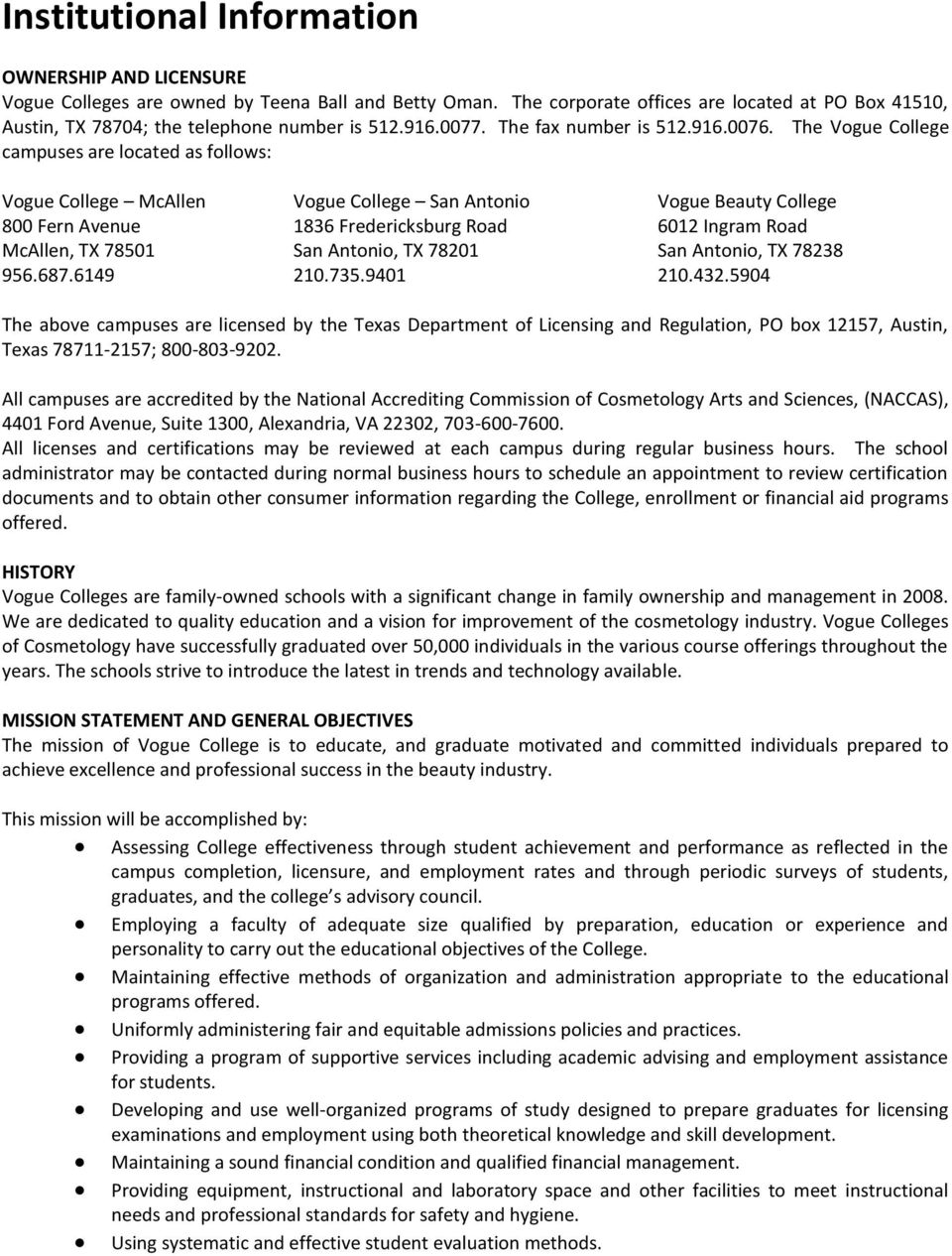
1 Institutional Information OWNERSHIP AND LICENSURE Vogue Colleges are owned by Teena Ball and Betty Oman. The corporate offices are located at PO Box 41510, Austin, TX 78704; the telephone number is The fax number is The Vogue College campuses are located as follows: Vogue College McAllen Vogue College San Antonio Vogue Beauty College 800 Fern Avenue 1836 Fredericksburg Road 6012 Ingram Road McAllen, TX San Antonio, TX San Antonio, TX The above campuses are licensed by the Texas Department of Licensing and Regulation, PO box 12157, Austin, Texas ; All campuses are accredited by the National Accrediting Commission of Cosmetology Arts and Sciences, (NACCAS), 4401 Ford Avenue, Suite 1300, Alexandria, VA 22302, All licenses and certifications may be reviewed at each campus during regular business hours. The school administrator may be contacted during normal business hours to schedule an appointment to review certification documents and to obtain other consumer information regarding the College, enrollment or financial aid programs offered. HISTORY Vogue Colleges are family-owned schools with a significant change in family ownership and management in We are dedicated to quality education and a vision for improvement of the cosmetology industry. Vogue Colleges of Cosmetology have successfully graduated over 50,000 individuals in the various course offerings throughout the years. The schools strive to introduce the latest in trends and technology available. MISSION STATEMENT AND GENERAL OBJECTIVES The mission of Vogue College is to educate, and graduate motivated and committed individuals prepared to achieve excellence and professional success in the beauty industry. This mission will be accomplished by: Assessing College effectiveness through student achievement and performance as reflected in the campus completion, licensure, and employment rates and through periodic surveys of students, graduates, and the college s advisory council. Employing a faculty of adequate size qualified by preparation, education or experience and personality to carry out the educational objectives of the College. Maintaining effective methods of organization and administration appropriate to the educational programs offered. Uniformly administering fair and equitable admissions policies and practices. Providing a program of supportive services including academic advising and employment assistance for students. Developing and use well-organized programs of study designed to prepare graduates for licensing examinations and employment using both theoretical knowledge and skill development. Maintaining a sound financial condition and qualified financial management. Providing equipment, instructional and laboratory space and other facilities to meet instructional needs and professional standards for safety and hygiene. Using systematic and effective student evaluation methods.
2 ASSESSMENT PLAN The stated mission, goals and objectives, educational programs, and support services are assessed systematically by means of: Periodic student evaluations of the staff, programs and facility. Periodic surveys of graduates, advisory committee members, and industry representatives as to the effectiveness of the instructional programs and support services. Review of annual retention, licensure and employment rates. Cooperative evaluation by staff during regular staff meetings regarding the College's purpose, objectives and performance. Annual feedback from the Advisory Council comprised of industry professionals and employers from each of the fields for which training is provided. Completion of an Institutional Self-Study for the school. The information received is used in formulating plans to maintain and improve the operation and outcomes of the College. FACILITY Vogue Colleges offer a contemporary, professional environment with: Technology-equipped classrooms for theory and practical training A Guest Services Center with professional equipment comparable to the workforce Offices for Admissions, Administration, Education, and Student Support Areas for student self-study and practice A Resource Center including texts, publications, curricula, audio-visual equipment and aids, and industry related journals ADMISSIONS ADMISSIONS AND ENROLLMENT Vogue College does not discriminate in its employment, admission, instruction, or graduation policies on the basis of age, race, color, religion, sex, or ethnic origin. The school requires that each Student enrolling in the Cosmetology, Nail Technology, or Esthetics program must complete an Application for Enrollment. Prior to starting classes, all Students must: 1. Pay the applicable registration fee which is refundable if the applicant is rejected. 2. Register with the state regulatory agency and pay the required fee of $25.00 that may not be refunded. 3 Provide proof of age; minimum 17 years of age 4 Provide Proof of a High School Diploma, GED, State Issued Home School Certificate or pass the Ability to Benefit test (ATB). Self- Certification may be accepted in specials circumstances. Instructor Course Applicants must meet the above criteria and: 1 Have met all requirements for licensure as a practitioner. Note: Students who are admitted under ATB are strongly encouraged to seek the following to get their GED: 1. Information regarding testing and GED requirements, visit the Texas Department of Education of website at: 2. South Texas College provides tutors and test courses; visit for more information or call An Ability-to-Benefit Student is one who is beyond compulsory school age and lacks a high school diploma

3 or its equivalent, and has demonstrated the ability to benefit from the education offered. In order to be admitted on the basis of ability to benefit, a Student shall, PRIOR to admission, successfully pass an approved test that measures his/her ability to benefit from the program of study. Applicants who will be recipients of federal financial aid must complete an independently administered test approved by the Secretary of Education that measures the applicant's aptitude to successfully complete the program for which he or she has applied. Students admitted on the basis of ability-to-benefit must also meet the age and education and registration requirements set by the state regulatory agency. For more information concerning Ability-to-Benefit testing requirements and/or the availability of a General Equivalency Diploma (GED) program, contact the Admissions Office. TRANSFER STUDENTS: If the prospective student is a transfer or returning student they must meet the following additional criteria: If he/she is transferring hours from another school, he/she will be asked to request a transcript. Tuition and hourly credit will be allowed as verified by the transcript. If the prospective student is transferring instruction hours from a school in another state, the instruction provided must be recognized and accepted by the State Board of Cosmetology toward the course offered by Vogue. Transfer students will not be allowed to enroll until they have officially terminated their enrollment at their previous school. Tuition and hourly credit will be allowed as verified by the transcript. The previous hours will count towards the 150% requirement (see Sap Policy). Tuition charges will be prorated for the remainder of instruction hours needed to complete the course as offered by the school. Remaining tuition charges for the course along with enrollment fees will be charged accordingly. Transfer students are eligible to receive financial aid, if qualified. Students who have previously withdrawn from Vogue and are in good standings are eligible to re-enroll. Any and all previous tuition balances must be tenured before being allowed to re-enroll and/or complete remainder of required hours. REASONABLE ACCOMMODATIONS Reasonable accommodations will be made on an individual basis. However, it is the responsibility of person with disabilities to seek available assistance and make their needs known at the time of enrollment. Documentation to support the disability must be provided to Vogue at the time of the request. Information pertaining to an Applicant s disability is voluntary and confidential. If this information is supplied, a reasonable effort at no additional cost to Vogue will be made to overcome the effects of conditions that limit the participation of qualified disabled Students. If Applicants or Students feel that they have been the subject of unlawful discrimination, they may notify Vogue by phone, in person, or in writing. Prompt action will be taken to resolve the conflict. CLASS CALENDAR Students enrolled full-time are scheduled to attend 35+ hours per week. All Students are expected to comply with the schedule assigned in the enrollment agreement and attend theory class as required. Classes are scheduled at Vogue College daily. Observed holidays are: New Year's Day Memorial Day Independence Day Labor Day Thanksgiving Day

4 Christmas Day Additional days may be scheduled off for the Christmas holiday depending on which day of the week Thanksgiving and Christmas occurs. Additional days off are published well in advance. Students may call the school or local radio stations to obtain pertinent information regarding unexpected school closures due to extenuating circumstances. For more information on actual class start dates, please refer to Class Start Dates elsewhere in this Catalog. VOGUE COLLEGE CURRICULUM PROGRAM OUTLINES All programs offered by Vogue College follow similar procedures in that the same instructional methods apply and the same grading procedures are followed for each program. Those policies are stated here and considered to be an integral part of each of the program outlines contained in this section of the catalog. Each program will be divided into three levels of training as follows: Phase I: In the introductory Phase of training, Students will focus on learning the underlying theory and the basic skills for providing client services. In addition, Students will identify short-term and long-term career goals and begin development of an action plan for achievement of those goals. The education is provided through interactive lecture, demonstration, technology, and hands-on practice. Students are allowed to assist in salon area after successful completion of 150 hours in areas they have been trained. Phase II: During this vital Phase of training, Students will develop and customize their skills to meet the needs of clients. They will perform skills in the client service center and become increasingly self-confident and proficient in their communication, consultation, and technical skills. The education is provided through interactive lecture, demonstration, technology, field trips, guest speakers, and hands-on practice. Phase III: In this level of training, Students will master the creative skills necessary for success in the workplace and learn key business skills needed to be successful Salon and Spa Professionals. During this Phase, Students will learn systems that top professionals are using to attract clients, increase sales, and grow their personal income. Students will focus on state board preparation, professional development, and career placement. Successful completion of Phase III will prepare them for immediate success and will dramatically improve their opportunities for employment upon graduation. The education is provided through interactive lecture, demonstration, technology, field trips, guest speakers, hands-on practice, and competency skills evaluation. Phase IV: During this Phase, the Graduate begins an important relationship with the Vogue College Alumni Association. They will provide documentation of licensure and employment in their chosen field. They will begin the achievement of the goals established in Phase I while enjoying success in an exciting career in the Salon or Spa environment. Phase I Phase II Phase III Cosmetology Hrs Hrs Hrs Esthetics 0-75 Hrs Hrs Hrs Nail Technology 0-75 Hrs Hrs Hrs GRADING POLICY AND PROCEDURES: Students are assigned theory study and a minimum number of practical experiences. Theory is evaluated after each unit of study. Practical assignments are evaluated as completed and counted toward program completion ONLY when rated as satisfactory. If the performance does not meet satisfactory requirements, it is not counted and the performance must be repeated. At least two comprehensive practical skills evaluations will be conducted during the program of study. Practical skills are evaluated according to text procedures, performance standards established by the state licensing agency, and set forth in practical skills evaluation criteria adopted by the school. Students must maintain a theory grade average of 75% and pass a FINAL

5 written and practical exam prior to graduation. Students must make up failed or missed tests and incomplete assignments. Although instructors and assignments may vary based on program requirements, numerical grades are considered according to the following scale: WRITTEN and PRACTICAL EXCELLENT - A VERY GOOD - B SATISFACTORY - C 74 BELOW STANDARDS UNSATISFACTORY - F INSTRUCTIONAL METHODS: The clock hour education is provided through a sequential set of learning steps that address specific tasks necessary for state board preparation, graduation, and entry-level job skills. Clinic equipment, implements, and products are comparable to those used in the industry. The program is presented through comprehensive lesson plans that reflect effective educational methods. Subjects are presented by means of lecture, demonstration, and interactive Student participation. Audiovisual aids, guest speakers, field trips, projects, activities, and other related learning methods are used for program delivery. UNITS OF INSTRUCTION AND HOURS: The contents of the units of instruction in each program along with the applicable hours devoted to each unit are listed in the following section of this Program Outline. Health, sanitation, infection control, chemistry, electricity, anatomy and physiology, the use and safety of products, and the use and safety of tools and equipment are included in both theory and practical study within the applicable units of study. In addition, Students learn career and employment information including professional ethics, effective communications and human relations, compensation packages and payroll deductions, and the fundamentals of business management applicable to the program. REFERENCES: A comprehensive library of references, periodicals, books, texts, and audio/video tapes are available to support the program of study and supplement the Students' training. Students should avail themselves of the opportunity to use these extensive materials. REQUIRED PRACTICAL EXPERIENCES: Policy and Regulatory agencies require Students to complete an established number of practical experiences for satisfactory skills development and graduation. Practices may be completed on manikins, models, or clients. The requirements listed by category are the MINIMUM experiences that each Student must successfully complete prior to graduation. More practices may be scheduled BY THE INSTRUCTOR based on training NEEDS and clientele volume. All assignments must be completed by each Student as agreed upon in the Enrollment Agreement. Practical assignments are evaluated as completed and counted toward program completion ONLY when rated as satisfactory or better. The instructor will initial one block on the Practical Grade Record form for each project completed in the applicable category. A block will only be initialed if the skill performed is considered satisfactory or better. Practical skills are evaluated according to published criteria. COURSE LANGUAGES: All Texas locations offer all educational programs in both Spanish and English with the exception of the Instructor Course which is offered only in English. COSMETOLOGY- TEXAS: 1500 HOURS DESCRIPTION: The primary purpose of the Cosmetology Course is to train the student in the basic manipulative skills, safety judgments, proper work habits, and desirable attitudes necessary to pass the State Board examination and for competency in job entry level positions in Cosmetology or related career path. OBJECTIVES: Upon completion of the course requirements, the determined graduate will be able to:

6 1. Project a positive attitude and a sense of personal integrity and self-confidence. 2. Practice proper grooming and effective communications skills and visual poise. 3. Understand employer-employee relationships and respect the need to deliver worthy service for value received. 4. Perform the basic manipulative skills including hair styling, shaping, bleaching, tinting, chemical reformation, scalp/hair conditioning, facials, manicures, pedicures and nail extensions. 5. Perform the basic analytical skills to determine proper makeup, hairstyle, and color application for the client's best overall look. 6. Apply the theory, technical information and related matter to assure sound judgments, decisions, and procedures. To ensure continued career success, the graduate will continue to learn new and current information related to techniques, trends, fashions, and methods for career development in cosmetology and related fields. COSMETOLOGY TEXAS 1500 HOURS HOURS SUBJECT UNIT 100 ORIENTATION: New Student Orientation; laws and regulations including health, sanitation, infection control, products, tools, equipment use and safety, anatomy, bacteriology, biology. OSHA regulations concerning hazardous materials communications. Types and classifications of infectious organisms (bacteria, viruses, molds, fungus); Growth and reproduction of infectious organisms; Infections and their prevention; Immunity and body defenses; Decontamination and infection control; Physical and chemical agents. 75 SALON MANAGEMENT AND PRACTICES: Professional ethics, conduct and attitude; Professional organizations; trade shows, and publications; state sales tax requirements; Career opportunities and placement. OSHA regulations concerning hazardous materials communications. Types and classifications of infectious organisms (bacteria, viruses, molds, fungus); Growth and reproduction of infectious organisms; Infections and their prevention; Immunity and body defenses; Decontamination and infection control; Physical and chemical agents. 75 CHEMISTRY AS APPLIED TO COSMETOLOGY: Forms and properties of matter; Elements, compounds, and mixtures; Chemical reactions and solutions; The ph scale; FDA laws governing hair care products; Product safety. 50 HAIR AND SCALP TREATMENT AND RELATED THEORY: Structure, Growth patterns, Texture; Porosity; and Elasticity; Dandruff; Alopecia; Fungal infections; Infestations; Infections. 100 SHAMPOOS, RINSES, CONDITIONERS, TREATMENTS AND RELATED THEORY: Client preparation, analysis, and consultation; Hair analysis instruments and equipment; Shampooing products, composition, and procedures; Rinsing products, composition, and procedures; Conditioning products, composition, and procedures; procedures for hair and scalp disorders; Scalp manipulations. 100 NAIL CARE AND PROCEDURES AND RELATED THEORY: Nail structure; Nail disorders and diseases; nail shape and color analysis; Basic manicuring and pedicuring; Manipulations of the hand, arm, leg, and foot; Nail tip application (adhesives, fitting, design, and application); Nail wrap application (silk, fiberglass and linen procedures, surface wrapping natural nail and mending; tip overlay wrapping, repair, maintenance and removal); Liquid and powder nail extension (application procedures for tips with overlays, natural nails and sculptured nails; repair, maintenance and removal; chemical reactions to liquid and powder). 50 SKIN CARE PROCEDURES AND RELATED THEORY: Structure and Function of the Skin; Skin conditions and disorders; Facial and body procedures (client preparation, skin analysis and consultation); Wet and dry exfoliations and applications; Use of products to enhance skin appearance (seaweed, salt, paraffin, mud, ampoules, creams); Discussion on advanced techniques such as aromatherapy and water therapies; Temporary methods of hair removal (manual tweezing, depilatory lotion, waxing, bleaching); Make-Up application (color analysis,

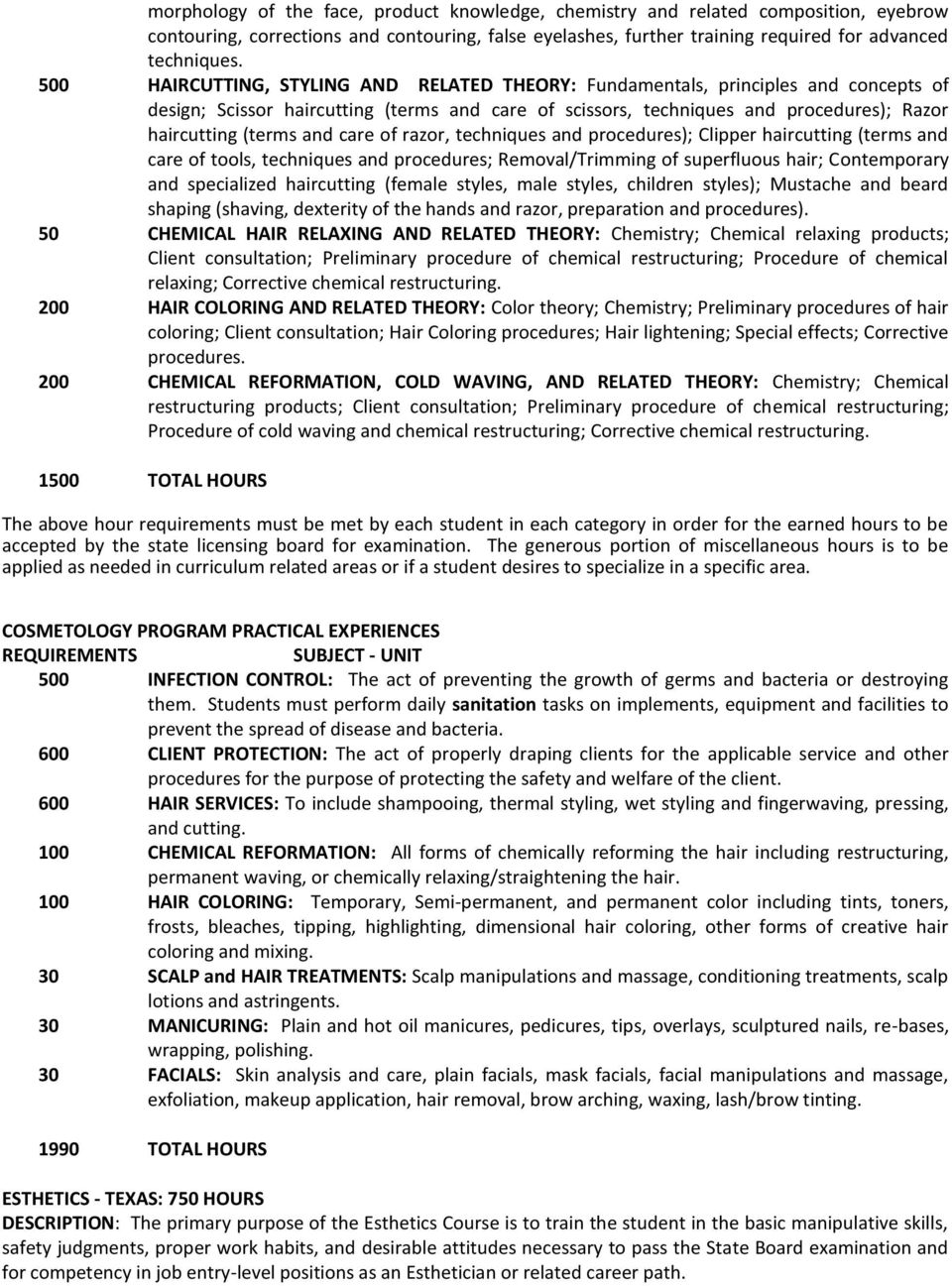
7 morphology of the face, product knowledge, chemistry and related composition, eyebrow contouring, corrections and contouring, false eyelashes, further training required for advanced techniques. 500 HAIRCUTTING, STYLING AND RELATED THEORY: Fundamentals, principles and concepts of design; Scissor haircutting (terms and care of scissors, techniques and procedures); Razor haircutting (terms and care of razor, techniques and procedures); Clipper haircutting (terms and care of tools, techniques and procedures; Removal/Trimming of superfluous hair; Contemporary and specialized haircutting (female styles, male styles, children styles); Mustache and beard shaping (shaving, dexterity of the hands and razor, preparation and procedures). 50 CHEMICAL HAIR RELAXING AND RELATED THEORY: Chemistry; Chemical relaxing products; Client consultation; Preliminary procedure of chemical restructuring; Procedure of chemical relaxing; Corrective chemical restructuring. 200 HAIR COLORING AND RELATED THEORY: Color theory; Chemistry; Preliminary procedures of hair coloring; Client consultation; Hair Coloring procedures; Hair lightening; Special effects; Corrective procedures. 200 CHEMICAL REFORMATION, COLD WAVING, AND RELATED THEORY: Chemistry; Chemical restructuring products; Client consultation; Preliminary procedure of chemical restructuring; Procedure of cold waving and chemical restructuring; Corrective chemical restructuring TOTAL HOURS The above hour requirements must be met by each student in each category in order for the earned hours to be accepted by the state licensing board for examination. The generous portion of miscellaneous hours is to be applied as needed in curriculum related areas or if a student desires to specialize in a specific area. COSMETOLOGY PROGRAM PRACTICAL EXPERIENCES REQUIREMENTS SUBJECT - UNIT 500 INFECTION CONTROL: The act of preventing the growth of germs and bacteria or destroying them. Students must perform daily sanitation tasks on implements, equipment and facilities to prevent the spread of disease and bacteria. 600 CLIENT PROTECTION: The act of properly draping clients for the applicable service and other procedures for the purpose of protecting the safety and welfare of the client. 600 HAIR SERVICES: To include shampooing, thermal styling, wet styling and fingerwaving, pressing, and cutting. 100 CHEMICAL REFORMATION: All forms of chemically reforming the hair including restructuring, permanent waving, or chemically relaxing/straightening the hair. 100 HAIR COLORING: Temporary, Semi-permanent, and permanent color including tints, toners, frosts, bleaches, tipping, highlighting, dimensional hair coloring, other forms of creative hair coloring and mixing. 30 SCALP and HAIR TREATMENTS: Scalp manipulations and massage, conditioning treatments, scalp lotions and astringents. 30 MANICURING: Plain and hot oil manicures, pedicures, tips, overlays, sculptured nails, re-bases, wrapping, polishing. 30 FACIALS: Skin analysis and care, plain facials, mask facials, facial manipulations and massage, exfoliation, makeup application, hair removal, brow arching, waxing, lash/brow tinting TOTAL HOURS ESTHETICS - TEXAS: 750 HOURS DESCRIPTION: The primary purpose of the Esthetics Course is to train the student in the basic manipulative skills, safety judgments, proper work habits, and desirable attitudes necessary to pass the State Board examination and for competency in job entry-level positions as an Esthetician or related career path.
8 OBJECTIVES: Upon completion of the course requirements, the determined graduate will be able to: 1. Project a positive attitude and a sense of personal integrity and self-confidence. 2. Practice proper grooming and effective communications skills and visual poise. 3. Understand employer-employee relationships and respect the need to deliver worthy service for value received. 4. Perform the basic manipulative skills required for facial massage, effective use of required implements and equipment, proper application of corrective makeup, unwanted hair removal, and lash/brow tinting. 5. Apply the theory, technical information and related matter to assure sound judgments, decisions, and procedures. To ensure continued career success, the graduate will continue to learn new and current information related to techniques, trends, fashions, and methods for career development in esthetics and related career positions. ESTHETICS TEXAS, 750 HOURS HOURS SUBJECT - UNIT 50 ORIENTATION: New Student Orientation; laws and regulations; licensing and certification requirements. 40 INFECTION CONTROL: Health and sanitation, types and classifications of infectious organisms (bacteria, viruses, molds, fungus); Growth and reproduction of infectious organisms; Infections and their prevention; Immunity and body defenses; Decontamination and infection control; Physical and chemical agents, bacteriology, products, tools, equipment, use and safety. 35 SALON MANAGEMENT AND PRACTICES: Fundamentals of business management, professional ethics, conduct and attitude; Professional organizations; trade shows, and publications; state sales tax requirements; Career opportunities and placement. Effective communications and human relations. Compensation packages and payroll deductions. OSHA regulations concerning hazardous materials communications. 90 ANATOMY AND PHYSIOLOGY: Cells, tissues, and organs; Body systems; Basic principles of nutrition; Overview of bones and muscles of the head, face, and neck. 75 ELECTRICITY, MACHINES, AND RELATED EQUIPMENT: Nature of electricity, two types of electricity, electrotherapy and their uses; electromagnetic radiation; five types of light therapy and their benefits; high-frequency. 50 CHEMISTRY AND RELATED THEORY: Forms and properties of matter; Elements, compounds, and mixtures; Chemical reactions and solutions; The ph scale; FDA laws governing hair care products; Product safety. 50 CLIENT CARE: Developing excellent skills in client consultation, client care, and customer service. 10 NUTRITION: Nutritional guidelines, general health and fitness. 10 COLOR PSYCHOLOGY: Color theory and how color affects attitude, personality and image. 15 AROMA THERAPY: The use of essential oils; purposes, cautions, common uses. 25 SUPERFLUOUS HAIR REMOVAL AND RELATED THEORY: Tweezing, Depilatory lotions; Waving; Bleaching of facial hair 225 SKIN CARE, FACIAL TREATMENTS AND RELATED THEORY: Skin analysis and care, plain facials, mask facials, facial manipulations, exfoliation, hair removal, brow arching, waxing, lash/brow tinting. 75 MAKEUP AND RELATED THEORY: Makeup application: daytime, evening, corrective makeup techniques 750 TOTAL HOURS

9 The above hour requirements must be met by each student in each category in order for the earned hours to be accepted by the state licensing board for examination. The generous portion of miscellaneous hours is to be applied as needed in curriculum related areas or if a student desires to specialize in a specific area. ESTHETICS PROGRAM PRACTICAL EXPERIENCES REQUIREMENTS SUBJECT - UNIT 200 INFECTION CONTROL: The act of preventing the growth of germs and bacteria or destroying them. Students must perform daily sanitation tasks on implements, equipment and facilities to prevent the spread of disease and bacteria. 200 FACIALS: Skin analysis and care, plain facials, mask facials, facial manipulations, exfoliation, makeup application, hair removal, brow arching, waxing, lash/brow tinting. 40 BODY PROCEDURES: Body exfoliation (wet a dry); Back treatments. 40 SUPERFLUOUS HAIR REMOVAL: Tweezing, Depilatory lotions; Waxing; Bleaching of facial hair. 10 CLIENT COMMUNICATIONS: Evaluated presentations of Student's ability to interact with the client, build client retention, obtain referrals and upgrade tickets. 10 BUSINESS ADMINISTRATION: Evaluation of business administration performance including reception desk procedures, inventory, telephone technique, salon business projects, salon field trip reports, etc. 500 TOTAL HOURS NAIL TECHNOLOGY - TEXAS: 600 HOURS DESCRIPTION: The primary purpose of the Nail Technology Course is to train the student in the basic technical skills, educational judgments, proper work habits, and desirable attitudes necessary to pass the State Board examination and for competency in job entry level employment as a nail technician or related career path. OBJECTIVES: Upon completion of the course requirements, the determined graduate will be able to: 1. Project a positive attitude and a sense of personal integrity and self-confidence. 2. Practice proper grooming and effective communications skills and visual poise. 3. Understand employer-employee relationships and respect the need to deliver worthy service for value received. 4. Perform the basic manipulative skills required for manicuring, pedicuring, and various methods of nail extensions. 5. Apply the theory, technical information and related matter to assure sound judgments, decisions, and procedures. To ensure continued career success, the graduate will continue to learn new and current information related to techniques, trends, fashions, and methods for career development as a Nail Technician, Manicurist or related position. NAIL TECHNOLOGY TEXAS 600 HOURS HOURS SUBJECT - UNIT 15 ORIENTATION: New Student Orientation; laws and regulations, licensing and certification requirements. 100 BACTERIOLOGY, SANITATION, AND SAFETY: Biology, health, infection control, definitions, importance, rules, laws, methods, safety measures, hazardous chemicals and ventilation, chemistry. 80 PROFESSIONAL PRACTICES: Manicuring as a profession, vocabulary, ethics, salon procedures, hygiene and grooming, professional attitudes, salesmanship and public relations. Career and

10 employment information, professional ethics, effective communications and human relations, compensation packages, and payroll deductions. 70 ANATOMY AND PHYSIOLOGY OF THE ARM AND HAND: Major bones and function, major muscles and functions, major nerves and functions, skin structure, functions appendages, conditions and lesions, nail structure, composition, growth, regeneration, irregularities and diseases. 320 MANICURE PROCEDURES: Principles and techniques of basic manicure and pedicure, oil manicure, removal of stains, repair work, hand and arm massage, buffing, application of polish, application of artificial nails, application of cosmetic fingernails, preparation to build new nail, and application of nail extensions, sculptured nails, tips, wraps, fiberglass/gels and odorless products. 15 EQUIPMENT, IMPLEMENTS, AND SUPPLIES: Use and maintenance. Products, tools, equipment, use and safety. 600 TOTAL HOURS The above hour requirements must be met by each student in each category in order for the earned hours to be accepted by the state licensing board for examination. The generous portion of miscellaneous hours is to be applied as needed in curriculum related areas or if a student desires to specialize in a specific area. NAIL TECHNOLOGY PRACTICAL EXPERIENCES REQUIREMENTS SUBJECT - UNIT 150 INFECTION CONTROL: The act of preventing the growth of germs and bacteria or destroying them. Students must perform daily sanitation tasks on implements, equipment, facilities to prevent the spread of disease and bacteria. 130 MANICURE PROCEDURES: Basic manicure and pedicure, oil manicure, removal of stains, repair work, hand and arm massage, buffing, application of polish. 100 NAIL EXTENSIONS: Application of artificial nails, application of cosmetic fingernails, preparation to build new nail, and application of nail extensions, sculptured nails, tips, wraps, fiberglass/gels and odorless products. 10 CLIENT COMMUNICATIONS: Evaluated presentations of Student's ability to interact with the client, build client retention, obtain referrals and upgrade tickets. 10 BUSINESS ADMINISTRATION: Evaluation of business administration performance including reception desk procedures, inventory, telephone technique, salon business projects, salon field trip reports, etc. 400 TOTAL HOURS COSMETOLOGY INSTRUCTOR- TEXAS: 750 HOURS (No Work Experience) 250 HOURS-TEXAS (2 Years Work Experience) DESCRIPTION: The primary purpose of the Instructor Course is to train the student in the basic teaching skills, educational judgments, proper work habits, and desirable attitudes necessary to pass the State Board examination and for competency in job entry level employment as an Instructor or related career path. OBJECTIVES: Upon completion of the course requirements, the determined graduate will be able to: Project a positive attitude and a sense of personal integrity and self confidence. Practice proper grooming and effective communications skills and visual poise. Understand employer-employee relationships and respect the need to deliver worthy service for value received.

11 Perform the basic skills necessary for teaching including writing lesson plans, performing lectures and demonstrations, directing student projects, using library resources and audiovisual aids, conducting theory class instruction and measuring student achievement, supervising clinic operations, and maintaining required student records. Apply the theory, technical information and related matter to assure sound judgments, decisions, and procedures. To ensure continued career success, the graduate will continue to learn new and current information related to techniques, communications skills and teaching methodologies to improve teaching skills. COSMETOLOGY INSTRUCTOR COURSE TEXAS, 750 HOURS HOURS SUBJECT/ UNIT 50 ORIENTATION: School rules and regulations; Qualities of the professional educator; Code of ethics; Familiarization of school facilities and supplies. Licensing Requirements and Regulations, Laws; Fundamentals of Business Management, Professional Ethics, Business Plan, Written Agreements,, School Operations, Policies, Practices, Compensation Packages, Payroll Deductions, Telephone Use, Advertising, Sales, Communications, Public/Human Relations, Insurance, Salon Safety, Seeking Employment 350 METHODS OF TEACHING and CLINIC MANAGEMENT: Principles of Teaching, Learning and Preparing Lesson Plan Development, Outlines, Examples of Lesson Plans, Components of Effective Lesson Plans, Preparation, Teaching Methods; Presentation Techniques, Application, Testing, Lecture and Workbooks, Demonstrations, Return Demonstrations, Discussion, Question and Answer, Projects, Field Trips, Developing and Using Educational Aids, Films or videos, Charts, Manikins, Reference Materials, Chalkboard, Overhead Projectors and Transparencies, Program Development and Review; Program Review, Independent Clinic Supervision, Client Communications, Reception Desk, Inventory Control, Effective Dispensary Procedures, Supervision of Clinic Sanitation and Client Safety, Technical Skills Ability, Independent Classroom Instructing, Administrative Responsibilities, Records and Reports Management, Safety Measures, Classroom Conditions and Maintenance, Class Supervision, Control, Classroom Problems and Solutions, Organizational and Regulatory Requirements 350 INSTRUCTION AND THEORY; CLINIC OPERATION: Planning, Analysis, Implementation, Benefits, Assessment or Measurement of Student Ability/Achievement/Learning, Diagnosis of Student Weaknesses and overall progress, Student Motivation for Study and Learning, Oral and Written Testing, Evaluation of Overall Progress, Development and Use of Testing/Measurement Instruments; Academic Advising 750 TOTAL HOURS The above hour requirements must be met by each student in each category in order for the earned hours to be accepted by the state licensing board for examination. The generous portion of miscellaneous hours is to be applied as needed in curriculum related areas or if a student desires to specialize in a specific area. INSTRUCTOR COURSE TX 250 HOURS HOURS SUBJECT/ UNIT 10 ORIENTATION: School rules and regulations; Qualities of the professional educator; Code of ethics; Familiarization of school facilities and supplies. Licensing Requirements and Regulations, Laws; Fundamentals of Business Management, Professional Ethics, Business Plan, Written Agreements, School Operations, Policies, Practices, Compensation Packages, Payroll Deductions,

12 Telephone Use, Advertising, Sales, Communications, Public/Human Relations, Insurance, Salon Safety, Seeking Employment 60 LESSON PLANS: Learning and Preparing Lesson Plan Development, Outlines, Examples of Lesson Plans, Components of Effective Lesson Plans 60 METHODS OF TEACHING and CLINIC MANAGEMENT: Principles of Teaching, Preparation, Program Review, Teaching Methods; Presentation Techniques, Application, Testing, Lecture and Workbooks, Demonstrations, Return Demonstrations, Discussion, Question and Answer, Projects, Field Trips 30 CLASSROOM MANAGEMENT: Safety Measures, Classroom Conditions and Maintenance, Class Supervision, Control, Classroom Problems and Solutions, Organizational and Regulatory Requirements 30 EVALUATION TECHNIQUES: Assessment of Student learning; Evaluation of overall progress; Development and use of testing/measurement instruments; Testing as Related to Student Learning and Effectiveness of Instruction; Purpose and Types of tests; Selection of Appropriate Testing Methods; Validity and Reliability of Teaching Methods via Tests 20 STATE LAWS AND FORMS: State laws and regulations; Processing applicable forms for schools and Students for enrollment and licensure. 20 VISUAL AIDS, PREPARATION AND USE: Developing and Using Educational Aids, Films or videos, Charts, Manikins, Reference Materials, Chalkboard, Overhead Projectors and Transparencies, Program Development and Review 20 LEARNING THEORY: Identifying learning styles and methods for learners; Practicing methods designed to reach various adult accelerated learning styles. 250 TOTAL HOURS The above hour requirements must be met by each student in each category in order for the earned hours to be accepted by the state licensing board for examination. The generous portion of miscellaneous hours is to be applied as needed in curriculum related areas or if a student desires to specialize in a specific area. DAILY DUTIES AS ASSINGED All students will be assigned daily duties. Please be through and take pride in fulfilling these tasks. Students will not clock out until all duties have been completed. Styling stations and mirrors need to be cleaned and sanitized each day. Items should not be left out or left overnight. Personal items need to be secured. The break room, classrooms and the clinic floor should be cleaned daily. Additionally, all areas where clients are serviced should be maintained properly per state regulations. These areas include the shampoo area, rest rooms, styling stations, etc. LEAVE OF ABSENCE A Leave of Absence (LOA) is a temporary interruption in a student s program of study. LOA refers to the specific time period during an ongoing program when a student is not in academic attendance. The school may allow more than one LOA at its discretion. Students must request an LOA in writing stating the reason for the leave for approval by the school owner or Administrator. If approved, the official Leave will extend the contract period by the same number of days designated in the leave document or actually used by the student. No re-entry fee will be charged if the student returns to class on or before the first class day scheduled after the termination of the Leave of Absence. The LOA is approved for a minimum of 30 days at a time and may not exceed 180 days total in any twelve month period. All approved leaves will be scheduled to begin on the first class day after the student's last physical day of attendance prior to beginning the Leave and end on the Scheduled Return Date ; a student who does not return to school or has failed to request an additional LOA prior to the Scheduled Return Date will be dropped. *For federal aid recipients, the student s payment period is suspended during the LOA and no federal financial aid will be disbursed to students while on a Leave of Absence. Upon the student s return, the student will resume the same payment period and coursework and will not be eligible for additional Title IV aid until the payment period has been completed. If the student is a Title IV loan recipient, the student will be informed of the effects that the

13 student s failure to return from a leave may have on the student s loan repayment terms, including the expiration of the student s grace period. GRADUATION REQUIREMENTS Students must meet the following requirements in the applicable program of study to qualify for graduation and be issued a certified Final Transcript of Hours and Diploma: Successful completion of all levels of study, required tests, practical projects, and assigned guest services Completion of the Program of Study as required by the State regulatory agency Pass the final written and practical exam for the applicable program Complete all required exit paperwork and attend an exit interview Make satisfactory arrangements for all debts owed to the College Upon completion of the program of study and all graduation requirements, a Vogue College Diploma for the applicable program of study will be awarded. After all graduation requirements have been met and the scheduled program has ended, the graduate will be eligible to pay the required examination fee and file an application for the state licensing exam. Upon obtaining a valid license, the graduate may engage in his or her chosen field for compensation. LICENSURE REQUIREMENTS Any person is eligible to receive a license as a cosmetologist, a nail technician, or an esthetician who submits proof that he is at least 17 years of age; has an education equivalent to the completion of the second year of an approved high school; has completed the required clock hours in an approved school for the applicable program; has paid the required fees; and has passed the examination conducted by the Board to determine his fitness to receive a license. Any person applying to take a state board examination may be required to have an official United States government issued identification to take the exam. Any person is eligible to receive a license as an Instructor who submits proof that he is at least 18 years of age; has an education equivalent to the completion of a four year high school; has completed an instructor program of 750 clock hours or 250 hours with two years of verified work experience in the applicable discipline; has paid the required fees and has passed the examination conducted by the Board. Any person applying to take a state board examination may be required to have an official United States government issued identification to take the exam. Instructors in the State of Texas must obtain six clock hours of continuing education every two years for license renewal. Instructors employed in a NACCAS-accredited school must obtain twelve clock hours of continuing education within each calendar year. REFERENCES A comprehensive library of references, periodicals, books, texts, and audio/video tapes are available to support the program of study and supplement the Students' training. Students should avail themselves of the opportunity to use these extensive materials. REQUIRED PRACTICAL EXPERIENCES Policy and Regulatory agencies require Students to complete an established number of practical experiences for satisfactory skills development and graduation. Practices may be completed on manikins, models, or clients. The requirements listed by category are the MINIMUM experiences that each Student must successfully complete prior to graduation. More practices may be scheduled by the instructor based on training NEEDS and clientele volume. INCOMPLETE ENROLLMENTS OFFICIAL WITHDRAWAL REQUIREMENTS

14 Students who withdraw from enrollment prior to program completion must: Complete all required exit paperwork and attend an exit interview; Satisfy all debts owed to the school or make satisfactory arrangements for debts to the school as approved by the Managing Director. Only upon completion of the withdrawal requirements will a certified Final Transcript of Hours be forwarded to the state board. Upon payment of the $10.00 transcript fee, a certified Final Transcript of Hours will be given to the Student. If withdrawal requirements are not met, no transcript will be released. Withdrawal fees may be waived due to documented mitigating circumstances. TRANSFER POLICY The school will administer a scholastic evaluation to Students wishing to transfer to the school or require the transfer student to enter Phase 1. Based on the test results, if applicable, the school may recognize credit for all or part of the applicant's previous training or work experience provided it is recognized by the state regulatory agency. Transfer Students must comply with the class level assigned as a result of the scholastic evaluation. In addition, such Students must meet all regular entrance and registration requirements. If approved for enrollment, tuition will be charged at the hourly rate for the program of study at the time of enrollment plus the applicable registration fee. Transfer students will be required to meet kit requirements required by Vogue College. Contact the school administration office for applicable kit prices. All transfer and re-entry Students must be properly registered with the state regulatory agency. RE-ENTRY POLICY Former Students of Vogue College who wish to re-enter, must request approval from the school administration. The request will be reviewed and a decision made within 30 days of the request. Students who re-enter within thirty (30) days of the original official withdrawal date will be charged for hours remaining. The settlement calculation for the former school will be adjusted to reflect charges for actual hours attended. Student will be responsible for any balance owed at the former College. Students who re-enter more than 30 days after the original exit date may be evaluated scholastically in the same manner as a transfer Student to determine class level assignment. Tuition rates current at the time of re-entry will apply. Arrangement for satisfactory payment of any applicable balance owed under the previous enrollment(s) must be made prior to re-entry. Re-entry Students who did return their complete kit, text and other issued items upon withdrawal may be required to provide all such items at their own expense. Books, Student training kits and lab coats may be purchased from the school if the Student desires. Refer to contract for loaner kit items that are not reusable or returnable due to recognized health and sanitary reasons. Contract periods and attendance percentages will be calculated based on hours remaining in the re-entry contract. If a student voluntarily withdraws or is terminated after completing 50 percent of the course at a private beauty culture school, the school shall allow the student to reenter at any time during the 48-month period following the date of withdrawal or termination. CANCELLATION POLICY A full refund will be made to any Student who cancels the enrollment agreement or contract within 72 hours (until midnight of the third day excluding Saturdays, Sundays, and legal holidays) after the enrollment contract is signed by the prospective Student. If tuition is collected in advance of entrance, and if, after expiration of the 72 hours cancellation privilege, the Student does not enter College, not more than $ shall be retained. A full refund will be made if Student is not accepted by the College. REFUND POLICY - TEXAS NOTICE OF CANCELLATION

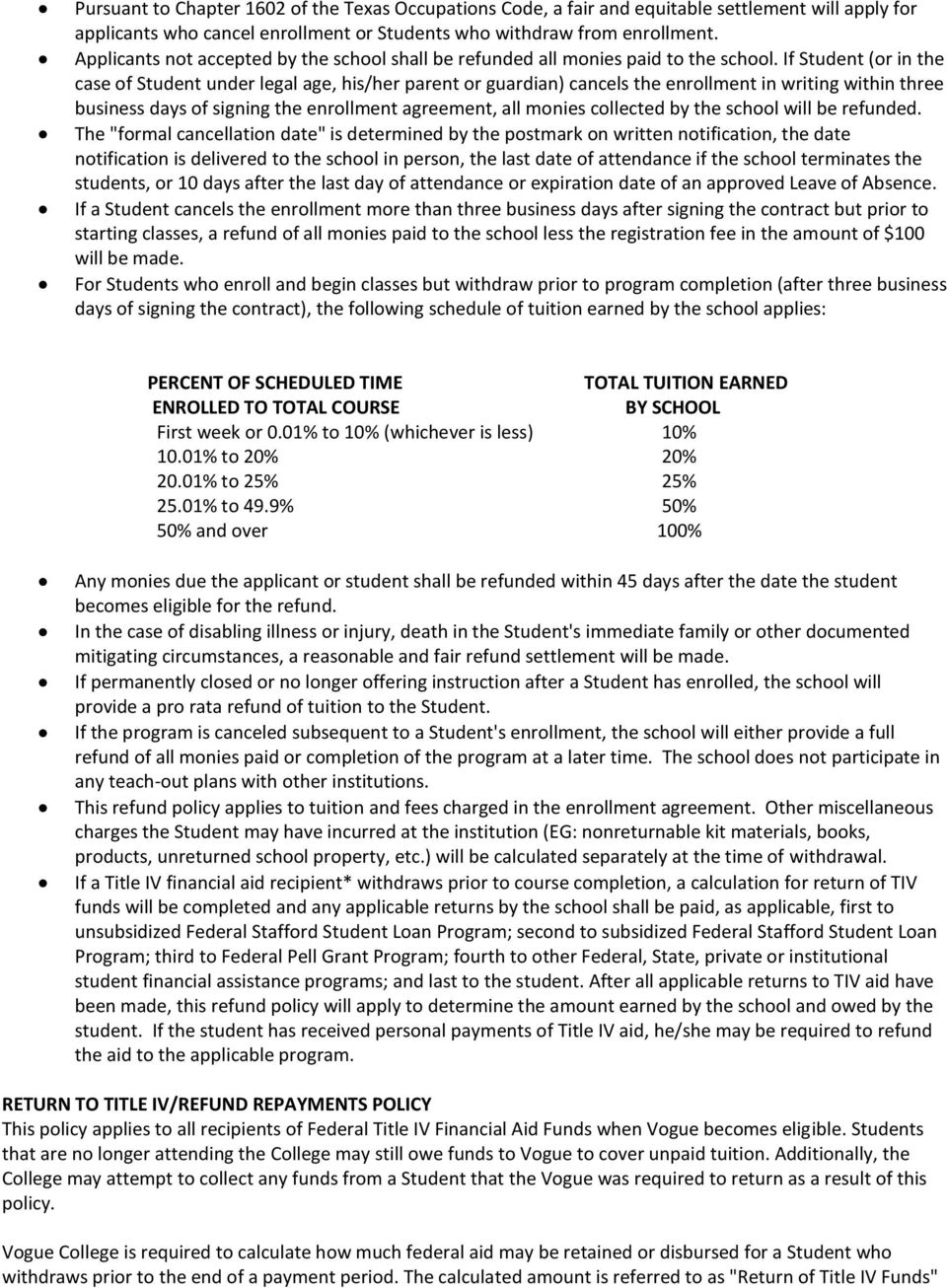
15 Pursuant to Chapter 1602 of the Texas Occupations Code, a fair and equitable settlement will apply for applicants who cancel enrollment or Students who withdraw from enrollment. Applicants not accepted by the school shall be refunded all monies paid to the school. If Student (or in the case of Student under legal age, his/her parent or guardian) cancels the enrollment in writing within three business days of signing the enrollment agreement, all monies collected by the school will be refunded. The "formal cancellation date" is determined by the postmark on written notification, the date notification is delivered to the school in person, the last date of attendance if the school terminates the students, or 10 days after the last day of attendance or expiration date of an approved Leave of Absence. If a Student cancels the enrollment more than three business days after signing the contract but prior to starting classes, a refund of all monies paid to the school less the registration fee in the amount of $100 will be made. For Students who enroll and begin classes but withdraw prior to program completion (after three business days of signing the contract), the following schedule of tuition earned by the school applies: PERCENT OF SCHEDULED TIME TOTAL TUITION EARNED ENROLLED TO TOTAL COURSE BY SCHOOL First week or 0.01% to 10% (whichever is less) 10% 10.01% to 20% 20% 20.01% to 25% 25% 25.01% to 49.9% 50% 50% and over 100% Any monies due the applicant or student shall be refunded within 45 days after the date the student becomes eligible for the refund. In the case of disabling illness or injury, death in the Student's immediate family or other documented mitigating circumstances, a reasonable and fair refund settlement will be made. If permanently closed or no longer offering instruction after a Student has enrolled, the school will provide a pro rata refund of tuition to the Student. If the program is canceled subsequent to a Student's enrollment, the school will either provide a full refund of all monies paid or completion of the program at a later time. The school does not participate in any teach-out plans with other institutions. This refund policy applies to tuition and fees charged in the enrollment agreement. Other miscellaneous charges the Student may have incurred at the institution (EG: nonreturnable kit materials, books, products, unreturned school property, etc.) will be calculated separately at the time of withdrawal. If a Title IV financial aid recipient* withdraws prior to course completion, a calculation for return of TIV funds will be completed and any applicable returns by the school shall be paid, as applicable, first to unsubsidized Federal Stafford Student Loan Program; second to subsidized Federal Stafford Student Loan Program; third to Federal Pell Grant Program; fourth to other Federal, State, private or institutional student financial assistance programs; and last to the student. After all applicable returns to TIV aid have been made, this refund policy will apply to determine the amount earned by the school and owed by the student. If the student has received personal payments of Title IV aid, he/she may be required to refund the aid to the applicable program. RETURN TO TITLE IV/REFUND REPAYMENTS POLICY This policy applies to all recipients of Federal Title IV Financial Aid Funds when Vogue becomes eligible. Students that are no longer attending the College may still owe funds to Vogue to cover unpaid tuition. Additionally, the College may attempt to collect any funds from a Student that the Vogue was required to return as a result of this policy. Vogue College is required to calculate how much federal aid may be retained or disbursed for a Student who withdraws prior to the end of a payment period. The calculated amount is referred to as "Return of Title IV Funds"
16 (R2T4), The calculation of Title IV funds earned by the Student has no relationship to the Student s tuition and fees that may be owed to Vogue. All Students subject to this policy are determined according to the following definitions and procedures, as prescribed by regulation. Vogue College has 45 days from the date the College determines that the Students withdrew to return all unearned funds for which it is responsible. Vogue will notify the Student in writing of the amount of funds that must be returned. Vogue will advise the Student and/or parent that they have 14 calendar days from the date Vogue sent the notification to accept a post-withdrawal disbursement for funds that have not been disbursed but are eligible to be used for tuition and fees. If a response is not received from the Student and/or parent within the permitted time frame or the Student declines the funds, Vogue will return any earned funds being held from Title IV programs. All post-withdrawal disbursement must occur within 90 days of the date the Student withdrew. WITHDRAWAL BEFORE 60%: Vogue must perform a R2T4 to determine the amount of earned aid up through the 60% point in each payment period and use the Department of Education s prorate schedule to determine the amount of R2T4 funds the Student has earned at the time of withdrawal. After the 60% point in the payment period or period of enrollment, a Student has earned 100% of the Title IV funds he or she was scheduled to receive during the period. WITHDRAWAL AFTER 60%: For a Student who withdraws after the 60% point-in-time, there are no unearned funds. However, Vogue will still calculate eligibility for a post-withdrawal disbursement. CALCULATING R2T4 Title IV funds are earned in a prorated manner on a per diem clock hours basis up to the 60% point in the payment period. Title IV aid is viewed as 100% earned after that point in time. The school is required to determine the earned and unearned Title IV aid as of the date the student ceased attendance based on the amount of time the student was scheduled to be in attendance. In accordance with federal regulations, when Title IV financial aid is involved, the calculated amount of the R2T4 Funds is allocated in the following order: Unsubsidized Direct Loans, Subsidized Direct Loans, Direct PLUS loans followed by Federal Pell Grants. The calculation steps are outlined in the following example: Calculate the percentage of Title IV aid earned: a) Divide the number of clock hours scheduled to be completed in the payment period as of the last date of attendance in the payment period by the total clock hours in the payment period. HOURS SCHEDULED TO COMPLETE TOTAL HOURS IN PERIOD = % EARNED b) If this percentage is greater than 60%, the student earns 100%. c) If this percent is less than or equal to 60%, proceeds with calculation. Percentage earned from (multiplied by) Total aid disbursed, or could have been disbursed = AMOUNT STUDENT EARNED. Subtract the Title IV aid earned from the total disbursed = AMOUNT TO BE RETURNED. 100% minus percent earned = UNEARNED PERCENT Unearned percent (multiplied by) total institutional charges for the period = AMOUNT DUE FROM THE SCHOOL. If the percent of Title IV aid disbursed is greater than the percent unearned (multiplied by) institutional charges for the period, the amount disbursed will be used in place of the percent unearned. If the percent unearned (multiplied by) institutional charges for the period are less than the amount due from the school, the student must return or repay one-half of the remaining unearned Federal Pell Grant.

17 Student is not required to return the overpayment if this amount is equal to or less than 50% of the total grant assistance that was disbursed /or could have been disbursed. The student is also not required to return an overpayment if the amount is $50 or less. Vogue will issue a grant overpayment notice to student within 30 days from the date the school s determination that student withdrew, giving student 45 days to either: Repay the overpayment in full to Vogue or Sign a repayment agreement with the U.S. Department of Education. POST WITHDRAWAL DISBURSEMENT If a Student earned more aid than was disbursed to him/her, the institution may owe the Student a postwithdrawal disbursement which must be paid as soon as possible but no later than 90 days from the date Vogue determined the Student withdrew for loans and no later than 45 days from the date Vogue determined the Student withdrew for grants. Vogue is required to notify the Student in writing within 30 days of the date it determined that the Student withdrew that he/she is eligible for a post-withdrawal disbursement of Title IV loan funds. However, if the Student (or parent in the case of a PLUS loan) is eligible to receive a post-withdrawal disbursement of loan funds, the Student or parent borrower must first confirm in writing whether he/she accepts/declines all or some of the loan funds offered as a post-withdrawal disbursement. A post-withdrawal disbursement of Federal grant funds does not require Student acceptance or approval and the grant funds may be applied directly to the Student's account in order to satisfy tuition and fees, or to the Student. Vogue will seek the Student's authorization to use a post-withdrawal disbursement for all other educationally-related charges in addition to tuition and fees. Vogue is required to return the amount of Title IV funds for which it is responsible no later than 45 days after the Date of the Determination of the date of the Student's withdrawal. OVERPAYMENTS Any amount of unearned grant funds that a Student must return directly is called an overpayment. The amount of a grant overpayment that you must repay is half of the grant funds you received or were scheduled to receive. You must make arrangements with the Vogue and/or the Department of Education to return the unearned grant funds failure to do so will result in no additional Title IV aid. OFFICIAL WITHDRAWALS To officially withdrawal from the College, the Student must initiate the withdrawal process by contacting the Registrar. Vogues Cancellation & Refund Policy and RT24 will apply to withdrawn Students in accordance with the date provided on the written withdrawal notice and will be effective the date the notice is received. UNOFFICIAL WITHDRAWAL Termination of a Student is defined as no longer attending, whether by the Student s voluntary withdrawal or dismissal by Vogue as disciplinary action; the last date of attendance will be used for the Cancellation & Refund Policy and RT24 calculations. LEAVE OF ABSENCE If enrollment is temporarily interrupted for a Leave of Absence (LOA), the Student will return to Vogue in the same progress status as prior to the LOA. Hours elapsed during a LOA will extend the Student s contract period by the same number of days taken in the LOA and will not be included in the Student's cumulative attendance percentage calculation. Students who fail to return from an LOA will have an Unofficial Withdrawal on the date they were scheduled to return from the LOA will be used for the Cancellation & Refund Policy and RT24 calculations. THE VOGUE S RESPONSIBILITIES IN REGARDS TO R2T4: providing Students with the information given in this policy;

18 identifying Students who are affected by this policy and completing the Return of Title IV Funds calculation for those Students; Returning any Title IV funds that are due the Title IV programs. THE STUDENT'S RESPONSIBILITIES IN REGARDS TO R2T4: Returning to the Title IV programs any funds that were disbursed to the Student and which the Student was determined to be ineligible for via the Return of Title IV Funds calculation. If you have questions about your Title IV program funds, you can call the Federal Student Aid Information Center at: FEDAID ( ), TTY users may call: Information is also available on Student Aid on the Web at CAMPUS PERFORMANCE STATISTICS The school tracks its annual performance with respect to student completion rate, graduate licensure rate, and graduate employment rate. The performance rates for the 2010 year are listed below for each campus. San Antonio, Ingram Rd San Antonio, Fredericksburg Rd McAllen Completion: 67.69% 75.00% 86.44% Licensure: 95.83% 80.95% 93.48% Employment: 67.80% 62.86% 61.82% STUDENT SERVICES HOUSING There is no campus housing available; however there are apartment complexes located in close proximity of Vogue Schools. The Vogue does not offer medical or dental services to its Students. The Vogue offers continuous educational advisements to currently enrolled Students and qualified graduates. Staff members and instructors are encouraged to mentor Students for their professional growth. Students who are in need of additional services may be referred to professionals who can assist them. These professionals may be employees at health facilities, financial consultants, religious leaders/institutions, and social service agent. Vogue staff members and instructors are not qualified to provide assistance in these areas. SCHOLARSHIPS The school offers limited scholarships to qualified instructor applicants. To determine an applicant's eligibility a partial scholarship, he/she must complete an Application, and provide any other information requested. Scholarships are approved and awarded based on the individual's need, ability to excel, personal desire, interview results, and consensus of the Vogue staff. Work/Study Scholarships are also available occasionally. Tuition Discounts may be offered periodically. Check with the admissions office to learn more about tuition options. OSHA The United States Department of Labor of Occupational Safety and Health Administration requires the school to advise its Students of the chemicals used in cosmetology and related training. During Orientation the Student will learn about the importance of safety in the work place and how to use and follow the Material Safety Data Sheets (MSDS) for chemicals used in cosmetology or related training. During each unit of study Students are apprised of the various chemicals used and safe practices that apply. In addition, a complete file containing Material Safety Data Sheets for the chemicals used at the school is available in the administration office. EMERGENCY PROCEDURES The College has fire extinguishers located on the service floor. Exit doors are in the front and back of the College for the event of an evacuation. Students and employees are shown all exits during their initial tour of the campus. Students are advised to evacuate the premises in an orderly

19 fashion and not to return until directed by College personnel. In the event of an emergency, call 911 immediately. Evacuation maps are posted in the school. STANDARDS OF PROFESSIONALISM REGULATIONS FOR CONDUCT Students are expected to conduct themselves in a professional manner befitting the industry. High standards of integrity and character are expected. A Student will be asked to leave if their conduct is unbecoming or in discord with any rules of the College. Students must treat each other, staff, and the customers with respect. A friendly atmosphere makes for more pleasant surroundings; therefore, profanity, rudeness, gossip, and trouble-making will not be tolerated. 1. Cell phones are not allowed while a Student is clocked in. 2. Person(s) Student resides with are permitted to receive 20% off price floor services. 3. Students may not disrupt class. 4. No children are allowed in the classroom. 5. Vulgar or profane language (spoken or written in any form) is not tolerated. 6. Students are responsible for clocking in and out on time and correctly. 7. Students are responsible for the work station they are assigned and its upkeep. 8. No smoking is allowed in the College or within 10 feet of any entrance. 9. The College is not responsible for lost or stolen items. 10. Students must be respectful and treat every customer as an important class assignment. 11. It is the responsibility of the Student to ask for an Instructor when needed. 12. With the exception of Instructors, Students cannot practice on anyone for a fee. 13. Students are permitted to keep tips but may not solicit them from customers. 14. Students refusing to do work that is assigned to them will be clocked out and sent home. 15. Students will wear a uniform of black and white or a combination. 16. Students cannot wear shorts or skirts shorter than the knee. 17. Sleeveless tops and tube tops are not permitted. 18. Sandals, flip-flops, or open toe shoes are not to be worn. 19. Hair is to be neat and clean; no caps or rags may be worn. GENERAL RULES OF APPEARANCE 1. Students will not be allowed to clock in unless dressed appropriately professionally and in assigned uniform. 2. Students must arrive at school properly groomed and display current or trendy hairstyle. 3. Female student must wear appropriate day-time makeup. 4. Shoes must be polished and free of scuff marks. 5. Clothing must be clean and free of tears and stains. 6. Students must practice good hygiene at all times. 7. Sleeveless tops, tank tops, and T-shirts are not allowed. 8. Denim or parachute style pants are not allowed. 9. Students must dress in the gender listed on their birth certificate. 10. Visible facial and body piercing adornment is not allowed while clocked in (except one earring per ear). 11. Play days: A dress play day may be declared for special occasions such as Halloween, Mardi Gras, etc. Rules established by the administration must be adhered to and smocks must be worn while performing guest services.

20 DRESS CODE Black Scrubs with Vogue Logo Name Tag and required identification Appropriate Closed Toe Footwear STANDARDS OF CONDUCT These Standards of Conduct are established for the specific purpose of promoting an enriched learning environment for all Students. Developing efficient work habits, a positive attitude and definite goal orientations during training will enhance your potential for success. All Students must: 1. Attend all classes according to the assigned schedule including theory classes even if all required tests are completed. Students will sign in daily on the attendance report and attend Saturdays as required in enrollment agreement. Take morning and afternoon breaks in accordance with policy. 2. Arrive for all classes on time. If more than 10 minutes late, a Student is considered tardy unless determined otherwise by an appropriate authorized school representative. The Students may not be allowed to attend class or to clock in until the scheduled class is dismissed. The determination will be made based on the circumstances causing the tardiness. Excessive tardiness could result in suspension. 3. Complete all assigned theory, practical and clinic assignments in the designated time frames including any assignments required to establish eligibility to retake failed exams or take missed exams. It is the Student's responsibility to contact the Instructor regarding makeup exams. 4. Notify a staff member before 30 minutes before an absenteeism or tardiness so that proper arrangements can be made to service clients that may be scheduled. Three no calls or no shows at contracted time will result in termination. 5. Follow time clock procedures by clocking in and out to accurately reflect hours in attendance. No Student may clock in/out for others. 6. Obtain permission from a staff member to leave the facility for any reason other than lunch time and closing. 7. Comply with the published dress code with name tag and practice proper hygiene and grooming at all times. Students not in compliance with dress code will not be allowed to clock in until coming into compliance. 8. NOT smoke, chew gum, eat or drink except in the designated areas. Do not smoke, congregate, or loiter anywhere at the front of the building. Students must clock out for lunch at a time approved by an instructor. 9. Comply with scheduled lunch breaks. The time for the lunch break will depend on the classes scheduled and the clinic floor services that are assigned. As a consideration to fellow Students, clients, and Instructors, please notify the school if you are not returning from lunch. 10. NOT perform any services on clients until successful completion of a Phase I training. 11. Practice courtesy and professionalism at all times when dealing with other Students, clients, visitors to the school and staff. 12. Follow all state laws and regulations at all times during school. 13. Understand that training involves sanitation, cleanliness and care of equipment. Students are responsible for personal work stations and work area. Daily assigned sanitation duties must be evaluated before clocking out each day. State Board requires all Students to follow Sanitation rules and practices at all times. 14. Discuss only ethical and professional subject matter during school hours and refrain from using profanity. 15. Be fair, honest, and never steal; refrain from the willful destruction of property. 16. Refrain from having personal visitors to the school. Guests will be asked to leave unless they are scheduled for a clinic service. 17. Be involved in curriculum related activities at all times when clocked in. Excessive time in the Student lounge is not allowed. Students who are not clocked in may not linger in the facility and distract other Students from training responsibilities. 18. Refrain from using the business phone for incoming or outgoing calls without the express permission of a staff member or at designated times. Personal calls are limited to 3 minutes. 19. Power off all cell phones while in school at all times and place in locker while clocked in. They may not be used in any capacity (voice or text message) within the facility. All calls or messages must be made outside

21 of the building (off of the clock) or in the student break room while clocked out for lunch. In addition to standard disciplinary policies, phones may be confiscated and held until classes end for the day. Please notify family members of the school s phone for use in case of emergency. 20. Park only in the designated areas for Student parking. The school does NOT provide parking for its Students. Front of the building parking is ALWAYS reserved for client use. Students may park only in designated areas. 21. Receive no more than one complimentary service weekly and pay for additional services at a 50% discount as approved by an instructor. Students may not bring personal products into the school without permission. Family members may receive services at a 20% discount with staff approval (senior citizens days not included). 22. Know all pricing and service policies of the school and the name, purpose, benefits, procedures and cost of products used. 23. Keep all client analysis and service records up to date. 24. Recommend and prescribe appropriate services and retail products to each client assigned in order to develop professional skills. 25. Strive to continually upgrade abilities through education and practice. LEVELS OF ADVISEMENT A student may be advised by Vogue administration regarding attendance, academic grades or conduct by any of the following actions: Student Report A student will be given written notification, from the instructor or administrative staff member of a violation by record on the Advisement Report. Suspension An immediate out-of school suspension from Vogue can be given in the event that a student causes extreme disruption during school. An out of school suspension will be for a period of up to three (3) days not to exceed two suspensions A violation of school policy or conduct after a second suspension period may result in the student s termination from the course. GROUNDS FOR WITHDRAWAL A student may be Officially Withdrawn at the discretion of the College at any time; reasons for Official Withdrawal may include but is not limited to: Failing Grades, Conduct, and Attendance. ACADEMIC ADVISEMENT Students who are finding it difficult to understand a subject are advised to seek help from their instructor. If the instructor is unable to help the Student during class time, administrators will arrange for special one-on-one instruction. SATISFACTORY ACADEMIC PROGRESS POLICY The Satisfactory Academic Progress Policy consistently applies to all Title IV recipients* enrolled in programs of 600 clock hours or more. It is printed in this catalog to ensure that all students receive a copy prior to the first day of class. The policy complies with the guidelines established by the National Accrediting Commission of Cosmetology Arts and Sciences (NACCAS) and the federal regulations established by the United States Department of Education in anticipation of approval by both agencies. *Vogue College is not yet approved to participate in federal financial aid programs. EVALUATION PERIODS Satisfactory Progress is monitored by the school on a monthly basis. Formal evaluations for Satisfactory Academic Progress are conducted on the following schedule for scheduled clocked hours
22 Cosmetology, 1500 Hours: 450, 900, 1350 Esthetics, 750 Hours: 300, 550 Nail Technology, 600 Hours: 300, 550 Instructor, 750 Hours: 300,600 Evaluations will determine if the student has met the minimum requirements for satisfactory academic progress. The frequency of evaluations ensures that students have ample opportunity to meet both the attendance and academic progress requirements of at least one evaluation by midpoint in the Academic Year. ATTENDANCE PROGRESS EVALUATIONS Students are required to attend a minimum of 67% of the hours possible based on the applicable attendance schedule in order to be considered maintaining Satisfactory Attendance Progress (SAP). Evaluations are conducted at the end of each evaluation period to determine if the student has met the minimum requirements. Evaluations are based on the cumulative attendance percentage as of the last day of the month of the evaluation period. The attendance percentage is determined by dividing the total hours accrued by the total number of hours scheduled. The student's start month in school will be counted as the first month of the evaluation period. For partial months, scheduled hours will be calculated by multiplying the number of scheduled days by the number of hours scheduled each day. At the end of each evaluation period, the school will determine if the student has maintained at least 67% cumulative attendance since the beginning of the course which indicates that, given the same attendance rate, the student will graduate within the maximum time frame allowed. Student may be charged a fee for missed Saturdays, Full-time students are required to attend all four Saturdays and Part-time students are required to attend two Saturdays per month. MAXIMUM TIME FRAME The maximum time (which does not exceed 150% of the course length) allowed for students to complete each course at satisfactory progress is stated below: COURSE MAXIMUM SCHEDULED HOURS MAXIMUM SCHEDULED WEEKS Cosmetology, 1500 Hours: Esthetics, 750 Hours: Nail Technology, 600 Hours: Instructor, 750 Hours: The maximum time allowed for transfer students who need less than the full course requirements or part-time students will be determined based on 67% of the scheduled hours. SATISFACTORY ACADEMIC PROGRESS - SAP Students are evaluated for Satisfactory Academic Progress at the following Actual Hours: COSMETOLOGY 450, 900, 1200 ESTHETICS/750 INSTRUCTOR 375 MANICURE INSTRUCTOR 125 Students are required to attend a minimum of 67% of the hours possible based on the applicable attendance schedule in order to be considered maintaining satisfactory academic progress. The attendance percentage is
23 determined by dividing the total hours accrued by the total number of hours scheduled and ensures the same attendance rate; the student will graduate within the maximum time frame allowed. MAXIMUM TIME FRAME The maximum time is 1.5 (150%) times the program length as stated below: Attempted Programs Hours Min Hours Max Hours COSMETOLOGY ESTHETICS INSTRUCTOR MANICURE INSTRUCTOR INTERRUPTIONS, PROGRAM INCOMPLETES, and WITHDRAWALS If enrollment is temporarily interrupted for a Leave of Absence, the student will return to school in the same progress status as prior to the Leave of Absence. Hours elapsed during a Leave of Absence will extend the student's contract period by the same number of days taken in the leave of absence and will not be included in the student's cumulative attendance percentage calculation. Students who withdraw prior to completion of the programs and wish to re-enroll within 180 calendar days of the original official withdrawal date will return in the same Satisfactory Academic Progress status as at the time of withdrawal. QUALITATIVE REQUIREMENT The following grading scale is used to by the College: EXCELLENT - A VERY GOOD - B SATISFACTORY - C = BELOW STANDARDS UNSATIFACTORY - F DETERMINATION OF PROGRESS STATUS Students will receive a hard-copy of their Satisfactory Academic Progress at the time of each of the evaluation. The following applies to Students who have failed to maintain Satisfactory Academic Progress once the Vogue is a Title IV eligible institution. WARNING STATUS Students who fail to meet minimum requirements for attendance and/or academic progress (67% cumulative attendance and 2.0 GPA) at the end of the payment period will be placed in a Warning Status. A Student in Warning Status may continue to receive assistance under the Title IV HEA programs for one payment period despite a determination the Student is not making Satisfactory Academic Progress; A Warning Status may be assigned without an Appeal and may require no action from the Student. A Student meeting Satisfactory Academic Progress at the end of the Warning Status shall be returned to normal SAP status with no loss of Title IV eligibility. A Student fails to meet Satisfactory Academic Progress at the end of the Warning Status; there will be a loss of Title IV eligibility; with the right to Appeal. APPEAL PROCEDURE A student, who wishes to appeal a loss of Title IV eligibility due to failure to maintain Satisfactory Academic Progress, must submit a written request to the School within ten (10) days of being notified. The Student must describe in writing any unusual circumstance(s) that the student believes deserve special consideration. The basis
24 on which a student may file an appeal: death of a relative, an injury, or illness of the student or other special circumstance. The Student must provide information as to why they did not make SAP and what has changed that will allow them to make SAP by the next evaluation point. Once the School receives the appeal, they will evaluate the appeal and provide a decision within five (5) calendar days. The School will notify the student in writing of the decision and that decision is final. All documentation will be maintained in the Student File for record purposes. PROBATION STATUS A Probation Status will be granted for an approved Appeal, the Student will regain Title IV eligibility for the current payment period only. Students who regain SAP at the next reporting period are considered as meeting SAP and will have regained full eligibility; those who are not making SAP will continue to be ineligible to receive Title IV funds without another option to Appeal. RE-ESTABLISHMENT OF SATISFACTORY ACADEMIC PROGRESS Is limited to the period under evaluation. Students making SAP by the conclusion of the Warning Status or Probation Status are considered to have regained Title IV eligibility. NONCREDIT AND REMEDIAL PROGRAMS Noncredit and remedial programs do not apply to this institution. Therefore, these items have no effect upon the school's satisfactory progress standards. TRANSFER HOURS With regard to Satisfactory Academic Progress, a student's transfer hours will be counted as both attempted and earned hours. COST OF ATTENDANCE PAYMENT TERMS AND EXTRA INSTRUCTIONAL CHARGES The student pays the school the tuition and fees for the program selected in advance upon commencement of the course of study unless other payment arrangements are made and agreed upon by all applicable parties. The school may, at its option and without notice, prevent the student from attending class until the applicable unpaid balance is satisfied. Each course has been scheduled for completion within an allotted time frame. It is not realistic to expect to receive an education for free. The school has reserved space, equipment, and licensed instructors for you. If a student does not graduate within the contract period, additional training will be billed at the rate of $250 per week for full time students or $125 per week for part time students or any part thereof, payable in advance, until graduation. Fees associated with our policies are detailed on the Enrollment Agreement. Student will be charged $25.00 fee for missed Saturdays, Full-time students must attend all four and Part-time students must attend at least two per month. PROGRAM COSTS COSMETOLOGY NAIL TECHNOLOGY Registration Fee: $ Registration Fee $ Books and Kit: $ Books and Kit: $ Tuition: $ 9, Tuition $ 4, TOTAL: $ 10, TOTAL: $ 5, ESTHETICS COSMETOLOGY INSTRUCTOR Registration Fee: $ Registration Fee $ Books and Kit: $ Books: $ Tuition: $7, Tuition: $ 7,700.00
25 TOTAL: $8, TOTAL: $ 8, COSMETOLOGY INSTRUCTOR (with work experience) Registration Fee: $ Books: $ Tuition: $ 2, Total: $ 3, CLASS START DATES Vogue College offers a fully integrated curriculum with monthly class starts for the Cosmetology, Esthetics, Nail Technology and Instructor Programs (with a few exceptions). PROGRAM OFFERINGS and CLASS START DATES MAY VARY based on class enrollment, staff availability and other considerations. Contact the campus admissions office to verify program offerings and start dates. COPYRIGHT AND COMPUTER USE POLICY Vogue supports enforcement of copyright law for the protection of its employees as both creators and users of copyright protected works. Vogue requires that staff and Students comply with federal law regarding the use of copyright protected materials. In addition, in the spirit of promoting "the progress of science and the useful arts," the college supports the fair use for such purposes as criticism, comment, news reporting, teaching scholarship or research and reproduction of copyrighted materials (including multiple copies for classroom or library use), for educational purposes as outlined in the federal Copyright Law (PL94-553). ADMINISTRATIVE RULE 1. This administrative rule is based upon the original Copyright Act of 1976 and the amendments added by the Digital Millennium Copyright Act signed into law in This administrative rule applies to all staff and Students who make use of materials created by entities other than themselves. This includes but is not limited to materials used for classroom teaching, out of class presentations, online distribution, professional conferences, homework assignments, electronic transmission and for College publication. 3. Copyright issues dealing with intellectual property created by staff and Students are covered in the administrative rule on intellectual property. 4. Vogue considers the educational environment to consist of traditional on-campus instruction.. 5. Staff and Students are expected to comply with copyright law and to apply the fair use criteria to each use of material of which they are not the originator. 6. Unauthorized peer-to-peer file sharing, illegal downloading or unauthorized distribution of copyrighted materials using the institution's information technology system. 7. The only software programs, other than Students projects, to be used on systems for Vogue are those products for which Vogue owns a valid license or Vogue may legally use. Copying Vogues software from the computer system is considered theft and is a serious offense. Copying or modifying College software and/or borrowing software from the labs is not permitted. If you have a question, please see the system administrator.
26 In compliance with the Section 512(2)( c)( 2) of Chapter 5, Title 17 of United States Code, Vogue shall have a DESIGNATED AGENT to receive notifications of claimed infringement and other contact information which the Register of Copyrights may deem appropriate. The designated agent for the Vogue will be the President. FAIR USE Fair Use is the use of a copyrighted work for purposes such as criticism, comment, news reporting, teaching (including multiple copies for classroom use), scholarship, or research. In determining whether the use made of a work in any particular case is a fair use, the factors to be considered shall include: 1. The purpose and character of the use, including whether such use is of a commercial nature or is for nonprofit educational purposes; 2. The nature of the copyrighted work; The amount and substantiality of the portion used in relation to the copyrighted work as a whole; and 3. The effect of the use upon the potential market for or value of the copyrighted work. The College encourages staff and Students to be diligent in the application of the fair use criteria. Through diligent application College constituents and the College avail themselves of protection from infringement by establishing reasonable grounds for believing that his or her use of the copyrighted work was a fair use according to Sections 107 and 504c of United States Code title 17. CIVIL AND CRIMINAL PENALTIES FOR VIOLATION OF FEDERAL COPYRIGHT LAWS Copyright infringement is the act of exercising, without permission or legal authority, one or more of the exclusive rights granted to the copyright owner under section 106 of the Copyright Act (Title 17 of the United States Code). These rights include the right to reproduce or distribute a copyrighted work. In the file-sharing context, downloading or uploading substantial parts of a copyrighted work without authority constitutes an infringement. Penalties for copyright infringement include civil and criminal penalties. In general, anyone found liable for civil copyright infringement may be ordered to pay either actual damages or "statutory" damages affixed at not less than $750 and not more than $30,000 per work infringed. For "willful" infringement, a court may award up to $150,000 per work infringed. A court can, in its discretion, also assess costs and attorneys' fees. For details, see Title 17, United States Code, Sections 504, 505. Willful copyright infringement can also result in criminal penalties, including imprisonment of up to five years and fines of up to $250,000 per offense. For more information, please see the Web site of the U.S. Copyright Office at especially their FAQ's at VOUGE DISCIPLINARY ACTIONS Disciplinary action may be taken in the event that the provisions of this guideline are violated. The administration has sole discretion in determining what action, if any, will be taken against persons violating the provisions of this guideline. Handling of violations to this guideline may vary according to the particular situation. Where the use of the computer is an integral part of the instructional program, violators need to be disciplined immediately and regain access to the computer so that instruction may continue. Disciplinary action may range from a verbal reprimand to legal action.
27 INTERNET GUIDELINES Internet access is now available to Students and staff. The goal in providing this service to Instructors and Students is to promote educational excellence by facilitating resource sharing, innovation, collaboration, and communication. The College s network is an electronic network, which enables access to the Internet. The Internet is an electronic highway connecting thousands of computers all over the world and millions of individual subscribers. Students and instructors and staff may have access to: Information and news Opportunity to and research Public domain and shareware software of all types With access to computers and people all over the world also comes the availability of material that may not be considered to be of educational value in the context of the College setting. On a global network, it is impossible to control all materials and an industrious user may discover controversial information. The College firmly believes that the educational value of information and the interaction available on this worldwide network outweighs the risks that users may procure materials that are not consistent with the educational goals of the College. PRIVILEGES The use of the network is a privilege, not a right, and inappropriate use will result in a cancellation of those privileges. The system administrator may close an account at any time as required. Vogue may request the system administrator to deny, revoke, or suspend specific user accounts. USERS OBLIGATIONS Users must be clearly aware of which computing practices are considered acceptable and which are considered unacceptable. Vogue related files are the only files to be saved on one s account. Storing commercial software, utility programs, games or hidden files to the account is not permitted. Transmission of any material in violation of any U.S. or state regulations is prohibited. This includes, but is not limited, to copyrighted material, threatening or obscene material, or material protected by trade secrets. Playing games on Vogues computer equipment or using the system in association with inappropriate textual material or graphic images is prohibited. Saving to the hard disk drive is granted only by permission of the system administrator. One may use computing facilities and services only for authorized purposes. One may not attempt to copy, disclose, transfer, examine, restore, change, add or delete information or programs belonging to another user. One may not attempt to subvert the restrictions associated with your own or any other computing accounts. NETIQUETTE Everyone is expected to abide by the generally accepted rules of network etiquette. These include (but are not
28 limited to) the following: Be polite. Do not use abusive, vulgar, or inappropriate language in your messages to others. Use appropriate language. Do not swear, use vulgarities or any other inappropriate language. Messages relating to or in support of illegal activities may be reported to the authorities. Be careful what you say about others. Leave equipment and room in good condition for the next user/class. Do not use the network in a way that you disrupt the use of the network by others. SECURITY Security on any computer system is a high priority, especially when the system involves many users. If you feel you can identify a security problem, you must notify the system administrator. Do not demonstrate the problem to other users. Do not use another user s account. Do not give your password to any other individual. Attempts to log in to the network as a system administrator will result in cancellation of user privileges. VANDALISM Vandalism will result in immediate cancellation of privileges and may result in disciplinary action. Vandalism is defined as any malicious attempt to harm or destroy data of another user and abuse or misuse of hardware. This includes, but is not limited to, the uploading or creation of computer viruses. Users should report any suspected violations to a teacher, administrator or system administrator. GRIEVANCE POLICY In accordance with the College's mission statement, Vogue College will make every attempt to resolve any Student complaint that is not frivolous or without merit. Complaint procedures will be included in new Student orientation, thereby assuring that all Students know the steps to follow should they desire to register a complaint at any time. Evidence of final resolution of all complaints will be retained in school files in order to determine the frequency, nature, and patterns of complaints for the College. The information will be used in evaluating College effectiveness and outcomes. Contact the School Director to obtain the designated form and detailed procedures for how to properly register a grievance. The student should register the complaint in writing on the designated form provided by the institution within 30 days of the date that the act which is the subject of the complaint occurred. 1. The complaint form will be given to the School Director. 2. The complaint will be reviewed by the School Director and Corporate Office and a response will be sent in writing to the student within 30 days of receiving the complaint. The initial response may not provide for a final resolution of the problem but will notify the Student of continued investigation and/or actions being taken regarding the complaint. 3. If the complaint is of such nature that it cannot be resolved by the School and/or Home Office it will be referred to an appropriate agency if applicable. 4. Depending on the extent and nature of the complaint, interviews with appropriate staff and other students may be necessary to reach a final resolution of the complaint.
29 5. In cases of extreme conflict, it may be necessary to conduct an informal hearing regarding the complaint. If necessary, the School will appoint a Hearing Committee consisting of one member selected by the School who has had no involvement in the dispute and who may also be a Corporate Officer, another member who may not be related to the student filing the complaint or another student in the School, and another member who may not be employed by the School or related to the School Owners. The hearing will occur within 30 days of committee appointment. The hearing will be informal with the Student presenting his/her case followed by the School's response. The Hearing Committee will be allowed to ask questions of all involved parties. Within 15 days of the hearing, the committee will prepare a report summarizing each witness' testimony and a recommended resolution for the dispute. The Corporate Office shall consider the report and either accept, reject, or modify the recommendations of the committee. 7. Students must exhaust the School s Student Complaint Procedure before submitting the complaint to the State or School s accrediting agency. TRUE AND CORRECT STATEMENT, MISREPRESENTATION The information contained in this Catalog and its supplements is true and correct as of publication. Misrepresentation is prohibited at the School. Misrepresentation is Any false, erroneous or misleading statement an eligible institution, one of its representatives, or any ineligible institution, organization, or person with whom the eligible institution has an agreement to provide educational programs, or to provide marketing, advertising, recruiting or admissions services makes directly or indirectly to a student, prospective student or any member of the public, or to an accrediting agency, to a State agency, or to the Secretary Includes student endorsements/testimonials made under duress or based on a school requirement. Includes any statement that has the likelihood or tendency to deceive or confuse. A statement is any communication made in writing, visually, orally, or through other means. Any misrepresentation on which the person to whom it was made could reasonably be expected to rely, or has reasonably relied, to that person s detriment. VOTER REGISTRATION Students are encouraged to register and vote in state and federal elections. Voter Registration and Election Date information for the State of Texas can be found at: The Elections Division of the Secretary of State's Office is open from 8:00 a.m. until 5:00 p.m. weekdays. The Elections Division is also open during the hours that the polls are open on all uniform election dates (2nd Saturday in May and 1st Tuesday after the 1st Monday in November), on the primary and primary runoff election dates (1st Tuesday in March of even-numbered years and 2nd Tuesday in April following the primary), and the dates on which special statewide and federal elections may be ordered. Answers to questions on election law and procedures may be obtained by telephoning the Elections Division toll-free at VOTE (8683) or direct at To be eligible to register to vote in Texas, a person must be: A United States citizen;
30 A resident of the Texas county in which application for registration is made; At least 18 years old on Election Day; Not finally convicted of a felony, or, if so convicted must have (1) fully discharged the sentence, including any term of incarceration, parole, or supervision, or completed a period of probation ordered by any court; or (2) been pardoned or otherwise released from the resulting disability to vote; and Not determined by a final judgment of a court exercising probate jurisdiction to be (1) totally mentally incapacitated; or (2) partially mentally incapacitated without the right to vote. Registering to vote is easy in Texas. It doesn't even require a stamp! Official applications to register to vote are postage-paid by the State of Texas. In most Texas counties, the County Tax Assessor-Collector is also the County Voter Registrar. In some counties, the County Clerk or County Elections Administrator registers voters. You may obtain an application from the College, the Secretary of State's Office, libraries, many post offices, or high Colleges. Or, you may download an informal application, but you will be required to affix a stamp before mailing. You may also register to vote when you apply for or renew your driver's license. The application must be received in the County Voter Registrar's office or postmarked 30 days before an election in order for you to be eligible to vote in that election. You will receive a voter registration certificate in the mail after the County Voter Registrar has processed your voter registration application. Upon receipt of the voter registration certificate, sign it, fold it and keep in it in your wallet and take it to the polls with you when you vote. All voters who registered to vote in Texas must provide a Texas driver's license number or personal identification number issued by the Texas Department of Public Safety or the last four digits of your social security number. If you have not been issued any of these numbers, then you must state that fact on the application by checking the designated box. A voter who has not been issued a driver s license or social security number may register to vote, but such voter must submit proof of identification when presenting himself/herself for voting or with his/her mail-in ballots, if voting by mail. These voters names are flagged on the official voter registration list with the annotation of ID. The ID notation instructs the poll worker to request a proper form of identification from these voters when they present themselves for voting. Acceptable identification includes: a driver's license or personal identification card issued to the person by the Department of Public Safety or a similar document issued to the person by an agency of another state, regardless of whether the license or card has expired; a form of identification containing the person's photograph that establishes the person's identity; a birth certificate or other document confirming birth that is admissible in a court of law and establishes the person's identity; United States citizenship papers issued to the person; a United States passport issued to the person; official mail addressed to the person by name from a governmental entity; a copy of a current utility bill, bank statement, government check, paycheck, or other government document that shows the name and address of the voter; or any other form of identification prescribed by the Secretary of State. VOTER REGISTRATION CERTIFICATE
31 Once you apply, a voter registration certificate (proof of registration) will be mailed to you within 30 days. Check your certificate to be sure all information is correct. (If there is a mistake, make corrections and return it to the voter registrar immediately.) When you go to the polls to vote, present your certificate as proof of registration. You may vote without your certificate by signing an affidavit at the polling place and showing some other form of identification (for example, driver's license, birth certificate, copy of electric bill). If you lose your certificate, notify your County Voter Registrar in writing to receive a new one. You will automatically receive a new certificate every two years, if you haven't moved from the address at which you are registered. If you move within the same county simply go to the Secretary of State's web site and change your address online or promptly notify the County Voter Registrar, in writing, of your new address by: correcting your current voter registration certificate on the back and returning it to the County Voter Registrar; filling out a new voter registration application form and checking the "change" box; or making simultaneous changes to your driver's license and voter registration when you apply for or update your driver's license. You will receive a new certificate with your new address. You will be able to vote in your new precinct 30 days after your change of address is submitted. If you miss the deadline (30 days before an election), you may vote in your former precinct as long as you still reside in the political subdivision conducting the election. Your residence is located in a specific "precinct," which is an area within the county. There are many precincts within a county. The place where you will vote on Election Day is located in your precinct. There may be combined precincts in order to accommodate joint local elections; therefore, in some elections you may vote outside your designated precinct. The County Clerk or County Elections Administrator can give you the specific location of your polling place, or you can check on-line to see if the County Clerk or Elections Administrator has that information posted. The Secretary of State s Office may also provide polling place information at the Where do I vote link on its webpage prior to the primary, primary runoff and November uniform election date elections. If you move to another county you must re-register! Fill out a new application and mail it, or take it in person, to the Voter Registrar of your new county. You may not register online if you move from one county to another. You will be registered 30 days after your application is submitted. You will receive a new certificate. After changing residence to another county, a person may be eligible to vote a limited ballot in his/her new county of residence on candidates or issues common to the old and new counties. A limited ballot may be voted only during early voting by personal appearance or by mail (not on Election Day) if: the person would have been eligible to vote in the county of former residence on Election Day if still residing in that county; the person is registered to vote in the county of former residence at the time the person offers to vote in the county of new residence; and a voter registration for the person in the county of new residence is not effective on or before Election Day.
32 Promptly notify the County Voter Registrar, in writing, of the name change using the same steps as for IF YOU MOVE WITHIN THE COUNTY. You will receive a new certificate 30 days after your name change notice is submitted. You may continue to vote during this period. If you do not have your certificate in hand, you may sign an affidavit at the polls and present a form of identification. FOR MORE INFORMATION, CONTACT: Secretary of State Elections Division P.O. Box Austin, Texas or VOTE (8683) Fax TTY Federal Election Commission 999 E Street, N.W. Washington, D.C Texas Ethics Commission P.O. Box Austin, Texas Secretary of State's Office toll-free at VOTE (8683) Your local County Clerk (will be listed in the blue pages of your telephone book) Your local County Elections Administrator Your County Voter Registrar (Tax Assessor-Collector) CAMPUS PERSONNEL McAllen, TX Telephone (956) Vogue College Fax (956) Fern Avenue McAllen, TX Oneida Aguillar Kaitlynn Whetten Danny Estrada Lillian Lynch Adalgisa Flores Eloisa Rios Carol Hinojosa Blanca Hernandez Sara Guerra Laura Guzman Director of Education Financial Aid Counselor / Co-Registrar Admissions Counselor Receptionist / Front Desk Manager Educator Educator Educator Educator Educator Educator
33 San Antonio, TX Telephone (210) Vogue College Telephone (210) Fredricksburg Rd. Fax (210) San Antonio, TX Mary Kochel Sylvia Perez Lupe Hernandez Lorena Villereal Adelina Gutierrez Laura Sue Henderson Inez Hernandez Rossana Perez Aguillar School Director Admissions Counselor Director of Education Financial Aid / Registrar Educator Educator Educator Educator San Antonio, TX Telephone (210) Vogue College Fax (210) Ingram San Antonio, TX Christina Lozano Carlos Rivera Pamela Marroquin Jasmine Alaniz Guadalupe Garza Gina Cuellar Dolores Guerrero Brianna Villalobos Kim Young Margaret Brown School Director/Director of Education Admissions Counselor Financial Aid Counselor / Registrar Receptionist Educator Educator Educator Educator Educator Educator
Cosmetology Outline. Course requirements. Course Goals:
 Cosmetology Outline The primary purpose of the Cosmetology course is to train students in both theory and practical experience which will prepare them for immediate opportunities in hair, skin and nails
DuVall s School of Cosmetology
 DuVall s School of Cosmetology Catalog/Student Handbook Volume 11 Separately Attached Addendum Please visit www.duvallsschool.com for consumer information Student catalog and handbook: volume 11 July 16,
Cosmetology (COSM) Laney College 2009-2011 EVENING PROGRAM. DAY PROGRAM Degree Major/Certificate Requirements: Degree Major/Certificate Requirement:
 (COSM) The Cosmetology program prepares students in all phases of cosmetology. The program consists of 1600 hours training in theoretical foundations, manipulative skills, business knowledge, professional
INDEX SECTION 2 SECTION 3 SECTION 4
 INDEX SECTION 1 PAGE MISSION STATEMENT 2 ADMISSION PROCEDURES 2 ADMISSION REQUIREMENTS 2 COURSE & LICENSING REQUIRMENTS 3 RULES & REGULATIONS 3 SCHOOL QUARTERS 3 SCHOOL HOURS 3 SECTION 2 LOCATION & FACILITY
PROGRAMS OFFERED AT MILAN INSTITUTE MAIN CAMPUS COE 6804 INGRAM ROAD SAN ANTONIO, TX 78238 (210) 647-5100
 PROGRAMS OFFERED AT MILAN INSTITUTE MAIN CAMPUS COE 6804 INGRAM ROAD SAN ANTONIO, TX 78238 (210) 647-5100 Cosmetology Esthetician Instructor (750 Hours) Instructor (500 Hours) Manicurist Basic Massage
INSTRUCTOR 01/29/2013
 INSTRUCTOR 01/29/2013 COURSE DESCRIPTION Instructors usually begin their careers as licensed cosmetologists or beauticians and then take further coursework to enter a career in education. A cosmetology
PHILOSOPHY AND OBJECTIVES
 Blanco-Blanco Cosmetology School 901 24th Street West Billings, Montana 59102 406-652-2700 PHILOSOPHY AND OBJECTIVES Blanco Blanco Cosmetology School was established in 1986 to educate students with knowledge
Cosmetology. Location: Service Occupations Building (6240 Brewbaker Blvd.) Program Information. Occupational Choices. Average Full-Time Wage
 Cosmetology 109 Cosmetology Location: Service Occupations Building (6240 Brewbaker Blvd.) Program Information Cosmetology is the study or art of cosmetics and its use. However, in the last 35 years, the
Cosmetology. Location: Service Occupations Building (6240 Brewbaker Blvd.) Program Information. Occupational Choices. Average Full-Time Wage
 Cosmetology 104 Cosmetology Location: Service Occupations Building (6240 Brewbaker Blvd.) Program Information Cosmetology is the study or art of cosmetics and its use. However, in the last 35 years, the
Cosmetology Course Syllabus
 MILLINGTON CENTRAL HIGH SCHOOL 8050 West Street Millington, TN 38053 901-873-8100 ext 245 Ginger Whitaker Cosmetology Course Syllabus Prerequisites: Principles of Cosmetology: Successfully passed to the
Hair Fusion Salon/Spa and Training Institute
 Hair Fusion Salon/Spa and Training Institute 150 West 10 th Street Durango, Colorado 81301 970-259-0188 Volume 5, 2014-2015 Approved and Regulated by the Colorado Department of Higher Education, Private
AVANCÉ BEAUTY COLLEGE - COURSE OUTLINE
 COURSE DESCRIPTION: This course is taught in English. The course requires 1,600 clock hours. The weekly schedule the student selects will determine the length of the course and the number of weeks included
MID WEST BARBER COLLEGE
 MID WEST BARBER COLLEGE CATALOG 901 SW 37 Th Street Topeka, KS 66611 Phone (785)266-2500 Fax (785)266-2501 HOURS OF OPERATION Monday - Friday 9:00a - 7:00p Saturday 8:00a 4:00p NEW STUDENTS BEGIN THE 1
Mitchell s Hair Styling Academy Catalog
 Mitchell s Hair Styling Academy Catalog Mission Statement: To REACH out to every Mitchell s Academy student and TEACH them a marketable skill through an educational environment that features quality classroom
ARIZONA CTE CAREER PREPARATION STANDARDS & MEASUREMENT CRITERIA COSMETOLOGY, 12.0400.00
 COSMETOLOGY, 12.0400.00 1.0 DEMONSTRATE SAFE WORK PRACTICES 1.1 Identify the responsibilities of professionals to create and maintain a safe work environment for self and clients 1.2 Explain emergency
Esthetician Schools and Core Classes. Licensing and Education Information. How to Find the Right School
 Esthetician Schools and Core Classes Esthetician schools will typically offer diploma or certificate programs and will prepare their students for the certification exam after they have graduated. An esthetician
THE SALON PROFESSIONAL ACADEMY / NASHVILLE
 THE SALON PROFESSIONAL ACADEMY / NASHVILLE Mission Statement The Salon Professional Academy s objective is to produce highly trained, well prepared graduates for our industry. We are committed to excellence
Central State Beauty and Wellness College
 Programs of Study Cosmetology, Esthetician, Instructor and Manicuring courses require Milady s Standard for text and workbooks. Basic Cosmetology The 1500 clock hour program is presented as follows: (VA
THE SALON PROFESSIONAL ACADEMY / NASHVILLE
 THE SALON PROFESSIONAL ACADEMY / NASHVILLE Mission Statement The Salon Professional Academy s objective is to produce highly trained, well prepared graduates for our industry. We are committed to excellence
Cosmetology. Transfer students will be accepted on a space-available basis providing they have not achieved more than 500 certified hours of training.
 Program Description The program consists of sixteen hundred (1600) hours of intensive training and study designed to prepare the student to take the California State Board of Cosmetology examination for
Diamond Beauty School
 Diamond Beauty School xt School Catalog 2014 Volume 2 May 2014 3401 S Congress Ave. Suite 204 205 Palm Springs, FL 33461 1 D i a m o n d B e a u t y S c h o o l C a t a l o g 2 0 1 3 Tel. 561-963- 2211
Cosmetology Course Syllabus 2015-2016 (Senior Students)
 Cosmetology Course Syllabus 2015-2016 (Senior Students) Mrs. Annette Austin Senior Cosmetology Instructor Phone (330) 847-0503 ext. 1061 E-Mail [email protected] Description: 1. The purpose of
SUBCHAPTER 14J - COSMETOLOGY CURRICULUM SECTION.0100 - BEGINNERS' DEPARTMENT
 SUBCHAPTER 14J - COSMETOLOGY CURRICULUM SECTION.0100 - BEGINNERS' DEPARTMENT 21 NCAC 14J.0101 DEPARTMENT SYSTEM 21 NCAC 14J.0102 UNIFORM 21 NCAC 14J.0103 TIME REQUIREMENTS ACCORDING TO HOURS 88-26(1);
*Local Task List. Susquehanna County Career & Technology Center Cosmetology Competency Checklist Student Name
 Susquehanna County Career & Technology Center Cosmetology Competency Checklist Student Name Task Number Description Advanced Proficient Basic Below Basic *Local Task List 100 (PP)BACTERIOLOGY, DISINFECTION
Barber Styling. 600 hours, 32.5 hours per week for approximately 18 weeks
 Barber Styling Shear Ego International School 525 Titus Avenue, Irondequoit Plaza Rochester, NY 14617 Phone: (585) 342-0070 Through classroom and workshop settings, both theory and practical knowledge
BAILEY S/LEXINGTON BARBER COLLEGE - 1 -
 BAILEY S/LEXINGTON BARBER COLLEGE - 1 - LEXINGTON BARBER COLLEGE was founded in April, 1962 and was originally located in downtown Lexington. Initially known as The Lexington Barber College, the facility
Marinello Schools of Beauty Connecticut 2014-2015 School Catalog TOLL FREE (800) 648-3413 www.marinello.com. Table of Contents
 Marinello Schools of Beauty Connecticut 2014-2015 School Catalog TOLL FREE (800) 648-3413 www.marinello.com Table of Contents Welcome and Introduction....1 Probation and Appeal Procedures.10 Connecticut
Aiken School of Cosmetology. School Catalog
 Aiken School of Cosmetology School Catalog 225 Richland Ave East, Aiken S.C. 29801 803-644-7133 803-644-8997 (fax) www.aikenschoolofcosmetology.com Volume 3 (Revised 08/15) TABLE OF CONTENTS Philosophy,
BARBER, COSMETOLOGIST/BARBER, ESTHETICIAN, ELECTROLOGIST, AND NAIL TECHNICIAN LICENSING ACT AMENDMENTS 2010 GENERAL SESSION STATE OF UTAH
 H.B. 379 Enrolled BARBER, COSMETOLOGIST/BARBER, ESTHETICIAN, ELECTROLOGIST, AND NAIL TECHNICIAN LICENSING ACT AMENDMENTS 2010 GENERAL SESSION STATE OF UTAH Chief Sponsor: Merlynn T. Newbold Senate Sponsor:
September 2014. Springfield Beauty Academy 4223 Annandale Road Annandale, VA 22033. Phone: (703) 256-5662 Fax: (703) 256-9164
 September 2014 Springfield Beauty Academy 4223 Annandale Road Annandale, VA 22033 Phone: (703) 256-5662 Fax: (703) 256-9164 email: [email protected] www.springfieldbeautyacademy.org
Manicurist Massage Therapist Esthetician Cosmetology Crossover Barber Crossover Holistic Practitioner Cosmetologist Barbering - Advanced Manicurist
 Manicurist Massage Therapist Esthetician Cosmetology Crossover Barber Crossover Holistic Practitioner Cosmetologist Barbering - Advanced Manicurist SCHOOL CATALOG (JANUARY 1, 2016 - DECEMBER 31, 2016)
SEGUIN BEAUTY SCHOOL
 SEGUIN BEAUTY SCHOOL 102 East Court 214 West San Antonio Seguin, Tx 78155 New Braunfels, Tx 78130 830-372-0935 830-620-1301 Where Professionals are trained! Seguin Beauty School Philosophy It is our belief
H.B. 356 Enrolled BARBER, COSMETOLOGIST/BARBER, ESTHETICIAN, ELECTROLOGIST, AND NAIL TECHNICIAN LICENSING ACT AMENDMENTS 2009 GENERAL SESSION
 2009 UT H 356 AUTHOR: Newbold VERSION: Enacted VERSION DATE: 03/23/2009 Senate Sponsor: Gregory S. Bell LONG TITLE General Description: H.B. 356 Enrolled BARBER, COSMETOLOGIST/BARBER, ESTHETICIAN, ELECTROLOGIST,
CONLEE'S COLLEGE OF COSMETOLOGY. 320 W. Water St., Suite E KERRVILLE, TX 78028 (830) 896-2380 conleescollegeofcosmetology.
 CONLEE'S COLLEGE OF COSMETOLOGY 320 W. Water St., Suite E KERRVILLE, TX 78028 (830) 896-2380 conleescollegeofcosmetology.com 2011-12 Volume 41 Date of Publication - July 01, 2011 2 FOREWORD Information
CHICAGO NAIL SCHOOL (NAIL TECHNICIAN)
 CHICAGO NAIL SCHOOL (NAIL TECHNICIAN) Dear Prospective Student: Thank you for your interest in Chicago Nail School. If you want to embark upon a career as a Manicurist (Nail Technician), Chicago Nail School
Marinello Schools of Beauty Oregon School Catalog 2013-2014. Table of Contents
 Marinello Schools of Beauty Oregon School Catalog 013-01 TOLL FREE (800) 68-313 www.marinello.com Cosmetology * Esthetics/Modalities * Nail Technology * Hair Design 50 NE Martin Luther King Jr. Boulevard
THE REAL BARBERS COLLEGE
 1 THE REAL BARBERS COLLEGE Expansion Campus Facility 528 West Lincoln Avenue 451 West Lincoln Avenue, Suite B100 Anaheim, CA 92805 Anaheim, CA 92805 Phone: 714-772-4423 Fax: 714-772-0412 http://www.therealbarbercollege.com
ASSESSMENT OF STUDENT ACADEMIC ACHIEVEMENT REPORT 2008. Department Activity Level Checklist
 ASSESSMENT OF STUDENT ACADEMIC ACHIEVEMENT REPORT 2008 DEPARTMENT: Cosmetology MISSION: (Circle One) General Education, Transfer Preparation, Employability, Developmental Education, Customized Education
MOLER-PICKENS BEAUTY ACADEMY
 MOLER-PICKENS BEAUTY ACADEMY 5951 S BOYMEL DR FAIRFIELD, OHIO 45014 (513) 874-5116 REVISED: January 7, 2015 1 INDEX LICENSING AGENCY...2 ACCREDITING AGENCY. 2 MISSION STATEMENT....2 EDUCATIONAL OBJECTIVES....2
Healthcare Science- Personal Care Services Pathway Overview
 Healthcare Science- Personal Care Services Pathway Overview The Personal Care Services Pathway offers several options for students, from three core courses, covering the foundation of cosmetology to the
Catalog Table of Contents
 Catalog Table of Contents MISSION STATEMENT ADMISSIONS REQUIREMENTS COSMETOLOGY, ESTHETICS, ADMISSIONS REQUIREMENTS TEACHER TRAINING HIGH SCHOOL DIPLOMA OR GED ENROLLMENT AGE COSMETOLOGY COURSE CAREER
Chapter 412. (House Bill 1301) State Board of Cosmetologists Limited Licenses License Hairstylist
 MARTIN O'MALLEY, Governor Ch. 412 Chapter 412 (House Bill 1301) AN ACT concerning State Board of Cosmetologists Limited Licenses License Hairstylist FOR the purpose of establishing a limited license to
1 SB206 2 163864-1. 3 By Senator Whatley. 4 RFD: Fiscal Responsibility and Economic Development. 5 First Read: 10-MAR-15. Page 0
 1 SB206 2 163864-1 3 By Senator Whatley 4 RFD: Fiscal Responsibility and Economic Development 5 First Read: 10-MAR-15 Page 0 1 163864-1:n:01/05/2015:KMS/th LRS2014-3805 2 3 4 5 6 7 8 SYNOPSIS: This bill
Student Catalog and Handbook
 Student Catalog and Handbook Oak Park Commons 12004 West 95 th Street Lenexa, KS 66215 913-888-2800 Entourage Institute of Beauty and Esthetics Catalog January 2014 Contents WELCOME LETTER FROM THE DIRECTOR...
DELTA BEAUTY COLLEGE
 DELTA BEAUTY COLLEGE SCHOOL CATALOG AND CONSUMER INFORMATION For the period of Sept 2013 through Aug 2014 320 H STREET ANTIOCH, CA 94509 (925) 754-4992 Fax (925) 215-7683 www.deltabeauty.com email: [email protected]
cosmetology barbering/styling www.rob-roy.com manicuring esthetics instructor training Discover a new you!
 www.rob-roy.com cosmetology barbering/styling manicuring esthetics instructor training Discover a new you! Why Rob Roy Academy? Rob Roy Academy was founded in 1979, in Worcester, Massachusetts by Robert
Tips For Pursuing a Cosmetology Education
 Tips For Pursuing a Cosmetology Education Choosing and attending a cosmetology school is a big step. It s your time and money on the line both in cost and in future income potential. You don't want to
DEVELOP YOUR NATURAL TALENTS
 Published 7/1/2015 Valid Thru 12/31/2015 DEVELOP YOUR NATURAL TALENTS If you re looking for an opportunity to express your creativity and establish a solid professional career, look no further. Come to
Catalog Addendum For Esthetics, Nail Technology + Makeup Artistry
 Catalog Addendum For Esthetics, Nail Technology + Makeup Artistry Belle Academy of Cosmetology LLC. 27 A South Commons Rd Waterbury, CT 06704 (203) 528-0200 www.belleacademy.com Date of Publication: June
Preparing People Barber Styling College 3125 Martin Luther King, Jr. Blvd Dallas, TX 75215 Catalog Last updated 12/26/2012
 Preparing People Barber Styling College 3125 Martin Luther King, Jr. Blvd Dallas, TX 75215 Catalog Last updated 12/26/2012 1 2 Table of contents about us page 4 Vision Mission Owners Licensing Facilities/Equipment
Jacksonville-Regency STUDENT CATALOG. Effective April 20, 2015 REGENCY BEAUTY INSTITUTE
 Jacksonville-Regency STUDENT CATALOG Effective April 20, 2015 REGENCY BEAUTY INSTITUTE Table of Contents WELCOME, ARTISTS... 1 Mission Statement... 1 Our Values = ART... 1 REGENCY BEAUTY INSTITUTE... 1
EUROPASS CERTIFICATE SUPPLEMENT
 EUROPASS CERTIFICATE SUPPLEMENT TITLE OF THE DIPLOMA (ES) Técnico en Peluquería y Cosmética Capilar TRANSLATED TITLE OF THE DIPLOMA (EN) (1) Technician in Hairdressing and Hair Cosmetics ------------------------------------------------------------------------------------------------------------------------------------------------------------------------------------------------------------------------------------
ADVANCE BEAUTY COLLEGE HANNIBAL 23 Northport Plaza Hannibal, MO 63401 Phone: 573-248-1562 Fax: 573-248-0615
 ADVANCE BEAUTY COLLEGE HANNIBAL 23 Northport Plaza Hannibal, MO 63401 Phone: 573-248-1562 Fax: 573-248-0615 Owner: Jean Kinion Member of: Missouri Association of Cosmetology Schools Licensed by: Missouri
ROSEL SCHOOL OF COSMETOLOGY COURSE CATALOG. Cosmetology Program 2013-2014
 ROSEL SCHOOL OF COSMETOLOGY COURSE CATALOG Cosmetology Program 2013-2014 Rosel School of Cosmetology 2444 West Devon Avenue Chicago, IL 60659 Phone: (773) 508-5600 Fax: (773) 508-5645 www.roselschool.org
Table of Contents Accreditation.. 4. Admissions Policy...4. Approved Curriculum...16. Attendance... 12. Campus Security...23. Cell Phone Policy.
 1 Table of Contents Accreditation.. 4 Admissions Policy......4 Approved Curriculum....16 Attendance.... 12 Campus Security....23 Cell Phone Policy.21 Cheating 22 Community Involvement....26 Compensation
How To Place A Student At A College
 DISCLOSURES (April 21, 2014) CONTENTS REPORTED PLACEMENT RATES... 1 Florence, KY Campus Career Placement Rate, July 1, 2012 to October 31, 2013... 2 Tri-County Cincinnati, OH Campus Career Placement Rate
Studio Beauty School Catalog
 Studio Beauty School Catalog 2824 N. Monroe Street Spokane, WA 99205 Phone (509) 242-9921 PROFESSIONALS IN THE MAKING Revised: March 20, 2015 Catalog certified as true and correct for content and policy:
Marinello Schools of Beauty Utah 2015-2016 School Catalog TOLL FREE (800) 648-3413 www.marinello.com. Table of Contents
 Marinello Schools of Beauty Utah 2015-2016 School Catalog TOLL FREE (800) 648-3413 www.marinello.com 2230 North University Pkwy Provo, UT 84604 (801) 375-8000 575 North Main Layton, UT 84041 (801) 546-1377
THE SALON PROFESSIONAL ACADEMY / NASHVILLE
 THE SALON PROFESSIONAL ACADEMY / NASHVILLE Mission Statement The Salon Professional Academy s objective is to produce highly trained, well prepared graduates for our industry. We are committed to excellence
NOTICE 533 OF 2014 DEPARTMENT OF LABOUR LABOUR RELATIONS ACT, 1995 APPLICATION FOR A VARIATION OF REGISTERED SCOPE OF A BARGAINING COUNCIL
 STAATSKOERANT, 11 JULIE 2014 No. 37805 59 NOTICE 533 OF 2014 DEPARTMENT OF LABOUR LABOUR RELATIONS ACT, 1995 APPLICATION FOR A VARIATION OF REGISTERED SCOPE OF A BARGAINING COUNCIL I, Johannes Theodorus
Index. Admissions Information. Policies, Procedures, And Financial Aid
 South Hills and North Hills Beauty Academy, Inc. 2014-2015 Course Catalog South Hills Beauty Academy, Inc. North Hills Beauty Academy, Inc. 3269 West Liberty Ave 813 West View Park Dr Pittsburgh, PA 15216
Student Learning Outcomes I N I T I A T I V E
 Department: CSMTLGY Subject: Student Learning Outcomes I N I T I A T I V E Course: CSMTLGY111 Freshman Students will be able to perform basic hair design concepts, demonstrate manicure techniques, practice
State Board of Cosmetology and Hairstyling Laws
 45:5B-1. Short title State Board of Cosmetology and Hairstyling Laws This act shall be known and may be cited as the "Cosmetology and Hairstyling Act of 1984." 45:5B-2. Legislative findings and declarations
Atelier Esthétique Institute of Esthetics 386 Park Avenue South New York, NY 10016 Phone: 800-626-1242 Fax 212-634-6268. Esthetics (Licensing Program)
 Atelier Esthétique Institute of Esthetics 386 Park Avenue South New York, NY 10016 Phone: 800-626-1242 Fax 212-634-6268 SCHOOL CATALOGUE Program: Length of Program: Full Time Program: Part-Time Program:
ESTHETICS INSTRUCTOR PROGRAM 400 CLOCK HOURS PART- TIME 33.3 WEEKS
 ESTHETICS INSTRUCTOR PROGRAM 400 CLOCK HOURS PART- TIME 33.3 WEEKS CIP CODE 12.0499 The Instructor Program covers the 400 hours of course work and practical requirements necessary for passing the Virginia
Paul Mitchell The School San Antonio
 Paul Mitchell The School San Antonio 5590 Summit Parkway San Antonio, TX 78229 (210) 523-8333 E-mail: [email protected] March 6, 2014 John Turnage PAUL MITCHELL THE SCHOOL SAN ANTONIO CATALOG
The Nail Inn and School of Cosmetology
 The Nail Inn and School of Cosmetology School Catalog 115 Stephen Street Lemont, IL 60439 630-243-0387 Licensing Boards Department of Professional Regulations Date of first publication State of Illinois
EUROPASS CERTIFICATE SUPPLEMENT
 EUROPASS CERTIFICATE SUPPLEMENT TITLE OF THE DIPLOMA Técnico en Estética y Belleza TRANSLATED TITLE OF THE DIPLOMA (EN) (1) Technician in Beauty Therapy --------------------------------------------------------------------------------------------------------------------------------------------------------------------------------------------------
15 LC 36 2685T A BILL TO BE ENTITLED AN ACT BE IT ENACTED BY THE GENERAL ASSEMBLY OF GEORGIA:
 House Bill 314 By: Representatives Tankersley of the 160 th and Rynders of the 152 nd A BILL TO BE ENTITLED AN ACT 1 2 3 To amend Title 43 of the Official Code of Georgia Annotated, relating to professions
PRACTICE OF COSMETOLOGY, ELECTROLOGY, ESTHETICS, AND NAIL TECHNOLOGY
 TITLE 172 PROFESSIONAL AND OCCUPATIONAL LICENSURE CHAPTER 36 PRACTICE OF COSMETOLOGY, ELECTROLOGY, ESTHETICS, AND NAIL TECHNOLOGY 36-001 SCOPE AND AUTHORITY: These regulations govern the practice of cosmetology
PENSACOLA STATE COLLEGE DEPARTMENT OF PROFESSIONAL SERVICE CAREERS
 PENSACOLA STATE COLLEGE DEPARTMENT OF PROFESSIONAL SERVICE CAREERS PART-TIME COSMETOLOGY PROGRAM APPLICATION PACKET (MILTON CAMPUS ONLY) (Restricted Entry Only 15 Applicants per Semester) Ms. Ann Coon,
Marinello Schools of Beauty Nevada 2014-2015 School Catalog TOLL FREE (800) 648-3413 www.marinello.com. Table of Contents
 Marinello Schools of Beauty Nevada 2014-2015 School Catalog TOLL FREE (800) 648-3413 www.marinello.com Table of Contents Welcome and Introduction....1 Licensing Requirements..12 Campus Locations...1 Spa
NORTH FLORIDA ACADEMY H A I R N A I L S S P A NORTH FLORIDA ACADEMY H A I R N A I L S S P A
 NORTH FLORIDA ACADEMY 1115 S. Blanding Boulevard Suite 202 Orange Park, FL 32065 School Catalog Phone (904) 272-7963 Fax (904) 272-0275 www.northfloridaacademy.com Date of Publication July 11, 2015 Effective
Paul Mitchell The School Dallas
 Paul Mitchell The School Dallas 2389A Midway Road Carrollton, TX 75006 (972) 669-0494 E-mail: [email protected] February 12, 2014 John Turnage PAUL MITCHELL THE SCHOOL DALLAS CATALOG 1 Table of
IAC 2/10/10 Professional Licensure[645] Ch 60, p.1
![IAC 2/10/10 Professional Licensure[645] Ch 60, p.1](/thumbs/34/17069551.jpg "IAC 2/10/10 Professional Licensure[645] Ch 60, p.1") IAC 2/10/10 Professional Licensure[645] Ch 60, p.1 COSMETOLOGISTS CHAPTER 60 CHAPTER 61 CHAPTER 62 CHAPTER 63 CHAPTER 64 CHAPTER 65 LICENSURE OF COSMETOLOGISTS, ELECTROLOGISTS, ESTHETICIANS, MANICURISTS,
IAC 2/10/10 Professional Licensure[645] Ch 60, p.1 COSMETOLOGISTS CHAPTER 60 CHAPTER 61 CHAPTER 62 CHAPTER 63 CHAPTER 64 CHAPTER 65 LICENSURE OF COSMETOLOGISTS, ELECTROLOGISTS, ESTHETICIANS, MANICURISTS,
Marinello Schools of Beauty Nevada 2014-2015 School Catalog TOLL FREE (800) 648-3413 www.marinello.com. Table of Contents
 Marinello Schools of Beauty Nevada 2014-2015 School Catalog TOLL FREE (800) 648-3413 www.marinello.com Table of Contents Welcome and Introduction....1 Licensing Requirements..12 Campus Locations...1 Spa
SCHOOL CATALOG. January 1 REDONDO BEACH BEAUTY COLLEGE
 SCHOOL CATALOG January 1 2016 To provide quality education in the field of cosmetology, prepare the graduate for state licensure, and help the licensee launch a rewarding career in the beauty industry.
NASHVILLE BARBER & STYLE ACADEMY, INC. 966 Madison Square Madison, TN. 37115 (615) 963-1223
 NASHVILLE BARBER & STYLE ACADEMY, INC. 966 Madison Square Madison, TN. 37115 (615) 963-1223 Student Catalog Revised January 2014 Table of Contents Welcome 3 Mission statement 4 Facilities & Equipment 4
Human Services. 2015-2016 Southeastern Technical College Catalog. Human Services
 Degrees Criminal Justice Technology Associate of Applied Science Degree Program Early Childhood Care and Education Associate of Applied Science Degree Program Diplomas Cosmetology Diploma Program Criminal
BELLA COSMETOLOGY COLLEGE 410 WEST BROADWAY ST. WINNSBORO, TEXAS 75494 903-342-6000 Web page bellacollege.com
 BELLA COSMETOLOGY COLLEGE 410 WEST BROADWAY ST. WINNSBORO, TEXAS 75494 903-342-6000 Web page bellacollege.com DATE OF PUBLICATION SEPTEMBER, 2009 Revised December 15, 2013 Owned by Bella Cosmetology School
Ann Webb Skin Institute
 Ann Webb Skin Institute 11701 Jollyville Road, Suite 103, Austin, TX 78759 512.614.4012 www.awskininstitute.com March 2015 Welcome to Ann Webb Skin Institute! We look forward to having you join the world