
Pathway for Stroke Rehabilitation
|
|
|
- Leo Stone
- 9 years ago
- Views:
Transcription
1 Statewide Stroke Clinical Network Pathway for Stroke Rehabilitation A Best Practice Guide for Stroke Rehabilitation Services in South Australia

2 Acknowledgements We would like to offer sincere thanks to the many contributors whose commitment and knowledge have informed the development of the Stroke Rehabilitation Pathway and Decision Support Tool. We would like to thank the Statewide Stroke Clinical Network Steering Committee members for their on-going commitment, expertise and comment throughout the development of the paper. We would also like to that the members of the Stroke Rehabilitation Work Group, Chaired by Associate Professor Susan Hillier, for their dedication, information and feedback, particularly to those who consistently attending meetings. They are; Peter Anastassiadis, Peter Bastian, Maria Crotty, Michelle Curtis, Robyn Dangerfield, Caroline Fryer, Peter Hallett, Tony Hewitt, Catherine Lieu, Shelley Lush, Elizabeth Lynch, Jo Murray, Annette McGrath, Antonia McGrath, Cathy Young, and Girolamo (Roly) Vinci. Disclaimer This pathway has been developed by the Statewide Stroke Clinical Network. There has been investment in Rehabilitation Services across South Australia and this pathway is intended to be used to support service change and best practice within the funds that have been allocated. The pathway is expected to challenge how any current funds for stroke rehabilitation are spent ensuring that the allocated funds are reviewed and used to deliver this best practice pathway. The pathway is not a tool to seek funds over and above what is allocated now or into the future for these services. Page 2 of 9
3 Table of Contents Acknowledgements...2 Introduction...4 The Pathway...4 Home and Inpatient Pathway...7 Page 3 of 9

4 Introduction Establishment of rehabilitation services has been identified by the Rehabilitation Clinical Network as a high priority particularly for people living in Northern Adelaide. Stroke survivors form a large client group for rehabilitation. The National Stroke Foundation have developed Clinical Guidelines for Stroke Management 2010 (Guidelines) as a resource for providing best practice care to people with stroke from hyper-acute care, through rehabilitation and long term community living. The Statewide Stroke Clinical Network Steering Committee appointed Associate Professor Susan Hillier to chair a workgroup to develop a stroke rehabilitation pathway, based on the Guidelines, to enable consistent best practice stroke rehabilitation care across South Australia. The following pathways are the result of this work. The Stroke Clinical Network recommends this pathway be incorporated into stroke rehabilitation care to provide good patient outcomes. The Pathway Comprehensive Stroke Unit Default: Yes, Rehabilitation for all Inpatient Home Exceptions Rehabilitation in the home Outpatient Day patient Monitoring, surveillance and re-entry points for all pathways: Inpatient, Home & Exceptions Page 4 of 9

5 Comprehensive Stroke Unit Yes, Rehabilitation for all stroke patients. Person with stroke (PWS) receives acute stroke care, including rehabilitation from day one (refer to Acute Stroke Unit Protocols) until their acute phase is passed. PWS assessed in the CSU to receive rehabilitation unless he/she meet the exception rules. The default is that all PWS should receive rehabilitation unless the exceptions apply. This is based on the literature that confirms there is evidence that all can benefit from rehabilitation and there is no evidence that particular groups do NOT benefit from rehabilitation. The decision for the model of care for rehabilitation is driven by > client preference and need, i.e. ability to function in their own versus an alternate environment, as well as > expert opinion and > best available evidence. The model provides flexibility and is inclusive. Decision making about where rehabilitation occurs is based on the Decision Making Tool for Rehabilitation. This requires analysis of where the identified needs are best met for the various domains. The evidence supports that early supported discharge home is preferable if possible. The Decision making tool becomes the Rehabilitation plan and forms the basis for all subsequent reviews. Home The aim for discharge (transition) is for the PWS to return home either directly from the CSU as early supported discharge OR via an inpatient unit. Access to rehabilitation either at home or as a day/out patient is available to all patients as appropriate. Home may be a residential aged care facility and if there is no access to rehabilitation or resources in aged care facility, then they may access other options as described. Rehabilitation in the home Outpatient Day patient Inpatient Sub-acute Exceptions to receiving rehabilitation PWS receives (multi-disciplinary) rehabilitation in their home, with flexibility to be able to access day patient or out patient services in a hybrid model. This option is preferred based on the evidence. PWS is able to attend (day) hospital or clinic rehabilitation services as a day patient or an out patient. Transport options are available should they be required. The PWS is assessed as requiring inpatient care using the Decision Making tool for Rehabilitation. The PWS is transferred to a specialist rehabilitation centre where they receive care and regular assessments with the view to going home 1. Return to pre-morbid function: PWS has made a full recovery in all aspects, such as functional (physical, communication etc), emotional/psychological and cognitive 2. Palliation: Death is imminent, refer to palliative care team. 3. Coma and/or unresponsive, not simply drowsy 4. Declined rehabilitation All exceptions feed into monitoring/surveillance and re-entry so they can receive Page 5 of 9
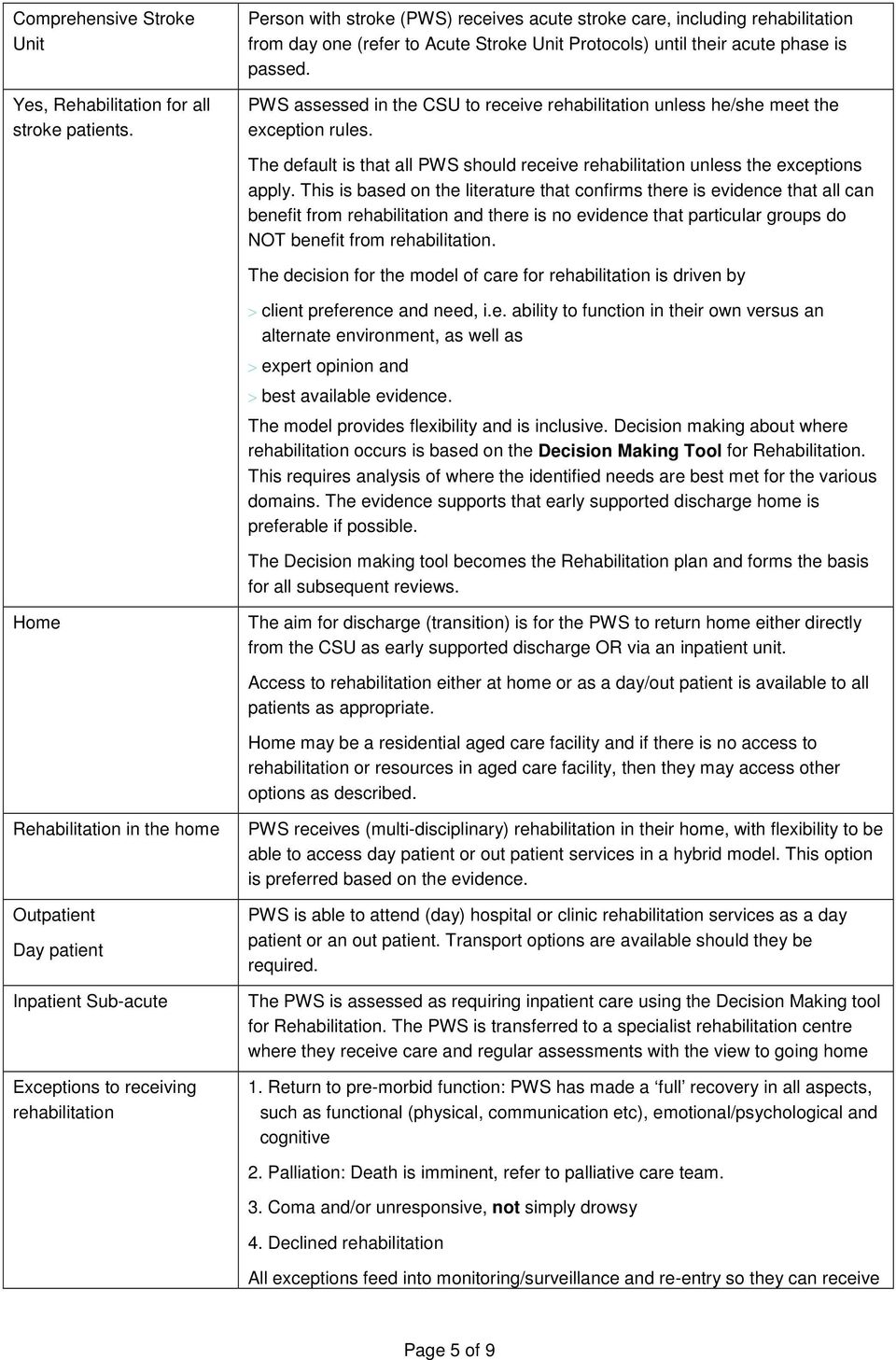
6 rehabilitation should their circumstances change. Monitoring, Surveillance and re-entry All PWS have ability to re-access any rehabilitation services at any time during their ongoing recovery or long term care. Overall aim is to promote/maintain best level of function in all domains. Principles to drive processes > Focus on PWS and their supports > Available and accessible > Maintain relationship with expert team > Link with NSF registry > All information travels with PWS/family as well as maintained at the facility they attend. This includes discharge/transition summaries. This may also be held at web-based system in future. > Self-referral is available (via central number for appointment with closest facility/team) Two functions of monitoring, surveillance and re-entry 1. Monitor status/needs for change and update plan/pathway; > Improving continue > Static follow most appropriate path continue or re-enter > Declining re-enter pathway 2. Monitor secondary prevention/self-management. Two tiers of monitoring: 1. Complex - requires access to all/part of MD team 2. Simple single discipline review (e.g. GP) Process is that review appointment is always scheduled at the completion of any stage in the pathway. The level of monitoring is also established as complex or simple at this time and the appointment made with the relevant staff. The staff then utilise the Decision Making Process to evaluate across all domains and flag status/need. Special need flags: These flags are not exclusionary, but may indicate more intensive rehabilitation or referral to specialist areas, such as psychiatry or complex medical. Some flags may be: > Pre-morbid conditions > Non-compliance > Decreased pre-morbid function > Decreased social support > Incontinence (x2) > Decreased engagement > Conversion disorders > Decreased accommodation options > Co-morbidities > Apathy Page 6 of 9
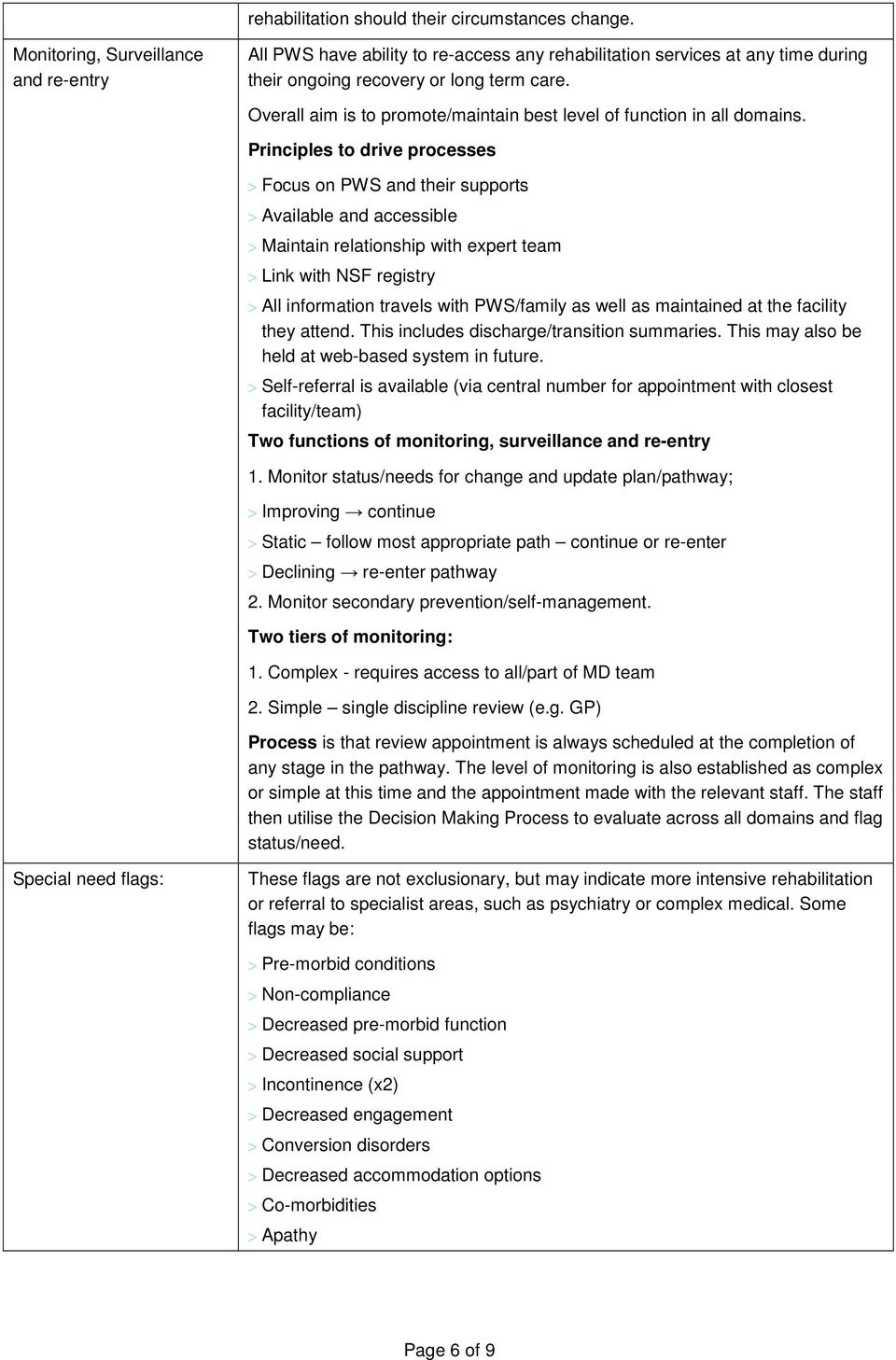
7 Home and Inpatient Pathway Yes, Rehabilitation Inpatient Rehabiltation Home Rehablitation Establish Team Domain assessments Review cycle Goal setting Review cycle Management Long-term management plan Monitoring & Surveillance Page 7 of 9
8 Yes, Rehabilitation for all stroke patients. All patients from the CSU are referred to receive rehabilitation unless they meet the exception rules. The model of care for rehabilitation is driven by client preference and level of need, i.e. level of support/ability to function in their own environment. The model provides flexibility and is inclusive. Decision making about where rehabilitation occurs is based on the Decision Making tool for Rehabilitation. Establish team and key worker identified Domain Assessment Goal Setting Management Identifying the likely rehabilitation team. This includes the designation of a key worker as well as the possible/main disciplines as suggested by the needs analysis. The key worker model > allows for the family and PWS to have one contact for organisational or general inquiries or to direct their specific inquiries > facilitate all aspects of the rehabilitation plan, ensure meetings etc are scheduled and occur within the necessary timeframes and with the salient people/processes > remains a constant for the PWS and their family for the service duration > has credibility/experience in stroke rehabilitation and can confidently guide the PWS and family through the process/es > key worker roles spread across specialist team alternate model may be one coordinator. This is performed by the identified personnel and will build on the initial needs analysis in the relevant domains. Every effort will be made to avoid duplication this will require team communication and planning so that information required across personnel is only gathered once (e.g. demographics, FIM, stroke severity, home situation etc). It is anticipated that each discipline/personnel will also have specific assessments to inform the management plan/s. This process begins informally between the individual team members and the PWS/family as the assessment occurs. It may be facilitated by the PWS being given a goals menu to consider. Goals are documented and agreed to by all parties in a scheduled meeting between the PWS/family and the relevant team members. The emphasis will be on client-centred goals. Various models may be used including Goal Attainment Scaling; SMART goals etc. Based on the best available evidence and wherever possible following the NSF Guidelines for stroke rehabilitation. Key features for management are: > Intensity maximise engagement and opportunities for practice at all times including weekends > Carer training and education > Stroke team has at least one senior/experienced stroke clinician for each core discipline (medical, nursing and each AH). These lead clinicians can mentor younger/less experienced team members. > Access to specialty clinical areas for screening/ support/ intervention including: psychology; neuropsychology, dental, dietary/nutrition and neuroopthalmology Page 8 of 9
9 Review Cycle Monitoring, Surveillance and re-entry > Access to complex interventions/management: spasticity management (BOTOX, splinting/casting); Driving clinic; Vocational rehabilitation; sexuality issues. > Enabling environment - quiet rooms; physically accessible, appropriate communication strategies (taking into account cultural factors, language skills and literacy levels); assistive technology > Rehabilitation is task specific functionally orientated with opportunities for practice and feedback. > Participate in AROC benchmarking, NSF auditing for accountability. > Encourage and promote research both initiating and participating in research that furthers stroke rehabilitation > Establish network (requisite skills and knowledge) to enable long term planning / lifestyle approach > Secondary prevention is on going medical management as well as lifestyle approach with self-management This is an ongoing cycle of review that occurs informally between the individual team members and the PWS, and occurs formally at case conferences between team members and at family meetings. Goals are reviewed and amended and if a transition point (e.g. discharge home) is imminent this is also planned for and action plans will result. All PWS have ability to re-access any rehabilitation services at any time during their ongoing recovery or long term care. See above for details. Long term management plan Lifestyle Involves various other agencies community integration focus includes selfmanagement. Refer to relevant working group within Australian Stroke Coalition. Still allows for rehabilitation monitoring/re-entry. Page 9 of 9

An Australian tool to assess rehabilitation needs for stroke survivors: Pilot data and revised tool
 An Australian tool to assess rehabilitation needs for stroke survivors: Pilot data and revised tool Susan Hillier, Leah Wright and Chris Price on behalf of the ASC Rehabilitation Working Group and SA Stroke
Rehabilitation Stroke Services Framework Summary 2013
 Rehabilitation Stroke Services Framework Summary 2013 The Rehabilitation Stroke Services Framework is designed to enable the delivery and monitoring of best practice stroke care across Australia. Rehabilitation
SECTION B THE SERVICES COMMUNITY STROKE REHABILITATION SPECIFICATION 20XX/YY
 SECTION B THE SERVICES COMMUNITY STROKE REHABILITATION SPECIFICATION 20XX/YY SECTION B PART 1 - SERVICE SPECIFICATIONS Service specification number Service Commissioner Lead Provider Lead Period Date of
Advanced Nurse Practitioner Adult Specialist Palliative Care
 JOB DESCRIPTION ellenor Advanced Nurse Practitioner Adult Specialist Palliative Care Responsible to Accountable to: Head of Adult Community Services Director of Patient Care General ellenor is a specialist
Early Supported Discharge (in the context of Stroke Rehabilitation in the Community)
 Early Supported Discharge (in the context of Stroke Rehabilitation in the Community) Gold Standard Framework This document was produced with reference to national standards for best practice (e.g. NICE
SSNAP s Acute Organisational Audit Report 2012: Performance Summary for South London
 SSNAP s Acute Organisational Audit Report 2012: Performance Summary for South London The Sentinel Stroke National Audit Programme (SSNAP) s Acute Organisational Audit looks at how stroke services across
Australian Stroke Coalition
 Australian Stroke Coalition Assessment for Rehabilitation: Pathway and Decision-Making Tool Manual 2012 About the Australian Stroke Coalition The Australian Stroke Coalition (ASC) was established in 2008
ISSUED BY: TITLE: ISSUED BY: TITLE: President
 CLINICAL PRACTICE GUIDELINE PROFESSIONAL PRACTICE TITLE: Stroke Care Rehabilitation Unit DATE OF ISSUE: 2005, 05 PAGE 1 OF 7 NUMBER: CPG 20-3 SUPERCEDES: New ISSUED BY: TITLE: Chief of Medical Staff ISSUED
Protocol for Accessing Residential Detoxification & Rehabilitation
 Protocol for Accessing Residential Detoxification & Rehabilitation Protocol - working group members: Julie Murray, Alcohol & Drugs Partnership Co-ordinator Lynda Mays, Clinical Services Manager, Addictions,
Age-friendly principles and practices
 Age-friendly principles and practices Managing older people in the health service environment Developed on behalf of the Australian Health Ministers Advisory Council (AHMAC) by the AHMAC Care of Older
Advanced Nurse Practitioner Specialist. Palliative
 JOB DESCRIPTION ellenor Advanced Nurse Practitioner Specialist Palliative Care Responsible to Accountable to: Head of Adult Community Services Director of Patient Care General ellenor is a specialist palliative
General Hospital Information
 Inpatient Programs General Hospital Information General Information The Melbourne Clinic is a purpose built psychiatric hospital established in 1975, intially privately owned by a group of psychiatrists
STROKE REHABILITATION SURVEY
 STROKE REHABILITATION SURVEY INDIANA STROKE PREVENTION TASK FORCE PRESENTED BY VICKI SCOTT, MS, CTRS RECREATIONAL THERAPIST TASK FORCE MEMBER BACKGROUND Stroke is the third leading cause of death in all
SUBMISSION TO THE MEDICARE BENEFITS SCHEDULE REVIEW TASKFORCE
 SUBMISSION November 2015 SUBMISSION TO THE MEDICARE BENEFITS SCHEDULE REVIEW TASKFORCE Submission by the Chiropractors Association of Australia Page 1 of 10 About the Chiropractors Association of Australia
Bulletin. Rehabilitation Clinical Network. May 2014. AROC South Australian benchmarking workshop. Network Chair
 May 2014 Rehabilitation Clinical Network Bulletin Welcome to the Statewide Rehabilitation Clinical Network Bulletin, which provides an update to members on recent Network activities. Network Chair Professor
MAIC GUIDELINES FOR COMPULSORY THIRD PARTY (CTP) REHABILITATION PROVIDERS. Revised and updated 2012
 MAIC GUIDELINES FOR COMPULSORY THIRD PARTY (CTP) REHABILITATION PROVIDERS Revised and updated 2012 MOTOR ACCIDENT INSURANCE COMMISSION (MAIC) GUIDELINES FOR COMPULSORY THIRD PARTY (CTP) REHABILITATION
Neurological Rehabilitation in Practice
 Neurological Rehabilitation in Practice Christopher Ward Professor & Consultant in Rehabilitation Medicine University of Nottingham School of Community Health Sciences Derby Hospitals Foundation Trust
The new Cardiac Nurse Practitioner candidate position at Austin Health
 The new Cardiac Nurse Practitioner candidate position at Austin Health The new Cardiac Nurse Practitioner (NP) candidate position offered by Austin Health is also the first Cardiac NP candidate position
JOB DESCRIPTION. Staff Nurse Children s Hospice at Home. Head of Children s Services. Director of Patient Care. Dartford
 JOB DESCRIPTION JOB TITLE: RESPONSIBLE TO: ACCOUNTABLE TO: HOURS: BASE: Staff Nurse Children s Hospice at Home Head of Children s Services Director of Patient Care Full-time Dartford POST SPECIFICATION:
How To Value A Rehabilitation Medicine Clinical Registry
 INITIAL ANALYSIS OF NEWLY ADDED DATA ITEMS. DO THEY PROVIDE INSIGHTS OF VALUE? Presentation to the AFRM Annual Scientific Meeting 20 September 2013 Frances Simmonds, Director AROC Tara Stevermuer, AROC
BRIEFING PAPER STROKE SERVICES REDESIGN
 1. Introduction BRIEFING PAPER STROKE SERVICES REDESIGN Agenda Item 3 Stroke is the leading cause of adult disability in Wales, and the third most common cause of death, after cancer and heart disease.
How To Be A Clinical Nurse Specialist
 Clinical Nurse Specialist Date: November 2014 Job Title : Clinical Nurse Specialist Department : Hospital Service Location : North Shore Hospital / Waitakere Hospital, Medicine and Health of Older People
Guide to the National Safety and Quality Health Service Standards for health service organisation boards
 Guide to the National Safety and Quality Health Service Standards for health service organisation boards April 2015 ISBN Print: 978-1-925224-10-8 Electronic: 978-1-925224-11-5 Suggested citation: Australian
Australian Safety and Quality Framework for Health Care
 Activities for the HEALTHCARE TEAM Australian Safety and Quality Framework for Health Care Putting the Framework into action: Getting started Contents Principle: Consumer centred Areas for action: 1.2
Dedicated Stroke Interprofessional Rehab Team. Mixed Rehab Unit. Dedicated Rehab Unit
 Outpatient & Community I n p a t I e n t Stroke Rehab Definition Framework Institutional Setting Inpatient Rehab in Acute Care or Rehab Hospitals* Acute Care Integrated Specialized Units Transitional Care
Rehabilitation Network Strategy 2014 2017. Final Version 30 th June 2014
 Rehabilitation Network Strategy 2014 2017 Final Version 30 th June 2014 Contents Foreword 3 Introduction Our Strategy 4 Overview of the Cheshire and Merseyside Rehabilitation Network 6 Analysis of our
South Australian Women s Health Policy
 South Australian Women s Health Policy 1 2 South Australian Women s Health Policy To order copies of this publication, please contact: Department of Health PO Box 287 Rundle Mall Adelaide SA 5000 Telephone:
Good Samaritan Inpatient Rehabilitation Program
 Good Samaritan Inpatient Rehabilitation Program Living at your full potential. Welcome When people are sick or injured, our goal is their maximum recovery. We help people live to their full potential.
This specification must be read along with the overarching specification which applies to all services
 This specification must be read along with the overarching specification which applies to all services 1. Population Needs 1.1 National / local context and evidence base National Context Local Context
Statewide Education and Training Services. Position Paper. Draft for Consultation 1 July 2013
 Statewide Education and Training Services Position Paper Draft for Consultation 1 July 2013 This paper establishes the position for an SA Health Statewide Education and Training Service following the initial
ALBERTA PROVINCIAL STROKE STRATEGY (APSS)
 ALBERTA PROVINCIAL STROKE STRATEGY (APSS) Stroke Systems of Care Key Components APSS Pillar Recommendations March 28, 2007 1 The following is a summary of the key components and APSS Pillar recommendations
JOB DESCRIPTION. Job Title: Macmillan Integrated Palliative Social Worker. Day Therapy department, Outpatient Service & Community
 JOB DESCRIPTION Job Title: Macmillan Integrated Palliative Social Worker Reports to: Day Unit Therapy Lead Location: Salary: Hours of work Annual Leave: Day Therapy department, Outpatient Service & Community
Organising and planning services for people with a personality disorder
 Organising and planning services for people with a personality disorder A NICE pathway brings together all NICE guidance, quality standards and materials to support implementation on a specific topic area.
The new Stroke Nurse Practitioner candidate position at Austin Health
 The new Stroke Nurse Practitioner candidate position at Austin Health The new Stroke Nurse Practitioner (NP) candidate position offered by Austin Health provides an exciting opportunity for a senior nurse
Bsafe Blackpool Community Safety and Drugs Partnership. Drug and Alcohol treatment planning in the community for Young People and Adults 2012/13
 Bsafe Blackpool Community Safety and Drugs Partnership Drug and Alcohol treatment planning in the community for Young People and Adults 2012/13 Planning Framework Treatment plan Planning Framework Bsafe
INDIGENOUS CHRONIC DISEASE PACKAGE CARE COORDINATION AND SUPPLEMENTARY SERVICES PROGRAM GUIDELINES
 CLOSING THE GAP tackling disease INDIGENOUS CHRONIC DISEASE PACKAGE CARE COORDINATION AND SUPPLEMENTARY SERVICES PROGRAM GUIDELINES November 2012 CONTENTS 1. Introduction... 3 Program Context... 3 Service
NHS FORTH VALLEY. Substance Misuse Residential Rehabilitation Pathway
 NHS FORTH VALLEY Substance Misuse Residential Rehabilitation Pathway Date of First Issue 19 / 06 / 2014 Approved 19 / 06 / 2014 Current Issue Date 19 / 06 / 2014 Review Date 19 / 06 / 2016 Version 1.0
REHABILITATION MEDICINE by PROFESSOR ANTHONY WARD
 REHABILITATION MEDICINE by PROFESSOR ANTHONY WARD What is Rehabilitation Medicine? Rehabilitation Medicine (RM) is the medical specialty with rehabilitation as its primary strategy. It provides services
ADULT HEALTH AND WELLBEING LONG-TERM NEUROLOGICAL CONDITIONS
 ADULT HEALTH AND WELLBEING LONG-TERM NEUROLOGICAL CONDITIONS i. Summary The National Service Framework for long-term neurological conditions categorises neurological conditions as: Sudden-onset conditions
The HeartStart Experience. Jessica Auer HeartStart Cardiac Rehabilitation Program Manager Bundaberg Health Promotions Ltd
 The HeartStart Experience Jessica Auer HeartStart Cardiac Rehabilitation Program Manager Bundaberg Health Promotions Ltd HeartStart Program 1994-2013 Cardiac Rehabilitation Program Phase II & Phase III
The End of Life Care Strategy promoting high quality care for all adults at the end of life. Prof Mike Richards July 2008
 The End of Life Care Strategy promoting high quality care for all adults at the end of life Prof Mike Richards July 2008 The End of Life Care Strategy: Rationale (1) Around 500,000 people die in England
Your local specialist mental health services
 Your local specialist mental health services Primary Care Liaison Service B&NES Primary Care Mental Health Liaison service is a short-term support service to help people with mental health difficulties
Commonwealth of Australia 2008
 Commonwealth of Australia 2008 This work is copyright. Apart from any use as permitted under the Copyright Act 1968, no part may be reproduced by any process without prior written permission from the Commonwealth.
Southwark Clinical Commissioning Group Lambeth Clinical Commissioning Group
 Getting the Vision Right: A multi-disciplinary approach to providing integrated care for respiratory patients Dr Noel Baxter, GP NHS Southwark CCG Dr Irem Patel, Integrated Consultant Respiratory Physician
BUILDING A HIGH PERFORMING SYSTEM. A business improvement plan for the Department for Education and Child Development
 BUILDING A HIGH PERFORMING SYSTEM A business improvement plan for the Department for Education and Child Development BUILDING A HIGH PERFORMING SYSTEM 1 Contents Executive summary 3 Increasing local decision-making
ST LUKE S HOSPICE CLINICAL NURSE PRACTITIONER HEAD OF CARE SERVICES SUZANNE SALES CLINICAL NURSING SERVICES MANAGER
 ST LUKE S HOSPICE JOB DESCRIPTION: DAY HOSPICE LEAD/ CLINICAL NURSE PRACTITIONER DATE: MARCH 2015 WRITER: DEB HICKEY HEAD OF CARE SERVICES SUZANNE SALES CLINICAL NURSING SERVICES MANAGER TOTAL NUMBER 11
Summary of new Medicare Benefits Schedule (MBS) item numbers: general practice and allied health. Updated April 2013
 Summary of new Medicare Benefits Schedule (MBS) item numbers: general practice and allied health Updated April 2013 If you would like to receive this publication in an accessible format please phone (03)
Care Closer to Home. The Gateway, Middlesbrough: A New Integrated Health, Social Care & Housing Pathway
 Case Study 111 Care Closer to Home. The Gateway, Middlesbrough: A New Integrated Health, Social Care & Housing Pathway This case study sets out the economic, health and social benefits of Keiro s service
SECTION VII: Behavioral Health Services
 OVERVIEW Behavioral Health Services (mental health and/or substance abuse services) are covered for all members except those enrolled in family planning services only. Care1st manages the delivery of select
SPECIALIST PALLIATIVE CARE DIETITIAN
 SPECIALIST PALLIATIVE CARE DIETITIAN JOB PROFILE Post:- Responsible to: - Accountable to:- Specialist Palliative Care Dietitian Clinical Operational Manager Director of Clinical Services Job Summary Work
TORONTO STROKE FLOW INITIATIVE - Outpatient Rehabilitation Best Practice Recommendations Guide (updated July 26, 2013)
 Objective: To enhance system-wide performance and outcomes for persons with stroke in Toronto. Goals: Timely access to geographically located acute stroke unit care with a dedicated interprofessional team
National Standards for Mental Health Services
 National Standards for Mental Health Services 2010 Contents Foreword 2 Standard 1. Rights and responsibilities 7 Standard 2. Safety 9 Standard 3. Consumer and carer participation 11 Standard 4. Diversity
Statement of Purpose for the Strategic Plan
 Contributors: Elena Espirtu, OTR/L Mary Gollinger, MS, CRRN, RN Renu Mahajan, MD Sriramjini Muthukrishnan, MD Keir Ringquist, PT, GCS David Miller Mamie Kutame, MSW William Kettlewell, RN Kimberly Zimmerman,
Joint Commissioning Panel for Mental Health
 Joint Commissioning Panel for Mental Health www.jcpmh.info Guidance for commissioners of rehabilitation services for people with complex mental health needs 1 Guidance for commissioners of rehabilitation
THE ACQUIRED BRAIN INJURY STRATEGY FOR GRAMPIAN.
 THE ACQUIRED BRAIN INJURY STRATEGY FOR GRAMPIAN. 2011-2016 * 1 January 2011. Contents 1. Executive Summary 2. Progress and Developments since Grampian BI Strategy 2004-2010 3. Definitions and Epidemiology
Rehabilitation. Care
 Rehabilitation Care Bruyère Continuing Care is the champion of well-being for aging Canadians and those requiring Continuing Care, helping them to become and remain as healthy and independent as possible
A model of rehabilitation service delivery for moderate to severe traumatic brain injury in New Zealand: its development and implementation
 A model of rehabilitation service delivery for moderate to severe traumatic brain injury in New Zealand: its development and implementation Allison Foster, PhD Max Cavit ABI Rehabilitation New Zealand,
JOB DESCRIPTION. Person Centred Care Facilitator Nightingale Hammerson Care Services Nightingale House & Hammerson House
 JOB DESCRIPTION Post Title: Department: Work Location: Full/Part Time: Hours of Work: Postholder Reports to: Postholder Supervises: Main Purpose of the Job Person Centred Care Facilitator Nightingale Hammerson
Standard 1. Governance for Safety and Quality in Health Service Organisations. Safety and Quality Improvement Guide
 Standard 1 Governance for Safety and Quality in Health Service Organisations Safety and Quality Improvement Guide 1 1 1October 1 2012 ISBN: Print: 978-1-921983-27-6 Electronic: 978-1-921983-28-3 Suggested
Art by Tim, patient. A guide to our services
 Art by Tim, patient A guide to our services St John of God Health Care is a leading provider of Catholic health care in Australia and bases its care on the Christian values of Hospitality, Compassion,
Inspectorate of Mental Health Services. National Overview of Psychologists Working in Mental Health Services Ireland 2012
 Inspectorate of Mental Health Services National Overview of Psychologists Working in Mental Health Services Ireland 2012 As part of the inspection of mental health services in 2012, the Inspector of Mental
Making the components of inpatient care fit
 Making the components of inpatient care fit Named nurse roles and responsibillities booklet RDaSH Adult Mental Health Services Contents 1 Introduction 3 2 Admission 3 3 Risk Assessment / Risk Management
Northern Ireland Hospice. Job Description. NI Hospice Community Services (initially based at Jennymount site) Clinical Services Manager Community
 Northern Ireland Hospice Job Description Post: Location: Reports to: Responsible to: Hospice Dementia Nurse Specialist (3 year fixed term contract. NI Hospice Community Services (initially based at Jennymount
CHAPTER 535 HEALTH HOMES. Background... 2. Policy... 2. 535.1 Member Eligibility and Enrollment... 2. 535.2 Health Home Required Functions...
 TABLE OF CONTENTS SECTION PAGE NUMBER Background... 2 Policy... 2 535.1 Member Eligibility and Enrollment... 2 535.2 Health Home Required Functions... 3 535.3 Health Home Coordination Role... 4 535.4 Health
Cardiac Rehab and Success
 One Health System, Better Outcomes Department of Health and Human Services, GPO Box 125, Hobart, TAS, 7001 RE: THO North Cardiac Health and Rehabilitation Submission on the Green Paper The Cardiac Health
POSITION PAPER: Occupational therapy in oncology
 POSITION PAPER: Occupational therapy in oncology Occupational Therapy Australia 2015 About Occupational Therapy Australia Occupational Therapy Australia is the professional association for occupational
Student Mental Health and Wellbeing
 Student Mental Health and Wellbeing 2 Student Mental Health and Wellbeing DECS Commitment to Student Mental Health and Wellbeing The Department of Education and Children s Services (DECS) recognises that
POSITION DESCRIPTION
 POSITION DESCRIPTION POSITION TITLE REPORTS TO AWARD/AGREEMENT/CONTRACT POSITION TYPE HOURS PER WEEK Nurse Unit Manager Business Director of Ambulatory and Continuing Care Professional Executive Director
Measuring quality along care pathways
 Measuring quality along care pathways Sarah Jonas, Clinical Fellow, The King s Fund Veena Raleigh, Senior Fellow, The King s Fund Catherine Foot, Senior Fellow, The King s Fund James Mountford, Director
Breast Cancer Pathway
 Breast Cancer Pathway Risk Stratified Follow Up Dr Dorothy Goddard, Associate Medical Director for Cancer Macmillan Consultant Medical Advisor Survivorship What is risk stratified follow up? Refers to
JOB DESCRIPTION REPORTING TO:
 JOB DESCRIPTION SECTION ONE DESIGNATION: REPORTING TO: SENIOR MEDICAL OFFICER: HAWERA HOSPITAL HEAD OF DEPARTMENT EMERGENCY SERVICES - FOR ALL CLINICAL MATTERS, AND AS REQUIRED THE HEADS OF DEPARTMENT
PROCESSES FOR TOOLKIT DEVELOPMENT
 PROCESSES FOR TOOLKIT DEVELOPMENT DETERMINING THE NEED FOR THE TOOLKIT MH-Kids, a service formerly known as the Child and Adolescent Mental Health Statewide Network (CAMHSNET), aims to improve the mental
Specialist mental health service components
 Specialist mental health service components The specialist public mental health system consists of clinical services and psychiatric disability rehabilitation and support services (PDRSS). Clinical mental
Specialist Occupational Therapist Band 6 (Stroke Rehabilitation) Factors Essential % Desirable %
 PERSONNEL SPECIFICATION POST: Specialist Occupational Therapist Band 6 (Stroke Rehabilitation) DEPARTMENT: Occupational Therapy LOCATION: Western Health & Social Care Trust DATE: July 2013 Factors Essential
AMERICAN BURN ASSOCIATION BURN CENTER VERIFICATION REVIEW PROGRAM Verificatoin Criterea EFFECTIVE JANUARY 1, 2015. Criterion. Level (1 or 2) Number
 Criterion AMERICAN BURN ASSOCIATION BURN CENTER VERIFICATION REVIEW PROGRAM Criterion Level (1 or 2) Number Criterion BURN CENTER ADMINISTRATION 1. The burn center hospital is currently accredited by The
Mildmay UK Hospital. Services and Referral. Registered Charity No: 292058. www.mildmay.org
 Mildmay UK Hospital Services and Referral Registered Charity No: 292058 www.mildmay.org Our Vision A world in which everyone living with HIV can have a life in all its fullness Our Mission To respond effectively
Palliative Care Role Delineation Framework
 Director-General Palliative Care Role Delineation Framework Document Number GL2007_022 Publication date 26-Nov-2007 Functional Sub group Clinical/ Patient Services - Medical Treatment Clinical/ Patient
A Regional Approach to the Planning and Delivery of the RHOF and MOICDP in Queensland
 CheckUP & QAIHC Working in Partnership A Regional Approach to the Planning and Delivery of the RHOF and MOICDP in Queensland Background CheckUP, in partnership with the Queensland Aboriginal and Islander
fact sheet Acquired Brain Injury Questions to Consider When Selecting a Rehabilitation Treatment Program
 fact sheet 2020 Peachtree Rd. N.W. Atlanta, GA 30309 404-352-2020 shepherd.org Acquired Brain Injury Questions to Consider When Selecting a Rehabilitation Treatment Program Choosing a rehabilitation facility
Subacute Inpatient MH - Adult
 Subacute Inpatient MH - Adult Definition Subacute Inpatient hospital psychiatric services are medically necessary short-term psychiatric services provided to a client with a primary psychiatric diagnosis
Position Statement #37 POLICY ON MENTAL HEALTH SERVICES
 THE ROYAL AUSTRALIAN AND NEW ZEALAND COLLEGE OF PSYCHIATRISTS Position Statement #37 POLICY ON MENTAL HEALTH SERVICES Mental disorder is a major cause of distress in the community. It is one of the remaining
Developing Community Stroke Rehabilitation Pathways in Lothian. This presentation. Evidence for Therapy-based Community Stroke Rehabilitation
 Developing Community Stroke Rehabilitation Pathways in Lothian Mark Smith Consultant Physiotherapist Stroke Rehabilitation NHS Lothian This presentation The Rationale The Process A Pilot Service Evidence
NSW Health. Rehabilitation Redesign Project. Diagnostic Report Executive Summary November 2010
 NSW Health Rehabilitation Redesign Project Diagnostic Report Executive Summary November 2010 Error! No text of specified style in document. For review by Rehabilitation Redesign Working Group only PwC
Statewide Rehabilitation Service Plan 2009 2017
 Statewide Rehabilitation Service Plan 2009 2017 November 2009 The National Library of Australia Cataloguing-in-Publication: Author: South Australia. Dept. of Health. Statewide Service Strategy Division.
medical care and rehabilitation services that restore lives
 medical care and rehabilitation services that restore lives Information for physicians and discharge planners C RO T C H E D M O U N T A I N S p e c i a l t y H o s p i t a l Crotched Mountain Specialty
Implementing Evidence Based Community Stroke Services
 Implementing Evidence Based Community Stroke Services Dr Rebecca Fisher & Professor Marion Walker University of Nottingham () Damian Jenkinson & Ian Golton (NHS Stroke Improvement Programme) A partnership
May 7, 2012. Submitted Electronically
 May 7, 2012 Submitted Electronically Secretary Kathleen Sebelius Department of Health and Human Services Office of the National Coordinator for Health Information Technology Attention: 2014 edition EHR
PATIENT ACCESS POLICY
 PATIENT ACCESS POLICY Completed Review Date: June 2015 Date for Review June 2016 1 NHS LANARKSHIRE PATIENT ACCESS POLICY 1. BACKGROUND NHS Lanarkshire is required by Scottish Government to deliver a consistent,
POSITION DESCRIPTION. Classification: Job and Person Specification Approval JOB SPECIFICATION
 POSITION DESCRIPTION POSITION DETAILS Position Title: Central Adelaide Director of Psychology Classification: Administrative Unit: Allied Health Term: Type of Appointment: Ongoing Date Created: November