
ANNUAL REPORT OF THE CALIFORNIA DUI MANAGEMENT INFORMATION SYSTEM
|
|
|
- Oswin Williamson
- 9 years ago
- Views:
Transcription
1 2013 ANNUAL REPORT OF THE CALIFORNIA MANAGEMENT INFORMATION SYSTEM ANNUAL REPORT TO THE LEGISLATURE OF THE STATE OF CALIFORNIA IN ACCORDANCE WITH ASSEMBLY BILL 757 CHAPTER 450, 1989 LEGISLATIVE SESSION JANUARY 2013 EDMUND G. BROWN JR. Governor BRIAN P. KELLY, Acting Secretary Business, Transportation and Housing Agency JEAN SHIOMOTO Chief Deputy Director California Department of Motor Vehicles, 2013

2

3 REPORT DOCUMENTATION PAGE Form Approved OMB No Public reporting burden for this collection of information is estimated to average 1 hour per response, including the time for reviewing instructions, searching data sources, gathering and maintaining the data needed, and completing and reviewing the collection of information. Send comments regarding this burden estimate or any other aspect of this collection of information, including suggestions for reducing this burden to Washington Headquarters Service, Directorate for Information Operations and Reports, 1215 Jefferson Davis Highway, Suite 1204, Arlington, VA , and to the Office of Management and Budget, Paperwork Reduction Project ( ) Washington, DC REPORT DATE (DD-MM-YYYY) 2. REPORT TYPE January 2013 Final Report 4. TITLE AND SUBTITLE 2013 Annual Report of the California Management Information System 6. AUTHOR(S) Sladjana Oulad Daoud and Helen N. Tashima 7. PERFORMING ORGANIZATION NAME(S) AND ADDRESS(ES) California Department of Motor Vehicles Research and Development Branch P.O. Box Sacramento, CA DATES COVERED (From - To) 5a. CONTRACT NUMBER 5b. GRANT NUMBER 5c. ELEMENT NUMBER 5d. PROJECT NUMBER 5e. TASK NUMBER 5f. WORK UNIT NUMBER 8. PERFORMING ORGANIZATION REPORT NUMBER CAL-DMV-RSS SPONSORING/MONITORING AGENCY NAME(S) AND ADDRESS(ES) 10. SPONSOR/MONITOR'S ACRONYM(S) 12. DISTRIBUTION AVAILABILITY STATEMENT 13. SUPPLEMENTARY NOTES 14. ABSTRACT 11. SPONSORING/MONITORING AGENCY REPORT NUMBER In this twenty-second annual legislatively-mandated report, 2010 and 2011 data from diverse sources were compiled and cross-referenced for the purpose of developing a single comprehensive data reference and monitoring system. This report presents crosstabulated information on arrests, convictions, court sanctions, administrative actions, and alcohol-involved crashes. In addition, this report provides 1-year proportions of recidivism and crash rates for first and second offenders arrested in each year over a time period of 21 years. Also, the long-term recidivism curves of the cumulative proportions of reoffenses are shown for all offenders arrested in Two analyses were conducted to evaluate if referrals to programs were associated with reductions in 1-year subsequent violations and crashes among those convicted of the reduced charge of alcohol-related reckless driving, and if referrals to the 9-month program were associated with reductions in 1-year subsequent violations and crashes when compared to referrals to the 3-month program among first offenders. The proportions of convicted first and second offenders arrested in 2010, who were referred, enrolled, and completed programs are also presented. 15. SUBJECT TERMS Drinking drivers, tracking data system, reporting system, countermeasures, recidivism, alcohol education and rehabilitation, driver license disqualification 16. SECURITY CLASSIFICATION OF: Unclassified a. REPORT Unclassified b. ABSTRACT Unclassified c. THIS PAGE Unclassified 17. LIMITATION OF ABSTRACT None 18. NUMBER OF PAGES a. NAME OF RESPONSIBLE PERSON Douglas P. Rickard 19b. TELEPONE NUMBER (Include area code) NSN Standard Form 298 (8-98) Prescribed by ANSI Std. Z39-18

4

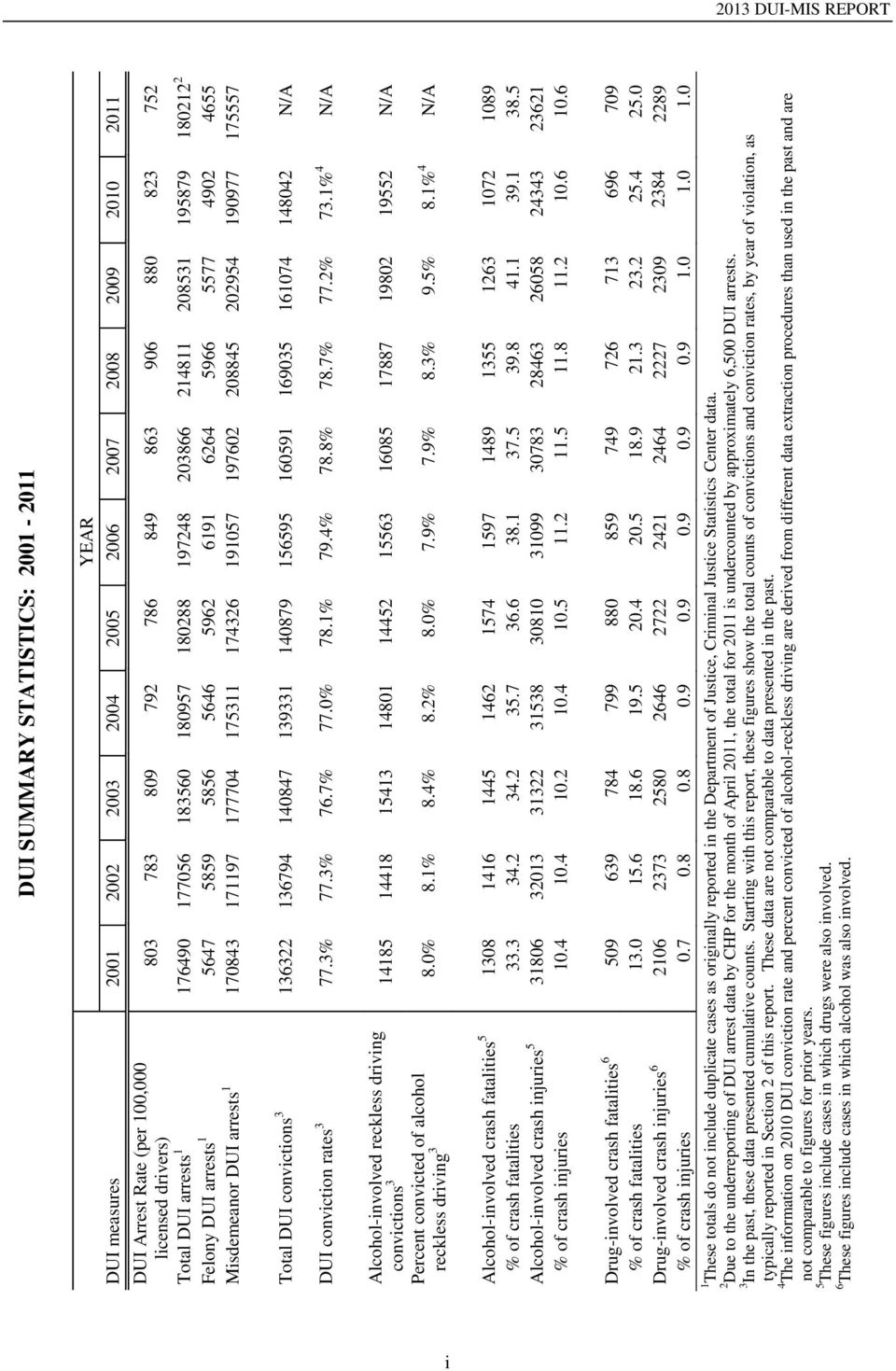
5 2013 -MIS REPORT SUMMARY STATISTICS: YEAR measures Arrest Rate (per 100,000 licensed drivers) Total arrests Felony arrests Misdemeanor arrests SUMMARY STATISTICS: Total convictions N/A conviction rates % 77.3% 76.7% 77.0% 78.1% 79.4% 78.8% 78.7% 77.2% 73.1% 4 N/A convictions N/A Alcohol-involved reckless driving reckless driving 3 8.0% 8.1% 8.4% 8.2% 8.0% 7.9% 7.9% 8.3% 9.5% 8.1% 4 N/A Percent convicted of alcohol Alcohol-involved crash fatalities % of crash fatalities Alcohol-involved crash injuries % of crash injuries Drug-involved crash fatalities % of crash fatalities Drug-involved crash injuries % of crash injuries These totals do not include duplicate cases as originally reported in the Department of Justice, Criminal Justice Statistics Center data. 2 Due to the underreporting of arrest data by CHP for the month of April 2011, the total for 2011 is undercounted by approximately 6,500 arrests. 3 In the past, these data presented cumulative counts. Starting with this report, these figures show the total counts of convictions and conviction rates, by year of violation, as typically reported in Section 2 of this report. These data are not comparable to data presented in the past. 4 The information on 2010 conviction rate and percent convicted of alcohol-reckless driving are derived from different data extraction procedures than used in the past and are not comparable to figures for prior years. 5 These figures include cases in which drugs were also involved. 6 These figures include cases in which alcohol was also involved. i
6 2013 -MIS REPORT SUMMARY STATISTICS: (continued) license actions YEAR Total mandatory suspension/revocation (S/R) actions PRECONVICTION Admin Per Se (APS) Actions Zero tolerance suspensions First-offender suspensions Repeat-offender suspensions Repeat-offender revocations Commercial driver actions Chemical test refusal actions Test refusal suspensions Test refusal suspensions Test refusal revocations POSTCONVICTION 7 Juvenile suspensions First-offender suspensions Misdemeanor Felony Second-offender S/R actions Misdemeanor Felony Third-offender revocations Misdemeanor Felony Fourth-or-more-offender revocations Total postconviction S/R actions These totals might include multiple license action activities associated with the same event. Total counts for years increased as a result of a law change, effective 09/20/2005. This law assigned to DMV the sole responsibility for imposing license actions for all s and removed this responsibility from the courts. 7 ii

7 2013 -MIS REPORT HIGHLIGHTS OF YEAR 2013 CALIFORNIA -MIS REPORT Alcohol-involved crash fatalities increased slightly by 1.6% in 2011, following 4 consecutive years of decreases (see Summary Statistics). Drug-involved crash fatalities increased slightly, by 1.9%, in 2011, and increased 39.3% in the past decade (see Summary Statistics). Of the total number of crash fatalities, the percentage of alcohol-involved fatalities decreased from 39.1% in 2010 to 38.5% in The percentage of drug-involved fatalities decreased from 25.4% to 25.0% during the same time period. The number of persons injured in alcohol-involved crashes decreased by 3.0% in 2011, following a decrease of 6.6% in 2010 (see Summary Statistics). arrests decreased by 8.0% in 2011, following decreases of 6.1% in 2010 and 2.9% in 2009 (see Summary Statistics and Table 1). 1 The arrest rate per 100,000 licensed drivers declined by 8.6% in 2011 following a decline of 6.5% in 2010 (see Summary Statistics) % of all 2010 arrests were associated with a reported traffic crash, compared to 13.4% in % of 2010 arrests were associated with crashes involving injuries or fatalities, slightly lower than 5.2% in 2009 (see Table 17). Among 2011 arrestees, Hispanics (42.9%) were the largest racial/ethnic group, as they have been each year for over a decade. Hispanics continued to be arrested at a rate substantially higher than their estimated percentage of California s adult population (34.8% in 2011). This is shown in Figure 3. The median (midpoint) age of a arrestee in 2011 was 30 years. Less than 1% of all arrests were juveniles (under age 18). This is shown in Table 3a. 1 These decreases are partially due to CHP s non-reporting of approximately 6,500 arrests occurring in April iii

8 2013 -MIS REPORT Among convicted offenders arrested in 2010, 73.1% were first offenders and 26.9% were repeat offenders (one or more prior convictions within the previous 10 years). The proportion of repeat offenders has decreased considerably since 1989, when it stood at 37%, even though prior convictions are counted over 10 years now but only over 7 years in 1989 (see table 8). The median blood alcohol concentration (BAC) of a convicted offender, as reported by law enforcement on Administrative Per Se (APS) forms, was 0.15% in 2010, same as in the last 6 years, yet almost double the California illegal per se BAC limit of 0.08% (see Table 7a). 15.5% of 2010 arrest cases did not show any corresponding conviction on DMV records (see Table 6). iv

9 2013 -MIS REPORT ACKNOWLEDGMENTS The authors acknowledge with appreciation the many individuals who have contributed to the success of this project. In particular, we wish to acknowledge the cooperation of the Department of Justice, Criminal Justice Statistics Center, in providing annual arrest data and documentation, as well as the California Highway Patrol, Information Management Division, in providing annual alcohol- and drug-involved crash data and documentation. The contributions of Douglas Rickard, Associate Governmental Program Analyst, in transforming mainframe computer files into readable data tables and figures, as well as his general assistance in the production of this report, are acknowledged with appreciation. We also would like to acknowledge the contributions of Patrice Rogers, Research Program Specialist II, Michael Gebers, Research Scientist III, Scott Masten, Research Manager II, Alcohol/Drug Projects, Dave DeYoung, Chief (retired), and Robert Hagge, Chief, Research and Development Branch. Report Authors: Sladjana Oulad Daoud, Research Program Specialist II and Helen N. Tashima, Research Program Specialist II, Principal Investigators v

10 2013 -MIS REPORT vi

11 2013 -MIS REPORT TABLE OF CONTENTS PAGE SUMMARY STATISTICS: i HIGHLIGHTS OF YEAR 2013 CALIFORNIA -MIS REPORT... ii ACKNOWLEDGMENTS... v INTRODUCTION... 1 SECTION 1: ARRESTS... 5 SECTION 2: CONVICTIONS SECTION 3: POSTCONVICTION SANCTIONS SECTION 4: POSTCONVICTION SANCTION EFFECTIVENESS RECIDIVISM AND CRASH RATES One-Year Recidivism and Crash Rates for First and Second Offenders Arrested from One-Year Recidivism and Crash Rates by County for First and Second Offenders Arrested in Long Term Recidivism Rates of the 1994 Offenders The Proportions of Program Referrals, Enrollments, and Completions for First and Second Offenders Arrested in EVALUATION FOR ALCOHOL-RELATED RECKLESS OFFENDERS AND FIRST OFFENDERS Methods Results of the Program Evaluation for Drivers Convicted of Alcohol- Reckless Driving Month Program Evaluation for Repeat Alcohol-Related Reckless Drivers Results of the Evaluation of the 3-Month and 9-Month Programs for First Offenders SECTION 5: ADMINISTRATIVE ACTIONS SECTION 6: DRIVERS IN CRASHES INVOLVING ALCOHOL AND DRUGS DATA SOURCES AND LIMITATIONS HISTORY OF MAJOR LAWS IN CALIFORNIA SINCE REFERENCES GLOSSARY vii

12 2013 -MIS REPORT TABLE OF CONTENTS (continued) APPENDICES NUMBER PAGE A ASSEMBLY BILL NO CHAPTER B APPENDIX TABLES B ARRESTS BY COUNTY, AGE, SEX, AND RACE/ETHNICITY B CONVICTIONS BY COUNTY, SEX, AND AGE B3 CONVICTION DATA FOR 2010 ARRESTS BY COURT B SANCTIONS BY COUNTY, COURT, AND OFFENDER STATUS B5 DEMOGRAPHIC 2-YEAR PRIOR DRIVER RECORD VARIABLES FOR ALCOHOL-RELATED RECKLESS OFFENDERS AND FIRST OFFENDERS ARRESTED IN LIST OF TABLES 1 ARRESTS BY COUNTY, AND ANNUAL PERCENTAGE CHANGE, ARRESTS BY COUNTY AND TYPE OF ARREST a 2011 ARRESTS BY AGE, SEX, AND RACE/ETHNICITY b 2011 ARRESTS BY SEX, AGE, AND RACE/ETHNICITY c ARRESTS UNDER AGE 21, CONVICTIONS BY AGE AND SEX CONVICTION DATA FOR 2010 ARRESTS ADJUDICATION STATUS OF 2010 ARRESTS BY COUNTY a 2010 REPORTED BLOOD ALCOHOL CONCENTRATION (BAC) LEVELS OF AND ALCOHOL-RECKLESS CONVICTIONS b 2010 REPORTED BLOOD ALCOHOL CONCENTRATION (BAC) LEVELS OF CONVICTED OFFENDERS UNDER AGE viii

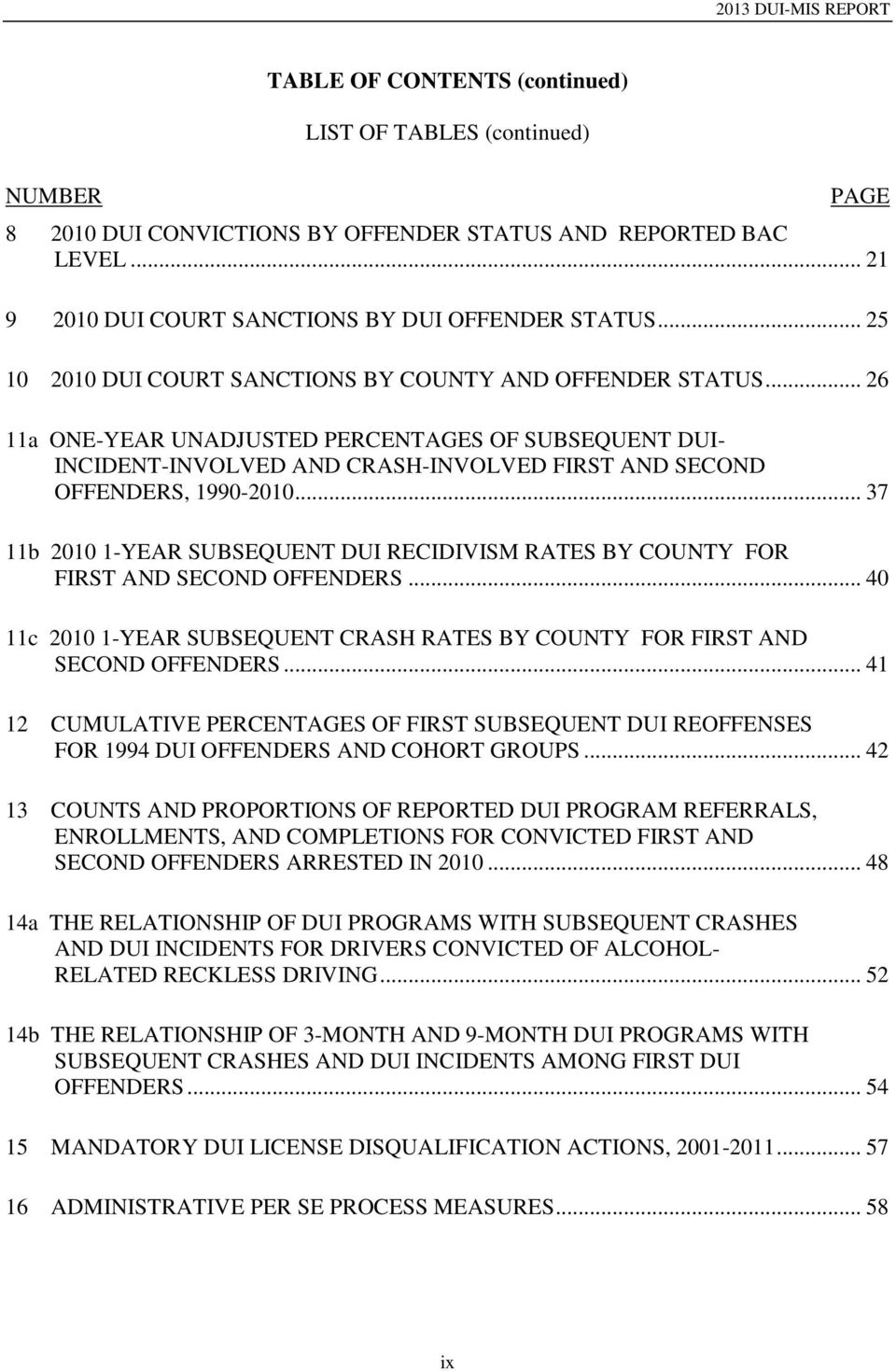
13 2013 -MIS REPORT NUMBER TABLE OF CONTENTS (continued) LIST OF TABLES (continued) PAGE CONVICTIONS BY OFFENDER STATUS AND REPORTED BAC LEVEL COURT SANCTIONS BY OFFENDER STATUS COURT SANCTIONS BY COUNTY AND OFFENDER STATUS a ONE-YEAR UNADJUSTED PERCENTAGES OF SUBSEQUENT - INCIDENT-INVOLVED AND CRASH-INVOLVED FIRST AND SECOND OFFENDERS, b YEAR SUBSEQUENT RECIDIVISM RATES BY COUNTY FOR FIRST AND SECOND OFFENDERS c YEAR SUBSEQUENT CRASH RATES BY COUNTY FOR FIRST AND SECOND OFFENDERS CUMULATIVE PERCENTAGES OF FIRST SUBSEQUENT REOFFENSES FOR 1994 OFFENDERS AND COHORT GROUPS COUNTS AND PROPORTIONS OF REPORTED REFERRALS, ENROLLMENTS, AND COMPLETIONS FOR CONVICTED FIRST AND SECOND OFFENDERS ARRESTED IN a THE RELATIONSHIP OF S WITH SUBSEQUENT CRASHES AND INCIDENTS FOR DRIVERS CONVICTED OF ALCOHOL- RELATED RECKLESS DRIVING b THE RELATIONSHIP OF 3-MONTH AND 9-MONTH S WITH SUBSEQUENT CRASHES AND INCIDENTS AMONG FIRST OFFENDERS MANDATORY LICENSE DISQUALIFICATION ACTIONS, ADMINISTRATIVE PER SE PROCESS MEASURES ix
14 2013 -MIS REPORT NUMBER TABLE OF CONTENTS (continued) LIST OF TABLES (continued) PAGE 17 ARRESTS ASSOCIATED WITH REPORTED CRASHES, ALCOHOL- AND DRUG-INVOLVED DRIVERS IN FATAL/INJURY CRASHES BY RACE/ETHNICITY AND IMPAIRMENT LEVEL ALCOHOL- AND DRUG-INVOLVED DRIVERS IN FATAL/INJURY CRASHES BY ADJUDICATION STATUS AND IMPAIRMENT LEVEL ALCOHOL- AND DRUG-INVOLVED DRIVERS IN FATAL/INJURY CRASHES WITH NO RECORD OF CONVICTION BY COUNTY AND IMPAIRMENT LEVEL ALCOHOL-INVOLVED DRIVERS UNDER AGE 21 IN FATAL/INJURY CRASHES, a 2010 ALCOHOL-INVOLVED DRIVERS IN FATAL/INJURY CRASHES BY AGE AND SEX b 2010 ALCOHOL- AND DRUG-INVOLVED DRIVERS IN FATAL/INJURY CRASHES BY AGE AND SEX (NOT SUSPENDED UPON ARREST OR CONVICTED) a 2010 ALCOHOL- AND DRUG-INVOLVED DRIVERS IN FATAL/INJURY CRASHES BY IMPAIRMENT LEVEL AND PRIOR CONVICTIONS b 2010 ALCOHOL- AND DRUG-INVOLVED DRIVERS IN FATAL/INJURY CRASHES BY IMPAIRMENT LEVEL AND PRIOR CONVICTIONS (NOT SUSPENDED UPON ARREST OR CONVICTED) a 2010 ALCOHOL- AND DRUG-INVOLVED DRIVERS IN FATAL/INJURY CRASHES BY PRIOR CONVICTIONS b 2010 ALCOHOL- AND DRUG-INVOLVED DRIVERS IN FATAL/INJURY CRASHES BY PRIOR CONVICTIONS (NOT SUSPENDED UPON ARREST OR CONVICTED) x

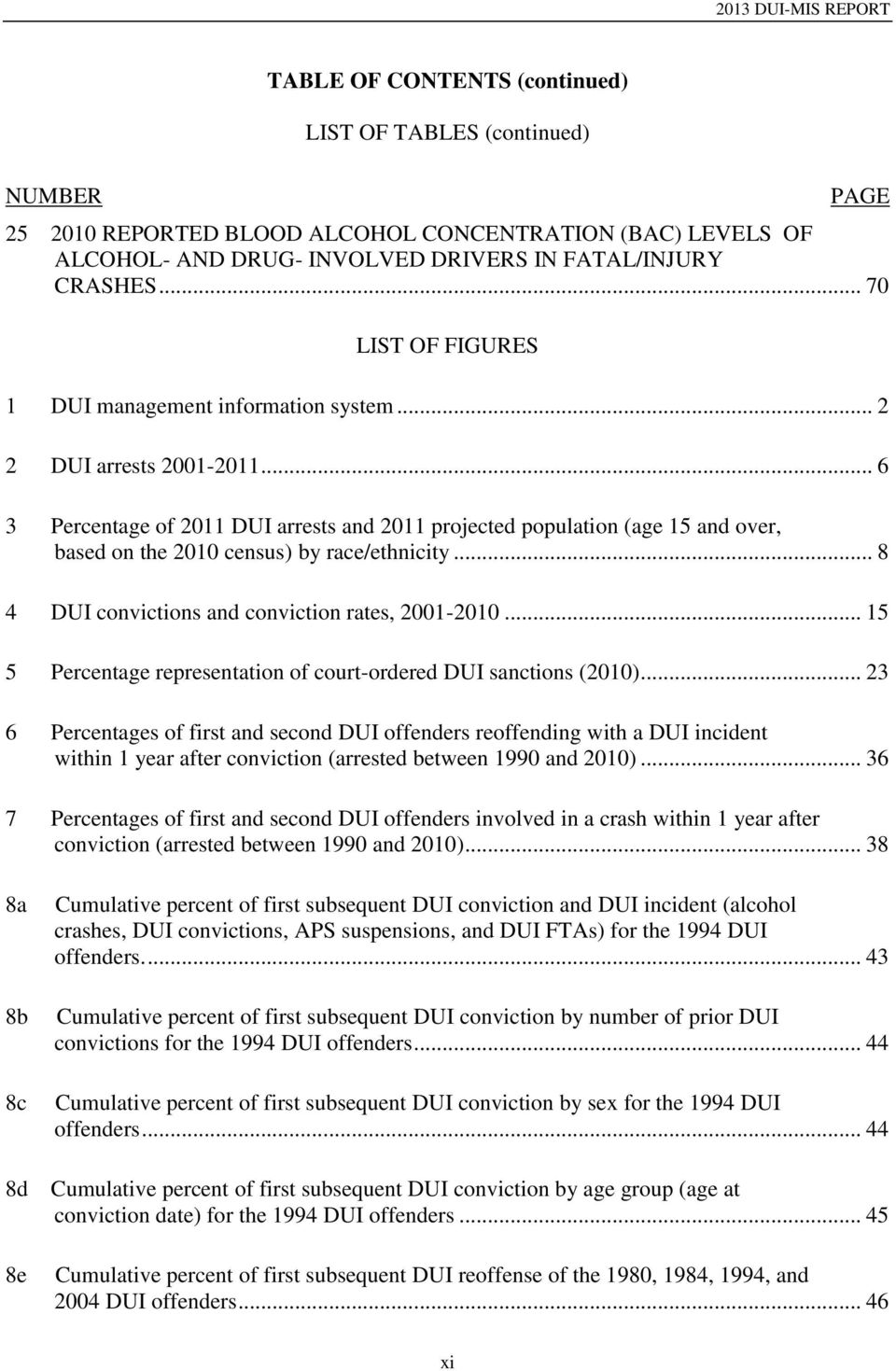
15 2013 -MIS REPORT NUMBER TABLE OF CONTENTS (continued) LIST OF TABLES (continued) PAGE REPORTED BLOOD ALCOHOL CONCENTRATION (BAC) LEVELS OF ALCOHOL- AND DRUG- INVOLVED DRIVERS IN FATAL/INJURY CRASHES LIST OF FIGURES 1 management information system arrests Percentage of 2011 arrests and 2011 projected population (age 15 and over, based on the 2010 census) by race/ethnicity convictions and conviction rates, Percentage representation of court-ordered sanctions (2010) Percentages of first and second offenders reoffending with a incident within 1 year after conviction (arrested between 1990 and 2010) Percentages of first and second offenders involved in a crash within 1 year after conviction (arrested between 1990 and 2010) a 8b 8c Cumulative percent of first subsequent conviction and incident (alcohol crashes, convictions, APS suspensions, and FTAs) for the 1994 offenders Cumulative percent of first subsequent conviction by number of prior convictions for the 1994 offenders Cumulative percent of first subsequent conviction by sex for the 1994 offenders d Cumulative percent of first subsequent conviction by age group (age at conviction date) for the 1994 offenders e Cumulative percent of first subsequent reoffense of the 1980, 1984, 1994, and 2004 offenders xi
16 2013 -MIS REPORT TABLE OF CONTENTS (continued) LIST OF FIGURES (continued) NUMBER PAGE 9a 9b Adjusted 1-year crash and incident rates for alcohol-reckless drivers (arrested in 2010) by program assignment Adjusted 1-year crash and incident rates for first offender drivers (arrested in 2010) by length of program Percentages of crash injuries and fatalities that were alcohol-involved, Alcohol- and drug-involved crash fatalities, xii

17 2013 -MIS REPORT INTRODUCTION This report is the twenty-second Annual Report of the California Management Information System, produced in response to Assembly Bill 757 (Friedman), Chapter 450, 1989 legislative session (see Appendix A). This bill required the Department of Motor Vehicles (DMV) to establish and maintain a data and monitoring system to evaluate the efficacy of intervention programs for persons convicted of in order to provide accurate and up-to-date comprehensive statistics to enhance the ability of the Legislature to make informed and timely policy decisions. The need for such a data system had long been documented by numerous authorities, including the 1983 Presidential Commission on Drunk Driving. In responding to this legislative mandate, this report combines and cross-references data from diverse sources and presents them in a single reference. Data sources drawn upon include the California Highway Patrol (CHP) for crash data, Department of Justice (DOJ) for arrest data, and the DMV driver record database. Each of these reporting agencies, however, initially draw their data from diffuse primary sources such as individual law enforcement agencies (arrest and crash reports) and the courts (abstracts of conviction). The general conceptual design of the California management information system (- MIS) is presented in Figure 1. The basic theme of the -MIS is to track the processing of offenders through the system from the point of arrest and to identify the frequency with which offenders flow through each branch of the system process (from law enforcement through adjudication to treatment and license control actions). Figure 1 also illustrates the relationship between offender flow and data collection at each point of the process. The initiating data source for the -MIS is the arrest report, as compiled by the DOJ, Criminal Justice Statistics Center, Monthly Arrest and Citation Register (MACR) system. Another major objective of this report is to evaluate the effectiveness of court and administrative sanctions on convicted offenders. In the earlier years of this report, these evaluations were accomplished by examining the postconviction recidivism records (alcohol/drug-related crashes and traffic convictions) of offenders assigned to alternative sanctions within offender group. In recent years as the sanctions became increasingly homogenous within each offender group, the evaluations (as mandated by law) became focused on available sanctions in selected groups. These evaluations are detailed in Section 4 on Postconviction Sanction Effectiveness. 1

18 INCIDENTS Arrested? Arrest Report Monthly Arrest and Citation Register Automated Name Index System Chemical Test Refused? Administrative Per Se Suspension Report License Suspension and Processing Figure 1. management information system. LAW ENFORCEMENT ADJUDICATIVE TREATMENT LICENSE CONTROL Accident Involved? Accident Report Statewide Integrated Traffic Record System Complaint Filed? Court Docket Established Plea- Bargain? Conviction of Lesser Offense Abstract of Conviction Driver Record Master File Data Extraction Module -MIS Conviction? Conviction Referred to Treatment? Treatment Referral Figure1. management information system. Treatment Not Completed? Treatment Dropout License Suspended/ Revoked? Suspension/ Revocation on Driver Record License Reinstated? Reinstatement on Driver Record INTRODUCTION 1 management information system 2

19 2013 -MIS REPORT It should again be noted that it is not an objective of this report to make recommendations based on the data presented. Rather, the primary purpose of a reporting system such as the -MIS is to provide objective data on the operating and performance characteristics of the system for others to assess in making policy decisions, formulating improvements, and conducting more indepth evaluations. The -MIS data system and report has led to numerous improvements in the California system, from the identification of inappropriate dismissals in a small central valley court to major initiatives to improve the tracking and reporting of cases. The success of the California -MIS has also contributed to a national initiative to design a model reporting system, developed under contract to the National Highway Traffic Safety Administration (NHTSA). 3
20 INTRODUCTION 4

21 2013 -MIS REPORT SECTION 1: ARRESTS The information presented below on arrests is based primarily on data collected annually by the Department of Justice (DOJ), Criminal Justice Statistics Center, Monthly Arrest and Citation Register (MACR) system. These data are the most current nonaggregated data available on arrests. This year, there was an underreporting of arrests by the CHP for the month of April This resulted in an undercount of varying levels in the information presented in the tables and figures in this section. There is an undercount of approximately 6,500 arrests in the total count for This section includes the following tables and figures: Table 1: Arrests by County, and Annual Percentage Change, The number of arrests by county for the years and the percentage change from are shown in Table 1. Table 2: 2011 Arrests by County and Type of Arrest. This table shows a breakdown of 2011 arrests by felony, juvenile, and misdemeanor arrest type, by county. The table also shows county and statewide arrest rates per 100 licensed drivers. Tables 3a and 3b: 2011 Arrests by Age, Sex, and Race/Ethnicity. Table 3a cross tabulates age by sex and age by race/ethnicity of 2011 arrestees statewide. The same tabulations by county are found in Appendix Table B1. Also, Table 3a shows the average (mean) age for 2011 arrestees. In addition to the mean, the median (midpoint) was reported to minimize the influence of data values that are not equally distributed. Table 3b shows the same data cross-tabulated by sex and age within race/ethnicity. Table 3c: Arrests Under Age 21, Table 3c shows a breakdown of arrests under 21, by age, from 2001 to It also shows the proportion of total arrests under 21 for the state over the same time period. Figure 2 displays the trend in arrests from 2001 to Figure 3 shows the percentages of 2011 arrests and 2011 projected population by race/ethnicity. 5
22 SECTION 1: ARRESTS NUMBER OF ARRESTS Total Felony Misdmeanor YEAR Note. Due to the non-reporting of arrest data by CHP for the month of April 2011, an undercount is present in the figures for 2011 (with approximately 6,500 fewer total arrests). Figure 2. arrests Based on the data shown in Figures 2 and 3 and previously listed tables, the following statements can be made about arrests in California: Statewide Parameters arrests decreased by 8.0% in 2011, after decreasing by 6.1% in 2010 (see Table 1) 1. Table 2 shows that the arrest rate per 100 licensed drivers was 0.8 in 2011, the same as in 2010 but slightly lower than 0.9 in , and unchanged from 0.8 in This represents a 56% reduction from the 1.8 rate in The percentage of arrests that were felonies (involving bodily injury or death) increased slightly, from 2.5% in 2010 to 2.6% in Felony arrests continue to constitute a relatively small percentage of all arrests (see Table 2). County Variation 22.3% of all 2011 California arrests occurred in Los Angeles County. Five counties (Los Angeles, San Diego, Orange, San Bernardino, and Riverside) had over 10,000 arrests each, accounting for 52.1% of all arrests (see Table 2). 1 The non-reporting of approximately 6,500 arrests by CHP for the month of April 2011 is reflected in these percent decreases. 6
23 2013 -MIS REPORT The 2011 county arrest rates ranged from 0.3 to 2.5 arrests per 100 licensed drivers (the statewide average rate is 0.8). Seven counties had rates of 0.6 or below. These counties with low arrest rates were San Francisco (0.3), Santa Clara (0.5), Contra Costa (0.6), Mariposa (0.6), Placer (0.6), San Mateo (0.6), and Solano (0.6). Three counties had rates of 2.0 or higher Alpine (2.5), Trinity (2.4), and Inyo (2.0). This is shown in Table 2. Most counties had fewer arrests in Among the larger counties, the greatest percentage decrease occurred in San Diego (-9.8%). Among smaller counties, the largest percentage decrease in arrests occurred in Alpine (-34.3%) and Mariposa (-32.8%). Counties showing the largest percentage increase in arrests were Mono (40.5%) and San Francisco (19.3%). This is shown in Table 1. Demographic Characteristics The median age of a arrestee in 2011 was 30 years. Slightly more than half (51.7%) of all arrestees were age 30 or younger and almost three-quarters (73.4%) were age 40 or younger. Less than 1% of all arrests involved juveniles (under age 18). 2.9% of all arrestees were over age 60 (see Table 3a). Among all arrestees, the percentage of arrests under age 18 decreased slightly from 0.6 in 2010, to 0.5 in The percentage of arrests under age 21 decreased from 8.1 in 2010, to 7.8 in This is shown in Table 3c. Males comprised 76.5% of all 2011 arrests (see Table 3a). The proportion of females among arrests has risen slightly each year this report has been produced, from 10.6% in 1989 to 23.5% in In 2011, Hispanics (42.9%) again represented the largest ethnic group among arrestees, as they have each year for over a decade. Hispanics continued to be arrested at a rate substantially higher than their estimated 2011 population parity of 34.8% (Department of Finance, Demographic Research and Census Data Center). Blacks were also overrepresented among arrestees (8.4% of arrests, 5.9% of the population), while other racial/ethnic groups were underrepresented among arrestees, relative to their estimated 2011 population parity. These underrepresented groups were Whites (39.9% of arrests, 42.6% of the population) and Other (8.9% of arrests, 16.8% of the population). This is shown in Table 3a and Figure 3. 7
24 PERCENTAGE SECTION 1: ARRESTS Among male 2011 arrestees, 46.9% were Hispanic, 36.0% were White, 8.3% were Black, and 8.8% were Other. Among female arrestees, 52.5% were White, 29.7% were Hispanic, 8.7% were Black, and 9.2% were Other. The overrepresentation of Hispanics among offenders appears to be limited to males (see Table 3b). In some counties where the population of Hispanics is high, the arrest rate is also high. For example, in the following six counties, Hispanics comprised 60% or more of those arrested for during 2011: Imperial (73.8%), Tulare (71.7%), San Benito (66.3%), Merced (64.4%), Fresno (64.0%), and Madera (62.8%). However, in most other counties, the majority of arrestees were White (see Appendix Table B1). The median age of a arrestee varied by race: Blacks were the oldest with a median age of 33.0 years, while Other were the youngest, with a median age of 28.0 years (see Table 3a) arrests 2011 projected population White Hispanic Black Other Note. The non-reporting of approximately 6,500 arrests by CHP for the month of April 2011 is reflected in this figure. Figure 3. Percentage of 2011 arrests and 2011 projected population (age 15 and over, based on the 2010 census) by race/ethnicity. 8
25 2013 -MIS REPORT TABLE 1: ARRESTS 1 BY COUNTY, AND ANNUAL PERCENTAGE CHANGE, COUNTY % CHANGE STATEWIDE ALAMEDA ALPINE AMADOR BUTTE CALAVERAS COLUSA CONTRA COSTA DEL NORTE EL DORADO FRESNO GLENN HUMBOLDT IMPERIAL INYO KERN KINGS LAKE LASSEN LOS ANGELES MADERA MARIN MARIPOSA MENDOCINO MERCED MODOC MONO MONTEREY NAPA NEVADA ORANGE PLACER PLUMAS RIVERSIDE SACRAMENTO SAN BENITO SAN BERNARDINO SAN DIEGO SAN FRANCISCO SAN JOAQUIN SAN LUIS OBISPO SAN MATEO SANTA BARBARA SANTA CLARA SANTA CRUZ SHASTA SIERRA SISKIYOU SOLANO SONOMA STANISLAUS SUTTER TEHAMA TRINITY TULARE TUOLUMNE VENTURA YOLO YUBA DOJ arrest totals with boat (N = 165) removed. The non-reporting of approximately 6,500 arrests by CHP for the month of April 2011 is reflected in this table s 2011 figures. 9
26 SECTION 1: ARRESTS TABLE 2: 2011 ARRESTS BY COUNTY AND TYPE OF ARREST 1 TYPE OF ARREST ARRESTS PER TOTAL FELONY JUVENILE MISDEMEANOR 100 LICENSED COUNTY N % N % N % N % DRIVERS STATEWIDE ALAMEDA ALPINE AMADOR BUTTE CALAVERAS COLUSA CONTRA COSTA DEL NORTE EL DORADO FRESNO GLENN HUMBOLDT IMPERIAL INYO KERN KINGS LAKE LASSEN LOS ANGELES MADERA MARIN MARIPOSA MENDOCINO MERCED MODOC MONO MONTEREY NAPA NEVADA ORANGE PLACER PLUMAS RIVERSIDE SACRAMENTO SAN BENITO SAN BERNARDINO SAN DIEGO SAN FRANCISCO SAN JOAQUIN SAN LUIS OBISPO SAN MATEO SANTA BARBARA SANTA CLARA SANTA CRUZ SHASTA SIERRA SISKIYOU SOLANO SONOMA STANISLAUS SUTTER TEHAMA TRINITY TULARE TUOLUMNE VENTURA YOLO YUBA ¹ The non-reporting of approximately 6,500 arrests by CHP for the month of April 2011 is reflected in this table s figures. 10
27 2013 -MIS REPORT TABLE 3a: 2011 ARRESTS BY AGE, SEX, AND RACE/ETHNICITY 1 TABLE 3a: 2011 ARRESTS BY AGE, SEX, AND RACE/ETHNICITY SEX RACE/ETHNICITY MALE FEMALE WHITE HISPANIC BLACK OTHER TOTAL N % N % N % N % N % N % N % STATEWIDE UNDER & ABOVE MEAN AGE (YEARS) MEDIAN AGE (YEARS) AGE Tabulations for arrests by age, sex, race/ethnicity and county are found in Appendix Table B1. The non-reporting of approximately 6,500 arrests by CHP for the month of April 2011 is reflected in this table s figures. TABLE 3b: 2010 ARRESTS BY SEX, AGE, AND RACE/ETHNICITY 1 TABLE 3b: 2011 ARRESTS BY SEX, AGE, AND RACE/ETHNICITY 1 RACE/ETHNICITY TOTAL WHITE HISPANIC BLACK OTHER SEX AGE N % N % N % N % N % STATEWIDE MALE UNDER & ABOVE TOTAL FEMALE UNDER & ABOVE TOTAL The non-reporting of approximately 6,500 arrests by CHP for the month of April 2011 is reflected in this table s figures. 1 11
28 SECTION 1: ARRESTS TABLE 3c: ARRESTS UNDER AGE 21, AGE TOTAL (ALL N AGES) UNDER N % UNDER 21 N % N % ¹ The non-reporting of approximately 6,500 arrests by CHP for the month of April 2011 is reflected in this table s 2011 figures. 12
29 2013 -MIS REPORT SECTION 2: CONVICTIONS Data on convictions resulting from court adjudication of arrests are reported directly to the DMV on court abstracts of conviction. Although the arrest data reported earlier are based on arrests that occurred in 2011, the conviction data are based on convictions of offenders arrested in 2010 in order to allow sufficient time for courts to report convictions to DMV. Tables in this section compile and cross tabulate these conviction data by demographic, geographic, and adjudicative categories. In what follows, expressions like 2010 convictions refer to offenders arrested in 2010, and subsequently convicted. New this year, Tables 5 and 6 and Figure 5 from previous reports are removed from this section. Consequently, all following tables in this section and throughout the report are renumbered. Also, there are changes in the data source, placement, and type of information provided in Figure 4 and Tables 5 and 6 (previously numbered 7 and 8). Namely, because of the unresolved data reporting problems discovered in the past few years in arrest data from the Department of Justice (DOJ) MACR system, there was a change in the data extraction procedures for the information provided in Table 6 for this year. Since some arrest data from the MACR system could not be matched to the DMV master file (in part due to previously mentioned data reporting problems), the information in Table 6 is estimated as it is limited to cases whose arrest and/or conviction was found on the DMV master file ( matchable cases ). This section contains the following tables and figures: Table 4: 2010 Convictions by Age and Sex. This table cross tabulates statewide conviction information by age and sex. Corresponding county-specific conviction data are presented in Appendix Table B2. Table 5: conviction Data for This table portrays county and statewide -related conviction data ( felony and misdemeanor convictions and alcohol-related reckless driving convictions) as reported to the DMV on court abstracts of conviction. For convictions, it also shows the median adjudication time lags from arrest to conviction, and from conviction to update on the DMV database, both statewide and by county. Starting this year, this table no longer shows information previously shown in Table 7 on conviction rates, non-alcohol reckless or other convictions, and dismissals. Table 6: Adjudication Status of 2010 Arrests by County. This table shows information on conviction rates and adjudication status (court disposition) of 2010 arrests statewide and by county. It includes the percentages of arrests that resulted in convictions ( conviction rates), misdemeanor and felony convictions, reckless driving convictions 13
30 SECTION 2: CONVICTIONS (alcohol and non-alcohol related), other convictions, and the percentage of arrests with no record of any conviction. Starting this year, these estimated data are limited to arrest cases from the MACR file whose arrest and/or conviction was found in the DMV master file and who were tracked individually to determine their final adjudication status. In the past, the information on conviction rates and adjudication status in this table was obtained by dividing the total number of convictions with the total number of arrests, statewide and by county, without matching individual cases. New this year, this information is estimated by tracking matched individual arrest cases and by calculating percentages of those who were convicted of or some other type of violation and of those who were not convicted. Table 7a: 2010 Reported Blood Alcohol Concentration (BAC) Levels of and Alcohol- Reckless Convictions and Table 7b: 2010 Reported Blood Alcohol Concentration (BAC) Levels of Convicted Offenders Under Age 21. Table 7a shows the frequency of reported BAC levels for and alcohol-reckless convictions. Because the APS forms more completely report BAC levels than do abstracts of conviction, they are used to calculate statewide BAC levels. Table 7b shows the BAC distribution for convicted arrestees under age 21. Table 8: 2010 Convictions by Offender Status and Reported BAC Level. This table displays the percentages of convicted offenders by offender status (number of prior convictions in 10 years as defined by SB 1694, Torlakson, effective 1/1/2005), with the average (mean) and median BAC level from APS reporting forms for each offense level. Figure 4 shows, for the years 2001 to 2010, the total number of convictions and conviction rates based on the violation year. 14
31 2013 -MIS REPORT 200,000 CONVICTIONS 1 175, , , YEAR OF ARREST conviction rate % 77.3% 76.7% 77.0% 78.1% 79.4% 78.8% 78.7% 77.2% 73.1%2 (percent convicted) 1 In the past, this figure presented cumulative counts of convictions and conviction rates based on those cumulative counts. Starting this year, this figure shows the total count of convictions and conviction rates, by year of violation, as typically reported in this section. Therefore, data in this figure are not comparable to those presented in the past. 2 The conviction rate for 2010 is based on different data extraction procedures than those used in the past and is not comparable to figures for prior years (see footnote Table 6). Figure 4. convictions and conviction rates, Based on these data, the following statements can be made: Statewide Adjudication Parameters 73.1% of 2010 arrests resulted in convictions of offenses (see Table 6). In California, convictions remain on the driving record for 10 years. Based on the conviction data for the arrests within 10 years ( ), 4.9% of all California drivers (including those who do not have a permanent driving record) have one or more convictions on their record. 8.1% of 2010 arrests resulted in alcohol-related and 1.8% in nonalcohol-related reckless driving convictions (see Table 6). 1.5% of 2010 arrests resulted in convictions of offenses other than or reckless driving, such as speed contest or driving when privilege is suspended or revoked (see Table 6). 15
32 SECTION 2: CONVICTIONS 15.5% of 2010 arrests have not yet resulted in any conviction on DMV s records (see Table 6). As additional cases are adjudicated and reported by the courts, this figure will decrease to some extent. The average reported non-zero BAC level for all convicted offenders arrested in 2010, using APS reporting forms as the data source, was 0.16% (median BAC level was 0.15%), which is the same as in the past 6 years, yet still double the illegal per se BAC limit of 0.08% (see Table 7a). Average and median non-zero BAC levels increase as a function of the number of prior convictions. The average BAC level increases from a 0.16% BAC for a first offense to a 0.19% BAC for a fourth-or-subsequent offense (the median BAC level increases from a 0.15% BAC for a first offense to a 0.18% BAC for a fourth-or-subsequent offense). This is shown in Table 8. Among 2010 arrestees subsequently convicted, 73.1% were first offenders, 20.5% were second offenders, 4.9% were third offenders, and 1.5% were on their fourth-or-more offense. (The statutorily defined time period for counting priors in California has traditionally been 7 years, although that period was changed to 10 years by SB 1694, Torlakson, effective 1/1/2005.) The proportion of all convicted offenders that are repeat offenders (26.9%), shown in Table 8, has increased ever since the counting period for priors changed from 7 to 10 years. For example, in the last year before the change in criteria for counting prior convictions (2004), the percentage of repeat offenders was 23.5% versus 26.9% in The median adjudication time lags were 87 days from arrest to conviction and 8 days from conviction to update on the DMV database, totaling about 3 months from arrest to update on the offender's driving record (see Table 5). Demographic Characteristics The median age of a convicted offender in 2010 was 30.0 years (see Table 4). 50.6% of 2010 convictees were 30 years of age or younger and 72.7% were 40 years or younger (see Table 4). Females comprised 22.3% of convicted offenders arrested in 2010 (see Table 4). The proportion of females among convicted offenders has risen slightly each year since
33 2013 -MIS REPORT TABLE 4: 2010 CONVICTIONS BY AGE AND SEX 1 TOTAL MALE FEMALE AGE N % N % N % STATEWIDE UNDER & ABOVE MEAN AGE (YEARS) MEDIAN AGE (YEARS) County-specific tabulations of 2010 convictions by age and sex are shown in Appendix Table B2. Percents may not add to 100% due to rounding. 17
34 SECTION 2: CONVICTIONS TABLE 5: CONVICTION DATA FOR 2010 ARRESTS 1 MEDIAN ADJUDICATION TIMES (DAYS) COUNTY MISD FELONY 2 ALCOHOL RECKLESS VIOLATION TO CONVICTION CONVICTION TO DMV UPDATE STATEWIDE ALAMEDA ALPINE AMADOR BUTTE CALAVERAS COLUSA CONTRA COSTA DEL NORTE EL DORADO FRESNO GLENN HUMBOLDT IMPERIAL INYO KERN KINGS LAKE LASSEN LOS ANGELES MADERA MARIN MARIPOSA MENDOCINO MERCED MODOC MONO MONTEREY NAPA NEVADA ORANGE PLACER PLUMAS RIVERSIDE SACRAMENTO SAN BENITO SAN BERNARDINO SAN DIEGO SAN FRANCISCO SAN JOAQUIN SAN LUIS OBISPO SAN MATEO SANTA BARBARA SANTA CLARA SANTA CRUZ SHASTA SIERRA SISKIYOU SOLANO SONOMA STANISLAUS SUTTER TEHAMA TRINITY TULARE TUOLUMNE VENTURA YOLO YUBA Conviction data by court are found in Appendix Table B3. conviction rates by county are in Table 6. 2 This count includes misdemeanors which carried a felony disposition code. These counts do not include 4th offenses (in 10 years) which are statutorily defined as felonies. 18
35 2013 -MIS REPORT TABLE 6: ADJUDICATION STATUS OF 2010 ARRESTS BY COUNTY 1 CONVICTION CONVICTIONS % MIS- RECKLESS DRIVING CONVICTIONS % ALCOHOL % NONALCOHOL % OTHER % NO RECORD OF ANY COUNTY RATE DEMEANOR % FELONY RELATED RELATED CONVICTIONS CONVICTION 2 STATEWIDE ALAMEDA ALPINE AMADOR BUTTE CALAVERAS COLUSA CONTRA COSTA DEL NORTE EL DORADO FRESNO GLENN HUMBOLDT IMPERIAL INYO KERN KINGS LAKE LASSEN LOS ANGELES MADERA MARIN MARIPOSA MENDOCINO MERCED MODOC MONO MONTEREY NAPA NEVADA ORANGE PLACER PLUMAS RIVERSIDE SACRAMENTO SAN BENITO SAN BERNARDINO SAN DIEGO SAN FRANCISCO SAN JOAQUIN SAN LUIS OBISPO SAN MATEO SANTA BARBARA SANTA CLARA SANTA CRUZ SHASTA SIERRA SISKIYOU SOLANO SONOMA STANISLAUS SUTTER TEHAMA TRINITY TULARE TUOLUMNE VENTURA YOLO YUBA The adjudication status and conviction rates in this report are derived using different data extraction procedures than those used in the past and are not comparable to figures in prior years. These estimates are based only on arrest cases from the MACR system whose arrest or conviction was found in the DMV master file. 2 These include dismissals and failures-to-appear (FTA); the statewide FTA average is 2.9%. 19
36 SECTION 2: CONVICTIONS TABLE 7a: 2010 REPORTED BLOOD ALCOHOL CONCENTRATION (BAC) LEVELS OF AND ALCOHOL-RECKLESS CONVICTIONS 1 CONVICTIONS ALCOHOL-RECKLESS CONVICTIONS BAC LEVEL (%) FREQUENCY PERCENT BAC LEVEL (%) FREQUENCY PERCENT TOTAL TOTAL MEAN 2 BAC.16 MEAN 2 BAC.10 MEDIAN 2 BAC.15 MEDIAN 2 BAC.09 1 The source of BAC data is the APS reporting form. The percentage of BAC levels found on these forms for convictees arrested in 2010 is 85.9%. 2 The calculation of the mean and median BAC level does not include zero BAC levels which could be drug convictions. 20
37 2013 -MIS REPORT TABLE 7b: 2010 REPORTED BLOOD ALCOHOL CONCENTRATION (BAC) LEVELS OF CONVICTED OFFENDERS UNDER AGE 21 1 BAC LEVEL (%) FREQUENCY PERCENT BAC LEVEL (%) FREQUENCY PERCENT TOTAL MEAN 2 BAC MEDIAN2 BAC.13 1 The source of BAC data is the APS reporting form for arrested offenders. The percentage of BAC levels found on these forms for 2010 convicted under age 21 cases is 87.0%. 2 The calculation of the mean and median BAC level does not include zero BAC levels which could be drug convictions. OFFENDER STATUS TABLE 8: 2010 CONVICTIONS BY OFFENDER STATUS AND REPORTED BAC LEVEL 1 PERCENT AVERAGE BAC LEVEL FROM APS REPORTING FORM (%) 2 MEDIAN BAC LEVEL FROM APS REPORTING FORM (%) 2 STATEWIDE ST ND RD TH The source of BAC data is identical to that of Table 7a. 2 The calculation of the mean and median BAC level does not include zero BAC levels which could be drug convictions. 21
38 SECTION 2: CONVICTIONS 22
39 2013 -MIS REPORT SECTION 3: POSTCONVICTION SANCTIONS Data on court sanctions assigned to convicted offenders were obtained from abstracts of conviction for offenders arrested in This section includes the following tables and figures: Table 9: 2010 Court Sanctions by Offender Status. This table shows the frequency of specific court sanctions statewide by number of prior convictions. The specific court sanctions tallied include percentages of offenders sentenced to probation, jail, programs (first-offender, 18-month, and 30-month programs), and ignition interlock. Cross tabulations of sanctions by county, court, and number of prior convictions appear in Appendix Table B4. Table 10: 2010 Court Sanctions by County and Offender Status. This table displays the distribution of court sanctions by county for all offenders. Figure 5 shows the percentage representation of court-ordered post-conviction sanctions for offenders arrested in PERCENTAGE Probation Jail program Ignition interlock Figure 5. Percentage representation of court-ordered sanctions (2010). From the data in these tables and those in Appendix B4, it is evident that the use of sanctions prescribed for offenders arrested in 2010 continued to vary widely by county, court, and offender status. For example: 23
40 SECTION 3: POSTCONVICTION SANCTIONS Statewide Sanctions The most frequent court sanction for all convicted offenders was probation (95.8%), while the least frequently used court sanction was ignition interlock (5.7%). offenders were sentenced to jail in 74.1% of the cases. In many jurisdictions, however, all or a portion of the jail sentence is often served as community service or home confinement rather than actual jail time.) This is shown in Table 9, and graphically in Figure 5 (previous page). Because virtually all offenders receive more than one type of sanction, the cumulative percentage adds to much more than 100%. County Variation The use of first-offender programs (mostly from 3 to 9 months long) among first offenders varies by county, from 90% or more in 19 counties to 31.0% in San Benito County (see Table 10). Court Variation Statewide, courts vary significantly in how they use available sanctions for offenders. In Los Angeles County alone, one court (Lancaster) assigned jail to 82.4% of all convicted offenders (n = 1,477), while another court (Malibu) in the same county assigned jail to only 22.6% of all convicted offenders (n = 318). This is shown in Table B4 in the Appendix. 0.2% of all offenders arrested in 2010 were referred to 30-month programs (see Table 9). Assignment of offenders (mostly third-or-more) to 30-month programs was low, as there are very few counties that have 30-month programs (see Table 10). Statewide, courts required 5.7% of all convicted offenders arrested in 2010 to install an ignition interlock device, which has decreased from 6.3% for the offenders arrested in Variation by Offender Status 66.2% of first offenders arrested in 2010 were sentenced to jail, compared to 95.5% of all repeat offenders (see Table 9). 90.7% of first offenders were assigned by courts to programs, along with 88.0% of second offenders, 76.2% of third offenders, and 40.8% of fourth-or-more offenders. This is shown in Table 9. (By statute, however, all offenders must eventually complete specified programs in order to be eligible for license reinstatement.) 24
41 2013 -MIS REPORT 17.4% of repeat offenders arrested in 2010 were required by the courts to install an ignition interlock device in their vehicles, compared to 19.1% of those arrested in Despite the old mandatory interlock law for all repeat offenders (AB Freidman), which took effect on July 1, 1993, judges routinely did not require interlocks for these offenders (over 75% of mandatory assignments were not made). This law was repealed in 1998, and a new ignition interlock law (AB Torlakson) was enacted and implemented July 1, 1999, that established mandatory interlock for suspension/revocation violators, while providing incentives for repeat offenders to reinstate early with interlocks. OFFENDER STATUS TABLE 9: 2010 COURT SANCTIONS BY OFFENDER STATUS 1 TOTAL PROBATION JAIL 1 ST OFFENDER 18-MONTH 30-MONTH IGNITION INTERLOCK N % % % % % % STATEWIDE ST REPEAT ND RD TH Entries represent percentages of convictees arrested in 2010 receiving each sanction, by offender status. Sanctions for each offender status group (row) are independent; therefore, row percentages always add to more than 100%. Percentages of sanctions by county and court appear in Appendix Table B4. 25
42 SECTION 3: POSTCONVICTION SANCTIONS TABLE 10: 2010 COURT SANCTIONS BY COUNTY AND OFFENDER STATUS COUNTY OFFENDER STATUS 1 ST 18-MONTH 30-MONTH TOTAL PROBATION JAIL OFFENDER PROGAM IGNITION INTERLOCK N % % % % % % STATEWIDE ALAMEDA 1 ST ND RD TH TOTAL ALPINE 1 ST RD TOTAL AMADOR 1 ST ND RD TH TOTAL BUTTE 1 ST ND RD TH TOTAL CALAVERES 1 ST ND RD TH TOTAL COLUSA 1 ST ND RD TH TOTAL CONTRA 1 ST COSTA 2 ND RD TH TOTAL DEL NORTE 1 ST ND RD TH TOTAL EL DORADO 1 ST ND RD TH TOTAL
43 2013 -MIS REPORT TABLE 10: 2010 COURT SANCTIONS BY COUNTY AND OFFENDER STATUS - continued OFFENDER STATUS 1ST 18-MONTH 30-MONTH TOTAL PROBATION JAIL OFFENDER PROGAM IGNITION INTERLOCK N % % % % % % COUNTY FRESNO 1 ST ND RD TH TOTAL GLENN 1 ST ND RD TH TOTAL HUMBOLDT 1 ST ND RD TH TOTAL IMPERIAL 1 ST ND RD TH TOTAL INYO 1 ST ND RD TH TOTAL KERN 1 ST ND RD TH TOTAL KINGS 1 ST ND RD TH TOTAL LAKE 1 ST ND RD TH TOTAL LASSEN 1 ST ND RD TH TOTAL
44 SECTION 3: POSTCONVICTION SANCTIONS TABLE 10: 2010 COURT SANCTIONS BY COUNTY AND OFFENDER STATUS - continued OFFENDER STATUS 1 ST 18-MONTH 30-MONTH TOTAL PROBATION JAIL OFFENDER PROGAM IGNITION INTERLOCK N % % % % % % COUNTY LOS ANGELES 1 ST ND RD TH TOTAL MADERA 1 ST ND RD TH TOTAL MARIN 1 ST ND RD TH TOTAL MARIPOSA 1 ST ND RD TH TOTAL MENDOCINO 1 ST ND RD TH TOTAL MERCED 1 ST ND RD TH TOTAL MODOC 1 ST ND RD TH TOTAL MONO 1 ST ND RD TH TOTAL MONTEREY 1 ST ND RD TH TOTAL
45 2013 -MIS REPORT TABLE 10: 2010 COURT SANCTIONS BY COUNTY AND OFFENDER STATUS - continued OFFENDER STATUS 1 ST 18-MONTH 30-MONTH TOTAL PROBATION JAIL OFFENDER PROGAM IGNITION INTERLOCK N % % % % % % COUNTY NAPA 1 ST ND RD TH TOTAL NEVADA 1 ST ND RD TH TOTAL ORANGE 1 ST ND RD TH TOTAL PLACER 1 ST ND RD TH TOTAL PLUMAS 1 ST ND RD TH TOTAL RIVERSIDE 1 ST ND RD TH TOTAL SACRAMENTO 1 ST ND RD TH TOTAL SAN BENITO 1 ST ND RD TH TOTAL SAN 1 ST BERNARDINO 2 ND RD TH TOTAL
46 SECTION 3: POSTCONVICTION SANCTIONS TABLE 10: 2010 COURT SANCTIONS BY COUNTY AND OFFENDER STATUS - continued OFFENDER STATUS 1 ST 18-MONTH 30-MONTH TOTAL PROBATION JAIL OFFENDER PROGAM IGNITION INTERLOCK N % % % % % % COUNTY SAN DIEGO 1 ST ND RD TH TOTAL SAN 1 ST FRANCISCO 2 ND RD TH TOTAL SAN JOAQUIN 1 ST ND RD TH TOTAL SAN LUIS 1 ST OBISPO 2 ND RD TH TOTAL SAN MATEO 1 ST ND RD TH TOTAL SANTA 1 ST BARBARA 2 ND RD TH TOTAL SANTA CLARA 1 ST ND RD TH TOTAL SANTA CRUZ 1 ST ND RD TH TOTAL SHASTA 1 ST ND RD TH TOTAL
47 2013 -MIS REPORT TABLE 10: 2010 COURT SANCTIONS BY COUNTY AND OFFENDER STATUS - continued OFFENDER STATUS 1 ST 18-MONTH 30-MONTH TOTAL PROBATION JAIL OFFENDER PROGAM IGNITION INTERLOCK N % % % % % % COUNTY SIERRA 1 ST ND TH TOTAL SISKIYOU 1 ST ND RD TH TOTAL SOLANO 1 ST ND RD TH TOTAL SONOMA 1 ST ND RD TH TOTAL STANISLAS 1 ST ND RD TH TOTAL SUTTER 1 ST ND RD TH TOTAL TEHAMA 1 ST ND RD TH TOTAL TRINITY 1 ST ND RD TH TOTAL TULARE 1 ST ND RD TH TOTAL
48 SECTION 3: POSTCONVICTION SANCTIONS TABLE 10: 2010 COURT SANCTIONS BY COUNTY AND OFFENDER STATUS - continued OFFENDER STATUS 1 ST 18-MONTH 30-MONTH TOTAL PROBATION JAIL OFFENDER PROGAM IGNITION INTERLOCK N % % % % % % COUNTY TUOLUMNE 1 ST ND RD TH TOTAL VENTURA 1 ST ND RD TH TOTAL YOLO 1 ST ND RD TH TOTAL YUBA 1 ST ND RD TH TOTAL
49 2013 -MIS REPORT SECTION 4: POSTCONVICTION SANCTION EFFECTIVENESS This section presents reoffense and crash rates of offenders over various time periods, as well as the methodology and results of evaluations assessing the relationship between programs and recidivism for drivers convicted of alcohol-related reckless driving and for first offenders. The first part of the section examines descriptive indicators, such as recidivism and crash rates, for different groups of offenders within different periods of time: 1) 1-year recidivism and crash rates for first and second offenders arrested between , 2) 1-year recidivism and crash rates by county, for first and second offenders arrested in 2010, 3) percentages of program referrals, enrollments, and completions for first and second offenders arrested in 2010, and 4) long term recidivism rates of offenders arrested in The second part of the section contains the results of the analyses evaluating the relationship between programs and recidivism for two groups of offenders: 1) drivers convicted of the reduced charge of alcohol-related reckless driving, and 2) first offenders referred to 3-month or 9-month programs. The following are highlights of the findings: The 1-year recidivism rates for all first offenders decreased to the lowest level seen in the past 21 years. The reoffense rate for first offenders arrested in 2010 was 46.1% lower than the reoffense rate for first offenders arrested in 1990 (see Figure 6 and Table 11a). The 1-year reoffense rate for second offenders continued to remain at the lowest level in the past 21 years. Recidivism decreased from 9.7% in 1990 to 5.2% in 2010, a 46.4% relative decrease for second offenders (see Figure 6 and Table 11a). Subsequent 1-year crash rates among second offenders have declined from 4.0% in 1990 to 1.8% in 2010, a 55.0% relative decrease. The crash rate for first offenders has also declined; their 2010 rate is 47.2% lower than their 1990 crash rate (see Figure 7 and Table 11a). 33
50 SECTION 4: POSTCONVICTION SANCTION EFFECTIVENESS Of the offenders arrested in 2010 who enrolled in a intervention program, 88.6% of first offenders and 43.2% of second offenders completed their program assignment (see Table 13). At the end of 17 years, 31% of offenders originally convicted in 1994 had at least one subsequent conviction, and 35% incurred at least one incident (see Figure 8a). Over 17 years, recidivism rates increased as the number of prior offenses increased. The proportion of third-or-more offenders reoffending was 43%, while 35% of second offenders and 28% of first offenders reoffended (see Figure 8b). Males showed a much higher cumulative percentage (32%) of reoffenses than did females (24%) over the 17-year time period (see Figure 8c). Long term recidivism rates are inversely related to age, with higher reoffense rates associated with the youngest age group, and the lowest rates with the oldest group (see Figure 8d). After 5 years, the percentage of offenders reoffending in the 1994 group was much lower (18%) compared to the percentages reoffending in the 1984 group (27%) and in the 1980 group (35%), and was equivalent to the percentage reoffending in the 2004 group (18%). This is shown in Figure 8e. Similar to the last 8 years evaluations, this year s results continue to show that the subsequent 1-year crash rates of alcohol-related reckless offenders assigned to a program did not vary significantly from those who were not assigned. Also, the subsequent incident rates of those assigned to programs were not significantly lower than the rates of those who were not assigned (see Table 14a). One-year subsequent incident and crash rates of first offenders referred to the 3- month programs were not significantly different from the incident and crash rates of those referred to 9-month programs (see Table 14b). Subject Selection and Data Collection Convicted and alcohol-related reckless offenders were identified from monthly abstract update files which contain all conviction data reported to DMV by the courts. Subjects were chosen based on the number of and alcoholrelated reckless driving convictions within 10 years prior to their arrest in The 34
51 2013 -MIS REPORT following groups of subjects were selected: 1) first offenders drivers who had no or alcohol-related reckless driving convictions within the previous 10 years, 2) second offenders drivers who had one or alcohol-related reckless driving conviction within the previous 10 years, 3) alcohol-related reckless offenders with no previous offenses in the past 10 years, and 4) first offenders referred to 3-month and 9-month programs. In addition, offenders arrested in 1994 and subsequently convicted were selected for the 17- year follow-up evaluation. The crash and recidivism rates of first and second offenders, and the relationship between programs and recidivism for persons convicted of an alcohol-reckless or first offense, are evaluated in terms of postconviction driving record, as measured by: 1) total crashes and, 2) incidents, which include alcohol-involved crashes, convictions, Administrative Per Se suspensions, and failure-to-appear notices (FTA). For the 1994 offenders, recidivism is measured by subsequent convictions, along with one comparison of incidents. For first and second offenders, the 1-year subsequent unadjusted crash and reoffense data from all of the previous and current evaluations were included. In order to maintain comparability to the previous subject-selection criteria, certain types of offenders had to be excluded. For the sanction analyses among alcohol-related reckless offenders and first offenders, previous and current analyses excluded offenders with convictions of a felony, and those with chemical-test refusal suspensions, because their license control penalties were different from those for the misdemeanor offender groups. Drivers who did not have a full 1-year subsequent follow-up period (because of late conviction dates) were also excluded, as were drivers with X license numbers (meaning that no California driver license number could be found) and drivers with out-of-state ZIP Codes. The only exclusions made for the 1994 offenders were out-of-state cases and drivers with X license numbers. 35
52 PERCENTAGE REOFFENDING IN 1 YEAR SECTION 4: POSTCONVICTION SANCTION EFFECTIVENESS RECIDIVISM AND CRASH RATES One-Year Recidivism and Crash Rates for First and Second Offenders Arrested from The 1-year subsequent -incident and crash reoffense rates for both first and second offenders were compiled from previous and current -MIS reports and plotted onto two separate graphs to display these rates over time. Figure 6 shows the percentages of first and second offenders, arrested between 1990 and 2010, who reoffended within 1 year after their conviction First Offenders Second Offenders YEAR Figure 6. Percentages of first and second offenders reoffending with a incident within 1 year after conviction (arrested between 1990 and 2010). This figure and Table 11a show an ongoing gradual decline in the 1-year recidivism rates for first offenders from 1990 to The overall decline translates into a 46.1% reduction in recidivism for all first offenders from 1990 to The decline in reoffenses is steeper in the early years ( ), following the implementation of APS suspensions for all arrestees. As is evident in Figure 6, the reoffense rates of first offenders continue to be lower than those of the second offenders; this has been consistently evident throughout all previous analyses conducted on first and second offenders. 36
53 2013 -MIS REPORT TABLE 11a: ONE-YEAR UNADJUSTED PERCENTAGES OF SUBSEQUENT - INCIDENT-INVOLVED AND CRASH-INVOLVED FIRST AND SECOND OFFENDERS, YEAR -INCIDENT-INVOLVED FIRST OFFENDERS SECOND OFFENDERS FIRST OFFENDERS CRASH-INVOLVED SECOND OFFENDERS % DIFFERENCE 1990 to % -46.4% -47.2% -55.0% As noted in the past seven annual -MIS reports, a similar overall decline is evident in the 1-year reoffense rates for the second offender group, as displayed in Figure 6 and Table 11a, with the greatest rate of decline occurring during the years from 1993 to Table 11a shows that, from 1990 to 2010, the reoffense rates decreased 46.4% among second offenders. The reoffense rates of second offenders remain higher than those of first offenders across all years. Previous -MIS reports suggested that, while many factors may be associated with the overall decline in incidents for both first and second offenders, the reduction may largely be attributed to the implementation of APS suspensions in An evaluation (Rogers, 1997) of the California APS Law documents recidivism reductions of up to 21.1% for first offenders and 19.5% for repeat offenders, attributable to the law. 37
54 PERCENTAGE CRASH-INVOLVED IN 1 YEAR SECTION 4: POSTCONVICTION SANCTION EFFECTIVENESS The 1-year subsequent crash rates for both first and second offenders were also compiled from previous and current -MIS evaluations and graphically displayed over time. Figure 7 shows the percentages of first and second offenders arrested between 1990 and 2010 who had crashes within 1 year after their conviction First Offenders Second Offenders YEAR Figure 7. Percentages of first and second offenders involved in a crash within 1 year after conviction (arrested between 1990 and 2010). Among first offenders arrested between 1990 and 2010, Figure 7 and Table 11a show an initial decline in crash rates for the earliest years, followed by an ongoing increase after 1993, and then another decline after The relative difference between first offender crash rates in 1990 and 2010 is -47.2%, whereas the relative difference for second offenders for those same years shows a greater decline in crash involvement of -55.0%. Overall, second offenders have lower crash rates than do first offenders (Table 11a), and this fact has been well documented in past evaluations; it has been speculated that the lower crash rates of second offenders may be related to the longer-term (2-year) license suspensions imposed on second offenders. One-Year Recidivism and Crash Rates by County for First and Second Offenders Arrested in 2010 For the 7 th year, the 1-year subsequent recidivism and crash rates, by county, are reported for both first and second offenders. 38
55 2013 -MIS REPORT Table 11b displays the 1-year subsequent recidivism rates of offenders arrested in 2010 by county. As shown in this table, among the larger counties, the rate at which first offenders had a subsequent incident within 1 year varied from 6.3% in Fresno County to 3.1% in Ventura County. Among the smaller counties, Modoc and Siskiyou had recidivism rates above 8.0%, while Alpine and Sierra had 0.0% recidivism rates. Second offenders had generally higher recidivism rates than first offenders. Among the larger counties, Fresno County had the highest rate, with 9.9% of second offenders having a subsequent incident within 1 year, whereas Orange County s second offenders had the lowest rate at 3.6%. Among the smaller counties, the recidivism rate for second offenders ranged from 12.5% (Glenn) to 0.0% (Alpine, Inyo, Modoc, Mono, Nevada, Plumas, Sierra, and Trinity). One-year subsequent crash rates, by county, for both first and second offenders arrested in 2010 are displayed in Table 11c. Among the larger counties, the rate at which first offenders had a subsequent crash within 1 year varied from 3.2% in Los Angeles County to 1.9% in San Diego County. Among the smaller counties, Santa Cruz had a crash rate of 3.8%, while Alpine, Colusa, Modoc, Mono, and Sierra had a 0.0% crash rate. In contrast to recidivism rates, second offenders have generally lower crash rates than first offenders. Among the larger counties, the rate at which second offenders have a subsequent crash within one year varied from 2.5% (Alameda) to 1.0% (San Diego). Among the smaller counties, San Benito had a crash rate of 7.5%, and 14 counties had 0.0% crash rates (Alpine, Butte, Glenn, Imperial, Inyo, Lassen, Modoc, Mono, Napa, Nevada, Plumas, Sierra, Trinity, and Tuolumne). 39
56 SECTION 4: POSTCONVICTION SANCTION EFFECTIVENESS TABLE 11b: YEAR SUBSEQUENT RECIDIVISM RATES BY COUNTY FOR FIRST AND SECOND OFFENDERS COUNTY 1 ST OFFENDER 2 ND OFFENDER N % N % STATEWIDE ALAMEDA ALPINE AMADOR BUTTE CALAVERAS COLUSA CONTRA COSTA DEL NORTE EL DORADO FRESNO GLENN HUMBOLDT IMPERIAL INYO KERN KINGS LAKE LASSEN LOS ANGELES MADERA MARIN MARIPOSA MENDOCINO MERCED MODOC MONO MONTEREY NAPA NEVADA ORANGE PLACER PLUMAS RIVERSIDE SACRAMENTO SAN BENITO SAN BERNARDINO SAN DIEGO SAN FRANCISCO SAN JOAQUIN SAN LUIS OBISPO SAN MATEO SANTA BARBARA SANTA CLARA SANTA CRUZ SHASTA SIERRA SISKIYOU SOLANO SONOMA STANISLAUS SUTTER TEHAMA TRINITY TULARE TUOLUMNE VENTURA YOLO YUBA
57 2013 -MIS REPORT TABLE 11c: YEAR SUBSEQUENT CRASH RATES BY COUNTY FOR FIRST AND SECOND OFFENDERS COUNTY 1 ST OFFENDER 2 ND OFFENDER N % N % STATEWIDE ALAMEDA ALPINE AMADOR BUTTE CALAVERAS COLUSA CONTRA COSTA DEL NORTE EL DORADO FRESNO GLENN HUMBOLDT IMPERIAL INYO KERN KINGS LAKE LASSEN LOS ANGELES MADERA MARIN MARIPOSA MENDOCINO MERCED MODOC MONO MONTEREY NAPA NEVADA ORANGE PLACER PLUMAS RIVERSIDE SACRAMENTO SAN BENITO SAN BERNARDINO SAN DIEGO SAN FRANCISCO SAN JOAQUIN SAN LUIS OBISPO SAN MATEO SANTA BARBARA SANTA CLARA SANTA CRUZ SHASTA SIERRA SISKIYOU SOLANO SONOMA STANISLAUS SUTTER TEHAMA TRINITY TULARE TUOLUMNE VENTURA YOLO YUBA
58 SECTION 4: POSTCONVICTION SANCTION EFFECTIVENESS Long Term Recidivism Rates of the 1994 Offenders Since all offenders were included in the 1994 group, it was possible to observe and compare the long term recidivism rates for subdivided groups within the 1994 cohort, and to see how these groups differ in their long term recidivism rates. This approach was also taken in a previous study conducted by Peck (1991), in which the reoffense failure curves of various groups among 1980 and 1984 offenders were compared. Failure curves are cumulative percentages over time of first reoffenses occurring after initial conviction. Both convictions (alone) and incidents over the 17-year follow-up period for the 1994 group were included as outcome data in order to maintain comparability with the 1984 and 1980 cohorts from a previous evaluation (Peck, 1991). Table 12 shows cumulative percentages of first subsequent reoffenses (convictions) for the 1994 offenders, as well as 9- and 17-year cumulative percentages for the 1980 and 1994 groups and 5-year cumulative percentages for the 1984 and 2004 groups. TABLE 12: CUMULATIVE PERCENTAGES OF FIRST SUBSEQUENT REOFFENSES FOR 1994 OFFENDERS AND COHORT GROUPS YEAR 1 ST 2 ND PERCENTAGE 3 RD MALES FEMALES ST ND RD TH TH TH NA 21 NA 7 TH NA 22 NA 8 TH NA 24 NA 9 TH NA 25 NA 10 TH NA NA 26 NA 11 TH NA NA 27 NA 12 TH NA NA 28 NA 13 TH NA NA 29 NA 14 TH NA NA 30 NA 15 TH NA NA 30 NA 16 TH NA NA 31 NA 17 TH NA NA 31 NA 42
59 CUMULATIVE PERCENT MIS REPORT In addition to Table 12, Figures 8a through 8e display recidivism rates for 1994 offenders over 17 years All Incidents convictions only YEAR Figure 8a. Cumulative percent of first subsequent conviction and incident (alcohol crashes, convictions, APS suspensions, and FTAs) for the 1994 offenders. Figure 8a shows that, for 1994 offenders as a whole, at the end of 17 years 31% were convicted of at least one reoffense. When considering a more expanded view of reoffenses including all incidents, the recidivism rate increased to 35%. These failure curves are steepest in the years following the 1994 conviction, after which they start to flatten out, but are still rising slightly in the 7th through 17th years. For both measures, the highest recidivism rates occur during the first year following conviction. One way to explore the degree of alcohol-use severity is to examine the recidivism rates by the number of prior s within 10 years (time frame for counting priors) of the 1994 violation. Figure 8b displays the cumulative proportions of reoffenses by first, second, and thirdor-more offenders. From this graph and Table 12, it is evident that the recidivism failure curves increase as the number of prior offenses becomes greater. Third-or-more offenders have the highest overall failure curve, and continue to maintain higher failure percentages over the 17-year time period. At the end of 17 years, 43% of third-or-more offenders have reoffended, compared to 35% of second offenders and 28% of first offenders. 43
60 CUMULATIVE PERCENT CUMULATIVE PERCENT SECTION 4: POSTCONVICTION SANCTION EFFECTIVENESS st offender 2nd offender 3rd offender YEAR Figure 8b. Cumulative percent of first subsequent conviction by number of prior convictions for the 1994 offenders. Because the majority of offenders has always been male (87% in 1994), it is relevant to inspect the recidivism rates of the 1994 offenders by gender. As evident in Figure 8c and Table 12, the percentage of males that reoffend over 17 years is much higher than that of females. At the end of 17 years, 32% of males have reoffended as compared to 24% of females. The failure curve of females is noticeably lower and increases at a slower pace throughout the 17 years as compared to the curve of males Male Female Figure 8c. Cumulative percent of first subsequent conviction by sex for the 1994 offenders YEAR
61 CUMULATIVE PERCENT MIS REPORT Since it is also well known that violations are associated with certain age groups, the recidivism curves are assessed by age as well. Figure 8d displays the failure curves of four age groups. It is evident that reoffense rates are inversely related to age; the failure rates are highest for the youngest group and lowest for the oldest group. Over 17 years, the failure curves of the two youngest groups are quite close to each other and are much steeper than the curve of the oldest group; the failure curves of all age groups are steepest during the first few years following the 1994 conviction. The failure curve of the 65+ group flattens out at the fifth year, much sooner than the curves of the other groups. The mortality of the oldest group could influence their lower recidivism rate; also, this group may be restricting their driving by driving less frequently than the other age groups. After 17 years, the two youngest groups reoffended by 35% and 32%, respectively, while 24% of the middle age group (for whom mortality may also be a factor) and 12% of the oldest group recidivated years old years old years old 66+ years old YEAR Figure 8d. Cumulative percent of first subsequent conviction by age group (age at conviction date) for the 1994 offenders. The final figure, Figure 8e, compares the 1994 recidivism curves with those of the 1980, 1984, and 2004 cohorts over a 5-year time period. 45
62 SECTION 4: POSTCONVICTION SANCTION EFFECTIVENESS cohort 1984 cohort 1994 cohort 2004 cohort Year Figure 8e. Cumulative percent of first subsequent reoffense of the 1980, 1984, 1994, and 2004 offenders. Last year, the reoffense rates of the 2004 cohort over the 5-year time period were added along with the cumulative percentages of the 1980, 1984 and 1994 groups (Figure 8e and Table 12). Because these cohorts of offenders span 24 years, it is possible to consider whether the enactment of major laws over that time period has affected their relative recidivism rates. Figure 8e reveals that at the end of 5 years, 35% of the 1980 offenders reoffended compared to 27% of the 1984 group, and to 18% of the 1994 and 2004 groups. Quite dramatically, the proportion recidivating in the 1994 and 2004 groups (18%) dropped by half compared to those in the 1980 group (35%). Major pieces of legislation were enacted in California over this time span of 24 years. The noticeably lower reoffense proportions of the 1984 group (27%) compared to the 1980 group (35%) can likely be attributed to the 1982 laws, AB 541 (Moorhead), which applied tougher sanctions for offenders, and AB 7 (Hart) which established the 0.10% per se BAC illegal limit. The effectiveness of these laws was confirmed by a previous California study by Tashima and Peck (1986). Table 12, which compares the 1980 cohort with the 1994 group over 9 years, shows that 44% of the 1980 group recidivated versus 25% of the 1994 group. The difference between the recidivism rates of these two groups remains quite dramatic at the end of 9 years. There was only a one percentage-point increase in recidivism each year for the 1994 group in years 8 through
63 2013 -MIS REPORT Continuing with Figure 8e, it is evident that the difference in the reoffending proportions between the 1984 group (27%) and the 1994 group (18%) is substantial; this reduction in reoffenses is possibly due to the enactment of the 1990 laws, SB 1623 (Lockyer), which established APS suspensions for all offenders at the time of arrest, and SB 1150 (Lockyer), which set the illegal BAC limit to 0.08% and imposed other stringent sanctions for offenders. As noted earlier, an evaluation (Rogers, 1997) of the California APS law documented recidivism reductions of up to 21.1% for first offenders and 19.5% for repeat offenders, both attributable to the APS law. Figure 8e also shows that the reoffense levels are very similar for both the 1994 and 2004 cohorts. The reoffense rates of the 2004 offenders were only one percentage-point lower than that of the 1994 group for the first 4 years and were identical at the end of 5 years. In summary, the 1994 offenders have long term reoffense rates that are higher among those with more priors (within 10 years), among males, and among younger-aged drivers. These findings are not surprising and are consistent with and supported by previous studies. In comparing the reoffense rates of the 1994 and 2004 groups with those of the 1980 and 1984 offenders, it was found that the cumulative percentages of reoffenses were much lower among the 1994 and 2004 offenders. The dramatically lower reoffense rates of the 1994 and 2004 groups could be attributed, in part, to the enactment of more stringent sanctions for offenders in the past 2 decades, including the APS suspension law of The Proportions of Program Referrals, Enrollments, and Completions for First and Second Offenders Arrested in 2010 Beginning 4 years ago, this report captures the number and proportions of convicted first and second offenders whose records indicated that they had enrolled in and completed a program, upon referral received from the court. Inclusion of the information on enrollments and completions was possible due to the addition of a new subrecord to each person s driving record that contains data on program enrollment and completion dates, court information relevant to the conviction, and program length. Table 13 shows the percentages of referrals to the various programs for first and second offenders. It can be seen from this table that 88.4% of first offenders and 76.8% of second offenders were referred to a program. Among first offenders, 71.5% enrolled in a program, which usually ranges from 3 to 9 months in length, depending upon the offender s BAC level at the time of their arrest. Furthermore, 54.8% of second offenders were enrolled in an 18-month program. Of those enrolled in programs, 88.6% of first offenders and 43.2% of second offenders completed their program assignment (some second offenders may still have been enrolled in the program at the time of data collection). 47
64 SECTION 4: POSTCONVICTION SANCTION EFFECTIVENESS TABLE 13: COUNTS AND PROPORTIONS OF REPORTED REFERRALS, ENROLLMENTS, AND COMPLETIONS FOR CONVICTED FIRST AND SECOND OFFENDERS ARRESTED IN 2010 OFFENDERS TOTAL REFERRALS ENROLLMENT COMPLETION N N % N % N % 1 % 2 1 ST OFFENDERS 108,140 95, , , ND OFFENDERS 30,422 23, , , Percent of total number of offenders. 2 Percent of program enrollees. 3 Referrals to first offender program (3 to 9 months). 4 Referrals to 18 month program. EVALUATION FOR ALCOHOL-RELATED RECKLESS OFFENDERS AND FIRST OFFENDERS Methods Subject Selection and Follow-up Data The basis for evaluating the effectiveness of programs for offenders convicted of alcohol-related reckless driving, or for first offenders, was established by legislation. The evaluation for the offenders with alcohol-related reckless convictions was mandated by SB 1176 (Johnson); for these offenders, this legislation requires the courts to order enrollment in a program as a condition of probation. An evaluation of the efficacy of the 3-month versus 6-month program for first offenders was mandated by AB 1916 (Torlakson). In 2004, the courts were required to refer first offenders whose BAC level is less than 0.20% to a 3-month program, and those with a BAC level of 0.20% or above, or who refuse to take a chemical test, to a 6-month program. Effective 2005, AB 1353 (Liu) increased the duration of intervention programs from 6 to 9 months for first offenders on probation whose BAC level is 0.20% or greater, or who refuse to take a chemical test. Two groups of alcohol-related reckless convictees were identified, including: 1) those who were assigned to a program and 2) those who were not assigned to a program. These sanctions are reported by the courts to DMV via disposition codes on the conviction abstracts. Although courts are mandated to require all alcohol-related reckless drivers to attend at least an educational component of a program as a condition of probation, it was found that 35% of such offenders arrested in 2010 were not assigned to do so. This discrepancy allowed a comparison of subsequent crashes and incidents between the two groups. Alcohol-related reckless convictees with X license numbers and those with out-of-state ZIP codes were excluded from the analysis. 48
65 2013 -MIS REPORT In evaluating the relationship between the length of time of programs and recidivism, first offenders arrested in 2010 that showed the 3-month and 9-month designations on their conviction abstracts were identified and selected for the analysis. The records of 35% of first offenders who were referred to a intervention program either did not indicate the specific length of time of the program or indicated other lengths of time that were not 3 or 9 months. These individuals were excluded from the comparison. Cases further excluded from the analysis were: first offenders convicted of felony, drivers with X license numbers, and drivers with out-of-state ZIP codes. Of the total sample selected, 77% were referred to 3-month programs, while 23% were assigned to 9-month programs. In order to explore if the BAC level of first offenders was associated with recidivism, only offenders with available information on their BAC level were included in the comparison. The conviction date was considered to be the treatment date for defining prior and subsequent driving record data for both alcohol-reckless and first offenders, because the penalties and sanctions for the offense are typically effective as of that date. The evaluation period for the postconviction driving measures lasted at least 1 year from the conviction date, ranging from 12 to 29 months. A buffer period of 4 months was allowed between the end of the evaluation period and the date of data extraction to allow for processing and reporting of the most recent data to DMV for both alcohol-reckless and first offenders. Offenders from either of these groups who had less than the full 1-year follow-up time period (from conviction date to the end of the evaluation period) were excluded from the evaluation. There were two outcome driver record measures used in these evaluations. The first outcome measure consisted of the percentage of offenders who were involved in a crash, and the second outcome measure consisted of the percentage of offenders who were involved in a incident (i.e., alcohol-involved crashes, convictions, APS/refusal suspensions, or failures-to-appear). Only the first crash or the first incident was evaluated which is not an important limitation because the incidence of repeat failures (two-or-more crashes or incidents) was very low during the evaluation period. More importantly, analysis of repeat failures would be subject to confounding by court sanctions received in connection with the first failure incident. This confounding was avoided by excluding multiple incidents from the analyses. 49
66 SECTION 4: POSTCONVICTION SANCTION EFFECTIVENESS Evaluation Design and Analytical Procedures Since it was not possible to randomly assign drivers to the various sanction groups, potential biases due to preexisting group differences were statistically controlled to the extent possible by using biographical data, prior driving record data, and ZIP Code indices, such as crash and traffic conviction averages for each driver's ZIP Code area (Appendix Table B5). While this quasi-experimental design is subject to a number of limitations, the attempt to statistically control for group differences removes at least part of the bias in group assignment and provides a less-confounded comparison of the sanction groups. It is possible, of course, that the groups also differ on characteristics not measured or reflected in covariates. The possibility of uncontrolled biases becomes particularly problematic if sanctions received by offenders systematically vary through self- or judicial-selectivity (e.g., drivers of higher socio-economic status may be more likely to receive a program with license restriction and less likely to receive jail than those of lower status). Prior driver record data were extracted for the 2 years preceding the or alcohol-reckless conviction date. The prior driver record variables for these offenders are shown in Appendix Table B5, and since some of these driver record variables were significantly different between the two groups, they were used as covariates in the analyses to adjust for differences in the outcomes associated with group differences on these variables. Following the extraction of covariates, simple correlations were computed between demographic variables, prior driving variables, and the outcome measures (first subsequent crash and first subsequent incident). The demographic and 2-year prior driving variables that had statistically significant correlations with the outcome measures were identified and selected as potential covariates. For each logistic regression analysis, potential interactions between the covariates and treatment/comparison groups were tested. In analyses with significant interactions, the interaction terms were included in the final logistic regression models. However, for both alcohol-reckless drivers and first offenders, there were no significant interactions in either of the models. 50
67 RATE OF INVOLVMENT IN CRASHES OR INCIDENTS PER 100 DRIVERS MIS REPORT Results of the Program Evaluation for Drivers Convicted of Alcohol-Reckless Driving Figure 9a and Table 14a display the results of the evaluation of the effectiveness of program assignment on drivers convicted of alcohol-related reckless driving violations No program program No program program CRASHES INCIDENTS Figure 9a. Adjusted 1-year crash and incident rates for alcohol-reckless drivers (arrested in 2010) by program assignment. Total Crashes Like the past 8 years' findings, the results show that assignment to a program was not significantly associated with 1-year subsequent crash rates of alcohol-related reckless offenders; the slight difference between the groups may be due to chance alone. The crash rates of alcohol-reckless drivers arrested in 2010 with no program assignment are similar (3.94 per 100 drivers) to last year's evaluation (4.16 per 100 drivers). Also, for those referred to programs, the crash rates in this year's evaluation (3.47 per 100 drivers) are comparable to the previous year s evaluation (3.57 per 100 drivers). 51
68 SECTION 4: POSTCONVICTION SANCTION EFFECTIVENESS TABLE 14a: THE RELATIONSHIP OF S WITH SUBSEQUENT CRASHES AND INCIDENTS FOR DRIVERS CONVICTED OF ALCOHOL-RELATED RECKLESS DRIVING YEAR SANCTION GROUP SAMPLE SIZE NUMBER OF CRASH- INVOLVED, PER 100 DRIVERS PERCENTAGE EFFECT (DIFFERENCE IN % RATES) = NUMBER OF INCIDENT- INVOLVED, PER 100 DRIVERS PERCENTAGE EFFECT (DIFFERENCE IN % RATES) = GRP 2 - GRP 1 GRP 2 - GRP 1 X 100 GRP 1 GRP 1 X (FOLLOW-UP PERIOD = 1 YEAR) No program (GRP 1) program (GRP 2) 5, % 9, % Incidents Figure 9a and Table 14a indicate that alcohol-reckless offenders assigned to a program do not show a statistically different number of incidents in the 1 year following their assignment than those who were not assigned. The reoffense rate of the alcoholreckless offenders assigned to the programs is 1.5% lower than the reoffense rate of those not assigned to the programs. This difference is not large enough to be significant. These findings are different than last year s, but similar to findings from prior years. These results have to be viewed with some caution because random assignment to program attendance was not possible; there still remains the possibility of uncontrolled biases through self- or judicial-selectivity, even though statistical controls based on available covariates should remove some of the bias. 9-Month Program Evaluation for Repeat Alcohol-Related Reckless Drivers An evaluation of a referral to a 9-month program for offenders with an alcohol-related reckless conviction who have a prior conviction for alcohol-related reckless driving or within 10 years, was mandated by AB 2802 (Houston). This legislation requires the courts to order these offenders to enroll in a intervention program for at least 9 months as a condition of probation. The records of persons arrested for in 2010 and subsequently convicted of alcohol-reckless driving indicate that 1,923 of them have a prior or alcohol-related reckless conviction. The court-reported conviction abstracts for these offenders show that 46% of them were referred to programs when they were granted probation. However, the records of only 28 offenders (1.5%) indicated a 9-month program referral. Since this critical information indicating an assignment to the 9-month program was missing on the records for 98.5% of the repeat alcohol-reckless offenders, it was not possible to evaluate this program referral for the current report. 52
69 RATE OF INVOLVMENT IN CRASHES OR INCIDENTS PER 100 DRIVERS MIS REPORT Results of the Evaluation of the 3-Month and 9-Month Programs for First Offenders Total Crashes Figure 9b and Table 14b display the results of the evaluation of the relationship between program length and recidivism and crashes among first offenders assigned to 3-month versus 9-month programs. The results show that the length of time of the program is not significantly associated with 1-year subsequent crash rates of first offenders. First offenders assigned to the 9-month program have a 6.5% lower crash rate than those assigned to the 3-month program, but this difference was not sufficient to reach statistical significance. This year s findings are consistent with prior year s results that generally did not show significant differences in 1-year subsequent crashes between the two groups month program 9-month program 3-month program 9-month program CRASHES INCIDENTS Figure 9b. Adjusted 1-year crash and incident rates for first offender drivers (arrested in 2010) by length of program. Incidents Similar to last year s results, Figures 9b and Table 14b indicate that first offenders assigned to the 3-month program do not have significantly different 1-year subsequent incident rates than offenders assigned to the 9-month program. The reoffense rate of those assigned to the 9-month program is 5.1% lower than that of those assigned to the 3-month program; a difference that is, again, not large enough to be statistically significant. In evaluations prior to the last 2 years, results indicated that offenders assigned to the 9-month program had significantly more subsequent incidents than offenders assigned to the 3-month program. That was not surprising given that first offenders assigned to the 9-month program have higher BAC levels (0.20% and above), and would be more likely to recidivate than offenders with lower BAC levels. Therefore, in those prior years, two further subanalyses were conducted to determine whether BAC level was associated with the 53
70 SECTION 4: POSTCONVICTION SANCTION EFFECTIVENESS outcomes of this evaluation. The results of these two subanalyses generally confirmed that first offenders with higher BAC levels (0.20% and above) were more likely to recidivate than those with lower BAC levels. Also, when BAC level is held constant, there were no significant differences in the incident rates between offenders assigned to the 3-month program and those assigned to the 9-month program. Starting 2 years ago, BAC level information has been included in the initial analysis as a covariate so that its effects on the outcome measures (1-year subsequent crashes and incidents) were removed before assessment of the relationship between assigned program length and recidivism among first offenders. When the effect of BAC level on recidivism was removed, the results indicated that assignment to the extended 9-month program does not appear to be associated with fewer incidents than assignment to the 3-month program, which is comparable to the findings in prior years. TABLE 14b: THE RELATIONSHIP OF 3-MONTH AND 9-MONTH S WITH SUBSEQUENT CRASHES AND INCIDENTS AMONG FIRST OFFENDERS YEAR SANCTION GROUP SAMPLE SIZE NUMBER OF CRASH- INVOLVED, PER 100 DRIVERS PERCENTAGE EFFECT (DIFFERENCE IN % RATES) = NUMBER OF INCIDENT- INVOLVED, PER 100 DRIVERS PERCENTAGE EFFECT (DIFFERENCE IN % RATES) = GRP 2 - GRP 1 GRP 2 - GRP 1 GRP 1 X 100 GRP 1 X (FOLLOW-UP PERIOD = 1 YEAR) 3-month program (GRP 1) 9-month program (GRP 2) 35, % , Note. Like last year, the findings presented in this table were obtained using different statistical procedures and are not comparable to all prior years. The formula to calculate percentage effect was also revised in 2010 and is not comparable to all prior years. The effectiveness of increasing the duration of time for intervention programs has also not been supported in the literature. DeYoung examined the effectiveness of lengthening SB 38 alcohol treatment programs from 12 to 18 months for second offenders and found no evidence that the additional 6 months contributed to reducing recidivism (DeYoung, 1995). A final limitation of these analyses should be noted. Since this study only included first offenders whose conviction abstract had information on the length of program, there may be additional unknown biases that this quasi-experimental design cannot rule out. However, the statistical control of group differences based on available covariates would be expected to remove at least part of the bias. -5.1% 54
71 2013 -MIS REPORT SECTION 5: ADMINISTRATIVE ACTIONS Data on DMV administrative license disqualification actions (license suspension or revocation [S/R]) taken in cases are presented below. These statutorily-mandated actions are initiated by the receipt of either a law enforcement APS report (0.08% BAC, zero tolerance, probation violation, or chemical test refusal) or court abstract of conviction. It should be noted that multiple actions can result from a single incident for example, a single arrest frequently will result in both an APS suspension and a (later) mandatory postconviction suspension action. The total count of postconviction suspension/revocation actions has dramatically increased as a result of a law change (SB 1697), effective September 20, 2005, which assigned to DMV sole responsibility for imposing postconviction license actions for all offenders, removing this responsibility from the courts. DMV is also responsible for issuing license restrictions to offenders who meet requirements defined by the law. This section includes the following tables: Table 15: Mandatory License Disqualification Actions, This table shows preconviction (APS) and postconviction license disqualification totals from 2001 through The postconviction totals include juvenile suspensions, first-offender suspensions, secondoffender suspensions and revocations, and third- and fourth-offender revocations. Table 16: Administrative Per Se Process Measures. This table presents APS process measure data from 2009 to In prior reports, this table showed APS process measures for fiscal years rather than calendar years, so the values for this year are not comparable to values from previous years. 55
72 SECTION 5: ADMINISTRATIVE ACTIONS The following statements are based on the data shown in the previously listed tables. The total number of DMV preconviction and postconviction S/R actions for 2011 was 46.5% higher than that for 2001 (see Table 15). These totals have increased markedly as of September 20, 2005 due to the law change noted above. In 2011, 178,262 APS license actions were taken. Of these actions, 74.2% were firstoffender actions (including actions for zero tolerance) and 25.8% were repeat-offender actions (see Table 15). Total APS actions decreased by 3.0% in 2011, following a 7.0% decrease in 2010 (see Table 16). The number of chemical test refusal actions decreased by 8.5% in 2011, after decreasing by 5.3% in The total number of refusal actions has fallen 14.4% during the past decade (see Table 15). Requests for APS hearings decreased from 30.4% of all APS actions in 2010 to 29.5% in In addition, the rate at which.08 APS S/R actions are set aside after a hearing continued to stay relatively unchanged during the past several years, from 8.7% set aside in 2009, to 8.6% set aside in 2010, to 8.4% set aside in 2011 (see Table 16). Total postconviction S/R actions decreased by 4.5% in 2011, after decreasing 8.3% in 2010, with the largest decrease occurring for first-offender suspensions (5.4%), but increasing for third- and fourth-offender revocations. This is shown in Table
73 2013 -MIS REPORT TABLE 15: MANDATORY LICENSE DISQUALIFICATION ACTIONS, TABLE 15: MANDATORY LICENSE DISQUALIFICATION ACTIONS, YEAR license actions Total mandatory suspension/revocation (S/R) actions PRECONVICTION.08 Test refusal revocations Admin Per Se (APS) Actions Zero tolerance suspensions First-offender suspensions Repeat-offender suspensions Repeat-offender revocations Commercial driver actions Chemical test refusal actions Test refusal suspensions Test refusal suspensions POSTCONVICTION 1 Juvenile suspensions First-offender suspensions Misdemeanor Felony Second-offender S/R actions Misdemeanor Felony Third-offender revocations Misdemeanor Felony Fourth-or-more-offender revocations Total postconviction S/R actions 1 These totals might include multiple license action activities associated with the same event. This count has increased as a result of a law change, effective 09/20/2005. This law assigned to DMV the sole responsibility for imposing license actions for all s and removed this responsibility from the courts. 57
74 SECTION 5: ADMINISTRATIVE ACTIONS TABLE 16: ADMINISTRATIVE PER SE PROCESS MEASURES Total APS actions taken (including cutoff actions later set aside): 218, , ,665 Total.08 1 APS actions set aside 18,046 17,863 17,294 Total.01 2 suspensions set aside 1,228 1, ,109 Net total APS actions taken (excluding actions later set aside) 198, , ,262 Net total.08 APS actions 177, , ,788 Net total.01 actions 20,861 18,684 17,474 Net APS Actions by Offender Status/License Classification: 3 Net total APS actions, noncommercial drivers 195, , ,947 Net total commercial driver (CDL) APS actions taken 2,924 2,776 2,315 Net total actions of commercial drivers in commercial vehicles Net APS.08 actions for drivers with no prior convictions or APS 127, , ,859 actions 4 4-month license suspensions 91,370 83,687 79, day suspensions plus 5-month COE 5 restrictions 28,885 26,991 29,061 First-offender chemical test refusals 5,055 4,847 4,457 CDL first offender suspensions/restrictions 2,623 2,359 2,039 Net APS.08 actions taken for drivers with prior convictions 50,057 47,175 45,929 Suspensions 46,747 44,101 43,095 Revocations 3,310 3,074 2,834 APS Chemical Test Refusal Process Measures: Total.08 and.01 APS refusal actions taken (including actions later set aside) 9,276 8,795 8,022 Total.08 refusal actions set aside Total.01 refusal actions set aside Net total.08 and.01 APS refusal actions (excluding actions later set aside) 8,737 8,275 7,572 Net total.08 refusal actions 8,365 7,921 7,291 Net total.01 refusal actions Chemical test refusal rate (including actions later set aside) 4.25% 4.34% 4.08% Net.08 APS refusal (suspension) actions for subjects with no prior s 5,055 4,847 4,457 Net.08 APS refusal (revocation) actions for subjects with prior s 3,310 3,074 2,834 APS Hearings: 6 Total.08 and.01 in person or telephone APS hearings scheduled 57,713 61,744 58,066 Percentage of total APS actions resulting in a scheduled hearing % 30.4% 29.5%.08 hearings held and/or completed 52,866 56,943 53, actions set aside following hearings 4,599 4,894 4,538 Percentage of.08 APS actions set aside following hearings 8.7% 8.6% 8.4%.01 hearings held and/or completed 4,531 4,516 4, actions set aside following hearings Percentage of.01 APS actions set aside following hearings 9.9% 9.2% 8.7% APS Chemical Test Refusal Hearings: Total.08 and.01 APS refusal hearings scheduled 3,210 3,365 3, APS refusal hearings held and/or completed 3,111 3,255 2, APS refusal actions set aside following hearings refers to APS actions taken subsequent to obtaining evidence of a BAC equal to or in excess of the.08% per se level or on the basis of a chemical test refusal. Such an action is taken in conjunction with a arrest refers to APS suspensions taken against drivers under the age of 21 with BACs.01% or greater, or on the basis of a chemical test refusal, and are not necessarily taken in conjunction with a arrest. 3 All entries in this category exclude actions later set aside but, where possible, include actions taken on the basis of either a chemical test refusal or a BAC test result. 4 Prior convictions or APS actions consist of any such conviction or action where the violation occurred within 10 years (7 years before 1/1/05) prior to the current violation. 5 This restriction allows driving to, from, and during the course-of-employment (enacted 1/1/95). 6 These figures include refusal hearings but exclude Driver Safety/Investigation hearings, subsequent APS dismissal hearings, and departmental reviews. 7 Both numerator and denominator include those actions later set aside as a result of the hearing. 58
75 2013 -MIS REPORT SECTION 6: DRIVERS IN CRASHES INVOLVING ALCOHOL AND DRUGS This section presents data on drivers in alcohol- and drug-involved crashes, as compiled and reported by the California Highway Patrol. Only crashes involving injury or fatality are included, due to incomplete reporting of property-damage-only (PDO) crashes. 1 Beginning this year, in addition to information on drivers under the influence of alcohol, this section contains information on drivers under the influence of drugs and on drivers under the influence of both alcohol and drugs. This section includes the following tables and figures: Table 17: Arrests Associated with Reported Crashes, This table shows the number of arrests and percentage of arrests associated with reported crashes from Table 18: 2010 Alcohol- and Drug-Involved Drivers in Fatal/Injury Crashes by Race/Ethnicity and Impairment Level. This table shows the law enforcement officer s determination of impairment level and race/ethnicity for 2010 alcohol- and drug-involved drivers in fatal/injury crashes. Table 19: 2010 Alcohol- and Drug-Involved Drivers in Fatal/Injury Crashes by Adjudication Status and Impairment Level. This table cross tabulates crash impairment levels (from law enforcement crash reports) with the court disposition for 2010 convictions associated with those crashes. Table 20: 2010 Alcohol- and Drug-Involved Drivers in Fatal/Injury Crashes With No Record of Conviction by County and Impairment Level. This table shows the number of alcohol- and druginvolved drivers in fatal/injury crashes without a corresponding conviction, by impairment level, by county. Table 21: Alcohol-Involved Drivers Under Age 21 in Fatal/Injury Crashes, This table shows the total number of alcohol-involved drivers under age 21 in fatal/injury crashes in California. It also shows their percentage of the total count of alcohol-involved drivers in the state, over the same time period. 1 Among 2010 arrests, 24,759 (12.6%) were associated with a reported traffic crash, with 9,463 involving an injury or fatality, and 15,296 PDO. 59
76 SECTION 6: DRIVERS IN CRASHES INVOLVING ALCOHOL AND DRUGS Table 22a: 2010 Alcohol-Involved Drivers in Fatal/Injury Crashes by Age and Sex. This table shows the total number of 2010 alcohol-involved drivers in fatal and injury crashes by age and sex. Table 22b: 2010 Alcohol- and Drug-Involved Drivers in Fatal/Injury Crashes by Age and Sex (Not Suspended Upon Arrest or Convicted). This table shows the number of 2010 alcohol- and drug-involved drivers in fatal and injury crashes by age and sex who were not suspended upon arrest or convicted in conjunction with the crash. Tables 23a-23b: 2010 Alcohol- and Drug-Involved Drivers in Fatal/Injury Crashes by Impairment Level and Prior Convictions (Total and Not Suspended Upon Arrest or Convicted). These two tables show the number of 2010 alcohol- and drug-involved drivers in fatal and injury crashes by impairment level and prior conviction status, both total (23a) and for drivers who were not suspended upon arrest or convicted in conjunction with the crash (23b). Tables 24a-24b: 2010 Alcohol- and Drug-Involved Drivers in Fatal/Injury Crashes by Prior Convictions (Total and Not Suspended Upon Arrest or Convicted). These two tables show the number of 2010 alcohol- and drug-involved drivers in fatal and injury crashes by number of prior convictions, both total (24a) and for drivers who were not suspended upon arrest or convicted in conjunction with the crash (24b). Table 25: 2010 Reported Blood Alcohol Concentration (BAC) Levels of Alcohol- and Drug- Involved Drivers in Fatal/Injury Crashes. This table shows the mean, median, and frequency distribution of BAC levels for alcohol- and drug-involved drivers in fatal/injury crashes in Figure 10 (opposite page) shows the annual percentages of crash injuries and fatalities that were alcohol-involved from 2001 to The numerical data for this graph are shown on the Summary Statistics sheet at the beginning of this report. Figure 11 (opposite page) shows numbers of alcohol- and drug-involved crash fatalities from 2001 to It also shows a breakdown of the number of fatalities when only alcohol was known to be involved, when only drugs were involved, or when both alcohol and drugs were involved in the fatality. 60
77 2013 -MIS REPORT SH ES A T R LI F C TA E O FA D G N A A ENT ES C R R U PE INJ 50 Fatalities Injuries I I YEAR Figure 10. Percentages of crash injuries and fatalities that were alcohol-involved, NUMBER OF CRASH FATALITIES Drugs only Alcohol & drugs Alcohol only YEAR Figure 11. Alcohol- and drug-involved crash fatalities, Based on these data, the following statements can be made: The total number of alcohol-involved crash fatalities increased by 1.6 % in 2011, following decreases of 15.1% in 2010 and 6.8% in This increase followed 4 consecutive years of declines in the number of alcohol-involved crash fatalities (see Figure 11 and Summary Statistics). 61
78 SECTION 6: DRIVERS IN CRASHES INVOLVING ALCOHOL AND DRUGS The percentage of alcohol-involved crash fatalities declined from 39.1% in 2010 to 38.5% in 2011, only the third year-to-year decline since 2000 (see Figure 10). The number of alcohol- and drug-involved crash fatalities increased slightly in 2011, after 5 years consecutive years of decreases. The greatest proportion of crash fatalities remains alcohol-related (see Figure 11). 10.6% of crash injuries in 2011 were alcohol-involved, the same as in 2010 (see Figure 10 and Summary Statistics). 12.6% of all 2010 arrests were associated with a reported traffic crash, compared to 13.4% in % of arrests were associated with crashes involving injuries or fatalities, slightly lower than 5.2% in 2009 (see Table 17). The percentage of alcohol-involved drivers in fatal/injury crashes under the age of 21 slightly increased from 11.1% in 2000 to 11.4% in 2010 (see Table 21). 40.5% of alcohol- and drug-involved drivers do not have a record of any conviction in connection with their involvement in a fatal/injury crash. In 44.4% of these non-convicted cases, the crash report indicated that the drivers had been drinking and that their ability was impaired (see Table 19). The majority of drug-involved and drug- and alcohol-involved drivers in fatal/injury crashes are not convicted for associated with the crash and do not have a prior or alcoholrelated reckless driving conviction within 10 years on their records (see Tables 19 and 23a). About three-fourths (75.1%) of drivers in alcohol- and drug-involved fatal crashes had no prior or alcohol-related reckless driving conviction (see Table 24a). In contrast, almost two-thirds (62.2%) of drivers in alcohol-involved injury crashes had at least one prior or alcohol-related reckless driving conviction. 62
79 2013 -MIS REPORT TABLE 17: ARRESTS ASSOCIATED WITH REPORTED CRASHES, ARRESTS/ CRASHES TOTAL ARRESTS ARRESTS ASSOCIATED WITH CRASHES ARRESTS ASSOCIATED WITH FATAL/ INJURY CRASHES % 14.3% 15.0% 14.3% 14.8% 15.8% 15.5% 15.3% 14.2% 13.4% 12.6% 6.4% 6.3% 6.4% 6.1% 6.2% 6.6% 6.3% 6.1% 5.5% 5.2% 4.8% 1 These data include 2010 arrest cases where the driver license was found in the DMV Master file and do not reflect the alcohol- and drug-involved arrest data reported by the California Highway Patrol. 63
80 IMPAIRMENT LEVEL IMPAIRMENT LEVEL SECTION 6: DRIVERS IN CRASHES INVOLVING ALCOHOL AND DRUGS TABLE 18: 2010 ALCOHOL- AND DRUG-INVOLVED DRIVERS IN FATAL/INJURY CRASHES BY RACE/ETHNICITY AND IMPAIRMENT LEVEL TABLE 18: 2010 ALCOHOL- AND DRUG-INVOLVED DRIVERS IN FATAL/INJURY CRASHES BY RACE/ETHNICITY AND IMPAIRMENT LEVEL 1 RACE/ETHNICITY WHITE HISPANIC BLACK OTHER UNKNOWN TABLE 19: 2010 ALCOHOL- AND DRUG-INVOLVED DRIVERS IN FATAL/INJURY CRASHES BY ADJUDICATION STATUS AND IMPAIRMENT LEVEL TOTAL N % N % N % N % N % N % TOTAL ALCOHOL- AND DRUG-INVOLVED DRIVERS ALCOHOL IMPAIRED (BAC.08% & ABOVE) NOT KNOWN IF ALCOHOL IMPAIRED (BAC.05%-.079%) NOT ALCOHOL IMPAIRED (BAC.01%-.049%) DRUG- AND ALCOHOL- INVOLVED (ALL LEVELS) DRUG-INVOLVED For each impairment level, percentages are based on row totals. These data are derived from the 2010 California Highway Patrol data files. 84.2% (294) of the drivers who were alcohol- and drug-involved were alcohol impaired (BAC.08% and above) TABLE 19: 2010 ALCOHOL- AND DRUG-INVOLVED DRIVERS IN FATAL/INJURY CRASHES BY ADJUDICATION STATUS AND IMPAIRMENT LEVEL 1 TYPE OF CONVICTION NO RECORD OF ANY CONVICTIONS TOTAL N % N % N % N % N % N % N % OTHER CONVICTION YOUTH ALCOHOL- RECKLESS FELONY MISDEMEANOR ALCOHOL- AND DRUG-INVOLVED DRIVERS TOTAL ALCOHOL IMPAIRED (BAC.08% & ABOVE) NOT KNOWN IF ALCOHOL IMPAIRED (BAC.05%-.079%) NOT ALCOHOL IMPAIRED (BAC.01%-.049%) DRUG- AND ALCOHOL- INVOLVED (ALL LEVELS) DRUG-INVOLVED For each impairment level, percentages are based on row totals. These data are derived from the 2010 California Highway Patrol data files, and include only cases where the driver license was found in the DMV Master file. 83.5% (268) of the drivers who were alcohol- and drug-involved were alcohol impaired (BAC.08% and above). 64
81 2013 -MIS REPORT TABLE 20: 2010 ALCOHOL- AND DRUG-INVOLVED DRIVERS IN FATAL/INJURY CRASHES WITH NO RECORD OF CONVICTION BY COUNTY AND IMPAIRMENT LEVEL TABLE 20: 2010 ALCOHOL- AND DRUG-INVOLVED DRIVERS IN FATAL/INJURY CRASHES WITH NO RECORD OF CONVICTION BY COUNTY AND IMPAIRMENT LEVEL IMPAIRMENT LEVEL DRUG- INVOLVED DRUG- AND ALCOHOL-INVOLVED (ALL LEVELS) NOT ALCOHOL IMPAIRED (BAC.01%-.049%) NOT KNOWN IF ALCOHOL IMPAIRED (BAC.05%-.079%) ALCOHOL IMPAIRED (BAC.08% & ABOVE) COUNTY TOTAL N % N % N % N % N % STATEWIDE ALAMEDA ALPINE AMADOR BUTTE CALAVERAS COLUSA CONTRA COSTA DEL NORTE EL DORADO FRESNO GLENN HUMBOLDT IMPERIAL INYO KERN KINGS LAKE LASSEN LOS ANGELES MADERA MARIN MARIPOSA MENDOCINO MERCED MODOC MONO MONTEREY NAPA NEVADA ORANGE PLACER
82 SECTION 6: DRIVERS IN CRASHES INVOLVING ALCOHOL AND DRUGS TABLE 20: 2010 ALCOHOL- AND DRUG-INVOLVED DRIVERS IN FATAL/INJURY CRASHES WITH NO RECORD OF CONVICTION BY COUNTY AND IMPAIRMENT LEVEL continued ALCOHOL IMPAIRED (BAC.08% & ABOVE) NOT KNOWN IF ALCOHOL IMPAIRED (BAC.05%-.079%) IMPAIRMENT LEVEL NOT ALCOHOL IMPAIRED (BAC.01%-.049%) DRUG- AND ALCOHOL-INVOLVED (ALL LEVELS) DRUG- INVOLVED COUNTY TOTAL N % N % N % N % N % PLUMAS RIVERSIDE SACRAMENTO SAN BENITO SAN BERNARDINO SAN DIEGO SAN FRANCISCO SAN JOAQUIN SAN LUIS OBISPO SAN MATEO SANTA BARBARA SANTA CLARA SANTA CRUZ SHASTA SIERRA SISKIYOU SOLANO SONOMA STANISLAUS SUTTER TEHAMA TRINITY TULARE TUOLUMNE VENTURA YOLO YUBA
83 2013 -MIS REPORT TABLE 21: ALCOHOL-INVOLVED DRIVERS UNDER AGE 21 IN FATAL/INJURY CRASHES, AGE TOTAL ( ALL AGES) UNDER UNDER 21 N N % N % N % These data are derived from the 2010 California Highway Patrol s Annual Report of Fatal and Injury Motor Vehicle Traffic Collisions. TABLE 22a: 2010 ALCOHOL-INVOLVED DRIVERS IN FATAL/INJURY CRASHES BY AGE AND SEX 1 TOTAL MALE FEMALE AGE N % N % N % TOTAL 16, , UNDER , , , , , , , , , & ABOVE AGE UNKNOWN These data are derived from the 2010 California Highway Patrol s Annual Report of Fatal and Injury Motor Vehicle Traffic Collisions. TABLE 22b: 2010 ALCOHOL- AND DRUG-INVOLVED DRIVERS IN FATAL/INJURY CRASHES BY AGE AND SEX (NOT SUSPENDED UPON ARREST OR CONVICTED) 1 TOTAL MALE FEMALE AGE N % N % N % TOTAL UNDER & ABOVE These data are derived from California Highway Patrol data files and include only cases where the driver license was found in the DMV Master file. 67
84 IMPAIRMENT LEVEL IMPAIRMENT LEVEL SECTION 6: DRIVERS IN CRASHES INVOLVING ALCOHOL AND DRUGS T ABL E 23a: 2010 ALCOHOL- AND DRUG-INVOLVED DRIVERS IN FATAL/INJURY CRASHES BY IMPAIRMENT LEVEL AND PRIOR CONVICTIONS TABLE 23a: 2010 ALCOHOL- AND DRUG-INVOLVED DRIVERS IN FATAL/INJURY CRASHES BY IMPAIRMENT LEVEL AND PRIOR CONVICTIONS 1 TABLE 23b: 2010 ALCOHOL- AND DRUG-INVOLVED DRIVERS IN FATAL/INJURY CRASHES BY IMPAIRMENT LEVEL AND PRIOR CONVICTIONS (NOT SUSPENDED UPON ARREST OR CONVICTED) PRIORS IN TEN YEARS FOUR + PRIORS THREE PRIORS TOTAL NO PRIORS ONE PRIOR TWO PRIORS N % N % N % N % N % N % TOTAL ALCOHOL- AND DRUG-INVOLVED DRIVERS (BAC.08% & ABOVE) ALCOHOL IMPAIRED IMPAIRED (BAC.05%-.079%) NOT KNOWN IF ALCOHOL (BAC.01%-.049%) NOT ALCOHOL IMPAIRED INVOLVED (ALL LEVELS) DRUG- AND ALCOHOL- DRUG-INVOLVED These data are derived from California Highway Patrol data files and include only those cases where the driver license was found in the DMV Master file. 1 TABLE 23b: 2010 ALCOHOL- AND DRUG-INVOLVED DRIVERS IN FATAL/INJURY CRASHES BY IMPAIRMENT LEVEL AND PRIOR CONVICTIONS (NOT SUSPENDED UPON ARREST OR CONVICTED) 1 PRIORS IN TEN YEARS FOUR + PRIORS THREE PRIORS TOTAL NO PRIORS ONE PRIOR TWO PRIORS N % N % N % N % N % N % TOTAL ALCOHOL- AND DRUG-INVOLVED DRIVERS (BAC.08% & ABOVE) ALCOHOL IMPAIRED IMPAIRED (BAC.05%-.079%) NOT KNOWN IF ALCOHOL (BAC.01%-.049%) NOT ALCOHOL IMPAIRED INVOLVED (ALL LEVELS) DRUG- AND ALCOHOL- DRUG-INVOLVED These figures are a subset of the counts in the table above. 1 68
85 2013 -MIS REPORT TABLE 24a: 2010 ALCOHOL- AND DRUG-INVOLVED DRIVERS IN FATAL/INJURY CRASHES BY PRIOR CONVICTIONS 1 TABLE 24a: 2010 ALCOHOL- AND DRUG-INVOLVED DRIVERS IN FATAL/INJURY CRASHES BY PRIOR CONVICTIONS TABLE 24b: 2010 ALCOHOL- AND DRUG-INVOLVED DRIVERS IN FATAL/INJURY CRASHES BY PRIOR CONVICTIONS (NOT SUSPENDED UPON ARREST OR CONVICTED) PRIORS IN TEN YEARS TOTAL NO PRIORS ONE PRIOR TWO PRIORS THREE PRIORS FOUR + PRIORS N % N % N % N % N % N % DRIVERS INVOLVED IN CRASHES TOTAL WITH INJURIES WITH FATALITIES These data are derived from California Highway Patrol data files and include only those cases where the driver license was found in the DMV Master file. The records of 81.1% (792) of the HBD drivers indicated they were deceased. 1 2 TABLE 24b: 2010 ALCOHOL- AND DRUG-INVOLVED DRIVERS IN FATAL/INJURY CRASHES BY PRIOR CONVICTIONS (NOT SUSPENDED UPON ARREST OR CONVICTED) 1 PRIORS IN TEN YEARS TOTAL NO PRIORS ONE PRIOR TWO PRIORS THREE PRIORS FOUR + PRIORS N % N % N % N % N % N % DRIVERS INVOLVED IN CRASHES TOTAL WITH INJURIES WITH FATALITIES These figures are a subset of the counts in the table above. The records of 92.1% (719) of these cases indicated they were deceased
86 SECTION 6: DRIVERS IN CRASHES INVOLVING ALCOHOL AND DRUGS TABLE 25: 2010 REPORTED 1 BLOOD ALCOHOL CONCENTRATION (BAC) LEVELS OF ALCOHOL- AND DRUG- INVOLVED DRIVERS IN FATAL/INJURY CRASHES BAC LEVEL (%) FREQUENCY PERCENT TOTAL MEAN 2 BAC.16 MEDIAN 2 BAC.16 1 The source of BAC data is the APS reporting form for alcohol- and drug-involved drivers (60.1% of the records showed BAC levels). 2 The calculation of the mean and median BAC level does not include zero BAC levels which could be related to drug-involved drivers. 70
87 2013 -MIS REPORT DATA SOURCES AND LIMITATIONS Arrest Data: Arrest data are reported to the Department of Justice (DOJ), Criminal Justice Statistics Center, by individual law enforcement agencies throughout the state. As such, these data are subject to reporting errors such as incorrect names, birthdates, or arrest dates. Nonreporting of arrest data due to error or omission can also occur; for example, in 1995 the Oakland Police Department reported no arrests, after reporting 960 such arrests in In addition, when data are entered into DOJ's Monthly Arrest and Citation Register (MACR) system, only the highest-order offense is included. Therefore, in cases where a arrest is made in conjunction with, for example, an auto theft arrest, that arrest will not be included in the database. This results in a slight but systematic underreporting of the number of arrests annually. Conviction Data: Abstracts of conviction for and other traffic-related offenses are reported to the DMV by courts throughout the state. As abstracts are received (either hard copy or through direct electronic access from the courts) they are entered onto the DMV driver record database. Abstracts without an identifying driver license number are run through the automated name index (ANI) system in order to match the abstract with an existing driver record; in cases where no such match can be made, an X -numbered record is created to store the abstract information. The total number of abstracts of conviction received by DMV from the courts is tallied monthly and annually. Since this workload total includes abstracts which amend, correct, or dismiss prior abstracts of conviction, it overestimates the actual number of convictions. Conviction data are also subject to reporting and nonreporting errors similar to those for arrests. Although the 1993 Annual Report of the California Management Information System documented the fact that thousands of convictions appearing in court records did not appear on the DMV driver record database, an upcoming study by DMV s Justice and Government Liaison Branch will document the current level of discrepancy. Alcohol- and Drug-Involved Crash Data: Crash data are reported to the California Highway Patrol (CHP) by local law enforcement agencies and district offices of the CHP. As such, these data are subject to reporting and nonreporting errors similar to those occurring in both arrest and conviction data. While most local law enforcement agencies will investigate and file reports on crashes involving injury or death, the investigation and reporting of property-damage-only crashes varies widely by local 1 Similarly, there was an undercount of approximately 6,500 arrests for April
88 2013 -MIS REPORT jurisdiction. Data are entered onto CHP's Statewide Integrated Traffic Records System (SWITRS) and published in their annual report. 72
89 2013 -MIS REPORT HISTORY OF MAJOR LAWS IN CALIFORNIA SINCE 1975 AB 2552 (Torres), effective 1/1/2014, amends and repeals Sections and of the Vehicle Code, to separate and define distinctly the offenses of driving under the influence of an alcoholic beverage, drug, or combined influence of alcohol and drugs, including causing bodily injury while committing any of these offenses. AB 2020 (Pan), effective 1/1/2013, removes the option to choose a urine test to determine the drug content level for a person lawfully arrested for driving under the influence of drugs or the combination of alcohol and drugs. The bill specifies that the person s only options are a blood or breath test. A person consents to a urine test if a blood test is unavailable or if the person is exempted from a blood test for medical reasons. AB 520 (Ammiano), effective 1/1/2012, allows persons convicted of alcohol-reckless driving and who have no more than two prior alcohol-related convictions within 10 years, to obtain an IID restricted license after completing a 90-day APS suspension period, if they enroll in a 9-month program, provide proof of financial responsibility, pay the necessary fees, and provide proof of IID installation. The license restriction remains in effect for the remainder of the 12-month APS suspension period. AB 1601 (Hill), effective 1/1/2012, authorizes the court to order a 10-year revocation of the driver license of a person who has been convicted of three-or-more offenses if the court considers certain factors. This bill also allows a person whose driver license is revoked for 10 years to apply to DMV for driver license reinstatement, 5 years from the date of the last conviction, if certain conditions are met; these conditions include, among other things, that the person was not convicted of any other drug- or alcohol related offenses during the driver license revocation period. AB 91 (Feuer), effective 7/01/2010, establishes a pilot program in four counties (Alameda, Los Angeles, Sacramento, and Tulare) that requires convicted first-time and repeat offenders, as a condition of obtaining a restricted driver's license, to install an ignition interlock device (IID) on all vehicles they own or operate. The required time period for the IID installation is based on the number of prior convictions. The law also requires the Department of Motor Vehicles to evaluate the effectiveness of the pilot program in reducing the recidivism rate of offenders and to report its findings to the legislature. 73
90 2013 -MIS REPORT SB 895 (Huff), effective 6/22/2010, provides clean-up legislation for SB 598. This bill terminates the 1-year Administrative Per Se (APS) license suspension if the person has been convicted of a as stated under SB 598, and the person meets all specified conditions for a restricted driver license including the installation of an ignition interlock device (IID). SB 598 (Huff), effective 7/01/2010, requires the Department of Motor Vehicles to advise second and third offenders convicted of misdemeanor (alcohol only), of the option of obtaining a restricted driver's license after completing a 90-day suspension period for a second misdemeanor, or a 6-month suspension period for a third misdemeanor. The issuance of a restricted driver s license is subject to certain conditions, among which are the installation and maintenance of an ignition interlock device (IID) in any vehicle that the offender owns or operates, and enrollment in a program. SB 1388 (Torlakson), effective 7/1/2009, transfers regulatory authority for the administration of mandatory ignition interlock device (IID) programs from the state courts to the Department of Motor Vehicles (DMV). This law also authorizes the DMV to require any driver convicted of driving with a suspended license, due to a prior conviction for, to install an IID in any vehicle that the offender owns or operates. SB 1190 (Oropeza), effective 1/1/2009, reduces the blood alcohol level (BAC) at which the court may require first time offenders convicted of a to install an ignition interlock device (IID) from 0.20% to 0.15% at the time of arrest. AB 2802 (Houston), effective 1/1/2009, requires the court to order a person convicted of alcoholreckless driving to participate in a licensed program for at least 9 months, if that person has a prior conviction for alcohol-reckless driving or within 10 years. This law requires the court to revoke the person s probation for failure to enroll in, participate in, or complete the program. It also requires the Department of Motor Vehicles to include in the annual report to the Legislature an evaluation of the effectiveness of that program. AB 1165 (Maze), effective 1/1/2009, authorizes law enforcement to issue a notice of suspension and impound the vehicle of a convicted offender, who is on probation and is driving with a BAC of 0.01% or greater (as measured by a preliminary alcohol screen test or other chemical test). SB 1756 (Migden), effective 1/1/2007, extends driver s license suspension from 6 to 10 months 74
91 2013 -MIS REPORT for a person convicted of a first offense, who is granted probation, and whose blood alcohol level (BAC) is 0.20% or greater, or who refuses to take a chemical test. AB 2520 (Committee on Transportation), effective 1/1/2007, requires the DMV to immediately suspend (APS action) the commercial driver s license of a driver operating a commercial vehicle with a blood alcohol level (BAC) of 0.04% or greater. AB 2559 (Benoit), effective 1/1/2007, reorganizes the section of the penal code 192 (c) (3) related to gross vehicular manslaughter while intoxicated, to include the offense where the intoxication was a contributing factor in the killing. AB 2752 (Spitzer), effective 1/1/2007, makes it an infraction for a person under the age of 21 to drive with any measurable (0.01% or greater) blood alcohol concentration. Persons under the age of 21 will now be subject to criminal penalties. AB 3045 (Koretz), effective 1/1/2007, requires the DMV to verify installment of an ignition interlock device (IID) before reinstating the driving privilege, when an IID restriction is imposed by the courts. SB 207 (Scott), effective 1/1/2006, establishes a statewide administrative vehicle impoundment program for repeat offenders, when the driver s BAC level is 0.10% or more by weight, or when the driver refuses to submit to a chemical test. If the driver has one prior conviction within the past 10 years, his/her vehicle shall be impounded for 5 days, and if the driver has two or more prior convictions within the past 10 years, his/her vehicle shall be impounded for 15 days. SB 547 (Cox), effective 1/1/2006, establishes a pilot program in Sacramento County that would authorize a peace officer to impound a person s vehicle for up to 30 days, if the driver has one or more prior convictions within the past 10 years. Vehicle impoundment will take place in combination with a intervention program established by the county. This bill shall remain operative until January 1, 2009, and would require the county to report the effectiveness of the pilot program to the Legislature. SB 571 (Levine), effective 1/1/2006, lowers the blood alcohol level (BAC) at which the court must consider enhanced penalties from 0.20% to 0.15%, if a person is convicted of. 75
92 2013 -MIS REPORT AB 979 (Runner), effective 1/1/2006, reduces the mandatory suspension/revocation period, from a 12- to 30-month range to 12 months for repeat offenders, before they become eligible to obtain a restricted driver s license. The license restriction requires the installation of an ignition interlock device (IID). This bill allows for a mandatory 30-day vehicle impoundment period if a person is operating the vehicle in violation of the ignition interlock device restriction. AB 1353 (Liu), effective 9/20/2005, increases the duration of programs from 6 to 9 months (consisting of at least 60 hours of program activities) for first offenders, who are granted probation, and whose blood alcohol content (BAC) is 0.20% or greater, or who refuse to take a chemical test. SB 1694 (Torlakson), effective 1/1/2005, increases the time period from 7 to 10 years during which arrests and/or convictions of will be counted as prior offenses for enhanced penalties (includes convictions of persons under age 21). This new law also requires the court to order a person convicted of a prior to complete a program, even though that prior conviction occurred more than 10 years ago, and authorizes the court to order the person to complete a repeat offender program. Finally, it expands court-ordered participation in a county alcohol/drug assessment program to all persons convicted of a repeat offense within 10 years of a prior offense. SB 1696 (Torlakson), effective 1/1/2005, requires the program providers to send proof of enrollment in, or proof of completion of, the programs directly to DMV Headquarters, and prohibits the DMV from receiving the certificates from program participants. SB 1697 (Torlakson), effective 9/20/2005, assigns sole responsibility for imposing driver license actions for arrests and convictions to DMV, and removes this responsibility from the courts. It also ensures that all persons convicted of a will receive a license restriction, suspension, or revocation of the driving privilege. SB 408 (Torlakson), effective 1/1/2004, prohibits the DMV (for cases showing a critical need to drive ) from issuing a restricted drivers license to minors convicted of with a BAC of 0.01% or greater if the minor has other zero tolerance or convictions within seven years of the current violation. 76
93 2013 -MIS REPORT AB 1078 (Jackson), effective 1/1/2002, removes the 10-year limit on certain vehicular manslaughter convictions, resulting in the permanent retention of these violations on the driver s record. These convictions would be considered by the court as priors for enhancing penalties upon subsequent conviction for. AB 803 (Torlakson), effective 1/1/2001, requires the court to order a person who is at least 18 years of age who is convicted of a first violation of with 0.05% or more, by weight, of alcohol to attend the educational component of a licensed program; upon a second or subsequent conviction, the court is required to order the person, in addition to other penalties, to attend a 30-hour program. If the person s license is suspended, the DMV cannot reinstate the driving privilege until the person provides proof of having completed the program as specified. AB 1650 (Assembly Transportation Committee), effective 1/1/2000, is a committee bill intended to deal with transportation issues more efficiently by clarifying and making technical changes. This bill authorizes the DMV to impose a driver license suspension on those convicted of in a water vessel involving injury; this remedies an oversight in existing law which provides for sanctions against drivers convicted of in a water vessel without injury, but does not specify sanctions for cases involving injury. AB 762 (Torlakson), effective 7/1/1999, extends the suspension period for a second- offender from 18 months to 2 years, but allows the second offender to serve 12 months of the license suspension period, followed by a restricted license, with continued enrollment in a program and installation of an ignition interlock device; requires persons convicted of driving with a suspended or revoked license, where that suspension or revocation was based on prior convictions, to install the ignition interlock device for a period not to exceed three years or until the driving privilege is reinstated, and requires DMV to study and report on the effectiveness of these devices. Judges are also encouraged to order installation of an ignition interlock device for first-time offenders if there are aggravating factors such as high blood alcohol readings (0.20% or above), chemical test refusal, numerous traffic violations, or injury crashes. This law requires that upon a first conviction, if a court grants probation, 1) the person s driving privilege shall be suspended for 6 months by the DMV, in addition to other penalties, or 2) the person may operate a motor vehicle restricted for 90 days, to and from work and program, if the person establishes proof of financial responsibility and complies with other penalties and fees. 77
94 2013 -MIS REPORT SB 24 (Committee on Public Safety), effective 7/1/1999, cleans up AB 762, AB 1916, and SB This law requires the DMV to revoke for one year the driving privilege of any ignition interlock device-restricted driver who is convicted of driving a vehicle not equipped with an ignition interlock device (IID) under authority section 23247(g); requires the department to suspend or revoke the driving privilege of any IID-restricted driver [under section 23246(g)] if notified by an installation facility that the driver attempted to bypass, tamper with, or remove the device, or has three or more times failed to comply with calibration or servicing requirements of the device; amends certain sections to specify that completion of a program equals enrollment, participation, and completion subsequent to the date of the current violation. SB 1186 (Committee on Public Safety), effective 7/1/1999, reorganizes specified provisions relating to -related statutes by amending, repealing, and/or renumbering the -related sections without making substantive changes to the statutes. SB 1176 (Johnson), effective 1/1/1999, requires that, upon a conviction of an alcohol-related reckless driving charge, the courts order enrollment in an alcohol and drug education program as a condition of probation. This bill also requires an evaluation by the DMV of the effectiveness of the program and a discussion of the findings in its annual report to the Legislature. SB 1890 (Hurtt), effective 1/1/1999, deletes the choice of the urine test from the options for chemical tests relating to operating a vehicle under the influence of alcohol, unless both the blood and breath tests are unavailable or where there is a condition that warrants the use of the urine test. AB 1916 (Torlakson), effective 1/1/1999, provides that the court shall, as a condition of probation, order a first offender whose BAC level is less than 0.20%, by weight, to participate for at least 3 months (minimum 30 hours) or longer in a licensed education/counseling program; if the BAC level is equal to 0.20% or more, by weight, or the person refused to take a chemical test, the court shall order the person to participate for at least 6 months or longer in a program consisting of 45 hours of education/counseling activities; requires the DMV to submit an annual report to the Legislature on the efficacy of the increased drug and alcohol intervention programs; requires repeat offenders who have twice failed the programs to participate in a county alcohol and drug problem assessment program, and requires each county, beginning 1/1/2000, to prepare, or contract to be 78
95 2013 -MIS REPORT prepared, an alcohol and drug assessment report on each person ordered by the court to participate in an alcohol and drug assessment program. AB 130 (Battin), effective 1/1/1998, requires that any person guilty of a felony or misdemeanor within 10 years of a prior felony offense be designated as a habitual traffic offender for a 3-year period and have their driver license revoked for four years. SB 1177 (Johnson), effective 1/1/1998, requires that anyone convicted of a second or subsequent within seven years of a separate, alcohol-related reckless driving, or with bodily injury violation, be ordered to enroll, participate in, and complete a treatment program, subject to the latest violation, as a condition of probation. The person is not to be given credit for any treatment program activities prior to the date of the current violation. AB 1985 (Speier), effective 1/1/1997, cited as Courtney s Law ; provides that a person convicted of gross vehicular manslaughter while intoxicated and who has one or more prior convictions of vehicular manslaughter or multiple prior convictions shall be punished by imprisonment in the state prison for a term of 15 years to life. Also, any person fleeing the scene of a crime after committing specified vehicle offenses which resulted in death, serious injury, or great bodily injury is subject to an additional 5-year prison enhancement. SB 1579 (Leonard), effective 1/1/1997, permits DMV to suspend a driver license on a first Failure to Appear (FTA) for, and establishes an enhanced audit and tracking system to compare arrests with subsequent actions. SB 833 (Kopp), effective 1/1/1996, permits peace officers to seize and cause the removal of a vehicle, without arresting the driver, when the vehicle was being operated by a person whose driving privilege was suspended or revoked or who had never been issued a license; requires an impounding agency to send a notice by certified, return receipt requested mail, to the legal owner of a vehicle that is impounded, and specifies under what conditions an impounded vehicle may be released to the legal owner. AB 3148 (Katz), effective 6/30/1995, prescribes procedures for the forfeiture of a motor vehicle if the driver of the vehicle has a prior conviction for driving while unlicensed or suspended/revoked, and if the driver is the registered owner of the vehicle. 79
96 2013 -MIS REPORT AB 321 (Connolly), effective 1/1/1995, allows juveniles cited for driving under the influence, with a BAC of 0.05% or more, by weight (Section 23140), to be charged with vehicular manslaughter (Penal Code (PC) 192) or gross vehicular manslaughter (PC 191.5) if they violate these laws. SB 1295 (Lockyer), effective 1/1/1995, requires every person convicted of a first offense to submit proof of completion of a treatment program within a time period set by the department; requires the department to suspend the driving privilege for noncompliance, prohibits reinstatement until proof of completion is received by the department; enhances the required administrative driving privilege revocation for a minor who refuses to take or fails to complete a preliminary alcohol screening (PAS) test, to two years revocation for the second offense in seven years and three years revocation for the third and subsequent offenses; applies the CVC section to drivers under age 21 (previously under age 18), making it unlawful to drive with a 0.05% BAC level or greater. SB 1758 (Kopp), effective 1/1/1995, permits a noncommercial driver, 21 years of age or older, who was arrested for a first APS offense, who took a chemical test, and enrolled in an alcohol treatment program, to also obtain a restricted driver license, valid for driving to and from and during the course of that person s employment, after serving 30 days of the suspension period. The total time period for suspension/restriction shall be 6 months, rather than 4 months. Suspended/revoked and unlicensed drivers who drive are subject to having their vehicles towed and impounded for 30 days. AB 2639 (Friedman), effective 9/30/1994, repeals the statutes which authorized discretionary IID orders (23235), although part of the repealed statutes were incorporated into the sections establishing mandatory orders (section et seq.). Previously, the discretionary IID orders applied to all offenders, but now they apply only to first offenders. For third and subsequent offenders, the statutes are amended to clarify that the court must require proof of installation of the device before issuing an order granting a restricted license. Some of the exemptions to the IID orders were revised. SB 126 (Lockyer), effective 1/1/1994, amends CVC to provide that if the court orders a 90-day restriction for a first offender, the restriction shall begin on the date of the reinstatement of the person s privilege to drive following the 4-month administrative suspension; as part of the sentencing of repeat offenders, requires an ignition interlock device to remain on the vehicle for one to three years after restoration of the driving 80
97 2013 -MIS REPORT privilege; specifies that the person cannot operate a motor vehicle when the driving privilege is suspended or revoked even if the vehicle is equipped with an ignition interlock device; requires second offenders who have been suspended for 18 months to provide proof of financial responsibility and proof of successful completion of an alcohol or drug program in order to reinstate their license privilege, includes violation of for administrative suspension for minors driving with 0.05% BAC or greater. SB 689 (Kopp), effective 1/1/1994, prohibits a person under 21 years of age from driving with a BAC of 0.01% or greater, as measured by a PAS test; violators receive a 1-year license suspension. A person under the age of 21 who refuses the PAS test will be suspended for one year. AB 2851 (Friedman), effective 7/1/1993, requires anyone convicted of a second within seven years of a prior conviction to install an IID on all their vehicles. The device must be maintained for a period of one to three years. Proof of installation must be provided to the court or probation officer within 30 days of conviction. If proof is not provided, the DMV will revoke the license for one year. Exceptions to installing a device are for medical problems, use of vehicle in emergencies, and driving the employer s vehicle during employment. AB 3580 (Farr), effective 7/1/1993, changes the effective date of APS suspension from 45 to 30 days after the notice is given. SB 1600 (Bergeson), effective 9/26/1992, provides that DMV is required to suspend or revoke the licenses of those who drop out of an alcohol treatment program a second time. AB 37 (Katz), effective 1/1/1992, combines elements of the formal and informal review hearing into a single hearing for those who were suspended under the APS laws, and provides that DMV need not stay a suspension or revocation pending review, if the hearing followed suspension or revocation for refusing a chemical test for alcohol or for driving with a BAC of 0.08% or more. SB 185 (Thompson), effective 1/1/1992, amends Section to authorize the court to order the motor vehicle impounded for up to 6 months for a first conviction, and up to 12 months for a second or subsequent conviction of any of the following offenses: driving with a suspended or revoked license, violation of or.3 (evading a peace officer in a reckless 81
98 2013 -MIS REPORT manner, causing injury or death), within seven years of a violation of 23103, 23152, 23153, or PCs or 192(c). AB 2040 (Farr), effective 9/28/1990, repeals previous statutes authorizing the installation of ignition interlock devices in cases. This urgency statute authorizes the installation of such devices in all cases, permits the court to grant subjects revoked for 3-or-more related violations a restricted license after 24 months of the revocation have passed. The restricted license is conditioned on satisfactory completion of 18 months of an alcohol treatment program, submission of proof of financial responsibility, and agreement to have an ignition interlock device installed in their vehicles. Courts are authorized to reduce the minimum fine to allow the person to pay the costs of the device. SB 1150 (Lockyer), effective 7/26/1990, provides clean-up legislation for APS; lowers the BAC level from 0.10% to 0.08%, requires proof of financial responsibility to reinstate from any APS suspension or revocation action, increases sanctions for implied consent refusals (1-year license suspension for no priors or APS actions, 2-year license revocation for one prior or APS action, and 3-year revocation for two or more prior offenses or APS actions), and authorizes suspension or revocation actions taken under and CVC to be considered as priors. SB 1623 (Lockyer), effective 7/1/1990, establishes authority for a peace officer to serve a notice of suspension or revocation (administrative per se or APS) personally on a person arrested for a offense, to take possession of the driver license for forwarding to the department, and to issue a 45-day temporary operating permit; provides for an administrative review of the order, for an administrative hearing, and for a judicial review of the hearing, and provides for a fee, not to exceed $100, to be assessed upon the return of the driver license. AB 757 (Friedman), effective 1/1/1990, requires the DMV to establish and maintain a data and recidivism tracking system to evaluate the efficacy of intervention programs for persons convicted of. Annual reports are to be made to the Legislature. SB 310 (Seymour), effective 1/1/1990, authorizes the courts to sell the vehicles of those registered owners who are found in violation of PCs or 192(c3), CVC which occurred within seven years of two or more convictions of or 23153, or a violation of which occurred within seven years of one or more convictions of or or the cited PC sections. 82
99 2013 -MIS REPORT SB 408 (Leonard), effective 1/1/1990, modifies AB 7 (Hart) to establish a BAC level of 0.08% or higher as per se evidence of impaired driving. SB 1119 (Seymour), effective 1/1/1990 for vessel provisions and 1/1/1992 for commercial driver provisions, prohibits the operation of a commercial vehicle by a person with a BAC of 0.04% or above; requires a commercial vehicle driver to be ordered out of service for 24 hours if found with a BAC at or above 0.01%, but less than 0.04%; establishes separate penalties for refusing to take or complete a chemical test based on the type of vehicle involved. Under this bill, a conviction of operating a vessel while under the influence of alcohol or drugs would also be treated as a prior for driver license sanctions. SB 1344 (Seymour), effective 1/1/1990, requires statewide implementation of 12-week (30-hour) first-offender alcohol education and counseling programs, and requires state licensing of such programs. This bill also adds 6 months of monitoring and follow-up to second offender programs, resulting in 18-month programs. It requires that DMV evaluate program effects on recidivism and report the findings to the Legislature. SB 1902 (Davis), effective 1/1/1990, prohibits DMV from issuing or renewing a driver license unless the applicant agrees in writing to comply with a blood, breath, or urine test. This bill also designates drivers convicted of a third or subsequent within seven years as habitual traffic offenders. AB 3134 (Harris), effective 1/1/1989, allows the fourth within seven years to be charged as a felony or misdemeanor. The term of imprisonment to state prison or county jail is not less than 180 days and not more than one year. Allows for second offenders to attend either a 1- year or 30-month treatment program. AB 3563 (Killea), effective 1/1/1989, authorizes the court to order DMV to suspend, revoke, or delay issuing the driving privilege of a minor failing to show proof of completion of a courtordered alcohol education program when convicted of CVC SB 1300 (Campbell), effective 1/1/1989, amends CVC to allow courts to suspend the license of a person under the age of 21 (changed from age 18) for one year, or delay issuing the driving privilege of those 13 years or older for one year, upon conviction of various alcohol and drug offenses, including open container violations. 83
100 2013 -MIS REPORT SB 1964 (Robbins), effective 1/1/1989, requires all first offenders to file proof of insurance when applying for a restricted license or for reinstatement of the driving privilege following a period of license suspension. SB 885 (Royce), effective 1/1/1988, requires a person who was granted probation for a second offense to show proof of financial responsibility in order to be eligible for the 1-year restricted license. SB 1365 (Seymour), effective 1/1/1988, establishes a 30-month alcohol treatment program as an alternative to the 12-month program for third and subsequent offenders, in counties where such a program exists. In these cases, imprisonment in the county jail shall be imposed for at least 30 days, but not more than one year, in lieu of the 120-day minimum jail term. AB 2558 (Duffy), effective 1/1/1987, provides that gross vehicular manslaughter while intoxicated is punishable in the state prison for 4, 6, or 10 years. Former PC 192(c3) was deleted and incorporated into 191.5(a). AB 2831 (Killea), effective 1/1/1987, makes it unlawful for a minor to drive with a BAC of 0.05% or more (CVC 23140). A conviction of this violation requires completion of an alcohol education program or alcohol-related community service program. SB 2206 (Watson), effective 1/1/1987, authorizes a county to develop and administer an alcohol and drug problem-assessment program, which could include a pre-sentence alcohol and drug problem-assessment report for persons convicted under CVC or 23153, and referral to treatment program with follow-up tracking. SB 2344 (Lockyer), effective 1/1/1987, extends the sentencing period for prior s from five to seven years, and specifies a 3- to 5-year probation term for a conviction. SB 3939 (Farr), effective 1/1/1987, authorizes courts to order the installation of IID for repeat offenders in four counties, and establishes a pilot project to evaluate the effectiveness of the devices. SB 925 (Seymour), effective 7/1/1986, extends the period of license suspension for secondmisdemeanor offenders from one year to 18 months, and also requires that offenders with 84
101 2013 -MIS REPORT three-or-more convictions show proof of treatment completion in order to have their licenses reinstated. AB 144 (Naylor), effective 9/29/1985, requires the court to take into consideration in a case a blood alcohol concentration of 0.20% percent or above, or a refusal to take a chemical test, as special factors in the enhancing of penalties for sentencing or to impose additional terms and conditions of probation. SB 1441 (Petris), effective 1/1/1985, requires a 3-year license revocation for persons with twoor-more or alcohol-related reckless convictions within five years of refusing a chemical test. SB 1522 (Alquist), effective 1/1/1985, retains existing law for first offenders, which authorizes courts to impound a vehicle at the registered owner s expense for up to 30 days if the driver was convicted of pursuant to CVC or The same time period for impoundment is required for second offenses within five years. For third-and-subsequent offenses, the vehicle can be impounded at the registered owner s expense for up to 90 days. Exceptions to the required impoundment arise where the interests of justice would best be served by not ordering impoundment. Another limitation is that no vehicle driven by a class 3 or 4 licensee is subject to impoundment if another person has a community property interest in the vehicle, and it is the only vehicle available to the driver s family. AB 624 (Moorhead), effective 1/1/1984, requires a 1-year license revocation for minors (up to age 18) for a conviction (Sections 23152, CVC). SB 1601 (Sieroty), effective 7/1/1982, modifies AB 541 provisions by requiring that SB 38 participants establish proof of insurance in order to remove the license restriction at the end of 6 months. In addition, SB 38 participants who dropped out of the program are given two more opportunities to reenroll, instead of receiving an immediate license suspension. Program providers are also required to report dropouts directly to DMV. AB 7 (Hart), effective 1/1/1982, makes it a misdemeanor under CVC 23152(b) to drive a vehicle with a BAC level of 0.10% or higher. Drivers with lower BAC levels (0.05%-0.09%) can be convicted of when sufficient behavioral evidence of impairment is apparent. 85
102 2013 -MIS REPORT AB 541 (Moorhead), effective 1/1/1982, establishes that under CVC 23152(a), driving under the influence of an alcoholic beverage or drugs or their combined influence is a misdemeanor, while felony charges are filed under CVC 23153, and alcohol-related reckless charges are filed under CVC A conviction under constitutes a prior for a second offense (but not for third offenses). The penalties imposed are a 90-day license restriction (work- and treatment-related driving only) and referral to an alcohol education program for most first offenders; a 1-year license restriction for second offenders who enroll in an approved 12-month alcohol treatment (SB 38) program. First offenders not placed on probation receive a 6-month license suspension. Second offenders not assigned to an alcohol program are suspended for one year. A minimum jail term of 48 hours is mandatory for all repeat offenders, and a minimum fine of $390 is assessed for all offenses. Offenders with three-or-more or alcohol-related reckless driving convictions receive a 3-year license revocation along with a jail term and fine, and a small proportion are referred to a 12- month SB 38 program. Enrollment in the program cannot be substituted for license revocation. The period defining prior s changes from seven to five years. Convictions of a offense with bodily injury or fatality, when prosecuted as a felony, continue to result in more severe penalties (such as longer license actions and jail terms) than the misdemeanor offenses. The only change in the 1982 law for felony second offenders is that those participating in the SB 38 program will receive a license suspension for one year and a license restriction for two years. SB 38 (Gregorio), effective 1/1/1978, extends the pilot 12-month alcohol treatment program for repeat offenders statewide. SB 330 (Gregorio), effective 1/1/1976, permits repeat offenders in four counties to participate in a 12-month pilot alcohol treatment program in lieu of the usual 12-month suspension or 3-year revocation. 86
103 2013 -MIS REPORT REFERENCES Automobile Club of Southern California, California Highway Patrol, California State Automobile Association, & Department of Motor Vehicles. (2012). Digest of Traffic Legislation. Sacramento: Authors. California Department of Motor Vehicles. ( ). An evaluation of the California drunk driving countermeasure system. Volumes 1-8. Sacramento: Author. California Highway Patrol. (n.d.) annual report of fatal and injury motor vehicle traffic collisions. Retrieved October 16, 2012, from index.html DeYoung, D. J. (1995). An evaluation of the effectiveness of California drinking driver programs (Report No. 146). Sacramento: California Department of Motor Vehicles. DeYoung, D. J. (1997). An evaluation of the specific deterrent effect of vehicle impoundment on suspended, revoked and unlicensed drivers in California (Report No. 171). Sacramento: California Department of Motor Vehicles. DeYoung, D. J., Peck, R. C., & Helander, C. J. (1999). Estimating the exposure and fatal crash rates of suspended/revoked and unlicensed drivers in California. Accident Analysis & Prevention, 29(1), Helander, C. J. (1989). Development of a California management information system (Report No. 121). Sacramento: California Department of Motor Vehicles. Los Angeles County Municipal Courts Planning and Research Unit. (1995, September). legislation The 1995 Judicial Seminar. Presented by the Committee on Drinking Drivers of the Municipal Court Judges Association and the Los Angeles County Municipal Courts Planning and Research Unit. Oxnard, California. Oulad Daoud, S., & Tashima, H. N. (2009). Annual report of the California management information system. Annual report to the Legislature of the State of California (Report No. 228). Sacramento: California Department of Motor Vehicles. 87
104 2013 -MIS REPORT Oulad Daoud, S., & Tashima, H. N. (2010). Annual report of the California management information system. Annual report to the Legislature of the State of California (Report No. 231). Sacramento: California Department of Motor Vehicles. Oulad Daoud, S., & Tashima, H. N. (2011). Annual report of the California management information system. Annual report to the Legislature of the State of California (Report No. 233). Sacramento: California Department of Motor Vehicles. Oulad Daoud, S., & Tashima, H. N. (2012). Annual report of the California management information system. Annual report to the Legislature of the State of California (Report No. 236). Sacramento: California Department of Motor Vehicles. Peck, R. C. (1991). The general and specific deterrent effects of sanctions: A review of California s experience. Alcohol, Drugs and Driving, 7(1), Peck, R. C. (1993, January). California DMV s driving under the influence R&D program: Some recent findings and activities. Paper presented at the 72 nd Annual Meeting of the Transportation Research Board, Session 86A. Washington, DC. Rogers, P. N. (1997). The specific deterrent impact of California s 0.08% blood alcohol concentration limit and administrative per se license suspension laws. Volume 2 of an evaluation of the effectiveness of California s 0.08% blood alcohol concentration limit and administrative per se license suspension laws (Report No. 167). Sacramento: California Department of Motor Vehicles. Tashima, H. N., & Helander, C. J. (1992). Annual report of the California management information system. Annual report to the Legislature of the State of California (Report No. 134). Sacramento: California Department of Motor Vehicles. Tashima, H. N., & Helander, C. J. (1994). Annual report of the California management information system. Annual report to the Legislature of the State of California (Report No. 143). Sacramento: California Department of Motor Vehicles. Tashima, H. N., & Helander, C. J. (1995). Annual report of the California management information system. Annual report to the Legislature of the State of California (Report No. 145). Sacramento: California Department of Motor Vehicles. 88
105 2013 -MIS REPORT Tashima, H. N., & Helander, C. J. (1996). Annual report of the California management information system. Annual report to the Legislature of the State of California (Report No. 159). Sacramento: California Department of Motor Vehicles. Tashima, H. N., & Helander, C. J. (1997). Annual report of the California management information system. Annual report to the Legislature of the State of California (Report No. 165). Sacramento: California Department of Motor Vehicles. Tashima, H. N., & Helander, C. J. (1998). Annual report of the California management information system. Annual report to the Legislature of the State of California (Report No. 169). Sacramento: California Department of Motor Vehicles. Tashima, H. N., & Helander, C. J. (1999). Annual report of the California management information system. Annual report to the Legislature of the State of California (Report No. 179). Sacramento: California Department of Motor Vehicles. Tashima, H. N., & Helander, C. J. (2000). Annual report of the California management information system. Annual report to the Legislature of the State of California (Report No. 185). Sacramento: California Department of Motor Vehicles. Tashima, H. N., & Helander, C. J. (2001). Annual report of the California management information system. Annual report to the Legislature of the State of California (Report No. 188). Sacramento: California Department of Motor Vehicles. Tashima, H. N., & Helander, C. J. (2002). Annual report of the California management information system. Annual report to the Legislature of the State of California (Report No. 191). Sacramento: California Department of Motor Vehicles. Tashima, H. N., & Helander, C. J. (2003). Annual report of the California management information system. Annual report to the Legislature of the State of California (Report No. 198). Sacramento: California Department of Motor Vehicles. Tashima, H. N., & Helander, C. J. (2004). Annual report of the California management information system. Annual report to the Legislature of the State of California (Report No. 206). Sacramento: California Department of Motor Vehicles. 89
106 2013 -MIS REPORT Tashima, H. N., & Helander, C. J. (2005). Annual report of the California management information system. Annual report to the Legislature of the State of California (Report No. 211). Sacramento: California Department of Motor Vehicles. Tashima, H. N., Marowitz, L. A., DeYoung, D. J., & Helander, C. J. (1993). Annual report of the California management information system. Annual report to the Legislature of the State of California (Report No. 138). Sacramento: California Department of Motor Vehicles. Tashima, H. N., & Oulad Daoud, S. (2006). Annual report of the California management information system. Annual report to the Legislature of the State of California (Report No. 220). Sacramento: California Department of Motor Vehicles. Tashima, H. N., & Oulad Daoud, S. (2007). Annual report of the California management information system. Annual report to the Legislature of the State of California (Report No. 222). Sacramento: California Department of Motor Vehicles. Tashima, H. N., & Oulad Daoud, S. (2008). Annual report of the California management information system. Annual report to the Legislature of the State of California (Report No. 224). Sacramento: California Department of Motor Vehicles. Tashima, H. N., & Peck, R. C. (1986). An evaluation of the specific deterrent effects of alternative sanctions for first and repeat offenders: Vol. 3 of an evaluation of the California drunk driving countermeasure system (Report No. 95). Sacramento: California Department of Motor Vehicles. 90
107 2013 -MIS REPORT GLOSSARY ADMINISTRATIVE PER SE (APS) Administrative per se ( on-the-spot ) license suspension or revocation occurs immediately upon arrest for the following reasons: a person was driving with a blood alcohol concentration (BAC) of 0.08% or more, a person refuses a chemical test, a commercial driver was driving a commercial vehicle with a BAC of 0.04% or more, or a person was on probation for a violation of Section or and had a BAC of 0.01% or more. Also, in January 1994, California enacted a zero tolerance statute which requires the administrative suspension of any driver under age 21 with a BAC of 0.01% or greater, or who refuses to be tested. Upon arrest, the driver's license is immediately confiscated by the law enforcement officer and an order of suspension or revocation served. The driver is issued a temporary license and allowed due process through administrative review. In July 1990, California became the 28th state to implement APS. ALCOHOL-INVOLVED CRASH Alcohol-involved crashes are those in which the investigating law enforcement officer indicates on the crash report that the driver had-been-drinking (HBD). Crashes involving drivers who are determined to be under the influence of drugs other than alcohol (typically less than 1% of all crashes) are also included in the alcohol-involved crash category. ALCOHOL-RELATED RECKLESS DRIVING Commonly called a wet reckless, alcohol-related reckless driving refers to an arrest/conviction incident which originated as a arrest. arrests involving drugs which are reduced to reckless driving are also referred to as alcohol-involved or wet reckless driving. Wet reckless convictions count as priors for the purposes of enhanced penalties upon subsequent conviction of. ALPHA Alpha is the investigator's acceptable risk or probability level of making a Type 1 error (generally chosen to be small e.g.,.01,.05). There is always some risk of a Type 1 error, so alpha cannot be zero. Alpha is also called the significance level, because it is the criterion for claiming statistical significance. 91
108 2012 -MIS REPORT BAC Blood alcohol concentration, or BAC, is a measure of the percent, by weight, of alcohol in a person's blood. Statutorily, BAC is based upon grams of alcohol per 100 milliliters of blood or per 210 liters of breath. CONVICTION Conviction of an offense, as used in this report, refers to the receipt by DMV of a court abstract of conviction. In a small proportion of cases, an offender may be convicted of an offense but that conviction is not reported to DMV. Such cases would functionally be treated by DMV as though the offender had not been convicted. Because convictions can be amended, corrected, dismissed, or simply not reported at all, the conviction totals reported herein are dynamic and subject to change. COVARIATE A variable used to statistically adjust the results of an analysis for differences (on that variable) existing among subjects prior to the comparison of treatment effects. is an acronym for driving under the influence of alcohol and/or drugs, a violation of Sections 23152, 23153, 23140, of the California Vehicle Code, Penal Codes 191.5a, b, 192.3c, d, 192.5a, b, US Codes J36FR46, J36423, and out of state codes. CONVICTION RATE Percent of total number of arrests in a given calendar year that resulted in convictions (total convictions/total arrests * 100). LOGISTIC REGRESSION Logistic regression analysis is a statistical procedure evaluating the linear relationship between various factors and the occurrence or nonoccurrence of an outcome event. In this study, the procedure was used to explain the relationship between the various sanctions and the proportion of offenders who incurred crashes and/or incidents. MAJOR CONVICTION Major convictions include primarily convictions, but also reckless-driving and hit-andrun convictions. 92
109 2013 -MIS REPORT MEAN Arithmetic average computed by adding up all the values and dividing them by the number of values. MEDIAN The median is the midpoint in a set of values arranged from lowest to highest, so that half of the values are below and half are above. p p stands for probability. For example, if p <.05, the probability is less than 5 chances in 100 that the difference found or one larger would occur by chance alone. QUASI-EXPERIMENTAL DESIGNS Quasi-experimental designs refer to analyses where the comparison groups are not equivalent on characteristics other than the treatment conditions because random assignment was not used. Caution should be exercised when interpreting the results because of possible confounding of group bias with treatment effects. Covariates are used to statistically reduce group differences prior to the comparison of treatment effects. STATISTICAL SIGNIFICANCE If the result of a statistical test is significant, this means that the difference found is very unlikely by chance alone. 93
110 2012 -MIS REPORT 94
111 2013 -MIS REPORT APPENDIX A Assembly Bill No. 757 A ASSEMBLY BILL NO CHAPTER 450 CHAPTER 450 An act to add Section 1821 to the Vehicle Code. relating to driving offenses. (Approved by Governor September 14, Filed with Secretary of State September 15, 1989.) LEGISLATIVE COUNSEL'S DIGEST AB 757, Friedman. Driving offenses: intervention programs: evaluation. Under existing law, the Department of Motor Vehicles maintains records of driver's offenses reported by the courts. Including violations of the prohibitions against driving while under the influence of an alcoholic beverage, any drug, or both, driving with an excessive blood-alcohol concentration, or driving while addicted to any drug. This bill would, additionally, require the department to establish and maintain a data and monitoring system, as specified, to evaluate the efficacy of intervention programs for persons convicted of those violations relating to alcohol and drugs, and to report thereon annually to the Legislature. The bill would declare legislative findings. The people of the State of California do enact as follows: SECTION 1. The Legislature finds and declares as follows: (a) Drivers under the influence of drugs or alcohol continue to present a grave danger to the citizens of this state. (b) The Legislature has taken stern action to deter this crime and punish its offenders and has provided a range of sanctions available to the courts to use at their discretion. (c) No system exists to monitor and evaluate the efficacy of these measures or to determine the achievement of the Legislature's goals. (d) This lack of accurate and up-to-date comprehensive statistics hampers the ability of the Legislature to make informed and timely policy decisions. (e) It is essential that the Legislature acquire this information, from available resources, as soon as practicable, and that this information be updated and transmitted annually to the Legislature. SEC. 2. Section 1821 is added to the Vehicle Code, to read: 1821: The department shall establish and maintain a data and monitoring system to evaluate the efficacy of intervention programs for persons convicted of violations of Section or The system may include a recidivism tracking system. The recidivism tracking system may include, but not be limited to, jail sentencing, license restriction, license suspension. Level I (first offender) and II (multiple offender) alcohol and drug education and treatment program assignment, alcohol and drug education treatment program readmission and dropout rates, adjudicating court, 95
112 2013 -MIS REPORT length of jail term, actual jail or alternative sentence served, type of treatment program assigned, actual program compliance status, subsequent accidents related to driving under the influence of alcohol or drugs, and subsequent convictions of violations of Section or The department shall submit an annual report of its evaluations to the Legislature. The evaluations shall include a ranking of the relative efficacy of criminal penalties, other sanctions, and intervention programs and the various combinations thereof. 96
113 2013 -MIS REPORT APPENDIX B TABLE B1: 2011 ARRESTS BY COUNTY, AGE, SEX, AND RACE/ETHNICITY 1 COUNTY AGE TOTAL STATEWIDE SEX RACE/ETHNICITY MALE FEMALE WHITE HISPANIC BLACK OTHER N % N % N % N % N % N % ALAMEDA UNDER & ABOVE TOTAL ALPINE B TOTAL APPENDIX TABLES B ARRESTS BY COUNTY, AGE, SEX AND RACE/ETHNICITY AMADOR UNDER & ABOVE TOTAL BUTTE UNDER & ABOVE TOTAL Due to the underreporting of arrest data by CHP for the month of April 2011, undercounts of varying levels are present in this table s figures. 1 97
114 2013 -MIS REPORT TABLE B1: 2011 ARRESTS BY COUNTY, AGE, SEX, AND RACE/ETHNICITY 1 - continued SEX RACE/ETHNICITY MALE FEMALE WHITE HISPANIC BLACK OTHER COUNTY AGE TOTAL N % N % N % N % N % N % CALAVERAS UNDER TOTAL COLUSA UNDER TOTAL CONTRA UNDER COSTA & ABOVE TOTAL DEL NORTE UNDER & ABOVE TOTAL
115 2013 -MIS REPORT TABLE B1: 2011 ARRESTS BY COUNTY, AGE, SEX, AND RACE/ETHNICITY 1 - continued SEX RACE/ETHNICITY MALE FEMALE WHITE HISPANIC BLACK OTHER COUNTY AGE TOTAL N % N % N % N % N % N % EL DORADO UNDER & ABOVE TOTAL FRESNO UNDER & ABOVE TOTAL GLENN UNDER & ABOVE TOTAL HUMBOLDT UNDER & ABOVE TOTAL
116 2013 -MIS REPORT TABLE B1: 2011 ARRESTS BY COUNTY, AGE, SEX, AND RACE/ETHNICITY 1 - continued COUNTY AGE TOTAL SEX RACE/ETHNICITY MALE FEMALE WHITE HISPANIC BLACK OTHER N % N % N % N % N % N % IMPERIAL UNDER & ABOVE TOTAL INYO UNDER & ABOVE TOTAL KERN UNDER & ABOVE TOTAL KINGS UNDER & ABOVE TOTAL
117 2013 -MIS REPORT TABLE B1: 2011 ARRESTS BY COUNTY, AGE, SEX, AND RACE/ETHNICITY 1 - continued SEX RACE/ETHNICITY MALE FEMALE WHITE HISPANIC BLACK OTHER COUNTY AGE TOTAL N % N % N % N % N % N % LAKE UNDER & ABOVE TOTAL LASSEN TOTAL LOS UNDER ANGELES & ABOVE TOTAL MADERA UNDER & ABOVE TOTAL
118 2013 -MIS REPORT TABLE B1: 2011 ARRESTS BY COUNTY, AGE, SEX, AND RACE/ETHNICITY 1 - continued SEX RACE/ETHNICITY MALE FEMALE WHITE HISPANIC BLACK OTHER COUNTY AGE TOTAL N % N % N % N % N % N % MARIN UNDER & ABOVE TOTAL MARIPOSA UNDER TOTAL MENDOCINO UNDER & ABOVE TOTAL MERCED UNDER & ABOVE TOTAL
119 2013 -MIS REPORT TABLE B1: 2011 ARRESTS BY COUNTY, AGE, SEX, AND RACE/ETHNICITY 1 - continued SEX RACE/ETHNICITY MALE FEMALE WHITE HISPANIC BLACK OTHER COUNTY AGE TOTAL N % N % N % N % N % N % MODOC & ABOVE TOTAL MONO UNDER & ABOVE TOTAL MONTEREY UNDER & ABOVE TOTAL NAPA UNDER & ABOVE TOTAL
120 2013 -MIS REPORT TABLE B1: 2011 ARRESTS BY COUNTY, AGE, SEX, AND RACE/ETHNICITY 1 - continued SEX RACE/ETHNICITY MALE FEMALE WHITE HISPANIC BLACK OTHER COUNTY AGE TOTAL N % N % N % N % N % N % NEVADA UNDER & ABOVE TOTAL ORANGE UNDER & ABOVE TOTAL PLACER UNDER & ABOVE TOTAL PLUMAS UNDER & ABOVE TOTAL
121 2013 -MIS REPORT TABLE B1: 2011 ARRESTS BY COUNTY, AGE, SEX, AND RACE/ETHNICITY 1 - continued COUNTY AGE TOTAL SEX RACE/ETHNICITY MALE FEMALE WHITE HISPANIC BLACK OTHER N % N % N % N % N % N % RIVERSIDE UNDER & ABOVE TOTAL SACRAMENTO UNDER & ABOVE TOTAL SAN BENITO UNDER & ABOVE TOTAL SAN UNDER BERNARDINO & ABOVE TOTAL
122 2013 -MIS REPORT TABLE B1: 2011 ARRESTS BY COUNTY, AGE, SEX, AND RACE/ETHNICITY 1 - continued COUNTY AGE TOTAL SEX RACE/ETHNICITY MALE FEMALE WHITE HISPANIC BLACK OTHER N % N % N % N % N % N % SAN DIEGO UNDER & ABOVE TOTAL SAN UNDER FRANCISCO & ABOVE TOTAL SAN UNDER JOAQUIN & ABOVE TOTAL SAN LUIS UNDER OBISPO & ABOVE TOTAL
123 2013 -MIS REPORT TABLE B1: 2011 ARRESTS BY COUNTY, AGE, SEX, AND RACE/ETHNICITY 1 - continued COUNTY AGE TOTAL SEX RACE/ETHNICITY MALE FEMALE WHITE HISPANIC BLACK OTHER N % N % N % N % N % N % SAN MATEO UNDER & ABOVE TOTAL SANTA UNDER BARBARA & ABOVE TOTAL SANTA UNDER CLARA & ABOVE TOTAL SANTA CRUZ UNDER & ABOVE TOTAL
124 2013 -MIS REPORT TABLE B1: 2011 ARRESTS BY COUNTY, AGE, SEX, AND RACE/ETHNICITY 1 - continued COUNTY AGE TOTAL SEX RACE/ETHNICITY MALE FEMALE WHITE HISPANIC BLACK OTHER N % N % N % N % N % N % SHASTA UNDER & ABOVE TOTAL SIERRA TOTAL SISKIYOU UNDER & ABOVE TOTAL SOLANO UNDER & ABOVE TOTAL
125 2013 -MIS REPORT TABLE B1: 2011 ARRESTS BY COUNTY, AGE, SEX, AND RACE/ETHNICITY 1 - continued COUNTY AGE TOTAL SEX RACE/ETHNICITY MALE FEMALE WHITE HISPANIC BLACK OTHER N % N % N % N % N % N % SONOMA UNDER & ABOVE TOTAL STANISLAUS UNDER & ABOVE TOTAL SUTTER UNDER & ABOVE TOTAL TEHAMA UNDER & ABOVE TOTAL
126 2013 -MIS REPORT TABLE B1: 2011 ARRESTS BY COUNTY, AGE, SEX, AND RACE/ETHNICITY 1 - continued COUNTY AGE TOTAL SEX RACE/ETHNICITY MALE FEMALE WHITE HISPANIC BLACK OTHER N % N % N % N % N % N % TRINITY TOTAL TULARE UNDER & ABOVE TOTAL TUOLUMNE & ABOVE TOTAL VENTURA UNDER & ABOVE TOTAL
127 2013 -MIS REPORT TABLE B1: 2011 ARRESTS BY COUNTY, AGE, SEX, AND RACE/ETHNICITY 1 - continued COUNTY AGE TOTAL SEX RACE/ETHNICITY MALE FEMALE WHITE HISPANIC BLACK OTHER N % N % N % N % N % N % YOLO UNDER & ABOVE TOTAL YUBA & ABOVE TOTAL
128 2013 -MIS REPORT COUNTY TABLE B2: 2010 CONVICTIONS BY COUNTY, SEX, AND AGE B CONVICTIONS BY COUNTY, SEX, AND AGE AGE TOTAL MALE FEMALE N % N % N % STATEWIDE ALAMEDA UNDER & ABOVE TOTAL ALPINE TOTAL AMADOR & ABOVE TOTAL BUTTE UNDER & ABOVE TOTAL CALAVERAS & ABOVE TOTAL COLUSA UNDER & ABOVE TOTAL
129 2013 -MIS REPORT TABLE B2: 2010 CONVICTIONS BY COUNTY, SEX, AND AGE continued COUNTY AGE TOTAL MALE FEMALE N % N % N % CONTRA COSTA UNDER & ABOVE TOTAL DEL NORTE UNDER & ABOVE TOTAL EL DORADO UNDER & ABOVE TOTAL FRESNO UNDER & ABOVE TOTAL GLENN & ABOVE TOTAL HUMBOLDT UNDER & ABOVE TOTAL
130 2013 -MIS REPORT TABLE B2: 2010 CONVICTIONS BY COUNTY, SEX, AND AGE continued COUNTY AGE TOTAL MALE FEMALE N % N % N % IMPERIAL & ABOVE TOTAL INYO UNDER & ABOVE TOTAL KERN UNDER & ABOVE TOTAL KINGS UNDER & ABOVE TOTAL LAKE UNDER & ABOVE TOTAL LASSEN & ABOVE TOTAL
131 2013 -MIS REPORT TABLE B2: 2010 CONVICTIONS BY COUNTY, SEX, AND AGE continued COUNTY AGE TOTAL MALE FEMALE N % N % N % LOS ANGELES UNDER & ABOVE TOTAL MADERA UNDER & ABOVE TOTAL MARIN & ABOVE TOTAL MARIPOSA TOTAL MENDOCINO UNDER & ABOVE TOTAL MERCED UNDER & ABOVE TOTAL MODOC TOTAL
132 2013 -MIS REPORT TABLE B2: 2010 CONVICTIONS BY COUNTY, SEX, AND AGE continued COUNTY AGE TOTAL MALE FEMALE N % N % N % MONO TOTAL MONTEREY UNDER & ABOVE TOTAL NAPA UNDER & ABOVE TOTAL NEVADA UNDER & ABOVE TOTAL ORANGE UNDER & ABOVE TOTAL PLACER UNDER & ABOVE TOTAL
133 2013 -MIS REPORT TABLE B2: 2010 CONVICTIONS BY COUNTY, SEX, AND AGE continued COUNTY AGE TOTAL MALE FEMALE N % N % N % PLUMAS & ABOVE TOTAL RIVERSIDE UNDER & ABOVE TOTAL SACRAMENTO UNDER & ABOVE TOTAL SAN BENITO & ABOVE TOTAL SAN BERNARDINO UNDER & ABOVE TOTAL SAN DIEGO UNDER & ABOVE TOTAL
134 2013 -MIS REPORT TABLE B2: 2010 CONVICTIONS BY COUNTY, SEX, AND AGE continued COUNTY AGE TOTAL MALE FEMALE N % N % N % SAN FRANCISCO UNDER & ABOVE TOTAL SAN JOAQUIN UNDER & ABOVE TOTAL SAN LUIS OBISPO UNDER & ABOVE TOTAL SAN MATEO UNDER & ABOVE TOTAL SANTA BARBARA UNDER & ABOVE TOTAL SANTA CLARA UNDER & ABOVE TOTAL
135 2013 -MIS REPORT TABLE B2: 2010 CONVICTIONS BY COUNTY, SEX, AND AGE continued COUNTY AGE TOTAL MALE FEMALE N % N % N % SANTA CRUZ UNDER & ABOVE TOTAL SHASTA UNDER & ABOVE TOTAL SIERRA & ABOVE TOTAL SISKIYOU UNDER & ABOVE TOTAL SOLANO UNDER & ABOVE TOTAL SONOMA UNDER & ABOVE TOTAL
136 2013 -MIS REPORT TABLE B2: 2010 CONVICTIONS BY COUNTY, SEX, AND AGE continued COUNTY AGE TOTAL MALE FEMALE N % N % N % STANISLAUS UNDER & ABOVE TOTAL SUTTER UNDER & ABOVE TOTAL TEHAMA UNDER & ABOVE TOTAL TRINITY UNDER & ABOVE TOTAL TULARE UNDER & ABOVE TOTAL TUOLUMNE UNDER & ABOVE TOTAL
137 2013 -MIS REPORT TABLE B2: 2010 CONVICTIONS BY COUNTY, SEX, AND AGE continued COUNTY AGE TOTAL MALE FEMALE N % N % N % VENTURA UNDER & ABOVE TOTAL YOLO UNDER & ABOVE TOTAL YUBA UNDER TOTAL
138 2013 -MIS REPORT TABLE B3: CONVICTION DATA FOR 2010 ARRESTS BY COURT B3 TOTAL CONVICTION DATA FOR 2010 ARRESTS BY COURT MEDIAN ADJUDICATION TIMES (DAYS) MISD FELONY ALCOHOL VIOLATION TO CONVICTION TO COUNTY COURT 1 RECKLESS CONVICTION DMV UPDATE STATEWIDE ALAMEDA OAKLAND JUV OAKLAND FREMONT PLEASANTON OAKLAND HAYWARD TOTAL ALPINE ALPINE TOTAL AMADOR JACKSON TOTAL BUTTE BUTTE JUV BUTTE TOTAL CALAVERAS CALAVERAS TOTAL COLUSA JUV COLUSA COLUSA TOTAL CONTRA CONTRA COSTA COSTA MARTINEZ CONCORD RICHMOND PITTSBURG WALNUT CREEK TOTAL DEL NORTE DEL NORTE TOTAL El DORADO SOUTH LAKE TAHOE PLACERVILLE TOTAL FRESNO FRESNO JUV FRESNO FRESNO CENTRAL CLOVIS COALINGA FIREBAUGH FOWLER KINGSBURG REEDLEY SUP SANGER SELMA TOTAL GLENN GLENN TOTAL This count includes misdemeanors which carried a felony disposition code. These counts do not include 4th offenses (in ten years) which are statutorily defined as felonies. 122
139 2013 -MIS REPORT TABLE B3: CONVICTION DATA FOR 2010 ARRESTS BY COURT - continued MEDIAN ADJUDICATION TIMES (DAYS) MISD FELONY ALCOHOL VIOLATION TO CONVICTION TO COUNTY COURT 1 RECKLESS CONVICTION DMV UPDATE HUMBOLDT SUP HUMBOLDT TOTAL IMPERIAL JUV IMPERIAL BRAWLEY CALEXICO EL CENTRO TOTAL INYO INYO JUV TRAFFIC INYO BISHOP TOTAL KERN KERN JUV KERN LAMONT BAKERSFIELD DELANO LAKE ISABELLA TAFT SHAFTER MOJAVE RIDGECREST TOTAL KINGS JUV KINGS HANFORD AVENAL CORCORAN LEMOORE TOTAL LAKE LAKE CLEARLAKE TOTAL LASSEN SUSANVILLE TOTAL LOS LOS ANGELES ANGELES POMONA LANCASTER SAN FERNANDO PASADENA VAN NUYS LONG BEACH COMPTON NORWALK TORRANCE SANTA MONICA JUV EASTLAKE L ANGELES AIRPORT ALHAMBRA LANCASTER
140 2013 -MIS REPORT TABLE B3: CONVICTION DATA FOR 2010 ARRESTS BY COURT - continued MEDIAN ADJUDICATION TIMES (DAYS) MISD FELONY ALCOHOL VIOLATION TO CONVICTION TO COUNTY COURT 1 RECKLESS CONVICTION DMV UPDATE LOS BEVERLY HILLS ANGELES BURBANK (cont) WEST COVINA CHATSWORTH COMPTON DOWNEY EAST LOS ANGELES EL MONTE GLENDALE INGLEWOOD LONG BEACH LA METRO BELLFLOWER SANTA CLARITA PASADENA MALIBU POMONA SANTAMONICA TORRANCE WHITTIER HOLLYWOOD SAN FERNANDO VAN NUYS WEST LOS ANGELES AVALON USDT LOS ANGELES TOTAL MADERA MADERA JUV MADERA CHOWCHILLA MADERA CRIM BASS LAKE SIERRA TOTAL MARIN SAN RAFAEL TOTAL MARIPOSA SUP MARIPOSA TOTAL MENDOCINO SUP UKIAH JUV MENDOCINO UKIAH COVELO FORT BRAGG TOTAL MERCED MERCED LOS BANOS TOTAL MODOC ALTURAS TOTAL
141 2013 -MIS REPORT TABLE B3: CONVICTION DATA FOR 2010 ARRESTS BY COURT - continued MEDIAN ADJUDICATION TIMES (DAYS) MISD FELONY ALCOHOL VIOLATION TO CONVICTION TO COUNTY COURT 1 RECKLESS CONVICTION DMV UPDATE MONO MONO BRIDGEPORT MAMMOTH LAKES TOTAL MONTEREY MONTEREY JUV MONTEREY MARINA SALINAS KING CITY TOTAL NAPA NAPA TOTAL NEVADA NEVADA JUV NEVADA JUV TRUCKEE NEVADA CITY TRUCKEE TOTAL ORANGE JUV ORANGE FULLERTON WESTMINSTER LAGUNA HILLS NEWPORT BEACH SANTA ANA TOTAL PLACER JUV PLACER JUV AUBURN ROSEVILLE ROSEVILLE TRAFFIC TAHOE CITY TOTAL PLUMAS QUINCY TOTAL RIVERSIDE RIVERSIDE INDIO JUV RIVERSIDE JUV MURRIETA HEMET BANNING INDIO BLYTHE MURRIETA TEMECULA TOTAL SACRAMENTO SACRAMENTO JUV SACRAMENTO SACRAMENTO CM USDT SACRAMENTO TOTAL SAN BENITO SAN BENITO TOTAL
142 2013 -MIS REPORT TABLE B3: CONVICTION DATA FOR 2010 ARRESTS BY COURT - continued MEDIAN ADJUDICATION TIMES (DAYS) MISD FELONY ALCOHOL VIOLATION TO CONVICTION TO COUNTY COURT 1 RECKLESS CONVICTION DMV UPDATE SAN SAN BERNARDINO BERNARDINO R CUCAMONGA VICTORVILLE BARSTOW JOSHUA TREE JUV INFTR SNBRDN JUV S BERNARDINO JUV R CUCAMONGA JUV VICTORVLLE CHINO REDLANDS SAN BERNARDINO FONTANA VICTORVILLE SUP R CUCAMONGA JOSHUA TREE DIST TOTAL SAN DIEGO SAN DIEGO VISTA JUV SAN DIEGO EL CAJON VISTA VISTA KEARNY MESA CHULA VISTA TOTAL SAN SAN FRANCISCO FRANCISCO JUV SAN FRAN SAN FRAN YOUTH TRAF SAN FRAN TOTAL SAN JOAQUIN JUV SAN JOAQUIN LODI MANTECA TRACY STOCKTON TOTAL SAN LUIS JUV S LUIS OBISPO OBISPO SAN LUIS OBISPO TOTAL SAN MATEO SAN MATEO JUV SAN N MATEO SAN MATEO NORTH SO SAN FRANCSCO REDWOOD CITY TOTAL
143 2013 -MIS REPORT TABLE B3: CONVICTION DATA FOR 2010 ARRESTS BY COURT - continued MEDIAN ADJUDICATION TIMES (DAYS) MISD FELONY ALCOHOL VIOLATION TO CONVICTION TO COUNTY COURT 1 RECKLESS CONVICTION DMV UPDATE SANTA JUV SNTA BARBARA BARBARA JUV SNTA MARIA WST SANTA BARBARA SUP SANTA MARIA LOMPOC SOLVANG TOTAL SANTA SANTA CLARA CLARA JUV SANTA CLARA PALO ALTO SAN JOSE SAN JOSE TRAFFIC SAN MARTIN TOTAL SANTA CRUZ SANTA CRUZ JUV SANTA CRUZ TRAF SANTA CRUZ WATSONVILLE TOTAL SHASTA JUV SHASTA BURNEY REDDING TOTAL SIERRA SIERRA TOTAL SISKIYOU SISKIYOU WEED YREKA TOTAL SOLANO JUV SOLANO FAIRFIELD VALLEJO TOTAL SONOMA SONOMA JUV SONOMA SANTA ROSA TOTAL STANISLAUS STANISLAUS JUV STANISLAUS MODESTO TOTAL SUTTER YUBA CITY TOTAL TEHAMA TEHAMA JUV TEHAMA CORNING RED BLUFF TOTAL
144 2013 -MIS REPORT TABLE B3: CONVICTION DATA FOR 2010 ARRESTS BY COURT - continued MEDIAN ADJUDICATION TIMES (DAYS) MISD FELONY ALCOHOL VIOLATION TO CONVICTION TO COUNTY COURT 1 RECKLESS CONVICTION DMV UPDATE TRINITY TRINITY TOTAL TULARE JUV VISALIA DINUBA PORTERVILLE TULARE VISALIA DIV TOTAL TUOLUMNE TUOLUMNE TOTAL VENTURA VENTURA TOTAL YOLO YOLO TOTAL YUBA YUBA JUV YUBA TOTAL
145 2013 -MIS REPORT TABLE B4: 2010 SANCTIONS BY COUNTY, COURT, AND OFFENDER STATUS 1 IGNITION INTERLOCK TOTAL PROBATION JAIL N % % % % % % 30-MONTH 18-MONTH 1ST OFFENDER OFFENDER STATUS COUNTY COURT B SANCTIONS BY COUNTY, COURT AND OFFENDER STATUS STATEWIDE ALAMEDA OAKLAND 1 ST ND RD TH TOTAL JUV OAKLAND 1 ST ND TOTAL FREMONT 1 ST ND RD TOTAL PLEASANTON 1 ST ND RD TH TOTAL HAYWARD 1 ST ND RD TH TOTAL ALPINE ALPINE 1 ST RD TOTAL AMADOR JACKSON 1 ST ND RD TH TOTAL BUTTE BUTTE 1 ST ND RD TH TOTAL Entries represent percentages of convictees arrested in 2010 receiving each sanction by county, court, and offender status
146 2013 -MIS REPORT TABLE B4: 2010 SANCTIONS BY COUNTY, COURT, AND OFFENDER STATUS - continued COUNTY COURT OFFENDER STATUS 1ST OFFENDER 18-MONTH 30-MONTH IGNITION INTERLOCK TOTAL PROBATION JAIL N % % % % % % BUTTE JUV BUTTE 1 ST (cont) TOTAL CALAVERAS CALAVERAS 1 ST ND RD TH TOTAL COLUSA JUV COLUSA 1 ST TOTAL COLUSA 1 ST ND RD TH TOTAL CONTRA COSTA CONTRA COSTA 1 ST ND RD TH TOTAL MARTINEZ 1 ST TOTAL CONCORD 1 ST ND RD TH TOTAL RICHMOND 1 ST ND RD TH TOTAL PITTSBURG 1 ST ND RD TH TOTAL
147 2013 -MIS REPORT TABLE B4: 2010 SANCTIONS BY COUNTY, COURT, AND OFFENDER STATUS - continued COUNTY COURT OFFENDER STATUS 1ST OFFENDER 18-MONTH 30-MONTH IGNITION INTERLOCK TOTAL PROBATION JAIL N % % % % % % CONTRA COSTA WALNUT CREEK 1 ST (cont) 2 ND RD TH TOTAL DEL NORTE DEL NORTE 1 ST ND RD TH TOTAL EL DORADO SOUTH LAKE TAHOE 1 ST ND RD TH TOTAL PLACERVILLE 1 ST ND RD TH TOTAL FRESNO FRESNO 1 ST RD TH TOTAL JUV FRESNO 1 ST TOTAL FRESNO CENTRAL 1 ST ND RD TH TOTAL CLOVIS 1 ST ND RD TH TOTAL
148 2013 -MIS REPORT TABLE B4: 2010 SANCTIONS BY COUNTY, COURT, AND OFFENDER STATUS - continued OFFENDER STATUS 1ST OFFENDER 18-MONTH 30-MONTH IGNITION INTERLOCK TOTAL PROBATION JAIL COUNTY COURT N % % % % % % FRESNO COALINGA 1 ST (cont) 2 ND RD TH TOTAL FIREBAUGH 1 ST ND RD TH TOTAL FOWLER 1 ST ND RD TH TOTAL KINGSBURG 1 ST ND RD TH TOTAL REEDLEY 1 ST ND RD TH TOTAL SUP SANGER 1 ST TOTAL SELMA 1 ST ND RD TH TOTAL GLENN GLENN 1 ST ND RD TH TOTAL
149 2013 -MIS REPORT TABLE B4: 2010 SANCTIONS BY COUNTY, COURT, AND OFFENDER STATUS - continued COUNTY COURT OFFENDER STATUS 1ST OFFENDER 18-MONTH 30-MONTH IGNITION INTERLOCK TOTAL PROBATION JAIL N % % % % % % HUMBOLDT SUP HUMBOLDT 1 ST ND RD TH TOTAL IMPERIAL JUV IMPERIAL 1 ST TOTAL BRAWLEY 1 ST ND RD TOTAL CALEXICO 1 ST ND RD TH TOTAL EL CENTRO 1 ST ND RD TH TOTAL INYO INYO 1 ST ND TOTAL JUV TRAFF INYO 1 ST TOTAL BISHOP 1 ST ND RD TH TOTAL KERN KERN 1 ST TH TOTAL JUV KERN 1 ST TOTAL
150 2013 -MIS REPORT TABLE B4: 2010 SANCTIONS BY COUNTY, COURT, AND OFFENDER STATUS - continued COUNTY COURT OFFENDER STATUS 1ST OFFENDER 18-MONTH 30-MONTH IGNITION INTERLOCK TOTAL PROBATION JAIL N % % % % % % KERN LAMONT 1 ST (cont) 2 ND RD TH TOTAL BAKERSFIELD 1 ST ND RD TH TOTAL DELANO 1 ST ND RD TH TOTAL LAKE ISABELLA 1 ST ND RD TOTAL TAFT 1 ST ND RD TH TOTAL SHAFTER 1 ST ND RD TH TOTAL MOJAVE 1 ST ND RD TH TOTAL RIDGECREST 1 ST ND RD TH TOTAL
151 2013 -MIS REPORT TABLE B4: 2010 SANCTIONS BY COUNTY, COURT, AND OFFENDER STATUS - continued COUNTY COURT OFFENDER STATUS 1ST OFFENDER 18-MONTH 30-MONTH IGNITION INTERLOCK TOTAL PROBATION JAIL N % % % % % % KINGS JUV KINGS 1 ST TOTAL HANFORD 1 ST ND RD TH TOTAL AVENAL 1 ST ND RD TOTAL CORCORAN 1 ST ND RD TH TOTAL LEMOORE 1 ST TOTAL LAKE LAKE 1 ST ND RD TH TOTAL CLEAR LAKE 1 ST ND RD TOTAL LASSEN SUSANVILLE 1 ST ND RD TH TOTAL LOS ANGELES LOS ANGELES 1 ST ND RD TH TOTAL
152 2013 -MIS REPORT TABLE B4: 2010 SANCTIONS BY COUNTY, COURT, AND OFFENDER STATUS - continued OFFENDER STATUS 1ST OFFENDER 18-MONTH 30-MONTH IGNITION INTERLOCK TOTAL PROBATION JAIL COUNTY COURT N % % % % % % LOS ANGELES POMONA 1 ST (cont) 2 ND RD TH TOTAL LANCASTER 1 ST ND RD TH TOTAL SAN FERNANDO 1 ST ND RD TH TOTAL PASADENA 1 ST ND RD TH TOTAL VAN NUYS 1 ST ND RD TH TOTAL LONG BEACH 1 ST ND RD TH TOTAL COMPTON 1 ST ND RD TH TOTAL
153 2013 -MIS REPORT TABLE B4: 2010 SANCTIONS BY COUNTY, COURT, AND OFFENDER STATUS - continued OFFENDER STATUS 1ST OFFENDER 18-MONTH 30-MONTH IGNITION INTERLOCK TOTAL PROBATION JAIL COUNTY COURT N % % % % % % LOS ANGELES NORWALK 1 ST RD TH TOTAL TORRANCE 1 ST ND RD TH TOTAL SANTA MONICA 1 ST ND RD TH TOTAL JUV EASTLAKE 1 ST TOTAL LOS ANGELES 1 ST AIRPORT 2 ND RD TH TOTAL ALHAMBRA 1 ST ND RD TH TOTAL BEVERLY HILLS 1 ST ND RD TOTAL BURBANK 1 ST ND RD TH TOTAL (cont) 2 ND
154 2013 -MIS REPORT TABLE B4: 2010 SANCTIONS BY COUNTY, COURT, AND OFFENDER STATUS - continued COUNTY COURT OFFENDER STATUS 1ST OFFENDER 18-MONTH 30-MONTH IGNITION INTERLOCK TOTAL PROBATION JAIL N % % % % % % LOS ANGELES WEST COVINA 1 ST (cont) 2 ND RD TH TOTAL CHATSWORTH 1 ST TOTAL DOWNEY 1 ST ND RD TH TOTAL EAST LOS ANGELES 1 ST ND RD TH TOTAL EL MONTE 1 ST ND RD TOTAL GLENDALE 1 ST ND RD TH TOTAL INGLEWOOD 1 ST ND RD TH TOTAL LA METRO 1 ST ND RD TH TOTAL
155 2013 -MIS REPORT TABLE B4: 2010 SANCTIONS BY COUNTY, COURT, AND OFFENDER STATUS - continued COUNTY COURT OFFENDER STATUS 1ST OFFENDER 18-MONTH 30-MONTH IGNITION INTERLOCK TOTAL PROBATION JAIL N % % % % % % LOS ANGELES BELLFLOWER 1 ST (cont) 2 ND RD TH TOTAL SANTA CLARITA 1 ST ND RD TH TOTAL MALIBU 1 ST ND RD TH TOTAL WHITTIER 1 ST ND RD TH TOTAL HOLLYWOOD 1 ST ND TOTAL WEST LOS ANGELES 1 ST TOTAL AVALON 1 ST ND TOTAL US DISTRICT LA 1 ST ND RD TOTAL MADERA MADERA 1 ST ND RD TH TOTAL
156 2013 -MIS REPORT TABLE B4: 2010 SANCTIONS BY COUNTY, COURT, AND OFFENDER STATUS - continued COUNTY COURT OFFENDER STATUS 1ST OFFENDER 18-MONTH 30-MONTH IGNITION INTERLOCK TOTAL PROBATION JAIL N % % % % % % MADERA JUV MADERA 1 ST (cont) 2 ND TOTAL CHOWCHILLA 1 ST ND RD TH TOTAL MADERA CRIM 1 ST ND RD TH TOTAL BASS LAKE 1 ST ND RD TH TOTAL MARIN SAN RAFAEL 1 ST ND RD TH TOTAL MARIPOSA SUP MARIPOSA 1 ST ND RD TH TOTAL MENDOCINO SUP UKIAH 1 ST ND RD TH TOTAL JUV MENDOCINO 1 ST ND TOTAL
157 2013 -MIS REPORT TABLE B4: 2010 SANCTIONS BY COUNTY, COURT, AND OFFENDER STATUS - continued COUNTY COURT OFFENDER STATUS 1ST OFFENDER 18-MONTH 30-MONTH IGNITION INTERLOCK TOTAL PROBATION JAIL N % % % % % % MENDOCINO UKIAH 1 ST (cont) 2 ND RD TH TOTAL COVELO 1 ST ND RD TOTAL FORT BRAGG 1 ST ND RD TH TOTAL MERCED MERCED 1 ST ND RD TH TOTAL LOS BANOS 1 ST ND RD TH TOTAL MODOC ALTURAS 1 ST ND RD TH TOTAL MONO MONO 1 ST TH TOTAL BRIDGEPORT 1 ST ND RD TH TOTAL
158 2013 -MIS REPORT TABLE B4: 2010 SANCTIONS BY COUNTY, COURT, AND OFFENDER STATUS - continued COUNTY COURT OFFENDER STATUS 1ST OFFENDER 18-MONTH 30-MONTH IGNITION INTERLOCK TOTAL PROBATION JAIL N % % % % % % MONO MAMMOTH LAKES 1 ST (cont) 2 ND RD TOTAL MONTEREY MONTEREY 1 ST ND RD TH TOTAL JUV MONTEREY 1 ST TOTAL MARINA 1 ST TOTAL SALINAS 1 ST ND RD TH TOTAL KING CITY 1 ST ND RD TH TOTAL NAPA NAPA 1 ST ND RD TH TOTAL NEVADA NEVADA 1 ST ND TH TOTAL JUV NEVADA 1 ST TOTAL JUV TRUCKEE 1 ST TOTAL
159 2013 -MIS REPORT TABLE B4: 2010 SANCTIONS BY COUNTY, COURT, AND OFFENDER STATUS - continued COUNTY COURT OFFENDER STATUS 1ST OFFENDER 18-MONTH 30-MONTH IGNITION INTERLOCK TOTAL PROBATION JAIL N % % % % % % NEVADA NEVADA CITY 1 ST (cont) 2 ND RD TH TOTAL TRUCKEE 1 ST ND RD TH TOTAL ORANGE JUV ORANGE 1 ST TOTAL FULLERTON 1 ST ND RD TH TOTAL WESTMINSTER 1 ST ND RD TH TOTAL LAGUNA HILLS 1 ST ND RD TH TOTAL NEWPORT BEACH 1 ST ND RD TH TOTAL SANTA ANA 1 ST ND RD TH TOTAL
160 2013 -MIS REPORT TABLE B4: 2010 SANCTIONS BY COUNTY, COURT, AND OFFENDER STATUS - continued COUNTY COURT OFFENDER STATUS 1ST OFFENDER 18-MONTH 30-MONTH IGNITION INTERLOCK TOTAL PROBATION JAIL N % % % % % % PLACER JUV PLACER 1 ST TOTAL JUV AUBURN 1 ST TOTAL ROSEVILLE 1 ST ND RD TH TOTAL TAHOE CITY 1 ST ND RD TOTAL PLUMAS QUINCY 1 ST ND RD TH TOTAL RIVERSIDE RIVERSIDE 1 ST ND RD TH TOTAL INDIO 1 ST ND RD TH TOTAL JUV RIVERSIDE 1 ST ND TOTAL JUV MURRIETA 1 ST TOTAL HEMET 1 ST TOTAL BANNING 1 ST ND RD TH TOTAL
161 2013 -MIS REPORT TABLE B4: 2010 SANCTIONS BY COUNTY, COURT, AND OFFENDER STATUS - continued COUNTY COURT OFFENDER STATUS 1ST OFFENDER 18-MONTH 30-MONTH IGNITION INTERLOCK TOTAL PROBATION JAIL N % % % % % % RIVERSIDE BLYTHE 1 ST (cont) 2 ND RD TH TOTAL MURRIETA 1 ST ND RD TH TOTAL TEMECULA 1 ST TOTAL SACRAMENTO SACRAMENTO 1 ST ND RD TH TOTAL JUV SACRAMENTO 1 ST TOTAL SACRAMENTO CM 1 ST ND RD TH TOTAL US DISTRICT 1 ST SACRAMENTO 2 ND TOTAL SAN BENITO SAN BENITO 1 ST ND RD TH TOTAL SAN BERNARDINO SAN BERNARDINO 1 ST ND RD TH TOTAL
162 2013 -MIS REPORT TABLE B4: 2010 SANCTIONS BY COUNTY, COURT, AND OFFENDER STATUS - continued COUNTY COURT OFFENDER STATUS 1ST OFFENDER 18-MONTH 30-MONTH IGNITION INTERLOCK TOTAL PROBATION JAIL N % % % % % % SAN BERNARDINO R CUCAMONGA 1 ST (cont) 2 ND RD TH TOTAL VICTORVILLE 1 ST ND RD TH TOTAL BARSTOW 1 ST ND RD TH TOTAL JOSHUA TREE 1 ST ND RD TH TOTAL JUV SAN BERNARDINO 1 ST JUV R CUCAMONGA 1 ST TOTAL JUV VICTORVILLE 1 ST TOTAL CHINO 1 ST ND RD TH TOTAL REDLANDS 1 ST TOTAL TOTAL
163 2013 -MIS REPORT TABLE B4: 2010 SANCTIONS BY COUNTY, COURT, AND OFFENDER STATUS - continued COUNTY COURT OFFENDER STATUS 1ST OFFENDER 18-MONTH 30-MONTH IGNITION INTERLOCK TOTAL PROBATION JAIL N % % % % % % SAN BERNARDINO SAN BERNARDINO 1 ST (cont) COURTHOUSE 2 ND RD TH TOTAL FONTANA 1 ST ND RD TH TOTAL SUP R CUCAMONGA 1 ST ND RD TH TOTAL JOSHUA TREE DIST 1 ST ND RD TH TOTAL SAN DIEGO SAN DIEGO 1 ST ND RD TH TOTAL VISTA 1 ST ND RD TH TOTAL JUV SAN DIEGO 1 ST ND TOTAL EL CAJON 1 ST ND RD TH TOTAL
164 2013 -MIS REPORT TABLE B4: 2010 SANCTIONS BY COUNTY, COURT, AND OFFENDER STATUS - continued COUNTY COURT OFFENDER STATUS 1ST OFFENDER 18-MONTH 30-MONTH IGNITION INTERLOCK TOTAL PROBATION JAIL N % % % % % % SAN DIEGO VISTA2 1 ST (cont) 2 ND TOTAL KEARNY MESA 1 ST ND RD TH TOTAL CHULA VISTA 1 ST ND RD TH TOTAL SAN FRANCISCO SAN FRANCISCO 1 ST ND RD TH TOTAL JUV SAN FRANCISCO 1 ST TOTAL TRAF SAN FRANCISCO 1 ST ND RD TH TOTAL SAN JOAQUIN JUV SAN JOAQUIN 1 ST TOTAL LODI 1 ST ND RD TH TOTAL MANTECA 1 ST ND RD TH TOTAL
165 2013 -MIS REPORT TABLE B4: 2010 SANCTIONS BY COUNTY, COURT, AND OFFENDER STATUS - continued COUNTY COURT OFFENDER STATUS 1ST OFFENDER 18-MONTH 30-MONTH IGNITION INTERLOCK TOTAL PROBATION JAIL N % % % % % % SAN JOAQUIN TRACY 1 ST (cont) 2 ND RD TH TOTAL STOCKTON 1 ST ND RD TH TOTAL SAN LUIS OBISPO JUV SAN LUIS OBISPO 1 ST TOTAL SAN LUIS OBISPO 1 ST ND RD TH TOTAL SAN MATEO SAN MATEO 1 ST ND RD TH TOTAL JUV SAN MATEO 1 ST ND TOTAL SAN MATEO NORTH 1 ST TOTAL SO SAN FRANCISCO 1 ST ND RD TH TOTAL REDWOOD CITY 1 ST ND RD TH TOTAL
166 2013 -MIS REPORT TABLE B4: 2010 SANCTIONS BY COUNTY, COURT, AND OFFENDER STATUS - continued COUNTY COURT OFFENDER STATUS 1ST OFFENDER 18-MONTH 30-MONTH IGNITION INTERLOCK TOTAL PROBATION JAIL N % % % % % % SANTA BARBARA JUV SANTA BARBARA 1 ST TOTAL JUV SANTA MARIA 1 ST TOTAL SANTA BARBARA 1 ST ND RD TH TOTAL SUP SANTA MARIA 1 ST ND RD TH TOTAL LOMPOC 1 ST ND RD TH TOTAL SOLVANG 1 ST TOTAL SANTA CLARA SANTA CLARA 1 ST ND RD TH TOTAL JUV SANTA CLARA 1 ST TOTAL PALO ALTO 1 ST ND RD TH TOTAL SAN JOSE 1 ST ND RD TH TOTAL
167 2013 -MIS REPORT TABLE B4: 2010 SANCTIONS BY COUNTY, COURT, AND OFFENDER STATUS - continued COUNTY COURT OFFENDER STATUS 1ST OFFENDER 18-MONTH 30-MONTH IGNITION INTERLOCK TOTAL PROBATION JAIL N % % % % % % SANTA CLARA SAN JOSE TRAF 1 ST (cont) TOTAL SAN MARTIN 1 ST ND RD TH TOTAL SANTA CRUZ SANTA CRUZ 1 ST ND RD TH TOTAL JUV SANTA CRUZ 1 ST ND TOTAL TRAF SANTA CRUZ 1 ST ND RD TH TOTAL WATSONVILLE 1 ST ND RD TH TOTAL SHASTA JUV SHASTA 1 ST TOTAL BURNEY 1 ST ND TOTAL REDDING 1 ST ND RD TH TOTAL SIERRA SIERRA 1 ST ND TH TOTAL
168 2013 -MIS REPORT TABLE B4: 2010 SANCTIONS BY COUNTY, COURT, AND OFFENDER STATUS - continued COUNTY COURT OFFENDER STATUS 1ST OFFENDER 18-MONTH 30-MONTH IGNITION INTERLOCK TOTAL PROBATION JAIL N % % % % % % SISKIYOU SISKIYOU 1 ST TOTAL WEED 1 ST ND RD TOTAL YREKA 1 ST ND RD TH TOTAL SOLANO JUV SOLANO 1 ST TOTAL FAIRFIELD 1 ST ND RD TH TOTAL VALLEJO 1 ST ND RD TH TOTAL SONOMA SONOMA 1 ST ND RD TH TOTAL JUV SONOMA 1 ST TOTAL SANTA ROSA 1 ST TOTAL STANISLAUS STANISLAUS 1 ST ND RD TH TOTAL
169 2013 -MIS REPORT TABLE B4: 2010 SANCTIONS BY COUNTY, COURT, AND OFFENDER STATUS - continued COUNTY COURT OFFENDER STATUS 1ST OFFENDER 18-MONTH 30-MONTH IGNITION INTERLOCK TOTAL PROBATION JAIL N % % % % % % STANISLAUS JUV STANISLAUS 1 ST (cont) 2 ND TOTAL MODESTO 1 ST TOTAL SUTTER YUBA CITY 1 ST ND RD TH TOTAL TEHAMA TEHAMA 1 ST ND RD TH TOTAL JUV TEHAMA 1 ST TH TOTAL CORNING 1 ST ND RD TH TOTAL RED BLUFF 1 ST ND RD TH TOTAL TRINITY TRINITY 1 ST ND RD TH TOTAL TULARE JUV VISALIA 1 ST ND TOTAL
170 2013 -MIS REPORT TABLE B4: 2010 SANCTIONS BY COUNTY, COURT, AND OFFENDER STATUS - continued COUNTY COURT OFFENDER STATUS 1ST OFFENDER 18-MONTH 30-MONTH IGNITION INTERLOCK TOTAL PROBATION JAIL N % % % % % % TULARE DINUBA 1 ST (cont) 2 ND RD TH TOTAL PORTERVILLE 1 ST ND RD TH TOTAL TULARE 1 ST ND RD TH TOTAL VISALIA DIV 1 ST ND RD TH TOTAL TUOLUMNE TUOLUMNE 1 ST ND RD TH TOTAL VENTURA VENTURA 1 ST ND RD TH TOTAL YOLO YOLO 1 ST ND RD TH TOTAL YUBA YUBA 1 ST ND RD TH TOTAL JUV YUBA 1 ST TOTAL
171 2013 -MIS REPORT TABLE B5: DEMOGRAPHIC 2-YEAR PRIOR DRIVER RECORD VARIABLES FOR ALCOHOL-RELATED RECKLESS OFFENDERS AND FIRST OFFENDERS ARRESTED IN 2010 B5 DEMOGRAPHIC 2-YEAR PRIOR DRIVER RECORD VARIABLES FOR ALCOHOL-RELATED RECKLESS OFFENDERS AND FIRST OFFENDERS ARRESTED IN 2010 MEAN 2-YEAR PRIOR INCIDENTS ZIP CODE ACCIDENT AND CONVICTION INDICES MOVING VIOLATIONS MAJOR VIOLATIONS INJURY ACCIDENTS TOTAL ACCIDENTS MINOR CONVICTIONS MAJOR CONVICTIONS ALCOHOL ACCIDENTS TOTAL ACCIDENTS MEAN MONTHS IN STUDY PERCENT COMMERCIAL DRIVERS MEAN AGE PERCENT FEMALE SAMPLE SIZE YEAR GROUP ARO ,019 (34.6%) No program ,498 (65.4%) Alcohol education program X 2 = 4.8* F = 27.2* X 2 = 20.6* F = 1.4 F = 0.0 F = 1.0 F = 6.3* F = 1.3 F = 280.8* F = 5.7* F = 196.4* F = 67.7* FDO ,062 (77.2%) 3-month program ,379 (22.8%) 9-month program X 2 = 0.04 F = 686.9* X 2 = 9.4* F = 3.9* F = 250.3* F = 704.9* F = 0.7 F = 308.3* F = 10.9* F = 0.01 F = 2.0 F =0.01 Note. ARO = Alcohol-reckless offenders; FDO = First offenders. *p <
ANNUAL REPORT OF THE CALIFORNIA DUI MANAGEMENT INFORMATION SYSTEM
 STATE OF CALIFORNIA DEPARTMENT OF MOTOR VEHICLES 2011 ANNUAL REPORT OF THE CALIFORNIA DUI MANAGEMENT INFORMATION SYSTEM ANNUAL REPORT TO THE LEGISLATURE OF THE STATE OF CALIFORNIA IN ACCORDANCE WITH ASSEMBLY
ANNUAL REPORT OF THE CALIFORNIA DUI MANAGEMENT INFORMATION SYSTEM
 STATE OF CALIFORNIA DEPARTMENT OF MOTOR VEHICLES 2001 ANNUAL REPORT OF THE CALIFORNIA DUI MANAGEMENT INFORMATION SYSTEM ANNUAL REPORT TO THE LEGISLATURE OF THE STATE OF CALIFORNIA IN ACCORD WITH ASSEMBLY
ANNUAL REPORT OF THE CALIFORNIA DUI MANAGEMENT INFORMATION SYSTEM
 2015 ANNUAL REPORT OF THE CALIFORNIA MANAGEMENT INFORMATION SYSTEM ANNUAL REPORT TO THE LEGISLATURE OF THE STATE OF CALIFORNIA IN ACCORDANCE WITH ASSEMBLY BILL 757 CHAPTER 450, 1989 LEGISLATIVE SESSION
ANNUAL REPORT OF THE CALIFORNIA DUI MANAGEMENT INFORMATION SYSTEM
 ANNUAL REPORT OF THE CALIFORNIA MANAGEMENT INFORMATION SYSTEM ANNUAL REPORT TO THE LEGISLATURE OF THE STATE OF CALIFORNIA IN ACCORDANCE WITH ASSEMBLY BILL 77 CHAPTER, 989 LEGISLATIVE SESSION JANUARY EDMUND
21. Children who have health insurance for the entire year
 2012-13 California County Scorecard 21. Children who have health insurance for the entire year For this indicator, the performance of California counties ranges from a low of 86% to a high of 97% and averages
20. Schools that have a health center
 2012-13 California County Scorecard 20. Schools that have a health center For this indicator, the performance of California counties ranges from a low of to a high of 14% and averages 2% across the state.
9. Students who are ready or conditionally ready for college-level math courses
 2012-13 California County Scorecard 9. Students who are ready or conditionally ready for college-level math courses For this indicator, the performance of California counties ranges from a low of 28% to
SCOPE OF WORK PROVISION FOR ELECTRICIAN: SOUND AND SIGNAL TECHNICIAN SAN DIEGO AND IMPERIAL COUNTIES
 STATE OF CALIFORNIA DEPARTMENT OF INDUSTRIAL RELATIONS Office of the Director Research Unit 455 Golden Gate Avenue, 9 th Floor San Francisco, CA 94102 Edmund G. Brown Jr., Governor MAILING ADDRESS: P.
THE MAIL EXPERTS INC. Who We Are Pg. 2. Direct Mail Marketing & Printing Pg. 3. Arrest Records Pg. 4. Mailing Services Pg. 5
 EXPERTS INC. We have work because our clients value our high-quality lists and mailing services. We deliver superior customer experiences through our services. The quality and reliability of our services
California Marijuana Arrests
 Working to Reform Marijuana Laws The NORML Almanac of Marijuana Arrest Statistics California Marijuana Arrests Marijuana Arrests 1995-2002 (Summary) Marijuana Possession Arrests-2002 (Demographics) Marijuana
ANNUAL REPORT OF THE CALIFORNIA DUI MANAGEMENT INFORMATION SYSTEM
 STATE OF CALIFORNIA DEPARTMENT OF MOTOR VEHICLES 2012 ANNUAL REPORT OF THE CALIFORNIA MANAGEMENT INFORMATION SYSTEM ANNUAL REPORT TO THE LEGISLATURE OF THE STATE OF CALIFORNIA IN ACCORDANCE WITH ASSEMBLY
REALIGNMENT AND CRIME IN 2014: CALIFORNIA S VIOLENT CRIME IN DECLINE
 REALIGNMENT AND CRIME IN 2014: CALIFORNIA S VIOLENT CRIME IN DECLINE Mike Males, Ph.D., Senior Research Fellow Center on Juvenile and Criminal Justice August 2015 Research Report Introduction In 2011,
California Health Alert Network (CAHAN) California Department of Public Health Emergency Preparedness Office
 California Department of Public Health Emergency Preparedness Office California Health Alert Network (CAHAN) California Department of Public Health Emergency Preparedness Office Use of CAHAN The Centers
How To Get Health Insurance Through Covered California
 FOR IMMEDIATE RELEASE Dec. 16, 2013 Media Line Contacts: Covered California (916) 205-8403 California Department of Health Care Services (916) 440-7660 SAN DIEGO COUNTY ENROLLMENT FIGURES RELEASED BY COVERED
Crime Hurts Everyone We Can Help
 Crime Hurts Everyone We Can Help California Victim Compensation Program Providing Financial Assistance to Crime Victims Since 1965 table of contents Introduction to CalVCP 3 Covered Expenses 4 Application
Children s Dental Insurance Plan Rates 2014
 Children s Dental Insurance Plan Rates 2014 June 25, 2013 updated Sept. 6, 2013 About Covered California TM Covered California is the state s marketplace for the federal Patient Protection and Affordable
REPORT TO THE LEGISLATURE ON SUBSTANCE ABUSE AND MENTAL HEALTH SERVICES UNDER THE CalWORKs PROGRAM
 REPORT TO THE LEGISLATURE ON SUBSTANCE ABUSE AND MENTAL HEALTH SERVICES UNDER THE CalWORKs PROGRAM MARCH 2003 STATE OF CALIFORNIA Gray Davis, Governor HEALTH AND HUMAN SERVICES AGENCY Grantland Johnson,
Family Dental PLANS AND RATES FOR 2016
 Family Dental PLANS AND RATES FOR 2016 October 2015 updated Oct. 20, 2015 Table of Contents About the Covered California Family Dental Plans... 2 Standard Benefit Designs... 3 s... 6 Dental Companies by...
Option One Single Payment Plan. Short-Term Health Insurance California
 Option One Single Payment Plan Short-Term Health Insurance California Making the Transition Short-term health insurance from CPIC Life gives you temporary coverage to protect you from the expense of accidents
IN-HOME SUPPORTIVE SERVICES (IHSS) SOCIAL WORKER TRAINING ACADEMY
 STATE OF CALIFORNIA - HEALTH AND HUMAN SERVICES AGENCY DEPARTMENT OF SOCIAL SERVICES 744 P Street, Sacramento CA 95814 ARNOLD SCHWARZENEGGER, Governor February 8, 2008 ALL COUNTY INFORMATION NOTICE NO.
We Can Help. Crime Hurts Everybody. California Victim Compensation Program. Helping California Crime Victims Since 1965
 Crime Hurts Everybody We Can Help. Victim Compensation & Government Claims Board Helping California Crime Victims Since 1965 table of contents Introduction to the Victim Compensation Program 3 Covered
California s Acute Psychiatric Bed Loss
 California s Acute Psychiatric Bed Loss California currently has 28 hospitals licensed as freestanding Acute Psychiatric Hospitals and 22 countyrun Psychiatric Health Facilities, which provide care only
COUNTY HEALTH STATUS PROFILES 2014
 COUNTY HEALTH STATUS PROFILES 2014 California Department of Public Health Center for Health Statistics and Informatics Este Geraghty, MD, MPH, MS, Deputy Director California Department of Public Health
Figtree PACE Registered Contractor Application
 Figtree PACE Registered Contractor Application Contractors applying for consideration as a Figtree PACE Registered Contractor should read through all the information below and fill out this Application.
Evaluating Our Advocacy Progress. How do we know if it s working? Julia Coffman Center for Evaluation Innovation March 22, 2014 1
 Evaluating Our Advocacy Progress How do we know if it s working? Julia Coffman Center for Evaluation Innovation March 22, 2014 1 We ll talk through three big questions. 1. Why evaluate advocacy? 2. What
Medical Waste Management Act Webinar. Welcome and Program Overview. CHA Staff. March 19, 2015 CHA Webinar
 Medical Waste Management Act Webinar March 19, 2015 CHA Webinar Welcome and Program Overview Mary Barker Vice President, Publishing & Education California Hospital Association CHA Staff Cheri Hummel Vice
SHOP. Dental Plans and Rates for 2015. October 31, 2014
 SHOP Dental Plans and Rates for 2015 October 31, 2014 updated March 5, 2015 About Covered California TM Covered California is the state s marketplace for the federal Patient Protection and Affordable Care
Addressing California s Emerging Teacher Shortage:
 Chart Book Addressing California s Emerging Teacher Shortage: An Analysis of Sources and Solutions Linda Darling-Hammond, Roberta Furger, Patrick M. Shields, and Leib Sutcher Addressing California s Emerging
WATER QUALITY, SUPPLY, AND INFRASTRUCTURE IMPROVEMENT ACT OF 2014. Funding Summary
 WATER QUALITY, SUPPLY, AND INFRASTRUCTURE IMPROVEMENT ACT OF 2014 Funding Summary THE CALIFORNIA DEPARTMENT OF WATER RESOURCES September 2014 The, is a $7.545 billion general obligation bond proposal that
SCOPE OF WORK PROVISIONS FOR ELECTRICIAN: INSIDE WIREMAN, TECHNICIAN CABLE SPLICER TUNNEL WIREMAN TUNNEL CABLE SPLICER
 STATE OF CALIFORNIA DEPARTMENT OF INDUSTRIAL RELATIONS Office of the Director Research Unit 455 Golden Gate Avenue, 9 th Floor San Francisco, CA 94102 Edmund G. Brown Jr., Governor MAILING ADDRESS: P.
Property Tax Reductions to Diminish as Housing Market Improves
 Property Tax Reductions to Diminish as Housing Market Improves MAC TAYLOR LEGISLATIVE ANALYST MAY 5, 2014 Executive Summary Property Tax Reductions for Millions of Properties Due to Real Estate Crisis.
Small Business Health Options Program (SHOP) Health Insurance Plans
 Small Business Health Options Program (SHOP) Health Insurance Plans Aug. 1, 2013 p About Covered California Covered California is charged with creating a new insurance marketplace in which individuals
DUI Treatment Program Services
 DUI Treatment Program Services 1 History of DUI Treatment Services In 1978 the California Legislature mandated development of programs that would be designed to: reduce the high level of recidivism of
TITLE. Consulate General of Brazil in Miami, FL Florida, Puerto Rico, US Virgin Islands, and the Commonwealth of the Bahamas
 The following pages are a guide to completing the Brazil visa application online. Page 2 has a summary of the Trip Information for this group. Pages 3-8 provide step by step instructions, including screenshots,
Medi-Cal Fee-For-Service Long-Term Care Access Analysis: Nursing Facilities Part B (NF-B) - Skilled Nursing and Sub-Acute Services
 Fee-For-Service Long-Term Care Access Analysis: Nursing Part B (NF-B) - Skilled Nursing and Sub-Acute Services The California Department of Health Care Services (DHCS) developed this paper in conjunction
An estimated 93 percent (29,646) of
 Health Policy Brief March 2014 Trends in the Supply of Dentists in California Nadereh Pourat, Moonkyung Kate Choi SUMMARY: More than 35,000 dentists were licensed to practice in California in 2012, a number
COUNTY HEALTH STATUS PROFILES 2015
 COUNTY HEALTH STATUS PROFILES 2015 CALIFORNIA DEPARTMENT OF PUBLIC HEALTH AND CALIFORNIA CONFERENCE OF LOCAL HEALTH OFFICERS NATIONAL PUBLIC HEALTH WEEK APRIL 6-12, 2015 COUNTY HEALTH STATUS PROFILES 2015
Water & Environmental Programs
 USDA Rural Development California Water & Environmental Programs http://www.rd.usda.gov/ca Janice Waddell Asst to the State Director USDA Rural Development California What do we do? We are a federal agency
Licensee File CD Request
 State of California Bureau of Real Estate Licensee File CD Request RE 77 (Rev. 4//) [Stats updated /26/] Please read all instructions on page before completing this form. ship to: job # - For Office use
Research Brief. Striking Out: California s Three Strikes And You re Out Law Has Not Reduced Violent Crime. A 2011 Update.
 CENTER ON JUVENILE AND CRIMINAL JUSTICE Research Brief APRIL 2011 www.cjcj.org Striking Out: California s Three Strikes And You re Out Law Has Not Reduced Violent Crime. A 2011 Update. by Mike Males, Ph.D
California Association of Public Authorities
 California Association of Public Authorities OVERVIEW OF THE GOVERNOR S FY 15-16 STATE BUDGET PROPOSALS FOR IHSS IHSS Budget Overview... 1 Restoration of Across the Board Reduction... 2 IHSS Caseload Information...
Current Employment by Attainment Level California, 2013. Work experience in a related occupation, 1,246,442, 7%
 Focus 2015 al Employment & Career Technical Education in California California s Labor Market in Recovery There are more than 18.6 million participants in California s labor force. 1 Of these, 17.1 million
Plan A Plan B Plan C Plan D Plan E Plan F/F*
 Anthem Blue Cross California Administrative Office: PO Box 9063, Oxnard, CA 93031-9063 Toll Free Telephone Number: 1-888-211-9813 OUTLINE OF MEDICARE SUPPLEMENT COVERAGE COVER PAGE BENEFIT STANDARD PLANS
Vital Shield 2900. blueshieldca.com. New! Protect yourself with our lowest-priced PPO plan for individuals.
 Underwritten by Blue Shield of California Life & Health Insurance Company. Pending regulatory approval. Plan benefits are effective June 1, 2007. New! Protect yourself with our lowest-priced PPO plan for
Dental Plans and Rates for 2016
 Dental Plans and Rates for 2016 October 2015 About Covered California TM Covered California is the state s marketplace for the federal Patient Protection and Affordable Care Act. Covered California, in
Kamala D. Harris Attorney General California Department of Justice
 Electronic Recording Delivery System Addendum to the following ERDS Handbooks: Baseline Requirements and Technology Standards System Certification Vendor of ERDS Software Certification Kamala D. Harris
California Department of Corrections and Rehabilitation Bid No. 110004 Treatment Service Areas Exhibit A-2
 Region I North: 335 Parolees Alpine, Amador, Butte, Calaveras, Colusa, El Dorado, Glenn, Lassen, Modoc, Nevada, Placer, Plumas, Sacramento, San Joaquin, Shasta, Sierra, Siskiyou, Sutter, Tehama, Trinity,
Unequal Protection: Children and Attorney Fees Survey of Contingency Fee Limitations for Minor Clients
 Unequal Protection: Children and Attorney Fees Survey of Contingency Fee Limitations for Minor Clients April 2003 Civil Justice Association of California The Civil Justice Association of California (CJAC)
JUVENILE JUSTICE DATA PROJECT
 JUVENILE JUSTICE DATA PROJECT A Partnership to Improve State and Local Outcomes SUMMARY REPORT Phase I: Survey of Interventions and Programs ACKNOWLEDGMENTS The following taskforce members contributed
2014 Rankings. California
 2014 Rankings California INSIDE FRONT COVER INTENTIONALLY BLANK INTRODUCTION The County Health Rankings & Roadmaps program helps communities identify and implement solutions that make it easier for people
"INTERACTIONS" The E-Mail Newsletter of the California Association of Superior Court Investigators. CASCI Board
 F R E S N O S U P E R I O R C O U R T "INTERACTIONS" The E-Mail Newsletter of the California Association of Superior Court Investigators W I N T E R 2 0 1 2 CASCI Board Jo Cynthia Ann Morris Webb- President
Section III. Profile of Current California Attorneys
 Section III Profile of Current California Attorneys The first major objective set out for this research, as explained in the Introduction, was to develop a profile of current active California Bar members
Serious Injury Among Older Californians
 Serious Injury Among Older Californians Epidemiology and Prevention for Injury Control (EPIC) Branch California Department of Health Services Gray Davis, Governor State of California Grantland Johnson,
Alameda County Mental Health Plan 2025 Fairmont San Leandro, CA 94578 Local: (510) 346-1010 ACCESS Toll-free: (800) 491-9099
 Access Units for All California Counties Providers who verify that clients have Medi-Cal from counties other than San Bernardino should contact the county corresponding to the client s Medi-Cal status
Sheree Kruckenberg, Vice President Behavioral Health
 April 2015 TO: FROM: SUBJECT: Whom it May Concern Sheree Kruckenberg, Vice President Behavioral Health Access to Timely Psychiatric Emergency Services California, like the nation, is struggling to ensure
Registered Dental Assistants (RDA)
 Registered Dental Assistants (RDAs) are licensed and regulated by the Department of Consumer Affairs, Dental Board of California (DBC). RDAs, under the general supervision of a dentist, perform basic supportive
2006/07 2011/12 The Center for the Future of Teaching and Learning at WestEd Research conducted by SRI International
 Teacher Retirement Trends in California: 2006/07 2011/12 The Center for the Future of Teaching and Learning at WestEd Research conducted by SRI International This policy brief was developed under the auspices
fact sheet County Programs for the Medically Indigent in California Introduction Two Types of County Programs CMSP Counties
 County Programs for the Medically Indigent in California C A LIFORNIA HEALTHCARE FOUNDATION Introduction California s counties, by law, are the health care providers of last resort for residents age 18
Adoptions in California
 Adoptions in California AGENCY, INDEPENDENT, AND INTERCOUNTRY ADOPTION PROGRAMS Annual Statistical Report July 1, 2000 - June 30, 2001 January 2003 Data Systems and Survey Design Bureau Research and Development
Contractor Enrollment Form
 CONTRACTOR INFORMATION Company Name DBA Site Address City State Zip Code If Mailing Address and Site Address are different, include Mailing Address below. Mailing Address City State Zip Code Other Office
Contractor Enrollment Form
 CONTRACTOR INFORMATION Company Name DBA Site Address City State Zip Code If Mailing Address and Site Address are different, include Mailing Address below. Mailing Address City State Zip Code Other Office
canhr Long Term Care Justice and Advocacy
 canhr Long Term Care Justice and Advocacy Elder Financial Abuse Restitution Guide How To Get Your Money Back Every year, hundreds of thousands of seniors become victims of financial abuse. Their losses
BANK OF THE WEST SMALL BUSINESS GROWTH SURVEY
 PREPARED BY BANK OF THE WEST SMALL BUSINESS GROWTH SURVEY SEPTEMBER 2015 TABLE OF CONTENTS Background and Objectives Methodology Executive Summary Detailed Findings Growth Index Profitability, Revenue,
Health Insurance Companies and Plan Rates for 2015. Keeping the Individual Market in California Affordable. July 31, 2014
 Health Insurance Companies and Plan Rates for 2015 Keeping the Individual Market in California Affordable July 31, 2014 Updated Oct. 4, 2014 About Covered California TM Covered California is the state
Copyright Prop 65 News. All Rights Reserved.
 A TTOR NEYS June 16, 2014 The Kroger Co. do CSC Lawyers Incorporating Service 2710 Gateway Oaks Dr., Ste 150N Sacramento, CA 95833 Re: NOTICE OF VIOLATION AGAINST THE KROGER CO., OF CALIFORNIA HEALTH &
Request for Proposal for EBT Services
 Electronic Benefit Transfer (EBT) Project Request for Proposal for EBT Services Appendix J, Bidders Library Contents and Links OSI EBT RFP #XXXXX 2015 California Health and Human Services Agency
February 2000 EXECUTIVE SUMMARY
 California Department of Social Services Client Sanctions Under the CalWORKs Program FINAL REPORT February 2000 PURPOSE EXECUTIVE SUMMARY Senate Bill (SB) 160, Chapter 50, Statutes of 1999, mandates that
Center for Health Statistics
 Center for Health Statistics May 2004 COUNTY HEALTH FACTS No. 04-03 County Health Facts is a series of reports using California Health Interview Survey data to describe the health status of California
GENERAL PREVAILING WAGE RATES
 GENERAL PREVAILING WAGE RATES In accordance with provisions of Section 1773 of the Labor Code, the State Agency awarding this contract has ascertained that the general prevailing rate of wages applicable
Nursing Vocational Board of Administration (INSAT)
 CALIFORNIA S NURSING LABOR FORCE: DEMAND, SUPPLY, AND SHORTAGES Appendix A: Regional Summary of California s Nursing Labor Markets Joanne Spetz, Ph.D. Wendy Dyer, M.S. Laurie Hailer, M.A. 2007 1 Appendix
EXECUTIVE SUMMARY. demonstrate solid results for Californians. California s Low Cost Automobile Insurance Program (CLCA) continues to
 TABLE OF CONTENTS EXECUTIVE SUMMARY 3 THE PROGRAM.4 FUNDING FOR PROGRAM OUTREACH......5 THE RATES..6 2013 CONSUMER EDUCATION AND OUTREACH CAMPAIGN. 8 DETERMINATION OF SUCCESS...13 STATUTORY REVISIONS..14
ADVANCE NOTICE FOR INDIVIDUALS SUBJECT TO TEMPORARY LPS CONSERVATORSHIP DENIAL OF STATUTORY & CONSTITUTIONAL RIGHTS
 ADVANCE NOTICE FOR INDIVIDUALS SUBJECT TO TEMPORARY LPS CONSERVATORSHIP DENIAL OF STATUTORY & CONSTITUTIONAL RIGHTS Michael Stortz, Esq. Disability Rights California San Diego Regional Office 1111 Sixth
TARGETED CASE MANAGEMENT SERVICES INDIVIDUALS IN JEOPARDY OF NEGATIVE HEALTH OR PSYCHO-SOCIAL OUTCOMES
 Page 1 State/Territory: CALIFORNIA Target Group (42 Code of Federal Regulations 441.18(a)(8)(i) and 441.18(a)(9)): Medi-Cal eligible individuals, who have been determined to be in jeopardy of negative
CALIFORNIA DEPARTMENT OF SOCIAL SERVICES CALFRESH BRANCH
 CALIFORNIA DEPARTMENT OF SOCIAL SERVICES CALFRESH BRANCH July 1, 2011 June 30, 2012 Prepared by: Data Systems and Survey Design Bureau Administration Division August 2013 Annual Report of County Operations
Copyright Prop 65 News. All Rights Reserved.
 A TTOR NEYS September 17, 2014 Ralphs Grocery Company do CSC-Lawyers Incorporating Service 2710 Gateway Oaks Dr., Ste 150N Sacramento, CA 95833 Re: NOTICE OF VIOLATION AGAINST RALPHS GROCERY COMPANY, OF
Disability Rights California
 Disability Rights California California s protection and advocacy system BAY AREA REGIONAL OFFICE 1330 Broadway, Suite 500 Oakland, CA 94612 Tel: (510) 267-1200 TTY: (800) 719-5798 Toll Free: (800) 776-5746
Applying for Medi-Cal & Other Insurance Affordability Programs
 California s Protection & Advocacy System Toll-Free (800) 776-5746 Applying for Medi-Cal & Other Insurance Affordability Programs March 2014, Pub #5550.01 Medi-Cal is a health insurance program for people
HIGHWAY SAFETY PLAN Federal Fiscal Year 2015 (October 1, 2014 through September 30, 2015)
 HIGHWAY SAFETY PLAN Federal Fiscal Year 2015 (October 1, 2014 through September 30, 2015) PREPARED FOR U. S. DEPARTMENT OF TRANSPORTATION NATIONAL HIGHWAY TRAFFIC SAFETY ADMINISTRATION PREPARED BY OFFICE
California Directors of Public Health Nursing Strategic Plan. Last updated: 3/4/2015
 California Directors of Public Health Nursing Strategic Plan 2014 2016 Last updated: 3/4/2015 Last Updated: 3/4/2015 Page 2 of 22 Table of Contents Letter from the 2014 2015 DPHN Executive Committee...
Adoptions in California
 Adoptions in California AGENCY, INDEPENDENT, AND INTERCOUNTRY ADOPTION PROGRAMS Annual Statistical Report July 1, 1998 - June 30, 1999 February 2001 R DD Research and Development Division Data Systems
UNITED STATES BANKRUPTCY COURT NORTHERN DISTRICT OF CALIFORNIA SAN FRANCISCO DIVISION
 JAMES L. LOPES (No. ) JEFFREY L. SCHAFFER (No. 10) JANET A. NEXON (No. ) HOWARD, RICE, NEMEROVSKI, CANADY, FALK & RABKIN A Professional Corporation Three Embarcadero Center, th Floor San Francisco, California
Form I-924, Application for Regional Center under the Immigrant Investor Pilot Program. ARCG California Regional Center LLC
 U.S. Citizenship and Immigration Services Immigrant Investor Program Washington, DC 20529 May 9, 2014 Gonzalo Lopez-Jordan 1200 Brickell Avenue, Suite 1950 Miami FL 33131 Application: Applicant(s): Re:
Overview Covered California and IFP Portfolios for 2015
 Overview Covered California and IFP Portfolios for 2015 Karen Boyd Health Net Presentation for IFP Brokers Presentation by Health Net of California, Inc. and Health Net Life Insurance Company (Health Net)
ALL GROUP HOME PROVIDERS CALIFORNIA STATE FOSTER PARENT ASSOCIATION ALL REGIONAL MANAGERS, CCL
 STATE OF CALIFORNIA - HEALTH AND HUMAN SERVICES AGENCY DEPARTMENT OF SOCIAL SERVICES 744 P Street, Sacramento, CA 95814 GRAY DAVIS, Governor September 11, 2002 REASON FOR THIS TRANSMITTAL ALL-COUNTY INFORMATION