
the real french organs sound AGO - MINNEAPOLIS
|
|
|
- Roland Thompson
- 9 years ago
- Views:
Transcription
1 the real french organs sound AGO - MINNEAPOLIS

2 PLAYLIST 1 1. Lunéville Alexandre P.-F. Boëly ( ) Allegro ma non troppo Organist : Aude Schumacher 2. Saint-Omer Robert Schumann ( ) 4 ème étude avec Pédale, opus 56 - Innig Organist: Olivier Latry 3. House organ César Franck ( ) Cantabile Organist: Daniel Roth 4. Lescar Louis Niedermeyer ( ) Marche religieuse Organist: Georges Lartigau SC Wisches Jacques-Louis Battmann ( ) Messe de Minuit : Communion Organist: Jean-Luc Gester MR House organ Johannes Brahms ( ) choral: Es ist ein Ros entsprungen Organist: Daniel Roth 7. Saint-Dizier Louis J.-A. Lefébure-Wely ( ) Communion Organist: Olivier Latry 8. Quimper Jean-Adam Guilain Prélude de la Suite du 2 ème ton 9. Tierce en taille de la Suite du 2 ème ton 10. Dialogue de la suite du 2 ème ton Organist: François-Henri Houbart 11. Nontron Alexandre P.-F. Boëly ( ) Choral sur un thème grégorien Organist: Xavier Lebrun 12. Bad Gandersheim Johannes Brahms ( ) Choral: Herzlich tut mich erfreuen Organist: Ludger Lohmann CD ARM /2 13. Conservatoire de Strasbourg César Franck ( ) Prélude (extr. Prélude, fugue et variation) Organist: Pierre Pinc le - Accent Bad Gandersheim Johann Sebastian Bach ( ) Goldberg Variation n Goldberg Variation n 29 Organist: Hansjörg Albrecht OC Quimper César Franck ( ) fin du 3 ème Choral Organist: Olivier Struillou concert d inauguration. 17 Saint-Dizier Olivier Latry Improvisation Organist: Olivier Latry 2

3 PLAYLIST 2 1. Reims Jehan Alain Jardin suspendu Organist : Benjamin Steens 2. Quimper Naji Hakim (1955) Suite symphonique le Bien-Aimé J ai trouvé celui que mon cœur aime 3. Suite symphonique le Bien-Aimé Ses traits sont des traits de feu 4. Suite symphonique le Bien-Aimé Voici qu Il arrive, sautant sur les montagnes, bondissant sur les collines Organist: Pascale Mélis 5. Lyon Joseph Reveyron ( ) Choral à Notre-Dame L Annonciation 6. Choral à Notre-Dame La Maternité Organist: Georges Aloy 7. Lyon Georges Aloy (1947) Toccata Organist: Georges Aloy 8. Lyon Marcel Dupré ( ) variations sur l hymne Ave Maris stella Toccata 10. Variations sur l hymne Ave Maris stella Canon 11. Variations sur l hymne Ave Maris stella Aria Organist: Georges Aloy 12. Bad-Gandersheim Maurice Duruflé ( ) Fugue sur le nom de Alain op Méditation Organist: Friedhelm Flamme CPO Bad-Gandersheim Louis Vierne ( ) Impromptu Organist: Daniel Roth CD ARM /2 15. Tulle Jacques Ibert ( ) choral Justorum animae in manu Dei sunt Organist: Olivier Vernet 16. Foix Louis Vierne ( ) Naïades Organist: Thierry Eschaich 17. Evron Charles-Marie Widor ( ) Allegro Vivace de la 5 ème symphonie Organist: Mickael Durand 9. variations sur l hymne Ave Maris stella Choral 3

4 FRENCH ORGAN-BUILDERS TRADITION AND INNOVATION y virtue of its situation at the heart of Western Europe, the pipe organ reached France at quite an early stage. It was an instrument which had originally been born in the region of the Mediterranean and later spread to all the regions bordering on it. The organ reappeared in the West before the end of the first millennium of our era, since when it was gradually introduced into the liturgy, somewhat reluctantly at first because the Church associated instrumental music with licence and debauchery. The instrument became popular during the Early Modern Period and benefited from various technical and tonal improvements, not least the invention of the keyboard in its present form and the consequent invention of the slider-soundboard. Large church organs, placed in the west or north extremes of the church, continued to fulfil their earlier function of intervening at important points in the liturgy, while medium-sized and smaller organs were played alternatim with priests and professional singers. The smallest organs, whether in churches or houses, were hardly any different from each other, and it was still not yet possible to refer to schools of organ building. During the fifteenth and particularly the sixteenth century, different schools of organ-building and playing came into being, each responding to specific cultural and musical needs, especially after the Reformation. These differences gradually became more important, but the various styles - national or confessional - also influenced each other. 4 B

5 The great French tradition of organ-building began at the beginning of the seventeenth century under combined Norman and Flemish influences. That the instrument was almost universally adopted can be attributed largely to the centralised authority of absolute monarchs, because of which provincial clergy felt obliged to follow the example of the court at Versailles when they ordered organs. The result was a sumptuous, if rather stereotyped, instrument, which changed gradually in detail and sophistication until the end of the Ancien Régime. Many of the instruments which still exist today bear witness to the art of organbuilders at this period, including those made by the Clicquots, Lépine, Isnard, Somer, Desfontaines and Dupont. The Revolution of 1789 onwards dealt a nearfatal blow to the progress of organ-building in France, when many organs were destroyed, music lost and the maitrises which trained church musicians were closed down. One name (of Franco-Catalan origins) in particular succeeded in re-establishing the cause of French organ-building: that of the Cavaillé-Coll dynasty. Its most famous member was Aristide Cavaillé-Coll ( ), who master-minded the production of around five hundred instruments in his Paris workshops. He had an enquiring mind and worked tirelessly to convert a family business into a veritable industrial concern, rationalising production methods. He responded to the tastes of the period, exploiting his knowledge of European organ-building and tonal colour by adapting them to produce a completely new kind of instrument. He introduced the pneumatic lever invented by Charles Barker in order to lower the resistance offered by keyboards and to aid registration. He also designed improvements in the production and regulation of wind which enabled the largest instruments and the most demanding registrations to function perfectly. From 1830 to the First World War, and at the same time as Cavaillé-Coll, other organ-builders were promoting French tradition throughout the world. John Abbey was in charge of a large firm established in Versailles which ceased business only in 1931; Joseph Merklin opened his workshops in Paris in 1855 and Louis Debierre, whose firm occupied an Atlantic-facing site, established and developed a company which lasted for over a hundred years, exporting instruments as far away as China and Chile. The remnants of the post-revolution classical organ were quickly transformed into a proto-romantic style thanks partly to new English technical resources introduced by Abbey and Barker. This style of instrument was replaced in its turn by the symphonic organ from 1860 onwards until the end of the First World War. 5

6 César Franck greatly assisted the romantic school of organ composition, exploiting the new tonal resources of new and restored instruments. Innovations introduced by builders, especially concerning the action, made life easier for those composers we now call symphonic, such as Guilmant, Gigout, Lemmens, Saint-Saëns and Widor, to mention just a handful of the best-known. Although their keyboard style remains thoroughly idiomatic, the music of these composers can match the colour and power of the greatest symphony orchestras. At the beginning of the twentieth century, and in the wake of the destruction wrought by the First World War, an instrument emerged that was thought capable not only for playing new music and coping with improvisations, but also for dealing with nearly four centuries of repertory written by European composers. The French neo-classical organ was a multi-purpose instrument, characterised by the addition of tone colours from the classical French and north European schools grafted onto existing romantic and symphonic organs. The main instigators of this movement were the organ builder Victor Gonzalez supported by the music historian Norbert Dufourcq. It is impossible to mention the many organist-composers who illustrate the period; Alain, Dupré, Duruflé, Langlais, Litaize, Marchal, Messiaen, Tournemire and Vierne are some of the best-known. The nineteen-fifties and sixties marked the beginning of a period when young musicians, theoreticians and organ builders, driven by curiosity, decided to turn their backs on nineteenth-century traditions and directed their attentions to early instruments in France and further afield. They sought for the most authentic means of serving the organist s vast repertory and were in complete agreement about the need to study original sources and instruments in order to achieve the satisfactory restoration of an instrument. This work was carried out with much greater respect for the past than had previously been the case, and gradually paved the way for a more historically-informed performance style. These musicians worked away behind the scenes, believing that the future should be based on a thorough understanding of the past, and that transmitting knowledge, rather than changing (or possibly even distorting) it, should be the order of the day. The GPFO (Professional Association of French organ builders) was founded in 1979 and, with the joint help of the Ministry of Culture and the Ministry of Education, set up a national centre for training organ builders at Eschau, just 6

7 south of Strasbourg. Aspiring organ builders, with the help of their teachers and the rich legacy of existing instruments, are introduced to differing aesthetic styles of tone colour and voicing, as well as specific aspects of work which characterise various periods and builders. Since the 1980s until recently, the State took the initiative in the restoration of large romantic and symphonic instruments. French builders have renewed their acquaintance with the Cavaillé-Coll tradition and a new generation has been thoroughly grounded in the appropriate techniques. There are signs of growing interest in the French organ-building tradition, and recently the production of instruments has been diversified with the export market in mind. Many of these instruments are acknowledged to be genuine works of art in their own right. Pierre Dumoulin

8 ATELIER BERTRAND CATTIAUX The firm s workshop comprises nine assistants under the leadership of Bertrand Cattiaux, specialising in traditional methods of making very high quality French organs. Since 1980 we have had the privilege of restoring some world-famous historic instruments, such as: > Poitiers Cathedral (Clicquot 1790) > Notre-Dame de Paris (Cavaillé-Coll 1863) > The Basilica of Saint-Sernin, Toulouse (Cavaillé-Coll 1888) and several more modest, but historically interesting, instruments, including > Notre-Dame du Fort, Etampes (16th century) > Saint-Michel, Bolbec (Lessellier 1630) > Cintegabelle (Moucherel 1742) > Sarlat Cathedral (Lépine 1750) > The Basilica of Notre-Dame de la Daurade, Toulouse (Poirier-Lieberknecht 1850) > Saint-Jacques, Lunéville (Dupont 1750 and Jeanpierre 1850) > Saint-Grégoire & Saint-Salomon, Pithiviers (Isnard 1750, Cavaillé-Coll 1890, Boisseau 1965) This restoration work has provided us with extensive experience of French organbuilding up to the present day. This knowledge is also invaluable when new organs have to be made. Further work included the reconstruction of the organ of the Royal Chapel at Versailles in the style of Clicquot, the great eighteenth-century dynasty of organ builders. In 1998 we reconstructed the organ in the church of Sainte-Radégonde in Poitiers, a neo-classical instrument with fifty-six stops, four manuals and pedals. It is capable of giving a good account of classical, romantic, symphonic and contemporary European repertory. In 2000 we made the west organ in the Basilica of Saint-Rémi in Reims. It has forty-seven stops, three manuals and pedals, with the 20ft Montre pipes placed in the façade in keeping with French seventeenth-century tradition, and although a Flemish-inspired instrument, the style and voicing are planned with contemporary music in mind. 8

9 MEANS OF PRODUCTION Our workshop is situated in a large new 900-metre-square building in the heart of the countryside of the Corrèze department. With the help of modern machine tools we are able to produce most of the components needed for our instruments, therefore speeding up production. We prepare three-dimensional drawings of organs, and can produce digital simulations which offer a very accurate impression of the final result. Each organ is a unique instrument made according to the needs of the building and its acoustics. Our team includes a designer who creates and draws our cases, and we regularly collaborate with an architect. All our instruments are completely assembled and tested in the workshop, including preliminary voicing, the final voicing being carried out in situ. Bertrand Cattiaux s voicing has been responsible for the firm s worldwide reputation. ORGANS PRESENTED ON THE CD Tulle Cathedral In 2002 we carried out some improvements to an instrument which had already been restored in The general structure of the organ remained untouched, but we modified the stop-list in order to restore a proper balance between the different departments before revoicing the organ. It is now possible to play a vast proportion of the repertory on the resulting neo-classical instrument. Saint-Jacques, Lunéville This instrument is unique because none of the pipes is visible. It was made in 1750, heavily modified in 1850 and again in We undertook a complete restoration, although conserving the eighteenth- and nineteenth-century tonal schemes. The mechanical action, stop action and wind supply are new. The main difficulty was in achieving a satisfactory blend between the two very different styles, and it must be said that the final result is convincing, enabling the organ to cope with both classical and romantic repertory. This particular blend of ancient and modern might possibly be a pointer towards a new kind of instrument. 9

10 The Basilica of Saint-Rémi,Reims The Basilica of Saint-Rémi, Reims The organ possesses forty-seven stops and was made in It is unusual among French organs in that it is provided with sixty-one note keyboards, ranging from A0 to A5. The largest pipes of the façade are twenty feet long and the case was designed by the architect Jean-Luc Giraud to correspond with the proportions of the fine nave. The organ is able to give a good account of European baroque, pre-romantic, twentieth-century and contemporary music. Written by Bertrand Cattiaux, organ builder CD Index Organ Playlist 1 1 Lunéville Alexandre P.F.Boély ( ), Allegro ma non troppo 1 3 House organ César Franck ( ), Cantabile 1 6 House organ Johannes Brahms ( ), Choral Es ist ein Reims, St Rémy Jehan Alain (1911,1940), Jardin suspendu 2 15 Tulle Jacques Ibert ( ), Choral Justorum animae... 10

11 Herr Ricken s house organ, Düsseldorf This organ was made by a German organ-builder in the 1990s. In 1993 we restored the pipework and revoiced it in the style of Cavaillé-Coll. Our extensive experience of working on Cavaillé-Coll s instruments meant that the result fulfilled expectations. SPECIFICATIONS & STOPLIST I DÜSSELDORF Suspended tracker action for the keys, mechanical action for the stops [stop-list] I CLAVIER D ACCOUPLEMENT III/II II GRAND-ORGUE Bourdon 16 Montre 8 Bourdon - Flûte harmonique8 Salicional (basse et dessus) 8 Prestant 4 Quinte 2 2/3 Plein Jeu progressif II-V III RÉCIT EXPRESSIF Viole de gambe 8 Flûte traversière 8 Voix Céleste 8 Flûte octaviante 4 Octavin 2 Cornet V Trompette 8 Basson-Hautbois 8 Voix humaine 8 PÉDALE Soubasse 16 (emprunt GO) Basse 8 (emprunt GO) Tremolo Récit III/I en 16 Contact [email protected] 11
![SPECIFICATIONS & STOPLIST I DÜSSELDORF Suspended tracker action for the keys, mechanical action for the stops [stop-list] I CLAVIER D ACCOUPLEMENT III/II II GRAND-ORGUE Bourdon 16 Montre 8 Bourdon -](/docs-images/49/16119649/images/page_11.jpg "Flûte harmonique8 Salicional (basse et dessus) 8 Prestant 4 Quinte 2 2/3 Plein Jeu progressif II-V III RÉCIT EXPRESSIF Viole de gambe 8 Flûte traversière 8 Voix Céleste 8 Flûte octaviante 4 Octavin 2")
12 Jean-Baptiste GAUPILLAT The firm was founded in 1999 and is situated in the centre of the region of Lorraine, close to the towns of Nancy and Metz. The workshop possesses all the tools and equipment necessary for making organs and restoring early instruments. The first work carried out was the tuning and maintenance contracts formerly dealt with by Haerpfer, whose firm ceased business at the same time as ours was established. We work regularly in collaboration with Laurent Plet, who specialises in the restoration of historic instruments. ACTIVITIES The building of mechanical action organs The instruments are conceived and designed in our workshop, and the work is entirely carried out using traditional craftsmanship. All parts are made by us in the workshop, and no manufactured parts are used at all. Traditional materials are always used, and no modern items such as plywood and plastic are ever employed in our instruments. Restoration of early instruments We undertake the restoration of all kinds of pipe organs, generally preferring to restore instruments to their original state in order to respect their overall character. We take particular care to avoid any kind of discrepancy between the materials used by the original builder and those employed during restoration. Renovation, rebuilding and maintenance We carry out rebuilding work and propose maintenance contracts for all types of instruments. At present we tune and maintain more than fifty organs and undertake emergency repair work as far away as Martinique and Guadeloupe. Jean-Baptiste Gaupillat studied the organ at the Conservatoire in Troyes before beginning an organ building apprencticeship with Laurent Plet. He continued with the same firm for thirteen years before establishing his own. 12

13 ORGAN PRESENTED ON THE CD Cavaillé-Coll organ, Notre-Dame, Saint-Dizier Cavaillé-Coll organ, Notre-Dame, Saint-Dizier The organ of Notre Dame church, Saint-Dizier, was built by Aristide Cavaillé-Coll in Working to a restricted budget, he used the existing case and some of the pipes from the eighteenth-century organ. The new instrument had thirty-six stops and was opened by Camille Saint-Saëns on 22 October The récit pipework was made entirely by Cavaillé-Coll; the positif and grand-orgue contain much of the eighteenth-century material, which Cavaillé-Coll chose to leave virtually intact. In 1869 he added a Basson to the positif and a Clarinette instead of the eighteenth century Trompette and Cromorne. The positif was enclosed in a swell-box, quite probably the first time that Cavaillé-Coll provided this particular department with one. During the course of his 1886 rebuild, Cavaillé-Coll rebuilt the Barker lever. The organ remained virtually as it was until being restored by Laurent Plet between 1988 and Jean-Baptiste Gaupillat took part in the work. The presence of much eighteenth-century pipework gives the organ a distinctive tone colour. The flue-work is very clear in sound, and the grand-orgue reeds brilliant in character. 13

14 Both tracks on this CD were recorded during a concert by Oliver Latry on 30 September I would like to thank him particularly for allowing me to use these recordings which show the instrument to its best advantage. Cavaillé-Coll organ, Notre-Dame, Saint-Dizier - Side-elevation Written by Jean-Baptiste Gaupillat, organ builder CD Index Organ Playlist 1 7 Saint-Dizier Louis J.-A. Lefébure-Wély ( ), Communion 1 17 Saint-Dizier improvisation of Olivier Latry 14

15 SPECIFICATIONS & STOPLIST I SAINT DIZIER Detached console, mechanical action with Barker machine. I GRAND-ORGUE 54 NOTES Bourdon 16 Montre 8 Viole de gambe 8 Bourdon 8 Flûte harmonique 8 Prestant 4 Octave 4 Quinte 2 2/3 Doublette 2 Plein jeu III-VI Cornet V Bombarde 8-16 Trompette 8 Clairon 4 II POSITIF EXPRESSIF 54 NOTES Bourdon 8 Salicional 8 Unda maris 8 Prestant 4 Flûte 4 Doublette 2 Basson 8 Clarinette 8 III RÉCIT EXPRESSIF 54 NOTES Voix-Humaine 8 Voix céleste 8 Flûte octaviante 8 Viole de gambe 8 Flûte traversière 8 Octavin 2 Trompette 8 Basson-Hautbois 8 PÉDALE 27 NOTES Contrebasse 16 Basse 8 Flûte 4 Bombarde 16 Trompette 8 Clairon 4 PÉDALE DES COMBINAISONS Tirasse Grand Orgue Tirasse Positif ou accouplement Récit / Positif Accouplement Positif / Grand Orgue Accouplement Récit / Grand Orgue Appel Grand-Orgue Appel d anches Grand Orgue Appel d anches Positif Appel d anches Récit Appel d anches Pédale Expression Récit Expression Positif Octave grave Trémolo Récit Effet d orage Contact [email protected] 15

16 MICHEL JURINE, S.A.R.L. (Limited company) After being employed as head foreman and voicer for Jean Renaud in Nantes, Michel Jurine established his own firm in January It is situated in new buildings covering more than 300 square metres (roughly 3300 sq ft) in the industrial estate of Rontalon (Rhône, 69510) and exists as a limited company to the value of 25,000 euros. Michel Jurine himself being the chief shareholder. The firm employs four highly qualified builders. Michel Jurine studied the organ with Pierre Perdigon and Louis Robilliard, obtaining a gold medal from the Conservatoire National de Région in Lyon. He also pursued scientific and musicological studies leading to a doctorate in music from the Sorbonne University in Paris. His thesis covers the work of Joseph Merklin and French organ-building during the nineteenth century. He rounded off his studies by acquiring the necessary competence in carpentry and cabinet-making, with rigorous training and examinations overseen by the Fédération Compagnonnique, a body concerned with teaching the full range of skills required for the building trade. THE FIRM HAS FOUR MAIN ACTIVITIES Making new organs, including house organs and symphonic instruments in the French tradition. Further details are available on the website (see Contact). Restoring existing instruments, whether classified as historic monuments or not, to their original condition; all kinds of action (mechanical, mechanical with Barker pneumatic lever, pneumatic, electro-pneumatic and electric). Fifteen instruments have been restored to date. Rehabilitation and renovation of all types of instruments. We have carried out this kind of work on eighteen organs. Maintaining instruments. The firm currently has forty-five contracts. Instruments with which the firm has been involved Restoration and voicing have been carried out on the organs of the following churches: > Basilique de Fourvière, Lyon: III/48 stops, Merklin > Sainte-Barbe, Saint-Etienne: II/15 stops, Merklin > Saint-Cyr, Le Mont d Or: II/15 stops, Merklin > Saint-André, Annemasse: I/9 stops, Merklin > Blois Cathedral: III/35 stops, Merklin > Notre-Dame, Epernay: III/34 stops, Aristide Cavaillé-Coll > Saint-Jean-Baptiste, Valence: II/17 stops, Aristide Cavaillé-Coll > Saint-Christophe en Brionnais: II/9 stops, Merklin 16

17 > Saint-Jean-Baptiste, Rive de Gier: II/18 stops, Merklin > Saint-Lazare, Autun: II/13 stops, Merklin > Saint-Nom de Jésus, Lyon: III/33 stops, Merklin > Cathedral of Saint-Charles, Saint-Etienne: IV/43 stops, Dunand SWITZERLAND > Rebuilding the organ made by Tschanun, Saint-Antoine de Padoue, Geneva: III/21 stops > Restoration and voicing of an organ by the same builder for the Protestant Church in Genthod: II/17 stops. SPAIN Restoration and voicing of a Cavaillé-Coll instrument at Irún: II/17 stops. BELGIUM Work is currently being undertaken on the Merklin-Schütze instrument at Thulins: III/26 stops. ARTICLES AND PUBLICATIONS Plans of the west organ of Saint-Sulpice, Paris (Aristide Cavaillé-Coll, 1862, V/101 stops; 19 scale diagrams and a technical description; Joseph Merklin, facteur d orgues européen : essai sur l orgue français au 19 e siècle, Klincksieck, Paris, 900 pages, three volumes. Essai sur l appareil pneumatique intermédiaire (The Barker lever in nineteenth-century French organs, in two volumes, including 27 technical diagrams. ISO Yearbook ORGAN PRESENTED ON THE CD The Basilica of Notre-Dame de Fourvière, Lyon The main organ of the Basilica of Notre-Dame de Fourvière was made in 1896 by a builder from the city of Lyon, Charles Michel-Merklin, son-in-law of the famous Joseph Merklin ( ). It possessed thirty-three stops on three keyboards and pedal-board, and electric action, something of a novelty in France at the time. The instrument was enlarged in 1921 by Charles Mutin, successor to Aristide Cavaillé-Coll ( ), who added twelve stops, making a total of forty-five. The organ is placed in a divided case on each side of the chancel. A complete restoration was carried out on the occasion of the centenary of the basilica and its organ. The work was entrusted to a French builder 17

18 specialising in this kind of instrument, Jean Renaud (Nantes), whose head foreman and voicer was Michel Jurine. The instrument was entirely dismantled and individual parts restored in the workshop: soundboards (windchests), reservoir, action, stop action, consoles, and the wood and metal pipes. The tonal structure of the organ has been modified by the inclusion of eleven new stops, including, on the grand-orgue a Fourniture progressive IV-V, on the positif a Plein-jeu progressif III-IV, a 4 Principal, a 2 Doublette, Nasard and Tierce, on the récit a Carillon II-III, and on the pédale an 8 Principal, a 4 Flûte, an 8 Trompette and a 4 Clairon. The voicing was carried out by Michel Jurine with higher pressures (135 mm for the pedal, 130 mm for the grand-orgue, and 120 mm for the positif and récit), and an increasing intensity of sound towards the treble register. DETAILS OF THE REGISTRATION USED Marcel Dupré / Variations on Ave Maris Stella 1 Canon: cantus firmus is heard in canon between the pedal 16/8 foundations stops) and the grand-orgue (8/4 foundations stops and the Fourniture progressive). The accompaniment employs the flues and reeds of the récit 2 Aria: the cantus firmus is played on the Clarinette (positif) accompanied by the 16 Quintaton and 2 Octavin (récit) 3 Choral orné: played on the 8 Bourdon, Nasard and Tierce (positif) accompanied by the Salicional and Bourdon (grand-orgue) 4 Toccata: using the full power of the instrument Joseph Reveyron / Deux chorals à Notre-Dame L Annonciation: Bourdon 8 and Nasard (positif). The melody is later heard using the 8 Basson-hautbois and Carillon (récit) La Maternité: the Trompette (récit) is heard in dialogue with 8 Flûte traversière and Carillon of the same keyboard. The accompaniment is played using the 8 Bourdon and 4 Flûte douce (grand-orgue) Georges Aloy / Toccata This is played using the full organ and demonstrates the excellent quality of the winding. On two occasions the organist plays a cluster using the complete keyboard range Written by Michel Jurine, organ builder, Docteur en musicologie Contact [email protected]

19 SPECIFICATIONS & STOPLIST I LYON FOURVIÈRE since 1996 II GRAND-ORGUE 56 NOTES Montre 16 Bourdon 16 Montre 8 Salicional 8 Flûte Harmonique 8 Bourdon 8 Prestant 4 Flûte douce 4 Fourniture progressive 4-5 rgs Grand Cornet 5 rgs Bombarde 16 Trompette 8 Clairon 4 II POSITIF EXPRESSIF 56 NOTES Gemshorn 8 Flûte 8 Bourdon 8 Unda Maris 8 Principal 4 Doublette 2 Nasard 2 2/3 Tierce 1 3/5 Plein Jeu progressif II-V Trompette 8 Clarinette 8 Clairon 4 III RÉCIT EXPRESSIF 56 NOTES Quintaton 16 Diapason 8 Viole de Gambe 8 Voix Céleste 8 Flûte Traversière 8 Flûte octaviante 4 Octavin 2 Carillon 2-3 rgs Basson 16 Trompette Harmonique 8 Basson-Hautbois 8 Voix humaine 8 PÉDALE 30 NOTES Flûte 16 Principal 8 Flûte 4 Soubasse 16 (Bourdon 16 du GO) Cello 8 (salicional du GO) Tuba 16 Trompette 8 Clairon 4 Tirasse I, II et III. Tirasse III en 4 Accouplements II/I, III/I et III/II en 16, 8 et 4 Combinateur Trémolo Récit et Positif CD Index Organ Playlist 2 5 Basilique ND de Fourvière Joseph Reveyron ( ), Choral l Annonciation 2 6 Basilique ND de Fourvière Joseph Reveyron ( ), Choral la Maternité 2 7 Basilique ND de Fourvière Georges Aloy (1947), Toccata 2 8 Basilique ND de Fourvière Marcel Dupré ( ), Toccata 2 9 Basilique ND de Fourvière Marcel Dupré ( ), Choral 2 10 Basilique ND de Fourvière Marcel Dupré ( ), Canon 2 11 Basilique ND de Fourvière Marcel Dupré ( ), Aria 19

20 MUHLEISEN, S.A. (Limited company) Muhleisen was founded in 1941 by Ernest Muhleisen and is at present the oldest established French organ-building firm still in activity. Our team of twelve won the coveted title of Meilleur ouvrier de France (an award for outstanding craftsmanship), and the Entreprise du Patrimoine Vivant (Living Heritage Company). Using both traditional techniques and skills allied with modern technology, our colleagues pour pipe metal onto the casting bench, plane it by hand to the required thickness, make mechanical action, and produce soundboards and cases from solid wood. The installation of the most recent electronic registration sequencers holds no secrets for them. Each instrument is absolutely unique, including the scales and progression of the pipes, and the shape and decoration of the case are the outcome of personalised research and discussion with the customer. Experience acquired during the restoration of historic instruments is put to good use when making new instruments. ORGANS PRESENTED ON THIS CD The music was chosen mainly to present a typical French tonal palette intended for romantic music, with two further examples of baroque music. We wish to thank the organists and publishers for their permission to use these illustrations of our work. Two of the most important instruments we have worked on include: Strasbourg Conservatoire, France An organ with twenty-nine stops on three keyboards and pedal-board, made in Suspended action for keys, stop action mechanical + adjustable combination system Strasbourg Conservatoire, France 20 Making this instrument entailed two considerable challenges: producing a traditional organ within the restrictions imposed by the architect, and voicing an organ with twenty-nine stops, placed in a room only 100 square metres (roughly 1024 sq feet) in size, to give the impression of a large and powerful instrument without ever tiring the ear, even after several hours playing!

21 The Stiftskirche, Bad Gandersheim The organ was completed in 2000 and has fifty stops on three keyboards and a thirtytwo-note pedalboard. At first sight the stop-list does not seem particularly original, but then names can be notoriously misleading. A musically convincing organ must be a well-balanced whole, the individuals parts of which complement each other as harmoniously as possible. Cavaillé-Coll himself employed certain fundamental elements of classical organs in his romantic instruments. We wanted to avoid the limitations entailed by the making of a typically romantic organ or, going too far in the other direction, by the building a baroque organ with a handful of stops serving as a romantic pretext. Not until fairly recently has it generally been recognised that in order to make possible the playing of a wide range of styles of music the best solution is to produce an instrument of one particular style but with a comprehensive tonal scheme, thus avoiding, in a single organ, the juxtaposition of styles which are incompatible with each other. The divisions are arranged with the grand-orgue between a positif below it and a récit above it. This reflects the overall concept of sound and style : the positif is of French late classical design, the récit is intended for romantic works and the grandorgue acts as a link between the other divisions. The grand-orgue The 16 diapason chorus provides the organist with several full chorus combinations. There is a lower-pitched (2 ) Fourniture which adds fullness to the 16 chorus, while the higher-pitched (1 1/3 ) Cymbale is suitable for baroque literature but avoids the neo-baroque screechiness fashionable until quite recently. Judicious use of the Quinte, Doublette and Mixture stops provides diapason choruses which can be varied according to the requirements of baroque, romantic or contemporary music. The 8 wooden Flûte lends added fullness to the grand-orgue, and the Spitzgamba is very useful for accompanying solo stops on the other two divisions. The 16 Montre is an obvious choice for providing the weight of tone necessary when playing romantic repertory in these rather reverberant acoustics, yet contrapuntal part-writing still remains clear. The 4 Flûte and the Cornet provide a considerable, yet discreet, degree of brightness, while the 16/8/4 reeds add the necessary power and brilliance. Combinations such as 8/2, or 8/Quinte/4, or just the 8 Flûte on its own are all useful for solo effects. The positif Because the case is not completely enclosed at the back, the positif diapason chorus is almost capable of matching that of the grand-orgue. Narrower scaling provides contrast with the other two divisions, yet avoids any trace of aggressiveness. Available resources include an 8 diapason chorus, a jeu de tierce based on 8/4 flutes, Nasard, Tierce and 21
22 Doublette, not forgetting a Quinte (at Larigot pitch) which is useful in petit plein jeu registration. The Cromorne is equally at home as a solo stop or chorus reed, and the 8 Principal provides a suitable salicional-style accompaniment for solo stops in romantic music. The positif division is an ideal foil to the choruses of the other keyboards, to which it can be coupled. The récit The four 8 stops provide ample variety. An 8 Diapason was originally suggested, but not included because of lack of space. The Gambe is able to fulfil its role in many respects; it also blends happily with the Voix céleste to provide the string-tone which is so vital in the romantic repertory. The generouslyproportioned 8 Cor de nuit is seconded by a full-bodied Flûte harmonique and The Stiftskirche, Bad Gandersheim, Germany the various permutations of all four stops are thoroughly satisfactory. In accordance with Cavaillé-Coll s ideas, the harmonic flute family is represented at 8/4/2 pitches. The Nasard and Tierce are available when a Cornet effect is needed. A plein-jeu can be obtained by using 8/4 and the 1 Piccolo (also useful in twentieth-century music) together with the Fourniture. The 16/8/4 reeds provide an astonishing degree of power which is well able to hold its own against the grand-orgue. The Hautbois and Voix humaine enhance the poetic character of the récit, yet are also quite effective as alternative chorus reeds. A sub-octave coupler is a most welcome aid when dealing with the concluding sections of much of the symphonic literature, giving the music the sense of majesty it so often calls for. The slightly unequal temperament (Muhleisen III) is important, providing pure thirds and fifths in the most frequently used keys, in which the Cornets and Mixtures sound better than in equal temperament. The above kind of unequal temperament is a vital element in the performance of baroque music, allowing the organ to produce different and contrasting sounds according to the key used. It can, however, cause problems in the performance of romantic music, particularly during excursions to distant keys which sound harsher than the others. The difficulty is offset by the subtle nature of the voicing and the unusually large number of foundation stops which tend 22
23 to smooth the rough edges of certain intervals. Some passages sound more incisive while others acquire a richer degree of sound. The ferocity of some of Reger s progressions is thrown into relief whereas the gentle nature of Messiaen s C major chords and the serenity of the final D major chord in Schönberg s Variations seem far more relaxed, as it were, by comparison. Writing about the Goldberg Variations, of which he has made an organ arrangement, Hansjörg Albrecht says: I asked myself about where I could find a suitable instrument, enabling me to play according to my own understanding of baroque articulation, and which offered the necessary manual and pedal compass for this work. I was also looking for an organ providing me with a sufficiently opulent sound, conveying the impression of travelling back in time to the middle European age of the High Baroque. I discovered these qualities in the Harz mountains, in the dreamy little town of Bad Gandersheim, with its Romanesque collegiate church and fantastic three-manual organ made by the Alsatian builder Muhleisen. Written by Muhleisen SARL, organ builder CD Index Organ Playlist Registration 1 12 Bad-Gandersheim J. Brahms Foundation stops 1 13 Strasbourg Conservatoire César Franck Hautbois 1 14 Bad-Gandersheim J. S. Bach Flûtes 1 15 Bad-Gandersheim J. S. Bach Reeds 2 12 Bad-Gandersheim M. Duruflé Flûtes, Reeds, Swell effect 2 13 Bad-Gandersheim M. Duruflé Principal chorus, String stops 2 14 Bad-Gandersheim L. Vierne Foundation stops, Cresc., Tutti Contact [email protected] 23
24 ORGUES GIROUD SUCCESSEURS In 1976 Michel Giroud, son of the organist Jean Giroud, founded the organ-building firm which bears his name. He holds a diploma from the Ecole Nationale des Arts Appliqués, and later studied organ-building with the Strasbourg builder Kurt Schwenkedel between 1956 and In addition to being a distinguished member of his profession, Michel Giroud was awarded the distinction of Officier des Arts et Lettres. In January 2000, after an eventful career during the course of which he passed on his competence and enthusiasm, he entrusted the future of the firm to his assistants. Two of them became the joint directors of the new enterprise, which took the name of Orgues Giroud Successeurs. It is now directed by Jacques Nonnet who, after training with Barthélémy Formentelli, joined Michel Giroud s team in Having both a scientific and a musical background, he was soon appointed foreman and closely supervised the firm s building and restoration work. At present he is seconded by Vincent Micoud and several employees, an organ being the result of a team in which each member contributes his skills. Together they contribute to the conservation and enrichment of the nation s patrimony for future generations. Jacques Nonnet received musical training at a very early age, and is personally responsible for the voicing. He and his fellow-workers have been awarded the SEMA prize in 2004 (Society for the Encouragement of Artisanal Crafts) - and the EPV (The Living Heritage Company Label) for their work in restoring and making organs. ORGAN PRESENTED ON THE CD Quimper Cathedral, the west organ In 1642 the English organ-builder Robert Dallam fled the wave of Cromwellian persecution and settled in France. He was soon entrusted with the construction of three organs in Quimper cathedral, but the fine case of the west organ is all that remains today of these instruments. In 1747 Tribuot carried out major work on this organ, and in 1846 it was rebuilt by Cavaillé-Coll, who preserved many of the earlier stops. In 1901 the Wolf Brothers (Quimper) rebuilt the organ placing the positif division inside the main case, liberating the corresponding case in order to house the console. By virtue of its design, this kind of instrument soon needed urgent attention and the action was completely electrified by Jean Ermann who died before the work could be finished. Danion-Gonzalez was called in to complete the work, but the tonal scheme of the organ did not meet expectations. Many problems and signs of deterioration were reported in the late 1980s and during the 1990s the Ministry of Culture decided, in collaboration with the department of Finistère and the city of 24
25 > Quimper Cathedral, the west organ Quimper, to underwrite the complete rebuilding of the instrument. The contract was placed with Giroud. The instrumental part of the organ in the restored Dallam (1643) case has been completely remade. The reconstruction plan involved re-establishing an organ of fifty-seven stops on four keyboards and pedals, with suspended tracker action and mechanical stop action, as well as the positif, the case of which had remained empty since The entire mechanical action, soundboards and winding are new. Much of the pipework is also new, except for the nineteenth-century 16/8/4 diapasons and some flue-work by Cavaillé-Coll. From the eighteenth century, some of the grand-orgue 16 Bourdon pipes and the positif reeds were similarly conserved. The new instrument, rebuilt in the grand French tradition, is a pleasing blend of classical and romantic. The organ is classical in the structure of its grand-orgue and positif divisions, with their Pleins Jeux and jeux de Tierces, and romantic in the enclosed récit and the remaining Cavaillé-Coll stops. Jacques Nonnet was responsible for the overall conception and voicing. He has endeavoured to produce an elegant blend of the various periods in the instrument s history. The resulting organ is able to give a very satisfactory account of most of the repertory from the sixteenth century to the present day. The opening recital This took place on 20 June On this occasion, and in keeping with the tradition, the cathedral organist, Olivier Struillou, played the first piece before leaving the console to the invited organists François-Henri Houbart and Pascale Mélis, both of whom were his teachers. The enclosed CD includes three excerpts from the opening concert: French eighteenth-century music by Jean-Adam Guilain (pieces from the Suite du second ton) played by François-Henri Houbart, French nineteenth-century music by César Franck (the final passage from the Third Choral) played by Olivier Struillou, and contemporary French music by Naji Hakim (excerpts from the suite symphonique Le Bien-Aimée) played by Pascale Mélis. Guilain s Suite employs the Pleins-jeux, jeux de Tierces, the reeds and that most characteristic French registration, the grand-jeu. In Franck s Third Choral the foundation stops and récit reeds can be heard. Hakim s Symphonic Suite demonstrates just how 25
26 well this French instrument can deal with contemporary music, and uses the foundation stops, the flutes, the Voix humaine and various reeds, the jeux de Tierces, the plein-jeux and the full organ. Other qualities also illustrated are the sensitivity of the action, its lightness and precision, the capacity, stability and dynamism of the wind supply and the prompt speech, a sign of first-rate voicing. THE ORGANISTS AND THE COMPOSER Olivier Struillou, organist of Quimper Cathedral, was born in Finistère in He began studying the organ with Pierre Bordon when he was seventeen. In 1990 he worked with Francçois-Henri Houbart at the Académie de la Lucerne d Outremer in Normandy. He later obtained a gold medal at Nantes Conservatoire while studying with Pascale Mélis and in addition to being a finalist at the French National Inter- Conservatoire Competition in 1997, he obtained his Licence de virtuosité at the Marcel Dupré National Competition held in Chartres. After twelve years as assistant, he was appointed organist at Easter Pascale Mélis is organist of Saint-Clodald in Saint-Cloud (Paris). She was born in 1962 and, after being joint organist at the church of Saint-Charles in Marseille at the age of twelve, attended the Conservatoire National de Région in the same city as a pupil of Marie-Louise Langlais. In 1979 she obtained a gold medal and the same year won the Back prize and the second prize at the International Competition held in Wiesbaden, Germany. She continued her studies in Paris with Jean Langlais and after being admitted to the Conservatoire National Supérieur was awarded first prizes for organ and harmony. She taught the organ for fourteen years at the CNR in Nantes before moving to Paris where she now teaches at the Conservatoires of Courbevoie and Saint-Cloud. She has been organist at Saint-Cloud since François-Henri Houbart was born in Orléans in 1952 and is organist of the Madeleine Church in Paris. He studied the organ and improvisation with Pierre Cochereau, Michel Chapuis and Suzanne Chaisemartin, and harmony and counterpoint with Pierre Lantier. He won the international prize for improvisation at Lyon in François-Henri Houbart was appointed organist of La Madeleine Church in February 1979, following in the footsteps of distinguished musicians such as Saint- Saëns and Fauré. He is professor of organ at the CNR of Rueil-Malmaison (Paris), a soloist for Radio France, and a member of the commission for non-classified organs at the Ministry of Culture. His career is international, both as a soloist and with choirs and orchestras, and his extensive discography has been unanimously acclaimed by the critics. 26
27 If composers of the eighteenth and nineteenth centuries need no introduction, it would be appropriate here to mention the organist and composer Naji Subhy Paul Irénée Hakim. He was born in Beirut on 31 October 1955 and studied with Jean Langlais, and also at the Conservatoire National Supérieur in Paris, with Roger Boutry, Jean-Claude Henry, Marcel Bitsch, Rolande Falcinelli, Jacques Castérède and Serge Nigg, winning seven first prizes. He holds an organ teaching diploma from Trinity College of Music, London and nine international first prizes for organ and composition. In 1991 the Beaux-Arts Academy awarded him the André Caplet Prize. From 1985 to 1993 Naji Hakim was organist of the Basilica of the Sacré-Cœur, Montmartre, in Paris before succeeding Olivier Messiaen at the Church of La Trinité. He teaches music analysis at the Conservatoire National de Région in Boulogne- Billancourt and is a visiting professor at the Royal Academy of Music, London. Naji Hakim is also an engineer who studied at the Ecole Nationale Supérieure des Télécommunications in Paris, a member of the Consocatio Internationalis Musicae Sacrae in Rome and holds an honorary doctorate from Saint-Esprit University in Kaslik, Lebanon. In 2007 His Holiness Pope Benedict XVI awarded Naji Hakim the distinction Augustae crucis insigne pro Ecclesiae et Pontifice, for the excellence and commitment of his work for the Church and the Holy Father. Written by Jacques Nonnet, organ builder Information provided by the composer about his work Le Bien-Aimé can be consulted on CD Index Organ registration 1 8 Quimper Jean-Adam Guilain, Prélude de la suite du 2 ème ton 1 9 Quimper Jean-Adam Guilain, Tierce de la suite du 2 ème ton 1 10 Quimper Jean-Adam Guilain, Dialogue de la suite du 2 ème ton 1 16 Quimper César Franck ( ) fin du 3 ème Choral 2 2à 4 Quimper Naji Hakim (1955), Suite symphonique le Bien-Aimé Contact [email protected] 27
28 NICOLAS TOUSSAINT MANUFACTURE BRETONNE D ORGUES, S.A.R.L. (Limited company) Nicolas Toussaint was the last voicer to have been trained in the neo-classical tradition at the firm of Gonzalez. He founded his own firm in 1987 after being placed in charge of the restoration of the first Cavaillé-Coll organ at the Basilica of Saint-Denis (Paris) and voiced the reeds of the last instrument by the same builder at the Sacré-Cœur, Montmartre. His first work as an independent organbuilder was the restoration of small romantic instruments, including > Plougasnou, Heyer 1852 > Richelieu, Bohn 1852 > Villacourt, Verschneider 1842 > Gerbéviller, Cavaillé-Coll The firm s activities gradually developed and larger instruments featured in its work. In 2000, Nicolas Toussaint took over the firm of Jean Renaud, which had been in difficulty, and acquired the old equipment which had formerly been used by Charles Mazure in the workshop which made pipes for Cavaillé-Coll. It includes a multitude of moulds, length-rods, jigs and tools which make it possible to produce exact copies of pipes as Cavaillé-Coll knew them. The firm s most recent work has been concerned with the following instruments: > Saint-Omer, Cavaillé-Coll 1855, 49 stops > Wisches, Stiehr/Jaquot 1859/1872, 37 stops > Henridorff, Verschneider/Blési 1830/1899, reconstruction, 29 stops > Strasbourg, le Temple Neuf, Joseph Merklin 1877, new organ with old pipework, 45 stops > and the celebrated 1927 Ernest Skinner instrument at Candé Château, Tours, carried out in collaboration with our American friends Nick Thompson-Allen and Joseph Dzeda. The following awards have been made to the firm: The Prix de la Société d Encouragement aux Métiers d Art in 1995 The Prix de la Dynamique Artisanale in 2003 Entreprise du Patrimoine Vivant (Living Heritage Company Label) in
29 ORGANS PRESENTED ON THE CD Historic organ by Cavaillé-Coll, Saint-Omer Cathedral The west organ of Saint-Omer Cathedral may be considered as one of the great masterpieces of French organ-building. It is an instrument of considerable subtlety with shimmering tone-colours, and possesses immense power in a building with generous acoustics. It represents the fulfilment of Cavaillé-Coll s romantic vision. Eighteenth-century pipework used by Cavaillé-Coll included some of grandorgue and positif diapason choruses. The organ does ample justice to Schumann s music, played here by Olivier Latry. Historic organ by Cavaillé-Coll, Saint-Omer Cathedral Historic organ by Stiehr/Jaquot, Church of Sainte-Croix, Wisches This organ is a rather quietly-voiced instrument in a church of modest dimensions with plaster a vault. The acoustics are fairly dry but the organ sounds well in pleasing conditions thanks to the precision of its voicing. Two builders in succession have contributed to building this organ, the second preserving the work of his predecessor intact. The combination of the work carried out by Stiehr, representing the post-classical Alsatian school, and that of Jaquot, a disciple of Merklin, offers performers many interesting possibilities. It is virtually a neo-classical organ. 29
30 Historic organ by Stiehr/Jaquot, Church of Sainte-Croix,Wisches The historic organ by Wenner, Lescar Cathedral The organ of Lescar Cathedral is a symphonic instrument made by Georges Wenner and is characterised by the brilliance of its reed chorus.the récit reeds are on 7 inches pressure at a time when the average pressure for French instruments was 4 inches. The pipework is slotted for tuning and the voicing has considerable body to it with much nicking on the languids. The cathedral is a magnificent Romanesque building and the organ sounds well in the rather narrow nave. Suspended tracker action, with Barker lever on the grand-orgue, mechanical stop action This organ and the previous one were restored in collaboration with Monsieur Jean- Pascal Villard. Written by Nicolas Toussaint, organ builder 30
31 SPECIFICATIONS & STOPLIST I LESCAR Suspended action for keys with Barker machine at great, stop action mechanical I POSITIF 54 NOTES Flûte Harmonique 8 Bourdon 8 Salicional 8 Violoncelle 8 Prestant 4 Euphone 8 Trompette 8 Clairon 4 III RÉCIT EXPRESSIF 54 NOTES Violoncelle 8 Voix Céleste 8 Flûte Harmonique 8 Flûte octaviante 4 Basson-Hautbois 8 Voix humaine 8 Trompette Harmonique 8 Clairon 4 II GRAND-ORGUE 54 NOTES Montre 16 Principal 8 Keraulophone 8 Flüte 8 Bourdon 8 Prestant 4 Cornet 5 rgs Fourniture 4 rgs Bombarde 16 Trompette 8 Clairon 4 PÉDALE 30 NOTES Flûte 16 Flûte 8 Bombarde 16 Trompette 8 Tirasse I Accouplements I/II, III/II 8 et III/II 16 Trémolo Récit CD Index Organ Registration 1 2 Saint-omer Strings, swell trompette 1 4 Lescar Crescendo 1 5 Wisches Wooden flûtes, fondations 2 17 Evron Principal chorus, hautbois, gambe et céleste,tutti Contact [email protected] 31
32 JEAN-PASCAL VILLARD Jean-Pascal Villard is the son of Jean-Albert and Simone Villard, both of whom were organists and recitalists in Poitiers. Thanks to his frequent encounters with the builder Robert Boisseau, Jean-Pascal Villard was naturally drawn towards organ-building. After a first period of apprencticeship with Robert and Jean- Loup Boisseau at Poitiers, he undertook a period of advanced study in Germany with the firm of Walcker, where for two years he was in close contact with voicers from the north of the country. Then he went to Bavaria to work with voicers such as S. Jehmlich in Dresden, whose family restored several instruments by G. Silbermann and Pashen, Berkerath in Hamburg and Schucke in Berlin. He founded his own firm in 1986 and today has four assistants. The firm s work includes restoration, making new organs, practice instruments and hiring continuo organs. Voicing is carried out according to different kinds of European styles. The main work by the firm includes: > 1986 Voicing a new organ with twenty stops at Sonthofen in southern Germany > 1988 Voicing a new Dutch-style concert organ with fifty stops at Port Elizabeth in South Africa > A new organ for the Temple Protestant at Rouillé (Vienne, 86), two keyboards and twelve stops, mostly French-inspired with some German characteristics > Thiers (Puy-de-Dôme, 63), Saint-Genès, restoration and voicing, Herbuté 1853, three keyboards, thirty-seven stops > Mansle (Charente, 16) new instrument, two keyboards, seventeen stops > 2003 Completion and improvements carried out at Notre-Dame, Vierzon (Cher, 18), Guillemin-Coquet, three keyboards, forty stops, classical style > 2004 La Rochelle Cathedral, Merklin-Schütze, 1867, three keyboards, thirty stops, > Reconstructing a new organ in the style of Merklin-Schütze, two keyboards, thirty stops, Nontron (Dordogne) > Foix (Arriège, 09), Saint-Volusien, Fermis 1869, three keyboards, forty stops, restoration and voicing in collaboration with the Ets Simon an instrument with mechanical action to pneumatically-operated pallets. 32
33 ORGANS PRESENTED ON THE CD The church of Nontron The church of Nontron, Simon/Villard The organ at Nontron was completely rebuilt in preserving the old pipework., some of which dates from 1843 and the rest from 1863.The pipes are all cut to length.the instrument is suitable for the so-called transitional style of music by Boëly, who continued to compose in late classical style. Each verset, based on plainsong, uses the registration prescribed with the French classical organ in mind, including foundation stops (fond d orgue), the reed chorus, the grand plein-jeu, various Récits, etc., providing a characteristic atmosphere. The historic organ by Wenner, Lescar Cathedral This organ was restored in collaboration with Monsieur Nicolas Toussaint. Historic organ, Foix Cathedral The organ of Foix Cathedral is a prototype instrument made in 1868 by Fermis. The action is mechanical at the console but pneumatic at the soundboard, which makes Thierry Escaich s virtuoso performance in the Pièce de Fantaisie during the opening recital all the more astonishing. Louis Vierne was famous by virtue of his post at the Cathedral of Notre-Dame in Paris, but he was born in Poitiers, the region of the celebrated Clicquot dynasty made famous by the organ in the cathedral there. He composed many organ works, including the 24 Pièces de Fantaisie. Naïades is taken from the fourth and final volume. This piece, written in 1927, is headed allegro non troppo, and is a descriptive perpetuum mobile divided between the hands for stops of the flute family, evocative of playful water nymphs. Written by Jean-Pascal Villard, organ buider 33
34 SPECIFICATIONS & STOPLIST I FOIX Detached console, with the stops placed in three rows above the keyboards. II GRAND-ORGUE 61 NOTES Montre 16 Bourdon 16 Montre 8 Salicional 8 Bourdon 8 Prestant 4 Cornet 5 rgs Quinte 2 2/3 Plein-Jeu 2 à 6 rgs Bombarde 16 Trompette 8 Clairon 4 I POSITIF 61 NOTES Bourdon 16 Flûte Harmonique 8 Bourdon 8 Gambe 8 Salicet 4 Doublette 2 Clarinette 8 Trompette 8 Clairon 4 III RÉCIT EXPRESSIF 61 NOTES Gambe 8 Voix Céleste 8 Flûte Harmonique 8 Flûte octaviante 4 Flûte d Echo 4 Octavin 2 Clochette 1 Basson-Hautbois 8 Voix humaine 8 Trompette Harmonique 8 Cor Anglais 8 PÉDALE 30 NOTES Soubasse 32 Contrebasse 16 Flûte 8 Viole 8 Flûte 4 Bombarde 16 Trompette 8 Clairon 4 Tirasse I, II, III Accouplements I/II, III/II 8 et III/II 16 Trémolo Récit CD Index Organ Registration 1 4 Lescar Louis Niedermeyer ( ), Marche religieuse 1 11 Nontron Alexandre P.F.Boély ( , choral grégorien 2 16 Foix Louis Vierne ( ), Naïades Contact [email protected] 34
35 REMERCIEMENTS We wish to thank Our organists Mesdames P. Melies, A. Schumacher Messieurs H. Albrecht, G. Aloy, M. Durand, T. Eschaich, F. Flamme, J.-L. Gester, F.-H. Houbart, G. Lartigau, O. Latry, X. Lebrun, L. Lohmann, P. Pinc le, D. Roth, B. Steens, O. Struillou, O. Vernet. For their kind copyright authorisations Messieurs M. Adamczewski, E. Hoffmann, Labat de Rossi, P. Rieckhoff, B. Schmilgun, G. Walther, La Fondation Fourvière. For their help and advise Messieurs P. Dumoulin, X. Thomas, F.-X. Brunet Design : Natalie Bessard Translation : Geoffrey Marshall With support of French Foreign Trade Ministery 35
36 36
Saint Maximin Registration Tips
 Saint Maximin Registration Tips by Patrick Larhant Saint-Maximin sampleset allow to play a vast amount of repertory. But it is above all the ideal organ to play French classical music, ie from the 17 th
The mixture compositions of the Cavaillé-Coll grand orgue at l Église de la Sainte Trinité, Paris, France:
 Supplement to the article Messiaen Plays Messiaen by Timothy Tikker, in The American Organist, November 2008 (vol. 42, no. 11), pp. 58-62, per endnote no. 22. The mixture compositions of the Cavaillé-Coll
Infinity Series 361. Magnificent Highly Defined Sound. Listen to recording (/drupal_files/coronation_march.mp3) Download recording (/drupal_files
 1 of 6 9/20/201 12: PM Infinity Series 61 Listen to recording (/drupal_files/coronation_march.mp) Download recording (/drupal_files /coronation_march.mp_.zip) View more images (/drupal_files/infinity-series_slides.gif)
The Schlicker Nave Organ - Chancel and Antiphonal
 The Schlicker Nave Organ - Dedicated September 22, 1968 Antiphonal removed fall 1996 Chancel removed April 28, 1997 The nave organ is a memorial to Thomas C. Woods View of the Apse, Choir loft and Schlicker
MUSIC. MU 100 Fundamentals of Music Theory (4) MU 101 Listen to the Music (4) MU 102 Music Appreciation (4) MU 109 Class Voice (2)
 MUSIC MU 100 Fundamentals of Music Theory (4) An introduction to notation, including a study of intervals, scales, modes, meters, basic triads and seventh chords. Intended for non-majors or students with
Demonstrate technical proficiency on instrument or voice at a level appropriate for the corequisite
 MUS 101 MUS 111 MUS 121 MUS 122 MUS 135 MUS 137 MUS 152-1 MUS 152-2 MUS 161 MUS 180-1 MUS 180-2 Music History and Literature Identify and write basic music notation for pitch and Identify and write key
Admission Requirements to the Music Program
 Department of Humanities and Fine Arts / 111 THE BACHELOR OF ARTS DEGREE IN MUSIC (MUSI, MUAP, MUEN) The Music Program plays a vital role in the life of the University and the community. The training environment
National Standards for Music Education
 National Standards for Music Education 1. Singing, alone and with others, a varied repertoire of music. 2. Performing on instruments, alone and with others, a varied repertoire of music. 3. Improvising
NMC MUSIC MAJOR STUDENT HANDBOOK
 NMC MUSIC MAJOR STUDENT HANDBOOK MUSIC Table of Contents PROGRAM SUMMARY... 2 GENERAL INFORMATION Accompanists... 3 Applied Music... 3 Convocations... 3 Ensembles... 3 Instrument Lockers... 3 Juries...
FRANÇOIS RENÉ GEBAUER S 50 LEÇONS POUR LA TROMBONNE BASSE, ALTO & TENOR: THE EARLIEST BOOK OF ÉTUDES FOR THE TROMBONE
 WEINER 107 FRANÇOIS RENÉ GEBAUER S 50 LEÇONS POUR LA TROMBONNE BASSE, ALTO & TENOR: THE EARLIEST BOOK OF ÉTUDES FOR THE TROMBONE HOWARD WEINER Several years ago, while writing my article on André Braun
The beginning, more than 100 years ago...
 The beginning, more than 100 years ago... Antonio Galanti Creator of first Galanti accordion Marcello Galanti Founder of Viscount International Making musical instruments to me is the most exciting and
application for music major and worship leadership minor
 application for music major and worship leadership minor 2 audition procedure for bachelor of arts in music and bachelor of music degrees Students accepted into the Music Major Program at ORU are required
DIGITAL MUSIC DAY 1 WHAT IS SOUND? ANALOG AND DIGITAL EARLY RECORDING WAX FOR YOUR EARS ROUND BUT FLAT WIRE AND TAPE PURE SOUND
 DIGITAL MUSIC DAY 1 WHAT IS SOUND? 1. Making a sound playing a musical instrument, moves the surrounding the instrument. 2. Making a sound sends out air which hit your ears. 3. Waves of changing air pressure
Music Literacy for All
 Music Literacy for All Developing Musically Literate Individuals in Performance-Based Ensembles J. Steven Moore, DMA Research Data How Many Public Performances Does the Average H.S. Band Present Annually?
CARMEN R in the Norwich Theatre Royal, UK
 CARMEN R in the Norwich Theatre Royal, UK C. Rougier a, I. Schmich a, P. Chervin a and P. Gillieron b a CSTB, 24, Rue Joseph Fourier, 38400 Saint Martin D Hères, France b Paul Gillieron Acoustic Design,
MUS 173 THEORY I ELEMENTARY WRITTEN THEORY. (2) The continuation of the work of MUS 171. Lecture, three hours. Prereq: MUS 171.
 001 RECITAL ATTENDANCE. (0) The course will consist of attendance at recitals. Each freshman and sophomore student must attend a minimum of 16 concerts per semester (for a total of four semesters), to
From the concert hall to the library portal
 The following is a written transcription of a presentation made at IASA 2006 conference in Mexico city by Marie-Hélène Serra and Rodolphe Bailly. From the concert hall to the library portal Since this
Music, Grade 11, University/College Preparation (AMU3M)
 Music, Grade 11, University/College Preparation (AMU3M) This course emphasizes the appreciation, analysis, and performance of various kinds of music, including baroque and classical music, popular music,
STRINGS OF THE ORCHESTRA WORKSHEET
 STRINGS OF THE ORCHESTRA WORKSHEET THE VIOLIN The development of the modern violin stems from of instruments available in Europe during the middle Ages. Some historians even suggest that the origins of
A LIST OF AVAILABLE COURSES DURING ANY TWO SEMESTER PERIOD WILL BE AVAILABLE IN THE DEPARTMENT OFFICE.
 MASTER OF MUSIC DEGREE REQUIREMENTS (May also be found in the Graduate Student Handbook, beginning on page 8) Goals: The Master of Music Degree is intended for music students who desire to pursue graduate
Get into music. with Havering Music School. Tuition from only 6.50 per week. www.havering.gov.uk. avering Music School
 Get into music with Havering Music School Tuition from only 6.50 per week www.havering.gov.uk avering Music School About Us Havering Music School is the preferred provider of instrumental tuition to schools
Royal Canadian College of Organists
 Royal Canadian College of Organists National Office 204 St. George Street, Suite 202, Toronto, Ontario, M5R 2N5 Phone (416) 929 6400 ~ Fax (416) 929-2265 E-mail: [email protected] REQUIREMENTS FOR DIPLOMA
MUSIC THERAPY PROGRAM ADMISSIONS REQUIREMENTS
 MUSIC THERAPY PROGRAM ADMISSIONS REQUIREMENTS The Bachelor of Music degree prepares students for clinical careers in music therapy, working with a broad range of clinical populations. Applicants must first
WOOLFF 89 CHARLOTTE ST LONDON W1T 4PU. T: +44 (0) 207 631 0551 www.woolffgallery.co.uk [email protected]
 WOOLFF 89 CHARLOTTE ST LONDON W1T 4PU T: +44 (0) 207 631 0551 www.woolffgallery.co.uk [email protected] The Woolff gallery is proud to present a solo exhibition by internationally acclaimed French
NAJI HAKIM PLAYS NAJI HAKIM
 NAJI HAKIM PLAYS NAJI HAKIM THE VAN DEN HEUVEL ORGAN OF THE DANISH RADIO 1 All My Founts Shall Be With You [12.17] I Love The Colourful World 2 Præludium [4.06] 3 Tanz-Toccata [4.02] Sakskøbing Præludier
A SHORT HISTORY OF CHURCH BUILDING
 A SHORT HISTORY OF CHURCH BUILDING From its beginning, a critical part of Christianity has been the gathering of people worshipping together. By virtue of this activity, the place where they worship has
Music. Adams Chair of Music and Worship, Professor M. Shasberger Professors G. Brothers, S. Butler (chair), S. Hodson Assistant Professor HS.
 Music Adams Chair of Music and Worship, Professor M. Shasberger Professors G. Brothers, S. Butler (chair), S. Hodson Assistant Professor HS. Kim Mission Statement. The Music Department equips students
2012 Music Standards GRADES K-1-2
 Students will: Personal Choice and Vision: Students construct and solve problems of personal relevance and interest when expressing themselves through A. Demonstrate how musical elements communicate meaning
Curriculum for the Bachelor programme in sound engineering
 Curriculum for the Bachelor programme in sound engineering BMus (sound engineering) Rhythmic Music Conservatory 18 August 2014 Contents Introduction... 3 General provisions... 4 1 Title, entrance requirements,
MUSIC. Curricula Available to Music Majors. Administered by the Department of Music and Theatre. Bachelor of Music
 Iowa State University 06-07 MUSIC Administered by the Department of Music and Theatre Undergraduate Study The Department of Music and Theatre offers a strong undergraduate music program, where students
Test 3 (The Baroque Era)
 Test 3 (The Baroque Era) Student: 1. Baroque style flourished in music during the period: A. 1000-1250. C. 1450-1600. B. 1250-1450. D. 1600-1750. 2. Affections in baroque usage refers to A. the nobility's
NLESS OTHERWISE ORDERED WE INVARIABLY SHIP WAL- NUT WHEN ORGANS ARE MADE IN BOTH WALNUT AND OAK CASES. J' J- ^
 NLESS OTHERWISE ORDERED WE INVARIABLY SHIP WAL- NUT WHEN ORGANS ARE MADE IN BOTH WALNUT AND OAK CASES. J' J- ^ Cil WA^-"-^ The Cable Company FORMERLY CHICAGO COTTAGE ORGAN CO. GENERAL OFFICES AND WAREROOMS
Contents. Introduction 4. Joseph-Michel Montgolfier 7. Louis Blériot 19. Charles Lindbergh 31. Amelia Earhart 45. Amy Johnson 59.
 Contents Introduction 4 Joseph-Michel Montgolfier 7 Louis Blériot 19 Charles Lindbergh 31 Amelia Earhart 45 Amy Johnson 59 Glossary 73 Joseph-Michel Montgolfier 1740 1810 the man who helped humans to fly
BRASS OF THE ORCHESTRA WORKSHEET
 BRASS OF THE ORCHESTRA WORKSHEET THE TRUMPET The history of the trumpet can be traced back to when people used wood, and animal horns to their voice. These primitive instruments were mostly, and were also
THEORY AND COMPOSITION (MTC)
 University of Miami Academic Bulletin 1 THEORY AND COMPOSITION (MTC) MTC 101. Composition I. 2 Credit Course covers elementary principles of composition; class performance of composition projects is also
OVERVIEW OF THE BRAND
 OVERVIEW OF THE BRAND HAUTE HORLOGERIE, FABRIQUÉE EN FRANCE À MORTEAU, JURA. CONTENTS 1. HISTORY OF THE BRAND 2. THE COMPANY ICONS 3. THE BUSINESS 4. THE WORLD OF MARKETING 5. THE DISTRIBUTION NETWORK
Music Theory: Explanation and Basic Principles
 Music Theory: Explanation and Basic Principles Musical Scales Musical scales have developed in all cultures throughout the world to provide a basis for music to be played on instruments or sung by the
OWAplan1. The seamless acoustic ceiling. Pure acoustics. Pure design.
 OWAplan1 The seamless acoustic ceiling. Pure acoustics. Pure design. 3 Perspectives of freedom OWAplan It is time for a new way of thinking, for a new kind of freedom in room design, for taking a different
TE KŌKĪ NEW ZEALAND SCHOOL OF MUSIC Gate 7, Kelburn Parade, Wellington 04-463 5369 [email protected] www.victoria.ac.nz/music
 Bachelor of Music Whether we re listening to the historic notes of baroque instruments or the beats of contemporary electronica, music reaches out and connects us to our past, to other cultures and to
Standard 1: Skills and Techniques 1
 1 Standard 1: Skills and Techniques 1 CB.1.1 Instrument Knowledge Skills CB.1.1.1 Instrument in good playing condition- including proper assembly, reed care, and cleaning. CB.1.2 Playing Posture Skills
Music Education Band C50208BM Wind Instrument - Percussion
 11/27/13 Music Education Band C50208BM Wind Instrument - Percussion The following information has official approval of the School of Music, but is intended only as a supplemental guide. Official degree
personal charm, both as a player and as a teacher. He worked with us on developing a wider sense of tonal colour, a crucial requirement for Poulenc s
 The Yale School of Music Norfolk Chamber Music Festival was a most enriching musical experience. I have enjoyed every single day of the entire six weeks period and I would recommend the Festival to any
DIABLO VALLEY COLLEGE CATALOG 2015-2016
 Music MUSIC MUSIC Michael Almaguer, Dean Applied and Fine Arts Division Business and Foreign Language Building, Room 204 Possible career opportunities Music prepares students for careers as performers,
How To Be A Successful Artist
 West Virginia University 1 College of Creative Arts Degrees Offered Master of Arts in Art & Design Master of Arts in Music Industry Master of Music Doctor of Musical Arts Doctor of Philosophy in Music
Music Education Band C50208BM Wind Instrument - Percussion
 Music Education Band C50208BM Wind Instrument - Percussion 8/15/14 The following information has official approval of the School of Music, but is intended only as a supplemental guide. Official degree
Mathematical Harmonies Mark Petersen
 1 Mathematical Harmonies Mark Petersen What is music? When you hear a flutist, a signal is sent from her fingers to your ears. As the flute is played, it vibrates. The vibrations travel through the air
Charm et serenity in the heart of Dijon
 Charm et serenity in the heart of Dijon Situated only a short walk from the Palace of the Dukes of Burgundy, in the heart of the historic center of Dijon, La with its hotel**** and its restaurant bar La
Instrumental Lessons at Ivybridge Community College
 Instrumental Lessons at Ivybridge Community College At Ivybridge Community College we have an amazing group of instrumental teachers who offer private instrumental lessons on a variety of instruments.
An Introduction to the Life and Organ Music of Ethel Smyth
 An Introduction to the Life and Organ Music of Ethel Smyth Dr. Sarah Moon AGO Boston June 25, 2014 8:30 am Moon 2 Biographical Events 1858 born in London, England 1867 Smyth Family moves to Frimhurst 1870
MUSIC GLOSSARY. Accompaniment: A vocal or instrumental part that supports or is background for a principal part or parts.
 MUSIC GLOSSARY A cappella: Unaccompanied vocal music. Accompaniment: A vocal or instrumental part that supports or is background for a principal part or parts. Alla breve: A tempo marking indicating a
Higher Music Concepts Performing: Grade 4 and above What you need to be able to recognise and describe when hearing a piece of music:
 Higher Music Concepts Performing: Grade 4 and above What you need to be able to recognise and describe when hearing a piece of music: Melody/Harmony Rhythm/Tempo Texture/Structure/Form Timbre/Dynamics
Music Technology Programs
 Music Technology Programs Certifi cate IV in Music (Technology) Diploma in Music (Sound Engineering) Bachelor of Music Studies (Music Technology) Honours and Postgraduate Programs ELDER CONSERVATORIUM
CELEBRATE. The Music Activities Center: Honoring the Sounds of Aggieland
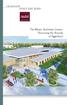 CELEBRATE S P I R I T A N D M I N D The Music Activities Center: Honoring the Sounds of Aggieland A new Music Activities Center: The encore we ve been waiting for. On a typical weekday, the E.V. Adams
Strings. Student Handbook 2012-2013. Manhattan School of Music
 Strings Student Handbook 2012-2013 Manhattan School of Music Table of Contents WELCOME I. INTRODUCTION TO THE STRING DEPARTMENT 3 1. Your Teacher 2. Change of Teacher 3. Contacting the String Department
UNDERGRADUATE MUSIC THEORY STUDENT HANDBOOK (2010-2011) Updated August, 2010
 UNIVERSITY OF NORTH TEXAS COLLEGE OF MUSIC DIVISION OF MUSIC HISTORY, THEORY, AND ETHNOMUSICOLOGY www.music.unt.edu/mhte UNDERGRADUATE MUSIC THEORY STUDENT HANDBOOK (2010-2011) Updated August, 2010 The
Music. Faculty: Joan Griffing (chair) Ryan Keebaugh Kenneth J. Nafziger James K. Richardson Anne Waltner. Major: Music
 Music Faculty: Joan Griffing (chair) Ryan Keebaugh Kenneth J. Nafziger James K. Richardson Anne Waltner Major: Music Concentrations: Church Music Interdisciplinary Studies Music Education (PreK-12) Music
The obligation to conserve the heritage of the twentieth century is as important as our duty to conserve the significant heritage of previous eras.
 The ICOMOS International Scientific Committee for Twentieth Century Heritage (ISC 20C) is developing guidelines for the conservation of heritage sites of the twentieth century during 2011 2012. As a contribution
Prayer Service to Celebrate the Ministry of Teachers During Catholic Schools Week 2015
 Prayer Service to Celebrate the Ministry of Teachers During Catholic Schools Week 2015 You Will Need A large candle with the words Love, Kindness, Joy, Truth and Justice (the final page of this document
zurich the arts Dance Design Theatre Music Transdisciplinary Studies Fine Arts Art Education Film
 zurich Dance Design sity Theatre Music f Transdisciplinary Studies the arts Fine Arts Art Education Film Fit for the Future As one of Europe s leading arts universities, our teaching and research are oriented
RENOVATION AND RESTORATION OF OLD BUILDINGS IN SRI LANKA
 234 Abstract RENOVATION AND RESTORATION OF OLD BUILDINGS IN SRI LANKA Eng. Nandana Abeysuriya B.Sc. Eng (Hons), M.Eng.,C.Eng.,FIE(SL), Int PE(SL) 1A, Ananda Road, Melder Place, Nugegoda, Sri Lanka. Tel/Fax:
ATELIER ALAIN ELLOUZ IS NOT SELLING TO NON PROFESSIONALS.
 Pricelist - Tarifs ATELIER ALAIN ELLOUZ IS NOT SELLING TO NON PROFESSIONALS. Architects, decorators and designers benefit from a 20% discount on indicatives prices. L ATELIER ALAIN ELLOUZ NE VEND PAS AUX
ointillism D. a.~. c~~fr2~.ct 1.a14 4A1~ r~ :~ ~ Sq ~Z See the dots that make up the man from Seurat s painting The Circus
 History >> Art History General Overview Art History and Artists ointillism Pointillism is often considered part of the Post-impressionist movement. It was primarily invented by painters George Seurat and
Discover boundless harmonies.
 Discover boundless harmonies. Scholarship Instruction Reward Mentoring Practice Collaboration Leadership Cello Experimentation Violin Performance Arrangement Music School Perform boundless symphonies.
WANT A CAREER IN THE MUSIC INDUSTRY? THINGS YOU SHOULD CONSIDER
 WANT A CAREER IN THE MUSIC INDUSTRY? 6 THINGS YOU SHOULD CONSIDER 1 2 3 4 5 6 What is the music industry really like? Start now, it s worth it Plan for your dream job and know your career options Studying
Master of Music. Program Director. Tedrow Perkins 3043 Bliss Hall 330-941-3646 [email protected]. Program Description
 Master of Music Program Director Tedrow Perkins 3043 Bliss Hall 330-941-3646 [email protected] Program Description Master s degrees are offered in music education, music performance, music history, music
Winchester College Quirister Brochure v8_.ps 14/12/2010 09:22 Page 3 isters APPEAL Quir
 uiristers A P P E A L Upholding a time-honoured tradition The benefits of a Quirister education William of Wykeham, Chancellor of England and Bishop of Winchester, founded Winchester College in 1382, for
Johann Sebastian Bach
 Johann Sebastian Bach Johann Sebastian Bach was a German composer born in 1685. He died in 1750. He was the youngest of the children of Johann Ambrosius Bach. Musical talent had been in his family for
City of Light: Paris Private Journey
 Travcoa Private Journeys are pre-designed luxury travel itineraries which are locally hosted by carefully selected guides. Each is crafted to provide the ideal in-depth experience of its various destinations
Music Conservatory «G. Verdi» Como. Italy
 Music Conservatory «G. Verdi» Como Italy Bruno Raffaele Foti Head Master To all Musical Teaching Institutes, dear Students, the Music Conservatory of Como is certified by the Italian Ministry of Education,
Today, some people believe the source of art lies in the soul of the individual artist,
 Huntington and Scott Gallery Programs INSPIRING ART How Lessons from the Past Can Inspire New Art Grades 4 8 I. Introduction Today, some people believe the source of art lies in the soul of the individual
Copyright 2001 by MENC: The National Assocation for Music Education
 Last Update 11/03/00 Copyright 2001 by MENC: The National Assocation for Education Education Instrumental Performance Vocal Performance Conducting Composing for Worship Business Instrument Making and Repair
SYMPHONY #9 ANTONIN DVORAK
 SYMPHONY #9 ANTONIN DVORAK Dvorak s Symphony #9 is one of the most beloved works in the symphonic repertoire. Having had the experience of conducting it many times, I have accumulated a list of ideas,
Interview. Interview by Thomas Caron
 Interview Interview by Thomas Caron In your artistic practice you carry out in-depth research into the relationship between matter and void. Would you give us a brief explanation of this? It s true that
PROVIDENCE UNIVERSITY COLLEGE
 4.6.16 Music Academic Staff Bill Derksen, Ph.D., University of Minnesota, Emeritus Karen Sunabacka, Ph.D., University of California at Davis, Program Coordinator Darryl Friesen, D.M.A., University of Illinois
Maurice STIASSNIE. Alain BERJONVAL
 Maurice STIASSNIE An unrecognized French microscope maker, Heir and descendant of XIX Century microscope manufacturers Alain BERJONVAL Introduction Owners of some microscopes manufactured by Maurice Stiassnie
COLLEGE OF VISUAL AND PERFORMING ARTS SETNOR SCHOOL OF MUSIC
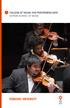 COLLEGE OF VISUAL AND PERFORMING ARTS SETNOR SCHOOL OF MUSIC About Syracuse University s Setnor School of Music is where you go to prepare for a diversified, successful music career. You ll learn to compose,
Silver Burdett Making Music
 A Correlation of Silver Burdett Making Music Model Content Standards for Music INTRODUCTION This document shows how meets the Model Content Standards for Music. Page references are Teacher s Edition. Lessons
HALF-DAY TOUR IN PARIS OCTOBER THE 3RD. Based on 10 persons
 HALF-DAY TOUR IN PARIS OCTOBER THE 3RD Based on 10 persons OURS CLIENTS HALF-DAY TOUR 2015 10 persons October the 3rd Cultural and artistic heritage Half-Day tour French Art de vivre et Savoir-Faire PARIS
Bachelor of Music Piano Performance C50100BM
 8/14/14 Bachelor of Music Piano Performance C50100BM The following information has official approval of the School of Music, but is intended only as a supplemental guide. Official degree requirements are
The University of Alabama in Huntsville is an accredited institutional member of the National Association of Schools of Music.
 The University of Alabama in Huntsville 1 Music B102 Roberts Hall Telephone: 256.824.6436 Email: [email protected] The University of Alabama in Huntsville is an accredited institutional member of the
The American Classical Orchestra
 The American Classical Orchestra Thomas Crawford, Music Director E nclosed: O rchestra Biography Music Director Biography Discography www.aconyc.org ACO Biography The American Classical Orchestra celebrates
1. interpret notational symbols for rhythm (26.A.1d) 2. recognize and respond to steady beat with movements, games and by chanting (25.A.
 FIRST GRADE CURRICULUM OBJECTIVES MUSIC I. Rhythm 1. interpret notational symbols for rhythm (26.A.1d) 2. recognize and respond to steady beat with movements, games and by chanting (25.A.1c) 3. respond
NASM Competencies Summary
 NASM Competencies Summary Degree: The Baccalaureate Degree in Music Education, a professional undergraduate degree Essential Note: Items below are excerpts from the NASM Handbook. Items 1 through 4 indicate
SLO REQUIRED PRIOR TO ADMISSION TO ALL DEGREE PROGRAMS IN MUSIC
 SLO REQUIRED PRIOR TO ADMISSION TO ALL DEGREE PROGRAMS IN MUSIC GENERAL SLO (Knowledge and Skill) The prospective music major will demonstrate the ability to relate musical sound to notation and terminology
True and respectful to the essential values of the organ tradition.
 CL6 / CL4 / CL2 True and respectful to the essential values of the organ tradition. Today the main goal of the electronic organ is this: to respect the prestigious history of the classic organ while achieving
A journey to the heart of southern France ENTRE 2 MONDES. Press Kit. www.joanda.net facebook.com/joandaoc - twitter.com/joandaoc
 A journey to the heart of southern France ENTRE 2 MONDES Press Kit facebook.com/joandaoc - twitter.com/joandaoc Entre 2 Mondes A journey to the heart of southern France Singer songwriter Joanda is inspired
Degree Type Bachelor of Music (BM) Degree Title Performance
 Degree Type Bachelor of Music (BM) Degree Title Performance This degree is designed to train students for careers in the professional world of music performance or who wish to pursue a graduate degree
Masters Programmes in Performance and Composition
 Masters Programmes in Performance and Composition Masters Options According to the number of elements within your Principal Study Area and depending on which Masters programme you are following you will
Chinese Table Tennis College Europe in Luxembourg (CTTCE) Conférence de presse du 8 janvier 2014
 Chinese Table Tennis College Europe in Luxembourg (CTTCE) Conférence de presse du 8 janvier 2014 Chinese Table Tennis College Europe in Luxembourg (CTTCE) Nature: A non-profit organization devoted to table
Music. griffith.edu.au/music. Do you need to be able to sing in tune to be a pop star? At a glance. Music audition. Mr Brendan Anthony.
 At a glance Associate Professor Brydie-Leigh Bartleet from Griffith s Queensland Conservatorium has been named 2014 Australian University Teacher of the Year. es: Students: 800+ Research and Centres: 1
The 10 th Summa Cum Laude International Youth Music Festival Vienna 1 st to 6 th of July 2016
 The Vienna International Association for Music and Culture Exchange presents: The 10 th Summa Cum Laude International Youth Music Festival Vienna 1 st to 6 th of July 2016 TERMS AND CONDITIONS I. General
How To Show How Silk And Silk History Of China And Franceonil
 THE MARITIME SILK ROAD Blossoming of the France - China Silk Trade THE MARITIME SILK ROAD MACAO MUSEUM 2015 A refined Chinese product, silk has fascinated the world for over 3000 years. The exhibition
KEYBOARD PERFORMANCE (MKP)
 Keyboard Performance (MKP) 1 KEYBOARD PERFORMANCE (MKP) Dept. Code: MKP The Department of Keyboard Performance offers a bachelor of music performance degree and a performer's certificate in piano. Majors
TAKING THE LEAD TOGETHER
 TAKING THE LEAD TOGETHER CONTENTS Buildings: Expression of a culture and vision of a future Steiner Group: The passion to create a competitive edge since 1915 Taking the lead together with enthusiasm and