
Using Factor Analysis and Cronbach's Alpha to Ascertain Relationships Between Questions of a Dietary Behavior Questionnaire
|
|
|
- Nickolas Briggs
- 9 years ago
- Views:
Transcription
1 Using Factor Analysis and Cronbach's Alpha to Ascertain Relationships Between Questions of a Dietary Behavior Questionnaire Eric Grau Mathematica Policy Research, 600 Alexander Park, Princeton, NJ, Abstract Obesity and other dietary problems make it necessary to have a better understanding of dietary behavior and more effective nutrition education. A dietary behavior questionnaire was developed to measure outcomes of nutrition education as part of an effort to develop a standardized, flexible data collection tool. This questionnaire, which was separated into modules according to food groups, was field tested by Mathematica for internal consistency of responses to survey questions and the performance characteristics of individual and sets of questions. The field test data analysis identified questions that performed well and should be retained and some that performed poorly and should be either dropped or need further study. In this paper, we discuss the use of factor analysis and Cronbach s alpha to decipher the internal consistency of and relationships between questions within modules. KEY WORDS: factor analysis, Cronbach's alpha, dietary behavior 1. Introduction A draft questionnaire, called a Dietary Behavior Questionnaire (DBQ), was developed by Abt Associates for the purposes of assessing respondents adherence to the Dietary Guidelines for Americans, as developed by the U.S. Department of Agriculture (USDA). 1 Mathematica Policy Research (MPR) was responsible for assessing how well the questionnaire worked in a real world setting, determining: (1) the ease with which interviewers were able to administer the instrument; (2) the ease with which respondents were able to complete the questionnaire; (3) the clarity and accuracy of the questionnaire instructions; and (4) the length of the questionnaire. Part of the process of answering these questions involved determining the level of redundancy in the questionnaire, which is the focus of this document. Factor analysis was used to identify common 1 See for more information on the Dietary Guidelines for Americans. components among sets of items within the questionnaire. Cronbach s alpha is a coefficient that describes how well a group of items focuses on a single idea or construct (Cronbach, 1951). Cronbach s alpha is calculated among the set of variables used in the factor analysis to determine the reliability of those questions for measuring a single construct. In order to assess this questionnaire, MPR conducted a field test, administering the instrument to 453 white, African American, and English-speaking Hispanic women who received food stamps from urban, rural, and suburban areas across the United States. This document describes the application of factor analysis and Cronbach s alpha on the data from this field test. Section 2 describes the DBQ and how the questions in the DBQ are categorized into groups to be analyzed. The methodologies used, factor analysis and Cronbach s alpha, are described in Section 3. Results for intake modules are presented in Section 4, and for supplemental modules dealing with intake and behavior related to food, diet, and health in Section 5. Results presented in Sections 4 and 5 are limited to those modules where redundancies are apparent or other noteworthy patterns are observed. Section 6 concludes with a discussion of the results. 2. Questionnaire Description In the DBQ, questions were asked about diet choices for all food groups. These questions specifically asked about consumption of various food groups either in the past seven days on a per-week or per-day basis, or on an ordinal scale of usually, sometimes, rarely or never. For the questions on a per-week or per-day basis, the respondent had the option of answering on a per-week or per-day basis; per-day responses were converted to total weekly consumption. Other questions asked about behavior and attitudes associated with foods. To ensure comparisons on the same scale, all variables were rescaled to have a zero mean and unit variance. Questions about consumption of various foods were grouped into modules, within which it is desired to determine the relationship between the questions. Supplemental modules included questions about 3104

2 attitudes and behaviors associated with food, diet, and/or health. The layout of the modules, with the subject matter for each question within each module, is given in Table Methodology 3.1 Factor Analysis The basic goal of factor analysis is to describe a set of p random variables in terms of a smaller number (m<p) of unobserved constructs, called factors, which are determined by interpreting coefficients in a factor model, called loadings. where X i is the ith variable, a ij is the jth factor loading for the ith variable, and F 1, F 2,... F m are the uncorrelated common factors. The square of the factor loading a ij is the proportion of the variance of X i that is explained by the factor F j. The variance of ith variable can be split into two components, one corresponding to the variance specific to that variable (the specific variance or unique variance ) and a variance that is common to all variables ( the common variance ), in the form of the m factors. The estimate of this second component is the communality, the sum of the squared factor loadings across the m factors for the variable in question. The common factor model can be described as The partial pairwise correlations between the X i = a i1 F 1 + a i2 F a i m F m variables after controlling for all other variables should be small compared to the original correlations; this indicates that the common factor model can do a Table 1. Subjects within Module Module Subjects within Module Fruit, vegetables, Fruit, unsweetened fruit juice, all vegetables, potatoes, French Fries, dark green vegetables, and French Fries orange vegetables Fruit and vegetables Fruit, unsweetened fruit juice, all vegetables, potatoes, dark green vegetables, orange vegetables Dairy and calciumenriched foods Milk as beverage, milk on cereal, yogurt, cheese, calcium fortified juice or soy milk Whole grain foods Processed whole grain breakfast cereal, whole grain bread, brown rice/whole grain pasta High protein foods Poultry, red meat/pork, deli meats, fish, eggs, peanut butter, dry beans Discretionary fats Butter/margarine used on vegetables, skim milk, butter/margarine used on bread/pasta/tortillas, fried poultry, remove skin from poultry, trim fat from red meat/pork, drain fat when cooking hamburger, fat used when cooking, French fries, chips/cheese puffs/pork rinds High sodium foods Weight control Shopping Attitudes Availability Chips/cheese puffs/pork rinds, crackers/pretzels, salt as seasoning Fruit as dessert, fruit and vegetables as snacks, sweetened fruit drinks, soda, fast food, healthier diet past 12 months, lose weight past 12 months, snack or eat meals in front of television, eat breakfast Plan meals before shopping, use list when shopping, look at nutrition labels when buying product Health status, healthy food too expensive, too busy to eat healthy, healthy food tastes bad, family says healthy food tastes bad, born to be fat or thin Available at home: fruit, dark green vegetables, orange vegetables, chips/cheese puffs/pork rinds, candy, skim milk, soda/sweetened fruit drinks, whole wheat bread, whole grain cereal good job of explaining the overall variation. However, if the partial pairwise correlations differ little from the original correlations, or worse are actually larger in absolute value, then this could be an indication that the common factor model is not appropriate for the data. Variables must be removed and/or added to the set included in the factor analysis to improve the factor model. Kaiser s Measure of Sampling Adequacy (MSA) is a summary of how much smaller the partial correlations are from the original correlations (Kaiser 1970; Kaiser and Rice 1974; Cerny and Kaiser 1977). This measure is calculated for each variable, and overall. For values under 0.7, which is not uncommon for these data, we review the MSAs for individual variables to determine if any of the included variables are candidates for exclusion from the common factor model. There are several methods used to estimate the factors, each of which are discussed in detail in Johnson and Wichern (1981). The results presented 3105

3 in this document are taken from a principle factor analysis; results from maximum likelihood estimates of the factors are also compared. With each of these methods, factor analysis does not provide unique solutions. Hence it is possible to rotate the factors to obtain more easily interpretable factor loadings. In all cases with the analyses here, an orthogonal rotation was sufficient to obtain easily interpretable factors. In effect, an orthogonal transformation of the factor loadings corresponds to a rotation of the coordinate axes. The communalities and specific variances will remain unchanged. In these analyses, the VARIMAX rotation (Kaiser, 1958) was used, whereby the variances of the column vectors (corresponding to the squared loadings of the each factor) of the factor matrix are maximized. This forces coefficients to be either large or negligible in any column (associated with a given factor) of the rotated loadings matrix The factor analysis model assumes that the variables to be investigated have a multivariate normal distribution. With the positive skewness that is evident with the weekly consumption variables (which make up the majority of questions within each module), and the four-category responses for the usually-sometimes-rarely-never questions, this assumption will obviously be violated. However, transforming the weekly consumption variables to dampen the skewness will give us variables that more closely approximate the normal distribution. In particular, a square-root transformation was used to dampen the positive skewness. The four-category response variables were in an ordinal scale; truly an approximation to a normal distribution cannot be obtained for these variables. Each of these variables will be discussed on a module-by-module basis. 3.2 Cronbach s Alpha Cronbach s alpha is generally used as a measure of the reliability of a set of questions in a survey instrument. It measures the interrelatedness of a set of items, although a high value for alpha does not imply unidimensionality (where the items measure a single latent construct). It was first named as alpha by Cronbach (1951). The formula for Cronbach s alpha, as parameterized by Cortina (1993) is 2 Mean( Cov) N ( ) Sum ( Var / Cov ) where N is the number of items in the scale, Mean(Cov) is the mean inter-item covariance, and Sum(Var/Cov) is the sum of all the elements in the variance-covariance matrix. Standardized alpha is equivalent to the above, except that the average interitem correlation replaces the average covariance and the sum of the correlation matrix replaces the sum of the variance-covariance matrix. In the research discussed in this document, Cronbach s alpha and its standardized form are equivalent, since all variables are rescaled to have zero mean and unit variance. A level of alpha that indicates an acceptable level of reliability has traditionally been 0.70 or higher, although interpretation of alpha in specific contexts is generally more complicated than that. In particular, a high alpha is possible even though the item responses are multidimensional (Schmitt, 1996), and level of alpha is also related to the number of items being tested. Cortina (1993) showed that how the value of alpha varied according to the number of items being tested, and how alpha generally declined as the number of dimensions increased. He did indicate that, although a high level of alpha does not guarantee unidimensionality, nor does it necessarily indicate high average item intercorrelations, a low level of alpha is often associated with multidimensional data. 4. Results for Intake Modules The intake modules consist of the fruit and vegetable modules (with and without French fries), dairy and calcium-enriched products, whole grain foods, high protein foods, discretionary fats (with and without French fries and chips/cheese puffs/pork rinds), and high sodium foods. For all of the intake modules, the factor analysis, using a VARIMAX rotation, provided a clear pattern where underlying constructs could be discerned. However, many of these constructs, while interesting, did not lead to conclusions that redundancies existed in the given module. Discussion here is limited to fruits and vegetables (with and without French Fries) 4.1 Fruit, Vegetables, with and without French Fries The fruit and vegetables module, when the French Fries variable is included, contains 7 variables, pertaining to 6 foods: fruit, unsweetened juice, all vegetables, potatoes (not French Fries), French Fries, dark green vegetables, and orange vegetables. In the fruit, vegetables, and French Fries module, a common factor model with 2 factors was used. Kaiser s Overall MSA is 0.73, indicating that the partial correlations are relatively small compared to the original correlations. Two factors explain 86% of the common variance according to a principle factor analysis. One rotation of the factor pattern using a principle factor analysis is given in Table 2. Note 3106

4 that the factor loadings in Table 2 represent the correlation between the original variable and its factor. Table 2. Factor Pattern, Fruit, Vegetables, and French Fries Variable Factor 1 Factor 2 Fruit Unsweetened Juice All vegetables Potatoes (except French fries) French fries Dark green vegetables Orange vegetables As is apparent from this rotation of the factor pattern, the first factor is a measure of all healthy foods, particularly raw fruit and dark green and orange vegetables. For this factor, French fries has a coefficient near zero. The second factor provides a contrast between green vegetables and potatoes. A similar result can be seen with a maximum likelihood (ML) factor analysis, where 89% of the common variance in the 7 fruit, vegetable, and French Fries variables was explained with the first two eigenvalues. A statistical chi-squared test is available with the ML factor analysis that tests whether 2 factors are sufficient to explain the common variance. With an alternative hypothesis that 2 factors were not sufficient for these data, a p-value of 0.08 was obtained for a common factor model with 2 factors. There is insufficient evidence to suggest that more factors are needed. (A similar test with 1 factor indicated that at least 2 factors were needed.) The value of Cronbach s alpha was 0.58, which simply indicates that there is a high level of error variance for the items to be considered reliable for a single construct scale. When the French fries variable is excluded from the factor analysis, the Kaiser s Overall MSA statistic remained fairly static (0.74), but the construction of factors changes somewhat. As the factor pattern in Table 3 indicates, there is no longer a healthy vs. unhealthy factor since none of the variables left are indicative, in and of themselves, of unhealthy eating habits. Rather, the first factor could be described as an indicator of the green-ness of the vegetable, with dark green vegetables having the highest value. The second factor describes anything not green, whether vegetable or not. Cronbach s alpha increased to 0.68, which is close to the cutpoint used that indicated sufficient reliability within a single construct. Removing this single item indicates (not surprisingly) that French Fries does not fit with the rest of the variables in the fruit and vegetables module. Table 3. Factor Pattern, Fruit and Vegetables (excluding French Fries) Variable Factor 1 Factor 2 Fruit Unsweetened Juice All vegetables Potatoes (except French fries) Dark green vegetables Orange vegetables Even though these results give an interesting insight into the relationship between Cronbach s alpha and factor analysis, there is no clear indication that any of these variables are actually redundant. 4.2 High Protein Foods The high protein foods module contains 7 variables: poultry, red meat/pork, deli meat, fish, eggs, peanut butter, and dry beans. The Kaiser s Overall MSA is 0.63, indicating that ideally more variables should be used to better define the factors in the common factor model. The smallest MSA among the variables is 0.57 for peanut butter, which is a large enough difference that we may want to consider reformulating the problem without peanut butter. A common factor model with 3 factors was used; three eigenvalues accounted for all of the common variance. One rotation of the factor pattern using a principle factor analysis is given in Table 4. Table 4. Factor Pattern, High Protein Foods Variable Factor 1 Factor 2 Factor 3 Poultry Red meat/pork Deli meats Fish Eggs Peanut butter Dry beans As is apparent from this rotation of the factor pattern, the first factor is a measure of the unhealthy proteins, with high loadings on red meat and deli meats. The second appears to be a measure of the healthy proteins, with moderately high loadings on 3107

5 poultry, fish, and dry beans. Finally, the third factor is what is left over in the common variance, with a fairly high loading for peanut butter and moderate loadings for eggs and dry beans and, to a lesser extent, fish. Identifying a cluster across the three factors is real evidence of similarity: clearly, beans and fish cluster together very closely across all three factors. Poultry is also similar to beans and fish, but the similarity breaks down with the third factor; red meat/pork and deli meat are similar to each other, but they differ in the second factor, with deli meats healthier than red meat/pork. The similar result can be seen with a maximum likelihood (ML) factor analysis. Three eigenvalues accounted for all of the common variance in the variables of this module. A statistical chi-squared test is available with the ML factor analysis that tests whether 3 factors are sufficient to explain the variation in the fruit and vegetable variables. With an alternative hypothesis that 3 factors were not sufficient for these data, a p- value of 0.48 was obtained for a common factor model with 3 factors. There is insufficient evidence to suggest that more factors are needed. (A similar test with 2 factors indicated that at least 3 factors were needed.) Cronbach s alpha for this module has a value of 0.56, indicating a high level of error variance for these items to be considered reliable for a single construct scale. Perhaps this is simply a result of 3 apparent dimensions in the data, which adds to the apparent high level of error variance. 5. Results for Supplemental Modules The supplemental modules included questions that were not necessarily measuring food intake for specific foods, but included questions about attitudes and behaviors associated with food, diet, and/or health. These modules include modules with questions about weight control (with and without binary variables), shopping, attitudes, availability, and physical activity. As with the dietary modules, for all of the behavior modules, the factor analysis produced easily interpretable factors using the VARIMAX rotation. However, only the weight control module will be presented here, since that was the only module where the analysis indicated a possible redundancy. 5.1 Weight Control The original definition for weight control includes 9 variables. Five refer to consumption of specific foods: fruit as dessert, fruit and vegetables as snacks, sweetened fruit drinks, soda, and fast food. The other four are behavior variables: change to a healthier diet in the past 12 months, attempts to lose weight in past 12 months, snack or eat meal in front of television, and eat breakfast. To facilitate interpretation, the levels of the variables are recoded so that smaller numbers correspond to attempts to control weight and larger numbers correspond to no attempt to control weight. The variables for sweetened fruit drinks, soda, fast food, and eating breakfast are all per-week consumption variables. As with other per-week consumption variables, a square root transformation is used to more closely approximate a normal distribution, with outliers removed as discussed in Section 2. Since smaller numbers correspond to attempts to control weight, the transformed values from sweetened fruit drinks, soda, and fast food can all be taken directly. For the sake of interpretation, however, the negative of the transformed breakfast variable will be used, since larger values (i.e., eating breakfast more often) are considered conducive to weight control. The variables for fruit as dessert, fruit and vegetables as snacks, and snack or eat meal in front of television, have an ordinal response. As noted earlier, an ordinal response is problematic for the multivariate normal assumption, since we are required to assume the same distance between levels, and that too few levels are available to approximate a normal distribution very well, particularly if any skewness occurs. For the fruit-as-dessert variable, two levels correspond to a real attempt to lose weight: eat fruit when eating dessert, or not eating dessert at all. Among respondents who usually eat fruit for dessert or do not eat dessert at all, it would be difficult to determine which should have higher value in terms of losing weight. Since so few respondents (only three) do not eat dessert, these two levels will be combined and set to the value 1, and the other levels will be assigned in increasing order from there. The fruit-and-vegetables-as-snacks variable will also be assigned with usually taking the value of 1 and other levels assigned in increasing order after that. However, if one usually snacks or eats meals in front of the television, this is considered detrimental to weight control, so for interpretation s sake usually will be assigned a value of 4 and the other levels assigned in decreasing order from there. The variables for behavioral changes in the past year (change to healthier diet, attempting to lose weight) are binary variables and therefore do not even remotely resemble normally-distributed variables. These variables could provide misleading results in the factor analysis for this reason; they will, however, 3108

6 still be included for this module. The code for yes will be set to 1 and the code for no set to 2. A 3-factor model was considered for these data, the loadings for which are presented in Table 5. Table 5. Factor Pattern, Weight Control Variables Variable Factor 1 Factor 2 Factor 3 Fruit as dessert Fruit/vegetables as snacks Sweetened fruit drinks Soda Fast food Switched to healthier diet Attempted to lose weight Snack or eat meals at TV Eat breakfast in the morning For these data, the Kaiser s Overall MSA was only 0.56, which is rather low, particularly for the number of variables included. Recall that the inclusion of the binary variables could be considered problematic, and it could be argued that these binary indicators are not like the other variables. Indeed the individual MSAs for the overall health indicator and the losing weight indicator are 0.53 and 0.52 respectively, so that we may want to consider adjusting the set of variables used. In spite of the issues observed in the previous paragraphs, some useful patterns are evident in these data. The first factor is a measure of actions in the past 12 months that were intended to improve health; whether these are borne out in the past-week data is less clear. The second factor is a measure of unhealthy eating habits: drinking soda, eating fast food, snacking or eating in front of the television, and, to a lesser extent, eating sweetened fruit drinks. The third factor is a measure of healthy eating habits: eating fruit as dessert, eating fruit and vegetables as snacks, and, to a lesser extent, eating breakfast each morning. A number of clusters are apparent in the data, indicating some redundancy. The two binary variables are very close together across all three factors, indicating a high degree of similarity, as are the two variables relating to eating fruit (eating fruit as dessert and eating fruit and vegetables as snacks). Although less evident than the other two clusters, the loadings associated with fast food, sweetened fruit drinks, and soda are also somewhat close together in value. Similar results were evident with ML estimation. With an alternative hypothesis that 3 factors were not sufficient for these data, a p-value of 0.08 was obtained for a common factor model with 3 factors. There is insufficient evidence to suggest that more factors are needed. (A similar test with 2 factors marginally indicated that at least 3 factors were needed, with a p-value of ) The value of Cronbach s alpha for these data was 0.48, indicating a high level of error variance for the items to be considered reliable for a single construct scale. As with the high protein foods example, this is probably due to the high dimensionality in the data, which is more often associated with low values for Cronbach s alpha, while not necessarily indicating that the questions are not adequate or reliable. 6. Discussion Not only did the factor analysis indicate underlying constructs that the dietary variables measured, it also pointed to redundancies in the data. In particular, it did not appear to be necessary to ask about both fish and dry beans. The two variables associated with the consumption of these two foods were correlated with other variables in roughly equivalent ways. The two variables associated with switching to a healthier diet and attempting to lose weight appeared to be redundant, as did variables associated with eating fruit as a dessert, or eating fruit or vegetables as snacks. Factor analysis was useful for assessing what underlying constructs the items in each module were measuring, and where redundancies might occur. Cronbach s alpha was less useful in this setting, however, since the multidimensionality in the data made it difficult to ascertain what the generally low values for the alpha actually meant. 7. Acknowledgements This work was done as part of a contract MPR had with the Economic Research Service (ERS) of the USDA. The project was called Development of a Questionnaire on Dietary Behavior for Use in Low- Income Populations. The project officer at ERS was David Smallwood; the MPR project director was Rhoda Cohen. 8. References Cerny, B. A. and H. F. Kaiser. A study of a measure of sampling adequacy for factor-analytic 3109

7 correlation matrices. Multivariate Behavioral Research 12, 1977, pp Cortina, J. What is coefficient alpha? An examination of theory and methods. Journal of Applied Psychology 78:1, 1993, pp Cronbach, L. J. Coefficient alpha and the internal structure of tests. Psychometrika 22:3, 1951, pp Johnson, R. A. and D. W. Wichern. Applied Multivariate Statistical Analysis. Englewood Cliffs, NJ: Prentice-Hall, Inc., Kaiser, H. F. The VARIMAX criterion for analytic rotation in factor analysis. Psychometrika 23, 1958, pp Kaiser, H. F. A second generation little jiffy. Psychometrika 35, 1970, pp Kaiser, H. F. and J. Rice. Little jiffy, mark IV, Educational and Psychological Measurement 34, 1974, pp Schmitt, N. Uses and abuses of coefficient alpha, Psychological Assessment 8:4, 1996, pp

Making Healthy Food Choices. Section 2: Module 5
 Making Healthy Food Choices Section 2: Module 5 1 Nutrition For Health What is healthy Tips on planning meals Making a shopping list/ Bulk orders Using WIC foods Cook and freeze What foods to choose How
It is important to know that some types of fats, like saturated and trans fat, can raise blood cholesterol levels.
 Healthy Eating You are what you eat! So before you even shop for food, it is important to become a well informed, smart food consumer and have a basic understanding of what a heart healthy diet looks like.
Maintaining Nutrition as We Age
 SS-207-06 For more information, visit the Ohio Department of Aging web site at: http://www.goldenbuckeye.com and Ohio State University Extension s Aging in Ohio web site at: http://www.hec.ohio-state.edu/famlife/aging
DIABETES & HEALTHY EATING
 DIABETES & HEALTHY EATING Food gives you the energy you need for healthy living. Your body changes most of the food you eat into a sugar called glucose. (glucose) Insulin helps your cells get the sugar
Canada s Food Guide Jeopardy
 Canada s Food Guide Jeopardy Drafted: July 2008 Revised: December 2012 Eating Well with Canada s Food Guide Veg & Fruit Grain Products Milk & Alternatives Meat & Alternatives Physical Activity Miscellaneous
Healthy Eating During Pregnancy
 Healthy Eating During Pregnancy Pregnancy is a time of great change. Your body is changing to allow your baby to grow and develop. Good nutrition will help you meet the extra demands of pregnancy while
But what does my body need? (No...it is not just candy and soda!)
 Chapter 35: Page 349 In the last chapter, you learned how important your immune system is to your survival. This week, you are going to learn how to keep your immune system strong and ready to protect
The Five Food Groups and Nutrition Facts
 session 4 The Five Food Groups and Nutrition Facts (Note to the presenter: Comments in parentheses are instructions to follow while giving the presentation. Do not read the comments to participants. This
Healthy Foods for my School
 yum, yum, yum, yum, yum, yum, yum, yum, yum, yum, yum, yum, yum, yum, yum, yum, yum, yum, yum, yum, yum, Healthy Foods for my School Nutrition Standards for Saskatchewan Schools Schools are an ideal place
A GUIDE TO HELP PLAN, PURCHASE & PREPARE YOUR OWN HEALTHY FOOD. FOOD SENSE HEALTHY MEALS ON A BUDGET
 A GUIDE TO HELP PLAN, PURCHASE & PREPARE YOUR OWN HEALTHY FOOD. FOOD SENSE HEALTHY MEALS ON A BUDGET You ll be surprised at how affordable, delicious & convenient your own meals can be! the Great Plate:
Presentation Prepared By: Jessica Rivers, BASc., PTS
 Presentation Prepared By: Jessica Rivers, BASc., PTS Presentation Outline Why should we care about our eating habits? Why is nutrition so important as we age? How do we know if we are eating healthy? What
My Diabetic Meal Plan during Pregnancy
 My Diabetic Meal Plan during Pregnancy When you have diabetes and are pregnant, you need to eat small meals and snacks throughout the day to help control your blood sugar. This also helps you get in enough
Save Time and Money at the Grocery Store
 Save Time and Money at the Grocery Store Plan a Grocery List Making a list helps you recall items you need and also saves you time. Organize your list according to the layout of the grocery store. For
Eating Right for Kidney Health: Tips for People with Chronic Kidney Disease
 Eating Right for Kidney Health: Tips for People with Chronic Kidney Disease What you eat and drink can help slow down the progression of chronic kidney disease (also known as CKD ) and help prevent complications.
Carbohydrate Counting for Patients with Diabetes. Lauren Dorman, MS RD CDE Registered Dietitian & Certified Diabetes Educator
 Carbohydrate Counting for Patients with Diabetes Lauren Dorman, MS RD CDE Registered Dietitian & Certified Diabetes Educator Program Purpose To increase knowledge of carbohydrate counting skills for nurses
Duke Center for Metabolic and Weight Loss Surgery Pre-op Nutrition Questionnaire
 Duke Center for Metabolic and Weight Loss Surgery Pre-op Nutrition Questionnaire Name Date How long have you been considering weight loss surgery? Which procedure are you interested in having? Gastric
The Basics of Nutrition: Understanding Nutrition Facts, Servings Sizes, & Adequate Portions
 The Basics of Nutrition: Understanding Nutrition Facts, Servings Sizes, & Adequate Portions K AT I E L. H O W E H E A LT H E D U C AT O R D I V I S I O N O F S T U D E N T A F FA I R S U S C U P S TAT
Diabetes Nutrition. Roseville & Sacramento Medical Centers. Health Promotion Department Nutritional Services
 Diabetes Nutrition Roseville & Sacramento Medical Centers Health Promotion Department Nutritional Services Agenda Blood sugar goals Factors that affect blood sugar Diet Options: Menus, Exchange Lists,
Get ready to test your knowledge Nutrition Jeopardy!
 Week 3 Nutrition Get ready to test your knowledge Nutrition Jeopardy! You are going to be playing Jeopardy with your classmates. Your teacher is going to put you into groups of 4 or 5. Write your team
Selection and Preparation of Foods Management of the Food Budget*
 Selection and Preparation of Foods Management of the Food Budget* Healthy meals on a limited budget! How can you serve healthy meals on a limited budget? It takes some time and planning, but you and your
Ready, Set, Start Counting!
 Ready, Set, Start Counting! Carbohydrate Counting a Tool to Help Manage Your Blood Glucose When you have diabetes, keeping your blood glucose in a healthy range will help you feel your best today and in
Maximizing Nutrition at Minimal Cost
 Maximizing Nutrition at Minimal Cost Outline: Get down to the nutrition basics Identify health issues at hand Understand the challenges & barriers Practical application & solutions Rate Your Plate What
Carbohydrate Counting for Pediatric Patients With Type 1 Diabetes. Review Date 4/08 K-0591
 Carbohydrate Counting for Pediatric Patients With Type 1 Diabetes Review Date 4/08 K-0591 Program Purpose To increase knowledge of carbohydrate counting and insulin management skills for those caring for
Reading Food Labels. Nutritional values The ingredients of the item The percentage of the Recommended Daily Intake (RDI) of particular nutrients
 Eating well involves choosing a variety of foods that are low in saturated and trans fats, low in salt and high in dietary fibre. Food labels carry useful information to help you make choices about the
Carbohydrate Counting for Patients With Diabetes. Review Date 4/08 D-0503
 Carbohydrate Counting for Patients With Diabetes Review Date 4/08 D-0503 Program Objectives At the end of the session you will know how to: Define carbohydrate counting Identify the relationship between
Nutrition Information from My Plate Guidelines
 Nutrition Information from My Plate Guidelines Note: This information was compiled from the website: http://www.choosemyplate.gov/ for participants in the 4-H Food Prep Contest 1/12/16. The information
Do children with diabetes need a special diet?
 Do children with diabetes need a special diet? No! The basic nutritional needs of a child or adolescent with diabetes is the same as their peers Healthy eating is important for all children Children with
MINTO PREVENTION & REHABILITATION CENTRE CENTRE DE PREVENTION ET DE READAPTATION MINTO. Counting Fat Grams. About This Kit
 MINTO PREVENTION & REHABILITATION CENTRE CENTRE DE PREVENTION ET DE READAPTATION MINTO Counting Fat Grams About This Kit In previous kits you have learned Foods to Choose and Foods to Decrease/Avoid for
Florida Department of Health WIC Program. This institution is an equal opportunity provider. 1/2016 1
 Florida Department of Health WIC Program This institution is an equal opportunity provider. 1/2016 1 EBT stands for Electronic Benefits Transfer. EBT is a simple, secure, and convenient way to buy your
You can eat healthy on any budget
 You can eat healthy on any budget Is eating healthy food going to cost me more money? Eating healthy meals and snacks does not have to cost you more money. In fact, eating healthy can even save you money.
gestational diabetes my pregnancy, my baby, and me
 gestational diabetes my pregnancy, my baby, and me What is Gestational Diabetes? Gestational diabetes occurs when your body cannot make adequate use of sugar in the blood. It is first found during pregnancy.
Fad Diets vs Healthy Weight Management: A Guide for Teens
 Center for Young Women s Health www.youngwomenshealth.org Fad Diets vs Healthy Weight Management: A Guide for Teens Fad diets are marketed as quick ways to lose weight. The most popular fads tend to change
Healthy Grocery Shopping on a Budget. Tips for smart spending at the grocery store
 Healthy Grocery Shopping on a Budget Tips for smart spending at the grocery store Re c ipe e! In d si Grocery Store Science Eating well does not need to cost a lot of money. Here are some ways to choose
How to Feed Your Growing Child Ages 2 to 5
 How to Feed Your Growing Child Ages 2 to 5 PAGE 1 Canada s Food Guide recommends... One Food Guide Serving can be divided into smaller amounts and served throughout the day. Vegetables and Fruit Grain
Lesson 3 Assessing My Eating Habits
 Lesson 3 Assessing My Eating Habits Overview This lesson introduces the federal guidelines for healthy eating. Students assess their eating habits against these guidelines and make suggestions for improvement.
Eating Well with Diabetes. Cassie Vanderwall UW Health Nutrition Registered Dietitian Certified Personal Trainer Certified Diabetes Educator
 Eating Well with Diabetes Cassie Vanderwall UW Health Nutrition Registered Dietitian Certified Personal Trainer Certified Diabetes Educator Outline What is Diabetes? Diabetes Self-Management Eating Well
CHILD CARE DIPLOMA. Course Sample
 CHILD CARE DIPLOMA Course Sample Unit CHP2 Providing for children s physical needs inclusive of health and safety The Statutory framework for the EYFS is a requirement for all registered early years providers.
Provider Guide Many families may find it difficult to pay for or get
 introduction Hello! Provider Guide Many families may find it difficult to pay for or get access to nutritious foods. In such situations, they may find it especially hard to make healthy choices. As a provider
Carbohydrate Counting (Quiz Number: Manatee3032009)
 Page 1 The goal of Carbohydrate Counting is to make clear to you which foods affect your blood glucose and then to spread these foods evenly throughout the day (or to match insulin peaks and durations).
MEAL PLANNING FOR MECHANICAL SOFT DIET
 MEAL PLANNING FOR MECHANICAL SOFT DIET Definition of Terms Calories Protein Blenderized Pureed Units of energy. A nutrient used by your body for growth and repair. The best sources are milk, meats, fish,
Nonalcoholic Fatty Liver Disease. Dietary and Lifestyle Guidelines
 Nonalcoholic Fatty Liver Disease Dietary and Lifestyle Guidelines Risk factors for NAFLD Typically, but not always seen in patients who are overweight. May have Diabetes and or insulin resistance high
Material AICLE. 5º de Primaria.: Food and nutrition (Solucionario)
 Material AICLE. 5º de Primaria.: Food and nutrition (Solucionario) 3 SOLUTIONS Activity 3. Listen to the following audio and complete this chart. Then, check your answers using the information in activity
Healthy Grocery Shopping On A Budget
 Healthy Grocery Shopping On A Budget 1 Click Understanding to edit Master Grocery title style Stores Over 50,000 products Strategically placed items and traffic flow Lighting, music, color used strategically
UW MEDICINE PATIENT EDUCATION. PCOS Nutrition. Eat a Balanced Diet
 UW MEDICINE PATIENT EDUCATION PCOS Nutrition Eating for health when you have polycystic ovarian syndrome Eating to treat PCOS is not much different than how many people are advised to eat to be their healthiest.
Nutritional Guidelines for Roux-en-Y, Sleeve Gastrectomy and Duodenal Switch. Gastric Restrictive Procedures. Phase III Regular Consistency
 Nutritional Guidelines for Roux-en-Y, Sleeve Gastrectomy and Duodenal Switch Gastric Restrictive Procedures Phase III Regular Consistency The University of Chicago Hospitals Center for the Surgical Treatment
Nutrition Recommendations and Interventions for Diabetes
 Nutrition Recommendations and Interventions for Diabetes S U P P L E M E N T Medical nutrition therapy (MNT) is important in preventing diabetes, managing existing diabetes, and preventing, or at least
Eating Well with. Canada s Food Guide
 Eating Well with Canada s Food Guide Recommended Number of Food Guide Servings per Day Children Teens Adults Age in Years Sex 2-3 4-8 9-13 14-18 19-50 51+ Girls and Boys Females Males Females Males Females
Eat Well, Live Well Lesson 9: The Lowdown on Cholesterol
 Getting Started 1. Review lesson plan before each session 2. Copy handouts. 3. Gather supplies Eat Well, Live Well Lesson 9: The Lowdown on Cholesterol Supplies Needed 1. Handouts 2. Supplies for activity:
Eat More, Weigh Less?
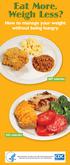 Eat More, Weigh Less? How to manage your weight without being hungry 607 calories 293 calories Department of Health and Human Services Centers for Disease Control and Prevention Can you weigh less without
Take Control Nutrition Tools for Diabetes. 50/50 plate Portions Servings
 Take Control Nutrition Tools for Diabetes 50/50 plate Portions Servings Eat more Vegetables Especially non starchy vegetables Choosing Foods to manage blood glucose Select a variety of colors and types
Take Control of Your Health and Reduce Your Cancer Risk
 Take Control of Your Health and Reduce Your Cancer Risk Creation of this material was made possible in part by a pioneering grant from CBCC-USA. Distributed by India Cancer Initiative Take Control of
Factor Analysis. Principal components factor analysis. Use of extracted factors in multivariate dependency models
 Factor Analysis Principal components factor analysis Use of extracted factors in multivariate dependency models 2 KEY CONCEPTS ***** Factor Analysis Interdependency technique Assumptions of factor analysis
Distance Runners Nutrition Guide
 Distance Runners Nutrition Guide Dear athletes and parents, The purpose of this nutrition guide is to prepare distance runners for optimal performance. While the purpose of this guide is not to force you
Screening Tests for Gestational Diabetes
 Screening Tests for Gestational Diabetes 50 Gram glucose challenge test If you choose to be screened for gestational diabetes, you may have one of several different tests. The most commonly used screening
Will the cholesterol in my diet raise my blood cholesterol?
 Healthy eating for your heart What does heart healthy eating mean to me? Heart healthy eating is an important part of a healthy lifestyle. Heart healthy eating, along with regular physical activity and
Heart Healthy Diet: Tips for Lowering Cholesterol and Fat in Your Diet
 Heart Healthy Diet: Tips for Lowering Cholesterol and Fat in Your Diet Cholesterol Saturated Fats Polyunsaturated and Mono-unsaturated Fats This fat-like substance is needed for good health. However, high
Healthy Eating for Diabetes
 Healthy Eating for Diabetes What is diabetes and why is it important to manage it? Diabetes occurs when there is too much glucose in the blood. Learning how to manage your diabetes will help you feel better
Healthy Eating After 50
 National Institute on Aging AgePage Healthy Eating After 50 Food just doesn t taste the same anymore. I can t get out to go shopping. I m just not that hungry. Sound familiar? These are a few common reasons
DOWN SYNDROME PROGRAM www.massgeneral.org/downsyndrome. Living a Healthier Lifestyle
 DOWN SYNDROME PROGRAM www.massgeneral.org/downsyndrome Living a Healthier Lifestyle DOWN SYNDROME PROGRAM www.massgeneral.org/downsyndrome Living a healthier lifestyle has many benefits, which means it
Committee on Medical Aspects of Food and Nutrition Policy
 Nutrient Intakes Last updated: December 2014 This paper describes how nutrient intakes are calculated from food purchases and how they are compared to nutrient recommendations and other dietary guidelines.
Meal Planning for a Mushy Soft Diet After Nissen Fundoplication
 Meal Planning for a Mushy Soft Diet After Nissen Fundoplication Name: Date: Dietitian: Telephone: Questions? CALL YOUR DIETITIAN! Patient Food and Nutrition Services University of Michigan Hospital 1500
Participant Group Nutrition Education outline: Get the Skinny on Milk
 Participant Group Nutrition Education outline: Get the Skinny on Milk Lesson Plan adapted from California WIC This group NE outline uses a facilitated discussion format, including a tasting activity. Select
Rachel J. Goldberg, Guideline Research/Atlanta, Inc., Duluth, GA
 PROC FACTOR: How to Interpret the Output of a Real-World Example Rachel J. Goldberg, Guideline Research/Atlanta, Inc., Duluth, GA ABSTRACT THE METHOD This paper summarizes a real-world example of a factor
Meal Planning for a Mushy Soft Diet After Laparoscopic Myotomy
 Meal Planning for a Mushy Soft Diet After Laparoscopic Myotomy Name: Date: Dietitian: Telephone: Why is it necessary to follow this diet? This diet is necessary for individuals who have had some types
Nutrition & Transplantation
 Nutrition & Transplantation www.kidney.org National Kidney Foundation s Kidney Disease Outcomes Quality Initiative Did you know that the National Kidney Foundation s Kidney Disease Outcomes Quality Initiative
See also: http://healthyrecipes.oregonstate.edu/
 See also: http://healthyrecipes.oregonstate.edu/ http://extension.oregonstate.edu/fcd/nutrition/ewfl/module_03/intro_02.php healthy recipes: http://healthyrecipes.oregonstate.edu/recipes Planning ahead
Carbohydrate Counting For Persons with Diabetes
 MINTO PREVENTION & REHABILITATION CENTRE CENTRE DE PRÉVENTION ET DE RÉADAPTATION MINTO Carbohydrate Counting For Persons with Diabetes About This Kit This kit focuses on basic carbohydrate counting. Remember
We want you to have the best results possible while doing our detox. If your goal is weight loss, then eating the right foods and exercising
 Detox Menu Guide We want you to have the best results possible while doing our detox. If your goal is weight loss, then eating the right foods and exercising moderately will help boost your results and
Eating Guidelines for Diabetes
 Eating Guidleines Chronic Nutrition Fact Sheets Introduction If you have both diabetes and Chronic (CKD), it may seem that the diabetes and kidney diets don t fit well together. However, with careful planning,
Your Cholesterol Lowering Guide
 1 Your Cholesterol Lowering Guide Cholesterol plays a vital role in the day-to-day functioning of your body. However, too much cholesterol in the blood can affect your heart health. The good news is that
February 2006. 23 Best Foods for Athletes
 23 Best Foods for Athletes February 2006 1. Beans Legumes a. Excellent source of fiber (important for keeping blood sugar and cholesterol levels under control). b. High in protein and a good source of
6 Steps to Lipo-Light and/or Lipo-Light Pro Success
 6 Steps to Lipo-Light and/or Lipo-Light Pro Success Optimize your Lipo-Light and/or Lipo-Light Pro results by: 1. Maintaining youy workout regimen. If you do not workout, walk for 30 minutes each day throughout
Fertile Food Can you eat your way to pregnancy? Tracy Cherry, RD, CDN University of Rochester Women s Lifestyle Center
 Fertile Food Can you eat your way to pregnancy? Tracy Cherry, RD, CDN University of Rochester Women s Lifestyle Center Fertility Food Folklore Almonds a fertility symbol throughout the ages. The aroma
WEIGHT GAINER S NUTRITION GUIDE
 WEIGHT GAINER S NUTRITION GUIDE Gaining weight takes dedication! You must eat these meals everyday to stay on track. Included in this pack are the meal plan, supplement guide, fast food guide, and NCAA
1. Deciding on the Food Budget and Which Foods to Spend Most Money on.
 Ideas Meal and planning tips for to fit eating your budget together Here is a plan to help you make the most of your food budget to promote health and well being for you and your family. Try working through
BETTER PRACTICE IN FOOD AND NUTRITION SERVICES - MENU PLANNING AND MENU DESIGN TO DELIVER OPTIMAL NUTRITION TO RESIDENTIAL AGED CARE
 BETTER PRACTICE IN FOOD AND NUTRITION SERVICES - MENU PLANNING AND MENU DESIGN TO DELIVER OPTIMAL NUTRITION TO RESIDENTIAL AGED CARE Karen Abbey Dietitian/Manager Residents Support Services Nambucca Valley
how to control blood glucose during PREGNANCY?
 how to control blood glucose during PREGNANCY? one HOW THE BODY WORKS DURING PREGNANCY During all pregnancies, the placenta makes a called human placental lactogen which allows the baby to grow and develop.
SHOP SMART, STORE SAFE
 SHOP SMART, STORE SAFE Introduction This lesson gives an older adult audience an opportunity to focus on making the most of their food budgets by sharing strategies for healthy shopping on a budget and
A Province-Wide Life-Course Database on Child Development and Health
 Patterns of health and disease are largely a consequence of how we learn, live and work A Province-Wide Life-Course Database on Child Development and Health Summary of Results April 2007 Principal Investigator
Nutrition and Chronic Kidney Disease
 Nutrition and Chronic Kidney Disease I have been told I have early kidney failure. What does this mean? What can I expect? This means that your kidneys are not doing as good a job as they should to help
American Cancer Society. Nutritional Guidelines for Reducing Your Risk of Cancer
 American Cancer Society Nutritional Guidelines for Reducing Your Risk of Cancer Cancer Impact More than one million Americans will be diagnosed with cancer this year. Scientific evidence suggests that
Grocery Shopping Within a Budget
 Grocery Shopping Within a Budget Lesson Plan Grade Level 10-12 Take Charge of Your Finances National Content Standards Family and Consumer Science Standards: 1.1.6, 2.1.1, 2.1.2, 2.1.3, 2.5.1, 2.6.1, 2.6.2,
CALORIE NEEDS Minimum: Current weight (lb) x 20 = number of calories for males Current weight ( lb) x 15 = number of calories for females
 NUTRITION CONDITIONING GOALS FOR ATHLETES Leslie Bonci, M.P.H., R.D. (412)432-3674 or email: [email protected] Director- Sports Medicine Nutrition University of Pittsburgh Medical Center Health System
LARGE GROUP PRESENTATION: PRESENTER S NOTES
 LARGE GROUP PRESENTATION: PRESENTER S NOTES Introduce yourself. Welcome! We are so glad you are here to learn about fruits and vegetables. Icebreaker Handout: Fruit or Vegetable: Parts of Many Words Read
Carbohydrate Counting
 Carbohydrate Counting What is Carbohydrate Counting? Carbohydrate counting is a meal-planning tool that many people use to manage their blood sugar. Carbohydrate counting, or carb counting, is done by
Healthy Eating for College Students on a Budget
 University of Michigan Health System s Healthy Eating Tip of the Month for August: Healthy Eating for College Students on a Budget Times are tough and money can be tight, especially for the starving college
Healthy Eating For Your Kidneys
 Winter 14 Healthy Eating For Your Kidneys (For People Not on Dialysis) BC Provincial Renal Agency If you have kidney disease, you may need to change the food you eat. Changes will depend on your appetite,
Where do I begin? Shopping at the. Start with a Plan. Find the Deals
 Shopping at the Grocery by Sarah Muntel, RD Where do I begin? S hopping for groceries can be a daunting task. Many people feel overwhelmed the minute they pull up to the store. For some, the goal is to
EMBRACE Your Journey Nutrition During Treatment
 Nutrition is an important part of your cancer treatment. As you prepare for treatment, it is important to focus on eating a well-balanced diet so that your body is as healthy as it can be. When your body
 California School Nutrition Association June 2006 Summary of Requirements for Foods & Beverages Sold in California Schools The following is a summary of requirements for food sales in California schools.
Diet for Oral Surgery/Wired Jaw
 Diet for Oral Surgery/Wired Jaw After oral surgery no chewing is allowed for a period of 4-8 weeks. During this time you will need a blenderized or liquid diet. This pamphlet will help you to get adequate
What impacts blood glucose levels?
 What you eat and how much you eat has an impact on your blood glucose levels. Your blood glucose level reflects how well your diabetes is controlled. There are many aspects to eating for target BG (Blood
30 % The Food Guide Pyramid T F A O F T O C A L
 The Food Guide Pyramid L I M I T F A O F 30 % S T O T C A L O R I E United States Center for Home and Department of Nutrition Policy Garden Bulletin Agriculture and Promotion Number 252 What s in this
How to report the percentage of explained common variance in exploratory factor analysis
 UNIVERSITAT ROVIRA I VIRGILI How to report the percentage of explained common variance in exploratory factor analysis Tarragona 2013 Please reference this document as: Lorenzo-Seva, U. (2013). How to report
Low Fat Diet after Cardiac Surgery With or Without Chyle Leak
 Low Fat Diet after Cardiac Surgery With or Without Chyle Leak What is chyle? Chyle (sounds like kyle) is a milky white fluid that contains protein, fat, cholesterol, lymphocytes, and electrolytes. It is
Common factor analysis
 Common factor analysis This is what people generally mean when they say "factor analysis" This family of techniques uses an estimate of common variance among the original variables to generate the factor
BEST & WORST FOODS FOR BELLY FAT
 Belly fat is worse for you than fat elsewhere on your body. Excess accumulation of belly fat is more dangerous than excess fat around your hips and thighs. Belly fat is associated with serious health problems,