
Basic Licence Driver s Handbook
|
|
|
- Winifred Wilkins
- 9 years ago
- Views:
Transcription
1 Basic Licence Driver s Handbook Including information on cars and light trucks

2 Table of Contents Chapter 1 Licence Classifications Graduated Driver Licensing... 6 Licence classifications Photo identification card... 8 Class Class Class Class Class Class Class Learning requirements - All classes. 13 Definitions Applying for your licence Parental consent requirement Non-Alberta licences New residents International licence Student Vision screening Medical requirements Condition codes Knowledge test Road test Upgrading your licence Licences: duplicate/renewal/ changes Registration and insurance Chapter 2 Traffic Controls Sign shapes and colours Regulatory signs Speed limits Designated lane signs Permissive signs Prohibitive signs Crossing signs Warning signs Information and guide signs Road construction School zone signs Playground zones Traffic control signals Pedestrian signal lights Lane control signals Pavement markings Chapter 3 Starting Your Vehicle Starting your vehicle Steering Accelerating Stopping Braking techniques Reversing (backing) Parking Parallel parking Angle parking Hill parking... 65

3 Chapter 4 Intersections and Turns Stop signs Intersections controlled by yield signs Right-of-way Traffic circle Controlled intersections Uncontrolled intersections Signaling Turning Right turns Left turns Turning lanes U-turns Chapter 5 Lane Driving Lane position Blind spots Passing lanes Merging Exiting Weave zone Curves and hills Chapter 6 Handling Emergency Situations Vehicle breakdown Emergency braking Skids Off-road recovery Night and poor weather driving Animals When you are involved in a collision Emergency vehicles and tow trucks Chapter 7 The Responsible Driver Defensive driving Following distance Fatigue Cellular telephone use in vehicles. 114 Child restraints Ways to improve fuel efficiency Traffic laws Chapter 8 Sharing The Road Pedestrian safety Bicycle operators/cyclists Motorcycle drivers Off-highway vehicles Large vehicles School buses Emergency vehicles Snowplows Maintenance vehicles Log-haul vehicles Railway crossings Light rail transit Funeral processions and parades Chapter 9 Driving Within the Law Impaired driving and the law

4 Alberta Administrative Licence Suspensions Suspensions/disqualifications Demerit point system, fully licenced drivers Demerit point schedule Demerit point system for GDL Alberta Transportation Safety Board Chapter 10 Towing a Trailer Towing a trailer

5

6 Introduction A Message From Alberta Transportation When you put yourself in the driver s seat, it can open up a whole new world. Driving gives you the freedom to get around, but it also involves certain risks. To avoid these risks you need to learn the following: Knowledge the laws and rules of the road Skills how to drive and handle a motor vehicle Proper attitude how to behave when you are behind the wheel It takes study and practice to obtain knowledge and skill. A person s attitude toward driving is more personal. It requires practice in much the same manner as do skill and knowledge, but more than this; a person s attitude comes from within. You re encouraged to drive safely and to develop your knowledge and skills to a high degree. Be prepared to extend courtesy and patience to other road users. Other drivers may not be as skillful or as smart as you. Always drive defensively so you won t have to pay for someone else s mistake. Alberta Transportation Web Site: (under Drivers and Vehicles) Revised: February

7 Alberta Transportation has three driver handbooks. 1. Basic Licence Driver s Handbook Information For All Classes This handbook provides basic information for all drivers. 2. Professional Driver s Handbook This handbook provides additional information about driving commercial vehicles and it is used with the Basic Driver s Handbook for driving a truck, tractor-trailer, ambulance, taxi or bus. 3. Motorcycle Operator's Handbook This handbook provides additional information on the safe operation of motorcycles, mopeds or a power bike. It is used with the Basic Driver s Handbook when you are learning to operate a motorcycle, moped or a power bike. These handbooks cover all classes of licenses available in Alberta. They provide information to help you in obtaining an Alberta operator s licence. We recommend that you consider professional driver training to supplement your knowledge and skill. You may want to consider keeping a copy of a handbook in your vehicle as a reference. A workbook for coaching new drivers entitled Geared to Go is available free of charge at registry agent offices. 2

8 This handbook is a guide only and has no legislative sanction. The laws applicable to driving a vehicle can be found in the Traffic Safety Act available from: Queen s Printer Bookstore Park Plaza Building Ave. Edmonton, Alberta, T5K 2P7 Telephone: Internet Site: Municipalities are given authority under the Traffic Safety Act to pass bylaws in such areas as speed zones, school zones, playground zones and parking. A driver must be aware of local municipal by-laws. Motor vehicle registry information Service Alberta is responsible for the motor vehicle registry and the associated services provided through the registry agent network. Motor vehicles services include driver and vehicle licensing, motor vehicle searches, driver's abstracts, driver testing, some suspension services, payment of fines, personalized plate application and many more. Registry agent locations Please refer to your local telephone SuperPages under Licence and Registry Services or check out this web site ran.cfm For driver and vehicle licensing information contact: Edmonton If you require further information regarding driver training schools or the driver examination process, please contact Alberta Transportation, Driver Programs Administrator at: Edmonton You can access Alberta Government offices toll-free from anywhere in the province by first calling

9 4

10 1 Chapter 1 Information about Operator s Licences Licence Classifications

11 1 Information About Operator s Licences Graduated Driver Licensing Graduated Driver Licensing (GDL) is a program that will ensure new drivers, regardless of age, get the support, skills and experience they need to handle the complex task of driving. Graduated Driver Licensing will improve road safety by creating a lower risk and a more controlled environment for all new drivers. Practice and driver experience is what makes safe drivers. The following information highlights the key ingredients of GDL: Stage one learner (Class 7) To obtain a Learner s licence you must: be 14 years of age or older pass a vision screening and a knowledge test on the rules of the road have parental consent if you are under 18 years of age valid identification (see page 16) Learner s conditions Must hold a Learner s licence (Class 7) for at least one year. Must be accompanied by a fully licensed (non-gdl probationary) driver who is 18 years of age or older and is seated next to the driver. Not permitted to drive from midnight to 5 a.m. Not permitted to have more passengers than seat belts. They will be suspended at 8 demerit points than fully licensed drivers at 15. Have a zero alcohol level. If learning to drive a motorcycle, you must be 16 years of age and are not permitted to drive during nighttime hours. You must be accompanied by a fully licenced (non-gdl probationary) driver who is 18 years of age or older and is either seated on the motorcycle with you or is following you in or on another motor vehicle. Note: Operators of a moped with a Class 7 licence are subject to the zero alcohol level restrictions and are not permitted to drive during nighttime hours. 6

12 1 Stage two GDL probationary (Class 5) To become a probationary driver you must: Be 16 years of age or older. Pass the standard Alberta Class 5 road test. Probationary conditions Must spend a minimum of two years as a probationary driver. No more passengers than seat belts. They will be suspended at 8 demerit points than fully licensed drivers at 15. Have a zero alcohol level. No upgrading to a commercial licence (Classes 1, 2, 3 or 4). Cannot serve as an accompanying driver to a learner. Non-probationary licence (Class 5) To become a fully licensed driver you must: Have been suspension free for the last year of the two-year probationary stage. Pass an advanced road test. It will take a minimum of three years to complete both the learners and probationary stages of Graduated Driver Licensing. It will take four years if you get your Learner s licence at 14 years of age. If you apply for a Motorcycle Licence (Class 6) after your Class 7 licence, you are subject to the same conditions of the Graduated Driver Licensing Program. Advanced road test New drivers will be required to show that they have mastered the skills to obtain a full-privilege operator s licence. To obtain detailed information about this road test, visit our web site at: 7

13 1 Licence classifications Photo identification card The minimum age for getting a photo identification card is 12 years. This card can be issued to anyone who does not qualify for, or wish to get an operator s licence. The card does not permit anyone to drive or learn to drive any type of motor vehicle. To apply for a photo identification card you must: provide acceptable identification be an Alberta resident have written consent from a parent or guardian if you are under 18 years of age The photo identification card must be returned when you get an operator s licence. Class 7 A person 14 years of age or older, may apply for a Learners Operator s Licence. A parent or guardian must give consent on the application if the person applying is under 18 years of age. The holder of a Class 7 operator s licence may operate the following: a vehicle or combination of vehicles that the holder of a Class 5 operator s licence may operate as a learner a motorcycle (for learning) if the holder of the licence is 16 years of age or older a moped 8

14 1 Class 6 The minimum learning or licensing age is 16 years of age. The holder of a Class 6 operator s licence may operate the following: a motorcycle a moped A Class 6 licence also allows you to drive as a learner in the motor vehicles listed under the Class 5 category. A motorcycle must be provided for a Class 6 road test. Class 5 The minimum learning age is 14 years and the minimum licensing age is 16 years. Anyone applying for a licence under the age of 18 years must have parental or guardian consent. The holder of a Class 5 operator s licence may operate the following: a two-axle single motor vehicle a recreational vehicle with not more than three-axles a two-axle motor vehicle or a two-axle recreational vehicle towing a trailer with one or more axles, if the trailer is not equipped with air brakes a three-axle recreational vehicle and a trailer if the trailer has not more than two-axles and is not equipped with air brakes a moped all motor vehicles included under Classes 1, 2, 3 and 4 for learning only and the learner is at least 18 years of age a two-axle Class 2 or 4-type vehicle without passengers a motorcycle for learning only Note: Drivers of single-motor vehicles registered as farm vehicles do not require an air brake Q endorsement. The holder of a Class 5 operator s licence shall not operate: a motorcycle 9

15 1 a motor vehicle with a seating capacity of more than 15 while that vehicle is transporting any person other than the driver a motor vehicle transporting passengers for hire a motor vehicle equipped with air brakes, unless the operator has an air brake endorsement. Note: Drivers of single-motor vehicles registered as farm vehicles do not require an air brake Q endorsement. You must provide a two-axle motor vehicle, excluding a motorcycle, for the road test. If the vehicle provided for the road test is equipped with air brakes, you must have either an air brake Q endorsement or a course completion certificate from an approved air brake course. The exception would be twoaxle air brake equipped vehicles registered in Alberta as farm vehicles. Note: For hire with respect to a vehicle, means that the vehicle owner or operator, or the operator s employer, is being paid for the service that the vehicle is being used to provide, but for the purposes of sections 23 (Class 3 licence) and 25 (Class 5 licence), a motor vehicle is not for hire when the operator drives a private passenger vehicle for the transportation of passengers on an incidental or occasional basis and receives compensation in respect of the transportation of those passengers only in one or more of the following forms: 1. as payment for the kilometres travelled at a rate not exceeding the limit of tax-exempt allowance paid by employers to employees as prescribed in section 7306 of the Income Tax Regulations of Canada (CRC chapter 945); 2. as straight reimbursement for out-of-pocket expenses directly related to the transportation, including, without limitation, gas, parking, gate passes and tolls; 3. in a case where the operator is party to an agreement to provide transportation to only the operator s family members, members of the operator s household or persons for whom the operator is a legal guardian, as compensation only to provide transportation to those persons. Class 4 The minimum learning or licensing age is 18 years. You may not apply for a Class 4 operator s licence as a probationary driver. 10 The holder of a Class 4 operator s licence may operate the following: any motor vehicle or combination of vehicles that the holder of a Class 5

16 1 operator s licence may operate a bus that has a seating capacity of not more than 24, excluding the operator an ambulance or taxi all motor vehicles under classes 1, 2, 3 and 6 for learning only You must provide a Class 5 vehicle or a bus with a seating capacity not exceeding 24 passengers excluding the operator for a road test. An air brake Q endorsement is required to operate air brake equipped vehicles. If the vehicle provided for the road test is equipped with air brakes, you must have either an air brake Q endorsement or a course completion certificate from an approved air brake course. Class 3 The minimum learning or licensing age is 18 years. You may not apply for a Class 3 operator s licence as a probationary driver. The holder of a Class 3 operator s licence may operate the following: any motor vehicle or combination of vehicles that the holder of a Class 5 operator s licence may operate a single motor vehicle with three or more axles a single motor vehicle with three or more axles towing a trailer with one or more axles, if the trailer is not equipped with air brakes Class 2 or 4 type vehicles without passengers all motor vehicles under Classes 1, 2 and 6 for learning only The holder of a Class 3 operator's licence shall not operate a motor vehicle: that has a seating capacity of more than 15, while that vehicle is transporting any person other than the driver to transport passengers for hire You must provide a single motor vehicle having three or more axles for the road test. An air brake Q endorsement is required to operate air brake equipped vehicles. If the vehicle provided for the road test is equipped with air brakes, you must have either an air brake Q endorsement or a course 11

17 1 completion certificate from an approved air brake course. Note: Drivers of single-motor vehicles registered as farm vehicles do not require an air brake Q endorsement. Class 2 The minimum learning or licensing age is 18 years. You may not apply for a Class 2 operator s licence as a probationary driver. The holder of a Class 2 operator s licence may operate the following: a bus any motor vehicle or combination of vehicles that the holder of a Class 3, 4 or 5 operator s licence may operate Class 1 and 6 type vehicles for learning only You must provide a bus with a seating capacity exceeding 24 passengers excluding the operator for a road test. An air brake Q endorsement is required to operate air brake equipped vehicles. If the vehicle provided for the road test is equipped with air brakes, you must have either an air brake Q endorsement or a course completion certificate from an approved air brake course. Class 1 The minimum learning or licensing age is 18 years. You may not apply for a Class 1 operator s licence as a probationary driver. The holder of a Class 1 operator s licence may operate the following: any motor vehicle or combination of vehicles other than a motorcycle Class 6 type vehicles for learning only 12 You must provide a tractor-trailer combination with three or more axles, equipped with air brakes for the road test. Proof of your air brake Q endorsement or a course completion certificate from an approved air brake course is required before a road test will be given. This also includes drivers of farm vehicles registered as tractor-trailers.

18 1 Learning requirements All classes Desired Licence Class Class Needed For Learning 1 2,3,4,5 or 5-GDL* 2 3,4,5 or 5-GDL* 3 4,5 or 5-GDL* 4 3,5 or 5-GDL* Minimum Licence Age Minimum Learning Age Accompanied By Instructor Minimum Age For Instructor Instructor Requires Class Minimum Age To Take Road Test Yes non-gdl* Yes 18 1 or 2 18 non-gdl* Yes 18 1,2 or 3 18 non-gdl* Yes 18 1,2 or 4 18 non-gdl* 5 6 or Yes 18 1,2,3,4 or ,2,3,4,5 or Yes Yes 18 Class being taught *GDL - Graduated Driver Licence (Probationary) Learning without an operator s licence is not permitted. While learning in Classes 2 or 4, you are not permitted to carry passengers other than an instructor. Instructor must be a non (Graduated Driver Licence) probationary driver. Definitions Air brakes (air to all foundation brakes) An air brake vehicle is where the vehicle s braking system is initiated by air pressure obtained from an engine-driven compressor and transmits the pressure through a series of hoses, reservoirs and control valves to all the vehicle s foundation brakes. An air brake Q endorsement or Class 1 licence is required. Air and hydraulic braking system (combination of air and hydraulic foundation brakes) An air over hydraulic braking system is where some of the vehicle s axles have air actuated foundation brakes and some of the vehicle s axles have hydraulic foundation brakes. An air brake Q endorsement or Class 1 licence is required. 13

19 1 Air actuated hydraulic braking system (air assisted, but all foundation brakes are hydraulic) An air actuated hydraulic braking system is where an air compressor is used to boost the hydraulic system to all the vehicle s foundation brakes. An air brake Q endorsement is NOT required. Note: No person shall drive a vehicle equipped with air brakes (air to all foundation brakes) unless they hold either a Class 1 operator s licence or an operator s licence endorsed for air brake operation. Ambulance An emergency vehicle that is designed for the transportation of injured persons and is equipped with rescue or first aid equipment. Axle Means one or more shafts on which two or more wheels revolve. Bus A motor vehicle that is: designed for carrying 11 or more persons, including the person driving the vehicle (TSA section 130(1)(i)) registered as a school bus. A school bus means a motor vehicle used primarily for transporting persons to and from a school registered as a commercial bus Highway A highway means any thoroughfare, street, road, trail, avenue, parkway, driveway, viaduct, lane, alley, square, bridge, causeway, trestleway or other place or any part of any of them, whether publicly or privately owned, that the public is ordinarily entitled or permitted to use for the passage or parking of vehicles and includes: (i) a sidewalk, including a boulevard adjacent to the sidewalk, (i) if a ditch lies adjacent to and parallel with the roadway, the ditch, and (ii) if a highway right of way is contained between fences or between a fence and one side of the roadway, all the land between the fences, or all the land between the fence and the edge of the roadway, as the 14

20 1 case may be, but does not include a place declared by regulation not to be a highway. Licenced driver examiner A person who conducts road tests on behalf of the Alberta government. These are private sector individuals trained, licenced, monitored and audited by Alberta Transportation. Operator or driver A person who drives or is in actual physical control of a vehicle. Operator s licence A licence to operate a motor vehicle issued pursuant to the Traffic Safety Act. A person shall not drive a motor vehicle on a highway unless that person s operator s licence is in that person s possession. On the request of a peace officer, a person driving a motor vehicle shall produce their subsisting operator s licence, insurance and registration. Ensure that these documents are with you every time you operate a motor vehicle. Q Endorsement An endorsement Q will be placed on any class operator s licence, except Class 1, when a client successfully completes an approved Alberta air brake course through an authorized agency. Since a Class 1 licence may not be obtained without the operator first having qualified for an air brake endorsement, the actual Q endorsement will not appear on the Class 1 licence. For information on taking an approved air brake course, please contact a Driver Programs Administrator at: Edmonton or Calgary For toll free service from anywhere in Alberta, dial Note: Drivers of single-motor vehicles registered as farm vehicles do not require an air brake Q endorsement. 15

21 1 Recreational vehicle A motor vehicle designed or used for travel with temporary living accommodation for vacation or camping purposes. Applying for your licence When applying for an Alberta operator s licence you must have proof of identification. For information on the identification requirements, please contact a registry agent or visit the Service Alberta web site at: (If under age of 18 years, please refer to the section on parental consent requirement information below.) An operator s licence may only be issued to residents of Alberta. A resident is a person lawfully entitled to be in Canada, who makes their home in Alberta and is ordinarily present in Alberta. Applicants originating from outside Canada or the United States must produce suitable immigration documents to be considered as residents. Persons on student or employment visas can apply as residents only for the time period specified on their visas. Parental consent requirement If you are under the age of 18, and are making an operator s licence application for the first time, your parent or guardian, who must show proof of guardianship, must accompany you to a registry office to sign consent on your licence application. Remember a parent or guardian has the right to withdraw their consent in writing at any time until the person reaches the age of 18 years. If they do, the operator s licence will be suspended. The signature of your parent or guardian is not required if you can prove you are married or self-supporting. 16
22 1 Non-Alberta licences A person who is authorized to drive a motor vehicle of a particular class or type under a valid licence or permit issued in a jurisdiction outside Alberta is not required to hold a subsisting operator s licence if the person drives the same type or class of motor vehicle in Alberta. New residents People who have recently moved into Alberta may use a valid operator s licence from outside of Alberta for the first 90 days of their residency. You must apply for your Alberta operator s licence and surrender your old licence within those 90 days. It is illegal to hold more than one valid operator s licence. An operator s licence from another jurisdiction within Canada is accepted as the same Class without testing. Applicants for Class 1, 2 or 4 licences must provide a medical report and undergo a vision screening. United States licence holders other than those in Class 5, 6 and 7 must complete all requirements. Upon application, you may be required to provide documents to prove residency. For details, inquire at your local registry agent s office. International licence A non-resident holding an International Operator s Licence issued outside of Canada, may use their licence to operate a particular class or type of motor vehicle. This only applies if the person operates the same type or class of motor vehicle in Alberta. They may use this licence for 12 months or until it expires, whichever comes first. Student A student is not required to obtain an Alberta operator s licence when operating a motor vehicle if the following apply: 17
23 1 The student is authorized to operate a motor vehicle of the same type or class by the laws of the jurisdiction in which the student ordinarily resides. The documents required by the laws of the jurisdiction where the student ordinarily resides are carried by the student or are in the vehicle. The student must carry proof showing that they are a full time student in this province. Vision screening A vision screening is required before you can get your Alberta operator s licence. If you do not meet the minimum vision standards, you will be referred to a vision specialist. If you have corrective glasses or contact lenses, bring them with you for your vision screening. Medical requirements It is your responsibility and legal obligation to report any disease or disability that may interfere with the safe operation of a motor vehicle. This report must be made to Alberta Registries. The registry agent will forward the medical report to Alberta Transportation (Driver Fitness and Monitoring Branch). Medical forms may be obtained from a registry agent or your doctor. Your doctor must complete this form. A person who is 75 years of age or older and who applies for an operator s licence or needs to renew a licence must file a medical report and undergo a vision screening. The medical report must be completed and signed by a physician. A person who applies for, or renews a Class 1, 2 or 4 operator s licence must also submit a completed medical report. This is required: every five years to age 45 every two years from age 45 to 65 every year after age 65 18
24 1 Alberta Transportation may ask for a medical exam at any age to determine your medical fitness to operate a motor vehicle. All licence terms (length) are dependent on established medical guidelines. This applies to all licence holders. Conditions Conditions may be placed on an operator s licence for many reasons, such as wearing adequate vision correction, restricted driving area or daylight driving only. Condition codes are explained on the back of the operator s licence. For information regarding restrictions, or removal of a restriction, contact any registry agent. Knowledge test To obtain your licence, you will need to pass a knowledge test. The test is based on questions taken from this handbook. They may also be taken from the other handbooks if applicable. You will be asked about safe driving practices, driving laws and road signs. Road test Once you feel that you have practised enough and are ready for the road test, you must: Buy a test permit from any registry agent. Make an appointment for a road test through a registry agent. Have a vehicle that qualifies for the licence Class you are being tested for. If the vehicle provided is equipped with air brakes, you must have either an air brake Q endorsement or a course completion certificate from an approved air brake course. Wear corrective lenses if required. 19
25 1 The examiner will check your vehicle before the test. If it is not mechanically safe, the examiner will refuse the test. If a vehicle is required to display dangerous goods placards, it cannot be used for the road test. When you take the road test, you are expected to drive in a safe and reasonable manner. Only you and the examiner are allowed in the vehicle. No other passengers or pets are allowed. The only exception occurs when the examiner is accompanied by a government official in the course of being monitored. The examiner will not ask you to do anything that is unsafe or against the law. You will only be asked to do things that are part of everyday driving in Alberta. The vehicle for your road test must be in acceptable working condition and must have the following: a valid licence plate and insurance headlights, brake lights and signal lights horn speedometer brakes/park brake unobstructed windshield/wipers tires driver and passenger doors vehicle seats/seat belts exhaust system/muffler mirrors enough fuel for a road test The road test will assess your ability and knowledge in the following areas: to identify and use the controls in the vehicle operate the vehicle with skill and control use of signals left and right turns proper use of traffic lanes drive in reverse 20
26 1 right-of-way judgement: vehicle and pedestrian speed management parking: parallel/hill/angle obey traffic control signs and signals demonstrate good driving practices Road test failures may result from: lack of skill and control difficulty obeying traffic laws too many errors traffic violation unsafe action Unless discontinued, the minimum time for a Class 5 road test is 25 minutes. Upon completion of the road test, the examiner will advise you of your errors and tell you how to correct them. You will be given a copy of the Driver Examination Checklist form, which will outline the results of your test. If you are required to repeat the road test, you will be told when you can take the test again. You are permitted to take only one road test per day. Upgrading your licence When upgrading your licence (other than Class 7 to 5) you must present proof that you have completed a knowledge and vision screening through a registry agent office. Upgrading to a Class 1, 2 or 4 licence will also require a medical report. See the medical requirements section for more information. If the vehicle provided for the road test is equipped with air brakes, you must have either an air brake Q endorsement or a course completion certificate from an approved air brake course. The exception would be twoaxle air brake equipped vehicles registered in Alberta as farm vehicles. A fee will be charged for each knowledge test, road test and for the final 21
27 1 licence reclassification service. For information regarding current fees, contact any registry agent office or driver examiner. Driving with the wrong licence class is against the law. It is an offense for vehicle owners to allow their vehicle to be used by someone who does not have the proper class of licence for that vehicle. Licences: duplicate/renewal/changes If your operator s licence is lost, stolen, destroyed or unreadable, you must apply for a duplicate licence immediately at a registry agent office. In the case of stolen licences, you must provide a copy of a police report. All services for your operator s licence must be done in person. A renewal application will be mailed to your registered address before the expiry date. You must renew your operator s licence before it expires. If you do not receive your application, you must go to a registry agent office. It is your responsibility to renew your operator s licence. To change your name/address on your operator s licence visit a registry agent. You are required by law to notify Alberta Registries of a name and/ or address change immediately. You may be required to properly identify yourself before any change, replacement or renewal can be made. Registration and insurance Registration Motor vehicles and trailers must be registered before they are allowed on Alberta s roads. No registration certificate shall be issued to any person under the age of 18 years, unless the application for registration is also signed by a parent or guardian. Remember a parent or guardian has the right to withdraw their consent in writing during this time. If they do, the licence plate and vehicle registration will be suspended. The signature of your parent or guardian is 22
28 1 not required if you can prove you are married or self-supporting. People are given a renewal date based on the first letter of their last name. This will always fall in the same month every year when a renewal is required. In Alberta, licence plates remain with the owner of the vehicle and are not transferable to another person. When you move to Alberta, you must register your vehicle within three months. Insurance requirements All motor vehicles must be insured with a public liability insurance policy as outlined in the Alberta Insurance Act. It is illegal to operate an uninsured motor vehicle. Minimum insurance required is $200,000 for third party liability. Your insurance company issues a financial responsibility card (pink card) which must be produced when registering a vehicle and when requested by a peace officer. Buying and selling a vehicle When you buy an Alberta-registered vehicle you must make sure that Section 2 of the registration is completed and signed by the previous owner. When purchasing a vehicle in Alberta, it must be registered. To do this, you will require the following: bill of sale (proof of ownership) valid Alberta insurance personal identification A bill of sale must contain the following: the date of purchase the buyer s name the vehicle description (make, year and vehicle identification number) the signature of the previous owner or authorizing party 23
29 1 Newly acquired motor vehicles When you purchase or acquire a motor vehicle, you may use the valid licence plate that was issued for your previous vehicle. You must transfer the registration to the newly acquired vehicle within 14 days and have valid insurance. If you are a first time owner, you will receive a new licence plate upon registering the vehicle. Vehicle registration renewal The renewal form is mailed to you prior to the expiry of the current vehicle registration. Alberta Registries must have a record of your current address. If not, you may not receive your renewal form. You can renew your vehicle registration at any registry agent office. Refer to your telephone Super Pages under Licence and Registry Services for a location in your area. Licence plate transfer/exchanges You may transfer a licence plate to another vehicle within the same class by completing the necessary application and paying the required fee at any registry agent office. A new plate or validation tab is not issued. You may exchange a licence plate for another class and put it on a new vehicle. A new plate and tab will be issued upon payment of the required fee. You may not transfer your plate to another person. Trailer plates A trailer licence plate is issued for a one-time fee and is valid for as many years as the current issue of licence plates is recognized. If you purchase a different trailer, you can transfer your existing plate to the new trailer but you must go to a registry agent office to have this processed. 24
30 2 Chapter 2 Information about Operator s Licences Traffic Controls
31 2 Traffic Controls Sign shapes and colours Knowing the shape of a sign will enable a driver to judge in advance the type of message to be expected. The standardization of colours and symbols to signs also assists the driver in recognizing the meaning of signs. The signs may not be exactly as shown and this section does not show all signs but only a representative example. Note: Directions given by a police officer overrule traffic signs or signals. Red octagon: Stop White square with a Red triangle with White square with red circle and slash: white border: Yield green circle: Prohibitive message Permissive message White rectangle: Fluorescent yellow green Black rectangle: Black square: Regulatory message pentagon: School area One way Lane use designation Orange diamond: Green rectangle: Brown or Blue square: Yellow diamond: Construction warning Direction Roadside facilities Warning 26
32 2 Regulatory Signs Regulatory signs indicate a traffic regulation that applies at a specific time or place. They indicate what must be done or what cannot be done. The types of signs classified under this category include right of way for drivers, road use control signs that permit or prohibit the use of a road, control of speed, turns, direction of travel, passing, traffic lane usage, parking and crosswalks. Stop sign. Come to Yield sign. Yield the right Indicates that traffic a complete stop and of way to traffic not is moving in an do not proceed until facing the sign and to oncoming direction. safe to do so. all pedestrians within the intersection or crosswalk Do not enter Railway crossing Traffic direction signs Proceed in direction of arrow only Two way traffic Divider ahead keep right 27
33 2 Speed limits (unless otherwise posted) Speed limits do not indicate the speed you should travel. They are the maximum speed permitted if conditions are favourable. Any speed that is unsafe under the prevailing conditions is illegal. Speed limit signs are in kilometres per hour. 100 km/h is the maximum speed limit for a primary highway that is located outside an urban area. 80 km/h is the maximum speed limit for other non-primary highways outside an urban area. 50 km/h is the maximum speed limit for a highway that is located within an urban area. Designated lane signs These signs indicate which lanes you may use to make a turn or to go straight. If you are in the designated lane, you must follow the direction that is indicated by the arrows. Right turn Left turn Straight through Straight through or left turn or right turn Straight through only Left turn lane control 28
34 2 Since certain intersections may allow two vehicles to be turning at the same time, carefully maintain your lane position during and after the turn. Double left turn Double right turn Left lane turn, right lane turn left or straight Left lane turn left, Left lane turn left, Reserved lane signs indicate that lanes are reserved right lane straight centre lane straight, for use by specific vehicles such as buses, taxis and right lane straight bicycles. The symbol on the sign will designate the or turn right. type of vehicles permitted to travel in that lane. Reserved lanes that are designated for part-time operation will show the hours of the day and the days of the week when the lane is reserved. Permissive manoeuvre signs The permissive symbol is a green circle. The symbol that is depicted within the green circle is permitted. Turn left only Turn right only Straight through only Passing is permitted Permissive route signs Truck route Motorized snow Dangerous goods route Bicycles allowed vehicles allowed 29
35 2 Prohibitive manoeuvre signs The prohibitive symbol is a red circle and a diagonal red bar. The symbol that is depicted within the red circle is prohibited. No left turn No right turn No U turn Do not pass Prohibitive access signs No trucks allowed No motorized snow No pedestrians allowed vehicles allowed No bicycles allowed Dangerous goods prohibited Prohibitive parking and stopping No parking The arrow under the symbol indicates where the action indicated on the sign is not allowed. No parking on the days shown, at the times shown 30
36 2 No stopping No stopping on the days and times shown Crossing signs Pedestrian crosswalk School crosswalk Warning Signs Warning signs give drivers advance warning of potentially hazardous conditions on or near a road. The types of signs classified in this category include: an advance warning of a traffic regulation on a road features or physical conditions of the road itself intermittent or moving hazards that indicate the possibility of a situation that may require a driver response 28 Stop ahead Yield ahead Traffic control signals ahead School bus stop ahead
37 2 Traffic control signal advance warning with two lights This sign is erected in advance of some signalized intersections. When the lights on the sign are flashing, drivers approaching the intersection should be prepared to stop as the traffic control signal light is red or amber or about to turn red or amber. Be prepared to stop. Turn or curve signs 28 Single turn right Curve right Reverse turn left 635 Reverse curve left Single turn left Winding road Crossings Indicates the recommended maximum speed through this curve under ideal driving conditions. Pedestrian crossing ahead Animal crossing Moose crossing Bicycle crossing ahead Motorized snow vehicles crossing School crosswalk ahead 32
38 2 Intersections Concealed road Concealed road left Concealed road right T Intersection Y Intersection T Intersection Railway crossing ahead Trucks entering from the right Dead end Converging roadways Merging traffic Added lane (free flow) Narrow roadways Road narrows both sides Road narrows left Road narrows right Narrow passage 33
39 2 Lane ends, loss of left lane Lane ends, loss of right lane Divided highway Divided highway begins Divided highway ends Other road conditions 28 Hill Bump Pavement ends Slippery when wet 635 Hazard marker, Hazard marker, Rumble strips Possibility of falling object on right object on left rocks or landslide 34
40 2 Information and Guide Signs These signs indicate information for route selection, locating off road facilities and identifying geographical features or points of interest. Route markers: Indicate numbers, names or other designations of roads. Destination guide signs: Provides direction and distance to a destination. Off road facilities: Indicate availability and direction to off road services or recreational facilities. Route markers Highway route marker Highway route marker Trans-Canada highway Yellowhead highway Highway information Directional Distance Combination of direction and distance 35
41 2 Services Hospital Airport Parking Off-road facilities Fuel Food Trailer campground Telephone Accommodation RCMP or city police Recreation area ahead Road Construction These signs warn you about road construction ahead. Be prepared to SLOW DOWN and STOP if required. Obey the flag person s signal. Speed limits in construction zones must be obeyed at all times. This applies even when people and equipment are not working since hazards such as bumps, fresh oil and loose gravel may be present. If workers are present, the fines for speeding in these areas will be doubled. 36
42 2 People working Flag person Survey crew ahead Uneven pavement Detour next # km Construction zone ends Other signs This sign is placed on the back of slow moving vehicles such as farm tractors, machinery or construction equipment. These vehicles are designed for use at speeds that are less than 40 km/h. When you see this sign, reduce your speed. Slow moving vehicle Signs indicating services for persons with disabilities This sign indicates parking for persons with disabilities. These parking spaces ensure safe and equal access to goods and services for all individuals. It is illegal for any vehicle to park or stop in a parking stall reserved for persons with disabilities unless it has an identifying parking placard or licence plate. Please use courtesy when you see this sign and leave these spots to the individuals they are intended for. To obtain an application form for parking placards for persons with disabilities, contact any registry agent or your family physician. 37
43 2 School zone signs School area When you see this sign ahead without a speed sign attached to the post, it is a warning to alert drivers that a school is near and to be cautious that children may be walking along or crossing the highway. Drive through the area with extra caution. School zone When you pass this sign with a speed sign attached to the post, you have entered a school zone and you must stay within the maximum posted speed. Speed The speed for both urban and rural school zones is 30 km/h unless otherwise posted. Times (school days only) 8:00 a.m. 9:30 a.m. 11:30 a.m. 1:30 p.m. 3:00 p.m. 4:30 p.m. The above hours may change according to municipal bylaws. If a municipality does change the above times, the new times must be posted beneath the school sign. You are not permitted to pass or attempt to pass another vehicle travelling in the same direction within a school zone during the hours when it is in effect 38
44 2 School zone ends A school zone ends where a traffic sign indicates either a higher speed or the end of the zone. Playground zone signs Playground area When you pass this sign ahead without a speed sign attached to the to the post, it is a warning to alert drivers that a playground is near and to be cautious that children may be close by. Drive through the area with extra caution. Playground zone When you pass this sign with a speed sign attached to the post, you have entered a playground zone and you must stay within the maximum posted speed. Speed The speed for both urban and rural playground zones is 30 km/h unless otherwise posted. Times Every day from 8:30 a.m. to one hour after sunset. You are not permitted to pass or attempt to pass another vehicle travelling in the same direction within a playground zone during the hours when it is in effect. Playground zone ends A playground zone ends where a traffic sign indicates either a higher speed or the end of the zone. 39
45 2 TTY Capabilities This sign indicates payphones that have a TTY device (teletypewriter) available. A TTY is a special device that allows people who are deaf, hard of hearing or speech-impaired to use telephone networks to communicate through typed messages. Over dimensional loads These signs indicate a wide load is being transported. Use caution when passing vehicles displaying this sign. Traffic Control Signals The function of a traffic control signal is to assign the right of way between conflicting streams of traffic at an intersection. The orientation of traffic control signals may be vertical or horizontal. The order of lights for a vertical traffic control signal is red at the top,amber in the middle and green at the bottom. The order of lights for a horizontal traffic control signal is red on the left, amber in the middle and green on the right. 40
46 2 Traffic control signal indicators Steady red light Vehicles facing a steady red light (a double red light has the same meaning as a single red light) must come to a stop before crossing the stop line or crosswalk on the near side of an intersection. If there is no stop line or crosswalk, vehicles must stop before entering the intersection and remain stopped unless otherwise directed or permitted. A right turn is permitted after a full stop unless prohibited by a sign. A left turn onto a one way street from a one way street is permitted after coming to a complete stop unless prohibited by a sign. A pedestrian that is facing a steady red light must not enter the intersection unless permitted by another pedestrian signal device. Steady amber light Vehicles facing a steady amber light must come to a complete stop before crossing the stop line or crosswalk on the near side of an intersection, unless such a stop cannot be made in safety. If there is no stop line or crosswalk, vehicles must stop before entering the intersection. An amber light is a means of safely clearing an intersection. A pedestrian that is facing a steady amber light must not enter the intersection unless permitted by another pedestrian signal device. 41
47 2 Steady green light Vehicles facing a steady green light may proceed straight through or turn right or left unless one or more of these movements are prohibited. Vehicles that are turning right or left must yield the right of way to other vehicles or pedestrians lawfully within the intersection when the green light is displayed. When approaching a green light that has been on for a long time, be prepared for the light to turn amber. If the light does change, you must stop. An indication that the light is about to change occurs when the presence of a pedestrian signal light changes from walk to don t walk. A pedestrian that is facing a steady green light may proceed across the road within any marked or unmarked crosswalk unless directed by another pedestrian signal device. Steady through green arrow light Vehicles facing a steady green arrow may enter the intersection to proceed only in the direction indicated by the arrow. 42
48 2 Flashing green arrow light (left or right) Vehicles facing a flashing green arrow light may enter the intersection and turn either left or right as indicated by the arrow. Vehicles facing a flashing green arrow and a red light may turn in the direction of the arrow without stopping. A flashing green arrow light may be used in conjunction with a steady green light. Yield the right of way to all pedestrians and vehicles in the intersection. Flashing red light Vehicles facing a flashing red light must come to a stop before crossing the stop line or crosswalk on the near side of an intersection. If there is no stop line or crosswalk, vehicles must stop before entering the intersection. Proceed only when safe to do so. Flashing amber light Vehicles facing a flashing amber light may proceed with caution after yielding to pedestrians and other vehicles lawfully within the intersection. When flashing amber lights are used together with a sign or symbol indicating school zones playground zones school crossings pedestrian crossings pedestrian zones or other wording or symbol indicating a pedestrian hazard, you must reduce your speed to no greater than 30 km/h. Yield the right of way to all pedestrians. 43
49 2 Flashing green light Vehicles facing a flashing green light may proceed straight through, turn left or turn right. Opposing traffic will be facing a red light; however a driver must still yield to pedestrians or other vehicles lawfully in the intersection. Pedestrian signal lights Pedestrians facing a traffic control signal where a word or symbol indicating walk is shown, may enter the crosswalk or road and proceed in the direction of the light. A pedestrian facing a traffic signal where a word or symbol indicating wait or don t walk is shown must not enter the crosswalk or road in the direction of the signal. Pedestrians, who have begun crossing legally, may complete their crossing. Lane control signals Lane control signals are used to indicate and control the direction of traffic movements on individual lanes of a road. The most common use of this control is in reversible lanes where one lane of traffic may serve different directions of traffic during different time periods. 44
50 2 Steady red X When a red X is indicated over a driving lane, a driver must not enter or remain in that lane. This signal indicates that the lane will be used by oncoming traffic. You must move safely across to a green arrow lane. Downward pointing green arrow A driver facing the downward pointing green arrow is permitted to drive in that lane. 45
51 2 Pavement Markings Pavement markings serve a variety of functions, including: lane definition separation of opposing traffic flows separation of traffic moving in the same direction passing zones lane usage and designation pedestrian crosswalks stop lines parking areas word or symbol messages In some cases they are used to supplement other traffic control signs or signals. Principles of markings When pavement markings are used as dividing lines between traffic lanes, they conform to the following principles. Colour Yellow Yellow lines separate traffic travelling in opposite directions. A yellow line should always be on your left. White White lines separate traffic travelling in the same direction. White lines may also designate the shoulder portion of the roadway. 46
52 2 Broken Lines Broken yellow Broken yellow lines indicate that there is adequate sight distance available to permit passing. You must be sure that the lane into which you are moving is clear and that the pass can be completed safely. Broken white Broken white lines indicate that lane changing is permitted. Solid Lines Solid yellow In rural areas, solid yellow lines whether single or double indicate that passing is not permitted. Solid and broken yellow A solid and broken yellow line indicates that passing is permitted in one direction. Passing is not permitted if the solid yellow line is on your side of the roadway. 47
53 2 Solid white Solid white lines indicate that lane changing is not permitted. Symbols Symbols may be used on the pavement to supplement standard signs or by themselves for the purpose of regulating, warning or guiding traffic. These markings include: Arrows Arrows that indicate what vehicle movements are permitted in a lane. On a two way left turn lane the centre lane of the road is reserved for left turning traffic travelling in either direction. 48
54 2 Diamond Markings Diamond markings indicate that a lane is reserved for specific vehicles. There will also be proper signing on the road that will indicate the restrictions. X Markings X markings indicate the approach to a railway crossing. 49
55 2 Painted Island Do not travel over a painted island or use in passing. Other roadway markings Crosswalk lines mark the location of pedestrian crosswalks. Stop lines indicate where vehicles must stop at intersections or railway crossings. 50
56 3 Chapter 3 Information about Operator s Licences Starting Your Vehicle
57 3 Starting Your Vehicle Before entering your vehicle, walk around it to check for: children pedestrians oncoming traffic other obstructions After you complete this check and you have taken your place in the driver s seat, make sure: Your seat is adjusted properly. Ensure you can see over the steering wheel. Many vehicles allow you to tilt the steering wheel find a position that s right for you. Make sure you can reach all the controls and relax your arms when you grip the steering wheel. Most new vehicles now come equipped with an air bag system that is part of the steering wheel assembly. If your vehicle has this type of device, Transport Canada recommends that you should position yourself back at least 25 cm (10 inches) from the steering wheel. You must be able to reach the brake pedal. In a standard transmission vehicle, you should be able to push the clutch pedal all the way to the floor. Your mirrors are in the right position. Adjust your inside rear-view mirror so you can see as much as possible behind you. Adjust your sideview mirrors to reduce blind spots. Your seat belt is done up! Seat belts save lives. Wear them, it s the law. Seat belts only work if used properly. Wear the lap belt low and snug over your hips and the shoulder belt must fit over your chest and shoulder. Don t be tempted to tuck the shoulder belt behind your back or under your arm. In vehicles that are designed with an air bag system, you still must use your seat belt. 52
58 3 Head restraint Properly positioned head restraints can greatly reduce the risk of whiplash injuries in rear-end collisions. If your vehicle has an adjustable head restraint it should be adjusted so that the centre of the head restraint is level with the top of your ears. If your head restraint tilts, move it forward to decrease the space between your head and the restraint less than 10 cm (4 ) is ideal. Always check to see that your passenger s head restraints are adjusted to the correct height also. Save your neck Raise your head restraint. When you re ready to go: Check again to make sure your path of travel is clear. Use your rear view mirrors, but don t rely only on them. Use a shoulder check to ensure your blind spots are clear. If you re pulling out from the right side of the road, use your left electrical signal or hand signal to indicate that you are entering traffic. If you re on the left side of a one way road, use your right turn signal and be careful it may be difficult to clearly check traffic from the driver s seat. 53
59 3 Automatic transmissions An automatic transmission refers to a system that changes the vehicle s gears automatically. The shift lever allows a driver to manually select a specific gear or range. P Park To be used when starting the engine and parking the vehicle. It locks the transmission. R Reverse To be used for backing the vehicle. N Neutral The transmission is out of gear. D Drive Use this selection for normal forward driving. The transmission will shift through the gears, both up and down automatically. 3,2,1 Gear Positions These positions prevent the transmission from shifting to a higher gear and may be used on hills or other special circumstances. Overdrive If your vehicle has an overdrive selection, it is used for driving at higher speeds and helps to save fuel. For further information, refer to your vehicle s owner s manual. Manual (standard) transmissions Shifting gears in a vehicle equipped with a manual transmission is a skill that requires considerable practice. The driver operates a clutch pedal with the left foot while manually selecting the desired gear by moving a gearshift lever with the right hand. 54
60 3 The clutch is used to make, or break, the connection between the vehicle s engine and its transmission. When the pedal is up, the connection is engaged and the power of the engine can then be transmitted to the drive wheels of the vehicle. When starting the engine of a vehicle equipped with a manual transmission, your gearshift lever should be in the neutral position and your clutch pedal should be fully depressed. When the clutch pedal is pressed down, the connection is disengaged which prevents the transfer of engine power to the drive wheels. It is while the connection is disengaged that the driver will change gears. As the driver begins to let up on the clutch pedal the re-establishment of the connection will begin to be felt before the pedal is fully released. The point where this first occurs is called the friction point. It is at this friction point that the driver must coordinate the further release of the clutch pedal with the use of the gas pedal to achieve a smooth shift and prevent engine stalling. When driving manual-transmission vehicles, it is important to select the proper gear so that your engine neither lugs (moves the vehicle in rough, bumpy fashion) nor races (revs the engine but does not move the car effectively). Your owner s manual will provide you with the approximate speeds at which you should shift. Shifting patterns vary as do the number of available gears. Your owner s manual will describe the shifting pattern for your vehicle. A pattern is usually found engraved into the knob of your gearshift lever. Having the ignition switch in the off position, you can practice moving the gear shift lever into its various positions until you are sure of the locations and can find each gear without looking at the gear shift. 55
61 3 Once you have the vehicle in motion and have completed shifting gears, be sure to remove your foot from the clutch pedal. Leaving your foot on the clutch pedal unnecessarily is called riding the clutch and can cause excessive clutch wear. When you are required to brake or come to a stop, avoid depressing the clutch too soon so that you are not coasting to a stop. When turning corners, be sure your clutch is engaged and that your vehicle is in the proper gear for the speed at which you are turning. Steering Think of the steering wheel as a clock. To have the best control over your vehicle, your left hand should be placed at the 9 or 10 o clock position and your right hand should be at the 2 or 3 o clock position. When turning a corner, use a hand-over-hand method of steering. When straightening out after a turn, let the steering wheel slide back into position by loosening your grip, or use the hand-over-hand method to recover your steering. Hands in position to Left hand applies Right hand takes new Turn completed, start the right turn. turning power. position and applies return hands to turning power. driving position. Accelerating When you are in the process of moving your vehicle, the ability to control your speed depends upon good accelerator technique. Gradually depress the accelerator and hold it at the proper position for the selected speed. This may take some practice. You must develop sensitivity to the accelerator pedal. Keep the following in mind: 56
62 3 You should accelerate smoothly and adjust to the weather, road and traffic conditions. Don t speed up or slow down unnecessarily. Never exceed the posted speed limit. Don t accelerate so quickly that your tires spin. Driving too slow is also a hazard. Driving unnecessarily at speeds well below the posted speed limit may bother other drivers following you. Driving your vehicle at speeds close to other traffic helps to reduce the risk of being involved in a collision. Stopping Few drivers know how much time or distance it takes to fully stop a vehicle. As a result, they may make errors in judgement that can lead to a collision. Three factors go into determining how long it takes to stop. 1. Perception time Perception time is how long it takes for your brain to recognize a situation and understand that you need to stop. This can take approximately 3/4 of a second, depending on the driver. Less experienced drivers are often slower to realize a danger exists. The distance will vary greatly depending upon the driver s visual search, level of attention, decision making capability, degree of fatigue and can also be affected by the use of alcohol or other drugs. 2. Reaction time Reaction time is the time it takes you to physically react to a danger by moving your foot from the gas pedal to the brake pedal. The average reaction time is 3/4 of a second. Reaction distance is how far a vehicle travels during this time. 3. Braking time Braking time is how long it takes a vehicle to stop from the time the brake is first applied until the vehicle actually stops. The distance travelled in this time is called the braking distance. 57
63 3 Total stopping distance is the sum of perception distance, reaction A distance and the braking distance. B C Many factors such as the condition of the roadway, your alertness, your B C vehicle, the vehicle s speed and the condition of your vehicle s brakes and tires A work in combination to determine stopping time and distance. As a driver, you must attempt to adjust to or modify these factors to avoid a collision. Do not drive when you are tired or have been taking drugs or B alcohol. C The chart below illustrates the minimum stopping distance for various speeds. The stopping distances are averages for stopping on smooth, dry pavement. A Stopping distances under normal road conditions (all distances below are in metres) B A C 110 km/h m 100 km/h m B A C 80 km/h m 50 km/h m 30 km/h m Distance travelled while perceiving the need to stop (based on average perception time of 3/4 second) Distance travelled while reacting (based on average reaction time of 3/4 second) Distance travelled after brakes applied (under normal road conditions and brake efficiency) Braking techniques When coming to a stop, begin braking early, do not leave your braking too late. Ease off the accelerator in advance of applying the brake to reduce your speed. To brake smoothly, ease up on the brake pedal slightly and then reapply pressure on the pedal just before you come to a stop. 58
64 3 When required to stop quickly, use the threshold braking technique. This involves braking almost to the point of locking the wheels where braking efficiency is at its maximum. If the wheels lock, ease up slightly. The lock point will vary depending on the conditions, so it s important to know your brakes well. Applying the brakes hard enough to lock the wheels will cause a loss of steering control. For vehicles with antilock brakes (ABS) see information in Chapter 6 under emergency braking. Reversing (Backing) In situations when you have to back, look behind you to make sure your path is clear of traffic, pedestrians and other obstacles. If you are going to be backing out of a driveway, first walk around the vehicle and check for possible dangers behind. To back in a straight line: place your left hand at the top of the steering wheel look over your right shoulder through the rear window and back up slowly don t look ahead except for quick glances to make sure the front of the vehicle does not hit anything for slight steering corrections, turn the steering wheel in the same direction that you want the back of your vehicle to go When backing to the left or right: use both hands on the steering wheel to back to the left look over your left shoulder with occasional glances to the front to back to the right look over your right shoulder with occasional glances to the front Remember: The front of the vehicle will swing in the opposite direction that the back end is going. 59
65 3 Other hints for backing: If you have to back out of a driveway, back your vehicle into the nearest traffic lane and then go forward. Do not back into a second traffic lane. Note: It is usually safer to back into the driveway so that you can drive forward when you leave. In an urban area (city, town or village), you are not permitted to back a vehicle into an intersection or a crosswalk. When backing your vehicle, it is good practice to limit your speed to that of normal walking speed. Remember: White back-up lights on a vehicle indicate that the vehicle is in reverse. Be aware that the vehicle may move backwards. Parking Parking a vehicle requires good control of the vehicle, accurate judgement and a good understanding of steering. The next three sections will deal with different types of parking situations. Parallel parking This type of parking will seem difficult at first and will require practice. You will need to learn how to judge if a parking space is large enough for your vehicle. To park in a space between two vehicles at the right-hand curb, follow the steps illustrated. 60
66 3 B C A 1. When you are approaching your intended parallel parking space, check B C early to the rear for traffic that is following you. Apply your brakes well in A advance and start to slow down. Your brake lights will alert other drivers of your intent to stop and park parallel by the curb. Stop when the rear B C bumper B of your vehicle is C in line with the rear bumper of vehicle B and A A parallel to the curb. Leave about one metre of space between the vehicles. B C B A A A C 2. Back B very slowly, steering C sharply to the right until the vehicle is B C approximately A B at a 45-degree angle to the curb. Your steering wheel A A A C should now be in line with the rear bumper of vehicle B. B B A A A C C 3. Straighten your front wheels. Continue backing until the right end of B C B A A A C your front bumper is inline with the back end of vehicle B. Be careful not to make contact with this vehicle. B A A C 4. Turn the wheel rapidly to the left as far as it will go and back up until B A C you are parallel with the curb. Be careful not make contact with the bumper of the vehicle behind. 61
67 B C A 3 B A C B A C B A C 5. Move forward very slowly while straightening the wheels. Stop when your vehicle is centred between vehicles B and C. Set the park brake. The law requires that the wheels of the parked vehicle not be more than 50 centimetres from the curb. When you are leaving a parallel park position: If necessary, back up close to the vehicle parked behind you without making contact; Check all mirrors to see that the road behind is clear; Turn on the left turning signal; Before moving forward, look over your left shoulder for traffic not visible in the mirrors; Move forward slowly, steering to the left rapidly. Drive into the closest travel lane taking care not to make contact with the parked vehicle in front. Be alert for traffic approaching from the rear. Entering and exiting a parallel parked vehicle When entering a parked vehicle, always approach from the front facing traffic. Be very careful about traffic passing in the nearest lane before you open the door. Open the door no wider than necessary and then close the door quickly behind you. When leaving a parked vehicle, check all mirrors carefully for any traffic or cyclists approaching from behind. Shoulder check to the left to check the blind spot. If safe, open the door no wider than necessary and exit quickly. Walk to the rear of the vehicle facing traffic and leave the roadway as quickly as possible. 62
68 3 Angle parking Angle parking is most often used in parking lots. The spaces may be anywhere from a 30 to a 90 degree angle from the traffic lane. The following steps should be used to enter an angle parking space on the right: Turn on your right turn signal and slow down. Driving parallel to the curb, remain at least 1.5 metres away from the rear of the vehicles already parked. If you are going to be parked at right angles to the curb, you must allow about two metres, in order to make the sharp turn required. When you can see down the left-hand side of the vehicle parked on the right of the vacant parking space, steer sharply to the right into the centre of the vacant space at a slow speed. Approximately at the centre point of the parking space, straighten your wheels and continue to slowly move forward. Be careful to observe the left front bumper and the right rear bumper, making sure that they are not too close to the parked vehicles on either side. Keep moving slowly forward until the front wheel makes light contact with the curb or is within 50 cm from the curb. 63
69 3 When leaving an angle parking space: Follow all normal back up precautions and procedures. This is a simple manoeuvre but could be hazardous because it is difficult to see traffic as you back out of the space. You do not have the right-of-way as you back out. Look very carefully behind your vehicle. Back up slowly and be prepared to stop if necessary. If the vehicle beside you is longer than yours, stop when the rear of your vehicle is even with the rear of the longer vehicle. Continue backing straight until you can see past the parked vehicle to your right. When your front bumper will clear the rear of the vehicle on your left, turn the steering wheel sharply and quickly to the right and continue backing into the lane next to the parked vehicle. STOP when your vehicle is parallel with the curb and then drive ahead in the appropriate lane. Watch for other vehicles backing out of angle parking stalls in front of you. Entering a 90-degree angle-parking stall in a parking lot on the left is easier because you have more room to achieve the proper angle. Be sure to check the left lane for oncoming traffic before you turn across it. Never enter a parking stall on the left side of a two-way roadway. Parking Lot 64
70 3 Hill parking The following information applies to vehicles parked on the right-hand side of the road. Vehicles parked on the left-hand side of the road, turn the front wheels in the opposite direction. To prevent a parked vehicle from rolling down a hill, always set your park brake and always place your transmission in low gear (manual transmission) or park (automatic transmission). In addition: 1. If you park facing uphill on a street with a curb, turn the front wheels toward the left and allow your vehicle to roll back until the right front tire is touching the curb. Uphill with curb. 2. If you park facing uphill on a street without a curb, turn your front wheels to the right. Uphill without curb 3. If you park facing downhill, always turn your front wheels to the right. Downhill NOTE: Allow your vehicle to roll to the point where your front wheels are making contact with the curb before setting the park brake and parking gear. This helps to prevent the vehicle from jumping the curb in the event the vehicle starts to move. 65
71 3 Do not park your vehicle: on a sidewalk or boulevard on a crosswalk or on any part of a crosswalk within an intersection other than immediately next to the curb in a T intersection within 1.5 metres of an access to a garage, private roadway or driveway alongside or opposite any street excavation or obstruction when the stopping or parking would obstruct traffic on any bridge, underpass or their approaches at any other place where a traffic control device prohibits stopping or parking, during the times stopping or parking is prohibited within five metres on the approach to a stop sign or yield sign within five metres of any fire hydrant, or when the hydrant is not located at the curb, within five metres of the point on the curb nearest the hydrant 66
72 3 within five metres of the near side of a marked crosswalk beside other vehicles where you may be double-parked at an intersection nearer than five metres to the projection of the corner property line immediately ahead or immediately to the rear, except when the driver s vehicle is parked in a space where a parking meter or other traffic control device indicates parking is permitted at or near the site of any fire, explosion, motor vehicle crash or other incident, if stopping or parking would obstruct traffic or hinder police officers, firefighters, emergency medical service operators or assistants, rescue officers or volunteers on a roadway outside of an urban area: shall not park the vehicle on the roadway, parking lane or shoulder of a primary highway except where (a) the vehicle is incapable of moving under its own power, (b) an emergency arises, or (c) it is otherwise permitted by law - unless there is a clear passage for other motor vehicles, - unless your vehicle may be seen for 60 metres along the roadway in both directions. - no vehicle shall remain at a standstill for longer than one minute at any place within 10 metres of the point of intersection of that highway with any other highway 67
73 3 Notes: 68
74 Chapter 4 Information about Operator s Licences Intersections And Turns 4
75 4 Stop Signs Where to stop A stop sign means that your vehicle must come to a full stop. Once you have stopped, check the intersection carefully for pedestrians and other traffic. When safe, continue on your way. There are rules about where you must stop your vehicle when you come to a stop sign. Stop at the stop line Where there is no stop If there is no stop line or before a marked crosswalk. line, stop before the marked crosswalk at the marked crosswalk. intersection, you must stop within three metres of the intersecting roadway. Stop so as not to interfere with pedestrians who are crossing the roadway or are about to cross. Where a stop line has been marked, bring your vehicle to a complete stop before crossing the line. Before moving forward, give pedestrians or traffic the right-of-way. 70
76 4 Unless otherwise marked, you must: Stop before entering a main street from a road, service road, alley, driveway or parking lot. Stop before any sidewalk crossing. Yield to pedestrians. Four-way stops Intersections where stop signs are located at all four corners (four-way stops) are often referred to as courtesy corners. Vehicles approaching from all directions are required to come to a full stop. All drivers must exercise courtesy and care. Normal courtesy is to allow the vehicle that arrived first to proceed first. If two vehicles arrive at the same time, courtesy again allows the vehicle on the right to proceed first. You must not proceed unless you can do so safely. Intersections controlled by yield signs A yield sign means slow down as you near an intersection. You may be required to stop and yield the right-of-way to traffic or pedestrians. Wait for a safe gap in the traffic before you proceed. If there are no pedestrians or traffic that you are required to yield to, you may proceed through the intersection without stopping. 71
77 4 Right-Of-Way When the paths of highway users cross there is a potential for conflict. Who should proceed and who should wait? Right-of-way rules require one person to yield and the other to proceed. Having the right-of-way, however, does not relieve you of the responsibility to do everything you can to prevent a collision. Traffic Circle In a traffic circle, the vehicle on the right must yield to the vehicle on the left. The driver on the left must activate the right signal and use caution when leaving the circle and crossing through the outside lane. Traffic indicated by white arrows to yield to traffic indicated by black arrows. In this diagram: Vehicles B and C must yield to vehicle A Vehicle E must yield to vehicle D, while vehicles F and D proceed together Vehicle H must yield to vehicle G Traffic that is in the lanes shown in red must yield to traffic in the lanes shown in yellow. Traffic entering the circle must yield to traffic already in the circle. When you are leaving the traffic circle, use your right turn signal. This tells other drivers what you intend to do. 72
78 4 Remember these safety tips: Enter into the right-hand lane of a traffic circle when you intend to leave at the first available exit point. If you are planning to proceed to the second exit or beyond, it is recommended that you use the left-hand lane. When entering or leaving a traffic circle be aware there may be marked pedestrian crosswalks. Understanding controlled and uncontrolled intersections Controlled intersections A controlled intersection is an intersection with traffic signs or traffic signal lights. To drive safely in a controlled intersection you must know what the signs and signals mean. These signs or signals could be facing you or drivers on the intersecting roadway. You also need to know which vehicle has the right-of-way. Always be careful. Other drivers may not be paying attention to the signs and signals. NOTE: For information regarding intersections controlled by traffic signs or traffic signal lights, refer to Chapter 2. Directions given by a police officer overrule traffic signs or signals. Uncontrolled intersections Uncontrolled intersections are ones that have no traffic signs and no traffic signal lights. This may also apply to an intersection commonly referred to as a "T" intersection. Other drivers might not be expecting traffic or pedestrians to cross their path and this could cause a collision. Check for traffic approaching from your left and right when you are approaching an intersection without traffic signs or traffic signal lights. Slow down and be prepared to stop. Yield the right-of-way to the vehicle on your right. 73
79 4 A B A Use extreme caution and sound judgement at all uncontrolled intersections even if the other driver is required to yield to you. Insisting on taking your B A right-of-way when the other driver refuses to yield can cause a collision. B B B A A A yields to B A yields to B "T" Intersection B A A B A yields to B Remember: B A driver turning left across the path of an approaching vehicle cannot make the left turn until it is safe to do so. Parking lots have A uncontrolled intersections unless that intersection is regulated by a traffic sign. You must not B pass another vehicle that has stopped for a pedestrian at a marked or unmarked crosswalk. A 74
80 4 Keeping intersections clear If traffic is delayed at an intersection, wait at point A or B. Vehicles C and D have used poor judgement by stopping in the intersection that may affect cross traffic. Ensure that the traffic has moved far enough to allow your vehicle to completely clear the intersection before entering. Signaling Signals tell other drivers what you are going to do. You must signal when: moving from the curb or parking lane turning changing lanes stopping Electrical signals Left turn Right turn Stop or slowing down Do not confuse other drivers by signaling too early or too late. Remember to turn off your turn signal light if it does not turn off automatically. 75
81 4 Hand signals Left turn Right turn Stop or slow If your signal lights are not working then you may use the appropriate hand signal. Turning Many collisions are caused by drivers who fail to make turns properly. Here are some hints for safe turning. Check for traffic, shoulder check, signal, and when safe, move into the proper lane. Signal in sufficient time to provide a reasonable warning to other drivers of your intention. Check traffic and conditions to your left and right then left again before making your turn. Watch for both vehicle and pedestrian traffic. Make turns at a slow speed and keep your vehicle under control. For safety s sake, particularly when turning left off a two-lane highway, make a quick left shoulder check to ensure you are not about to be passed by an overtaking vehicle. Do not cut corners so as to drive over the curb on a right turn. Do not turn wide on left or right turns so as to occupy two lanes of traffic. 76
82 4 Right turns Prepare well in advance. If you are not in the proper turning lane, mirror check, shoulder check, signal and, when safe, make the lane change. You should be in your proper turning lane at least 15 metres from the intersection. When turning right from a two-way road onto another two-way road, try to stay as close as practical to the right-hand curb or the edge of the road. Do this as you approach the intersection, while turning, and as you leave the intersection. When you complete your turn, drive as close as practical to the right curb or edge of the roadway that you have entered. Parked vehicle Unless prohibited by a sign, you can make a right turn on a red light after you come to a full stop. This also applies to dual lane turns. Be sure you yield the right-of-way to pedestrians and traffic on the cross street. Before you begin to turn, check over your right shoulder for cyclists who may have moved up on the right side of your vehicle. Turn into the first available traffic lane on the right. If a vehicle is parked immediately around the corner, turn into the first available lane to the left of the parked vehicle. 77
83 4 If a parked vehicle or obstruction is far enough away, complete the turn as shown above. Make a proper lane change to the left when safe. It is generally recommended for this type of turn that the curb lane be clear of parked vehicles for at least 1/2 a block. Remember that lanes are not always marked. A travel lane is a strip of roadway wide enough to allow the passage of a single line of vehicles even if that is along the curb and has parking meters along it. Left turns Left turns are one of the leading causes of crashes. Left turns are more difficult than right turns because you usually have to cross traffic coming from at least two and usually three directions. Prepare well in advance. You should be in your proper turning lane at least 15 metres from the intersection. If you are not in the proper turning lane, mirror check, shoulder check, signal and, when safe, make the lane change. When turning from a two-way road onto another two-way road, drive to the right side of and as close as practical to the centre line. Turn the vehicle left at the intersection. Complete the turn by driving to the right side of the centre line of the road you entered. If you must stop in the intersection prior to completing a left turn, stay to the right of the centre line and keep your front wheels pointed straight ahead. This will prevent you from being pushed into oncoming traffic if you are hit from the rear. Remain behind the crosswalk if there is only room for one vehicle ahead of you in the intersection. 78
84 4 A) Two-way into a two-way: turn from the lane nearest the centre line into the lane nearest the centre line. B) Two-way into a one-way: turn from the lane nearest the centre line into curb on the left-hand side. C) One-way into a two-way: start your turn from the left lane nearest the left-hand side of the road into the lane nearest the centre line. D) One-way into a one-way: turn from the lane nearest the left-hand side of the road into the lane closest to the left-hand side. You may make this turn on a red light after you have come to a complete stop and it is safe to do so providing there are no signs prohibiting the turn. This also applies to dual lane turns. 79
85 4 Turning Lanes Dual lane turns Some roads have special lanes for turning. As you approach an intersection, always check the signs and pavement markings. Make sure you are in the correct lane to turn or go straight ahead. When making a right or left turn where dual lane turns are indicated by pavement markings or signs, approach the intersection in one of the marked lanes and turn into the corresponding lane. Remember: Dual lane turns can only be made where indicated. Never swing wide or change lanes in dual lane turn intersections as another vehicle could be turning beside you. 80
86 4 Two-way left-turn lane A two-way left-turn lane allows vehicles from each direction to turn left. Vehicles from both directions share this centre lane when they want to turn left. U-turns Do not make a U-turn unless you can do it safely and without interfering with other traffic. Outside urban areas U-turns are not permitted on a curve or near the crest of a hill where the driver of another vehicle cannot see your vehicle. U-turns are not permitted in urban areas in the following situations: On a roadway between intersections. Where a sign prohibits making a U-turn. At an intersection controlled by a traffic-control signal (traffic lights). At an alley intersection. This sign means no U-turns where posted. 81
87 4 Added lane (free flow) This sign indicates that two roads are converging and stopping, yielding or merging movements are not required. Added lane (free flow) 82
88 5 Chapter 5 Information about Operator s Licences Lane Driving
89 5 Lane Driving Lane position On all highways that are wide enough you must drive on the right half of the road. If a highway has been divided into lanes by clearly visible lines on the road surface, drivers should drive as closely as practical in the centre of their lane. Parking lane A parking lane as defined in the "Use of the Highway and Rules of the Road Regulation" under the Traffic Safety Act is, "that the portion of a primary highway between the edge of the roadway to the right of the direction of traffic and the nearest solid white line, not being the centre line, marked on the roadway". This definition is not intended to cover the curb lane in urban areas where vehicles are normally permitted to park. Do not drive in the "parking lane" of a highway, even to allow passing. It is only intended for emergency parking. 84
90 5 Blind spots Make sure your mirrors are properly adjusted to minimize blind spots. Your mirrors can never show you everything that is behind you. What you can t see in your mirrors is said to be in your blind spot. Using the inside rear view mirror Vehicle A can see Vehicle B B A B C A Using the left outside mirror Vehicle C is visible B C D A Using both outside mirrors and rear view mirror Vehicle A can see vehicles B, C and D B A Vehicle A can not see vehicles E and F, either in the mirrors or through peripheral side vision. These vehicles are said to be in vehicle A s blind spot. To make sure you minimize your blind spots, adjust all of your mirrors properly. A This includes the rear-view mirror and any outside mirrors on your vehicle. When moving B from one lane to another, you must: make sure a lane change is allowed check for traffic by using your rear-view mirror and outside mirrors check over your shoulder to ensure that there is no vehicle or cyclist in A your blind spot turn on B the proper turn signal if safe, complete the lane change 85
91 5 Remember: Mirror checks do not replace shoulder checks. To shoulder check properly, turn your head and take a quick glance through the side windows behind you in the direction you intend to move. This covers the area you may not be able to see in your mirrors as indicated by the red area in the above diagram. Passing lanes A passing lane is an additional lane added to a highway that allows slower vehicles to move into the right hand lane, permitting faster vehicles to pass safely in the left lane. Signs will alert drivers to the presence of a passing lane ahead. When approaching the end of the passing lane, drivers in the right hand lane must merge safely with other traffic to the left moving in the same direction. Signs are posted to alert drivers to the end of the passing lane. 86
92 5 Multi-lane highways On multi-lane highways, slow-moving traffic should travel in the traffic lane to the far right unless the left lane is required to make a left hand turn. Passing on a two-lane highway On a two-lane road with one lane of traffic in each direction, passing another vehicle can be difficult and dangerous. Errors in judgement due to alcohol, fatigue, impatience or various other causes can result in head-on collisions. Head-on collisions are usually fatal, therefore, passing should be performed with extreme caution. When you want to pass another vehicle on a two-lane road: keep a safe following distance behind the vehicle you want to pass pass vehicles only when the way ahead is clear and when passing is permitted check your mirrors shoulder check for vehicles which may be passing you in your blind spot turn on your left signal check again that the road ahead is clear before you attempt to pass you must not exceed the speed limit when passing another vehicle once the vehicle you have passed is visible in your inside rear view mirror, shoulder check to the right turn on your right signal return to your proper lane position turn off your signal 87
93 5 If someone is passing you on a two-lane highway, help the person passing you to do it safely by staying in your lane and moving a little to the right. This will give the other driver a better view of the road ahead. When is it illegal to pass another vehicle? You are not allowed to pass when: approaching vehicles are too close a solid yellow line is on your side of the centre line outside of urban areas a sign indicates a no-passing zone you are in a school or playground zone while restricted speed limits are in effect another vehicle is stopped to allow a pedestrian to cross at an unmarked or marked crosswalk 88
94 5 Merging Merging requires that you time your approach and smoothly blend in with the other traffic. This may require adjusting your speed so that, when you reach the end of the acceleration lane, you have a gap in the traffic, which will permit you to enter the flow of traffic safely. Your entry into that flow should be at, or near, the speed of the other traffic. Do not slow down or stop when you come to the end of the acceleration lane. This lane was designed to bring your vehicle up to the speed of the highway traffic. The drivers behind you are expecting you to continue moving ahead. If you slow down or stop, your vehicle may be rear-ended. Here are some tips on how to merge safely: check the traffic flow on the highway as your vehicle enters the acceleration lane, signal left choose your entry space accelerate to the speed of the highway traffic keep checking the gap and any following vehicles move into the gap but remember to wait till you pass the solid white line turn off your signal SIGNAL AND MOVE CAREFULLY INTO HIGHWAY LANE ADJUST TO HIGHWAY SPEED IN ACCELERATION LANE WRONG DO NOT ENTER HIGHWAY HERE AT A SHARP ANGLE BE PREPARED TO ADJUST SPEED WHEN APPROACHING MERGING AREA TRAFFIC FLOW It is recommended that drivers already on the highway should, whenever DO NOT possible SLOW and when TRAFFIC FLOW safe to do so, move to the left-hand DOWN HERE lane when approaching an acceleration lane. This leaves the right travel DO NOT MAKE SLOW LAST MINUTE lane clear for the merging vehicles INTO DECELERATION DOWN AFTER TURNING to enter. LANE TURN-OFF WRONG CHECK POSTED SAFE SPEED FOR RAMP 89
95 5 Exiting When leaving the highway, a deceleration lane may be provided to help you slow your vehicle down to the reduced exit speed limit. Here are some tips on how to exit safely: plan ahead be in the proper lane well before you reach your exit a turn signal should be turned on well in advance of the exit to warn the drivers behind you move into the deceleration lane ADJUST TO HIGHWAY SPEED IN ACCELERATION LANE slow down to the speed posted in the deceleration lane SIGNAL AND MOVE CAREFULLY turn off your signal INTO HIGHWAY LANE WRONG DO NOT ENTER HIGHWAY HERE AT A SHARP ANGLE BE PREPARED TO ADJUST SPEED WHEN APPROACHING MERGING AREA If you miss your exit do not stop. TRAFFIC FLOW Do not back up on the highway. Continue to the next exit and make plans to return to your route. DO NOT SLOW DOWN HERE TRAFFIC FLOW SLOW DOWN AFTER TURNING INTO DECELERATION LANE DO NOT MAKE LAST MINUTE TURN-OFF WRONG CHECK POSTED SAFE SPEED FOR RAMP 90
96 5 Weave zone On some limited-access highways there are places where highway entrances and exits are close together. These areas require a driver s full attention because vehicles are slowing down to exit the highway while other vehicles are speeding up to enter. The area where the vehicles cross is called a weave zone. In weave zones, control of your speed and the timing of your lane change to merge with other traffic demands a skillful use of time and space. Use caution in these zones to ensure a safe and proper manoeuvre for all vehicles. Curves and hills Curves and hills require special attention. Here are some things you need to remember about curves: before entering a curve, slow down and stay in your lane accelerate slightly after entering the curve to maintain a safe speed do not pass vehicles or cut corners on curves curves become more dangerous when they are wet or slippery 91
97 5 In a curve, your vehicle will want to go straight ahead even though you want to turn. If your tires lose traction with the road as you enter a left-hand curve, your vehicle may skid off the road. To avoid this, you will need to steer slightly towards but not over the centre of the road. If your tires lose traction with the road and you are entering a right-hand curve, your vehicle may skid into oncoming traffic. When you enter a right-hand curve, steer slightly towards the right side of the road. Hills also require some special attention. Remember to: Use caution as you near the top of a hill. Keep to the right of your lane as you approach the top of a hill. This may keep you from hitting a vehicle coming from the other direction that may have crossed over the centre line. Do not pass near the top of a hill until you can see what is ahead of you. If the downgrade is very steep, adjust your speed and shift to a lower gear before you start downhill. Remember that your braking distance will increase. In a standard transmission, do not release the clutch and coast down a hill. 92
98 6 Chapter 6 Information about Operator s Licences Handling Emergency Situations
99 6 Vehicle Breakdown It is important to keep your vehicle working properly. If your vehicle breaks down while you are driving, it can be dangerous for you, your passengers and other motorists. If your vehicle is having mechanical problems, you should: change lanes safely and move off the road try to get to the nearest exit of the highway don t stop on a bridge or in a tunnel, it can be very dangerous turn on your hazard lights and raise your hood have all occupants leave the vehicle and wait at a safe location as shown in the diagram below DO NOT WAIT IN THIS AREA don t try to do roadside repairs on crowded or fast-moving highways Never get into a stranger s vehicle. If a motorist stops to offer help, you could ask them to call for assistance. Consider carrying a cell phone for emergency purposes. Brake failure Modern vehicles come with a dual-circuit hydraulic brake system. This system will protect you against a total failure of your brakes. A warning light on your dashboard will light up if there is a problem. It should light up before your brakes stop working. 94
100 6 When you see the brake warning light come on, pull over to the side of the road as soon as you can safely do so. In the event of total brake failure, your owner s manual should describe the proper procedure for downshifting and using your park brake to bring your vehicle to a safe and controlled stop. Park your vehicle in a safe location. Do not drive until the brakes have been checked or repaired. This needs to be done by a qualified technician. If you have a vehicle with power brakes, the power system could fail. You can tell if there is a problem when you push down on the brake pedal. If the vehicle does not slow down, don t panic. You still have brakes. In this case, push the brake pedal down harder and apply steady pressure. This may occur if your engine stops while you are still moving. If your wheels lock, ease off the brake pedal. Brake again but not as hard. Downshifting and applying your parking brake will also help you to stop. Power steering failure Over the years, power steering has become standard equipment on many vehicles. "Power steering" is really "power assisted steering" and the whole system is designed so that in case the engine is not running or if any failure occurs in the power source, the vehicle can still be steered manually. A driver will have to exert considerable effort to steer the vehicle. 95
101 6 Tire failure If a front tire goes flat, your vehicle will pull strongly to the side that has the flat tire. A flat rear tire may make your vehicle weave. If a tire has a slow air leak you may feel the vehicle begin to pull. You may find it hard to steer. You may also feel vibrations through your steering wheel. If this air leak is not corrected soon, you may get a flat tire. If you get a flat tire while driving, the following tips will help: Resist the urge to immediately apply the brakes. Take your foot off the gas pedal and allow the engine to slow you down. Hold the steering wheel with a firm grip. Keep the vehicle on a straight course. When you have the vehicle under control and speed is reduced, apply the brake with gentle and steady pressure. Look for a safe place to park off the road if possible. Turn on your hazard warning lights. Headlight failure If your headlights fail: Turn the headlight switch on and off. If the headlights are still not on, turn on your hazard lights. Slow down and pull off the road in a safe place. 96
102 6 Emergency braking No matter how careful you are, there are times when something unexpected may occur which requires you to brake suddenly. The key to emergency braking is to stop the vehicle as quickly as possible without locking the wheels. If you lock the wheels, you will lose steering control. Emergency braking involves the following steps: Press down hard on the brake pedal but not hard enough to cause the wheels to lock. If the wheels lock, quickly release the brake pedal and press hard again to regain control if you start to skid. Look and steer in the direction you want to go. Some vehicles come with anti-lock braking systems (ABS). The ABS assists the driver, allowing them to perform an emergency stop while still being able to steer. ABS applies brake pressure at each wheel, cycling from locked to slightly rolling in a pulsing-like action that you will feel through the brake pedal. This allows you to brake as hard as you want while still being able to steer. Proper use of anti-lock brakes is to apply steady hard pressure to the brake pedal. Do not pump the brake pedal. If you have a vehicle with ABS, be sure to check your owner s manual for more information on emergency braking techniques. 97
103 6 Skids Skidding means you have lost control of the vehicle. A skid occurs when tire traction is lost with the road surface. Either the road surface, speed of your vehicle or the condition of your tires may cause you to skid. Most skids are the result of driver error. Skids may occur when you: turn too sharply turn at too great a speed brake too hard accelerate too fast drive too fast when you encounter poor road conditions like ice, snow, rain, mud, sand or gravel Another common cause of skids is improperly adjusted brakes that result in uneven braking pressure to the wheels. Be sure your brakes are adjusted properly to avoid this situation. Check your owner s manual for information on brake maintenance. Skid recovery The best way to get out of a skid is never to get into one in the first place. Plan ahead so you won t have to make any sudden braking or steering moves. Driving in a smooth and controlled manner will cut down on the chance of any skids. If the road is not familiar to you, slow down. It is very important that you keep your foot off the brake pedal if you start to skid. Steering correctly will depend on the direction of the skid. Your actions may change depending on whether you are driving a front-wheel, rear-wheel or all-wheel drive vehicle. 98
104 6 In a skid always steer in the direction you want the front of the vehicle to go. Braking skids A braking skid occurs when you apply your brakes too hard, causing the wheels to lock causing a loss of steering control. Response: Ease off the brake pedal. When the vehicle s wheels start to turn again, steering control will return. Use firm but less pressure on the brake pedal so the wheels do not lock. Power skids A power skid occurs when you accelerate too hard causing the wheels to spin. Response: Ease up on the gas pedal until the wheels stop spinning. Make steering corrections as necessary. Be careful not to over correct or you may end up skidding in the opposite direction. Cornering skids A cornering skid occurs when you make a turn too fast, causing the vehicle to slide sideways. Speed, condition of tires, road surface and the slope of the road can all play a part in this type of skid. Response: Ease up on the gas pedal. Steer in the direction you want the vehicle to go. Be prepared to make additional steering corrections. 99
105 6 Off-Road Recovery If, for any reason, you drive off the travel portion of the roadway: Keep a firm grip on the steering wheel. Don t try to immediately steer the vehicle back onto the road. Ease your foot off the gas pedal to slow down. Try to avoid braking. If you need to brake, use gradual pressure on the brake pedal in order to keep control. Check for traffic before attempting to turn the vehicle back onto the road. Return to the road and immediately straighten your vehicle in the proper travel lane. Night And Poor Weather Driving Nighttime Nighttime means the period that begins one hour after sunset and ends one hour before sunrise the next morning. When you are driving at night or at any time when you can not see clearly 150 metres in front of you, you must turn your headlights on. It is a good idea to keep your headlights on at all times when you are driving. Newer vehicles come equipped with daytime running lights. Be aware that daytime running lights are only on at the front of the vehicle. The taillights and dash lights will not be on. 100
106 6 Here are some other suggestions: Reduce your speed and use your headlights on low beam during poor weather conditions such as rain, snow, smoke and fog. Use your low-beam headlights for oncoming traffic even on divided highways. Be sure that your headlights are properly aimed so that they do not bother or interfere with other drivers. Clean your headlights. Avoid looking directly at bright headlights so they will not blind you. Look somewhat down and to the right edge of your driving lane until the vehicle passes you. Use your low-beam headlights when you are within 150 metres behind any vehicle you are following. Use your low-beam headlights when you are within 300 metres from any oncoming vehicle. Remember, it is harder to see at night. You don t see as well as you can during the day. Slow down so you won t "over-drive" your headlights. If you are travelling at a speed that does not let you see an object in time to stop, you are "over-driving" your headlights. 101
107 6 Weather On wet or gravel roads, your vehicle can spray the windshields of other vehicles with water, mud or gravel. Slow down! Be careful not to splash pedestrians. Be aware of poor road conditions and allow more time for your trips. Increase the following distance between you and other vehicles. During winter conditions, consider having an emergency kit. This kit may include: a first aid kit (year round) approved warning devices (year round) booster cables (year round) blankets and extra clothing a heat source, like a candle, matches and a deep can to hold the candle non-perishable food a shovel inflated spare tire and jack sand or road salt a tow rope an ice scraper and snow brush gas-line antifreeze tire chains a flashlight with extra batteries If you have a cell phone, carry it with you. When your vehicle s battery will not start your vehicle, using booster cables attached to another vehicle can help. Before boosting your vehicle, check your vehicle owner s manual for the proper instructions. 102
108 6 Glare Glare can blind you in the daytime or at night. If glare makes it difficult to see the road, slow down. Rain/hydroplaning On wet roads, your vehicle s tires may hydroplane. This happens when a thin layer of water builds up between your tires and the road surface. Since direct contact is lost between the road surface and your tires, this can cause your vehicle to skid. Slow down! Ice and snow Winter can be a dangerous time to drive due to poor weather conditions. This may include freezing rain, very low temperatures, blowing snow, high wind chill, blizzards and heavy snowfalls. Maintain your vehicle. Have it tuned up before winter arrives. Make sure that your vehicle s battery, tires, exhaust system, windshield wipers and heating system are in good working condition. In most cases, if you find yourself stranded it is best to stay with your vehicle. Run the engine just enough to keep yourself warm. Keep the vehicle ventilated while the engine is running. Open a window a small amount to aid in air circulation to prevent carbon monoxide poisoning. When the temperature reaches the melting point, roads can become more slippery. This is because a thin layer of water forms on the road surface. As the temperature rises, the frost begins to come out of the ground, causing the thin layer of water to form. Remember, it is against the law to drive when your vehicle s windows or windshield is obstructed by mud, frost, steam or any thing else that may make the driving of the vehicle hazardous or dangerous. Note: Do not use cruise control when the road conditions are poor. 103
109 6 Unexpected dangers Smoke and fog When visibility becomes so poor that it is no longer safe to continue driving, slow down and move your vehicle well off the road to a safe location. Turn on your four-way flashers. Do not attempt to drive until conditions improve. Black ice Black ice is caused by moisture freezing on the road surface. Often the driver can t see it. However, if the asphalt looks shiny and black instead of grey-white, be suspicious. Shaded areas Shaded areas may still be icy even after the sun has melted the ice on other parts of the road. Bridges and overpasses Bridge decks and overpasses tend to form slippery patches more readily than other road surfaces. Use extra caution and try to avoid any unnecessary lane or speed changes. Intersections Intersection areas may ice up more quickly because of vehicle exhaust, engine heat, skidding and wheel spin. Allow more time and distance for stopping and starting. The most important thing is to slow down. 104
110 6 Animals Hitting an animal can cause damage and injuries. The animal, you or your passengers can be hurt. To avoid a collision with an animal: Look ahead. Scan the side of the road for animals. Be extra careful at dusk and dawn since it is harder to see animals. Animals tend to move around to feed at these times. Look for sudden, unusual spots of light on or near the road at night. This may be the reflection of your headlights on an animal s eyes. Use extra caution in areas where there are animal crossing signs posted. Slow down in these areas. Remember that wild animals may move in herds, packs or groups. If you see one animal, there may be more. If an animal suddenly appears in front of you: You will need to decide if you can stop safely. If you can t, you need to figure out if you can steer around the animal. You might have to choose between hitting the animal or risking a crash with another vehicle. Slow down. Resist the urge to slam on your brakes. This could send your vehicle out of control. Leave a lot a room if you choose to drive around an animal. A frightened animal may run in any direction. If driving around an animal to the left, be sure that there is no traffic in the oncoming lane. 105
111 6 When you are involved in a collision Every driver involved in a collision must remain at the scene. You are required to report all collisions to the police where persons have been injured, killed or where the overall damage exceeds $1,000. This means the combined damages to all vehicles, property and animals. If you damage or knock down any traffic control device, railroad sign or signal, a traffic sign of any kind, a parking meter or any public property you must report the damage to the police immediately, even if the damages are less than $1,000. Give assistance where you can and protect the scene so that no other vehicles become involved. Exchange information with the other driver(s) and: record the names and addresses of all witnesses exchange insurance details with the other driver(s) record the time, location, weather and any other details that may be important notify your insurance company as soon as possible do not discuss who was at fault You must also notify the owner of an unattended vehicle of any damage you may have caused through a collision. If you are unable to locate the owner, you must securely attach your name, address, and driver s licence number and vehicle plate number to the damaged vehicle. If you are the first person at the scene of a collision, move off the road and stop. Offer any assistance if possible and protect the scene so that other vehicles do not get involved. If you are going to notify the police, be as accurate as you can, especially about the condition of any injured people and the location of the collision. 106
112 6 Emergency Vehicles and Tow Trucks When travelling on a highway, you may come upon an incident that causes the lanes of the roadway to be blocked or narrowed. Some examples of this are traffic collisions, disabled vehicles, spilled cargo and highway maintenance or construction. One of the most serious problems associated with these types of incidents is the risk of a "secondary crash" involving response personnel or equipment being struck by passing vehicles. Vehicles typically responding to highway incidents include: police vehicles ambulance vehicles fire vehicles tow trucks gas utility vehicles Note: New legislation is now in effect to protect these response personnel. Motorists must slow to 60 km/h or less if the posted speed is lower when passing emergency vehicles or tow trucks are stopped with their lights flashing. This law applies only to the lane immediately adjacent to the stopped vehicles. The fine for speeding in these areas will be doubled. Exercise caution, slow down and leave lots of space between yourself, emergency personnel and equipment parked at the scene. Also, watch out for the movement of personnel around the scene. 107
113 6 Emergency flashing lights Flashing lights from emergency vehicles will warn motorists of a problem ahead. Slow down, change lanes if necessary and be prepared to stop. Follow any directions given by personnel who may be directing traffic. Be aware that the vehicle ahead of you may stop unexpectedly to view the scene. If there is an incident on the opposite side of a divided highway, do not slow down unnecessarily to view the scene. Construction signs and/or lights Signs will be posted well before a construction zone warning you of a possible lane reduction, lane closure or workers ahead. Note: New legislation is now in effect to protect construction personnel. In the construction zones, motorists must observe the posted speed. When workers are present, the fines for speeding in these areas will be doubled. 108
114 Chapter 7 Information about Operator s Licences The Responsible Driver 7
115 7 The Responsible Driver Defensive driving Never assume the other driver is always going to drive carefully. By driving defensively, you can avoid collisions caused by the driving errors of others. This chapter will describe skills and techniques used in driving defensively. Scanning Look well down the road you plan to travel on. Scan the road and the surroundings ahead as often as possible. When you are driving in urban areas, scan about 12 to 15 seconds ahead. This is about one to one and a half blocks. When you are driving in rural areas, scan about 25 seconds ahead. Be alert. Use your mirrors and make sure you regularly check your blind spots. Also, don t forget to pay attention to your speedometer and other gauges. Being visible If your vehicle is not equipped with daytime running lights, you should turn on your low beam headlights. This makes it easier for other vehicles to see you. Be sure to turn them off when you park your vehicle. Keep all your lights as clean as possible. Potential hazards Be alert to all potential hazards such as children playing close to a road or other drivers not stopping at a red light and be prepared to take evasive action. Expect the unexpected and plan your escape ahead of time. Try to make sure that your defensive move does not cause a separate, but equally dangerous, situation. 110
116 7 Space cushion Leave enough space between yourself and the vehicle ahead, behind and to either side. If someone is following too close, slow down and encourage them to pass if safe. If they don t pass, create a bigger space cushion between you and the vehicle ahead. When stopping behind another vehicle in traffic, leave sufficient space to move your vehicle into another lane without having to back up. Plan ahead Know and understand your route. Make sure you are in the proper driving lane well in advance. Don t make quick and dangerous lane changes. If you miss your exit or turn, continue on to the next exit or intersection. Never back up. Use your vehicle s signals to let other drivers know well in advance what you intend to do. Avoiding collisions and making split-second decisions Read the road ahead. Stay alert. Watch out for any problems that may happen. If you must turn sharply to avoid something in your lane, move to the right if possible. Do not move to the left unless there is no other choice. Slow down and ride right off the road if necessary. Try to keep control of your vehicle. If you have no choice and must hit something, here are the best choices to make: Steer towards something soft like a snow bank instead of hitting something hard like a light pole or other vehicle. Steer towards something that is moving in the same direction. Try not to hit something that is standing still. Steer towards a fixed object instead of an oncoming vehicle. Steer towards a vehicle instead of hitting a pedestrian or cyclist. Steer your vehicle for a glancing blow rather than driving right into it. 111
117 7 You can learn more about defensive driving and avoiding a collision by taking an approved defensive driving course. These courses are available throughout the province from licensed driver training schools and authorized agencies. Following distance When you are driving behind another vehicle, you should keep a minimum two-second following distance. This is for normal conditions. When weather and road conditions are poor, increase your following distance. To figure out the two-second following distance, look at the vehicle in front of you. When the back of that vehicle passes a fixed object like a sign, a tree or a building, start counting. Count one-thousand-and-one, onethousand-and-two. If the front of your vehicle reaches the object before you are finished counting, you are following too close. Slow down and count once more. If someone cuts in front of you, you will need to set up your two-second following distance again. The two-second rule will work at any speed. The only exception to this rule involves drivers of large commercial vehicles who should use a minimum four-second following distance in traffic. 112
118 7 Fatigue Fatigue is more than just being sleepy. It is a weariness of your mind, your body or both. When driving, fatigue can be deadly. Fatigue can be caused by: lack of sleep or rest emotional stress boredom driving for long periods of time physical activity sickness eye strain Overeating, use of alcohol or drugs, warm sunshine, a warm vehicle or carbon monoxide can increase the effects of fatigue. Carbon monoxide can get into your vehicle from a leaky exhaust system. Carbon monoxide is a poisonous gas which is colourless, odourless, tasteless and, therefore, very dangerous. Make sure your exhaust system is checked whenever you take your vehicle in for servicing. Fatigue can increase your reaction time and impair your judgment. It may cause you to make a wrong decision or take too long to make the right decision. This can mean: You fail to realize that you are in a dangerous situation. You fail to react quickly enough to a dangerous situation. You drive off the road. You drive into oncoming traffic. Your vehicle wanders. 113
119 7 The results can be deadly. To be certain that this doesn t happen to you: Make sure you are well rested before you start your trip. Keep your vehicle at a comfortable temperature. Make sure it is well ventilated. Keep your eyes moving. Scan the road ahead, pay attention to your surroundings and check your vehicle s gauges. Use sunglasses on bright days. If you are feeling tired, stop for a short rest. Walk around your vehicle. Do this at least once every two hours. Do not drive after consuming alcohol and/or drugs. Cellular telephone use in vehicles It is recommended that you do not use a cell phone while driving. Using a cell phone while driving can take the driver s attention away from the primary task of driving. This applies to hands-free telephones as well. If you need to make or receive a call, first pull over to the side of the road in a safe place and stop. Child restraints (safety seats) According to the law in Alberta, it is the driver s responsibility to ensure that all passengers under the age of 16 years are properly restrained in the vehicle. If the passengers are not properly restrained, then the driver may receive a seat belt fine. Any child who is under the age of six years and whose weight does not exceed 18 kgs. (40 lb.) must be properly restrained in a child safety seat according to the manufacturer s instructions. The child safety seat must be installed in the vehicle according to both the vehicle manufacturer s and child safety seat manufacturer s instructions. There are various types of child safety seats on the market today. Choose a child safety seat that is right for your child. 114
120 7 Types Rear facing A child from birth must be in either a rear-facing infant seat or a rear-facing convertible seat until the child reaches the recommended weight as per manufacturer s instructions. The child safety seat must be properly secured into the vehicle using the seat belt. All newer vehicles and child safety seats come equipped with the universal anchor system or UAS/LATCH that replaces the use of a seat belt. Check your vehicle and child safety seat s instruction manuals for more information. Forward-facing When a child is developmentally ready to go into a forward-facing child safety seat, at approximately 9 to 18 kgs. (20 to 40 lb.), they can be placed in a forward-facing seat that is properly secured by using the vehicle seat belt, the child safety seat s tether strap and vehicle s tether anchor. All newer vehicles and child safety seats come equipped with the universal anchor system or UAS/LATCH that replaces the use of a seat belt. Check your vehicle and child safety seat s instruction manuals for more information. Convertible child safety seat UAS/LATCH with tether 115
121 7 Booster seats When a child is over 18 kgs. (40 lb.), they must use the vehicle s seat belt, however, it is strongly recommended that an approved booster seat be used according to the manufacturer s instructions. All child safety seats used in Canada must have a label on them that states that the product meets Canada Motor Vehicle Safety Standard 213. Ways to improve fuel efficiency and help improve our environment Most drivers can achieve a 10% to 25% reduction in fuel consumption by incorporating the following practices: 1. When buying a vehicle, consider fuel-efficient models first. Generally, the smaller the engine, the less fuel it will use. When shopping for a new vehicle, look for its EnerGuide label. This identifies the vehicle model's fuel mileage and estimated annual fuel cost. You will find that fuel consumption can vary considerably even within vehicle classes (i.e. mini-vans, sedans, SUV's and pick-ups). 2. Travelling at high speeds increases fuel consumption. Every 10 km/h above 90 km/h, you burn 10% more fuel. 116
122 7 3. Looking well ahead gives you space to slow down, accelerate or change lanes safely and smoothly. Avoid sudden speed changes. It is both safer and more fuel-efficient to maintain a steady speed and avoid hard braking. Frequent rapid acceleration and hard braking can increase fuel consumption by up to 39%. 4. Idling wastes fuel and money. Ten seconds of idling can consume more fuel than turning off your engine and re-starting it again. If you're going to be stopped for more that 10 seconds - except in traffic - turn off your engine. If your vehicle has an eight-cylinder engine, every 10 minutes of idling wastes about 0.4 litres of fuel. When warming up your vehicle in the winter, you should be aware that engines require no more than 30 seconds of idling to circulate oil through the engine. Anything more wastes money and fuel. The best way to warm your vehicle's systems (tires, transmission, etc.) is to drive the vehicle. Providing your windows are clear, you can normally drive after about 30 seconds. Remote vehicle starters are handy on cold mornings, but don t start your vehicle too soon. Use a block heater in the winter to warm the engine oil and make cold starts easier on your engine components. Use a timer to switch the block heater on two hours before you plan to drive. Proper use of a block heater can improve your vehicle s overall fuel economy by as much as 10%. But don t leave your block heater on overnight or your energy savings will disappear in a higher electricity bill. 5. Regardless of how well a vehicle is driven, only one that is properly maintained can be fuel efficient and safe. A poorly tuned engine can increase fuel consumption by up to 50%. A clogged air filter can reduce fuel efficiency by 10%. Under inflated tires increase wear and reduce fuel efficiency by about 5%. 117
123 7 6. To get maximum fuel economy on a vehicle with a manual transmission, shift through the lower gears smoothly and quickly. Build up speed in the higher gears. An automatic transmission actually shifts up earlier if you reduce pressure on the gas pedal as you gain speed. 7. Racing the engine is not recommended. It wastes fuel and strains the engine, especially when it is cold. 8. You can improve your fuel efficiency in summer by minimizing your use of air conditioning. Air conditioners used in stop and go traffic can increase fuel consumption by as much as 10%. At highway speeds, air conditioning increases fuel consumption by 3% to 4%. To stay cool at highway speeds, use your vehicle s flow through ventilation. When driving in the city, open a window. 9. Extra weight means wasted fuel and money. While added weight may help winter driving traction, heavy bags of sand and salt in the trunk serve no useful purpose in spring, summer and fall. 10. Trip planning can save you time, money and fuel. Avoid trafficcongested routes. Combine several errands into one longer trip and avoid rush hour traffic when possible. Proper fueling Gasoline stations have changed over the years by allowing you to fuel your vehicle. Being careless with fuel can jeopardize everybody s safety. Fueling a vehicle only takes a few minutes, but should receive your full attention. Do not smoke, light matches or lighters. Gasoline vapors mix with air, which contains oxygen. If you add an ignition source to the mix, a fire or explosion may occur. Turn your vehicle ignition off before refueling. Also, make sure that any pilot lights in your RV or trailer are turned off. Either one could provide another source of ignition. 118
124 7 Inform the attendant if there is a spill. Gasoline station attendants are trained to deal with these situations properly and efficiently. Explain to children that it is not safe for them to handle the nozzle. Don t expose your child to the potential risk of being splashed with gasoline or inhaling fumes. Never jam the nozzle handles open with an object. Jamming the nozzle handle open greatly increases the chance of spills. Do not overfill your tank. Overflow and spillage can impact the local environment. Stay by the nozzle handle during fueling. In some cases, static electricity may be generated as you move around or get in and out of your vehicle. When you return and touch the nozzle handle, the static electricity could be released, igniting the gasoline vapours and causing a flash fire. It is dangerous to use a cell phone while fueling. When filling extra containers, remove them from your vehicle and place them on the ground. This will allow any potential static electricity to discharge and keep any possible spills out of your vehicle. Traffic Laws Here are some traffic laws that responsible drivers should be aware of: You must not use your vehicle to tow any person for example on skis, riding a toboggan, motorcycle or bicycle. It is against the law to let any person ride in a house trailer when it is being towed. No one under the age of 14 may operate a tractor or any self-propelled implement of husbandry on a highway. If the view from your inside rear-view mirror is blocked, you must attach an outside rear-view mirror on each side of the vehicle. Commercial vehicles with a gross vehicle weight of 4,500 kilograms or more must report to a vehicle inspection station when required to do so by a sign and flashing lights. 119
125 7 If a vehicle s load reaches or extends more than 1.5 metres beyond the rear of the vehicle, the following is required: - During daylight hours, attach a red flag, not less than 30 centimetres square, to the end of the extension. - During nighttime hours, attach a red light to the end of the extension. In a residential area, you can not operate a vehicle in any way that disturbs the residents between the hours of 10 p.m. and 7 a.m. Every person who drives a vehicle on a highway without due care and attention or without reasonable consideration for persons using the highway is guilty of the offense of careless driving. It is illegal to straddle two lanes on a highway except when conditions cause the use of a single lane to be impractical. A person shall not ride or permit any other person to ride on the outside of a motor vehicle. This includes the open box of a pick up truck with a few very limited exceptions. The driver and/or occupant can be charged for this offence. 120
126 8 Chapter 8 Information about Operator s Licences Sharing The Road
127 8 Sharing The Road Pedestrian safety When you get out of your vehicle you become a pedestrian. When you are driving, treat pedestrians the same way you would expect to be treated if you were walking. Watch for pedestrians on or near the road. If a pedestrian has entered a marked or unmarked crosswalk, a motorist must stop their vehicle before entering the crosswalk and yield the right-of-way to the pedestrian. When stopping for a pedestrian, remember to stop far enough back so that traffic in another lane is able to see the pedestrian in the crosswalk and have time to stop. When a pedestrian intends to cross a street at a crosswalk in an urban area, they may, before leaving the curb, indicate their intention to do so by raising their arm approximately at right angles to their body and point to the opposite curb in the direction they wish to walk. When a pedestrian has indicated their intention to cross the street, a motorist must stop their vehicle before entering the crosswalk and allow the pedestrian to cross. 122
128 8 When you see a yellow flashing pedestrian activated traffic light, slow down to 30 km/h and yield to any pedestrians wanting to cross the street. Never pass another vehicle when you are approaching a crosswalk. There is always a chance that the other vehicle is slowing down or stopping for a pedestrian. Remember that not all crosswalks are marked, but nearly all intersections have crosswalks. Be especially considerate of visually impaired pedestrians who may have a white cane or guide dog. At night, do not "over-drive" your headlights. This means you must be able to stop your vehicle within the distance illuminated by your headlights. Be especially alert for pedestrians. They may be wearing dark clothing and be difficult to see from a distance. In residential areas, watch for children darting out from between parked vehicles, riding bikes or playing on the street. Glance under parked vehicles ahead to check for children s feet, toys, bicycle/tricycle wheels that may indicate a need to stop. Bicycle operators/cyclists There are many bicycles on today s roads. More people are using bicycles to get around for commuting, fun or for exercise. Some people use bicycles to help save natural resources like oil and gas. Motorists should remember these tips when sharing the road with a cyclist: A cyclist riding their bicycle is considered by law to be a vehicle. When a cyclist has stopped and remains astride their bicycle at an intersection waiting for a traffic control signal, they are to be treated as a vehicle waiting for their turn to proceed. If a cyclist dismounts completely and is walking beside and pushing their bicycle, then they are considered by law to be a pedestrian. When passing a cyclist, go around them like you would any other vehicle. Leave lots of room. 123
129 8 When you are preparing to make a right turn, watch for cyclists who may pull up along side your vehicle. Remember to shoulder check your blind spots. Cyclists are entitled to make left turns in the same manner as motorists. Since they are more exposed to traffic on left turns, they will need extra consideration, especially on multi-lane roads. When pulling away from the curb, always check for cyclists who may be trying to pass you. When parked at the curb, always check for cyclists before you open your vehicle door. It is the driver s responsibility not to open the vehicle door into traffic. Do not follow too close behind cyclists. They do not have brake lights to warn you when they are stopping. Cyclists are required to ride as close as practicable to the curb, however, they may need to ride further out when they have to steer away from drainage grates, pot holes, debris, loose gravel or sand, wet or slippery surfaces, rutted or grooved pavement and even dogs. Be aware of the roadway conditions that may affect a cyclist. Do not sound your horn unnecessarily when you are overtaking a cyclist. It may frighten them and cause them to lose control. If you feel that you must use your horn, tap it quickly and lightly while you are still some distance away from the cyclist. Many children riding bicycles on the street may lack the necessary training and skills for safe cycling. They may not be aware of all dangers. Be alert for small children on oversized bicycles. This may increase the likelihood of loss of control. Cyclists should remember that the law requires cyclists or passengers on a bicycle who are under 18 years of age, to wear an approved bicycle safety helmet. For a listing of the bicycle safety helmet standards, refer to the Traffic Safety Act, Vehicle Equipment Regulation 98 that is available from the Queen's Printer web site. (See web address at the front of this handbook.) 124
130 8 Cyclists using the streets and highways should: Keep both hands on the handlebars except when making a hand signal. Keep both feet on the pedals. Not carry more people at one time than the cycle was designed for. Not hold onto, attach themselves or attach the cycle to any other moving vehicle. Ride single file except when overtaking and passing another cycle. When cycling at night, make sure their bicycle is equipped with at least one headlamp (but not more than two), one red tail lamp and at least one red reflector mounted on the rear of the bicycle. Be sure the bicycle has effective brakes. Ensure that the bicycle is equipped with a bell or horn. Motorcycle drivers Motorcycle drivers often travel in the left portion of their lane. This helps make them more visible. It does not necessarily mean that they are going to make a left turn. Sometimes a motorcycle s turn signals can be hard to see. Watch the driver for clues. If the driver does a shoulder check, they may be intending to change lanes or make a turn. When turning left, watch out for oncoming motorcycles. They can be hard to see, especially in heavy traffic, at night or at dusk. It may also be difficult to judge the speed of the motorcycle. Here are some tips to help you drive safely when there are motorcycles on the road: Never share a lane with a motorcycle. A motorcycle needs the whole lane to travel safely. When you are following a motorcycle, allow extra space between your vehicle and the motorcycle because: - motorcycles can stop very quickly - poor road conditions could make the motorcycle operator to lose control 125
131 8 Off-highway vehicles Drivers should be aware of off-highway vehicles that may be operating in close proximity to cross a highway. Use caution if you see these vehicles. Large vehicles Give large vehicles lots of room. They do not operate the same way that smaller vehicles do. When you are behind a large vehicle make sure you increase your following distance so your viewing area will be larger. Here are some tips that can help you: If you are on a hill and stopped behind a large vehicle, remember it may roll back when the driver releases the brakes. Leave extra space in front of your vehicle. In bad weather, large vehicles can spray debris, including rocks, onto your windshield. Stay well back. Be cautious of large vehicles backing up. If you are too close behind them, they may not be able to see you in their rear view mirrors. "No Zones" are a truck s blind spots. If you are driving behind a truck and cannot see both of its side mirrors, then you are too close. If you can see the driver s face in the side mirror then they can see you. Allow more room when passing a larger vehicle. Do not pass unless you are sure that you have enough space to complete the pass. Remember that some large vehicles are long and may pull more than one trailer. If you pass a larger vehicle, leave extra room before you move in front of them. This also applies to changing lanes since they may require more distance to slow down. 126
132 8 If you see a large vehicle starting to slow down well before a red light, remember that it needs extra space to stop. Never move into that space since the driver of the large vehicle may have counted on that extra space for stopping and may not have enough room if another vehicle pulls in front. Other things you should know about large vehicles: Large vehicles require extra room to turn. When they turn right, you could be squeezed between the large vehicle and the curb. To avoid this, stay well back. You may also have a problem if you are on a road that a large vehicle is turning into. The operator of the large vehicle may need to drive across the centre line or cut a corner in order to complete their turn. Again, keep your distance. Large vehicles can create turbulence on the road. This may affect your ability to control your vehicle and maintain your lane position. Be extremely careful when passing a large oncoming vehicle in a crosswind. School buses The greatest danger to the safety of students on a school bus happens when motorists pass a bus while it is loading or unloading students. On an undivided highway: When approaching a school bus from either direction, check to see if the bus operator has turned on the alternating flashing amber lights. If they are on, you must be ready to stop. This is a warning that the alternating flashing red lights are going to come on and the bus is going to stop. If you must pass a school bus that has its alternating amber lights on, do so with caution. Once the bus comes to a stop to load or unload students, its alternating flashing red lights will come on. You may also see a stop sign extended from the left-hand side of the bus. You must come to a complete stop before you reach the school bus. 127
133 8 Two-lane highway STOP approx. STOP 20 metres approx. 20 metres Four-lane undivided highway STOP approx. STOP 20 metres approx. 20 metres SCHOOL BUS SCHOOL BUS SCHOOL BUS SCHOOL BUS approx. approx. STOP metres metres STOP approx. approx metres metres STOP STOP You are not permitted to continue until the approx. alternating 20 metresflashing red lights SCHOOL BUS approx. 20 metres are turned off. When stopping for a SCHOOL school BUS bus STOP that is letting students on STOP or off, stay well back from the bus. The alternating flashing red lights also Median need to be seen by other vehicles behind Median you. MAY PROCEED MAY WATCH PROCEED FOR PEDESTRIANS WATCH FOR On a highway divided PEDESTRIANS by a median: When you approach a school bus from the rear and its alternating flashing amber lights are on, be prepared to stop. This is a warning that the alternating flashing red lights are going to come on and approx. the bus 20 metres is going to stop. SCHOOL BUS STOP When the bus comes to STOP approx. a 20 stop, metres its alternating flashing red lights will come on. A stop sign may extend from the left-hand side of the bus. You must come to a stop before you reach the bus. approx. 20 metres SCHOOL BUS STOP You are not permitted to continue until the alternating flashing red lights are turned off. When stopping for a school bus that is letting students on STOP or off, stay well back approx. from 20 the metres bus. The alternating flashing red lights also need to be seen by the other vehicles behind you. SCHOOL BUS approx. 20 metres STOP MAY PROCEED WATCH FOR PEDESTRIANS Median 128
134 8 If you are approaching a school bus from the front on a highway physically divided by a median and the bus has its alternating flashing red lights on, you may proceed. Remember: These rules apply on both urban and rural roads. Note: The maximum speed limit for a loaded or unloaded school bus, under ideal conditions, is 90km/h or the posted speed limit, whichever is lower. Emergency vehicles When an emergency vehicle (ambulance, fire or police) is approaching you from any direction and is sounding a siren, you must yield the right-of-way by: immediately moving clear of any intersection drive as closely as possible to the right curb or edge of the two-way roadway pulling right or left to the nearest curb on one-way streets stop until the emergency vehicle has passed and check that no other emergency vehicles are approaching You must not follow within 150 metres of any emergency vehicle that has its siren or lights operating. Note: Alberta s legislation allows municipalities to establish a bylaw that enables volunteer fire fighters to use green flashing lights on their vehicles when responding to a fire. The use of these green flashing lights is strictly limited to volunteer fire fighters. In a municipality that has an enabling bylaw, a volunteer fire fighter responding to a fire or other emergency, using a green flashing light on their vehicle must obey all the rules of the road. 129
135 8 Snowplows These vehicles operate during winter months and are designed to push snow off the roads. While working, they may create a snow cloud that makes it difficult for drivers of other vehicles to see them. Here are some things to remember when approaching a snowplow: Snowplows are equipped with flashing amber lights to make them more visible. Remember flashing amber and red, means snowplow ahead. Maintain a safe following distance behind the snowplow. This will not only give you more time to react to the unexpected, but may also help you avoid rock damage from the plow s sanding unit. Before you pass a snowplow, be sure you can see far enough ahead and that passing is permitted. Even if passing is permitted, it is safer to stay well back until the snowplow operator can safely pull over to let vehicles pass. They will pull over every 8 to 12 kilometres. Maintenance vehicles Road maintenance and construction vehicles may operate or park on any portion of the road to perform necessary work. There will be adequate warning given in advance of such a vehicle. You are required to obey all traffic control devices and the directions of flagpersons. 130
136 8 Log-haul vehicles Log-haul trucks deserve a special consideration. You may come across them on our highways in any type of weather and at any time of the day. Here are some safety tips: When a log-haul truck is turning from a side road onto a highway, slow down. Log-haul trucks are very heavy; it will take time for them to speed up. Do not follow a log-haul truck too closely. Increase your normal following distance to at least four seconds. Log-haul vehicles are very long. You will need a clear view of the road ahead and a greater distance to pass. If a log-haul truck is heading towards you, be ready to pull to the right as far as possible. This is especially important on gravel roads. Never pass a log haul truck that is turning. A danger zone exists behind this vehicle. The overhang from the tail end of the truck may be as long as nine metres. When these trucks are making a turn, they can block all the lanes of the highway. Always drive defensively. A safe driver understands that caution is needed when sharing the road with these vehicles. 131
137 8 Railway crossings The deadliest of all highway collisions is between a motor vehicle and a train. Railway crossing collisions should never occur. Public railway crossings are marked with signs and may also have mechanical or electrical warning devices for your protection. Learn what they are and watch for them. Never try to beat a train. Trains need a very long distance to come to a stop. Always yield to trains. Advance warning signs These signs tell you to look, listen and slow down because you may have to stop. The advisory speed sign is put below the advance warning sign to show that the safe road speed is less than the posted speed. Pavement markings Pavement markings consist of an X and/or STOP line that may be painted on the pavement at the approach to some railway crossings. Railway crossing signs These signs are found at all public railway crossings. A railway crossing sign means drivers must yield to all trains. If there is more than one railway track, the crossing sign will show the number of tracks. 132
138 8 You must stop when a train is visible or sounding an audible signal and approaching within 500 metres of the crossing. Railway crossing signs with a stop sign If you see a stop sign at a railway crossing, the driver must stop no closer than five metres and no further than 15 metres from the nearest rail. Do not proceed until it is safe to do so. Flashing red light signals and bell Flashing light signals are used with railway signs at many rail/ highway crossings. You must always stop when the lights begin to flash and the bell begins ringing because that means a train is coming. A driver approaching the railway crossing must stop their vehicle no closer then five metres from the nearest rail. Do not proceed until the lights and bells have stopped, the train has passed or has come to a complete stop and the vehicle can be driven in safety across the railway track. If there is more than one track, make sure all the tracks are clear before crossing. Gates Gates are used with flashing red light signals at certain railway crossings. Stop when the lights begin to flash and the bell begins to ring before the gates lower across your side of the road. Remain stopped until the gates are raised and the lights stop flashing and the bells stop ringing. 133
139 8 Special circumstances Watch for vehicles that must stop at railway crossings. Be prepared to stop when you are following buses or trucks that may be required either by law or company policy to stop at railway crossings. Preventing a collision between a vehicle and a train is up to you. Follow these safety tips: Expect a train on any track at any time. Any time is train time, so be cautious at a crossing any time during the day or night. Don t get trapped on a railway crossing. If there is a lot of traffic, wait on the approach to it before you try to cross. Don t cross unless you are sure you can clear the crossing. Watch out for a second train. When the last car of a train passes the crossing, make sure that another train is not coming before you move ahead. A second train can come on another track from a different direction. Never drive around the gates. If the gate is down, or in the process of being raised or lowered, do not cross the tracks. If your vehicle has a standard (manual) transmission, do not change gears while crossing the tracks. If your vehicle stalls on a crossing, get everyone out of the vehicle and away from the track immediately. If a train is coming, move away from the track and move toward the oncoming train. This will prevent you from being hit with flying debris if the train hits the stalled vehicle. If there is no train in sight, post lookouts well down the track, in both directions, while you move the vehicle off the track. During poor weather or night conditions, be especially alert for advance railway warning and railway signs. You should be able to stop within the distance illuminated by your headlights. Never make a U-turn in the vicinity of a crossing. If you notice any damage to the crossing signs or notice that the signals are not working properly you could report this to the railway company. 134
140 8 Many railway companies post their emergency numbers on the back of railway crossing signs. You may also report any incidents to your local law enforcement. Remember, it may take a kilometre or more for a train to stop, even under full emergency braking. The safety of you and your passengers depends entirely on you, the driver. Light rail transit Calgary and Edmonton have Light Rail Transit (LRT) trains. Clean quiet and reliable, light rail is a safe, proven technology but it requires additional attention from pedestrians and motorists. Driver tips: LRT crossings use a variety of warning devices such as regular traffic signal lights, warning signs, warning signal lights and bells and gates. Whatever type of warning there is at the crossing, it all means the same thing. STOP! DO NOT CROSS THE TRACKS! Never drive around the gates even if an LRT train has just passed. Another one may be coming from the other direction. Because of their weight and speed, it may take up to 100 metres for them to stop in an emergencybraking situation. Pedestrian tips: LRT systems are powered by electricity, which makes them very quiet. STOP, LOOK and LISTEN in both directions before walking across the tracks. 135
141 8 Funeral processions and parades If you are in a funeral procession, you may follow through an intersection controlled by a stop sign or a red traffic signal light without stopping. You must have your headlights on, and may only proceed if: you are not the lead vehicle you are following immediately behind the vehicle ahead it is safe to do so You may not break through an authorized parade or the ranks of a military or funeral procession. Always exercise courtesy and respect. Dangerous Goods Dangerous goods information is available in the Professional Driver s Handbook. 136
142 Chapter 9 Information about Operator s Licences Driving Within The Law 9
143 9 Driving Within The Law Impaired driving and the law It is important to know the effects of any drugs you take before going to drive a motor vehicle. For each drug there is a safe or tolerable dose but more importantly, there is an impairing or toxic dose. Most people will only think of alcohol when they hear of impaired driving, however, medications may also impair driving with side effects ranging from drowsiness or dizziness to diminished motor or judgement skills. Not all medications affect people in the same way. You should be particularly cautious when trying any new medicine. Be aware of its effects on you, not only for driving reasons, but also for your general health. Talk with your doctor and pharmacist about any new medication that is prescribed to you. Drugs or alcohol can impair your driving. When you are driving, you need to be alert. Never mix drugs with alcohol. Some drugs that can cause driving difficulty are: alcohol sedatives (benzodiaepines commonly called minor tranquilizers) major tranquilizers and antidepressants narcotics (meperidine (demerol) cocaine and its variant "crack") Stimulants such as: amphetamines Others: hallucinogens (LSD, MDA, STP, ecstasy, marijuana) This list includes just some of the drugs that can affect you when you drive. You can also get more information by contacting the Alberta Alcohol and Drug Abuse Commission. Make sure you know how a drug will affect you before you drive. The knowledge may save your life. 138
144 9 Alcohol Alcohol abuse is dangerous. It is one of the most common types of drug problems. Drinking and driving continues to be a major cause of traffic deaths and injuries in Alberta. Because alcohol abuse is common, it is important that all drivers understand the danger of drinking and driving, and the laws and penalties involved. The Facts A lot of people believe that they won t get caught. Every year, approximately 10,000 people are charged in Alberta with impaired driving. These are the people who thought that they could drink and drive and not get caught. Some people believe it is okay to drink and drive because other people do it. Drinking and driving is no longer acceptable. Times have changed. Everybody doesn t do it. Groups have been formed to educate against it and to insist on greater penalties for those who break the rules. Some people believe they know what they are doing and, if caught, are prepared to pay the price. The price may be higher than you expect. The price may be your life. Each year approximately 110 Albertans die in alcohol-related collisions. Many of these people are innocent victims. They had nothing to drink. Who pays the price? It may be the life of the person in the other vehicle. It may be the life of a valued family member or your best friend. The price is too high! 139
145 9 You may hear someone state that they have to use their vehicle to get home. The best thing to do is plan ahead. If you plan to drink, leave your vehicle at home! You can also pick a designated driver. A designated driver will not drink alcohol on the chosen occasion and will be able to drive home those who do drink. If you did not plan ahead, there are other choices such as: Taking a taxi or a bus and picking up your vehicle the next day. Spending the night and letting the alcohol leave your system. Calling a friend or your parents and have them pick you up. While someone may be angry with you for drinking, they would rather see you act responsibly and stay alive. You will find some people who believe alcohol improves their driving. This is not true. They may think they are driving better but this is one of the ways that alcohol causes problems. It affects the way a person thinks. It affects their judgement. It leaves them with a false sense of confidence. What the alcohol is actually doing is slowing down their thinking and physical responses. No one drives better after drinking. The effects of alcohol combined with other drugs When mixed with other drugs, alcohol can cause a serious reaction. It is even more dangerous when the use of a motor vehicle is involved. For example: Two standard drinks of an alcoholic beverage in combination with one normal dose of a common tranquilizer can make you just as drunk as if you had six drinks. Two standard drinks of an alcoholic beverage and one light dose of marijuana can make you just as drunk as if you had five drinks. One bottle of beer is equal to 1-1/4 ounces of liquor or four ounces of wine. 140
146 9 If you are taking medication or using a drug, know what the results of "mixing" will be before drinking. This advice is true whether the drug is by a doctor s prescription, "off the shelf" or "off the street". You must not drive while impaired. Your life and the lives of others depend on you being alert behind the wheel. You gain nothing by driving while impaired. You may face: heavy fines a criminal record the loss of your licence loss of employment, if driving is required as part of the job a reduced social life (remember that you will no longer have a driver s licence) higher vehicle insurance costs time in jail damage to property serious injuries death What are the laws? Federal: Criminal Code of Canada Offences related to impaired driving are: impaired driving regardless of blood alcohol content, Section 253(a) blood alcohol level over.08/80 mg. %, Section 253(b) refusing to provide a breath or blood sample, Section 254(5) impaired driving causing bodily harm, Section 255(2) impaired driving causing death, Section 255(3) driving while suspended or disqualified, Section 259(4) 141
147 9 Provincial: Traffic Safety Act Offences related to impaired driving are: Anyone found guilty under Section 253 or 254 of the Criminal Code of Canada is disqualified from driving and their licence is suspended for one year from the date of the finding of the guilt, Section 83(1). Anyone found guilty under Section 253 or 254 of the Criminal Code of Canada, who has a prior offence in the last 10 years, is disqualified from holding an operator s licence for three years from the date of the finding of the guilt, Section 83(2)(a)(b). Anyone found guilty under Section 253 or 254 of the Criminal Code of Canada, who has two or more prior offences in the last 10 years, is disqualified from holding an operator s licence for five years from the date of the finding of the guilt, Section 83(3)(a)(b). If a death or injury occurs as a result of an impaired offence, the minimum licence suspension will be five years even for a first offender. Alberta Administrative Licence Suspensions The Alberta Administrative Licence Suspension (AALS) means that drivers charged with an alcohol-related offence will face an automatic suspension of their driving privileges. No conviction is necessary. Any driver who is charged with having a breath or blood sample over.08 or refuses a demand for a breath or blood sample will receive an automatic three-month suspension. This is in addition to any court ordered prohibition. If the individual holds a valid Alberta driver's licence, a 21-day temporary permit is granted before the suspension begins. Temporary driving privileges are intended to allow time for drivers to get their affairs in order. If an impaired driver causes bodily harm or death, the AALS suspension ensures that their licence is taken away for at least six months, on-the-spot. 142
148 9 Zero alcohol tolerance for new drivers Drivers licenced under the Graduated Driver Licence Program (GDL) are restricted from operating a vehicle when any amount of alcohol has been consumed. Violators will have their licence suspended automatically for one month under the GDL Alberta Zero Alcohol Tolerance Program (AZAT). If a novice driver violates this condition a second time they will once again be suspended for one month and will be required to appear before the Alberta Transportation Safety Board. Suspensions/disqualifications In addition to any penalties under the Criminal Code of Canada, the Province of Alberta will suspend your licence. The province will also set conditions for you to get it back. The Alberta suspension is served at the same time as a court-ordered driving prohibition. For example: the court gives you a three-month suspension. The Alberta suspension is for one year. After three months, the court ordered driving prohibition would be over. But, you will still have nine months left on your Alberta suspension. Driving while your licence is suspended or you are disqualified Alberta has enforcement programs to catch people who ignore the law and drive while their licence is suspended. All provincial law-enforcement agencies work together as a part of the program. If you are caught driving a motor vehicle while your licence is suspended, you may go to jail. Jail terms for this offence are common. You will also face a large fine. In addition, your licence will be suspended for six more months. This new suspension won t start until any existing suspension ends. The vehicle you are driving, whether you own it or not, will be seized and impounded for 30 days. All towing charges and impound fees will be charged to the registered owner of the vehicle. 143
149 9 Reinstatement of your licence When you are convicted of an impaired driving charge, your licence suspension takes effect at that time. A Notice of Suspension will be sent to you by mail to the last recorded address on your licence. Make sure your licence has your current address. It is your responsibility to change your address on your licence at a registry agent. You cannot rely on the post office to have your mail re-routed. Suspensions remain in effect until all the conditions on the Notice of Suspension are met. This includes drivers who have left the province. Read your notice carefully. The Notice of Suspension will include basic conditions that have to be met. For an impaired driving charge they are: Complete the Impaired Driving Program. You must finish either course: - Planning Ahead is a one-day course dealing with impaired driving. It covers impaired-driving laws, the effect alcohol has on the body and how to separate drinking and driving. You will be charged a fee for taking this course. People who have a Code 10 on their Notice of Suspension must attend this program. - Impact is a weekend pre-treatment program. It will teach you to think about how alcohol and other drugs are affecting your life. You have to remain on-site for the entire weekend. Meals and living quarters are provided. You will be charged a fee for taking this course. People who have a Code 12 on their Notice of Suspension must attend this program. Complete a driver examination. Pay the licence reinstatement fee. 144
150 9 After your suspension period is over, you must still go to a registry agent and provide proof that you have met your reinstatement requirements. The registry agent will then be able to issue you an operator s licence. A written notice that says your driving privileges have been reinstated will be mailed to you. If your driver s licence expired during the suspension period, it can not be renewed until all the conditions for reinstatement have been met. Ignition interlock program What is the ignition interlock program? If you have lost your driver s licence through an impaired driving conviction, (under sections 253, 254 Criminal Code of Canada) the ignition interlock program may allow you to gain driving privileges with conditions. The court must first authorize the operation of a vehicle with the ignition interlock device. You have to meet certain requirements to participate in the program. The Alberta Transportation Safety Board must approve your participation. You will have to pay all costs associated with the installation and maintenance of the approved ignition interlock device. 145
151 9 Demerit point system for fully licenced drivers Demerit points are recorded against an operator s licence. When a total of eight or more but less than 15 points have accumulated, you are mailed a courtesy notice of point standing. When an accumulation of 15 or more points occurs within a two-year period, your licence is automatically suspended for one month. When the suspension is the second demerit suspension within one year, your licence is suspended for three months. When the suspension is the third or more demerit suspension within two years, your licence is suspended for six months. In addition, you may be required to appear before the Alberta Transportation Safety Board. There is no remedy or appeal against a demerit point suspension, unless it can be proven the demerit points were assigned in error. You may request to review your driving record on these grounds by making a written submission to the Driver Fitness and Monitoring Branch. When a demerit point suspension has been served, the licence is reinstated with seven points. These points remain on your record until a period of two years from the assessed date has passed. When two years have elapsed from the date of a conviction, the number of points assessed for that conviction are removed from your record. Remember, the date of conviction is the date that you actually pay your fine or are found guilty in absence, not the date that you received the fine. If an approved defensive driving course has been successfully completed prior to accumulating 15 or more points, a maximum of three demerit points may be removed from a driving record once every two years. 146
152 9 Demerit point schedule Failing to remain at the scene of an accident 7 points Careless driving 6 points Failing to stop for a school bus 6 points Racing 6 points Failing to stop at a railway crossing - school bus or vehicle carrying explosives, gas or flammable liquids 5 points Failing to stop for a peace officer 5 points Failing to yield right-of-way to a pedestrian in a crosswalk 4 points Following too closely 4 points Driving left of centre 3 points Driving on the wrong way of a one-way highway 3 points Failing to report an accident 3 points Failing to stop at stop sign 3 points Failing to stop at red light at an intersection 3 points Impeding passing vehicle 3 points Improper passing 3 points Stunting 3 points Failing to obey instruction of traffic control device 2 points Improper backing 2 points Improper turns 2 points Improper turns U turn 2 points Traffic lane violation 2 points Speeding exceeding limit by more than 50 km/h 6 points Speeding exceeding limit by more than 30 km/h but not more than 50 km/h 4 points Speeding unreasonable rate 4 points Speeding exceeding limit by more than 15 km/h but not more than 30 km/h 3 points Speeding exceeding limit by up to 15 km/h 2 points 147
153 9 Demerit point system for Graduated Driver Licensing (GDL) Demerit points are recorded against an operator s licence. When a total of four or more but less than eight points have accumulated, you are mailed a courtesy notice of point standing. When an accumulation of eight or more points occurs within a two-year period, your licence is automatically suspended for one month. When the suspension is the second demerit suspension within one year, your licence is suspended for three months and you will be directed to appear before the Alberta Transportation Safety Board. When the suspension is the third or more demerit suspension within two years, your licence is suspended for six months. When a demerit point suspension has been served, the licence is reinstated with three points. These points remain on your record until a period of two years from the assessed date has passed. When two years have elapsed from the date of a conviction, the number of points assessed for that conviction are removed from your record. Remember, the date of conviction is the date that you actually pay your fine or are found guilty in absence, not the date that you received the fine. If a defensive driving course has been successfully completed prior to accumulating eight or more points, a maximum of three demerit points may be removed from a driving record once every two years. The demerit point schedule is applicable to GDL drivers. In addition to the demerits above for all drivers, the following also apply but only to GDL drivers. Curfew, no driving from midnight till 5 a.m. (Class 7 Learner stage only) Having more passengers than seat belts Supervisor not fully qualified 2 points 2 points 2 points 148
154 9 Reinstating your licence as a result of demerits for all fully licenced and GDL drivers In order to have your operator s licence reinstated: Suspension notices are sent to you by registered or certified mail to the last recorded address on your record. It is your responsibility to change your address on your licence at a registry agent office and not just at a post office to have your mail re-routed. Read your Notice of Suspension to find out what condition requirements are imposed on your suspension. Read your notice to find out the effective date that your suspension will start. It is illegal to be in possession of an operator s licence while it is suspended. You must surrender your operator s licence to a registry agent on or before your effective date. It is a serious offence to drive while under suspension. You must serve your term of suspension. You must pay a reinstatement fee at the end of your term. If you don t, your motor vehicle services will be restricted. You must fulfill all the requirements that are imposed on your notice. Your suspension will remain in effect until all the conditions are met. If your licence expires during the suspension period, the suspension remains in effect. Although your term is completed, you must still go to a registry agent, pay your fee and prove to them that you have met all the requirements regarding your suspension. You will then get a written notice that your driving privileges have been reinstated. 149
155 9 Departmental/ministerial suspensions Departmental/Ministerial suspensions may be imposed for reasons such as a poor driving record, failure to pay a judgement, medical grounds, failure to comply with a Notice to Report and overdue fines. Alberta Transportation Safety Board Driving a motor vehicle is an earned privilege that carries a considerable amount of responsibility. The driving habits of each motorist contribute to the level of traffic safety in Alberta. The primary purpose of the province s driver licensing system is to supervise habits and apply enforcement where necessary. In order to achieve this goal, the Board concentrates on driver rehabilitation. The Board may suspend, for a definite or indefinite period of time, the operator s licence of any person referred by the Registrar, the Minister of Alberta Transportation, by the courts or police. The Board may order that a person take an education program or prescribe other conditions to hold an operator s licence. Before suspending or restricting an operator s licence, the Board gives the person at least 10 days notice in writing and an opportunity to be heard in person, with or without legal counsel. In making a decision, the Board takes into consideration the person s driving record, driver attitude, driving skills and knowledge, driving disabilities and any other factors it considers relevant. 150
156 10 Chapter 10 Information about Operator s Licences Towing A Trailer
157 10 Towing A Trailer When towing a trailer, you should allow more room between vehicles before entering into traffic. It will take you longer to reach the speed of the traffic flow because of the extra weight of the trailer. By the same token, it will also take you longer to stop so you should increase the following distance between you and the vehicle ahead. Here are some other things to remember when towing a trailer: A trailer must be registered and licensed before it can be used on the road. If driving on multi-lane highways, remember that slower-moving vehicles should stay in the right-hand lane. Plan your driving. Avoid situations that may require quick lane changes or unexpected stops. If traffic builds up behind you, find a safe place to move over and let others pass. Your trailer must have working taillights, brake lights and turn signals that are activated from the towing vehicle. If you have a ball-and-socket hitch, you will also need safety chains as a secondary means of attachment. Chains should be crossed under the tongue of the trailer and correctly fastened. This applies to all trailers except fifth-wheel trailers. If your trailer is equipped with a breakaway emergency supplemental braking system, make sure that the system is properly connected according to the manufacturer's instructions. Adjust vehicle mirrors to clearly see traffic approaching from behind. You must use extension mirrors if the trailer is wider than the towing vehicle. The following trailers are required to be equipped with brakes: trailers with a gross vehicle weight rating of 910 kilograms (2,000 pounds) or more trailers with a gross vehicle weight rating of more than half the weight of the towing unit 152
158 10 Generally, it is against the law to tow more than one trailer except as provided under specific circumstances outlined in the Traffic Safety Act. A driver may operate a combination of a towing unit and two trailers if the combination meets the following requirements: The lead trailer must be towed by a pin-and-plate fifth-wheel coupling, mounted over the rear axle of the towing vehicle and fastened to its frame. The lead trailer must have two or more axles in tandem. The longer trailer must be the lead trailer. The hitch connecting the lead trailer and the second trailer must be fastened to the frame of the lead trailer. The total combination length for a towing unit and one or more trailers shall not exceed 20 metres. This does not apply to a combination that is being operated for commercial purposes. Trailer backing When you want to back up a vehicle with a trailer: Check behind by walking to the back of the trailer to make sure the way is clear. Always back very slowly. Start off by turning the steering wheel right to go left. Turn the steering wheel left to go right. To avoid jackknifing the trailer, don t turn the steering wheel too much and don t hold it in the turned position for too long. Remember that when backing a trailer to the right, your visibility is limited. It is important to have another person guide you. 153
159 10 Turning at intersections To turn left: Begin your turn from the centre of the intersection. Be aware and watch the off tracking of the trailer. Steer towards the right side of the lane on the road you are entering. Then, steer the vehicle into the centre of your lane. To turn right: Begin your turn from the centre of the lane. Be aware and watch the off tracking of the trailer. Steer towards the left side of the lane on the road you are entering. Then, steer the vehicle into the centre of your lane. 154
160 Notes: 155
161 Notes:
DRIVER S to Operation, Safety and Licensing
 COMMERCIAL DRIVER S DRIVER S GUIDE GUIDE to Operation, Safety and Licensing to Operation, Safety and Licensing CARS & LIGHT TRUCKS TRUCKS, BUSES, EMERGENCY RESPONDERS & TAXIS CITY C ENTR E MAXIMUM CITY
Stop The stop sign, a red octagon with white lettering, means come to a full stop and be sure the way is clear before proceeding.
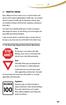 Tr a f f i c S i g n s 7 7. TRAFFIC SIGNS Many collisions and near crashes occur as a result of drivers who ignore or fail to respond appropriately to traffic signs. It is essential that the meaning of
1. LICENSING OF DRIVERS
 1. LICENSING OF DRIVERS Possession of a driver s licence and the privilege of driving is a major responsibility. The Registrar of Motor Vehicles, under the authority of the Motor Vehicle Act issues, renews
Bicycle Safety Quiz Answers Parental Responsibilities
 Bicycle riding is a great way to get into shape and enjoy the outdoors. To remain safe on Illinois roads, it is important to follow the same traffic safety laws that govern vehicle drivers. No amount of
Bicycle riding is a great way to get into shape
 Bicycle riding is a great way to get into shape and have fun. To remain safe on Illinois roads, it is important to follow the same traffic safety laws that govern vehicle drivers. No amount of bicycle
CHAPTER 2 TRAFFIC SIGNS AND HIGHWAY MARKINGS
 CHAPTER 2 TRAFFIC SIGNS AND HIGHWAY MARKINGS This chapter summarizes traffic signs, signals and road markings that control the flow of traffic, making streets and highways safer for motorists, bicyclists
Atlanta, Georgia Road Test
 1. When driving your car Into traffic from a parked position, you should: A. Sound your horn and pull Into the other lane. B. Signal and proceed when safe. C. Signal other traffic and pull directly into
PART I TRAFFIC VIOLATIONS
 PART I TRAFFIC VIOLATIONS A. MOTOR VEHICLE STATUTES N.J.S.A. 39:3-4 Driving or parking unregistered motor vehicle 39:3-9a Failure to notify change in name $22 39:3-9a Failure to endorse license $42 39:3-10
DRIVING TEST POSSIBLE QUESTIONS & ANSWERS.
 DRIVING TEST POSSIBLE QUESTIONS & ANSWERS. Question 1. What shape and colour is a warning sign? Diamond Shape - Yellow and Black Question 2. When should you not drive? While under the influence of alcohol,
COMMERCIAL DRIVER S GUIDE
 COMMERCIAL DRIVER S GUIDE to Operation, Safety and Licensing TRUCKS, BUSES, EMERGENCY RESPONDERS & TAXIS CITY CENTRE STOP SCHOOL BUS TAXI 30 MAXIMUM A COMMERCIAL DRIVER S GUIDE to Operation, Safety and
AUTOMOBILE INSURANCE PREMIUMS REGULATION
 Province of Alberta INSURANCE ACT AUTOMOBILE INSURANCE PREMIUMS REGULATION Alberta Regulation 117/2014 Extract Published by Alberta Queen s Printer Alberta Queen s Printer 5 th Floor, Park Plaza 10611-98
The State Government recognises. areas, and regulates bicycle
 cycling & THE LAW rules introduction for roads The State Government recognises The cycling South Australian as a legitimate Road Traffic form of Act including transport the Australian and an increasingly
Document Name: Driving Skills. Purpose: To outline necessary driving skills required to maximize driving safety.
 Document Name: Driving Skills Date Created: 8 October 2013 Date Reviewed: 4 February 2014 Date Approved: 29 July 2015 Purpose: To outline necessary driving skills required to maximize driving safety. Overview:
211 CMR: DIVISION OF INSURANCE 21 APPENDIX A: TRAFFIC LAW VIOLATIONS. The following abbreviations are used in Appendix A:
 211 CMR: DIVISION OF INSURANCE 21 APPENDIX A: TRAFFIC LAW VIOLATIONS The following abbreviations are used in Appendix A: "M.G.L. c., ", " CMR ", Chapter and Section of the Massachusetts General Laws Code
Massachusetts Private Passenger Automobile Statistical Plan Appendix C Traffic Law Violations
 The following abbreviations are used in Appendix C: M.G.L. c., Chapter and Section of the Massachusetts General Laws CMR Code of Massachusetts Regulations The following out-of-state incidents are to be
Rules & Regulations Applying to Small Vehicles
 Rules & Regulations Applying to Small Vehicles Updated July 2010 Updated July 2010 June 2010 Contents Introduction... 3 Common Definitions... 4 Quick Reference Guide... 5 Motorcycle Helmets... 6 Power
HOW TO PREPARE FOR YOUR MARYLAND NONCOMMERCIAL CLASS C DRIVER S TEST
 ` HOW TO PREPARE FOR YOUR MARYLAND NONCOMMERCIAL CLASS C DRIVER S TEST A portion of your noncommercial driving test will be conducted on a closed course to test your basic control of the vehicle, and a
chapter 3 basic driving skills
 chapter 3 basic driving skills When curving to the left, keep the front wheels close to the right edge of the lane to keep your driver s side rear wheels out of the next lane of traffic. Curve ahead slow
USE OF HIGHWAY AND RULES OF THE ROAD REGULATION
 Province of Alberta TRAFFIC SAFETY ACT USE OF HIGHWAY AND RULES OF THE ROAD REGULATION Alberta Regulation 304/2002 With amendments up to and including Alberta Regulation 105/2014 Office Consolidation Published
Traffic Safety Tips. Edmonton
 Traffic Safety Tips Edmonton Contents HUEdmonton Traffic Safety TipsUH 3 HUBeing A Responsible Courteous DriverUH 3 HUSpeed LimitsUH 4 HUFollowing Too CloseUH 6 HUStopping DistancesUH 6 HUIntersection
ROAD SIGNS IN JAPAN PARKING SIGNS. No Parking or Stopping Anytime SIZE & WEIGHT LIMIT SIGNS SPEED LIMIT SIGNS
 ROAD SIGNS IN JAPAN Stop Slow & all Do Not Enter & Motorcycles Road Large Sized Trucks & Special Duty Road All Except Two Wheeled Light Except Bicycles Large Passenger No Right Turn No Passing No U-Turn
NASHVILLE BICYCLE LAW 3/18/09
 NASHVILLE BICYCLE LAW 3/18/09 12.60.010 Compliance with Title 12 provisions. It is unlawful for any person to do any act prohibited or fail to perform any act required by Title 12 of this code. (Prior
87-A DISTRICT DIVISION MOST COMMON TRAFFIC CIVIL INFRACTION VIOLATIONS
 87-A DISTRICT DIVISION MOST COMMON TRAFFIC CIVIL INFRACTION VIOLATIONS Revised as of 04/2016 Misdemeanor violations may require a hearing date at which time fine and costs will be assessed. Section Code
Guelph Driving School. 246 WOOLWICH ST. Unit C Guelph, Ontario N1H 3V9. Office: 519-829-8801 Cell: 519-362-5664. Email: info@guelphdrivingschool.
 246 WOOLWICH ST. Unit C Guelph, Ontario N1H 3V9 Office: 519-829-8801 Cell: 519-362-5664 Email: [email protected] Dear Student, We would like to take this opportunity to thank you for choosing
Beginner s Permit. Survival Guide. Compliments of. (843) 263-5023 www.123drivedrivingacademy.com [email protected]
 Beginner s Permit Survival Guide Compliments of (843) 263-5023 www.123drivedrivingacademy.com [email protected] Please use this study guide to assist you in studying for your written knowledge
SMART RIDE SAFE RIDE. What you need to know to operate an ATV in Ontario
 SMART RIDE SAFE RIDE What you need to know to operate an ATV in Ontario B The All Terrain Vehicle, or ATV as it s commonly called, is a very popular year-round utility and recreational vehicle, that offers
Sharing the road safely
 6 sharing the road in this chapter Sharing the road safely Pedestrians Cyclists Motorcycle riders Passenger vehicles Large vehicles School buses Public transit buses Emergency vehicles Emergency workers
BY-LAW NUMBER 284-94
 BY-LAW NUMBER 284-94 A by-law to consolidate the by-laws that regulate traffic on roads under the jurisdiction of The Corporation of the City of Vaughan, and to repeal By-laws Numbered 281-90, 54-83, 299-86,
DEFENSIVE DRIVING. It s an Attitude
 DEFENSIVE DRIVING It s an Attitude RLI Design Professionals Design Professionals Learning Event DPLE 155 July 15, 2015 RLI Design Professionals RLI Design Professionals is a Registered Provider with The
OREGON TRAFFIC ACCIDENT AND INSURANCE REPORT
 DMV OREGON TRAFFIC ACCIDENT AND INSURANCE REPORT Tear this sheet off your report, read and carefully follow the directions. ONLY drivers involved in an accident resulting in any of the following MUST file
DMV. OREGON TRAFFIC ACCIDENT AND INSURANCE REPORT Tear this sheet off your report, read and carefully follow the directions.
 OREGON TRAFFIC ACCIDENT AND INSURANCE REPORT Tear this sheet off your report, read and carefully follow the directions. ONLY drivers involved in an accident resulting in any of the following MUST file
What Every Driver Must Know Review Assignment
 What Every Driver Must Know Review Assignment 1. Who is the Michigan Secretary of State? What services does the Secretary of State office offer? What days and hours is your local Secretary of State branch
CHART OF MOVING VIOLATIONS
 CHART OF MOVING VIOLATIONS The following chart lists the moving violations that are designated by the Texas Department of Public Safety pursuant to statutory authority. The violations listed are subject
HAPPY MOTORING IN QUÉBEC!
 HAPPY MOTORING IN QUÉBEC! Whether you are in Québec on vacation or business, you may well need information about the main rules for road use in this province, as set forth in the Highway Safety Code. Seat
Buying and Selling a Used Vehicle in Ontario
 Buying and Selling a Used Vehicle in Ontario All information is available and taken from http://www.mto.gov.on.ca/english/dandv/vehicle/used.shtml By Ontario law, private sellers of most motor vehicles,
Bicycle Safety Enforcement Action Guidelines
 Introduction Bicycle Safety Enforcement Action Guidelines People ride bicycles for many different reasons: fitness, recreation, or for transportation. Regardless of the reason for riding, bicyclists young
Safe Driving Rules & Regulations
 Chapter 4 58 60 61 61 62 62 64 65 Speed Control Passing Keeping to the Right Yielding the Right-of-Way Pedestrians in a Crosswalk Intersections Entering Highways, Parkways and Turnpikes Leaving Highways,
Road Signs Recognition Quiz
 Road Signs Recognition Quiz Place your answer for each of the signs/pavement markings on the answer sheet. Ready to Roll? Here Comes Sign # 1... #1 A No right turn B Right turn only C Warning, no turn
Texas Drivers License
 Sample Tests & Material to help prepare for the Texas Drivers License Test This document was compiled by Adriana Diesen for her personal use and later adopted by Shell Outpost Houston. It contains the
This manual is also available on the DMV website, www.dmvnow.com.
 The Virginia Driver s Manual will help you learn and understand safe driving practices. Study this manual to prepare for the knowledge test, obtain a Virginia driver s license and become a safe driver.
Licensed Driving Instructor Requirements
 Licensed Driving Instructor Requirements The following information outlines the requirements to become a licensed Driving Instructor. All applicants must meet the general requirements and the specific
Your Driver s Licence
 Your Your Your This chapter contains information on obtaining and holding a Nova Scotia driver s licence. The Registry of Motor Vehicles, under the authority of the Motor Vehicle Act, issues, renews, and
Schedule 5.04 Fines in Traffic Cases
 Fines in Traffic Cases VIOLATIONS OF CITY OF COLUMBUS ORDINANCES 2109.02 Disregard school boy patrol 55.00 2109.03 Resisting an enforcing officer 70.00 2109.06 Prohibited pedestrian on freeway 35.00 2109.06
Online and Classroom
 Defensive Driving Course for All Licence Classes Online and Classroom The information provided in this document is applicable to Online and Classroom learning. 1 of 13 Introduction The Requirements for
Florida Class E Knowledge Exam Road Rules Practice Questions www.gdlinstitute.org
 If you purchase the Value Package from GDL Institute, over 100 additional practice questions are included at no additional cost. Use discount code PQ10 and receive 10% off of the package price! 1. If you
INSTRUCTOR S GUIDE. Stay on the Right Track Highway-Railway Crossing Awareness Training for Newly Licensed Drivers
 INSTRUCTOR S GUIDE Stay on the Right Track Highway-Railway Crossing Awareness Training for Newly Licensed Drivers WHAT WE DO Operation Lifesaver is a nationwide, non-profit public information and education
TABLE OF CONTENTS. Contact Information Regarding Fleet Operations...2. Driver Qualifications...3. Fleet Operations...4. Use of Personal Vehicles...
 TABLE OF CONTENTS Contact Information Regarding Fleet Operations...2 Driver Qualifications...3 Fleet Operations...4 Use of Personal Vehicles...6 Commercial Motor Vehicles (CDL Drivers)...7 Driver License
By-Law Enforcement Officer means the City s By-Law Enforcement Coordinator and any other person appointed for the purpose of enforcing City bylaws.
 Table of Contents Off-Road Vehicles By-Law... 2 Part 1 Interpretation... 2 1.1 Short Title... 2 1.2 Schedules... 2 1.3 Reference Aids... 2 1.4 Severability... 3 1.5 Definitions... 3 Part 2 General Provisions...
Maximum speed. Stop and Give way to Manually operated temporary No entry for give way traffic on STOP and GO signs vehicular traffic major road
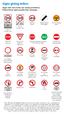 Signs giving orders Signs with red circles are mostly prohibitive. Plates below signs qualify their message. Entry to 20 mph zone End of 20 mph zone Maximum speed National speed limit applies School crossing
FMCSA Webinar Nov.18th to Examine Large Truck Crash Fatalities Involving Pedestrians & Bicyclists. New Technology for Better Fleet Management
 In This Issue: FMCSA Webinar Nov.18th to Examine Large Truck Crash Fatalities Involving Pedestrians & Bicyclists Help Prevent Roadway Accidents involving Pedestrians How to Steer Clear of Accidents with
GENIUS DMV. cheat sheets QUESTION 1 QUESTION 2 QUESTION 3 QUESTION 4. 2 Driving-Tests.org. All Rights Reserved.
 DMV GENIUS cheat sheets QUESTION 1 QUESTION 2 QUESTION 3 QUESTION 4 are a pair of white or longitudinal lines that mark where pedestrians are permitted to walk. Crosswalk lines Crosswalk lines are a pair
Driver s Handbook. Driver s Handbook. Prince Edward Island. The Department of Transportation and Public Works, Highway Safety
 Prince Edward Island Driver s Handbook Driver s Handbook The Department of Transportation and Public Works, Highway Safety Please return to any Highway Safety Office or Access PEI Centre Crown Copyright,
MOTOR VEHICLES, ACCIDENTS AND ALCOHOL
 MOTOR VEHICLES, ACCIDENTS AND ALCOHOL This is a guide to what you must and should do if you: are involved in a motor accident; have dealings with a police officer involving a motor vehicle; are required
To Foreign Nationals Who Drive Vehicles in Japan (English Language Version) Chapter 1 Basic Information
 7,1, 2011 License Division Translated by National Police Agency To Foreign Nationals Who Drive Vehicles in Japan (English Language Version) Introduction This booklet is designed to help you understand
SAFE CYCLING GUIDE. 7th Edition
 SAFE CYCLING GUIDE 7th Edition BEFORE SETTING OUT A Check tire pressure B Check that the chain does not slip C Check the brakes D Check lights and reflectors: 1 A WELL-MAINTAINED BICYCLE is key 3 4 5 Adjust
Chapter 4 DEFENSIVE DRIVING
 Chapter 4 DEFENSIVE DRIVING Chapter 4 Table of Contents Chapter 4 DEFENSIVE DRIVING... 4-1 DEFENSIVE DRIVING... 4-3 Positioning The Bus... 4-3 When Making a Turn at an Intersection... 4-3 Making the perfect
BICYCLE AND IN-LINE SKATE LAWS ROAD SHARING RESPONSIBILITIES OF BICYCLISTS AND MOTORISTS, REQUIRED EQUIPMENT AND PARENTAL RESPONSIBILITY
 BICYCLE AND IN-LINE SKATE LAWS ROAD SHARING RESPONSIBILITIES OF BICYCLISTS AND MOTORISTS, REQUIRED EQUIPMENT AND PARENTAL RESPONSIBILITY The statutes in this material have been generated from the database
1. Rules for users of powered wheelchairs and powered mobility scooters
 Jersey Highway Code Introduction The Minister for Transport and Technical Services has issued directions for the guidance of road users, the Highway Code. The Highway Code for Jersey is the Official Highway
Cycle Safety. Some tips on safer cycling. Údarás Um Shábháilteacht Ar Bhóithre Road Safety Authority
 Cycle Safety Some tips on safer cycling Údarás Um Shábháilteacht Ar Bhóithre Road Safety Authority Be safe For further information on safe cycling, please look at the Rules of the Road website at www.rulesoftheroad.ie
These "rules of the road" are based on Texas Transportation Code statutes. Find the complete bicycle code at the bottom of the page
 Texas Bicycle Laws These "rules of the road" are based on Texas Transportation Code statutes. Find the complete bicycle code at the bottom of the page Bicyclists have the rights and duties of other vehicle
TASMANIAN ROAD RULES
 TASMANIAN ROAD RULES Version 9 November 2012 This book has road rules and information for car drivers and motorcycle riders If you re going to drive a heavy vehicle, you can get the Tasmanian Heavy Vehicle
License System. The New Jersey Driver. Chapter one
 Chapter one The New Jersey Driver License System Motorists must always carry a valid driver or provisional license, in addition to a current vehicle registration and proof of valid liability auto insurance,
Driver s Handbook. Working with drivers to make our roads safer
 Driver s Handbook Working with drivers to make our roads safer Table of Contents Establishing your identity 5 The Class Licence System Basic Class 5 licensing requirements Foldout Foldout Test appointments
SAMPLE VEHICLE FLEET SAFETY & USAGE POLICY
 SAMPLE VEHICLE FLEET SAFETY & USAGE POLICY Policy The purpose of this policy is to ensure the safety of those individuals who drive company vehicles and to provide guidance on the proper use of company
DRIVER KNOWLEDGE TEST QUESTIONS CLASS C (CAR) LICENCE
 DRIVER KNOWLEDGE TEST QUESTIONS CLASS C (CAR) LICENCE ICAC1 - ICAC What will happen if you are caught cheating on the knowledge test? - You will not be allowed to take another test for 6 weeks. - You will
SAFE CYCLING GUIDE. 6th Edition
 SAFE CYCLING GUIDE 6th Edition BEFORE SETTING OUT A WELL-MAINTAINED BICYCLE is key A Check tire pressure B Check that the chain does not slip C Check the brakes D Check lights and reflectors: 3 4 1 5 2
VEHICLE INSPECTION REGULATION
 Province of Alberta TRAFFIC SAFETY ACT VEHICLE INSPECTION REGULATION Alberta Regulation 211/2006 With amendments up to and including Alberta Regulation 12/2015 Office Consolidation Published by Alberta
New York Laws. Title 11, ARTICLE 48-B REGISTRATION OF ALL TERRAIN VEHICLES
 New York Laws 2281. Definitions. For the purposes of this article: 1. (a) "All terrain vehicle" or "ATV" means any self-propelled vehicle which is manufactured for sale for operation primarily on off-highway
ATVs: WHAT YOU SHOULD KNOW
 ATVs: WHAT YOU SHOULD KNOW OTTAWAPOLICE.CA www.canadasafetycouncil.org DEFINITIONS An All-Terrain-Vehicle (ATV) is an Off-Road Vehicle (ORV) that: Has four wheels, the tires of which are all low pressure
Model Fleet Safety Program Short
 TM Model Fleet Safety Program Short CORPORATE HEADQUARTERS 518 EAST BROAD STREET COLUMBUS, OHIO 43215 614.464.5000 STATEAUTO.COM TM Disclaimer: The information contained in this publication was obtained
How To Improve Safety
 Collision Diagrams Collision diagrams are used to display and identify similar accident patterns. They provide information on the type and number of accidents; including conditions such as time of day,
Points 5008001 Jay Walking N 0
 Offence Code Offence Wording Offence Endorsable Offence Points 5008001 Jay Walking 0 5008007 Breach of Signal Given by a Constable 5008008 Failing to stop for Police 0 5008013 Excess Speed 5008019 Driving
12 & 15- Passenger Van Defensive Driver Training
 12 & 15- Passenger Van Defensive Driver Training NHTS-national Highway Traffic Safety Administration Recognizes that 12-15 passenger vans (include driver) are similar type vehicle and offer the same hazards
Graduated Driver Licensing
 Graduated Driver Licensing Three licence stages Supervising drivers Knowledge and road test bookings Table of Contents Purpose of this guide 1 What is GDL? 1 Why GDL? 1 Who is included in GDL? 2 GDL stages
CANADIAN DRIVER S LICENCE REFERENCE GUIDE
 CANADIAN DRIVER S LICENCE REFERENCE GUIDE In Canada, provincial/territorial licencing regulations are modeled on the guidelines set out in the Canadian Council of Motor Transport Administrators (CCMTA)
GENERAL KNOWLEDGE PRACTICE TEST
 GENERAL KNOWLEDGE PRACTICE TEST 1. Driving under the influence of any drug that makes you drive unsafely is: a. Permitted if it is prescribed by a doctor b. Against the law c. Permitted if it is a diet
Table of Contents. Different licences for different vehicles 1. Authorized Instruction: Learning to drive other types of vehicles 6
 Class Licences Professional and non-professional licences Applying for your licence Taking knowledge and road tests Chart showing the class of licence you require Table of Contents Different licences for
PEDESTRIAN LAWS OF NORTH CAROLINA
 PEDESTRIAN LAWS OF NORTH CAROLINA Under North Carolina law, pedestrians have the right of way at all intersections and driveways. However, pedestrians must act responsibly, using pedestrian signals where
Driver Certification
 Driver Certification Environmental Health & Safety/Risk Management Department of Campus Operations 300 College Park Dayton, Ohio 45469-2904 937-229-4503 Agenda: Part I: Review of UD Driver Certification
Signs, Pavement Markings, and Work Zones. Signs, Pavement Markings, and Work Zones
 Signs, Pavement 3 Signs, Pavement 77 3 Signs, Pavement This chapter includes information on highway signs that are intended to guide and inform you while you are driving. It includes information on the
CHAPTER ONE Obtaining A New Credential
 CHAPTER ONE Obtaining A New Credential Indiana driver s licenses, permits, and identification cards are produced using security features to help prevent identity theft, fraud, and card tampering, and to
Skills, Laws and Safety
 3 Basic Skills, Laws and Safety This chapter provides information about basic skills, laws and safety, with tips for preparing to drive, controlling speed, signaling, yielding, turning at intersections
A Bicyclist s Guide to Traffic Law in Tucson and Pima County. Traffic Laws, Fines and Phone Numbers
 A Bicyclist s Guide to Traffic Law in Tucson and Pima County Traffic Laws, Fines and Phone Numbers This booklet contains a listing of relevant Arizona State, Pima County and City of Tucson laws as of January,
Carolina Road Driving School Sample Test Questions
 Carolina Road Driving School Sample Test Questions 1. A driver's license is required for which of the following? 1. Sitting in the driver's seat of a car while the engine is running. 2. Steering a car
TEST ON Driving Safely Among Bicyclists and Pedestrians
 TEST ON Driving Safely Among Bicyclists and Pedestrians Next you will take a 16 question test about driving safely among bicyclists and pedestrians. Please take out a sheet of paper to mark down and score
A Rider s Guide to Mopeds, Motorcycles, All-Terrain Vehicles, and More in the Northwest Territories
 Northwest Territories Department of Transportation Road Licensing and Safety Division July 2011 A Rider s Guide to Mopeds, Motorcycles, All-Terrain Vehicles, and More in the Northwest Territories Visit
- FREE! - The Official San Francisco BIKE GUIDE. 1st Edition
 - FREE! - The Official San Francisco BIKE GUIDE 1st Edition SF BIKE LAWS SAN FRANCISCO BICYCLISTS MUST: Yield to People Walking Whether they re in a crosswalk or not, ALWAYS yield to people walking. Stop
FACT SHEET 5 Road Safety. Takapuna Grammar School International Department
 If you own a car, you should obtain at least third party insurance. A reminder that the roads outside of the main highways can be narrow and windy. You must drive really carefully. Takapuna Grammar School
Smart Cycling IN SANTA MONICA SANTA MONICA POLICE DEPARTMENT BE SMART. BE VISIBLE. BE ATTENTIVE. HAVE FUN!
 Smart Cycling IN SANTA MONICA BE SMART. BE VISIBLE. BE ATTENTIVE. HAVE FUN! Safety Tips and Rules of the Road for Cyclists SANTA MONICA POLICE DEPARTMENT Rules of the Road Drivers, bicyclists, and pedestrians
San Antonio Municipal Court Traffic Fines and Court Cost Total Fine & Code Violation Court Cost 1F SPEEDING-POSTED LIMIT (For the first 10 miles over
 1F SPEEDING-POSTED LIMIT (For the first 10 miles over the speed limit-additional mile is $5.00) 173.00 1G SPEEDING - NO POSTED LIMIT (For the first 10 miles over the speed limit-additional mile is $5.00)
PART I TRAFFIC RELATED VIOLATIONS
 PART I TRAFFIC RELATED VIOLATIONS A. MOTOR VEHICLE STATUTES N.J.S.A 39:3-4 Driving or parking unregistered motor vehicle 39:3-9a Failure to notify change in name $55 39:3-9a Failure to endorse license
Large Truck and Bus Traffic Enforcement
 Large Truck and Bus Traffic Enforcement 1.0 Instructor Guide December 11, 2014 Slide 1 Large Truck and Bus Traffic Enforcement 1 Welcome students to the Large Truck and Bus Traffic Enforcement topic. Module
New Driver & Coach Practice Guide
 New Driver & Coach Practice Guide Welcome to Driving in Maryland Dear Coach and Rookie Driver: For the Rookie Driver: Congratulations. In getting your Learner s Instructional Permit, you have just completed
ATV & Off Road Motorcycle Regulations
 ATV & OFF ROAD MOTORCYCLE REGULATIONS PUBLISHED BY AUTHORITY The following Regulations have been made by the Town Council of Happy Valley-Goose Bay under Section 414 (2)(s) of the Municipalities Act, Chapter
Vehicle Registration and Insurance. Vehicle Registration and Insurance
 Vehicle 7 Vehicle 165 7 Vehicle This chapter contains information on vehicle ownership and registrations. 166 Before you operate a vehicle on a highway in Nova Scotia, your vehicle must meet a number of
Fashion Institute of Technology OPERATIONAL SERVICES
 Fashion Institute of Technology OPERATIONAL SERVICES Motor Vehicle Use Manual 2010 Table of Contents 1. Introduction............................................. 1 1.1 Purpose and Application of Manual..........................
RIDE ON THE RIGHT TIP:
 B I C Y C L I N G I N C O L O R A D O RULES OF THE ROAD Please consult the Colorado Revised Statutes for the specific language of the law regarding bicycles and their operation. Municipalities and other