
PATIENT HANDLING FOR HEALTHCARE WORKERS
|
|
|
- Roy Malone
- 10 years ago
- Views:
Transcription
1 PATIENT HANDLING FOR HEALTHCARE WORKERS TABLE OF CONTENTS Musculoskeletal Injury Among Health Care Workers:. 1 What Causes Musculoskeletal Injury? 1 Common Back Musculoskeletal Disorders. 1 What are Work Related Musculoskeletal Disorders? 2 Rules for Safe Lifting. 2 Some Other Things to Think About... 3 What is a Minimal Lift Program? 3 Defining Transfers, Lifts, and Repositioning. 3 Assessment: 4 Information about Transfers, Lifts and Repositioning.. 5 Prevention: 7 Bottom Line:. 8 References:.. 8 Additional OHCOW Resource Booklets:.. 8 PATIENT HANDLING FOR HEALTHCARE WORKERS Occupational Health Clinics for Ontario Workers

2 Musculoskeletal Injury Among Health Care Workers: According to the Canadian Labour Force Survey, nurses have the highest number of lost workdays and the highest percentage of lost work time attributable to illness and injury among the major occupational groups in Canada.(1) Occupational back injuries are a serious problem worldwide, accounting for considerable morbidity and cost. (2) In a Canadian study that monitored the health of nurses in Canada, 90 % of study participants cited musculoskeletal conditions/injuries as a major health concern for nurses.(3) Patient lifts and transfers were found to be the most common cause of reported back injury among health care workers. (4) What Causes Musculoskeletal Injury? A single high load incident. Awkward postures for sustained periods of time. Lifting continuously all day long without significant rest of the tissues. Chronic strain to muscles and joints. Imbalance of activities: repetitive and sustained activities in one direction. Stressful living: smoking and poor nutrition. Repetitive wear and tear: reduction of spine s flexibility. Psychosocial factors: time pressures, monotonous work, heavy responsibilities, too many tasks, not enough breaks from work, low control, little autonomy, poor social support from peers and supervisors. (5) Common Back Musculoskeletal Disorders Strained Ligaments High, fast forces such as slipping and falling on your behind can tear or strain ligaments. Slower forces can tear ligaments from the bone. Recently it has been shown that prolonged stretch of ligaments (such as from prolonged slouching) can cause muscle spasms. It is important to have a proper seating set up and to change positions often. (6) Strained Muscles Muscle strains usually occur during activities that require the muscle to tighten forcefully. The muscle is strained either because it is not properly stretched, or warmed up, before the activity; it is too weak; or because the muscle is already injured and not allowed time to recover. Muscle strains can occur during exercise, sports activities and when lifting heavy objects. (6) There are other types of back injuries that can occur including disc degeneration. Please refer to OHCOW s How Your Back Gets Injured: A Technical Guide to Preventing Injury for more information.

3 What are Work Related Musculoskeletal Disorders? Work Related Musculoskeletal Disorders (WMSDs) is a term that defines injuries to muscles, tendons or nerves that are caused or aggravated by work. (4) These types of injuries are also commonly referred to as Repetitive Strain Disorders, Cumulative Trauma Disorders, Repetitive Stress Disorders and Work-related Upper Limb Disorders. (2) Some of the risk factors could include workplace organization such as intensified work load, stressful work environments with stressful deadlines, working in awkward postures for extended periods of time and repetitive loading or lifting. (4) Rules for Safe Lifting Use the following acronym as a guide when engaging in client handling procedures: B ack Straight A void Twisting C lose to Body K eep Smooth Back Straight Discs can tolerate larger compressive loads when the back is straight. Discs are weaker when lifting in a flexed position. Maintain the spine s neutral curves. Keeps spine aligned and moving smoothly. Minimizes stress on spine. Imaginary line to maintain curves in balance Avoid Twisting Discs are weaker when lifting is combined with twisting. Joints are designed to prevent rotation. If you twist when you lift the joints become inflamed and sore.

4 Close to Your Body If an object is at a greater distance from your body for lifting, your back muscles and joints have to work harder to lift the weight creating greater stress on your back. If you keep the exact same load close to your body, the lesser distance creates a lighter load and less stress on your back. Keep Smooth Jerking increases the load on the discs. Some Other Things to Think About Always consider the use of a mechanical aid. During client handling, use your leg and hip muscles and knee joints to lift. When lifting a client or object, tighten your abdominal and pelvic muscles and keep the client or object close to your body to prevent injury. Avoid reaching over your head to lift to prevent strain on joints located along your spine. Lift in stages if you need to. If the person or object slips, lower them gently to the floor while tightening your abdominal muscles and avoid rotation. Follow the general lifting guidelines recommended by the National Institute for Occupational Safety and Health (NIOSH) which states, the most a person can lift with minimal risk of injury under ideal conditions is 23 kg or 51 pounds.(7) Refer to NIOSH lifting fact sheet for more information. What is a Minimal Lift Program? A minimal lift program is a program that will help to reduce the unnecessary risk of injury for clients and staff through the reduction of manual lifting of clients. The goal of a minimal lift program is to provide employees with a policy that will promote an environment where the usage of assistive equipment is encouraged and expected. These goals can be achieved by providing staff with access to an appropriate number of assistive devices for patient handling. These could include: walking belts, total lifts, sit stand lifts, shower chairs, transfer boards and slide sheets. Training can involve policy implementation goals through hands on teaching/training program and practice sessions. (5)

5 Defining Transfers, Lifts, and Repositioning Transfers are guiding and/or assisting the patient from one surface to another. The patient is able to bear some weight in the legs and/or arms, and/or a part of the weight is borne by an assistive device such as a transfer board, walker or cane. Lifts are any procedure where the patient s entire body weight is borne by someone or something other than the patient (i.e.: a mechanical lifting device) for purposes of repositioning or moving to another surface. Repositioning is shifting, adjusting or changing the patient s position in bed, wheelchair, chair, or other supportive surface. (5) Assessment: Completing an assessment before a transfer or lift is important because it: Helps to determine risk for injury. Promotes continuity of care. Helps you to be prepared for possible risks. Helps to minimize the risk of injury for the health care worker and the client. Assessment of the Work Area: The work area should allow easy access to patients. A room should not be cluttered with furniture or equipment. A cluttered room increases the potential for trips and falls. A small room, such as a bathroom, may not allow natural body movements. Transfer patients onto a shower chair outside the bathroom to reduce transfers in crowded spaces. In small rooms, there may not be enough room for a portable lifting device. There are fixed lifting aids on tracks which do not require a lot of space. There should be enough clearance around beds and toilets to allow access on either side (at least 90 cm). A highly polished or wet floor does not provide good traction or a safe base for lifting (i.e. shower). Slips are more likely to occur on a highly polished or wet floor. Cover floors that get wet with a non-slip material. Purchasing of Equipment: Purchase furniture with patient handling in mind. Removable arm and foot rests on wheelchairs and shower chairs make transfers easier. Beds that can be raised or lowered also make transfers easier. Adaptive clothes are needed for patients who are toileted using the hoist. The shower and toilets should be designed so pushing and pulling shower chairs into position is as easy as possible (i.e. reduce height changes in the floor).

6 Staffing: Ensure there are enough nurses and nursing assistants available to perform patient handling tasks safely especially during high activity periods. Client Cognition: Assess the client s senses, state of mind, memory, communication medical status and physical condition before engaging in client handling procedure. Information about Transfers, Lifts and Repositioning The following logos provide recommended guidelines for patient handling. Independent Transfers: This should be used when a client is able to mobilize without risk of injury and the client is comfortable with the use of mobility aids. (5) Supervised Transfers: This should be used when the client is able to mobilize, but may require verbal or minimal physical cueing. Transfer belts should be used in all cases. (5) One-person Transfer Belt/ Pivot Transfer: This should be used when a client can stand unsupported or weight bear with assistance of one person who will provide less than 40 pounds (18 kg) of assistance. (5) This transfer can also be performed if the physician orders feather, toe-touch or partial weight bearing. For safe handling a transfer belt must be used. (5) Two-person Standing Pivot Transfer:

7 This transfer should be used when a client can bear weight through the legs but is heavy and unreliable. This technique requires two health care workers, with the tall person behind the patient. A transfer belt must be used. (5) Walker Transfer: Walker transfer should be used when a client can bear weight through at least one leg, and whose upper extremity strength and mobility are adequate. This can also be used if the physician orders feather, toe-touch, or partial weight bearing.(5) Sit-Stand Mechanical Lift (SARA Lift): This lifting technique should be used when a client can sit with minimal support at the edge of the bed and is able to bear some weight. The client may be cognitively predictable and reliable. The client is able to tolerate harness under his/her arms. This should not be used with clients who have a hemiplegic arm. (5) Total Mechanical Lift: Transfer Belt: A total mechanical lift should be used when a client can only minimally transfer or is not able to assist with weight bearing. This should also be used if the client is cognitively unreliable or uncooperative, has poor head control or sitting balance or is extremely large or heavy and requires assistance.(5) Transfer belts should be used when a client needs assistance with any transfer or for mobilization. (5)

8 Slide board/transfer board: Slide boards/transfer boards should be used when transferring between equal height surfaces. Slide boards should also be used to facilitate transfer to wheelchair and for a client with excessive weakness in their lower limbs.(5) Slide Sheets: Slide sheets should be used in repositioning a client in bed who is unable to move themselves independently. Two caregivers are required for use. Slide sheets can also be used to move a client from bed to stretcher or in an emergency situation where the client has fallen in a confined space or the mechanical lift or other transfer methods cannot be employed. (5) Prevention: Examine your work environment. Avoid awkward or sustained postures or repetitive movements by varying your work activities throughout your day. Avoid forceful movements with a high load to avoid back injury. Maintain a neutral relaxed posture. Maintain client handling equipment. Ensure adequate staff to client ratios when considering engaging in client handling procedures. Ensure that staff has access to appropriate patient handling devices and ensure that all devices are in good working order. Ensure that your work area provides easy access to clients. (i.e. transfer patients onto a shower chair outside the bathroom to reduce transfers in crowded spaces). Plan ahead to ensure that you have considered all of the factors before engaging in a client-handling procedure. Adjust the working height of equipment to avoid bending stretching or twisting. Consider the use of a mechanical aid for client transfers. Exercise such as strength and conditioning helps maintain functional ability and helps prevent muscle sprains, low back pain, osteoarthritis, osteoporosis, shoulder instability and knee stability and pain. Stretching should be incorporated into an exercise program to help improve flexibility.

9 Do not lift anything immediately after sitting for an extended period of time. Walk around and loosen up. Bottom Line: Reducing the chance of injury when handling patients requires a combination of equipment, training, and policy. If staff members are not properly trained on how and when to use ergonomic equipment, they will not use it. Health care workers should be involved in selecting equipment and creating policies since they are the patient handlers. For more information on equipment, handling techniques, and policies, read the booklets listed in the Additional Resources or contact the nearest OHCOW. References: 1. Akyeampong, E., & Uscalcas, J. (1998). Work Absence Rates, 1980 to Statistics Canada, Catalogue no MPB, no Hagen, K., & Thune, O. (1998). Work incapacity from low back pain in the general population. Spine, 23, Kerr, M., Laschinger, H., Severin, C., Almost, J., Thomson, D., O Brien-Pallas, L., Shamien, J., McPerson, D., Koehoorn, M., & LeClair, S. (2002). Monitoring thehealth of Nurses in Canada. Ottawa: Canadian Health Services Research Foundation. 4. Institute for Work& Health (2005), IWH fact sheet work-related musculoskeletal disorders Health Care Health and Safety Association (2003). HCHSA Handle with Care: A Comprehensive Approach to Developing and Implementing a Client Handling Program. 6. McGill, S Low back disorders : evidence-based prevention and rehabilitation. Champaign, IL, Human Kinetics; Waters, T., Puts Anderson, V., Garg, A. & Fine, L. (1993). Revised NIOSH equation for the design and evaluation of Manual lifting tasks. Ergonomics, 36(7), Additional OHCOW Resource Booklets: 1. Work-related Musculoskeletal Disorders. 2. Working on Your Feet. 3. Ergonomics and Pregnancy. 2 ND Edition

10 If you need further assistance, call the Occupational Health Clinic for Ontario Workers Inc. closest to you: Toll Free HAMILTON 848 Main Street East Hamilton, ON L8M 1L9 (905) Fax: (905) SARNIA-LAMBTON 171 Kendall Street Point Edward, ON N7V 4G6 (519) Fax: (519) SUDBURY 84 Cedar Street 2 nd Floor Sudbury, ON P3E 1A5 (705) Fax: (705) [email protected] THUNDER BAY 1151 Barton Street Suite 103B Thunder Bay, ON P7B 5N3 (807) Fax: (807) [email protected] TORONTO 970 Lawrence Ave. West Main Floor Toronto, ON M6A 3B6 (416) Fax: (416) [email protected] WINDSOR 3129 Marentette Avenue Unit #1 Windsor, ON N8X 4G1 (519) Fax: (519) [email protected] PROVINCIAL OFFICE # Gervais Drive Don Mills, ON M3C 1Y8 (416) Fax: (416) [email protected] Website: Facebook: Twitter: Youtube Channel: Every effort has been made to ensure the accuracy of the information in this workbook. OHCOW assumes no responsibility for how this information is used.

SETTING UP THE COMPUTER WORKSTATION TO FIT YOU
 SETTING UP THE COMPUTER WORKSTATION TO FIT YOU TABLE OF CONTENTS Adjusting Your Chair...1 Adjusting an Adjustable Working Surface...2 Adjusting a Non-adjustable Working Surface...3 Adjusting Your Keyboard...3
Patient handling techniques to prevent MSDs in health care
 28 Introduction Patient handling techniques Work-related musculoskeletal disorders (MSDs) are a serious problem among hospital personnel, and in particular the nursing staff. Of primary concern are back
Back Safety Program POLICY AND PROCEDURE
 Back Safety Program POLICY AND PROCEDURE This is (Enter Company Name Here) Back Safety Program. It meets all OSHA requirements and applies to all our work operations. (Enter Name Here) will be responsible
Body Mechanics and Back Pain
 Body Mechanics and Back Pain Presented by: APS Healthcare Southwestern PA Health Care Quality Unit (APS HCQU) August 2015 cjp Disclaimer Information or education provided by the HCQU is not intended to
Avoid The Dreaded Back Injury by Proper Lifting Techniques
 Avoid The Dreaded Back Injury by Proper Lifting Techniques If you ve ever strained your back while lifting something, you ll know the importance of lifting safely. Agenda Introduction About the Back The
Why Back Safety is Important
 Back Safety Why Back Safety is Important Back injuries are considered by OSHA (the Occupational Safety and Health Administration) as the nation's #1 workplace safety problem. Back Injuries are often: Very
Transferring Safety: Prevent Back Injuries
 Transferring Safety: Prevent Back Injuries OBJECTIVES: At the end of this class you will be able to: 1. Describe the back and what it does. 2. List things that you can do everyday in your home and at work
Safe Lifting/Back Safety Training. Presented by Rita Gagnon Occupational Health Outreach Coordinator Benefis Health Systems 406-731-8328
 Safe Lifting/Back Safety Training Presented by Rita Gagnon Occupational Health Outreach Coordinator Benefis Health Systems 406-731-8328 Risk Factors Involved with Manual Handling Tasks: Bending at Trunk
Back Safety and Lifting
 Back Safety and Lifting Structure of the Back: Spine The spine is the part of the back that supports the trunk and head. It protects the spinal cord as well as giving flexibility to the body. Vertebrae
Injuries from lifting, loading, pulling or pushing can happen to anyone in any industry. It is important to be aware of the risks in your workplace.
 Workplace safety: lifting One of the biggest concerns in the workplace is lifting and loading. When you lift something, the load on your spine increases and your spine can only bear so much before it is
ERGONOMICS. Improve your ergonomic intelligence by avoiding these issues: Awkward postures Repetitive tasks Forceful exertions Lifting heavy objects
 ERGONOMICS The goal of ergonomics is to reduce your exposure to work hazards. A hazard is defined as a physical factor within your work environment that can harm your body. Ergonomic hazards include working
[Project name] Standard Operating Procedures. Body Mechanics
![[Project name] Standard Operating Procedures. Body Mechanics](/thumbs/27/11986346.jpg "[Project name] Standard Operating Procedures. Body Mechanics") [Project name] Standard Operating Procedures Body Mechanics PURPOSE. The purpose of this SOP is to provide information to minimize staff injuries with the focus on back injuries resulting from improper
[Project name] Standard Operating Procedures Body Mechanics PURPOSE. The purpose of this SOP is to provide information to minimize staff injuries with the focus on back injuries resulting from improper
Fact sheet Exercises for older adults undergoing rehabilitation
 Fact sheet Exercises for older adults undergoing rehabilitation Flexibility refers to the amount of movement possible around a joint and is necessary for normal activities of daily living such as stretching,
Material 1. Dolly, hand cart, wheel cart, large box, back belt
 29CFR 1926.20(b)-Accident Reduction, 29CFR 1926.21- Safety Training & Education Back and Lifting Safety Preparation 1. Read Applicable Background information and related Company Policy Chapter. 2. Make
These notes are designed to be used in conjunction with the Moving and Handling PowerPoint slides.
 CORE SKILLS FRAMEWORK MOVING AND HANDLING PRINCIPLES FOR STAFF: LESSON NOTES & TIPS FOR A SUGGESTED APPROACH These notes are designed to be used in conjunction with the Moving and Handling PowerPoint slides.
Body Positioning & Lifting Techniques
 Body Positioning & Lifting Techniques Body Positioning But no matter what task we are undertaking we MUST Think through the task and we MUST Prepare ourselves before we attempt to complete them. If we
Back Pain Musculoskeletal Disorder Updated October 2010
 Back Pain Musculoskeletal Disorder Updated October 2010 According to the Health and Safety Executive back pain is the most common health problem for British workers. Approximately 80% of people experience
http://intranet.urmc-sh.rochester.edu/policy/smhpolicies/section10/10-22.pdf
 APPENDIX B Patient Care Lifting Guidelines Patient handling, including lifting, transferring, and repositioning, is covered by SMH Policy 10.22 Minimal Lift for Patient Handling, which can be found at:
Injury Prevention for the Back and Neck
 Injury Prevention for the Back and Neck www.csmr.org We have created this brochure to provide you with information regarding: Common Causes of Back and Neck Injuries and Pain Tips for Avoiding Neck and
HealthStream Regulatory Script
 HealthStream Regulatory Script Back Safety Version: May 2007 Lesson 1: Introduction Lesson 2: Back Injury Lesson 3: Spinal Anatomy and Physiology Lesson 4: Safe Operation of the Spine Lesson 5: Preventive
Preventing Overuse Injuries at Work
 Preventing Overuse Injuries at Work The Optimal Office Work Station Use an adjustable chair with good lumbar support. Keep your feet flat on a supportive surface (floor or foot rest). Your knees should
Range of Motion. A guide for you after spinal cord injury. Spinal Cord Injury Rehabilitation Program
 Range of Motion A guide for you after spinal cord injury Spinal Cord Injury Rehabilitation Program This booklet has been written by the health care providers who provide care to people who have a spinal
Safe Lifting and Carrying
 PART 1 Basic Lifts Proper lifting and handling will help protect against injury and make your job easier. It takes training and practice to do it right. The following are basic steps in safe lifting and
LIFTING AND BACK SAFETY TRAINING LESSON PLAN
 LIFTING AND BACK SAFETY TRAINING LESSON PLAN Topic: Back Safety and Proper Lifting Techniques This presentation is designed to assist trainers conducting Lifting and Back Safety training for workers. Back
INSTRUCTIONAL MATERIALS: REFERENCES: a. PAEC School Safety Manual b. Any locally produced Back Injury pamphlet TRAINING AIDS:
 LESSON TOPIC: AVERAGE TIME: BACK INJURY PREVENTION 30 Minutes INSTRUCTIONAL MATERIALS: REFERENCES: a. PAEC School Safety Manual b. Any locally produced Back Injury pamphlet TRAINING AIDS: a. Handout #1
Biomechanical Analysis of the Deadlift (aka Spinal Mechanics for Lifters) Tony Leyland
 Biomechanical Analysis of the Deadlift (aka Spinal Mechanics for Lifters) Tony Leyland Mechanical terminology The three directions in which forces are applied to human tissues are compression, tension,
Manual Handling- The Whole Story!
 Manual Handling- The Whole Story! For Responsible Managers and Assessors Course Notes Mark Mallen Group Health and Safety Manager July 2005 Course Content 1 What is Manual Handling? 2 What s the Problem?
Back Safety Goals. Back injury and injury prevention Lifting techniques Quiz
 Back Safety Back Activities Reaching, bending over, sitting Skiing, hiking, bike riding Playing with your children and grandchildren Working and feeling productive Back Safety Goals Back injury and injury
Australian Centre for Agricultural Health and Safety. Farming with Back Pain
 Australian Centre for Agricultural Health and Safety Farming with Back Pain 2008 Australian Centre for Agricultural Health and Safety All rights reserved Title: Farming with Back Pain Authors: Boughton
Fundamental of a Successful Team Environmental Services and Patient Transport Best Practices
 Fundamental of a Successful Team Environmental Services and Patient Transport Best Practices September 29, 2010 Tangee B. Kizer, BSM Executive Director Environmental and Guest Services Carolinas HealthCare
Welcome to your LOW BACK PAIN treatment guide
 Welcome to your LOW BACK PAIN treatment guide You are receiving this guide because you have recently experienced low back pain. Back pain is one of the most common musculoskeletal problems treated in medicine
<< INSERT COMPANY NAME
 > SLIIP-TRIIP-FALL & STRAIIN IINJURY TRAIINIING > Fall Prevention Slips, trips, and falls constitute the majority of general industry accidents. They cause 15% of
Labour Protect Your Back!
 Building Fair and Productive Workplaces Labour Protect Your Back! LT-006-07-07 Also available: Protect Your Lungs! / Protégez vos poumons! LT-168-10-05 Protect Your Skin! / Protégez votre peau! LT-158-09-05
EVIDENCE-BASED PRACTICES FOR IMPROVING INJURY REDUCTION PERFORMANCE
 EVIDENCE-BASED PRACTICES FOR IMPROVING INJURY REDUCTION PERFORMANCE To accelerate improvement in workplace safety, KP requires that the following proven practices are in place across KP s hospitals in
HealthandSafetyOntario.ca. Hazards. Introduction. Legislation
 Manual Materials handling Introduction Manual materials handling operations are carried out in most workplaces. Each handling task poses unique demands on the worker. However, workplaces can help workers
Move and position individuals in accordance with their plan of care
 Move and position individuals in accordance with their plan of care Page 1 of 21 Level 2 Diploma in Health and Social Care Unit HSC 2028 Tutor Name: Akua Quao Thursday 12 th September 2013 Release Date:
Lifting and Handling, a Risk Assessor s Guide
 Lifting and Handling, a Risk Assessor s Guide 1 Introduction Unfortunately manual handling accidents are all too common, and can lead to life-long problems with bad backs. While they do not have the same
CONSTRUCTION WORK and CUMULATIVE TRAUMA DISORDERS
 Connecticut Department of Public Health Environmental and Occupational Health Assessment Program 410 Capitol Avenue MS # 11OSP, PO Box 340308 Hartford, CT 06134-0308 (860) 509-7740 http://www.ct.gov/dph
HELPFUL HINTS FOR A HEALTHY BACK
 HELPFUL HINTS FOR A HEALTHY BACK 1. Standing and Walking For correct posture, balance your head above your shoulders, eyes straight ahead, everything else falls into place. Try to point toes straight ahead
Workplace Job Accommodations Solutions for Effective Return to Work
 Workplace Job Accommodations Solutions for Effective Return to Work Workplace Job Accommodations Solutions for Effective Return to Work Published by 102 275 Broadway Winnipeg, MB R3C 4M6 www.mflohc.mb.ca
Good manual handling practice
 Health and Safety Services Good manual handling practice If you lift, carry, push or pull as part of your job, the following guidance is for you Injuries caused Poor lifting technique and work methods
Pavement Breaker Operators
 Pavement Breaker Operators Prevent Back, Joint and Muscle Injuries! INSIDE: Ways to prevent injuries while using breakers Handling a 90-pound breaker can injure your back muscles, spinal discs and hands.
WSN ERGONOMIC SAFETY TALK #3
 What is a safety talk? This safety talk is one of a series of brief meetings held on regular basis with workers and their supervisors to discuss problems and concerns about health and safety. All safety
Lower Back Pain An Educational Guide
 Lower Back Pain An Educational Guide A publication from the Center of Pain Medicine and Physiatric Rehabilitation 2002 Medical Parkway Ste 150 1630 Main St Ste 215 Annapolis, MD 21401 Chester, MD 21619
Mike s Top Ten Tips for Reducing Back Pain
 Mike s Top Ten Tips for Reducing Back Pain The following article explains ways of preventing, reducing or eliminating back pain. I have found them to be very useful to myself, my clients and my patients.
Fact Sheet: Occupational Overuse Syndrome (OOS)
 Fact Sheet: Occupational Overuse Syndrome (OOS) What is OOS? Occupational Overuse Syndrome (OOS) is the term given to a range of conditions characterised by discomfort or persistent pain in muscles, tendons
Safe Lifting/ Back Safety Training. Environmental Health and Safety
 Safe Lifting/ Back Safety Training Environmental Health and Safety Why Back Safety is Important Back injuries are considered by OSHA the nation s #1 workplace safety problem Back injuries are often: Very
Good Body Mechanics/ Employee Safety: A Skills Update THIS PROGRAM COVERS: 4) How to Maintain Healthy Lifestyle Habits to Help Prevent Injury
 In-Service Training Good Body Mechanics/ Employee Safety: A Skills Update THIS PROGRAM COVERS: 1) Definition of Ergonomics 2) How Repetitive Movements Can Lead to Injury 3) The Basic Steps to Using Good
Health and Safety Initial Induction Training. Manual Handling
 Health and Safety Initial Induction Training Manual Handling This training has been designed to provide information to help you understand the problems associated with the manual handling of loads and
Back Care. For families and carers of children with disabilities
 Back Care For families and carers of children with disabilities Introduction Caring for another person can be a challenging job emotionally and physically. For those who care for a child with a disability,
MANUAL HANDLING IN OFFICES
 Manual Handling General risk assessments of work/teaching activities are required to be completed under the Management of Health and Safety at Work Regulations. Where appropriate, manual handling should
Back Injury Prevention. Back Injury. Prevention. Division of Workers Compensation HS01-023B0 (02-14)
 Back Injury Prevention Division of Workers Compensation HS01-023B0 (02-14) Table of Content Learn To Prevent Back Injury 3 Exercise To Strengthen Your Back and Reduce Stress 3 Lose Excess Weight 3 Maintain
Rehabilitation. Rehabilitation. Walkers, Crutches, Canes
 Walkers, Crutches, Canes These devices provide support through your arms to limit the amount of weight on your operated hip. Initially, after a total hip replacement you will use a walker to get around.
Knee Conditioning Program. Purpose of Program
 Prepared for: Prepared by: OrthoInfo Purpose of Program After an injury or surgery, an exercise conditioning program will help you return to daily activities and enjoy a more active, healthy lifestyle.
Ankle Sprain. Information and Rehabilitation. Grade II. Grade I. Grade III
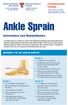 514-412-4400, ext. 23310 2300 Tupper street, C-831, Montreal (Quebec) H3H 1P3 Ankle Sprain Information and Rehabilitation An ankle sprain is a stretch or a tear of the ligaments (bands of tissue that hold
ROTATOR CUFF HOME EXERCISE PROGRAM
 ROTATOR CUFF HOME EXERCISE PROGRAM Contact us! Vanderbilt Sports Medicine Medical Center East, South Tower, Suite 3200 1215 21st Avenue South Nashville, TN 37232-8828 For more information on this and other
STANDARD OPERATING PROCEDURES (SOP) FOR COMPUTER WORK, DESK TOP
 STANDARD OPERATING PROCEDURES (SOP) FOR COMPUTER WORK, DESK TOP General Guidelines-Best Practices: The following guidelines are applicable to office workers who sit at a desk and/or work on computers.
COMMON OVERUSE INJURIES ATTRIBUTED TO CYCLING, AND WAYS TO MINIMIZE THESE INJURIES
 COMMON OVERUSE INJURIES ATTRIBUTED TO CYCLING, AND WAYS TO MINIMIZE THESE INJURIES Listed are a few of the most common overuse injuries associated with cycling long distances. 1. Cervical and upper back
Body Mechanics for Mammography Technologists
 Body Mechanics for Mammography Technologists Diane Rinella RT(R)(M)(BD)RDMS(BR)CDT Objectives Recognize causes and risk factors for Musculoskeletal Disorders (MSDs) for mammography technologists Understand
Schiffert Health Center www.healthcenter.vt.edu. Neck Pain (Cervical Strain) COMMON CAUSES: QUICK TREATMENT : NECK PAIN TREATING NECK PAIN:
 Schiffert Health Center www.healthcenter.vt.edu Patient Information: Neck Pain (Cervical Strain) COMMON CAUSES: Neck pain may be triggered by a specific event, such a sport injury or motor vehicle accident.
Rehabilitation after shoulder dislocation
 Physiotherapy Department Rehabilitation after shoulder dislocation Information for patients This information leaflet gives you advice on rehabilitation after your shoulder dislocation. It is not a substitute
Info. from the nurses of the Medical Service. LOWER BACK PAIN Exercise guide
 Info. from the nurses of the Medical Service LOWER BACK PAIN Exercise guide GS/ME 03/2009 EXERCISE GUIDE One of the core messages for people suffering with lower back pain is to REMAIN ACTIVE. This leaflet
INTRODUCTION TO POSITIONING. MODULE 3: Positioning and Carrying
 MODULE 3: Positioning and Carrying Blankets, pillows and towels, sandbags, carpet on the floor, a doll with floppy limbs that can be positioned i.e. not a hard plastic doll, display materials. Icebreaker
Exercises for older people
 Exercise for older people Exercises for older people Sitting Getting started If you ve not done much physical activity for a while, you may want to get the all-clear from a GP before starting. For the
We ve got your back. Physical Therapy After Lumbar Fusion Surgery
 We ve got your back Physical Therapy After Lumbar Fusion Surgery Physical therapy is an extremely important part of you recovery after spinal surgery. This booklet, prepared by the therapists who specialize
Working as a cashier. HealthandSafetyOntario.ca. Hazard: Poor Workstation Layout
 Working as a cashier Cashiers are at risk for many painful muscles and joint injuries, hazards due to noise, and possibly a quick pace of work. Hazard: Poor Workstation Layout The workstation surface is
LOSS CONTROL ALERT Preventing low back pain injuries from material handling tasks
 LOSS CONTROL ALERT Preventing low back pain injuries from material handling tasks Low back injuries are common and costly for many companies. These injuries have many causes including sprains and strains
KNEE EXERCISE PROGRAM
 KNEE PROGRAM INTRODUCT ION Welcome to your knee exercise program. The exercises in the program are designed to improve your knee stability and strength of the muscles around your knee and hip. The strength
Catholic Mutual..."CARES"
 Catholic Mutual..."CARES" BACK INJURY LOSS CONTROL FOR HEALTH CARE FACILITIES Occupational back injuries are a major loss exposure in the health care industry. Serious back injuries can result when employees
Cervical Exercise: How important is it? What can be done? The Backbone of Spine Treatment. North American Spine Society Public Education Series
 Cervical Exercise: The Backbone of Spine Treatment How important is it? What can be done? North American Spine Society Public Education Series Important: If you have had an accident that started your neck
Sit stand desks and musculo skeletal health. Katharine Metters
 Sit stand desks and musculo skeletal health Katharine Metters Topics Sitting Standing Movement and activity Work and human change Sitting uses less energy Sitting provides support for the body to reduce
Policy & Procedure. Safe Patient Handling (No Lift Policy)
 Effective date signifies approval of this MHS policy by the Performance Improvement Leadership Oversight Team (PILOT) (see minutes). Policy. Policy & Procedure Safe Patient Handling ( Lift Policy) Effective
Supporting people to move at home
 Supporting people to move at home Practical tips and techniques for carers and support workers Acknowledgements This brochure is an initiative between Home and Community Health Association and Carers New
EGOSCUE CLINIC PAIN/POSTURE STRETCHES 1. Standing Arm Circles: Helps Restore Upper Body Strength
 EGOSCUE CLINIC PAIN/POSTURE STRETCHES 1. Standing Arm Circles: Helps Restore Upper Body Strength Two sets of 40 repetitions each. Stand with your feet pointed straight and hip-width apart. Place your fingertips
For Deep Pressure Massage
 T H E R A C A N E O W N E R S M A N U A L For Deep Pressure Massage Thera Cane is a self massager used to apply pressure to sore muscles. The unique design of the Thera Cane lets you apply deep pressure
Physiotherapy Database Exercises for people with Spinal Cord Injury
 Physiotherapy Database Exercises for people with Spinal Cord Injury Compiled by the physiotherapists associated with the following Sydney (Australian) spinal units : Last Generated on Mon Mar 29 16:57:20
Elbow Injuries and Disorders
 Elbow Injuries and Disorders Introduction Your elbow joint is made up of bone, cartilage, ligaments and fluid. Muscles and tendons help the elbow joint move. There are many injuries and disorders that
Work Place Injury Prevention Tracy Ervin, MPT
 Work Place Injury Prevention MSDs and CTDs Tracy Ervin, MPT Worker s Comp Data MSDs account for approx. 55% of WC illness and 65% of WC costs Ergonomics and Office Politics Perception: most workers are
WEEKLY SAFETY MEETING All Euramax Subsidiaries BACK SAFETY / PROPER LIFTING. Safety Meeting Contents. Meeting Notice. Leaders Guide.
 Safety Meeting Contents Meeting Notice Employee Handout Employee Quiz Meeting Sign-In Sheet Employee Puzzle PRIOR TO THE WEEKLY MEETING: - Post the meeting notice by the timeclock - Read through the and
Functional Job Requirements For the Position of Special Education Teacher Department of Education, Training and the Arts Queensland
 Department of Education, Training and the Arts Queensland This document was developed for the following purposes: assisting in the development of rehabilitation programs for injured or ill employees, and
Guidance notes for completing a detailed manual handling risk assessment
 Guidance notes for completing a detailed manual handling risk assessment This guidance should be used in conjunction with the detailed manual handling assessment form in appendix 1. When filling out the
Ergonomics in the Workplace
 Ergonomics in the Workplace Ergonomics in the Workplace 1 Introduction The purpose of this short guide is to provide information to the reader on the subject of Ergonomics. It also provides guidance on
ERGONOMICS. University at Albany Office of Environmental Health and Safety 2010
 ERGONOMICS University at Albany Office of Environmental Health and Safety 2010 WHAT IS ERGONOMICS? From the Greek: ergon work and nomoi natural laws Defined by Webster as: Biotechnology WHAT IS ERGONOMICS?
Pelvic Girdle Pain (PGP) Fact Sheet
 Pelvic Girdle Pain (PGP) Fact Sheet Physiotherapy PGP describes pain that is experienced in the front (symphysis pubis joint) and/or back (sacroiliac joints) of your pelvis. This is a common problem, affecting
SECTION 9. Mobility, positioning, and transfers. Moving after a stroke 9.1. Fatigue. Loss of sensation. Loss of motor function.
 SECTION 9 Mobility, positioning, and transfers Section overview This section looks at: Moving after a stroke Assisting with mobility Positioning Managing the affected limb Transfers Wheelchair use Walking
Preventing Falls. Strength and balance exercises for healthy ageing
 Preventing Falls Strength and balance exercises for healthy ageing Exercise should be comfortable and fun. To get the most out of your home exercise book, join a class for older people to check your exercises
Rehabilitation. Rehabilitation. Walking after Total Knee Replacement. Continuous Passive Motion Device
 Walking after Total Knee Replacement After your TKR, continue using your walker or crutches until your surgeons tells you it is okay to stop using them. When turning with a walker or crutches DO NOT PIVOT
Hazards and risks associated with manual handling in the workplace
 14 Hazards and risks associated with manual handling in the workplace Summary Manual handling occurs in almost all working environments, though workers in construction, agriculture, hotels and restaurants
The Advantages of Ergonomics
 The Advantages of Ergonomics Workers come in all different sizes. Ergonomics can help make the work more comfortable for the individual worker. What is ergonomics? Ergonomics is designing a job to fit
Self Management Program. Ankle Sprains. Improving Care. Improving Business.
 Ankle Sprains Improving Care. Improving Business. What is an ankle sprain? Ligaments attach to the ankle bones and allow for normal movement and help prevent too much motion within the joint. Ankle sprains
ERGONOMICS AND MUSCULOSKELETAL INJURY (MSI) Preventing Injuries by Design
 ERGONOMICS AND MUSCULOSKELETAL INJURY (MSI) Preventing Injuries by Design ERGONOMICS and Musculoskeletal injury (MSI) Some of the tasks we perform at work, such as lifting, reaching and repeating the same
Do you sit at a desk all day? Does your 9 to 5 leave no time for structured exercise..?
 Do you sit at a desk all day? Does your 9 to 5 leave no time for structured exercise..? Staying healthy at work is easier than you might think: Try building the following desk based exercises into your
Neck Injuries and Disorders
 Neck Injuries and Disorders Introduction Any part of your neck can be affected by neck problems. These affect the muscles, bones, joints, tendons, ligaments or nerves in the neck. There are many common
Physical & Occupational Therapy
 In this section you will find our recommendations for exercises and everyday activities around your home. We hope that by following our guidelines your healing process will go faster and there will be
ToThePOINT. Best Practices WORKER SAFETY. A Critical Factor in Workplace Safety. Understand Musculoskeletal Disorders LOSS CONTROL SERVICES
 ToThePOINT Best Practices LOSS CONTROL SERVICES Office Ergonomics A Critical Factor in Workplace Safety WORKER SAFETY The fastest growing category of workplace injury is a group of conditions called Musculoskeletal
Lifting & Moving Patients. Lesson Goal. Lesson Objectives 9/10/2012
 Lifting & Moving Patients Lesson Goal Learn the correct techniques, equipment, & positioning for moving patients safely and effectively in a variety of situations &locations Lesson Objectives Define body