
Material 1. Dolly, hand cart, wheel cart, large box, back belt
|
|
|
- Marilynn Boone
- 10 years ago
- Views:
Transcription
1 29CFR (b)-Accident Reduction, 29CFR Safety Training & Education Back and Lifting Safety Preparation 1. Read Applicable Background information and related Company Policy Chapter. 2. Make Copies of this Lesson Plan for Personnel 3. Make Transparency, procure transparency pens, etc. 4. Other: Material 1. Dolly, hand cart, wheel cart, large box, back belt Objective By the end of this session, personnel shall be able to: 1. Explain how to prevent back injury 2. Explain material handling techniques 3. Show how to lift objects properly 4. Explain the disadvantages of using back belts Background Keeping your back healthy and keeping you on the job requires a team effort. Management is committed to helping reduce back injuries at work, by teaching good lifting and material handling techniques. Back safety is a shared responsibility- it requires your cooperation at work, home, and play. Not all back injuries are a result of sudden trauma - most are of a cumulative type, where a repeated minor injury has flared up, or continued use of a heavy tool in the same position has caused pain, or a great deal of time is spent in the same position. 80% of back injuries occur in people between the ages of 30 and 50. With an expected life span in America reaching nearly 80 years, that is a long time to live in pain, or with limited mobility.

2 Lesson How to Prevent Back Injury Preventing a back injury is much easier than repairing one. Because your back is critically important to your ability to walk, sit, stand, and run, it's important to take care of it. Most back pain arises from using your back improperly, so learning a few basic rules about lifting, posture and proper exercise can help keep your back in good shape. Exercise: Having strong back and stomach muscles is important in order to ease the work your back is put through each day. By doing simple back-toning exercises, you not only strengthen your back but also reduce stress and improve your appearance, too! Check with your doctor as to the best exercises for you. Lose Weight: Pot bellies and being overweight exerts extra force on back and stomach muscles. Your back tries to support the weight out in front by swaying backwards causing excess strain on the lower back muscles. By losing weight, you can reduce strain and pain in your back. Check with your doctor for the most sensible diet plan for you. Good Posture: You can prevent many back pains by learning to sit, stand and lift items correctly. When you sit down, don't slouch. Slouching makes the back ligaments, not the muscles, stretch and hurt, thus putting pressure on the vertebrae. The best way to sit is straight, with your back against the back of the chair with your feet flat on the floor and your knees slightly higher than your hips. Learn to stand tall with your head up and shoulders back. Plan the Lift: Before you lift that box, or tool, or piece of equipment, take a moment to consider your action: Do you need to lift the item manually? How heavy is it? Where are you moving the item from? Where does it have to go? What route do you have to follow?

3 Get Help, If Needed: If the load is too heavy, bulky or awkward for you to lift alone, find a friend to help you carry it. If no one is available, is it possible to break the load into two smaller loads? Or, can you locate a cart or dolly to help you move it? Look for simple solutions to help make the move easier on you and your back. Material Handling Techniques Mental Lifting: To handle materials safely, lift everything twice. First, lift the load mentally. Plan every step before you do it physically. Size Up the Load- How much does it weigh? Give it a heft test to see whether you can lift it. If it feels OK, go ahead and lift it. Get Help: If the load is too bulky or heavy for you to lift alone, get help. Don t hesitate to ask someone else for a hand. A moment s help could save you from days of disability. Team Lift- When team lifting, pick one person to call signals. The leader should direct the team so you all lift together, walk in step, and lower to load together, using the lifting principles below. No One to Help?: Sometimes no one is around to help, or the job is bigger than both of you. Arrange for mechanical help from a pushcart, hand truck, dolly, wheelbarrow, or forklift. Push, Don t Pull- Use good lifting techniques to load mechanical devices. Whenever possible, push rather than pull. You can push twice as much as you can pull How to Lift Properly Avoid picking up heavy objects placed below your knees. Try to see that heavy objects are placed and stored above knee level and below shoulder level. If you suspect the load is too heavy to be lifted comfortably, do not chance it. Use a mechanical aid, break the load down into its component parts, or get help. The most common cause of back injury is overloading.

4 Position Yourself Correctly in Front of the Load: Once you have planned your lift, the next important step is to align yourself correctly in front of the load, as close to the load as possible, with your feet straddling the load. The further the load is from the centerline of your body, the greater the strain imposed on your back. If need be, squat down bending your knees (not your back and stomach). This gets it closer to the center of your body and helps prevent the need to bend at the waist. However, since your leg muscles are the largest muscles in your body, they are the biggest energy consumers. Repeated squatting can be very fatiguing, and reduces a person's ability to lift in this manner for any length of time. In addition to lifting the load, you are also hoisting the majority of your body weight. For repeated lifting, other strategies must be used. Tighten your stomach muscles. This technique helps prevent your spine from twisting. If you lift a load and need to place it off to one side, turn by moving your feet. Lift with Your Legs, not Your Back: Once the load is close to your body, slowly straighten out your legs until you are standing upright. Make sure the load isn't blocking your vision as you begin to walk slowly to your destination. If you need to turn to the side, turn by moving your feet around and not by twisting at your stomach. Set the Load Down Correctly: Once you have reached your destination, it's equally important that the load is set down correctly. By reversing the above lifting procedures you can reduce the strain on your back and stomach muscles. If you set your load on the ground, squat down by bending your knees and position the load out in front of you. If the load is set down at table height, set the load down slowly and maintain contact with it until the load is secure and will not fall when you leave. Disadvantages of Back Belts What is a back belt? Back belts, also called "back supports" or "abdominal belts" were originally used in medical rehabilitation therapy. Athletes during weight lifting have also used leather belts. Recently, the "industrial back belt" has become popular. While there are many types of belts on the market, the most common style is of a lightweight, elastic belt worn around the lower back and sometimes held in place with suspenders.

5 Why are people using back belts? A back belt is a device used, in theory, to reduce the forces on the spine, increase abdominal pressure, stiffen the spine and reduce loads during lifting. It is also advertised that by wearing a back belt, the worker will be reminded to avoid awkward postures and heavy loads, reduce bending motions and in the end, reduce injuries in certain workplaces. Do back belts protect workers from back injury? No evidence has so far been found to support the claim that wearing back belts improves one's back safety. In response to the substantial increase in the number of workers who rely on back belts to prevent injury from lifting, the National Institute for Occupational Safety and Health (NIOSH) in the United States reviewed and evaluated the existing data related to back belts. Their final conclusions are: back belts should not be considered as personal protective equipment; back belts should not be recommended for use in occupational situations. NIOSH concerns led to the below conclusions: the use of back belts may produce some strain on the cardiovascular system; the use of back belts limits mobility and may reduce the suppleness and elasticity of muscles and tendons, potentially contributing to back injury; the use of back belts may create a false sense of security, increasing the risk of lifting excessive loads. With these recommendations in mind, the Company warns users and potential users of any kind of back belts about the potential health risks that could result from wearing these devices. Closure Care and maintenance of your back is every bit as important as the care and maintenance of your vehicle, your home, or your tools, but this most important asset of our physical being is commonly overlooked or neglected Your back is the foundation and the structure upon which the rest of your body relies for balance and support. Used improperly, or unsafely, your back can suffer injuries that can literally change the way you live. What questions do you have?

6 29CFR (b)-Accident Reduction, 29CFR Safety Training & Education Back and Lifting Safety-Assessment Name: Date: 1) True or False It is much easier to fix a back injury than to prevent one from happening. 2) True or False Most back injuries occur because of sudden trauma and auto accidents 3) Check all that apply A few basic rules about lifting, posture and proper exercise can help keep your back in good shape. These are: Exercise regularly Lose Weight Sit in a slouched, comfortable position Correct Straight Posture Using the back muscles to lift light loads 4) Check all that apply Material handling techniques to be followed are: Get two strong guys to move it Move the object twice, once in the head and once actually moving it Pull the object into place Ask for help Lift with the back, not the legs 5) True or False Avoid lifting heavy objects that are lower than your knees. If you suspect the load is too heavy to be lifted comfortably, do not chance it. Use a mechanical aid, break the load down into its component parts, or get help.

7 6) True or False The further the load is from the centerline of your body, the less the strain imposed on your back. If need be, squat down bending your back and stomach. 7) True or False Lift with Your Legs, not Your Back. If you need to turn to the side, turn by moving your feet around and not by twisting at your stomach. 8) True or False Set the Load Down Slowly. Once you have reached your destination, it's equally important that the load is set down slowly. It is much better not to break the merchandise than it is to wrench your back. 9) True or False Back belts protect workers from back injury. 10) True or False National Institute for Occupational Safety and Health (NIOSH) in the United States reviewed and evaluated the existing data related to back belts. Their final conclusions are: back belts should not be considered as personal protective equipment; back belts should not be recommended for use in occupational situations.

8 29CFR (b)-Accident Reduction, 29CFR Safety Training & Education Key-Back and Lifting Safety-Assessment 1) True or False It is much easier to fix a back injury than to prevent one from happening. Preventing a back injury is much easier than repairing one. 2) True or False Most back injuries occur because of sudden trauma and auto accidents Most back pain arises from using your back improperly 3) Check all that apply A few basic rules about lifting, posture and proper exercise can help keep your back in good shape. These are: Exercise regularly Lose Weight Sit in a slouched, comfortable position Correct Straight Posture Using the back muscles to lift light loads 4) Check all that apply Material handling techniques to be followed are: Get two strong guys to move it Move the object twice, once in the head and once actually moving it Pull the object into place Ask for help Lift with the back, not the legs 5). True or False Avoid lifting heavy objects that are lower than your knees. If you suspect the load is too heavy to be lifted comfortably, do not chance it. Use a mechanical aid, break the load down into its component parts, or get help.

9 6). True or False The further the load is from the centerline of your body, the less the strain imposed on your back. If need be, squat down bending your back and stomach. The further the load is from the centerline of your body, the greater the strain imposed on your back. If need be, squat down bending your knees (not your back and stomach). 7) True or False Lift with Your Legs, not Your Back. If you need to turn to the side, turn by moving your feet around and not by twisting at your stomach. 8) True or False Set the Load Down Slowly. Once you have reached your destination, it's equally important that the load is set down slowly. It is much better not to break the merchandise than it is to wrench your back. 9) True or False Back belts protect workers from back injury. No evidence has so far been found to support the claim that wearing back belts improves one's back safety. 10), True or False National Institute for Occupational Safety and Health (NIOSH) in the United States reviewed and evaluated the existing data related to back belts. Their final conclusions are: back belts should not be considered as personal protective equipment; back belts should not be recommended for use in occupational situations. NIOSH concerns led to the below conclusions: the use of back belts may produce some strain on the cardiovascular system; the use of back belts limits mobility and may reduce the suppleness and elasticity of muscles and tendons, potentially contributing to back injury; the use of back belts may create a false sense of security, increasing the risk of lifting excessive loads. With these recommendations in mind, the Company warns users and potential users of any kind of back belts about the potential health risks that could result from wearing these devices.

Back Injury Prevention. Back Injury. Prevention. Division of Workers Compensation HS01-023B0 (02-14)
 Back Injury Prevention Division of Workers Compensation HS01-023B0 (02-14) Table of Content Learn To Prevent Back Injury 3 Exercise To Strengthen Your Back and Reduce Stress 3 Lose Excess Weight 3 Maintain
Back Safety and Lifting
 Back Safety and Lifting Structure of the Back: Spine The spine is the part of the back that supports the trunk and head. It protects the spinal cord as well as giving flexibility to the body. Vertebrae
Why Back Safety is Important
 Back Safety Why Back Safety is Important Back injuries are considered by OSHA (the Occupational Safety and Health Administration) as the nation's #1 workplace safety problem. Back Injuries are often: Very
[Project name] Standard Operating Procedures. Body Mechanics
![[Project name] Standard Operating Procedures. Body Mechanics](/thumbs/27/11986346.jpg "[Project name] Standard Operating Procedures. Body Mechanics") [Project name] Standard Operating Procedures Body Mechanics PURPOSE. The purpose of this SOP is to provide information to minimize staff injuries with the focus on back injuries resulting from improper
[Project name] Standard Operating Procedures Body Mechanics PURPOSE. The purpose of this SOP is to provide information to minimize staff injuries with the focus on back injuries resulting from improper
Back Safety Goals. Back injury and injury prevention Lifting techniques Quiz
 Back Safety Back Activities Reaching, bending over, sitting Skiing, hiking, bike riding Playing with your children and grandchildren Working and feeling productive Back Safety Goals Back injury and injury
Transferring Safety: Prevent Back Injuries
 Transferring Safety: Prevent Back Injuries OBJECTIVES: At the end of this class you will be able to: 1. Describe the back and what it does. 2. List things that you can do everyday in your home and at work
<< INSERT COMPANY NAME
 > SLIIP-TRIIP-FALL & STRAIIN IINJURY TRAIINIING > Fall Prevention Slips, trips, and falls constitute the majority of general industry accidents. They cause 15% of
Back Safety Program POLICY AND PROCEDURE
 Back Safety Program POLICY AND PROCEDURE This is (Enter Company Name Here) Back Safety Program. It meets all OSHA requirements and applies to all our work operations. (Enter Name Here) will be responsible
INSTRUCTIONAL MATERIALS: REFERENCES: a. PAEC School Safety Manual b. Any locally produced Back Injury pamphlet TRAINING AIDS:
 LESSON TOPIC: AVERAGE TIME: BACK INJURY PREVENTION 30 Minutes INSTRUCTIONAL MATERIALS: REFERENCES: a. PAEC School Safety Manual b. Any locally produced Back Injury pamphlet TRAINING AIDS: a. Handout #1
Safe Lifting/ Back Safety Training. Environmental Health and Safety
 Safe Lifting/ Back Safety Training Environmental Health and Safety Why Back Safety is Important Back injuries are considered by OSHA the nation s #1 workplace safety problem Back injuries are often: Very
Body Positioning & Lifting Techniques
 Body Positioning & Lifting Techniques Body Positioning But no matter what task we are undertaking we MUST Think through the task and we MUST Prepare ourselves before we attempt to complete them. If we
HELPFUL HINTS FOR A HEALTHY BACK
 HELPFUL HINTS FOR A HEALTHY BACK 1. Standing and Walking For correct posture, balance your head above your shoulders, eyes straight ahead, everything else falls into place. Try to point toes straight ahead
LOSS CONTROL ALERT Preventing low back pain injuries from material handling tasks
 LOSS CONTROL ALERT Preventing low back pain injuries from material handling tasks Low back injuries are common and costly for many companies. These injuries have many causes including sprains and strains
Injuries from lifting, loading, pulling or pushing can happen to anyone in any industry. It is important to be aware of the risks in your workplace.
 Workplace safety: lifting One of the biggest concerns in the workplace is lifting and loading. When you lift something, the load on your spine increases and your spine can only bear so much before it is
Safe Lifting and Carrying
 PART 1 Basic Lifts Proper lifting and handling will help protect against injury and make your job easier. It takes training and practice to do it right. The following are basic steps in safe lifting and
Avoid The Dreaded Back Injury by Proper Lifting Techniques
 Avoid The Dreaded Back Injury by Proper Lifting Techniques If you ve ever strained your back while lifting something, you ll know the importance of lifting safely. Agenda Introduction About the Back The
WEEKLY SAFETY MEETING All Euramax Subsidiaries BACK SAFETY / PROPER LIFTING. Safety Meeting Contents. Meeting Notice. Leaders Guide.
 Safety Meeting Contents Meeting Notice Employee Handout Employee Quiz Meeting Sign-In Sheet Employee Puzzle PRIOR TO THE WEEKLY MEETING: - Post the meeting notice by the timeclock - Read through the and
Safe Lifting/Back Safety Training. Presented by Rita Gagnon Occupational Health Outreach Coordinator Benefis Health Systems 406-731-8328
 Safe Lifting/Back Safety Training Presented by Rita Gagnon Occupational Health Outreach Coordinator Benefis Health Systems 406-731-8328 Risk Factors Involved with Manual Handling Tasks: Bending at Trunk
Fact sheet Exercises for older adults undergoing rehabilitation
 Fact sheet Exercises for older adults undergoing rehabilitation Flexibility refers to the amount of movement possible around a joint and is necessary for normal activities of daily living such as stretching,
Preventing Overuse Injuries at Work
 Preventing Overuse Injuries at Work The Optimal Office Work Station Use an adjustable chair with good lumbar support. Keep your feet flat on a supportive surface (floor or foot rest). Your knees should
LIFTING AND BACK SAFETY TRAINING LESSON PLAN
 LIFTING AND BACK SAFETY TRAINING LESSON PLAN Topic: Back Safety and Proper Lifting Techniques This presentation is designed to assist trainers conducting Lifting and Back Safety training for workers. Back
Injury Prevention for the Back and Neck
 Injury Prevention for the Back and Neck www.csmr.org We have created this brochure to provide you with information regarding: Common Causes of Back and Neck Injuries and Pain Tips for Avoiding Neck and
ERGONOMICS. Improve your ergonomic intelligence by avoiding these issues: Awkward postures Repetitive tasks Forceful exertions Lifting heavy objects
 ERGONOMICS The goal of ergonomics is to reduce your exposure to work hazards. A hazard is defined as a physical factor within your work environment that can harm your body. Ergonomic hazards include working
MINDING OUR BODIES. Healthy Eating and Physical Activity for Mental Health
 MINDING OUR BODIES Healthy Eating and Physical Activity for Mental Health Facilitators Guide: Background Information (note: tell participants to consult with their doctor before starting to exercise) What
Knee Conditioning Program. Purpose of Program
 Prepared for: Prepared by: OrthoInfo Purpose of Program After an injury or surgery, an exercise conditioning program will help you return to daily activities and enjoy a more active, healthy lifestyle.
Otago Exercise Program Activity Booklet
 Head Movements Stand up tall and look ahead. Slowly turn your head as far as you can to the right. Slowly turn your head as far as you can to the left. Repeat five times to each side. 44 Neck Movements
Back Safety/Proper Lifting Safety
 Back Safety/Proper Lifting Safety Introduction Back disorders can develop gradually or can be the result of a single traumatic event. Sprains and strains are the most common causes of lower back pain.
REFRIGERATION & AIR CONDITIONING
 Musculoskeletal hazards and controls REFRIGERATION & AIR CONDITIONING Photocopy this profile and distribute it as widely as possible! Musculoskeletal disorders (MSDs), such as chronic back pain or shoulder
When lifting and carrying weight, do these things:
 F O R Y O U R H E A L T H Protect Your Back While Working What is back pain? Back pain happens when there is a problem with your muscles, nerves, bones, joints and other parts of the back. Back pain can
Australian Centre for Agricultural Health and Safety. Farming with Back Pain
 Australian Centre for Agricultural Health and Safety Farming with Back Pain 2008 Australian Centre for Agricultural Health and Safety All rights reserved Title: Farming with Back Pain Authors: Boughton
Spine Conditioning Program Purpose of Program
 Prepared for: Prepared by: OrthoInfo Purpose of Program After an injury or surgery, an exercise conditioning program will help you return to daily activities and enjoy a more active, healthy lifestyle.
Welcome to your LOW BACK PAIN treatment guide
 Welcome to your LOW BACK PAIN treatment guide You are receiving this guide because you have recently experienced low back pain. Back pain is one of the most common musculoskeletal problems treated in medicine
HealthStream Regulatory Script
 HealthStream Regulatory Script Back Safety Version: May 2007 Lesson 1: Introduction Lesson 2: Back Injury Lesson 3: Spinal Anatomy and Physiology Lesson 4: Safe Operation of the Spine Lesson 5: Preventive
Back Injury Prevention. For the Landscaping and Horticultural Services Industry
 Back Injury Prevention For the Landscaping and Horticultural Services Industry Back Injury Prevention Contents Introduction What s Inside?... 3 Lesson 1 Understand Your Back and Back Pain... 4 Lesson 2
UTILITIES AND ENERGY MANAGEMENT
 UTILITIES AND ENERGY MANAGEMENT August 2007 TABLE OF CONTENTS 1.0 Introduction...1-1 1.1 PURPOSE...1-1 1.2 APPLICATION...1-1 1.3 SCOPE...1-1 2.0 Common Type of Injuries...2-1 3.0 Personal Protective Equipment...3-1
Management Tools to Prevent Material Handling Low Back Injuries
 L O S S C O N T R O L A L E R T Management Tools to Prevent Material Handling Low Back Injuries This Alert provides management tools and injury prevention strategies for manual material handling tasks.
Good Body Mechanics/ Employee Safety: A Skills Update THIS PROGRAM COVERS: 4) How to Maintain Healthy Lifestyle Habits to Help Prevent Injury
 In-Service Training Good Body Mechanics/ Employee Safety: A Skills Update THIS PROGRAM COVERS: 1) Definition of Ergonomics 2) How Repetitive Movements Can Lead to Injury 3) The Basic Steps to Using Good
he American Physical Therapy Association would like to share a secret with you. It can help you do more with less effort breathe easier feel great.
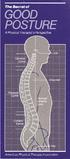 The Secret... T he American Physical Therapy Association would like to share a secret with you. It can help you do more with less effort breathe easier feel great. The secret is about good posture, which
Patient handling techniques to prevent MSDs in health care
 28 Introduction Patient handling techniques Work-related musculoskeletal disorders (MSDs) are a serious problem among hospital personnel, and in particular the nursing staff. Of primary concern are back
HealthandSafetyOntario.ca. Hazards. Introduction. Legislation
 Manual Materials handling Introduction Manual materials handling operations are carried out in most workplaces. Each handling task poses unique demands on the worker. However, workplaces can help workers
Info. from the nurses of the Medical Service. LOWER BACK PAIN Exercise guide
 Info. from the nurses of the Medical Service LOWER BACK PAIN Exercise guide GS/ME 03/2009 EXERCISE GUIDE One of the core messages for people suffering with lower back pain is to REMAIN ACTIVE. This leaflet
Exercises for older people
 Exercise for older people Exercises for older people Sitting Getting started If you ve not done much physical activity for a while, you may want to get the all-clear from a GP before starting. For the
Basic Training Exercise Book
 Basic Training Exercise Book Basic Training Exercise Book Instructions The exercises are designed to challenge the major muscles groups every day, approximately every 2 to 3 hours., for a total of 6 times
CHAPTER 3: BACK & ABDOMINAL STRETCHES. Standing Quad Stretch Athletic Edge - www.athleticedge.biz - (650) 815-6552
 CHAPTER : BACK & ABDOMINAL STRETCHES Standing Quad Stretch ) Stand and grasp right ankle with same hand, use a wall or chair to Lower maintain Back balance with left hand. Maintain an upright Stretches
TIPS and EXERCISES for your knee stiffness. and pain
 TIPS and EXERCISES for your knee stiffness and pain KNEE EXERCISES Range of motion exercise 3 Knee bending exercises 3 Knee straightening exercises 5 STRENGTHENING EXERCISES 6 AEROBIC EXERCISE 10 ADDITIONAL
Do s and Don ts with Low Back Pain
 Do s and Don ts with Low Back Pain Sitting Sit as little as possible and then only for short periods. Place a supportive towel roll at the belt line of the back especially when sitting in a car. When getting
Standard Operating Procedure for Handling an Inanimate Load
 Standard Operating Procedure for Handling an Inanimate Load Moving and handling an inanimate load/s is a key part of the working day for most employees. Moving inanimate loads can take place in many different
ROTATOR CUFF HOME EXERCISE PROGRAM
 ROTATOR CUFF HOME EXERCISE PROGRAM Contact us! Vanderbilt Sports Medicine Medical Center East, South Tower, Suite 3200 1215 21st Avenue South Nashville, TN 37232-8828 For more information on this and other
Starting position: Lying with knees bent up and feet flat on floor/bed about 12" (30cms) apart
 Exercise 3 Bridging Starting position: Lying with knees bent up and feet flat on floor/bed about 12" (30cms) apart Tighten your buttocks, then raise them off the floor to form a bridge, then hold. Then
Lower Back Pain An Educational Guide
 Lower Back Pain An Educational Guide A publication from the Center of Pain Medicine and Physiatric Rehabilitation 2002 Medical Parkway Ste 150 1630 Main St Ste 215 Annapolis, MD 21401 Chester, MD 21619
Advise and Do s and Don ts for low back pain
 Advise and Do s and Don ts for low back pain ADVISE : Wear lumbar belt. Do hot fomentation (with hot moist towel/hot water bottle) thrice a day. Keeps a towel roll under your lower back while doing exercise,
Good manual handling practice
 Health and Safety Services Good manual handling practice If you lift, carry, push or pull as part of your job, the following guidance is for you Injuries caused Poor lifting technique and work methods
Stretching in the Office
 Stretching in the Office Legs: Quads, Hamstrings, IT band, Hip flexors, Gluts, Calves Quads: Standing @ desk maintaining upright posture, grab one leg @ a time by foot or ankle and bring it towards backside
Otago Exercise Program
 Otago Exercise Program Edited Version Exercise Booklet Created by: Genesee County Coalition Supported by a grant from the Health Foundation for Western and Central New York Otago Exercise Program to Prevent
Rehabilitation. Rehabilitation. Walkers, Crutches, Canes
 Walkers, Crutches, Canes These devices provide support through your arms to limit the amount of weight on your operated hip. Initially, after a total hip replacement you will use a walker to get around.
Low Back Pain Exercises Interactive Video Series Transcript July 2013
 Introduction Low Back Pain Exercises Interactive Video Series Transcript July 2013 ** Note: If an exercise causes an increase in your pain, stop the exercise.** [Music introduction; Dr. John Sheehan onscreen]
Exercises for Low Back Injury Prevention
 DIVISION OF AGRICULTURE RESEARCH & EXTENSION University of Arkansas System Family and Consumer Sciences Increasing Physical Activity as We Age Exercises for Low Back Injury Prevention FSFCS38 Lisa Washburn,
How To Stretch Your Body
 Exercise Module A New Leaf Choices for Healthy Living University of North Carolina at Chapel Hill 2007 Center for Health Promotion and Disease Prevention Physical Activity Exercises for Keeping Active
Ergonomics in Agriculture
 Ergonomics in Agriculture Although, agriculture has become more mechanized in the last century, there are still many small farm operations where planting and harvesting activities are done by hand-a person
A Stretch-Break Program for Your Workplace! www.healthyworkplaceweek.ca
 www.healthyworkplaceweek.ca A Stretch-Break Program for Your Workplace! Why is stretching at work important? Sitting at a desk or computer; or standing at your work station for extended periods of time
Cardiac Rehab Program: Stretching Exercises
 Cardiac Rehab Program: Stretching Exercises Walk around the room, step side to side, ride a bike or walk on a treadmill for at least 5 minutes to warm up before doing these stretches. Stretch warm muscles
Lifting and Handling, a Risk Assessor s Guide
 Lifting and Handling, a Risk Assessor s Guide 1 Introduction Unfortunately manual handling accidents are all too common, and can lead to life-long problems with bad backs. While they do not have the same
Adult Advisor: Plantar Fasciitis. Plantar Fasciitis
 Adult Advisor: Plantar Fasciitis Page 1 of 3 Plantar Fasciitis What is plantar fasciitis? Plantar fasciitis is a painful inflammation of the bottom of the foot between the ball of the foot and the heel.
General Guidelines. Neck Stretch: Side. Neck Stretch: Forward. Shoulder Rolls. Side Stretch
 Stretching Exercises General Guidelines Perform stretching exercises at least 2 3 days per week and preferably more Hold each stretch for 15 20 seconds Relax and breathe normally Stretching is most effective
Physical Capability Strength Test: One Component of the Selection Process
 Physical Capability Strength Test: One Component of the Selection Process One aspect of the Power Systems Institute selection process is to successfully complete and achieve a passing score on a physical
Manual Handling- The Whole Story!
 Manual Handling- The Whole Story! For Responsible Managers and Assessors Course Notes Mark Mallen Group Health and Safety Manager July 2005 Course Content 1 What is Manual Handling? 2 What s the Problem?
Keep fit at the workplace! A simple training programme for more exercise at the workplace.
 Keep fit at the workplace! A simple training programme for more exercise at the workplace. INTRODUCTION Dear Readers, Keeping your body in one position, such as sitting or standing for a long time, results
COMMON OVERUSE INJURIES ATTRIBUTED TO CYCLING, AND WAYS TO MINIMIZE THESE INJURIES
 COMMON OVERUSE INJURIES ATTRIBUTED TO CYCLING, AND WAYS TO MINIMIZE THESE INJURIES Listed are a few of the most common overuse injuries associated with cycling long distances. 1. Cervical and upper back
Hip Conditioning Program. Purpose of Program
 Prepared for: Prepared by: OrthoInfo Purpose of Program After an injury or surgery, an exercise conditioning program will help you return to daily activities and enjoy a more active, healthy lifestyle.
MOON SHOULDER GROUP. Rotator Cuff Home Exercise Program. MOON Shoulder Group
 MOON Shoulder Group For information regarding the MOON Shoulder Group, talk to your doctor or contact: Rosemary Sanders 1215 21 st Avenue South 6100 Medical Center East Vanderbilt University Medical Center
Rotator Cuff Home Exercise Program MOON SHOULDER GROUP
 Rotator Cuff Home Exercise Program MOON SHOULDER GROUP Introduction The MOON Shoulder group is a Multi-center Orthopaedic Outcomes Network. In other words, it is a group of doctors from around the country
ACL Reconstruction Rehabilitation
 ACL Reconstruction Rehabilitation The following exercises are commonly used for rehabilitation following ACL reconstruction surgery. However, each knee surgery is unique and each person s condition is
KNEE EXERCISE PROGRAM
 KNEE PROGRAM INTRODUCT ION Welcome to your knee exercise program. The exercises in the program are designed to improve your knee stability and strength of the muscles around your knee and hip. The strength
X-Plain Neck Exercises Reference Summary
 X-Plain Neck Exercises Reference Summary Introduction Exercising your neck can make it stronger, more flexible and reduce neck pain that is caused by stress and fatigue. This reference summary describes
Cervical Exercise: How important is it? What can be done? The Backbone of Spine Treatment. North American Spine Society Public Education Series
 Cervical Exercise: The Backbone of Spine Treatment How important is it? What can be done? North American Spine Society Public Education Series Important: If you have had an accident that started your neck
Range of Motion. A guide for you after spinal cord injury. Spinal Cord Injury Rehabilitation Program
 Range of Motion A guide for you after spinal cord injury Spinal Cord Injury Rehabilitation Program This booklet has been written by the health care providers who provide care to people who have a spinal
total hip replacement
 total hip replacement EXCERCISE BOOKLET patient s name: date of surgery: physical therapist: www.jointpain.md Get Up and Go Joint Program Philosophy: With the development of newer and more sophisticated
ISOMETRIC EXERCISE HELPS REVERSE JOINT STIFFNESS, BUILDS MUSCLE, AND BOOSTS OVERALL FITNESS.
 ISOMETRIC EXERCISE HELPS REVERSE JOINT STIFFNESS, BUILDS MUSCLE, AND BOOSTS OVERALL FITNESS. By Askari A. Kazmi KazmisBioscienceLabs exercise helps reverse joint stiffness, builds muscle, and boosts overall
Rehabilitation after shoulder dislocation
 Physiotherapy Department Rehabilitation after shoulder dislocation Information for patients This information leaflet gives you advice on rehabilitation after your shoulder dislocation. It is not a substitute
Schiffert Health Center www.healthcenter.vt.edu. Neck Pain (Cervical Strain) COMMON CAUSES: QUICK TREATMENT : NECK PAIN TREATING NECK PAIN:
 Schiffert Health Center www.healthcenter.vt.edu Patient Information: Neck Pain (Cervical Strain) COMMON CAUSES: Neck pain may be triggered by a specific event, such a sport injury or motor vehicle accident.
These notes are designed to be used in conjunction with the Moving and Handling PowerPoint slides.
 CORE SKILLS FRAMEWORK MOVING AND HANDLING PRINCIPLES FOR STAFF: LESSON NOTES & TIPS FOR A SUGGESTED APPROACH These notes are designed to be used in conjunction with the Moving and Handling PowerPoint slides.
Rehabilitation. Rehabilitation. Walking after Total Knee Replacement. Continuous Passive Motion Device
 Walking after Total Knee Replacement After your TKR, continue using your walker or crutches until your surgeons tells you it is okay to stop using them. When turning with a walker or crutches DO NOT PIVOT
Aquatic Exercises: Upper Body Strengthening
 Aquatic Exercises: Upper Body Strengthening These exercises will strengthen your muscles in your arms, shoulders, chest and neck. Exercising in water allows you to have less stress on your joints. When
Advanced Back Injury Prevention
 Advanced Back Injury Prevention General Information There are literally thousands of books, manuals, videos, seminars, multimedia, and other training materials relating to back injury prevention. There
Body Mechanics and Back Pain
 Body Mechanics and Back Pain Presented by: APS Healthcare Southwestern PA Health Care Quality Unit (APS HCQU) August 2015 cjp Disclaimer Information or education provided by the HCQU is not intended to
Exercise 1: Knee to Chest. Exercise 2: Pelvic Tilt. Exercise 3: Hip Rolling. Starting Position: Lie on your back on a table or firm surface.
 Exercise 1: Knee to Chest Starting Position: Lie on your back on a table or firm surface. Action: Clasp your hands behind the thigh and pull it towards your chest. Keep the opposite leg flat on the surface
Basic Stretch Programme 3. Exercise Circuit 4
 Basic Stretch Programme 3 Exercise Circuit 4 2 1 Calves Stand approximately 1 metre away from wall with legs straight and heels on floor. Step and lean forward and slowly push hips towards wall. Should
EXERCISE DESCRIPTIONS PHASE I Routine #1
 EXERCISE DESCRIPTIONS PHASE I Routine #1 Hip Mobility Exercise: Forward Out-In Movement: Raise leg out to the side, and rotate around to the front. Keep shin/thigh angle at 90 degrees. Exercise: Backward
EXERCISE INSTRUCTIONS 1
 EXERCISE INSTRUCTIONS 1 Contents ANKLE TOUCHES... 4 BACK EXTENSIONS... 4 BACK REVERSE FLYES... 4 BALL ROLL... 4 BASKETBALL SQUATS... 4 BEAR CRAWL... 4 BICEP CURL (Resistance Band)... 4 BOXING JABS... 5
Foot and Ankle Conditioning Program. Purpose of Program
 Prepared for: Prepared by: OrthoInfo Purpose of Program After an injury or surgery, an exercise conditioning program will help you return to daily activities and enjoy a more active, healthy lifestyle.
WSN ERGONOMIC SAFETY TALK #3
 What is a safety talk? This safety talk is one of a series of brief meetings held on regular basis with workers and their supervisors to discuss problems and concerns about health and safety. All safety
Medial Collateral Ligament Sprain: Exercises
 Medial Collateral Ligament Sprain: Exercises Your Kaiser Permanente Care Instructions Here are some examples of typical rehabilitation exercises for your condition. Start each exercise slowly. Ease off
Above Knee Amputee Exercise Program
 Above Knee Amputee Exercise Program It is important that you take an active role in your rehabilitation. The following exercises must be done every day to prevent any complications. After an above the
Lower Body Strength/Balance Exercises
 Compliments of (Medical Group Name & Phone # to be inserted here) Lower Body Strength/Balance Exercises Hip Flexion Strengthens thigh and hip muscles. Use ankle weights, if you are ready to. Stand to the
The advanced back rehabilitation programme
 Physiotherapy Department The advanced back rehabilitation programme This booklet explains what happens during the advanced back rehabilitation programme and how the exercises may help your condition. We
Working as a cashier. HealthandSafetyOntario.ca. Hazard: Poor Workstation Layout
 Working as a cashier Cashiers are at risk for many painful muscles and joint injuries, hazards due to noise, and possibly a quick pace of work. Hazard: Poor Workstation Layout The workstation surface is
INTRODUCTION TO POSITIONING. MODULE 3: Positioning and Carrying
 MODULE 3: Positioning and Carrying Blankets, pillows and towels, sandbags, carpet on the floor, a doll with floppy limbs that can be positioned i.e. not a hard plastic doll, display materials. Icebreaker