
Effects of a belt on intra-abdominal pressure
|
|
|
- Magdalen Bradley
- 10 years ago
- Views:
Transcription
1 /89/ $200/0 Vol 21, No. 2 MEDICINE AND SCIENCE IN SPORTS AND EXERCISE A 224 Pnnted in U S A Copyright 1989 by the American College of Sports Medicine Effects of a belt on intra-abdominal pressure during weight lifting DTIC EVFRETT A. HARMAN, RICHARD M. ROSENSTEIN, PETER N. FRYKMAN, and GEORGE A. NIGRO E.yercise Phisiology Division, E LECTE' 8DEC 8198 US. Arn Research Institute of Environmental Medicine, Natick, MA, (-_3 ABSTRA- (7,10). Both Olympic and power lifters have used lifting HARMAN. E. A.. R. M. ROSENSTEIN. P. N. FRYKMAN, and G. A. NIGRO. Effects of a belt on int;t-abdominal pressure during belts for many years, yet virtually no research has been weight lifting. AMed. Sci. Spors Exverc.. Vol. 21, No. 2. pp , directed toward examining whether and by what means Intra-abdominal pressure (IAP) has been widely hypothesized the belts might be effective for increasing lap, reducing to reduce potentially injurious compressive forces on spinal discs during lifting. To investigate the effects of a standard lifting belt on injury, or improving lifting capacity. One abstract (9) lap and lifting mechanics, IAP and vertical ground reaction force showed higher mean IAP during the squat weight lifting (GRF) were monitored by computer using a catheter transducer and exercise with than without a belt, with no statistical force platform while nine subjects aged 28.2 ± 6.6 yr dead-lifted a evaluation reported. Magnitude of lap has been found barbell both with and without a lifting belt at 90% of maximum. Both lap ante GRF rose sharply from the time force was first exerted to correlate positively with amount of weight lifted (7'. on the bar until shortly after it left the floor, after which GRF usually The present experiment was undertaken to determir.- plateaued while IAP either plateaued or declined. IAP rose signifi- whether wearing a belt during lifting increases lap, cantly (P<0.05) earlier with than without the belt. When the belt was worn, IAP rose significantly earlier than did GRF. Both with and possibly reducing spinal disc compressive force for a without the belt. lap ended its initial su ge sgnificantly earlier than given weight lifted or allowing more weight to be lifted did GRF. Variables significantly greater with than without a belt included peak IAP, area under the lap vs time curve from start of at a given disc compressive force. High-speed computinitial lap surge to lift-off, peak rate of IAP increase after the end of erized data collection was us-d in order to obtain more its initial surge, and average lap from lift-off to life completion. In information about lap chnges during lifting than has contrast. averag. rate of lap increase during its initial surge was significantly lower with the belt. Correlations are presented which been reported previously. provide additional information about relationships among the variables. Results suggest that the use of a lifting bell increases IAP, which may reduce disc compressive force and improve lifting safety. METHODOLOGY IAP. RESPIRATORY MECHANICS, FORCE PLATFORM, GROUND REACTION FORCES. ESOPHAGEAL TRANSDUCER Exercise examined. The dead lift (Fig. 1) was chosen since it is recognized as an exercise that places considerable stress on the lower back muscles. It also simulates the lifting of heavy objects in a work environment. The Most disc compressive force during lifting has been dead lift is effected by gripping a barbell resting on the attributed to tension in the erector spinae muscles floor with both hands and raising the weight until the which serves to oppose spinal flexion and accelerate the body is upright with the barbell suspended from the upper body and load (1,2,5,13). Although there has arms. To standardize the lift, subjects were instructed been some dissenting opinion (8,11), it has been widely to begin with bent knees, to maintain a straight back. hypothesized that intra-abdominal pressure (lap) dur- and to effect the lift ny concurrently straightening the ing lifting reduces the spinal compressive forces by knees and extending the back. creating an essentially rigid compartment which aids in Apparatus. Subjects lifted Olympic style barbells and resisting spinal flexion, thereby lessening tension in the weight plates while standing on a model LG6-l -1 AMTI erector spinae muscles necessary to effect a lift (3.4,12- (Newton, MA) 0.6 by 1.2 m force platform. The weight 14). IAP has been estimated to reduce spinal disc com- plates at either end of the bar rested on surfaces adjacent pressive forces by up to 40% (6,10,12,14). to and level with the top of the force platform. A switch High laps have been recorded during weight lifting (model PE-30, Tapeswitch Corporation. Farmingdale, NY) transmitted a voltage signal when the barbell was Submrttcd for pubtcatinn Apni. 1989, lifted off the ground. A hand-held switch used as an Accepted for puhlcatwn(ktoher, I1 99 event marker allowed the experimenter to signal when -~~~ Apv Hn 8 9,. --.

2 WEIGHT LIFTING BELT AND INTRA-ABDOMINAL PRESSURE 187 sampling that vertical ground reaction force (GRF) channel of the force platform with no mass and with a 200 kg mass resting on its surface. Factors derived from the calibration were used to mathematically transform A/D converter output to standard units of pressure and force. A minimum of 2 d following the one RM test, and after warming up with lighter weights, each subject lifted 90% of his or her one RM weight once while wearing and once again while not wearing a weight lifting belt (Fig. 2). Subjects were randomly assigned to Figure I-The dead lift exercise movement. Weight plates are drawn lift first with or first without the belt. The belt was as if transparent to allow body position to be seen. similar to those widely used by individuals engaged in weight training for general conditioning, sports training, the subject had reached the endpoint of the lift. IAP and bodybuilding. It differed from a competition weight was measured using a Millar model SPC 350 Mikro- lifting belt, which is a maximum of 10 cm wide. The Tip catheter pressure transducer (Millar Instruments, belt was buckled snugly and worn with the wide part Houston, TX) inserted nasally. The transducer is opti- against the lifter's back. cally isolated and incorporates a strain gauge pressure All subjects were familiar with the dead lift exercise sensor with frequency response flat to 10 khz. A control and had been thoroughly coached to ensure that they unit (model TCB 500) produces. according to switch would lift according to standard technique. Observation position, either calibration voltages corresponding to verified that all lifts were within the required form. Pilot 0.00, 2.67, and kilopascals (kpa) or a 0.15 V. 10 testing had shown that critical measures of lift performkpa - (0.2 V. 100 mm Hg - ') signal reflecting pressure ance were repeatable for individuals. Test-retest reliaat the catheter tip. Voltage signals from the pressure bilities were above 0.9 for peak lap and GRF and were transducer control unit, force platform, and event for key lift timing variables, average lap and marking switches were fed into an Infotek (Anaheim, GRF, and area under the lap and GRF curves. CA) AD200 analog-to-digital (A/D) converter board GRF, lap, and the event marker were monitored mounted in a Hewlett-Packard (Lexington, MA) 310 throughout the lifts by the computer. Subjects rested microcomputer. Voltage input to each channel was between the two lifts until they felt fully recovered. sampled and digitized at 200 Hz. Processed data were Before the lifting bouts, subjects inserted the catheter transferred to a VAX 780 mainframe computer for pressure transducer into a nostril and down the esophstatistical analysis using BMPD (Los Angeles, CA) pro- agus until it descended just below the diaphragm. Pograms. sition of the -atheter tip was determined by having the Experimental procedure. The experiment was con- subjects sniff repeatedly during insertion. A change ducted in accordance with the policy statement of the from below to above atmospheric pressure signaled that American College of Sports Medicine (Med. Sci. Sports the tip had passed below the diaphragm. 10:ix-x, 1978) and U.S. Army regulation AR on use of volunteers in research, which require that human RESULTS subjects give free and informed voluntary consent before participation. Figure 3 is a plot if lap and GRF data points col- The subjects were one female and eight male volun- lected during one subject's dead lift, with event times teers who had varying degrees of noncompetitive weight lifting experience and were physically active but not TABLE 1. Subject descrptive sta stics (mean + SD). engaged in organized sports. On the first test day, S 8 mlsoefeale information was collected on the subject's age, height, Age 28.2 ± 6.6 yr and weight. Instructions were given on catheter inser- Body mass 77.4 ± 8 kg tion and lifting procedures. Each subject's one repeti- Deadlit one RM 1,403 ± 265 N tion maximum (RM) lifting capacity in the dead lift 03 was determined, Descriptive statistics on subject age, height, body mass, and one RM lift are shown in Table 1. The one RM lift averaged 1.85 times body weight. u*looozz, Before the lifting trials, the testing apparatus was calibrated by computer-sampling the pressure trans- Figure 2-The weight lifting belt drawn to scale. Fabricated of 0.6 ' 004 cm thick leather, it was 108 cm long, 15 cm wide in its center section, ducer control unit while it was set at 0.00 kpa and and 6.2 cm wide in its end setions. The bell was worn with its buckle a/or kpa (100.0 mm Hg) calibration pulses and by centered over the navel. a.,.,-,h mlmh llllg IllI I A I t l

3 188 MEDICINE AND SCIENCE IN SPORTS AND EXERCISE 2700 ab c do 1 g TABLE 2. Event times relative to bar lift-off (mean ± SD) h Time of Event (s) Event No Belt Belt 1800 / Start of GRF rise ± ± 0.16t 500 Start of lap rise ± ± 0.20"t Peak GRF 1.06 ± ± 0.67 O 1200 Peak lap 0.45 ± ± End of GRF IS 0.31 ± 0.16t 0.33 ± 0.16t End of lap IS 0.20 ± 0.06t 0.14 ± 0.13t 600 _ T" - Peak GRF IS rate ± ± Peak lap IS rate ± 0.12 Peak _ 0.09 post-is GRF increase rate 1.85 ± _ L. J L Peak post-is lap increase rate 1.59 ± _ 0.58 Lift completion 2.41 ± ± *Significant (P < 0.05) difference between belt and no-belt conditions. t Significant (P < 0.05) difference between lap and GRF timing.,', 14,0 10 significantly earlier than did GRF. Both with and with- " 6 out the belt, lap ended its initial surge significantly 2 sooner than did GRF. Table 3 shows lap magnitude, area under the lap i, I, j vs time curve, and lap rate of change. The mean for peak lap is very similar to that previously reported for dead lifts without a belt (7). Variables significantly TIME (SEC) greater with than without a belt included peak lap. Figure 3-GRF and lap during a dead lift (with the belt). Vertical area under the IAP vs time curve from start of initial lines indicate for each curve times of a) start of initial surge, b) peak rate of increase during initial surge, c) departure of weight from lap surge to lift-of peak rate of lap increase after the ground, d) end of initial surge, e) peak magnitude, f) peak rate of end of its initial surge, and average lap from lift-off to increase after initial surge, and g) lift end: lifter standing erect holding lift completion. Interestingly, average rate of IAP in- weight. Horizontal lines indicate h) body plus bar weight and i) body crease raed during rn its t initial nta surge ug was a significantly i nfc nl lower o e with the belt. The earlier IAP rise with the belt cannot indicated by vertical lines. Each lift took 2-3 s to complete. It can be seen that, before lift-off, IAP and GRF increased steeply. The term "initial surge" will be used to describe the sharp increases in IAP and GRF that began as the lifter started to exert force on the bar and usually continued until shortly after the weight left the ground. GRF usually plateaued shortly after its initial surge, while LAP plateaued or declined, Various individual curve patterns were exhibited. Computer processing determined times at which the following events occurred relative to lift-off for the IAP and GRF curves: I) start of rise above baseline, 2) peak rate of increase during the initial surge, 3) end of initial surge, 4) peak, 5) peak rate of increase after the end of initial surge, and 6) lift completion. The ends of the initial lap and GRF surges were taken, respectively, as the times after which lap failed to increase at least 0.40 kpa (3.0 mm Hg) within 0.20 s and after which GRF failed to increase at least 40 N within 0.20 s. These criteria were selected because they identified surge ends which appeared reasonable upon visual inspection of the curves. The event times are listed in Table 2, where a negative sign means that an event occurred before lift-off. IAP rose significantly (P<0.05) earlier with than without the belt. When the belt was worn, lap rose fully explain this phenomenon since peak rate of IAP increase during its initial surge, which is unaffected by total rise time, was also lower with the belt, though not significantly so. Those variables that did not differ significantly between the belt and no-belt conditions were area under the lap vs time curve from lift-off to lift completion, peak rate of lap increase during its initial surge, and average lap from start of its initial surge to lift-off. Of the eight lap variables, six were higher with than without the belt, though two of the differences did not reach significance. The belt clearly increases lap during weight lifting. Table 4 shows GRF magnitude and area under the GRF vs time curve (impulse). There were no significant differences between the belt and no-belt conditions. Peak GRF averaged about 11% above body plus bar weight. Whenever GRF was above body plus bar weight during a lift, the center of mass of the lifter-bar system had to accelerate upwards. When GRF equaled body plus bar weight, the center of mass had to either remain stationary or move upward at a constant speed. When GRF was less than body plus bar weight, the center of mass had to decelerate, as it had to toward the end of a lift as the weight was brought to a stop. Table 5 lists some correlations of interest. Peak lap, which always occurred after lift-off, correlated well with

4 WEIGHT LIFTING BELT AND INTRA-ABDOMINAL PRESSURE 189 TABLE 3. lap magnitude lap -time area, and tap rate of change (mean ± SD). during initial surge correlated well between lap and No Beft Beft GRF, indicating good temporal association of the Peak lap (kpa) 20.8 ± ± 4.3' speeds of lap and GRF augmentation. lap. time area: start to lift-off (kpa. s) 2.27 ± ± 2.0' IAP -time area: lift-off to end (kpa- s) 34.5 ± ± 8.7 Peak rate of lap IS (kpa- s-') 1,516 ± 552 1,432 ± 596 Average rate of lap IS (kpa.s - 1 ) 40.9 ± ± 8.7' Peak rate of post-is lap increase 188 ± ± 98" DISCUSSION (kpa. s - ') Average tap: start to lift-off (kpa) Average lap: lift-off to end (kpa) 6.71 ± ± ± ± 2.9" A lifting belt like those commonly used in weight 1.00 kpa = 7.50 mm Hg. training clearly augments lap during dead lift exercise, Significant (P < 0.05) difference between belt and no-belt conditions, probably reducing compressive force on spinal discs and improving lifting safety. lap is likely to be similarly affected by a belt during other lifts involving back extension against resistance. The belt may function by table 4. GRF varabies (mean ± SD). preventing protrusion of the abdomen and possibly by No M Belt forcing the abdominal muscles to move inwardly as Peak GRF (kn) 2.23 ± ± 0.31 they bulge while contracting. A competition belt should Impulse: GF start to lift-off (N- s) 354 ± ± 198 have similar or even greater effect on lap since, though Impulse: lift-off to end (kn - s-') 4.90 ± ± 1.27 narrower in the back than the belt used in the present PeakrateofGRFIS(kN-s-') 71.4 ± ± 19.2 study, it is often wider in the front where it presses Peak rate of post-is GRF increase 56.5 ± ± 24.6 (kn - s') against the abdomen. Peak GRF as % over body ± ± 4.3 The phenomenon of earlier lap rise with than withbar weight (%) out the belt may be due to the close proximity of thighs Average GRF: start to lift-off (kn) 1.15 ± ± 0.16 Average GRF: lift-off to end (kn) 2.00 ± ± 0.30 and trunk during the bent-knees straight-back starting position of the lift, which tends to push abdominal tissue up against the belt. It is interesting that, while all measures of IAP magnitude and area under the lap vs time curve were higher with the belt, the rate of lap TABLE 5. Selected significant (P < 0.05) correlations. increase during initial surge was lower. Apparently the No Belt Belt earlier rise of lap with the belt allowed pressure to rise Peak lap with: higher even though the rate of increase was less. Peak rate of lap IS It should not be concluded that all weight lifting need lap- time area: lift-off to end Average lap: lift-off to end be performed with a belt. If a lifter trains with a belt, lap -time area: lift-oft to end with peak GRF the abdominal muscles which contribute to generation Peak rate of lap IS with peak rate of GRF IS of IAP may not be strengthened as much as they would Time of peak tap IS rate with time of peak GRF IS rate be if no bell were used in training. In addition, neuro- IS - initial surge. muscular control patterns of IAP-generating muscles may develop differently when a belt is used in training. Thus, a lifter accustomed to using a belt who tries lifting average lap after lift-off and area under the lap vs without one may generate less lap than if he or she aveuragel after ift-off ndareun the e lp s vk had trained regularly with no belt. Training with a belt time curve after lift-off, indicating that lap peaks were reflective of the magnitude of the entire curve and were may thus not reduce vulnerability to injury during lifts not irregular transients. Peak lap correlated well with without a belt. A conservative recommendation would peak rate of lap increase during the initial surge, indi- be that a belt always be employed for maximal or nearcating that individuals achieving higher peak laps did maximal lifting and that someone who lifts regularly so by generating IAP at a faster rate. This effect was with a belt should be extremely cautious about lifting more consistent when the belt was worn. Peak rates of without one. Athletes or workers who want to train for lap and GRF increase during initial surge correlated an activity during which a belt is not worn may be well well with each other when the belt was not used and advised to do at least some of their training without a only moderately well when the belt was employed. belt to both strengthen the deep abdominal muscles indicating that use of the belt somehow weakened the and develop a pattern of muscle recruitment needed to association of GRF and IAP rates of change. On the generate high lap when a belt is not worn. other hand, the belt increased the association between Address for correspondence: Everett A. Harman, Exercise Physipeak GRF and area under the IAP vs time curve after ology Division, U.S. Army Research Institute of Environmental Medithe weight left the ground. Time of peak rate of increase cine, Natick, MA

5 190 MEDICINE AND SCIENCE IN SPORTS AND EXERCISE REFERENCES I. ANDREWS, J. G. On the relationship between resultant joint inal pressure: study of its role in spine biomechanics. In: Protorques and muscular activity. Med, Sci. Sports Exerc. 14:361- ceedings of the Winter Annual Meeting of The American Society 367, of Mechanical Engineers, R. L. Spilker (Ed.). New York: 1984, 2. Andrews, J. G. Biomechanical measures of muscular effort. Med. pp Sci. Sports Exerc. 15: , LANDER, J. E. The effectiveness of weight belts during squatting 3. BARTELINK, D. L. The role of abdominal pressure in relieving (Abstract). Med. Sci. Sports Exerc. 19:65, the pressure on the lumbar intervertebral discs. J. Bone Joint Surg. 39B: , , LANDER, J. E., B. T. BATES, and P. DEVITA. Biomechanics of the squat exercise using a modified center of mass bar. Med. Sci. 4. CHAFFIN, D. B. Computerized biomechanical models: develop- Sports Exerc. 18: , ment of and use in studying gross body actions. J. Biomech. it. MCGILL, S. M. and R. W. NORMAN. Reassessment of the role of 212: , intra-abdominal pressure in spinal compression. Ergonomics 5. GRACOVETSKY, S., H. F. FARFAN, and C. LAMY. The mechanism 30: , of the lumbar spine. Spine 6: , MORRIS, J. M., D. B. LUCAS, and B. BRESLER. Role of the trunk 6. GRILLNER, S., 1. NILSSON, and A. THORSTENSSON. Intra-abdom- in stability of the spine. J. Bone Joint Surg. 43A: , inal pressure changes during natural movements in man. Acta 13. TROUP, J. D. G. Relation of lumbar spine disorders to heavy Physiol. Scand. 103: , manual work and lifting. Lancet 1: , HARMAN, E., P. FRYKMAN, B. CLAGE-r, and W. KRAEMER. Intra- 14. TROUP, J. D. G. Dynamic factors in the analysis of stoop and abdominal and intra-thoracic pressures during lifting and jump- crouch lifting methods: a methodological approach to the develing. Med. Sci. Sports Exerc. 20: , opment of safe materials handling standards. Orthop. Clin. North R. KRAG, M.!., %1. I1. PuPi, and L. G. GILBErKISON. Intra-abdom- Am. 8:20i-209, 1977.

Biomechanical Analysis of the Deadlift (aka Spinal Mechanics for Lifters) Tony Leyland
 Biomechanical Analysis of the Deadlift (aka Spinal Mechanics for Lifters) Tony Leyland Mechanical terminology The three directions in which forces are applied to human tissues are compression, tension,
KIN 335 - Biomechanics LAB: Ground Reaction Forces - Linear Kinetics
 KIN 335 - Biomechanics LAB: Ground Reaction Forces - Linear Kinetics Reading Assignment: 1) Luhtanen, P. and Komi, P.V. (1978). Segmental contribution to forces in vertical jump. European Journal of Applied
Biomechanics of Lifting and Lower Back Pain S.N. Robinovitch
 Biomechanics of Lifting and Lower Back Pain S.N. Robinovitch Outline Epidemiology of lower back pain Strength of spinal segments Lifting models: muscle and intervertebral joint forces (compression and
THE BIG SIX. Six Best Volleyball Strength Training Exercises. By Dennis Jackson, CSCS www.strength-and
 THE BIG SIX Six Best Volleyball Strength Training Exercises By Dennis Jackson, CSCS www.strength-and and-power power-for for-volleyball.com THE SQUAT What it is The two most common squatting exercises
THE INFLUENCE OF WALL PAINTING ON SHOULDER MUSCLE ACTIVITY AND HORIZONTAL PUSH FORCE
 THE INFLUENCE OF WALL PAINTING ON SHOULDER MUSCLE ACTIVITY AND HORIZONTAL PUSH FORCE Background: Patricia M. Rosati and Clark R. Dickerson Department of Kinesiology, University of Waterloo, Waterloo, ON
Shoulders (free weights)
 Dumbbell Shoulder Raise Dumbbell Shoulder Raise 1) Lie back onto an incline bench (45 or less) with a DB in each hand. (You may rest each DB on the corresponding thigh.) 2) Start position: Bring the DB
Intra-abdominal pressure mechanism for stabilizing the lumbar spine
 Journal of Biomechanics 32 (1999) 13 17 Intra-abdominal pressure mechanism for stabilizing the lumbar spine Jacek Cholewicki *, Krishna Juluru, Stuart M. McGill Biomechanics Research Laboratory, Department
SAMPLE WORKOUT Full Body
 SAMPLE WORKOUT Full Body Perform each exercise: 30 secs each x 2 rounds or 2-3 sets of 8-12 reps Monday & Wednesday or Tuesday & Thursday Standing Squat Muscles: glutes (butt), quadriceps (thigh) Stand
Overhead Throwing: A Strength & Conditioning Approach to Preventative Injury
 By: Michael E. Bewley, MA, CSCS, C-SPN, USAW-I, President, Optimal Nutrition Systems Strength & Conditioning Coach for Basketball Sports Nutritionist for Basketball University of Dayton Overhead Throwing:
Mechanics of the Human Spine Lifting and Spinal Compression
 Mechanics of the Human Spine Lifting and Spinal Compression Hamill and Knutzen: Chapter 7 Nordin and Frankel: Ch. 10 by Margareta Lindh Hall: Ch. 9 (more muscle anatomy detail than required) Low Back Pain
Stability of the spine modelled as an arch
 Loughborough University Institutional Repository Stability of the spine modelled as an arch This item was submitted to Loughborough University's Institutional Repository by the/an author. Citation: XIAO,
HUR Rehab Line H E A L T H & F I T N E S S E Q U I P M E N T
 H E A L T H & F I T N E S S E Q U I P M E N T HUR Rehab Line HUR naturally different Contents HUR naturally different HUR SmartCard 1 HUR Rehab Line key to rehabilitation 2 SmartCard FCM Rehab Line computerized
Safe Lifting/Back Safety Training. Presented by Rita Gagnon Occupational Health Outreach Coordinator Benefis Health Systems 406-731-8328
 Safe Lifting/Back Safety Training Presented by Rita Gagnon Occupational Health Outreach Coordinator Benefis Health Systems 406-731-8328 Risk Factors Involved with Manual Handling Tasks: Bending at Trunk
Avoid The Dreaded Back Injury by Proper Lifting Techniques
 Avoid The Dreaded Back Injury by Proper Lifting Techniques If you ve ever strained your back while lifting something, you ll know the importance of lifting safely. Agenda Introduction About the Back The
SPECIFIC SPINAL EXERCISE
 SPECIFIC SPINAL EXERCISE Three Case Studies Using the MedX Lumbar Extension Machine Brian D. Johnston IART Research ABSTRACT The purpose of this research project was to ascertain the effects of specific
by Ellen Saltonstall and Dr. Loren Fishman
 10 Yoga Poses for Low Back Pain Prevention by Ellen Saltonstall and Dr. Loren Fishman Introduction This series of poses is designed to prevent future back pain and also to relieve back pain that you may
Physical Capability Strength Test: One Component of the Selection Process
 Physical Capability Strength Test: One Component of the Selection Process One aspect of the Power Systems Institute selection process is to successfully complete and achieve a passing score on a physical
CHAPTER 3: BACK & ABDOMINAL STRETCHES. Standing Quad Stretch Athletic Edge - www.athleticedge.biz - (650) 815-6552
 CHAPTER : BACK & ABDOMINAL STRETCHES Standing Quad Stretch ) Stand and grasp right ankle with same hand, use a wall or chair to Lower maintain Back balance with left hand. Maintain an upright Stretches
try Elise s toning exercise plan
 try Elise s toning exercise plan Whether you want to start things off slow and gradually build up your fi tness, or begin with a challenge, Elise s toning exercise programme is designed for all levels.
Strength Training. Designed Specifically for Novice/Junior/Senior Skaters and Coaches
 Strength Training Designed Specifically for Novice/Junior/Senior Skaters and Coaches Strength Training Instructor Guidelines Instructor Qualifications A. Degree in exercise, physical education or sports
HELPFUL HINTS FOR A HEALTHY BACK
 HELPFUL HINTS FOR A HEALTHY BACK 1. Standing and Walking For correct posture, balance your head above your shoulders, eyes straight ahead, everything else falls into place. Try to point toes straight ahead
University of South Florida, Tampa, FL. Nutrition Laboratory
 Bill Campbell, PhD, CSCS, FISSN Assistant Professor of Exercise Science at the University of South Florida, Tampa, FL. Director of the Exercise and Performance Director of the Exercise and Performance
Manual for Swinging Trapeze and Cloud Swing
 Manual for Swinging Trapeze and Cloud Swing Part 1 Swinging trapeze 1/ Technical specifications and safety 2/ Basic skills on swinging trapeze 1. Positions 1 Sit 2 Pike hang 3 Hocks hang 4 Ankle hang 2.
Low Back Pain Exercises Interactive Video Series Transcript July 2013
 Introduction Low Back Pain Exercises Interactive Video Series Transcript July 2013 ** Note: If an exercise causes an increase in your pain, stop the exercise.** [Music introduction; Dr. John Sheehan onscreen]
4 SENSORS. Example. A force of 1 N is exerted on a PZT5A disc of diameter 10 mm and thickness 1 mm. The resulting mechanical stress is:
 4 SENSORS The modern technical world demands the availability of sensors to measure and convert a variety of physical quantities into electrical signals. These signals can then be fed into data processing
Ed McNeely. Junior National Team Strength Training Program
 Ed McNeely Junior National Team Strength Training Program The majority of rowers use some form of resistance training in their preparation for the rowing season. While strength is obviously very important
New Research More research has been done in the past decade in the area of strength and conditioning than in the five decades prior to 1987
 Designing a Resistance Training Program for the Track and Field Athlete 2010 Illinois State High School Clinic Larry Judge Ph.D. Ball State University Muncie, IN USA Overall Core Control To be successful
Injury Prevention for the Back and Neck
 Injury Prevention for the Back and Neck www.csmr.org We have created this brochure to provide you with information regarding: Common Causes of Back and Neck Injuries and Pain Tips for Avoiding Neck and
Chronos - Circuit Training Bodyweight
 Outline Chronos - Circuit Training Bodyweight 1. Mountain climbers doubles x 10 2. Mountain climbers singles x 10 each leg 3. Mountain climbers singles out x 10 each leg 4. Mountain Climbers Doubles out
Table of Contents. Summary of Tupler Technique Program... 2. How the Program Works... 3. Checking for Diastasis... 4. Splinting Tips...
 Tips Table of Contents Summary of Tupler Technique Program... 2 How the Program Works... 3 Checking for Diastasis... 4 Splinting Tips... 5-6 Exercise Tips... 7-8 Other Tips... 9 Ongoing Support with the
EXERCISE INSTRUCTIONS 1
 EXERCISE INSTRUCTIONS 1 Contents ANKLE TOUCHES... 4 BACK EXTENSIONS... 4 BACK REVERSE FLYES... 4 BALL ROLL... 4 BASKETBALL SQUATS... 4 BEAR CRAWL... 4 BICEP CURL (Resistance Band)... 4 BOXING JABS... 5
JTF 2 Pre-Selection Physical Fitness Testing
 JTF 2 Pre-Selection Physical Fitness Testing 1. General. This evaluation is used to predict a member s physical capability and their readiness to apply for JTF 2. 2. On top of these physical standards,
Qigong. Ba Duan Jin. The Eight Pieces of Brocade
 Qigong Ba Duan Jin The Eight Pieces of Brocade by Col and g Hamilton Yiheyuan Martial Arts Contents Page Introduction 2 Preparation 2 1. Hold up the Sky 3 2. The Archer 4 3. Join Heaven and Earth 5 4a.
Lumbar/Core Strength and Stability Exercises
 Athletic Medicine Lumbar/Core Strength and Stability Exercises Introduction Low back pain can be the result of many different things. Pain can be triggered by some combination of overuse, muscle strain,
The Science of the Core: Lower Back Strength Training for Elite Athleticism
 The Science of the Core: Lower Back Strength Training for Elite Athleticism By John Scherger D.C. History of Program o Early Developers o Current Users o Programs released for following NSCA Peer review
Strength Training HEALTHY BONES, HEALTHY HEART
 Strength Training HEALTHY BONES, HEALTHY HEART No matter what your age, strength training can improve your bone health and your balance. As we age, our bones lose both tissue and strength. This condition
On The Use Weight Belts
 On The Use Weight Belts Stuart M. McGill Professor of Spine Biomechanics, University of Waterloo, Canada A review invited by the National Strength and Conditioning Association March 2005 Scientific studies
EXERCISE DESCRIPTIONS PHASE I Routine #1
 EXERCISE DESCRIPTIONS PHASE I Routine #1 Hip Mobility Exercise: Forward Out-In Movement: Raise leg out to the side, and rotate around to the front. Keep shin/thigh angle at 90 degrees. Exercise: Backward
Hills St. Sports Medicine & Rehabilitation Centre
 LUMBAR SPINE PREVENTATIVE & REHABILITATION PROGRAM Theron King B. Ed. (Sports Science) Hills St. Sports Medicine & Rehabilitation Centre Denny Shearwood B.APP.SC. (Physiotherapy) M.A.P.A. Appointed Physiotherapist
MANUAL HANDLING IN OFFICES
 Manual Handling General risk assessments of work/teaching activities are required to be completed under the Management of Health and Safety at Work Regulations. Where appropriate, manual handling should
4 Energy transformations in the pole vault
 358 Chapter IV. Elasticity 4 Energy transformations in the pole vault Abstract by N.P. Linthorne Centre for Sports Medicine and Human Performance, School of Sport and Education, Brunel University, Uxbridge,
Strength Training for the Shoulder
 Strength Training for the Shoulder This handout is a guide to help you safely build strength and establish an effective weighttraining program for the shoulder. Starting Your Weight Training Program Start
Material 1. Dolly, hand cart, wheel cart, large box, back belt
 29CFR 1926.20(b)-Accident Reduction, 29CFR 1926.21- Safety Training & Education Back and Lifting Safety Preparation 1. Read Applicable Background information and related Company Policy Chapter. 2. Make
Speed, Agility, Quickness Training
 Speed, Agility, Quickness Training Goal: To develop Speed, Agility, and Quickness (SAQ) and functional football strength for young football players through a consistent and safe format. Place the stations
Good manual handling practice
 Health and Safety Services Good manual handling practice If you lift, carry, push or pull as part of your job, the following guidance is for you Injuries caused Poor lifting technique and work methods
Today s session. Common Problems in Rehab. www.physiofitness.com.au/filex.htm LOWER BODY REHAB ESSENTIALS TIM KEELEY FILEX 2012
 Tim Keeley B.Phty, Cred.MDT, APA Principal Physiotherapist physiofitness.com.au facebook.com/physiofitness Today s session Essential list for the lower body Rehab starting point Focussing on activation,
Back Safety and Lifting
 Back Safety and Lifting Structure of the Back: Spine The spine is the part of the back that supports the trunk and head. It protects the spinal cord as well as giving flexibility to the body. Vertebrae
Stretching for Young Athletes. Shawn P. Anderson, SPT Duke University Doctor of Physical Therapy
 Stretching for Young Athletes Shawn P. Anderson, SPT Duke University Doctor of Physical Therapy Sports and exercise are usually integral parts of many adolescents life. Whether they play at school or in
he American Physical Therapy Association would like to share a secret with you. It can help you do more with less effort breathe easier feel great.
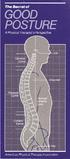 The Secret... T he American Physical Therapy Association would like to share a secret with you. It can help you do more with less effort breathe easier feel great. The secret is about good posture, which
Patient handling techniques to prevent MSDs in health care
 28 Introduction Patient handling techniques Work-related musculoskeletal disorders (MSDs) are a serious problem among hospital personnel, and in particular the nursing staff. Of primary concern are back
Spinal Exercise Program/Core Stabilization Program Adapted from The Spine in Sports: Robert G. Watkins
 Spinal Exercise Program/Core Stabilization Program Adapted from The Spine in Sports: Robert G. Watkins Below is a description of a Core Stability Program, designed to improve the strength and coordination
UNIVERSAL FITNESS NETWORK, Inc. 2315 West Monica Dunlap, IL 61525 (309)-360-5615 [email protected] FACTS ABOUT THE PHYSICAL FITNESS ASSESSMENT TESTS
 UNIVERSAL FITNESS NETWORK, Inc. 2315 West Monica Dunlap, IL 61525 (309)-360-5615 [email protected] FACTS ABOUT THE PHYSICAL FITNESS ASSESSMENT TESTS Universal Fitness Network, Inc. specializes in physical
.org. Herniated Disk in the Lower Back. Anatomy. Description
 Herniated Disk in the Lower Back Page ( 1 ) Sometimes called a slipped or ruptured disk, a herniated disk most often occurs in your lower back. It is one of the most common causes of low back pain, as
Injuries from lifting, loading, pulling or pushing can happen to anyone in any industry. It is important to be aware of the risks in your workplace.
 Workplace safety: lifting One of the biggest concerns in the workplace is lifting and loading. When you lift something, the load on your spine increases and your spine can only bear so much before it is
Work, Power, and Energy: Explaining the causes of motion without Newton. KIN335 Spring 2005
 Work, Power, and Energy: Explaining the causes of motion without Newton KIN335 Spring 2005 What you should know Definition of work and its characteristics Definition of energy (including kinetic energy
Fact sheet Exercises for older adults undergoing rehabilitation
 Fact sheet Exercises for older adults undergoing rehabilitation Flexibility refers to the amount of movement possible around a joint and is necessary for normal activities of daily living such as stretching,
Landing Biomechanics Utilizing Different Tasks: Implications in ACL Injury Research. Adam Hernandez Erik Swartz, PhD ATC Dain LaRoche, PhD
 A Gender Comparison of Lower Extremity Landing Biomechanics Utilizing Different Tasks: Implications in ACL Injury Research Adam Hernandez Erik Swartz, PhD ATC Dain LaRoche, PhD Anterior Cruciate Ligament
Screening Swimmers for Injuries. What we know about injury screening for swimmers
 Screening Swimmers for Injuries What we know about injury screening for swimmers About me Dr. G. John Mullen, DPT, CSCS G. John Mullen received his Doctorate in Physical Therapy at the University of Southern
External torque as a factor to modify load in abdominal curl-up exercises
 Original Paper Biomedical Human Kinetics, 7, 16 22, 2015 DOI: 10.1515/bhk-2015-0003 External torque as a factor to modify load in abdominal curl-up exercises Alicja Rutkowska-Kucharska, Agnieszka Szpala
Strength and Conditioning Program
 Strength and Conditioning Program Guidelines All speed work must be performed when the body is fully rested. Proper sprinting techniques must be taught and mastered by the player. Adequate rest must follow
The Power Plate is the innovative, time saving and results driven way to improve your fitness and well being.
 Welcome to the world of Power Plate Exercise The Power Plate is the innovative, time saving and results driven way to improve your fitness and well being. It works by accelerating the body s natural response
Mike s Top Ten Tips for Reducing Back Pain
 Mike s Top Ten Tips for Reducing Back Pain The following article explains ways of preventing, reducing or eliminating back pain. I have found them to be very useful to myself, my clients and my patients.
General Guidelines. Neck Stretch: Side. Neck Stretch: Forward. Shoulder Rolls. Side Stretch
 Stretching Exercises General Guidelines Perform stretching exercises at least 2 3 days per week and preferably more Hold each stretch for 15 20 seconds Relax and breathe normally Stretching is most effective
USCGA Health and Physical Education Fitness Preparation Guidelines
 USCGA Health and Physical Education Fitness Preparation Guidelines MUSCULAR STRENGTH Muscular strength and endurance can be improved by systematically increasing the load (resistance) that you are using.
SHOULDER EXERCISE ROUTINE
 8 SHOULDERS The shoulders are the key to many full-bodied movements. Skill in such sports as swimming, baseball, golf, and tennis and other racquet sports is improved with the help of strong shoulders.
Exercises for Low Back Injury Prevention
 DIVISION OF AGRICULTURE RESEARCH & EXTENSION University of Arkansas System Family and Consumer Sciences Increasing Physical Activity as We Age Exercises for Low Back Injury Prevention FSFCS38 Lisa Washburn,
EDUH 1017 - SPORTS MECHANICS
 4277(a) Semester 2, 2011 Page 1 of 9 THE UNIVERSITY OF SYDNEY EDUH 1017 - SPORTS MECHANICS NOVEMBER 2011 Time allowed: TWO Hours Total marks: 90 MARKS INSTRUCTIONS All questions are to be answered. Use
Labour Protect Your Back!
 Building Fair and Productive Workplaces Labour Protect Your Back! LT-006-07-07 Also available: Protect Your Lungs! / Protégez vos poumons! LT-168-10-05 Protect Your Skin! / Protégez votre peau! LT-158-09-05
International Journal of Engineering Research-Online A Peer Reviewed International Journal Articles available online http://www.ijoer.
 RESEARCH ARTICLE ISSN: 2321-7758 DESIGN AND DEVELOPMENT OF A DYNAMOMETER FOR MEASURING THRUST AND TORQUE IN DRILLING APPLICATION SREEJITH C 1,MANU RAJ K R 2 1 PG Scholar, M.Tech Machine Design, Nehru College
Pre - Operative Rehabilitation Program for Anterior Cruciate Ligament Reconstruction
 Pre - Operative Rehabilitation Program for Anterior Cruciate Ligament Reconstruction This protocol is designed to assist you with your preparation for surgery and should be followed under the direction
Information on the Chiropractic Care of Lower Back Pain
 Chiropractic Care of Lower Back Pain Lower back pain is probably the most common condition seen the the Chiropractic office. Each month it is estimated that up to one third of persons experience some type
Strength can be defined as the maximum force produced. The Relation Between Strength and Power in Professional Rugby League Players
 Journal of Strength and Conditioning Research, 1999, 13(3), 224 229 1999 National Strength & Conditioning Association The Relation Between Strength and Power in Professional Rugby League Players DANIEL
Contact us for more info: 020 7736 8191 /
 Winter Sports Advanced Ski Exercises - Introduction The following exercises are for individuals who already have a significant level of fitness. If you are unsure as to whether they are appropriate for
Biomechanics of cycling - Improving performance and reducing injury through biomechanics
 Biomechanics of cycling - Improving performance and reducing injury through biomechanics Biomechanics is the science concerned with the forces that act on the human body and the effects these forces produce.
Strength Training for the Runner
 Strength Training for the Runner Strength Training for the Runner What? The goal of resistance training for runners is not necessarily adding muscle mass but 1. improving muscular strength, 2. improving
HealthStream Regulatory Script
 HealthStream Regulatory Script Back Safety Version: May 2007 Lesson 1: Introduction Lesson 2: Back Injury Lesson 3: Spinal Anatomy and Physiology Lesson 4: Safe Operation of the Spine Lesson 5: Preventive
Prevention & Management of ACL Injury. Ian Horsley PhD, MCSP Lee Herrington PhD, MCSP
 Prevention & Management of ACL Injury Ian Horsley PhD, MCSP Lee Herrington PhD, MCSP ACL injury ACL injury 30/100,000, 40% sports injuries (NHS) Limited statistics in UK related to sport Rugby Union 2002-2004
Workplace Job Accommodations Solutions for Effective Return to Work
 Workplace Job Accommodations Solutions for Effective Return to Work Workplace Job Accommodations Solutions for Effective Return to Work Published by 102 275 Broadway Winnipeg, MB R3C 4M6 www.mflohc.mb.ca
Modelling physiological features of Human body behavior in car crash simulations
 Modelling physiological features of Human body behavior in car crash simulations Michel BEHR, Yves GODIO, Maxime LLARI, Christian BRUNET Laboratoire de Biomécanique Appliquée (Marseille, France) Presented
Australian Centre for Agricultural Health and Safety. Farming with Back Pain
 Australian Centre for Agricultural Health and Safety Farming with Back Pain 2008 Australian Centre for Agricultural Health and Safety All rights reserved Title: Farming with Back Pain Authors: Boughton
Vertical jump performance has been a standard
 EFFECT OF OLYMPIC AND TRADITIONAL RESISTANCE TRAINING ON VERTICAL JUMP IMPROVEMENT IN HIGH SCHOOL BOYS BRIAN T. CHANNELL 1 AND J. P. BARFIELD 2 1 Oliver Springs High School, Oliver Springs, Tennessee;
Clinical Biomechanics
 Clinical Biomechanics 25 (2010) 859 866 Contents lists available at ScienceDirect Clinical Biomechanics journal homepage: www.elsevier.com/locate/clinbiomech Intra-abdominal pressure and abdominal wall
Acceleration levels of dropped objects
 Acceleration levels of dropped objects cmyk Acceleration levels of dropped objects Introduction his paper is intended to provide an overview of drop shock testing, which is defined as the acceleration
Operating Instructions
 Operating Instructions Table of Contents IMPORTANT INFORMATION 1-2 1 The backrack TM 3-6 Introduction 3 What does it do? 4 How do I use it? 5 How often should I use it? 6 2 Getting On 7-10 3 Basic Exercises
Plyometric Training. Plyometric Training. chapter
 chapter 16 Plyometric Training Plyometric Training David H. Potach, PT; MS; CSCS,*D; NSCA-CPT,*D Donald A. Chu, PhD; PT; ATC; CSCS,*D; NSCA-CPT,*D; FNSCA Chapter Objectives Explain the physiology of plyometric
AMERICAN COUNCIL ON EXERCISE PERSONAL TRAINER UNIVERSITY CURRICULUM LAB MANUAL
 AMERICAN COUNCIL ON EXERCISE PERSONAL TRAINER UNIVERSITY CURRICULUM LAB MANUAL LAB ACTIVITY #1: SOCIAL SUPPORT STRATEGIES ACTIVITY DESCRIPTION An important coping strategy for relapse prevention is for
Posture. Let s look at. in the head is jutting. the norm. you know if your belt. If you belt. lower body. 2 sections, upper. pulls?
 Fixing the Computer Guy Posture Lower back/h hip stability Let s look at ideal posture for a minute. Look at your profile in the mirror. Chances are you re gonna find that your head is jutting forward,
ANKLE STRENGTHENING INTRODUCTION EXERCISES SAFETY
 ANKLE STRENGTHENING INTRODUCTION Welcome to your Ankle Strengthening exercise program. The exercises in the program are designed to improve your ankle strength, fitness, balance and dynamic control. The
Musculoskeletal System
 CHAPTER 3 Impact of SCI on the Musculoskeletal System Voluntary movement of the body is dependent on a number of systems. These include: The brain initiates the movement and receives feedback to assess
Stretching in the Office
 Stretching in the Office Legs: Quads, Hamstrings, IT band, Hip flexors, Gluts, Calves Quads: Standing @ desk maintaining upright posture, grab one leg @ a time by foot or ankle and bring it towards backside
Chest (medicine ball)
 Kneel to Pushup Kneel to Pushup Start Position: Your body will be in an upright position sitting on your knees. Hold medicine ball at chest level. Keeping your torso erect fall forward and chest press
Ulster GAA Sport Science Services Fitness Testing Procedures 2012 2016. Ulster GAA Fitness Testing Procedures For County Academy Squads 2012-2016
 Ulster GAA Fitness Testing Procedures For County Academy Squads 2012-2016 Introduction This document has been compiled by Kevin McGuigan (Ulster GAA, Sport Science Support Officer) following consultation
Repetitive Strain Injury (RSI)
 Carpal Tunnel Syndrome and Other Musculoskeletal Problems in the Workplace: What s the Solution? by Richard N. Hinrichs, Ph.D. Dept. of Kinesiology Arizona State University Repetitive Strain Injury (RSI)
JUNIPERO SERRA VOLLEYBALL OFF SEASON TRAINING SCHEDULE
 JUNIPERO SERRA VOLLEYBALL OFF SEASON TRAINING SCHEDULE 2007 OFF SEASON WORKOUT Our off season workout is centered around Speed, Agility & Quickness which are athletic attributes that are very trainable
MCR-VDC-UI-B-DC. Voltage Transducer for DC Voltages. INTERFACE Data Sheet 100260_en_01. 1 Description
 Voltage Transducer for DC Voltages TERFACE Data Sheet 000_en_0 PHOENIX CONTACT - /00 Description The MCR voltage transducer measures DC voltages in several signal ranges from 0... ±0 V DC to 0... ±0 V
Lumbar Disc Herniation/Bulge Protocol
 Lumbar Disc Herniation/Bulge Protocol Anatomy and Biomechanics The lumbar spine is made up of 5 load transferring bones called vertebrae. They are stacked in a column with an intervertebral disc sandwiched
How to Get and Keep a Healthy Back. Amy Eisenson, B.S. Exercise Physiologist
 How to Get and Keep a Healthy Back Amy Eisenson, B.S. Exercise Physiologist Lesson Objectives Statistics of Back Pain Anatomy of the Spine Causes of Back Pain Four Work Factors Core Muscles Connection
Name. Most of the bones of the limbs (arms & legs) act as levers. These levers are powered by muscles.
 Bones as Levers 1 Name Bones as Levers You may not think of your limbs as being machines, but they are. The action of a muscle pulling on a bone often works like a type of simple machine called a lever.
Ergonomics in the Workplace
 Ergonomics in the Workplace Ergonomics in the Workplace 1 Introduction The purpose of this short guide is to provide information to the reader on the subject of Ergonomics. It also provides guidance on