
SPECIFIC SPINAL EXERCISE
|
|
|
- Jean Hall
- 10 years ago
- Views:
Transcription
1 SPECIFIC SPINAL EXERCISE Three Case Studies Using the MedX Lumbar Extension Machine Brian D. Johnston IART Research ABSTRACT The purpose of this research project was to ascertain the effects of specific exercise for the lumbar muscles, by way of the MedX Lumbar Extension Machine, and relative to previous years of exercise without such a machine. Three subjects improved lumbar strength significantly, and in one instance, became pain-free within two months although two years of previous chiropractic and physiotherapy proved ineffective. In two other instances, it became obvious that traditional exercise, including heavy deadlifts, squats and bent barbell rowing had no positive effect on maintaining or improving lumbar strength. INTRODUCTION Research has indicated emphatically that specific exercise for the lumbar muscles, in an environment that encourages thigh and pelvic restraint, is both superior and necessary to strengthen those muscles. 1, 2, 3, 4, 5, 6, 7, 8, 9, 10 Improvement of tissue integrity was determined at the University of Florida by way of isolated strength testing dynamometry and dualenergy x-ray absorptiometry (DEXA; a device that measures bone-mineral density and muscle mass). What most of the above noted research indicated was that improvement can be made, and is made best by way of full range isolation, as per the use of the MedX Lumbar Extension Machine. Although some research has looked into the issue of detraining of the lumbar muscles 11, this aspect has not been explored to any significant degree. The purpose of this research paper was to investigate three case subjects and the implications of using the MedX Lumbar Extension Machine, those subjects being: 1. A person who experienced muscle strengthening on the MedX Lumbar Extension Machine, but who discontinued use of the machine for a period of ten years. 2. A person who is a long-time and serious/competitive fitness enthusiast who had not used the MedX Lumbar Extension Machine. 3. A person who incurred a low-back injury from an automobile accident, and who had experienced pain and weakness as a result. It is important to look at the differences among potential clients for specific and isolated exercise of the lumbar muscles, to determine its value both short- and long-term. Doing so may disclose the value of such training, and relative to the contrary position of non-specific exercise, i.e., today s so-called functional training that incorporates full body movement to enhance function. Specific Spinal Exercise 155

2 METHODS Subjects Only July 14, 1995, at age 30, Subject 1 (the author) was tested on the medical version of the MedX Lumbar Extension Machine. A fairly normal strength curve was produced (with only slight deviation from normal at about the midpoint of the range of motion), and he was able to exert a force of about 475 lbs/ kg at approximately 30-degrees, or the upright seated position (437 lbs/ kg at 24-degrees and 515 lbs/233.6 kg at 36-degrees). Also, this person was considered more than two standard deviations above normal for lumbar muscle strength for his age and sex, as shown in figure 1, with about 255 lbs/115.7 kg being the norm torque output at the 30-degree position. Standard deviations from normal also are shown on the chart. The different test positions are shown in Figure 2. Furthermore, Subject 1 is no stranger to heavy, intense exercise, as evidenced in Photos 1-3 (taken at age 40 in July 2005). He has performed heavy bent rows, squats, and deadlifts for several years. Figure 1: Subject 1 MedX Lumbar Test, July 14, 1995 Average Absolute Isometric Torque: Male Years Lumbar 600 Extension Flexion Subject 1 Torque in Foot-pounds Norm (-) SD (+) SD Angle Photos 1-3 of Subject 1 at age 40 show the musculature achieved from brief, intense and heavy exercise, but which exercise did little to maintain or increase the strength of his lumbar muscles. 156 Specific Spinal Exercise

3 Subject 2 (age 52) is a long-time fitness enthusiast, who competed in bodybuilding, and more recently in firefighter combat challenges (he set a Canadian record for age 50-60, by completing the competition in 2 minutes and 5 seconds). With over 30 years of intense strength training and bodybuilding, as well as continual training for firefighter conditioning and competition, it would be expected that his lumbar muscles are very strong or, at least, above normal. Figure 2: The test positions of the medical version of the MedX Lumbar Extension Machine, from 0-degrees (extension) to 72-degrees (flexion). Photo 4: The restraint mechanism used to test isometric force at a position of 30- degrees of lumbar extension. A padded belt around the upper back of the subject was attached to a nylon strap to the front of the machine, with a force censor connected between. Subject 3 suffered low back and neck injuries as a result of an automobile accident more than two years previous. Earlier work with physiotherapists and chiropractors provided little pain relief or change in her condition and function. PROCEDURES Subjects were restrained in the MedX Lumbar Extension Machine, at an upright 30-degree position, and tested isometrically with the Dillon Quantrol Strain Gauge and a 225 kg capacity load cell located within the upper body restraining device (rigged between the machine s frame and the subject, as shown in Photo 4). To test muscle torque, subjects for this research project attempted to extend the spine, but could not move because of this restraint device, and the legs and hips could not contribute to force output because of the restraining mechanisms of the machine. Each isometric test resulted in 2-seconds to ease into tension, 5-seconds to produce a maximum effort, and then 2-seconds to ease out of tension. Future tests to determine muscle torque change from specific exercise on the MedX machine included the same restraint setup and positioning. A fixed/isometric upright position of 30-degrees for testing purposes was so chosen for several reasons. One, to eliminate impact forces (that occur as a result of dynamic movement). Two, to eliminate the effects of gravity (i.e., the mass of the torso s influence on helping or hindering force output), when the torso is leaned either forward or backward. Three, to eliminate the effects of stored energy (stretching and compression of tissues around the lumbar spine when bent forward or backward). And four, to replicate an exact position for every test. Specific Spinal Exercise 157

4 Most exercise sessions consisted of 5-7 repetitions per subject (a few were as high as 9 repetitions, when the estimated weight was insufficient), at a cadence of 5-5, for one set of exercise. Exercise varied in frequency, because of experience, the load used, and intensity of effort. Subject 1 exercised his lumbar muscles every 12 days on average; Subject 2 exercised his lumbar muscles every 10 days on average; and Subject 3 exercised her lumbar muscles every 7 days on average. Only the lumbar muscles were exercised on this machine since the thighs and hips were restrained appropriately, as per the machine s design. On January 9, 2005 (almost ten years after an initial MedX strength test described previously, and now at age 40), Subject 1 similarly was restrained in the non-medical version of the MedX Lumbar Extension Machine, and produced only lbs/ kg at a position of 30-degrees; a loss of approximately 42% from when he initially was tested in 1995 (Note: 245 lbs/111 kg is considered normal 12 for this subject s current age and sex, thus suggesting that even with a loss of strength Subject 1 still was above normal in torque output). This subject indicated that loss of lumbar strength became apparent over the years, although he had no way to quantify the effects at the time of this experiment. A loss of function occurred regardless of heavy squats, deadlifts, bent rowing, and other exercises that would have placed a strain on his lumbar muscles and spine. However, such a strain from those exercises always was limited to a fixed position in a possible 72-degrees of motion, whereby the subject s hips, gluteals and thighs contributed most of the force output to create movement or to maintain stasis during those exercises. Although a person can and will lose function as he or she ages, various exercise loads (e.g., dips, chest presses, leg presses, etc.) for this subject remained relatively the same over the past 10 years, as did body composition and girth measurements. However, research suggests that the lumbar muscles are not like other muscles, and begin to deteriorate within a person s second decade of life 13,14, whereas that is not the case with other muscles until the third or fourth decade of life (and only if not exercised to prevent strength and lean mass loss). The question, then, was whether this subject could rehabilitate his lumbar muscles to their previous function and ability. (Note: The term rehabilitate is valid, although the muscles may not be injured, since they reduced a great deal in function with this subject. Furthermore, a person with less strength initially, and with a slow twitch response [a low fatigue rate] would not experience such a degree of atrophy in the lumbar muscles, since that fiber type is less susceptible to atrophy from disuse, but also less inclined to hypertrophy from proper exercise.) Subject 1 was provided 15 training sessions, which began with 200 pounds for 7 repetitions, and ended with 320 pounds for 5 repetitions, from January 9, 2005 to July 19, The number of repetitions reduced from 6-7 to 5 (a 50-second tension time) once reaching 300 pounds of exercise load, to accommodate his quick-to-fatigue lumbar muscles. On March 29, 2005, Subject 2 produced an initial force output of 93.9 lbs/42.6 kg, positioned at 30-degrees in the MedX Lumbar Extension Machine. However, since he was uncertain of what to do exactly (how hard to exert or the specific method involved in isometric testing), he was retested a week later on April 6, 2005, at which time he produced a more honest and vigorous attempt at lbs/95.2 kg (Note: 250 lbs/113.4 kg is considered normal for his age and sex). Subject 2 was provided 12 training sessions, which began with 120 pounds for 6 repetitions and ended with 260 pounds for 6 repetitions, from March 29, 2005 to July 26, Subject 3 was provided one training session at a modest load of 60 pounds before being tested. On December 31 st this subject produced a force of lbs/53.6 kg at a position of 30-degrees (Note: 140 lbs/63.5 kg is considered normal for her age and sex). Subject 3 was provided 12 training sessions, which began with 60 pounds for nine repetitions and ended with 120 pounds, for six repetitions, from December 24, 2004 to May 3, Because of time constraints and personal issues, this subject terminated her treatments and was not re-tested. Nonetheless, a change could be extrapolated from the collected exercise session data, and which is addressed in the Discussion of this report paper. 158 Specific Spinal Exercise

5 RESULTS Experimental Data Subject 1 Subject 2 Subject 3 Pre-test lbs/ kg lbs/95.2 kg lbs/53.57 kg Beginning Exercise Load 200 lbs/90.72 kg 120 lbs/54.43 kg 60 lbs/27.22 kg Ending Exercise Load 320 lbs/145.2 kg 260 lbs/ kg 120 lbs/54.43 kg Number of Exercise Sessions (1 set each) Post-test lbs/151.5 kg NA Test Improvement 19.5 % 37.3 % NA DISCUSSION Subject 1 showed an improvement of 19.5 %, is % stronger than average for his age group and sex, and achieved the change in a total of minutes of exercise time over 15 sessions. His strength has increased, although at age 40 it is difficult at this time to determine if he ever will achieve that which he was capable ten years previous. Subject 2 showed a marked improvement, and this indicated that years of vigorous, traditional exercise did little to improve the strength of his lumbar muscles. Nor did the highly functional exercise that he did through his firefighter combat challenge training help him, as current-day fitness trends would suggest. He increased his torque output by 37.3% with direct, isolated exercise, and now is considered 25.3% stronger than average for his age group, whereas he was 16% weaker than average before his 12 training sessions (that lasted a total of 13-minutes of exercise time). Subjectively, he has reported far greater function and ability in his firefighter challenge training, and particularly with the dummy drag event, which event was more stressful on his low back previous to his MedX treatments. Subject 3 was tested prior to her tenth treatment, and was able to produce lbs/58.65 kg of torque. By her twelfth session she exercised with 120 pounds for 8 repetitions (80-seconds tension time), but unfortunately was not re-tested thereafter. If we consider that static force is greater than positive dynamic ability (by about 20%), and she was able to exercise with 120 pounds for multiple repetitions and a relatively long tension time, her isometric torque output likely would have been at about pounds ( kg). This would place her functional ability (at that position) toward normal or better for her age and sex. Subject 3 also indicated that her low back pain was nearly non-existent; noticeable only on occasion. Her total work time over the 12 sessions, for one set each of the exercise was 14 minutes. CONCLUSIONS It is evident that to maintain or improve lumbar strength, traditional exercise (whereby the hips and thighs are permitted to move when exercising the lumbar muscles) provides little effect or benefit. Previous studies have demonstrated as much, but this research included two advanced trainees, whom have been exercising intensely for over 50 years combined, and neither of who experienced or demonstrated any positive benefit from traditional exercise. A third subject, who underwent traditional rehabilitative exercise and treatment under the guidance of physiotherapists and chiropractors, failed to achieve improvement in pain management until she utilized the MedX Lumbar Extension Machine for this project, a common end result from the author s perspective and previous medical rehabilitation experience. Consequently, it seems apparent that strengthening or rehabilitation of the lumbar muscles (if strengthening is emphasized or required) necessitates exercise that restricts hip and thigh movement, and which is achieved only by way of the patented MedX Lumbar Extension Machine. Specific Spinal Exercise 159

6 It may be questioned (and argued) as to why we require such highly isolated exercise since we do not move in like manner in day-to-day activities. But the fact is that other animals walk on all fours (including primates for the most part) without spinal problems, and a deterioration of the lumbar muscles in such a situation does not become a concern as a result. Conversely, walking in a bipedal fashion places the spine in a highly susceptible position for injury, and the deterioration of the lumbar muscles (as the hips and thighs serve to contribute most to human mobility when coordinated with spinal movement) therefore necessitates specialized and unique exercise for the lumbar muscles. ACKNOWLEDGEMENTS Thanks to MedX ( for supplying the Lumbar Extension Machine for this experiment. Thanks to CSC Force Measurements Inc. ( for supplying the necessary force gauge hardware for this experiment. REFERENCES 1 Nelson, Brian W., MD, et al. The Clinical Effects of Intensity Specific Exercise on Chronic Low Back Pain: A Controlled Study of 895 Consecutive Patients with 1-Year Follow Up. Orthopedics. October 1995, Vol. 18, No Fulton, Michael N., MD., et al. Rehabilitation and Testing: Conservative Treatment for Lower-back and Cervical Problems. University of Florida, Departments of Medicine and Exercise and Sport Sciences, and Physiology. Internal research paper. 3 Pollock, Michael L., PhD., et al. Muscle. University of Florida, Departments of Medicine and Exercise and Sport Sciences, and Physiology. Internal research paper. 4 Panjabi, Manohar, PhD., et al., Yale University School of Medicine and Hokkaido Medical School, Japan. A Biomechanical Model. Spine. Vol. 14, No. 2, Leggett, S.H., et al. Effect of Resistance Training on Lumbar Extension Strength. International Journal of Sports Medicine, 3(9), Pollock, Michael L., PhD., et al. Effect of Resistance Training on Lumbar Extension Strength. The American Journal of Sports Medicine, Vol. 17, No. 5, Graves, James E., PhD., et al. Effect of Training Frequency and Specificity on Isometric Lumbar Extension Strength. Spine, Vol. 15, No. 6, June Carpenter, David M., et al. Effect of 12 and 20 Weeks of Resistance Training on Lumbar Extension Torque Production. Physical Therapy, Vol. 71, No. 8, August Risch, Sherry V., PhD., et al. Lumbar Strengthening in Chronic Low Back Pain Patients: Physiologic and Psychological Benefits. Spine, Vol. 18, No. 2, pp , Tucci, Jacqueline T., MS, et al. Effect of Reduced Frequency of Training and Detraining on Lumbar Extension Strength. Spine, Vo. 17, No. 12, December Tucci, Jacqueline T., MS, et al. Effect of Reduced Frequency of Training and Detraining on Lumbar Extension Strength. Spine, Vo. 17, No. 12, December Norms for this research project provided by the University of Florida Center for Exercise Science. 13 Parkkola, R, and Kormano, M. Lumbar disc and back muscle degeneration on MRI: correlation to age and body mass. J Spinal Disorders, 5: 86-92, Carpenter et al. Low back strength comparisons of elite female collegiate athletes. MedSci Sport Exerc, 26(5): S1: 3, Specific Spinal Exercise

Hills St. Sports Medicine & Rehabilitation Centre
 LUMBAR SPINE PREVENTATIVE & REHABILITATION PROGRAM Theron King B. Ed. (Sports Science) Hills St. Sports Medicine & Rehabilitation Centre Denny Shearwood B.APP.SC. (Physiotherapy) M.A.P.A. Appointed Physiotherapist
Biomechanical Analysis of the Deadlift (aka Spinal Mechanics for Lifters) Tony Leyland
 Biomechanical Analysis of the Deadlift (aka Spinal Mechanics for Lifters) Tony Leyland Mechanical terminology The three directions in which forces are applied to human tissues are compression, tension,
Injury Prevention for the Back and Neck
 Injury Prevention for the Back and Neck www.csmr.org We have created this brochure to provide you with information regarding: Common Causes of Back and Neck Injuries and Pain Tips for Avoiding Neck and
Strength Training for the Shoulder
 Strength Training for the Shoulder This handout is a guide to help you safely build strength and establish an effective weighttraining program for the shoulder. Starting Your Weight Training Program Start
THE BIG SIX. Six Best Volleyball Strength Training Exercises. By Dennis Jackson, CSCS www.strength-and
 THE BIG SIX Six Best Volleyball Strength Training Exercises By Dennis Jackson, CSCS www.strength-and and-power power-for for-volleyball.com THE SQUAT What it is The two most common squatting exercises
Spinal Anatomy. * MedX research contends that the lumbar region really starts at T-11, based upon the attributes of the vertebra.
 Spinal Anatomy Overview Neck and back pain, especially pain in the lower back, is one of the most common health problems in adults. Fortunately, most back and neck pain is temporary, resulting from short-term
Whiplash: a review of a commonly misunderstood injury
 1 Whiplash: a review of a commonly misunderstood injury The American Journal of Medicine; Volume 110; 651-656; June 1, 2001 Jason C. Eck, Scott D. Hodges, S. Craig Humphreys This review article has 64
Mechanics of the Human Spine Lifting and Spinal Compression
 Mechanics of the Human Spine Lifting and Spinal Compression Hamill and Knutzen: Chapter 7 Nordin and Frankel: Ch. 10 by Margareta Lindh Hall: Ch. 9 (more muscle anatomy detail than required) Low Back Pain
HELPFUL HINTS FOR A HEALTHY BACK
 HELPFUL HINTS FOR A HEALTHY BACK 1. Standing and Walking For correct posture, balance your head above your shoulders, eyes straight ahead, everything else falls into place. Try to point toes straight ahead
Case Studies Updated 10.24.11
 S O L U T I O N S Case Studies Updated 10.24.11 Hill DT Solutions Cervical Decompression Case Study An 18-year-old male involved in a motor vehicle accident in which his SUV was totaled suffering from
Neck Exercises for Car Accident Victims 3 Steps to a Healthier Neck
 Neck Exercises for Car Accident Victims 3 Steps to a Healthier Neck DR BARRY L. MARKS CHIROPRACTOR AUTHOR LECTURER Neck Exercises for Car Accident Victims 3 Steps to a Healthier Neck 2012 Dr. Barry L.
Exercises for Low Back Injury Prevention
 DIVISION OF AGRICULTURE RESEARCH & EXTENSION University of Arkansas System Family and Consumer Sciences Increasing Physical Activity as We Age Exercises for Low Back Injury Prevention FSFCS38 Lisa Washburn,
Strength Training. Designed Specifically for Novice/Junior/Senior Skaters and Coaches
 Strength Training Designed Specifically for Novice/Junior/Senior Skaters and Coaches Strength Training Instructor Guidelines Instructor Qualifications A. Degree in exercise, physical education or sports
X-Plain Neck Exercises Reference Summary
 X-Plain Neck Exercises Reference Summary Introduction Exercising your neck can make it stronger, more flexible and reduce neck pain that is caused by stress and fatigue. This reference summary describes
Employees Compensation Appeals Board
 U. S. DEPARTMENT OF LABOR Employees Compensation Appeals Board In the Matter of DEBORAH R. EVANS and U.S. POSTAL SERVICE, POST OFFICE, Orlando, FL Docket No. 02-1888; Submitted on the Record; Issued December
THE BENJAMIN INSTITUTE PRESENTS. Excerpt from Listen To Your Pain. Assessment & Treatment of. Low Back Pain. Ben E. Benjamin, Ph.D.
 THE BENJAMIN INSTITUTE PRESENTS Excerpt from Listen To Your Pain Assessment & Treatment of Low Back Pain A B E N J A M I N I N S T I T U T E E B O O K Ben E. Benjamin, Ph.D. 2 THERAPIST/CLIENT MANUAL The
Physical Capability Strength Test: One Component of the Selection Process
 Physical Capability Strength Test: One Component of the Selection Process One aspect of the Power Systems Institute selection process is to successfully complete and achieve a passing score on a physical
1 Neck Exercises. In the cervical spine, we are looking to increase range of motion in
 1 Neck Exercises Stretching and Increasing Mobility Below you will find stretching exercises specifically for the neck. If you suffer from a stiff neck or a pinched nerve in the neck, these exercises with
MedX Medical Machines State of the Art Testing? I don t think so. By John G. Nall
 MedX Medical Machines State of the Art Testing? I don t think so. By John G. Nall As a former owner of multiple exercise and physical therapy facilities, I continue to want the best equipment for myself
Shoulders (free weights)
 Dumbbell Shoulder Raise Dumbbell Shoulder Raise 1) Lie back onto an incline bench (45 or less) with a DB in each hand. (You may rest each DB on the corresponding thigh.) 2) Start position: Bring the DB
Low Back Pain Exercises Interactive Video Series Transcript July 2013
 Introduction Low Back Pain Exercises Interactive Video Series Transcript July 2013 ** Note: If an exercise causes an increase in your pain, stop the exercise.** [Music introduction; Dr. John Sheehan onscreen]
The type of cancer Your specific treatment Your pre training levels before diagnose (your current strength and fitness levels)
 Exercise and Breast Cancer: Things you can do! Cancer within the fire service is one of the most dangerous threats to our firefighter s health & wellness. According to the latest studies firefighters are
Strength Training HEALTHY BONES, HEALTHY HEART
 Strength Training HEALTHY BONES, HEALTHY HEART No matter what your age, strength training can improve your bone health and your balance. As we age, our bones lose both tissue and strength. This condition
COMMON OVERUSE INJURIES ATTRIBUTED TO CYCLING, AND WAYS TO MINIMIZE THESE INJURIES
 COMMON OVERUSE INJURIES ATTRIBUTED TO CYCLING, AND WAYS TO MINIMIZE THESE INJURIES Listed are a few of the most common overuse injuries associated with cycling long distances. 1. Cervical and upper back
are you reaching your full potential...
 T h e r e s n o s u c h t h i n g a s b a d e x e r c i s e - j u s t e x e r c i s e d o n e b a d l y FIT for sport are you reaching your full potential... These tests are a series of exercises designed
Patellofemoral/Chondromalacia Protocol
 Patellofemoral/Chondromalacia Protocol Anatomy and Biomechanics The knee is composed of two joints, the tibiofemoral and the patellofemoral. The patellofemoral joint is made up of the patella (knee cap)
Info. from the nurses of the Medical Service. LOWER BACK PAIN Exercise guide
 Info. from the nurses of the Medical Service LOWER BACK PAIN Exercise guide GS/ME 03/2009 EXERCISE GUIDE One of the core messages for people suffering with lower back pain is to REMAIN ACTIVE. This leaflet
Cervical Whiplash: Considerations in the Rehabilitation of Cervical Myofascial Injury. Canadian Family Physician
 Cervical Whiplash: Considerations in the Rehabilitation of Cervical Myofascial Injury 1 Canadian Family Physician Volume 32, September 1986 Arthur Ameis, MD Dr. Ames practices physical medicine and rehabilitation,
he American Physical Therapy Association would like to share a secret with you. It can help you do more with less effort breathe easier feel great.
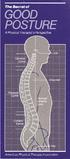 The Secret... T he American Physical Therapy Association would like to share a secret with you. It can help you do more with less effort breathe easier feel great. The secret is about good posture, which
HUR Rehab Line H E A L T H & F I T N E S S E Q U I P M E N T
 H E A L T H & F I T N E S S E Q U I P M E N T HUR Rehab Line HUR naturally different Contents HUR naturally different HUR SmartCard 1 HUR Rehab Line key to rehabilitation 2 SmartCard FCM Rehab Line computerized
KNEE EXERCISE PROGRAM
 KNEE PROGRAM INTRODUCT ION Welcome to your knee exercise program. The exercises in the program are designed to improve your knee stability and strength of the muscles around your knee and hip. The strength
How to Get and Keep a Healthy Back. Amy Eisenson, B.S. Exercise Physiologist
 How to Get and Keep a Healthy Back Amy Eisenson, B.S. Exercise Physiologist Lesson Objectives Statistics of Back Pain Anatomy of the Spine Causes of Back Pain Four Work Factors Core Muscles Connection
Mike s Top Ten Tips for Reducing Back Pain
 Mike s Top Ten Tips for Reducing Back Pain The following article explains ways of preventing, reducing or eliminating back pain. I have found them to be very useful to myself, my clients and my patients.
The Science Behind MAT
 The Science Behind MAT Muscle Activation Techniques (MAT) is a system designed to evaluate and treat muscular imbalances, I will expand on the process of evaluation in response and the use of isometrics
Why should our fitness center administer fitness tests?
 Why should our fitness center administer fitness tests? There are two basic reasons for administering fitness tests: 1. Assessing a participant s current fitness. 2. Measuring fitness improvement over
Spine University s Guide to Kinetic MRIs Detect Disc Herniations
 Spine University s Guide to Kinetic MRIs Detect Disc Herniations 2 Introduction Traditionally, doctors use a procedure called magnetic resonance imaging (MRI) to diagnose disc injuries. Kinetic magnetic
Whiplash Associated Disorder
 Whiplash Associated Disorder Bourassa & Associates Rehabilitation Centre What is Whiplash? Whiplash is a non-medical term used to describe neck pain following hyperflexion or hyperextension of the tissues
Stretching the Low Back THERAPIST ASSISTED AND CLIENT SELF-CARE STRETCHES FOR THE LUMBOSACRAL SPINE
 EXPERT CONTENT by Joseph E. Muscolino photos by Yanik Chauvin body mechanics THE ESSENCE OF MOST MANUAL THERAPIES, and certainly clinical orthopedic massage therapy, is to loosen taut soft tissues, thereby
Workplace Health, Safety & Compensation Review Division
 Workplace Health, Safety & Compensation Review Division WHSCRD Case No: 13252-11 WHSCC Claim No.(s): 604016, 611050, 672511 705910, 721783, 731715, 753775, 784014, 831110 Decision Number: 14189 Marlene
Lumbar Disc Herniation/Bulge Protocol
 Lumbar Disc Herniation/Bulge Protocol Anatomy and Biomechanics The lumbar spine is made up of 5 load transferring bones called vertebrae. They are stacked in a column with an intervertebral disc sandwiched
Today s session. Common Problems in Rehab. www.physiofitness.com.au/filex.htm LOWER BODY REHAB ESSENTIALS TIM KEELEY FILEX 2012
 Tim Keeley B.Phty, Cred.MDT, APA Principal Physiotherapist physiofitness.com.au facebook.com/physiofitness Today s session Essential list for the lower body Rehab starting point Focussing on activation,
Nautilus & Athletic Journal Articles
 Nautilus & Athletic Journal Articles ArthurJonesExercise.com Increasing Neck Strength For the Prevention of Injury The muscles of the neck and shoulders are perhaps the easiest muscles in the body to develop
Why Back Safety is Important
 Back Safety Why Back Safety is Important Back injuries are considered by OSHA (the Occupational Safety and Health Administration) as the nation's #1 workplace safety problem. Back Injuries are often: Very
WorkCover s physiotherapy forms: Purpose beyond paperwork?
 WorkCover s physiotherapy forms: Purpose beyond paperwork? Eva Schonstein, Dianna T Kenny and Christopher G Maher The University of Sydney We retrospectively analysed 219 consecutive treatment plans submitted
Side Impact Causes Multiplanar Cervical Spine Injuries
 Side Impact Causes Multiplanar Cervical Spine Injuries 1 The Journal of Trauma, Injury, infection and Critical Care Volume 63(6), December 2007, pp 1296-1307 Maak, Travis G. MD; Ivancic, Paul C. PhD; Tominaga,
IMGPT: Exercise After a Heart Attack 610 944 8140 805 N. RICHMOND ST (Located next to Fleetwood HS) Why is exercise important following a heart
 Why is exercise important following a heart attack? Slow progression back into daily activity is important to strengthen the heart muscle and return blood flow to normal. By adding aerobic exercises, your
HealthStream Regulatory Script
 HealthStream Regulatory Script Back Safety Version: May 2007 Lesson 1: Introduction Lesson 2: Back Injury Lesson 3: Spinal Anatomy and Physiology Lesson 4: Safe Operation of the Spine Lesson 5: Preventive
Herniated Disk. This reference summary explains herniated disks. It discusses symptoms and causes of the condition, as well as treatment options.
 Herniated Disk Introduction Your backbone, or spine, has 24 moveable vertebrae made of bone. Between the bones are soft disks filled with a jelly-like substance. These disks cushion the vertebrae and keep
Neck Injuries and Disorders
 Neck Injuries and Disorders Introduction Any part of your neck can be affected by neck problems. These affect the muscles, bones, joints, tendons, ligaments or nerves in the neck. There are many common
Information on the Chiropractic Care of Lower Back Pain
 Chiropractic Care of Lower Back Pain Lower back pain is probably the most common condition seen the the Chiropractic office. Each month it is estimated that up to one third of persons experience some type
Hip and Trunk Exercise Program
 Hip and Trunk Exercise Program Hip and Pelvis Exercise Program Gluteus Medius and Minimus (Hip Abductors) Page 2 Lateral Hip Rotators Page 6 Tensor Fascia Lata (TFL) and Illiotibial Band (ITB) Page 7 Lower
ROTATOR CUFF HOME EXERCISE PROGRAM
 ROTATOR CUFF HOME EXERCISE PROGRAM Contact us! Vanderbilt Sports Medicine Medical Center East, South Tower, Suite 3200 1215 21st Avenue South Nashville, TN 37232-8828 For more information on this and other
SAE / Government Meeting. Washington, D.C. May 2005
 SAE / Government Meeting Washington, D.C. May 2005 Overview of the Enhancements and Changes in the CIREN Program History of Phase One Established 1997 (7 centers) Four Federal centers Three GM centers
Biomechanics of cycling - Improving performance and reducing injury through biomechanics
 Biomechanics of cycling - Improving performance and reducing injury through biomechanics Biomechanics is the science concerned with the forces that act on the human body and the effects these forces produce.
Pilates for the Rehabilitation of Iliopsoas Tendonitis and Low Back Pain
 Pilates for the Rehabilitation of Iliopsoas Tendonitis and Low Back Pain Bruce Manuel November 30, 2015 CAP Standard 2015 Pilates Denver Greenwood Village, CO Abstract Iliopsoas Tendonitis is irritation
Lower Back Pain An Educational Guide
 Lower Back Pain An Educational Guide A publication from the Center of Pain Medicine and Physiatric Rehabilitation 2002 Medical Parkway Ste 150 1630 Main St Ste 215 Annapolis, MD 21401 Chester, MD 21619
UHealth Sports Medicine
 UHealth Sports Medicine Rehabilitation Guidelines for Arthroscopic Rotator Cuff Repair Type 2 Repairs with Bicep Tenodesis (+/- subacromial decompression) The rehabilitation guidelines are presented in
CORRECTIVE CHIROPRACTIC EXERCISES
 CORRECTIVE CHIROPRACTIC EXERCISES J O W E T T & M O U L T O N C h i r o p r a c t o r s introduction This booklet, presented by Jowett and Moulton Chiropractors, is designed to provide you with a general
The Process of Strength and Conditioning for Golfers
 The Process of Strength and Conditioning for Golfers The use of different sporting activities and resistance work to develop a strength and conditioning program specific to golf. Many club golfers are
Psoas Syndrome. The pain is worse from continued standing and from twisting at the waist without moving the feet.
 Psoas Syndrome The iliopsoas muscle is a major body mover but seldom considered as a source of pain. Chronic lower back pain involving the hips, legs, or thoracic regions can often be traced to an iliopsoas
Candito Linear Programming
 Candito Linear Programming By Jonnie Candito The goal with this program is to provide a very simple layout with linear progression. That means the program will not change week to week, simply steadily
Schiffert Health Center www.healthcenter.vt.edu. Neck Pain (Cervical Strain) COMMON CAUSES: QUICK TREATMENT : NECK PAIN TREATING NECK PAIN:
 Schiffert Health Center www.healthcenter.vt.edu Patient Information: Neck Pain (Cervical Strain) COMMON CAUSES: Neck pain may be triggered by a specific event, such a sport injury or motor vehicle accident.
NECK STRENGTHENING PROGRAM
 NECK STRENGTHENING PROGRAM The Orthopedic Specialty Hospital (TOSH) is one of the country's premier facilities for orthopedic surgical care, physical therapy, sport specific rehabilitation, sports training,
The Science of the Core: Lower Back Strength Training for Elite Athleticism
 The Science of the Core: Lower Back Strength Training for Elite Athleticism By John Scherger D.C. History of Program o Early Developers o Current Users o Programs released for following NSCA Peer review
ERGONOMICS. Improve your ergonomic intelligence by avoiding these issues: Awkward postures Repetitive tasks Forceful exertions Lifting heavy objects
 ERGONOMICS The goal of ergonomics is to reduce your exposure to work hazards. A hazard is defined as a physical factor within your work environment that can harm your body. Ergonomic hazards include working
Four-week specific training to increase speed, power and agility
 Four-week specific training to increase speed, power and agility Adam King B.S., David Buchanan RKT, Kevin Barcal B.S. Completed at ProSport Training and Rehab., Inc. Rolling Meadows, IL www.prosporttraining.com
Pre - Operative Rehabilitation Program for Anterior Cruciate Ligament Reconstruction
 Pre - Operative Rehabilitation Program for Anterior Cruciate Ligament Reconstruction This protocol is designed to assist you with your preparation for surgery and should be followed under the direction
Safe Lifting/Back Safety Training. Presented by Rita Gagnon Occupational Health Outreach Coordinator Benefis Health Systems 406-731-8328
 Safe Lifting/Back Safety Training Presented by Rita Gagnon Occupational Health Outreach Coordinator Benefis Health Systems 406-731-8328 Risk Factors Involved with Manual Handling Tasks: Bending at Trunk
Stretching in the Office
 Stretching in the Office Legs: Quads, Hamstrings, IT band, Hip flexors, Gluts, Calves Quads: Standing @ desk maintaining upright posture, grab one leg @ a time by foot or ankle and bring it towards backside
Illinois Law Enforcement Training and Standards Board. Preface
 Illinois Law Enforcement Training and Standards Board Preface The Illinois Law Enforcement Training and Standards Board, in recognizing the importance of physical fitness status for academy performance
THE RELATIONSHIP BETWEEN POSTURE AND HEALTH
 THE RELATIONSHIP BETWEEN POSTURE AND HEALTH Roger Sperry, Ph.D. (Nobel Prize in Physiology or Medicine 1981) discovered that 90% of the brain's activity is used to balance your body within the gravitational
Utilizing MedX in Physical Rehabilitation of the Lumbar Spine SportExcel Health and Human Performance - Chance Moore D.C., C.S.C.S.
 Utilizing MedX in Physical Rehabilitation of the Lumbar Spine SportExcel Health and Human Performance - Chance Moore D.C., C.S.C.S. MedX is an advanced line of computerized testing and rehabilitation equipment
Strength Training For Runners
 Strength Training For Runners Be the strongest, fastest athlete you can be Agenda Why to strength train and the benefits Myths about runners and strength training What to do How often Example program About
COMMON ROWING INJURIES
 COMMON ROWING INJURIES Prevention and Treatment Jo A. Hannafin, MD, PhD Professor of Orthopaedic Surgery Hospital for Special Surgery, Cornell University Medical College Team Physician, US Rowing FISA
LUMBAR. Hips R L B R L B LUMBAR. Hips R L B R L B LUMBAR. Hips R L B R L B
 1 Patient Name In order to properly assess your condition, we must understand how much your BACK/LEG (SCIATIC) PAIN has affected your ability to manage everyday activities. For each item below, please
General Guidelines. Neck Stretch: Side. Neck Stretch: Forward. Shoulder Rolls. Side Stretch
 Stretching Exercises General Guidelines Perform stretching exercises at least 2 3 days per week and preferably more Hold each stretch for 15 20 seconds Relax and breathe normally Stretching is most effective
Current Concepts of Low Back Pain. Terry L. Grindstaff, PhD, PT, ATC, SCS, CSCS
 Current Concepts of Low Back Pain Terry L. Grindstaff, PhD, PT, ATC, SCS, CSCS 28% population reports LBP in past 3 months (CDC 2010) 60% recurrence rate (Turner et al, 1992) Low Back Pain Low Back Pain
Plyometric Training. Plyometric Training. chapter
 chapter 16 Plyometric Training Plyometric Training David H. Potach, PT; MS; CSCS,*D; NSCA-CPT,*D Donald A. Chu, PhD; PT; ATC; CSCS,*D; NSCA-CPT,*D; FNSCA Chapter Objectives Explain the physiology of plyometric
Pilates for Lumbar Spine Herniation
 Pilates for Lumbar Spine Herniation Michelle Hawley Date: Module 12, 10/21/2012 Course Year: July 2012- October 2012 Location: Chandler, AZ Abstract Research has demonstrated that non-surgical methods
ERGONOMICS. University at Albany Office of Environmental Health and Safety 2010
 ERGONOMICS University at Albany Office of Environmental Health and Safety 2010 WHAT IS ERGONOMICS? From the Greek: ergon work and nomoi natural laws Defined by Webster as: Biotechnology WHAT IS ERGONOMICS?
REHAB PROGRAM. Heart & Lung. Training program developed by BungyPump in collaboration with reg. physiotherapist Rovena Westberg
 REHAB PROGRAM Heart & Lung Training program developed by BungyPump in collaboration with reg. physiotherapist Rovena Westberg Fun Exercise = Quality of life Healthier Hearts! Physical activity helps to
Whiplash and Whiplash- Associated Disorders
 Whiplash and Whiplash- Associated Disorders North American Spine Society Public Education Series What Is Whiplash? The term whiplash might be confusing because it describes both a mechanism of injury and
Spinal Exercise Program/Core Stabilization Program Adapted from The Spine in Sports: Robert G. Watkins
 Spinal Exercise Program/Core Stabilization Program Adapted from The Spine in Sports: Robert G. Watkins Below is a description of a Core Stability Program, designed to improve the strength and coordination
Our mission is to help you experience the greatest benefits possible. Our physicians and care staff are dedicated to your needs.
 What to Expect Our mission is to help you experience the greatest benefits possible. Our physicians and care staff are dedicated to your needs. You will most likely require 20-30 procedure sessions to
Injuries from lifting, loading, pulling or pushing can happen to anyone in any industry. It is important to be aware of the risks in your workplace.
 Workplace safety: lifting One of the biggest concerns in the workplace is lifting and loading. When you lift something, the load on your spine increases and your spine can only bear so much before it is
The Rehabilitation Team
 Considerations in Designing a Rehab Program Philosophy of Sports Medicine Healing Process Pathomechanics of Injury Psychological Aspects Goals of Rehab Chapter 1 Group effort The Rehabilitation Team AEP/Athletic
July 2012 Exercise Away Your Knee Pain It seems counterintuitive, but when it hurts to move
 Exercise Away Your Knee Pain It seems counterintuitive, but when it hurts to move your knee, the best thing you can do is move your knee. A 2009 study in the British Medical Journal found that supervised
Strength, Size, or Power?
 Strength, Size, or Power? Helen M. Binkley, Ph.D., CSCS*D, NSCA-CPT Which one are you training for strength, size, or power? First, let s identify what each of these are. Strength is the ability to produce
The advanced back rehabilitation programme
 Physiotherapy Department The advanced back rehabilitation programme This booklet explains what happens during the advanced back rehabilitation programme and how the exercises may help your condition. We
[Project name] Standard Operating Procedures. Body Mechanics
![[Project name] Standard Operating Procedures. Body Mechanics](/thumbs/27/11986346.jpg "[Project name] Standard Operating Procedures. Body Mechanics") [Project name] Standard Operating Procedures Body Mechanics PURPOSE. The purpose of this SOP is to provide information to minimize staff injuries with the focus on back injuries resulting from improper
[Project name] Standard Operating Procedures Body Mechanics PURPOSE. The purpose of this SOP is to provide information to minimize staff injuries with the focus on back injuries resulting from improper
Neck Pain Overview Causes, Diagnosis and Treatment Options
 Neck Pain Overview Causes, Diagnosis and Treatment Options Neck pain is one of the most common forms of pain for which people seek treatment. Most individuals experience neck pain at some point during
NO. COA08-1063 NORTH CAROLINA COURT OF APPEALS. Filed: 16 June 2009
 An unpublished opinion of the North Carolina Court of Appeals does not constitute controlling legal authority. Citation is disfavored, but may be permitted in accordance with the provisions of Rule 30(e)(3)
The Lateral Collateral Ligament Sprain. Ashley DeMarco. Pathology and Evaluation of Orthopedic Injuries I. Professor Rob Baerman
 1 The Lateral Collateral Ligament Sprain Ashley DeMarco Pathology and Evaluation of Orthopedic Injuries I Professor Rob Baerman 2 The Lateral Collateral Ligament Sprain Ashley DeMarco Throughout my research
12 Week Do-it-Yourself Fitness Program
 12 Week Do-it-Yourself Fitness Program Created by Brad Awalt, MS, ACSM Assistant Manager, Health Plus [email protected] January 2011 Do you have a goal to begin an exercise routine, but not sure
Introduction. Basis and preliminary investigations
 RSI prevention by changing computer input devices - Study by TU Darmstadt investigates the pen tablet as an ergonomic alternative to the computer mouse - Introduction Users of computer work stations often