
General Catalog begins on the next page.
|
|
|
- Randolph Butler
- 10 years ago
- Views:
Transcription
1

2 General Catalog begins on the next page. This page is a placeholder. It represents the blank back of the Catalog cover to show how the Catalog will appear in the printed version. When the Catalog is opened, the blank back of the cover will be on the left, and the first page will be on the right. When the Catalog is opened, even-numbered pages will appear on the left and odd-numbered pages on the right. Tips for Using the Online General Catalog : 1. Scroll through the Catalog to the Table of Contents (PDF page 6 or Catalog page 7) and then click any heading in the table to jump directly to that section. 2. Scroll through the Table of Contents to the Index, click Index, and then scroll through the Index, and click any listing in the Index to jump to that section of the Catalog. 3. Click the Bookmarks icon in Adobe Reader (or the bookmarks tab in earlier versions). The list of major sections of the Catalog will appear on the left. Each section can be expanded by clicking the + sign in front of the section name. You can then click on the particular subheading or topic under the heading to jump to that section of the Catalog. You can read that section and then use the bookmark to jump to another section. The Catalog will always remain open on the right side of the screen. You can expand the viewing size by changing from 34%, for example, to 100% or hide the bookmarks and then open the bookmarks again if you want to jump to another section.

3 General Catalog Issue No. 32/Fall 2013 (Revised July 2013) Published by SANDHILLS COMMUNITY COLLEGE 3395 Airport Road Pinehurst, North Carolina Phone or Fax Website: The provisions of this publication are not to be regarded as an irrevocable contract between the student and Sandhills Community College. The College reserves the right to change any provision or requirement at any time within the student s term of residence or to add or withdraw course offerings. Updates to this printed edition that reflect such changes will be available on the Sandhills website at The official version of the current Catalog is the online document. The College further reserves the right, at any time, to request that a student withdraw when such action is considered to be in the best interest of the institution.

4 2 SANDHILLS COMMUNITY COLLEGE Welcome to Sandhills Community College College Telephone Numbers Administrative offices are open Monday through Friday from 8 a.m. until 5 p.m. During the summer sessions, some offices may have an abbreviated schedule. The summer schedule is published online at along with the academic calendar. A complete telephone directory of faculty and staff is also available online at General Information / Admissions /3738 Business /3951 Continuing Education Financial Aid Dean of Instruction Library Records and Registration /3741/3734/3739 Director of Student Life Dean of Student Services Accreditation Sandhills Community College is accredited by the Southern Association of Colleges and Schools Commission on Colleges to award associate degrees, diplomas, and certificates. Contact the Commission on Colleges at 1866 Southern Lane, Decatur, Georgia or call for questions about the accreditation of Sandhills Community College. Visitors Sandhills Community College welcomes visitors to campus and encourages them to explore the gardens, to use the Katharine Boyd Library, and to attend various public college functions. The Campus Map on page 4 provides directions. It is important that visitors respect the educational mission of the College and the necessity for campus safety and tranquility. If disruptive visitors are observed, those noting the behavior are asked to relay that information to the switchboard located in the Dempsey Student Center or The College reserves the right to ask disruptive visitors to leave the campus. Non-Discrimination Statement Sandhills Community College is committed to the elimination of all discrimination based on race, color, national origin, religion, sex, age, or disability. The College seeks to comply with all federal, state, and local statutes, regulations, and orders, including those that promote equal protection and equal opportunity for students, employees, and applicants.

5 WELCOME 3 President John R. Dempsey Welcome to Sandhills Community College. This is a very special year here at Sandhills. Not only is it special because you have chosen to become a part of our student body, but it s special because this year marks our 50 th birthday. Sandhills was founded in December For fifty years, we have been providing high quality, reasonably priced education to the men and women of this region. A lot has changed in those fifty years, but the core values that started the college are still present in everything we do today. Those values are respect, integrity, opportunity, excellence, and helpfulness. These values guide and inspire the work we do at Sandhills, and we hope they will have a profound influence on your education. This college catalog has lots of information to help you on your educational journey. We think it will answer most of the questions you will have about the college and about your program of study. If this book doesn t answer your questions, or if anything isn t clear, please call your advisor, the nice folks in Student Services, Executive Assistant Wendy Dodson ( ), or me ( ) for help. Helping students is why we are here. Again, welcome to Sandhills. I think you ve made a really good choice of colleges, and I wish you all the success in the world while you are here. For fifty years now, we ve been taking good care of students and helping them get the education they need to lead productive and fulfilling lives. We hope to do that with you, and we thank you for choosing Sandhills. John R. Dempsey


6 4 SANDHILLS COMMUNITY COLLEGE Campus Map

7 CAMPUS MAP 5 Ball Garden Visitor s Center Blue Hall Career Services Counseling Services BLET Classroom Health & Fitness Program Classroom Student Employment Boyd Library Archives Barbara Cole Children s Reading Center Jeanne Hastings Gallery Learning Resource Computer Lab Library Teresa Wood Reading Room Causey Hall Alumni Relations Cosmetology Emergency Medical Science Grant Development SCC Foundation Office Dempsey Student Center Athletics Clement Dining Room Ewing Center for Student Leadership Heins Gymnasium Intramurals Logan Bookstore Lost and Found Marketing Minority Male Mentoring Parking Permits Peterson Dining Commons Photo ID Reception Russell Fitness Center Student Government Association Student Life Kennedy Hall Bracken Auditorium College Programs for High Schools Fine Arts Art Health Sciences Nursing Owens Wing SandHoke ECHS Office St. Andrews Extension UNC Pembroke Extension Little Hall Byerley Auditorium Computer Technologies Distance Learning Engineering Technologies Golf Course/Turfgrass Management Whole Harvest Kitchen Peggy Kirk Bell Center for Hospitality and the Culinary Arts Russell Dining Room Charles and Jane Wellard Technology Center Logan Hall Developmental Education English and Humanities Mathematics Project Promise Kelly Tutoring Center McKean Campus Services Center Grounds Maintenance Physical Plant Maintenance Print Shop Shipping/Receiving Meyer Hall Directors Auditorium Sciences Therapeutic Massage Owens Auditorium Sirotek Hall Transportation Technologies Steed Hall Landscape Gardening Stone Hall 1st Floor East Administration Business Office Human Resources John Sledge Board Room Stone Hall 1st Floor West Admissions Student Success Center Financial Aid Meyer Family Foundation Auditorium Placement Testing Records and Registration Veterans Services Stone Hall 2nd Floor Management & Business Technology Information Services Van Dusen Hall Continuing Education Dedman Center for Business Leadership Disability Services Furches Life-Long Learning Center McCaskill Public Service Center Social and Behavioral Sciences Public Services Wellard Hall Audiovisual Services Fine Arts Music and Music Education Campus Police and Public Safety

8 6 SANDHILLS COMMUNITY COLLEGE TABLE OF CONTENTS WELCOME TO SANDHILLS COMMUNITY COLLEGE... 2 College Telephone Numbers... 2 Accreditation... 2 Visitors... 2 Non-Discrimination Statement... 2 President John R. Dempsey... 3 Campus Map... 4 TABLE OF CONTENTS... 6 ACADEMIC CALENDARS Academic Calendar Fall Semester Spring Semester Summer Semester Proposed Academic Calendar Fall Semester Spring Semester Summer Semester COLLEGE MISSION AND PROGRAMS College History Mission Statement Core Values at Sandhills Community College Performance Measures and Standards, Campus Services Bookstore Cafeteria Disability Services SCC Website Instructional Programs and Delivery Credit Programs University Studies Program Applied Science Programs Diploma Programs Certificate Options General Education Program General Occupational Program... 31

9 TABLE OF CONTENTS 7 Developmental Education Special Credit Courses Continuing Education Programs (Non-Credit) Instructional Delivery Hybrid Courses Evening/Weekend College Online Courses NC Information Highway Course Delivery COLLEGE ADMISSION AND REGISTRATION Admission to the General College Admission to Continuing Education Admission to Curriculum Education Non-Degree-Seeking Student (Special and Visiting Students) Degree-Seeking Student Placement Testing Pre-Advising Program Placement Student Classifications Guidelines for Admission New Students Readmitted Students Foreign Students Permanent Residents Other Visas F-1 Visas Undocumented Immigrants Foreign College Transcripts Transfer Students Special Students Visiting Students Home-Schooled Degree-Seeking Students Career and College Promise Career Technical Education Pathway College Transfer Pathway Cooperative Innovative High Schools Pathway... 41

10 8 SANDHILLS COMMUNITY COLLEGE Registration for Curriculum Classes Last Day to Register Residence Status for Tuition Purposes PAYMENT OF TUITION AND FEES Tuition Student Activity and Technology Fees Special Program/Course Expenses Tuition Payments Tuition and Fees Waivers for Qualified High School Students and Full-Time College Employees Payment Responsibility Graduation Fee Refund of Tuition and Fees: State Refund Policy Refund of Tuition and Fees: Federal Refund Policy STUDENT RECORDS Grade Reports Graduation Requirements Transcripts FINANCIAL AID Financial Aid Programs Federal Pell Grant Federal Supplemental Opportunity Grant Federal and Institutional Work-Study Program Student Loans NC Community College Grant NC Education Lottery Scholarship Childcare Grants Endowed and Donor Scholarships Other Funds and Outside Scholarships Federal Aid Eligibility Requirements Federal Aid Enrollment Classification Federal Aid Enrollment Status Determination for Clock Programs Unusual Enrollment History (UEH) Veterans Benefits, Programs, and Guidelines Veterans Affairs Montgomery GI Bill (MGIB) Montgomery GI Bill-Selected Reserve (MGIB-SR) Post-9/11 GI Bill Reserve Education Assistance Program (REAP)... 56

11 TABLE OF CONTENTS 9 Veterans Educational Assistance Program (VEAP) Survivors and Dependents Educational Assistance Program (DEA) VA Work-Study Program NC National Guard Tuition Assistance Program (TAP) Veterans Retraining Assistance Program (VRAP) The Yellow Ribbon Program VA General Eligibility Requirements VA Documentation STUDENT SERVICES Campus Health and Safety Campus Health and Safety Awareness Activities Communicable Disease Student Accident Insurance Counseling and Career Services Personal Counseling Career Services Career Development Career Resource Library Guarantee to Employers Job Fairs Student Employment Services Student Involvement in the Institution Student Government Association (SGA) Student s Role in Institutional Decision-Making Student Publications Student Publications Guidelines Photo and Video Use Supervisory Role of the Institution over Student Activities Student Fundraisers Student Life ACES (Association for Architecture, Construction, Engineering and Surveying) Athletics Cheer Club Computer Technology Club Criminal Justice Club Early Childhood Club Horticulture Club Human Services Club Intramurals... 68

12 10 SANDHILLS COMMUNITY COLLEGE Mentoring, Supporting, Affirming, Cultivating and Empowering Women (MSACE) Outdoor Adventure Program Phi Theta Kappa Alpha Tau Beta Radiography Club Rotaract Sandhills Association of Nursing Students Student Government Association Therapeutic Massage Club Turfgrass Club Ultimate Frisbee Club STUDENT CONDUCT Student Conduct in the Instructional Environment Student Code of Conduct Academic Honesty Disciplinary Procedures Student Grievance Student Grievance Procedure Student Grievance Procedure Steps Sexual Harassment Policy CAMPUS POLICE AND PUBLIC SAFETY Traffic Rules and Regulations Automobile Registration Parking Regulations Parking Permit Temporary Parking Parking Violations Fines Identification Card Campus Crime Security and Access to Campus Facilities Campus Law Enforcement Authority Emergency Services Emergency Phones Emergency Code Blue Boxes Reporting Crimes Investigation of Crime Reports Documentation of Crime Reports Crime Statistics Sexual Assault Policy Reporting Sexual Assault Medical and Psychological Support Services Disciplinary and/or Legal Actions... 87

13 TABLE OF CONTENTS 11 Telephone Calls Lost and Found Pets on Campus Walking Track Smoking Policy Inclement Weather INFORMATION TECHNOLOGY Information Technology Resources Acceptable Use Policy Intellectual Property Rights ACADEMIC POLICIES AND PROCEDURES Academic Advising Academic Freedom and Integrity College General Education Requirements Alternative Methods for Achieving Course Credit Credit by Examination ACA Credit by Exam Advanced Placement Approved AP Courses College Credit for College Tech Prep Students Credit for Experiential Learning Credit for Military Training Academic Petition/Course Substitution Course Prerequisite Waiver Special Course Enrollment Enrollment in Courses Unique to Concentration Programs Independent Study Auditing Courses External Instruction Course Load Classification of Students Attendance Procedures Entry into Courses Attendance Schedule of Last Class Sessions Grading Policies and Procedures Grading Grade Categories for Completing a Course Grade Categories for Not Completing a Course

14 12 SANDHILLS COMMUNITY COLLEGE Removing Incomplete I Grades Grade Point Average Course Repetition Inter-Curricular Transfer of Credit Course Change Procedures Drop/Add Procedure Instructor-Initiated Drop or Withdrawal Withdrawal from a Course, Program, or the College Change of Major, Re-entry, and Readmission Change of Major Re-entry into a Program Academic Forgiveness Academic Progress Academic Probation and Suspension Academic Progress Policy for Students Receiving Financial Aid 112 Treatment of Selected Grades Withdrawals/Drops Incomplete and Failing Grades Transfer Credit Audit and Never Attend Repeat Courses Credit by Exam Experiential Learning Developmental Courses Clock Hour Programs Complete Academic Record Financial Aid Eligibility Status Eligibility Status Financial Aid Warning Financial Aid Suspension Financial Aid Probation Financial Aid Termination Warning Near Maximum Time Frame Maximum Time Frame Notification of Financial Aid Warning, Suspension, Probation, Terminated, Warning Near Maximum Time Frame, or Maximum Time Frame Regaining Eligibility Appeal of Satisfactory Academic Progress Standards Appeal Process Progress Appeal Request Form

15 TABLE OF CONTENTS 13 Academic Progress of Health Sciences and Nursing Academic Progress Standards for Health Science Programs Academic Progress Standards for Nursing Programs Academic Progress Standards for Therapeutic Massage Program Recognition of Outstanding Academic Performance President s List Dean s List Honors Graduates Resources for Learning and Support Disability Services Distance Learning Students Information Technology Resources Katharine L. Boyd Library Learning Resource Computer Lab Men of Valor and Excellence (M.O.V.E.) Project Promise Student Success Center Testing Tutorial Services UNIVERSITY STUDIES PROGRAM Associate s Degree Requirements General Education Core Other Required Hours Transfer Core Diploma Pre-Major Agreements University Studies Transfer Course List Transfer Core Diploma Program Associate in Arts Transfer Core Diploma (D10100) Associate in Science Transfer Core Diploma (D10400) Associate in Arts Degree Requirements (A10100) Associate in Arts Course Sequence Example Associate in Science Degree Requirements (A10400) Associate in Science Course Sequence Example Associate in Fine Arts in Art Degree Requirements (A1020A) Associate in Fine Arts in Art Course Sequence Example Associate in Fine Arts in Music and Music Education Degree Requirements (A1020D) Associate in Fine Arts in Music and Music Education Course Sequence Example

16 14 SANDHILLS COMMUNITY COLLEGE APPLIED SCIENCE PROGRAMS Applied Science Advisory Committees Associate in Applied Science Degree Requirements Diploma Programs Certificate Programs APPLIED SCIENCE PROGRAMS OF STUDY Accounting Accounting (A25100) Accounting (D25100) Certified Bookkeeper (C25100) Architectural Technology Architectural Technology (A40100) Architectural Technology (C40100) Associate Degree in Nursing Associate Degree Nursing (A45110) Automotive Systems Technology Automotive Systems Technology (A60160) Automotive Systems Technology (D60160) Automotive Systems Technology (D60160) Automotive Systems Technology (C60160) Baking and Pastry Arts Baking and Pastry Arts (A55130) Baking and Pastry Arts (C55130) Basic Law Enforcement Training Basic Law Enforcement Training (C55120) Business Administration Business Administration (A25120) Business Administration (C25120B) Business Administration (C25120) Business Administration (C25120S) Civil Engineering Technology Civil Engineering Technology (A40140) Civil Engineering Technology (C40140) Collision Repair & Refinishing Technology Collision Repair & Refinishing Technology (D60130) Collision Repair & Refinishing Technology (C60130) Computer Engineering Technology Computer Engineering Technology (A40160)

17 TABLE OF CONTENTS 15 Computer Engineering Technology (D40160C) Computer Engineering Technology (C40160) Computer Engineering Technology (C40160A) Computer Engineering Technology (C40160B) Computer Engineering Technology (C40160C) Computer Engineering Technology (C40160F) Computer Engineering Technology (C40160G) Computer Engineering Technology (C40160NN) Computer Engineering Technology (C40160S) Computer Programming Computer Programming (A25130) Cosmetology Cosmetology (A55140) Cosmetology (D55140) Cosmetology (C55140) Criminal Justice Technology Criminal Justice Technology (A55180) Criminal Justice Technology (A55180) Culinary Arts Culinary Arts (A55150) Culinary Arts (C55150) Digital Media Technology Digital Media Technology (A25210) Digital Media (C25210DM) Print Design (C25210PD) Web Content Management (C25210C1) Web Design (C25210D) Early Childhood Education Early Childhood Education (A55220) Early Childhood Education (C55220IT) Early Childhood Education (C55220PS) Early Childhood Education (C55220S) Early Childhood Education (C55220A) Emergency Medical Science Emergency Medical Science (A45340) Emergency Medical Science Bridging Geomatics Technology (Surveying) Geomatics Technology (A40420) Geomatics Technology (C40420)

18 16 SANDHILLS COMMUNITY COLLEGE Golf Course Management Golf Course Management (A15230) Health and Fitness Science Health and Fitness Science (A45630) Health Information Technology Pitt CC/Sandhills CC Partner Program Health Information Technology (A45360) Hospitality Management Hospitality Management (A25110) Human Services Technology Human Services Technology (A45380) Human Services Technology Substance Abuse Concentration (A4538E) Landscape Gardening Landscape Gardening (A15260) Landscape Gardening (C15260) Medical Laboratory Technology Medical Laboratory Technology (A45420) Medical Office Administration Medical Office Administration (A25310) Medical Office Administration (C25310C) Networking Technology Networking Technology (A25340) Networking Fundamentals (D25340) Networking Technology (C25340C) Networking Technology (C25340S) Nursing Assistant Nursing Assistant (C45480) Office Administration Office Administration (A25370) Ophthalmic Medical Assistant Ophthalmic Medical Assistant (D45510) Physical Therapist Assistant Physical Therapist Assistant (A45620) Polysomnography Polysomnography (A45670)

19 TABLE OF CONTENTS 17 Practical Nursing Practical Nursing (D45660) Radiography Radiography (A45700) Respiratory Therapy Respiratory Therapy (A45720) Simulation and Game Development Simulation and Game Development (A25450) Simulation & Gaming (C25450) Surgical Technology Surgical Technology (A45740) Surgical Technology (D45740) Surveying Technology (See Geomatics) Therapeutic Massage Therapeutic Massage (A45750) Therapeutic Massage (D45750) GENERAL DEGREE PROGRAMS Associate in General Education Associate in General Education (A10300) Requirements General Occupational Technology Associate in Applied Science in General Occupational Technology (A55280) Requirements COLLEGE PROGRAMS FOR HIGH SCHOOL STUDENTS College Transfer Pathways Business and Economics Pathway (P1012B) Engineering and Mathematics (P1042B) Humanities and Social Science Pathway (P1012A) Life and Health Sciences (P1042A) Career Technical Pathways Architectural Technology Traditional Diploma (D40100HS) Architectural Technology Advanced Technology Diploma (D40100HS2) Automotive Systems Technology Diploma (D60160HS) Civil Engineering Technology Diploma (D40140HS) Collision Repair and Refinishing Technology Certificate (C60130HS) Cosmetology Certificate (C55140HS) Criminal Justice Technology Certificate (C55180HS)

20 18 SANDHILLS COMMUNITY COLLEGE Culinary Arts Certificate (C55150HS) Digital Media Technology Certificate (C25210HS) Emergency Medical Science Diploma (D45340HS) Hospitality Management Diploma (D2510HS) Landscape Gardening Diploma (D15260HS2) Early College Benefits CONTINUING EDUCATION Admission Registration Fees Location of Classes Continuing Education Units (CEUs) Scholarships Student Records Transcripts Course Repetition Policy CONTINUING EDUCATION PROGRAMS D.L. Doc Furches Center for Lifelong Learning College and Career Readiness (Basic Skills) Adult Basic Education (ABE) High School Equivalency Program (GED Diploma) Adult High School (AHS) English as a Second Language (ESL) Family Literacy Workplace Literacy SUCCEED Robert H. Dedman, Sr. Center for Business Leadership Career Training Programs (Professional Development) Medical Careers/Allied Health Customized Training Program Small Business Center Technology Training Program (Computer Programs) Career Development Program (Human Resources Development) Career Readiness Assessment Center C. Harlan McCaskill Center Public Safety Programs Emergency Medical Services Fire and Rescue Training Law Enforcement Training Creative Living Programs (Community Service Education Programs). 245

21 TABLE OF CONTENTS 19 CURRICULUM COURSE DESCRIPTIONS How to Read the Course Description Student Learning Outcomes Semester Hours of Credit Course Prerequisites and Corequisites Course Placement Guide Course Descriptions by Course Discipline Prefix ACA Academic Related ACC Accounting ANT Anthropology ARC Architectural Technology ART Art AST Astronomy AUB Automotive Body Repair AUT Automotive BAF Banking and Finance BIO Biology BPA Baking and Pastry Arts BPR Blueprint Reading BUS Business CEG Civil Engineering and Geomatics CET Computer Engineering Technology CHM Chemistry CIS Information Systems CIV Civil Engineering CJC Criminal Justice COE Cooperative Education COM Communication COS Cosmetology CSC Computer Science CST Construction CTS Computer Information Technology CUL Culinary DBA Database Management Technology DMA Developmental Mathematics DME Digital Media Technology DRA Drama ECM Electronic Business ECO Economics EDU Education EGR Engineering ELC Electricity ELN Electronics
22 20 SANDHILLS COMMUNITY COLLEGE EMS Emergency Medical Science ENG English FRE French GCM Golf Course Management GEL Geology GEO Geography GRA Graphic Arts GRD Graphic Design GRO Gerontology HEA Health HIS History HIT Health Information HOR Horticulture HRM Hotel and Restaurant Management HSE Human Services HUM Humanities LSG Landscape Gardening MAT Mathematics MED Medical Terminology MKT Marketing and Retailing MLT Medical Laboratory Technology MTH Massage Therapy MUS Music NAS Nursing Assistant NET Networking Technology NOS Network Operating System NUR Nursing OPH Opticianry OST Office Systems Technology PED Physical Education PHI Philosophy PHY Physics POL Political Science PSF Health and Fitness Science PSG Polysomnography PSY Psychology PTA Physical Therapy RAD Radiography RCP Respiratory Care RCT Race Car Technology REL Religion SAB Substance Abuse SEC Information Systems Security SGD Simulation and Game Development
23 TABLE OF CONTENTS 21 SOC Sociology SPA Spanish SRV Surveying SST Sustainability Technologies SUR Surgical Technology TRF Turfgrass Management WEB Web Technologies COLLEGE PERSONNEL Board of Trustees Office of the President Office of the Provost Office of the Executive Vice President/Administrative Services Department Chairs Faculty Distinguished Professors Adjunct Faculty Audiovisual/Campus Services Buildings and Grounds Maintenance Business Office and Finance Campus Police and Public Safety Continuing Education Division High School Liaisons Hoke County Center Human Resources Information Services Instructional Support Landscape Gardening Support Learning Resources Planning and Research Project Promise Student Support Services Grant Minority Male Mentoring NCCCS Grant Student Services Division COMPLIANCE STATEMENTS Civil Rights Act of Age Discrimination in Employment Act of Age Discrimination Act of Occupational Safety and Health Act of Hepatitis B Vaccine Policy Title IX of the Educational Amendments of Section 504 of the Rehabilitation Act of Family Educational Rights and Privacy Act of Drug-Free Workplace Act and the Drug-Free Schools & Communities Act of
24 22 SANDHILLS COMMUNITY COLLEGE Student Right-to-Know, the Campus Crime and Security Act, and the Jeanne Clery Act IPEDS Graduation Rate Americans with Disabilities Act (ADA) Procedure for Complaints of Discrimination Constitution and Citizenship Day Public Complaints Procedure for Responding to Public Complaints INDEX
25 ACADEMIC CALENDARS 23 ACADEMIC CALENDARS Academic Calendar Fall Semester 2013 August 14 Wednesday Faculty/Staff Meetings or Faculty Retreat August 15 Thursday Registration August 19 Monday First Day of Classes August 20 Tuesday Add Period Ends September 2-3 Monday-Tuesday Labor Day Holiday October Monday-Tuesday Fall Break October 30 Wednesday Drop Period Ends November 4 Monday Spring Semester Priority Registration November 11 Monday Veterans Day Holiday November Wednesday-Friday Thanksgiving Holidays December Thursday-Tuesday Final Exam Period December 17 Tuesday Semester Ends Spring Semester 2014 January 9 Thursday Registration January 13 Monday First Day of Classes January 14 Tuesday Add Period Ends January 20 Monday Dr. Martin Luther King Holiday March Monday-Friday Spring Break March 27 Thursday Drop Period Ends To be announced *** Summer and Fall Priority Registration April Monday-Tuesday Easter Holiday May 8-13 Thursday-Tuesday Final Exam Period May 13 Tuesday Semester Ends May 17 Saturday Commencement Summer Semester 2014 May 19 Monday Registration Summer & Fall May 26 Monday Memorial Day Holiday June 9-13 Monday-Friday SCC Closed U.S. Open June 30 Monday Registration C Summer & Fall July 4 Friday Independence Day Holiday Classes Last Day Last Day Session Begin End To Add To Drop Full Session May 20 July 31 May 21 July 8 1st Half May 20 June 26 May 21 June 16 2nd Half July 1 July 31 July 2 July 21
26 24 SANDHILLS COMMUNITY COLLEGE Proposed Academic Calendar (Subject to change; not official until approved in spring 2014) Fall Semester 2014 August 13 Wednesday Faculty/Staff Meetings or Faculty Retreat August 14 Thursday Registration August 18 Monday First Day of Classes August 19 Tuesday Add Period Ends September 1 Monday Labor Day Holiday October Monday-Wednesday Fall Break To be announced *** Drop Period Ends To be announced *** Spring Semester Priority Registration November 11 Tuesday Veterans Day Holiday November Wednesday-Friday Thanksgiving Holidays December Final Exam Period December 16 Tuesday Semester Ends Spring Semester 2015 January 8 Thursday Registration January 12 Monday First Day of Classes January 13 Tuesday Add Period Ends January 19 Monday Dr. Martin Luther King Holiday March 9-13 Monday-Friday Spring Break To be announced *** Drop Period Ends To be announced *** Summer and Fall Priority Registration April 6-7 Monday-Tuesday Easter Holiday May 7-12 Thursday-Tuesday Final Exam Period May 12 Tuesday Semester Ends May 16 Saturday Commencement Summer Semester 2015 May 25 Monday Memorial Day Holiday May 26 Tuesday Registration Summer & Fall June 29 Monday Registration C Summer & Fall July 3 Friday Independence Day Holiday Classes Last Day Last Day Session Begin End To Add To Drop Full Session May 27 July 30 May 28 July 7 1st Half May 27 June 25 May 28 June 15 2nd Half June 30 July 30 July 1 July 20
27 COLLEGE MISSION AND PROGRAMS 25 COLLEGE MISSION AND PROGRAMS College History Sandhills Community College was established in December 1963 under authority of the 1963 State Community College Act. Following the leadership of Representative H. Clifton Blue, Moore County citizens petitioned the State Board of Education for approval to establish a community college in the county and voted overwhelmingly for a one million dollar bond issue for construction and a tax levy for operation and maintenance of facilities. Before the end of 1963, a board of trustees had been named, an organizational meeting held, an architect selected, and Dr. Raymond Stone chosen as first President of the College. In 1964, construction of facilities began on land given for the campus by Mrs. Mary Luman Meyer of Pinehurst. Temporary college offices were located in downtown Southern Pines. Classes began on October 1, 1965, in nine scattered locations. Following Dr. Stone s retirement in 1989, Dr. John R. Dempsey was selected to serve as President of the College. The College s main campus in Moore County has expanded significantly since the 1960s. Little Hall, a facility for culinary technology and the engineering and computer programs, and Dempsey Student Center opened in In addition, Steed Hall, home of the Landscape Gardening program, opened in 2010 to replace its former home, Huette Hall. Logan Hall, a 36,000 square-foot general purpose office and classroom building, opened in Blue Hall, one of the earlier structures on campus, underwent a major renovation in 2012 and is now the home to Counseling Services, Institutional Effectiveness, Basic Law Enforcement Training, and Health and Fitness Technology classes. The 2012 opening of a new maintenance building allowed the old maintenance facility to become the focal point of Continuing Education trades programs. The College s presence and capabilities are also growing at the Hoke County Center in Raeford, where a third classroom building opened in fall 2010 to house the SandHoke Early College High School, adding to Johnson and Upchurch Halls, in which Continuing Education and Curriculum classes are provided to Hoke County citizens. Mobile classroom cottages were added in spring 2013 to house an expansion of the SandHoke Early College High School. Sandhills has been fortunate in attracting a highly competent faculty and staff. Experienced faculty members bring to the classroom a spirit of dedication to teaching and a willingness to advise students in course
28 26 SANDHILLS COMMUNITY COLLEGE selection and academic planning. Professional counselors provide assistance with admissions, counseling, financial aid, and student life. Mission Statement The Mission of Sandhills Community College is to provide educational opportunities of the highest quality to all the people of the Sandhills. What We Believe The college is committed to the five core values of INTEGRITY, HELPFULNESS, EXCELLENCE, RESPECT, and OPPORTUNITY. These values guide and direct Sandhills Community College as it seeks: To welcome students of all ability levels and to provide programs that prepare them for employment or for transfer; To provide training for local businesses and to contribute constructively to the economic well-being of the region; To contribute to the cultural and artistic richness of the community, and to the educational needs of our retired population; To create a campus environment that celebrates its faculty and staff, and contributes to their personal and professional development. College Goals 1. For-Credit Academic Programs To educate students for professional and personal opportunities by providing technical and transfer programs that include distinct general education competencies and to offer these programs through a variety of course delivery modes; 2. Support Services To provide comprehensive student and academic support programs that help students meet their career, academic, and personal goals. 3. Access and Opportunity To ensure access and opportunity for students who are underprepared for college-level work through developmental studies and adult literacy programs; to prepare students for employment and/or for collegiate studies; and to promote student learning and success through various course delivery modes in credit and noncredit courses. 4. Economic Development To provide the training needed to help recruit businesses to our community and to drive entrepreneurial growth; to promote workplace learning; to enable local businesses to become more productive; and to provide credit and noncredit courses and programs that enable students to become competitive contenders for employment opportunities.
29 COLLEGE MISSION AND PROGRAMS Campus and Community Life To provide opportunities for student involvement, cultural enrichment, life-long learning, and community service while honoring our core values. 6. Campus Resources To ensure that the college has the necessary financial, human, technological, and physical resources, including having funds to advance the excellence of its programs; hiring faculty and staff of the highest quality who reflect its diverse community and exhibit its core values; providing appropriate technology; and ensuring that the campus is clean, safe, and beautiful. Sandhills Community College is a comprehensive community college chartered in 1963 and is a member of the North Carolina Community College System. The Sandhills Community College mission statement and supporting goals were revised and approved by the Board of Trustees in October Core Values at Sandhills Community College Integrity Sandhills treats its students, faculty, and staff fairly and stands behind the commitments that are stated or implied in its policy documents and promotional materials. The College demands academic work that is honest and rigorous and that meets the expectations of employers and baccalaureate-level institutions. Helpfulness The faculty and staff of Sandhills are genuinely and eagerly helpful to the College s students and to each other. Going the extra mile is expected behavior at Sandhills. Excellence Sandhills provides educational programs of the highest quality and then provides the support necessary to promote student success. Similarly, the College employs faculty and staff who are exceptionally well-qualified to promote educational excellence and, in addition, encourages and supports them in the performance of their jobs. Respect The atmosphere of Sandhills Community College is one of respect, friendliness, and civility values that are taught to students by the way in which faculty and staff interact with them and with each other. Opportunity Opportunity is at the core of Sandhills mission. The College provides educational opportunities to the students who enter through its open doors, opportunities for growth to the area s businesses and lifelong learners, and
30 28 SANDHILLS COMMUNITY COLLEGE opportunities for professional and personal development to its faculty and staff. Performance Measures and Standards, North Carolina Community College System The most recent data are from the North Carolina Community College System from April Developmental Student Success Rate in College-Level English Courses Percentage of previous developmental English and/or reading students who successfully complete a credit English course with a C or better upon the first attempt (within one year of developmental completion). Data Source: CRPFAR student record report System Mean: 63.7% SCC Performance: 61.6% Developmental Student Success Rate in College-Level Math Courses Percentage of previous developmental math students who successfully complete a credit math course with a C or better upon the first attempt (within one year of developmental completion). Data Source: CRPFAR student record report System Mean: 64.8% SCC Performance: 54.6% First Year Progression Percentage of first-time fall credential-seeking students attempting at least twelve hours within their first academic year who successfully complete ( C or better) at least twelve of those hours. Data Source: CRPFAR student record report System Mean: 67.8% SCC Performance:65.8 % Licensure and Certification Passing Rate Aggregate institutional passing rate of first time test-takers on licensure and certification exams. Exams included in this measure are state mandated exams for which candidates must pass before becoming active practitioners. Data Source: Licensing agencies System Mean: 85.2% SCC Performance: 92.6% College Transfer Performance Percent of overall GPA of 2.0+ after two consecutive semesters within an academic year at NC four-year institution. Data Source: UNC-General Administration System Mean: 87.6% SCC Performance: 87.8%
31 COLLEGE MISSION AND PROGRAMS 29 Curriculum Completion Percentage of first-time fall credential-seeking students who graduate, transfer, or are still enrolled with 36 hours after six years. Data Source: CRPFAR student record report and National Student Clearinghouse System Mean: 41.6% SCC Performance: 39.5% Basic Skills Students Progress Description revision pending State Board approval Data Source: LEIS System Mean: 41.0% SCC Performance: 26.0% GED Diploma Passing Rate Description revision pending State Board approval Data Source: LEIS System Mean: 71.1% SCC Performance: 60.6% Campus Services Bookstore Students can purchase textbooks, school supplies, sportswear, and other accessories at the college bookstore located in the Dempsey Student Center. Students may also locate course textbook selection information and ISBN online at sandhills.bncollege.com. Bookstore hours of operation are posted online at sandhills.bncollege.com and posted in the Dempsey Center. During the add/drop period, the bookstore will keep hours comparable to those of day and evening registration. Cafeteria The Sandhills cafeteria, located in the Dempsey Student Center, offers a quality assortment of reasonably priced breakfast and lunch items for students, employees, and visitors. Food sales are supplemented by vending machine selections. For special college events, the cafeteria provides professional catering services. Disability Services The College strives to provide an equal educational opportunity to all applicants and encourages students with disabilities to enroll. The College makes every effort to comply with the Americans with Disabilities Act, and reasonable accommodations will be made for all who demonstrate a documented legitimate need. The campus is largely barrier-free and accessible. Faculty and staff are available to assist where feasible. Students in need of special assistance should contact the Director of Disability
32 30 SANDHILLS COMMUNITY COLLEGE Services in Van Dusen Hall 213B at their earliest convenience. The Compliance section of this Catalog provides more information. SCC Website Interested parties may visit the Sandhills Community College website at for a wide range of information about the college and its services. Visitors to the website will find class schedules, admissions and registration information for both college credit and continuing education classes, and information pages for academic and extension departments and programs. The SCC homepage also provides links to information about student resources and library services. A calendar of upcoming events and new articles related to the college are also accessible from the site. Students can access the MySCC student portal myscc.sandhills.edu from a link on the Sandhills home page. The MySCC page provides students a one-stop shop to various resources at the college including online course access, Web Advisor, student , library, and other student resources. Instructional Programs and Delivery College credit and non-credit classes and programs are offered for citizens with varied educational needs and backgrounds using traditional (classroom) settings and non-traditional (ITV, hybrid and distance learning) instructional methods. Courses are taught day and evening throughout the year on and off the main campus. Credit Programs University Studies Program Courses that lead to the Associate in Arts, Associate in Fine Arts, and Associate in Science degrees are offered at the freshmen and sophomore levels. Credits earned in college transfer courses may be transferred to senior colleges and universities where students may pursue a program of study leading to a baccalaureate degree. Students may also apply for the Transfer Core Diploma for Arts or Sciences, which indicates the students completion of the 44 Core Hours required of all students in pursuit of a bachelor s degree at the university level. Advisors assist students in selecting courses that will be appropriate for baccalaureate degree programs at senior institutions. Applied Science Programs Two-year programs are offered leading to the Associate in Applied Science degree. These programs are comprised of specialized and related courses
33 COLLEGE MISSION AND PROGRAMS 31 required for successful employment in business, industry, health, horticulture, and service occupations. Diploma Programs One-year diploma programs are offered, leading to employment in health, business, industry, and service occupations. These programs include occupational specialty and related courses selected to give students the knowledge and skills needed for successful employment. Certificate Options Several of the occupational education programs have a certificate option that includes specialized courses but omits related and general education courses. Students who complete these programs are awarded a program certificate. Students not seeking a college degree, diploma, or certificate may enroll in selected occupational courses as long as the specific course prerequisites are met. General Education Program The College offers a non-transferable general education degree for students who want a more flexible two-year college degree. General education students are assisted in the selection of courses that will meet their own special needs and are awarded the Associate in General Education degree upon completion of the program requirements. General Occupational Program The General Occupational Technology degree curriculum provides students the opportunity to upgrade skills and to earn an associate degree, diploma, and/or certificate by taking courses suited for individual occupational interests and/or needs. Special criteria must be met as described later in this Catalog. Developmental Education Students whose placement test scores reveal a need to strengthen English, mathematics, reading, or study skills should enter developmental/precurriculum courses. These offerings are designed to prepare students for entrance into and success in curriculum programs. Students who need more than one developmental course may wish to register for a learning community, a block of prerequisite courses taught by a team of instructors and supported by tutoring, counseling, and off-campus learning experiences.
34 32 SANDHILLS COMMUNITY COLLEGE Special Credit Courses The College encourages the enrollment of students who are not seeking a degree but wish to further their education by taking courses of special interest. Courses may be audited or taken for college credit. However, students can only request special credit status during the first 16 credit hours of course work, at which time the student should declare a major and meet enrollment requirements. Continuing Education Programs (Non-Credit) The Continuing Education Division offers a wide variety of courses designed to meet the needs and interests of the citizens of Moore and Hoke Counties. Through the Continuing Education Division, students may acquire basic academic skills and general knowledge, train or retrain for employment, and develop socially, culturally, and intellectually. Courses are offered on and off campus to meet the expressed needs of adults who wish to continue their education. The Continuing Education Division will award Continuing Education Units (CEUs) for appropriate programs and courses. A complete listing of the general programs offered begins in the Continuing Education section of this Catalog. Instructional Delivery In addition to offering traditional classroom instruction, the College also offers classes in non-traditional formats and at non-traditional times. The College currently requires no additional fees related to verification of student identification in online courses. The student s identification is verified through the LDAP Authentication system. Students enrolled in online and hybrid classes establish their identification in this system when they activate usernames and passwords at the start of their SCC experience. Additional information related to online student support and procedures is found in the Online Education at SCC guide that is available on the MySCC page of the Sandhills website at MySCC.sandhills.edu. Hybrid Courses Hybrid courses combine Internet and traditional classroom instruction. A designated portion of the class is delivered in a traditional classroom format, and the remaining portion is delivered in the online environment. The predetermined portions will vary according to the needs of the particular class, program, or instructor. Hybrid courses are advertised in the class schedules and are designated with an H in the section number. Students enrolled in these classes must follow the regular admissions and registration process, pay regular tuition and fees, and meet all course prerequisites.
35 COLLEGE MISSION AND PROGRAMS 33 Evening/Weekend College Evening/weekend courses are offered for students desiring to pursue degree, diploma, or certificate programs as well as areas of special interest or selfimprovement. All student services are provided for evening students. The Hybrid Evening College allows students to take two classes each evening in the early part of the week to pursue a general education track that can lead to the transfer diploma. The First Saturday Hybrid College provides students face-to-face time with teaching faculty on the first Saturday of the semester and the first Saturday of each month (unless a holiday requires an alternate date) while still enjoying the flexibility of an online class. Students enrolled in these classes must follow the regular admissions and registration process, pay regular tuition and fees, and meet all course prerequisites. Online Courses Distance learning courses are delivered via the Internet using a learning management system (Moodle). Online courses are asynchronous, meaning that students are not required to be online at a specific time to take part in course activities and most of the communication among students and instructors does not take place in real time. Although there are no specific access times, online courses are not self-paced. Students are required to log into the course several times a week for the duration of the semester, and they must also meet course deadlines specified by the instructor, as would be the case in a traditional campus course. Online courses are identified in the class schedules by an N in the section number. Students enrolled in these classes must follow the regular admissions and registration process, pay regular tuition and fees, and meet all course prerequisites. As noted earlier, information related to online student support and procedures is found in the Online Education at SCC guide available on the MySCC page of the website at MySCC.sandhills.edu. NC Information Highway Course Delivery In some instances, the College can deliver select courses through the information highway. Companion classrooms at the main campus and offcampus sites allow proctored instructional delivery from an origin classroom to remote sites to allow broader student access to course offerings.
36 34 SANDHILLS COMMUNITY COLLEGE COLLEGE ADMISSION AND REGISTRATION Admission to the General College Sandhills Community College maintains an open-door admission policy for high school graduates and others 16 or older who hold a high school equivalency certificate (GED) or an adult high school diploma. Additionally, those who are at least 18 years of age but who do not have a high school diploma or equivalency may be accepted for admissions to an adult basic education, GED, or adult high school program; students may also enroll in continuing education classes or as a special, non-degree-seeking student. Admission to the College does not guarantee placement into a specific program of study. Sandhills Community College reserves the right to deny admission or readmission to students whose presence on campus is construed by the administration as harmful or potentially harmful to Sandhills Community College students, faculty, and/or staff. Students admitted to the College must adhere to the Student Code of Conduct, which prohibits conduct that significantly impairs the welfare or the educational opportunities of others in the college community. Exceptions to the admissions policy, including the U.S. Department of Education Ability to Benefit provision, may be determined after a conference with the Dean of Student Services. Admission to Continuing Education Detailed information regarding enrollment into Continuing Education programs and courses is available in the Continuing Education section of this Catalog. Admission to Curriculum Education Non-Degree-Seeking Student (Special and Visiting Students) Admission as a Special or Visiting Student requires the following: Submission of a completed official admissions application form. Submission of documentation supporting that any applicable course prerequisites have been met or completion of the college placement test with applicable satisfactory score(s). Special students may register for courses if course prerequisites are met and if space exists in the class. Further admission information concerning special
37 COLLEGE ADMISSION AND REGISTRATION 35 and visiting students is available below in the Student Classifications Guidelines for Admission section. Degree-Seeking Student Admission to associate s degree, diploma, and certain certificate programs requires the following: Submission of a completed official admissions application form. Completion of the college placement test (details available in the Assessment section below). Submission of an official high school transcript indicating graduation with a diploma, a high school equivalency certificate (GED), or an adult high school diploma. Submission of official college transcripts from all previously attended institutions. It is the responsibility of the student to make certain the required documents are sent; however, the Student Services Division will provide guidance with admissions and placement testing. Further admission information concerning specific student populations is available below in the Student Classifications Guidelines for Admission section. Placement Testing Placement testing is required for students who plan to enter an instructional program; special students who enroll in English, mathematics, or other restricted courses; and high school students taking college courses. The placement test assesses academic abilities in the areas of reading, writing, and mathematics. Placement test results are good for five (5) years and are used by academic advisors to place students in the courses that are appropriate to their academic needs. Placement testing is conducted on demand through the Learning Resource Computer Lab located in Boyd Library. Students requiring placement testing will be issued a testing ticket upon admission to the college. Submission of applicable SAT or ACT scores taken within five (5) years may exempt a student from placement testing. Students who do not achieve college level test scores may be advised to enroll in developmental courses to prepare them for future program placement. Students who do not make a satisfactory score on the placement test may be allowed to retest. In addition, in some instances, students may challenge a course by passing a departmental exam and earning Credit by Exam (CE).
38 36 SANDHILLS COMMUNITY COLLEGE Pre-Advising Upon completion of the placement test, students will have the option of meeting with a pre-advisor to discuss their placement results. Students will also be informed of their faculty advisor assignment for future course planning and curriculum guidance. Program Placement Students who desire to enter a specific instructional program and who meet the testing and placement criteria will be placed in the program of their choice as long as vacancies exist. Placement of qualified candidates into the programs will be made according to the published program admission requirements, which may include the date by which the candidates successfully meet testing and placement criteria and the date by which all required records are received by the college. Program placement requirements and special program requirements are outlined on program sheets that can be obtained in the Student Services Division. Student Classifications Guidelines for Admission New Students New students enrolling in curriculum classes must meet the admissions requirements outlined above. Readmitted Students A student will maintain an active application status provided a break in enrollment does not equal or exceed two years. Students returning after an absence of two or more academic years and those students who applied but never attended must be readmitted following this procedure: Complete an application for readmission. Submit transcripts from all regionally accredited colleges or universities attended since applying to or attending Sandhills. Meet the admission and graduation requirements of the Catalog in effect at the time of readmission. Students who have not attended Sandhills Community College in at least five years may be required to re-submit an official high school transcript indicating graduation with a diploma, a high school equivalency certificate (GED), or an adult high school diploma, as well as transcripts from all regionally accredited colleges or universities previously attended. Re-
39 COLLEGE ADMISSION AND REGISTRATION 37 admitting students may also be required to complete placement testing. The Admissions Office will make this determination. In addition, students changing from Special Student status to Degree Seeking must submit a new admissions application and submit any required documents to the Admissions Office to become eligible for readmission. Foreign Students Permanent Residents Applicants must provide current valid documentation from the Citizenship and Immigration Service (CIS) before being admitted and placed under regular admissions policies. Other Visas Applicants must provide current valid documentation from the Citizenship and Immigration Service (CIS) before being admitted as allowed and placed under regular admissions policies F-1 Visas Applicants seeking an F-1 student visa must provide satisfactory academic records and have a local sponsor. Other important factors are graduation from a secondary school that is equivalent to secondary schools in the United States. If EFL classes are not offered, applicants whose native language is other than English must submit TOEFL (Test of English as a Foreign Language) scores as evidence of ability to use English at a level of competence necessary for college work. (TOEFL test dates and further details may be viewed at A minimum score of 520 is required for the paper-based exam and 68 for the internet-based TOEFL exam. Exceptions to the college policy may be granted in rare instances. Foreign applicants should contact the Admissions Department at Sandhills Community College for additional information. New international students must report to the Admissions Department in Stone Hall Student Services within 24 hours upon arrival to campus. Undocumented Immigrants According to North Carolina and federal legislation, community colleges are responsible for ensuring that a student who is lawfully present in the U.S. will always have priority for a space in a class or program of study over a student who is not lawfully present in the U.S., if there are space limitations. As such, Sandhills Community College follows these admission requirements for undocumented immigrants: Colleges should neither enroll undocumented students into a class or program of study for which there are waiting lists, nor should
40 38 SANDHILLS COMMUNITY COLLEGE colleges register undocumented students for classes until the conclusion of the last published registration period. Colleges shall admit an undocumented immigrant only if he or she attended and graduated from a U.S. public high school, private high school, or home school that operates in compliance with State or local law. Undocumented immigrants with a GED diploma are not considered to have "graduated from a U.S. public high school, private high school, or home school" and therefore are not eligible to be admitted to a community college. An undocumented immigrant with a diploma from an Adult High School that is located in the U.S. and operates or operated in compliance with State or local law is eligible to be admitted to a community college. Undocumented immigrants may not be admitted into a program of study that requires a professional license for admission since federal law prohibits states from granting professional licenses to undocumented immigrants. Undocumented immigrants will be charged out-of-state tuition whether or not they reside in North Carolina. Foreign College Transcripts Foreign college transcripts must be translated into English with a comprehensive course-by-course report before the Office of Records and Registration at Sandhills will evaluate these documents for potential transfer credits. Currently, World Educational Services, Inc. (WES) is the only company from which Sandhills will accept comprehensive course-by-course foreign college transcript reports. Students must contact WES directly and instruct them to mail an official report directly to Sandhills. Students also must request a course-by-course evaluation. Document-by-document evaluations will not be accepted by Sandhills for transfer credit. The Office of Records and Registration, , provides further information. World Educational Services, Inc. PO Box 745 Old Chelsea Station New York, NY Phone: Fax: Toll Free: Application forms: Transfer Students Transfer students must meet the same admission criteria as all new students. In addition to submitting all other application materials, transfer students must submit official transcripts of all post-secondary credits previously
41 COLLEGE ADMISSION AND REGISTRATION 39 earned at other accredited institutions. Students will not be allowed to register beyond their first semester unless all required transcripts are received. These official transcripts become a part of the student s permanent record and cannot be sent to other institutions or returned to the student. Sandhills Community College will consider granting credit for work done at other regionally accredited institutions of higher education. Courses accepted for transfer credit must parallel course offerings at Sandhills Community College as determined by the Director of Records and Registration, the Dean of Instruction, and/or the appropriate Department Chair. The Higher Education Directory is used for verification that colleges are accredited. This allows SCC to determine whether to accept transfer credits from that college. Upon review of the approved transfer credits, the Director of Records and Registration enters course information for any transferred classes into Colleague. Transfer credits are indicated by TR in the student record. The Director then files the official transcript from the accredited college in the student s permanent academic file. Courses approved to satisfy the NCCCS Comprehensive Articulation Agreement general education core, pre-major or elective course requirement will also be considered for acceptance as transfer credit. Transfer credit may be allowed only for courses in which a student has earned a grade of a C or higher. Transfer credit for master s level coursework is not transferrable. Any exception to this policy must be approved by the Dean of Instruction. A transfer student may be exempt from the placement test if appropriate math and/or English courses have been completed with a grade of C or better. The Director of Records and Registration will determine if placement testing is required. Special Students Any high school graduate or anyone 18 years of age or older who does not plan to earn a degree, diploma, or certificate but who wishes to enroll in a college credit course may be admitted as a special student. Special students may register for courses if course prerequisites are met and if space exists in the class. A current SCC student s registration may take precedence over a special student s registration. Exceptions to any of the above statements must be approved by the Dean of Instruction. Special students will be required to make a satisfactory score on the college placement test or show proof of course completion with a college transcript prior to enrolling in English, mathematics, or other restricted college-level courses. Students who have not met one of these requirements will be allowed to register only for ENG 075 and other non-restricted courses. Special students are not eligible to receive financial aid or veterans benefits.
42 40 SANDHILLS COMMUNITY COLLEGE After successfully completing 16 semester hours of course work, a special student should meet with a counselor or with the Student Success Center concerning possible placement into a curriculum. Upon a later decision to pursue a degree, diploma, or certificate at Sandhills Community College, the special student will be asked to fill out another application, submit proof of high school graduation, and meet certain placement criteria. Visiting Students A visiting student is a student who is pursuing a degree at another institution but who is taking courses at Sandhills Community College with the intent of transferring credit for those courses to the home institution. A visiting student will be classified as a special student and may register for courses only if course prerequisites are met with supporting documentation and if space exists in the classes. A current SCC student s registration may take precedence over a visiting student s registration. A visiting student must submit an official completed admissions application form and is encouraged to obtain written permission with specific course information from the institution from which graduation is planned. Home-Schooled Degree-Seeking Students Students who have graduated from a home school must provide the following documentation for admission: A copy of the Certificate of Inspection issued by the State of North Carolina, which will identify that the home school is listed with the NC Division of Non-Public Education. A final high school transcript, which includes the official school name and the principal s signature. The transcript must also include the graduation date and both the state and home school established minimum scores required on a Nationally Standardized Test. If the above criteria cannot be met, home school applicants may also elect to take and pass the GED exam in lieu of a high school diploma. Career and College Promise Career and College Promise offers structured opportunities for qualified high school juniors and seniors to enroll in community college courses. These provide pathways that lead to a certificate, diploma, or degree as well as provide entry-level jobs skills. Academic credits earned through Career and College Promise shall enable students who continue into postsecondary education after graduating from high school to complete a postsecondary credential in less time than would normally be required. Sandhills Community College offers three pathways: Career and Technical Education, College Transfer, and Cooperative Innovative High Schools Program.
43 COLLEGE ADMISSION AND REGISTRATION 41 Career Technical Education Pathway The Career Technical Education Pathway leads to a certificate or diploma aligned with one or more high school Tech Prep Career Clusters. Additional information on this pathway is available online at the College Programs for High School Students at College Transfer Pathway The College Transfer Pathway leads to a college transfer certificate requiring the successful completion of thirty semester hours of transfer courses, including English and mathematics, for qualified junior and senior high school students. Additional information on this pathway is available online at Cooperative Innovative High Schools Pathway SandHoke Early College High School (SECHS) represents a partnership between the Hoke County School System and Sandhills Community College to implement a Cooperative Innovative High Schools program. SECHS is designed to introduce students to the college setting in their sophomore year of high school by taking Sandhills Community College courses along with honors-level high school courses. The school offers a five-year program through which students have the opportunity to earn both their high school diploma and an Associate in Arts degree by successfully completing two years of transferable college credit. Registration for Curriculum Classes Registration dates for each semester are listed in the academic calendar located in the front of this Catalog and online at Admission and program placement requirements must be met before students may register. Students are not officially registered for classes until tuition and fees have been paid. Last Day to Register Academic integrity dictates that the last day to register (as noted in the Academic Calendar), generally, is the final opportunity for previously enrolled or new students to register for classes in any given semester. Residence Status for Tuition Purposes The basis for determining the appropriate tuition charges is contingent upon whether a student is a resident or a nonresident for tuition purposes. To qualify as a resident for tuition purposes, a person must become a legal resident and remain a legal resident for at least twelve consecutive months immediately prior to classification. Thus, there is a distinction between legal
44 42 SANDHILLS COMMUNITY COLLEGE residence and residence for tuition purposes. Furthermore, twelve months legal residence means more than simple abode in North Carolina. In particular, it means maintaining a domicile (permanent home of indefinite duration) as opposed to maintaining a mere temporary residence or abode incident to enrollment in an institution of higher education. The burden of establishing facts that justify classification of a student as a resident entitled to in-state tuition rates is on the applicant for such classification. Being classified a resident for tuition purposes is contingent on the student s seeking such status and providing all information that the institution may require in making the determination. The Admissions Department has the authority and responsibility for determining residence status for tuition purposes. To make residency determinations, the department uses the North Carolina State Residence Classification Manual. A copy of this manual is on reserve at the Circulation Desk in the Boyd Library, as well as on the Sandhills website at Residence applications may be obtained in the Admissions Office. Any student who wishes to appeal the residency decision may do so by following the policies and procedures of the Sandhills Community College Residence Appeals Committee. These policies are available for viewing in the Admissions Office. Students intending to transfer from Sandhills Community College should explore the residency practices of the college or university to which they intend to transfer. The Admissions Office provides further information at
45 PAYMENT OF TUITION AND FEES 43 PAYMENT OF TUITION AND FEES Tuition Fall and spring semester tuition for all courses is set by the North Carolina General Assembly and subject to change by its actions. The in-state curriculum tuition rate for the year for all college credit courses was set at $69.00 per credit hour up to a maximum of $ for sixteen (16) or more credits during the fall and spring semesters; however, at the time of publication of this document, the State of North Carolina had not set tuition rates. Out-of-state tuition for was set at the rate of $ per credit hour each semester up to a maximum of $4, for sixteen (16) or more credit hours for the fall and spring semesters; however, at the time of publication of this document, the State of North Carolina had not set tuition rates. The summer term at Sandhills Community College is self-supported. Therefore, the rate is determined by the Sandhills Community College Board of Trustees and may differ from that set for the fall and spring semesters. The tuition for summer term is not subject to any tuition waivers. Student Activity and Technology Fees The fee structure at Sandhills Community College is in accordance with policies established by the State Board of Community Colleges and is subject to change without notice. All students enrolled for fall and/or spring semester are charged a student activity fee of $32.50 and a computer usage fee of $16. The student activity fee covers the cost of a parking sticker, an I.D. card, accident insurance coverage, library and audiovisual privileges, activities sponsored by the Student Government Association, a diploma for graduates, intramural and intercollegiate athletics, the use of the college fitness center, and other ancillary student-related college expenditures. The computer usage fee covers the cost of maintaining the computer labs. Special Program/Course Expenses Some programs and courses require miscellaneous expenses for supplies, tools, uniforms, equipment, liability insurance, or travel. The schedule of classes or the class instructor for the following programs will provide specific information about such costs: ANT-240 Archaeology Architectural Technology Art Associate Degree Nursing HUM-220 Human Values & Meaning Landscape Gardening Medical Laboratory Technology Nursing Assistant
46 44 SANDHILLS COMMUNITY COLLEGE Automotive Systems Technology Baking and Pastry Arts Biology Civil Engineering Technology Collision Repair & Refinishing Cosmetology Criminal Justice Technology Culinary Technology Early Childhood Emergency Medical Science Hospitality Management Human Services Technology HUM-120 Cultural Studies Ophthalmic Medical Assistant Physical Education PSF Health and Fitness Science Polysomnography Psychology Practical Nursing Radiography Respiratory Care SPA-161 Cultural Immersion Surgical Technology Surveying Technology Therapeutic Massage Students in Health Science and Nursing Programs (excluding Health and Fitness, Nursing Assistant, and Therapeutic Massage) will be assigned a $20 fee for medical record tracking in their first curriculum course. This fee is required for clinical participation in these classes: EMS-120 NUR-111 PSG-110 SUR-110 MLT-110 NUR-214 RAD-110 NUR-101 OPH-150 RCP-110 In addition, students enrolled in courses that take part in personal service or medical-related situations such as clinical or co-op experiences will be required to pay a fee of $18 per year for professional liability insurance. Tuition Payments Students have a number of options when paying tuition: They can pay online by accessing their account through WebAdvisor. They can make payments in person Monday-Friday during business office hours. Additional payment dates and times are located on or attached to the back of each student s registration form and are also posted online at A drop box is located on the outside wall of Stone Hall and is available for payment twenty-four (24) hours a day, seven (7) days a week, unless otherwise posted. Students can mail payments to SCC, Attn: Business Office, 3395 Airport Road, Pinehurst, NC Students should not make out checks in advance as payment is required in full and cash refunds are not given. When making or scheduling payments, students must include fines and fees in the total balance. An unpaid balance on an account can cause a student s schedule to be cleared of classes.
47 PAYMENT OF TUITION AND FEES 45 Students with account balances after the last payment day will be dropped from their classes. Tuition and Fees Waivers for Qualified High School Students and Full-Time College Employees Qualified students may receive a tuition or fees waiver, which will automatically post upon registration. High school students enrolled through one of the pathways of Career and College Promise will receive a waiver of tuition, activity fees, and technology fees for each fall and/or spring semester, subject to change by action of the North Carolina General Assembly. Full-time employees of Sandhills do not receive a waiver of tuition, but the college may pay for one class (up to 3 credits) each fall and/or spring semester. Tuition waivers do not apply for summer or for selfsupported classes. Payment Responsibility Students are responsible to pay for classes from which they do not officially withdraw. If financial aid is removed or the third-party sponsor does not pay due to a student s lack of attendance, the student is liable for the tuition and/or fee charges. It is important that official withdrawal occur if a student does not plan to attend class so that the class seat is available for other students. Graduation Fee Graduating students are expected to participate in commencement exercises. All students participating in commencement exercises should order a cap and gown from the Logan Bookstore. The cost of the cap and gown is approximately $ Refund of Tuition and Fees: State Refund Policy The refund policy is set by the North Carolina General Assembly and is subject to change by its actions. A pre-registered curriculum student who officially drops one or more classes prior to the first day of the semester will be eligible for a one hundred percent (100%) tuition refund. The student activity and technology fee will also be refunded if the student drops all classes prior to the first day of the semester. Thereafter, a refund of seventyfive percent (75%) of only the tuition will be made through the ten percent (10%) date of the semester. Students do not qualify for a refund of fees after the one hundred percent (100%) date. All tuition will be refunded if a class is canceled. The 100% and 75% dates are published on or attached to the back of the schedule form and are posted online at
48 46 SANDHILLS COMMUNITY COLLEGE Refunds will be processed within four weeks of the 10% date. Students should ensure that their address is correct with the Admissions Office so that they receive their refund check in a timely manner. In addition, if a student receives North Carolina grant aid and drops all of his or her classes, a State refund calculation must be performed to determine how much aid the student has earned. The earned amount is determined by calculating the number of class days prior to the date of withdrawal. The unearned portion must be returned. This may require repayment by the student of all or part of any State money that the student received. The return of State funds required by this policy will be applied in the following order up to the maximum amount of funds disbursed from each program: 1. Education Lottery Scholarship Program (ELS); 2. Institution-Specific State Grants: a. UNC Need-Based Grant (UNC NBG); b. North Carolina Community College Grant; or c. North Carolina Need-Based Scholarship Programs (NBS); 3. North Carolina National Guard Tuition Assistance Program 4. UNC Campus Scholarships; 5. North Carolina School of Science and Mathematics Tuition Grant for UNC; 6. John B. McLendon Scholarship Fund. Refund of Tuition and Fees: Federal Refund Policy The Federal Refund Policy applies to all students receiving federal financial aid funds, including those who qualify for the state refund policy mentioned above. This policy requires the school to determine the amount of Title IV aid a student has earned. The earned amount is determined by calculating the number of class days prior to the date of withdrawal. The unearned portion must be returned. This may require repayment by the student of all or part of any federal money that the student received. Refunds will be allocated by law according to the following order: 1. Loans 2. Grants Federal Unsub Direct Stafford loans Federal Pell Grant Federal Subsidized Direct Stafford loans FSEOG Federal Perkins loans TEACH Federal PLUS loans Iraq/Afghan Service Grant Direct PLUS loans Students may obtain further information regarding these refund policies and refund calculations from the Financial Aid Office located in Stone Hall. Students are responsible for payment on classes from which they do not officially withdraw.
49 STUDENT RECORDS 47 STUDENT RECORDS The personal records of students are supervised by the Director of Records and Registration. Material contained in students personal folders, with the exception of confidential letters of recommendation written prior to January 1, 1975, may be reviewed by students upon request to the Director of Records and Registration. In accordance with the Family Rights and Privacy Act of 1974, certain student information categorized as directory information may be provided to persons other than the student. Directory information includes the student s name, city & county of residence, photograph, major field of study, participation in officially recognized activities and sports, dates of attendance, grade level, degrees and awards received, and the most recent educational agency or institution attended by the student. A student who desires that any or all of the above-stated directory information not be released must sign a request in the Office of Records and Registration no later than two (2) weeks after the first day of class each semester. More information related to the privacy of student records can be found in the Compliance section of this Catalog. Grade Reports Grades are mailed directly to the student after each semester. Grades are provided to other schools, parents, guardians, or others only with the written and signed authorization of the student. This authorization must be given to the Office of Records and Registration. Graduation Requirements Upon recommendation of the faculty and the approval of the Director of Records and Registration, degrees, diplomas, and/or certificates will be awarded to students successfully completing the requirements of the program in which they are enrolled. To be eligible for graduation, all students must do the following: Successfully complete course requirements as prescribed in the Catalog in effect at the time of entry into the program. If students have an interruption in enrollment from their designated program of study of two or more years, they will be subject to the program requirements prescribed in the Catalog in effect upon their re-entry into the program. Earn a minimum of a 2.0 grade point average in the required courses of the program of study for which they are applying for graduation. All health science students must maintain a 2.0 in all courses required for their program of study. Successfully complete 25 percent of course credit hours of the certificate, diploma, or associate degree requirements at Sandhills Community College for the program of study. The Director of
50 48 SANDHILLS COMMUNITY COLLEGE Records and Registration verifies completion of 25 percent as part of the graduation application process. Apply for graduation with their faculty advisor by March 20, Graduation applications may be picked up in the Office of Records and Registration. In order to participate in the May commencement and be considered a 2014 Sandhills Community College graduate, all of the above academic requirements must be met by the end of the summer semester Those who submit late applications for graduation run the risk of not being included in the commencement program. Honor distinctions for late applicants will not be recognized during commencement. Clear all financial obligations to the College. Students are eligible to graduate with honors if their major GPA is a 3.5 or higher. Students may apply to graduate with both a certificate and associate degree in the same program for the same academic year if the certificate contains technical electives not specified by course in the degree program. Students cannot apply to graduate from both the Associate in Science and Associate in Arts degree programs for the same academic year. Students cannot apply to graduate with the Associate of General Education or the Associate of General Occupational Technology if they are graduating with another associate s degree (A.A.S, A.S. or A.A). Students are required to wear academic regalia during commencement. Regalia (caps and gowns) should be purchased from the Sandhills Community College Logan Bookstore in the Dempsey Student Center. Transcripts Transcripts will be issued only upon a student s written and signed request to the Office of Records and Registration. There is a $3 fee for each official transcript mailed within two to three business days and a $5 fee for transcripts requested on demand. On-demand requests must be made in person and require a valid picture ID. Payment of this fee is required before transcripts can be mailed or picked up. There is no charge for unofficial copies of transcripts issued to the student. Transcripts are not faxed. No official transcript may be issued to or for an enrolled or former student who is indebted to the College.
51 FINANCIAL AID 49 FINANCIAL AID Financial assistance at SCC is available for degree-seeking students in qualified programs through grants, scholarships, and/or work-study employment. A student must apply for financial assistance and may be offered a single type of assistance or a combination package depending on the level of need and eligibility requirements. Aid may be provided by or through the college, federal and state agencies, foundations, or corporations. The student or the student s family is considered primarily responsible for paying for educational expenses. Financial assistance from the College and other sources should be considered only as a supplement to the efforts of the student or family. All policies pertaining to financial aid regulations and procedures are available for viewing in the Financial Aid Office. Most financial aid is awarded on a first-come, first-served basis, so students are encouraged to apply for financial aid as early as possible. Financial Aid Programs Federal Pell Grant The Federal Pell Grant Program is the largest federal student financial aid program. Pell grants are awarded to help undergraduates who are in curriculum programs pay for their education after high school. These grants do not have to be repaid unless a student withdraws from all courses prior to the 60% point in the semester. To apply for a Federal Pell Grant, students need to complete the Free Application for Federal Student Aid (FAFSA). The grant amount is determined by the federal government and awarded based on need. Students must complete the financial aid process prior to their last date of attendance in an academic year. Federal Supplemental Opportunity Grant Federal Supplemental Educational Opportunity Grants (FSEOG) are awarded to undergraduates with exceptional financial need (with priority given to Pell Grant recipients) and do not have to be repaid unless a student withdraws from all courses prior to the 60% point in the semester. Candidates for this grant are selected from applicants who have completed the FAFSA. Funding is limited, and eligible applicants are funded in the order in which they are received. Federal and Institutional Work-Study Program The Federal College Work-Study (FWS) Program and the Institutional Work-Study Program provide jobs for students who need additional financial aid. FWS gives students a chance to earn money to pay for their educational expenses. FWS students work an average of ten (10) hours a week at a rate determined by the institution. After federal aid eligibility has been determined, the student must complete a Work-Study Application in the
52 50 SANDHILLS COMMUNITY COLLEGE Financial Aid Office located in Stone Hall. Students may also print an application and review job descriptions and the Work-Study Handbook through the financial aid link at Students must take at least 6 credit hours to participate in any work-study program. Placement is based upon job availability and student skills. When a student is placed in a position, a supervisor is assigned to monitor the work performed. Workstudy students are required to complete a monthly time sheet and are paid at the end of the following month. Eligible students can be placed in workstudy positions up to April 1st for each academic year based upon funds available. Work-study is a great way for students to gain valuable work experience. Student Loans Sandhills Community College does not participate in the Federal Direct Loan Program. Alternative loans may be available for curriculum students. Please see the Financial Aid Office for more information. NC Community College Grant The North Carolina Community College Grant (NCCCG) is awarded to NC residents and follows guidelines similar to the Federal Pell Grant Program. Aid does not have to be repaid unless a student withdraws from all courses prior to the 35% point in the semester. Candidates for this grant are selected from applicants who have completed the FAFSA. The NCCCG is only available in the fall and spring semesters. Funding is limited, and eligible applicants are funded in the order in which they are received. NC Education Lottery Scholarship The NC Education Lottery Scholarship provides grants to certain eligible NC resident students. Aid does not have to be repaid unless a student withdraws from all courses prior to the 35% point in the semester. Candidates for these funds are selected from applicants for the FAFSA and must meet certain eligibility requirements based on need and Expected Family Contribution (EFC). These funds are available fall and spring semesters only. Childcare Grants Limited childcare subsidies are available to economically disadvantaged students. An application may be obtained from the Childcare Coordinator in the Financial Aid Department. The open application period begins in June, and the process of awarding childcare subsidies starts in July. Applications are received on a continuing basis during the school year, and a waiting list is maintained until the following June. At that time, continuing students receiving subsidies are re-certified. Re-certification is not guaranteed. Students not receiving previous subsidies may re-apply, and new students may apply. A history of satisfactory academic progress is required, and the
53 FINANCIAL AID 51 student must maintain satisfactory academic progress to continue receiving a childcare subsidy. Endowed and Donor Scholarships SCC offers many endowed and donor scholarships. A student completes a single application to apply for all SCC Scholarships. The application must be completed online at beginning in January of each year. Selection of recipients is made by the College during the spring term for scholarship funds to be used for the upcoming school year beginning in the fall. Other Funds and Outside Scholarships Other outside scholarships and funds are available to assist students. Some of these include employer-paid tuition, the Workforce Investment Act through the Employment Security Commission, Vocational Rehabilitation, Department of Social Services, and Veterans Administration. Please see the appropriate agency to determine qualification for any of these programs. Federal Aid Eligibility Requirements To receive aid, a student must follow these guidelines: File a Free Application for Federal Student Aid (FAFSA) application each school year. Take only courses that are needed to fulfill graduation requirements. Enroll as a degree-seeking student in an eligible program. Have an official high school or GED transcript on file with the Admissions Office. Have all college transcripts on file with the Admissions Office. Be a U. S. citizen or an eligible non-citizen. Demonstrate financial need. Make satisfactory academic progress. Not be in default on a federally subsidized education loan. Not owe a federal refund due to a withdrawal from all courses during a term of enrollment. Not have been convicted of a drug-related offense within the past year. Federal Aid Enrollment Classification For all semesters of enrollment (fall, spring, summer), full-time credit hours for financial aid is 12 or more credit hours. Financial Aid for students registered for fewer than 12 total credit hours per semester will be prorated as follows:
54 52 SANDHILLS COMMUNITY COLLEGE 9 to 11 credit hours = ¾ time or 75% of the award 6 to 8 credit hours = ½ time or 50% of the award Fewer than 6 credit hours = 25% of the award or less see below Students who are enrolled for fewer than 6 credit hours per semester may be eligible for only a small amount of Pell Grant, or no Pell Grant at all. Students enrolled for fewer than 6 credit hours are not eligible to receive alternative student loans or certain State and Federal grants. NC Community College Grant (NCCCG) and NC Education Lottery Grant (NCELS) are not awarded to students who are less than half-time credit hours. NCELS is awarded on a full- or half-time amount only. NCELS and NCCCG are not funded in the summer terms. Federal Aid Enrollment Status Determination for Clock Programs The determination of enrollment status (full, 3/4, 1/2, or less) is, by federal regulations, different for the following programs of study: BLET-Basic Law Enforcement Training (C55120) Cosmetology Certificate (C55140) Cosmetology Diploma (D55140) The programs are paid based on clock hours, not credit hours. For more information regarding clock hour programs, please see the Financial Aid Office. Unusual Enrollment History (UEH) Purpose In order to prevent fraud and abuse in the Federal Pell Grant Program, the Federal Department of Education (DOE) identifies students with unusual enrollment histories. This policy describes what steps a student must take to resolve questions about his or her enrollment history and how Sandhills Community College (SCC) will handle the review process to determine the student s future eligibility for federal and state financial aid at SCC. Scope Beginning with the Award Year, when the Department of Education identifies a student with an unusual enrollment history with regard to the receipt of Pell Grant funds, SCC must examine the student s academic and enrollment records to determine whether there are valid reasons for the unusual enrollment history. The outcome of the review will determine whether the evidence supports the continuation of Title IV, HEA program assistance eligibility for the student (which includes but is not limited to the Pell Grant, Federal Work Study, the Federal Supplemental Educational Opportunity Grant, as well as all state grants).
55 FINANCIAL AID 53 Unusual Enrollment History Comment Codes After a student submits a FAFSA (or makes a change to his or her FAFSA) or the Department of Education generates an update that reflects a change in student eligibility, the student receives a Student Aid Report (SAR). If the SAR shows a Comment Code 359 or 360, SCC must review the student s academic and enrollment records to determine if additional information must be collected about the student s prior enrollment. Examples of unusual enrollment histories that must be reviewed are when a student received Pell Grant funds at three institutions over two award years or at three or more institutions in one award year. Any federal or state aid that has already been awarded for the current award year will be placed on hold pending the outcome of the student s review by the Financial Aid Office. If a student is deemed ineligible, all funds will be sent back to the government, and the student will owe SCC for all semester costs. Resolving Unusual Enrollment Histories SCC Financial Aid must review all students identified as having an unusual enrollment history. The student must complete an Unusual Enrollment History Form from SCC Financial Aid and provide copies of academic transcripts to the Financial Aid Office for each institution attended (other than SCC) where the Pell Grant was received during the review period which includes the three award years prior to the current award year. A student may view his or her Pell Grant history by going to and logging in using his or her Federal Student Aid PIN. Official academic transcripts for all other colleges attended during the review period must be sent to the SCC Admissions Department (if not already on file) before the student s record can be reviewed by SCC Financial Aid. Students may obtain copies of the official transcripts already on file with SCC by completing a Request for Unofficial Copy of Other College Transcripts Form available from SCC Admissions or the Director of Records and Registration. During the review, SCC Financial Aid will use information from the National Student Loan Data System (NSLDS) to identify/verify the institutions where the student received Pell Grant funding over the past three award years. SAR Comment Code 359 The institution must review the student s enrollment and financial aid records to determine if, during the three award years prior to the current award year, the student received a Pell Grant at the institution that is performing the review. If the student received the Pell Grant at SCC during the review period, SCC will look to see if the student successfully completed any credits and, if the student dropped or withdrew from classes, the last date of attendance. No additional action is required unless the institution has reason to believe that the student is one who remains enrolled just long enough to collect student aid funds. In this case,
56 54 SANDHILLS COMMUNITY COLLEGE the institution must follow the guidance that is provided below for Comment Code 360. If the student did not receive the Pell Grant at SCC during the review period, the institution must follow the guidance provided below for Comment Code 360. SAR Comment Code 360: SCC must review the student s academic records to determine if the student received academic credit at the institutions the student attended during the three award years prior to the current award year. Based upon the academic transcripts provided by the student, SCC must determine, for each of the previously attended institutions, whether academic credit was earned during the award year in which the student received Pell Grant funds. Academic credit is considered to have been earned if the academic records show that the student completed any credit hours or clock hours, or if a grade was earned for any remedial classes. Academic Credit Earned: If SCC determines that the student earned any academic credit at each of the previously attended institutions during the relevant award years, no further action is required unless the institution has other reasons to believe that the student is one who enrolls just to receive the credit balance. In such instances, the institution must require the student to provide additional information as discussed below under Academic Credit Not Earned. If it is determined that academic credit was not earned at one or more of the previously attended institutions, the institution must follow the Academic Credit Not Earned guidance below. Academic Credit Not Earned: If the student did not earn academic credit at a previously attended institution and, if applicable, at the institution performing the review, the institution must obtain documentation from the student explaining why the student failed to earn academic credit. o Documentation Required: The student must have completed an Unusual Enrollment History Form from SCC Financial Aid to explain the failure to earn academic credit. Personal reasons may include illness, family emergency, a change where the student is living, and military obligations. Academic reasons may include unexpected academic challenges or that the academic program did not meet the student s needs. Whatever the reason, the student must, to the extent possible, submit third party documentation to support his or her claims. SCC may be unable to approve a claim that is submitted without supporting documentation. SCC UEH Review Process The SCC Financial Aid administrator will determine whether the circumstances of the failure of the student to receive academic credit, as evidenced by the student s academic records and other documentation,
57 FINANCIAL AID 55 support the continuation of Title IV, HEA program assistance eligibility. Specifically, the institution must determine whether the documentation supports (1) the reasons given by the student for the student s failure to earn academic credit; and (2) that the student did not enroll only to receive credit balance funds. The Financial Aid administrator will review the student s documentation, and the student will be informed of the decision in writing. Denial of Continued Eligibility If a student did not earn academic credit at one or more of the relevant institutions and does not provide, to the Financial Aid administrator s satisfaction, an acceptable explanation and documentation for each of those failures, the institution must deny the student any additional Title IV, HEA program assistance and any state grants. If a student disagrees with the determination by the Financial Aid administrator, he or she may appeal the decision to the Dean of Student Services. This appeal must be submitted in writing within five (5) business days from the date of the letter from the Financial Aid administrator. The decision of the Dean of Student Services is final and is not appealable to the Department of Education. Regaining Aid Eligibility If SCC denies a student continued Title IV, HEA program assistance under the circumstances described above, the student who attends Sandhills Community College (without federal or state financial aid) may regain financial aid eligibility upon successful completion of academic credit and his or her subsequent written request to the Financial Aid Office for renewal of Title IV, HEA program eligibility. Once approved, the student would regain eligibility for the Pell Grant, campus-based aid programs, and state grants beginning with the payment period in which the student met the eligibility requirements. Veterans Benefits, Programs, and Guidelines Veterans Affairs Sandhills Community College education programs are approved by the North Carolina State Approving Agency for the enrollment of persons eligible for education assistance benefits from the U.S. Department of Veterans Affairs (VA). Those entitled to VA benefits are eligible veterans, participants in the Montgomery G.I. Bill contributory program, active duty military in voluntary education programs, drilling National Guard, drilling Reservists, and spouses and children of disabled or deceased veterans. The VA certifying official in the Financial Aid Office provides information and assistance to students applying for VA education benefits. Following is a general description of the veteran benefit programs available at SCC. Please see the VA certifying official regarding any specific questions regarding these programs.
58 56 SANDHILLS COMMUNITY COLLEGE Sandhills Community College is a member of the Service Members Opportunity Colleges (SMOC), a participant in the Concurrent Admissions Program (ConAP), and a Principles of Excellence educational institution. Montgomery GI Bill (MGIB) The MGIB program provides up to 36 months of education benefits. This benefit may be used for approved degree and certificate programs at SCC. Remedial, deficiency, and refresher courses may be approved under certain circumstances. Generally, benefits are payable for 10 years following an individual s release from active duty. This program is also commonly known as Chapter 30. Montgomery GI Bill-Selected Reserve (MGIB-SR) The MGIB-SR program may be available to a student if he/she is a member of the Selected Reserve. The Selected Reserve includes the Army Reserve, Navy Reserve, Air Force Reserve, Marine Corps Reserve and Coast Guard Reserve, and the Army National Guard and the Air National Guard. This benefit may be used for approved degree and certificate programs here at SCC. Remedial, deficiency, and refresher courses may be approved under certain circumstances. Post-9/11 GI Bill The Post-9/11 GI Bill provides up to 36 months of education benefit. This benefit is for eligible individuals who served on active duty after 09/10/01. This benefit may be used for approved degree and certificate programs at SCC. Remedial, deficiency, and refresher courses may be approved under certain circumstances. Generally, benefits are payable for 15 years following an individual s eligibility date. There is a transferability component for eligible individuals to transfer this benefit to spouse or dependents. This program is known as Chapter 33. Reserve Education Assistance Program (REAP) REAP supports a member of a reserve component who served on active duty for a contingency operation after September 11, 2001, and who served at least 90 or more consecutive days. Benefits are paid at a percentage of the Chapter 30 pay rate based on the time served and the rate during the year the educational training occurred. More information on the application process and rates of pay for REAP can be obtained from the VA certifying official or
59 FINANCIAL AID 57 Veterans Educational Assistance Program (VEAP) VEAP is available if the student first entered active duty between January 1, 1977, and June 30, 1985, and elected to make contributions from his or her military pay to participate in this education benefits program. With VEAP, the Government matches contributions on a $2 for $1 basis. These benefits may be used for approved degree and certificate programs at SCC. Remedial, deficiency, and refresher courses may be approved under certain circumstances. Survivors and Dependents Educational Assistance Program (DEA) DEA provides education and training opportunities to eligible dependents of veterans who are permanently and totally disabled due to a service-related condition or who died while on active duty or as a result of a service-related condition. The program offers up to 45 months of education benefits. These benefits may be used for approved degree and certificate programs at SCC. Remedial, deficiency, and refresher courses may be approved under certain circumstances. VA Work-Study Program Work-study is available on a limited basis to students receiving VA education benefits and attending school at least three-quarter time. An individual working under this program may work at the college s VA office or at approved state employment offices. Work-study is paid at the minimum wage rate, and students can work up to 25 hours a week. NC National Guard Tuition Assistance Program (TAP) TAP is available to any student who is a member of the North Carolina National Guard and pays tuition/fees. Students who wish to apply for the benefits must do so through the website Veterans Retraining Assistance Program (VRAP) VRAP offers 12 months of training assistance to unemployed veterans who are at least 35 years old but no older than 60. Eligible participants will receive up to 12 months of training assistance at the full-time payment rate under the Montgomery GI Bill Active Duty program. VRAP is scheduled to end March 31, The Yellow Ribbon Program The Yellow Ribbon Program offers tuition assistance to Chapter 33 veterans whose out-of-state tuition costs are not fully covered by their benefits and their maximum benefit payable is 100%. It is a federal program funded by
60 58 SANDHILLS COMMUNITY COLLEGE both the Department of Veterans Affairs and Sandhills Community College. The program is administered on a first-come, first-served basis each academic year. For questions regarding the program, please visit the Financial Aid Office. VA General Eligibility Requirements To be eligible for educational benefits, the student must be enrolled in an approved curriculum, taking only those courses required for graduation in the chosen curriculum. Students must maintain Satisfactory Academic Progress under the same standards as Financial Aid Recipients. The VA will not pay for enrollment in the following: (1) course audits, (2) repeated courses previously passed, (3) credit by examination, (4) courses not required in chosen curriculum, (5) continuing education classes, and (6) dropped or withdrawn classes. VA Documentation VA regulations governing institution-approved training of veterans and/or dependents of veterans require that certain documents be on file prior to certification of enrollment. Certification will not be made until the VA certifying official receives all documentation. It takes days from the date of certification for benefits to start. Required documentation is as follows: 1. Application for admission with all required documentation; 2. Proper Application for VA benefits (form , , or ) and all required supporting documentation, including but not limited to the following items: (a) Copy of Page 4 of the DD-214 or National Guard form DD-2384 NOBE signed by the Unit Commander; (b) Copy of marriage certificate (if applicable); (c) Copy of divorce decree (if applicable); (d) Dependent children s birth certificates (if applicable); 3. Official high school transcript or GED scores and all academic transcripts from each college previously attended. If VA benefits have been received for prior training, the student must submit form , Change of Program or Place of Training. All veterans and dependents of veterans are required to submit a copy of their class schedule to the VA certifying official each semester. A student will not be certified for benefits until this schedule is submitted. Students receiving VA benefits must notify the VA certifying official of any changes in class load, attendance, or enrollment status within three days of the change. Failure to notify the VA certifying official of these changes may
61 FINANCIAL AID 59 result in termination of benefits and certification of future benefits at the end of the subsequent term upon receipt of the student s official grade report.
62 60 SANDHILLS COMMUNITY COLLEGE STUDENT SERVICES Campus Health and Safety Sandhills Community College is committed to maintaining a safe, healthy, and positive work and learning environment. Toward that end, in a good faith effort to ensure the safety and welfare of all the campus community, the college has adopted codes, statements, and policies that are detailed in the college s Catalog and the Policy and Procedures Manual, as well as being posted online at Campus Health and Safety Awareness Activities Guest speakers, hosted by Student Services, provide workshops on such topics as alcohol/substance abuse, campus security, crime and crime prevention, stress management, financial awareness and credit management, and safety issues. Referrals are made, as needed, to local agencies such as hospitals, mental health centers, social services, Friend-to-Friend, private counselors, and self-help groups. Literature on many health and safety issues is provided in the Dempsey Student Center and in the Counseling Center in Blue Hall. Every other year, the Safety and Environmental Committee hosts a health fair for faculty, staff, students, and community. Communicable Disease Any individual who knows or has a reasonable basis for believing that he or she is infected with a communicable disease (including but not limited to chickenpox, hepatitis, measles, Acquired Immune Deficiency Syndrome [AIDS], meningitis, mononucleosis, and whooping cough) has an obligation to protect himself or herself and others from the ramifications of the disease. Specifically, such individuals should report this information to the appropriate person (see below). Every effort will be made to try to keep the matter confidential. Only persons with a need to know will be informed and only with prior direct knowledge of the individual who is or believes he or she may be infected. Curriculum students should report a communicable disease condition to the Dean of Student Services, who will contact the Provost. Continuing Education students should report such conditions to the Dean of Continuing Education, who will contact the Provost. The Director of Moore County Health Department will be immediately notified. At the Hoke Center, communicable disease conditions should be reported to the Hoke Center Director who will then report them to the Provost and to the Hoke County Health Department. The Provost will take appropriate steps to ensure the medical safety of the student and the college community; if deemed necessary for the good of all,
63 STUDENT SERVICES 61 the student may be asked to remove himself or herself from the campus until a necessary evaluation of the condition is completed and the President of the College issues a final ruling concerning the enrollment status of the student. This policy is one part of the College s on-going attempt to promote awareness, education, and counseling on communicable diseases. More information is available in the Compliance section of this Catalog. Student Accident Insurance Each year, the Student Government Association (SGA) purchases a student accident insurance plan, an excess policy that may cover medical expenses of students caused by accidental bodily injury during college-related academic and social activities. The provisions governing this policy are contained in the master policy issued to the school and may be viewed during the school s office hours. A brief description of the policy, which varies from year to year, will be available through the Office of Student Services at the beginning of each academic year. Students may obtain a brochure or file a claim with Lori V. Williams, Coordinator of Administrative Services, in Stone Hall, 105A, Counseling and Career Services Personal Counseling Licensed professional counselors are available to assist all enrolled students with concerns or difficulties they may experience while attending college, such as developmental or personal issues, mental health concerns, and career choices. Counseling sessions normally are scheduled by appointment (although drop-ins are welcome) and may last up to forty-five (45) minutes. These sessions provide opportunities for students to explore their issues with a counselor, to share concerns about college life, and to gain important tools to foster success in an academic environment. The College does not charge students a fee for counseling sessions or for assessments used in providing counseling services. Counselors can also refer students who wish to seek counseling services off-campus to local mental health providers. Counseling services are found in the Student Services Division on the main campus and at the Hoke Center. For additional information, students may call (main campus) or (Hoke Center). Career Services Career development professionals provide counseling and guidance in the areas of self-awareness, career exploration, job search skills, and employment opportunities. These services are available to all enrolled students, alumni, and prospective students of the college. The professional staff includes a career counselor and the career coordinator. Career Services
64 62 SANDHILLS COMMUNITY COLLEGE are located in Blue Hall on the Pinehurst campus. Students can obtain more information or schedule an appointment by calling or Career Development The College s Career Development Program provides numerous resources to enrolled and prospective students as they explore career opportunities and educational programs. The career counselors use counseling skills, testing instruments, and computer-based programs to assist students in choosing career paths and education programs to prepare them for their chosen careers. Career Resource Library The Career Resource Library provides career-related books, videos, and publications for use while visiting Career Services. Students can also explore occupations using a computerized career development software program. Guarantee to Employers Sandhills Community College guarantees that its graduates are proficient in the areas of knowledge and skill covered by their educational programs. In the event that an employer finds a Sandhills graduate deficient in such an area, the employer should within 90 days of the graduate s employment contact the Provost. The Provost will arrange to re-enroll the graduate in up to three (3) courses at the College at no charge to the graduate or the employer. This guarantee applies to graduates of two-year associate in applied science degree programs and one-year diploma programs. Job Fairs The Career and Personal Counseling Center hosts job fairs on campus during the fall and spring semesters. Job fairs provide an opportunity for many types of employers to visit campus and talk with students about career opportunities. The Career Coordinator works closely with both local and regional employers to develop job opportunities for Sandhills Community College students. Student Employment Services Student employment services are available for currently enrolled students and recent graduates of Sandhills Community College. Services include job listings, job search assistance (resume writing, networking, interviewing, job fairs), and job referrals. Job openings are posted online at The career services website also provides a variety of career and employment links for students to access current job market information. Alumni of SCC are eligible to receive
65 STUDENT SERVICES 63 placement assistance after graduation. Guidance related to student employment is available in Blue Hall 103. Student Involvement in the Institution Student Government Association (SGA) Many student activities at Sandhills Community College are sponsored by the Student Government Association (SGA). Efforts are made to provide students with cultural, social, recreational, and service-oriented activities. Activities sponsored by the SGA include free food days, the annual Fall Fest and Spring Fling, holiday festivities, coffee and doughnuts during exams, student accident insurance, scholarships, and awards. The SGA is always looking for new ideas and new Senators. To become a Senator, students must complete a simple application, maintain at least a 2.0 GPA, contribute at least two hours per week to SGA activities, and possess high motivation. Every student on campus is a member of the SGA, and the SGA acts as the students voice at SCC. Not only does the SGA sponsor fun events and activities, but it also presents student comments and concerns to the administration and the Board of Trustees. In fact, the SGA President is a trustee of the College. The SGA office is located upstairs in the Dempsey Student Center. Student s Role in Institutional Decision-Making By statutory requirement, the President of the Student Government Association serves ex officio on the Board of Trustees, the governing body of the College. Students are appointed to the following standing committees: Safety and Environmental, Scholarships, and Student Grievance Committee. In these committees, students have opportunities to study and comment on proposed policies and procedures and to rule on appeals related to student disciplinary cases. Most significantly, the Student Government Association gives students experience in representative government. Officers are elected by the student body. Students interested in serving in the SGA can get information directly from the Sandhills website at or the Director of Student Life located in the Dempsey Student Center. Student Publications Although the College has no systematic schedule of student publications, the Student Government Association periodically produces an in-house bulletin written by and designed for students.
66 64 SANDHILLS COMMUNITY COLLEGE This bulletin, when it is published, is overseen by the SGA President and the Director of Student Life, with content by members of the SGA and the student body. While it is an informal publication, this bulletin, like all student publications, is expected to observe the guidelines for student publications. Student Publications Guidelines Student publications guidelines at Sandhills Community College are expected to represent the student body at its best. The content of such publications must be in concert with the college Student Code of Conduct. Specifically, all contributors to such publications are bound by the elements of this code: Writing that is threatening and creates an atmosphere of fear and/or intimidation is prohibited. Writing that includes any element of a sexually suggestive or harassing nature is prohibited. Writing that involves libelous charges or which constitutes an attack on another member of the college community is prohibited. Writing that makes use of obscene language and/or expletives is prohibited. Because this is an educational institution, writing that appears in studentcreated publications is expected to be clear, correct, and well-reasoned. Documents should be well-designed and inviting to the reader. All materials for student publications must be approved prior to publication by the Director of Student Life. Any disputes about content may be taken to the Dean of Student Life for resolution in concert with the Director of Student Life, the SGA President, and the student-writer. There is an inherent right to appeal. The appeal shall be in accordance with the Student Grievance Procedure. Photo and Video Use Sandhills Community College does not collect photo/video release forms. Instead, the College assumes that faculty, staff, and students are the best resources for marketing the College and welcome student involvement in these activities. Still or video photo shoots may be informal (candid photos of campus scenes, athletic events, performances, events, or activities) or formal (planned visits to classrooms, headshots or video shoots on campus). All photographic/video images become the property of Sandhills Community College. Marketing and Public Relations staff members add the photos or video footage to the College s library of images (maintained by Marketing &
67 STUDENT SERVICES 65 Public Relations), which becomes a resource for the College s online and print publications. The Marketing and Public Relations Department attempts to inform the campus when far-reaching photography projects are planned (all user notice to faculty and staff, announcements on campus TV monitors, etc). Students participating in a formal photo shoot (Career Focus magazine, billboards, schedules, etc.) are giving their permission for their image to be used as the College sees fit. Students may opt out if that is their choice. If a student does not wish to be photographed but fails to identify himself or herself to the photographer, it will be very difficult to exclude that person from the resulting images. Concerns about the uses of individual images may be communicated to the Marketing & Public Relations Department, who will try to resolve individual complaints while still meeting the institutional goals of visually representing the College. Expense is sometimes a consideration in the ability to change a photograph; usually an inventory of printed publications must be exhausted before the change can be implemented. Supervisory Role of the Institution over Student Activities While Sandhills Community College takes very seriously its commitment to creating an atmosphere that encourages maximum student self-governance and a range of stimulating activities, the College is also mindful of its responsibility to oversee student life in a responsible and proactive fashion. The supervision of student activities is a function of the Student Services Division. The Dean of Campus Life charges the Director of Student Life to direct student activities and serve as advisor to the Student Government Association (SGA). The Advisor attends all SGA meetings and sponsored activities and serves as a liaison between the SGA and the Dean of Campus Life. A description of the supervisory role of the SGA Advisor over the SGA and student activities is found in the Student Government Association Constitution and Bylaws. The SGA is the official sanctioning body for all campus clubs and organizations. The SGA Constitution and Bylaws notifies students of their responsibility in initiating and participating in a student club or organization, which must be recognized as such in order to be permitted to use college facilities. Each club or organization has a faculty or staff member who serves as advisor and meets regularly with the group. Additional information may be found in the Student Club and Advisor Handbook which may be obtained through the Director of Student Life. Student activities at Sandhills Community College are evaluated regularly through student surveys. Results provide insight into student needs, interests,
68 66 SANDHILLS COMMUNITY COLLEGE satisfaction, and level of participation. These insights are used in determining and planning appropriate student activities. Student Fundraisers All student fundraiser events must be approved by the Director of Student Life prior to the event. Proper scheduling will help prevent the possibility of two events occurring on the same day. Activities on campus, including requests for donations or funds, must be submitted in writing using the Club Fundraiser Form. Before approval is given for soliciting prizes, funds, or donations from the public, the Director of Student Life will consult the Sandhills Community College Institutional Advancement Office to ensure the activity relates directly to the purpose of the College and does not conflict with other fundraising activities or plans (More information is available under Fundraising Procedure in the Policies and Procedures Manual.) Student Life There s something special for everyone at SCC. Sandhills Community College sponsors a wide variety of organizations and clubs designed to enhance the educational opportunities available to our students. ACES (Association for Architecture, Construction, Engineering and Surveying) Contact: Ed Spitler, Little 167, , [email protected] The Association for Architecture, Construction, Engineering and Surveying, otherwise known as the ACES Club, provides students with knowledge of these and related fields outside of the classroom. Each year, the ACES members participate in the Experience Engineering Project, through which students explore exciting projects and sites related to their industries. Students have toured the Washington Nationals Baseball Stadium construction, the Freedom Tower construction, the Brooklyn Bridge, the Smithsonian Air & Space Museum, the Skyscraper Museum, the Hoover Dam, the Chunnel, the Big Dig, as well as many other interesting sites. Athletics Contact: Aaron Denton, Dempsey 222, , [email protected] Sandhills Athletics works to support the mission and purpose of Sandhills Community College. As a member of the National Junior College Athletic Association (NJCAA), SCC athletics provide opportunities for development and competition that
69 STUDENT SERVICES 67 support the educational goals of the College. Athletics were founded to serve the individual student as well as to enrich the college environment for all students, faculty, and staff. The Athletics Department works with students to promote leadership and involvement within our community. While many of our athletes will likely continue competing at a four-year college or university, it is our purpose to inspire all student athletes to better themselves academically, socially, and physically. Cheer Club Contact: Natasha Brown, Stone 118-A, , [email protected] The purpose of the Cheer Club is to promote and uphold team spirit for those we encounter, to develop good sportsmanship by example, and to support good relations in the community and between teams and squads during events. The organizational goal is to work in harmony with the Athletic Department and administration, other athletic teams, and sporting organizations. The SCC cheer club will also create awareness of upcoming games. The regular squad will consist of a maximum of 11 cheerleaders. Additional members may be admitted and allowed to fill regular squad positions as vacancies occur or temporary positions in the event a regular cheerleader is unable to perform his or her cheerleading duties. Candidates interested in trying out for the Cheer Club must complete a tryout packet. Packets will be available starting the first week in April and due the week prior to tryouts in June. Dates will be posted on the Sandhills website at Computer Technology Club Contact: Paul Steel, Little 213, , [email protected] The Computer Technology Club gives students the opportunity to meet others with similar interests in computer technology. The club facilitates communication, discussion and dispersion of information relating to computer applications, services and technologies. The club includes students from all areas of computer instruction offered on the campus including, but not limited to, computer programming, computer engineering, digital media, networking, and simulation and game development. Club members are encouraged, through outreach programs, to give back to the SCC campus community and the Sandhills community at large. Above all else this club is open to all who WANT to know more. Criminal Justice Club Contact: Teresa Hall, Van Dusen 230, , [email protected] The Criminal Justice Club is for students who have been or plan to be involved in the field of criminal justice. It promotes professional awareness
70 68 SANDHILLS COMMUNITY COLLEGE and standards, a unified professional voice, high standards of conduct, fellowship, community service, and professional development. The mission of the organization includes such personal and professional goals as (1) not judging others, (2) being unified in service, (3) being professional, (4) working as a team, (5) using integrity in all efforts, (6) creating new ideas, and (7) upholding educational standards. Early Childhood Club Contact: Ronda Hawkins, Van Dusen 229, , [email protected] The purpose of The Early Childhood Education Club is to promote the importance of early childhood care and education and to develop club members into advocates and leaders for the early childhood field. Horticulture Club Contact: Dee Johnson, Steed 209, , [email protected] One of the oldest and most renowned organizations on the SCC campus is the Sandhills Horticulture Club. The club s primary purpose is to provide a vehicle to support outside activities and competitions in which the Landscape Gardening students participate. The club hosts special events such as bedding plant sales and other creative projects to support student trips, competitions, and student career days. Human Services Club Contact: Trish Harris, Van Dusen 219, , [email protected] The purpose of this organization is to support the activities and projects of SCC; to further civic, campus, professional and social activities of interest to its members; and to promote community awareness through service. Intramurals Contact: Rick Oelfke, Dempsey 107, , [email protected] The Intramural Sports Program at Sandhills is designed to serve the recreational needs of current students. The program offers a variety of sports and activities for every type of student. Intramurals bring together the entire campus community to participate in friendly athletic competition. Mentoring, Supporting, Affirming, Cultivating and Empowering Women (MSACE) Contact: Tarshima Hackett, Logan 132, , [email protected] Tonelli Hackett, Stone 120, , [email protected] MSACE is the Mentoring, Supporting, Affirming, Cultivating, and Empowering of women. This organization desires to promote the women of
71 STUDENT SERVICES 69 Sandhills Community College to areas of greatness through the connection of sisterhood. This is established by honoring the complexity and diversity of women through academic excellence, cultural enrichment, community involvement, and social affirmation. Outdoor Adventure Program Contact: Rick Oelfke, Dempsey 107, , The goal of the program is to provide a wide range of outdoor activities at a variety of skill levels for the SCC community. Participants have the opportunity to develop lifetime recreational skills, learn about safety and proper technique, gain an appreciation and concern for our natural environment, meet new people, and have a great time! Phi Theta Kappa Alpha Tau Beta Contact: Jackie Babb, Little 207, , [email protected] or Scott Robinson, Little 206, , [email protected] Phi Theta Kappa is the international honor society for two-year colleges. Membership is available to students by invitation only and requires a 3.7 GPA based on 16+ hours of college credit courses (100 level or higher). Invitees who choose to join are inducted in either spring or fall semesters. The hallmarks of Phi Theta Kappa are scholarship, leadership, fellowship, and service. Kappans serve as hosts for the college lecture series, as marshals at graduation, and as assistants with on-campus service activities such as new student registration. Radiography Club Contact: Pat Brannan, Kennedy 147, , [email protected] The Radiography Technology Club is made up of students who are currently enrolled in the SCC Radiography Program. Club members host fundraisers to offset the costs associated with attendance at conferences and workshops. This organization provides opportunities for students to extend their education beyond the classroom and is of great benefit to anyone whose goal is to be a radiographer. Rotaract Contact: Mary Bridschge, Stone 104A, , [email protected] Rotaract is a service organization sponsored by the Rotary Club of the Sandhills and other area Rotary Clubs. The Rotaract motto is Service above self. Rotaract is open to all students and inducts new members throughout the academic year. This
72 70 SANDHILLS COMMUNITY COLLEGE organization meets monthly and is involved in many community service projects and provides students the chance to attend working sessions of the local Rotaract organization in order to better understand and support its mission. Sandhills Association of Nursing Students Contact: Heather Cox, Kennedy 123, , or Kathy McNamara, Kennedy 121, , The Sandhills Association of Nursing Students (SANS) seeks to introduce participants to the nursing profession through their professional organization and to provide a setting for professional socialization. Active membership is available to all ADN (Associate Degree Nursing) and PN (Practical Nursing) students. SANS also promotes and encourages participation in community affairs and activities related to improving healthcare. SANS provides opportunities for state and national networking with their professional organization. Fundraisers, service projects, social events, educational programs, and mentoring and recruitment opportunities are all part of the experience available to SANS members. Student Government Association Contact: Caitlin Rexrode, Dempsey 224, , [email protected] The student activities program at SCC is sponsored by the Student Government Association. Members of the SGA make a concerted effort to provide students with cultural, social, recreational, and service-oriented activities. Activities sponsored by the SGA include free food days, the annual Fall Fest and Spring Fling, holiday festivities, doughnuts during exams, student accident insurance, and scholarships and awards. The SGA is always looking for new ideas and is the students voice at SCC. Therapeutic Massage Club Contact: Samantha Allen, Meyer 116, , [email protected] The Therapeutic Massage Club is made up of students who are currently enrolled in the SCC Therapeutic Massage Program. The club was founded to allow students to develop professional connections within the program and in the community. The club s motto is changing the world through touch. Students in the club participate in chair massage events to share the healing aspects of massage and gain real-world experience working with clients. Monies generated by club activities are used to support club activities, provide scholarships, and purchase supplies.
73 STUDENT SERVICES 71 Turfgrass Club Contact: Mike Ventola, Little 202, , Golf Course/Turfgrass Management students participate in the Turfgrass Club at SCC. Club activities are designed to develop students business and interpersonal skills. Fellowship activities are scheduled throughout the year to assist in this effort. Ultimate Frisbee Club Contact: Rick Oelfke, Dempsey 107, , Played much like football and soccer combined, Ultimate is a transition game in which players move quickly from offense to defense on turnovers that occur with a dropped pass, an interception, a pass out of bounds, or a player caught holding the disc for more than ten seconds. Ultimate is governed by Spirit of the Game, a tradition of sportsmanship that places the responsibility for fair play on the players rather than referees. Since 2005, Sandhills Community College has sponsored its own club to participate in local tournaments, and expose its students to this exciting game.
74 72 SANDHILLS COMMUNITY COLLEGE STUDENT CONDUCT Student Conduct in the Instructional Environment Faculty teaching courses for Sandhills Community College and students taking courses at Sandhills Community College have the right to an instructional environment that is conducive to study, thought, and full concentration on study topics selected by the instructor. Student behavior that threatens such an atmosphere and disrupts learning and teaching activities or creates an atmosphere of fear and intimidation of a student or faculty member will not be tolerated. The faculty and administration reserve the right to remove a student from a course or a program or to deny his or her admission to a course or a program if the student s behavior is determined to be detrimental to the teaching environment. The Sandhills Community College faculty, staff, and administration expect student behavior that assures an instructional environment: where students arrive and depart on time, where there is no disruptive behavior, where the rights of others are respected and where students treat each other with politeness and respect, that is free from menacing or threatening language or disrespectful behavior directed at either the professor or other students, where a student s attire is within the generally accepted bounds of good taste and does not disrupt the learning process, and where students are allowed to bring guests (including children) only with the expressed permission of the professor. Part of Sandhills Community College s responsibility is to prepare students for the world of work, where they will be expected to dress appropriately. Students at Sandhills are therefore expected to dress in a manner that reflects generally accepted standards of modesty and good taste. Faculty members have the right to establish dress standards for their classrooms, and after appropriate counseling to ban or remove students who do not meet those standards. Student Code of Conduct Students are adults and are, of course, expected to know what constitutes acceptable behavior. The College prefers to emphasize counseling and guidance in promoting good student conduct. However, when this approach fails, our only option is disciplinary action. If a student has any questions concerning appropriate conduct, he/she should see a college counselor, the Dean of Instruction or Dean of Campus Life (curriculum students), Dean of Continuing Education (continuing education students), or the Director of the Hoke Center (Hoke Center/SandHoke students).
75 STUDENT CONDUCT 73 Sandhills Community College reserves the right to deny admission or readmission to students whose presence on campus is construed by the administration as harmful or potentially harmful to Sandhills Community College students, faculty, and/or staff. Moreover, Sandhills Community College may refuse to admit any applicant during any period of time that the student is suspended or expelled from any other education entity. Students admitted to the College must adhere to the Student Code of Conduct, which prohibits conduct that impairs significantly the welfare or the educational opportunities of others in the college community. The college may disclose educational information (which includes disciplinary information/records) with postsecondary institutions where the student seeks to enroll, intends to enroll, or is already enrolled so long as the disclosure is for purposes related to the student s enrollment or transfer. Students may request a copy of their records by contacting the Dean of Campus Life. The Student Code of Conduct has one purpose: to ensure the existence at Sandhills Community College of opportunities and conditions that are conducive to effective learning, teaching and living together. This document is the product of the cooperative thought and dialogue of students, instructors and administrators of the College. The following Code of Conduct applies to all students enrolled in courses with Sandhills Community College. The code should not be considered an exclusive list of acceptable and unacceptable behavior. 1. Each student is held responsible for information in the college Catalog published online at 2. Students who lose, damage, deface, destroy, sell, vandalize, or otherwise dispose of college property placed in their possession or entrusted to them will be charged for the full extent of the damage or loss and are subject to disciplinary action. 3. Under no conditions will alcoholic beverages, narcotics, or illicit drugs be permitted on college property or at college-sponsored events. Students under the influence of or possessing alcohol or drugs will be in violation of this policy and subject to disciplinary action. The College will comply fully with local and state laws concerning the possession of and/or sale of drugs. In addition, students might not be able to receive federal student aid if they are or have been convicted of selling or possessing illegal drugs, if the drug offense for which they are/were convicted occurred while they were receiving federal student aid. To regain eligibility, students must provide to the Dean of Campus Life documentation of a minimum of six months rehabilitation and an on-going plan to remain drug or alcohol-free. 4. Acts such as stealing, fraud, forgery, falsifying documents, gambling, fighting, and destruction of property will not be
76 74 SANDHILLS COMMUNITY COLLEGE permitted. Any violation of this regulation may result in expulsion from the College on the FIRST offense. 5. Under no condition will the possession of a dangerous weapon, including but not limited to handguns, be permitted on college property. Such acts of possession may result in expulsion from the college on the first offense. 6. The College will comply fully with existing North Carolina laws that make possession of firearms or explosives on campus a Class I Felony and ALL weapons on campus unlawful. Sandhills Community College will immediately report ANY and ALL violations to local authorities. 7. In the interest of protecting students, faculty, staff, or property from harm, the College reserves the right to take disciplinary action in response to behavior off-campus that violates college expectations and policies or could be detrimental to the College. 8. Smoking is permitted only in the following locations on the main campus: Covered pavilion on the parking lot side of Dempsey Student Center; Fountain courtyard near Causey, Meyer, and Blue Halls; Picnic Shelter near Causey Hall; and parking lots. The use of tobacco is prohibited by students, staff, faculty, or visitors in all campus buildings at all campus locations and in any college-owned vehicles. For purposes of this policy, tobacco is defined as any type of tobacco product including, but not limited to, cigarettes, cigars, cigarillos, pipes, smokeless or spit tobacco, or snuff. 9. Students are not to bring children or anyone not enrolled to class except under exceptional circumstances and with prior approval of the faculty member. 10. All vehicles must be properly registered, display appropriate stickers, and abide by posted and announced parking and traffic regulations. Violators of traffic and parking regulations are subject to fines, wheel locks, towing, or possible revocation of campus parking privileges. Student records may also be withheld until fines are paid. 11. Fiscal irresponsibility such as failure to pay college-levied fines, failure to repay college-funded loans, or the passing of worthless checks to college officials is subject to disciplinary action. 12. Behavior that creates an atmosphere of fear and/or intimidation of a student or faculty/staff member is prohibited. Any and all verbal, written, or physical threats of violence to oneself or other will be taken seriously and dealt with appropriately. 13. Prospective students visiting campus must report to Student Services or the Continuing Education Division upon arrival. Those failing to do so may be asked to leave. 14. The Dempsey Student Center and other campus facilities are for student use and for authorized activities. Thus, unauthorized individuals may be asked to leave.
77 STUDENT CONDUCT All curriculum students are required to have and to carry a student ID. Students may be asked to show their ID at random. Failure to comply may result in disciplinary action. 16. Any act, comment, or behavior that is of a sexually suggestive or harassing nature and that in any way interferes with an employee s or student s performance or creates an intimidating, hostile, or offensive environment is strictly prohibited by Sandhills Community College. 17. Faculty and students at Sandhills Community College on the main campus or off-campus locations, including online have the right to an instructional environment that is conducive to study, thought, and full concentration on study topics. Student behavior that threatens such an environment and disrupts learning and teaching activities including unauthorized use of technology (e.g., cell phones, computers, hand-held devices will not be tolerated and will be subject to disciplinary actions. 18. Appropriate attire, including shoes, must be worn at all times. It is expected that attire reflect the generally accepted bounds of good taste and not disrupt the learning process. 19. If, in the opinion of college officials, clothing and/or behavior (including droops or the presence of gang colors, signs, and or symbols) are threatening, intimidating, or offensive in nature, sanctions may be imposed immediately. 20. For the safety of all concerned, the campus will be closed from 12 midnight to 5 a.m. 21. Failure to abide by the SCC Information Technology Resources Acceptable Use Policy may lead to disciplinary action, including loss of computer privileges, dismissal from the College, and/or criminal prosecution. The college expects and requires ethical and responsible behavior of individuals using information services. 22. Providing false information or fraudulent documents to college officials or procuring any money, goods, or services under false pretense is prohibited. 23. Rudeness and lying to school officials as well as failing to comply with instructions of college officials acting in performance of their duties are subject to disciplinary action. 24. In the interest of civility, privacy, and safety, coed accommodations on any club, class, or SCC sponsored trip is prohibited. 25. Any and all other offenses that may need the attention of the Dean of Campus Life or Dean of Instruction (all curriculum students), the Dean of Continuing Education (continuing education students), the Director of the SCC Hoke Center (all students taking classes at the Hoke Center) are subject to this code.
78 76 SANDHILLS COMMUNITY COLLEGE Academic Honesty Sandhills Community College believes that the pursuit of knowledge requires honesty. Academic dishonesty includes but is not limited to the following: 1. Copying the work of another. 2. Collaboration: Working with another person on a test, examination, or paper without expressed authorization and without indicating that collaboration has occurred. 3. Plagiarism: The representation of the work of another person as one s own; the failure to cite the source of an idea, information, or words that come from someone other than the author of the paper or the exam. 4. Use of books, notes and/or electronic devices in examinations without the explicit permission of the professor. Penalties for academic dishonesty may include the following: 1. Zero grade on the test or assignment on which cheating occurs. 2. Failing grade for the course. 3. Failing grade and immediate dismissal from the course. When a student is accused of academic dishonesty, the resolution of the accusation is between the professor and the student. If the solution is unsatisfactory, there is an inherent right to appeal. The appeal shall be in accordance with the Student Grievance Procedure. Disciplinary Procedures A. Report of offenses: Students, faculty members, staff or administrators should immediately report incidents that violate the Student Code of Conduct to the appropriate Dean of Campus Life or the Dean of Instruction (all curriculum students), Dean of Continuing Education (continuing education students) or Hoke Center Director (all students taking classes at the Hoke Center). When possible, the report should be documented through or written report. B. The Provost/Dean/Director will confer with all parties involved and decide on one of the following options: 1. To declare the case closed immediately for lack of evidence and to notify in writing the accused and the accuser. 2. To refer the case to the risk assessment team for review and recommendation. 3. To issue warning that repeated violation of the Code of Conduct may necessitate further disciplinary action. 4. To reserve the right to deny admission or readmission to any student whose presence on campus is disruptive to other students.
79 STUDENT CONDUCT To invoke penalties. A student may be placed on probation, suspended, or expelled from the College for conduct or personal behavior that is in violation of the Student Code of Conduct. The appropriate Provost, Dean, or Director will, in writing, identify the claimed misconduct and present a statement of any penalty imposed. There is an inherent right to appeal. The appeal shall be in accordance with the Student Grievance Procedure. 6. As a general rule, the status of a student accused of a violation of these regulations should not be altered until a final determination has been made in regard to the charges. Interim suspension may be imposed, however, upon a finding by the appropriate institutional official that the continued presence of the accused on campus constitutes an immediate threat to the physical safety and well-being of the accused or any other member of the institution s community or its guests, poses a threat of destruction of property, or shows a potential for substantial disruption of classroom or other campus activities. Student Grievance Grievance is defined as any matter of student concern or dissatisfaction within the control of the College, except for the following: grades, which shall be subject to the decision of the professor unless related to some type of suspected discrimination; attendance policies and matters of a purely academic nature, which shall be adjudicated through the Dean of Instruction; some matters involving allegations of sexual harassment, which are addressed elsewhere in this Catalog and published online at residency classification, which shall be subject to final ruling at the campus level by the Residency Committee and may be forwarded to the State Residency Committee; and Financial Aid awards and eligibility, which shall be subject to review by the Financial Aid Appeals Committee with a final ruling by the Provost. Student Grievance Procedure The purpose of the Student Grievance Procedure is to assure students of Sandhills Community College that their grievances will be considered fairly, rapidly, and in a non-threatening atmosphere. This process is designed to be used by students, not their surrogates. In keeping with the college practice of addressing all grievances informally prior to resorting to formal procedures, it is assumed that prior to embarking on the formal Student Grievance
80 78 SANDHILLS COMMUNITY COLLEGE Procedure, students will initially address problems and matters of concern informally with the faculty and/or staff members involved. However, the College recognizes that not all student grievances will be satisfactorily settled on an informal basis. Therefore, this Student Grievance Procedure has been adopted and applies to all appeals of disciplinary actions, appeals regarding student records and privacy rights, and appeals based on charges of discrimination. Students should follow these procedures first in all applicable situations. Any student electing initially to pursue a grievance outside of these procedures has thereby waived the ability to pursue his or her grievance hereunder. A complete copy of the Student Grievance Procedure may be obtained from the Dean of Campus Life or Dean of Instruction. Student grievances resulting from academic practices or learning environment activities other than disruptive student behavior should be referred to the attention of the Dean of Instruction (curriculum students), Dean of Continuing Education (continuing education students), or Hoke Center Director (Hoke Center students) after the student has met with the faculty member or department chair and attempted an informal resolution of the problem. Student grievances that affect an individual s welfare and are not directly related to academic or classroom activities of the College should be brought to the attention of the Dean of Campus Life (curriculum students), Dean of Continuing Education (continuing education students), or Hoke County Director (Hoke Center students) after the student has made every effort to resolve the problem in an informal basis through conversation with the individuals involved. Student Grievance Procedure Steps 1. Informal Resolution The student attains the Student Grievance Form from the office of the Dean of Campus Life or the Dean of Instruction. In non-academic disciplinary issues initiated by student, the informal grievance procedure begins with Section C of the Student Grievance Form. In academic disciplinary issues, the student must meet with the instructor and department chair in turn to seek an informal resolution. If a satisfactory informal resolution is achieved at any point, the grievance process stops. If an informal resolution is not achieved, the student grievance procedure continues to appropriate Dean/Director, who renders a decision within five (5) business days. The student may elect to continue the appeal in accordance with the following: a. Curriculum students will proceed to Step 2 of the Student Grievance Procedure and appeal to the Student Grievance Committee.
81 STUDENT CONDUCT 79 b. Continuing education students may appeal within three (3) business days to the Provost. A decision will be rendered in ten (10) business days. The decision of the Provost is final. Exceptions to the procedure include continuing education certificate programs: BLET and NA. These students should proceed in accordance with Step Student Grievance Committee Hearing The student submits the Student Grievance Form to the Student Grievance Committee Chair within three (3) business days of the Dean s/director s decision. The Student Grievance Committee renders a decision within ten (10) business days. Following a discussion by the Student Grievance Committee, the student may elect to continue the appeal to Step 3. (The Student Grievance Committee may choose to discontinue a hearing if the student fails to attend two or more scheduled meetings.) 3. President s Review The student submits a written request for review to the college President within three (3) business days after the Student Grievance Committee s decision. The President renders a decision within ten (10) business days. The President s decision will be final. Sexual Harassment Policy Sexual harassment is unacceptable behavior and a violation of the law. Any act, comment, or behavior that is of a sexually suggestive or harassing nature and that in any way interferes with a student s performance or creates an intimidating, hostile, or offensive environment is strictly prohibited by Sandhills Community College. Students have the responsibility to bring any such incident (via written as well as verbal report) to the attention of an administrator so that the matter can be resolved informally. Curriculum students should contact the Dean of Campus Life; continuing education students should contact the Dean of Continuing Education; students at the SCC Hoke Center should contact the Center Director. The administrator will then contact the Executive Vice President or the Director of Human Resources. Any student who feels uncomfortable going to the Dean/Director should go directly to Director of Human Resources or the Executive Vice President. Grievances regarding sexual harassment, in some cases, may be addressed through some of the steps of the Student Grievance Procedure. There are two categories of sexual harassment: 1. Sexual harassment in which a person in authority makes sexual demands upon another individual in exchange for favors, and 2. Sexual harassment in which a hostile or uncomfortable college environment is created by unwelcome or offensive sexual conduct. Thus, it is important to understand that sexual harassment does not require physical contact. A hostile environment may be created by, but certainly is not limited to, the following unwelcome and offensive behaviors: repeated
82 80 SANDHILLS COMMUNITY COLLEGE and unwelcome sexual advances, comments, contact, jokes, flirtations or any abuse of a sexual nature.
83 CAMPUS POLICE AND PUBLIC SAFETY 81 CAMPUS POLICE AND PUBLIC SAFETY Traffic Rules and Regulations All students, faculty, and staff are required to adhere to all rules and regulations related to vehicle use on campus. The complete guide to those rules and regulations can be found on the SCC Homepage under the quick links to Security. Automobile Registration All students who park vehicles on campus must register their vehicles at the time of course registration. The cost of parking stickers is included in the student fees payable at registration. Parking Regulations Students are required to park in paved parking spaces that are not reserved for visitors or for faculty/staff. Reserved parking applies to vehicles 8 a.m. 3 p.m., Monday-Friday, after which time anyone may park in these spaces. A one-hour time limit applies to all visitor spaces. When paved parking spaces are filled, the College will provide designated unpaved areas for temporary student use. Restricted parking, including handicapped parking, is marked with appropriate signs. Parking Permit At registration, all students are required to obtain a permit that enables them to park at the College. The permit must be affixed to the left rear bumper or displayed in the left rear window of the vehicle. This permit will also enable staff to notify the student in the event of an emergency (e.g., someone hits the car). If a student temporarily drives a vehicle without a permit, he/she must obtain a temporary permit from the switchboard receptionist in Dempsey Hall. Vehicles parked on campus without permits will be in violation. Repeated violations of the campus parking regulation will be considered an offense of the Student Code of Conduct. Disabled students may receive handicapped parking permits after presenting appropriate DMV documentation to the campus switchboard receptionist. Campus parking lots have designated areas for the disabled. Temporary Parking For the first few days of the fall/spring semesters, staff members may need to direct vehicles into temporary parking areas. Students should follow the instructions given during this time period.
84 82 SANDHILLS COMMUNITY COLLEGE Parking Violations Violations of parking regulations will result in fines and/or the vehicle s being towed. Violations that are potentially dangerous, such as speeding and reckless driving, are subject to disciplinary action in addition to any fines levied. Violations for which citations may be issued include, but are not limited to the following: Fines The Business Office is hereby authorized to collect a $25.00 fine for any of the following violations: Parked in visitor space Parked in faculty space Parked in student space Failure to display current parking decal Failure to register vehicle Improper display of parking decal The following violations shall be considered infractions. The Business Office is hereby authorized to collect a maximum $ fine for any of the following violations: Driving in a hazardous manner/speeding/careless and reckless $100 Driving wrong way in drive lanes $50 Exceeding a safe speed $25 Failure to heed a stop or yield sign $25 Parking incorrectly in a parking space $25 Parked in driveway/access $50 Parking in manner creating a hazard $50 Parking in more than one space $25 Parked in no parking space/area $25 Parked in unauthorized/handicap space $100 Unsafe Movement $25 Any traffic violation (not listed) $25 The student is responsible for any violation incurred by individuals who bring the student to campus. Payments of fines should be made to cashier in Stone Hall. Failure to pay parking tickets will result in the fines being added to the student registration fees. Persons who have received five (5) or more tickets may have the vehicle towed or may be subject to other disciplinary action. Identification Card During registration, the student will need to obtain a student ID. An ID is required the student must carry it at all times on campus! ID cards issued
85 CAMPUS POLICE AND PUBLIC SAFETY 83 during a student s initial enrollment should be used during the student s entire academic career at Sandhills Community College. This card allows students to checkout library books, use the Learning Resource Computer Lab, use college equipment, and participate in SCC activities. Financial aid recipients will be able to purchase books more easily from the Logan Bookstore using an ID card. Curriculum students may receive one card per school year at no charge. A replacement card costs $10. A paid receipt and a valid government photo ID or passport are necessary to have an ID made. ID cards are made 8 a.m. 9 p.m. Monday-Thursday and 8 a.m. 4 p.m. Friday in the Dempsey Student Center during fall and spring semesters. Students that are enrolled for the fall semester do not need to renew their card for the spring semester. Note: Online students use their assigned student ID number to gain their password-protected user account that then allows them to access campus resources and services via electronic means. Online students are encouraged to obtain and ID card upon their first visit to campus. Campus Crime In accordance with the Student Right-to-Know, Campus Crime Security Act of 1990, and the Clery Act, SCC exhibits zero tolerance toward violence on campus, including sexual assault, aggravated assault, physical confrontations of any kind, verbal threats of intent to cause harm, harassment designed to intimidate another, hate crimes, robbery, burglary, and property crimes such as destruction, theft, and sabotage. The Compliance section of this Catalog provides more information. Security and Access to Campus Facilities The college campus is closed from 12 midnight to 5 a.m., Monday through Sunday, and on holidays. Electronic security systems and surveillance cameras are located throughout both campuses; however, cameras are not monitored constantly. No SCC student organizations have off-campus locations. Students using classrooms and laboratories after scheduled class hours must obtain prior approval from the appropriate faculty/staff member. Campus Law Enforcement Authority Sandhills Community College retains its own police department. Campus police officers have full police powers on Sandhills Community College property and all public property immediately adjacent to the college property. Campus officers are responsible for all law-enforcement-related matters on campus property to include the enforcement of applicable North Carolina criminal and traffic laws. In situations where law enforcement authority is required at satellite campuses, the Hoke Center contacts the Raeford Police Department; the James H. Garner Center for Community Education in Westmoore contacts the Moore County Sheriff s Office.
86 84 SANDHILLS COMMUNITY COLLEGE Campus police personnel work closely with local, state and federal police agencies and have direct radio communication with Moore County 911. Emergency Services Campus police, security and maintenance employees are the primary First Responders. They respond to campus emergencies such as injury, illness, fire, and tornadoes. In the event of an emergency, students and campus visitors should follow the instructions of college officials. In addition, emergency instructions are posted throughout the campus. Emergency Phones In case of an emergency, emergency phones are located at strategic points around campus. To use one of these phones, students should push the red emergency button. During college operational hours, the call goes to Campus Police and Public Safety. When the College is closed, the call is automatically sent to 911. Emergency Code Blue Boxes The SGA donated funds to purchase two Code Blue boxes. These emergency boxes provide users with a simple way to call for emergency assistance by pressing the large red button and speaking clearly into the telephone. During college operational hours, the call goes to Campus Police and Public Safety. When the College is closed, the call is automatically sent to 911. Reporting Crimes Because the College operates in multiple venues, these specific instructions apply when reporting crimes. Main [Moore County] Campus: To report a crime/emergency, individuals should call 911. Sandhills Community College encourages accurate and prompt reporting of incidents. Hoke Center: During hours of operation all crimes/emergencies are to be reported to Hoke Center Security or the Director of the Hoke Center ( ). After hours, individuals should contact 911. James H. Garner Center for Community Education in Westmoore: During hours of operation, all crimes/emergencies are to be reported to James H. Garner Center for Community Education in Westmoore Security or the Dean of Continuing Education ( ). After hours, individuals should call 911. Off-Campus Crimes: Students in off-campus classes should follow the same procedures outlined above for reporting crimes. Immured students are encouraged to review and follow emergency procedures specific to their institution of residence. After College
87 CAMPUS POLICE AND PUBLIC SAFETY 85 hours, individuals should call 911. Campus Police and Public Safety is to be notified of the details of the incident as soon as possible. Investigation of Crime Reports All reasonable efforts will be made to maintain confidentiality. Upon receiving the report, an investigation into the incident will begin immediately, involving Campus Police and Public Safety, who will determine if other law enforcement authorities should be involved. The Campus Police and Public Safety Director and the Executive Vice President will determine if a campus and/or community alert should be issued in the interest of public safety. Students who participate in campus violence will be subject to disciplinary actions up to and including expulsion (as noted in Student Code of Conduct ). There is an inherent right to appeal. Documentation of Crime Reports Campus Police and Public Safety will maintain a daily log documenting all crimes reported to Campus Police and Public Safety or other law enforcement agencies. The information found in this report shall be open for public knowledge within two business days, except when the release of the information is prohibited by law or would jeopardize an investigation or the victim s confidentiality. Crime Statistics In accordance with the Student Right-to-Know, the Campus Crime Security Act of 1990, and the Clery Act, the College is required to provide information about serious crimes on campus, as defined by the acts, which have occurred during the last three (3) calendar years. This report is updated annually to the U.S. Department of Education, in accordance with the law, in October of each year. Copies of the Campus Crime Statistics Report and Annual Security Report may be obtained by contacting the main campus switchboard ( ) or the Director of the Hoke Center ( ). Information can also be found online at Sexual Assault Policy In accordance with the U.S. Department of Education requirements of Section 485 of the Higher Education Act (also known as the Jeanne Clery Disclosure of Campus Security Policy and Campus Crime Statistics Act [20 U.S.C. Section 1092]), SCC recognizes that sexual offenses, forcible and non-forcible, are violent, demeaning crimes and will not be tolerated. SCC will support this policy and increase awareness through educational prevention seminars, special literature, and counseling. Services and resources for victims will also be provided. The State Bureau of
88 86 SANDHILLS COMMUNITY COLLEGE Investigation maintains a registry of convicted sex offenders that can be accessed online at Reporting Sexual Assault The College encourages all victims of sexual offenses to report the incident as soon as possible. The College understands the sensitive issues involved with this type of crime; therefore, the following individuals may be contacted: Campus Police and Public Safety ( or 0 ), Dean of Continuing Education ( ), Dean of Instruction ( ), or Dean of Campus Life ( ). Individuals at the Hoke and James H. Garner Center for Community Education in Westmoore should follow the same procedures; however, they may feel more comfortable making the initial report to one of the following: Hoke Center Security or the Director of the Hoke Center ( ) or the Dean of Continuing Education ( ). In an emergency or after hours, students should use the emergency telephones or the CODE BLUE devices to contact the switchboard or 911. They should contact the designated college officials as soon as possible if assistance is needed. The College emphasizes the importance of preserving all evidence for the proof of a criminal offense. Options: There are several options and resources for individuals who have been sexually assaulted. Seeking assistance does not require the victim to take further legal or disciplinary actions; it allows the victim to receive private and confidential treatment and emotional and psychological support. Medical and Psychological Support Services Moore County FirstHealth Moore Regional Hospital Emergency Room Pinehurst, NC Friend-to-Friend 111 McNeill Street Carthage, NC Moore County Emergency Carthage, NC Moore County Department of Social Services 1036 Carriage Oak Drive Carthage, NC
89 CAMPUS POLICE AND PUBLIC SAFETY 87 Moore County Health Department 705 Pinehurst Avenue Carthage, NC Sandhills Center for Mental Health 205 Memorial Drive Pinehurst, NC Sheriff s Department 101 Dowd Street Carthage, NC Hoke County Sandhills Mental Health Health Department Police Department Sheriff s Department Cape Fear Valley Medical Center FirstHealth Family Care Center Disciplinary and/or Legal Actions The process against the alleged assailant will begin immediately. An investigation will be conducted in a timely manner. All parties will be treated with confidentiality and respect. Both the accuser and the accused will be given equal opportunity to present their views of the incident. A determination will be made by either the Provost or the Executive Vice President. Both parties involved will be informed of the determination or outcome and will have the right to appeal. With the final determination, the appropriate corrective actions will be implemented. The College reserves the right to make changes to either party s academic situations if deemed necessary or if the request is a reasonable option. Disciplinary actions may include expulsion from the College. The College will retain as confidential all documentation of allegations, investigations, and determinations. In addition, both parties must maintain the confidentiality of all aspects of the incident, disclosing no information whatsoever without the written consent of the other party. The college is required to disclose (upon written request) to an alleged victim of a crime of violence or non-forcible sex offense the results of a disciplinary hearing against an alleged student perpetrator. The victim has the option to report the assault to the appropriate law enforcement authority. Reporting an assault does not obligate the victim to proceed with legal prosecution. It is the victim s right to decide whether or not to continue with or to halt legal proceedings.
90 88 SANDHILLS COMMUNITY COLLEGE College personnel will assist the victim with whatever services or support is available, as appropriate. Telephone Calls The College cannot accept incoming calls for students except in extreme emergencies. Students should let their families know that, if a genuine crisis arises, Student Services is the office to call to contact that student. The College does not have a paging system; therefore, it is difficult to deliver messages to students. If a student has a child in daycare or school, it is essential to have an additional contact person listed with the daycare or school in the event that the SCC student cannot be reached. Lost and Found The switchboard receptionist in the Dempsey Student Center keeps all items found on campus. Students should see the College Receptionist in the Dempsey Student Center if they have lost any belongings while on campus. Pets on Campus The campus is not an appropriate place for the pets of students or for the pets of faculty/staff members. For the safety of the pets and the campus community, the College requires that pets not be on campus during regular hours of operation. Pets, except for guide animals, are not allowed in campus buildings. Walking Track For the student s safety, the track is for walking or jogging. Wheeled vehicles mopeds, bicycles, roller skates/blades, skateboards, etc. are prohibited. Smoking Policy Smoking is permitted only in the following locations on the main campus: the Covered Pavilion on the parking lot side of Dempsey Student Center; Fountain Courtyard near Causey, Meyer, and Blue Halls; Picnic Shelter near Causey Hall; and parking lots. The use of tobacco is prohibited by students, staff, faculty, or visitors in all campus buildings at all campus locations and in any college-owned vehicles. For purposes of this policy, tobacco is defined as any type of tobacco product including, but not limited to, cigarettes, cigars, cigarillos, pipes, smokeless or spit tobacco, or snuff. Inclement Weather Decisions to close the College for adverse weather and other emergency situations will be made by the college administration. Missed classes and assignments will be made up in accordance with the best judgment of college
91 CAMPUS POLICE AND PUBLIC SAFETY 89 officials and the guidelines promulgated by the North Carolina Community College System Office. Colleges have an obligation to deliver the instructional services for which students pay tuition and fees. Therefore, curriculum and continuing education classes that are missed or not held for any reason including inclement weather should be rescheduled or the instruction should be made-up by some other alternative. Alternatives may include extra class sessions, extended class sessions, individual conferences, or other options approved by the college s administration. It is assumed that alternative arrangements for making-up missed class time will be made by the College. NCCCS Numbered Memo March 8, When severe weather forces a departure from regular scheduling, announcements will be issued by local and regional radio and television stations. Below is a list of those stations contacted by the College. WTVD-TV (11) Durham WAZZ-AM 1490 Fayetteville WRAL-TV (5) Raleigh WFLB-FM 96.5 Fayetteville Carolina 14-TV (14) Raleigh WKML-FM 95.7 Fayetteville WNCN-TV (17) Raleigh WZFX-FM 99.1 Fayetteville WUKS-FM Fayetteville WIOZ-FM Southern Pines Additionally, students may call the College at to hear a recorded message indicating whether the College will have a delayed opening or will be closed; students may also access information online at Students enrolled in distance learning and hybrid courses are also notified via the Internet course delivery system (Moodle learning management system). The College also notifies students of inclement weather via telephone or text message through its ReGroup system.
92 90 SANDHILLS COMMUNITY COLLEGE INFORMATION TECHNOLOGY Information Technology Resources Acceptable Use Policy Purpose To enhance its educational, cultural, and economic missions in service to the community, Sandhills Community College provides students, faculty, staff, and community members with computers, tools, instruments, and facilities that provide access to campus and global information resources. The College expects and requires ethical and responsible behavior of individuals using information resources. This policy statement identifies acceptable uses of these resources and includes circumstances in which the interests and rights of others must be protected and preserved. These procedures apply to all Sandhills Community College students, faculty, and staff as well as members of the community who use or access college information technology resources. Definition The term "information technology resources" includes all computers, tools, instruments, or facilities which enable individuals to access or interact with information available through, but not limited to, the library automation system, the Internet, the World Wide Web, or local campus networks. Resources may be individually controlled or shared, stand alone, or networked. Included in this definition are classroom technologies, computing and electronic communication devices and services, modems, electronic mail, phone access, voice mail, fax transmissions, video, multimedia and hyper media information, instructional materials, and related supporting devices or technologies. Use Agreement By using college-supplied information technology resources, individuals, groups, or organizations agree to abide by all policies and procedures adopted by Sandhills Community College as well as all current federal, state, and local laws. These include college policies and procedures against harassment, plagiarism, and unethical conduct; as well as local, state, and federal laws prohibiting theft, copyright infringement, insertion of malicious software into computer systems, and other unlawful intrusions. In the event of violation of any of these policies, procedures, or laws, the college will follow established disciplinary policies, including those regulating the provision of information to law enforcement authorities. The college shall not examine or disclose the contents of electronic files except when authorized by the owner of the information, when approved by an appropriate institutional official, or as required by law.
93 INFORMATION TECHNOLOGY 91 Because electronic information is volatile and easily reproduced, respect for the work and personal expression of others is especially critical in computer environments. Violations of authorial integrity including invasion of privacy, unauthorized access, and trade secret and copyright violations may be grounds for sanctions against users of information technology resources. User Responsibilities Anyone using college information technology resources is responsible for the following: 1. Recognizing and honoring the intellectual property rights of others, making attribution as appropriate. 2. Refraining from any illegal and improper intrusions into the accounts of others or into any College information technology resources or systems. 3. Taking all reasonable steps to insure the accuracy and the security of information compiled, accessed, or provided. 4. Being ethical and respectful of the rights of others and of the diversity of the College community, including the rights to privacy and all other legal requirements and restrictions regarding access to and use of information; and refraining from acts that waste resources and prevent others from having broad access to College information technology resources. 5. Abiding by all other applicable College policies and standards relating to information technology resources. These policies and standards include, but are not limited to software, wireless, remote access, and . Network Access All equipment attached to the college network, including wireless networks, must be approved by the Network Administrator except in specifically identified public access areas. Establishing Procedures Individual organizations within the College may establish and define procedures or conditions for use of information technology resources under their control. Established procedures or conditions must be consistent with this overall policy but may provide additional detail, guidelines, or restrictions. In addition, all interactions outside the College are subject to the acceptable use policies of the outside agencies such as network access providers, telecommunications companies, or software developers. Intellectual Property Rights As a public, non-profit institution, the College recognizes that its resources must be used for the express purpose of the college mission, must be
94 92 SANDHILLS COMMUNITY COLLEGE allocated wisely, and that the cost for use of its resources must be recovered. This policy supports the College s mission while it encourages and supports the intellectual property rights of the faculty, staff, and students of the College, including its facilities, equipment, and all other resources. Sandhills Community College complies with all federal and state laws governing the educational use of copyrighted material. It is the policy of Sandhills Community College to comply with the U.S. Copyright Act of All Sandhills Community College faculty, staff, and students are expected to act as responsible users of the copyrighted works of others which includes making informed decisions based on the fair use exemptions to the copyright laws. Sandhills Community College provides an environment that supports the academic activities of the faculty, staff, and students. The College encourages the development, writing, invention, and production of intellectual property designed to improve the productivity of the College and/or to enhance the teaching/learning environment. It is the intent of the College to maintain a positive atmosphere for scholarly development. Definitions As used in this Policy, the following words shall have the following meanings: 1. Intellectual property: Intellectual property is defined as intellectual and creative works that can be copyrighted or patented, such as literary, dramatic, musical and artistic works, computer software, multimedia presentations, inventions, etc. Intellectual Property includes any materials specifically created for use in a distance education course. These materials could include, but are not limited to: study guides, software, videotaped lectures, databases, lectures, transparencies, visual aids lab manuals, syllabi, bibliographies, glossaries, tests, assignments, course documents, and other instructional materials. 2. Copyrightable work: Copyrightable work includes all creative work that is protectable under the copyright laws of the United States or other countries. Copyright protection is available for most literary, musical, dramatic, and other types of creative works, including but not limited to computer software, teaching materials, multimedia works, proposals, and research reports. 3. Significant college support: Significant college support means the use of specialized, experimental equipment, or computer facilities; or the use of any College resource in a way that leads to an appreciable expenditure of College funds if that expenditure would not otherwise have occurred. Occasional use of office or classroom space, libraries, or general computer hardware and software will not ordinarily constitute significant use.
95 INFORMATION TECHNOLOGY 93 Ownership of Intellectual Property 1. Ownership resides with the employee or student: Ownership resides with the employee or student if the following criteria are met: a. The work is the result of individual initiative, not requested by the college. b. The work is not the product of a specific contract or assignment made as a result of employment or enrollment at the college. c. The work is not prepared within the scope of the employee s job duties or the student s enrollment. d. The work involves no use of significant college support including facilities, time, and/or other resources. 2. Ownership resides with the College: Ownership resides with the College if the following criteria apply: a. The work is prepared within the scope of the employee s job duties or the student s enrollment. b. The work is the product of a specific contract or assignment made in the course of the employee s employment with the college or the student s enrollment. c. The development of the work involved significant college resources including the use of facilities, time, and/or other resources of the college including, but not limited to, released time, grant funds, college personnel, salary supplement, leave with pay, equipment or other materials, or financial assistance. d. The college and the employee or student may enter into an agreement for an equitable arrangement for joint ownership, sharing of royalties, or reimbursement to the college for its costs and support. When it can be foreseen that commercially valuable property will be created, the college and the employee or student shall negotiate an agreement for ownership and the sharing of benefits prior to creation of the property. In all such cases, the agreement shall provide that the college will have a perpetual license to use the work without compensation to the employee or student for such use. e. If an employee is granted full or partial leave with pay (e.g. release time or educational leave), to write, develop, produce, or invent intellectual property, the employee and the college will share in any financial gain, and the college's share will be negotiated prior to the time the leave is taken. f. The College owns all rights to its logo, seal, and other related materials. g. The College, at its sole discretion, may release its rights of ownership in Intellectual Property. However, the College
96 94 SANDHILLS COMMUNITY COLLEGE shall retain a royalty-free license to use said Intellectual Property for research and education. h. Notwithstanding the provisions of this policy, in the case of a work created under a grant accepted by the college, the ownership provisions of the grant shall prevail. Liability Issues All College faculty and staff will ensure that the intellectual property created by them are original except for such materials from copyrighted sources that are reproduced with the written permission of the copyright holder; that the intellectual property in no way constitute a violation of or an infringement upon any copyright belonging to any other party; that the intellectual property will contain no information previously published or copyrighted by the faculty member unless such information is noted in the material; and that the it contains no matter which is libelous or in any way contrary to law. Disciplinary Action Individuals are responsible and liable for their own actions in the creation, use, and distribution of intellectual property. Violations of this policy may also result in disciplinary action by the College including expulsion from the College and/or termination of employment.
97 ACADEMIC POLICIES AND PROCEDURES 95 ACADEMIC POLICIES AND PROCEDURES Academic Advising Upon enrollment at Sandhills, all regular students are assigned a faculty advisor to assist in course scheduling, registration, and program planning, as well as to evaluate academic progress periodically. Students who place into first-level developmental courses (zero-prefix courses) may be temporarily assigned to an advisor in the Developmental Education Department who will guide them through prerequisite coursework in English, math, and reading. Courses selected by students must be approved by the faculty advisor or the Student Success Center prior to registration. It is the intent of the advisor and the Student Success Center to place students receiving financial aid into only the courses required by their program of study. The advisor or the Student Success Center must also approve registration changes, such as dropping and adding courses, unless the student is merely changing sections of the same course. Students receiving financial aid should always consult staff in the Financial Aid Office located in Student Services when dropping and/or adding courses. Although the faculty advisor will help students become familiar with degree and diploma requirements in a chosen field, each student is ultimately responsible for the proper completion of his or her academic program, for familiarity with the college Catalog, for maintaining the grade average required, and for meeting all other degree requirements. The advisor will advise, but the final responsibility remains that of the student. In addition, college transfer students should know the requirements of both Sandhills Community College and the transferring institution. Students whose advisors are not available or who are designated special may receive advising help in the Student Success Center located in Stone Hall. Academic Freedom and Integrity The faculty and staff at SCC recognize that student learning lies at the heart of all they do. To support student learning, they abide by the principles of academic freedom and integrity. Faculty and students must be free to examine all pertinent data, question assumptions, be guided by the evidence of scholarly research, and teach and study the substance of their discipline. Instructors are afforded the freedom to manage the learning environment of their courses. At the same time, students will be afforded a quality educational experience where learning is encouraged, evaluations are substantive and meaningful, and grades are awarded fairly.
98 96 SANDHILLS COMMUNITY COLLEGE College General Education Requirements Sandhills Community College faculty has identified four primary goals of general education: social and personal responsibility, communication, critical thinking, and technology literacy. For each of these four goals, competencies have been developed to assess student attainment. Courseembedded assessment is used to measure the four competencies in the appropriate general education courses. The general education courses used for assessment are selected from various disciplines (humanities, science, mathematics, etc.) to capture a variety of ways to assess each of the core general education goals. Standard rubrics are used to assess student attainment of competencies. Social and Personal Responsibility Social and Personal Responsibility is the ability to analyze similarities and differences in human experiences and perspectives, exhibit a greater awareness of ethical and social concerns, and demonstrate respect for self and others. Demonstrated competencies: Students will demonstrate respect for self and others by working in groups. Students will analyze ethical or social concerns. Communication Communication is the ability to apply college-level language skills individually and collaboratively to discover, organize, and convey information, ideas, and arguments in a manner appropriate to audience and purpose. Demonstrated competencies: Students will demonstrate college-level language skills. Students will create a summary of information using disciplinespecific material. Critical Thinking Critical Thinking is the ability to use appropriate inquiry to reach a reasoned conclusion. Demonstrated competencies: Students will demonstrate analytical reasoning abilities by drawing inferences. Students will use evidence, logic, and organization to defend a position.
99 ACADEMIC POLICIES AND PROCEDURES 97 Technology Literacy Technology Literacy is the ability to use appropriate technology, communications tools, and/or networks to access, manage, integrate, evaluate, and/or create information. Demonstrated competencies: Students will use technology to integrate information into a final product. General education outcomes assessment results will be reported in the aggregate because the results represent the college and not individual students or faculty. In addition, assessment results will be shared with faculty, staff, and students. The assessment results are to be regularly and systematically considered by the faculty, staff, and administrators in order to take action to improve student learning. General education assessment tools (tasks and scoring rubrics) and the process will be reviewed every three years to improve process validity and efficiency. Alternative Methods for Achieving Course Credit Credit by Examination Students enrolled in Sandhills Community College may have developed knowledge and skills that match the knowledge and skills to be achieved in certain courses in the College. These achievements may be the result of work experience, military experience, or informal study. To receive credit by examination, students must demonstrate proficiency by taking challenge examinations developed by departmental faculty or a standardized examination such as the College Level Examination Program (CLEP) or the United States Armed Forces Institute (USAFI). Although any faculty advisor or counselor may initiate a credit by examination request, the specific courses to which credit by examination applies will be determined by the instructional departments. Students who seek consideration for credit by examination must obtain permission from the chairperson of the department in which the course is offered. Where applicable, the chairperson will arrange for the examination to be administered. The Dean of Instruction must approve all credit awarded by challenge examination. Students who wish to receive credit by examination through CLEP or USAFI should submit such certifications to the Director of Records and Registration. The Office of Records and Registration will evaluate the certifications in consultation with the appropriate department chairperson.
100 98 SANDHILLS COMMUNITY COLLEGE Upon the student s successful completion of credit by examination, the symbol CE will be shown on academic transcripts, and credit hours will be awarded; however, no quality points will be assigned. Students should note that, typically, credit by examination hours will do not transfer. ACA Credit by Exam The College requires most incoming freshmen to take one of two freshman orientation courses: (1) ACA-115 for students pursuing the A.A.S. degree, or (2) ACA-122 for students pursuing the A.A., A.S. or A.F.A. transfer degree. Students who have accumulated 18 hours of credit at SCC prior to 2006 may be eligible for the Credit by Examination for ACA 115 and should contact the ACA-115 Coordinator or the Department Chair for Developmental Education. Students who transfer in 18 or more hours from an accredited four-year college or university may be eligible for Credit by Examination for ACA-122 and should contact the Coordinator of University Studies. Advanced Placement Students who have taken any of the following Advanced Placement courses in high school and who have made the appropriate score on the AP exam can receive credit for the courses as part of the general education core under the Comprehensive Articulation Agreement (CAA). The AP exam must be administered by the College Board and submitted to the SCC Office of Records and Registration. The Director of Records and Registration will verify AP examination scores and record appropriate credit on the student s transcript. One exception to this policy is the AP Art Studio course. Determination of credit for AP Studio Art will be made by the appropriate department chair with approval by the Dean of Instruction. Note: Students should be aware that if they receive AP course credit at Sandhills Community College but do not complete the general education core before transferring to a UNC university, their AP scores will be evaluated on the basis of the receiving institution s AP policy, according to the CAA. Approved AP Courses Each of the following AP courses will receive college credit with the appropriate score on the AP exam administered by the College Board and submitted to the Office of Records and Registration. AP Course College Course and Required AP Exam Score Art History ART-114 and 115 with a score of 5; ART-114 only with a score of 3 or 4 Biology BIO-111 and 112 with a score of 5; BIO-111 only with a score of 3 or 4 Calculus AB MAT-271 with a score of 3, 4, or 5 Calculus BC MAT-271 and MAT-272 with a score of 3, 4, or 5 Chemistry CHM-151 and 152 with a score of 5; CHM-151 only with
101 Computer Science A or Computer Science AB ACADEMIC POLICIES AND PROCEDURES 99 a score of 3 or 4 CIS-115 with a score of 3, 4, or 5 Macroeconomics ECO-252 with a score of 3, 4, or 5 Microeconomics ECO-251 with a score of 3, 4, or 5 English Language ENG-111 with a score of 3, 4, or 5 English Literature ENG-112 with a score of 3, 4, or 5 Environmental BIO-140 with a score of 3, 4, or 5 Science French Language FRE-211 with a score of 3, 4, or 5 French Literature FRE-212 with a score of 3, 4, or 5 Comp Government & POL-210 with a score of 3, 4, or 5 Politics U.S. Government & POL-120 with a score of 3, 4, or 5 Politics Human Geography GEO-111 with a score of 3, 4, or 5 Music Theory MUS-114 with a score of 3, 4, or 5 Physics B PHY-151 and 152 with a score of 5; PHY-151 only with a score of 3 or 4 Physics C PHY-251 and 252 with a score of 5; PHY-251 only with a score of 3 or 4 Psychology PSY-150 with a score of 3, 4, or 5 Spanish Language SPA-211 with a score of 3, 4, or 5 Spanish Literature SPA-212 with a score of 3, 4, or 5 Statistics MAT-151 with a score of 3, 4, or 5 Studio Art U.S. History World History ART-121, ART-122, or ART-131, based upon portfolio HIS-131 and HIS-132 with a score of 5; HIS-131 only with a score of 3 or 4 HIS-111 and HIS-112 with a score of 5; HIS-111 only with a score of 3 or 4. College Credit for College Tech Prep Students Students who successfully completed high school College Tech Prep courses with a grade of B or higher in the course and a score of 93 or higher on the course post-assessment may receive credit for Sandhills Community College courses that cover the same content or skills development as identified in the North Carolina High School to Community College Articulation Agreement. For some college courses, students must also demonstrate mastery of course knowledge and skills by passing an examination administered by college personnel. To receive articulated credit, students must enroll in the community college within two years of their high school graduation date. Credit for Experiential Learning Students enrolled in degree, certificate, or diploma programs that have had career experience that they believe duplicates that required for a course may apply for credit by contacting the Director of Records and Registration and requesting the form on which the students will document the career
102 100 SANDHILLS COMMUNITY COLLEGE experience. The Director of Records and Registration assesses the career experience in consultation with faculty in a program and the Dean of Instruction. In some instances, that assessment includes a review of state, regional, or national certifications that verify a student s knowledge in content parallel to a course. If these parties determine that the experience duplicates the knowledge required for a course, the faculty member will recommend credit be given for courses for which required knowledge and skills have been demonstrated. Credit will be awarded by the Director of Records and Registration upon approval by the appropriate Department Chair and the Dean of Instruction. The symbol EL on academic transcripts will indicate credit earned for experiential learning. Credit hours will be awarded for such credit; however, no quality points will be assigned. In determining experiential credit for coursework completed in continuing education non-credit coursework, the college references the NCCCS Continuing Education Master Course Listing and Business and Industry Guidelines. The College periodically validates the evaluation process for awarding credit for experiential learning by reviewing the performance of students receiving such credit in follow-on courses or their program of study. Credit for Military Training Credit may be awarded to enrolled students for educational experience in the armed services. The student must submit an official transcript from the Army/American Council on Education Registry Transcript System (AARTS). The Director of Records and Registration will evaluate the transcript and determine any applicable credit. Credit hours will be awarded for such credit; however, no quality points will be assigned. The Dean of Instruction must approve all credit for military educational experience. Academic Petition/Course Substitution Students may, under unusual circumstances, petition that one course substitute for another in a curriculum program. The Academic Petition Form must have the approval of the faculty advisor, the Program Coordinator, the Department Chair, and the Dean of Instruction. Course Prerequisite Waiver A student who has not completed the prerequisite or corequisite courses may satisfy those requirements by demonstrating to the subject-area department chair that he/she has the appropriate knowledge and skills required for admission to the course. The student must submit the Prerequisite Waiver Form to the Department Chair; if the Department Chair approves the request, the Department Chair will sign the form, register the student, and send the form to the Dean of Instruction and Provost for approval immediately after
103 ACADEMIC POLICIES AND PROCEDURES 101 registering the student. This process must be completed prior to prerequisite checking and the printing of class rosters. Special Course Enrollment Enrollment in Courses Unique to Concentration Programs Some programs in the North Carolina Community College System have concentrations identified, such the Substance Abuse concentration of the Human Services Technology program. Each concentration has certain concentration courses identified that must be unique to the concentration. These courses are identified by a sentence in the course description that reads, This course is a unique concentration requirement of. Students who are not enrolled in the particular concentration program may enroll in and take unique concentration courses for credit if the students are otherwise eligible to participate in the class by, for example, meeting prerequisite and corequisite requirements. Such classes may be counted as elective credits for other applied science programs. Students not enrolled in the concentration program must receive approval from the instructor of the course. The instructor will indicate approval by signing a student s Course Planning Form or Course Change Form. Independent Study Under unusual circumstances, a student may have a need to enroll in a course of independent study under the guidance of an instructor. A student must first substantiate the need and then secure the written approval of the instructor and advisor. Next, an Independent Study Contract must be prepared by the instructor with whom the work will be done. Finally, written approval must be obtained from the chairperson of the department in which the course is requested. The registration form should also indicate the course will be taken by independent study. The registration process cannot be initiated unless a copy of the contract accompanies the registration form. Enrollment in more than one independent study course per semester will be allowed only under exceptional circumstances. Auditing Courses Students who do not desire credit or a grade may audit any course for which prerequisites are met. Students who wish to audit a course must complete an Audit Permission Form and submit the form to the Director of Records and Registration prior to the end of the drop period. Requirements for auditing will be determined by the instructor. Auditors will register and pay the same tuition and fees as students who take the course for credit. Students with a recorded audit grade for a course may repeat the course one time on an audit basis.
104 102 SANDHILLS COMMUNITY COLLEGE External Instruction The College maintains full responsibility for the academic requirements and standards of students who participate in credit courses that require work-site experiences, such as clinical or internship courses. Each program using such courses will provide written policies and requirements to students and will maintain reporting and monitoring procedures that are consistent with program standards. Course Load Depending on the program, the usual course load for students is 12 to 18 semester hours during fall and spring terms. The usual course load for students during any entire summer session (two five-week sessions or one ten-week session) is 6 to 12 semester hours. Registration for more than 18 hours in the fall and spring or 12 hours for the entire summer (7 semester hours for a single five-week session) must carry the approval and signature of the Advisor and the Dean of Instruction. Mini-Mester registration is limited to 2 online courses per semester. No exceptions will be made to this procedure. Students are able to take additional Mini-Mester classes offered through classroom or hybrid delivery. Classification of Students For purposes of administration, excluding financial aid, the following student classifications have been specified: Full-time student: The student is enrolled in 12 or more credit hours. During the summer semester, a full-time student must be enrolled with 9 or more credit hours. Part-time student: The student is enrolled in fewer than 12 credit hours. During the summer semester, a part-time student is enrolled in fewer than 9 credit hours. Freshman: The student has successfully completed 32 or fewer semester hours. Sophomore: The student has successfully completed more than 32 semester hours. Attendance Procedures Entry into Courses Students must attend a seated or hybrid course (meeting in a traditional classroom setting) or must complete an assignment/activity as directed by the instructor for an online course during the first 10 percent of the semester to be considered entered into the course for academic and financial aid purposes. If a student does not meet this criterion, the student will be
105 ACADEMIC POLICIES AND PROCEDURES 103 recorded as having never attended (NA) the course and will be ineligible for course completion and no refund will be given. Attendance Because the College realizes that academic success is tied to regular attendance, students are expected to attend all class sessions, laboratories, and clinical experiences. Faculty members are responsible for informing students in writing at the first class meeting of attendance expectations and identifying all classes, laboratories, and clinical experiences that must be attended at the scheduled times. Faculty members will inform students at the first class period if tardiness is to be computed as an absence. Absence from class must be satisfactorily explained to and/or documented for the instructor, and the student is held responsible for all work missed. Unsatisfactory attendance may adversely affect a student s grade for the course. Any student who violates the attendance policy of the course during the 65% point of a semester (or summer session) may be required to drop the course. Any student who violates the attendance policy of the course after the 65% point of the semester (or summer session) may be required to withdraw from the course with a grade of WP or FW, depending upon his or her grade in the course at the time of withdrawal. Attendance policies for online courses are detailed in the course syllabi for the individual courses. Generally, these attendance policies reflect the instructor s expectations regarding the frequency of posted interactions. Class sessions that are missed by late-enrolling students may be counted as absences. Sandhills Community College will excuse two days each academic year for religious observances required by the faith of a student. Students must provide a written notice to the instructor at least two weeks prior to the absence. Students are required to make up work missed due to absences. Students will not be charged when an absence is due to participation in an activity approved by the Dean of Instruction or the Dean of Student Services. Schedule of Last Class Sessions The last four days of each semester are used to provide classes with a concluding session related to the final assessment activity the instructor has designed. Meeting times for classes during the last four days of the semester are provided in the final exam schedule which is posted on the Sandhills website at The last class sessions are used for final examinations or for other activities that are designed to bring the course to a successful conclusion and meet the requisite contact hours for the course. Last class sessions must meet whether or not a final examination is to be given.
106 104 SANDHILLS COMMUNITY COLLEGE Grading Policies and Procedures Grading Grading the performance of students in course work is the responsibility of individual faculty members. Grade Categories for Completing a Course Categories of institutional grades and symbols for students who have met minimum course requirements are as follows: Superior A superior academic performance Good B Good academic performance Average C Average academic performance. Students in zeroprefix courses must earn a C or better to enter subsequent developmental or curriculum course(s). Passing D Academic performance that has met minimum course requirements and that will allow students to enter the subsequent course or courses in a series, unless a higher grade is specified in the course prerequisite. Students who make a D grade in a zero-prefix course may not progress to the next course. Credits for courses in which a D is earned do not normally transfer. Pass P Proficiency (DMA courses only) Credit by Examination CE Credit earned by examination procedures of the College Experiential EL Credit earned for life experience Learning Transfer Credit TR Credit earned from courses taken at other accredited educational institutions or military education experiences in the armed services Audit AU Participation as an auditor of a course Grade Categories for Not Completing a Course Categories of institutional grades and symbols for students who have not met minimum course requirements are as follows: Failure to Meet Course Requirements F Student performance judged to require repetition of the course. Students who make an F grade in a zero-prefix course may not progress to the next course. Re-enroll R Non-punitive grade used when the student s final grade for the class is less than 80 on a 100-point scale. (DMA courses only)
107 ACADEMIC POLICIES AND PROCEDURES 105 Drop DR Courses dropped during the first 10% of the class will not appear on the transcript. Between the 10% and 65% date, the class will be listed on the transcript as DR. Withdraw Passing Failing Withdraw WP FW Used to indicate that a student currently passing a course has withdrawn or been withdrawn from a course after the 65% date of the semester. Used to indicate that a student currently failing a course has withdrawn or been withdrawn from a course after the 65% date of the semester. Incomplete I Punitive grade used when the instructor determines that at least the minimum course requirements may be met by a student during the next consecutive semester without repeating the course. Removing Incomplete I Grades 1. When grades are reported, it is the responsibility of the instructor to inform the appropriate department chairperson in writing of the reasons for an I grade and the conditions that must be met to remove it. 2. It is the student s responsibility to contact the instructor or department chair regarding work to be completed for the removal of the I grade. 3. When removing an I grade during the next consecutive semester, a student should continue working under the instructor s direction and should not re-register for the course. 4. If a student has not removed the I grade by the end of the next consecutive semester, it may be necessary to re-register and re-take the course. I grades not removed during the allowed time may remain on the student s record. I grades have the same effect as F grades. 5. When a student performs the work that allows the removal of the grade of I, it will be deleted from the transcript, and the new grade will be entered. 6. If a student receives an I and the instructor is not at the institution the next consecutive semester, the student should meet the requirements of the course under the supervision of the department chairperson. 7. A grade of I may be replaced by a grade of F if a student, in attempting to remove an I, completes the work required but averages an F in the course.
108 106 SANDHILLS COMMUNITY COLLEGE Grade Point Average Grade point averages are based on points assigned as follows: Grade Grade Points A 4 B 3 C 2 D 1 F 0 FW 0 I 0 WP Not computed DR Not computed P Not computed R Not computed A minimum major grade point average of 2.0 is required for graduation. In addition, students enrolled in health science programs will be required to achieve a minimum overall average of C (or 2.0) in all required specialty and clinical courses. In the computation of the grade point average for determining graduation eligibility, only grades for courses required for the completion of the current program of study will be computed. All other grades will remain on the student s record but will not be computed. Grades earned in developmental courses (indicated by numbers ranging from 010 through 095) will not be used in the computation of the grade point average for graduation, but those grades will be included in the grade point average to determine academic progress. Students who plan to transfer to a four-year college/university should be aware that many four-year colleges/universities re-compute the grade point average based on all college-level hours that the student attempts. Students who have a cumulative grade point average of less than 2.0 may not be accepted by the University of North Carolina System institutions. Course Repetition A student who has earned a grade of C or better in a course may repeat the course one time in an effort to earn a higher grade or to add to his or her mastery of course content. A student who has not earned a grade of C or better may repeat the course as many times as necessary in order to earn a higher grade. When a course is repeated, only the higher grade will be counted in determining the hours earned and the grade point average at Sandhills Community College.
109 ACADEMIC POLICIES AND PROCEDURES 107 Students planning to transfer should realize that universities do not have consistent policies regarding grade forgiveness. University admissions personnel will review the transcripts of transfer applicants and may recompute grade point averages and could include forgiven low grades. The Comprehensive Articulation Agreement (CAA) with the University of North Carolina System requires that a student earn a grade of C or better in each transfer course completed. Students with a recorded Audit (or grade of AU ) for a course may repeat the course one time on an Audit basis. Exceptions to this must be approved by the Dean of Instruction. Inter-Curricular Transfer of Credit When a student transfers from one curriculum program to another within the College, all courses with passing grades that are applicable to the new program will be transferred and included in the computation of the student s grade point average. Course Change Procedures Drop/Add Procedure Students should follow these practices when adding or dropping courses: Adding Courses A student may add a course with permission of the advisor through the second day of the semester. After that point, permission of the advisor and the instructor is needed in order to add a course through the 10% census date. Dropping Courses A student may drop (DR) a course at any time during the first 65% point of the semester or summer session by completing a Course Change Form, obtaining the signatures of the advisor and the instructor, and filing the form with the Office of Records and Registration. A student may withdraw (WP or FW the instructor of record makes the determination of WP or FW) from a course at any time after the 65% point of the semester by completing a Course Change Form, obtaining the signatures of the advisor and the instructor, and filing the form with the Office of Records and Registration. Note: Online students should consult the Student Success Center and/or the Online Education at SCC brochure located on the Sandhills website at to initiate a drop. Fall and Spring Semesters To drop/add a class, a student must: (1) meet with the assigned advisor to complete and to sign a Course Change Form, (2) obtain an instructor s signature for all classes dropped/added, (3) submit this form to the Registrar s Office for approval and processing, and (4) submit the form to the Business Office.
110 108 SANDHILLS COMMUNITY COLLEGE Students should familiarize themselves with these guidelines for dropping and adding during the fall and spring semesters: 1. Students who drop (DR) a class during the 65% point of a semester may do so without academic penalty. If the course is dropped during the first 10% of the semester, the student will not receive a grade for the class and no record of enrollment in the class will appear on the student s transcript. 2. If the student drops the course after the 10% and prior to 65% point, the class will be listed on the student s transcript with a grade of DR. The DR grade will not be computed in the calculation of the student s grade point average. 3. Emergency situations that make it necessary for a student to withdraw from a course, a program, or the College may arise after the 65% point of the semester. In this case, the student may officially withdraw from the course by completing the withdrawal portion of the Course Change Form. This form must be signed by the instructor of the course and the student s advisor, and then submitted to the Director of Records and Registration prior to the end of the semester. If the student is passing at the time of withdrawal, the student will receive a grade of WP (withdraw passing). If the student is failing, the student will receive a grade of FW (failing withdrawal). The WP grade will not be computed in the calculation of the student s grade point average. The FW grade will be computed in the calculation of the student s grade point average and will have the same effect as a grade of F. 4. Students who stop attending class but fail to officially drop or withdraw may receive an F or FW in the course. Summer Semester: During the summer semester, the same drop/add procedure will be in effect. However, the last day to drop will vary, depending on the length of the summer semester session(s). The last day to drop and other enrollment information will be listed in the college Catalog. Adding a Course: Through the second day of the semester, a student may add a course with the permission of the advisor. After that point, both the advisor s and the instructor s permission are needed in order to add a course. Instructor-Initiated Drop or Withdrawal An instructor may drop or withdraw a student from a course under any of the following conditions: Student misses more than five consecutive class hours, or the student fails to meet the attendance policy of the course. Student fails to post in an online class within the time period prescribed in the online syllabus.
111 ACADEMIC POLICIES AND PROCEDURES 109 Student is absent from the final exam without the instructor s permission. Student misconduct. Withdrawal from a Course, Program, or the College As noted above, emergency situations may arise after the no-penalty drop period whereby students must leave involuntarily. In this case, students may withdraw from the course by completing a Course Change Form. Students must obtain signatures from their advisor and instructor on the Course Change Form (drop/add form). Students withdrawing from all courses or from their last ungraded course must also obtain signatures from the business office, library, and financial aid office. This form must be completed and filed with the Office of Records and Registration and shared with the Financial Aid Office. Students who are passing at the time of withdrawal may receive a grade of WP. Students who are failing at the time of withdrawal may receive a grade of FW. Students who stop attending class without officially withdrawing from the course may receive a failing grade in the course. Change of Major, Re-entry, and Readmission Change of Major Students are never locked in a program of study for longer than one semester. Any time a student considers making a change, the student should immediately meet with a counselor, instructor, or advisor to discuss the advantages and disadvantages of the proposed change. Students should explore all program offerings at SCC, and Career Counseling located in Blue Hall is prepared to help in that exploration. If the advisor feels that a student is not making satisfactory progress or has reason to doubt the validity of the program placement of the student, the advisor may refer the student to the Student Success Center, located in Stone Hall, for a change of major. If a student wishes to change from one instructional program to another, the student must complete a Change of Major Form. This form is available in the Student Success Center in Stone Hall. Students may change their major at any time during the academic year, but the students who are on financial aid should seek counsel from a Financial Aid official in Stone Hall.
112 110 SANDHILLS COMMUNITY COLLEGE Re-entry into a Program When a student wishes to be considered for re-entry into a program that has special placement requirements or enrollment limitations, these procedures will be followed: 1. The student should check with the Admissions Office to see if his or her application is current. If necessary, a new advisor will be assigned at that time. 2. The student should schedule an appointment with the assigned advisor to discuss re-entry into the desired program. 3. The advisor may recommend to the appropriate department chairperson that the student be permitted to re-enter the program. Such recommendation should be based upon the student s demonstration that remedial action has been taken that would prevent a repeat of earlier failure to succeed in the program. 4. The department chairperson will have responsibility for approving a student s re-entry into a program within that department. 5. Nursing and Health Science students should consult the department chair and/or program coordinator to review specific re-entry requirements as detailed in the program policy manual that applies. 6. Students who interrupt their program of study will be subject to the program requirements of the Catalog in effect at the time of their re-entry into the program. Academic Forgiveness A student may request academic forgiveness for grades lower than a C, if the following conditions are met: 1. The student has not been enrolled in curriculum courses for 36 consecutive months. 2. During the previous enrollment period, the student experienced extenuating circumstances that contributed to grades lower than a C. The student requesting academic forgiveness must contact the Dean of Instruction and verify conditions 1 and 2 above. If a student is granted academic forgiveness, the following conditions apply: 1. The student s entire academic record at Sandhills Community College will be recorded on any subsequent transcript. 2. The subsequent grade point average of a student who is granted academic forgiveness will be computed without inclusion of previous coursework in which a grade below C was received. However, unless the courses are completed with a better grade, this work may be included in calculations for consideration for honors. 3. A student may be granted academic forgiveness only one time.
113 ACADEMIC POLICIES AND PROCEDURES This forgiveness policy is used for academic purposes only. Due to federal regulations, the Financial Aid Office is required to count all courses listed on a student s transcript when calculating financial aid eligibility. Academic Progress Students who enroll in curriculum programs, or who enroll as special students, are expected to maintain satisfactory academic progress. Academic Probation and Suspension Following the first ten semester hours of coursework at Sandhills Community College, a student who does not attain a semester grade point average (GPA) of 2.0 may be placed on academic probation. The semester GPA is based on all courses taken during a single semester for which a grade is given. The purpose of the probation program is to identify when students are having academic difficulties that might jeopardize their reaching their educational goals. Since a 2.0 GPA in a program is required for completion, students who fall below this standard in any given semester are placed on academic probation and are required to seek advice or counseling to identify ways to improve their academic achievement. Advisors may recommend that the student continue with his or her current program or they may recommend that the student interview with a counselor to consider other academic or program options. Students on academic probation will not be permitted to participate in early or pre-registration without approval from an advisor or the Dean of Instruction. Students will be returned to normal academic status upon attaining a 2.0 or better semester GPA or upon returning to the College after an absence of at least one semester. Students who continue on probation for a second semester may be suspended from their program and must attend an advising session with the Dean of Instruction. Suspended students may remain in their programs with permission from the individual program coordinator. Students who are suspended from a second program may be suspended from the College. To be readmitted, the student must interview with a counselor and obtain permission from the Dean of Instruction.
114 112 SANDHILLS COMMUNITY COLLEGE Academic Progress Policy for Students Receiving Financial Aid Purpose All financial aid recipients are required to meet Satisfactory Academic Progress (SAP) according to Federal regulations and policies set by Sandhills Community College (SCC). The intent of these policies is to ensure that students who are receiving financial aid are making measurable progress toward completion of an approved degree, diploma, or certificate program in a reasonable period of time and within a reasonable number of credit hours attempted in their program of study. Scope Regulations require a student s progress for financial aid purposes to be measured both quantitatively and qualitatively. In addition to a student s cumulative grade point average, students are also required to pass a percentage of all attempted coursework, and to complete their program of study within the maximum time frame established by the institution. To reasonably measure a student s academic progress for financial aid, the student s academic record will be evaluated including credit hours earned at other post-secondary institutions and transferred into the student s program of study at SCC. This requirement applies to all students who apply for financial assistance from Federal, State and Institutional Aid. For students receiving financial aid, Satisfactory Academic Progress will be reviewed at the end of each semester of enrollment. Students who have attended SCC in the past without receiving financial aid will be evaluated for SAP based on their prior academic record, and subsequently, at the end of each semester of enrollment. Returning students are evaluated on a continuing basis from the first enrollment at Sandhills. Returning students who were previously enrolled under a Satisfactory Academic Progress Policy other than the current Satisfactory Academic Progress Policy will be required to meet the standards of the current policy upon returning. There is no requirement in the federal regulations for institutions to notify students who are not applying for or receiving Title IV, HEA aid of their eligibility under SAP. Standards of Progress To receive financial aid, the student must maintain Satisfactory Academic Progress toward an eligible program of study. There are two standards in the Financial Aid Office s standards of progress that students receiving financial aid must meet in order to maintain Satisfactory Academic Progress: Qualitative Standard: The minimum cumulative grade point average (GPA) requirement the student must maintain to receive and/or continue receiving financial aid assistance is 2.0. This includes all degree, diploma and certificate programs.
115 ACADEMIC POLICIES AND PROCEDURES 113 Quantitative Standard: 67 % Completion Rate and 150% Maximum Time Frame. The student must maintain the minimums as listed below: Completion Rate Requirement: The student must successfully complete 67% of the cumulative credit hours attempted to meet the minimum requirement. Example: if the student attempts 59 credit hours during enrollment, the student must successfully complete 40 credit hours (40 hours completed 59 hours attempted =.67 or 67%). Successful completion is defined as receiving a grade of A, B, C, D. Maximum Time Frame: The maximum timeframe for a student to complete a program is 150% of the published length of the program. Example: if 75 credit hours are required to complete a degree, the student may attempt a maximum of 113 credit hours before the student exceeds his eligibility for financial aid (75 credit hour program x 150% = 113). One academic year of credit (30 credit hours) may be added for required remedial coursework. If a student is pursuing more than one program of study, maximum time frame standards of 150% will be applied toward each program for all attempted hours. If a student should need additional periods of enrollment to complete his or her program or if the student has a valid reason for pursuing an additional program of study, appeal procedures noted within this Satisfactory Academic Progress policy may be applied. Please note: Both pace and maximum time frame are measured in credit hours (except for Clock Hour programs see below), regardless of full time or part time attendance. If a student does not meet any ONE of the above three criteria, he/she has failed to maintain Satisfactory Academic Progress, and failure to do so will result in termination of eligibility to receive funds from federal Title IV, state, and institutional financial aid programs. Treatment of Selected Grades Withdrawals/Drops Credit hours in which a student receives a grade of Drop (DR) and Withdraw Passing (WP) do not affect a student s GPA; however, Failing Withdraw (FW) is calculated as 0.0 in the GPA calculation for SAP. Grades of DR, WP, and FW are included in the number of attempted hours, but do not count
116 114 SANDHILLS COMMUNITY COLLEGE toward successfully completed hours. Students who withdraw may have difficulty meeting the satisfactory academic progress requirements. Courses dropped during the official add/drop period (usually the first 8 days of the semester) are not included as attempted and/or unsuccessful credits. Incomplete and Failing Grades Credit hours in which a student receives a grade of Incomplete (I) or F are included in the number of attempted hours, but do not count toward successfully completed hours. Both are calculated as 0.0 in the GPA calculation for SAP. Students with incompletes may have difficulty meeting the satisfactory academic progress requirements at the time of evaluation, but may request reevaluation upon completion. Transfer Credit Students transferring from another college will be considered making satisfactory progress at the time of initial enrollment at SCC. Grades from courses taken at other institutions that are accepted toward the student s educational program at SCC are not included in the GPA calculation for SAP. Any such transfer credits will be included in the completion rate requirement as both attempted and completed credits, while a student s maximum time to receive financial aid will be reduced by the equivalent transfer of credit hours towards his or her educational program. Audit and Never Attend Audit (AU) or Never Attend (NA) grades are not considered attempted course work and are not included in the grade point average or completion rate determinations. A student cannot receive financial aid for courses that he or she audits or is considered a no show (AU or NA). Repeat Courses For financial aid purposes, all hours attempted will continue to be counted in each component of the student s academic progress. Credit by Exam While Credit by Exam (CE) is not included in enrollment status for purposes of awarding financial aid, the attempted and completed credits are counted in each component of the quantitative standard. The grade CE has no numerical value at SCC and, therefore, does not affect the GPA. Experiential Learning When a student earns credit for Experiential Learning (EL) which is given for career experience that duplicates experience required for a course, it is not included in enrollment status for purposes of awarding financial aid;
117 ACADEMIC POLICIES AND PROCEDURES 115 however, the attempted and completed credits are counted in each component of the quantitative standard. The grade EL has no numerical value at SCC and, therefore, does not affect the GPA. Developmental Courses Courses numbered less than 100 (i.e., ENG 095, RED 090, etc.) are included in GPA calculations for SAP, as well as when calculating the 67% Completion Rate. One academic year of credit (30 credit hours) may be added for required developmental coursework when calculating the 150% Maximum Time Frame. Only 30 credits of developmental coursework will be included in a student s enrollment status for federal financial aid. Developmental Math Modules (DMA): DMA courses (i.e., DMA-010, etc.) are included in GPA calculations for SAP, as well as when calculating the 67% Completion Rate. When calculating cumulative GPA, a P grade is the equivalent of a grade of A. An R grade is the equivalent of a grade of F and is calculated as 0.0 in the GPA calculation for SAP. Also note, credit hours in which a student receives a grade of R are included in the number of attempted hours but do not count toward successfully completed hours. Summer Session Credit hours attempted and earned during summer session will be included in the calculation of Satisfactory Academic Progress, just as any other enrollment period. For purposes of financial aid, full time enrollment in summer is 12 credit hours. Clock Hour Programs Students enrolled in clock hour programs (i.e., BLET) will have SAP evaluated at the end of each payment period. At the time of review, students must have successfully completed both the clock hours and weeks of instructional time required for the payment period. Maximum Time Frame is measured in cumulative clock hours required to complete the program and expressed in calendar time. (Note that a student in a clock hour program cannot receive aid for hours beyond those in the program; the maximum time frame applies to the amount of calendar time the student takes to complete those hours.) For example, if the program is 1200 clock hours and meets 30 clock hours per week, that means the program is 40 weeks in length. 150% of 40 weeks is 60 weeks. A student may receive aid while enrolled in this program for up to 60 weeks to complete the 1200 clock hours required for graduation. Complete Academic Record In order to measure a student s satisfactory progress toward degree, diploma, or certificate requirements, the student s total academic record at Sandhills Community College must be evaluated whether or not the student received financial aid for the entire time of enrollment. This includes, but is not
118 116 SANDHILLS COMMUNITY COLLEGE limited to, courses taken through dual enrollment, the Huskins program, the Career and College Promise program, and the SandHoke Early College program. When students complete course work for more than one major, college and financial aid academic progress standards must be met to receive student financial aid. Financial Aid Eligibility Status Eligibility Status Satisfactory status is achieved when all the criteria explained above are met. Financial Aid Warning Students (not currently on Warning, Suspension, or Probation) who do not have the required cumulative grade point average of 2.0 and/or have not successfully completed 67% of their attempted credit hours, will be placed on Warning for the following semester. A student on financial aid Warning may continue to receive Title IV aid for one payment period. Satisfactory progress will be monitored at the end of the semester to determine if the student has met the standards of progress and is eligible to continue to receive financial aid. Financial Aid Suspension Students on financial aid Warning who have not attained at least a cumulative 67% completion rate and/or earned the minimum required cumulative grade point average of 2.0 will have their financial aid suspended at the conclusion of the Warning period. Financial Aid Probation If a status of Suspension is appealed and approved, a status of Probation is assigned. This status requires students to maintain both a term GPA greater than or equal to 2.5 and a term completion rate equal to 100%. In order to achieve a completion rate equal to 100%, a student must successfully complete each course enrolled for the term. The pace component may also require a course by course plan toward degree completion. If a student withdraws or fails a course during a term dropping the term completion rate below 100%, or does not maintain a term GPA greater than or equal to 2.5, the appeal is terminated and the student will be placed on a financial aid Terminated status. Financial Aid Termination A student who was approved for an appeal but did not meet the terms of his or her Probation will have his or her financial aid terminated.
119 ACADEMIC POLICIES AND PROCEDURES 117 Warning Near Maximum Time Frame Students who have attempted approximately 100% of the maximum allowable credit hours for their program of study will receive a courtesy notification status of Warning Near Maximum Time Frame. Students receiving this status will continue to receive financial aid until they reach 150% of the program of study, at which time they will have their financial aid suspended and be assigned a status of Maximum Time Frame. Maximum Time Frame Students who have attempted the maximum allowable credit hours, 150%, of their program of study will have their financial aid suspended. Notification of Financial Aid Warning, Suspension, Probation, Terminated, Warning Near Maximum Time Frame, or Maximum Time Frame The Financial Aid Office will send correspondence to any student who is placed on financial aid Warning, Suspension, Terminated, Warning Near Maximum Time Frame, or Maximum Time Frame. Regaining Eligibility Students who attend Sandhills Community College (without federal financial aid) may regain financial aid eligibility by achieving a 67% completion rate and earning the required GPA based on hours attempted. A student may request reconsideration of eligibility for financial aid by submitting a written request to the Financial Aid Office once all requirements are met. Appeal of Satisfactory Academic Progress Standards Students who have been disqualified from receiving financial aid may appeal to the Financial Aid Office to waive the satisfactory progress requirements only where there are extenuating circumstances. A student may submit written documentation to the Financial Aid Office by completing the Satisfactory Academic Progress Appeal Request Form explaining the circumstances that have affected academic performance and what has changed that will allow him/her to make Satisfactory Academic Progress at the end of the next term of enrollment or within a reasonable period of time prior to program graduation. Supporting documentation, including documents previously submitted for past appeals, must be presented for each semester at SCC that the student did not successfully complete/pass all classes or the semester GPA was below 2.0. Circumstances that may be considered include death in the family, accident, illness, military deployment, or other serious personal problems that were beyond the control
120 118 SANDHILLS COMMUNITY COLLEGE of the student and can be supported with proper documentation from involved third party sources. Students who have exceeded the maximum allowable time frame to complete a program of study may also appeal. These students must explain what caused them to exceed the Maximum Time Frame allowed for their major and how many credits are required to complete it. They must provide a graduation plan completed and signed by their academic advisor that lists the courses needed to graduate and when each course will be taken. If the plan is considered reasonable, the student may receive financial aid with his or her progress being monitored for one or more semesters until the degree is completed, as long as the conditions set forth are met. A student whose appeal is approved and is allowed to continue on Financial Aid Probation based on extenuating circumstances may receive Title IV funds for one payment period. At that point, to maintain Title IV eligibility, the student must meet SCC s SAP standards or the requirement of an established individual academic plan that will ensure that the student is able to meet SAP standards by a specific time prior to graduation. Appeal Process A student may appeal in writing to the Financial Aid Office using the Satisfactory Academic Progress Appeal Request Form explaining why satisfactory academic progress requirements were not met and what has changed that will allow him/her to make Satisfactory Academic Progress. Supporting documentation for the extenuating circumstance is required and specified according to the student s situation on the Satisfactory Academic Progress Appeal Request Form. Progress Appeal Request Form The Financial Aid Appeals Committee will review the appeal and a decision will be rendered within fifteen (15) business days. The student will be informed of the committee s appeal decision by letter. If a student disagrees with the determination by the Financial Aid Appeals Committee, he or she may appeal their decision to the Dean of Student Services. This appeal must be submitted in writing within five (5) business days from the date of the letter from the Financial Aid Appeals Committee. The decision of the Dean of Student Services is final.
121 ACADEMIC POLICIES AND PROCEDURES 119 Academic Progress of Health Sciences and Nursing Academic Progress Standards for Health Science Programs To remain in good academic standing, students in health science programs must not only satisfy the general academic progress requirements of the College but must also maintain 2.0 or higher average for all required specialty courses and meet the required prerequisites for each specialty course. Any student earning less than an overall 2.0 GPA may be suspended or placed on probation or not be allowed to continue; students must confer with the program coordinator or department chair to review policies for a specific health science program. Academic Progress Standards for Nursing Programs To remain in good academic standing, students in nursing programs must not only satisfy the general academic progress requirements of the College but must also achieve a letter grade of C or better in all required nursing specialty courses and all corequisite courses. Students who do not achieve this will not be allowed to progress and will be subject to program suspension. Academic Progress Standards for Therapeutic Massage Program To remain in good academic standing, students in therapeutic massage program must not only satisfy the general academic progress requirements of the College but must also achieve a letter grade of C or better in all required Therapeutic Massage specialty courses and all corequisite courses. In the event that a student withdraws from the program due to academic shortfall or life circumstance, the Therapeutic Massage program follows these guidelines for readmission: Students who receive a C or better in one portion of the curriculum but who fail out of or leave the program during subsequent semesters must demonstrate proficiency in completed courses in order to be given credit for the courses taken earlier. Recognition of Outstanding Academic Performance President s List The names of students who have achieved a 4.0 grade point average (for all non-developmental courses attempted) on twelve or more semester hours of college-level work during the semester will be placed on the President s List. Developmental courses (indicated by prefix number ) are not
122 120 SANDHILLS COMMUNITY COLLEGE considered college-level work and will not be included in the computation of the grade point average for the President s List. The list will be published following the reporting of semester grades for the fall and spring academic semesters. Dean s List The names of students who have achieved a grade point average of 3.5 or higher (for all non-developmental courses attempted) on twelve or more semester hours of college-level work during the semester will be placed on the Dean s List. The student can have no grade below a C on any collegelevel course. Developmental courses (indicated by prefix number ) are not considered college-level work and will not be included in the computation of the grade point average for the Dean s List. The list will be published following the reporting of semester grades for the fall and spring academic semesters. Honors Graduates Students who will receive a degree or diploma and will have earned a cumulative grade point average of 3.5 or higher in their major by the end of the semester preceding their graduation semester will be recognized during graduation exercises for having achieved one of the following honors designations, which will also be noted on their diploma: Cum Laude grade point average between 3.5 and 3.74 Magna Cum Laude grade point average between 3.75 and 3.89 Summa Cum Laude grade point average between 3.9 and 4.0 Developmental courses (indicated by prefix number ( ) are not considered college-level work and will not be included in the computation of the grade point average for honors designation. Honors graduates must have completed at least one-half of the credit hours required for their degree or diploma at Sandhills Community College. Resources for Learning and Support Disability Services The College strives to provide an equal educational opportunity to all applicants and encourages students with disabilities to enroll. The College makes every effort to comply with the Americans with Disabilities Act, and reasonable accommodations will be made for all who demonstrate a documented legitimate need. The campus is largely barrier-free and accessible. Faculty and staff are available to assist where feasible. Students in need of special assistance should contact the Director of Disability
123 ACADEMIC POLICIES AND PROCEDURES 121 Services in Van Dusen Hall 213B at their earliest convenience. The Compliance section of this Catalog provides more information. Distance Learning Students In order to accommodate the needs of distance learning students, Sandhills Community College has implemented policies and procedures to protect student rights and to provide Student and Curriculum Support Services. These procedures are available on Sandhills website at and on the MySCC Student Cyber Connection page at MySCC.sandhills.edu. Information Technology Resources Sandhills Community College provides up-to-date information technology resources for students, faculty, staff, and community members. There are many on-campus microcomputer laboratories that are available for use by students and community members. All of the main buildings on the campus are networked, providing access to the Internet and the administrative computer center. A wide variety of software is available for use on these computers. (More information is available in the Information Technology Resources Acceptable Use Policy in this Catalog and online at Katharine L. Boyd Library The Katharine L. Boyd Library, houses the Learning Resource Computer Lab, the Barbara H. Cole Children s Literature Center, the Teresa Wood Reading Room and the Jeanne Hastings Gallery. Boyd Room 101 is a 24- seat computer classroom used predominantly by the English and Humanities Dept. Boyd Library provides comfortable, pleasant surroundings for study and reading in a 26,000 square-foot building. Faculty, staff and students are provided an SCC ID card which serves as the library card. Library and interlibrary loan privileges are available to Moore and Hoke County residents (and those who work in Moore and Hoke County but reside elsewhere) if those individuals are 18 years of age and older and provide a photo ID. Such privileges are granted via a community patron card. The library collection includes 78,182 print and 228 periodical holdings, instructional and entertainment multimedia 2170 DVDs and 221 CDs, and 107,000 microforms (including the New York Times dating from 1851), as well as myriad hardbound and electronically accessible reference materials. The library provides 12 public-access computer stations for accessing the online card catalog and/or community patron general use. Boyd Library provides access via its website to a wide variety of online research databases both directly and via NCLIVE for traditional and distance-learning students. Faculty, staff and students can obtain the NCLIVE passwords in person at the Circulation Desk or via by following the REMOTE ACCESS link on the Library website.
124 122 SANDHILLS COMMUNITY COLLEGE Boyd Library is open 70 hours per week and has a seating capacity of 300. By use of electronic gate counts, Boyd Library has documented that it averaged 100,000+ visitors per year for the past five years. Learning Resource Computer Lab The Learning Resource Computer Lab (LRC) is located in Boyd Library. The LRC is a staffed student computer lab with 51 computers available for course-requirements-based Internet access, word processing, computer-based tutorials, assistance with distance learning coursework and a wide variety of software applications. The LRC is restricted to use by students with valid ID s. Continuing Education/GED students and students home on holiday from other colleges are welcome to sign in to the LRC. The LRC is a proctoring site and the primary site for SCC placement testing. Students at the Hoke Center in Hoke County, including students enrolled in the SandHoke Early College High School, can access resources online or through the Learning Resources lab in Upchurch Hall, which allows video reference access to librarians on the main campus. Men of Valor and Excellence (M.O.V.E.) Men of Valor and Excellence (M.O.V.E.) seeks to enhance the success of minority male students at Sandhills through collegial guidance, seamless support, social and leadership opportunities, and academic and professional mentoring. The program s ultimate goal is to increase graduation and retention rates among minority males. MOVE is supported through the North Carolina Assembly appropriated funds administered through the NC Community College System and the Minority Male Mentoring (3MP) Grant. The M.O.V.E. office is located upstairs in the Dempsey Student Center or contact Davis Smith at or [email protected] for additional information. Project Promise Project Promise is a Student Support Services federal TRIO program designed to help students achieve their potential in both academic and personal areas. Promise is an acronym for Providing Real Opportunities to Make Individuals Successful in Education. This program helps qualified students deal effectively with all aspects of college life, from entrance through graduation and/or transfer to a four-year college or university. Since Project Promise is federally funded, students must apply to participate in the program and must meet certain eligibility requirements. Benefits of program participation include personal and academic counseling, specialized tutoring, field trips, cultural enrichment activities, support groups, career exploration, financial literacy, and informative workshops. Project Promise services are offered free for students who meet eligibility requirements. The Project Promise offices are located on the second floor of Logan Hall.
125 ACADEMIC POLICIES AND PROCEDURES 123 Student Success Center The Student Success Center is available to assist students whose advisor may not be available or who have a program code of T90990 special student. The Student Success Center also assists students with administrative procedures, such as change of majors and advisors, course withdrawal notices, audit procedures, and drop/add forms. Special evening advising hours are available during registration days. Testing The College administers the General Education Development (GED) high school equivalency test, the ACCUPLACER computerized placement test, and North Carolina Diagnostic Placement Test for students entering college programs, and a variety of academic achievement and screening examinations requested by instructional departments. GED testing is located in Van Dusen Hall. Those wishing to take the college placement test must see the Enrollment Specialist in Stone Hall. Tutorial Services An organized program of free tutorial assistance is provided to supplement the instruction given in the classroom. These services are provided by students and community volunteers. The Kelly Tutoring Center is located in Room 114 in Logan Hall.
126 124 SANDHILLS COMMUNITY COLLEGE UNIVERSITY STUDIES PROGRAM The University Studies Program provides opportunities for students to complete coursework that will transfer as baccalaureate credit to four-year colleges and universities. By completing courses in the Arts and Sciences, students can earn Associate in Arts, Associate in Science, or Associate in Fine Arts degrees. These degrees are designed to prepare students to continue their education as juniors in their field of study. By completing the 44-semester-hour General Education Core, students can earn the Transfer Core Diploma in Arts or in Science. Sandhills actively and fully complies with the 1997 Comprehensive Articulation Agreement between the North Carolina Community College System (NCCCS) and the University of North Carolina (UNC) System. This agreement establishes college transfer courses, degrees and policies that are accepted by all 58 community colleges and all 16 UNC colleges and universities. Students who complete degree requirements and are admitted to a UNC university will have certain guarantees that credits earned will transfer. These guarantees are discussed in the degree requirements sections that follow. Students who do not complete all degree or general education requirements of the Comprehensive Articulation Agreement (CAA) will be able to transfer credit on a course-by-course basis and must comply with the requirements of the receiving institution. In all cases, it remains the responsibility of the student to be aware of special requirements of a particular institution or program. (Detailed information is available at Special Note: Students planning to transfer to four-year UNC institutions must comply with the University of North Carolina Minimum Course Requirements (MCR), published at Students who do not satisfy these requirements in high school may comply with the MCR in one of the following ways: They can receive an Associate in Arts or Science, Associate in Fine Arts, Bachelor of Arts or Science, or any higher degree. They may complete the 44-semester-hour Comprehensive Articulation Agreement General Education Core as described in the Transfer Core Diploma information or as described in the associate s degree requirements that follow. They may complete at least 6 semester hours of credit in each of the following subjects: English, mathematics, natural sciences, social and behavioral sciences, and (for students who graduate high school in or after 2004) a second language.
127 UNIVERSITY STUDIES PROGRAM 125 Associate s Degree Requirements To be awarded an associate s degree, a student must complete 64 to 65 semester hours of credit, which include all requirements applicable to a particular degree program or pre-major agreement. At least 25 percent of semester hours of credit must be completed at Sandhills Community College. Students must maintain a 2.0 grade point average, and only courses completed with a grade of C or higher will qualify for transfer. Courses required are either part of the General Education Core or are considered Other Required Hours. General Education Core The General Education Core includes study in the areas of the humanities and fine arts, social and behavioral sciences, natural sciences and mathematics, and English composition. Within the core, students receive opportunities to achieve greater competence in reading, writing, communicating, demonstrating mathematical skills, understanding science concepts, and using computers. More specifically, students foster a greater understanding of social and personal responsibility, communication, critical thinking, and technical literacy as student learning outcomes. Other Required Hours Other Required Hours provide the opportunity for students to specialize and tailor their degree programs to particular interests, majors or career fields. Transfer Core Diploma Students who successfully complete the 44-hour General Education Core with a grade of C or higher in each course may be awarded the Transfer Core Diploma. As defined by the Comprehensive Articulation Agreement between the UNC System and the North Carolina Community College System and approved by the North Carolina Legislature, the 44-hour General Education Core includes study in the areas of the humanities and fine arts, social and behavioral sciences, natural sciences and mathematics, and English composition. Completion of the general education core with a grade of C or higher in each course for either the Associate in Arts or the Associate in Science degrees as described in this Catalog, will fulfill the requirements of this diploma. Pre-Major Agreements Pre-major agreements have been developed statewide as advising aids in several major areas. These agreements specify, in greater detail, which courses students may take to be prepared to enter major programs at the junior level. Any student who successfully completes the requirements of an
128 126 SANDHILLS COMMUNITY COLLEGE approved pre-major agreement will be awarded the Associate s Degree appropriate to the major from Sandhills Community College. Sandhills Community College offers the following Pre-Major Articulation Agreements. Details of these agreements are available to students from their advisors, the University Studies coordinator, the University Studies counselor, or ASSOCIATE IN ARTS Art Education Business Administration, Accounting, Economics, Finance, and Marketing Business/Marketing Education Communication/Comm Studies Computer Science Criminal Justice Elementary Education English English Education Health Education History ASSOCIATE IN FINE ARTS Art ASSOCIATE IN SCIENCE Biology/Biology Education Chemistry/Chemistry Education Engineering Information Systems Liberal Studies Mass Communication/Journalism Middle Grades Education Nursing Physical Education Political Science Psychology Social Science Secondary Ed Social Work Sociology Special Education Music and Music Education Mathematics Math Education University Studies Transfer Course List The following lists contain Sandhills Community College courses approved for college transfer under the Comprehensive Articulation Agreement (CAA). These lists contain two types of courses: 1. General Education Core. These courses will satisfy general education core requirements for the college transfer programs. The following courses may also be used to satisfy Other Required Hours or Elective requirements: ANT-210, 220, 221, 240 GEO-111 ART-111, 114, 115 HIS-111, 112, 121, 122, 131, 132 AST-111 and 111A HUM-110, 115, 120, 122, 130, 150, BIO-110 (A.A. and A.F.A. only), 111, 112, 120, 130, 140 and 140A 160, 161, 211, 212, 220 MAT-140, 151, 171, 172, 263, 271, CHM-151, , 273 CIS-110, 115 MUS-110, 210 COM-110, 120, 231 PHI-215, 240 DRA-111, 126 PHY-110 and 110A, 151, 152, 251, 252
129 UNIVERSITY STUDIES PROGRAM 127 ECO-151, 251, 252 POL-110, 120, 210, 220 ENG-111, 112, 114, 131, 231, 232, PSY-150, 237, 239, 241, , 242, 261, 262 REL-110, 211, 212, 221 FRE-111, 112, 211, 212 SOC-210, 213, 220, 225, 230, 240 GEL-111 SPA-111, 112, 211, Other Required Hours or Elective Courses. The following courses will satisfy Other Required Hours requirements for college transfer programs. These courses may not be used to satisfy General Education Core requirements. Additional courses may be approved. Updated lists will be available from advisors, the University Studies coordinator, or the University Studies Counselor. ACC-120, 121 ENG-125, 126, 272, 273 All ART Prefix Courses FRE-181, 182, 281, 282 BIO-155, 163, 165, 166, 175, 271, 275 HEA-112 BUS-110, 115, 137, 228 HIS-236 CHM-130 and 130A, 251, 252 HUM-170, 230 CJC-111, 121, 141 MAT-285 COM-150, 231 All MUS Prefix Courses CSC-134, 139, 151, 239 All PED Prefix Courses DRA-130, 131 PSY-231, 249, 259, 263, 271, 275 EDU-144, 145, 146 SPA-161, 181, 182, 281, 282 EGR-150, 220, 225 Transfer Core Diploma Program The General Education Core requirement of 44 semester hours of credit has been established under the Comprehensive Articulation Agreement. Any student who successfully completes the entire 44-hour core with a grade of C or higher in each course will be able to transfer all 44 hours as a block to any UNC institution, upon acceptance to that UNC institution. This 44-hour core will fulfill the lower-division general education requirements of the receiving UNC institution even if specific course requirements at the institution are different. Upon successful completion of the 44-hour core with a grade of C or higher in each course, a student will be awarded the Transfer Core Diploma. Earning this Diploma makes transferring to the UNC system and to many private four-year institutions easy and seamless. Associate in Arts Transfer Core Diploma (D10100) If a student is following an Associate of Arts degree path, the Transfer Core Diploma course options are listed below. These course options are the General Education Core for the Associate of Arts Degree.
130 128 SANDHILLS COMMUNITY COLLEGE COURSES SEMESTER HOURS GENERAL EDUCATION CORE (44 SHC)* The general education core includes study in the areas of humanities and fine arts, social and behavioral sciences, natural sciences and mathematics, and English composition. English Composition (6 SHC)...6 Two English composition courses are required. ENG-111 Expository Writing (3 SHC) is required as the first composition course. The second composition course must be selected from the following: ENG-112 Argument-Based Research (3 SHC) or ENG-113 Literature-Based Research (3 SHC) or ENG-114 Professional Research and Reporting (3 SHC) Humanities/Fine Arts (12 SHC)** Four courses from at least three of the following discipline areas are required: art, drama, foreign languages, interdisciplinary humanities, music, philosophy, religion and speech/communication. At least one course must be a literature course. Art (ART-111, 114, 115) Drama (DRA-111, 126) Foreign Languages with corequisite laboratory (FRE-111, 112, 211, 212; SPA-111, 112, 211, 212) Interdisciplinary Humanities (HUM-110, 115, 120, 122, 130, 150, 160, 161, 211, 212, 220) Literature (ENG-131, 231, 232, 241, 242, 261, 262) Music (MUS-110, 210) Philosophy (PHI-215, 240) Religion (REL-110, 211, 212, 221) Speech/Communication (COM-110, 120, 231) Social/Behavioral Science (12 SHC) Four courses from at least three of the following discipline areas are required: anthropology, economics, geography, history, political science, psychology, and sociology. At least one course must be a history course. Anthropology (ANT-210, 220, 221, 240) Economics (ECO-151, 251, 252) Geography (GEO-111) History (HIS-111, 112, 121, 122, 131, 132) Political Science (POL-110, 120, 210, 220) Psychology (PSY-150, 237, 239, 241, 281) Sociology (SOC-210, 213, 220, 225, 230, 240)
131 UNIVERSITY STUDIES PROGRAM 129 Natural Sciences/Mathematics (14 SHC) Natural Sciences (8 SHC): Two courses, including accompanying laboratory work, from the biological and physical science disciplines are required: Astronomy (AST-111 & 111A) Biology (BIO-110, 111, 112, 120, 130, 140 and 140A) Chemistry (CHM-151, 152) Geology (GEL-111) Physics (PHY-110 & 110A, 151, 152, 251, 252) Mathematics (6 SHC): At least one course in introductory mathematics is required; the other course may be selected from among other quantitative subjects, such as computer science and statistics: Mathematics (MAT-140, 171, 172, 263, 271, 272, 273) Other Quantitative Subjects (Statistics MAT-151, Computer Science CIS-110, 115) *Students must meet the receiving university's foreign language and/or health and physical education requirements, if applicable, prior to or after transfer to the senior institution. **3 SHC of Speech/Communication may be substituted for 3 SHC of humanities or fine arts in transfer programs. Speech/ Communication may not substitute for the literature requirement. Associate in Science Transfer Core Diploma (D10400) If a student is following an Associate of Science Degree path, the Transfer Core Diploma course options are listed below. These course options are the General Education Core for the Associate in Science Degree. COURSES SEMESTER HOURS GENERAL EDUCATION CORE (44 SHC)* The general education core includes study in the areas of humanities and fine arts, social and behavioral sciences, natural sciences and mathematics, and English composition. English Composition (6 SHC)... 6 Two English composition courses are required. ENG-111 Expository Writing (3 SHC) is required as the first composition course. The second composition course must be selected from the following: ENG-112 Argument-Based Research (3 SHC) or ENG-113 Literature-Based Research (3 SHC) or ENG-114 Professional Research and Reporting (3 SHC)
132 130 SANDHILLS COMMUNITY COLLEGE Humanities/Fine Arts (9 SHC)**...9 Three courses from three discipline areas are required. One course must be a literature course. Two additional courses from two of the following discipline areas are required: art, drama, foreign languages, interdisciplinary humanities, music, philosophy, religion and speech/communication. Art (ART-111, 114, 115) Drama (DRA-111, 126) Foreign Languages with corequisite laboratory (FRE-111, 112, 211, 212; SPA-111, 112, 211, 212) Interdisciplinary Humanities (HUM-110, 115, 120, 122, 130, 150, 160, 161, 211, 212, 220) Literature (ENG-131, 231, 232, 241, 242, 261, 262) Music (MUS-110, 210) Philosophy (PHI-215, 240) Religion (REL-110, 211, 212, 221) Speech/Communication (COM-110, 120, 231) Social/Behavioral Science (9 SHC)...9 Three courses from three discipline areas are required. One course must be a history course. Two additional courses from two of the following discipline areas are required: anthropology, economics, geography, political science, psychology, and sociology. Anthropology (ANT-210, 220, 221, 240) Economics (ECO-151, 251, 252) Geography (GEO-111) History (HIS-111, 112, 121, 122, 131, 132) Political Science (POL-110, 120, 210, 220) Psychology (PSY-150, 237, 239, 241, 281) Sociology (SOC-210, 213, 220, 225, 230, 240) Natural Sciences/Mathematics (20 SHC) Natural Sciences (8 SHC minimum): A minimum two-course sequence from the following general biology, general chemistry, or general physics courses is required: BIO-111 General Biology I (4 SHC) and BIO-112 General Biology II (4 SHC) or CHM-151 General Chemistry I (4 SHC) and CHM-152 General Chemistry II (4 SHC) or PHY-151 College Physics I (4 SHC) and PHY-152 College Physics II (4 SHC) or PHY-251 General Physics I (4 SHC) and PHY-252 General Physics II (4 SHC) Mathematics (6 SHC minimum): Select at least one 200-level course and one other course from the following: Mathematics (MAT-171, 172, 263, 271, 272, 273)
133 UNIVERSITY STUDIES PROGRAM 131 Other Quantitative Subjects (Statistics MAT-151, Computer Science CIS-110, 115) Other Science and Mathematics (6 SHC): Six additional semester hour credits must be selected from courses designated as Natural Sciences/Mathematics general education transfer courses. *Students must meet the receiving university's foreign language and/or health and physical education requirements, if applicable, prior to or after transfer to the senior institution. **3 SHC of Speech/Communication may be substituted for 3 SHC of humanities or fine arts in transfer programs. Speech/ Communication may not substitute for the literature requirement. Associate in Arts Degree Requirements (A10100) The Associate in Arts degree is designed for students who wish to transfer to a university to earn a Bachelor of Arts (or Bachelor of Science, depending upon the university) degree in one of the following fields of study: anthropology, architecture, business administration (accounting, finance, and marketing), communication, economics, education, English language and literature, foreign languages, geography, linguistics, history, humanities, interdisciplinary studies, journalism, library science, philosophy, political science, psychology, religion, social sciences, and visual and performing arts. Students who are interested in a career in dentistry, law, medicine, theology or ministry, optometry, pharmacy, physical therapy, or veterinary medicine are usually required or at least strongly encouraged to earn a bachelor's degree before applying to one of these graduate or professional degree programs. The Associate in Arts degree shall be granted for a planned program of study consisting of a minimum of 64 and a maximum of 65 semester hours of college transfer courses. (Ref. 23 NCAC 2E.0204) Within the degree program, the institution shall include opportunities for the achievement of competence in reading, writing, oral communication, fundamental mathematical skills, and the basic computer use. More specifically, students foster a greater understanding of social and personal responsibility, communication, critical thinking, and technical literacy as student learning outcomes. Courses are approved for transfer through the Comprehensive Articulation Agreement. Community college graduates who have earned 64 semester hours of academic credit in approved transfer courses with a grade of C or better in each course and an overall GPA of at least 2.0 on a 4.0 scale will receive at least 64 semester hours of academic credit upon admission to a university. Courses may also transfer through bilateral agreements between institutions. Courses offered through bilateral agreements may not transfer to all receiving institutions.
134 132 SANDHILLS COMMUNITY COLLEGE COURSES SEMESTER HOURS GENERAL EDUCATION CORE (44 SHC)* The general education core includes study in the areas of humanities and fine arts, social and behavioral sciences, natural sciences and mathematics, and English composition. English Composition (6 SHC)...6 Two English composition courses are required. ENG-111 Expository Writing (3 SHC) is required as the first composition course. The second composition course must be selected from the following: ENG-112 Argument-Based Research (3 SHC) or ENG-113 Literature-Based Research (3 SHC) or ENG-114 Professional Research and Reporting (3 SHC) Humanities/Fine Arts (12 SHC)**...12 Four courses from at least three of the following discipline areas are required: art, drama, foreign languages, interdisciplinary humanities, music, philosophy, religion and speech/communication. At least one course must be a literature course. Art (ART-111, 114, 115) Drama (DRA-111, 126) Foreign Languages with corequisite laboratory (FRE-111, 112, 211, 212; SPA-111, 112, 211, 212) Interdisciplinary Humanities (HUM-110, 115, 120, 122, 130, 150, 160, 161, 211, 212, 220) Literature (ENG-131, 231, 232, 241, 242, 261, 262) Music (MUS-110, 210) Philosophy (PHI-215, 240) Religion (REL-110, 211, 212, 221) Speech/Communication (COM-110, 120, 231) Social/Behavioral Science (12 SHC) Four courses from at least three of the following discipline areas are required: anthropology, economics, geography, history, political science, psychology, and sociology. At least one course must be a history course. Anthropology (ANT-210, 220, 221, 240) Economics (ECO-151, 251, 252) Geography (GEO-111) History (HIS-111, 112, 121, 122, 131, 132) Political Science (POL-110, 120, 210, 220) Psychology (PSY-150, 237, 239, 241, 281) Sociology (SOC-210, 213, 220, 225, 230, 240)
135 UNIVERSITY STUDIES PROGRAM 133 Natural Sciences/Mathematics (14 SHC) Natural Sciences (8 SHC): Two courses, including accompanying laboratory work, from the biological and physical science disciplines are required: Astronomy (AST-111 & 111A) Biology (BIO-110, 111, 112, 120, 130, 140 and 140A) Chemistry (CHM-151, 152) Geology (GEL-111) Physics (PHY-110 & 110A, 151, 152, 251, 252) Mathematics (6 SHC): At least one course in introductory mathematics is required; the other course may be selected from among other quantitative subjects, such as computer science and statistics: Mathematics (MAT-140, 171, 172, 263, 271, 272, 273) Other Quantitative Subjects (Statistics MAT-151, Computer Science CIS-110, 115) OTHER REQUIRED HOURS (20-21 SHC)* Academic Related (1 SHC) ACA-122 College Transfer Success... 1 Physical Education (2 SHC) Select two activity courses with a PED prefix (PED-110 is NOT an activity course) Choose another hours from: Courses required for transfer to one of the sixteen branches of the University of NC System with junior status in a major field of study, as specified in approved pre-major agreements. Any course approved for transfer. A list may be found earlier in this section. Total Semester Hours Credit (SHC) in Program *Students must meet the receiving university's foreign language and/or health and physical education requirements, if applicable, prior to or after transfer to the senior institution. **3 SHC of Speech/Communication may be substituted for 3 SHC of humanities or fine arts in transfer programs. Speech/Communication may not substitute for the literature requirement. Associate in Arts Course Sequence Example Course Hours Per Week Semester Hours Class Lab Credit FIRST SEMESTER (Fall) ACA-122 College Transfer Success ENG-111 Expository Writing 3 0 3
136 134 SANDHILLS COMMUNITY COLLEGE MAT MAT-140, 151, 171 (or higher) Math core requirement *** AST, BIO, CHM, or PHY Science gen. ed. core requirement *** HIS *** Elective *** *** 3 PED Physical Education elective 0 *** 1 *** *** 18 SECOND SEMESTER (Spring) ENG ENG-112 or 114 English core requirement *** MAT or CIS Math core requirement *** AST, BIO, CHM, or PHY Science core requirement *** Soc/Beh Sciences core requirement *** Elective *** *** 3 PED Physical Education elective 0 *** 1 *** *** 17 THIRD SEMESTER (Fall) ENG Literature core requirement *** Soc/Beh Sciences core requirement *** Hum/Fine Arts core requirement *** Elective *** *** 3 *** Elective *** *** 3 *** *** 15 FOURTH SEMESTER (Spring) *** Soc/Beh Sciences core requirement *** Hum/Fine Arts core requirement *** Hum/Fine Arts core requirement *** Elective *** *** 3 *** Elective *** *** 2-3 *** *** Total Required Minimum Semester Hours Credit Associate in Science Degree Requirements (A10400) The Associate in Science degree is designed for students who wish to transfer to a university to earn a Bachelor of Science degree in one of the following fields: architecture; agriculture; biological and life sciences; business, management, and marketing; computer and information sciences; corrections and criminal justice; engineering; engineering technologies; health professions and clinical sciences; mathematics and statistics; parks, recreation, and fitness studies; physical sciences; science education; social sciences; and transportation and materials moving. Students who are interested in a career in dentistry, law, medicine, theology or ministry, optometry, pharmacy, physical therapy, or veterinary medicine are usually required or at least strongly encouraged to earn a bachelor's degree before applying to one of these graduate or professional degree programs.
137 UNIVERSITY STUDIES PROGRAM 135 The Associate in Science degree shall be granted for a planned program of study consisting of a minimum of 64 and a maximum of 65 semester hours of college transfer courses. (Ref. 23 NCAC 2E.0204) Within the degree program, the institution shall include opportunities for the achievement of competence in reading, writing, oral communication, fundamental mathematical skills, and the basic computer use. More specifically, students foster a greater understanding of social and personal responsibility, communication, critical thinking, and technical literacy as student learning outcomes. Courses are approved for transfer through the Comprehensive Articulation Agreement. Community college graduates who have earned 64 semester hours of academic credit in approved transfer courses with a grade of "C" or better in each course and an overall GPA of at least 2.0 on a 4.0 scale will receive at least 64 semester hours of academic credit upon admission to a university. Courses may also transfer through bilateral agreements between institutions. Courses offered through bilateral agreements may not transfer to all receiving institutions. COURSES SEMESTER HOURS GENERAL EDUCATION CORE (44 SHC)* The general education core includes study in the areas of humanities and fine arts, social and behavioral sciences, natural sciences and mathematics, and English composition. English Composition (6 SHC)... 6 Two English composition courses are required. ENG-111 Expository Writing (3 SHC) is required as the first composition course. The second composition course must be selected from the following: ENG-112 Argument-Based Research (3 SHC) or ENG-113 Literature-Based Research (3 SHC) or ENG-114 Professional Research and Reporting (3 SHC) Humanities/Fine Arts (9 SHC)**... 9 Three courses from three discipline areas are required. One course must be a literature course. Two additional courses from two of the following discipline areas are required: art, drama, foreign languages, interdisciplinary humanities, music, philosophy, religion and speech/communication. Art (ART-111, 114, 115) Drama (DRA-111, 126) Foreign Languages with corequisite laboratory (FRE-111, 112, 211, 212; SPA-111, 112, 211, 212) Interdisciplinary Humanities (HUM-110, 115, 120, 122, 130, 150, 160, 161, 211, 212, 220) Literature (ENG-131, 231, 232, 241, 242, 261, 262)
138 136 SANDHILLS COMMUNITY COLLEGE Music (MUS-110, 210) Philosophy (PHI-215, 240) Religion (REL-110, 211, 212, 221) Speech/Communication (COM-110, 120, 231) Social/Behavioral Science (9 SHC)...9 Three courses from three discipline areas are required. One course must be a history course. Two additional courses from two of the following discipline areas are required: anthropology, economics, geography, political science, psychology, and sociology. Anthropology (ANT-210, 220, 221, 240) Economics (ECO-151, 251, 252) Geography (GEO-111) History (HIS-111, 112, 121, 122, 131, 132) Political Science (POL-110, 120, 210, 220) Psychology (PSY-150, 237, 239, 241, 281) Sociology (SOC-210, 213, 220, 225, 230, 240) Natural Sciences/Mathematics (20 SHC) Natural Sciences (8 SHC minimum): A minimum two-course sequence from the following general biology, general chemistry, or general physics courses is required: BIO-111 General Biology I (4 SHC) and BIO-112 General Biology II (4 SHC) or CHM-151 General Chemistry I (4 SHC) and CHM-152 General Chemistry II (4 SHC) or PHY-151 College Physics I (4 SHC) and PHY-152 College Physics II (4 SHC) or PHY-251 General Physics I (4 SHC) and PHY-252 General Physics II (4 SHC) Mathematics (6 SHC minimum): Select at least one 200-level course and one other course from the following: Mathematics (MAT-171, 172, 263, 271, 272, 273) Other Quantitative Subjects (Statistics MAT-151, Computer Science CIS-110, 115) Other Science and Mathematics (6 SHC): Six additional semester hour credits must be selected from courses designated as Natural Sciences/Mathematics general education transfer courses. OTHER REQUIRED HOURS (20-21 SHC)* Academic Related (1 SHC) ACA-122 College Transfer Success... 1
139 UNIVERSITY STUDIES PROGRAM 137 Physical Education (2 SHC) Select two activity courses with a PED prefix (PED-110 is NOT an activity course) Choose another hours from: Natural Sciences/Mathematics: A minimum of 14 SHC of college transfer courses in mathematics, natural sciences, or computer science is required. The remaining courses may be selected from general education, pre-major, or elective courses. A list may be found earlier in this section. Total Semester Hours Credit (SHC) in Program *Students must meet the receiving university's foreign language and/or health and physical education requirements, if applicable, prior to or after transfer to the senior institution. **3 SHC of Speech/Communication may be substituted for 3 SHC of humanities or fine arts in transfer programs. Speech/Communication may not substitute for the literature requirement. Associate in Science Course Sequence Example Course Hours Per Week Semester Hours Class Lab Credit FIRST SEMESTER (Fall) ACA-122 College Transfer Success ENG-111 Expository Writing MAT Math core requirement** *** BIO, CHM, or PHY I Science core requirement *** HIS core requirement *** Hum/Fine Arts core requirement PED Physical Education elective 0 *** 1 16 *** 18 SECOND SEMESTER (Spring) ENG ENG-112 or 114 English core requirement *** MAT or CIS Math core requirement *** BIO, CHM, or PHY II Science core requirement *** Science/Math elective *** *** 4 PED Physical Education elective 0 *** 1 *** *** 15 THIRD SEMESTER (Fall) ENG Literature core requirement *** Soc/Beh Sciences core requirement *** Science/Math elective *** Science/Math elective *** *** 4
140 138 SANDHILLS COMMUNITY COLLEGE *** Science/Math elective *** *** 4 *** *** 17 FOURTH SEMESTER (Spring) *** Soc/Beh Sciences core requirement *** Hum/Fine Arts core requirement *** Science/Math elective *** Science/Math elective *** *** 4 *** Science/Math elective *** *** 3-4 *** *** Total Required Minimum Semester Hours Credit **At least one math core requirement must be a 200-level course. Associate in Fine Arts in Art Degree Requirements (A1020A) The Associate in Fine Arts in Art degree is designed to prepare students to transfer to a Bachelor of Fine Arts degree program at a senior college or university. Students will receive a foundation in color, design, drawing and fundamentals of studio techniques. Upon completion, they should be able to present a portfolio of work that is strong enough to allow them to continue their work as juniors and begin an area of concentration at the senior transfer institution. Because the AFA curriculum standard includes only 28 semester hour credits for general education, AFA students who transfer must meet the general education requirements of the receiving institution. Within the degree program, the institution shall include opportunities for the achievement of competence in reading, writing, oral communication, fundamental mathematical skills, and the basic use of computers. More specifically, students foster a greater understanding of social and personal responsibility, communication, critical thinking, and technical literacy as student learning outcomes. COURSES SEMESTER HOURS GENERAL EDUCATION CORE (28 SHC)* The general education core includes study in the areas of humanities and fine arts, social and behavioral sciences, natural sciences and mathematics, and English composition. English Composition (6 SHC)... 6 ENG-111 Expository Writing (3 SHC) is required as the first composition course. The second composition course must be selected from the following: ENG-112 Argument-Based Research (3 SHC) or ENG-113 Literature-Based Research (3 SHC) or ENG-114 Professional Research and Reporting (3 SHC) Humanities/Fine Arts (6 SHC)**... 6 Select two courses from two of the following discipline areas. One course must be a literature course. Art (ART-111)
141 UNIVERSITY STUDIES PROGRAM 139 Drama (DRA-111, 126) Foreign Languages with corequisite laboratory (FRE-111, 112, 211, 212; SPA-111, 112, 211, 212) Interdisciplinary Humanities (HUM-110, 115, 120, 122, 130, 150, 160, 161, 211, 212, 220) Literature (ENG-131, 231, 232, 241, 242, 261, 262) Music (MUS-110, 210) Philosophy (PHI-215, 240) Religion (REL-110, 211, 212, 221) Speech/Communication (COM-110, 120, 231) Social/Behavioral Science (9 SHC)... 9 Select three courses from three of the following discipline areas. One course must be a history course. Anthropology (ANT-210, 220, 221, 240) Economics (ECO-151, 251, 252) Geography (GEO-111) History (HIS-111, 112, 121, 122, 131, 132) Political Science (POL-110, 120, 210, 220) Psychology (PSY-150, 237, 239, 241, 281) Sociology (SOC-210, 213, 220, 225, 230, 240) Natural Sciences/Mathematics (7 SHC)... 7 Natural Sciences (4 SHC): Select one course, including accompanying laboratory work, from among the biological and physical science disciplines. Astronomy (AST-111 & 111A) Biology (BIO-110, 111, 112, 120, 130, 140 and 140A) Chemistry (CHM-151, 152) Geology (GEL-111) Physics (PHY-110 & 110A, 151, 152, 251, 252) Mathematics (3 SHC): Select one course in introductory mathematics (100 level or higher). Mathematics (MAT-140, 171, 172, 263, 271, 272, 273) OTHER REQUIRED HOURS (37 SHC)* If a two- or three- dimensional studio course is to transfer as a premajor course, it must have ART 121 or ART 122 as a prerequisite. Major Core ART-114 Art History Survey I (3 SHC) ART-115 Art History Survey II (3 SHC) ART-121 Two-Dimensional Design (3 SHC) ART-122 Three-Dimensional Design (3 SHC) ART-131 Drawing I (3 SHC) Electives ART-132 Drawing II (3 SHC) ART-171 Computer Art I (3 SHC)
142 140 SANDHILLS COMMUNITY COLLEGE ART-231 Printmaking I (3 SHC) ART-232 Printmaking II (3 SHC) ART-240 Painting I (3 SHC) ART-241 Painting II (3 SHC) ART-264 Digital Photography I (3 SHC) Portfolio and Resume (1 SHC) ART-214 Portfolio and Résumé... 1 Validation of the level of achievement in studio course work may be determined through portfolio review at the receiving institution. Total Semester Hours Credit (SHC) in Program *Students must meet the receiving university's foreign language and/or health and physical education requirements, if applicable, prior to or after transfer to the senior institution. **3 SHC of Speech/Communication may be substituted for 3 SHC of humanities or fine arts in transfer programs. Speech/Communication may not substitute for the literature requirement. Associate in Fine Arts in Art Course Sequence Example Course Hours Per Week Semester Hours Class Lab Credit FIRST SEMESTER (Fall) ART-121 Two-Dimensional Design ART-131 Drawing I ENG-111 Expository Writing *** HIS MAT-140 Survey of Mathematics (or higher) SECOND SEMESTER (Spring) ART-122 Three-Dimensional Design ART*** Art Studio Elective ART*** Art Studio Elective ENG-112 Argument-Based Research OR ENG-114 Prof Research & Reporting *** Humanities Elective *** Social/Behavioral Science Elective THIRD SEMESTER (Fall) ART-114 Art History Survey I ART*** Art Studio Elective ART*** Art Studio Elective ENG*** Humanities/Literature *** Natural Science (BIO-111 recommended) *** *** 16
143 UNIVERSITY STUDIES PROGRAM 141 FOURTH SEMESTER (Spring) ART-115 Art History Survey II ART-214 Portfolio and Resume ART*** Art Studio Elective *** *** 3 ART*** Art Studio Elective *** *** 3 ART*** Art Studio Elective *** *** 3 *** Social/Behavioral Science *** *** 16 Total Required Minimum Semester Hours Credit 65 Associate in Fine Arts in Music and Music Education Degree Requirements (A1020D) The Associate in Fine Arts in Music and Music Education degree is designed to prepare students for transfer to a Bachelor of Fine Arts degree program at a senior college or university. Students will receive a foundation in music theory, music history, and applied music performance skills. They should be able to audition on their primary instrument or voice and complete theory and history placement exams to allow them to continue work as juniors and to begin an area of concentration at the transfer institution. Within the degree program, the institution shall include opportunities for the achievement of competence in reading, writing, oral communication, fundamental mathematical skills, and the basic use of computers. More specifically, students foster a greater understanding of social and personal responsibility, communication, critical thinking, and technical literacy as student learning outcomes. Because the use of computers is integral to this curriculum, some courses are delivered in an online format. COURSES SEMESTER HOURS GENERAL EDUCATION CORE (28 SHC)* The general education core includes study in the areas of humanities and fine arts, social and behavioral sciences, natural sciences and mathematics, and English composition. English Composition (6 SHC)... 6 ENG-111 Expository Writing (3 SHC) is required as the first composition course. The second composition course must be selected from the following: ENG-112 Argument-Based Research (3 SHC) or ENG-113 Literature-Based Research (3 SHC) or ENG-114 Professional Research and Reporting (3 SHC) Humanities/Fine Arts (6 SHC)**... 6 Select two courses from at least two of the following discipline areas. One course must be a literature course. Art (ART-111, 114, 115) Drama (DRA-111, 126)
144 142 SANDHILLS COMMUNITY COLLEGE Foreign Languages with corequisite laboratory (FRE-111, 112, 211, 212; SPA-111, 112, 211, 212) Interdisciplinary Humanities (HUM-110, 115, 120, 122, 130, 150, 160, 161, 211, 212, 220) Literature (ENG-131, 231, 232, 241, 242, 261, 262) Music (MUS-110, 210) Philosophy (PHI-215, 240) Religion (REL-110, 211, 212, 221) Speech/Communication (COM-110, 120, 231) Social/Behavioral Science (9 SHC)... 9 Select three courses from at least three of the following discipline areas. One course must be a history course. Anthropology (ANT-210, 220, 221, 240) Economics (ECO-151, 251, 252) Geography (GEO-111) History (HIS-111, 112, 121, 122, 131, 132) Political Science (POL-110, 120, 210, 220) Psychology (PSY-150, 237, 239, 241, 281) Sociology (SOC-210, 213, 220, 225, 230, 240) Natural Sciences/Mathematics (7 SHC)... 7 Natural Sciences (4 SHC): Select one course, including accompanying laboratory work, from among the biological and physical science disciplines. Astronomy (AST-111 & 111A) Biology (BIO-110, 111, 112, 120, 130, 140 & 140A) Chemistry (CHM-151, 152) Geology (GEL-111) Physics (PHY-110 & 110A, 151, 152, 251, 252) Mathematics (3 SHC): Select one course in introductory mathematics (100 level or higher). Mathematics (MAT-140, 171, 172, 263, 271, 272, 273) OTHER REQUIRED HOURS (37 SHC)* Academic Related (1 SHC) ACA-122 College Transfer Success... 1 Major Core Music Theory The following courses are required (16 SHC): MUS-121 Music Theory I... 4 MUS-122 Music Theory II... 4 MUS-221 Music Theory III... 4 MUS-222 Music Theory IV... 4 Applied Music The following courses are required (8 SHC): MUS 161 Applied Music I... 2 MUS 162 Applied Music II... 2 MUS 261 Applied Music III... 2
145 UNIVERSITY STUDIES PROGRAM 143 MUS 262 Applied Music IV... 2 Other Required Music Courses Music History The following courses are required (6 SHC) MUS-271 Music History I... 3 MUS-272 Music History II... 3 Ensemble 4 SHC from the following: MUS-131 Chorus I (1 SHC), MUS-132 Chorus II (1 SHC), MUS-231 Chorus III (1 SHC), MUS-232 Chorus IV (1 SHC) MUS-133 Band I (1 SHC), MUS-134 Band II (1 SHC), MUS-233 Band III (1 SHC), MUS-234 Band IV (1 SHC) MUS-135 Jazz Ensemble I (1 SHC), MUS-136 Jazz Ensemble II (1 SHC), MUS-235 Jazz Ensemble III (1 SHC), MUS-236 Jazz Ensemble IV (1 SHC) MUS-137 Orchestra I (1 SHC), MUS-138 Orchestra II (1 SHC), MUS-237 Orchestra III (1 SHC), MUS-238 Orchestra IV (1 SHC) MUS-141 Ensemble I (1 SHC), MUS-142 Ensemble II (1 SHC), MUS-241 Ensemble III (1 SHC), MUS-242 Ensemble IV (1 SHC)... 4 Class Music The following courses are required (2 SHC): MUS-151B Class Music I - Piano... 1 MUS-152B Class Music II - Piano... 1 Total Semester Hours Credit (SHC) in Program *Students must meet the receiving university's foreign language and/or health and physical education requirements, if applicable, prior to or after transfer to the senior institution. **3 SHC of Speech/Communication may be substituted for 3 SHC of humanities or fine arts in transfer programs. Speech/Communication may not substitute for the literature requirement. Associate in Fine Arts in Music and Music Education Course Sequence Example Course Hours Per Week Semester Hours Class Lab Credit FIRST SEMESTER (Fall) ACA-122 College Transfer Success MUS-121 Music Theory I MUS-161 Applied Music I MUS-151B Class Music I (piano) 0 2 1
146 144 SANDHILLS COMMUNITY COLLEGE MUS*** Ensemble Participation (select: band, choir, jazz band, orchestra, or ensemble) ENG-111 Expository Writing *** Humanities/Fine Arts Elective SECOND SEMESTER (Spring) MUS-122 Music Theory II MUS-162 Applied Music II MUS-152B Class Music II (piano) MUS*** Ensemble Participation ENG-112 Argument-Based Research *** Social Behavioral Science Elective *** History Elective THIRD SEMESTER (Fall) MUS-221 Music Theory III MUS-261 Applied Music III MUS-271 Music History I MUS*** Ensemble Participation MAT-140 Survey of Mathematics (or higher) *** Social/Behavioral Science Elective FOURTH SEMESTER (Spring) MUS-222 Music Theory IV MUS-262 Applied Music IV MUS-272 Music History II MUS*** Ensemble Participation ENG*** Humanities/Literature Elective *** Natural Science Elective Total Required Minimum Semester Hours Credit 65
147 APPLIED SCIENCE PROGRAMS 145 APPLIED SCIENCE PROGRAMS Sandhills Community College offers a variety of occupational programs designed to prepare the graduate for immediate employment. In some cases, graduates of Associate in Applied Science (A.A.S.) programs may wish to pursue a baccalaureate degree at a senior institution. Those considering such a course of action are encouraged to discuss the transferability of courses with their advisors. Certain A.A.S. programs offer transferable relationships with four-year institutions. The acceleration of today s technology has led to many new programs at the college. These programs provide the training necessary to permit entry into increasingly complex and sophisticated employment in business, industry, health, and public service. The technicians and/or paraprofessionals who graduate from these programs assume key roles in our technological society. Successful completion of a two-year technical program leads to an Associate in Applied Science degree. Each program combines a solid foundation in general education with specialized knowledge and skills. Applied Science Advisory Committees In order to ensure that programs stay abreast of current employment needs, workplace requirements, and technology advances, each occupational program makes use of an advisory committee. The purpose of advisory committees is to assist and advise program coordinators and faculty members in establishing, operating, and evaluating programs so that they meet the needs of students and employees and fulfill their obligations to various accrediting agencies. The Office of the Dean of Instruction monitors and responds to advisory committee recommendations. Associate in Applied Science Degree Requirements Candidates for the Associate in Applied Science degree must complete general education and major courses required for the program in which they are enrolled. At least eighteen semester hours of the program must be completed at Sandhills Community College. Note: In accordance with accreditation standards, 1) All associate degree students must either place out of DMA-010 through 030 (MAT-060) or successfully completed DMA- 010 through 030 (MAT-060) to demonstrate competence in fundamental mathematical skills. 2) All graduates of associate degree programs are required to complete successfully at least one mathematic or laboratorybased quantitative science course. General Education electives should be chosen from the list below.
148 146 SANDHILLS COMMUNITY COLLEGE GENERAL EDUCATION COURSES SEMESTER HOURS Communication... 6 Select two courses from the following: COM-110, COM-120, COM-231, ENG-111, ENG-112, ENG-114 Humanities/Fine Arts... 3 Select one of the following: ART-111, 114, 115, 121, 131, 132, 171, 240, 241 DRA-111, 126 ENG-125, 131, 231, 232, 241, 242, 261, 262, 273 HUM-110, 115, 120, 122, 130, 150, 160, 161, 170, 211, 212, 220, 230 MUS-110, 111, 121, 122, 210 PHI-215, 240 REL-110, 211, 212, 221 FRE-211, 212 SPA-211, 212 Natural Sciences and Mathematics... 3 Select one of the following: AST-111 & 111A BIO-110, 111, 112, 120, 130, 140 & 140A, 163, 165, 166, 271, 275 CHM-130 & 130A, 151, 152 Geology (GEL-111) MAT-120, 121, 122, 140, 151, 171, 172 PHY-110, 110A, 125, 131, 151, 152 Social and Behavioral Science... 3 Select one of the following: Anthropology (ANT-210, 220, 221, 240) Economics (ECO-151, 251, 252) Geography (GEO-111) History (HIS-111, 112, 121, 122, 131, 132, 236) Political Science (POL-110, 120, 210, 220) Psychology (PSY-118, 141, 150, 237, 239, 241, 249, 255, 259, 263, 265, 271, 275, 281) Sociology (SOC-210, 213, 220, 225, 230, 240) Diploma Programs One-year diploma programs have been established at the college to prepare students for entrance to or advancement in skilled occupations. To qualify for a diploma, students must successfully complete the course requirements for the diploma program in which they are enrolled. A minimum of 12 semester hours of the program must be completed at Sandhills Community College.
149 APPLIED SCIENCE PROGRAMS 147 Certificate Programs Many A.A.S. programs offer a certificate option for students who complete twelve to 18 hours of designated courses in the curriculum. A minimum of 6 semester hours of the program must be completed at Sandhills Community College.
150 148 SANDHILLS COMMUNITY COLLEGE APPLIED SCIENCE PROGRAMS OF STUDY Accounting The Accounting Curriculum is designed to provide students with the knowledge and the skills necessary for employment and growth in the accounting profession. Using the language of business, accountants assemble and analyze, process, and communicate essential information about financial operations. In addition to course work in accounting principles, theories, and practice, students will study business law, finance, management, and economics. Related skills are developed through the study of communications, computer applications, financial analysis, critical-thinking, and ethics. Graduates should qualify for entry-level accounting positions in many types of organizations including accounting firms, small businesses, manufacturing firms, banks, hospitals, school systems, and governmental agencies. With work experience and additional education, an individual may advance in the accounting profession. Because the use of computers is integral to this curriculum, some courses are delivered in an online format. Accounting (A25100) Associate in Applied Science Degree Program Course Hours Per Week Semester Hours Class Lab Credit FIRST SEMESTER (Fall) ACA-115 Success & Study Skills ACC-120 Princ of Financial Accounting BUS-115 Business Law BUS-121 Business Math CIS-110 Introduction to Computers ENG-111 Expository Writing SECOND SEMESTER (Spring) ACC-121 Princ of Managerial Accounting ACC-149 Intro to Accounting Spreadsheets ACC-150 Accounting Software Applications BUS-260 Business Communications ENG-112 Argument-Based Research or ENG-114 Prof Research & Reporting MAT-140 Survey of Mathematics (or higher) THIRD SEMESTER (Summer) *** Humanities/Fine Arts Elective 3 0 3
151 APPLIED SCIENCE PROGRAMS 149 *** Social/Behavioral Science Elective FOURTH SEMESTER (Fall) ACC-131 Federal Income Taxes ACC-220 Intermediate Accounting I BUS-225 Business Finance ECO-251 Principles of Microeconomics *** Technical Elective *** *** 3 *** *** 16 FIFTH SEMESTER (Spring) ACC-140 Payroll Accounting ACC-151 Accounting Spreadsheet Applic ACC-221 Intermediate Accounting II ACC-225 Cost Accounting BUS-137 Principles of Management ECO-252 Principles of Macroeconomics Total Required Minimum Semester Hours Credit 73 ***Technical Electives, choose one from following: ACC-180 Practices in Bookkeeping BUS-116 Business Law II BUS-228 Business Statistics BUS-230 Small Business Management BUS-238 Integrated Management ECM-210 Introduction to E-Commerce WEB-110 Internet/Web Fundamentals Accounting (D25100) Diploma Program Course Hours Per Week Semester Hours Class Lab Credit FIRST SEMESTER (Fall) ACA-115 Success & Study Skills ACC-120 Princ of Financial Accounting ACC-131 Federal Income Taxes BUS-115 Business Law BUS-121 Business Math SECOND SEMESTER (Spring) ACC-121 Princ of Managerial Accounting ACC-140 Payroll Accounting ACC-149 Intro to Accounting Spreadsheets ACC-150 Accounting Software Applications ACC-180 Practices in Bookkeeping MAT-140 Survey of Mathematics (or higher) THIRD SEMESTER (Summer) CIS-110 Introduction to Computers 2 2 3
152 150 SANDHILLS COMMUNITY COLLEGE ENG-111 Expository Writing Total Required Minimum Semester Hours Credit 36 Certified Bookkeeper (C25100) Certificate Program Course Hours Per Week Semester Hours Class Lab Credit ACA-115 Success & Study Skills ACC-120 Princ of Financial Accounting ACC-121 Princ of Managerial Accounting ACC-140 Payroll Accounting ACC-149 Intro to Acct g Spreadsheets or ACC-150 Accounting Software Applications ACC-180 Practices in Bookkeeping Total Required Minimum Semester Hours Credit 16 Architectural Technology Architectural and Construction Pathway: These programs are designed to prepare individuals to apply technical knowledge and skills to the fields of architecture, construction, construction management, and other associated professions. Course work includes instruction in sustainable building and design, print reading, building codes, estimating, construction materials and methods, and other topics related to design and construction occupations. Graduates of this pathway should qualify for entry-level jobs in architectural, engineering, construction, and trades professions as well as positions in industry and government. Architectural Technology: A program that prepares individuals to assist architects, engineers, and construction professionals in developing plans and related documentation for residential and commercial projects in both the private and public sectors. Includes instruction in architectural drafting, computer-assisted drafting, construction materials and methods, environmental systems, codes and standards, structural principles, cost estimation, planning, graphics, and presentation
153 APPLIED SCIENCE PROGRAMS 151 Architectural Technology (A40100) Associate in Applied Science Degree Program Course Hours Per Week Semester Hours Class Lab Credit FIRST SEMESTER (Fall) ACA-115 Success & Study Skills ARC-111 Intro to Architectural Technology ARC-112 Constr Materials & Methods CIS-111 Basic PC Literacy EGR-110 Intro to Engineering Tech or EGR 150 Intro to Engineering ENG-111 Expository Writing BPR-130 Print Reading Construction SECOND SEMESTER (Spring) ARC-114 Architectural CAD CEG-111 Intro to GIS and GNSS CST-241 Planning/Estimating I ENG-112 Argument-Based Research or ENG-114 Prof Research & Reporting *** *** MAT-121 Algebra/Trig I or MAT-171 Pre-Calculus Algebra *** *** 3 *** *** 15 THIRD SEMESTER (Summer) EGR-251 Statics PHY-131 Physics Mechanics or PHY-151 College Physics I SRV-110 Surveying I *** *** 11 FOURTH SEMESTER (Fall) ARC-113 Residential Architecture Tech CIV-111 Soils and Foundations CIV-221 Steel and Timber Design SST-140 Green Bldg and Design Concepts *** Humanities/Fine Arts Elective FIFTH SEMESTER (Spring) ARC-213 Design Project ARC-230 Environmental Systems *** Technical Elective *** *** 3-4 *** Social/Behavioral Science Elective *** *** Total Required Minimum Semester Hours Credit 74 ***Technical Electives: CEG-212 Intro to Environmental Technology CIV-222 Reinforced Concrete ELC-113 Residential Wiring ELC-114 Commercial Wiring 2 6 4
154 152 SANDHILLS COMMUNITY COLLEGE ELC-115 Industrial Wiring ELC-117 Motors and Controls SRV-210 Surveying III SRV-240 Topo/Site Surveying WLD-111 Oxy-Fuel Welding WLD-112 Basic Welding Processes Architectural Technology (C40100) Certificate Program Course Hours Per Week Semester Hours Class Lab Credit FIRST SEMESTER (Fall) ARC-111 Intro to Architectural Tech ARC-112 Constr Materials and Methods BPR-130 Printing Reading Construction SECOND SEMESTER (Spring) ARC-114 Architectural CAD CST-241 Planning/Estimating I THIRD SEMESTER (Summer) EGR-251 Statics Total Required Minimum Semester Hours Credit 18 Associate Degree in Nursing The Associate Degree Nursing Curriculum provides knowledge, skills, and strategies to integrate safety and quality into nursing care, to practice in a dynamic environment, and to meet individual needs that affect health, quality of life, and achievement of potential. Course work includes and builds upon the domains of healthcare, nursing practice, and the holistic individual. Content emphasizes the nurse as a member of the interdisciplinary team providing safe, individualized care while employing evidence-based practice, quality improvement, and informatics. Graduates of this program are eligible to apply to take the National Council Licensure Examination (NCLEX-RN). Employment opportunities are vast within the global health care system and may include positions within acute, chronic, extended, industrial, and community health care facilities.
155 APPLIED SCIENCE PROGRAMS 153 Because the use of computers is integral to this curriculum, some courses are delivered in an online format. The Associate Degree Nursing program at Sandhills is approved by the North Carolina Board of Nursing. Associate Degree Nursing (A45110) Associate in Applied Science Degree Program Course Hours Per Week Semester Hours Class Lab Clinical Credit FIRST SEMESTER (Fall) BIO-165 Anatomy & Physiology I ENG-111 Expository Writing NUR-111 Intro. To Health Concepts PSY-150 General Psychology SECOND SEMESTER (Spring) ACA-115 Success & Study Skills BIO-166 Anatomy & Physiology II ENG-112 Argument-Based Research or ENG-114 Prof Research & Reporting NUR-112 Health-Illness Concepts NUR-211 Health Care Concepts THIRD SEMESTER (Summer) NUR-114 Holistic Health Concepts SOC-210 Intro. to Sociology FOURTH SEMESTER (Fall) BIO-275 Microbiology NUR-113 Family Health Concepts NUR-212 Health Systems Concepts *** Hum/Fine Arts Elective FIFTH SEMESTER (Spring) NUR-213 Complex Health Concepts *** Elective* Total Required Minimum Semester Hours Credit 74 *Elective course (3-4 credit hour) Choose one of the following: BUS-110, BUS-115, BUS-137, BUS-152, BUS-153, BUS-255, CHM-151, CHM- 152, CHM-251, CHM-252, CIS-110, COM-110, COM-120, COM-231, MAT-115, MAT-120, MAT-121, MAT-140, MAT-151, MAT-171, PSY-118, PSY-141, PSY- 231, PSY-239, PSY-241, PSY-265, SOC-213, SOC-220
156 154 SANDHILLS COMMUNITY COLLEGE Automotive Systems Technology The Automotive Systems Technology Curriculum prepares individuals for employment as automotive service technicians. It provides an introduction to automotive careers and increases student awareness of the challenges associated with this fast and ever-changing field. Classroom and lab experiences integrate technical and academic course work. Emphasis is placed on theory, servicing and operation of brakes, electrical/electronic systems, engine performance, steering/suspension, automatic transmission/transaxles, engine repair, climate control, and manual drive trains. Upon completion of this curriculum, students should be prepared to take the ASE exams and be ready for full-time employment in dealerships and repair shops in the automotive service industry. Because the use of computers is integral to this curriculum, some courses are delivered in an online format. Automotive Systems Technology (A60160) Associate in Applied Science Degree Program Course Hours Per Week Semester Hours Class Lab Credit FIRST SEMESTER (Fall) ACA-115 Success & Study Skills AUT-110 Intro to Automotive Technology AUT-141 Suspension & Steering AUT-141A Suspension & Steering Lab AUT-161 Basic Automotive Electricity COE*** AST AST Co-op Work Exp or *** Restricted Elective* 0 (20) (2) 8 *** 13-(15) SECOND SEMESTER (Spring) AUT-114 Safety & Emissions AUT-151 Brake Systems AUT-151A Brake Systems Lab AUT-181 Engine Performance I PHY-110 Conceptual Physics PHY-110A Conceptual Physics Lab COE*** AST AST Co-op Work Exp or *** Restricted Elective* 0 (20) (2) 8 *** 13-(15) THIRD SEMESTER (Summer) AUT-171 Automotive Climate Control ENG-111 Expository Writing COE*** AST AST Co-op Work Exp or
157 APPLIED SCIENCE PROGRAMS 155 *** Restricted Elective* 0 (10) (1) 5 *** 7-(8) FOURTH SEMESTER (Fall) AUT-116 Engine Repair AUT-116A Engine Repair Lab AUT-163 Adv Automotive Electricity AUT-183 Engine Performance II COE*** AST AST Co-op Work Exp or *** Restricted Elective* 0 (20) (2) 6 *** 11-(13) FIFTH SEMESTER (Spring) AUT-231 Manual Trans/Axles Drivetrains AUT-231A Manual Tran/Axles Drives Lab AUT-285 Intro to Alternative Fuels *** Humanities/Fine Arts Elective *** Social/Beh. Sciences Elect COE*** AST AST Co-op Work Exp or *** Restricted Elective* 0 (20) (2) 10 *** 13-(15) SIXTH SEMESTER (Summer) AUT-221 Automatic Trans/Transaxles ENG-114 Prof Research & Reporting COE*** AST AST Co-op Work Exp or *** Restricted Elective* 0 (10) (1) 5 *** 6-(7) Total Required Minimum Semester Hours Credit 69 *In order to meet the required number of credit hours, students must complete 6 semester hour credits to be selected from the following list. Credit AUT-113 Automotive Servicing 2 AUT-212 Auto Shop Management 3 BUS-139 Entrepreneurship I 3 RCT-110 Intro to Racing 2 RCT-112 Race Car Dynamics 2 RCT-258 Drag Race Veh & Track Prep 3 RCT-260 Race Veh Data Acquisition 2 COE-110 AST World of Work 1 COE-111 AST Co-op Work Exp I 1 COE-112 AST Co-op Work Exp I 2 COE-115 AST Work Exp Seminar I 1 COE-121 AST Co-op Work Exp II 1 COE-122 AST Co-op Work Exp II 2 COE-131 AST Co-op Work Exp III 1 COE-132 AST Co-op Work Exp III 2 *Students are eligible to take co-op classes (COE) after completing 9 semester credit hours in the core curriculum.
158 156 SANDHILLS COMMUNITY COLLEGE Automotive Systems Technology (D60160) (Day) Diploma Program Course Hours Per Week Semester Hours Class Lab Credit FIRST SEMESTER (Fall) AUT-110 Intro to Automotive Technology AUT-141 Suspension & Steering AUT-141A Suspension & Steering Lab AUT-161 Basic Automotive Electricity SECOND SEMESTER (Spring) AUT-114 Safety & Emissions AUT-151 Brake Systems AUT-151A Brake Systems Lab AUT-181 Engine Performance I PHY-110 Conceptual Physics PHY-110A Conceptual Physics Lab THIRD SEMESTER (Summer) AUT-171 Automotive Climate Control ENG-111 Expository Writing FOURTH SEMESTER (Fall) AUT-116 Engine Repair AUT-116A Engine Repair Lab AUT-163 Adv Automotive Electricity AUT-183 Engine Performance II Total Required Minimum Semester Hours Credit 43 Automotive Systems Technology (D60160) (Evening) Diploma Program Course Hours Per Week Semester Hours Class Lab Credit FIRST SEMESTER (Fall) AUT-110 Intro to Automotive Technology AUT-161 Basic Auto Electricity PHY-110 Conceptual Physics PHY-110A Conceptual Physics Lab SECOND SEMESTER (Spring) AUT-151 Brake Systems AUT-151A Brake Systems Lab AUT-163 Adv Auto Electricity
159 APPLIED SCIENCE PROGRAMS 157 THIRD SEMESTER (Summer) AUT-171 Auto Climate Control ENG-111 Expository Writing FOURTH SEMESTER (Fall) AUT-116 Engine Repair AUT-116A Engine Repair Lab AUT-181 Engine Performance I FIFTH SEMESTER (Spring) AUT-114 Safety & Emissions AUT-183 Engine Performance II SIXTH SEMESTER (Summer) AUT-141 Suspension & Steering AUT-141A Suspension & Steering Lab Total Required Minimum Semester Hours Credit 43 Automotive Systems Technology (C60160) Certificate Programs Students who do not meet all the requirements of the diploma curriculum may qualify for a certificate in one or more of the following specialty areas: Course Hours Per Week Semester Hours Class Lab Credit Electrical & Engine Performance (C60160P) AUT-110 Intro to Automotive Technology AUT-114 Safety & Emissions AUT-161 Basic Auto Electricity AUT-181 Engine Performance I AUT-183 Engine Performance II Mechanical (C60160M) AUT-110 Intro to Automotive Technology AUT-114 Safety & Emissions AUT-141 Suspension & Steering AUT-141A Suspension & Steering Lab AUT-151 Brake Systems AUT-151A Brake Systems Lab AUT-171 Auto Climate Control Transmission/Driveline Certificate (C60160T) AUT-110 Intro to Automotive Technology AUT-114 Safety & Emissions AUT-221 Automatic Transmissions AUT-231 Manual Trans/Axles Drivetrains AUT-231A Manual Tran/Axles Drives Lab
160 158 SANDHILLS COMMUNITY COLLEGE Motorsports/Drag Race Vehicle (C60160D) AUT-110 Intro to Automotive Technology RCT-110 Intro to Racing RCT-112 Race Car Dynamics RCT-258 Drag Race Veh & Track Prep RCT-260 Race Veh Data Acquisition Baking and Pastry Arts This Baking and Pastry Arts Curriculum is designed to provide students with the skills and knowledge required for employment in the baking/pastry industry, including restaurants, hotels, independent bakeries/pastry shops, wholesale/retail markets, and high-volume bakeries, and/or further academic studies. Students will be provided theoretical knowledge/practical applications that provide critical competencies to meet industry demands, including environmental stewardship, operational efficiencies and professionalism. Course work includes specialty/artisanal breads, desserts/pastries, decorative work, high-volume production, and food marketing. Graduates should qualify for entry-level positions, such as pastry/bakery assistant, area pastry chef and assistant pastry chef. American Culinary Federation certification may be available to graduates. Baking and Pastry Arts (A55130) Associate in Applied Science Degree Program Course Hours Per Week Semester Hours Class Lab Credit FIRST SEMESTER (Fall) ACA-115 Success & Study Skills CUL-110 Sanitation and Safety CUL-110A Sanitation and Safety Lab CUL-140 Culinary Skills I CUL-160 Baking I MAT-140 Survey of Mathematics (or higher) *** *** 3-4 *** *** SECOND SEMESTER (Spring) BPA-130 European Cakes & Tortes BPA-150 Artisan & Specialty Breads BPA-165 Hot & Cold Desserts CUL-112 Nutrition for Foodservice ENG-111 Expository Writing THIRD SEMESTER (Summer) ENG-112 Argument-Based Research or
161 APPLIED SCIENCE PROGRAMS 159 ENG-114 Prof Research & Reporting *** Humanities/Fine Arts Elective *** Social/Behavioral Science Elective FOURTH SEMESTER (Fall) BPA-120 Petit Fours & Pastries BPA-210 Cake Design & Decorating BPA-250 Dessert & Bread Production COE-111 Co-op Work Experience I or Take COE-112 Spring ONLY HRM-140 Legal Issues - Hospitality HRM-245 Human Resource Mgmt Hosp /26 17/18 FIFTH SEMESTER (Spring) BPA-220 Confection Artistry BPA-260 Pastry & Baking Marketing COE-121 Co-op Work Experience II or COE-112 Co-op Work Experience I 0 10/20 1/2 CUL-120 Purchasing CUL-170 Garde Manger I HRM-220 Cost Control Food & Bev /17 Total Required Minimum Semester Hours Credit 74 Baking and Pastry Arts (C55130) Certificate Program Course Hours Per Week Semester Hours Class Lab Credit BPA-130 European Cakes & Tortes BPA-150 Artisan & Specialty Breads BPA-165 Hot & Cold Desserts CUL-110 Sanitation and Safety CUL- 110A Sanitation and Safety Lab CUL-160 Baking I Total Required Minimum Semester Hours Credit 16 Basic Law Enforcement Training Basic Law Enforcement Training (BLET) is designed to give students essential skills required for entry-level employment as law enforcement officers with state, county or municipal governments, or with private enterprise. This program utilizes State-Commission-mandated topics and methods of instruction. General subjects include, but are not limited to, criminal,
162 160 SANDHILLS COMMUNITY COLLEGE juvenile, civil, traffic, and alcoholic beverage laws; investigative, patrol, custody, and court procedures; emergency responses; and ethics and community relations. Candidates for BLET must be at least 20 years of age, have a high school diploma or GED, possess a valid North Carolina operator s license and have no felony convictions. Students must successfully complete all units of study and pass the certification examination mandated by the North Carolina Criminal Justice Education and Training Standards Commission and the North Carolina Sheriffs Education and Training Standards Commission to receive a certificate. **Students successfully completing a Basic Law Enforcement Training course, accredited by the North Carolina Justice Education and Training Standards Commission and the North Carolina Sheriffs Education and Training Standards Commission will receive credit for CJC-113 Juvenile Justice, CJC-120 Interviews and Interrogation, CJC-131, Criminal Law, CJC-132 Court Procedure and Evidence, and CJC-221 Investigative Principles, and CJC-231 Constitutional Law toward the Associate in Applied Science degree in Criminal Justice Technology. Students must have successfully passed the Commissions comprehensive certification examination. Students must have completed Basic Law Enforcement Training since Basic Law Enforcement Training (C55120) Certificate Program Course Hours Per Week Semester Hours Class Lab Credit CJC-100 Basic Law Enforcement Training Total Required Minimum Semester Hours Credit 19 Business Administration The Business Administration Curriculum is designed to introduce students to the various aspects of the free enterprise system. Students will be provided with a fundamental knowledge of business functions and processes, and an understanding of business organizations in today s global economy. Course work includes business concepts such as accounting, business law, economics, management, and marketing. Skills related to the application of these concepts are developed through the study of computer applications, communication, team building, and decision making.
163 APPLIED SCIENCE PROGRAMS 161 Through these skills, students will have a sound business education base for lifelong learning. Graduates are prepared for employment opportunities in government agencies, financial institutions, and large to small businesses or industries. Because the use of computers is integral to this curriculum, some courses are delivered in an online format. Special Options for students graduating with the A.A.S. in Business Administration: The Department of Management and Business Technologies has articulation agreements with UNC-Pembroke, St. Andrews Presbyterian College, and UNC-Greensboro. Students can earn their A.A.S. at Sandhills CC and then continue to earn the BSBA and MBA from UNC- Pembroke (some classes held on the Sandhills CC campus in Pinehurst), earn the BSBA from St. Andrews (some classes held on the Sandhills CC campus in Pinehurst), or transfer to UNC-Greensboro and earn the BSBA under the 2Plus agreement. UNC-G does not offer classes on the Sandhills CC campus. Business Administration (A25120) Associate in Applied Science Degree Program Course Hours Per Week Semester Hours Class Lab Credit FIRST SEMESTER (Fall) ACA-115 Success & Study Skills ACC-120 Prin of Financial Accounting BUS-110 Introduction to Business BUS-115 Business Law I ENG-111 Expository Writing MAT-140 Survey of Mathematics (or higher) SECOND SEMESTER (Spring) ACC-121 Prin of Managerial Accounting BUS-121 Business Math BUS-125 Personal Finance BUS-137 Principles of Management BUS-139 Entrepreneurship I CIS-110 Introduction to Computers or CIS-111 Basic PC Literacy *** *** 2-3 *** *** THIRD SEMESTER (Summer) *** Humanities/Fine Arts Elective *** Social/Behavioral Science Elective FOURTH SEMESTER (Fall) BUS-153 Human Resource Management BUS-225 Business Finance BUS-260 Business Communications ECO-251 Prin of Microeconomics or
164 162 SANDHILLS COMMUNITY COLLEGE ECO-252 Prin of Macroeconomics ENG-112 Argument-Based Research or ENG-114 Prof Research & Reporting MKT-120 Principles of Marketing FIFTH SEMESTER (Spring) BUS-230 Small Business Management BUS-238 Integrated Management BUS-255 Org. Behavior in Business ECM-210 Intro to E-Commerce *** Technical Elective *** *** 2-4 *** *** Total Required Minimum Semester Hours Credit 73 ***Technical electives: ACC- 115 College Accounting ACC-140 Payroll Accounting ACC-149 Intro to Acc Spreadsheets ACC-150 Acc. Software Applications BAF-110 Principles of Banking BAF-233 Commercial Lending BUS-148 Survey of Real Estate BUS-228 Business Statistics DBA-110 Database Concepts WEB-110 Internet/Web Fund Business Administration (C25120B) Banking and Finance Certificate Program The Banking and Finance certificate curriculum is designed to prepare individuals for entry level positions in banking and finance. Course work includes principles of banking, money and banking, fundamentals of banking, survey of real estate and practices in the areas of accounting and spreadsheets. Graduates should qualify for a variety of entry-level jobs in banking and finance. Also available are employment opportunities with insurance, brokerage and mortgage companies, and governmental lending agencies. Special Program Requirements Students must have credit for ENG 095 Reading & Comp. Strategies and credit for MAT-060 Essential Mathematics, or DMA-010, DMA-020, and DMA-030. Because the use of computers is integral to this curriculum, some courses are delivered in an online format. Course Hours Per Week Semester Hours Class Lab Credit ACA-115 Success & Study Skills 0 2 1
165 APPLIED SCIENCE PROGRAMS 163 ACC-120 Principles of Financial Accounting ACC-149 Intro to Accounting Spreadsheets BUS-148 Survey of Real Estate BAF-110 Principles of Banking BAF-233 Commercial Loans Total Required Minimum Semester Hours Credit 16 Business Administration (C25120) Entrepreneurship Certificate Program The Business Administration Entrepreneurship Certificate is a one- or twosemester program to help students become entrepreneurial thinkers for starting their own ventures, working on management teams of entrepreneurial ventures, or applying their entrepreneurial skills to existing businesses. Special Program Requirements Students must have credit for ENG-095 Reading & Comp. Strategies and have successfully completed BUS-137 Principles of Management and ACC- 120 Prin of Financial Accounting. Students can either complete these classes prior to enrolling in the Entrepreneurship Certificate program or take them concurrently as part of their studies. All courses in the Entrepreneurship Certificate program, including the prerequisites, are courses in the A.A.S in Business Administration. Because the use of computers is integral to this curriculum, some courses are delivered in an online format. Course Hours Per Week Semester Hours Class Lab Credit ACC-150 Accounting Software Appl BUS-139 Entrepreneurship I BUS-225 Business Finance BUS-230 Small Business Management BUS-238 Integrated Management ECM-210 Intro to E-Commerce Total Required Minimum Semester Hours Credit 17 Business Administration (C25120S) Small Business Management Certificate Program The small business management certificate program is designed to prepare individuals whose primary degree is in a specialty other than business. Degrees that will prepare the individual with marketable skills that may be
166 164 SANDHILLS COMMUNITY COLLEGE considering opening their own business in a field such as massage therapy, cosmetology, landscape gardening, culinary, and many others. Individuals wanting to go into business in their chosen field of training will require basic business skills in order to succeed. This certificate is designed to supplement that specific training with business fundamentals to provide small business startups an overview of basic skills to succeed. Course work includes topics related to small business accounting principles including basic bookkeeping, government requirements, and payroll. Additional course work in business law, topics relating to management, and small business management topics such as writing a business plan are included in the certificate. Special Program Requirements Students must have credit for ENG 095 Reading & Comp. Strategies and credit for MAT-060 Essential Mathematics, or DMA-010, DMA-020, and DMA-030. All courses in the Small Business Management Certificate Program are courses in the A.A.S in Business Administration. Because the use of computers is integral to this curriculum, some courses are delivered in an online format. Course Hours Per Week Semester Hours Class Lab Credit ACC-115 College Accounting OR ACC-120 Principles of Financial Accounting BUS-115 Business Law BUS-137 Principles of Management OR BUS-121 Business Math BUS-230 Small Business Management Total Required Minimum Semester Hours Credit 13 Civil Engineering Technology Engineering and Technology Pathway: These curriculums are designed to prepare students through the study and application of principles from mathematics, natural sciences, and technology and applied processes based on these subjects. Course work includes mathematics, natural sciences, engineering sciences and technology. Graduates should qualify to obtain occupations such as technical service providers, materials and technologies testing services, engineering
167 APPLIED SCIENCE PROGRAMS 165 technicians, construction technicians and managers, industrial and technology managers, or research technicians. Civil Engineering Technology: A course of study that prepares students to use basic engineering principles and technical skills to carry out planning, documenting and supervising tasks in sustainable land development and public works and facilities projects. The study includes instruction in the communication and computational skills required for materials testing, structural testing, field and laboratory testing, site analysis, estimating, project management, plan preparation, hydraulics, environmental technology, and surveying. Graduates should qualify for technician-level jobs with both public and private engineering, construction, and surveying agencies. Because the use of computers is integral to this curriculum, some courses are delivered in an online format. Civil Engineering Technology (A40140) Associate in Applied Science Degree Program Course Hours Per Week Semester Hours Class Lab Credit FIRST SEMESTER (Fall) ACA-115 Success & Study Skills BPR-130 Print Reading Construction CEG-210 Construction Materials and Methods CIS-111 Basic PC Literacy EGR-110 Intro to Engineering Tech or EGR-150 Intro to Engineering EGR-115 Intro to Technology EGR-115A Intro to Technology Lab ENG-111 Expository Writing SECOND SEMESTER (Spring) CEG-111 Intro to GIS and GNSS CEG-235 Project Mgmt/Estimating EGR-120 Engineering and Design Graphics ENG-112 Argument-Based Research ENG-114 Prof Research & Reporting *** *** MAT-121 Algebra/Trig I or *** *** 3 MAT-171 Pre-Calculus Algebra *** *** 16 THIRD SEMESTER (Summer) EGR-251 Statics PHY-131 Physics-Mechanics or PHY-151 College Physics I *** *** 4 SRV-110 Surveying I *** *** 11
168 166 SANDHILLS COMMUNITY COLLEGE FOURTH SEMESTER (Fall) CEG-211 Hydrology and Erosion Control CIV-111 Soils & Foundations CIV-221 Steel & Timber Design SRV-111 Surveying II *** Humanities/Fine Arts Elective FIFTH SEMESTER (Spring) CEG-212 Intro to Environmental Technology CIV-222 Reinforced Concrete SRV-240 Topo/Site Surveying *** Social/Behavioral Science Elective Total Required Minimum Semester Hours Credit 75 Civil Engineering Technology (C40140) Certificate Program Course Hours Per Week Semester Hours Class Lab Credit FIRST SEMESTER (Fall) CEG-210 Construction Materials and Methods EGR-110 Intro to Engineering Technology or EGR-150 Intro to Engineering EGR-115 Intro to Technology EGR-115A Intro to Technology Lab SECOND SEMESTER (Spring) CEG-235 Project Management/Estimating EGR-120 Engineering and Design Graphics THIRD SEMESTER (Summer) EGR-251 Statics Total Required Minimum Semester Hours Credit 18 Collision Repair & Refinishing Technology The Collision Repair and Refinishing Technology curriculum prepares individuals to become qualified technicians who possess the diverse skills required to perform quality repairs and proper refinishing techniques on automobile bodies and to diagnose and repair mechanical and electrical systems. Coursework includes classroom and laboratory experiences that integrate technical application with academic theory. Emphasis is placed on autobody fundamentals, painting and refinishing, structural and non-structural damage
169 APPLIED SCIENCE PROGRAMS 167 repair, mechanical and electrical component repair or replacement, and common industry practices. Graduates should be qualified to take National Institute for Automotive Service Excellence (ASE) certification examinations and also for entry-level employment in automotive dealerships, independent repair shops, or through self-employment, as collision repair and refinishing technicians. Collision Repair & Refinishing Technology (D60130) Diploma Program Course Hours Per Week Semester Hours Class Lab Credit FIRST SEMESTER (Fall) AUB 111 Painting & Refinishing I AUB 121 Non-Structural Damage I PHY 110 Conceptual Physics PHY 110A Conceptual Physics Lab Option: AUB 150 *Automotive Detailing (1) (3) (2) SECOND SEMESTER (Spring) AUB 122 Non-Structural Damage II AUB 134 Autobody MIG Welding ENG 102 Applied Comm II (or higher) THIRD SEMESTER (Summer) AUB 136 Plastics & Adhesives FOURTH SEMESTER (Fall) AUB 112 Painting & Refinishing II AUB 131 Structural Damage I FIFTH SEMESTER (Spring) AUB 114 Special Finishes AUB 132 Structural Damage II SIXTH SEMESTER (Summer) Options: AUB 141 *Mechanical & Elec Components I (2) (2) (3) AUB 160 *Body Shop Operations (1) (0) (1) AUB 162 *Autobody Estimating (1) (2) (2) These COE options may be taken in any semester of the program: COE 111 *Co-op Work Experience I (0) (10) (1) COE 112 *Co-op Work Experience I (0) (20) (2) COE 121 *Co-op Work Experience II (0) (10) (1) COE 122 *Co-op Work Experience II (0) (20) (2) Total Required Minimum Semester Hours Credit 44
170 168 SANDHILLS COMMUNITY COLLEGE *Students enrolled in the diploma program have the option of co-op work experience or on campus classes. Students must take a combined minimum total of 6 SHC (semester hour credits) of courses marked with an asterisk. The six hours can be any combination of co-op work experience and/or on campus classes. Students are eligible to take co-op classes (COE) after completing 9 semester hour credits in the core curriculum. Collision Repair & Refinishing Technology (C60130) Certificate Program Students who do not meet all the requirements of the diploma curriculum may qualify for a certificate in one or more of the following specialty areas: Course Hours Per Week Semester Hours Class Lab Credit Paint and Refinishing (C60130P) AUB 111 Painting & Refinishing I AUB 112 Painting & Refinishing II AUB 114 Special Finishes AUB 136 Plastics & Adhesives Non-Structural Repair (C60130N) AUB 121 Non-Structural Damage I AUB 122 Non-Structural Damage II AUB 141 Mechanical & Elec Components I AUB 162 Autobody Estimating Structural Repair (C60130S) AUB 131 Structural Damage I AUB 132 Structural Damage II AUB 134 Autobody MIG Welding AUB 160 Body Shop Operations Computer Engineering Technology Pathway Description: These curriculums are designed to prepare students through the study and application of principles from mathematics, natural sciences, and technology and applied processes based on these subjects. Course work includes mathematics, natural sciences, engineering sciences and technology. Graduates should qualify to obtain occupations such as technical service providers, materials and technologies testing services, process improvement technicians, engineering technicians, construction technicians and managers, industrial and technology managers, or research technicians.
171 APPLIED SCIENCE PROGRAMS 169 Computer Engineering Technology: A course of study that prepares the students to use basic engineering principles and technical skills for installing, servicing, and maintaining computers, peripherals, networks, and microprocessor and computer controlled equipment. This study includes instruction in mathematics, computer electronics and programming, prototype development and testing, systems installation and testing, solid state and microminiature circuitry, peripheral equipment, and report preparation. Graduates should qualify for employment opportunities in electronics technology, computer service, computer networks, server maintenance, programming, and other areas requiring knowledge of electronic and computer systems. Graduates may also qualify for certification in electronics, computers, or networks. Computer Engineering Technology (A40160) Associate in Applied Science Degree Program Course Hours Per Week Semester Hours Class Lab Credit FIRST SEMESTER (Fall) ACA-115 Success & Study Skills CIS-110 Introduction to Computers EGR-110 Intro to Engineering Tech ELC-131 Circuit Analysis I ENG-111 Expository Writing NOS-110 Operating System Concepts SECOND SEMESTER (Spring) ELN-131 Analog Electronics MAT-121 Algebra/Trig I or MAT-171 Pre-Calculus Algebra *** *** 3 NET-125 Networking Basics *** Technical Elective *** Social/Behavioral Science Elective *** *** 16 THIRD SEMESTER (Summer) CSC-134 C++ Programming ELN-133 Digital Electronics PHY-131 Physics-Mechanical or PHY-151 College Physics I FOURTH SEMESTER (Fall) CET-111 Computer Upgrade/Repair I ELN-232 Intro to Microprocessors ENG-114 Prof Research & Reporting *** Technical Elective *** *** 3 *** *** 13
172 170 SANDHILLS COMMUNITY COLLEGE FIFTH SEMESTER (Spring) CET-211 Computer Upgrade/Repair II ELC-229 Applications Project NOS-120 Intro to Linux *** Humanities/Fine Arts Elective *** Technical Elective *** *** 3 *** *** 14 Total Required Minimum Semester Hours Credit 70 ***Technical Electives: Choose a minimum of nine (9) credit hours CET-150 Computer Forensics I CET-250 Computer Forensics II CIS-115 Intro to Programming & Logic CSC-139 Visual BASIC Programming DME-110 Introduction to Digital Media MAT-172 Pre-Calculus/Trigonometry MAT-271 Calculus I NET-126 Routing Basics NOS-130 Windows Single User NOS-220 Linux Admin I NOS-230 Windows Admin. I SEC-110 Security Concepts WEB-110 Internet/Web Fundamentals COE-111 Cooperative Work Experience I COE-115 Work Experience Seminar I COE-121 Cooperative Work Experience II Computer Engineering Technology (D40160C) Computer Upgrade and Repair Diploma Program Course Hours Per Week Semester Hours Class Lab Credit FIRST SEMESTER (Fall) CIS-110 Introduction to Computers EGR 110 Intro to Engineering ELC 131 Circuit Analysis I ENG 111 Expository Writing NOS-110 Operating Systems Concepts SECOND SEMESTER (Spring) ELN-131 Analog Electronics ENG 114 Professional Research & Reporting MAT-121 Algebra/Trigonometry NET-125 Networking Basics NOS-130 Windows Single User THIRD SEMESTER (Summer) CET-111 Computer Upgrade/Repair I 2 3 3
173 APPLIED SCIENCE PROGRAMS 171 ELN-133 Digital Electronics NOS-120 Intro to Linux Total Required Minimum Semester Hours Credit 41 Computer Engineering Technology (C40160) Microcomputer Servicing Certificate Program Course Hours Per Week Semester Hours Class Lab Credit CIS-110 Introduction to Computers CET-111 Computer Upgrade & Repair I CET-211 Computer Upgrade & Repair II NOS-110 Operating System Concepts NOS-130 Windows Single User NET-125 Networking Basics Total Required Minimum Semester Hours Credit 18 Computer Engineering Technology (C40160A) Repair Certificate Program Course Hours Per Week Semester Hours Class Lab Credit CIS-110 Introduction to Computers NOS-110 Operating System Concepts NET-125 Networking Basics CET-111 Computer Upgrade & Repair I Total Required Minimum Semester Hours Credit 12 Computer Engineering Technology (C40160B) Advanced Repair Certificate Program Course Hours Per Week Semester Hours Class Lab Credit NOS-110 Operating System Concepts NOS-120 Introduction to Linux NOS-130 Windows Single User CET-211 Computer Upgrade & Repair II Total Required Minimum Semester Hours Credit 12
174 172 SANDHILLS COMMUNITY COLLEGE Computer Engineering Technology (C40160C) Electronics Certificate Program Course Hours Per Week Semester Hours Class Lab Credit CIS-110 Introduction to Computers ELC-131 Circuit Analysis I ELN-131 Analog Electronics Total Required Minimum Semester Hours Credit 12 Computer Engineering Technology (C40160F) Forensics Certificate Program Course Hours Per Week Semester Hours Class Lab Credit CIS-110 Introduction to Computers NOS-110 Operating System Concepts NOS-130 Windows Single User CET-150 Computer Forensics I Total Required Minimum Semester Hours Credit 12 Computer Engineering Technology (C40160G) Advanced Forensics Certificate Program Course Hours Per Week Semester Hours Class Lab Credit CIS-110 Introduction to Computers NOS-110 Operating System Concepts NET-125 Networking Basics CET-250 Computer Forensics II Total Required Minimum Semester Hours Credit 12 Computer Engineering Technology (C40160NN) Networking Certificate Program Course Hours Per Week Semester Hours Class Lab Credit CIS-110 Introduction to Computers NOS-110 Operating System Concepts NET-125 Networking Basics 1 4 3
175 APPLIED SCIENCE PROGRAMS 173 NET-126 Routing Basics Total Required Minimum Semester Hours Credit 12 Computer Engineering Technology (C40160S) Security Certificate Program Course Hours Per Week Semester Hours Class Lab Credit CIS-110 Introduction to Computers NOS-110 Operating System Concepts NET-125 Networking Basics SEC-110 Security Concepts Total Required Minimum Semester Hours Credit 12 Computer Programming The Computer Programming Curriculum prepares individuals for employment as computer programmers and related positions through study and applications in computer concepts, logic, programming procedures, languages, generators, operating systems, networking, data management, and business operations. Students will solve business computer problems through programming techniques and procedures, using appropriate languages and software. The primary emphasis of the curriculum is hands-on training in programming and related computer areas that provide the ability to adapt as systems evolve. Graduates should qualify for employment in business, industry, and government organizations as programmers, programmer trainees, programmer/analysts, computer operators, systems technicians, or database specialists. Because the use of computers is integral to this curriculum, some courses are delivered in an online format. Computer Programming (A25130) Associate in Applied Science Degree Program Course Hours Per Week Semester Hours Class Lab Credit FIRST SEMESTER (Fall) CIS-111 Basic PC Literary or CIS-110 Introduction to Computers *** *** 2-3 CIS-115 Intro to Programming & Logic 2 3 3
176 174 SANDHILLS COMMUNITY COLLEGE CSC-139 Visual Basic Programming ENG-111 Expository Writing MAT-140 Survey of Mathematics (or higher) NOS-110 Operating System Concepts *** *** SECOND SEMESTER (Spring) ACA-115 Success & Study Skills CSC-153 C# Programming CSC-239 Advanced Visual Basic DBA-110 Database Concepts NET-125 Networking Basics WEB-182 PHP Programming THIRD SEMESTER (Summer) ENG-114 Prof Research & Reporting *** Technical Elective *** *** 3 *** Technical Elective *** *** 3 *** *** 9 FOURTH SEMESTER (Fall) CSC-253 Advanced C# Programming CTS-285 Systems Analysis & Design DBA-120 Database Programming I NOS-130 Windows Single User *** Social/Behavioral Science Elective FIFTH SEMESTER (Spring) CSC-289 Programming Capstone Project CTS-115 Info Systems Business Concepts DBA-221 SQL Server DB Prog II SEC-110 Security Concepts *** Humanities/Fine Arts Elective Total Required Minimum Semester Hours Credit 72 ***Technical Electives: CET-111 Computer Upgrade/Repair I CSC-134 C++ Programming CSC-151 Java Programming CSC-193 Selected Topics-Comp. Science *** *** 3 CSC-234 Advanced C++ Programming NOS-120 Linux/Unix Single User SGD-113 SGD Programming WEB-110 Internet/Web Fundamentals WEB-120 Intro to Internet Multimedia WEB-187 Prog for Mobile Devices OR a work experience technical elective consisting of all of the following three (3) courses: COE-111 Cooperative Work Experience I COE-115 Work Experience Seminar I COE-121 Cooperative Work Experience II
177 APPLIED SCIENCE PROGRAMS 175 Cosmetology The Cosmetology Curriculum is designed to provide competency-based knowledge, scientific/artistic principles, and hands-on fundamentals associated with the cosmetology industry. The curriculum provides a simulated salon environment that enables students to develop manipulative skills. Course work includes instruction in all phases of professional imaging, hair design, chemical processes, skin care, nail care, multi-cultural practices, business/computer principles, product knowledge, and other selected topics. Graduates should qualify to sit for the State Board of Cosmetic Arts examination. Upon successfully passing the State Board exam, graduates will be issued a license. Employment is available in beauty salons and related businesses. Because the use of computers is integral to this curriculum, some courses are delivered in an online format for the A.A.S and Diploma programs. NOTE: The NC State Board has a time limit on multiple choice questions given to pass the licensure exam with no extended time allowed. Cosmetology (A55140) Associate in Applied Science Degree Program First, Second, and Fourth Semesters may be taken either Fall or Spring. Course Hours Per Week Semester Hours Class Lab Credit FIRST SEMESTER (Fall) COS-111 Cosmetology Concepts I COS-112 Salon I SECOND SEMESTER (Spring) COS-113 Cosmetology Concepts II COS-114 Salon II THIRD SEMESTER (Summer) COS-115 Cosmetology Concepts III COS-116 Salon III FOURTH SEMESTER (Fall) COS-117 Cosmetology Concepts IV COS-118 Salon IV COS-223 Contemporary Hair Color
178 176 SANDHILLS COMMUNITY COLLEGE These courses may be taken during the semester of the program: COE-111 Co-op Work Experience I COE-115 Work Exp Seminar I FIFTH SEMESTER (Spring) ACA-115 Success & Study Skills BUS-110 Introduction to Business ENG 111 Expository Writing PSY-118 Interpersonal Psychology or PSY-150 General Psychology *** Natural Science/Math Elective SIXTH SEMESTER (Summer) BUS-137 Principles of Management CIS-110 Introduction to Computers or CIS-111 Basic PC Literacy *** *** 2-3 ENG-112 Argument-Based Research or ENG-114 Prof Research & Reporting *** Humanities/Fine Arts Elective *** *** Total Required Minimum Semester Hours Credit 69 Cosmetology (D55140) Diploma Program Course Hours Per Week Semester Hours Class Lab Credit FIRST SEMESTER (Fall) COS-111 Cosmetology Concepts I COS-112 Salon I PSY-118 Interpersonal Psychology or PSY-150 General Psychology SECOND SEMESTER (Spring) COS-113 Cosmetology Concepts II COS-114 Salon II ENG-102 Applied Communications II or ENG-111 Expository Writing THIRD SEMESTER (Summer) COS-115 Cosmetology Concepts III COS-116 Salon III Total Required Minimum Semester Hours Credit 38 **Optional electives offered if needed for NC State Board of Cosmetology program requirements. COE-111 Co-op Work Experience I COE-115 Work Exp Seminar I 1 0 1
179 APPLIED SCIENCE PROGRAMS 177 COS-117 Cosmetology Concepts IV COS-118 Salon IV Cosmetology (C55140) Certificate Program Course Hours Per Week Semester Hours Class Lab Credit FIRST SEMESTER (Fall) COS-111 Cosmetology Concepts I COS-112 Salon I SECOND SEMESTER (Spring) COS-113 Cosmetology Concepts II COS-114 Salon II THIRD SEMESTER (Summer) COS-115 Cosmetology Concepts III COS-116 Salon III Total Required Minimum Semester Hours Credit 32 Optional Electives (offered if needed for NC State Board of Cosmetology program requirements): COE-111 Co-op Work Experience I COE-115 Work Exp Seminar I COS-117 Cosmetology Concepts IV COS-118 Salon IV Criminal Justice Technology The Criminal Justice Technology Curriculum is designed to provide knowledge of criminal justice systems and operations. Study will focus on local, state, and federal law enforcement, judicial processes, corrections, and security services. The criminal justice system s role within society will be explored. Emphasis is on criminal justice systems, criminology, juvenile justice, criminal and constitutional law, investigative principles, ethics, and community relations. Additional study may include issues and concepts of government, counseling, communications, computers, and technology. Employment opportunities exist in a variety of local, state, and federal law enforcement, corrections, and security fields. Examples include police officer, deputy sheriff, county detention officer, state trooper, intensive probation/parole surveillance officer, correctional officer, and loss prevention specialist.
180 178 SANDHILLS COMMUNITY COLLEGE Because the use of computers is integral to this curriculum, some courses are delivered in an online format. **Students successfully completing a Basic Law Enforcement Training course, accredited by the North Carolina Justice Education and Training Standards Commission and the North Carolina Sheriffs Education and Training Standards Commission will receive credit for CJC-113 Juvenile Justice, CJC-120 Interviews and Interrogation, CJC-131, Criminal Law, CJC-132 Court Procedure and Evidence, and CJC-221 Investigative Principles, and CJC-231 Constitutional Law toward the Associate in Applied Science degree in Criminal Justice Technology. Students must have successfully passed the Commissions comprehensive certification examination. Students must have completed Basic Law Enforcement Training since Criminal Justice Technology (A55180) (Day) Associate in Applied Science Degree Program Course Hours Per Week Semester Hours Class Lab Credit ACA-115 Success & Study Skills CJC-111 Intro to Criminal Justice CJC-112 Criminology CJC-113 Juvenile Justice** ENG-111 Expository Writing PSY-150 General Psychology SECOND SEMESTER (Spring) CIS-110 Introduction to Computers or CIS-111 Basic Computer Literacy *** *** 2-3 CJC-120 Interview and Interrogation** CJC-121 Law Enforcement Operations CJC-131 Criminal Law** CJC-132 Court Procedure & Evidence** *** *** THIRD SEMESTER (Summer) CJC-212 Ethics and Comm Relations CJC-232 Civil Liability FOURTH SEMESTER (Fall) CJC-221 Investigative Principles** CJC-225 Crisis Intervention CJC-231 Constitutional Law** ENG-114 Prof Research & Reporting PSY-281 Abnormal Psychology FIFTH SEMESTER (Spring) CJC-141 Corrections CJC-241 Community-Based Corrections 3 0 3
181 APPLIED SCIENCE PROGRAMS 179 MAT-140 Survey of Mathematics (or higher) *** *** 3-4 PSY-231 Forensic Psychology *** Humanities/Fine Arts Elective *** Elective(s)** *** *** 2-5 *** *** Total Required Minimum Semester Hours Credit 68 **Choose a minimum of two (2) CREDITS from the following courses: COE-111 CJC Co-op Work Experience I COE-115 CJC Work Exp. Seminar I BIO-163 Basic Anatomy & Physiology COM-110 Intro to Communication COM-231 Public Speaking SOC-210 Intro to Sociology SOC-213 Sociology of the Family SOC-220 Social Problems Criminal Justice Technology (A55180) (Hoke County) Associate in Applied Science Degree Program The Criminal Justice Technology Program is offered at the SCC Hoke Center in Raeford, NC, on a special schedule to accommodate the special needs of students who may be employed as law enforcement officers, telecommunicators, detention officers, or correctional officers. For detailed information, please contact the program coordinator. Because the use of computers is integral to this curriculum, some courses are delivered in an online format. Course Hours Per Week Semester Hours Class Lab Credit FIRST SEMESTER (Fall) ACA-115 Success & Study Skills CIS-110 Introduction to Computers or CIS-111 Basic Computer Literacy *** *** 2-3 CJC-111 Intro to Criminal Justice CJC-131 Criminal Law** ENG-111 Expository Writing *** *** SECOND SEMESTER (Spring) CJC-112 Criminology CJC-120 Interview and Interrogation** CJC-132 Court Procedure & Evidence** CJC-221 Investigative Principles** PSY-150 General Psychology THIRD SEMESTER (Summer) CJC-113 Juvenile Justice CJC-141 Corrections 3 0 3
182 180 SANDHILLS COMMUNITY COLLEGE CJC-232 Civil Liability FOURTH SEMESTER (Fall) CJC-121 Law Enforcement Operation CJC-225 Crisis Intervention CJC-231 Constitutional Law** PSY-281 Abnormal Psychology *** Humanities/Fine Arts Elective FIFTH SEMESTER (Spring) CJC-212 Ethics and Comm Relations CJC-241 Community-Based Corrections ENG-114 Prof Research & Reporting MAT-140 Survey of Mathematics (or higher) PSY-231 Forensic Psychology *** Elective(s)** *** *** 2-5 *** *** Total Required Minimum Semester Hours Credit 68 **Choose a minimum of two (2) CREDITS from the following courses: COE-111 CJC Co-op Work Experience I COE-115 CJC Work Exp. Seminar I BIO-163 Basic Anatomy & Physiology COM-110 Intro to Communication COM-231 Public Speaking SOC-210 Intro to Sociology SOC-213 Sociology of the Family SOC-220 Social Problems Culinary Arts The Culinary Arts Curriculum provides specific training required to prepare students to assume positions as trained culinary professionals in a variety of foodservice settings including full service restaurants, hotels, resorts, clubs, catering operations, contract foodservice and health care facilities. Students will be provided theoretical knowledge/practical applications that provide critical competencies to meet industry demands, including environmental stewardship, operational efficiencies and professionalism. Courses include sanitation/safety, baking, garde manger, culinary fundamentals/production skills, nutrition, customer service, purchasing/cost control, and human resource management. Graduates should qualify for entry-level opportunities including prep cook, line cook, and station chef. American Culinary Federation certification may be available to graduates. With experience, graduates may advance to positions including sous chef, pastry chef, executive chef, or foodservice manager.
183 APPLIED SCIENCE PROGRAMS 181 Because the use of computers is integral to this curriculum, some courses are delivered in an online format. Culinary Arts (A55150) Associate in Applied Science Degree Program Course Hours Per Week Semester Hours Class Lab Credit FIRST SEMESTER (Fall) ACA-115 Success & Study Skills CUL-110 Sanitation & Safety CUL-110A Sanitation & Safety Lab CUL-140 Culinary Skills I CUL-160 Baking I ENG-111 Expository Writing HRM-160 Info Systems for Hosp SECOND SEMESTER (Spring) CUL-135 Food & Beverage Service CUL-135A Food & Beverage Service Lab CUL-170 Garde Manger I CUL-240 Culinary Skills II MAT-140 Survey of Mathematics (or higher) *** *** 3-4 *** Humanities/Fine Arts Elective *** *** THIRD SEMESTER (Summer) ENG-112 Argument-Based Research or ENG-114 Prof Research & Reporting *** Social/Behavioral Science Elective FOURTH SEMESTER (Fall) CUL-214 Wine Appreciation CUL-230 Global Cuisines CUL-260 Baking II HRM-140 Hospitality Tourism Law HRM-245 Hospitality Human Resource Mgt FIFTH SEMESTER (Spring) COE-112 CUL Co-op Work Experience I COE-115 CUL Work Exp. Seminar I CUL-112 Nutrition for Foodservice CUL-120 Purchasing CUL-245 Contemporary Cuisines HRM-220 Cost Control Food & Beverage Total Required Minimum Semester Hours Credit 73
184 182 SANDHILLS COMMUNITY COLLEGE Culinary Arts (C55150) Certificate Program Course Hours Per Week Semester Hours Class Lab Credit CUL-110 Sanitation & Safety CUL-140 Culinary Skills I CUL-160 Baking I CUL-170 Garde Manger I CUL-240 Culinary Skills II Total Required Minimum Semester Hours Credit 18 Digital Media Technology The Digital Media Curriculum prepares students for entry-level jobs in the digital design and multimedia industry. Students learn to synthesize multimedia, hypertext, computer programming, information architecture, and client/server technologies using both Internet and non-network-based media. This curriculum utilizes industry-standard software such as Adobe Creative Suites. Students develop skills in communication, critical thinking, and problem solving as well as interface design, multimedia formats, application programming, data architecture, and client/server technologies. The program develops technical skills through practical applications that employ current and emerging standards and technologies. Graduates should qualify for employment as Web designers, graphic artists/designers, multimedia specialists, Web developers, Web content specialists, media specialists, information specialists, digital media specialists, animation specialists, interface designers, and many new jobs yet to be defined in this expanding field. Because the use of computers is integral to this curriculum, some courses are delivered in an online format. Digital Media Technology (A25210) Associate in Applied Science Degree Program Course Hours Per Week Semester Hours Class Lab Credit FIRST SEMESTER (Fall) ACA-115 Success & Study Skills CIS-110 Introduction to Computers or CIS-111 Basic PC Literacy *** *** 2-3 CIS-115 Programming/Logic Concept 2 3 3
185 APPLIED SCIENCE PROGRAMS 183 DME-110 Intro to Digital Media GRD-151 Computer Design Basics WEB-110 Internet/Web Fundamentals *** *** SECOND SEMESTER (Spring) DME-120 Intro to Multimedia Apps ENG-111 Expository Writing GRA-151 Computer Graphics I GRD-121 Drawing Fundamentals I WEB-111 Introduction to Web Graphics WEB-115 Web Markup and Scripting THIRD SEMESTER (Summer) DME-115 Graphic Design Tools DME-140 Intro Audio/Video Media *** Technical Elective *** *** 2-3 *** *** 8-9 FOURTH SEMESTER (Fall) DME-130 Digital Animation I GRA-152 Computer Graphics II MAT-140 Survey of Mathematics (or higher) WEB-210 Web Design *** Technical Elective *** *** 3 *** Technical Elective *** *** 3 *** *** 17 FIFTH SEMESTER (Spring) ENG-114 Prof. Research and Reporting or COM-231 Public Speaking DME-285 Systems Project (Capstone Class) *** Social/Behavioral Science Elective *** Humanities/Fine Arts Elective *** Technical Elective *** *** 3 *** *** 15 Total Required Minimum Semester Hours Credit 71 ***Technical Electives: Choose 12 credit hours from the list related to curriculum specialty: Web & Content Management System Specialty DBA-110 Database Concepts DME-215 Adv Graphic Design Tools DME-260 Emerg Tech Digital Media WEB-140 Web Development Tools WEB-180 Active Server Pages WEB-182 PHP Programming WEB-187 Program for Mobile Devices WEB-215 Adv. Markup & Scripting (JavaScript) WEB-225 Content Management Sys WEB-250 Database Driven Websites WEB-285 Web Emerging Tech COE-111 Co-op Work Exp I COE-115 Work Exp. Seminar I 1 0 1
186 184 SANDHILLS COMMUNITY COLLEGE COE-121 Co-op Work Exp. II Design & Publication Specialty DME-210 User Interface Design DME-220 Interact Multi-Media Prog DME-260 Emerg Tech Digital Media DME-270 Prof Practices Dig Med GRA-152 Computer Graphics II GRD-167 Photographic Imaging I GRD-168 Photographic Imaging II GRD-265 Digital Print Production SGD-114 3D Modeling WEB-211 Adv. Web Graphics COE-111 Co-op Work Exp I COE-115 Work Exp. Seminar I COE-121 Co-op Work Exp. II Digital Media (C25210DM) Certificate Program The Digital Media Certificate is designed to develop digital media skills for the creation of Web-based materials and interactive products. Emphasis is placed on desktop production. Skills in editing, compositing and visual effects are developed using cutting edge software. The certificate also emphasizes the underlying theories of design and learning that are essential for high quality products. This program is ideal for someone who has already earned a degree or is working in a related field who would like to update their skills. A prerequisite to this certificate is the passing of a departmental computer skill competency exam or the completion of CIS-110 or CIS-111. Students may apply all coursework from this certificate program to the Associate Degree in Digital Media Technology. Course Hours Per Week Semester Hours Class Lab Credit DME-110 Intro to Digital Media DME-120 Intro to Multimedia Appl DME-130 Digital Animation I DME-140 Intro Audio/Video Media DME-220 Interactive Multimedia Prog GRD-151 Computer Design Basics Total Required Minimum Semester Hours Credit 18
187 APPLIED SCIENCE PROGRAMS 185 Print Design (C25210PD) Certificate Program With the availability of affordable publishing software for personal computers and low-cost printing devices, many individuals, businesses and organizations now produce their own print material in-house. Creating print material that is effective requires an understanding of key design elements. The Print Design Certificate is designed to develop the fundamental skills, techniques, and software knowledge necessary to conceive, lay out, and produce graphics and type for print media. Topics include design theory as well as hands-on projects. A prerequisite to this certificate is the passing of a departmental computer skill competency exam or the completion of CIS110 or CIS-111. Students may apply all coursework from this certificate program to the Associate Degree in Digital Media Technology. Course Hours Per Week Semester Hours Class Lab Credit GRA-151 Computer Graphics I GRA-152 Computer Graphics II DME-115 Graphic Design Tools GRD-151 Computer Design Basics GRD-121 Drawing Fundamentals I GRD-167 Photographic Imaging I GRD-265 Print Production Total Required Minimum Semester Hours Credit 18 Web Content Management (C25210C1) Certificate Program Many of today s Web sites contain dynamic interactive pages created in CMS (Content Management Systems) with content managed by databases. This certificate has as its goal the training of individuals in client-side programming skills to create effective database-driven Web sites. Topics also include learning HTML syntax to code pages, understanding how databases work, and developing actual projects utilizing the latest open source CMS. A prerequisite to this certificate is the passing of a departmental computer skill competency exam or the completion of CIS-110 or CIS-111. Students may apply all coursework from this certificate program to the Associate Degree in Digital Media Technology.
188 186 SANDHILLS COMMUNITY COLLEGE Course Hours Per Week Semester Hours Class Lab Credit DBA-110 Database Concepts WEB-110 Internet/Web Fundamentals (Introductory HTML) WEB-115 Web Markup and Scripting (Advanced HTML/CSS) WEB-182 PHP Programming WEB-225 Content Management Sys WEB-285 Emerging Web Technologies Total Required Minimum Semester Hours Credit 18 Web Design (C25210D) Certificate Program In today s world, a Web presence is becoming increasingly vital. However, it is just as important to understand what happens behind current software applications as well as online design principles and standards. This certificate covers Web page creation from hand coding to understanding how to best utilize Web creation software. Web design theory is stressed from the creation and manipulation of graphics on industry-standard software through optimization for the Web to actual hands-on projects. A prerequisite to this certificate is the passing of a departmental computer skill competency exam or the completion of CIS-110 or CIS-111. Students may apply all coursework from this certificate program to the Associate Degree in Digital Media Technology. Course Hours Per Week Semester Hours Class Lab Credit GRD-151 Computer Design Basics WEB-110 Internet/Web Fundamentals (Introductory HTML) WEB-111 Intro to Web Graphics WEB-115 Web Markup and Scripting (Advanced HTML/CSS) WEB-140 Web Development Tools (Dreamweaver) WEB-210 Web Design Total Required Minimum Semester Hours Credit 18
189 APPLIED SCIENCE PROGRAMS 187 Early Childhood Education The Early Childhood Education Curriculum prepares individuals to work with children from birth through eight in diverse learning environments. Students will combine learned theories with practice in actual settings with young children under the supervision of qualified teachers. Course work includes child growth and development, physical/nutritional needs of children, care and guidance of children, and communication skills with families and children. Students will foster the cognitive/language, physical/motor, social/emotional, and creative development of young children. Graduates are prepared to plan and implement developmentally appropriate programs in early childhood settings. Employment opportunities include child development and child care programs, preschools, public and private schools, recreational centers, Head Start Programs, and school-age programs. Early Childhood Education (A55220) Associate in Applied Science Degree Program Course Hours Per Week Semester Hours Class Lab Credit FIRST SEMESTER (Fall) ACA-115 Success & Study Skills EDU-119 Intro to Early Childhood Education EDU-131 Children Family and Community EDU-144 Child Development I EDU-153 Health, Safety, & Nutrition SECOND SEMESTER (Spring) EDU-145 Child Development II EDU-146 Child Guidance EDU-151 Creative Activities EDU-234 Infants, Toddlers, & Two s EDU-280 Language & Literacy Exp THIRD SEMESTER (Summer) EDU-271 Educational Technology Choose a minimum of 5 credit hours from these electives: EDU-157 Active Play EDU-235 School-Age Dev. and Prog EDU-261 Early Childhood Administration I EDU-262 Early Childhood Admin II EDU-275 Effective Teacher Training FOURTH SEMESTER (Fall) EDU-221 Children with Exceptionalities EDU-251 Exploration Activities 3 0 3
190 188 SANDHILLS COMMUNITY COLLEGE EDU-259 Curriculum Planning ENG-111 Expository Writing *** Natural Science/Math Elective *** *** 3 *** *** FIFTH SEMESTER (Spring) EDU-284 Early Childhood Practicum EDU-288 Adv Issues/Early Childhood Ed *** Communication Elective Choose one of the following: ENG-112, ENG- 114, COM-110, or COM-120 *** Humanities/Fine Arts Elective *** Social/Behavioral Science Elective Total Required Minimum Semester Hours Credit 67 Note: Students planning to transfer into a 4-year B-K (Birth-Kindergarten) degree program should plan to take MAT-140 as well as the following: A science course (BIO-111 or BIO-165) A science with a lab component (PHY-111 and PHY-110A), and One additional humanities course Early Childhood Education (C55220IT) Infant/Toddler Care Certificate Program Course Hours Per Week Semester Hours Class Lab Credit ACA-115 Success & Study Skills EDU-119 Intro to Early Childhood Ed EDU-144 Child Development I EDU-146 Child Guidance EDU-153 Health, Safety, & Nutrition EDU-234 Infant, Toddlers, & Twos Total Required Minimum Semester Hours Credit 17 Early Childhood Education (C55220PS) Preschool Care Certificate Program Course Hours Per Week Semester Hours Class Lab Credit ACA-115 Success & Study Skills EDU-119 Intro to Early Childhood Ed EDU-145 Child Development II EDU-146 Child Guidance EDU-153 Health, Safety, & Nutrition 3 0 3
191 APPLIED SCIENCE PROGRAMS 189 EDU-259 Curriculum Planning Total Required Minimum Semester Hours Credit 17 Early Childhood Education (C55220S) School Age Care Certificate Program Course Hours Per Week Semester Hours Class Lab Credit EDU-119 Intro to Early Childhood Ed EDU-145 Child Development II EDU-146 Child Guidance EDU-153 Health, Safety, & Nutrition EDU-235 School Age Program & Dev EDU-275 Effective Teacher Training Total Required Minimum Semester Hours Credit 18 Early Childhood Education (C55220A) Early Childhood Administration Certificate Program Course Hours Per Week Semester Hours Class Lab Credit ACA-115 Success & Study Skills EDU-119 Intro to Early Childhood Ed EDU-146 Child Guidance EDU-153 Health, Safety, & Nutrition EDU-261 Early Childhood Administration I EDU-262 Early Childhood Admin II Total Required Minimum Semester Hours Credit 17 Emergency Medical Science The Emergency Medical Science Curriculum is designed to prepare graduates to enter the workforce as paramedics. Additionally, the program can provide an Associate s Degree for individuals desiring an opportunity for career enhancement. The course of study provides the student an opportunity to acquire basic and advanced life support knowledge and skills by utilizing classroom instruction, practical laboratory sessions, hospital clinical experience, and field internships with emergency medical service agencies. Students progressing through the program may be eligible to apply for both state and national certification exams. Employment opportunities include
192 190 SANDHILLS COMMUNITY COLLEGE ambulance services, fire and rescue agencies, air medical services, specialty areas of hospitals, industry, educational institutions, and government agencies. Emergency Medical Science (A45340) Associate in Applied Science Degree Program Course Hours Per Week Semester Hours Class Lab Credit FIRST SEMESTER (Fall) ACA-115 Success & Study Skills BIO-165 Anatomy and Physiology I CIS-111 Basic PC Literary or CIS-110 Introduction to Computers *** *** 2-3 EMS-110 EMT-Basic EMS-150 Vehicle Ops and EMS Comm *** *** SECOND SEMESTER (Spring) BIO-166 Anatomy and Physiology II EMS-120 Intermediate Interventions EMS-121 EMS Clinical Practicum I EMS-130 Introduction to Pharmacology EMS-131 Advanced Airway Management ENG-111 Expository Writing THIRD SEMESTER (Summer) EMS-210 Advanced Patient Assessment EMS-220 Cardiology EMS-221 Clinical Practicum II FOURTH SEMESTER (Fall) EMS-140 Rescue Scene Management EMS-231 Clinical Practicum III EMS-250 Advanced Medical Emergencies EMS-260 Advanced Trauma Emergencies ENG-114 Prof Research & Reporting *** Social/Behavioral Science Elective ***Select one of the following for Social/Behavioral Sciences Elective: PSY-118 Interpersonal Psychology PSY-150 General Psychology SOC-210 Introduction to Sociology SOC-220 Social Problems SOC-225 Social Diversity (Note: Other courses from the Social/Behavioral Science offerings may be approved pending review by the Dean of Instruction.) FIFTH SEMESTER (Spring) EMS-235 EMS Management 2 0 2
193 APPLIED SCIENCE PROGRAMS 191 EMS-240 Special Needs Patients EMS-241 Clinical Practicum IV EMS-270 Life Span Emergencies EMS-285 EMS Capstone *** Humanities/Fine Arts Elective Total Required Minimum Semester Hours Credit 72 Emergency Medical Science Bridging EMS Bridging Students will be required to complete the EMS Bridging Course, selected courses from the core curriculum, general education courses, and computer literacy. Bridging Students have attained a Paramedic certification through a continuing education certificate program and passed the North Carolina, National Registry, or another state certification examination. Course Hours Per Week Semester Hours Class Lab Credit BIO-165 Anatomy and Physiology I BIO-166 Anatomy and Physiology II CIS-111 Basic PC Literary or CIS-110 Introduction to Computers *** *** 2-3 EMS-140 Rescue Scene Management EMS-235 EMS Management EMS-280 EMS Bridging Course ENG-111 Expository Writing ENG-114 Prof Research & Reporting *** Humanities/Fine Arts Elective *** Social/Behavioral Sciences Elective *** *** Total Required Minimum Semester Hours Credit 29 ***Select one of the following for Social/Behavioral Sciences Elective: PSY-118 Interpersonal Psychology PSY-150 General Psychology SOC-210 Introduction to Sociology SOC-220 Social Problems SOC-225 Social Diversity (Note: Other courses from the Social/Behavioral Science offerings may be approved pending review by the Dean of Instruction.) Geomatics Technology (Surveying) Engineering and Technology Pathway: These curriculums are designed to prepare students through the study and application of principles from mathematics, natural sciences, and technology and applied processes based on these subjects.
194 192 SANDHILLS COMMUNITY COLLEGE Course work includes mathematics, natural sciences, engineering sciences and technology. Graduates should qualify to obtain occupations such as technical service providers, materials and technologies testing services, engineering technicians, construction technicians and managers, industrial and technology managers, or research technicians. Geomatics Technology: A course of study that prepares students to use mathematical and scientific principles for the delineation, determination, planning and positioning of land tracts, boundaries, contours and features applying principles of route surveying, construction surveying, photogrammetry, mapping, global positioning systems, geographical information systems, and other kinds of property description and measurement to create related maps, charts and reports. Includes instruction in applied geodesy, computer graphics, photointerpretation, plane and geodetic surveying, mensuration, traversing, survey equipment operation and maintenance, instrument calibration, and basic cartography. Graduates should qualify for jobs as survey party chief, instrument person, surveying technician, highway surveyor, mapper, GPS technician, and CAD operator. Graduates will be prepared to pursue the requirements necessary to become a Registered Land Surveyor in North Carolina. Because the use of computers is integral to this curriculum, some courses are delivered in an online format. Geomatics Technology (A40420) Associate in Applied Science Degree Program (Formerly Surveying Technology) Course Hours Per Week Semester Hours Class Lab Credit FIRST SEMESTER (Fall) ACA-115 Success & Study Skills BPR-130 Print Reading Construction CEG-210 Construction Materials and Methods CIS-111 Basic PC Literacy EGR-110 Intro to Engineering Tech or EGR-150 Intro to Engineering EGR-115 Intro to Technology EGR-115A Intro to Technology Lab ENG-111 Expository Writing
195 APPLIED SCIENCE PROGRAMS 193 SECOND SEMESTER (Spring) CEG-111 Intro to GIS and GNSS CEG-235 Project Mgmt/Estimating EGR-120 Engineering and Design Graphics ENG-112 Argument-Based Research or ENG-114 Prof Research & Reporting *** *** MAT-121 Algebra/Trig I or MAT-171 Pre-Calculus Algebra *** *** 3 *** *** 16 THIRD SEMESTER (Summer) EGR-251 Statics PHY-131 Physics-Mechanics or PHY-151 College Physics I *** *** 4 SRV-110 Surveying I *** *** 11 FOURTH SEMESTER (Fall) CEG-211 Hydrology and Erosion Control CIV-111 Soils & Foundations SRV-111 Surveying II SRV-220 Surveying Law *** Humanities/Fine Arts Elective FIFTH SEMESTER (Spring) CEG-230 Subdivision Planning and Design SRV-210 Surveying III SRV-240 Topo/Site Surveying *** Social/Behavioral Science Elective Total Required Minimum Semester Hours Credit 76 Geomatics Technology (C40420) Certificate Program Course Hours Per Week Semester Hours Class Lab Credit FIRST SEMESTER (Fall) BPR 130 Print Reading Construction EGR-115 Intro to Technology EGR-115A Intro to Technology Lab SECOND SEMESTER (Spring) CEG-111 Intro to GIS and GNSS EGR-120 Engineering and Design Graphics THIRD SEMESTER (Summer) SRV-110 Surveying I Total Required Minimum Semester Hours Credit 18
196 194 SANDHILLS COMMUNITY COLLEGE Golf Course Management Plant Systems Pathway: These curricula are designed to prepare individuals for various careers in horticulture. Classroom instruction and practical laboratory applications of horticultural principles and practices are included in the program of study. Course work includes plant identification, pest management, plant science and soil science. Also included are courses in sustainable plant production and management, landscaping, and the operation of horticulture businesses. Golf Course Management Technology: A program that prepares individuals to manage the operation of golf courses. Potential course work includes instruction in turf grass science and management, golf course design and construction, grounds equipment and operation, pest control, and grounds management. Because the use of computers is integral to this curriculum, some courses are delivered in an online format. Golf Course Management (A15230) Associate in Applied Science Degree Program Course Hours Per Week Semester Hours Class Lab Credit FIRST SEMESTER (Fall) ACA-115 Success & Study Skills COE-110 GCM World of Work ENG-111 Expository Writing LSG-111 Basic Landscape Tech LSG-121 Fall Gardening Lab MAT-120 Geometry and Trigonometry PED-128 Golf-Beginning or PED-129 Golf-Intermediate PSY-118 Interpersonal Psychology (or higher) SPA-111 Elementary Spanish I (or higher) SECOND SEMESTER (Spring) COE-111 GCM Co-op Work Experience I GCM-110 Golf Course Shop Management GCM-220 Golf Course Maint. Systems HOR-166 Soil and Fertilizers TRF-110 Intro Turfgrass Cult & ID TRF -130 Native Flora ID *** Humanities/Fine Arts Elective THIRD SEMESTER (Summer) COE-121 GCM Co-op Work Experience II
197 APPLIED SCIENCE PROGRAMS 195 ENG-112 Argument-Based Research or ENG-114 Prof. Research and Reporting HOR-164 Horticulture Pest Management HOR-162 Applied Plant Science or *** *** *** HOR-114 Landscape Construction or BIO-111 General Biology or *** *** *** CHM-151 General Chemistry I *** *** 3-4 *** *** FOURTH SEMESTER (Fall) COE-131 GCM Co-op Work Experience III GCM-230 Golf Course Org and Admin GCM-240 Golf Course Design TRF-120 Turfgrass Irrigation and Design TRF-230 Turfgrass Management Applic TRF-260 Adv Turfgrass Management FIFTH SEMESTER (Spring) COE-214 GCM Co-op Work Experience IV GCM-244 Advanced Issues/LSG Total Required Minimum Semester Hours Credit 71 Health and Fitness Science The Health and Fitness Science program is designed to provide students with the knowledge and skills necessary for employment in the fitness and exercise industry. Students will be trained in exercise science and be able to administer basic fitness tests and health risk appraisals, teach specific exercise and fitness classes and provide instruction in the proper use of exercise equipment and facilities. Graduates should qualify for employment opportunities in commercial fitness clubs, YMCA s/ywca s, wellness programs in business and industry, Parks & Recreation Departments and other organizations implementing exercise & fitness programs. Health and Fitness Science (A45630) Associate in Applied Science Degree Program Course Hours Per Week Semester Hours Class Lab Credit FIRST SEMESTER (Fall) ACA-115 Success & Study Skills BIO-165 Anatomy & Physiology I ENG-111 Expository Writing PED-113 Aerobics I 0 3 1
198 196 SANDHILLS COMMUNITY COLLEGE PSF-110 Exercise Science PSF-111 Fitness & Exercise Testing I SECOND SEMESTER (Spring) BIO-155 Nutrition BIO-166 Anatomy & Physiology II ENG-114 Prof Research & Reporting or COM-231 Public Speaking PED-120 Walking for Fitness PSF-116 Prev & Care of Exer Rel Injuries PSF-118 Fitness Facility Mgmt THIRD SEMESTER (Summer) HEA-112 First Aid and CPR PED-117 Weight Training I PSF-120 Group Exercise Instruction *** Humanities/Fine Arts Elective FOURTH SEMESTER (Fall) COE-111 PSF Co-op Work Experience I COE-115 PSF Work Experience Seminar I MAT-140 Survey of Mathematics (or higher) *** *** 3-4 PED-118 Weight Training II PSF-212 Exercise Programming PSF-218 Lifestyle Change & Wellness *** *** FIFTH SEMESTER (Spring) COE-121 PSF Co-op Work Experience II PED-122 Yoga I or PED-217 Pilates I PED*** Physical Education Elective *** *** 1-2 PSF-210 Personal Training PSF-214 Health & Fitness Law PSY-150 General Psychology *** *** Total Required Minimum Semester Hours Credit 69 ***Select two (2) courses from the following: PED-111, 121, 123, 125, 128, 129, 130, 135, 143, 145, 147, 152, 153, 154, 173, 186, 215, 260, 262 Health Information Technology The Health Information Technology Curriculum provides individuals with the knowledge and skills to process, analyze, abstract, compile, maintain, manage, and report health information. Students will supervise departmental functions; classify, code, and index diagnoses and procedures; coordinate information for cost control, quality management, statistics, marketing, and planning; monitor governmental and non-governmental standards; facilitate research; and design system controls to monitor patient information security.
199 APPLIED SCIENCE PROGRAMS 197 Graduates of this program may be eligible to write the national certification examination to become a Registered Health Information Technician (RHIT). Employment opportunities include hospitals, rehabilitation facilities, nursing homes, health insurance organizations, outpatient clinics, physicians offices, hospice, and mental health facilities. This program is an NCCCS partner program delivered under an Instructional Service Agreement that allows SCC to offer general education courses related to degree completion, but Pitt Community College awards the degree. Because the use of computers is integral to this curriculum, some courses are delivered in an online format. Pitt CC/Sandhills CC Partner Program Pitt Community College (PCC) has entered into a unique learning partnership with SCC to provide SCC students the opportunity to complete up to 36 credit hours at SCC to be used toward completion of the 74-hour A.A.S. in the PCC Health Information Technology program. Students accepted into this program can explore two options: 1. Complete the 36 hours of general requirements prior to application to the program, or 2. Complete some or all of those courses at SCC while concurrently enrolled in the PCC program online. NOTE: Entry into the HIT program is contingent upon PCC requirements and acceptance. Application to the program must be made with PCC. The Health Information Technology Program is accredited by the Commission on Accreditation for Health Informatics and Information Management Education (CAHIIM). Health Information Technology (A45360) Associate in Applied Science Degree Program SCC Courses Course Prefix, Number, and Title ACA-115 College Student Success (Substitute for ACA- 111) *BIO-165 Anatomy & Physiology I (Substitute for BIO-168) *BIO-166 Anatomy & Physiology II (Substitute for BIO-169) PCC Courses Credit Course Prefix, Number, Hours and Title 1 HIT-110 Fundamentals of HIM 4 HIT-112 Health Law & Ethics 4 HIT-114 Health Data Systems/Standards Credit Hours 3 3 3
200 198 SANDHILLS COMMUNITY COLLEGE CIS-110 Intro to Computers 3 HIT-122 Prof Practice 1 Experience I DBA-110 Database Concepts 3 HIT-124 Prof. Practice 1 Experience II ENG-111 Expository Writing 3 HIT-210 Healthcare 3 Statistics ENG-114 Prof Research & 3 HIT-211 ICD Coding 4 Reporting HUM-115 Critical Thinking 3 HIT-216 Quality 2 Management MAT-110 or MAT-140 or 3 HIT-220 Computers in 2 MAT-161 Health Care MED-121 Medical Term. I 3 HIT-222 Prof Practice 2 Experience III MED-122 Medical Term. II 3 HIT-226 Principles of 3 Disease PSY-150 General Psychology 3 HIT-214 CPT/Other 2 Coding Systems HIT-215 Reimbursement 2 Methodologies HIT-218 Management 3 Principles in HIT HIT-224 Prof Practice 2 Experience IV HIT-280 Professional 2 Issues For more information on this unique offering, contact: Nevius Toney at [email protected] or Hospitality Management The Hospitality Management Curriculum prepares individuals to understand and apply the administrative and practical skills needed for supervisory and managerial positions in hotels, motels, resorts, inns, restaurants, institutions, and clubs. Course work includes guest services, leadership, management, restaurant operations, lodging operations, marketing, sanitation, food preparation, food and beverage management, and other critical areas. Graduates should qualify for management or entry-level supervisory positions in food and lodging operations, including restaurants, foodservice, beverage service, catering, front office, reservations, and housekeeping. Opportunities are also available in product services, technology support, and sales. Because the use of computers is integral to this curriculum, some courses are delivered in an online format.
201 APPLIED SCIENCE PROGRAMS 199 Hospitality Management (A25110) Associate in Applied Science Degree Program Course Hours Per Week Semester Hours Class Lab Credit FIRST SEMESTER (Fall) ACC-175 Hotel & Restaurant Accounting CUL-135 Food & Beverage Service CUL-135A Food & Beverage Serv Lab HRM-110 Intro to Hosp & Tourism HRM-160 Info Systems for Hosp MAT-140 Survey of Mathematic (or higher) *** *** 3-4 *** *** SECOND SEMESTER (Spring) CUL-110 Sanitation & Safety CUL-110A Sanitation & Safety Lab CUL-112 Nutrition for Foodservices CUL-140 Culinary Skills I HRM-115 Housekeeping HRM-120 Front Office Procedures THIRD SEMESTER (Summer) ENG-111 Expository Writing *** Humanities/Fine Arts Elective *** Social/Behavior Science Elective FOURTH SEMESTER (Fall) COE-111 HRM Co-op Work Experience I CUL-214 Wine Appreciation ENG-112 Argument-Based Research or ENG-114 Prof Research & Reporting HRM-140 Legal Issues-Hospitality HRM-210 Meetings & Event Planning HRM-215 Restaurant Management HRM-245 Human Resources Mgmt-Hosp FIFTH SEMESTER (Spring) COE-121 HRM Co-op Work Experience II HRM-220 Cost Control-Food & Bev HRM-230 Club & Resort Management HRM-235 Quality Mgmt-Hospitality HRM-240 Marketing for Hospitality HRM-280 Mgmt. Problems-Hospitality Total Required Minimum Semester Hours Credit 76
202 200 SANDHILLS COMMUNITY COLLEGE Human Services Technology The Human Services Technology Curriculum prepares students for entrylevel positions in institutions and agencies that provide social, community, and educational services. Along with core courses, students take courses that prepare them for specialization in specific human services areas. Students will take courses from a variety of disciplines. Emphasis in core courses is placed on development of relevant knowledge, skills, and attitudes in human services. Fieldwork experience will provide opportunities for application of knowledge and skills learned in the classroom. Graduates should qualify for positions in mental health, child care, family services, social services, rehabilitation, correction, and educational agencies. Graduates choosing to continue their education may select from a variety of transfer programs at senior public and private institutions. Because the use of computers is integral to this curriculum, some courses are delivered in an online format. Human Services Technology (A45380) Associate in Applied Science Degree Program Course Hours Per Week Semester Hours Class Lab Credit FIRST SEMESTER (Fall) ACA-115 Success & Study Skills CIS-111 Basic PC Literary or CIS-110 Introduction to Computers *** *** 2-3 HSE-110 Intro to Human Services Tech HSE-123 Interviewing Techniques PSY-150 General Psychology SOC-210 Introduction to Sociology *** *** SECOND SEMESTER (Spring) ENG-111 Expository Writing HSE-112 Group Process I HSE-125 Counseling PSY 241 Developmental Psychology SOC-220 Social Problems THIRD SEMESTER (Summer) ENG-112 Argument-Based Research or ENG-114 Prof Research & Reporting GRO-120 Gerontology PSY-239 Psychology of Personality *** Humanities/Fine Arts Elective
203 APPLIED SCIENCE PROGRAMS 201 FOURTH SEMESTER (Fall) COE-111 HST Coop Work Experience I COE-115 HST Work Experience Seminar I MAT-140 Survey of Mathematics (or higher) or *** Natural Sciences *** *** 3-5 Please choose one set: AST-111, 111A BIO-110, 111, 140, 155, 163, 165 CHM-151C, 151L PHY-110, 110A PSY-141 Psychology of Death & Dying PSY-281 Abnormal Psychology SAB-110 Substance Abuse Overview *** *** FIFTH SEMESTER (Spring) HSE-210 Human Services Issues HSE-225 Crisis Intervention PSY-255 Introduction to Exceptionality PSY-265 Behavior Modification *** Major Elective(s) *** *** 2-3 COE-121 and COE-125 or *** *** 2 HEA-112 First Aid & CPR SOC-213 Sociology of the Family Total Required Minimum Semester Hours Credit Human Services Technology Substance Abuse Concentration (A4538E) Associate in Applied Science Degree Program Course Hours Per Week Semester Hours Class Lab Credit FIRST SEMESTER (Fall) ACA-115 Success & Study Skills HSE-110 Intro to Human Services Tech HSE-123 Interviewing Techniques PSY-150 General Psychology SAB-110 Substance Abuse Overview SAB-135 Addictive Process SECOND SEMESTER (Spring) CIS-111 Basic PC Literary or CIS-110 Introduction to Computers *** *** 2-3 ENG-111 Expository Writing HSE-112 Group Process I HSE-125 Counseling SAB-120 Intake & Assessment
204 202 SANDHILLS COMMUNITY COLLEGE SAB-210 Substance Abuse Counseling *** *** THIRD SEMESTER (Summer) PSY-241 Developmental Psychology SAB-125 SAB Case Management SAB-240 SAB Issues SOC-210 Introduction to Sociology FOURTH SEMESTER (Fall) COE-111 HST Coop Work Experience I COE-115 HST Work Experience Seminar I ENG-112 Argument-Based Research or ENG-114 Prof Research & Reporting PSY-281 Abnormal Psychology SAB-230 Family Therapy SOC-220 Social Problems FIFTH SEMESTER (Spring) HSE-210 Human Services Issues HSE-225 Crisis Intervention MAT-140 Survey of Mathematics (or higher) or *** Natural Sciences *** *** 3-5 Please choose one set: AST-111, 111A BIO-110, 111, 140, 155, 163, 165 CHM-151 PHY-110, 110A *** Humanities/Fine Arts Elective *** Major Elective(s) *** *** 2-3 COE-121 and COE-125 or *** *** 2 HEA-112 First Aid & CPR or SOC-213 Sociology of the Family *** *** Total Required Minimum Semester Hours Credit 71 Landscape Gardening The Landscape Gardening Curriculum emphasizes intensive, practical, hands-on training in applied horticulture to reinforce classroom lecture on theory and technique. Course work includes plant propagation, greenhouse and nursery plant culture, turf management, plant identification, arboriculture, diseases and pests of plants, and landscape planning, maintenance, and construction. Graduates will be prepared for employment opportunities in applied horticulture related to landscape development and maintenance for residential and commercial operations. Graduates should be prepared to take
205 APPLIED SCIENCE PROGRAMS 203 the North Carolina Pesticide Applicator s Examination and the North Carolina Certified Plant Professional Examination. Because the use of computers is integral to this curriculum, some courses are delivered in an online format. Landscape Gardening (A15260) Associate in Applied Science Degree Program Course Hours Per Week Semester Hours Class Lab Credit FIRST SEMESTER (Fall) ACA-115 Success & Study Skills ENG-111 Expository Writing LSG-111 Basic Landscape Techniques LSG-121 Fall Gardening Lab MAT-120 Geometry & Trigonometry PSY-118 Interpersonal Psychology SECOND SEMESTER (Spring) COE-111 LSG Co-op Work Experience I ENG-114 Prof Research & Reporting HOR-134 Greenhouse Operations HOR-142 Fruits & Vegetable Production HOR-160 Plant Materials I LSG-122 Spring Gardening Lab TRF-110 Intro Turfgrass Culture & ID THIRD SEMESTER (Summer) COE-121 LSG Co-op Work Experience II HOR-114 Landscape Construction HOR-164 Horticulture Pest Management HOR-257 Arboriculture Practices HOR-260 Plant Materials II LSG-123 Summer Gardening Lab FOURTH SEMESTER (Fall) COE-131 LSG Co-op Work Experience III HOR-112 Landscape Design I HOR-235 Greenhouse Production HOR-268 Advanced Propagation LSG-231 Landscape Supervision *** Optional Elective (see below) *** *** *** ELECTIVE LIST HOR-265 Adv. Plant Materials 1 2 2
206 204 SANDHILLS COMMUNITY COLLEGE ***Students must take a minimum of 4 credit hours from the elective list either fall or spring semester. FIFTH SEMESTER (Spring) LSG-244 Advanced Issues/LSG SPA-120 Spanish in the Workplace *** Humanities/Fine Arts Elective *** Elective (see below) *** *** 4 *** *** 12 ELECTIVE LIST BUS-230 Small Business Management HOR-213 Landscape Design II HOR-225 Nursery Production HOR-255 Interiorscapes SIXTH SEMESTER (Summer) COE-212 LSG Co-op Work Experience IV Total Required Minimum Semester Hours Credit 75 Landscape Gardening (C15260) Certificate Program Course Hours Per Week Semester Hours Class Lab Credit FIRST SEMESTER (Fall) LSG-111 Basic Landscape Techniques LSG-121 Fall Gardening Lab MAT-120 Geometry & Trigonometry SECOND SEMESTER (Spring) COE-111 LSG Co-op Work Experience I HOR-134 Greenhouse Operations HOR-160 Plant Material I Total Required Minimum Semester Hours Credit 14 Elective TRF-110 Intro Turfgrass Culture & ID Medical Laboratory Technology The Medical Laboratory Technology (MLT) Curriculum prepares individuals to perform clinical laboratory procedures in chemistry, hematology, microbiology, and immunohematology that may be used in the maintenance of health and diagnosis/treatment of disease. Course work emphasizes mathematical and scientific concepts related to specimen collection, laboratory testing and procedures, quality assurance,
207 APPLIED SCIENCE PROGRAMS 205 and reporting/recording and interpreting findings involving tissues, blood, and body fluids. Graduates may be eligible to take examinations given by the Board of Certification for Medical Technologists of the American Society of Clinical Pathologists. Employment opportunities include laboratories in hospitals, medical offices, industry, and research facilities. Because the use of computers is integral to this curriculum, some courses are delivered in an online format. The MLT Program at Sandhills is accredited by National Accrediting Agency for Clinical Laboratory Sciences 5600 N. River Road, Suite 720, Rosemont, IL , , (FAX) Medical Laboratory Technology (A45420) Associate in Applied Science Degree Program Course Hours Per Week Semester Hours Class Lab Credit FIRST SEMESTER (Fall) ACA-115 Success & Study Skills CHM-130 Gen., Org., & Biochemistry CHM-130A Gen., Org., & Biochemistry Lab MAT-140 Survey of Mathematics MED-120 Survey of Med Terminology MLT-110 Intro to Medical Lab Technology MLT-111 Urinalysis and Body Fluids MLT-140 Intro to Microbiology SECOND SEMESTER (Spring) BIO-163 Basic Ant. & Physiology ENG-111 Expository Writing MLT-120 Hematology/Hemostasis MLT-130 Clinical Chemistry MLT-240 Special Clin Microbiology THIRD SEMESTER (Summer) MLT-126 Immunology & Serology MLT-127 Transfusion Medicine *** Humanities/Fine Arts Elective FOURTH SEMESTER (Fall) MLT-252 MLT Practicum I MLT-255 MLT Practicum II MLT-265 MLT Practicum III *** Soc/Behav Sciences Elective 3 0 3
208 206 SANDHILLS COMMUNITY COLLEGE FIFTH SEMESTER (Spring) ENG-112 Argument-Based Research or ENG-114 Prof Research & Reporting MLT-215 Professional Issues MLT-275 MLT Practicum III MLT-288 MLT Practicum IV Total Required Minimum Semester Hours Credit 74 Medical Office Administration The Medical Office Administration Curriculum prepares individuals for employment in medical and other health-care related offices. Course work will include medical terminology; information systems; office management; medical coding, billing and insurance; legal and ethical issues; and formatting and word processing. Students will learn administrative and support functions and develop skills applicable in medical environments. Employment opportunities are available in medical and dental offices, hospitals, insurance companies, laboratories, medical supply companies, and other health-care-related organizations. Because the use of computers is integral to this curriculum, some courses are delivered in an online format. Medical Office Administration (A25310) Associate in Applied Science Degree Program Course Hours Per Week Semester Hours Class Lab Credit FIRST SEMESTER (Fall) ACA-115 Success & Study Skills ACC-120 Principles of Financial Acct. or ACC-115 College Accounting BIO-163 Basic Anat & Physiology ENG-111 Expository Writing OST-131 Keyboarding OST-141 Medical Terms I-Medical Office or MED-121 Medical Terminology I SECOND SEMESTER (Spring) ENG-114 Prof Research & Reporting or ENG-112 Argument-Based Research OST-132 Keyboard Skill Building OST-137 Office Software Applications OST-142 Medical Terms II-Medical Office or
209 APPLIED SCIENCE PROGRAMS 207 MED-122 Medical Terminology II OST-164 Text Editing Applications *** Soc./Behav. Sciences Elective THIRD SEMESTER (Summer) OST-134 Text Entry & Formatting OST-136 Word Processing *** Humanities/Fine Arts Elective FOURTH SEMESTER (Fall) OST-138 Advanced Software Applications OST-148 Medical Coding, Billing, Insurance OST-149 Medical Legal Issues OST-236 Advanced Word Processing OST-241 Medical Office Transcription I *** OST Elective *** *** FIFTH SEMESTER (Spring) BUS-260 Business Communications OST-243 Medical Office Simulation OST-286 Professional Development OST-289 Administrative Office Management Total Required Minimum Semester Hours Credit 72 ***OST Electives: OST-184 Records Management OST-247 Procedure Coding OST-248 Diagnostic Coding Medical Office Administration (C25310C) Medical Office Coding Certificate Course Hours Per Week Semester Hours Class Lab Credit OST-141 Med Terms I-Med Office or MED-121 Medical Terminology I OST-142 Med Terms II-Med Office or MED-122 Medical Terminology II OST-148 Medical Coding, Billing, Insurance OST-243 Medical Office Simulation OST-247 Procedure Coding OST-248 Diagnostic Coding Total Required Minimum Semester Hours Credit 16
210 208 SANDHILLS COMMUNITY COLLEGE Networking Technology The Networking Technology Curriculum prepares individuals for employment supporting network infrastructure environments. Students will learn how to use technologies to provide reliable transmission and delivery of data, voice, image, and video communications in business, industry, and education. Course work includes design, installation, configuration, and management of network infrastructure technologies and network operating systems. Emphasis is placed on the implementation and management of network software and the implementation and management of hardware such as switches and routers. Graduates may find employment in entry-level jobs as local area network managers, network operators, network analysts, and network technicians. Graduates may also be qualified to take certification examinations for various network industry certifications, depending on their local program. Because the use of computers is integral to this curriculum, some courses are delivered in an online format. Networking Technology (A25340) Associate in Applied Science Degree Program Course Hours Per Week Semester Hours Class Lab Credit FIRST SEMESTER (Fall) ACA-115 Success and Study Skills CIS-110 Introduction to Computers or CIS-111 Basic PC Literacy *** *** 2-3 ENG-111 Expository Writing NET-125 Networking Basics NOS-110 Operating Systems Concepts SEC-110 Security Concepts *** *** SECOND SEMESTER (Spring) DBA-110 Database Concepts ENG-112 Argument Based Research or ENG-114 Prof Research & Reporting NET-126 Routing Basics NOS-120 Linux/UNIX Single User NOS-130 Windows Single User THIRD SEMESTER (Summer) MAT-140 Survey of Mathematics (or higher) NOS-230 Windows Admin I 2 2 3
211 APPLIED SCIENCE PROGRAMS 209 *** Social/Behavioral Science Elective FOURTH SEMESTER (Fall) CIS-115 Intro to Programming & Logic CTS-120 Hardware/Software Support NET-225 Routing & Switching I *** Humanities/Fine Arts Elective *** Technical Elective *** *** 3 *** *** 15 FIFTH SEMESTER (Spring) BUS-110 Introduction to Business or CTS-115 Info Systems Business Concepts NET-226 Routing & Switching II NET-289 Networking Project *** Technical Elective *** *** 3 *** *** 12 Total Required Minimum Semester Hours Credit 66 ***Technical Electives: CET-150 Computer Forensics I CET-211 Computer Upgrade/Repair II CET-250 Computer Forensics II DBA-120 Database Programming I NET-113 Home Automation Systems NET-175 Wireless Technology NOS-220 Linux/UNIX Admin I SEC-150 Secure Communications SEC-160 Secure Admin I WEB-110 Internet/Web Fundamentals OR a work experience technical elective consisting of all of the following three (3) courses: COE-111 Co-op Work Experience I COE-115 Work Exp Seminar I COE-121 Co-op Work Experience II Networking Fundamentals (D25340) Diploma Program The Networking Fundamentals Diploma prepares students for entry level positions in Networking. It provides basic skills in network operating systems such as Windows Server and Red Hat Enterprise, as well as fundamental knowledge of networking hardware and basic router configurations. Course Hours Per Week Semester Hours Class Lab Credit FIRST SEMESTER (Fall) CIS-110 Introduction to Computers or *** *** 2-3 CIS-111 Basic PC Literacy
212 210 SANDHILLS COMMUNITY COLLEGE CIS-115 Intro to Programming & Logic CTS-120 Hardware/Software Support NET-125 Networking Basics NOS-110 Operating Systems Concepts *** *** SECOND SEMESTER (Spring) DBA-110 Database Concepts NET-126 Routing Basics NOS-120 Linux/UNIX Single User NOS-130 Windows Single User SEC-110 Security Concepts THIRD SEMESTER (Summer) ENG-111 Expository Writing MAT-140 Survey of Mathematics NOS-230 Windows Admin I Total Required Minimum Semester Hours Credit 38 Networking Technology (C25340C) Cisco Networking Certificate The Cisco Networking Certificate is meant to prepare students for the Cisco Certified Networking Associate (CCNA) Certification. The curriculum includes courses in network theory and protocols, router and switch configuration, and network design. The Cisco courses are also technical electives for the students in the Networking Technology Associate in Applied Science degree program. Course Hours Per Week Semester Hours Class Lab Credit CIS-110 Introduction to Computers or *** *** 2-3 CIS-111 Basic PC Literacy NET-125 Networking Basics NET-126 Routing Basics NET-225 Routing & Switching I NET-226 Routing & Switching II NOS-110 Operating System Concepts *** *** Total Required Minimum Semester Hours Credit 17 Networking Technology (C25340S) Network Security Certificate This certificate is designed to focus on the crucial task of securing a network. Upon completion, students will gain the ability to identify information security risks, create an information security policy, identify processes to implement, enforce policy, implement secure data transmission technologies,
213 APPLIED SCIENCE PROGRAMS 211 identify normal network traffic using network analysis tools, and design basic security defenses. This certificate also will help prepare the student for the CompTIA Security+ Industry Certification. By passing the certificate exam, students earn an industry-recognized credential indicating a basic technical proficiency in securing networks. This certificate will also increase the marketability of the student in finding employment. Course Hours Per Week Semester Hours Class Lab Credit CIS-110 Intro to Computers or CIS-111 Basic PC Literacy *** *** 2-3 NET-125 Networking Basics NOS-110 Operating Systems Concepts SEC-110 Security Concepts SEC-160 Secure Admin I *** *** Total Required Minimum Semester Hours Credit 14 Nursing Assistant The Nursing Assistant Curriculum prepares individuals to work under the supervision of licensed health care professionals in performing nursing care and services for persons of all ages. Course work emphasizes growth and development throughout the life span, personal care, vital signs, communication, nutrition, medical asepsis, therapeutic activities, accident and fire safety, household environment and equipment management, family resources and services, and employment skills. Graduates of this curriculum may be eligible to be listed on the registry as a Nursing Assistant I and Nursing Assistant II. They may be employed in home health agencies, hospitals, clinics, nursing homes, extended care facilities, and doctors offices. Nursing Assistant (C45480) Certificate Program Course Hours Per Week Semester Hours Class Lab Clinical Credit NAS-101 Nursing Assistant I NAS-102 Nursing Assistant II NAS-103 Home Health Care Total Required Minimum Semester Hours Credit 14
214 212 SANDHILLS COMMUNITY COLLEGE Office Administration The Office Administration Curriculum prepares individuals for positions in administrative support careers. It equips office professionals to respond to the demands of a dynamic computerized workplace. Students will complete courses designed to develop proficiency in the use of integrated software, oral and written communication, analysis and coordination of office duties and systems, and other support topics. Emphasis is placed on non-technical as well as technical skills. Graduates should qualify for employment in a variety of positions in business, government, and industry. Job classifications range from entrylevel to supervisor to middle management. Because the use of computers is integral to this curriculum, some courses are delivered in an online format. Office Administration (A25370) Associate in Applied Science Degree Program Course Hours Per Week Semester Hours Class Lab Credit FIRST SEMESTER (Fall) ACA-115 Success & Study Skills ACC-120 Princ. of Financial Acct. or ACC-115 College Accounting ENG-111 Expository Writing MAT-140 Survey of Mathematics (or higher) OST-131 Keyboarding SECOND SEMESTER (Spring) BUS-121 Business Math ENG-112 Argument-Based Research or ENG-114 Prof Research & Reporting OST-132 Keyboard Skill Building OST -137 Office Software Applications OST-164 Text Editing Applications THIRD SEMESTER (Summer) OST-134 Text Entry & Formatting OST-136 Word Processing *** Humanities/Fine Arts Elective *** Soc./Behav Sciences Elective FOURTH SEMESTER (Fall) ACC-149 Intro to Acct g Spreadsheets OST-138 Advanced Software Applications OST-184 Records Management 2 2 3
215 APPLIED SCIENCE PROGRAMS 213 OST-223 Admin Office Transcript I OST-236 Advanced Word Processing FIFTH SEMESTER (Spring) BUS-260 Business Communications OST-233 Desktop Publishing OST-284 Emerging Technologies OST-286 Professional Development OST-289 Admin Office Management Total Required Minimum Semester Hours Credit 69 Ophthalmic Medical Assistant The Ophthalmic Medical Assistant Program prepares individuals to perform ophthalmic procedures under the supervision of a licensed physician specializing in Ophthalmology. Course work includes lecture, laboratory, and clinical training in ocular measurements; ocular testing; lensometry; administering topical and oral medications; eye care; and caring for instruments. Graduates are employed in medical institutions, clinics, or physician practices. Graduates may qualify as candidates to take the Joint Commission on Allied Health Personnel, Ophthalmology National Certification Exam. Ophthalmic Medical Assistant (D45510) Diploma Program Course Hours Per Week Semester Hours Class Lab Credit FIRST SEMESTER (Summer) COM-120 Interpersonal Communication ENG-111 Expository Writing OPH-150 Intro to Ophth Med Assist OPH-151 Ocular Anat. & Physiology PSY-150 General Psychology SECOND SEMESTER (Fall) OPH-103 Intro to Diseases of Eye OPH-105 Ophthalmic Clin Proc I OPH-106 Ophtha Med Assist Pract I OPH-109 Ophtha Optics & Basic Refract THIRD SEMESTER (Spring) OPH-104 Basic Ophthalmic Pharma OPH-107 Ophthalmic Clin Proc II 1 2 2
216 214 SANDHILLS COMMUNITY COLLEGE OPH-108 Ophthalmic Patient Care OPH-110 Op Med Asst Practicum II Total Required Minimum Semester Hours Credit 43 Physical Therapist Assistant The Physical Therapist Assistant Curriculum prepares graduates to work in direct patient care settings under the supervision of physical therapists. Assistants work to improve or restore function by alleviation or prevention of physical impairment and perform other essential activities in a physical therapy department. Course work includes normal human anatomy and physiology, the consequences of disease or injury, and physical therapy treatment of a variety of patient conditions affecting humans throughout the life span. Graduates may be eligible to take the licensure examination administered by the NC Board of Physical Therapy Examiners. Employment is available in general hospitals, rehabilitation centers, extended care facilities, specialty hospitals, home health agencies, private clinics, and public school systems. Fayetteville Technical Community College/Sandhills Community College Partner Program Fayetteville Technical Community College (FTCC) has entered into a unique learning partnership with SCC to provide SCC students the opportunity to complete up to credit hours at SCC to be used toward completion of the 76-hour A.A.S. in Physical Therapy Assistant program. Program Prerequisites: 2 Units of Algebra (placement into MAT-171), 1 Unit of Biology, & 2 units of Chemistry. Students accepted into this program can explore two options: 1. Complete the hours of general requirements prior to application to the Physical Therapy Assistant program, or 2. Complete some or all of those courses at SCC while concurrently enrolled in the FTCC program. When possible, FTCC will schedule clinical hours at a regional facility within 1 to 2 hours of the SCC campus to ensure that student commutes to the FTCC campus will only be two or three days per week.
217 APPLIED SCIENCE PROGRAMS 215 Physical Therapist Assistant (A45620) Associate in Applied Science Degree Program SCC is afforded only 1-4 seats in the FTCC Program each year. SCC COURSES FTCC COURSES Course Prefix, Number, and Title Credit Hours Course Prefix, Number, and Title ACA-115 College Student 1 FALL FIRST YEAR Success BIO-165 Anatomy & 4 PTA-110 Intro to Physical Physiology I Therapy CIS-110 Intro to Computers, 3/2 PTA-130 Physical Therapy CIS-111 Computer Literacy Proc. I ENG-111 Expository Writing 3 SPRING FIRST YEAR PHY-110/110A Conceptual 4 PTA-120 Functional Physics or PHY-125 Health 4 Anatomy Sciences Physics BIO-166 Anatomy & 4 PTA-140 Therapeutic Physiology II BIO-175 General Microbiology or BIO-275 Microbiology Exercise 3 PTA-150 Physical Therapy Proc. II Credit Hours PSY-150 General Psychology 3 SUMMER FIRST YEAR PSY-241 Developmental 3 PTA-160 Physical Therapy 3 Psychology Proc. III COM-231 Public Speaking 3 PTA-170 Pathophysiology 3 Humanities/Fine Arts Elective 3 PTA-180 AA PTA Clinical Ed Intro FALL SECOND YEAR PTA-180 BB PTA Clinical Ed Intro PTA-222 Professional Interactions PTA-240 Physical Therapy Proc. IV SPRING SECOND YEAR PTA-212 Health Care/Resources PTA-260 Adv. PTA Clinical Ed For more information on this unique offering, contact: Sue Senior at [email protected] or
218 216 SANDHILLS COMMUNITY COLLEGE Polysomnography The Polysomnography Curriculum prepares individuals, working in conjunction with a physician, to perform and interpret sleep studies and to provide comprehensive clinical evaluations that are required for the diagnosis of sleep related disorders. Students should acquire the knowledge and skills necessary to perform sleep studies, including recording and interpreting events observed during sleep. Treatment of sleep-related disorders and patient education focused on healthy sleep habits will also be discussed. Graduates of accredited programs may be eligible to apply to take the examination offered by the Board of Registered Polysomnographic Technologists. Employment opportunities may be found in hospitals and freestanding sleep centers. NOTE: The Polysomnography program accepts program applicants in alternate years. Fall acceptance is made for Fall entry in years in evennumbered years. Thus, the next class in the program will be accepted for entry in Fall Because the use of computers is integral to this curriculum, some courses are delivered in an online format. Polysomnography (A45670) Associate in Applied Science Degree Program Course Hours Per Week Semester Hours Class Lab Clinical Credit FIRST SEMESTER (Fall) ACA-115 Success & Study Skills BIO-163 Basic Anatomy & Physiology ENG-111 Expository Writing MAT-140 Survey of Mathematics (or higher) MED-120 Survey of Medical Term PSG-110 Intro to Polysomnography SECOND SEMESTER (Spring) CIS-110 Introduction to Computers ELC-111 Introduction to Electricity ENG-112 Argument-Based Research PSG-111 Neuro/Cardiopulmonary A &P PSG-112 PSG Fundamentals PSG-214 PSG Clinical APPS I
219 APPLIED SCIENCE PROGRAMS 217 THIRD SEMESTER (Summer) BIO-271 Pathophysiology PSG-212 Infant/Pediatric PSG PSG-215 PSG Clinical Apps II FOURTH SEMESTER (Fall) PSG-210 Polysomnography I PSY-150 General Psychology *** Humanities/Fine Arts Elective FIFTH SEMESTER (Spring) MED-118 Medical Law and Ethics PSG-211 Polysomnography II PSG-213 Case Study/Exam Review *** Social/Behav Science Elective Total Required Minimum Semester Hours Credit 69 Practical Nursing The Practical Nursing Curriculum prepares individuals with the knowledge and skills to provide nursing care to children and adults. Students will participate in assessment, planning, implementing, and evaluating nursing care. Graduates are eligible to apply to take the National Council Licensure Examination (NCLEX-PN) that is required for practice as a Licensed Practical Nurse. Employment opportunities include hospitals, rehabilitation/long term care/home health facilities, clinics, and physicians offices. Because the use of computers is integral to this curriculum, some courses are delivered in an online format. The Practical Nursing program at Sandhills is approved by the North Carolina Board of Nursing. Practical Nursing (D45660) Diploma Program Course Hours Per Week Semester Hours Class Lab Clinical Credit FIRST SEMESTER (Fall) ACA-115 Success & Study Skills BIO-165 Anatomy & Physiology I NUR-101 Practical Nursing I PSY-150 General Psychology
220 218 SANDHILLS COMMUNITY COLLEGE SECOND SEMESTER (Spring) BIO-166 Anatomy & Physiology II ENG-111 Expository Writing NUR-102 Practical Nursing II THIRD SEMESTER (Summer) NUR-103 Practical Nursing III Total Required Minimum Semester Hours Credit 48 Radiography The Radiography Curriculum prepares the graduate to be a radiographer, a skilled health care professional who uses radiation to produce images of the human body. Course work includes clinical rotations to area health care facilities, radiographic exposure, image processing, radiographic procedures, physics, pathology, patient care and management, radiation protection, quality assurance, anatomy and physiology, and radiobiology. Graduates of accredited programs are eligible to apply to take the American Registry of Radiologic Technologists national examination for certification and registration as medical radiographers. Graduates may be employed in hospitals, clinics, physicians offices, medical laboratories, government agencies, and industry. Because the use of computers is integral to this curriculum, some courses are delivered in an online format. The Radiography program is accredited by the Joint Review Committee on Education in Radiologic Technology 20 N. Wacker Drive, Suite 2850 Chicago, IL Phone: Fax: [email protected] Website: Radiography (A45700) Associate in Applied Science Degree Program Course Hours Per Week Semester Hours Class Lab Credit FIRST SEMESTER (Fall) BIO-165 Anatomy & Physiology I MAT-140 Survey of Mathematics RAD-110 RAD Intro & Patient Care RAD-111 RAD Procedures I RAD-151 Clinical Education I
221 APPLIED SCIENCE PROGRAMS 219 SECOND SEMESTER (Spring) BIO-166 Anatomy & Physiology II ENG-111 Expository Writing RAD-112 RAD Procedures II RAD-121 Radiographic Imaging I RAD-161 Clinical Education II THIRD SEMESTER (Summer) RAD-122 Radiographic Imaging II RAD-131 Radiographic Physics I RAD-171 Clinical Education III FOURTH SEMESTER (Fall) ENG-112 Argument-Based Research RAD-211 RAD Procedures III RAD-231 Radiographic Physics II RAD-241 Radiobiology/Protection RAD-251 Clinical Education IV FIFTH SEMESTER (Spring) RAD-245 Image Analysis RAD-261 Clinical Education V RAD-271 Radiography Capstone *** Humanities/Fine Arts Elective *** Social/Behavioral Science Elective Total Required Minimum Semester Hours Credit 76 Respiratory Therapy The Respiratory Therapy Curriculum prepares individuals to function as respiratory therapists. In these roles, individuals perform diagnostic testing, treatments, and management of patients with heart and lung diseases. Students will master skills in patient assessment and treatment of cardiopulmonary diseases. These skills include life support, monitoring, drug administration, and treatment of patients of all ages in a variety of settings. Graduates of accredited programs may be eligible to take entry-level examinations from the National Board of Respiratory Care. Therapy graduates may also take the Advanced Practitioner examination. Graduates may be employed in hospitals, clinics, nursing homes, education, industry, and home care. Because the use of computers is integral to this curriculum, some courses are Web-enhanced to provide students materials related to their studies.
222 220 SANDHILLS COMMUNITY COLLEGE The Respiratory Therapy program at Sandhills is accredited by the Commission on Accreditation for Respiratory Care 1248 Harwood Road Bedford, Texas Respiratory Therapy (A45720) Associate in Applied Science Degree Program Course Hours Per Week Semester Hours Class Lab Credit FIRST SEMESTER (Fall) BIO-165 Anatomy & Physiology I CHM-151 General Chemistry I ENG-111 Expository Writing RCP-110 Intro to Respiratory Care RCP-114 C-P Anatomy and Physiology SECOND SEMESTER (Spring) BIO-166 Anatomy & Physiology II CHM-152 General Chemistry II ENG-112 Argument-Based Research RCP-111 Therapeutics/Diagnostics RCP-113 C-P Pharmacology THIRD SEMESTER (Summer) RCP-115 C-P Pathophysiology RCP-210 Critical Care Concepts *** Humanities/Fine Arts Elective FOURTH SEMESTER (Fall) RCP-169 RCP Clinical Apps I RCP-211 Advanced Monitoring/Procedures FIFTH SEMESTER (Spring) RCP-213 Neonatal/Ped s Concept RCP-269 RCP Clinical Apps II *** Social/Behavioral Sciences Elect Total Required Minimum Semester Hours Credit 76 Simulation and Game Development The Simulation and Game Development Curriculum provides a broad background in simulation and game development with practical applications in creative arts, visual arts, audio/video technology, creative writing, modeling, design, programming, and management.
223 APPLIED SCIENCE PROGRAMS 221 Students will receive hands-on training in design, 3D modeling, and programming for the purpose of creating simulations and games. Graduates should qualify for employment as designers, artists, animators, programmers, testers, quality assurance analysts, engineers, and administrators in the entertainment industry, health care, education, corporate training, and government organizations. Because the use of computers is integral to this curriculum, some courses are delivered in an online format. Simulation and Game Development (A25450) Associate in Applied Science Degree Program Course Hours Per Week Semester Hours Class Lab Credit FIRST SEMESTER (Fall) ACA-115 Success & Study Skills ENG-111 Expository Writing HIS-121 Western Civilization I SGD-111 Introduction to SGD SGD-112 SGD Design SGD-113 SGD Programming SECOND SEMESTER (Spring) MAT-121 Algebra/Trigonometry I or MAT-171 Precalculus Algebra *** *** 3 SGD-114 3D Modeling SGD-212 SGD Design II *** Art/Graphics Elective *** *** 3 *** Technical Elective *** *** 3 *** *** 15 THIRD SEMESTER (Summer) CSC-134 C++ Programming *** Technical Elective *** *** 3 *** *** 6 FOURTH SEMESTER (Fall) SGD-174 SGD Level Design SGD-213 SGD Programming II SGD-214 3D Modeling II *** Physical Methods Elective *** *** 3-4 *** Technical Elective *** *** 3 *** *** FIFTH SEMESTER (Spring) ENG-112 Argument-Based Research or ENG-114 Prof Research & Reporting PSY-150 General Psychology SGD-162 SG 3D Animation SGD-274 SG Level Design II SGD-285 SG Software Engineering 2 3 3
224 222 SANDHILLS COMMUNITY COLLEGE SIXTH SEMESTER (Summer) SGD-289 SGD Project *** Humanities/Fine Arts Elective Total Required Minimum Semester Hours Credit 73 ***Art/Graphics Electives: ART-131 Drawing I ART-171 Computer Art I SGD-116 Graphic Design Tools SGD-117 Art for Games ***Physical Methods Electives: PHY-110 Conceptual Physics PHY-131 Physics-Mechanics PHY-151 College Physics I ***Technical Electives: (must choose 3 courses) CSC-151 Java Programming CSC-153 C# Programming DBA-110 Database Concepts DME-110 Intro to Digital Media DME-120 Intro to Multimedia Applications DRA-126 Storytelling SGD-159 SGD Production Management SGD-163 SGD Documentation SGD-167 SGD Ethics SGD-171 Flash SG Programming Simulation & Gaming (C25450) Certificate Program Course Hours Per Week Semester Hours Class Lab Credit SGD-111 Introduction to SGD SGD-112 SGD Design SGD-113 SGD Programming SGD-114 3D Modeling SGD-212 SGD Design II Total Required Minimum Semester Hours Credit 15 Surgical Technology The Surgical Technology Curriculum prepares individuals to assist in the care of the surgical patient in the operating room and to function as a member of the surgical team.
225 APPLIED SCIENCE PROGRAMS 223 Students will apply theoretical knowledge to the care of patients undergoing surgery to develop skills necessary to prepare supplies, equipment, and instruments; maintain aseptic conditions; prepare patients for surgery; and assist surgeons during operations. Employment opportunities include labor/delivery/emergency departments, inpatient/outpatient surgery centers, dialysis units/facilities, physicians offices, and central supply processing units. Students of Commission on Accreditation of Allied Health Education Programs (CAAHEP) accredited programs are required to take the national certification exam administered by the National Board on Certification in Surgical Technology and Surgical Assisting (NBSTSA) within a four-week period prior to or after graduation. The Surgical Technology Curriculum offers two options a degree and a diploma program. Completion of the diploma program and proof of certification in surgical technology will qualify surgical technology students to complete the associate degree program. Completion of the associate degree program is highly recommended as it prepares the graduate to be a practitioner with a broader knowledge base in the field of Surgical Technology. Because the use of computers is integral to this curriculum, some courses are delivered in an online format. Surgical Technology (A45740) Associate in Applied Science Degree Program Course Hours Per Week Semester Hours Class Lab Credit FIRST SEMESTER (Fall) ACA-115 Success & Study Skills ENG-111 Expository Writing BIO-163 Basic Anatomy & Physiology or BIO-165 Anatomy & Physiology I *** *** 5-8 BIO-166 Anatomy & Physiology II SUR-110 Intro to Surgical Technology SUR-111 Periop Pt Care PSY-150 Principles of Psychology *** *** SECOND SEMESTER (Spring) BIO-275 Microbiology or BIO-175 General Microbiology *** *** 3-4 SUR-122 Surgical Procedures I SUR-123 Clinical Practice I *** *** THIRD SEMESTER (Summer) SUR-134 Surgical Procedures II 5 0 5
226 224 SANDHILLS COMMUNITY COLLEGE SUR-135 Clinical Practice II SUR-137 Professional Success Prep FOURTH SEMESTER (Fall) ENG-112 Argument-Based Research or ENG-114 Prof Research & Reporting COM-231 Public Speaking *** Humanities/Fine Arts Elective *** Natural Sciences/Math Elective FIFTH SEMESTER (Spring) BUS-137 Principles of Management ECO-151 Survey of Economics SUR-210 Adv. Surgical Clinical Practice SUR-211 Adv. Theoretical Concepts Total Required Minimum Semester Hours Credit 70 Surgical Technology (D45740) Diploma Program Course Hours Per Week Semester Hours Class Lab Credit FIRST SEMESTER (Fall) ACA-115 Success & Study Skills ENG-111 Expository Writing BIO-163 Basic Anatomy & Physiology or BIO-165 Anatomy & Physiology I *** *** 5-8 BIO-166 Anatomy & Physiology II SUR-110 Intro to Surgical Technology SUR-111 Periop Pt Care PSY-150 Principles of Psychology *** *** SECOND SEMESTER (Spring) BIO-275 Microbiology or BIO-175 General Microbiology *** *** 3-4 SUR-122 Surgical Procedures I SUR-123 Clinical Practice I *** *** THIRD SEMESTER (Summer) SUR-134 Surgical Procedures II SUR-135 Clinical Practice II SUR-137 Professional Success Prep Total Required Minimum Semester Hours Credit 48
227 APPLIED SCIENCE PROGRAMS 225 Surveying Technology (See Geomatics) Surveying Technology s name has been changed and now appears in the Catalog under the title Geomatics Technology. Therapeutic Massage The Therapeutic Massage Curriculum prepares graduates to work in direct client care settings to provide manipulation, methodical pressure, friction and kneading of the body for maintaining wellness or treating alterations in wellness throughout the lifespan. Courses will include content in normal human anatomy and physiology, therapeutic massage, ethical/legal issues, business practices, nutrition, and psychology. Employment opportunities include hospitals/rehabilitation centers, health departments, home health, medical offices, nursing homes, spas/health/sports clubs, and private practice. Graduates may be eligible to take the Massage and Bodywork Licensing Exam or the National Certification for Therapeutic Massage and Bodywork. The North Carolina Board of Massage and Bodywork Therapy may deny a license to practice massage and bodywork therapy if an applicant has a criminal record or there is other evidence that indicates the applicant lacks good moral character. Because the use of computers is integral to this curriculum, some courses are delivered in an online format. Therapeutic Massage (A45750) Associate in Applied Science Degree Program Course Hours Per Week Semester Hours Class Lab Clinical Credit FIRST SEMESTER (Fall) ACA-115 Success & Study Skills BIO-165 Anatomy & Physiology I MED-120 Survey of Medical Terminology MTH-110 Fundamentals of Massage PSY-150 General Psychology SECOND SEMESTER (Spring) BIO-166 Anatomy & Physiology II ENG-111 Expository Writing MTH-120 Therapeutic Massage Applics
228 226 SANDHILLS COMMUNITY COLLEGE THIRD SEMESTER (Summer) BIO-271 Pathophysiology MTH-125 Ethics of Massage MTH-130 Therapeutic Massage Mgmt FOURTH SEMESTER (Fall) BUS-230 Small Business Management MTH 210 Adv. Skills of Massage PED*** Physical Education Elective *** SOC/PSY Elective FIFTH SEMESTER (Spring) COE-111 MTH Co-op Work Experience I COM-110 Intro to Communication or COM 231 Public Speaking MTH 220 Outcome-Based Massage *** Humanities/Fine Arts Elective Total Required Minimum Semester Hours Credit hours of independent massage practicum Therapeutic Massage (D45750) Diploma Program Course Hours Per Week Semester Hours Class Lab Clinical Credit FIRST SEMESTER (Fall) ACA-115 Success & Study Skills BIO-165 Anatomy & Physiology I MED-120 Survey of Medical Technology MTH-110 Fundamentals of Massage PSY-150 General Psychology SECOND SEMESTER (Spring) BIO-166 Anatomy & Physiology II ENG-111 Expository Writing MTH-120 Therapeutic Massage Applics THIRD SEMESTER (Summer) BIO-271 Pathophysiology MTH-125 Ethics of Massage MTH-130 Therapeutic Massage Mgmt Total Required Minimum Semester Hours Credit 44
229 GENERAL DEGREE PROGRAMS 227 GENERAL DEGREE PROGRAMS Sandhills Community College offers two general associate degree programs. These programs are designed for students who wish to earn a two-year associate's degree and choose courses related to their personal or occupational interests. Students may earn the Associate in General Education or the Associate in Applied Science in General Occupational Technology degree. Associate in General Education The Associate in General Education degree is designed for the academic enrichment of students who wish to broaden their education, with emphasis on personal interest, growth and development. Course work includes study in the areas of humanities and fine arts, social and behavioral sciences, natural sciences and mathematics, and English composition. Opportunities for the achievement of competence in reading, writing, oral communication, fundamental mathematical skills, and the basic use of computers will be provided. Through these skills, students will have a sound base for lifelong learning. Graduates are prepared for advancements within their fields of interest and become better qualified for a wide range of employment opportunities. Students who decide to continue their studies at a senior institution may receive transfer credit for many of the courses taken at Sandhills. Acceptance of courses for transfer credit will be evaluated on a course-by-course basis by the receiving institution. Associate in General Education (A10300) Requirements COURSES SEMESTER HOURS English Composition... 6 ENG-111 and one of the following: ENG-112 or 114 Humanities/Fine Arts... 3 Select one course from the approved general education core in the following areas: Art (ART-111, 114, 115, 121, 131, 132, 171, 240, 241) Drama (DRA-111, 126) Foreign Languages (FRE-211, 212; SPA-211, 212) Interdisciplinary Humanities (HUM-110, 115, 120, 122, 130, 150, 160, 161, 170, 211, 212, 220, 230) Literature (ENG-125, 131, 231, 232, 241, 242, 261, 262, 273) Music (MUS-110, 111, 121, 122, 210) Philosophy (PHI-215, 240) Religion (REL-110, 211, 212, 221)
230 228 SANDHILLS COMMUNITY COLLEGE Social/Behavioral Sciences... 3 Select one course from the approved general education core in the following areas: Anthropology (ANT-210, 220, 221, 240) Economics (ECO-151, 251, 252) Geography (GEO-111) History (HIS-111, 112, 121, 122, 131, 132, 236) Political Science (POL-110, 120, 210, 220) Psychology (PSY-118, 141, 150, 237, 239, 241, 249, 255, 259, 263, 265, 271, 275, 281) Sociology (SOC-210, 213, 220, 225, 230, 240) Natural Sciences/Mathematics... 3 Select one course from the approved general education core in the following areas. In addition, you must also place out of or successfully complete MAT-060 to demonstrate competence in fundamental mathematical skills. Astronomy (AST-111, 111A) Biology (BIO-110, 111, 112, 120, 130, 140 and 140A, 163, 165, 166, 271, 275) Chemistry (CHM-130 and 130A, 151, 152) Computer Science (CIS-110, 115) Geology (GEL-111) Mathematics (MAT-120, 121, 122, 140, 151, 171, 172) Physics (PHY-110 and 110A, 131, 151, 152) Other Required Hours Other required hours include additional general education and professional courses. ACA-115 or 122 (1 SHC) is required at Sandhills Community College for college orientation. A maximum of 7 SHC in health (HEA 112), physical education (any PED course), and college orientation and/or study skills (ACA-115 and 122) may be included as other required hours. Any 100-level or higher curriculum course taught by the College. Total Semester Hours Credit (SHC) in Program General Occupational Technology The General Occupational Technology degree curriculum provides individuals with an opportunity to upgrade skills and to earn an associate degree, diploma, and/or certificate by taking courses suited for individual occupational interests and/or needs. Any student who wants to pursue the General Occupational Technology degree must contact the Dean of Instruction.
231 GENERAL DEGREE PROGRAMS 229 Each student s specific program of study must be reviewed and approved by the Dean of Instruction at least one semester prior to the semester of graduation. If approved, the curriculum content will be customized for students according to occupational interests and needs. The following criteria must be met for approval: The degree must comprise a set of nondevelopmental-level courses ( or ) that enhance the student s employability skills. Graduates will become more effective workers, better qualified for advancements within their fields of employment, and become qualified for a wide range of entry-level employment opportunities. Associate in Applied Science in General Occupational Technology (A55280) Requirements COURSES SEMESTER HOURS Communication... 6 ENG-111 and one of the following: ENG-112 or 114, COM-110, 120, or 231 Humanities/Fine Arts... 3 Select one course from the approved general education core in the following areas: Art (ART-111, 114, 115, 121, 131, 132, 171, 240, 241) Drama (DRA-111, 126) Foreign Languages (FRE-211, 212; SPA-211, 212) Interdisciplinary Humanities (HUM-110, 115, 120, 122, 130, 150, 160, 161, 170, 211, 212, 220, 230) Literature (ENG-125, 131, 231, 232, 241, 242, 261, 262, 273) Music (MUS-110, 111, 121, 122, 210) Philosophy (PHI-215, 240) Religion (REL-110, 211, 212, 221) Social/Behavioral Sciences... 3 Select one course from the approved general education core in the following areas: Anthropology (ANT-210, 220, 221, 240) Economics (ECO-151, 251, 252) Geography (GEO-111) History (HIS-111, 112, 121, 122, 131, 132, 236) Political Science (POL-110, 120, 210, 220) Psychology (PSY-118, 141, 150, 237, 239, 241, 249, 255, 259, 263, 265, 271, 275, 281) Sociology (SOC-210, 213, 220, 225, 230, 240)
232 230 SANDHILLS COMMUNITY COLLEGE Natural Sciences/Mathematics... 3 Select one course from the approved general education core in the following areas. In addition, you must also place out of or successfully complete MAT-060 to demonstrate competence in fundamental mathematical skills. Astronomy (AST-111, 111A) Biology (BIO-110, 111, 112, 120, 130, 140 and 140A, 163, 165, 166, 271, 275) Chemistry (CHM-130 and 130A, 151, 152) Computer Science (CIS-110, 115) Mathematics (MAT-120, 121, 122, 140, 151, 171, 172) Physics (PHY-110 and 110A, 125, 131, 151, 152) Other Required Hours ACA-115, Success & Study Skills (1 SHC) Approved 100-level or higher curriculum courses from Associate in Applied Science programs offered by the College. Each student s specific program of study must be reviewed and approved by the Dean of Instruction at least one semester prior to the semester of graduation. The following criteria must be met for approval: The degree must comprise a set of courses that enhance the student s employability skills. Total Semester Hours Credit (SHC) in Program
233 COLLEGE PROGRAMS FOR HIGH SCHOOL STUDENTS 231 COLLEGE PROGRAMS FOR HIGH SCHOOL STUDENTS Career and College Promise provides a focused means for students to begin completion of college transfer credits or career training prior to their graduation from high school. Courses under Career and College Promise are offered to high school students with no charge for tuition. Eligible high school students may earn: College credit, which is completely transferrable to all UNC System Institutions, as well as many private schools and out-of-state universities and colleges. College credit toward a credential, certificate or diploma in a technical career. A high school diploma and two years of college credit in four to five years through innovative cooperative high schools (Hoke County students only). Upon meeting eligibility requirements, students may enroll in a college transfer pathway, a career-technical pathway, or the SandHoke Early College (Hoke County students only). Students may be enrolled in only one college transfer pathway or careertechnical pathway per semester, but eligible students may also opt to be concurrently enrolled in a college transfer pathway and career technical pathway during the same semester. Students may change pathways after each semester. Students must maintain a 2.0 grade point average in college courses to participate in the program. College Transfer Pathways Students may earn college transfer credits toward 44 hours of college credit that will transfer to any public North Carolina university as long as a grade of C or better is earned in each course. Credits may also be accepted for transfer by private or out-of-state schools. Courses may be offered on the SCC campus, on one of the high school campuses or online. Not all courses are offered at all of the high schools. Business and Economics Pathway (P1012B) Course Hours Per Week Semester Hours Class Lab Credit ACA-122 College Transfer Success BIO-111 General Biology I CIS-110 Introduction to Computers COM-231 Public Speaking 3 0 3
234 232 SANDHILLS COMMUNITY COLLEGE ECO-251 Prin of Microeconomics ENG-111 Expository Writing ENG-112 Argument-Based Research ENG-131 Introduction to Literature HIS-121 Western Civilization I MAT-171 Precalculus Algebra SOC-210 Introduction to Sociology Total Required Minimum Semester Hours Credit 32 Engineering and Mathematics (P1042B) Course Hours Per Week Semester Hours Class Lab Credit ACA-122 College Transfer Success CHM-151 General Chemistry I ECO-251 Prin of Microeconomics ENG-111 Expository Writing ENG-112 Argument-Based Research ENG-131 Introduction to Literature HIS-121 Western Civilization I MAT-171 Precalculus Algebra MAT-172 Precalculus Trigonometry MAT-271 Calculus I Total Required Minimum Semester Hours Credit 30 Humanities and Social Science Pathway (P1012A) Course Hours Per Week Semester Hours Class Lab Credit ACA-122 College Transfer Success ART-111 Art Appreciation BIO-111 General Biology I COM-120 Intro Interpersonal Com ENG-111 Expository Writing ENG-112 Argument-Based Research ENG-131 Introduction to Literature HIS-121 Western Civilization I MAT-171 Precalculus Algebra PSY-150 General Psychology SPA-111 Elementary Spanish I SPA-181 Spanish Lab I Total Required Minimum Semester Hours Credit 33 Life and Health Sciences (P1042A) Course Hours Per Week Semester Hours Class Lab Credit ACA-122 College Transfer Success 1 0 1
235 COLLEGE PROGRAMS FOR HIGH SCHOOL STUDENTS 233 BIO-111 General Biology I BIO-112 General Biology II CHM-151 General Chemistry I CHM-152 General Chemistry II ENG-111 Expository Writing ENG-112 Argument-Based Research ENG-131 Introduction to Literature HIS-121 Western Civilization I MAT-171 Precalculus Algebra Total Required Minimum Semester Hours Credit 32 Career Technical Pathways Students may earn college credits toward a credential, certificate or diploma in a technical career. These pathways allow students to explore potential career areas. Courses may be offered on the SCC campus, on one of the high school campuses or online. Not all courses are offered at all of the high schools. A description of the curriculum standards can be found under the specific program in the Applied Science programs section of this Catalog. Architectural Technology Traditional Diploma (D40100HS) Course Hours Per Week Semester Hours Class Lab Credit ARC-111 Intro to Architectural Technology ARC-112 Constr Materials & Methods ARC-113 Residential Architecture Tech ARC-114 Architectural CAD BPR-130 Print Reading Construction CIS-111 Basic PC Literacy CST-241 Planning/Estimating I EGR-150 Intro to Engineering ENG-111 Expository Writing HUM-110 Technology and Society MAT-121 Algebra/Trigonometry I SST-140 Green Bldg and Design Concepts SOC-240 Social Psychology Total Required Minimum Semester Hours Credit 37 Architectural Technology Advanced Technology Diploma (D40100HS2) Course Hours Per Week Semester Hours Class Lab Credit ARC-112 Constr Materials & Methods BPR-130 Print Reading Construction CST-241 Planning/Estimating I 2 2 3
236 234 SANDHILLS COMMUNITY COLLEGE ELC-113 Residential Wiring ELC-114 Commercial Wiring ELC-115 Industrial Wiring ELC-117 Motors and Controls ENG-111 Expository Writing MAT-121 Algebra/Trigonometry I SST-140 Green Bldg and Design Concepts WLD-111 Oxy-Fuel Welding WLD-112 Basic Welding Processes Total Required Minimum Semester Hours Credit 39 Automotive Systems Technology Diploma (D60160HS) Course Hours Per Week Semester Hours Class Lab Credit ACA-115 Success and Study Skills AUT-110 Intro to Automotive Technology AUT-114 Safety and Emissions AUT-141 Suspension and Steering AUT-141A Suspension and Steering Lab AUT-151 Brake Systems AUT-151A Brake Systems Lab AUT-161 Basic Auto Electricity AUT-171 Automotive Climate Control AUT-181 Engine Performance I ENG-111 Expository Writing HUM-110 Technology and Society PHY-110 Conceptual Physics PHY-110A Conceptual Physics Lab Total Required Minimum Semester Hours Credit 36 Civil Engineering Technology Diploma (D40140HS) Course Hours Per Week Semester Hours Class Lab Credit CEG-210 Construction Materials and Methods CEG-211 Hydrology and Erosion Control CEG-235 Project Management/Estimating CIV-111 Soils and Foundation EGR-115 Intro to Technology EGR-115A Intro to Technology Lab EGR-120 Engineering and Design Graphics EGR-150 Intro to Engineering EGR-251 Statics ENG-111 Expository Writing HUM-130 Myth in Human Culture MAT-171 Precalculus Algebra SOC-210 Introduction to Sociology SRV-110 Surveying I 2 6 4
237 COLLEGE PROGRAMS FOR HIGH SCHOOL STUDENTS 235 SRV-111 Surveying II Total Required Minimum Semester Hours Credit 44 Collision Repair and Refinishing Technology Certificate (C60130HS) Course Hours Per Week Semester Hours Class Lab Credit AUB-111 Painting & Refinishing I AUB-112 Painting & Refinishing II AUB-121 Non-Structural Damage I AUB-131 Structural Damage I Total Required Minimum Semester Hours Credit 15 Cosmetology Certificate (C55140HS) Course Hours Per Week Semester Hours Class Lab Credit COS-111 Cosmetology Concepts I COS-112 Salon I COS-113 Cosmetology Concepts II COS-114 Salon II COS-115 Cosmetology Concepts III COS-116 Salon III COS-223 Contemp Hair Coloring Total Required Minimum Semester Hours Credit 34 Criminal Justice Technology Certificate (C55180HS) Course Hours Per Week Semester Hours Class Lab Credit CJC-111 Intro to Criminal Justice CJC-112 Criminology CJC-113 Juvenile Justice CJC-131 Criminal Law HIS-121 Western Civilization I REL-110 World Religions Total Required Minimum Semester Hours Credit 18 Culinary Arts Certificate (C55150HS) Course Hours Per Week Semester Hours Class Lab Credit CUL-110 Sanitation & Safety CUL-112 Nutrition for Foodservice CUL-140 Culinary Skills I 2 6 5
238 236 SANDHILLS COMMUNITY COLLEGE CUL-160 Baking I CUL-240 Culinary Skills II Total Required Minimum Semester Hours Credit 18 Digital Media Technology Certificate (C25210HS) Course Hours Per Week Semester Hours Class Lab Credit CIS-115 Intro to Prog & Logic DME-110 Intro to Digital Media DME-120 Intro to Multimedia Appl DME-130 Digital Animation I HIS-121 Western Civilization I PSY-150 General Psychology Total Required Minimum Semester Hours Credit 18 Emergency Medical Science Diploma (D45340HS) Course Hours Per Week Semester Hours Class Lab Credit BIO-165 Anatomy and Physiology I BIO-166 Anatomy and Physiology II CIS-110 Introduction to Computers EMS-110 EMT-Basic EMS-120 Intermediate Intervention EMS-121 EMS Clinical Practicum I EMS-130 Pharmacology I for EMS EMS-131 Adv Airway Management EMS-150 Emerg Vehicles & EMS Comm ENG-111 Expository Writing MUS-110 Music Appreciation PSY-150 General Psychology Total Required Minimum Semester Hours Credit 38 Hospitality Management Diploma (D2510HS) Course Hours Per Week Semester Hours Class Lab Credit ACC-175 Hotel and Restaurant Accounting CUL-110 Sanitation & Safety CUL-110A Sanitation & Safety Lab CUL-112 Nutrition for Foodservice CUL-135 Food & Beverage Service CUL-135A Food & Beverage Service Lab ENG-111 Expository Writing HRM-110 Intro to Hospitality & Tourism HRM-140 Legal Issues-Hospitality HRM-160 Info Systems for Hospitality 2 2 3
239 COLLEGE PROGRAMS FOR HIGH SCHOOL STUDENTS 237 HRM-220 Cost Control-Food & Beverage HRM-245 Human Recourse Mgmt-Hospitality PSY-150A General Psychology REL-110 World Religion Total Required Minimum Semester Hours Credit 37 Landscape Gardening Diploma (D15260HS2) Course Hours Per Week Semester Hours Class Lab Credit ACA-115 Success and Study Skills ENG-111 Expository Writing HOR-112 Landscape Design I HOR-160 Plant Materials I HOR-164 Horticulture Pest Management HOR-257 Arboriculture Practices HOR-260 Plant Materials II HOR-265 Advanced Plant Materials HUM-110 Technology and Society LSG-111 Basic Landscape Technique LSG-121 Fall Gardening Lab MAT-120 Geometry and Trigonometry PSY-118 Interpersonal Psychology SPA-120 Spanish for the Workplace Total Required Minimum Semester Hours Credit 36 Early College Benefits Students may complete a high-school diploma and an Associate of Arts or Associate of Science in five years or less by successfully completing two years of transferable college credit. High-school and college-level credits are earned at an accelerated rate. Students gain support and preparation for college and university success. A description of the Associate of Arts and Associate of Science curriculum standards can be found in the University Studies Program section of this Catalog.
240 238 SANDHILLS COMMUNITY COLLEGE CONTINUING EDUCATION The Continuing Education Division offers a wide variety of courses designed to meet the needs and interests of the citizens of Moore and Hoke Counties. Through the Continuing Education Division, students may acquire or enhance basic academic skills and general knowledge; train or retrain for employment; and develop socially, culturally, and intellectually. Some courses are offered on a continuing basis while others are developed and offered in response to requests by individuals, business and industry, or other community and public service groups. A printed class schedule is available approximately three weeks prior to the beginning of a term and is also posted and updated on the Sandhills website at Admission Any person 18 years or older may enroll in continuing education classes. Exceptions can be made for 16 and 17 year-olds who have not completed high school. Students who request admission under these exceptions should contact the Continuing Education Division for special instructions concerning admission and registration. Registration Registration for continuing education classes may be completed by contacting our registration office at Dates and times of registration are announced in the printed class schedule or on the Sandhills website at Fees The N.C. Legislature establishes all fees charged except for self-supporting classes. Fees vary according to specific programs in Continuing Education. College and Career Readiness (Basic Skills), Career Development (HRD) (for those students who qualify), and most small business seminars are offered to students at no cost. Registration fees for occupational classes are determined by the legislature. Classes designated self-supporting require varying registration fees, and all students enrolled in these classes must pay. All registration fees are advertised in the printed class schedules. A $5.00 technology fee is charged for each class. A full refund can be made if the class is canceled by the College or if the student requests the refund before the class starts. After the class begins, 75% of the registration fee can be refunded if requested by the 10% attendance point.
241 CONTINUING EDUCATION 239 Location of Classes Classes are held on the campuses of Sandhills Community College in both Moore and Hoke Counties, at the James H. Garner Center for Community Education in Westmoore, and at designated locations throughout the communities. Continuing Education Units (CEUs) The Continuing Education Division will award Continuing Education Units (CEUs) for appropriate programs. The Commission on Colleges defines the CEU as follows: One Continuing Education Unit (CEU) is ten (10) contact hours of participation in an organized continuing education experience under responsible sponsorship, capable direction, and qualified instruction. Scholarships The Continuing Education Division has a variety of scholarships made available by donors. Applications are available through the Office of Continuing Education located in Van Dusen Hall. Student Records In accordance with the Family Rights and Privacy Act of 1974, student records are maintained in the college s information system. Student information requested consists of social security number, name, address, telephone number, date of birth, county of residence, address, place of employment, and level of education completed. Transcripts Transcripts will be issued only upon students written authorization to the Office of Continuing Education. A three-day advance notice should be given for requests. Course Repetition Policy The North Carolina Community College System Course Repetition Policy applies only to occupational extension classes. According to this policy, such classes may be taken no more than two times in five years for the fee designated by the legislature unless these classes are required for certification or licensure. Students may enroll in these classes more than twice for a registration fee designated by the legislature.
242 240 SANDHILLS COMMUNITY COLLEGE CONTINUING EDUCATION PROGRAMS The Continuing Education Division offers a wide range of courses through three primary centers of learning. D.L. Doc Furches Center for Lifelong Learning College and Career Readiness (Basic Skills) The Furches Center for Lifelong Learning offers a variety of College and Career Readiness Programs. The programs provide educational opportunities at no cost to adults who would like to improve their academic skills and their ability to function effectively in society or on the job. At each level, students follow individual learning plans designed to help them meet their unique goals. This enables students to learn at their own pace with one-on-one assistance from an instructor as needed. Classes are available during daytime and evening hours at several convenient locations in Moore and Hoke counties. Students may enroll in classes as space allows at any time during the school year. Specific program areas are described below. Adult Basic Education (ABE) Adult Basic Education (ABE) classes are offered for adults 18 or older who have less than an eighth grade education or have completed high school but are functioning at less than a high school level. Basic subjects of reading, writing, arithmetic, science, and social studies are offered. Instruction is also given in family relations, consumer education, and employment skills. Upon completion of eighth grade level work, students may continue toward achieving a high school equivalency diploma. High School Equivalency Program (GED Diploma) The High School Equivalency program prepares adults who did not complete high school to take the tests of General Educational Development (GED). Successful participants are awarded a GED Diploma from the State Board of Community Colleges. This GED Diploma is recognized and generally accepted as equivalent to a high school diploma. Sandhills Community College serves as an official GED testing center. Any person who is not a U.S. high school graduate may apply to enroll in the GED program if the applicant is 18 or older. An applicant who is between the ages of 16 and 18 may apply to the GED program contingent upon an interview with the GED Administrator or his or her designee. All accepted minor applicants must present a signed and
243 CONTINUING EDUCATION PROGRAMS 241 notarized Parent s Petition for Admission of a Minor Form which can be obtained at the minor applicant s interview. The completed petition will indicate applicant s parents, legal guardian, or other person or agency having legal custody and control. It will certify place of residence and date of birth and appropriate legal relationship of the petitioner to the applicant and official school drop date as determined by the previous school. Adult High School (AHS) The Adult High School Diploma Program, offered in conjunction with the Hoke County Public Schools, provides academic courses to students working to complete the high school diploma. Students are placed in courses based on their previous high school transcripts and on assessment scores. Classes are offered in a lab setting and provide course work in English, mathematics, social studies, science, and electives. The number of credits required coincides with public school standards. There are no tuition fees. Students may be required to purchase instructional materials. English as a Second Language (ESL) English as a Second Language (ESL) classes are offered at no cost to adults 18 or older having limited skills in the English language. Instruction is provided in life skills, communication, reading, and writing, U.S. culture, and civics. Preparation for the U.S. citizenship test is also available. Family Literacy The Family Literacy program provides instruction to parents and their minor children. The program is open to adults aged 18 or older who (1) did not complete high school or have limited ability to communicate in the English language and (2) have a child 0-5 years old. Adults receive ABE, GED, or ESL instruction as well as training in effective parenting and job readiness. While parents attend class at a nearby location, their children participate in developmental activities to prepare them for success in school at a State licensed childcare facility. Workplace Literacy Through partnership with business and industry, workplace literacy classes are offered to employees at the work site. These classes can be customized to provide training in specific skills needed for the changing work environment. Instruction is also available in basic literacy skills, ESL, and subjects leading to the GED diploma. SUCCEED SUCCEED classes are Adult Basic Education (ABE) classes designed to prepare adults with developmental disabilities for employment and/or greater
244 242 SANDHILLS COMMUNITY COLLEGE independence and self-sufficiency in their lives. These classes are customized curriculum to meet the unique learning needs of each student. Subject areas include reading, math, social studies, health, community living, and consumer education. Robert H. Dedman, Sr. Center for Business Leadership The Dedman Center for Business Leadership provides occupational training and retraining, professional development classes, employability skills training, career development, and skills upgrade training for individuals, businesses, organizations, and professionals in the community. Through its customized training program and Small Business Center (SBC), the department offers consultation, counseling, and training targeted to the specific needs of a business. The department provides a number of prelicensing and certification programs in a variety of fields. Two computer labs dedicated for the department s use allow for a broad offering of computer classes from introductory subjects to more specific hardware and software topics. The Robert H. Dedman, Sr. Center for Business Leadership has been designated a Career Readiness Center, allowing it to offer the North Carolina Career Readiness Certificate (CRC) workforce credential. Career Training Programs (Professional Development) The Dedman Center s Career Training Programs provide training to enhance skills and knowledge necessary to compete in today s workforce. Classes are offered to a wide variety of individuals seeking to improve their job marketability by learning new skills and to seasoned professionals seeking CEU credit courses to stay abreast of new business practices, to gain understanding of new technologies, or to comply with State and/or Federal licensing regulations. For the individual seeking to learn new job skills, courses are offered in areas such as Industrial Trades, Business and Office Management, Medical Careers, and Nail Technology. For the individual seeking CEU credit or recertification, courses are offered in areas such as Automotive, Education, Real Estate, Construction, and Cosmetology. Many special interest classes and workshops are available for those interested in lifelong learning. New classes are offered every semester. Professional development opportunities range from one-day workshops to semester-long certification programs in both traditional and online class venues. Medical Careers/Allied Health The Dedman Center s Medical Careers/Allied Health Training Programs provide a broad scope of specialized training to meet the local demand of area health care industry providers. Included are programs and certification in areas such as Nursing Assistant (Levels I and II), Phlebotomy, EKG
245 CONTINUING EDUCATION PROGRAMS 243 (Electrocardiogram Monitoring), Medication Aide, Medical Billing and Coding, Medical Terminology and Anatomy, and Home Health Care Aide. Customized Training Program The Dedman Center administers the North Carolina Community College System Customized Training Program for its service area. This program provides free training for qualifying companies new to the service area, expanding their employment base, implementing new technology, or raising the skills of their current workforce to increase their productivity. Through consultation with the Center, the company creates a customized training program specific to the needs of the company. This program is then funded by the North Carolina Community College Customized Training Program and implemented by the Center and the company. Through the Customized Training Program s Business and Industry Support initiative, the Dedman Center receives annual funding to assist local qualifying companies with one-time training needs targeting smaller numbers of incumbent workers and for training that will enhance their incumbent workers skills and productivity. Small Business Center The Small Business Center (SBC) provides training, information, counseling, referral, and other technical assistance to existing and potential small business owners designed to increase their potential for success and survival. The SBC s services include seminars, short courses, one-on-one consultation and referral to agencies, organizations, funding sources, etc., and a resource library that includes video, audio, printed materials, Internet access, and software for small business operations. The SBC also maintains an active participation in a number of small business organizations such as the local Chamber of Commerce, economic development agencies, and entrepreneurial boards and working groups. Technology Training Program (Computer Programs) The Dedman Center s Technology Training Program offers up-to-date instruction in many areas of technology for adult learners of all experience levels. The program includes instruction in both the Apple and Personal Computer platforms including such topics as current and past operating systems, applications software, personal computer maintenance and repair, and other technology such as tablets and digital cameras. Career Development Program (Human Resources Development) The Dedman Center s Career Development Program provides skill assessment services, employability skills training, and career development
246 244 SANDHILLS COMMUNITY COLLEGE counseling to unemployed and underemployed adults. Services and training are designed to assess individuals assets and limitations, develop a positive self-concept, communicate and problem solve, locate and secure employment, and develop computer skills. These goals are achieved through individual classes, coaching, and counseling. The program is free to those that qualify. Career Readiness Assessment Center The Dedman Center has been designated a Career Readiness Assessment Center by the North Carolina Community College System. Through the Career Assessment Readiness Center, the department is authorized to assess individuals for the Career Readiness Certificate (CRC) workforce credentialing system. The credentialing system is based on three ACT WorkKeys assessments: Reading for Information, Applied Mathematics, and Locating Information. CRC s are awarded on three levels (Bronze, Silver, and Gold) and are based on the levels scored on the assessments. The Dedman Center is an authorized WorkKeys assessment site. C. Harlan McCaskill Center The C. Harlan McCaskill Center offers programs to meet the training needs of the public service sector and to enhance the cultural, academic, and social enrichment of area citizens. Public Safety Programs Emergency Medical Services The McCaskill Center offers a wide variety of comprehensive programs to meet the special needs of EMS personnel. The Center emphasizes initial and upgrade certification programs from the basic First Responder to Advanced Life Support. Specialized lifesaving programs are offered to the general public and on site for business and industry. Fire and Rescue Training The McCaskill Center s serves the training needs of approximately thirty (30) fire departments in Moore and Hoke counties. Under the auspices of the North Carolina Fire Commission, the majority of training focuses on fire fighter standards programs. In addition to meeting the needs of fire training, the College develops and provides specialized fire brigade training to business and industry. Law Enforcement Training Basic law enforcement training and certification programs are offered. The College provides upgrade and re-certification training programs for law
247 CONTINUING EDUCATION PROGRAMS 245 enforcement and corrections personnel. Emphasis is placed on officer skills and duties necessary to enhance job performance and courses required for continued certification in these careers. Instructional delivery is offered in both traditional and distance learning formats. Creative Living Programs (Community Service Education Programs) Creative Living programs provide short-term courses for self-improvement, cultural and academic enrichment and lifelong learning. Course topics and offerings range from academics such as foreign languages or art history to developing personal enrichment through healthy living, music, literature, gardening and culinary courses. Civic and cultural activities such as art exhibits and lectures are sponsored or co-sponsored by Creative Living. Operating through the Continuing Education Division at Sandhills Community College, Creative Living s purpose is to provide programs and resources that enhance the intellectual, physical, and personal well-being of the Sandhills community. It seeks to create new and innovative programs, to promote access to services and community resources, and to participate and collaborate with various community organizations and agencies.
248 246 SANDHILLS COMMUNITY COLLEGE CURRICULUM COURSE DESCRIPTIONS How to Read the Course Description Each course description begins with a three-letter prefix and a three-digit number that indicate the curriculum and the level of the course. Courses that prepare a student for college-level work are indicated by numbers ranging from These courses do not satisfy the requirements for degrees, diplomas, or certificates. Freshman-level University Studies courses (senior college and university transfer) and Applied Science (technical) courses are indicated by numbers ranging from 100 to 199; sophomore-level college transfer and technical courses are numbered 200 through 299. Courses are listed by prefix, number, course title, number of semester hours of credit, and, in parentheses, the number of lecture, laboratory and/or work experience/clinical hours, followed by the course prerequisites and corequisites. The symbols F, S, and SS indicate that the course is offered during the fall, spring, or summer semesters. The symbol AND indicates the course will be offered As Needs Demand. Student Learning Outcomes The three-sentence course description states the purpose of the course, the course content, and course objectives that students must develop in order to complete the course successfully. Each Course Syllabus will describe the course objectives in terms of student learning outcomes and describe the methods of assessment that will be used to determine if students have successfully met the course objectives. Semester Hours of Credit One semester hour of credit, as indicated in the course descriptions, is earned for a class meeting one hour each week during the semester, with the exception of regular laboratories and manipulative laboratories (experience designed to develop specific job skills). One semester hour of credit is given for each of two or three regular laboratory hours depending upon the type of program. Credit of one semester hour is given for each three hours of manipulative laboratory experience. A credit hour is based upon a 16-week semester or the equivalent amount of time when courses are offered in a mini-mester or summer session. The descriptions below indicate the total amount of class (lecture), lab, clinical, or cooperative work experience time during a semester per credit hour. For each credit hour, students are also expected to complete two additional hours of study and reflection related to the student learning outcomes. Lecture Hours Credit of one semester hour is awarded for each 16 hours of class work (or lecture hour ). Class work is lecture
249 CURRICULUM COURSE DESCRIPTIONS 247 and other classroom instruction. Class work is under the supervision of an instructor. Experiential Lab Hours Credit of one semester hour is awarded for each 32 hours of experiential laboratory work. Experiential laboratory work means instruction given to a student by an instructor to increase the student's knowledge and skills without immediate student application. Faculty Directed Lab Hours Credit of one semester hour is awarded for each 48 hours of faculty directed laboratory work. Faculty directed laboratory involves structured and coordinated demonstration by an instructor with immediate student application. Clinical Practice Hours Credit of one semester hour is awarded for each 48 hours of clinical practice. Clinical practice is a structured, faculty-directed learning experience in a health sciences program which develops job proficiency. Clinical practice requires significant preparation, coordination, and scheduling by the faculty and is under the supervision of an instructor or preceptor who is qualified for the particular program. Cooperative Work Experience Hours Credit of one semester hour is awarded for each 160 hours of work experience such as cooperative education courses. Work experience involves the development of job skills by providing the student with employment that is directly related to, and coordinated with, the educational program. Student activity in work experience is planned and coordinated by a college representative, and the employer is responsible for the control and supervision of the student on the job. Distance Learning and Hybrid Distance learning (course delivery is 100% online) and hybrid courses (a portion of the course delivery is lecture or lab with the remaining required time to be in appropriate online activities) require that the amount of course time is equivalent to the class work and laboratory work that is expected in traditional face-to-face lecture, laboratory, clinical, and practicum courses. Course Prerequisites and Corequisites Some course prerequisites and corequisites are specified in the statewide Combined Course Library (CCL); others are specified as local (Sandhills Community College) requirements. Students who have not completed the specified courses may satisfy prerequisites and corequisites prior to course enrollment by following one of the following procedures described in the Academic Policies and Procedures section of this Catalog: Credit by examination, credit for military training, advanced placement (AP) courses, academic petition/course substitution, credit for college tech prep students, course requisites waiver, or credit for experiential learning.
250 248 SANDHILLS COMMUNITY COLLEGE Course Placement Guide ACCUPLACER Placement Test Results If you score on Sentence Skills and on Reading, you qualify for... ENG-075. If you score on Sentence Skills and on Reading, you qualify for... ENG-085. If you score on Sentence Skills and on Reading, you qualify for... ENG-095 and 102. If you score > 85 on Sentence Skills and >79 on Reading, you qualify for... ENG-111. If you score on Arithmetic, you qualify for... DMA-010. If you score > 39 on Sentence Skills and Reading, and > 54 on Arithmetic, and on Algebra, you qualify for... DMA-040. If you score > 39 on Sentence Skills and Reading, and > 54 on Arithmetic, and on Algebra, you qualify for... DMA-060, MAT-121 and 140. If you score > 39 on Sentence Skills and Reading, and > 54 on Arithmetic, and > 74 on Algebra, you qualify for... MAT-151 and 171. Note: You must reach the qualifying scores on all tests or complete the lower numbered course first. North Carolina Diagnostic Placement Test Results If you score 1, and score 8 or less on ALL other NC DAP modules, then you will take the Mathsense course through Continuing Education. If you score 3-7 on DMA-010, you qualify for... DMA-010. If you score 8-12 on DMA-010, you are exempt from... DMA-010. If you score 1-7 on DMA-020, you qualify for... DMA-020. If you score 8-12 on DMA-020, you are exempt from... DMA-020. If you score 1-7 on DMA-030, you qualify for... DMA-030. If you score 1-7 on DMA-040, you qualify for... DMA-040. If you score 8-12 on DMA-040, you are exempt from... DMA-040. If you score 1-7 on DMA-050, you qualify for... DMA-050. If you score 8-12 on DMA-050, you are exempt from... DMA-050. If you score 1-7 on DMA-060, you qualify for... DMA-060. If you score 8-12 on DMA-060, you are exempt from... DMA-060. If you score 1-7 on DMA-070, you qualify for... DMA-070. If you score 8-12 on DMA-070, you are exempt from... DMA-070. If you score 1-7 on DMA-080, you qualify for... DMA-080. If you score 8-12 on DMA-080, you are exempt from... DMA-080. If you score 8-12 on DMA , you qualify for... MAT-120. If you score 8-12 on DMA , you qualify for... MAT-140. If you score 8-12 on DMA , you qualify for... MAT-151. If you score 8-12 on DMA , you qualify for... MAT-171.
251 CURRICULUM COURSE DESCRIPTIONS 249 SAT and ACT Placement Test Results If you score 500 or greater on the SAT Reading and Writing tests, you qualify for... ENG-111. If you score 500 on the SAT Math test, you qualify for... MAT-115 MAT-171. If you score 21 or greater on the ACT Reading and Writing tests, you qualify for... ENG-111. If you score 21 or greater on the ACT Math test, you qualify for... MAT-115 MAT-171. To enroll in these courses You must also complete, have transfer credit for, or place out of the following ENG and MAT/DMA courses in addition to other course pre- and corequisites listed in the Curriculum Course Descriptions. ENG-095 and DMA-010 through 030 (MAT-060) ENG-085 ENG-085 ENG-095 ENG-085, MAT-060, minimum grade C ENG-085; ENG-095 is also a corequisite. ENG-085 ENG-095, minimum grade C ENG-085 ENG-095 ACC-120, 131 ANT-210, 220, 221, 240 ART-111 ART-114, 115 AST-111, 111A BIO 094 BIO-110, 140, 140A, 155 BIO-111, 163, 165 BPA-210, 220, 250 BUS-110, 115, 125, 137, 139, 152, 153, 230, 255 BUS-121 ENG-095 and DMA-010 through 030 (MAT-060) BUS-228 ENG-095 and MAT-140 or 161 BUS-260 ENG-111 CHM-151 ENG-085, minimum grade C, DMA-010 through 050 (MAT-070) CIS-115 DMA-010 through 050 (MAT-070) CIV-110 MAT-121 or MAT-171 COE-111-CJC, 115-CJC ENG-085 COE-111-GCM ENG-111 COS-111, 112 ENG-085 and DMA-010 through 030 (MAT-060) CUL-120, 140, 160, 170 DMA-010 through 030 (MAT-060) CSC-134, 139, 151, 153 DMA-010 through 040 (MAT-070) CUL-214, 240, 260 ENG-085 DMA-020 DMA-010 DMA-030 DMA-010, 020 DMA-040 DMA-010, 020, 030 (MAT-060) DMA-050 DMA-010, 020, 030, 040 or DMA-040 & MAT-060 DMA-060 DMA-010, 020, 030, 040, 050 or DMA-040, 050, & MAT-060 or MAT-060, MAT-070 DMA-070 DMA-010, 020, 030, 040, 050, 060 or DMA-040, 050, 060, & MAT-060 or DMA-60, MAT-060, MAT-070 or DMA-010, 020, 030, 060, & MAT-070
252 250 SANDHILLS COMMUNITY COLLEGE To enroll in these courses You must also complete, have transfer credit for, or place out of the following ENG and MAT/DMA courses in addition to other course pre- and corequisites listed in the Curriculum Course Descriptions. DMA-080 DMA-010, 020, 030, 040, 050, 060, & 070 DMA-060, 070 & MAT-060, MAT-070 or DMA-040, 050, 060, 070 & MAT-060 or DMA-010, 020, 030, 060, 070 & MAT-070 ECM-168, 210, 220 ECO-151 ECO-251, 252 EDU-119, 146, 151, 153, 157 EDU-131, 144, 145, 221, 234, 235, 251, 259, 261, 262, 271, 275, 280, 284, 288 EMS-130 ENG-085 ENG-095, 102 ENG-111 ENG-112, 114, 125 ENG-131 ENG-231, 232, 241, 242, 261, 262, 273 GCM-220 GEO-111 HIS-111, 112, 131, 132, 236 HIS-121, 122 HOR-112, 114, 134, 166 HRM-210, 215, 220, 230, 235, 240, 245, 280 HUM-110, 122, 130, 150, 170 HUM-115 HUM-120, 160, 211, 212, 220, 230 MAT-120 MAT-121 ENG-085 ENG-095 and DMA-010 through 050 (MAT-070) ENG-095 and DMA-010 through 080 (MAT-080), 120, 121, or 140 ENG-085 (minimum grade of C) ENG-095 (minimum grade of C) DMA-010 through 030 (MAT-060) is a corequisite ENG-075, minimum grade C ENG-085, minimum grade C ENG-095, minimum grade C ENG-111 ENG-111; ENG-112 or ENG-114 is also a corequisite. ENG-112 or ENG-114 ENG-111 and MAT-120 ENG-085 ENG-085 ENG-075 MAT-120 ENG-085 ENG-075 ENG-095 ENG-111 DMA-010 through 040; or (MAT-060 and MAT-070, minimum grade C); or (MAT-060 and MAT-080, minimum grade C); or MAT-121 or MAT-171, minimum grade C DMA-010 through 050; or MAT-060 and MAT-070, minimum grade C; or MAT-060 and MAT-080, minimum grade C
253 To enroll in these courses MAT-122 MAT-140 MAT-151 MAT-171 CURRICULUM COURSE DESCRIPTIONS 251 MAT-172, 263 MAT-271 MAT-272 MAT-273, 285 MED-121 MKT-120 MUS-210 ENG 095 NAS-101, 102 ENG-085 NUR-101 NUR-111 NUR-214 OST-136, 137, 149, 164, 184 OST-141 OST-286, 289 PHI-215, 240 PHY-110, 110A PHY-125 PHY-131 PHY-151 PHY-251 PHY-252 POL-110, 120, 210, 220 PSF-110, 111, 116, 218 PSY-118, 141 PSY-150 PSY-231, 239, 241, 249, 255, 259, 263, 265, 271, 275, 281 You must also complete, have transfer credit for, or place out of the following ENG and MAT/DMA courses in addition to other course pre- and corequisites listed in the Curriculum Course Descriptions. MAT-121 or MAT-171, minimum grade C DMA-010 through 040, or MAT-060 and MAT-070 (minimum grade C); or MAT-060 and MAT-080, (minimum grade C); or MAT-121, minimum grade C; or MAT-171, minimum grade C DMA-010 through 080; or MAT-060 and MAT-080 (minimum grade C); or MAT-120, minimum grade C; or MAT-121, minimum grade C; or MAT-140 (minimum grade C); or MAT-171, (minimum grade C) DMA-010 through 080, (MAT-060 and MAT-080) (minimum grade C) MAT-171, minimum grade C MAT-172 or 175, minimum grade C MAT-271, minimum grade C MAT-272, minimum grade C ENG-085 ENG-085 DMA-010 through 050, (MAT-070) (NOTE: Students accepted for Fall 2014 will be required DMA-010 through 080 DMA-010 through 050 (MAT-070). (NOTE: Students accepted for Fall 2014 will be required DMA-010 through 080. ENG-111 ENG-111 ENG-095 ENG-112 or ENG-114 ENG-111 DMA-010 through 030, (MAT-060, minimum grade C) DMA-010 through 040, (MAT-070, minimum grade C) MAT-121 or MAT-171 ENG-085 and MAT-171 MAT-271 MAT-272 ENG-085 ENG-085 ENG-075 ENG-085 PSY-150
254 252 SANDHILLS COMMUNITY COLLEGE To enroll in these courses PSY-237 SOC-210 SOC-213, 220, 225, 230, 240 TRF-120 TRF-230 TRF-260 You must also complete, have transfer credit for, or place out of the following ENG and MAT/DMA courses in addition to other course pre- and corequisites listed in the Curriculum Course Descriptions. PSY-150 or SOC-210 ENG-075 ENG-085 MAT-120 ENG-114 and MAT-120 ENG-114
255 CURRICULUM COURSE DESCRIPTIONS 253 Course Descriptions by Course Discipline Prefix Semester codes indicate target times of delivery for courses. F is a Fall Semester Course. S is a Spring Semester Course. SS is a Summer Session Course. AND is an As Need Dictates Course. ACA Academic Related Most A.A.S. degree-seeking students are required to enroll in ACA-115. Please see the individual program curriculum requirements for exceptions. A.A., A.F.A. in Art, Music and Music Education and A.S. degree-seeking students are required to enroll in ACA-122. ACA-115 Success & Study Skills 1 (0-2) FS SS This course provides an orientation to the campus resources and academic skills necessary to achieve educational objectives. Emphasis is placed on an exploration of facilities and services, study skills, library skills, self-assessment, wellness, goalsetting, and critical thinking. Upon completion, students should be able to manage their learning experiences to successfully meet educational goals. (1997 SU) ACA-122 College Transfer Success 1 (1-0) FS SS This course provides information and strategies necessary to develop clear academic and professional goals beyond the community college experience. Topics include the CAA, college culture, career exploration, gathering information on senior institutions, strategic planning, critical thinking, and communications skills for a successful academic transition. Upon completion, students should be able to develop an academic plan to transition successfully to senior institutions. This course has been approved to satisfy the Comprehensive Articulation Agreement for transferability as a premajor and/or elective course requirement for the A.A., A.F.A., and A.S. degrees. (2008 SP) ACC Accounting ACC-115 College Accounting 4 (3-2) AND This course introduces basic accounting principles for a business. Topics include the complete accounting cycle with end-of-period statements, bank reconciliation, payrolls, and petty cash. Upon completion, students should be able to demonstrate an understanding of accounting principles and apply those skills to a business organization. (2003 FA)
256 254 SANDHILLS COMMUNITY COLLEGE ACC-120 Prin of Financial Accounting 4 (3-2) FS SS Prerequisites: ENG-095, DMA-010 through 030 (MAT-060) This course introduces business decision-making accounting information systems. Emphasis is placed on analyzing, summarizing, reporting, and interpreting financial information. Upon completion, students should be able to prepare financial statements, understand the role of financial information in decision-making and address ethical considerations. This course has been approved for transfer under the Comprehensive Articulation Agreement as a premajor and/or elective course requirement for the A.A., A.F.A., and A.S. degrees. (2003 FA) ACC-121 Prin of Managerial Accounting 4 (3-2) FS SS Prerequisites: ACC-120 This course includes a greater emphasis on managerial and cost accounting skills. Emphasis is placed on managerial accounting concepts for external and internal analysis, reporting and decision-making. Upon completion, students should be able to analyze and interpret transactions relating to managerial concepts including productcosting systems. This course has been approved for transfer under the Comprehensive Articulation Agreement as a premajor and/or elective course requirement for the A.A., A.F.A., and A.S. degrees. (2003 FA) ACC-131 Federal Income Taxes 3 (2-2) F Prerequisites: ENG-095, DMA-010 through 030 (MAT-060) This course provides an overview of federal income taxes for individuals, partnerships, and corporations. Topics include tax law, electronic research and methodologies and the use of technology for the preparation of individual and business tax returns. Upon completion, students should be able to analyze basic tax scenarios, research applicable tax laws, and complete federal tax returns for individuals, partnerships, and corporations. (2003 FA) ACC-140 Payroll Accounting 2 (1-2) S Prerequisites: ACC-115 or ACC-120 This course covers federal and state laws pertaining to wages, payroll taxes, payroll tax forms, and journal and general ledger transactions. Emphasis is placed on computing wages; calculating social security, income, and unemployment taxes; preparing appropriate payroll tax forms; and journalizing/posting transactions. Upon completion, students should be able to analyze data, make appropriate computations, complete forms, and prepare accounting entries using appropriate technology. (2003 FA) ACC-149 Intro to Acc Spreadsheets 2 (1-2) FS Prerequisites: ACC-115 or ACC-120 This course provides a working knowledge of computer spreadsheets and their use in accounting. Topics include pre-programmed problems, model-building problems, beginning-level macros, graphics, and what-if analysis enhancements of template problems. Upon completion, students should be able to use a computer spreadsheet to complete many of the tasks required in accounting. (1999 FA)
257 CURRICULUM COURSE DESCRIPTIONS 255 ACC-150 Accounting Software Applications 2 (1-2) FS Prerequisites: ACC-115 or ACC-120 This course introduces microcomputer applications related to accounting systems. Topics include general ledger, accounts receivable, accounts payable, inventory, payroll, and correcting, adjusting, and closing entries. Upon completion, students should be able to use a computer accounting package to solve accounting problems. These concepts are taught using Quickbooks and hands-on training that will provide students with practical experience to take into the workplace. (2003 FA) ACC-151 Accounting Spreadsheet Applications 2 (1-2) S Prerequisites: ACC-149 This course is designed to facilitate the use of spreadsheet technology as applied to accounting principles. Emphasis is placed on using spreadsheet software as a problem-solving and decision-making tool. Upon completion, students should be able to demonstrate an understanding of the principles involved and display an analytical problem-solving ability for the topics covered. (1997 SU) ACC-175 Hotel and Restaurant Accounting 4 (3-2) F This course covers generally accepted accounting principles and the uniform system of accounts for small hotels and motels of the American Hotel and Motel Association. Emphasis is placed on the accounting cycle, analysis of financial statements, and payroll procedures including treatment of tips. Upon completion, students should be able to demonstrate competence in the accounting principles and procedures used in hotels and restaurants. (1997 SU) ACC-180 Practices in Bookkeeping 3 (3-0) S Prerequisites: ACC-120 This course provides advanced instruction in bookkeeping and record-keeping functions. Emphasis is placed on mastering adjusting entries, correction of errors, depreciation, payroll, and inventory. Upon completion, students should be able to conduct all key bookkeeping functions for small business. (2003 FA) ACC-220 Intermediate Accounting I 4 (3-2) F Prerequisites: ACC-120, ACC-121 This course is a continuation of the study of accounting principles with in-depth coverage of theoretical concepts and financial statements. Topics include generally accepted accounting principles and extensive analyses of financial statements. Upon completion, students should be able to demonstrate competence in the conceptual framework underlying financial accounting, including the application of financial standards. (2006 SP) ACC-221 Intermediate Accounting II 4 (3-2) S Prerequisites: ACC-220 This course is a continuation of ACC-220. Emphasis is placed on special problems which may include leases, bonds, investments, ratio analyses, present value
258 256 SANDHILLS COMMUNITY COLLEGE applications, accounting changes, and corrections. Upon completion, students should be able to demonstrate an understanding of the principles involved and display an analytical problem-solving ability for the topics covered. (1997 SU) ACC-225 Cost Accounting 3 (3-0) S Prerequisites: ACC-121 This course introduces the nature and purposes of cost accounting as an information system for planning and control. Topics include direct materials, direct labor, factory overhead, process, job order, and standard cost systems. Upon completion, students should be able to demonstrate an understanding of the principles involved and display an analytical problem-solving ability for the topics covered. (1997 SU) ANT Anthropology ANT-210 General Anthropology 3 (3-0) AND Prerequisites: ENG-085 This course introduces the physical, archaeological, linguistic, and ethnological fields of anthropology. Topics include human origins, genetic variations, archaeology, linguistics, primatology, and contemporary cultures. Upon completion, students should be able to demonstrate an understanding of the four major fields of anthropology. This course has been approved for transfer under the Comprehensive Articulation Agreement as a general education course in Social/Behavioral Sciences for the A.A., A.F.A., and A.S. degrees. This course also satisfies the general education course requirement in Social/Behavioral Sciences for the A.A.S. and A.G.E. degrees. (1997 SU) ANT-220 Cultural Anthropology 3 (3-0) AND Prerequisites: ENG-085 This course introduces the nature of human culture. Emphasis is placed on cultural theory, methods of fieldwork, and cross-cultural comparisons in the areas of ethnology, language, and the cultural past. Upon completion, students should be able to demonstrate an understanding of basic cultural processes and how cultural data are collected and analyzed. This course has been approved for transfer under the Comprehensive Articulation Agreement as a general education course in Social/Behavioral Sciences for the A.A., A.F.A., and A.S. degrees. This course also satisfies the general education course requirement in Social/Behavioral Sciences for the A.A.S. and A.G.E. degrees. (1997 SU) ANT-221 Comparative Cultures 3 (3-0) AND Prerequisites: ENG-085 This course provides an ethnographic survey of societies around the world covering their distinctive cultural characteristics and how these relate to cultural change. Emphasis is placed on the similarities and differences in social institutions such as family, economics, politics, education, and religion. Upon completion, students should be able to demonstrate knowledge of a variety of cultural adaptive strategies. This course has been approved for transfer under the Comprehensive Articulation Agreement as a general education course in Social/Behavioral Sciences for the A.A., A.F.A., and A.S. degrees. This course also satisfies the general education course
259 CURRICULUM COURSE DESCRIPTIONS 257 requirement in Social/Behavioral Sciences for the A.A.S. and A.G.E. degrees. (1997 SU) ANT-240 Archaeology 3 (3-0) AND Prerequisites: ENG-085 This course introduces the scientific study of the unwritten record of the human past. Emphasis is placed on the process of human cultural evolution as revealed through archaeological methods of excavation and interpretation. Upon completion, students should be able to demonstrate an understanding of how archaeologists reconstruct the past and describe the variety of past human cultures. This course has been approved for transfer under the Comprehensive Articulation Agreement as a general education course in Social/Behavioral Sciences for the A.A., A.F.A., and A.S. degrees. This course also satisfies the general education course requirement in Social/Behavioral Sciences for the A.A.S. and A.G.E. degrees. (1997 SU) ARC Architectural Technology ARC-111 Introduction to Architectural Technology 3 (1-6) F This course introduces basic architectural drafting techniques, lettering, use of architectural and engineer scales, and sketching. Topics include orthographic, axonometric, and oblique drawing techniques using architectural plans, elevations, sections, and details; reprographic techniques; and other related topics. Upon completion, students should be able to prepare and print scaled drawings within minimum architectural standards. Students will also learn to use the HP48 calculator. (1997 SU) ARC-112 Construction Materials & Methods 4 (3-2) F Corequisites: ARC-111 This course introduces construction materials and methodologies. Topics include construction terminology, traditional and alternative materials and their properties, manufacturing processes, construction techniques, and other related topics. Upon completion, students should be able to detail construction assemblies and identify construction materials and properties. (2013 FA) ARC-113 Residential Architectural Technology 3 (1-6) S Prerequisites: ARC-111, ARC-112 This course covers intermediate residential working drawings. Topics include residential plans, elevations, sections, details, schedules, and other related topics. Upon completion, students should be able to prepare a set of residential working drawings that are within accepted architectural standards. (1997 SU) ARC-114 Architectural CAD 2 (1-3) S Corequisites: CIS-110 or CIS-111 This course introduces basic architectural CAD techniques. Topics include basic commands and system hardware and software. Upon completion, students should be
260 258 SANDHILLS COMMUNITY COLLEGE able to prepare and plot architectural drawings to scale within accepted architectural standards. (1998 FA) ARC-114A Architectural CAD Lab 1 (0-3) S Corequisites: ARC-114 This course provides a laboratory setting to enhance architectural CAD skills. Emphasis is placed on further development of commands and system operation. Upon completion, students should be able to prepare and plot scaled architectural drawings. Students will develop basic CAD skills using a variety of CAD software. (1997 SU) ARC-119 Structural Drafting 3 (2-2) S Prerequisites: ARC-113, ARC-114, ARC-114A; MAT-121 or MAT-171 This course introduces basic concepts associated with sizing and detailing structural assemblies. Topics include vocabulary, span-to-depth ratios, code requirements, shop drawings, and other related topics. Upon completion, students should be able to perform simple calculations and prepare shop drawings and preliminary structural plans. (1997 SU) ARC-160 Residential Design 3 (1-6) SS Prerequisites: ARC-111, ARC-114, ARC-114A Corequisites: ARC-112 This course introduces the methodology of basic residential design. Topics include residential site design, space organization and layout, residential styles, and the development of schematic design. Upon completion, students should be able to design a residence. (1998 FA) ARC-211 Light Construction Technology 3 (1-6) F Prerequisites: ARC-111, ARC-114, ARC-114A Corequisites: ARC-112 This course covers working drawings for light construction. Topics include plans, elevations, sections, and details; schedules; and other related topics. Upon completion, students should be able to prepare a set of working drawings which are within accepted architectural standards. (1997 SU) ARC-213 Design Project 4 (2-6) S Prerequisites: ARC-111, ARC-112, ARC-114 This course provides the opportunity to design and prepare a set of contract documents within an architectural setting. Topics include schematic design, design development, construction documents, and other related topics. Upon completion, students should be able to prepare a set of commercial contract documents. (1998 FA) ARC-214 Architectural Statics 3 (3-0) S Prerequisites: ARC-111, ARC-112, MAT-121 or MAT-171 Corequisites: ARC-215 This course covers the concepts of elementary statics as applied to architecture. Topics include forces, resultants, and types of force system; equations of equilibrium; reactions of simple architectural structures; internal forces in architectural roof trusses; frames and beams; centroids and moments of inertia as applied to
261 CURRICULUM COURSE DESCRIPTIONS 259 architecture. Upon completion, students should be able to solve problems which require the ability to analyze systems of forces in static equilibrium as applied to architectural forms. (1998 FA) ARC-215 Architectural Strength of Materials 3 (3-0) S Prerequisites: ARC-111, ARC-112, MAT-121 or MAT-171 Corequisites: ARC-214 This course covers the concepts of elementary strength of materials within architecture. Topics include structural form, architectural strength of materials, structural behavior, and the relationship between structures and architectural form. Upon completion, students should be able to size simple structural elements to specific architectural forms. (1998 FA) ARC-230 Environmental Systems 4 (3-3) F Prerequisites: ARC-111 and MAT-121 or ARC-111 and MAT-171 This course introduces plumbing, mechanical (HVAC), and electrical systems for the architectural environment. Topics include basic plumbing, mechanical, and electrical systems for residential and/or commercial buildings with an introduction to selected code requirements. Upon completion, students should be able to develop schematic drawings for plumbing, mechanical, and electrical systems and perform related calculations. (2008 SP) ARC-231 Architectural Presentations 4 (2-4) F Prerequisites: ARC-111, ARC-114, ARC-114A This course introduces architectural presentation techniques. Topics include perspective drawing, shadow projection, texturization, rendered plans, elevations, and other related topics. Upon completion, students should be able to present ideas graphically and do rendered presentation drawings. (1997 SU) ART Art ART-111 Art Appreciation 3 (3-0) FS Prerequisites: ENG-085 This course introduces the origins and historical development of art. Emphasis is placed on the relationship of design principles to various art forms including but not limited to sculpture, painting, and architecture. Upon completion, students should be able to identify and analyze a variety of artistic styles, periods, and media. This course has been approved for transfer under the Comprehensive Articulation Agreement as a general education course in Humanities/Fine Arts for the A.A., A.F.A., and A.S. degrees. This course also satisfies the general education course requirement in Humanities/Fine Arts for the A.A.S. and A.G.E. degrees. (1997 SU) ART-114 Art History Survey I 3 (3-0) F Prerequisites: ENG-095 This course covers the development of art forms from ancient times to the Renaissance. Emphasis is placed on content, terminology, design, and style. Upon completion, students should be able to demonstrate an historical understanding of art as a product reflective of human social development. This course has been approved
262 260 SANDHILLS COMMUNITY COLLEGE for transfer under the Comprehensive Articulation Agreement as a general education course in Humanities/Fine Arts for the A.A., A.F.A., and A.S. degrees. This course also satisfies the general education course requirement in Humanities/Fine Arts for the A.A.S. and A.G.E. degrees. (1997 SU) ART-115 Art History Survey II 3 (3-0) S Prerequisites: ENG-095 This course covers the development of art forms from the Renaissance to the present. Emphasis is placed on content, terminology, design, and style. Upon completion, students should be able to demonstrate an historical understanding of art as a product reflective of human social development. This course has been approved for transfer under the Comprehensive Articulation Agreement as a general education course in Humanities/Fine Arts for the A.A., A.F.A., and A.S. degrees. This course also satisfies the general education course requirement in Humanities/Fine Arts for the A.A.S. and A.G.E. degrees. (1997 SU) ART-121 Two-Dimensional Design 3 (0-6) F This course introduces the elements and principles of design as applied to twodimensional art. Emphasis is placed on the structural elements, the principles of visual organization, and the theories of color mixing and interaction. Upon completion, students should be able to understand and use critical and analytical approaches as they apply to two-dimensional visual art. This course has been approved for transfer under the Comprehensive Articulation Agreement as a premajor and/or elective course requirement for the A.A, A.F.A., and A.S. degrees. NOTE: This course DOES satisfy the general education core requirement in humanities/fine arts for the A.A.S. and A.G.E. degrees ONLY. (2012 SP) ART-122 Three-Dimensional Design 3 (0-6) S Prerequisites: ART-121 This course introduces basic studio problems in three-dimensional visual design. Emphasis is placed on the structural elements and organizational principles as applied to mass and space. Upon completion, students should be able to apply threedimensional design concepts. This course has been approved for transfer under the Comprehensive Articulation Agreement as a premajor and/or elective course requirement for the A.A., A.F.A., and A.S. degrees. (2012 SP) ART-131 Drawing I 3 (0-6) F This course introduces the language of drawing and the use of various drawing materials. Emphasis is placed on drawing techniques, media, and graphic principles. Upon completion, students should be able to demonstrate competence in the use of graphic form and various drawing processes. This course has been approved for transfer under the Comprehensive Articulation Agreement as a premajor and/or elective course requirement for the A.A, A.F.A., and A.S. degrees. NOTE: This course DOES satisfy the general education core requirement in humanities/fine arts for the A.A.S. and A.G.E. degrees ONLY. (1997 SU)
263 CURRICULUM COURSE DESCRIPTIONS 261 ART-132 Drawing II 3 (0-6) S Prerequisites: ART-131 This course continues instruction in the language of drawing and the use of various materials. Emphasis is placed on experimentation in the use of drawing techniques, media, and graphic materials. Upon completion, students should be able to demonstrate increased competence in the expressive use of graphic form and techniques. This course has been approved for transfer under the Comprehensive Articulation Agreement as a premajor and/or elective course requirement for the A.A, A.F.A., and A.S. degrees. NOTE: This course DOES satisfy the general education core requirement in humanities/fine arts for the A.A.S. and A.G.E. degrees ONLY. (1997 SU) ART-171 Computer Art I 3 (0-6) F This course introduces the use of the computer as a tool for solving visual problems. Emphasis is placed on fundamentals of computer literacy and design through bitmapped image manipulation. Upon completion, students should be able to demonstrate an understanding of paint programs, printers, and scanners to capture, manipulate, and output images. This course has been approved for transfer under the Comprehensive Articulation Agreement as a premajor and/or elective course requirement for the A.A, A.F.A., and A.S. degrees. NOTE: This course DOES satisfy the general education core requirement in humanities/fine arts for the A.A.S. A.G.E. degrees ONLY. (2000 SP) ART-214 Portfolio and Résumé 1 (0-2) S Prerequisites: ART-121, ART-131 Corequisites: ART-122, ART-231, ART-240 This course covers résumé writing, interview skills, and the preparation and presentation of an art portfolio. Emphasis is placed on the preparation of a portfolio of original artwork, the preparation of a photographic portfolio, approaches to résumé writing, and interview techniques. Upon completion, students should be able to mount original art for portfolio presentation, photograph and display a professional slide portfolio, and write an effective résumé. This course has been approved for transfer under the Comprehensive Articulation Agreement as a premajor and/or elective course requirement for the A.A., A.F.A., and A.S. degrees. (1997 SU) ART-231 Printmaking I 3 (0-6) FS This course introduces printmaking: its history, development techniques, and processes. Emphasis is placed on basic applications with investigation into image source and development. Upon completion, students should be able to produce printed images utilizing a variety of methods. This course has been approved for transfer under the Comprehensive Articulation Agreement as a premajor and/or elective course requirement for the A.A., A.F.A., and A.S. degrees. (1997 SU)
264 262 SANDHILLS COMMUNITY COLLEGE ART-232 Printmaking II 3 (0-6) FS Prerequisites: ART-231 This course includes additional methods and printmaking processes. Emphasis is placed on the printed image as related to method, source, and concept. Upon completion, students should be able to produce expressive images utilizing both traditional and innovative methods. This course has been approved for transfer under the Comprehensive Articulation Agreement as a premajor and/or elective course requirement for the A.A., A.F.A., and A.S. degrees. (1997 SU) ART-240 Painting I 3 (0-6) FS Corequisites: ART-131 This course introduces the language of painting and the use of various painting materials. Emphasis is placed on the understanding and use of various painting techniques, media, and color principles. Upon completion, students should be able to demonstrate competence in the use of creative processes directed toward the development of expressive form. This course has been approved for transfer under the Comprehensive Articulation Agreement as a premajor and/or elective course requirement for the A.A, A.F.A., and A.S. degrees. NOTE: This course DOES satisfy the general education core requirement in humanities/fine arts for the A.A.S. and A.G.E. degrees ONLY. (1997 SU) ART-241 Painting II 3 (0-6) FS Prerequisites: ART-240 This course provides a continuing investigation of the materials, processes, and techniques of painting. Emphasis is placed on the exploration of expressive content using a variety of creative processes. Upon completion, students should be able to demonstrate competence in the expanded use of form and variety. This course has been approved for transfer under the Comprehensive Articulation Agreement as a premajor and/or elective course requirement for the A.A, A.F.A., and A.S. degrees. NOTE: This course DOES satisfy the general education core requirement in humanities/fine arts for the A.A.S. and A.G.E. degrees ONLY. (1997 SU) ART-264 Digital Photography I 3 (1-4) AND This course introduces digital photographic equipment, theory and processes. Emphasis is placed on camera operation, composition, computer photo manipulation and creative expression. Upon completion, students should be able to successfully expose, digitally manipulate, and print a well-conceived composition. This course has been approved to satisfy the Comprehensive Articulation Agreement for transferability as a premajor and/or elective course requirement for the A.A., A.F.A., and A.S. degrees. (2004 SP)
265 CURRICULUM COURSE DESCRIPTIONS 263 AST Astronomy AST-111 Descriptive Astronomy 3 (3-0) FS Prerequisites: ENG-085, DMA-010 through 030 (MAT-060, min. grade C) Corequisites: AST-111A This course introduces an overall view of modern astronomy. Topics include an overview of the solar system, the sun, stars, galaxies, and the larger universe. Upon completion, students should be able to demonstrate an understanding of the universe around them. Emphasis will be on the fundamental physics concepts underlying topics studied; students can expect to use computers and the Internet for study and research. This course has been approved for transfer under the Comprehensive Articulation Agreement as a general education course in Natural Science for the A.A., A.F.A., and A.S. degrees. This course also satisfies the general education course requirement in Natural Science for the A.A.S. and A.G.E. degrees. (1997 SU) AST-111A Descriptive Astronomy Lab 1 (0-2) FS Prerequisites: ENG-085, DMA-010 through 030 (MAT-060, min. grade C) Corequisites: AST-111 The course is a laboratory to accompany AST-111. Emphasis is placed on laboratory experiences which enhance the materials presented in AST-111 and which provide practical experience. Upon completion, students should be able to demonstrate an understanding of the universe around them. This course has been approved for transfer under the Comprehensive Articulation Agreement as a general education course in Natural Science for the A.A., A.F.A., and A.S. degrees. This course also satisfies the general education course requirement in Natural Science for the A.A.S. and A.G.E. degrees. (1997 SU) AUB Automotive Body Repair AUB-111 Painting & Refinishing I 4 (2-6) F This course introduces the proper procedures for using automotive refinishing equipment and materials in surface preparation and application. Topics include federal, state, and local regulations, personal safety, refinishing equipment and materials, surface preparation, masking, application techniques, and other related topics. Upon completion, students should be able to identify and use proper equipment and materials in refinishing following accepted industry standards. (1997 SU) AUB-112 Painting & Refinishing II 4 (2-6) F Prerequisites: AUB-111 This course covers advanced painting techniques and technologies with an emphasis on identifying problems encountered by the refinishing technician. Topics include materials application, color matching, correction of refinishing problems, and other related topics. Upon completion, students should be able to perform spot, panel, and overall refinishing repairs and identify and correct refinish problems. (1997 SU)
266 264 SANDHILLS COMMUNITY COLLEGE AUB-114 Special Finishes 2 (1-2) S Prerequisites: AUB-111 This course introduces multistage finishes, custom painting, and protective coatings. Topics include base coats, advanced intermediate coats, clear coats, and other related topics. Upon completion, students should be able to identify and apply specialized finishes based on accepted industry standards. (1997 SU) AUB-121 Non-Structural Damage I 3 (1-4) F This course introduces safety, tools, and the basic fundamentals of body repair. Topics include shop safety, damage analysis, tools and equipment, repair techniques, materials selection, materials usage, and other related topics. Upon completion, students should be able to identify and repair minor direct and indirect damage including removal/repairing/replacing of body panels to accepted standards. (1997 SU) AUB-122 Non-Structural Damage II 4 (2-6) S This course covers safety, tools, and advanced body repair. Topics include shop safety, damage analysis, tools and equipment, advanced repair techniques, materials selection, materials usage, movable glass, and other related topics. Upon completion, students should be able to identify and repair or replace direct and indirect damage to accepted standards including movable glass and hardware. (1997 SU) AUB-131 Structural Damage I 4 (2-4) F This course introduces safety, equipment, structural damage analysis, and damage repairs. Topics include shop safety, design and construction, structural analysis and measurement, equipment, structural glass, repair techniques, and other related topics. Upon completion, students should be able to analyze and perform repairs to a vehicle which has received light/moderate structural damage. (1997 SU) AUB-132 Structural Damage II 4 (2-6) S Prerequisites: AUB-131 This course provides an in-depth study of structural damage analysis and repairs to vehicles that have received moderate to heavy structural damage. Topics include shop safety, structural analysis and measurement, equipment, structural glass, advanced repair techniques, structural component replacement and alignment, and other related topics. Upon completion, students should be able to analyze and perform repairs according to industry standards. (1997 SU) AUB-134 Autobody MIG Welding 3 (1-4) S This course covers the terms and procedures for welding the various metals found in today s autobody repair industry with an emphasis on personal/environmental safety. Topics include safety and precautionary measures, setup/operation of MIG
267 CURRICULUM COURSE DESCRIPTIONS 265 equipment, metal identification methods, types of welds/joints, techniques, inspection methods, and other related topics. Upon completion, students should be able to demonstrate a basic knowledge of welding operations and safety procedures according to industry standards. (1997 SU) AUB-136 Plastics & Adhesives 3 (1-4) SS This course covers safety, plastic and adhesive identification, and the various repair methods of automotive plastic components. Topics include safety, identification, preparation, material selection, and the various repair procedures including refinishing. Upon completion, students should be able to identify, remove, repair, and/or replace automotive plastic components in accordance with industry standards. (1997 SU) AUB-141 Mechanical & Electrical Components I 3 (2-2) SS This course covers the basic principles of automotive mechanical and electrical components. Topics include personal and environmental safety and suspension and steering, electrical, brake, heating and air-conditioning, cooling, drive train, and restraint systems. Upon completion, students should be able to identify system components and perform basic system diagnostic checks and/or repairs according to industry standards. (1997 SU) AUB-150 Automotive Detailing 2 (1-3) F This course covers the methods and procedures used in automotive detailing facilities. Topics include safety, engine, interior and trunk compartment detailing, buffing/polishing exterior surfaces, and cleaning and reconditioning exterior trim, fabrics, and surfaces. Upon completion, students should be able to improve the overall appearance of a vehicle. (1997 SU) AUB-160 Body Shop Operations 1 (1-0) SS This course introduces the day-to-day operations of autobody repair facilities. Topics include work habits and ethics, customer relations, equipment types, materials cost and control, policies and procedures, shop safety and liabilities, and other related topics. Upon completion, students should be able to understand the general operating policies and procedures associated with an autobody repair facility. (1997 SU) AUB-162 Autobody Estimating 2 (1-2) SS This course provides a comprehensive study of autobody estimating. Topics include collision damage analysis, industry regulations, flat-rate and estimated time, and collision estimating manuals. Upon completion, students should be able to prepare and interpret a damage report. (1997 SU)
268 266 SANDHILLS COMMUNITY COLLEGE AUT Automotive AUT-110 Intro to Automotive Technology 3 (2-2) FS This course covers workplace safety, hazardous material and environmental regulations, use of hand tools, service information resources, basic concepts, systems, and terms of automotive technology. Topics include familiarization with vehicle systems along with identification and proper use of various automotive hand and power tools. Upon completion, students should be able to describe safety and environmental procedures, terms associated with automobiles, identify and use basic tools and shop equipment. (2007 FA) AUT-113 Automotive Servicing I 2 (0-6) S This course is a lab used as an alternative to co-op placement. Emphasis is placed on shop operations, troubleshooting, testing, adjusting, repairing, and replacing components using appropriate test equipment and service information. Upon completion, students should be able to perform a variety of automotive repairs using proper service procedures and to operate appropriate equipment. (2007 FA) AUT-114 Safety and Emissions 2 (1-2) S This course covers the laws, procedures, and specifications needed to perform a North Carolina State Safety and Emissions inspection. Topics include brake, steering and suspension, lighting, horn, windshield wiper, tire, mirrors, and emission control devices inspection. Upon completion, students should be able to perform complete and thorough North Carolina State Safety and Emissions inspections. (2007 FA) AUT-116 Engine Repair 3 (2-3) F Corequisites: AUT-116A This course covers the theory, construction, inspection, diagnosis, and repair of internal combustion engines and related systems. Topics include fundamental operating principles of engines and diagnosis, inspection, adjustment, and repair of automotive engines using appropriate service information. Upon completion, students should be able to perform basic diagnosis, measurement and repair of automotive engines using appropriate tools, equipment, procedures, and service information. (2007 FA) AUT-116A Engine Repair Lab 1 (0-3) F Corequisites: AUT-116 This course is an optional lab to be used as an alternative to co-op placement in meeting the NATEF standards for total hours. Topics include diagnosis, inspection, adjustment, and repair of automotive engines using appropriate service information. Upon completion, students should be able to perform basic diagnosis, measurement and repair of automotive engines using appropriate tools, equipment, procedures, and service information. (2007 FA)
269 CURRICULUM COURSE DESCRIPTIONS 267 AUT-141 Suspension & Steering Systems 3 (2-3) F SS Corequisites: AUT-141A This course covers principles of operation, types, and diagnosis/repair of suspension and steering systems to include steering geometry. Topics include manual and power steering systems and standard and electronically controlled suspension and steering systems. Upon completion, students should be able to service and repair steering and suspension components, check and adjust alignment angles, repair tires, and balance wheels. (2007 FA) AUT-141A Suspension & Steering Lab 1 (0-3) F SS Corequisites: AUT-141 This course is an optional lab to be used as an alternative to co-op placement in meeting the NATEF standards for total hours. Topics include manual and power steering systems and standard and electronically controlled suspension and steering systems. Upon completion, students should be able to service and repair steering and suspension components, check and adjust alignment angles, repair tires, and balance wheels. (2007 FA) AUT-151 Brake Systems 3 (2-3) S Corequisites: AUT-151A This course covers principles of operation and types, diagnosis, service, and repair of brake systems. Topics include drum and disc brakes involving hydraulic, vacuum boost, hydra-boost, electrically powered boost, and anti-lock and parking brake systems. Upon completion, students should be able to diagnose, service, and repair various automotive braking systems. (2007 FA) AUT-151A Brakes Systems Lab 1 (0-3) S Corequisites: AUT-151 This course is an optional lab to be used as an alternative to co-op placement in meeting the NATEF standards for total hours. Topics include drum and disc brakes involving hydraulic, vacuum-boost, hydra-boost, electrically powered boost, and antilock, parking brake systems and emerging brake systems technologies. Upon completion, students should be able to diagnose, service, and repair various automotive braking systems. (2007 FA) AUT-161 Basic Auto Electricity 5 (4-3) F This course covers basic electrical theory, wiring diagrams, test equipment, and diagnosis, repair, and replacement of batteries, starters, and alternators. Topics include Ohm s Law, circuit construction, wiring diagrams, circuit testing, and basic troubleshooting. Upon completion, students should be able to properly use wiring diagrams, diagnose, test, and repair basic wiring, battery, starting, charging, and electrical concerns. (2007 FA)
270 268 SANDHILLS COMMUNITY COLLEGE AUT-163 Advanced Auto Electricity 3 (2-3) FS Prerequisites: AUT-161 This course covers electronic theory, wiring diagrams, test equipment, and diagnosis, repair, and replacement of electronics, lighting, gauges, horn, wiper, accessories, and body modules. Topics include networking and module communication, circuit construction, wiring diagrams, circuit testing, and troubleshooting. Upon completion, students should be able to properly use wiring diagrams, diagnose, test, and repair wiring, lighting, gauges, accessories, modules, and electronic concerns. (2007 FA) AUT-171 Auto Climate Control 4 (2-4) SS This course covers the theory of refrigeration and heating, electrical/electronic/pneumatic controls, and diagnosis/repair of climate control systems. Topics include diagnosis and repair of climate control components and systems, recovery/recycling of refrigerants, and safety and environmental regulations. Upon completion, students should be able to describe the operation, diagnose, and safely service climate control systems using appropriate tools, equipment, and service information. (2007 FA) AUT-181 Engine Performance I 3 (2-3) FS This course covers the introduction, theory of operation, and basic diagnostic procedures required to restore engine performance to vehicles equipped with complex engine control systems. Topics include an overview of engine operation, ignition components and systems, fuel delivery, injection components and systems and emission control devices. Upon completion, students should be able to describe operation and diagnose/repair basic ignition, fuel and emission related driveability problems using appropriate test equipment/service information. (2007 FA) AUT-183 Engine Performance 2 4 (2-6) FS Prerequisites: AUT-181 This course covers study of the electronic engine control systems, the diagnostic process used to locate engine performance concerns, and procedures used to restore normal operation. Topics will include currently used fuels and fuel systems, exhaust gas analysis, emission control components and systems, OBD II (on-board diagnostics) and inter-related electrical/electronic systems. Upon completion, students should be able to diagnose and repair complex engine performance concerns using appropriate test equipment and service information. (2007 FA) AUT-212 Auto Shop Management 3 (3-0) F This course covers the principals of management essential to decision-making, communication, authority, and leadership. Topics include shop supervision, shop organization, customer relations, cost effectiveness and work place ethics. Upon completion, students should be able to describe basic automotive shop operation from a management standpoint. (2007 FA)
271 CURRICULUM COURSE DESCRIPTIONS 269 AUT-221 Auto Transmission/Transaxles 3 (2-3) SS This course covers operation, diagnosis, service, and repair of automatic transmissions/transaxles. Topics include hydraulic, pneumatic, mechanical, and electrical/electronic operation of automatic drive trains and the use of appropriate service tools and equipment. Upon completion, students should be able to explain operational theory, diagnose and repair automatic drive trains. (2007 FA) AUT-231 Man Trans/Axles/Drtrains 3 (2-3) S Corequisites: AUT-231A This course covers the operation, diagnosis, and repair of manual transmissions/transaxles, clutches, driveshafts, axles, and final drives. Topics include theory of torque, power flow, and manual drive train service and repair using appropriate service information, tools, and equipment. Upon completion, students should be able to explain operational theory, diagnose and repair manual drive trains. (2008 SP) AUT-231A Man Trans/Axles/Drtrains Lab 1 (0-3) S Corequisites: AUT-231 This course is an optional lab for the program that needs to meet NATEF hour standards but does not have a co-op component in the program. Topics include manual drive train diagnosis, service and repair using appropriate service information, tools, and equipment. Upon completion, students should be able to diagnose and repair manual drive trains. (2007 FA) AUT-285 Intro to Alternative Fuels 3 (2-2) S This course is an overview of alternative fuels and alternative fueled vehicles. Topics include composition and use of alternative fuels, including compressed natural gas, propane, biodiesel, ethanol, electric, hydrogen, synthetic fuels, and vehicles that use alternative fuels. Upon completion, students should be able to identify alternative fuel vehicles, explain how each alternative fuel delivery system works, and make minor repairs. (2007 FA) BAF Banking and Finance BAF-110 Principles of Banking 3 (3-0) F This course covers the fundamentals of bank functions in a descriptive fashion. Topics include banks and the monetary system, the relationship of banks to depositors, the payment functions, bank loans and accounting, regulations, and examinations. Upon completion, students should be able to demonstrate an understanding of the business of banking from a broad perspective. (1997SU)
272 270 SANDHILLS COMMUNITY COLLEGE BAF-233 Commercial Loans 3 (3-0) S This course introduces the basic principles and procedures used in commercial lending. Topics include the commercial customer, types of commercial loans, the commercial lending process, financial reports, and regulatory requirements. Upon completion, students should be able to demonstrate the knowledge and skills needed to effectively and profitably service the commercial loan customer. (1997SU) BIO Biology Initial student placement in developmental courses is based on individual college placement testing policies and procedures. Students should begin developmental course work at the appropriate level indicated by the college's placement test. BIO-094 Concepts of Human Biology 4 (3-2) SS AND Prerequisites: ENG-085 Corequisites: ENG-095 This course focuses on fundamental concepts of human biology. Topics include terminology, biochemistry, cell biology, tissues, body systems, and other related topics. Upon completion, students should be able to demonstrate preparedness for college-level anatomy and physiology courses. (2009 FA) BIO-110 Principles of Biology 4 (3-3) AND Prerequisites: ENG-085 This course provides a survey of fundamental biological principles for non-science majors. Emphasis is placed on basic chemistry, cell biology, metabolism, genetics, taxonomy, evolution, ecology, diversity, and other related topics. Upon completion, students should be able to demonstrate increased knowledge and better understanding of biology as it applies to everyday life. Under the Comprehensive Articulation Agreement, this course satisfies the general education Natural Science requirement for the A.A. and A.F.A. degrees. This course does NOT satisfy the general education Natural Science requirement for the A.S. degree. NOTE: This course DOES satisfy the general education Natural Science requirement for the A.A.S. and A.G.E. degrees. (1997 SU) BIO-111 General Biology I 4 (3-3) FS SS Prerequisites: ENG-095, minimum grade C This course introduces the principles and concepts of biology. Emphasis is placed on basic biological chemistry, cell structure and function, metabolism and energy transformation, genetics, evolution, classification, and other related topics. Upon completion, students should be able to demonstrate understanding of life at the molecular and cellular levels. This course has been approved for transfer under the Comprehensive Articulation Agreement as a general education course in Natural Science for the A.A., A.F.A., and A.S. degrees. This course also satisfies the general education course requirement in Natural Science for the A.A.S. and A.G.E. degrees. (1997 SU)
273 CURRICULUM COURSE DESCRIPTIONS 271 BIO-112 General Biology II 4 (3-3) S Prerequisites: BIO-111, minimum grade C This course is a continuation of BIO-111. Emphasis is placed on organisms, biodiversity, plant and animal systems, ecology, and other related topics. Upon completion, students should be able to demonstrate comprehension of life at the organismal and ecological levels. This course has been approved for transfer under the Comprehensive Articulation Agreement as a general education course in Natural Science for the A.A., A.F.A., and A.S. degrees. This course also satisfies the general education course requirement in Natural Science for the A.A.S. and A.G.E. degrees. (1997 SU) BIO-120 Introductory Botany 4 (3-3) Alt. S Prerequisites: BIO-111, minimum grade C This course provides an introduction to the classification, relationships, structure, and function of plants. Topics include reproduction and development of seed and nonseed plants, levels of organization, form and function of systems, and a survey of major taxa. Upon completion, students should be able to demonstrate comprehension of plant form and function, including selected taxa of both seed and non-seed plants. This course has been approved for transfer under the Comprehensive Articulation Agreement as a general education course in Natural Science for the A.A., A.F.A., and A.S. degrees. This course also satisfies the general education course requirement in Natural Science for the A.A.S. and A.G.E. degrees. (1997 SU) BIO-130 Introductory Zoology 4 (3-3) Alt. S Prerequisites: BIO-111, minimum grade C This course provides an introduction to the classification, relationships, structure, and function of major animal phyla. Emphasis is placed on levels of organization, reproduction and development, comparative systems, and a survey of selected phyla. Upon completion, students should be able to demonstrate comprehension of animal form and function including comparative systems of selected groups. This course has been approved for transfer under the Comprehensive Articulation Agreement as a general education course in Natural Science for the A.A., A.F.A., and A.S. degrees. This course also satisfies the general education course requirement in Natural Science for the A.A.S. and A.G.E. degrees. (1997 SU) BIO-140 Environmental Biology 3 (3-0) AND Prerequisites: ENG-085 Corequisites: BIO-140A This course introduces environmental processes and the influence of human activities upon them. Topics include ecological concepts, population growth, natural resources, and a focus on current environmental problems from scientific, social, political, and economic perspectives. Upon completion, students should be able to demonstrate an understanding of environmental interrelationships and of contemporary environmental issues. This course has been approved for transfer under the Comprehensive Articulation Agreement as a general education course in Natural Science for the A.A., A.F.A., and A.S. degrees. This course also satisfies the general education course requirement in Natural Science for the A.A.S. and A.G.E. degrees. (1997 SU)
274 272 SANDHILLS COMMUNITY COLLEGE BIO-140A Environmental Biology Lab 1 (0-3) AND Prerequisites: ENG-085 Corequisites: BIO-140 This course provides a laboratory component to complement BIO-140. Emphasis is placed on laboratory and field experience. Upon completion, students should be able to demonstrate a practical understanding of environmental interrelationships and of contemporary environmental issues. This course has been approved for transfer under the Comprehensive Articulation Agreement as a general education course in Natural Science for the A.A., A.F.A., and A.S. degrees. This course also satisfies the general education course requirement in Natural Science for the A.A.S. and A.G.E. degrees. (1997 SU) BIO-155 Nutrition 3 (3-0) S AND Prerequisites: ENG-085 This course covers the biochemistry of foods and nutrients with consideration of the physiological effects of specialized diets for specific biological needs. Topics include cultural, religious, and economic factors that influence a person's acceptance of food, as well as nutrient requirements of the various life stages. Upon completion, students should be able to identify the functions and sources of nutrients, the mechanisms of digestion, and the nutritional requirements of all age groups. This course has been approved to satisfy the Comprehensive Articulation Agreement for transferability as a premajor and/or elective course requirement for the A.A., A.F.A., and A.S. degrees. (1997 SU) BIO-163 Basic Anatomy & Physiology 5 (4-2) FS Prerequisites: ENG-095, minimum grade C This course provides a basic study of the structure and function of the human body. Topics include a basic study of the body systems as well as an introduction to homeostasis, cells, tissues, nutrition, acid-base balance, and electrolytes. Upon completion, students should be able to demonstrate a basic understanding of the fundamental principles of anatomy and physiology and their interrelationships. This course is designed for allied health curricula. This course has been approved for transfer under the Comprehensive Articulation Agreement as a premajor and/or elective course requirement for the A.A., A.F.A., and A.S. degrees. NOTE: This course DOES satisfy the general education course requirement in Natural Science for the A.A.S. and A.G.E. degrees ONLY. (1997 SU) BIO-165 Anatomy and Physiology I 4 (3-3) FS Prerequisites: ENG-095, minimum grade C This course is the first of a two-course sequence which provides a comprehensive study of the anatomy and physiology of the human body. Topics include the structure, function, and interrelationship of organ systems with emphasis on the processes which maintain homeostasis. Upon completion, students should be able to demonstrate an in-depth understanding of principles of anatomy and physiology and their interrelationships. This course is designed for allied health and college transfer curricula. To ensure the coverage of all topics of anatomy and physiology, BIO-165 and BIO-166 must be taken at the same institution. This course has been approved for transfer under the Comprehensive Articulation Agreement as a premajor and/or elective course requirement for the A.A., A.F.A., and A.S. degrees. NOTE: This
275 CURRICULUM COURSE DESCRIPTIONS 273 course DOES satisfy the general education course requirement in Natural Science for the A.A.S. and A.G.E. degrees ONLY. (1997 SU) BIO-166 Anatomy and Physiology II 4 (3-3) S SS Prerequisites: BIO-165, minimum grade C This course is the second in a two-course sequence which provides a comprehensive study of the anatomy and physiology of the human body. Topics include the structure, function, and interrelationship of organ systems with emphasis on the processes which maintain homeostasis. Upon completion, students should be able to demonstrate an in-depth understanding of principles of anatomy and physiology and the interrelationships of all body systems. This course is designed for allied health and college transfer curricula. To ensure the coverage of all topics of anatomy and physiology, BIO-165 and BIO-166 must be taken at the same institution. This course has been approved for transfer under the Comprehensive Articulation Agreement as a premajor and/or elective course requirement for the A.A., A.F.A., and A.S. degrees. NOTE: This course DOES satisfy the general education course requirement in Natural Science for the A.A.S. and A.G.E. degrees ONLY. (1997 SU) BIO-175 General Microbiology 3 (2-2) S Prerequisites: BIO-110, BIO-111, BIO-163, or BIO-165 This course covers principles of microbiology with emphasis on microorganisms and human disease. Topics include an overview of microbiology and aspects of medical microbiology, identification and control of pathogens, disease transmission, host resistance, and immunity. Upon completion, students should be able to demonstrate knowledge of microorganisms and the disease process as well as aseptic and sterile techniques. This course has been approved for transfer under the Comprehensive Articulation Agreement as a premajor and/or elective course requirement for the A.A., A.F.A., and A.S. degrees. NOTE: This course DOES satisfy the general education course requirement in Natural Science for the A.A.S. and A.G.E. degrees ONLY. (2004 FA) BIO-271 Pathophysiology 3 (3-0) SS AND Prerequisites: BIO-163 or BIO-166 This course provides an in-depth study of human pathological processes and their effects on homeostasis. Emphasis is placed on interrelationships among organ systems in deviations from homeostasis. Upon completion, students should be able to demonstrate a detailed knowledge of pathophysiology. This course has been approved for transfer under the Comprehensive Articulation Agreement as a premajor and/or elective course requirement for the A.A., A.F.A., and A.S. degrees. NOTE: This course DOES satisfy the general education course requirement in Natural Science for the A.A.S. and A.G.E. degrees ONLY. (1997 SU) BIO-275 Microbiology 4 (3-3) FS SS Prerequisites: BIO-110, BIO-111, BIO-163, or BIO-165, minimum grade C This course covers principles of microbiology and the impact these organisms have on man and the environment. Topics include the various groups of microorganisms, their structure, physiology, genetics, microbial pathogenicity, infectious diseases, immunology, and selected practical applications. Upon completion, students should
276 274 SANDHILLS COMMUNITY COLLEGE be able to demonstrate knowledge and skills including microscopy, aseptic technique, staining, culture methods, and identification of microorganisms. This course has been approved for transfer under the Comprehensive Articulation Agreement as a premajor and/or elective course requirement for the A.A., A.F.A., and A.S. degrees. NOTE: This course DOES satisfy the general education course requirement in Natural Science for the A.A.S. and A.G.E. degrees ONLY. (2010 FA) BPA Baking and Pastry Arts BPA-120 Petit Fours & Pastries 3 (1-4) F Prerequisites: CUL-110, CUL-160 This course introduces the basic principles of the preparation and plating of a variety of petit fours and individual dessert pastries. Emphasis is placed on traditional and contemporary petit fours and pastries utilizing updated production methods. Upon completion, students should be able to produce individual pastries and petit fours for buffet and special event settings. (2011 FA) BPA-130 European Cakes and Tortes 3 (1-4) S Prerequisites: CUL-110, CUL-160 This course introduces the production of a wide variety of classical and modern cakes suitable for restaurants, retail shops and large-scale production. Emphasis is placed on classic cakes using the methods of mixing, filling, glazing and icing. Upon completion, students should be able to prepare, assemble, and decorate gelatin-based and layered tortes and cakes such as Bavarian, Dobos, and Sacher. (2011 FA) BPA-150 Artisan & Specialty Bread 4 (1-6) S Prerequisites: CUL-110, CUL-160 This course provides an advanced study in the art and craft of bread making. Topics include pertinent formulas and techniques associated with naturally leavened loaves, hearth breads, focaccia, flat breads, and other breads utilizing a variety of grains. Upon completion, students should be able to prepare artisan and specialty breads that meet or exceed the expectations of restaurant and retail publics. (2003 FA) BPA-165 Hot and Cold Desserts 3 (1-4) S Prerequisites: CUL-110, CUL-160 This course covers the principles and techniques of frozen desserts, soufflés, cobblers, crisps, and strudel dough products. Topics include bombes, parfaits, baked Alaska, ice cream, sorbets, sherbets and granites; hand-stretched strudel products, crepes, and hot/cold soufflés. Upon completion, student should be able to prepare and plate hot and cold desserts with suitable sauces and garnishes. (2011 FA) BPA-210 Cake Design & Decorating 3 (1-4) F Prerequisites: BPA-130, ENG-085, CUL-110, CUL-160 This course covers advanced concepts in the design and decoration of wedding cakes and other specialty cakes. Topics include baking, filling, and assembling cakes; cake design; finishing techniques utilizing gum paste, fondant, and royal icing; and
277 CURRICULUM COURSE DESCRIPTIONS 275 advanced piping skills. Upon completion, students should be able to design, create, finish and evaluate the quality of wedding and specialty cakes. (2011 FA) BPA-220 Confection Artistry 4 (1-6) S Prerequisites: ENG-085, CUL-110, CUL-160 This course introduces the principles and techniques of decorative sugar work and confectionery candy. Topics include nougat, marzipan modeling, pastillage and cocoa painting, confection candy and a variety of sugar techniques including blown, spun, poured and pulled. Upon completion, students should be able to prepare edible centerpieces and confections to enhance dessert buffets and plate presentations. (2003 FA) BPA-250 Dessert & Bread Production 5 (1-8) F Prerequisites: ENG-085, BPA-150 This course is designed to merge artistry and innovation with the practical baking and pastry techniques utilized in a production setting. Emphasis is placed on quantity bread and roll-in dough production, plated and platter presentations, seasonal/theme product utilization and cost effectiveness. Upon completion, students should be able to plan, prepare and evaluate breads and desserts within a commercial environment and determine production costs and selling prices. (2012 SU) BPA-260 Pastry & Baking Marketing 3 (2-2) S Prerequisites: BPA-150, BPA-210 Corequisites: BPA-250 This course is designed to cover the marketing concepts and merchandising trends utilized in bakery and pastry operations. Emphasis is placed on menu planning, pricing products/strategies, resale and wholesale distribution methods, legal implications, and advertising techniques. Upon completion, students should be able to create a marketing plan that will serve as a basis for a capstone experience. (2011 FA) BPR Blueprint Reading BPR-130 Print Reading--Construction 3 (3-0) F Corequisites: ARC-111 or EGR-115 This course covers the interpretation of interpretation of prints and specifications that are associated with design and construction projects. Topics include interpretation of documents for foundations, floor plans, elevations, and related topics. Upon completion, students should be able to read and interpret construction prints and documents. (2013 FA) BUS Business BUS-110 Introduction to Business 3 (3-0) FS SS Prerequisites: ENG-095 This course provides a survey of the business world. Topics include the basic principles and practices of contemporary business. Upon completion, students should be able to demonstrate an understanding of business concepts as a foundation for
278 276 SANDHILLS COMMUNITY COLLEGE studying other business subjects. This course has been approved for transfer under the Comprehensive Articulation Agreement as a premajor and/or elective course requirement for the A.A., A.F.A., and A.S. degrees. (1997 SU) BUS-115 Business Law I 3 (3-0) FS Prerequisites: ENG-095 This course introduces the ethics and legal framework of business. Emphasis is placed on contracts, negotiable instruments, Uniform Commercial Code, and the working of the court systems. Upon completion, students should be able to apply ethical issues and laws covered to selected business decision-making situations. This course has been approved for transfer under the Comprehensive Articulation Agreement as a premajor and/or elective course requirement for the A.A., A.F.A., and A.S. degrees. (1997 SU) BUS-116 Business Law II 3 (3-0) AND Prerequisites: BUS-115 This course continues the study of ethics and business law. Emphasis is placed on bailments, sales, risk-bearing, forms of business ownership, and copyrights. Upon completion, students should be able to apply ethical issues and laws covered to selected business decision-making situations. (1997 SU) BUS-121 Business Math 3 (2-2) FS Prerequisites: ENG-095, DMA-010 through 030 (MAT-060) This course covers fundamental mathematical operations and their application to business problems. Topics include payroll, pricing, interest and discount, commission, taxes, and other pertinent uses of mathematics in the field of business. Upon completion, students should be able to apply mathematical concepts to business. (1997 SU) BUS-125 Personal Finance 3 (3-0) S Prerequisites: ENG-095 This course provides a study of individual and family financial decisions. Emphasis is placed on building useful skills in buying, managing finances, increasing resources, and coping with current economic conditions. Upon completion, students should be able to develop a personal financial plan. (1997 SU) BUS-137 Principles of Management 3 (3-0) FS SS Prerequisites: ENG-095 This course is designed to be an overview of the major functions of management. Emphasis is placed on planning, organizing, controlling, directing, and communicating. Upon completion, students should be able to work as contributing members of a team utilizing these functions of management. This course has been approved to satisfy the Comprehensive Articulation Agreement for transferability as a premajor and/or elective course requirement for the A.A., A.F.A., and A.S. degrees. (1997 SU)
279 CURRICULUM COURSE DESCRIPTIONS 277 BUS-139 Entrepreneurship I 3 (3-0) FS Prerequisites: ENG-095 This course provides an introduction to the principles of entrepreneurship. Topics include self-analysis of entrepreneurship readiness, the role of entrepreneur in economic development, legal problems, organizational structure, sources of financing, budgeting, and cash flow. Upon completion, students should have an understanding of the entrepreneurial process and issues faced by entrepreneurs. (2008 FA) BUS-148 Survey of Real Estate 3 (3-0) F This course introduces real estate principles and practices. Topics include real estate finance, real estate law, brokerage, land use planning, property management, and valuation. Upon completion, students should be able to explain basic procedures involved in the lease, purchase, and sale of real property. (1997SU) BUS-152 Human Relations 3 (3-0) AND Prerequisites: ENG-095 This course introduces the concepts of effective human interaction in the business work environment. Topics include effective communication techniques, motivation, ego states, stress, and conflict. Upon completion, students should be able to explain the importance of human relations, apply motivational techniques, and implement strategies for resolving work-related conflicts. (1997 SU) BUS-153 Human Resource Management 3 (3-0) F Prerequisites: ENG-095 This course introduces the functions of personnel/human resource management within an organization. Topics include equal opportunity and the legal environment, recruitment and selection, performance appraisal, employee development, compensation planning, and employee relations. Upon completion, students should be able to anticipate and resolve human resource concerns. (1997 SU) BUS-225 Business Finance 3 (2-2) F Prerequisites: ACC-120 This course provides an overview of business financial management. Emphasis is placed on financial statement analysis, time value of money, management of cash flow, risk and return, and sources of financing. Upon completion, students should be able to interpret and apply the principles of financial management. (1997 SU) BUS-228 Business Statistics 3 (2-2) AND Prerequisites: ENG-095; MAT-140 or MAT-161 This course introduces the use of statistical methods and tools in evaluating research data for business applications. Emphasis is placed on basic probability, measures of spread and dispersion, central tendency, sampling, regression analysis, and inductive inference. Upon completion, students should be able to apply statistical problem
280 278 SANDHILLS COMMUNITY COLLEGE solving to business. This course has been approved for transfer under the Comprehensive Articulation Agreement as a premajor and/or elective course requirement for the A.A., A.F.A., and A.S. degrees. (1997 SU) BUS-230 Small Business Management 3 (3-0) S Prerequisites: ENG-095 This course introduces the challenges of entrepreneurship including the startup and operation of a small business. Topics include market research techniques, feasibility studies, site analysis, financing alternatives, and managerial decision making. Upon completion, students should be able to develop a small business plan. (1997 SU) BUS-238 Integrated Management 3 (3-0) S Prerequisites: BUS-137 This course provides a management simulation exercise in which students make critical managerial decisions based upon the situations that arise in operating competitive business enterprises. Topics include operations management, forecasting, budgeting, purchasing, facility layout, aggregate planning, and work improvement techniques. Upon completion, students should be able to perform the variety of analytical and decision-making requirements that will be faced in a business. (1997 SU) BUS-255 Organizational Behavior in Business 3 (3-0) S Prerequisites: ENG-095 This course covers the impact of different management practices and leadership styles on worker satisfaction and morale, organizational effectiveness, productivity, and profitability. Topics include a discussion of formal and informal organizations, group dynamics, motivation, and managing conflict and change. Upon completion, students should be able to analyze different types of interpersonal situations and determine an appropriate course of action. (1997 SU) BUS-260 Business Communication 3 (3-0) FS Prerequisites: ENG-111; CIS-110, CIS-111, or OST-131 This course is designed to develop skills in writing business communications. Emphasis is placed on business reports, correspondence, and professional presentations. Upon completion, students should be able to communicate effectively in the work place. (2014 SP) CEG Civil Engineering and Geomatics CEG-111 Intro to GIS and GNSS 4 (2-4) S Corequisites: CIS-110 or CIS-111 This course introduces the methods and techniques used in the Geographic Information Systems (GIS) and Global Navigation Satellite Systems (GNSS) professions. Emphasis is placed on data collection and mapping using GIS software. Upon completion, students should be able to use GNSS technologies to collect field data and create GIS maps. (2013 FA)
281 CURRICULUM COURSE DESCRIPTIONS 279 CEG-210 Construction Materials and Methods 3 (2-3) F Corequisites: EGR-115 This course covers the behavior and properties of Portland cement, asphaltic concretes, and other construction materials, including construction methods and equipment. Topics include cementing agents, aggregates, water and admixture materials with their proportions, production, placement, consolidation, curing; and their inspection. Upon completion, students should be able to proportion Portland concrete mixes to attain predetermined strengths, perform standard control tests on Portland cement concrete, identify inspection criteria for concretes, identify construction equipment and applications. (2013 FA) CEG-211 Hydrology & Erosion Control 3 (2-3) F Prerequisites: MAT-121 or MAT-171 This course introduces basic engineering principles and characteristics of hydrology, erosion and sediment control. Topics include stormwater runoff, gravity pipe flow, open channel flow, low impact development (LID), erosion control devices and practices. Upon completion, students should be able to analyze and design gravitational drainage structures, identify LID and erosion control elements, and prepare a stormwater drainage plan. (2013 FA) CEG-212 Intro to Environmental Tech 3 (2-3) S Prerequisites: EGR-251 This course introduces basic engineering principles of hydraulics, and water and wastewater technologies. Topics include fluid statics, fluid dynamics, flow measurement, the collection, treatment, and distribution of water and wastewater. Upon completion, students should be able to identify water and wastewater system elements, describe water and wastewater system processes and perform basic hydraulics and treatment computations. (2013 FA) CEG-230 Subdivision Planning & Design 3 (1-6) S Prerequisites: EGR-120, CEG-211, SRV-111 This course covers the planning and design concepts related to subdivisions including analysis of development standards, engineering, and the creation of CAD drawings. Topics include applicable codes, lot creation, roadway system layout, stormwater drainage, low impact development (LID) concepts, and related topics. Upon completion, students should be able to prepare a set of subdivision plans. (2013 FA) CEG-235 Project Management/Estimating 3 (2-3) S Prerequisites: CIS-110 or CIS-111 and EGR-115 This course covers planning and estimating practices which are applicable to the civil engineering and related construction industries. Emphasis is placed on construction project planning and management, material take-offs labor and equipment requirements in accordance with industry formats, and other economic topics. Upon completion, students should be able to accurately complete material take-offs, prepare cost estimates, and prepare construction schedules. (2013 FA)
282 280 SANDHILLS COMMUNITY COLLEGE CET Computer Engineering Technology CET-111 Computer Upgrade/Repair I 3 (2-3) F SS Prerequisites: NOS-110 This course covers repairing, servicing, and upgrading computers and peripherals in preparation for industry certification. Topics include CPU/memory/bus identification, disk subsystems, hardware/software installation/configuration, common device drivers, data recovery, system maintenance, and other related topics. Upon completion, students should be able to safely repair and/or upgrade computer systems to perform within specifications. (2007 FA) CET-150 Computer Forensics I 3 (2-3) AND This course is an introduction to computer forensic concepts, with emphasis on computer forensic methods and best practices. Topics include computer system analysis, physical and logical storage methods for different types of media, tools to recover and analyze data from storage media, system security. Upon completion, students should be able to use diagnostic and investigative techniques to identify and retrieve data from various types of computer media. (2007 FA) CET-211 Computer Upgrade/Repair II 3 (2-3) S Prerequisites: CET-111 This course covers concepts of repair service, and upgrade of computers and peripherals in preparation for industry certification. Topics may include resolving resource conflicts and system bus specifications, configuration and troubleshooting peripherals, operating system configuration and optimization, and other related topics. Upon completion, students should be able to identify and resolve system conflicts and optimize system performance. (2007 FA) CET-250 Computer Forensics II 3 (2-3) AND Prerequisites: CET-150 This course is a study in computer forensic practices with emphasis placed on methods used for prevention, detection, and apprehension of perpetrators of cybercriminal activity. Topics include the roles of Chief Security Officers in the securing of system breaches, vulnerabilities, network and server security issues, OS and application security risks. Upon completion students should be able to identify and collect evidence to prove unauthorized and inappropriate access on computer systems and networks. (2007 FA) CHM Chemistry CHM-130 Gen, Org, & Biochem 3 (3-0) F SS Corequisites: CHM-130A This course provides a survey of basic facts and principles of general, organic, and biochemistry. Topics include measurement, molecular structure, nuclear chemistry, solutions, acid-base chemistry, gas laws, and the structure, properties, and reactions of major organic and biological groups. Upon completion, students should be able to
283 CURRICULUM COURSE DESCRIPTIONS 281 demonstrate an understanding of fundamental chemical concepts. Course is suitable for placement in the ADN program. This course has been approved for transfer under the Comprehensive Articulation Agreement as a premajor and/or elective course requirement for the A.A., A.F.A., and A.S. degrees. NOTE: This course DOES satisfy the general education course requirement in Natural Science for the A.A.S. and A.G.E. degrees ONLY. (1997 SU) CHM-130A Gen, Org, & Biochem Lab 1 (0-2) F SS Corequisites: CHM-130 This course is a laboratory for CHM-130. Emphasis is placed on laboratory experiences that enhance materials presented in CHM-130. Upon completion, students should be able to utilize basic laboratory procedures and apply them to chemical principles presented in CHM-130. This course has been approved for transfer under the Comprehensive Articulation Agreement as a premajor and/or elective course requirement for the A.A., A.F.A., and A.S. degrees. NOTE: This course DOES satisfy the general education course requirement in Natural Science for the A.A.S. and A.G.E. degrees ONLY. (1997 SU) CHM-151 General Chemistry I 4 (3-3) FS SS Prerequisites: ENG-085, minimum grade C, DMA-010 to 040 (MAT-070) This course covers fundamental principles and laws of chemistry. Topics include measurement, atomic and molecular structure, periodicity, chemical reactions, chemical bonding, stoichiometry, thermochemistry, gas laws, and solutions. Upon completion, students should be able to demonstrate an understanding of fundamental chemical laws and concepts as needed in CHM-152. The laboratory work emphasizes quantitative determinations utilizing volumeric, gravimetric, and instrumental analysis. This course has been approved for transfer under the Comprehensive Articulation Agreement as a general education course in Natural Science for the A.A., A.F.A., and A.S. degrees. This course also satisfies the general education course requirement in Natural Science for the A.A.S. and A.G.E. degrees. (1997 SU) CHM-152 General Chemistry II 4 (3-3) FS SS Prerequisites: CHM-151, minimum grade C This course provides a continuation of the study of the fundamental principles and laws of chemistry. Topics include kinetics, equilibrium, ionic and redox equations, acid-base theory, electrochemistry, thermodynamics, introduction to nuclear and organic chemistry, and complex ions. Upon completion, students should be able to demonstrate an understanding of chemical concepts as needed to pursue further study in chemistry and related professional fields. The laboratory work emphasizes quantitative determinations utilizing volumeric, gravimetric, and instrumental analysis. This course has been approved for transfer under the Comprehensive Articulation Agreement as a general education course in Natural Science for the A.A., A.F.A., and A.S. degrees. This course also satisfies the general education course requirement in Natural Science for the A.A.S. and A.G.E. degrees. (1997 SU)
284 282 SANDHILLS COMMUNITY COLLEGE CHM-251 Organic Chemistry I 4 (3-3) F Prerequisites: CHM-152, minimum grade C This course provides a systematic study of the theories, principles, and techniques of organic chemistry. Topics include nomenclature, structure, properties, reactions, and mechanisms of hydrocarbons, alkyl halides, alcohols, and ethers; further topics include isomerization, stereochemistry, and spectroscopy. Upon completion, students should be able to demonstrate an understanding of the fundamental concepts of covered organic topics as needed in CHM-252. The laboratory work is designed to develop basic laboratory techniques of synthesis, purification and identification with an emphasis upon spectroscopy and chromatography. This course has been approved for transfer under the Comprehensive Articulation Agreement as a premajor and/or elective course requirement for the A.A., A.F.A., A.G.E. and A.S. degrees. (1997 SU) CHM-252 Organic Chemistry II 4 (3-3) S Prerequisites: CHM-251, minimum grade C This course provides continuation of the systematic study of the theories, principles, and techniques of organic chemistry. Topics include nomenclature, structure, properties, reactions, and mechanisms of aromatics, aldehydes, ketones, carboxylic acids and derivatives, amines and heterocyclics; multi-step synthesis will be emphasized. Upon completion, students should be able to demonstrate an understanding of organic concepts as needed to pursue further study in chemistry and related professional fields. The laboratory work is designed to develop basic laboratory techniques of synthesis, purification and identification with an emphasis upon spectroscopy and chromatography. This course has been approved for transfer under the Comprehensive Articulation Agreement as a premajor and/or elective course requirement for the A.A., A.F.A., A.G.E., and A.S. degrees. (1997 SU) CIS Information Systems CIS-110 Introduction to Computers 3 (2-2) FS SS This course introduces computer concepts, including fundamental functions and operations of the computer. Topics include identification of hardware components, basic computer operations, security issues, and use of software applications. Upon completion, students should be able to demonstrate an understanding of the role and function of computers and use the computer to solve problems. This course has been approved for transfer under the Comprehensive Articulation Agreement as a general education course in Mathematics (Quantitative) for the A.A., A.F.A., and A.S. degrees. (2006 SP) CIS-111 Basic PC Literacy 2 (1-2) FS SS This course provides an overview of computer concepts. Emphasis is placed on the use of personal computers and software applications for personal and fundamental workplace use. Upon completion, students should be able to demonstrate basic personal computer skills. (2006 SP)
285 CURRICULUM COURSE DESCRIPTIONS 283 CIS-115 Intro to Programming & Logic 3 (2-3) FS Prerequisites: DMA-010 through DMA-050 (MAT-070) This course introduces computer programming and problem solving in a structured program logic environment. Topics include language syntax, data types, program organization, problem-solving methods, algorithm design, and logic control structures. Upon completion, students should be able to manage files with operating system commands, use top-down algorithm design, and implement algorithmic solutions in a programming language. This course has been approved for transfer under the Comprehensive Articulation Agreement as a general education course in Mathematics (Quantitative) for the A.A., A.F.A., and A.S. degrees. (2006 SP) CIV Civil Engineering CIV-110 Statics/Strength of Materials 4 (2-6) S Prerequisites: MAT-121 or MAT-171 This course includes vector analysis, equilibrium of force systems, friction, sectional properties, stress/strain, and deformation. Topics include resultants and components of forces, moments and couples, free-body diagrams, shear and moment diagrams, trusses, frames, beams, columns, connections, and combined stresses. Upon completion, students should be able to analyze simple structures. (2008 SP) CIV-111 Soils and Foundations 4 (2-4) F Prerequisites: EGR-250, EGR-251, OR MEC-210 This course presents an overview of soil as a construction material using both analysis and testing procedures. Topics include index properties, classification, stress analysis, compressibility, compaction, dewatering, excavation, stabilization, settlement, and foundations. Upon completion, students should be able to perform basic soil tests and analyze engineering properties of soil. (2013 FA) CIV-125 Civil/Surveying CAD 3 (1-6) FS This course introduces civil/surveying computer-aided drafting (CAD) software. Topics include drawing, editing, and dimensioning commands; plotting; and other related civil/surveying topics. Upon completion, students should be able to produce civil/surveying drawings using CAD software. (2007 SP) CIV-210 Engineering Materials 2 (1-3) F This course covers the behavior and properties of Portland cement and asphaltic concretes and laboratory and field testing. Topics include cementing agents and aggregates; water and admixtures; proportioning, production, placing, consolidation, and curing; and inspection methods. Upon completion, students should be able to proportion concrete mixes to attain predetermined strengths and other properties and perform standard control tests. (1997 SU)
286 284 SANDHILLS COMMUNITY COLLEGE CIV-211 Hydraulics and Hydrology 3 (2-3) F Prerequisites: CIV-110 or MEC 250 This course introduces the basic engineering principles and characteristics of hydraulics and hydrology. Topics include precipitation and runoff, fluid statics and dynamics, flow measurement, and pipe and open channel flow. Upon completion, students should be able to analyze and size drainage structures. (1997 SU) CIV-212 Environmental Planning 3 (2-3) S Prerequisites: CIV-211 This course covers water and wastewater technology, erosion and sedimentation control, and other related topics. Topics include collection, treatment, and distribution of water and wastewater and erosion and sedimentation control law. Upon completion, students should be able to demonstrate knowledge of water and wastewater systems and prepare erosion and sedimentation control plans. (1997 SU) CIV-221 Steel and Timber Design 3 (2-3) F Prerequisites: EGR-250, EGR-251 or MEC-210 This course introduces the basic elements of steel and timber structures. Topics include strength of materials applications, the analysis and design of steel and timber beams, columns, and connections and concepts of structural detailing. Upon completion, students should be able to analyze, design, and draw simple plans using Computer Aided Drafting and Design software (CADD). (2013 FA) CIV-222 Reinforced Concrete 3 (2-3) S Prerequisites: EGR-250, EGR-251 or MEC-210 This course introduces the basic elements of reinforced concrete structures. Topics include analysis and design of reinforced concrete beams, slabs, columns, footings, and retaining walls. Upon completion, students should be able to analyze and design components of a structure using reinforced concrete and draw simple plans using Computer Aided Drafting and Design software (CADD). (2013 FA) CIV-230 Construction Estimating 3 (2-3) F Prerequisites: ARC-111, CIS-110, CIS-111, or EGR-115 This course covers quantity take-offs of labor, materials, and equipment and calculation of direct and overhead costs for a construction project. Topics include the interpretation of working drawings and specifications, types of contracts and estimates, building codes, bidding techniques and procedures, and estimating software. Upon completion, students should be able to prepare a detailed cost estimate and bid documents for a construction project. (1997 SU) CIV-240 Project Management 3 (2-3) S This course introduces construction planning and scheduling techniques and project management software. Topics include construction safety, operation analysis, construction scheduling, construction control systems, claims and dispute resolutions, project records, and documentation. Upon completion, students should be able to
287 CURRICULUM COURSE DESCRIPTIONS 285 demonstrate an understanding of the roles of construction project participants, maintain construction records, and prepare construction schedules. (2010 SP) CJC Criminal Justice Admission to the BLET program is required before enrolling in CJC-100. Students with credit for CJC-100 should consult with the program coordinator about credits for some CJC course offerings as noted in the program catalog entry. CJC-100 Basic Law Enforcement Training 19 (9-30) FS SS This course covers the basic skills and knowledge needed for entry-level employment as a law enforcement officer in North Carolina. Topics are divided into general units of study: legal, patrol duties, law enforcement communications, investigations, practical application and sheriff-specific. Upon successful completion, the student will be able to demonstrate competence in topics and areas required for the state comprehensive certification examination. This is a certificate-level course. (2006 SP) CJC-111 Intro to Criminal Justice 3 (3-0) F This course introduces the components and processes of the criminal justice system. Topics include history, structure, functions, and philosophy of the criminal justice system and their relationship to life in our society. Upon completion, students should be able to define and describe the major system components and their interrelationships and evaluate career options. This course has been approved for transfer under the Comprehensive Articulation Agreement as a premajor and/or elective course requirement for the A.A., A.F.A., and A.S. degrees. (1997 SU) CJC-112 Criminology 3 (3-0) FS This course introduces deviant behavior as it relates to criminal activity. Topics include theories of crime causation; statistical analysis of criminal behavior; past, present, and future social control initiatives; and other related topics. Upon completion, students should be able to explain and discuss various theories of crime causation and societal response. (1997 SU) CJC-113 Juvenile Justice 3 (3-0) F SS This course covers the juvenile justice system and related juvenile issues. Topics include an overview of the juvenile justice system, treatment and prevention programs, special areas and laws unique to juveniles, and other related topics. Upon completion, students should be able to identify/discuss juvenile court structure/procedures, function and jurisdiction of juvenile agencies, processing/detention of juveniles, and case disposition. Students who have successfully completed CJC-100, Basic Law Enforcement, may receive credit for CJC-131. (1997 SU)
288 286 SANDHILLS COMMUNITY COLLEGE CJC-120 Interviews/Interrogations 2 (1-2) S This course covers basic and special techniques employed in criminal justice interviews and interrogations. Emphasis is placed on the interview/interrogation process, including interpretation of verbal and physical behavior and legal perspectives. Upon completion, students should be able to conduct interviews/interrogations in a legal, efficient, and professional manner and obtain the truth from suspects, witnesses, and victims. Students who have successfully completed CJC-100, Basic Law Enforcement, may receive credit for CJC-131. (1997 SU) CJC-121 Law Enforcement Operations 3 (3-0) FS This course introduces fundamental law enforcement operations. Topics include the contemporary evolution of law enforcement operations and related issues. Upon completion, students should be able to explain theories, practices, and issues related to law enforcement operations. This course has been approved for transfer under the Comprehensive Articulation Agreement as a premajor and/or elective course requirement for the A.A., A.F.A., and A.S. degrees. (1997 SU) CJC-131 Criminal Law 3 (3-0) FS This course covers the history/evolution/principles and contemporary applications of criminal law. Topics include sources of substantive law, classification of crimes, parties to crime, elements of crimes, matters of criminal responsibility, and other related topics. Upon completion, students should be able to discuss the sources of law and identify, interpret, and apply the appropriate statutes/elements. Students who have successfully completed CJC-100, Basic Law Enforcement, may receive credit for CJC-131. (1997 SU) CJC-132 Court Procedure & Evidence 3 (3-0) S This course covers judicial structure/process/procedure from incident to disposition, kinds and degrees of evidence, and the rules governing admissibility of evidence in court. Topics include consideration of state and federal courts, arrest, search and seizure laws, exclusionary and statutory rules of evidence, and other related issues. Upon completion, students should be able to identify and discuss procedures necessary to establish a lawful arrest/search, proper judicial procedures, and the admissibility of evidence. Students who have successfully completed CJC-100, Basic Law Enforcement, may receive credit for CJC-131. (1997 SU) CJC-141 Corrections 3 (3-0) S SS This course covers the history, major philosophies, components, and current practices and problems of the field of corrections. Topics include historical evolution, functions of the various components, alternatives to incarceration, treatment programs, inmate control, and other related topics. Upon completion, students should
289 CURRICULUM COURSE DESCRIPTIONS 287 be able to explain the various components, processes, and functions of the correctional system. This course has been approved for transfer under the Comprehensive Articulation Agreement as a premajor and/or elective course requirement for the A.A., A.F.A., and A.S. degrees. (1997 SU) CJC-212 Ethics & Community Relations 3 (3-0) S SS This course covers ethical considerations and accepted standards applicable to criminal justice organizations and professionals. Topics include ethical systems; social change, values, and norms; cultural diversity; citizen involvement in criminal justice issues; and other related topics. Upon completion, students should be able to apply ethical considerations to the decision-making process in identifiable criminal justice situations. (1997 SU) CJC-221 Investigative Principles 4 (3-2) FS This course introduces the theories and fundamentals of the investigative process. Topics include crime scene/incident processing, information gathering techniques, collection/preservation of evidence, preparation of appropriate reports, court presentations, and other related topics. Upon completion, students should be able to identify, explain, and demonstrate the techniques of the investigative process, report preparation, and courtroom presentation. Students who have successfully completed CJC-100, Basic Law Enforcement, may receive credit for CJC-131. (1997 SU) CJC-225 Crisis Intervention 3 (3-0) F This course introduces critical incident intervention and management techniques as they apply to operational criminal justice practitioners. Emphasis is placed on the victim/offender situation as well as job-related high stress, dangerous, or problemsolving citizen contacts. Upon completion, students should be able to provide insightful analysis of emotional, violent, drug-induced, and other critical and/or stressful incidents that require field analysis and/or resolution. (1997 SU) CJC-231 Constitutional Law 3 (3-0) F The course covers the impact of the Constitution of the United States and its amendments on the criminal justice system. Topics include the structure of the Constitution and its amendments, court decisions pertinent to contemporary criminal justice issues, and other related topics. Upon completion, students should be able to identify/discuss the basic structure of the United States Constitution and the rights/procedures as interpreted by the courts. Students who have successfully completed CJC-100, Basic Law Enforcement, may receive credit for CJC-131. (1997 SU)
290 288 SANDHILLS COMMUNITY COLLEGE CJC-232 Civil Liability 3 (3-0) SS This course covers liability issues for the criminal justice professional. Topics include civil rights violations, tort liability, employment issues, and other related topics. Upon completion, students should be able to explain civil trial procedures and discuss contemporary liability issues. (1997 SU) CJC-241 Community-Based Corrections 3 (3-0) S This course covers programs for convicted offenders that are used both as alternatives to incarceration and in post-incarceration situations. Topics include offenders, diversion, house arrest, restitution, community service, probation and parole, including both public and private participation, and other related topics. Upon completion, students should be able to identify/discuss the various programs from the perspective of the criminal justice professional, the offender, and the community. (1997 SU) COE Cooperative Education COE-110 AST World of Work 1 (1-0) AND This course covers basic knowledge necessary for gaining and maintaining employment. Topics include job search skills, work ethic, meeting employer expectations, workplace safety, and human relations. Upon completion, students should be able to successfully make the transition from school to work. (1997 SU) COE-110 GCM World of Work 1 (1-0) F This course covers basic knowledge necessary for gaining and maintaining employment. Topics include job search skills, work ethic, meeting employer expectations, workplace safety, and human relations. Upon completion, students should be able to successfully make the transition from school to work. (1997 SU) COE-111 AST Co-Op Work Experience I 1 (0-10) SS This course provides work experience with a college-approved employer in an area related to the student s program of study. Emphasis is placed on integrating classroom learning with related work experience. Upon completion, students should be able to evaluate career selection, demonstrate employability skills, and satisfactorily perform work-related competencies. (1997 SU) COE-111 AUB Co-Op Work Experience I 1 (0-10) FS SS This course provides work experience with a college-approved employer in an area related to the student s program of study. Emphasis is placed on integrating classroom learning with related work experience. Upon completion, students should
291 CURRICULUM COURSE DESCRIPTIONS 289 be able to evaluate career selection, demonstrate employability skills, and satisfactorily perform work-related competencies. (1997 SU) COE-111 BPA Co-Op Work Experience I 1 (0-10) F This course provides work experience with a college-approved employer in an area related to the student s program of study. Emphasis is placed on integrating classroom learning with related work experience. Upon completion, students should be able to evaluate career selection, demonstrate employability skills, and satisfactorily perform work-related competencies. (1997 SU) COE-111 CJC Co-Op Work Experience I 1 (0-10) SS Prerequisites: ENG-085; CJC-241, CJC-132, CJC-141, or CJC-121 Corequisites: COE-115 This course provides work experience with a college-approved employer in an area related to the student's program of study. Emphasis is placed on integrating classroom learning with related work experience. Upon completion, students should be able to evaluate career selection, demonstrate employability skills, and satisfactorily perform work-related competencies. Students should plan their prerequisite course based upon where they plan to complete their co-op work: CJC-132, Courthouse; CJC-141, Department of Corrections; CJC-121, Law Enforcement Agency; CJC-241, Community Corrections. (1997 SU) COE-111 COS Co-Op Work Experience I 1 (0-10) FS SS Corequisites: COE-115 This course provides work experience with a college-approved employer in an area related to the student s program of study. Emphasis is placed on integrating classroom learning with related work experience. Upon completion, students should be able to evaluate career selection, demonstrate employability skills, and satisfactorily perform work-related competencies. This course provides the internship work experience for cosmetology students specified by the North Carolina Board of Cosmetic Art and all requirements for enrollment must be fulfilled prior to enrolling in this class. (1997 SU) COE-111 GCM Co-Op Work Experience I 1 (0-10) S Prerequisites: ENG-111, LSG-121 Corequisites: HOR-166 This course provides work experience with a college-approved employer in an area related to the student s program of study. Emphasis is placed on integrating classroom learning with related work experience. Upon completion, students should be able to evaluate career selection, demonstrate employability skills, and satisfactorily perform work-related competencies. Approved situations will include golf courses within ten (10) miles of Sandhills Community College. (1997 SU) COE-111 HRM Co-Op Work Experience I 1 (0-10) F This course provides work experience with a college-approved employer in an area related to the student s program of study. Emphasis is placed on integrating classroom learning with related work experience. Upon completion, students should
292 290 SANDHILLS COMMUNITY COLLEGE be able to evaluate career selection, demonstrate employability skills, and satisfactorily perform work-related competencies. (1997 SU) COE-111 HST Co-Op Work Experience I 1 (0-10) FS SS Prerequisites: HSE-110, HSE-123, HSE-125, PSY-150, SOC-210 Corequisites: COE-115 This course provides work experience with a college-approved employer in an area related to the student s program of study. Emphasis is placed on integrating classroom learning with related work experience. Upon completion, students should be able to evaluate career selection, demonstrate employability skills, and satisfactorily perform work-related competencies. (1997 SU) COE-111 IS Co-Op Work Experience I 1 (0-10) AND Corequisites: COE-115 This course provides work experience with a college-approved employer in an area related to the student s program of study. Emphasis is placed on integrating classroom learning with related work experience. Upon completion, students should be able to evaluate career selection, demonstrate employability skills, and satisfactorily perform work-related competencies. (1997 SU) COE-111 LSG Co-Op Work Experience I 1 (0-10) S Prerequisites: LSG-111, LSG-121, MAT-120 Corequisites: LSG-122, TRF-110, HOR-134 This course provides work experience at Sandhills Horticultural Gardens under the supervision of the SCC faculty in areas related to the student's program of study. Emphasis is placed on integrating classroom learning with related work experience. Upon completion, students should be able to evaluate career selection, demonstrate employability skills, and satisfactorily perform work-related competencies. Students will be assigned projects in college greenhouses and on campus property. (1997 SU) COE-111 MTH Co-Op Work Experience I 1 (0-10) S This course provides work experience with a college-approved employer in an area related to the student s program of study. Emphasis is placed on integrating classroom learning with related work experience. Upon completion, students should be able to evaluate career selection, demonstrate employability skills, and satisfactorily perform work-related competencies. (1997 SU) COE-111 PSF Co-Op Work Experience I 1 (0-10) F This course provides work experience with a college-approved employer in an area related to the student s program of study. Emphasis is placed on integrating classroom learning with related work experience. Upon completion, students should be able to evaluate career selection, demonstrate employability skills, and satisfactorily perform work-related competencies. (1997 SU)
293 CURRICULUM COURSE DESCRIPTIONS 291 COE-111 RSM Co-Op Work Experience I 1 (0-10) S Corequisites: COE-115 This course provides work experience with a college-approved employer in an area related to the student s program of study. Emphasis is placed on integrating classroom learning with related work experience. Upon completion, students should be able to evaluate career selection, demonstrate employability skills, and satisfactorily perform work-related competencies. (1997 SU) COE-112 AST Co-Op Work Experience I 2 (0-20) FS This course provides work experience with a college approved employer in an area related to the student s program of study. Emphasis is placed on integrating classroom learning with related work experience. Upon completion, students should be able to evaluate career selection, demonstrate employability skills, and satisfactorily perform work-related competencies. (1997 SU) COE-112 AUB Co-Op Work Experience I 2 (0-20) FS SS This course provides work experience with a college approved employer in an area related to the student s program of study. Emphasis is placed on integrating classroom learning with related work experience. Upon completion, students should be able to evaluate career selection, demonstrate employability skills, and satisfactorily perform work-related competencies. (1997 SU) COE-112 BPA Co-Op Work Experience I 2 (0-20) S This course provides work experience with a college approved employer in an area related to the student s program of study. Emphasis is placed on integrating classroom learning with related work experience. Upon completion, students should be able to evaluate career selection, demonstrate employability skills, and satisfactorily perform work-related competencies. (1997 SU) COE-112 CUL Co-Op Work Experience I 2 (0-20) S Corequisites: COE-115 This course provides work experience with a college-approved employer in an area related to the student s program of study. Emphasis is placed on integrating classroom learning with related work experience. Upon completion, students should be able to evaluate career selection, demonstrate employability skills, and satisfactorily perform work-related competencies. (1997 SU) COE-115 AST Work Experience Seminar I 1 (1-0) AND Corequisites: COE-111 or COE-112 This course involves the discussion of selected topics pertaining to important or unique changes in the automotive industry. (1997 SU)
294 292 SANDHILLS COMMUNITY COLLEGE COE-115 CJC Work Experience Seminar I 1 (1-0) SS Prerequisites: ENG-085; CJC-241, CJC-132 CJC-141, or CJC-121 Corequisites: COE-111 This course will provide the student with an opportunity to evaluate practical experiences in the criminal justice field. Students will discuss with their faculty their co-op work in the criminal justice setting. Students should plan their prerequisite course based upon where they plan to complete their co-op work: CJC-132, Courthouse; CJC-141, Department of Corrections; CJC-121, Law Enforcement Agency; CJC-241, Community Corrections. (1997 SU) COE-115 COS Work Experience Seminar I 1 (1-0) SS Corequisites: COE-111, COE-112, COE-113, or COE-114 This course provides an opportunity to report work experience with a collegeapproved employer in an area related to the student s program of study. Emphasis is placed on integrating classroom learning with related work experience. Upon completion, students should be able to evaluate career selection, employability skills and work-related competencies. (1997 SU) COE-115 CUL Work Experience Seminar I 1 (1-0) FS SS Corequisites: COE-112 This course provides an opportunity to report work experience with a collegeapproved employer in an area related to the student s program of study. Emphasis is placed on integrating classroom learning with related work experience. Upon completion, students should be able to evaluate career selection, employability skills and work-related competencies. (1997 SU) COE-115 HST Work Experience Seminar I 1 (1-0) FS SS Corequisites: COE-111 This course provides the student with an opportunity to evaluate practical experiences in the human services field. Students will discuss with faculty their co-op work in a human services agency and relationships to curriculum components. (1997 SU) COE-115 IS Work Experience Seminar I 1 (1-0) AND Corequisites: COE-111 This course provides an opportunity to report work experience with a collegeapproved employer in an area related to the student s program of study. Emphasis is placed on integrating classroom learning with related work experience. Upon completion, students should be able to evaluate career selection, employability skills and work-related competencies. (1997 SU) COE-115 PSF Work Experience Seminar I 1 (1-0) F Corequisites: COE-111 This course provides an opportunity to report work experience with a collegeapproved employer in an area related to the student s program of study. Emphasis is placed on integrating classroom learning with related work experience. Upon completion, students should be able to evaluate career selection, employability skills and work-related competencies. (1997 SU)
295 CURRICULUM COURSE DESCRIPTIONS 293 COE-115 RSM Work Experience Seminar I 1 (1-0) S Corequisites: COE-111 This course provides an opportunity to report work experience with a collegeapproved employer in an area related to the student s program of study. Emphasis is placed on integrating classroom learning with related work experience. Upon completion, students should be able to evaluate career selection, employability skills and work-related competencies. (1997 SU) COE-121 AST Co-Op Work Experience II 1 (0-10) SS This course provides work experience with a college-approved employer in an area related to the student s program of study. Emphasis is placed on integrating classroom learning with related work experience. Upon completion, students should be able to evaluate career selection, demonstrate employability skills, and satisfactorily perform work-related competencies. (1997 SU) COE-121 AUB Co-Op Work Experience II 1 (0-10) FS SS This course provides work experience with a college-approved employer in an area related to the student s program of study. Emphasis is placed on integrating classroom learning with related work experience. Upon completion, students should be able to evaluate career selection, demonstrate employability skills, and satisfactorily perform work-related competencies. (1997 SU) COE-121 BPA Co-Op Work Experience II 1 (0-10) S Corequisites: COE 111 This course provides work experience with a college-approved employer in an area related to the student s program of study. Emphasis is placed on integrating classroom learning with related work experience. Upon completion, students should be able to evaluate career selection, demonstrate employability skills, and satisfactorily perform work-related competencies. (1997 SU) COE-121 GCM Co-Op Work Experience II 1 (0-10) SS Prerequisites: COE-111, ENG-114 This course provides work experience with a college-approved employer in an area related to the student s program of study. Emphasis is placed on integrating classroom learning with related work experience. Upon completion, students should be able to evaluate career selection, demonstrate employability skills, and satisfactorily perform work-related competencies. Approved situations will include golf courses within ten (10) miles of Sandhills Community College. (1997 SU) COE-121 HRM Co-Op Work Experience II 1 (0-10) S Corequisites: COE 111 This course provides work experience with a college-approved employer in an area related to the student s program of study. Emphasis is placed on integrating
296 294 SANDHILLS COMMUNITY COLLEGE classroom learning with related work experience. Upon completion, students should be able to evaluate career selection, demonstrate employability skills, and satisfactorily perform work-related competencies. (1997 SU) COE-121 HST Co-Op Work Experience II 1 (0-10) FS SS Prerequisites: COE-111 Corequisites: COE-125 This course provides work experience with a college-approved employer in an area related to the student s program of study. Emphasis is placed on integrating classroom learning with related work experience. Upon completion, students should be able to evaluate career selection, demonstrate employability skills, and satisfactorily perform work-related competencies. (1997 SU) COE-121 IS Co-Op Work Experience II 1 (0-10) AND Prerequisites: COE-111 This course provides work experience with a college-approved employer in an area related to the student s program of study. Emphasis is placed on integrating classroom learning with related work experience. Upon completion, students should be able to evaluate career selection, demonstrate employability skills, and satisfactorily perform work-related competencies. (1997 SU) COE-121 LSG Co-Op Work Experience II 1 (0-10) SS Prerequisites: COE-111 Corequisites: LSG-123 This course provides work experience at Sandhills Horticultural Gardens under the supervision of the SCC faculty in areas related to the student's program of study. Emphasis is placed on integrating classroom learning with related work experience. Upon completion, students should be able to evaluate career selection, demonstrate employability skills, and satisfactorily perform work-related competencies. Students will be assigned projects in college greenhouses and on campus property. (1997 SU) COE-121 PSF Co-Op Work Experience II 1 (0-10) S This course provides work experience with a college-approved employer in an area related to the student s program of study. Emphasis is placed on integrating classroom learning with related work experience. Upon completion, students should be able to evaluate career selection, demonstrate employability skills, and satisfactorily perform work-related competencies. (1997 SU) COE-122 AST Co-Op Work Experience II 2 (0-20) FS This course provides work experience with a college-approved employer in an area related to the student s program of study. Emphasis is placed on integrating classroom learning with related work experience. Upon completion, students should be able to evaluate career selection, demonstrate employability skills, and satisfactorily perform work-related competencies. (1997 SU)
297 CURRICULUM COURSE DESCRIPTIONS 295 COE-122 AUB Co-Op Work Experience II 2 (0-20) FS SS This course provides work experience with a college-approved employer in an area related to the student s program of study. Emphasis is placed on integrating classroom learning with related work experience. Upon completion, students should be able to evaluate career selection, demonstrate employability skills, and satisfactorily perform work-related competencies. (1997 SU) COE-125 HST Work Experience Seminar II 1 (1-0) FS SS Prerequisites: COE-111, COE-115 Corequisites: COE-121 This course is designed to prepare the student for graduation and possible employment. The seminar will provide the student an opportunity to discuss with a faculty member the experiences in the agency and employment opportunities in the human services field. The student will also develop a resume for interviews in preparation for employment. (1997 SU) COE-131 AST Co-Op Work Experience III 1 (0-10) SS This course provides work experience with a college-approved employer in an area related to the student s program of study. Emphasis is placed on integrating classroom learning with related work experience. Upon completion, students should be able to evaluate career selection, demonstrate employability skills, and satisfactorily perform work-related competencies. (1997 SU) COE-131 GCM Co-Op Work Experience III 1 (0-10) F Prerequisites: COE-121 This course provides work experience with a college-approved employer in an area related to the student s program of study. Emphasis is placed on integrating classroom learning with related work experience. Upon completion, students should be able to evaluate career selection, demonstrate employability skills, and satisfactorily perform work-related competencies. Approved situations will include golf courses within ten (10) miles of Sandhills Community College. (1997 SU) COE-131 LSG Co-Op Work Experience III 1 (0-10) F Prerequisites: COE-121 Corequisites: HOR-268, HOR-235, LSG-231 This course provides work experience at Sandhills Horticultural Gardens under the supervision of the SCC faculty in areas related to the student's program of study. Emphasis is placed on integrating classroom learning with related work experience. Upon completion, students should be able to evaluate career selection, demonstrate employability skills, and satisfactorily perform work-related competencies. Students will be assigned projects in college greenhouses and on campus property. (1997 SU) COE-132 AST Co-Op Work Experience III 2 (0-20) FS This course provides work experience with a college-approved employer in an area related to the student s program of study. Emphasis is placed on integrating
298 296 SANDHILLS COMMUNITY COLLEGE classroom learning with related work experience. Upon completion, students should be able to evaluate career selection, demonstrate employability skills, and satisfactorily perform work-related competencies. (1997 SU) COE-212 LSG Co-Op Work Experience IV 2 (0-20) SS This course provides work experience with a college-approved employer in an area related to the student's program of study. Emphasis is placed on integrating classroom learning with related work experience. Upon completion, students should be able to evaluate career selection, demonstrate employability skills, and satisfactorily perform work-related competencies. (1997 SU) COE-214 GCM Co-Op Work Experience IV 4 (0-40) S This course provides work experience with a college-approved employer in an area related to the student's program of study. Emphasis is placed on integrating classroom learning with related work experience. Upon completion, students should be able to evaluate career selection, demonstrate employability skills, and satisfactorily perform work-related competencies. (1997 SU) COM Communication For A.A., A.S., and A.F.A. programs, 3 SHC in Speech/Communication may be substituted for 3 SHC in Humanities/Fine Arts. Speech/Communication may not substitute for the literature requirement. COM-110 Introduction to Communication 3 (3-0) FS SS This course provides an overview of the basic concepts of communication and the skills necessary to communicate in various contexts. Emphasis is placed on communication theories and techniques used in interpersonal group, public, intercultural, and mass communication situations. Upon completion, students should be able to explain and illustrate the forms and purposes of human communication in a variety of contexts. This course has been approved for transfer under the Comprehensive Articulation Agreement as a general education course in Humanities/Fine Arts (Substitute) for the A.A., A.F.A., and A.S. degrees. NOTE: This course does NOT satisfy the Humanities/Fine Arts course requirement for the A.A.S. and A.G.E. degrees. This course does satisfy the Communication course requirement for the A.A.S. and A.G.E. degrees. (1997 SU) COM-120 Intro Interpersonal Communication 3 (3-0) FS This course introduces the practices and principles of interpersonal communication in both dyadic and group settings. Emphasis is placed on the communication process, perception, listening, self-disclosure, speech apprehension, ethics, nonverbal communication, conflict, power, and dysfunctional communication relationships. Upon completion, students should be able to demonstrate interpersonal communication skills, apply basic principles of group discussion, and manage
299 CURRICULUM COURSE DESCRIPTIONS 297 conflict in interpersonal communication situations. This course has been approved for transfer under the Comprehensive Articulation Agreement as a general education course in Humanities/Fine Arts (Substitute) for the A.A., A.F.A., and A.S. degrees. NOTE: This course does NOT satisfy the Humanities/Fine Arts course requirement for the A.A.S. and A.G.E. degrees. This course does satisfy the Communication course requirement for the A.A.S. and A.G.E. degrees. (2007 FA) COM-150 Intro. to Mass Comm. 3 (3-0) FS Prerequisites: ENG-111 This course introduces print and electronic media and the new information technologies in terms of communication theory and as economic, political, and social institutions. Topics include the nature, history, functions, and responsibilities of mass communication industries in a global environment and their role and impact in American society. Upon completion, students should be able to demonstrate awareness of the pervasive nature of mass media and how media operate in an advanced post-industrial society. This course has been approved for transfer under the Comprehensive Articulation Agreement as a premajor and/or elective course requirement for the A.A., A.F.A., and A.S. degrees. (2010 SP) COM-231 Public Speaking 3 (3-0) FS SS This course provides instruction and experience in preparation and delivery of speeches within a public setting and group discussion. Emphasis is placed on research, preparation, delivery, and evaluation of informative, persuasive, and special occasion public speaking. Upon completion, students should be able to prepare and deliver well-organized speeches and participate in group discussion with appropriate audiovisual support. This course has been approved for transfer under the Comprehensive Articulation Agreement as a general education course in Humanities/Fine Arts (Substitute) for the A.A., A.F.A., and A.S. degrees. NOTE: This course does NOT satisfy the Humanities/Fine Arts course requirement for the A.A.S. and A.G.E. degrees. This course does satisfy the Communication course requirement for the A.A.S. and A.G.E. degrees. (1997 SU) COS Cosmetology COS-111 Cosmetology Concepts I 4 (4-0) FS Prerequisites: ENG-075, minimum grade C Corequisites: COS-112 This course introduces basic cosmetology concepts. Topics include safety, first aid, sanitation, bacteriology, anatomy, diseases and disorders, hygiene, product knowledge, chemistry, ethics, manicures, and other related topics. Upon completion, students should be able to safely and competently apply cosmetology concepts in the salon setting. (1997 SU) COS-112 Salon I 8 (0-24) FS Prerequisites: ENG-075, minimum grade C Corequisites: COS-111 This course introduces basic salon services. Topics include scalp treatments, shampooing, rinsing, hair color, design, haircutting, permanent waving, pressing,
300 298 SANDHILLS COMMUNITY COLLEGE relaxing, wigs, and other related topics. Upon completion, students should be able to safely and competently demonstrate salon services. (1997 SU) COS-113 Cosmetology Concepts II 4 (4-0) FS Prerequisites: COS-111, minimum grade C Corequisites: COS-114 This course covers more comprehensive cosmetology concepts. Topics include safety, product knowledge, chemistry, manicuring, chemical restructuring, and hair coloring. Upon completion, students should be able to safely and competently apply these cosmetology concepts in the salon setting. (1997 SU) COS-114 Salon II 8 (0-24) FS Prerequisites: COS-111, minimum grade C Corequisites: COS-113 This course provides experience in a simulated salon setting. Topics include basic skin care, manicuring, nail application, scalp treatments, shampooing, rinsing, hair color, design, haircutting, chemical restructuring, pressing, wigs, and other related topics. Upon completion, students should be able to safely and competently demonstrate these salon services. (1997 SU) COS-115 Cosmetology Concepts III 4 (4-0) SS Prerequisites: COS-111, minimum grade C Corequisites: COS-116 This course covers more comprehensive cosmetology concepts. Topics include safety, product knowledge, salon management, salesmanship, skin care, electricity/light therapy, wigs, thermal hair styling, lash and brow tinting, superfluous hair removal, and other related topics. Upon completion, students should be able to safely and competently apply these cosmetology concepts in the salon setting. (1997 SU) COS-116 Salon III 4 (0-12) SS Prerequisites: COS-111, minimum grade C Corequisites: COS-115 This course provides comprehensive experience in a simulated salon setting. Emphasis is placed on intermediate-level of skin care, manicuring, scalp treatments, shampooing, hair color, design, haircutting, chemical restructuring, pressing, and other related topics. Upon completion, students should be able to safely and competently demonstrate these salon services. (1997 SU) COS-117 Cosmetology Concepts IV 2 (2-0) FS Corequisites: COS-118 This course covers advanced cosmetology concepts. Topics include chemistry and hair structure, advanced cutting and design, and an overview of all cosmetology concepts in preparation for the licensing examination. Upon completion, students should be able to demonstrate an understanding of these cosmetology concepts and meet program completion requirements. (1997 SU)
301 CURRICULUM COURSE DESCRIPTIONS 299 COS-118 Salon IV 7 (0-21) FS Corequisites: COS-117 This course provides advanced experience in a simulated salon setting. Emphasis is placed on efficient and competent delivery of all salon services in preparation for the licensing examination and employment. Upon completion, students should be able to demonstrate competence in program requirements and the areas covered on the Cosmetology Licensing Examination and meet entry-level employment requirements. (1998 SP) COS-223 Contemp Hair Coloring 2 (1-3) F Prerequisites: COS-111 and COS-112 This course covers basic color concepts, hair coloring problems, and application techniques. Topics include color theory, terminology, contemporary techniques, product knowledge, and other related topics. Upon completion, students should be able to identify a client s color needs and safely and competently perform color applications and correct problems. (1998 FA) CSC Computer Science CSC-134 C++ Programming 3 (2-3) SS Prerequisites: DMA-010 through 040 (MAT-070) This course introduces computer programming using the C++ programming language with object-oriented programming principles. Emphasis is placed on event-driven programming methods, including creating and manipulating objects, classes, and using object-oriented tools such as the class debugger. Upon completion, students should be able to design, code, test and debug at a beginning level. This course has been approved to satisfy the Comprehensive Articulation Agreement for transferability as a premajor and/or elective course requirement for the A.A., A.F.A., and A.S. degrees. (2006 SP) CSC-139 Visual BASIC Programming 3 (2-3) F Prerequisites: DMA-010 through 040 (MAT-070) This course introduces computer programming using the Visual BASIC programming language with object-oriented programming principles. Emphasis is placed on event-driven programming methods, including creating and manipulating objects, classes, and using object-oriented tools such as the class debugger. Upon completion, students should be able to design, code, test and debug at a beginning level. This course has been approved to satisfy the Comprehensive Articulation Agreement for transferability as a premajor and/or elective course requirement for the A.A., A.F.A., and A.S. degrees. (2006 SP) CSC-151 JAVA Programming 3 (2-3) AND Prerequisites: DMA-010 through 040 (MAT-070) This course introduces computer programming using the JAVA programming language with object-oriented programming principles. Emphasis is placed on eventdriven programming methods, including creating and manipulating objects, classes, and using object-oriented tools such as the class debugger. Upon completion,
302 300 SANDHILLS COMMUNITY COLLEGE students should be able to design, code, test and debug at a beginning level. This course has been approved to satisfy the Comprehensive Articulation Agreement for transferability as a premajor and/or elective course requirement for the A.A., A.F.A., and A.S. degrees. (2006 SP) CSC-153 C# Programming 3 (2-3) S Prerequisites: DMA-010 through 040 (MAT-070) This course introduces computer programming using the C# programming language with object-oriented programming principles. Emphasis is placed on event-driven programming methods, including creating and manipulating objects, classes, and using object-oriented tools such as the class debugger. Upon completion, students should be able to design, code, test, debug, and implement objects using the appropriate environment at the beginning level. (2006 SP) CSC-234 Adv C++ Programming 3 (2-3) AND Prerequisites: CSC-134 This course is a continuation of CSC-134 using the C++ programming language with standard programming principles. Emphasis is placed on advanced arrays/tables, file management/processing techniques, data structures, sub-programs, interactive processing, sort/merge routines, and libraries. Upon completion, students should be able to design, code, test, debug and document programming solutions. (2006 SP) CSC-239 Advanced Visual BASIC Programming 3 (2-3) S Prerequisites: CSC-139 This course is a continuation of CSC-139 using the Visual BASIC programming language with object-oriented programming principles. Emphasis is placed on eventdriven programming methods, including creating and manipulating objects, classes, and using object-oriented tools such as the class debugger. Upon completion, students should be able to design, code, test, debug, and implement objects using the appropriate environment. This course has been approved to satisfy the Comprehensive Articulation Agreement for transferability as a premajor and/or elective course requirement for the A.A., A.F.A., and A.S. degrees. (2006 SP) CSC-251 Advanced JAVA Programming 3 (2-3) AND Prerequisites: CSC-151 This course is a continuation of CSC-151 using the JAVA programming language with object-oriented programming principles. Emphasis is placed on event-driven programming methods, including creating and manipulating objects, classes, and using object-oriented tools such as the class debugger. Upon completion, students should be able to design, code, test, debug, and implement objects using the appropriate environment. (2006 SP) CSC-253 Advanced C# Programming 3 (2-3) F Prerequisites: CSC-153 This course is a continuation of CSC-153 using the C# programming language with object-oriented programming principles. Emphasis is placed on event-driven programming methods, including creating and manipulating objects, classes, and
303 CURRICULUM COURSE DESCRIPTIONS 301 using object-oriented tools such as the class debugger. Upon completion, students should be able to design, code, test, debug, and implement objects using the appropriate environment. (2006 SP) CSC-289 Programming Capstone Project 3 (1-4) FS Prerequisites: CTS-285 This course provides an opportunity to complete a significant programming project from the design phase through implementation with minimal instructor support. Emphasis is placed on project definition, testing, presentation, and implementation. Upon completion, students should be able to complete a project from the definition phase through implementation. (2006 SP) CST Construction CST-241 Planning/Estimating I 3 (2-2) S Prerequisites: BPR-130 or MAT-121 or MAT-171 This course covers the procedures involved in planning and estimating a construction/building project. Topics include performing quantity take-offs of materials necessary for a building project. Upon completion, students should be able to accurately complete a take-off of materials and equipment needs involved in a construction project. (2013 FA) CTS Computer Information Technology CTS-115 Information Systems Business Concepts 3 (3-0) S The course introduces the role of IT in managing business processes and the need for business process and IT alignment. Emphasis is placed on industry need for understanding business challenges and developing/managing information systems to contribute to the decision making process based on these challenges. Upon completion, students should be able to demonstrate knowledge of the 'hybrid business manager' and the potential offered by new technology and systems. (2006 SP) CTS-120 Hardware/Software Support 3 (2-3) F SS Prerequisites: CIS-110 or CIS-111 This course covers the basic hardware of a personal computer, including installation, operations and interactions with software. Topics include component identification, memory-system, peripheral installation and configuration, preventive maintenance, hardware diagnostics/repair, installation and optimization of system software, commercial programs, system configuration, and device-drivers. Upon completion, students should be able to select appropriate computer equipment and software, upgrade/maintain existing equipment and software, and troubleshoot/repair nonfunctioning personal computers. (2006 SP)
304 302 SANDHILLS COMMUNITY COLLEGE CTS-220 Advanced Hardware/Software Support 3 (2-3) S Prerequisites: CTS-120 This course provides advanced knowledge and competencies in hardware and operating system technologies for computer technicians to support personal computers. Emphasis is placed on: configuring and upgrading; diagnosis and troubleshooting; as well as preventive maintenance of hardware and system software. Upon completion, students should be able to install, configure, diagnose, perform preventive maintenance, and maintain basic networking on personal computers. (2006 SP) CTS-285 Systems Analysis & Design 3 (3-0) FS Prerequisites: CIS-115 This course introduces established and evolving methodologies for the analysis, design, and development of an information system. Emphasis is placed on system characteristics, managing projects, prototyping, CASE/OOM tools, and systems development life cycle phases. Upon completion, students should be able to analyze a problem and design an appropriate solution using a combination of tools and techniques. (2006 SP) CUL Culinary CUL-110 Sanitation & Safety 2 (2-0) FS This course introduces the basic principles of sanitation and safety relative to the hospitality industry. Topics include personal hygiene, sanitation and safety regulations, use and care of equipment, the principles of food-borne illness, and other related topics. Upon completion, students should be able to demonstrate an understanding of the content necessary for successful completion of a nationally recognized food/safety/sanitation exam. (2011 FA) CUL-110A Sanitation & Safety Lab 1 (0-2) FS Corequisites: CUL-110 This course provides a laboratory experience for enhancing student skills in the basic principles of sanitation and safety. Emphasis is placed on personal hygiene, sanitation and safety regulations, use and care of equipment, the principles of food-borne illness, and other related topics. Upon completion, students should be able to demonstrate practical applications of sanitation and safety procedures in the hospitality industry. (2011 FA) CUL-112 Nutrition for Foodservice 3 (3-0) S This course covers the principles of nutrition and its relationship to the foodservice industry. Topics include personal nutrition fundamentals, weight management, exercise, nutritional adaptation/analysis of recipes/menus, healthy cooking techniques and marketing nutrition in a foodservice operation. Upon completion, students should be able to apply basic nutritional concepts to food preparation and selection. (2011 FA)
305 CURRICULUM COURSE DESCRIPTIONS 303 CUL-120 Purchasing 2 (2-0) S Prerequisites: DMA-010 through 030 (MAT-060) This course covers purchasing for foodservice operations. Emphasis is placed on yield tests, procurement, negotiating, inventory control, product specification, purchasing ethics, vendor relationships, food product specifications and software applications. Upon completion, students should be able to apply effective purchasing techniques based on the end-use of the product. (2011 FA) CUL-135 Food & Beverage Service 2 (2-0) FS Corequisites: CUL-135A This course is designed to cover the practical skills and knowledge necessary for effective food and beverage service in a variety of settings. Topics include greeting/service of guests, dining room set-up, profitability, menu sales and merchandising, service styles and reservations. Upon completion, students should be able to demonstrate competence in human relations and the skills required in the service of foods and beverages. (2011 FA) CUL-135A Food & Beverage Service Lab 1 (0-2) FS Corequisites: CUL-135 This course provides a laboratory experience for enhancing student skills in effective food and beverage service. Emphasis is placed on practical experiences including greeting/service of guests, dining room set-up, profitability, menu sales and merchandising, service styles and reservations. Upon completion, students should be able to demonstrate practical applications of human relations and the skills required in the service of foods and beverages. (2011 FA) CUL-140 Culinary Skills I 5 (2-6) FS Prerequisites: DMA-010 through 030 (MAT-060) Corequisites: CUL-110 This course introduces the fundamental concepts, skills and techniques in basic cookery, and moist, dry and combination heat. Emphasis is placed on recipe conversion, measurements, terminology, classical knife cuts, safe food/equipment handling, flavorings/seasonings, stocks/sauces/soups, and related topics. Upon completion, students should be able to exhibit the basic cooking skills used in the foodservice industry. (2011 FA) CUL-160 Baking I 3 (1-4) F Prerequisites: DMA-010 through 030 (MAT-060) Corequisites: CUL-110 This course covers basic ingredients, techniques, weights and measures, baking terminology and formula calculations. Topics include yeast/chemically leavened products, laminated doughs, pastry dough batter, pies/tarts, meringue, custard, cakes and cookies, icings, glazes and basic sauces. Upon completion, students should be able to demonstrate proper scaling and measurement techniques, and prepare and evaluate a variety of bakery products. (2011 FA)
306 304 SANDHILLS COMMUNITY COLLEGE CUL-170 Garde Manger I 3 (1-4) S Prerequisites: DMA-010 through 030 (MAT-060) Corequisites: CUL-110 This course introduces basic cold food preparation techniques and pantry production. Topics include salads, sandwiches, appetizers, dressings, basic garnishes, cheeses, cold sauces, and related food items. Upon completion, students should be able to present a cold food display and exhibit an understanding of the cold kitchen and its related terminology. (2011 FA) CUL-214 Wine Appreciation 2 (1-2) F Prerequisites: ENG-085 This course provides an introduction to information about wine from all the major wine producing regions. Emphasis is placed on the history of wine, production, characteristics, wine list development, laws, purchasing and storing requirements. Upon completion, students should be able to evaluate varietal wines and basic food pairings. (2011 FA) CUL-230 Global Cuisines 5 (1-8) F Prerequisites: CUL-110, CUL-110A, CUL-140, CUL-160 This course provides practical experience in the planning, preparation, and presentation of representative foods from a variety of world cuisines. Emphasis is placed on indigenous ingredients and customs, nutritional concerns, and cooking techniques. Upon completion, students should be able to research and execute a variety of international and domestic menus. (2011 FA) CUL-240 Culinary Skills II 5 (1-8) S Prerequisites: ENG-085, CUL-110, CUL-110A, CUL-140 This course is designed to further students' knowledge of the fundamental concepts, skills, and techniques involved in basic cookery. Emphasis is placed on meat identification/fabrication, butchery and cooking techniques/methods; appropriate vegetable/starch accompaniments; compound sauces; plate presentation; breakfast cookery; and quantity food preparation. Upon completion, students should be able to plan, execute, and successfully serve entrees with complementary side items. (2011 FA) CUL-245 Contemporary Cuisines 5 (1-8) S Prerequisites: CUL-110, CUL-110A, CUL-140 This course introduces students to current culinary trends which include a variety of preparation methods. Topics include current and developing trends such as adaptation of native/regional ingredients and preparation methods into contemporary cuisines. Upon completion, students should be able to demonstrate knowledge of a variety of contemporary cuisines. (2011 FA) CUL-260 Baking II 3 (1-4) F Prerequisites: ENG-085, CUL-110, CUL-110A, CUL-160 This course is designed to further students' knowledge in ingredients, weights and measures, baking terminology and formula calculation. Topics include classical
307 CURRICULUM COURSE DESCRIPTIONS 305 desserts, frozen desserts, cake and torte production, decorating and icings/glazes, dessert plating and presentation. Upon completion, students should be able to demonstrate pastry preparation, plating, and dessert buffet production skills. (2011 FA) DBA Database Management Technology DBA-110 Database Concepts 3 (2-3) FS This course introduces database design and creation using a DBMS product. Emphasis is placed on data dictionaries, normalization, data integrity, data modeling, and creation of simple tables, queries, reports, and forms. Upon completion, students should be able to design and implement normalized database structures by creating simple database tables, queries, reports, and forms. (2006 SP) DBA-120 Database Programming I 3 (2-2) F This course is designed to develop SQL programming proficiency. Emphasis is placed on data definition, data manipulation, and data control statements as well as on report generation. Upon completion, students should be able to write programs which create, update, and produce reports. (2006 SP) DBA-221 SQL Server Database Programming II 3 (2-2) S Prerequisites: DBA-120 This course is designed to enhance programming skills developed in DBA-120. Topics include application development with GUI front-ends and embedded programming. Upon completion, students should be able to develop a SQL Server DBMS application which includes a GUI front-end and report generation. (2006 SP) DMA Developmental Mathematics DMA-010 Operations with Integers 1 ( ) F S SS This course provides a conceptual study of integers and integer operations. Topics include integers, absolute value, exponents, square roots, perimeter and area of basic geometric figures, Pythagorean theorem, and use of the correct order of operations. Upon completion, students should be able to demonstrate an understanding of pertinent concepts and principles and apply this knowledge in the evaluation of expressions. (2012SP) DMA-020 Fractions and Decimals 1 ( ) F S SS Prerequisites: DMA-010 This course provides a conceptual study of the relationship between fractions and decimals and covers related problems. Topics include application of operations and solving contextual application problems, including determining the circumference and area of circles with the concept of pi. Upon completion, students should be able
308 306 SANDHILLS COMMUNITY COLLEGE to demonstrate an understanding of the connections between fractions and decimals. (2012SP) DMA-030 Propor/Ratio/Rate/Percent 1 ( ) F S SS Prerequisites: DMA-010 AND DMA-020 This course provides a conceptual study of the problems that are represented by rates, ratios, percent, and proportions. Topics include rates, ratios, percent, proportion, conversion of English and metric units, and applications of the geometry of similar triangles. Upon completion, students should be able to use their understanding to solve conceptual application problems. (2012SP) DMA-040 Express/Lin/Inequal 1 ( ) F S SS Prerequisites: Set 1: DMA-010, 020, and 030 or Set 2: MAT-060 This course provides a conceptual study of problems involving linear expressions, equations, and inequalities. Emphasis is placed on solving contextual application problems. Upon completion, students should be able to distinguish between simplifying expressions and solving equations and apply this knowledge to problems involving linear expressions, equations, and inequalities. (2012SP) DMA-050 Graphs/Equations of Lines 1 ( ) F S SS Prerequisites: Set 1: DMA-010, 020, 030, and 040 or Set 2: DMA-040 and MAT-060 This course provides a conceptual study of problems involving graphic and algebraic representations of lines. Topics include slope, equations of lines, interpretation of basic graphs, and linear modeling. Upon completion, students should be able to solve contextual application problems and represent real-world situations as linear equations in two variables. (2012SP) DMA-060 Polynomial/Quadratic Appl 1 ( ) F S SS Prerequisites: Set 1: DMA-010, 020, 030, 040, and 050 or Set 2: DMA-040, 050, and MAT-060 or Set 3: MAT-060 and MAT-070 This course provides a conceptual study of problems involving graphic and algebraic representations of quadratics. Topics include basic polynomial operations, factoring polynomials, and solving polynomial equations by means of factoring. Upon completion, students should be able to find algebraic solutions to contextual problems with quadratic applications. (2012SP) DMA-070 Rational Express/Equation 1 ( ) F S SS Prerequisites: Set 1: DMA-010, 020, 030, 040, 050, and 060 or Set 2: DMA-040, 050, 060, and MAT-060 or Set 3: DMA-060, MAT-060, and MAT-070 or Set 4: DMA-010, 020, 030, 060, and MAT-070 This course provides a conceptual study of problems involving graphic and algebraic representations of rational equations. Topics include simplifying and performing operations with rational expressions and equations, understanding the domain, and determining the reasonableness of an answer. Upon completion, students should be
309 CURRICULUM COURSE DESCRIPTIONS 307 able to find algebraic solutions to contextual problems with rational applications. (2012SP) DMA-080 Radical Express/Equations 1 ( ) F S SS Prerequisites: Set 1: DMA-010, 020, 030, 040, 050, 060, and 070 or Set 2: DMA-060, 070, MAT-060, and MAT-070 or Set 3: DMA-040, 050, 060, 070, and MAT-060 or Set 4: DMA-010, 020, 030, 060, 070, and MAT-070 None This course provides a conceptual study of the manipulation of radicals and the application of radical equations to real-world problems. Topics include simplifying and performing operations with radical expressions and rational exponents, solving equations, and determining the reasonableness of an answer. Upon completion, students should be able to find algebraic solutions to contextual problems with radical applications. (2012SP) DME Digital Media Technology DME-110 Introduction to Digital Media 3 (2-2) F This course introduces students to key concepts, technologies, and issues related to digital media. Topics include emerging standards, key technologies and related design issues, terminology, media formats, career paths, and ethical issues. Upon completion, students should be able to demonstrate the various media formats that are used in digital media technology. (2004 FA) DME-115 Graphic Design Tools 3 (2-2) SS This course provides students with an introduction to creative expression and art/design techniques in a digital environment. Emphasis is placed on designing, creating, editing and integrating visual components consisting of bit-mapped and vector-based images, drawings, banners, text, simple animations, and multiple layers. Upon completion, students should be able to design and produce a range of visual products using digital processing techniques. (2004 FA) DME-120 Introduction to Multimedia Applications 3 (2-2) S Prerequisites: DME-110 This course introduces storyboarding and multimedia application design. Topics include vector and bit-mapped graphics, interactive multimedia interfaces, layering techniques, image and animation libraries, and scripting. Upon completion, students should be able to produce basic high-quality interactive multimedia applications. (2004 FA) DME-130 Digital Animation I 3 (2-2) F Prerequisites: DME-110 This course introduces concepts for planning and developing animation sequences. Emphasis will be placed on review of digital animation concepts and exploration of
310 308 SANDHILLS COMMUNITY COLLEGE various animation software packages. Upon completion, students should be able to produce simple animations. (2004 FA) DME-140 Introduction to Audio/Video Media 3 (2-2) SS Prerequisites: DME-110 This course is designed to teach students how to manipulate digital and audio content for multimedia applications. Topics include format conversion and a review of current technologies and digital formats. Upon completion, students should be able to modify existing audio and video content to meet a range of production requirements associated with digital media applications. (2004 FA) DME-210 User Interface Design 3 (2-2) AND Prerequisites: DME-110 This course covers current design approaches and emerging standards related to the design and development of user interfaces. Emphasis is placed on conducting research, and analyzing and reviewing current practices in effective interface design. Upon completion, students should be able to intelligently discuss and evaluate new and existing digital media products in terms of the user interface. (2004 FA) DME-215 Adv Graphic Design Tools 3 (2-2) AND Prerequisites: DME-115 This course provides students with advanced design techniques in a digital environment. Emphasis is placed on understanding principles of design and topography and applying them effectively in projects. Upon completion, students should be able to design and produce a range of visual products using advanced digital design techniques and principles. (2011 SU) DME-220 Interactive Multimedia Programming 3 (2-2) AND Prerequisites: DME-120 This course is designed to build on concepts developed in DME-120 and teaches students to apply custom programming to develop advanced applications and components. Emphasis is placed on scripting language functionalities associated with a variety of software packages. Upon completion, students should be able to produce advanced, high-quality interactive multimedia applications. (2004 FA) DME-260 Emerging Technologies in Digital Media 3 (2-2) AND Prerequisites: DME-120, DME-130 This course provides students with the latest technologies and strategies in the field of digital media. Emphasis is placed on the evaluation of emerging digital media technologies and presenting those findings to the class. Upon completion, students should be able to critically analyze emerging digital media technologies and establish informed opinions. (2004 FA)
311 CURRICULUM COURSE DESCRIPTIONS 309 DME-270 Professional Practice in Digital Media 3 (2-2) AND Prerequisites: DME-120, DME-130 This course introduces students to business skills needed to succeed in the digital media workplace. Topics include portfolio development, resume design, and preparation of media contacts. Upon completion, students should be able to prepare themselves and their work for a career in the digital media workplace. (2004 FA) DME-285 Systems Projects 3 (2-2) S Prerequisites: DME-120, DME-130, GRA-250, WEB-210 This course provides an opportunity to complete a significant digital media project from the design phase through implementation with minimal instructor support. Emphasis is placed on project definition, testing, presentation, and implementation. Upon completion, students should be able to complete, maintain and implement a digital media project. (2004 FA) DRA Drama DRA-111 Theatre Appreciation 3 (3-0) AND This course provides a study of the art, craft, and business of the theatre. Emphasis is placed on the audience's appreciation of the work of the playwright, director, actor, designer, producer, and critic. Upon completion, students should be able to demonstrate a vocabulary of theatre terms and to recognize the contributions of various theatre artists. This course has been approved for transfer under the Comprehensive Articulation Agreement as a general education course in Humanities/Fine Arts for the A.A., A.F.A., and A.S. degrees. This course also satisfies the general education course requirement in Humanities/Fine Arts for the A.A.S. and A.G.E. degrees. (1997 SU) DRA-126 Storytelling 3 (3-0) AND This course introduces the art of storytelling and the oral traditions of folk literature. Topics include the history of storytelling, its value and purpose, techniques of the storyteller, and methods of collecting verbal art. Upon completion, students should be able to present and discuss critically stories from the world's repertory of traditional lore. This course has been approved for transfer under the Comprehensive Articulation Agreement as a general education course in Humanities/Fine Arts for the A.A., A.F.A., and A.S. degrees. This course also satisfies the general education course requirement in Humanities/Fine Arts for the A.A.S. and A.G.E. degrees. (1997 SU) DRA-130 Acting I 3 (0-6) AND This course provides an applied study of the actor's craft. Topics include role analysis, training the voice, and body concentration, discipline, and self-evaluation. Upon completion, students should be able to explore their creativity in an acting ensemble. This course has been approved for transfer under the Comprehensive
312 310 SANDHILLS COMMUNITY COLLEGE Articulation Agreement as a premajor and/or elective course requirement for the A.A., A.F.A., and A.S. degrees. (1997 SU) DRA-131 Acting II 3 (0-6) AND Prerequisites: DRA-130 This course provides additional hands-on practice in the actor's craft. Emphasis is placed on further analysis, characterization, growth, and training for acting competence. Upon completion, students should be able to explore their creativity in an acting ensemble. This course has been approved for transfer under the Comprehensive Articulation Agreement as a premajor and/or elective course requirement for the A.A., A.F.A., and A.S. degrees. (1997 SU) ECM Electronic Business ECM-168 Electronic Business 3 (2-2) F Prerequisites: ENG-085 This course provides a survey of the world of electronic business. Topics include the definition of electronic business, current practices as they evolve using Internet strategy in business, and application of basic business principles to the world of e- commerce. Upon completion, students should be able to define electronic business and demonstrate an understanding of the benefits of e-commerce as a foundation for developing plans leading to electronic business implementation. This course is a unique concentration requirement of the E-Commerce concentration in the Business Administration Program. (2000 FA) ECM-210 Intro. to E-Commerce 3 (2-2) S Prerequisites: ENG-085; CIS-110 or CIS-111 This course introduces the concepts and tools to implement electronic commerce via the Internet. Topics include application and server software selection, securing transactions, use and verification of credit cards, publishing of catalogs, and site administration. Upon completion, students should be able to setup a working e- commerce Internet web site. (2003 FA) ECM-220 E-Commerce Plan. & Implem. 3 (2-2) S Prerequisites: ENG-085; CIS-110 or CIS-111 This course builds on currently accepted business practices to develop a business plan and implementation model for e-commerce. Topics include analysis and synthesis of the planning cycle, cost/benefit analysis, technical systems, marketing, security, financial support, Internet strategies, website design, customer support and feedback and assessment. Upon completion, students should be able to develop a plan for e- commerce in a small to medium size business. This course is a unique concentration requirement of the E-Commerce concentration in the Business Administration Program. (2000 FA)
313 CURRICULUM COURSE DESCRIPTIONS 311 ECO Economics ECO-151 Survey of Economics 3 (3-0) S SS Prerequisites: ENG-095, DMA-010 through 050 (MAT-070) This course introduces basic concepts of micro- and macroeconomics. Topics include supply and demand, optimizing economic behavior, prices and wages, money, interest rates, banking system, unemployment, inflation, taxes, government spending, and international trade. Upon completion, students should be able to explain alternative solutions for economic problems faced by private and government sectors. This course has been approved for transfer under the Comprehensive Articulation Agreement as a general education course in Social/Behavioral Sciences for the A.A., A.F.A., and A.S. degrees. This course also satisfies the general education course requirement in Social/Behavioral Sciences for the A.A.S. and A.G.E. degrees. (1997 SU) ECO-251 Principles of Microeconomics 3 (3-0) FS Prerequisites: ENG-095; DMA-010 through 080 (MAT-080), MAT-115, MAT-120, MAT-121, or MAT-140 This course introduces economic analysis of individual, business, and industry choices in the market economy. Topics include the price mechanism, supply and demand, optimizing economic behavior, costs and revenue, market structures, factor markets, income distribution, market failure, and government intervention. Upon completion, students should be able to identify and evaluate consumer and business alternatives in order to efficiently achieve economic objectives. This course has been approved for transfer under the Comprehensive Articulation Agreement as a general education course in Social/Behavioral Sciences for the A.A., A.F.A., and A.S. degrees. This course also satisfies the general education course requirement in Social/Behavioral Sciences for the A.A.S. and A.G.E. degrees. (1997 SU) ECO-252 Principles of Macroeconomics 3 (3-0) FS Prerequisites: ENG-095; DMA-010 through 080 (MAT-080), MAT-115, MAT-120, MAT-121, or MAT-140 This course introduces economic analysis of aggregate employment, income, and prices. Topics include major schools of economic thought; aggregate supply and demand; economic measures, fluctuations, and growth; money and banking; stabilization techniques; and international trade. Upon completion, students should be able to evaluate national economic components, conditions, and alternatives for achieving socioeconomic goals. This course has been approved for transfer under the Comprehensive Articulation Agreement as a general education course in Social/Behavioral Sciences for the A.A., A.F.A., and A.S. degrees. This course also satisfies the general education course requirement in Social/Behavioral Sciences for the A.A.S. and A.G.E. degrees. (1997 SU)
314 312 SANDHILLS COMMUNITY COLLEGE EDU Education EDU-119 Introduction to Early Child Education 4 (4-0) F Prerequisites: ENG-085, minimum grade C This course covers the foundations of the education profession, the diverse educational settings for young children, professionalism and planning developmentally appropriate programs for all children. Topics include historical foundations, program types, career options, professionalism and creating inclusive environments and curriculum responsive to the needs of all children and families. Upon completion, students should be able to design career plans and develop schedules, environments and activity plans appropriate for all children. (2009 FA) EDU-131 Child, Family, & Community 3 (3-0) F Prerequisites: ENG-095, minimum grade C This course covers the development of partnerships between culturally and linguistically diverse families, children, schools and communities. Emphasis is placed on developing skills and identifying benefits for establishing, supporting, and maintaining respectful, collaborative relationships between diverse families, programs/schools, and community agencies/resources. Upon completion, students should be able to explain appropriate relationships between families, educators, and professionals that enhance development and educational experiences of all children. (2009 FA) EDU-144 Child Development I 3 (3-0) S Prerequisites: ENG-095, minimum grade C This course includes the theories of child development, needs, milestones, and factors that influence development, from conception through approximately 36 months. Emphasis is placed on developmental sequences in physical/motor, emotional/social, cognitive, and language domains and the impact of multiple influences on development and learning. Upon completion, students should be able to compare/contrast typical/atypical developmental characteristics, explain environmental factors that impact development, and identify strategies for enhancing development. This course has been approved for transfer under the Comprehensive Articulation Agreement as a premajor and/or elective course requirement for the A.A., A.F.A., and A.S. degrees. (2009 FA) EDU-145 Child Development II 3 (3-0) SS Prerequisites: ENG-095, minimum grade C This course includes the theories of child development, needs, milestones, and factors that influence development, from preschool through middle childhood. Emphasis is placed on developmental sequences in physical/motor, emotional/social, cognitive, and language domains and the impact of multiple influences on development and learning. Upon completion, students should be able to compare/contrast typical/atypical developmental characteristics, explain environmental factors that impact development, and identify strategies for enhancing development. This course has been approved for transfer under the Comprehensive Articulation Agreement as a premajor and/or elective course requirement for the A.A., A.F.A., and A.S. degrees. (2009 FA)
315 CURRICULUM COURSE DESCRIPTIONS 313 EDU-146 Child Guidance 3 (3-0) S Prerequisites: ENG-085, minimum grade C This course introduces principles and practical techniques including the design of learning environments for providing developmentally appropriate guidance for all children, including those at risk. Emphasis is placed on observation skills, cultural influences, underlying causes of behavior, appropriate expectations, development of self control and the role of communication and guidance. Upon completion, students should be able to demonstrate direct/indirect strategies for preventing problem behaviors, teaching appropriate/acceptable behaviors, negotiation, setting limits and recognizing at risk behaviors. This course has been approved for transfer under the Comprehensive Articulation Agreement as a premajor and/or elective course requirement for the A.A., A.F.A., and A.S. degrees. (2009 FA) EDU-151 Creative Activities 3 (3-0) S Prerequisites: ENG-085, minimum grade C This course covers planning, creation and adaptation of developmentally supportive learning environments with attention to curriculum, interactions, teaching practices and learning materials. Emphasis is placed on creating and adapting integrated, meaningful, challenging and engaging developmentally supportive learning experiences in art, music, movement and dramatics for all children. Upon completion, students should be able to create, adapt, implement and evaluate developmentally supportive learning materials, experiences and environments. (2009 FA) EDU-153 Health, Safety, & Nutrition 3 (3-0) F Prerequisites: ENG-085, minimum grade C This course covers promoting and maintaining the health and well-being of all children. Topics include health and nutritional guidelines, common childhood illnesses, maintaining safe and healthy learning environments, recognition and reporting of abuse and neglect and state regulations. Upon completion, students should be able to demonstrate knowledge of health, safety, and nutritional needs, safe learning environments, and adhere to state regulations. (2009 FA) EDU-157 Active Play 3 (2-2) SS Prerequisites: ENG-085, minimum grade C This course introduces the use of indoor and outdoor physical activities to promote the physical, cognitive, and social/emotional development of children. Topics include the role of active play, development of play skills, playground design, selection of safe equipment, and materials and surfacing for active play. Upon completion, students should be able to discuss the stages of play, the role of teachers in play, and the design of appropriate active play areas and activities. (2009 FA) EDU-221 Children with Exceptionalities 3 (3-0) S Prerequisites: ENG-095, minimum grade C, EDU-144, EDU-145 This course introduces children with exceptionalities, their families, support services, inclusive/diverse settings, and educational/family plans based on the foundations of child development. Emphasis is placed on the characteristics of exceptionalities,
316 314 SANDHILLS COMMUNITY COLLEGE observation and assessment of children, strategies for adapting the learning environment, and identification of community resources. Upon completion, students should be able to recognize diverse abilities, describe the referral process, and depict collaboration with families/professionals to plan/implement, and promote best practice. This course has been approved to satisfy the Comprehensive Articulation Agreement for transferability as a premajor and/or elective course requirement at select institutions only. (2009 FA) EDU-234 Infants, Toddlers, & Twos 3 (3-0) S Prerequisites: ENG-095, minimum grade C, EDU-119 This course covers the unique needs and rapid changes that occur in the first three years of life and the inter-related factors that influence development. Emphasis is placed on recognizing and supporting developmental milestones through purposeful strategies, responsive care routines and identifying elements of quality, inclusive early care and education. Upon completion, students should be able to demonstrate respectful relationships that provide a foundation for healthy infant/toddler/twos development, plan/select activities/materials, and partner with diverse families. (2009 FA) EDU-235 School-Age Development and Programs 3 (3-0) SS Prerequisites: ENG-095, minimum grade C This course includes developmentally appropriate practices in group settings for school-age children. Emphasis is placed on principles of development, environmental planning, and positive guidance techniques. Upon completion, students should be able to discuss developmental principles for all children ages five to twelve and plan and implement developmentally-appropriate activities. (2009 FA) EDU-251 Exploration Activities 3 (3-0) F Prerequisites: ENG-095, minimum grade C This course covers discovery experiences in science, math, and social studies. Emphasis is placed on developing concepts for each area and encouraging young children to explore, discover, and construct concepts. Upon completion, students should be able to discuss the discovery approach to teaching, explain major concepts in each area, and plan appropriate experiences for children. (2009 FA) EDU-259 Curriculum Planning 3 (3-0) F Prerequisites: ENG-095, minimum grade C, EDU-119 This course is designed to focus on curriculum planning for three to five year olds. Topics include philosophy, curriculum models, indoor and outdoor environments, scheduling, authentic assessment, and planning developmentally appropriate experiences. Upon completion, students should be able to evaluate children's development, critique curriculum, plan for individual and group needs, and assess and create quality environments. (2009 FA)
317 CURRICULUM COURSE DESCRIPTIONS 315 EDU-261 Early Childhood Administration I 3 (3-0) S Prerequisites: ENG-095, minimum grade C Corequisites: EDU-119 This course introduces principles of basic programming and staffing, budgeting/financial management and marketing, and rules and regulations of diverse early childhood programs. Topics include program structure and philosophy, standards of NC child care programs, finance, funding resources, and staff and organizational management. Upon completion, students should be able to develop components of program/personnel handbooks, a program budget, and demonstrate knowledge of fundamental marketing strategies and NC standards. (2009 FA) EDU-262 Early Childhood Administration II 3 (3-0) SS Prerequisites: ENG-095, minimum grade C, EDU-261 Corequisites: EDU-119 This course focuses on advocacy/leadership, public relations/community outreach and program quality/evaluation for diverse early childhood programs. Topics include program evaluation/accreditation, involvement in early childhood professional organizations, leadership/mentoring, family, volunteer and community involvement and early childhood advocacy. Upon completion, students should be able to define and evaluate all components of early childhood programs, develop strategies for advocacy and integrate community into programs. (2009 FA) EDU-271 Educational Technology 3 (2-2) SS Prerequisites: ENG-095, minimum grade C This course introduces the use of technology to enhance teaching and learning in all educational settings. Topics include technology concepts, instructional strategies, materials and adaptive technology for children with exceptionalities, facilitation of assessment/evaluation, and ethical issues surrounding the use of technology. Upon completion, students should be able to apply technology enhanced instructional strategies, use a variety of technology resources and demonstrate appropriate technology skills in educational environments. (2009 FA) EDU-275 Effective Teacher Training 2 (2-0) SS Prerequisites: ENG-095, minimum grade C This course provides specialized training using an experienced-based approach to learning. Topics include instructional preparation and presentation, student interaction, time management, learning expectations, evaluation, and curriculum principles and planning. Upon completion, students should be able to prepare and present a six-step lesson plan and demonstrate ways to improve students time-ontask. (2009 FA) EDU-280 Language & Literacy Experiences 3 (3-0) F Prerequisites: ENG-095, minimum grade C This course is designed to expand students understanding of children s language and literacy development and provides strategies for enhancing language/literacy experiences in an enriched environment. Topics include selection of diverse literature and interactive media, the integration of literacy concepts throughout the curriculum, appropriate observations/assessments and inclusive practices. Upon completion,
318 316 SANDHILLS COMMUNITY COLLEGE students should be able to select, plan, implement and evaluate developmentally appropriate and diverse language/literacy experiences. (2009 FA) EDU-284 Early Childhood Capstone Practicum 4 (1-9) FS Prerequisites: ENG-095, minimum grade C, EDU-119, EDU-144, EDU-145, EDU-146, EDU-151 This course is designed to allow students to apply skills in a three star (minimum) or NAEYC accredited or equivalent, quality early childhood environment. Emphasis is placed on designing, implementing and evaluating developmentally appropriate activities and environments for all children; supporting/involving families; and modeling reflective and professional practices. Upon completion, students should be able to demonstrate developmentally appropriate plans/assessments, appropriate guidance techniques and ethical/professional behaviors as indicated by assignments and onsite faculty visits. (2009 FA) EDU-288 Adv Issues/Early Child Ed 2 (2-0) FS Prerequisites: ENG-095, minimum grade C Corequisites: EDU-284 This course covers advanced topics and issues in early childhood. Emphasis is placed on current advocacy issues, emerging technology, professional growth experiences, and other related topics. Upon completion, students should be able to list, discuss, and explain advanced current topics and issues in early childhood education. (2009 FA) EGR Engineering EGR-110 Intro to Engineering Tech 2 (1-2) F This course introduces general topics relevant to engineering technology. Topics include career assessment, professional ethics, critical thinking and problem solving, usage of college resources for study and research, and using tools for engineering computations. Upon completion, students should be able to choose a career option in engineering technology and utilize college resources to meet their educational goals. (2005 SP) EGR-115 Intro to Technology 3 (2-3) F Corequisites: EGR-115A This course introduces the basic skills and career fields for technicians. Topics include career options, technical vocabulary, dimensional analysis, measurement systems, engineering graphics, calculator applications, professional ethics, safety practices, and other related topics. Upon completion, students should be able to demonstrate an understanding of the basic technologies, prepare drawings and sketches, and perform computations using a scientific calculator. (2005 SP) EGR-115A Intro to Technology Lab 1 (0-3) F Corequisites: EGR-115 This course provides a laboratory setting for EGR-115. Emphasis is placed on developing skills in dimensional analysis, measurement systems, engineering
319 CURRICULUM COURSE DESCRIPTIONS 317 graphics, and calculator applications. Upon completion, students should be able to apply the laboratory experiences to the concepts presented in EGR-115. (2005 SP) EGR-120 Engineering and Design Graphics 3 (2-2) S Corequisites: CIS-110 or CIS-111 This course introduces the graphical tools for engineering and design communications. Emphasis is placed upon selecting the appropriate methods and tools and conveying ideas using sketches, orthographic views and projections, and computer graphics applications. Upon completion, students should be able to communicate essential features or two-dimensional and three-dimensional objects using the proper tools and methods. This course has been approved for transfer under the Comprehensive Articulation Agreement as a premajor and/or elective course requirement for the A.A., A.F.A., and A.S. degrees. (2013 FA) EGR-150 Intro to Engineering 2 (1-2) F This course is an overview of the engineering profession. Topics include goal setting and career assessment, ethics, public safety, the engineering method and design process, written and oral communication, interpersonal skills and team building, and computer applications. Upon completion, students should be able to understand the engineering process, the engineering profession, and utilize college resources to meet their educational goals. This course has been approved for transfer under the Comprehensive Articulation Agreement as a premajor and/or elective course requirement for the A.A., A.F.A., and A.S. degrees. (2005 SP) EGR-220 Engineering Statics 3 (3-0) AND Prerequisites: PHY-251 Corequisites: MAT-272 This course introduces the concepts of engineering based on forces in equilibrium. Topics include concentrated forces, distributed forces, forces due to friction, and inertia as they apply to machines, structures, and systems. Upon completion, students should be able to solve problems which require the ability to analyze systems of forces in static equilibrium. This course has been approved for transfer under the Comprehensive Articulation Agreement as a premajor and/or elective course requirement for the A.A., A.F.A., and A.S. degrees. (1997 FA) EGR-225 Engineering Dynamics 3 (3-0) AND Prerequisites: EGR-220 Corequisites: MAT-273 This course introduces the concepts of engineering based on the analysis of motion in Cartesian, cylindrical, and spherical coordinate systems. Topics include the two and three dimensional motion of particles and rigid bodies, the forces associated with that motion, and relative motion between two coordinate systems. Upon completion, students should be able to solve problems which require the ability to analyze the motion and forces involved in a dynamic system. This course has been approved for transfer under the Comprehensive Articulation Agreement as a premajor and/or elective course requirement for the A.A., A.F.A., and A.S. degrees. (1997 FA)
320 318 SANDHILLS COMMUNITY COLLEGE EGR-251 Statics 3 (2-2) S Prerequisites: ARC-111 or EGR-115 Corequisites: MAT-121 or MAT-171 This course covers the concepts and principles of statics. Topics include systems of forces and moments on structures in two- and three-dimensions in equilibrium. Upon completion, students should be able to analyze forces and moments on structures. (2013 FA) ELC Electricity ELC-111 Intro to Electricity 3 (2-2) S This course introduces the fundamental concepts of electricity and test equipment to non-electrical/electronic majors. Topics include basic DC and AC principles (voltage, resistance, current, impedance); components (resistors, inductors, and capacitors); power; and operation of test equipment. Upon completion, students should be able to construct and analyze simple DC and AC circuits using electrical test equipment. (1997 SU) ELC-131 Circuit Analysis I 4 (3-3) F This course introduces DC and AC electricity with an emphasis on circuit analysis, measurements, and operation of test equipment. Topics include DC and AC principles, circuit analysis laws and theorems, components, test equipment operation, circuit simulation, and other related topics. Upon completion, students should be able to interpret circuit schematics; design, construct, verify, and analyze DC/AC circuits; and properly use test equipment. (2013 FA) ELC-229 Applications Project 2 (1-3) S This course provides an individual and/or integrated team approach to a practical project as approved by the instructor. Topics include project selection and planning, implementation and testing, and a final presentation. Upon completion, students should be able to plan and implement an applications-oriented project. (2007 FA) ELN Electronics ELN-131 Analog Electronics I 4 (3-3) S This course introduces the characteristics and applications of semiconductor devices and circuits. Emphasis is placed on analysis, selection, biasing, and applications. Upon completion, students should be able to construct, analyze, verify, and troubleshoot analog circuits using appropriate techniques and test equipment. (2013 FA)
321 CURRICULUM COURSE DESCRIPTIONS 319 ELN-133 Digital Electronics 4 (3-3) SS This course covers combinational and sequential logic circuits. Topics include number systems, Boolean algebra, logic families, Medium Scale Integration (MSI) and Large Scale Integration (LSI) circuits, analog to digital (AD) and digital to analog (DA) conversion, and other related topics. Upon completion, students should be able to construct, analyze, verify, and troubleshoot digital circuits using appropriate techniques and test equipment. (2013 FA) ELN-232 Introduction to Microprocessors 4 (3-3) F This course introduces microprocessor architecture and microcomputer systems including memory and input/output interfacing. Topics include low-level language programming, bus architecture, I/O systems, memory systems, interrupts, and other related topics. Upon completion, students should be able to interpret, analyze, verify, and troubleshoot fundamental microprocessor circuits and programs using appropriate techniques and test equipment. (2007 FA) ELN-246 Certified Electronic Technician Preparation 3 (3-0) AND This course covers electronic principles, theories, and concepts. Emphasis is placed on those items covered in the Certified Electronic Technician examination. Upon completion, students should be able to demonstrate competence in electronics and be prepared for the Certified Electronic Technician examination. (1997 SU) EMS Emergency Medical Science EMS-110 EMT-Basic 7 (5-6) FS This course introduces basic emergency medical care. Topics include preparatory, airway, patient assessment, medical emergencies, trauma, infants and children, and operations. Upon completion, students should be able to demonstrate the knowledge and skills necessary to achieve North Carolina State or National Registry EMT-Basic certification. (2002 FA) EMS-120 Intermediate Interventions 3 (2-3) S Prerequisites: EMS-110 Corequisites: EMS-121, EMS-130, EMS-131 This course is designed to provide the necessary information for interventions appropriate to the EMT-Intermediate and is required for intermediate certification. Topics include automated external defibrillation, basic cardiac electrophysiology, intravenous therapy, venipuncture, acid-base balance, and fluids and electrolytes. Upon completion, students should be able to properly establish an IV line, obtain venous blood, utilize AEDs, and correctly interpret arterial blood gases. (2002 FA)
322 320 SANDHILLS COMMUNITY COLLEGE EMS-121 EMS Clinical Practicum I 2 (0-6) S Prerequisites: EMS-110 Corequisites: EMS-120, EMS-130, EMS-131 This course is the initial hospital and field internship and is required for intermediate and paramedic certification. Emphasis is placed on intermediate-level care. Upon completion, students should be able to demonstrate competence with intermediatelevel skills. (2002 FA) EMS-130 Pharmacology I for EMS 2 (1-3) S Prerequisites: EMS-110 Corequisites: EMS-120, EMS-121, EMS-131, DMA (MAT-060) This course introduces the fundamental principles of pharmacology and medication administration and is required for intermediate and paramedic certification. Topics include terminology, pharmacokinetics, pharmacodynamics, weights, measures, drug calculations, legislation, and administration routes. Upon completion, students should be able to accurately calculate drug dosages, properly administer medications, and demonstrate general knowledge of pharmacology. (2000 FA) EMS-131 Advanced Airway Management 2 (1-2) S Prerequisites: EMS-110 Corequisites: EMS-120, EMS-121, EMS-130 This course is designed to provide advanced airway management techniques and is required for intermediate and paramedic certification. Topics include respiratory anatomy and physiology, airway, ventilation, adjuncts, surgical intervention, and rapid sequence intubation. Upon completion, students should be able to properly utilize all airway adjuncts and pharmacology associated with airway control and maintenance. (1997 SU) EMS-140 Rescue Scene Management 2 (1-3) F This course introduces rescue scene management and is required for paramedic certification. Topics include response to hazardous material conditions, medical incident command, and extrication of patients from a variety of situations. Upon completion, students should be able to recognize and manage rescue operations based upon initial and follow-up scene assessment. (2002 FA) EMS-150 Emerg Vehicles & EMS Comm 2 (1-3) F This course examines the principles governing emergency vehicles, maintenance of emergency vehicles, and EMS communication equipment and is required for paramedic certification. Topics include applicable motor vehicle laws affecting emergency vehicle operation, defensive driving, collision avoidance techniques, communication systems, and information management systems. Upon completion, students should have a basic knowledge of emergency vehicles, maintenance, and communication needs. (1997 SU)
323 CURRICULUM COURSE DESCRIPTIONS 321 EMS-210 Advanced Patient Assessment 2 (1-3) SS Prerequisites: EMS-120, EMS-121, EMS-130, EMS-131 This course covers advanced patient assessment techniques and is required for paramedic certification. Topics include initial assessment, medical-trauma history, field impression, complete physical exam process, on-going assessment, and documentation skills. Upon completion, students should be able to utilize basic communication skills and record and report collected patient data. (2000 FA) EMS-220 Cardiology 4 (2-6) SS Prerequisites: EMS-120, EMS-121, EMS-130, EMS-131 This course provides an in-depth study of cardiovascular emergencies and is required for paramedic certification. Topics include anatomy and physiology, pathophysiology, rhythm interpretation, cardiac pharmacology, and patient treatment. Upon completion, students should be able to certify at the Advanced Cardiac Life Support Provider level utilizing American Heart Association guidelines. (2000 FA) EMS-221 EMS Clinical Practicum II 3 (0-9) SS Prerequisites: EMS-121 This course is a continuation of the hospital and field internship required for paramedic certification. Emphasis is placed on advanced-level care. Upon completion, students should be able to demonstrate continued progress in advancedlevel patient care. (1997 SU) EMS-231 EMS Clinical Practicum III 3 (0-9) F Prerequisites: EMS-221 This course is a continuation of the hospital and field internship required for paramedic certification. Emphasis is placed on advanced-level care. Upon completion, students should be able to demonstrate continued progress in advancedlevel patient care. (1997 SU) EMS-235 EMS Management 2 (2-0) S This course stresses the principles of managing a modern emergency medical service system. Topics include structure and function of municipal governments, EMS grantsmanship, finance, regulatory agencies, system management, legal issues, and other topics relevant to the EMS manager. Upon completion, students should be able to understand the principles of managing emergency medical service delivery systems. (1997 SU) EMS-240 Special Needs Patients 2 (1-2) S Prerequisites: EMS-120, EMS-121, EMS-130, EMS-131 This course includes concepts of crisis intervention and techniques of dealing with special needs patients and is required for paramedic certification. Topics include behavioral emergencies, abuse, assault, challenged patients, personal well-being, home care, and psychotherapeutic pharmacology. Upon completion, students should be able to recognize and manage frequently encountered special needs patients. (2002 FA)
324 322 SANDHILLS COMMUNITY COLLEGE EMS-241 EMS Clinical Practicum IV 3 (0-9) S Prerequisites: EMS-231 This course is a continuation of the hospital and field internship required for paramedic certification. Emphasis is placed on advanced-level care. Upon completion, students should be able to provide advanced-level patient care as an entry-level paramedic. (1997 SU) EMS-250 Advanced Medical Emergencies 3 (2-3) F Prerequisites: EMS-120, EMS-121, EMS-130, EMS-131 This course provides an in-depth study of medical conditions frequently encountered in the prehospital setting and is required for paramedic certification. Topics include pulmonology, neurology, endocrinology, anaphylaxis, gastroenterology, toxicology, and environmental emergencies integrating case presentation and emphasizing pharmacotherapeutics. Upon completion, students should be able to recognize and manage frequently encountered medical conditions based upon initial patient impression. (2000 FA) EMS-260 Advanced Trauma Emergencies 2 (1-3) F Prerequisites: EMS-120, EMS-121, EMS-130, EMS-131 This course provides in-depth study of trauma including pharmacological interventions for conditions frequently encountered in the prehospital setting and is required for paramedic certification. Topics include hemorrhage control, shock, burns, and trauma to head, spine, soft tissue, thoracic, abdominal, and musculoskeletal areas with case presentations utilized for special problems situations. Upon completion, students should be able to recognize and manage trauma situations based upon patient impressions and should meet requirements of BTLS or PHTLS courses. (1997 SU) EMS-270 Life Span Emergencies 3 (2-2) S Prerequisites: EMS-120, EMS-130, EMS-131 This course, required for paramedic certification, covers medical/ethical/legal issues and the spectrum of age-specific emergencies from conception through death. Topics include gynecological, obstetrical, neonatal, pediatric, and geriatric emergencies and pharmacological therapeutics. Upon completion, students should be able to recognize and treat age-specific emergencies and certify at the Pediatric Advanced Life Support Provider level. (1997 SU) EMS-280 EMS Bridging Course 3 (2-2) FS SS This course is designed to bridge the knowledge gained in a continuing education paramedic program with the knowledge gained in an EMS curriculum program. Topics include patient assessment, documentation, twelve-lead ECG analysis, thrombolytic agents, cardiac pacing, and advanced pharmacology. Upon completion, students should be able to perform advanced patient assessment documentation using the problem-oriented medical record format and manage complicated patients. (1997 SU)
325 CURRICULUM COURSE DESCRIPTIONS 323 EMS-285 EMS Capstone 2 (1-3) S Prerequisites: EMS-220, EMS-250, EMS-260 This course provides an opportunity to demonstrate problem-solving skills as a team leader in simulated patient scenarios and is required for paramedic certification. Emphasis is placed on critical thinking, integration of didactic and psychomotor skills, and effective performance in simulated emergency situations. Upon completion, students should be able to recognize and appropriately respond to a variety of EMS-related events. (1997 SU) ENG English Initial student placement in developmental courses is based on individual college placement testing policies and procedures. Students should begin developmental course work at the appropriate level indicated by that college s placement test and complete the entire course series as assigned. ENG-070 Basic Language Skills 3 (2-2) AND Corequisites: RED-070 This course introduces the fundamentals of standard written English. Emphasis is placed on effective word choice, recognition of sentences and sentence parts, and basic usage. Upon completion, students should be able to generate sentences that clearly express ideas. This course does not satisfy the developmental reading and writing prerequisite for ENG-111 or ENG-111A. (2000 FA) ENG-075 Reading & Language Essentials 5 (0-5) FS SS This course uses whole language to develop proficiency in basic reading and writing. Emphasis is placed on increasing vocabulary, developing comprehension skills, and improving grammar. Upon completion, students should be able to understand and create grammatically and syntactically correct sentences. This course integrates ENG-070 and RED-070. This course does not satisfy the developmental reading and writing prerequisite for ENG-111 or ENG-111A. (1997 SU) ENG-085 Reading and Writing Foundations 5 (5-0) FS SS Prerequisites: ENG-070, minimum grade C, and RED-070, minimum grade C; or ENG-075, minimum grade C This course uses whole language to develop proficiency in reading and writing for college. Emphasis is placed on applying analytical and critical reading skills to a variety of texts and on introducing the writing process. Upon completion, students should be able to recognize and use various patterns of test organization and compose effective paragraphs. This course integrates ENG-080 and RED-080 and satisfies the developmental reading and writing prerequisites for ENG-102 but not for ENG-111. (1997 SU)
326 324 SANDHILLS COMMUNITY COLLEGE ENG-095 Reading & Comp Strategies 5 (5-0) FS SS Prerequisites: ENG-085, minimum grade C This course uses whole language to strengthen proficiency in reading and writing for college. Emphasis is placed on applying critical reading skills to narrative and expository texts and on using the writing process. Upon completion, students should be able to comprehend, analyze, and evaluate college texts and to compose essays in preparation for college writing. This course integrates ENG-090/090A and RED-090 and satisfies the developmental reading and writing prerequisites for ENG-111. (1997 SU) ENG-102 Applied Communications II 3 (3-0) AND Prerequisites: ENG-085, minimum grade C This course is designed to enhance writing and speaking skills for the workplace. Emphasis is placed on generating short writings such as job application documents, memoranda, and reports and developing interpersonal communication skills with employees and the public. Upon completion, students should be able to prepare effective, short, and job-related written and oral communications. This course is designed primarily for the Autobody Repair Diploma. (1997 SU) ENG-111 Expository Writing 3 (3-0) FS SS Prerequisites: ENG-095, minimum grade C This course is the required first course in a series of two designed to develop the ability to produce clear expository prose. Emphasis is placed on the writing process including audience analysis, topic selection, thesis support and development, editing, and revision. Upon completion, students should be able to produce unified, coherent, well-developed essays using standard written English. This course has been approved for transfer under the Comprehensive Articulation Agreement as a general education course in English Composition. (1997 SU) ENG-112 Argument-Based Research 3 (3-0) FS SS Prerequisites: ENG-111 This course, the second in a series of two, introduces research techniques, documentation styles, and argumentative strategies. Emphasis is placed on analyzing data and incorporating research findings into documented argumentative essays and research projects. Upon completion, students should be able to summarize, paraphrase, interpret, and synthesize information from primary and secondary sources using standard research format and style. Students should also be able to prepare and deliver an oral presentation of the results of their research. This course has been approved for transfer under the Comprehensive Articulation Agreement as a general education course in English Composition. (1997 SU) ENG-114 Prof Research & Reporting 3 (3-0) FS SS Prerequisites: ENG-111 This course, the second in a series of two, is designed to teach professional communication skills. Emphasis is placed on research, listening, critical reading and thinking, analysis, interpretation, and design used in oral and written presentations. Upon completion, students should be able to work individually and collaboratively to
327 CURRICULUM COURSE DESCRIPTIONS 325 produce well-designed business and professional written and oral presentations. This course has been approved for transfer under the Comprehensive Articulation Agreement as a general education course in English Composition. (1997 SU) ENG-125 Creative Writing I 3 (3-0) FS Prerequisites: ENG-111 This course is designed to provide students with the opportunity to practice the art of creative writing. Emphasis is placed on writing, fiction, poetry, and sketches. Upon completion, students should be able to craft and critique their own writing and critique the writing of others. This course has been approved for transfer under the Comprehensive Articulation Agreement as a premajor and/or elective course requirement for the A.A, A.F.A., and A.S. degrees. NOTE: This course DOES satisfy the general education core requirement in humanities/fine arts for the A.A.S. and A.G.E. degrees ONLY. (2001 FA) ENG-126 Creative Writing II 3 (3-0) FS Prerequisites: ENG-125 This course is designed as a workshop approach for advancing imaginative and literary skills. Emphasis is placed on the discussion of style, techniques, and challenges for first publications. Upon completion, students should be able to submit a piece of their writing for publication. This course has been approved for transfer under the Comprehensive Articulation Agreement as a premajor and/or elective course requirement for the A.A., A.F.A., and A.S. degrees. (1997 SU) ENG-131 Introduction to Literature 3 (3-0) FS SS Prerequisites: ENG-111 Corequisites: ENG-112 or ENG-114 This course introduces the principal genres of literature. Emphasis is placed on literary terminology, devices, structure, and interpretation. Upon completion, students should be able to analyze and respond to literature. This course has been approved for transfer under the Comprehensive Articulation Agreement as a general education course in Humanities/Fine Arts for the A.A., A.F.A., and A.S. degrees. This course also satisfies the general education course requirement in Humanities/Fine Arts for the A.A.S. and A.G.E. degrees. (1997 SU) ENG-231 American Literature I 3 (3-0) FS Prerequisites: ENG-112 or ENG-114 This course covers selected works in American literature from its beginnings to Emphasis is placed on historical background, cultural context, and literary analysis of selected prose, poetry, and drama. Upon completion, students should be able to interpret, analyze, and respond to literary works in their historical and cultural contexts. This course has been approved for transfer under the Comprehensive Articulation Agreement as a general education course in Humanities/Fine Arts for the A.A., A.F.A., and A.S. degrees. This course also satisfies the general education course requirement in Humanities/Fine Arts for the A.A.S. and A.G.E. degrees. (1997 SU)
328 326 SANDHILLS COMMUNITY COLLEGE ENG-232 American Literature II 3 (3-0) FS Prerequisites: ENG-112 or ENG-114 This course covers selected works in American literature from 1865 to the present. Emphasis is placed on historical background, cultural context, and literary analysis of selected prose, poetry, and drama. Upon completion, students should be able to interpret, analyze, and respond to literary works in their historical and cultural contexts. This course has been approved for transfer under the Comprehensive Articulation Agreement as a general education course in Humanities/Fine Arts for the A.A., A.F.A., and A.S. degrees. This course also satisfies the general education course requirement in Humanities/Fine Arts for the A.A.S. and A.G.E. degrees. (1997 SU) ENG-241 British Literature I 3 (3-0) FS SS Prerequisites: ENG-112 or ENG-114 This course covers selected works in British literature from its beginnings to the Romantic Period. Emphasis is placed on historical background, cultural context, and literary analysis of selected prose, poetry, and drama. Upon completion, students should be able to interpret, analyze, and respond to literary works in their historical and cultural contexts. This course has been approved for transfer under the Comprehensive Articulation Agreement as a general education course in Humanities/Fine Arts for the A.A., A.F.A., and A.S. degrees. This course also satisfies the general education course requirement in Humanities/Fine Arts for the A.A.S. and A.G.E. degrees. (1997 SU) ENG-242 British Literature II 3 (3-0) FS Prerequisites: ENG-112 or ENG-114 This course covers selected works in British literature from the Romantic Period to the present. Emphasis is placed on historical background, cultural context, and literary analysis of selected prose, poetry, and drama. Upon completion, students should be able to interpret, analyze, and respond to literary works in their historical and cultural contexts. This course has been approved for transfer under the Comprehensive Articulation Agreement as a general education course in Humanities/Fine Arts for the A.A., A.F.A., and A.S. degrees. This course also satisfies the general education course requirement in Humanities/Fine Arts for the A.A.S. and A.G.E. degrees. (1997 SU) ENG-261 World Literature I 3 (3-0) AND Prerequisites: ENG-112 or ENG-114 This course introduces selected works from the Pacific, Asia, Africa, Europe, and the Americas from their literary beginnings through the seventeenth century. Emphasis is placed on historical background, cultural context, and literary analysis of selected prose, poetry, and drama. Upon completion, students should be able to interpret, analyze, and respond to selected works. This course has been approved for transfer under the Comprehensive Articulation Agreement as a general education course in Humanities/Fine Arts for the A.A., A.F.A., and A.S. degrees. This course also satisfies the general education course requirement in Humanities/Fine Arts for the A.A.S. and A.G.E. degrees. (1997 SU)
329 CURRICULUM COURSE DESCRIPTIONS 327 ENG-262 World Literature II 3 (3-0) AND Prerequisites: ENG-112 or ENG-114 This course introduces selected works from the Pacific, Asia, Africa, Europe, and the Americas from the eighteenth century to the present. Emphasis is placed on historical background, cultural context, and literary analysis of selected prose, poetry, and drama. Upon completion, students should be able to interpret, analyze, and respond to selected works. This course has been approved for transfer under the Comprehensive Articulation Agreement as a general education course in Humanities/Fine Arts for the A.A., A.F.A., and A.S. degrees. This course also satisfies the general education course requirement in Humanities/Fine Arts for the A.A.S. and A.G.E. degrees. (1997 SU) ENG-273 African-American Literature 3 (3-0) AND Prerequisites: ENG-112 or ENG-114 This course provides a survey of the development of African-American literature from its beginnings to the present. Emphasis is placed on historical and cultural context, themes, literary traditions, and backgrounds of the authors. Upon completion, students should be able to interpret, analyze, and respond to selected texts. This course has been approved for transfer under the Comprehensive Articulation Agreement as a premajor and/or elective course requirement for the A.A, A.F.A., and A.S. degrees. NOTE: This course DOES satisfy the general education core requirement in humanities/fine arts for the A.A.S. and A.G.E. degrees ONLY. (1997 SU) FRE French FRE-111 Elementary French I 3 (3-0) F S Corequisites: FRE-181 This course introduces the fundamental elements of the French language within a cultural context. Emphasis is placed on the development of basic listening, speaking, reading, and writing skills. Upon completion, students should be able to comprehend and respond with grammatical accuracy to spoken and written French and demonstrate cultural awareness. This course has been approved for transfer under the Comprehensive Articulation Agreement as a general education course in Humanities/Fine Arts for the A.A., A.F.A., and A.S. degrees. NOTE: This course does NOT satisfy the humanities/fine arts general education core requirement for the A.A.S. and A.G.E. degrees. (1997 SU) FRE-112 Elementary French II 3 (3-0) F S Prerequisites: FRE-111 Corequisites: FRE-182 This course is a continuation of FRE-111 focusing on the fundamental elements of the French language within a cultural context. Emphasis is placed on the progressive development of listening, speaking, reading, and writing skills. Upon completion, students should be able to comprehend and respond with increasing proficiency to spoken and written French and demonstrate further cultural awareness. This course has been approved for transfer under the Comprehensive Articulation Agreement as a general education course in Humanities/Fine Arts for the A.A., A.F.A. and A.S.
330 328 SANDHILLS COMMUNITY COLLEGE degrees. NOTE: This course does NOT satisfy the general education core requirement in humanities/fine arts for the A.A.S. and A.G.E. degrees. (1997 SU) FRE-181 French Lab I 1 (0-2) F S Corequisites: FRE-111 This course provides an opportunity to enhance acquisition of the fundamental elements of the French language. Emphasis is placed on the progressive development of basic listening, speaking, reading, and writing skills through the use of supplementary learning media and materials. Upon completion, students should be able to comprehend and respond with grammatical accuracy to spoken and written French and demonstrate cultural awareness. This course has been approved to satisfy the Comprehensive Articulation Agreement for transferability as a premajor and/or elective course requirement for the A.A., A.F.A., and A.S. degrees. (1997 SU) FRE-182 French Lab 2 1 (0-2) F S Prerequisites: FRE-181 Corequisites: FRE-112 This course provides an opportunity to enhance acquisition of the fundamental elements of the French language. Emphasis is placed on the progressive development of basic listening, speaking, reading, and writing skills through the use of supplementary learning media and materials. Upon completion, students should be able to comprehend and respond with increasing proficiency to spoken and written French and demonstrate cultural awareness. This course has been approved to satisfy the Comprehensive Articulation Agreement for transferability as a premajor and/or elective course requirement for the A.A., A.F.A., and A.S. degrees. (1997 SU) FRE-211 Intermediate French I 3 (3-0) AND Prerequisites: FRE-112 Corequisites: FRE-281 This course provides a review and expansion of the essential skills of the French language. Emphasis is placed on the study of authentic and representative literary and cultural texts. Upon completion, students should be able to communicate effectively, accurately, and creatively about the past, present, and future. This course has been approved for transfer under the Comprehensive Articulation Agreement as a general education course in Humanities/Fine Arts for the A.A., A.F.A., and A.S. degrees. This course also satisfies the general education course requirement in Humanities/Fine Arts for the A.A.S. and A.G.E. degrees. (1997 SU) FRE-212 Intermediate French II 3 (3-0) AND Prerequisites: FRE-211 Corequisites: FRE-282 This course is a continuation of FRE-211. Emphasis is placed on the continuing study of authentic and representative literary and cultural texts. Upon completion, students should be able to communicate spontaneously and accurately with increasing complexity and sophistication. This course has been approved for transfer under the Comprehensive Articulation Agreement as a general education course in Humanities/Fine Arts for the A.A., A.F.A., and A.S. degrees. This course also satisfies the general education course requirement in Humanities/Fine Arts for the A.A.S. and A.G.E. degrees. (1997 SU)
331 CURRICULUM COURSE DESCRIPTIONS 329 FRE-281 French Lab 3 1 (0-2) AND Prerequisites: FRE-182 Corequisites: FRE-211 This course provides an opportunity to enhance the review and expansion of the essential skills of the French language. Emphasis is placed on the study of authentic and representative literary and cultural texts through the use of supplementary learning media and materials. Upon completion, students should be able to communicate effectively, accurately, and creatively about the past, present, and future. This course has been approved to satisfy the Comprehensive Articulation Agreement for transferability as a premajor and/or elective course requirement for the A.A., A.F.A., and A.S. degrees. (1997 SU) FRE-282 French Lab 4 1 (0-2) AND Prerequisites: FRE-281 Corequisites: FRE-212 This course provides an opportunity to enhance the review and expansion of the essential skills of the French language. Emphasis is placed on the continuing study of authentic and representative literary and cultural texts through the use of supplementary learning media and materials. Upon completion, students should be able to communicate spontaneously and accurately with increasing complexity and sophistication. This course has been approved to satisfy the Comprehensive Articulation Agreement for transferability as a premajor and/or elective course requirement for the A.A., A.F.A., and A.S. degrees. (1997 SU) GCM Golf Course Management GCM-110 Golf Course Shop Management 3 (3-0) S Prerequisites: MAT-120, LSG-111 This course provides the basic elements of golf course equipment shop management. Topics include shop safety and OSHA regulations, shop tools and equipment, overall shop maintenance, and development of equipment inventory and buyer s guide files. Upon completion, students should be able to demonstrate an understanding of management techniques as applied to equipment shops. (1997 FA) GCM-220 Golf Course Maintenance Systems 3 (3-0) S Prerequisites: ENG-111, MAT-120 Corequisites: COE-111, TRF-110 This course provides a detailed study of the logistics of day-to-day maintenance programs for golf courses. Emphasis is placed on how such programs relate to the overall management of golf course facilities. Upon completion, students should be capable of setting up and operating maintenance programs at golf courses. This course is a unique concentration requirement in the Golf Course Management concentration in the Turfgrass Management Technology program. (1997 FA) GCM-230 Golf Course Org and Admin 3 (3-0) F Prerequisites: COE-121, GCM-220 Corequisites: COE-131, TRF-230 This course provides a detailed analysis of golf course and landscape operations and administration. Topics include personnel, planning, budgeting, purchasing, records, labor management, and other day-to-day administrative functions. Upon completion,
332 330 SANDHILLS COMMUNITY COLLEGE students should be able to understand the complicated roles and functions of golf course operations. This course is a unique concentration requirement in the Golf Course Management concentration in the Turfgrass Management Technology program. (1997 FA) GCM-240 Golf Course Design 3 (3-0) F This course provides a detailed study of the application of design principles to golf courses. Emphasis is placed on specific areas associated with golf courses and surrounding structures. Upon completion, students should be able recognize the application of design principles as applied to golf courses. This course is a unique concentration requirement in the Golf Course Management concentration in the Turfgrass Management Technology program. (1997 FA) GCM-244 Advanced Issues/GCM 2 (2-0) S This course covers advanced topics and field applications in golf course management. Emphasis is placed on management issues and professional growth experiences of current interest to golf course operations professionals. Upon completion, students should be able to demonstrate an understanding of advanced topics and critically analyze issues in golf course management. (2008 SP) GEL Geology GEL-111 Introductory Geology 4 (3-2) AND This course introduces basic landforms and geological processes. Topics include rocks, minerals, volcanoes, fluvial processes, geological history, plate tectonics, glaciers, and coastal dynamics. Upon completion, students should be able to describe basic geological processes that shape the earth. This course has been approved for transfer under the Comprehensive Articulation Agreement as a general education course in Natural Science for the A.A., A.F.A., and A.S. degrees. This course also satisfies the general education course requirement in Natural Science for the A.A.S. and A.G.E. degrees. (1997 SU) GEO Geography GEO-111 World Regional Geography 3 (3-0) AND Prerequisites: ENG-085 This course introduces the regional concept which emphasizes the spatial association of people and their environment. Emphasis is placed on the physical, cultural, and economic systems that interact to produce the distinct regions of the earth. Upon completion, students should be able to describe variations in physical and cultural features of a region and demonstrate an understanding of their functional relationships. This course has been approved for transfer under the Comprehensive Articulation Agreement as a general education course in Social/Behavioral Sciences for the A.A., A.F.A., and A.S. degrees. This course also satisfies the general
333 CURRICULUM COURSE DESCRIPTIONS 331 education course requirement in Social/Behavioral Sciences for the A.A.S. and A.G.E. degrees. (1997 SU) GRA Graphic Arts GRA-151 Computer Graphics I 2 (1-3) S This course introduces the use of hardware and software for production and design in graphic arts. Topics include graphical user interface and current industry uses such as design, layout, typography, illustration, and imaging for production. Upon completion, students should be able to understand and use the computer as a fundamental design and production tool. (1997 SU) GRA-152 Computer Graphics II 2 (1-3) F Prerequisites: GRA-151 This course covers advanced design and layout concepts utilizing illustration, page layout, and imaging software in graphic arts. Emphasis is placed on enhancing and developing the skills that were introduced in GRA-151. Upon completion, students should be able to select and utilize appropriate software for design and layout solutions. (1997 SU) GRD Graphic Design GRD-121 Drawing Fundamentals I 2 (1-3) S This course increases observation skills using basic drawing techniques and media in graphic design. Emphasis is placed on developing the use of graphic design principles, media applications, spatial considerations, drawing styles, and approaches. Upon completion, students should be able to show competence and proficiency in finished works. (1997 SU) GRD-151 Computer Design Basics 3 (1-4) F This course covers designing and drawing with various types of software applications for advertising and graphic design. Emphasis is placed on creative and imaginative use of space, shapes, value, texture, color, and topography to provide effective solutions to advertising and graphic design problems. Upon completion, students should be able to use the computer as a creative tool. (1997 SU) GRD-167 Photographic Imaging I 3 (1-4) AND This course introduces basic camera operations and photographic production. Topics include subject composition, depth of field, shutter control, light control, color, photo-finishing, and digital imaging, correction and output. Upon completion, students should be able to produce traditional and/or digital photographic prints with acceptable technical and compositional quality. (2006 SU)
334 332 SANDHILLS COMMUNITY COLLEGE GRD-168 Photographic Imaging II 3 (1-4) AND Prerequisites: GRD-167 This course introduces advanced camera operations and photographic production. Topics include lighting, specialized equipment, digital image correction and output, and other methods and materials. Upon completion, students should be able to demonstrate proficiency in producing high quality photographic prints. (2006 SU) GRD D Animation Design 3 (1-4) AND Prerequisites: GRA-151 or GRD-151 This course explores three-dimensional animation design and production. Emphasis is placed on developing essential skills and techniques using three-dimensional animation software from conceptualization to completion including design, illustration, color, spatial depth, and movement. Upon completion, students should be able to produce animation sequences for computer-related presentations. (1997 SU) GRD-265 Digital Print Production 3 (1-4) AND Prerequisites: GRA-151 or GRD-151 This course covers preparation of digital files for output and reproduction. Emphasis is placed on output options, separations, color proofing, and cost and design considerations. Upon completion, students should be able to prepare files and select appropriate output methods for design solutions. (2009 SP) GRO Gerontology GRO 120 Gerontology 3 (3-0) S This course covers the psychological, social, and physical aspects of aging. Emphasis is placed on the factors that promote mental and physical well-being. Upon completion, students should be able to recognize the aging process and its psychological, social, and physical aspects. (2011 FA) HEA Health HEA-112 First Aid & CPR 2 (1-2) S This course introduces the basics of emergency first aid treatment. Topics include rescue breathing, CPR, first aid for choking and bleeding, and other first aid procedures. Upon completion, students should be able to demonstrate skills in providing emergency care for the sick and injured until medical help can be obtained. This course has been approved for transfer under the Comprehensive Articulation Agreement as a premajor and/or elective course requirement for the A.A., A.F.A., and A.S. degrees. (1997 SU)
335 CURRICULUM COURSE DESCRIPTIONS 333 HIS History HIS-111 World Civilizations I 3 (3-0) AND Prerequisites: ENG-085 This course introduces world history from the dawn of civilization to the early modern era. Topics include Eurasian, African, American, and Greco-Roman civilizations and Christian, Islamic and Byzantine cultures. Upon completion, students should be able to analyze significant political, socioeconomic, and cultural developments in pre-modern world civilizations. This course has been approved for transfer under the Comprehensive Articulation Agreement as a general education course in Social/Behavioral Sciences for the A.A., A.F.A., and A.S. degrees. This course also satisfies the general education course requirement in Social/Behavioral Sciences for the A.A.S. and A.G.E. degrees. (1997 SU) HIS-112 World Civilizations II 3 (3-0) AND Prerequisites: ENG-085 This course introduces world history from the early modern era to the present. Topics include the cultures of Africa, Europe, India, China, Japan, and the Americas. Upon completion, students should be able to analyze significant political, socioeconomic, and cultural developments in modern world civilizations. This course has been approved for transfer under the Comprehensive Articulation Agreement as a general education course in Social/Behavioral Sciences for the A.A., A.F.A., and A.S. degrees. This course also satisfies the general education course requirement in Social/Behavioral Sciences for the A.A.S. and A.G.E. degrees. (1997 SU) HIS-121 Western Civilization I 3 (3-0) FS SS Prerequisites: ENG-070 and RED-070, or ENG-075 This course introduces western civilization from pre-history to the early modern era. Topics include ancient Greece, Rome, and Christian institutions of the Middle Ages and the emergence of national monarchies in western Europe. Upon completion, students should be able to analyze significant political, socioeconomic, and cultural developments in early western civilization. This course has been approved for transfer under the Comprehensive Articulation Agreement as a general education course in Social/Behavioral Sciences for the A.A., A.F.A., and A.S. degrees. This course also satisfies the general education course requirement in Social/Behavioral Sciences for the A.A.S. and A.G.E. degrees. (1997 SU) HIS-122 Western Civilization II 3 (3-0) FS SS Prerequisites: ENG-070 and RED-070, or ENG-075 This course introduces western civilization from the early modern era to the present. Topics include the religious wars, the Industrial Revolution, World Wars I and II, and the Cold War. Upon completion, students should be able to analyze significant political, socioeconomic, and cultural developments in modern western civilization. This course has been approved for transfer under the Comprehensive Articulation Agreement as a general education course in Social/Behavioral Sciences for the A.A., A.F.A., and A.S. degrees. This course also satisfies the general education course requirement in Social/Behavioral Sciences for the A.A.S. and A.G.E. degrees. (1997 SU)
336 334 SANDHILLS COMMUNITY COLLEGE HIS-131 American History I 3 (3-0) AND Prerequisites: ENG-085 This course is a survey of American history from pre-history through the Civil War era. Topics include the migrations to the Americas, the colonial and revolutionary periods, the development of the Republic, and the Civil War. Upon completion, students should be able to analyze significant political, socioeconomic, and cultural developments in early American history. This course has been approved for transfer under the Comprehensive Articulation Agreement as a general education course in Social/Behavioral Sciences for the A.A., A.F.A., and A.S. degrees. This course also satisfies the general education course requirement in Social/Behavioral Sciences for the A.A.S. and A.G.E. degrees. (1997 SU) HIS-132 American History II 3 (3-0) AND Prerequisites: ENG-085 This course is a survey of American history from the Civil War era to the present. Topics include industrialization, immigration, the Great Depression, the major American wars, the Cold War, and social conflict. Upon completion, students should be able to analyze significant political, socioeconomic, and cultural developments in American history since the Civil War. This course has been approved for transfer under the Comprehensive Articulation Agreement as a general education course in Social/Behavioral Sciences for the A.A., A.F.A., and A.S. degrees. This course also satisfies the general education course requirement in Social/Behavioral Sciences for the A.A.S. and A.G.E. degrees. (1997 SU) HIS-236 North Carolina History 3 (3-0) AND Prerequisites: ENG-085 This course is a study of geographical, political, economic, and social conditions existing in North Carolina from America's discovery to the present. Topics include native and immigrant backgrounds; colonial, antebellum, and Reconstruction periods; party politics; race relations; and the transition from an agrarian to an industrial economy. Upon completion, students should be able to analyze significant political, socioeconomic, and cultural developments in North Carolina. This course has been approved for transfer under the Comprehensive Articulation Agreement as a premajor and/or elective course requirement for the A.A., A.F.A., and A.S. degrees. NOTE: This course DOES satisfy the general education core requirement in social/behavioral sciences for the A.A.S. and A.G.E. degrees ONLY. (1997 SU) HIT Health Information HIT-110 Fundamentals of HIM 3 (3-0-0) PITT CC This course introduces Health Information Management (HIM) and its role in healthcare delivery systems. Topics include standards, regulations and initiatives; payment and reimbursement systems, healthcare providers and disciplines; and electronic health records (EHRs). Upon completion, students should be able to demonstrate an understanding of health information management and healthcare organizations, professions and trends. (2011 FA)
337 CURRICULUM COURSE DESCRIPTIONS 335 HIT-112 Health Law & Ethics 3 (3-0-0) PITT CC This course covers legislative and regulatory processes, legal terminology, and professional-related and practice-related ethical issues. Topics include confidentiality; privacy and security policies, procedures and monitoring; release of information policies and procedures; and professional-related and practice-related ethical issues. Upon completion, students should be able to apply policies and procedures for access and disclosure of Protected Health Information and apply and promote ethical standards. (2007 FA) HIT-114 Health Data Systems/Standards 3 (2-3-0) PITT CC This course covers concepts and techniques for managing and maintaining manual and electronic health records (EHR). Topics include structure and use of health information including data collection and analysis, data sources/sets, archival systems, and quality and integrity of healthcare data. Upon completion, students should be able to monitor and apply system-wide clinical documentation guidelines and comply with regulatory standards. (2011 FA) HIT-122 Professional Practice Experience I 1 (0-0-3) PITT CC This course provides supervised clinical experience in healthcare settings. Emphasis is placed on practical application of curriculum concepts to the healthcare setting. Upon completion, students should be able to apply health information theory to healthcare facility practices. (2007 FA) HIT-124 Professional Practice Experience II 1 (0-0-3) PITT CC This course provides supervised clinical experience in healthcare settings. Emphasis is placed on practical application of curriculum concepts to the healthcare setting. Upon completion, students should be able to apply health information theory to healthcare facility practices. (2007 FA) HIT-210 Healthcare Statistics 3 (2-2-0) PITT CC Prerequisites: MAT-110 or MAT-115 or MAT-140 or MAT-161 This course covers maintenance, compilation, analysis, and presentation of healthcare statistics and research protocols and techniques. Topics include basic statistical principles, indices, databases, registries, vital statistics, descriptive statistics, research protocol monitoring, Institutional Review Board processes, and knowledge-based research techniques. Upon completion, students should be able to apply, interpret, and present healthcare statistics and utilize research techniques to gather and interpret healthcare data. (2013 SP)
338 336 SANDHILLS COMMUNITY COLLEGE HIT-211 ICD Coding 4 (2-6-0) PITT CC This course covers ICD diagnostics and procedural coding conventions and guidelines for inpatient, outpatient, and ambulatory care. Emphasis is placed on the comprehensive application of anatomy, physiology, and interrelationships among organ systems. Upon completion, students should be able to accurately assign and sequence diagnostic and procedural codes for patient outcomes, statistical and reimbursement purposes. (2011 FA) HIT-214 CPT/Other Coding Systems 2 (1-3-0) PITT CC Prerequisites: HIT-211 This course covers application of principles and guidelines of CPT/HCPCS coding. Topics include clinical classification/nomenclature systems such as SNOMED, DSM, ICD-O and the use of encoders. Upon completion, students should be able to apply coding principles to correctly assign CPT/HCPCS codes. (2011 FA) HIT-215 Reimbursement Methodology 2 (1-2-0) PITT CC This course covers reimbursement methodologies used in all healthcare settings as they relate to national billing, compliance, and reporting requirements. Topics include prospective payment systems, billing process and procedures, chargemaster maintenance, regulatory guidelines, reimbursement monitoring, and compliance strategies and reporting. Upon completion, students should be able to perform data quality reviews to validate code assignment and comply with reimbursement and reporting requirements. (2011 FA) HIT-216 Quality Management 2 (1-3-0) PITT CC Prerequisites: HIT-114 This course introduces principles of quality assessment and improvement, and utilization, risk, and case management, in healthcare. Topics include Continuous Quality Improvement, and case management processes, data analysis/reporting techniques, credentialing, regulatory quality monitoring requirements, and outcome measures and monitoring. Upon completion, students should be able to abstract, analyze, and report clinical data for facility-wide quality management/performance improvement programs and monitor compliance measures. (2007 FA) HIT-218 Management Principles in HIT 3 (3-0-0) PITT CC This course covers organizational management concepts as applied to healthcare settings. Topics include roles/functions of teams/committees, leadership, communication and interpersonal skills, designing and implementing orientation/training programs, monitoring workflow, performance standards, revenue cycles, and organizational resources. Upon completion, students should be able to apply management, leadership, and supervisory concepts to various healthcare settings. (2007 FA)
339 CURRICULUM COURSE DESCRIPTIONS 337 HIT-220 Health Informatics & EHRs 2 (1-2-0) PITT CC Prerequisites: HIT 114 and CIS-110 OR HIT 114 and CIS-111 This course covers EHR systems, design, implementation and application. Topics include EHR, Informatics, speech & imaging technology, information/network security & integrity, data dictionaries, modeling and warehousing. Upon completion, students should be able to facilitate usage of electronic health record systems and other technologies. (2011 FA) HIT-222 Prof Practice Exp III 2 (0-0-6) PITT CC This course provides supervised clinical experience in healthcare settings. Emphasis is placed on practical application of curriculum concepts to the healthcare setting. Upon completion, students should be able to apply health information theory to healthcare facility practices. (2007 FA) HIT-224 Professional Practice Experience IV 2 (0-0-6) PITT CC This course provides supervised clinical experience in healthcare settings. Emphasis is placed on practical application of curriculum concepts to the healthcare setting. Upon completion, students should be able to apply health information theory to healthcare facility practices. (2011 FA) HIT-226 Principles of Disease 3 (3-0-0) PITT CC Prerequisites: BIO-166 or BIO-169 This course covers disease etiology and organ system involvement, including physical signs and symptoms, prognoses, and common complications and their management. Topics include basic microbiology, basic pharmacology, and principles of disease. Upon completion, students should be able to relate disease processes to etiology, physical signs and symptoms, prognosis, and common complications and their management. (1997 SU) HIT-280 Professional Issues 2 (2-0-0) PITT CC Prerequisites: HIT-211 This course provides a comprehensive discussion of topics common to the health information profession. Emphasis is placed on application of professional competencies, job search tools, and preparation for the certification examination. Upon completion, students should be able to demonstrate competence in entry-level domains and subdomains for health information technologies. (2011 FA) HOR Horticulture HOR-112 Landscape Design I 3 (2-3) F Prerequisites: HOR-114, HOR-160, HOR-260, MAT-120 This course covers landscape principles and practices for residential and commercial sites. Emphasis is placed on drafting, site analysis, and common elements of good design, plant material selection, and proper plant utilization. Upon completion,
340 338 SANDHILLS COMMUNITY COLLEGE students should be able to read, plan, and draft a landscape design according to sustainable practices. (2013 SU) HOR-114 Landscape Construction 3 (2-2) SS Prerequisites: LSG-111, LSG-121, MAT-120 Corequisites: LSG-123 This course introduces the design and fabrication of landscape structures/features. Emphasis is placed on safety, tool identification and use, material selection, construction techniques, and fabrication. Upon completion, students should be able to design and construct common landscape structures/features. Prerequisites and corequisites are applicable to Landscape Gardening program students. (1997 SU) HOR-134 Greenhouse Operations 3 (2-2) S Prerequisites: LSG-111, LSG-121, MAT-120 Corequisites: COE-111, LSG-122 This course covers the principles and procedures involved in the operation and maintenance of greenhouse facilities. Emphasis is placed on the operation of greenhouse systems, including the environmental control, record keeping, scheduling, and production practices. Upon completion, students should be able to demonstrate the ability to operate greenhouse systems and facilities to produce greenhouse crops. (1997 SU) HOR-142 Fruit & Vegetable Production 2 (1-2) S Prerequisites: LSG-111, LSG-121 This course introduces the principles and techniques of growing fruits and fieldgrown vegetables. Topics include site selection, proper varietal selection, nutritional values, cultural techniques, harvesting and marketing, and insect and disease control. Upon completion, students should be able to demonstrate an understanding of the principles related to the production of selected fruits and vegetables. (1997 SU) HOR-160 Plant Materials I 3 (2-2) S Prerequisites: LSG-111, LSG-121 This course covers identification, culture, characteristics, and use of plants in as sustainable landscape. Emphasis is placed on nomenclature, identification, growth requirements, cultural requirements, soil preferences, and landscape applications. Upon completion, students should be able to demonstrate knowledge of the proper selection and utilization of plant materials including natives and invasive plants. Prerequisites and corequisites are applicable to Landscape Gardening program students. (2013 FA) HOR-162 Applied Plant Science 3 (2-2) SS Prerequisites: LSG-111, TRF-130 This course introduces the basic concepts of botany as they apply to horticulture. Topics include nomenclature, physiology, morphology, and anatomy as they apply to plant culture. Upon completion, students should be able to apply the basic principles of botany to horticulture. Emphasis will be placed on plants for the golf course. (1997 SU)
341 CURRICULUM COURSE DESCRIPTIONS 339 HOR-164 Horticultural Pest Management 3 (2-2) SS Prerequisites: TRF-110, HOR-160 or TRF-130 This course covers the identification and management of plant pests including insects, diseases, and weeds. Topics include pest identification and beneficial organisms, pesticide application safety, and use of least toxic methods of management. Upon completion, students should be able to manage common landscape pests using least toxic methods of control and be prepared to sit for North Carolina Commercial Pesticide Ground Applicators license. Prerequisites and corequisites are applicable to Landscape Gardening program students. (2013 FA) HOR-166 Soils & Fertilizers 3 (2-2) S Prerequisites: MAT-120 This course covers the physical and chemical properties of soil and soil fertility and management. Topics include soil formation; classification; physical, chemical, and biological properties (including microorganisms); testing; and fertilizer application. Upon completion, students should be able to analyze, evaluate, and properly amend soils/media according to sustainable practices specifically as these relate to a golf course putting green. (2013 FA) HOR-213 Landscape Design II 3 (2-2) S Prerequisites: HOR-112, HOR-114, HOR-260, HOR-265 This course covers residential and commercial landscape design, cost analysis, and installation. Emphasis is placed on job cost estimates, installation of the landscape design, and maintenance techniques. Upon completion, students should be able to read landscape design blueprints, develop cost estimates, and implement the design. (1997 SU) HOR-225 Nursery Production 3 (2-2) S Prerequisites: HOR-164, HOR-260 This course covers all aspects of nursery crop production. Emphasis is placed on field production and covers soils, nutrition, irrigation, pest control, and harvesting. Upon completion, students should be able to produce a marketable nursery crop. (2009 SP) HOR-235 Greenhouse Production 3 (2-2) F Prerequisites: HOR-134, HOR-164 This course covers the production of greenhouse crops. Emphasis is placed on product selection and production based on market needs and facility availability, including record keeping. Upon completion, students should be able to select and make production schedules to successfully produce greenhouse crops. (1997 SU) HOR-255 Interiorscapes 2 (1-2) S Prerequisites: HOR-112, HOR-160, LSG-111 This course covers plant selection, design, and management for interior settings. Topics include tropical plant identification, cultural requirements, insect and disease identification and control, and design and management requirements for interior
342 340 SANDHILLS COMMUNITY COLLEGE plants. Upon completion, students should be able to design, install, and manage plants in interior settings. (1997 SU) HOR-257 Arboriculture Practices 2 (1-3) SS Prerequisites: HOR-160 or LSG-111; LSG-121 This course covers the culture and maintenance of trees and shrubs. Topics include fertilization, pruning, approved climbing techniques, pest control, and equipment use and safety. Upon completion, students should be able to properly prune trees and shrubs and perform arboricultural practices. (2013 SU) HOR-260 Plant Materials II 3 (2-2) SS Prerequisites: HOR-160 This course covers important landscape plants. Emphasis is placed on identification, plant nomenclature, growth characteristics, culture requirements, and landscape uses. Upon completion, students should be able to demonstrate knowledge of the proper selection and utilization of plant materials. (2001 FA) HOR-265 Advanced Plant Materials 2 (1-2) F Prerequisites: HOR-260 This course covers important landscape plants. Emphasis is placed on identification, plant nomenclature, growth characteristics, cultural requirements, and landscape uses. Upon completion, students should be able to correctly select plants for specific landscape uses. (2001 FA) HOR-268 Advanced Propagation 4 (3-3) F Prerequisites: HOR-134, HOR-164 This course covers applied production techniques for asexual and sexual plant propagation. Emphasis is placed on the major accepted methods of asexual propagation and sexual propagation of woody ornamental plants, with evaluation of all initiated propagation. Upon completion, students should be able to successfully propagate a variety of plant materials utilizing methods covered in the course. (1997 SU) Other courses within the Landscape Gardening program are listed under the following prefixes: COE, LSG, and TRF. HRM Hotel and Restaurant Management HRM-110 Intro to Hosp & Tourism 3 (3-0) F This course covers the growth and progress of the hospitality industry. Topics include tourism, lodging, resorts, gaming, restaurants, foodservice and clubs. Upon completion, students should be able to demonstrate an understanding of the background, context, and career opportunities that exist within the hospitality industry. (2011 FA)
343 CURRICULUM COURSE DESCRIPTIONS 341 HRM-115 Housekeeping 3 (3-0) S This course covers the scope, responsibilities, communications, terminology, materials, and concerns specific to hotel housekeeping. Topics include management and supervision of housekeeping staff, proper cleaning and sanitation of rooms and public areas, budgeting, purchasing, security, and inventory control. Upon completion, students should be able to understand and apply the principles of organization and management of a housekeeping department. (2011 FA) HRM-120 Front Office Procedures 3 (3-0) S This course introduces a systematic approach to lodging front office procedures. Topics include reservations, registration, guest satisfaction, occupancy and revenue management, security, interdepartmental communications, and related guest services. Upon completion, students should be able to demonstrate a basic understanding of current front office operating systems, including efficient and courteous guest services. (2011 FA) HRM-140 Legal Issues-Hospitality 3 (3-0) F This course covers the rights and responsibilities that the law grants to or imposes upon the hospitality industry. Topics include federal and state regulations, historical and current practices, safety and security, risk management, loss prevention, relevant torts, and contracts. Upon completion, students should be able to demonstrate an understanding of the legal system and the concepts necessary to prevent or minimize organizational liability. (2011 FA) HRM-160 Info Systems for Hosp 3 (2-2) F This course covers current technology and technological issues for the future as they apply to the hospitality industry. Emphasis is placed on the effect of technology on e- commerce, human resources, menu management, and hospitality management systems. Upon completion, students will be able to demonstrate competence in utilizing contemporary information application systems in a hospitality setting. (2011 FA) HRM-210 Meetings & Event Planning 3 (3-0) F Prerequisites: ENG-085 This course introduces concepts related to the planning and operation of conventions, trade shows, professional meetings, and foodservice events. Emphasis is placed on methods of marketing, selling, organizing, and producing conventions, events, and trade shows that will increase financial and environmental value. Upon completion, students should be able to demonstrate an understanding of management principles for multi-function, multi-day conferences and events. (2011 FA)
344 342 SANDHILLS COMMUNITY COLLEGE HRM-215 Restaurant Management 3 (3-0) F Prerequisites: ENG-085, CUL-135 This course provides an overview of the responsibilities and activities encountered in managing a food and beverage operation. Topics include planning, organization, accounting, marketing, trends, and human resources from an integrated managerial viewpoint. Upon completion, students should be able to demonstrate an understanding of the operation of a restaurant. (2011 FA) HRM-220 Cost Control-Food & Bev 3 (3-0) FS Prerequisites: ENG-085 This course introduces controls and accounting procedures as applied to costs in the hospitality industry. Topics include reports, cost control, planning and forecasting, control systems, financial statements, operational efficiencies, labor controls and scheduling. Upon completion, students should be able to demonstrate an understanding of food, beverage, and labor cost control systems for operational troubleshooting and problem solving. (2011 FA) HRM-230 Club & Resort Management 2 (2-0) S Prerequisites: ENG-085 This course introduces specific principles of managing a hospitality operation in a resort or club setting. Topics include operational efficiencies, resort and club marketing, recreational and sport activity management, and retail management. Upon completion, students should be able to demonstrate an understanding of the specialized skills involved in resort and club management. (2011 FA) HRM-235 Quality Mgmt-Hospitality 3 (3-0) S Prerequisites: ENG-085 This course introduces the various schools of thought in achievement and implementation of quality standards for the hospitality industry. Emphasis is placed on developing and maintaining quality in the delivery of the tangible and intangible aspects of the service product. Upon completion, students should be able to demonstrate an understanding of quality service principles and apply them within a hospitality/service environment. (2011 FA) HRM-240 Marketing for Hospitality 3 (3-0) S Prerequisites: ENG-085 This course covers planning, organizing, directing, and analyzing the results of marketing programs for the hospitality industry. Emphasis is placed on target marketing, marketing mix, analysis, product and image development, use of current media, sales planning, advertising, public relations, and collateral materials. Upon completion, students should be able to apply the marketing process as it relates to the hospitality industry. (2011 FA)
345 CURRICULUM COURSE DESCRIPTIONS 343 HRM-245 Human Resource Mgmt-Hosp 3 (3-0) F Prerequisites: ENG-085 This course introduces a systematic approach to human resource management in the hospitality industry. Topics include training/development, staffing, selection, hiring, recruitment, evaluation, benefit administration, employee relations, labor regulations/laws, discipline, motivation, productivity, shift management, contract employees and organizational culture. Upon completion, students should be able to apply human resource management skills for the hospitality industry. (2011 FA) HRM-280 Mgmt Problems-Hospitality 3 (3-0) S Prerequisites: ENG-085, HRM-110 This course is designed to introduce students to timely issues within the hospitality industry and is intended to move students into a managerial mindset. Emphasis is placed on problem-solving skills using currently available resources. Upon completion, students should be able to demonstrate knowledge of how hospitality management principles may be applied to real challenges facing industry managers. (2011 FA) HSE Human Services HSE-110 Introduction to Human Services 3 (2-2) F This course introduces the human services field, including the history, agencies, roles, and careers. Topics include personal/professional characteristics, diverse populations, community resources, disciplines in the field, systems, ethical standards, and major theoretical and treatment approaches. Upon completion, students should be able to identify the knowledge, skills, and roles of the human services worker. (1997 SU) HSE-112 Group Process I 2 (1-2) S This course introduces interpersonal concepts and group dynamics. Emphasis is placed on self-awareness facilitated by experiential learning in small groups with analysis of personal experiences and the behavior of others. Upon completion, students should be able to show competence in identifying and explaining how people are influenced by their interactions in group settings. (1997 SU) HSE-123 Interviewing Techniques 3 (2-2) F This course covers the purpose, structure, focus, and techniques employed in effective interviewing. Emphasis is placed on observing, attending, listening, responding, recording, and summarizing of personal histories with instructor supervision. Upon completion, students should be able to perform the basic interviewing skills needed to function in the helping relationship. (1997 SU)
346 344 SANDHILLS COMMUNITY COLLEGE HSE-125 Counseling 3 (2-2) S This course covers the major approaches to psychotherapy and counseling, including theory, characteristics, and techniques. Emphasis is placed on facilitation of selfexploration, problem solving, decision making, and personal growth. Upon completion, students should be able to understand various theories of counseling and demonstrate counseling techniques. (2008 SP) HSE-210 Human Services Issues 2 (2-0) S This course covers current issues and trends in the field of human services. Emphasis is placed on contemporary topics with relevance to special issues in a multi-faceted field. Upon completion, students should be able to integrate the knowledge, skills, and experiences gained in classroom and clinical experiences with emerging trends in the field. (1997 SU) HSE-225 Crisis Intervention 3 (3-0) S This course introduces the basic theories and principles of crisis intervention. Emphasis is placed on identifying and demonstrating appropriate and differential techniques for intervening in various crisis situations. Upon completion, students should be able to assess crisis situations and respond appropriately. (1997 SU) HUM Humanities HUM-110 Technology and Society 3 (3-0) FS Prerequisites: ENG-070 and RED-070, or ENG-075 This course considers technological change from historical, artistic, and philosophical perspectives and its effect on human needs and concerns. Emphasis is placed on the causes and consequences of technological change. Upon completion, students should be able to critically evaluate the implications of technology. This course has been approved for transfer under the Comprehensive Articulation Agreement as a general education course in Humanities/Fine Arts for the A.A., A.F.A., and A.S. degrees. This course also satisfies the general education course requirement in Humanities/Fine Arts for the A.A.S. and A.G.E. degrees. (1997 SU) HUM-115 Critical Thinking 3 (3-0) FS SS Prerequisites: ENG-095 This course introduces the use of critical thinking skills in the context of human conflict. Emphasis is placed on evaluating information, problem solving, approaching cross-cultural perspectives, and resolving controversies and dilemmas. Upon completion, students should be able to demonstrate orally and in writing the use of critical thinking skills in the analysis of appropriate texts. This course has been approved for transfer under the Comprehensive Articulation Agreement as a general education course in Humanities/Fine Arts for the A.A., A.F.A., and A.S. degrees. This course also satisfies the general education course requirement in Humanities/Fine Arts for the A.A.S. and A.G.E. degrees. (2003 SP)
347 CURRICULUM COURSE DESCRIPTIONS 345 HUM-120 Cultural Studies 3 (3-0) S Prerequisites: ENG-111 This course introduces the distinctive features of a particular culture. Topics include art, history, music, literature, politics, philosophy, and religion. Upon completion, students should be able to appreciate the unique character of the study culture. A field trip is required. This course has been approved for transfer under the Comprehensive Articulation Agreement as a general education course in Humanities/Fine Arts for the A.A., A.F.A., and A.S. degrees. This course also satisfies the general education course requirement in Humanities/Fine Arts for the A.A.S. and A.G.E. degrees. (1997 SU) HUM-122 Southern Culture 3 (3-0) FS SS Prerequisites: ENG-070 and RED-070, or ENG-075 This course explores the major qualities that make the South a distinct region. Topics include music, politics, literature, art, religion, race relations, and the role of social class in historical and contemporary contexts. Upon completion, students should be able to identify the characteristics that distinguish Southern culture. This course has been approved for transfer under the Comprehensive Articulation Agreement as a general education course in Humanities/Fine Arts for the A.A., A.F.A., and A.S. degrees. This course also satisfies the general education course requirement in Humanities/Fine Arts for the A.A.S. and A.G.E. degrees. (1997 SU) HUM-130 Myth in Human Culture 3 (3-0) FS SS Prerequisites: ENG-070 and RED-070, or ENG-075 This course provides an in-depth study of myths and legends. Topics include the varied sources of myths and their influence on the individual and society within diverse cultural contexts. Upon completion, students should be able to demonstrate a general familiarity with myths and a broad-based understanding of the influence of myths and legends on modern culture. This course has been approved for transfer under the Comprehensive Articulation Agreement as a general education course in Humanities/Fine Arts for the A.A., A.F.A., and A.S. degrees. This course also satisfies the general education course requirement in Humanities/Fine Arts for the A.A.S. and A.G.E. degrees. (1997 SU) HUM-150 American Women's Studies 3 (3-0) FS SS Prerequisites: ENG-070 and RED-070, or ENG-075 This course provides an inter-disciplinary study of the history, literature, and social roles of American women from Colonial times to the present. Emphasis is placed on women's roles as reflected in American language usage, education, law, the workplace, and mainstream culture. Upon completion, students should be able to identify and analyze the roles of women as reflected in various cultural forms. This course has been approved for transfer under the Comprehensive Articulation Agreement as a general education course in Humanities/Fine Arts for the A.A., A.F.A., and A.S. degrees. This course also satisfies the general education course requirement in Humanities/Fine Arts for the A.A.S. and A.G.E. degrees. (1997 SU)
348 346 SANDHILLS COMMUNITY COLLEGE HUM-160 Introduction to Film 3 (2-2) FS SS Prerequisites: ENG-111 This course introduces the fundamental elements of film artistry and production. Topics include film styles, history, and production techniques, as well as the social values reflected in film art. Upon completion, students should be able to critically analyze the elements covered in relation to selected films. A major emphasis of the course will be discussions and reports that analyze plot and conflict, narrative styles, character development, and theme. This course has been approved for transfer under the Comprehensive Articulation Agreement as a general education course in Humanities/Fine Arts for the A.A., A.F.A., and A.S. degrees. This course also satisfies the general education course requirement in Humanities/Fine Arts for the A.A.S. and A.G.E. degrees. (1999 FA) HUM-161 Advanced Film Studies 3 (2-2) AND Prerequisites: HUM-160 This course provides an advanced study of film art and production, building on skills learned in HUM-160. Topics include advanced film production techniques, film genres, examination of master directors' styles, and the relation of film to culture. Upon completion, students should be able to recognize and critically analyze advanced elements of film production. This course has been approved for transfer under the Comprehensive Articulation Agreement as a general education course in Humanities/Fine Arts for the A.A., A.F.A., and A.S. degrees. This course also satisfies the general education course requirement in Humanities/Fine Arts for the A.A.S. and A.G.E. degrees. (2002 SP) HUM-170 The Holocaust 3 (3-0) F Prerequisites: ENG-070 and RED-070, or ENG-075 This course provides a survey of the destruction of European Jewry by the Nazis during World War II. Topics include the anti-semitic ideology, bureaucratic structures, and varying conditions of European occupation and domination under the Third Reich. Upon completion, students should be able to demonstrate an understanding of the historical, social, religious, political, and economic factors which cumulatively resulted in the Holocaust. This course has been approved for transfer under the Comprehensive Articulation Agreement as a premajor and/or elective course requirement for the A.A, A.F.A., and A.S. degrees. NOTE: This course DOES satisfy the general education core requirement in humanities/fine arts for the A.A.S. and A.G.E. degrees ONLY. (1997 SU) HUM-211 Humanities I 3 (3-0) FS Prerequisites: ENG-111 This course introduces the humanities as a record in literature, music, art, history, religion, and philosophy of humankind's answers to the fundamental questions of existence. Emphasis is placed on the interconnectedness of various aspects of cultures from ancient through early modern times. Upon completion, students should be able to identify significant figures and cultural contributions of the periods studied. This course has been approved for transfer under the Comprehensive Articulation Agreement as a general education course in Humanities/Fine Arts for the A.A.,
349 CURRICULUM COURSE DESCRIPTIONS 347 A.F.A., and A.S. degrees. This course also satisfies the general education course requirement in Humanities/Fine Arts for the A.A.S. and A.G.E. degrees. (1997 SU) HUM-212 Humanities II 3 (3-0) AND Prerequisites: ENG-111 This course introduces the humanities as a record in literature, music, art, history, religion, and philosophy of humankind s answers to the fundamental questions of existence. Emphasis is placed on the interconnectedness of various aspects of cultures from early modern times to the present. Upon completion, students should be able to identify significant figures and cultural contributions of the periods studied. This course has been approved for transfer under the Comprehensive Articulation Agreement as a general education course in Humanities/Fine Arts for the A.A., A.F.A., and A.S. degrees. This course also satisfies the general education course requirement in Humanities/Fine Arts for the A.A.S. and A.G.E. degrees. (1997 SU) HUM-220 Human Values and Meaning 3 (3-0) F Prerequisites: ENG-111 This course presents some major dimensions of human experience as reflected in art, music, literature, philosophy, and history. Topics include the search for identity, the quest for knowledge, the need for love, the individual and society, and the meaning of life. Upon completion, students should be able to recognize interdisciplinary connections and distinguish between open and closed questions and between narrative and scientific models of understanding. A field trip is required. This course has been approved for transfer under the Comprehensive Articulation Agreement as a general education course in Humanities/Fine Arts for the A.A., A.F.A., and A.S. degrees. This course also satisfies the general education course requirement in Humanities/Fine Arts for the A.A.S. and A.G.E. degrees. (1997 SU) HUM-230 Leadership Development 3 (3-0) AND Prerequisites: ENG-111 This course explores the theories and techniques of leadership and group process. Emphasis is placed on leadership styles, theories of group dynamics, and the moral and ethical responsibilities of leadership. Upon completion, students should be able to identify and analyze a personal philosophy and style of leadership and integrate these concepts in various practical situations. This course follows the Phi Theta Kappa leadership development curriculum. This course has been approved for transfer under the Comprehensive Articulation Agreement as a premajor and/or elective course requirement for the A.A., A.F.A., and A.S. degrees. NOTE: This course DOES satisfy the general education course requirement in Humanities/Fine Arts for the A.A.S. and A.G.E. degrees ONLY. (1997 SU) LSG Landscape Gardening Admission to the Landscape Gardening or Golf Course Management Program is required before enrolling in LSG-121.
350 348 SANDHILLS COMMUNITY COLLEGE LSG-111 Basic Landscape Technique 2 (2-0) F This course introduces basic principles essential to landscape gardening. Topics include soils, propagation, watering, fertilizing, pruning, pest control, and planting. Upon completion, students should be able to perform sustainable gardening techniques essential to maintaining a sustainable landscape. (2013 FA) LSG-121 Fall Gardening Lab 2 (0-6) F Corequisites: LSG-111 This course provides basic hands-on experience in fall gardening techniques. Emphasis is placed on pruning, irrigation, planting, fertilizing, pest control, equipment operation, and turf maintenance. Upon completion, students should be able to perform various techniques essential to maintaining the fall landscape. (2001 FA) LSG-122 Spring Gardening Lab 2 (0-6) S Prerequisites: LSG-111, LSG-121 Corequisites: TRF-110, COE-111 This course provides familiarization with basic gardening techniques by performing practical hands-on exercises required for the spring season. Emphasis is placed on pruning, irrigation, planting, fertilizing, pest control, equipment operation, turf maintenance, and landscape construction. Upon completion, students should be able to satisfactorily perform various practices essential to maintaining the landscape in the spring season. (2001 FA) LSG-123 Summer Gardening Lab 2 (0-6) SS Prerequisites: LSG-122, TRF-110 Corequisites: COE-121, HOR-114, HOR-164, HOR-260 This course provides basic hands-on experience in summer gardening techniques. Emphasis is placed on pruning, irrigation, planting, fertilizing, pest control, equipment operation, turf maintenance, landscape construction, and maintaining fruits and vegetables. Upon completion, students should be able to perform various techniques essential to maintaining the summer landscape. (2001 FA) LSG-231 Landscape Supervision 4 (2-6) F Prerequisites: HOR-114, HOR-164, HOR-260, LSG-123, TRF-110 This course provides experience in planning, implementing, and supervising various landscape management projects. Emphasis is placed on supervisory skills, organizing, and scheduling. Upon completion, students should be able to supervise employees in various landscape management jobs. (2000 FA) LSG-244 Advanced Issues/LSG 2 (2-0) S This course covers advanced topics and issues in landscape gardening. Emphasis is placed on current issues, emerging technology, professional growth experiences, and other related topics. Upon completion, students should be able to demonstrate an understanding of advanced topics and critically analyze issues in landscape gardening. (2008 SP)
351 CURRICULUM COURSE DESCRIPTIONS 349 Other courses within the Landscape Gardening program are listed under the following prefixes: COE, HOR, and TRF. MAT Mathematics Initial student placement in developmental courses is based on individual college placement testing policies and procedures. Students should begin developmental course work at the appropriate level indicated by that college s placement test. All associate s degree students must either place out of MAT-060 DMA-010 through 030 or successfully complete MAT- 060 DMA-010 through 030 to demonstrate competence in fundamental mathematical skills. (The DMA course listings are located in the Course Description section of this Catalog.) MAT-120 Geometry and Trigonometry 3 (2-2) F Prerequisites: DMA-010 through 040, or (MAT-060 and MAT-070, minimum grade C; or MAT-060 and MAT-080, minimum grade C); or MAT-121, minimum grade C; or MAT-171, minimum grade C This course introduces the concepts of plane trigonometry and geometry with emphasis on applications to problem solving. Topics include the basic definitions and properties of plane and solid geometry, area and volume, right triangle trigonometry, and oblique triangles. Upon completion, students should be able to solve applied problems both independently and collaboratively using technology. Open to students in the Landscape Gardening and Golf Course Management Programs. NOTE: This course has been approved as a general education course in Mathematics for the A.A.S. and A.G.E. degrees ONLY. (2005 SU) MAT-121 Algebra/Trigonometry I 3 (2-2) FS Prerequisites: DMA-010 through 050, or (MAT-060 and MAT-070, minimum grade C; or MAT-060 and MAT-080, minimum grade C) This course provides an integrated approach to technology and the skills required to manipulate, display, and interpret mathematical functions and formulas used in problem solving. Topics include simplification, evaluation, and solving of algebraic and radical functions; complex numbers; right triangle trigonometry; systems of equations; and the use of technology. Upon completion, students should be able to demonstrate an understanding of the use of mathematics and technology to solve problems and analyze and communicate results. NOTE: This course has been approved as a general education course in Mathematics for the A.A.S. and A.G.E. degrees ONLY. (2005 SU) MAT-122 Algebra/Trigonometry II 3 (2-2) S Prerequisites: MAT-121 or MAT-171, minimum grade C This course extends the concepts covered in MAT-121 to include additional topics in algebra, function analysis, and trigonometry. Topics include exponential and logarithmic functions, translation and scaling of functions, Sine Law, Cosine Law, vectors, and statistics. Upon completion, students should be able to demonstrate an
352 350 SANDHILLS COMMUNITY COLLEGE understanding of the use of technology to solve problems and to analyze and communicate results. NOTE: This course has been approved as a general education course in Mathematics for the A.A.S. and A.G.E. degrees ONLY. (2005 SU) MAT-140 Survey of Mathematics 3 (3-0) FS SS Prerequisites: DMA-010 through 040, or (MAT-060 and MAT-070, minimum grade C; or MAT-060 and MAT-080, minimum grade C); or MAT-121, minimum grade C; or MAT-171, minimum grade C This course provides an introduction in a non-technical setting to selected topics in mathematics. Topics may include, but are not limited to, sets, logic, probability, statistics, matrices, mathematical systems, geometry, topology, mathematics of finance, and modeling. Upon completion, students should be able to understand a variety of mathematical applications, think logically, and be able to work collaboratively and independently. This course has been approved for transfer under the Comprehensive Articulation Agreement as a general education course in Mathematics for the A.A. and A.F.A. degrees. NOTE: This course does NOT satisfy the general education Mathematics requirement for the A.S. degree. NOTE: This course DOES satisfy the general education course requirement in Mathematics for the A.A.S. and A.G.E. degrees. (2005 SU) MAT-151 Statistics I 3 (3-0) FS SS Prerequisites: DMA-010 through 080, or (MAT-060 and MAT-080, minimum grade C); or MAT-120, minimum grade C; or MAT-121, minimum grade C; or MAT-140, minimum grade C; or MAT- 171, minimum grade C This course provides a project-based approach to the study of basic probability, descriptive and inferential statistics, and decision making. Emphasis is placed on measures of central tendency and dispersion, correlation, regression, discrete and continuous probability distributions, quality control, population parameter estimation, and hypothesis testing. Upon completion, students should be able to describe important characteristics of a set of data and draw inferences about a population from sample data. This course has been approved for transfer under the Comprehensive Articulation Agreement as a general education course in Mathematics (Quantitative) for the A.A., A.F.A., and A.S. degrees. This course also satisfies the general education course requirement in Mathematics for the A.A.S. and A.G.E. degrees. (2006 FA) MAT-171 Precalculus Algebra 3 (3-0) FS SS Prerequisites: DMA-010 through 080, or (MAT-060 and MAT-080 minimum grade C) This is the first of two courses designed to emphasize topics which are fundamental to the study of calculus. Emphasis is placed on equations and inequalities, functions (linear, polynomial, rational), systems of equations and inequalities, and parametric equations. Upon completion, students should be able to solve practical problems and use appropriate models for analysis and predictions. This course has been approved for transfer under the Comprehensive Articulation Agreement as a general education course in Mathematics for the A.A., A.F.A., and A.S. degrees. This course also satisfies the general education course requirement in Mathematics for the A.A.S. and A.G.E. degrees. (2005 SU)
353 CURRICULUM COURSE DESCRIPTIONS 351 MAT-172 Precalculus Trigonometry 3 (3-0) FS SS Prerequisites: MAT-171, minimum grade C This is the second of two courses designed to emphasize topics which are fundamental to the study of calculus. Emphasis is placed on properties and applications of transcendental functions and their graphs, right and oblique triangle trigonometry, conic sections, vectors and polar coordinates. Upon completion, students should be able to solve practical problems and use appropriate models for analysis and prediction. This course has been approved for transfer under the Comprehensive Articulation Agreement as a general education course in Mathematics for the A.A., A.F.A., and A.S. degrees. This course also satisfies the general education course requirement in Mathematics for the A.A.S. and A.G.E. degrees. (2000 SP) MAT-263 Brief Calculus 3 (3-0) FS Prerequisites: MAT-171, minimum grade C This course introduces concepts of differentiation and integration and their applications to solving problems; the course is designed for students needing one semester of calculus. Topics include functions, graphing, differentiation, and integration with emphasis on applications drawn from business, economics, and biological and behavioral sciences. Upon completion, students should be able to demonstrate an understanding of the use of basic calculus and technology to solve problems and to analyze and communicate results. This course has been approved for transfer under the Comprehensive Articulation Agreement as a general education course in Mathematics for the A.A., A.F.A., and A.S. degrees. This course also satisfies the general education course requirement in Mathematics for the A.A.S. and A.G.E. degrees. (2005 SU) MAT-271 Calculus I 4 (3-2) FS SS Prerequisites: MAT-172 or MAT-175, minimum grade C This course covers in depth the differential calculus portion of a three-course calculus sequence. Topics include limits, continuity, derivatives, and integrals of algebraic and transcendental functions of one variable, with applications. Upon completion, students should be able to apply differentiation and integration techniques to algebraic and transcendental functions. This course has been approved for transfer under the Comprehensive Articulation Agreement as a general education course in Mathematics for the A.A., A.F.A., and A.S. degrees. This course also satisfies the general education course requirement in Mathematics for the A.A.S. and A.G.E. degrees. (1997 SU) MAT-272 Calculus II 4 (3-2) FS Prerequisites: MAT-271, minimum grade C This course provides a rigorous treatment of integration and is the second calculus course in a three-course sequence. Topics include applications of definite integrals, techniques of integration, indeterminate forms, improper integrals, infinite series, conic sections, parametric equations, polar coordinates, and differential equations. Upon completion, students should be able to use integration and approximation techniques to solve application problems. This course has been approved for transfer
354 352 SANDHILLS COMMUNITY COLLEGE under the Comprehensive Articulation Agreement as a general education course in Mathematics for the A.A., A.F.A., and A.S. degrees. This course also satisfies the general education course requirement in Mathematics for the A.A.S. and A.G.E. degrees. (1997 SU) MAT-273 Calculus III 4 (3-2) AND Prerequisites: MAT-272, minimum grade C This course covers the calculus of several variables and is the third calculus course in a three-course sequence. Topics include functions of several variables, partial derivatives, multiple integrals, solid analytical geometry, vector-valued functions, and line and surface integrals. Upon completion, students should be able to solve problems involving vectors and functions of several variables. This course has been approved for transfer under the Comprehensive Articulation Agreement as a general education course in Mathematics for the A.A., A.F.A., and A.S. degrees. This course also satisfies the general education course requirement in Mathematics for the A.A.S. and A.G.E. degrees. (1997 SU) MAT-285 Differential Equations 3 (3-0) AND Prerequisites: MAT-272, minimum grade C This course provides an introduction to ordinary differential equations with an emphasis on applications. Topics include first-order, linear higher-order, and systems of differential equations; numerical methods; series solutions; eigenvalues and eigenvectors; Laplace transforms; and Fourier series. Upon completion, students should be able to use differential equations to model physical phenomena, solve the equations, and use the solutions to analyze the phenomena. This course has been approved for transfer under the Comprehensive Articulation Agreement as a premajor and/or elective course requirement for the A.A., A.F.A., and A.S. degrees. NOTE: This course DOES satisfy the general education course requirement in Mathematics for the A.A.S. and A.G.E. degrees ONLY. (1997 SU) MED Medical Terminology MED-118 Medical Law and Ethics 2 (2-0) F This course covers legal relationships of physicians and patients, contractual agreements, professional liability, malpractice, medical practice acts, informed consent, and bioethical issues. Emphasis is placed on legal terms, professional attitudes, and the principles and basic concepts of ethics and laws involved in providing medical services. Upon completion, students should be able to meet the legal and ethical responsibilities of a multi-skilled health professional. (1997 SU) MED-120 Survey of Medical Terminology 2 (2-0) F This course introduces the vocabulary, abbreviations, and symbols used in the language of medicine. Emphasis is placed on building medical terms using prefixes, suffixes, and word roots. Upon completion, students should be able to pronounce, spell, and define accepted medical terms. (1997 SU)
355 CURRICULUM COURSE DESCRIPTIONS 353 MED-121 Medical Terminology I 3 (3-0) F Prerequisites: ENG-085 This course introduces prefixes, suffixes, and word roots used in the language of medicine. Topics include medical vocabulary and the terms that relate to the anatomy, physiology, pathological conditions, and treatment of selected systems. Upon completion, students should be able to pronounce, spell, and define medical terms as related to selected body systems and their pathological disorders. (1997 SU) MED-122 Medical Terminology II 3 (3-0) S Prerequisites: MED-121 This course is the second in a series of medical terminology courses. Topics include medical vocabulary and the terms that relate to the anatomy, physiology, pathological conditions, and treatment of selected systems. Upon completion, students should be able to pronounce, spell, and define medical terms as related to selected body systems and their pathological disorders. (1997 SU) MKT Marketing and Retailing MKT-120 Principles of Marketing 3 (3-0) FS Prerequisites: ENG-085 This course introduces principles and problems of marketing goods and services. Topics include promotion, placement, and pricing strategies for products. Upon completion, students should be able to apply marketing principles in organizational decision making. (1997 SU) MLT Medical Laboratory Technology Admission to the Medical Laboratory Technology program is required in order to enroll in MLT courses. MLT-110 Intro to MLT 3 (2-3) F Corequisites: MLT-111, MLT-140 This course introduces all aspects of the medical laboratory profession. Topics include health care/laboratory organization, professional ethics, basic laboratory techniques, safety, quality assurance, and specimen collection. Upon completion, students should be able to demonstrate a basic understanding of laboratory operations and be able to perform basic laboratory skills. (1997 SU) MLT-111 Urinalysis & Body Fluids 2 (1-3) F Corequisites: MLT-110, MLT-140 This course introduces the laboratory analysis of urine and body fluids. Topics include physical, chemical, and microscopic examination of the urine and body fluids. Upon completion, students should be able to demonstrate theoretical comprehension in performing and interpreting urinalysis and body fluid tests. (1997 SU)
356 354 SANDHILLS COMMUNITY COLLEGE MLT-120 Hematology/Hemostasis I 4 (3-3) S Prerequisites: MLT-110, MLT-111, MLT-140 Corequisites: MLT-130, MLT-240 This course introduces the theory and technology used in analyzing blood cells and the study of hemostasis. Topics include hematology, hemostasis, and related laboratory testing. Upon completion, students should be able to demonstrate theoretical comprehension of hematology/hemostasis, perform diagnostic techniques, and correlate laboratory findings with disorders. (1997 SU) MLT-126 Immunology and Serology 2 (1-2) SS Prerequisites: MLT-110, MLT-111, MLT-140 Corequisites: MLT-127 This course introduces the immune system and response and basic concepts of antigens, antibodies, and their reactions. Emphasis is placed on basic principles of immunologic and serodiagnostic techniques and concepts of cellular and humoral immunity in health and disease. Upon completion, students should be able to demonstrate theoretical comprehension and application in performing and interpreting routine immunologic and serodiagnostic procedures. (1997 SU) MLT-127 Transfusion Medicine 3 (2-3) SS Prerequisites: MLT-110, MLT-111, MLT-140 Corequisites: MLT-126 This course introduces the blood group systems and their applications in transfusion medicine. Emphasis is placed on blood bank techniques including blood grouping and typing, pretransfusion testing, donor selection and processing, and blood component preparation and therapy. Upon completion, students should be able to demonstrate theoretical comprehension and application in performing/interpreting routine blood bank procedures and recognizing/resolving common problems. (1997 SU) MLT-130 Clinical Chemistry I 4 (3-3) S Prerequisites: MLT-110, MLT-111, MLT-140 Corequisites: MLT-120, MLT-240 This course introduces the quantitative analysis of blood and body fluids and their variations in health and disease. Topics include clinical biochemistry, methodologies, instrumentation, and quality control. Upon completion, students should be able to demonstrate theoretical comprehension of clinical chemistry, perform diagnostic techniques, and correlate laboratory findings with disorders. (1997 SU) MLT-140 Intro to Microbiology 3 (2-3) F Corequisites: MLT-110, MLT-111 This course introduces basic techniques and safety procedures in clinical microbiology. Emphasis is placed on the morphology and identification of common pathogenic organisms, aseptic technique, staining techniques, and usage of common media. Upon completion, students should be able to demonstrate theoretical comprehension in performing and interpreting basic clinical microbiology procedures. (1997 SU)
357 CURRICULUM COURSE DESCRIPTIONS 355 MLT-215 Professional Issues 1 (1-0) S This course surveys professional issues in preparation for career entry. Emphasis is placed on work readiness and theoretical concepts in microbiology, immunohematology, hematology, and clinical chemistry. Upon completion, students should be able to demonstrate competence in career entry-level areas and be prepared for the national certification examination. (1997 SU) MLT-240 Special Clin Microbiology 3 (2-3) S Prerequisites: MLT-110, MLT-111, MLT-140 Corequisites: MLT-120, MLT-130 This course is designed to introduce special techniques in clinical microbiology. Emphasis is placed on advanced areas in microbiology. Upon completion, students should be able to demonstrate theoretical comprehension in performing and interpreting specialized clinical microbiology procedures. (1997 SU) MLT-252 MLT Practicum I ) FS SS Prerequisites: MLT-110, MLT-111, MLT-120, MLT-130, MLT-140, MLT- 240 This course provides entry-level clinical laboratory experience. Emphasis is placed on technique, accuracy, and precision. Upon completion, students should be able to demonstrate entry-level competence on final clinical evaluations. (1997 SU) MLT-255 MLT Practicum I 5 (0-0-15) F Prerequisites: MLT-110, MLT-111, MLT-120, MLT-130, MLT-140, MLT- 240 This course provides entry-level clinical laboratory experience. Emphasis is placed on technique, accuracy, and precision. Upon completion, students should be able to demonstrate entry-level competence on final clinical evaluations. (1997 SU) MLT-265 MLT Practicum II 5 (0-0-15) F Prerequisites: MLT-110, MLT-111, MLT-120, MLT-130, MLT-140, MLT- 240 This course provides entry-level clinical laboratory experience. Emphasis is placed on technique, accuracy, and precision. Upon completion, students should be able to demonstrate entry-level competence on final clinical evaluations. (1997 SU) MLT-275 MLT Practicum III 5 (0-0-15) S Prerequisites: MLT-110, MLT-111, MLT-120, MLT-130, MLT-140, MLT- 240 This course provides entry-level clinical laboratory experience. Emphasis is placed on technique, accuracy, and precision. Upon completion, students should be able to demonstrate entry-level competence on final clinical evaluations. (1997 SU)
358 356 SANDHILLS COMMUNITY COLLEGE MLT-288 MLT Practicum IV 5 (0-0-15) S Prerequisites: MLT-110, MLT-111, MLT-120, MLT-130, MLT-140, MLT- 240 This course provides entry-level clinical laboratory experience. Emphasis is placed on technique, accuracy, and precision. Upon completion, students should be able to demonstrate entry-level competence on final clinical evaluations. (2000 SP) MTH Massage Therapy Admission to the Therapeutic Massage program is required before enrolling in MTH courses. MTH-110 Fundamentals of Massage 10 (6-9-3) F Corequisites: BIO-165, MED-120, PSY-150 This course introduces concepts basic to the role of the massage therapist in a variety of clinical settings. Emphasis is placed on beginning theory and techniques of body work as well as skill in therapeutic touch. Upon completion of the course, the student should be able to apply basic practical massage therapy skills. (2008 SP) MTH-120 Therapeutic Massage Applications 10 (6-9-3) S Prerequisites: BIO-165, MED-120, MTH-110, PSY-150 Corequisites: BIO-166, ENG-111 This course provides an expanded knowledge and skill base for the massage therapist in a variety of clinical settings. Emphasis is placed on selected therapeutic approaches throughout the lifespan. Upon completion, students should be able to perform entry level therapeutic massage on various populations. (2008 SP) MTH-125 Ethics of Massage 2 (2-0) SS Prerequisites: MTH-110 Corequisites: BIO-271; MAT-115, MAT-140, or MAT-171 This course is designed to explore issues related to the practice of massage therapy. Emphasis is placed on ethical, legal, professional, and political issues. Upon completion, students should be able to discuss issues relating to the practice of massage therapy, client/therapist relationships as well as ethical issues. (2005 FA) MTH-130 Therapeutic Massage Mgmt 2 (2-0) SS Prerequisites: MTH-110 This course introduces the basic responsibilities in the development of a professional massage practice. Emphasis is placed on identifying successful practice management methods such as selecting a business structure, negotiating a contract/lease, developing a business/marketing plan, designing a massage space, differentiating spa from clinical practice, management of client/financial records and physician referral. Upon completion, students should be able to demonstrate the knowledge and skills necessary to develop and manage a massage therapy practice. (2012 FA)
359 CURRICULUM COURSE DESCRIPTIONS 357 MTH 210 Advanced Skills of Massage 8 (4-9-3) F Prerequisites: MTH-120 Corequisites: COM-110; PSY-118 or BUS-152; PED-113, 117, 120, 122, 125, 130, 135, 145, 154, or 217 This course provides knowledge and skills in diverse body work modalities in a variety of clinical settings. Emphasis is placed on selected techniques such as Neuromuscular Therapy, Sports Massage, Soft Tissue Release, Spa Approaches, Oriental Therapies, and energy techniques. Upon completion, students should be able to perform basic skills in techniques covered. (2008 SP) MTH 220 Outcome-Based Massage 7 (4-6-3) S Prerequisites: MTH-120 Corequisites: BUS-137 or BUS-230; COE-111 This course provides knowledge and skills in more complex body works modalities in a variety of clinical settings. Emphasis is placed on developing advanced skills in outcome-based Massage. Upon completion, students should be able to perform basic skills in techniques covered. (2008 SP) MUS Music Students who wish to enroll in the Associate in Fine Arts in Music and Music Education (A1020D) program must demonstrate the appropriate level of vocal or instrument proficiency. Non-music majors may be allowed to enroll in music theory and performance classes only after demonstrating the appropriate level of proficiency prior to registering for MUS-121, 131, 133, 135, 137, 141, and 161. Students with little or no music background should enroll in MUS-111 and MUS-151. MUS-110 Music Appreciation 3 (3-0) FS SS This course is a basic survey of the music of the Western world. Emphasis is placed on the elements of music, terminology, composers, form, and style within a historical perspective. Upon completion, students should be able to demonstrate skills in basic listening and understanding of the art of music. This course has been approved for transfer under the Comprehensive Articulation Agreement as a general education course in Humanities/Fine Arts for the A.A., A.F.A., and A.S. degrees. This course also satisfies the general education course requirement in Humanities/Fine Arts for the A.A.S. and A.G.E. degrees. (1997 SU) MUS-111 Fundamentals of Music 3 (3-0) FS This course is an introductory course for students with little or no music background. Emphasis is placed on music notation, rhythmic patterns, scales, key signatures, intervals, and chords. Upon completion, students should be able to demonstrate an understanding of the rudiments of music. This course has been approved for transfer under the Comprehensive Articulation Agreement as a premajor and/or elective course requirement for the A.A., A.F.A., and A.S. degrees. NOTE: This course DOES satisfy the general education core requirement in humanities/fine arts for A.A.S. and A.G.E. degrees ONLY. (1999 FA)
360 358 SANDHILLS COMMUNITY COLLEGE MUS-121 Music Theory I 4 (3-2) F This course provides an in-depth introduction to melody, rhythm, and harmony. Emphasis is placed on fundamental melodic, rhythmic, and harmonic analysis, introduction to part writing, ear-training, and sight-singing. Upon completion, students should be able to demonstrate proficiency in the recognition and application of the above. This course has been approved for transfer under the Comprehensive Articulation Agreement as a premajor and/or elective course requirement for the A.A., A.F.A., and A.S. degrees. NOTE: This course DOES satisfy the general education core requirement in humanities/fine arts for A.A.S. and A.G.E. degrees ONLY. (1997 SU) MUS-122 Music Theory II 4 (3-2) S Prerequisites: MUS-121 This course is a continuation of studies begun in MUS-121. Emphasis is placed on advanced melodic, rhythmic, and harmonic analysis and continued studies in partwriting, ear-training, and sight-singing. Upon completion, students should be able to demonstrate proficiency in the recognition and application of the above. This course has been approved for transfer under the Comprehensive Articulation Agreement as a premajor and/or elective course requirement for the A.A., A.F.A., and A.S. degrees. NOTE: This course DOES satisfy the general education core requirement in humanities/fine arts for A.A.S. and A.G.E. degrees ONLY. (1997 SU) MUS-131 Chorus I 1 (0-2) FS This course provides an opportunity to gain experience singing in a chorus. Emphasis is placed on vocal techniques and the study and performance of a variety of styles and periods of choral literature. Upon completion, students should be able to demonstrate skills needed to participate in choral singing leading to performance. This course has been approved for transfer under the Comprehensive Articulation Agreement as a premajor and/or elective course requirement for the A.A., A.F.A., and A.S. degrees. (1997 SU) MUS-132 Chorus II 1 (0-2) FS Prerequisites: MUS-131 This course provides a continuation of studies begun in MUS-131. Emphasis is placed on vocal techniques and the study and performance of a variety of styles and periods of choral literature. Upon completion, students should be able to demonstrate skills needed to participate in choral singing leading to performance. This course has been approved for transfer under the Comprehensive Articulation Agreement as a premajor and/or elective course requirement for the A.A., A.F.A., and A.S. degrees. (1997 SU) MUS-133 Band I 1 (0-2) FS This course provides an opportunity for those who play a band instrument to gain experience playing in an ensemble. Emphasis is placed on band techniques and the
361 CURRICULUM COURSE DESCRIPTIONS 359 study and performance of a variety of styles and periods of band literature. Upon completion, students should be able to demonstrate skills needed to participate in ensemble playing leading to performance. This course has been approved for transfer under the Comprehensive Articulation Agreement as a premajor and/or elective course requirement for the A.A., A.F.A., and A.S. degrees. (1997 SU) MUS-134 Band II 1 (0-2) FS Prerequisites: MUS-133 This course is a continuation of MUS-133. Emphasis is placed on band techniques and the study and performance of a variety of styles and periods of band literature. Upon completion, students should be able to demonstrate skills needed to participate in ensemble playing leading to performance. This course has been approved for transfer under the Comprehensive Articulation Agreement as a premajor and/or elective course requirement for the A.A., A.F.A., and A.S. degrees. (1997 SU) MUS-135 Jazz Ensemble I 1 (0-2) FS This course provides an opportunity for those who play an appropriate instrument to gain experience playing in a jazz ensemble. Emphasis is placed on jazz ensemble techniques and the study and performance of a variety of styles of jazz literature. Upon completion, students should be able to demonstrate skills needed to participate in ensemble playing leading to performance. This course has been approved for transfer under the Comprehensive Articulation Agreement as a premajor and/or elective course requirement for the A.A., A.F.A., and A.S. degrees. (1997 SU) MUS-136 Jazz Ensemble II 1 (0-2) FS Prerequisites: MUS-135 This course is a continuation of MUS-135. Emphasis is placed on jazz ensemble techniques and the study and performance of a variety of styles and periods of jazz literature. Upon completion, students should be able to demonstrate skills needed to participate in ensemble playing leading to performance. This course has been approved for transfer under the Comprehensive Articulation Agreement as a premajor and/or elective course requirement for the A.A., A.F.A., and A.S. degrees. (1997 SU) MUS-137 Orchestra I 1 (0-2) FS This course provides an opportunity for those who play an orchestral instrument to gain experience playing in an ensemble. Emphasis is placed on orchestral techniques and the study and performance of a variety of styles and periods of orchestral and string ensemble literature. Upon completion, students should be able to demonstrate skills needed to participate in ensemble playing leading to performance. This course has been approved for transfer under the Comprehensive Articulation Agreement as a premajor and/or elective course requirement for the A.A., A.F.A., and A.S. degrees. (1997 SU)
362 360 SANDHILLS COMMUNITY COLLEGE MUS-138 Orchestra II 1 (0-2) FS Prerequisites: MUS-137 This course is a continuation of MUS-137. Emphasis is placed on orchestral techniques and the study and performance of a variety of styles and periods of orchestral and string ensemble literature. Upon completion, students should be able to demonstrate skills needed to participate in ensemble playing leading to performance. This course has been approved for transfer under the Comprehensive Articulation Agreement as a premajor and/or elective course requirement for the A.A., A.F.A., and A.S. degrees. (1997 SU) MUS-141 Ensemble I 1 (0-2) FS This course provides an opportunity to perform in any combination of instrumental, vocal, or keyboard groups of two or more. Emphasis is placed on the development of performance skills and the study of a variety of styles and periods of ensemble literature. Upon completion, students should be able to demonstrate skills needed to participate in ensemble playing leading to performance. This course has been approved for transfer under the Comprehensive Articulation Agreement as a premajor and/or elective course requirement for the A.A., A.F.A., and A.S. degrees. (1997 SU) MUS-142 Ensemble II 1 (0-2) FS Prerequisites: MUS-141 This course is a continuation of MUS-141. Emphasis is placed on the development of performance skills and the study of a variety of styles and periods of ensemble literature. Upon completion, students should be able to demonstrate skills needed to participate in ensemble playing leading to performance. (1997 SU) MUS-151 Class Music I 1 (0-2) FS This course provides group instruction in skills and techniques of the particular instrument or voice for those with little or no previous experience. Emphasis is placed on techniques and styles and the exploration and study of appropriate literature. Upon completion, students should be able to demonstrate proficiency in the studied skills and repertoire through performance. The following letter suffixes designate a specific instrument or voice: A-Voice, B-Piano, C-Organ, D-Flute, E- Oboe/Bassoon, F-Clarinet, G-Saxophone, H-Trumpet, J-French Horn, K-Trombone, L-Baritone/Tuba, M-Violin, N-Viola, P-Cello, R-Double Bass, S-Percussion, T- Guitar, U-Bass Guitar. This course has been approved for transfer under the Comprehensive Articulation Agreement as a premajor and/or elective course requirement for the A.A., A.F.A., and A.S. degrees. (1997 SU) MUS-152 Class Music II 1 (0-2) FS Prerequisites: MUS-151 This course is a continuation of MUS-151. Emphasis is placed on techniques and styles and the exploration and study of appropriate literature. Upon completion, students should be able to demonstrate proficiency in the studied skills and repertoire
363 CURRICULUM COURSE DESCRIPTIONS 361 through performance. The following letter suffixes designate a specific instrument or voice: A-Voice, B-Piano, C-Organ, D-Flute, E-Oboe/Bassoon, F-Clarinet, G- Saxophone, H-Trumpet, J-French Horn, K-Trombone, L-Baritone/Tuba, M-Violin, N-Viola, P-Cello, R-Double Bass, S-Percussion, T-Guitar, U-Bass Guitar. This course has been approved for transfer under the Comprehensive Articulation Agreement as a premajor and/or elective course requirement for the A.A., A.F.A., and A.S. degrees. (1997 SU) MUS-161 Applied Music I 2 (1-2) FS This course provides individual instruction in the skills and techniques of the particular instrument or voice. Emphasis is placed on techniques and styles and the exploration and study of appropriate literature. Upon completion, students should be able to demonstrate proficiency in the studied skills and repertoire through performance. The following letter suffixes designate a specific instrument or voice: A-Voice, B-Piano, C-Organ, D-Flute, E-Oboe/Bassoon, F-Clarinet, G-Saxophone, H- Trumpet, J-French Horn, K-Trombone, L-Baritone/Tuba, M-Violin, N-Viola, P- Cello, R-Double Bass, S-Percussion, T-Guitar, U-Bass Guitar. This course has been approved for transfer under the Comprehensive Articulation Agreement as a premajor and/or elective course requirement for the A.A., A.F.A., and A.S. degrees. (1999 FA) MUS-162 Applied Music II 2 (1-2) FS Prerequisites: MUS-161 This course is a continuation of MUS-161. Emphasis is placed on techniques and styles and the exploration and study of appropriate literature. Upon completion, students should be able to demonstrate proficiency in the studied skills and repertoire through performance. The following letter suffixes designate a specific instrument or voice: A-Voice, B-Piano, C-Organ, D-Flute, E-Oboe/Bassoon, F-Clarinet, G- Saxophone, H-Trumpet, J-French Horn, K-Trombone, L-Baritone/Tuba, M-Violin, N-Viola, P-Cello, R-Double Bass, S-Percussion, T-Guitar, U-Bass Guitar. This course has been approved for transfer under the Comprehensive Articulation Agreement as a premajor and/or elective course requirement for the A.A., A.F.A., and A.S. degrees. (1999 FA) MUS-210 History of Rock Music 3 (3-0) FS Prerequisites: ENG 095 This course is a survey of Rock music from the early 1950's to the present. Emphasis is placed on musical groups, soloists, and styles related to the evolution of this idiom and on related historical and social events. Upon completion, students should be able to identify specific styles and to explain the influence of selected performers within their respective eras. This course has been approved for transfer under the Comprehensive Articulation Agreement as a general education course in Humanities/Fine Arts for the A.A., A.F.A., and A.S. degrees. This course also satisfies the general education course requirement in Humanities/Fine Arts for the A.A.S. and A.G.E. degrees. (2003 FA)
364 362 SANDHILLS COMMUNITY COLLEGE MUS-221 Music Theory III 4 (3-2) F Prerequisites: MUS-122 This course is a continuation of MUS-122. Emphasis is placed on altered and chromatic harmony, common practice era compositional techniques and forms, and continued studies in part-writing, ear-training, and sight-singing. Upon completion, students should be able to demonstrate proficiency in the recognition and application of the above. This course has been approved for transfer under the Comprehensive Articulation Agreement as a premajor and/or elective course requirement for the A.A., A.F.A., and A.S. degrees. (1997 SU) MUS-222 Music Theory IV 4 (3-2) S Prerequisites: MUS-221 This course is a continuation of studies begun in MUS-221. Emphasis is placed on continued study of common practice era compositional techniques and forms, 20th century practices, ear-training, and sight-singing. Upon completion, students should be able to demonstrate proficiency in the recognition and application of the above. This course has been approved for transfer under the Comprehensive Articulation Agreement as a premajor and/or elective course requirement for the A.A., A.F.A., and A.S. degrees. (1997 SU) MUS-231 Chorus III 1 (0-2) FS Prerequisites: MUS-132 This course is a continuation of MUS-132. Emphasis is placed on vocal techniques and the study and performance of a variety of styles and periods of choral literature. Upon completion, students should be able to demonstrate skills needed to participate in choral singing leading to performance. This course has been approved for transfer under the Comprehensive Articulation Agreement as a premajor and/or elective course requirement for the A.A., A.F.A., and A.S. degrees. (1997 SU) MUS-232 Chorus IV 1 (0-2) FS Prerequisites: MUS-231 This course is a continuation of MUS-231. Emphasis is placed on vocal techniques and the study of styles and periods of choral literature. Upon completion, students should be able to demonstrate skills needed to participate in choral singing leading to performance. This course has been approved for transfer under the Comprehensive Articulation Agreement as a premajor and/or elective course requirement for the A.A., A.F.A., and A.S. degrees. (1997 SU) MUS-233 Band III 1 (0-2) FS Prerequisites: MUS-134 This course is a continuation of MUS-134. Emphasis is placed on band techniques and the study and performance of a variety of styles and periods of band literature. Upon completion, students should be able to demonstrate skills needed to participate in ensemble playing leading to performance. This course has been approved for transfer under the Comprehensive Articulation Agreement as a premajor and/or elective course requirement for the A.A., A.F.A., and A.S. degrees. (1997 SU)
365 CURRICULUM COURSE DESCRIPTIONS 363 MUS-234 Band IV 1 (0-2) FS Prerequisites: MUS-233 This course is a continuation of MUS-233. Emphasis is placed on band techniques and the study and performance of a variety of styles and periods of band literature. Upon completion, students should be able to demonstrate skills needed to participate in ensemble playing leading to performance. This course has been approved for transfer under the Comprehensive Articulation Agreement as a premajor and/or elective course requirement for the A.A., A.F.A., and A.S. degrees. (1997 SU) MUS-235 Jazz Ensemble III 1 (0-2) FS Prerequisites: MUS-136 This course is a continuation of MUS-136. Emphasis is placed on jazz ensemble techniques and the study and performance of a variety of styles and periods of jazz literature. Upon completion, students should be able to demonstrate skills needed to participate in ensemble playing leading to performance. This course has been approved for transfer under the Comprehensive Articulation Agreement as a premajor and/or elective course requirement for the A.A., A.F.A., and A.S. degrees. (1997 SU) MUS-236 Jazz Ensemble IV 1 (0-2) FS Prerequisites: MUS-235 This course is a continuation of MUS-235. Emphasis is placed on jazz ensemble techniques and the study and performance of a variety of styles and periods of jazz literature. Upon completion, students should be able to demonstrate skills needed to participate in ensemble playing leading to performance. This course has been approved for transfer under the Comprehensive Articulation Agreement as a premajor and/or elective course requirement for the A.A., A.F.A., and A.S. degrees. (1997 SU) MUS-237 Orchestra III 1 (0-2) FS Prerequisites: MUS-138 This course is a continuation of MUS-138. Emphasis is placed on orchestral techniques and the study and performance of a variety of styles and periods of orchestral and string ensemble literature. Upon completion, students should be able to demonstrate skills needed to participate in ensemble playing leading to performance. This course has been approved for transfer under the Comprehensive Articulation Agreement as a premajor and/or elective course requirement for the A.A., A.F.A., and A.S. degrees. (1997 SU) MUS-238 Orchestra IV 1 (0-2) FS Prerequisites: MUS-237 This course is a continuation of MUS-237. Emphasis is placed on orchestral techniques and the study and performance of a variety of styles and periods of orchestral and string ensemble literature. Upon completion, students should be able to demonstrate skills needed to participate in ensemble playing leading to performance. This course has been approved for transfer under the Comprehensive Articulation
366 364 SANDHILLS COMMUNITY COLLEGE Agreement as a premajor and/or elective course requirement for the A.A., A.F.A., and A.S. degrees. (1997 SU) MUS-241 Ensemble III 1 (0-2) FS Prerequisites: MUS-142 This course is a continuation of MUS-142. Emphasis is placed on the development of performance skills and the study of a variety of styles and periods of ensemble literature. Upon completion, students should be able to demonstrate skills needed to participate in ensemble playing leading to performance. This course has been approved for transfer under the Comprehensive Articulation Agreement as a premajor and/or elective course requirement for the A.A., A.F.A., and A.S. degrees. (1997 SU) MUS-242 Ensemble IV 1 (0-2) FS Prerequisites: MUS-241 This course is a continuation of MUS-241. Emphasis is placed on the development of performance skills and the study of styles of ensemble literature. Upon completion, students should be able to demonstrate skills needed to participate in ensemble playing leading to performance. This course has been approved for transfer under the Comprehensive Articulation Agreement as a premajor and/or elective course requirement for the A.A., A.F.A., and A.S. degrees. (1997 SU) MUS-251 Class Music III 1 (0-2) FS Prerequisites: MUS-152 This course is a continuation of MUS-152. Emphasis is placed on techniques and styles and the exploration and study of appropriate literature. Upon completion, students should be able to demonstrate proficiency in the studied skills and repertoire through performance. The following letter suffixes designate a specific instrument or voice: A-Voice, B-Piano, C-Organ, D-Flute, E-Oboe/Bassoon, F-Clarinet, G- Saxophone, H-Trumpet, J-French Horn, K-Trombone, L-Baritone/Tuba, M-Violin, N-Viola, P-Cello, R-Double Bass, S-Percussion, T-Guitar, U-Bass Guitar. This course has been approved for transfer under the Comprehensive Articulation Agreement as a premajor and/or elective course requirement for the A.A., A.F.A., and A.S. degrees. (1997 SU) MUS-252 Class Music IV 1 (0-2) FS Prerequisites: MUS-251 This course is a continuation of MUS-251. Emphasis is placed on techniques and styles and the exploration and study of appropriate literature. Upon completion, students should be able to demonstrate proficiency in the studied skills and repertoire through performance. The following letter suffixes designate a specific instrument or voice: A-Voice, B-Piano, C-Organ, D-Flute, E-Oboe/Bassoon, F-Clarinet, G- Saxophone, H-Trumpet, J-French Horn, K-Trombone, L-Baritone/Tuba, M-Violin, N-Viola, P-Cello, R-Double Bass, S-Percussion, T-Guitar, U-Bass Guitar. This course has been approved for transfer under the Comprehensive Articulation Agreement as a premajor and/or elective course requirement for the A.A., A.F.A., and A.S. degrees. (1997 SU)
367 CURRICULUM COURSE DESCRIPTIONS 365 MUS-261 Applied Music III 2 (1-2) FS Prerequisites: MUS-162 This course is a continuation of MUS-162. Emphasis is placed on techniques and styles and the exploration and study of appropriate literature. Upon completion, students should be able to demonstrate proficiency in the studied skills and repertoire through performance. The following letter suffixes designate a specific instrument or voice: A-Voice, B-Piano, C-Organ, D-Flute, E-Oboe/Bassoon, F-Clarinet, G- Saxophone, H-Trumpet, J-French Horn, K-Trombone, L-Baritone/Tuba, M-Violin, N-Viola, P-Cello, R-Double Bass, S-Percussion, T-Guitar, U-Bass Guitar. This course has been approved for transfer under the Comprehensive Articulation Agreement as a premajor and/or elective course requirement for the A.A., A.F.A., and A.S. degrees. (1999 FA) MUS-262 Applied Music IV 2 (1-2) FS Prerequisites: MUS-261 This course is a continuation of MUS-261. Emphasis is placed on techniques and styles and the exploration and study of appropriate literature. Upon completion, students should be able to demonstrate proficiency in the studied skills and repertoire through performance. The following letter suffixes designate a specific instrument or voice: A-Voice, B-Piano, C-Organ, D-Flute, E-Oboe/Bassoon, F-Clarinet, G- Saxophone, H-Trumpet, J-French Horn, K-Trombone, L-Baritone/Tuba, M-Violin, N-Viola, P-Cello, R-Double Bass, S-Percussion, T-Guitar, U-Bass Guitar. This course has been approved for transfer under the Comprehensive Articulation Agreement as a premajor and/or elective course requirement for the A.A., A.F.A., and A.S. degrees. (1999 FA) MUS-271 Music History I 3 (3-0) F Prerequisites: MUS-122 This course is the first of a two-semester, in-depth study of music history. Emphasis is placed on the history and literature of music from Antiquity through the Baroque Period. Upon completion, students should be able to trace important musical developments and demonstrate an understanding of the composers styles. This course has been approved for transfer under the Comprehensive Articulation Agreement as a premajor and/or elective course requirement for the A.A., A.F.A., and A.S. degrees. (1997 SU) MUS-272 Music History II 3 (3-0) S Prerequisites: MUS-271 This course is the second of a two-semester, in-depth study of music history. Emphasis is placed on the history and literature of music from the Classical Period to the present. Upon completion, students should be able to trace important musical developments and demonstrate an understanding of the composers' styles. This course has been approved for transfer under the Comprehensive Articulation Agreement as a premajor and/or elective course requirement for the A.A., A.F.A., and A.S. degrees. (1997 SU)
368 366 SANDHILLS COMMUNITY COLLEGE NAS Nursing Assistant Admission to the Nursing Assistant Program is required before enrolling in NAS courses. NAS-101 Nursing Assistant I 6 (3-4-3) FS Prerequisites: ENG-085 This course introduces basic nursing skills required to provide personal care for patients, residents, or clients in a health care setting. Topics include communications, safety, patients rights, personal care, vital signs, elimination, nutrition, emergencies, rehabilitation, and mental health. Upon completion, students should be able to demonstrate skills necessary to qualify as a Nursing Assistant I with the North Carolina Nurse Aide I Registry. This is a certificate-level course. (2006 SP) NAS-102 Nursing Assistant II 6 (3-2-6) FS Prerequisites: ENG-085 This course provides training in selected advanced nursing assistant procedures. Emphasis is placed on sterile techniques, respiratory procedures, catheterizations, wound and trach care, irrigations, and ostomy care. Upon completion, students should be able to demonstrate skills necessary to qualify as a Nursing Assistant II with the North Carolina Board of Nursing. This is a certificate-level course. (1997 SU) NAS-103 Home Health Care 2 (2-0) FS Prerequisites: NAS-101 This course covers basic health issues that affect clients in the home setting. Emphasis is placed on home safety, recognizing significant changes in the client s condition, family dynamics, and use of home health care equipment. Upon completion, students should be able to identify care for clients at home. This is a certificate-level course. (1997 SU) NET Networking Technology NET-113 Home Automation Systems 3 (2-2) AND This course covers the design, installation, testing, troubleshooting, and customer service of a fully automated home. Emphasis is placed on a structured wiring system that integrates the home phone, TV, home theater, audio, video, computer network, lighting, security systems, and automation systems into a pre-wired, remote controlled system. Upon completion, students should be able to design, install, and maintain home automation systems. (2005 SP) NET-125 Networking Basics 3 (1-4) FS SS This course introduces the networking field. Emphasis is placed on network terminology and protocols, local-area networks, wide-area networks, OSI model, cabling, router programming, Ethernet, IP addressing, and network standards. Upon
369 CURRICULUM COURSE DESCRIPTIONS 367 completion, students should be able to perform tasks related to networking mathematics, terminology, and models, media, Ethernet, subnetting, and TCP/IP Protocols. (2006 SP) NET-126 Routing Basics 3 (1-4) S SS Prerequisites: NET-125 This course focuses on initial router configuration, router software management, routing protocol configuration, TCP/IP, and access control lists (ACLs). Emphasis will be placed on the fundamentals of router configuration, managing router software, routing protocol, and access lists. Upon completion, students should have an understanding of routers and their role in WANs, router configuration, routing protocols, TCP/IP, troubleshooting, and ACLs. (2006 SP) NET-175 Wireless Technology 3 (2-2) AND Prerequisites: NET-110 or NET-125 This course introduces the student to wireless technology and interoperability with different communication protocols. Topics include Wireless Application Protocol (WAP), Wireless Mark-up language (WML), link manager, service discovery protocol, transport layer and frequency band. Upon completion, students should be able to discuss in written and oral form protocols and procedures required for different wireless applications. (2006 SP) NET-225 Routing & Switching I 3 (1-4) F Prerequisites: NET-126 This course focuses on advanced IP addressing techniques, intermediate routing protocols, command-line interface configuration of switches, Ethernet switching, VLANs, STP, and VTP. Emphasis will be placed on application and demonstration of skills acquired in pre-requisite courses. Upon completion, students should be able to perform tasks related to VLSM, routing protocols, switching concepts and configuration, STP, VLANs, and VTP. (2006 SP) NET-226 Routing & Switching II 3 (1-4) S Prerequisites: NET-225 This course introduces WAN theory and design, WAN technology, PPP, Frame Relay, ISDN, and additional case studies. Topics include network congestion problems, TCP/IP transport and network layer protocols, advanced routing and switching configuration, ISDN protocols, PPP encapsulation operations on a router. Upon completion, students should be able to provide solutions for network routing problems, identify ISDN protocols, and describe the Spanning Tree protocol. (2006 SP) NET-289 Networking Project 3 (1-4) S Corequisites: NET-226 This course provides an opportunity to complete a significant networking project from the design phase through implementation with minimal instructor support. Emphasis is placed on project definition, documentation, installation, testing,
370 368 SANDHILLS COMMUNITY COLLEGE presentation, and training. Upon completion, students should be able to complete a project from the definition phase through implementation. (2006 SP) NOS Network Operating System NOS-110 Operating System Concepts 3 (2-3) FS SS This course introduces students to a broad range of operating system concepts, including installation and maintenance. Emphasis is place on operating system concepts, management, maintenance, and resources required. Upon completion of this course, students will have an understanding of OS concepts, installation, management, maintenance, using a variety of operating systems. (2006 SP) NOS-120 Linux/UNIX Single User 3 (2-2) FS SS Prerequisites: NOS-110 or CET-211 This course develops the necessary skills for students to develop both GUI and command line skills for using and customizing a Linux workstation. Topics include Linux file system and access permissions, GNOME Interface, VI editor, X Window System expression pattern matching, I/O redirection, network and printing utilities. Upon completion, students should be able to customize and use Linux systems for command line requirements and desktop productivity roles. (2012 SP) NOS-130 Windows Single User 3 (2-2) FS SS Prerequisites: NOS-110 or CET-211 This course introduces operating system concepts for single-user systems. Topics include hardware management, file and memory management, system configuration/optimization, and utilities. Upon completion, students should be able to perform operating systems functions at the support level in a single-user environment. (2012 SP) NOS-220 Linux/UNIX Admin I 3 (2-2) AND Prerequisites: NOS-120 This course introduces the Linux file system, group administration, and system hardware controls. Topics include installation, creation and maintaining file systems, NIS client and DHCP client configuration, NFS, SMB/Samba, Configure X, Gnome, KDE, basic memory, processes, and security. Upon completion, students should be able to perform system administration tasks including installation, configuring and attaching a new Linux workstation to an existing network. (2006 SP) NOS-230 Windows Admin I 3 (2-2) SS Prerequisites: NOS-130 This course covers the installation and administration of a Windows Server network operating system. Topics include managing and maintaining physical and logical devices, access to resources, the server environment, managing users, computers, and groups, and Managing/Implementing Disaster Recovery. Upon completion, students should be able to manage and maintain a Windows Server environment. (2006 SP)
371 CURRICULUM COURSE DESCRIPTIONS 369 NUR Nursing Admission to the Practical Nursing Program is required before enrolling in NUR-101. Admission to the Associate Degree Nursing program is required before enrolling in NUR-111. NUR-101 Practical Nursing I 11 (7-6-6) F Prerequisites: DMA (MAT-070) Corequisites: BIO-165, PSY-150 This course introduces concepts as related to the practical nurse s caregiver and discipline-specific roles. Emphasis is placed on the nursing process, legal/ethical/professional issues, wellness/illness patterns, and basic nursing skills. Upon completion, students should be able to demonstrate beginning understanding of nursing process to promote/maintain/restore optimum health for diverse clients throughout the life span. Clinical experiences will reinforce basic nursing/related concepts and skills with adult clients in acute and long-term health care facilities. (1997 SU) NUR-102 Practical Nursing II 12 (8-0-12) S Prerequisites: NUR-101 Corequisites: BIO-166, ENG-111 This course includes more advanced concepts as related to the practical nurse s caregiver and discipline-specific roles. Emphasis is placed on the nursing process, delegation, cost effectiveness, legal/ethical/professional issues, and wellness/illness patterns. Upon completion, students should be able to begin participating in the nursing process to promote/maintain/restore optimum health for diverse clients throughout the life span. Clinical experiences will reinforce more advanced nursing/related concepts and skills with clients of expanding families. (1997 SU) NUR-103 Practical Nursing III 10 (6-0-12) SS Prerequisites: NUR-102 This course focuses on use of nursing/related concepts by practical nurses as providers of care/members of discipline in collaboration with health team members. Emphasis is placed on the nursing process, wellness/illness patterns, entry-level issues, accountability, advocacy, professional development, evolving technology, and changing health care delivery systems. Upon completion, students should be able to use the nursing process to promote/maintain/restore optimum health for diverse clients throughout the life span. Clinical experiences will require collaborative participation with health team members while caring for adult clients in acute care settings. (1997 SU) NUR-111 Introduction to Health Concepts 8 (4-6-6) F Prerequisites: DMA (MAT-070) Corequisites: BIO-165, PSY-150, ENG-111 This course introduces the concepts within the three domains of the individual, healthcare, and nursing. Emphasis is placed on the concepts within each domain including medication administration, assessment, nutrition, ethics, interdisciplinary teams, informatics, evidence-based practice, individual-centered care, and quality improvement. Upon completion, students should be able to provide safe nursing care incorporating the concepts identified in this course. (2009 FA)
372 370 SANDHILLS COMMUNITY COLLEGE NUR-112 Health-Illness Concepts 5 (3-0-6) S Prerequisites: NUR-111 Corequisites: BIO-166, ENG-112 or ENG-114, NUR-211 This course is designed to further develop the concepts within the three domains of the individual, healthcare, and nursing. Emphasis is placed on the concepts of acidbase, metabolism, cellular regulation, oxygenation, infection, stress/coping, healthwellness-illness, communication, caring interventions, managing care, safety, quality improvement, and informatics. Upon completion, students should be able to provide safe nursing care incorporating the concepts identified in this course. (2009 FA) NUR-113 Family Health Concepts 5 (3-0-6) F Prerequisites: NUR-111, NUR-112, NUR-114, NUR-211 Corequisites: NUR-212, BIO-275 This course is designed to further develop the concepts within the three domains of the individual, healthcare, and nursing. Emphasis is placed on the concepts of oxygenation, sexuality, reproduction, grief/loss, mood/affect, behaviors, development, family, health-wellness-illness, communication, caring interventions, managing care, safety, and advocacy. Upon completion, students should be able to provide safe nursing care incorporating the concepts identified in this course. (2009 FA) NUR-114 Holistic Health Concepts 5 (3-0-6) SS Prerequisites: NUR-111, NUR-112, NUR-211 Corequisites: SOC-210 This course is designed to further develop the concepts within the three domains of the individual, healthcare, and nursing. Emphasis is placed on the concepts of cellular regulation, perfusion, inflammation, sensory perception, stress/coping, mood/affect, cognition, self, violence, health-wellness-illness, professional behaviors, caring interventions, and safety. Upon completion, students should be able to provide safe nursing care incorporating the concepts identified in this course. (2009 SU) NUR-211 Health Care Concepts 5 (3-0-6) S Prerequisites: NUR-111 Corequisites: NUR-112 This course is designed to further develop the concepts within the three domains of the individual, healthcare, and nursing. Emphasis is placed on the concepts of cellular regulation, perfusion, infection, immunity, mobility, comfort, behaviors, healthwellness-illness, clinical decision-making, caring interventions, managing care, and safety. Upon completion, students should be able to provide safe nursing care incorporating the concepts identified in this course. (2009 FA) NUR-212 Health System Concepts 5 (3-0-6) F Prerequisites: NUR-111, NUR-112, NUR-114, NUR-211 Corequisites: NUR-113, BIO-275 This course is designed to further develop the concepts within the three domains of the individual, healthcare, and nursing. Emphasis is placed on the concepts of grief/loss, violence, health-wellness-illness, collaboration, managing care, safety, advocacy, legal issues, policy, healthcare systems, ethics, accountability, and evidence-based practice. Upon completion, students should be able to provide safe nursing care incorporating the concepts identified in this course. (2009 FA)
373 CURRICULUM COURSE DESCRIPTIONS 371 NUR-213 Complex Health Concepts 10 (4-3-15) S Prerequisites: NUR-111 Corequisites: NUR-112, NUR-113, NUR-114, NUR-211, NUR-212 This course is designed to assimilate the concepts within the three domains of the individual, healthcare, and nursing. Emphasis is placed on the concepts of fluid/electrolytes, metabolism, perfusion, mobility, stress/coping, violence, healthwellness-illness, professional behaviors, caring interventions, managing care, healthcare systems, and quality improvement. Upon completion, students should be able to demonstrate the knowledge, skills, and attitudes necessary to provide quality, individualized, entry level nursing care. (2011 FA) NUR-214 Nursing Transition Concepts 4 (3-0-3) S Prerequisites: ENG-111, BIO-165, PSY-150 Corequisites: BIO-166, ENG-112 or 114 This course is designed to introduce concepts within the three domains of the individual, healthcare, and nursing as the LPN transitions to the ADN role. Emphasis is placed on the concepts within each domain including evidenced-based practice, quality improvement, communication, safety, interdisciplinary team, clinical decision-making, informatics, assessment, caring, and health-wellness-illness. Upon completion, students should be able to provide safe nursing care incorporating the concepts identified in this course. (2009 SU) OPH Opticianry OPH-103 Intro to Diseases of Eye 2 (2-0-0) F Prerequisites: OPH-150, OPH-151 This course introduces the fundamentals of common external and internal diseases of the eye and orbital region. Topics include common patient complaints, what constitutes an ocular emergency, triage procedure and common conditions and disorders. Upon completion, the student should be able to identify most common ocular diseases and determine appropriate emergency management of acute ocular problems. (2012 SP) OPH-104 Basic Ophthalmic Pharma. 2 (2-0-0) S Prerequisites: OPH-150, OPH-151 This course introduces and compares drug delivery systems. Topics include topical and oral medications, use and abuse of drugs, irrigating solutions, and format for prescription writing. Upon completion, the students should administer and record topical and oral medications at the physician's direction. (2012 SP) OPH-105 Ophthalmic Clin Proc I 2 (1-2-0) F Prerequisites: OPH-150, OPH-151 This course introduces basic clinical procedures for the ophthalmic practice. Topics include telephone triage and basic procedures commonly used in the preliminary examination of patients. Upon completion, the student should be able to perform basic administrative tasks, assist with minor office surgery, and perform procedures commonly used in patient examinations. (2012 SP)
374 372 SANDHILLS COMMUNITY COLLEGE OPH-106 Ophtha Med Assist Pract I 9 (0-0-27) F Prerequisites: OPH-150, OPH-151 This course introduces ophthalmic patient-care procedures. Topics include interpersonal skills with patients, work and legal ethics, confidentiality, clinical appearance, and performance. Upon completion, the student will determine equipment and instruments associated with patient examination, observation of examination techniques, assigned examination lanes to maintain, basic procedures for information gathering in an examination. (2012 SP) OPH-107 Ophthalmic Clin Proc II 2 (1-2-0) S Prerequisites: OPH-105, OPH-150, OPH-151 This course introduces more advanced clinical procedures for the ophthalmic practice. Topics include coding and testing associated with the treatment of glaucoma, cataracts and refractive errors. Upon completion, the student should understand coding for ophthalmic procedures and perform automated perimetry, A scan biometry, keratometry and pachymetry. (2012 SP) OPH-108 Ophthalmic Patient Care 2 (2-0-0) S Prerequisites: OPH-150, OPH-151 This course is an overview of the care of the opthalmic patient. Topics include systemic diseases in the eye, review of first aid, emergency equipment and supplies, infection control, identification and sterilization of minor surgical equipment, and aseptic technique. Upon completion, the students should be able to apply these principles in their interactions with patients. (2012 SP) OPH-109 Ophtha Optics & Basic Refract 2 (2-0-0) F Prerequisites: OPH-150, OPH-151 This course introduces basic theoretical and clinical optics. Topics include interaction of light and lenses, refractive states of the eye, and principles of retinoscopy and refractometry. Upon completion, the student will demonstrate physical and geometric optics, and basic refractometry techniques. (2012 SP) OPH-110 Op Med Asst Practicum II 9 (0-0-27) S Prerequisites: OPH-106, OPH-150, OPH-151 This course provides additional clinical experience in ophthalmic patient care procedures. Topics include interpersonal skills with patients, work and legal ethics, confidentiality, appearance, and performance. Upon completion, the student will demonstrate basic skills in patient care and examination techniques. (2012 SP) OPH-150 Intro to Ophth Med Assist 2 (2-0-0) SS Corequisites: OPH-151 This course introduces the role, scope, and duties of the opthalmic assistant. Topics include medical ethics, duties of assistant, medical history, basic medical terminology, and an overview of human anatomy and physiology. Upon completion, students should be able to demonstrate knowledge of medical history taking,
375 CURRICULUM COURSE DESCRIPTIONS 373 preliminary patient examination, basic ophthalmic equipment, and office efficiency. (2000 FA) OPH-151 Ocular Anat. & Physiology 2 (2-0-0) SS Corequisites: OPH-150 This course studies the normal anatomy and physiology of eye and orbit. Topics include structures of the eye, functioning process of the eye and correct medical terminology of the structures and functions of the eye. Upon completion, the student should demonstrate a basic understanding and fundamental principles of anatomy and physiology of the eye. (1999 FA) OST Office Systems Technology OST-080 Keyboarding Literacy 2 (1-2) FS This course is designed to develop elementary keyboarding skills. Emphasis is placed on mastery of the keyboard. Upon completion, students should be able to demonstrate basic proficiency in keyboarding. (1998 SP) OST-131 Keyboarding 2 (1-2) FS This course covers basic keyboarding skills. Emphasis is placed on the touch system, correct techniques, and development of speed and accuracy. Upon completion, students should be able to key at an acceptable speed and accuracy level using the touch system. (1997 SU) OST-132 Keyboard Skill Building 2 (1-2) S Prerequisites: OST-131 This course is designed to increase speed and improve accuracy in keyboarding. Emphasis is placed on diagnostic tests to identify accuracy and speed deficiencies followed by corrective drills. Upon completion, students should be able to keyboard rhythmically with greater accuracy and speed. (2008 FA) OST-134 Text Entry & Formatting 3 (2-2) SS Prerequisites: OST-131, OST-132 This course is designed to provide skills needed to increase speed, improve accuracy, and format documents. Topics include letters, memos, tables, and business reports. Upon completion, students should be able to produce documents and key timed writings at speeds commensurate with employability. (2008 FA) OST-136 Word Processing 3 (2-2) SS Prerequisites: OST-131, OST-132, ENG-111 This course is designed to introduce word processing concepts and applications. Topics include preparation of a variety of documents and mastery of specialized software functions. Upon completion, students should be able to work effectively in a computerized word processing environment. (2008 FA)
376 374 SANDHILLS COMMUNITY COLLEGE OST-137 Office Software Applications 3 (2-2) S Prerequisites: OST-131, ENG-111 This course introduces the concepts and functions of software that meets the changing needs of the community. Emphasis is placed on the terminology and use of software through a hands-on approach. Upon completion, students should be able to use software in a business environment. (2008 FA) OST-138 Advanced Software Appl 3 (2-2) F Prerequisites: CIS-110 OR CIS-111 or OST-137 This course is designed to improve the proficiency in the utilization of software applications used in business offices through a hands-on approach. Emphasis is placed on in-depth usage of software to create a variety of documents applicable to current business environments. Upon completion, students should be able to master the skills required to design documents that can be customized using the latest software applications. (2008 FA) OST-141 Med Terms I-Med Office 3 (3-0) F Prerequisites: ENG-095 This course uses a language-structure approach to present the terminology and vocabulary that will be encountered in medical office settings. Topics include word parts that relate to systemic components, conditions, pathology, and disorder remediation in approximately one-half of the systems of the human body. Upon completion, students should be able to relate words to systems, pluralize, define, pronounce, and construct sentences with the included terms. (1997 SU) OST-142 Med Terms II-Med Office 3 (3-0) S Prerequisites: OST-141 or MED 121 This course is a continuation of OST-141 and continues the study, using a languagestructure approach, of medical office terminology and vocabulary. Topics include word parts that relate to systemic components, conditions, pathology, and disorder remediation in the remaining systems of the human body. Upon completion, students should be able to relate words to systems, pluralize, define, pronounce, and construct sentences with the included terms. (1997 SU) OST-148 Med Coding Billing & Insurance 3 (3-0) F Prerequisites: OST-131 and OST-141 or MED-121 This course introduces fundamentals of medical coding, billing, and insurance. Emphasis is placed on the medical billing cycle to include third party payers, coding concepts, and form preparation. Upon completion, students should be able to explain the life cycle of and accurately complete a medical insurance claim. (2008 FA) OST-149 Medical Legal Issues 3 (3-0) F Prerequisites: ENG-111, OST-131 This course introduces the complex legal, moral, and ethical issues involved in providing health-care services. Emphasis is placed on the legal requirements of
377 CURRICULUM COURSE DESCRIPTIONS 375 medical practices; the relationship of physician, patient, and office personnel; professional liabilities; and medical practice liability. Upon completion, students should be able to demonstrate a working knowledge of current medical law and accepted ethical behavior. (1999 FA) OST-164 Text Editing Applications 3 (3-0) S Prerequisites: ENG-111, OST-131 This course provides a comprehensive study of editing skills needed in the workplace. Emphasis is placed on grammar, punctuation, sentence structure, proofreading, and editing. Upon completion, students should be able to use reference materials to compose and edit text. (1997 SU) OST-184 Records Management 3 (2-2) F Prerequisites: ENG-111, OST-131 This course includes the creation, maintenance, protection, security, and disposition of records stored in a variety of media forms. Topics include alphabetic, geographic, subject, and numeric filing methods. Upon completion, students should be able to set up and maintain a records management system. (2008 FA) OST-223 Administrative Office Transcription I 3 (2-2) F Prerequisites: OST-134, OST-136, OST-164 This course provides experience in transcribing documents. Emphasis is placed on appropriate formatting, advanced text editing skills, and transcription techniques. Upon completion, students should be able to transcribe office documents. (2008 FA) OST-233 Office Publications Design 3 (2-2) S Prerequisites: OST-136 This course provides entry-level skills in using software with desktop publishing capabilities. Topics include principles of page layout, desktop publishing terminology and applications, and legal and ethical considerations of software use. Upon completion, students should be able to design and produce professional business documents and publications. (1997 SU) OST-236 Advanced Word or Information Processing 3 (2-2) F Prerequisites: OST-136 This course develops proficiency in the utilization of advanced word/information processing functions. Emphasis is placed on advanced word processing features. Upon completion, students should be able to produce a variety of complex business documents. (2008 FA) OST-241 Medical Office Transcription I 2 (1-2) F Prerequisites: OST-142 or MED-122, OST-134, OST-136, OST-164 This course introduces machine transcription techniques as applied to medical documents. Emphasis is placed on accurate transcription, proofreading, and use of reference materials as well as vocabulary building. Upon completion, students should
378 376 SANDHILLS COMMUNITY COLLEGE be able to prepare accurate and usable transcripts of voice recordings in the covered specialties. (1997 SU) OST-243 Med Office Simulation 3 (2-2) S Prerequisites: OST-131, OST-148 This course introduces medical systems used to process information in the automated office. Topics include traditional and electronic information resources, storing and retrieving information, and the billing cycle. Upon completion, students should be able to use the computer accurately to schedule, bill, update, and make corrections. (1998 FA) OST-247 Procedure Coding 2 (1-2) F Prerequisites: MED-121 or OST-141, OST-148 This course provides in-depth coverage of procedural coding. Emphasis is placed on CPT and HCPCS coding systems. Upon completion, students should be able to properly code procedures and services performed in a medical facility. (2008 FA) OST-248 Diagnostic Coding 2 (1-2) F Prerequisites: MED-121 or OST-141, OST-148 This course provides an in-depth study of diagnostic coding. Emphasis is placed on ICD coding system. Upon completion, students should be able to properly code diagnoses in a medical facility. (2008 FA) OST-284 Emerging Technologies 2 (1-2) S Prerequisites: OST-138, OST-236 This course provides opportunities to explore emerging technologies. Emphasis is placed on identifying, researching, and presenting current technological topics for class consideration and discussion. Upon completion, students should be able to understand the importance of keeping abreast of technological changes that affect the office professional. (1999 FA) OST-286 Professional Development 3 (3-0) S Prerequisites: ENG-112 or ENG-114, OST-134 This course covers the personal competencies and qualities needed to project a professional image in the office. Topics include interpersonal skills, health lifestyles, appearance, attitude, personal and professional growth, multicultural awareness, and professional etiquette. Upon completion, students should be able to demonstrate these attributes in the classroom, office, and society. (1999 FA) OST-289 Administrative Office Management 3 (2-2) S Prerequisites: ENG-112 or ENG-114, OST-134, OST-136, OST-164 This course is designed to be a capstone course for the office professional and provides a working knowledge of modern office procedures. Emphasis is placed on scheduling, telephone procedures, travel arrangements, event planning, office design, and ergonomics. Upon completion, students should be able to adapt in an office environment. (2008 FA)
379 CURRICULUM COURSE DESCRIPTIONS 377 PED Physical Education PED-110 Fit and Well for Life 2 (1-2) FS SS This course is designed to investigate and apply the basic concepts and principles of lifetime physical fitness and other health-related factors. Emphasis is placed on wellness through the study of nutrition, weight control, stress management, and consumer facts on exercise and fitness. Upon completion, students should be able to plan a personal, lifelong fitness program based on individual needs, abilities, and interests. This course has been approved for transfer under the Comprehensive Articulation Agreement as a premajor and/or elective course requirement for the A.A., A.F.A., and A.S. degrees. NOTE: This course does NOT count as a physical education activity course. (1997 SU) PED-111 Physical Fitness I 1 (0-3) AND This course provides an individualized approach to physical fitness utilizing the five major components. Emphasis is placed on the scientific basis for setting up and engaging in personalized physical fitness programs. Upon completion, students should be able to set up and implement an individualized physical fitness program. This course has been approved to satisfy the Comprehensive Articulation Agreement for transferability as a premajor and/or elective course requirement for the A.A., A.F.A., and A.S. degrees. (1997 SU) PED-112 Physical Fitness II 1 (0-3) AND Prerequisites: PED-111 This course is an intermediate-level fitness class. Topics include specific exercises contributing to fitness and the role exercise plays in developing body systems. Upon completion, students should be able to implement and evaluate an individualized physical fitness program. This course has been approved to satisfy the Comprehensive Articulation Agreement for transferability as a premajor and/or elective course requirement for the A.A., A.F.A., and A.S. degrees. (1997 SU) PED-113 Aerobics I 1 (0-3) S This course introduces a program of cardiovascular fitness involving continuous, rhythmic exercise. Emphasis is placed on developing cardiovascular efficiency, strength, and flexibility and on safety precautions. Upon completion, students should be able to select and implement an aerobic exercise program. This course has been approved for transfer under the Comprehensive Articulation Agreement as a premajor and/or elective course requirement for the A.A., A.F.A., and A.S. degrees. (1997 SU) PED-117 Weight Training I 1 (0-3) FS SS This course introduces the basics of weight training. Emphasis is placed on developing muscular strength, muscular endurance, and muscle tone. Upon completion, students should be able to establish and implement a personal weight
380 378 SANDHILLS COMMUNITY COLLEGE training program. This course has been approved for transfer under the Comprehensive Articulation Agreement as a premajor and/or elective course requirement for the A.A., A.F.A., and A.S. degrees. (1997 SU) PED-118 Weight Training II 1 (0-3) FS Prerequisites: PED-117 This course covers advanced levels of weight training. Emphasis is placed on meeting individual training goals and addressing weight training needs and interests. Upon completion, students should be able to establish and implement an individualized advanced weight training program. This course has been approved for transfer under the Comprehensive Articulation Agreement as a premajor and/or elective course requirement for the A.A., A.F.A., and A.S. degrees. (1997 SU) PED-119 Circuit Training 1 (0-3) FS This course covers the skills necessary to participate in a developed fitness program. Emphasis is placed on the circuit training method which involves a series of conditioning timed stations arranged for maximum benefit and variety. Upon completion, students should be able to understand and appreciate the role of circuit training as a means to develop fitness. This course has been approved for transfer under the Comprehensive Articulation Agreement as a premajor and/or elective course requirement for the A.A., A.F.A., and A.S. degrees. (1997 SU) PED-120 Walking for Fitness 1 (0-3) FS SS This course introduces fitness through walking. Emphasis is placed on stretching, conditioning exercises, proper clothing, fluid needs, and injury prevention. Upon completion, students should be able to participate in a recreational walking program. This course has been approved for transfer under the Comprehensive Articulation Agreement as a premajor and/or elective course requirement for the A.A., A.F.A., and A.S. degrees. (1997 SU) PED-121 Walk, Jog, Run 1 (0-3) AND This course covers the basic concepts involved in safely and effectively improving cardiovascular fitness. Emphasis is placed on walking, jogging, or running as a means of achieving fitness. Upon completion, students should be able to understand and appreciate the benefits derived from these activities. This course has been approved for transfer under the Comprehensive Articulation Agreement as a premajor and/or elective course requirement for the A.A., A.F.A., and A.S. degrees. (1997 SU) PED-122 Yoga I 1 (0-2) FS SS This course introduces the basic discipline of yoga. Topics include proper breathing, relaxation techniques, and correct body positions. Upon completion, students should
381 CURRICULUM COURSE DESCRIPTIONS 379 be able to demonstrate the procedures of yoga. This course has been approved for transfer under the Comprehensive Articulation Agreement as a premajor and/or elective course requirement for the A.A., A.F.A., and A.S. degrees. (1997 SU) PED-123 Yoga II 1 (0-2) F Prerequisites: PED-122 This course introduces more detailed aspects of the discipline of yoga. Topics include breathing and physical postures, relaxation, and mental concentration. Upon completion, students should be able to demonstrate advanced procedures of yoga. This course has been approved to satisfy the Comprehensive Articulation Agreement for transferability as a premajor and/or elective course requirement for the A.A., A.F.A., and A.S. degrees. (1997 SU) PED-124 Run, Swim, Cycle 1 (0-3) AND This course introduces the sport of the triathlon. Topics include the rules, equipment, and skills necessary for the triathlon. Upon completion, students should be able to participate in a triathlon competition. This course has been approved to satisfy the Comprehensive Articulation Agreement for transferability as a premajor and/or elective course requirement for the A.A., A.F.A., and A.S. degrees. (1997 SU) PED-125 Self-Defense, Beginning 1 (0-2) FS SS This course is designed to aid students in developing rudimentary skills in selfdefense. Emphasis is placed on stances, blocks, punches, and kicks as well as nonphysical means of self-defense. Upon completion, students should be able to demonstrate basic self-defense techniques or a physical and non-physical nature. This course has been approved for transfer under the Comprehensive Articulation Agreement as a premajor and/or elective course requirement for the A.A., A.F.A., and A.S. degrees. (1997 SU) PED-128 Golf-Beginning 1 (0-2) FS SS This course emphasizes the fundamentals of golf. Topics include the proper grips, stance, alignment, swings for the short and long game, putting, and the rules and etiquette of golf. Upon completion, students should be able to perform the basic golf shots and demonstrate knowledge of the rules and etiquette of golf. This course has been approved for transfer under the Comprehensive Articulation Agreement as a premajor and/or elective course requirement for the A.A., A.F.A., and A.S. degrees. (1997 SU) PED-129 Golf-Intermediate 1 (0-2) F Prerequisites: PED-128 This course covers the more advanced phases of golf. Emphasis is placed on refining the fundamental skills and learning more advanced phases of the games such as club selection, trouble shots, and course management. Upon completion, students should be able demonstrate the knowledge and ability to play a recreational round of golf.
382 380 SANDHILLS COMMUNITY COLLEGE This course has been approved for transfer under the Comprehensive Articulation Agreement as a premajor and/or elective course requirement for the A.A., A.F.A., and A.S. degrees. (1997 SU) PED-130 Tennis-Beginning 1 (0-2) FS SS This course emphasizes the fundamentals of tennis. Topics include basic strokes, rules, etiquette, and court play. Upon completion, students should be able to play recreational tennis. This course has been approved for transfer under the Comprehensive Articulation Agreement as a premajor and/or elective course requirement for the A.A., A.F.A., and A.S. degrees. (1997 SU) PED-131 Tennis-Intermediate 1 (0-2) FS SS Prerequisites: PED-130 This course emphasizes the refinement of playing skills. Topics include continuing the development of fundamentals, learning advanced serves, and strokes and pace and strategies in singles and doubles play. Upon completion, students should be able to play competitive tennis. This course has been approved for transfer under the Comprehensive Articulation Agreement as a premajor and/or elective course requirement for the A.A., A.F.A., and A.S. degrees. (1997 SU) PED-135 Fencing-Beginning 1 (0-2) AND This course introduces the fundamentals of fencing. Emphasis is placed on grip, stance, and establishment of good techniques for attacks and parries. Upon completion, students should be able to perform elementary foil techniques and demonstrate the basic skills of fencing. This course has been approved for transfer under the Comprehensive Articulation Agreement as a premajor and/or elective course requirement for the A.A., A.F.A., and A.S. degrees. (1997 SU) PED-136 Fencing-Intermediate 1 (0-2) AND Prerequisites: PED-135 This course covers more advanced fencing techniques. Topics include advanced foil techniques and elementary sabre techniques. Upon completion, students should be able to participate in competitive fencing. This course has been approved for transfer under the Comprehensive Articulation Agreement as a premajor and/or elective course requirement for the A.A., A.F.A., and A.S. degrees. (1997 SU) PED-137 Badminton 1 (0-2) AND This course covers the fundamentals of badminton. Emphasis is placed on the basics of serving, clears, drops, drives, smashes, and the rules and strategies of singles and doubles. Upon completion, students should be able to apply these skills in playing situations. This course has been approved to satisfy the Comprehensive Articulation Agreement for transferability as a premajor and/or elective course requirement for the A.A., A.F.A., and A.S. degrees. (1997 SU)
383 CURRICULUM COURSE DESCRIPTIONS 381 PED-138 Archery 1 (0-2) AND This course introduces basic archery safety and skills. Topics include proper techniques of stance, bracing, drawing, and releasing as well as terminology and scoring. Upon completion, students should be able to participate safely in target archery. This course has been approved to satisfy the Comprehensive Articulation Agreement for transferability as a premajor and/or elective course requirement for the A.A., A.F.A., and A.S. degrees. (1997 SU) PED-141 Tumbling and Gymnastics 1 (0-2) AND This course introduces basic tumbling and gymnastic techniques. Topics include the safe use of gymnastic apparatus such as uneven bars, parallel bars, pommel horse, and balance beam. Upon completion, students should be able to demonstrate skills on selected pieces of apparatus. This course has been approved to satisfy the Comprehensive Articulation Agreement for transferability as a premajor and/or elective course requirement for the A.A., A.F.A., and A.S. degrees. (1997 SU) PED-142 Lifetime Sports 1 (0-2) AND This course is designed to give an overview of a variety of sports activities. Emphasis is placed on the skills and rules necessary to participate in a variety of lifetime sports. Upon completion, students should be able to demonstrate an awareness of the importance of participating in lifetime sports activities. This course has been approved to satisfy the Comprehensive Articulation Agreement for transferability as a premajor and/or elective course requirement for the A.A., A.F.A., and A.S. degrees. (1997 SU) PED-143 Volleyball-Beginning 1 (0-2) F This course covers the fundamentals of volleyball. Emphasis is placed on the basics of serving, passing, setting, spiking, blocking, and the rules and etiquette of volleyball. Upon completion, students should be able to participate in recreational volleyball. This course has been approved for transfer under the Comprehensive Articulation Agreement as a premajor and/or elective course requirement for the A.A., A.F.A., and A.S. degrees. (1997 SU) PED-145 Basketball-Beginning 1 (0-2) FS This course covers the fundamentals of basketball. Emphasis is placed on skill development, knowledge of the rules, and basic game strategy. Upon completion, students should be able to participate in recreational basketball. This course has been approved to satisfy the Comprehensive Articulation Agreement for transferability as a premajor and/or elective course requirement for the A.A., A.F.A., and A.S. degrees. (1997 SU)
384 382 SANDHILLS COMMUNITY COLLEGE PED-147 Soccer 1 (0-2) AND This course introduces the basics of soccer. Emphasis is placed on rules, strategies, and fundamental skills. Upon completion, students should be able to participate in recreational soccer. This course has been approved to satisfy the Comprehensive Articulation Agreement for transferability as a premajor and/or elective course requirement for the A.A., A.F.A., and A.S. degrees. (1997 SU) PED-149 Flag Football 1 (0-2) AND This course introduces the fundamentals and rules of flag football. Emphasis is placed on proper techniques and strategies for playing in game situations. Upon completion, students should be able to participate in recreational flag football. This course has been approved to satisfy the Comprehensive Articulation Agreement for transferability as a premajor and/or elective course requirement for the A.A., A.F.A., and A.S. degrees. (1997 SU) PED-152 Swimming-Beginning 1 (0-2) AND This course is designed for non-swimmers and beginners. Emphasis is placed on developing confidence in the water, learning water safety, acquiring skills in floating, and learning elementary strokes. Upon completion, students should be able to demonstrate safety skills and be able to tread water, back float, and use the crawl stroke for 20 yards. This course has been approved to satisfy the Comprehensive Articulation Agreement for transferability as a premajor and/or elective course requirement for the A.A., A.F.A., and A.S. degrees. (1997 SU) PED-153 Swimming-Intermediate 1 (0-2) AND Prerequisites: PED-152 This course is designed for those who have mastered basic swimming skills. Emphasis is placed on refining basic skills and learning new swim strokes. Upon completion, students should be able to demonstrate the four basic strokes, the scissors kick, the underwater swim, and other related skills. This course has been approved to satisfy the Comprehensive Articulation Agreement for transferability as a premajor and/or elective course requirement for the A.A., A.F.A., and A.S. degrees. (1997 SU) PED-154 Swimming for Fitness 1 (0-3) AND This course introduces lap swimming, aquacises, water activities, and games. Emphasis is placed on increasing cardiovascular efficiency through aquatic exercise. Upon completion, students should be able to develop an individualized aquatic fitness program. This course has been approved to satisfy the Comprehensive Articulation Agreement for transferability as a premajor and/or elective course requirement for the A.A., A.F.A., and A.S. degrees. (2007 SP)
385 CURRICULUM COURSE DESCRIPTIONS 383 PED-156 Scuba Diving 1 (0-2) AND Prerequisites: PED-153 This course provides basic instruction in fundamental skills and safety procedures for scuba diving. Emphasis is placed on the history, theory, and principles of diving; development of diving skills; safety; and care and maintenance of equipment. Upon completion, students should be able to demonstrate skills, knowledge, and techniques of scuba diving in preparation for diver certification. This course has been approved to satisfy the Comprehensive Articulation Agreement for transferability as a premajor and/or elective course requirement for the A.A., A.F.A., and A.S. degrees. (1997 SU) PED-160 Canoeing-Basic 1 (0-2) FS This course provides basic instruction for the beginning canoeist. Emphasis is placed on safe and correct handling of the canoe and rescue skills. Upon completion, students should be able to demonstrate basic canoeing, safe-handling, and self-rescue skills. This course has been approved for transfer under the Comprehensive Articulation Agreement as a premajor and/or elective course requirement for the A.A., A.F.A., and A.S. degrees. (2007 SP) PED-161 Canoeing-Rivers 1 (0-2) AND Prerequisites: PED-160 This course provides practice in the basic skills of river and whitewater canoeing. Emphasis is placed on river running, safety, and care of equipment. Upon completion, students should be able to demonstrate navigation in a moving current, canoe safety, and self-rescue skills. This course has been approved to satisfy the Comprehensive Articulation Agreement for transferability as a premajor and/or elective course requirement for the A.A., A.F.A., and A.S. degrees. (1997 SU) PED-162 Angling 1 (0-2) FS This course introduces the sport of angling. Emphasis is placed on fishing with the use of artificial lures. Upon completion, students should be able to cast and retrieve using baitcaster and spinning reels and identify the various types of artificial lures. This course has been approved for transfer under the Comprehensive Articulation Agreement as a premajor and/or elective course requirement for the A.A., A.F.A., and A.S. degrees. (1997 SU) PED-163 Kayaking-Basic 1 (0-2) AND This course is designed to teach the basic skills of kayaking. Topics include forward and reverse strokes, sweeps, Eskimo roll, and self-rescue skills. Upon completion, students should be able to maneuver and demonstrate safe kayaking practices. This course has been approved to satisfy the Comprehensive Articulation Agreement for transferability as a premajor and/or elective course requirement for the A.A., A.F.A., and A.S. degrees. (2007 SP)
386 384 SANDHILLS COMMUNITY COLLEGE PED-164 Kayaking-Whitewater 1 (0-2) AND Prerequisites: PED-163 This course covers the skills necessary to safely negotiate Class II and some Class III rapids. Topics include execution of a river roll, maneuvering, rescuing and retrieving kayaker and equipment. Upon completion, students should be able to safely negotiate Class II and some Class III rapids and perform all rescue skills. This course has been approved to satisfy the Comprehensive Articulation Agreement for transferability as a premajor and/or elective course requirement for the A.A., A.F.A., and A.S. degrees. (1997 SU) PED-169 Orienteering 1 (0-2) AND This course introduces the various types of orienteering and proper orienteering techniques. Emphasis is placed on defining various types of orienteering and recognizing and drawing topographic map symbols. Upon completion, students should be able to draw topographic map symbols and negotiate a 3-5 km crosscountry orienteering course in a specified time period. This course has been approved to satisfy the Comprehensive Articulation Agreement for transferability as a premajor and/or elective course requirement for the A.A., A.F.A., and A.S. degrees. (1997 SU) PED-170 Backpacking 1 (0-2) F This course covers the proper techniques for establishing a campsite, navigating in the wilderness, and planning for an overnight trip. Topics include planning for meals, proper use of maps and compass, and packing and dressing for extended periods in the outdoors. Upon completion, students should be able to identify quality backpacking equipment, identify the principles of no-trace camping, and successfully complete a backpacking experience. This course has been approved for transfer under the Comprehensive Articulation Agreement as a premajor and/or elective course requirement for the A.A., A.F.A., and A.S. degrees. (1997 SU) PED-173 Rock Climbing 1 (0-2) AND This course teaches the fundamental skills and safety of rock climbing. Topics include rock climbing, bouldering, rappelling, the correct method of belaying for climbing and rappelling, and knowledge of equipment. Upon completion, students should be able to demonstrate strong and skillful techniques in climbing and rappelling. This course has been approved for transfer under the Comprehensive Articulation Agreement as a premajor and/or elective course requirement for the A.A., A.F.A., and A.S. degrees. (1997 SU) PED-174 Wilderness Pursuits 1 (0-2) AND This course covers the skills necessary to prepare for and participate in a wilderness trip. Emphasis is placed on planning, preparing, and participating in a wilderness pack trip. Upon completion, students should be able to safely participate in overnight
387 CURRICULUM COURSE DESCRIPTIONS 385 wilderness pack trips. This course has been approved for transfer under the Comprehensive Articulation Agreement as a premajor and/or elective course requirement for the A.A., A.F.A., and A.S. degrees. (1997 SU) PED-181 Snow Skiing-Beginning 1 (0-2) AND This course introduces the fundamentals of snow skiing. Topics include basic techniques, safety, and equipment involved in snow skiing. Upon completion, students should be able to ski a down slope, enter and exit a ski lift, and perform basic maneuvers on skis. This course has been approved for transfer under the Comprehensive Articulation Agreement as a premajor and/or elective course requirement for the A.A., A.F.A., and A.S. degrees. (1997 SU) PED-186 Dancing for Fitness 1 (0-2) AND This course is designed to develop movement and recreational dance skills, safety, fitness, coordination, and techniques used to teach various groups. Emphasis is placed on participation and practice with adapting dances for ages and ability levels. Upon completion, students should be able to demonstrate knowledge of fitness through social, folk, and square dance participation and instruction. This course has been approved for transfer under the Comprehensive Articulation Agreement as a premajor and/or elective course requirement for the A.A., A.F.A., and A.S. degrees. (1997 SU) PED-187 Social Dance-Beginning 1(0-2) AND This course introduces the fundamentals of popular social dances. Emphasis is placed on basic social dance techniques, dances, and a brief history of social dance. Upon completion, students should be able to demonstrate specific dance skills and perform some dances. This course has been approved to satisfy the Comprehensive Articulation Agreement for transferability as a premajor and/or elective course requirement for the A.A., A.F.A., and A.S. degrees. (1997 SU) PED-212 Snowboarding-Beginning 1 (0-2) S This course is designed to develop the basic knowledge and skills of snowboard. Topics include equipment, conditioning exercises, terminology, safety, rules, fundamental skills, and the use of lifts. Upon completion, students should be able to snowboard downhill, enter and exit a ski lift, and perform basic maneuvers on a snowboard. This course has been approved by the Transfer Advisory Committee to satisfy the Comprehensive Articulation Agreements for transferability as a premajor and/or elective course requirement. (2002 SP) PED-215 Outdoor Cycling 1 (0-2) AND This course is designed to promote physical fitness through cycling. Emphasis is placed on selection and maintenance of the bicycle, gear shifting, pedaling
388 386 SANDHILLS COMMUNITY COLLEGE techniques, safety procedures, and conditioning exercises necessary for cycling. Upon completion, students should be able to demonstrate safe handling of a bicycle for recreational use. This course has been approved to satisfy the Comprehensive Articulation Agreement for transferability as a premajor and/or elective course requirement for the A.A., A.F.A., and A.S. degrees. (2005 SP) PED-217 Pilates I 1 (0-2) FS This course provides an introduction to the pilates method of body conditioning exercise. Topics include instruction in beginning and intermediate pilates exercises using a mat or equipment, history of the pilates method, and relevant anatomy and physiology. Upon completion, students should be able to perform beginning and intermediate exercises, and possess an understanding of the benefits of conditioning the body s core muscles. This course has been approved to satisfy the Comprehensive Articulation Agreement for transferability as a premajor and/or elective course requirement for the A.A., A.F.A., and A.S. degrees. (2005 SU) PED-218 Pilates II 1 (0-2) AND Prerequisites: PED-217 This course provides continued instruction in the pilates method of body conditioning exercise. Topics include instruction in intermediate and advanced pilates exercises using a mat or equipment, relevant anatomy and physiology, and further discussion of related concepts. Upon completion, students should be able to perform intermediate and advanced exercises, and possess the autonomy to maintain their own personal pilates practice. This course has been approved to satisfy the Comprehensive Articulation Agreement for transferability as a premajor and/or elective course requirement for the A.A., A.F.A., and A.S. degrees. (2005 SU) PED-219 Disc Golf 1 (0-2) AND This course introduces the fundamentals of disc golf. Emphasis is placed on basic throwing techniques, putting, distance driving, scoring, and single and doubles play. Upon completion, students should be able to perform the skills required in playing situations. This course has been approved to satisfy the Comprehensive Articulation Agreement for transferability as a premajor and/or elective course requirement for the A.A., A.F.A., and A.S. degrees. (2009 SU) PED-254 Coaching Basketball 2 (1-2) AND This course introduces the theory and methods of coaching basketball. Emphasis is placed on rules, game strategies, and selected techniques of coaching basketball. Upon completion, students should be able to demonstrate competent coaching skills in basketball. This course has been approved to satisfy the Comprehensive Articulation Agreement for transferability as a premajor and/or elective course requirement for the A.A., A.F.A., and A.S. degrees. (1997 SU)
389 CURRICULUM COURSE DESCRIPTIONS 387 PED-260 Lifeguard Training 2 (1-2) AND Prerequisites: PED-153 This course covers the skills, knowledge, and techniques of lifesaving and lifeguarding. Topics include identifying and minimizing aquatic hazards, recognizing and effectively rescuing people in distress, and developing safety skills. Upon completion, students should be able to demonstrate skills, knowledge, and techniques of lifesaving and lifeguarding to pass American Red Cross lifeguarding certification. This course has been approved to satisfy the Comprehensive Articulation Agreement for transferability as a premajor and/or elective course requirement for the A.A., A.F.A., and A.S. degrees. (1997 SU) PED-262 Water Safety Instructor 2 (1-2) AND Prerequisites: PED-153 This course covers the knowledge and skills necessary to teach and certify others in the American Red Cross certification swimming programs. Emphasis is placed on teaching basic rescue skills, strengthening swimming strokes, and rescue and safety procedures. Upon completion, students should be able to demonstrate skills, knowledge, and techniques to pass the American Red Cross Water Safety Instructor's certification. This course has been approved to satisfy the Comprehensive Articulation Agreement for transferability as a premajor and/or elective course requirement for the A.A., A.F.A., and A.S. degrees. (1997 SU) PHI Philosophy PHI-215 Philosophical Issues 3 (3-0) FS SS Prerequisites: ENG-111 This course introduces fundamental issues in philosophy considering the views of classical and contemporary philosophers. Emphasis is placed on knowledge and belief, appearance and reality, determinism and free will, faith and reason, and justice and inequality. Upon completion, students should be able to identify, analyze, and critique the philosophical components of an issue. This course has been approved for transfer under the Comprehensive Articulation Agreement as a general education course in Humanities/Fine Arts for the A.A., A.F.A., and A.S. degrees. This course also satisfies the general education course requirement in Humanities/Fine Arts for the A.A.S. and A.G.E. degrees. (1997 SU) PHI-240 Introduction to Ethics 3 (3-0) FS SS Prerequisites: ENG-111 This course introduces theories about the nature and foundations of moral judgments and applications to contemporary moral issues. Emphasis is placed on utilitarianism, rule-based ethics, existentialism, relativism versus objectivism, and egoism. Upon completion, students should be able to apply various ethical theories to individual moral issues such as euthanasia, abortion, crime and punishment, and justice. This course has been approved for transfer under the Comprehensive Articulation Agreement as a general education course in Humanities/Fine Arts for the A.A., A.F.A., and A.S. degrees. This course also satisfies the general education course requirement in Humanities/Fine Arts for the A.A.S. and A.G.E. degrees. (1997 SU)
390 388 SANDHILLS COMMUNITY COLLEGE PHY Physics PHY-110 Conceptual Physics 3 (3-0) FS Prerequisites: DMA-010 through 030 (MAT-060, minimum grade C) Corequisites: PHY-110A This course provides a conceptually-based exposure to the fundamental principles and processes of the physical world. Topics include basic concepts of motion, forces, energy, heat, electricity, magnetism, and the structure of matter and the universe. Upon completion, students should be able to describe examples and applications of the principles studied. This course has been approved for transfer under the Comprehensive Articulation Agreement as a general education course in Natural Science for the A.A., A.F.A., and A.S. degrees. This course also satisfies the general education course requirement in Natural Science for the A.A.S. and A.G.E. degrees. (1997 SU) PHY-110A Conceptual Physics Lab 1 (0-2) FS Prerequisites: DMA-010 through 030 (MAT-060, minimum grade C) Corequisites: PHY-110 This course is a laboratory for PHY-110. Emphasis is placed on laboratory experiences that enhance materials presented in PHY-110. Upon completion, students should be able to apply the laboratory experiences to the concepts presented in PHY This course has been approved for transfer under the Comprehensive Articulation Agreement as a general education course in Natural Science for the A.A., A.F.A., and A.S. degrees. This course also satisfies the general education course requirement in Natural Science for the A.A.S. and A.G.E. degrees. (1997 SU) PHY-125 Health Science Physics 4 (3-2) AND Prerequisites: DMA-010 through 040 (MAT-070) This course introduces fundamental physical principles as they apply to health technologies. Topics include motion, force, work, power, simple machines, and other topics as required by the students' area of study. Upon completion, students should be able to demonstrate an understanding of the fundamental principles covered as they relate to practical applications in the health sciences. This course satisfies the general education course requirement in Natural Science for the A.A.S. and A.G.E. degrees ONLY. (1997 SU) PHY-131 Physics-Mechanics 4 (3-2) SS Prerequisites: MAT-121 or MAT-171 This algebra/trigonometry-based course introduces fundamental physical concepts as applied to engineering technology fields. Topics include systems of units, problemsolving methods, graphical analysis, vectors, motion, forces, Newton's laws of motion, work, energy, power, momentum, and properties of matter. Upon completion, students should be able to apply the principles studied to applications in engineering technology fields. This course satisfies the general education course requirement in Natural Science for the A.A.S. and A.G.E. degrees ONLY. (2005 SU) PHY-151 College Physics I 4 (3-2) F Prerequisites: ENG-085, MAT-171 This course uses algebra- and trigonometry-based mathematical models to introduce the fundamental concepts that describe the physical world. Topics include units and
391 CURRICULUM COURSE DESCRIPTIONS 389 measurement, vectors, linear kinematics and dynamics, energy, power, momentum, fluid mechanics, and heat. Upon completion, students should be able to demonstrate an understanding of the principles involved and display analytical problem-solving ability for the topics covered. This course has been approved for transfer under the Comprehensive Articulation Agreement as a general education course in Natural Science for the A.A., A.F.A., and A.S. degrees. This course also satisfies the general education course requirement in Natural Science for the A.A.S. and A.G.E. degrees. (2005 SU) PHY-152 College Physics II 4 (3-2) S Prerequisites: PHY-151 This course uses algebra- and trigonometry-based mathematical models to introduce the fundamental concepts that describe the physical world. Topics include electrostatic forces, electric fields, electric potentials, direct-current circuits, magnetostatic forces, magnetic fields, electromagnetic induction, alternating-current circuits, and light. Upon completion, students should be able to demonstrate an understanding of the principles involved and display analytical problem-solving ability for the topics covered. This course has been approved for transfer under the Comprehensive Articulation Agreement as a general education course in Natural Science for the A.A., A.F.A., and A.S. degrees. This course also satisfies the general education course requirement in Natural Science for the A.A.S. and A.G.E. degrees. (1997 SU) PHY-251 General Physics I 4 (3-3) F Prerequisites: MAT-271 Corequisites: MAT-272 This course uses calculus-based mathematical models to introduce the fundamental concepts that describe the physical world. Topics include units and measurement, vector operations, linear kinematics and dynamics, energy, power, momentum, rotational mechanics, periodic motion, fluid mechanics, and heat. Upon completion, students should be able to demonstrate an understanding of the principles involved and display analytical problem-solving ability for the topics covered. This course has been approved for transfer under the Comprehensive Articulation Agreement as a general education course in Natural Science for the A.A., A.F.A., and A.S. degrees. This course also satisfies the general education course requirement in Natural Science for the A.A.S. and A.G.E. degrees. (1997 SU) PHY-252 General Physics II 4 (3-3) S Prerequisites: MAT-272 and PHY-251 This course uses calculus-based mathematical models to introduce the fundamental concepts that describe the physical world. Topics include electrostatic forces, electric fields, electric potentials, direct-current circuits, magnetostatic forces, magnetic fields, electromagnetic induction, alternating-current circuits, and light. Upon completion, students should be able to demonstrate an understanding of the principles involved and display analytical problem-solving ability for the topics covered. This course has been approved for transfer under the Comprehensive Articulation Agreement as a general education course in Natural Science for the A.A., A.F.A., and A.S. degrees. This course also satisfies the general education course requirement in Natural Science for the A.A.S. and A.G.E. degrees. (1997 SU)
392 390 SANDHILLS COMMUNITY COLLEGE POL Political Science POL-110 Introduction to Political Science 3 (3-0) AND Prerequisites: ENG-085 This course introduces basic political concepts used by governments and addresses a wide range of political issues. Topics include political theory, ideologies, legitimacy, and sovereignty in democratic and non-democratic systems. Upon completion, students should be able to discuss a variety of issues inherent in all political systems and draw logical conclusions in evaluating these systems. This course has been approved for transfer under the Comprehensive Articulation Agreement as a general education course in Social/Behavioral Sciences for the A.A., A.F.A., and A.S. degrees. This course also satisfies the general education course requirement in Social/Behavioral Sciences for the A.A.S. and A.G.E. degrees. (1997 SU) POL-120 American Government 3 (3-0) F Prerequisites: ENG-085 This course is a study of the origins, development, structure, and functions of American national government. Topics include the constitutional framework, federalism, the three branches of government including the bureaucracy, civil rights and liberties, political participation and behavior, and policy formation. Upon completion, students should be able to demonstrate an understanding of the basic concepts and participatory processes of the American political system. This course has been approved for transfer under the Comprehensive Articulation Agreement as a general education course in Social/Behavioral Sciences for the A.A., A.F.A., and A.S. degrees. This course also satisfies the general education course requirement in Social/Behavioral Sciences for the A.A.S. and A.G.E. degrees. (1997 SU) POL-210 Comparative Government 3 (3-0) AND Prerequisites: ENG-085 This course provides a cross-national perspective on the government and politics of contemporary nations such as Great Britain, France, Germany, and Russia. Topics include each country's historical uniqueness, key institutions, attitudes and ideologies, patterns of interaction, and current political problems. Upon completion, students should be able to identify and compare various nations' governmental structures, processes, ideologies, and capacity to resolve major problems. This course has been approved for transfer under the Comprehensive Articulation Agreement as a general education course in Social/Behavioral Sciences for the A.A., A.F.A., and A.S. degrees. This course also satisfies the general education course requirement in Social/Behavioral Sciences for the A.A.S. and A.G.E. degrees. (1997 SU) POL-220 International Relations 3 (3-0) AND Prerequisites: ENG-085 This course provides a study of the effects of ideologies, trade, armaments, and alliances on relations among nation-states. Emphasis is placed on regional and global cooperation and conflict, economic development, trade, non-governmental organizations, and international institutions such as the World Court and UN. Upon completion, students should be able to identify and discuss major international relationships, institutions, and problems. This course has been approved for transfer under the Comprehensive Articulation Agreement as a general education course in
393 CURRICULUM COURSE DESCRIPTIONS 391 Social/Behavioral Sciences for the A.A., A.F.A., and A.S. degrees. This course also satisfies the general education course requirement in Social/Behavioral Sciences for the A.A.S. and A.G.E. degrees. (1997 SU) PSF Health and Fitness Science PSF-110 Exercise Science 4 (4-0) F Prerequisites: ENG-085 This course is a survey of scientific principles, methodologies, and research as applied to exercise and physical adaptations to exercise. Topics include the basic elements of kinesiology, biomechanics, and motor learning. Upon completion, students should be able to identify and describe physiological responses and adaptations to exercise. (1998 SP) PSF-111 Fitness & Exercise Testing I 4 (3-2) F Prerequisites: ENG-085 This course introduces the student to graded exercise testing. Topics include various exercise testing protocols with methods for prescribing exercise programs based on exercise tolerance tests and the use of various equipment and protocols. Upon completion, students should be able to conduct specific exercise tests and the use of various equipment. (1998 SP) PSF-116 Pvnt & Care Exer Injuries 3 (2-2) S Prerequisites: ENG-085 This course provides information about the care and prevention of exercise injuries. Topics include proper procedures, prevention techniques, and on-site care of injuries. Upon completion, students should be able to demonstrate the knowledge and skills necessary to prevent and care for exercise related injuries. (2009 FA) PSF-118 Fitness Facility Mgmt 4 (4-0) S This course provides information about the management and operation of health and fitness facilities and programs. Topics include human resources, sales and marketing, member retention, financial management, facility design and maintenance, and risk management. Upon completion, students should be able to demonstrate the knowledge and skills necessary to effectively manage a fitness facility. (2011 FA) PSF-120 Group Exercise Instruction 3 (2-2) SS Prerequisites: PSF-110 This course introduces the concepts and guidelines of instructing exercise classes. Topics include program designs, working with special populations, and principles of teaching and monitoring physical activity. Upon completion, students should be able to demonstrate basic skills in instructing an exercise class and monitoring workout intensity. (2012 SU)
394 392 SANDHILLS COMMUNITY COLLEGE PSF-210 Personal Training 3 (2-2) S Prerequisites: PSF-110, PSF-111 This course introduces the student to the aspects of personal (one-on-one) training. Topics include training systems, marketing, and program development. Upon completion, students should be able to demonstrate personal training techniques and competencies of same. (2000 FA) PSF-212 Exercise Programming 3 (2-2) F Prerequisites: PSF-110 This course provides information about organizing, scheduling, and implementation of physical fitness programs. Topics include programming for various age groups, competitive activities and special events, and evaluating programs. Upon completion, students should be able to organize and implement exercise activities in a competent manner. (2000 FA) PSF-214 Health and Fitness Law 3 (3-0) S This course is designed to build a greater awareness and understanding of laws and legal issues encountered in the health and fitness industry. Topics include federal/state regulations, historical/current practices, risk management, torts, employment, discrimination, contracts, waivers, health/fitness screening, client confidentiality, facility safety, equipment liability, and emergency procedures. Upon completion, students should be able to demonstrate an understanding of the legal system to prevent or minimize liability in a fitness setting. (2011 SP) PSF-218 Lifestyle Change & Wellness 4 (3-2) F Prerequisites: ENG-085 This course introduces health risk appraisals and their application to lifestyle changes. Topics include nutrition, weight control, stress management, and the principles of exercise. Upon completion, students should be able to conduct health risk appraisals and apply behavior modification techniques in a fitness setting. (1998 SP) PSG Polysomnography Admission to the Polysomnography program is required before enrolling in PSG courses. PSG-110 Intro to Polysomnography 4 (3-2-0) F This course introduces the polysomnography profession. Topics include the history of the profession and role of the polysomnographic technologist, communication, time management, infection control, basic patient assessment, and medical gas therapy. Upon completion, students should be able to demonstrate competence in concepts through written and laboratory evaluations. (2006 FA)
395 CURRICULUM COURSE DESCRIPTIONS 393 PSG-111 Neuro/Cardiopulmonary A&P 4 (4-0-0) S Prerequisites: BIO-163 or BIO-165/BIO-166 This course provides a concentrated study of anatomy and physiology essential to the practice of polysomnography. Emphasis is placed on the physiology of the nervous, cardiovascular, and pulmonary systems and basic pharmacological principles. Upon completion, students should be able to demonstrate competence in concepts through written evaluation. (2006 FA) PSG-112 Polysomnography Fundamentals 3 (3-0-0) S This course provides the knowledge and skills necessary to manage/function in a polysomnographic laboratory. Topics include recordkeeping, scheduling techniques, creation/implementation of departmental policies, reimbursement, the technologist's role as sleep advocate, and case management/patient education. Upon completion, students should be able to demonstrate competence in concepts through written evaluation. (2006 FA) PSG-210 Polysomnography I 7 (3-2-9) F Prerequisites: PSG-111 This course provides entry-level didactic, laboratory, and clinical training in polysomnography. Emphasis is placed on medical terminology, instrumentation setup and calibration, recording and monitoring techniques, and patient-technologist interactions. Upon completion, students should be able to demonstrate competence in concepts and procedures through written, laboratory and clinical evaluations. (2006 FA) PSG-211 Polysomnography II 7 (2-6-9) S Prerequisites: PSG-210 This course provides advanced-level didactic, laboratory, and clinical training in polysomnography. Emphasis is placed on the knowledge and skills necessary to obtain and evaluate high quality sleep recordings. Upon completion, students should be able to demonstrate competence in concepts and procedures through written, laboratory and clinical evaluations. (2006 FA) PSG-212 Infant/Pediatric Polysomnography 4 (3-2-0) SS This course provides the knowledge and skills to perform and score polysomnographic procedures on infants and pediatric patients. Emphasis is placed on infant/pediatric assessment, monitoring, and sleep disorders. Upon completion, students should be able to demonstrate competence in concepts through written and laboratory evaluations. (2006 FA) PSG-213 Case Study/Exam Review 1 (0-3-0) S This course provides an opportunity to review clinical cases and prepare for the polysomnography credentialing exam. Emphasis is placed on case management and
396 394 SANDHILLS COMMUNITY COLLEGE review for the Registered Polysomnographic Technologist Exam. Upon completion, students should be able to successfully complete practice exams. (2006 FA) PSG-214 PSG Clinical Applications I 1 (0-2-0) S This course provides practical application of theories covered in previous PSG courses. Emphasis is placed on polysomnography testing and procedures. Upon completion, students should be able to demonstrate competence through laboratory evaluation. (2006 FA) PSG-215 PSG Clinical Applications II 1 (0-2-0) SS This course provides practical application of theories covered in previous PSG courses. Emphasis is placed on polysomnography testing and procedures. Upon completion, students should be able to demonstrate competence through laboratory evaluation. (2006 FA) PSY Psychology PSY-118 Interpersonal Psychology 3 (3-0) F Prerequisites: ENG-070 and RED-070, or ENG-075 This course introduces the basic principles of psychology as they relate to personal and professional development. Emphasis is placed on personality traits, communication/leadership styles, effective problem solving, and cultural diversity as they apply to personal and work environments. Upon completion, students should be able to demonstrate an understanding of these principles of psychology as they apply to personal and professional development. This course satisfies the general education course requirement in Social/Behavioral Sciences for the A.A.S. and A.G.E. degrees ONLY. (1997 SU) PSY-141 Psychology of Death and Dying 3 (3-0) F Prerequisites: ENG-070 and RED-070, or ENG-075 This course presents psychological perspectives on death and dying. Topics include the culturally diverse aspects of death and the grieving process, adjustment mechanisms, interventions, and the psychological and ethical dimensions of death and dying. Upon completion, students should be able to demonstrate an understanding of the psychosocial aspects of death and dying. This course satisfies the general education course requirement in Social/Behavioral Sciences for the A.A.S. and A.G.E. degrees ONLY. (1997 SU) PSY-150 General Psychology 3 (3-0) FS SS Prerequisites: ENG-085 This course provides an overview of the scientific study of human behavior. Topics include history, methodology, biopsychology, sensation, perception, learning, motivation, cognition, abnormal behavior, personality theory, social psychology, and other relevant topics. Upon completion, students should be able to demonstrate a basic knowledge of the science of psychology. This course has been approved for
397 CURRICULUM COURSE DESCRIPTIONS 395 transfer under the Comprehensive Articulation Agreement as a general education course in Social/Behavioral Sciences for the A.A., A.F.A., and A.S. degrees. This course also satisfies the general education course requirement in Social/Behavioral Sciences for the A.A.S. and A.G.E. degrees. (1997 SU) PSY-231 Forensic Psychology 3 (3-0) S Prerequisites: PSY-150 This course introduces students to concepts which unite psychology and the legal system. Topics include defining competency, insanity, involuntary commitment as well as introducing forensic assessment techniques, such as interviewing process, specialized assessments, and collecting collateral information. Upon completion, students should be able to demonstrate knowledge in areas of forensic psychology: risk assessment, criminal competencies, insanity, psychopathology, and mentally disordered offenders. This course has been approved to satisfy the Comprehensive Articulation Agreement for transferability as a premajor and/or elective course requirement for the A.A., A.F.A., and A.S. degrees. (2004 SU) PSY-237 Social Psychology 3 (3-0) AND Prerequisites: PSY-150 or SOC-210 This course introduces the study of individual behavior within social contexts. Topics include affiliation, attitude formation and change, conformity, altruism, aggression, attribution, interpersonal attraction, and group behavior. Upon completion, students should be able to demonstrate an understanding of the basic principles of social influences on behavior. This course has been approved for transfer under the Comprehensive Articulation Agreement as a general education course in Social/Behavioral Sciences for the A.A., A.F.A., and A.S. degrees. This course also satisfies the general education course requirement in Social/Behavioral Sciences for the A.A.S. and A.G.E. degrees. (1997 SU) PSY-239 Psychology of Personality 3 (3-0) SS Prerequisites: PSY-150 This course covers major personality theories and personality research methods. Topics include psychoanalytic, behavioristic, social learning, cognitive, humanistic, and trait theories including supporting research. Upon completion, students should be able to compare and contrast traditional and contemporary approaches to the understanding of individual differences in human behavior. This course has been approved for transfer under the Comprehensive Articulation Agreement as a general education course in Social/Behavioral Sciences for the A.A., A.F.A., and A.S. degrees. This course also satisfies the general education course requirement in Social/Behavioral Sciences for the A.A.S. and A.G.E. degrees. (1997 SU) PSY-241 Developmental Psychology 3 (3-0) FS SS Prerequisites: PSY-150 This course is a study of human growth and development. Emphasis is placed on major theories and perspectives as they relate to the physical, cognitive, and psychosocial aspects of development from conception to death. Upon completion, students should be able to demonstrate knowledge of development across the life span. This course has been approved for transfer under the Comprehensive
398 396 SANDHILLS COMMUNITY COLLEGE Articulation Agreement as a general education course in Social/Behavioral Sciences for the A.A., A.F.A., and A.S. degrees. This course also satisfies the general education course requirement in Social/Behavioral Sciences for the A.A.S. and A.G.E. degrees. (1997 SU) PSY-249 Psychology of Aging 3 (3-0) AND Prerequisites: PSY-150 This course covers the particular needs and behaviors of the maturing adult. Emphasis is placed on psychosocial processes; biological and intellectual aspects of aging; adjustments to retirement, dying, bereavement; and the stereotypes and misconceptions concerning the elderly. Upon completion, students should be able to show an understanding of the psychological factors related to the aging process. This course has been approved to satisfy the Comprehensive Articulation Agreement for transferability as a premajor and/or elective course requirement for the A.A., A.F.A., and A.S. degrees. This course also satisfies the general education course requirement in Social/Behavioral Sciences for the A.A.S. and A.G.E. degrees. (1997 SU) PSY-255 Intro to Exceptionality 3 (3-0) S Prerequisites: PSY-150 This course introduces the psychology of the exceptional person. Topics include theoretical perspectives, terminology, and interventions pertaining to various handicapping conditions as well as the resulting psychosocial adjustments. Upon completion, students should be able to demonstrate a basic understanding of the potentials and limitations of the exceptional person. This course satisfies the general education course requirement in Social/Behavioral Sciences for the A.A.S. and A.G.E. degrees ONLY. (1997 SU) PSY-259 Human Sexuality 3 (3-0) AND Prerequisites: PSY-150 This course provides the biological, psychological, and sociocultural aspects of human sexuality and related research. Topics include reproductive biology, sexual and psychosexual development, sexual orientation, contraception, sexually transmitted diseases, sexual disorders, theories of sexuality, and related issues. Upon completion, students should be able to demonstrate an overall knowledge and understanding of human sexuality. This course has been approved to satisfy the Comprehensive Articulation Agreement for transferability as a premajor and/or elective course requirement for the A.A., A.F.A., and A.S. degrees. This course also satisfies the general education course requirement in Social/Behavioral Sciences for the A.A.S. and A.G.E. degrees. (1997 SU) PSY-263 Educational Psychology 3 (3-0) AND Prerequisites: PSY-150 This course examines the application of psychological theories and principles to the educational process and setting. Topics include learning and cognitive theories, achievement motivation, teaching and learning styles, teacher and learner roles, assessment, and developmental issues. Upon completion, students should be able to demonstrate an understanding of the application of psychological theory to educational practice. This course has been approved to satisfy the Comprehensive
399 CURRICULUM COURSE DESCRIPTIONS 397 Articulation Agreement for transferability as a premajor and/or elective course requirement for the A.A., A.F.A, and A.S. degrees. This course satisfies the general education course requirement in Social/Behavioral Sciences for the A.A.S. and A.G.E. degrees ONLY. (1997 SU) PSY-265 Behavioral Modification 3 (3-0) S Prerequisites: PSY-150 This course is an applied study of factors influencing human behavior and strategies for behavioral change. Emphasis is placed on cognitive-behavioral theory, behavioral assessment, practical applications of conditioning techniques, and maintenance of adaptive behavior patterns. Upon completion, students should be able to implement basic learning principles to effect behavioral changes in self and others. This course satisfies the general education course requirement in Social/Behavioral Sciences for the A.A.S. and A.G.E. degrees ONLY. (1997 SU) PSY-271 Sports Psychology 3 (3-0) AND Prerequisites: PSY-150 This course provides an overview of the field of sports and exercise psychology. Topic include concentration, goal setting, arousal level, exercise psychology, mental imagery, confidence, and other issues related to sport and exercise performance. Upon completion, students should be able to demonstrate a knowledge of psychological factors involved in sport and exercise. This course has been approved to satisfy the Comprehensive Articulation Agreement for transferability as a premajor and/or elective course requirement for the A.A., A.F.A., and A.S. degrees. This course also satisfies the general education course requirement in Social/Behavioral Sciences for the A.A.S. and A.G.E. degrees. (1997 SU) PSY-275 Health Psychology 3 (3-0) AND Prerequisites: PSY-150 This course covers the biopsychosocial dynamics of stress and the maintenance of good health. Topic include enhancing health and well-being, stress management, lifestyle choices and attitudes, the mind-body relationship, nutrition, exercise, and fitness. Upon completion, students should be able to demonstrate an understanding of psychological factors related to health and well-being. This course has been approved to satisfy the Comprehensive Articulation Agreement for transferability as a premajor and/or elective course requirement for the A.A., A.F.A., and A.S. degrees. This course also satisfies the general education course requirement in Social/Behavioral Sciences for the A.A.S. and A.G.E. degrees. (1997 SU) PSY-281 Abnormal Psychology 3 (3-0) FS SS Prerequisites: PSY-150 This course provides an examination of the various psychological disorders, as well as theoretical, clinical, and experimental perspectives of the study of psychopathology. Emphasis is placed on terminology, classification, etiology, assessment, and treatment of the major disorders. Upon completion, students should be able to distinguish between normal and abnormal behavior patterns as well as demonstrate knowledge of etiology, symptoms, and therapeutic techniques. This course has been approved for transfer under the Comprehensive Articulation
400 398 SANDHILLS COMMUNITY COLLEGE Agreement as a general education course in Social/Behavioral Sciences for the A.A., A.F.A., and A.S. degrees. NOTE: This course DOES satisfy the general education course requirement in Social/Behavioral Sciences for the A.A.S. and A.G.E. degrees ONLY. (1997 SU) PTA Physical Therapy Admission to the Physical Therapy program is required before enrolling in PTA courses. PTA-110 Intro to Physical Therapy 3 (2-3-0) FTCC This course introduces the field of physical therapy including the history and standards of practice for the physical therapist assistant and basic treatment techniques. Emphasis is placed on ethical and legal considerations, universal precautions, vital signs, documentation, basic patient preparation and treatment skills, and architectural barrier screening. Upon completion, students should be able to explain the role of the physical therapist assistant and demonstrate competence in basic techniques of patient care. (1997 SU) PTA-120 Functional Anatomy 3 (1-6-0) FTCC Corequisites: PTA-140 This course provides an organized study of anatomy and kinesiology. Emphasis is placed on the integration of structure and function of the skeletal, articular, muscular, nervous, and circulatory systems to include gait analysis. Upon completion, students should be able to describe the components and demonstrate function of these systems as applied to physical therapy. (1997 SU) PTA-130 Physical Therapy Proc I 3 (1-6-0) FTCC Corequisites: PTA-110 This course includes concepts of injury and repair and documentation methods. Emphasis is placed on physiological effects, indications, contraindications, and skilled applications of selected therapeutic modalities. Upon completion, students should be able to safely, correctly, and effectively apply the emphasized techniques and procedures with understanding of correct documentation. (2009 SP) PTA-140 Therapeutic Exercise 4 (2-6-0) FTCC Corequisites: PTA-120 This course covers muscle physiology, exercise concepts, testing, and applications to the spine and extremities. Topics include strength, endurance, flexibility, and exercise protocols and progressions. Upon completion, students should be able to demonstrate skill in applying therapeutic exercise principles for non-neurological conditions in a safe and appropriate manner. (1997 SU)
401 CURRICULUM COURSE DESCRIPTIONS 399 PTA-150 Physical Therapy Proc II 3 (1-6-0) FTCC Prerequisites: PTA-130 This course is designed to include the theory and practice of additional therapeutic interventions. Topics include but are not limited to electrotherapy, burn and wound care, biofeedback, and selected data collection methods. Upon completion, students should be able to apply these modalities and treatment techniques effectively and safely and demonstrate knowledge of physiological principles involved. (2009 SP) PTA-160 Physical Therapy Proc III 3 (2-3-0) FTCC Prerequisites: PTA-150 This course introduces treatment and measurement techniques and discusses treatment programs for selected neuromusculoskeletal dysfunction and injuries. Topics include soft tissue and joint dysfunction, selected assessment techniques, and various exercise programs. Upon completion, students should be able to demonstrate the application of selected data collection methods and functional interventions. (2009 SP) PTA-170 Pathophysiology 3 (3-0-0) FTCC This course is a survey of basic pathology with emphasis on conditions most frequently observed and treated in physical therapy. Topics include etiology, pathology, manifestation, treatment, and prognosis. Upon completion, students should be able to explain repair processes, categorize diseases, define pathology, identify organ/body systems involved, and discuss treatment and prognosis. (1997 SU) PTA-180 PTA Clinical Ed Intro 3 (0-0-9) FTCC This course introduces the physical therapy clinic in planned learning experiences and practice under supervision. Emphasis is placed on reinforcement of learned skills in direct patient care and communication. Upon completion, students should be able to demonstrate satisfactory performance in learned patient care skills, communication activities, and professional behaviors. (1997 SU) PTA-212 Health Care/Resources 2 (2-0-0) FTCC This course provides an overview of various aspects of health care delivery systems and the interrelationships of health care team members. Topics include health agencies and their functions, health care team member roles, management, and other health care issues. Upon completion, students should be able to discuss the functions of health organizations and team members and aspects of health care affecting physical therapy delivery. (1997 SU)
402 400 SANDHILLS COMMUNITY COLLEGE PTA-222 Professional Interactions 2 (2-0-0) FTCC This course is designed to assist in the development of effective interpersonal skills in the physical therapist assistant setting. Topics include reactions to disability, the grieving process, methods of communication, motivation, health promotion, disease prevention, and aging. Upon completion, students should be able to discuss and demonstrate methods for achieving effective interaction with patients, families, the public, and other health care providers. (1997 SU) PTA-240 Physical Therapy Proc IV 5 (3-6-0) FTCC Prerequisites: PTA-160 This course covers normal development, adult and pediatric/cns dysfunction, spinal cord injuries, amputee rehabilitation techniques, and cardiopulmonary rehabilitation. Topics include neurology review, selected rehabilitation techniques, ADL and functional training, prosthetic and orthotic training, and environmental access. Upon completion, students should be able to demonstrate safe and correct application of selected rehabilitation techniques for neurological dysfunction, cardiopulmonary conditions, and amputations. (1997 SU) PTA-260 Adv. Pta Clinical Ed. Prerequisites: PTA (0-0-30) FTCC This course provides full-time clinical affiliations for planned learning experiences and practice under supervision. Emphasis is placed on reinforcement of learned skills in direct patient care, communications, and professional behaviors. Upon completion, students should be able to demonstrate satisfactory performance as an entry-level physical therapist assistant and as a member of the physical therapy team. (1999 FA) RAD Radiography Admission to the Radiography program is required before enrolling in RAD courses. RAD-110 Rad Intro & Patient Care 3 (2-3) F Corequisites: RAD-111 and RAD-151 This course provides an overview of the radiography profession and student responsibilities. Emphasis is placed on basic principles of patient care, radiation protection, technical factors, and medical terminology. Upon completion, students should be able to demonstrate basic skills in these areas. (1997 SU) RAD-111 RAD Procedures I 4 (3-3) F Corequisites: RAD-110 and RAD-151 This course provides the knowledge and skills necessary to perform standard radiographic procedures. Emphasis is placed on radiography of the chest, abdomen,
403 CURRICULUM COURSE DESCRIPTIONS 401 extremities, spine, and pelvis. Upon completion, students should be able to demonstrate competence in these areas. (1997 SU) RAD-112 RAD Procedures II 4 (3-3) S Prerequisites: RAD-110, RAD-111, RAD-151 Corequisites: RAD 121, RAD 161 This course provides the knowledge and skills necessary to perform standard radiographic procedures. Emphasis is placed on radiography of the skull, bony thorax, and gastrointestinal, biliary, and urinary systems. Upon completion, students should be able to demonstrate competence in these areas. (1997 SU) RAD-121 Radiographic Imaging I 3 (2-3) S Prerequisites: RAD-110, RAD-111, RAD-151 Corequisites: RAD 112, RAD 161 This course provides the principles of conventional film-screen radiography. Emphasis is placed on the factors that impact density, contrast, recorded detail, and distortion. Upon completion, students should be able to demonstrate an understanding of conventional film-screen radiographic imaging. (2010 SP) RAD-122 Radiographic Imaging II 2 (1-3) SS Prerequisites: RAD-112, RAD-121, RAD-161 Corequisites: RAD-131 and RAD-171 This course provides advanced principles of imaging including digital radiography. Emphasis is placed on the factors that impact brightness, contrast, recorded detail, and distortion. Upon completion, students should be able to demonstrate an understanding of advanced principles of imaging. (2010 SP) RAD-131 Radiographic Physics I 2 (1-3) SS Prerequisites: RAD-112, RAD-121, RAD-161 Corequisites: RAD-122 and RAD-171 This course introduces the principles of radiation characteristics and production. Emphasis is placed on imaging equipment. Upon completion, students should be able to demonstrate a basic understanding of radiation characteristics and production. (2010 SP) RAD-151 RAD Clinical Ed I 2 (0-6) F Corequisites: RAD-110 and RAD-111 This course introduces patient management and basic radiographic procedures in the clinical setting. Emphasis is placed on mastering positioning of the chest and extremities, manipulating equipment, and applying principles of ALARA. Upon completion, students should be able to demonstrate successful completion of clinical objectives. (1997 SU) RAD-161 RAD Clinical Ed II 5 (0-15) S Prerequisites: RAD-110, RAD-111, RAD-151 Corequisites: RAD-112 and RAD-121 This course provides additional experience in patient management and in more complex radiographic procedures. Emphasis is placed on mastering positioning of the spine, pelvis, head and neck, and thorax and adapting procedures to meet patient variations. Upon completion, students should be able to demonstrate successful completion of clinical objectives. (1997 SU)
404 402 SANDHILLS COMMUNITY COLLEGE RAD-171 RAD Clinical Ed III 4 (0-12) SS Prerequisites: RAD-112, RAD-121, RAD-161 Corequisites: RAD-122 and RAD-131 This course provides experience in patient management specific to fluoroscopic and advanced radiographic procedures. Emphasis is placed on applying appropriate technical factors to all studies and mastering positioning of gastrointestinal and urological studies. Upon completion, students should be able to demonstrate successful completion of clinical objectives. (1997 SU) RAD-211 RAD Procedures III 3 (2-3) F Prerequisites: RAD-122 Corequisites: RAD-231, RAD-241, RAD-251 This course provides the knowledge and skills necessary to perform standard and specialty radiographic procedures. Emphasis is placed on radiographic specialty procedures, sectional anatomy, and advanced imaging. Upon completion, students should be able to demonstrate an understanding of these areas. (2010 SP) RAD-231 Radiographic Physics II 2 (1-3) F Prerequisites: RAD-131 and RAD-171 Corequisites: RAD-211, RAD-241, RAD-251 This course provides advanced principles of radiation characteristics and production including digital imaging and Computed Tomography (CT). Emphasis is placed on imaging equipment. Upon completion, students should be able to demonstrate an understanding of radiation characteristics and production. (2010 SP) RAD-241 Radiobiology/Protection 2 (2-0) F Prerequisites: RAD-122, RAD-131, RAD-171 Corequisites: RAD-211, RAD-231, RAD-251 This course covers the principles of radiation protection and radiobiology. Topics include the effects of ionizing radiation on body tissues, protective measures for limiting exposure to the patient and personnel, and radiation monitoring devices. Upon completion, students should be able to demonstrate an understanding of the effects and uses of radiation in diagnostic radiology. (2005 FA) RAD-245 Image Analysis 2 (1-3) S Prerequisites: RAD-211, RAD-231, RAD-241, RAD-251 Corequisites: RAD-261, RAD 271 This course provides an overview of image analysis and introduces methods of quality management. Topics include image evaluation, pathology, quality control, and quality assurance. Upon completion, students should be able to demonstrate a basic knowledge of image analysis and quality management. (2010 SP) RAD-251 RAD Clinical Ed IV 7 (0-21) F Prerequisites: RAD-122, RAD-131, RAD-171 Corequisites: RAD-211, RAD-231, RAD-241 This course provides the opportunity to continue mastering all basic radiographic procedures and to attain experience in advanced areas. Emphasis is placed on equipment operation, pathological recognition, pediatric and geriatric variations, and a further awareness of radiation protection requirements. Upon completion, students should be able to demonstrate successful completion of clinical objectives. (1997 SU)
405 CURRICULUM COURSE DESCRIPTIONS 403 RAD-261 RAD Clinical Ed V 7 (0-21) S Prerequisites: RAD-251 Corequisites: RAD-245 This course is designed to enhance expertise in all radiographic procedures, patient management, radiation protection, and image production and evaluation. Emphasis is placed on developing an autonomous approach to the diversity of clinical situations and successfully adapting to those procedures. Upon completion, students should be able to demonstrate successful completion of clinical objectives. (1997 SU) RAD-271 Radiography Capstone 1 (0-3) S Prerequisites: RAD-211, RAD-231, RAD-241, RAD-251 Corequisites: RAD-245, RAD-261 This course provides an opportunity to exhibit problem-solving skills required for certification. Emphasis is placed on critical thinking and integration of didactic and clinical components. Upon completion, students should be able to demonstrate the knowledge required of any entry-level radiographer. (2005 SU) RCP Respiratory Care Admission to the Respiratory Therapy program which requires respiratory care practitioner (RCP) courses is required before enrolling in RCP courses. RCP-110 Intro to Respiratory Care 4 (3-3) F This course introduces the respiratory care profession. Topics include the role of the respiratory care practitioner, medical gas administration, basic patient assessment, infection control, and medical terminology. Upon completion, students should be able to demonstrate competence in concepts and procedures through written and laboratory evaluations. (1997 SU) RCP-111 Therapeutics/Diagnostics 5 (4-3) S Prerequisites: RCP-110 This course is a continuation of RCP-110. Emphasis is placed on entry-level therapeutic and diagnostic procedures used in respiratory care. Upon completion, students should be able to demonstrate competence in concepts and procedures through written and laboratory evaluations. This course includes introductory concepts of mechanical ventilation with emphasis in non-invasive ventilation and underlying pathophysiology. (1997 SU) RCP-113 RCP Pharmacology 2 (2-0) S This course covers the drugs used in the treatment of cardiopulmonary diseases. Emphasis is placed on the uses, actions, indications, administration, and hazards of pharmacological agents. Upon completion, students should be able to demonstrate competence though written evaluations. (1997 SU)
406 404 SANDHILLS COMMUNITY COLLEGE RCP-114 Cardiopulmonary Anatomy & Physiology 3 (3-0) F This course provides a concentrated study of cardiopulmonary anatomy and physiology essential to the practice of respiratory care. Emphasis is placed on cardiovascular and pulmonary physiology, acid/base balance, and blood gas interpretation. Upon completion, students should be able to demonstrate competence in these concepts through written evaluation. (2008 SP) RCP-115 C-P Pathophysiology 2 (2-0) SS This course introduces the etiology, pathogenesis, and physiology of cardiopulmonary diseases and disorders. Emphasis is placed on clinical signs and symptoms along with diagnoses, complications, prognoses, and management. Upon completion, students should be able to demonstrate competence in these concepts through written evaluations. (1998 SP) RCP-169 RCP Clinical Apps I 11 (0-0-33) F Corequisites: RCP-210 This course provides a variety of clinical experience. Emphasis is placed on therapeutic and diagnostic patient management. Upon completion, students should be able to demonstrate clinical competence in required performance evaluations. (1997 SU) RCP-210 Critical Care Concepts 4 (3-3) SS Prerequisites: RCP-111 This course provides further refinement of acute patient care and underlying pathophysiology. Topics include a continuation in the study of mechanical ventilation, underlying pathophysiology, and introduction of critical care monitoring. Upon completion, students should be able to demonstrate competence in concepts and procedures through written and laboratory evaluations. (1998 FA) RCP-211 Adv Monitoring/Procedures 4 (3-3) F Prerequisites: RCP-210 This course includes advanced information gathering and decision making for the respiratory care professional. Topics include advanced cardiac monitoring and special procedures. Upon completion, students should be able to evaluate, design, and recommend appropriate care plans through written and laboratory evaluations. (1997 SU) RCP-213 Neonatal/Ped s Concepts 2 (2-0) S Prerequisites: RCP-111 This course provides in-depth coverage of the concepts of neonatal and pediatric respiratory care. Emphasis is placed on neonatal and pediatric pathophysiology and on the special therapeutic needs of neonates and children. Upon completion, students should be able to demonstrate competence in these concepts through written evaluations. (1997 SU)
407 CURRICULUM COURSE DESCRIPTIONS 405 RCP-269 RCP Clinical Apps II 11 (0-0-33) S Corequisites: RCP-210 This course is a continuation of RCP 169 and provides a variety of clinical experience. Emphasis is placed on therapeutic and diagnostic patient management. Upon completion, students should be able to demonstrate clinical competence in required performance evaluations. (1997 SU) RCT Race Car Technology RCT-110 Introduction to Racing 2 (2-0) F This course covers safe working practices for the shop and race track environments, various types of racing, race vehicles, and organizations that sponsor events. Topics include circle track racing, drag racing, road racing on asphalt and dirt, knowledge and personal motivation, and safety in the racing environment. Upon completion, students should demonstrate knowledge of the professional aspects of racing. (2008 FA) RCT-112 Race Car Dynamics 2 (2-0) F This course covers the physical principles of race vehicle dynamics. Emphasis is placed on principles of controlling a vehicle s performance through various design and adjustment techniques that positively affect acceleration, traction, weight transfer, and aerodynamics. Upon completion, students should be able to describe how the physics of race car dynamics affects decisions about function, operation, design, and adjustments. (2009 SP) RCT-258 Drag Race Vehicle and Track Preparation 3 (2-3) AND This course introduces students to the overall drag racing process, from vehicle preparation to preparing the track surface. Topics include set-up and adjustment to power train/driveline components, track surfaces, track measuring/timing devices, and crew member responsibilities before and during the racing event. Upon completion, students should be able to prepare a drag racing vehicle and track surface, and possess a good understanding of the drag racing process. (2009 SP) RCT-260 Race Vehicle Data Acquisition 2 (1-3) AND This course covers the various sensors and computer systems used in the collection of race vehicle data that is crucial for success in professional motorsports. Topics include data acquisition/collection systems, throttle controls, sensors, gauges, and actuators. Upon completion, students should be able to select and install race vehicle data systems, and collect and analyze data to enhance vehicle performance. (2009 SP)
408 406 SANDHILLS COMMUNITY COLLEGE REL Religion REL-110 World Religions 3 (3-0) FS SS This course introduces the world s major religious traditions. Topics include Primal religions, Hinduism, Buddhism, Islam, Judaism, and Christianity. Upon completion, students should be able to identify the origins, history, beliefs, and practices of the religions studied. This course has been approved for transfer under the Comprehensive Articulation Agreement as a general education course in Humanities/Fine Arts for the A.A., A.F.A., and A.S. degrees. This course also satisfies the general education course requirement in Humanities/Fine Arts for the A.A.S. and A.G.E. degrees. (1997 SU) REL-211 Introduction to Old Testament 3 (3-0) FS This course is a survey of the literature of the Hebrews with readings from the law, prophets, and the writings. Emphasis is placed on the use of literary, historical, archeological, and cultural analysis. Upon completion, students should be able to use the tools of critical analysis to read and understand Old Testament literature. This course has been approved for transfer under the Comprehensive Articulation Agreement as a general education course in Humanities/Fine Arts for the A.A., A.F.A., and A.S. degrees. This course also satisfies the general education course requirement in Humanities/Fine Arts for the A.A.S. and A.G.E. degrees. (1997 SU) REL-212 Introduction to New Testament 3 (3-0) FS This course is a survey of the literature of first-century Christianity with readings from the gospels, Acts, and the Pauline and pastoral letters. Topics include the literary structure, audience, and religious perspective of the writings, as well as the historical and cultural context of the early Christian community. Upon completion, students should be able to use the tools of critical analysis to read and understand New Testament literature. This course has been approved for transfer under the Comprehensive Articulation Agreement as a general education course in Humanities/Fine Arts for the A.A., A.F.A., and A.S. degrees. This course also satisfies the general education course requirement in Humanities/Fine Arts for the A.A.S. and A.G.E. degrees. (1997 SU) REL-221 Religion in America 3 (3-0) AND This course is an examination of religious beliefs and practice in the United States. Emphasis is placed on mainstream religious traditions and non-traditional religious movements from the Colonial period to the present. Upon completion, students should be able to recognize and appreciate the diversity of religious traditions in America. This course has been approved for transfer under the Comprehensive Articulation Agreement as a general education course in Humanities/Fine Arts for the A.A., A.F.A., and A.S. degrees. This course also satisfies the general education course requirement in Humanities/Fine Arts for the A.A.S. and A.G.E. degrees. (1997 SU)
409 CURRICULUM COURSE DESCRIPTIONS 407 SAB Substance Abuse SAB-110 Substance Abuse Overview 3 (3-0) F This course provides an overview of the core concepts in substance abuse and dependence. Topics include the history of drug use/abuse, effects on societal members, treatment of addiction, and preventive measures. Upon completion, students should be able to demonstrate knowledge of the etiology of drug abuse, addiction, prevention, and treatment. (1997 SU) SAB-120 Intake and Assessment 3 (3-0) S This course develops processes for establishment of client rapport, elicitation of client information on which therapeutic activities are based, and stimulation of client introspection. Topics include diagnostic criteria, functions of counseling, nonverbal behavior, collaterals and significant others, dual diagnosis, client strengths and weakness, uncooperative clients, and crisis interventions. Upon completion, students should be able to establish communication with clients, recognize disorders, obtain information for counseling, and terminate the counseling process. This course is a unique concentration requirement of the Substance Abuse concentration in the Human Services Technology program. (1997 SU) SAB-125 SA Case Management 3 (2-2) SS This course provides case management activities, including record keeping, recovery issues, community resources, and continuum of care. Emphasis is placed on establishing a systematic approach to monitor the treatment plan and maintain quality of life. Upon completion, students should be able to assist clients in the continuum of care as an ongoing recovery process and develop agency networking. This course is a unique concentration requirement of the Substance Abuse concentration in the Human Services Technology program. (2010 SP) SAB-135 Addictive Process 3 (3-0) F This course explores the physical, emotional, psychological, and cultural aspects of the addictive process. Emphasis is placed on addictions to food, sex, alcohol, drugs, work, gambling, and relationships. Upon completion, students should be able to identify the effects, prevention strategies, and treatment methods associated with addictive disorders. (2008 SP) SAB-210 Sub Abuse Counseling 3 (2-2) S This course provides theory and skills acquisition by utilizing intervention strategies designed to obtain therapeutic information, support recovery, and prevent relapse. Topics include counseling individuals and dysfunctional families, screening instruments, counseling techniques and approaches, recovery and relapse, and special populations. Upon completion, students should be able to discuss issues critical to
410 408 SANDHILLS COMMUNITY COLLEGE recovery, identify intervention models, and initiate a procedure culminating in cognitive/behavioral change. (1997 SU) SAB-230 Family Therapy 3 (2-2) F This course covers the theories and models of family systems therapy as designed for families affected by substance abuse and addiction. Emphasis is placed on structures and procedures necessary for successful family therapy, including the needs, types of resistance, and individual family dynamics. Upon completion, students should be able to understand and identify dynamics and patterns unique to families affected by substance abuse and the appropriate model of treatment. (1997 SU) SAB-240 Sab Issues in Client Serv 3 (3-0) SS This course introduces systems of professional standards, values, and issues in substance abuse counseling. Topics include confidentiality, assessment of personal values, professional responsibilities, competencies, and ethics relative to multicultural counseling and research. Upon completion, students should be able to understand and discuss multiple ethical issues applicable to counseling and apply various decision-making models to current issues. This course is a unique concentration requirement of the Substance Abuse concentration in the Human Services Technology program. (1997 SU) SEC Information Systems Security SEC-110 Security Concepts 3 (2-2) FS This course introduces the concepts and issues related to securing information systems and the development of policies to implement information security controls. Topics include the historical view of networking and security, security issues, trends, security resources, and the role of policy, people, and processes in information security. Upon completion, students should be able to identify information security risks, create an information security policy, and identify processes to implement and enforce policy. (2013 SP) SEC-150 Secure Communications 3 (2-2) AND Prerequisites: SEC-110 and NET-125 This course provides an overview of current technologies used to provide secure transport of information across networks. Topics include data integrity through encryption, Virtual Private Networks, SSL, SSH, and IPSec. Upon completion, students should be able to implement secure data transmission technologies. (2006 SP) SEC-160 Security Administration I 3 (2-2) AND Prerequisites: SEC-110 and NET-125 This course provides an overview of security administration and fundamentals of designing security architectures. Topics include networking technologies, TCP/IP
411 CURRICULUM COURSE DESCRIPTIONS 409 concepts, protocols, network traffic analysis, monitoring, and security best practices. Upon completion, students should be able to identify normal network traffic using network analysis tools and design basic security defenses. (2006 SP) SGD Simulation and Game Development SGD-111 Introduction to SGD 3 (2-3) F This course provides students with an introduction to simulation and game development. Topics include setting, storytelling, narrative, character design, interface design, game play, internal economy, core mechanics, game genres, AI, the psychology of game design and professionalism. Upon completion, students should be able to demonstrate knowledge of the major aspects of simulation and game design and development. (2006 SP) SGD-112 SGD Design 3 (2-3) F This course introduces the fundamentals of simulation and game design. Topics include industry standards and design elements for simulations and games. Upon completion, students should be able to design simple simulations and/or games. (2006 SP) SGD-113 SGD Programming 3 (2-3) F This course introduces the fundamentals of programming languages and tools employed in simulation and game development. Emphasis is placed on programming concepts used to create simulations and games. Upon completion, students should be able to program simple games and/or simulations. (2006 SP) SGD-114 3D Modeling 3 (2-3) S This course introduces the tools required to create three dimensional (3D) models. Emphasis is placed on exploring tools used to create 3D models. Upon completion, students should be able to create and animate 3D models using 3D modeling tools. (2006 SP) SGD-116 Graphic Design Tools 3 (2-2) AND This course introduces students to computer-based graphic design tools and their use within the context of simulation and game design. Topics include texture creation, map creation, and introduction to advanced level graphic design techniques. Upon completion, students should be able to competently use and explain industry-standard graphic design software. (2009 SP)
412 410 SANDHILLS COMMUNITY COLLEGE SGD-117 Art for Games 3 (2-3) AND This course introduces students to the basic principles of art and how they apply to simulations and games. Emphasis is placed on learning to develop industry quality concept art for characters and other assets, as well as techniques needed to create such art. Upon completion, students should be able to create their own industry standard concept art for use in SGD projects. (2009 SP) SGD-159 SGD Production Management 3 (3-0) AND This course introduces the techniques and methods used to create simulation and game production and design documents. Emphasis is placed on the design document to include scheduling, production plans, marketing and budgeting. Upon completion, students should be able to create design and produce documents for any simulation or game. (2007 SU) SGD-162 SG 3D Animation 3 (2-3) S This course introduces the fundamental principles of 3D animation used in simulation and game development. Emphasis is placed on a historical survey of 3D animation, aspects of the 3D animation process and 3D animation techniques. Upon completion, students should be able to produce 3D character sketches, morph simple objects, create walk and run cycles and develop professional storyboards. (2006 SP) SGD-163 SG Documentation 3 (2-3) AND This course introduces the techniques and methods used to create simulation and game production and design documents. Emphasis is placed on the design document to include scheduling, production plans, marketing and budgeting. Upon completion, students should be able to create design and produce documents for any simulation or game. (2006 SP) SGD-167 Simulation and Game Ethics 3 (3-0) AND This course introduces principles of philosophy and ethics as they relate to simulation and game development. Topics include moral philosophy and ethics. Upon completion, students should be able to discuss philosophical and ethical issues related to simulation and game development. (2006 SP) SGD-171 Flash SG Programming 3 (2-3) AND This course introduces the Flash programming environment for use in simulation and game development. Topics include timeline effects, extensibility layers, alias text, globalization tools, ActionScript and lingo programming. Upon completion, students should be able to create a simple simulation or game using Flash. (2006 SP)
413 CURRICULUM COURSE DESCRIPTIONS 411 SGD-174 SG Level Design 3 (2-3) F This course introduces the tools used to create levels for real-time simulations and games. Topics include level design, architecture theory, modeling for 3D engines and texturing methods. Upon completion, students should be able to design simple levels using industry standard tools. (2006 SP) SGD-212 SGD II 3 (2-3) S Prerequisites: SGD-112 The course covers the advanced principles of simulation and game design. Topics include advanced design concepts in simulation and game development. Upon completion, students should be able to design an advanced simulation or game. (2006 SP) SGD-213 SG Programming II 3 (2-3) F Prerequisites: SGD-113, CSC-134, CSC-151 or CSC-153 This course covers advanced programming concepts used to create simulations and games. Emphasis is placed on acquiring advanced programming skills for use in creating simulations and games. Upon completion, students should be able to program an advanced simulation or game. (2012 SP) SGD-214 3D Modeling II 3 (2-3) F Prerequisites: SGD-114 This course introduces the tools used to create and animate advanced 3 dimensional models. Emphasis is placed on identifying and utilizing the tools required to create and animate advanced 3D models. Upon completion, students should be able to create and animate advanced 3D models using 3D modeling tools. (2006 SP) SGD-274 SG Level Design II 3 (2-3) S Prerequisites: SGD-174 This course introduces the advanced tools used to create levels for real-time simulations and games. Topics include advanced level design and architecture theory, concepts related to critical path and flow, game balancing, playtesting and storytelling. Upon completion, students should be able to design complex levels using industry standard tools. (2006 SP) SGD-285 SG Software Engineering 3 (2-3) S Prerequisites: SGD-212, SGD-213, or SGD-214 This course introduces object oriented software engineering concepts related to simulation and game development. Topics include systematic approaches to the development, operation and maintenance of simulations and games. Upon completion, students should be able to apply software engineering techniques to the development of simulations and games. (2009 FA)
414 412 SANDHILLS COMMUNITY COLLEGE SGD-289 SGD Project 3 (2-3) SS Prerequisites: SGD-212, SGD-213, SGD-214, or SGD-285 This course provides students with the opportunity to create a functional simulation or game with minimal instructor support. Emphasis is placed upon verbal and written communication, skill documentation, professional presentation and user training. Upon completion, students should be able to create and professionally present a fully functional simulation or game. (2009 FA) SOC Sociology SOC-210 Introduction to Sociology 3 (3-0) FS SS Prerequisites: ENG-070 and RED-070, or ENG-075 This course introduces the scientific study of human society, culture, and social interactions. Topics include socialization, research methods, diversity and inequality, cooperation and conflict, social change, social institutions, and organizations. Upon completion, students should be able to demonstrate knowledge of sociological concepts as they apply to the interplay among individuals, groups, and societies. This course has been approved for transfer under the Comprehensive Articulation Agreement as a general education course in Social/Behavioral Sciences for the A.A., A.F.A., and A.S. degrees. This course also satisfies the general education course requirement in Social/Behavioral Sciences for the A.A.S. and A.G.E. degrees. (1997 SU) SOC-213 Sociology of the Family 3 (3-0) FS SS Prerequisites: ENG-085 This course covers the institution of the family and other intimate relationships. Emphasis is placed on mate selection, gender roles, sexuality, communication, power and conflict, parenthood, diverse lifestyles, divorce and remarriage, and economic issues. Upon completion, students should be able to analyze the family as a social institution and the social forces which influence its development and change. This course has been approved for transfer under the Comprehensive Articulation Agreement as a general education course in Social/Behavioral Sciences for the A.A., A.F.A., and A.S. degrees. This course also satisfies the general education course requirement in Social/Behavioral Sciences for the A.A.S. and A.G.E. degrees. (1997 SU) SOC-220 Social Problems 3 (3-0) FS SS Prerequisites: ENG-085 This course provides an in-depth study of current social problems. Emphasis is placed on causes, consequences, and possible solutions to problems associated with families, schools, workplaces, communities, and the environment. Upon completion, students should be able to recognize, define, analyze, and propose solutions to these problems. This course has been approved for transfer under the Comprehensive Articulation Agreement as a general education course in Social/Behavioral Sciences for the A.A., A.F.A., and A.S. degrees. This course also satisfies the general education course requirement in Social/Behavioral Sciences for the A.A.S. and A.G.E. degrees. (1997 SU)
415 CURRICULUM COURSE DESCRIPTIONS 413 SOC-225 Social Diversity 3 (3-0) AND Prerequisites: ENG-085 This course provides a comparison of diverse roles, interests, opportunities, contributions, and experiences in social life. Topics include race, ethnicity, gender, sexual orientation, class, and religion. Upon completion, students should be able to analyze how cultural and ethnic differences evolve and how they affect personality development, values, and tolerance. This course has been approved for transfer under the Comprehensive Articulation Agreement as a general education course in Social/Behavioral Sciences for the A.A., A.F.A., and A.S. degrees. This course also satisfies the general education course requirement in Social/Behavioral Sciences for the A.A.S. and A.G.E. degrees. (1997 SU) SOC-230 Race and Ethnic Relations 3 (3-0) AND Prerequisites: ENG-085 This course includes an examination of the various aspects of race and ethnicity and how these lead to different experiences, opportunities, problems, and contributions. Topics include prejudice, discrimination, perceptions, myths, stereotypes, and intergroup relationships. Upon completion, students should be able to identify and analyze relationships among racial and ethnic groups within the larger society. This course has been approved for transfer under the Comprehensive Articulation Agreement as a general education course in Social/Behavioral Sciences for the A.A., A.F.A., and A.S. degrees. This course also satisfies the general education course requirement in Social/Behavioral Sciences for the A.A.S. and A.G.E. degrees. (1997 SU) SOC-240 Social Psychology 3 (3-0) AND Prerequisites: ENG-085 This course examines the influence of culture and social groups on individual behavior and personality. Emphasis is placed on the process of socialization, communication, conformity, deviance, interpersonal attraction, intimacy, race and ethnicity, small group experiences, and social movements. Upon completion, students should be able to identify and analyze cultural and social forces that influence the individual in a society. This course has been approved for transfer under the Comprehensive Articulation Agreement as a general education course in Social/Behavioral Sciences for the A.A., A.F.A., and A.S. degrees. This course also satisfies the general education course requirement in Social/Behavioral Sciences for the A.A.S. and A.G.E. degrees. (1997 SU) SPA Spanish SPA-111 Elementary Spanish I 3 (3-0) FS SS Corequisites: SPA-181 This course introduces the fundamental elements of the Spanish language within a cultural context. Emphasis is placed on the development of basic listening, speaking, reading, and writing skills. Upon completion, students should be able to comprehend and respond with grammatical accuracy to spoken and written Spanish and demonstrate cultural awareness. This course has been approved for transfer under the Comprehensive Articulation Agreement as a general education course in
416 414 SANDHILLS COMMUNITY COLLEGE Humanities/Fine Arts for the A.A., A.F.A., and A.S. degrees. NOTE: This course does NOT satisfy the humanities/fine arts core requirement for the A.A.S. and A.G.E. degrees. (1997 SU) SPA-112 Elementary Spanish II 3 (3-0) FS SS Prerequisites: SPA-111 Corequisites: SPA-182 This course is a continuation of SPA-111 focusing on the fundamental elements of the Spanish language within a cultural context. Emphasis is placed on the progressive development of listening, speaking, reading, and writing skills. Upon completion, students should be able to comprehend and respond with increasing proficiency to spoken and written Spanish and demonstrate further cultural awareness. This course has been approved for transfer under the Comprehensive Articulation Agreement as a general education course in Humanities/Fine Arts for the A.A., A.F.A., and A.S. degrees. NOTE: This course does NOT satisfy the humanities/fine arts core for the A.A.S. and A.G.E. degrees. (1997 SU) SPA-120 Spanish for the Workplace 3 (3-0) S This course offers applied Spanish for the workplace to facilitate basic communication with people whose native language is Spanish. Emphasis is placed on oral communication and career-specific vocabulary that targets health, business, and/or public service professions. Upon completion, students should be able to communicate at a functional level with native speakers and demonstrate cultural sensitivity. (1997 SU) SPA-161 Cultural Immersion 3 (2-3) SS Prerequisites: SPA-111 This course explores Hispanic culture through intensive study on campus and field experience in a host country or comparable area within the United States. Topics include an overview of linguistic, historical, geographical, sociopolitical, economic, and/or artistic concerns of the area visited. Upon completion, students should be able to exhibit first-hand knowledge of issues pertinent to the host area and demonstrate understanding of cultural differences. This course has been approved for transfer under the Comprehensive Articulation Agreement as a premajor and/or elective course requirement for the A.A., A.F.A., and A.S. degrees. (2014 SU) SPA-181 Spanish Lab 1 1 (0-2) FS SS Corequisites: SPA-111 This course provides an opportunity to enhance acquisition of the fundamental elements of the Spanish language. Emphasis is placed on the progressive development of basic listening, speaking, reading, and writing skills through the use of various supplementary learning media and materials. Upon completion, students should be able to comprehend and respond with grammatical accuracy to spoken and written Spanish and demonstrate cultural awareness. This course has been approved for transfer under the Comprehensive Articulation Agreement as a premajor and/or elective course requirement for the A.A., A.F.A., and A.S. degrees. (1997 SU)
417 CURRICULUM COURSE DESCRIPTIONS 415 SPA-182 Spanish Lab 2 1 (0-2) FS SS Prerequisites: SPA-181 Corequisites: SPA-112 This course provides an opportunity to enhance acquisition of the fundamental elements of the Spanish language. Emphasis is placed on the progressive development of basic listening, speaking, reading, and writing skills through the use of various supplementary learning media and materials. Upon completion, students should be able to comprehend and respond with increasing proficiency to spoken and written Spanish and demonstrate cultural awareness. This course has been approved for transfer under the Comprehensive Articulation Agreement as a premajor and/or elective course requirement for the A.A., A.F.A., and A.S. degrees. (1997 SU) SPA-211 Intermediate Spanish I 3 (3-0) FS Prerequisites: SPA-112 Corequisites: SPA-281 This course provides a review and expansion of the essential skills of the Spanish language. Emphasis is placed on the study of authentic and representative literary and cultural texts. Upon completion, students should be able to communicate effectively, accurately, and creatively about the past, present, and future. This course has been approved for transfer under the Comprehensive Articulation Agreement as a general education course in Humanities/Fine Arts for the A.A., A.F.A., and A.S. degrees. This course also satisfies the general education course requirement in Humanities/Fine Arts for the A.A.S. and A.G.E. degrees. (1997 SU) SPA-212 Intermediate Spanish II 3 (3-0) FS Prerequisites: SPA-211 Corequisites: SPA-282 This course provides a continuation of SPA-211. Emphasis is placed on the continuing study of authentic and representative literary and cultural texts. Upon completion, students should be able to communicate spontaneously and accurately with increasing complexity and sophistication. This course has been approved for transfer under the Comprehensive Articulation Agreement as a general education course in Humanities/Fine Arts for the A.A., A.F.A., and A.S. degrees. This course also satisfies the general education course requirement in Humanities/Fine Arts for the A.A.S. and A.G.E. degrees. (1997 SU) SPA-281 Spanish Lab 3 1 (0-2) FS Prerequisites: SPA-182 Corequisites: SPA-211 This course provides an opportunity to enhance the review and expansion of the essential skills of the Spanish language. Emphasis is placed on the study of authentic and representative literary and cultural texts through the use of various supplementary learning media and materials. Upon completion, students should be able to communicate effectively, accurately, and creatively about the past, present, and future. This course has been approved for transfer under the Comprehensive Articulation Agreement as a premajor and/or elective course requirement for the A.A., A.F.A., and A.S. degrees. (1997 SU)
418 416 SANDHILLS COMMUNITY COLLEGE SPA-282 Spanish Lab 4 1 (0-2) FS Prerequisites: SPA-281 Corequisites: SPA-212 This course provides an opportunity to enhance the review and expansion of the essential skills of the Spanish language. Emphasis is placed on the continuing study of authentic and representative literary and cultural texts through the use of various supplementary learning media and materials. Upon completion, students should be able to communicate spontaneously and accurately with increasing complexity and sophistication. This course has been approved for transfer under the Comprehensive Articulation Agreement as a premajor and/or elective course requirement for the A.A., A.F.A., and A.S. degrees. (1997 SU) SRV Surveying SRV-110 Surveying I 4 (2-6) SS Prerequisites: ARC-111 or EGR-115 Corequisites: MAT-121 or MAT-171 This course introduces the theory and practice of plane surveying. Topics include measuring distances and angles, differential and profile leveling, compass applications, topography, and mapping. Upon completion, students should be able to use/care for surveying instruments, demonstrate field note techniques, and apply the theory and practice of plane surveying. (2013 FA) SRV-111 Surveying II 4 (2-6) F Prerequisites: SRV-110 This course introduces route surveying and roadway planning and layout. Topics include simple, compound, reverse, spiral, and vertical curves; geometric design and layout; planning of cross-section and grade line; drainage; earthwork calculations; and mass diagrams. Upon completion, students should be able to calculate and lay out highway curves; prepare roadway plans, profiles, and sections; and perform slope staking. (1997 SU) SRV-210 Surveying III 4 (2-6) S Prerequisites: SRV-110 This course introduces boundary surveying, land partitioning, and calculations of areas. Topics include advanced traverses and adjustments, preparation of survey documents, and other related topics. Upon completion, students should be able to research, survey, and map a boundary. (1997 SU) SRV-220 Surveying Law 3 (2-2) F Prerequisites: SRV-110 This course introduces the law as related to the practice of surveying. Topics include surveyors responsibilities, deed descriptions, title searches, eminent domain, easements, weight of evidence, riparian rights, and other related topics. Upon completion, students should be able to identify and apply the basic legal aspects associated with the practice of land surveying. (1997 SU)
419 CURRICULUM COURSE DESCRIPTIONS 417 SRV-230 Subdivision Planning 3 (1-6) S Prerequisites: SRV-111, SRV-210, CIV-211 This course covers the planning aspects of residential subdivisions from analysis of owner and municipal requirements to plat layout and design. Topics include municipal codes, lot sizing, roads, incidental drainage, esthetic considerations, and other related topics. Upon completion, students should be able to prepare a set of subdivision plans. (2012 SU) SRV-240 Topo/Site Surveying 4 (2-6) S Prerequisites: SRV-110 This course covers topographic, site, and construction surveying. Topics include topographic mapping, earthwork, site planning, construction staking, and other related topics. Upon completion, students should be able to prepare topographic maps and site plans and locate and stake out construction projects. The course also includes an introduction to photogrammetry. (1997 SU) SRV-250 Advanced Surveying 4 (2-6) S Prerequisites: SRV-111 This course covers advanced topics in surveying. Topics include photogrammetry, astronomical observations, coordinate systems, error theory, GPS, GIS, Public Land System, and other related topics. Upon completion, students should be able to apply advanced techniques to the solution of complex surveying problems. (1997 SU) SRV-260 Field & Office Practices 2 (1-3) F This course covers surveying project management, estimating, and responsibilities of surveying personnel. Topics include record-keeping, starting and operating a surveying business, contracts, regulations, taxes, personnel management, and professional ethics. Upon completion, students should be able to understand the requirements of operating a professional land surveying business. (1997 SU) SST Sustainability Technologies SST-140 Green Building & Design Concepts 3 (3-0) F This course is designed to introduce the student to sustainable building design and construction principles and practices. Topics include sustainable building rating systems and certifications, energy efficiency, indoor environmental quality, sustainable building materials and water use. Upon completion, students should be able to identify the principles and practices of sustainable building design and construction. (2013 FA) SUR Surgical Technology Admission to the Surgical Technology program is required before enrolling in SUR courses.
420 418 SANDHILLS COMMUNITY COLLEGE SUR-110 Intro to Surgical Technology 3 (3-0) F Corequisites: SUR-111 This course provides a comprehensive study of peri-operative care, patient care concepts, and professional practice concepts within the profession of surgical technology. Topics include: introductory concepts, organizational structure and relationships, legal, ethical and moral issues, medical terminology, pharmacology, anesthesia, wound healing management concepts, and the technological sciences. Upon completion, students should be able to apply theoretical knowledge of the course topics to the practice of surgical technology. (2012 SP) SUR-111 Periop Patient Care 7 (5-6) F Corequisites: SUR-110 This course provides the surgical technology student the theoretical knowledge required to function in the pre-operative, intra-operative, and post-operative role. Topics include asepsis, disinfection and sterilization, physical environment, instrumentation, equipment, peri-operative patient care, and peri-operative case management. Upon completion, students should be able to apply the principles and practice of the peri-operative team member to the operative environment. (2012 SP) SUR-122 Surgical Procedures I 6 (5-3) S Prerequisites: SUR-110, SUR-111 Corequisites: SUR-123 This course provides an introduction to selected basic and intermediate surgical specialties that students are exposed to the first clinical rotation. Emphasis is placed on related surgical anatomy, pathology, and procedures that enhance theoretical knowledge of patient care, instrumentation, supplies, and equipment. Upon completion, students should be able to correlate, integrate, and apply theoretical knowledge of the course topics to the clinical operative environment. (2006 FA) SUR-123 Surgical Clinical Practice I 7 (0-21) S Prerequisites: SUR-110 and SUR-111 Corequisites: SUR-122 This course provides clinical experience with a variety of perioperative assignments to build upon skills learned in SUR-111. Emphasis is placed on the scrub and circulating roles of the surgical technologist including aseptic technique and basic case preparation for selected surgical procedures. Upon completion, students should be able to prepare, assist with, and dismantle basic surgical cases in both the scrub and circulating roles. (1997 SU) SUR-134 Surgical Procedures II 5 (0-5) SS Prerequisites: SUR-123 Corequisites: SUR-135 and SUR-137 This course provides a comprehensive study of intermediate and advanced surgical specialties that students are exposed to in the second clinical rotation. Emphasis is placed on related surgical anatomy, pathology, and procedures that enhance theoretical knowledge of patient care, instrumentation, supplies, and equipment. Upon completion, students should be able to correlate, integrate, and apply theoretical knowledge of the course topics to the clinical operative environment. (2006 FA)
421 CURRICULUM COURSE DESCRIPTIONS 419 SUR-135 Surgical Clinical Practice II 4 (0-12) SS Prerequisites: SUR-123 Corequisites: SUR-134 and SUR-137 This course provides clinical experience with a variety of perioperative assignments to build skills required for complex perioperative patient care. Emphasis is placed on greater technical skills, critical thinking, speed, efficiency, and autonomy in the operative setting. Upon completion, students should be able to function in the role of an entry-level surgical technologist. (2010 FA) SUR-137 Prof Success Prep 1 (1-0) SS Prerequisites: SUR-123 Corequisites: SUR-134 and SUR-135 This course provides employability skills and an overview of theoretical knowledge in preparation for certification. Topics include test-taking strategies, resume preparation, interviewing strategies, communication skills, and teamwork concepts. Upon completion, students should be able to prepare a resume, demonstrate appropriate interview techniques, and identify strengths and weaknesses in preparation for certification. (2012 SP) SUR-210 Adv SUR Clinical Practice 2 (0-6) S Prerequisites: SUR-137 Corequisites: SUR-211 This course is designed to provide individualized experience in advanced practice, education, circulating, and managerial skills. Emphasis is placed on developing and demonstrating proficiency in skills necessary for advanced practice. Upon completion, students should be able to assume leadership roles in a chosen specialty area. (2010 FA) SUR-211 Adv Theoretical Concepts 2 (2-0) S Prerequisites: SUR-137 Corequisites: SUR-210 This course covers theoretical knowledge required for extension of the surgical technologist role. Emphasis is placed on advanced practice in complex surgical specialties, educational methodologies, and managerial skills. Upon completion, students should be able to assume leadership roles in a chosen specialty area. (2010 FA) TRF Turfgrass Management TRF-110 Intro Turfgrass Cultivation & Ident 4 (3-2) S Prerequisites: LSG-111, LSG-121, MAT-120 This course covers the principles of reproduction, growth development, species characteristics, establishment and maintenance of golf courses and sports fields, and lawns. Topics include principles of reproduction, growth development, species characteristics, establishment and maintenance of golf courses and sports fields, and lawn applications. Upon completion, students should be able to identify turfgrass species and develop an establishment and maintenance plan for high quality turf areas in accordance with sustainable practices. (2013 FA)
422 420 SANDHILLS COMMUNITY COLLEGE TRF-120 Turfgrass Irrigat & Design 4 (2-4) F Prerequisites: MAT-120, TRF-110 Corequisites: COE-131, TRF-260 This course covers the basic techniques involved in the design, layout, installation, and use of water-wise turfgrass irrigation systems. Topics include types of irrigation systems, components of the systems, materials available for use, and economic considerations. Upon completion, students should be able to complete a functional design for a turfgrass irrigation system according to sustainable practices. (2013 FA) TRF-130 Native Flora ID 2 (1-3) S This course covers identification of selected native ground covers and woodland trees by summer and/or winter characteristics. Emphasis is placed on mature age, fall colors, site adaptability, and habit of growth for special turf-related areas. Upon completion, students should be able to identify native plants by size and leaf, bud, twig, and limb formation. Emphasis will be placed on plant selection for the golf course. (1997 SU) TRF-230 Turfgrass Mgmt Apps 2 (1-2) F Prerequisites: ENG-114, HOR-166, MAT-120 Corequisites: COE-131, GCM-230 This course introduces specific sports field design, installation, and maintenance. Topics include natural grass croquet courts and baseball, soccer, and football fields. Upon completion, students should be able to perform specific tasks in layout, field marking, and preparing for tournament play. Major emphasis will be placed on golf courses. (1997 SU) TRF-260 Adv Turfgrass Mgmt 4 (3-2) F Prerequisites: ENG-114, TRF-110 Corequisites: GCM-230 This course covers the principles and practices involved in turfgrass management. Topics include choosing the best management practice in mowing, pest control, fertilization, irrigation, traffic control, air control, budgeting, and materials procurement. Upon completion, students should be able to demonstrate knowledge of the principles covered and select and apply the best practices in turfgrass management. (1997 SU) WEB Web Technologies WEB-110 Internet/Web Fundamentals 3 (2-2) F This course introduces World Wide Web Consortium (W3C) standard markup language and services of the Internet. Topics include creating Web pages, search engines, FTP, and other related topics. Upon completion, students should be able to deploy a hand-coded website created with mark-up language, and effectively use and understand the function of search engines. (2008 FA)
423 CURRICULUM COURSE DESCRIPTIONS 421 WEB-111 Introduction to Web Graphics 3 (2-2) S Prerequisites: GRD-151 This course introduces the creation of Web graphics, and addressing problems peculiar to WWW display using appropriate software. Topics include Web graphics file types, optimization, RGB color, Web typography, elementary special effects, transparency, animation, slicing, basic photo manipulation, and other related topics. Upon completion, students should be able to create graphics, such as animated banners, buttons, backgrounds, logos, and manipulate photographic images for Web delivery. (2010 SP) WEB-115 Web Markup and Scripting 3 (2-2) S Prerequisites: WEB-110 This course introduces Worldwide Web Consortium (W3C) standard client-side Internet programming using industry-established practices. Topics include JavaScript, markup elements, stylesheets, validation, accessibility, standards, and browsers. Upon completion, students should be able to develop hand-coded Web pages using current markup standards. (2008 FA) WEB-120 Introduction to Internet Multimedia 3 (2-2) AND This is the first of two courses covering the creation of Internet multimedia. Topics include Internet multimedia file types, file type conversion, acquisition of digital audio/video, streaming audio/video and graphics animation plug-in programs and other related topics. Upon completion, students should be able to create Internet multimedia presentations utilizing a variety of methods and applications. (2006 SP) WEB-140 Web Development Tools 3 (2-2) AND Prerequisites: WEB-115 This course provides an introduction to Web development software suites. Topics include the creation of Web sites and applets using Web development software. Upon completion, students should be able to create entire Web sites and supporting applets. (2006 SP) WEB-180 Active Server Pages 3 (2-2) AND Prerequisites: CIS-115 This course introduces active server programming. Topics include HTML forms processing and other issues related to developing active Web applications. Upon completion, students should be able to create and maintain a dynamic website. (2008 FA) WEB-182 PHP Programming 3 (2-2) S Prerequisites: CIS-115 This course introduces students to the server-side, HTML-embedded scripting language PHP. Emphasis is placed on programming techniques required to create dynamic Web pages using PHP scripting language features. Upon completion,
424 422 SANDHILLS COMMUNITY COLLEGE students should be able to design, code, test, debug, and create a dynamic Web site using the PHP scripting language. (2006 SP) WEB-187 Prog for Mobile Devices 3 (2-2) AND Prerequisites: CIS-115 This course introduces content development for mobile electronic devices with a focus on business-related, social media, and entertainment applications. Emphasis is placed on developing web content and creating applications for mobile devices, including internet/business practices and techniques for delivery on mobile platforms. Upon completion, students should be able to develop web content and business or entertainment applications for use on mobile electronic devices. (2012 SP) WEB-210 Web Design 3 (2-2) F Prerequisites: WEB-111 and WEB-115 This course introduces intermediate to advanced Web design techniques. Topics include customer expectations, advanced markup language, multimedia technologies, usability and accessibility practices, and techniques for the evaluation of Web design. Upon completion, students should be able to employ advanced design techniques to create high impact and highly functional Web sites. (2008 FA) WEB-211 Advanced Web Graphics 3 (2-2) AND Prerequisites: WEB-111 This course covers the advanced concepts related to the creation and manipulation of graphic images for Web delivery. Topics include graphics acquisition, use of masks and channels, advanced special effects, advanced photo manipulation, and other related topics. Upon completion, students should be able to create, manipulate, and optimize Web graphics with advanced techniques and maintain an online coursework portfolio. (2010 SP) WEB-215 Advanced Markup and Scripting 3 (2-2) AND Prerequisites: WEB-115 This course covers advanced programming skills required to design Internet applications. Emphasis is placed on programming techniques required to support Internet applications. Upon completion, students should be able to design, code, debug, and document Internet-based programming solutions to various real-world problems using an appropriate programming language. (2008 FA) WEB-225 Content Management Sys 3 (2-2) AND Prerequisites: WEB-110 and WEB-115 This course introduces students to Content Management Systems (CMS) designed for the publication of Web content to Web sites. Topics include individual user accounts, administration menus, RSS-feeds, customizable layout, flexible account privileges, logging, blogging systems, creating online forums, and modules. Upon completion, students should be able to register and maintain individual user accounts and create a business website and/or an interactive community website. (2010 SU)
425 CURRICULUM COURSE DESCRIPTIONS 423 WEB-250 Database Driven Websites 3 (2-2) AND Prerequisites: DBA-110 and WEB-140 This course introduces dynamic (database-driven) website development. Topics include the use of basic database CRUD statements (create, read, update and delete) incorporated into Web applications, as well as in software architecture principles. Upon completion, students should be able to design and develop database driven Web applications according to industry standards. (2009 FA) WEB-285 Emerging Web Technologies 3 (2-2) AND This course will explore, discuss, and research emerging technologies in the Web arena. Emphasis is placed on exposure to up-and-coming technologies relating to the web, providing hands-on experience, and discussion of practical implications of these emerging fields. Upon completion, students should be able to articulate issues relating to these technologies. (2006 SP)
426 424 SANDHILLS COMMUNITY COLLEGE COLLEGE PERSONNEL Board of Trustees George W. Little... Chairman Southern Pines, North Carolina Robert S. Hayter... Vice Chairman Pinehurst, North Carolina Joe Clendenin... Secretary Southern Pines, North Carolina Mickey R. Brown Robbins, NC James O. Cunningham Raeford, NC Gary W. Evans Pinehurst, NC Catherine P. Graham Carthage, NC Debbie F. Riley Hobbs Pinehurst, NC Eugene B. Horne, Jr. Pinehurst, NC Linda McCaskill Carthage, NC Pamela Thompson Robbins, NC Mary G. Upchurch Raeford, NC Raymond G. Washington, Sr. Southern Pines, NC Shauntel Gaines Student Government Association Office of the President Dr. John R. Dempsey...President Jennifer D. Blakely... Associate Director of Foundation Outreach Wendy B. Dodson... Executive Assistant to the President/Director of Human Resources Germaine B. Elkins... Director of Foundation Operations Richard H. Smith... Dean of Institutional Advancement Office of the Provost Dr. John T. Turner...Provost Mary Bridschge... Administrative Assistant to Provost/Director of Curriculum Operations DJ Farmer... Dean of Campus Life Wendy Kauffman... Director/Dept. Chair Distance Learning Andi Korte... Dean of Continuing Education Ron Layne...Associate Vice President of Instruction Karen Manning...Director of Marketing and Public Relations Anna McPhatter... Director of Hoke Center Dr. Rebecca S. Roush... Dean of Instruction Kellie Shoemake... Dean of Student Services Dr. John W. Stacey... Dean of Learning Resources
427 COLLEGE PERSONNEL 425 Dr. Kristie H. Sullivan... Dean of Planning and Research/SACS Liaison Office of the Executive Vice President/Administrative Services Dr. Richard J. Gough... Executive Vice President Brenda Jackson... Associate Vice President for Business and Administrative Services Lori V. Williams... Coordinator of Administrative Services Department Chairs Computer Technologies... Paul C. Steel Cosmetology... Sally C. Thompson Developmental Education...Alfreda T. Stroman Distance Learning... Wendy A. Kauffman English and Humanities... Susan S. Grine Engineering Technologies... F. Edwin Spitler, Jr. Fine Arts... Timothy R. Haley Health Sciences... William L. Croft Hospitality & Culinary Arts... Ted D. Oelfke Management and Business Technologies... D. Kirk Lynch Mathematics... David F. Sherrill Nursing... Cheryl T. McNeill Physical Education... Timothy C. Nocton Public Service... Teresa R. Hall Science... Tracey Emmons Social and Behavioral Sciences... Dr. Laura D. Hill Transportation Services... Alex W. Cameron Faculty Adams, Wayne, Ph.D.*... Sociology B.S., M.S., PhD, North Carolina State University Allen, Bobby W.*... Sociology B.S., University of Maryland; M.A., Fayetteville State University Allen, G. Lawrence*... English and Humanities B.A., M.A., North Carolina State University Allen, Samantha B.... Coordinator, Therapeutic Massage B.S., Eastern Kentucky University; M.A. Oriental Medicine, Southwest Acupuncture College Allred, Allison B.... Biology B.S., University of North Carolina at Pembroke; M.A. Ed., Western Carolina University
428 426 SANDHILLS COMMUNITY COLLEGE Ash, Madie... Sociology B.A., NC Central; M.S., North Carolina A & T University Avera, Marinda M.*... Business/Office Administration B.S.B.E., M.A.Ed., East Carolina University Babb, Jackie M.... Coordinator, Digital Media Technology A.A.S., Sandhills Community College; B.A., St. Andrews Presbyterian College Baker, Denise D.... Coordinator, Art B.S., M.A., Appalachian State University Baker, Robert H, Ed.D.... Sociology/Psychology A.A.S., Central Piedmont Community College; B.A., East Carolina University; M.Ed., Ed.D., North Carolina State University Basinger, Shelby Q.... Coordinator, Health and Fitness Science B.A., The University of North Carolina at Chapel Hill; M.Ed., The University of Virginia Bement, Dorothy A.... Coordinator, Nursing Assistant A.A.S. Sandhills Community College; BSN, University of North Carolina at Pembroke Black, James A.... Coordinator, Automotive Systems Diploma, Sandhills Community College; Diploma Montgomery Community College; A.A.S., Sandhills Community College Blue, Annette M.*... Mathematics B.S., M.Ed., University of North Carolina at Greensboro Book, A. Ryan... Music B.S., M.A., Radford University Bowness, Susan F.... Coordinator, Office Administration B.S., Meredith College; M.S.B.E., University of North Carolina at Greensboro Bradley, Pamela C.... Psychology B.A., University of West Florida; M.A., University of North Carolina at Pembroke Brannan, Patricia W.... Coordinator, Radiography A.S., A.A.S., Sandhills Community College; B.S., M.A.Ed., University of North Carolina at Pembroke Brinkley, Cassandra C.... Chemistry B.A., St. Andrews Presbyterian College
429 COLLEGE PERSONNEL 427 Brown, Julia*... Nursing B.S.N., East Carolina; M.A.Ed., North Carolina State University Brunner, Martin, CEPC... Coordinator, Baking and Pastry Arts A.A.S., Sandhills Community College; A.A.S., Johnson & Wales University; B.S., University of North Carolina at Pembroke Bumgarner, Sarah J.... Coordinator, Entrepreneurship B.A., University of North Carolina at Asheville; M.B.A. Appalachian State University Cameron, Alexander W.*... Chair, Transportation Diploma, Sandhills Community College; B.S., Western Carolina University; M.A.Ed., North Carolina State University Chaffee, Kathy F., R.C.P.... Respiratory Therapy A.A.S., Fayetteville Technical Community College Chandler, Linda A.... Mathematics/Coordinator, University Studies and C-Step B.S., Christopher Newport University; M.S., North Carolina State University Clark, Karen R.... Developmental Education/Coordinator, Success & Study Skills B.S., M.S.A., Fayetteville State University; M.Ed., North Carolina Central University Cole, Barbara H.*... English, Humanities A.B., M.A., University of North Carolina at Greensboro Collins, Tina S.... Nursing B.S., M.S., Salisbury State University Cox, Heather D.... Nursing A.D.N., Sandhills Community College; B.S.N., M.S.N., University of North Carolina at Greensboro Croft, William L., R.R.T., R.C.P.... Chair, Health Sciences/Coordinator, Respiratory Care A.A.S., Sandhills Community College; B.S., Thomas A. Edison State College; M.S., Hawthorne University; M.Ed., American College of Education Curlee, Robin... Cosmetology Certificate, Sandhills Community College; Currier, Christopher R., CEC, CHE, CIC, CICE... Coordinator, Culinary Arts A.O.S., Culinary Institute of America Dale, Darlene K.*... Cosmetology Diploma, Asheboro Beauty School; A.A.S., Sandhills Community College; B.S., Western Carolina University; M.A.Ed., North Carolina State University
430 428 SANDHILLS COMMUNITY COLLEGE Danley, Barbara P.... English, Humanities A.A.S., A.A., Sandhills Community College; B.A., The University of North Carolina at Chapel Hill; M.A., University of North Carolina at Pembroke Davenport, Reynold S.*... Engineering Technologies B.S., North Carolina State University; M. E., University of South Carolina DeBolt, Abbe... History, Political Science B.A., Miami University; M.S.S., Ohio University; M.A., Political Science, M.A., Education, The Ohio State University. Dempsey, John R., Ph.D.... Political Science B.A., University of Notre Dame; M.A., College of William and Mary; Ph.D., University of Massachusetts at Amherst Dennis, Amelia.*... Nursing B.S.N., University of North Carolina Charlotte; M.S.N., University of North Carolina Greensboro Dennison, Carlene W.*... Mathematics B.S., Ohio State University; M.A., Ohio State University Dykeman, Patricia K.... Nursing B.S.N., State University of New York at Albany; M.S.N., East Carolina University Emery, Michael D., R. T.*... Radiography A.A.S., Greenville Technical College; B.S., Medical College of Georgia Emmons, Tracey T.... Chair, Science A.D.N., Sandhills Community College; B.S., M.A.E., Austin Peay University Evans, T. Frank... Coordinator, Auto Body Repair Auto Body Repair Diploma, Sandhills Community College Farina, Mary Alice... Therapeutic Massage A.A.S., B.A., State University of New York, Albany; M. A. University of Phoenix Ferrell, Thomas E., NREMT-P... Coordinator, Emergency Medical Science B.A., Marshall University; M.S., Marshall University Fielder-Jones, Kimberly... Early Childhood Education A.A.S., Sandhills Community College; B.S., University of North Carolina at Pembroke; M.Ed., Ashford University. Fields, Kenneth F. NREMT-P... Emergency Medical Science A.A.S., Guilford Tech Community College; B.S., Western Carolina
431 COLLEGE PERSONNEL 429 Forrest, Christine T.... Coordinator, Medical Lab Technology B.S., M.S., Old Dominion University Garty, Pamela W.*... Nursing A.D.N., Sandhills Community College; B.S.N., University of North Carolina at Chapel Hill; M.S.N., Duke University Garner, Robin, S. BA RT (R) (M)... Clinical Coordinator, Radiography A.A.S. Sandhills Community College; B.A., Ashford University Gaweda, Ginny L.... Coordinator, History A.A., Fayetteville Technical Community College; B.A., M.A., University of North Carolina at Wilmington Godwin, Misty L., CST... Surgical Technology A.A.S. Sandhills Community College Golden, Peter J.... Chemistry A.A., Broward Community College; B.S., University of Florida; M.S., University of Houston Grine, Susan S....Chair, English and Humanities B.A., Wake Forest University; M.A.T., The Citadel Hackett, Tarshima M.... Developmental Education B.S., M.A., North Carolina Central University Hall, Teresa R.... Chair, Public Service/Coordinator, Criminal Justice A.A.S, Montgomery Community College; B.S., Garner-Webb University Haley, Timothy R.*... Chair, Fine Arts/Coordinator, Music B.M., Lawrence University; M.M., East Carolina University Hampson, Valerie J. H....Developmental Math Certificate, Balls Park College; M.Ad.Ed., National-Louis University Harris, Bill G., JR.*... Humanities, Religion A.B., High Point College; M. Div., Th.M., Southeastern Baptist Theological Seminary Harris, Patricia L.... Human Services Technology/Psychology B.S., Eastern Michigan University; M.Ed., University of N C at Chapel Hill Harward, Larry J.*... Accounting B.A., Pfeiffer College, M.A., Appalachian State University
432 430 SANDHILLS COMMUNITY COLLEGE Hatley, Michelle L.... Chemistry B.S., Appalachian State University; M.S. Texas A & M University Hawkins, Ronda R.... Coordinator, Early Childhood Education A.S., Corning Community College; B.S., St. John Fisher College; M.A., Concordia University Hill, Laura D., Ed.D.... Chair, Social and Behavioral Sciences A.A., Peace College; A.B., The University of North Carolina at Chapel Hill; M.Ed., Ed.D., North Carolina State University Hoffman, Carol A. L.C.A S., C.C.S.... Coordinator, Human Services Technology B.S., Florida State University; M.S., Eastern Michigan University Hooker, Rick... Coordinator, Networking Program A.A.S., Sandhills Community College; B.S., Guilford College Howle, Timothy H.*... Architectural Technology A.A.S., Sandhills Community College Hughes, Randall T.... English A.A.S., Sandhills Community College; B.A., Pennsylvania State University; M.A., University of North Carolina at Pembroke Ingham, Stephen L.... Automotive A.A.S., Catonsville Community College; GM ASEP, GM Motor Corporation Innes, Diane L.... Coordinator, Computer Programming A.A.S., Sandhills Community College; B.S. Ed., Western Carolina University; M.B.A., M.S., University of North Carolina at Pembroke Jenkins, Tina... Nursing B.S.N., University of North Carolina Pembroke; M.S.N., East Carolina University Johnson, Demaris B.... Coordinator, Landscape Gardening A.A.S. Sandhills Community College; B.A., St. Andrews College; M.S., North Carolina State University Johnson, Peggy E.... Early Childhood Education B.A., University of Cincinnati; M.Ed., Xavier University Kauffman, Wendy A.... Chair, Distance Learning B.A., Marietta College; M.Ed., Ohio University Kearns, Benjamin... Mathematics B.A., East Carolina University; M.L.I.S, University of South Carolina; M.S., Western Carolina University
433 COLLEGE PERSONNEL 431 Kenzel, Jeannine W., CST... Coordinator, Surgical Technology A.A.S., Sandhills Community College; B.A., St. Andrews Presbyterian College; M.S.M., Troy State University Kiesewetter, Kimberly A.... Coordinator, Sociology B.S., Milligan College; M.A., East Tennessee State University Kulka, Joanne M.... Nursing A.D.N. Sandhills Community College; B.S.N., Oakland University; M.S.N. Wayne State University Lambert, S. Lynn*... Nursing B.S.N., University of North Carolina at Greensboro; M.Ed., North Carolina State University Layne, Ronald L.... Communication, English, Humanities B.A., M.A., Winthrop University; Communication Studies, UNC-G Lee, Candice, M.L.S. (A.S.C.P.)... Medical Laboratory Technology B.S., Winston-Salem State University Linville, Raymond P.... English, Humanities A.B., The University of North Carolina at Chapel Hill; M.S., Air Force Institute of Technology Lucas, Carol H.... Coordinator, Medical Office Administration B.S., M.S.B.E., University of North Carolina at Greensboro Lynch, D. Kirk... Chair; Management & Business Technology B.S., Colorado State University; M.S., M.B.A. University of Colorado Madrigal, Kimberly B.... Humanities B.S., Indiana University; M.L.S., The University of Toledo Martinez, Kathy M., Ph.D.... English A.A., Davidson County Community College; B.A., University of North Carolina at Greensboro; M.A., North Carolina A&T State University; Ph.D., Indiana University of Pennsylvania Mataxis, Kirby J.... Mathematics A.A., Sandhills Community College; B.S., M.A., University of North Carolina at Pembroke McDonald, Ronald J.*,... Engineering Technologies A.A.S., Sandhills Community College
434 432 SANDHILLS COMMUNITY COLLEGE McKenzie, Fiona, CCC, CCE, CHE, FMP... Baking and Pastry Arts, Culinary A.A.S., Sandhills Community College McLeod, Jaime J.... Distance Learning, Instructional Designer A.A.S., Sandhills Community College; B.A., St. Andrews Presbyterian College; M.S., East Carolina University McNamara, Kathy E.... Nursing B.S., University of New Mexico; M.S., University of Virginia McNeill, J. Lawrence, Jr., Ph.D.*... English B.A., Davidson College; M.A., Ph.D., University of South Carolina McNeill, T. Cheryl... Chair, Nursing B.S.N., East Carolina University; M.S.N., East Carolina University Mitchell, Arthenia F.... Cosmetology A.A.S., Sandhills Community College Morris-Powell, Jenell... Nursing Assistant A.D.N., Sandhills Community College; B.S.N., University of North Carolina at Pembroke; M.S.N., University of Phoenix Morse, Jeanne J., Ph.D.... Physics B.A., Appalachian State University; M.S., Ph.D., North Carolina State University Moss, Dianna M.... Nursing A.D.N., Wayne Community College; B.S.N., University of North Carolina at Pembroke; M.S.N., East Carolina University Mullen, Cydney K., Ph.D.... Nursing B.S.N., M.S.N., University of Texas; Ph.D., The University of North Carolina at Chapel Hill Nocton, Timothy C.... Chair, Physical Education B.S., Indiana State University, M.S., University of North Carolina at Pembroke O Brien, John G.*... Engineering Technologies B.S.M.E., University of Denver; M.S.A.E., Naval Postgraduate School Oelfke, Teddy D., CFE, FMP, CHE.... Chair, Hospitality & Culinary Arts A.S., Community College of the Air Force; B.S., Troy State University; M.S., Florida International University Parker, Johna K.... Computer Programming B.A., Campbell University
435 COLLEGE PERSONNEL 433 Parks, Tonya S.... Cosmetology Certificate, Asheboro Beauty School; A.A.S., Sandhills Community College Patrick, Eva Bert... Nursing Assistant A.A.S., Sandhills Community College; B.S.N.; University of North Carolina at Pembroke Paxton, Nancy S.... Mathematics B.S., University of North Carolina at Greensboro; M.Ed., University of North Carolina at Charlotte Phifer, Lynne B.... Nursing B.S.N., M.P.H., The University of North Carolina at Chapel Hill Pope, William... History B.A., Thomas Edison State College; M.A., University of Maryland Purvis, Alberta... Coordinator, Ophthalmic L.P.N., Young Memorial Voc-Tech, LA Query, Jayne C.... Nursing B.S.N., West Virginia University; M.S.N., East Carolina University Reece, David... Director of BLET; Criminal Justice A.A.S., Central Texas College; A.A., Fayetteville Technical Community College; B.S., Methodist University; M.S.C.J., Boston University Riggins, Alicia B.... Physical Education; Coach, Women s Volleyball B.S., M.A., University of North Carolina at Pembroke Robertson, Lewis C.... Biology A.S., Sandhills Community College; B.S., Master of Life Sciences; M.S., North Carolina State University Robinson, Scott R....Digital Media Technology, Culinary, Distance Learning A.A.B., Northwest State Community College; A.O.S., Culinary Institute of America; A.F.A., A.A.S, A.A., Sandhills Community College Rolland, William W.... Coordinator, Simulation & Game Development A.B., Davidson College; M.S., North Carolina State University Roush, Rebecca S., Ph.D.... Biology B.A., Ohio Wesleyan University, Delaware, Ohio; M.S., Ph.D., University of Wisconsin, Madison
436 434 SANDHILLS COMMUNITY COLLEGE Schultz, Martha G.... Nursing B.S.N., East Carolina University; M.S.N., East Carolina University Senior, Susan A.... Health Science A.A.S., Niagara County Community College; B.S., M.S., State University of New York at Buffalo Sheffield, Matthew T.... Coordinator, Architectural; Engineering Technologies A.A.S., Sandhills Community College; B.S., University of North Carolina, Charlotte Sherrill, David F.... Chair, Mathematics B.S., M.S., North Carolina A & T State University Skura, Catherine A.... Coordinator, Business Administration B.A., Brooklyn College of the City University of New York; M.E., North Carolina State University Speth, Mary M., C.P.A.... Coordinator, Accounting B.A., M.B.A., University of South Carolina Spitler, Edwin F. Chair, Engineering Technologies/Coordinator, Civil Engineering/Surveying A.A.S.E.E.T., Central Carolina Community College; A.A.S.C.E.T., A.A.S.S.T., Sandhills Community College; B.S.C.E.T., University of North Carolina at Charlotte; M.G.I.S.T., North Carolina State University Steel, Paul C.... Chair, Computer Technologies A.S., A.A.S., Computer Engineering Applications Technology, Sandhills Community College Stroman, Alfreda T.... Chair, Developmental Education B.A., Claflin College; M.A., Fayetteville State University Swanson, Richard E., Ph.D.... Physics B.S., United States Air Force Academy; M.S., The Ohio State University; Ph.D., University of New Mexico Taylor, Norwood T., Ph.D.*... Mathematics B.S., M.A., Ph.D., The University of North Carolina at Chapel Hill Thompson, Sally C.... Chair, Cosmetology Diploma, Asheboro Beauty School; A.A.S., Sandhills Community College; B.A., St. Andrews University Ton, Eric A.... Art B.A., Illinois State University; M.F.A., University of North Carolina at Greensboro
437 COLLEGE PERSONNEL 435 Toney, Nevius... Coordinator, Banking and Finance B.S., North Carolina A & T University; M.S., Central Michigan University Toney, Patricia, Ed.D.*... Psychology B.S., M.S., North Carolina A&T State University; Ed.D, North Carolina State University Trevarrow, Heather S.... Psychology B.A., University of Michigan; M.A., Wayne State University Tucker, Elaine S.... Director, Developmental Mathematics B.A., The University of North Carolina at Chapel Hill; M.A., University of North Carolina at Greensboro Turner, John T., Ph.D.... Psychology B.A., M.A., Adams State College of Colorado; Ph.D., University of Northern Colorado Velázquez-Fraticelli, Yamil... Spanish B.A., Catholic University of Puerto Rico; M.S.A., Central Michigan University; Post Graduate Certificate, University of North Carolina at Wilmington Ventola, Michael W.... Coordinator, Golf Course Management B.S., Michigan State University; M.S., Rutgers, The State University of New Jersey Voigt, Julie A.... Sociology A.A., Guilford Technical Community College; B.A., M.A., University of North Carolina at Greensboro Wade, Kim M.... Cosmetology Certificate, Sandhills Community College; A.A.S., Sandhills Community College; B.A., St. Andrews Presbyterian College Ward, Mary Ann... Developmental English A.A., Peace College; B.A., College of Charleston; M.S., University of North Carolina at Pembroke West, Pamela H.... Business Laboratory Assistant A.A.S., Sandhills Community College Westmen, James F.... Landscape Gardening A.A.S., A.F.A., Sandhills Community College Westmen, Johanna.... Landscape Gardening A.A.S., Sandhills Community College
438 436 SANDHILLS COMMUNITY COLLEGE White, Carla... Spanish B.A., University of Maryland; J.D., Massachusetts School of Law Whitesell, Kristi M.... Biology B.S., University of North Carolina at Pembroke Williams, Alisa A.... Mathematics B.S., Campbell College; M.Ed., Campbell University Williams, Leslie E., R.C.P..... Respiratory Therapy A.A.S., Sandhills Community College; B.S., Methodist College; M.S., Troy University Williams, Tammy, RCP, RRT-SDS, RPSGT, RST... Coordinator, Polysomnography A.A.S., Sandhills Community College Wright, Dana H.... Cosmetology A.A.S., Sandhills Community College Wright, Susan M.... Early Childhood Education B.S., University of Wisconsin; M.A., University of North Carolina at Pembroke *Retired from SCC, teaching part-time Distinguished Professors Since its inception, Sandhills Community College has been blessed to secure the long-term commitment of caring and dedicated faculty. Among that group, these professors have achieved the rare distinction of serving the College in excess of thirty (30) years of full-time faculty service. Such an achievement, and such a level of devotion to a single institution, is rare in any college or university, and Sandhills Community College has determined that such devotion should be recognized. Thus, the President of the College has bestowed upon the following faculty Distinguished Professor status in perpetuity. Professor Discipline Alma Mater Alex Cameron Automotive Sandhills Community College Western Carolina University NC State University Barbara Cole English and Humanities UNC at Greensboro Willie Gray Harris, Jr. Religion and Humanities High Point College Southeastern Baptist Theological Seminary
439 COLLEGE PERSONNEL 437 Timothy Howle Architectural Engineering Sandhills Community College Cynthia Kennedy Physical Fitness Appalachian State University UNC Pembroke Richard N. Lewis, Jr. English and Humanities UNC at Chapel Hill John McInerney Mathematics Holy Cross College UNC at Chapel Hill Judy McInerney Mathematics University of Chattanooga UNC at Chapel Hill William Clifton Stuckey, III Fine Arts Art East Carolina University Frances Wilson Fine Arts Music Lenoir-Rhyne College Appalachian State University Adjunct Faculty Computer Technologies Beverly Dawson Stephanie Gast Jaime McLeod Regena Nugent Robin Rourke Stephen Stromko Jason Thomas Cosmetology Audrey Chambers Karen Enloe Wendy Powers Beverly Williams Developmental Education Sherrill Collins Vanessa Galloway Johnnerlyn Johnson Flynne Mears Carol Pizzi Glenda Pope Adam Sabata Ann Spong Engineering Technologies Cathy Cowling Leo Garcia Lyn Lane Rebecca Rodriguez George Thompson Fine Arts Christopher Colon Fran Gertz Carmen McCann Robert Hill Eric Kopecky Jennifer Thomas Health Sciences Michael Bachman Susan Boulton Ronald Currie Dena Evans Shelby Yow Hayes Michelle LeRoy Joe Mancos Rachel Williams
440 438 SANDHILLS COMMUNITY COLLEGE Hospitality & Culinary Arts Victoria Collins Erin Ducker Christa Duffy Warren Lewis Steve Nigg English & Humanities Joe Hairr Joy Karcher Cathleen Kruska Marciarose Long Lisa Morman Christie Poteet Glenda Pope Allison Query Cynthia Reeves Management & Business Technologies Brian Barrett Joe Brown Nancy Brown Rachel Byrd Victoria Collins Karl Ecker Dena Evans Leo Garcia Rebecca Jones Larry Little Ed Silberhorn Kathryn Thwaites Mathematics Rosemary Barker Aaron Denton Stewart Heilman Antoinette Morello John Neiswender Shalishah Russell Mary Smith Jean Squier Nursing Gail Barget Susan Crandall Carolyn Helms Shelley Louya Andrea Marks Virginia Minichiello Teena Mitchell Natalie Morreale Carol Mulcahy Sandra Oakley Imogene Roper Mary Socha Elieen Sikinger Nancy Stancil Lisha Steed Laura Stone Joey Walker Jeannette Wicker Molly Wilson Heather Zerbel Physical Education Angela Ball Leigh Blanton John Buchholz Tony Chapman Victoria Collins Jennifer Henry Rich Gough Richard Johnson Siew Kwoh Rick Oelfke Ashley Taylor Blake Webb Public Service Lou Abbondanzio Charles Campbell Stephanie Freeman Norma Jannone Lisa Michino Diane Reynolds Science Robin Bairley Shawn Jackson Mary Alice Jost Kathy Macaulay Ellen Stewart Jessica Yates Social & Behavioral Sciences Jacqueline Abell Dr. Mary Ann Fewkes Siew Kwoh Marc Leake Dr. Cynthia Reeves John Sayre Robert Thome
441 COLLEGE PERSONNEL 439 Transportation Services Brian Garner Jeremy Greene Thurman Exum David Sykes Audiovisual/Campus Services Geoff Davis... Audiovisual Technician Steve Melone...Director, Auditorium and Audiovisual Services Sandra Perry... Audiovisual Graphic and Technical Assistant Regina M. Ritter... Telecommunications Services Coordinator Daniel Shea... Printing Services Coordinator Tara Taylor... Receptionist/Switchboard Operator Charlotte Tomeski... Receptionist/Switchboard Operator Buildings and Grounds Maintenance Melvin Ritter... Director, Physical Plant Lynn May... Office Coordinator Ronald H. Peters... Special Projects Manager DAY STAFF Aaron Barber... General Maintenance Technician Jeremy Beal... General Maintenance Randall Burns... HVAC Electrical Technician David Clevenger... Maintenance Technician/HVAC/Electrical Steven Garner... General Maintenance Jeremy Greene... Mail/Shipping/Receiving Clerk Dennis Holder... Groundskeeper Kenneth F. Locklear... Custodian Larry McKenzie... General Maintenance Bradley F. Morrison... Custodial Supervisor Nick St. Sauveur... Groundskeeper Lee Short... Fleet Mechanic Maintenance Technician Andy J. Thompson... Supervisor, Grounds Maintenance Kevin Whitaker... Facilities Specialist/Safety Officer EVENING STAFF Garland Ingram... Custodian Curtis L. McLeod...Evening Operations Supervisor Harlan K. Page... Custodian Ricky Stephens... Custodian Phillip Williams... Custodian Business Office and Finance Joe Brown... Director of Finance Karen T. Carriker... Purchasing Specialist Portia F. Clark... Accounts Payable Specialist Royilyn Derr... Payroll Specialist
442 440 SANDHILLS COMMUNITY COLLEGE Rachel T. Gagliardi... Payroll Accountant Rhonda Gamble... Director of Business Services Marla Goodwin... Inventory Control Specialist Pam Taylor...Cash Receipts Specialist Elizabeth Thomas... Controller Campus Police and Public Safety Rick Bickel... Evening Police Officer Open... Director, Police and Public Safety Joseph Stepp...Bike Officer/Crime Prevention Officer Dwight Threet... Police Officer/Emergency Preparedness Manager Continuing Education Division Mike Andrews...Coordinator, College and Career Readiness Michelle Bauer... Program Associate, College and Career Readiness Kimberly Blue... Director, Internal Auditing Denise Cameron... Public Safety Document Technician Maria Campbell... Coordinator, ESL/Family Literacy Adele Chestnut... GED Test Administrator/Counselor Marco Clark... Instructor, SUCCEED Lucinda Cole... Director, College and Career Readiness Alan Duncan... Associate Dean of Continuing Education, Business and Industry Services Vanessa Galloway... Director, Career Training and Online Programs Rose George... Program Associate Rose Highland-Sharpe... Recruiter, College and Career Readiness Lynn Joyner... Program Associate Andi Korte... Dean of Continuing Education Twana McKnight... Retention & Assessment Specialist/Transitions Coordinator College and Career Readiness Murdock McLaurin... Director, Public Safety, Law Enforcement Training Edna McNeill... Instructor, SUCCEED Marilyn Neely... Director, Small Business Center Shana Payne...Coordinator, College and Career Readiness Teresa Reynolds... Director, Professional Development and Creative Living Ellen Spencer... Instructor, College and Career Readiness Angie Swayne... Coordinator, LEIS, College and Career Readiness Laura Todd... Coordinator, Technology Training Programs Jenny Troyer... Coordinator, Career Development Programs Terrie D. Williams... Administrative Assistant Nicole Worley... Coordinator, SUCCEED High School Liaisons Phyllis Dowdy... Coordinator of High School Programs, Moore County Eric Richardson... Director of High School and College Relations, Hoke County
443 COLLEGE PERSONNEL 441 Hoke County Center Obie Blue... Grounds/Maintenance Marco Clark... Instructor, SUCCEED Jenny Freeman... Instructor, Career Development (Hoke Correctional) Larry Grant... Instructor, College and Career Readiness (Hoke Correctional) Jenell Holland... Associate Professor, Nursing Assistant Program Brenda Holmes... Recruiter, College and Career Readiness Tammi Maynor... Coordinator, College and Career Readiness Vernon Morrison... Instructor, SUCCEED (Hoke Vocational Options) Rosa McAllister-McRae... Director of Student Services Operations Hoke County Anna McPhatter... Director for the Hoke Center Susan Patterson... Administrative Assistant Diane E. Reynolds... Security/Housekeeping Eric Richardson... Director of High School & College Relations, Hoke County Open... Instructor, College and Career Readiness Human Resources Wendy Dodson... Director of Human Resources Sheryl Comer... Human Resources Specialist Information Services William P. Barber... Technical Support Specialist Robert O. Henderson...Network Administrator Jonathan B. McLeod... Systems Administrator M. Chad Parrish... Webmaster/Applications Developer Debra S. Ring... Associate Systems Administrator J. Bradley Robbins... Director of Information Services Suzanne R. Via... Technical Support Specialist Instructional Support Lavada Alsbrook...Administrative Assistant for Distance Learning/Faculty Secretary Emily Alston... Faculty Secretary Cynthia Cooper... Faculty Secretary Teryl J. Dailey... Faculty Secretary Nancy Heilman... Coordinator, Tutoring & Volunteer Services Patricia G. Mabe... Faculty Secretary Cathy McLean... Faculty Secretary Susan Patterson... Receptionist/Secretary, Hoke Center Landscape Gardening Support Iverson, William... Field Laboratory Technician
444 442 SANDHILLS COMMUNITY COLLEGE Learning Resources Dr. John Stacey.... Dean, Learning Resources Pamela Armfield... Librarian Deborah Ashby... Head Librarian Yvette Ausby... Learning Resources Computer Lab Assistant Joanna Barber... Learning Resources Computer Lab Assistant Windie Barnes... Boyd Library Technical Services Supervisor Alita Feek... Librarian Judy Hines... Learning Resources Computer Lab Supervisor Micky Konold... Administrative Assistant to Dean, Learning Resources Brenda Quick... Boyd Library Circulation Services Supervisor Martha Smolenski... Boyd Library Learning Resources Associate Feather Zimmerman... Boyd Library Learning Resources Associate Planning and Research Dr. Kristie H. Sullivan... Dean of Planning and Research/SACS Liaison Rebecca Graham... Data Specialist Heather Lyons... Assessment Coordinator Project Promise Student Support Services Grant Seth Buchanan... Student Support Services TRIO Grant Program Associate Katrina Canady... Student Support Services TRIO Grant Counselor Sherrill Collins... Director, Project Promise Open... Learning Specialist, Project Promise Minority Male Mentoring NCCCS Grant Davis Smith... Program Director Dwight Threet... Lead Mentor Student Services Division Kellie Shoemake... Dean of Student Services Kimberly Aliago... Admissions Associate Tamika Anderson... Records and Registration Associate Madie Ash... Director of Disability Services Barbara Baer...Administrative Assistant to the Deans of Student Services and Campus Life Cassidy Benjamin...Enrollment Specialist Jean Blue... Director of Records and Registration Sally Bowen... Student Services Data Manager Natasha Brown... Records & Registration Associate Tricia Donadio... Director of Co-op/Nursing Stage I Coordinator Ellen Durkee... Financial Aid Associate, Loans DJ Farmer... Dean of Campus Life Lindsey Farmer... Director of Financial Aid
445 COLLEGE PERSONNEL 443 Randal Foster... Coordinator, Personal Counseling Services Linda Fowler... Records and Registration Associate Jonathan Garrison... Financial Aid Associate Cary Greene... Director of Admissions Tonelli Hackett... Student Success Specialist Shannon Hudson... Placement Specialist Lynn Lupei... Financial Aid Associate, Scholarships and Work Study Rosa McAllister-McRae... Director of Student Services Operations Hoke County Lindsay Moore... Admissions Associate Rick Oelfke... Student Life Associate Caitlin Rexrode... Director of Student Life Isai Robledo.... Recruiter Gwendolyn Russell... Career Coordinator Davis Smith... Director of Student Success Teresa Taylor... Financial Aid Associate, VA and Childcare Cynthia Thomas... Assistant Director of Financial Aid Fredanel Story... Student Success Specialist
446 444 SANDHILLS COMMUNITY COLLEGE COMPLIANCE STATEMENTS Sandhills Community College is committed to the elimination of all discrimination based on race, color, national origin, religion, sex, age, or disability. While aware that the College bears a significant responsibility for aggressively pursuing an equal opportunity policy designed to ensure the employment of qualified men and women, Sandhills Community College is also firmly committed to day-by-day policies that ensure that students, faculty, and staff members of any religion, sex, age, or disability will receive fair, courteous, and congenial treatment commensurate with the atmosphere of the College as a whole. Denial of such treatment to any individual on the Sandhills campus will not be tolerated. In terms of hiring practices, the College has established policies and procedures to ensure that no person who is qualified shall be excluded from employment on the basis of religion, sex, age, or disability. In addition, Sandhills has established a college-wide outcome that states, The diversity of Sandhills faculty and staff will reflect the respective diversity in the college service areas of Moore and Hoke Counties. Employees should at least be equal to their proportionate representation in the relevant labor markets for faculty, administrative, and non-academic staff positions. This outcome has been approved by the Trustees of the College. The President of the College shall oversee and monitor the use of this outcome assessment through the Director of Human Resources in cooperation with the faculty and staff. Equal employment opportunity is viewed as an integral part of the mission and purpose of Sandhills Community College. The College is dedicated to the upward mobility and advancement of all people within its reach and seeks to comply with all federal, state, and local statutes, regulations, and orders, including those that promote equal protection and equal opportunity for students, employees, and applicants. It shall be the policy of Sandhills Community College to comply with all federal and state statutes that are pertinent to the operation of institutions of higher learning. These statutes include but are not limited to those listed on the following pages. Civil Rights Act of 1964 Sandhills Community College complies with the Civil Rights Act of 1964, which prohibits discrimination on the basis of race, color, religion, sex, and national origin in programs and activities.
447 COMPLIANCE STATEMENTS 445 Age Discrimination in Employment Act of 1967 Sandhills Community College complies with the Age Discrimination in Employment Act of 1967 (ADEA), which protects certain applicants and employees 40 years of age and older from discrimination on the basis of age in hiring, promotion, discharge, and compensation; or in the terms, conditions, and privileges of employment. Age Discrimination Act of 1975 Sandhills Community College complies with the Age Discrimination Act of 1975, which prohibits discrimination on the basis of age in programs and activities receiving federal financial assistance. The Act, which applies to all ages, permits the use of certain age distinctions and factors other than age that meet the Act's requirements. Occupational Safety and Health Act of 1970 Sandhills Community College complies with the Federal Occupational Safety and Health Act of 1970 (PL ). The College shall comply with occupational safety and health standards and all rules, regulations, and orders issued pursuant to college policies developed for the purpose of implementation of the Act. Hepatitis B Vaccine Policy Sandhills Community College complies with OSHA regulations requiring that college employees who may encounter occupational exposure to Hepatitis B through contact with blood and/or other bodily fluids be provided at no cost the Hepatitis B vaccine. Title IX of the Educational Amendments of 1972 Sandhills Community College complies with Title IX of the Educational Amendments of 1972 in assuring that no student or employee shall, on the basis of sex, be excluded from participation in, be denied the benefits of, or be otherwise subjected to discrimination in any program or activity of the College. In accordance with the requirements of Title IX of the Educational Amendments of 1972, Sandhills Community College ensures equality of treatment and access for all students and employees, female or male. Complaints related to sex discrimination or sexual harassment should be filed with the Provost, Executive Vice President, Director of Human Resources, or the Director of the Hoke Center. The Director of Human Resources is the designated Title IX Coordinator for Sandhills Community College.
448 446 SANDHILLS COMMUNITY COLLEGE Section 504 of the Rehabilitation Act of 1973 Sandhills Community College provides equality of treatment and access for disabled students as required by Section 504 of the Rehabilitation Act of 1973, which guarantees protection of disabled persons against discrimination. Employees and students are expected to assist disabled students in ways that will facilitate their participation in campus life and their access to programs and activities. Family Educational Rights and Privacy Act of 1974 The Family Educational Rights and Privacy Act of 1974 (FERPA) protects the privacy and accessibility rights of students enrolled in a postsecondary institution in relation to their education records. The term education record is defined as those records that contain information directly related to the student and that are maintained by the educational institution. They include admissions, personal, financial, academic, cooperative education, and placement records. They do not include those of a school s law enforcement, student health, employment, or alumni offices. They also do not include records of instructional, administrative, and educational personnel that are in their sole possession and that are not accessible or revealed to any other individual except a temporary substitute. FERPA permits the release of some general student information known as directory information without written approval of students. Currently, directory information includes the student s name, city and county of residence; photograph; major field of study; participation in officially recognized activities and sports; dates of attendance, grade level, degrees and awards received; and the most recent educational agency or institution attended by the student. Students who do not want any or all of this information released to the general public must sign a request form in the Office of Records and Registration no later than two (2) weeks after the first day of class each semester. The law provides students with the right to inspect and review information contained in their education records, to challenge the contents of their education records, to have a hearing if the outcome of the challenge is unsatisfactory, and to submit explanatory statements for inclusion in their files if they feel that the decisions of the hearing panel are unacceptable. Students interested in inspecting or reviewing their education records should contact the Director of Records and Registration for procedures to follow. Students may not inspect and review the following: Financial information submitted by their parents, Confidential letters and recommendations associated with admission, and
449 COMPLIANCE STATEMENTS 447 Employment, job placement, or education records containing information about more than one student. The College does not provide access to or disclose a student s education records to third parties without the student s written consent except in cases of: Authorized personnel within the institution, Authorized officials of other institutions in which student seeks to enroll, Persons or organizations providing the student financial aid, Accrediting agencies carrying out their accreditation function, Persons involved in an emergency situation in order to protect the health or safety of students or of other persons, Persons in compliance with a judicial order, Federal, state and local authorities involved in the audit or evaluation of compliance with educational programs, Organizations conducting studies for or on behalf of educational institutions, Parents of a dependent student, Directory information being released, or An alleged victim of a crime of violence, to whom the results of a disciplinary hearing may be disclosed. The Dean of Student Services has been designated by the College to consider and coordinate inspection and review requests from third parties for students educational records. Drug-Free Workplace Act and the Drug-Free Schools & Communities Act of 1988 In accordance with the Drug-Free Workplace Act of 1998 and the Drug-Free Schools and Communities Act of 1989 (Public Law ), as well as the Underage Drinking Laws and the laws of the state of North Carolina, the College has endorsed the following drug and alcohol policy. The abuse and use of drugs and alcohol are subjects of immediate concern in our society. These problems are extremely complex and ones for which there are no easy solutions. From a safety perspective, the users of drugs or alcohol may impair the wellbeing of all employees, students, and the public at large; drug and alcohol uses may also result in damage to college property. Therefore, it is the policy of this College that the unlawful manufacture, distribution, dispensation, possession, or use of a controlled substance or alcohol is prohibited while in the workplace, on college premises, or as part of any college-sponsored activities. Any employee or student violating this policy will be subject to
450 448 SANDHILLS COMMUNITY COLLEGE disciplinary action up to and including termination or expulsion and referral for prosecution. The specifics of this policy are as follows: 1. Sandhills Community College does not differentiate between drug users or sellers. Any employee* or student who possesses, uses, sells, gives, or in any way transfers a controlled substance to another person or manufactures a controlled substance while in the workplace, on college premises, or as part of any college-sponsored activity will be subject to disciplinary action up to and including termination or expulsion and referral for prosecution. 2. The term controlled substance means any drug listed in 21 CFR PART-1308 and other federal regulations, as well as those listed in Article V, Chapter 90 of the North Carolina General Statutes. Generally, these are drugs that have a high potential for abuse. Such drugs include, but are not limited to, heroin, marijuana, cocaine, PCP, and crack. They also include legal drugs that are not prescribed by a licensed physician. 3. If any employee or student is convicted of violating any criminal drug statute while in the workplace, on college premises, or as part of any college-sponsored activity, he or she will be subject to disciplinary action up to and including termination or expulsion. Alternatively, the College may require the employee or student to successfully finish a drug abuse program sponsored by an approved private or governmental institution as a precondition for continued employment or enrollment at the College. 4. Each employee or student is required to inform the College, in writing, within five (5) days after he or she is convicted for violation of any federal, state, or local criminal drug statute wherein such violation occurred while in the workplace, on college premises, or as part of any college-sponsored activity. A conviction means a finding of guilt (including a plea of nolo contendere) or the imposition of a sentence by a judge or jury in any federal or state court. Students may lose federal student aid eligibility as a result of drug violations. The institution must provide notice describing the ways in which the student can regain eligibility. 5. Convictions of employees working under federal grants, for violating drug laws in the workplace, on college premises, or as part of any college-sponsored activity shall be reported to the appropriate federal agency. The Director of Human Resources must notify the U. S. government agency with which the grant was made within ten (10) days after receiving notice from the employee or otherwise receives actual notice of a violation of a criminal drug statute occurring in the workplace. The College shall take appropriate disciplinary action within 30 calendar days from receipt of notice. As a condition of further employment on any federal
451 COMPLIANCE STATEMENTS 449 government grant, the law requires all employees to abide by this policy. 6. Any employee or student who unlawfully possesses, uses, sells, or transfers alcoholic beverages to another person while in the workplace, on college premises, or as part of any college-sponsored activity will be subject to disciplinary action up to and including termination or expulsion and referral for prosecution. 7. If an employee or student is convicted of violating any alcoholic beverage control statute while in the workplace, on college premises, or as part of any college-sponsored activity, he or she will be subject to disciplinary action up to and including termination or expulsion. Alternatively, the College may require the employee or student to complete successfully an alcoholic rehabilitation program sponsored by an approved private or governmental institution as a precondition for continued employment or enrollment at the College. 8. The term alcoholic beverage includes beer, wine, whiskey, and any other beverage listed in Chapter 18B of the General Statutes of North Carolina. 9. Each employee or student is required to inform the College, in writing, within five (5) days after he or she is convicted of any alcoholic beverage control statute where such violation occurred while in the workplace, on college premises, or as part of any college-sponsored activity. *Students employed under the College Work Study Program are considered to be employees of the College if the work is performed for the College in which the student is enrolled. For work performed for a federal, state, local public agency, a private non-profit or a private for-profit agency, students are considered to be employees of the College unless the agreement between the College and the organization specifies that the organization is considered to be the employer. Educational Programs & Activities: The College provides a variety of opportunities for students to learn more about the dangers of alcohol and drug abuse. 1. Annual written notification during registration informing every student of the college policy concerning alcohol and substance abuse. 2. A variety of special events, speakers, workshops, and programs that address current issues as related to alcohol and substance abuse. 3. Academic courses in health, physical education, and wellness. 4. Academic courses in drug abuse prevention, chemical dependency, and family therapy. 5. Academic courses in student success. Counseling Provisions: In addition to providing counseling for students with alcohol/drug-related problems by members of the counseling staff of
452 450 SANDHILLS COMMUNITY COLLEGE the Student Services Division, the College also provides the following assistance to those with abuse issues. Referral resource for students requiring long-term counseling or hospitalization Schedules for area meetings of AA, NA, Al-Anon support groups Schedule AA meeting on campus upon request Materials for dissemination on related topics Student Right-to-Know, the Campus Crime and Security Act, and the Jeanne Clery Act Sandhills Community College fully complies with the disclosure and reporting requirements of the Student Right-to-Know, the Campus Crime and Security Act of 1990, and the Jeanne Clery Act, 1990, amended 1992, 1998, and These requirements include graduation or completion rates, campus security policies and procedures, and statistical reports on security matters. The Jeanne Clery Act expands on the security requirements and affords victims of campus sexual assault certain basic rights. SCC stands in full compliance with this Act. The SCC sexual assault policy is detailed in the Sandhills Community College Catalog and in the Policy and Procedures Manual. It is also published online at Further information or copies of this policy can be obtained by calling The College endeavors to provide an environment that is safe for all students, faculty, staff, and visitors. Under the reporting provisions of the Student Right-to-Know, the Campus Crime and Security Act, and the Clery Act, the College is required to provide information about serious crimes on campus, as defined by the Act, that have occurred within the last three years. A full copy of the college s annual report on this subject is available free of charge to all students, potential students, and other interested parties. Those interested are invited to call the College at The full annual security report is also published online at IPEDS Graduation Rate To determine its graduation rate, Sandhills Community College used the Federal cohort of students who entered fall 2006 as first-time diploma or degree-seeking full-time students and who graduated by August This graduation rate was 23%. This rate is comparable with those of other community colleges. Students enrolled in community colleges often take several years to complete a degree as they balance studies with employment and other activities. Some choose to transfer instead of completing a degree. Sandhills does not collect transfer-out data.
453 COMPLIANCE STATEMENTS 451 Americans with Disabilities Act (ADA) Sandhills Community College seeks to comply fully with the Americans with Disabilities Act (ADA), enacted July 26, 1991, as an extension of the Civil Rights Act of 1964 to the disabled. The College is committed to removal of physical barriers, psychological barriers, and policies or procedures that hinder full access to enrollment or employment opportunities. The Director of Disability Services also manages services for disabled students. Responsibilities of this office include advising the administration concerning academic barriers and the adequacy of policies and procedures for protecting and providing access for disabled students and prospective students, planning and developing training for ADA awareness concerning accommodations for the disabled, and providing suggestions for reasonable accommodations to faculty and staff members. The College expects that all students and employees will be aware of, and sensitive to, the needs of persons with disabilities and that the administration and staff will make every effort to make those reasonable accommodations that permit disabled persons to participate in the various programs and services offered by the College. Procedure for Complaints of Discrimination In accordance with Federal and State Office of Civil Rights guidelines, any staff member or student who believes that a Sandhills Community College employee has discriminated against him/her on the basis of race, color, national origin, gender, age, or disability may file a grievance. To file a grievance, complainants should follow the Sandhills Community College Grievance Procedures governing informal and formal resolution described in print and online versions of this Catalog. Constitution and Citizenship Day On September 17 of each year, Sandhills Community College commemorates the September 17, 1787, signing of the United States Constitution by holding a variety of educational programs for students, faculty and staff. This Congressional initiative is authorized by Section 111 of Division J of Pub. L , the Consolidated Appropriations Act, 2005, Dec. 8, Public Complaints In accordance with its Policies and Procedures Manual, Sandhills Community College offers a range of policies and procedures to address both student and public complaints. The Student Grievance Policy.
454 452 SANDHILLS COMMUNITY COLLEGE The Student Grievance Procedure, The Mission Statement commitment to public satisfaction with the practices of the institution, and The associated Public Complaint Policy. Procedure for Responding to Public Complaints Sandhills Community College recognizes its obligation as a tax-supported member of the North Carolina Community College System (NCCCS) to provide the public the opportunity to direct both informal and formal complaints related to its adherence to its core values and its mission. To that end, the College has established the following procedure for addressing such complaints: 1. When a member of the public wishes to address an informal or formal complaint, that person should contact the Director of Human Resources, who will gather information as necessary and convene the appropriate dean or administrator from that area of the college to which the complaint is linked. 2. When possible, the Director of Human Resources will convene the concerned parties to reach an informal resolution to the complaint. If an informal resolution cannot be reached, complainant will be apprised of his or her right to initiate a formal complaint. 3. The member of the public will draft and submit a letter to the Director of Human Resources detailing the nature of the complaint. In instances in which the complaint is related to Human Resources, the letter should be submitted to the Provost. 4. The Director of Human Resources will submit a written response to the complainant acknowledging receipt of that complaint and will provide a copy of the complaint and the written response to the academic or administrative officer under whose purview the complaint is directed. 5. In such cases, the administrative officer will gather information and provide a written response to the complainant within one week of receiving the complaint, addressing the issue and, where applicable, offering reasonable resolution to the complaint. 6. If the complainant is not satisfied with the response, the complainant may file a written complaint with the President. In such cases, the President will gather information and provide a final written response to the complainant. Individuals are strongly encouraged to make every attempt to resolve matters through the aforementioned administrative processes. However, when matters cannot be resolved through these, the student or member of the public has these avenues of further recourse: For complaints associated with the institution s compliance with academic program quality, fulfillment of its mission, or adherence
455 COMPLIANCE STATEMENTS 453 to accrediting standards, individuals should contact the North Carolina Community College System (NCCCS) at the following address: 200 West Jones Street, Raleigh, NC For issues related to specific compliance with the Principles of Accreditation, individuals should compose written evidence that all remedies available at the institution have been exhausted and then submit that evidence with the SACSCOC Complaint Form to the Southern Association of Colleges and Schools Commission on Colleges as directed in the front of the college Catalog and online at The Commission should be contacted only if there is evidence that appears to support SCC s non-compliance with a SACSCOC requirement or standard. Residents outside the state of North Carolina enrolled in online courses from SCC who wish to resolve a grievance should first follow the college s student grievance procedure outlined in the college Catalog. If the complaint is still not satisfactorily resolved, the final step would be for the student to file a complaint with his or home state.
456 454 SANDHILLS COMMUNITY COLLEGE INDEX Academic Calendar Proposed Academic Calendar ACA Academic Related ACA Credit by Exam Academic Advising ACADEMIC CALENDARS Academic Forgiveness Academic Freedom and Integrity Academic Honesty Academic Petition/Course Substitution ACADEMIC POLICIES AND PROCEDURES Academic Probation and Suspension Academic Progress Academic Progress of Health Sciences and Nursing Academic Progress Policy for Students Receiving Financial Aid Academic Progress Standards for Health Science Programs Academic Progress Standards for Nursing Programs Academic Progress Standards for Therapeutic Massage Program ACC Accounting Accounting Accounting (A25100) Accounting (D25100) Accreditation... 2 ACES (Association for Architecture, Construction, Engineering and Surveying) Adjunct Faculty Admission Admission to Continuing Education Admission to Curriculum Education Admission to the General College Adult Basic Education (ABE) Adult High School (AHS) Advanced Placement Age Discrimination Act of Age Discrimination in Employment Act of Alternative Methods for Achieving Course Credit Americans with Disabilities Act (ADA) ANT Anthropology Appeal of Satisfactory Academic Progress Standards Appeal Process Applied Science Advisory Committees APPLIED SCIENCE PROGRAMS Applied Science Programs APPLIED SCIENCE PROGRAMS OF STUDY Approved AP Courses... 98
457 INDEX 455 ARC Architectural Technology Architectural Technology Advanced Technology Diploma (D40100HS2) Architectural Technology Traditional Diploma (D40100HS) Architectural Technology Architectural Technology (A40100) Architectural Technology (C40100) ART Art Associate Degree in Nursing Associate Degree Nursing (A45110) Associate in Applied Science Degree Requirements Associate in Applied Science in General Occupational Technology (A55280) Requirements Associate in Arts Course Sequence Example Associate in Arts Degree Requirements (A10100) Associate in Arts Transfer Core Diploma (D10100) Associate in Fine Arts in Art Course Sequence Example Associate in Fine Arts in Art Degree Requirements (A1020A) Associate in Fine Arts in Music and Music Education Course Sequence Example Associate in Fine Arts in Music and Music Education Degree Requirements (A1020D) Associate in General Education Associate in General Education (A10300) Requirements Associate in Science Course Sequence Example Associate in Science Degree Requirements (A10400) Associate in Science Transfer Core Diploma (D10400) Associate s Degree Requirements AST Astronomy Athletics Attendance Attendance Procedures AUB Automotive Body Repair Audiovisual/Campus Services Audit and Never Attend Auditing Courses AUT Automotive Automobile Registration Automotive Systems Technology Automotive Systems Technology (A60160) Automotive Systems Technology (C60160) Automotive Systems Technology (D60160) Automotive Systems Technology (D60160) Automotive Systems Technology Diploma (D60160HS) BAF Banking and Finance Baking and Pastry Arts Baking and Pastry Arts (A55130)
458 456 SANDHILLS COMMUNITY COLLEGE Baking and Pastry Arts (C55130) Basic Law Enforcement Training Basic Law Enforcement Training (C55120) BIO Biology Board of Trustees Bookstore BPA Baking and Pastry Arts BPR Blueprint Reading Buildings and Grounds Maintenance BUS Business Business Administration Business Administration (A25120) Business Administration (C25120) Business Administration (C25120B) Business Administration (C25120S) Business and Economics Pathway (P1012B) Business Office and Finance C. Harlan McCaskill Center Cafeteria Campus Crime Campus Health and Safety Campus Health and Safety Awareness Activities Campus Law Enforcement Authority Campus Map... 4 Campus Police and Public Safety CAMPUS POLICE AND PUBLIC SAFETY Campus Services Career and College Promise Career Development Career Development Program (Human Resources Development) Career Readiness Assessment Center Career Resource Library Career Services Career Technical Education Pathway Career Technical Pathways Career Training Programs (Professional Development) CEG Civil Engineering and Geomatics Certificate Options Certificate Programs Certified Bookkeeper (C25100) CET Computer Engineering Technology Change of Major Change of Major, Re-entry, and Readmission Cheer Club Childcare Grants CHM Chemistry CIS Information Systems
459 INDEX 457 CIV Civil Engineering Civil Engineering Technology Civil Engineering Technology (A40140) Civil Engineering Technology (C40140) Civil Engineering Technology Diploma (D40140HS) Civil Rights Act of CJC Criminal Justice Classification of Students Clock Hour Programs COE Cooperative Education COLLEGE ADMISSION AND REGISTRATION College and Career Readiness (Basic Skills) College Credit for College Tech Prep Students College General Education Requirements College History COLLEGE MISSION AND PROGRAMS COLLEGE PERSONNEL COLLEGE PROGRAMS FOR HIGH SCHOOL STUDENTS College Telephone Numbers... 2 College Transfer Pathway College Transfer Pathways Collision Repair & Refinishing Technology Collision Repair & Refinishing Technology (C60130) Collision Repair & Refinishing Technology (D60130) Collision Repair and Refinishing Technology Certificate (C60130HS) COM Communication Communicable Disease Complete Academic Record COMPLIANCE STATEMENTS Computer Engineering Technology Computer Engineering Technology (A40160) Computer Engineering Technology (C40160) Computer Engineering Technology (C40160A) Computer Engineering Technology (C40160B) Computer Engineering Technology (C40160C) Computer Engineering Technology (C40160F) Computer Engineering Technology (C40160G) Computer Engineering Technology (C40160NN) Computer Engineering Technology (C40160S) Computer Engineering Technology (D40160C) Computer Programming Computer Programming (A25130) Computer Technology Club Constitution and Citizenship Day CONTINUING EDUCATION Continuing Education Division CONTINUING EDUCATION PROGRAMS
460 458 SANDHILLS COMMUNITY COLLEGE Continuing Education Programs (Non-Credit) Continuing Education Units (CEUs) Cooperative Innovative High Schools Pathway Core Values at Sandhills Community College COS Cosmetology Cosmetology Cosmetology (A55140) Cosmetology (C55140) Cosmetology (D55140) Cosmetology Certificate (C55140HS) Counseling and Career Services Course Change Procedures Course Descriptions by Course Discipline Prefix Course Load Course Placement Guide Course Prerequisite Waiver Course Prerequisites and Corequisites Course Repetition Course Repetition Policy Creative Living Programs (Community Service Education Programs) Credit by Exam Credit by Examination Credit for Experiential Learning Credit for Military Training Credit Programs Crime Statistics Criminal Justice Club Criminal Justice Technology Criminal Justice Technology (A55180) Criminal Justice Technology (A55180) Criminal Justice Technology Certificate (C55180HS) CSC Computer Science CST Construction CTS Computer Information Technology CUL Culinary Culinary Arts Culinary Arts (A55150) Culinary Arts (C55150) Culinary Arts Certificate (C55150HS) CURRICULUM COURSE DESCRIPTIONS Customized Training Program D.L. Doc Furches Center for Lifelong Learning DBA Database Management Technology Dean s List Degree-Seeking Student Department Chairs Developmental Courses
461 INDEX 459 Developmental Education Digital Media (C25210DM) Digital Media Technology Digital Media Technology (A25210) Digital Media Technology Certificate (C25210HS) Diploma Programs Diploma Programs Disability Services Disability Services Disciplinary and/or Legal Actions Disciplinary Procedures Distance Learning Students Distinguished Professors DMA Developmental Mathematics DME Digital Media Technology Documentation of Crime Reports DRA Drama Drop/Add Procedure Drug-Free Workplace Act and the Drug-Free Schools & Communities Act of Early Childhood Club Early Childhood Education Early Childhood Education (A55220) Early Childhood Education (C55220A) Early Childhood Education (C55220IT) Early Childhood Education (C55220PS) Early Childhood Education (C55220S) Early College Benefits ECM Electronic Business ECO Economics EDU Education EGR Engineering ELC Electricity Eligibility Status ELN Electronics Emergency Code Blue Boxes Emergency Medical Science Emergency Medical Science (A45340) Emergency Medical Science Bridging Emergency Medical Science Diploma (D45340HS) Emergency Medical Services Emergency Phones Emergency Services EMS Emergency Medical Science Endowed and Donor Scholarships ENG English Engineering and Mathematics (P1042B)
462 460 SANDHILLS COMMUNITY COLLEGE English as a Second Language (ESL) Enrollment in Courses Unique to Concentration Programs Entry into Courses Evening/Weekend College Experiential Learning External Instruction F-1 Visas Faculty Fall Semester Fall Semester Family Educational Rights and Privacy Act of Family Literacy Federal Aid Eligibility Requirements Federal Aid Enrollment Classification Federal Aid Enrollment Status Determination for Clock Programs Federal and Institutional Work-Study Program Federal Pell Grant Federal Supplemental Opportunity Grant Fees FINANCIAL AID Financial Aid Eligibility Status Financial Aid Probation Financial Aid Programs Financial Aid Suspension Financial Aid Termination Financial Aid Warning Fines Fire and Rescue Training Foreign College Transcripts Foreign Students FRE French GCM Golf Course Management GEL Geology GENERAL DEGREE PROGRAMS General Education Core General Education Program General Occupational Program General Occupational Technology GEO Geography Geomatics Technology (A40420) Geomatics Technology (C40420) Geomatics Technology (Surveying) Golf Course Management Golf Course Management (A15230) GRA Graphic Arts Grade Categories for Completing a Course Grade Categories for Not Completing a Course
463 INDEX 461 Grade Point Average Grade Reports Grading Grading Policies and Procedures Graduation Fee Graduation Requirements GRD Graphic Design GRO Gerontology Guarantee to Employers HEA Health Health and Fitness Science Health and Fitness Science (A45630) Health Information Technology Health Information Technology (A45360) Hepatitis B Vaccine Policy High School Equivalency Program (GED Diploma) High School Liaisons HIS History HIT Health Information Hoke County Center Home-Schooled Degree-Seeking Students Honors Graduates HOR Horticulture Horticulture Club Hospitality Management Hospitality Management (A25110) Hospitality Management Diploma (D2510HS) How to Read the Course Description HRM Hotel and Restaurant Management HSE Human Services HUM Humanities Human Resources Human Services Club Human Services Technology Human Services Technology (A45380) Human Services Technology Substance Abuse Concentration (A4538E) 201 Humanities and Social Science Pathway (P1012A) Hybrid Courses Identification Card Inclement Weather Incomplete and Failing Grades Independent Study Information Services INFORMATION TECHNOLOGY Information Technology Resources Information Technology Resources Acceptable Use Policy Instructional Delivery... 32
464 462 SANDHILLS COMMUNITY COLLEGE Instructional Programs and Delivery Instructional Support Instructor-Initiated Drop or Withdrawal Intellectual Property Rights Inter-Curricular Transfer of Credit Intramurals Investigation of Crime Reports IPEDS Graduation Rate Job Fairs Katharine L. Boyd Library Landscape Gardening Landscape Gardening (A15260) Landscape Gardening (C15260) Landscape Gardening Diploma (D15260HS2) Landscape Gardening Support Last Day to Register Law Enforcement Training Learning Resource Computer Lab Learning Resources Life and Health Sciences (P1042A) Location of Classes Lost and Found LSG Landscape Gardening MAT Mathematics Maximum Time Frame MED Medical Terminology Medical and Psychological Support Services Medical Careers/Allied Health Medical Laboratory Technology Medical Laboratory Technology (A45420) Medical Office Administration Medical Office Administration (A25310) Medical Office Administration (C25310C) Men of Valor and Excellence (M.O.V.E.) Mentoring, Supporting, Affirming, Cultivating and Empowering Women (MSACE) Minority Male Mentoring NCCCS Grant Mission Statement MKT Marketing and Retailing MLT Medical Laboratory Technology Montgomery GI Bill (MGIB) Montgomery GI Bill-Selected Reserve (MGIB-SR) MTH Massage Therapy MUS Music NAS Nursing Assistant NC Community College Grant NC Education Lottery Scholarship... 50
465 INDEX 463 NC Information Highway Course Delivery NC National Guard Tuition Assistance Program (TAP) NET Networking Technology Networking Fundamentals (D25340) Networking Technology Networking Technology (A25340) Networking Technology (C25340C) Networking Technology (C25340S) New Students Non-Degree-Seeking Student (Special and Visiting Students) Non-Discrimination Statement... 2 NOS Network Operating System Notification of Financial Aid Warning, Suspension, Probation, Terminated, Warning Near Maximum Time Frame, or Maximum Time Frame NUR Nursing Nursing Assistant Nursing Assistant (C45480) Occupational Safety and Health Act of Office Administration Office Administration (A25370) Office of the Executive Vice President/Administrative Services Office of the President Office of the Provost Online Courses OPH Opticianry Ophthalmic Medical Assistant Ophthalmic Medical Assistant (D45510) OST Office Systems Technology Other Funds and Outside Scholarships Other Required Hours Other Visas Outdoor Adventure Program Parking Permit Parking Regulations Parking Violations PAYMENT OF TUITION AND FEES Payment Responsibility PED Physical Education Performance Measures and Standards, Permanent Residents Personal Counseling Pets on Campus PHI Philosophy Phi Theta Kappa Alpha Tau Beta Photo and Video Use PHY Physics
466 464 SANDHILLS COMMUNITY COLLEGE Physical Therapist Assistant Physical Therapist Assistant (A45620) Pitt CC/Sandhills CC Partner Program Placement Testing Planning and Research POL Political Science Polysomnography Polysomnography (A45670) Post-9/11 GI Bill Practical Nursing Practical Nursing (D45660) Pre-Advising Pre-Major Agreements President John R. Dempsey... 3 President s List Print Design (C25210PD) Procedure for Complaints of Discrimination Program Placement Progress Appeal Request Form Project Promise Student Support Services Grant Project Promise PSF Health and Fitness Science PSG Polysomnography PSY Psychology PTA Physical Therapy Public Safety Programs RAD Radiography Radiography Radiography (A45700) Radiography Club RCP Respiratory Care RCT Race Car Technology Readmitted Students Recognition of Outstanding Academic Performance Re-entry into a Program Refund of Tuition and Fees: Federal Refund Policy Refund of Tuition and Fees: State Refund Policy Regaining Eligibility Registration Registration for Curriculum Classes REL Religion Removing Incomplete I Grades Repeat Courses Reporting Crimes Reporting Sexual Assault Reserve Education Assistance Program (REAP) Residence Status for Tuition Purposes... 41
467 INDEX 465 Resources for Learning and Support Respiratory Therapy Respiratory Therapy (A45720) Robert H. Dedman, Sr. Center for Business Leadership Rotaract SAB Substance Abuse Sandhills Association of Nursing Students SCC Website Schedule of Last Class Sessions Scholarships SEC Information Systems Security Section 504 of the Rehabilitation Act of Security and Access to Campus Facilities Semester Hours of Credit Sexual Assault Policy Sexual Harassment Policy SGD Simulation and Game Development Simulation & Gaming (C25450) Simulation and Game Development Simulation and Game Development (A25450) Small Business Center Smoking Policy SOC Sociology SPA Spanish Special Course Enrollment Special Credit Courses Special Program/Course Expenses Special Students Spring Semester Spring Semester SRV Surveying SST Sustainability Technologies Student Accident Insurance Student Activity and Technology Fees Student Classifications Guidelines for Admission Student Code of Conduct STUDENT CONDUCT Student Conduct in the Instructional Environment Student Employment Services Student Fundraisers Student Government Association Student Government Association (SGA) Student Grievance Student Grievance Procedure Student Grievance Procedure Steps Student Involvement in the Institution Student Learning Outcomes
468 466 SANDHILLS COMMUNITY COLLEGE Student Life Student Loans Student Publications Student Publications Guidelines Student Records STUDENT RECORDS Student Right-to-Know, the Campus Crime and Security Act, and the Jeanne Clery Act STUDENT SERVICES Student Services Division Student Success Center Student s Role in Institutional Decision-Making SUCCEED Summer Semester Summer Semester Supervisory Role of the Institution over Student Activities SUR Surgical Technology Surgical Technology Surgical Technology (A45740) Surgical Technology (D45740) Surveying Technology (See Geomatics) Survivors and Dependents Educational Assistance Program (DEA) TABLE OF CONTENTS... 6 Technology Training Program (Computer Programs) Telephone Calls Temporary Parking Testing The Yellow Ribbon Program Therapeutic Massage Therapeutic Massage (A45750) Therapeutic Massage (D45750) Therapeutic Massage Club Title IX of the Educational Amendments of Traffic Rules and Regulations Transcripts Transcripts Transfer Core Diploma Transfer Core Diploma Program Transfer Credit Transfer Students Treatment of Selected Grades TRF Turfgrass Management Tuition Tuition and Fees Waivers for Qualified High School Students and Full- Time College Employees Tuition Payments Turfgrass Club... 71
469 INDEX 467 Tutorial Services Ultimate Frisbee Club Undocumented Immigrants UNIVERSITY STUDIES PROGRAM University Studies Program University Studies Transfer Course List Unusual Enrollment History (UEH) VA Documentation VA General Eligibility Requirements VA Work-Study Program Veterans Affairs Veterans Benefits, Programs, and Guidelines Veterans Educational Assistance Program (VEAP) Veterans Retraining Assistance Program (VRAP) Visiting Students Visitors... 2 Walking Track Warning Near Maximum Time Frame Web Content Management (C25210C1) Web Design (C25210D) WEB Web Technologies Welcome to Sandhills Community College... 2 Withdrawal from a Course, Program, or the College Withdrawals/Drops Workplace Literacy
470
General Catalog 2014-2015 begins on the next page.
 General Catalog 2014-2015 begins on the next page. This page is a placeholder. It represents the blank back of the Catalog cover to show how the Catalog will appear in the printed version. When the Catalog
General Catalog 2015 2016 begins on the next page.
 General Catalog 2015 2016 begins on the next page. This page is a placeholder. It represents the blank back of the Catalog cover to show how the Catalog will appear in the printed version. When the Catalog
Career & College Promise. College Transfer Pathways Career Technical Pathways Cooperative Innovative High Schools Pathway
 Career & College Promise Career Technical Pathways Cooperative Innovative High Schools Pathway Programs Description CAREER & COLLEGE PROMISE Career & College Promise Career and College Promise provides
Career & College Promise (CCP) College Transfer Pathways Career Technical Pathways Cooperative Innovative High Schools Pathway
 Career & College Promise (CCP) Career Technical Pathways Cooperative Innovative High Schools Pathway 2014-15 Academic Year Revised Sept. 2, 2014 Career and College Promise Program Description Career and
Administration and Professional Index Staff INDEX
 Administration and Professional Index Staff A ABOUT THE COLLEGE 5 ACADEMIC HONESTY 29 ACADEMIC RENEWAL (FORMER STUDENTS) 29 ACADEMIC SCHOOLS AND CONTINUING EDUCATION 27 ACADEMIC STANDING 29 ACCOUNTING
Admission to the College
 Admission to the College Admission of Curriculum Students College of The Albemarle follows the open door admissions policy of the State Board of Community Colleges. This policy provides for the admission
College Transfer Programs of Study
 College Transfer Programs of Study College Transfer (Associate in Arts, Associate in Science and Associate in Fine Arts) The Associate in Arts (AA), Associate in Science (AS), and Associate in Fine Arts
Academic Information. Academic Credit. Credit Earned at Carl Sandburg College. Credit for Courses Completed at Other Colleges and Universities
 Carl Sandburg College 1 Academic Information Academic Credit Credit Earned at Carl Sandburg College The unit of credit measure is the semester hour which approximates the effort expended in 50 minutes
Admissions. Campus Visits and Admission Application
 Admissions Campus Visits and Admission Application Several opportunities are available for prospective students to gain a personal view of life on the Hannibal-LaGrange University campus. Tours, entertainment,
Coastal Carolina University Catalog 2004/2005 ADMISSIONS
 ADMISSIONS 25 ADMISSION INFORMATION The Office of Admissions is committed to marketing the University and attracting students who seek to attend a comprehensive liberal arts institution. As a team, we
Glossary of College Terms
 Glossary of College Terms Academic Advisor: Member of student services who helps and advises students on what classes to take, what major to pursue, etc. He or she also assists students during the registration
Dear Parents, We wish your student much success here at Bergen Community College and trust this information is helpful. Sincerely,
 Dear Parents, Making the transition from high school to college may be challenging and sometimes difficult. Students must adjust to new academic standards, make new friends, and make appropriate decisions
NC Career and College Promise
 NC Career and College Promise Qualified North Carolina juniors and seniors can begin their two or four year college work, tuition free, while they are in high school. This will allow them to get a head
Online Education. @ Sandhills Community College. A Guide to Your Rights And Responsibilities
 Revised Fall 2014 Online Education @ Sandhills Community College A Guide to Your Rights And Responsibilities Before enrolling in any online or hybrid course at Sandhills Community College, please familiarize
Medical Assisting Admissions Requirements
 Medical Assisting Admissions Requirements 2014-2015 2 HEALTH PROGRAMS ADMISSIONS REQUIREMENTS Below are the general admissions requirements for all health programs followed by the program specific requirements.
Admissions and Placement Chapter 3
 Admissions and Placement Chapter 3 Arkansas State University Mid-South 2015-2016 Catalog Page 26 Open Admissions Policy ASU Mid-South admits students without regard to race, color, religion, gender, national
BALL STATE UNIVERSITY GRADUATE CATALOG
 BALL STATE UNIVERSITY GRADUATE CATALOG 2005 2007 BALL STATE UNIVERSITY BULLETIN (USPS 040-660) Volume LXXX, Number 2 Spring 2005 Ball State University Bulletin published four times a year by Ball State
Programs of Study (Section VI) PROGRAMS OF STUDY
 VI-1 PROGRAMS OF STUDY The Student Learning Division of South Piedmont Community College offers programs of study in a wide range of college transfer and career areas. These programs of study lead to a
Table of Contents. Associate Degrees. Visit Our Website: www.gtcc.edu/elearning
 Table of Contents Associate of General Education... 2 Business Administration... 3 Human Resources Option... 4 College Transfer General Studies... 5 Pre-Major Business Education / Marketing Education...
Tuition and Fees 2014-2015. Academic and Registration Info
 Tuition and Fees 2014-2015 Academic and Registration Info North Idaho College 31 2014-2015 REGISTRATION Registration is the official process of enrolling in classes. NIC is on a 16-week Fall/Spring Semester,
Veterans Information Bulletin for University of San Diego Professional and Continuing Education Programs
 Veterans Information Bulletin for University of San Diego Professional and Continuing Education Programs Thank you for your interest in VA Educational Benefits at University of San Diego Professional and
onlyone GORILL AN ATION Pittsburg State University A GUIDE FOR TRANSFER STUDENTS
 onlyone GORILL AN ATION Pittsburg State University A GUIDE FOR TRANSFER STUDENTS ADMISSION REQUIREMENTS Are You a Transfer Student? For admission purposes, you are considered a transfer student if you
Index. A Academic Consistency 64. Art Education (B.F.A.) 108. Art and Design, Department of 107. Academic Honesty 18. Arts Management (B.F.A.
 A Academic Consistency 64 Academic Honesty 18 Academic Honors graduation 64 Merit list/dean s list 62 Academic Information and Programs 68 Academic Standing graduate 261 undergraduate 62 Academy Administration
ACADEMIC POLICIES. Academic Appeals. Academic Progress. Academic Support Services. Attendance Audit CLAST GPA. Grading Policies
 Academic Policies Academic Appeals Academic Progress Academic Support Services Attendance Audit CLAST GPA Grading Policies ACADEMIC POLICIES A C A D E M I C P O L I C I E S 65 Academic Policies Academic
UNDERGRADUATE APPLICATION AND REQUIREMENTS
 www.nku.edu E-Mail: [email protected] Office of Admissions, Lucas Administrative Center 400 Nunn Drive, Highland Heights, KY 41099 UNDERGRADUATE APPLICATION AND REQUIREMENTS Northern Kentucky University
Regulation of Florida A&M University
 Regulation of Florida A&M University 2.015 Admissions. (1) General Policies. (a) Florida A&M University (FAMU) uses the common application form for undergraduate admission to any one of the state universities.
CAREER & COLLEGE PROMISE ENROLLMENT OPPORTUNITIES: 2015 FALL SEMESTER, 2016 SPRING SEMESTER, AND 2016 SUMMER SEMESTER
 444 Western Boulevard Jacksonville, North Carolina 28546-6816 Phone (910) 455-1221 TO: FROM: RE: PROSPECTIVE HIGH SCHOOL APPLICANTS ONSLOW CAREER AND COLLEGE PROMISE PROGRAM COASTAL CAROLINA COMMUNITY
CCAC/IUP COLLABORATIVE PROGRAM Bachelor of Science Degrees in Business
 Community College of Allegheny County CCAC/IUP COLLABORATIVE PROGRAM Bachelor of Science Degrees in Business Eberly College of Business and Information Technology Indiana University of Pennsylvania COMMUNITY
Graduate Programs Manual Shawnee State University
 Graduate Programs Manual Shawnee State University INTRODUCTION The following is a guide to graduate programs at Shawnee State University (SSU). SSU retains the right to change its course offerings, academic
Requirements for Admission
 Requirements for Admission 25 Requirements for Admission Admissions Office Cope Administration Building 208 Application Filing Deadlines The deadline for Fall Semester applications is July 1. The deadline
International Students, 68 admission of, 75 tuition rate schedule for 47 Intramural and Recreational Activities, 66
 Academic Records, release of, 92 Standing, 85 Accommodations, Living, for students, 66 Accounting and Information Systems Division of, 122 Accounting, course descriptions, 123 Master of Professional Accounting
Guide to Financial Aid at Forsyth Tech
 Important! Keep Your Financial Aid Read This Guide! Guide to Financial Aid at Forsyth Tech 2015-2016 Be aware that this guide is subject to change throughout the year if policies and regulations change.
College/University Transfer Programs
 Tidewater Community College 0-5 Catalog Transfer Education College/University Transfer Programs associate Degree Specialization Certificate Liberal Arts page Business Administration page Engineering* page
Hutchinson Community College Glossary of College Terms
 Hutchinson Community College Glossary of College Terms Ability to Benefit: To be admitted to Hutchinson Community College as an Ability to Benefit student, you must meet eligibility conditions. For example,
Approved Electives. Approved Humanities Transfer Electives. Educational Information. Minimum Requirements for Associate Degrees in the VCCS
 Educational Information General Education Minimum Requirements for Associate Degrees in the VCCS AA AS AA&S AAA/AAS Communication (a) 6 6 6 3 Humanities / Fine Arts 6 6 6 3 Foreign Language 6 0 0 0 (Intermediate
CREDIT NURSING PROGRAMS
 COLLEGE of SOUTHERN MARYLAND CREDIT NURSING PROGRAMS ADMISSIONS BOOKLET TABLE OF CONTENTS General Information 3 Accreditation 4 Required Courses 5 Admission Requirements for 8 PN and ADN Clinical Programs
ASSOCIATE IN GENERAL EDUCATION DEGREE OPTION (A10300)
 ASSOCIATE IN GENERAL EDUCATION DEGREE OPTION (A10300) DEVELOPMENTAL REQUIREMENTS: COURSE CHECKLIST DRE 096 DMA 010 DRE 097 DMA 020 DRE 098 DMA 030 Student Name: DRE 099/ENG 111 DMA 040 DMA 050 DMA 060
BARBARA R. ALLEN, Dean
 1 THE COLLEGE OF GENERAL STUDIES BARBARA R. ALLEN, Dean THE COLLEGE of GENERAL STUDIES offers a baccalaureate and associate degree in General Studies for students who desire a plan of study not found in
How To Get A College Credit At Surry Community College
 TRANSFER CREDIT Accredited Colleges/Universities Students who transfer to Surry Community College from another accredited college or university will need to furnish official transcripts for evaluation.
Table of Contents. Summer 2015 Calendar
 Table of Contents Important Dates: Summer 2015 Semester.......................... 2 Advising and Registration Information............................. 3 Adding and Dropping Courses...................................
Program Planning Guide University Transfer, Associate in Arts (A10100)
 Program Planning Guide University Transfer, Associate in Arts (A10100) The Associate in Arts degree allows students to earn a minimum of 60 semester hours of credit (SHC) of college transfer courses in
Coastal Carolina Community College Emergency Management Fall 2015 Registration
 Coastal Carolina Community College Emergency Management Fall 2015 Registration Fall 2015 Registration Information for Current, Re-Admit and New Students in the Emergency Management Program at Coastal Carolina
FOR INFORMATION ONLY. Blue Ridge Community College Associate Degree Nursing Program Admission Procedures Packet for Fall 2016 Applicants
 FOR INFORMATION ONLY Applicants for the Blue Ridge Community College Associate Degree Nursing Program must obtain an official application packet from Student Services at either Blue Ridge Campus. For more
FOR INFORMATION ONLY
 PHASE ONE: Step 1: FOR INFORMATION ONLY Applicants for the Blue Ridge Community College Associate Degree Nursing Program must obtain an official application packet from Student Services at either Blue
WELCOME TO SINCLAIR COMMUNITY COLLEGE!
 STUDENT ORIENTATION WELCOME TO SINCLAIR COMMUNITY COLLEGE! ORIENTATION CONTENTS General Sinclair Information College Credit Plus Overview Course Selection, Restrictions & Registration Process Selective
Nursing Admission Information
 Nursing Admission Information www.worwic.edu Table of Contents Introduction 3 Accreditation 3 Costs 3 CPN Program 4 Description 4 Admission Requirements 4-5 Drug Testing and Background Checks 5 GPA Admission
Carteret Community College - General College Catalog 2008-2010
 Art Education (Pre-Major) (A1010A) Associate in Arts Degree Work Title Class Lab Experience Credit I. General Education (44 Semester Hours) Required Courses (9 Semester Hours ) ENG 111 Expository Writing
Admissions 13 ADMISSIONS
 Admissions 13 South Piedmont Community College subscribes to the open door policy established by the North Carolina Community College System. The College will admit all applicants who: Are 18 years old
INSTRUCTIONAL AFFAIRS
 62 63 COURSE LOAD The minimum course load for full-time students is 15 semester hours, and the maximum course load is 19 semester hours. Students wishing to enroll in more than 19 semester hours must receive
COLLEGE TRANSFER PROGRAM LISTINGS 2014-2015 COLLEGE TRANSFER. Associate in Arts Degree Curricula: Associate in Arts: General
 PROGRAM LISTINGS 2014-2015 The following pages list alphabetically by discipline area, the curriculum programs to be offered by Catawba Valley Community College during the 2014-2015 academic year. Programs
Northeast Alabama Community College
 Alabama Community College 2009-2010 Catalog Student Handbook Alabama Community College 2009-2010 CATALOG Volume 44 June 2009 Published annually by Northeast Alabama Community College. Entered as third
Business Administration
 Business Administration The Business Administration curriculum is designed to introduce students to the various aspects of the free enterprise system. Students will be provided with a fundamental knowledge
Nassau Community College
 Nassau Community College PROGRAMS AND ADMISSIONS REQUIREMENTS Admission to NCC requires a state-endorsed high school diploma or HSE (formerly GED certificate). Diplomas such as I.E.P. and annotated diplomas,
CURRICULUM PROCEDURES REFERENCE MANUAL. Section 14. Career and College Promise
 CURRICULUM PROCEDURES REFERENCE MANUAL Section 14 Career and College Promise Operating Procedures approved by State Board of Community Colleges on 10/12/11; SBCC revised 03/16/12; SBCC revised 07/19/13;
Laralee Davenport. Students who do not meet one or more of the above requirements may be admitted as non-degree seeking.
 Dixie State University 1 Admissions Assistant Director: Office: Laralee Davenport Phone: (435) 652-7777 FAX: (435) 879-4060 Email: Website: Hours: Level 1, Holland Centennial Commons [email protected]
2015-2016 Articulation Manual
 2015-2016 Articulation Manual Ringling College of Art and Design For more information please visit: www.ringling.edu Mission Ringling College of Art and Design recognizes that artists and designers play
NGTC Catalog / Student Handbook 2013-2014. Tuition and Fees. Fall Semester, 2013. Fees Due Each Term Upon Registration
 NGTC Catalog / Student Handbook 2013-2014 Tuition and Fees Tuition and Fees Fall Semester, 2013 Tuition Due Each Term Upon Registration $85 per credit hour For Georgia residents $170 per credit hour For
Doctor of Architecture and Master of Architecture
 Michael Speaks, Ph.D., is Dean of the. David Biagi, M.Arch., is Director of the School of Architecture. Ann Whiteside-Dickson, M.S., is Director of the. The strives to be a leading force in the world of
College Transfer Two-Year Degree Programs
 College Transfer Two-Year Degree Programs Fairfax Community College http://www.lfcc.edu 55 Associate of Arts and Sciences Degree in Business Administration AREA: Business Administration PURPOSE: There
Department of Computer Science Academic Policies
 Department of Computer Science Academic Policies January 2012 This manual describes the academic policies for the Master of Science Degree in Computer Science, Master of Science Degree in Computer Information
Admissions. Admissions Application Procedures. Visiting Campus. English Language Competency Requirement for All Applicants
 University of Illinois at Chicago 1 Admissions Mailing Address: Office of Undergraduate Admissions (MC 018) University of Illinois at Chicago Suite 1100 Student Services Building 1200 West Harrison Street
Associate Degree Nursing Admissions Requirements
 Associate Degree Nursing Admissions Requirements 2014-2015 SOUTH PIEDMONT COMMUNITY COLLEGE HEALTH PROGRAMS ADMISSIONS REQUIREMENTS Below are the general admissions requirements for all health programs
Serving Delaware and Chester Counties
 1 Serving Delaware and Chester Counties Dual Enrollment Manual Delaware County Community College Office of Dual Enrollment and High School Initiatives Marple Campus, Room 3545 901 S. Media Line Road Media,
RN- BSN Program Admission and Curriculum. Accreditation Statement. Admission Criteria RN- BSN Program
 RN- BSN Program Admission and Curriculum Accreditation Statement The University of Pikeville RN- BSN program is accredited by the Accreditation Commission for Education in Nursing (ACEN), 4 Peachtree Road
PNE Practical Nursing Education Fall 2013 Class of 2014
 PNE Practical Nursing Education Fall 2013 Class of 2014 Practical Nursing Education D45660 (Diploma) The Practical Nursing curriculum prepares individuals with the knowledge and skills to provide nursing
Dual Enrollment Student Handbook
 Dual Enrollment Student Handbook WHERE OUTSTANDING LIVES GET STARTED Table of Contents 1 Welcome from the President 2 The Learning Environment 3 Purpose of Dual Enrollment 3 Benefits of Dual Enrollment
I Don t Know a Thing about Going to College! Your Army Education Guide on College
 I Don t Know a Thing about Going to College! Your Army Education Guide on College THINGS TO KNOW AND ASK ABOUT Keep it simple You may want to complete a Bachelors degree in something, but you are here
Radiography. Fall 2015 Admissions Information. *** Deadline: June 10, 2015 ***
 Radiography Fall 2015 Admissions Information *** Deadline: June 10, 2015 *** Radiography is a two-year associate s degree. The course of study includes one semester of general education courses and five-semesters
Associate Degree Nursing Admissions Requirements. Entry Fall 2015 Weekend/Night Section
 Associate Degree Nursing Admissions Requirements Entry Fall 2015 Weekend/Night Section 2 SOUTH PIEDMONT COMMUNITY COLLEGE HEALTH PROGRAMS ADMISSIONS REQUIREMENTS Below are the general admissions requirements
This Academic Advising Syllabus details important information regarding your ACADEMIC SUCCESS!
 Mountain View College Academic Advising Syllabus YOUR KEY TO SUCCESS! Welcome to Mountain View College! This Academic Advising Syllabus details important information regarding your ACADEMIC SUCCESS! Following
College of Liberal Arts. Dr. Christina Murphy, Dean Dr. Samuel L. Dameron, Associate Dean www.marshall.edu/cola [email protected]
 College of Liberal Arts Dr. Christina Murphy, Dean Dr. Samuel L. Dameron, Associate Dean www.marshall.edu/cola [email protected] MISSION OF THE COLLEGE The College of Liberal Arts is committed to excellence
SUMMER SEMESTER 2016. REGISTRATION myuttyler my.uttyler.edu
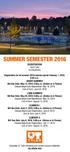 SUMMER SEMESTER 2016 REGISTRATION myuttyler my.uttyler.edu Registration for all summer 2016 sessions opens February 1, 2016; 8:30 a.m. SHORT SUMMER Bill Due Date: May 13, 2016; 5:00 p.m. (Online or in
Enrollment Guide. www.tri-c.edu/schedule. View credit class schedule ONLINE. Register for Spring/Summer 2015
 Enrollment Guide Spring/Summer 2015 View credit class schedule ONLINE www.tri-c.edu/schedule Register for Spring/Summer 2015 Spring Classes 2015 Full-Term Session: January 12 May 10 First 8-week Session
Rio Salado College Dual Enrollment Handbook
 Rio Salado College Dual Enrollment Handbook Welcome to Dual Enrollment at Rio Salado College Through dual enrollment, you can get a head start on college by earning college credits while you re still in
COLLEGE APPLICATION LINGO Need help understanding some of the vocabulary words used in the college application process? Here s a helpful list for you!
 Pride, Tradition & Courage COLLEGE APPLICATION LINGO Need help understanding some of the vocabulary words used in the college application process? Here s a helpful list for you! Academic Probation: If
Financial Aid Award Information Packet Table of Contents
 Financial Aid Award Information Packet Table of Contents How to Read Your Award Notification... 1 What is ROC?... 1 Do You Have to be Full-Time to Receive Financial Aid?... 1 Courses that Do Not Count
1. A Core 44 College Transfer Pathway leading to a minimum of 30 hours of college transfer credit, for qualifying high school juniors and seniors
 35 ADMISSIONS will be formulated by the dean of curriculum programs and approved by the president. The administration of the selective administrative rules and regulations adopted by the College becomes
Regulations for Military Student Success
 Regulations for Military Student Success This regulation provides a framework for the constituent institutions of the University of North Carolina to develop and maintain a comprehensive network of services
2015-2016 STEPS FOR ENROLLING
 2015-2016 STEPS FOR ENROLLING (1) GAIN ADMISSION q Complete Application for Admission online at www.pstcc.edu. q If your native language is not English, you will be required to demonstrate English proficiency.
Department of Computer Science Academic Policies
 Department of Computer Science Academic Policies Version 4 August 2008 This manual describes the academic policies for the Master of Science Degree in Computer Science, Master of Science Degree in Computer
SURGICAL TECHNOLOGY PROGRAM
 SURGICAL TECHNOLOGY PROGRAM Admission Packet Criteria A GUIDED PATHWAY TO SUCCESS CENTRAL GEORGIA TECHNICAL COLLEGE Warner Robins Campus 80 Cohen Walker Drive, Warner Robins, GA 31088 (478)988-6850 Macon
AFFIRMATION OF COMMUNITY RESPONSIBILITY
 AFFIRMATION OF COMMUNITY RESPONSIBILITY Illinois College is committed to the development and welfare of every member of our community: students, faculty, staff, and administration. To achieve the working
LPN TO ADN TRANSITION NURSING
 LPN TO ADN TRANSITION NURSING ADMISSIONS REQUIREMENTS 2015 MISSION STATEMENT The LPN to ADN Transition program supports the mission of the North Carolina Community College System and the mission of Vance-Granville
WINSTON-SALEM STATE UNIVERSITY
 Template for NC Community College CAA students earning an AAS degree who are intersted in a RN-BSN Degree at WINSTON-SALEM STATE UNIVERSITY The Associate Degree in Nursing (ADN) is an applied degree thus
Strayer University Catalog 2014/2015 Spring 2015 Addendum March 16, 2015
 Strayer University Catalog 2014/ Spring Addendum Date Section Sub- Section Sub- Section II Campuses and Locations General Information General Information General Information Florida Ownership Principle
Dual Credit Dual Enrollment Handbook
 Neosho, Missouri www.crowder.edu Dual Credit Dual Enrollment Handbook Crowder College: Building a civil, serving, literate, learning community of responsible citizens. 1 Table of Contents Definition of
An academic adviser is a member of the college who helps and advises a student solely on academic matters.
 Accredited: Accredited refers to the recognition of an education institution by an official agency or professional associate as maintaining certain quality standards. Academic Adviser: An academic adviser
Building Blocks to a Baccalaureate Degree
 Building Blocks to a Baccalaureate Degree Smart Start The University of Delaware s Associate in Arts Program offers Delawareans all the strengths of a traditional Liberal Arts education and the prestige