
geology of THE AUSTRALIAN ALPS
|
|
|
- Ashlyn Bennett
- 10 years ago
- Views:
Transcription
1 of THE AUSTRALIAN ALPS Gorge in limestone: Clarke Gorge, Blue Waterholes, Kosciuszko National park. Geology is the study of the Earth, the rocks it is made of and the processes that shape its surface. Large scale geological processes formed the Alps, and rocks play an important role in producing different soil types and landforms, which in turn create distinctive ecosystems. The Australian Alps are the highest part of a larger entity, the Eastern Highlands of Australia, which runs the length of the east coast from northern Queensland to Victoria. The origin of the Alps is the same as that of the Eastern Highlands. Because the Australian Alps cover a large area, they display a wide range of rock types and a complex geological history spanning 520 million years. The events that formed the different rocks in the Alps, and the Alps landscapes, are described here in order from oldest to youngest. When talking geological history, we use the abbreviation Ma to mean million years ago. EDUCATION RESOURCE GEOLOGY 1/8

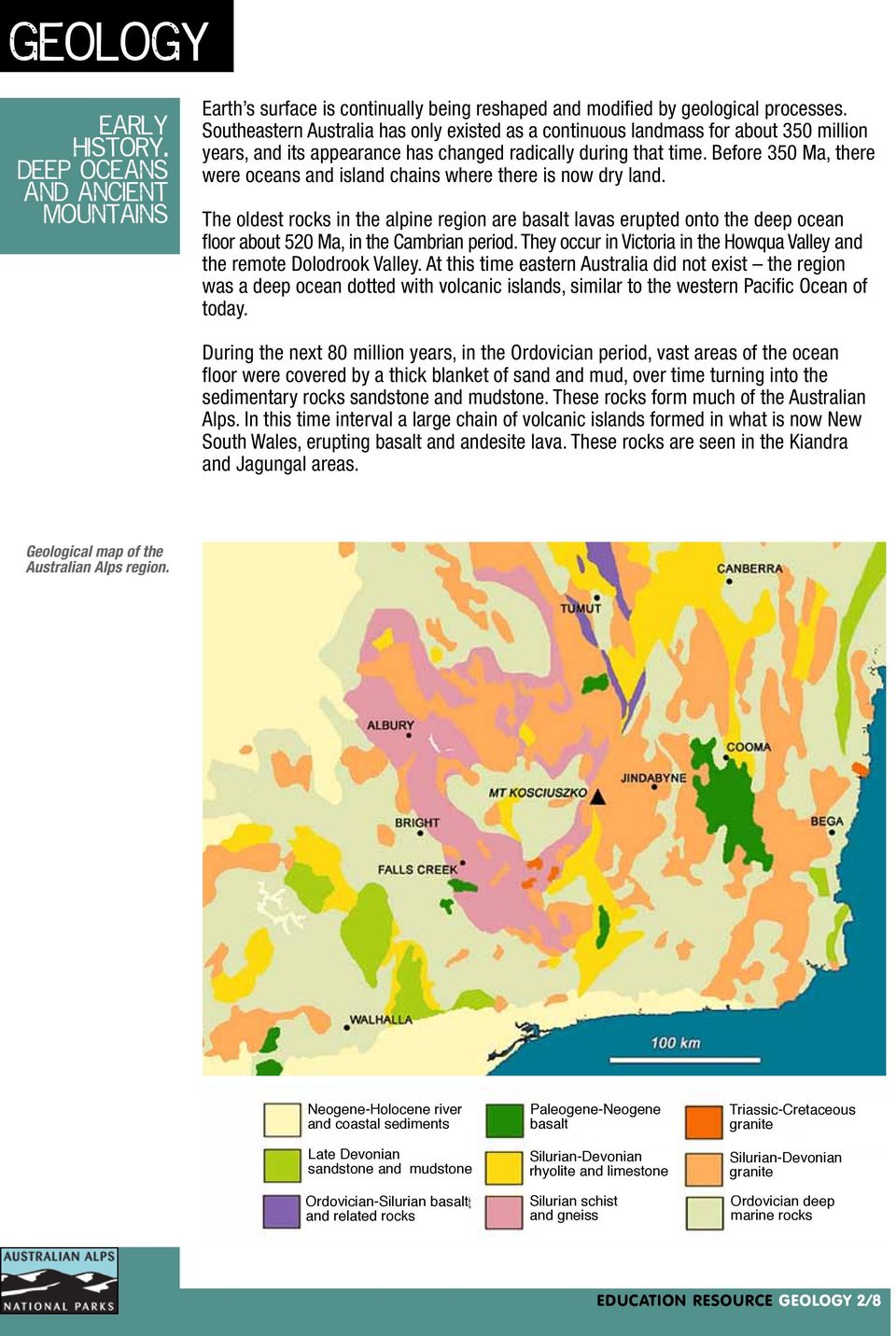
2 early history. deep oceans and ancient mountains Earth s surface is continually being reshaped and modified by geological processes. Southeastern Australia has only existed as a continuous landmass for about 350 million years, and its appearance has changed radically during that time. Before 350 Ma, there were oceans and island chains where there is now dry land. The oldest rocks in the alpine region are basalt lavas erupted onto the deep ocean floor about 520 Ma, in the Cambrian period. They occur in Victoria in the Howqua Valley and the remote Dolodrook Valley. At this time eastern Australia did not exist the region was a deep ocean dotted with volcanic islands, similar to the western Pacific Ocean of today. During the next 80 million years, in the Ordovician period, vast areas of the ocean floor were covered by a thick blanket of sand and mud, over time turning into the sedimentary rocks sandstone and mudstone. These rocks form much of the Australian Alps. In this time interval a large chain of volcanic islands formed in what is now New South Wales, erupting basalt and andesite lava. These rocks are seen in the Kiandra and Jagungal areas. Geological map of the Australian Alps region. Neogene-Holocene river and coastal sediments Late Devonian sandstone and mudstone Ordovician-Silurian basalt and related rocks Paleogene-Neogene basalt Silurian-Devonian rhyolite and limestone Silurian schist and gneiss Triassic-Cretaceous granite Silurian-Devonian granite Ordovician deep marine rocks EDUCATION RESOURCE GEOLOGY 2/8
3 From 440 to 360 Ma (the Silurian and Devonian periods) a series of mountain-building events folded the sedimentary and volcanic rocks, lifted them out of the sea to form land and moved blocks of crust tens to hundreds of kilometres along large faults. This was the result of collisions of several small tectonic plates, crumpling rocks together and thickening up the crust. In addition, some rocks were buried deep in the crust and heated, thereby becoming metamorphosed to produce rocks such as slate, schist and gneiss. Slate is common throughout the high country, with good examples at Mt Hotham and Mt Feathertop in Victoria. Schist and gneiss occur in the Victorian Alps around Mt Bogong, Falls Creek and Omeo. Some rocks were heated above 650º C, enough to melt them. The Cathedral on Mt Buffalo large granite tors. Also in the Silurian and Devonian, large bodies of granite were emplaced into the crust and huge volcanoes erupted ash and lava over the newly created land. Granite forms much of the high country, such as the Kosciuszko Plateau in NSW, the Bimberi and Clear Ranges in the ACT, and Mt Buffalo, Mt Baw Baw and Mt Wills in Victoria. Many granite bodies are resistant to erosion, and hence form plateaus and ridges with large blocks, or tors, of rock sticking up, while surrounding rocks are more susceptible to erosion and form lower country. Not all granites are resistant, however, and some are more recessive (i.e. more easily eroded) than the surrounding rocks, forming broad valleys as at Cudgewa-Thowgla and Ensay-Swifts Creek in Victoria. EDUCATION RESOURCE GEOLOGY 3/8

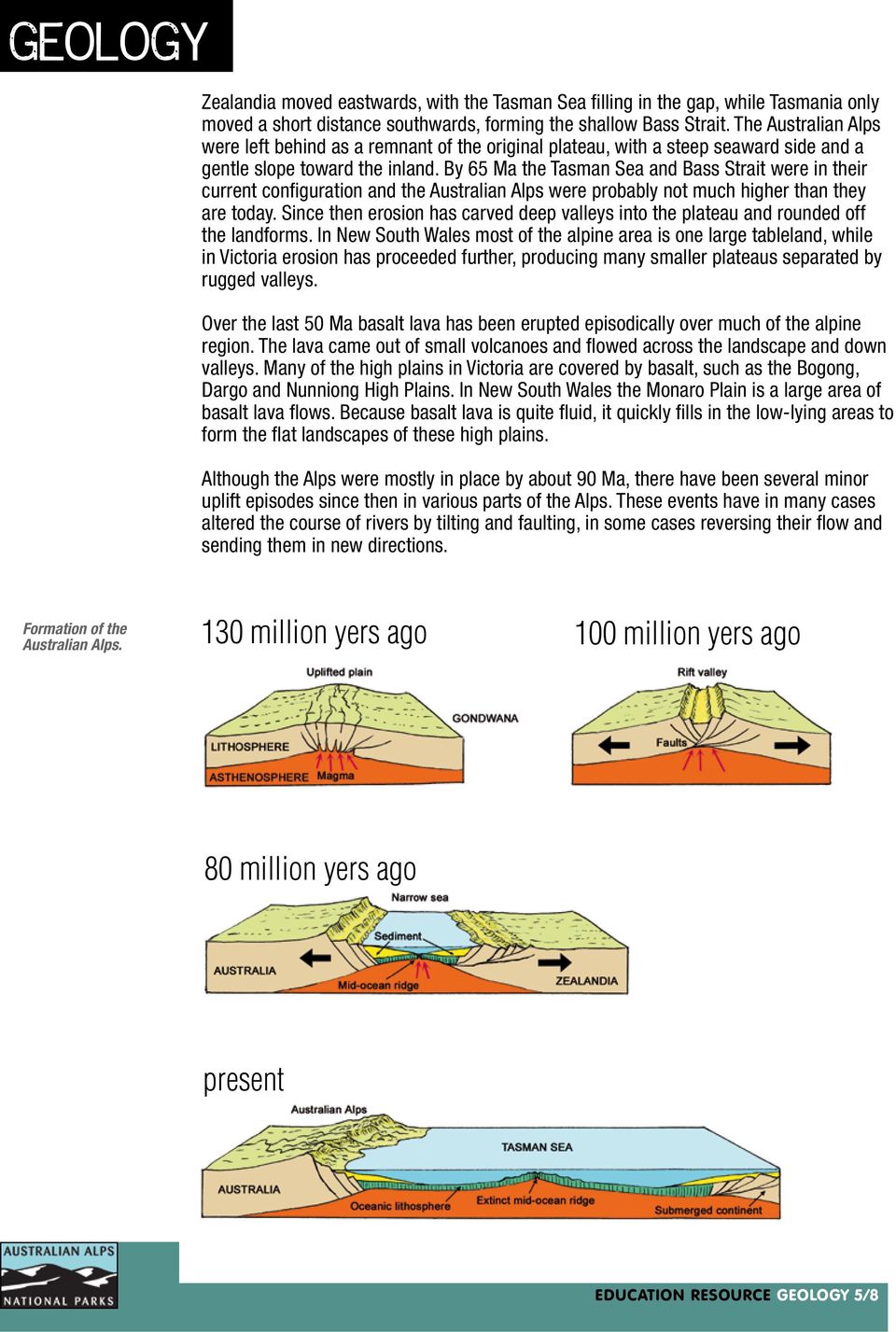
4 The volcanoes of the Silurian and Devonian periods were quite explosive, erupting towering clouds of hot volcanic ash which formed a rock known as ignimbrite. In Victoria this type of rock occurs at lake Mountain, Mt Donna Buang and the Snowy River area, while similar rocks occur around Lake Talbingo and along the Fiery Range in New South Wales. During the Silurian and Devonian periods the geography of southeastern Australia was complex, with small seas and large to small islands. Some islands developed coral reefs along their edges, which over time became limestone. This rock commonly has many fossils such as coral, shells and algae. Because limestone is soluble in slightly acidic groundwater, it easily dissolves to form caves and gorges, as seen at Yarrangobilly and Blue Water Holes in NSW, and Buchan in Victoria. By about 360 Ma much of southeastern Australia was a mountain range. Note that this range had nothing to do with the present-day Australian Alps, and was part of an ancient cycle of plate tectonic movements. Wide valleys within and adjacent to the mountains were filled with river and lake sediments, forming sandstone and mudstone with a distinctive reddish colour. They can be seen in Victoria in the high plateaus stretching from Mt Cobbler to the Avon Wilderness area. geologically quiet time After the last episode of folding, about 340 Ma, southeastern Australia entered a 200 million year period where not much happened, geologically speaking. Australia was part of the supercontinent of Gondwana, lying in the interior of the landmass. The mountain ranges were slowly worn down to a low-lying plain and very few rocks of this period are preserved in the alpine region. Around Ma the Earth entered a global ice age, and at this time Australia was close to the south pole. Ice sheets covered much of southern Australia, and glacial deposits are preserved outside the alpine region in Victoria and New South Wales. Any such deposits within the Australian Alps have been since eroded away. latest period. formation of the australian alps There is still debate about when the Australian Alps came into existence, with some geologists arguing that they arose only a few million years ago, while the majority argue that the Alps arose around Ma, based on evidence collected over the last 30 years. This account takes the majority view. About 130 Ma stirrings in the deep mantle began to break up eastern Gondwana. Australia began the long process of breaking away from Antarctica and Zealandia (a now largely submerged continent stretching from New Zealand to New Caledonia). The process began with magma moving upwards into the lithosphere, causing it to heat and expand upward, forming a dome-shaped plateau running along what is now the east coast of Australia. By 100 Ma the plateau was possibly over 2000 m high in its highest area, the site of today s Australian Alps. Gondwana split apart along this line of magma upwelling, and a rift valley formed along the centre of the plateau, with an east-west trending branch where Tasmania moved southward away from Victoria. The rift valley, similar to today s East African Rift Valley, was formed by stretching of the crust leading to the valley floor dropping along a series of faults. EDUCATION RESOURCE GEOLOGY4/8
5 Zealandia moved eastwards, with the Tasman Sea filling in the gap, while Tasmania only moved a short distance southwards, forming the shallow Bass Strait. The Australian Alps were left behind as a remnant of the original plateau, with a steep seaward side and a gentle slope toward the inland. By 65 Ma the Tasman Sea and Bass Strait were in their current configuration and the Australian Alps were probably not much higher than they are today. Since then erosion has carved deep valleys into the plateau and rounded off the landforms. In New South Wales most of the alpine area is one large tableland, while in Victoria erosion has proceeded further, producing many smaller plateaus separated by rugged valleys. Over the last 50 Ma basalt lava has been erupted episodically over much of the alpine region. The lava came out of small volcanoes and flowed across the landscape and down valleys. Many of the high plains in Victoria are covered by basalt, such as the Bogong, Dargo and Nunniong High Plains. In New South Wales the Monaro Plain is a large area of basalt lava flows. Because basalt lava is quite fluid, it quickly fills in the low-lying areas to form the flat landscapes of these high plains. Although the Alps were mostly in place by about 90 Ma, there have been several minor uplift episodes since then in various parts of the Alps. These events have in many cases altered the course of rivers by tilting and faulting, in some cases reversing their flow and sending them in new directions. Formation of the Australian Alps. 130 million yers ago 100 million yers ago 80 million yers ago present EDUCATION RESOURCE GEOLOGY 5/8
6 The pleistocene ice age Most of the last 2 million years have been a time of global ice age, with ice caps forming on high ranges around the world, as well as at the poles. This cold period is known to geologists as the Pleistocene epoch. Because the Australian Alps are only of modest height, the highest point being Mt Kosciuszko at 2228 m, glaciers were formed only on the very highest parts (above 2000 m) in the vicinity of Mt Kosciuszko. Several tarns and cirques remain: these result from glaciers scooping out hollows in the ground. Examples of tarns, which filled the bottom of cirques after the ice melted about 12,000 years ago, are Club Lake, Blue Lake and Hedley Tarn. Some of the small valleys near Mt Kosciuszko have the U-shaped cross section typical of valleys carved by glaciers. Much of the Australian Alps outside the small glaciated area was still affected by cold conditions during the Pleistocene, indicated by periglacial features such as block streams, terracing and frost-shattered boulders. These features all require ice to be present in rocks and soil for much of the time. Are the Australian Alps geologically unique? The shape of the Australian Alps is quite different to that of the more famous mountain ranges such as the European Alps or the Himalayas. Those mountains contain many sharp peaks and deep glacial valleys. In contrast, the skyline of the Australian Alps is rather flat and rounded. It is often said that this is because the Australian Alps are much older than the European Alps and Himalayas, and erosion over time has worn them down. However this is only a small part of the answer. There are two main reasons the Australian Alps are flat and smooth. Firstly, they originated by a different plate tectonic process, continental splitting, rather than continental collision which formed the European Alps and the Himalayas. Uplift in continental collisions is much faster and often of greater magnitude than the slow process of uplift during continental splitting. Secondly, the Australian Alps were never high enough to have large ice sheets and glaciers, and it is the erosion by ice that produces the sharp and jagged peaks of the Himalayas and European Alps. Does this then make the Australian Alps geologically unique? The answer is no, as around the world there are many mountain ranges formed in the same way as the Australian Alps (and the Eastern Highlands in general), such as the Drakensburg in South Africa, the Western Ghats in India and the mountains of Norway. And to see how our Alps Eastern Highlands may have looked at about 70 Ma, we can study the mountains on each side of the Red Sea. Even though quite young, the Red Sea mountains have a similar topography to the Australian Alps, with large plateaus dropping steeply to the sea. However, erosion has not had time to round off their shapes. EDUCATION RESOURCE GEOLOGY 6/8
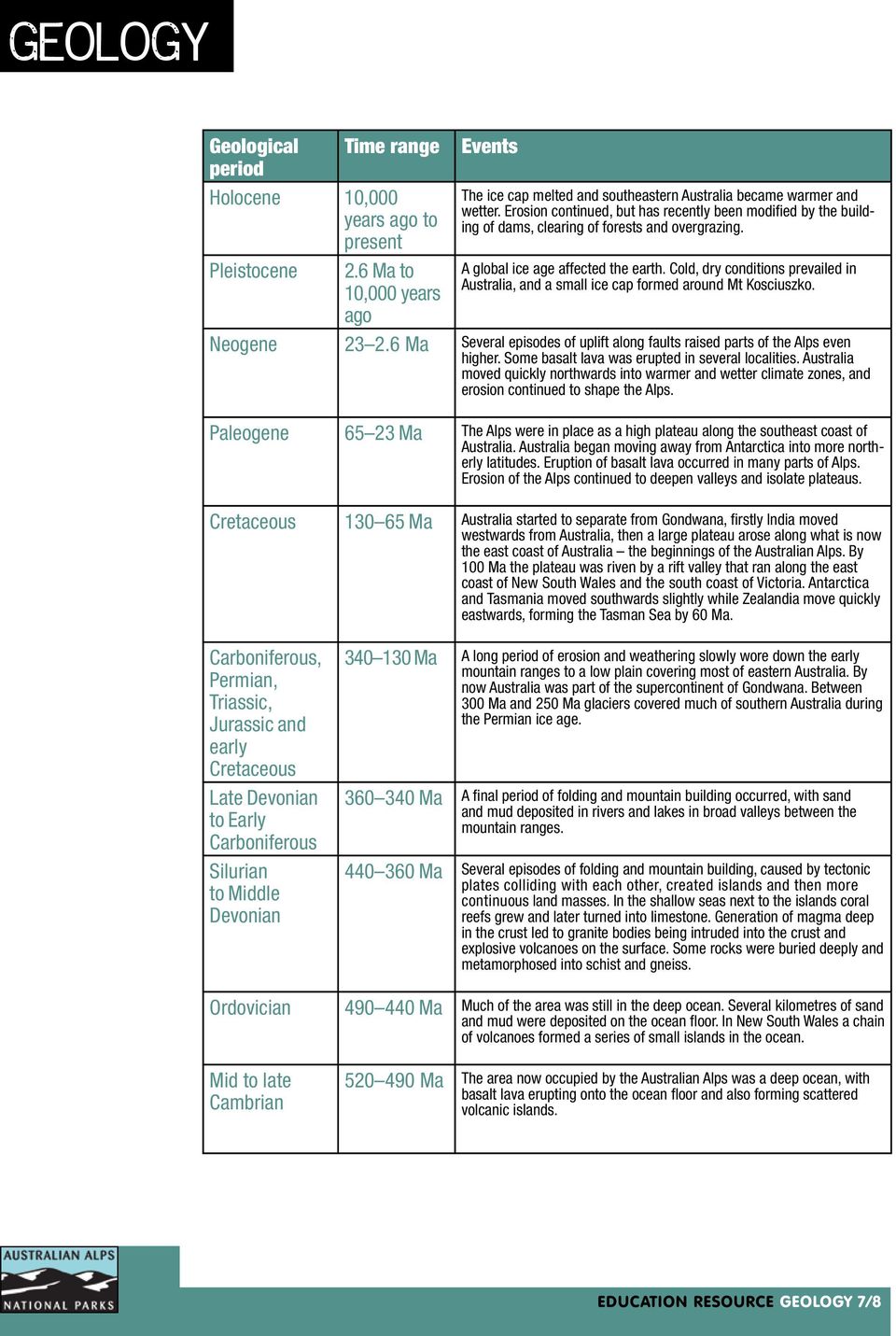
7 Geological Time range period Holocene 10,000 years ago to present Pleistocene 2.6 Ma to 10,000 years ago Events The ice cap melted and southeastern Australia became warmer and wetter. Erosion continued, but has recently been modified by the building of dams, clearing of forests and overgrazing. A global ice age affected the earth. Cold, dry conditions prevailed in Australia, and a small ice cap formed around Mt Kosciuszko. Neogene Ma Several episodes of uplift along faults raised parts of the Alps even higher. Some basalt lava was erupted in several localities. Australia moved quickly northwards into warmer and wetter climate zones, and erosion continued to shape the Alps. Paleogene Ma The Alps were in place as a high plateau along the southeast coast of Australia. Australia began moving away from Antarctica into more northerly latitudes. Eruption of basalt lava occurred in many parts of Alps. Erosion of the Alps continued to deepen valleys and isolate plateaus. Cretaceous Ma Australia started to separate from Gondwana, firstly India moved westwards from Australia, then a large plateau arose along what is now the east coast of Australia the beginnings of the Australian Alps. By 100 Ma the plateau was riven by a rift valley that ran along the east coast of New South Wales and the south coast of Victoria. Antarctica and Tasmania moved southwards slightly while Zealandia move quickly eastwards, forming the Tasman Sea by 60 Ma. Carboniferous, Permian, Triassic, Jurassic and early Cretaceous Late Devonian to Early Carboniferous Silurian to Middle Devonian Ma A long period of erosion and weathering slowly wore down the early mountain ranges to a low plain covering most of eastern Australia. By now Australia was part of the supercontinent of Gondwana. Between 300 Ma and 250 Ma glaciers covered much of southern Australia during the Permian ice age Ma A final period of folding and mountain building occurred, with sand and mud deposited in rivers and lakes in broad valleys between the mountain ranges Ma Several episodes of folding and mountain building, caused by tectonic plates colliding with each other, created islands and then more continuous land masses. In the shallow seas next to the islands coral reefs grew and later turned into limestone. Generation of magma deep in the crust led to granite bodies being intruded into the crust and explosive volcanoes on the surface. Some rocks were buried deeply and metamorphosed into schist and gneiss. Ordovician Ma Much of the area was still in the deep ocean. Several kilometres of sand and mud were deposited on the ocean floor. In New South Wales a chain of volcanoes formed a series of small islands in the ocean. Mid to late Cambrian Ma The area now occupied by the Australian Alps was a deep ocean, with basalt lava erupting onto the ocean floor and also forming scattered volcanic islands. EDUCATION RESOURCE GEOLOGY 7/8
8 References Birch W.D. (ed.). (2003). The Geology of Victoria. Geological Society of Australia (Victorian Division), Sydney. Branagan D. F. and Packham G. H. (2000) Field Geology of New South Wales, 3rd edn, NSW Department of Mineral Resources, Sydney. Johnson D. P. (2009) The Geology of Australia, 2nd edn, Cambridge University Press, Cambridge. Scheibner E. and Basden H. (ed.) Geology of New South Wales. Volume 2 Geological Evolution. Geological Survey of New South Wales Memoir 13. Department of Mineral Resources. VandenBerg A.H.M. (2010). Paleogene basalts prove early uplift of Victoria s Eastern uplands. Australian Journal of Earth Sciences 57, Web sites: Geological history of Victoria: Poster of Australia through time: Glossary andesite: a black or dark green volcanic rock with intermediate amounts of silicon. basalt: a black volcanic rock with low silicon and high magnesium and iron. block stream: a river or field of rocks that have moved downhill as a mass, held together by ice forming between the blocks. cirque: a bowl-shaped depression formed at the head of a glacier by the scraping action of the ice. crust: the uppermost layer of Earth. Crust forming the continents is 30 to 70 km thick; crust forming the ocean floor is 5 to 7 km thick. gneiss: a layered metamorphic rock formed at high temperatures (> 600º C). Gondwana: the supercontinent consisting of Australia, Antarctica, New Zealand, India, Africa and South America. It was assembled over the period 500 Ma to 200 Ma, and began to break up into fragments about 180 Ma. Australia was one of the last fragments to separate. granite: a common igneous rock formed at depth in the crust, consisting of interlocking crystals of quartz and feldspar and minor dark coloured minerals. Commonly forms large rounded tors. ignimbrite: a volcanic rock of high silicon content formed by hot ash accumulating around a volcano during an explosive eruption; generally whitish with small crystals of quartz and/or feldspar. lava: magma that has erupted onto the Earth s surface. limestone: a sedimentary rock composed of calcium carbonate, formed by the accumulation of animal shells, coral and other biological matter. lithosphere: the outer rigid layer of Earth, consisting of the crust and the uppermost mantle. magma: molten rock, often containing solid crystals. When magma solidifies, it forms an igneous rock. metamorphism: changes in the mineral make-up and structure of a rock due to the application of heat and/or pressure. Temperature increases with depth in the Earth, so rocks buried deeply get hot as well as being put under immense pressure from the weight of the overlying rocks. periglacial: pertaining to areas that were not covered by glaciers, but underwent geomorphic processes related to the freezing of water. plate tectonics: the formation of large structures on the Earth, such as continents, oceans and mountain ranges, by the movement of large rigid blocks (plates) of lithosphere over the Earth s surface at rates of a few cm per year. Plates may move toward or away from each other, or slide past east each other, each type of movement creating different structures. rift valley: a large valley bounded by faults and formed by stretching apart of the continental crust; often the first stage in the development of a new ocean. mantle: the largest part of the Earth, immediately below the crust and extending down to 2900 km depth; composed of dense minerals rich in magnesium and iron. schist: a metamorphic rock containing a large proportion of aligned mica minerals which give it a sparking sheen. sedimentary rock: rock formed by the accumulation of sediment, such as sand grains, clay particles, pebbles, chemical precipitates, or by the accumulation of biologically produced material. slate: a fine-grained metamorphic rock formed at relatively low temperature (250º - 450º C), and characterised by an alignment of microscopic platy minerals which cause the rock split along parallel planes known as cleavage planes. tarn: a small lake filling the bottom of a cirque; also known as a cirque lake. tectonic plates: parts of the lithosphere that move relative to each other; typically thousands of kilometres across. terracing: steps formed on hill sides by mass movement of ice- and water-saturated soil down-slope A U S T R A L I A N A L P S TRADITIONAL OWNERS A NATIONAL HERITAGE LISTED SITE EDUCATION RESOURCE GEOLOGY 8/8
Rocks & Minerals. 10. Which rock type is most likely to be monomineralic? 1) rock salt 3) basalt 2) rhyolite 4) conglomerate
 1. Of the Earth's more than 2,000 identified minerals, only a small number are commonly found in rocks. This fact indicates that most 1) minerals weather before they can be identified 2) minerals have
Regents Questions: Plate Tectonics
 Earth Science Regents Questions: Plate Tectonics Name: Date: Period: August 2013 Due Date: 17 Compared to the oceanic crust, the continental crust is (1) less dense and more basaltic (3) more dense and
Rocks and Plate Tectonics
 Name: Class: _ Date: _ Rocks and Plate Tectonics Multiple Choice Identify the choice that best completes the statement or answers the question. 1. What is a naturally occurring, solid mass of mineral or
Geologic History Review
 1. The climate that existed in an area during the early Paleozoic Era can best be determined by studying (1) the present climate of the area (2) recorded climate data of the area since 1700 (3) present
The Geology of the Marginal Way, Ogunquit, Maine
 Geologic Site of the Month February, 2002 The Geology of the Marginal Way, Ogunquit, Maine 43 14 23.88 N, 70 35 18.36 W Text by Arthur M. Hussey II, Bowdoin College and Robert G. Marvinney,, Department
WEATHERING, EROSION, AND DEPOSITION PRACTICE TEST. Which graph best shows the relative stream velocities across the stream from A to B?
 NAME DATE WEATHERING, EROSION, AND DEPOSITION PRACTICE TEST 1. The diagram below shows a meandering stream. Measurements of stream velocity were taken along straight line AB. Which graph best shows the
1. The diagram below shows a cross section of sedimentary rock layers.
 1. The diagram below shows a cross section of sedimentary rock layers. Which statement about the deposition of the sediments best explains why these layers have the curved shape shown? 1) Sediments were
The rock cycle. Introduction. What are rocks?
 The rock cycle This Revision looks at the three types of rock: sedimentary, igneous and metamorphic. It looks at how they are formed, the weathering of rocks and the way one form of rock turns into another,
Continents join together and split apart.
 KEY CONCEPT Continents change position over time. BEFORE, you learned Earth s main layers are the core, the mantle, and the crust The lithosphere and asthenosphere are the topmost layers of Earth The lithosphere
ES Chapter 10 Review. Name: Class: Date: Multiple Choice Identify the choice that best completes the statement or answers the question.
 Name: Class: Date: ES Chapter 10 Review Multiple Choice Identify the choice that best completes the statement or answers the question. 1. Scientists used the pattern of alternating normal and reversed
How Did These Ocean Features and Continental Margins Form?
 298 10.14 INVESTIGATION How Did These Ocean Features and Continental Margins Form? The terrain below contains various features on the seafloor, as well as parts of three continents. Some general observations
Alfred Wegener s Theory of Continental Drift Became Modern Plate Tectonics. Wegener in Greenland about 1912. He froze to death there in 1930.
 Alfred Wegener s Theory of Continental Drift Became Modern Plate Tectonics Wegener in Greenland about 1912. He froze to death there in 1930. Science is self correcting. The Scientific Method The history
Geol 101: Physical Geology PAST EXAM QUESTIONS LECTURE 4: PLATE TECTONICS II
 Geol 101: Physical Geology PAST EXAM QUESTIONS LECTURE 4: PLATE TECTONICS II 4. Which of the following statements about paleomagnetism at spreading ridges is FALSE? A. there is a clear pattern of paleomagnetic
Ride the Rock Cycle. Suggested Goals: Students will gain an understanding of how a rock can move through the different stages of the rock cycle.
 Illinois State Museum Geology Online http://geologyonline.museum.state.il.us Ride the Rock Cycle Grade Level: 5 6 Purpose: To teach students that the rock cycle, like the water cycle, has various stages
Georgia Performance Standards Framework for Science Grade 6. Unit Organizer: Geology: Inside the Earth (Approximate Time: 7 Weeks)
 The following instructional plan is part of a GaDOE collection of Unit Frameworks, Performance Tasks, examples of Student Work, and Teacher Commentary. Many more GaDOE approved instructional plans are
TECTONICS ASSESSMENT
 Tectonics Assessment / 1 TECTONICS ASSESSMENT 1. Movement along plate boundaries produces A. tides. B. fronts. C. hurricanes. D. earthquakes. 2. Which of the following is TRUE about the movement of continents?
6.E.2.2 Plate Tectonics, Earthquakes and Volcanoes
 Name: Date: 1. The road shown below was suddenly broken by a natural event. 3. The convergence of two continental plates would produce Which natural event most likely caused the crack in the road? island
What is a rock? How are rocks classified? What does the texture of a rock reveal about how it was formed?
 CHAPTER 4 1 The Rock Cycle SECTION Rocks: Mineral Mixtures BEFORE YOU READ After you read this section, you should be able to answer these questions: What is a rock? How are rocks classified? What does
Plate Tectonics Short Study Guide
 Name: Class: Date: Plate Tectonics Short Study Guide Multiple Choice Identify the letter of the choice that best completes the statement or answers the question. 1. The existence of coal beds in Antarctica
Tectonic plates push together at convergent boundaries.
 KEY CONCEPT Plates converge or scrape past each other. BEFORE, you learned Plates move apart at divergent boundaries In the oceans, divergent boundaries mark where the sea floor spreads apart On land,
Chapter 8: Plate Tectonics -- Multi-format Test
 Name: Class: Date: ID: A Chapter 8: Plate Tectonics -- Multi-format Test Modified True/False Indicate whether the statement is true or false. If false, change the identified word or phrase to make the
Interactive Plate Tectonics
 Interactive Plate Tectonics Directions: Go to the following website and complete the questions below. http://www.learner.org/interactives/dynamicearth/index.html How do scientists learn about the interior
Igneous rocks formed when hot molten material (magma) cools and hardens (crystallizes).
 Objectives You will learn about how the land of North Dakota was formed. Introduction North Dakota is a wonderful place to live. Have you ever though about how it was formed? To answer that question, you
4. Plate Tectonics II (p. 46-67)
 4. Plate Tectonics II (p. 46-67) Seafloor Spreading In the early 1960s, samples of basaltic ocean crust were dredged up from various locations across the ocean basins. The samples were then analyzed to
Unit 4 Lesson 2 Plate Tectonics. Copyright Houghton Mifflin Harcourt Publishing Company
 Puzzling Evidence What evidence suggests that continents move? In the late 1800s, Alfred Wegener proposed his hypothesis of continental drift. According to this hypothesis, the continents once formed a
Earth Materials: Intro to rocks & Igneous rocks. The three major categories of rocks Fig 3.1 Understanding Earth
 Earth Materials: 1 The three major categories of rocks Fig 3.1 Understanding Earth 2 Intro to rocks & Igneous rocks Three main categories of rocks: Igneous Sedimentary Metamorphic The most common minerals
Earth Science Landforms, Weathering, and Erosion Reading Comprehension. Landforms, Weathering, and Erosion
 Reading Comprehension Name 1 How many people have been to the Rocky Mountains or the Grand Canyon? When people go to visit these natural wonders, they may not realize that it took millions of years for
Plate Tectonics. Earth, 9 th edition Chapter 2
 1 Plate Tectonics Earth, 9 th edition Chapter 2 2 3 4 5 6 7 8 9 10 11 12 13 14 15 16 Plate Tectonics: summary in haiku form Alfred Wegener gave us Continental Drift. Fifty years later... Continental Drift
Plate Tectonics Chapter 2
 Plate Tectonics Chapter 2 Does not include complete lecture notes. Continental drift: An idea before its time Alfred Wegener First proposed his continental drift hypothesis in 1915 Published The Origin
Lesson 13: Plate Tectonics I
 Standards Addressed Lesson 13: Plate Tectonics I Overview Lesson 13 introduces students to geological oceanography by presenting the basic structure of the Earth and the properties of Earth s primary layers.
Plate Tectonics Practice Questions and Answers Revised August 2007
 Plate Tectonics Practice Questions and Answers Revised August 2007 1. Please fill in the missing labels. 2. Please fill in the missing labels. 3. How many large plates form the outer shell of the earth?
Tectonic plates have different boundaries.
 KEY CONCEPT Plates move apart. BEFORE, you learned The continents join and break apart The sea floor provides evidence that tectonic plates move The theory of plate tectonics helps explain how the plates
Hot Spots & Plate Tectonics
 Hot Spots & Plate Tectonics Activity I: Hawaiian Islands Procedures: Use the map and the following information to determine the rate of motion of the Pacific Plate over the Hawaiian hot spot. The volcano
Lesson 3: The formation of mountains Factsheet for teachers
 Lesson 3: The formation of mountains Factsheet for teachers Vocabulary This lesson uses the following geographical terms. These should be used and explained to pupils as the lesson is taught. Core, mantle,
What are Rocks??? Rocks are the most common material on Earth. They are a naturally occurring collection of one or more minerals.
 The Rock Cycle What are Rocks??? Rocks are the most common material on Earth. They are a naturally occurring collection of one or more minerals. The Rock Cycle a cycle that continuously forms and changes
Earth Science Grade 4 Minerals
 Earth Science Grade 4 Minerals Standards: Identifies the physical properties of minerals Teacher Background Minerals are pure substances and mix together to make rocks. Rocks have a cycle and different
FOURTH GRADE PLATE TECTONICS 1 WEEK LESSON PLANS AND ACTIVITIES
 FOURTH GRADE PLATE TECTONICS 1 WEEK LESSON PLANS AND ACTIVITIES PLATE TECTONIC CYCLE OVERVIEW OF FOURTH GRADE VOLCANOES WEEK 1. PRE: Comparing different structures of volcanoes. LAB: Modeling three types
Continental Drift, Sea Floor Spreading and Plate Tectonics
 Page 1 of 13 EENS 1110 Tulane University Physical Geology Prof. Stephen A. Nelson Continental Drift, Sea Floor Spreading and Plate Tectonics This page last updated on 26-Aug-2015 Plate Tectonics is a theory
Rapid Changes in Earth s Surface
 TEKS investigate rapid changes in Earth s surface such as volcanic eruptions, earthquakes, and landslides Rapid Changes in Earth s Surface Constant Changes Earth s surface is constantly changing. Wind,
Earth Egg Model Teacher Notes
 Ancient Greeks tried to explain earthquakes and volcanic activity by saying that a massive bull lay underground and the land shook when it became angry. Modern theories rely on an understanding of what
1. You are about to begin a unit on geology. Can anyone tell me what geology is? The study of the physical earth I.
 PLATE TECTONICS ACTIVITY The purpose of this lab is to introduce the concept of plate tectonics and the formation of mountains. Students will discuss the properties of the earth s crust and plate tectonics.
Plate Tectonics. Hi, I am Zed and I am going to take you on a trip learning about Plate Tectonics. And I am Buddy Zed s mascot
 Plate Tectonics Hi, I am Zed and I am going to take you on a trip learning about Plate Tectonics And I am Buddy Zed s mascot Continental Drift Alfred Wegener proposed that continents were not always where
Continental Drift. Alfred Wegener (1880-1930) Proposed that all of the continents were once part of a large supercontinent - Pangaea Based on:
 Plate Tectonics and Continental Drift Continental Drift Alfred Wegener (1880-1930) Proposed that all of the continents were once part of a large supercontinent - Pangaea Based on: Similarities in shorelines
DYNAMIC CRUST: Unit 4 Exam Plate Tectonics and Earthquakes
 DYNAMIC CRUST: Unit 4 Exam Plate Tectonics and Earthquakes NAME: BLOCK: DATE: 1. Base your answer to the following question on The block diagram below shows the boundary between two tectonic plates. Which
Chesapeake Bay Governor School for Marine and Environmental Science
 Choose the best answer and write on the answer sheet provided. 1. Which of the following is LEAST likely to be an effect of global warming? (a) Loss of fertile delta regions for agriculture (b) Change
WEATHERING, EROSION, and DEPOSITION REVIEW
 WEATHERING, EROSION, and DEPOSITION REVIEW Weathering: The breaking up of rock from large particles to smaller particles. a) This Increases surface area of the rock which speeds the rate of chemical weathering.
Plate Tectonics. Introduction. Boundaries between crustal plates
 Plate Tectonics KEY WORDS: continental drift, seafloor spreading, plate tectonics, mid ocean ridge (MOR) system, spreading center, rise, divergent plate boundary, subduction zone, convergent plate boundary,
Unit 2 Lesson 4 The Geologic Time Scale. Copyright Houghton Mifflin Harcourt Publishing Company
 Once Upon a Time How have geologists described the rate of geologic change? Geology is the scientific study of the origin, history, and structure of Earth and the processes that shape it. Early geologists
Carbonate Rock Formation
 Limestone, dolomite (or dolostone), and marble are often collectively referred to as carbonate rocks because the main mineral is calcite. The chemical name of calcite is calcium carbonate. Limestone, dolomite,
Earthquakes and Plate Boundaries Deborah Jordan and Samuel Spiegel
 Earthquakes and Plate Boundaries Deborah Jordan and Samuel Spiegel Jordan, Deborah and Spiegel, Samuel: Learning Research Development Center, University of Pittsburgh. Earthquakes and Plate Boundaries.
Plate Tectonics Web-Quest
 Plate Tectonics Web-Quest Part I: Earth s Structure. Use the following link to find these answers: http://www.learner.org/interactives/dynamicearth/structure.html 1. Label the layers of Earth in the diagram
Metamorphic rocks are rocks changed from one form to another by intense heat, intense pressure, and/or the action of hot fluids.
 Metamorphic Rocks, Processes, and Resources Metamorphic rocks are rocks changed from one form to another by intense heat, intense pressure, and/or the action of hot fluids. Protolith or parent rock is
Climate, Vegetation, and Landforms
 Climate, Vegetation, and Landforms Definitions Climate is the average weather of a place over many years Geographers discuss five broad types of climates Moderate, dry, tropical, continental, polar Vegetation:
The Dynamic Crust 2) EVIDENCE FOR CRUSTAL MOVEMENT
 The Dynamic Crust 1) Virtually everything you need to know about the interior of the earth can be found on page 10 of your reference tables. Take the time to become familiar with page 10 and everything
There are numerous seams on the surface of the Earth
 Plate Tectonics and Continental Drift There are numerous seams on the surface of the Earth Questions and Topics 1. What are the theories of Plate Tectonics and Continental Drift? 2. What is the evidence
1. Michigan Geological History Presentation (Michigan Natural Resources)
 1. Michigan Geological History Presentation (Michigan Natural Resources) The Michigan Geological History Presentation provides an overview of the approximately 3 billion years of Earth Processes that the
Geologic Time Scale Notes
 Name: Date: Period: 1 2 3 4 5 6 7 Notes Essential Question: What is the geologic time scale? Vocabulary: Geology: the scientific study of the origin, history, and structure of Earth and the processes that
Rocks and Minerals What is right under your feet?
 Rocks and Minerals What is right under your feet? Name: 1 Before you start What do you already know? What is the difference between a rock and a mineral? What are the three categories of rocks? 1. 2. 3.
1. Base your answer to the following question on on the photographs and news article below. Old Man s Loss Felt in New Hampshire
 UNIT 3 EXAM ROCKS AND MINERALS NAME: BLOCK: DATE: 1. Base your answer to the following question on on the photographs and news article below. Old Man s Loss Felt in New Hampshire FRANCONIA, N.H. Crowds
Earth Science Chapter 14 Section 2 Review
 Name: Class: Date: Earth Science Chapter 14 Section Review Multiple Choice Identify the choice that best completes the statement or answers the question. 1. Which of the following is NOT one of the three
Rocks & Minerals 1 Mark Place, www.learnearthscience.com
 Name: KEY Rocks & Minerals 1 KEY CONCEPT #1: What is a mineral? It is a naturally occurring, inorganic substance which has a definite chemical composition What would be the opposite of this? man-made,
Fourth Grade Geology: The Earth and Its Changes Assessment
 Fourth Grade Geology: The Earth and Its Changes Assessment 1a. What is the center layer of the Earth called? a. crust b. core c. mantle d. middle 1b. Label each layer of the Earth. 1c. What are the Earth
7) A clastic sedimentary rock composed of rounded to subrounded gravel is called a A) coal. B) shale. C) breccia.
 Please read chapters 10 and 5 CHAPTER 5 Sedimentary Rocks 1) Sedimentary rocks A) form by compaction and cementation of loose sediment. B) are widespread on the continents and ocean floor. C) are common
FROM SEDIMENT INTO SEDIMENTARY ROCK. Objectives. Sediments and Sedimentation
 FROM SEDIMENT INTO SEDIMENTARY ROCK Objectives Identify three types of sediments. Explain where and how chemical and biogenic sediments form. Explain three processes that lead to the lithification of sediments.
SECOND GRADE ROCKS 1 WEEK LESSON PLANS AND ACTIVITIES
 SECOND GRADE ROCKS 1 WEEK LESSON PLANS AND ACTIVITIES ROCK CYCLE OVERVIEW OF SECOND GRADE CHEMISTRY WEEK 1. PRE: Comparing the states of matter. LAB: Observing the elements on the periodic table. POST:
Step 2: Learn where the nearest divergent boundaries are located.
 What happens when plates diverge? Plates spread apart, or diverge, from each other at divergent boundaries. At these boundaries new ocean crust is added to the Earth s surface and ocean basins are created.
The Ice Age By: Sue Peterson
 www.k5learning.com Objective sight words (pulses, intermittent, isotopes, chronicle, methane, tectonic plates, volcanism, configurations, land-locked, erratic); concepts (geological evidence and specific
SECOND GRADE PLATE TECTONICS 1 WEEK LESSON PLANS AND ACTIVITIES
 SECOND GRADE PLATE TECTONICS 1 WEEK LESSON PLANS AND ACTIVITIES PLATE TECTONIC CYCLE OVERVIEW OF SECOND GRADE VOLCANOES WEEK 1. PRE: Investigating the parts of a volcano. LAB: Comparing the parts of a
Plate tectonics states that the Earth's crust and upper mantle are broken into sections, called plates.
 Notes on Plate Tectonics Plate tectonics states that the Earth's crust and upper mantle are broken into sections, called plates. These plates move around the mantle. Plates are composed of the crust and
2 Wind Erosion and Deposition
 CHAPTER 3 2 Wind Erosion and Deposition SECTION Agents of Erosion and Deposition BEFORE YOU READ After you read this section, you should be able to answer these questions: How can wind erosion shape the
Unit 4: The Rock Cycle
 Unit 4: The Rock Cycle Objective: E 3.1A Discriminate between igneous, metamorphic, and sedimentary rocks and describe the processes that change one kind of rock into another. E 3.1B Explain the relationship
II. Earth Science (Geology) Section (9/18/2013)
 EAPS 100 Planet Earth Lecture Topics Brief Outlines II. Earth Science (Geology) Section (9/18/2013) 1. Interior of the Earth Learning objectives: Understand the structure of the Earth s interior crust,
Investigation 6: What happens when plates collide?
 Tectonics Investigation 6: Teacher Guide Investigation 6: What happens when plates collide? In this activity, students will use the distribution of earthquakes and volcanoes in a Web GIS to learn about
All sediments have a source or provenance, a place or number of places of origin where they were produced.
 Sedimentary Rocks, Processes, and Environments Sediments are loose grains and chemical residues of earth materials, which include things such as rock fragments, mineral grains, part of plants or animals,
[Geology Layers of the Earth] [Basic: Grade 2-3] [Advanced: Grade 5: Introduction to Plate Tectonics}
![[Geology Layers of the Earth] [Basic: Grade 2-3] [Advanced: Grade 5: Introduction to Plate Tectonics}](/thumbs/40/21755359.jpg "[Geology Layers of the Earth] [Basic: Grade 2-3] [Advanced: Grade 5: Introduction to Plate Tectonics}") [Geology Layers of the Earth] [Basic: Grade 2-3] [Advanced: Grade 5: Introduction to Plate Tectonics} BACKGROUND Scientists and geologists have been able to do some drilling on Earth. They are also able
[Geology Layers of the Earth] [Basic: Grade 2-3] [Advanced: Grade 5: Introduction to Plate Tectonics} BACKGROUND Scientists and geologists have been able to do some drilling on Earth. They are also able
Weathering, Erosion, and Soils. Weathering and Erosion. Weathering and Erosion
 Weathering, Erosion, and Soils 1 The Grand Canyon, a landscape shaped by weathering and erosion 2 Weathering vs. erosion Types of weathering Physical Chemical Rates of weathering and erosion Climate Rock
Name: Rocks & Minerals 1 Mark Place, www.learnearthscience.com
 Name: Rocks & Minerals 1 KEY CONCEPT #1: What is a mineral? It is a, substance which has a What would be the opposite of this? KEY CONCEPT #2: What causes minerals to have different physical properties?
LANDFORMS OF THE EARTH STD VIII
 LANDFORMS OF THE EARTH STD VIII 1) What do you understand by the term geomorphology? A) Geomorphology is the systematic study of the Earth s relief features. Geo means earth; morph meaning form and ology
What are the controls for calcium carbonate distribution in marine sediments?
 Lecture 14 Marine Sediments (1) The CCD is: (a) the depth at which no carbonate secreting organisms can live (b) the depth at which seawater is supersaturated with respect to calcite (c) the depth at which
Plate Tectonics: Big Ideas. Plate Tectonics. Plate Tectonics. The unifying concept of the Earth sciences.
 Plate Tectonics: Big Ideas Our understanding of Earth is continuously refined. Earth s systems are dynamic; they continually react to changing influences from geological, hydrological, physical, chemical,
Three Main Types of Rocks Igneous Rocks. Sedimentary Rocks Metamorphic Rocks. Made by Liesl at The Homeschool Den
 Three Main Types of Rocks Igneous Rocks Sedimentary Rocks Metamorphic Rocks Igneous Rocks Above and below: Basalt Above: Gabbro Above: Pumice Above: Basalt, Giant Causeway in Ireland Above: Obsidian Above:
The concepts developed in this standard include the following: Oceans cover about 70% of the surface of the Earth.
 Name Date Grade 5 SOL 5.6 Review Oceans Made by SOLpass - www.solpass.org [email protected] Reproduction is permitted for SOLpass subscribers only. The concepts developed in this standard include
Unit 5: Formation of the Earth
 Unit 5: Formation of the Earth Objectives: E5.3B - Explain the process of radioactive decay and explain how radioactive elements are used to date the rocks that contain them. E5.3C - Relate major events
not to be republished NCERT MAJOR LANDFORMS OF THE EARTH
 6 You must have seen some of the landform features as shown in the Figure 6.1 below. You will notice that the surface of the earth is not the same everywhere. The earth has an infinite variety of landforms.
Transform Boundaries
 Lecture 7 Plates and Mantle Plumes Transform Boundaries Transform boundaries occur where one segment of rigid lithosphere slides horizontally past another in response to stresses in the lithosphere. The
NATURAL REGIONS OF KENTUCKY
 NATURAL WONDERS As you travel around Kentucky taking pictures, you are excited by what you see. Kentucky offers diverse and amazing sights. The Six Regions In the West, you see the Mississippi River, the
SIXTH GRADE PLATE TECTONICS 1 WEEK LESSON PLANS AND ACTIVITIES
 SIXTH GRADE PLATE TECTONICS 1 WEEK LESSON PLANS AND ACTIVITIES PLATE TECTONIC CYCLE OVERVIEW OF SIXTH GRADE VOLCANOES WEEK 1. PRE: Comparing the structure of different types of volcanoes. LAB: Plotting
Unit 6 Earthquakes and Volcanoes
 Unit 6 Earthquakes and Volcanoes Earthquakes and Volcanoes: Essential Questions What evidence can students observe that the Earth is changing? How do scientists know what s inside the Earth? What processes
Unit Plan: Plate Tectonics Shannon B. Carpenter TE 804 1/25/02
 Unit Plan: Plate Tectonics Shannon B. Carpenter TE 804 1/25/02 This unit plan is intended to cover about seven weeks and would be appropriate for a middle school general science class or an introductory
Plate Tectonics: Ridges, Transform Faults and Subduction Zones
 Plate Tectonics: Ridges, Transform Faults and Subduction Zones Goals of this exercise: 1. review the major physiographic features of the ocean basins 2. investigate the creation of oceanic crust at mid-ocean
1 Exploring Earth s Interior
 1 Exploring Earth s Interior Crust Mantle Outer Core Crust-to-Mantle Inner Core Cross Section From Surface to Center SCIENCE EXPLORER Focus on Earth Science Prentice-Hall, Inc. 2 Evidence for Continental
Using Google Earth to Explore Plate Tectonics
 Using Google Earth to Explore Plate Tectonics Laurel Goodell, Department of Geosciences, Princeton University, Princeton, NJ 08544 [email protected] Inspired by, and borrows from, the GIS-based Exploring
CHAPTER 6 THE TERRESTRIAL PLANETS
 CHAPTER 6 THE TERRESTRIAL PLANETS MULTIPLE CHOICE 1. Which of the following is NOT one of the four stages in the development of a terrestrial planet? 2. That Earth, evidence that Earth differentiated.
College of Science and Health ENVIRONMENTAL SCIENCE & GEOGRAPHY Course Outline
 College of Science and Health ENVIRONMENTAL SCIENCE & GEOGRAPHY Course Outline 1. TITLE OF COURSE AND COURSE NUMBER: General Geology ENV 115, 4 credits 2. DESCRIPTION OF THE COURSE: Includes the study
11A Plate Tectonics. What is plate tectonics? Setting up. Materials
 11A Plate Tectonics What is plate tectonics? Earth s crust plus the upper mantle forms the lithosphere. Earth s lithosphere is broken in a number of different pieces. How these pieces move and interact
Glossary. continental crust: the sections of crust, the outermost layer of the earth, that include the continents
 aftershock: an earthquake that follows a larger earthquake or main shock and originates in or near the rupture zone of the larger earthquake. Generally, major earthquakes are followed by a number of aftershocks
Volcano in the lab: a wax volcano in action: teacher s notes
 Volcano in the lab: a wax volcano in action: teacher s notes Level This activity is designed for students aged 11-14, as a simple demonstration of igneous activity. English National Curriculum reference
The Earth System. The geosphere is the solid Earth that includes the continental and oceanic crust as well as the various layers of Earth s interior.
 The Earth System The atmosphere is the gaseous envelope that surrounds Earth. It consists of a mixture of gases composed primarily of nitrogen, oxygen, carbon dioxide, and water vapor. The atmosphere and
This is a map of a river and its tributaries
 Notes prepared by Peter d Auvergne, Senior Project Geologist, Lihir Gold Ballarat, October 2009 1 A hydrological map showing watercourses (blue indicafng that they are flowing). The slide is the start