
ÇANKAYA UNIVERSITY Faculty of Engineering and Architecture
|
|
|
- Kelley Preston
- 10 years ago
- Views:
Transcription
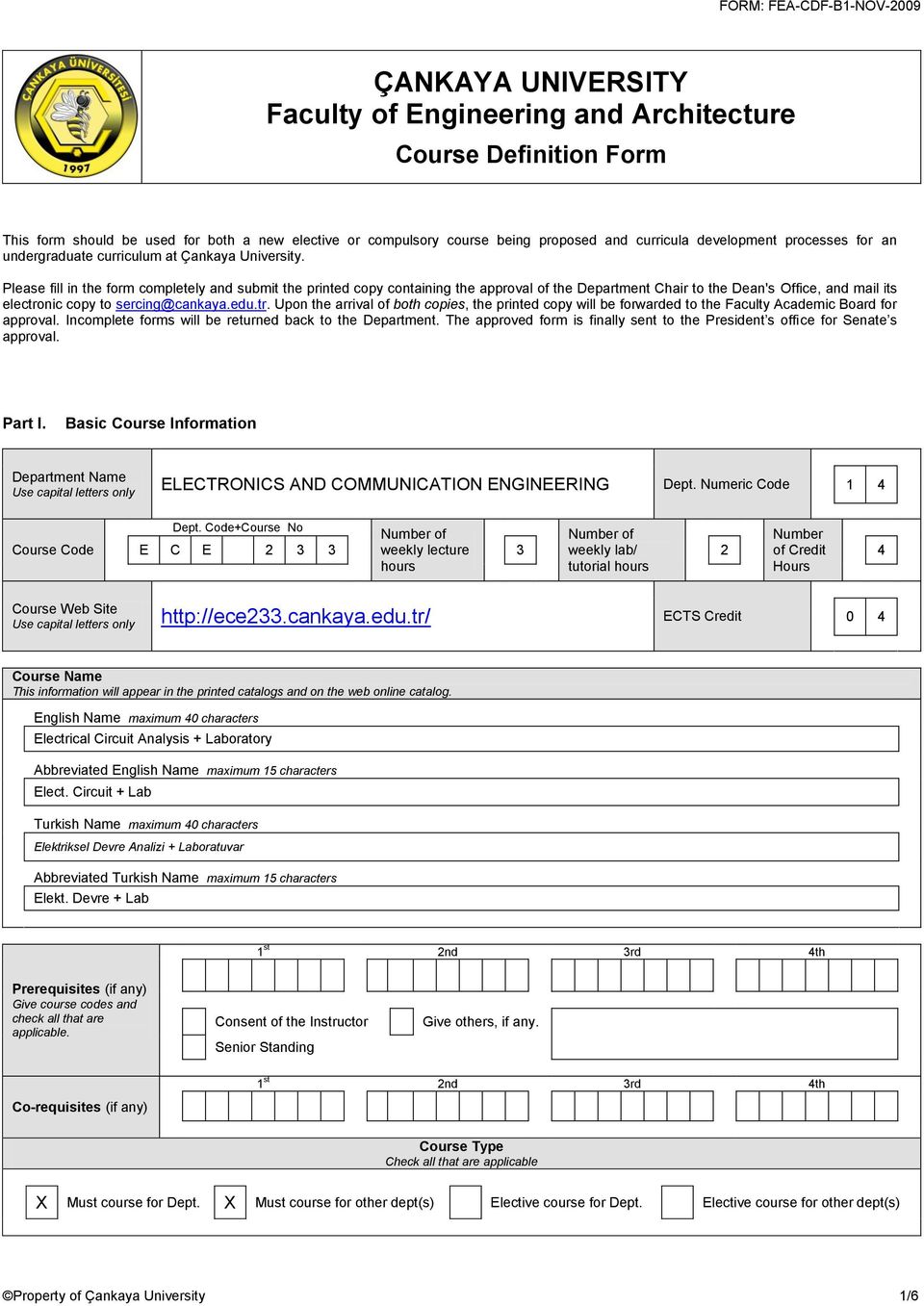
1 ÇANKAYA UNIVERSITY Faculty of Engineering and Architecture Course Definition Form This form should be used for both a new elective or compulsory course being proposed and curricula development processes for an undergraduate curriculum at Çankaya University. Please fill in the form completely and submit the printed copy containing the approval of the Department Chair to the Dean's Office, and mail its electronic copy to [email protected]. Upon the arrival of both copies, the printed copy will be forwarded to the Faculty Academic Board for approval. Incomplete forms will be returned back to the Department. The approved form is finally sent to the President s office for Senate s approval. Part I. Basic Course Information Department Name Use capital letters only ELECTRONICS AND COMMUNICATION ENGINEERING Dept. Numeric Code 1 4 Course Code Dept. Code+Course No of of E C E weekly lecture hours 3 weekly lab/ tutorial hours 2 of Credit Hours 4 Course Web Site Use capital letters only ECTS Credit 0 4 Course Name This information will appear in the printed catalogs and on the web online catalog. English Name maximum 40 characters Electrical Circuit Analysis + Laboratory Abbreviated English Name maximum 15 characters Elect. Circuit + Lab Turkish Name maximum 40 characters Elektriksel Devre Analizi + Laboratuvar Abbreviated Turkish Name maximum 15 characters Elekt. Devre + Lab 1 st 2nd 3rd 4th Prerequisites (if any) Give course codes and check all that are applicable. Consent of the Instructor Senior Standing Give others, if any. Co-requisites (if any) 1 st 2nd 3rd 4th Course Type Check all that are applicable Must course for Dept. Must course for other dept(s) Elective course for Dept. Elective course for other dept(s) Property of Çankaya University 1/6
2 Former Course s Code Dept. Code+Course No E C E Is the new course replacing a former course in the curriculum? Former Course s Name Electrical Circuits Analysis I + Lab. Is there any similar course which has content overlap with other courses offered by the university? Yes No Most Similar Course Dept. Code+Course No Course Name Frequency of Offerings Check all semesters that the course is planned to be offered. Fall Spring Summer First Offering Academic Year / Semester Spring Fall Maximum Class Size Proposed 58 Student Quota for Other Departments 0 Approximate of Students Expected to Take the Course 50 Part II. Detailed Course Information Justification for the proposal Maximum 80 words Electrical Circuit Analysis covers the basic components of analog circuits: resistors, capacitors, inductors, voltage sources, and current sources. Most of the material deals with methods for simplifying a complex circuit or methods for calculating various electric properties (e.g., voltage, current, resistance, power) at given positions in the circuit. Therefore, the purpose of this course is to introduce the various electrical circuit concepts for further study in electronics and communications engineering. Course Description Provide a brief overview of what is covered during the semester. This information will appear in the printed catalogs and on the web online catalog. Maximum 60 words. Based on the basic components of analogue circuits, it is aimed that the students have the ability of electrical circuit analysis procedure. Mainly DC analysis concepts and methods (circuit analysis methods, circuit theorems, circuit simplification methods, RC, RL, RLC, LC circuits) are explained, some of the AC analysis concepts (waveforms, basic input functions) are also mentioned. Course Objectives Explain the aims of the course. Maximum 100 words. 1) Description electric principles of components used in DC and AC circuits. 2) Understand methods for calculating various electric properties 3) Understand methods for simplifying a complex circuit. 4) Explain how electrical circuit is analyzed. Learning Outcomes Explain the learning outcomes of the course. Maximum 10 items. 1) Learn how to analyze electrical circuit 2) To solve electrical problems in electronic devices. 3) To have information on electrical circuits. Property of Çankaya University 2/6

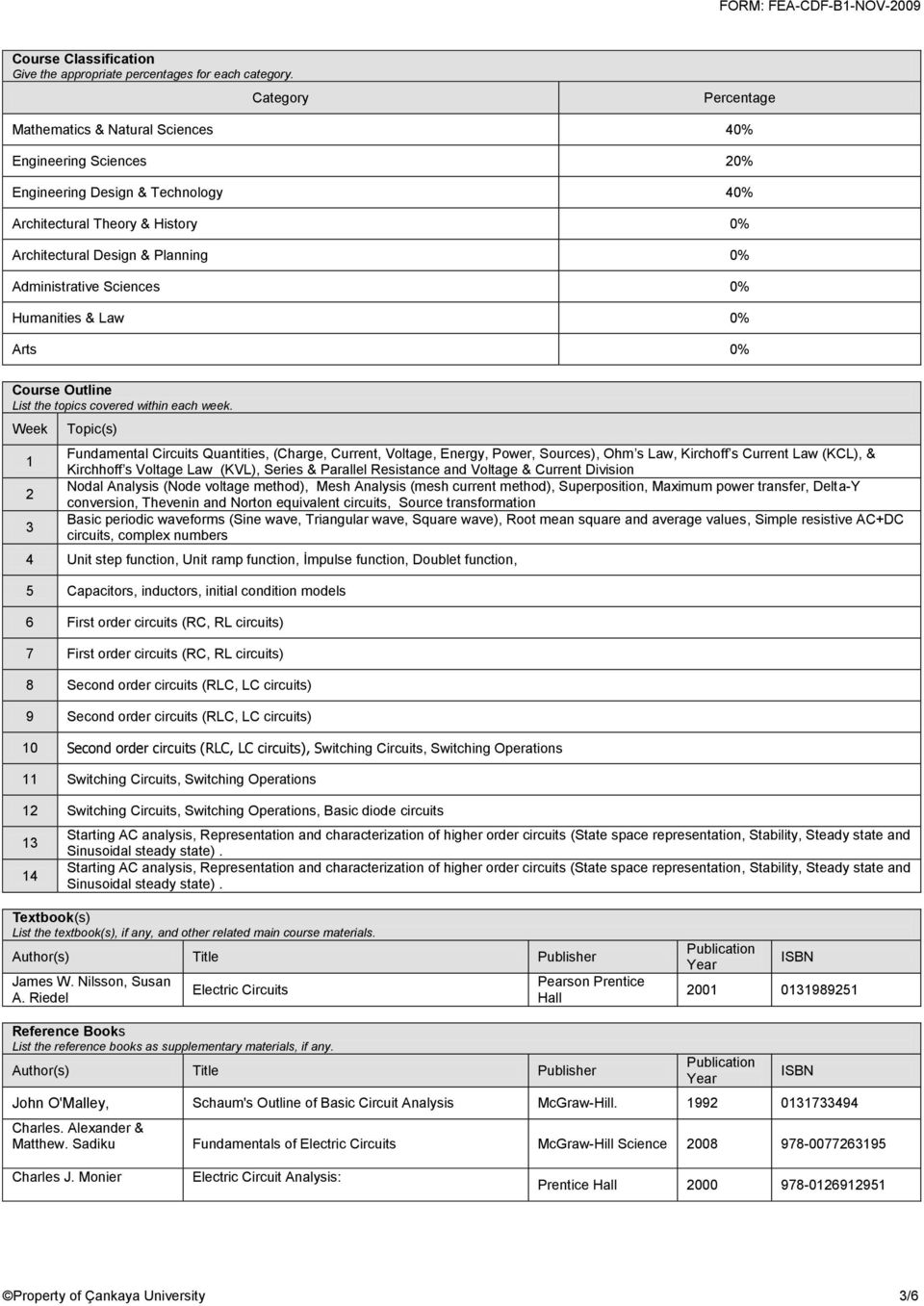
3 Course Classification Give the appropriate percentages for each category. Category Percentage Mathematics & Natural Sciences 40% Engineering Sciences 20% Engineering Design & Technology 40% Architectural Theory & History 0% Architectural Design & Planning 0% Administrative Sciences 0% Humanities & Law 0% Arts 0% Course Outline List the topics covered within each week. Week Topic(s) Fundamental Circuits Quantities, (Charge, Current, Voltage, Energy, Power, Sources), Ohm s Law, Kirchoff s Current Law (KCL), & Kirchhoff s Voltage Law (KVL), Series & Parallel Resistance and Voltage & Current Division Nodal Analysis (Node voltage method), Mesh Analysis (mesh current method), Superposition, Maximum power transfer, Delta-Y conversion, Thevenin and Norton equivalent circuits, Source transformation Basic periodic waveforms (Sine wave, Triangular wave, Square wave), Root mean square and average values, Simple resistive AC+DC circuits, complex numbers 4 Unit step function, Unit ramp function, İmpulse function, Doublet function, 5 Capacitors, inductors, initial condition models 6 First order circuits (RC, RL circuits) 7 First order circuits (RC, RL circuits) 8 Second order circuits (RLC, LC circuits) 9 Second order circuits (RLC, LC circuits) 10 Second order circuits (RLC, LC circuits), Switching Circuits, Switching Operations 11 Switching Circuits, Switching Operations 12 Switching Circuits, Switching Operations, Basic diode circuits Starting AC analysis, Representation and characterization of higher order circuits (State space representation, Stability, Steady state and Sinusoidal steady state). Starting AC analysis, Representation and characterization of higher order circuits (State space representation, Stability, Steady state and Sinusoidal steady state). Textbook(s) List the textbook(s), if any, and other related main course materials. Author(s) Title Publisher James W. Nilsson, Susan A. Riedel Electric Circuits Pearson Prentice Hall Publication Year ISBN Reference Books List the reference books as supplementary materials, if any. Author(s) Title Publisher Publication Year John O'Malley, Schaum's Outline of Basic Circuit Analysis McGraw-Hill Charles. Alexander & Matthew. Sadiku Fundamentals of Electric Circuits McGraw-Hill Science ISBN Charles J. Monier Electric Circuit Analysis: Prentice Hall Property of Çankaya University 3/6
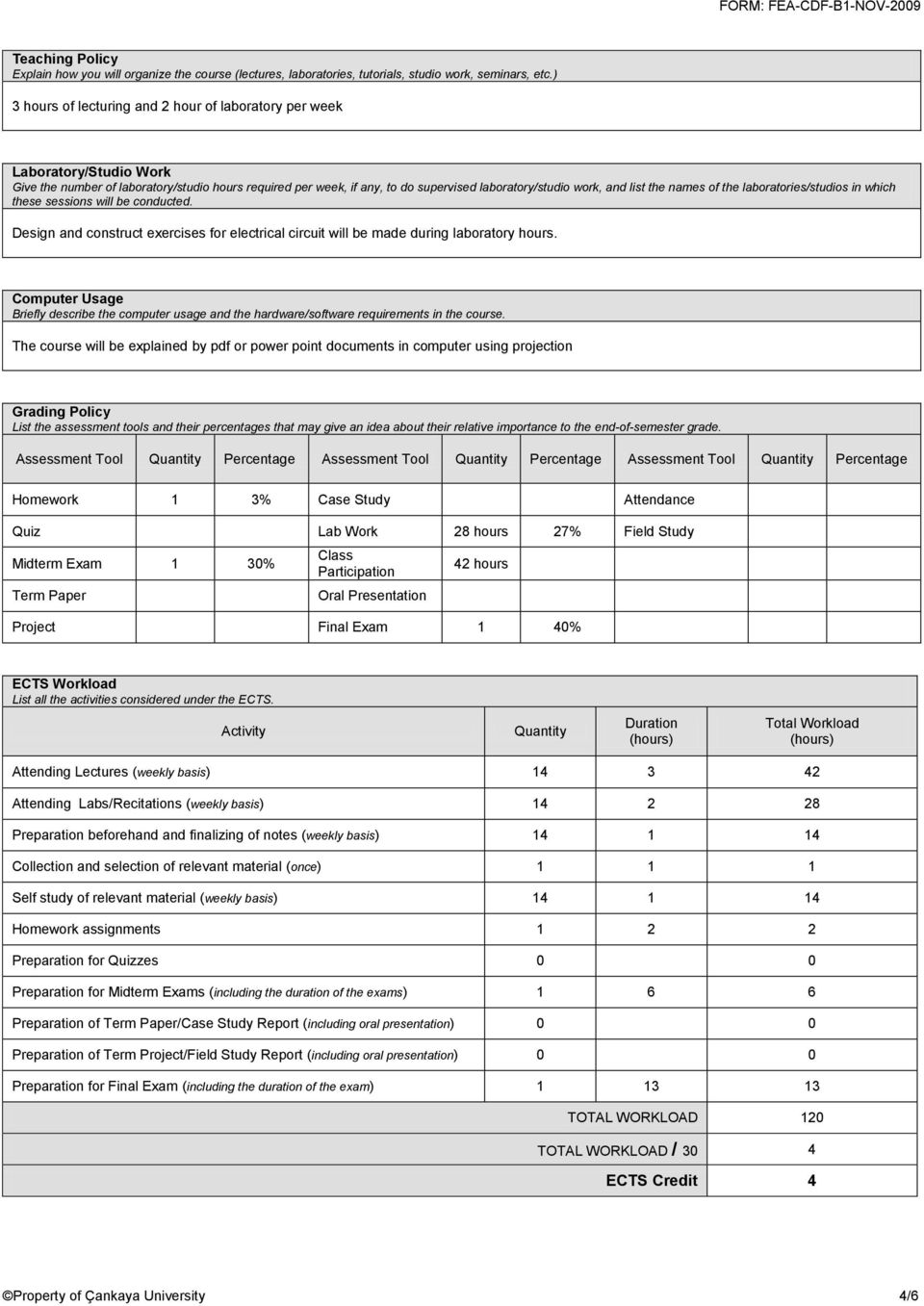
4 Teaching Policy Explain how you will organize the course (lectures, laboratories, tutorials, studio work, seminars, etc.) 3 hours of lecturing and 2 hour of laboratory per week Laboratory/Studio Work Give the number of laboratory/studio hours required per week, if any, to do supervised laboratory/studio work, and list the names of the laboratories/studios in which these sessions will be conducted. Design and construct exercises for electrical circuit will be made during laboratory hours. Computer Usage Briefly describe the computer usage and the hardware/software requirements in the course. The course will be explained by pdf or power point documents in computer using projection Grading Policy List the assessment tools and their percentages that may give an idea about their relative importance to the end-of-semester grade. Assessment Tool Quantity Percentage Assessment Tool Quantity Percentage Assessment Tool Quantity Percentage Homework 1 3% Case Study Attendance Quiz Lab Work 28 hours 27% Field Study Midterm Exam 1 30% Term Paper Class Participation Oral Presentation 42 hours Project Final Exam 1 40% ECTS Workload List all the activities considered under the ECTS. Activity Quantity Duration (hours) Total Workload (hours) Attending Lectures (weekly basis) Attending Labs/Recitations (weekly basis) Preparation beforehand and finalizing of notes (weekly basis) Collection and selection of relevant material (once) Self study of relevant material (weekly basis) Homework assignments Preparation for Quizzes 0 0 Preparation for Midterm Exams (including the duration of the exams) Preparation of Term Paper/Case Study Report (including oral presentation) 0 0 Preparation of Term Project/Field Study Report (including oral presentation) 0 0 Preparation for Final Exam (including the duration of the exam) TOTAL WORKLOAD 120 TOTAL WORKLOAD / 30 4 ECTS Credit 4 Property of Çankaya University 4/6
5 Program Qualifications vs. Course s Learning Outcomes Consider the below program qualifications determined in terms of learning outcomes of all the courses in the curriculum and capabilities. Look at the learning outcomes of this course given above. Relate these two using the Likert Scale by marking with in one of the five choices at the right.. Program Qualifications No (Specific to each program) Adequate knowledge in mathematics, science and engineering subjects pertaining to Mechatronics Engineering; ability to use theoretical and applied information in these areas to model and solve Mechatronics Engineering problems. Ability to identify and define complex Mechatronics Engineering problems; ability to select and apply proper analysis tools and methods and modeling techniques for formulating and solving such problems. Ability to analyze a complex system and/or a subsystem or a process and ability to design it under realistic constraints and conditions, in such a way as to meet the requirements; ability to apply modern systems design methods for this purpose. Ability to devise, select, and use modern techniques and computing tools needed for Mechatronics Engineering practice; ability to employ and make use of information technologies effectively with the knowledge of state-of-the art hardware but mostly software capabilities related to Mechatronics Engineering Ability to design and devise experimental setup, conduct experiments, gather data, analyze and interpret results for investigating engineering problems in general and for systems analysis, design, implementation and continuous improvement from Mechatronics Engineering perspective in particular. Ability to search data bases and other information sources effectively; ability to identify and extract effectively the required information and knowledge from literature and other open sources. Ability to work individually, to take independent initiatives, to create original inferences and to work in teams efficiently; ability to collaborate effectively in intra-disciplinary and multi-disciplinary teams; ability to take responsibility within teams. Ability to work individually, to take independent initiatives, to create original inferences and to work in teams efficiently; ability to collaborate effectively in intra-disciplinary and multi-disciplinary teams; ability to take responsibility within teams. Ability to report the findings, conclusions and interpretations related to a project, ability to write technical reports, to prepare and conduct effective presentations. Contribution Recognition of the need for lifelong learning; ability to access information, to follow developments in science and technology, and to keep continuous self improvement. 11 Awareness of professional and ethical responsibility issues Awareness of environmental issues, occupational safety and health, and their legal consequences. Knowledge about contemporary issues and the global and societal effects of engineering practices; awareness of the legal consequences of engineering solutions; awareness of entrepreneurship, innovation, and sustainable development. Capability to grasp business life practices such as project management, risk management, change management and strategic management. Contribution Scale to a Qualification: 0-None, 1-Little, 2-Medium, 3-Considerable, 4-Largest Other Relevant Information Property of Çankaya University 5/6

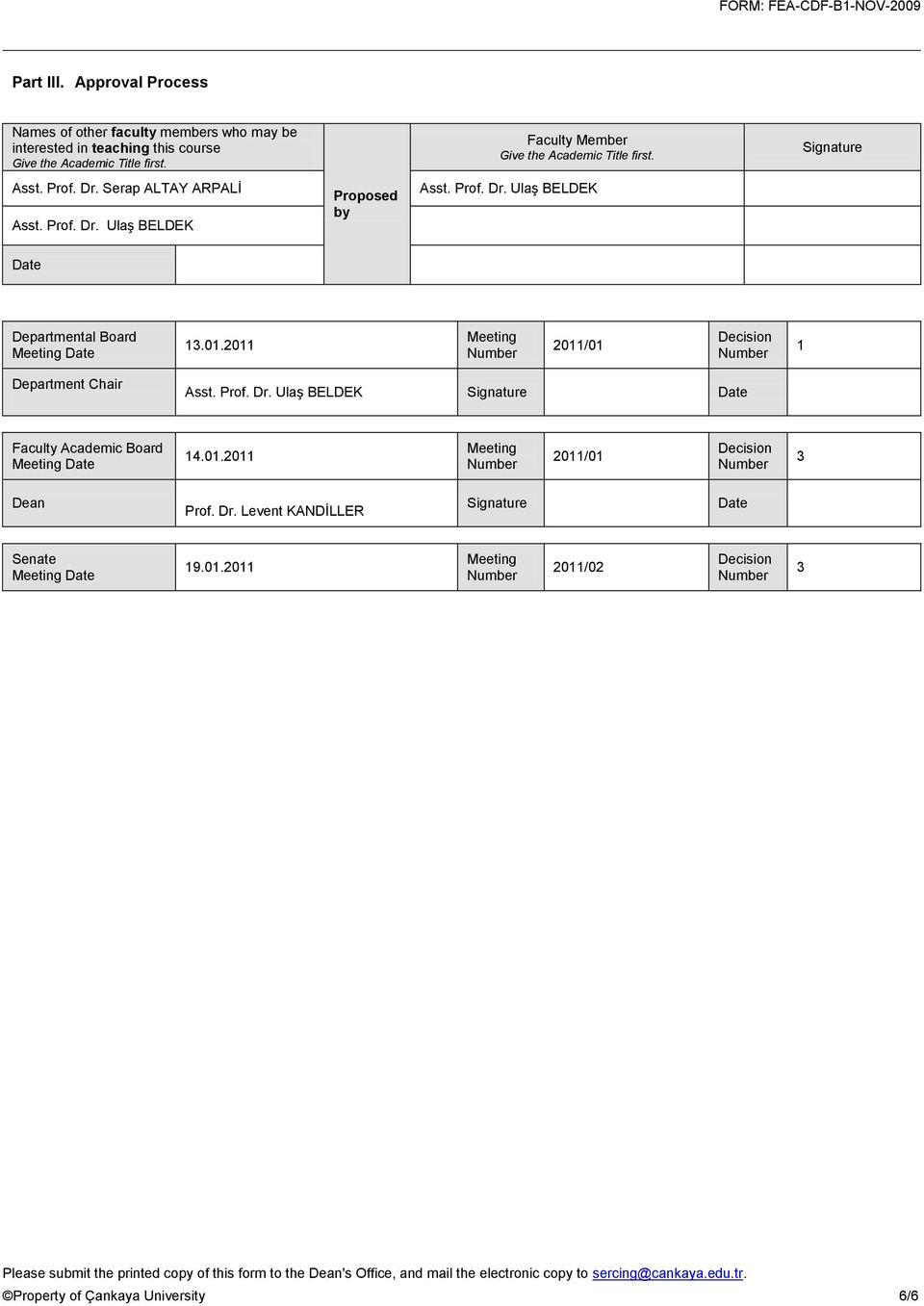
6 Part III. Approval Process Names of other faculty members who may be interested in teaching this course Give the Academic Title first. Faculty Member Give the Academic Title first. Signature Asst. Prof. Dr. Serap ALTAY ARPALİ Asst. Prof. Dr. Ulaş BELDEK Proposed by Asst. Prof. Dr. Ulaş BELDEK Date Departmental Board Meeting Date Meeting 2011/01 Decision 1 Department Chair Asst. Prof. Dr. Ulaş BELDEK Signature Date Faculty Academic Board Meeting Date Meeting 2011/01 Decision 3 Dean Prof. Dr. Levent KANDİLLER Signature Date Senate Meeting Date Meeting 2011/02 Decision 3 Please submit the printed copy of this form to the Dean's Office, and mail the electronic copy to [email protected]. Property of Çankaya University 6/6
ÇANKAYA UNIVERSITY Faculty of Engineering and Architecture
 ÇANKAYA UNIVERSITY Faculty of Engineering and Architecture Course Definition Form This form should be used for both a new elective or compulsory course being proposed and curricula development processes
ÇANKAYA UNIVERSITY Faculty of Engineering and Architecture
 ÇANKAYA UNIVERSITY Faculty of Engineering and Architecture Course Definition Form This form should be used for both a new elective or compulsory course being proposed and curricula development processes
ÇANKAYA UNIVERSITY. BASIC AND ELECTIVE COURSES ENGLISH UNIT Course Definition Form. Number of. hours. Course Type Check all that are applicable
 ÇANKAYA UNIVERSITY BASIC AND ELECTIVE COURSES ENGLISH UNIT Course Definition Form Part I. Basic Course Information Department Name Use capital letters only BASIC AND ELECTIVE COURSES/ENGLISH UNIT Dept.
ÇANKAYA UNIVERSITY Faculty of Engineering and Architecture
 ÇANKAYA UNIVERSITY Faculty of Engineering and Architecture Course Definition Form This form should be used for both a new elective or compulsory course being proposed and curricula development processes
ÇANKAYA UNIVERSITY. BASIC AND ELECTIVE COURSES ENGLISH UNIT Course Definition Form. Number of. per Week. Course Type check all that are applicable
 ÇANKAYA UNIVERSITY BASIC AND ELECTIVE COURSES ENGLISH UNIT Course Definition Form Part I. Course Information Department Name Use capital letters only PRINCIPLES OF ATATÜRK AND REVOLUTION HISTORY/HISTORY
Department of Electrical and Electronic Engineering, California State University, Sacramento
 Department of Electrical and Electronic Engineering, California State University, Sacramento Engr 17 Introductory Circuit Analysis, graded, 3 units Instructor: Tatro - Spring 2016 Section 2, Call No. 30289,
(IŞIK - IT201) 1 / 6 COURSE PROFILE. Theory+PS+Lab (hour/week) Local Credits. Course Name Code Semester Term ECTS
 COURSE PROFILE Course Name Code Semester Term Theory+PS+Lab (hour/week) Local Credits ECTS Network Security IT527 Fall 3 + 0 + 0 3 8 Prerequisites None Course Language Course Type Course Lecturer Course
COURSE PROFILE. Business Intelligence MIS531 Fall 1 3 + 0 + 0 3 8
 COURSE PROFILE Course Name Code Semester Term Theory+PS+Lab (hour/week) Local Credits ECTS Business Intelligence MIS1 Fall 1 + 0 + 0 8 Prerequisites None Course Language Course Type Course Lecturer Course
EE 210 Introduction to Electrical Engineering Fall 2009 COURSE SYLLABUS. Massimiliano Laddomada, PhD Assistant Professor
 1 Texas A&M University-Texarkana College of Science, Technology, Engineering, and Mathematics Department of Electrical Engineering Bachelor of Science in Electrical Engineering EE 210 Introduction to Electrical
COURSE PROFILE. Local Credits. Theory+PS+Lab (hour/week) ECTS. Course Name Code Semester Term. Accounting Information Systems MAN552T I I 3 3 6
 COURSE PROFILE Course Name Code Semester Term Accounting Information Systems Theory+PS+Lab (hour/week) Local Credits ECTS MAN552T I I 3 3 6 Prerequisites -- Course Language Course Type Turkish Mandatory
DOKUZ EYLUL UNIVERSITY FACULTY OF ENGINEERING OFFICE OF THE DEAN COURSE / MODULE / BLOCK DETAILS ACADEMIC YEAR / SEMESTER. Course Code: EEE 2073
 Offered by: Elektrik-Elektronik Mühendisliği Course Title: FUNDAMENTALS OF ELECTRIC AND ELECTRONICS Course Org. Title: FUNDAMENTALS OF ELECTRIC AND ELECTRONICS Course Level: Lisans Course Code: EEE 07
COURSE PROFILE. IT482 Spring 3 + 0 + 0 3 6
 COURSE PROFILE Course Name Code Semester Term Theory+PS+Lab (hour/week) Local Credits ECTS Customer Relationship Management (CRM) Systems IT482 Spring 3 + 0 + 0 3 6 Prerequisites None Course Language Course
Agile Methods in Software Development (SE 470) Course Details
 Agile Methods in Software Development (SE 470) Course Details Course Name Course Code Term Lecture Hours Application Hours Lab Credit ECTS Hours Agile Methods in Software Development SE 470 Spring 2 2
COURSE PROFILE. IT323 Fall 5 3 + 0 + 0 3 8
 COURSE PROFILE Course Name Code Semester Term Theory+PS+Lab (hour/week) Local Credits ECTS Contemporary Software Development IT2 Fall + 0 + 0 8 Prerequisites None Course Language Course Type Course Lecturer
DEGREE: Bachelor in Biomedical Engineering YEAR: 2 TERM: 2 WEEKLY PLANNING
 SESSION WEEK COURSE: Electronic Technology in Biomedicine DEGREE: Bachelor in Biomedical Engineering YEAR: 2 TERM: 2 WEEKLY PLANNING DESCRIPTION GROUPS (mark X) SPECIAL ROOM FOR SESSION (Computer class
ELECTRICAL ENGINEERING
 EE ELECTRICAL ENGINEERING See beginning of Section H for abbreviations, course numbers and coding. The * denotes labs which are held on alternate weeks. A minimum grade of C is required for all prerequisite
RARITAN VALLEY COMMUNITY COLLEGE COMPUTER SCIENCE (CS) DEPARTMENT. CISY 102 - Computer Literacy
 I. Basic Course Information RARITAN VALLEY COMMUNITY COLLEGE COMPUTER SCIENCE (CS) DEPARTMENT CISY 102 - Computer Literacy A. Course Number and Title: CISY-102, Computer Literacy B. Date of Proposal or
Georgia Perimeter College Faculty Senate New Course
 Page 1 of 7 Georgia Perimeter College Faculty Senate New Course Title of Proposal: PHED 2200 Introduction to Sport Management Number: Date Submitted: Date approved: Initiator and Place of Origin: Bonnie
KENNESAW STATE UNIVERSITY GRADUATE COURSE PROPOSAL OR REVISION, Cover Sheet (10/02/2002)
 KENNESAW STATE UNIVERSITY GRADUATE COURSE PROPOSAL OR REVISION, Cover Sheet (10/02/2002) Course Number/Program Name ACS 7420 Algorithm Design for Big Data Department Computer Science Degree Title (if applicable)
THE UNIVERSITY OF TEXAS AT AUSTIN Department of Aerospace Engineering and Engineering Mechanics. EM 311M - DYNAMICS Spring 2012 SYLLABUS
 THE UNIVERSITY OF TEXAS AT AUSTIN Department of Aerospace Engineering and Engineering Mechanics EM 311M - DYNAMICS Spring 2012 SYLLABUS UNIQUE NUMBERS: 13815, 13820, 13825, 13830 INSTRUCTOR: TIME: Dr.
W03 Analysis of DC Circuits. Yrd. Doç. Dr. Aytaç Gören
 W03 Analysis of DC Circuits Yrd. Doç. Dr. Aytaç Gören ELK 2018 - Contents W01 Basic Concepts in Electronics W02 AC to DC Conversion W03 Analysis of DC Circuits (self and condenser) W04 Transistors and
Electronic Engineering Technology Program Exit Examination as an ABET and Self-Assessment Tool
 Electronic Engineering Technology Program Exit Examination as an ABET and Self-Assessment Tool Graham Thomas, Ph.D. Texas Southern University Shahryar Darayan, Ph.D. Texas Southern University Abstract
University of Macau Undergraduate Electromechanical Engineering Program
 University of Macau Undergraduate Electromechanical Engineering Program Coordinating Unit: Supporting Unit(s): Department of Mathematics, Faculty of Science and Technology Nil Course Code: MATH201 Year
ABET Criterion 3: Outcomes Met By Course Content
 ABET Criterion 3: Outcomes Met By Course Content This brief content assessment should be consistent with the updated Course Syllabet Course #: BEE 200: Title: The BEE experience (1 credit) Semester/Year:
SCHOOL OF ENGINEERING Baccalaureate Study in Engineering Goals and Assessment of Student Learning Outcomes
 SCHOOL OF ENGINEERING Baccalaureate Study in Engineering Goals and Assessment of Student Learning Outcomes Overall Description of the School of Engineering The School of Engineering offers bachelor s degree
300013 - ET - Electronics for Telecommunications
 Coordinating unit: Teaching unit: Academic year: Degree: ECTS credits: 2015 300 - EETAC - Castelldefels School of Telecommunications and Aerospace Engineering 710 - EEL - Department of Electronic Engineering
First Year (Electrical & Electronics Engineering)
 Z PRACTICAL WORK BOOK For The Course EE-113 Basic Electrical Engineering For First Year (Electrical & Electronics Engineering) Name of Student: Class: Batch : Discipline: Class Roll No.: Examination Seat
ASE 133 AUTO HVAC SYSTEMS
 ASE 133 AUTO HVAC SYSTEMS PRESENTED AND APPROVED: DECEMBER 7, 2012 EFFECTIVE: FALL 2013-14 Prefix & Number ASE 133 Course : Auto HVAC Systems Purpose of this submission: New Change/Updated Retire If this
(IŞIK IT531) 1 / 6 COURSE PROFILE. Theory+PS+Lab (hour/week) Local Credits. Course Name Code Semester Term ECTS. IT531 Fall 1 3 + 0 + 0 3 8
 COURSE PROFILE Course Name Code Semester Term Theory+PS+Lab (hour/week) Local Credits ECTS Storage Preliminaries For Cloud Computing IT531 Fall 1 3 + 0 + 0 3 8 Prerequisites None Course Language Course
ÇANKAYA UNIVERSITY. BASIC AND ELECTIVE COURSES ENGLISH UNIT Course Definition Form. Number of. per Week. HTTP://HIST201.CANKAYA.EDU.
 ÇANKAYA UNIVERSITY BASIC AND ELECTIVE COURSES ENGLISH UNIT Course Definition Form Part I. Course Information Department Name Use capital letters only BASIC AND ELECTIVE COURSES/ENGLISH UNIT Dept. Numeric
Circuits with inductors and alternating currents. Chapter 20 #45, 46, 47, 49
 Circuits with inductors and alternating currents Chapter 20 #45, 46, 47, 49 RL circuits Ch. 20 (last section) Symbol for inductor looks like a spring. An inductor is a circuit element that has a large
Course Information ECE 211 Fall 2011
 Course Information ECE 211 Fall 2011 Goals and Objectives The objective of this course is to introduce you to the methodology of electrical and computer engineering and lay a foundation for future work
System Modeling and Simulation (SE 360) Course Details
 System Modeling and Simulation (SE 360) Course Details Course Name Course Code Term Lecture Hours Application Hours Lab Credit ECTS Hours System Modeling and Simulation SE 360 Both 3 0 0 3 5 Pre-requisite
Electrical Engineering
 Curriculum for the Bachelor s Program Electrical Curriculum 2006 This curriculum was approved by the Curricula Committee of Graz University of Technology in the session on 7 April 2006. On the basis of
SYLLABUS FORM WESTCHESTER COMMUNITY COLLEGE Valhalla, NY lo595. l. Course #: PHYSC 111 2. NAME OF ORIGINATOR /REVISOR: Dr.
 SYLLABUS FORM WESTCHESTER COMMUNITY COLLEGE Valhalla, NY lo595 l. Course #: PHYSC 111 2. NAME OF ORIGINATOR /REVISOR: Dr. Neil Basescu NAME OF COURSE: College Physics 1 with Lab 3. CURRENT DATE: 4/24/13
ELECTRICAL ENGINEERING
 ELECTRICAL ENGINEERING UNDERGRADUATE STUDENT HANDBOOK For Academic Year 2011 2012 Department of Electrical Engineering and Computer Science L.C. Smith College of Engineering and Computer Science Syracuse
Assessment Processes. Department of Electrical and Computer Engineering. Fall 2014
 Assessment Processes Department of Electrical and Computer Engineering Fall 2014 Introduction The assessment process in the Electrical and Computer Engineering (ECE) Department at Utah State University
ANTALYA INTERNATIONAL UNIVERSITY DIRECTIVE REGARDING ASSOCIATE AND UNDERGRADUATE DEGREE PROGRAMS. CHAPTER 1 Objective, Scope, Grounds and Definitions
 ANTALYA INTERNATIONAL UNIVERSITY DIRECTIVE REGARDING ASSOCIATE AND UNDERGRADUATE DEGREE PROGRAMS CHAPTER 1 Objective, Scope, Grounds and Definitions Objective ARTICLE 1 (1) The objective of this directive
Teaching an Electrical Circuits Course Online
 Paper ID #11534 Teaching an Electrical Circuits Course Online Dr. Carlotta A Berry, Rose-Hulman Institute of Technology Dr. Carlotta A Berry is an associate professor in the department of Electrical and
Syllabus. Required Textbooks: 1. Title: Hands-On Networking Fundamentals Author: Palmer Edition: 2nd Copyright Year: 2013 ISBN: 9781111306748
 Syllabus No: CIS 165 Title: Network & Systems Administration Credits: 4 Coordinator: Dr. B. Dike-Anyiam, Computer Science & Networking Lecturer Instructor: Dr. B. Dike-Anyiam, Computer Science & Networking
Introduction to International Trade (LOJ 209) Course Details
 Introduction to International Trade (LOJ 209) Course Details Course Name Course Code Term Lecture Hours Application Hours Lab Credit ECTS Hours Introduction to International Trade LOJ 209 Autumn 3 0 0
Design, conduct experiments, analyze, data, implementation strategies, recommendations findings communicated; (labs)
 Outcome 3. The ability to design and conduct experiments, analyze and interpret data, develop implementation strategies, and shape recommendations so that results will be achieved and findings will be
University of Central Florida Department of Electrical Engineering & Computer Science EEL 4914C Spring 2014. Senior Design I
 University of Central Florida EEL 4914C Spring 2014 Senior Design I Dr. S. M. Richie UCF, HEC 345E V:407-823-5765 e-mail: [email protected] Office Hours: TR 8:00 AM-8:50 AM, 10:30 AM-11:30 AM, 1:30 PM- 3:00PM
Lecture Notes: ECS 203 Basic Electrical Engineering Semester 1/2010. Dr.Prapun Suksompong 1 June 16, 2010
 Sirindhorn International Institute of Technology Thammasat University School of Information, Computer and Communication Technology Lecture Notes: ECS 203 Basic Electrical Engineering Semester 1/2010 Dr.Prapun
AUB/FEA Electrical and Computer Engineering Department (ECE)
 AUB/FEA Electrical and Computer Engineering Department (ECE) Orientation Session August 27, 2013 Outline The ECE Department [Video] Program and Courses Advising Rules and Regulations Student Access to
Series-Parallel Circuits. Objectives
 Series-Parallel Circuits Objectives Identify series-parallel configuration Analyze series-parallel circuits Apply KVL and KCL to the series-parallel circuits Analyze loaded voltage dividers Determine the
DEPARTMENTAL PLAN FOR ASSESSMENT OF STUDENT LEARNING
 DEPARTMENTAL PLAN FOR ASSESSMENT OF STUDENT LEARNING 2014-2015 ACADEMIC YEAR Department: Mechanical Engineering Program: Bachelor of Science (B.S.) in Mechanical Engineering / Combined B.S. and Master
RARITAN VALLEY COMMUNITY COLLEGE COURSE OUTLINE. CISY 229 Information Security Fundamentals
 RARITAN VALLEY COMMUNITY COLLEGE COURSE OUTLINE CISY 229 Information Security Fundamentals I. Basic Course Information A. Course Number & Title: CISY-229 Information Security Fundamentals B. New or Modified
Basic Laws Circuit Theorems Methods of Network Analysis Non-Linear Devices and Simulation Models
 EE Modul 1: Electric Circuits Theory Basic Laws Circuit Theorems Methods of Network Analysis Non-Linear Devices and Simulation Models EE Modul 1: Electric Circuits Theory Current, Voltage, Impedance Ohm
Engineering 398/English 398 Professional Communication for Engineers Program Overview, Fall 2008
 Engineering 398/English 398 Professional Communication for Engineers Program Overview, Fall 2008 English 398 Curricular Timeline Pre-2006 English 398N (3 Credits): Professional Communication for Engineers
Social Media Marketing - Advantages and Disadvantages
 Eastern Illinois University New Course Proposal MAR 3560, Social Media Marketing Agenda Item #14-118 Effective Fall 2015 Banner/Catalog Information (Coversheet) 1. X New Course or Revision of Existing
CME403/603 Syllabus Page 1
 College of Engineering and Architecture Department of Construction Management and Engineering CM&E 403/603 SCHEDULING AND PROJECT CONTROL (4 CREDITS) FALL 2012 Time & Location: Library 14A,B,C CIE102:
SERIES-PARALLEL DC CIRCUITS
 Name: Date: Course and Section: Instructor: EXPERIMENT 1 SERIES-PARALLEL DC CIRCUITS OBJECTIVES 1. Test the theoretical analysis of series-parallel networks through direct measurements. 2. Improve skills
CIRCUITS LABORATORY EXPERIMENT 3. AC Circuit Analysis
 CIRCUITS LABORATORY EXPERIMENT 3 AC Circuit Analysis 3.1 Introduction The steady-state behavior of circuits energized by sinusoidal sources is an important area of study for several reasons. First, the
CE 460 Course Syllabus
 CE 460 Course Syllabus Fall 2012 Part I Course Organization SYLLABUS CE 460 Fall 2012 GFS 116 Tuesdays 6:30-9:10 Text: Construction Contracting, 7 th edition, by Clough/Sears (ISBN 0-471-44988-1) Wiley
CSE 3231 (Approved): Software Engineering Techniques
 CSE 3231 (Approved): Software Engineering Techniques Course Description Software engineering issues, techniques, methodologies and technologies; software lifecycle activities: requirements analysis, architecture,
Fundamentals of Electrical Engineering 2 Grundlagen der Elektrotechnik 2
 Fundamentals of Electrical Engineering 2 Grundlagen der Elektrotechnik 2 Chapter: Sinusoidal Steady State Analysis / Netzwerkanalyse bei harmonischer Erregung Michael E. Auer Source of figures: Alexander/Sadiku:
Computer Engineering Technology
 Computer Engineering Technology Dr. Adam Filios, Chair Electrical & Computer Engineering Technology Dept. [email protected] 631-420-2084 School of Engineering Technology Bachelor of Science Degree
BSEE-EE Electrical Engineering Assessment Plan 2013-2017
 BSEE-EE Electrical Engineering Assessment Plan 2013-2017 Program Overview Missions and Outcomes Three mission statements are provided below for the University of Cincinnati, the College of Engineering
ELPT 1419 FUNDAMENTALS OF ELECTRICITY I
 SYLLABUS ELPT 1419 FUNDAMENTALS OF ELECTRICITY I INDUSTRIAL AND COMMERCIAL ELECTRICITY BRAZOSPORT COLLEGE LAKE JACKSON TEXAS PREPARED BY: DATE: August 27, 2013 INSTRUCTOR RECOMMENDED BY: RECOMMENDED BY:
Springfield Technical Community College School of Mathematics, Sciences & Engineering Transfer
 Springfield Technical Community College School of Mathematics, Sciences & Engineering Transfer Department: Mathematics Course Title: Algebra 2 Course Number: MAT-097 Semester: Fall 2015 Credits: 3 Non-Graduation
MEA 130 MEDICAL CODING I (ICD-10-CM)
 MEA 130 MEDICAL CODING I (ICD-10-CM) PRESENTED FEBRUARY 3, 2012 EFFECTIVE: FALL 2012-13 Prefix & Number MEA 130 Course Title: Medical Coding I ICD-10-CM Purpose of this submission: New Change/Updated Retire
Select One: New Delete Course Modification
 Prefix & Number: Initial Term: Select One: New Delete Course Modification Title: College/School: Dept: Abbreviated Title: CREDIT OFFERED Levels: (select all that apply) None (Blank) Undergraduate (U) Graduate
Data Encryption and Network Security
 Data Encryption and Network Security College: Department: Engineering Electrical Engineering Department First: Course Definition 1 Course Code: EE627 2 Units 3 3 Semester 4 Prerequisite 5 Corequisite 6
CIS 270. Systems Analysis and Design
 CIS 270 Systems Analysis and Design Approved: May 6, 2011 EFFECTIVE DATE: Fall 2011 COURSE PACKAGE FORM Team Leader and Members Andra Goldberg, Matt Butcher, Steve Sorden, Dave White Date of proposal to
UNIVERSITY OF MACAU DEPARTMENT OF COMPUTER AND INFORMATION SCIENCE SFTW 463 Data Visualization Syllabus 1 st Semester 2011/2012 Part A Course Outline
 Elective required course in Computer Science UNIVERSITY OF MACAU DEPARTMENT OF COMPUTER AND INFORMATION SCIENCE SFTW 463 Data Visualization Syllabus 1 st Semester 2011/2012 Part A Course Outline Catalog
Universidad de Alcalá
 Circuit Electronics Degree in Electronic Communications Engineering Degree in Telecommunications Systems Degree in Technology Telecommunication Telematics Engineering Universidad de Alcalá Academic Year
CURRICULUM OF THE MASTER S PROGRAM IN ARCHITECTURE AT THE ACADEMY OF FINE ARTS VIENNA (MArch)
 Academy of Fine Arts Vienna Institute for Art and Architecture Curriculum Commission for Architecture CURRICULUM OF THE MASTER S PROGRAM IN ARCHITECTURE AT THE ACADEMY OF FINE ARTS VIENNA (MArch) Table
Texas A&M University Texarkana College Physics II Lab Course Syllabus
 Effective Date: Spring 2014 I. Course Number: PHYS 1102 II. III. Texas A&M University Texarkana College Physics II Lab Course Syllabus Course Title: College Physics II Lab Semester Credit Hours: 1 credit
Mechanical Engineering Program Annual Program Improvement Report 2014-2015
 Mechanical Engineering Program Annual Program Improvement Report 2014-2015 Prepared by Joseph P. Greene, Ph.D. Professor and Department Chair of the Mechanical and Mechatronic Engineering and Sustainable
SCHWEITZER ENGINEERING LABORATORIES, COMERCIAL LTDA.
 Pocket book of Electrical Engineering Formulas Content 1. Elementary Algebra and Geometry 1. Fundamental Properties (real numbers) 1 2. Exponents 2 3. Fractional Exponents 2 4. Irrational Exponents 2 5.
ELECTRICAL ENGINEERING
 The University of Connecticut School of Engineering ELECTRICAL ENGINEERING GUIDE TO COURSE SELECTION AY 2008-2009 Revised July 30, 2008 for Electrical Engineering (EE) Majors in The School of Engineering
Eastern Illinois University Revised Course Proposal BUS 2710, Survey of Finance
 Eastern Illinois University Revised Course Proposal BUS 2710, Survey of Finance Agenda Item #15-71 Effective Summer 2015 Banner/Catalog Information (Coversheet) 1. New Course or X Revision of Existing
Bachelor of Science in Computer Engineering (BSCoE) Essential Ideas
 Mission Statement Bachelor of Science in Computer Engineering (BSCoE) Essential Ideas The mission statement for the Computer Engineering program as modified and adopted by the engineering faculty on July
PELLISSIPPI STATE TECHNICAL COMMUNITY COLLEGE MASTER SYLLABUS DIGITAL GRAPHIC DESIGN I CGT 1100
 PELLISSIPPI STATE TECHNICAL COMMUNITY COLLEGE MASTER SYLLABUS DIGITAL GRAPHIC DESIGN I CGT 1100 Class Hours: 5.0 Credit Hours: 5.0 Laboratory Hours: 0.0 Date Revised: Spring 99 Catalog Course Description: