
A Latent Variable Approach to Validate Credit Rating Systems using R
|
|
|
- Ami Andrews
- 10 years ago
- Views:
Transcription
1 A Latent Variable Approach to Validate Credit Rating Systems using R Chicago, April 24, 2009 Bettina Grün a, Paul Hofmarcher a, Kurt Hornik a, Christoph Leitner a, Stefan Pichler a a WU Wien Grün/Hofmarcher/Hornik/Leitner/Pichler A Latent Variable Approach 1/36

2 I I II I Multi-rater panel provides information about rating heterogeneity across obligors, across raters, across time points. PD (in bp) Bank A Bank B Obligor Grün/Hofmarcher/Hornik/Leitner/Pichler A Latent Variable Approach 2/36

3 II I II I Rating validation: How accurate (or precise) are PD estimates? Measures of rating bias and error variance. Consensus PD: What is the consensus PD estimate when ratings differ across raters? Explaining rating heterogeneity: Opaqueness of industries (Morgan 2002), Regional differences (Hornik et al. 2009). Grün/Hofmarcher/Hornik/Leitner/Pichler A Latent Variable Approach 3/36

4 Approach Approach General Model I General Model II General Model III Specific Models I Specific Models II Offerings I Need for a probabilistic model. Our Approach: PD treated as latent variable Ratings are noisy observations of PD. Provides a probabilistic model to directly estimate the rating error of a rater. Explore patterns of heterogeneity. Can obtain the consensus rating of the obligor. Requirement: Multi rater panel with rating information on the same metric scale. In practice: PD ratings (PD estimates by different raters for all obligors). Grün/Hofmarcher/Hornik/Leitner/Pichler A Latent Variable Approach 4/36

5 General Model I Approach General Model I General Model II General Model III Specific Models I Specific Models II Offerings I Merton (1974): Distance to default of firm i DD i = a i + b i V i where V i is the log asset value of firm i. The probability of default is given as PD i = Φ( DD i ) where Φ : (,+ ) [0,1] is the distribution function of the standard normal distribution. Probit of the PD is linearly related to the log asset value. Grün/Hofmarcher/Hornik/Leitner/Pichler A Latent Variable Approach 5/36
![The probability of default is given as PD i = Φ( DD i ) where Φ : (,+ ) [0,1] is the distribution function of the standard](/docs-images/43/15429771/images/page_5.jpg "normal distribution. Probit of the PD is linearly related to the log asset value.")
6 General Model II Approach General Model I General Model II General Model III Specific Models I Specific Models II Offerings I The estimate PD ij as derived by rater j for the true PD of firm i is PD ij = Φ( DD i + ǫ ij ) where ǫ ij is the corresponding error (which depends on j in particular). Motivates a multi-rater model where the rater effects ( errors ) are additive on the probit (Φ 1, DD i ) scale, i.e., Φ 1 (PD ij ) = DD i + ǫ ij = Φ 1 (PD i ) + ǫ ij Similar considerations apply for PD models based on, e.g., logistic regression. Grün/Hofmarcher/Hornik/Leitner/Pichler A Latent Variable Approach 6/36

7 General Model III Approach General Model I General Model II General Model III Specific Models I Specific Models II Offerings I Let S ij = Φ 1 (PD ij ) denote the score of the observed PD and S i = Φ 1 (PD i ) the latent true PD score. Write µ ij and σ ij for the mean and standard deviation of ǫ ij, respectively. The latent variable model can be written as S ij = S i + µ ij + σ ij Z ij where the standardized rating errors Z ij = (ǫ ij µ ij )/σ ij have mean zero and unit variance. Grün/Hofmarcher/Hornik/Leitner/Pichler A Latent Variable Approach 7/36

8 Specific Models I Approach General Model I General Model II General Model III Specific Models I Specific Models II Offerings I Simple model: S ij = S i + µ j + σ j Z i,j Rating errors are independent of obligors and their characteristics (e.g., creditworthiness). Parameters depend on raters only: µ ij = µ j, σ ij = σ j. Extended model: S ij = S i + µ g(i),j + σ g(i),j Z ij Groups of obligors with homogeneous rating error characteristics. Parameters depend on rater and obligor groups: µ ij = µ g(i),j, σ ij = σ g(i),j. Grün/Hofmarcher/Hornik/Leitner/Pichler A Latent Variable Approach 8/36

9 Specific Models II Approach General Model I General Model II General Model III Specific Models I Specific Models II Offerings I Ensuring identifiability: Average rating bias within each obligor group is zero. E(S ij ) = E(S i ) + µ g(i),j with j µ g,j = 0. Modelling marginal group effects: E(S i ) = ν g(i) var(s i ) = τ 2 or var(s i ) = τg(i) 2. Grün/Hofmarcher/Hornik/Leitner/Pichler A Latent Variable Approach 9/36

10 Approach General Model I General Model II General Model III Specific Models I Specific Models II Offerings I Mixed-effects model for the observed S ij, latent true PD scores S i enter as random effects. Given parametric models for the µ ij and σ ij and the distributions of true PD scores and standardized rating errors. using R: Marginal maximum likelihood: nlme (ratermodel), or Bayesian techniques: rjags and coda Grün/Hofmarcher/Hornik/Leitner/Pichler A Latent Variable Approach 10/36

11 Offerings Approach General Model I General Model II General Model III Specific Models I Specific Models II Offerings I Assessment of rater effects (rater heterogeneity) in terms of their µ/σ 2 bias/variance characteristics. Estimated random effects Ŝi can be interpreted as the consensus rating for obligor i. Residuals: S ij Ŝi ˆµ ij, the observed scores minus the estimated random and fixed effects, are analyzed using some covariates (e.g., country, industry, legal form), are analyzed for single obligors as well as obligor groups of interest. Grün/Hofmarcher/Hornik/Leitner/Pichler A Latent Variable Approach 11/36

12 Data Data Model Selection Parameter Estimates I Parameters Estimates II Parameters Estimates III Residual Analysis Data from the Austrian Credit Register from September Multi-rater panel containing: obligor specific information (country, industry,...), rating information (original rating, PD). I Include 13 banks which report PDs and have sufficiently many co-ratings (every bank has at least 4 co-ratings with every other bank) co-ratings of 13 banks for 2090 obligors. Grün/Hofmarcher/Hornik/Leitner/Pichler A Latent Variable Approach 12/36

13 Model Selection Data Model Selection Parameter Estimates I Parameters Estimates II Parameters Estimates III Residual Analysis I Variety of models analyzed using AIC and BIC. Industry affiliation as grouping variable. Constant variance τ 2 for PD score. S ij = S i + µ g(i),j + σ g(i),j Z ij, S i N(ν g(i),τ 2 ), E(S ij ) = E(S i ) + µ g(i),j, µ g,j = 0, where µ g,j... rating bias to the mean PD score of bank j for obligors in industry g, σ g,j... standard deviation of the rating error of bank j for obligors in industry g, and ν g... mean PD score in industry g. j Grün/Hofmarcher/Hornik/Leitner/Pichler A Latent Variable Approach 13/36

14 Parameter Estimates I Data Model Selection Parameter Estimates I Parameters Estimates II Parameters Estimates III Residual Analysis I Industry specific means: Industry ν g Φ(ν g ) Φ(ν g τ) Φ(ν g + τ) Manufac Energy Constr Trading Finance RealEst Public Service Private The corresponding standard deviation τ is and the PD intervals are measured in basis points (10 4 ). Grün/Hofmarcher/Hornik/Leitner/Pichler A Latent Variable Approach 14/36

15 Parameters Estimates II Rating bias for rater/industry combinations: Data Model Selection Parameter Estimates I Parameters Estimates II Parameters Estimates III Residual Analysis Manufac Energy Constr µ g(i),j Bank Trading 0.23 I Industry Finance RealEst Public 0.39 Service Private Grün/Hofmarcher/Hornik/Leitner/Pichler A Latent Variable Approach 15/36

16 Parameters Estimates III Data Model Selection Parameter Estimates I Parameters Estimates II Parameters Estimates III Residual Analysis Rating error variance for rater/industry combinations corrected for industry effects: Manufac Energy Constr 2 σ g(i),j 2 σ g(i) Bank Trading 0.10 I Industry Finance RealEst 0.10 Public 0.17 Service Private Grün/Hofmarcher/Hornik/Leitner/Pichler A Latent Variable Approach 16/36

17 Residual Analysis Across the relative exposure: Data Model Selection Parameter Estimates I Parameters Estimates II Parameters Estimates III Residual Analysis I Residuals This Bank rates two obligors with high relative exposure rather too favorably Relative exposure Grün/Hofmarcher/Hornik/Leitner/Pichler A Latent Variable Approach 17/36

18 Simple Model Market Model Offerings I Formulate a statistical framework for a dynamic rating process: Explaining the rating heterogeneity not only cross-sectionally but also longitudinally. Intertemporal change of consensus ratings. Effects of macroeconomic shocks systematic risk (McNeil and Wendin, 2007). Correlations in rating migrations (Stefanescu et al., 2009) Evaluation of raters. Requirement: Multi-rater panel data with rating information on the same PD-scale. Grün/Hofmarcher/Hornik/Leitner/Pichler A Latent Variable Approach 18/36

19 Simple Model Simple Model Market Model Offerings I Simple Model: S ij (t) = S i (t) + µ j + σ j Z ij (t), Rating errors are independent of obligors and their characteristics (e.g., creditworthiness). Parameters depend on raters only: µ ij = µ j,σ ij = σ j. Latent score S i (t) is assumed to follow an AR(1) process: S i (t) = α i S i (t 1) + ν i (1 α i ) + ξ i (t), where S i (0) = ν i + ξ i (0), ν i N(ν,τ 2 ) and ξ i (t) N(0,φ 2 ). AR(1) process induces auto-correlation in the latent credit worthiness of obligor i. Latent scores S i (t) are uncorrelated across obligors. Grün/Hofmarcher/Hornik/Leitner/Pichler A Latent Variable Approach 19/36

20 Market Model Simple Model Market Model Offerings I Let f(t) denote a market factor, latent score S i (t) can then be written as S i (t) = α i S i (t 1) + ν i (1 α i ) + β 1,i f 1 (t) + β 2,i f 2 (t) + ξ i (t), S i (0) = ν i + ξ i (0) + β 1,i f 1 (0). β j,i N(µ β,σβ 2 ), (j = 1,2) denotes cross sectional correlation coefficient of scores S i (t). Assume f 1 (t) follows AR(1) process f 1 (t) := γf 1 (t 1) + ζ(t), f 1 (0) = ζ(0)/ 1 γ 2, and f 2 (t) N(0,1) t to simulate market volatility shocks. Grün/Hofmarcher/Hornik/Leitner/Pichler A Latent Variable Approach 20/36

21 Offerings Simple Model Market Model Offerings I Assessment of rater effects (rater heterogeneity) in terms of their µ/σ 2 bias/variance characteristics. Estimated random effects Ŝi(t) can be interpreted as the consensus rating for obligor i over time. Market correlation structure. Can the market explain the correlation structure between the obligors? Grün/Hofmarcher/Hornik/Leitner/Pichler A Latent Variable Approach 21/36
22 Bayesian Approach Bayesian Approach rjags Bayesian Inference using R model.bug Output diagnostic I Both, prior and likelihood are used to derive the posterior p(θ y) p(y θ)p(θ). Informative and non-informative priors p(θ) Prior denotes beliefs about parameter before observing data. Allows for expert opinions through the use of informative priors informative prior. All information resulting in a prior arose from data noninformative prior. Gibbs sampling is used to derive posterior distribution. Grün/Hofmarcher/Hornik/Leitner/Pichler A Latent Variable Approach 22/36
23 rjags Bayesian Approach rjags Bayesian Inference using R model.bug Output diagnostic I The R package, rjags permits a direct interface from R to the main JAGS library (Plummer, 2008). coda.samples(model, var, n.iter, thin = 5) generates posterior sample in mcmc.list object Function to extract random samples of the penalized deviance from jags model (dic.samples(model, n.iter, thin =5, type)). includes functions for model selection (diffdic(model1,model2)). Grün/Hofmarcher/Hornik/Leitner/Pichler A Latent Variable Approach 23/36
24 Bayesian Inference using R Bayesian Approach rjags Bayesian Inference using R model.bug Output diagnostic A JAGS model is defined by 1. A model description (in a file model.bug ). 2. The data (a list of vectors/matrices or arrays). 3. Optional, a set of initial values for the chain(s). jags.model() is used to create an Bayesian graphical model I > modeldyn <- jags.model(file = "model.bug", data = ratings, inits =ratingsinit, n.chains = 4) Compiling model graph Declaring variables Resolving undeclared variables Allocating nodes Graph Size: Grün/Hofmarcher/Hornik/Leitner/Pichler A Latent Variable Approach 24/36
25 model.bug Bayesian Approach rjags Bayesian Inference using R model.bug Output diagnostic I model { f[1] <- 0; sf[1] <- 0; for (t in 2:T) { f[t] ~ dnorm(gamma*f[t-1], 1); sf[t] ~ dnorm(0, 1); } for (i in 1:N) { v[i] ~ dnorm(nu, tau); m[i,1] ~ dnorm(v[i] + beta[i] * f[1]+ sfbeta[i] * sf[1], sigma.i); for (t in 2:T) { m[i,t] ~ dnorm(alpha[i] * m[i,t-1] + beta[i] * f[t] + sfbeta[i] * sf[t]+ (1-alpha[i]) * v[i], sigma.i); } for (j in 1:J) { for (t in 1:T) { y[i,j,t] ~ dnorm(m[i,t] + mu[j], sigma[j]); } } alpha[i] ~ dnorm(a, A); beta[i] ~ dnorm(b, B); sfbeta[i] ~ dnorm(c,c); } sigma.i ~ dgamma(1.0e-3, 1.0E-3); a ~ dnorm(0, 1.0E-6)T(-1.0,1.0); A ~ dgamma(1.0e-3, 1.0E-3); b ~ dnorm(0, 1.0E-6); B ~ dgamma(1.0e-3, 1.0E-3); c ~ dnorm(0, 1.0E-6)T(-1.0,1.0); C ~ dgamma(1.0e-3, 1.0E-3); nu ~ dnorm(0, 1.0E-6); tau ~ dgamma(1.0e-3, 1.0E-3); gamma ~ dnorm(0, 1.0E-6)T(-1.0,1.0); for (j in 1:J) { mu[j] ~ dnorm(0, 1.0E-6); sigma[j] ~ dgamma(1.0e-3,1.0e-3); } } Grün/Hofmarcher/Hornik/Leitner/Pichler A Latent Variable Approach 25/36
26 Output diagnostic Bayesian Approach rjags Bayesian Inference using R model.bug Output diagnostic I Output diagnostic can be done with R package coda (Convergence Diagnosis and Output Analysis, Plummer et al., 2008). coda package includes functions for convergence tests of MCMC chains. autocorr(x, lags =c(),) calculates the autocorrelation for the MCMC chain (x = mcmc.obj) at the lags lags. gelman.diag(x,) calculates the scale reduction factor for a variable x. geweke.diag(x,) can be be used for Geweke diagnostic. Grün/Hofmarcher/Hornik/Leitner/Pichler A Latent Variable Approach 26/36
27 Data External monthly rating data from the Big Three rating agencies Standard & Poor s, Fitch and Moody s. Time period: February 2007 to January 2009 I Data Mapping Model Selection Convergence Diagnostic I Convergence Diagnostic II Rating Errors Consensus I Consensus II Market Factor This study: 87 corporates out of the 125 corporates included in the itraxx Europe index (Series 10) itraxx: most-liquid CDS referencing European investment-grade entities. Source: Historical rating announcements taken from Reuters Credit Views. Grün/Hofmarcher/Hornik/Leitner/Pichler A Latent Variable Approach 27/36
28 Mapping of ordinal ratings I Data Mapping Model Selection Convergence Diagnostic I Convergence Diagnostic II Rating Errors Consensus I Consensus II Market Factor Rating agencies provide ratings only on a ordinal scale Unclear whether PD or EL is measured. Unclear which time horizon. Long history of default rates available. However, agency ratings are widely used as PD-equivalents by the industry (Erlenmaier, 2006; Tasche, 2008). This study: Mapping of ordinal ratings to PD provided by OENB. Note: All results of this study are conditional on used mapping procedure. Quality of rating system can not be separated from mapping (in particular bias). Grün/Hofmarcher/Hornik/Leitner/Pichler A Latent Variable Approach 28/36
29 Model Selection I Data Mapping Model Selection Convergence Diagnostic I Convergence Diagnostic II Rating Errors Consensus I Consensus II Market Factor Variety of models analyzed using deviance information criteria. Simple dynamic model. Dynamic market model including the EUROSTOXX50 as an exogenous market factor. Dynamic market model with a market factor following an AR(1) process. Dynamic market model with f(t) = (f 1 (t),f 2 (t)) with f 1 (t) as an AR(1) process and f 2 (t) N(0,1) Dynamic market model with two market factors performed best. Grün/Hofmarcher/Hornik/Leitner/Pichler A Latent Variable Approach 29/36
30 Convergence Diagnosic Trace Plot I Data Mapping Model Selection Convergence Diagnostic I Convergence Diagnostic II Rating Errors Consensus I Consensus II Market Factor Trace plot for parameter µ α. Trace plot is plot of the iteration number against the value of drawn of parameter for each iteration Burn-in period, about 5000 iterations µ α µ α Iterations N = 3000 Bandwidth = Grün/Hofmarcher/Hornik/Leitner/Pichler A Latent Variable Approach 30/36
31 Convergence Diagnosic Gelman Rubin Diagnosis Calculate the estimated variance of a parameter as a weighted sum of the within-chain W and between-chain variance B. Gelman Rubin factor R is a ratio of W and B. I Data Mapping Model Selection Convergence Diagnostic I Convergence Diagnostic II Rating Errors Consensus I Consensus II Market Factor shrink factor median 97.5% last iteration in chain Grün/Hofmarcher/Hornik/Leitner/Pichler A Latent Variable Approach 31/36
32 Rating Errors Rating bias and rating error variance for the three raters: I Data Mapping Model Selection Convergence Diagnostic I Convergence Diagnostic II Rating Errors Consensus I Consensus II Market Factor µ Fitch Moody s S&P mean (0.55 bp) (-1.59 bp) (1.57 bp) SD Bps relative to the grand mean ν ( 3.295, in bps: 5.01). σ Fitch Moody s S&P mean SD e-04 Grün/Hofmarcher/Hornik/Leitner/Pichler A Latent Variable Approach 32/36
33 Consensus I I Data Mapping Model Selection Convergence Diagnostic I Convergence Diagnostic II Rating Errors Consensus I Consensus II Market Factor S i Time Grün/Hofmarcher/Hornik/Leitner/Pichler A Latent Variable Approach 33/36
34 Consensus II Enel SpA I Data Mapping Model Selection Convergence Diagnostic I Convergence Diagnostic II Rating Errors Consensus I Consensus II Market Factor PD (in bp) Fitch Moody s S&P Consensus Time Grün/Hofmarcher/Hornik/Leitner/Pichler A Latent Variable Approach 34/36
35 Market Factor I Data Mapping Model Selection Convergence Diagnostic I Convergence Diagnostic II Rating Errors Consensus I Consensus II Market Factor Indices (in 1000 points) f EUR50 DAX FTSE100 CAC Time Grün/Hofmarcher/Hornik/Leitner/Pichler A Latent Variable Approach 35/36
36 I This methodology can be used to make fundamental statements about the heterogeneity of raters of a multi-rater panel. The consensus rating of obligors can be estimated. Using the consensus rating a residual analysis can be performed for single obligors as well as obligor groups of interest. The effect of a market factor on the consensus can be estimated. Requirement: The number of co-ratings within a subgroup must be sufficiently large. Grün/Hofmarcher/Hornik/Leitner/Pichler A Latent Variable Approach 36/36
Applications of R Software in Bayesian Data Analysis
 Article International Journal of Information Science and System, 2012, 1(1): 7-23 International Journal of Information Science and System Journal homepage: www.modernscientificpress.com/journals/ijinfosci.aspx
Journal of Statistical Software
 JSS Journal of Statistical Software October 2014, Volume 61, Issue 7. http://www.jstatsoft.org/ WebBUGS: Conducting Bayesian Statistical Analysis Online Zhiyong Zhang University of Notre Dame Abstract
Probabilistic Models for Big Data. Alex Davies and Roger Frigola University of Cambridge 13th February 2014
 Probabilistic Models for Big Data Alex Davies and Roger Frigola University of Cambridge 13th February 2014 The State of Big Data Why probabilistic models for Big Data? 1. If you don t have to worry about
Credit Risk Models: An Overview
 Credit Risk Models: An Overview Paul Embrechts, Rüdiger Frey, Alexander McNeil ETH Zürich c 2003 (Embrechts, Frey, McNeil) A. Multivariate Models for Portfolio Credit Risk 1. Modelling Dependent Defaults:
More details on the inputs, functionality, and output can be found below.
 Overview: The SMEEACT (Software for More Efficient, Ethical, and Affordable Clinical Trials) web interface (http://research.mdacc.tmc.edu/smeeactweb) implements a single analysis of a two-armed trial comparing
Validation of Software for Bayesian Models using Posterior Quantiles. Samantha R. Cook Andrew Gelman Donald B. Rubin DRAFT
 Validation of Software for Bayesian Models using Posterior Quantiles Samantha R. Cook Andrew Gelman Donald B. Rubin DRAFT Abstract We present a simulation-based method designed to establish that software
Fitting Subject-specific Curves to Grouped Longitudinal Data
 Fitting Subject-specific Curves to Grouped Longitudinal Data Djeundje, Viani Heriot-Watt University, Department of Actuarial Mathematics & Statistics Edinburgh, EH14 4AS, UK E-mail: [email protected] Currie,
ASSESSING CORPORATE RISK: A PD MODEL BASED ON CREDIT RATINGS
 ACRN Journal of Finance and Risk Perspectives Vol. 2, Issue 1, Nov. 2013, p. 51-58 ISSN 2305-7394 ASSESSING CORPORATE RISK: A PD MODEL BASED ON CREDIT RATINGS Vicente S. Cardoso 1, André L. S. Guimarães
Electronic Theses and Dissertations UC Riverside
 Electronic Theses and Dissertations UC Riverside Peer Reviewed Title: Bayesian and Non-parametric Approaches to Missing Data Analysis Author: Yu, Yao Acceptance Date: 01 Series: UC Riverside Electronic
Bayesian Statistics in One Hour. Patrick Lam
 Bayesian Statistics in One Hour Patrick Lam Outline Introduction Bayesian Models Applications Missing Data Hierarchical Models Outline Introduction Bayesian Models Applications Missing Data Hierarchical
Web-based Supplementary Materials for Bayesian Effect Estimation. Accounting for Adjustment Uncertainty by Chi Wang, Giovanni
 1 Web-based Supplementary Materials for Bayesian Effect Estimation Accounting for Adjustment Uncertainty by Chi Wang, Giovanni Parmigiani, and Francesca Dominici In Web Appendix A, we provide detailed
Recent Developments of Statistical Application in. Finance. Ruey S. Tsay. Graduate School of Business. The University of Chicago
 Recent Developments of Statistical Application in Finance Ruey S. Tsay Graduate School of Business The University of Chicago Guanghua Conference, June 2004 Summary Focus on two parts: Applications in Finance:
Generalized linear models and software for network meta-analysis
 Generalized linear models and software for network meta-analysis Sofia Dias & Gert van Valkenhoef Tufts University, Boston MA, USA, June 2012 Generalized linear model (GLM) framework Pairwise Meta-analysis
5. Multiple regression
 5. Multiple regression QBUS6840 Predictive Analytics https://www.otexts.org/fpp/5 QBUS6840 Predictive Analytics 5. Multiple regression 2/39 Outline Introduction to multiple linear regression Some useful
Statistics 104: Section 6!
 Page 1 Statistics 104: Section 6! TF: Deirdre (say: Dear-dra) Bloome Email: [email protected] Section Times Thursday 2pm-3pm in SC 109, Thursday 5pm-6pm in SC 705 Office Hours: Thursday 6pm-7pm SC
CHAPTER 3 EXAMPLES: REGRESSION AND PATH ANALYSIS
 Examples: Regression And Path Analysis CHAPTER 3 EXAMPLES: REGRESSION AND PATH ANALYSIS Regression analysis with univariate or multivariate dependent variables is a standard procedure for modeling relationships
Basics of Statistical Machine Learning
 CS761 Spring 2013 Advanced Machine Learning Basics of Statistical Machine Learning Lecturer: Xiaojin Zhu [email protected] Modern machine learning is rooted in statistics. You will find many familiar
Simple Linear Regression Inference
 Simple Linear Regression Inference 1 Inference requirements The Normality assumption of the stochastic term e is needed for inference even if it is not a OLS requirement. Therefore we have: Interpretation
Univariate Regression
 Univariate Regression Correlation and Regression The regression line summarizes the linear relationship between 2 variables Correlation coefficient, r, measures strength of relationship: the closer r is
Basic Statistics and Data Analysis for Health Researchers from Foreign Countries
 Basic Statistics and Data Analysis for Health Researchers from Foreign Countries Volkert Siersma [email protected] The Research Unit for General Practice in Copenhagen Dias 1 Content Quantifying association
Bayesian Estimation Supersedes the t-test
 Bayesian Estimation Supersedes the t-test Mike Meredith and John Kruschke December 25, 2015 1 Introduction The BEST package provides a Bayesian alternative to a t test, providing much richer information
Corporate Defaults and Large Macroeconomic Shocks
 Corporate Defaults and Large Macroeconomic Shocks Mathias Drehmann Bank of England Andrew Patton London School of Economics and Bank of England Steffen Sorensen Bank of England The presentation expresses
MISSING DATA TECHNIQUES WITH SAS. IDRE Statistical Consulting Group
 MISSING DATA TECHNIQUES WITH SAS IDRE Statistical Consulting Group ROAD MAP FOR TODAY To discuss: 1. Commonly used techniques for handling missing data, focusing on multiple imputation 2. Issues that could
Penalized regression: Introduction
 Penalized regression: Introduction Patrick Breheny August 30 Patrick Breheny BST 764: Applied Statistical Modeling 1/19 Maximum likelihood Much of 20th-century statistics dealt with maximum likelihood
I L L I N O I S UNIVERSITY OF ILLINOIS AT URBANA-CHAMPAIGN
 Beckman HLM Reading Group: Questions, Answers and Examples Carolyn J. Anderson Department of Educational Psychology I L L I N O I S UNIVERSITY OF ILLINOIS AT URBANA-CHAMPAIGN Linear Algebra Slide 1 of
Examples. David Ruppert. April 25, 2009. Cornell University. Statistics for Financial Engineering: Some R. Examples. David Ruppert.
 Cornell University April 25, 2009 Outline 1 2 3 4 A little about myself BA and MA in mathematics PhD in statistics in 1977 taught in the statistics department at North Carolina for 10 years have been in
PS 271B: Quantitative Methods II. Lecture Notes
 PS 271B: Quantitative Methods II Lecture Notes Langche Zeng [email protected] The Empirical Research Process; Fundamental Methodological Issues 2 Theory; Data; Models/model selection; Estimation; Inference.
Counterparty Credit Risk for Insurance and Reinsurance Firms. Perry D. Mehta Enterprise Risk Management Symposium Chicago, March 2011
 Counterparty Credit Risk for Insurance and Reinsurance Firms Perry D. Mehta Enterprise Risk Management Symposium Chicago, March 2011 Outline What is counterparty credit risk Relevance of counterparty credit
Geostatistics Exploratory Analysis
 Instituto Superior de Estatística e Gestão de Informação Universidade Nova de Lisboa Master of Science in Geospatial Technologies Geostatistics Exploratory Analysis Carlos Alberto Felgueiras [email protected]
BayesX - Software for Bayesian Inference in Structured Additive Regression
 BayesX - Software for Bayesian Inference in Structured Additive Regression Thomas Kneib Faculty of Mathematics and Economics, University of Ulm Department of Statistics, Ludwig-Maximilians-University Munich
Imputing Missing Data using SAS
 ABSTRACT Paper 3295-2015 Imputing Missing Data using SAS Christopher Yim, California Polytechnic State University, San Luis Obispo Missing data is an unfortunate reality of statistics. However, there are
Modeling and Analysis of Call Center Arrival Data: A Bayesian Approach
 Modeling and Analysis of Call Center Arrival Data: A Bayesian Approach Refik Soyer * Department of Management Science The George Washington University M. Murat Tarimcilar Department of Management Science
Forecast Model for Box-office Revenue of Motion Pictures
 Forecast Model for Box-office Revenue of Motion Pictures Jae-Mook Lee, Tae-Hyung Pyo December 7, 2009 1 Introduction The main objective of the paper is to develop an econometric model to forecast box-office
Least Squares Estimation
 Least Squares Estimation SARA A VAN DE GEER Volume 2, pp 1041 1045 in Encyclopedia of Statistics in Behavioral Science ISBN-13: 978-0-470-86080-9 ISBN-10: 0-470-86080-4 Editors Brian S Everitt & David
E(y i ) = x T i β. yield of the refined product as a percentage of crude specific gravity vapour pressure ASTM 10% point ASTM end point in degrees F
 Random and Mixed Effects Models (Ch. 10) Random effects models are very useful when the observations are sampled in a highly structured way. The basic idea is that the error associated with any linear,
Centre for Central Banking Studies
 Centre for Central Banking Studies Technical Handbook No. 4 Applied Bayesian econometrics for central bankers Andrew Blake and Haroon Mumtaz CCBS Technical Handbook No. 4 Applied Bayesian econometrics
Additional sources Compilation of sources: http://lrs.ed.uiuc.edu/tseportal/datacollectionmethodologies/jin-tselink/tselink.htm
 Mgt 540 Research Methods Data Analysis 1 Additional sources Compilation of sources: http://lrs.ed.uiuc.edu/tseportal/datacollectionmethodologies/jin-tselink/tselink.htm http://web.utk.edu/~dap/random/order/start.htm
STA 4273H: Statistical Machine Learning
 STA 4273H: Statistical Machine Learning Russ Salakhutdinov Department of Statistics! [email protected]! http://www.cs.toronto.edu/~rsalakhu/ Lecture 6 Three Approaches to Classification Construct
Institute of Actuaries of India Subject CT3 Probability and Mathematical Statistics
 Institute of Actuaries of India Subject CT3 Probability and Mathematical Statistics For 2015 Examinations Aim The aim of the Probability and Mathematical Statistics subject is to provide a grounding in
Towards running complex models on big data
 Towards running complex models on big data Working with all the genomes in the world without changing the model (too much) Daniel Lawson Heilbronn Institute, University of Bristol 2013 1 / 17 Motivation
Statistics for Retail Finance. Chapter 8: Regulation and Capital Requirements
 Statistics for Retail Finance 1 Overview > We now consider regulatory requirements for managing risk on a portfolio of consumer loans. Regulators have two key duties: 1. Protect consumers in the financial
Introduction to mixed model and missing data issues in longitudinal studies
 Introduction to mixed model and missing data issues in longitudinal studies Hélène Jacqmin-Gadda INSERM, U897, Bordeaux, France Inserm workshop, St Raphael Outline of the talk I Introduction Mixed models
Monte Carlo Simulation
 1 Monte Carlo Simulation Stefan Weber Leibniz Universität Hannover email: [email protected] web: www.stochastik.uni-hannover.de/ sweber Monte Carlo Simulation 2 Quantifying and Hedging
Spatial Statistics Chapter 3 Basics of areal data and areal data modeling
 Spatial Statistics Chapter 3 Basics of areal data and areal data modeling Recall areal data also known as lattice data are data Y (s), s D where D is a discrete index set. This usually corresponds to data
STATISTICA Formula Guide: Logistic Regression. Table of Contents
 : Table of Contents... 1 Overview of Model... 1 Dispersion... 2 Parameterization... 3 Sigma-Restricted Model... 3 Overparameterized Model... 4 Reference Coding... 4 Model Summary (Summary Tab)... 5 Summary
Confidence Intervals for the Difference Between Two Means
 Chapter 47 Confidence Intervals for the Difference Between Two Means Introduction This procedure calculates the sample size necessary to achieve a specified distance from the difference in sample means
Time Series Analysis
 Time Series Analysis [email protected] Informatics and Mathematical Modelling Technical University of Denmark DK-2800 Kgs. Lyngby 1 Outline of the lecture Identification of univariate time series models, cont.:
Credit Scoring Modelling for Retail Banking Sector.
 Credit Scoring Modelling for Retail Banking Sector. Elena Bartolozzi, Matthew Cornford, Leticia García-Ergüín, Cristina Pascual Deocón, Oscar Iván Vasquez & Fransico Javier Plaza. II Modelling Week, Universidad
CHAPTER 9 EXAMPLES: MULTILEVEL MODELING WITH COMPLEX SURVEY DATA
 Examples: Multilevel Modeling With Complex Survey Data CHAPTER 9 EXAMPLES: MULTILEVEL MODELING WITH COMPLEX SURVEY DATA Complex survey data refers to data obtained by stratification, cluster sampling and/or
VI. Introduction to Logistic Regression
 VI. Introduction to Logistic Regression We turn our attention now to the topic of modeling a categorical outcome as a function of (possibly) several factors. The framework of generalized linear models
Linda K. Muthén Bengt Muthén. Copyright 2008 Muthén & Muthén www.statmodel.com. Table Of Contents
 Mplus Short Courses Topic 2 Regression Analysis, Eploratory Factor Analysis, Confirmatory Factor Analysis, And Structural Equation Modeling For Categorical, Censored, And Count Outcomes Linda K. Muthén
Parametric fractional imputation for missing data analysis
 1 2 3 4 5 6 7 8 9 10 11 12 13 14 15 16 17 18 19 20 21 22 23 24 25 26 27 28 29 30 31 32 33 34 35 36 37 38 39 40 41 42 43 44 45 46 47 48 Biometrika (????,??,?, pp. 1 14 C???? Biometrika Trust Printed in
1 Prior Probability and Posterior Probability
 Math 541: Statistical Theory II Bayesian Approach to Parameter Estimation Lecturer: Songfeng Zheng 1 Prior Probability and Posterior Probability Consider now a problem of statistical inference in which
A Basic Introduction to Missing Data
 John Fox Sociology 740 Winter 2014 Outline Why Missing Data Arise Why Missing Data Arise Global or unit non-response. In a survey, certain respondents may be unreachable or may refuse to participate. Item
Multivariate Logistic Regression
 1 Multivariate Logistic Regression As in univariate logistic regression, let π(x) represent the probability of an event that depends on p covariates or independent variables. Then, using an inv.logit formulation
Chapter 13 Introduction to Nonlinear Regression( 非 線 性 迴 歸 )
 Chapter 13 Introduction to Nonlinear Regression( 非 線 性 迴 歸 ) and Neural Networks( 類 神 經 網 路 ) 許 湘 伶 Applied Linear Regression Models (Kutner, Nachtsheim, Neter, Li) hsuhl (NUK) LR Chap 10 1 / 35 13 Examples
Logistic Regression. Jia Li. Department of Statistics The Pennsylvania State University. Logistic Regression
 Logistic Regression Department of Statistics The Pennsylvania State University Email: [email protected] Logistic Regression Preserve linear classification boundaries. By the Bayes rule: Ĝ(x) = arg max
Bayesian Approaches to Handling Missing Data
 Bayesian Approaches to Handling Missing Data Nicky Best and Alexina Mason BIAS Short Course, Jan 30, 2012 Lecture 1. Introduction to Missing Data Bayesian Missing Data Course (Lecture 1) Introduction to
CS 688 Pattern Recognition Lecture 4. Linear Models for Classification
 CS 688 Pattern Recognition Lecture 4 Linear Models for Classification Probabilistic generative models Probabilistic discriminative models 1 Generative Approach ( x ) p C k p( C k ) Ck p ( ) ( x Ck ) p(
Lecture 3: Linear methods for classification
 Lecture 3: Linear methods for classification Rafael A. Irizarry and Hector Corrada Bravo February, 2010 Today we describe four specific algorithms useful for classification problems: linear regression,
Gamma Distribution Fitting
 Chapter 552 Gamma Distribution Fitting Introduction This module fits the gamma probability distributions to a complete or censored set of individual or grouped data values. It outputs various statistics
Model Selection and Claim Frequency for Workers Compensation Insurance
 Model Selection and Claim Frequency for Workers Compensation Insurance Jisheng Cui, David Pitt and Guoqi Qian Abstract We consider a set of workers compensation insurance claim data where the aggregate
Introduction to Structural Equation Modeling (SEM) Day 4: November 29, 2012
 Introduction to Structural Equation Modeling (SEM) Day 4: November 29, 202 ROB CRIBBIE QUANTITATIVE METHODS PROGRAM DEPARTMENT OF PSYCHOLOGY COORDINATOR - STATISTICAL CONSULTING SERVICE COURSE MATERIALS
Imperfect Debugging in Software Reliability
 Imperfect Debugging in Software Reliability Tevfik Aktekin and Toros Caglar University of New Hampshire Peter T. Paul College of Business and Economics Department of Decision Sciences and United Health
Reject Inference in Credit Scoring. Jie-Men Mok
 Reject Inference in Credit Scoring Jie-Men Mok BMI paper January 2009 ii Preface In the Master programme of Business Mathematics and Informatics (BMI), it is required to perform research on a business
Ordinal Regression. Chapter
 Ordinal Regression Chapter 4 Many variables of interest are ordinal. That is, you can rank the values, but the real distance between categories is unknown. Diseases are graded on scales from least severe
Sampling for Bayesian computation with large datasets
 Sampling for Bayesian computation with large datasets Zaiying Huang Andrew Gelman April 27, 2005 Abstract Multilevel models are extremely useful in handling large hierarchical datasets. However, computation
4. Simple regression. QBUS6840 Predictive Analytics. https://www.otexts.org/fpp/4
 4. Simple regression QBUS6840 Predictive Analytics https://www.otexts.org/fpp/4 Outline The simple linear model Least squares estimation Forecasting with regression Non-linear functional forms Regression
Bayesian Statistics: Indian Buffet Process
 Bayesian Statistics: Indian Buffet Process Ilker Yildirim Department of Brain and Cognitive Sciences University of Rochester Rochester, NY 14627 August 2012 Reference: Most of the material in this note
arxiv:1412.1183v1 [q-fin.rm] 3 Dec 2014
![arxiv:1412.1183v1 [q-fin.rm] 3 Dec 2014](/thumbs/38/18040492.jpg "arxiv:1412.1183v1 [q-fin.rm] 3 Dec 2014") Regulatory Capital Modelling for Credit Risk arxiv:1412.1183v1 [q-fin.rm] 3 Dec 2014 Marek Rutkowski a, Silvio Tarca a, a School of Mathematics and Statistics F07, University of Sydney, NSW 2006, Australia.
Regulatory Capital Modelling for Credit Risk arxiv:1412.1183v1 [q-fin.rm] 3 Dec 2014 Marek Rutkowski a, Silvio Tarca a, a School of Mathematics and Statistics F07, University of Sydney, NSW 2006, Australia.
Investors and Central Bank s Uncertainty Embedded in Index Options On-Line Appendix
 Investors and Central Bank s Uncertainty Embedded in Index Options On-Line Appendix Alexander David Haskayne School of Business, University of Calgary Pietro Veronesi University of Chicago Booth School
Logistic Regression (a type of Generalized Linear Model)
 Logistic Regression (a type of Generalized Linear Model) 1/36 Today Review of GLMs Logistic Regression 2/36 How do we find patterns in data? We begin with a model of how the world works We use our knowledge
Journal of Statistical Software
 JSS Journal of Statistical Software MMMMMM YYYY, Volume VV, Issue II. http://www.jstatsoft.org/ sptimer: Spatio-Temporal Bayesian Modeling Using R K.S. Bakar Yale University, USA S.K. Sahu University of
Gaussian Conjugate Prior Cheat Sheet
 Gaussian Conjugate Prior Cheat Sheet Tom SF Haines 1 Purpose This document contains notes on how to handle the multivariate Gaussian 1 in a Bayesian setting. It focuses on the conjugate prior, its Bayesian
Statistical Machine Learning
 Statistical Machine Learning UoC Stats 37700, Winter quarter Lecture 4: classical linear and quadratic discriminants. 1 / 25 Linear separation For two classes in R d : simple idea: separate the classes
II. DISTRIBUTIONS distribution normal distribution. standard scores
 Appendix D Basic Measurement And Statistics The following information was developed by Steven Rothke, PhD, Department of Psychology, Rehabilitation Institute of Chicago (RIC) and expanded by Mary F. Schmidt,
Linear Classification. Volker Tresp Summer 2015
 Linear Classification Volker Tresp Summer 2015 1 Classification Classification is the central task of pattern recognition Sensors supply information about an object: to which class do the object belong
INDIRECT INFERENCE (prepared for: The New Palgrave Dictionary of Economics, Second Edition)
 INDIRECT INFERENCE (prepared for: The New Palgrave Dictionary of Economics, Second Edition) Abstract Indirect inference is a simulation-based method for estimating the parameters of economic models. Its
Introduction to Bayesian Analysis Using SAS R Software
 Introduction to Bayesian Analysis Using SAS R Software Joseph G. Ibrahim Department of Biostatistics University of North Carolina Introduction to Bayesian statistics Outline 1 Introduction to Bayesian
3. Regression & Exponential Smoothing
 3. Regression & Exponential Smoothing 3.1 Forecasting a Single Time Series Two main approaches are traditionally used to model a single time series z 1, z 2,..., z n 1. Models the observation z t as a
An Internal Model for Operational Risk Computation
 An Internal Model for Operational Risk Computation Seminarios de Matemática Financiera Instituto MEFF-RiskLab, Madrid http://www.risklab-madrid.uam.es/ Nicolas Baud, Antoine Frachot & Thierry Roncalli
Methods for Meta-analysis in Medical Research
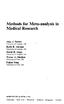 Methods for Meta-analysis in Medical Research Alex J. Sutton University of Leicester, UK Keith R. Abrams University of Leicester, UK David R. Jones University of Leicester, UK Trevor A. Sheldon University
Topic 5: Stochastic Growth and Real Business Cycles
 Topic 5: Stochastic Growth and Real Business Cycles Yulei Luo SEF of HKU October 1, 2015 Luo, Y. (SEF of HKU) Macro Theory October 1, 2015 1 / 45 Lag Operators The lag operator (L) is de ned as Similar
Financial Market Efficiency and Its Implications
 Financial Market Efficiency: The Efficient Market Hypothesis (EMH) Financial Market Efficiency and Its Implications Financial markets are efficient if current asset prices fully reflect all currently available
Macroeconomic Effects of Financial Shocks Online Appendix
 Macroeconomic Effects of Financial Shocks Online Appendix By Urban Jermann and Vincenzo Quadrini Data sources Financial data is from the Flow of Funds Accounts of the Federal Reserve Board. We report the
Another Look at Sensitivity of Bayesian Networks to Imprecise Probabilities
 Another Look at Sensitivity of Bayesian Networks to Imprecise Probabilities Oscar Kipersztok Mathematics and Computing Technology Phantom Works, The Boeing Company P.O.Box 3707, MC: 7L-44 Seattle, WA 98124
5. Linear Regression
 5. Linear Regression Outline.................................................................... 2 Simple linear regression 3 Linear model............................................................. 4
PITFALLS IN TIME SERIES ANALYSIS. Cliff Hurvich Stern School, NYU
 PITFALLS IN TIME SERIES ANALYSIS Cliff Hurvich Stern School, NYU The t -Test If x 1,..., x n are independent and identically distributed with mean 0, and n is not too small, then t = x 0 s n has a standard
Parallelization Strategies for Multicore Data Analysis
 Parallelization Strategies for Multicore Data Analysis Wei-Chen Chen 1 Russell Zaretzki 2 1 University of Tennessee, Dept of EEB 2 University of Tennessee, Dept. Statistics, Operations, and Management
A macroeconomic credit risk model for stress testing the Romanian corporate credit portfolio
 Academy of Economic Studies Bucharest Doctoral School of Finance and Banking A macroeconomic credit risk model for stress testing the Romanian corporate credit portfolio Supervisor Professor PhD. Moisă
Imputation of missing data under missing not at random assumption & sensitivity analysis
 Imputation of missing data under missing not at random assumption & sensitivity analysis S. Jolani Department of Methodology and Statistics, Utrecht University, the Netherlands Advanced Multiple Imputation,
Package EstCRM. July 13, 2015
 Version 1.4 Date 2015-7-11 Package EstCRM July 13, 2015 Title Calibrating Parameters for the Samejima's Continuous IRT Model Author Cengiz Zopluoglu Maintainer Cengiz Zopluoglu
HLM software has been one of the leading statistical packages for hierarchical
 Introductory Guide to HLM With HLM 7 Software 3 G. David Garson HLM software has been one of the leading statistical packages for hierarchical linear modeling due to the pioneering work of Stephen Raudenbush