
Emergency Management Institute Fiscal Year 2016 Training Catalog
|
|
|
- Bruce Benson
- 10 years ago
- Views:
Transcription
1 Emergency Management Institute Fiscal Year 2016 Training Catalog Train, Exercise, Educate

2 Course dates are available on the Internet at: EMERGENCY MANAGEMENT INSTITUTE South Seton Avenue Emmitsburg, Maryland Phone: (301) (800) Fax: (301) (Admissions)

3 Welcome to the Emergency Management Institute The mission of the Emergency Management Institute (EMI) is to Support the Department of Homeland Security and the Federal Emergency Management Agency s (FEMA s) goals by improving the competencies of U.S. officials at all levels of Government to prevent, prepare for, respond to, recover from, and mitigate the potential effects of all types of disasters and emergencies on the American people. Located on the campus of the National Emergency Training Center (NETC) in Emmitsburg, Maryland, EMI is the emergency management community s flagship training institution. EMI provides training to Federal, state, local, tribal, volunteer, public, and private sector officials to strengthen emergency management core competencies for professional, career-long training. EMI trains more than two million students annually. Instruction incorporates the principles of emergency management through instructional systems design in order to create a framework for the whole community to reduce vulnerability to hazards and to cope with disasters. EMI develops courses and implements training delivery systems to include residential onsite training; offsite delivery in partnership with emergency management training systems, colleges, and universities; and technology-based mediums to conduct individual training courses for emergency management and response personnel across the Nation. Tony Russell, CEM Superintendent Emergency Management Institute

4

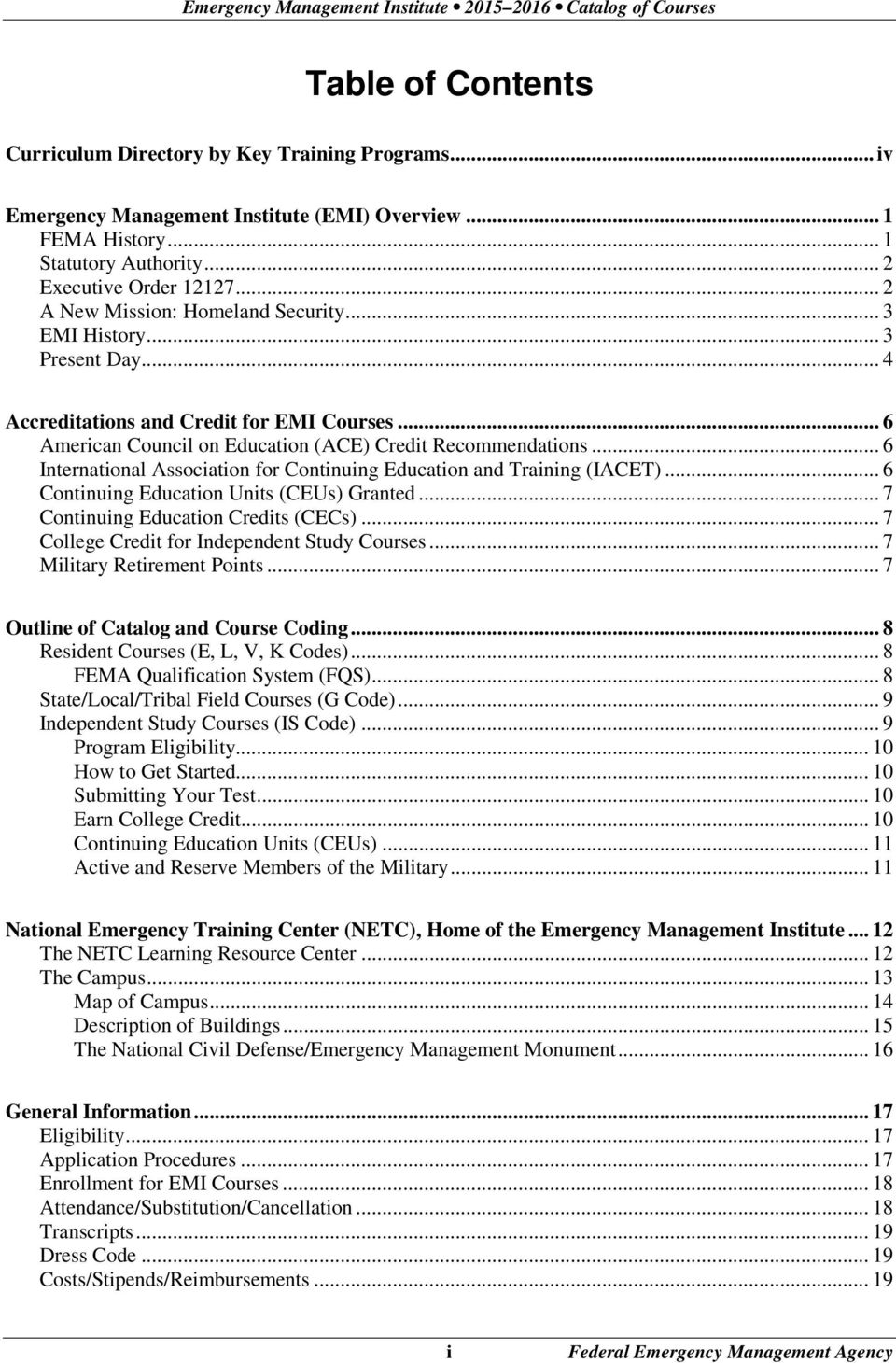
5 Table of Contents Curriculum Directory by Key Training Programs... iv Emergency Management Institute (EMI) Overview... 1 FEMA History... 1 Statutory Authority... 2 Executive Order A New Mission: Homeland Security... 3 EMI History... 3 Present Day... 4 Accreditations and Credit for EMI Courses... 6 American Council on Education (ACE) Credit Recommendations... 6 International Association for Continuing Education and Training (IACET)... 6 Continuing Education Units (CEUs) Granted... 7 Continuing Education Credits (CECs)... 7 College Credit for Independent Study Courses... 7 Military Retirement Points... 7 Outline of Catalog and Course Coding... 8 Resident Courses (E, L, V, K Codes)... 8 FEMA Qualification System (FQS)... 8 State/Local/Tribal Field Courses (G Code)... 9 Independent Study Courses (IS Code)... 9 Program Eligibility How to Get Started Submitting Your Test Earn College Credit Continuing Education Units (CEUs) Active and Reserve Members of the Military National Emergency Training Center (NETC), Home of the Emergency Management Institute The NETC Learning Resource Center The Campus Map of Campus Description of Buildings The National Civil Defense/Emergency Management Monument General Information Eligibility Application Procedures Enrollment for EMI Courses Attendance/Substitution/Cancellation Transcripts Dress Code Costs/Stipends/Reimbursements i Federal Emergency Management Agency
6 Travel Planning NETC Campus Information Lodging Food Service Security Firearms Alcoholic Beverages Registration Transportation and Parking Directions to NETC Foreign Applicants Web Addresses Emergency Management Professional Program (EMPP) National Emergency Management Basic Academy Target Audience Classroom Course Requirements Prerequisites National Emergency Management Advanced Academy Target Audience Classroom Requirements Application Process Selection Criteria Program Prerequisite National Emergency Management Executive Academy Target Audience Classroom Requirements Selection Criteria EMI Program Areas Continuity Practitioner Program Level I, Professional Continuity Practitioner Program Level II, Master Continuity Practitioner Program Hazus-MH Program Higher Education Program Incident Command System (ICS) Program General ICS Instructor Guidelines National Incident Management System (NIMS) Incident Command System (ICS) All-Hazards Position-Specific Training Program National Incident Management System (NIMS) Incident Command System (ICS) All-Hazards Position-Specific Train-the-Trainer (TTT) Program Integrated Emergency Management Program Enrollment for IEMC Courses IEMC Participant Selection Criteria Who Should Attend an IEMC Master Exercise Practitioner Program (MEPP) Response and Recovery Program Trainer Program ii Federal Emergency Management Agency

7 Course Descriptions FEMA Regional Offices State Training Offices Index of Courses and Mission Areas Acronyms Alphabetical Index Resident Course Index Resident Off-Site Courses State-Delivered; Field Courses Independent Study Courses Adobe Connect Webinar Courses Video Teleconference Courses Numerical Index General Admissions Application Human Dignity Statement iii Federal Emergency Management Agency

8 Curriculum Directory by Key Training Programs I. EMERGENCY MANAGEMENT PROFESSIONAL PROGRAM National Emergency Management Academies National Emergency Management Basic Academy E0101 Foundations of Emergency Management E0102 Science of Disaster E0103 Planning: Emergency Operations E0104 Exercise Design E0105 Public Information and Warning E0110 Foundations Course Train-the-Trainer E0111 Train-the-Trainer for E0103 E National Emergency Management Advanced Academy E0451 Advanced I A Survey of Advanced Concepts in Emergency Management E0452 Advanced II Assessment and Application of Professional Style in Emergency Management E0453 Advanced III Advanced Concepts and Issues in the Emergency Management Organization E0454 Advanced IV Advanced Concepts and Issues in the Emergency Management Community and Profession National Emergency Management Executive Academy E0680 Emergency Management A Leadership Challenge E0682 Emergency Management in the 21 st Century E0684 Integrating Science into Emergency Management Policies and Decisions E0686 Exercising Emergency Management Executive Policy and Decision-Making II. EMI PROGRAM AREAS Building Science Resident Courses E0153 Building Design for Homeland Security E0273 Managing Floodplain Development Through the National Flood Insurance Program E0276 Benefit-Cost Analysis: Entry-Level E0278 National Flood Insurance Program/Community Rating System E0279 Retrofitting Flood-Prone Residential Buildings E0282 Advanced Floodplain Management Concepts II E0284 Advanced Floodplain Management Concepts III E0312 Fundamentals of Building Science E0386 Residential Coastal Construction State/Local/Tribal Field-Delivered Courses G National Flood Insurance Program Rules and Regulations in Depth G Preparing for Post-Disaster Responsibilities G0277 Residential Coastal Construction iv Federal Emergency Management Agency

9 G0279 Retrofitting Flood-Prone Residential Buildings G0282 Advanced Floodplain Management Concepts II G Higher Standards in Floodplain Management G Manufactured Homes and the National Flood Insurance Program G0284 Advanced Floodplain Management Concepts III G Common Noncompliance Issues G Substantial Improvement/Substantial Damage Independent Study Courses IS-0156 Building Design for Homeland Security for Continuity of Operations IS-0276 Benefit-Cost Analysis Fundamentals IS-0277 Benefit-Cost Analysis: Entry-Level IS-0280 Overview of: Engineering Principles and Practices for Retrofitting Flood-Prone Residential Structures, FEMA Publication 259, 3 rd Edition IS-0284 Using the Substantial Damage Estimator 2.0 Tool IS-0325 Earthquake Basics: Science, Risk, and Mitigation IS-0386.a Introduction to Residential Coastal Construction IS-0395 FEMA Risk Assessment Database IS-1105 Elevation Certificate Made Easy (EC Made EZ) Adobe Connect Webinar Course K0276 Benefit-Cost Analysis: Entry-Level Citizen Preparedness Resident Courses E0131 Exercise Evaluation and Improvement Planning E0197 Integrating Access and Functional Needs into Emergency Planning E0257 State Director Training Course E0360 Preparing for Emergencies: What Teachers Need to Know E0361 Multi-Hazard Emergency Planning for Schools E0362 Train-the-Trainer for G0364, Multi-Hazard Emergency Planning for Schools E0364 Multi-Hazard Emergency Planning for Schools E0390 Integrating Emergency Management Education into Your Institution E0426 Implementing Whole Community Resilience and Citizen Corps Programs E0427 Community Emergency Response Team Program Manager E0428 Community Emergency Response Team Train-the-Trainer E0952 NIMS ICS All-Hazards Public Information Officer Course State/Local/Tribal Field-Delivered Courses G0108 Community Mass Care and Emergency Assistance G0191 Emergency Operations Center/Incident Command System Interface G0251 WEM Amateur Radio Resources G Expedient Flood Training G0272 Warning Coordination G0311 Hazardous Materials Contingency Planning G0358 Evacuation and Re-Entry Planning Course G0364 Multi-Hazard Emergency Planning for Schools G0365 WEM: Partnerships for Creating and Maintaining Spotter Groups G0427 Community Emergency Response Team Program Manager G0428 Community Emergency Response Team Train-the-Trainer G0434.a Earthquake Safety for Schools v Federal Emergency Management Agency

10 G0556 Local Damage Assessment G0557 Rapid Needs Assessment G0775 Emergency Operations Center Management and Operations Independent Study Courses IS-0001.a Emergency Manager: An Orientation to the Position IS-0005.a An Introduction to Hazardous Materials IS-0010.a Animals in Disasters: Awareness and Preparedness IS-0015.b Special Events Contingency Planning for Public Safety Agencies IS-0022 Are You Ready? An In-Depth Guide to Citizen Preparedness IS-0036 Multi-Hazard Planning for Childcare IS-0055.a Household Hazardous Materials A Guide for Citizens IS-0056 Hazardous Materials Contingency Planning IS-0111.a Livestock in Disasters IS-0230.d Fundamentals of Emergency Management IS-0247.a Integrated Public Alert and Warning System IS-0248 Integrated Public Alert and Warning System for the American Public IS-0251 Integrated Public Alert and Warning System for Alerting Authorities IS-0271.a Anticipating Hazardous Weather and Community Risk, 2 nd Edition IS-0315 Community Emergency Response Team Supplemental Training: The Incident Command System IS-0317 Introduction to Community Emergency Response Team IS-0326 Community Tsunami Preparedness IS-0340 Hazardous Materials Prevention IS-0360 Preparing for Mass Casualty Incidents: A Guide for Schools, Higher Education, and Houses of Worship IS-0362.a Multi-Hazard Emergency Planning for Schools IS-0366.a Planning for the Needs of Children in Disasters IS-0394.a Protecting Your Home or Small Business from Disaster IS-0450 Emergency Preparedness for Federal Employees IS-0450.NC Emergency Preparedness for Federal Employees in the National Capital Region IS-0454 Fundamentals of Risk Management IS-0559 Local Damage Assessment IS-0720 An Introduction to the National Emergency Technology Guard IS-0775 Emergency Operations Center Management and Operations IS-0906 Workplace Security Awareness IS-0907 Active Shooter: What You Can Do IS-0908 Emergency Management for Senior Officials IS-0909 Community Preparedness: Implementing Simple Activities for Everyone IS-0910.a Emergency Management Preparedness Fundamentals IS-2900 National Disaster Recovery Framework Overview Continuity of Operations Resident Courses E0547 Continuity Exercise Design E0548 Continuity of Operations Planning Program Manager Train-the-Trainer Course E0549 Reconstitution Planning Workshop E0550 Continuity of Operations Planning E0551 Devolution Planning Workshop Train-the-Trainer E0553 Resilient Accord Cyber Security Planning Workshop vi Federal Emergency Management Agency

11 E0554 Determined Accord Workshop E0556 Guardian Accord Terrorism-Based Planning Workshop E0557 Mission Essential Functions Workshop (Continuity Guidance) State/Local/Tribal Field-Delivered Courses G0548 Continuity of Operations Managers Training Course G0775 Emergency Operations Center Management and Operations Independent Study Courses IS-0247.a Integrated Public Alert and Warning System IS-0251 Integrated Public Alert and Warning System for Alerting Authorities IS-0520 Introduction to Continuity of Operations Planning for Pandemic Influenzas IS-0522 Exercising Continuity Plans for Pandemics IS-0523 Resilient Accord Exercising Continuity Plans for Cyber Incidents IS-0524 Continuity of Operations Planner s Workshop IS-0525 Guardian Accord Workshop IS-0526 Mission Essential Functions Workshop IS-0545 Reconstitution Planning Course IS-0546.a Continuity of Operations Awareness IS-0547.a Introduction to Continuity of Operations IS-0548 Continuity of Operations Program Manager IS-0550 Continuity Exercise Design Course IS-0551 Continuity of Operations Devolution Planning IS-0706 National Incident Management System Intrastate Mutual Aid An Introduction IS-0775 Emergency Operations Center Management and Operations Video Teleconference Courses V0013 Virtual Tabletop Exercise Continuity of Operations Focus Critical Infrastructure Security and Resilience State/Local/Tribal Field-Delivered Courses G Digital Flood Insurance Rate Maps Independent Study Courses IS-0559 Local Damage Assessment IS-0860.b The National Infrastructure Protection Plan, An Introduction IS-0890.a Introduction to the Interagency Security Committee IS-0891 Facility Security Level Determinations for Federal Facilities IS-0892 Physical Security Criteria for Federal Facilities IS-0893 Facility Security Committees IS-0912 Retail Security Awareness: Understanding the Hidden Hazards IS-0913.a Critical Infrastructure Protection: Achieving Results through Partnership and Collaboration IS-0914 Surveillance Awareness: What You Can Do IS-0915 Protecting Critical Infrastructure Against Insider Threats IS-0916 Critical Infrastructure Security: Theft and Diversion What You Can Do IS-0921.a Implementing Critical Infrastructure Security and Resilience and Critical Infrastructure Security and Resilience Toolkit vii Federal Emergency Management Agency

12 Dam Safety Resident Courses E0274 National Dam Safety Program Technical Seminar E0278 National Flood Insurance Program/Community Rating System E0291 Community Dam Safety, Preparedness and Mitigation L0260 Dam Security and Protection Technical Seminar L0261 Consequences of Dam Failure Independent Study Courses IS-0870.a Dams Sector: Crisis Management IS-0871.a Dams Sector: Security Awareness IS-0872.a Dams Sector: Protective Measures Disability Integration Resident Courses E0197 Integrating Access and Functional Needs into Emergency Planning E0692 FEMA Disability Integration Advisor External Affairs State/Local/Federal Resident Courses E0388 Advanced Public Information Officer Course State/Local/Tribal Field-Delivered Courses G0289 Public Information Officer Awareness Training G0290 Basic Public Information Officers Course G0291 Joint Information System/Center Planning for Tribal, State, and Local Public Information Officers Independent Study Courses IS-0029 Public Information Officer Awareness IS-0250.a Emergency Support Function (ESF) #15 External Affairs: A New Approach to Emergency Communication and Information Distribution IS-0794 External Affairs Program Liaison Function Floodplain Management Resident Courses E0194 Advanced Floodplain Management Concepts E0204 Hazard Mitigation Task Force Leader E0241 Cooperating Technical Partners: Special Topics E0273 Managing Floodplain Development Through the National Flood Insurance Program E0278 National Flood Insurance Program/Community Rating System E0279 Retrofitting Flood-Prone Residential Buildings E0282 Advanced Floodplain Management Concepts II E0284 Advanced Floodplain Management Concepts III E0291 Community Dam Safety, Preparedness and Mitigation E0312 Fundamentals of Building Science E0386 Residential Coastal Construction L0299 Risk MAP Process and Tools viii Federal Emergency Management Agency

13 State/Local/Tribal Field-Delivered Courses G0194 Advanced Floodplain Management Concepts I G Local Floodplain Manager Roles and Responsibilities G National Flood Insurance Program Rules and Regulations in Depth G Letters of Map Change G Preparing for Post-Disaster Responsibilities G0277 Residential Coastal Construction G0279 Retrofitting Flood-Prone Residential Buildings G0282 Advanced Floodplain Management Concepts II G Higher Standards in Floodplain Management G Manufactured Homes and the National Flood Insurance Program G National Flood Insurance Program Flood Insurance Principles G Hydrology and Hydraulics Concepts G0284 Advanced Floodplain Management Concepts III G Floodway Standards G Disconnects Between the National Flood Insurance Program Regulations and Insurance G Common Noncompliance Issues G Digital Flood Insurance Rate Maps G Substantial Improvement/Substantial Damage G0361 Flood Fight Operations Independent Study Courses IS-0212.a Introduction to Unified Hazard Mitigation Assistance IS-0276 Benefit-Cost Analysis Fundamentals IS-0279.a Introduction to Retrofitting Flood-Prone Residential Buildings IS-0280 Overview of: Engineering Principles and Practices for Retrofitting Flood-Prone Residential Structures, FEMA Publication 259, 3 rd Edition IS-0284 Using the Substantial Damage Estimator 2.0 Tool IS-0386.a Introduction to Residential Coastal Construction IS-1100 National Flood Insurance Program Increased Cost of Compliance IS-1105 Elevation Certificate Made Easy (EC Made EZ) IS-1107 Adjuster-Customer Service IS-1110 Writing Commercial Exposures Generalized Emergency Preparedness Resident Courses E0197 Integrating Access and Functional Needs into Emergency Planning E0257 State Director Training Course State/Local/Tribal Field-Delivered Courses G Local Floodplain Manager Roles and Responsibilities Independent Study Courses IS-0005.a An Introduction to Hazardous Materials IS-0055.a Household Hazardous Materials A Guide for Citizens IS-0056 Hazardous Materials Contingency Planning IS-0240.b Leadership and Influence IS-0242.b Effective Communication IS-0247.a Integrated Public Alert and Warning System IS-0248 Integrated Public Alert and Warning System for the American Public ix Federal Emergency Management Agency
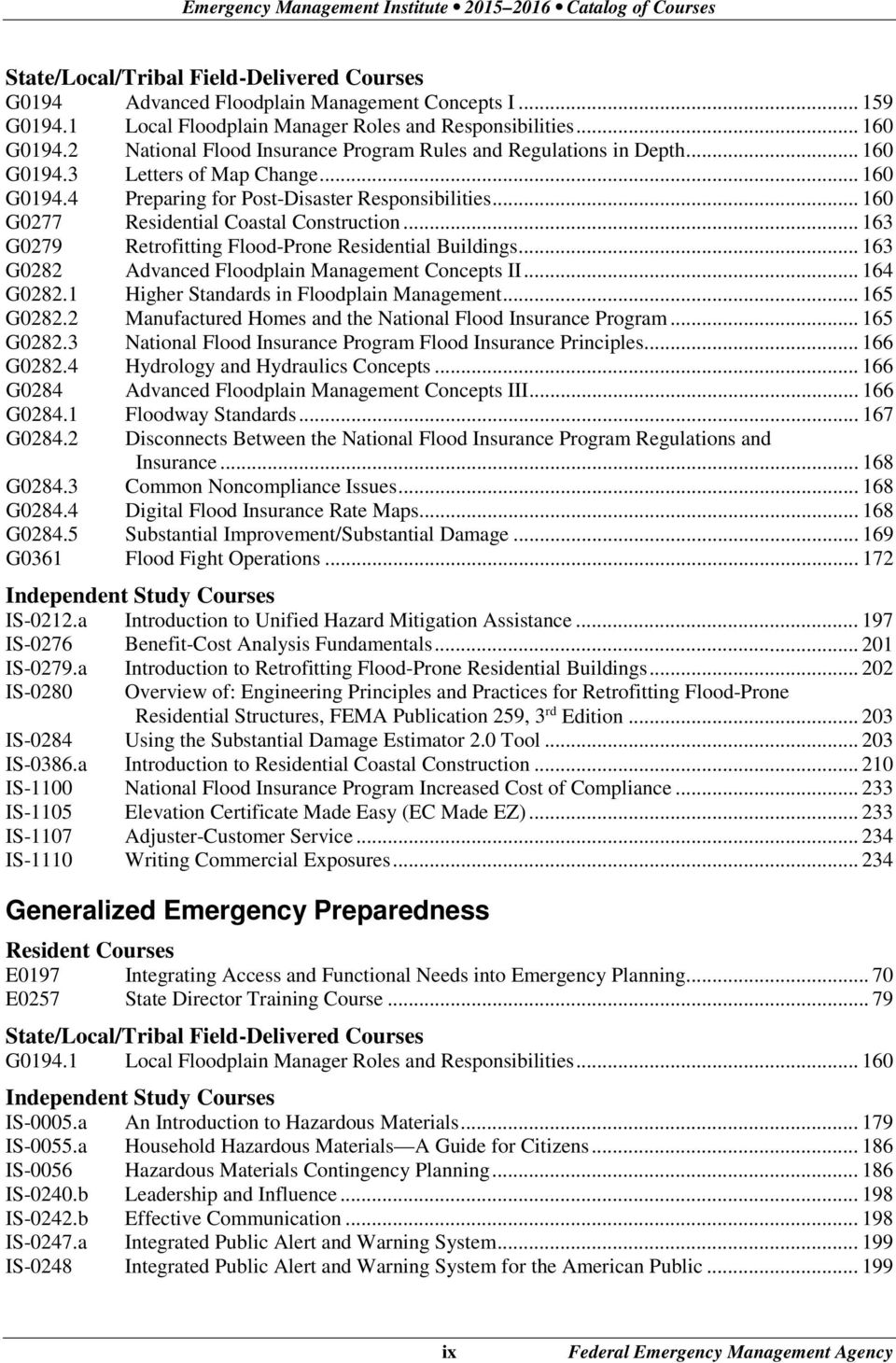
14 IS-0324.a Community Hurricane Preparedness IS-0340 Hazardous Materials Prevention IS-0360 Preparing for Mass Casualty Incidents: A Guide for Schools, Higher Education, and Houses of Worship IS-0450 Emergency Preparedness for Federal Employees IS-0450.NC Emergency Preparedness for Federal Employees in the National Capital Region IS-0559 Local Damage Assessment IS-0775 Emergency Operations Center Management and Operations IS-0800.b National Response Framework, An Introduction IS-0910.a Emergency Management Preparedness Fundamentals Adobe Connect Webinar Course K0146 Homeland Security Exercise Evaluation Program Basic Course Hazus-MH and GIS Resident Courses E0170 Hazus-MH for Hurricane E0172 Hazus-MH for Flood E0174 Hazus-MH for Earthquake E0176 Hazus-MH for Floodplain Managers E0179 Application of Hazus-MH for Disaster Operations E0190 ArcGIS for Emergency Managers E0241 Cooperating Technical Partners: Special Topics E0296 Application of Hazus-MH for Risk Assessment E0313 Basic Hazus-MH E0317 Comprehensive Data Management for Hazus-MH L0299 Risk MAP Process and Tools Independent Study Course IS-0060 Introduction and Overview Homeland Security Geospatial Concept-of-Operations (GeoCONOPS) IS-0061 Geospatial Concept-of-Operations (GeoCONOPS) In-Depth Homeland Security GeoCONOPS IS-0062 Geospatial Concept-of-Operations (GeoCONOPS) In-Practice Homeland Security GeoCONOPS IS-0063 Introduction and Overview DHS Geospatial Information Infrastructure IS-0922 Applications of Geospatial Information Systems for Emergency Management Hurricane Preparedness Resident Courses E0131 Exercise Evaluation and Improvement Planning E0278 National Flood Insurance Program/Community Rating System E0312 Fundamentals of Building Science E0386 Residential Coastal Construction E0463 FEMA Incident Workforce Academy Surge Capacity Force Surge Specialist Training E0695 FEMA Resources Unit Leader E0697 FEMA Planning Section Chief E0698 FEMA Planning Support Unit Leader E0754 FEMA Planning Specialist E0799 FEMA Situation Unit Leader x Federal Emergency Management Agency
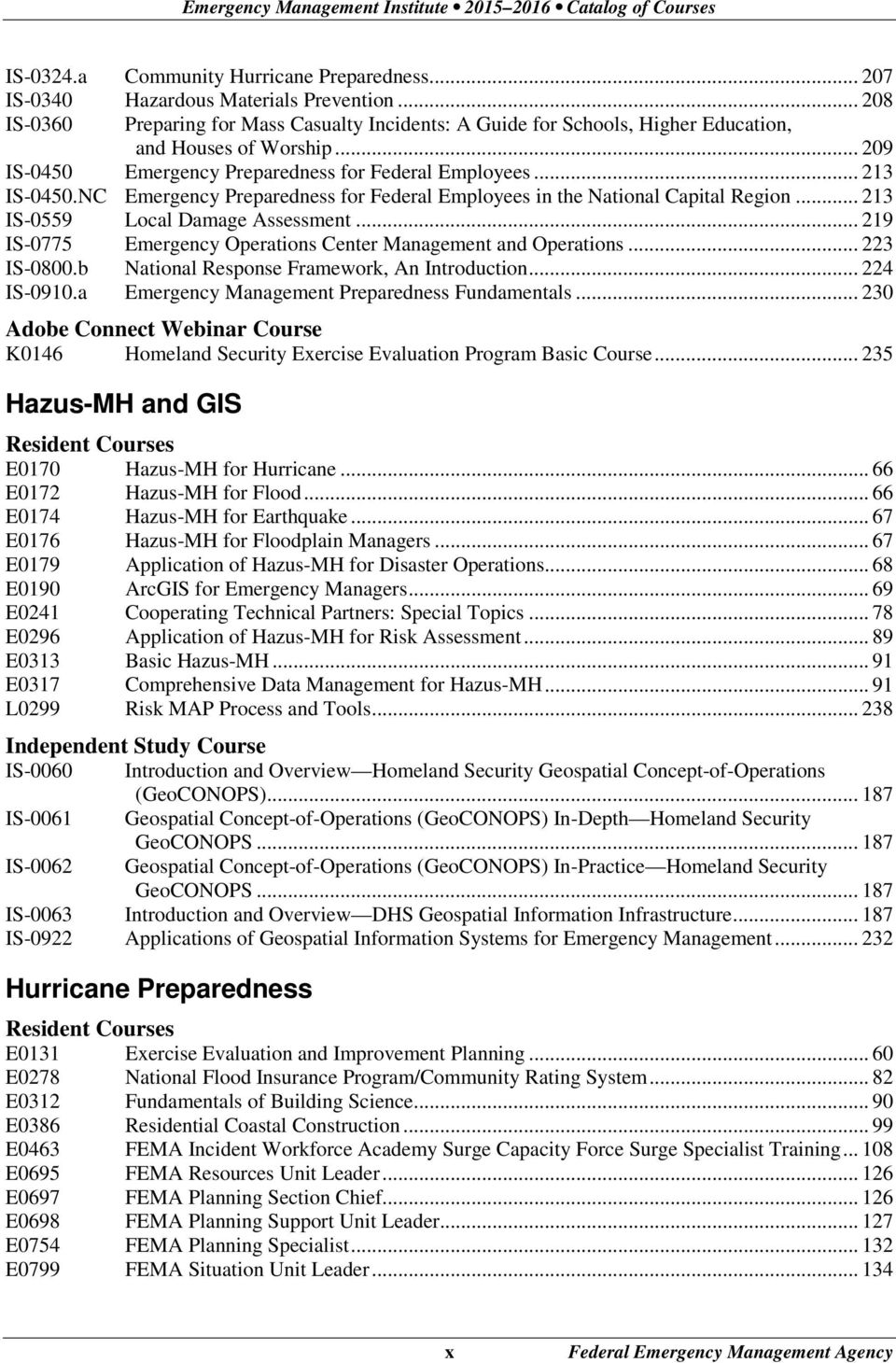
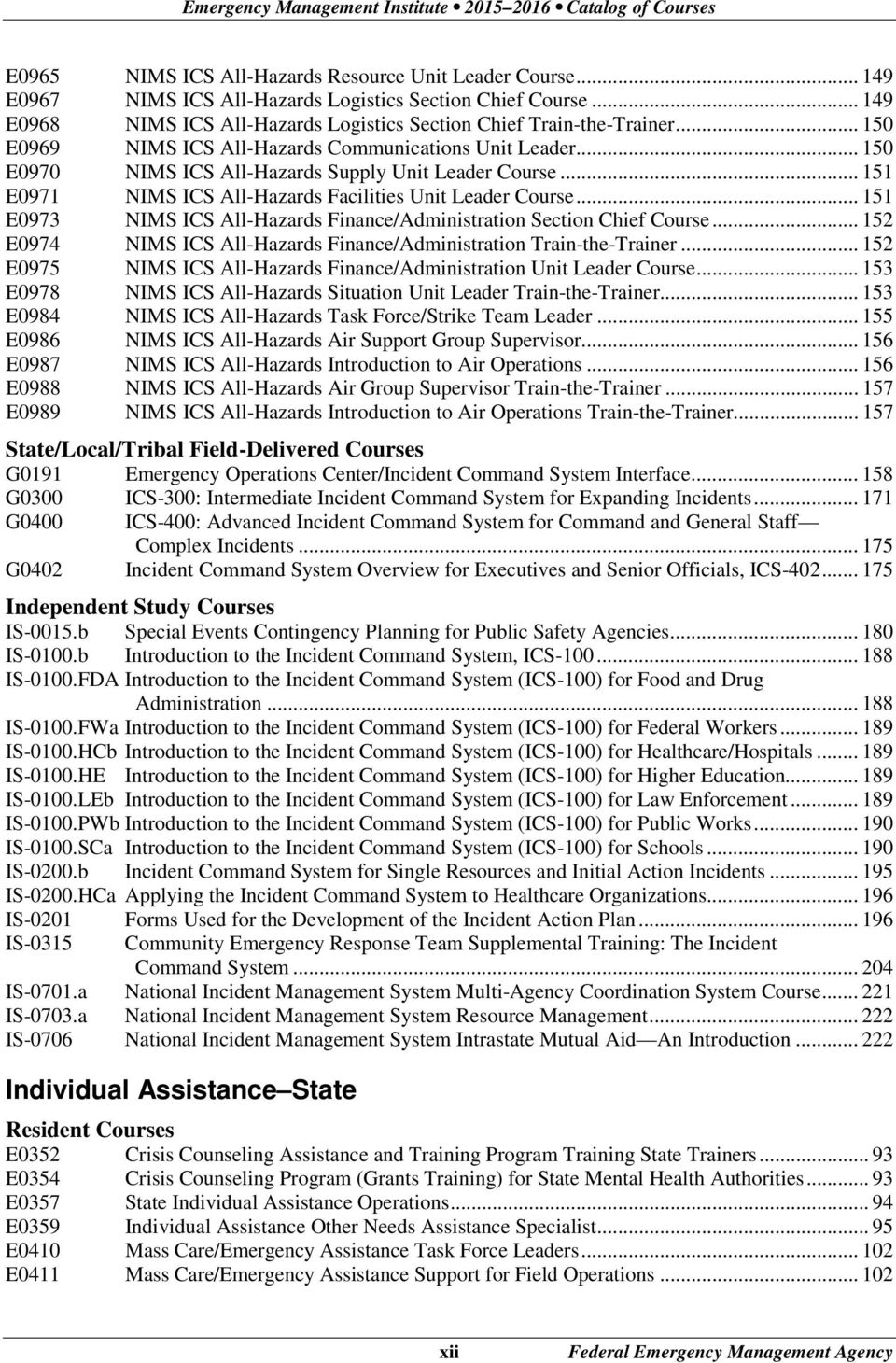
15 E0968 NIMS ICS All-Hazards Logistics Section Chief Train-the-Trainer L0299 Risk MAP Process and Tools L0310 Hurricane Readiness for Inland Communities L0311 Hurricane Readiness L0320 Hurricane Preparedness for Decision-Makers State Specific L0324 Hurricane Preparedness for Decision-Makers State/Local/Tribal Field-Delivered Courses G0277 Residential Coastal Construction G0363 Hurricane Readiness for Coastal Communities Independent Study Courses IS-0280 Overview of: Engineering Principles and Practices for Retrofitting Flood-Prone Residential Structures, FEMA Publication 259, 3 rd Edition IS-0324.a Community Hurricane Preparedness IS-0386.a Introduction to Residential Coastal Construction Video Teleconference Courses V0009 Virtual Tabletop Exercise Hurricane V0032 Virtual Tabletop Exercise Public Health Hurricane Incident Command System Resident Courses E0131 Exercise Evaluation and Improvement Planning E0300 ICS-300: Intermediate Incident Command System for Expanding Incidents E0400 Advanced Incident Command System for Command and General Staff Complex Incidents E0431 Understanding the Emergency Management Assistance Compact E0449 Incident Command System Curricula Train-the-Trainer E0695 FEMA Resources Unit Leader E0697 FEMA Planning Section Chief E0698 FEMA Planning Support Unit Leader E0754 FEMA Planning Specialist E0799 FEMA Situation Unit Leader E0825 FEMA Incident Action Planning E0827 Geospatial Information System Managers and Unit Leaders E0949 NIMS ICS All-Hazards Communications Unit Leader Train-the-Trainer E0950 NIMS ICS All-Hazards Incident Commander Course E0951 NIMS ICS All-Hazards Incident Commander Train-the-Trainer E0952 NIMS ICS All-Hazards Public Information Officer Course E0953 NIMS ICS All-Hazards Public Information Officer Train-the-Trainer E0954 NIMS ICS All-Hazards Safety Officer Course E0955 NIMS ICS All-Hazards Safety Officer Train-the-Trainer E0956 NIMS ICS All-Hazards Liaison Officer Course E0957 NIMS ICS All-Hazards Liaison Officer Train-the-Trainer E0958 NIMS ICS All-Hazards Operations Section Chief Course E0959 NIMS ICS All-Hazards Operations Section Chief Train-the-Trainer E0960 NIMS ICS All-Hazards Division/Group Supervisor Course E0962 NIMS ICS All-Hazards Planning Section Chief Course E0963 NIMS ICS All-Hazards Planning Section Chief Train-the-Trainer E0964 NIMS ICS All-Hazards Situation Unit Leader Course xi Federal Emergency Management Agency

16 E0965 NIMS ICS All-Hazards Resource Unit Leader Course E0967 NIMS ICS All-Hazards Logistics Section Chief Course E0968 NIMS ICS All-Hazards Logistics Section Chief Train-the-Trainer E0969 NIMS ICS All-Hazards Communications Unit Leader E0970 NIMS ICS All-Hazards Supply Unit Leader Course E0971 NIMS ICS All-Hazards Facilities Unit Leader Course E0973 NIMS ICS All-Hazards Finance/Administration Section Chief Course E0974 NIMS ICS All-Hazards Finance/Administration Train-the-Trainer E0975 NIMS ICS All-Hazards Finance/Administration Unit Leader Course E0978 NIMS ICS All-Hazards Situation Unit Leader Train-the-Trainer E0984 NIMS ICS All-Hazards Task Force/Strike Team Leader E0986 NIMS ICS All-Hazards Air Support Group Supervisor E0987 NIMS ICS All-Hazards Introduction to Air Operations E0988 NIMS ICS All-Hazards Air Group Supervisor Train-the-Trainer E0989 NIMS ICS All-Hazards Introduction to Air Operations Train-the-Trainer State/Local/Tribal Field-Delivered Courses G0191 Emergency Operations Center/Incident Command System Interface G0300 ICS-300: Intermediate Incident Command System for Expanding Incidents G0400 ICS-400: Advanced Incident Command System for Command and General Staff Complex Incidents G0402 Incident Command System Overview for Executives and Senior Officials, ICS Independent Study Courses IS-0015.b Special Events Contingency Planning for Public Safety Agencies IS-0100.b Introduction to the Incident Command System, ICS IS-0100.FDA Introduction to the Incident Command System (ICS-100) for Food and Drug Administration IS-0100.FWa Introduction to the Incident Command System (ICS-100) for Federal Workers IS-0100.HCb Introduction to the Incident Command System (ICS-100) for Healthcare/Hospitals IS-0100.HE Introduction to the Incident Command System (ICS-100) for Higher Education IS-0100.LEb Introduction to the Incident Command System (ICS-100) for Law Enforcement IS-0100.PWb Introduction to the Incident Command System (ICS-100) for Public Works IS-0100.SCa Introduction to the Incident Command System (ICS-100) for Schools IS-0200.b Incident Command System for Single Resources and Initial Action Incidents IS-0200.HCa Applying the Incident Command System to Healthcare Organizations IS-0201 Forms Used for the Development of the Incident Action Plan IS-0315 Community Emergency Response Team Supplemental Training: The Incident Command System IS-0701.a National Incident Management System Multi-Agency Coordination System Course IS-0703.a National Incident Management System Resource Management IS-0706 National Incident Management System Intrastate Mutual Aid An Introduction Individual Assistance State Resident Courses E0352 Crisis Counseling Assistance and Training Program Training State Trainers E0354 Crisis Counseling Program (Grants Training) for State Mental Health Authorities E0357 State Individual Assistance Operations E0359 Individual Assistance Other Needs Assistance Specialist E0410 Mass Care/Emergency Assistance Task Force Leaders E0411 Mass Care/Emergency Assistance Support for Field Operations xii Federal Emergency Management Agency
17 E0417 Mass Care/Emergency Assistance Shelter Field Guide Training E0418 Mass Care/Emergency Assistance Planning and Operations E0971 NIMS ICS All-Hazards Facilities Unit Leader Course State/Local/Tribal Field-Delivered Courses G0418 Mass Care/Emergency Assistance Planning and Operations Independent Study Courses IS-0403 Introduction to Individual Assistance IS-0405 Mass Care/Emergency Assistance Overview Integrated Emergency Management Resident Courses E0131 Exercise Evaluation and Improvement Planning E0143 Advanced Situational Awareness and Common Operating Picture E0287 Voluntary Agency Liaison: Functions and Methods E0288 Local Volunteer and Donations Management E0289 State Volunteer and Donations Management E0431 Understanding the Emergency Management Assistance Compact E0463 FEMA Incident Workforce Academy Surge Capacity Force Surge Specialist Training E0912 IEMC: Preparing the Whole Community for a Complex Coordinated Attack E0930 IEMC/Community-Specific L0146 Homeland Security Exercise and Evaluation Program Training Course State/Local/Tribal Field-Delivered Courses G0288 Local Volunteer and Donations Management Independent Study Courses IS-0015.b Special Events Contingency Planning for Public Safety Agencies IS-0120.a An Introduction to Exercises IS-0130 Exercise Evaluation and Improvement Planning IS-0144 Telecommunicators Emergency Response Taskforce Basic Course IS-0201 Forms Used for the Development of the Incident Action Plan IS-0244.b Developing and Managing Volunteers IS-0288 The Role of Voluntary Organizations in Emergency Management IS-0660 Introduction to Public-Private Partnerships IS-0662 Improving Preparedness and Resilience through Public-Private Partnerships IS-0706 National Incident Management System Intrastate Mutual Aid An Introduction Adobe Connect Webinar Course K0146 Homeland Security Exercise Evaluation Program Basic Course Video Teleconference Courses V0001 Virtual Tabletop Exercise Earthquake V0002 Virtual Tabletop Exercise Winter Storm V0003 Virtual Tabletop Exercise Chemical, Biological, Radiological, Nuclear, and Explosives (CBRNE) Explosive V0004 Virtual Tabletop Exercise Highway Hazmat V0005 Virtual Tabletop Exercise Tornado V0006 Virtual Tabletop Exercise Wildland Fire V0007 Virtual Tabletop Exercise Flood V0008 Virtual Tabletop Exercise Rail Hazmat V0009 Virtual Tabletop Exercise Hurricane xiii Federal Emergency Management Agency

18 V0010 Virtual Tabletop Exercise Mass Casualty V0011 Virtual Tabletop Exercise Fixed Site Hazmat V0012 Virtual Tabletop Exercise Chemical, Biological, Radiological, Nuclear, and Explosives (CBRNE) Bio V0013 Virtual Tabletop Exercise Continuity of Operations Focus V0014 Virtual Tabletop Exercise Prison Riot Focus V0015 Virtual Tabletop Exercise Cyber Focus V0016 Virtual Tabletop Exercise Aircraft Crash Focus V0017 Virtual Tabletop Exercise Stadium/Arena Scenario Focus V0018 Virtual Tabletop Exercise School Hostage Focus V0019 Virtual Tabletop Exercise Active Shooter, School V0020 Virtual Tabletop Exercise High-Rise Fire Focus V0021 Virtual Tabletop Exercise Public Health Winter Storm Focus V0022 Virtual Tabletop Exercise Public Health Chemical Focus V0023 Virtual Tabletop Exercise Public Health Pandemic Flu Focus V0027 Virtual Tabletop Exercise Long-Term Power Outage V0029 Virtual Tabletop Exercise Recovery V0031 Virtual Tabletop Exercise HazMat (Bakken Oil), Transportation (Rail) V0032 Virtual Tabletop Exercise Public Health Hurricane V0035 Virtual Tabletop Exercise Chlorine Leak (Spill) V0036 Virtual Tabletop Exercise Critical Stress Incident Management V0037 Virtual Tabletop Exercise HazMat, Pipeline (Oil) V0038 Virtual Tabletop Exercise HazMat (Gasoline) Transportation V0039 Virtual Tabletop Exercise HazMat (Gasoline) Storage Facility V0040 Virtual Tabletop Exercise Ebola (Hospital) V0041 Virtual Tabletop Exercise Civil Unrest V0042 Virtual Tabletop Exercise Chemical, Biological, Radiological, Nuclear, and Explosives (CBRNE) Radiological Dispersal Device (RDD) V0043 Virtual Tabletop Exercise Aircraft Crash, Airshow V0044 Virtual Tabletop Exercise Fire, Nightclub V0045 Virtual Tabletop Exercise Severe Weather (Fairgrounds) V0047 Virtual Tabletop Exercise Active Shooter, Sporting Event Level I Professional Continuity Practitioner Program Resident Courses E0547 Continuity Exercise Design E0548 Continuity of Operations Planning Program Manager Train-the-Trainer Course E0549 Reconstitution Planning Workshop E0550 Continuity of Operations Planning E0553 Resilient Accord Cyber Security Planning Workshop E0554 Determined Accord Workshop E0556 Guardian Accord Terrorism-Based Planning Workshop E0557 Mission Essential Functions Workshop (Continuity Guidance) L0552 Continuity of Operations for Tribal Governments Independent Study Courses IS-0100.b Introduction to the Incident Command System, ICS IS-0120.a An Introduction to Exercises IS-0200.b Incident Command System for Single Resources and Initial Action Incidents IS-0230.d Fundamentals of Emergency Management xiv Federal Emergency Management Agency

19 IS-0242.b Effective Communication IS-0248 Integrated Public Alert and Warning System for the American Public IS-0520 Introduction to Continuity of Operations Planning for Pandemic Influenzas IS-0522 Exercising Continuity Plans for Pandemics IS-0523 Resilient Accord Exercising Continuity Plans for Cyber Incidents IS-0524 Continuity of Operations Planner s Workshop IS-0525 Guardian Accord Workshop IS-0526 Mission Essential Functions Workshop IS-0545 Reconstitution Planning Course IS-0546.a Continuity of Operations Awareness IS-0547.a Introduction to Continuity of Operations IS-0548 Continuity of Operations Program Manager IS-0550 Continuity Exercise Design Course IS-0700.a National Incident Management System, An Introduction IS-0800.b National Response Framework, An Introduction Level II Master Continuity Practitioner Program Resident Courses E0141 Instructional Presentation and Evaluation Skills E0153 Building Design for Homeland Security E0547 Continuity Exercise Design E0551 Devolution Planning Workshop Train-the-Trainer E0553 Resilient Accord Cyber Security Planning Workshop State/Local/Tribal Field-Delivered Courses G0141 Instructional Presentation and Evaluation Skills Independent Study Courses IS-0130 Exercise Evaluation and Improvement Planning IS-0156 Building Design for Homeland Security for Continuity of Operations IS-0240.b Leadership and Influence IS-0545 Reconstitution Planning Course IS-0551 Continuity of Operations Devolution Planning Master Exercise Practitioner Program Resident Courses E0132 Discussion-Based Exercise Design and Evaluation E0133 Operations-Based Exercise Design and Evaluation E0136 Master Exercise Practitioner Capstone Course L0146 Homeland Security Exercise and Evaluation Program Training Course Independent Study Courses IS-0120.a An Introduction to Exercises IS-0130 Exercise Evaluation and Improvement Planning Adobe Connect Webinar Course K0146 Homeland Security Exercise Evaluation Program Basic Course Video Teleconference Courses V0001 Virtual Tabletop Exercise Earthquake V0002 Virtual Tabletop Exercise Winter Storm xv Federal Emergency Management Agency

20 V0005 Virtual Tabletop Exercise Tornado V0006 Virtual Tabletop Exercise Wildland Fire Multi-Hazard Mitigation Planning Resident Courses E0170 Hazus-MH for Hurricane E0172 Hazus-MH for Flood E0174 Hazus-MH for Earthquake E0176 Hazus-MH for Floodplain Managers E0179 Application of Hazus-MH for Disaster Operations E0190 ArcGIS for Emergency Managers E0194 Advanced Floodplain Management Concepts E0204 Hazard Mitigation Task Force Leader E0212 Unified Hazard Mitigation Assistance: Developing Quality Application Elements E0213 Unified Hazard Mitigation Assistance: Application Review and Evaluation E0214 Unified Hazard Mitigation Assistance: Project Implementation and Closeout E0216 Unified Hazard Mitigation Assistance: Application Review and Evaluation Train-the-Trainer E0273 Managing Floodplain Development Through the National Flood Insurance Program E0278 National Flood Insurance Program/Community Rating System E0282 Advanced Floodplain Management Concepts II E0284 Advanced Floodplain Management Concepts III E0296 Application of Hazus-MH for Risk Assessment E0312 Fundamentals of Building Science E0313 Basic Hazus-MH E0317 Comprehensive Data Management for Hazus-MH E0386 Residential Coastal Construction E0949 NIMS ICS All-Hazards Communications Unit Leader Train-the-Trainer E0950 NIMS ICS All-Hazards Incident Commander Course E0954 NIMS ICS All-Hazards Safety Officer Course E0956 NIMS ICS All-Hazards Liaison Officer Course E0957 NIMS ICS All-Hazards Liaison Officer Train-the-Trainer E0958 NIMS ICS All-Hazards Operations Section Chief Course E0959 NIMS ICS All-Hazards Operations Section Chief Train-the-Trainer E0962 NIMS ICS All-Hazards Planning Section Chief Course E0963 NIMS ICS All-Hazards Planning Section Chief Train-the-Trainer E0964 NIMS ICS All-Hazards Situation Unit Leader Course E0965 NIMS ICS All-Hazards Resource Unit Leader Course E0968 NIMS ICS All-Hazards Logistics Section Chief Train-the-Trainer E0969 NIMS ICS All-Hazards Communications Unit Leader E0971 NIMS ICS All-Hazards Facilities Unit Leader Course E0978 NIMS ICS All-Hazards Situation Unit Leader Train-the-Trainer E0986 NIMS ICS All-Hazards Air Support Group Supervisor E0987 NIMS ICS All-Hazards Introduction to Air Operations State/Local/Tribal Field-Delivered Courses G0194 Advanced Floodplain Management Concepts I G Local Floodplain Manager Roles and Responsibilities G National Flood Insurance Program Rules and Regulations in Depth G Preparing for Post-Disaster Responsibilities xvi Federal Emergency Management Agency
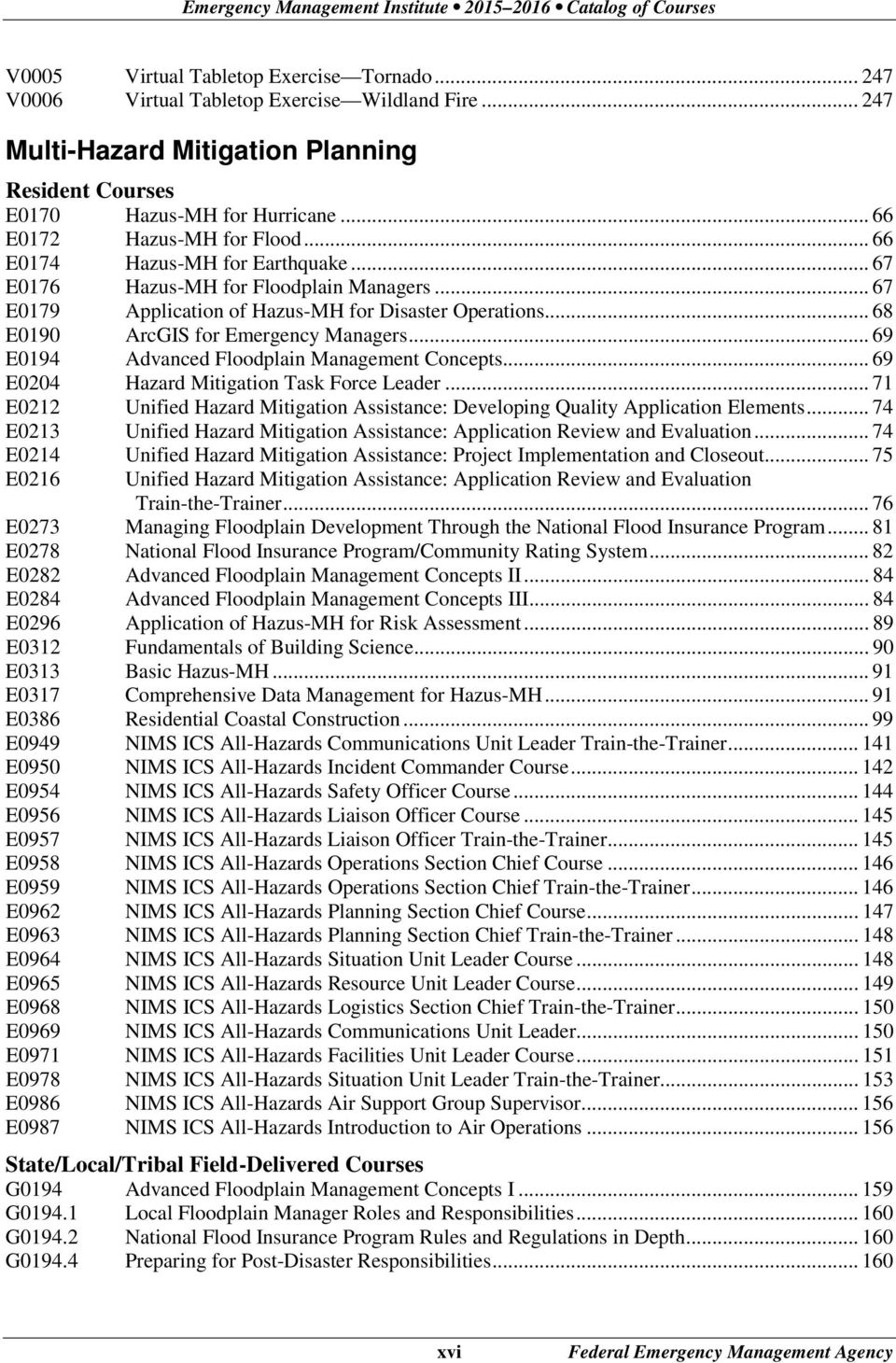
21 G0277 Residential Coastal Construction G0282 Advanced Floodplain Management Concepts II G Higher Standards in Floodplain Management G Manufactured Homes and the National Flood Insurance Program G National Flood Insurance Program Flood Insurance Principles G Hydrology and Hydraulics Concepts G0284 Advanced Floodplain Management Concepts III G Floodway Standards G Disconnects Between the National Flood Insurance Program Regulations and Insurance G Common Noncompliance Issues G Digital Flood Insurance Rate Maps G Substantial Improvement/Substantial Damage G0318 Mitigation Planning for Local Governments G0393 Mitigation for Emergency Managers Independent Study Courses IS-0212.a Introduction to Unified Hazard Mitigation Assistance IS-0284 Using the Substantial Damage Estimator 2.0 Tool IS-0318 Mitigation Planning for Local and Tribal Communities IS-0328 Plan Review for Local Mitigation Plans IS-0366.a Planning for the Needs of Children in Disasters IS-0386.a Introduction to Residential Coastal Construction IS-0393.a Introduction to Hazard Mitigation IS-0394.a Protecting Your Home or Small Business from Disaster IS-0395 FEMA Risk Assessment Database IS-0922 Applications of Geospatial Information Systems for Emergency Management National Response Framework Resident Courses E0204 Hazard Mitigation Task Force Leader E0210 Recovery from Disaster: The Local Government Role E0257 State Director Training Course E0463 FEMA Incident Workforce Academy Surge Capacity Force Surge Specialist Training E0950 NIMS ICS All-Hazards Incident Commander Course E0989 NIMS ICS All-Hazards Introduction to Air Operations Train-the-Trainer L0348 Orientation to Mission Assignments for FEMA Staff and Interagency Partners L0812 FEMA Chief and Advisory Staff Support Section Incident Support Course State/Local/Tribal Field-Delivered Courses G0205 Recovery from Disaster: The Local Government Role Independent Study Courses IS-0075 Military Resources in Emergency Management IS-0250.a Emergency Support Function (ESF) #15 External Affairs: A New Approach to Emergency Communication and Information Distribution IS-0706 National Incident Management System Intrastate Mutual Aid An Introduction IS-0800.b National Response Framework, An Introduction IS-0820 Introduction to National Response Framework Support Annexes IS-0821.a Critical Infrastructure and Key Resources Support Annex xvii Federal Emergency Management Agency
22 IS-0822 Fundamentals of Management and Support Coordination of Federal Disaster Operations IS-0830 Introduction to National Response Framework Incident Annexes IS-0836 Nuclear/Radiological Incident Annex Planning Resident Courses E0131 Exercise Evaluation and Improvement Planning E0194 Advanced Floodplain Management Concepts E0197 Integrating Access and Functional Needs into Emergency Planning E0210 Recovery from Disaster: The Local Government Role E0257 State Director Training Course E0273 Managing Floodplain Development Through the National Flood Insurance Program E0276 Benefit-Cost Analysis: Entry-Level E0279 Retrofitting Flood-Prone Residential Buildings E0291 Community Dam Safety, Preparedness and Mitigation E0361 Multi-Hazard Emergency Planning for Schools E0362 Train-the-Trainer for G0364, Multi-Hazard Emergency Planning for Schools E0364 Multi-Hazard Emergency Planning for Schools E0390 Integrating Emergency Management Education into Your Institution E0547 Continuity Exercise Design E0548 Continuity of Operations Planning Program Manager Train-the-Trainer Course E0549 Reconstitution Planning Workshop E0550 Continuity of Operations Planning E0551 Devolution Planning Workshop Train-the-Trainer E0553 Resilient Accord Cyber Security Planning Workshop E0554 Determined Accord Workshop E0556 Guardian Accord Terrorism-Based Planning Workshop E0557 Mission Essential Functions Workshop (Continuity Guidance) E0695 FEMA Resources Unit Leader E0697 FEMA Planning Section Chief E0698 FEMA Planning Support Unit Leader E0754 FEMA Planning Specialist E0799 FEMA Situation Unit Leader E0825 FEMA Incident Action Planning E0827 Geospatial Information System Managers and Unit Leaders L0324 Hurricane Preparedness for Decision-Makers L0363 Multi-Hazard Emergency Management for Higher Education State/Local/Tribal Field-Delivered Courses G0108 Community Mass Care and Emergency Assistance G0235 Emergency Planning G0279 Retrofitting Flood-Prone Residential Buildings G0288 Local Volunteer and Donations Management G0318 Mitigation Planning for Local Governments G0361 Flood Fight Operations G0364 Multi-Hazard Emergency Planning for Schools G0367 Emergency Planning for Campus Executives G0393 Mitigation for Emergency Managers G0548 Continuity of Operations Managers Training Course xviii Federal Emergency Management Agency
23 Independent Study Courses IS-0015.b Special Events Contingency Planning for Public Safety Agencies IS-0230.d Fundamentals of Emergency Management IS-0235.b Emergency Planning IS-0276 Benefit-Cost Analysis Fundamentals IS-0277 Benefit-Cost Analysis: Entry-Level IS-0280 Overview of: Engineering Principles and Practices for Retrofitting Flood-Prone Residential Structures, FEMA Publication 259, 3 rd Edition IS-0318 Mitigation Planning for Local and Tribal Communities IS-0328 Plan Review for Local Mitigation Plans IS-0362.a Multi-Hazard Emergency Planning for Schools IS-0453 Introduction to Homeland Security Planning IS-0454 Fundamentals of Risk Management IS-0520 Introduction to Continuity of Operations Planning for Pandemic Influenzas IS-0522 Exercising Continuity Plans for Pandemics IS-0523 Resilient Accord Exercising Continuity Plans for Cyber Incidents IS-0524 Continuity of Operations Planner s Workshop IS-0525 Guardian Accord Workshop IS-0526 Mission Essential Functions Workshop IS-0546.a Continuity of Operations Awareness IS-0547.a Introduction to Continuity of Operations IS-0548 Continuity of Operations Program Manager IS-0551 Continuity of Operations Devolution Planning IS-0662 Improving Preparedness and Resilience through Public-Private Partnerships IS-0702.a National Incident Management System Public Information Systems IS-0822 Fundamentals of Management and Support Coordination of Federal Disaster Operations IS-0870.a Dams Sector: Crisis Management IS-0871.a Dams Sector: Security Awareness IS-0872.a Dams Sector: Protective Measures Adobe Connect Webinar Course K0276 Benefit-Cost Analysis: Entry-Level Video Teleconference Courses V0008 Virtual Tabletop Exercise Rail Hazmat V0009 Virtual Tabletop Exercise Hurricane V0014 Virtual Tabletop Exercise Prison Riot Focus V0015 Virtual Tabletop Exercise Cyber Focus V0016 Virtual Tabletop Exercise Aircraft Crash Focus V0018 Virtual Tabletop Exercise School Hostage Focus V0019 Virtual Tabletop Exercise Active Shooter, School V0020 Virtual Tabletop Exercise High-Rise Fire Focus V0021 Virtual Tabletop Exercise Public Health Winter Storm Focus V0022 Virtual Tabletop Exercise Public Health Chemical Focus V0023 Virtual Tabletop Exercise Public Health Pandemic Flu Focus V0025 Virtual Tabletop Exercise Active Shooter, Public Building V0026 Virtual Tabletop Exercise Agricultural, County Fair V0027 Virtual Tabletop Exercise Long-Term Power Outage V0028 Virtual Tabletop Exercise Building Collapse (Non-Earthquake) V0029 Virtual Tabletop Exercise Recovery V0030 Virtual Tabletop Exercise Long-Term Recovery xix Federal Emergency Management Agency
24 V0031 Virtual Tabletop Exercise HazMat (Bakken Oil), Transportation (Rail) V0032 Virtual Tabletop Exercise Public Health Hurricane V0035 Virtual Tabletop Exercise Chlorine Leak (Spill) V0037 Virtual Tabletop Exercise HazMat, Pipeline (Oil) V0038 Virtual Tabletop Exercise HazMat (Gasoline) Transportation V0039 Virtual Tabletop Exercise HazMat (Gasoline) Storage Facility V0040 Virtual Tabletop Exercise Ebola (Hospital) V0041 Virtual Tabletop Exercise Civil Unrest V0042 Virtual Tabletop Exercise Chemical, Biological, Radiological, Nuclear, and Explosives (CBRNE) Radiological Dispersal Device (RDD) V0043 Virtual Tabletop Exercise Aircraft Crash, Airshow V0044 Virtual Tabletop Exercise Fire, Nightclub V0045 Virtual Tabletop Exercise Severe Weather (Fairgrounds) V0047 Virtual Tabletop Exercise Active Shooter, Sporting Event Preparedness for Schools/Children/Higher Education/Houses of Worship Resident Courses E0131 Exercise Evaluation and Improvement Planning E0360 Preparing for Emergencies: What Teachers Need to Know E0361 Multi-Hazard Emergency Planning for Schools E0364 Multi-Hazard Emergency Planning for Schools E0390 Integrating Emergency Management Education into Your Institution Independent Study Courses IS-0036 Multi-Hazard Planning for Childcare IS-0360 Preparing for Mass Casualty Incidents: A Guide for Schools, Higher Education, and Houses of Worship Video Teleconference Courses V0019 Virtual Tabletop Exercise Active Shooter, School V0021 Virtual Tabletop Exercise Public Health Winter Storm Focus V0022 Virtual Tabletop Exercise Public Health Chemical Focus V0023 Virtual Tabletop Exercise Public Health Pandemic Flu Focus V0026 Virtual Tabletop Exercise Agricultural, County Fair V0032 Virtual Tabletop Exercise Public Health Hurricane V0045 Virtual Tabletop Exercise Severe Weather (Fairgrounds) Public Assistance State Resident Courses E0202 Debris Management Planning for State, Tribal, and Local Officials E0257 State Director Training Course E0376 State Public Assistance Operations E0478 Public Assistance Grants Administration for Grantees E0975 NIMS ICS All-Hazards Finance/Administration Unit Leader Course Independent Study Courses IS-0632.a Introduction to Debris Operations IS-0634 Introduction to FEMA s Public Assistance Program IS-1105 Elevation Certificate Made Easy (EC Made EZ) xx Federal Emergency Management Agency
25 Public Works Resident Courses E0131 Exercise Evaluation and Improvement Planning E0431 Understanding the Emergency Management Assistance Compact E0967 NIMS ICS All-Hazards Logistics Section Chief Course E0968 NIMS ICS All-Hazards Logistics Section Chief Train-the-Trainer E0970 NIMS ICS All-Hazards Supply Unit Leader Course Independent Study Courses IS-0015.b Special Events Contingency Planning for Public Safety Agencies IS-0554 Emergency Planning for Public Works IS-0556 Damage Assessment for Public Works IS-0558 Public Works and Disaster Recovery IS-2900 National Disaster Recovery Framework Overview Radiological Emergency Preparedness Program Resident Courses E0131 Exercise Evaluation and Improvement Planning E0153 Building Design for Homeland Security Independent Study Course IS-0836 Nuclear/Radiological Incident Annex Response and Recovery Resident Courses E0060 Logistics Supply Chain Management System Visibility Fundamentals E0061 Logistics Supply Chain Management System Supply Chain Intelligence Level E0062 Logistics Supply Chain Management System Field Site Execution E0063 Logistics Supply Chain Management System FieldScout E0064 Logistics Supply Chain Management System Order Entry E0065 Logistics Supply Chain Management System Order Approval E0066 Logistics Supply Chain Management System End-to-End Scenario Practice E0068 Logistics Supply Chain Management System Distribution Center View Only E0069 Logistics Supply Chain Management System Transportation Planning E0070 Logistics Supply Chain Management System Transportation Execution E0071 Logistics Supply Chain Management System System Administration E0080 National Disaster Recovery Framework: Federal Operations E0086 National Disaster Recovery Support Management Team Course E0088 National Disaster Recovery Specialist Course E0089 National Disaster Recovery Framework Leadership Workshop E0131 Exercise Evaluation and Improvement Planning E0153 Building Design for Homeland Security E0202 Debris Management Planning for State, Tribal, and Local Officials E0209 State Recovery Planning and Coordination E0210 Recovery from Disaster: The Local Government Role E0287 Voluntary Agency Liaison: Functions and Methods E0288 Local Volunteer and Donations Management E0289 State Volunteer and Donations Management E0291 Community Dam Safety, Preparedness and Mitigation xxi Federal Emergency Management Agency
26 E0302 Division Supervisor E0349 Mission Assignment Processing E0352 Crisis Counseling Assistance and Training Program Training State Trainers E0354 Crisis Counseling Program (Grants Training) for State Mental Health Authorities E0356 Basic Training for Crisis Counseling/Disaster Unemployment Assistance/Disaster Legal Services/Disaster Case Management Specialists E0358 Individual Assistance Branch Director Type E0361 Multi-Hazard Emergency Planning for Schools E0376 State Public Assistance Operations E0410 Mass Care/Emergency Assistance Task Force Leaders E0411 Mass Care/Emergency Assistance Support for Field Operations E0418 Mass Care/Emergency Assistance Planning and Operations E0431 Understanding the Emergency Management Assistance Compact E0463 FEMA Incident Workforce Academy Surge Capacity Force Surge Specialist Training E0478 Public Assistance Grants Administration for Grantees E0489 Management of Spontaneous Volunteers in Disasters E0495 Introduction to the World of the Voluntary Agency Liaison E0596 FEMA Incident Workforce Academy Surge Capacity Force E0662 Single Point Order Tracking E0695 FEMA Resources Unit Leader E0697 FEMA Planning Section Chief E0698 FEMA Planning Support Unit Leader E0742 Voluntary Agency Liaison: Group Supervisor E0754 FEMA Planning Specialist E0799 FEMA Situation Unit Leader E0824 Partner Coordination in Disaster Response and Recovery E0825 FEMA Incident Action Planning E0827 Geospatial Information System Managers and Unit Leaders E0845 Introduction to FEMA Disaster Emergency Communications E0880 Disaster Survivor Assistance Specialist E0949 NIMS ICS All-Hazards Communications Unit Leader Train-the-Trainer E0954 NIMS ICS All-Hazards Safety Officer Course E0956 NIMS ICS All-Hazards Liaison Officer Course E0957 NIMS ICS All-Hazards Liaison Officer Train-the-Trainer E0960 NIMS ICS All-Hazards Division/Group Supervisor Course E0965 NIMS ICS All-Hazards Resource Unit Leader Course E0967 NIMS ICS All-Hazards Logistics Section Chief Course E0969 NIMS ICS All-Hazards Communications Unit Leader E0970 NIMS ICS All-Hazards Supply Unit Leader Course E0971 NIMS ICS All-Hazards Facilities Unit Leader Course E0973 NIMS ICS All-Hazards Finance/Administration Section Chief Course E0978 NIMS ICS All-Hazards Situation Unit Leader Train-the-Trainer E0984 NIMS ICS All-Hazards Task Force/Strike Team Leader E0986 NIMS ICS All-Hazards Air Support Group Supervisor E0987 NIMS ICS All-Hazards Introduction to Air Operations E0988 NIMS ICS All-Hazards Air Group Supervisor Train-the-Trainer E0989 NIMS ICS All-Hazards Introduction to Air Operations Train-the-Trainer L0320 Hurricane Preparedness for Decision-Makers State Specific L0348 Orientation to Mission Assignments for FEMA Staff and Interagency Partners L0559 FEMA Incident Workforce Academy FEMA Corps Basic L0674 Basic Interagency Logistics xxii Federal Emergency Management Agency
27 L0675 Interagency Logistics Short Course L0713 Introduction to FEMA Office of Chief Counsel Field Operations L0714 Advanced FEMA Office of Chief Counsel Field Operations L0811 FEMA Resource Support Section Incident Support Course L0812 FEMA Chief and Advisory Staff Support Section Incident Support Course L0813 FEMA Planning Support Section Incident Support Course L0814 FEMA Situational Awareness Section Incident Support Course L0820 Fundamentals of Incident Response State/Local/Tribal Field-Delivered Courses G0205 Recovery from Disaster: The Local Government Role G0288 Local Volunteer and Donations Management G0363 Hurricane Readiness for Coastal Communities G0418 Mass Care/Emergency Assistance Planning and Operations G0489 Management of Spontaneous Volunteers in Disasters G0775 Emergency Operations Center Management and Operations Independent Study Courses IS-0015.b Special Events Contingency Planning for Public Safety Agencies IS-0028 Intermediate Property Management IS-0075 Military Resources in Emergency Management IS-0288 The Role of Voluntary Organizations in Emergency Management IS-0293 Mission Assignment Overview IS-0366.a Planning for the Needs of Children in Disasters IS-0559 Local Damage Assessment IS-0706 National Incident Management System Intrastate Mutual Aid An Introduction IS-0775 Emergency Operations Center Management and Operations IS-0822 Fundamentals of Management and Support Coordination of Federal Disaster Operations IS-0930 Emergency Responder Health Monitoring and Surveillance: A Guide for Key Decision Makers IS-2900 National Disaster Recovery Framework Overview Video Teleconference Courses V0027 Virtual Tabletop Exercise Long-Term Power Outage V0031 Virtual Tabletop Exercise HazMat (Bakken Oil), Transportation (Rail) V0035 Virtual Tabletop Exercise Chlorine Leak (Spill) V0036 Virtual Tabletop Exercise Critical Stress Incident Management Symposiums Resident Courses E0236 National Training, Education, and Exercise Symposium Roundtable E0237 National Training, Education, and Exercise Symposium E0274 National Dam Safety Program Technical Seminar E0392 Emergency Management Higher Education Symposium xxiii Federal Emergency Management Agency
28 Terrorism Resident Courses E0131 Exercise Evaluation and Improvement Planning E0153 Building Design for Homeland Security L0260 Dam Security and Protection Technical Seminar L0261 Consequences of Dam Failure Video Teleconference Courses V0012 Virtual Tabletop Exercise Chemical, Biological, Radiological, Nuclear, and Explosives (CBRNE) Bio V0015 Virtual Tabletop Exercise Cyber Focus V0042 Virtual Tabletop Exercise Chemical, Biological, Radiological, Nuclear, and Explosives (CBRNE) Radiological Dispersal Device (RDD) V0047 Virtual Tabletop Exercise Active Shooter, Sporting Event Trainer Program Basic Instructional Design Certificate Resident Courses E0610 Introduction to Instructional Design Methods Independent Study Course IS-0242.b Effective Communication Basic Instructor Certificate Resident Course E0141 Instructional Presentation and Evaluation Skills Independent Study Course IS-0242.b Effective Communication Tribal Resident Courses E0080 National Disaster Recovery Framework: Federal Operations E0089 National Disaster Recovery Framework Leadership Workshop E0131 Exercise Evaluation and Improvement Planning E0209 State Recovery Planning and Coordination E0210 Recovery from Disaster: The Local Government Role E0357 State Individual Assistance Operations E0361 Multi-Hazard Emergency Planning for Schools E0364 Multi-Hazard Emergency Planning for Schools E0410 Mass Care/Emergency Assistance Task Force Leaders E0418 Mass Care/Emergency Assistance Planning and Operations E0431 Understanding the Emergency Management Assistance Compact E0580 Emergency Management Framework for Tribal Governments E0581 Emergency Operations for Tribal Governments E0582 Mitigation for Tribal Governments L0260 Dam Security and Protection Technical Seminar L0261 Consequences of Dam Failure xxiv Federal Emergency Management Agency
29 L0552 Continuity of Operations for Tribal Governments L0583 Emergency Management Overview for Tribal Leaders State/Local/Tribal Field-Delivered Courses G0205 Recovery from Disaster: The Local Government Role G0361 Flood Fight Operations G0418 Mass Care/Emergency Assistance Planning and Operations Independent Study Courses IS-0015.b Special Events Contingency Planning for Public Safety Agencies IS-0075 Military Resources in Emergency Management IS-0318 Mitigation Planning for Local and Tribal Communities IS-0328 Plan Review for Local Mitigation Plans IS-0405 Mass Care/Emergency Assistance Overview IS-0650.a Building Partnerships with Tribal Governments IS-0706 National Incident Management System Intrastate Mutual Aid An Introduction IS-1105 Elevation Certificate Made Easy (EC Made EZ) IS-2900 National Disaster Recovery Framework Overview Video Teleconference Courses V0023 Virtual Tabletop Exercise Public Health Pandemic Flu Focus V0026 Virtual Tabletop Exercise Agricultural, County Fair V0027 Virtual Tabletop Exercise Long-Term Power Outage V0031 Virtual Tabletop Exercise HazMat (Bakken Oil), Transportation (Rail) V0032 Virtual Tabletop Exercise Public Health Hurricane Universal Emergency Preparedness Resident Courses E0122 Emergency Management Accreditation Program E0131 Exercise Evaluation and Improvement Planning E0236 National Training, Education, and Exercise Symposium Roundtable E0237 National Training, Education, and Exercise Symposium E0257 State Director Training Course E0390 Integrating Emergency Management Education into Your Institution E0950 NIMS ICS All-Hazards Incident Commander Course E0952 NIMS ICS All-Hazards Public Information Officer Course E0958 NIMS ICS All-Hazards Operations Section Chief Course E0959 NIMS ICS All-Hazards Operations Section Chief Train-the-Trainer E0962 NIMS ICS All-Hazards Planning Section Chief Course E0967 NIMS ICS All-Hazards Logistics Section Chief Course E0969 NIMS ICS All-Hazards Communications Unit Leader E0974 NIMS ICS All-Hazards Finance/Administration Train-the-Trainer E0978 NIMS ICS All-Hazards Situation Unit Leader Train-the-Trainer E0983 Pre-Deployment Employee Disaster Safety and Health Awareness State/Local/Tribal Field-Delivered Courses G0191 Emergency Operations Center/Incident Command System Interface G0402 Incident Command System Overview for Executives and Senior Officials, ICS Independent Study Courses IS-0015.b Special Events Contingency Planning for Public Safety Agencies IS-0240.b Leadership and Influence xxv Federal Emergency Management Agency
30 IS-0241.b Decision-Making and Problem-Solving IS-0248 Integrated Public Alert and Warning System for the American Public IS-0251 Integrated Public Alert and Warning System for Alerting Authorities IS-0701.a National Incident Management System Multi-Agency Coordination System Course IS-0703.a National Incident Management System Resource Management IS-0908 Emergency Management for Senior Officials IS-0910.a Emergency Management Preparedness Fundamentals Adobe Connect Webinar Course K0146 Homeland Security Exercise Evaluation Program Basic Course Video Teleconference Course V0020 Virtual Tabletop Exercise High-Rise Fire Focus Voluntary Organizations Resident Courses E0080 National Disaster Recovery Framework: Federal Operations E0089 National Disaster Recovery Framework Leadership Workshop E0131 Exercise Evaluation and Improvement Planning E0197 Integrating Access and Functional Needs into Emergency Planning E0209 State Recovery Planning and Coordination E0210 Recovery from Disaster: The Local Government Role E0287 Voluntary Agency Liaison: Functions and Methods E0289 State Volunteer and Donations Management E0411 Mass Care/Emergency Assistance Support for Field Operations E0418 Mass Care/Emergency Assistance Planning and Operations E0426 Implementing Whole Community Resilience and Citizen Corps Programs E0427 Community Emergency Response Team Program Manager E0428 Community Emergency Response Team Train-the-Trainer E0431 Understanding the Emergency Management Assistance Compact L0348 Orientation to Mission Assignments for FEMA Staff and Interagency Partners State/Local/Tribal Field-Delivered Courses G0205 Recovery from Disaster: The Local Government Role G0251 WEM Amateur Radio Resources G Expedient Flood Training G0271 Hazardous Weather and Flooding Preparedness G0272 Warning Coordination G0288 Local Volunteer and Donations Management G0311 Hazardous Materials Contingency Planning G0365 WEM: Partnerships for Creating and Maintaining Spotter Groups G0418 Mass Care/Emergency Assistance Planning and Operations G0427 Community Emergency Response Team Program Manager G0428 Community Emergency Response Team Train-the-Trainer G0489 Management of Spontaneous Volunteers in Disasters G0556 Local Damage Assessment G0557 Rapid Needs Assessment G0775 Emergency Operations Center Management and Operations Independent Study Courses IS-0005.a An Introduction to Hazardous Materials IS-0015.b Special Events Contingency Planning for Public Safety Agencies xxvi Federal Emergency Management Agency
31 IS-0056 Hazardous Materials Contingency Planning IS-0244.b Developing and Managing Volunteers IS-0247.a Integrated Public Alert and Warning System IS-0288 The Role of Voluntary Organizations in Emergency Management IS-0315 Community Emergency Response Team Supplemental Training: The Incident Command System IS-0317 Introduction to Community Emergency Response Team IS-0366.a Planning for the Needs of Children in Disasters IS-0405 Mass Care/Emergency Assistance Overview IS-0420 Implementing the Emergency Food and Shelter National Board Program IS-0421 Overview of the Emergency Food and Shelter National Board Program IS-0706 National Incident Management System Intrastate Mutual Aid An Introduction IS-0720 An Introduction to the National Emergency Technology Guard IS-2900 National Disaster Recovery Framework Overview Video Teleconference Courses V0026 Virtual Tabletop Exercise Agricultural, County Fair V0032 Virtual Tabletop Exercise Public Health Hurricane III. FEMA QUALIFICATION SYSTEM (FQS) TRAINING FEMA Alternative Dispute Resolution Resident Courses for FEMA/Federal Audiences Only E0717 Introductory Alternative Dispute Resolution Advisor Training E0718 Annual Intermediate Alternative Dispute Resolution Advisor Training FEMA Disability Integration Resident Course for FEMA/Federal Audiences Only E0197 Integrating Access and Functional Needs into Emergency Planning FEMA Disaster Field Training Operations Resident Courses for FEMA/Federal Audiences Only E0283 Disaster Field Training Operations Orientation E0294 Managing Training in Disaster Operations E0537 Strategic Problem-Solving for the Workplace E0823 FEMA Qualification System Coach-Evaluator E0971 NIMS ICS All-Hazards Facilities Unit Leader Course Independent Study Courses IS-0201 Forms Used for the Development of the Incident Action Plan IS-0207 Overview of the FEMA Qualification System and Qualification Review Boards FEMA Disaster Survivor Assistance Resident Courses for FEMA/Federal Audiences Only E0880 Disaster Survivor Assistance Specialist E0983 Pre-Deployment Employee Disaster Safety and Health Awareness L0559 FEMA Incident Workforce Academy FEMA Corps Basic xxvii Federal Emergency Management Agency
32 FEMA Environmental/Historic Preservation Resident Courses for FEMA/Federal Audiences Only E0248 Environmental and Historic Preservation Management Information System E0252 Environmental and Historic Preservation Cadre Training E0253 Introduction to Environmental and Historic Preservation Compliance E0265 Advanced Methods of FEMA s Historic Preservation Program E0537 Strategic Problem-Solving for the Workplace E0727 Executive Orders and 11990: Floodplain Management and Wetlands Protection E0791 Interagency Consultation for Endangered Species Independent Study Courses IS-0011.a Animals in Disasters: Community Planning IS-0253.a Overview of FEMA s Environmental and Historic Preservation Review FEMA Equal Rights Resident Course for FEMA/Federal Audiences Only E0217 Equal Rights Advisor Update FEMA External Affairs Federal Resident Courses for FEMA/Federal Audiences Only E0388 Advanced Public Information Officer Course E0475 External Affairs Specialist Training E0739 Intermediate External Affairs E0748 Assistant External Affairs Officer E0767 External Affairs Officer Training Independent Study Courses IS-0250.a Emergency Support Function (ESF) #15 External Affairs: A New Approach to Emergency Communication and Information Distribution IS-0794 External Affairs Program Liaison Function FEMA Federal Coordinating Officer Resident Courses for FEMA/Federal Audiences Only E0302 Division Supervisor E0973 NIMS ICS All-Hazards Finance/Administration Section Chief Course FEMA Financial Management Resident Courses for FEMA/Federal Audiences Only E0106 Joint Field Office Finance and Administration Section Chief E0337 Posting Integrated Financial Management Information System Transactions E0537 Strategic Problem-Solving for the Workplace E0705 Fundamentals of Grants Management E0726 Financial Management Concepts for Disaster Operations E0973 NIMS ICS All-Hazards Finance/Administration Section Chief Course E0974 NIMS ICS All-Hazards Finance/Administration Train-the-Trainer E0975 NIMS ICS All-Hazards Finance/Administration Unit Leader Course L0348 Orientation to Mission Assignments for FEMA Staff and Interagency Partners xxviii Federal Emergency Management Agency
33 Adobe Connect Webinar Course K0726 Financial Management Concepts for Disaster Operations FEMA Human Resources Resident Courses for FEMA/Federal Audiences Only E0537 Strategic Problem-Solving for the Workplace E0590 Human Resources Basic E0591 Human Resources Intermediate E0592 Human Resources Advanced FEMA Individual Assistance Federal Resident Courses for FEMA/Federal Audiences Only E0321 Management of Individual Assistance E0322 Individual Assistance Group Supervisor/Individual Assistance Branch Director Type E0349 Mission Assignment Processing E0358 Individual Assistance Branch Director Type E0359 Individual Assistance Other Needs Assistance Specialist E0410 Mass Care/Emergency Assistance Task Force Leaders E0411 Mass Care/Emergency Assistance Support for Field Operations E0415 Mass Care Group Supervisors E0416 Individual Assistance Housing Group Supervisor E0417 Mass Care/Emergency Assistance Shelter Field Guide Training E0418 Mass Care/Emergency Assistance Planning and Operations E0491 Direct Housing Management E0492 Direct Housing Specialist E0493 Direct Housing Support Specialist E0836 Individual Assistance Specialist E0839 Individual Assistance Crew Leader E0983 Pre-Deployment Employee Disaster Safety and Health Awareness L0348 Orientation to Mission Assignments for FEMA Staff and Interagency Partners L0559 FEMA Incident Workforce Academy FEMA Corps Basic State/Local/Tribal Field-Delivered Course G0418 Mass Care/Emergency Assistance Planning and Operations Independent Study Courses IS-0403 Introduction to Individual Assistance IS-0405 Mass Care/Emergency Assistance Overview IS-0772 Individual Assistance Preliminary Damage Assessment Orientation FEMA Information Technology Resident Courses for FEMA/Federal Audiences Only E0599 Introduction to FEMA Information Technology E0743 FEMA Telecommunications Specialist E0744 FEMA Information Technology Specialist E0815 Joint Field Office Communications E0837 Information Technology Help Desk Specialist xxix Federal Emergency Management Agency
34 E0845 Introduction to FEMA Disaster Emergency Communications L0559 FEMA Incident Workforce Academy FEMA Corps Basic FEMA Logistics Resident Courses for FEMA/Federal Audiences Only E0060 Logistics Supply Chain Management System Visibility Fundamentals E0061 Logistics Supply Chain Management System Supply Chain Intelligence Level E0062 Logistics Supply Chain Management System Field Site Execution E0064 Logistics Supply Chain Management System Order Entry E0065 Logistics Supply Chain Management System Order Approval E0066 Logistics Supply Chain Management System End-to-End Scenario Practice E0068 Logistics Supply Chain Management System Distribution Center View Only E0069 Logistics Supply Chain Management System Transportation Planning E0070 Logistics Supply Chain Management System Transportation Execution E0071 Logistics Supply Chain Management System System Administration E0491 Direct Housing Management E0492 Direct Housing Specialist E0493 Direct Housing Support Specialist E0537 Strategic Problem-Solving for the Workplace E0660 Federal Staging Area Operations E0662 Single Point Order Tracking E0663 Managing Logistics Fiscal Responsibilities E0733 Logistics Section Chief E0967 NIMS ICS All-Hazards Logistics Section Chief Course E0968 NIMS ICS All-Hazards Logistics Section Chief Train-the-Trainer E0969 NIMS ICS All-Hazards Communications Unit Leader E0970 NIMS ICS All-Hazards Supply Unit Leader Course E0971 NIMS ICS All-Hazards Facilities Unit Leader Course E0983 Pre-Deployment Employee Disaster Safety and Health Awareness L0348 Orientation to Mission Assignments for FEMA Staff and Interagency Partners L0559 FEMA Incident Workforce Academy FEMA Corps Basic L0674 Basic Interagency Logistics L0675 Interagency Logistics Short Course Independent Study Courses IS-0023.a Custodial Officer Training IS-0024.a Receiving Officer IS-0025 Basic Property Management IS-0026 Guide to Points of Distribution IS-0027 Orientation to FEMA Logistics IS-0028 Intermediate Property Management IS-0201 Forms Used for the Development of the Incident Action Plan IS-0822 Fundamentals of Management and Support Coordination of Federal Disaster Operations FEMA Mitigation Resident Courses for FEMA/Federal Audiences Only E0063 Logistics Supply Chain Management System FieldScout E0157 Hazard Mitigation Community Education and Outreach Specialist Qualifying Course E0158 Hazard Mitigation Community Planner Specialist Qualifying Course xxx Federal Emergency Management Agency
35 E0162 Hazard Mitigation Floodplain Management in Disaster Operations E0165 Hazard Mitigation Insurance in Disaster Operations E0166 Hazard Mitigation: Preliminary Damage Assessment Specialist Qualifying Course E0167 Core Principles for Hazard Mitigation Hazard Performance Analysis Specialists E0168 Hazard Mitigation Crew Leader Course E0180 Core Principles for Hazard Mitigation Insurance Specialists E0194 Advanced Floodplain Management Concepts E0203 Hazard Mitigation Functional Group Supervisor Course E0204 Hazard Mitigation Task Force Leader E0206 Conducting Hazard Mitigation Field Operations Training E0207 Introduction to Hazard Mitigation Field Operations E0212 Unified Hazard Mitigation Assistance: Developing Quality Application Elements E0213 Unified Hazard Mitigation Assistance: Application Review and Evaluation E0214 Unified Hazard Mitigation Assistance: Project Implementation and Closeout E0215 Unified Hazard Mitigation Assistance: Developing Quality Application Elements E0216 Train-the-Trainer Unified Hazard Mitigation Assistance: Application Review and Evaluation Train-the-Trainer E Hazard Mitigation E0253 Introduction to Environmental and Historic Preservation Compliance E0272 Managing the Floodplain Post-Disaster E0273 Managing Floodplain Development Through the National Flood Insurance Program E0276 Benefit-Cost Analysis: Entry-Level E0278 National Flood Insurance Program/Community Rating System E0284 Advanced Floodplain Management Concepts III E0285 Providing Post-Disaster Substantial Damage Technical Assistance to Communities E0312 Fundamentals of Building Science E0386 Residential Coastal Construction E0537 Strategic Problem-Solving for the Workplace E0841 National Emergency Management Information System Mitigation Training E0987 NIMS ICS All-Hazards Introduction to Air Operations E0988 NIMS ICS All-Hazards Air Group Supervisor Train-the-Trainer E0989 NIMS ICS All-Hazards Introduction to Air Operations Train-the-Trainer L0348 Orientation to Mission Assignments for FEMA Staff and Interagency Partners L0559 FEMA Incident Workforce Academy FEMA Corps Basic State/Local/Tribal Field-Delivered Courses G0194 Advanced Floodplain Management Concepts I G0277 Residential Coastal Construction Independent Study Courses IS-0030.a Mitigation egrants for the Subgrant Applicant IS-0031.a Mitigation egrants for the Grant Applicant IS-0032 Mitigation egrants Internal System IS-0158 Hazard Mitigation Insurance in Disaster Operations IS-0159 Hazard Mitigation Management Support in Disaster Operations IS-0160 Hazard Mitigation Community Education and Outreach in Disaster Operations IS-0161 Hazard Mitigation Planning in Disaster Operations IS-0162 Hazard Mitigation Floodplain Management in Disaster Operations IS-0163 Hazard Mitigation Grants in Disaster Operations IS-0164 Hazard Mitigation Hazards and Performance Analysis in Disaster Operations IS-0201 Forms Used for the Development of the Incident Action Plan xxxi Federal Emergency Management Agency
36 IS-0212.a Introduction to Unified Hazard Mitigation Assistance IS-0276 Benefit-Cost Analysis Fundamentals IS-0277 Benefit-Cost Analysis: Entry-Level IS-0278 Overview Guidance on Reporting Hazard and Performance Analyses IS-0279.a Introduction to Retrofitting Flood-Prone Residential Buildings IS-0280 Overview of: Engineering Principles and Practices for Retrofitting Flood-Prone Residential Structures, FEMA Publication 259, 3 rd Edition IS-0284 Using the Substantial Damage Estimator 2.0 Tool IS-0319 Tornado Mitigation Basics for Mitigation Staff IS-0320 Wildfire Mitigation Basics for Mitigation Staff IS-0321 Hurricane Mitigation Basics for Mitigation Staff IS-0322 Flood Mitigation Basics for Mitigation Staff IS-0323 Earthquake Mitigation Basics for Mitigation Staff IS-0328 Plan Review for Local Mitigation Plans IS-0386.a Introduction to Residential Coastal Construction IS-0822 Fundamentals of Management and Support Coordination of Federal Disaster Operations IS-1103 Elevation Certificate for Surveyors IS-1105 Elevation Certificate Made Easy (EC Made EZ) IS-1107 Adjuster-Customer Service IS-1110 Writing Commercial Exposures Adobe Connect Webinar Course K0276 Benefit-Cost Analysis: Entry-Level FEMA National Disaster Recovery Support (NDRS) Resident Courses for FEMA/Federal Audiences Only E0080 National Disaster Recovery Framework: Federal Operations E0081 National Disaster Recovery Support Mission and Outreach Support Specialists E0083 National Disaster Recovery Support Community Recovery Assistance Specialist E0084 National Disaster Recovery Framework Coordination E0085 Leading the Community Planning and Capacity Building Mission E0086 National Disaster Recovery Support Management Team Course E0088 National Disaster Recovery Specialist Course E0089 National Disaster Recovery Framework Leadership Workshop E0209 State Recovery Planning and Coordination E0210 Recovery from Disaster: The Local Government Role E0349 Mission Assignment Processing E0537 Strategic Problem-Solving for the Workplace E0824 Partner Coordination in Disaster Response and Recovery L0348 Orientation to Mission Assignments for FEMA Staff and Interagency Partners Independent Study Courses IS-0822 Fundamentals of Management and Support Coordination of Federal Disaster Operations IS-2900 National Disaster Recovery Framework Overview xxxii Federal Emergency Management Agency
37 FEMA Operations Federal Resident Courses for FEMA/Federal Audiences Only E0302 Division Supervisor E0349 Mission Assignment Processing E0463 FEMA Incident Workforce Academy Surge Capacity Force Surge Specialist Training E0692 FEMA Disability Integration Advisor E0799 FEMA Situation Unit Leader E0825 FEMA Incident Action Planning E0958 NIMS ICS All-Hazards Operations Section Chief Course E0959 NIMS ICS All-Hazards Operations Section Chief Train-the-Trainer E0960 NIMS ICS All-Hazards Division/Group Supervisor Course E0973 NIMS ICS All-Hazards Finance/Administration Section Chief Course E0978 NIMS ICS All-Hazards Situation Unit Leader Train-the-Trainer E0984 NIMS ICS All-Hazards Task Force/Strike Team Leader E0986 NIMS ICS All-Hazards Air Support Group Supervisor E0987 NIMS ICS All-Hazards Introduction to Air Operations E0988 NIMS ICS All-Hazards Air Group Supervisor Train-the-Trainer E0989 NIMS ICS All-Hazards Introduction to Air Operations Train-the-Trainer L0348 Orientation to Mission Assignments for FEMA Staff and Interagency Partners L0811 FEMA Resource Support Section Incident Support Course L0812 FEMA Chief and Advisory Staff Support Section Incident Support Course L0813 FEMA Planning Support Section Incident Support Course L0814 FEMA Situational Awareness Section Incident Support Course L0820 Fundamentals of Incident Response Independent Study Courses IS-0075 Military Resources in Emergency Management IS-0201 Forms Used for the Development of the Incident Action Plan IS-0293 Mission Assignment Overview IS-0822 Fundamentals of Management and Support Coordination of Federal Disaster Operations FEMA Operations Other Federal Agencies Resident Courses for FEMA/Federal Audiences Only E0958 NIMS ICS All-Hazards Operations Section Chief Course E0959 NIMS ICS All-Hazards Operations Section Chief Train-the-Trainer E0960 NIMS ICS All-Hazards Division/Group Supervisor Course E0973 NIMS ICS All-Hazards Finance/Administration Section Chief Course E0984 NIMS ICS All-Hazards Task Force/Strike Team Leader E0986 NIMS ICS All-Hazards Air Support Group Supervisor E0987 NIMS ICS All-Hazards Introduction to Air Operations E0988 NIMS ICS All-Hazards Air Group Supervisor Train-the-Trainer L0348 Orientation to Mission Assignments for FEMA Staff and Interagency Partners L0811 FEMA Resource Support Section Incident Support Course FEMA Planning Resident Courses for FEMA/Federal Audiences Only E0229 FEMA Documentation Unit E0537 Strategic Problem-Solving for the Workplace xxxiii Federal Emergency Management Agency
38 E0692 FEMA Disability Integration Advisor E0695 FEMA Resources Unit Leader E0697 FEMA Planning Section Chief E0698 FEMA Planning Support Unit Leader E0754 FEMA Planning Specialist E0799 FEMA Situation Unit Leader E0827 Geospatial Information System Managers and Unit Leaders E0962 NIMS ICS All-Hazards Planning Section Chief Course E0963 NIMS ICS All-Hazards Planning Section Chief Train-the-Trainer E0964 NIMS ICS All-Hazards Situation Unit Leader Course E0965 NIMS ICS All-Hazards Resource Unit Leader Course E0978 NIMS ICS All-Hazards Situation Unit Leader Train-the-Trainer E0983 Pre-Deployment Employee Disaster Safety and Health Awareness E0987 NIMS ICS All-Hazards Introduction to Air Operations E0989 NIMS ICS All-Hazards Introduction to Air Operations Train-the-Trainer L0559 FEMA Incident Workforce Academy FEMA Corps Basic L0813 FEMA Planning Support Section Incident Support Course Independent Study Courses IS-0328 Plan Review for Local Mitigation Plans IS-0720 An Introduction to the National Emergency Technology Guard IS-0822 Fundamentals of Management and Support Coordination of Federal Disaster Operations FEMA Public Assistance Federal Resident Courses for FEMA/Federal Audiences Only E0201 Debris Technical Specialist E Hazard Mitigation E0349 Mission Assignment Processing E0374 Public Assistance Group Supervisor E0380 Public Assistance Task Force Leader E0381 Project Specialist E0382 Public Assistance Coordinator Crew Leader E0480 Public Assistance Cost Estimating Format E0537 Strategic Problem-Solving for the Workplace E0799 FEMA Situation Unit Leader L0348 Orientation to Mission Assignments for FEMA Staff and Interagency Partners L0559 FEMA Incident Workforce Academy FEMA Corps Basic Independent Study Courses IS-0632.a Introduction to Debris Operations IS-0634 Introduction to FEMA s Public Assistance Program IS-0822 Fundamentals of Management and Support Coordination of Federal Disaster Operations FEMA Safety Resident Courses for FEMA/Federal Audiences Only E0537 Strategic Problem-Solving for the Workplace E0780 Basics for FEMA Disaster Safety Officers E0954 NIMS ICS All-Hazards Safety Officer Course xxxiv Federal Emergency Management Agency
39 E0955 NIMS ICS All-Hazards Safety Officer Train-the-Trainer E0981 Advanced Disaster Safety Officer E0983 Pre-Deployment Employee Disaster Safety and Health Awareness E0986 NIMS ICS All-Hazards Air Support Group Supervisor E0987 NIMS ICS All-Hazards Introduction to Air Operations E0988 NIMS ICS All-Hazards Air Group Supervisor Train-the-Trainer E0989 NIMS ICS All-Hazards Introduction to Air Operations Train-the-Trainer Independent Study Courses IS FEMA Safety Orientation IS-0201 Forms Used for the Development of the Incident Action Plan IS-0906 Workplace Security Awareness FEMA Security Resident Courses for FEMA/Federal Audiences Only E0537 Strategic Problem-Solving for the Workplace E0979 Security Orientation E0980 Security Recertification Training E0982 HSPD-12 Orientation E0983 Pre-Deployment Employee Disaster Safety and Health Awareness Independent Study Courses IS Fraud Awareness and Prevention IS Workplace Violence Awareness Training IV. FEMA EMPLOYEE TRAINING Resident Courses for FEMA/Federal Audiences Only E0141 Instructional Presentation and Evaluation Skills E0204 Hazard Mitigation Task Force Leader E0463 FEMA Incident Workforce Academy Surge Capacity Force Surge Specialist Training E0496 Volunteer and Donations Management for the FEMA Employee E0537 Strategic Problem-Solving for the Workplace E0542 Basic Mediation Skills E0597 FEMA Incident Workforce Academy Cadre Management Series E0601 FEMA Incident Workforce Academy (FIWA-Tier 1) for Command and General Staff E0602 FEMA Incident Workforce Academy (FIWA-Tier 2) for Middle Managers E0603 FEMA Incident Workforce Academy (FIWA-Tier 3) for First-Line Supervisors E0604 FEMA Incident Workforce Academy (FIWA-Tier 4) for Specialists E0695 FEMA Resources Unit Leader E0697 FEMA Planning Section Chief E0698 FEMA Planning Support Unit Leader E0717 Introductory Alternative Dispute Resolution Advisor Training E0754 FEMA Planning Specialist E0799 FEMA Situation Unit Leader E0823 FEMA Qualification System Coach-Evaluator E0825 FEMA Incident Action Planning E0827 Geospatial Information System Managers and Unit Leaders E0952 NIMS ICS All-Hazards Public Information Officer Course E0956 NIMS ICS All-Hazards Liaison Officer Course xxxv Federal Emergency Management Agency
40 E0957 NIMS ICS All-Hazards Liaison Officer Train-the-Trainer E0958 NIMS ICS All-Hazards Operations Section Chief Course E0959 NIMS ICS All-Hazards Operations Section Chief Train-the-Trainer E0960 NIMS ICS All-Hazards Division/Group Supervisor Course E0962 NIMS ICS All-Hazards Planning Section Chief Course E0963 NIMS ICS All-Hazards Planning Section Chief Train-the-Trainer E0964 NIMS ICS All-Hazards Situation Unit Leader Course E0965 NIMS ICS All-Hazards Resource Unit Leader Course E0967 NIMS ICS All-Hazards Logistics Section Chief Course E0968 NIMS ICS All-Hazards Logistics Section Chief Train-the-Trainer E0969 NIMS ICS All-Hazards Communications Unit Leader E0970 NIMS ICS All-Hazards Supply Unit Leader Course E0971 NIMS ICS All-Hazards Facilities Unit Leader Course E0973 NIMS ICS All-Hazards Finance/Administration Section Chief Course E0974 NIMS ICS All-Hazards Finance/Administration Train-the-Trainer E0975 NIMS ICS All-Hazards Finance/Administration Unit Leader Course E0978 NIMS ICS All-Hazards Situation Unit Leader Train-the-Trainer E0984 NIMS ICS All-Hazards Task Force/Strike Team Leader E0986 NIMS ICS All-Hazards Air Support Group Supervisor E0987 NIMS ICS All-Hazards Introduction to Air Operations E0988 NIMS ICS All-Hazards Air Group Supervisor Train-the-Trainer E0989 NIMS ICS All-Hazards Introduction to Air Operations Train-the-Trainer L0142 Writing Skills Workshop for FEMA Staff Independent Study Courses IS-0011.a Animals in Disasters: Community Planning IS-0023.a Custodial Officer Training IS-0037 Managerial Safety and Health IS Fraud Awareness and Prevention IS-0075 Military Resources in Emergency Management IS-0102.c Preparing for Federal Disaster Operations: FEMA Response Partners IS-0201 Forms Used for the Development of the Incident Action Plan IS-0207 Overview of the FEMA Qualification System and Qualification Review Boards IS-0450 Emergency Preparedness for Federal Employees IS-0450.NC Emergency Preparedness for Federal Employees in the National Capital Region IS-0453 Introduction to Homeland Security Planning IS-0454 Fundamentals of Risk Management IS-0822 Fundamentals of Management and Support Coordination of Federal Disaster Operations IS-0901 Section 508 Awareness Course IS-0906 Workplace Security Awareness xxxvi Federal Emergency Management Agency
41 Emergency Management Institute (EMI) Overview The Emergency Management Institute (EMI) is part of the Department of Homeland Security s (DHS) Federal Emergency Management Agency (FEMA). EMI provides national leadership in developing and delivering training to ensure that individuals and groups having key emergency management responsibilities, including FEMA employees, possess the requisite skills to effectively perform their jobs. FEMA History Train, Exercise, Educate FEMA s mission is to support our citizens and first responders to ensure that as a Nation we work together to build, sustain, and improve our capability to prepare for, protect against, respond to, recover from, and mitigate all hazards. On April 1, 1979, President Jimmy Carter signed the Executive Order that created the Federal Emergency Management Agency (FEMA). From day one, FEMA has remained committed to protecting and serving the American people. That commitment to the people we serve and the belief in our survivor-centric mission will never change. FEMA has more than 14,000 employees across the country at Headquarters, the 10 Regional Offices, the National Emergency Training Center, the Center for Domestic Preparedness, and other locations. The Federal Emergency Management Agency coordinates the Federal government s role in preparing for, preventing, mitigating the effects of, responding to, and recovering from all domestic disasters, whether natural or manmade, including acts of terror. FEMA can trace its beginnings to the Congressional Act of This Act, generally considered the first piece of disaster legislation, provided assistance to a New Hampshire town following an extensive fire. In the century that followed, ad hoc legislation was passed more than 100 times in response to hurricanes, earthquakes, floods, and other natural disasters. By the 1930s, when the Federal approach to disaster-related events became popular, the Reconstruction Finance Corporation was given authority to make disaster loans for repair and reconstruction of certain public facilities following an earthquake, and, later, other types of disasters. In 1934, the Bureau of Public Roads was given authority to provide funding for highways and bridges damaged by natural disasters. The Flood Control Act of 1965, which gave the U.S. Army Corps of Engineers greater authority to implement flood control projects, was passed. This piecemeal approach to disaster assistance was problematic. Accordingly, it prompted legislation to require greater cooperation between Federal agencies and authorized the President to coordinate these activities. The 1960s and early 1970s brought massive disasters requiring major Federal response and recovery operations by the Federal Disaster Assistance Administration, established within the Department of Housing and Urban Development (HUD). 1 Federal Emergency Management Agency
42 These events served to focus attention on the issue of natural disasters and brought about increased legislation. In 1968, the National Flood Insurance Act created the Federal Insurance Administration and made flood insurance available for the first time to homeowners. The Flood Disaster Protection Act of 1973 made the purchase of flood insurance mandatory for the protection of property located in Special Flood Hazard Areas. In the year following, President Nixon passed into law the Disaster Relief Act of 1974, firmly establishing the process of Presidential disaster declarations. However, emergency and disaster activities were still fragmented. When hazards associated with nuclear power plants and the transportation of hazardous substances were added to natural disasters, more than 100 Federal agencies were involved in some aspect of disasters, hazards, and emergencies. Many parallel programs and policies existed at the state and local levels, simplifying the complexity of Federal disaster relief efforts. The National Governor s Association sought to decrease the many agencies with which state and local governments were forced to work. They asked President Carter to centralize Federal emergency functions. Statutory Authority The Robert T. Stafford Disaster Relief and Emergency Assistance Act, Public Law , was signed into law November 23, 1988; it amended the Disaster Relief Act of 1974, Public Law It created the system in place today by which a Presidential disaster declaration of an emergency triggers financial and physical assistance through the Federal Emergency Management Agency (FEMA). The Act gives FEMA the responsibility for coordinating government-wide relief efforts. It is designed to bring an orderly and systemic means of Federal disaster assistance for state, local, and tribal governments in carrying out their responsibilities to aid citizens. Congress intention was to encourage states and localities to develop comprehensive disaster preparedness plans, prepare for better intergovernmental coordination in the face of a disaster, encourage the use of insurance coverage, and provide Federal assistance programs for losses due to a disaster. This Act constitutes the statutory authority for most Federal disaster response activities especially as they pertain to FEMA and FEMA programs. Executive Order President Carter s 1979 Executive Order merged many of the separate disaster-related responsibilities into the Federal Emergency Management Agency (FEMA). Among other agencies, FEMA absorbed: The Federal Insurance Administration The National Fire Prevention and Control Administration The National Weather Service Community Preparedness Program 2 Federal Emergency Management Agency
43 The Federal Preparedness Agency of the General Services Administration The Federal Disaster Assistance Administration activities from HUD Civil defense responsibilities were also transferred to the new agency from the Defense Department s Defense Civil Preparedness Agency. A New Mission: Homeland Security On March 1, 2003, the Federal Emergency Management Agency (FEMA) became part of the U.S. Department of Homeland Security (DHS). The Agency coordinated its activities with the newly formed Office of Homeland Security, and FEMA s Office of National Preparedness was given responsibility for helping to ensure that the Nation s first responders were trained and equipped to deal with weapons of mass destruction. Within months, the terrorist attacks of September 11 th focused the Agency on issues of national preparedness and homeland security, and tested the Agency in unprecedented ways. Billions of dollars of new funding were directed to FEMA to help communities face the threat of terrorism. Just a few years past its 20 th anniversary, FEMA was actively directing its allhazards approach to disasters toward homeland security issues. In March 2003, FEMA joined 22 other Federal agencies, programs, and offices in becoming the Department of Homeland Security. The new department, headed by Secretary Tom Ridge, brought a coordinated approach to national security from emergencies and disasters both natural and manmade. On October 4, 2006, President George W. Bush signed into law the Post-Katrina Emergency Management Reform Act (PKEMRA) of The Act significantly reorganized FEMA, provided it substantial new authority to remedy gaps that became apparent in the response to Hurricane Katrina in August 2005, the most devastating natural disaster in U.S. history, and included a more robust preparedness mission for FEMA. As it has been for 35 years, FEMA s mission remains: to lead America to prepare for, prevent, respond to, and recover from disasters with a vision of A Nation Prepared. EMI History The Emergency Management Institute started as the Civil Defense Staff College (CDSC) in Olney, Maryland, on April 1, 1951, and taught civil defense courses in program administration and finance, radiation monitoring and control, and heavy rescue. Due to concerns during the Cold War, the CDSC s parent organization, the Federal Civil Defense Administration (FCDA), under Administrator Val Peterson, saw the Presidential Order to move the FCDA and the CDSC to Battle Creek, Michigan, to remove them from the increasing Cold War threat of Washington, DC, being attacked. The CDSC continued teaching courses in program administration and finance, civil defense operations, and radiological monitoring among others, to state and local personnel, but by 1979, some new courses had been created on natural disaster operations. By this point in time, the FCDA came under the Department of Defense and was re-titled the Defense Civil Preparedness Agency (DCPA). 3 Federal Emergency Management Agency
44 In 1979, then President Jimmy Carter brought together a number of Federal agencies that had involvement in disasters, including DCPA, and created a new, amalgamated organization, the Federal Emergency Management Agency (FEMA). Also in 1979, President Carter dedicated the former St. Joseph s College, which closed with its merger of participants and faculty with Mount Saint Mary s University in Emmitsburg, Maryland, as the FEMA National Emergency Training Center (NETC). NETC then became the home for the National Fire Academy (NFA) and the renamed Staff College, which became the Emergency Management Institute (EMI), to reflect its now broader training role. The move from Battle Creek, Michigan, to Emmitsburg was done in the fall of 1980, and the first EMI class was conducted in January EMI and NFA are managed independently with unique participant audiences and curricula for the Emergency Management and national fire communities. EMI and NFA have collaborated on curricula and programs since their inception, and share in the operations costs of NETC. In 2011, EMI celebrated its 60 th Anniversary and Legacy of Emergency Management Training and Education for the Nation. Present Day Today EMI is accomplishing its mission of improving the competencies of U.S. officials at all levels of government to prevent, prepare for, respond to, recover from, and mitigate the potential effects of disasters and emergencies. EMI promotes integrated Emergency Management principles and practices through application of the National Response Framework (NRF), National Incident Management System (NIMS), and an all-hazards approach. EMI is the lead national Emergency Management training, exercising, and education institution. EMI offers a full-spectrum Emergency Management curriculum with more than 607 active courses available to the integrated Emergency Management community, which includes: FEMA staff and disaster employees; Federal partners; state, local, and tribal Emergency Managers; volunteer organizations; and first responders from across the Nation. EMI supports international Emergency Management with more than 50 countries participating in EMI s training and educational activities through the years, both in residence and through internationally deployed training teams. EMI also enjoys close relations with several nationally recognized professional Emergency Management and related organizations and has interfaced with them through training, symposiums, and exercises. Some of these significant organizations include the International Association of Emergency Managers (IAEM), National Emergency Management Association (NEMA), Association of State Floodplain Managers (ASFPM), American Public Works Association (APWA), American Society of Civil Engineers (ASCE), and American Society of Engineering Management (ASEM). EMI is fully accredited by the International Association for Continuing Education and Training (IACET) and the American Council on Education (ACE). In 2014, EMI delivered more than 1,500 resident course offerings, training more than 34,000 individual participants. The EMI Independent Study (IS) Program, a web-based distance learning program open to the public, delivered extensive online training of more than 200 courses and trained more than 1.9 million individuals. EMI has provided technical support to dozens of other Federal government agencies and state offices on advanced distance learning technology development and application. The IS Program also hosts training for related Federal agencies. 4 Federal Emergency Management Agency
45 A vital asset to FEMA s disaster operations is the Disaster Field Training Operations (DFTO) implemented by EMI. In 2014, the DFTO trained more than 9,000 disaster Response and Recovery employees at FEMA Joint Field Offices throughout the United States. EMI conducts three national-level symposiums. The Institute hosts the National Preparedness Directorate Annual National Training, Education, and Exercise Symposium, which is attended by Regional Training Managers, State Training Officers and Exercise Training Officers, State Administrative Authority Officials, and subject matter experts from a broad sector of the preparedness community. The Emergency Management Higher Education Symposium is held in June for more than 400 college and university officials with current or developing programs in Emergency Management and hosts more than 75 discussion panels throughout the Symposium. The National Dam Safety Program Technical Seminar, held in February, is attended by Dam Safety officials, hydrologists, engineers, and reclamation officials. For further information on EMI programs and to access training, exercise, and application information, visit training.fema.gov/emi. 5 Federal Emergency Management Agency
46 Accreditations and Credit for EMI Courses American Council on Education (ACE) Credit Recommendations The American Council on Education s College Credit Recommendation Service (ACE CREDIT ) has evaluated and recommended college credit for 46 of EMI s courses. Founded in 1918, ACE is the major coordinating body for all of the Nation s higher education institutes, representing more than 1,600 college and university presidents and more than 200 related associations nationwide. It provides leadership on key higher education issues and influences public policy through advocacy. ACE CREDIT connects workplace learning with colleges and universities by helping adults gain access to academic credit at colleges and universities for formal courses and examinations taken in the workplace or other settings outside traditional higher education. For more than 30 years, colleges and universities have trusted ACE CREDIT to provide reliable course equivalency information to facilitate their decisions to award academic credit. For more information, visit the ACE CREDIT web site at For the benefit of our participants, EMI participates in the ACE Transcript Service. The ACE Transcript Service offers a lifelong record for participants who have successfully completed our courses that have been reviewed by ACE CREDIT. This service enables adult learners to present a nationally recognized transcript to the college or university of their choice for the potential award of academic credit. For more information, visit the ACE CREDIT Transcript Service web site at International Association for Continuing Education and Training (IACET) EMI has been approved as an Authorized Provider by the International Association for Continuing Education and Training (IACET). EMI has demonstrated that it complies with the American National Standards Institute (ANSI) Standard recognized internationally as a standard of good practice. As a result of its Authorized Provider status, EMI is authorized to offer Continuing Education Units (CEUs) for programs that qualify under the ANSI Standard. 6 Federal Emergency Management Agency
47 Continuing Education Units (CEUs) Granted CEUs are granted to course participants seeking credit toward a program that an individual needs for maintaining specific knowledge, skills, and abilities. The number of CEUs is based on successful completion of a course that grants 1 CEU per 10 contact hours of an organized training experience under sponsorship by an institute such as EMI. Records of participation are maintained permanently and are issued from the NETC Admissions Office upon request. Each course description indicates the course s CEUs (if applicable). Continuing Education Credits (CECs) Continuing Education Credits (CECs) are awarded by the Association of State Floodplain Managers (ASFPM) for classes taken to advance the professional development of Floodplain Managers and those working with floodplain management issues. As part of its Certified Floodplain Manager (CFM) Program, the ASFPM awards these credits to recognize and track the continued development and growth of the Floodplain Manager s skills through training. There are two types of ASFPM CEC credits: core and parallel. Core floodplain management subjects are those that are directly related to the field of floodplain management. Continued study in these subjects is an important part of maintaining CFM status. Parallel floodplain management subjects are those that are indirectly related to the field of floodplain management. College Credit for Independent Study Courses EMI Independent Study courses are reviewed annually for college credit through a nationally accredited college or university. For more information, contact: Military Retirement Points FEMA Independent Study Program (College Credit) Emergency Management Institute National Emergency Training Center South Seton Avenue Emmitsburg, Maryland Military Reserve personnel may earn retirement points for completing EMI Independent Study courses. Refer to the Independent Study section of this catalog for details (page 11). The Independent Study courses can be accessed on the Internet at training.fema.gov/is. 7 Federal Emergency Management Agency
48 Outline of Catalog and Course Coding This catalog is divided into sections to make it user friendly. The Overview section provides information on the campus and facilities, certifications, special projects, etc. The General Information section provides information relative to application, registration, attendance, costs and stipends, foreign applicants, travel, lodging, food services, etc. A map of NETC is provided on page 14. Courses are listed by curriculum areas in the Curriculum Directory by Key Training Programs found on page iv. Course descriptions are listed numerically by course code beginning on page 48. To identify where the different courses are offered, the following course codes are used: E G IS K L V Resident courses held at the NETC campus State/Local/Tribal field-delivered courses Independent Study courses Resident courses held via Adobe Connect Resident courses held offsite Resident courses held via Video Teleconference (VTC) Resident Courses (E, L, V, K Codes) EMI provides resident course training to Federal, state, local, tribal, territorial (SLTT), volunteer, public, and private sector officials to strengthen emergency management core competencies for professional, career-long training. Resident training can be conducted at NETC or at offsite locations throughout the country, including FEMA s Center for Domestic Preparedness in Anniston, Alabama, and the FEMA Logistics Center in Frederick, Maryland. Courses can also be conducted through video teleconference or Adobe Connect. FEMA Qualification System (FQS) Every year, natural disasters displace thousands and cause billions of dollars in damages. Some of these disasters are of a magnitude that the President determines Federal assistance is warranted. When this occurs, FEMA provides disaster assistance for individuals and their communities as directed under its statutory authority, the Robert T. Stafford Disaster Relief and Emergency Assistance Act. To carry out the provisions of the Stafford Act and the Post-Katrina Emergency Management Reform Act (PKEMRA) of 2006, FEMA must maintain a well-trained disaster workforce. The workforce must be capable of performing their jobs in a unified effort to accomplish a shared mission that involves other Federal agencies; state, local, and tribal governments; voluntary agencies; and the private sector. The FEMA disaster workforce is comprised of permanent full-time (PFT) employees with collateral disaster duties, cadre of on-call response/recovery employees (CORE), and intermittent disaster reservists. The work is performed at FEMA s Joint Field Offices (JFOs), Regional 8 Federal Emergency Management Agency
49 Response Coordination Centers (RRCCs), National Response Coordination Center (NRCC), and other sites that support disaster response and recovery operations. Providing performance-based disaster response and recovery training for FEMA s disaster workforce is a key mission for EMI. To build the capabilities of FEMA s disaster workforce, EMI offers a robust curriculum of disaster response and recovery training. EMI disaster workforce training is developed, delivered, and participants selected based on the FEMA Qualification System (FQS) requirements. This training is aligned to the various positions within FEMA s disaster cadres, incident support, and incident management teams. The courses focus on tactics, techniques, and procedures that are required to carry out programmatic and functional responsibilities. They also provide participants the opportunity to hone the skills required for interagency and intergovernmental planning and operations. Included in the curriculum are courses on the Public Assistance Program; Individual Assistance Program; Operations, including Mission Assignments; Logistics; Planning; Safety; Security; Mitigation; External Affairs; and Finance Administration. The courses are offered as resident courses and are conducted in various locations, including at NETC, at the FEMA regional offices, and at various locations set up in support of disaster operations. Only those who meet the required prerequisites and selection criteria are eligible to attend the training. Other Federal Agency (OFA) personnel with specific roles and functions outlined in the National Response Framework (NRF) and the National Disaster Recovery Framework (NDRF) also participate in EMI s disaster response and recovery training. Training with allied Federal partners is critical to fostering common understandings, integrated operating procedures, communications, and a unified response and recovery effort. State/Local/Tribal Field Courses (G Code) A significant portion of EMI s training is conducted by state emergency management agencies and identified by the EMI-developed/state-delivered G course code. EMI develops and maintains the curriculum while the states tailor the courses to their communities and provide state-level certificates. The G course curriculum is shaped by EMI s established National G Course Working Group. The Working Group provides broad and diverse input on the needs of the state, local, and tribal stakeholders; current status of the curriculum; and potential opportunities for improvement and growth. Not all of the G-coded courses listed in this catalog are offered in each state every year. Contact the appropriate state office of emergency management to obtain dates of course offerings and other information on training activities. The addresses and phone numbers for regional and state training offices are listed at the back of this catalog beginning on page 259. Independent Study Courses (IS Code) The Independent Study Program (ISP) is a distance learning program that offers training, free of charge, to the Nation s emergency management network of Federal, state, local, tribal, and territorial governments; non-governmental organizations; and the general public. It serves as both an alternative means to deliver valuable training to the professional and volunteer emergency management community, and an opportunity to improve public awareness and 9 Federal Emergency Management Agency
50 promote disaster preparedness nationally. The ISP offers more than 180 training courses via the training site: training.fema.gov/is. Program Eligibility The program is open to all U.S. citizens with a valid U.S. deliverable postal address, including Army Post Office (APO) and Fleet Post Office (FPO) addresses. At the present time, all of the ISP course materials are available free of charge from the ISP web site. How to Get Started The fastest way to begin taking courses is to visit the ISP web site. You can learn about each course, download materials, and take courses interactively. Just follow these easy steps: 1. Go to the web site at training.fema.gov/is. 2. Click on ISP Course List. 3. Select your course of interest. Once you have studied the training material, you can submit your final exam, all from the convenience of your home or office. Upon successful exam completion, you will receive an within 1 business day that confirms your transcript has been updated and a link to print your electronic certificate. Submitting Your Test Whether you download the materials or participate interactively, you will submit the final exam in the same manner. 1. Go to the web site at training.fema.gov/is. 2. Click on ISP Course List. 3. Select your course of interest. 4. Click Take Final Exam. Your test will be scored and a response sent via usually within 1 business day. If you score a 75 percent or higher, your will contain a link to access and print your certificate of completion. Earn College Credit Through the regional accreditation agencies, it is possible to earn transferable academic credit for completion of Independent Study courses. Frederick Community College (FCC) has assumed responsibility for the evaluation of EMI s Independent Study courses. Courses meeting FCC s academic standards become eligible for lower-division academic credit. To apply for college credit, you must successfully complete a course that is eligible for college credit. You can then submit an application with a fee to receive a personal copy of your college transcript. Two official copies may be directed to other institutions free of charge. For more information, visit 10 Federal Emergency Management Agency
51 Continuing Education Units (CEUs) The ISP courses are evaluated and awarded CEUs in accordance with the standards established by the International Association of Continuing Education and Training (IACET). The number of CEUs for each course is listed on the ISP web site. Active and Reserve Members of the Military Active duty members of some branches of the military may be eligible to apply the completion of ISP courses toward promotion and retention programs. Contact your personnel or education office to determine if this program is applicable to your career progression. Our experience indicates that the member is usually required to apply and pay for college credit before receiving consideration to apply his or her participation in the ISP toward promotion or retention points. Members of the Reserve components who are required to accumulate retirement and retention points are, in most cases, able to obtain credit for their work through the ISP. 11 Federal Emergency Management Agency
52 National Emergency Training Center (NETC), Home of the Emergency Management Institute The National Emergency Training Center (NETC) in Emmitsburg, Maryland, is the home of the Emergency Management Institute (EMI) and offers the finest in educational resources. The 107-acre campus also houses the U.S. Fire Administration and the National Fire Academy. The campus is located 12 miles south of Gettysburg, Pennsylvania; 75 miles north of the District of Columbia; and 50 miles northwest of Baltimore, Maryland. The campus is fully equipped with air-conditioned classrooms, lodging for participants, a Learning Resource Center, and dining and recreational facilities. There are also several specialized facilities, such as the simulation and exercise laboratory, a television studio, and four computer laboratories that are integral to the instruction of many courses. The NETC Learning Resource Center The NETC Learning Resource Center (LRC) has, for more than three decades, been the home to the Nation s preeminent collection of all-hazards first responder resources. The more than 200,000 titles encompass the entire gamut of natural and manmade hazards from fires and hurricanes to tornadoes and flooding, from chemical and biological to radiological and nuclear hazards. The emergency management, fire, and emergency medical services collections in particular have the greatest depth and breadth of any in the United States. The LRC routinely supplies answers to simple requests either on the phone or via . In response to more complex subject inquiries, the LRC staff will conduct literature searches, compile bibliographies, and, depending on copyright restrictions, provide documentation in the form of reports and articles. Visit the LRC web site at to search the extensive collection 24/7, including more than 25,000 downloadable items. On the home page, users can also sign up for the weekly newsletter or subscribe to one of the RSS feeds. In addition, users can browse special landing pages such as: First Responder Dissertations and Theses Civil Defense-Era Documents and Reports Fire and All-Hazards Subject Guides Major Disaster Bibliographies The LRC is open to the general public; however, only NETC personnel and participants may borrow materials directly from the LRC. Visitors to the LRC should call at least 24 hours in advance at (301) This will help expedite entry through Security. Admittance will not be granted after 5 p.m. (Monday Thursday) or on the weekend unless prior arrangements have been made. When classes are in session, the LRC s regular schedule of hours is Monday through Thursday, 8:30 a.m. to 9 p.m., and Friday, 12 p.m. to 4 p.m. EST/EDT. Specifically in support of the NETC curriculum, the LRC is open some weekends and evenings. Please call ahead when visiting the LRC at these times. 12 Federal Emergency Management Agency
53 Contact the LRC at: National Emergency Training Center Learning Resource Center South Seton Avenue Emmitsburg, Maryland (301) (301) (fax) ( ) (online card catalog) The Campus A map of the campus appears on the next page, followed by a description of each building. 13 Federal Emergency Management Agency
54 Map of Campus 14 Federal Emergency Management Agency
55 National Emergency Training Center Description of Buildings St. Joseph College was purchased by FEMA in 1979 to serve as a training facility. Prior to its official closing in 1973, the college served as a 4-year liberal arts college for women. In 1981, the facility was entered into the Federal records as the National Emergency Training Center (NETC). The NETC houses the Emergency Management Institute (EMI) and the United States Fire Administration (USFA) (which includes the National Fire Academy [NFA]). The following is a brief description of the buildings identified on the previous page. The Fallen Firefighters Memorial was dedicated on October 4, 1981, and in October 1990, Congress designated it as the National Fallen Firefighters Memorial. It is a memorial to firefighters who have lost their lives in the line of duty. Building A A 3-story residence hall built in 1964 and renovated in It has 93 dormitory rooms. (I) Building B Student Center, built in 1956, the location of a game room, pub, and recreational activities. A large picture window overlooks the scenic Catoctin Mountain range. (F) Building C Built in 1956 and renovated in 1995, it has 213 dormitory rooms. (F) Building D Built in 1926 and renovated in 1965 and 1995, it is a 3-story brick structure that has the charm of the old architecture. It consists of NETC Procurement offices, 45 dormitory rooms, and a convenience shop in the basement. (F) Building E Built in 1926 and renovated in 1966 and 1993, it is occupied by EMI Distance Learning offices, NETC Budget offices, and Computer Support personnel. (F) Building F Built in 1925 and renovated in 1965 and 1995, it houses EMI Integrated Emergency Management offices and has 45 dormitory rooms. (F) Building G Built in 1948, and renovated in 1984 and 2001 to accommodate staff of the National Fire Data Center and National Fire Programs Divisions. (G) Building H Built in 1923 and renovated in 1993, it houses NFA offices, a fully equipped gymnasium, weight room, and an indoor swimming pool. (F) Building I Built in 1996, it serves as the Material Receipt and Distribution Center, Maintenance Facility offices, Support Services Division offices, and the USFA Publications Center. (F) Building J Built in 1966, and renovated in 1993, it is the NFA classroom facility and houses NFA and National Fire Programs Division staff. It includes a lobby and a tiered 249-seat auditorium. (F) Building K Built circa 1870, renovated in 1982 and 1993, it houses EMI classrooms. The 3-story brick structure also contains a Dining Hall capable of seating 500 people, EMI Independent Study offices, and support offices. (F) Building L Built in 1959, renovated in 1993, it consists of dormitory rooms and an EMI classroom. (F) Building M Built in 1965, renovated in 1989, it houses two EMI classrooms and the EMI Computer Lab. (F) Building N Designed by the English-born architect, E.G. Lind ( ), it was built in 1870 and renovated in 1987 and The building is an example of Second Empire Style that was popular in the second half of the 19 th Century. As such, it is listed on the National Register of Historic Buildings. It houses staff of the United States Fire Administrator s office, the Learning Resource Center, and EMI. (F) Building O Erected in 1839 as a chapel. The marble, alabaster altars, and stained glass windows were retained when it was renovated in It houses the National Fallen Firefighters Foundation, and support offices are in the basement. (I) Building P The Log Cabin serves as a recreational facility overlooking peaceful Tom s Creek. (F) Building Q The brick barn is a service facility. The ornamental brick grill windows are characteristic of the early 19 th Century Western Maryland construction. (F) Building R Built in 1948, renovated in 1993, located behind Building G, it serves as the USFA Fire Protection Laboratory. (F) Building S Renovated in 2001, this building is the home of EMI and NFA Simulation Laboratories. (F) Building T The old Milk House of the original St. Joseph s campus. Building U A burn building complex used by the NFA for arson investigation and demonstration. (F) Building V Built in 1992, it houses the Security Office. (F) Accessibility: F-Fully Accessible; I-Accessible 1 st floor only; N-Not accessible; G-Ground Floor Accessible only; R-Restrooms not accessible 15 Federal Emergency Management Agency
56 The National Civil Defense/Emergency Management Monument On November 13, 1999, President Clinton signed a bill (HR 348/PL ) that granted authority to the National Civil Defense Monument Commission to construct a monument at FEMA s NETC in Emmitsburg, Maryland. The purpose of the monument is to honor the thousands of civil defense and emergency management professionals and volunteers who have worked hard and faithfully to protect the public from both manmade and natural hazards. This monument particularly recognizes the numerous military and civilian volunteers and professionals who have gone beyond the normal call of duty to save lives and alleviate suffering in times of crises. The monument serves as an enduring reminder of the heartfelt thanks that a multitude of people feel whenever they remember those who have selflessly served them, or their loved ones, in times of great need. The centerpiece of the monument is a 15-ton block of polished white Vermont granite, shaped as a three-sided pyramid, representative of the Federal, state, and local governments and their efforts in working together to accomplish a joint mission. The triangular base is 5 feet on each side, rising to 15 feet in height. The pinnacle of the monument is capped with a large, bronze American eagle, sculpted by the world-renowned sculptor, Lorenzo Ghiglieri. The base is encircled by a stone and concrete plaza with appropriately inscribed bronze state plaques embedded in concrete, surrounded by a circle of state flags. A brick wall rises approximately 3 feet in height on the back or south side of the plaza. Near the edge of the plaza are two bronze plaques bearing the names of advocates and members of the Monument Commission. The monument was dedicated on April 6, The Commission plans to hold an annual memorial service to pay tribute to those who have given to their fellow citizens by mitigating the potential losses from emergency situations, for those who have responded to emergencies, and to the professionals and our elected officials who strive to improve the methods of handling emergencies. 16 Federal Emergency Management Agency
57 Eligibility General Information To take an EMI course, applicants must meet the selection criteria and prerequisites specified for each course. Participants may not take the same course more than once. Enrollment in EMI courses is generally limited to U.S. residents; however, each year a limited number of international participants are accommodated. (See Foreign Applicants, page 24.) The NETC is an equal opportunity campus. It does not discriminate on the basis of age, sex, race, color, religious belief, national origin, or disability in its admissions and participant-related policies and procedures. NETC actively encourages all qualified candidates to apply for all courses. Application Procedures The form used to apply to take an EMI course is the General Admissions Application Form (FEMA Form [formerly FEMA Form 75-5]). A copy of the form is included at the back of this catalog and it may be duplicated. Additional forms can be downloaded from the EMI web site ( or obtained from state and local emergency management offices, FEMA regional offices, or the NETC Office of Admissions. The addresses for the state/local emergency management offices and the FEMA regional offices are listed at the back of the catalog. Please fill out all blanks on the application form or it will be returned. All individuals, including FEMA employees, applying for EMI resident classes are required to register and obtain a Student Identification Number (SID). This number is used in place of the Social Security Number on the General Admissions Application Form. How do I obtain my FEMA Student Identification Number (SID)? Step 1: To register, go to cdp.dhs.gov/femasid. Step 2: Click on the Need a FEMA SID box on the right side of the screen. Step 3: Follow the instructions and provide the necessary information to create your account. Step 4: You will receive an with your SID number. You should save this number in a secure location. What do I do with this new FEMA SID number I ve been assigned? The SID number must be used in place of the SSN on the General Admissions Application (FEMA Form , Box 3). Which courses does this process impact? EMI Resident (E code); Resident Offsite (L code); Video Teleconference (VTC) (V code); Adobe Connect (K code); and Independent Study courses (IS code). State, local, and tribal fielddelivered courses (G code) are not impacted by the process. 17 Federal Emergency Management Agency
58 Why is it important to register in the Center for Domestic Preparedness (CDP) Training Administration System (CTAS)? Any applications for FY 2016 EMI courses that do not include the training registration number will not be processed until the FEMA SID is provided to NETC Admissions. Applications must be coordinated, reviewed, and approved by: The head of the applicant s sponsoring organization; The emergency management office of the applicant s state; and The NETC Admissions Office. Completed applications should be sent to: Office of Admissions National Emergency Training Center Building I, Room South Seton Avenue Emmitsburg, Maryland General admissions questions may be directed to the NETC Admissions Office at , extension 1035; (301) , or via to: [email protected]. Enrollment for EMI Courses Participants can apply to EMI courses any time up to 6 weeks before the start of the course. For participants who apply earlier than 6 weeks, acceptance letters will be sent at the time of enrollment. Dates for courses can be accessed at The NETC Admissions Office will review the applications as they are received and notify applicants regarding their status. Once accepted into a course, participants will receive an acceptance letter with further instructions regarding transportation and other matters. Arriving at NETC for a class without formal acceptance from the NETC Admissions Office will result in the participant being sent home. In an effort to fill EMI courses, vacancies will be updated frequently and posted on the EMI web site ( and qualified personnel may apply. EMI will fill vacancies on a first-come, first-served basis. (Note: For IEMC vacancies by position, consult the IEMC web site at Attendance/Substitution/Cancellation Once accepted, participants are expected to attend all sessions of each course, symposium, or workshop. Those who do not attend all sessions will not receive course completion certificates and will not be reimbursed under the Student Stipend Program. Student assessments will be made via examinations, activities, or exercises. Students must obtain a minimum 70% score to successfully pass a training event. 18 Federal Emergency Management Agency
59 If an organization must cancel an accepted participant, the organization may request substitution of an equally qualified person. This request must be made in writing at the same time as the cancellation and must be accompanied by a completed General Admissions Application Form for the substitute. Requests for substitutions for EMI courses must be submitted through the applicable state emergency management office. If a last-minute cancellation is necessary, please call the NETC Admissions Office at (301) or (800) (extension 1035). A fax may be sent to (301) ; address is [email protected]. Transcripts Upon written request from the student, the NETC Office of Admissions will provide transcripts to students and educational institutions at no cost to the student. Please include the following information in your request: Your full name. Hom ing address. Telephone number where you can be reached during the day. Name and address of the college/university to which you want the transcript sent (if applicable). Your signature. Mail, fax, or your request to: NETC Office of Admissions Building I, Room South Seton Avenue Emmitsburg, Maryland Fax: (301) [email protected] Dress Code When attending EMI classes, it is each participant s responsibility to use good judgment in selecting attire that projects a professional image and is appropriate for both the local climate differences and classroom activities. If EMI staff determine that a participant s attire is inappropriate, the participant will be required to change into more appropriate clothing before being allowed to continue class. In classroom settings, appropriate attire for males includes shirts with collars, slacks, departmental uniforms (no T-shirts), shoes, and socks. Optional items include sweaters, sport coats, ties, etc. Appropriate attire for females includes dresses, blouses with slacks or skirts, departmental uniforms (no T-shirts), and shoes. Optional items include sweaters, blazers, etc. Costs/Stipends/Reimbursements There are no tuition fees for EMI on-campus or offsite courses. All instruction, course materials, and housing (for most participants) are provided at no cost. Participants from other countries, other Federal agencies, and most participants from private industry or contractors to state, local, 19 Federal Emergency Management Agency
60 or tribal governments must pay their own transportation and lodging fees. All participants are responsible for the cost of cafeteria meals provided and for personal, incidental expenses. Stipend reimbursement is limited to three trips for each participant per fiscal year. (This restriction does not apply to participants who are employees of state, local, and tribal offices of emergency services, or those enrolled in the Master Exercise Practitioner Program.) You must purchase a 21-day pre-purchased, non-refundable ticket for round-trip transportation by common carrier (economy, coach class, or less). First class and business class airline tickets will not be reimbursed. Reimbursement for airline tickets will be at the state ceiling as established by NETC. If you choose to drive, you will be reimbursed the current Privately Owned Vehicle (POV) Federal mileage allowance or the state ceiling, whichever is less. Reimbursement will be made by direct deposit to your personal account (please provide a copy of a voided check). You are responsible for reimbursing your organization. If you have questions about your eligibility to receive a participant stipend, please call (301) Note: Participants of E0392, Emergency Management Higher Education Symposium, are not eligible for stipend reimbursement. Travel Planning Applicants must not make travel plans prior to receiving an official acceptance package from the NETC Admissions Office. Acceptance packages contain important travel information for the specific classes. NETC Campus Information Lodging All lodging rooms are non-smoking rooms and are randomly assigned prior to your arrival. Because of the random assignments of rooms, classmates may not be lodged together. If the participant count exceeds the number of single rooms available, participants may need to share a room. Please do not call to request a single room. However, if you have an access and functional need and require special accommodations, please note those accommodations on your application. If you are required to pay for your lodging, you may do so by cash, personal check, traveler s check, or credit card (MasterCard, Visa, American Express, or Discover). If you are a non-dhs Federal employee, your Travel Authorization (TA) should state that Housing will be provided to the traveler at NETC (currently $40 per night), payable upon arrival at NETC. If NETC housing is not available, a Certificate of Non-Availability will be issued by NETC. If you are a Federal employee participating in a course at NETC, a dormitory room will be reserved for you. If you do not require lodging, you must notify the Housing Office in writing at [email protected]. You must make this notification upon receipt of your acceptance letter. Failure to notify the Housing Office that lodging is not needed will result in your being charged for the room for the length of the course. If you are a foreign participant, private sector representative, or contractor to a state or local government entity, you are responsible for your own travel and per diem costs, and lodging 20 Federal Emergency Management Agency
61 (currently $40 per night), payable upon arrival at NETC. NETC accepts credit card payment (Visa, MasterCard, Discover, or American Express) for lodging. If you are a DHS employee (including FEMA Disaster Reservists), you should read the FEMA instructions, policies, and comptroller-grams dealing with travel to NETC. Your TA should state that Housing will be provided to the traveler at NETC at no cost. If lodging on the NETC campus is not needed, you must notify the NETC Housing Office in writing at FEMA-NETC- [email protected]. Failure to notify the Housing Office that lodging is not needed will result in your being charged for the room for the length of the course. Food Service There is an on-campus dining facility. The meal cost is available in the NETC Welcome Package, which can be viewed at The cost includes three meals per day, beginning with dinner on the day preceding the course start date and extending through lunch on the last day of the course, plus morning and afternoon breaks. Meals may be paid for with cash, traveler s check, purchase order, credit card (MasterCard or Visa), or by advance payment. There are no refunds for meals missed. All participants residing on campus must purchase a meal ticket. Any participant who does not purchase a meal ticket must move off campus for the duration of the course at his/her own personal expense. Participants staying off campus must pay for morning and afternoon breaks. Security Due to increased security precautions, participants should bring two photo IDs to campus. PLEASE HAVE THEM WITH YOU, NOT IN YOUR BAGGAGE! If you do not have the photo IDs, you will not be permitted on campus. Security checks will delay your registration at the NETC. If you are a participant from a foreign country, please be prepared to show your passport or visa at registration. Firearms Firearms are prohibited on campus. Due to heightened security requirements, please understand that security and law enforcement personnel may search you, your vehicle, or your luggage. Maryland law is very narrow in its definition of law enforcement officers who may carry firearms. For your own protection, and to expedite your processing into the NETC, do not bring weapons of any kind to campus. Weapons include knives with blades longer than 3 inches, machetes, bow and arrows, ammunition, rifles, shotguns, pistols, etc. Sworn/ Commissioned and state Peace Officer Standards and Training (POST) certified officers and Federal officers or local officers with concurrent jurisdiction who require a firearm for the performance of required official duties must obtain an exception from the Director of Support Services prior to arrival on campus. If you arrive at NETC with weapons of any kind without prior approval, your entry will be significantly delayed. 21 Federal Emergency Management Agency
62 Alcoholic Beverages Consumption of alcoholic beverages is limited to the Pub and Log Cabin. Alcohol is not allowed in lodging rooms or vehicles and will be confiscated. If you arrive at NETC with alcohol, or are attempting to bring it on campus, your entry to campus will be significantly delayed. Registration Upon arrival, participants must report to Building C to obtain room assignments and key cards. Participants may be lodged at a distance from the registration building; for this reason, we recommend luggage with wheels. Picture identification is required at registration and for entry to campus. Transportation and Parking Participants must make their own flight arrangements. Travel days are normally the day before the course begins and the day after the course ends. Specific travel information relative to each course will be included in the participant acceptance package. Please read this information carefully BEFORE making flight arrangements. Participants must call the NETC Transportation Office at (301) at least 2 weeks in advance to reserve a seat on the NETC airport shuttle. Seating on the bus may be unavailable, and transportation to Emmitsburg will be at the participant s own expense if a participant fails to call. Participants who drive to campus must register their vehicles upon arrival in the lobby of Building C. Picture identification and automobile registration (owner s card) must be shown when the vehicle is registered in order to receive stipend reimbursement. A parking permit will be issued, which must be displayed on the vehicle. Participant parking is in the lot north of Building J and is not permitted elsewhere on campus. Vehicles parked in violation of this rule are subject to towing at the owner s expense. Loading and unloading of luggage is permitted in designated areas. Participants may arrive on campus any time after 12:30 p.m. the day before class begins. Shuttle departure is usually 9:30 a.m. Friday morning for 4-day classes, but can vary depending on the length of the course. Directions to NETC From Baltimore: I-695 (Baltimore Beltway) to I-70 West (towards Frederick); to Route 15 North to Emmitsburg. Turn left off Route 15 to South Seton Avenue. From Washington: I-495 (Washington Beltway) to I-270 North (towards Frederick); to Route 15 North to Emmitsburg. Turn left off Route 15 to South Seton Avenue. From Philadelphia and East: Pennsylvania Turnpike west to Harrisburg, Exit 236 (Route 15). Go South on Route 15 to Emmitsburg. Turn right off Route 15 to South Seton Avenue. From Pittsburgh and West: Pennsylvania Turnpike east to Harrisburg, Exit 236 (Route 15). Go South on Route 15 to Emmitsburg. Turn right off Route 15 to South Seton Avenue. From Herndon, Virginia (Dulles Airport): Turn left onto Route 28 (turns into Route 7). Take Route 7 west to Route 15. At Leesburg, Virginia, take Route 15 North to Frederick, Maryland. Continue on Route 15 North to Emmitsburg. Turn left off Route 15 to South Seton Avenue. 22 Federal Emergency Management Agency
63 23 Federal Emergency Management Agency
64 Foreign Applicants EMI often receives inquiries from citizens and officials of foreign countries. EMI courses are generally available to U.S. citizens only. Most EMI resident courses expect attendees to have full knowledge of, and experience with, U.S. governmental and political systems and are based on U.S.-specific legislation, regulations, and systems. Thus, most EMI courses are not appropriate for foreign participants. While EMI cannot generally accommodate international participants in its resident courses, it occasionally sends faculty to other nations to deliver emergency management training onsite. All expenses for such training must be paid by the host nation. For more information, write to: Superintendent Emergency Management Institute National Emergency Training Center South Seton Avenue Emmitsburg, Maryland International participants are occasionally accepted to attend EMI resident courses on a spaceavailable, fee-pay basis. To be considered for such an exception, applications from foreign individuals must meet the following conditions: The application must be submitted at least 60 days prior to the course start date and must come from and be endorsed by an appropriate component of the national government of the applicant s home nation. Applications are generally routed through the appropriate embassy. The applicant should be notified of acceptance/rejection 2 weeks prior to the start date. The applicant must be a government employee with official emergency management responsibilities pertinent to the course which he/she is requesting to attend. The official endorsement must describe these responsibilities, their relationship to the course requested, and a compelling need to attend EMI to receive the required training. Because language translation is not provided on campus, participants must be fluent in reading, writing, and speaking English. Completed applications should be sent to: Admissions Office, Room I-216 National Emergency Training Center South Seton Avenue Emmitsburg, Maryland (301) (301) (fax) [email protected] ( ) 24 Federal Emergency Management Agency
65 Web Addresses FEMA EMI Higher Education LRC Independent Study USFA/NFA General Admissions Application Form (FEMA Form ) EMI Course Schedule EMI Catalog NPD Online Course Catalog CD Videos and CD-ROMS Emergency Management Professional Program (EMPP) Integrated Emergency Management Courses (IEMC) Master Exercise Practitioner Program (MEPP) training.fema.gov/emi training.fema.gov/emiweb/edu ( ) (online card catalog) training.fema.gov/is training.fema.gov/emicourses training.fema.gov training.fema.gov/empp training.fema.gov/emiweb/iemc training.fema.gov/mepp 25 Federal Emergency Management Agency
66 Emergency Management Professional Program (EMPP) The vision of the Federal Emergency Management Agency s (FEMA s) Emergency Management Institute (EMI) is to strengthen the field of emergency management by establishing an Emergency Management Professional Program (EMPP). The EMPP provides a structured and progressive framework for acquiring the knowledge, skills, and abilities to enter and progress through the field of emergency management and to meet the challenges of a dynamic and complex environment. The entire EMPP curriculum is designed to be a lifetime of learning for a career in the emergency management community. The EMPP includes three distinct but closely related training and education programs: National Emergency Management Basic Academy National Emergency Management Advanced Academy National Emergency Management Executive Academy Contact these individuals for more information about the following programs: National Emergency Management Basic Academy: Richard Sexton (301) [email protected] National Emergency Management Advanced Academy: Dr. Melissa Ventresca (301) [email protected] National Emergency Management Executive Academy: Mary Hughes (301) [email protected] Emergency Management Professional Program (Director): Dr. Melissa Ventresca (301) [email protected] National Emergency Management Basic Academy The purpose for the establishment of a National Emergency Management Basic Academy is to support the professionalization of the field of emergency management with a structured and progressive framework for acquiring the knowledge, skills, and abilities to enter the field and grow to meet the challenges of an unpredictable and complex environment. The National Emergency Management Basic Academy offers a foundational education in emergency management while providing an opportunity for participants to build camaraderie, establish professional contacts, and gain a common understanding of the roles, responsibilities, and authorities of an emergency management program. For individuals new to the field, or transferring from another profession into emergency management, the National Emergency Management Basic Academy is the opportunity to acquire a standard and comprehensive grounding in the key concepts of the emergency management profession. Training objectives are based on the newly established emergency management competencies established by the National Emergency Management Association (NEMA); 26 Federal Emergency Management Agency
67 International Association of Emergency Managers (IAEM); and state, local, tribal, and territorial emergency management professionals in coordination with FEMA s EMI. Target Audience The National Emergency Management Basic Academy has an entry-level curriculum designed for newly appointed emergency management professionals from state, local, tribal, territorial, FEMA, and other Federal agencies, as well as those who are transferring from another discipline to emergency management. Participants in the target audience will be selected based on their willingness to meet the prerequisites and their commitment to complete all requirements of the National Emergency Management Basic Academy. Classroom Course Requirements The National Emergency Management Basic Academy consists of the following classroom courses: E0101, Foundations of Emergency Management (80 hours), 10 days E0102, Science of Disaster (guided by scientists from U.S. Geological Survey [USGS]; National Weather Service [NWS]; atmospheric scientists; and others) (24 hours), 3 days E0103, Planning: Emergency Operations (adding new THIRA and CPG-201 concepts) (16 hours), 2 days E0104, Exercise Design (guided by EMI s Integrated Emergency Management Branch) (16 hours), 2 days E0105, Public Information and Warning (16 hours), 2 days Total course hours: 152 hours Prerequisites Prerequisite requirements to the classroom courses are four Independent Study courses. A participant must complete all of the prerequisite EMI Independent Study courses before submitting his or her application for the E0101, Foundations of Emergency Management course. IS-0100 (any version), Introduction to the Incident Command System, ICS-100 (3 hours) IS-0700 (any version), National Incident Management System, An Introduction (10 hours) IS-0800.b, National Response Framework, An Introduction (3 hours) IS-0230.d, Fundamentals of Emergency Management (3 hours) National Emergency Management Advanced Academy The National Emergency Management Advanced Academy (formerly the Leaders Academy) reinforces the qualities needed to lead emergency management programs, provides relevant management theories and concepts, and uses appropriate case studies. By working within their cohort, Advanced Academy participants work within a collaborative environment on projects and establish a diverse network of peers within the community. 27 Federal Emergency Management Agency
68 The Academy is designed for emerging leaders and mid-level managers wanting to advance their skillset and connect to other leaders throughout the community. Participants learn skills critical to performing leadership responsibilities such as program management and oversight, effective communication at all levels, integrated collaboration, and strategic thinking. The Advanced Academy provides participants the opportunity to demonstrate their critical thinking ability through a guided research project. Participants apply the key learning concepts from the Advanced Academy curriculum relative to their own strengths and weaknesses, their organizations, and drawing from the challenges and resources of their own performance environment. Target Audience This course is designed for current and emerging leaders in emergency management. The target audience includes government, non-profit voluntary organizations, and private sector managers responsible for emergency management or homeland security, including: State, local, tribal, and territorial Emergency Management or Homeland Security Program Staff and Managers; Federal Department Heads and Branch Chiefs of emergency management or homeland security; Directors and Managers of non-profit voluntary organizations; Private sector Managers leading emergency management offices and related programs; and Emergency Management Program Directors from all organizations listed above with significant authority and responsibilities. Classroom Requirements The Advanced Academy Program consists of four resident courses, each 5 days in length. Attendance at each course is required and must be attended in sequential order (listed below). The courses are not offered individually. The series also includes three flexible, 4-hour, distance learning sessions following the E0451, E0452, and E0453 courses; the distance learning sessions continue the learning process by bridging the gap between sessions. E0451, Advanced I A Survey of Advanced Concepts in Emergency Management E0452, Advanced II Assessment and Application of Professional Style in Emergency Management E0453, Advanced III Advanced Concepts and Issues in the Emergency Management Organization E0454, Advanced IV Advanced Concepts and Issues in the Emergency Management Community and Profession 28 Federal Emergency Management Agency
69 Application Process Completed application packets will be reviewed by a formal selection board and process. The application window is March 1 st to May 31 st, with selections in June and announcements in July. Annual Cohorts begin in the fall and spring of each calendar year. Selection Criteria Applications will be evaluated based on recommended prerequisites to include: At least 3 years of experience in an emergency management leadership position Project and working group leadership Substantial continuing service commitment Whole community representation Program Prerequisite At least 3 years of professional experience in the field of emergency management is recommended. National Emergency Management Executive Academy EMI, in collaboration with prominent programs at higher education institutions, has created the National Emergency Management Executive Academy to produce a comprehensive and cuttingedge curriculum that supports the advancement of the emergency management profession at strategic and policy levels, and its executive leadership. The Executive Academy: Instills a deeper understanding of contemporary and emerging issues. Provides a safe and open collaborative environment for senior executives to debate public policy, analyze research to practice, and discuss social and organizational implications. Presents theories, tools, and resources that enable decision-makers to think and act more strategically, apply critical thinking processes, and practice Meta-Leadership principles. Provides the opportunity to work collaboratively on projects, share smart practices, and participate in exercises on cascading and catastrophic events. The Executive Academy is the apex of the three-level Emergency Management Professional Program (EMPP). The Executive Academy consists of a total of four resident sessions, reading assignments, and a collaborative group project. Those who complete the program will receive a National Emergency Management Executive Academy Certificate of Completion. Target Audience This course is designed for current senior executives at the national, state, regional, tribal, and territorial levels. Ideal candidates will serve on major commissions and task forces and be responsible for making decisions that have a significant effect on national policy or the management of disaster response and recovery activities. The audience may include: 29 Federal Emergency Management Agency
70 State, local, tribal, and territorial high-ranking administrators or deputy administrators; Governor s cabinet, chiefs of staff, directors of agencies or major organizations; Executives of non-governmental organizations; Chiefs or directors of voluntary agencies or organizations; Private sector executives or directors/deputies of emergency management; University emergency management directors; Presidents or chairs of major professional organizations; and FEMA, Federal partners, and high-ranking administrators at the appointed or Senior Executive Service (SES) and GS-15 levels. Classroom Requirements The Executive Academy program consists of four resident courses. These courses are only available to persons who have been accepted into the Executive Academy, and are not offered individually. E0680, Emergency Management A Leadership Challenge E0682, Emergency Management in the 21 st Century E0684, Integrating Science into Emergency Management Policies and Decisions E0686, Exercising Emergency Management Executive Policy and Decision-Making Selection Criteria Applicants will be selected based on: Current senior-level position and responsibilities Executive-level, real-world emergency management experience Past and projected policy and organizational contributions Academic credentials For more information, go to training.fema.gov/empp/executive 30 Federal Emergency Management Agency
71 Continuity Practitioner Program EMI Program Areas The FEMA Administrator established the Continuity Excellence Series Level I, Professional Continuity Practitioner and Level II, Master Continuity Practitioner on April 16, This effort is dedicated to enhancing the excellence in the development and implementation of continuity programs and emergency management. Where to take the required courses? For all Independent Study (IS) courses, please visit EMI s Independent Study homepage at training.fema.gov/is. For information on all other continuity training courses, to schedule a course, or to request a copy of the latest training schedule, please contact the Regional Continuity Manager for your area of the country. Level I, Professional Continuity Practitioner Program IS-0546.a, Continuity of Operations Awareness IS-0547.a, Introduction to Continuity of Operations IS-0242.a or IS-0242.b or equivalent E/L/G course, Effective Communication E0548, Continuity of Operations Planning Program Manager Train-the-Trainer Course; or IS-0548, Continuity of Operations Program Manager; or MGT-331, University of Maryland Preparing the States Continuity Courses E/L0550, Continuity of Operations Planning; or IS-0524, Continuity of Operations Planner s Workshop, or L0552, Continuity of Operations for Tribal Governments IS-0100 or IS-0100.a or 0100.b, Introduction to the Incident Command System, ICS-100; or ICS-0100, Introduction to the Incident Command System; or ICS-200 or IS-0200.b, Incident Command System for Single Resources and Initial Action Incidents IS-0230 or equivalent E/L course, Principles of Emergency Management; or IS-0230.a, IS-0230.b, IS-0230.c, or IS-0230.d, Fundamentals of Emergency Management IS-0700.a (or any version), National Incident Management System, An Introduction IS-0800.b, National Response Framework, An Introduction E0136, Master Exercise Practitioner Capstone Course; or IS-0120.a, An Introduction to Exercises, or E0547, Continuity Exercise Design E/L0554, Determined Accord Workshop; or IS-0520, Introduction to Continuity of Operations Planning for Pandemic Influenzas; and IS-0522, Exercising Continuity Plans for Pandemics (both Independent Study courses are required), or Resilient Accord Cyber Security Workshop or Guardian Accord Terrorism Awareness Workshop National Archives and Records Administration (NARA)/Counsel of State Archivists (CoSA) Vital Records Training (optional, recommended) 31 Federal Emergency Management Agency
72 Level II, Master Continuity Practitioner Program Attain a Continuity Excellence Series Level I, Professional Continuity Practitioner IS-0130, Exercise Evaluation and Improvement Planning, or E0132, Discussion-Based Exercise Design and Evaluation (limited to EMI Resident MEPP candidates) IS-0240 or IS-0240.a or IS-0240.b or equivalent E/L course, Leadership and Influence E0551, Devolution Planning Workshop Train-the-Trainer, or IS-0551, Continuity of Operations Devolution Planning E0156, Building Design for Homeland Security for Continuity of Operations Train-the- Trainer, or E0153, Building Design for Homeland Security, or E0155, Building Design for Homeland Security (archived) E0141, Instructional Presentation and Evaluation Skills, or G0141, Instructional Presentation and Evaluation Skills (formerly G0265, Instructional Delivery Skills, or G0261, Instructional Presentation Skills) ***Instruct E/L/G or IS-0548, Continuity of Operations Program Manager ***Facilitate E/L0550, Continuity of Operations Planning, or IS-0551, Continuity of Operations Devolution Planning, or Determined Accord Pandemic Preparedness Workshop for Continuity Managers or Facilitate Resilient Accord or Guardian Accord or Reconstitution Planning Workshop ***Written Comprehensive Exam (150 questions) Applicants are eligible to take the comprehensive exam once they have met all other Level II requirements. Note: Course credit is authorized for flexible instructional delivery, i.e., local resident instruction with participants completing the IS exam. Previous versions of above-listed courses will be accepted. Level II courses can be completed while completing the requirements for Level I. ***Contact FEMA National Continuity Program Training Manager at [email protected] to arrange items with ***. Continuity Practitioner Certificates EMI will issue all certificates. Send certificate requests and supporting documentation (not originals) to mailbox [email protected] or mail to: FEMA HQ, National Continuity Programs (NCP) Attn: Training Manager (Room 515) 500 C Street SW Washington, DC Please include your name, organization, work address, address, and phone number. You should receive your certificate in approximately 1 month. The point of contact for the Continuity Excellence Series Continuity Practitioner Certification Program is Willie York at [email protected]:[email protected] or (202) Federal Emergency Management Agency
73 Hazus-MH Program The Hazus-MH Training Curriculum leads to the attainment of a completion certificate as a Hazus Trained Professional or Hazus Practitioner for those individuals seeking recognition for their training accomplishments in Hazus. Required course completions for each track are listed below and as noted on the diagram on the next page. Upon completion of the required courses, a certificate of completion for the applicable track will be issued. The following course titles are offered through the Hazus-MH program. E0170, Hazus-MH for Hurricane E0172, Hazus-MH for Flood E0174, Hazus-MH for Earthquake E0176, Hazus-MH for Floodplain Managers E0179, Application of Hazus-MH for Disaster Operations E0190, ArcGIS for Emergency Managers E0296, Application of Hazus-MH for Risk Assessment E0313, Basic Hazus-MH E0317, Comprehensive Data Management for Hazus-MH Hazus Professional Track E0190, ArcGIS for Emergency Managers (See note 2) E0313, Basic Hazus-MH (See note 1) E0317, Comprehensive Data Management for Hazus-MH Minimum of ONE of the following: - E0170, Hazus-MH for Hurricane, or - E0172, Hazus-MH for Flood, or - E0174, Hazus-MH for Earthquake Hazus Practitioner Track Requirements for Hazus Professional, plus one of the following: E0176, Hazus-MH for Floodplain Managers E0179, Application of Hazus-MH for Disaster Operations E0296, Application of Hazus-MH for Risk Assessment Notes 1. Hazus-MH users interested in learning more about Hazus-MH 2.0 can do so by taking courses on the ESRI Virtual Campus accessible by opening a browser to selecting the Training tab, and then searching for available courses by typing Hazus 2.0 for the Keyword and selecting ArcGIS 10 for the ArcGIS version. There are presently 15 courses 33 Federal Emergency Management Agency
74 available. Twelve of these courses, if all are successfully completed, may be used as a substitute for the 4-day E0313, Basic Hazus-MH, classroom course offered by FEMA. The recommended order in which these courses should be completed is: Getting Started with Hazus-MH 2.0, Introduction to the Hazus-MH 2.0 Inventory, Introduction to the Hazus-MH 2.0 Earthquake Model, Loss Estimation Using the Hazus-MH 2.0 Earthquake Model, Understanding Hazus-MH 2.0 Earthquake Model Results, Introduction to the Hazus-MH 2.0 Flood Model, Loss Estimation Using the Hazus-MH 2.0 Flood Model, Understanding Hazus- MH 2.0 Flood Model Results, Introduction to the Hazus-MH 2.0 Hurricane Model, Loss Estimation Using the Hazus-MH 2.0 Hurricane Model, Understanding Hazus-MH 2.0 Hurricane Model Results, and Introduction to the Hazus-MH 2.0 Storm Surge Model. 2. Experiential base in GIS may suffice for prerequisite requirement. 34 Federal Emergency Management Agency
75 35 Federal Emergency Management Agency
76 Higher Education Program The primary goal of the FEMA Emergency Management Higher Education Program is to work with colleges and universities, emergency management professionals, and stakeholder organizations to help create an emergency management system of sustained, replicable capability and disaster-loss reduction, and to also foster the professionalization of the field of emergency management. The program accomplishes this goal through the support of activities including formal education, experiential learning, practice, and experience. These activities include the full range of natural, technological, and intentional hazards that confront communities, states, tribal entities, and the Nation, and fully support the FEMA mission of working to build, sustain, and improve our capability to prepare for, protect against, respond to, recover from, and mitigate all hazards. Toward that end, EMI has developed a number of undergraduate and graduate-level emergency management courses. Developed by college and university faculty, these courses are freely accessible at the Higher Education Program web site: training.fema.gov/emiweb/edu Information on other topics found on the Higher Education Program web site includes: a listing of colleges and universities offering emergency management and homeland security programs, books and materials to support emergency management higher education courses, syllabi of courses, emergency management references, the annual Higher Education Symposium, and other issues and topics of interest to the higher education community. Incident Command System (ICS) Program EMI, the U.S. Fire Administration s (USFA) National Fire Programs Branch, the National Wildfire Coordinating Group (NWCG), and the U.S. Department of Agriculture (USDA) developed common course objectives and content for the 100-, 200-, 300-, and 400-level Incident Command System (ICS) courses. The partner agencies and departments recognize these courses as equivalent. ICS-100 and -200 level courses are available in both a web-based Independent Study format and as a classroom-delivered course. These entry-level ICS courses are suitable for persons working in an ICS environment. ICS-100 and -200 are located on EMI s Independent Study web site at: The 300- and 400-level courses are classroom-based multi-discipline or multi-jurisdiction courses intended for persons with supervisory responsibilities, such as Command and General Staff positions, Branch Directors, and Group/Division Supervisors. The 300- and 400-level courses are not available in an Independent Study format and require minimum classroom hours as directed in the NIMS Training Program. Additional details about the ICS training program can be found in the NIMS Training Program document located at General ICS Instructor Guidelines The National Integration Center (NIC) is responsible for facilitating the development of national guidelines for Incident Management training and exercises at all jurisdictional levels, 36 Federal Emergency Management Agency
77 while individual agencies and organizations are responsible for establishing and certifying instructors. The NIC provides guidelines for Incident Command System (ICS) instructors. While individual agencies and organizations are responsible for establishing and certifying instructors, the NIC urges those agencies and organizations to follow these guidelines. The NIC recommends the following general instructor guidelines: Instructor Levels Lead instructors must have sufficient experience in presenting all units of the course to be capable of last-minute substitution for unit instructors. Unit instructors must be experienced in the lesson content they are presenting. Adjunct instructors may provide limited instruction in specialized knowledge and skills at the discretion of the lead instructor. Adjunct instructors must be experienced, proficient, and knowledgeable of current issues in their field of expertise. Training Requirements for Lead and Unit Instructors Instructors should have formal instructor training (NWCG Facilitative Instructor, M-410, Office for Domestic Preparedness Instructor Course, EMI Trainer Program, or equivalent). Additional requirements for ICS-300 and ICS-400 instructors are included in the NIMS Training Program. National Incident Management System (NIMS) Incident Command System (ICS) All-Hazards Position-Specific Training Program The purpose of the NIMS ICS All-Hazards Training Program is to provide a portion of the training needed to establish Type 3 and Type 4 Incident Management Teams (IMTs), as well as the training needed to function in specific positions within the national Incident Command System (ICS). This training program is designed to provide all-hazards competencies and behaviors for the eight Command and General Staff and selected Unit Leader positions within the NIMS ICS structure. Competencies within the individual courses of instruction that comprise this training program are focused around the ability of the participant to assume specific position responsibilities, lead assigned personnel, communicate effectively, and ensure the completion of assigned tasks to meet identified objectives for the position(s). Selection Criteria, Regular Course Offerings: NIMS ICS All-Hazards training should be completed by personnel who are currently members of Type 3 or Type 4 IMTs, or by those seeking credentials/certification for ICS Command and General Staff or Unit Leader positions. Participants who wish to apply for NIMS ICS All-Hazards training must have completed the prerequisite course requirements listed below: IS-0100.b, Introduction to the Incident Command System, ICS-100 IS-0200.b, Incident Command System for Single Resources and Initial Action Incidents IS-0700.a, National Incident Management System, An Introduction; or IS-0701.a, National Incident Management System Multi-Agency Coordination System Course IS-0800.b, National Response Framework, An Introduction 37 Federal Emergency Management Agency
78 E/G0300, ICS-300: Intermediate Incident Command System for Expanding Incidents E/G0400, ICS-400: Advanced Incident Command System for Command and General Staff Complex Incidents, is required for Command and General Staff courses and is recommended for Unit Leader courses. Course Length: The length of each Position-Specific course and related information is noted in each course description. National Incident Management System (NIMS) Incident Command System (ICS) All-Hazards Position-Specific Train-the-Trainer (TTT) Program The major purpose of the All-Hazards Position-Specific Train-the-Trainer (TTT) Program is to train and develop a cadre of instructors capable of teaching the classes within the states and local regions. As such, student teaching is an integral part of the Train-the-Trainer program, and each participant will be expected to teach an assigned part of the course. This training will support the overall mission of the program in furthering the development of Types 3 and 4 Incident Management Teams (IMTs) trained to deal with regionalized and local incidents. All personnel who successfully complete NIMS ICS All-Hazards Train-the-Trainer classes will have their names added to the existing national database of All-Hazards Position-Specific instructors for the appropriate course(s) of instruction. Selection Criteria, Regular Course Offerings: The following courses of instruction must have been successfully completed by the applicant prior to gaining entrance into the program: IS-0100.b, Introduction to the Incident Command System, ICS-100 IS-0200.b, Incident Command System for Single Resources and Initial Action Incidents IS-0700.a, National Incident Management System, An Introduction; or IS-0701.a, National Incident Management System Multi-Agency Coordination System Course IS-0800.b, National Response Framework, An Introduction E/G0300, ICS-300: Intermediate Incident Command System for Expanding Incidents E/G0400, ICS-400: Advanced Incident Command System for Command and General Staff Complex Incidents, or equivalent All applicants for admission into the All-Hazards Position-Specific Train-the-Trainer program must have either completed the course they desire to teach or have significant demonstrated experience in the position prior to applying for acceptance into the Train-the-Trainer program. In addition to the above prerequisites, all applicants for Position-Specific Train-the-Trainer classes must provide documentation indicating successful completion of formal adult education and/or training to include at least one of the following: 1. National Fire Academy s (NFA) Educational Methodology course 2. National Wildfire Coordinating Group s (NWCG) Facilitative Instructor (M-410) course 3. Center for Domestic Preparedness (CDP) Instructor Training Certification Course 4. Equivalents (i.e., Total Army Instructor Training Course [TAITC]; Small Group Instructor Training Course [SGITC]; G0141, Instructional Presentation and Evaluation Skills; etc.) 38 Federal Emergency Management Agency
79 5. State Certified Level II or higher Fire, Rescue, and/or EMS Instructor (National Fire Protection Association [NFPA] 1041 Level II) 6. State Certified Teaching Certificate 7. Advanced degree in education, educational psychology, technical education, or a related program To apply, each applicant must submit a resume to his or her respective state or tribal Emergency Management Training Officer(s) or appropriate Federal government representative documenting significant experience as a member of a Type 1, 2, 3, or 4 IMT, as well as documentation of instructor qualifications as noted above. Course Length: The length of each Position-Specific Train-the-Trainer course and related information is noted in each course description. Integrated Emergency Management Program This exercise-based curriculum addresses emergency response activities for the total community from the chief elected official to professional staff, both paid and volunteer, within the emergency response organizations. This set of courses is called the Integrated Emergency Management Courses (IEMCs). The IEMC stresses the integration of functions, resources, organizations, and individuals in all mission areas of emergency management. These courses are offered in several versions and may be offered either for officials from many communities (open enrollment or generic courses) or for a specific state, tribal, or local community. Current IEMCs include: IEMC/Earthquake: Preparedness and Response; IEMC/Complex Coordinated Attack; IEMC/Community Specific; IEMC/Emergency Operations Center Incident Management Team Interface; and Situational Awareness and Common Operating Picture. Each course includes orientation presentations to specific response functions as well as simulated emergency situations in which participants must demonstrate proficiency in a high-stress environment. Learning objectives are based on critical tasks on the Core Capabilities listing. For additional information, please visit the IEMC web site at training.fema.gov/emiweb/iemc. Enrollment for IEMC Courses Participants can now apply to IEMC courses any time up to 6 weeks before the start of the course. For participants who apply earlier than 6 weeks, acceptance letters will be sent at the time of enrollment. Dates for courses can be accessed at training.fema.gov/emicourses. The NETC Admissions Office will review the applications as they are received and notify applicants regarding their status. Once accepted into a course, participants will receive an acceptance notification with further instructions regarding transportation and other administrative matters. Arriving at NETC for a class without formal acceptance from the NETC Admissions Office will result in the participant being sent home. In an effort to fill EMI courses, vacancies will be updated frequently and posted on the EMI web site (training.fema.gov/emicourses) and interested personnel may apply. EMI will fill vacancies 39 Federal Emergency Management Agency
80 on a first-come, first-served basis. (Note: For IEMC vacancies by position, consult the IEMC web site at training.fema.gov/emicourses.) All applications must be submitted through the appropriate state Emergency Management Agency to the NETC Admissions Office with the required signatures of endorsement. IEMC Participant Selection Criteria Participants for open-enrollment IEMCs are recruited for the following positions. For additional information on who should attend, visit the web site at: training.fema.gov/emiweb/iemc and click on the link Who Should Attend in the left margin. Who Should Attend an IEMC 1. Mayor/County Executive 2. City/County Manager 3. City/County Attorney 4. City/County Council Member 5. Public Information Officer 6. School Superintendent 7. Jurisdiction Elected/Appointed Official 8. Jurisdiction Department Head 9. Police Chief/Sheriff 10. Asst. Chief/Deputy Sheriff 11. Police/Sheriff Operations Officer 12. State Police Emergency Operations Center (EOC) Representative 13. State Police Operations 14. Corrections Officer 15. Police/Sheriff Dispatcher 16. Fire Chief 17. Assistant Fire Chief 18. Battalion Chief 19. Fire Operations Officer 20. HazMat Specialist 21. Fire Marshal 22. Fire Dispatcher 23. Public Health Director/Officer 24. Environmental Health Officer 25. Assistant Public Health Officer 26. Hospital Administrator 27. Epidemiologist 28. Infection Control 29. Public Health Laboratory 30. Medical Examiner/Coroner 31. EMS/Medical Services Chief 32. EMS Operations 33. EMS Dispatcher 34. Mental Health Services Specialist 40 Federal Emergency Management Agency
81 35. Public Works Director 36. Assistant Public Works Director 37. Water Superintendent 38. Street Superintendent 39. Sewer Superintendent 40. Building and Safety Official 41. Electric Company Representative 42. Gas Company Representative 43. Water Department Representative 44. Telephone Company Representative 45. Public Works Dispatcher 46. Department of Transportation/Highways 47. Public/Mass Transportation 48. Airport Manager 49. City/County Planning Official 50. Finance Department 51. Parks and Recreation 52. Social Service Agency Case Officer 53. School Safety Officer 54. School Resource Officer 55. Housing Department Official 56. Private Industry 57. Local Emergency Planning Committee (LEPC) Member 58. National Guard Member 59. Citizen Corps Member/Community Emergency Response Team (CERT) 60. Voluntary Organizations Active in Disaster (VOAD) personnel (e.g., Red Cross, Salvation Army, faith-based organizations) 61. State/City/County Emergency Manager 62. Assistant Emergency Manager 63. State Emergency Management 64. Other Key EOC Staff 65. GIS Technical Specialist If you need more information on the IEMCs, please contact Dr. Hakim B. Allah at or by phone at (301) Master Exercise Practitioner Program (MEPP) The Master Exercise Practitioner Program (MEPP) is a series of three courses (E0132, Discussion-Based Exercise Design and Evaluation; E0133, Operations-Based Exercise Design and Evaluation; and E0136, Master Exercise Practitioner Capstone Course) focusing on advanced exercise design, conduct, and evaluation practices in each phase of the Homeland Security Exercise and Evaluation Program (HSEEP). The Master Exercise Practitioner Program assigns candidates to an Exercise Planning Team, where they are challenged to demonstrate their expertise at all levels of exercise design and conduct through in-class and take-home proficiency demonstrations. Candidates apply best practices and lessons learned from their organizations and 41 Federal Emergency Management Agency
82 experiences as well as key learning concepts from the MEPP curriculum to their Exercise Planning Team assignments. The 3-week resident program is held three times a year at EMI in Emmitsburg, Maryland. Target Audience The 3-week MEPP Series is designed for experienced individuals with significant responsibilities for progressive, all-hazard exercise programs consistent with the principles in the HSEEP doctrine. Ideal candidates will have 3 5 years of experience designing and conducting emergency management exercises consistent with the HSEEP doctrine. This experience should include the development of discussion-based and operations-based exercises. Candidates are expected to have overall experience with exercise program management as well as individual experience in the following areas: Exercise Director Exercise Planning Team Leader Facilitator Controller/Simulator Evaluator Each MEPP Series will represent the Whole Community approach and include exercise staff from the following: State, local, tribal, and territorial emergency management/homeland security exercise programs Federal agencies Non-profit/voluntary organizations Private sector Mandatory Training Prerequisites (Independent Study and Classroom) For FY 2016, EMI resident MEPP applicants must complete the following EMI Independent Study (IS) courses. These EMI IS courses are available on the web at training.fema.gov/is. It is also mandatory that copies of certificates of completion be included as part of an MEPP application package. A complete listing of all of the EMI IS courses can be found at training.fema.gov/is/crslist. IS-0100.b, Introduction to the Incident Command System, ICS-100 IS-0120.a, An Introduction to Exercises IS-0130, Exercise Evaluation and Improvement Planning IS-0200.b, Incident Command System for Single Resources and Initial Action Incidents IS-0230.d, Fundamentals of Emergency Management IS-0235.b, Emergency Planning 42 Federal Emergency Management Agency
83 IS-0700.a, National Incident Management System, An Introduction IS-0775, Emergency Operations Center Management and Operations IS-0800.b, National Response Framework, An Introduction Classroom Prerequisites for all FY 2016 MEPP Series EMI requires all MEPP applicants to complete the Homeland Security Exercise and Evaluation Program (HSEEP) training course K/L0146, Homeland Security Exercise and Evaluation Program Training Course. Completion of this course is required BEFORE applying for MEPP and you must submit a copy of the Certificate of Completion in your MEPP applicant package. The K0146 HSEEP Webinar course is conducted online by EMI and you can find when this course is scheduled by clicking here: The L0146 HSEEP course is a classroom-based delivery that is scheduled by individual jurisdictions and completely supported by the local jurisdiction as well. You can find where and when these courses are scheduled by accessing EMI s web site at: To Apply for the EMI MEPP Applicants must complete and submit an application package during the open enrollment period (May 1 July 1, 2015) that contains the following: 1. Download and fill out the General Admission Application, FEMA Form (Previously 75-5). Complete and sign the application form. (Please fill out all blanks on the form completely or it will be returned.) 2. Have your Form signed by the head of your sponsoring organization. 3. Download and complete the Master Exercise Practitioner Program Application found here: 4. Determine your eligibility for reimbursement. Some participants may be able to secure reimbursement for their eligible travel expenses and be provided housing at NETC at no charge: Individuals Eligible for Reimbursement: State, local, or tribal government representatives Recognized volunteer organization representatives Active emergency management organization representatives Representatives from state or local fire organizations If you do not apply for a stipend reimbursement within 60 days following the course start date, your stipend reimbursement will be denied. Individuals Not Eligible for Stipend Reimbursement: Federal government. (Federal participants are subject to Federal travel regulations and travel under orders prepared by their office.) 43 Federal Emergency Management Agency
84 Private industry employees. Employees who are contracted to Federal, state, or local government entities (such as rural-metro departments). Representatives of a foreign organization. For EMI only: participants eligible for federally funded grants. Contact NETC Admissions at (301) if you have additional questions regarding your eligibility. Submitting Your Application Package: How your application should be submitted depends on whether you are eligible for reimbursement (see step 4 above). If you are eligible for reimbursement, you must forward your application package (Form , Master Exercise Practitioner Program Application (available 1 month prior to the application period start date), and Certificates to the appropriate State Emergency Management Agency for approval by the State Training Officer (STO) or his/her designee. The State Emergency Management Agency will then forward it to NETC Admissions. (Note: If NETC Admissions receives an application without an STO signature, it will be rejected.) If you are not eligible for reimbursement, submit your application to: NETC Admissions Admissions Office, Room I-216 National Emergency Training Center South Seton Avenue Emmitsburg, Maryland Phone: (301) Fax: (301) [email protected] Application Timeline NETC staff will review the applications at the conclusion of the open enrollment period (July) and notify applicants regarding their status by mid-august. If you have not received information via or mail as to your MEPP status by that time, you may contact the NETC Admissions Office at (301) or toll-free at (800) , extension Wait List In order for the NETC Admissions Office to maintain a current waiting list for the MEP Program, EMI resident MEPP application packages will be valid only for the MEPP series within the Federal fiscal year in which they are submitted and for the MEPP series numbers indicated on the FEMA Form After that time, your package will be invalid. You will need to apply during the next open enrollment period with a NEW and updated application package. If you are accepted as an MEPP candidate, you will be enrolled in a specific MEPP series. You are not permitted to enroll in other MEPP series. Each MEPP series consists of three resident 44 Federal Emergency Management Agency
85 courses at EMI on the campus of the National Emergency Training Center (NETC) in Emmitsburg, Maryland. You must complete the training requirements in this order: 1. E0132, Discussion-Based Exercise Design and Evaluation 2. E0133, Operations-Based Exercise Design and Evaluation 3. E0136, Master Exercise Practitioner Capstone Course CEUs: 2.5 CEUs for each course; a total of 7.5 CEUs. If you need more information on the MEPP, please contact Meghan Van Aken at [email protected] or by phone at (301) Response and Recovery Program EMI s Response and Recovery curriculum provides training and education for Federal, state, local, tribal, and territorial personnel involved in response and recovery activities. The curriculum emphasizes the functions involved in response and recovery that can be applied to all hazards. There are also courses to teach aspects of the FEMA Individual Assistance and Public Assistance recovery programs. Recent disasters illustrate the need to have disaster response and recovery plans and to provide training for disaster workers on their roles, responsibilities, functions, and procedures in disasters. The Response and Recovery curriculum provides such training and education for workers at the Federal, state, local, tribal, and territorial levels of government and allied organizations. Trainer Program Building national capability through training Training a Professional Workforce Protecting the population is a primary responsibility of government, and fulfilling this responsibility depends on the skills and abilities of emergency personnel to respond in a timely and proficient manner when disaster strikes. Developing professional and competent emergency personnel requires a community-wide commitment to ensure that all individuals involved in emergency response and support activities have the skills they need to perform under stressful conditions. At the heart of any comprehensive training program are the trainers who design, teach, and evaluate the many training programs that provide basic entry-level skills and advanced technical skill specializations. EMI s Trainer Program is designed to develop a cadre of training professionals capable of performing training functions from analyzing training needs to the design, development, delivery, evaluation, and management of training activities with the goal of achieving excellence through training. Who Should Enroll in the Trainer Program? Training officers, training staff, and training officials that perform instructional delivery; design and develop curriculum; and manage training programs. 45 Federal Emergency Management Agency
86 The Trainer Program The Trainer Program is designed to provide training professionals a means to acquire basic knowledge and skills in various areas of the training profession. The program is comprised of two certificate programs: the Basic Instructor Certificate and the Basic Instructional Design Certificate. Information regarding the Trainer Program is also available on the web site at Basic Instructor Certificate The Basic Instructor Certificate provides entry-level personnel assigned to implement and deliver curriculum in support of courses, training programs, and training activities with an introduction to instructing participants in a classroom environment. An emphasis is placed on communication skills, instructional skills, and basic learning theory. A certificate of completion for the Basic Instructor Certificate will be awarded upon completion of required courses. Please contact Matthew Prager at [email protected] regarding the award of the Basic Instructor Certificate. Application Requirements Participants will enroll in the required classroom courses through the NETC Admissions process for courses offered by EMI. Online courses may be completed via the EMI Independent Study Program located at Required Courses for Certificate Completion IS-0242.b, Effective Communication And one of the following courses: - E0141, Instructional Presentation and Evaluation Skills - PER-266, Instructor Training Certification Center for Domestic Preparedness (CDP) Instructor Training Certification (PER-266) This course provides the responder with an overview of instruction on adult learning, task analysis, risk and hazard analysis, learning objectives and lesson plans, communication skills, instructional delivery and multimedia, testing and evaluations, and the After- Action Report (AAR). Participants will complete practical exercises that require the responder to perform tasks associated with course lessons. Please visit the CDP web site at to find more information regarding this course and CDP admissions policies. Basic Instructional Design Certificate The Basic Instructional Design Certificate provides entry-level personnel assigned to design and develop curriculum materials in support of courses, training programs, and training activities with an introduction to development models and processes as well as various curriculum materials associated with training activities. An emphasis is placed on communication skills and basic instructional design theory. A certificate of completion for the Basic Instructional Design Certificate will be awarded upon completion of required courses. Please contact Matthew Prager 46 Federal Emergency Management Agency
87 at regarding the award of the Basic Instructional Design Certificate. Application Requirements Participants will enroll in the required classroom courses through the NETC Admissions process for courses offered by EMI. Online courses may be completed via the EMI Independent Study Program located at Required Courses for Certificate Completion IS-0242.b, Effective Communication E0610, Introduction to Instructional Design Methods Other Courses That Fulfill Certificate Requirements Previous completion of E0601, Management and Supervision of Training, will fulfill the requirement for E0610, Introduction to Instructional Design Methods. 47 Federal Emergency Management Agency
88 Course Descriptions E - Resident course held at NETC G - State/local/tribal field-delivered course L - Resident course held at offsite location Course Code Key: IS - Independent Study course K - Adobe Connect Webinar course V - Video teleconference course RESIDENT COURSES Note: The following E-coded Resident courses could also be coded L, K, or V, depending on delivery location/format. E0060 Logistics Supply Chain Management System Visibility Fundamentals This course provides an overview of the Logistics Supply Chain Management System (LSCMS), navigation in the system, and viewing information in the system. Attendees will be guided through the logging in process, as well as how to track shipments, inventory, and customer orders. This course spans several applications within the system. Perform basic functions in LSCMS. Set up user profile information in LSCMS. Use LSCMS to track inventory and movement in the supply chain. Program Area(s): Response and Recovery; FEMA Logistics Delivery Location: NETC; Resident Offsite Selection Criteria: FEMA mission-critical employees identified by the Program Office who will be trained according to the responsibilities and roles as noted in the LSCMS Training Plan and Audience Matrix. Note: Admission into this training requires prior approval by the Program Office. Course Length: 1 day CEUs: 0.6 E0061 Logistics Supply Chain Management System Supply Chain Intelligence Level 1 This course provides understanding the reporting structure of Supply Chain Intelligence (SCI) and how to navigate, run reports, create ad-hoc reports, and schedule reports to better equip users in Logistics Supply Chain Management System (LSCMS) with real-time data in order to aid in disaster response and cleanup. Navigate and understand the reporting structure of SCI. Generate standardized reports. Create ad-hoc reports. Schedule reports. Program Area(s): Response and Recovery; FEMA Logistics Delivery Location: NETC; Resident Offsite Selection Criteria: FEMA mission-critical employees identified by the Program Office who will be trained according to the responsibilities and roles as noted in the LSCMS Training Plan and Audience Matrix. Note: Admission into this training requires prior approval by the Program Office. Required Prerequisite: E0060, Logistics Supply Chain Management System Visibility Fundamentals Course Length: 1 day CEUs: 0.6 E0062 Logistics Supply Chain Management System Field Site Execution This course provides the key functions and features of the Distributed Order Management and Enterprise Equipment Master applications and the role they play in the overall Logistics Supply Chain Management System (LSCMS). This course covers the process of how to receive, ship, and manage inventory at field sites. Attendees will be guided through Advanced Shipment Notification (ASN) receipt, dispatching, loading, and updating as well as closing distribution orders. 48 Federal Emergency Management Agency
89 Upon completion of this course, participants will be able to: Receive ASNs at field sites. Work with ASNs in yard. Ship ASNs from field sites. Blind receiving an ASN at a field site User Interface (UI). Close distribution orders. Adjust inventory at field sites. Program Area(s): Response and Recovery; FEMA Logistics Delivery Location: NETC Selection Criteria: FEMA mission-critical employees identified by the Program Office who will be trained according to the responsibilities and roles as noted in the LSCMS Training Plan and Audience Matrix. Note: Admission into this training requires prior approval by the Program Office. Required Prerequisite: E0060, Logistics Supply Chain Management System Visibility Fundamentals Course Length: 1 day CEUs: 0.6 E0063 Logistics Supply Chain Management System FieldScout This course provides the key functions and features of the Distributed Order Management, Enterprise Equipment Master, and FieldScout applications and the role they play in the overall Logistics Supply Chain Management System (LSCMS). This course covers the process of how to receive, ship, and manage inventory at field sites. Attendees will be guided through Advanced Shipment Notification (ASN) receipt, dispatching, loading, and updating as well as closing distribution orders, and how to use FieldScout. Upon completion of this course, participants will be able to: Receive ASNs at field sites. Work with ASNs in yard. Ship ASNs at field sites. Close distribution orders. Receive at field sites using FieldScout. Ship at field sites using FieldScout. Adjust inventory at field sites. Program Area(s): Response and Recovery; FEMA Mitigation Delivery Location: NETC; Resident Offsite Selection Criteria: FEMA mission-critical employees identified by the Program Office who will be trained according to the responsibilities and roles as noted in the LSCMS Training Plan and Audience Matrix. Note: Admission into this training requires prior approval by the Program Office. Required Prerequisite: E0060, Logistics Supply Chain Management System Visibility Fundamentals Course Length: 1 day CEUs: 0.6 E0064 Logistics Supply Chain Management System Order Entry The purpose of this course is to provide end users with the fundamentals of how to place an order and the differences between order types. Users will be guided through the order entry process. Upon completion of this course, participants will be able to: Create a customer order for headquarters-toregion support. Create a customer order for internal headquarters. Create a customer order for internal region. Create a customer order for region-toheadquarters retrograde. Create a facility. Program Area(s): Response and Recovery; FEMA Logistics Delivery Location: NETC; Resident Offsite Selection Criteria: FEMA mission-critical employees identified by the Program Office who will be trained according to the responsibilities and roles as noted in the Logistics Supply Chain Management System (LSCMS) Training Plan and Audience Matrix. Note: Admission into this training requires prior approval by the Program Office. Required Prerequisite: E0060, Logistics Supply Chain Management System Visibility Fundamentals Course Length: 1 day CEUs: 0.6 E0065 Logistics Supply Chain Management System Order Approval This course provides the process of how to approve an order, create/edit items, and perform 49 Federal Emergency Management Agency
90 the Advanced Shipment Notification (ASN) upload. Attendees will be guided through the order approval process, how to assign an approver for an order, how to edit a customer order that has been placed, how to create and edit an item, and how to perform the ASN upload. Upon completion of this course, participants will be able to: Approve a headquarters-to-region customer order. Approve an internal headquarters customer order. Approve a region-to-headquarters retrograde customer order. Upload ASNs. Program Area(s): Response and Recovery; FEMA Logistics Delivery Location: NETC; Resident Offsite Selection Criteria: FEMA mission-critical employees identified by the Program Office who will be trained according to the responsibilities and roles as noted in the Logistics Supply Chain Management System (LSCMS) Training Plan and Audience Matrix. Note: Admission into this training requires prior approval by the Program Office. Required Prerequisites: E0060, Logistics Supply Chain Management System Visibility Fundamentals; and E0064, Logistics Supply Chain Management System Order Entry Course Length: 1 day CEUs: 0.6 E0066 Logistics Supply Chain Management System End-to-End Scenario Practice This course provides participants the opportunity to practice several end-to-end scenarios in the Logistics Supply Chain Management System (LSCMS), including reporting, shipping, and receiving. Program Area(s): Response and Recovery; FEMA Logistics Delivery Location: NETC Selection Criteria: FEMA mission-critical employees identified by the Program Office who will be trained according to the responsibilities and roles as noted in the LSCMS Training Plan and Audience Matrix. Note: Admission into this training requires prior approval by the Program Office. Upon completion of this course, participants will be able to successfully complete reporting, shipping, and receiving tasks in LSCMS. Required Prerequisites: These scenarios are part of the 2-week Logistics Systems Cadre course. Course Length: 3 days CEUs: 1.8 E0068 Logistics Supply Chain Management System Distribution Center View Only This course provides the key functions and features of the Warehouse Management (WM) User Interface (UI) portion within the WM application and the role it plays in the overall Logistics Supply Chain Management System (LSCMS). Attendees will be guided through multiple applications to learn how inventory is managed through the UI. Upon completion of this course, participants will be able to perform key functions and features within the WM to manage inventory. Program Area(s): Response and Recovery; FEMA Logistics Delivery Location: NETC; Resident Offsite Selection Criteria: FEMA mission-critical employees identified by the Program Office who will be trained according to the responsibilities and roles as noted in the LSCMS Training Plan and Audience Matrix. Note: Admission into this training requires prior approval by the Program Office. Required Prerequisite: E0060, Logistics Supply Chain Management System Visibility Fundamentals Course Length: 0.5 day CEUs: 0.4 E0069 Logistics Supply Chain Management System Transportation Planning This course provides the key functions and features of working with shipments in the Transportation Planning and Execution (TP&E) application and the role it plays in the overall Logistics Supply Chain Management System (LSCMS). Attendees will be guided through TP&E s overall purpose and how distribution orders and shipments are planned. 50 Federal Emergency Management Agency
91 Upon completion of this course, participants will be able to plan distribution orders and shipments in LSCMS. Program Area(s): Response and Recovery; FEMA Logistics Delivery Location: NETC; Resident Offsite Selection Criteria: FEMA mission-critical employees identified by the Program Office who will be trained according to the responsibilities and roles as noted in the LSCMS Training Plan and Audience Matrix. Note: Admission into this training requires prior approval by the Program Office. Required Prerequisite: E0060, Logistics Supply Chain Management System Visibility Fundamentals Course Length: 0.5 day CEUs: 0.4 E0070 Logistics Supply Chain Management System Transportation Execution This course provides the key functions and features of working with shipments in the Transportation Planning and Execution (TP&E) application and the role it plays in the overall Logistics Supply Chain Management System (LSCMS). Attendees will be guided through TP&Es overall purpose and how shipment attributes are managed. By the end of the course, the user should be able to manage carriers, accessorials, and spot charges as well as tender and manage shipments within TP&E. Upon completion of this course, participants will be able to: Execute shipments in LSCMS. Use the Logistics Gateway to update and assign carriers. Program Area(s): Response and Recovery; FEMA Logistics Delivery Location: NETC; Resident Offsite Selection Criteria: FEMA mission-critical employees identified by the Program Office who will be trained according to the responsibilities and roles as noted in the LSCMS Training Plan and Audience Matrix. Note: Admission into this training requires prior approval by the program office. Required Prerequisites: E0060, Logistics Supply Chain Management System Visibility Fundamentals; and E0069, Logistics Supply Chain Management System Transportation Planning Course Length: 0.5 day CEUs: 0.4 E0071 Logistics Supply Chain Management System System Administration This course provides the steps of how to perform standard System Administrator duties. Attendees will be guided on how to add/edit companies, add/ edit items, add/edit facilities, generate a 605 PIX, create item substitution rules, add/edit users, add/ edit locations, add/edit regions, edit user groups, and add users in Supply Chain Intelligence. Upon completion of this course, participants will be able to: Maintain companies in the system. Maintain items in the system. Control FieldScout functionality. Add facilities. Work with system substitution rules. Administer Logistics Supply Chain Management System (LSCMS) users. Program Area(s): Response and Recovery; FEMA Logistics Delivery Location: NETC; Resident Offsite Selection Criteria: FEMA mission-critical employees identified by the Program Office who will be trained according to the responsibilities and roles as noted in the LSCMS Training Plan and Audience Matrix. Note: Admission into this training requires prior approval by the Program Office. Required Prerequisite: E0060, Logistics Supply Chain Management System Visibility Fundamentals Course Length: 1 day CEUs: 0.6 E0080 National Disaster Recovery Framework: Federal Operations The goal of this course is to ensure that individuals supporting state, local, tribal, and territorial disaster recovery efforts have an understanding of the concepts and constructs of the National Disaster Recovery Framework (NDRF) and the Federal Recovery Interagency Operational Plan. 51 Federal Emergency Management Agency
92 Distinguish among short-, intermediate-, and long-term recovery actions. Identify the key concepts and constructs of the NDRF. Describe roles and responsibilities associated with the Federal recovery coordination structure. Describe activities associated with key operational milestones identified in the Recovery Federal Interagency Operational Plan. Program Area(s): Response and Recovery; Tribal; Voluntary Organizations; FEMA National Disaster Recovery Support Delivery Location: NETC; Resident Offsite, including CDP Selection Criteria: Individuals engaged in implementing the NDRF Course Length: 1 day CEUs: 0.7 E0081 National Disaster Recovery Support Mission and Outreach Support Specialists The goal of this course is to equip participants with the knowledge and skills needed to serve as Mission and Outreach Support Specialists within the Federal disaster recovery operation, in support of disaster-impacted state, local, tribal, and territorial communities. Describe the key functions of Mission and Outreach Support Specialists during the Federal Disaster Recovery Coordinator (FDRC) operation. Explain the FDRC organization and components necessary to support recovery mission objectives. Explain the role of Mission and Outreach Support Specialists when setting up the Joint Field Office (JFO). Program Area(s): FEMA National Disaster Recovery Support (NDRS) Delivery Location: NETC; Resident Offsite, including CDP Selection Criteria: Individuals assigned as NDRS Recovery Mission and Outreach Support Specialists Required Prerequisite: E0080, National Disaster Recovery Framework: Federal Operations Course Length: 2 days CEUs: 1.4 E0083 National Disaster Recovery Support Community Recovery Assistance Specialist To ensure Community Recovery Assistance Specialists are prepared to provide appropriate Community Planning and Capacity Building (CPCB) and technical support to disasterimpacted states, tribes, and local communities. Describe the mission and scope of the CPCB recovery support function. Describe the Community Recovery Assistance Specialist role. Describe CPCB coordination and technical assistance strategies. Demonstrate key coordination and technical assistance activities. Program Area(s): FEMA National Disaster Recovery Support (NDRS) Delivery Location: NETC; Resident Offsite, including CDP Selection Criteria: Individuals assigned as NDRS Community Recovery Assistance Specialists Required Prerequisite: E0080, National Disaster Recovery Framework: Federal Operations Course Length: 3 days CEUs: 2.1 E0084 National Disaster Recovery Framework Coordination The goal of this course is to ensure that Recovery Support Functions (RSF) Field Coordinators and their support staff (Coordination Specialists) are prepared to facilitate internal and external coordination efforts to support state, local, and tribal recovery. Describe the role and responsibilities of the RSF Field Coordinator. Describe the role and responsibilities of the Coordination Specialist. Describe the deliverables to which RSF Field Coordinators and Coordination Specialists contribute. 52 Federal Emergency Management Agency
93 Demonstrate how to develop RSF strategic objectives and recovery support actions in support of state, local, and tribal recovery goals. Program Area(s): FEMA National Disaster Recovery Support (NDRS) Delivery Location: NETC; Resident Offsite, including CDP Selection Criteria: Individuals assigned as NDRS Community Recovery Assistance Group Supervisors, Task Force Leaders, and Crew Leaders Required Prerequisites: E0080, National Disaster Recovery Framework: Federal Operations; and E0081, National Disaster Recovery Support Mission and Outreach Support Specialists Course Length: 2 days CEUs: 1.4 E0085 Leading the Community Planning and Capacity Building Mission To ensure that individuals taking positions of leadership in the field are prepared to effectively manage community recovery assistance personnel and successfully achieve Community Planning and Capacity Building (CPCB) recovery mission objectives. Manage the development of CPCB assessment products and outcomes. Demonstrate how to determine the appropriate level of CPCB recovery support to impacted communities. Demonstrate how to develop and ensure adherence to the CPCB Management Plan scope and objectives. Describe how to build partnerships to support community-driven recovery processes. Formulate recommendations on personnel and strategy adjustments throughout the Federal Disaster Recovery Coordinator operation. Describe the elements of a successful transition to local, regional, and state/tribal entities. Program Area(s): FEMA National Disaster Recovery Support (NDRS) Delivery Location: NETC; Resident Offsite, including CDP Selection Criteria: Individuals assigned as NDRS Community Recovery Assistance Group Supervisors, Task Force Leaders, and Crew Leaders Required Prerequisites: E0080, National Disaster Recovery Framework: Federal Operations; and E0083, National Disaster Recovery Support Community Recovery Assistance Specialist Course Length: 3 days CEUs: 2 E0086 National Disaster Recovery Support Management Team Course The goal of this course is to ensure that individuals playing leadership roles in the Recovery Coordination Mission are prepared to effectively manage and coordinate Federal disaster recovery resources. Manage each operational stage of the Federal recovery support operation through an understanding of the Recovery Federal Interagency Operational Plan. Build an organizational structure that supports the scale of the recovery effort needed, and accommodates changes in state, local, and tribal needs. Ensure coordinated effort across all roles and positions within the recovery operation as it evolves. Demonstrate how to present executive briefings to leadership. Report and track benchmarks and milestones of the recovery. Program Area(s): Response and Recovery; FEMA National Disaster Recovery Support Delivery Location: NETC; Resident Offsite, including CDP Selection Criteria: Federal Disaster Recovery Coordinators, Federal Disaster Recovery Officers, Group Supervisors, Task Force, and Crew Leaders. Required Prerequisites: E0080 National Disaster Recovery Framework: Federal Operations; Specialist Level Courses as appropriate (E0081, National Disaster Recovery Support Mission and Outreach Support Specialists; E0082, Federal Disaster Recovery Officer; E0083, National Disaster Recovery Support Community Recovery Assistance Specialist; and E0084, National Disaster Recovery Framework Coordination) or E0088, National Disaster Recovery Specialist Course 53 Federal Emergency Management Agency
94 Course Length: 3 days CEUs: 2 E0088 National Disaster Recovery Specialist Course To ensure that individuals supporting state, local, tribal, and territorial disaster recovery efforts have an understanding of the concepts and constructs of the National Disaster Recovery Framework (NDRF) and the Recovery Federal Interagency Operational Plan (FIOP). Identify the key concepts and constructs of the NDRF. Describe roles and responsibilities associated with the Federal Recovery Coordination structure. Describe activities associated with key operational milestones identified in the Recovery FIOP. Program Area(s): Response and Recovery; FEMA National Disaster Recovery Support (NDRS) Delivery Location: NETC; Resident Offsite, including CDP Selection Criteria: FEMA personnel who are members of the NDRS Cadre at the Specialist level in all titles. Other members of the NDRS cadre may also be an appropriate audience if they have not yet had this course. Required Prerequisite: IS-2900, National Disaster Recovery Framework Overview Course Length: 4 days CEUs: 2.4 E0089 National Disaster Recovery Framework Leadership Workshop To enable more effective collaboration among Federal, state, local, and tribal recovery partners pre- and post-disaster. Describe National Disaster Recovery Framework (NDRF) core principles and key concepts. Describe the elements that make disaster recovery complex. Explain the value of pre-disaster recovery planning. Demonstrate the nature of coordination and communication between Federal recovery staff and state, local, and tribal leadership pre- and post-disaster. Program Area(s): Response and Recovery; Tribal; Voluntary Organizations; FEMA National Disaster Recovery Support (NDRS) Delivery Location: NETC; Resident Offsite, including CDP Selection Criteria: State, local, and tribal recovery leadership as well as regional/district Federal recovery partners. Required Prerequisite: IS-2900, National Disaster Recovery Framework Overview Recommended Prerequisite: Participants are expected to be familiar with the NDRF and the National Response Framework documents. Course Length: 3.5 days CEUs: 2.4 E0101 Foundations of Emergency Management FEMA recognizes the need to tie training programs to an established set of emergency management competencies and to a Career Development Program through a progressive training and education system that includes the entry-level Academy, called the National Emergency Management Basic Academy. Training objectives for this course are based on the newly established emergency manager competencies that the National Emergency Management Association; the International Association of Emergency Managers; and state, local, territorial, and tribal emergency management professionals have established in coordination with EMI. The following topics in emergency management are covered in this course: history; legal issues; intergovernmental and interagency context; influencing and organizing; social vulnerability issues; managing stress; collaboration, preparedness, and team-building; mitigation, response, prevention, and protection; ethical decision-making; recovery; technology; administration; and the future. Describe the foundations of emergency management in the United States, including its history, doctrine, and principles, and the role of the emergency manager. Identify and explain legal issues in emergency management, including legal authorities for emergency management, potential legal issues, and strategies for avoiding legal risk. 54 Federal Emergency Management Agency
95 Describe the intergovernmental and interagency context of emergency management, including the roles of Federal, state, local, tribal, and territorial government organizations, individuals and households, the private sector, and Non- Governmental Organizations (NGOs) in the emergency management network. Identify and apply concepts and techniques for leading through influencing, including influencing strategies, sources of power, results of applying different influence styles, and steps to build and sustain influence. Describe the organization of emergency management for emergency response and routine operations. Explain key factors in serving the whole community, including trends that contribute to disaster complexity, demographic characteristics that influence the disaster needs of community members, and strategies for building the resilience of the whole community. Describe how to employ stress management techniques in an organization both routinely and during or after an incident or period of organizational change. Explain the function of collaboration in emergency management, including benefits of and challenges to collaboration in emergency management, strategies and tools for building collaborative relationships, and a process for collaborative problem-solving. Describe and apply team concepts in the work environment, including characteristics of effective teams, roles assumed within teams, and strategies for creating effective teams. Explain the relationship between whole community preparedness and achieving Core Capabilities in the Prevention, Protection, Mitigation, Response, and Recovery Mission Areas. Describe key aspects of the Prevention and Protection Mission Areas, including the nature of the missions, guiding principles, and planning issues. Describe key aspects of the Mitigation Mission Area, including: - How Mitigation supports Preparedness. - Roles and contributions of Mitigation partners at all levels. - The Mitigation planning process. - Strategies for building local support for Mitigation. Describe key aspects of the Response Mission Area, including emergency operations planning, initial response actions, resource management, and managing complex incidents. Describe key aspects of the Recovery Mission Area, including disaster recovery operations, Federal recovery programs, and emotional recovery strategies for the community. Define and describe ethics, including the characteristics of ethical dilemmas and steps for making ethical decisions. Describe the use of technology in support of emergency management, including: - Communications technologies. - Technologies for enhancing emergency management. - Incident communications and planning. - Technologies for communicating with the public. Describe administration in emergency management, including staffing, budgeting and accounting for resources, and information management. Apply emergency management knowledge, team-building, and people management skills in a simulated environment. Program Area(s): National Emergency Management Basic Academy Delivery Location: NETC; Resident Offsite Selection Criteria: This course is intended for newly appointed emergency managers from Federal, state, local, tribal, territorial, and emergency management agencies, and prospective professionals transferring from another discipline to emergency management. Required Prerequisites: IS-0100.b, Introduction to the Incident Command System, ICS-100; IS-0230.d, Fundamentals of Emergency Management; IS-0700.a, National Incident Management System, An Introduction; and IS-0800.b, National Response Framework, An Introduction Course Length: 10 days CEUs: 8 ACE: Level: Upper Division ACE: Credit Hours: 6 E0102 Science of Disaster This course provides the participants with an overview of scientific principles and concepts that 55 Federal Emergency Management Agency
96 shape our increasingly dangerous world. The contents of the course include the following: Introduction to Science of Disaster provides a definition and benefits of science. Earth Science describes how the Earth s design sets the stage for the world s natural hazards including earthquakes, volcanic eruptions, tsunamis, and landslides/sinkholes. Climatology describes the scientific basis of common atmospheric hazards including convective storms, tropical cyclones, and other hazardous weather. Chemical and biological basics identifies the scientific basis of chemical and biological threats. Explosive, radiological, and nuclear fundamentals identifies the scientific basis of those threats. Indicate how earth science principles and processes influence natural hazards, including earthquakes, volcanic eruptions, tsunamis, ground failures, and floods. Indicate how climatological principles and processes influence natural hazards, including convective storms, tropical cyclones, nor easters, winter storms, temperature extremes, and droughts. Indicate how chemical and biological principles and processes influence natural and humancaused hazards and impact society. Indicate the scientific basis for explosive, radiological, and nuclear hazards and their impact on society. Indicate how scientific understanding can improve emergency preparedness. Program Area(s): National Emergency Management Basic Academy Delivery Location: NETC; Resident Offsite Selection Criteria: This course is intended for newly appointed emergency managers from Federal, state, local, tribal, and territorial emergency management agencies, and prospective professionals transferring from another discipline to emergency management. Required Prerequisite: If a participant is taking this course as part of the Academy, then he or she should take E0101, Foundations of Emergency Management, first. If a participant is taking this course on its own for its science information and not in fulfillment of the Academy requirements, there are no prerequisites. Course Length: 3 days CEUs: 2.4 ACE: Level: Lower Division/Associate ACE: Credit Hours: 2 E0103 Planning: Emergency Operations This course is designed to give basic concepts and planning steps to those new to the field of emergency management so that they may apply planning discipline and skills to challenges in their jobs. The course content includes Emergency Management Planning doctrine and steps to take to accomplish writing plans and using them to deal with special events, which are common challenges for all jurisdictions. The content also derives from the Comprehensive Preparedness Guide 101, Developing and Maintaining State, Territorial, Tribal and Local Government Emergency Plans, and its six-step planning process and inclusive whole community philosophy. Likewise, doctrine from the Comprehensive Preparedness Guide 201, Threat and Hazard Identification and Risk Assessment (THIRA), is included in the course. Special event planning is then explained in the course, and table group activities to analyze plans for special events are conducted. Explain the relationships among preparedness, THIRA, and emergency operations planning. Identify the steps in the emergency planning process and their expected outcomes. Describe the purpose and components of an Emergency Operations Plan. Apply the emergency planning principles and process in evaluating an Emergency Operations Plan. Program Area(s): National Emergency Management Basic Academy Delivery Location: NETC; Resident Offsite Selection Criteria: This course is intended for newly appointed emergency managers from Federal, state, local, tribal, territorial, and emergency management agencies, and prospective professionals transferring from another discipline to emergency management. Required Prerequisite: If a participant is taking this course as part of the Academy, then he or she should take E0101, Foundations of Emergency Management, first. If a participant is taking this course on its own for its planning information and 56 Federal Emergency Management Agency
97 not in fulfillment of the Academy requirements, there are no prerequisites. Course Length: 2 days CEUs: 1.6 ACE: Level: Lower Division/Associate ACE: Credit Hours: 1 E0104 Exercise Design This 2-day course is designed to introduce participants to the fundamentals of exercise design. Emergency managers, emergency services personnel, and individuals who are part of the emergency preparedness communities at all levels of government, private sector, or volunteer organizations need to be able to use the fundamentals of exercise simulation and design as an integrated system of resources and capabilities. This course is designed to develop exercising skills in the following areas: Components of the Homeland Security Exercise and Evaluation Program (HSEEP) Exercise process application Comprehensive exercise program (exercise program management) application Exercise design steps application Major accomplishments in designing and implementing an exercise Purpose and application of various exercise documents Tabletop, functional, and full-scale exercises Exercise design applications for tabletop, functional, and full-scale exercises Examine exercise doctrine and methodology. Apply key components of applicable phases of the HSEEP cycle. Program Area(s): National Emergency Management Basic Academy Delivery Location: NETC; Resident Offsite Selection Criteria: This course is designed for those who have an emergency management function in any Mission Area (Protection, Prevention, Response, Recovery, and Mitigation). The audience may include, but is not limited to: emergency managers, planners, first responders and supervisors, and representatives from the private sector and volunteer organizations. This training course is a requirement for the completion of EMI s National Emergency Management Basic Academy. Required Prerequisite: When this course is taken as part of the National Emergency Management Basic Academy, E0101, Foundations of Emergency Management, must be taken first. Course Length: 2 days CEUs: 1.6 E0105 Public Information and Warning This course introduces participants to what the Public Information Officer (PIO) does in emergency management, along with basic information about the Integrated Public Alert and Warning System (IPAWS). The PIO topics covered include the role of the PIO; communication tools and resources encompassing social media; effective communication; preparing the community through outreach and other means; and communication in an incident. The IPAWS topics covered include what the system is and does, preparing alert and warning messages, and writing common alerting protocol messages. This is a 2-day classroom course that gives participants time to perform activities and exercises to reinforce the knowledge and build basic skills. Describe the public information and warning Core Capability, including: - The purpose and key elements of public information and warnings. - The roles of the Emergency Manager and Public Information Officer. - Tools and processes for communicating with the public. Program Area(s): National Emergency Management Basic Academy Delivery Location: NETC; Resident Offsite Selection Criteria: This course is intended for newly appointed emergency managers from Federal, state, local, tribal, territorial, and emergency management agencies, and prospective professionals transferring from another discipline to emergency management. Required Prerequisite: If a participant is taking this course as part of the Academy, then he or she should take E0101, Foundations of Emergency Management, first. If a participant is taking this course on its own for its public information and warning content and not in fulfillment of the Academy requirements, there are no prerequisites. Course Length: 2 days CEUs: Federal Emergency Management Agency
98 ACE: Level: Upper Division ACE: Credit Hours: 1 E0106 Joint Field Office Finance and Administration Section Chief This course is intended to train and exercise the experienced Joint Field Office (JFO) Finance and Administration (F&A) Section Chief in leadership and management skills to effectively perform his/her roles and responsibilities as a member of the management team at a complex federally declared incident. Demonstrate the skills and abilities essential for a successful F&A Section Chief. Identify management priorities, describe management strategies for addressing challenges, project staffing levels, and develop an organizational structure. Apply authorities important to the duties of an F&A Chief. Identify internal control systems needed to address fraud, waste, and abuse situations. Program Area(s): FEMA Financial Management Delivery Location: NETC; Resident Offsite Selection Criteria: This course is for any FEMA Comptroller Disaster Workforce Cadre Member who has experienced serving multiple disasters as Finance and Administration Section Chief in FEMA JFO disaster operations or any FEMA national personnel who have experienced serving multiple disasters as Finance and Administration Section Chief in FEMA JFO disaster operations. The individual should have completed all or substantially all of the qualifying criteria to be certified as a Qualified F&A Section Chief prior to attending this course. Approval to attend this course is given by the FEMA Office of Chief Financial Operations (OCFO) Field-Based Operations Cadre Manager, or a member of the OCFO/FEMA Headquarters who can sign on behalf of the OCFO Field-Based Operations Cadre Manager. The signature of the aforementioned is required. If the person is also a FEMA Regional employee, the signature of the FEMA Regional Training Manager is required. Required Prerequisite: E0716, Comptroller Basic Recommended Prerequisites: IS-0100.b, Introduction to the Incident Command System, ICS-100; IS-0200.b, Incident Command System for Single Resources and Initial Action Incidents; IS-0700.a, National Incident Management System, An Introduction; IS-0800.b, National Response Framework, An Introduction; and IS-0101.c, Preparing for Federal Disaster Operations: FEMA Course Length: 5 days CEUs: 4 E0110 Foundations Course Train-the- Trainer The Foundations Course Train-the-Trainer (E0110) consists of 1 day of discussion about course objectives, how to set up and facilitate the class, time management, and other general topics. The last 2 days will consist of participant teachbacks that summarize a portion of the Foundations course subject matter and describe activities and exercises in addition to time for critique and questions. All topics covered in the Foundations course are covered in the TTT, including, at a minimum: history; legal issues; intergovernmental and interagency context; influencing and organizing; social vulnerability issues; managing stress; collaboration, preparedness, and team-building; protection and prevention; mitigation; response; ethical decision-making; recovery; technology; administration; and the future of emergency management. Apply learning theory to address the needs of adult learners. Use effective instructional practices to engage the learner. Present course content as a subject matter expert. Demonstrate skills and techniques to facilitate the Foundations class discussions and activities to manage its delivery more strategically. Integrate peer and instructor feedback to improve training skills. Program Area(s): National Emergency Management Basic Academy Delivery Location: NETC; Resident Offsite Selection Criteria: This course is intended for those who have completed E0101, Foundations of Emergency Management, and/or emergency managers and trainers from Federal, state, local, tribal, and territorial emergency management agencies who have extensive background in emergency management and experience in training adults. 58 Federal Emergency Management Agency
99 Recommended Prerequisite: It is strongly recommended that any participant who enrolls in this course has completed the Academy course E0101, Foundations of Emergency Management. Course Length: 3 days CEUs: 2.4 E0111 Train-the-Trainer for E0103 E0105 This course is intended to provide a sound and consistent basis for training instructors to teach entry-level skills in planning, exercises, and public information and warning. Apply learning theory to address the needs of adult learners. Use effective instructional practices to engage the learner. Present course content as a subject matter expert. Facilitate rich discussion and engaging activities to enable learning. Integrate peer and instructor feedback to improve training skills. Program Area(s): National Emergency Management Basic Academy Delivery Location: NETC; Resident Offsite Selection Criteria: This course is intended for those who have completed the E0103, Planning: Emergency Operations; E0104, Exercise Design; and E0105, Public Information and Warning; courses and/or emergency managers and trainers from Federal, state, local, tribal, and territorial emergency management agencies who have extensive background in emergency management and experience in training adults. Recommended Prerequisites: E0103, Planning: Emergency Operations; E0104, Exercise Design; and E0105, Public Information and Warning Course Length: 3 days CEUs: 2.4 E0122 Emergency Management Accreditation Program The purpose of this training is to provide emergency management, preparedness, and homeland security personnel with information that will assist them in assessing their jurisdiction s system as well as other applicant programs systems for disaster preparedness and response using the Emergency Management Standard. All participants are asked to complete an open book paper exam following the conclusion of the course. As a result of passing the exam, participants will become eligible to serve as an Accreditation Manager if appointed to do so by their program for the accreditation process. Participants who pass the exam will also have the option of becoming voluntary assessors for Emergency Management Accreditation Program (EMAP) if they meet the following qualifications: Five years of experience in an emergency management position; Experience in at least one actual emergency operation in which the emergency plan was implemented and participation in an activated Emergency Operations Center requiring implemental operational response procedures; Participated in at least one emergency operation, training, or exercise event in the last calendar year; Be knowledgeable and up-to-date about the principles of comprehensive emergency management; Must abide by the EMAP s Code of Conduct; Must be available for at least one assessment each calendar year; Able to provide two references regarding his or her qualifications from an emergency management division director or equivalent; Have no conflict of interest as regards to any aspect of EMAP that might prevent objective review and assessment of an applicant program; Must be able and willing to serve as a neutral observer; and Satisfactory completion of the EMAP Training Course. Describe the EMAP program. Explain the need and application of standards. Describe the EMAP accreditation process. Explain the roles of the Accreditation Manager, Assessor, and Assessor Team Leader. Program Area(s): Universal Emergency Preparedness Delivery Location: NETC Selection Criteria: A minimum of 5 years of experience in an emergency management agency and/or currently serving in a designated role within their agency with responsibilities directly related to EMAP accreditation. 59 Federal Emergency Management Agency
100 Course Length: 3 days CEUs: 1.8 E0131 Exercise Evaluation and Improvement Planning For an emergency management or security system to be effective, it is critical that personnel, plans, procedures, facilities, and equipment be exercised and tested on a regular basis. No amount of exercising will be constructive unless each exercise is followed by a structured evaluation that enables the jurisdiction or organization to identify strengths, weaknesses, gaps, disconnects, and related corrective actions that need to be taken to ensure improved capability. This course focuses on a systematic exercise and improvement planning program as the primary means by which Federal, state, local, tribal, territorial, and other organizations managers can: Validate the effectiveness of their emergency and security management programs. Determine whether program changes are being appropriately implemented. Evaluate preparedness capabilities to prevent, prepare, and respond to hazard incidents of all sizes. Identify corrective actions that require additional emphasis or improvement (such as planning, training, equipment, facilities, or personnel). Generate data on exercises that can support a nationwide view of capabilities. This course takes all angles of an exercise program apart to be studied and debated. The participants can discuss not only how to fix exercises they are currently working on, but that these steps can be used to review and improve exercises that will be produced in the future. Program Area(s): Citizen Preparedness; Hurricane Preparedness; Incident Command System; Integrated Emergency Management; Planning; Preparedness for Schools/Children/Higher Education/Houses of Worship; Public Works; Radiological Emergency Preparedness Program; Response and Recovery; Terrorism; Tribal; Universal Emergency Preparedness; Voluntary Organizations Delivery Location: NETC; State Delivered; Resident Offsite Selection Criteria: To support individuals with substantial involvement in the exercise evaluation and improvement planning function within their jurisdiction or organization. Specifically, this course is recommended for individuals with responsibilities in exercise programs, including emergency program managers, exercise training officers, security managers, and emergency services personnel in the public, private, and nonprofit sectors. Required Prerequisites: IS-0120.a, An Introduction to Exercises; and IS-0130, Exercise Evaluation and Improvement Planning Course Length: 4 days CEUs: 3.2 E0132 Discussion-Based Exercise Design and Evaluation This course is designed for emergency management exercise staff to acquire fundamental knowledge and skills necessary to develop, conduct, evaluate, and follow up discussion-based exercise activities, including orientation seminars and tabletop exercises. The content addresses the fundamental requirements of an overall exercise program and its components. A special emphasis is placed on the evaluation process and the development of sound evaluation tools to assist evaluation staff. Participants are challenged to develop, conduct, and evaluate orientations and tabletop exercises during the conduct of the course through the use of proficiency demonstrations. Apply the principles and associated resources of the Homeland Security Exercise and Evaluation Program (HSEEP) as they relate to discussionbased exercises. Develop and implement a progressive exercise program for your jurisdiction. Program Area(s): Master Exercise Practitioner Program Delivery Location: NETC Selection Criteria: Participation is geared toward experienced individuals with responsibilities for progressive, all-hazards exercise programs. Applicants are expected to have experience as a planner, controller, player, and/or evaluator in emergency preparedness exercises. Required Prerequisites: E/L/K0146, Homeland Security Exercise and Evaluation Program Training Course; IS-0100.b, Introduction to the Incident Command System, ICS-100; IS-0120.a, An Introduction to Exercises; IS-0130, Exercise Evaluation and Improvement Planning; IS-0200.b, Incident Command System for Single 60 Federal Emergency Management Agency
101 Resources and Initial Action Incidents; IS-0230.d, Fundamentals of Emergency Management; IS-0235.b, Emergency Planning; IS-0700.a, National Incident Management System, An Introduction; IS-0775, Emergency Operations Center Management and Operations; and IS-0800.b, National Response Framework, An Introduction Course Length: 4 days CEUs: 2.5 ACE: Level: Upper Division ACE: Credit Hours: 2 E0133 Operations-Based Exercise Design and Evaluation The course builds on the principles and concepts taught in E0132, Discussion-Based Exercise Design and Evaluation. Participants will be challenged to acquire the advanced knowledge and skills necessary to design/develop, conduct, and evaluate operations-based exercises, including drills and functional exercises. An emphasis is placed on advanced exercise skills needed to successfully complete complex exercise control/simulation tasks and activities. Participants must successfully master these activities during the conduct of the course through the use of proficiency demonstrations. Apply the principles of the Homeland Security Exercise and Evaluation Program as they relate to operations-based exercises. Apply exercise control and simulation to operations-based exercises in your jurisdiction. Program Area(s): Master Exercise Practitioner Program Delivery Location: NETC Selection Criteria: Participation in this course is limited to EMI Resident MEPP Candidates who have successfully completed E0132, Discussion- Based Exercise Design and Evaluation. Participation is geared toward experienced individuals with responsibilities for progressive, all-hazards exercise programs. Applicants are expected to have experience as a planner, controller, player, and/or evaluator in emergency preparedness exercises. Required Prerequisite: E0132, Discussion- Based Exercise Design and Evaluation Course Length: 4 days CEUs: 2.5 E0136 Master Exercise Practitioner Capstone Course This course is the third and final course in the Master Exercise Practitioner Program (MEPP) series. It focuses on the exercise development process as it relates to full-scale exercises, including management, control, simulation, and evaluation. An emphasis is placed on the construction of exercise planning documents; staffing and training of team leaders in control, simulation, and evaluation; the development of expected player actions and points of review; and exercise administration and logistics. Participants will be an active part of an exercise design team and will be tasked with the design, development, and conduct of a 1-hour full-scale exercise. Participants will be able to apply the principles and associated resources of the Homeland Security Exercise and Evaluation Program as they relate to full-scale exercises. Program Area(s): MEPP Delivery Location: NETC Selection Criteria: The participant must have completed the E0132, Discussion-Based Exercise Design and Evaluation, course and have status as a current MEPP Candidate. Participation is geared toward experienced individuals with responsibilities for progressive, all-hazards exercise programs. Applicants are expected to have experience as a planner, controller, player, and/or evaluator in emergency preparedness exercises. Required Prerequisite: E0133, Operations- Based Exercise Design and Evaluation (replaces Exercise Control/Simulation and Program Management course as of September 30, 2008) Course Length: 4 days CEUs: 2.5 E0141 Instructional Presentation and Evaluation Skills This 3-day course addresses the practicalities of conducting successful interactions, managing the classroom experience, and making presentations. It covers the basics of adult learning and of training evaluation for those wanting more experience in this area. Participants have several opportunities to practice presentation and instructional skills, first as spokespersons for small groups, then during short duo presentations, 3-minute individual presentations, and, finally, 20-minute individual presentations, using material related to their own 61 Federal Emergency Management Agency
102 programs or functions. Detailed feedback is provided. A large number of job aids is provided to help in the application of training skills. To prepare for the 20-minute presentation, participants should come to class with materials from a pre-existing course that is related to their work. Establish a conducive learning environment. Demonstrate effective instructional presentation skills. Demonstrate skills for facilitating classroom interactions. Describe ways to manage the learning process. Apply skills to measure training results. Deliver three instructional presentations, using guidelines from the course assessment checklist, and participate in their evaluations. Program Area(s): Level II Master Continuity Practitioner Program; Trainer Program Basic Instructor Certificate; FEMA Employee Training Delivery Location: NETC; Resident Offsite. It can be delivered in field locations, Regional Offices, or other designated sites. Selection Criteria: Subject Matter Experts who have the responsibility to deliver FQS Training. Recommended Prerequisite: FQS Instructor Course Length: 3 days CEUs: 1.8 E0143 Advanced Situational Awareness and Common Operating Picture This advanced Situational Awareness (SA) and Common Operating Picture (COP) training applies best practices and facilitates the improvement of an integrated SA and COP system. The primary focus of the training is to apply critical steps required for an SA and COP system to effectively improve critical decisionmaking prior to, during, and after an incident. The purpose of this course is to develop the skills and knowledge necessary to provide a Common Operating Picture that enhances decision-making. The participants will have the skills to manage, analyze, plan, implement, and evaluate the Situational Awareness and Common Operating Picture. Program Area(s): Integrated Emergency Management Delivery Location: NETC; Resident Offsite; NRCC; RRCC Selection Criteria: Emergency management professionals who deal directly with SA and COP activities. Required Prerequisite: E0948, Situational Awareness and Common Operating Picture Recommended Prerequisites: IS-0100.b, Introduction to the Incident Command System, ICS-100; IS-0200.b, Incident Command System for Single Resources and Initial Action Incidents; and IS-0700.a, National Incident Management System, An Introduction Course Length: 4 days CEUs: 3.2 E0153 Building Design for Homeland Security This course covers the content of FEMA 426, Reference Manual to Mitigate Potential Terrorist Attacks Against Buildings, and FEMA 452, FEMA: A How to Guide to Mitigate Potential Terrorist Attacks. It outlines a methodology to determine the risk of a building s critical functions and infrastructure against various terrorist threats, and highlights applicable protective measures. The course considers explosive blast and chemical, biological, and radiological attacks, and identifies protective measures for site and building design and layout. The course also provides guidance in electronic security system. Course Objective: Understand the design approaches to mitigate manmade hazards that have the greatest applicability and benefit for specific threats. Program Area(s): Level II Master Continuity Practitioner Program; Building Science; Radiological Emergency Preparedness Program; Response and Recovery; Terrorism Delivery Location: NETC; Resident Offsite Selection Criteria: Federal Executive Branch officials and state officials with Continuity of Operations (COOP) responsibilities. FEMA will accept participants representing their Federal/state department or agencies COOP Program Office, Facility Management, and Security Management sections. Recommended Prerequisites: Completion of IS-0546, Continuity of Operations Awareness; or IS-0547.a, Introduction to Continuity of Operations; and IS-0395, FEMA Risk Assessment Database 62 Federal Emergency Management Agency
103 Course Length: 3 days CEUs: 2 E0157 Hazard Mitigation Community Education and Outreach Specialist Qualifying Course This course provides the opportunity for Hazard Mitigation (HM) Community Education and Outreach (CEO) Specialists to attain the knowledge and skills needed to demonstrate the behaviors/activities in their Position Task Books and to perform tasks that will be required during a disaster operation. Identify the position-specific behaviors/ activities in the HM CEO Specialist Position Task Book that must be demonstrated to become qualified in the position. Identify the range of tasks to be performed by the HM CEO Specialist in a disaster operation when referring to the HM CEO Specialist Task List in the HM Field Operations Guide. Describe the process for establishing the hazard mitigation messages to support the HM Strategy for a disaster. Analyze demographic information to define strategies for communicating the hazard mitigation messages to specific target audiences. Identify criteria for selecting existing FEMA publications to advance the hazard mitigation messages for specific target audiences and when new product development is required. Outline the elements of a Mitigation Best Practice story, consistent with established protocols. Describe education and outreach activities that communicate the hazard mitigation messages for specific audiences. Provide accurate and appropriate hazard mitigation and flood insurance information to a disaster survivor visiting the Hazard Mitigation and Flood Insurance table in a Disaster Recovery Center, through a role-play activity. For specific internal and external HM CEO partnerships, suggest steps for establishing and cultivating working relationships to advance hazard mitigation objectives. Use FEMA technology and systems to obtain mitigation guidance, resources, and updates. Program Area(s): FEMA Mitigation Delivery Location: NETC; Resident Offsite Selection Criteria: FEMA Staff Required Prerequisites: IS-0100.b, Introduction to the Incident Command System, ICS-100; E0164, Hazard Mitigation Hazards and Performance Analysis in Disaster Operations; and Using FEMA Qualification System Tools in Hazard Mitigation (located on the Hazard Mitigation Disaster Workforce web site) Course Length: 4 days CEUs: 2.6 E0158 Hazard Mitigation Community Planner Specialist Qualifying Course The goal of this course is to provide the opportunity for Hazard Mitigation (HM) Community Planner Specialists to attain the knowledge and skills needed to successfully demonstrate the behaviors/activities in their Position Task Books (PTBs) and to perform tasks that will be required during a disaster operation. Identify, in the HM Community Planner Specialist PTB, the position-specific behaviors/activities which must be demonstrated to become qualified in the position. Identify the range of tasks to be performed by the HM Community Planner Specialist in a disaster operation when referring to the HM Community Planner Specialist Task List. Apply requirements, found in 44 Code of Federal Regulations (CFR) Part 201, for Standard State Mitigation Plans, Enhanced State Mitigation Plans, Local Mitigation Plans, or Tribal Mitigation Plans to answer basic questions about mitigation planning requirements. Recognize opportunities to maximize the mitigation actions and activities identified in state, local, and tribal Mitigation Plans through the resources available after a major disaster. Define the protocols for collaboration and coordination with Joint Field Office (JFO) internal partners, states, tribes, and local communities regarding mitigation planning. Describe resources available to HM Community Planner Specialists to obtain information about community capacity and mitigation planning history, to ensure the appropriate amount and type of post-disaster mitigation planning technical assistance. Assess a Local Hazard Mitigation Plan for a hypothetical community using the Local Mitigation Plan Review Tool. 63 Federal Emergency Management Agency
104 Cite examples of how HM Community Planner Specialists adjust for regional differences and cultural sensitivities to perform HM Community Planner Specialist job requirements. Accurately communicate mitigation planning requirements and processes to various internal and external mitigation planning stakeholders. Use FEMA technology and systems to access mitigation plans, and to obtain mitigation planning guidance, resources, and updates. Program Area(s): FEMA Mitigation Delivery Location: NETC; Resident Offsite Selection Criteria: The primary audience is FEMA HM Community Planner Specialist trainees, and the secondary audience is FEMA HM Community Planner Specialist Experts and HM Community Planner Crew Leaders. Required Prerequisites: IS-0100.b, Introduction to the Incident Command System, ICS-100; E0160, Hazard Mitigation Community Education and Outreach in Disaster Operations; E0207, Introduction to Hazard Mitigation Field Operations; IS-0318, Mitigation Planning for Local and Tribal Communities; and Using FEMA Qualification System Tools in Hazard Mitigation (located on the Hazard Mitigation Disaster Workforce web site) Course Length: 2 days CEUs: 1.3 E0162 Hazard Mitigation Floodplain Management in Disaster Operations This course will introduce participants to job responsibilities, sources of information to do the job, important relationships, and any other critical points that are essential to the particular job function. Describe the major functions and products of hazard mitigation (HM) floodplain management in a disaster operation. Refer to key authorities, programs, and resources related to HM floodplain management. Identify and interact with people and organizations key to HM floodplain management and opportunities for collaborations. Identify some of the red flags that indicate a need for special handling or additional collaboration. Program Area(s): FEMA Mitigation Delivery Location: NETC; Resident Offsite, including CDP Selection Criteria: This course is designed for new HM Flood Program Manager (FPM) Specialists. HM FPM Team Leaders who have not previously participated in this training may find it to be a valuable review. HM Insurance Specialists will benefit from this workshop as there is overlap and collaboration between the two specialties. Required Prerequisites: E0207 or DF-128, Introduction to Hazard Mitigation Field Operations Course Length: 1 day CEUs: 0.85 CECs: 6.5 (CORE) E0165 Hazard Mitigation Insurance in Disaster Operations This course will introduce participants to job responsibilities, sources of information to do the job, important relationships, and any other critical points that are essential to the particular job function. Describe the major functions and products of hazard mitigation (HM) insurance in a disaster operation. Refer to key authorities, programs, and resources related to HM insurance. Identify and interact with people and organizations key to HM insurance and opportunities for collaborations. Identify some of the red flags that indicate a need for special handling or additional collaboration. Program Area(s): FEMA Mitigation Delivery Location: NETC; Resident Offsite, including CDP Selection Criteria: This course is designed for new HM Insurance Specialists. HM Insurance Team Leaders who have not previously participated in this training may find it to be a valuable review. HM Floodplain Management Specialists will benefit from this workshop as there is overlap and collaboration between the two specialties. Required Prerequisites: E0207 or DF-128, Introduction to Hazard Mitigation Field Operations Course Length: 1 day CEUs: Federal Emergency Management Agency
105 E0166 Hazard Mitigation: Preliminary Damage Assessment Specialist Qualifying Course This course provides the opportunity for Hazard Mitigation Preliminary Damage Assessment Specialists to attain knowledge and skills needed to successfully demonstrate the behaviors/activities in their Position Task Books and to perform tasks that will be required during a disaster operation. Course Objective: To prepare Hazard Mitigation Preliminary Damage Assessment Specialists to be successful during a disaster operation. Program Area(s): FEMA Mitigation Delivery Location: NETC; Resident Offsite, including CDP Selection Criteria: FEMA Staff. Required Prerequisites: IS-0100.b, Introduction to the Incident Command System, ICS-100; Hazard Mitigation Management Support in Disaster Operations; Using FEMA Qualification System Tools in Hazard Mitigation (located on the Hazard Mitigation Disaster Workforce web site) Course Length: 2 days E0167 Core Principles for Hazard Mitigation Hazard Performance Analysis Specialists This course provides the opportunity for Hazard Mitigation (HM) Hazard Performance Analysis (HPA) Specialists to attain knowledge and skills needed to successfully demonstrate the behaviors/activities in their Position Task Books and to apply analytical approaches to performing responsibilities identified in the HM HPA Specialist Task List in the Hazard Mitigation Field Operations Guide. Course Objective: To prepare HM HPA Specialists to be successful during a disaster operation. Program Area(s): FEMA Mitigation Delivery Location: NETC; Resident Offsite, including CDP Selection Criteria: FEMA Staff. Required Prerequisites: E0164, Hazard Mitigation Hazards and Performance Analysis in Disaster Operations; E0207, Introduction to Hazard Mitigation Field Operations; E0276, Benefit-Cost Analysis: Entry-Level; and E0313, Basic Hazus-MH Course Length: 3.5 days E0168 Hazard Mitigation Crew Leader Course This course will provide the opportunity for HM Crew Leader candidates to attain knowledge and skills to successfully demonstrate the Hazard Mitigation-specific behaviors/activities in their position-specific PTB and perform responsibilities identified in the position-specific HM Crew Leader Task Lists in the Hazard Mitigation Field Operations Guide (HMFOG). Identify the elements of National Preparedness that define the broad context for Hazard Mitigation disaster operations. Identify the range of HM Crew Leader positions and responsibilities within the Hazard Mitigation Branch. Discuss differences among leadership, management, and supervisory responsibilities of HM Crew Leaders. Develop tactics to implement Crew level actions defined in a given Hazard Mitigation Strategy. Within their own functional Crew, describe the functions of the HM Specialists and Specialist Experts and the resources available for mentoring Crew members to improve performance. For a given disaster scenario, demonstrate the HM Crew Leader s role in leading staff to support the Hazard Mitigation Strategy. For a given disaster scenario, demonstrate the HM Crew Leader s role in managing functionspecific programs to support the Hazard Mitigation Strategy. For a given disaster scenario, identify and prioritize function-specific HM Crew Leader supervisory responsibilities, including mentoring. For a given disaster scenario, demonstrate the HM Crew Leader role in providing functionspecific technical expertise to Joint Field Office (JFO) partners. For a given disaster scenario, demonstrate the skills and knowledge HM Crew Leaders need for providing function-specific technical assistance to external stakeholders. Program Area(s): FEMA Mitigation Delivery Location: NETC and Resident Offsite Selection Criteria: This course is designed for new HM Crew Leaders, HM Crew Leaders with an open Position Task Book, and qualified HM Crew Leaders who have not previously 65 Federal Emergency Management Agency
106 participated in this training may find it to be a valuable review. Required Prerequisites: Prior to enrollment in the HM Crew Leader course, participants must successfully complete the following FEMA courses: E/L0207, Introduction to Hazard Mitigation Field Operations One of the following function-specific courses: - E/L0157, Hazard Mitigation Community Education and Outreach Specialist Qualifying Course - E/L0158, Hazard Mitigation Community Planner Specialist Qualifying Course - E/L0166, Hazard Mitigation: Preliminary Damage Assessment Specialist Qualifying Course - E/L0167, Core Principles for Hazard Mitigation Hazard Performance Analysis Specialists - E/L0180, Core Principles for Hazard Mitigation Insurance Specialists - E/L0239, 406 Hazard Mitigation - E/L0272, Managing the Floodplain Post- Disaster FQS training requirements for all Crew Leaders: - E/L0300, ICS-300: Intermediate Incident Command System for Expanding Incidents - E/L0545, Basic Human Resources for Disaster Supervisors - E/L0563, Basic Management in Disaster Operations Preparing the First-Line Supervisor Course Length: 4 days E0170 Hazus-MH for Hurricane This course builds on the information provided in E0313, Basic Hazus-MH, by providing an indepth exploration of the Hazus Hurricane model. An overview of the hurricane-related inventory components is provided. An emphasis is placed on techniques for defining a hurricane hazard, adjusting parameters for identifying economic and social impacts from hurricanes, and interpreting and applying model outputs. Best practices for using the hurricane model to support emergency management are identified. Course instruction includes lectures, demonstrations, and multiple hands-on individual and group activities. Explain the key components of the methodology employed in the Hazus-MH Hurricane model for defining the hurricane hazard as well as options that users have for refining the hurricane hazard definition. Identify the key parameters that influence the social and economic impact assessments generated by the Hurricane model. Be able to identify and apply best practices for most effectively using the Hurricane model to support emergency management. Program Area(s): Hazus-MH and GIS, Multi- Hazard Mitigation Planning Delivery Location: NETC; Resident Offsite, including CDP Selection Criteria: Federal, state, local, and tribal emergency managers and GIS specialists; planners; and others who support wind mitigation and response activities and who wish to expand their Hazus-MH skills beyond those developed in E0313, Basic Hazus-MH. Required Prerequisites: E0313, Basic Hazus- MH, and skills equivalent to those taught in E0190, ArcGIS for Emergency Managers Course Length: 4 days CEUs: 2.8 E0172 Hazus-MH for Flood This course builds on the information provided in E0313, Basic Hazus-MH, by providing an indepth exploration of the Hazus Flood model. An overview of the flood-related inventory components is provided. An emphasis is placed on techniques for defining a flood hazard, adjusting parameters for identifying economic and social impacts from floods, and interpreting and applying model outputs. Best practices for using the Flood model to support emergency management are identified. Course instruction includes lectures, demonstrations, and multiple hands-on individual and group activities. Explain the key components of the methodology employed in the Hazus-MH Flood model for defining the flood hazard as well as options that users have for refining the flood hazard definition. Identify the key parameters that influence the social and economic impact assessments generated by the Flood model. 66 Federal Emergency Management Agency
107 Identify and apply best practices for most effectively using the Flood model to support emergency management. Program Area(s): Hazus-MH and GIS, Multi- Hazard Mitigation Planning Delivery Location: NETC; Resident Offsite, including CDP Selection Criteria: Federal, state, local, and tribal emergency managers and GIS specialists; planners; and others who support flood mitigation and response activities and who wish to expand their Hazus-MH skills beyond those developed in E0313, Basic Hazus-MH. Required Prerequisites: E0313, Basic Hazus- MH, and skills equivalent to those taught in E0190, ArcGIS for Emergency Managers Course Length: 4 days CEUs: 2.8 E0174 Hazus-MH for Earthquake This course builds on the information provided in E0313, Basic Hazus-MH, by providing an indepth exploration of the Hazus Earthquake model. An overview of the earthquake-related inventory components is provided. An emphasis is placed on techniques for defining an earthquake hazard, adjusting parameters for identifying economic and social impacts from earthquakes, and interpreting and applying model outputs. Best practices for using the Earthquake model to support emergency management are identified. Course instruction includes lectures, demonstrations, and multiple hands-on individual and group activities. Explain the key components of the methodology employed in the Hazus-MH Earthquake model for defining the earthquake hazard as well as options that users have for refining the earthquake hazard definition. Identify the key parameters that influence the social and economic impact assessments generated by the Earthquake model. Identify and apply best practices for most effectively using the Earthquake model to support emergency management. Program Area(s): Hazus-MH and GIS, Multi- Hazard Mitigation Planning Delivery Location: NETC; Resident Offsite, including CDP Selection Criteria: Federal, state, local, and tribal emergency managers and GIS specialists; planners; and others who support earthquake mitigation and response activities and who wish to expand their Hazus-MH skills beyond those developed in E0313, Basic Hazus-MH. Required Prerequisites: E0313, Basic Hazus- MH, and skills equivalent to those taught in E0190, ArcGIS for Emergency Managers Course Length: 4 days CEUs: 2.8 E0176 Hazus-MH for Floodplain Managers This course provides in-depth instruction and hands-on activities that develop the skills needed by floodplain managers and emergency planners to effectively use Geographic Information Systems (GIS) tools, with emphasis on Hazus- MH, for modeling the impacts on communities from riverine and coastal flooding. Those who complete this course will understand the roles that floodplain managers support as well as how geospatial technologies such as Hazus-MH can be used to protect communities beyond the minimum standards that floodplain managers are responsible for implementing. Define the roles and responsibilities of floodplain managers that can be supported by geospatial tools and data. Explain how the capabilities of Hazus-MH can support floodplain management practitioners. Identify strategies for improving Hazus-MH inputs and other related GIS data in order to derive the most benefit from GIS tools when applied to floodplain management. Program Area(s): Hazus-MH and GIS; Multi- Hazard Mitigation Planning Delivery Location: NETC; Resident Offsite, including CDP Selection Criteria: Floodplain managers, GIS specialists, local planners, and others with interest in floodplain management who wish to learn how to understand and apply GIS tools and data to support floodplain management goals Required Prerequisites: E0313, Basic Hazus- MH; and skills equivalent to those taught in E0190, ArcGIS for Emergency Managers Recommended Prerequisites: E0317, Comprehensive Data Management for Hazus- MH; and E0172, Hazus-MH for Flood Course Length: 4 days CEUs: Federal Emergency Management Agency
108 E0179 Application of Hazus-MH for Disaster Operations This course builds valuable skills for effectively using Geographic Information Systems (GIS) tools, with emphasis on Hazus-MH, to support disaster operations. Participants learn the roles and responsibilities of the disaster management team as well as how GIS can support the activities that they perform. Particular emphasis is placed on strategies for identifying, acquiring, and analyzing appropriate GIS compatible data for disaster operations. Numerous hands-on activities provide examples of effective applications of GIS tools, with a focus on Hazus-MH. These activities address areas such as debris management, sheltering, and infrastructure damage assessment. Participants also complete a capstone activity that provides an opportunity to use Hazus-MH to support a realistic disaster scenario that is based on a community of interest to the participants. Define the roles and responsibilities of the disaster operations team that can be supported by geospatial tools and data. Explain how the capabilities of Hazus-MH can support disaster operations activities. Identify strategies for improving Hazus-MH inputs and other related GIS data in order to derive the most benefit from GIS tools when applied to disaster operations. Program Area(s): Hazus-MH and GIS; Multi- Hazard Mitigation Planning Delivery Location: NETC; Resident Offsite, including CDP Selection Criteria: FEMA Mitigation staff, Mitigation Disaster Reservists, and state Building Science and GIS professionals; additionally, Federal, state, local, and tribal officials who have a role and responsibility in the Joint Field Office (JFO), with priority given to Mitigation, Individual Assistance (IA), and Public Assistance (PA). The course also targets select decisionmakers on the National Response Coordination Center (NRCC), in the Regional Operations Center, and the state Emergency Operations Center. Required Prerequisites: E0313, Basic Hazus- MH, and skills equivalent to those taught in E0190, ArcGIS for Emergency Managers Recommended Prerequisites: E0317, Comprehensive Data Management for Hazus- MH; E0170, Hazus-MH for Hurricane; E0172, Hazus-MH for Flood; and E0174, Hazus-MH for Earthquake Course Length: 4 days CEUs: 2.8 E0180 Core Principles for Hazard Mitigation Insurance Specialists This course will provide a learning environment where participants will gain the knowledge and skills necessary to demonstrate required behaviors and activities in the Hazard Mitigation (HM) Insurance Specialist Position Task Book and in the Job Task List. Describe the position-specific job tasks of the HM Insurance Specialist and the behaviors/activities to demonstrate job qualification. Access resources that provide guidance and support for completing HM Insurance Specialist job tasks. Explain the National Flood Insurance Program (NFIP) General Rules to stakeholders in the Joint Field Office (JFO), the Disaster Recovery Centers (DRCs), and at the state and community levels during disaster recovery operations. Explain the basics of an NFIP standard flood insurance policy and the claims process, as applicable in the post-disaster setting. Identify and define how the HM Insurance Specialist can achieve post-disaster NFIP objectives established through national and JFO collaboration. Identify, acquire, and analyze essential disasterrelated information in accordance with the Privacy Act. Assess and respond to requests for post-disaster flood insurance information in accordance with the Privacy Act. Demonstrate in a class activity the planning required and the best methods for interacting with the public to achieve NFIP goals in the post-disaster environment. Program Area(s): FEMA Mitigation Delivery Location: NETC; Resident Offsite, including CDP Selection Criteria: This course is designed for FEMA Disaster Workforce employees who will serve as HM Insurance Specialists during a disaster. Floodplain Management leaders will also benefit from this course. 68 Federal Emergency Management Agency
109 Required Prerequisites: E0207 or DF-128, Introduction to Hazard Mitigation Field Operations; E0165, Hazard Mitigation Insurance in Disaster Operations; HM Insurance Specialist; and at least one deployment as an HM Insurance Specialist or, at a minimum, at least one shadow assignment with a trained HM Insurance Specialist. Recommended Prerequisite: E0162, Hazard Mitigation Floodplain Management in Disaster Operations Course Length: 3 days CEUs: 2.1 E0190 ArcGIS for Emergency Managers This course teaches new GIS users how to apply the ArcGIS for Desktop software to support disaster mitigation, response, recovery, and risk management. ArcGIS for Desktop allows users to analyze their data and create geographic knowledge to examine relationships, test predictions, and ultimately make better decisions. Course participants complete numerous hands-on activities that help them learn to develop informative maps as well as to use tools that answer questions based on where things are located and what is known about them. It also develops a variety of skills that can be used to create, edit, manage, and analyze both spatial and tabular data. While this course does not provide hands-on instruction specifically on Hazus-MH, all activities use Hazus-MH inventory and analysis outputs. Learn how GIS can be used by emergency management professionals. Develop a working knowledge of the most commonly used ArcGIS tools particularly those related to creating maps and asking questions. Identify examples of advanced GIS tools and techniques that are available for exploration outside of this course. Program Area(s): Hazus-MH and GIS; Multi- Hazard Mitigation Planning Delivery Location: NETC; Resident Offsite, including CDP Selection Criteria: Federal, state, local, and tribal emergency managers as well as specialists responsible for risk assessment, response, recovery, and other emergency managementrelated activities that have an interest in using ArcGIS to support their needs. Course Length: 4 days CEUs: 2.8 E0194 Advanced Floodplain Management Concepts This course provides a dynamic and interactive instruction that covers the following four topics in detail: Local Floodplain Manager Roles and Responsibilities (1 day) National Flood Insurance Program Floodplain Rules and Regulations in Depth (1 day) Letter of Map Change Procedures for Applying and Floodplain Management Implications (1 day) Preparing for Post-Disaster Responsibilities (1 day) Each topic is designed to be discussed and reviewed in greater detail than the basic course. Developed and real-life scenarios will be examined and activities will be conducted in each section to make sure participants not only understand the rules and regulations but also why they are in place and how to apply them in the particular topic areas. This course is activity-rich and participants can expect to be engaged throughout the course. Describe activities and programs that can be used to promote floodplain planning and mitigation measures. Identify National Flood Insurance Program (NFIP) requirements for structures, floodway and encroachment standards, common problems encountered during the construction of various building types, and ways to address these problems. Describe NFIP requirements that apply to approximate A zones, agricultural and accessory structures, fuel tanks, and recreational vehicles. Explain the basic purpose and procedures of Letters of Map Change (LOMCs) and describe the role of the local official. Evaluate the floodplain management implications of LOMCs. Describe the elements of pre-disaster planning needed to prepare for substantial damage operations. Identify contents of Standard Operating Procedure (SOP) for post-disaster operations. 69 Federal Emergency Management Agency
110 Outline steps to carry out substantial damage responsibilities. Describe methods to obtain compliance with substantial damage determinations. List possible sources of funding to assist with substantial damage losses. Program Area(s): Floodplain Management; Multi-Hazard Mitigation Planning; Planning; FEMA Mitigation Delivery Location: NETC; Resident Offsite, including CDP Selection Criteria: Certified floodplain managers or community officials with 2 years of full-time floodplain management experience. Federal, state, local, and tribal officials will take precedence. Recommended Prerequisite: E0273, Managing Floodplain Development Through the National Flood Insurance Program Course Length: 4 days CEUs: 2.6 CECs: 12 (Core) ACE: Level: Lower Division/Associate ACE: Credit Hours: 2 ACE: Curriculum: Emergency Management or Homeland Security E0197 Integrating Access and Functional Needs into Emergency Planning This course will provide participants responsible for providing emergency planning with the information necessary to use disability and access and functional needs-inclusive practices, as well as the additional updated skills and knowledge they will need to prepare for, respond to, and recover from emergencies. Define access and functional needs and disabilities. Define key terms related to inclusive planning. Identify resources to assist in planning with and for adults and children with disabilities and access and functional needs. Identify the essentiality of inclusive practices. Learn how to incorporate access and functional needs in all phases of emergency management. Program Area(s): Citizen Preparedness; Disability Integration; Generalized Emergency Preparedness; Planning; Voluntary Organizations; FEMA Disability Integration Delivery Location: NETC; Resident Offsite Selection Criteria: Emergency managers and planners; first responders, including law enforcement, fire protection, and emergency medical services; resource agencies including transportation, communications, public works, and public health; government organizations and non-government organizations (NGOs) who have, as a primary part of their mission, emergency planning, response, and/or recovery; and planners and managers of mass transit, paratransit, rural transit, and NGO and private transit operators (taxi, shuttle services, non-emergency medical, etc.). Required Prerequisite: IS-0230.d, Fundamentals of Emergency Management Recommended Prerequisites: IS-0100.b, Introduction to the Incident Command System, ICS-100; and IS-0700.a, National Incident Management System, An Introduction Course Length: 2 days CEUs: 1.4 E0201 Debris Technical Specialist This course provides the basic knowledge and tools necessary for FEMA Public Assistance (PA) staff to perform the duties and responsibilities associated with disaster debris operations. Demonstrate the ability to apply PA program guidance for debris-related activities. Demonstrate the ability to formulate project worksheets for debris. Program Area(s): FEMA Public Assistance Federal Delivery Location: NETC; Resident Offsite Selection Criteria: FEMA PA Group Supervisors, PA Task Force Leader, Public Assistance Coordinator Crew Leader, PA Project Specialist Required Prerequisites: E0381, Project Specialist; or IS-0631, Public Assistance Operations I, prior to October 1, 2009 Course Length: 3 days CEUs: 1.8 E0202 Debris Management Planning for State, Tribal, and Local Officials This course provides an overview of issues and recommended actions necessary to plan for, respond to, and recover from a major debrisgenerating event with emphasis on state, local, 70 Federal Emergency Management Agency
111 and tribal responsibilities. Developed from a predisaster planning perspective, the course includes debris staff organizations; compliance with laws and regulations; contracting procedures; debris management site selection; volume-reduction methods; recycling; special debris situations; and supplementary assistance. Apply knowledge of planning for, implementing, and managing debris activities. Address debris planning, response, and recovery concepts. Program Area(s): Public Assistance State; Response and Recovery Delivery Location: NETC; Resident Offsite Selection Criteria: State, local, and tribal emergency management personnel, including public works and waste management staffs, who are responsible for planning and/or implementing debris removal and disposal actions. Course Length: 4 days CEUs: 2.4 ACE: Credit Hours: 1 E0203 Hazard Mitigation Functional Group Supervisor Course This course provides a healthy learning environment in which participants acquire management skills and adopt leadership principles to create and accomplish the Hazard Mitigation (HM) Strategy in a disaster. Experienced HM Supervisors for this course must be nominated by the Regional Cadre Coordinator and/or Regional Mitigation Division Director for this training. The course is highly interactive, encouraging peer discussion across the regions. Define the role of a specific Functional Group Supervisor position in a Level I/II disaster as described in the behaviors/activities in the Position Task Book, the major tasks in the Task List, and the Hazard Mitigation Field Operations Guide (HMFOG). Describe how to work within JFO operational requirements to meet functional Hazard Mitigation Strategy objectives. Describe an approach for identifying allies and building critical partnerships to maximize mitigation opportunities during recovery from a Level I/II disaster event. Describe a strategic leadership approach to inspire stakeholders and motivate staff to achieve function-specific Hazard Mitigation Strategy objectives. Explain how to build and maintain a cohesive and productive staff throughout the phases of long disaster deployments. Apply advanced subject matter knowledge of hazard mitigation programs and course concepts to develop innovative solutions to achieve mitigation objectives in complex disasterrecovery situations. Participants will demonstrate the terminal learning objectives of this course during a group activity based on a hypothetical Level I/II disaster operation. Program Area(s): FEMA Mitigation Delivery Location: NETC; Resident Offsite Selection Criteria: FEMA employees approved by the Regional Hazard Mitigation Cadre Coordinator. Required Prerequisites: E/L0204, Hazard Mitigation Task Force Leader, and prerequisites; E0537, Strategic Problem-Solving for the Workplace; and E0564, Managing in Disaster Operations Preparing the Middle Manager Course Length: 5 days CEUs: 3.2 E0204 Hazard Mitigation Task Force Leader This course provides the opportunity for HM Task Force Leader candidates to attain knowledge and skills needed to successfully demonstrate the HMspecific behaviors/activities in their FEMA Qualification System Position Task Books and perform responsibilities identified in the positionspecific HM Task Force Leader Task Lists in the Hazard Mitigation Field Operations Guide. Identify linkages between the Mitigation core capabilities in the National Mitigation Framework and Task Force responsibilities in HM disaster operations. Differentiate between the responsibilities of the HM Task Force Leader in Level I, II, and III disaster operations. For a given Level III disaster scenario, assess factors that impact accomplishment of HM Task Force responsibilities. For a given Level III disaster scenario and goals for the Hazard Mitigation Strategy, draft function-specific objectives and prioritized, quantifiable activities for the HM Task Force. 71 Federal Emergency Management Agency
112 For a given Level III disaster scenario and HM Strategy objectives, define steps to accomplish function-specific requirements for managing FEMA disaster programs at the Task Force level. For a given Level III disaster scenario, develop recommendations to perform function-specific Task Force level supervisory responsibilities. For a given Level III disaster scenario, identify leadership opportunities for the HM Task Force Leader. Program Area(s): Floodplain Management; Multi-Hazard Mitigation Planning; National Response Framework; FEMA Mitigation; FEMA Employee Training Delivery Location: NETC; Resident Offsite, including CDP Selection Criteria: The primary audience for this course includes HM Task Force Leader candidates in the following positions: HM Chief Executive Officer Task Force Leader HM Floodplain Management Task Force Leader HM Insurance Task Force Leader HM Grants Task Force Leader HM Community Planner Task Force Leader HM Hazards and Performance Analysis (HPA) Task Force Leader The secondary audience includes qualified HM Task Force Leaders who have not had the opportunity to complete this course. Required Prerequisites: Prior to enrollment in this course, participants must successfully complete the following FEMA courses: E0300, ICS-300: Intermediate Incident Command System for Expanding Incidents; E0545, Basic Human Resources for Disaster Supervisors; E0563, Basic Management in Disaster Operations Preparing the First-Line Supervisor; E0207, Introduction to Hazard Mitigation Field Operations; And ONE of the following function-specific courses: - E0213, Unified Hazard Mitigation Assistance: Application Review and Evaluation - E0157, Hazard Mitigation Community Education and Outreach Specialist Qualifying Course - E0158, Hazard Mitigation Community Planner Specialist Qualifying Course - E0166, Hazard Mitigation: Preliminary Damage Assessment Specialist Qualifying Course - E0167, Core Principles for Hazard Mitigation Hazard Performance Analysis Specialists - E0180, Core Principles for Hazard Mitigation Insurance Specialists - E0239, 406 Hazard Mitigation - E0272, Managing the Floodplain Post- Disaster Course Length: 4 days CEUs: 2.6 E0206 Conducting Hazard Mitigation Field Operations Training The goal of conducting Hazard Mitigation Disaster Operations training is to provide a practical, application-based learning experience that enables participants, upon completion, to deliver Hazard Mitigation courses and workshops that meet the needs of the Hazard Mitigation cadre. Describe the mission and functions of the Hazard Mitigation Branch in disaster operations. Explain their role in achieving excellence in the Hazard Mitigation disaster workforce. Discuss basic adult learning principles as they apply to new Hazard Mitigation field staff. Describe the key steps of instructional preparation. Explain and practice key functions of instructional delivery. Demonstrate instruction and facilitation skills by presenting a half-hour portion of a Hazard Mitigation course or workshop. Describe the organizational and logistical arrangements of the Hazard Mitigation courses or workshops for which they will be responsible. Program Area(s): FEMA Mitigation Delivery Location: NETC; Resident Offsite, including CDP Selection Criteria: FEMA employees approved by the Regional Hazard Mitigation Cadre Coordinator. Required Prerequisites: E0207, Introduction to Hazard Mitigation Field Operations 72 Federal Emergency Management Agency
113 Course Length: 4 days CEUs: 2.8 E0207 Introduction to Hazard Mitigation Field Operations This course provides new Hazard Mitigation (HM) Disaster Workforce employees with a practical, applications-based opportunity to learn the basic concepts, principles, and practices needed to be successful in HM disaster assignments. Recognize characteristics of the post-disaster environment. Explain basic hazard mitigation concepts. Provide examples of mitigation actions that advance sustainable disaster recovery. Explain communities role in mitigating the risk of future disaster damage. Explain Hazard Mitigation s role in a disaster operation. Describe how the FEMA/state Hazard Mitigation Strategy for the disaster guides the management of the Hazard Mitigation operation. Identify the mission and major responsibilities of all functional components in Hazard Mitigation and their interrelationships. Describe how to be a good public servant and a successful member of the Hazard Mitigation disaster workforce. Program Area(s): FEMA Mitigation Delivery Location: NETC; Resident Offsite, including CDP Selection Criteria: This course is intended primarily for FEMA employees who have already been assigned to HM disaster operations positions, and those who have been working in such positions without formal HM training. A secondary audience includes state employees who have recently been assigned to disaster operations positions in the HM component of their organization, and those who have been working in such positions, but have never received training in FEMA HM field operations. Course Length: 3 days CEUs: 2.4 E0209 State Recovery Planning and Coordination This course provides participants with skills and knowledge to lead a state or tribe in pre-disaster recovery planning. Articulate the importance of pre-disaster recovery planning. Describe pre-disaster planning concepts, doctrine, and linkages. Describe the role of the governor s office and state/tribal Disaster Recovery Coordinator. Describe the different agencies and organizations that are critical recovery stakeholders, and explain why. Develop a state-appropriate structure for recovery. Describe which partners can be involved as participants in their recovery structure. Promote self-reliance at the local and tribal levels through their employment of a recovery planning process. Determine which state resources already exist to support recovery. Explain the topical elements that a recovery plan should include. Program Area(s): Response and Recovery; Tribal; Voluntary Organizations; FEMA National Disaster Recovery Support Delivery Location: NETC; Resident Offsite, including CDP Selection Criteria: This course is intended for personnel from various state and tribal agencies who are involved, or could be involved, with recovery planning and operations. Course Length: 4 days CEUs: 2.8 E0210 Recovery from Disaster: The Local Government Role This resident course is designed for local disaster recovery teams consisting of emergency managers, city/county administrators, public works directors, building inspectors, and community planners. The course focuses on the roles and responsibilities of each team member, and provides guidance on developing a local disaster recovery plan. Best practices in disaster recovery are summarized in a CD-ROM toolkit included in the course materials. Participants are 73 Federal Emergency Management Agency
114 given the opportunity to develop an outline of their own recovery plan during the course. Increase local government and community awareness of issues involved in disaster recovery. Build local recovery capability to address guidance expressed in the National Disaster Recovery Framework during local disaster recovery. Provide a forum for discussion of lessons learned and best practices in disaster recovery at the local level. Promote the development of a pre-disaster recovery planning process. Program Area(s): National Response Framework; Planning; Response and Recovery; Tribal; Voluntary Organizations; FEMA National Disaster Recovery Support Delivery Location: NETC; Resident Offsite, including CDP Selection Criteria: Local government emergency managers, building officials, community planners, city or county administrators, and public works directors. State disaster recovery personnel who work directly with local governments in disasters are eligible to attend the course. Required Prerequisite: Participants are requested to bring a copy of their jurisdiction s disaster recovery plan or annex to review and use during class. Course Length: 4 days CEUs: 2.8 ACE: Level: Upper Division ACE: Credit Hours: 1 ACE: Curriculum: Emergency Management or Political Science E0212 Unified Hazard Mitigation Assistance: Developing Quality Application Elements The goal of this course is to enable Unified Hazard Mitigation Assistance (HMA) grant applicants and sub-applicants to develop eligible mitigation projects and submit successful applications. Explain and apply mitigation concepts. Identify eligible mitigation activities. Develop quality planning and project applications. Identify and explain HMA programs that fund mitigation activities. Program Area(s): Multi-Hazard Mitigation Planning; FEMA Mitigation Delivery Location: NETC; Resident Offsite, including CDP Selection Criteria: Personnel of local jurisdictions, tribal governments, and private nonprofit organizations that are eligible applicants for Unified HMA grants; state mitigation staffs responsible for assisting Unified HMA subapplicants; FEMA employees who assist state mitigation staff and/or who are responsible for reviewing Unified HMA applications and/or monitoring Unified HMA grant awards; and staffs of public or private sector organizations that offer consulting services to Unified HMA grant applicants. Required Prerequisites: IS-0212.a, Introduction to Unified Hazard Mitigation Assistance; and IS-0393.a, Introduction to Hazard Mitigation Course Length: 4 days CEUs: 2.8 CECs: 12 (CORE) E0213 Unified Hazard Mitigation Assistance: Application Review and Evaluation This course equips participants with the knowledge and skills required for effective grant application and sub-application review and evaluation, and with a general knowledge of how a grant is awarded. Describe the HMA grant program application review and evaluation process in accordance with regulatory requirements, the Hazard Mitigation Assistance Unified Guidance Hazard Mitigation Grant Program, Pre-Disaster Mitigation Program, and Flood Mitigation Assistance Program (hereafter referred to as the current guidance ), and the Addendum to the Hazard Mitigation Assistance Unified Guidance Hazard Mitigation Grant Program, Pre-Disaster Mitigation Program, and Flood Mitigation Assistance Program (hereafter referred to as the Addendum). Conduct an application eligibility review for both planning and project subapplications to ensure compliance with eligibility and completeness, hazard mitigation plan, and scope of work, schedule, and cost estimate requirements. 74 Federal Emergency Management Agency
115 Describe the details of the technical review process for project applications to ensure compliance with cost-effectiveness, feasibility and effectiveness, and environmental and historic preservation (EHP) requirements. Describe the Request for Information (RFI) process and timelines. Make a final determination on grant subapplications, and select for award. Issue a Large Project Notification (LPN) when required. Issue grant award packages with the appropriate components. Program Area(s): Multi-Hazard Mitigation Planning; FEMA Mitigation Delivery Location: NETC; Resident Offsite, including CDP Selection Criteria: The primary audience for this course are personnel of state and tribal mitigation staffs responsible for assisting Unified Hazard Mitigation Assistance (HMA) sub-applicants; FEMA employees who assist state mitigation staff and/or who are responsible for reviewing Unified HMA applications and/or monitoring Unified HMA grant awards; and staffs of public or private sector organizations that offer consulting services to Unified HMA grant applicants. The secondary audience for this course includes tribal liaisons, mission support personnel, Grants Program Directorate staff, and fiscal managers. Required Prerequisite: E0212, Unified Hazard Mitigation Assistance: Developing Quality Application Elements Recommended Prerequisite: E0276, Benefit- Cost Analysis: Entry-Level Course Length: 2 days CEUs: 1.5 CECs: 12 (CORE) E0214 Unified Hazard Mitigation Assistance: Project Implementation and Closeout This course will provide course participants with the knowledge and skills required for effective implementation and closeout of a project. Describe general project management principles that apply to project implementation and closeout. Apply project management principles to project implementation. Identify the procedural steps to accomplish project implementation and closeout. Apply project management principles to close out a project. Identify the drivers and barriers that impact successful closeout. Program Area(s): Multi-Hazard Mitigation Planning; FEMA Mitigation Delivery Location: NETC; Resident Offsite, including CDP Selection Criteria: The primary audience for this course includes personnel of local jurisdictions, tribal governments, and private non-profit organizations that are eligible applicants for Unified Hazard Mitigation Assistance (HMA) grants; state mitigation staffs responsible for assisting Unified HMA sub-applicants; FEMA employees who assist state mitigation staff and/or who are responsible for monitoring Unified HMA grant awards; and staffs of public or private sector organizations that offer consulting services to Unified HMA grant applicants. The secondary audience for this course includes state and tribal liaisons, environmental planning and historical preservation staff, Federal Coordinating Officers, and Grants Program Directorate staff. Required Prerequisite: E0212, Unified Hazard Mitigation Assistance: Developing Quality Application Elements Recommended Prerequisite: E0276, Benefit- Cost Analysis: Entry-Level Course Length: 2 days CEUs: 1.3 CECs: 12 (CORE) E0215 Unified Hazard Mitigation Assistance: Developing Quality Application Elements Train-the-Trainer This course will prepare participants to deliver Unified Hazard Mitigation Assistance (UHMA) curricula. Specifically, this course will equip subject matter experts with the knowledge and skills necessary to instruct adult learners on the development of eligible mitigation application elements and submitting successful applications. Identify the course goals and objectives for E/L0212 and E/L0215 (Unit 1). Explain the elements of the Instructor Guide (IG) for E/L0212 (Unit 1). Apply the basic elements of adult learning to E/L0212 delivery (Unit 2). 75 Federal Emergency Management Agency
116 Demonstrate effective platform skills for E/L0212 delivery (Unit 3). Demonstrate how to conduct a classroom activity (Unit 3). Recognize cultural awareness matters across regional boundaries (Unit 4). Implement environmental, logistical, and staffing contingencies (Unit 4). Conduct a mock training session for E/L0212 (Unit 5). Prepare trainer material including outlines, notes, examples, references, and responses to commonly-asked questions before teaching the E/L0212 course (Units 1 5). Program Area(s): FEMA Mitigation Delivery Location: NETC; Resident Offsite, including CDP Selection Criteria: FEMA and state employees nominated by their respective FEMA Mitigation Branch Chief who assist state mitigation staff and/or who are responsible for reviewing UHMA applications and/or monitoring UHMA grant awards. The secondary audience for this course includes FEMA contractors. However, FEMA employees take precedence in registration for the course. Required Prerequisites: IS-0393.a, Introduction to Hazard Mitigation; IS-0212.a, Introduction to Unified Hazard Mitigation Assistance; E0212, Unified Hazard Mitigation Assistance: Developing Quality Application Elements; and IS-0276, Benefit-Cost Analysis Fundamentals Recommended Prerequisite: IS-0242.b, Effective Communication Course Length: 4 days CEUs: 2.6 E0216 Unified Hazard Mitigation Assistance: Application Review and Evaluation Train-the-Trainer This course will prepare participants to deliver Unified Hazard Mitigation Assistance (UHMA) curricula. Specifically, this course will equip participants with the knowledge and skills necessary to instruct adult learners on effective grant application, subapplication review and evaluation, and general knowledge of how a grant is awarded. Identify the course goals and objectives for E/L0216 (Unit 1); Explain the elements of the Instructor Guide for E/L0213 (Unit 1); Apply the basic elements of adult learning to E/L0213 delivery (Unit 2); Demonstrate effective platform skills for E/L0213 delivery (Unit 3); Demonstrate how to conduct a classroom activity (Unit 3); Recognize cultural awareness matters across regional boundaries (Unit 4); Implement environmental, logistical, and staffing contingencies (Unit 4); Conduct a mock training session for E/L0213 (Unit 5); and Prepare trainer material including outlines, notes, examples, references and responses to commonly-asked questions before teaching the E/L0213 course (Units 1 5). Program Area(s): Multi-Hazard Mitigation Planning; FEMA Mitigation Delivery Location: NETC; Resident Offsite, including CDP Selection Criteria: FEMA employees who assist state mitigation staff and/or who are responsible for reviewing UHMA applications and/or monitoring UHMA grant awards. The secondary audience for this course includes FEMA contractors. However, FEMA employees take precedence in registration for the course. Required Prerequisites: IS-0393.a, Introduction to Hazard Mitigation; IS-0212, Introduction to Unified Hazard Mitigation Assistance; E0212, Unified Hazard Mitigation Assistance: Developing Quality Application Elements; E0213, Unified Hazard Mitigation Assistance: Application Review and Evaluation; and IS-0276, Benefit-Cost Analysis Fundamentals Recommended Prerequisite: IS-0242.b, Effective Communication Course Length: 4 days CEUs: 2.6 E0217 Equal Rights Advisor Update This course explains changes in equal employment opportunity and civil rights laws and policies through a series of presentations and activities. Inform the audience of new laws and procedures that impact the Equal Rights Advisors. 76 Federal Emergency Management Agency
117 Provide required annual equal employment opportunity training. Provide Equal Rights Advisors with an opportunity to interact with members of various program areas and address questions and issues. Program Area(s): FEMA Equal Rights Delivery Location: NETC Selection Criteria: Current Equal Rights Officers Course Length: 4 days CEUs: 2.8 E0229 FEMA Documentation Unit This course familiarizes participants with the specific competencies, duties, and responsibilities of the Documentation Unit Leader. Participants must be aware of and understand FEMA, DHS, and other Federal guidelines pertinent to documenting and archiving disaster records. The course lays out the competencies for the position and provides opportunities to practice and demonstrate skills needed at an incident or event. Describe the organizational structure, roles, and responsibilities of the FEMA Planning Section. Explain the Incident Action Planning process. Recognize the role of the Documentation Unit throughout the planning process. Identify the actions required to set up a Documentation Unit upon arrival at an incident or event. Demonstrate the ability to generate core Documentation Unit products. Demonstrate strong writing, proofreading, and quality control skills. Demonstrate the ability to perform records management for both paper and electronic files. Identify the DOCL duties in transitions and closeouts of an incident or event. Program Area(s): FEMA Planning Delivery Location: NETC; Resident Offsite, including CDP; JFO Selection Criteria: FEMA personnel who will serve as a Documentation Unit Leader Required Prerequisites: Participants should have been issued a Position Task Book (PTB) that certifies he or she is qualified in the required FEMA Qualified System (FQS) for the Documentation Unit Leader position. Participants will need to have access to WebEOC accounts to complete the course activities. Course Length: 5 days E0236 National Training, Education, and Exercise Symposium Roundtable This activity is designed to provide state and select Federal representatives an opportunity to research and identify topics and speakers for the annual National Training, Education, and Exercise Symposium (E0237). Develop the symposium objectives and research. Identify topics and speakers for the symposium agenda. Assist in scheduling plenary and breakout sessions. Program Area(s): Symposiums; Universal Emergency Preparedness Delivery Location: NETC; Resident Offsite Selection Criteria: Participation is limited to: FEMA Protection and National Preparedness staff; State Training Officers and Exercise Training Officers; State Administrative Agency Training and Exercise Officers; Tribal Emergency Managers; FEMA Regional Training Managers and Regional Exercise Officers; FEMA Headquarters Training and Exercise Program Staff. Course Length: 2.5 days E0237 National Training, Education, and Exercise Symposium This annual symposium highlights new FEMA training and exercise initiatives and state best practices, lessons learned, and case studies related to emergency management training and exercises. Symposium participants will be able to identify the best practices for improving capabilities through training and exercise. Symposium participants will be able to identify and access available training and exercise programs to bridge capabilities gaps identified in the National Preparedness Report (NPR) and in State Preparedness Reports (SPRs). 77 Federal Emergency Management Agency
118 Symposium participants will be able to identify lessons learned in building and sustaining capabilities that apply to bridging existing gaps. Symposium participants will be able to identify promising practices and explain integrating access and functional needs in planning and training and exercise programs. Program Area(s): Symposiums; Universal Emergency Preparedness Delivery Location: NETC; Resident Offsite Selection Criteria: Participation is limited to state Emergency Management and Administrative Agency Training and Exercise Officers and tribal and territorial officials. Federal participation by FEMA s Federal Preparedness Coordinators, Regional Training Managers, Regional Exercise Officers, Regional National Incident Management System Points of Contact, and FEMA Headquarters Training and Exercise Program staff is encouraged. Others may be admitted as space is available. Course Length: 3 days CEUs: 1.8 E Hazard Mitigation This course is designed to educate public assistance (PA) staff about the use of mitigation assistance provided under Section 406 of the Robert T. Stafford Act. Course topics include coordination with other Federal programs, hazard mitigation methods and practices, mitigation measures by disaster type, benefit-cost analysis, and document preparation. Demonstrate the ability to research, cite, and apply relevant policies. Demonstrate the ability to apply mitigation practices to a PW with a mitigation project. Program Area(s): FEMA Mitigation; FEMA Public Assistance Federal Delivery Location: NETC; Resident Offsite Selection Criteria: FEMA PA Group Supervisors, PA Task Force Leaders, PAC Crew Leaders, PA Project Specialists, and PA Technical Specialists Required Prerequisites: IS-0631, Public Assistance Operations I, prior to October 1, 2009; or E0381, Project Specialist Course Length: 2 days CEUs: 1.2 E0241 Cooperating Technical Partners: Special Topics This course is specifically designed for communities and regional and state agencies that are participating in the Cooperating Technical Partners (CTP) Programs. The course is designed and tailored based on partners needs, and its goal is to address specific areas of the CTP Program that are complex or involve new technology in order to give the partners a more advanced level of specific technical training. Examples of topics include topographic data development; base mapping and digital flood maps; and map production and processing procedures. Demonstrate an understanding of the technical aspects of the CTP. Demonstrate an understanding of FEMA guidance and standards for NFIP flood maps. Program Area(s): Floodplain Management; Hazus-MH and GIS Delivery Location: NETC Selection Criteria: Federal, state, and local staff responsible for implementing and overseeing the CTP initiative. The course is intended for current CTP members who are active mapping partners, and who are responsible for administering the CTP Program for a state or regional agency, or local community partner, and/or managing the technical aspects of mapping activities. Required Prerequisite: Participants must have signed a Partnership Agreement and Mapping Activity Statement with FEMA to be eligible to attend this course. Only those approved by the FEMA Headquarters Point of Contact will be considered for the course. Course Length: 4 days CEUs: 2.8 E0248 Environmental and Historic Preservation Management Information System FEMA is standardizing the electronic data collection and storage of all environmental and historic preservation (EHP) reviews. The Environmental and Historic Preservation Management Information System (EMIS) is an Internet-based system that facilitates the process of evaluating FEMA-funded projects for potential impacts to natural and cultural resources and for documenting project compliance with EHP laws, Executive Orders (EOs), and other requirements. 78 Federal Emergency Management Agency
119 To prepare the EHP staff to complete the project reviews within EMIS. Program Area(s): FEMA Environmental/Historic Preservation Delivery Location: NETC; Resident Offsite Selection Criteria: This course is only open to EHP Cadre members who have approval from the Office of Environmental Planning and Historic Preservation Headquarters and/or FEMA Regional Environmental Officers. Required Prerequisite: IS-0253.a, Overview of FEMA s Environmental and Historic Preservation Review Recommended Prerequisites: E0253, Introduction to Environmental and Historic Preservation Compliance; working knowledge of FEMA s programs; and working knowledge of EHP laws, regulations, and EOs Course Length: 2 days CEUs: 1.4 E0252 Environmental and Historic Preservation Cadre Training The National Environmental Policy Act requires all Federal agencies to consider the effects of their actions on the environment and to comply with all applicable Federal environmental and historic preservation (EHP) laws, regulations, and Executive Orders (EOs). Topics include: Coordination with Public Assistance and Individual Assistance; Geospatial Information Systems Training for EHP Specialists; Tribal Consultations; and Cadre Management Tools (Standard Operating Procedures, Task Books, etc.). The course stresses consistency and best practice approaches to EHP incident operations and management. To provide the EHP Cadre with training on specialized issues related to the implementation of EHP laws and management of cadre staff that cannot be addressed in detail in other EHP courses. Program Area(s): FEMA Environmental/Historic Preservation Delivery Location: NETC; Resident Offsite Selection Criteria: FEMA EHP staff and Non- EHP FEMA Program staff with approval of the Office of Environmental Planning and Historic Preservation Headquarters or Regional Environmental Officer Required Prerequisites: E0253, Introduction to Environmental and Historic Preservation Compliance; working knowledge of FEMA s programs; working knowledge of EHP laws, regulations, and Executive Orders Course Length: 3.5 days CEUs: 2.8 E0253 Introduction to Environmental and Historic Preservation Compliance This course is usually delivered in the field and provides an introduction to FEMA s Environmental and Historic Preservation (EHP) compliance responsibilities. Upon completion of this course, participants should: Have a basic knowledge of Federal EHP laws. Be able to outline FEMA s responsibilities under these laws. Know how to access EHP resources and staff. Be able to identify and address EHP issues where they arise in FEMA projects. The goal is not necessarily to provide participants with all the skills and knowledge needed to successfully assume the duties and responsibilities of an environmental, historic preservation, or floodplain management specialist. Program Area(s): FEMA Environmental/Historic Preservation; FEMA Mitigation Delivery Location: NETC; Resident Offsite Selection Criteria: FEMA program managers and staff, EHP specialists, state emergency management program staff, FEMA s technical assistance contractors, and any others who require a basic knowledge of FEMA s EHP compliance process Recommended Prerequisites: Participants are expected to possess a basic knowledge of FEMA s Public Assistance and Mitigation programs prior to taking this course. Course Length: 2.5 days CEUs: 1.8 E0257 State Director Training Course One of FEMA s most important stakeholders is the state Emergency Management Agency. These state agencies are responsible for implementing FEMA s programs. FEMA s EMI conducts training for new State Emergency Management Directors. The Resident training course at EMI is conducted in cooperation with the National Emergency Management Association (NEMA), an organization which represents the State 79 Federal Emergency Management Agency
120 Directors. The training is designed to bring new State Directors together at EMI for opportunities to learn about FEMA programs, what NEMA has to offer, and to further develop skills necessary to lead their departments. Provide State Emergency Management Directors and Deputy Directors with the information, resources, and tools they need to effectively lead and manage their agencies and programs. Identify current and emerging issues, challenges, and trends in all-hazards emergency management and help identify and develop effective strategies to deal with them. Encourage innovation in emergency management and homeland security through public policy discussion and debate. Develop leadership and management skills for a constantly changing environment. Program Area(s): Citizen Preparedness; Generalized Emergency Preparedness; National Response Framework; Planning; Public Assistance State; Universal Emergency Preparedness Delivery Location: NETC Selection Criteria: State Emergency Management Directors and Deputy Directors who have not previously taken this course. A limited number of FEMA Federal Coordinating Officers are also eligible to attend. Required Prerequisite: Participation in precourse webinars Course Length: 2.5 days CEUs: 1.9 E0265 Advanced Methods of FEMA s Historic Preservation Program This course provides in-depth training needed to implement the regulations of the National Historic Preservation Act and other related historic preservation (HP) laws required for FEMA s programs/activities. Describe, interpret, and apply all HP laws that apply to FEMA s programs/activities. Explain/implement their roles/responsibilities in the HP process. Coordinate all affected parties in the HP compliance process. Describe how the compliance process fits into the broader FEMA mission. Program Area(s): FEMA Environmental/Historic Preservation Delivery Location: NETC Selection Criteria: Environmental and Historic Preservation (EHP) Cadre HP Specialists and EHP Task Force/Crew Leaders. FEMA technical assistance contractors who support the EHP Cadre and state/tribal representatives may attend with approval from the Office of Environmental Planning and Historic Preservation Headquarters or the FEMA Regional Environmental Officer. Required Prerequisites: E0253, Introduction to Environmental and Historic Preservation Compliance; IS-0253.a, Overview of FEMA s Environmental and Historic Preservation Review; ACHP Section 106 Essentials; knowledge and experience of FEMA s programs; and working knowledge of historic preservation laws and regulations Course Length: 4.5 days CEUs: 2.8 E0272 Managing the Floodplain Post- Disaster This course was developed in response to requests from FEMA regions for assistance in meeting the unique challenges of post-disaster floodplain management. It is designed to enable the FEMA Disaster Workforce staff, especially in the Floodplain Management and Insurance Group in the Hazard Mitigation (HM) Branch, to motivate and assist community officials and other stakeholders to fully administer their responsibilities in achieving post-disaster floodplain management objectives and addressing the particular challenges that face a Floodplain Manager post-disaster. Explain post-disaster floodplain management objectives and requirements to local officials, and suggest approaches to motivate buy-in. Identify key players in post-disaster floodplain management and collaborate with them to achieve floodplain management objectives. Assess the status of floodplain management in disaster-affected communities and determine the need for technical assistance to meet postdisaster objectives. Explain and assist with post-disaster mapping processes and issues to advance risk information and recovery. 80 Federal Emergency Management Agency
121 Explain substantial damage requirements and assist in identifying resources for reducing flood risk during post-disaster recovery. In collaboration with HM Insurance Specialists, demonstrate the benefits to communities of risk insurance available through the National Flood Insurance Program (NFIP). Describe state/tribal-specific floodplain management issues and mitigation priorities for post-disaster recovery. Demonstrate mastery of course concepts through successful completion of class activities and the post-course exam. Program Area(s): FEMA Mitigation Delivery Location: NETC; Resident Offsite Selection Criteria: This course is intended for HM Floodplain Management Specialists, HM Floodplain Management Team Leaders, and HM Floodplain Management and Insurance Group Supervisors in FEMA s Disaster Workforce. A secondary audience is HM Insurance Specialists, HM Insurance Team Leaders, and other specialists from the Hazards and Performance Analysis Group who will support floodplain management initiatives. Required Prerequisites: E0207, Introduction to Hazard Mitigation Field Operations; and E0162, Hazard Mitigation Floodplain Management in Disaster Operations specifically, participants must be familiar with all regulations and policy as well as the job tasks of a Floodplain Management Specialist contained in the course. Course Length: 3 days CEUs: 2 CECs: 12 (CORE) E0273 Managing Floodplain Development Through the National Flood Insurance Program This course provides an organized training opportunity for local officials responsible for administering their local floodplain management ordinance. The course will focus on the National Flood Insurance Program and concepts of floodplain management, maps and studies, ordinance administration, and the relationship between floodplain management and flood insurance. This course is designed to provide important aspects of basic floodplain management practices necessary to begin a participant s floodplain management career and to provide a basic understanding of some of the range of topics necessary to manage a locally based floodplain management program. Program Area(s): Building Science; Floodplain Management; Multi-Hazard Mitigation Planning; Planning; FEMA Mitigation Delivery Location: NETC; Resident Offsite, including CDP Selection Criteria: Local officials responsible for administering local floodplain management ordinances, including but not limited to floodplain management administrators, building inspectors, code enforcement/zoning officers, planners, city/county managers, attorneys, engineers, and public works officials. Federal/state/regional floodplain managers also are encouraged to attend. The course is designed for those officials with limited floodplain management experience. Attendance will be limited to two participants from any state for each offering. Participants should have less than 3 years of full-time experience in the field of floodplain management. Required Prerequisites: Participants must have knowledge of computers (basic Windows and spreadsheet programs). Participants must complete the following online tutorials: Flood Insurance Rate Map tutorial at (30 minutes) Federal Insurance Studies tutorial at (40 minutes) Course Length: 4 days CEUs: 2.4 CECs: 12 (CORE) ACE: Credit Hours: 1 E0274 National Dam Safety Program Technical Seminar The National Dam Safety Program Technical Seminar (NDSPTS) is a 2-day seminar held each year in February. A topic is selected by the training subcommittee of the National Dam Safety Review Board (NDSRB) that highlights relevant issues in dam safety engineering and safety. Upon completion of this course, participants should be able to describe the topic(s) that is selected by the training subcommittee of the NDSRB that highlights relevant issues in dam safety engineering and safety. Program Area(s): Dam Safety; Symposiums Delivery Location: NETC 81 Federal Emergency Management Agency
122 Selection Criteria: The audience for this course is limited to professional staff of dam safety programs at the Federal, state, and tribal levels, professional staff of dam safety programs at the local level who are nominated to represent their state by their state Dam Safety Officer, and also those from the private sector, such as engineering firms. Course Length: 2 days CEUs: 1.4 CECs: 12 E0276 Benefit-Cost Analysis: Entry- Level This course is designed as an introduction to the fundamental concepts of benefit-cost (BC) analysis. Participants will learn how to obtain BC data and conduct analyses using the latest version of the Benefit Cost Toolkit. This course will not teach how to conduct level-two BC analyses. Demonstrate their knowledge of the basic Benefit-Cost Analysis (BCA) theory. Demonstrate their knowledge of the basic flood concepts. Describe features of the BCA Tool. Complete a BCA using the Flood Module. Explain each screen and important data fields in the Flood Module. Complete the independent case study assignment. Use supplemental tools and techniques in the BCA Tool in response to different scenarios, which include: multiple structures, displacement costs calculation, loss of function calculation, benefit-cost ratio just below 1.0, types of basements. Explain key Damage-Frequency Assessments (DFA) concepts. Identify eligible hazards. Explain the DFA Module data and documentation requirements. Complete a DFA Module BCA. Explain Tornado Safe Room, Hurricane Wind, Hurricane Safe Room, Wildfire, and Earthquake Module data and documentation requirements. Complete a Tornado Safe Room, Hurricane Wind, Hurricane Safe Room, Wildfire, and Earthquake Module BCA. Program Area(s): Building Science; Planning; FEMA Mitigation Delivery Location: NETC; Resident Offsite, including CDP Selection Criteria: The primary audience for this course is Federal, state, local, and tribal hazard mitigation staff; applicants/grantees; subapplicants/subgrantees; and personnel who are involved in the grant application development process and provide technical assistance. Required Prerequisites: Participants must have knowledge of computers (basic Windows and spreadsheet programs). Participants must complete the following online tutorials: Flood Insurance Rate Map tutorial at (30 minutes) Federal Insurance Studies tutorial at (40 minutes) IS-0276, Benefit-Cost Analysis Fundamentals Course Length: 2 days CEUs: 1.4 CECs: 12 (CORE) E0278 National Flood Insurance Program/Community Rating System This course covers the Community Rating System (CRS), a nationwide initiative of FEMA s National Flood Insurance Program (NFIP). It describes activities eligible for credit under the 2013 CRS Coordinator s Manual, how a community applies, and how a community modifies an application to improve its classification. Describe activities eligible for CRS credit. Understand how a community joins the CRS program. Identify how to modify an application to improve classification. Program Area(s): Building Science; Dam Safety; Floodplain Management; Hurricane Preparedness; Multi-Hazard Mitigation Planning; FEMA Mitigation Delivery Location: NETC; Resident Offsite, including CDP Selection Criteria: This course is intended for a wide range of participants including FEMA regional office staff, NFIP state coordinators, regional planning officials, local and tribal government officials, those who perform floodplain services for local governments, and others interested in learning about the CRS in 82 Federal Emergency Management Agency
123 order to provide technical assistance to communities seeking to apply for CRS credit. Attendance will be limited to two participants from any one community in any fiscal year. Required Prerequisites: Must be a Certified Floodplain Manager, or have completed E0273, Managing Floodplain Development Through the National Flood Insurance Program, or be a fulltime floodplain manager with more than 2 years of full-time floodplain management experience, as demonstrated through work in a floodplain management, codes enforcement, or building code field and through work specifically related to floodplain management. Participants must have an understanding of the NFIP and floodplain management principles. The course material will be difficult to follow without a participant being well-versed in basic concepts of floodplain management. Course Length: 4 days CEUs: 3 CECs: 12 (CORE) ACE: Level: Lower Division/Associate ACE: Credit Hours: 2 ACE: Curriculum: Emergency Management or Public Administration E0279 Retrofitting Flood-Prone Residential Buildings This course provides engineering and economic guidance to architects, engineers, and local code enforcement officials in retrofitting existing 1- to 4-family residential structures situated in floodprone areas. The retrofitting measures presented are creative, practical, compliant with applicable floodplain regulations, and satisfactory to most homeowners. Identify basic retrofitting methods that are appropriate for residential structures in floodprone areas. Identify National Flood Insurance Program (NFIP) policy, regulations, building codes, and standards that govern retrofitting projects. Evaluate the suitability of retrofitting measures for individual residential structures in terms of technical parameters; homeowner preferences; and Federal, state, and local regulations. Understand the analyses that are necessary to determine flood- and non-flood-related forces and other site-specific characteristics that control the design of retrofitting measures. Apply basic analysis and design methods to implement the following retrofitting techniques: - Elevation of structures (buildings) on solid perimeter walls or open foundations such as posts, columns, piles, or piers - Relocation of existing structures outside the floodplain - Placement of small floodwalls, levees, or berms to protect individual structures (including the installation of temporary or permanent closures for openings) - Strengthening of foundations, walls, and floors to make them resist flood and floodrelated loads - Installation of temporary or permanent shields or sealants over exterior elements to make structures watertight - Making building components, including utilities, structural and non-structural components, and contents, water- and damage-resistant during periods of internal flooding of the structure Conduct a detailed Benefit-Cost Analysis (BCA) of retrofitting alternatives in order to select an alternative that is both cost-effective and technically feasible. Program Area(s): Building Science; Floodplain Management; Planning Delivery Location: NETC; Resident Offsite, including CDP Selection Criteria: The primary audience for this course is engineers and architects. Floodplain managers and building code officials are also encouraged to attend. Hazard mitigation, planning, zoning, public works, and other building officials with building science knowledge and also those from the private sector, such as engineering firms, may also apply. Recommended Prerequisites: Participants should complete IS-0279.a, Introduction to Retrofitting Flood-Prone Residential Buildings; and IS-0386.a, Introduction to Residential Coastal Construction. Taking these courses should also help potential participants establish whether they have the necessary level of building science knowledge to take the more advanced resident courses. Course Length: 4 days CEUs: 2.8 CECs: 12 (CORE) ACE: Level: Upper Division ACE: Credit Hours: 2 83 Federal Emergency Management Agency
124 ACE: Curriculum: Civil Engineering or Emergency Management E0282 Advanced Floodplain Management Concepts II This advanced floodplain management course is a dynamic and interactive instruction that covers the following four topics in detail: Placement of Manufactured Homes and Recreational Vehicles in the Floodplain (1 day). National Flood Insurance Program Flood Insurance Principles for the Floodplain Manager (1 day). Higher Standards in Floodplain Management (1 day). Hydrology and Hydraulics for the Floodplain Manager (1 day). Each topic is designed to be discussed and reviewed in greater detail than the basic course. Developed and real-life scenarios will be examined and activities will be conducted in each section to make sure participants not only understand the rules and regulations but also why they are in place and how to apply them in the particular topic areas. This course is activity-rich and participants can expect to be engaged throughout the course. This course is designed to provide participants with the requisite knowledge to more effectively address issues concerning: Placement of manufactured homes and recreational vehicles in the floodplain; National Flood Insurance Program flood insurance principles for the floodplain manager; Higher standards in floodplain management; and Hydrology and hydraulics for the floodplain manager. Program Area(s): Building Science; Floodplain Management; Multi-Hazard Mitigation Planning Delivery Location: NETC; Resident Offsite, including CDP Selection Criteria: Certified floodplain managers or community officials with 2 years of full-time floodplain management experience. Federal, state, local, and tribal officials will take precedence. Recommended Prerequisite: Participants should have completed E0273, Managing Floodplain Development Through the National Flood Insurance Program. Course Length: 4 days CEUs: 2.4 CECs: 12 (CORE) ACE: Level: Lower Division/Associate ACE: Credit Hours: 2 ACE: Curriculum: Emergency Management or Homeland Security E0283 Disaster Field Training Operations Orientation This course focuses on the knowledge and skills needed to serve as a Disaster Field Training Operations Training Specialist, Training FEMA Qualification System (FQS) Specialist, or Training Support Specialist. Identify FEMA incident management and support doctrine, legal authorities, and FEMA strategic mission and apply them to the Disaster Field Training Operations (DFTO) Cadre mission. Demonstrate understanding of the FQS in group activities. Explain the Presidential disaster declaration process and identify the FEMA disaster assistance programs and Emergency Support Functions that are important to disaster response. In a computer lab environment, demonstrate ability to use online tools and perform training unit-related tasks within the FEMA Employee Knowledge Center. Demonstrate understanding of the Training Specialist s role in supporting the Training Unit. Program Area(s): FEMA Disaster Field Training Operations Delivery Location: NETC Selection Criteria: FEMA employees with position titles of Training Specialist, Training FQS Specialist, or Training Support Specialist. Course Length: 4 days CEUs: 3.2 E0284 Advanced Floodplain Management Concepts III This advanced floodplain management course is a dynamic and interactive instruction that covers the following five topics in detail: Floodway Standards (1 day) Disconnects between National Flood Insurance Program Regulations and Insurance (1 day) Common Noncompliance Issues (½ day) 84 Federal Emergency Management Agency
125 Digital Flood Insurance Rate Maps (DFIRMs) (½ day) Substantial Improvement/Substantial Damage (1 day) Each topic is designed to be discussed and reviewed in greater detail than the basic course. Developed and real-life scenarios will be examined and activities will be conducted in each section to make sure participants not only understand the rules and regulations but also why they are in place and how to apply them in the particular topic areas. This course is activity-rich and participants can expect to be engaged throughout the course. Explain floodway concept and purpose. Identify regulatory requirements including higher standards. Describe methodologies to comply with no-rise certification requirements and map change options for floodway modifications. Identify basic rating elements including Lowest Floor Elevation and Base Flood Elevation (LFE/BFE). Identify compliance and rating elements for enclosures, A-Zones without BFEs, and floodproofing. Identify common floodplain management compliance issues. Describe effective messages, administration, and enforcement measures to gain compliance. Identify resources that the local floodplain manager (FPM) can use to resolve noncompliance issues. Describe floodplain mapping purpose, process, and coordination. Demonstrate how DFIRMs and backup data can be used. Describe map change processes, impact, and cost consequences. Explain Substantial Improvement and Substantial Damage (SI/SD) regulations, roles, and responsibilities under the NFIP. Describe how to administer SI/SD in participating communities. Identify resources for SI/SD and mitigation assistance. Program Area(s): Building Science; Floodplain Management; Multi-Hazard Mitigation Planning; FEMA Mitigation Delivery Location: NETC; Resident Offsite, including CDP Selection Criteria: Certified floodplain managers or community officials with 2 years of full-time floodplain management experience. Federal, state, local, and tribal officials will take precedence. Recommended Prerequisite: E0273, Managing Floodplain Development Through the National Flood Insurance Program Course Length: 4 days CEUs: 2.6 CECs: 12 (CORE) ACE: Level: Lower Division/Associate ACE: Credit Hours: 2 ACE: Curriculum: Emergency Management or Homeland Security E0285 Providing Post-Disaster Substantial Damage Technical Assistance to Communities This course provides formal training for FEMA staff to learn how to provide Substantial Damage Technical Assistance to communities in a disaster operation. Within FEMA s disaster workforce, various Hazard Mitigation (HM) staff have different roles in providing this assistance to communities. The HM Field Operations Guide includes Task Lists and an Operating Procedure, which describes how FEMA staff provide Post- Disaster Substantial Damage Technical Assistance. Substantial Damage regulations are important mechanisms of the National Flood Insurance Program designed to reduce flood risks. FEMA has taken substantial steps to improve the capability of communities to comply with Substantial Damage regulations, including the development of FEMA 758, Substantial Improvement/Substantial Damage Desk Reference; FEMA 784, Substantial Damage Estimator (SDE 2.0); the FEMA 784 CD, which includes the SDE 2.0 tool; training for how to use the SDE 2.0 tool; and the SDE 2.0 User s Manual and Field Workbook. Identify the Position Task Book (PTB) tasks for HM Floodplain Management Specialists related to Substantial Damage technical assistance. Differentiate among the post-disaster responsibilities of communities, states, and FEMA in ensuring that NFIP Substantial Damage requirements are implemented. 85 Federal Emergency Management Agency
126 Assess community need for technical assistance to meet post-disaster Substantial Damage requirements. Explain the responsibilities of FEMA HM Floodplain Management Specialists in implementing the Operating Procedure for Supporting Communities in Substantial Damage Data Collection. Identify options communities may select to make Substantial Damage determinations. Explain the Substantial Damage Estimator (SDE 2.0) as a tool that can be used as part of the process of Substantial Damage determination. Explain the use of Substantial Damage data to make decisions about flood hazard mitigation. Apply principles of effective verbal and written communication to explain Substantial Damage topics to local officials. Explain how to coordinate with contractor staff to assure quality Substantial Damage data collection that meets contract scope requirements. Program Area(s): FEMA Mitigation Delivery Location: NETC; CDP; Resident Offsite Selection Criteria: FEMA HM Floodplain Management Specialist Trainees, and Qualified HM Floodplain Management Specialists who have not already completed the course. HM Floodplain Management Specialist Experts and HM Floodplain Management Substantial Damage Crew Leaders who have not completed the course will also benefit from the training, but are not the primary audience. Required Prerequisites: E0272, Managing the Floodplain Post-Disaster; and IS-0284, Using the Substantial Damage Estimator 2.0 Tool Course Length: 1 day CEUs: 0.65 CECs: 4 (CORE) E0287 Voluntary Agency Liaison: Functions and Methods This course is designed to help participants learn and share skills among a team of partners so they can provide consistent delivery of service to communities impacted by disasters. Throughout the 5 full days of class, participants are challenged to do more than simply memorize and recall information. They will be expected to apply information in many different ways. Through the activities and information presented, they will appraise, argue, choose, defend, estimate, judge, predict, select, value, and evaluate. By the end of the week, critical thinking will be the foundation for all the work participants will do as a Voluntary Agency Liaison (VAL). Recommend disaster assistance programs from the Sequence of Delivery to meet the needs of disaster survivors for a given scenario. Propose partnerships with National Voluntary Organizations Active in Disaster (VOAD) members to address problems associated with a given scenario. Interpret the cultural geography of a community. Develop a long-term recovery group s action plan for a given scenario. Determine field applications of various resources in the VAL Toolkit. Explain how a Joint Field Office job function supports the work of a VAL. Relate information gathered during course interviews to the VAL position in general. Compose a presentation that uses field examples to explain the VAL s role in supporting partner organizations during a specific function of the emergency management cycle. Program Area(s): Integrated Emergency Management; Response and Recovery; Voluntary Organizations Delivery Location: NETC; Resident Offsite Selection Criteria: FEMA VALs, state VALs, and representatives from voluntary organizations who have an interest in learning more about the work of VALs in disasters. The course is not recommended for individuals with less than 6 months of experience working with voluntary agencies in disaster, or for those who have fewer than 3 months of deployment experience. Required Prerequisites: IS-0007, A Citizen s Guide to Disaster Assistance; IS-0100.b, Introduction to the Incident Command System, ICS-100; IS-0200.b, Incident Command System for Single Resources and Initial Action Incidents; IS-0230.d, Fundamentals of Emergency Management; IS-0244.b, Developing and Managing Volunteers; IS-0288, The Role of Voluntary Organizations in Emergency Management; IS-0403, Introduction to Individual Assistance; IS-0700.a, National Incident Management System, An Introduction; IS-0800.b, 86 Federal Emergency Management Agency
127 National Response Framework, An Introduction; IS-0806, Emergency Support Functions (ESF) #6 Mass Care, Emergency Assistance, Housing, and Human Services; and DF-115, Role of Applicant Services in the Disaster Recovery Center Recommended Prerequisites: G0108, Community Mass Care and Emergency Assistance; and G0288, Local Volunteer and Donations Management ACE: Level: Upper Division ACE: Credit Hours: 3 ACE: Curriculum: Emergency Management and Public Administration Course Length: 5 days CEUs: 3.5 E0288 Local Volunteer and Donations Management The course is designed to strengthen the abilities of local jurisdictions to successfully prepare for and handle volunteer and donations management issues that may arise. The course content and activities may also serve as a template, thereby enhancing uniformity in addressing areas of donated unsolicited goods, unaffiliated volunteers, and undesignated cash. This training also provides information regarding the state s volunteer and donations management responsibilities, which are designed to help build relationships between government and non-governmental organizations. Develop an effective public education and information structure to support the successful management of unaffiliated volunteers, unsolicited goods, and undesignated cash donations in disasters. Identify how to effectively manage the surge of unsolicited goods. Gather information from organizations, agencies, volunteers, media, and others for donations intelligence purposes. Facilitate the matching of unaffiliated volunteers with appropriate organizations or agencies during program implementation. List the planning considerations for cash donations. Incorporate technology needed to successfully manage information on unaffiliated volunteers and unsolicited goods. Relate volunteer and donations management program responsibilities to the planning components of the annex. Identify key organizations and individuals who have a role in managing unaffiliated volunteers, unsolicited goods, and undesignated cash donations in disasters. Identify specific agencies and organizations and how they collaborate to form a Volunteer and Donations Coordination Team (VDCT). Program Area(s): Integrated Emergency Management; Response and Recovery Delivery Location: NETC; State Delivered; Resident Offsite Selection Criteria: Local emergency managers and representatives of voluntary organizations Course Length: 1.5 days CEUs: 1 E0289 State Volunteer and Donations Management This course teaches the components of a volunteer and donations management program to be administered at the state level during a large-scale disaster. Course participants will be equipped to prepare a program for their state to effectively manage unaffiliated volunteers, unsolicited donations of goods, and offers of undesignated cash. The course content and activities also serve as a plan template, thereby increasing continuity among states and their voluntary agency partners. This training also provides information regarding FEMA s volunteer and donations management responsibilities and helps build relationships between government and non-profit organizations. Gather information from organizations, agencies, volunteers, media, and others for donations intelligence purposes. Facilitate the matching of unaffiliated volunteers with appropriate organizations or agencies during program implementation. List the planning considerations for cash donations. Incorporate technology needed to successfully manage data and information on unaffiliated volunteers and unsolicited goods. Relate volunteer and donations management program responsibilities to the planning components of the annex. Identify key organizations and individuals who have a role in managing unaffiliated volunteers, unsolicited goods, and undesignated cash donations in disasters. 87 Federal Emergency Management Agency
128 Identify specific agencies and organizations and how they collaborate to form a Volunteer and Donations Coordination Team (VDCT). Develop an effective public education and information structure to support the successful management of unaffiliated volunteers, unsolicited goods, and undesignated cash donations in disasters. Identify how to effectively manage the surge of unsolicited goods. Program Area(s): Integrated Emergency Management; Response and Recovery; Voluntary Organizations Delivery Location: NETC; Resident Offsite Selection Criteria: Priority will be given to states that send a team of participants: the state Volunteer/Donations Coordinator and leading stakeholders of statewide voluntary organizations. Each FEMA region is invited to send a human services staff member. Other invitees include Federal, state, tribal, and territorial emergency managers. Required Prerequisite: IS-0288, The Role of Voluntary Organizations in Emergency Management Recommended Prerequisites: IS-0100.b, Introduction to the Incident Command System, ICS-100; IS-0230.d, Fundamentals of Emergency Management; and IS-0700.a, National Incident Management System, An Introduction Course Length: 3.5 days CEUs: 2.5 E0291 Community Dam Safety, Preparedness and Mitigation Dam safety is not just the responsibility of the owner and operator of the dam. The best way to reduce, mitigate, or eliminate the risks of flooding resulting from normal dam operations and dam failure is for the entire community to work together to reduce the effects of a potential dam failure by increasing preparedness, reducing potential consequences, improving communications, and land use planning. This course will teach dam owners; emergency service providers; emergency planners and managers; land use and transportation planners; community leaders; and other members of the community to work together through upfront planning to reduce the risks and mitigate the consequences resulting from a dam failure, and to recover more effectively in the event of a failure. Identify the steps necessary for an effective Dam Safety Emergency Action Planning Process. Identify the key stakeholders, their roles and responsibilities in contributing to effective Dam Safety Emergency Action Planning, and community resilience to dam flood risk. (Key stakeholders include but may not be limited to dam owners, dam safety officials, emergency managers, first responders, local officials, land use professionals, and planners.) Recognize the importance of the National Incident Management System on and its role within Dam Safety Emergency Action Planning, Response Planning, and Recovery Planning. Recognize the importance that effective monitoring and emergency level determination have on local emergency response activities. Identify tools and resources commonly available to the local dam safety community, emergency management community, and local government officials to identify populations and critical infrastructure and resources at risk from damrelated flooding. Recognize how information from dam inundation studies and dam risk assessments is used to identify populations and critical infrastructure at risk from dam-related flooding as well as to inform evacuation planning, shelter-in-place strategies, and response and recovery planning efforts. Develop an evacuation plan based on information drawn from dam inundation studies and dam risk assessments. Recognize the importance of effective dam safety tabletop and functional Emergency Action Plan activities. Program Area(s): Dam Safety; Floodplain Management; Planning; Response and Recovery Delivery Location: NETC; Resident Offsite, including CDP Selection Criteria: This course is designed for stakeholders in communities that could be affected by a dam breach or failure. Applicants should have experience in one or more of the following areas: dam ownership, dam operations, emergency action planning, emergency response, land use planning, or transportation planning. Course Length: 4 days CEUs: 2.8 CECs: 12 (Core) 88 Federal Emergency Management Agency
129 E0294 Managing Training in Disaster Operations This course provides FEMA Reservists with the ability to serve as Training Managers in a disaster field setting. The course focuses on the primary competencies and tasks needed to perform in this position. Analyze FEMA documents and relate them to the DFTO function. Demonstrate understanding of the DFTO Cadre Field Operations Guide and Standard Operating Procedures. In a computer lab environment, demonstrate ability to use online tools and perform Training Unit-related tasks. In a capstone activity, demonstrate the leadership skills required for managing training activities during disaster operations. Program Area(s): FEMA Disaster Field Training Operations Delivery Location: NETC Selection Criteria: FEMA employees with DFTO Cadre position title of Training Manager Required Prerequisite: E0283, Disaster Field Training Operations Orientation Course Length: 4 days CEUs: 2.6 E0296 Application of Hazus-MH for Risk Assessment This course provides mitigation planners with the skills to use Geographic Information Systems (GIS) tools, with an emphasis on Hazus-MH, to create and update the flood, hurricane, and earthquake components of community risk assessments. A combination of individual as well as group activities lead the class through the stepby-step process of conducting a risk assessment including hazard identification, profiling of hazards, developing asset inventories, estimating losses, and prioritizing mitigation options. Define the components of the mitigation planning process with a focus on risk assessment that can be supported by geospatial tools and data. List specific examples of how the capabilities of Hazus-MH, as well as Hazus-MH model inputs, can support risk assessments for floods, earthquakes, hurricanes, and other types of hazards. Identify strategies for improving Hazus-MH inputs and other related GIS data in order to derive the most benefit from GIS tools when applied to risk assessment and other aspects of mitigation planning. Program Area(s): Hazus-MH and GIS; Multi- Hazard Mitigation Planning Delivery Location: NETC; Resident Offsite, including CDP Selection Criteria: Federal, state, local, and tribal emergency management professionals who are responsible for developing flood, earthquake, or hurricane hazard risk. Required Prerequisites: E0313, Basic Hazus- MH, and skills equivalent to those taught in E0190, ArcGIS for Emergency Managers Course Length: 4 days CEUs: 2.8 E0300 ICS-300: Intermediate Incident Command System for Expanding Incidents This course provides training for personnel who require advanced application of the Incident Command System (ICS). This course expands upon information covered in the ICS-100 and ICS-200 courses. Describe how the National Incident Management System Command and Management component supports the management of expanding incidents. Describe the Incident/Event Management process for supervisors and expanding incidents as prescribed by the ICS. Implement the Incident Management process on a simulated Type 3 incident. Develop an Incident Action Plan for a simulated incident. Program Area(s): Incident Command System Delivery Location: NETC; Resident Offsite Selection Criteria: Individuals who may assume a supervisory role in incidents. Note: During a Type 3 incident, some or all of the Command and General Staff positions may be activated, as well as Division/Group Supervisor and/or Unit Leader level positions. These incidents may extend into multiple operational periods. Required Prerequisites: IS-0100.b, Introduction to the Incident Command System, ICS-100; IS-0200.b, Incident Command System for Single Resources and Initial Action Incidents; IS-0700.a, 89 Federal Emergency Management Agency
130 National Incident Management System, An Introduction; and IS-0800.b, National Response Framework, An Introduction Recommended Prerequisites: Experience using concepts and principles from ICS-100 and ICS-200 in a response or exercise Course Length: 3 days CEUs: 1.8 E0302 Division Supervisor This activity-based, 5-day course provides requisite technical knowledge for FEMA personnel fulfilling the role of Division Supervisor (DIVS) at the incident management level. The course provides the target audience training opportunities to identify and practice the essential behaviors required when performing the duties of the DIVS position, in alignment with the FEMA DIVS Position Task Book, the FEMA Incident Management Handbook, and FEMA incident management doctrine. This course is one of the required steps to becoming an FQSqualified FEMA DIVS. Describe the relationship among the FEMA DIVS, local officials, and the disaster staff. Describe how information is shared within a division and with the disaster staff. Describe resource management within a division. Describe how a division is established and organized. Describe the relevant authorities and doctrine for a FEMA Division Supervisor. Program Area(s): Response and Recovery; FEMA Federal Coordinating Officer; FEMA Operations Federal Delivery Location: NETC; Resident Offsite, including CDP Selection Criteria: FEMA Division Supervisor Trainee or Candidate; other positions may attend with permission from the Operations Cadre Management. Required Prerequisites: Current FQS status as either a Division Supervisor Trainee or Candidate Course Length: 5 days CEUs: 3.5 E0312 Fundamentals of Building Science This course is designed to present information on the risks posed by natural hazards, and the basic scientific and engineering concepts for hazardresistant buildings and facilities. The course reviews information pertaining to impacts of wind, flood, earthquake, and wildland/urban interface fire on the constructed environment, and explains key performance and construction issues related to floods, wind, wildfires, and earthquakes. Understand the characteristics of each hazard. Identify sources of information concerning critical properties of each hazard; e.g., hazard size and intensity classification systems. Recognize the damage risk to the constructed environment for each hazard. Recognize hazard-resistant design provisions in the model building codes for each hazard. Identify mitigation options and technologies for each hazard. Identify current and emerging critical issues for each hazard. Identify resources of technical information helpful in developing and evaluating proposed mitigation strategies for each hazard. Describe FEMA Building Sciences Branch roles and responsibilities in advancing hazardresilient communities, its programs, and activities for pre- and post-disaster hazard mitigation. Recognize key issues of wind, flood, earthquake, and wildland/urban fire hazards and respective hazard mitigation. Describe potential risk synergies present in multi-hazard environments, key issues in recognizing and managing risk associated with multi-hazard environments. Program Area(s): Building Science; Floodplain Management; Hurricane Preparedness; Multi- Hazard Mitigation Planning; FEMA Mitigation Delivery Location: NETC; Resident Offsite, including CDP Selection Criteria: The primary audience for this course is engineers and architects. Floodplain managers and building code officials are also encouraged to attend. Hazard mitigation, planning, zoning, public works, and other building officials with building science knowledge and also those from the private sector, such as engineering firms, may also apply. Course Length: 4 days CEUs: 2.8 CECs: 12 (CORE) 90 Federal Emergency Management Agency
131 E0313 Basic Hazus-MH This course offers a hands-on introduction to Hazus-MH, FEMA s GIS-based tool for analyzing the social and economic impacts from natural hazards including hurricanes, earthquakes, and floods (riverine and coastal). Impact assessments for each hazard include shelter needs, short- and long-term economic losses, and debris estimations. Hazus-MH can also assess impacts on transportation and utilities, agricultural losses, and vehicle losses for selected hazards. Topics addressed in this course include overviews of building and population inventory components; options for describing the magnitude and extent of modeled hazards; loss estimation methodologies; and options for creating maps, tables, and reports that describe hazard impacts. Particular emphasis is given to exploring and interpreting the outputs that Hazus-MH can generate as well as discussing how that information can be applied to support emergency management needs and goals. All activities are based on Hazus-MH provided inputs. After completing this course, participants can optionally take additional Hazus-MH courses to learn to refine loss estimations by adjusting model parameters or by integrating their own inventory and hazard data. Learn the types of information that Hazus-MH can produce as well as how that information relates to emergency management. Know how to navigate the Hazus-MH software user interface. Develop a basic understanding of how Hazus- MH generates information about exposure and losses related to flood, earthquake, and hurricane hazards. Program Area(s): Hazus-MH and GIS; Multi- Hazard Mitigation Planning Delivery Location: NETC; Resident Offsite, including CDP Selection Criteria: Federal, state, local, and tribal specialists, researchers, insurance companies, utilities, and others who are involved with or interested in understanding the social and economic impacts associated with floods, hurricanes, or earthquakes. Required Prerequisites: Skills equivalent to those taught in E0190, ArcGIS for Emergency Managers Course Length: 4 days CEUs: 2.8 E0317 Comprehensive Data Management for Hazus-MH This course provides an in-depth exploration of the Hazus-MH inventory, which describes the buildings, infrastructure, and populations that are at risk from hurricanes, floods, and earthquakes. It includes an overview of the methodologies that were used to develop and compile the Hazus-MHprovided inventory. However, the focus of the course is on developing the technical skills for updating and maintaining the inventory with userprovided data. Participants will work extensively with a variety of data management tools including ArcGIS. It is expected that they will have experience with ArcGIS prior to attending the course. Those without this experience will be challenged to successfully engage in course activities. Describe the structure of Hazus-MH inventory including file locations and contents. Know how to use the Comprehensive Data Management System to improve the Hazus-MH inventory with user-provided data. Prioritize the most important parts of the Hazus- MH inventory that require updating based on project needs. Identify typical sources of information that can be used to update the Hazus-MH inventory. Program Area(s): Hazus-MH and GIS; Multi- Hazard Mitigation Planning Delivery Location: NETC; Resident Offsite, including CDP Selection Criteria: Federal, state, local, and tribal emergency managers, planners, and GIS specialists who want to learn how to integrate user-developed building and other non-hazard inventory data into the Hazus-MH modeling process. A working knowledge of ArcGIS, including the ability to create and manipulate data, is required. Required Prerequisites: E0313, Basic Hazus- MH, and skills equivalent to those taught in E0190, ArcGIS for Emergency Managers Course Length: 4 days CEUs: 2.8 E0321 Management of Individual Assistance This course gives participants the tools needed to provide the best service to disaster survivors based on the New FEMA vision of being the Nation s pre-eminent Emergency Management 91 Federal Emergency Management Agency
132 Agency. The primary audience for this course is FEMA nationwide Individual Assistance (IA) staff, including IA Branch Directors and IA Group Supervisors, as well as Operations Section Chiefs and Federal Coordinating Officers. Locate, describe, and/or apply laws, regulations, and policies authorizing IA programs and services. Describe the relationship between IA programs with regards to the Whole Community concept. Discuss the structure and roles of IA at the Division, Branch, and Field Operations levels. Describe IA programs and services. Identify IA planning and reporting requirements. Demonstrate software applications and resource tools necessary to support the management of IA programs and services. Program Area(s): FEMA Individual Assistance Federal Delivery Location: NETC; Resident Offsite Selection Criteria: Participants should have served in one disaster operations field position as Group Supervisor or Team Lead or Task Force Lead and Crew Lead. Course Length: 4 days CEUs: 3 E0322 Individual Assistance Group Supervisor/Individual Assistance Branch Director Type 2 The course goal is to equip participants with the skills needed to manage Individual Assistance (IA) disaster operation activities as an IA Group Supervisor or IA Branch Director (IABD) Type 2. Describe the different organizational structures, timelines, and checklists that an IABD can use to lead the branch effectively. (Unit 2) Identify sources of information that the IABD uses to implement IA programs and manage the IA operation. (Unit 3) Analyze the roles and activities related to IA operations prior to a disaster declaration (predeclaration phase). (Unit 4) Identify key responsibilities and actions necessary to successfully conduct IA operations during the implementation phase of a disaster operation. (Unit 5) Identify key responsibilities and actions necessary to successfully conduct IA operations during the management phase of a disaster operation. (Unit 6) Analyze the roles and activities related to IA operations in the close-out phase. (Unit 7) Apply the information provided in this course to create future self-development plans. (Unit 8) Program Area(s): FEMA Individual Assistance Federal Delivery Location: NETC; Resident Offsite, including CDP Selection Criteria: FEMA personnel who are candidates for the IA Group Supervisor or IA Branch Director Type 2 position within the FEMA Qualification System. Required Prerequisite: E0321, Management of Individual Assistance Course Length: 5 days CEUs: 3.2 E0337 Posting Integrated Financial Management Information System Transactions This course trains participants to post financial transactions to the Integrated Financial Management Information System (IFMIS). Classes are conducted using the computer laboratory. Participants will be instructed by an expert system user about transactions for the following: disaster assistance, travel advances, receiving reports, invoices, expenditures, approvals, reports, and more. For each type of transaction, participants will be guided through an activity, and then given a similar activity to perform on their own. Successful completion of the course is required before access to the system will be granted. Course Objective: To provide the participants with the tools needed to use the IFMIS system in performing their jobs through lecture and handson activities. Program Area(s): FEMA Financial Management Delivery Location: NETC; Resident Offsite Selection Criteria: Required for any FEMA financial staff member who needs to record transactions to the accounting system as part of his or her duties. Reservists who have the course on their FEMA Qualification Sheet have first priority. Course Length: 3 days CEUs: Federal Emergency Management Agency
133 E0349 Mission Assignment Processing The 5-day course is intended to provide FEMA staff with the skills, tools, and competencies to become proficient in processing and managing mission assignments (MAs). Describe and demonstrate the process of requesting Federal assistance using the resource request process. Describe and demonstrate skills in the use of ecaps to create and process a mission assignment. Define authorities, guidance, and criteria for mission assignments. Construct, organize, and maintain mission assignment records for the lifecycle of a mission assignment. Describe the major steps in the billing and close-out process. Demonstrate understanding of key concepts of the course through participation in a capstone activity. Program Area(s): Response and Recovery; FEMA Individual Assistance Federal; FEMA National Disaster Recovery Support (NDRS); FEMA Operations Federal; FEMA Public Assistance Federal Delivery Location: NETC; Resident Offsite, including CDP Selection Criteria: Those who have the course on their FEMA Qualification Sheet. Required Prerequisite: IS-0293, Mission Assignment Overview Course Length: 5 days CEUs: 3 E0352 Crisis Counseling Assistance and Training Program Training State Trainers This course provides states, U.S. territories, or federally recognized tribal organizations with a cadre of trainers who have the knowledge and tools necessary to conduct standardized trainings for the Crisis Counseling Assistance and Training Program (CCP). After this class, participants will train grant-supported crisis counselors to carry out individual and group crisis counseling, basic education and support, referral, community networking, and public education for disaster survivors and affected communities. Recognize ways in which traditional classroom approaches differ from approaches that support adult learning. Describe ways in which trainers can prepare a training environment that supports the learning process. Identify five principles of adult learning. Describe auditory, visual, and kinesthetic learning styles. Explain the key concepts of the CCP Model. Describe your roles and responsibilities as a CCP trainer. Demonstrate knowledge of the Trainer s Toolkit components. Describe the CCP data collection forms and how they are used. Identify Level One and Level Two of evaluation in the CCP Trainer s Toolkit. Demonstrate the use of principles and techniques of adult learning in delivering Immediate Services Program (ISP) and the Regular Services Program (RSP) training content. Program Area(s): Response and Recovery; Individual Assistance State Delivery Location: NETC Selection Criteria: Individuals who are selected by or who are state and territory Disaster Behavioral Health Coordinators. These individuals should be experienced trainers and knowledgeable and experienced in the CCP. Final selection will be jointly authorized by FEMA and the Substance Abuse and Mental Health Services Administration. Course Length: 4 days CEUs: 2.4 E0354 Crisis Counseling Program (Grants Training) for State Mental Health Authorities This course provides mental health departments of states, U.S. territories, or federally recognized tribal organizations with the knowledge and tools necessary to successfully complete the Crisis Counseling Program (CCP) Grant applications in order to manage a CCP during a Presidentially declared disaster. Training topics include the CCP Grant application process, grant reporting requirements, disaster mental health concepts, and organizational aspects of disaster response. 93 Federal Emergency Management Agency
134 Note: This course does not provide instruction on crisis counseling or stress management techniques. During the course, the participants will learn about: Who is a Crisis Counseling Assistance and Training Program (CCP) qualified applicant; The Immediate Services Program (ISP) application; and Responsibilities of the State Mental Health Authority (SMHA) after a disaster. Program Area(s): Individual Assistance State; Response and Recovery Delivery Location: NETC Selection Criteria: State mental health personnel who, following a qualifying Presidential declaration of disaster, are responsible for preparing the CCP Grant application on behalf of the state, territory, or federally recognized tribal organization, and have first-hand knowledge of the state, territory, or tribal mental health system. Enrollment is by nomination from state, territory, or tribal mental health authorities. Course Length: 4 days CEUs: 2.4 E0356 Basic Training for Crisis Counseling/Disaster Unemployment Assistance/Disaster Legal Services/ Disaster Case Management Specialists The purpose of this course is to provide in-depth knowledge to Crisis Counseling (CC)/Disaster Unemployment Assistance (DUA)/Disaster Legal Services (DLS)/Disaster Case Management (DCM) Specialists to assist with the oversight, management, evaluation, and coordination of all phases of the CC Assistance and Training Program (CCP), DUA, and DLS Programs and DCM. The course will discuss effective management in order that these programs are fully implemented for FEMA and its partners and are ultimately beneficial for the disaster-affected individual. Describe the key elements, processes, and partnerships involved in the administration of the CCP, DUA, DLS, and DCM programs. Explain the roles and expectations of the CC/DUA/DLS/DCM Specialist in program coordination and partnership development. Ensure program implementation is consistent with policies, regulations, laws, and protocols governing the CCP, DUA, DLS, and DCM programs. Demonstrate use of program job aids, Position Task Book, operational guidance, and technical resources available to perform the roles of the CC/DUA/DLS/DCM Specialist. Program Area(s): Response and Recovery Delivery Location: NETC; Resident Offsite Selection Criteria: The primary audience is FEMA disaster reservists who are currently identified as CC, DUA, DLS, and DCM Specialists and will be deployed in that capacity. Priority will be given to the primary audience. The secondary audience is other Individual Assistance (IA) personnel who have implemented, managed, and monitored the CC, DUA, and DLS programs within the last 2 years. They will be admitted on space availability. Required Prerequisites: Participant must be a member of the FEMA IA Cadre and must have completed IS-0101.a, Deployment Basics; and IS-0403, Introduction to Individual Assistance. Course Length: 4 days CEUs: 2.4 E0357 State Individual Assistance Operations This course is designed for state-level staff responsible for coordinating and administering Individual Assistance (IA) to those affected by emergencies or disasters. It is intended to enable participants to coordinate state response and recovery operations for individuals and families. Define IA operations during response to and recovery from Presidentially declared emergencies and disasters. Differentiate between short- and long-term disaster assistance. Describe IA programs and administration requirements. Demonstrate program authority and eligibility. Demonstrate the sequence of service delivery. Highlight partnerships and information-sharing. Program Area(s): Individual Assistance State; Tribal Delivery Location: NETC; Resident Offsite Recommended Prerequisites: IS-0403, Introduction to Individual Assistance; IS-0405, Mass Care/Emergency Assistance Overview 94 Federal Emergency Management Agency
135 Course Length: 4 days CEUs: 3.2 E0358 Individual Assistance Branch Director Type 1 This course is specifically designed for FEMA employees who have held the position of Individual Assistance Branch Director (IABD). This exercise-based course will provide realworld issues, challenges, requirements, and solutions to build on the participant s past experiences in the field. The goal of this course is to ensure that IABDs are fully able to successfully perform in a high-profile or catastrophic event. Demonstrate the ability to assess requirements for assistance. Demonstrate the ability to prepare strategic and tactical plans of action. Demonstrate the ability to coordinate with state, local, and tribal governments; other Federal agencies; partner organizations; and the private sector. Demonstrate the ability to communicate both strategic and tactical information at the appropriate level to all team members involved. Demonstrate the ability to implement components of the developed strategic plan. Demonstrate the ability to publically communicate accurate information to a wide variety of audiences. Program Area(s): Response and Recovery; FEMA Individual Assistance Federal Delivery Location: NETC; Resident Offsite Selection Criteria: IABDs Type 2 and Type 3; other operations management personnel assigned to complete the course. Required Prerequisite: E0321, Management of Individual Assistance Recommended Prerequisite: E0322, Individual Assistance Group Supervisor/Individual Assistance Branch Director Type 2 Course Length: 5 days CEUs: 3.2 E0359 Individual Assistance Other Needs Assistance Specialist This course provides training to FEMA Individual Assistance (IA) personnel to enable them to initiate, operate, and transition Other Needs Assistance (ONA) during a Presidentially declared event in a Joint Option State. Describe the legislation that provides FEMA the authority for ONA. Identify the Sequence of Delivery and how it impacts ONA. List the Administrative Options and funding for ONA. List ONA setup requirements. Describe responsibilities of Inspection Services and how they relate to ONA. Describe main organizations listed in the Joint Field Office (JFO) organizational structure and ONA partners. List the responsibilities of ONA Specialists. Describe case processing procedures for a FEMA Option. Describe case processing procedures for a Joint Option. Program Area(s): Individual Assistance State; FEMA Individual Assistance Federal Delivery Location: NETC; Resident Offsite Selection Criteria: The primary audience for this course is FEMA IA ONA Specialists and trainees, Human Services Managers, and State ONA (Joint Option States only). Course Length: 4 days CEUs: 3.2 E0360 Preparing for Emergencies: What Teachers Need to Know This course provides teachers with the knowledge, skills, and tools needed to prepare for school emergencies before, during, and after a school emergency. Teachers will have an opportunity to improve school emergency preparedness efforts by providing them with the preparedness skills necessary to strengthen both school and classroom-level prevention, mitigation, protection, response, and recovery capabilities. Obtain the basic knowledge, skills, and tools needed to strengthen school and classroom-level emergency preparedness through prevention, mitigation, protection, response, and recovery actions. Identify natural, technological, and humancaused hazards most likely to impact their classroom, school, and surrounding community. 95 Federal Emergency Management Agency
136 Explain best practices for classroom-level emergency preparedness before, during, and after an emergency. Identify the teacher s role in drills and exercises to improve school preparedness. Describe the teacher s role in working with school officials, parents, community members, and other stakeholders before, during, and after an emergency. Program Area(s): Citizen Preparedness; Preparedness for Schools/Children/Higher Education/Houses of Worship Delivery Location: NETC Selection Criteria: This course is intended for certified and non-certified staff to include teachers, substitute teachers, teacher s aides, teachers representing their school safety committees, school secretaries, guidance counselors, food service workers, coaches, and nurses in kindergarten through grade 12. This course is not intended for school administrators. Recommended Prerequisite: IS-0362.a, Multi- Hazard Emergency Planning for Schools Course Length: 3 days CEUs: 1.9 E0361 Multi-Hazard Emergency Planning for Schools This course provides school district teams with the knowledge, skills, and tools needed to review, enhance, and sustain an all-hazards/threats emergency operations plan (EOP). In every unit, emphasis is placed on working with the whole community including parents/guardians and outside agencies such as law enforcement, fire, and emergency management on planning for and mitigating all threats and hazards, including active shooter/mass casualty incidents. Through this course, participants will learn how to leverage existing relationships and build new working relationships with community-based protection, response, and recovery organizations to help their schools better plan for, protect against, mitigate, respond to, and recover from emergencies. Leverage working relationships with community organizations for planning. Conduct assessments to identify threats, hazards, and vulnerabilities. Develop or refine your district/school EOP. Develop response and recovery protocols. Conduct effective training and exercises. Develop an action plan for sustaining your district/school EOP. Program Area(s): Citizen Preparedness; Planning; Preparedness for Schools/Children/Higher Education/Houses of Worship; Response and Recovery; Tribal Delivery Location: NETC Selection Criteria: School district/county/state teams. Teams consist of the following: First Responders: Police/SRO; Fire; Emergency Management; Emergency Medical Services/ Public Health. School Administrators: Superintendent/Assistant Superintendent/Risk Manager; School Board member; Principal/ Assistant Principal; Public Information Officer; Security Official/School Safety Coordinator/ School Safety Team member; IT; Facility Manager/Building Engineer; Transportation Coordinator; Food Service Coordinator; and School Nurse/School Counselor/Psychologist. Required Prerequisite: Teams must bring their school district/school Emergency Operations Plan to training. Recommended Prerequisites: Completion of IS-0100.SCa (or ICS-0100.SC or ICS-0100), Introduction to the Incident Command System (ICS-100) for Schools; and IS-0700.a, National Incident Management System, An Introduction Course Length: 4 days CEUs: 2.6 E0362 Train-the-Trainer for G0364, Multi-Hazard Emergency Planning for Schools This course introduces G0364, Multi-Hazard Emergency Planning for Schools, field course materials, and prepares participants to deliver G0364 in their state or at the local level. Participants may have venue-specific issues that need to be included in the presentation of materials or activities that they feel would be appropriate for their jurisdictions. A worksheet is provided that gives a mechanism for participants to recognize key issues of the course and make venue-specific comments that would be useful in their course delivery. Demonstrate an awareness of the G0364 course materials. Identify appropriate instructional techniques for the delivery of the G0364 course. 96 Federal Emergency Management Agency
137 Identify critical teaching points, participant challenges, and desired outputs for the G0364 course. Explain how to coordinate and execute G0364 course deliveries in their state. Program Area(s): Citizen Preparedness; Planning Delivery Location: NETC; Resident Offsite Selection Criteria: The target audience for this course includes school administrators; state and local emergency managers; and first responders. Participants must demonstrate a working knowledge of school planning through experience and training, and must be experienced in adult education. Required Prerequisites: Completion of the following: E/L0361, Multi-Hazard Emergency Planning for Schools (version dated November 2010 or November 2013); E/G0364, Multi-Hazard Emergency Planning for Schools; and IS-0362.a, Multi-Hazard Emergency Planning for Schools Recommended Prerequisites: Completion of IS-0100.b, Introduction to the Incident Command System, ICS-0100; or IS-0100.SCa, Introduction to the Incident Command System (ICS-100) for Schools; IS-0700.a, National Incident Management System, An Introduction Course Length: 3 days CEUs: 1.9 E0364 Multi-Hazard Emergency Planning for Schools This course provides individuals and school teams with the knowledge and tools needed to update their all-threats/hazards school emergency operations plan (EOP), and to identify how to train and exercise the school EOP. This course follows the guidance set forth in FEMA s Comprehensive Preparedness Guide (CPG 101) for developing an EOP and explains how to engage the whole community including parents/guardians and outside agencies such as law enforcement, fire, public health, and emergency management in school preparedness and planning for and mitigating all threats and hazards. Throughout the course, participants will have the opportunity to review their existing EOP and identify areas for improvement and have an opportunity to build partnerships and develop positive working relationships among first responders and school staff. Refine or develop a school emergency operations plan (EOP). Identify how to train and exercise their school EOP. Program Area(s): Citizen Preparedness; Planning; Preparedness for Schools/Children/ Higher Education/Houses of Worship; Tribal Delivery Location: NETC Selection Criteria: This course is designed for school and emergency management personnel who are interested in comprehensive planning for grades K 12. Examples of potential participants include: Local First Responders (SRO/Law Enforcement, Fire, and Emergency Management) School personnel: Superintendents/Assistant Superintendents; Principals/Assistant Principals; Risk Managers; School Board Members; School Safety Coordinators; Transportation Coordinators; Food Service Coordinators; Facility Managers; IT; Nurses/Counselors. School teams consisting of 3 5 individuals are encouraged to apply. Required Prerequisite: Individuals/school teams must bring their school emergency operations plan (EOP) to training. Recommended Prerequisites: IS-0100.SCa (or IS-0100.SC, or IS-0100.b), Introduction to the Incident Command System (ICS-100) for Schools; and IS-0700.a, National Incident Management System, An Introduction Course Length: 3 days CEUs: 2.4 E0374 Public Assistance Group Supervisor This course focuses on the duties and responsibilities of a Public Assistance (PA) Group Supervisor and PA Task Force Leader by providing a review of legislation, regulations, policies, and guidance governing the PA Program. Demonstrate the ability to develop an effective Public Assistance Management Plan. Identify the major responsibilities, duties, and tasks of a Public Assistance Group Supervisor. Develop and apply an effective disaster transition and closeout strategy. 97 Federal Emergency Management Agency
138 Program Area(s): FEMA Public Assistance Federal Delivery Location: NETC; Resident Offsite Selection Criteria: FEMA PA staff who have performed or may be expected to perform the duties of a PA Group Supervisor or PA Task Force Leader during a disaster event. Required Prerequisites: E0381, Project Specialist; or IS-0631, Public Assistance Operations I, prior to October 1, 2009; L0378, Public Assistance Preliminary Damage Assessment; E0380, Public Assistance Task Force Leader; and E0382, Public Assistance Coordinator Crew Leader Course Length: 4 days CEUs: 2.4 E0376 State Public Assistance Operations This course provides state, local, and tribal staff with an overview of FEMA s Public Assistance (PA) Program, process, and policies. Course topics include introduction to program laws, regulations, and policies; PA process; grants management; eligibility; hazard mitigation in the PA Program; compliance with other Federal laws and regulations; and project formulation. Identify, explain, and apply PA Program laws, regulations, and policies. Describe the milestones of the PA Program process and explain the Grantee s role. Demonstrate basic knowledge of PA eligibility. Program Area(s): Public Assistance State; Response and Recovery Delivery Location: NETC; Resident Offsite Selection Criteria: State, local, and tribal government personnel responsible for administering PA grants Required Prerequisite: IS-0634, Introduction to FEMA s Public Assistance Program Course Length: 4 days CEUs: 2.4 E0380 Public Assistance Task Force Leader This course focuses on the duties and responsibilities of a Task Force Leader in the Public Assistance (PA) Program. It is intended to teach participants a process by which to organize, manage, use, support, and understand available guidance and tools to carry out those responsibilities. Demonstrate the ability to manage Public Assistance Crew Leaders. Demonstrate the ability to perform the duties of a Task Force Leader in accordance with operational goals and requirements. Program Area(s): FEMA Public Assistance Federal Delivery Location: NETC; Resident Offsite Selection Criteria: FEMA Public Assistance staff who have performed or may be expected to perform the duties of a PA Task Force Leader during a disaster event. Required Prerequisites: E0381, Project Specialist; or IS-0631, Public Assistance Operations I, prior to October 1, 2009; and E0382, Public Assistance Coordinator Crew Leader Course Length: 2 days CEUs: 1.2 E0381 Project Specialist This course focuses on the duties and responsibilities of a Public Assistance (PA) Project Specialist. Topics include initial operations, program eligibility, project formulation, and special considerations. Demonstrate the basic knowledge to perform the tasks of a Project Specialist in support of the Public Assistance Program. Demonstrate the ability to formulate a Project Worksheet. Program Area(s): FEMA Public Assistance Federal Delivery Location: NETC; Resident Offsite Selection Criteria: FEMA Public Assistance (PA) Group Supervisors, PA Task Force Leader, PAC Crew Leader, PA Project Specialist Course Length: 4 days CEUs: 2.4 E0382 Public Assistance Coordinator Crew Leader This course focuses on the duties and responsibilities of a Public Assistance Coordinator (PAC) Crew Leader. Topics include Public Assistance (PA) eligibility, special considerations, and process management tools. 98 Federal Emergency Management Agency
139 Demonstrate the ability to apply PA Program eligibility and special considerations, regulations, and policies. Demonstrate the ability to use FEMA reference documents, software, and guidance when dealing with program-specific issues. Program Area(s): FEMA Public Assistance Federal Delivery Location: NETC; Resident Offsite Selection Criteria: FEMA PA staff who will perform the duties of a PAC Crew Leader only Required Prerequisite: E0381, Project Specialist; or IS-0631, Public Assistance Operations I, prior to October 1, 2009 Course Length: 4 days CEUs: 2.4 E0386 Residential Coastal Construction This course is designed to train participants to effectively use FEMA P-55, Coastal Construction Manual (4 th Edition). The course and publication provide a comprehensive approach to planning, siting, designing, constructing, and maintaining homes in the coastal environment. The course contains in-depth descriptions of design, construction, and maintenance practices that, when followed, will increase the durability of residential buildings in the harsh coastal environment and reduce economic losses associated with coastal natural disasters. Understand the basic principles of designing in a coastal environment: design premise, design framework, constraints, defining a successful building. Understand the differences in design requirements and expected performance between coastal construction and inland construction. Understand the significance and lessons of historical events at the coast. Describe minimum requirements and best practices for coastal construction. Identify coastal hazards at potential building sites and identify where to obtain pertinent information. Understand how to calculate design loads and conditions. Understand the continuous load path principle. Identify siting, design, construction, and maintenance defects that result in vulnerable buildings. Program Area(s): Building Science; Floodplain Management; Hurricane Preparedness; Multi- Hazard Mitigation Planning; FEMA Mitigation Delivery Location: NETC; Resident Offsite, including CDP Selection Criteria: The primary audience for this course is engineers and architects. Floodplain managers and building code officials are also encouraged to attend. Hazard mitigation, planning, zoning, public works, and other building officials with building science knowledge and those from the private sector, such as engineering firms, may also apply. Recommended Prerequisites: Participants should complete IS-0279.a, Introduction to Retrofitting Flood-Prone Residential Buildings; and IS-0386.a, Introduction to Residential Coastal Construction. Taking these courses should also help potential participants establish whether they have the necessary level of building science knowledge to take the more advanced resident courses. Course Length: 4 days CEUs: 2.8 CECs: 12 (CORE) ACE: Level: Upper Division ACE: Credit Hours: 2 ACE: Curriculum: Coastal Residential Construction Practices, Emergency Management Hazard Mitigation Techniques, or Civil Engineering E0388 Advanced Public Information Officer Course The purpose of this course is to provide the participants with the knowledge and skills to establish, manage, and work within a Joint Information Center. Participants will develop new skills to coordinate a message once developed and modify if problems or sources of confusion arise. This course will encourage participants to change their processes to assure every action has a measurable relevance for their identified audience. The course uses exercises as well as lectures to achieve objectives. Upon completion of the course, participants will be able to: Describe the history and present environment in which Public Information Officers work. 99 Federal Emergency Management Agency
140 Describe the changes in the American family and society over the last 20 years and emerging communication challenges. Analyze the impact of media-generated fearmongering and public trust impacts on the acceptance of emergency communication messages. Discuss current crisis communication methodologies and the relationship with emergency communication. Describe the tools available for successful strategic communications planning. Describe the practice, policy, and procedure related to Joint Information Systems and Joint Information Centers. List leadership skills required by Public Information Officers working in a Joint Information Center. Demonstrate the ability to work in a Joint Information Center. Program Area(s): External Affairs State/Local/Federal; FEMA External Affairs Federal Delivery Location: NETC; Resident Offsite Selection Criteria: Full-time Public Information personnel who have completed the prerequisites. The G course requirements can be waived for those individuals who have extensive experience in public information activities. Waiver requests must be in writing and submitted to Admissions. Part-time Public Information Officers can be admitted if approved by the Course Manager. Federal External Affairs staff members may be allowed into the course, but must be on their own funding. Required Prerequisites: IS-0042, Social Media in Emergency Management; IS-0100.b, Introduction to the Incident Command System, ICS-100 (or ICS course for specific specialty: Healthcare, Public Works, etc.) IS-0200.b, Incident Command System for Single Resources and Initial Action Incidents; (or discipline-specific course) IS-0201, Forms Used for the Development of the Incident Action Plan (waived if ICS-300 completed) IS-0250.a, Emergency Support Function (ESF) #15 External Affairs: A New Approach to Emergency Communication and Information Distribution IS-0247.a, Integrated Public Alert and Warning System (or either IS-0248, Integrated Public Alert and Warning System for the American Public; or IS-0251, Integrated Public Alert and Warning System for Alerting Authorities IS-0700.a, National Incident Management System (NIMS), An Introduction IS-702.a, National Incident Management System Public Information Systems IS-0800.b, National Response Framework, An Introduction G0289, Public Information Officer Awareness Training (or IS-0029, Public Information Officer Awareness, online course) G0290, Basic Public Information Officers Course (or S0203, Public Information Officer; or E/L0952, NIMS ICS All-Hazards Public Information Officer Course) G0291, Joint Information System/Center Planning for Tribal, State, and Local Public Information Officers (may be waived with written request of Course Manager). Exceptions can be made by Course Manager upon written request. Recommended Prerequisites: E0300, ICS-300: Intermediate Incident Command System for Expanding Incidents IS-0909, Community Preparedness: Implementing Simple Activities for Everyone IS-0650.a, Building Partnerships with Tribal Governments IS-0660, Introduction to Public-Private Partnerships Course Length: 5 days CEUs: 4 E0390 Integrating Emergency Management Education into Your Institution This workshop provides information about emergency management (EM) and the benefits of and resources available for integrating EM degree programs and EM course offerings at institutions of higher education. It is a facilitation-driven workshop focused on creating an Action Plan to be applied within each participant s academic department. During the session, participants will be inspired to see the importance of EM and will create an Action Plan that they can use, along with a toolkit of additional resources that will be provided, when they return to their schools to increase their school s EM-related offerings. 100 Federal Emergency Management Agency
141 Examine the benefits for an institution and a community provided by EM-related offerings. Construct the process for creating a new certificate or degree program in EM. Estimate and perform a needs assessment based on the size and scale of course offerings. Describe the mutually beneficial relationship between an institution of higher education and the community it serves with regard to EM. Assess the cost and revenue impact associated with implementing EM program offerings. Discuss where EM courses can fit within an existing college curriculum and departmental structure. Develop cost-effective staffing strategies for initiating EM programs. Create a marketing approach suitable for EM programs within their communities. Identify opportunities particular to minorityserving institutions expanding their EM offerings. Create and practice an action plan customized to implementing EM course offerings at their institutions. Program Area(s): Citizen Preparedness; Planning Preparedness for Schools/Children/Higher Education/Houses of Worship Universal Emergency Preparedness Delivery Location: NETC Selection Criteria: Department Chairs of emergency management-related disciplines (such as Sociology, Geography, Public Administration, or Psychology, etc.) from historically black colleges and universities, tribal colleges and universities, and Hispanic-serving institutions. Course Length: 2 days CEUs: 1.6 E0392 Emergency Management Higher Education Symposium The primary purpose of this symposium is to encourage and support inter-school dialogue on a variety of issues and topics related to hazard, disaster, and emergency management higher education, as well as to facilitate direct dialogue between the Emergency Management Higher Education Program and representatives of colleges and universities with emergency management programs. A secondary purpose of the symposium is to provide information to the faculty and administrators of emergency management collegiate programs that could be used in the development of new emergency management college courses and programs or in the modification of existing courses akin to an educate the educator posture. Describe current issues, problems, and potential solutions related to hazard, disaster, emergency management, and homeland security higher education. Discuss information which could be used in the development of new emergency management courses or programs or the modification of current courses or programs. Discuss recent changes to laws, policies, and regulations affecting emergency management. Discuss the latest developments in emergency management and homeland security research. Describe the skills, knowledge, and abilities graduates will need in order to build a more disaster-resistant and resilient Nation. Program Area(s): Symposiums Delivery Location: NETC Selection Criteria: Faculty and administrators with colleges and universities which: Have a hazard, disaster, or emergency management academic program in place; Are investigating or developing a hazard, disaster, or emergency management academic program; or FEMA is seeking to interest in developing such a program. In addition, a small number of participants are FEMA Emergency Management Higher Education Program materials developers and representatives of stakeholder organizations. Course Length: 4 days CEUs: 3.2 E0400 Advanced Incident Command System for Command and General Staff Complex Incidents This course provides training for personnel who require advanced application of the Incident Command System (ICS). This course expands upon information covered in ICS-100 through ICS-300 courses, which are prerequisites for the ICS-400 course. Explain how major incidents engender special management challenges. 101 Federal Emergency Management Agency
142 Describe the circumstances in which an Area Command is established. Describe the circumstances in which Multi- Agency Coordination Systems are established. Program Area(s): Incident Command System Delivery Location: NETC; Resident Offsite Selection Criteria: The target audience for this course is senior personnel who are expected to perform in a management capacity in an Area Command or Multi-Agency Coordination Entity. Required Prerequisites: IS-0100.b, Introduction to the Incident Command System, ICS-100; IS-0200.b, Incident Command System for Single Resources and Initial Action Incidents; E/G0300, ICS-300: Intermediate Incident Command System for Expanding Incidents; IS-0700.a, National Incident Management System, An Introduction; and IS-0800.b, National Response Framework, An Introduction Recommended Prerequisites: Experience using concepts and principles from ICS-100, ICS-200, and ICS-300 and use of skills in an operational environment Course Length: 2 days CEUs: 1.4 E0410 Mass Care/Emergency Assistance Task Force Leaders This new course is designed to enhance the knowledge and skills of experienced FEMA Mass Care staff. It will focus on expanding participants knowledge of mass care at the Federal, state, local, and non-governmental organization levels; providing practical mass care exercises; integrating best practices of mass care services; and assisting in the development and credentialing of FEMA Mass Care staff assigned to Area Field Offices, Joint Field Offices, and Regional Response Coordination Centers. Explain the principles/doctrine that pertains to the Mass Care and Emergency Assistance (MC/EA) Group (Unit 1). Describe the primary tasks and activities the MC/EA Task Force Leader (MCTL) will be required to execute in order to manage the task force effectively (Unit 2). Develop and implement objectives to meet the strategic goals of the Mass Care Group (Unit 2). Identify reporting requirements for each MC/EA Task Force (Unit 2). Demonstrate how to develop and maintain a staffing plan (Unit 3). Demonstrate how to engage the whole community (Unit 4). Explain the characteristics of the various partners and their respective roles (Unit 4). Describe how MCTL can build and maintain successful working relationships with the whole community (Unit 4). Explain how to use the Mission Assignment process to support the MC/EA mission (Unit 5). Demonstrate how to use the Federal procurement process and Decision Tree for MC/EA support (Unit 5). Identify various Federal partners who can provide resources (Unit 5). Describe the indicators for when to transition a task force (Unit 6). Demonstrate what to include in a transition plan (Unit 6). Program Area(s): Individual Assistance State; Response and Recovery Tribal; FEMA Individual Assistance Federal Delivery Location: NETC; Resident Offsite Selection Criteria: FEMA Mass Care Task Force Leaders Recommended Prerequisite: E0836, Individual Assistance Specialist Course Length: 3 days CEUs: 2 E0411 Mass Care/Emergency Assistance Support for Field Operations This course provides the history and context of mass care and emergency assistance (MC/EA), FEMA s and other organizations roles in MC/EA, the roles and responsibilities of FEMA staff assigned to MC/EA missions, and provides training on the tasks performed by the MC/EA Specialist. Describe the history and development of MC/EA. Describe MC/EA support activities. Describe roles and responsibilities of FEMA, MC/EA staff, and stakeholders. Describe the tasks performed by and the tools available to MC/EA staff during disaster operations. 102 Federal Emergency Management Agency
143 Program Area(s): Individual Assistance State; FEMA Individual Assistance Federal; Response and Recovery; Voluntary Organizations Delivery Location: NETC; Resident Offsite Selection Criteria: FEMA Mass Care Specialists Course Length: 4 days CEUs: 2.8 E0415 Mass Care Group Supervisors This new course is designed to enhance the knowledge and skills of experienced FEMA staff serving in mass care (MC) leadership positions at the Joint Field Office (JFO) or Area Field Office (AFO). It will focus on providing tools to expand attendees knowledge of MC supervisory responsibilities. The course will include information on the integration of MC operations at the Federal, state, local, tribal, and nongovernmental organization levels; focus on the functions of an MC group in a JFO setting; provide practical MC exercises for a hands-on instructional approach; and integrate best practices of MC services. Lead the Mass Care and Emergency Assistance (MC/EA) Group in achieving operational goals. Manage the MC/EA Task Force Leader who oversees function-specific task forces that support MC/EA services. Establish goals and operational requirements for the MC/EA Group. Oversee development of assigned personnel. Coordinate, communicate, and report information between staff and leadership. Develop supervisory-level knowledge of MC/EA programs and processes. Engage the Whole Community stakeholders and facilitate coordination of the provision of MC/EA services. Initiate, review, and monitor Federal Resource Requests. Demonstrate the role of the Mass Care Group Supervisor (MCGS) during the demobilization of task forces and transition phase of the MC/EA operation. Program Area(s): FEMA Individual Assistance Federal Delivery Location: Resident Selection Criteria: FEMA MCGSs Course Length: 3.5 days CEUs: 2.4 E0416 Individual Assistance Housing Group Supervisor The goal of this course is to provide FEMA Housing Assistance staff with the practical knowledge, skills, and resources to satisfy Position Task Book requirements in order to become a qualified Housing Task Force Leader or Housing Group Supervisor (HGS). List governing laws for the Housing Provision of the Individual and Households Program (IHP). Define the major responsibilities of the HGS. Identify internal and external partners with whom the HGS coordinates. Describe the different types of financial projections. List the systems and resources the HGS uses for trend analysis. Define the Privacy Act and information sharing processes. Describe and list the elements of a Housing Plan. Identify Direct Housing options. Identify how to implement the recertification process. Describe the responsibilities of the HGS as it relates to implementation of Sales and Donation. Identify the process for terminating assistance. Program Area(s): FEMA Individual Assistance Federal Delivery Location: NETC; Resident Offsite Selection Criteria: Housing Group Supervisor Candidates Course Length: 4 days CEUs: 2.9 E0417 Mass Care/Emergency Assistance Shelter Field Guide Training This course was developed by the American Red Cross and FEMA to train a variety of participants in sheltering practices and techniques. It is designed for use with its companion piece, the Shelter Field Guide. Describe how to perform the following: Opening a shelter Operating a shelter 103 Federal Emergency Management Agency
144 Closing a shelter Special considerations surrounding sheltering Ways you can prepare to open and operate a shelter Program Area(s): Individual Assistance State; FEMA Individual Assistance Federal Delivery Location: NETC; Resident Offsite Selection Criteria: Mass Care professionals Course Length: 1 day CEUs: 0.7 E0418 Mass Care/Emergency Assistance Planning and Operations The purpose of this course is to prepare Mass Care/Emergency Assistance (MC/EA) Coordinators and their teams to develop MC/EA plans to support and/or coordinate MC/EA disaster responses. Describe MC/EA activities. Identify key MC/EA planning steps. Describe the roles and responsibilities of the Mass Care Coordinator and team. Define the scale of the disaster and estimate needed resources to support a MC/EA disaster operation. Discuss the primary elements of MC/EA Information Management. Program Area(s): Response and Recovery; Tribal; Voluntary Organizations; Individual Assistance State; FEMA Individual Assistance Federal Delivery Location: NETC; State Delivered; Resident Offsite Recommended Prerequisite: IS-0405, Mass Care/Emergency Assistance Overview Course Length: 2.5 days CEUs: 1.6 E0426 Implementing Whole Community Resilience and Citizen Corps Programs This course will provide state, local, and tribal leaders with a foundation of information to implement a Citizen Corps program or Citizen Corps Council in their jurisdiction. It will also include methods and metrics for Whole Community resilience capacity building. In addition to traditional training techniques, coursework will incorporate resilience metrics, exercises, and discussion. Program Area(s): Citizen Preparedness; Voluntary Organizations Delivery Location: NETC; State Delivered; Resident Offsite Course Length: 4 days CEUs: 2.4 E0427 Community Emergency Response Team Program Manager This course prepares participants to establish and sustain an active local Community Emergency Response Team (CERT) program. The responsibilities of a local CERT Program Manager are various. This course defines the core components of a local CERT program and focuses on effective practices for: Planning and interacting with a broad range of stakeholders; Managing program resources; Sustaining the program course topics, including: - Developing local CERT program goals and a related strategic plan; - Promoting a local CERT program; - Orienting, managing, and retaining CERT members; - Recruiting, funding, managing, and retaining CERT trainers; - Acquiring and managing program resources; - Delivering and managing effective training and exercises; - Developing policies and procedures for operating a local CERT program; and - Evaluating and sustaining the program. The CERT Program Manager course is delivered at EMI sequentially during the same week with E0428, Community Emergency Response Team Train-the-Trainer. Participants who wish to take both courses must submit a separate application for each course. Although either course may be taken separately, EMI encourages participants to take both courses the same week. Define the purpose and core components of a local CERT program. Use strategic planning to define the mission and goals for a local CERT program. Describe the purposes and strategies for promoting a local CERT program. Establish a process for working with volunteers. Establish a process for working with instructors. 104 Federal Emergency Management Agency
145 Establish a process for acquiring and managing program resources. Build a plan for delivering and managing safe training and exercises. Describe the role of policies and procedures in operating a local CERT program. Develop a process for evaluating a local CERT program. Describe how to sustain a local CERT program. Program Area(s): Citizen Preparedness; Voluntary Organizations Delivery Location: NETC; State Delivered; Resident Offsite Selection Criteria: Professionals and volunteers who are designated to be or are interested in being appointed a local CERT Program Manager and those who are already in the CERT Program Manager position. Required Prerequisites: A referral from a CERT-sponsoring agency, typically a state, local, or regional government agency, and completion of the CERT Basic Training course or IS-0317, Introduction to Community Emergency Response Team, which can be found at training.fema.gov/is/courseoverview.aspx?code=i S-317 Course Length: 2 days CEUs: 1.2 E0428 Community Emergency Response Team Train-the-Trainer This course prepares participants to deliver FEMA s Community Emergency Response Team (CERT) Basic Training course. This Train-the- Trainer course focuses on preparing instructors to: Deliver CERT Basic Training. Convey the messages and intent of the CERT program (e.g., safety, teamwork, place in overall community Emergency Operations Plan). Assure that participants achieve the objectives of CERT Basic Training. Create a comfortable yet managed learning environment. Course topics include: CERT history, program purpose, and values. Materials and requirements for the CERT Basic Training course. Roles of the CERT instructor. Effective presentation of CERT Basic Training content. Effective coaching and demonstration of skills in the classroom. Practices to maximize learning. Effective evaluation of CERT training participants. The CERT Train-the-Trainer course is delivered at EMI sequentially during the same week with E0427, Community Emergency Response Team Program Manager. Participants who wish to take both courses must submit a separate application for each course. Although either course may be taken separately, EMI encourages participants to take both courses the same week. Demonstrate knowledge of the CERT Basic Training course. Demonstrate the ability to present an assigned portion of the course (teach-back). Communicate the core values of the program. Demonstrate classroom management techniques. Demonstrate effective teaching techniques. Model appropriate behavior as an instructor. Program Area(s): Citizen Preparedness; Voluntary Organizations Delivery Location: NETC; State Delivered; Resident Offsite Selection Criteria: Individuals who will serve as the Course Manager for the CERT Basic Training course and be CERT Basic Training course instructors Required Prerequisites: A referral from a CERT-sponsoring agency, typically a state, local, or regional government agency, and completion of CERT Basic Training or IS-0317, Introduction to Community Emergency Response Team, which can be found at training.fema.gov/is/courseoverview.aspx?code=i S-317 Course Length: 3 days CEUs: 1.8 E0431 Understanding the Emergency Management Assistance Compact This course enables emergency management personnel and response and recovery personnel from all political jurisdictions to more effectively understand, activate, implement, and use the Emergency Management Assistance Compact (EMAC) system. This course introduces participants to the EMAC process and assists 105 Federal Emergency Management Agency
146 them in gaining familiarity and competency with the EMAC system so that when an event occurs that requires activation of the EMAC system, they know how to proceed, and what documentation and sources of information to use for guidance in order to maximize use of all available resources. Describe and apply the legal authorizations and stipulations in the EMAC law. Describe the EMAC governance structure and member states roles and responsibilities. Apply the processes for requesting and offering assistance through the EMAC system. Implement the mission-ready packaging and cost-estimation methodology. Apply the recommended actions during each phase of the EMAC process. Explain the EMAC levels of operation and EMAC Operations Management System. Apply the processes and procedures for reimbursing Resource Providers. Program Area(s): Incident Command System; Integrated Emergency Management; Public Works; Response and Recovery; Tribal; Voluntary Organizations Delivery Location: NETC Selection Criteria: Emergency management personnel and response and recovery personnel from all political jurisdictions who can be legally deployed through the EMAC system; persons officially responsible for requesting and providing EMAC assistance; and those individuals desiring a more comprehensive working knowledge of the EMAC system. Course Length: 4 days CEUs: 2.4 E0449 Incident Command System Curricula Train-the-Trainer This course prepares participants to deliver EMI s ICS curricula. While ICS-100, ICS-200, ICS-402, and G0191, Emergency Operations Center/ Incident Command System Interface, courses are addressed, the major emphasis is on E/G0300, ICS-300: Intermediate Incident Command System for Expanding Incidents; and E/G0400, ICS-400: Advanced Incident Command System for Command and General Staff Complex Incidents. Explain the background of ICS training development. Identify key requirements and elements within the NIMS Training Program that relate to ICS training courses. Identify appropriate instructional techniques for the delivery of ICS curricula and facilitation of course activities. Identify critical teaching points, participant challenges, and desired outputs for each of the ICS training courses. Explain how to coordinate and execute course deliveries. Program Area(s): Incident Command System Delivery Location: NETC; Resident Offsite Selection Criteria: Participants must demonstrate a working knowledge of ICS through experience and training and must be experienced in delivering adult education. Participants must have worked as IC, Command, or General Staff positions on incidents, planned events, or exercises that went longer than one Operational Period or involved a written Action Plan and involved Multi-Agency Coordination. Required Prerequisites: IS-0100.b, Introduction to the Incident Command System, ICS-100; IS-0200.b, Incident Command System for Single Resources and Initial Action Incidents; E/G0300, ICS-300: Intermediate Incident Command System for Expanding Incidents; E/G0400, ICS-400: Advanced Incident Command System for Command and General Staff Complex Incidents; IS-0700.a, National Incident Management System, An Introduction; and IS-0800.b, National Response Framework, An Introduction. Course Length: 4 days CEUs: 3.2 E0451 Advanced I A Survey of Advanced Concepts in Emergency Management This 5-day course is an interactive developmental course that will focus on leadership core competencies required to effectively operate in the emergency management environment. This course is designed to introduce the qualities of an effective emergency management leader, relevant management styles, strategic thinking, and decision-making. Leaders will understand and implement emergency management program evaluation, situational awareness, planning, mission and vision statements, and effectively address human resources issues. This course will provide an awareness of the key attributes of communication and collaboration for an effective 106 Federal Emergency Management Agency
147 emergency management leader along with interand intra-agency communication, public advocacy, change management, and personal strengths. Demonstrate an understanding of the following leadership concepts: strategic thinking, problem-solving, decision-making, strategic planning, budgeting, mission/vision statements, resource and risk management, stakeholder communication/collaboration/coordination, public advocacy/communication, and change management. Based on the instruction and Research Project review, participants begin to draft a problem statement and outline for their personal project. Program Area(s): National Emergency Management Advanced Academy Delivery Location: NETC; Resident Offsite Selection Criteria: This course is designed for current and emerging leaders in emergency management. The target audience includes government, non-profit voluntary organizations, and private sector managers responsible for emergency management or homeland security, including: State, local, tribal, and territorial emergency management or homeland security program staff and managers; Federal department heads and branch chiefs of emergency management or homeland security; Directors and managers of non-profit voluntary organizations; Private sector managers leading emergency management offices and related programs; and Emergency management program directors from all organizations listed above with significant authority and responsibilities. Required Prerequisite: Application and acceptance into the Advanced Academy Program through the annual Academy selection process posted on the EMPP Advanced Academy web page. Recommended Prerequisites: Applications will be evaluated based on recommended prerequisites to include: At least 3 years in an EM leadership position Project and working group leadership Substantial continuing service commitment Whole community representation Course Length: 5 days CEUs: 3.5 E0452 Advanced II Assessment and Application of Professional Style in Emergency Management Course Two addresses the same cross-cutting themes as E0451, looking at different or, in some cases, more advanced applications of the same themes: organizational management (organizational design, organizational structures, organizational planning building on the management styles/qualities discussion in E0451); decision-making and problem-solving (group decision-making and consensus building building on the basics of strategic thinking, problem-solving, and decision-making covered in E0451); collaboration and communication (intergovernmental and interagency relations and collaborations; private sector/ngo interfaces expanding upon the collaboration and communications discussions during E0451); resource management (fiscal, physical, staff honing in on these three areas after the higher level discussion during E0451); planning (strategic planning, budgeting, and policy application); analysis and evaluation (program evaluation building up on the introduction to evaluation in emergency management presented in E0451); and ethics as related to all of the above. Demonstrate a continued understanding of the cross-cutting leadership concepts from E0451, Advanced I A Survey of Advanced Concepts in Emergency Management, and apply during this course. Demonstrate an understanding of the following leadership concepts: organizational management; organizational planning; decisionmaking and problem-solving; consensus building; collaboration and communication; private sector/ngo interfaces; resource management, planning, analysis, and evaluation; and ethics as related to all of the above. Based on work in E0541, Supervising in a Temporary Workplace, continue to build and refine Action Project thesis. Program Area(s): National Emergency Management Advanced Academy Delivery Location: NETC; Resident Offsite Selection Criteria: Available only to participants formally accepted into an Advanced Academy series 107 Federal Emergency Management Agency
148 Required Prerequisites: Applications will be evaluated based on recommended prerequisites to include: At least 3 years in an EM leadership position Project and working group leadership Substantial continuing service commitment Whole community representation Course Length: 5 days CEUs: 3.5 E0453 Advanced III Advanced Concepts and Issues in the Emergency Management Organization Course Three addresses the same cross-cutting themes as E0451 and E0452, looking at different or, in some cases, more advanced applications of the same themes: organizational management (EM organization stressors and stress management) given the management styles, qualities, and organizational design/structure covered in E0451 and E0452; decision-making and problem-solving (crisis decision-making applicable to all phases of EM) a specific application (crisis environment) of the E0451 and E0452 discussions on decision-making; collaboration and communication (Federal/state/ local/tribal/territorial integration; public communications; change communications; NIMS); resource management (fiscal and physical resources; activation of human resources during an incident); planning (risks and challenges to strategic planning and budgeting); and situational awareness, intelligence, and information. Demonstrate a continued understanding of the cross-cutting leadership concepts from E0451, and E0452 and apply during this course. Demonstrate an understanding of the following leadership concepts: organizational management; decision-making and problemsolving; collaboration and communication; public communications; change communications; resource management; planning; and situational awareness, intelligence, and information. Based on work in E0541, Supervising in a Temporary Workplace, continue to build and refine Action Project thesis. Program Area(s): National Emergency Management Advanced Academy Delivery Location: NETC; Resident Offsite Selection Criteria: Available only to participants formally accepted into an Advanced Academy series Required Prerequisites: Applications will be evaluated based on recommended prerequisites to include: At least 3 years in an EM leadership position Project and working group leadership Substantial continuing service commitment Whole community representation Course Length: 5 days CEUs: 3.5 E0454 Advanced IV Advanced Concepts and Issues in the Emergency Management Community and Profession This 4-day course allows each participant to present his/her Research Project to the class and engage in discussion/q&a. The course also includes a culminating simulation, then transitions to a final piece to revisit change management as a theme for taking the Research Projects back to the workplace. Finally, participants will take the EMI course post-test. Demonstrate a continued understanding of the cross-cutting leadership concepts from E0451, E0452, and E0453, and apply during this course. Present his/her Research Project to the class and engage in discussion/q&a. Program Area(s): National Emergency Management Advanced Academy Delivery Location: NETC; Resident Offsite Selection Criteria: Available only to participants formally accepted into an Advanced Academy series Required Prerequisites: Applications will be evaluated based on recommended prerequisites to include: At least 3 years in an EM leadership position Project and working group leadership Substantial continuing service commitment Whole community representation Course Length: 5 days CEUs: Federal Emergency Management Agency
149 E0463 FEMA Incident Workforce Academy Surge Capacity Force Surge Specialist Training This course trains Surge Capacity Force Specialists to expeditiously augment the FEMA disaster workforce as qualified employees, as described in the Post-Katrina Emergency Management Reform Act of 2006, Public Law , Section 624. Describe DHS Surge Capacity Force history and purpose. Discuss effective interpersonal, customer service, teamwork, and problem-solving skills in classroom exercises as they relate to the role of a Surge Capacity Force Surge Specialist. Discuss the roles and responsibilities of the Surge Capacity Force Surge Specialist. Apply Surge Capacity Force concepts in related activities. Program Area(s): Hurricane Preparedness; Integrated Emergency Management; National Response Framework; Response and Recovery; FEMA Operations Federal; FEMA Employee Training Delivery Location: NETC; Resident Offsite, can be taught in venues suitable for large training projects Selection Criteria: Non-emergency FEMA staff who have been pre-identified to serve as Surge Capacity Force Surge Specialists during periods of extreme disaster activity Required Prerequisites: IS-0100.b, Introduction to the Incident Command System, ICS-100; and IS-0200.b, Incident Command System for Single Resources and Initial Action Incidents Course Length: 5 days CEUs: 3.2 E0475 External Affairs Specialist Training The External Affairs (EA) Specialist Training course provides participants with an overview of the Emergency Support Function #15 (ESF #15) components, enhancing knowledge of the EA critical functions at a Joint Field Office (JFO) in support of a disaster declaration. This course includes job title-specific breakout modules. Upon completion of this course, the participant will be able to: Define terminology related to EA and ESF #15. Describe the ESF #15 structure at the JFO. Describe each EA component s target customers and major activities. Describe the challenges of communicating with each EA component s customers. Define what is meant by objective-driven communication. During job title-specific training sessions, describe roles and responsibilities of a Specialist working in a FEMA External Affairs operations. Program Area(s): FEMA External Affairs- Federal Delivery Location: NETC Selection Criteria: The primary audience for this course is EA staff disaster reservists, cadre of on-call response/recovery employees, and permanent full-time employees with open Position Task Books at the Specialist level, designated as trainees. The ideal class size for this course is 30 to 40 participants. Participants will be determined by the Incident Workforce Management Division and the EA Cadre. Required Prerequisite: E0604, FEMA Incident Workforce Academy (FIWA-Tier 4) for Specialists Course Length: 4 days CEUs: 3.2 E0478 Public Assistance Grants Administration for Grantees This course provides state/grantee Public Assistance (PA) and Grants Administration staff with an in-depth look at the pre-award, postaward, and closeout activities associated with the PA Program. Participants will learn to apply Federal regulations, assist with project identification, ensure financial reporting requirements are met, and outline documentation requirements. Identify the four phases of the PA grant process and the Grantee s role and responsibilities in each of the phases. Program Area(s): Public Assistance State; Response and Recovery Delivery Location: NETC; Resident Offsite Selection Criteria: Grantee staff responsible for administering the PA Program or those involved in PA grant administration Required Prerequisite: IS-0634, Introduction to FEMA s Public Assistance Program 109 Federal Emergency Management Agency
150 Course Length: 4 days CEUs: 2.4 E0480 Public Assistance Cost Estimating Format This course focuses on the understanding and use of the Public Assistance (PA) Cost Estimating Format (CEF) spreadsheet and is specifically designed for participants with a background and experience in engineering and construction estimating who will be called upon to apply CEF (for estimating and/or reviewing large PA projects) in the field. Demonstrate the ability to select appropriate project for CEF application. Develop accurate cost estimates for various project types involving various stages of design, completion, and types of work. Program Area(s): FEMA Public Assistance Federal Delivery Location: NETC; Resident Offsite Selection Criteria: FEMA PA Project Specialists, Technical Specialists, and Public Assistance Coordinator Crew Leaders with experience in engineering and construction estimating who are responsible for estimating and/or reviewing large PA projects Required Prerequisite: E0381, Project Specialist; or IS-0631, Public Assistance Operations I, prior to October 1, 2009 Course Length: 3 days CEUs: 1.8 E0489 Management of Spontaneous Volunteers in Disasters This course introduces the skills and planning considerations required to manage large numbers of people who are not affiliated with an experienced relief organization, but who want to help in disasters. These helpers or spontaneous volunteers are generally well motivated and sincerely want to help, but if their efforts and resources are not coordinated effectively, they could be counterproductive, wasteful, and often place a strain on the disaster area. Identify issues and challenges in the management of spontaneous volunteers. Identify the elements of a spontaneous Volunteer Management Plan. Identify best practices for the management of spontaneous volunteers in disasters. Develop and implement a spontaneous Volunteer Management Plan. Explain the role of the Volunteer Reception Center (VRC) and virtual VRC in the transition from response to recovery. Program Area(s): Response and Recovery Delivery Location: NETC; State Delivered; Resident Offsite Selection Criteria: Emergency managers and voluntary organizations responsible for the management of spontaneous volunteers Recommended Prerequisites: All course participants should be familiar with their own state and local government Emergency Operations Plan Annex, if one exists, on the use of spontaneous volunteers and volunteers affiliated with relief organizations. In addition, the individuals should have a working knowledge of the Incident Command and National Incident Management Systems (IS-0100.b, Introduction to the Incident Command System, ICS-100; IS-0200.b, Incident Command System for Single Resources and Initial Action Incidents; IS-0700.a, National Incident Management System, An Introduction; and IS-0800.b, National Response Framework, An Introduction). Course Length: 1 day CEUs: 0.7 E0491 Direct Housing Management This course provides the Individual and Households Program/Direct Housing Assistance and other essential FEMA staff with the knowledge and skills necessary to manage a Direct Housing assistance mission. Complete pre-operations planning and coordination activities. Identify Direct Housing operational requirements, resources, and trigger points. Describe how to manage manufactured housing unit supply chain and Direct Housing at private, commercial, and group sites. Explain how to customize and manage installation, maintenance, and deactivation contracts. Outline Direct Housing Management s role in the manufactured housing recertification process. 110 Federal Emergency Management Agency
151 Program Area(s): FEMA Individual Assistance Federal; FEMA Logistics Delivery Location: NETC; Resident Offsite Selection Criteria: Direct Housing Management Personnel Course Length: 4 days CEUs: 3 E0492 Direct Housing Specialist This course will train Individual Assistance (IA) Direct Housing Specialists and Logistics Manufactured Housing Specialists on program planning; direct field operations on private sites, commercial sites, and group sites; contract technical monitoring; coordination of housing unit supply; and direct interaction with housing occupants for recertification and other administrative functions. Explain how to complete program planning tasks. Demonstrate how to identify, inspect, and determine feasibility of commercial, private, and group sites. Demonstrate how to complete a site, unit, recertification, and move-out inspection. Describe floodplain management, and environmental and historic preservation requirements with respect to mobile home sites. Describe how to monitor the work of Disaster Housing contracts/contractors. Describe how to document inspections. Describe the importance of creating daily field logs on inspections and tasks. Describe how to conduct interviews with applicants and occupants and document results. Demonstrate how to perform a land-use assessment to determine feasibility of a potential group site location. List examples of liaison activities between a Direct Housing Specialist and others (Logistics staff, other agency staff, private sector representatives, state and local agencies, other external inquirers). Program Area(s): FEMA Individual Assistance Federal; FEMA Logistics Delivery Location: NETC; Resident Offsite Selection Criteria: FEMA personnel performing DH Specialist tasks Recommended Prerequisites: E0836, Individual Assistance Specialist; and IS-0403, Introduction to Individual Assistance Course Length: 5 days CEUs: 3.6 E0493 Direct Housing Support Specialist This course will train Individual Assistance (IA) Direct Housing Support Specialists in their role in supporting Direct Housing missions. The main topics of this course will include ensuring all Temporary Housing Unit transactions are complete and documented in Housing Operations Management Enterprise System (HOMES), maintaining documentation supporting the mission, performing recertifications, and understanding how to fulfill program administration activities. Demonstrate the site administration and workflow processing actions required for providing Manufactured Housing Units (MHUs) at preplaced and non-preplaced sites. Demonstrate how to differentiate between preplaced and non-preplaced work orders and the appropriate use for both types. Demonstrate how to use the Work Order Results and Unit History modules in the HOMES to look up unit and work order information. Demonstrate the ability to interpret a request for information and provide it accurately using the status codes found in HOMES. Demonstrate how to locate and communicate the status of any given unit. Demonstrate how to provide accurate information on the status of any given site, including types and quantities of pads and units. Demonstrate the use of the MHU sales and rent collection calculators. Demonstrate how to identify the correct letter templates for each stage of the MHU license revocation process. Explain the consequences of performing tasks outside the established processes. Program Area(s): FEMA Individual Assistance Federal; FEMA Logistics Delivery Location: NETC; Resident Offsite Selection Criteria: FEMA personnel performing DH Support Specialist tasks 111 Federal Emergency Management Agency
152 Course Length: 4 days CEUs: 2.9 E0495 Introduction to the World of the Voluntary Agency Liaison This course will give Individual Assistance (IA) Voluntary Agency Liaison (VAL) trainees the knowledge, skills, and tools to establish strategic partnerships with internal and external entities and coordinate voluntary organizations to support preparedness, mitigation, response, and recovery functions. Define the role of the VAL and how it transitions throughout a disaster. Describe advantageous partnerships that a VAL may establish and maintain. Describe the Sequence of Delivery and its importance in coordination of government and voluntary organization services. Define the role of the VAL during the long-term recovery process. Describe the elements essential to the VAL mission. Analyze disaster-caused applicant needs and suggest resources to meet identified needs. Identify specific voluntary organizations and their roles in supporting each function. Identify and explain Routine Use requests commonly implemented by a VAL. Describe methods for managing and coordinating volunteers and donations. Program Area(s): Response and Recovery Delivery Location: NETC; Resident Offsite Selection Criteria: Applicant Services Program Specialists with an open Task Book for the IA VAL Specialist position and for VAL trainees Required Prerequisites: IS-0403, Introduction to Individual Assistance; E0836, Individual Assistance Specialist; IS-0650.a, Building Partnerships with Tribal Governments; IS-0806, Emergency Support Functions (ESF) #6 Mass Care, Emergency Assistance, Housing, and Human Services; and IS-0105, Privacy Awareness Course Length: 3 days CEUs: 1.7 E0496 Volunteer and Donations Management for the FEMA Employee This course will provide FEMA employees with the knowledge, skills, and abilities necessary to support volunteer and donations management. Explain that volunteer and donations management principles have been developed over several decades. Explain the principles of volunteer and donations management. Explain characteristics and purpose of physical components that support volunteer and donations management. Differentiate among the roles of internal and external partners relative to volunteer and donations management. Analyze a state plan or annex on volunteer and donations management. Program Area(s): FEMA Employee Training Delivery Location: Resident Course Length: 3.5 days E0537 Strategic Problem-Solving for the Workplace This course guides participants in the use of strategic problem-solving skills that they can apply to various workplace situations that require analysis and/or planning as well as solving workplace disputes at the lowest level and at the earliest opportunity. The benefits of using strategic problem-solving include more efficient use of time and energy, a more satisfied workforce, and a better work environment. Define strategic problem-solving. Describe the process of strategic problem solving. Demonstrate basic communication skills. Explain the role of non-verbal communications. Distinguish between positions and interests. Generate and evaluate options when practicing strategic problem-solving. Explain the concepts of best alternative to a negotiated agreement and worst alternative to a negotiated agreement. Evaluate options when practicing strategic problem-solving. Program Area(s): FEMA Disaster Field Training Operations; FEMA Environmental/Historic 112 Federal Emergency Management Agency
153 Preservation; FEMA Financial Management; FEMA Human Resources; FEMA Logistics; FEMA Mitigation; FEMA National Disaster Recovery Support (NDRS); FEMA Planning; FEMA Public Assistance Federal; FEMA Safety; FEMA Security; FEMA Employee Training Delivery Location: NETC; Resident Offsite, including CDP Selection Criteria: FEMA employees, either managerial or staff, who must apply strategic problem-solving skills in various workplace situations that require analysis and/or planning as well as solving workplace disputes at the lowest level and at the earliest opportunity Course Length: 3 days CEUs: 1.8 E0542 Basic Mediation Skills To excel in the workplace and in the world, people must have command of sophisticated conflict management strategies. This course explores the skills of mediation that are applicable to dispute resolution in any workplace. Participants will practice successful problemsolving and collaboration techniques. The teaching methodology will include interactive exercises, demonstrations, lectures, supervised role-plays, and group debriefings. Conflict resolution processes, principles, and theories will be presented. The five different conflict coping styles will be discussed, and participants will identify their own style. All participants will understand how to reduce and transform conflict in the workplace. Identify personal conflict resolution style. Implement skills alone or in a co-mediation setting. Facilitate the eight stages of a mediation. Perform a mediation from inception to finish. Program Area(s): FEMA Employee Training Delivery Location: NETC; Resident Offsite, including CDP Selection Criteria: FEMA permanent full-time employees and cadre of on-call response/recovery employees Course Length: 4.5 days CEUs: 3.6 E0547 Continuity Exercise Design This course is designed to provide participants with the tools and hands-on experience necessary to develop continuity exercises for their organization. This course begins by explaining the unique aspects of continuity exercise design. The course also provides instruction on how to develop a continuity exercise and allows participants to use what they learn to create continuity exercises in class. Explain the viable elements and phases of continuity. Apply the Homeland Security Exercise and Evaluation Program (HSEEP) methodology to develop continuity exercises. Explain the key aspects of designing a continuity exercise. Design continuity exercises. Create continuity exercise documents. Program Area(s): Level I Professional Continuity Practitioner Program; Level II Master Continuity Practitioner Program; Continuity of Operations; Planning Delivery Location: NETC Selection Criteria: Participation is open to Federal, state, local, territorial, and tribal government employees responsible for Continuity of Operations Programs, planning, and planning continuity exercises. This also includes information technology (IT) managers, training and exercise managers and planners, security managers, and emergency managers. Recommended Prerequisites: IS-0546.a, Continuity of Operations Awareness; IS-0547.a, Introduction to Continuity of Operations; E0550, Continuity of Operations Planning, or IS-0524, Continuity of Operations Planner s Workshop; E0548, Continuity of Operations Planning Program Manager Train-the-Trainer Course; or IS-0548, Continuity of Operations Program Manager Course Length: 3 days CEUs: 1.8 E0548 Continuity of Operations Planning Program Manager Train-the- Trainer Course This course is based on the guidance to the Federal Executive Branch departments and agencies for developing Continuity of Operations (COOP) Plans and Programs. This course is designed to acquaint experienced COOP 113 Federal Emergency Management Agency
154 practitioners and instructors with the COOP Program Managers course materials. The course will also refresh experienced instructors on instructional methodology and techniques. Define Continuity of Operations. Explain the benefits of developing a viable continuity program. Identify the elements of a viable continuity program. Identify the processes, resources, and tasks necessary to implement and manage a successful continuity program. Program Area(s): Level I Professional Continuity Practitioner Program; Continuity of Operations Planning Delivery Location: NETC; Resident Offsite Selection Criteria: Participation is open to Federal, state, local, territorial, and tribal government employees responsible for Continuity of Operations. Required Prerequisites: Participants must have knowledge of COOP Programs and the Federal Continuity Directives 1 and 2. Recommended Prerequisite: IS-0547.a, Introduction to Continuity of Operations Course Length: 3 days CEUs: 1.8 E0549 Reconstitution Planning Workshop This course is based on the guidance to the Federal Executive Branch departments and agencies for developing Continuity of Operations (COOP) Plans and Programs. The purpose of the Reconstitution Planning Workshop is to assist Federal Department and Agency, state, local, territorial, and tribal jurisdictions with the importance of developing effective and comprehensive reconstitution planning. Develop an effective and comprehensive understanding of: Reconstitution requirements. The different types of reconstitution planning. Reconstitution Planning Teams. Special considerations for reconstitution. Begin to develop a Reconstitution Plan or update and improve an existing plan. Program Area(s): Level I Professional Continuity Practitioner Program; Continuity of Operations Planning Delivery Location: NETC; Resident Offsite Selection Criteria: Participation is open to Federal, state, local, territorial, and tribal government employees responsible for COOP and reconstitution planning. Required Prerequisites: Participants must have knowledge of COOP Programs and the Federal Continuity Directives 1 and 2. Recommended Prerequisites: IS-0547.a, Introduction to Continuity of Operations; and IS-0235.b, Emergency Planning Course Length: 2 days CEUs: 1.2 E0550 Continuity of Operations Planning This course is based on the guidance to the Federal Executive Branch departments and agencies for developing Continuity of Operations (COOP) Plans and Programs. COOP Plans facilitate the performance of essential functions during any situation which may disrupt normal operations. This course provides the skills and knowledge to improve the overall quality and workability of COOP Plans. Correctly recognize the background and policy regarding continuity that affects development of continuity plans for reference in plan development. Develop a strategy to create a continuity plan using available requirements, guidance, and tools. Recognize and incorporate all the key elements of a viable continuity capability into an outline for their continuity plan. Explain the four phases of continuity and relate their application to the continuity planning process in your organization. Recognize factors that affect plan maintenance and distribution strategies based upon factors identified through best practices, requirements, and guidance. Demonstrate knowledge of key concepts and strategies for developing, implementing, and updating a continuity plan and adhering to requirements and guidance by passing the final exam with a score of at least 70%. 114 Federal Emergency Management Agency
155 Program Area(s): Level I Professional Continuity Practitioner Program; Continuity of Operations; Planning Delivery Location: NETC; Resident Offsite Selection Criteria: Participation is open to Federal, state, local, territorial, and tribal government employees responsible for managing a COOP Program. Required Prerequisite: IS-0547.a, Introduction to Continuity of Operations; or E0548, Continuity of Operations Planning Program Manager Trainthe-Trainer Course Recommended Prerequisite: IS-0235.b, Emergency Planning Course Length: 3 days CEUs: 1.8 E0551 Devolution Planning Workshop Train-the-Trainer This course is based on the guidance to the Federal Executive Branch departments and agencies for developing Continuity of Operations (COOP) Plans and Programs. This workshop is designed to provide participants with the hands-on experience necessary to develop a department or agency Devolution Plan as part of their overall COOP Program. Topics include conditions under which devolution would be appropriate, identifying special considerations for devolution planning, and how to develop a Devolution Plan. Identify the conditions under which devolution would be appropriate for their organizations. Describe the activation protocols triggers for devolution for their organizations. Tailor the Devolution Template to meet their organizations needs. Identify special considerations for devolution planning. Program Area(s): Level II Master Continuity Practitioner Program; Continuity of Operations; Planning Delivery Location: NETC; Resident Offsite Selection Criteria: Participation is open to Federal, state, local, territorial, and tribal government employees responsible for Continuity of Operations Programs and planning. Required Prerequisites: IS-0547.a, Introduction to Continuity of Operations; and E0548, Continuity of Operations Planning Program Manager Train-the-Trainer Course Recommended Prerequisite: IS-0235.b, Emergency Planning Course Length: 3 days CEUs: 1.8 E0553 Resilient Accord Cyber Security Planning Workshop This course is based on the guidance to the Federal Executive Branch departments and agencies for developing Continuity of Operations (COOP) Plans and Programs. The purpose of the Resilient Accord Workshop is to increase Federal Department and Agency, state, local, territorial, and tribal jurisdictional continuity of operations awareness and discuss how to execute continuity operations resulting from a cyber security event. Define the importance of an increased organizational awareness of incorporating cyber security into continuity planning. Discuss how critical essential functions will continue through a cyber-security emergency and the planning required to perform those functions. Review the essential elements of a viable continuity capability. Identify solutions or alternative actions to challenges, gaps, or vulnerabilities in organizational continuity plans and procedures. Program Area(s): Level I Professional Continuity Practitioner Program; Level II Master Continuity Practitioner Program; Continuity of Operations; Planning Delivery Location: NETC; Resident Offsite Selection Criteria: Participation is open to Federal, state, local, territorial, and tribal government employees responsible for managing a Continuity of Operations Program. Recommended Prerequisites: IS-0546.a, Continuity of Operations Awareness; IS-0524, Continuity of Operations Planner s Workshop; or E/L0550, Continuity of Operations Planning Course Length: 1 day CEUs: 0.6 E0554 Determined Accord Workshop This course is based on the guidance to the Federal Executive Branch departments and agencies for developing Continuity of Operations (COOP) Plans and Programs. The goal of the Determined Accord tabletop exercise is to assist in increasing a department or agency s continuity 115 Federal Emergency Management Agency
156 readiness for a pandemic event. It also focuses on mitigating vulnerabilities during a continuity influenza pandemic outbreak and identifying gaps or weaknesses in pandemic planning in the organization of continuity plans, policies, and procedures. Increase the Federal, state, territorial, tribal, and local government agencies awareness of the requirement to incorporate pandemic considerations and procedures into continuity planning. Identify special considerations for protecting the safety and health of employees and using community mitigation measures while maintaining essential government functions and services during a pandemic outbreak. Discuss continuity plans and procedures for telework and social distancing during a pandemic and identify best practices and areas requiring improvement. Review the essential elements of a viable continuity capability and explore how they correspond to continuity pandemic planning. Identify solutions or alternative actions to address challenges, gaps, or weaknesses for continuity presented during a pandemic event. Program Area(s): Level I Professional Continuity Practitioner Program; Continuity of Operations; Planning Delivery Location: NETC; Resident Offsite Selection Criteria: Participation is open to Federal, state, local, territorial, and tribal government employees responsible for managing a Continuity of Operations Program. Course Length: 1 day CEUs: 0.6 E0556 Guardian Accord Terrorism- Based Planning Workshop This course is based on the guidance to the Federal Executive Branch departments and agencies for developing Continuity of Operations (COOP) Plans and Programs. The purpose of the Guardian Accord Workshop is to increase Federal Department and Agencies, state, local, territorial, and tribal jurisdictions awareness about the importance of incorporating the specific risks of terrorism into continuity planning. The objective for this course is focused on improving continuity programs by addressing the unique planning considerations of terrorism. The following objectives support the overall course goal: Increase awareness of the sources, methods, and targets of terrorism. Explore the unique implications of a terrorist event on continuity programs and the ability to continue essential functions. Provide a forum to identify and correct gaps or vulnerabilities in organizational continuity plans and procedures. Program Area(s): Level I Professional Continuity Practitioner Program; Continuity of Operations; Planning Delivery Location: NETC; Resident Offsite Selection Criteria: Participation is open to Federal, state, local, territorial, and tribal government employees responsible for managing a Continuity of Operations Program. Course Length: 1 day CEUs: 0.6 E0557 Mission Essential Functions Workshop (Continuity Guidance) This course is based on the guidance to the Federal Executive Branch departments and agencies for developing Continuity of Operations (COOP) Plans and Programs. The Mission Essential Functions Workshop is to assist Federal, state, local, territorial, and tribal levels of government continuity personnel to develop essential functions to support continuity of essential operations during and following a significant disruption to normal operations and reconstitution. Begin the process to identify essential functions. Recognize and incorporate all the key elements of a viable continuity capability into an outline for their continuity plan. Identify mission essential functions. Identify essential supporting activities. Recognize factors that affect plan maintenance and distribution strategies based upon factors identified through best practices, requirements, and guidance. Conduct a business process analysis. Conduct a business impact analysis. Develop a mitigation strategy to reduce risk. Program Area(s): Level I Professional Continuity Practitioner Program; Continuity of Operations; Planning 116 Federal Emergency Management Agency
157 Delivery Location: NETC Selection Criteria: Participation is open to Federal, state, local, territorial, and tribal government employees responsible for managing a COOP Program. Course Length: 2 days CEUs: 1.6 E0580 Emergency Management Framework for Tribal Governments This 4-day course will provide tribal representatives with the information and strategies to develop or improve emergency management programs and systems within their tribal community. The course promotes the integration of all aspects of emergency management from preparedness, response, recovery, and mitigation into the planning process. The course will provide the knowledge and skills needed to improve the overall response to emergencies regardless of hazard, size, or complexity, and improve the sustainability of their tribal community and better protect tribal citizens, lands, culture, and sovereignty. Describe the legal and financial responsibilities for emergency planning and management. Identify each emergency management phase and describe the tasks that are appropriate for each phase. Describe how each emergency management phase fits into the emergency planning process. Conduct a hazard analysis to quantify the risk to the tribe from the most common hazards. List critical capabilities required to minimize the risk to tribal members from identified hazards. Develop a list of areas in their emergency management systems that require updating based on the information and strategies. Program Area(s): Tribal Delivery Location: NETC; Resident Offsite Selection Criteria: The target audience for this course includes, but may not be limited to: Tribal personnel who are responsible for overseeing the emergency planning and emergency management processes. Tribal personnel who may be assigned to a leadership or support position in emergency management or operations. Tribal council members, tribal leaders, and others who are responsible for the safety and security of the tribal population. The course will be limited to federally or staterecognized tribal government representatives. Exceptions are authorized by the Course Manager only. Recommended Prerequisites: IS-0100.b, Introduction to the Incident Command System, ICS-100; IS-0200.b, Incident Command System for Single Resources and Initial Action Incidents; IS-0700.a, National Incident Management System, An Introduction; and IS-0800.b, National Response Framework, An Introduction Course Length: 4 days CEUs: 2.4 E0581 Emergency Operations for Tribal Governments This 4-day course will provide tribal representatives with the information, skills, and strategies to improve overall emergency operations and make tribal governments more capable and self-sufficient during emergency operations. The course also promotes the integration of emergency operations across all functional lines in order to enhance the tribes overall response for all emergencies, regardless of hazard, size, or complexity. Describe the advantages of developing and implementing an integrated emergency management and operations program. Describe operational activities for each phase of emergency management. Identify the key players in each operational activity and the role that each would have. Explain the process for implementing critical operational components of the Emergency Operations Plan (EOP). List the principles of the Incident Command System (ICS) and give one example of how each is applied. Describe the NIMS standard for resource management. Program Area(s): Tribal Delivery Location: NETC; Resident Offsite Selection Criteria: The target audience for this course includes, but may not be limited to: Tribal personnel who are responsible for overseeing the emergency planning and emergency management processes. Tribal personnel who may be assigned to a leadership or support position in emergency management or operations. 117 Federal Emergency Management Agency
158 Tribal council members, tribal leaders, and others who are responsible for the safety and security of the tribal population. The course will be limited to federally or staterecognized tribal government representatives. Exceptions are authorized by the Course Manager only. Required Prerequisite: E0580, Emergency Management Framework for Tribal Governments Recommended Prerequisites: IS-0100.b, Introduction to the Incident Command System, ICS-100; IS-0200.b, Incident Command System for Single Resources and Initial Action Incidents; IS-0700.a, National Incident Management System, An Introduction; and IS-0800.b, National Response Framework, An Introduction Course Length: 4 days CEUs: 2.4 E0582 Mitigation for Tribal Governments This 4-day course will provide tribal representatives with an understanding of mitigation opportunities and techniques, examples of mitigation success stories to reduce future losses from natural or other hazards, and an overview of available FEMA Mitigation Programs. Primary emphasis is on helping tribal emergency managers and planners recognize a successful planning process, identify planning team members, identify mitigation planning requirements and effective mitigation opportunities to improve the sustainability of their tribal community, and better protect tribal citizens, lands, culture, and sovereignty. Identify and organize technical experts and mitigation stakeholders to participate in the mitigation planning process. Identify hazards that pose a threat to the tribe and determine the probable degree of damage from each. Develop a tribal mitigation plan that prioritizes hazards and identifies, evaluates, and prioritizes mitigation actions and activities. Prepare an implementation strategy, implement the mitigation plan, and monitor its effectiveness over time. Program Area(s): Tribal Delivery Location: NETC; Resident Offsite Selection Criteria: Tribal representatives involved in emergency management, planning, economic development, and tribal leaders/elected officials. The course will be limited to federally or state-recognized tribal government representatives. Exceptions are authorized by the Course Manager only. Required Prerequisite: E0580, Emergency Management Framework for Tribal Governments Recommended Prerequisite: E0581, Emergency Operations for Tribal Governments Course Length: 4 days CEUs: 2.4 E0590 Human Resources Basic This 4-day course is designed to help participants prepare for success as a Human Resources (HR) Specialist at a Joint Field Office. The course provides HR Specialists with the basics in five main areas including: Deployment Function Recruiting and Hiring Function Time and Attendance Function Employee Relations Employee Services Program Area(s): FEMA Human Resources Delivery Location: NETC; Resident Offsite, including CDP Selection Criteria: The course is limited to FEMA HR cadre employees with the FQS title of HR Specialist Trainee. Course Length: 4 days CEUs: 3.2 E0591 Human Resources Intermediate This 4-day course is designed to help participants prepare for success as a Human Resources (HR) Manager at a Joint Field Office (JFO). The course provides HR Managers with information on serving as a first-line supervisor to HR Specialists who execute the deployment, time and attendance, and recruiting and hiring functions. Describe the roles and responsibilities of an HR Manager at the JFO. Provide oversight over HR Specialists who execute the deployment function, recruitment and hiring function, and the time and attendance function. Explain the process for organizing and staffing an HR Unit within the JFO. 118 Federal Emergency Management Agency
159 Demonstrate effective leadership and supervision practices in accordance with HR policies. Troubleshoot HR issues and devise solutions in accordance with policies and acceptable practices. Program Area(s): FEMA Human Resources Delivery Location: NETC; Resident Offsite, including CDP and FLETC Selection Criteria: The course is limited to FEMA HR cadre employees with the FQS title of HR Manager Trainee. Course Length: 4 days CEUs: 3.2 E0592 Human Resources Advanced This 4-day course provides advanced training for Human Resources (HR) Unit Leaders to establish and implement strategies in a catastrophic disaster to: Foster HR integrity Ensure consistency Deliver excellent customer service Promote team unification Identify and apply HR policies and regulations. Assess disaster situation and staffing needs. Determine responsibility assignments. Identify critical relationships. Follow Office of the Chief Component Human Capital Officer procedures for addressing issues related to employee relations in disaster operations. Describe how the HR Unit Leader demonstrates effective leadership of the HR Unit during disaster operations. Exhibit effective verbal and written communication skills while conducting HR business in a disaster. Given a disaster scenario and specific requirements, make decisions to effectively manage HR activities during catastrophic disaster operations. Program Area(s): FEMA Human Resources Delivery Location: NETC; Resident Offsite, including CDP and FLETC Selection Criteria: The course is limited to FEMA HR cadre employees with the FQS title of HR Unit Leader Trainee. Required Prerequisites: E0591, Human Resources Intermediate; E0563, Basic Management in Disaster Operations Preparing the First-Line Supervisor; IS-0240.b, Leadership and Influence; IS-0241b, Decision-Making and Problem-Solving Course Length: 4 days CEUs: 3.2 E0596 FEMA Incident Workforce Academy Surge Capacity Force This course provides Surge Capacity Force Volunteers from other Federal agencies the general knowledge needed to work effectively in the FEMA disaster workplace. Upon completion of the course, Surge Capacity Force Members will have the general knowledge of the FEMA organizational structure, programs, and procedures needed to perform in a FEMA disaster workplace environment. Program Area(s): Response and Recovery Delivery Location: NETC; Resident Offsite; can be taught in venues suitable for large training projects Selection Criteria: Surge Capacity Force members from other Federal agencies will be invited to attend the training. Course Length: 3 days CEUs: 2.1 E0597 FEMA Incident Workforce Academy Cadre Management Series The goal of this course is to educate and train newly appointed Cadre Coordinators and their support teams in the professional knowledge, management skills, and leadership required to successfully manage an operational cadre for FEMA, with particular emphasis on Agency doctrine, policies, procedures, and operational readiness requirements. Relate Agency doctrine, policy, and procedures to the management of FEMA operational cadres. Analyze cadre force structure and the diverse cadre management requirements associated with the Agency s various employee types (PFTs, TFTs, COREs, IM COREs, and Reservists). Describe the framework of communication initiatives, requirements, and expectations for cadre management. 119 Federal Emergency Management Agency
160 Program Area(s): FEMA Employee Training Delivery Location: NETC; Resident Offsite Course Length: 5 days CEUs: 3 E0599 Introduction to FEMA Information Technology This course will provide all Information Technology (IT) staff with basic knowledge of FEMA IT and a foundation to effectively build up as they progress through their specialized fields of expertise. Explain the DHS strategic goals, FEMA s vision, and FEMA s core values and their importance for work in IT. Explain the FEMA organizational structure and IT organizational structure. Explain FEMA IT procurement, cabling, documentation, and customer support. Program Area(s): FEMA Information Technology Delivery Location: NETC; Resident Offsite Selection Criteria: FEMA IT staff Course Length: 4 days CEUs: 2.8 E0601 FEMA Incident Workforce Academy (FIWA-Tier 1) for Command and General Staff This 5-day course provides instruction and exercise of the skills and abilities that FEMA Command and General Staff must possess in order to be successful leading disaster operations. The leadership competencies that will be addressed in this course have been grouped into three over-arching topics: Strategic and Critical Thinking; Collaboration and Communication; and Program Management. This course includes a Gettysburg Battlefield Staff Ride, led by a Certified Gettysburg guide, focusing on the historical elements of Civil War campaigns and leadership competencies as they apply to FEMA leadership of the Joint Field Office. Describe the knowledge and/or skills the Command and General Staff need to master to successfully manage the obligations set forth in the Stafford Act for incident management operations focusing on Situational Analysis and Reasoning, Political Savvy, and External Awareness elements of disaster operations leadership. Describe Collaboration and Communication techniques enabling reaching mutual understanding with stakeholders with the goal of delivering services to disaster survivors focusing on leading teams and working with Joint Teams; planning, managing, and conducting Joint Operations; and techniques for Intelligence and Information sharing and dissemination. Describe the knowledge and/or skills the Command and General Staff need to master in order to be successful incident managers focusing on Incident Management, Crisis Management, and Financial Management issues in delivering services to disaster survivors. Analyze and discuss the historical implications of Civil War events presented during the Battlefield Staff Ride as they pertain to current Command and General Staff position leadership responsibilities. Participate in the panel discussion, sharing best practices involving actual disaster operations experiences, informing the policies, procedures, statutes, etc., used in facilitating the outcome to benefit delivering services to disaster survivors. Program Area(s): FEMA Command and General Staff position employee training Delivery Location: NETC only; no field offerings due to the Gettysburg Battlefield Staff Ride Selection Criteria: The primary audience for this course is FQS Positions: Tier 1 Staff Positions: All Section Chiefs Type 1, 2, 3 Branch Directors Type 1, 2 All Officers Type 1, 2 Required Prerequisites: E0604, FEMA Incident Workforce Academy (FIWA-Tier 4) for Specialists; IS-0100.b, Introduction to the Incident Command System, ICS-100; IS-0200.b, Incident Command System for Single Resources and Initial Action Incidents; IS-0700.a, National Incident Management System, An Introduction; and IS-0800.b, National Response Framework, An Introduction Advanced Reading Requirement: The Killer Angels by Michael Shaara (1974): An historical novel about the Gettysburg Battle of the Civil War; awarded the Pulitzer Prize for Fiction in Advanced Suggested Viewing: Gettysburg (1993) from the novel The Killer Angels by 120 Federal Emergency Management Agency
161 Michael Shaara. Follows the Battle of Gettysburg during the American Civil War, starring Tom Berenger, Jeff Daniels, and Martin Sheen. Gettysburg runs 254 minutes (4 hours, 14 minutes) on VHS and DVD. Course Length: 5 days CEUs: 3.5 E0602 FEMA Incident Workforce Academy (FIWA-Tier 2) for Middle Managers This course provides instruction and exercise on middle management leadership goals, procedures, policies, and strategies to develop the participants leadership abilities so they serve effectively as middle-managers in a disaster operation. In addition, participants will receive instruction in ICS-300: Intermediate Incident Command System for Expanding Incidents, and ICS-400: Advanced Incident Command System for Command and General Staff Complex Incidents, during the first week of this 2-week course schedule. Identify operational architecture and organizational structure issues that participants will encounter. Explore leadership theories and establish personal leadership goals. Identify issues of importance in staffing a JFO, and ways to work harmoniously and effectively with the staff. Address the communication issues that middle manager could encounter during disaster operations. Identify effective strategies for managing interpersonal challenges: conflict, team culture, and stress management. Identify discrimination, retaliation, harassment, and accommodation issues that middle manager may encounter. Provide an opportunity for problem-solving performance management challenges. Describe the role of the middle manager in practicing good stewardship of Federal resources. Program Area(s): FEMA Employee Training Delivery Location: NETC; Resident Offsite, including CDP Selection Criteria: The primary audience for this course is FQS Positions: Tier 2 Staff Positions: All Officers Type 3 All Titled Group Supervisors Division Supervisors All Unit Leaders Coordinators, All Assistants, All Leads Required Prerequisites: E0604, FEMA Incident Workforce Academy (FIWA Tier 4) for Specialists; IS-0100.b, Introduction to the Incident Command System, ICS-100; IS-0200.b, Incident Command System for Single Resources and Initial Action Incidents; IS-0700.a, National Incident Management System, An Introduction; and IS-0800.b, National Response Framework, An Introduction Course Length: 10 days CEUs: 7 E0603 FEMA Incident Workforce Academy (FIWA-Tier 3) for First-Line Supervisors This course provides the first-line supervisor in an incident management position tools to be successful. It includes strategies, opportunities to practice leadership skills, and best practices. Describe the role of the first-line supervisor as a leader in disaster operations. Identify effective strategies for managing interpersonal challenges. Demonstrate understanding of policies and procedures and where to locate them. Identify a first-line supervisor s responsibility regarding Employee Rights. Review Incident Command System. Demonstrate an understanding of how the interaction of the first-line supervisor and Command and General Staff are key components of successful JFO operations. Describe the role of the first-line supervisor in practicing good stewardship of Federal resources. Identify and demonstrate effective oral and written communication strategies. Describe competencies critical to effectively managing subordinate performance. Program Area(s): FEMA Employee Training Delivery Location: NETC; Resident Offsite, including CDP Selection Criteria: The primary audience for this course is FEMA FQS Positions: Tier 3 Staff Positions: 121 Federal Emergency Management Agency
162 All Task Force Leaders All Crew Leaders All Managers All Assistant Managers Advisors Required Prerequisites: E0604, FEMA Incident Workforce Academy (FIWA-Tier 4) for Specialists; IS-0100.b, Introduction to the Incident Command System, ICS-100; IS-0200.b, Incident Command System for Single Resources and Initial Action Incidents; IS-0700.a, National Incident Management System, An Introduction; and IS-0800.b, National Response Framework, An Introduction Course Length: 5 days CEUs: 3.5 E0604 FEMA Incident Workforce Academy (FIWA-Tier 4) for Specialists The FEMA Incident Workforce Academy Specialist Series Program of Instruction streamlines and standardizes entry-level training. This 2-week curriculum provides baseline knowledge of FEMA operations and emergency management foundations. It is designed to be the first course to achieve a FEMA Qualification System qualification and prepares employees for both follow-on Program Specialist training and deployment activity. Identify steps to prepare for deployment to incident management or support positions. Describe the purpose and function of emergency management. Describe the history, mission, authorities, and organizational structure of FEMA. Describe the declaration process and the intergovernmental and interagency roles and responsibilities. Describe the concepts of response and recovery and Whole Community. Describe the delivery process of the Stafford Act Programs. Describe the roles, functions, and structure of field operations. Apply concepts from this course to a capstone exercise. Program Area(s): FEMA Employee Training Delivery Location: Resident Offsite, including CDP Selection Criteria: All new and current employees (PFT, TFT, IM-CORE, CORE, Reservist) who hold, or will hold, an Incident Management or Incident Support FQS title but are not yet qualified at the Specialist/entry-level or above. Recommended Prerequisites: IS-0100.b, Introduction to the Incident Command System, ICS-100; IS-0200.b, Incident Command System for Single Resources and Initial Action Incidents; IS-0700.a, National Incident Management System, An Introduction; and IS-0800.b, National Response Framework, An Introduction Course Length: 9 days CEUs: 6.6 E0610 Introduction to Instructional Design Methods This course provides participants an introduction to methods and theories used to develop and evaluate a training program effectively. Key topics include conducting a Performance and Needs Analysis, designing and developing courses, and evaluating a training program. Describe Instructional Design and explain the component parts of the Analysis, Design, Development, Implementation, and Evaluation (ADDIE) Model and how they relate to each other. Analyze performance problems and training needs. Using the job aids provided, discuss the appropriate interventions. Explain the components of a Plan of Instruction (POI). Evaluate POIs. Identify components of the training development process. Evaluate course materials. List the components that make up implementation of training. Explain the application of effective training evaluation. Describe how to manage classroom interactions. Discuss the importance of identifying training liabilities during the ADDIE process. Program Area(s): Trainer Program Delivery Location: NETC Selection Criteria: The primary audience for this course is composed of individuals assigned to 122 Federal Emergency Management Agency
163 curriculum design and development duties or positions. Course Length: 4 days CEUs: 3.2 ACE: Level: Upper Division ACE: Credit Hours: 2 ACE: Curriculum: Emergency Management, Public Safety, or Education E0660 Federal Staging Area Operations This course trains FEMA, Other Federal Agency (OFA), and other key personnel in the setup, management, and operations of a Federal Staging Area (FSA). Participants will learn and practice standard procedures in the areas essential to the success of FSA operations, including: Identifying Federal Staging Areas (ISB-FSA- MHU). Activating the site. Establishing the Staging Area. Establishing communications. Explaining Receiving and Distribution. Creating a Site Layout. Staging Manufactured Housing Units. Demobilization and Retrograde. Strategic partners. Program Area(s): FEMA Logistics; FEMA Operations Federal; FEMA Planning Delivery Location: NETC; Resident Offsite Selection Criteria: The class is open to Operations, Logistics, and Planning personnel in FEMA and OFAs who have or who will operate in a FEMA Staging Area. Required Prerequisite: IS-0293, Mission Assignment Overview Recommended Prerequisite: IS-0026, Guide to Points of Distribution Course Length: 2 days CEUs: 1.4 E0662 Single Point Order Tracking Single Point Order Tracking (SPOT) is defined as an Agency-wide integrated and standardized process to manage and track all resource orders for disaster supplies, equipment, services, personnel, and teams; from order to delivery to the end user or customer. This course provides the step-by-step process and business practices for SPOT and will provide opportunities to practice working in teams to apply the SPOT process. Describe the purpose of single point order tracking. Define the five types of orders. Identify the two major categories of requests. Describe the single point order tracking process from the point of order to delivery. Identify the different order methods. Define individual roles and responsibilities in the SPOT process. Describe the process to connect the order to the transportation and receipt of that order. Program Area(s): Response and Recovery; FEMA Logistics Delivery Location: NETC; Resident Offsite Selection Criteria: FEMA staff with responsibility to manage and track resource orders for disaster supplies, equipment, personnel, and teams. Required Prerequisites: Field experience in support of multiple disaster field operations and pre-course reading assignment of the Single Point Order Management and Tracking Directive Course Length: 3 days CEUs: 1.8 E0663 Managing Logistics Fiscal Responsibilities This course addresses the financial functions and responsibilities performed by Unit Leaders, Managers, and Specialists within the Logistics Section and the necessity of coordination within the Joint Field Office. Course Objective: The course will enable participants to apply sound principles and practices involving fiscal management and accountability. Program Area(s): FEMA Logistics Delivery Location: NETC; Resident Offsite Selection Criteria: Logistics Section Chiefs, Deputies, Branch Directors, Unit Leaders, Receiving and Distribution Managers, and Accountable Property Managers Recommended Prerequisite: E0662, Single Point Order Tracking Course Length: 1 day CEUs: Federal Emergency Management Agency
164 E0680 Emergency Management A Leadership Challenge The Emergency Management Institute (EMI), partnering with Harvard University, will deliver E0680, Emergency Management A Leadership Challenge. This course is based on Meta- Leadership training developed by Harvard for the National Preparedness Leadership Initiative. Meta-Leadership provides the framework that strategically leverages the efforts of different organizational units. The course focuses on Whole Community and Meta-Leadership capabilities that enable effective leadership across organizational boundaries. The Five Dimensions of Meta- Leadership are: The Person of the Meta-Leader; the Situation; Leading Your Silo; Leading Up; and Leading Cross-Agency Connectivity. Other course topics include Terrorism; Mistakes You Will Make in a Crisis; and Negotiation and Conflict Resolution in Complex Crisis Environments. The course is highly interactive and includes relevant case studies and realistic simulation exercises. Lead and coordinate across jurisdictions, agencies, public, non-profit, and private sectors in order to significantly enhance the ability to prepare for, protect against, respond to, recover from, and mitigate all hazards using the Whole Community approach. Shape emergency management policy, decisionmaking, and execution by providing subject matter expertise and other specialized advice, and analysis to those higher in the chain of command. Lead direct reports toward goal-directed and substantive actions that will measurably improve system preparedness and the capacity to act and execute during times of crisis. Assess unique challenges facing the emergency response system to enhance situational awareness during an emergency. Understand one s reactions to an emergency and that of other people in order to effectively manage the fast-changing, emotionally charged situations in a major crisis and direct oneself and others toward meaningful response activity. Identify and assess complex relationships among organizations with competing interests and develop policies, strategies, and processes to resolve disputes and better coordinate mutually interdependent activities. Apply different levels of connectivity (integrated, parallel, and competitive) and the meta-leadership model to enhance organizational and inter-organizational performance. Program Area(s): National Emergency Management Executive Academy Delivery Location: NETC; Resident Offsite Selection Criteria: Formal acceptance into the Executive Academy is required. Required Prerequisite: Acceptance into the National Emergency Management Executive Academy Course Length: 4 days CEUs: 3.2 E0682 Emergency Management in the 21 st Century The Emergency Management Institute (EMI), partnering with the Center of Homeland Defense and Security at the Naval Postgraduate School, will deliver E0682, Emergency Management in the 21 st Century. This course provides the emergency management leader with historical, social, economic, legal, and ethical perspectives that shape policy and decision-making. Participants have the opportunity to explore and analyze technical and operational issues of the homeland security enterprise in order to create an understanding of the link between policy and action and vice versa. Participants further develop critical thinking skills and novel problem-solving techniques when dealing with the complexity and pressures that are associated with emergency management executive-level decision-making. Apply emergency management historical knowledge to better build, sustain, and improve the capability to prepare for, protect against, respond to, recover from, and mitigate all hazards. Leverage knowledge of economic factors, demographic drivers, political considerations, and emerging issues to shape emergency management policy and decision-making. Assess and apply societal factors, including sociology and social responsibility, when developing emergency management policies and strategies for disaster preparedness, mitigation, protection, response, and recovery. Establish communication strategies for developing and maintaining high-value partnerships across disciplines and sectors. 124 Federal Emergency Management Agency
165 Evaluate and apply concepts of complexity and strategy to address disasters and disaster preparedness. Program Area(s): National Emergency Management Executive Academy Delivery Location: NETC; Resident Offsite Selection Criteria: Formal acceptance into the Executive Academy is required. Required Prerequisite: Acceptance into the National Emergency Management Executive Academy Course Length: 4.5 days CEUs: 3.6 E0684 Integrating Science into Emergency Management Policies and Decisions The Emergency Management Institute (EMI), partnering with the University of Hawaii, National Disaster Preparedness Training Center, will deliver E0684, Integrating Science into Emergency Management Policies and Decisions. This course will focus on the tools and techniques for understanding and managing catastrophic disasters by examining the science and research that underlies current and emerging threats, hazards, and resulting consequences. Topics include sociological studies, organizational behavior theory and practice, and the use of models and studies in the analysis of complex and cascading disaster environments. Use risk analysis and decision trees in decisionmaking. Understand the special requirements of infrequent, cascading, ill-characterized, longlived, and escalating events. Recognize ways to improve popular perceptions of risk and influence public behavior during hazard crises. Describe how science/technology is communicated and interpreted within the scientific community. Describe how emergency management executives can leverage science and technology to prepare for, prevent, protect against, mitigate, respond to, and recover from the threats and hazards that pose the greatest risks. Identify, prioritize, engage, and use scientific and technology resources to enhance policy and decision-making in all key emergency management mission areas. Apply scientific and predictive modeling, data collection and analysis techniques, and technology to policy and decision-making. Tailor science and technology-based messaging to various segments of the Whole Community. Interpret and communicate science and technology information in a way that effectively informs and influences senior officials and other decision makers at the Federal, state, local, tribal, and global levels. Program Area(s): National Emergency Management Executive Academy Delivery Location: NETC; Resident Offsite Selection Criteria: Formal acceptance into the Executive Academy is required. Required Prerequisite: Acceptance into the National Emergency Management Executive Academy Course Length: 4 days CEUs: 3.2 E0686 Exercising Emergency Management Executive Policy and Decision-Making The Emergency Management Institute (EMI), partnering with the Texas Engineering Extension Service, will deliver E0686, Exercising Emergency Management Executive Policy and Decision-Making. Management and leadership behaviors, including policy and strategy-level decision-making, are emphasized throughout the week. This course will place participants in difficult emergency management situations, resulting in personal stress, while exploring leadership, decision-making, and policy-making methodologies during adversity. Lead and coordinate using a Whole Community emergency management approach. Establish, maintain, interpret, and apply situational awareness. Manage emotionally charged situations. Implement effective strategies for leading up, down, and across organizational boundaries. Resolve disputes and better coordinate mutually interdependent activities. Apply critical thinking, innovation, and adaptive strategies to solve problems. Develop policy to mitigate 21 st century risks and promote community resilience. 125 Federal Emergency Management Agency
166 Leverage social sciences, physical sciences, and technology in policy and decision-making. Communicate strategically. Program Area(s): National Emergency Management Executive Academy Delivery Location: NETC; Resident Offsite Selection Criteria: Formal acceptance into the Executive Academy is required. Required Prerequisite: Acceptance into the National Emergency Management Executive Academy Course Length: 4 days CEUs: 3.2 E0692 FEMA Disability Integration Advisor This course will provide the participant with the skills needed to perform effectively as a trainee Disability Integration Advisor (DISA). Model disability-inclusive behavior. Identify the roles and structures of field operations. Relate the role of a DISA to FEMA s and the Office of Disability Integration and Coordination s (ODIC s) missions. Describe the types of internal and external actions a DISA trainee is likely to perform during the initial days of a disaster deployment. Describe how to function effectively as a DISA during daily operations. Program Area(s): Disability Integration; FEMA Operations Federal; FEMA Planning Delivery Location: NETC; Resident Offsite Selection Criteria: Participants will be FEMA DISAs. Course Length: 3 days CEUs: 2.1 E0695 FEMA Resources Unit Leader This course provides participants with the knowledge and skills to successfully perform Resources Unit Leader (RESL) position-specific tasks when assigned to a Joint Field Office (JFO). Describe the purpose and appropriate use of the FEMA Position Task Book (PTB). Describe the Incident Command System (ICS) organization for a FEMA response, including the Planning Section and the Resources Unit. Identify the roles and responsibilities of the Resources Unit Leader (RESL) during all phases of the incident action planning process and all parts of the incident. Demonstrate how to fill out FEMA ICS forms to which the Resources Unit contributes. Demonstrate how to establish the check-in process, including acquiring, transmitting, and reporting information about resources. Demonstrate the ability to validate resource information obtained during the incident. Describe the planning process, including the Planning P. Identify the required information and RESL activities for a Unit transition, demobilization, or closeout. Program Area(s): Hurricane Preparedness; Incident Command System; Planning; Response and Recovery; FEMA Planning; FEMA Employee Training Delivery Location: NETC; Resident Offsite; JFO Selection Criteria: Must be a trainee in this position (RESL) and have been issued the Position Task Book by a certifying official, as outlined in the FEMA Qualification System. Required Prerequisites: Proficiency in Microsoft Word, Excel, and PowerPoint, and an active Homeland Security Information Network account Recommended Prerequisites: E/G0300, ICS-300: Intermediate Incident Command System for Expanding Incidents; IS-0700.a, National Incident Management System, An Introduction; and IS-0800.b, National Response Framework, An Introduction Course Length: 4 days E0697 FEMA Planning Section Chief This course provides participants with the knowledge and skills to successfully perform Planning Section Chief (PSC) position-specific tasks when assigned to a Joint Field Office. Describe the purpose of the Position Task Book (PTB) and its relationship to the FEMA Qualification System (FQS). Identify PSC roles and responsibilities. Identify an appropriate leadership approach to given situations. Explain Phase 1 of the incident action planning process. Describe the coordination of meeting schedules. 126 Federal Emergency Management Agency
167 Identify the Planning Section roles, responsibilities, and functions. Determine Planning Section needs specific to an incident. Identify Planning Section forms responsibilities. Describe the various plans produced by the Planning Section. Assess Emergency Support Functions (ESFs) needs specific to an incident. Demonstrate the facilitation of the Unified Coordination Group Incident Objectives Meeting. Describe mobilization procedures. Demonstrate knowledge for organizing and establishing a high-performance Planning Section. Explain the process for maintaining quality assurance within the Planning Section. Demonstrate the ability to delegate work. Explain the key factors to facilitating the Command and General Staff Meeting. Describe the difference between formal and informal communications. Identify interactions within the Planning Section. Recognize and properly handle protected and sensitive information. Identify interactions external to the Planning Section. Describe operations planning during an incident. Demonstrate the Planning Section Chief s role in the various meetings and briefings for Phases 3-5 of the incident action planning process. Explain how changes are made to the Incident Action Plan (IAP) by the Planning Section. Establish an After-Action Report (AAR) and lessons learned process. List the components of the final documentation package. Prepare for an agency executive debriefing. Recognize other reports and narratives that may be required. Program Area(s): Hurricane Preparedness; Incident Command System; Planning; Response and Recovery; FEMA Planning; FEMA Employee Training Delivery Location: NETC; Resident Offsite Selection Criteria: Must be a trainee in the PSC position and have been issued the Position Task Book by a certifying official, as outlined in the FEMA Qualification System. Required Prerequisites: Proficiency in Microsoft Word, Excel, and PowerPoint Recommended Prerequisites: E/G0300, ICS-300: Intermediate Incident Command System for Expanding Incidents; IS-0700.a, National Incident Management System, An Introduction; and IS-0800.b, National Response Framework, An Introduction Course Length: 4 days E0698 FEMA Planning Support Unit Leader This course provides participants with the knowledge and skills to successfully perform Planning Support Unit Leader (PLSL) positionspecific tasks when assigned to a Joint Field Office (JFO). Describe the roles and responsibilities of the PLSL and the Planning Support Unit (PSU). Demonstrate briefing skills given various scenarios. Staff a PSU for a given scenario. Describe the FEMA Incident Action Planning process. Describe and develop various incident plans that are the responsibility of the PSU. Program Area(s): Hurricane Preparedness; Incident Command System; Planning; Response and Recovery; FEMA Planning; FEMA Employee Training Delivery Location: NETC; Resident Offsite Selection Criteria: FEMA personnel who will serve as PLSLs. Required Prerequisites: Proficiency in Microsoft Word, Excel, and PowerPoint, an active Homeland Security Information Network (HSIN) account, and a WebEOC account Recommended Prerequisites: E/G0300, ICS-300: Intermediate Incident Command System for Expanding Incidents; IS-0700.a, National Incident Management System, An Introduction; and IS-0800.b, National Response Framework, An Introduction Course Length: 5 days E0705 Fundamentals of Grants Management This course is designed for FEMA grantees and sub-grantees. It includes discussion and activities 127 Federal Emergency Management Agency
168 to improve the ability of FEMA grantees to administer Federal grant funding. Improve collaboration across disciplines to integrate grants management functions. Review applicable cost principles and navigate and apply the FEMA Code of Federal Regulations and FEMA Information Bulletins. Apply sound business practices to increase efficiency and meet grants management priorities. Develop or revise policies, procedures, and practices in critical areas of grants management. Prepare for Federal monitoring and conduct subgrantee monitoring. Program Area(s): FEMA Financial Management Delivery Location: NETC; Resident Offsite; contact Course Manager for local offerings Selection Criteria: Participants must be FEMA grantees or sub-grantees ONLY. Invitations and course announcements are sent to grantees directly from the Grants Programs Directorate. NOTE: NO STIPEND OR TRAVEL REIMBURSEMENT WILL BE PROVIDED FOR THIS COURSE. Students must be grant recipients, and are allowed to use Management and Administrative (M&A) grant funds for training with approval from Program Analyst (Headquarters or Region). Required Prerequisite: Participants must be FEMA grantees or sub-grantees. Course Length: 3 days CEUs: 2.1 E0717 Introductory Alternative Dispute Resolution Advisor Training This training will provide the knowledge and skills necessary for Alternative Dispute Resolution (ADR) Advisors to perform fully their ADR functions at a high level. The result will be a team of ADR professionals who are able to deploy to disaster sites; heighten awareness of the benefits of ADR; anticipate and prevent problems; provide conflict coaching, mediation, and facilitation services; resolve and reduce the number of complaints and conflicts; and help create an atmosphere of open communication. Describe the role and impact of ADR at disaster workplace sites. Operate as an embedded resource within the organization served. Identify and prioritize areas that may benefit from ADR services. Conduct outreach about ADR. Build capacity of personnel to operate and interact more effectively. Provide ADR services at disaster workplace sites. Apply professional standards of ADR practice to ensure confidentiality, neutrality, and privacy. Document and maintain records, reports, and database metrics. Program Area(s): FEMA Alternative Dispute Resolution; FEMA Employee Training Delivery Location: NETC Selection Criteria: Newly hired FEMA ADR Reservists, Cadre of On-Call Response/Recovery Employees, and Permanent Full-Time members, and incumbent ADR members with limited field experience Course Length: 4 days CEUs: 2.6 E0718 Annual Intermediate Alternative Dispute Resolution Advisor Training The goal of this course is to build expertise across FEMA s Alternative Dispute Resolution Advisors (ADRAs). The course will enhance the ability of ADRA members to support the FEMA mission and increase the recognition of the crucial role of ADR. The course seeks to deepen and strengthen success in disaster field operations by exploring the nuances of embedded practice. An important focus will be the use of best practices in workplace ADR. The course will provide participants with a dynamic and interactive learning experience. It is an annual continuing education event for all cadre members. Each year the theme and focus will be formulated to meet current ADR requirements. Program Area(s): FEMA Alternative Dispute Resolution Delivery Location: NETC Selection Criteria: ADR program staff Reservists, COREs, and PFTs with deployment experience Recommended Prerequisite: Successful completion of E0717, Introductory Alternative Dispute Resolution Advisor Training 128 Federal Emergency Management Agency
169 Course Length: 4 days CEUs: 3.2 E0726 Financial Management Concepts for Disaster Operations This training is intended to enable senior financial disaster staff to perform their duties in a more uniform and unified manner by increasing technical skills and reinforcing lessons learned from on-the-job training; providing measurable milestones in recognizing increased skill level; increasing consistency in quality of work, cleanup, and close-out of Joint Field Offices; and providing for consistent performance and qualification of resources. Identify the legislation and policy documents that apply to JFO disaster operations. Apply regulations, legislation, and policy to common funding issues at a JFO. Describe techniques for managing financial documentation over an incident lifecycle. List strategies for applying internal controls during FEMA operations. Describe the leadership skills required for managing financial activities during disaster operations. Program Area(s): FEMA Financial Management Delivery Location: NETC; Resident Offsite Selection Criteria: This course is open to the Finance Management Cadre s Cost Unit Leaders; the Finance and Administration Cadre s Finance/ Administration Section Chief Type II; Regional Financial Management Specialists and Grants Management Specialists; the Finance/ Administration Section Chief Type II; Cost Unit Leader; and the Finance/Administration Section Chief Type II (FSC2). Required Prerequisites: IS-0100.b, Introduction to the Incident Command System, ICS-100; IS-0200.b, Incident Command System for Single Resources and Initial Action Incidents; IS-0700.a, National Incident Management System, An Introduction; IS-0800.b, National Response Framework, An Introduction; and E0337, Posting Integrated Financial Management Information System Transactions Course Length: 4 days CEUs: 3.2 E0727 Executive Orders and 11990: Floodplain Management and Wetlands Protection Executive Orders (EOs) and on Floodplain Management and Wetlands Protection require Federal agencies to avoid actions in or adversely affecting floodplains and wetlands unless there is no practicable alternative. EO establishes an eight-step process that agencies should carry out as part of their decisionmaking on projects that have the potential to impact floodplains. Course Objective: Understand the principles of EOs and and apply the requirements of 44 CFR Part 9 to FEMA programs and activities. Compliance with EOs and is a requirement of all FEMA-funded programs and activities. Program Area(s): FEMA Environmental/Historic Preservation Delivery Location: NETC; Resident Offsite Selection Criteria: This course targets Environmental and Historic Preservation (EHP) Floodplain Management Specialists, EHP Task Force/Crew Leaders, and EHP Advisors; FEMA Public Assistance Officers; Coordinators and Project Officers; Mitigation Project Officers; Managers and Floodplain Management Specialists; and Individual Assistance Temporary Housing Officers and Managers; state/tribal representatives; and local representatives may also attend with approval from the Office of Environmental Planning and Historic Preservation Headquarters or the FEMA Regional Environmental Officer. Required Prerequisites: E0253, Introduction to Environmental and Historic Preservation Compliance; IS-0253.a, Overview of FEMA s Environmental and Historic Preservation Review; and working knowledge of FEMA s programs Course Length: 3 days CEUs: 2.1 E0733 Logistics Section Chief This course is designed to prepare participants to serve as Type II Logistics Section Chiefs in a complex (Type 2) incident. Define the Logistics mission and organizational complexities in a large-scale incident and describe the role of the Logistics Section Chief. 129 Federal Emergency Management Agency
170 Explain the processes and procedures for assessing and addressing logistical needs for an incident. Describe the requirements for managing the Logistics Section during initial response. Describe the strategies for managing resources to support disaster operations in the field. Describe the necessary information to establish a Joint Field Office (JFO) and associated facilities. Describe the additional/expanded management requirements of the support and service functions in larger-scale operations (as they apply to Type II) of the Logistics Section. Describe how to staff, manage, and measure performance in the Logistics Section. Describe effective leadership techniques essential to the Logistics Section Chief. Define the financial responsibilities of the Logistics Section Chief on a large-scale incident. Identify the processes and procedures for coordinating, communicating, and reporting information. Describe the closeout procedures for the Logistics Section. Program Area(s): FEMA Logistics Delivery Location: NETC; Resident Offsite, including CDP Selection Criteria: The target audience for this course includes experienced Type III Logistics Section Chiefs. However, the course will be open to Federal Coordinating Officers (FCOs) and Regional or National Response Coordination Center (RRCC/NRCC) support staff. Required Prerequisites: E0080, National Disaster Recovery Framework: Federal Operations; E0081, National Disaster Recovery Support Mission and Outreach Support Specialists; E0083, National Disaster Recovery Support Community Recovery Assistance Specialist; E0084, National Disaster Recovery Framework Coordination, or E0088, National Disaster Recovery Specialist Course; E0085, Leading the Community Planning and Capacity Building Mission; E0086, National Disaster Recovery Support Management Team Course Recommended Prerequisite: E/L0565, Managing in Disaster Operations: Preparing Command and General Staff Course Length: 4 days CEUs: 2.4 E0739 Intermediate External Affairs FEMA External Affairs (EA) includes five functional areas: Congressional Affairs, Intergovernmental Affairs, Joint Information Center, Planning and Products, and Private Sector. Each of these areas is led by an Assistant External Affairs Officer (AEAO) charged with creating a strategic plan for the individual function while supporting the overall EA mission. To enhance management of personnel and facilitate the EA mission, managers are assigned to various components. These managers specialize in specific sub-functions of EA, managing staff within an Incident Command System-designated span of control. This course builds on the technical foundation established in E0475, External Affairs Specialist Training. This course will prepare participants to serve as a manager within the EA structure at the Joint Field Office. Demonstrate a working knowledge of the ESF #15 SOP. Demonstrate management skills and techniques that managers may use to create a constructive working environment. Develop, prioritize, and communicate SMART objectives that support the mission. Demonstrate the ability to implement ESF #15 as an External Affairs manager. Describe the manager s role and responsibilities to advise and support the AEAO. Describe the manager s responsibilities related to transition and closeout. Discuss current topics and issues that affect FEMA External Affairs. Program Area(s): FEMA External Affairs- Federal Delivery Location: NETC; Resident Offsite Selection Criteria: Participants in this course will be members of the External Affairs Cadre. They will be designated by FEMA Headquarters EA Training and Cadre Management and must possess an open FEMA Qualification System Task Book for a Manager or Assistant Manager position. Required Prerequisite: E0475, External Affairs Specialist Training Course Length: 4 days CEUs: Federal Emergency Management Agency
171 E0742 Voluntary Agency Liaison: Group Supervisor This course is designed to introduce participants to the Voluntary Agency Liaison (VAL) Group Supervisor role. This course will equip participants with the knowledge, skills, and tools to serve as an Individual Assistance (IA) VAL Supervisor. The goal of this course is to prepare participants to develop and lead a VAL group after catastrophic and lesser disasters. Explain the principles that pertain to every VAL. Formulate a strategic plan. Develop a staffing plan. Use FEMA resources to support the VAL group. Navigate a complex array of partner relationships. Empower the VAL group. Manage a VAL group. Develop capabilities to perform as VAL Group Supervisor. Demonstrate the role of the VAL Group Supervisor at transition. Illustrate the principles that pertain to every VAL. Program Area(s): Response and Recovery Delivery Location: NETC; Resident Offsite Course Length: 3.5 days CEUs: 2.4 E0743 FEMA Telecommunications Specialist This course provides a foundation for acquiring the tools and skills needed to install, operate, and maintain all communications systems, software, and peripheral devices, and provide customer service and support to the end-users of communications equipment and services for those new to this position. Participants completing this course will have received an in-depth outline of the tasks and procedures performed by the Information Technology (IT) Telecommunications Specialist and how to accomplish them. Ability for Telecommunications Specialists to perform all tasks in the Telecommunications Specialist Position Task Book. Attainment of the knowledge and skills necessary to enable Telecommunications Specialists to accomplish the IT mission to support FEMA deployments to the field. Program Area(s): FEMA Information Technology Delivery Location: NETC; Resident Offsite Selection Criteria: This course is for FEMA Telecommunications Specialists who are required to take it under the FEMA Qualification System. Course Length: 5 days CEUs: 3.5 E0744 FEMA Information Technology Specialist This course provides a foundation for acquiring the skills and tools needed to effectively provide the configuration and ongoing operational support of FEMA s Information Technology (IT) enterprise for those new to this position. Subject matter includes IT security, networking, , equipment configuration/setup, and other topics. Participants completing this course will have received an in-depth outline of the tasks and procedures performed by the IT Computer Specialist and how to accomplish them. Ability for IT Specialists to perform all tasks in the IT Specialist Position Task Book. Attainment of the knowledge and skills necessary to enable IT Specialists to accomplish the IT mission to support FEMA deployments to the field. Program Area(s): FEMA Information Technology Delivery Location: NETC; Resident Offsite Selection Criteria: This course is for FEMA IT Specialists who are required to take it under the FEMA Qualification System. Required Prerequisite: E0599, Introduction to FEMA Information Technology Course Length: 5 days CEUs: 3.5 E0748 Assistant External Affairs Officer FEMA External Affairs (EA) includes five functional areas: Congressional Affairs, Intergovernmental Affairs, Joint Information Center, Planning and Products, and Private Sector. Each of these areas is led by an Assistant External Affairs Officer (AEAO) charged with creating a 131 Federal Emergency Management Agency
172 strategic plan for the individual function while supporting the overall EA mission. To be successful, the AEAO must be skillful in managing programs, leading people, and working collaboratively. While several FEMA courses touch on these subject areas and, in fact, may be required training for AEAOs, this course relates these competencies to the EA environment. This course builds on the technical foundation established in E0475, External Affairs Specialist Training, as well as E0739, Intermediate External Affairs, and other FEMA management training. This course will prepare participants to serve as an AEAO at the Joint Field Office. Describe the course purpose and relate the Office of Personnel Management Executive Core Qualifications to achieving success as an EAO. Describe leadership competencies and how personal preferences (i.e., MBTI results) impact effectiveness. Identify the relationship between ethical decision-making and effective leadership as an EAO. Identify the EAO s opportunities to lead horizontally and vertically and to be a catalyst for organizational development. Describe the organization and operation of EA at FEMA Headquarters and explain how it relates to field operations. Complete simulated required reports and forms. Identify the sources of conflict and techniques for averting and handling conflict. Identify resources and develop a personal plan for continued professional development. Describe how ICS supports EA organization and operation during incident response. Summarize key points from this training. Program Area(s): FEMA External Affairs- Federal Delivery Location: NETC; Resident Offsite Selection Criteria: Participants in this course will be members of the EA Cadre. They will be designated by FEMA Headquarters EA Training and Cadre Management and must possess an open FEMA Qualification System Position Task Book for an Assistant External Affairs Officer position. Required Prerequisites: E0750, Policies, Procedures and Practice for External Affairs, Part I, and the approval of the External Affairs National Reservist Program Manager Recommended Prerequisite: E0739, Intermediate External Affairs Course Length: 4 days CEUs: 3.2 E0754 FEMA Planning Specialist This course serves as a training opportunity for FEMA personnel to identify and practice the essential core competencies required when performing the duties of the Planning Specialist (PLSP) in a Joint Field Office (JFO) Planning Section, and is aligned with FEMA Position Task Books and Qualification Sheets. The goal of this course is to provide new and entry-level planners with the foundational tools, skills, and knowledge to support the development of plans and products for each of the Planning Section Units (Documentation, Situation, Resources, and Planning Support). This course lays out required behaviors and activities and provides opportunities to practice and demonstrate skills needed at an incident or event. This course is one of the initial steps towards becoming a certified and qualified PLSL. Describe the organizational structure, roles, and responsibilities of the FEMA Planning Section. Identify the roles and responsibilities of the Planning Section Specialist within each Planning Section unit. Demonstrate the ability to use the FEMA incident action planning process to develop an Incident Action Plan (using ICS forms). Demonstrate the ability to develop various types of plans, products, and document actions taken to achieve the mission using the approved tools and templates. Collect and analyze information using appropriate sources of information in order to create Situational Awareness and a Common Operating Picture. Program Area(s): Hurricane Preparedness; Incident Command System; Planning; Response and Recovery; FEMA Planning; FEMA Employee Training Delivery Location: NETC; Resident Offsite, including CDP Resident Offsite, JFO Selection Criteria: The primary audience for this training is all entry-level planners new to FEMA and/or hired into the PLSP position as Reservists. This includes personnel who may have some on- 132 Federal Emergency Management Agency
173 the-job experience but have not taken this introductory course. Required Prerequisites: IS-0201, Forms Used for Development of the Incident Action Plan; IS-0100.b, Introduction to the Incident Command System, ICS-100; and IS-0200.b, Incident Command System for Single Resources and Initial Action Incidents; IS-0700.a, National Incident Management System, An Introduction; IS-0800.b, National Response Framework, An Introduction; and IS-0822, Fundamentals of Management and Support Coordination of Federal Disaster Operations. Proficiency in Microsoft Office Suite (Word, Excel, and PowerPoint), and WebEOC accounts are required. Course Length: 5 days E0767 External Affairs Officer Training This course guides the entire External Affairs (EA) operation, managing the Strategic Communications Plan for an incident working with the five functional areas: Congressional Affairs, Intergovernmental Affairs, Joint Information Center, Planning and Products, and Private Sector. To be successful, the External Affairs Officer (EAO) must be skillful in managing programs, leading people, and working collaboratively. The EAO often works directly with FEMA Regional leadership as well as leadership from FEMA Headquarters, the Department of Homeland Security, and even the Office of the President. Several FEMA courses touch on Command and General Staff leadership subject areas and, in fact, may be required training for Assistant EAOs. This course relates these competencies to the EA environment. This course builds on the technical foundation established in E0475, External Affairs Specialist Training, as well as in E0739, Intermediate External Affairs; E0748, Assistant External Affairs Officer; and other FEMA management training. This course will prepare participants to serve as an EAO. Describe the course purpose and relate the Office of Personnel Management Executive Core Qualifications to achieving success as an EAO. Describe leadership competencies and how personal preferences (i.e., MBTI results) impact effectiveness. Describe the organization and operation of EA at FEMA Headquarters and explain how it relates to field operations. Explain the FEMA Strategic Communications process. Explain incident action planning as it relates to the EA strategic communications plan. Identify metrics and evaluation practices used in an ESF #15 environment. Discuss current topics in FEMA EA. Summarize key points from this training. Program Area(s): FEMA External Affairs- Federal Delivery Location: NETC; Resident Offsite Selection Criteria: Participants in this course will be members of the EA Cadre. They will be designated by FEMA Headquarters EA Training and Cadre Management and must possess an open FEMA Qualification System Position Task Book for an EAO. Required Prerequisite: E0475, External Affairs Specialist Training Recommended Prerequisites: E0739, Intermediate External Affairs; and E0748, Assistant External Affairs Officer E0780 Basics for FEMA Disaster Safety Officers This course is mandatory for all new safety professionals within the FEMA Safety Cadre. It meets the Occupational Safety and Health Administration requirements for what a Safety Officer must know, what to look for, and how to look for it. Completion of this course is required for credentialing in accordance with the National Safety Cadre. Describe the roles and duties of the Disaster Safety Officer (DSO). List the types of safety and health hazards present during a disaster. Describe and explain how to complete required forms and reports. Explain how to obtain equipment and other resources. Program Area(s): FEMA Safety Delivery Location: NETC; Resident Offsite Selection Criteria: Offered to FEMA DSOs by the Safety, Health and Medical Readiness Division. All nominations will be submitted through the National Safety Cadre Manager. Required Prerequisite: Member of the Safety Cadre 133 Federal Emergency Management Agency
174 Course Length: 5 days CEUs: 3.1 E0791 Interagency Consultation for Endangered Species Section 7 of the Endangered Species Act (ESA) requires all Federal agencies to prevent or modify any project authorized, funded, or carried out by the Agency that is likely to jeopardize the continued existence of any endangered species or threatened species or their habitats. In order to determine if a proposed activity will jeopardize endangered or threatened species, FEMA must consult with either the U.S. Fish and Wildlife Service or the National Marine Fisheries Service. Compliance with ESA is a requirement for all FEMA-funded programs and activities. This course provides training on the implementation of ESA Section 7 within the context of FEMA s programs and trains Environmental and Historic Preservation (EHP) staff on proper consultation procedures and strategies for streamlining compliance with ESA. Provide training on the implementation of ESA Section 7 within the context of FEMA s programs. Train EHP staff on proper consultation procedures and strategies for streamlining compliance with ESA. Program Area(s): FEMA Environmental/Historic Preservation Delivery Location: NETC; Resident Offsite Selection Criteria: This course specifically targets EHP Environmental Specialists, EHP Advisors, and EHP Task Force/Crew Leaders. Others may attend with approval from the Office of Environmental Planning and Historic Preservation Headquarters or the FEMA Regional Environmental Officer. Required Prerequisites: E0253, Introduction to Environmental and Historic Preservation Compliance; IS-0253.a, Overview of FEMA s Environmental and Historic Preservation Review; and working knowledge of FEMA s programs Course Length: 3 days CEUs: 2.1 E0799 FEMA Situation Unit Leader This course provides participants with the knowledge and skills to successfully perform Situation Unit Leader (SITL) position-specific tasks during a disaster operation. Describe the organizational structure, roles, and responsibilities of the FEMA Planning Section. Identify the roles and responsibilities of the Planning Section Specialist within each Planning Section unit. Demonstrate the ability to use the FEMA incident action planning process to develop an Incident Action Plan (using ICS forms). Demonstrate the ability to develop various types of plans, products, and document actions taken to achieve the mission using the approved tools and templates. Collect and analyze information using appropriate sources of information in order to create Situational Awareness and a Common Operating Picture. Program Area(s): Hurricane Preparedness; Incident Command System; Planning; Response and Recovery; FEMA Operations Federal; FEMA Planning; FEMA Public Assistance-Federal; FEMA Employee Training Delivery Location: NETC; Resident Offsite, including CDP; JFO Selection Criteria: Must be a candidate in this position (SITL) and have been issued the Position Task Book by a certifying official, as outlined in the FEMA Qualification System Required Prerequisites: IS-0100.b, Introduction to the Incident Command System, ICS-100; and IS-0200.b, Incident Command System for Single Resources and Initial Action Incidents; IS-0700.a, National Incident Management System, An Introduction; and IS-0800.b, National Response Framework, An Introduction; Proficiency in Microsoft Office Suite (Word, Excel, PowerPoint, and Visio), and WebEOC accounts are required. Recommended Prerequisites: ICS-300, Intermediate Incident Command System for Expanding Incidents; IS-0800.b, National Response Framework, An Introduction Course Length: 4 days E0815 Joint Field Office Communications This course is designed to teach the Joint Field Office communications standard operating procedures, the Incident Communications Annexes, and Incident Communications Plans. This instruction will assist in assuring consistency in communications planning and execution during an incident. 134 Federal Emergency Management Agency
175 Course Objective: The participant will have the knowledge and resources needed to understand what is required to perform as a FEMA Communications Leader in a disaster environment from both a technical and leadership standpoint. Program Area(s): FEMA Information Technology Delivery Location: NETC; Resident Offsite Selection Criteria: FEMA Communications/Information Technology and Operations disaster planners and responders Course Length: 2.5 days CEUs: 1.8 E0823 FEMA Qualification System Coach-Evaluator This 4-hour course is designed to teach fundamental coaching and evaluation skills to FEMA Qualification System (FQS) Coach- Evaluators. The course limits lecture and emphasizes facilitated discussion, demonstration of desired behaviors and strategies, and skill practice with role-playing activities. The course goal is to familiarize participants with the responsibilities of the FQS Coach-Evaluator and to provide skill practice training for individuals who will serve as FQS Coach-Evaluators. Describe the importance of the FQS Coach- Evaluator in supporting FEMA s goal to create a qualified disaster workforce. Explain the role and responsibilities of an FQS Coach-Evaluator. Identify key skills for effective coaching and evaluating. Explain a preliminary Trainee meeting, covering the key points from the Coach-Evaluator Job Aid. Identify effective observation and evaluation strategies. Explain an exit evaluation debrief, covering the key points from the Coach-Evaluator Job Aid. Identify the kinds of communication that should occur between the Coach-Evaluator and the Trainee, the Trainee s supervisor, and other relevant staff. Describe how to effectively conduct a preliminary meeting with a Trainee. Describe the importance of developing and maintaining a timeline for evaluations. Summarize the coaching and evaluation responsibilities. Describe how to effectively debrief a Trainee. Summarize the information contained in the guidance materials related to the FQS evaluation process. Define the role of an FQS Coach. Define the role of an FQS Evaluator. Describe the process by which a Coach- Evaluator may get deployed and assigned to an FQS Trainee. Identify the key points of a preliminary meeting with the Trainee. Identify effective strategies for: - Creating a collaborative atmosphere; - Providing constructive feedback to Trainees; - Observing Trainees perform tasks from the Position Task Book (PTB); - Asking questions for clarity associated with observing and evaluating tasks; and - Questioning, listening, and note-taking as part of evaluating Trainees. Correctly evaluate performance and determine competency of given tasks in a PTB through the use of video vignettes. Describe common challenges and solutions associated with: - Conducting an evaluation; - Coordinating with Supervisors and other relevant staff; and - Debriefing the Trainee. Identify the key points of the exit debrief with the Trainee. Program Area(s): FEMA Disaster Field Training Operations; FEMA Employee Training Delivery Location: NETC; Online; Resident Offsite Selection Criteria: The audience for this course consists of FEMA personnel who will serve as FQS Coach-Evaluators in Incident Management (IM) and Incident Support (IS) FQS titles. Required Prerequisite: IS-0207, Overview of the FEMA Qualification System and Qualification Review Boards Course Length: 0.5 day 135 Federal Emergency Management Agency
176 E0824 Partner Coordination in Disaster Response and Recovery This course provides participants with an understanding of partner coordination in disaster response and recovery, and with the knowledge and tools needed to work more effectively with state, local, tribal, volunteer agency, private sector, FEMA and other Federal agency partners as a unified team to conduct more effective disaster operations. Summarize the purpose and scope of the course. Define and describe the components and principles of FEMA s Whole Community approach and National Response and Recovery Frameworks. Identify local disaster operational challenges and develop strategies to improve coordination of operations with local jurisdictions during declared disasters. Identify coordination challenges with voluntary organizations during disaster and develop strategies to improve coordination of operations with non-governmental organizations during declared disasters. Demonstrate an understanding of disaster declarations and identify strategies to improve unified coordination of Federal, state, local, tribal, territorial, and private sector support for the disaster declaration process. Identify coordination challenges with and within state organizations during disasters and develop strategies to improve coordination of operations with state organizations during declared disasters. Identify coordination challenges with tribal jurisdictions during disaster and develop strategies to improve coordination of operations with tribal jurisdictions during declared disasters. Identify coordination challenges with Federal disaster operations and develop strategies to improve coordination of operations with Federal response systems during declared disasters. Identify coordination challenges involved in transitioning from response to recovery operations and develop strategies to address the challenges and improve coordination during the transition from response to recovery operations. Demonstrate an understanding of the principle challenges impacting unified coordination of disaster operations and the optimal strategies for improving unified coordination. Program Area(s): Response and Recovery; FEMA National Disaster Recovery Support Delivery Location: NETC; Resident Offsite, including CDP Selection Criteria: The audience for this course includes professionals in the field of emergency management at the state, local, tribal, volunteer agency, private sector, FEMA and other Federal agency partner levels who are assigned responsibilities to participate in unified coordination of disaster operations. In order to maximize the benefit of participant discovery learning in the course activities, it is recommended that individual offerings of the course include a mix of these audience professional groups rather than just all participants from just one group. For recruitment purposes, the recommended balance of target audience professional group representation in any given delivery of the course is no more than 50% of the participants from any one professional group (state, local, tribal, private sector, FEMA, etc.). Course Length: 4 days CEUs: 2.8 E0825 FEMA Incident Action Planning This course provides participants with the knowledge and skills to apply the phases of the Incident Action Planning process effectively when assigned to a Joint Field Office during an incident requiring FEMA assistance. This is a performance-based course, where the attendees participate in meetings during a Planning P Operational Period and critique components of an Incident Action Plan (IAP). Describe the purpose and outcomes of the various components of the Incident Action Planning process, Participate in and organize the appropriate information for briefings and meetings. Explain the process and components needed to develop an IAP. Perform various functional roles and responsibilities within the Incident Action Planning process. Program Area(s): Incident Command System; Planning; Response and Recovery; FEMA Operations Federal; FEMA Employee Training Delivery Location: NETC; Resident Offsite Selection Criteria: The target audience is for any Planning Section Unit Leader or above and is strongly recommended for all other Command and 136 Federal Emergency Management Agency
177 General Staff members. In addition, the following Incident Command System positions are encouraged to attend: Operational Branch Director and/or Division/Group Supervisor Chief of Staff State Coordinating Officer Tribal Leadership Liaison Officer External Affairs e.g., Public Information Officer Communications Unit Leader Finance Section Chief Logistics Section Chief Required Prerequisites: IS-0100.b, Introduction to the Incident Command System, ICS-100; and IS-0200.b, Incident Command System for Single Resources and Initial Action Incidents Recommended Prerequisites: E/G0300, ICS-300: Intermediate Incident Command System for Expanding Incidents; IS-0700.a, National Incident Management System, An Introduction; and IS-0800.b, National Response Framework, An Introduction Course Length: 2 days E0827 Geospatial Information System Managers and Unit Leaders This course serves as a training opportunity for FEMA personnel to identify and practice the essential core competencies required when performing the duties of the Geospatial Information System Manager (GIMG) and the Geospatial Information System Unit Leader (GIUL) positions, in alignment with the FEMA Position Task Books (PTBs) and Qualification Sheets. The goal of this course is to prepare participants to effectively assume the role of GIMG or GIUL and to start building the skills required for that position. This course lays out the behaviors and activities for each position and provides opportunities to practice and demonstrate skills needed at an incident or event. This course is one of the initial steps towards becoming a certified and qualified GIMG and GIUL. Identify approaches and best practices that enable FEMA GIS Managers and Unit Leaders to effectively support incident response and recovery efforts. Describe techniques for effectively managing a GIS Unit. Identify examples of valuable GIS products and services. Discuss the importance of coordinating and communicating with internal and external partners. Program Area(s): Incident Command System; Planning; Response and Recovery; FEMA Planning; FEMA Employee Training Delivery Location: NETC; Resident Offsite, including CDP, Resident Offsite, JFOs Selection Criteria: Recommended for GIMG or GIUL trainees that have been issued a PTB by a certifying official, as outlined in the FEMA Qualification System. Or, state and local GIS employees that have equivalent experience. Required Prerequisites: IS-0100.b, Introduction to the Incident Command System, ICS-100; and IS-0200.b, Incident Command System for Single Resources and Initial Action Incidents; IS-0700.a, National Incident Management System, An Introduction; and IS-0800.b, National Response Framework, An Introduction; proficiency in Microsoft Office Suite (Word, Excel, and PowerPoint) and ArcGIS Recommended Prerequisites: NCA-Basic Management/Supervision Training; NCA- Intermediate Management/Supervision Training (Unit Leaders only); E/G0300, ICS-300: Intermediate Incident Command System for Expanding Incidents; E0825, FEMA Incident Action Planning; E/L0563, Basic Management in Disaster Operations Preparing the First-Line Supervisor; E/L0564, Managing in Disaster Operations Preparing the Middle Manager; IS-0922, Applications of Geospatial Information Systems for Emergency Management Course Length: 4 days E0836 Individual Assistance Specialist This course will train individuals assigned to the role of Applicant Services Program Specialist (ASPS) in disaster operations to provide face-toface contact with disaster survivors, providing information about FEMA disaster assistance, and guiding them to other government and private organizations who offer disaster assistance-related services. Provide an overview of the Individual Assistance (IA) disaster response and recovery process. 137 Federal Emergency Management Agency
178 Identify shared responsibilities of all IA staff. Articulate the ASPS s role in IA disaster response. Describe the functions of a Disaster Recovery Center. Explain the Registration Intake process. Describe how to respond to applicant inquiries and research, populate, update, and manage applicant cases. Describe the steps to identify Rental and Temporary Housing Assistance options for applicants using Recovery Information Management System, National Emergency Management Information System, and Housing Operations Management System. Describe how to communicate with people in a crisis and manage difficult situations. Program Area(s): FEMA Individual Assistance Federal Delivery Location: NETC; Resident Offsite Selection Criteria: FEMA personnel assigned to learn the basics of Individual Assistance Recommended Prerequisite: IS-0403, Introduction to Individual Assistance Course Length: 5 days CEUs: 3.2 E0837 Information Technology Help Desk Specialist This course will teach FEMA Information Technology (IT) Help Desk Specialists their roles and responsibilities and provide them with the tools that they will need to perform their jobs. Ability for IT Help Desk Specialists to perform all tasks in the IT Help Desk Specialist Position Task Book. Attainment of the knowledge and skills necessary to enable IT Help Desk Specialists to accomplish the IT mission to support FEMA deployments to the field. Program Area(s): FEMA Information Technology Delivery Location: NETC; Resident Offsite Selection Criteria: FEMA IT Help Desk staff who have this course on their FEMA Qualification System Qualification Sheet Required Prerequisite: E0599, Introduction to FEMA Information Technology Course Length: 5 days CEUs: 3.5 E0839 Individual Assistance Crew Leader The purpose of the training is to enable course participants to provide accurate and up-to-date information to disaster survivors regarding all Individual Assistance (IA) programs and how to mentor less experienced IA field staff. Employ knowledge of updated legislation, policy, and whole community to understand recovery options for the disaster survivor. (Unit 2) Interpret the roles, responsibilities, and methods of communications of both FEMA and its partners in disaster operations. (Unit 3) Demonstrate the use of IA web resources as they apply to answering disaster survivors questions and situations. (Units 4 and 8) Interpret the data displayed in Web NEMIS in order to provide accurate information to a disaster survivor for more complicated scenarios. (Units 5 and 6) Summarize Housing options available to disaster survivors. (Unit 7) Apply the uses of various reports on disaster operations. (Unit 9) Program Area(s): FEMA IA Federal Delivery Location: NETC; Resident Offsite, including CDP Selection Criteria: FEMA personnel that are candidates for the following positions: IA Applicant Services Crew Lead, IA Disaster Recovery Center Manager, Other Needs Assistance Specialist Expert, IA Housing Specialist Expert, and IA Voluntary Agency Liaison Crew Lead Recommended Prerequisite: E0836, Individual Assistance Specialist (formerly titled Applicant Services Support Specialist) Course Length: 4 days CEUs: 2.9 E0841 National Emergency Management Information System Mitigation Training This course provides an overview of the National Emergency Management Information System (NEMIS) and a more in-depth overview of the Mitigation Training module. 138 Federal Emergency Management Agency
179 To provide Mitigation Cadre members and state/tribal personnel who are involved with the development and/or management of the Hazard Mitigation Grant Program (HMGP) with an overview of NEMIS and how to: Use and manage the Mitigation module; Enter and process HMGP project applications at the FEMA and state levels; and Manage and close out projects in the HMGP Program. Program Area(s): FEMA Mitigation Delivery Location: NETC; Resident Offsite Selection Criteria: This course is open to Mitigation Cadre members and state/tribal personnel who are involved with the development and/or management of the HMGP. Recommended Prerequisites: E0212, Unified Hazard Mitigation Assistance: Developing Quality Application Elements; working knowledge of Unified Hazard Mitigation Assistance guidance, Mitigation Program regulations, laws, etc., and grants management concepts and principles Course Length: 4 days CEUs: 2.8 E0845 Introduction to FEMA Disaster Emergency Communications This course introduces the participants to the mission, roles, capabilities, and services of FEMA Disaster Emergency Communications (DEC) including coordination across the entire DEC mission space during incident operations, and requesting DEC capabilities and services to satisfy mission requirements. Understand the mission, roles, capabilities, and services of FEMA DEC. Coordinate across the entire DEC mission space during incident operations. Request DEC capabilities and services to satisfy mission requirements. Program Area(s): Response and Recovery; FEMA Information Technology Delivery Location: NETC; Resident Offsite Selection Criteria: Priority to Reservist employees of the FEMA Disaster Emergency Communications Division, Incident Management and Incident Support Unit Leaders and above. Also, FTE DEC staff, Federal interagency Emergency Support Function #2 partners, and state and tribal emergency communications officials may attend. Course Length: 4 days CEUs: 2.8 E0880 Disaster Survivor Assistance Specialist This course is the foundation for the Disaster Survivor Assistance (DSA) workforce. It covers the role, responsibilities, and tasks associated with the FEMA Qualification System (FQS) Disaster Survivor Assistance Specialist. Describe the DSA mission. Apply the AIR concept of Assessing, Informing, and Reporting. Clarify the support role of DSA in disaster operations. Demonstrate how to use Registration Intake and navigate Web Applicant Inquiry to respond to survivor inquiries using the tablet device. Explain Individual Housing Program eligibility requirements. Employ web resources and guide information to respond to survivor inquiries. Demonstrate reporting application for delivery of survivor-centric needs and community trends. Demonstrate knowledge of appropriate outcomes, using simulation exercises. Program Area(s): Response and Recovery; FEMA Disaster Survivor Assistance Delivery Location: NETC; Resident Offsite; JFO Selection Criteria: Member of Disaster Survivor Assistance Cadre, FEMA Corps, or Surge Capacity Force Course Length: 5 days CEUs: 4 E0912 IEMC: Preparing the Whole Community for a Complex Coordinated Attack The E0912 Community-Specific IEMCs are written to reflect the current threats and hazards facing the jurisdiction, and the organizations included in the jurisdiction s emergency plans. Participants are immersed in practical applications which support the preparedness of state and local governments to respond to an attack in the United States, similar to those carried out by well-armed, well-trained, and highly motivated individuals 139 Federal Emergency Management Agency
180 assaulting soft targets in the United States and around the world. The IEMC supports the development of Core Capabilities and achievement of the National Preparedness Goal. Exercises are built to test the jurisdiction s planned approach to specific hazards and to surface issues for which the IEMC participants may need to re-evaluate and develop corrective action plans. Using current information on evolving terrorist tactics and procedures, an attack scenario is developed for the city and its surrounding jurisdictions plans and response capabilities. The scenario is designed to overwhelm the city s resources and forms the basis for discussions throughout the course. Participants will review existing preparedness, response, and interdiction plans, policies, and procedures related to a complex coordinated attack and identify gaps in plans, operational capabilities, response resources, and authorities; best practices and lessons learned will be shared from a variety of current events around the world. Review existing preparedness, response, and interdiction plans, policies, and procedures related to a complex terrorist attack. Identify gaps in plans, operational capabilities, response resources, and authorities. Identify Federal, state, and local resources including grants, training, exercises, and technical assistance available to address potential gaps in capabilities. Improve situational awareness, recognize best practices, and encourage information sharing among all stakeholders in the event of a complex terrorist attack. Examine healthcare system and clinical challenges unique to a complex terrorist attack employing small arms and explosives. Examine the roles of the community and bystanders in a complex terrorist attack. Discuss a framework for immediate medical management of wounded in, or near, an attack site. Identify and share best practices and lessons learned from case studies in medical preparedness and response. Program Area(s): Integrated Emergency Management Delivery Location: NETC; Resident and/or Field Delivery Selection Criteria: By Invitation Recommended Prerequisites: IS-0100.b, Introduction to the Incident Command System, ICS-100; IS-0200.b, Incident Command System for Single Resources and Initial Action Incidents; IS-0700.a, National Incident Management System, An Introduction; and IS-0775, Emergency Operations Center Management and Operations Course Length: 4 days CEUs: 3.2 E0930 IEMC/Community-Specific Community-Specific IEMCs place emphasis on a specific jurisdiction s risks, response capability, Core Capabilities, and short-term recovery issues. They are tailored to fit the jurisdictions and are based on a selected hazard scenario. Course methodologies include classroom instruction, group planning sessions, and exercises that allow for structured decision-making in a learning environment. A key outcome of this IEMC is to provide participants with the awareness and skills to carry out emergency plans, policies, and procedures related to disaster response and assist with making the transition from response activities to short-term recovery. See page 40 for examples of participant positions. Steps in the Community-Specific IEMC Application Process: The Chief Elected Official of the jurisdiction submits a letter of request, addressing the below-specified information, to his/her respective state Office of Emergency Management. If the state Office of Emergency Management supports the request, it will attach its letter of endorsement outlining how acceptance of this request will meet state emergency management objectives. If endorsed by the state emergency management office, the application is forwarded to the appropriate FEMA Regional Office for review. The FEMA Regional Office includes its endorsement for each jurisdiction s application. If more than one jurisdiction is submitted, the Region will prioritize its recommendations. Applications must be received at EMI from the FEMA Regional Office no later than January 15 each year. Between January 15 and February 15, EMI staff reviews the applications and ranks them based on Regional priority and information provided in the requests. Final selection is made by March Federal Emergency Management Agency
181 By March 31, communities that have been accepted will be notified, as well as communities that are not accepted. Appropriate FEMA Regional Offices and state emergency management offices are also notified. Communities that are not selected and want to be reconsidered for the following year must reapply. Communities must include the following information in their application: Population of jurisdiction. A brief description of the government structure (include organizational chart); clarify if the request is for a single jurisdiction (e.g., one city) or a combination of jurisdictions (e.g., a city and county). A narrative that includes the status of emergency management in the community, including past disaster history. Emergency management training and exercise history. Specific hazards facing the jurisdiction and/or specific hazards requested to be addressed in the IEMC. Any major national events or special events planned for the jurisdiction, such as sporting events, conventions, etc. Specific core capabilities that need to be addressed in the course and/or exercise components. The community emergency management objective(s) that will be accomplished through participation in an IEMC Program. Specific hazard scenario to be used in the exercises. For additional information, please visit our web site at training.fema.gov/emicourses/crsdetail.aspx?cid =E930&ctype=R. Point of contact information. Analyze community emergency plans, policies, and procedures. Identify additional planning needs. Clarify roles and responsibilities. Improve teams and coordination. Improve response/recovery capabilities. Program Area(s): Integrated Emergency Management Delivery Location: NETC; Resident and/or Field Delivery Recommended Prerequisites: IS-0100.b, Introduction to the Incident Command System, ICS-100; IS-0200.b, Incident Command System for Single Resources and Initial Action Incidents; IS-0700.a, National Incident Management System, An Introduction; and IS-0775, Emergency Operations Center Management and Operations Course Length: 4 days CEUs: 3.2 E0948 Situational Awareness and Common Operating Picture Situational Awareness (SA) and Common Operating Picture (COP) support the Communications and Information Management Component of the National Incident Management System. This intermediate-level course on SA and COP is designed to improve the skills, knowledge, and capabilities of individuals and organizations involved in domestic emergency preparedness, response, and recovery. Define SA and COP and the relationship between the two. Explain how SA and COP contributes to effective incident management and decisionmaking. Develop or contribute to plans, procedures, or processes supporting SA and COP in their own operating environment. Understand the impact of current and emerging technologies on SA and COP. Program Area(s): Integrated Emergency Management Delivery Location: NETC Selection Criteria: Emergency management professionals who deal with SA and COP Course Length: 4 days CEUs: 2.7 ACE: Level: Lower Division/Associate ACE: Credit Hours: 2 ACE: Curriculum: Emergency Management or Homeland Security E0949 NIMS ICS All-Hazards Communications Unit Leader Trainthe-Trainer This course helps attendees establish the essential core competencies required for performing the duties of the Communications Unit Leader (COML) during an all-hazards incident. This course addresses all responsibilities appropriate to 141 Federal Emergency Management Agency
182 a COML operating in a local- or state-level All- Hazards Incident Management Team (AHIMT). These responsibilities include the collection, processing, and dissemination of information as needed to facilitate Operations of Command, General Staff, and Unit Leader positions within the confines of a Type 3 AHIMT. The course is an instructor-led training program that supports learning through discussion, lecture, and active participation in multiple exercises. Course Objective: Prepare the participant to teach the All-Hazards Communications Unit Leader course through the use of lecture, interactive discussion, guided exercises and activities, and practice student teaching. Program Area(s): Incident Command System; Multi-Hazard Mitigation Planning; Planning; Response and Recovery Delivery Location: NETC; Resident Offsite; OEC Approved Offsite Selection Criteria: NIMS ICS All-Hazards Train-the-Trainer classes should be completed by personnel who have experience serving in Functional, Support, or Unit Leader positions on Type 3 AHIMTs, and who possess the necessary training and desire needed to teach the course. All applicants for COML Train-the-Trainer should be qualified COMLs. Required Prerequisites: Applicant must be a Qualified COML; E/G0300, ICS-300: Intermediate Incident Command System for Expanding Incidents; E/G0400, ICS-400: Advanced Incident Command System for Command and General Staff Complex Incidents; IS-0100.b, Introduction to the Incident Command System, ICS-100; IS-0200.b, Incident Command System for Single Resources and Initial Action Incidents; IS-0700.a, National Incident Management System, An Introduction; and IS-0800.b, National Response Framework, An Introduction Course Length: 3 days CEUs: 2.1 ACE: Level: Lower Division/Associate ACE: Credit Hours: 2 ACE: Curriculum: Emergency Management or Public Administration E0950 NIMS ICS All-Hazards Incident Commander Course This course provides local- and state-level emergency responders with a robust understanding of the duties, responsibilities, and capabilities of an effective Incident Commander (IC) on an All-Hazards Incident Management Team (AHIMT). These responsibilities fall into two categories: 1) responding to the incident and command needs of the incident, and 2) effectively fulfilling the position responsibilities of an IC on an All-Hazards ICS IMT. Exercises, simulations, discussions, and a final exam enable participants to process and apply their new knowledge. Course Objective: Upon completion of this course, participants will demonstrate, through exercises and a final exam, an understanding of the duties, responsibilities, and capabilities of an effective Incident Commander. Program Area(s): Incident Command System; Multi-Hazard Mitigation Planning; National Response Framework; Universal Emergency Preparedness Delivery Location: NETC; Resident Offsite Selection Criteria: NIMS ICS All-Hazards training should be completed by personnel who are regularly assigned to Functional, Support, or Unit Leader positions on Type 3 or 4 AHIMTs, or by those persons who desire to seek credentials/certification in those positions. Required Prerequisites: E/G0300, ICS-300: Intermediate Incident Command System for Expanding Incidents; E/G0400, ICS-400: Advanced Incident Command System for Command and General Staff Complex Incidents; IS-0100.b, Introduction to the Incident Command System, ICS-100; IS-0200.b, Incident Command System for Single Resources and Initial Action Incidents; IS-0700.a, National Incident Management System, An Introduction; and IS-0800.b, National Response Framework, An Introduction Course Length: 5 days CEUs: 3.5 ACE: Level: Upper Division ACE: Credit Hours: 2 ACE: Curriculum: Emergency Management, Disaster Management, or Fire Safety E0951 NIMS ICS All-Hazards Incident Commander Train-the-Trainer Prepare the participant to teach the All-Hazards Incident Commander course through the use of lecture, interactive discussion, guided exercises and activities, and practice student teaching. Course Objective: The objective of this course is to prepare the participant to teach the All-Hazards Incident Commander course through the use of 142 Federal Emergency Management Agency
183 lecture, interactive discussion, guided exercises and activities, and practice student teaching. Program Area(s): Incident Command System Delivery Location: NETC; State Delivered; Resident Offsite Selection Criteria: NIMS ICS All-Hazards Train-the-Trainer classes should be completed by personnel who have experience serving in Functional, Support, or Unit Leader positions on Type 3 AHIMTs, and who possess the necessary training and desire needed to teach the course. Required Prerequisites: Completion of the E0950, NIMS ICS All-Hazards Incident Commander Course; E/G0300, ICS-300: Intermediate Incident Command System for Expanding Incidents; E/G0400, ICS-400: Advanced Incident Command System for Command and General Staff Complex Incidents; IS-0100.b, Introduction to the Incident Command System, ICS-100; IS-0200.b, Incident Command System for Single Resources and Initial Action Incidents; IS-0700.a, National Incident Management System, An Introduction; and IS-0800.b, National Response Framework, An Introduction Course Length: 5 days CEUs: 3.5 ACE: Level: Lower Division/Associate ACE: Credit Hours: 2 ACE: Curriculum: Education, Public Administration, or Emergency Management E0952 NIMS ICS All-Hazards Public Information Officer Course This course is designed for a Public Information Officer (PIO) assigned to an incident as a member of an All-Hazards Incident Management Team (AHIMT) and local IMTs, as well as for the PIO assigned to an incident as an Assistant PIO in a variety of capacities. This course will help participants develop a strong set of core PIO skills and the ability to apply them within the context of an AHIMT. This course is also distinct from other information function courses in that it combines elements from both the basic and advanced functions to concentrate training on the fundamental duties and responsibilities of the PIO in an all-hazards environment. The course material does not assume or require experience as a PIO, but also is not a basic PIO course. Exercises, simulations, discussions, and a final exam enable participants to process and apply their new knowledge. The course objective is to help the participant develop a strong set of core PIO skills and the ability to apply them within the context of an All-Hazards Incident Management Team. It also combines elements from both the basic and advanced function to concentrate training on the fundamental duties and responsibilities of a PIO in an all-hazards environment. Program Area(s): Citizen Preparedness; Incident Command System; Universal Emergency Preparedness; FEMA Employee Training Delivery Location: NETC; State Delivered; Resident Offsite Selection Criteria: NIMS ICS All-Hazards training should be completed by personnel who are regularly assigned to Functional, Support, or Unit Leader positions on Type 3 or 4 AHIMTs, or by those persons who desire to seek credentials/certification in those positions. Required Prerequisites: E/G0300, ICS-300: Intermediate Incident Command System for Expanding Incidents; E/G0400, ICS-400: Advanced Incident Command System for Command and General Staff Complex Incidents; IS-0100.b, Introduction to the Incident Command System, ICS-100; IS-0200.b, Incident Command System for Single Resources and Initial Action Incidents; IS-0700.a, National Incident Management System, An Introduction; and IS-0800.b, National Response Framework, An Introduction Course Length: 5 days CEUs: 3.5 ACE: Level: Lower Division/Associate ACE: Credit Hours: 2 ACE: Curriculum: Emergency Management or Public Administration E0953 NIMS ICS All-Hazards Public Information Officer Train-the-Trainer This course is designed for a Public Information Officer (PIO) assigned to an incident as a member of an All-Hazards Incident Management Team (AHIMT) or local Incident Management Team (IMT), as well as for the PIO assigned to an incident as an Assistant PIO in a variety of capacities. This course will help participants develop a strong set of core PIO skills and the ability to apply them within the context of an AHIMT. This course is also distinct from other information function courses in that it combines elements from both the basic and advanced functions to 143 Federal Emergency Management Agency
184 concentrate training on the fundamental duties and responsibilities of the PIO in an all-hazards environment. The course material does not assume or require experience as a PIO, but also is not a basic PIO course. Exercises, simulations, discussions, and a final exam enable participants to process and apply their new knowledge. Course Objective: Prepare the participant to teach the All-Hazards Public Information Officer course through the use of lecture, interactive discussion, guided exercises and activities, and practice student teaching. Program Area(s): Incident Command System Delivery Location: NETC; Resident Offsite Selection Criteria: NIMS ICS All-Hazards Train-the-Trainer classes should be completed by personnel who have experience serving in Functional, Support, or Unit Leader positions on Type 3 AHIMTs, and who possess the necessary training and desire needed to teach the course. Required Prerequisites: E/G0300, ICS-300: Intermediate Incident Command System for Expanding Incidents; E/G0400, ICS-400: Advanced Incident Command System for Command and General Staff Complex Incidents; IS-0100.b, Introduction to the Incident Command System, ICS-100; IS-0200.b, Incident Command System for Single Resources and Initial Action Incidents; IS-0700.a, National Incident Management System, An Introduction; and IS-0800.b, National Response Framework, An Introduction Recommended Prerequisite: E/L0952, NIMS ICS All-Hazards Public Information Officer Course Course Length: 5 days CEUs: 3.5 ACE: Level: Lower Division/Associate ACE: Credit Hours: 2 ACE: Curriculum: Emergency Management or Public Administration E0954 NIMS ICS All-Hazards Safety Officer Course This course provides local- and state-level emergency responders with a robust understanding of the duties, responsibilities, and capabilities of an effective Safety Officer (SOFR) on an All-Hazards Incident Management Team (AHIMT). These responsibilities fall into two categories: 1) responding to the incident and the safety needs of the incident, and 2) effectively fulfilling the position responsibilities of an SOFR on an AHIMT. Exercises, simulations, discussions, and a final exam enable participants to process and apply their new knowledge. Course Objective: Provide local- and state-level emergency responders with an understanding of the duties, responsibilities, and capabilities of an effective Safety Officer on an All-Hazards Incident Management Team. Program Area(s): Incident Command System; Multi-Hazard Mitigation Planning; Response and Recovery; FEMA Safety Delivery Location: NETC; Resident Offsite Selection Criteria: NIMS ICS All-Hazards training should be completed by personnel who are regularly assigned to Functional, Support, or Unit Leader positions on Type 3 or 4 AHIMTs, or by those persons who desire to seek credentials/certification in those positions. Required Prerequisites: E/G0300, ICS-300: Intermediate Incident Command System for Expanding Incidents; E/G0400, ICS-400: Advanced Incident Command System for Command and General Staff Complex Incidents; IS-0100.b, Introduction to the Incident Command System, ICS-100; IS-0200.b, Incident Command System for Single Resources and Initial Action Incidents; IS-0700.a, National Incident Management System, An Introduction; and IS-0800.b, National Response Framework, An Introduction Course Length: 4 days CEUs: 2.8 ACE: Level: Lower Division/Associate ACE: Credit Hours: 2 ACE: Curriculum: Emergency Management or Public Administration E0955 NIMS ICS All-Hazards Safety Officer Train-the-Trainer This course provides local- and state-level emergency responders with a robust understanding of the duties, responsibilities, and capabilities of an effective Safety Officer (SOFR) on an All-Hazards Incident Management Team (AHIMT). These responsibilities fall into two categories: 1) responding to the incident and the safety needs of the incident, and 2) effectively fulfilling the position responsibilities of an SOFR on an AHIMT. 144 Federal Emergency Management Agency
185 Exercises, simulations, discussions, and a final exam enable participants to process and apply their new knowledge. Course Objective: Prepare the participant to teach the NIMS ICS All-Hazards Safety Officer Course through the use of lecture, interactive discussion, guided exercises and activities, and practice student teaching. Program Area(s): Incident Command System; FEMA Safety Delivery Location: NETC; Resident Offsite Selection Criteria: NIMS ICS All-Hazards Train-the-Trainer classes should be completed by personnel who have experience serving in Functional, Support, or Unit Leader positions on Type 3 AHIMTs, and who possess the necessary training and desire needed to teach the course. Required Prerequisites: Completion of E0954, NIMS ICS All-Hazards Safety Officer Course; E/G0300, ICS-300: Intermediate Incident Command System for Expanding Incidents; E/G0400, ICS-400: Advanced Incident Command System for Command and General Staff Complex Incidents; IS-0100.b, Introduction to the Incident Command System, ICS-100; IS-0200.b, Incident Command System for Single Resources and Initial Action Incidents; IS-0700.a, National Incident Management System, An Introduction; and IS-0800.b, National Response Framework, An Introduction Course Length: 4 days CEUs: 2.8 ACE: Level: Lower Division/Associate ACE: Credit Hours: 2 ACE: Curriculum: Emergency Management or Public Administration E0956 NIMS ICS All-Hazards Liaison Officer Course This course provides local- and state-level emergency responders with a robust understanding of the duties, responsibilities, and capabilities of an effective Liaison Officer on an All-Hazards Incident Management Team (AHIMT). Exercises, simulations, discussions, and a final exam enable participants to process and apply their new knowledge. Course Objective: Prepare the participant for the duties, responsibilities, and capabilities of an effective Liaison Officer on an All-Hazards Incident Management Team. Program Area(s): Incident Command System; Multi-Hazard Mitigation Planning; Response and Recovery; FEMA Employee Training Delivery Location: NETC; Resident Offsite Selection Criteria: NIMS ICS All-Hazards training should be completed by personnel who are regularly assigned to Functional, Support, or Unit Leader positions on Type 3 or 4 AHIMTs, or by those persons who desire to seek credentials/certification in those positions. Required Prerequisites: E/G0300, ICS-300: Intermediate Incident Command System for Expanding Incidents; E/G0400, ICS-400: Advanced Incident Command System for Command and General Staff Complex Incidents; IS-0100.b, Introduction to the Incident Command System, ICS-100; IS-0200.b, Incident Command System for Single Resources and Initial Action Incidents; IS-0700.a, National Incident Management System, An Introduction; and IS-0800.b, National Response Framework, An Introduction Course Length: 2 days CEUs: 1.4 ACE: Level: Lower Division/Associate ACE: Credit Hours: 1 ACE: Curriculum: Emergency Management or Public Administration E0957 NIMS ICS All-Hazards Liaison Officer Train-the-Trainer This course provides local- and state-level emergency responders with a robust understanding of the duties, responsibilities, and capabilities of an effective Liaison Officer on an All-Hazards Incident Management Team (AHIMT). Exercises, simulations, discussions, and a final exam enable participants to process and apply their new knowledge. Course Objective: Prepare the participant to teach the All-Hazards Liaison Officer course through the use of lecture, interactive discussion, guided exercises and activities, and practice student teaching. Program Area(s): Incident Command System; Multi-Hazard Mitigation Planning; Response and Recovery; FEMA Employee Training Delivery Location: NETC; Resident Offsite Selection Criteria: NIMS ICS All-Hazards Train-the-Trainer classes should be completed by personnel who have experience serving in Functional, Support, or Unit Leader positions on 145 Federal Emergency Management Agency
186 Type 3 AHIMTs, and who possess the necessary training and desire needed to teach the course. Required Prerequisites: Completion of E0956, NIMS ICS All-Hazards Liaison Officer Course; E/G0300, ICS-300: Intermediate Incident Command System for Expanding Incidents; E/G0400, ICS-400: Advanced Incident Command System for Command and General Staff Complex Incidents; IS-0100.b, Introduction to the Incident Command System, ICS-100; IS-0200.b, Incident Command System for Single Resources and Initial Action Incidents; IS-0700.a, National Incident Management System, An Introduction; and IS-0800.b, National Response Framework, An Introduction Course Length: 2 days CEUs: 1.4 ACE: Level: Lower Division/Associate ACE: Credit Hours: 1 ACE: Curriculum: Emergency Management or Public Administration E0958 NIMS ICS All-Hazards Operations Section Chief Course This course provides local- and state-level emergency responders with a robust understanding of the duties, responsibilities, and capabilities of an effective Operations Section Chief (OSC) on an All-Hazards Incident Management Team (AHIMT). These responsibilities fall into two categories: 1) responding to the incident and the command needs of the incident, and 2) effectively fulfilling the position responsibilities of an OSC on an AHIMT. Exercises, simulations, discussions, and a final exam enable participants to process and apply their new knowledge. Course Objective: Provide local- and state-level emergency responders with an understanding of the duties, responsibilities, and capabilities of an effective Operations Section Chief on an All- Hazards Incident Management Team. Program Area(s): Incident Command System; Multi-Hazard Mitigation Planning; Universal Emergency Preparedness; FEMA Operations Federal; FEMA Operations-Other Federal Agencies; FEMA Employee Training Delivery Location: NETC; Resident Offsite Selection Criteria: NIMS ICS All-Hazards training should be completed by personnel who are regularly assigned to Functional, Support, or Unit Leader positions on Type 3 or 4 AHIMTs, or by those persons who desire to seek credentials/ certification in those positions. Required Prerequisites: E/G0300, ICS-300: Intermediate Incident Command System for Expanding Incidents; E/G0400, ICS-400: Advanced Incident Command System for Command and General Staff Complex Incidents; IS-0100.b, Introduction to the Incident Command System, ICS-100; IS-0200.b, Incident Command System for Single Resources and Initial Action Incidents; IS-0700.a, National Incident Management System, An Introduction; and IS-0800.b, National Response Framework, An Introduction Course Length: 4 days CEUs: 2.8 ACE: Level: Lower Division/Associate ACE: Credit Hours: 2 ACE: Curriculum: Emergency Management or Public Administration E0959 NIMS ICS All-Hazards Operations Section Chief Train-the- Trainer This course provides local- and state-level emergency responders with a robust understanding of the duties, responsibilities, and capabilities of an effective Operations Section Chief (OSC) on an All-Hazards Incident Management Team (AHIMT). These responsibilities fall into two categories: 1) responding to the incident and the command needs of the incident, and 2) effectively fulfilling the position responsibilities of an OSC on an AHIMT. Exercises, simulations, discussions, and a final exam enable participants to process and apply their new knowledge. Course Objective: Prepare the participant to teach the All-Hazards Operations Section Chief course through the use of lecture, interactive discussion, guided exercises and activities, and practice student teaching. Program Area(s): Incident Command System; Multi-Hazard Mitigation Planning; Universal Emergency Preparedness; FEMA Operations Federal; FEMA Operations-Other Federal Agencies; FEMA Employee Training Delivery Location: NETC; Resident Offsite Selection Criteria: NIMS ICS All-Hazards Train-the-Trainer classes should be completed by personnel who have experience serving in Functional, Support, or Unit Leader positions on Type 3 AHIMTs, and who possess the necessary training and desire needed to teach the course. Required Prerequisites: Completion of E0958, NIMS ICS All-Hazards Operations Section Chief 146 Federal Emergency Management Agency
187 Course; E/G0300, ICS-300: Intermediate Incident Command System for Expanding Incidents; E/G0400, ICS-400: Advanced Incident Command System for Command and General Staff Complex Incidents; IS-0100.b, Introduction to the Incident Command System, ICS-100; IS-0200.b, Incident Command System for Single Resources and Initial Action Incidents; IS-0700.a, National Incident Management System, An Introduction; and IS-0800.b, National Response Framework, An Introduction Course Length: 4 days CEUs: 2.8 ACE: Level: Lower Division/Associate ACE: Credit Hours: 2 ACE: Curriculum: Emergency Management or Public Administration E0960 NIMS ICS All-Hazards Division/ Group Supervisor Course The course will provide local- and state-level emergency responders with a robust understanding of the duties, responsibilities, and capabilities of an effective Division/Group Supervisor on an All-Hazards Incident Management Team (AHIMT). The course walks participants through general information, including an overview of the Operations Section and information on incident mobilization, initial situational awareness, and unit management. It also provides detailed instruction on responding to the incident and the command needs of the incident, and emphasizes the importance of risk management and safety considerations. Demonstrate the duties, responsibilities, and capabilities of an effective Division/Group Supervisor on an All-Hazards Incident Management Team while providing an overview of the Operations Section and information on incident mobilization, initial situation awareness, and unit management. Detailed instruction is provided on responding to the incident and the command needs of the incident, as well as emphasizing the importance of risk management and safety considerations. Program Area(s): Incident Command System; Response and Recovery; FEMA Operations Federal; FEMA Operations-Other Federal Agencies; FEMA Employee Training Delivery Location: NETC; Resident Offsite Selection Criteria: NIMS ICS All-Hazards training should be completed by personnel who are regularly assigned to Functional, Support, or Unit Leader positions on Type 3 or 4 AHIMTs, or by those persons who desire to seek credentials/certification in those positions. Required Prerequisites: E/G0300, ICS-300: Intermediate Incident Command System for Expanding Incidents; IS-0100.b, Introduction to the Incident Command System, ICS-100; IS-0200.b, Incident Command System for Single Resources and Initial Action Incidents; IS-0700.a, National Incident Management System, An Introduction; and IS-0800.b, National Response Framework, An Introduction Recommended Prerequisite: E/G0400, ICS-400: Advanced Incident Command System for Command and General Staff Complex Incidents Course Length: 3 days CEUs: 2.1 ACE: Level: Lower Division/Associate ACE: Credit Hours: 2 ACE: Curriculum: Emergency Management or Public Administration E0962 NIMS ICS All-Hazards Planning Section Chief Course This course provides local- and state-level emergency responders with a robust understanding of the duties, responsibilities, and capabilities of an effective Planning Section Chief on an All-Hazards Incident Management Team (AHIMT). These responsibilities fall into two categories: 1) managing the planning cycle, and 2) tracking resources and incident status. Exercises, simulations, discussions, and a final exam enable participants to process and apply their new knowledge. Course Objective: Provide local- and state-level emergency responders with an understanding of the duties, responsibilities, and capabilities of an effective Planning Section Chief on an All- Hazards Incident Management Team. Program Area(s): Incident Command System; Multi-Hazard Mitigation Planning; Universal Emergency Preparedness; FEMA Planning; FEMA Employee Training Delivery Location: NETC; Resident Offsite Selection Criteria: NIMS ICS All-Hazards training should be completed by personnel who are regularly assigned to Functional, Support, or Unit Leader positions on Type 3 or 4 AHIMTs, or by those persons who desire to seek credentials/certification in those positions. Required Prerequisites: E/G0300, ICS-300: Intermediate Incident Command System for Expanding Incidents; E/G0400, ICS-400: 147 Federal Emergency Management Agency
188 Advanced Incident Command System for Command and General Staff Complex Incidents; IS-0100.b, Introduction to the Incident Command System, ICS-100; IS-0200.b, Incident Command System for Single Resources and Initial Action Incidents; IS-0700.a, National Incident Management System, An Introduction; and IS-0800.b, National Response Framework, An Introduction Course Length: 4 days CEUs: 2.8 ACE: Level: Lower Division/Associate ACE: Credit Hours: 2 ACE: Curriculum: Emergency Management or Public Administration E0963 NIMS ICS All-Hazards Planning Section Chief Train-the-Trainer This course provides local- and state-level emergency responders with a robust understanding of the duties, responsibilities, and capabilities of an effective Planning Section Chief (PSC) on an All-Hazards Incident Management Team (AHIMT). These responsibilities fall into two categories: PSC duties 1) managing the planning cycle and 2) tracking resources and incident status. Exercises, simulations, discussions, and a final exam enable participants to process and apply their new knowledge. Course Objective: Prepare the participant to teach the All-Hazards Planning Section Chief course through the use of lecture, interactive discussion, guided exercises and activities, and practice student teaching. Program Area(s): Incident Command System; Multi-Hazard Mitigation Planning; FEMA Planning; FEMA Employee Training Delivery Location: NETC; Resident Offsite Selection Criteria: NIMS ICS All-Hazards Train-the-Trainer classes should be completed by personnel who have experience serving in Functional, Support, or Unit Leader positions on Type 3 AHIMTs, and who possess the necessary training and desire needed to teach the course. Required Prerequisites: E0962, NIMS ICS All- Hazards Planning Section Chief Course, must be completed prior to attending Train-the-Trainer; E/G0300, ICS-300: Intermediate Incident Command System for Expanding Incidents; E/G0400, ICS-400: Advanced Incident Command System for Command and General Staff Complex Incidents; IS-0100.b, Introduction to the Incident Command System, ICS-100; IS-0200.b, Incident Command System for Single Resources and Initial Action Incidents; IS-0700.a, National Incident Management System, An Introduction; and IS-0800.b, National Response Framework, An Introduction Course Length: 4 days CEUs: 2.8 ACE: Level: Lower Division/Associate ACE: Credit Hours: 2 ACE: Curriculum: Emergency Management or Public Administration E0964 NIMS ICS All-Hazards Situation Unit Leader Course This course helps participants establish the essential core competencies required for performing the duties of the Situation Unit Leader (SITL) in an all-hazards incident. This course addresses all responsibilities appropriate to an SITL operating in a local- or state-level All- Hazards Incident Management Team (AHIMT). These responsibilities include processing information and intelligence and developing displays. The course is an instructor-led training that supports learning through discussion, lecture, and active participation in multiple exercises. By requiring participants to bring an SITL Kit to the instruction, the course provides a realistic, handson approach to mastering the skills of an SITL. Attendees will be able to establish the essential core competencies required for performing the duties of the SITL in an allhazards incident. This course addresses all responsibilities appropriate to a SITL operating a local- or state-level All-Hazards Incident Management Team. This includes processing information and intelligence and developing displays. Program Area(s): Incident Command System; Multi-Hazard Mitigation Planning; FEMA Planning; FEMA Employee Training Delivery Location: NETC; Resident Offsite Selection Criteria: NIMS ICS All-Hazards training should be completed by personnel who are regularly assigned to Functional, Support, or Unit Leader positions on Type 3 or 4 AHIMTs, or by those persons who desire to seek credentials/certification in those positions. Required Prerequisites: E/G0300, ICS-300: Intermediate Incident Command System for Expanding Incidents; IS-0100.b, Introduction to the Incident Command System, ICS-100; IS-0200.b, Incident Command System for Single Resources and Initial Action Incidents; IS-0700.a, National Incident Management System, An 148 Federal Emergency Management Agency
189 Introduction; and IS-0800.b, National Response Framework, An Introduction Recommended Prerequisite: E/G0400, ICS-400: Advanced Incident Command System for Command and General Staff Complex Incidents Course Length: 5 days CEUs: 3.5 ACE: Level: Lower Division/Associate ACE: Credit Hours: 2 ACE: Curriculum: Emergency Management or Public Administration E0965 NIMS ICS All-Hazards Resource Unit Leader Course This course provides an overview of Unit Leader responsibilities, the Planning Section, and the planning process to contextualize the Resources Unit for participants unfamiliar with the planning process or the Incident Command System. It then explores specific Resources Unit Leader functions and responsibilities including resource tracking systems, operational planning, and resource products/outputs. The Status/Check-in and Demobilization functions are covered to provide participants with the knowledge to perform those duties if necessary. Exercises/simulations, discussions, and a final exam enable participants to process and apply their new knowledge. Course Objective: Prepare the participant for the duties, responsibilities, and capabilities of the All- Hazards Resources Unit Leader. Program Area(s): Incident Command System; Multi-Hazard Mitigation Planning; Response and Recovery; FEMA Planning; FEMA Employee Training Delivery Location: NETC; Resident Offsite Selection Criteria: NIMS ICS All-Hazards training should be completed by personnel who are regularly assigned to Functional, Support, or Unit Leader positions on Type 3 or 4 All-Hazards Incident Management Teams, or by those persons who desire to seek credentials/certification in those positions. Required Prerequisites: E/G0300, ICS-300: Intermediate Incident Command System for Expanding Incidents; IS-0100.b, Introduction to the Incident Command System, ICS-100; IS-0200.b, Incident Command System for Single Resources and Initial Action Incidents; IS-0700.a, National Incident Management System, An Introduction; and IS-0800.b, National Response Framework, An Introduction Recommended Prerequisite: E/G0400, ICS-400: Advanced Incident Command System for Command and General Staff Complex Incidents Course Length: 4 days CEUs: 2.8 ACE: Level: Lower Division/Associate ACE: Credit Hours: 2 ACE: Curriculum: Emergency Management or Public Administration E0967 NIMS ICS All-Hazards Logistics Section Chief Course This course provides local- and state-level emergency responders with a robust understanding of the duties, responsibilities, and capabilities of an effective Logistics Section Chief on an All-Hazards Incident Management Team (AHIMT). These responsibilities fall into two categories: responding to the incident and effectively fulfilling the position responsibilities of a Logistics Section Chief on an AHIMT. Exercises, simulations, discussions, and a final exam enable participants to process and apply their new knowledge. Course Objective: Provide local- and state-level emergency responders with an understanding of the duties, responsibilities, and capabilities of a Logistics Section Chief on an All-Hazards Incident Management Team. Program Area(s): Incident Command System; Public Works; Response and Recovery; Universal Emergency Preparedness; FEMA Logistics; FEMA Employee Training Delivery Location: NETC; Resident Offsite Selection Criteria: NIMS ICS All-Hazards training should be completed by personnel who are regularly assigned to Functional, Support, or Unit Leader positions on Type 3 or 4 AHIMTs, or by those persons who desire to seek credentials/certification in those positions. Required Prerequisites: E/G0300, ICS-300: Intermediate Incident Command System for Expanding Incidents; E/G0400, ICS-400: Advanced Incident Command System for Command and General Staff Complex Incidents; IS-0100.b, Introduction to the Incident Command System, ICS-100; IS-0200.b, Incident Command System for Single Resources and Initial Action Incidents; IS-0700.a, National Incident Management System, An Introduction; and IS-0800.b, National Response Framework, An Introduction Course Length: 5 days 149 Federal Emergency Management Agency
190 CEUs: 3.5 ACE: Level: Lower Division/Associate ACE: Credit Hours: 2 ACE: Curriculum: Emergency Management or Public Administration E0968 NIMS ICS All-Hazards Logistics Section Chief Train-the-Trainer This course provides local- and state-level emergency responders with a robust understanding of the duties, responsibilities, and capabilities of an effective Logistics Section Chief (LSC) on an All-Hazards Incident Management Team (AHIMT). These responsibilities fall into two categories: LSC duties 1) responding to the incident; and 2) effectively fulfilling the position responsibilities of an LSC on an AHIMT. Exercises, simulations, discussions, and a final exam enable participants to process and apply their new knowledge. Prepare the participant to teach the All-Hazards Logistics Section Chief course through the use of lecture, interactive discussion, guided exercises and activities, and practice student teaching. Program Area(s): Hurricane Preparedness; Incident Command System; Multi-Hazard Mitigation Planning; Public Works; FEMA Logistics; FEMA Employee Training Delivery Location: NETC; Resident Offsite Selection Criteria: NIMS ICS All-Hazards Train-the-Trainer classes should be completed by personnel who have experience serving in Functional, Support, or Unit Leader positions on Type 3 AHIMTs, and who possess the necessary training and desire needed to teach the course. Required Prerequisites: E0967, NIMS ICS All- Hazards Logistics Section Chief Course, must be completed prior to enrolling in Train-the-Trainer; E/G0300, ICS-300: Intermediate Incident Command System for Expanding Incidents; E/G0400, ICS-400: Advanced Incident Command System for Command and General Staff Complex Incidents; IS-0100.b, Introduction to the Incident Command System, ICS-100; IS-0200.b, Incident Command System for Single Resources and Initial Action Incidents; IS-0700.a, National Incident Management System, An Introduction; and IS-0800.b, National Response Framework, An Introduction Course Length: 5 days CEUs: 3.5 ACE: Level: Lower Division/Associate ACE: Credit Hours: 2 ACE: Curriculum: Emergency Management or Public Administration E0969 NIMS ICS All-Hazards Communications Unit Leader This course helps participants establish the essential core competencies required for performing the duties of the Communications Unit Leader (COML) in an all-hazards incident. This course addresses all responsibilities appropriate to a COML operating in a local- or state-level All- Hazards Incident Management Team (AHIMT). These responsibilities include the collection, processing, and dissemination as needed to facilitate Operations of Command, General Staff, and Unit Leaders within the confines of a Type 3 AHIMT. The course is an instructor-led training that supports learning through discussion, lecture, and active participation in multiple exercises. Identify the functions of the Communications Unit and the duties and responsibilities of the COML. Arrive at an all-hazards incident properly equipped, gather information to assess the assignment, and begin initial planning activities of a COML. Plan, staff, manage, and demobilize the Communications Unit in a safe and effective manner to meet the needs of the incident. Program Area(s): Incident Command System; Multi-Hazard Mitigation Planning; Response and Recovery; Universal Emergency Preparedness; FEMA Logistics; FEMA Employee Training Delivery Location: NETC; State Delivered; Resident Offsite Selection Criteria: NIMS ICS All-Hazards training should be completed by personnel who are regularly assigned to Functional, Support, or Unit Leader positions on Type 3 or 4 AHIMTs, or by those persons who desire to seek credentials/ certification in those positions. Required Prerequisites: E/G0300, ICS-300: Intermediate Incident Command System for Expanding Incidents; IS-0100.b, Introduction to the Incident Command System, ICS-100; IS-0200.b, Incident Command System for Single Resources and Initial Action Incidents; IS-0700.a, National Incident Management System, An Introduction; and IS-0800.b, National Response Framework, An Introduction 150 Federal Emergency Management Agency
191 Recommended Prerequisite: E/G0400, ICS-400: Advanced Incident Command System for Command and General Staff Complex Incidents Course Length: 3 days CEUs: 2.1 ACE: Level: Lower Division/Associate ACE: Credit Hours: 2 ACE: Curriculum: Emergency Management or Public Administration E0970 NIMS ICS All-Hazards Supply Unit Leader Course This course helps participants establish the essential core competencies required for performing the duties of the Supply Unit Leader (SPUL) in an all-hazards incident. By requiring participants to bring jurisdiction-specific information to the instruction, the course provides a realistic, hands-on approach to mastering the skills of an SPUL organized by the fundamental steps of the ordering process. Participants identify information required for ordering, as well as complete required forms and documentation related to ordering, and anticipate ordering and supply needs for the incident. In addition to the ordering process, the course discusses mobilization, setting up and managing the Supply Unit, and demobilization. Provide local- and state-level emergency responders the information required for performing the duties of the SPUL in an All- Hazards Incident Management Team. Program Area(s): Incident Command System; Public Works; Response and Recovery; FEMA Logistics; FEMA Employee Training Delivery Location: NETC; Resident Offsite Selection Criteria: NIMS ICS All-Hazards training should be completed by personnel who are regularly assigned to Functional, Support, or Unit Leader positions on Type 3 or 4 All-Hazards Incident Management Teams, or by those persons who desire to seek credentials/certification in those positions. Required Prerequisites: E/G0300, ICS-300: Intermediate Incident Command System for Expanding Incidents; IS-0100.b, Introduction to the Incident Command System, ICS-100; IS-0200.b, Incident Command System for Single Resources and Initial Action Incidents; IS-0700.a, National Incident Management System, An Introduction; and IS-0800.b, National Response Framework, An Introduction Recommended Prerequisite: E/G0400, ICS-400: Advanced Incident Command System for Command and General Staff Complex Incidents Course Length: 4 days CEUs: 2.8 ACE: Level: Lower Division/Associate ACE: Credit Hours: 2 ACE: Curriculum: Emergency Management or Public Administration E0971 NIMS ICS All-Hazards Facilities Unit Leader Course The course will help participants establish the essential core competencies required for performing the duties of the Facilities Unit Leader (FACL) in an all-hazards incident. The course walks participants through general information, including an overview of the Logistics Section and information on incident mobilization, initial situational awareness, and unit management. It also provides detailed instruction in setting up and maintaining incident facilities, including facilities infrastructure, services, layout, and security. Each unit contains a discussion-based exercise and there is a capstone tabletop exercise at the end of the course to give participants hands-on practice functioning as an FACL. Describe the function and components of the Logistics Section and the Facilities Unit. Describe the information gathered and preparation needed during the pre-incident, dispatch/mobilization, and arrival phases. Provide and maintain required facilities-related incident services. Establish the incident facilities infrastructure. Design and establish the layout of incident facilities. Describe the implementation and maintenance responsibilities of the FACL throughout the incident. Describe the role and responsibilities of the FACL in ensuring safety on the incident. Establish and manage the Facilities Unit. Manage and document the demobilization of resources responsible to the FACL. Program Area(s): Incident Command System; Individual Assistance State; Multi-Hazard Mitigation Planning; Response and Recovery; FEMA Disaster Field Training Operations; FEMA Logistics; FEMA Employee Training 151 Federal Emergency Management Agency
192 Delivery Location: NETC; Resident Offsite Selection Criteria: NIMS ICS All-Hazards training should be completed by personnel who are regularly assigned to Functional, Support, or Unit Leader positions on Type 3 or 4 AHIMTs, or by those persons who desire to seek credentials/certification in those positions. Required Prerequisites: E/G0300, ICS-300: Intermediate Incident Command System for Expanding Incidents; IS-0100.b, Introduction to the Incident Command System, ICS-100; IS-0200.b, Incident Command System for Single Resources and Initial Action Incidents; IS-0700.a, National Incident Management System, An Introduction; and IS-0800.b, National Response Framework, An Introduction Recommended Prerequisite: E/G0400, ICS-400: Advanced Incident Command System for Command and General Staff Complex Incidents Course Length: 5 days CEUs: 3.5 ACE: Level: Lower Division/Associate ACE: Credit Hours: 2 ACE: Curriculum: Emergency Management or Public Administration E0973 NIMS ICS All-Hazards Finance/ Administration Section Chief Course This course provides local- and state-level emergency responders with a robust understanding of the duties, responsibilities, and capabilities of an effective Finance/Administration Section Chief on an All- Hazards Incident Management Team (AHIMT). These responsibilities include managing the Finance/Administration Section personnel and managing the finances and administrative responsibilities during an incident. Exercises, simulations, discussions, and a final exam enable participants to process and apply their new knowledge. Course Objective: Provide local- and state-level emergency responders with an understanding of the duties, responsibilities, and capabilities of an effective Finance/Administration Section Chief on an All-Hazards Incident Management Team. Program Area(s): Incident Command System; Response and Recovery; FEMA Federal Coordinating Officer; FEMA Financial Management; FEMA Operations Federal; FEMA Operations-Other Federal Agencies; FEMA Employee Training Delivery Location: NETC; Resident Offsite Selection Criteria: NIMS ICS All-Hazards training should be completed by personnel who are regularly assigned to Functional, Support, or Unit Leader positions on Type 3 or 4 AHIMTs, or by those persons who desire to seek credentials/certification in those positions. Required Prerequisites: E/G0300, ICS-300: Intermediate Incident Command System for Expanding Incidents; E/G0400, ICS-400: Advanced Incident Command System for Command and General Staff Complex Incidents; IS-0100.b, Introduction to the Incident Command System, ICS-100; IS-0200.b, Incident Command System for Single Resources and Initial Action Incidents; IS-0700.a, National Incident Management System, An Introduction; and IS-0800.b, National Response Framework, An Introduction Course Length: 3 days CEUs: 2.1 ACE: Level: Lower Division/Associate ACE: Credit Hours: 1 ACE: Curriculum: Emergency Management or Public Administration E0974 NIMS ICS All-Hazards Finance/ Administration Train-the-Trainer This course provides local- and state-level emergency responders with a robust understanding of the duties, responsibilities, and capabilities of an effective Finance/Administration Section Chief on an All- Hazards Incident Management Team (AHIMT). These responsibilities fall into two categories: 1) managing the Finance/Administration Section personnel and 2) managing the finances and administrative responsibilities during an incident. Exercises, simulations, discussions, and a final exam enable participants to process and apply their new knowledge. Course Objective: Prepare the participant to teach the All-Hazards Finance/Administration Section Chief Leader course through the use of lecture, interactive discussion, guided exercises and activities, and practice student teaching. Program Area(s): Incident Command System; Universal Emergency Preparedness; FEMA Financial Management; FEMA Employee Training Delivery Location: NETC; Resident Offsite Selection Criteria: NIMS ICS All-Hazards Train-the-Trainer classes should be completed by personnel who have experience serving in Functional, Support, or Unit Leader positions on 152 Federal Emergency Management Agency
193 Type 3 AHIMTs, and who possess the necessary training and desire needed to teach the course. Required Prerequisites: E0973, NIMS ICS All- Hazards Finance/Administration Section Chief Course, must be completed prior to enrolling in Train-the-Trainer. E/G0300, ICS-300: Intermediate Incident Command System for Expanding Incidents; E/G0400, ICS-400: Advanced Incident Command System for Command and General Staff Complex Incidents; IS-0100.b, Introduction to the Incident Command System, ICS-100; IS-0200.b, Incident Command System for Single Resources and Initial Action Incidents; IS-0700.a, National Incident Management System, An Introduction; and IS-0800.b, National Response Framework, An Introduction Course Length: 3 days CEUs: 2.1 ACE: Level: Lower Division/Associate ACE: Credit Hours: 2 ACE: Curriculum: Emergency Management or Public Administration E0975 NIMS ICS All-Hazards Finance/ Administration Unit Leader Course The Finance/Administration Unit Leader (FAUL) course will help participants establish the essential core competencies required for performing the duties of the Finance/Administration Unit Leader in an all-hazards incident. The course is designed to enable participants to perform as any of the four FAULs (Time Unit Leader, Procurement Unit Leader, Compensation and Claims Unit Leader, Cost Unit Leader). Participants will learn information that is applicable across all four positions, such as Unit setup and management, information gathering, and interactions. Complex experiential exercises and discussions will afford participants the opportunity to act as each Unit Leader while connecting all information learned back to real-world application. Teach the participant to use appropriate information and clear communication to interact and coordinate with incident personnel. Assume the role of the Time Unit Leader (TIME) for an all-hazards incident. Assume the role of the Procurement Unit (PROC) Leader for an all-hazards incident. Assume the role of the Compensation/Claims Unit (COMP) Leader for an all-hazards incident. Assume the role of the Cost Unit Leader (COST) for an all-hazards incident. Manage a Finance/Administration Unit. Program Area(s): Incident Command System; Public Assistance State; FEMA Financial Management; FEMA Employee Training Delivery Location: NETC; Resident Offsite Selection Criteria: NIMS ICS All-Hazards training should be completed by personnel who are regularly assigned to Functional, Support, or Unit Leader positions on Type 3 or 4 All-Hazards Incident Management Teams, or by those persons who desire to seek credentials/certification in those positions. Required Prerequisites: E/G0300, ICS-300: Intermediate Incident Command System for Expanding Incidents; IS-0100.b, Introduction to the Incident Command System, ICS-100; IS-0200.b, Incident Command System for Single Resources and Initial Action Incidents; IS-0700.a, National Incident Management System, An Introduction; and IS-0800.b, National Response Framework, An Introduction Recommended Prerequisite: E/G0400, ICS-400: Advanced Incident Command System for Command and General Staff Complex Incidents Course Length: 3 days CEUs: 2.1 ACE: Level: Lower Division/Associate ACE: Credit Hours: 2 ACE: Curriculum: Emergency Management; Public Administration E0978 NIMS ICS All-Hazards Situation Unit Leader Train-the-Trainer This course helps attendees establish the essential core competencies required for performing the duties of the Situation Unit Leader (SITL) during an all-hazards incident. This course addresses all responsibilities appropriate to an SITL operating in a local- or state-level All-Hazards Incident Management Team (AHIMT). These responsibilities include processing information and intelligence, and developing displays. The course is an instructor-led training that supports learning through discussion, lecture, and active participation in multiple exercises. By requiring attendees to bring a Situation Unit Leader Kit to the instruction, the course provides a realistic, hands-on approach to mastering the skills of an SITL. Course Objective: Prepare the participant to teach the SITL course through the use of lecture, 153 Federal Emergency Management Agency
194 interactive discussion, guided exercises and activities, and practice student teaching. Program Area(s): Incident Command System; Multi-Hazard Mitigation Planning; Response and Recovery; Universal Emergency Preparedness; FEMA Operations Federal; FEMA Planning; FEMA Employee Training Delivery Location: NETC; Resident Offsite Selection Criteria: NIMS ICS All-Hazards Train-the-Trainer classes should be completed by personnel who have experience serving in Functional, Support, or Unit Leader positions on Type 3 AHIMTs, and who possess the necessary training and desire needed to teach the course. Required Prerequisites: E0964, NIMS ICS All- Hazards Situation Unit Leader Course, must be completed prior to enrolling in Train-the-Trainer; E/G0300, ICS-300: Intermediate Incident Command System for Expanding Incidents; E/G0400, ICS-400: Advanced Incident Command System for Command and General Staff Complex Incidents; IS-0100.b, Introduction to the Incident Command System, ICS-100; IS-0200.b, Incident Command System for Single Resources and Initial Action Incidents; IS-0700.a, National Incident Management System, An Introduction; and IS-0800.b, National Response Framework, An Introduction Course Length: 5 days CEUs: 3.5 ACE: Level: Lower Division/Associate ACE: Credit Hours: 2 ACE: Curriculum: Emergency Management or Public Administration E0979 Security Orientation This is an introductory course designed to acclimate newly hired FEMA Security Specialists to the responsibilities of their position within a Joint Field Office. Topics include workplace violence, identity theft, video surveillance systems, security operations, security assessments, reports and plans, physical and personnel security, and an overview on the security identification badging and electronic fingerprinting systems. Identify the Office of the Chief Security Officer (OCSO) vision and mission. Identify Interagency Security Committee Standardized Risk Assessments. Conduct facility security risk assessments. Identify mitigation strategies for security issues. Discuss administrative procedures needed to manage the Disaster Security Office. Develop post orders and identify techniques to manage Contract Protective Security Officers. Describe responsibilities associated with managing Federal funds. Identify security awareness programs. Explain demobilization procedures. Program Area(s): FEMA Security Delivery Location: NETC; Resident Offsite Selection Criteria: Newly hired FEMA Security Specialists. All nominations will be submitted through the National Security Cadre Manager. Required Prerequisite: Member of the Security Cadre Course Length: 5 days CEUs: 3.4 E0980 Security Recertification Training This is a high-level course designed specifically for FEMA Security Managers who will be trained on a yearly basis on updated policies and procedures regarding Badging, Fingerprinting, Credentialing, Automated External Defibrillation/Cardiopulmonary Resuscitation/First Aid/Blood Borne Pathogen, Agency Technical Representation, and any other certifications for which they are currently responsible. Identify changes and policies and procedures regarding badging, fingerprinting, and credentialing. Successfully complete the HSPD-12 badging requirements. Successfully complete fingerprinting requirements. Program Area(s): FEMA Security Delivery Location: NETC; Resident Offsite Selection Criteria: Security Managers who belong to the FEMA Security Cadre. All nominations will be submitted through the National Security Cadre Manager. Recommended Prerequisite: E0979, Security Orientation Course Length: 5 days CEUs: Federal Emergency Management Agency
195 E0981 Advanced Disaster Safety Officer This course is mandatory for all safety professionals within the FEMA Safety Cadre. This course meets the Occupational Safety and Health Administration requirements for what a Safety Officer must know, what to look for, and how to look for it. Completion of this course is required for credentialing in accordance with the National Safety Cadre. Describe the roles and responsibilities of the Disaster Safety Officer. List the types of safety and health hazards present during a disaster operation. Identify and explain how to complete required forms and reports. Explain how to obtain equipment and other resources. Program Area(s): FEMA Safety Delivery Location: NETC; Resident Offsite Selection Criteria: Offered to FEMA Disaster Safety Officers by Safety, Health and Medical Readiness Division. All nominations will be submitted through the National Safety Cadre Manager. Required Prerequisite: Member of the Safety Cadre Course Length: 5 days CEUs: 3.1 E0982 HSPD-12 Orientation This course provides hands-on training and certification in HSPD-12 issuance and completions. Conduct a deployment and set up an HSPD-12 kit. Issue an HSPD-12 CAC card to FEMA employees. Conduct required maintenance to the HSPD-12 machine. Program Area(s): FEMA Security Delivery Location: NETC; Resident Offsite Selection Criteria: Personnel assigned to the Security Cadre. Required Prerequisite: Security Manager Course Length: 5 days CEUs: 3.5 E0983 Pre-Deployment Employee Disaster Safety and Health Awareness This course is offered to Federal employees who may be called upon to support FEMA field operations at Presidentially declared disasters. Affected FEMA employees should receive this training as needed prior to deployment. List activities in which FEMA employees may be engaged while deployed. Explain the importance of anticipating, recognizing, and controlling potential hazards. Discuss field conditions you may encounter during a deployment. Identify potential hazards for various disasters. Identify methods to control potential hazards. Describe measures you can take to maximize personal safety when deployed. Program Area(s): Universal Emergency Preparedness; FEMA Disaster Survivor Assistance; FEMA Individual Assistance Federal; FEMA Logistics; FEMA Planning; FEMA Safety; FEMA Security Delivery Location: NETC; Resident Offsite, including CDP Selection Criteria: Personnel assigned to Safety Cadre Course Length: 0.5 day E0984 NIMS ICS All-Hazards Task Force/Strike Team Leader The course will provide local- and state-level emergency responders with a robust understanding of the duties, responsibilities, and capabilities of an effective Task Force/Strike Team Leader on an All-Hazards Incident Management Team (AHIMT). The course walks participants through general information, including an overview of the Operations Section and information on incident mobilization, initial situational awareness, and unit management. It also provides detailed instruction on responding to the incident and the command needs of the incident, as well as emphasizing the importance of risk management and safety considerations. Course Objective: Upon completion of this course, participants will demonstrate, through exercises and a final exam, the capability to perform the duties and responsibilities of an effective Task Force/Strike Team Leader. Program Area(s): Incident Command System; Response and Recovery; FEMA Operations 155 Federal Emergency Management Agency
196 Federal; FEMA Operations-Other Federal Agencies; FEMA Employee Training Delivery Location: NETC; Resident Offsite Selection Criteria: NIMS ICS All-Hazards training should be completed by personnel who are regularly assigned to Functional, Support, or Unit Leader positions on Type 3 or 4 AHIMTs, or by those persons who desire to seek credentials/certification in those positions. Required Prerequisites: E/G0300, ICS-300: Intermediate Incident Command System for Expanding Incidents; IS-0100.b, Introduction to the Incident Command System, ICS-100; IS-0200.b, Incident Command System for Single Resources and Initial Action Incidents; IS-0700.a, National Incident Management System, An Introduction; and IS-0800.b, National Response Framework, An Introduction Recommended Prerequisite: E/G0400, ICS-400: Advanced Incident Command System for Command and General Staff Complex Incidents Course Length: 3 days CEUs: 2.1 ACE: Level: Lower Division/Associate ACE: Credit Hours: 1 ACE: Curriculum: Emergency Management or Public Administration E0986 NIMS ICS All-Hazards Air Support Group Supervisor The Air Support Group Supervisor (ASGS) course is intended to provide local- and state-level emergency responders with an overview of key duties and responsibilities of an ASGS in a Type 3 All-Hazards Incident Management Team (AHIMT). Describe basic air operations concepts, including policies, aircraft, risk management, and safety. Define the ASGS role as it relates to fixed wing, rotor, wing, and military operations. Demonstrate a mastery of the concepts presented in the course by passing a final examination. Program Area(s): Incident Command System; Multi-Hazard Mitigation Planning; Response and Recovery; FEMA Operations Federal; FEMA Operations-Other Federal Agencies; FEMA Safety; FEMA Employee Training Delivery Location: NETC; Resident Offsite Selection Criteria: NIMS ICS All-Hazards training should be completed by personnel who are regularly assigned to Functional, Support, or Unit Leader positions on Type 3 or 4 AHIMTs, or by those persons who desire to seek credentials/certification in those positions. Required Prerequisites: E/G0300, ICS-300: Intermediate Incident Command System for Expanding Incidents; IS-0100.b, Introduction to the Incident Command System, ICS-100; IS-0200.b, Incident Command System for Single Resources and Initial Action Incidents; IS-0700.a, National Incident Management System, An Introduction; IS-0800.b, National Response Framework, An Introduction; E/G0400, ICS-400: Advanced Incident Command System for Command and General Staff Complex Incidents; and E0987, NIMS ICS All-Hazards Introduction to Air Operations Course Length: 3 days CEUs: 2.1 E0987 NIMS ICS All-Hazards Introduction to Air Operations This course is intended to familiarize participants with the basic concepts of air operations as associated with deployment through the Air Operations Branch of an Incident Management Team (IMT) and/or through the NIMS/ICS system. Identify and describe the types of aircraft involved in air operations at an incident. Discuss the various components of air operations. Describe the policies and regulations that govern air operations. Describe the risk management and safety aspects of air operations. Demonstrate the ability to use aviation sectional charts to determine a variety of air operations needs for different scenarios. Program Area(s): Incident Command System; Multi-Hazard Mitigation Planning; Response and Recovery; FEMA Mitigation; FEMA Operations Federal; FEMA Operations-Other Federal Agencies; FEMA Planning; FEMA Safety; FEMA Employee Training Delivery Location: NETC; Resident Offsite Selection Criteria: This course is intended for personnel who are members of All-Hazards Incident Management Teams, or those who are seeking credentials/certification in those positions. 156 Federal Emergency Management Agency
197 Required Prerequisites: E/G0300, ICS-300: Intermediate Incident Command System for Expanding Incidents; IS-0100.b, Introduction to the Incident Command System, ICS-100; IS-0200.b, Incident Command System for Single Resources and Initial Action Incidents; IS-0700.a, National Incident Management System, An Introduction; IS-0800.b, National Response Framework, An Introduction; and E/G0400, ICS-400: Advanced Incident Command System for Command and General Staff Complex Incidents Course Length: 2 days (16 hours) CEUs: 1.4 ACE: Level: Lower Division/Associate E0988 NIMS ICS All-Hazards Air Group Supervisor Train-the-Trainer Prepare the participant to teach the NIMS ICS All- Hazards Air Group Supervisor course through the use of lecture, interactive discussion, guided exercises and activities, and practice student teaching. Describe basic air operations concepts including policies, aircraft, risk management, and safety. Define the ASGS role as it relates to fixed wing, rotor, wing, and military operations. Demonstrate a mastery of the concepts presented in the course by passing a written final examination. Program Area(s): Incident Command System; Response and Recovery; FEMA Mitigation; FEMA Operations Federal; FEMA Operations- Other Federal Agencies; FEMA Safety; FEMA Employee Training Delivery Location: NETC; Regional EMI Deliveries Selection Criteria: NIMS ICS All-Hazards Train-the-Trainer training classes should be completed by those persons currently qualified as ASGSs and who have the ability and the desire to teach the course. Required Prerequisites: E/G0300, ICS-300: Intermediate Incident Command System for Expanding Incidents; IS-0100.b, Introduction to the Incident Command System, ICS-100; IS-0200.b, Incident Command System for Single Resources and Initial Action Incidents; IS-0700.a, National Incident Management System, An Introduction; IS-0800.b, National Response Framework, An Introduction; E/G0400, ICS-400: Advanced Incident Command System for Command and General Staff Complex Incidents; E0987, NIMS ICS All-Hazards Introduction to Air Operations; and E0986, NIMS ICS All-Hazards Air Support Group Supervisor Course Length: 3 days CEUs: 2.1 E0989 NIMS ICS All-Hazards Introduction to Air Operations Trainthe-Trainer Prepare the participant to teach the NIMS ICS All-Hazards Introduction to Air Operations course through the use of lecture, interactive discussion, guided exercises and activities, and practice student teaching. Describe basic air operations concepts including policies, aircraft, risk management, and safety. Define the ASGS role as it relates to fixed wing, rotor, wing, and military operations. Demonstrate a mastery of the concepts presented in the course through a demonstrated student teaching process. Program Area(s): Incident Command System; National Response Framework; Response and Recovery; FEMA Mitigation; FEMA Operations Federal; FEMA Planning; FEMA Safety; FEMA Employee Training Delivery Location: NETC; Resident Offsite, including CDP; Regional Deliveries off campus Selection Criteria: NIMS ICS All-Hazards Train-the-Trainer training classes should be completed by those persons currently qualified as ASGSs and who have the ability and the desire to teach the course. Required Prerequisites: E/G0300, ICS-300: Intermediate Incident Command System for Expanding Incidents; IS-0100.b, Introduction to the Incident Command System, ICS-100; IS-0200.b, Incident Command System for Single Resources and Initial Action Incidents; IS-0700.a, National Incident Management System, An Introduction; IS-0800.b, National Response Framework, An Introduction; E/G0400, ICS-400: Advanced Incident Command System for Command and General Staff Complex Incidents; E0987, NIMS ICS All-Hazards Introduction to Air Operations; and E0986, NIMS ICS All-Hazards Air Support Group Supervisor Course Length: 2 days CEUs: Federal Emergency Management Agency
198 STATE/LOCAL/TRIBAL FIELD-DELIVERED COURSES G0108 Community Mass Care and Emergency Assistance This course provides training for local communities to prepare for and manage the Mass Care/Emergency Assistance (MC/EA) functions effectively. The goal is to prepare community agencies, organizations, and businesses to work together in coordination with emergency management and traditional MC providers to plan and provide MC/EA services to those affected by disaster. Define the four primary MC/EA services as discussed in this course. Describe how to determine their community s MC/EA service resource requirements. Identify providers that exist in their community or can be called upon from a nearby community to meet the requirements for MC/EA. Name planning and operational actions that can affect how services will be provided. List action items to use resources and providers to meet MC/EA requirements in their community. Program Area(s): Citizen Preparedness; Planning Delivery Location: State Delivered Selection Criteria: This course is intended for MC coordinators, management staff, nongovernmental organization leaders, private sector, and other emergency management staff that are a part of the team and have a responsibility for effective MC/EA preparedness and response. There are several options for the composition of a class. One is the State MC Coordinator and his/her team; a local MC Coordinator and his/her team; or a State MC Coordinator and local MC Coordinators from the state. Course Length: 3 days G0141 Instructional Presentation and Evaluation Skills This 3-day course addresses the practicalities of conducting successful interactions, managing the classroom experience, and making presentations. It covers the basics of adult learning and of training evaluation for those wanting more experience in this area. Participants have several opportunities to practice presentation and instructional skills, first as spokespersons for small groups, then during short duo presentations, 3-minute individual presentations, and, finally, 20-minute individual presentations, using material related to their own programs or functions. Detailed feedback is provided. A large number of job aids are provided to help in the application of training skills. To prepare for the 20-minute presentation, participants should come to class with materials from a pre-existing course that is related to their work. Establish a conducive learning environment. Demonstrate effective instructional presentation skills. Demonstrate skills for facilitating classroom interactions. Describe ways to manage the learning process. Apply skills to measure training results. Deliver three instructional presentations using guidelines from the course assessment checklist and participate in their evaluations. Program Area(s): Level II Master Continuity Practitioner Program Delivery Location: State Delivered Selection Criteria: Subject Matter Experts who have the responsibility to deliver training Course Length: 3 days G0191 Emergency Operations Center/ Incident Command System Interface This course provides an opportunity for participants to begin developing an ICS/EOC interface for their community. The course reviews ICS and EOC responsibilities and functions and depends heavily on exercises and group discussions to formulate the interface. Define the course goals and objectives. Describe ICS principles. Using scenarios, analyze the ICS and EOC systems and identify potential interface issues. Describe Multi-Agency Coordination/EOC principles. Identify the authorities, responsibilities, interests, needs, and assets of ICS and EOC during emergency operations. 158 Federal Emergency Management Agency
199 Apply ICS/EOC interface concepts in a classroom activity situation. Begin developing an ICS/EOC interface action plan for your community. Program Area(s): Citizen Preparedness; Incident Command System; Universal Emergency Preparedness Delivery Location: State Delivered Selection Criteria: This course works best when delivered to ICS and EOC personnel from the same community. Participants should be personnel who are active in a community s ICS and EOC activities. Recommended Prerequisites: IS-0100.b, Introduction to the Incident Command System, ICS-100; IS-0200.b, Incident Command System for Single Resources and Initial Action Incidents; and/or EOC Management courses Course Length: 1 day G0194 Advanced Floodplain Management Concepts I This advanced floodplain management course is a dynamic and interactive instruction that covers the following four topics in detail: National Flood Insurance Program (NFIP) Floodplain Rules and Regulations in Depth (1 day) Letter of Map Change (LOMC) Procedures for Applying and Floodplain Management Implications (1 day) Roles and Responsibilities of the Local Floodplain Manager (1 day) Preparing for Post-Disaster Responsibilities (1 day) Each topic is designed to be discussed and reviewed in greater detail than the basic course. Developed and real-life scenarios will be examined and exercises will be conducted in each section to make sure participants not only understand the rules and regulations but also why they are in place and how to apply them in the particular topic areas. This course is exercise rich and participants can expect to be engaged throughout the course. Explain the importance of coordination for floodplain management, and identify key coordination partners. Suggest approaches for solving problems related to regulatory special cases and noncompliance with regulations. Identify key floodplain manager records and the storage and retention considerations that should apply. Describe a range of means to educate the community about floodplain management. Identify resources that can be used to advise citizens about purchasing flood insurance that provides recommended or required coverage at a reasonable cost. Describe activities and programs that can be used to promote floodplain planning and mitigation measures. Describe NFIP floodway and encroachment standards and how they are implemented. Identify NFIP requirements for residential buildings, the common problems encountered during the construction of various building types, and ways to address these problems. Describe NFIP requirements that apply to approximate A zones, agricultural and accessory structures, fuel tanks, and recreational vehicles. Explain the basic purpose and procedures of LOMCs. Describe the role of the local official in the LOMC process. Identify No Adverse Impact (NAI) initiatives and Best Practices relating to LOMCs. Evaluate the floodplain management implications of LOMCs. Describe the elements of pre-disaster planning needed to prepare for Substantial Damage operations. Identify the content that should be in an SOP for post-disaster operations. Outline the steps that should take place postdisaster to carry out Substantial Damage responsibilities. Describe possible methods to obtain compliance with Substantial Damage determinations. List the possible sources of funding that can assist with post-disaster Substantial Damage losses. Program Area(s): Floodplain Management; Multi-Hazard Mitigation Planning; FEMA Mitigation Delivery Location: State Delivered Selection Criteria: State and local floodplain management staff Course Length: 4 days 159 Federal Emergency Management Agency
200 G Local Floodplain Manager Roles and Responsibilities This course is designed to familiarize participants with various aspects of the floodplain manager s job. Four key roles will be examined and discussed: Regulator, Coordinator, Educator, and Planner. These roles impact the floodplain manager s job and have broad-reaching impacts in the community. Explain the importance of coordination for floodplain management, and identify key coordination partners. Suggest approaches for solving problems related to regulatory special cases and noncompliance with regulations. Identify key floodplain manager records and the storage and retention considerations that should apply. Describe a range of means to educate the community about floodplain management. Identify resources that can be used to advise citizens about purchasing flood insurance that provides recommended or required coverage at a reasonable cost. Describe activities and programs that can be used to promote floodplain planning and mitigation measures. Program Area(s): Floodplain Management; Generalized Emergency Preparedness; Multi- Hazard Mitigation Planning Delivery Location: State Delivered Selection Criteria: This course is designed for floodplain managers with at least 2 years of floodplain management experience or who have the Certified Floodplain Manager credential. Course Length: 1 day G National Flood Insurance Program Rules and Regulations in Depth This course is designed to review Section 60.3 of Title 44 of the Code of Federal Regulations (CFR) and other rules and regulations that impact floodplain management. Participants will be led through discussions and interactive exercises that explore the details of the interpretations of the various regulations. Topics covered include: floodway and encroachment requirements; new residential building requirements; development in approximate A Zones; accessory and agricultural buildings; anchoring fuel storage tanks; regulating recreational vehicles; environmental and historical regulations; and typical compliance problems. Describe NFIP floodway and encroachment standards and how they are implemented. Identify NFIP requirements for residential buildings, the common problems encountered during the construction of various building types, and ways to address these problems. Describe NFIP requirements that apply to approximate A zones, agricultural and accessory structures, fuel tanks, and recreational vehicles. Program Area(s): Building Science; Floodplain Management; Multi-Hazard Mitigation Planning Delivery Location: State Delivered Selection Criteria: This course is designed for floodplain managers with at least 2 years of floodplain management experience or who have the Certified Floodplain Manager credential. Course Length: 1 day G Letters of Map Change This course is designed to familiarize participants with the Letter of Map Change (LOMC) process and forms and actions necessary to get LOMC reviewed and approved or denied. Letters of Map Amendment, Letters of Map Amendment based on Fill, Letters of Map Revision, Conditional Letters of Map Revision, and other topics will be discussed and reviewed. Interactive exercises and in-depth discussions will aid participants in learning this information. Explain the basic purpose and procedures of LOMCs. Describe the role of the local official in the LOMC process. Identify No Adverse Impact (NAI) initiatives and Best Practices relating to LOMCs. Evaluate the floodplain management implications of LOMCs. Program Area(s): Floodplain Management Delivery Location: State Delivered Selection Criteria: This course is designed for floodplain managers with at least 2 years of floodplain management experience or who have the Certified Floodplain Manager credential. Course Length: 1 day 160 Federal Emergency Management Agency
201 G Preparing for Post-Disaster Responsibilities This course is designed to familiarize participants with the issues surrounding getting teams started for work in the post-disaster environment. Topics include: Identifying partners and resources; creating post-disaster standard operating procedures (SOPs); introduction to postdisaster SOPs; introduction to post-disaster operations; initial sweeps and public information; detailed Substantial Damage inspections; Substantial Damage declarations and posting; permitting documentation; and compliance and funding sources. Describe the elements of pre-disaster planning needed to prepare for Substantial Damage operations. Identify the content that should be in an SOP for post-disaster operations. Outline the steps that should take place postdisaster to carry out Substantial Damage responsibilities. Describe possible methods to obtain compliance with Substantial Damage determinations. List the possible sources of funding that can assist with post-disaster Substantial Damage losses. Program Area(s): Building Science; Floodplain Management; Multi-Hazard Mitigation Planning Delivery Location: State Delivered Selection Criteria: This course has in-depth discussion of the topics and exercises to help floodplain managers prepare for post-disaster activities and is designed for floodplain managers with at least 2 years of floodplain management experience or who have the Certified Floodplain Manager credential. Course Length: 1 day G0205 Recovery from Disaster: The Local Government Role This course is the condensed version of the 4-day E0210 resident course. This is normally a 2-day course; however, in time of disaster, it can be shortened for immediate need in training the basics of recovery based on local need and covers the roles and responsibilities of local recovery team members. Program Area(s): National Response Framework; Response and Recovery; Tribal; Voluntary Organizations Delivery Location: State Delivered Selection Criteria: This course is designed for local government emergency managers, city and county administrators, community planners, building inspectors, public works directors, and directors of responder agencies. Note: All course files are accessible to the State EMA Training Officer via the FEMA web site. Course Length: 2 days CEUs: 1.4 G0235 Emergency Planning This course offers training in the fundamentals of the emergency planning process, including the rationale behind planning. It will develop the capability for effective participation in the allhazard emergency operations planning process to save lives and protect property threatened by disaster. Program Area(s): Planning Delivery Location: State Delivered Selection Criteria: This course is designed for emergency management personnel who are involved in developing an effective emergency planning system. Course Length: 2 days G0251 WEM Amateur Radio Resources This 3- to 4-hour course will provide state and local elected officials, emergency managers, and other public officials with an understanding of how these volunteer communication groups can help in supplementing telecommunication and warning systems. Explain the importance of amateur radio for emergency communications. Describe the amateur radio groups that can provide emergency communications. Explain the capabilities of amateur radio resources. Explain how to achieve a successful Radio Amateur Civil Emergency Services (RACES) organization. Determine a strategy for coordinating with amateur radio resources in the community. Program Area(s): Citizen Preparedness; Voluntary Organizations Delivery Location: State Delivered 161 Federal Emergency Management Agency
202 Selection Criteria: State and local elected officials, emergency managers, and other public officials; amateur radio operators. Recommended Prerequisites: Class is made up of the following professional groups: Emergency managers State and local elected officials Road and bridge supervisory personnel Office of Emergency Management personnel City planning director Emergency Operations Center Team Supervisors Course Length: 0.5 day G Expedient Flood Training This 45-minute module provides training for volunteers, emergency management, and emergency responder personnel on flood response techniques using sandbags and other materials. This course may be used to train key personnel prior to a flood emergency on the basic procedures and methods used to construct a sandbag levee or may be used to train an expedient citizen work force for flood control operations. Identify the resources needed to effectively handle a flood threat. Explain safety considerations for flood workers. Identify the basic operations necessary during flood response. Working with a group, demonstrate how to properly fill a sandbag using a filling station. Explain the importance of using polyethylene on every emergency levee. Demonstrate how to properly stack sandbags for levee construction. Describe special considerations when constructing and managing emergency levees. Describe the safety considerations and duties of the flood patrol. Train key personnel prior to a flood emergency on the basic procedures and methods used to construct a sandbag levee. Train an expedient citizen workforce for flood control operations. Program Area(s): Citizen Preparedness; Voluntary Organizations Delivery Location: State Delivered Selection Criteria: The primary audience for the course will include volunteers, emergency management personnel, and emergency responder personnel who are preparing to participate in a flood response effort. Course Length: 45 minutes G0271 Hazardous Weather and Flooding Preparedness This course provides training for local and state emergency managers who respond to hazardous weather events, while promoting partnership and coordination between the National Weather Service (NWS) and emergency managers. The goal of this course is to enhance emergency managers ability to recognize potentially hazardous weather and flooding situations so they are equipped to plan appropriately and to coordinate effective responses. Analyze how the components of weather interact to create hazardous weather. Anticipate the impact of hazardous weather events to enhance preparedness. Evaluate actions taken by emergency managers to prepare for and respond to actual hazardous weather events. Interpret information contained in NWS forecast and warning products and other weather resources. Assess your community s state of readiness for hazardous weather and flooding events. Evaluate the effectiveness of emergency response actions for a given scenario. Program Area(s): Voluntary Organizations Delivery Location: State Delivered Selection Criteria: The audience for the course will encompass primarily the following professional groups: Local emergency managers (i.e., county, city, parish, or other jurisdiction) State emergency management personnel Voluntary agency representatives Private sector emergency managers Recommended Prerequisite: IS-0271.a, Anticipating Hazardous Weather and Community Risk, 2 nd Edition Course Length: 2.5 days 162 Federal Emergency Management Agency
203 G0272 Warning Coordination This course is the latest in the hazardous weather series of courses produced in partnership with the National Weather Service (NWS). Every year, the United States experiences more severe weather than any other country in the world. In order to reduce deaths, injuries, and property losses, emergency managers must work closely with the NWS and the news media to provide effective warnings that can be received and understood by people at risk. This course is intended to help facilitate that process. Course topics include: The Social Dimensions of Warning Response; Developing Effective Warning Messages; Developing an Effective Community Warning Process; and Working with the News Media to Create a Weather Warning Partnership. In addition to lecture and discussion, the course includes case studies, exercises, and an opportunity for interaction with representatives of the local news media. Predict how people in the community may respond to different types of warnings based on certain social factors. Develop a hazardous weather warning message based on a specific event and the threat it poses to the community. Explain the interlocking sets of activities that work together to form an effective community warning system. Propose improvements to a community s warning system based on identified breakdowns in coordination and communication. Develop warning messages for a given scenario that are targeted for delivery by a particular media type. Develop a warning coordination and communication strategy for a given scenario. Program Area(s): Citizen Preparedness; Voluntary Organizations Delivery Location: State Delivered Selection Criteria: Intended for local emergency managers Course Length: 1.5 days G0277 Residential Coastal Construction This course is designed to train participants to effectively use FEMA P-55, Coastal Construction Manual (Fourth Edition). The course and publication provide a comprehensive approach to planning, siting, designing, constructing, and maintaining homes in the coastal environment. The course contains in-depth descriptions of design, construction, and maintenance practices that, when followed, will increase the durability of residential buildings in the harsh coastal environment and reduce economic losses associated with coastal natural disasters. Understand the basic principles of designing in coastal environment: design premise, design framework, constraints, defining a successful building. Understand the differences in design requirements and expected performance between coastal construction and inland construction. Understand the significance and lessons of historical events at the coast. Describe minimum requirements and best practices for coastal construction. Identify coastal hazards at potential building sites and identify where to obtain pertinent information. Understand how to calculate design loads and conditions. Understand the continuous load path principle. Identify siting, design, construction, and maintenance defects that result in vulnerable buildings. Program Area(s): Building Science; Floodplain Management; Hurricane Preparedness; Multi- Hazard Mitigation Planning; FEMA Mitigation Delivery Location: State Delivered Selection Criteria: The primary audience for this course is engineers and architects. Floodplain managers and building code officials are also encouraged to attend. Hazard mitigation, planning, zoning, public works, and other building officials with building science knowledge and also those from the private sector, such as engineering firms, may also apply. Recommended Prerequisites: Participants should complete IS-0279.a, Introduction to Retrofitting Flood-Prone Residential Buildings. Taking IS-0279.a should also help potential participants establish whether they have the necessary level of building science knowledge. Course Length: 2 days 163 Federal Emergency Management Agency
204 G0279 Retrofitting Flood-Prone Residential Buildings This course provides engineering and economic guidance to architects, engineers, and local code enforcement officials in retrofitting existing 1- to 4-family residential structures situated in floodprone areas. The retrofitting measures presented are creative, practical, compliant with applicable floodplain regulations, and satisfactory to most homeowners. Identify basic retrofitting methods that are appropriate for residential structures in floodprone areas. Identify National Flood Insurance Program (NFIP) policy, regulations, building codes, and standards that govern retrofitting projects. Evaluate the suitability of retrofitting measures for individual residential structures in terms of technical parameters; homeowner preferences; and Federal, state, and local regulations. Understand the analyses that are necessary to determine flood- and non-flood-related forces and other site-specific characteristics that control the design of retrofitting measures. Apply basic analysis and design methods to implement the following retrofitting techniques: - Elevation of structures (buildings) on solid perimeter walls or open foundations such as posts, columns, piles, or piers - Relocation of existing structures outside the floodplain - Placement of small floodwalls, levees, or berms to protect individual structures (including the installation of temporary or permanent closures for openings) - Strengthening of foundations, walls, and floors to make them resist flood and floodrelated loads - Installation of temporary or permanent shields or sealants over exterior elements to make structures watertight - Making building components, including utilities, structural and non-structural components, and contents, water-damageresistant during periods of internal flooding of the structure Conduct a detailed Benefit-Cost Analysis (BCA) of retrofitting alternatives in order to select an alternative that is both cost-effective and technically feasible. Program Area(s): Building Science; Floodplain Management; Planning Delivery Location: State Delivered Selection Criteria: The primary audience for this course is engineers and architects. Floodplain managers and building code officials are also encouraged to attend. Hazard mitigation, planning, zoning, public works, and other building officials with building science knowledge and also those from the private sector, such as engineering firms, may also apply. Recommended Prerequisites: Participants should complete IS-0279.a, Introduction to Retrofitting Flood-Prone Residential Buildings; and IS-0386.a, Introduction to Residential Coastal Construction. Taking these courses should also help potential participants establish whether they have the necessary level of building science knowledge to take the more advanced courses. Course Length: 2 days G0282 Advanced Floodplain Management Concepts II This advanced floodplain management course is a dynamic and interactive instruction that covers the following four topics in detail: Placement of Manufactured Homes and Recreational Vehicles in the Floodplain (1 day) NFIP Flood Insurance Principles for the Floodplain Manager (FPM) (1 day) Higher Standards in Floodplain Management (1 day) Hydrology and Hydraulics for the FPM (1 day) Each topic is designed to be discussed and reviewed in greater detail than the basic course. Developed and real-life scenarios will be examined and exercises will be conducted in each section to make sure participants not only understand the rules and regulations but also why they are in place and how to apply them in the particular topic areas. This course is exercise rich and participants can expect to be engaged throughout the course. Advocate for higher standards through outreach. Explain how floodplains affect the environment. Explain why to plan for future conditions. Recommend provisions to build higher and farther back. Describe Community Rating System (CRS) participation advantages. 164 Federal Emergency Management Agency
205 Describe measures to promote higher standards. Recommend/implement measures to reduce damages to manufactured homes. Identify and apply applicable/current rules and standards. Coordinate with other regulatory agencies. Plan for evacuation of existing manufactured homes. Advocate for higher standards to gain CRS credits. Recommend/implement measures to reduce damages to recreational vehicles, park models, and modular homes. Explain insurance consequences of manufactured home placement. Describe the relationship between floodplain management and flood insurance. Explain basic underwriting and rating criteria. Identify Increased Cost of Compliance (ICC) coverage eligibility requirements, triggers, and coverage components. Describe claim procedures, including ICC. Describe the relationship between ICC and FEMA grant programs. Explain the insurance benefits of higher floodplain management standards. Discuss the importance of flood insurance in outreach efforts. Identify areas of Technical Assistance. Describe the properties of water and the concept of a watershed. Explain the basis for Hydrology and Hydraulics (H&H) methods and studies. Explain how H&H data and methods are used to develop a Flood Insurance Study. Identify when to involve an H&H expert in floodplain management decisions. Provide tools to explain H&H consequences of development to elected officials. Program Area(s): Building Science; Floodplain Management; Multi-Hazard Mitigation Planning Delivery Location: State Delivered Selection Criteria: This course is designed for floodplain managers with at least 2 years of floodplain management experience or who have the Certified Floodplain Manager (CFM) credential. Course Length: 4 days G Higher Standards in Floodplain Management This course is designed to familiarize participants with the concept of higher standards and implementation of higher standards specifically related to freeboard, critical facilities, detailed Base Flood Elevation determinations in approximate A Zone areas, subdivision requirements, prohibition of fill, and enclosure limitations. The No-Adverse Impact concept is examined. Interactive exercises and in-depth discussions will aid participants in learning this information. Advocate for higher standards through outreach. Explain how floodplains affect the environment. Explain why to plan for future conditions. Recommend provisions to build higher and farther back. Describe Community Rating System (CRS) participation advantages. Describe measures to promote higher standards. Program Area(s): Building Science; Floodplain Management; Multi-Hazard Mitigation Planning Delivery Location: State Delivered Selection Criteria: This course is designed for floodplain managers with at least 2 years of floodplain management experience or who have the Certified Floodplain Manager credential. Course Length: 1 day G Manufactured Homes and the National Flood Insurance Program This course is designed to familiarize participants with the requirements for manufactured homes and recreational vehicles under the National Flood Insurance Program (NFIP). The 2008 changes in the Department of Housing and Urban Development (HUD) rules related to manufactured home installation and inspection are discussed in detail. The analysis of the site review process, foundation design, installation concerns, and enforcement of NFIP regulations and HUD regulations, and consideration of recreational vehicles in the floodplain are also discussed. Interactive exercises and in-depth discussions will aid participants in learning this information. Recommend/implement measures to reduce damages to manufactured homes. Identify and apply applicable/current rules and standards. 165 Federal Emergency Management Agency
206 Coordinate with other regulatory agencies. Plan for evacuation of existing manufactured homes. Advocate for higher standards to gain Community Rating System (CRS) credits. Recommend/implement measures to reduce damages to recreational vehicles, park models, and modular homes. Explain insurance consequences of manufactured home placement. Program Area(s): Building Science; Floodplain Management; Multi-Hazard Mitigation Planning Delivery Location: State Delivered Selection Criteria: This course is designed for floodplain managers with at least 2 years of floodplain management experience or who have the Certified Floodplain Manager credential. Course Length: 1 day G National Flood Insurance Program Flood Insurance Principles This course is designed to familiarize participants with the flood insurance aspects of the National Flood Insurance Program (NFIP). The basics of flood insurance backed by the NFIP, including NFIP coverage, rating, NFIP policy information, rate and rule changes, and opportunities for flood insurance outreach, will be discussed and reviewed. Interactive exercises and in-depth discussions will aid participants in learning this information. Describe the relationship between floodplain management and flood insurance. Explain basic underwriting and rating criteria. Identify Increased Cost of Compliance (ICC) coverage eligibility requirements, triggers, and coverage components. Describe claim procedures, including ICC. Describe the relationship between ICC and FEMA grant programs. Explain the insurance benefits of higher floodplain management standards. Discuss the importance of flood insurance in outreach efforts. Identify areas of Technical Assistance. Program Area(s): Floodplain Management; Multi-Hazard Mitigation Planning Delivery Location: State Delivered Selection Criteria: This course is designed for floodplain managers with at least 2 years of floodplain management experience or who have the Certified Floodplain Manager credential. Course Length: 1 day G Hydrology and Hydraulics Concepts This course is designed to familiarize participants with the hydrology and hydraulics aspects of the Flood Insurance Studies (FISs) prepared under the National Flood Insurance Program. The basics of both Hydrology and Hydraulics (H&H) are discussed as well as the fundamentals of the FIS and Flood Insurance Rate Map. The flood profiles, regulatory floodways, special considerations in the mapping process, and FIS interpretation are also discussed. Interactive exercises and in-depth discussions will aid participants in learning this information. Describe the properties of water and the concept of a watershed. Explain the basis for H&H methods and studies. Explain how H&H data and methods are used to develop an FIS. Identify when to involve an H&H expert in floodplain management decisions. Provide tools to explain H&H consequences of development to elected officials. Program Area(s): Floodplain Management; Multi-Hazard Mitigation Planning Delivery Location: State Delivered Selection Criteria: This course is designed for floodplain managers with at least 2 years of floodplain management experience or who have the Certified Floodplain Manager credential. Course Length: 1 day G0284 Advanced Floodplain Management Concepts III This advanced floodplain management course is a dynamic and interactive instruction that covers the following five topics in detail: Floodway Standards (1 day) Disconnects Between NFIP Regulations and Insurance (1 day) Common Noncompliance Issues (½ day) 166 Federal Emergency Management Agency
207 Digital Flood Insurance Rate Maps (DFIRMs) (½ day) Substantial Improvement/Substantial Damage (1 day) Each topic is designed to be discussed and reviewed in greater detail than the basic course. Developed and real-life scenarios will be examined and exercises will be conducted in each section to make sure participants not only understand the rules and regulations but also why they are in place and how to apply them in the particular topic areas. This course is exercise rich and participants can expect to be engaged throughout the course. Explain floodway concept and purpose. Explain the concept of higher floodway standards. Identify regulatory requirements. Identify methodologies to comply with no-rise certification requirements. Describe various map change options for floodway modifications. Identify basic rating elements. Explain the differences between Lowest Floor Elevation and Base Flood Elevation (LFE/BFE). Identify compliance and rating elements for enclosures. Explain rating differences in A Zones without BFEs. Describe the benefits and implications of floodproofing. Describe other compliance factors affecting insurance rates. Identify resources for outreach and updates. Identify common floodplain management compliance issues. Describe effective messages to achieve compliance. Describe administration and enforcement measures to gain compliance. Identify ways to eliminate noncompliance. Identify resources that the local floodplain manager (FPM) can use to resolve noncompliance issues. Describe floodplain mapping purpose and process. Describe how to coordinate the mapping process. Identify how to gain public and political support for floodplain mapping. Demonstrate how DFIRMs and backup data can be used. Describe map change processes, impact, and cost consequences. Explain Substantial Improvement and Substantial Damage (SI/SD) regulations under the NFIP. Explain SI/SD roles and responsibilities. Describe how to administer SI/SD in participating communities. Explain the significance of making SI/SD determinations. Identify resources for SI/SD and mitigation assistance. Program Area(s): Building Science; Floodplain Management; Multi-Hazard Mitigation Planning Delivery Location: State Delivered Selection Criteria: Certified Floodplain Managers (CFMs) or community officials with 2 years of full-time floodplain management experience. Federal, state, local, and tribal officials will take precedence. Course Length: 4 days G Floodway Standards This course is designed to familiarize participants with floodway concept and purpose, higher floodway standards, regulatory requirements, methods to comply with no-rise certification requirements, and map change options for floodway modifications. Other topics will be discussed and reviewed. Interactive exercises and in-depth discussions will aid participants in learning this information. Explain floodway concept and purpose. Explain the concept of higher floodway standards. Identify regulatory requirements. Identify methodologies to comply with no-rise certification requirements. Describe various map change options for floodway modifications. Program Area(s): Floodplain Management; Multi-Hazard Mitigation Planning Delivery Location: State Delivered 167 Federal Emergency Management Agency
208 Selection Criteria: This course is designed for floodplain managers with at least 2 years of floodplain management experience or who have the Certified Floodplain Manager credential. Course Length: 1 day G Disconnects Between the National Flood Insurance Program Regulations and Insurance This course is designed to allow participants to identify basic rating elements and explain the difference between lowest floor and base flood. Compliance and rating of enclosures will be discussed and issues with A Zones without Base Flood Elevations will be identified. The benefits and implications of dry floodproofing and other compliance factors affecting insurance rates will be described. Resources for flood insurance outreach and updates will be discussed and reviewed. Interactive exercises and in-depth discussions will aid participants in learning this information. Identify basic rating elements. Explain the differences between Lowest Floor Elevation and Base Flood Elevation (LFE/BFE). Identify compliance and rating elements for enclosures. Explain rating differences in A Zones without BFEs. Describe the benefits and implications of floodproofing. Describe other compliance factors affecting insurance rates. Identify resources for outreach and updates. Program Area(s): Floodplain Management; Multi-Hazard Mitigation Planning Delivery Location: State Delivered Selection Criteria: This course is designed for floodplain managers with at least 2 years of floodplain management experience or who have the Certified Floodplain Manager credential. Course Length: 1 day G Common Noncompliance Issues This course is designed to familiarize participants with common floodplain management compliance issues. Administration, enforcement, and effective messaging to achieve compliance will be discussed. Ways to eliminate noncompliance and resources to resolve noncompliance issues will be identified. Interactive exercises and in-depth discussions will aid participants in learning this information. Identify common floodplain management compliance issues. Describe effective messages to achieve compliance. Describe administration and enforcement measures to gain compliance. Identify ways to eliminate noncompliance. Identify resources that the local floodplain manager (FPM) can use to resolve noncompliance issues. Program Area(s): Building Science; Floodplain Management; Multi-Hazard Mitigation Planning Delivery Location: State Delivered Selection Criteria: This course is designed for floodplain managers with at least 2 years of floodplain management experience or who have the Certified Floodplain Manager credential. Course Length: 0.5 day G Digital Flood Insurance Rate Maps This course is designed to familiarize participants with floodplain mapping purposes and process. The impact and cost consequences of map updates, coordination of the map process, gaining public and political support, using Digital Flood Insurance Rate Maps (DFIRMs) and backup data, and other topics will be discussed and reviewed. Interactive exercises and in-depth discussions will aid participants in learning this information. Describe floodplain mapping purpose and process. Describe how to coordinate the mapping process. Identify how to gain public and political support for floodplain mapping. Demonstrate how DFIRMs and backup data can be used. Describe map change processes, impact, and cost consequences. Program Area(s): Critical Infrastructure Security and Resilience; Floodplain Management; Multi- Hazard Mitigation Planning Delivery Location: State Delivered 168 Federal Emergency Management Agency
209 Selection Criteria: This course is designed for floodplain managers with at least 2 years of floodplain management experience or who have the Certified Floodplain Manager credential. Course Length: 0.5 day G Substantial Improvement/ Substantial Damage This course is designed to familiarize participants with the Substantial Improvement and Substantial Damage regulations under the NFIP. Roles and responsibilities, administration and enforcement, the significance of making determination and other topics will be discussed and reviewed. Interactive exercises and in-depth discussions will aid participants in learning this information. Explain Substantial Improvement and Substantial Damage (SI/SD) regulations under the NFIP. Explain SI/SD roles and responsibilities. Describe how to administer SI/SD in participating communities. Explain the significance of making SI/SD determinations. Identify resources for SI/SD and mitigation assistance. Program Area(s): Building Science; Floodplain Management; Multi-Hazard Mitigation Planning Delivery Location: State Delivered Selection Criteria: This course is designed for floodplain managers with at least 2 years of floodplain management experience or who have the Certified Floodplain Manager credential. Course Length: 1 day G0288 Local Volunteer and Donations Management This training will support local governments and their emergency management partners in preparing for, responding to, and recovering from disaster events at the local level. The course is designed to strengthen the abilities of local jurisdictions to successfully prepare for and handle volunteer and donations management issues that may arise. The course content and activities may also serve as a template, thereby enhancing uniformity in addressing areas of donated unsolicited goods, unaffiliated volunteers, and undesignated cash. This training also provides information regarding the state s volunteer and donations management responsibilities, which are designed to help build relationships between government and non-governmental organizations. Identify how to manage effectively the surge of unsolicited goods. Gather information from organizations, agencies, volunteers, media, and others for donations intelligence purposes. Facilitate the matching of unaffiliated volunteers with appropriate organizations or agencies during program implementation. List the planning considerations for cash donations. Incorporate technology needed to manage successfully information on unaffiliated volunteers and unsolicited goods. Relate volunteer and donations management program responsibilities to the planning components of the annex. Program Area(s): Integrated Emergency Management; Planning; Response and Recovery; Voluntary Organizations Delivery Location: State Delivered Selection Criteria: This course is designed for local-level staffs to include: Local Volunteer/Donations Coordinator Coordinator s Alternate Leading stakeholders of voluntary organizations State/local Voluntary Organizations Active in Disaster Chair or Designee Public Information Officer or Liaison Program Functional Leads Government-Private Sector Liaison Required Prerequisites: IS-0288, The Role of Voluntary Organizations in Emergency Management; IS-0700.a, National Incident Management System, An Introduction; and IS-0100.b, Introduction to the Incident Command System, ICS-100 Course Length: 1.5 days CEUs: 1.1 G0289 Public Information Officer Awareness Training The G0289 course is a 1-day Public Information Officer (PIO) Awareness course that will use interactive presentations to convey information and engage the participants in learning, providing knowledge and comprehension-level training. 169 Federal Emergency Management Agency
210 Define Emergency Public Information and the importance of being proactive (Unit 1). List the role and functions of the PIO (Unit 2). Describe the types of written products used in public information activities (Unit 3). Recall preparation techniques that contribute to a successful media interview (Unit 3). List the steps of the 8-Step Model for Strategic Communications (Unit 4). Given a simple scenario, apply the 8-Step Model to a public awareness campaign (Unit 5). List personal public information training goals (Unit 6). Program Area(s): External Affairs State/Local/ Federal Delivery Location: State Delivered Selection Criteria: The primary audience for this training is individuals who have public information responsibilities as their main job or as an auxiliary function at the Federal, state, local, tribal, or territorial level of government. A secondary audience for this training includes individuals who would benefit from a general understanding of the Emergency Public Information function. This audience would include elected and other officials (like dispatchers, receptionists, etc.) who may work with PIOs or with the news media during an incident or have initial media contact outside an incident through the course of their job. Course Length: 1 day G0290 Basic Public Information Officers Course This training will equip participants with many of the skills needed to be full or part-time Public Information Officers (PIOs). These include oral and written communications, understanding and working with the media, and basic tools and techniques needed to perform effectively. Explain why Emergency Public Information is important during an incident. (Unit 1) Recognize the functional needs and challenges of different audiences. (Unit 1) Demonstrate the role and function of the PIO in both day-to-day and emergency environments. (Unit 2) Compare actions PIOs can take to work with the news media. (Unit 2) Using the strategic communications planning model, develop a public awareness campaign. (Unit 3) Using the strategic communications planning model, develop an incident communications strategy. (Unit 3) Using 95% activity scenarios, demonstrate public information skills in the areas of writing, on-camera interviews, media relations, and social media campaigns. (Unit 4) During an emergency or crisis situation, demonstrate public information skills. (Unit 5) Update the public information training goals. (Unit 6) Program Area(s): External Affairs State/Local/Federal Delivery Location: State Delivered Selection Criteria: The primary audience for this training are individuals who have public information responsibilities as their main job or as an auxiliary function at the state, tribal, local, or territorial level of government. Required Prerequisite: G0289, Public Information Officer Awareness Training; or IS-0029, Public Information Officer Awareness Course Length: 2 days G0291 Joint Information System/ Center Planning for Tribal, State, and Local Public Information Officers This course will build on the solo Public Information Officer (PIO) competencies gained in G0290, Basic Public Information Officers Course, applying those skills in an expanding incident where coordination is enhanced through activation of a Joint Information System (JIS) and establishment of a Joint Information Center (JIC). This training will equip PIOs with the skills needed to establish and operate in a JIS/JIC. Participants will also gain a working knowledge of operational practices for performing PIO duties within the National Incident Management System (NIMS) Multi-Agency Coordination System. The course will demonstrate how JIC concepts are applied in a flexible and scalable manner at the local level. This training will: Equip PIOs with the skills needed to establish and operate a JIS/JIC. Impart a working knowledge of operational practices for performing PIO duties within the NIMS Multiagency Coordination System. 170 Federal Emergency Management Agency
211 Explain the importance of coordinating messages in a multi-agency environment. Describe and differentiate between the JIS and the JIC. Apply the strategic communications process to managing information in a JIC. Assess current management practices and capabilities to organize and lead a local JIC. Identify organizational structures and resources to facilitate operations with state and Federal JIC partners. Given a scenario, organize and lead a JIC. Program Area(s): External Affairs State/Local/Federal Delivery Location: State Delivered Selection Criteria: The primary audience for this training is individuals who have public information responsibilities as their main job or as an auxiliary function at the state, local, tribal, or territorial level of government. Required Prerequisite: G0290, Basic Public Information Officers Course Course Length: 1 day G0300 ICS-300: Intermediate Incident Command System for Expanding Incidents This course provides training on and resources for personnel who require advanced application of the Incident Command System (ICS). This course expands upon information covered in the ICS-100 and ICS-200 courses. Describe how the National Incident Management System (NIMS) Command and Management component supports the management of expanding incidents. Describe the Incident/Event Management process for supervisors and expanding incidents as prescribed by the Incident Command System (ICS). Implement the Incident Management process on a simulated Type 3 incident. Develop an Incident Action Plan for a simulated incident. Program Area(s): Incident Command System Delivery Location: State Delivered Selection Criteria: Individuals who may assume a supervisory role in expanding incidents or Type 3 incidents. Note: During a Type 3 incident, some or all of the Command and General Staff positions may be activated, as well as Division/Group Supervisor and/or Unit Leader level positions. These incidents may extend into multiple Operational Periods. Required Prerequisites: IS-0100.b, Introduction to the Incident Command System, ICS-100; IS-0200.b, Incident Command System for Single Resources and Initial Action Incidents; IS-0700.a, National Incident Management System, An Introduction; and IS-0800.b, National Response Framework, An Introduction Recommended Prerequisites: Experience using concepts and principles from ICS-100 and ICS-200 in a response or exercise Course Length: 3 days G0311 Hazardous Materials Contingency Planning This course is for emergency management personnel responsible for hazardous materials planning and coordination. It covers emergencies including transportation, use, storage, and disposal of hazardous materials, and episodic releases of air-toxic chemicals from fixed-site facilities. Emphasis is placed on interagency cooperation and the identification of technical assistance that is available. Topics include Federal, state, and local mechanisms to assist in planning and response, tactical requirements, hazardous materials characteristics, and regulatory compliance. Recall information from the Web-based training. Describe the importance of a Threat and Hazard Identification and Risk Assessment. Identify potential hazards in their community. Assess local capabilities against specific hazardous materials-related critical tasks. Program Area(s): Citizen Preparedness; Voluntary Organizations Delivery Location: State Delivered Selection Criteria: All officials responsible for public policy and strategic planning; members of a Local Emergency Planning Committee; and first responders. 171 Federal Emergency Management Agency
212 Required Prerequisites: IS-0056, Hazardous Materials Contingency Planning; IS-0235.b, Emergency Planning; IS-0100.b, Introduction to the Incident Command System, ICS-100; IS-0200.b, Incident Command System for Single Resources and Initial Action Incidents; and IS-2001, Threat and Hazard Identification and Risk Assessment Course Length: 1 day G0318 Mitigation Planning for Local Governments This course provides plan developers with the information necessary to prepare and implement a local Hazard Mitigation Plan. Define hazard mitigation and identify the benefits of mitigation planning. Develop or update a local mitigation plan. Identify resources and guidance available for mitigation planning and plan implementation. Program Area(s): Multi-Hazard Mitigation Planning; Planning Delivery Location: State Delivered Selection Criteria: Local government officials, state officials, and others who are involved in the development of a local Mitigation Plan. Course Length: 2 days G0358 Evacuation and Re-Entry Planning Course This 12-hour course provides participants with the knowledge and skills needed to design and implement an Evacuation and Re-Entry Plan for their jurisdictions. It uses a community s Vulnerability Analysis and Evacuation Plan. It also addresses evacuation behavior and recommends methods to make evacuation and reentry more efficient. This course does not address the decision to evacuate or re-enter. Describe types of situations that necessitate evacuation. Describe the types of modeling tools for evacuation planning. Program Area(s): Citizen Preparedness Delivery Location: State Delivered Selection Criteria: The persons responsible for planning, implementing, and carrying out evacuations within a jurisdiction. This includes, but is not limited to, state and local government emergency program managers, emergency planners, and response personnel. Course Length: 2 days G0361 Flood Fight Operations This course is for emergency managers, public works officials, levee district representatives, and others responsible for planning, preparing, and managing the response to a flood. Using a combination of lectures, discussions, activities, and exercises, the course will take participants through the complete process from well before the flood to clean-up afterwards. Officials from every community at risk of flooding should take this training. While this training emphasizes how to conduct a flood fight, it provides information to help communities decide if a flood fight is possible and worth the effort and cost. Diagrams with materials lists and equipment and labor requirements to construct various types of temporary flood protection can be used to help determine if there is enough time and resources to protect the community. If the whole community cannot be protected, then officials must decide where to concentrate their efforts to protect some areas and/or evacuate and relocate what they can. If a flood fight is undertaken, it should be done the right way or the effort will be wasted. Instructors should be experienced in flood fighting. It is recommended that the U.S. Army Corps of Engineers be part of the instructional team to discuss the methods and techniques it will use in your region and to explain what assistance it may be able to provide. Summarize the basic concepts related to riverine flooding. Analyze flood threats for a given scenario. Determine how to coordinate with multiple agencies, groups, and organizations to plan for riverine flooding. Explain the advantages and disadvantages of expedient flood works. Develop a flood emergency plan for a given scenario. Summarize the considerations involved in managing a volunteer workforce. Describe the processes, equipment, and considerations for monitoring flood works. Explain the challenges and resources associated with the recovery process. 172 Federal Emergency Management Agency
213 Evaluate the actions taken during a riverine flood event, for a given scenario. List sources of recovery information. List the challenges faced by a community after a flood. Describe the role of community and social agencies during the recovery process. Program Area(s): Floodplain Management; Planning; Tribal Delivery Location: State Delivered Selection Criteria: Federal, state, local, and tribal officials responsible for planning, preparing, and managing response to floods. Recommended Prerequisites: Some states may decide to add the 45-minute Expedient Flood Training (G0270.3) course to offerings of this course and may also do a field activity to build a sandbag wall. If participants will be asked to fill and place sandbags, they should be told to bring appropriate clothing. Course Length: 2.5 days G0363 Hurricane Readiness for Coastal Communities This 2-day course provides participants the tools needed to help communities along the coast prepare for and respond to a hurricane event. Understand advisory products of the National Weather Service. Describe information from FEMA Hurricane Evacuation Studies. Describe the various issues and measures needed for effective decision-making. Have a basic checklist for time-phased actions. Program Area(s): Hurricane Preparedness; Response and Recovery Delivery Location: State Delivered Selection Criteria: The target audience should be comprised of public and private sector decisionmakers and managers from coastal communities who prepare for and respond to hurricane hazards that threaten their community. A team made up of officials from police, fire, emergency management, public works, transportation, voluntary agencies, business, and the American Red Cross should attend. Course Length: 2 days CEUs: 1.4 G0364 Multi-Hazard Emergency Planning for Schools This course provides schools with the knowledge, skills, and tools needed to refine or develop an allhazards school Emergency Operations Plan (EOP) and to identify how to train and exercise the school EOP. The course follows the guidance set forth in the FEMA Comprehensive Preparedness Guide, CPG-101, for developing an EOP and explains how to utilize the National Incident Management System as the foundation for planning and building partnerships with outside agencies such as law enforcement, fire, and emergency management. In an optional exercise day, this course provides participants with an opportunity to conduct and design a tabletop exercise using Homeland Security Exercise and Evaluation Program (HSEEP) guidelines. Refine or develop a school EOP. Identify how to train and exercise the school EOP. Program Area(s): Citizen Preparedness; Planning Delivery Location: State Delivered Selection Criteria: Principals, assistant principals, risk managers, school board members, school safety coordinators, transportation and food service coordinators, facility managers/ building engineers, nurses, counselors, public information officers, teachers, and local first responders. Required Prerequisite: School EOP Recommended Prerequisites: Completion of IS-0100.SCa (or IS-0100.SC, or IS-0100.b), Introduction to the Incident Command System (ICS-100) for Schools; and IS-0700.a, National Incident Management System, An Introduction Course Length: 1.5 days G0365 WEM: Partnerships for Creating and Maintaining Spotter Groups This workshop emphasizes the valuable service that spotter groups provide to protect lives during hazardous weather and flooding. This activity is intended to promote the creation and enhancement of spotter groups across the country. It includes a wide variety of tools and approaches to help make spotter groups a key part of effective community warning systems. This workshop should be delivered jointly by emergency management and National Weather Service (NWS) staff. 173 Federal Emergency Management Agency
214 Describe the importance of spotters as an integral part of emergency management. Explain the need for spotters to complement NWS technology. List factors leading to the success of a local spotter program. Describe advantages and disadvantages of several different ways that spotter groups could be organized. Explain specific actions that can be taken to increase an emergency manager s involvement in operating a spotter group. List operational considerations for spotter group planning. Explain methods for recruiting potential spotters. List best practices for conducting the first group meeting for new spotters. Describe the training that should be provided for each local group. List methods for maintaining interest among members of a spotter group. Formulate ideas for creating or improving spotter groups in the local community. Program Area(s): Citizen Preparedness; Voluntary Organizations Delivery Location: State Delivered Selection Criteria: State and local emergency managers and NWS staff Course Length: 5 hours G0367 Emergency Planning for Campus Executives This 2-hour overview of emergency planning serves as a briefing for executives of institutions of higher education (IHEs). It provides them with insights into multi-hazard emergency planning and their role in protecting lives, property, and operations. The course consists of seven modules which can be delivered independently so that executives can tailor it to fit their schedules and needs. The seven modules are: Emergency Management: What Is It? Why Do It? Executive-Level Support Developing Your Emergency Operations Plan Evaluating Your EOP Responding Using Incident Command System Emergency Operations Center Engaging Your Campus Provide executives of IHEs with insights into multi-hazard emergency planning and their role in protecting lives, property, and operations. Program Area(s): Planning Delivery Location: State Delivered Selection Criteria: Presidents, vice presidents, provosts, chancellors, deans, and other leadership positions at institutions of higher education. Recommended Prerequisite: IS-0100.HE, Introduction to the Incident Command System (ICS-100) for Higher Education Course Length: 2 hours G0393 Mitigation for Emergency Managers This course is designed to enable the nontechnical emergency worker to acquire skills in the use of mitigation. The course provides training in how to perform mitigation activities fundamental to reducing and eliminating longterm risk from hazards. It addresses the important roles of the emergency program manager (or other local government representative) in mitigation: motivator, coordinator, and monitor in local implementation of the National Mitigation Strategy. Analyze reasons for differences between optimal and actual mitigation roles of the emergency program manager. Determine strategies to build support for mitigation planning in your community. Analyze hazard risks for a given scenario. Propose a mitigation strategy for a particular hazard. Develop a mitigation plan implementation strategy for a given scenario. Evaluate the effectiveness of a community s mitigation planning efforts. Recommend actions to optimize the mitigation role of the emergency program manager. Program Area(s): Multi-Hazard Mitigation Planning; Planning Delivery Location: State Delivered Selection Criteria: State, local, and tribal government emergency program managers, other emergency management staff, and other local government employees responsible for mitigation. 174 Federal Emergency Management Agency
215 The secondary audience includes Federal emergency management personnel and employees of federal, state, and local governments who work in the emergency management field. Recommended Prerequisite: Completion of IS-0393.a, Introduction to Hazard Mitigation, prior to enrollment Course Length: 3 days G0400 ICS-400: Advanced Incident Command System for Command and General Staff Complex Incidents This course provides training on and resources for personnel who require advanced application of the Incident Command System (ICS). This course expands upon information covered in the ICS-100 through ICS-300 courses, which are prerequisites for ICS-400. Explain how major incidents engender special management challenges. Describe the circumstances in which an Area Command is established. Describe the circumstances in which Multi- Agency Coordination Systems are established. Program Area(s): Incident Command System Delivery Location: State Delivered Selection Criteria: The target audience for this course is senior personnel who are expected to perform in a management capacity in an Area Command or Multi-Agency Coordination Entity. Required Prerequisites: IS-0100.b, Introduction to the Incident Command System, ICS-100; IS-0200.b, Incident Command System for Single Resources and Initial Action Incidents; E/G0300, ICS-300: Intermediate Incident Command System for Expanding Incidents; IS-0700.a, National Incident Management System, An Introduction; and IS-0800.b, National Response Framework, An Introduction Recommended Prerequisites: Experience using concepts and principles from ICS-100, ICS-200, and ICS-300 and use of skills in an operational environment. Course Length: 2 days G0402 Incident Command System Overview for Executives and Senior Officials, ICS-402 This course provides executives and senior officials (including elected officials, city/county managers, agency administrators, etc.) an orientation to the Incident Command System (ICS). Describe the Incident Command System (ICS). Describe the various ways ICS can be applied. Define the role of an executive/senior official relative to the ICS. Describe the major responsibilities of an executive/senior official as related to an incident. Demonstrate basic familiarity with ICS terminology. Describe the basic organization of ICS and know the functional responsibilities of the Command and General Staffs. Describe issues that influence incident complexity and the tools available to analyze complexity. Describe the differences between on-incident ICS organizations and activities and the activities accomplished by Emergency Operations Centers (EOCs), Area Commands, and Multi-Agency Coordination Systems (MACS). Explain the administrative, logistical, financial, and reporting implications of large incident operations. Describe the sources of information regarding the incident and how to access them. Describe types of agency(ies) policies and guidelines that influence management of incident or event activities. Program Area(s): Incident Command System; Universal Emergency Preparedness Delivery Location: State Delivered Selection Criteria: Executives and senior officials, including elected officials, city/county managers, agency administrators, etc. Course Length: 2 hours G0418 Mass Care/Emergency Assistance Planning and Operations The purpose of this course is to prepare Mass Care/Emergency Assistance (MC/EA) Coordinators and their teams to develop MC/EA plans to support and/or coordinate MC/EA disaster responses. Describe MC/EA activities. Identify key MC/EA planning steps. 175 Federal Emergency Management Agency
216 Describe the roles and responsibilities of the Mass Care Coordinator and team. Define the scale of the disaster and estimate needed resources to support a MC/EA disaster operation. Discuss the primary elements of MC/EA Information Management. Program Area(s): Response and Recovery; Tribal; Voluntary Organizations; Individual Assistance State; FEMA Individual Assistance Federal Delivery Location: State Delivered Recommended Prerequisite: IS-0405, Mass Care/Emergency Assistance Overview Course Length: 2.5 days G0427 Community Emergency Response Team Program Manager This course prepares Community Emergency Response Team (CERT) Program Managers for the tasks required to establish and sustain an active local CERT Program. Define the purpose and core components of a local CERT Program. Use strategic planning to define the mission and goals for a local CERT Program. Describe the purposes and strategies for promoting a local CERT Program. Establish a process for working with volunteers. Establish a process for working with instructors. Establish a process for acquiring and managing program resources. Build a plan for delivering and managing safe training and exercises. Describe the role of policies and procedures in operating a local CERT Program. Develop a process for evaluating a local CERT Program. Describe how to sustain a local CERT Program. Program Area(s): Citizen Preparedness; Voluntary Organizations Delivery Location: State Delivered Selection Criteria: Those who are already in or are selected to be in the CERT Program Manager position. Required Prerequisites: A referral from a CERT-sponsoring agency. The CERT-sponsoring agency could be a local, regional, or state government agency. Approval from a state CERT coordinating agency if the CERT Program Manager course is sponsored by such an agency. Completion of the CERT Basic Training course. Course Length: 2 days G0428 Community Emergency Response Team Train-the-Trainer This course produces competent instructors for the Community Emergency Response Team (CERT) Basic Training course. Demonstrate knowledge of the CERT Basic Training course. Demonstrate the ability to present an assigned portion of the course (teach-back). Communicate the core values of the program. Demonstrate classroom management techniques. Demonstrate effective teaching techniques. Model appropriate behavior as an instructor. Program Area(s): Citizen Preparedness; Voluntary Organizations Delivery Location: State Delivered Selection Criteria: People who will serve as the Course Manager for the CERT Basic Training course and people who will be CERT Basic Training course instructors in any capacity. Note: Individuals who conduct only one or two of the units may do so without taking the CERT TTT course. However, the CERT TTT course would give them a necessary overview of the CERT Basic Training course as well as improve their instructional skills. Required Prerequisites: Must have a referral from a CERT-sponsoring agency. The CERT-sponsoring agency could be a local, regional, or state government agency. If the CERT TTT course is sponsored by a state CERT coordinating agency, must have approval from that agency as well. Must have taken the CERT Basic Training course. Course Length: 3 days 176 Federal Emergency Management Agency
217 G0434.a Earthquake Safety for Schools This course will prepare school staff and administrators for an earthquake at their school location. The course is designed to describe the effects of an earthquake; explain how to mitigate those effects; state the key elements of an earthquake plan for preparedness, response, and recovery; and outline the procedures for training and exercises related to that emergency plan. Describe how an earthquake occurs. Identify the earthquake hazards in and around their school. Identify mitigation measures that can be taken. Explain how earthquake preparedness fits within their school s multi-hazard plan. Describe response priorities and procedures. Describe recovery techniques. Explain the steps involved in exercise development. List the types of exercises and the purpose of each. Identify the exercises required for the earthquake portion of their school s emergency operations plan. Program Area(s): Citizen Preparedness Delivery Location: State Delivered Selection Criteria: School board members, district executives, district risk managers, principals, administrators, teachers, parents, Parent Teacher Association members, community first responders, school support staff, and transportation coordinators. Course Length: 1.25 days G0489 Management of Spontaneous Volunteers in Disasters This course aims to introduce the keys to success in managing large numbers of spontaneous volunteers in disasters. Its underlying assumption is that much of the volunteer help is indeed needed, and that with basic emergency management coordination skills, the volunteer resources can often be put to effective use, making a positive difference in the affected community. The course will discuss the benefits spontaneous volunteers can bring to relief efforts and the challenges they may bring if not coordinated effectively. In addition, the course will examine planning considerations regarding spontaneous volunteers. Special emphasis is also placed on how to make full use of a Volunteer Reception Center the backbone of any wellorganized spontaneous volunteer management program. Identify issues and challenges in the management of spontaneous volunteers. Identify the elements of a spontaneous Volunteer Management Plan. Identify best practices for the management of spontaneous volunteers in disasters. Develop and implement a spontaneous Volunteer Management Plan. Explain the role of the Volunteer Reception Center (VRC) and virtual VRC in the transition from response to recovery. Program Area(s): Response and Recovery; Voluntary Organizations Delivery Location: State Delivered Selection Criteria: This course has been developed for emergency managers and voluntary organizations responsible for the management of spontaneous volunteers. Required Prerequisites: All course participants should be familiar with their own state and local government Emergency Operations Plan Annex, if one exists, on the use of spontaneous volunteers and volunteers affiliated with relief organizations. Recommended Prerequisites: Individuals should have a working knowledge of the Incident Command and National Incident Management Systems (IS-0100, Introduction to the Incident Command System, ICS-100; IS-0200.b, Incident Command System for Single Resources and Initial Action Incidents; IS-0700.a, National Incident Management System, An Introduction; and IS-0800.b, National Response Framework, An Introduction). Course Length: 1 day CEUs: 0.7 G0548 Continuity of Operations Managers Training Course This course is designed to acquaint experienced Continuity of Operations (COOP) practitioners and instructors with the COOP Program Managers Course materials. The course will also refresh experienced instructors on instructional methodology and techniques. 177 Federal Emergency Management Agency
218 Define Continuity of Operations. Explain the benefits of developing a viable continuity program. Identify the elements of a viable continuity program. Identify the processes, resources, and tasks necessary to implement and manage a successful continuity program. Program Area(s): Continuity of Operations; Planning Delivery Location: State Delivered Selection Criteria: This course is designed for public sector staff with responsibility for managing their COOP effort. Others who are integral to the COOP planning process may also take the course. Required Prerequisites: Participants must have knowledge of COOP Programs and the Federal Continuity Directives 1 and 2. Recommended Prerequisite: IS-0547.a, Introduction to Continuity of Operations Course Length: 3 days G0556 Local Damage Assessment This course will equip local officials with the knowledge, understanding, and skills they need to be able to conduct rapid and effective Needs and Damage Assessments in order to save lives and protect property. Program Area(s): Citizen Preparedness; Voluntary Organizations Delivery Location: State Delivered Selection Criteria: This course is for state and local officials who are responsible for assessing, collecting, and reporting damages during and after any event that causes damage of private, public, and critical infrastructure. Recommended Prerequisites: IS-0100.b, Introduction to the Incident Command System, ICS-100; IS-0200.b, Incident Command System for Single Resources and Initial Action Incidents; IS-0700.a, National Incident Management System, An Introduction; IS-0800.b, National Response Framework, An Introduction; IS-0120.a, An Introduction to Exercises; and IS-0130, Exercise Evaluation and Improvement Planning Course Length: 1.5 days G0557 Rapid Needs Assessment This course provides information and resources that will enable participants to plan an effective Damage Assessment Program and conduct rapid and effective damage assessments in order to save lives, protect property and the environment, and begin the process of recovery and mitigation. Describe the need and purpose of a Rapid Needs Assessment. Describe the starting point for planning for a Rapid Needs Assessment. Describe the process for staffing a Rapid Needs Assessment. Describe the basic tools required to support the Rapid Needs Assessment process. Describe the importance of planning data collection. Describe the importance of redundant data transmission systems and means. Describe the importance of analyzing and reviewing data. Describe additional data sources available to support analysis. Describe the training requirements for the Rapid Needs Assessment Program. Describe how Rapid Needs Assessment plans and actions can be exercised in the community. Program Area(s): Citizen Preparedness; Voluntary Organizations Delivery Location: State Delivered Selection Criteria: Local officials who are responsible for assessing, collecting, and reporting damages during and after any event that causes damage of private, public, and critical infrastructure. Recommended Prerequisites: IS-0100.b, Introduction to the Incident Command System, ICS-100; IS-0200.b, Incident Command System for Single Resources and Initial Action Incidents; IS-0700.a, National Incident Management System, An Introduction; IS-0800.b, National Response Framework, An Introduction; IS-0120.a, An Introduction to Exercises; and IS-0130, Exercise Evaluation and Improvement Planning Course Length: 1 day G0775 Emergency Operations Center Management and Operations This course explores the role, design, and functions of Emergency Operations Centers (EOCs) and their relationships as components of a Multi-Agency Coordination System (MACS). The course contains disaster-related examples, 178 Federal Emergency Management Agency
219 activities, and case studies that relate to EOCs and MACS at the Federal, state, and local levels of government. Identify the multiple roles and responsibilities of a modern-day EOC, including the legal authorities and requirements of the EOC. Differentiate between tactical and strategic emergency management. Build and manage effective organizational structures within an EOC. Discuss the importance of designing and integrating enhanced technology into EOC operations. Discuss Continuity of Operations (COOP) planning at the local level. Promote effective EOC operations through plans, procedures, coordination, and documentation. Relate Situational Awareness and Common Operating Pictures to EOC operations. Integrate call centers and public information concepts into an EOC environment. Describe the role and challenges of an EOC during the transition to recovery. Program Area(s): Citizen Preparedness; Continuity of Operations; Response and Recovery; Voluntary Organizations Delivery Location: State Delivered Selection Criteria: This course is open to all Federal, state, local, and tribal emergency managers; first responders to include Incident Commanders from all emergency management disciplines; private industry personnel responsible for coordination activities during a disaster; and Voluntary Organizations Active in Disaster personnel. Recommended Prerequisite: IS-0701.a, National Incident Management System Multi- Agency Coordination System Course Course Length: 2 days INDEPENDENT STUDY COURSES IS-0001.a Emergency Manager: An Orientation to the Position This course provides an introduction to emergency management and the Integrated Emergency Management System, including an indepth look at the mission areas of emergency management as they are implemented in a comprehensive emergency management program. The course consists of text, illustrations, diagrams, and figures. Identify the principles and authorities that are the foundation of emergency management. Describe the roles and responsibilities of an emergency manager. Identify strategies for developing a preparedness program. Indicate the significance of planning, training, and exercising in emergency management. Describe how prevention, protection, and mitigation contribute to a safe and resilient community. Describe the emergency manager s role in relation to emergency response. Indicate how an emergency manager helps lead disaster recovery efforts. Identify key considerations in managing an emergency management program. Program Area(s): Citizen Preparedness Delivery Location: Online Selection Criteria: The goal of this course is to acquaint new personnel with the position of the emergency manager, including history and underlying principles of emergency management, key areas of emphasis, the emergency manager s roles and responsibilities, and tips for getting started. Course Length: 6 hours CEUs: 0.6 IS-0005.a An Introduction to Hazardous Materials This Independent Study course is intended to provide a general introduction to hazardous materials that can serve as a foundation for more specific studies in the future. This course does not meet hazardous materials response requirements identified in HAZWOPER standard 29CFR (q)(6)(i). The course has five units. No prior knowledge of the subject is required or assumed. Explain the roles of Federal, state, local, and tribal governments in reducing hazardous materials risks through health and environmental regulations. 179 Federal Emergency Management Agency
220 Discuss the two major hazardous materials identification systems used within the United States. Identify possible terrorist targets of opportunity in the use of toxic industrial chemicals as weapons of mass destruction. Identify locations where hazardous materials are commonly found and how to determine their potential health effects. Describe basic terms that pertain to exposures to hazardous materials. Read and interpret a Materials Safety Data Sheet. Explain how hazardous materials enter the body and contaminate the environment. Describe what communities can do to increase their emergency preparedness to respond to hazardous materials incidents. Identify steps individuals and communities can take to protect themselves during a hazardous materials release. Program Area(s): Citizen Preparedness; Generalized Emergency Preparedness; Voluntary Organizations Delivery Location: Online Selection Criteria: General population Course Length: 10 hours CEUs: 1 IS-0010.a Animals in Disasters: Awareness and Preparedness This course is intended to help animal owners, care providers, and industries to understand Incident Management. Increase awareness and preparedness among animal owners and care providers. Describe how typical hazards affect animals and what can be done by responsible owners to reduce the impact of disasters. Program Area(s): Citizen Preparedness Delivery Location: Online Selection Criteria: Animal owners and care providers Course Length: 4 hours CEUs: 0.4 IS-0011.a Animals in Disasters: Community Planning This course provides information for groups to meet and develop meaningful and effective plans that improve the care of animals, their owners, and the animal-care industries in disasters. Learn how to develop a community plan for managing animals in an emergency. Identify hazards and threats most likely to affect your community and ways to minimize their impact on animals. Indicate how communities use the Incident Command System to respond effectively to an incident involving animals. Describe resources available to help communities recover from a disaster. Develop community support for a disaster preparedness plan involving animals. Program Area(s): FEMA Environmental/Historic Preservation; FEMA Employee Training Delivery Location: Online Selection Criteria: Animal owners and care providers Course Length: 4 hours CEUs: 0.4 IS-0015.b Special Events Contingency Planning for Public Safety Agencies This 4-hour web-based course will provide public safety agency personnel with information related to pre-event planning, forming the Planning Team, event hazard analysis, and responding to incidents during special events in their community. Though relevant special events statutes/ordinances and codes must be considered by public safety agency personnel engaged in special event planning, an extensive job aid manual is included in the course and available for download on the course web site. This course is a discussionbased course, focused on the development of an Emergency/Incident Action Plan. Participants are encouraged to bring a scenario they are real-world planning in their community and complete most of the required documents during the course. Program Area(s): Citizen Preparedness; Incident Command System; Integrated Emergency Management; Planning; Public Works; Response and Recovery; Tribal; Universal Emergency Preparedness; Voluntary Organizations 180 Federal Emergency Management Agency
221 Delivery Location: Online Selection Criteria: Emergency management planners and other emergency management officials who deal with special or planned events Course Length: 4 hours CEUs: 0.4 IS-0022 Are You Ready? An In-Depth Guide to Citizen Preparedness This course has been designed to help the citizens of this Nation learn how to protect themselves and their families against all types of hazards. It can be used as a reference source or as a step-by-step basic preparedness manual. The focus of the content is on how to develop, practice, and maintain emergency plans that reflect what must be done before, during, and after a disaster to protect people and their property. Also included is information on how to assemble a disaster supplies kit that contains the food, water, and other supplies in sufficient quantity for individuals and their families to survive. There are real benefits to being prepared. Being prepared can reduce fear, anxiety, and losses that accompany disasters. Communities, families, and individuals should know what to do in the event of a fire and where to seek shelter during a tornado. They should be ready to evacuate their homes and take refuge in public shelters and know how to care for their basic medical needs. People also can reduce the impact of disasters and sometimes avoid the danger completely through such actions as flood proofing, elevating a home, moving a home out of harm s way, and securing items that could shake loose in an earthquake. By reading and following the instructions in this guide, you and your family can respond yes, when asked, are you ready? This course can be downloaded from the Independent Study web site and the end-of-course test can be completed and submitted online. Identify the types of hazards present in your community. Identify the different preparedness roles of the individual citizen, local or tribal, state, and Federal governments. Identify the steps in developing, practicing, and maintaining an emergency plan for before, during, and after an event to protect people and property. Identify how to assemble a disaster supplies kit to survive for 3 days minimum. Program Area(s): Citizen Preparedness Delivery Location: Online Selection Criteria: This course is available to anyone. Course Length: 10 hours CEUs: 1 IS-0023.a Custodial Officer Training This course will provide designated Custodial Officers with the knowledge and resources to professionally and accurately fulfill their responsibilities for effective property management. Describe the importance of effective property management during a disaster in a day-to-day FEMA setting. State the two statutory laws that pertain to the Personal Property Management System. Identify the four phases of the property management life cycle. Identify common terms and their corresponding definitions. Identify the steps in the designation process for a Custodial Officer. Identify five of the major duties/responsibilities of a Custodial Officer. Given a scenario, name and complete the proper transaction form. Describe the function of the Agency Inventory System of Record. Identify and complete the proper transaction form(s). From the student manual, locate and state three of the help resources that are available to a Custodial Officer. Describe the credentialing system Program Area(s): FEMA Logistics; FEMA Employee Training Delivery Location: Online Selection Criteria: The audience consists of anyone in any FEMA facility charged with the responsibility and accountability for acquisition, utilization, maintenance, and disposal of any Government Personal Property. Course Length: 2 hours CEUs: Federal Emergency Management Agency
222 IS-0024.a Receiving Officer This course provides designated Receiving Officers with the knowledge and resources to professionally and accurately fulfill their responsibilities for effective Property Management. Identify two authorities for the Property Management System. State the four phases of the property management life cycle. Describe the importance of effective property management during a disaster and in a day-today FEMA setting. Identify the correct definitions for common terms. Program Area(s): FEMA Logistics Delivery Location: Online Selection Criteria: The target population for this training program is broad and includes FEMA personnel at all levels that have been assigned Accountable Receiving Officer duties. These personnel include: FEMA HQ Management, Administrative, Procurement, and Reporting; Warehouse Supervisors and Managers; and FEMA Field Personnel at sites including Incident Support Bases. Recommended Prerequisites: IS-0023, Custodial Officer Training; and IS-0025, Basic Property Management Course Length: 3 hours CEUs: 0.3 IS-0025 Basic Property Management This course provides participants with the basic knowledge of the elements of Property Management. This course is mandatory for the Accountable Property Officer credentialing process and is only available to FEMA staff. It is accessible through the FEMA Employee Knowledge Center. State the relevance of each of the three laws governing property management. Identify the basic contents of each of the five policy documents discussed. Define the property management roles and responsibilities of the Property Management Officer, Accountable Property Officer, Logistics Chief, and the Custodial Officer. Identify routine tasks with the proper FEMA or Optional form used to process that task. Define the receiving process. Define the different types of inventory. Program Area(s): FEMA Logistics Delivery Location: Online Selection Criteria: The target population for this training program is broad and includes FEMA personnel at all levels that have been assigned Accountable Receiving Officer duties. These personnel include: FEMA Headquarters Management, Administrative, Procurement, and Reporting; Warehouse Supervisors and Managers; and FEMA Field Personnel at sites including Incident Support Bases. Required Prerequisite: IS-0023.a, Custodial Officer Training Course Length: 5 hours CEUs: 0.5 IS-0026 Guide to Points of Distribution This Guide was developed to support the Points of Distribution (PODs) overview video and provide an in-depth look into the Planning, Operations, and Demobilization stages of a POD mission. The lessons detail the staffing and procedures any state will need to plan for, execute, and shut down POD operations. The Guide also includes key lessons such as safety, equipment, and resources accountability, and informs the reader about the Adopt a POD program being used by the State of Washington. Describe Points of Distribution. Explain how Points of Distribution are set up and operated. Understand how to supervise a Point of Distribution Staff. Program Area(s): FEMA Logistics Delivery Location: Online Selection Criteria: Primarily logistics personnel, state National Guard, and other emergency management staff Course Length: 4 hours CEUs: 0.4 IS-0027 Orientation to FEMA Logistics This course provides an overview of all field Logistics functions and organizational relationships within Logistics (roles, responsibilities, accountability). The participant 182 Federal Emergency Management Agency
223 will gain a baseline knowledge of the standard practices for FEMA Logistics operations from initial Presidential disaster declaration to closeout of FEMA field offices. FEMA Headquarters Logistics preparations in support of the Agency s mission. FEMA Regional and Field Logistics Preparedness, Response, and Recovery operations. FEMA Logistics Branches within the Incident Command System (ICS) structure. Units within the branches and the roles and responsibilities within the units. Program Area(s): FEMA Logistics Delivery Location: Online Selection Criteria: All new Logistics hires and Logistics staff that work in the field offices. Also, all FEMA cadres, governmental (state, local, tribal), and private sector partners who interface with FEMA Logistics during disaster response and recovery. Recommended Prerequisite: IS-0026, Guide to Points of Distribution Course Length: 4 hours CEUs: 0.4 IS-0028 Intermediate Property Management This course, building upon IS-0025, Basic Property Management, will cover in more detail the duties and responsibilities of the Property Manager. Increase their understanding of regulations and policy. Efficiently manage assets in a high-pressure operation. Explain the rules for Mission Assignment and Government-Furnished Equipment. Describe disposal procedures. Describe how to properly report lost, damaged, or destroyed property. Identify how to number reports properly. Identify how to post to GSAXcess. Explain the accountability and responsibility of the PMO position. Program Area(s): Response and Recovery; FEMA Logistics Delivery Location: Online Selection Criteria: The target audience for this training includes: Accountable Property Officers this covers the Accountable Property Specialists and Accountable Property Managers under the FEMA Qualification System Property Management Officers Log Chiefs Federal Coordinating Officers All others with duties relating to the Property field Required Prerequisites: IS-0023, Custodial Officer Training; IS-0024.a, Receiving Officer; and IS-0025, Basic Property Management Recommended Prerequisites: IS-0293, Mission Assignment Overview; IS-0292, Disaster Basics; and E/L0660, Federal Staging Area Operations; and GSAXcess Course Length: 7 hours CEUs: 0.7 IS-0029 Public Information Officer Awareness This course covers basic information about the role of a state or local Public Information Officer (PIO). The goal of this awareness course is to provide an orientation to the Public Information function and the role of the PIO in the Public Safety/Emergency Management environment. Program Area(s): External Affairs State/Local/ Federal Delivery Location: Online Selection Criteria: This course is designed for new or less experienced state or local PIOs or those who have this role as a secondary function. Course Length: 2 hours CEUs: 0.2 IS-0030.a Mitigation egrants for the Subgrant Applicant This interactive computer-based course is part of a series designed to provide various users with basic knowledge about using the web-based Mitigation Electronic Grants (egrants) Management System. This course is specifically targeted to Subgrant Applicants. The egrants system is a part of the egovernment initiative. egrants helps to streamline the application process by providing local governments with the ability to apply for and manage their subgrant applications over the Internet. This course is designed to allow the 183 Federal Emergency Management Agency
224 individual to take it in its entirety or to focus on specific aspects of the Mitigation egrants System. Provide Grant Applicants an overview of the process of registering for access to the egrants System. Create, complete, and submit subgrant applications to the Grant Applicant. Manage submitted applications. Program Area(s): FEMA Mitigation Delivery Location: Online Selection Criteria: Subgrant Applicants including states, federally recognized Indian tribal governments, territories, local communities, and non-profit organizations. Course Length: 5 hours CEUs: 0.5 IS-0031.a Mitigation egrants for the Grant Applicant This interactive computer-based course is part of a series of courses designed to provide various users with basic knowledge about using the web-based Mitigation Electronic Grants (egrants) Management System. This course is specifically targeted to Grant Applicants. The egrants system is a part of the egovernment initiative. egrants helps to streamline the application process by providing Grant Applicants (states, territories, and federally recognized Indian tribal governments) the ability to apply for and manage their grant applications and to manage subgrant applications from their Subgrant Applicants (local officials). This course is designed to allow the users to take it in its entirety or to focus on specific aspects of the Mitigation egrants System. To provide Grant Applicants an overview of the process of the three main grant applicant functions: Administration (set preferences for subgrant users, manage subgrant user registrations). Applications (reviewing subgrant applications, completing grant applications, etc.). Monitoring (Accept/Not Accept Award packages, complete quarterly reports, etc.). Program Area(s): FEMA Mitigation Delivery Location: Online Selection Criteria: Grant Applicants including state officials, federally recognized Indian tribal governments, and territory officials. Course Length: 7 hours CEUs: 0.7 IS-0032 Mitigation egrants Internal System This interactive computer-based course is part of a series of courses designed to provide various users with basic knowledge about using the web-based Mitigation Electronic Grants (egrants) Management System. This course is specifically targeted to FEMA (Internal) Users on the egrants Internal System. FEMA Headquarters and Regional staff with Hazard Mitigation Assistance Grant Program responsibilities and Regional Assistance Officers are responsible for the application review once the grant applicant has submitted his/her application. This course is designed to allow the users to take it in its entirety or to focus on specific aspects of the Mitigation egrants Internal System. To provide Grant Applicants an overview of the process of the main egrants Internal System functions available to users: Access and roles within the system Registration Management Pre-Award Eligibility Workflow and Application Review Quarterly Reports Program Administration Program Area(s): FEMA Mitigation Delivery Location: Online Selection Criteria: Grant applicants including state officials, federally recognized Indian tribal governments, and territory officials. Course Length: 5 hours CEUs: 0.5 IS FEMA Safety Orientation 2016 This course is designed to help you understand your safety rights, responsibilities, and what you can do to safeguard your own well-being on the job both in your regular workplace and during deployments. New FEMA employees are required to successfully complete this course within 90 days of their FEMA appointment. In addition, if the FEMA employer is a Reservist, he/she must successfully complete the training one time every calendar year. Full-Time Employees will complete this course as their required training. 184 Federal Emergency Management Agency
225 Identify safety roles and responsibilities in the workplace. Identify workplace hazards. Identify ways to maximize personal safety at the regular workplace and when deployed. Identify procedures for responding to emergencies in the workplace. Program Area(s): FEMA Safety Delivery Location: Online Course Length: 2 hours CEUs: 0.2 IS-0036 Multi-Hazard Planning for Childcare This course covers the steps needed to help childcare sites prepare for incidents to ensure the safety of the children at their site. Childcare providers must have plans and procedures to keep children safe from everyday hazards and to respond and recover when an emergency happens. This course provides childcare providers, of all sizes and with responsibility for children of all ages, with the knowledge and tools to analyze the hazards and threats at the site, to develop a plan to address these hazards and threats, and to implement processes to update and practice the emergency plan. The topics addressed in this course include: knowing your hazards, developing a plan, and testing and updating your plan. Describe why it is important to be prepared. Identify hazards and threats that impact your childcare site. Describe how to prevent or mitigate the impact of likely and high-consequence hazards and threats. Describe procedures for when an emergency occurs. Identify how your childcare site will recover from an emergency. Describe how to develop and maintain your plan. Describe how you will communicate, train, and practice your preparedness procedures. Identify the emergency preparedness information you will share with your community. Describe when to update your plan. Program Area(s): Citizen Preparedness; Preparedness for Schools/Children/Higher Education/Houses of Worship Delivery Location: Online Selection Criteria: This course is designed for childcare providers of all sizes and for all age children, including, but not limited to, home childcare sites, childcare facilities, nursery schools, camps, scouts, sports programs, faithbased programs, and after-school programs. However, anyone with a personal or professional interest in childcare site preparedness is welcome to participate. Teachers, camp counselors, parents, volunteers, scout leaders, and coaches alike will find useful information in this course. Course Length: 2 hours CEUs: 0.2 IS-0037 Managerial Safety and Health The Occupational Safety and Health Administration (OSHA) mandates that all Federal employers who supervise or manage employees have the ability to provide a safe and healthful work place for all FEMA personnel. This course provides the training needed to comply with OSHA regulations for supervisors and managers of FEMA staff. Identify the roles, responsibilities, and OSHA regulations required for a safe and healthy workplace. Identify the organization that requires supervisors to ensure employees have a safe working environment. Program Area(s): FEMA Employee Training Delivery Location: Online Selection Criteria: Any FEMA personnel placed in the role of supervising or managing other FEMA personnel Course Length: 2 hours CEUs: 0.2 IS Fraud Awareness and Prevention This course provides a basic understanding of internal and external fraud within FEMA and the Federal government. In addition, the course covers your reporting responsibilities as a FEMA employee. 185 Federal Emergency Management Agency
226 Identify the internal fraud indicators. Identify the external fraud indicators. Explain your reporting responsibility as a FEMA employee. Program Area(s): FEMA Security; FEMA Employee Training Delivery Location: Online Selection Criteria: All FEMA employees Course Length: 1 hour CEUs: 0.1 IS-0055.a Household Hazardous Materials A Guide for Citizens The course will introduce you to household hazardous materials and things you can do to protect yourself and your family from injury or death. In the first unit, you will learn about basic chemical and physical properties, the ways chemicals enter your body, and the effects chemicals have on your body. In the second and third units, you will learn about cleaning products, lead, mercury, gasoline, compressed gases, carbon monoxide, medical supplies, chlorine, pesticides, and much more. In the last two units, you will cover labels, personal protective equipment, proper disposal methods, preventive measures to take before natural disasters, and less toxic alternatives. Dangers from chemical products depend greatly on the individuals using them. Chemicals are safe to use when people read the directions and use the chemicals correctly. It will take 1 to 3 hours to complete all the units and take the final exam. This Independent Study course is a prerequisite for G0311, Hazardous Materials Contingency Planning. Recognize the main groups of hazardous materials. Identify the ways chemicals can enter your body. List the effects chemicals have on the body. List common hazardous materials found in the home. List common hazardous materials found outside the home. Recognize how to safely select and buy chemicals. Identify proper protective equipment and disposal methods. List chemical alternatives to common hazardous materials in the household. Identify preventative measures to take before natural disasters. Program Area(s): Citizen Preparedness; Generalized Emergency Preparedness Delivery Location: Online Selection Criteria: All members of the general public Course Length: 4 hours CEUs: 0.4 IS-0056 Hazardous Materials Contingency Planning This course will focus on the need for members of the Local Emergency Planning Committee (LEPC) to analyze their local plan to identify gaps and their overall preparedness for an event involving hazardous materials. In this course, participants will learn why it is important for all members of the LEPC and local entities, such as law enforcement, fire, businesses, the media, and others, to be involved in the hazardous materials contingency planning. Recognize the historical context in which local hazardous materials contingency planning takes place, the resources available, best practices from emergency management departments/lepcs, and lessons learned. Evaluate special characteristics, planning considerations, and risk priority. Assess local capabilities against specific hazardous materials-related critical tasks. Identify and analyze gaps between the local area s LEPC capabilities and those needed to respond efficiently and effectively. Develop a course of action to address gaps. Program Area(s): Citizen Preparedness; Generalized Emergency Preparedness; Voluntary Organizations Delivery Location: Online Selection Criteria: LEPC members ready to analyze their local plan to identify gaps and their overall preparedness for an event involving hazardous materials. This Independent Study course is a prerequisite for G0311, Hazardous Materials Contingency Planning. 186 Federal Emergency Management Agency
227 Course Length: 1 hour CEUs: 0.1 IS-0060 Introduction and Overview Homeland Security Geospatial Concept-of-Operations (GeoCONOPS) The Homeland Security Geospatial Concept-of- Operations (GeoCONOPS) is a mission blueprint that Supports Emergency Managers, Incident Commanders, and geospatial practitioners to identify points of collaboration, best practices, technical capabilities, and authoritative data sources to improve the effectiveness of geospatial information and tools that support Incident Management. The three courses are designed to provide users with information explaining the importance and relevance of the GeoCONOPS to the broader Homeland Security community to encourage engagement and participation in the continued enhancement and expansion of the content of the GeoCONOPS. Program Area(s): Hazus-MH and GIS Delivery Location: Online IS-0061 Geospatial Concept-of- Operations (GeoCONOPS) In-Depth Homeland Security GeoCONOPS The Homeland Security Geospatial Concept-of- Operations (GeoCONOPS) has been designed to present the four basic values of the GeoCONOPS to users from several perspectives: Points-of-Collaboration Technical Capabilities Sources for Authoritative Data Best Practices These perspectives include technical, policy and doctrine, and professional. The module GeoCONOPS In-Depth focuses on the GeoCONOPS relevance and importance to Federal policy and doctrine for emergency management with a focus on the National Preparedness Directive Presidential Policy Directive-8 and the National Incident Management System (NIMS). Course Objective: At the conclusion of this module, participants will be familiarized with the importance of the four key values of the GeoCONOPS to the National Preparedness System, NIMS, and the Incident Command System. Program Area(s): Hazus-MH and GIS Delivery Location: Online IS-0062 Geospatial Concept-of- Operations (GeoCONOPS) In- Practice Homeland Security GeoCONOPS The Homeland Security Geospatial Concept-of- Operations (GeoCONOPS) has been designed to present the four basic values of the GeoCONOPS to users from several perspectives: Points-of-Collaboration Technical Capabilities Sources for Authoritative Data Best Practices These perspectives include professional, technical and policy, and doctrine. The module GeoCONOPS in Practice focuses on the importance of the GeoCONOPS to the professional roles of Emergency Manager, Incident Commander, and Geospatial Practitioner. This module presents the content of the GeoCONOPS using one of two scenarios that are incorporated into the GeoCONOPS. Course Objective: At the conclusion of this module, participants will be familiarized with the four key values of the GeoCONOPS in support of the different roles that are critical to emergency management. Program Area(s): Hazus-MH and GIS Delivery Location: Online IS-0063 Introduction and Overview DHS Geospatial Information Infrastructure The DHS Geospatial Information Infrastructure (GII) is an array of managed geospatial data services, tools, and capabilities that support the full range of mission within the department. This course will familiarize the participant with the content, tools, and capabilities of the GII and will provide instructions on how participants can better connect to the rich content of the GII. Describe the interface and capabilities of the GII. Describe the process for accessing the GII. Define the data content available within the GII. Explain how to connect the GII to mission systems. Demonstrate how to publish data to the GII for secure sharing. Apply the tools available through the GII OneView application. 187 Federal Emergency Management Agency
228 Program Area(s): Hazus-MH and GIS Delivery Location: Online Course Length: 1 hour CEUs: 0.1 IS-0075 Military Resources in Emergency Management This course will provide participants with an overview of the U.S. military resources potentially available to assist civilian authorities, and the procedures for obtaining and integrating military resources into disaster response and recovery operations. The goal is to provide emergency managers at every jurisdictional level an overview of military resources; their capabilities and limitations; and how to access and integrate them in their respective jurisdiction s disaster response and recovery operations in order to save lives, mitigate human suffering, and mitigate significant property and/or environmental damage. Define key terms related to military resources for emergency management. Plan for military resources in emergency management. Identify differences, including legal authority and status, between the following military reserves: Active Duty Military, Military Reserves, and National Guard. Describe available and special capabilities provided by military resources. Explain levels of military response available to civilian emergency management authorities. Describe the integration of military resources in accordance with the National Response Framework (NRF) and National Incident Management System (NIMS). Program Area(s): National Response Framework; Response and Recovery; Tribal; FEMA Operations Federal; FEMA Employee Training Delivery Location: Online Selection Criteria: This course is developed in a flexible delivery format. A facilitator s guide and visuals are available for delivery in a classroom setting. Required Prerequisites: IS-0700.a, National Incident Management System, An Introduction; and IS-0800.b, National Response Framework, An Introduction Course Length: 2 hours CEUs: 0.2 IS-0100.b Introduction to the Incident Command System, ICS-100 This course provides training on and resources for personnel who require a basic understanding of the Incident Command System (ICS). It introduces the ICS and provides the foundation for higher-level ICS training. This course describes the history, features and principles, and organizational structure of the ICS. It also explains the relationship between ICS and the National Incident Management System (NIMS). Course topics: ICS Overview Basic Features of ICS Incident Commander and Command Staff Functions General Staff Functions ICS Facilities Common Responsibilities Describe ICS applications. Explain ICS organizational principles and elements. Identify ICS positions and responsibilities. Identify ICS facilities and functions. Describe ICS planning. Program Area(s): Level I Professional Continuity Practitioner Program; Incident Command System Delivery Location: Online Selection Criteria: The target audience includes persons involved with emergency planning, and response or recovery efforts. Course Length: 3 hours CEUs: 0.3 IS-0100.FDA Introduction to the Incident Command System (ICS-100) for Food and Drug Administration This course introduces the Incident Command System (ICS) and provides the foundation for higher-level ICS training. It was developed collaboratively by the U.S. Food and Drug Administration and the Emergency Management Institute. 188 Federal Emergency Management Agency
229 Describe ICS applications. Explain ICS organizational principles and elements. Identify ICS positions and responsibilities. Identify ICS facilities and functions. Describe ICS planning. Program Area(s): Incident Command System Delivery Location: Online Selection Criteria: The target audience includes persons involved with emergency planning, response, or recovery efforts. Course Length: 3 hours CEUs: 0.3 IS-0100.FWa Introduction to the Incident Command System (ICS-100) for Federal Workers This course familiarizes Federal Workers with ICS principles, how they can be applied in incidents, and how to interface with response personnel. The course has the same objectives as IS-0100.b, Introduction to the Incident Command System, ICS-100. Additional content has been added to explain how the ICS principles apply to an incident that involves Federal assistance under the Stafford Act or National Response Framework. This course meets the requirement for ICS-100/IS-0100 training. Describe ICS applications. Explain ICS organizational principles and elements. Identify ICS positions and responsibilities. Identify ICS facilities and functions. Describe ICS planning. Program Area(s): Incident Command System Delivery Location: Online Selection Criteria: Federal workers involved in incident command. Course Length: 3 hours CEUs: 0.3 IS-0100.HCb Introduction to the Incident Command System (ICS-100) for Healthcare/Hospitals This course introduces the ICS as it applies to the healthcare/hospital environment and provides the foundation for higher-level ICS training. It describes the history, features and principles, and organizational structure of the ICS. It also explains the relationship between the ICS and the National Incident Management System (NIMS). This course uses the same objectives and content as other ICS courses with healthcare/hospital examples and exercises. Program Area(s): Incident Command System Delivery Location: Online Selection Criteria: Healthcare professionals requiring ICS training Course Length: 3 hours CEUs: 0.3 IS-0100.HE Introduction to the Incident Command System (ICS-100) for Higher Education This course introduces the ICS and provides the foundation for higher-level ICS training. It is a comprehensive introduction to ICS tailored for higher education situations. Case studies, scenarios, and video clips of people and places that have been involved in campus Emergency Planning are integrated into the course. At the completion of this course, participants should be familiar with: ICS applications in incidents at higher education institutions. ICS organizational principles and elements. ICS positions and responsibilities. ICS facilities and functions. ICS planning. Program Area(s): Incident Command System Delivery Location: Online Selection Criteria: College administrators, risk managers, public information officers, security officers, environmental safety officers, law enforcement, fire, and emergency management officials Course Length: 3 hours CEUs: 0.3 IS-0100.LEb Introduction to the Incident Command System (ICS-100) for Law Enforcement This course introduces the Incident Command System (ICS) and provides the foundation for higher-level ICS training. It describes the history, features and principles, and organizational structure of the ICS. It also explains the relationship between the ICS and the National Incident Management System. This course uses 189 Federal Emergency Management Agency
230 the same objectives and content as other ICS courses with Law Enforcement examples and exercises. Describe ICS applications. Explain ICS organizational principles and elements. Identify ICS positions and responsibilities. Identify ICS facilities and functions. Describe ICS planning. Program Area(s): Incident Command System Delivery Location: Online Selection Criteria: Law enforcement officers involved in incident command Course Length: 3 hours CEUs: 0.3 IS-0100.PWb Introduction to the Incident Command System (ICS-100) for Public Works This course introduces the Incident Command System (ICS) and provides the foundation for higher-level ICS training. It describes the history, features and principles, and organizational structure of the ICS. It also explains the relationship between the ICS and the National Incident Management System. This course uses the same objectives and content as other ICS courses with Public Works examples and exercises. Describe ICS applications. Explain ICS organizational principles and elements. Identify ICS positions and responsibilities. Identify ICS facilities and functions. Describe ICS planning. Program Area(s): Incident Command System Delivery Location: Online Selection Criteria: Public Works officials involved in incident command Course Length: 3 hours CEUs: 0.3 IS-0100.SCa Introduction to the Incident Command System (ICS-100) for Schools This course introduces the Incident Command System (ICS) and provides the foundation for higher-level ICS training. It is a comprehensive introduction to ICS tailored for school situations. Case studies, scenarios, and video clips of people and places that have been involved in school Emergency Planning are integrated into the course. Identify school staff to participate on the school planning team. Identify community members who should be on the school planning team. Identify natural, technological, and humancaused hazards. Identify and assess hazards likely to impact your school. Describe each of the components of the traditional emergency operations plan (EOP). Identify the ICS roles included in the school EOP. Explain the benefits of training and exercising the school EOP. Identify the types of exercises available to exercise the school s plan. Describe how exercise results are used to improve school preparedness efforts. Program Area(s): Incident Command System Delivery Location: Online Selection Criteria: Teachers, substitute teachers, counselors, parent volunteers, coaches, facility managers, bus drivers, and participants. Recommended Prerequisite: IS-0700.a, National Incident Management System, An Introduction Course Length: 3 hours CEUs: 0.3 IS-0102.c Preparing for Federal Disaster Operations: FEMA Response Partners This course is designed to help prepare participants for deployment as a FEMA response partner to a domestic incident. Responding to incidents requires that we must be ready, willing, and able to deploy at a moment s notice. This course provides personnel with practical tips and advice for incident deployment. 190 Federal Emergency Management Agency
231 Prepare for deployment, including detailing what information to gather, what steps to take, and what things to pack. Check in when arriving at the assigned location. Acclimate to the working and living conditions at the assigned incident facility. Take care of themselves during deployment. Maintain standards for accountability. Complete the check-out process. Program Area(s): FEMA Employee Training Delivery Location: Online Selection Criteria: FEMA s response partners Recommended Prerequisites: IS-0700.a, National Incident Management System, An Introduction; and IS-0800.b, National Response Framework, An Introduction Course Length: 1 hour CEUs: 0.1 IS Workplace Violence Awareness Training 2016 The goal of this course is to give employees awareness of violence in the workplace, how to recognize the warning signs, and what actions to take to prevent or minimize violence. Define workplace violence in accordance with the FEMA policy and the DHS memo referenced in the course. List the four types of workplace violence. Identify the three warning sign levels related to potential workplace violence. List the action steps taken in response to workplace violence. Identify ways to prevent workplace violence. Identify warning signs of potential workplace violence; and Identify actions to take to minimize workplace violence. Program Area(s): FEMA Security Delivery Location: Online Selection Criteria: All FEMA employees Course Length: 1 hour CEUs: 0.1 IS-0111.a Livestock in Disasters This course combines the knowledge of livestock producers and emergency managers to present a unified approach to mitigate the impact of disasters on animal agriculture. Understand issues that arise when disasters affect livestock. Determine a farm s susceptibility to hazards. Identify actions to reduce economic losses and human and animal suffering in disasters. Program Area(s): Citizen Preparedness Delivery Location: Online Selection Criteria: Animal owners and care providers Course Length: 4 hours CEUs: 0.4 IS-0120.a An Introduction to Exercises This course introduces the basics of emergency management exercises. It also builds a foundation for subsequent exercise courses, which provide the specifics of the Homeland Security Exercise and Evaluation Program and the National Standard Exercise Curriculum. IS-0120.a, An Introduction to Exercises, replaces IS-0120, An Orientation to Community Disaster Exercises. Identify the five phases of the exercise process. Distinguish the tasks necessary to complete each phase of the exercise process. Understand how exercises complete the emergency preparedness cycle. Comprehend the role of exercises in the testing of facilities, equipment, and personnel in a performance-based environment. Recognize how exercises prepare communities to respond to and recover from major emergencies. Program Area(s): Master Exercise Practitioner Program; Integrated Emergency Management; Level I Professional Continuity Practitioner Program Delivery Location: Online Selection Criteria: Emergency management and homeland security professionals who require an introduction to exercises Course Length: 5 hours CEUs: Federal Emergency Management Agency
232 IS-0130 Exercise Evaluation and Improvement Planning This Independent Study course is a new offering that introduces the basics of emergency management exercise evaluation and improvement planning. It also provides the foundation for exercise evaluation concepts and practices as identified in the Homeland Security Exercise and Evaluation Program. Understand the exercise, evaluation, and improvement planning steps. Comprehend the process of designing and developing exercise evaluation criteria. Identify the necessary tasks in conducting an exercise evaluation. Understand methods of analyzing exercise data. Identify the steps necessary to prepare an After- Action Report and conduct an After-Action Conference. Program Area(s): Master Exercise Practitioner Program; Integrated Emergency Management; Level II Master Continuity Practitioner Program Delivery Location: Online Required Prerequisite: IS-0120.a, An Introduction to Exercises Course Length: 5 hours CEUs: 0.5 IS-0144 Telecommunicators Emergency Response Taskforce Basic Course This online course is intended to provide guidance to operators, call takers, and dispatchers on what to expect when being deployed to a disaster site. Clarify roles and responsibilities. Improve teams and coordination. Improve operational coordination. Improve operational communications. Program Area(s): Integrated Emergency Management Delivery Location: Online Selection Criteria: Emergency management communications personnel Required Prerequisites: IS-0100.b, Introduction to the Incident Command System, ICS-100; and IS-0700.a, National Incident Management System, An Introduction Course Length: 3 hours CEUs: 0.3 IS-0156 Building Design for Homeland Security for Continuity of Operations This course provides guidance to the building sciences community working for public and private institutions, including Continuity of Operations (COOP) planners/managers, building officials, etc. It presents tools to help decisionmakers assess the performance of their buildings against terrorist threats and to make recommendations. Decision-makers will decide which types of threats they wish to protect against and then determine their level of risk against each threat. Those decision-makers who consider their buildings to be at high risk can use this guidance as necessary. Explain the basic components of the assessment methodology. Perform an assessment for a building by identifying and prioritizing threats, consequences, and vulnerabilities, and by calculating risks. Identify available mitigation measures applicable to the site and building envelope. Program Area(s): Building Science; Level II Master Continuity Practitioner Program Delivery Location: Online Selection Criteria: Federal/state department or agencies COOP Program Office, Facility Management, and Security Management sections Course Length: 8 hours CEUs: 0.8 IS-0158 Hazard Mitigation Insurance in Disaster Operations The Hazard Mitigation (HM) Disaster Operations courses are intended to provide a segue between the general hazard mitigation training provided in the introductory course and the function they will learn in a field assignment. These HM Disaster Operations courses are not intended to enable new employees to successfully complete all the requirements of their disaster assignment. The HM courses provide an orientation to the HM functional organization and activities of the organization, sources of information for the function, important relationships, and any other critical points that are essential to the particular function. 192 Federal Emergency Management Agency
233 Describe the major functions and products of HM Insurance in a disaster operation. Refer to key authorities, programs, and resources related to HM Insurance. Identify and interact with people and organizations key to HM Insurance and opportunities for collaborations. Identify some of the red flags that indicate a need for special handling or additional collaboration. Program Area(s): FEMA Mitigation Delivery Location: Online Selection Criteria: This course is designed for new HM Insurance Specialists. A secondary audience is the HM Insurance Specialist Experts and HM Insurance Crew Leaders who have not previously participated in this training; they may find it to be a valuable review. HM Floodplain Management staff will benefit from this course because there is overlap and collaboration between the two functions. Required Prerequisite: E/L0207 or DF-128, Introduction to Hazard Mitigation Field Operations Course Length: 4 hours CEUs: 0.4 IS-0159 Hazard Mitigation Management Support in Disaster Operations The goal of this workshop is to provide an orientation to the Hazard Mitigation (HM) Management functional organization and activities of the organization, sources of information for the function, important relationships, and any other critical points that are essential to the particular function. This course is not intended to enable Specialist trainees to successfully demonstrate the ability to perform behaviors/activities in their Position Task Books. Additional training is provided on the job and through other courses identified in the Position Qualification Sheet. Identify where HM Management fits within the HM Disaster Operations organization. Identify the functions of HM Management. Identify the products of HM Management. Align specific HM functions and products with HM Management Support functions. Program Area(s): FEMA Mitigation Delivery Location: Online Selection Criteria: This workshop is designed for new HM Management support staff, including: HM Data Integration Specialists HM Training Specialists HM Administrative Assistants HM Emergency Support Function Liaisons HM Property Damage Assessment (PDA) Specialist is also an HM Management support position; however, that position title is only assigned as a secondary title to staff who are qualified in another HM Specialist title. HM PDA Specialists will have completed the HM Functional Workshop associated with their primary title, and they could benefit from attending this one. A secondary audience is HM Program Support Managers who have not previously participated in this training; they may find it to be a valuable review. Required Prerequisite: Prior to enrollment in this workshop, participants must successfully complete E/L0207, Introduction to Hazard Mitigation Field Operations. Course Length: 1 day CEUs: 0.7 IS-0160 Hazard Mitigation Community Education and Outreach in Disaster Operations This course is for Hazard Mitigation (HM) Community Education and Outreach (CEO) Specialist trainees. It provides an orientation to the HM functional organization and its activities, and introduces the function and products of HM CEO. Participants will learn how to refer to key authorities, programs, and resources related to HM CEO in disaster operations, and how to identify key people and organizations. Additionally, the course identifies some of the critical issues that indicate a need for special handling or collaboration. Describe the major functions and products of HM CEO in a disaster operation. Refer to key authorities, programs, and resources related to HM CEO. Identify and interact with people and organizations key to HM CEO and opportunities for collaborations. Identify some of the red flags that indicate a need for special handling or additional collaboration. 193 Federal Emergency Management Agency
234 Program Area(s): FEMA Mitigation Delivery Location: Online Selection Criteria: This course is designed for new HM CEO staff. A secondary audience is HM CEO Specialist Experts and Crew Leaders who have not previously participated in this training; they may find it to be a valuable review. Required Prerequisite: E/L0207 or DF-128, Introduction to Hazard Mitigation Field Operations Course Length: 6 hours CEUs: 0.6 IS-0161 Hazard Mitigation Planning in Disaster Operations The Hazard Mitigation (HM) Disaster Operations courses are intended to provide a segue between the general hazard mitigation training provided in the introductory course and the function they will learn in a field assignment. These HM Disaster Operations courses are not intended to enable new employees to successfully complete all the requirements of their disaster assignment. The HM courses provide an orientation to the HM functional organization and activities of the organization, sources of information for the function, important relationships, and any other critical points that are essential to the particular function. Describe the major functions and products of HM Planning in a disaster operation. Refer to key authorities, programs, and resources related to HM Planning. Identify and interact with people and organizations key to HM Planning and opportunities for collaborations. Identify some of the red flags that indicate a need for special handling or additional collaboration. Program Area(s): FEMA Mitigation Delivery Location: Online Selection Criteria: This course is designed for new HM Community Planner staff. A secondary audience is HM Planning Specialist Experts and HM Planning supervisors who have not previously participated in this training; they may find it to be a valuable review. HM Grants Specialists will benefit from this course as there is overlap and collaboration between the two functions. Required Prerequisite: E/L0207 or DF-128, Introduction to Hazard Mitigation Field Operations Course Length: 8 hours CEUs: 0.8 IS-0162 Hazard Mitigation Floodplain Management in Disaster Operations The Hazard Mitigation (HM) Disaster Operations courses are intended to provide a segue between the general hazard mitigation training provided in the introductory course and the function they will learn in a field assignment. These HM Disaster Operations courses are not intended to enable new employees to successfully complete all the requirements of their disaster assignment. The HM courses provide an orientation to the HM functional organization and activities of the organization, sources of information for the function, important relationships, and any other critical points that are essential to the particular function. Describe the major functions and products of HM Floodplain Management in a disaster operation. Refer to key authorities, programs, and resources related to HM Floodplain Management. Identify and interact with people and organizations key to HM Floodplain Management and opportunities for collaborations. Identify some of the red flags that indicate a need for special handling or additional collaboration. Program Area(s): FEMA Mitigation Delivery Location: Online Selection Criteria: This course is designed for new HM Floodplain Management staff. A secondary audience is HM Floodplain Management Specialist Experts and supervisors who have not previously participated in this training; they may find it to be a valuable review. HM Insurance staff will benefit from this course as there is overlap and collaboration between the two functions. Required Prerequisite: E/L0207 or DF-128, Introduction to Hazard Mitigation Field Operations Course Length: 8 hours CEUs: Federal Emergency Management Agency
235 IS-0163 Hazard Mitigation Grants in Disaster Operations The Hazard Mitigation (HM) Disaster Operations courses are intended to provide a segue between the general hazard mitigation training provided in the introductory course and the function they will learn in a field assignment. These HM Disaster Operations courses are not intended to enable new employees to successfully complete all the requirements of their disaster assignment. The HM courses provide an orientation to the HM functional organization and activities of the organization, sources of information for the function, important relationships, and any other critical points that are essential to the particular function. Describe the functions and products of HM Grants in a disaster operation. Refer to key authorities, programs, and resources related to HM Grants. Identify people and organizations key to HM Grants, and opportunities for collaboration. Identify some of the red flags that indicate a need for special handling or additional collaboration. Program Area(s): FEMA Mitigation Delivery Location: Online Selection Criteria: This course is designed for new HM HPA staff. A secondary audience is the Specialist Expert and Crew Leader positions in HM HPA who have not previously participated in this training; they may find it to be a valuable review. Required Prerequisite: E/L0207 or DF-128, Introduction to Hazard Mitigation Field Operations Course Length: 8 hours CEUs: 0.8 IS-0164 Hazard Mitigation Hazards and Performance Analysis in Disaster Operations The Hazard Mitigation (HM) Disaster Operations courses are intended to provide a segue between the general hazard mitigation training provided in the introductory course and the function they will learn in a field assignment. These HM Disaster Operations courses are not intended to enable new employees to successfully complete all the requirements of their disaster assignment. The HM courses provide an orientation to the HM functional organization and activities of the organization, sources of information for the function, important relationships, and any other critical points that are essential to the particular function. Describe the major functions and products of HM Hazards and Performance Analysis (HPA) in a disaster operation. Refer to key authorities, programs, and resources related to HM HPA. Identify and interact with people and organizations key to HM HPA and opportunities for collaborations. Identify some of the red flags that indicate a need for special handling or additional collaboration. Program Area(s): FEMA Mitigation Delivery Location: Online Selection Criteria: This course is designed for new HM HPA staff. A secondary audience is the Specialist Expert and Crew Leader positions in HM HPA who have not previously participated in this training; they may find it to be a valuable review. Required Prerequisite: E/L0207 or DF-128, Introduction to Hazard Mitigation Field Operations Course Length: 8 hours CEUs: 0.8 IS-0200.b Incident Command System for Single Resources and Initial Action Incidents This course is designed to enable personnel to operate efficiently during an incident or event within the Incident Command System (ICS). ICS-200 provides training on and resources for personnel who are likely to assume a supervisory position within the ICS. Describe the ICS organization appropriate to the complexity of the incident or event. Use ICS to manage an incident. Describe ICS Leadership and Management. Explain Delegation of Authority and Management by Objectives. Identify ICS Functional Areas and Positions. Describe ICS Briefings. Explain Organizational Flexibility. Describe Transfer of Command. 195 Federal Emergency Management Agency
236 Program Area(s): Level I Professional Continuity Practitioner Program; Incident Command System Delivery Location: Online Selection Criteria: The primary target audience is response personnel at the supervisory level. Required Prerequisite: IS-0100.b, Introduction to the Incident Command System, ICS-100 Recommended Prerequisite: Completion of IS-0700.a, National Incident Management System, An Introduction, and experience using concepts and principles from ICS-100 in a response or exercise Course Length: 3 hours CEUs: 0.3 IS-0200.HCa Applying the Incident Command System to Healthcare Organizations This course provides training on the Incident Command System (ICS) to healthcare professionals whose primary responsibility is emergency management, to include middle management within a hospital or healthcare system. Such professionals may include physicians, department managers, unit leaders, charge nurses, and hospital administrators that would have a leadership role during an incident. Program Area(s): Incident Command System Delivery Location: Online Selection Criteria: Healthcare professionals interested in ICS Required Prerequisites: IS-0100.HCb, Introduction to the Incident Command System (ICS-100) for Healthcare/Hospitals; and IS-0700.a, National Incident Management System, An Introduction Course Length: 3 hours CEUs: 0.3 IS-0201 Forms Used for the Development of the Incident Action Plan This is a web-based training course with a flexible delivery format to include stand-alone modules as needed on the National Incident Management System (NIMS) Incident Command System (ICS). The purpose of this course is to provide first responders with an opportunity to reinforce their knowledge of and skill in using the standard ICS forms during the Incident Action Planning process for significant incidents or events. Course Objective: Provide the participant with an overview of the most frequently used forms employed by the NIMS ICS. Program Area(s): Incident Command System; Integrated Emergency Management; FEMA Disaster Field Training Operations; FEMA Logistics; FEMA Mitigation; FEMA Operations Federal; FEMA Safety; FEMA Employee Training Delivery Location: Online Selection Criteria: Emergency management and response personnel who may be called upon to function in a Command, General Staff, or Unit Leader position during a significant incident or event, and who may be called upon to help prepare some portion of the Incident Action Plan. Required Prerequisites: IS-0100.b, Introduction to the Incident Command System, ICS-100; IS-0200.b, Incident Command System for Single Resources and Initial Action Incidents; and IS-0700.a, National Incident Management System, An Introduction Recommended Prerequisite: E/G0300, ICS-300: Intermediate Incident Command System for Expanding Incidents Course Length: 2 hours CEUs: 0.2 IS-0207 Overview of the FEMA Qualification System and Qualification Review Boards This course provides an overview of the FEMA Qualification System (FQS) and the Qualification Review Boards (QRBs). The course is applicable to all FEMA employees with Disaster Workforce responsibilities, and includes descriptions of the FQS qualification and QRB certification processes. The course also includes a hypothetical scenario depicting how a FEMA employee may progress through the FQS process. Define the purpose, background, and importance of FQS. Define Incident Management and Incident Support. Describe the relationship between force structure and FQS. Identify the benefits of FQS to members of the FEMA workforce. Identify the purpose of the FEMA Position Task Books, Position Qualification Sheets, and Qualification Progression Flowcharts. 196 Federal Emergency Management Agency
237 Describe the FQS qualification process. Describe the QRB certification process. Describe FEMA s process for implementing FQS for the Incident Management workforce. Identify FQS support and resources available to FEMA employees. Summarize how the FQS process applies to a hypothetical FEMA employee. Program Area(s): FEMA Disaster Field Training Operations; FEMA Employee Training Delivery Location: Online Selection Criteria: All FEMA employees regardless of their position/grade and appointment status Course Length: 1 hour CEUs: 0.1 IS-0212.a Introduction to Unified Hazard Mitigation Assistance The purpose of this course is to educate participants on the benefits of the Unified Hazard Mitigation Assistance (HMA) grant programs and how to become qualified to apply for a grant under the HMA grant programs. Identify the role of mitigation and its benefits to society. Identify the Unified HMA grant programs. Recognize the benefits of unifying the HMA grant programs. Identify the lifecycle of Unified HMA grants. Program Area(s): Floodplain Management; Multi-Hazard Mitigation Planning; FEMA Mitigation Delivery Location: Online Selection Criteria: The course is intended for personnel of state and local governments, tribal governments, and private non-profit organizations that are eligible applicants or sub-applicants under HMA grants; and FEMA employees assigned to HMA grant activities. Required Prerequisite: IS-0393.a, Introduction to Hazard Mitigation Course Length: 3 hours CEUs: 0.3 CECs: 3 (Core) IS-0230.d Fundamentals of Emergency Management The goal of this course is to introduce you to the fundamentals of emergency management. It presents emergency management as an integrated system with resources and capabilities networked together to address all hazards. Describe the principles and authorities that are the foundation of emergency management. Explain how the different partners contribute to emergency management in your community. Explain how the Core Capabilities support the Mission Areas to ensure preparedness. Describe the roles of each partner in emergency management. Explain the steps and resources necessary for developing a comprehensive Emergency Operations Plan. Explain how to plan, manage, and coordinate resources for an efficient and effective response. Explain the functions of emergency management in emergency and day-to-day situations. Program Area(s): Citizen Preparedness; Planning; Level I Professional Continuity Practitioner Program Delivery Location: Online Selection Criteria: Open to all Recommended Prerequisites: IS-0700.a, National Incident Management System, An Introduction; and IS-0800.b, National Response Framework, An Introduction Course Length: 6 hours CEUs: 0.6 IS-0235.b Emergency Planning This course is designed for emergency management personnel who are involved in developing an effective emergency planning system. This course offers training in the fundamentals of the Emergency planning process, including the rationale behind planning. It will develop participants capability for effective participation in the all-hazards emergency operations planning process to save lives and protect property threatened by disaster. Program Area(s): Planning Delivery Location: Online Selection Criteria: Emergency managers involved in planning 197 Federal Emergency Management Agency
238 Course Length: 10 hours CEUs: 1 IS-0240.b Leadership and Influence Being able to lead others to motivate them to commit their energies and expertise to achieving the shared mission and goals of the emergency management system is a vital part of every emergency manager, planner, and responder s job. This course is designed to improve participants leadership and influence skills. It addresses: Leadership from within How to facilitate change How to build and rebuild trust Using personal influence and political savvy Fostering an environment for leadership development Program Area(s): Level II Master Continuity Practitioner Program; Generalized Emergency Preparedness; Universal Emergency Preparedness Delivery Location: Online Selection Criteria: This course is available to anyone. Course Length: 9 hours CEUs: 0.9 IS-0241.b Decision-Making and Problem-Solving Being able to make decisions and solve problems effectively is a necessary part of the job for every emergency manager, planner, and responder. This course is designed to improve participants decision-making skills. It addresses: The decision-making process Decision-making styles Attributes of an effective decision-maker Ethical decision-making and problem-solving Program Area(s): Universal Emergency Preparedness Delivery Location: Online Selection Criteria: This course is available to anyone. Course Length: 2 hours CEUs: 0.2 IS-0242.b Effective Communication Being able to communicate effectively is a necessary and vital part of the job for every emergency manager, planner, and responder. This course is designed to improve your communication skills. It addresses: Basic communication skills How to communicate in an emergency How to identify community-specific communication issues Using technology as a communication tool Effective oral communication How to prepare an oral presentation Identify factors that contribute to and detract from effective communication. Develop a strategy for ensuring that emergency communications meet the needs of the whole community, including those with access and functional needs. Identify strategies for communicating effectively in emergency situations. Identify strategies for improving your oral presentation skills. Program Area(s): Level I Professional Continuity Practitioner Program; Generalized Emergency Preparedness Delivery Location: Online Course Length: 8 hours CEUs: 0.8 IS-0244.b Developing and Managing Volunteers This course is for emergency managers and related professionals who work with all types of volunteers and coordinate with voluntary organizations. It will provide procedures and tools for building and working with voluntary organizations. Topics include benefits and challenges of working with volunteers; building a volunteer program; writing job descriptions; developing volunteers through recruitment; coordinating with voluntary and community-based organizations; and special issues such as spontaneous volunteers, liability, and stress. Identify situations in which volunteers can be a useful addition to response and recovery operations. Define skill and knowledge requirements for volunteers. Develop a volunteer program that includes strategies for recruiting and managing volunteers within the whole community. 198 Federal Emergency Management Agency
239 Develop a plan for setting up a Volunteer Reception Center. Identify special issues involving the use of volunteers. Program Area(s): Integrated Emergency Management; Voluntary Organizations Delivery Location: Online Selection Criteria: Emergency managers Course Length: 4 hours CEUs: 0.4 IS-0247.a Integrated Public Alert and Warning System This course provides basic information on the Integrated Public Alert and Warning System (IPAWS). It provides authorized public safety officials with: increased awareness of the benefits of using IPAWS for effective public warnings; skills to draft more appropriate, effective, and accessible warning messages; and best practices in the effective use of Common Alerting Protocol (CAP) to reach all members of their communities. This course consists of the following lessons: Lesson 1: Introduction to IPAWS Lesson 2: Appropriate, Effective, and Accessible Alert and Warning Messages Lesson 3: CAP Message Composition Define IPAWS. Identify the benefits of using IPAWS for generating warnings. Describe IPAWS operation. Identify the basis for determining who is authorized to send IPAWS alert and warning messages. Apply criteria for sending appropriate alert messages. Identify the components of effective alert and warning messages. Apply criteria for creating accessible alert and warning messages. Describe factors that influence public response to warning messages. Discuss the myths associated with public response to warning messages. Define CAP. Identify some of the commonly used CAP elements and their associated values. Identify how a Commercial Mobile Alert System message is mapped from CAP. Program Area(s): Citizen Preparedness; Continuity of Operations; Generalized Emergency Preparedness; Voluntary Organizations Delivery Location: Online Selection Criteria: This course is designed for emergency managers, law enforcement officials, fire department personnel, dispatch personnel (911), National Weather Service personnel, and other authorized centers (according to a state s Emergency Alert System Plan, State Emergency Plan, Amber Plan/Amber Alert). Course Length: 2 hours CEUs: 0.2 IS-0248 Integrated Public Alert and Warning System for the American Public The Integrated Public Alert and Warning System (IPAWS) Program Management Office designed this course to provide the American Public with an introduction to IPAWS. It identifies the key features and benefits of IPAWS and the authorities responsible for sending alert and warning messages. It also describes the actions you can take before and during an emergency to protect yourself and your loved ones. Identify the key features and benefits of IPAWS. Describe the actions to take before, during, and after an emergency to protect yourself and your loved ones. Program Area(s): Citizen Preparedness; Generalized Emergency Preparedness; Universal Emergency Preparedness; Level I Professional Continuity Practitioner Program Delivery Location: Online Selection Criteria: General Public Course Length: 0.5 hour IS-0250.a Emergency Support Function (ESF) #15 External Affairs: A New Approach to Emergency Communication and Information Distribution This course provides basic training on the concept and practical application of the Emergency Support Function #15 (ESF #15) Standard Operating Procedures to all FEMA External Affairs (EA) staff, regardless of duty station, as well as to staff in all other Agency divisions and 199 Federal Emergency Management Agency
240 Federal, state, local, tribal, and Voluntary Organizations Active in Disaster partners. It is offered as an Independent Study course, with an optional conference call session available to participants who have additional questions. Participants view videos online in conjunction with using the L0250 Student Manual and webbased resources to complete the final exam online. Upon completion of this course, the participant will have a better understanding of how ESF #15 is activated and how the EA concept helps make incident communication more integrated, comprehensive, and empowered. Explain the purpose of ESF #15 and its relation to External Affairs and the National Response Plan (NRP). Understand the benefits of integrated and coordinated communications that are at the core of ESF #15. List the key methods of communication and the key tools used to ensure consistency in activation and communications. Describe the leadership structure of ESF #15 and the basic responsibilities of the seven components that comprise ESF #15. Program Area(s): External Affairs State/Local/ Federal; National Response Framework; FEMA External Affairs-Federal Delivery Location: Online Selection Criteria: The course is intended for use by FEMA EA staff and all Federal agencies that are signatories of the NRP. Additionally, state and local partners that may adopt the EA/ESF #15 concept may find this course helpful in its implementation. Course Length: 1 hour CEUs: 0.1 IS-0251 Integrated Public Alert and Warning System for Alerting Authorities The Integrated Public Alert and Warning System (IPAWS) Program Management Office designed this course to provide Alerting Authorities with an increased awareness about Collaborative Operating Groups (COGs) how they are issued, their structure, their capabilities, and their responsibilities, and skills to draft more appropriate, effective, and accessible warning messages using best practices in alerting. Have an increased awareness about COGs how they are issued, their structure, their capabilities, and their responsibilities. Have skills to draft more appropriate, effective, and accessible warning messages using best practices in alerting. Program Area(s): Citizen Preparedness; Continuity of Operations; Universal Emergency Preparedness Delivery Location: Online Selection Criteria: Alerting Authorities Course Length: 1.5 hours CEUs: 0.1 IS-0253.a Overview of FEMA s Environmental and Historic Preservation Review This interactive computer-based course provides an overview of FEMA s Environmental and Historic Preservation (EHP) compliance responsibilities and is an Independent Study alternative to the 4-day E0253, Introduction to Environmental and Historic Preservation Compliance, course held at EMI or in the regional offices. The course includes interactive knowledge checks, case studies, and resource materials. Provide the user with the basic background and practical knowledge needed to participate in FEMA s EHP review process. Help the user understand how the EHP review process applies to various job responsibilities within FEMA s programs. Provide the resources necessary for the user to accomplish EHP responsibilities. Program Area(s): FEMA Environmental/Historic Preservation Delivery Location: Online Selection Criteria: New FEMA EHP personnel Course Length: 4 hours CEUs: 0.4 IS-0271.a Anticipating Hazardous Weather and Community Risk, 2 nd Edition This course provides emergency managers and other decision-makers with background information about weather, natural hazards, and preparedness. It offers web-based content 200 Federal Emergency Management Agency
241 designed to address topics covered in the multiday Hazardous Weather and Flood Preparedness course offered by FEMA and the National Weather Service (NWS). The module also complements other onsite courses by those agencies. This training module covers: Weather basics Weather forecasting Threats analysis and hazards planning Fact sheets for weather and non-weather-related hazards Warning partnership information Human behavior and community response A desktop activity allowing you to apply what you ve learned Explain the basic processes that cause and/or signal hazardous weather. List the main weather hazards and factors that determine community risk. Describe the basic weather forecasting process and its limitations. Discuss various techniques for communicating information about weather hazards. Identify the NWS forecast information that is appropriate in various situations. Analyze various sources of information about hazards that could threaten your community. Develop a hazards plan for use in drills and real life. Program Area(s): Citizen Preparedness Delivery Location: Online Selection Criteria: Federal, state, local, and tribal emergency managers who respond to hazardous weather events Course Length: 9 hours CEUs: 0.9 IS-0276 Benefit-Cost Analysis Fundamentals This course serves as an overview of fundamental Benefit-Cost Analysis (BCA) concepts and theory and is the framework and prerequisite for the classroom, field, or facilitated distance learning BCA course. Explain basic BCA theory. Explain basic flood concepts. List and locate resources for learning more about BCA. List the OMB Circular A-94 guidelines as applied to Mitigation projects. Explain basic BCA theory. Describe the Benefit-Cost Ratio formula. Explain benefits and costs included in a BCA. Explain important BCA terms. Explain the 10-, 50-, 100-, and 500-year flood events and discharges. Define the terms Streambed Elevation, Base Flood Elevation, and First Floor Elevation. Recall the concepts discussed in Lessons 1 3. List and locate resources for learning more about BCA. Program Area(s): Building Science; Floodplain Management; Planning; FEMA Mitigation Delivery Location: Online Selection Criteria: The primary audience for this course is Federal, state, local, and tribal hazard mitigation staff; applicants/grantees; subapplicants/subgrantees; and personnel who are involved in the grant application development process and provide technical assistance. Course Length: 1 hour CEUs: 0.1 IS-0277 Benefit-Cost Analysis: Entry- Level This course is designed as an introduction to the fundamental concepts of benefit-cost (BC) analysis. Participants will learn how to obtain BC data and conduct analyses using the latest version of the Benefit Cost Toolkit. This course will not teach how to conduct level-two BC analyses. Demonstrate their knowledge of the basic BCA theory. Demonstrate their knowledge of the basic flood concepts. Describe features of the BCA Tool. Complete a BCA using the Flood Module. Explain each screen and important data fields in the Flood Module. Complete the independent case study assignment. Use supplemental tools and techniques in the BCA Tool in response to different scenarios, which include: Multiple Structures, 201 Federal Emergency Management Agency
242 Displacement Costs Calculation, Loss of Function Calculation, BCR Just Below 1.0, Types of Basements. Explain key DFA concepts. Identify eligible hazards. Explain the DFA Module data and documentation requirements. Complete a DFA Module BCA. Explain Tornado Safe Room, Hurricane Wind, Hurricane Safe Room, Wildfire, and Earthquake Module data and documentation requirements. Complete a Tornado Safe Room, Hurricane Wind, Hurricane Safe Room, Wildfire, and Earthquake Module BCA. Program Area(s): Building Science; Planning; FEMA Mitigation Delivery Location: Online Selection Criteria: The primary audience for this course is Federal, state, local, and tribal hazard mitigation staff; applicants/grantees; subapplicants/subgrantees; and personnel who are involved in the grant application development process and provide technical assistance. Required Prerequisites: Participants must have knowledge of computers (basic Windows and spreadsheet programs). Participants must complete the following online tutorials: Flood Insurance Rate Map tutorial at (30 minutes) Federal Insurance Studies tutorial at (40 minutes) IS-0276, Benefit-Cost Analysis Fundamentals Course Length: 2 days CEUs: 1.4 IS-0278 Overview Guidance on Reporting Hazard and Performance Analyses This training provides guidance for gathering and reporting data on post-disaster building performance. In addition, it provides detail for the template for a standard HPA report. This course is designed to complement Guidance on Reporting Hazard and Performance Analyses Publication. Upon completion of this course, participants should be able to: Understand what services the HPA Group provides to a Joint Field Office (JFO), the role of HPA Group in gathering and analyzing data, and the reasons why consistent reporting is necessary for an HPA Building Performance Assessment. Understand the process used to determine if a study is needed and the steps involved in choosing a Performance Assessment Team to gather data. Understand the importance of using the correct file structure when storing data gathered for an HPA field report. You will also learn about the components of the standard file structure, naming conventions for HMA HPA report data, and the file maintenance and archiving procedures. Understand the types of data to be analyzed for an HPA report. You will also learn how to write a comprehensive HMA HPA report, the steps needed for gathering the data, and the proper use of forms when cataloging the data. Understand the process for analyzing data for the HMA HPA report, the various parts of an HPA report, and how to ensure you have created a quality report. You will also learn the process for finalizing a report and what appendices an HPA report should have. Program Area(s): FEMA Mitigation Delivery Location: Online Selection Criteria: The primary audience for this course is FEMA HPA Field Personnel. Course Length: 1.5 hours CEUs: 0.15 IS-0279.a Introduction to Retrofitting Flood-Prone Residential Buildings This course is designed to provide essential, nontechnical information about retrofitting existing flood-prone residential structures as presented in the 3 rd edition of FEMA Publication 259, Engineering Principles and Practices for Retrofitting Flood-Prone Residential Structures (FEMA 2012). Identify the following basic retrofitting methods that are appropriate for 1- to 4-family residential buildings in flood-prone areas (except Zone V): - Elevation - Relocation - Flood Walls and Levees - Wet Floodproofing - Dry Floodproofing 202 Federal Emergency Management Agency
243 Identify National Flood Insurance Program policy, regulations, building codes, and standards that govern retrofitting projects. Evaluate the suitability of retrofitting measures for individual residential buildings. Understand the factors, both flood-related and non-flood-related, that control the design and selection of a retrofitting measure. Program Area(s): Floodplain Management; FEMA Mitigation Delivery Location: Online Selection Criteria: The primary audience for this course is engineers and architects. Floodplain managers and building code officials are also encouraged to attend. Hazard mitigation, planning, zoning, public works, and other building officials with building science knowledge and also those from the private sector, such as engineering firms, may also apply. Course Length: 1.25 days CEUs: 1 IS-0280 Overview of: Engineering Principles and Practices for Retrofitting Flood-Prone Residential Structures, FEMA Publication 259, 3 rd Edition This course serves as an overview of the contents of the revised FEMA Publication 259, Engineering Principles and Practices for Retrofitting Flood-Prone Residential Structures. Understand regulatory requirements that apply to retrofit projects. Describe the technical, regulatory, and sitespecific parameters to consider in flood protection design. Determine flood and other hazards present at the site that would impact design. Understand the basic parameters of each retrofitting measure and the associated design practices. Program Area(s): Building Science; Floodplain Management; Hurricane Preparedness; Planning; FEMA Mitigation Delivery Location: Online Selection Criteria: The primary audience for this course is engineers and architects. Floodplain managers and building code officials are also encouraged to attend. Hazard mitigation, planning, zoning, public works, and other building officials with building science knowledge and also those from the private sector, such as engineering firms, may also apply. Course Length: 1.5 hours CEUs: 0.15 IS-0284 Using the Substantial Damage Estimator 2.0 Tool This course will enable learners to successfully use the Substantial Damage Estimator (SDE) 2.0 tool. Successful use is defined as accurately populating the electronic forms within the tool; saving individual-structure and community-wide data; running all reports available in the tool; and importing and exporting data to other formats, such as Excel. Learners must download, install, and use the SDE 2.0 software to complete the course. Identify the basic uses of the SDE 2.0 tool and: - Navigate the SDE 2.0 tool layout, toolbars, help, and navigation buttons. - Populate a database for both residential and non-residential structures. - Save individual and community data. Review, import, and export data. Generate reports and geo-referenced files. Use database functions and assignment features. Troubleshoot SDE 2.0 tool issues. Program Area(s): Building Science; Floodplain Management; Multi-Hazard Mitigation Planning; FEMA Mitigation Delivery Location: Online Selection Criteria: This course is intended for Federal, state, and local staff that will use the SDE 2.0 tool to comply with floodplain management regulations and/or to identify opportunities for flood hazard mitigation. Course Length: 3 hours CEUs: 0.3 IS-0288 The Role of Voluntary Organizations in Emergency Management This course is intended to educate the reader about the vital role that voluntary organizations play as key partners in providing disaster relief services throughout the entire emergency management cycle (i.e., mitigation, preparedness, response, and recovery). It can be downloaded from the Independent Study web site and the test can be completed and submitted online. 203 Federal Emergency Management Agency
244 Describe the unique capabilities of voluntary organizations. Identify important historical milestones in the development of the role of disaster missionoriented voluntary organizations in emergency management in the United States. Identify the roles and services that voluntary organizations, both those with a disaster program as well as those without a disaster program, may provide throughout the functions of emergency management. Explain the importance of collaboration and coordination amongst voluntary organizations and between voluntary organizations and their emergency management partners. Describe the entities that foster government/voluntary organization coordination throughout all functions of emergency management. Discuss the evolving role of voluntary organizations in emergency management. Discuss emerging organizations and develop contingency plans for collaborating with these organizations. Program Area(s): Integrated Emergency Management; Response and Recovery; Voluntary Organizations Delivery Location: Online Selection Criteria: Federal, state, local, and tribal emergency managers, members of voluntary organizations, and the general public who are involved in emergency management activities and require an understanding of the roles of voluntary organizations throughout the disaster cycle Course Length: 1 hour CEUs: 0.1 IS-0293 Mission Assignment Overview This course is intended to provide basic training on the concept of the Resource Request and Mission Assignment (MA) process beginning with the Request for Federal Assistance to MA issuance, execution, billing, and closeout. Define the Request for Federal Assistance and authorities. Define the Resource Request process and Resource Request Form. Define Mission Assignments, types, and relationship to disaster operations. Describe the roles and responsibilities of the key staff involved in the Resource Request and MA process including FEMA, state, tribal, and other Federal agencies. Describe the various elements of the MA Phases for MA issuance, MA execution to MA billing, reimbursement, and closeout. Program Area(s): Response and Recovery; FEMA Operations Federal Delivery Location: Online Selection Criteria: The course is open to all FEMA/DHS, state, local, tribal, and other Federal agency program and financial staff who have a role or interest in the MA process. Course Length: 3 hours CEUs: 0.3 IS-0315 Community Emergency Response Team Supplemental Training: The Incident Command System The Incident Command System (ICS) is a proven management system used by emergency managers. Applying ICS during a Community Emergency Response Team (CERT) activation will help maintain the safety of disaster workers, provide clear leadership and organizational structure, and improve the effectiveness of rescue efforts. This course will cover the principles of ICS and help learners understand how to effectively apply the principles through interactive real-life scenarios. Describe ICS principles, positions, and functions. Apply principles of the ICS to specific scenarios. Evaluate an ICS application and identify effective and ineffective ICS. Describe and apply techniques for remediating ineffective ICS. Program Area(s): Citizen Preparedness; Incident Command System; Voluntary Organizations Delivery Location: Online Selection Criteria: CERT Members Course Length: 2 hours CEUs: Federal Emergency Management Agency
245 IS-0317 Introduction to Community Emergency Response Team The Community Emergency Response Team (CERT) Program educates individuals about disaster preparedness and trains and organizes teams of volunteers that can support their communities during disasters. The CERT Program offers training in basic disaster response skills, such as fire safety, light search and rescue, and disaster medical operations. With proper CERT training, you can help protect your family, neighbors, and co-workers if a disaster occurs. This course is an Independent Study course that serves as an introduction to CERT for those interested in completing the basic CERT training or as a refresher for current team members. The course includes six modules: CERT Basics, Fire Safety, Hazardous Material and Terrorist Incidents, Disaster Medical Operations, and Search and Rescue, and Course Summary. While the course is useful as a primer or refresher for CERT training, it is not equivalent to, and cannot be used in place of, the classroom delivery of the CERT Basic Training. To become a CERT volunteer, one must complete the classroom training offered by a local government agency such as the emergency management agency, fire or police department. Contact your local emergency manager to learn about the local education and training opportunities available to you. Let this person know about your interest in taking CERT training. Identify key concepts that form the foundation for CERT operations. Identify principles and guidelines for CERT activities. Identify the CERT role in disaster preparedness and response. Program Area(s): Citizen Preparedness; Voluntary Organizations Delivery Location: Online Selection Criteria: Prospective CERT members Course Length: 6 hours CEUs: 0.6 IS-0318 Mitigation Planning for Local and Tribal Communities This course (also referred to as Hazard Mitigation Planning) is for plan-writers and reviewers and will assist participants in undertaking the Hazard Mitigation Plan development process. This plan will meet the needs of participants communities and fulfill the requirements for local plans, as described in 44 Code of Federal Regulations (CFR) 201.6, or for tribal plans, as described in 44 CFR In addition, this course will help Federal and state plan reviewers interpret the regulations to inform the review of local or tribal Hazard Mitigation Plans. Upon completion of this course, plan writers should be able to: Understand requirements of the Robert T. Stafford Disaster Relief and Emergency Assistance Act. Identify and profile hazards and estimate potential losses. Develop a mitigation strategy that evaluates and prioritizes mitigation actions. Initiate the plan review process and understand terminology. Upon completion of this course, plan reviewers should be able to: Provide consistent interpretation of regulations. Provide recommendations to meet the plan requirements. Provide guidance on updating an existing mitigation plan. Provide guidance in developing a local or tribal mitigation plan. Program Area(s): Multi-Hazard Mitigation Planning; Planning; Tribal Delivery Location: Online Selection Criteria: This course meets the needs of diverse audiences, including: local or tribal government officials; community managers; community staff, including planners; state, local, or tribal government emergency management agencies; Councils of Government or Regional Planning Commissions; first responders; state Hazard Mitigation Officers; or other state mitigation staff. Representatives from private or non-profit organizations may want to participate in the training if they have a role in developing mitigation plans or participating in mitigation planning processes. These organizations may include: special utility districts or rural utility cooperatives; special districts, such as watershed management districts; hospital campuses; and universities or school districts. Course Length: 12 hours CEUs: Federal Emergency Management Agency
246 IS-0319 Tornado Mitigation Basics for Mitigation Staff This module is designed to help members of FEMA s Hazard Mitigation disaster workforce successfully communicate to the public the risks associated with tornadoes, and the mitigation measures available to improve personal safety and reduce damages to structures and personal property. This module is one in a series of Independent Study modules for the hazard mitigation disaster workforce, which addresses appropriate basic mitigation information for public consumption regarding earthquakes, floods, hurricanes, tornadoes, and wildfires. Topics covered in this module include: How tornadoes cause damage Mitigation measures for personal safety, structures, manufactured homes, outbuildings, and landscape Mitigation publications beneficial to local officials, building professionals, and the public Course Objective: To train Hazard Mitigation Advisor Specialists to explain both the tornado hazard and how to mitigate future damages effectively, to people affected by tornadoes. Program Area(s): FEMA Mitigation Delivery Location: Online Selection Criteria: FEMA Hazard Mitigation Disaster Workforce Staff Course Length: 1 hour CEUs: 0.1 IS-0320 Wildfire Mitigation Basics for Mitigation Staff This module is designed to help members of FEMA s Hazard Mitigation disaster workforce successfully communicate to the public the risks associated with wildfires, and the mitigation measures available to improve personal safety and reduce damages to structures and personal property. This module is one in a series of Independent Study modules for the hazard mitigation disaster workforce, which addresses appropriate basic mitigation information for public consumption regarding earthquakes, floods, hurricanes, tornadoes, and wildfires. Course Objective: To train Hazard Mitigation Advisor Specialists to explain both the wildfire hazard and how to mitigate future damages effectively to people affected by wildfires. Program Area(s): FEMA Mitigation Delivery Location: Online Selection Criteria: FEMA Hazard Mitigation Disaster Workforce Staff Course Length: 1 hour CEUs: 0.1 IS-0321 Hurricane Mitigation Basics for Mitigation Staff This module is designed to help members of FEMA s Hazard Mitigation disaster workforce successfully communicate to the public the risks associated with hurricanes, and the mitigation measures available to improve personal safety and reduce damages to structures and personal property. This module is one in a series of Independent Study modules for the hazard mitigation disaster workforce, which addresses appropriate basic mitigation information for public consumption regarding earthquakes, floods, hurricanes, tornadoes, and wildfires. Topics covered in this module include: How hurricanes cause damage Mitigation measures for personal safety and structures Mitigation publications beneficial to local officials, building professionals, and the public Course Objective: To train Hazard Mitigation Advisor Specialists to explain both the hurricane hazard and how to mitigate future damages effectively to people affected by hurricanes. Program Area(s): FEMA Mitigation Delivery Location: Online Selection Criteria: FEMA Hazard Mitigation Disaster Workforce Staff Course Length: 1 hour CEUs: 0.1 IS-0322 Flood Mitigation Basics for Mitigation Staff This module is designed to help members of FEMA s Hazard Mitigation disaster workforce successfully communicate to the public the risks associated with floods, and the mitigation measures available to improve personal safety and reduce damages to structures and personal property. This module is one in a series of Independent Study modules for the hazard mitigation disaster workforce, which addresses appropriate basic mitigation information for public consumption regarding earthquakes, floods, hurricanes, tornadoes, and wildfires. Topics covered in this module include: 206 Federal Emergency Management Agency
247 How floods cause damage Mitigation measures for personal safety and structures Mitigation publications beneficial to local officials, building professionals, and the public Course Objective: To train Hazard Mitigation Advisor Specialists to explain both the flood hazard and how to mitigate future damages effectively to people affected by floods. Program Area(s): FEMA Mitigation Delivery Location: Online Selection Criteria: FEMA Hazard Mitigation Disaster Workforce Staff Course Length: 1 hour CEUs: 0.1 IS-0323 Earthquake Mitigation Basics for Mitigation Staff This module is designed to help members of FEMA s Hazard Mitigation disaster workforce successfully communicate to the public the risks associated with earthquakes, and the mitigation measures available to improve personal safety and reduce damages to structures and personal property. This module is one in a series of Independent Study modules for the hazard mitigation disaster workforce, which addresses appropriate basic mitigation information for public consumption regarding earthquakes, floods, hurricanes, tornadoes, and wildfires. Topics covered in this module include: - How earthquakes cause damage - Mitigation measures for personal safety, structures, manufactured homes, outbuildings, and landscape - Mitigation publications beneficial to local officials, building professionals, and the public Course Objective: To train Hazard Mitigation Advisor Specialists to explain both the earthquake hazard and how to mitigate future damages effectively to people affected by earthquakes. Program Area(s): FEMA Mitigation Delivery Location: Online Selection Criteria: FEMA Hazard Mitigation Disaster Workforce Staff Course Length: 1 hour CEUs: 0.1 IS-0324.a Community Hurricane Preparedness This course provides people involved in the decision-making process for hurricane preparedness with basic information about: How hurricanes form The hazards they pose How the National Weather Service forecasts future hurricane behavior What tools and guiding principles can help emergency managers prepare their communities Note: This course is on a non-federal government web site operated by the Cooperative Program for Operational Meteorology, Education, and Training. Identify the characteristic features of a hurricane. List ways in which meteorologists monitor hurricane development. Describe hazards from hurricanes. Discuss the basic hurricane forecasting process and its limitations. Identify the correct forecast product to use at various stages in an event. Analyze various sources of information about a hurricane and formulate a plan for dealing with the potential disaster. Program Area(s): Generalized Emergency Preparedness; Hurricane Preparedness Delivery Location: Online Selection Criteria: Emergency managers in communities threatened by tropical cyclones Course Length: 10 hours CEUs: 1 IS-0325 Earthquake Basics: Science, Risk, and Mitigation This course presents basic information on earthquake science, risk, and mitigation. It also discusses techniques for structural and nonstructural earthquake mitigation. Although certification is not a part of the course, short quizzes are included to enhance interactivity and to boost retention. Course Objective: Upon completion of this course, participants should be able to raise awareness of earthquake risk and mitigation strategies for life-saving planning. Program Area(s): Building Science 207 Federal Emergency Management Agency
248 Delivery Location: Online Selection Criteria: This course is targeted to a wide range of audiences, including homeowners; business owners; the private sector; Federal, state, tribal, and local government workforce at all levels; first responders; non-profit organizations; volunteers; and community-based organizations. Course Length: 1 hour CEUs: 0.1 IS-0326 Community Tsunami Preparedness This module is designed to help emergency managers prepare their communities for tsunamis. Lessons include basic tsunami science, hazards produced by tsunamis, regional U.S. tsunami risks, the tsunami warning system, the importance of public education activities, and how to craft good emergency messages and develop tsunami response plans. Additional content provides video interviews of lessons learned by public officials in Crescent City, California, after the March 11, 2011, tsunami that originated in Japan. The module also contains links to extensive Reference and Resources sections. The latter includes tsunami PowerPoint presentations for each major U.S. region (Atlantic Coast, Gulf Coast, West Coast, Hawaii and Pacific Islands, Alaska, and Caribbean) that can be downloaded and customized for a particular location or need. Explain the causes of tsunamis, how the wave propagates through the ocean, and why wave height increases as it approaches the coast. Describe the factors that influence coastal inundation. Discuss the hazards associated with tsunamis. Assess community risk. Describe the components of an effective tsunami response plan that encompasses hazard mitigation strategies and disaster management tactics. Program Area(s): Citizen Preparedness Delivery Location: Online Selection Criteria: Coastal emergency managers Course Length: 6 hours CEUs: 0.6 IS-0328 Plan Review for Local Mitigation Plans This course provides state and FEMA staff that review local mitigation plans with the information and training they will need to determine if a plan meets Federal mitigation planning requirements. Explain the purpose and intent of reviewing local mitigation plans. Describe how to use the Plan Review Guide to communicate the results of the review to a state or local community. Determine whether a local mitigation plan meets Federal mitigation planning requirements. Program Area(s): Multi-Hazard Mitigation Planning; Planning; Tribal; FEMA Mitigation; FEMA Planning Delivery Location: Online Selection Criteria: This course is designed for new and experienced state and FEMA plan reviewers. Plan reviewers may be full or parttime, FEMA Disaster Assistance Reservists, FEMA contract plan reviewers, or state contract plan reviewers. Course Length: 4 hours CEUs: 0.4 IS-0340 Hazardous Materials Prevention Hazardous materials pose a continuing and growing emergency risk for local jurisdictions across the Nation. This course will provide participants with the assistance and confidence needed to effectively plan for and respond to hazardous materials incidents through sound emergency planning and with the highest level of safety for response personnel within their jurisdictions. Participants will enroll when they complete the online answer sheet for the final exam. The course will consist of nine lessons, excluding the Course Introduction. It will be interactive and conclude with an end of course examination. The units will address: Why Plan for HazMat Incidents? The Basis for HazMat Planning; Beginning the Planning Process; Identifying Hazards; Analyzing Vulnerabilities; Establishing Response Priorities; Assessing Resources; Developing the HazMat Appendix and a Course Summary. Program Area(s): Citizen Preparedness; Generalized Emergency Preparedness Delivery Location: Online Selection Criteria: Emergency management, law enforcement, fire, public officials, and general population who want to understand the basis of hazardous materials planning 208 Federal Emergency Management Agency
249 Course Length: 10 hours CEUs: 1 IS-0360 Preparing for Mass Casualty Incidents: A Guide for Schools, Higher Education, and Houses of Worship This course provides leading practices and resources to assist elementary and secondary schools, institutions of higher education, and houses of worship in developing emergency plans for preparing for, responding to, and recovering from mass casualty incidents. At the end of this course, the participants will be able to identify key considerations and strategies for preparing for mass casualty incidents, including: Understanding the threats and challenges. Establishing planning processes. Assessing and mitigating vulnerabilities. Establishing response procedures. Planning for recovery. Staying prepared. Program Area(s): Citizen Preparedness; Generalized Emergency Preparedness; Preparedness for Schools/Children/Higher Education/Houses of Worship Delivery Location: Online Selection Criteria: Whole community partners Course Length: 3 hours CEUs: 0.3 IS-0362.a Multi-Hazard Emergency Planning for Schools This course covers basic information about developing, implementing, and maintaining a school Emergency Operations Plan (EOP). This course provides participants with an understanding of the importance of schools having an EOP and basic information on how an EOP is developed, exercised, and maintained. The topics addressed in this course include: understanding Incident Management; forming the Planning Team; understanding the situation; developing a school EOP; incorporating Incident Command System principles and roles in the school EOP; and training, exercising, and maintaining the school EOP. Describe the activities related to the key areas of incident management. Describe how the school EOP fits into district, community, and family/personal emergency plans. Identify school staff to participate on the school planning team. Identify community members who should be on the school planning team. Identify natural, technological, and humancaused hazards. Identify and assess hazards likely to impact your school. Describe each of the components of the traditional EOP. Identify the steps to approve and disseminate the school EOP. Describe the Incident Command System (ICS) principles and organization. Identify the ICS roles included in the school EOP. Explain the benefits of training and exercising the school EOP. Identify the types of exercises available to exercise the school s plan. Describe steps for developing effective exercises. Describe how exercise results are used to improve school preparedness efforts. Program Area(s): Citizen Preparedness; Planning Delivery Location: Online Selection Criteria: This course is designed for teachers, substitute teachers, counselors, parent volunteers, coaches, bus drivers, and participants. However, anyone with a personal or professional interest in school preparedness is welcome to participate. School administrators, principals, and first responders alike will find useful information in this course. Course Length: 3 hours CEUs: 0.3 IS-0366.a Planning for the Needs of Children in Disasters This course enables participants to improve their community s Mitigation and Emergency Operations Plan (EOP) specifically regarding the needs of children. The course will provide participants with the information needed to address the unique needs of children prior to, during, and following disasters. It will also provide them guidance and direction on how to 209 Federal Emergency Management Agency
250 form coalitions and how to become advocates for the unique needs of children in all aspects of emergency management. Articulate the importance of providing for the needs of children in disasters in their community s current emergency management plan. Explain what is required to keep children safe in emergencies and why those needs are unique. Explain the assumptions, concept of operations, and organization and assignment of responsibilities that address the unique needs of children prior to, during, and following disasters. Explain the planning components necessary to address the unique needs of children prior to, during, and following disasters. Create an annex to a community s EOP, addressing the unique needs of children in disasters. Identify stakeholders and organizations that can assist in preparing for the needs of children in disasters. Initiate steps to form coalitions and build teams that have a stake in keeping children safe in disasters. Program Area(s): Citizen Preparedness; Multi- Hazard Mitigation Planning; Response and Recovery; Voluntary Organizations Delivery Location: Online Selection Criteria: The target audience for this course is state and local emergency managers and planners, Child Services agencies, nongovernmental organizations, childcare providers, schools, and faith-based organizations. Course Length: 6 hours CEUs: 0.6 IS-0386.a Introduction to Residential Coastal Construction This online course is designed to train participants to effectively use FEMA P-55, Coastal Construction Manual (Fourth Edition). The course and publication provide a comprehensive approach to planning, siting, designing, constructing, and maintaining homes in the coastal environment. The course contains in-depth descriptions of design, construction, and maintenance practices that, when followed, will increase the durability of residential buildings in the harsh coastal environment and reduce economic losses associated with coastal natural disasters. Upon completion of this course, participants should be able to: Understand the basic principles of designing in a coastal environment: Design premise, Design framework, Constraints, Defining a successful building. Understand the differences in design requirements and expected performance between coastal construction and inland construction. Understand the significance and lessons learned from historical coastal events. Describe minimum requirements and best practices for coastal construction. Identify coastal hazards at potential building sites and identify where to obtain pertinent information. Understand how to calculate design loads and conditions. Understand the continuous load path principle. Identify siting, design, construction, and maintenance defects that result in vulnerable buildings. Program Area(s): Building Science; Floodplain Management; Hurricane Preparedness; Multi- Hazard Mitigation Planning; FEMA Mitigation Delivery Location: Online Selection Criteria: The primary audience for this course is engineers and architects. Floodplain managers and building code officials are also encouraged to attend. Hazard mitigation, planning, zoning, public works, and other building officials with building science knowledge and also those from the private sector, such as engineering firms may also apply. Recommended Prerequisites: Participants should complete IS-0279.a, Introduction to Retrofitting Flood-Prone Residential Buildings. Taking IS-0279.a should also help potential participants establish whether they have the necessary level of building science knowledge. Course Length: 1.25 days CEUs: 1 IS-0393.a Introduction to Hazard Mitigation As the costs of disasters continue to rise, governments and ordinary citizens must find ways to reduce risks to our communities. As communities plan for new development and 210 Federal Emergency Management Agency
251 improvements to existing infrastructure, mitigation can and should be an important component of the planning effort. This means taking action to reduce or eliminate long-term risk from hazards and their effects. This course provides an introduction to mitigation for those who are new to emergency management and/or mitigation. Define hazard mitigation and the importance of hazard mitigation in sustainable communities. List the main components of each phase of the local hazard mitigation planning process. Identify hazard mitigation measures that are applicable to your community s hazard risk problems. Identify resources for projects that reduce hazards. Program Area(s): Multi-Hazard Mitigation Planning Delivery Location: Online Selection Criteria: State, local, and tribal government emergency program managers, other emergency management staff, and other local government employees responsible for mitigation. The secondary audience includes Federal emergency management personnel and employees of Federal, state, and local governments who work in the emergency management field. Course Length: 10 hours CEUs: 1 IS-0394.a Protecting Your Home or Small Business from Disaster As the costs of disasters continue to rise, governments and ordinary citizens must find ways to reduce hazard risks to our communities and ourselves. Efforts made to reduce hazard risks are easily made compatible with other community goals; safer communities are more attractive to employers as well as residents. As communities plan for new development and improvements to existing infrastructure, mitigation can and should be an important component of the planning effort. Mitigation means taking action to reduce or eliminate long-term risk from hazards and their effects. FEMA has produced a series of courses intended to train those who have responsibility for, or simply interest in, reducing hazard risks in their states, communities, or tribes. This course provides an introduction for those who are new to emergency management and/or hazard mitigation. Describe different types of natural disasters. Describe hazards that pose a risk to their home or small business. Explain how protective measures can reduce or eliminate long-term risks to their home and personal property from hazards and their effects. Explain how protective measures for small businesses secure people, business property, and building structures and prevent business loss from a natural disaster. Program Area(s): Citizen Preparedness; Multi- Hazard Mitigation Planning Delivery Location: Online Selection Criteria: The primary audience is small business owners, homeowners, and individual citizens. Course Length: 10 hours CEUs: 1 IS-0395 FEMA Risk Assessment Database This course is designed to train on the FEMA 452, Risk Assessment, and FEMA 455, Rapid Visual Screening (RVS) for Buildings, components of the Building Design for Homeland Security course. Prepare risk assessments using the database, including how to download and install the database. Conduct FEMA 452 risk assessments. Conduct FEMA 455-based RVS. Perform assessment program management and system administrative functions. Program Area(s): Building Science; Multi- Hazard Mitigation Planning Delivery Location: Online Selection Criteria: The primary audience for this course is the building sciences and design professional community (architects, engineers, security personnel, and facility planners) working for private institutions, and building owners, managers, and Continuity of Operations communities working for public (Federal, state, local, and tribal) and private institutions. Course Length: 2 hours CEUs: Federal Emergency Management Agency
252 IS-0403 Introduction to Individual Assistance This course provides FEMA personnel and partners with a basic knowledge of the Individual Assistance (IA) Program and activities that help individuals and households recover following a disaster. Describe how the Stafford Act governs FEMA disaster operations. Explain the Declaration Process. Identify the different types of IA programs. Explain the Sequence of Delivery of the IA programs. Define Individual and Households Program (IHP) Housing Assistance. Define IHP Other Needs Assistance. Identify the various field offices and processing centers. Program Area(s): Individual Assistance State; FEMA Individual Assistance Federal Delivery Location: Online Selection Criteria: The primary audience is state IA Officers and FEMA IA staff. Course Length: 2 hours CEUs: 0.2 IS-0405 Mass Care/Emergency Assistance Overview This course provides an introduction to Mass Care and Emergency Assistance (MC/EA) support, with a focus on Whole Community, by outlining the importance of collaboration and coordination between government, non-profit, public, and private sectors. Explain the importance of the National Incident Management System, the National Response Framework, and the Whole Community approach to emergency management. Identify MC/EA activities. Describe a suggested sequence of support for MC/EA. Explain the importance of thinking about MC/EA activities in an interoperable way. Program Area(s): Individual Assistance State; Tribal; Voluntary Organizations; FEMA Individual Assistance Federal Delivery Location: Online Selection Criteria: FEMA, state, tribal, local, and voluntary agency personnel assigned to MC/EA functions during disaster operations Course Length: 1 hour CEUs: 0.1 IS-0420 Implementing the Emergency Food and Shelter National Board Program This course provides an overview of the Emergency Food and Shelter National Board Program (EFSP). It also instructs potential program participants about the requirements and responsibilities of the program, eligibility for funding, and participant responsibilities, as well as the responsibilities of the National Board and FEMA. Identify responsibilities and requirements of the National Board, FEMA, State Set-Aside Committees, Local Boards, and Local Recipient Organizations (LROs). Identify the requirements of all EFSP-funded LROs regarding program compliance, reporting, documentation, and submission of documentation. Program Area(s): Voluntary Organizations Delivery Location: Online Selection Criteria: State Set-Aside Committees, Local Boards and Local Recipient Organizations Course Length: 2 hours CEUs: 0.2 IS-0421 Overview of the Emergency Food and Shelter National Board Program Since 1983, the Emergency Food and Shelter National Board Program (EFSP) has helped people facing economic crises. The program is a unique public-private partnership that brings the voluntary sector and the government together to address critical human needs in the areas of hunger and homelessness. This course gives a brief overview of the EFSP. Identify the responsibilities and requirements of the National Board, FEMA, and the State Set- Aside Committees. Identify the responsibilities and requirements of the Local Boards to award EFSP funds properly and effectively at the local level. 212 Federal Emergency Management Agency
253 Identify basic responsibilities and requirements of all EFSP-funded Local Recipient Organizations regarding program compliance. Program Area(s): Voluntary Organizations Delivery Location: Online Selection Criteria: Members of the EFSP National Board, Local Boards, and Local Recipient Organizations Course Length: 1 hour CEUs: 0.1 IS-0450 Emergency Preparedness for Federal Employees This course provides practical steps you can take to prepare for emergencies that could threaten your home, workplace, and community. It is intended for Federal employees living and working outside of the National Capital Region. The first lesson focuses on the importance of personal emergency preparedness and its relationship to your professional responsibilities as a Federal employee. The second lesson introduces the four steps to personal emergency preparedness: be informed, make a plan, build a kit, and get involved. The last lesson reinforces the concepts learned in the previous lessons by applying the four steps of emergency preparedness to a given scenario. Describe the importance of emergency preparedness and its relationship to personal and professional responsibilities. Explain basic steps you should take today to be better prepared for a range of emergencies and increase your ability to recover from the effects. Identify items to include in an emergency supply kit for your home and workplace. Apply the four steps of emergency preparedness be informed, make a plan, build a kit, and get involved to a given scenario. Program Area(s): Citizen Preparedness; Generalized Emergency Preparedness; FEMA Employee Training Delivery Location: Online Selection Criteria: Federal employees living and working outside the National Capital Region Course Length: 1 hour CEUs: 0.1 IS-0450.NC Emergency Preparedness for Federal Employees in the National Capital Region This course provides practical steps you can take to prepare for emergencies that could threaten your home, workplace, and community. It is intended specifically for Federal employees living and working in the National Capital Region. The first lesson focuses on the importance of personal emergency preparedness and its relationship to your professional responsibilities as a Federal employee. The second lesson introduces the four steps to personal emergency preparedness: be informed, make a plan, build a kit, and get involved. The last lesson reinforces the concepts learned in the previous lessons by applying the four steps of emergency preparedness to a given scenario. Describe the importance of emergency preparedness and its relationship to personal and professional responsibilities. Explain basic steps you should take today to be better prepared for a range of emergencies and increase your ability to recover from the effects. Identify items to include in an emergency supply kit for your home and workplace. Apply the four steps of emergency preparedness be informed, make a plan, build a kit, and get involved to a given scenario. Program Area(s): Citizen Preparedness; Generalized Emergency Preparedness; FEMA Employee Training Delivery Location: Online Selection Criteria: Federal employees living and working in the National Capital Region Course Length: 1 hour CEUs: 0.1 IS-0453 Introduction to Homeland Security Planning This course serves as an introduction to, and overview of, Homeland Security planning. It is meant to act as an awareness tool for employees who may or may not have a direct Homeland Security Planning job function. For those who do have job functions that require additional training in planning, this course is meant to be a gateway to the 3-day Introduction to Homeland Security/Homeland Defense course or the 5-day National Planner s course. 213 Federal Emergency Management Agency
254 Describe Homeland Security planning. Describe characteristics of effective planning. Recognize how the planning process and tools lead to increased Homeland Security preparedness. Describe the planning considerations associated with the National Preparedness Mission Areas: Prevention, Protection, Mitigation, Response, and Recovery. Apply knowledge of Homeland Security preparedness to a given scenario. Program Area(s): Planning; FEMA Employee Training Delivery Location: Online Selection Criteria: All DHS employees Course Length: 2.5 hours CEUs: 0.25 IS-0454 Fundamentals of Risk Management This course is designed to foster an overall culture of risk management throughout the Department of Homeland Security Workforce. While providing awareness of the fundamental concepts of risk management, the course will prepare employees to manage risk at home, in the workplace, and in the community, and provide them with a foundation for further development in the area of risk management. Recognize the value of risk management. Explain how the fundamental concepts and principles of risk management apply at home, in the workplace, and in the community. Explain how the DHS Risk Management Cycle uses logical reasoning and critical thinking to address risk management problems. Describe how risk management alternatives are developed and evaluated in order to support better decisions to effectively manage risk. Explain how and why the management of risk is one of the fundamental strategies adopted by DHS in meeting mission performance expectations. Describe the characteristics of effective risk communication. Program Area(s): Citizen Preparedness; Planning; FEMA Employee Training Delivery Location: Online Selection Criteria: All DHS employees Course Length: 2 hours CEUs: 0.2 IS-0520 Introduction to Continuity of Operations Planning for Pandemic Influenzas This course introduces participants to the characteristics of a pandemic influenza, the effects that a pandemic influenza can have on every facet of our society, and the steps their organizations can take to minimize the effects of a pandemic. The primary audiences for this course are personnel at any level of government, representatives from non-governmental organizations, or representatives from private industry who may have a need for a basic understanding of pandemic influenza and the impacts that they can expect should a widespread pandemic occur in the United States. Explain the differences between seasonal influenza and pandemic influenza. Relate the effects of a pandemic influenza to daily organizational operations and basic services. Describe strategies for resolving continuity challenges presented in a pandemic situation. Program Area(s): Level I Professional Continuity Practitioner Program; Continuity of Operations (COOP); Planning Delivery Location: Online Selection Criteria: Participation is open to Federal, state, local, territorial, and tribal government employees responsible for COOP. Course Length: 1 hour CEUs: 0.1 IS-0522 Exercising Continuity Plans for Pandemics This is a follow-on course to IS-0520, Introduction to Continuity of Operations Planning for Pandemic Influenzas. It includes a brief review of continuity planning for pandemics and then involves the participant in a continuity pandemic exercise (Determined Accord). The primary audiences for this course are personnel at any level of government, representatives from nongovernmental organizations, or representatives from private industry who desire to conduct a short tabletop continuity pandemic exercise (Determined Accord). Participants should be 214 Federal Emergency Management Agency
255 familiar with their agency/organization continuity and pandemic plans. Relate the anticipated conditions and effects of a pandemic influenza to responders and communities. Describe best practices for planning for and responding to a pandemic influenza. Apply knowledge of the anticipated conditions and suggested practices to an activity. Develop next steps for pandemic planning within their agencies or communities. Program Area(s): Level I Professional Continuity Practitioner Program; Continuity of Operations; Planning Delivery Location: Online Selection Criteria: Participation is open to Federal, state, local, territorial, and tribal government employees responsible for Continuity of Operations (COOP). Required Prerequisite: IS-0520, Introduction to Continuity of Operations Planning for Pandemic Influenzas Course Length: 8 hours CEUs: 0.8 IS-0523 Resilient Accord Exercising Continuity Plans for Cyber Incidents The purpose of the Resilient Accord Workshop is to increase Federal Department and Agency, state, local, territorial, and tribal jurisdictional Continuity of Operations awareness and discuss how to execute continuity operations resulting from a cyber security event. Upon completion of this workshop, participants should be able to do the following: Define the importance of an increased organizational awareness of incorporating cyber security into continuity planning. Discuss how critical essential functions will continue through a cyber security emergency and the planning required to perform those functions. Review the essential elements of a viable continuity capability. Identify solutions or alternative actions to challenges, gaps, or vulnerabilities in organizational continuity plans and procedures. Demonstrate increased organizational awareness about the importance of incorporating cyber security into continuity planning. Establish and enhance relationships between information technology professionals and emergency managers or continuity planners. Discuss how cyber disruptions may impact the performance of essential functions and identify solutions to address vulnerabilities in existing continuity plans. Program Area(s): Level I Professional Continuity Practitioner Program; Continuity of Operations; Planning Delivery Location: Online Selection Criteria: This course is available to anyone involved in Continuity of Operations. Course Length: 3 hours CEUs: 0.3 IS-0524 Continuity of Operations Planner s Workshop The Continuity of Operations (COOP) Planner s Workshop is to provide COOP training for continuity planners at the Federal, state, local, territorial, and tribal levels of government. Federal Continuity Directive 1 directs the Federal Executive Branch departments and agencies for developing COOP plans and programs. COOP plans facilitate the performance of essential functions during any situation that may disrupt normal operations. The goal of this workshop is to provide you with the tools and hands-on experience necessary to improve your departments or agencies COOP plans. Correctly recognize the background and policy regarding continuity that affects development of continuity plans for reference in plan development. Develop a strategy to create a continuity plan using available requirements, guidance, and tools. Recognize and incorporate the key elements of a viable continuity capability into an outline for their continuity plan. Explain the four phases of continuity and relate their application to the continuity planning process in your organization. Recognize factors that affect plan maintenance and distribution strategies based upon factors 215 Federal Emergency Management Agency
256 identified through best practices, requirements, and guidance. Demonstrate knowledge of key concepts and strategies for developing, implementing, and updating a continuity plan and adhering to requirements and guidance by passing the final exam with at least a score of 70%. Program Area(s): Level I Professional Continuity Practitioner Program; Continuity of Operations; Planning Delivery Location: Online Required Prerequisites: Successful completion of E0548, Continuity of Operations Planning Program Manager Train-the-Trainer Course; or IS-0547.a, Introduction to Continuity of Operations Course Length: 5 hours CEUs: 0.5 IS-0525 Guardian Accord Workshop The purpose of Guardian Accord Workshop is to increase Federal Department and Agencies, state, territorial, tribal, and local jurisdictions awareness about the importance of incorporating the specific risks of terrorism into continuity planning. The objectives for this course are focused on improving continuity programs by addressing the unique planning considerations of terrorism. The following objectives support the overall course goal: Increase awareness of the sources, methods, and targets of terrorism. Explore the unique implications of a terrorist event on continuity programs and the ability to continue essential functions. Provide a forum to identify and correct gaps or vulnerabilities in organizational continuity plans and procedures. Program Area(s): Level I Professional Continuity Practitioner Program; Continuity of Operations; Planning Delivery Location: Online Selection Criteria: Federal, state, territorial, local, and tribal government employees responsible for managing a Continuity of Operations Program ACE: Level: Lower Division/Associate Course Length: 4 hours CEUs: 0.4 IS-0526 Mission Essential Functions Workshop The Mission Essential Functions Workshop will assist Federal, state, local, territorial, and tribal levels of government continuity personnel develop essential functions to support continuity of essential operations during and following a significant disruption to normal operations and reconstitution. Begin the process to identify essential functions. Recognize and incorporate the all key elements of a viable continuity capability into an outline for their continuity plan. Identify mission essential functions. Identify essential supporting activities. Recognize factors that affect plan maintenance and distribution strategies based upon factors identified through best practices, requirements, and guidance. Conduct a business process analysis. Conduct a business impact analysis. Develop a mitigation strategy to reduce risk. Program Area(s): Level I Professional Continuity Practitioner Program; Continuity of Operations; Planning Delivery Location: Online Selection Criteria: Federal, state, territorial, local, and tribal government employees responsible for managing a Continuity of Operations Program Course Length: 6 hours CEUs: 0.6 IS-0545 Reconstitution Planning Course This course is based on the guidance to the Federal Executive Branch departments and agencies for developing Continuity of Operations (COOP) plans and programs. The purpose of the Reconstitution Planning Workshop is to assist Federal Department and Agency, state, local, tribal, and territorial jurisdictions with the importance of developing effective and comprehensive reconstitution Planning. Upon completion of this course participants will be able to: Effectively and comprehensively describe reconstitution requirements. Describe the different types of reconstitution planning. 216 Federal Emergency Management Agency
257 Define Reconstitution Planning Teams. Identify and define special considerations for reconstitution. Develop a reconstitution plan or update and improve an existing plan. Program Area(s): Level I Professional Continuity Practitioner Program; Level II Master Continuity Practitioner Program; Continuity of Operations Delivery Location: Online Selection Criteria: Participation is open to Federal, state, local, tribal, and territorial government employees responsible for COOP and reconstitution planning. Required Prerequisites: Participants must have knowledge of COOP Programs and the Federal Continuity Directives 1 and 2. Course Length: 4 hours CEUs: 0.4 IS-0546.a Continuity of Operations Awareness This web-based course will provide all public sector employees with a fundamental understanding of Continuity of Operations (COOP), terms, objectives, and benefits to their organization. It gives a brief overview of the elements of a viable COOP capability. This awareness course provides information on how a COOP event might affect participants, their organizations, and their families, whether they are a member of their organization s COOP team or not. Define Continuity of Operations. Identify the legal basis for Continuity of Operations. Explain the Continuity Program Management Cycle. Describe the elements of a viable continuity program. Program Area(s): Level I Professional Continuity Practitioner Program; Continuity of Operations; Planning Delivery Location: Online Selection Criteria: Participation is open to Federal, state, local, territorial, and tribal government employees responsible for COOP. Course Length: 1 hour CEUs: 0.1 IS-0547.a Introduction to Continuity of Operations This web-based course is designed for a broad Federal audience from senior managers to those directly involved in the Continuity of Operations (COOP) planning effort. The course provides a working knowledge of the COOP guidance. The course also provides activities to enhance participants COOP Programs. Define COOP. Identify the legal basis for COOP. Describe the structure of the continuity planning team. Explain the continuity program management cycle. Identify the phases of continuity. Recognize the steps in the continuity planning model. Program Area(s): Level I Professional Continuity Practitioner Program; Continuity of Operations; Planning Delivery Location: Online Selection Criteria: Participation is open to Federal, state, local, territorial, and tribal government employees responsible for COOP. Required Prerequisite: IS-0546.a, Continuity of Operations Awareness, or previous version Course Length: 2 hours CEUs: 0.2 IS-0548 Continuity of Operations Program Manager This course describes the requirements for developing a continuity program as prescribed in Federal Continuity Directive 1, Federal Executive Branch National Continuity Program and Requirements. The course covers program requirements and elements and support requirements and describes the roles and responsibilities of the continuity program manager and other key players in developing a viable continuity program. Although this course directly addresses continuity requirements for Federal Executive Branch organizations, the course is also useful to state, local, territorial, and tribal governments. Define Continuity of Operations (COOP). Explain the benefits of developing a viable continuity program. 217 Federal Emergency Management Agency
258 Identify the elements of a viable continuity program. Identify processes, resources, and tasks necessary to implement and manage a successful continuity program. Program Area(s): Level I Professional Continuity Practitioner Program; Continuity of Operations; Planning Delivery Location: Online Selection Criteria: Participation is open to Federal, state, local, territorial, and tribal government employees responsible for COOP. Required Prerequisites: IS-0546.a, Continuity of Operations Awareness; and IS-0547.a, Introduction to Continuity of Operations Course Length: 4 hours CEUs: 0.4 IS-0550 Continuity Exercise Design Course This course is designed to provide participants with the tools and experience necessary to develop continuity exercises for their organization. This course explains the unique aspects of continuity exercise design. The course also provides instruction on how to develop a continuity exercise and allows participants to use what they learn to create continuity exercises. Identify the viable elements and phases of continuity. Describe the Homeland Security Exercise and Evaluation Program methodology. Identify the key aspects of designing a continuity exercise. Design continuity exercises. Create continuity exercise documents. Program Area(s): Continuity of Operations Delivery Location: Online Selection Criteria: Participation is open to Federal, state, local, territorial, and tribal government employees responsible for Continuity of Operations Programs, planning, and planning continuity exercises. This also includes information technology managers, training and exercise managers and planners, security managers, and emergency managers. Required Prerequisites: IS-0546.a, Continuity of Operations Awareness; IS-0547.a, Introduction to Continuity of Operations; E0550, Continuity of Operations Planning, or IS-0524, Continuity of Operations Planner s Workshop; E0548, Continuity of Operations Planning Program Manager Train-the-Trainer Course, or IS-0548, Continuity of Operations Program Manager Course Length: 5 hours CEUs: 0.5 IS-0551 Continuity of Operations Devolution Planning This course provides participants with the tools and practical knowledge necessary to develop their organization s devolution plans and procedures. Identify the conditions under which devolution would be appropriate for your organization. Describe the activation protocols for devolution. Tailor the devolution template to meet your organization s needs. Identify special considerations for devolution planning. Program Area(s): Level II Master Continuity Practitioner Program; Continuity of Operations; Planning Delivery Location: Online Selection Criteria: Participation is open to Federal, state, local, territorial, and tribal government employees responsible for COOP. Required Prerequisites: IS-0546.a, Continuity of Operations Awareness; IS-0547.a, Introduction to Continuity of Operations; and IS-0548, Continuity of Operations Program Manager Course Length: 2 hours CEUs: 0.2 IS-0554 Emergency Planning for Public Works This course explains how public works prepares and plans for emergencies. Explain the relationships between public works activities and emergency planning. Describe how to establish a planning team. Explain how risk and vulnerability assessments are used in public works planning. Explain how to plan for each activity in the emergency management process. Explain basic principles for implementing and maintaining a public works emergency plan. Program Area(s): Public Works 218 Federal Emergency Management Agency
259 Delivery Location: Online Selection Criteria: Public works professionals, urban planners, local government officials, and elected officials Course Length: 3 hours CEUs: 0.3 IS-0556 Damage Assessment for Public Works This course will build local capacity for damage assessment by enabling the development or refinement of a damage assessment program for the public works agency. Explain basic concepts related to damage assessment. Use risk and vulnerability assessment information for public works damage assessment planning. Explain how public works is involved in planning the damage assessment program for both the community and the agency. Use training and exercises to enhance the damage assessment program. Describe basic operations of local damage assessment. Analyze damage assessment after-action information. Program Area(s): Public Works Delivery Location: Online Selection Criteria: Public works professionals, urban planners, local government officials, and elected officials Course Length: 3 hours CEUs: 0.3 IS-0558 Public Works and Disaster Recovery This course will explain how public works is involved in disaster recovery. Explain the role of public works during the recovery period. Explain how and why public works should plan for recovery. Describe the primary areas that should be included when public works is planning for recovery. Describe effective communication and coordination practices during the recovery period. Select a course of action based on information in a recovery plan. Identify opportunities for achieving recovery goals. Program Area(s): Public Works Delivery Location: Online Selection Criteria: Public works professionals, urban planners, local government officials, and elected officials Course Length: 3 hours CEUs: 0.3 IS-0559 Local Damage Assessment This course provides information and resources that will enable participants to plan an effective damage assessment program and conduct rapid and effective damage assessments in order to save lives, protect property and the environment, and begin the process of recovery and mitigation. Explain basic concepts related to damage assessment. Describe how risk and vulnerability assessment information is used for damage assessment planning. Explain the process for planning the damage assessment program. Describe how training and exercises are used to enhance the damage assessment program. Describe basic operations of local damage assessment. Describe damage assessment after-action activities. Program Area(s): Citizen Preparedness; Critical Infrastructure Security and Resilience; Generalized Emergency Preparedness; Response and Recovery Delivery Location: Online Selection Criteria: Local officials who are responsible for assessing, collecting, and reporting damages during and after any event that causes damage of private, public, and critical infrastructure Recommended Prerequisites: IS-0100.b, Introduction to the Incident Command System, ICS-100; IS-0200.b, Incident Command System for Single Resources and Initial Action Incidents; IS-0700.a, National Incident Management System, 219 Federal Emergency Management Agency
260 An Introduction; IS-0800.b, National Response Framework, An Introduction; IS-0120.a, An Introduction to Exercises; and IS-0130, Exercise Evaluation and Improvement Planning Course Length: 2 hours CEUs: 0.2 IS-0632.a Introduction to Debris Operations This course is designed to familiarize participants with general debris removal operations and identify critical debris operations issues. List the eligibility criteria for participation in the Public Assistance Program. Identify the organizational structure for managing debris removal operations. Describe the types of debris generated by disasters. Explain strategies for debris removal. Describe procedures for debris removal. Discuss the special issues associated with debris removal operations. Program Area(s): Public Assistance State; FEMA Public Assistance Federal Delivery Location: Online Selection Criteria: All audiences Recommended Prerequisite: IS-0634, Introduction to FEMA s Public Assistance Program Course Length: 2 hours CEUs: 0.2 IS-0634 Introduction to FEMA s Public Assistance Program This course is designed to familiarize participants with the Public Assistance (PA) Program and the steps in the PA process, as well as the documentation requirements. After completing the course, participants should: be familiar with the PA Program; identify the functional steps in the PA Program; and be familiar with the documentation requirements for the PA Program. Course Objective: Demonstrate a basic knowledge of the Public Assistance Program and the steps in the PA process. Program Area(s): Public Assistance State; FEMA Public Assistance Federal Delivery Location: Online Selection Criteria: All audiences Course Length: 4 hours CEUs: 0.4 IS-0650.a Building Partnerships with Tribal Governments This course provides non-tribal participants with the basic knowledge to build effective partnerships with tribal governments and to work in concert with them to protect native people and their property against all types of hazards. Throughout this course, tribal representatives speak about their history, their culture, their way of life, and how to develop good relationships with tribal communities. Build effective partnerships with tribal governments. Work in concert with tribal governments to protect native people and property against all types of hazards. Program Area(s): Tribal Delivery Location: Online Selection Criteria: This course is available to anyone. Course Length: 10 hours CEUs: 1 IS-0660 Introduction to Public-Private Partnerships This course provides an introduction to the role of public-private partnerships in emergency preparedness and planning. The goal of this training is to establish a common vocabulary for public sector agencies and private sector organizations interested in using partnerships to improve response, recovery, and resilience. Clarify roles and responsibilities. Improve teams and coordination. Improve operational coordination. Expedite economic recovery. Program Area(s): Integrated Emergency Management Delivery Location: Online Selection Criteria: Emergency management professionals involved in public-private partnerships Course Length: 2 hours CEUs: Federal Emergency Management Agency
261 IS-0662 Improving Preparedness and Resilience through Public-Private Partnerships This online Independent Study course describes how to establish and sustain public-private partnerships, as well as how to communicate and share resources in a partnership. Clarify roles and responsibilities. Improve teamwork and coordination. Improve operational coordination. Improve operational communications. Improve economic recovery. Program Area(s): Integrated Emergency Management; Planning Delivery Location: Online Selection Criteria: Emergency management planners and others interested in public-private partnerships Course Length: 2 hours CEUs: 0.2 IS-0700.a National Incident Management System, An Introduction This course provides a basic introduction to the National Incident Management System (NIMS). NIMS provides a consistent nationwide template to enable all government, private-sector, and nongovernmental organizations to work together during domestic incidents. It provides training and resources for personnel who require a basic understanding of NIMS. It is not designed to replace Incident Command System or positionspecific training. Describe the intent of NIMS. Describe the key concepts and principles underlying NIMS. Describe the purpose of the NIMS Components, including Preparedness, Communications and Information Management, Resource Management, and Command and Management. Describe the purpose of the National Integration Center. Program Area(s): Level I Professional Continuity Practitioner Program Delivery Location: Online; State Delivered Selection Criteria: This course is intended for individuals with emergency management responsibilities including prevention, preparedness, response, recovery, and mitigation. Course Length: 3 hours CEUs: 0.3 IS-0701.a National Incident Management System Multi-Agency Coordination System Course This course introduces Multi-Agency Coordination System (MACS) as described in the National Incident Management System (NIMS) and shows how these systems can be used to improve incident response. MACS consists of a combination of elements: personnel, procedures, protocols, business practices, and communications integrated into a common system. After taking this course, participants should be able to improve the overall coordination with, and support for, incident management by developing and operating within MACS. (Note: While this course discusses the Incident Command System [ICS], it is not a substitute for ICS-0400, Advanced Incident Command System for Command and General Staff Complex Incidents.) Define multi-agency coordination at the local, tribal, state, and Federal levels of government. Define key terms related to the MACS. Identify typical priorities established between elements of the MACS. Describe the process of acquiring and allocating resources required by incident management personnel related to the entire MACS. Identify potential coordination and policy issues arising from an incident relative to the entire MACS. Program Area(s): Incident Command System; Universal Emergency Preparedness Delivery Location: Online Selection Criteria: This course is intended for Federal, state, tribal, and local emergency managers; first responders, including incident commanders from all emergency management disciplines; private industry personnel responsible for coordination activities during a disaster; and voluntary agency personnel. Course Length: 5 hours CEUs: Federal Emergency Management Agency
262 IS-0702.a National Incident Management System Public Information Systems The Public Information Systems described in National Incident Management System (NIMS) are designed to effectively manage public information at an incident, regardless of the size and complexity of the situation or the number of entities involved in the response. The goal of this course is to facilitate NIMS compliance by providing participants with the basic information and tools that they need to apply the NIMS public information systems and protocols during incident management. Define NIMS public information systems to include onsite operations, the Joint Information System (JIS), and the Joint Information Center (JIC), and how they relate to each other. Describe the JIS/JIC process of gathering, verifying, coordinating, and disseminating information by public information and incident management personnel. Identify each agency involved in given emergency situations and the role of each in the JIS to ensure appropriate situational awareness information is communicated to the public. Define key terms related to public information systems to include the relationship with multiagency coordination systems and the field. Program Area(s): Planning Delivery Location: Online Selection Criteria: This course is designed for local and state Public Information Officers. Recommended Prerequisite: Completion of IS-0700.a, National Incident Management System, An Introduction Course Length: 3 hours CEUs: 0.3 IS-0703.a National Incident Management System Resource Management This course introduces resource management as described in the National Incident Management System (NIMS) and shows how systems for managing resources can be used to improve incident response. The course includes examples of best practices, lessons learned, and job aids to assist the participant in planning for resource management. Explain the systems for describing, inventorying, requesting, and tracking resources. Describe how to activate these systems prior to and during an incident. Describe how to dispatch resources prior to and during an incident. Explain the process used to deactivate or recall resources during or after incidents. Program Area(s): Incident Command System; Universal Emergency Preparedness Delivery Location: Online classroom Selection Criteria: This course is designed for Federal, state, tribal, and local emergency managers; first responders, including incident commanders from all emergency management disciplines; private industry personnel responsible for coordination activities during a disaster; and voluntary agency personnel. Recommended Prerequisite: Completion of IS-0700.a, National Incident Management System, An Introduction Course Length: 3.5 hours CEUs: 0.3 IS-0706 National Incident Management System Intrastate Mutual Aid An Introduction This online course provides an introduction to National Incident Management System (NIMS) intrastate mutual aid and assistance. Participants will learn about the purpose and benefits of mutual aid and assistance, and the emphasis that NIMS places on mutual aid and assistance. The course explains how to develop mutual aid and assistance agreements and mutual aid operational plans. Describe the purpose, benefits, and uses of mutual aid and assistance. Explain how mutual aid and assistance agreements relate to NIMS. Identify what information should be included in a mutual aid and assistance agreement. Explain the process for developing mutual aid and assistance agreements. Identify the elements of a mutual aid and assistance operational plan. Program Area(s): Continuity of Operations; Incident Command System; Integrated Emergency 222 Federal Emergency Management Agency
263 Management; National Response Framework; Response and Recovery; Tribal; Voluntary Organizations Delivery Location: Online Selection Criteria: This course is designed for state, local, and tribal emergency response and coordination personnel. Required Prerequisite: IS-0700.a, National Incident Management System, An Introduction Course Length: 2 hours CEUs: 0.2 IS-0720 An Introduction to the National Emergency Technology Guard This course is designed to introduce the participant to the National Emergency Technology (NET) Guard Program, and to briefly explain how to create a NET Guard Program in a local community. Explain what NET Guard is and its benefit for a community. Identify services NET Guard can provide and functions it does not provide. Identify four key steps to creating a NET Guard program plan. Explain four key steps to build, implement, and sustain a NET Guard program. Program Area(s): Citizen Preparedness; Voluntary Organizations; FEMA Planning Delivery Location: Online Selection Criteria: NET Guard founders/ administrators, potential NET Guard administrators, NET Guard volunteers, the general public Course Length: 1 hour CEUs: 0.1 IS-0772 Individual Assistance Preliminary Damage Assessment Orientation This course will introduce participants to the process for completing an Individual Assistance (IA) Preliminary Damage Assessment (PDA) as well as discuss the new technology being used for this process in the field to determine damages following an emergency or disaster. Identify the basis of FEMA s authority to conduct IA PDAs. Define the steps in the declaration process. Describe logistics of conducting IA PDAs. Explain the roles and responsibilities of IA PDA team members. Define the steps in the IA PDA process. Recognize basic construction components and different types of damage. Program Area(s): FEMA Individual Assistance Federal Delivery Location: Online Selection Criteria: Personnel who will be collecting information for PDAs Course Length: 2 hours CEUs: 0.2 IS-0775 Emergency Operations Center Management and Operations This course describes the role, design, and functions of Emergency Operations Centers (EOCs) and their relationships as components of a Multi-Agency Coordination System (MACS). The course contains disaster-related examples, activities, and case studies that relate to EOCs and MACS at the Federal, state, and local levels of government. Relate EOC operations to National Incident Management System requirements. Describe the role that EOCs play in overall multi-agency coordination. Describe the relationship between the EOC and the on-scene Incident Command System structure. Identify staffing, information, systems, and equipment needs at the EOC. Determine whether participants EOC organizations are conducive to effective coordination. Identify potential alternate locations suitable for EOC operations should the primary EOC facility become damaged or inoperable. Create a test, training, and exercise plan for critical EOC operations. Develop a strategy and schedule for reviewing EOC resource requirements and technology needs. Program Area(s): Citizen Preparedness; Continuity of Operations; Generalized Emergency Preparedness; Response and Recovery Delivery Location: Online 223 Federal Emergency Management Agency
264 Selection Criteria: Federal, state, local, and tribal emergency managers; first responders to include incident commanders from all emergency management disciplines; private industry personnel responsible for coordination activities during a disaster; and Voluntary Organizations Active in Disaster personnel Course Length: 4 hours CEUs: 0.4 IS-0794 External Affairs Program Liaison Function This training is designed to equip participants with the skills needed to perform effectively at the Trainee level in their assigned Program Liaison area. Recognize the importance of getting accurate and timely information that informs the general public and survivors to the public during and after a disaster. Explain how the Program Liaison supports the disaster recovery mission by gathering and sharing information. Describe techniques for building and maintaining effective working relationships with program areas. Describe how information gathered by the Program Liaison is analyzed for significance and to identify opportunities to achieve mission objectives. Program Area(s): External Affairs State/Local/Federal; FEMA External Affairs- Federal Delivery Location: Online Selection Criteria: The primary audience for this training is individuals who are new to the function of EA Program Liaison. A secondary audience is individuals who have field experience, but require component-specific instruction to fully prepare them to perform their function. Recommended Prerequisite: IS-0250.a, Emergency Support Function (ESF) #15 External Affairs: A New Approach to Emergency Communication and Information Distribution Course Length: 1.75 hours CEUs: 0.1 IS-0800.b National Response Framework, An Introduction This course introduces participants to the concepts and principles of the National Response Framework (NRF). At the end of this course, participants will be able to describe: The purpose of the NRF. The response doctrine established by the NRF. The roles and responsibilities of entities as specified in the NRF. The actions that support national response. The response organizations used for Multi- Agency Coordination. How planning relates to national preparedness. Program Area(s): Level I Professional Continuity Practitioner Program; Generalized Emergency Preparedness; National Response Framework Delivery Location: Online Selection Criteria: This course is available to anyone. Course Length: 3 hours CEUs: 0.3 IS-0820 Introduction to National Response Framework Support Annexes The National Response Framework (NRF) presents the guiding principles that enable all response partners to prepare for and provide a unified national response to disasters and emergencies from the smallest incident to the largest catastrophe. As part of the NRF, Support Annexes describe how Federal departments and agencies, the private sector, volunteer organizations, and non-governmental organizations coordinate and execute the common support processes and administrative tasks required during an incident. The actions described in the Support Annexes are not limited to particular types of events, but are overarching in nature and applicable to nearly every type of incident. Describe the purpose of the NRF Support Annexes. Identify the roles and responsibilities of response partners for supporting incident management. 224 Federal Emergency Management Agency
265 Describe the coordinating procedures and mechanisms set forth in each NRF Support Annex. Program Area(s): National Response Framework Delivery Location: Online Selection Criteria: This course is available to anyone. Recommended Prerequisite: IS-0800.b, National Response Framework, An Introduction Course Length: 1 hour CEUs: 0.1 IS-0821.a Critical Infrastructure and Key Resources Support Annex The National Response Framework (NRF) presents the guiding principles that enable all response partners to prepare for and provide a unified national response to disasters and emergencies from the smallest incident to the largest catastrophe. As part of the NRF, Support Annexes describe how Federal departments and agencies, the private sector, volunteer organizations, and non-governmental organizations coordinate and execute the common support processes and administrative tasks required during an incident. The actions described in the Support Annexes are not limited to particular types of events, but are overarching in nature and applicable to nearly every type of incident. This course provides an introduction to the Critical Infrastructure and Key Resources Support Annex to the NRF. Program Area(s): National Response Framework Delivery Location: Online Selection Criteria: This course is available to anyone. Recommended Prerequisite: IS-0800.b, National Response Framework, An Introduction Course Length: 1 hour CEUs: 0.1 IS-0822 Fundamentals of Management and Support Coordination of Federal Disaster Operations This course is designed to provide the fundamental knowledge for FEMA and other Federal emergency management personnel to assist with disaster operations with incident management or support roles. The course content is based upon FEMA s authorities and doctrine. This awareness-level course provides the learner a good starting point to further training in his/her specific FQS position. Identify key FEMA authorities and doctrine that guide the organization s actions. Summarize the FEMA disaster declaration process. Describe the relationships among FEMA partners in response to a disaster. Identify the key principles and concepts of FEMA doctrine as they apply to disaster response and recovery operations. Differentiate the different roles and responsibilities between FEMA (and Federal) incident management and incident support coordination. Describe the Individual Assistance, Public Assistance, and Hazard Mitigation programs. Describe how the National Response Framework (NRF) and the National Incident Management System (NIMS) are applied at the FEMA incident management level. Identify the different types of planning. Describe the resource requirements process. Program Area(s): National Response Framework; Planning; Response and Recovery; FEMA Logistics; FEMA Mitigation; FEMA National Disaster Recovery Support (NDRS); FEMA Operations Federal; FEMA Planning; FEMA Public Assistance-Federal; FEMA Employee Training Delivery Location: Online Selection Criteria: All FEMA employees who are assigned to a FEMA Qualification System position in incident management or incident support Recommended Prerequisites: IS-0100.b, Introduction to the Incident Command System, ICS-100; IS-0200.b, Incident Command System for Single Resources and Initial Action Incidents; IS-0700.a, National Incident Management System, An Introduction; and IS-0800.b, National Response Framework, An Introduction Course Length: 4 hours CEUs: 0.4 IS-0830 Introduction to National Response Framework Incident Annexes As part of the National Response Framework (NRF), Incident Annexes address the unique aspects of how we respond to seven broad incident categories (e.g., biological, nuclear/radiological, mass evacuation). The 225 Federal Emergency Management Agency
266 overarching nature of functions described in these annexes frequently involves either support to or cooperation of all Federal departments and agencies involved in incident management efforts to ensure seamless integration of and transitions between preparedness, prevention, response, recovery, and mitigation activities. Describe the purpose of the NRF Incident Annexes. Identify the roles and responsibilities of response partners for supporting incident management. Describe the coordinating procedures and mechanisms set forth in each NRF Incident Annex. Program Area(s): National Response Framework Delivery Location: Online Selection Criteria: This course is available to anyone. Recommended Prerequisite: IS-0800.b, National Response Framework, An Introduction Course Length: 1 hour CEUs: 0.1 IS-0836 Nuclear/Radiological Incident Annex The National Response Framework (NRF) presents the guiding principles that enable all response partners to prepare for and provide a unified national response to disasters and emergencies from the smallest incident to the largest catastrophe. As part of the NRF, the Incident Annexes describe the concept of operations to address specific contingency or hazard situations or an element of an incident requiring specialized application of the NRF. This course provides an introduction to the Nuclear/Radiological Incident Annex (NRIA) to the NRF. Describe the overall purpose of the NRIA and the policies that govern its use. Describe the roles and responsibilities of agencies involved in the management of nuclear/radiological incidents. Describe the types of incidents for which it would be activated and the concept of operations for a response. Program Area(s): National Response Framework; Radiological Emergency Preparedness Program Delivery Location: Online Selection Criteria: This course is available to anyone. Course Length: 1 hour CEUs: 0.1 IS-0860.b The National Infrastructure Protection Plan, An Introduction Ensuring the security and resilience of the critical infrastructure of the United States is essential to the Nation s security, public health and safety, economic vitality, and way of life. The purpose of this course is to present an overview of the National Infrastructure Protection Plan (NIPP). The NIPP provides the unifying structure for the integration of existing and future critical infrastructure security and resilience efforts into a single national program. Program Area(s): Critical Infrastructure Security and Resilience Delivery Location: Online Course Length: 2 hours CEUs: 0.2 IS-0870.a Dams Sector: Crisis Management This is the first course in the Dams Sector webbased training series. The purpose of this series of courses is to provide owners and operators with information pertaining to security awareness, protective measures, and crisis management. This course addresses crisis management activities as an important component of an overall Risk Management Program and provides dam and levee stakeholders with recommendations to assist in the development of various plans focused on enhancing preparedness, protection, recovery, and resilience capabilities. The training course describes the purpose and basic elements of emergency action plans, recovery plans, and continuity plans; and addresses the basic elements of an effective exercise program. Describe the mission and characteristics of the Dams Sector. Identify the elements of risk management related to the Dams Sector. Describe the purpose and elements of emergency action, recovery, and continuity plans. Describe the purpose and elements of pandemic preparedness. 226 Federal Emergency Management Agency
267 Describe the purpose and types of exercises. Identify the elements of risk management, including consequence, vulnerability, and threat. Describe the purpose and elements of emergency action plans, recovery plans, and continuity plans. Describe the purpose and types of exercises, including discussion-based and operationsbased exercises. Program Area(s): Dam Safety; Planning Delivery Location: Online Selection Criteria: All Dams Sector facility owners and operators, with emphasis on owners and operators seeking the fundamentals of the crisis management elements of a risk management program Course Length: 2.5 hours CEUs: 0.2 IS-0871.a Dams Sector: Security Awareness Dams Sector: Security Awareness is the second course in the Dams Sector web-based training series. The purpose of this series of courses is to provide owners and operators with information pertaining to security awareness, protective measures, and crisis management. This course explains how security awareness is an important component of an overall Risk Management Program. In addition, it provides owners and operators with information that assists in identifying security concerns, coordinating proper response, and establishing effective partnerships with local law enforcement and first responders. Describe the mission and partners of the Dams Sector. Identify the common characteristics of dams. Describe the consequences of dam failures. Describe common security vulnerabilities and interdependencies that affect the Dams Sector. Describe potential terrorist threats and targets related to the Dams Sector. Identify terrorist surveillance objectives and methodologies. Identify indicators of surveillance and other suspicious activities. Identify indicators of weapons, explosives, chemical, biological, and radiological threats. Describe the process for reporting incidents. Identify the strengths and weaknesses in a sample report narrative. Program Area(s): Dam Safety; Planning Delivery Location: Online Selection Criteria: All Dams Sector facility owners and operators, with emphasis on owners and operators seeking the fundamentals of the crisis management elements of a risk management program Required Prerequisite: IS-0870.a, Dams Sector: Crisis Management Course Length: 2.5 hours CEUs: 0.2 IS-0872.a Dams Sector: Protective Measures Dams Sector: Protective Measures is the third course in the Dams Sector web-based training series. The purpose of this series of courses is to provide owners and operators with information pertaining to security awareness, protective measures, and crisis management. This course provides owners and operators with information regarding protective programs used to reduce and manage risk within the Dams Sector. Describe the mission and partners of the Dams Sector. Describe the steps for establishing a protective program. Identify the elements of the risk management model. Describe strategies for reducing risk. Identify the general categories of protective measures. Describe how protective measures relate to threat levels. Select potential protective measures to address a threat when given a scenario. Program Area(s): Dam Safety; Planning Delivery Location: Online Selection Criteria: All Dams Sector facility owners and operators, with emphasis on owners and operators seeking the fundamentals of the crisis management elements of a risk management Program Required Prerequisites: IS-0870.a, Dams Sector: Crisis Management; and IS-0871.a, Dams Sector: Security Awareness 227 Federal Emergency Management Agency
268 Course Length: 2.5 hours CEUs: 0.2 IS-0890.a Introduction to the Interagency Security Committee This is the first course in the Interagency Security Committee (ISC) web-based training series. The purpose of this series of courses is to provide Federal facility security professionals, engineers, building owners, construction contractors, architects, and the general public with basic information pertaining to the ISC and its facility security standards, processes, and practices. Explain why the ISC was formed. Describe the history, vision, and mission of the ISC. Identify key historical ISC documents. Describe the composition of the ISC. Describe the functions of the ISC and ISC subcommittees and working groups. Identify how ISC standards are used to identify needed security requirements and enhancements. Describe the steps to identify, implement, and test the effectiveness of security requirements for a Federal facility. Program Area(s): Critical Infrastructure Security and Resilience Delivery Location: Online Course Length: 1 hour CEUs: 0.1 IS-0891 Facility Security Level Determinations for Federal Facilities This is the second course in the Interagency Security Committee (ISC) web-based training series. This course will provide Federal personnel with responsibilities for security-related policies, programs, projects, and/or operations for their department or agency with an overview of the process to determine the Facility Security Level (FSL) for a Federal facility. Define both the criteria and process to determine the FSL for a facility, which serves as the basis for implementing protective measures. Describe how the FSL determination directs agency officials to a set of baseline security standards that may be customized to address site-specific threat conditions. Demonstrate how to use the ISC FSL Determination Matrix. Describe how the FSL matrix incorporates security factors to be evaluated. Program Area(s): Critical Infrastructure Security and Resilience Delivery Location: Online Selection Criteria: This course is available to anyone. Recommended Prerequisite: IS-0890.a, Introduction to the Interagency Security Committee Course Length: 1 hour CEUs: 0.1 IS-0892 Physical Security Criteria for Federal Facilities This is the third course in the Interagency Security Committee (ISC) web-based training series. It provides an introduction to how the ISC Physical Security Criteria for Federal Facilities Standard establishes a baseline set of physical security measures to be applied to all non-military Federal facilities. The course also provides an understanding of the framework for the customization of security measures to address unique risks faced at each facility. Describe the ISC risk management process. Determine the baseline level of protection (LOP) and countermeasures for a Federal facility based on its facility security level. Describe the steps for determining the customized and highest achievable LOP for a Federal facility using the ISC risk management process. Identify the physical security countermeasures for a Federal facility that correspond with its LOP and specific security threats. Program Area(s): Critical Infrastructure Security and Resilience Delivery Location: Online Selection Criteria: This course is available to anyone. Recommended Prerequisites: IS-0890.a, Introduction to the Interagency Security Committee; and IS-0891, Facility Security Level Determinations for Federal Facilities Course Length: 2 hours CEUs: Federal Emergency Management Agency
269 IS-0893 Facility Security Committees This course has been developed by the Department of Homeland Security s Interagency Security Committee and is being hosted by EMI. All questions or comments about this course should be directed to the following address: [email protected]. This course will provide Federal personnel with an overview of Facility Security Committees (FSCs), including: their members, roles, and responsibilities, and the policies and procedures for FSC operations and decision-making. Describe the members of the FSC. Identify the roles and responsibilities of the FSC. Describe FSC operational and decision-making procedures. Program Area(s): Critical Infrastructure Security and Resilience Delivery Location: Online Selection Criteria: This course is available to anyone. Recommended Prerequisites: IS-0890.a, Introduction to the Interagency Security Committee; IS-0891, Facility Security Level Determinations for Federal Facilities; and IS-0892, Physical Security Criteria for Federal Facilities Course Length: 1 hour CEUs: 0.1 IS-0901 Section 508 Awareness Course This course provides the user with background information about the accessibility requirements of Section 508 of the Rehabilitation Act of 1973 (as amended) by providing participants with a general overview of Section 508 basics. Course Objective: Educate the general public about the history, requirements, and goals of section 508. Program Area(s): FEMA Employee Training Delivery Location: Online Selection Criteria: This course is open to the general public. Course Length: 3 hours CEUs: 0.3 IS-0906 Workplace Security Awareness This course provides guidance to individuals and organizations on how to improve workplace security. Identify potential risks to workplace security. Describe measures for improving workplace security. Determine the actions to take in response to a security situation. Program Area(s): Citizen Preparedness; FEMA Safety; FEMA Employee Training Delivery Location: Online Selection Criteria: Staff at Critical Infrastructure and Key Resources (CIKR) locations Course Length: 1 hour CEUs: 0.1 IS-0907 Active Shooter: What You Can Do An active shooter is an individual actively engaged in killing or attempting to kill people in a confined and otherwise populated area. In most cases, active shooters use firearms and there is no pattern or method to their selection of victims. Active shooter situations are unpredictable and evolve quickly. All employees can help prevent and prepare for potential active shooter situations. This course provides guidance to individuals, including managers and employees, so that they can prepare to respond to an active shooter situation. This course is not written for law enforcement officers but for non-law enforcement employees. The material may provide law enforcement officers information on recommended actions for non-law enforcement employees to take should they be confronted with an active shooter situation. Describe actions to take when confronted with an active shooter and responding law enforcement officials. Recognize potential workplace violence indicators. Describe actions to take to prevent and prepare for potential active shooter incidents. Describe how to manage the consequences of an active shooter incident. Program Area(s): Citizen Preparedness Delivery Location: Online 229 Federal Emergency Management Agency
270 Selection Criteria: This course is available to anyone. Course Length: 1 hour CEUs: 0.1 IS-0908 Emergency Management for Senior Officials This course introduces senior officials to the important role they play in emergency management. The responsibility for preparing for, responding to, and recovering from incidents, both natural and manmade, begins at the local level with individuals and public officials in the county, city, or town affected by the incident. This course presents simple steps officials can take to become acquainted with their emergency management role, authorities, and team members. The course includes video presentations sharing lessons learned from officials of the city of Baton Rouge, East Baton Rouge Parish, Louisiana. Program Area(s): Citizen Preparedness; Universal Emergency Preparedness Delivery Location: Online Selection Criteria: Senior officials, including mayors, city managers, and county managers Course Length: 1 hour CEUs: 0.1 IS-0909 Community Preparedness: Implementing Simple Activities for Everyone Community members are the key to our Nation s preparedness and resilience. As such, we need to: Support the development of prepared, vigilant, and engaged communities. Foster strategic partnerships among: - The private sector; - Non-governmental organizations; - Foundations; - Community-based organizations. This course presents a model program for community preparedness. In addition, it includes 16 Preparedness Modules ranging from 20 to 90 minutes that can be delivered to community groups. The modules (available in English and Spanish) provide information and activities on: Creating a no-cost or low-cost disaster kit. Developing a communications plan. Establishing a personal support network. Planning for and practicing an evacuation. Staying safe when evacuation is not an option. Practicing your disaster plan. Identifying and reducing home hazards. Identifying and reducing fire risks. Using a fire extinguisher. Implementing simple risk-reduction (mitigation) measures. Protecting important items and documents. Taking care of pets and service animals during a disaster. Starting a Stay Healthy Kit and plan. Preparing for utility outages. Planning for recovery from disaster. Understanding emergency management and response roles and getting involved. Program Area(s): Citizen Preparedness Delivery Location: Online Selection Criteria: This course is available to anyone. Course Length: 1 hour CEUs: 0.1 IS-0910.a Emergency Management Preparedness Fundamentals The purpose of this course is to introduce and overview basic preparedness concepts and present basic strategies for improving community preparedness. At the completion of this course, participants should be able to: Explain preparedness and how it enhances the capability to manage emergencies. Identify key elements of the national approach to preparedness. Describe the relationship between community preparedness and key emergency management functions. Identify strategies for improving community preparedness through education and outreach. Program Area(s): Citizen Preparedness; Generalized Emergency Preparedness; Universal Emergency Preparedness Delivery Location: Online Selection Criteria: This course is available to anyone. Course Length: 3 hours CEUs: Federal Emergency Management Agency
271 IS-0912 Retail Security Awareness: Understanding the Hidden Hazards This course will make persons involved in commercial retail operations aware of the actions they can take to identify and report suspicious purchases or thefts of products that actors could use in terrorist or other criminal activities. To achieve this goal, the course provides an overview of prevention steps aimed at identifying and monitoring high-risk inventory products and reporting suspicious activities to law enforcement agencies. Program Area(s): Critical Infrastructure Security and Resilience Delivery Location: Online Selection Criteria: This course is available to anyone. Course Length: 0.75 hour IS-0913.a Critical Infrastructure Protection: Achieving Results through Partnership and Collaboration This course will make critical infrastructure employees and service providers aware of actions they can take to detect and report suspicious activities associated with hostile surveillance. To achieve this goal, the course provides an overview of surveillance activities and the indicators associated with them, as well as the actions that employees and service providers can take to report potential surveillance incidents. Explain the value of partnerships to infrastructure security and resilience. Identify strategies to build successful critical infrastructure partnerships. Describe methods to work effectively in a critical infrastructure partnership. Identify processes and techniques used to sustain critical infrastructure partnerships. Identify strategies and methods for achieving results through critical infrastructure partnerships. Program Area(s): Critical Infrastructure Security and Resilience Delivery Location: Online Selection Criteria: The course is available to anyone. Course Length: 2 hours CEUs: 0.2 IS-0914 Surveillance Awareness: What You Can Do This course introduces the skills and tools to effectively achieve results for critical infrastructure protection and resilience through partnership and collaboration. The course provides an overview of the elements of and processes to develop and sustain successful critical infrastructure protection partnerships. Identify potential targets of adversarial surveillance. Describe the information obtained by surveillance that is of interest to adversaries. Recognize indicators of surveillance within the everyday environment. Identify actions that you can take to detect potential adversarial surveillance incidents. Describe the importance of identifying and reporting suspicious activities associated with adversarial surveillance. Specify actions you can take to report potential incidents of adversarial surveillance. Program Area(s): Critical Infrastructure Security and Resilience Delivery Location: Online Selection Criteria: This course is available to anyone. Course Length: 1 hour CEUs: 0.1 IS-0915 Protecting Critical Infrastructure Against Insider Threats This course provides guidance to critical infrastructure employees and service providers on how to identify and take action against insider threats to critical infrastructure. Describe the threat that malicious insiders pose to critical infrastructure. Identify common characteristics and indicators associated with malicious insiders. Identify actions that can be taken against insider threats. Program Area(s): Critical Infrastructure Security and Resilience Delivery Location: Online Course Length: 1 hour CEUs: Federal Emergency Management Agency
272 IS-0916 Critical Infrastructure Security: Theft and Diversion What You Can Do This course introduces critical infrastructure personnel to the information they need and the resources available to them to identify threats and vulnerabilities to critical infrastructure from the theft and diversion of critical resources, raw materials, and products that can be used for criminal or terrorist activities. The course also identifies actions that participants can take to reduce or prevent theft and diversion. Program Area(s): Critical Infrastructure Security and Resilience Delivery Location: Online Selection Criteria: This course is designed for critical infrastructure personnel who: Are responsible for the storage, sale, or transfer of materials or technologies of value; work at sites where products or raw materials are susceptible to theft or diversion, such as facilities covered under the Chemical Facility Anti-Terrorism Standards regulations; and desire to heighten their awareness regarding theft or diversion vulnerabilities and countermeasures. Recommended Prerequisite: Participants should take IS-0906, Workplace Security Awareness, to provide a foundation for this course. Course Length: 1 hour CEUs: 0.1 IS-0921.a Implementing Critical Infrastructure Security and Resilience and Critical Infrastructure Security and Resilience Toolkit This course introduces those with critical infrastructure duties and responsibilities at the state, local, tribal, and territorial levels to the information they need and the resources available to them in the execution of the mission to secure and improve resilience in the Nation s critical infrastructure. Delivery Location: Online Course Length: 3 hours CEUs: 0.3 IS-0922 Applications of Geospatial Information Systems for Emergency Management This hands-on course is designed to empower emergency managers, planners, engineers, public safety professionals, and others with the skills needed to visualize, query, and analyze information related to disaster mitigation, response, recovery, and risk management using ArcGIS, the application on which Hazus-MH is based. The course provides a solid foundation of basic skills for new ArcGIS users as well as an exploration of the many powerful tools for managing, visualizing, and analyzing information that ArcGIS and its many extensions make available. Describe the types of products that Geospatial Information Systems (GIS) can produce. Explain the role that GIS plays in supporting emergency management through each mission area. Understand the types of technology options that are currently available, and equip you with a list of questions and issues that you should consider when choosing the best solution for your organization. Program Area(s): Hazus-MH and GIS; Multi- Hazard Mitigation Planning Delivery Location: Online Selection Criteria: This course is intended for Federal, state, local, and tribal emergency managers; state, local, and tribal GIS specialists responsible for risk assessment activities; regional personnel responsible for mitigation and response activities; other Federal agencies with a need to conduct risk assessment; and state, local, and tribal planners. Course Length: 3 hours CEUs: 0.3 IS-0930 Emergency Responder Health Monitoring and Surveillance: A Guide for Key Decision Makers This course is a companion to the National Response Team Technical Assistance Document on Emergency Responder Health Monitoring and Surveillance (ERHMS). It provides a step-by-step summary of the components of the ERHMS system, its primary data requirements, primary recommendations, and key decision points, and it outlines the type of health and safety reports that the ERHMS system can provide to decisionmakers. At the conclusion of this course, participants should be able to perform the following tasks: Pre-Deployment: - Determine that each participating organization completes activities to ensure its emergency 232 Federal Emergency Management Agency
273 responders and volunteers have the required personal information, health screening data, and training. - Ensure the data from these activities is made available to the ERHMS Unit. - Facilitate the procurement of any missing/absent data by direct survey of participating responders. Deployment: - Be certain the Incident Commander appoints an ERHMS Unit in charge of collecting and analyzing the responder safety and health data that is required by the ERHMS system. - Facilitate collaboration and sharing of data between this Unit and other key components of the Incident Command System (ICS) structure, such as Planning and Logistics and the Safety Officer. Post-Deployment: - Administer an out-processing assessment survey for all responders at or near the completion of their duties for the event. - Ensure the ERHMS Unit will identify those responders or responder groups whose health would benefit from periodic tracking after the event, make recommendations regarding the most suitable method of tracking, and suggest an appropriate duration for health tracking. - Facilitate the compiling of an After-Action Report for ICS leadership that should be made available to all responder organizations involved, so they can benefit from these insights. Program Area(s): Response and Recovery Delivery Location: Online Course Length: 1 hour CEUs: 0.1 IS-1100 National Flood Insurance Program Increased Cost of Compliance This course is intended to introduce Increased Cost of Compliance (ICC) coverage concepts as part of the Standard Flood Insurance Policy. Secondly, this course discusses the ICC claims process to further enable the agent to assist a policy holder as needed. Program Area(s): Floodplain Management Delivery Location: Online IS-1103 Elevation Certificate for Surveyors This course provides an in-depth look at the Elevation Certificate (EC) along with relevant resources to answer your questions. This is a fourlesson series for surveyors on how to accurately and thoroughly complete the EC, which helps agents determine the proper flood insurance premium rate. Properly completed ECs also aid local floodplain administrators in determining how high to elevate buildings located in the Special Flood Hazard Area to reduce flood risk. Explain the purpose of the Elevation Certificate. Explain when the Elevation Certificate is required and learn which supporting documents may be necessary. Identify sections represented within the Elevation Certificate and explain the importance of an accurately and thoroughly completed form. Identify resources that may be used in conjunction with the Elevation Certificate. Program Area(s): Multi-Hazard Mitigation Planning; FEMA Mitigation Delivery Location: Online Recommended Prerequisites: IS-1105, Elevation Certificate Made Easy (EC Made EZ); and IS-1102, The Theory of Elevation Rating Course Length: 1.5 hours CEUs: 0.15 IS-1105 Elevation Certificate Made Easy (EC Made EZ) This course provides a basic overview of the FEMA Elevation Certificate (FEMA Form , expires July 31, 2015) Describe the purpose of the FEMA Elevation Certificate. Detail how to obtain a FEMA Elevation Certificate. Locate a professional to complete or update a FEMA Elevation Certificate. Completing the FEMA Elevation Certificate. Interpreting a completed FEMA Elevation Certificate. Locating a copy of a completed FEMA Elevation Certificate. 233 Federal Emergency Management Agency
274 Program Area(s): Building Science; Floodplain Management; Public Assistance State; Tribal; FEMA Mitigation Delivery Location: Online Selection Criteria: Property and casualty insurance agents, professional engineers and surveyors, financial institutions, floodplain management professionals, flood determination companies, flood claims adjusters, community officials and property owners IS-1107 Adjuster-Customer Service A flood might be one of the most traumatic events a person can experience. As one of the first people to interact with the policyholder after a flood, you, the adjuster, play a critical role in representing the National Flood Insurance Program. A customercentric focus can result in claims being closed faster, with fewer appeals, and happier policyholders. Create and maintain customer-centric focus during every policyholder interaction. Build rapport using empathy, sincerity, likeability, integrity, and friendliness. Respond to and communicate effectively with policyholders. Project a professional image by being respectful, prepared, having a game-plan, and knowing the program. Program Area(s): Floodplain Management; FEMA Mitigation Delivery Location: Online Selection Criteria: Claims adjusters (new and certified) Recommended Prerequisite: IS-0112, Introduction to Flood Claims Course Length:.3 hours IS-1110 Writing Commercial Exposures This course provides an introduction to commercial exposures and how they are insured within the National Flood Insurance Program (NFIP). Identify commercial exposures. Understand eligibility requirements for commercial buildings. Become familiar with how losses are settled for commercial buildings. Explain special considerations such as Homeowner s Associations and tenant s coverage. Provide better client consultation on NFIP commercial exposures. Program Area(s): Floodplain Management; FEMA Mitigation Delivery Location: Online Selection Criteria: Property and casualty agents Recommended Prerequisite: IS-1101, Basic Agent Tutorial Course Length: 1.25 hours IS-2900 National Disaster Recovery Framework Overview The National Disaster Recovery Framework (NDRF), developed in conformance with Presidential Policy Directive-8, outlines the basis for a national approach to disaster recovery. The NDRF defines how we will work together to best meet the needs of individuals, families, communities and states in their ongoing efforts to prevent, protect, mitigate, respond to and recover from any disaster event. This Independent Study course provides a foundation for understanding the concepts and principles of the NDRF in support of the National Preparedness Goal of: A secure and resilient Nation with the capabilities required across the whole community to prevent, protect against, mitigate, respond to, and recover from the threats and hazards that pose the greatest risk. Describe why the NDRF was developed and its purpose. Describe the timelines and associated recovery elements in the NDRF Recovery Continuum. Describe each of the NDRF s nine Core Principles. Describe how each of the NDRF s Core Principles applies to disaster recovery. Describe recovery success factors. Describe the respective recovery roles and responsibilities of different stakeholders among different sectors of the community. Describe the NDRF s Planning Principles. Describe local, state, tribal, and Federal recovery leadership roles and responsibilities. Define the term Recovery Support Function (RSF). Describe the mission of the RSFs. 234 Federal Emergency Management Agency
275 Explain how the RSF structure is flexible to meet different levels of post-disaster needs. Program Area(s): Citizen Preparedness; Public Works; Response and Recovery; Tribal; Voluntary Organizations; FEMA National Disaster Recovery Support Delivery Location: Online Selection Criteria: This course is available to anyone. Course Length: 2 hours CEUs: 0.2 ADOBE CONNECT WEBINAR COURSES K0146 Homeland Security Exercise Evaluation Program Basic Course This is an intermediate-level course that provides a comprehensive overview of exercise design along with practical skill development in accordance with the Homeland Security Exercise Evaluation Program (HSEEP) Doctrine. This course uses activities that will give participants an opportunity to interact with many of the templates and other materials that are provided by the National Exercise Division to ensure exercises are conducted in a consistent manner. Course Objective: Upon completion of this course, participants will gain a better understanding of what constitutes an HSEEP consistent exercise. Program Area(s): Master Exercise Practitioner Program; Generalized Emergency Preparedness; Integrated Emergency Management; Universal Emergency Preparedness Delivery Location: Online Selection Criteria: The program audience includes personnel from emergency management, emergency medical services, fire, law enforcement, government administrative, hazardous materials, health care, public health, public safety communications, public works, or any emergency management or response personnel who may have the opportunity to serve as part of an Exercise Development Team or a subsection of the same (i.e., evaluator, After- Action Report Writing Team, etc.) Required Prerequisite: IS-0120 or IS-0120.a, An Introduction to Exercises Recommended Prerequisite: IS-0130, Exercise Evaluation and Improvement Planning Course Length: 16 hours CEUs: 1.6 K0276 Benefit-Cost Analysis: Entry- Level This course is designed as an introduction to the fundamental concepts of Benefit-Cost (BC) analysis. Participants will learn how to obtain BC data and conduct analyses using the latest version of the Benefit-Cost Toolkit. This course will not teach how to conduct level-two BC analyses. Demonstrate their knowledge of the basic BCA theory learned in IS-0276, Benefit-Cost Analysis Fundamentals. Demonstrate their knowledge of the basic flood concepts learned in IS-0276, Benefit-Cost Analysis Fundamentals. Describe features of the BCA Tool. Complete a BCA using the Flood Module. Explain each screen and important data fields in the Flood Module. Complete the independent case study assignment. Use supplemental tools and techniques in the BCA Tool in response to different scenarios, which include: Multiple Structures, Displacement Costs Calculation, Loss of Function Calculation, BCR Just Below 1.0, Types of Basements. Explain key DFA concepts. Identify eligible hazards. Explain the DFA Module data and documentation requirements. Complete a DFA Module BCA. Explain Tornado Safe Room, Hurricane Wind, Hurricane Safe Room, Wildfire, and Earthquake Module data and documentation requirements. Complete a Tornado Safe Room, Hurricane Wind, Hurricane Safe Room, Wildfire, and Earthquake Module BCA. Program Area(s): Building Science; Planning; FEMA Mitigation Delivery Location: Online Selection Criteria: The primary audience for this course is Federal, state, local, and tribal hazard mitigation staff; applicants/grantees; subapplicants/sub-grantees; and personnel who are involved in the grant application development process and provide technical assistance. 235 Federal Emergency Management Agency
276 Required Prerequisites: Participants must have knowledge of computers (basic Windows and spreadsheet programs). Participants must complete the following online tutorials: Flood Insurance Rate Map tutorial at (30 minutes) Federal Insurance Studies tutorial at (40 minutes) Participants must also complete IS-0276, Benefit- Cost Analysis Fundamentals. Course Length: 2 days CEUs: 1.4 CECs: 12 (CORE) K0726 Financial Management Concepts for Disaster Operations This training is intended to enable Senior Financial Disaster staff to perform their duties in a more uniform and unified manner by increasing technical skills and reinforcing lessons learned from on-the-job training; providing measurable milestones in recognizing increased skill level; increasing consistency in quality of work, cleanup, and closeout of Joint Field Offices; and providing for consistent performance and qualification of resources. Identify the legislation and policy documents that apply to JFO disaster operations. Apply regulations, legislation, and policy to common funding issues at a JFO. Describe techniques for managing financial documentation over an incident lifecycle. List strategies for applying internal controls during FEMA operations. Describe the leadership skills required for managing financial activities during disaster operations. Program Area(s): FEMA Financial Management Delivery Location: Online Selection Criteria: This course is open to the Finance Management Cadre s Cost Unit Leaders; the Finance and Administration Cadre s Finance/Administration Section Chief Type II; Regional Financial Management Specialists and Grants Management Specialists; the Finance/Administration Section Chief Type II; and Cost Unit Leader; the Finance/Administration Section Chief Type II (FSC2) and Cost Unit Leader (COST). Required Prerequisites: IS-0100.b, Introduction to the Incident Command System, ICS-100; IS-0200.b, Incident Command System for Single Resources and Initial Action Incidents; IS-0700.a, National Incident Management System, An Introduction; IS-0800.b, National Response Framework, An Introduction; and E0337, Posting Integrated Financial Management Information System Transactions Course Length: 4 days CEUs: 3.2 RESIDENT COURSES HELD AT OFFSITE LOCATIONS L0142 Writing Skills Workshop for FEMA Staff This course is designed to focus on and correct common writing problems, bad habits, and errors that have found their way into our everyday written communications. It also contains instruction in Plain Writing Act Guidelines. Participants will have the opportunity to write and receive peer and instructor feedback on their written work. Course Objective: The 5-day course will give participants the opportunity to apply specific principles of good writing through a variety of practice exercises. Program Area(s): FEMA Employee Training Delivery Location: Resident Offsite Selection Criteria: Anyone in the Agency who would like a refresher on writing skills or to learn more about the Plain Writing Act. Course Length: 5 days CEUs: 3 L0146 Homeland Security Exercise and Evaluation Program Training Course This is an intermediate-level course that provides a comprehensive overview of exercise design along with practical skill development in accordance with the Homeland Security Exercise and Evaluation Program (HSEEP) Doctrine. This course uses activities that will give participants an opportunity to interact with many of the templates and other materials that are provided by the National Exercise Division to ensure exercises are conducted in a consistent manner. 236 Federal Emergency Management Agency
277 Increase awareness of the Homeland Security Exercise Evaluation Program Doctrine. Clarify roles and responsibilities. Improve teamwork and coordination. Program Area(s): Master Exercise Practitioner Program; Integrated Emergency Management Delivery Location: Resident Offsite Selection Criteria: The program audience includes personnel from emergency management, emergency medical services, fire, law enforcement, government administrative, hazardous materials, healthcare, public health, public safety communications, public works, or any emergency management or response personnel who may have the opportunity to serve as part of an Exercise Development Team or a subsection of the same (i.e., evaluator, After- Action Report Writing Team, etc.) Required Prerequisite: IS-0120 or IS-0120.a, An Introduction to Exercises Recommended Prerequisite: IS-0130, Exercise Evaluation and Improvement Planning Course Length: 16 hours CEUs: 1.6 L0260 Dam Security and Protection Technical Seminar This seminar presents information on the fundamental aspects of security and protection concepts for dams and waterways, and how these can have a substantial impact on the severity of consequences, or even prevent an incident from occurring entirely. This seminar provides a foundation for effective security and protection programs and is designed to be practical and provide adequate support for implementation of learned objectives outside the classroom. Discuss the purpose of risk assessment methodologies and results. Identify potential threats to the Dams Sector. Describe security programs and protective measures applicable to dams, levees, hydropower plants, and related critical infrastructure. Describe steps in designing and implementing a Crisis Management Program. Describe the basic foundation of cybersecurity. Define risk. Identify threat, vulnerability, and consequence as elements of risk. Discuss the purpose of risk assessment results. Describe techniques and references for enhancing security awareness for individuals and organizations. Describe the characteristics of the Incident Command System. Describe available tools for designing and conducting activities. Program Area(s): Dam Safety; Terrorism; Tribal Delivery Location: Resident Offsite, including CDP Selection Criteria: The audience for this course is limited to dam owners, professional staff of dam safety and security programs, and emergency managers at the Federal, state, local, tribal, and territorial levels, as well as dam safety, dam security, and incident management personnel from the private sector. Course Length: 2 days CEUs: 1.2 CECs: 6 (PARALLEL) L0261 Consequences of Dam Failure This course provides dam owners, emergency managers, and other relevant stakeholders with information needed to define and estimate consequences for dam failure scenarios. The course will provide participants with an overview and description of current consequence estimation methodologies, including information on the technical capability and resource requirements for each. The course will highlight the importance of defining dam failure scenarios and assessing consequences through the presentation of case studies. The full range of social, institutional, and environmental consequences will be addressed during the course, including focus on direct and indirect economic consequences and loss-of-life estimation. Specific instructions and detailed examples for computing economic and loss-of-life consequences will be provided for some of the more commonly used procedures and methodologies. Participants will be provided with the concepts of how consequence assessment is an important part of risk management strategies, how to establish initial priorities using consequence data, and how consequence estimation plays an important role in emergency preparedness efforts. 237 Federal Emergency Management Agency
278 Loss of life and damage resulting from past dam failures. How potential consequences can be estimated. Describe the potential economic consequences of dam failure. Assess other consequences of dam failure, including social, institutional, and environmental consequences and identify other costs or benefit losses of dam failure and how they may affect a community. State the difference between a consequence assessment and risk assessment. Explain how GIS can be used to estimate the number and value of structures that might be damaged, and to estimate the population at risk of being affected by dam failure as well as populations that may need assistance should evacuation be mandated. Identify factors that affect the decision to evacuate. Analyze a scenario to determine potential consequences of dam failure. Recognize the skills to develop an overall assessment of the potential consequences of dam failure. Understand how consequence assessment is used in managing risk. Identify the role that consequence estimates play in emergency preparedness. Identify, describe, and employ various methods that can be used to estimate potential loss of life associated with a dam failure. Describe the various methods that can be used to estimate direct and indirect economic consequences of dam failure. Assess social impacts of dam failure on the community, impacts of dam failure on community institutions, and impacts of dam failure on the environment. Program Area(s): Dam Safety; Terrorism; Tribal Delivery Location: Resident Offsite, including CDP Selection Criteria: The audience for this course is limited to dam owners, professional staff of dam safety and security programs, and emergency managers at the Federal, state, local, tribal, and territorial levels, as well as dam safety, dam security, and incident management personnel from the private sector. Course Length: 2 days CEUs: 1.25 CECs: 12 (CORE) L0299 Risk MAP Process and Tools This course is designed to enable participants to define and describe Risk MAP; identify the purpose and scope of the Risk MAP process and tools; describe the roles of Federal, state, and local users in producing and delivering Risk Map; describe Risk MAP decision-making tools; and identify Risk MAP resources. Enable participants to define and describe Risk MAP. Identify the purpose and scope of the Risk MAP process and tools. Describe the roles of Federal, state, and local users in producing and delivering Risk Map. Describe Risk MAP decision-making tools. Identify Risk MAP resources. Program Area(s): Floodplain Management; Hazus-MH and GIS; Hurricane Preparedness Delivery Location: NETC; Resident Offsite Selection Criteria: Federal, state, local, or tribal floodplain managers Course Length: 0.5 day CEUs: 0.4 L0310 Hurricane Readiness for Inland Communities This is a 1-day course that builds the capacity of emergency managers and decision-makers to plan for and respond to inland hazards from tropical storms. Explain inland hazards associated with tropical systems for communities. Use National Oceanic and Atmospheric Administration (NOAA) weather products from National Weather Service (NWS), River Forecast Centers (RFC), etc., to determine the threat from an approaching storm. Describe information from Hurricane Evacuation Studies, HURREVAC, and other resources that can be used to develop a comprehensive Hurricane Action Plan. Describe communication and coordination efforts needed within a jurisdiction and between emergency management and NOAA/NWS throughout the hurricane planning process. 238 Federal Emergency Management Agency
279 Develop a Hurricane Readiness Checklist as a guide for time-phased actions. Program Area(s): Hurricane Preparedness Delivery Location: Resident Offsite Selection Criteria: Local emergency management staff from inland states/communities that are involved in the hurricane decision-making process Course Length: 1 day CEUs: 0.6 L0311 Hurricane Readiness This 1-day course is an introduction to the National Hurricane Center s (NHC s) forecast procedures and products and the National Hurricane Program s tools for how to incorporate them into planning and response. Topics include hurricane hazards, how forecasters use model guidance, readiness checklists, decision aids, and evacuation planning. Describe the NHC forecast process and products. Explain the uncertainty of NHC forecasts that must be considered in emergency management decision-making. Explain how to use NHC storm surge information. Explain the components of the Hurricane Evacuation Studies and how to plan for the threat. Identify the resources available for evacuation decision-making. Program Area(s): Hurricane Preparedness Delivery Location: Resident Offsite Selection Criteria: Local emergency staff from coastal state/communities that are involved in the hurricane decision-making process Course Length: 1 day CEUs: 0.7 CECs: 0.7 L0320 Hurricane Preparedness for Decision-Makers State Specific This course, conducted onsite at state locations, instructs state and local emergency managers/planners on how to plan for and make decisions to implement and execute protective actions from hurricanes, particularly hurricane evacuations. Participants receive comprehensive instruction from National Hurricane Center (NHC) Specialists on how to use hurricane forecasts and other NHC products to determine who and when they must evacuate from various types of approaching hurricanes. This includes how to interpret and use the Sea, Lake, and Overland Surge from Hurricanes numerical storm surge model to perform the hurricane hazard analysis of their coastal jurisdiction. The course then provides instruction from FEMA and U.S. Army Corps of Engineers Specialists on using data from their state and local Hurricane Evacuation Studies (HES) to formulate local evacuation plans. In addition, the course provides hands-on instruction on the use of the HURREVAC computer software decision-support tool for determining the optimum timing of their evacuation decisions and evacuation orders. The course includes a demonstration of how the NHC Specialists track and forecast hurricanes and their potential impacts. The final course activity is a hurricane exercise to practice the tools and techniques presented in the course. Describe the NHC forecast process and products. Describe the uncertainties of NHC forecasts that must be considered in emergency management decision-making. Describe how to use NHC storm surge information. Explain the components of HES and how to plan for the threat. Identify the resources available for evacuation decision-making. Program Area(s): Hurricane Preparedness; Response and Recovery Delivery Location: Resident Offsite Selection Criteria: The state sponsoring the training selects the attendees that represent the target audience. Required Prerequisite: IS-0324.a, Community Hurricane Preparedness Course Length: 3 days CEUs: 2.1 L0324 Hurricane Preparedness for Decision-Makers This course, held at the National Hurricane Center (NHC) in Miami, Florida, instructs emergency managers on how to plan for and make decisions 239 Federal Emergency Management Agency
280 to implement and execute protective actions from hurricanes, particularly hurricane evacuations. Participants receive comprehensive instruction from NHC Specialists on how to use hurricane forecasts and other NHC products to determine who and when they must evacuate from various types of approaching hurricanes. This includes how to interpret and use the Sea, Lake, and Overland Surge from Hurricanes (SLOSH) numerical storm surge model to perform the hurricane Hazard Analysis of their coastal jurisdiction. The course then provides instruction from FEMA and U.S. Army Corps of Engineers Specialists on using data from their state and local Hurricane Evacuation Studies (HES) to formulate local evacuation plans. In addition, the course provides hands-on instruction on the use of the HURREVAC computer software decision-support tool for determining the optimum timing of their evacuation decisions and evacuation orders. The course includes a behind-the-scenes tour of the NHC and a demonstration of how the NHC Specialists track and forecast hurricanes and their potential impacts. The final course activity is a hurricane exercise to practice the tools and techniques presented in the course. Describe various hurricane hazards including storm surge. Describe the NHC forecast process. Describe the impact of forecast uncertainties on emergency management decision-making. Describe the components of HES and how HES can be used to improve hurricane threat planning. List the available resources and real-time products for evacuation decision-making. During a hurricane simulation exercise, use HURREVAC and SLOSH and other knowledge learned during the course to make decisions to different scenarios. Program Area(s): Hurricane Preparedness; Planning Delivery Location: Resident Offsite; National Hurricane Center, Miami, FL Selection Criteria: The course is designed for: State and coastal local emergency managers that have hurricane evacuation decision-making authority. Elected officials that have hurricane evacuation decision-making authority. Hurricane evacuation planners and operations officers who have direct responsibilities for evacuation decision-making during a hurricane. Participants will be selected based on their jurisdiction and responsibilities. To participate, all applicants must serve coastal communities. Applications from inland communities will not be accepted. Required Prerequisite: Completion of the online EMI Independent Study (IS) course IS-0324.a, Community Hurricane Preparedness Course Length: 4.5 days CEUs: 2.65 L0348 Orientation to Mission Assignments for FEMA Staff and Interagency Partners This course is intended to provide FEMA and its partners with the knowledge of how to request Federal assistance through the Resource Request and Mission Assignment (MA) processes including reimbursement, billing, and close-out. Demonstrate the process of requesting Federal assistance using the resource request process. Describe the MA roles, responsibilities, and authorities. Provide a working knowledge of the MA process and MA types. Identify reporting requirements. Identify steps in billing, reimbursement, and closeout. Program Area(s): National Response Framework; Response and Recovery; Voluntary Organizations; FEMA Financial Management; FEMA Individual Assistance Federal; FEMA Logistics; FEMA National Disaster Recovery Support; FEMA Operations Federal; FEMA Operations-Other Federal Agencies; FEMA Public Assistance Federal; FEMA Mitigation Delivery Location: Resident Offsite, including CDP; FEMA Regions/Headquarters Selection Criteria: FEMA Regional staff, Other Federal Agency staff, and state emergency management staff. Required Prerequisites: Completion of IS-0293, Mission Assignment Overview, or at the approval of the FEMA Headquarters/Region or EMI Course Manager Course Length: 2 days CEUs: Federal Emergency Management Agency
281 L0363 Multi-Hazard Emergency Management for Higher Education This 3-day course provides institutions of higher education with the knowledge and planning strategies to better protect lives, property, and operations within the context of comprehensive emergency management by using the Incident Command System to develop and implement an Emergency Operations Plan (EOP). Recognize the importance of an Emergency Plan that meets the unique needs of an institution of higher education. Identify hazards that present risks for institutions of higher education and the impact of those hazards. Identify the process and benefits of conducting a risk assessment. Identify the benefits of an effective Emergency Operations Center. Create a partnership with stakeholders. Identify and assemble a Planning Team. Develop or revise a multi-hazard EOP. Develop and implement a strategy for training and testing the EOP. Engage the academic community in the essential elements of emergency planning. Program Area(s): Planning Delivery Location: Resident Offsite Selection Criteria: Only higher education institution teams should apply. Submit applications as a package to the host institution using the format below as a cover sheet. Place person s name next to position being filled. Community First Responders 1 2 people. (Do NOT duplicate positions.) 1 person Law Enforcement/SRO 1 person Fire/Emergency Medical Services (EMS)/Public Health 1 person Office of Emergency Management College/University Officials 5 6 people. (Do NOT duplicate positions.) College Administrator (President, Vice President, Provost, Dean, etc.) Office of Emergency Management/Planning Official Risk Manager Public Information Officer Security Officer, Environmental Safety Officer, or Public Safety Chief Office of Facilities Management Official Food/Dining Services Director Health Services or Counseling Services Representative or Psychologist Faculty Representative Student Affairs Representative Required Prerequisite: IS-0100.HE, Introduction to the Incident Command System (ICS-100) for Higher Education Recommended Prerequisite: IS-0775, Emergency Operations Center Management and Operations Course Length: 3 days CEUs: 2.1 L0552 Continuity of Operations for Tribal Governments This 2-day course provides tribal representatives with an understanding of how to develop and implement a Continuity of Operations Program to ensure continuity of community essential functions across a wide range of emergencies and events. Topics include legal basis for continuity, continuity planning, determining essential functions, vital records management, and pandemic flu implications for continuity operations. Explain the process for and benefits of completing an in-depth risk analysis. Describe the essential functions required for a viable continuity capability. Describe the continuity planning model. Apply the continuity planning model to their tribal continuity requirements. Program Area(s): Level I Professional Continuity Practitioner Program; Tribal Delivery Location: Resident Offsite Selection Criteria: The primary audience is tribal leaders, tribal emergency managers, and tribal community response personnel. This course is only offered as an offsite delivery. Delivery must be requested through the EMI Preparedness Branch. Recommended Prerequisites: E0580, Emergency Management Framework for Tribal Governments; IS-0546.a, Continuity of 241 Federal Emergency Management Agency
282 Operations Awareness; or IS-0547.a, Introduction to Continuity of Operations Course Length: 2 days CEUs: 1.2 L0559 FEMA Incident Workforce Academy FEMA Corps Basic The goal of this course is to provide a foundational understanding of FEMA and prepare FEMA Corps members and team leaders to contribute to the Agency s mission. Describe the purpose of emergency management. Describe the history, mission, and organizational structure of FEMA. Identify authorities and foundational documents related to disaster assistance. Program Area(s): Response and Recovery; FEMA Disaster Survivor Assistance; FEMA Individual Assistance Federal; FEMA Information Technology; FEMA Logistics; FEMA Mitigation; FEMA Planning; FEMA Public Assistance-Federal Delivery Location: National Civilian Community Corps (NCCC) Campuses Selection Criteria: Recruitment done by the NCCC members Course Length: 2 days L0583 Emergency Management Overview for Tribal Leaders This 4-hour course will provide elected and appointed tribal officials with the knowledge and skills necessary to prepare their communities to respond to and recover from incidents and help tribal leaders understand how effective emergency management can improve the sustainability of their tribal community and better protect tribal citizens, lands, culture, and sovereignty. Describe the role that tribal leaders play in ensuring the safety and security of tribal members and others on tribal land. Define the legal and financial responsibilities that tribal leaders have for emergency management. Describe the relationships among Federal, state, local, and tribal governments for overall emergency preparedness. Explain the relationship between emergency management and operations. Program Area(s): Tribal Delivery Location: Resident Offsite Selection Criteria: Tribal elected officials; tribal council members; tribal chairs, presidents, governors, principal chiefs, and appointed officials Course Length: 0.5 day CEUs: 0.4 L0674 Basic Interagency Logistics This seminar-style course offers a Whole Government/Community perspective for disaster/humanitarian relief logistics. The course is 4½ academic days long and is unclassified (no security clearance required). The Interagency Logistics (IL) Seminar focuses on national- and international-level logistics operations by providing military and civilian stakeholders with insights into interagency logistics planning and execution. The objectives of the course are accomplished through the use of dynamic lectures provided by experts in the field of disaster operations and logistics with threaded discussions that are interspersed with mini and culminating case study activities. Current policy, doctrine, theory, and processes are addressed. The IL Seminar provides participants with the opportunity to develop and define the authorities, attributes, needs, and perspectives of a National Logistics Coordinator as described in Emergency Support Function (ESF) #7, Logistics Management and Resource Support, of the National Response Framework (NRF). Additionally, this course provides insights and explores potential solutions necessary to manage logistics at the strategic, operational, and tactical levels during a national disaster/incident. The course includes a number of guest lecturers from DHS/FEMA, Department of Defense (DOD), General Services Administration, states, non-governmental organizations, private sector, and other Federal departments and agencies. All material is non-testable. Participants will be granted access to the Interagency Logistics Portal for presentations and other relevant course material. Course Objective: Familiarize participants with the logistics planning considerations of FEMA allhazards and DOD Support of Civil Authorities (DSCA) missions. 242 Federal Emergency Management Agency
283 Program Area(s): Response and Recovery; FEMA Logistics Delivery Location: Resident Offsite, including FEMA Logistics Center in Frederick, Maryland Selection Criteria: Participants should be mid-tosenior-level logistics managers from organizations such as DHS, FEMA, and the Military services (Active, Guard, Reserve). Military officers (O-4 through O-6), warrant officers (W-3 through W- 5), senior non-commissioned officers (E-8 through E-9), or DOD civilians (GS-12 through GS-15 or equivalent) assigned to, or en route to, a position requiring Interagency logistics knowledge. Civilians from non-governmental and volunteer agencies are invited to attend. International Logistics Exchange Officers assigned to a U.S. joint level or multi-national staff billet are eligible to attend. All others not falling into one of the above categories by either rank or duties, but feel they may benefit from this course, may attend pending approval. Required Prerequisite: NRF/FEMA EMI Online Course IS-0800.b, National Response Framework, An Introduction Recommended Prerequisites: Defense Support of Civil Authorities (DSCA Phase I/USARMYNORTH web site); ESF #7 Annex/FEMA EMI Action: FEMA/Link on Portal DSCA 3½-Day Course (EMI/Various locations CONUS and Hawaii Army Logistics University; Joint Logistics Course, Fort Lee, Virginia; Joint Humanitarian Ops Course (2-Day)/USAID, Alexandria, Virginia Course Length: 4.5 days CEUs: 3 L0675 Interagency Logistics Short Course This basic Interagency Logistics (IL) course is conducted seminar-style and familiarizes participants with IL concepts of planning and response. The course facilitates discussion on key interagency (Whole Community) logistics concepts of operation. Course Objective: Familiarize participants with the logistics planning considerations for allhazards response activities for Federal, state, local, territorial, tribal, non-governmental organizations, and other partners which provide Logistics support in accordance with the Whole Community concept set forth in Presidential Policy Directive-8, dated March Program Area(s): Response and Recovery; FEMA Logistics Delivery Location: Resident Offsite Selection Criteria: Participants should be mid-tosenior-level Logistics/Emergency Managers from organizations such as DHS, or other Federal, state, local, tribal, territorial agencies and the Military Services (Active, Guard, Reserve) to include Military Officers (O-4 through O-6), Warrant Officers (W-3 through W-5), Senior Non- Commissioned Officers (E-7 through E-9), or Federal Civilians (GS-13 through GS-15 or equivalent). Civilians from non-governmental and volunteer agencies are also invited to attend. Those not falling into one of the above categories, but may benefit from, or contribute, to this seminar-style forum may attend, with Governor s Office of Emergency Services approval. Recommended Prerequisites: The following courses are recommended: IS-0027, Orientation to FEMA Logistics; IS-0100.b, Introduction to Incident Command System (ICS-100); IS-0700.a, National Incident Management System, An Introduction; IS-0800.b, National Response Framework, An Introduction; IS-0807, Emergency Support Function (ESF) #7 Logistics Management and Resource Support Annex Course Length: 3 days CEUs: 2.1 L0713 Introduction to FEMA Office of Chief Counsel Field Operations This course provides new FEMA legal staff with the skills required to provide effective legal support during response and recovery operations. After completion of this course, participants will have a basic understanding of FEMA s statutory and regulatory framework, fiscal and grant management law, the interface between FEMA Headquarters Office of Chief Counsel (OCC) and field operations, and the roles and responsibilities of the field legal staff. They will have a basic knowledge of substantive topics including disaster declarations and response operations focusing on Federal agency authorities; coordination of Federal, state, local, tribal, and voluntary agency support; mission assignments; grant assistance for emergency protective measures; records requests (Freedom of Information Act and Privacy Act); and recovery operations focusing on Public Assistance, Individual Assistance, and Hazard Mitigation. In addition, they will receive instruction on providing legal advice under disaster conditions (Advice in Crisis). 243 Federal Emergency Management Agency
284 Identify FEMA s statutory and regulatory framework. Identify fiscal and grant management laws. Explain the roles and responsibilities of the field legal staff. Conduct the duties as a FEMA legal representative in the field. Program Area(s): Response and Recovery Delivery Location: NETC; Resident Offsite Selection Criteria: FEMA OCC staff Required Prerequisites: Must have read Your Guide to FEMA Booklet (disaster-related) Course Length: 4 days CEUs: 3.2 L0714 Advanced FEMA Office of Chief Counsel Field Operations This course provides annual training to personnel in the Office of Chief Counsel (OCC). Identify changes to regulatory and statutory laws. Perform the duties of a FEMA legal representative. Program Area(s): Response and Recovery Delivery Location: NETC; Resident Offsite, including CDP Selection Criteria: FEMA OCC Staff Course Length: 3 days CEUs: 2.4 L0811 FEMA Resource Support Section Incident Support Course The 2-day course will train FEMA Incident Support (IS) staff on the Resource Support Section (RSS) processes, roles, and interactions that occur at and among the National Response Coordination Center (NRCC) and/or Regional Response Coordination Centers (RRCCs). This course builds on the concepts and principles covered in L0820, Fundamentals of Incident Response. Describe coordination required with internal and external RSS stakeholders. Recognize impact RSS functions have on others at NRCC/RRCC and in the field. Discuss best practices for anticipating, managing, and overcoming challenges within the RSS so timely and cost-effective support is provided. Program Area(s): Response and Recovery; FEMA Operations Federal; FEMA Operations Other Federal Agencies Delivery Location: FEMA Regions and FEMA Headquarters Course Length: 2 days CEUs: 1.4 L0812 FEMA Chief and Advisory Staff Support Section Incident Support Course This course will train FEMA Incident Support (IS) staff on the Chief and Advisory Staff Section processes, roles, and interactions that occur at and among the National Response Coordination Center and/or Regional Response Coordination Centers. This course builds on the concepts and principles covered in L0820, Fundamentals of Incident Response. At the completion of this course, the IS Chief and Advisory Staff will enhance their ability to function in their specific roles to support national and regional requirements. Explain the structure of the Chief and Advisory Staff as defined in the National Incident Management Manual (NISM)/Regional Incident Support Manual (RISM). Discuss the various coordination responsibility of the Chief of Advisory Staff. Describe the oversight and management responsibilities of the Chief and Advisory Staff. Program Area(s): National Response Framework; Response and Recovery; FEMA Operations Federal Delivery Location: FEMA Regions and FEMA Headquarters Course Length: 1 day CEUs: 0.6 L0813 FEMA Planning Support Section Incident Support Course The course will train FEMA Incident Support (IS) staff on the Planning Support Section (PSS) processes, roles, and interactions that occur at and among the National Response Coordination Center and/or Regional Response Coordination Centers. The course builds on the concepts and 244 Federal Emergency Management Agency
285 principles covered in L0820, Fundamentals of Incident Response. At the completion of this course, those assigned to the IS PSS will enhance their ability to function in the role of a current and/or future planner to support national and regional incident requirements. Describe the roles and responsibilities of the PSS. Explain the planning process within PSS. Describe the skills involved in the art of planning. Explain the process for adapting existing deliberate plans for incident support using the planning process. Program Area(s): Response and Recovery; FEMA Operations Federal; FEMA Planning Delivery Location: FEMA Regions and FEMA Headquarters Required Prerequisite: L0820, Fundamentals of Incident Response Course Length: 16 hours CEUs: 1.2 L0814 FEMA Situational Awareness Section Incident Support Course This course will train FEMA Incident Support staff on the Situational Awareness Section (SAS) processes, roles, and interactions that occur at and among the National Response Coordination Center and/or Regional Response Coordination Centers. This course builds on the concepts and principles covered in L0820, Fundamentals of Incident Response. Explain the meaning of each level of incident activation. Explain the various coordination SAS requires with FEMA and non-fema SAS stakeholders. Demonstrate the ability to collect, analyze, and disseminate incident-related information. Discuss best practices when operating in SAS. Program Area(s): Response and Recovery; FEMA Operations Federal Delivery Location: FEMA Regions and FEMA Headquarters Required Prerequisites: Completion of L0820, Fundamentals of Incident Response; working knowledge of WebEOC; FEMA Watch Guide (this is a read-ahead document). Course Length: 16 hours CEUs: 1.1 L0820 Fundamentals of Incident Response This course provides an overview of the FEMA Incident Support function, as well as foundational knowledge regarding the roles and responsibilities of the National Response Coordination Center (NRCC) and Regional Response Coordination Centers (RRCCs) in order to prepare FEMA personnel to assume incident support positions as part of the National Response Coordination Staff (NRCS) or Regional Response Coordination Staff (RRCS). Identify the purpose of the NRCS and RRCS in Incident Support. Describe the organizational structure of the NRCC and RRCC. Identify key relationships between NRCS, RRCS, and other partner organizations. Explain key concepts, activities, and tasks within the NRCC and RRCC. Explain regional differences in environment, disaster history, and other factors that affect implementation/execution of the National Incident Support Manual and Regional Incident Support Manual. Program Area(s): Response and Recovery; FEMA Operations Federal Delivery Location: Resident Offsite; FEMA Regions/Headquarters Recommended Prerequisites: IS-0822, Fundamentals of Management and Support Coordination of Federal Disaster Operations; IS-0293, Mission Assignment Overview; ESFrelated Independent Study courses; IS-0393.a, Introduction to Hazard Mitigation; IS-0403, Introduction to Individual Assistance; and IS-0634, Introduction to FEMA s Public Assistance Program Course Length: 1.5 days CEUs: Federal Emergency Management Agency
286 VIDEO TELECONFERENCE COURSES V0001 Virtual Tabletop Exercise Earthquake This Virtual Tabletop Exercise (VTTX) has an earthquake focus. Each VTTX involves key personnel discussing simulated scenarios in an informal setting, and can be used to assess policies, plans, procedures, and resources for the earthquake hazard (facilitated discussion on hazard and a tabletop exercise). Test participants knowledge, skills, and abilities to effectively conduct all-hazards emergency response and recovery. Enable participants to better coordinate response operations with counterparts from Federal agencies, state governments, local governments, private sector organizations, and nongovernmental agencies. Allow participating locations to share real-time disaster-related preparation, response, and recovery solutions with all participants. Program Area(s): Master Exercise Practitioner Program; Integrated Emergency Management Delivery Location: VTC Hosted from NETC EMI Selection Criteria: Emergency management jurisdiction, organization, or agency Course Length: 4 hours V0002 Virtual Tabletop Exercise Winter Storm This Virtual Tabletop Exercise (VTTX) has a winter storm focus. Each VTTX involves key personnel discussing simulated scenarios in an informal setting, and can be used to assess policies, plans, procedures, and resources for the winter storm hazard (facilitated discussion on hazard and a tabletop exercise). Test participants knowledge, skills, and abilities to effectively conduct all-hazards emergency response and recovery. Enable participants to better coordinate response operations with counterparts from Federal agencies, state governments, local governments, private sector organizations, and nongovernmental agencies. Allow participating locations to share real-time disaster-related preparation, response, and recovery solutions with all participants. Program Area(s): Master Exercise Practitioner Program; Integrated Emergency Management Delivery Location: VTC hosted from NETC Selection Criteria: Emergency management jurisdiction, organization, or agency Course Length: 4 hours V0003 Virtual Tabletop Exercise Chemical, Biological, Radiological, Nuclear, and Explosives (CBRNE) Explosive This Virtual Tabletop Exercise (VTTX) has a Chemical, Biological, Radiological, Nuclear, and Explosives (CBRNE) Explosive focus. Each VTTX involves key personnel discussing simulated scenarios in an informal setting, and can be used to assess policies, plans, procedures, and resources for the CBRNE Explosive hazard (facilitated discussion on hazard and a tabletop exercise). Test participant s knowledge, skills, and abilities to effectively conduct all-hazards emergency response and recovery. Enable participants to better coordinate response operations with counterparts from Federal agencies, state governments, local governments, private sector organizations, and nongovernmental agencies. Allow participating locations to share real-time disaster related preparation, response, and recovery solutions with all participants. Program Area(s): Integrated Emergency Management Delivery Location: VTC hosted from NETC Selection Criteria: Emergency management jurisdiction, organization, or agency Course Length: 4 hours V0004 Virtual Tabletop Exercise Highway Hazmat This Virtual Tabletop Exercise (VTTX) has a highway hazardous materials focus. Each VTTX involves key personnel discussing simulated scenarios in an informal setting, and can be used to assess policies, plan, procedures, and resources for the highway hazardous materials hazard (facilitated discussion on hazard and a tabletop exercise). 246 Federal Emergency Management Agency
287 Test participants knowledge, skills, and abilities to effectively conduct all-hazards emergency response and recovery. Enable participants to better coordinate response operations with counterparts from Federal agencies, state governments, local governments, private sector organizations, and nongovernmental agencies. Allow participating locations to share real-time disaster-related preparation, response, and recovery solutions with all participants. Program Area(s): Integrated Emergency Management Delivery Location: VTC Hosted from NETC Selection Criteria: Emergency management jurisdiction, organization, or agency Course Length: 4 hours V0005 Virtual Tabletop Exercise Tornado This Virtual Tabletop Exercise (VTTX) has a tornado focus. Each VTTX involves key personnel discussing simulated scenarios in an informal setting, and can be used to assess policies, plans, procedures, and resources for the tornado hazard (facilitated discussion on hazard and a tabletop exercise). Test participants knowledge, skills, and abilities to effectively conduct all-hazards emergency response and recovery. Enable participants to better coordinate response operations with counterparts from Federal agencies, state governments, local governments, private sector organizations, and nongovernmental agencies. Allow participating locations to share real-time disaster-related preparation, response, and recovery solutions with all participants. Program Area(s): Master Exercise Practitioner Program; Integrated Emergency Management Delivery Location: VTC Hosted from NETC Selection Criteria: Emergency management jurisdictions, organizations or agencies Course Length: 4 hours V0006 Virtual Tabletop Exercise Wildland Fire This Virtual Tabletop Exercise (VTTX) has a wildland fire focus. Each VTTX involves key personnel discussing simulated scenarios in an informal setting, and can be used to assess policies, plans, procedures, and resources for the wildland fire hazard (facilitated discussion on hazard and a tabletop exercise). Test participants knowledge, skills, and abilities to effectively conduct all-hazards emergency response and recovery. Enable participants to better coordinate response operations with counterparts from Federal agencies, state governments, local governments, private sector organizations, and nongovernmental agencies. Allow participating locations to share real-time disaster-related preparation, response, and recovery solutions with all participants. Program Area(s): Master Exercise Practitioner Program; Integrated Emergency Management Delivery Location: VTC Hosted from NETC Selection Criteria: Emergency management jurisdiction, organization or agency Course Length: 4 hours V0007 Virtual Tabletop Exercise Flood This Virtual Tabletop Exercise (VTTX) has a flood focus. Each VTTX involves key personnel discussing simulated scenarios in an informal setting, and can be used to assess policies, plans, procedures, and resources for the flood hazard (facilitated discussion on hazard and a tabletop exercise). Test participants knowledge, skills, and abilities to effectively conduct all-hazards emergency response and recovery. Enable participants to better coordinate response operations with counterparts from Federal agencies, state governments, local governments, private sector organizations, and nongovernmental agencies. Allow participating locations to share real-time disaster-related preparation, response, and recovery solutions with all participants. Program Area(s): Integrated Emergency Management Delivery Location: VTC Hosted from NETC Selection Criteria: Emergency management jurisdiction, organization, or agency Course Length: 4 hours 247 Federal Emergency Management Agency
288 V0008 Virtual Tabletop Exercise Rail Hazmat This Virtual Tabletop Exercise (VTTX) has a rail hazardous materials focus. Each VTTX involves key personnel discussing simulated scenarios in an informal setting, and can be used to assess policies, plans, procedures, and resources for the rail hazardous materials hazard (facilitated discussion on hazard and a tabletop exercise). Test participants knowledge, skills, and abilities to effectively conduct all-hazards emergency response and recovery. Enable participants to better coordinate response operations with counterparts from Federal agencies, state governments, local governments, private sector organizations, and nongovernmental agencies. Allow participating locations to share real-time disaster-related preparation, response, and recovery solutions with all participants. Program Area(s): Integrated Emergency Management; Planning Delivery Location: VTC Hosted from NETC Selection Criteria: Emergency management jurisdiction, organization, or agency Course Length: 4 hours V0009 Virtual Tabletop Exercise Hurricane This Virtual Tabletop Exercise (VTTX) has a hurricane focus. Each VTTX involves key personnel discussing simulated scenarios in an informal setting, and can be used to assess policies, plans, procedures, and resources for the hurricane hazard (facilitated discussion on hazard and a tabletop exercise). Test participants knowledge, skills, and abilities to effectively conduct all-hazards emergency response and recovery. Enable participants to better coordinate response operations with counterparts from Federal agencies, state governments, local governments, private sector organizations, and nongovernmental agencies. Allow participating locations to share real-time disaster-related preparation, response, and recovery solutions with all participants. Program Area(s): Hurricane Preparedness; Integrated Emergency Management; Planning Delivery Location: VTC Hosted from NETC Selection Criteria: Emergency management jurisdiction, organization, or agency Course Length: 4 hours V0010 Virtual Tabletop Exercise Mass Casualty This Virtual Tabletop Exercise (VTTX) has a mass casualty focus. Each VTTX involves key personnel discussing simulated scenarios in an informal setting, and can be used to assess policies, plans, procedures, and resources for the mass casualty hazard (facilitated discussion on hazard and a tabletop exercise). Test participants knowledge, skills, and abilities to effectively conduct all-hazards emergency response and recovery. Enable participants to better coordinate response operations with counterparts from Federal agencies, state governments, local governments, private sector organizations, and nongovernmental agencies. Allow participating locations to share real-time disaster-related preparation, response, and recovery solutions with all participants. Program Area(s): Integrated Emergency Management Delivery Location: VTC Hosted from NETC Selection Criteria: Emergency management jurisdiction, organization, or agency Course Length: 4 hours V0011 Virtual Tabletop Exercise Fixed Site Hazmat This Virtual Tabletop Exercise (VTTX) has a fixed site hazardous materials focus. Each VTTX involves key personnel discussing simulated scenarios in an informal setting, and can be used to assess policies, plans, procedures, and resources for the fixed site hazardous materials hazard (facilitated discussion on hazard and a tabletop exercise). Test participants knowledge, skills, and abilities to effectively conduct all-hazards emergency response and recovery. Enable participants to better coordinate response operations with counterparts from Federal agencies, state governments, local governments, private sector organizations, and nongovernmental agencies. 248 Federal Emergency Management Agency
289 Allow participating locations to share real-time disaster-related preparation, response, and recovery solutions with all participants. Program Area(s): Integrated Emergency Management Delivery Location: VTC Hosted from NETC Selection Criteria: Emergency management jurisdiction, organization, or agency Course Length: 4 hours V0012 Virtual Tabletop Exercise Chemical, Biological, Radiological, Nuclear, and Explosives (CBRNE) Bio This Virtual Tabletop Exercise (VTTX) has a Chemical, Biological, Radiological, Nuclear, and Explosives (CBRNE) Biological focus. Each VTTX involves key personnel discussing simulated scenarios in an informal setting, and can be used to assess policies, plans, procedures, and resources for the CBRNE Biological hazard (facilitated discussion on hazard and a tabletop exercise). Test participants knowledge, skills, and abilities to effectively conduct all-hazards emergency response and recovery. Enable participants to better coordinate response operations with counterparts from Federal agencies, state governments, local governments, private sector organizations, and nongovernmental agencies. Allow participating locations to share real-time disaster-related preparation, response, and recovery solutions with all participants. Program Area(s): Integrated Emergency Management; Terrorism Delivery Location: VTC Hosted from NETC Selection Criteria: Emergency management jurisdiction, organization, or agency Course Length: 4 hours V0013 Virtual Tabletop Exercise Continuity of Operations Focus This Virtual Tabletop Exercise (VTTX) has a Continuity of Operations (COOP) focus. Each VTTX involves key personnel discussing simulated scenarios in an informal setting, and can be used to assess policies, plans, procedures, and resources for COOP (facilitated discussion on hazard and a tabletop exercise). Test participants knowledge, skills, and abilities to effectively conduct all-hazards emergency response and recovery. Enable participants to better coordinate response operations with counterparts from Federal agencies, state governments, local governments, private sector organizations, and nongovernmental agencies. Allow participating locations to share real-time disaster-related preparation, response, and recovery solutions with all participants. Program Area(s): Continuity of Operations; Integrated Emergency Management Delivery Location: VTC Hosted from NETC Course Length: 4 hours ACE: Level: Vocational Certificate V0014 Virtual Tabletop Exercise Prison Riot Focus This Virtual Tabletop Exercise (VTTX) has a prison riot focus. Each VTTX involves key personnel discussing simulated scenarios in an informal setting, and can be used to assess policies, plans, procedures, and resources for the prison riot hazard (facilitated discussion on hazard and a tabletop exercise). Test participants knowledge, skills, and abilities to effectively conduct all-hazards emergency response and recovery. Enable participants to better coordinate response operations with counterparts from Federal agencies, state governments, local governments, private sector organizations, and nongovernmental agencies. Allow participating locations to share real-time disaster-related preparation, response, and recovery solutions with all participants. Program Area(s): Integrated Emergency Management; Planning Delivery Location: VTC Hosted from NETC Course Length: 4 hours V0015 Virtual Tabletop Exercise Cyber Focus This Virtual Tabletop Exercise (VTTX) has a cyber focus. Each VTTX involves key personnel discussing simulated scenarios in an informal setting, and can be used to assess policies, plans, procedures, and resources for the cyber hazard 249 Federal Emergency Management Agency
290 (facilitated discussion on hazard and a tabletop exercise). Test participants knowledge, skills, and abilities to effectively conduct all-hazards emergency response and recovery. Enable participants to better coordinate response operations with counterparts from Federal agencies, state governments, local governments, private sector organizations, and nongovernmental agencies. Allow participating locations to share real-time disaster-related preparation, response, and recovery solutions with all participants. Program Area(s): Integrated Emergency Management; Planning; Terrorism Delivery Location: VTC Hosted from NETC Course Length: 4 hours V0016 Virtual Tabletop Exercise Aircraft Crash Focus This Virtual Tabletop Exercise (VTTX) has an aircraft crash focus. Each VTTX involves key personnel discussing simulated scenarios in an informal setting, and can be used to assess policies, plans, procedures, and resources for the aircraft crash hazard (facilitated discussion on hazard and a tabletop exercise). Test participants knowledge, skills, and abilities to effectively conduct all-hazards emergency response and recovery. Enable participants to better coordinate response operations with counterparts from Federal agencies, state governments, local governments, private sector organizations, and nongovernmental agencies. Allow participating locations to share real-time disaster-related preparation, response, and recovery solutions with all participants. Program Area(s): Integrated Emergency Management; Planning Delivery Location: VTC Hosted from NETC V0017 Virtual Tabletop Exercise Stadium/Arena Scenario Focus This Virtual Tabletop Exercise (VTTX) has a stadium/arena scenario focus. Each VTTX involves key personnel discussing simulated scenarios in an informal setting, and can be used to assess policies, plans, procedures, and resources for the stadium/arena hazard (facilitated discussion on hazard and a tabletop exercise). Test participants knowledge, skills, and abilities to effectively conduct all-hazards emergency response and recovery. Enable participants to better coordinate response operations with counterparts from Federal agencies, state governments, local governments, private sector organizations, and nongovernmental agencies. Allow participating locations to share real-time disaster-related preparation, response, and recovery solutions with all participants. Program Area(s): Integrated Emergency Management Delivery Location: VTC Hosted from NETC V0018 Virtual Tabletop Exercise School Hostage Focus This Virtual Tabletop Exercise (VTTX) has a school hostage focus. Each VTTX involves key personnel discussing simulated scenarios in an informal setting, and can be used to assess policies, plans, procedures, and resources for the school hostage hazard (facilitated discussion on hazard and a tabletop exercise). Test participants knowledge, skills, and abilities to effectively conduct all-hazards emergency response and recovery. Enable participants to better coordinate response operations with counterparts from Federal agencies, state governments, local governments, private sector organizations, and nongovernmental agencies. Allow participating locations to share real-time disaster-related preparation, response, and recovery solutions with all participants. Program Area(s): Integrated Emergency Management; Planning Delivery Location: VTC Hosted from NETC V0019 Virtual Tabletop Exercise Active Shooter, School This Virtual Tabletop Exercise (VTTX) has an active shooter, school focus. Each VTTX involves key personnel discussing simulated scenarios in an informal setting, and can be used to assess policies, plans, procedures, and resources for the active shooter, school hazard (facilitated discussion on hazard and a tabletop exercise). 250 Federal Emergency Management Agency
291 Test participants knowledge, skills, and abilities to effectively conduct all-hazards emergency response and recovery. Enable participants to better coordinate response operations with counterparts from Federal agencies, state governments, local governments, private sector organizations, and nongovernmental agencies. Allow participating locations to share real-time disaster-related preparation, response, and recovery solutions with all participants. Program Area(s): Integrated Emergency Management; Planning; Preparedness for Schools/Children/Higher Education/Houses of Worship Delivery Location: VTC Hosted from NETC V0020 Virtual Tabletop Exercise High-Rise Fire Focus This Virtual Tabletop Exercise (VTTX) has a high-rise fire focus. Each VTTX involves key personnel discussing simulated scenarios in an informal setting, and can be used to assess policies, plans, procedures, and resources for the high-rise fire hazard (facilitated discussion on hazard and a tabletop exercise). Test participants knowledge, skills, and abilities to effectively conduct all-hazards emergency response and recovery. Enable participants to better coordinate response operations with counterparts from Federal agencies, state governments, local governments, private sector organizations, and nongovernmental agencies. Allow participating locations to share real-time disaster-related preparation, response, and recovery solutions with all participants. Program Area(s): Integrated Emergency Management; Planning; Universal Emergency Preparedness Delivery Location: VTC Hosted from NETC V0021 Virtual Tabletop Exercise Public Health Winter Storm Focus This Virtual Tabletop Exercise (VTTX) has a public health winter storm focus. Each VTTX involves key personnel discussing simulated scenarios in an informal setting, and can be used to assess policies, plans, procedures, and resources for the winter storm hazard (facilitated discussion on hazard and a tabletop exercise). Test participants knowledge, skills, and abilities to effectively conduct all-hazards emergency response and recovery. Enable participants to better coordinate response operations with counterparts from Federal agencies, state governments, local governments, private sector organizations, and nongovernmental agencies. Allow participating locations to share real-time disaster-related preparation, response, and recovery solutions with all participants. Program Area(s): Integrated Emergency Management; Planning; Preparedness for Schools/Children/Higher Education/Houses of Worship Delivery Location: VTC Hosted from NETC V0022 Virtual Tabletop Exercise Public Health Chemical Focus This Virtual Tabletop Exercise (VTTX) has a public health chemical focus. Each VTTX involves key personnel discussing simulated scenarios in an informal setting, and can be used to assess policies, plans, procedures, and resources for the chemical hazard (facilitated discussion on hazard and a tabletop exercise). Test participants knowledge, skills, and abilities to effectively conduct all-hazards emergency response and recovery. Enable participants to better coordinate response operations with counterparts from Federal agencies, state governments, local governments, private sector organizations, and nongovernmental agencies. Allow participating locations to share real-time disaster-related preparation, response, and recovery solutions with all participants. Program Area(s): Integrated Emergency Management; Planning; Preparedness for Schools/Children/Higher Education/Houses of Worship Delivery Location: VTC Hosted from NETC V0023 Virtual Tabletop Exercise Public Health Pandemic Flu Focus This Virtual Tabletop Exercise (VTTX) has a public health pandemic flu focus. Each VTTX involves key personnel discussing simulated scenarios in an informal setting, and can be used to assess policies, plans, procedures, and 251 Federal Emergency Management Agency
292 resources for the pandemic flu hazard (facilitated discussion on hazard and a tabletop exercise). Test participants knowledge, skills, and abilities to effectively conduct all-hazards emergency response and recovery. Enable participants to better coordinate response operations with counterparts from Federal agencies, state governments, local governments, private sector organizations, and nongovernmental agencies. Allow participating locations to share real-time disaster-related preparation, response, and recovery solutions with all participants. Program Area(s): Integrated Emergency Management; Planning; Preparedness for Schools/Children/Higher Education/Houses of Worship; Tribal Delivery Location: VTC Hosted from NETC V0025 Virtual Tabletop Exercise Active Shooter, Public Building This Virtual Tabletop Exercise (VTTX) has an active shooter, public focus. Each VTTX involves key personnel discussing simulated scenarios in an informal setting, and can be used to assess policies, plans, procedures, and resources for the active shooter, public hazard (facilitated discussion on hazard and a tabletop exercise). Test participants knowledge, skills, and abilities to effectively conduct all-hazards emergency response and recovery. Enable participants to better coordinate response operations with counterparts from Federal agencies, Native American tribes, state governments, local governments, private sector organizations, and non-governmental agencies. Allow participating locations to share real-time preparation, response, and recovery solutions with all participants. Program Area(s): Planning Delivery Location: VTC Hosted from NETC Course Length: 4 hours V0026 Virtual Tabletop Exercise Agricultural, County Fair This Virtual Tabletop Exercise (VTTX) has an agricultural, county fair focus. Each VTTX involves key personnel discussing simulated scenarios in an informal setting, and can be used to assess policies, plans, procedures, and resources for the agricultural, county fair hazard (facilitated discussion on hazard and a tabletop exercise). Test participants knowledge, skills, and abilities to effectively conduct all-hazards emergency response and recovery. Enable participants to better coordinate response operations with counterparts from Federal agencies, Native American tribes, state governments, local governments, private sector organizations, and non-governmental agencies. Allow participating locations to share real-time preparation, response, and recovery solutions with all participants. Program Area(s): Planning; Preparedness for Schools/Children/Higher Education/Houses of Worship; Tribal; Voluntary Organizations Delivery Location: VTC Hosted from NETC Course Length: 4 hours V0027 Virtual Tabletop Exercise Long-Term Power Outage This Virtual Tabletop Exercise (VTTX) has a long-term power outage focus. Each VTTX involves key personnel discussing simulated scenarios in an informal setting, and can be used to assess policies, plans, procedures, and resources for the long-term power outage hazard (facilitated discussion on hazard and a tabletop exercise). Test participants knowledge, skills, and abilities to effectively conduct all-hazards emergency response and recovery. Enable participants to better coordinate response operations with counterparts from Federal agencies, Native American tribes, state governments, local governments, private sector organizations, and non-governmental agencies. Allow participating locations to share real-time preparation, response, and recovery solutions with all participants. Program Area(s): Integrated Emergency Management; Planning; Response and Recovery; Tribal Delivery Location: VTC Hosted from NETC Course Length: 4 hours 252 Federal Emergency Management Agency
293 V0028 Virtual Tabletop Exercise Building Collapse (Non-Earthquake) This Virtual Tabletop Exercise (VTTX) has a building collapse (non-earthquake) focus. Each VTTX involves key personnel discussing simulated scenarios in an informal setting, and can be used to assess policies, plans, procedures, and resources for the building collapse hazard (facilitated discussion on hazard and a tabletop exercise). Test participants knowledge, skills, and abilities to effectively conduct all-hazards emergency response and recovery. Enable participants to better coordinate response operations with counterparts from Federal agencies, Native American tribes, state governments, local governments, private sector organizations, and non-governmental agencies. Allow participating locations to share real-time preparation, response, and recovery solutions with all participants. Program Area(s): Planning Delivery Location: VTC Hosted from NETC V0029 Virtual Tabletop Exercise Recovery This Virtual Tabletop Exercise (VTTX) has a recovery focus. Each VTTX involves key personnel discussing simulated scenarios in an informal setting, and can be used to assess policies, plans, procedures, and resources for the designated hazard (facilitated discussion on hazard and a tabletop exercise). Test participants knowledge, skills, and abilities to effectively conduct all-hazards emergency response and recovery. Enable participants to better coordinate response operations with counterparts from Federal agencies, Native American tribes, state governments, local governments, private sector organizations, and non-governmental agencies. Allow participating locations to share real-time preparation, response, and recovery solutions with all participants. Program Area(s): Integrated Emergency Management; Planning Delivery Location: VTC Hosted from NETC Course Length: 4 hours V0030 Virtual Tabletop Exercise Long-Term Recovery This Virtual Tabletop Exercise (VTTX) has a long-term recovery focus. Each VTTX involves key personnel discussing simulated scenarios in an informal setting, and can be used to assess policies, plans, procedures, and resources for the designated hazard (facilitated discussion on hazard and a tabletop exercise). Test participants knowledge, skills, and abilities to effectively conduct all-hazards emergency response and recovery. Enable participants to better coordinate response operations with counterparts from Federal agencies, Native American tribes, state governments, local governments, private sector organizations, and non-governmental agencies. Allow participating locations to share real-time preparation, response, and recovery solutions with all participants. Program Area(s): Planning Delivery Location: VTC Hosted from NETC Course Length: 4 hours V0031 Virtual Tabletop Exercise HazMat (Bakken Oil), Transportation (Rail) This Virtual Tabletop Exercise (VTTX) has a HazMat (Bakken Oil), transportation (rail) focus. Each VTTX involves key personnel discussing simulated scenarios in an informal setting, and can be used to assess policies, plans, procedures, and resources for the designated hazard (facilitated discussion on hazard and a tabletop exercise). Test participants knowledge, skills, and abilities to effectively conduct all-hazards emergency response and recovery. Enable participants to better coordinate response operations with counterparts from Federal agencies, Native American tribes, state governments, local governments, private sector organizations, and non-governmental agencies. Allow participating locations to share real-time preparation, response, and recovery solutions with all participants. Program Area(s): Integrated Emergency Management; Planning; Response and Recovery; Tribal Delivery Location: VTC Hosted from NETC Course Length: 4 hours 253 Federal Emergency Management Agency
294 V0032 Virtual Tabletop Exercise Public Health Hurricane This Virtual Tabletop Exercise (VTTX) has a public health, hurricane focus. Each VTTX involves key personnel discussing simulated scenarios in an informal setting, and can be used to assess policies, plans, procedures, and resources for the public health, hurricane hazard (facilitated discussion on hazard and a tabletop exercise). Test participants knowledge, skills, and abilities to effectively conduct all-hazards emergency response and recovery. Enable participants to better coordinate response operations with counterparts from Federal agencies, Native American tribes, state governments, local governments, private sector organizations, and non-governmental agencies. Allow participating locations to share real-time preparation, response, and recovery solutions with all participants. Program Area(s): Hurricane Preparedness; Integrated Emergency Management; Planning; Preparedness for Schools/Children/Higher Education/Houses of Worship; Tribal; Voluntary Organizations Delivery Location: VTC Hosted from NETC Course Length: 4 hours V0035 Virtual Tabletop Exercise Chlorine Leak (Spill) This Virtual Tabletop Exercise (VTTX) has a chlorine leak (spill) focus. Each VTTX involves key personnel discussing simulated scenarios in an informal setting, and can be used to assess policies, plans, procedures, and resources for the chlorine leak hazard (facilitated discussion on hazard and a tabletop exercise). Test participants knowledge, skills, and abilities to effectively conduct all-hazards emergency response and recovery. Enable participants to better coordinate response operations with counterparts from Federal agencies, Native American tribes, state governments, local governments, private sector organizations, and non-governmental agencies. Allow participating locations to share real-time preparation, response, and recovery solutions with all participants. Program Area(s): Integrated Emergency Management; Planning; Response and Recovery Delivery Location: VTC Hosted from NETC V0036 Virtual Tabletop Exercise Critical Stress Incident Management This Virtual Tabletop Exercise (VTTX) has a critical stress incident management focus. Each VTTX involves key personnel discussing simulated scenarios in an informal setting, and can be used to assess policies, plans, procedures, and resources for the critical stress incident management hazard (facilitated discussion on hazard and a tabletop exercise). Test participants knowledge, skills, and abilities to effectively conduct all-hazards emergency response and recovery. Enable participants to better coordinate response operations with counterparts from Federal agencies, Native American tribes, state governments, local governments, private sector organizations, and non-governmental agencies. Allow participating locations to share real-time preparation, response, and recovery solutions with all participants. Program Area(s): Integrated Emergency Management; Response and Recovery Delivery Location: VTC Hosted from NETC Course Length: 4 hours V0037 Virtual Tabletop Exercise HazMat, Pipeline (Oil) This Virtual Tabletop Exercise (VTTX) has a HazMat, pipeline (oil) focus. Each VTTX involves key personnel discussing simulated scenarios in an informal setting, and can be used to assess policies, plans, procedures, and resources for the HazMat, pipeline (oil) hazard (facilitated discussion on hazard and a tabletop exercise). Test participants knowledge, skills, and abilities to effectively conduct all-hazards emergency response and recovery. Enable participants to better coordinate response operations with counterparts from Federal agencies, Native American tribes, state governments, local governments, private sector organizations, and non-governmental agencies. 254 Federal Emergency Management Agency
295 Allow participating locations to share real-time preparation, response, and recovery solutions with all participants. Program Area(s): Integrated Emergency Management; Planning Delivery Location: VTC Hosted from NETC Course Length: 4 hours V0038 Virtual Tabletop Exercise HazMat (Gasoline) Transportation This Virtual Tabletop Exercise (VTTX) has a HazMat (gasoline) transportation focus. Each VTTX involves key personnel discussing simulated scenarios in an informal setting, and can be used to assess policies, plans, procedures, and resources for the HazMat (gasoline) transportation hazard (facilitated discussion on hazard and a tabletop exercise). Test participants knowledge, skills, and abilities to effectively conduct all-hazards emergency response and recovery. Enable participants to better coordinate response operations with counterparts from Federal agencies, Native American tribes, state governments, local governments, private sector organizations, and non-governmental agencies. Allow participating locations to share real-time preparation, response, and recovery solutions with all participants. Program Area(s): Integrated Emergency Management; Planning Delivery Location: VTC Hosted from NETC Course Length: 4 hours V0039 Virtual Tabletop Exercise HazMat (Gasoline) Storage Facility This Virtual Tabletop Exercise (VTTX) has a HazMat (gasoline) storage facility focus. Each VTTX involves key personnel discussing simulated scenarios in an informal setting, and can be used to assess policies, plans, procedures, and resources for the HazMat (gasoline) storage facility hazard (facilitated discussion on hazard and a tabletop exercise). Test participants knowledge, skills, and abilities to effectively conduct all-hazards emergency response and recovery. Enable participants to better coordinate response operations with counterparts from Federal agencies, Native American tribes, state governments, local governments, private sector organizations, and non-governmental agencies. Allow participating locations to share real-time preparation, response, and recovery solutions with all participants. Program Area(s): Integrated Emergency Management; Planning Delivery Location: VTC Hosted from NETC Course Length: 4 hours V0040 Virtual Tabletop Exercise Ebola (Hospital) This Virtual Tabletop Exercise (VTTX) has an Ebola (hospital) focus. Each VTTX involves key personnel discussing simulated scenarios in an informal setting, and can be used to assess policies, plans, procedures, and resources for the Ebola (hospital) hazard (facilitated discussion on hazard and a tabletop exercise). Test participants knowledge, skills, and abilities to effectively conduct all-hazards emergency response and recovery. Enable participants to better coordinate response operations with counterparts from Federal agencies, Native American tribes, state governments, local governments, private sector organizations, and non-governmental agencies. Allow participating locations to share real-time preparation, response, and recovery solutions with all participants. Program Area(s): Integrated Emergency Management; Planning Delivery Location: VTC Hosted from NETC V0041 Virtual Tabletop Exercise Civil Unrest This Virtual Tabletop Exercise (VTTX) has a civil unrest focus. Each VTTX involves key personnel discussing simulated scenarios in an informal setting, and can be used to assess policies, plans, procedures, and resources for the civil unrest hazard (facilitated discussion on hazard and a tabletop exercise). Test participants knowledge, skills, and abilities to effectively conduct all-hazards emergency response and recovery. Enable participants to better coordinate response operations with counterparts from Federal agencies, Native American tribes, state 255 Federal Emergency Management Agency
296 governments, local governments, private sector organizations, and non-governmental agencies. Allow participating locations to share real-time preparation, response, and recovery solutions with all participants. Program Area(s): Integrated Emergency Management; Planning Delivery Location: VTC Hosted from NETC Course Length: 4 hours V0042 Virtual Tabletop Exercise Chemical, Biological, Radiological, Nuclear, and Explosives (CBRNE) Radiological Dispersal Device (RDD) This Virtual Tabletop Exercise (VTTX) has a CBRNE RDD focus. Each VTTX involves key personnel discussing simulated scenarios in an informal setting, and can be used to assess policies, plans, procedures, and resources for the CBRNE RDD hazard (facilitated discussion on hazard and a tabletop exercise). Test participants knowledge, skills, and abilities to effectively conduct all-hazards emergency response and recovery. Enable participants to better coordinate response operations with counterparts from Federal agencies, Native American tribes, state governments, local governments, private sector organizations, and non-governmental agencies. Allow participating locations to share real-time preparation, response, and recovery solutions with all participants. Program Area(s): Integrated Emergency Management; Planning; Terrorism Delivery Location: VTC Hosted from NETC Course Length: 4 hours V0043 Virtual Tabletop Exercise Aircraft Crash, Airshow This Virtual Tabletop Exercise (VTTX) has an aircraft crash, airshow focus. Each VTTX involves key personnel discussing simulated scenarios in an informal setting, and can be used to assess policies, plans, procedures, and resources for the aircraft crash, airshow hazard (facilitated discussion on hazard and a tabletop exercise). Test participants knowledge, skills, and abilities to effectively conduct all-hazards emergency response and recovery. Enable participants to better coordinate response operations with counterparts from Federal agencies, Native American tribes, state governments, local governments, private sector organizations, and non-governmental agencies. Allow participating locations to share real-time preparation, response, and recovery solutions with all participants. Program Area(s): Integrated Emergency Management; Planning Delivery Location: VTC Hosted from NETC Course Length: 4 hours V0044 Virtual Tabletop Exercise Fire, Nightclub This Virtual Tabletop Exercise (VTTX) has a fire, nightclub focus. Each VTTX involves key personnel discussing simulated scenarios in an informal setting, and can be used to assess policies, plans, procedures, and resources for the nightclub fire hazard (facilitated discussion on hazard and a tabletop exercise). Test participants knowledge, skills, and abilities to effectively conduct all-hazards emergency response and recovery. Enable participants to better coordinate response operations with counterparts from Federal agencies, Native American tribes, state governments, local governments, private sector organizations, and non-governmental agencies. Allow participating locations to share real-time preparation, response, and recovery solutions with all participants. Program Area(s): Integrated Emergency Management; Planning Delivery Location: VTC Hosted from NETC Course Length: 4 hours V0045 Virtual Tabletop Exercise Severe Weather (Fairgrounds) This Virtual Tabletop Exercise (VTTX) has a severe weather (fairgrounds) focus. Each VTTX involves key personnel discussing simulated scenarios in an informal setting, and can be used to assess policies, plans, procedures, and resources for the severe weather (fairgrounds) hazard (facilitated discussion on hazard and a tabletop exercise). 256 Federal Emergency Management Agency
297 Test participants knowledge, skills, and abilities to effectively conduct all-hazards emergency response and recovery. Enable participants to better coordinate response operations with counterparts from Federal agencies, Native American tribes, state governments, local governments, private sector organizations, and non-governmental agencies. Allow participating locations to share real-time preparation, response, and recovery solutions with all participants. Program Area(s): Integrated Emergency Management; Planning; Preparedness for Schools/Children/Higher Education/Houses of Worship Delivery Location: VTC Hosted from NETC V0047 Virtual Tabletop Exercise Active Shooter, Sporting Event This Virtual Tabletop Exercise (VTTX) has an active shooter, sporting event focus. Each VTTX involves key personnel discussing simulated scenarios in an informal setting, and can be used to assess policies, plans, procedures, and resources for the active shooter, sporting event hazard (facilitated discussion on hazard and a tabletop exercise). Test participants knowledge, skills, and abilities to effectively conduct all-hazards emergency response and recovery. Enable participants to better coordinate response operations with counterparts from Federal agencies, Native American tribes, state governments, local governments, private sector organizations, and non-governmental agencies. Allow participating locations to share real-time preparation, response, and recovery solutions with all participants. Program Area(s): Integrated Emergency Management; Planning; Terrorism Delivery Location: VTC Hosted from NETC Course Length: 4 hours 257 Federal Emergency Management Agency
298 258 Federal Emergency Management Agency
299 FEMA Regional Offices There are 10 FEMA regional offices. Each office is headed by a Regional Administrator who reports to the FEMA Administrator and is responsible for FEMA programs in the Region. Regional Training Manager contact information is listed below. Address Region I Daisy Sweeney, Regional Training Manager 99 High Street, 5 th Floor Boston, Massachusetts (617) FSN: Fax: (617) or [email protected] Region II Edward Capps, Regional Training Manager 26 Federal Plaza, Room 1307 New York, New York (212) (212) (Training Office) Fax: (212) [email protected] Region III Rhonda Booth, Regional Training Manager One Independence Mall Building 615 Chestnut Street, 6 th Floor Philadelphia, Pennsylvania (215) (215) (Training Office) FSN: Fax: (215) [email protected] Region IV Keith Denning, Regional Training Manager 3003 Chamblee Tucker Road Atlanta, Georgia (770) (770) (Training Office) FSN: Fax: (770) [email protected] States Served Connecticut, Maine, Massachusetts, New Hampshire, Rhode Island, Vermont New Jersey, New York, Puerto Rico, Virgin Islands Delaware, District of Columbia, Maryland, Pennsylvania, Virginia, West Virginia Alabama, Florida, Georgia, Kentucky, Mississippi, North Carolina, South Carolina, Tennessee 259 Federal Emergency Management Agency
300 Address Region V Nancy Olson, Regional Training Manager 536 South Clark Street, 6 th Floor Chicago, Illinois (312) (312) (Training Office) FSN: Fax: (312) [email protected] Region VI Angela Stapleton, Regional Training Manager Federal Regional Center 800 North Loop 288 Denton, Texas (940) (940) (Training Office) FSN: Fax: (940) [email protected] Region VII Thomas Akins, Regional Training Manager 9221 Ward Parkway Building, Suite 300 Kansas City, Missouri (816) (816) (Training Office) FSN: Fax: (816) [email protected] Region VIII Anne Griffin, Regional Training Manager Denver Federal Center Building 710, Box Denver, Colorado (303) (303) (Training Office) FSN: Fax: (303) [email protected] States Served Illinois, Indiana, Michigan, Minnesota, Ohio, Wisconsin Arkansas, Louisiana, New Mexico, Oklahoma, Texas Iowa, Kansas, Missouri, Nebraska Colorado, Montana, North Dakota, South Dakota, Utah, Wyoming 260 Federal Emergency Management Agency
301 Address Region IX Tomas Kaselionis, Regional Training Manager 1111 Broadway, Suite 1200 Oakland, California (510) (510) (Training Office) FSN: Fax: (510) or Region X Adina Pease, Regional Training Manager Federal Regional Center th Street SW Bothell, Washington (425) (425) (Training Office) or (425) FSN: Fax: (425) [email protected] States Served Arizona, California, Hawaii, Nevada, American Samoa, Guam, Commonwealth of the Northern Mariana Islands Alaska, Idaho, Oregon, Washington 261 Federal Emergency Management Agency
302 State Training Offices REGION I Connecticut State Training Officer Connecticut Department of Emergency Management and Homeland Security 25 Sigourney Street, 6 th Floor Hartford, Connecticut (860) Fax: (860) Maine State Training Officer Maine Emergency Management Agency 72 State House Station 45 Commerce Drive, Suite #2 Augusta, Maine (207) Fax: (207) Massachusetts State Training Officer Massachusetts Emergency Management Agency 400 Worcester Road Framingham, Massachusetts (508) Fax: (508) mass.gov/eopss/agencies/mema New Hampshire State Training Officer New Hampshire Homeland Security and Emergency Management 33 Hazen Drive Concord, New Hampshire (603) Fax: (603) Rhode Island State Training Officer Rhode Island Emergency Management Agency 645 New London Avenue Cranston, Rhode Island (401) Fax: (401) Vermont State Training Officer Vermont Emergency Management Agency Waterbury State Complex 103 South Main Street Waterbury, Vermont (802) (800) TTY: (888) Fax: (802) vem.vermont.gov REGION II New Jersey State Training Officer New Jersey Office of Emergency Management P.O. Box 7068 One River Road West Trenton, New Jersey (609) Fax: (609) New York State Training Officer New York State Office of Emergency Management 1220 Washington Avenue Building 22, Suite 101 Albany, New York (518) Fax: (518) Federal Emergency Management Agency
303 Puerto Rico State Training and Exercise Officer Puerto Rico Emergency Management Agency P.O. Box Eleanor Roosevelt Avenue San Juan, Puerto Rico (787) Fax: (787) Virgin Islands State Training Officer Virgin Islands Territorial Emergency Management Agency (VITEMA) 8221 Estate Nisky St. Thomas, Virgin Islands (340) Fax: (340) REGION III Delaware State Training Officer Delaware Emergency Management Agency 165 Brick Store Landing Road Smyrna, Delaware (302) Fax: (302) dema.delaware.gov District of Columbia State Training Officer DC Emergency Management Agency 2720 Martin Luther King, Jr., Avenue, SE Washington, DC (202) Fax: (202) hsema.dc.gov Maryland Lead Training Administrator Maryland Emergency Management Agency Camp Fretterd Military Reservation 5401 Rue Saint Lo Drive Reisterstown, Maryland (410) (877) MEMA-USA Fax: (410) Pennsylvania State Training and Exercise Officer Pennsylvania Emergency Management Agency 2605 Interstate Drive Harrisburg, Pennsylvania (717) Fax: (717) Virginia State Training and Exercise Officer Virginia Department of Emergency Management Trade Court North Chesterfield, Virginia (804) Fax: (804) West Virginia State Training Officer West Virginia Division of Homeland Security and Emergency Management Building 1, Room EB Kanawha Boulevard, East Charleston, West Virginia (304) Fax: (304) REGION IV Alabama State Training Officer Alabama Emergency Management Agency 5898 County Road 41 P.O. Drawer 2160 Clanton, Alabama (205) Fax: (205) ema.alabama.gov Florida State Training Officer Florida Division of Emergency Management 2555 Shumard Oak Boulevard Tallahassee, Florida (850) Fax: (850) Federal Emergency Management Agency
304 Georgia State Training Officer Georgia Emergency Management Agency 935 E. Confederate Ave., SE Atlanta, Georgia (404) Kentucky Training and Exercise Section Supervisor Kentucky Division of Emergency Management 100 Minuteman Parkway Frankfort, Kentucky (502) Fax: (502) kyem.ky.gov Mississippi State Training Officer Mississippi Emergency Management Agency P.O. Box MEMA Drive Pearl, Mississippi (601) Fax: (601) North Carolina State Training Officer North Carolina Division of Emergency Management 4713 Mail Service Center Raleigh, North Carolina (919) Fax: (919) South Carolina Training and Exercise Manager South Carolina Emergency Management Division 2779 Fish Hatchery Road West Columbia, South Carolina (803) Fax: (803) Tennessee State Training Officer Tennessee Emergency Management Agency 3041 Sidco Drive Nashville, Tennessee (615) Fax: (615) REGION V Illinois State Training Officer Illinois Emergency Management Agency 2200 South Dirksen Parkway Springfield, Illinois (217) Fax: (217) Indiana State Training Officer Indiana Department of Homeland Security 302 West Washington Street, Room E208 Indianapolis, Indiana (317) Fax: (317) Michigan State Training Officer Michigan State Police Emergency Management and Homeland Security Division 7426 Osborn Lansing, Michigan (517) Fax: (517) Minnesota State Training Officer Minnesota Homeland Security and Emergency Management 444 Cedar Street, Suite 223 St. Paul, Minnesota (651) Fax: (651) dps.mn.gov/divisions/hsem 264 Federal Emergency Management Agency
305 Ohio State Training Officer Ohio Emergency Management Agency 2855 West Dublin-Granville Road Columbus, Ohio (614) Fax: (614) ema.ohio.gov Wisconsin State Training Supervisor Wisconsin Emergency Management 2400 Wright Street Madison, Wisconsin (608) Fax: (608) emergencymanagement.wi.gov REGION VI Arkansas Training and Exercise Branch Manager Arkansas Department of Emergency Management Building 9501 Camp Joseph T. Robinson North Little Rock, Arkansas (501) Fax: (501) Louisiana State Training Officer Louisiana Office of Emergency Preparedness 7667 Independence Boulevard Baton Rouge, Louisiana (225) Fax: (225) gohsep.la.gov New Mexico State Training Officer New Mexico Department of Homeland Security and Emergency Management P.O. Box Bataan Boulevard Santa Fe, New Mexico (505) Fax: (505) Oklahoma State Training Officer Oklahoma Department of Emergency Management 2401 North Lincoln Boulevard, Suite C51 Oklahoma City, Oklahoma (405) Fax: (405) Texas State Training Officer Governor s Division of Emergency Management 5805 North Lamar Boulevard P.O. Box 4087 Austin, Texas (512) Fax: (512) REGION VII Iowa State Training Officer Iowa Homeland Security and Emergency Management Division 7105 NW 70 th Avenue, Camp Dodge Building W-4 Johnston, Iowa (515) Fax: (515) Kansas State Training Officer Kansas Division of Emergency Management 2800 Southwest Topeka Boulevard Topeka, Kansas (785) Fax: (785) Federal Emergency Management Agency
306 Missouri State Training Officer Missouri Emergency Management Agency P.O. Box Militia Drive Jefferson City, Missouri (573) Fax: (573) Nebraska State Training and Exercise Programs Manager Nebraska Emergency Management Agency 1300 Military Road Lincoln, Nebraska (402) Fax: (402) REGION VIII Colorado State Training Officer Colorado Division of Emergency Management 9195 East Mineral Avenue, Suite 200 Centennial, Colorado (720) Fax: (720) Montana State Training and Exercise Coordinator Montana Disaster and Emergency Services Division P.O. Box Mt. Majo Street Fort Harrison, Montana (406) Fax: (406) montanadma.org/des-training North Dakota Training and Exercise Officer North Dakota Department of Emergency Services P.O. Box 5511 Fraine Barracks Lane, Building 35 Bismarck, North Dakota (701) Fax: (701) South Dakota State Training and Exercise Coordinator South Dakota Office of Emergency Management 118 West Capitol Avenue Pierre, South Dakota (605) Fax: (605) dps.sd.gov/emergency_services Utah State Training Officer Utah Division of Emergency Services and Homeland Security Room 1110, State Office Building Salt Lake City, Utah (801) ; (801) Fax: (801) dem.utah.gov Wyoming State Training Officer Wyoming Office of Homeland Security/ Emergency Management 1556 Riverbend Drive Douglas, Wyoming (307) Fax: (307) wyohomelandsecurity.state.wy.us REGION IX Arizona State Training Officer Arizona Division of Emergency Management 5636 East McDowell Road Phoenix, Arizona (602) Fax: (602) Federal Emergency Management Agency
307 California State Training Officer California Emergency Management Agency 9800 Goethe Road Box 46 Sacramento, California (916) Fax: (916) Hawaii State Training Officer Hawaii State Civil Defense 3949 Diamond Head Road Honolulu, Hawaii (808) ; (808) , Extension: 545 Fax: (808) Nevada State Training Officer Nevada Department of Public Safety Division of Emergency Management 2478 Fairview Drive Carson City, Nevada (775) Fax: (775) dem.state.nv.us American Samoa Director Territorial Emergency Management Coordinating Office (TEMCO) American Samoa Government P.O. Box 4567 Pago Pago, American Samoa (684) Fax: (684) Guam Training and Exercise Program Manager Guam Homeland Security Office of Civil Defense 221-B Chalan Palasyo Street Agana Heights, Guam (671) Fax: (671) ghs.guam.gov Northern Mariana Islands (MP) Director Emergency Management Office Commonwealth of the Northern Mariana Islands P.O. Box Saipan, Mariana Islands (670) Fax: (670) Republic of the Marshall Islands (MH) Director National Disaster Management Office Office of the Chief Secretary P.O. Box 15 Majuro, MH (692) Fax: (692) Federated States of Micronesia (FM) National Disaster Control Officer Federated States of Micronesia P.O. Box PS-53 Kolonia, Pohnpei-Micronesia (691) Fax: (691) REGION X Alaska State Training Officer Alaska Division of Homeland Security and Emergency Management P.O. Box 5750 Building 49000, Suite B-210 Fort Richardson, Alaska (907) Fax: (907) Idaho State Training Officer Idaho Bureau of Homeland Security 4040 West Guard Street, Building #600 Boise, Idaho (208) Fax: (208) Federal Emergency Management Agency
308 Oregon State Training and Exercise Officer Oregon Emergency Management Division 3225 State Street PO Box Salem, Oregon (503) Fax: (503) Washington State Training Officer Washington State Emergency Management Division Building 20, Mailstop TA-20 Camp Murray, Washington (253) Fax: (253) Federal Emergency Management Agency
309 Index of Courses and Mission Areas On March 30, 2011, the President issued Presidential Policy Directive-8 (PPD-8). PPD-8 is aimed at strengthening the security and resilience of the United States through systematic preparation for the threats that pose the greatest risk to the security of the Nation, including acts of terrorism, cyber attacks, pandemics, and catastrophic natural disasters. PPD-8 directed the Secretary of Homeland Security to develop the National Preparedness Goal in coordination with the heads of other appropriate Federal departments and agencies and in consultation with state, local, tribal, and territorial governments, the private and non-private sectors, and the public. The National Preparedness Goal was published in September It establishes a capabilities-based approach to Preparedness. Simply put, a capability provides the means to accomplish a mission. The Goal addresses Preparedness for all Homeland Security Mission Areas: Mitigation, Prevention, Protection, Response, and Recovery. Prevention: Actions to avoid, prevent, or stop a threatened or actual act of terrorism. Prevention capabilities include, but are not limited to, information-sharing and warning; domestic counterterrorism; and preventing the acquisition or use of Weapons of Mass Destruction (WMD). Protection: Actions to secure the homeland against acts of terrorism and manmade or natural disasters. Protection capabilities include, but are not limited to, defense against WMD threats; defense of agriculture and food; critical infrastructure protection; protection of key leadership and events; border security; maritime security; transportation security; and cyber security. Mitigation: Actions to reduce loss of life and property by lessening the impact of disasters. Mitigation capabilities include, but are not limited to, community-wide risk-reduction projects; efforts to improve the resilience of critical infrastructure and key resource lifelines; risk reduction for specific vulnerabilities from natural hazards or acts of terrorism; and initiatives to reduce future risks after a disaster has occurred. Response: Actions to save lives, protect property, and the environment, and to meet basic human needs after an incident has occurred. Recovery: Actions to assist communities affected by an incident to recover effectively. Recovery capabilities include, but are not limited to, rebuilding infrastructure systems; providing adequate interim and long-term housing for survivors; restoring health, social, and community services; promoting economic development; and restoring natural and cultural resources. 269 Federal Emergency Management Agency
310 The following table matches EMI s courses with the Mission Areas developed to support the National Preparedness Goal. Mission Areas Course Code Course Title 1 Prevention 2 Protection 3 Mitigation 4 Response 5 Recovery Target Audience E0060 E0061 E0062 E0063 E0064 E0065 E0066 E0068 E0069 E0070 E0071 E0080 E0081 E0083 E0084 E0085 E0086 E0088 E0089 Logistics Supply Chain Management System Visibility Fundamentals Logistics Supply Chain Management System Supply Chain Intelligence Level 1 Logistics Supply Chain Management System Field Site Execution Logistics Supply Chain Management System FieldScout Logistics Supply Chain Management System Order Entry Logistics Supply Chain Management System Order Approval Logistics Supply Chain Management System End-to- End Scenario Practice Logistics Supply Chain Management System Distribution Center View Only Logistics Supply Chain Management System Transportation Planning Logistics Supply Chain Management System Transportation Execution Logistics Supply Chain Management System System Administration National Disaster Recovery Framework: Federal Operations National Disaster Recovery Support Mission and Outreach Support Specialists National Disaster Recovery Support Community Recovery Assistance Specialist National Disaster Recovery Framework Coordination Leading the Community Planning and Capacity Building Mission National Disaster Recovery Support Management Team Course National Disaster Recovery Specialist Course National Disaster Recovery Framework Leadership Workshop 4 5 Logistics Systems Cadre 4 5 Logistics Systems Cadre 4 5 Logistics Systems Cadre 4 5 Logistics Systems Cadre 4 5 Logistics Systems Cadre 4 5 Logistics Systems Cadre 4 5 Logistics Systems Cadre 4 5 Logistics Systems Cadre 4 5 Logistics Systems Cadre 4 5 Logistics Systems Cadre 4 5 Logistics Systems Cadre 3 5 Individuals engaged in implementing the NDRF NDRS Cadre Only NDRS Cadre 5 NDRS Cadre 5 NDRS Cadre 5 FDRCs, FDROs, Group Supervisors, Task Force and Crew Leaders 5 NDRS Specialists State, local, and tribal recovery leadership as well as regional/district Federal Recovery partners 270 Federal Emergency Management Agency
311 Mission Areas Course Code Course Title 1 Prevention 2 Protection 3 Mitigation 4 Response 5 Recovery Target Audience E0101 Foundations of Emergency Management E0102 Science of Disaster E0103 Planning: Emergency Operations E0104 Exercise Design E0105 Public Information and Warning E0106 E0110 E0111 E0122 E0131 E0132 E0133 E0136 E0141 E0143 E0153 E0157 E0158 E0162 Joint Field Office Finance and Administration Section Chief Foundations Course Train-the- Trainer Train-the-Trainer for E0103 E0105 Emergency Management Accreditation Program Exercise Evaluation and Improvement Planning Discussion-Based Exercise Design and Evaluation Operations-Based Exercise Design and Evaluation Master Exercise Practitioner Capstone Course Instructional Presentation and Evaluation Skills Advanced Situational Awareness and Common Operating Picture Building Design for Homeland Security Hazard Mitigation Community Education and Outreach Specialist Qualifying Course Hazard Mitigation Community Planner Specialist Qualifying Course Hazard Mitigation Floodplain Management in Disaster Operations Newly appointed Emergency Managers from Federal, state, local, tribal, and territorial Emergency Management agencies and prospective professionals transferring from another discipline to Emergency Management Newly appointed Emergency Managers from Federal, state, local, tribal, and territorial Emergency Management agencies and prospective professionals transferring from another discipline to Emergency Management Newly appointed Emergency Managers from Federal, state, local, tribal, and territorial Emergency Management agencies and prospective professionals transferring from another discipline to Emergency Management Newly appointed Emergency Managers from Federal, state, local, tribal, and territorial Emergency Management agencies and prospective professionals transferring from another discipline to Emergency Management Newly appointed Emergency Managers from Federal, state, local, tribal, and territorial Emergency Management agencies and prospective professionals transferring from another discipline to Emergency Management 4 5 FEMA JFO Comptroller, Emergency Management Participants enrolled in the Basic Academy who have completed the Foundations of Emergency Management course and/or have extensive Emergency Management background and experience training adults Newly appointed Emergency Managers Emergency Management personnel from state, tribal, territorial, county, and city Emergency Management programs Emergency Management, Emergency Medical Services, Healthcare, Public Health, Public Works Emergency Management Exercise Staff Public Health, Environmental Health, Healthcare Providers, Pre- Hospital Emergency Medical Services, Emergency Management, Volunteer Organizations Active in Disaster, Public Information Officer, Fire, Public Works, Private Industry Emergency Management, Emergency Medical Services, Fire, Government Administrative, Healthcare, Information Technology, Law Enforcement, Public Health, Public Safety Communications, Public Works, Transportation Subject Matter Experts who have been given the responsibility to provide instruction Emergency Management professionals (all disciplines) with Situational Awareness and Common Operating Picture responsibility Federal/state department or agencies COOP Program Offices 3 Hazard Mitigation Community Education and Outreach Specialists 3 3 FEMA HM Community and Education Outreach (CEO) trainees, Primary. Secondary audience includes FEMA HM CEO Specialist experts and HM CEO Crew Leaders. New HM Floodplain Management staff, HM Floodplain Management Specialist Experts, and Supervisors 271 Federal Emergency Management Agency
312 Mission Areas Course Code Course Title 1 Prevention 2 Protection 3 Mitigation 4 Response 5 Recovery Target Audience E0165 E0166 E0167 E0168 Hazard Mitigation Insurance in Disaster Operations Hazard Mitigation: Preliminary Damage Assessment Specialist Qualifying Course Core Principles for Hazard Mitigation Hazard Performance Analysis Specialists Hazard Mitigation Crew Leader Course E0170 Hazus-MH for Hurricane E0172 Hazus-MH for Flood E0174 Hazus-MH for Earthquake E0176 E0179 E0180 E0190 E0194 E0197 Hazus-MH for Floodplain Managers Application of Hazus-MH for Disaster Operations Core Principles for Hazard Mitigation Insurance Specialists ArcGIS for Emergency Managers Advanced Floodplain Management Concepts Integrating Access and Functional Needs into Emergency Planning 3 New HM Insurance Specialists, HM Insurance Specialist Experts, and HM Insurance Crew Leaders 3 FEMA HM Preliminary Damage Assessment (PDA) Trainees 3 FEMA HM Hazards and Performance Analysis (HPA) Trainees 3 HM Crew Leader candidates Floodplain Managers E0201 Debris Technical Specialist 5 E0202 E0203 E0204 E0206 E0207 E0209 E0210 E0212 Debris Management Planning for State, Tribal, and Local Officials Hazard Mitigation Functional Group Supervisor Course Hazard Mitigation Task Force Leader Conducting Hazard Mitigation Field Operations Training Introduction to Hazard Mitigation Field Operations State Recovery Planning and Coordination Recovery from Disaster: The Local Government Role Unified Hazard Mitigation Assistance: Developing Quality Application Elements State and local Emergency Managers, GIS Specialists, state and local planners, and regional personnel State and local Emergency Managers, GIS Specialists, state and local planners, and regional personnel State and local Emergency Managers, GIS Specialists, state and local planners, and regional personnel State and local Emergency Managers, GIS Specialists, state and local planners, regional personnel, and state and local Floodplain Managers FEMA Mitigation staff, state Building Science Officials, GIS Professionals FEMA disaster workforce employees who will serve as HM Insurance Specialists during a disaster State and local Emergency Managers, state and local GIS, regional, other Federal agencies, and state and local planners State, local, tribal, and territorial Emergency Planning personnel, such as emergency service personnel, Non-Governmental Organizations (NGOs) and Volunteer Organizations Active in Disaster (VOAD), Disability groups/organizations FEMA PA Group Supervisors, PA Task Force Leader, PAC Crew Leader, PA Project Specialist, and PA Technical Specialist 1 5 State, local, tribal, and territorial staff 3 FEMA staff involved in Mitigation Grant processes Emergency Management, Governmental Administrative 3 FEMA staff instructing in disaster operations FEMA employees recently assigned to HM disaster operations positions, state employees recently assigned to disaster operations positions in the HM component of their organization Personnel from various state and tribal agencies who are involved, or could be involved, with Recovery planning and operations Local government Emergency Managers, Building Officials, Community Planners, City or County Administrators, and Public Works Directors. State Disaster Recovery personnel who work directly with local governments in disasters are eligible to attend the course State, local, tribal, territorial, or FEMA staff involved in Mitigation grants 272 Federal Emergency Management Agency
313 Mission Areas Course Code Course Title 1 Prevention 2 Protection 3 Mitigation 4 Response 5 Recovery Target Audience E0213 E0214 E0215 E0216 Unified Hazard Mitigation Assistance: Application Review and Evaluation Unified Hazard Mitigation Assistance: Project Implementation and Closeout Unified Hazard Mitigation Assistance: Developing Quality Application Elements Train-the- Trainer Unified Hazard Mitigation Assistance: Application Review and Evaluation Train-the-Trainer 3 State, tribal, territorial, or FEMA staff involved in Mitigation grants State, local, tribal, territorial, or FEMA staff involved in Mitigation grants FEMA and state Mitigation staff working full time with UHMA. Secondary audience includes FEMA contractors. FEMA and state Mitigation staff working full time with UHMA. Secondary audience includes FEMA contractors. E0217 Equal Rights Advisor Update 4 5 Current FEMA Equal Rights Officers E0229 FEMA Documentation Unit 4 5 FEMA personnel who will serve as a Documentation Unit Leader E0236 E0237 National Training, Education, and Exercise Symposium Roundtable National Training, Education, and Exercise Symposium E Hazard Mitigation 3 5 E0241 E0248 E0252 E0253 Cooperating Technical Partners: Special Topics Environmental and Historic Preservation Management Information System Environmental and Historic Preservation Cadre Training Introduction to Environmental and Historic Preservation Compliance State Emergency Management Training Officers, State Emergency Management Exercise Officers, State Administrative Agency Representatives, Tribal Training and Exercise Officers FEMA RTMs, state emergency management training officers, state emergency management exercise officers, state administrative agency representatives, tribal, training and exercise officers FEMA PA Group Supervisors, PA Task Force Leader, PAC Crew Leader, PA Project Specialist, PA Technical Specialist, and state/tribal PA staff 3 Federal, state/local CTP members EHP Cadre Members who have approval from Headquarters and/or FEMA Regional Environmental Officers EHP Cadre Members including EHP Advisors, Team Leads, and EHP Specialists Program Managers and staff, EHP Specialists, state Emergency Management Program staff, FEMA s Technical Assistance Contractors, and any others who require a basic knowledge of FEMA s EHP compliance process E0257 State Director Training Course State Emergency Management Directors/Deputy Directors E0265 E0272 E0273 E0274 E0276 E0278 E0279 E0282 Advanced Methods of FEMA s Historic Preservation Program Managing the Floodplain Post- Disaster Managing Floodplain Development Through the National Flood Insurance Program National Dam Safety Program Technical Seminar Benefit-Cost Analysis: Entry- Level National Flood Insurance Program/Community Rating System Retrofitting Flood-Prone Residential Buildings Advanced Floodplain Management Concepts II 3 EHP Cadre Members, Historical Preservation Specialists, FEMA TACs, state/tribal representatives 3 EM and Government Administrative Floodplain Managers 3 Professional staff of Dam Safety Programs and private sector Federal, state, local, and tribal Hazard Mitigation staff, applicants/grantees, subapplicants/subgrantees, and personnel who are involved in the grant application development process FEMA Regional Office staff, NFIP State Coordinators, regional planning officials, local and tribal government officials, those who perform floodplain services for local governments, and anyone providing technical assistance on CRS Engineers, Architects, Floodplain Managers, Building Code Officials, Hazard Mitigation, Planning, Zoning, Public Works, and other building officials with building science knowledge Federal, state, local, and tribal Floodplain Managers 273 Federal Emergency Management Agency
314 Mission Areas Course Code Course Title 1 Prevention 2 Protection 3 Mitigation 4 Response 5 Recovery Target Audience E0283 E0284 E0285 E0287 E0288 E0289 E0291 E0294 E0296 E0300 Disaster Field Training Operations Orientation Advanced Floodplain Management Concepts III Providing Post-Disaster Substantial Damage Technical Assistance to Communities Voluntary Agency Liaison: Functions and Methods Local Volunteer and Donations Management State Volunteer and Donations Management Community Dam Safety, Preparedness and Mitigation Managing Training in Disaster Operations Application of Hazus-MH for Risk Assessment ICS-300: Intermediate Incident Command System for Expanding Incidents 4 5 DFTO Cadre Member Training Specialists, Training FQS Specialist, Training Support Specialist 3 Floodplain Managers FEMA Disaster Reservists, Cadre of On-Call Response Employees (COREs), and FEMA PFT employees whose work assignments require SDE knowledge FEMA Voluntary Agency Liaison Specialist and Voluntary Organization Representatives Emergency Managers and representatives of Voluntary Organizations State and Federal Donations Managers, Voluntary Organizations E0302 Division Supervisor 4 5 E0312 Fundamentals of Building Science E0313 Basic Hazus-MH E0317 E0321 E0322 E0337 Comprehensive Data Management for Hazus-MH Management of Individual Assistance Individual Assistance Group Supervisor/Individual Assistance Branch Director Type 2 Posting Integrated Financial Management Information System Transactions Emergency Planners, Managers, Responders, Service Providers, Floodplain Managers, local officials, Dam Safety/Code Officials, Mitigation staff, Land Use/Transportation Planners, Community Leaders, Federal/state/private dam owners/operators/regulators FEMA employees with FQS title in the DFTO Cadre of Training Manager FEMA Regional staff, state and local Emergency Management Planners Individuals who may assume a supervisory role in expanding incidents or Type 3 incidents FEMA DIVS Trainee or Candidate. Other positions may attend with permission from the Operations Cadre Management. Engineers, Architects, Floodplain Managers, Building Code Officials, Hazard Mitigation, Planning, Zoning, Public Works, and other building officials with building science knowledge State and local Emergency Managers, GIS Specialists, state and local planners, regional personnel responsible for Mitigation and Response activities, and other Federal agencies State and local Emergency Managers, GIS Specialists, state and local planners, regional personnel responsible for Mitigation and Response activities, and other Federal agencies IA Branch Directors, IA Group Supervisors, Operations Section Chiefs, FCOs 5 FEMA personnel FEMA staff E0349 Mission Assignment Processing 4 5 E0352 E0354 E0356 E0357 Crisis Counseling Assistance and Training Program Training State Trainers Crisis Counseling Program (Grants Training) for State Mental Health Authorities Basic Training for Crisis Counseling/Disaster Unemployment Assistance/ Disaster Legal Services/Disaster Case Management Specialists State Individual Assistance Operations 4 5 Mission Assignment (MA) Specialists, MA Managers, Operations Section Chief-Type III State and territory Mental Health Coordinators, individuals with crisis counseling and training experience identified to conduct CCP training 4 5 State Mental Health personnel 4 5 FEMA IA Program Staff 5 State-level staff responsible for coordinating and administering IA 274 Federal Emergency Management Agency
315 Mission Areas Course Code Course Title 1 Prevention 2 Protection 3 Mitigation 4 Response 5 Recovery Target Audience E0358 E0359 E0360 E0361 E0362 E0364 E0374 E0376 Individual Assistance Branch Director Type 1 Individual Assistance Other Needs Assistance Specialist Preparing for Emergencies: What Teachers Need to Know Multi-Hazard Emergency Planning for Schools Train-the-Trainer for G0364, Multi-Hazard Emergency Planning for Schools Multi-Hazard Emergency Planning for Schools Public Assistance Group Supervisor State Public Assistance Operations FEMA IA Program staff selected for Branch Direct Type 1 roles 5 FEMA IA Program staff Teachers, substitute teachers, teacher aides, teachers representing school safety committee, school secretaries, guidance counselors, food service workers, coaches, nurses School administrators and local first responders interested in comprehensive planning for grades K 12 Education, police, fire, emergency management, public health, emergency medical services K-12 educators, police, fire, public health, emergency management 5 FEMA PA staff E0380 Public Assistance Task Force Leader 5 FEMA PA staff E0381 Project Specialist 5 FEMA PA Project Specialists E0382 E0386 E0388 E0390 E0392 E0400 E0410 E0411 Public Assistance Coordinator Crew Leader Residential Coastal Construction Advanced Public Information Officer Course Integrating Emergency Management Education into Your Institution Emergency Management Higher Education Symposium Advanced Incident Command System for Command and General Staff Complex Incidents Mass Care/Emergency Assistance Task Force Leaders Mass Care/Emergency Assistance Support for Field Operations Grantee and Subgrantee Public Assistance Program and Grant Administration staff 5 FEMA PA staff performing duties of PAC Crew Leader Engineers, Architects, Floodplain Managers, Building Code Officials, Hazard Mitigation, Planning, Zoning, Public Works, and other building officials with building science knowledge Full-time Public Information personnel who have completed the prerequisites. Minority Colleges and Universities, Department Chairs of Emergency Management-related disciplines College and University Faculty and Administrators 4 5 Senior personnel who are expected to perform in a management capacity in an Area Command or Multi-Agency Coordination entity 4 5 FEMA IA Mass Care/Emergency Assistance Task Force Leaders 4 5 FEMA IA Mass Care Specialists E0415 Mass Care Group Supervisors 4 5 FEMA IA Mass Care/Emergency Assistance Group Supervisors E0416 Individual Assistance Housing Group Supervisor 4 5 Mass Care/Emergency Assistance Crew Leaders E0417 E0418 E0426 E0427 Mass Care/Emergency Assistance Shelter Field Guide Training Mass Care/Emergency Assistance Planning and Operations Implementing Whole Community Resilience and Citizen Corps Programs Community Emergency Response Team Program Manager 4 5 FEMA Mass Care personnel 4 5 Mass Care Coordinators and other responsible for effective mass care preparedness and response 2 3 State, local, and tribal community leaders 3 Professionals and volunteers who are either already CERT Program Managers or interested in being one 275 Federal Emergency Management Agency
316 Mission Areas Course Code Course Title 1 Prevention 2 Protection 3 Mitigation 4 Response 5 Recovery Target Audience E0428 E0431 E0449 E0451 E0452 E0453 E0454 E0463 E0475 E0478 E0480 E0489 Community Emergency Response Team Train-the- Trainer Understanding the Emergency Management Assistance Compact Incident Command System Curricula Train-the-Trainer Advanced I A Survey of Advanced Concepts in Emergency Management Advanced II Assessment and Application of Professional Style in Emergency Management Advanced III Advanced Concepts and Issues in the Emergency Management Organization Advanced IV Advanced Concepts and Issues in the Emergency Management Community and Profession FEMA Incident Workforce Academy Surge Capacity Force Surge Specialist Training External Affairs Specialist Training Public Assistance Grants Administration for Grantees Public Assistance Cost Estimating Format Management of Spontaneous Volunteers in Disasters 3 Current or future Course Managers for CERT Basic Training course State Emergency Management officials Instructors who will deliver ICS curricula courses 4 5 Directors or Deputy Emergency Managers from the Whole Community of practice Directors or Deputy Emergency Managers from the Whole Community of practice Directors or Deputy Emergency Managers from the Whole Community of practice Directors or Deputy Emergency Managers from the Whole Community of practice FEMA Employees who have volunteered and been selected to serve as Surge Capacity Force Surge Specialists FEMA External Affairs Joint Field Office Specialist Trainees 4 5 E0491 Direct Housing Management 5 E0492 Direct Housing Specialist 5 E0493 E0495 E0496 E0537 Direct Housing Support Specialist Introduction to the World of the Voluntary Agency Liaison Volunteer and Donations Management for the FEMA Employee Strategic Problem-Solving for the Workplace 5 State/local/tribal Public Assistance staff 5 FEMA PA staff Emergency Managers and Voluntary Organizations responsible for the management of spontaneous volunteers FEMA Direct Housing Group Supervisors, Direct Housing Task Force Leaders, Direct Housing Crew Leaders, IA Group Supervisors, and Logistics personnel assigned to manage the Logistics Support of Direct Housing missions FEMA IA Direct Housing Specialists and Logistics personnel assigned to support Direct Housing missions 5 FEMA IA Direct Housing Support Specialist Trainees 4 5 FEMA VAL Specialists, FEMA Corps VALs 4 5 FEMA, Federal Agency, State, and volunteer agency staff FEMA employees E0542 Basic Mediation Skills FEMA employees E0547 Continuity Exercise Design E0548 E0549 Continuity of Operations Planning Program Manager Train-the-Trainer Course Reconstitution Planning Workshop Continuity Managers and Planners, Exercise or Training Managers and Planners, Information Technology (IT) Managers, Security Managers, Emergency Managers Federal, state, local, tribal, and territorial government employees responsible for managing a Continuity of Operations Program Federal, state, local, tribal, and territorial government employees responsible for Continuity of Operations and Reconstitution Planning 276 Federal Emergency Management Agency
317 Mission Areas Course Code Course Title 1 Prevention 2 Protection 3 Mitigation 4 Response 5 Recovery Target Audience E0550 E0551 E0553 Continuity of Operations Planning Devolution Planning Workshop Train-the-Trainer Resilient Accord Cyber Security Planning Workshop E0554 Determined Accord Workshop E0556 E0557 E0580 E0581 E0582 Guardian Accord Terrorism-Based Planning Workshop Mission Essential Functions Workshop (Continuity Guidance) Emergency Management Framework for Tribal Governments Emergency Operations for Tribal Governments Mitigation for Tribal Governments E0590 Human Resources Basic Federal, state, local, tribal, and territorial government employees responsible for managing a Continuity of Operations Program Federal, state, local, tribal, and territorial government employees responsible for Continuity of Operations Program and planning Federal, state, local, tribal, and territorial government employees responsible for managing a Continuity of Operations Programs Federal, state, local, tribal, and territorial government employees responsible for Continuity of Operations Programs Federal, state, local, tribal, and territorial government employees responsible for Continuity of Operations Programs Federal, state, local, tribal, and territorial government employees responsible for Continuity of Operations Programs Fire, LE, EMS, PW, PH, EM, Government Officials, PIO, Animal Care/Control, Mass Care providers, educators, Resource Managers, Financial Officers, VOAD Fire, LE, EMS, PW, PH, EM, Government Officials, PIO, Animal Care/Control, Mass Care providers, educators, Resource Managers, Financial Officers, VOAD EM, PW, Government Officials, Planning staff, Grant Administration staff HR Deployment Specialists, HR Recruiting and Hiring Specialists, and HR Time and Attendance Specialists E0591 Human Resources Intermediate FEMA employees with the FQS title of Human Resources Manager E0592 Human Resources Advanced HR Unit Leader Trainees E0596 FEMA Incident Workforce Academy Surge Capacity Force Surge volunteers E0597 E0599 E0601 E0602 E0603 E0604 E0610 E0660 FEMA Incident Workforce Academy Cadre Management Series Introduction to FEMA Information Technology FEMA Incident Workforce Academy (FIWA-Tier 1) for Command and General Staff FEMA Incident Workforce Academy (FIWA-Tier 2) for Middle Managers FEMA Incident Workforce Academy (FIWA-Tier 3) for First-Line Supervisors FEMA Incident Workforce Academy (FIWA-Tier 4) for Specialists Introduction to Instructional Design Methods Federal Staging Area Operations FEMA IT staff Cadre Coordinators and their support teams as required and Incident Workforce Management Division Liaisons All FEMA employees who are assigned to an FQS position in Incident Management as a Section Chief Type I/II, Branch Chief Type I/II, Officer Type I/II, Chief of Staff Type I/II, or FCO Type I/II. FEMA PFTs, Reservists, or CORE employees. FQS job titles include, but are not limited to: Unit Leader, Group Supervisor, Task Force Leader, Branch Director Type II Reservists are the primary audience for this course; however, other FEMA employees who may be assigned the first-line supervisor position in the disaster operations environment may also take this course PFT, TFT, CORE, IM-CORE, Reservist Persons assigned to Instructional Design and Curriculum Development positions or duties Federal, state, local, and tribal Logistics Personnel, DOD and Logistics OFAs E0662 Single Point Order Tracking 4 5 FEMA staff who manage and track resources for disasters E0663 E0680 Managing Logistics Fiscal Responsibilities Emergency Management A Leadership Challenge 4 5 FEMA Unit Leaders, Managers, and Specialists in the Logistics Section Emergency Management and Senior Leadership and Executives 277 Federal Emergency Management Agency
318 Mission Areas Course Code Course Title 1 Prevention 2 Protection 3 Mitigation 4 Response 5 Recovery Target Audience E0682 E0684 E0686 E0692 Emergency Management in the 21 st Century Integrating Science into Emergency Management Policies and Decisions Exercising Emergency Management Executive Policy and Decision-Making FEMA Disability Integration Advisor Emergency Management and Senior Leadership and Executives Emergency Management and Senior Leadership and Executives Emergency Management and Senior Leadership and Executives FEMA Disability Integration Advisors E0695 FEMA Resources Unit Leader FEMA Resources Unit Leaders/Trainees E0697 FEMA Planning Section Chief FEMA Planning Section Chiefs/Trainees E0698 FEMA Planning Support Unit Leader FEMA Planning Support Unit Leaders/Trainees E0717 E0718 E0726 E0727 Introductory Alternative Dispute Resolution Advisor Training Annual Intermediate Alternative Dispute Resolution Advisor Training Financial Management Concepts for Disaster Operations Executive Orders and 11990: Floodplain Management and Wetlands Protection Newly hired FEMA ADR Specialists E0733 Logistics Section Chief FEMA ADR staff (Reservists, CORE, and PFT) with deployment experience 4 5 FEMA senior financial disaster staff EHP Cadre Members who have approval from Regional/ Environmental Officer FEMA Type 3 Logistics Section Chiefs, FCOs, and RRCC/NRCC Section Chiefs E0739 Intermediate External Affairs FEMA External Affairs Cadre Members E0742 Voluntary Agency Liaison: Group Supervisor 4 5 VAL Group Supervisors E0743 E0744 FEMA Telecommunications Specialist FEMA Information Technology Specialist 4 5 New FEMA Telecommunications Specialists 4 5 New FEMA IT Specialists E0748 Assistant External Affairs Officer Members of EA Cadre E0754 FEMA Planning Specialist FEMA Planning Specialists/Trainees E0767 External Affairs Officer Training EM E0780 E0791 Basics for FEMA Disaster Safety Officers Interagency Consultation for Endangered Species 4 5 FEMA Disaster Safety Officers 3 EHP Cadre Members, Environmental Specialists E0799 FEMA Situation Unit Leader FEMA Situation Unit Leaders/Trainees E0815 E0823 E0824 Joint Field Office Communications FEMA Qualification System Coach-Evaluator Partner Coordination in Disaster Response and Recovery 4 5 FEMA Communications/IT and Operations Disaster Planners and Responders FEMA staff assigned to position of FQS Coach-Evaluator Mixed audience E0825 FEMA Incident Action Planning FEMA staff assigned to JFO E0827 Geospatial Information System Managers and Unit Leaders FEMA staff assigned in FQS as GISM, GIUL, or Trainees E0836 Individual Assistance Specialist 5 FEMA Individual Assistance personnel E0837 Information Technology Help Desk Specialist 4 5 FEMA IT Help Desk Specialists 278 Federal Emergency Management Agency
319 Mission Areas Course Code Course Title 1 Prevention 2 Protection 3 Mitigation 4 Response 5 Recovery Target Audience E0839 E0841 E0845 E0880 E0912 Individual Assistance Crew Leader National Emergency Management Information System Mitigation Training Introduction to FEMA Disaster Emergency Communications Disaster Survivor Assistance Specialist IEMC: Preparing the Whole Community for a Complex Coordinated Attack 5 FEMA personnel 3 Mitigation/state staff working HMGP Program Emergency Communications staff 4 5 DSA Cadre, Surge Capacity Force, or FEMA Corps Emergency response personnel, all disciplines E0930 IEMC/Community-Specific LE, Fire, EMS, PW, PH, EM, Elected Officials, VOAD, PIO E0948 E0949 E0950 E0951 E0952 E0953 E0954 E0955 E0956 E0957 E0958 E0959 Situational Awareness and Common Operating Picture NIMS ICS All-Hazards Communications Unit Leader Train-the-Trainer NIMS ICS All-Hazards Incident Commander Course NIMS ICS All-Hazards Incident Commander Train-the-Trainer NIMS ICS All-Hazards Public Information Officer Course NIMS ICS All-Hazards Public Information Officer Train-the- Trainer NIMS ICS All-Hazards Safety Officer Course NIMS ICS All-Hazards Safety Officer Train-the-Trainer NIMS ICS All-Hazards Liaison Officer Course NIMS ICS All-Hazards Liaison Officer Train-the-Trainer NIMS ICS All-Hazards Operations Section Chief Course NIMS ICS All-Hazards Operations Section Chief Trainthe-Trainer Emergency Management professionals (all disciplines) with SA and COP responsibility Personnel serving under NIMS ICS in Command, Staff, or selected Unit Leader positions. Should be members of state and/or local Type 3 or Type 4 Incident Management Teams (IMTs) or working to gain team membership. Personnel serving under NIMS ICS in Command, Staff, or selected Unit Leader positions. Should be members of state and/or local Type 3 or Type 4 Incident Management Teams (IMTs) or working to gain team membership. Personnel serving under NIMS ICS in Command, Staff, or selected Unit Leader positions. Should be members of state and/or local Type 3 or Type 4 Incident Management Teams (IMTs) or working to gain team membership. Personnel serving under NIMS ICS in Command, Staff, or selected Unit Leader positions. Should be members of state and/or local Type 3 or Type 4 Incident Management Teams (IMTs) or working to gain team membership. Personnel serving under NIMS ICS in Command, Staff, or selected Unit Leader positions. Should be members of state and/or local Type 3 or Type 4 Incident Management Teams (IMTs) or working to gain team membership. Personnel serving under NIMS ICS in Command, Staff, or selected Unit Leader positions. Should be members of state and/or local Type 3 or Type 4 Incident Management Teams (IMTs) or working to gain team membership. Personnel serving under NIMS ICS in Command, Staff, or selected Unit Leader positions. Should be members of state and/or local Type 3 or Type 4 Incident Management Teams (IMTs) or working to gain team membership. Personnel serving under NIMS ICS in Command, Staff, or selected Unit Leader positions. Should be members of state and/or local Type 3 or Type 4 Incident Management Teams (IMTs) or working to gain team membership. Personnel serving under NIMS ICS in Command, Staff, or selected Unit Leader positions. Should be members of state and/or local Type 3 or Type 4 Incident Management Teams (IMTs) or working to gain team membership. Personnel serving under NIMS ICS in Command, Staff, or selected Unit Leader positions. Should be members of state and/or local Type 3 or Type 4 Incident Management Teams (IMTs) or working to gain team membership. Personnel serving under NIMS ICS in Command, Staff, or selected Unit Leader positions. Should be members of state and/or local Type 3 or Type 4 Incident Management Teams (IMTs) or working to gain team membership. 279 Federal Emergency Management Agency
320 Mission Areas Course Code Course Title 1 Prevention 2 Protection 3 Mitigation 4 Response 5 Recovery Target Audience E0960 E0962 E0963 E0964 E0965 E0967 E0968 E0969 E0970 E0971 E0973 E0974 E0975 E0978 NIMS ICS All-Hazards Division/ Group Supervisor Course NIMS ICS All-Hazards Planning Section Chief Course NIMS ICS All-Hazards Planning Section Chief Train-the-Trainer NIMS ICS All-Hazards Situation Unit Leader Course NIMS ICS All-Hazards Resource Unit Leader Course NIMS ICS All-Hazards Logistics Section Chief Course NIMS ICS All-Hazards Logistics Section Chief Train-the-Trainer NIMS ICS All-Hazards Communications Unit Leader NIMS ICS All-Hazards Supply Unit Leader Course NIMS ICS All-Hazards Facilities Unit Leader Course NIMS ICS All-Hazards Finance/ Administration Section Chief Course NIMS ICS All-Hazards Finance/ Administration Train-the-Trainer NIMS ICS All-Hazards Finance/ Administration Unit Leader Course NIMS ICS All-Hazards Situation Unit Leader Train-the-Trainer Personnel serving under NIMS ICS in Command, Staff, or selected Unit Leader positions. Should be members of state and/or local Type 3 or Type 4 Incident Management Teams (IMTs) or working to gain team membership. Personnel serving under NIMS ICS in Command, Staff, or selected Unit Leader positions. Should be members of state and/or local Type 3 or Type 4 Incident Management Teams (IMTs) or working to gain team membership. Personnel serving under NIMS ICS in Command, Staff, or selected Unit Leader positions. Should be members of state and/or local Type 3 or Type 4 Incident Management Teams (IMTs) or working to gain team membership. Personnel serving under NIMS ICS in Command, Staff, or selected Unit Leader positions. Should be members of state and/or local Type 3 or Type 4 Incident Management Teams (IMTs) or working to gain team membership. Personnel serving under NIMS ICS in Command, Staff, or selected Unit Leader positions. Should be members of state and/or local Type 3 or Type 4 Incident Management Teams (IMTs) or working to gain team membership. Personnel serving under NIMS ICS in Command, Staff, or selected Unit Leader positions. Should be members of state and/or local Type 3 or Type 4 Incident Management Teams (IMTs) or working to gain team membership. Personnel serving under NIMS ICS in Command, Staff, or selected Unit Leader positions. Should be members of state and/or local Type 3 or Type 4 Incident Management Teams (IMTs) or working to gain team membership. Personnel serving under NIMS ICS in Command, Staff, or selected Unit Leader positions. Should be members of state and/or local Type 3 or Type 4 Incident Management Teams (IMTs) or working to gain team membership. Personnel serving under NIMS ICS in Command, Staff, or selected Unit Leader positions. Should be members of state and/or local Type 3 or Type 4 Incident Management Teams (IMTs) or working to gain team membership. Personnel serving under NIMS ICS in Command, Staff, or selected Unit Leader positions. Should be members of state and/or local Type 3 or Type 4 Incident Management Teams (IMTs) or working to gain team membership. Personnel serving under NIMS ICS in Command, Staff, or selected Unit Leader positions. Should be members of state and/or local Type 3 or Type 4 Incident Management Teams (IMTs) or working to gain team membership. Personnel serving under NIMS ICS in Command, Staff, or selected Unit Leader positions. Should be members of state and/or local Type 3 or Type 4 Incident Management Teams (IMTs) or working to gain team membership. Personnel serving under NIMS ICS in Command, Staff, or selected Unit Leader positions. Should be members of state and/or local Type 3 or Type 4 Incident Management Teams (IMTs) or working to gain team membership. Personnel serving under NIMS ICS in Command, Staff, or selected Unit Leader positions. Should be members of state and/or local Type 3 or Type 4 Incident Management Teams (IMTs) or working to gain team membership. E0979 Security Orientation 4 5 Newly hired FEMA Security Managers E0980 Security Recertification Training 4 5 Security Managers and Specialists belonging to FEMA Security Cadre E0981 Advanced Disaster Safety Officer 4 5 FEMA Safety Cadre Members 280 Federal Emergency Management Agency
321 Mission Areas Course Code Course Title 1 Prevention 2 Protection 3 Mitigation 4 Response 5 Recovery Target Audience E0982 HSPD-12 Orientation 4 5 Personnel assigned to the Security Cadre E0983 E0984 E0986 E0987 E0988 E0989 G0108 G0141 G0191 G0194 G G Pre-Deployment Employee Disaster Safety and Health Awareness NIMS ICS All-Hazards Task Force/Strike Team Leader NIMS ICS All-Hazards Air Support Group Supervisor NIMS ICS All-Hazards Introduction to Air Operations NIMS ICS All-Hazards Air Group Supervisor Train-the-Trainer NIMS ICS All-Hazards Introduction to Air Operations Train-the-Trainer Community Mass Care and Emergency Assistance Instructional Presentation and Evaluation Skills Emergency Operations Center/ Incident Command System Interface Advanced Floodplain Management Concepts I Local Floodplain Manager Roles and Responsibilities National Flood Insurance Program Rules and Regulations in Depth Reservists, FEMA Corps, COREs, PFTs, TFTs EM Personnel serving under NIMS ICS in Command, Staff, or selected Unit Leader positions. Should be members of state and/or local Type 3 or Type 4 Incident Management Teams (IMTs) or working to gain team membership. Personnel serving under NIMS ICS in Command, Staff, or selected Unit Leader positions. Should be members of state and/or local Type 3 or Type 4 Incident Management Teams (IMTs) or working to gain team membership. Personnel who are assigned to functional, support, or other air operations positions on Type 3 or 4 Incident Management Teams (IMTs), or those persons who are working to obtain credentials or certification in that field. Personnel serving under NIMS ICS in Command, Staff, or selected Unit Leader positions. Should be members of state and/or local Type 3 or Type 4 Incident Management Teams (IMTs) or working to gain team membership. Personnel who are assigned to functional, support, or other air operations positions on Type 3 or 4 Incident Management Teams (IMTs), or those persons who are working to obtain credentials or certification in that field Personnel associated with both EOC and field ICS organizations Floodplain Managers Floodplain Managers Floodplain Managers G Letters of Map Change 3 Floodplain Managers G Preparing for Post-Disaster Responsibilities 3 5 Floodplain Managers G0205 Recovery from Disaster: The Local Government Role 3 5 State, local, and tribal EM G0235 Emergency Planning 4 Emergency Management personnel G0251 WEM Amateur Radio Resources 3 4 EM, Amateur Radio Emergency Services G Expedient Flood Training 4 G0271 Hazardous Weather and Flooding Preparedness G0272 Warning Coordination 3 4 EM G0277 G0279 Residential Coastal Construction Retrofitting Flood-Prone Residential Buildings Volunteers, Emergency Management personnel, and Emergency Responder personnel who are preparing to participate in a flood response effort Local Emergency Managers, state Emergency Management personnel, Voluntary Agency representatives Engineers, Architects, Floodplain Managers, Building Code Officials, Hazard Mitigation, Planning, Zoning, Public Works, and other building officials with building science knowledge Engineers, Architects, Floodplain Managers, Building Code Officials, Hazard Mitigation, Planning, Zoning, Public Works, and other building officials with building science knowledge 281 Federal Emergency Management Agency
322 Mission Areas Course Code Course Title 1 Prevention 2 Protection 3 Mitigation 4 Response 5 Recovery Target Audience G0282 G G G G G0284 Advanced Floodplain Management Concepts II Higher Standards in Floodplain Management Manufactured Homes and the National Flood Insurance Program National Flood Insurance Program Flood Insurance Principles Hydrology and Hydraulics Concepts Advanced Floodplain Management Concepts III G Floodway Standards G Disconnects Between the National Flood Insurance Program Regulations and Insurance Floodplain Managers G Common Noncompliance Issues G G G0288 G0289 G0290 G0291 G0300 G0311 G0318 G0358 Digital Flood Insurance Rate Maps Substantial Improvement/ Substantial Damage Local Volunteer and Donations Management Public Information Officer Awareness Training Basic Public Information Officers Course Joint Information System/Center Planning for Tribal, State, and Local Public Information Officers ICS-300: Intermediate Incident Command System for Expanding Incidents Hazardous Materials Contingency Planning Mitigation Planning for Local Governments Evacuation and Re-Entry Planning Course Floodplain Managers, Building Officials, Planners, Code Enforcement Floodplain Managers, Building Officials, Planners, Code Enforcement Floodplain Managers, Building Officials, Planners, Code Enforcement Floodplain Managers, Building Officials, Planners, Code Enforcement Floodplain Managers, Building Officials, Planners, Code Enforcement Floodplain Managers, Building Officials, Planners, Code Enforcement Floodplain Managers, Building Officials, Planners, Code Enforcement Floodplain Managers, Building Officials, Planners, Code Enforcement Floodplain Managers, Building Officials, Planners, Code Enforcement Floodplain Managers, Building Officials, Planners, Code Enforcement Local Volunteer/Donations Coordinator, Emergency Managers G0361 Flood Fight Operations 4 G0363 G0364 G0365 G0367 Hurricane Readiness for Coastal Communities Multi-Hazard Emergency Planning for Schools WEM: Partnerships for Creating and Maintaining Spotter Groups Emergency Planning for Campus Executives 4 5 New Public Information Officers in EM and related fields of LE, Fire, EMS, PW, PH, EM Public Information Officers in EM and related fields of LE, Fire, EMS, PW, PH, EM Public Information Officers in EM and related fields of LE, Fire, EMS, PW, PH, EM Individuals who may perform supervisory duties in expanding or Type 3 incidents 3 4 LE, Fire, EMS, PW, PH, EM 3 Local government and state officials, and others involved in the development of local mitigation plans EM, Planners, persons responsible for evacuations Federal, state, local, and tribal officials responsible for planning, preparing, and managing response to floods Officials representing emergency management, fire, law enforcement/police, public works, elected officials, voluntary agencies/american Red Cross and the private sector School administrators, police, fire, emergency management, public health 3 4 EM, National Weather Service, community volunteers 3 Presidents, Vice Presidents, Provosts, Chancellors, Deans, and other leadership positions at institutions of higher education 282 Federal Emergency Management Agency
323 Mission Areas Course Code Course Title 1 Prevention 2 Protection 3 Mitigation 4 Response 5 Recovery Target Audience G0393 G0400 G0402 G0418 G0427 G0428 Mitigation for Emergency Managers ICS-400: Advanced Incident Command System for Command and General Staff Complex Incidents Incident Command System Overview for Executives and Senior Officials, ICS-402 Mass Care/Emergency Assistance Planning and Operations Community Emergency Response Team Program Manager Community Emergency Response Team Train-the- Trainer EM, Mitigation Planners, tribal, state, and local officials 4 5 Senior personnel who are expected to perform in a management capacity in an Area Command or Multi-Agency Coordination entity 4 5 Elected or appointed officials, Agency Administrators, executives 4 5 G0434.a Earthquake Safety for Schools G0489 G0548 Management of Spontaneous Volunteers in Disasters Continuity of Operations Managers Training Course Mass Care Coordinators and others responsible for effective mass care preparedness and response 3 Individuals who are or will be CERT Program Managers G0556 Local Damage Assessment People who will serve as the Course Manager for the CERT Basic Training course Teachers, principals, superintendents, school nurses, emergency management Emergency Managers and Voluntary Organizations responsible for the management of spontaneous volunteers 2 Federal, state, local, and tribal COOP Managers State and local officials who are responsible for assessing, collecting, and reporting damages during and after any event that causes damage of private, public, and critical infrastructure G0557 Rapid Needs Assessment State, tribal, and local EM, Fire, LE, PW, PH G0775 IS-0001.a IS-0005.a IS-0010.a IS-0011.a IS-0015.b IS-0022 Emergency Operations Center Management and Operations Emergency Manager: An Orientation to the Position An Introduction to Hazardous Materials Animals in Disasters: Awareness and Preparedness Animals in Disasters: Community Planning Special Events Contingency Planning for Public Safety Agencies Are You Ready? An In-Depth Guide to Citizen Preparedness State, local EM EM and staff, First Responders, Private Industry, and Voluntary Agency personnel 3 4 LE, Fire, EMS, PW, PH, EM, general public 3 Animal owners and care providers Animal owners and care providers 2 4 LE, Fire, EMS, PW, PH, EM 4 5 General public IS-0023.a Custodial Officer Training 4 5 FEMA Staff assigned Custodial Officer responsibilities IS-0024.a Receiving Officer 4 FEMA Staff working with Property Management IS-0025 Basic Property Management 4 FEMA staff working with Property Management IS-0026 Guide to Points of Distribution 4 5 EM Planners IS-0027 Orientation to FEMA Logistics 4 EM Planners IS-0028 IS-0029 IS-0030.a Intermediate Property Management Public Information Officer Awareness Mitigation egrants for the Subgrant Applicant 4 FEMA staff who work with Property Management Public Information Officers 3 Subgrantee applicants including states, federally recognized tribal governments, territories, local communities, and non-profit organizations 283 Federal Emergency Management Agency
324 Mission Areas Course Code Course Title 1 Prevention 2 Protection 3 Mitigation 4 Response 5 Recovery Target Audience IS-0031.a IS-0032 Mitigation egrants for the Grant Applicant Mitigation egrants Internal System IS FEMA Safety Orientation FEMA employees IS-0036 Multi-Hazard Planning for Childcare IS-0037 Managerial Safety and Health FEMA Supervisors/Managers IS IS-0055.a IS-0056 IS-0060 IS-0061 IS-0062 IS-0063 IS-0075 IS-0100.b IS-0100.FDA IS-0100.FWa IS-0100.HCb IS-0100.HE IS-0100.LEb IS-0100.PWb IS-0100.SCa IS-0102.c Fraud Awareness and Prevention Household Hazardous Materials A Guide for Citizens Hazardous Materials Contingency Planning Introduction and Overview Homeland Security Geospatial Concept-of-Operations (GeoCONOPS) Geospatial Concept-of- Operations (GeoCONOPS) In- Depth Homeland Security GeoCONOPS Geospatial Concept-of- Operations (GeoCONOPS) In- Practice Homeland Security GeoCONOPS Introduction and Overview DHS Geospatial Information Infrastructure Military Resources in Emergency Management Introduction to the Incident Command System, ICS-100 Introduction to the Incident Command System (ICS-100) for Food and Drug Administration Introduction to the Incident Command System (ICS-100) for Federal Workers Introduction to the Incident Command System (ICS-100) for Healthcare/Hospitals Introduction to the Incident Command System (ICS-100) for Higher Education Introduction to the Incident Command System (ICS-100) for Law Enforcement Introduction to the Incident Command System (ICS-100) for Public Works Introduction to the Incident Command System (ICS-100) for Schools Preparing for Federal Disaster Operations: FEMA Response Partners Grant applicants including state officials, federally recognized tribal governments, and territory officials Grant applicants including state officials, federally recognized tribal governments, and territory officials Child care providers, nursery schools, scouts, sports programs, faith-based programs, and after-school programs 4 5 All FEMA employees LE, Fire, EMS, PW, PH, EM, general public 3 4 LEPC members Geospatial technical personnel supporting operations centers at state and local government; this will also include technical staff located in DHS regional offices Geospatial technical personnel supporting operations centers at state and local government; this will also include technical staff located in DHS regional offices Geospatial technical personnel supporting operations centers at state and local government; this will also include technical staff located in DHS regional offices Geospatial technical personnel supporting operations centers at state and local government; this will also include technical staff located in DHS regional offices Civilian audience desiring an awareness level of knowledge about the use of military resources in Emergency Management Persons involved with emergency planning and response and recovery efforts 4 5 U.S. Food and Drug Administration staff 4 5 Federal workers involved in Incident Command 4 5 Healthcare, Public Health College administrators, risk managers, public information officers, security officers, environmental safety officers, law enforcement, fire, and emergency management officials 4 5 Law enforcement 4 5 Public works Teachers, principals, superintendents, transportation coordinators, facility and maintenance staff FEMA response partners, including personnel from other Federal agencies, Non-Governmental Organizations, and private sector companies 284 Federal Emergency Management Agency
325 Mission Areas Course Code Course Title 1 Prevention 2 Protection 3 Mitigation 4 Response 5 Recovery Target Audience IS Workplace Violence Awareness Training FEMA employees IS-0111.a Livestock in Disasters 1 3 Animal owners and care providers IS-0120.a An Introduction to Exercises EM, PIO, Fire, EMS, PH, LE, PW, VOAD, private industry IS-0130 IS-0144 IS-0156 IS-0158 IS-0159 IS-0160 IS-0161 IS-0162 IS-0163 IS-0164 IS-0200.b IS-0200.HCa IS-0201 IS-0207 IS-0212.a IS-0230.d Exercise Evaluation and Improvement Planning Telecommunicators Emergency Response Taskforce Basic Course Building Design for Homeland Security for Continuity of Operations Hazard Mitigation Insurance in Disaster Operations Hazard Mitigation Management Support in Disaster Operations Hazard Mitigation Community Education and Outreach in Disaster Operations Hazard Mitigation Planning in Disaster Operations Hazard Mitigation Floodplain Management in Disaster Operations Hazard Mitigation Grants in Disaster Operations Hazard Mitigation Hazards and Performance Analysis in Disaster Operations Incident Command System for Single Resources and Initial Action Incidents Applying the Incident Command System to Healthcare Organizations Forms Used for the Development of the Incident Action Plan Overview of the FEMA Qualification System and Qualification Review Boards Introduction to Unified Hazard Mitigation Assistance Fundamentals of Emergency Management EM, PIO, Fire, EMS, PH, LE, PW, VOAD, private industry Telecommunicators, call-takers, and dispatchers working in a 911 environment Federal/state department or agencies COOP Program Office Facility Management, Security Management sections HM insurance specialists, HM insurance specialist experts, HM insurance crew leaders, and HM floodplain management staff 3 This workshop is designed for new HM Management support staff 3 HM CEO staff, HM CEO specialist experts and crew leaders 3 3 HM community planner staff, HM planning specialist experts, HM planning supervisors, and HM grants specialists HM floodplain management staff, HM floodplain management staff experts and supervisors, and HM insurance staff 3 HM HPA staff, and specialist expert and crew leaders in HM HPA 3 HM HPA staff, specialist expert and crew leader positions in HM HPA 4 5 Response personnel at the supervisory level 4 Healthcare Professionals LE, Fire, EMS, PW, PH, EM FEMA IS-0235.b Emergency Planning State or FEMA staff involved in Mitigation Grants General public Emergency Management personnel who are involved in developing an effective Emergency Planning system IS-0240.b Leadership and Influence Emergency Management personnel IS-0241.b IS-0242.b IS-0244.b Decision-Making and Problem- Solving Effective Communication Developing and Managing Volunteers EM Emergency Management personnel All individuals involved in crisis and Emergency Management decision-making 285 Federal Emergency Management Agency
326 Mission Areas Course Code Course Title 1 Prevention 2 Protection 3 Mitigation 4 Response 5 Recovery Target Audience IS-0247.a IS-0248 IS-0250.a IS-0251 IS-0253.a IS-0271.a IS-0276 IS-0277 IS-0278 IS-0279.a IS-0280 IS-0284 IS-0288 Integrated Public Alert and Warning System Integrated Public Alert and Warning System for the American Public Emergency Support Function (ESF) #15 External Affairs: A New Approach to Emergency Communication and Information Distribution Integrated Public Alert and Warning System for Alerting Authorities Overview of FEMA s Environmental and Historic Preservation Review Anticipating Hazardous Weather and Community Risk, 2 nd Edition Benefit-Cost Analysis Fundamentals Benefit-Cost Analysis: Entry- Level Overview Guidance on Reporting Hazard and Performance Analyses Introduction to Retrofitting Flood-Prone Residential Buildings Overview of: Engineering Principles and Practices for Retrofitting Flood-Prone Residential Structures, FEMA Publication 259, 3 rd Edition Using the Substantial Damage Estimator 2.0 Tool The Role of Voluntary Organizations in Emergency Management 3 4 Emergency Management and Community Planners; agencies such as Law Enforcement, Fire, Emergency Medical Services, and Public Works; and personnel from other local government agencies that may participate in emergency alerts and warnings 3 4 The American Public FEMA External Affairs staff; Federal, state, local,, tribal and VOAD partners 3 4 Alerting Authorities 3 New FEMA EHP personnel 4 Federal, state, local, and tribal Emergency Managers IS-0293 Mission Assignment Overview 4 5 IS-0315 IS-0317 IS-0318 IS-0319 IS-0320 Community Emergency Response Team Supplemental Training: The Incident Command System Introduction to Community Emergency Response Team Mitigation Planning for Local and Tribal Communities Tornado Mitigation Basics for Mitigation Staff Wildfire Mitigation Basics for Mitigation Staff Federal, state, tribal Hazard Mitigation staff; applicants/grantees; subapplicants/subgrantees; personnel who are involved in the grant application development process Federal, state, tribal Hazard Mitigation staff; applicants/grantees; subapplicants/subgrantees; personnel who are involved in the grant application development process 3 FEMA HPA Field Personnel 3 3 Engineers, Architects, Floodplain Managers, Building Code Officials, Hazard Mitigation, Planning, Zoning, Public Works, and other building officials with building science knowledge Engineers, Architects, Floodplain Managers, Building Code Officials, Hazard Mitigation, Planning, Zoning, Public Works, and other building officials with building science knowledge Federal, state, local, and tribal officials State and Federal Voluntary Agency Liaisons Local, state, tribal, and other Federal agency and FEMA/DHS Program and Financial staff Local communities 3 4 Community volunteers; general public Local government officials; state/local government emergency management agencies; councils of governments and first responders FEMA employees recently hired as HM CEO Specialists, or FEMA employees who have been assigned to fulfill HM CEO responsibilities in a disaster FEMA employees recently hired as HM CEO Specialists, or FEMA employees who have been assigned to fulfill HM CEO responsibilities in a disaster 286 Federal Emergency Management Agency
327 Mission Areas Course Code Course Title 1 Prevention 2 Protection 3 Mitigation 4 Response 5 Recovery Target Audience IS-0321 IS-0322 IS-0323 IS-0324.a IS-0325 IS-0326 IS-0328 Hurricane Mitigation Basics for Mitigation Staff Flood Mitigation Basics for Mitigation Staff Earthquake Mitigation Basics for Mitigation Staff Community Hurricane Preparedness Earthquake Basics: Science, Risk, and Mitigation Community Tsunami Preparedness Plan Review for Local Mitigation Plans FEMA employees recently hired as HM CEO Specialists, or FEMA employees who have been assigned to fulfill HM CEO responsibilities in a disaster FEMA employees recently hired as HM CEO Specialists, or FEMA employees who have been assigned to fulfill HM CEO responsibilities in a disaster FEMA employees recently hired as HM CEO Specialists, or FEMA employees who have been assigned to fulfill HM CEO responsibilities in a disaster Emergency Managers in communities threatened by tropical cyclones 2 3 Federal, state, local, tribal Coastal Emergency Managers 3 State/FEMA plan reviewers, state/fema contract plan reviewers IS-0340 Hazardous Materials Prevention 3 4 LE, Fire, EMS, PW, PH, EM IS-0360 IS-0362.a IS-0366.a IS-0386.a Preparing for Mass Casualty Incidents: A Guide for Schools, Higher Education, and Houses of Worship Multi-Hazard Emergency Planning for Schools Planning for the Needs of Children in Disasters Introduction to Residential Coastal Construction Whole community Education IS-0393.a Introduction to Hazard Mitigation General public, EM IS-0394.a Protecting Your Home or Small Business from Disaster 3 5 General public IS-0395 IS-0403 IS-0405 IS-0420 IS-0421 IS-0450 IS-0450.NC IS-0453 IS-0454 FEMA Risk Assessment Database Introduction to Individual Assistance Mass Care/Emergency Assistance Overview Implementing the Emergency Food and Shelter National Board Program Overview of the Emergency Food and Shelter National Board Program Emergency Preparedness for Federal Employees Emergency Preparedness for Federal Employees in the National Capital Region Introduction to Homeland Security Planning Fundamentals of Risk Management State and local emergency managers, planners, child services agencies, non-governmental organizations, child care providers, schools, and faith-based organizations Engineers, Architects, Floodplain Managers, Building Code Officials, Hazard Mitigation, Planning, Zoning, Public Works, and other building officials with building science knowledge Architects, engineers, security personnel, faculty planners, COOP personnel 5 FEMA Employees, State IA Officers FEMA, state, local, tribal, and Voluntary Agency personnel assigned to Mass Care/Emergency Assistance functions during disaster operations. State Set-Aside Committees, Local Boards, and Local Recipient Organizations Members of EFSP National Board, local boards, local recipient organizations 3 Federal employees outside of the National Capital Region All DHS employees All DHS employees Federal employees living and working inside the National Capital Region 287 Federal Emergency Management Agency
328 Mission Areas Course Code Course Title 1 Prevention 2 Protection 3 Mitigation 4 Response 5 Recovery Target Audience IS-0520 IS-0522 IS-0523 IS-0524 Introduction to Continuity of Operations Planning for Pandemic Influenzas Exercising Continuity Plans for Pandemics Resilient Accord Exercising Continuity Plans for Cyber Incidents Continuity of Operations Planner s Workshop General public, Emergency Management General public, Emergency Management IS-0525 Guardian Accord Workshop IS-0526 Mission Essential Functions Workshop IS-0545 Reconstitution Planning Course 2 5 IS-0546.a IS-0547.a IS-0548 IS-0550 IS-0551 IS-0554 IS-0556 IS-0558 Continuity of Operations Awareness Introduction to Continuity of Operations Continuity of Operations Program Manager Continuity Exercise Design Course Continuity of Operations Devolution Planning Emergency Planning for Public Works Damage Assessment for Public Works Public Works and Disaster Recovery 2 2 Federal, state, local, tribal, and territorial government employees responsible for managing a Continuity of Operations Program Federal, state, local, tribal, and territorial government employees responsible for managing a Continuity of Operations Program Federal, state, local, tribal, and territorial government employees responsible for managing a Continuity of Operations Program. There is no stipend for non-federal attendees. Federal, state, local, tribal, and territorial government employees responsible for managing a Continuity of Operations Program Federal, State, local, tribal, and territorial government employees responsible for a Continuity of Operations Program and reconstitution planning 2 LE, Fire, EMS, PW, PH, EM, Appointed or Elected officials Other IS-0559 Local Damage Assessment IS-0632.a IS-0634 IS-0650.a IS-0660 IS-0662 IS-0700.a IS-0701.a Introduction to Debris Operations Introduction to FEMA s Public Assistance Program Building Partnerships with Tribal Governments Introduction to Public-Private Partnerships Improving Preparedness and Resilience through Public- Private Partnerships National Incident Management System, An Introduction National Incident Management System Multi-Agency Coordination System Course Law Enforcement, Fire Service, Emergency Medical Services, Public Works, Public Health, Emergency Management, Agency Managers, COOP Planners Law Enforcement, Fire Service, Emergency Medical Services, Public Works, Public Health, Emergency Management, Agency Managers, COOP Managers LE, Fire, EMS, PW, PH, EM, Agency Managers, COOP Managers EM, PW, Transportation 4 5 LE, Fire, EMS, PW, PH, EM 3 5 LE, Fire, EMS, PW, PH, EM Local officials responsible for assessing, collecting, and reporting damages 5 All audiences 5 All audiences Federal workers who interface with tribal people during times of disaster or while providing technical assistance to tribal governments in all Mission Areas State, local, tribal, Voluntary Agency, and private sector officials who are active in disasters Emergency Management planners Individuals with Emergency Management responsibilities in all Mission Areas State, local, tribal, Voluntary Agency, and private sector officials who broker assets to support Incident Management 288 Federal Emergency Management Agency
329 Mission Areas Course Code Course Title 1 Prevention 2 Protection 3 Mitigation 4 Response 5 Recovery Target Audience IS-0702.a IS-0703.a IS-0706 IS-0720 IS-0772 IS-0775 IS-0794 IS-0800.b IS-0820 IS-0821.a IS-0822 IS-0830 IS-0836 IS-0860.b IS-0870.a IS-0871.a IS-0872.a IS-0890.a IS-0891 IS-0892 National Incident Management System Public Information Systems National Incident Management System Resource Management National Incident Management System Intrastate Mutual Aid An Introduction An Introduction to the National Emergency Technology Guard Individual Assistance Preliminary Damage Assessment Orientation Emergency Operations Center Management and Operations External Affairs Program Liaison Function National Response Framework, An Introduction Introduction to National Response Framework Support Annexes Critical Infrastructure and Key Resources Support Annex Fundamentals of Management and Support Coordination of Federal Disaster Operations Introduction to National Response Framework Incident Annexes Nuclear/Radiological Incident Annex The National Infrastructure Protection Plan, An Introduction Dams Sector: Crisis Management Dams Sector: Security Awareness Dams Sector: Protective Measures Introduction to the Interagency Security Committee Facility Security Level Determinations for Federal Facilities Physical Security Criteria for Federal Facilities Federal, state, tribal, and local emergency managers; first responders, including incident commanders from all emergency management disciplines; private industry personnel responsible for coordination activities during a disaster; and voluntary agency personnel Federal, state, tribal, and local emergency managers; first responders, including incident commanders from all emergency management disciplines; private industry personnel responsible for coordination activities during a disaster; and voluntary agency personnel 4 5 State, local, and tribal Emergency Response and Coordination staff NET Guard founders/administrators, potential NET Guard administrators, NET Guard volunteers, the general public 4 FEMA Disaster Workforce trainees assigned to IA PDA Local, state, tribal, and private sector EOC Managers and staff The primary audience for this training is individuals who are new to FEMA Program Liaison. A secondary audience is individuals who have field experience, but require component-specific instruction to fully prepare them to perform their function. Government executives, private sector and Non-Governmental Organization leaders, and Emergency Management practitioners Government executives, private sector and Non-Governmental Organization leaders, and Emergency Management practitioners Government executives, private sector and Non-Governmental Organization leaders, and Emergency Management practitioners All FEMA employees who are assigned to a FEMA Qualification System (FQS) position in Incident Management or Incident Support Government executives, private sector and Non-Governmental Organization leaders, and Emergency Management practitioners Federal, state, and local first responders, EM Planners and Managers DHS and other Federal staff responsible for implementing the NIPP, and state, local, tribal, and private sector Emergency Management professionals. 2 Dams Sector facility owners and operators 2 All Dams Sector facility owners and operators, with emphasis on owners and operators seeking the fundamentals of the security awareness elements of a Risk Management program. Note: This course is designated For Official Use Only. 2 Dams Sector facility owners and operators Federal facility security professionals, engineers, building owners, construction contractors, architects, general public Federal personnel with responsibilities for security-related policies, programs, projects, and/or operations for their department or agency Federal personnel with responsibilities for security-related policies, programs, projects, and/or operations for their department or agency 289 Federal Emergency Management Agency
330 Mission Areas Course Code Course Title 1 Prevention 2 Protection 3 Mitigation 4 Response 5 Recovery Target Audience IS-0893 Facility Security Committees 2 IS-0901 Section 508 Awareness Course General Public Federal personnel with responsibility for protecting non-military Federal facilities in the United States IS-0906 Workplace Security Awareness 1 2 Private Business/Industry, Emergency Management Personnel IS-0907 IS-0908 IS-0909 IS-0910.a IS-0912 IS-0913.a IS-0914 IS-0915 IS-0916 IS-0921.a IS-0922 IS-0930 IS-1100 IS-1103 IS-1105 Active Shooter: What You Can Do Emergency Management for Senior Officials Community Preparedness: Implementing Simple Activities for Everyone Emergency Management Preparedness Fundamentals Retail Security Awareness: Understanding the Hidden Hazards Critical Infrastructure Protection: Achieving Results through Partnership and Collaboration Surveillance Awareness: What You Can Do Protecting Critical Infrastructure Against Insider Threats Critical Infrastructure Security: Theft and Diversion What You Can Do Implementing Critical Infrastructure Security and Resilience and Critical Infrastructure Security and Resilience Toolkit Applications of Geospatial Information Systems for Emergency Management Emergency Responder Health Monitoring and Surveillance: A Guide for Key Decision Makers National Flood Insurance Program Increased Cost of Compliance Elevation Certificate for Surveyors Elevation Certificate Made Easy (EC Made EZ) All individuals, including managers and employees. This course is not written for Law Enforcement officers, but for non-law Enforcement employees. Senior Officials, including Mayors, City Managers, and County Managers Whole community including Emergency Management personnel and representatives of faith-based and non-profit organizations Individuals with Emergency Management Preparedness responsibilities including Prevention, Protection, Mitigation, Response, and Recovery Retail Managers, Loss Prevention Specialists, Risk Management Specialists, Product Managers, Sales Associates, and others involved in retail operations Critical infrastructure owners and operators from both the government and private sector and those with critical infrastructure duties and responsibilities at the state, local, tribal, and territorial levels Critical infrastructure owners and operators, employees, and service providers as well as those with critical infrastructure protection duties and responsibilities at the state, local, tribal, and territorial levels All personnel and service providers who are associated with critical infrastructure Critical infrastructure personnel who are responsible for the storage, sale, or transfer of materials or technologies of value; work at sites where products or raw materials are susceptible to theft or diversion, such as facilities covered under the Chemical Facility Anti-Terrorism Standards (CFATS) regulations; and desire to heighten their awareness regarding theft or diversion vulnerabilities and countermeasures. 2 All individuals with critical infrastructure protection responsibilities Individuals who supervise Emergency Management Mitigation, Planning, Response, and Recovery operations 4 All First Responders Property and casualty insurance agents, claims adjusters, floodplain management professionals, property owners 3 Land surveyors, local floodplain administrators IS-1107 Adjuster-Customer Service 3 Claim adjusters IS-1110 Writing Commercial Exposures 3 Property and casualty agents 3 Property and Casualty Insurance Agents, Professional Engineers and Surveyors, Financial Institutions, Floodplain Management Professionals, Flood Determination Companies, Flood Claims Adjusters, Community Officials, and property owners 290 Federal Emergency Management Agency
331 Mission Areas Course Code Course Title 1 Prevention 2 Protection 3 Mitigation 4 Response 5 Recovery Target Audience IS-2900 K0146 K0276 K0726 L0142 L0146 L0260 National Disaster Recovery Framework Overview Homeland Security Exercise Evaluation Program Basic Course Benefit-Cost Analysis: Entry- Level Financial Management Concepts for Disaster Operations Writing Skills Workshop for FEMA Staff Homeland Security Exercise and Evaluation Program Training Course Dam Security and Protection Technical Seminar FEMA employees L0261 Consequences of Dam Failure 3 Anyone who may be involved in disaster recovery. This includes private sector and Non-Governmental Organization (NGO) leaders, Emergency Managers, community development professionals, Disaster Recovery practitioners, and citizens of impacted communities. A webinar-delivered course for anyone who will be a member of an Exercise Design Team or fulfill a role in one of the following areas of the exercise design process: design, development, conduct, evaluation, or improvement process for an exercise Federal, state, local, and tribal Hazard Mitigation staff; applicants/ grantees; subapplicants/subgrantees; personnel who are involved in the grant application development process FEMA Financial Management Cadre members and Finance and Administration Cadre members Emergency Management professionals who design, develop, conduct, and evaluate exercises and create After-Action Reports and Improvement Plans Dam owners, professional staff of Dam Safety programs, Dam Security programs, and Emergency Managers at the Federal, state, local, tribal, and territorial levels, as well as Dam Safety, Dam Security, and Incident Management Personnel from private sector Dam owners, professional staff of Dam Safety programs, Dam Security programs, and Emergency Managers at the Federal, state, local, tribal, and territorial levels, as well as Dam Safety, Dam Security, and Incident Management Personnel from private sector L0299 Risk MAP Process and Tools 3 Federal, state, local, and tribal Floodplain Managers L0310 Hurricane Readiness for Inland Communities 2 4 L0311 Hurricane Readiness 2 4 L0320 L0324 L0348 L0363 L0552 L0559 Hurricane Preparedness for Decision-Makers State Specific Hurricane Preparedness for Decision-Makers Orientation to Mission Assignments for FEMA Staff and Interagency Partners Multi-Hazard Emergency Management for Higher Education Continuity of Operations for Tribal Governments FEMA Incident Workforce Academy FEMA Corps Basic 2 4 This course is aimed at local inland Emergency Managers to build their capacity to prepare for and respond to tropical systems. This course is aimed at local Emergency Managers to build their capacity to prepare for and respond to coastal impacts of tropical systems. State, local, and tribal Hurricane Planners/Managers and other decision-makers representing a specific state 2 4 Coastal EMs, Elected Officials, and Evacuation Planners FEMA staff, OFA staff, state Emergency Management staff Higher Education Institution Officials, Police, Fire, Emergency Managers, Emergency Medical Specialists Fire, LE, EMS, PW, PH, EM, Government Officials, Public Information Officers, Animal Care/Control, Mass Care providers, educators, Resource Managers, Financial Officials, VOAD Selected AmeriCorps National Civilian Community Corps L0583 Emergency Management Overview for Tribal Leaders Tribal elected and appointed officials L0674 Basic Interagency Logistics 4 5 Logisticians L0675 L0713 Interagency Logistics Short Course Introduction to FEMA Office of Chief Counsel Field Operations 4 5 Mid-to-senior level logistics/emergency managers 4 5 New FEMA Field Attorney Cadre and Office of Chief Counsel (OCC) members 291 Federal Emergency Management Agency
332 Mission Areas Course Code Course Title 1 Prevention 2 Protection 3 Mitigation 4 Response 5 Recovery Target Audience L0714 L0811 L0812 L0813 L0814 L0820 V0001 V0002 V0003 V0004 V0005 V0006 V0007 V0008 V0009 V0010 V0011 V0012 V0013 V0014 V0015 V0016 V0017 Advanced FEMA Office of Chief Counsel Field Operations FEMA Resource Support Section Incident Support Course FEMA Chief and Advisory Staff Support Section Incident Support Course FEMA Planning Support Section Incident Support Course FEMA Situational Awareness Section Incident Support Course Fundamentals of Incident Response Virtual Tabletop Exercise Earthquake Virtual Tabletop Exercise Winter Storm Virtual Tabletop Exercise Chemical, Biological, Radiological, Nuclear, and Explosives (CBRNE) Explosive Virtual Tabletop Exercise Highway Hazmat Virtual Tabletop Exercise Tornado Virtual Tabletop Exercise Wildland Fire Virtual Tabletop Exercise Flood Virtual Tabletop Exercise Rail Hazmat Virtual Tabletop Exercise Hurricane Virtual Tabletop Exercise Mass Casualty Virtual Tabletop Exercise Fixed Site Hazmat Virtual Tabletop Exercise Chemical, Biological, Radiological, Nuclear, and Explosives (CBRNE) Bio Virtual Tabletop Exercise Continuity of Operations Focus Virtual Tabletop Exercise Prison Riot Focus Virtual Tabletop Exercise Cyber Focus Virtual Tabletop Exercise Aircraft Crash Focus Virtual Tabletop Exercise Stadium/Arena Scenario Focus Members of FEMA Field Attorney Cadre and Office of Chief Counsel The target audience includes all FEMA incident support (IS) employees serving as RSS personnel or preparing for an RSS role within the NRCS or RRCS. Non-FEMA Federal agencies (e.g., DoD) and volunteer partners may also attend the course All FEMA employees who will serve as Chief and Advisory Staff personnel or are preparing for such a role within the NRCS or RRCS All FEMA IS employees serving as PSS personnel or preparing for a PSS role within the National Response Coordination Staff (NRCS) or Regional Response Coordination Staff (RRCS) All FEMA Incident Support (IS) employees serving as SAS personnel or preparing for an SAS role within the NRCC or RRCC. InterAgency and other stakeholder partners with positions in SAS are also encouraged to attend. All FEMA employees currently serving as Incident Support personnel or preparing for a role in the NRCC or an RRCC, as well as those identified as potential Incident Support personnel. 4 5 Community-Based Group Federal, state, and local 4 5 Community-Based Group Federal, state, and local 4 5 Emergency Management jurisdictions, organizations, or agencies 4 5 Emergency Management jurisdictions, organizations, or agencies 4 5 Community-Based Group Federal, state, and local 4 5 Community-Based Group Federal, state, and local 4 5 Community-Based Group Federal, state, and local 4 5 Community-Based Group Federal, state, and local 4 5 Community-Based Group Federal, state, and local 4 5 Community-Based Group Federal, state, and local 4 5 Community-Based Group Federal, state, and local 4 5 Community-Based Group Federal, state, and local Community-Based Groups Community-Based Group Federal, state, and local Community-Based Group Federal, state, and local Community-Based Group Federal, state, and local Community-Based Group Federal, state, and local 292 Federal Emergency Management Agency
333 Mission Areas Course Code Course Title 1 Prevention 2 Protection 3 Mitigation 4 Response 5 Recovery Target Audience V0018 V0019 V0020 V0021 V0022 V0023 V0025 V0026 V0027 V0028 V0029 V0030 V0031 V0032 V0035 V0036 V0037 V0038 V0039 V0040 V0041 V0042 V0043 Virtual Tabletop Exercise School Hostage Focus Virtual Tabletop Exercise Active Shooter, School Virtual Tabletop Exercise High-Rise Fire Focus Virtual Tabletop Exercise Public Health Winter Storm Focus Virtual Tabletop Exercise Public Health Chemical Focus Virtual Tabletop Exercise Public Health Pandemic Flu Focus Virtual Tabletop Exercise Active Shooter, Public Building Virtual Tabletop Exercise Agricultural, County Fair Virtual Tabletop Exercise Long-Term Power Outage Virtual Tabletop Exercise Building Collapse (Non- Earthquake) Virtual Tabletop Exercise Recovery Virtual Tabletop Exercise Long-Term Recovery Virtual Tabletop Exercise HazMat (Bakken Oil), Transportation (Rail) Virtual Tabletop Exercise Public Health Hurricane Virtual Tabletop Exercise Chlorine Leak (Spill) Virtual Tabletop Exercise Critical Stress Incident Management Virtual Tabletop Exercise HazMat, Pipeline (Oil) Virtual Tabletop Exercise HazMat (Gasoline) Transportation Virtual Tabletop Exercise HazMat (Gasoline) Storage Facility Virtual Tabletop Exercise Ebola (Hospital) Virtual Tabletop Exercise Civil Unrest Virtual Tabletop Exercise Chemical, Biological, Radiological, Nuclear, and Explosives (CBRNE) Radiological Dispersal Device (RDD) Virtual Tabletop Exercise Aircraft Crash, Airshow Community-Based Group Federal, state, and local 4 5 Community-Based Group Federal, state, and local 4 5 Community-Based Group Federal, state, and local 4 5 Community-Based Group Federal, state, and local Community-Based Group Federal, state, and local Community-Based Group Federal, state, and local 4 Community-Based Group Federal, state, and local Community-Based Group Federal, state, and local 4 5 Community-Based Group Federal, state, and local 4 5 Community-Based Group Federal, state, and local 4 5 Community-Based Group Federal, state, and local 4 5 Community-Based Group Federal, state, and local 4 5 Community-Based Group Federal, state, and local Community-Based Group Federal, state, and local 4 Community-Based Group Federal, state, and local 5 Community-Based Group Federal, state, and local 4 5 Community-Based Group Federal, state, and local 4 5 Community-Based Group Federal, state, and local 4 5 Community-Based Group Federal, state, and local 3 4 Community-Based Group Federal, state, and local 4 5 Community-Based Group Federal, state, and local 4 5 Community-Based Group Federal, state, and local 4 Community-Based Group Federal, state, and local 293 Federal Emergency Management Agency
334 Mission Areas Course Code Course Title 1 Prevention 2 Protection 3 Mitigation 4 Response 5 Recovery Target Audience V0044 V0045 V0047 Virtual Tabletop Exercise Fire, Nightclub Virtual Tabletop Exercise Severe Weather (Fairgrounds) Virtual Tabletop Exercise Active Shooter, Sporting Event 4 5 Community-Based Group Federal, state, and local 4 Community-Based Group Federal, state, and local 4 Community-Based Group Federal, state, and local 294 Federal Emergency Management Agency
335 Acronyms AAR After-Action Report ACE American Council on Education ACE CREDIT American Council on Education s College Credit Recommendation Service ADD Automated Deployment Database ADR Alternative Dispute Resolution AEOA Assistant External Affairs Officer AFO Area Field Office AFSPM Association of State Floodplain Manager AHIMT All-Hazards Incident Management Team AIR Assessing, Informing, and Reporting APO Army Post Office APWA American Public Works Association ARTC Advanced Responder Training Complex ASCE American Society of Civil Engineers ASEM American Society of Engineering Management ASGS Air Support Group Supervisor BC Benefit-Cost BCA Benefit-Cost Analysis BFE Base Flood Elevation CA Congressional Affairs CAP Common Alerting Protocol CBRNE Chemical, Biological, Radiological, Nuclear, and Explosives CCP Crisis Counseling Program CDP Center for Domestic Preparedness CDSC Civil Defense Staff College CEC Continuing Education Credit CEF Cost Estimating Format CEM Certified Emergency Manager CEO Community Education and Outreach CERT Community Emergency Response Team CEU Continuing Education Unit CFM Certified Floodplain Manager CFR Code of Federal Regulations COBRATF Chemical, Ordnance, Biological, and Radiological Training Facility COML Communications Unit Leader COOP Continuity of Operations COP Common Operating Picture CORE Cadre of On-Call Response/Recovery Employees CoSA Counsel of State Archivists CPG Comprehensive Preparedness Guide CRS Community Rating System CTP Cooperating Technical Partners DCPA Defense Civil Preparedness Agency DEC Disaster Emergency Communications DFIRM Digital Flood Insurance Rate Map DFTO Disaster Field Training Operations DHS Department of Homeland Security DIVS Division Supervisor 295 Federal Emergency Management Agency
336 DOCL DOD DPAS DRC DSA DSCA DSO EA EAO EEO EHP EM EMAC EMI EMIS EMMIE EMPP EMS EO EOC EOP ERHMS ESA ESF ETO EVM F&A FACL FAUL FCC FCDA FCO FDRC FDRO FEMA FIWA FPM FPO FQS FSA FSC FSL GIMG GIS GIUL HES HGS HM HMA HMFOG Documentation Unit Leader Department of Defense Defense Priorities and Allocations System Disaster Recovery Center Disaster Survivor Assistance Defense Support of Civil Authorities Disaster Safety Officer External Affairs External Affairs Officer Equal Employment Opportunity Environmental and Historic Preservation Emergency Management Emergency Management Assistance Compact Emergency Management Institute Environmental and Historic Preservation Management Information System Emergency Management Mission Integrated Environment Emergency Management Professional Program Emergency Medical Services Executive Order Emergency Operations Center Emergency Operations Plan Emergency Responder Health Monitoring and Surveillance Endangered Species Act Emergency Support Function Exercise Training Officer Earned Value Management Finance and Administration Facilities Unit Leader Finance/Administration Unit Leader Federal Coordinating Center Federal Civil Defense Administration Federal Coordinating Officer Federal Disaster Recovery Coordinator Federal Disaster Recovery Officer Federal Emergency Management Agency FEMA Incident Workforce Academy Floodplain Manager Flood Program Manager Fleet Post Office FEMA Qualification System Federal Staging Area Facility Security Committee Facility Security Level Geospatial Information System Manager Geographic Information Systems Geospatial Information System Unit Leader Hurricane Evacuation Studies Housing Group Supervisor Hazard Mitigation Hazard Mitigation Assistance Hazard Mitigation Field Operations Guide 296 Federal Emergency Management Agency
337 HMGP HOMES HP HPA HR HRMG HSEEP HUD IA IACET IAEM IC ICC ICS IEMC IFMIS IG IHP IL IM IMT INSP IPAWS IS ISC ISP IT JIC JIS JFO LDP LEPC LFE LOMC LOP LPN LRC LSC LSCMS MA MACS MC MC/EA MCGS MCTL MEPP MH MHU NAI NARA Hazard Mitigation Grant Program Housing Operations Management Enterprise System Historic Preservation Hazards and Performance Analysis Human Resources Human Resources Manager Homeland Security Exercise and Evaluation Program Housing and Urban Development Individual Assistance International Association for Continuing Education and Training International Association of Emergency Managers Incident Commander Increased Cost of Compliance Incident Command System Integrated Emergency Management Course Integrated Financial Management Information System Instructor Guide Individual and Households Program Interagency Logistics Incident Management Incident Management Team Information Specialist Integrated Public Alert and Warning System Independent Study Interagency Security Committee Independent Study Program Immediate Services Program Information Technology Joint Information Center Joint Information System Joint Field Office Leadership Development Plan Local Emergency Planning Committee Lowest Floor Elevation Letters of Map Change Level of Protection Large Project Notification Learning Resource Center Logistics Section Chief Logistics Supply Chain Management System Mission Assignment Multi-Agency Coordination System Mass Care Mass Care and Emergency Assistance Mass Care Group Supervisor Mass Care and Emergency Assistance Task Force Leader Master Exercise Practitioner Program Multi-Hazard Manufactured Housing Unit No Adverse Impact National Archives and Records Administration 297 Federal Emergency Management Agency
338 NCP NDMS NDRS NDSPTS NDSRB NEMA NEMIS NET NETC NFA NFIP NFPA NGO NHC NIC NIMS NIPP NOAA NRCC NRCS NRIA NRF NTF NWCG NWS OCC OCFO OFA OSC OSHA PA PAC PAG PDA PDS PFT PIO PKEMRA PLSL PNA POC POD POI POV PPD PSC PTB QRB RDD REO RESL National Continuity Program National Disaster Medical System National Disaster Recovery Support National Dam Safety Program Technical Seminar National Dam Safety Review Board National Emergency Management Association National Emergency Management Information System National Emergency Technology National Emergency Training Center National Fire Academy National Flood Insurance Program National Fire Protection Association Non-Governmental Organizations National Hurricane Center National Integration Center National Incident Management System National Infrastructure Protection Plan National Oceanic and Atmospheric Administration National Response Coordination Center National Response Coordination Staff Nuclear/Radiological Incident Annex National Response Framework Noble Training Facility National Wildfire Coordinating Group National Weather Service Office of Chief Counsel Office of Chief Financial Operations Other Federal Agency Operations Section Chief Occupational Safety and Health Administration Public Assistance Public Assistance Coordinator Protective Action Guide Property Damage Assessment Professional Development Series Permanent Full-Time Public Information Officer Post-Katrina Emergency Management Reform Act Planning Support Unit Leader Performance and Needs Analysis Point of Contact Points of Distribution Plan of Instruction Privately Owned Vehicle Presidential Policy Directive Planning Section Chief Position Task Book Qualification Review Board Radiological Dispersal Device Regional Exercise Officer Resources Unit Leader 298 Federal Emergency Management Agency
339 RESP RFC RFI RRCC RRCS RTM RVS SA SAA SAMS SCO SD SDE SEMA SGITC SI SID SITL SLOSH SOFR SOP SPOT SPUL SRIA SSN STO TA TAITC TEI TFT THIRA TTT UHMA USDA USFA VAL VDCT VOAD VRC VTC VTTX WMD Reports Specialist River Forecast Center Request for Information Regional Response Coordination Center Regional Response Coordination Staff Regional Training Manager Rapid Visual Screening Situational Awareness State Administrative Agency Sunflower Asset Management System State Coordinating Officer Substantial Damage Substantial Damage Estimator State Emergency Management Agency Small Group Instructor Training Course Substantial Improvement System of Units Student Identification Situation Unit Leader Sea, Lake, and Overland Surge from Hurricanes Safety Officer Standard Operating Procedure Single Point Order Tracking Supply Unit Leader Sandy Recovery Improvement Act Social Security Number State Training Officer Travel Authorization Total Army Instructor Training Course Training and Exercise Integration Temporary Full-Time Threat and Hazard Identification and Risk Assessment Train-the-Trainer Unified Hazard Mitigation Assistance U.S. Department of Agriculture United States Fire Administration Voluntary Agency Liaison Volunteer and Donations Coordination Team Voluntary Organizations Active in Disaster Volunteer Reception Center Video Teleconference Virtual Tabletop Exercise Weapons of Mass Destruction 299 Federal Emergency Management Agency
340 Alphabetical Index Resident Course Index Course Number Page 406 Hazard Mitigation... E Advanced Disaster Safety Officer... E Advanced Floodplain Management Concepts... E Advanced Floodplain Management Concepts II... E Advanced Floodplain Management Concepts III... E Advanced I A Survey of Advanced Concepts in Emergency Management... E Advanced II Assessment and Application of Professional Style in Emergency Management... E Advanced III Advanced Concepts and Issues in the Emergency Management Organization... E Advanced IV Advanced Concepts and Issues in the Emergency Management Community and Profession... E Advanced Incident Command System for Command and General Staff Complex Incidents... E Advanced Methods of FEMA s Historic Preservation Program... E Advanced Public Information Officer Course... E Advanced Situational Awareness and Common Operating Picture... E Annual Intermediate Alternative Dispute Resolution Advisor Training... E Application of Hazus-MH for Disaster Operations... E Application of Hazus-MH for Risk Assessment... E ArcGIS for Emergency Managers... E Assistant External Affairs Officer... E Basic Hazus-MH... E Basic Mediation Skills... E Basics for FEMA Disaster Safety Officers... E Basic Training for Crisis Counseling/Disaster Unemployment Assistance/ Disaster Legal Services/Disaster Case Management Specialists... E Benefit-Cost Analysis: Entry-Level... E Building Design for Homeland Security... E Community Dam Safety, Preparedness and Mitigation... E Community Emergency Response Team Program Manager... E Community Emergency Response Team Train-the-Trainer... E Comprehensive Data Management for Hazus-MH... E Conducting Hazard Mitigation Field Operations Training... E Continuity Exercise Design... E Continuity of Operations Planning... E Continuity of Operations Planning Program Manager Train-the-Trainer Course... E Cooperating Technical Partners: Special Topics... E Core Principles for Hazard Mitigation Hazard Performance Analysis Specialists... E Core Principles for Hazard Mitigation Insurance Specialists... E Crisis Counseling Assistance and Training Program Training State Trainers... E Federal Emergency Management Agency
341 Crisis Counseling Program (Grants Training) for State Mental Health Authorities... E Debris Management Planning for State, Tribal, and Local Officials... E Debris Technical Specialist... E Determined Accord Workshop... E Devolution Planning Workshop Train-the-Trainer... E Direct Housing Management... E Direct Housing Specialist... E Direct Housing Support Specialist... E Disaster Field Training Operations Orientation... E Disaster Survivor Assistance Specialist... E Discussion-Based Exercise Design and Evaluation... E Division Supervisor... E Emergency Management Accreditation Program... E Emergency Management A Leadership Challenge... E Emergency Management Framework for Tribal Governments... E Emergency Management Higher Education Symposium... E Emergency Management in the 21 st Century... E Emergency Operations for Tribal Governments... E Environmental and Historic Preservation Cadre Training... E Environmental and Historic Preservation Management Information System... E Equal Rights Advisor Update... E Executive Orders and 11990: Floodplain Management and Wetlands Protection... E Exercise Design... E Exercise Evaluation and Improvement Planning... E Exercising Emergency Management Executive Policy and Decision-Making... E External Affairs Officer Training... E External Affairs Specialist Training... E Federal Staging Area Operations... E FEMA Disability Integration Advisor... E FEMA Documentation Unit... E FEMA Incident Action Planning... E FEMA Incident Workforce Academy Cadre Management Series... E FEMA Incident Workforce Academy (FIWA-Tier 1) for Command and General Staff... E FEMA Incident Workforce Academy (FIWA-Tier 2) for Middle Managers... E FEMA Incident Workforce Academy (FIWA-Tier 3) for First-Line Supervisors... E FEMA Incident Workforce Academy (FIWA-Tier 4) for Specialists... E FEMA Incident Workforce Academy Surge Capacity Force... E FEMA Incident Workforce Academy Surge Capacity Force Surge Specialist Training... E FEMA Information Technology Specialist... E FEMA Planning Section Chief... E FEMA Planning Specialist... E FEMA Planning Support Unit Leader... E FEMA Qualification System Coach-Evaluator... E FEMA Resources Unit Leader... E FEMA Situation Unit Leader... E FEMA Telecommunications Specialist... E Financial Management Concepts for Disaster Operations... E Federal Emergency Management Agency
342 Foundations Course Train-the-Trainer... E Foundations of Emergency Management... E Fundamentals of Building Science... E Fundamentals of Grants Management... E Geospatial Information System Managers and Unit Leaders... E Guardian Accord Terrorism-Based Planning Workshop... E Hazard Mitigation Community Education and Outreach Specialist Qualifying Course... E Hazard Mitigation Community Planner Specialist Qualifying Course... E Hazard Mitigation Crew Leader Course... E Hazard Mitigation Floodplain Management in Disaster Operations... E Hazard Mitigation Functional Group Supervisor Course... E Hazard Mitigation Insurance in Disaster Operations... E Hazard Mitigation: Preliminary Damage Assessment Specialist Qualifying Course... E Hazard Mitigation Task Force Leader... E Hazus-MH for Earthquake... E Hazus-MH for Flood... E Hazus-MH for Floodplain Managers... E Hazus-MH for Hurricane... E HSPD-12 Orientation... E Human Resources Advanced... E Human Resources Basic... E Human Resources Intermediate... E ICS-300: Intermediate Incident Command System for Expanding Incidents... E IEMC/Community-Specific... E IEMC: Preparing the Whole Community for a Complex Coordinated Attack... E Implementing Whole Community Resilience and Citizen Corps Programs... E Incident Command System Curricula Train-the-Trainer... E Individual Assistance Branch Director Type 1... E Individual Assistance Crew Leader... E Individual Assistance Group Supervisor/Individual Assistance Branch Director Type 2... E Individual Assistance Housing Group Supervisor... E Individual Assistance Other Needs Assistance Specialist... E Individual Assistance Specialist... E Information Technology Help Desk Specialist... E Instructional Presentation and Evaluation Skills... E Integrating Access and Functional Needs into Emergency Planning... E Integrating Emergency Management Education into Your Institution... E Integrating Science into Emergency Management Policies and Decisions... E Interagency Consultation for Endangered Species... E Intermediate External Affairs... E Introduction to Environmental and Historic Preservation Compliance... E Introduction to FEMA Disaster Emergency Communications... E Introduction to FEMA Information Technology... E Introduction to Hazard Mitigation Field Operations... E Introduction to Instructional Design Methods... E Introduction to the World of the Voluntary Agency Liaison... E Introductory Alternative Dispute Resolution Advisor Training... E Joint Field Office Communications... E Federal Emergency Management Agency
343 Joint Field Office Finance and Administration Section Chief... E Leading the Community Planning and Capacity Building Mission... E Local Volunteer and Donations Management... E Logistics Section Chief... E Logistics Supply Chain Management System Distribution Center View Only... E Logistics Supply Chain Management System End-to-End Scenario Practice... E Logistics Supply Chain Management System FieldScout... E Logistics Supply Chain Management System Field Site Execution... E Logistics Supply Chain Management System Order Approval... E Logistics Supply Chain Management System Order Entry... E Logistics Supply Chain Management System Supply Chain Intelligence Level 1... E Logistics Supply Chain Management System System Administration... E Logistics Supply Chain Management System Transportation Execution... E Logistics Supply Chain Management System Transportation Planning... E Logistics Supply Chain Management System Visibility Fundamentals... E Management of Individual Assistance... E Management of Spontaneous Volunteers in Disasters... E Managing Floodplain Development Through the National Flood Insurance Program... E Managing Logistics Fiscal Responsibilities... E Managing the Floodplain Post-Disaster... E Managing Training in Disaster Operations... E Mass Care/Emergency Assistance Planning and Operations... E Mass Care/Emergency Assistance Shelter Field Guide Training... E Mass Care/Emergency Assistance Support for Field Operations... E Mass Care/Emergency Assistance Task Force Leaders... E Mass Care Group Supervisors... E Master Exercise Practitioner Capstone Course... E Mission Assignment Processing... E Mission Essential Functions Workshop (Continuity Guidance)... E Mitigation for Tribal Governments... E Multi-Hazard Emergency Planning for Schools... E Multi-Hazard Emergency Planning for Schools... E National Dam Safety Program Technical Seminar... E National Disaster Recovery Framework Coordination... E National Disaster Recovery Framework: Federal Operations... E National Disaster Recovery Framework Leadership Workshop... E National Disaster Recovery Specialist Course... E National Disaster Recovery Support Community Recovery Assistance Specialist... E National Disaster Recovery Support Management Team Course... E National Disaster Recovery Support Mission and Outreach Support Specialists... E National Emergency Management Information System Mitigation Training... E National Flood Insurance Program/Community Rating System... E National Training, Education, and Exercise Symposium... E National Training, Education, and Exercise Symposium Roundtable... E NIMS ICS All-Hazards Air Group Supervisor Train-the-Trainer... E NIMS ICS All-Hazards Air Support Group Supervisor... E NIMS ICS All-Hazards Communications Unit Leader... E Federal Emergency Management Agency
344 NIMS ICS All-Hazards Communications Unit Leader Train-the-Trainer... E NIMS ICS All-Hazards Division/Group Supervisor Course... E NIMS ICS All-Hazards Facilities Unit Leader Course... E NIMS ICS All-Hazards Finance/Administration Section Chief Course... E NIMS ICS All-Hazards Finance/Administration Train-the-Trainer... E NIMS ICS All-Hazards Finance/Administration Unit Leader Course... E NIMS ICS All-Hazards Incident Commander Course... E NIMS ICS All-Hazards Incident Commander Train-the-Trainer... E NIMS ICS All-Hazards Introduction to Air Operations... E NIMS ICS All-Hazards Introduction to Air Operations Train-the-Trainer... E NIMS ICS All-Hazards Liaison Officer Course... E NIMS ICS All-Hazards Liaison Officer Train-the-Trainer... E NIMS ICS All-Hazards Logistics Section Chief Course... E NIMS ICS All-Hazards Logistics Section Chief Train-the-Trainer... E NIMS ICS All-Hazards Operations Section Chief Course... E NIMS ICS All-Hazards Operations Section Chief Train-the-Trainer... E NIMS ICS All-Hazards Planning Section Chief Course... E NIMS ICS All-Hazards Planning Section Chief Train-the-Trainer... E NIMS ICS All-Hazards Public Information Officer Course... E NIMS ICS All-Hazards Public Information Officer Train-the-Trainer... E NIMS ICS All-Hazards Resource Unit Leader Course... E NIMS ICS All-Hazards Safety Officer Course... E NIMS ICS All-Hazards Safety Officer Train-the-Trainer... E NIMS ICS All-Hazards Situation Unit Leader Course... E NIMS ICS All-Hazards Situation Unit Leader Train-the-Trainer... E NIMS ICS All-Hazards Supply Unit Leader Course... E NIMS ICS All-Hazards Task Force/Strike Team Leader... E Operations-Based Exercise Design and Evaluation... E Partner Coordination in Disaster Response and Recovery... E Planning: Emergency Operations... E Posting Integrated Financial Management Information System Transactions... E Pre-Deployment Employee Disaster Safety and Health Awareness... E Preparing for Emergencies: What Teachers Need to Know... E Project Specialist... E Providing Post-Disaster Substantial Damage Technical Assistance to Communities... E Public Assistance Coordinator Crew Leader... E Public Assistance Cost Estimating Format... E Public Assistance Grants Administration for Grantees... E Public Assistance Group Supervisor... E Public Assistance Task Force Leader... E Public Information and Warning... E Reconstitution Planning Workshop... E Recovery from Disaster: The Local Government Role... E Residential Coastal Construction... E Resilient Accord Cyber Security Planning Workshop... E Retrofitting Flood-Prone Residential Buildings... E Science of Disaster... E Security Orientation... E Security Recertification Training... E Single Point Order Tracking... E Federal Emergency Management Agency
345 Situational Awareness and Common Operating Picture... E State Director Training Course... E State Individual Assistance Operations... E State Recovery Planning and Coordination... E State Public Assistance Operations... E State Volunteer and Donations Management... E Strategic Problem-Solving for the Workplace... E Train-the-Trainer for E0103 E E Train-the-Trainer for G0364, Multi-Hazard Emergency Planning for Schools... E Understanding the Emergency Management Assistance Compact... E Unified Hazard Mitigation Assistance: Application Review and Evaluation... E Unified Hazard Mitigation Assistance: Application Review and Evaluation Train-the-Trainer... E Unified Hazard Mitigation Assistance: Developing Quality Application Elements... E Unified Hazard Mitigation Assistance: Developing Quality Application Elements Train-the-Trainer... E Unified Hazard Mitigation Assistance: Project Implementation and Closeout... E Voluntary Agency Liaison: Functions and Methods... E Voluntary Agency Liaison: Group Supervisor... E Volunteer and Donations Management for the FEMA Employee... E Resident Off-Site Courses Advanced FEMA Office of Chief Counsel Field Operations... L Basic Interagency Logistics... L Consequences of Dam Failure... L Continuity of Operations for Tribal Governments... L Dam Security and Protection Technical Seminar... L Emergency Management Overview for Tribal Leaders... L FEMA Chief and Advisory Staff Support Section Incident Support Course... L FEMA Incident Workforce Academy FEMA Corps Basic... L FEMA Planning Support Section Incident Support Course... L FEMA Resource Support Section Incident Support Course... L FEMA Situational Awareness Section Incident Support Course... L Fundamentals of Incident Response... L Homeland Security Exercise and Evaluation Program Training Course... L Hurricane Preparedness for Decision-Makers... L Hurricane Preparedness for Decision-Makers State Specific... L Hurricane Readiness... L Hurricane Readiness for Inland Communities... L Interagency Logistics Short Course... L Introduction to FEMA Office of Chief Counsel Field Operations... L Multi-Hazard Emergency Management for Higher Education... L Orientation to Mission Assignments for FEMA Staff and Interagency Partners... L Risk MAP Process and Tools... L Writing Skills Workshop for FEMA Staff... L Federal Emergency Management Agency
346 State-Delivered; Field Courses Advanced Floodplain Management Concepts I... G Advanced Floodplain Management Concepts II... G Advanced Floodplain Management Concepts III... G Basic Public Information Officers Course... G Common Noncompliance Issues... G Community Emergency Response Team Program Manager... G Community Emergency Response Team Train-the-Trainer... G Community Mass Care and Emergency Assistance... G Continuity of Operations Managers Training Course... G Digital Flood Insurance Rate Maps... G Disconnects Between the National Flood Insurance Program Regulations and Insurance... G Earthquake Safety for Schools... G0434.a Emergency Operations Center/Incident Command System Interface... G Emergency Operations Center Management and Operations... G Emergency Planning... G Emergency Planning for Campus Executives... G Evacuation and Re-Entry Planning Course... G Expedient Flood Training... G Flood Fight Operations... G Floodway Standards... G Hazardous Materials Contingency Planning... G Hazardous Weather and Flooding Preparedness... G Higher Standards in Floodplain Management... G Hurricane Readiness for Coastal Communities... G Hydrology and Hydraulics Concepts... G ICS-300: Intermediate Incident Command System for Expanding Incidents... G ICS-400: Advanced Incident Command System for Command and General Staff Complex Incidents... G Incident Command System Overview for Executives and Senior Officials, ICS G Instructional Presentation and Evaluation Skills... G Joint Information System/Center Planning for Tribal, State, and Local Public Information Officers... G Letters of Map Change... G Local Damage Assessment... G Local Floodplain Manager Roles and Responsibilities... G Local Volunteer and Donations Management... G Management of Spontaneous Volunteers in Disasters... G Manufactured Homes and the National Flood Insurance Program... G Mass Care/Emergency Assistance Planning and Operations... G Mitigation for Emergency Managers... G Mitigation Planning for Local Governments... G Multi-Hazard Emergency Planning for Schools... G National Flood Insurance Program Flood Insurance Principles... G National Flood Insurance Program Rules and Regulations in Depth... G Preparing for Post-Disaster Responsibilities... G Public Information Officer Awareness Training... G Rapid Needs Assessment... G Federal Emergency Management Agency
347 Recovery from Disaster: The Local Government Role... G Residential Coastal Construction... G Retrofitting Flood-Prone Residential Buildings... G Substantial Improvement/Substantial Damage... G Warning Coordination... G WEM Amateur Radio Resources... G WEM: Partnerships for Creating and Maintaining Spotter Groups... G Independent Study Courses Active Shooter: What You Can Do... IS Adjuster-Customer Service... IS Animals in Disasters: Awareness and Preparedness... IS-0010.a Animals in Disasters: Community Planning... IS-0011.a An Introduction to Exercises... IS-0120.a An Introduction to Hazardous Materials... IS-0005.a An Introduction to the National Emergency Technology Guard... IS Anticipating Hazardous Weather and Community Risk, 2 nd Edition... IS-0271.a Applications of Geospatial Information Systems for Emergency Management... IS Applying the Incident Command System to Healthcare Organizations... IS-0200.HCa Are You Ready? An In-Depth Guide to Citizen Preparedness... IS Basic Property Management... IS Benefit-Cost Analysis: Entry-Level... IS Benefit-Cost Analysis Fundamentals... IS Building Design for Homeland Security for Continuity of Operations... IS Building Partnerships with Tribal Governments... IS-0650.a Community Emergency Response Team Supplemental Training: The Incident Command System... IS Community Hurricane Preparedness... IS-0324.a Community Preparedness: Implementing Simple Activities for Everyone... IS Community Tsunami Preparedness... IS Continuity Exercise Design Course... IS Continuity of Operations Awareness... IS-0546.a Continuity of Operations Devolution Planning... IS Continuity of Operations Planner s Workshop... IS Continuity of Operations Program Manager... IS Critical Infrastructure and Key Resources Support Annex... IS-0821.a Critical Infrastructure Protection: Achieving Results through Partnership and Collaboration... IS-0913.a Critical Infrastructure Security: Theft and Diversion What You Can Do... IS Custodial Officer Training... IS-0023.a Damage Assessment for Public Works... IS Dams Sector: Crisis Management... IS-0870.a Dams Sector: Protective Measures... IS-0872.a Dams Sector: Security Awareness... IS-0871.a Decision-Making and Problem-Solving... IS-0241.b Developing and Managing Volunteers... IS-0244.b Earthquake Basics: Science, Risk, and Mitigation... IS Earthquake Mitigation Basics for Mitigation Staff... IS Effective Communication... IS-0242.b Elevation Certificate for Surveyors... IS Federal Emergency Management Agency
348 Elevation Certificate Made Easy (EC Made EZ)... IS Emergency Management for Senior Officials... IS \ Emergency Management Preparedness Fundamentals... IS-0910.a Emergency Manager: An Orientation to the Position... IS-0001.a Emergency Operations Center Management and Operations... IS Emergency Planning... IS-0235.b Emergency Planning for Public Works... IS Emergency Preparedness for Federal Employees... IS Emergency Preparedness for Federal Employees in the National Capital Region... IS-0450.NC Emergency Responder Health Monitoring and Surveillance: A Guide for Key Decision Makers... IS Emergency Support Function (ESF) #15 External Affairs: A New Approach to Emergency Communication and Information Distribution... IS-0250.a Exercise Evaluation and Improvement Planning... IS Exercising Continuity Plans for Pandemics... IS External Affairs Program Liaison Function... IS Facility Security Committees... IS Facility Security Level Determinations for Federal Facilities... IS FEMA Risk Assessment Database... IS FEMA Safety Orientation IS Flood Mitigation Basics for Mitigation Staff... IS Forms Used for the Development of the Incident Action Plan... IS Fraud Awareness and Prevention... IS Fundamentals of Emergency Management... IS-0230.d Fundamentals of Management and Support Coordination of Federal Disaster Operations... IS Fundamentals of Risk Management... IS Geospatial Concept-of-Operations (GeoCONOPS) In-Depth Homeland Security GeoCONOPS... IS Geospatial Concept-of-Operations (GeoCONOPS) In-Practice Homeland Security GeoCONOPS... IS Guardian Accord Workshop... IS Guide to Points of Distribution... IS Hazard Mitigation Community Education and Outreach in Disaster Operations... IS Hazard Mitigation Floodplain Management in Disaster Operations... IS Hazard Mitigation Grants in Disaster Operations... IS Hazard Mitigation Hazards and Performance Analysis in Disaster Operations... IS Hazard Mitigation Insurance in Disaster Operations... IS Hazard Mitigation Management Support in Disaster Operations... IS Hazard Mitigation Planning in Disaster Operations... IS Hazardous Materials Contingency Planning... IS Hazardous Materials Prevention... IS Household Hazardous Materials A Guide for Citizens... IS-0055.a Hurricane Mitigation Basics for Mitigation Staff... IS Implementing Critical Infrastructure Security and Resilience and Critical Infrastructure Security and Resilience Toolkit... IS-0921.a Implementing the Emergency Food and Shelter National Board Program... IS Improving Preparedness and Resilience through Public-Private Partnerships... IS Incident Command System for Single Resources and Initial Action Incidents... IS-0200.b Individual Assistance Preliminary Damage Assessment Orientation... IS Federal Emergency Management Agency
349 Integrated Public Alert and Warning System... IS-0247.a Integrated Public Alert and Warning System for Alerting Authorities... IS Integrated Public Alert and Warning System for the American Public... IS Intermediate Property Management... IS Introduction and Overview DHS Geospatial Information Infrastructure... IS Introduction and Overview Homeland Security Geospatial Concept-of- Operations (GeoCONOPS)... IS Introduction to Community Emergency Response Team... IS Introduction to Continuity of Operations... IS-0547.a Introduction to Continuity of Operations Planning for Pandemic Influenzas... IS Introduction to Debris Operations... IS-0632.a Introduction to FEMA s Public Assistance Program... IS Introduction to Hazard Mitigation... IS-0393.a Introduction to Homeland Security Planning... IS Introduction to Individual Assistance... IS Introduction to National Response Framework Incident Annexes... IS Introduction to National Response Framework Support Annexes... IS Introduction to Public-Private Partnerships... IS Introduction to Residential Coastal Construction... IS-0386.a Introduction to Retrofitting Flood-Prone Residential Buildings... IS-0279.a Introduction to the Incident Command System, ICS IS-0100.b Introduction to the Incident Command System (ICS-100) for Federal Workers... IS-0100.FWa Introduction to the Incident Command System (ICS-100) for Food and Drug Administration... IS-0100.FDA Introduction to the Incident Command System (ICS-100) for Healthcare/ Hospitals... IS-0100.HCb Introduction to the Incident Command System (ICS-100) for Higher Education... IS-0100.HE Introduction to the Incident Command System (ICS-100) for Law Enforcement... IS-0100.LEb Introduction to the Incident Command System (ICS-100) for Public Works... IS-0100.PWb Introduction to the Incident Command System (ICS-100) for Schools... IS-0100.SCa Introduction to the Interagency Security Committee... IS-0890.a Introduction to Unified Hazard Mitigation Assistance... IS-0212.a Leadership and Influence... IS-0240.b Livestock in Disasters... IS-0111.a Local Damage Assessment... IS Managerial Safety and Health... IS Mass Care/Emergency Assistance Overview... IS Military Resources in Emergency Management... IS Mission Assignment Overview... IS Mission Essential Functions Workshop... IS Mitigation egrants for the Grant Applicant... IS-0031.a Mitigation egrants for the Subgrant Applicant... IS-0030.a Mitigation egrants Internal System... IS Mitigation Planning for Local and Tribal Communities... IS Multi-Hazard Emergency Planning for Schools... IS-0362.a Multi-Hazard Planning for Childcare... IS National Disaster Recovery Framework Overview... IS National Flood Insurance Program Increased Cost of Compliance... IS National Incident Management System, An Introduction... IS-0700.a National Incident Management System Intrastate Mutual Aid An Introduction... IS Federal Emergency Management Agency
350 National Incident Management System Multi-Agency Coordination System Course... IS-0701.a National Incident Management System Public Information Systems... IS-0702.a National Incident Management System Resource Management... IS-0703.a National Response Framework, An Introduction... IS-0800.b Nuclear/Radiological Incident Annex... IS Orientation to FEMA Logistics... IS Overview Guidance on Reporting Hazard and Performance Analyses... IS Overview of: Engineering Principles and Practices for Retrofitting Flood-Prone Residential Structures, FEMA Publication 259, 3rd Edition... IS Overview of FEMA s Environmental and Historic Preservation Review... IS-0253.a Overview of the Emergency Food and Shelter National Board Program... IS Overview of the FEMA Qualification System and Qualification Review Boards.. IS Physical Security Criteria for Federal Facilities... IS Planning for the Needs of Children in Disasters... IS-0366.a Plan Review for Local Mitigation Plans... IS Preparing for Federal Disaster Operations: FEMA Response Partners... IS-0102.c Preparing for Mass Casualty Incidents: A Guide for Schools, Higher Education, and Houses of Worship... IS Protecting Critical Infrastructure Against Insider Threats... IS Protecting Your Home or Small Business from Disaster... IS-0394.a Public Information Officer Awareness... IS Public Works and Disaster Recovery... IS Receiving Officer... IS-0024.a Reconstitution Planning Course... IS Resilient Accord Exercising Continuity Plans for Cyber Incidents... IS Retail Security Awareness: Understanding the Hidden Hazards... IS Section 508 Awareness Course... IS Special Events Contingency Planning for Public Safety Agencies... IS-0015.b Surveillance Awareness: What You Can Do... IS Telecommunicators Emergency Response Taskforce Basic Course... IS The National Infrastructure Protection Plan, An Introduction... IS-0860.b The Role of Voluntary Organizations in Emergency Management... IS Tornado Mitigation Basics for Mitigation Staff... IS Using the Substantial Damage Estimator 2.0 Tool... IS Wildfire Mitigation Basics for Mitigation Staff... IS Workplace Security Awareness... IS Workplace Violence Awareness Training IS Writing Commercial Exposures... IS Adobe Connect Webinar Courses Benefit-Cost Analysis: Entry-Level... K Financial Management Concepts for Disaster Operations... K Homeland Security Exercise Evaluation Program Basic Course... K Video Teleconference Courses Virtual Tabletop Exercise Active Shooter, Public Building... V Virtual Tabletop Exercise Active Shooter, School... V Federal Emergency Management Agency
351 Virtual Tabletop Exercise Active Shooter, Sporting Event... V Virtual Tabletop Exercise Agricultural, County Fair... V Virtual Tabletop Exercise Aircraft Crash, Airshow... V Virtual Tabletop Exercise Aircraft Crash Focus... V Virtual Tabletop Exercise Building Collapse (Non-Earthquake)... V Virtual Tabletop Exercise Chemical, Biological, Radiological, Nuclear, and Explosives (CBRNE) Bio... V Virtual Tabletop Exercise Chemical, Biological, Radiological, Nuclear, and Explosives (CBRNE) Explosive... V Virtual Tabletop Exercise Chemical, Biological, Radiological, Nuclear, and Explosives (CBRNE) Radiological Dispersal Device (RDD)... V Virtual Tabletop Exercise Chlorine Leak (Spill)... V Virtual Tabletop Exercise Civil Unrest... V Virtual Tabletop Exercise Continuity of Operations Focus... V Virtual Tabletop Exercise Critical Stress Incident Management... V Virtual Tabletop Exercise Cyber Focus... V Virtual Tabletop Exercise Earthquake... V Virtual Tabletop Exercise Ebola (Hospital)... V Virtual Tabletop Exercise Fire, Nightclub... V Virtual Tabletop Exercise Fixed Site Hazmat... V Virtual Tabletop Exercise Flood... V Virtual Tabletop Exercise HazMat (Bakken Oil), Transportation (Rail)... V Virtual Tabletop Exercise HazMat (Gasoline) Storage Facility... V Virtual Tabletop Exercise HazMat (Gasoline) Transportation... V Virtual Tabletop Exercise HazMat, Pipeline (Oil)... V Virtual Tabletop Exercise High-Rise Fire Focus... V Virtual Tabletop Exercise Highway Hazmat... V Virtual Tabletop Exercise Hurricane... V Virtual Tabletop Exercise Long-Term Power Outage... V Virtual Tabletop Exercise Long-Term Recovery... V Virtual Tabletop Exercise Mass Casualty... V Virtual Tabletop Exercise Prison Riot Focus... V Virtual Tabletop Exercise Public Health Chemical Focus... V Virtual Tabletop Exercise Public Health Hurricane... V Virtual Tabletop Exercise Public Health Pandemic Flu Focus... V Virtual Tabletop Exercise Public Health Winter Storm Focus... V Virtual Tabletop Exercise Rail Hazmat... V Virtual Tabletop Exercise Recovery... V Virtual Tabletop Exercise School Hostage Focus... V Virtual Tabletop Exercise Severe Weather (Fairgrounds)... V Virtual Tabletop Exercise Stadium/Arena Scenario Focus... V Virtual Tabletop Exercise Tornado... V Virtual Tabletop Exercise Wildland Fire... V Virtual Tabletop Exercise Winter Storm... V Federal Emergency Management Agency
352 Numerical Index E0060 Logistics Supply Chain Management System Visibility Fundamentals E0061 Logistics Supply Chain Management System Supply Chain Intelligence Level E0062 Logistics Supply Chain Management System Field Site Execution E0063 Logistics Supply Chain Management System FieldScout E0064 Logistics Supply Chain Management System Order Entry E0065 Logistics Supply Chain Management System Order Approval E0066 Logistics Supply Chain Management System End-to-End Scenario Practice E0068 Logistics Supply Chain Management System Distribution Center View Only E0069 Logistics Supply Chain Management System Transportation Planning E0070 Logistics Supply Chain Management System Transportation Execution E0071 Logistics Supply Chain Management System System Administration E0080 National Disaster Recovery Framework: Federal Operations E0081 National Disaster Recovery Support Mission and Outreach Support Specialists.. 52 E0083 National Disaster Recovery Support Community Recovery Assistance Specialist E0084 National Disaster Recovery Framework Coordination E0085 Leading the Community Planning and Capacity Building Mission E0086 National Disaster Recovery Support Management Team Course E0088 National Disaster Recovery Specialist Course E0089 National Disaster Recovery Framework Leadership Workshop E0101 Foundations of Emergency Management E0102 Science of Disaster E0103 Planning: Emergency Operations E0104 Exercise Design E0105 Public Information and Warning E0106 Joint Field Office Finance and Administration Section Chief E0110 Foundations Course Train-the-Trainer E0111 Train-the-Trainer for E0103 E E0122 Emergency Management Accreditation Program E0131 Exercise Evaluation and Improvement Planning E0132 Discussion-Based Exercise Design and Evaluation E0133 Operations-Based Exercise Design and Evaluation E0136 Master Exercise Practitioner Capstone Course E0141 Instructional Presentation and Evaluation Skills E0143 Advanced Situational Awareness and Common Operating Picture E0153 Building Design for Homeland Security E0157 Hazard Mitigation Community Education and Outreach Specialist Qualifying Course E0158 Hazard Mitigation Community Planner Specialist Qualifying Course E0162 Hazard Mitigation Floodplain Management in Disaster Operations E0165 Hazard Mitigation Insurance in Disaster Operations E0166 Hazard Mitigation: Preliminary Damage Assessment Specialist Qualifying Course E0167 Core Principles for Hazard Mitigation Hazard Performance Analysis Specialists E0168 Hazard Mitigation Crew Leader Course Page 312 Federal Emergency Management Agency
353 E0170 Hazus-MH for Hurricane E0172 Hazus-MH for Flood E0174 Hazus-MH for Earthquake E0176 Hazus-MH for Floodplain Managers E0179 Application of Hazus-MH for Disaster Operations E0180 Core Principles for Hazard Mitigation Insurance Specialists E0190 ArcGIS for Emergency Managers E0194 Advanced Floodplain Management Concepts E0197 Integrating Access and Functional Needs into Emergency Planning E0201 Debris Technical Specialist E0202 Debris Management Planning for State, Tribal, and Local Officials E0203 Hazard Mitigation Functional Group Supervisor Course E0204 Hazard Mitigation Task Force Leader E0206 Conducting Hazard Mitigation Field Operations Training E0207 Introduction to Hazard Mitigation Field Operations E0209 State Recovery Planning and Coordination E0210 Recovery from Disaster: The Local Government Role E0212 Unified Hazard Mitigation Assistance: Developing Quality Application Elements E0213 Unified Hazard Mitigation Assistance: Application Review and Evaluation E0214 Unified Hazard Mitigation Assistance: Project Implementation and Closeout E0215 Unified Hazard Mitigation Assistance: Developing Quality Application E0216 Elements Train-the-Trainer Unified Hazard Mitigation Assistance: Application Review and Evaluation Train-the-Trainer E0217 Equal Rights Advisor Update E0229 FEMA Documentation Unit E0236 National Training, Education, and Exercise Symposium Roundtable E0237 National Training, Education, and Exercise Symposium E Hazard Mitigation E0241 Cooperating Technical Partners: Special Topics E0248 Environmental and Historic Preservation Management Information System E0252 Environmental and Historic Preservation Cadre Training E0253 Introduction to Environmental and Historic Preservation Compliance E0257 State Director Training Course E0265 Advanced Methods of FEMA s Historic Preservation Program E0272 Managing the Floodplain Post-Disaster E0273 Managing Floodplain Development Through the National Flood Insurance Program E0274 National Dam Safety Program Technical Seminar E0276 Benefit-Cost Analysis: Entry-Level E0278 National Flood Insurance Program/Community Rating System E0279 Retrofitting Flood-Prone Residential Buildings E0282 Advanced Floodplain Management Concepts II E0283 Disaster Field Training Operations Orientation E0284 Advanced Floodplain Management Concepts III E0285 Providing Post-Disaster Substantial Damage Technical Assistance to Communities E0287 Voluntary Agency Liaison: Functions and Methods E0288 Local Volunteer and Donations Management E0289 State Volunteer and Donations Management Federal Emergency Management Agency
354 E0291 Community Dam Safety, Preparedness and Mitigation E0294 Managing Training in Disaster Operations E0296 Application of Hazus-MH for Risk Assessment E0300 ICS-300: Intermediate Incident Command System for Expanding Incidents E0302 Division Supervisor E0312 Fundamentals of Building Science E0313 Basic Hazus-MH E0317 Comprehensive Data Management for Hazus-MH E0321 Management of Individual Assistance E0322 Individual Assistance Group Supervisor/Individual Assistance Branch Director Type E0337 Posting Integrated Financial Management Information System Transactions E0349 Mission Assignment Processing E0352 Crisis Counseling Assistance and Training Program Training State Trainers E0354 E0356 Crisis Counseling Program (Grants Training) for State Mental Health Authorities Basic Training for Crisis Counseling/Disaster Unemployment Assistance/ Disaster Legal Services/Disaster Case Management Specialists E0357 State Individual Assistance Operations E0358 Individual Assistance Branch Director Type E0359 Individual Assistance Other Needs Assistance Specialist E0360 Preparing for Emergencies: What Teachers Need to Know E0361 Multi-Hazard Emergency Planning for Schools E0362 Train-the-Trainer for G0364, Multi-Hazard Emergency Planning for Schools E0364 Multi-Hazard Emergency Planning for Schools E0374 Public Assistance Group Supervisor E0376 State Public Assistance Operations E0380 Public Assistance Task Force Leader E0381 Project Specialist E0382 Public Assistance Coordinator Crew Leader E0386 Residential Coastal Construction E0388 Advanced Public Information Officer Course E0390 Integrating Emergency Management Education into Your Institution E0392 Emergency Management Higher Education Symposium E0400 Advanced Incident Command System for Command and General Staff Complex Incidents E0410 Mass Care/Emergency Assistance Task Force Leaders E0411 Mass Care/Emergency Assistance Support for Field Operations E0415 Mass Care Group Supervisors E0416 Individual Assistance Housing Group Supervisor E0417 Mass Care/Emergency Assistance Shelter Field Guide Training E0418 Mass Care/Emergency Assistance Planning and Operations E0426 Implementing Whole Community Resilience and Citizen Corps Programs E0427 Community Emergency Response Team Program Manager E0428 Community Emergency Response Team Train-the-Trainer E0431 Understanding the Emergency Management Assistance Compact E0449 Incident Command System Curricula Train-the-Trainer E0451 Advanced I A Survey of Advanced Concepts in Emergency Management E0452 Advanced II Assessment and Application of Professional Style in Emergency Management Federal Emergency Management Agency
355 E0453 Advanced III Advanced Concepts and Issues in the Emergency Management Organization E0454 Advanced IV Advanced Concepts and Issues in the Emergency Management Community and Profession E0463 FEMA Incident Workforce Academy Surge Capacity Force Surge Specialist Training E0475 External Affairs Specialist Training E0478 Public Assistance Grants Administration for Grantees E0480 Public Assistance Cost Estimating Format E0489 Management of Spontaneous Volunteers in Disasters E0491 Direct Housing Management E0492 Direct Housing Specialist E0493 Direct Housing Support Specialist E0495 Introduction to the World of the Voluntary Agency Liaison E0496 Volunteer and Donations Management for the FEMA Employee E0537 Strategic Problem-Solving for the Workplace E0542 Basic Mediation Skills E0547 Continuity Exercise Design E0548 Continuity of Operations Planning Program Manager Train-the-Trainer Course E0549 Reconstitution Planning Workshop E0550 Continuity of Operations Planning E0551 Devolution Planning Workshop Train-the-Trainer E0553 Resilient Accord Cyber Security Planning Workshop E0554 Determined Accord Workshop E0556 Guardian Accord Terrorism-Based Planning Workshop E0557 Mission Essential Functions Workshop (Continuity Guidance) E0580 Emergency Management Framework for Tribal Governments E0581 Emergency Operations for Tribal Governments E0582 Mitigation for Tribal Governments E0590 Human Resources Basic E0591 Human Resources Intermediate E0592 Human Resources Advanced E0596 FEMA Incident Workforce Academy Surge Capacity Force E0597 FEMA Incident Workforce Academy Cadre Management Series E0599 Introduction to FEMA Information Technology E0601 FEMA Incident Workforce Academy (FIWA-Tier 1) for Command and General Staff E0602 FEMA Incident Workforce Academy (FIWA-Tier 2) for Middle Managers E0603 FEMA Incident Workforce Academy (FIWA-Tier 3) for First-Line Supervisors E0604 FEMA Incident Workforce Academy (FIWA-Tier 4) for Specialists E0610 Introduction to Instructional Design Methods E0660 Federal Staging Area Operations E0662 Single Point Order Tracking E0663 Managing Logistics Fiscal Responsibilities E0680 Emergency Management A Leadership Challenge E0682 Emergency Management in the 21st Century E0684 Integrating Science into Emergency Management Policies and Decisions E0686 Exercising Emergency Management Executive Policy and Decision-Making E0692 FEMA Disability Integration Advisor E0695 FEMA Resources Unit Leader E0697 FEMA Planning Section Chief Federal Emergency Management Agency
356 E0698 FEMA Planning Support Unit Leader E0705 Fundamentals of Grants Management E0717 Introductory Alternative Dispute Resolution Advisor Training E0718 Annual Intermediate Alternative Dispute Resolution Advisor Training E0726 Financial Management Concepts for Disaster Operations E0727 Executive Orders and 11990: Floodplain Management and Wetlands Protection E0733 Logistics Section Chief E0739 Intermediate External Affairs E0742 Voluntary Agency Liaison: Group Supervisor E0743 FEMA Telecommunications Specialist E0744 FEMA Information Technology Specialist E0748 Assistant External Affairs Officer E0754 FEMA Planning Specialist E0767 External Affairs Officer Training E0780 Basics for FEMA Disaster Safety Officers E0791 Interagency Consultation for Endangered Species E0799 FEMA Situation Unit Leader E0815 Joint Field Office Communications E0823 FEMA Qualification System Coach-Evaluator E0824 Partner Coordination in Disaster Response and Recovery E0825 FEMA Incident Action Planning E0827 Geospatial Information System Managers and Unit Leaders E0836 Individual Assistance Specialist E0837 Information Technology Help Desk Specialist E0839 Individual Assistance Crew Leader E0841 National Emergency Management Information System Mitigation Training E0845 Introduction to FEMA Disaster Emergency Communications E0880 Disaster Survivor Assistance Specialist E0912 IEMC: Preparing the Whole Community for a Complex Coordinated Attack E0930 IEMC/Community-Specific E0948 Situational Awareness and Common Operating Picture E0949 NIMS ICS All-Hazards Communications Unit Leader Train-the-Trainer E0950 NIMS ICS All-Hazards Incident Commander Course E0951 NIMS ICS All-Hazards Incident Commander Train-the-Trainer E0952 NIMS ICS All-Hazards Public Information Officer Course E0953 NIMS ICS All-Hazards Public Information Officer Train-the-Trainer E0954 NIMS ICS All-Hazards Safety Officer Course E0955 NIMS ICS All-Hazards Safety Officer Train-the-Trainer E0956 NIMS ICS All-Hazards Liaison Officer Course E0957 NIMS ICS All-Hazards Liaison Officer Train-the-Trainer E0958 NIMS ICS All-Hazards Operations Section Chief Course E0959 NIMS ICS All-Hazards Operations Section Chief Train-the-Trainer E0960 NIMS ICS All-Hazards Division/Group Supervisor Course E0962 NIMS ICS All-Hazards Planning Section Chief Course E0963 NIMS ICS All-Hazards Planning Section Chief Train-the-Trainer E0964 NIMS ICS All-Hazards Situation Unit Leader Course E0965 NIMS ICS All-Hazards Resource Unit Leader Course E0967 NIMS ICS All-Hazards Logistics Section Chief Course E0968 NIMS ICS All-Hazards Logistics Section Chief Train-the-Trainer E0969 NIMS ICS All-Hazards Communications Unit Leader Federal Emergency Management Agency
357 E0970 NIMS ICS All-Hazards Supply Unit Leader Course E0971 NIMS ICS All-Hazards Facilities Unit Leader Course E0973 NIMS ICS All-Hazards Finance/Administration Section Chief Course E0974 NIMS ICS All-Hazards Finance/Administration Train-the-Trainer E0975 NIMS ICS All-Hazards Finance/Administration Unit Leader Course E0978 NIMS ICS All-Hazards Situation Unit Leader Train-the-Trainer E0979 Security Orientation E0980 Security Recertification Training E0981 Advanced Disaster Safety Officer E0982 HSPD-12 Orientation E0983 Pre-Deployment Employee Disaster Safety and Health Awareness E0984 NIMS ICS All-Hazards Task Force/Strike Team Leader E0986 NIMS ICS All-Hazards Air Support Group Supervisor E0987 NIMS ICS All-Hazards Introduction to Air Operations E0988 NIMS ICS All-Hazards Air Group Supervisor Train-the-Trainer E0989 NIMS ICS All-Hazards Introduction to Air Operations Train-the-Trainer G0108 Community Mass Care and Emergency Assistance G0141 Instructional Presentation and Evaluation Skills G0191 Emergency Operations Center/Incident Command System Interface G0194 Advanced Floodplain Management Concepts I G Local Floodplain Manager Roles and Responsibilities G National Flood Insurance Program Rules and Regulations in Depth G Letters of Map Change G Preparing for Post-Disaster Responsibilities G0205 Recovery from Disaster: The Local Government Role G0235 Emergency Planning G0251 WEM Amateur Radio Resources G Expedient Flood Training G0271 Hazardous Weather and Flooding Preparedness G0272 Warning Coordination G0277 Residential Coastal Construction G0279 Retrofitting Flood-Prone Residential Buildings G0282 Advanced Floodplain Management Concepts II G Higher Standards in Floodplain Management G Manufactured Homes and the National Flood Insurance Program G National Flood Insurance Program Flood Insurance Principles G Hydrology and Hydraulics Concepts G0284 Advanced Floodplain Management Concepts III G Floodway Standards G Disconnects Between the National Flood Insurance Program Regulations and Insurance G Common Noncompliance Issues G Digital Flood Insurance Rate Maps G Substantial Improvement/Substantial Damage G0288 Local Volunteer and Donations Management G0289 Public Information Officer Awareness Training G0290 Basic Public Information Officers Course G0291 Joint Information System/Center Planning for Tribal, State, and Local Public Information Officers G0300 ICS-300: Intermediate Incident Command System for Expanding Incidents G0311 Hazardous Materials Contingency Planning Federal Emergency Management Agency
358 G0318 Mitigation Planning for Local Governments G0358 Evacuation and Re-Entry Planning Course G0361 Flood Fight Operations G0363 Hurricane Readiness for Coastal Communities G0364 Multi-Hazard Emergency Planning for Schools G0365 WEM: Partnerships for Creating and Maintaining Spotter Groups G0367 Emergency Planning for Campus Executives G0393 Mitigation for Emergency Managers G0400 ICS-400: Advanced Incident Command System for Command and General G0402 Staff Complex Incidents Incident Command System Overview for Executives and Senior Officials, ICS G0418 Mass Care/Emergency Assistance Planning and Operations G0427 Community Emergency Response Team Program Manager G0434.a Earthquake Safety for Schools G0428 Community Emergency Response Team Train-the-Trainer G0489 Management of Spontaneous Volunteers in Disasters G0548 Continuity of Operations Managers Training Course G0556 Local Damage Assessment G0557 Rapid Needs Assessment G0775 Emergency Operations Center Management and Operations IS-0001.a Emergency Manager: An Orientation to the Position IS-0005.a An Introduction to Hazardous Materials IS-0010.a Animals in Disasters: Awareness and Preparedness IS-0011.a Animals in Disasters: Community Planning IS-0015.b Special Events Contingency Planning for Public Safety Agencies IS-0022 Are You Ready? An In-Depth Guide to Citizen Preparedness IS-0023.a Custodial Officer Training IS-0024.a Receiving Officer IS-0025 Basic Property Management IS-0026 Guide to Points of Distribution IS-0027 Orientation to FEMA Logistics IS-0028 Intermediate Property Management IS-0029 Public Information Officer Awareness IS-0030.a Mitigation egrants for the Subgrant Applicant IS-0031.a Mitigation egrants for the Grant Applicant IS-0032 Mitigation egrants Internal System IS FEMA Safety Orientation IS-0036 Multi-Hazard Planning for Childcare IS-0037 Managerial Safety and Health IS Fraud Awareness and Prevention IS-0055.a Household Hazardous Materials A Guide for Citizens IS-0056 Hazardous Materials Contingency Planning IS-0060 IS-0061 IS-0062 Introduction and Overview Homeland Security Geospatial Concept-of- Operations (GeoCONOPS) Geospatial Concept-of-Operations (GeoCONOPS) In-Depth Homeland Security GeoCONOPS Geospatial Concept-of-Operations (GeoCONOPS) In-Practice Homeland Security GeoCONOPS IS-0063 Introduction and Overview DHS Geospatial Information Infrastructure IS-0075 Military Resources in Emergency Management Federal Emergency Management Agency
359 IS-0100.b Introduction to the Incident Command System, ICS IS-0100.FDA Introduction to the Incident Command System (ICS-100) for Food and Drug Administration IS-0100.FWa Introduction to the Incident Command System (ICS-100) for Federal Workers IS-0100.HCb Introduction to the Incident Command System (ICS-100) for Healthcare/ Hospitals IS-0100.HE Introduction to the Incident Command System (ICS-100) for Higher Education IS-0100.LEb Introduction to the Incident Command System (ICS-100) for Law Enforcement IS-0100.PWb Introduction to the Incident Command System (ICS-100) for Public Works IS-0100.SCa Introduction to the Incident Command System (ICS-100) for Schools IS-0102.c Preparing for Federal Disaster Operations: FEMA Response Partners IS Workplace Violence Awareness Training IS-0111.a Livestock in Disasters IS-0120.a An Introduction to Exercises IS-0130 Exercise Evaluation and Improvement Planning IS-0144 Telecommunicators Emergency Response Taskforce Basic Course IS-0156 Building Design for Homeland Security for Continuity of Operations IS-0158 Hazard Mitigation Insurance in Disaster Operations IS-0159 Hazard Mitigation Management Support in Disaster Operations IS-0160 Hazard Mitigation Community Education and Outreach in Disaster Operations IS-0161 Hazard Mitigation Planning in Disaster Operations IS-0162 Hazard Mitigation Floodplain Management in Disaster Operations IS-0163 Hazard Mitigation Grants in Disaster Operations IS-0164 Hazard Mitigation Hazards and Performance Analysis in Disaster Operations IS-0200.b Incident Command System for Single Resources and Initial Action Incidents IS-0200.HCa Applying the Incident Command System to Healthcare Organizations IS-0201 Forms Used for the Development of the Incident Action Plan IS-0207 Overview of the FEMA Qualification System and Qualification Review Boards IS-0212.a Introduction to Unified Hazard Mitigation Assistance IS-0230.d Fundamentals of Emergency Management IS-0235.b Emergency Planning IS-0240.b Leadership and Influence IS-0241.b Decision-Making and Problem-Solving IS-0242.b Effective Communication IS-0244.b Developing and Managing Volunteers IS-0247.a Integrated Public Alert and Warning System IS-0248 Integrated Public Alert and Warning System for the American Public IS-0250.a Emergency Support Function (ESF) #15 External Affairs: A New Approach to Emergency Communication and Information Distribution IS-0251 Integrated Public Alert and Warning System for Alerting Authorities IS-0253.a Overview of FEMA s Environmental and Historic Preservation Review IS-0271.a Anticipating Hazardous Weather and Community Risk, 2nd Edition IS-0276 Benefit-Cost Analysis Fundamentals IS-0277 Benefit-Cost Analysis: Entry-Level IS-0278 Overview Guidance on Reporting Hazard and Performance Analyses IS-0279.a Introduction to Retrofitting Flood-Prone Residential Buildings IS-0280 Overview of: Engineering Principles and Practices for Retrofitting Flood-Prone Residential Structures, FEMA Publication 259, 3rd Edition IS-0284 Using the Substantial Damage Estimator 2.0 Tool IS-0288 The Role of Voluntary Organizations in Emergency Management IS-0293 Mission Assignment Overview Federal Emergency Management Agency
360 IS-0315 Community Emergency Response Team Supplemental Training: The Incident Command System IS-0317 Introduction to Community Emergency Response Team IS-0318 Mitigation Planning for Local and Tribal Communities IS-0319 Tornado Mitigation Basics for Mitigation Staff IS-0320 Wildfire Mitigation Basics for Mitigation Staff IS-0321 Hurricane Mitigation Basics for Mitigation Staff IS-0322 Flood Mitigation Basics for Mitigation Staff IS-0323 Earthquake Mitigation Basics for Mitigation Staff IS-0324.a Community Hurricane Preparedness IS-0325 Earthquake Basics: Science, Risk, and Mitigation IS-0326 Community Tsunami Preparedness IS-0328 Plan Review for Local Mitigation Plans IS-0340 Hazardous Materials Prevention IS-0360 Preparing for Mass Casualty Incidents: A Guide for Schools, Higher Education, and Houses of Worship IS-0362.a Multi-Hazard Emergency Planning for Schools IS-0366.a Planning for the Needs of Children in Disasters IS-0386.a Introduction to Residential Coastal Construction IS-0393.a Introduction to Hazard Mitigation IS-0394.a Protecting Your Home or Small Business from Disaster IS-0395 FEMA Risk Assessment Database IS-0403 Introduction to Individual Assistance IS-0405 Mass Care/Emergency Assistance Overview IS-0420 Implementing the Emergency Food and Shelter National Board Program IS-0421 Overview of the Emergency Food and Shelter National Board Program IS-0450 Emergency Preparedness for Federal Employees IS-0450.NC Emergency Preparedness for Federal Employees in the National Capital Region IS-0453 Introduction to Homeland Security Planning IS-0454 Fundamentals of Risk Management IS-0520 Introduction to Continuity of Operations Planning for Pandemic Influenzas IS-0522 Exercising Continuity Plans for Pandemics IS-0523 Resilient Accord Exercising Continuity Plans for Cyber Incidents IS-0524 Continuity of Operations Planner s Workshop IS-0525 Guardian Accord Workshop IS-0526 Mission Essential Functions Workshop IS-0545 Reconstitution Planning Course IS-0546.a Continuity of Operations Awareness IS-0547.a Introduction to Continuity of Operations IS-0548 Continuity of Operations Program Manager IS-0550 Continuity Exercise Design Course IS-0551 Continuity of Operations Devolution Planning IS-0554 Emergency Planning for Public Works IS-0556 Damage Assessment for Public Works IS-0558 Public Works and Disaster Recovery IS-0559 Local Damage Assessment IS-0632.a Introduction to Debris Operations IS-0634 Introduction to FEMA s Public Assistance Program IS-0650.a Building Partnerships with Tribal Governments IS-0660 Introduction to Public-Private Partnerships IS-0662 Improving Preparedness and Resilience through Public-Private Partnerships Federal Emergency Management Agency
361 IS-0700.a National Incident Management System, An Introduction IS-0701.a National Incident Management System Multi-Agency Coordination System Course IS-0702.a National Incident Management System Public Information Systems IS-0703.a National Incident Management System Resource Management IS-0706 National Incident Management System Intrastate Mutual Aid An Introduction IS-0720 An Introduction to the National Emergency Technology Guard IS-0772 Individual Assistance Preliminary Damage Assessment Orientation IS-0775 Emergency Operations Center Management and Operations IS-0794 External Affairs Program Liaison Function IS-0800.b National Response Framework, An Introduction IS-0820 Introduction to National Response Framework Support Annexes IS-0821.a Critical Infrastructure and Key Resources Support Annex IS-0822 Fundamentals of Management and Support Coordination of Federal Disaster Operations IS-0830 Introduction to National Response Framework Incident Annexes IS-0836 Nuclear/Radiological Incident Annex IS-0860.b The National Infrastructure Protection Plan, An Introduction IS-0870.a Dams Sector: Crisis Management IS-0871.a Dams Sector: Security Awareness IS-0872.a Dams Sector: Protective Measures IS-0890.a Introduction to the Interagency Security Committee IS-0891 Facility Security Level Determinations for Federal Facilities IS-0892 Physical Security Criteria for Federal Facilities IS-0893 Facility Security Committees IS-0901 Section 508 Awareness Course IS-0906 Workplace Security Awareness IS-0907 Active Shooter: What You Can Do IS-0908 Emergency Management for Senior Officials IS-0909 Community Preparedness: Implementing Simple Activities for Everyone IS-0910.a Emergency Management Preparedness Fundamentals IS-0912 Retail Security Awareness: Understanding the Hidden Hazards IS-0913.a Critical Infrastructure Protection: Achieving Results through Partnership and Collaboration IS-0914 Surveillance Awareness: What You Can Do IS-0915 Protecting Critical Infrastructure Against Insider Threats IS-0916 Critical Infrastructure Security: Theft and Diversion What You Can Do IS-0921.a Implementing Critical Infrastructure Security and Resilience and Critical Infrastructure Security and Resilience Toolkit IS-0922 Applications of Geospatial Information Systems for Emergency Management IS-0930 Emergency Responder Health Monitoring and Surveillance: A Guide for Key Decision Makers IS-1100 National Flood Insurance Program Increased Cost of Compliance IS-1103 Elevation Certificate for Surveyors IS-1105 Elevation Certificate Made Easy (EC Made EZ) IS-1107 Adjuster-Customer Service IS-1110 Writing Commercial Exposures IS-2900 National Disaster Recovery Framework Overview K0146 Homeland Security Exercise Evaluation Program Basic Course K0276 Benefit-Cost Analysis: Entry-Level K0726 Financial Management Concepts for Disaster Operations Federal Emergency Management Agency
362 L0142 Writing Skills Workshop for FEMA Staff L0146 Homeland Security Exercise and Evaluation Program Training Course L0260 Dam Security and Protection Technical Seminar L0261 Consequences of Dam Failure L0299 Risk MAP Process and Tools L0310 Hurricane Readiness for Inland Communities L0311 Hurricane Readiness L0320 Hurricane Preparedness for Decision-Makers State Specific L0324 Hurricane Preparedness for Decision-Makers L0348 Orientation to Mission Assignments for FEMA Staff and Interagency Partners L0363 Multi-Hazard Emergency Management for Higher Education L0552 Continuity of Operations for Tribal Governments L0559 FEMA Incident Workforce Academy FEMA Corps Basic L0583 Emergency Management Overview for Tribal Leaders L0674 Basic Interagency Logistics L0675 Interagency Logistics Short Course L0713 Introduction to FEMA Office of Chief Counsel Field Operations L0714 Advanced FEMA Office of Chief Counsel Field Operations L0811 FEMA Resource Support Section Incident Support Course L0812 FEMA Chief and Advisory Staff Support Section Incident Support Course L0813 FEMA Planning Support Section Incident Support Course L0814 FEMA Situational Awareness Section Incident Support Course L0820 Fundamentals of Incident Response V0001 Virtual Tabletop Exercise Earthquake V0002 Virtual Tabletop Exercise Winter Storm V0003 Virtual Tabletop Exercise Chemical, Biological, Radiological, Nuclear, and Explosives (CBRNE) Explosive V0004 Virtual Tabletop Exercise Highway Hazmat V0005 Virtual Tabletop Exercise Tornado V0006 Virtual Tabletop Exercise Wildland Fire V0007 Virtual Tabletop Exercise Flood V0008 Virtual Tabletop Exercise Rail Hazmat V0009 Virtual Tabletop Exercise Hurricane V0010 Virtual Tabletop Exercise Mass Casualty V0011 Virtual Tabletop Exercise Fixed Site Hazmat V0012 Virtual Tabletop Exercise Chemical, Biological, Radiological, Nuclear, and Explosives (CBRNE) Bio V0013 Virtual Tabletop Exercise Continuity of Operations Focus V0014 Virtual Tabletop Exercise Prison Riot Focus V0015 Virtual Tabletop Exercise Cyber Focus V0016 Virtual Tabletop Exercise Aircraft Crash Focus V0017 Virtual Tabletop Exercise Stadium/Arena Scenario Focus V0018 Virtual Tabletop Exercise School Hostage Focus V0019 Virtual Tabletop Exercise Active Shooter, School V0020 Virtual Tabletop Exercise High-Rise Fire Focus V0021 Virtual Tabletop Exercise Public Health Winter Storm Focus V0022 Virtual Tabletop Exercise Public Health Chemical Focus V0023 Virtual Tabletop Exercise Public Health Pandemic Flu Focus V0025 Virtual Tabletop Exercise Active Shooter, Public Building V0026 Virtual Tabletop Exercise Agricultural, County Fair V0027 Virtual Tabletop Exercise Long-Term Power Outage Federal Emergency Management Agency
363 V0028 Virtual Tabletop Exercise Building Collapse (Non-Earthquake) V0029 Virtual Tabletop Exercise Recovery V0030 Virtual Tabletop Exercise Long-Term Recovery V0031 Virtual Tabletop Exercise HazMat (Bakken Oil), Transportation (Rail) V0032 Virtual Tabletop Exercise Public Health Hurricane V0035 Virtual Tabletop Exercise Chlorine Leak (Spill) V0036 Virtual Tabletop Exercise Critical Stress Incident Management V0037 Virtual Tabletop Exercise HazMat, Pipeline (Oil) V0038 Virtual Tabletop Exercise HazMat (Gasoline) Transportation V0039 Virtual Tabletop Exercise HazMat (Gasoline) Storage Facility V0040 Virtual Tabletop Exercise Ebola (Hospital) V0041 Virtual Tabletop Exercise Civil Unrest V0042 Virtual Tabletop Exercise Chemical, Biological, Radiological, Nuclear, and Explosives (CBRNE) Radiological Dispersal Device (RDD) V0043 Virtual Tabletop Exercise Aircraft Crash, Airshow V0044 Virtual Tabletop Exercise Fire, Nightclub V0045 Virtual Tabletop Exercise Severe Weather (Fairgrounds) V0047 Virtual Tabletop Exercise Active Shooter, Sporting Event Federal Emergency Management Agency
364 General Admissions Application 324 Federal Emergency Management Agency
365 325 Federal Emergency Management Agency
366 Human Dignity Statement The uniqueness of all individuals attending DHS-conducted or sponsored training is recognized, as well as their diversity, which can be a resource that enriches the learning environment through sharing of differing perspectives. An equal learning opportunity is provided to all course participants. This is supported by: ensuring equal opportunity to all participants, employees, and contractors; prohibiting all discrimination and harassment; supporting affirmative employment policies and practices on behalf of minorities, women, and persons with disabilities; encouraging participants, staff, and contractors to communicate and behave in a manner which is sensitive to, and acknowledges the viewpoints of others; regarding diversity as a resource that enriches the learning environment through the sharing of differing perspectives, experiences, and ideas; removing barriers to teamwork through collaboration, problem-solving, and the constructive resolution of conflicts; and continuing to identify and eliminate barriers to training, employment, and advancement of minorities, women, and persons with disabilities. Participants, instructors, and staff are expected to treat each other with respect at all times. Inappropriate behavior will not be tolerated and may result in removal from campus. 326 Federal Emergency Management Agency
Emergency Management Institute Fiscal Year 2015 Training Catalog Train, Exercise, Educate
 Emergency Management Institute Fiscal Year 2015 Training Catalog Train, Exercise, Educate Welcome to the emergency management InstItute The mission of the Emergency Management Institute (EMI) is to Support
L101 Foundations of Emergency Management Wirtz, VA Oct 5-30
 Emergency Management Institute Fiscal Year 2016 Schedule of Courses by Curriculum 1st and 2nd Semesters E - EMI Campus L - RESIDENT OFF-SITE V - VIDEO TELECONFERENCE COURSES K - Virtual (Adobe Connect)
E0110 Foundations of Emergency Management Train-the- - 23-25 - - - - E0110 Foundations of Emergency Management Train-the- - - - 25-27 - -
 Emergency Management Institute Fiscal Year 2016 Schedule of Courses Emergency Mgmt Professional Program Curriculum E0101 Foundations of Emergency Management 4-15 - - - - - E0101 Foundations of Emergency
Independent Study Program (ISP)
 Page 1 of 9 Skip Navigation EMI Home Independent Study Home Complete Course List Independent Study Program (ISP) ISP Course List NIMS Courses Professional Development Series EMI Curriculum Frequently Asked
Independent Study Program Course Brochure
 Independent Study Program Course Brochure Emergency Management Institute September 2015 1 The Emergency Management Institute The Emergency Management Institute (EMI) serves as the national focal point
Independent Study Program Course Brochure
 Independent Study Program Course Brochure Emergency Management Institute July 2015 1 The Emergency Management Institute The Emergency Management Institute (EMI) serves as the national focal point for the
Oklahoma Training and Instructor Program
 Oklahoma Training and Instructor Program This page is blank 2 July 2015 Contents Introduction... 4 Teaching Experience... 5 Response Experience... 5 Instructor Application Instructions... 5 Upgrading to
South Dakota Training Program
 South Dakota Training Program 2014-2016 Table of Contents Background Page 2 Program Details. Pages 3-4 Recommended Courses..Page 5 Scheduling of Courses..Page 6 Instructor Qualifications/Requirements.
Independent Study Program Course Brochure
 Independent Study Program Course Brochure Emergency Management Institute March 2012 1 The Emergency Management Institute The Emergency Management Institute (EMI) serves as the national focal point for
Cortez Lawrence, PhD Superintendent Emergency Management Institute
 Welcome to the Emergency Management Institute The mission of the Emergency Management Institute (EMI) is to Support the Department of Homeland Security and FEMA s goals by improving the competencies of
FEMA COURSE DESCRIPTIONS
 FEMA COURSE DESCRIPTIONS G-108 Community Mass Care and Emergency Assistance (2-Day Course) The purpose of this course is to develop a foundational knowledge of Mass Care and Emergency Assistance services
Texas Department of Public Safety Texas Division of Emergency Management. Preparedness Standards for Emergency Management in Texas TDEM-100
 Texas Department of Public Safety Texas Division of Emergency Management Preparedness Standards for Emergency Management in Texas June 2000 FOR ADDITIONAL INFORMATION Requests for additional copies of
NORTH DAKOTA DEPARTMENT OF EMERGENCY SERVICES TRAINING CATALOG. July 1, 2013 December 31, 2014
 NORTH DAKOTA DEPARTMENT OF EMERGENCY SERVICES TRAINING CATALOG July 1, 2013 December 31, 2014 1 Message from the Director of North Dakota Division of Homeland Security Several years ago, the State Legislature
STATE UNIVERSITY OF NEW YORK COLLEGE OF TECHNOLOGY CANTON, NEW YORK COURSE OUTLINE EADM 435 DISASTER SIMULATION
 STATE UNIVERSITY OF NEW YORK COLLEGE OF TECHNOLOGY CANTON, NEW YORK COURSE OUTLINE EADM 435 DISASTER SIMULATION Prepared By: Dr. Michael J. O Connor Jr. SCHOOL OF BUSINSS AND LIBERAL ARTS DEPARTMENT OF
Flooding Emergency Response Exercise
 Flooding Emergency Response Exercise James Woodward, Senior Exercise Planner California Emergency Management Agency 3650 Schriever Ave. Mather, CA 95655 Cell: (916) 439-3546 Email: [email protected]
TEXAS HOMELAND SECURITY STRATEGIC PLAN 2015-2020: PRIORITY ACTIONS
 TEXAS HOMELAND SECURITY STRATEGIC PLAN 2015-2020: PRIORITY ACTIONS INTRODUCTION The purpose of this document is to list the aligned with each in the Texas Homeland Security Strategic Plan 2015-2020 (THSSP).
Emergency Management
 23 Classes Offered Earthquake: An Introduction to Emergency Disaster Planning Disaster Mitigation Disaster Recovery Disaster Medical Managment Managing Sustained Operations Developing a Local Multi-Hazard
Guide to Physical Security Planning & Response
 Guide to Physical Security Planning & Response For Hospitals, Medical & Long Term Care Facilities Includes comprehensive section on evacuation best practices All hazards planning & response Templates Best
Independent Study Program
 Independent Study Program Emergency Management Institute September 2008 The Emergency Management Institute The Emergency Management Institute (EMI) serves as the national focal point for the development
E0110 Foundations of Emergency Management Train-the- - 9-11 - - - - E0110 Foundations of Emergency Management Train-the- - - - 11-13 - -
 Emergency Management Institute Fiscal Year 2016 Schedule of Courses Emergency Mgmt Professional Program Curriculum E0101 Foundations of Emergency Management 26 - Nov 6 - - - - - E0101 Foundations of Emergency
NIMS ICS All-Hazards Position Specific Training Program
 1 NIMS ICS All-Hazards Position Specific Training Program For Incident Management Teams and Positions Within the Incident Command System Program Administration, Instructors, and Class Scheduling Emergency
Emergency Management Training
 Emergency Management Training This article is extracted from the Emergency Program Manager. This book remains, in the opinion of the instructor, one of the best quick reference books for emergency managers.
ST. JOHNS COUNTY COMPREHENSIVE EMERGENCY MANAGEMENT PLAN APRIL 2012. Appendix E. Training Program
 ST. JOHNS COUNTY COMPREHENSIVE EMERGENCY MANAGEMENT PLAN APRIL 2012 Appendix E Training Program Appendix E Training - 1 I. PURPOSE St. Johns County Training Appendix To outline a training program that
South Carolina Certified Emergency Manager (SCCEM) Program
 South Carolina Certified Emergency Manager (SCCEM) Program General Information: The South Carolina Certified Emergency Manager Program (SCCEM) is a certification program for emergency management professionals
Training Opportunities
 FEMA Independent Study Courses IS-288.A: The Role of Voluntary Organizations in Emergency Management To complete the above course please visit the FEMA Independent Study Website at: http://training.fema.gov/is
CITY OF KENT, WASHINGTON COMPREHENSIVE EMERGENCY MANAGEMENT PLAN APPENDIX 3 REFERENCES
 CITY OF KENT, WASHINGTON COMPREHENSIVE EMERGENCY MANAGEMENT PLAN APPENDIX 3 REFERENCES The City of Kent Comprehensive Emergency Management Plan was developed and is maintained pursuant to, but not limited
Maricopa County Emergency Management
 Maricopa County Emergency Management Mission Provide community-wide education, planning, coordination, and continuity of government for the people of Maricopa County in order to protect lives, property
FY 2006 NIMS Training Requirements
 FY 2006 NIMS Training Requirements Overview National Incident Management System-related training is one of the important elements that state, territorial, tribal and local entities must complete during
California Incident Command Certification System
 March 10, 2014 TO: The California Fire Service: The Governor s Office of Emergency Services in association with the Office of the State Fire Marshals announces an additional historical recognition period
NEBRASKA STATE HOMELAND SECURITY STRATEGY
 NEBRASKA STATE HOMELAND SECURITY STRATEGY 2014-2016 Nebraska Homeland Security Policy Group/Senior Advisory Council This document provides an overall framework for what the State of Nebraska hopes to achieve
For Official Use Only. Springfield-Greene County, Missouri Multi-Year Training and Exercise Plan 2016-2018 (TEP) July 27, 2015. For Official Use Only
 For Official Use Only Springfield-Greene County, Missouri Multi-Year Training and Exercise Plan 2016-2018 (TEP) July 27, 2015 For Official Use Only SPRINGFIELD-GREENE COUNTY Point of Contact Erin Pope
Table of Contents ESF-12-1 034-00-13
 Table of Contents Primary Coordinating Agency... 2 Local Supporting Agencies... 2 State, Regional, and Federal Agencies and Organizations... 2 Purpose... 3 Situations and Assumptions... 4 Direction and
North Carolina Emergency Management
 North Carolina Emergency Management North Carolina Incidents North Carolina Incidents Primary mission is consequence management Must be prepared to: Search and Rescue Provide Mass Care Protect Life and
Western Washington University Basic Plan 2013. A part of Western s Comprehensive Emergency Management Plan
 2013 A part of Western s Record of Changes Change # Date Entered Description and Location of Change(s) Person making changes 2 1. PURPOSE, SCOPE, SITUATION OVERVIEW, ASSUMPTIONS AND LIMITATIONS A. PURPOSE
Resources FEMA CURRICULUM. FEMA Mitigation Curriculum MITIGATION TRAINING. Resident Courses
 MITIGATION TRAINING is provided mainly through the courses and programs of the Emergency Management Institute (EMI) located in Emmitsburg, Maryland. The EMI serves as the focal point for the development
Maryland Emergency Operations Plan
 Maryland Emergency Operations Plan Purpose The purpose of the Maryland Emergency Operations Plan (EOP) is to outline an approach and designate responsibilities intended to minimize the consequences of
Public Health Preparedness
 Public Health Preparedness Training Catalog Guidelines and Listings For County Health Departments July 2015 Version 10 EXECUTIVE SUMMARY This catalog lists preparedness courses available for Florida Department
NIMS ICS All-Hazards Position Specific Training Program For Incident Management Teams Program Administration, Instructors, and Class Scheduling
 NIMS ICS All-Hazards Position Specific Training Program For Incident Management Teams Program Administration, Instructors, and Class Scheduling Emergency Management Institute/FEMA November 2012 20Final
National Capital Region: Urban Area Security Initiatives Grants Subgrants as of 01/31/14
 National Capital Region: Urban Area Initiatives Grants Subgrants as of 01/31/14 Year Subgrantee Subgrant Name Award All Hazards Consortium HSEMA Performance and Professional Development Initiative (DC
NIMS ICS 100.HCb. Instructions
 NIMS ICS 100.HCb Instructions This packet contains the NIMS 100 Study Guide and the Test Questions for the NIMS 100 final exam. Please review the Study Guide. Next, take the paper test - record your answers
South Puget Sound Community College Emergency Operations Plan Annex H RECOVERY
 I. PURPOSE South Puget Sound Community College Emergency Operations Plan Annex H RECOVERY The purpose of this annex is to provide a process to facilitate the College s transition from a disaster situation
North Carolina Emergency Management. Preparedness, Response & Long-Term Recovery
 North Carolina Emergency Management Preparedness, Response & Long-Term Recovery Status of Recovery from Hurricane Irene Individual Assistance 35 counties declared 29,936 people registered $21,182,252 disbursed
Florida Emergency Preparedness Association Certification Program List of Approved Training
 Florida Emergency Preparedness Association Certification Program List of Approved Training Revised: April 20, 2015 The FEPA Certification Commission recognizes the following training courses as requiring
Type 3 All-Hazard Incident Management System Credentialing Guide
 Florida Division of Emergency Management Type 3 All-Hazard Incident Management System Credentialing Guide DSOC Approved March 7, 2013 Florida Division of Emergency Management Type 3 All-Hazard Incident
Texas Exercise Frequently Asked Questions 2013
 What documents or resources are available for EMPG exercise requirements? Each fiscal year s Local EMPG Guide and associated Information Bulletins are available at http://www.txdps.state.tx.us/dem/councilscommittees/empg/index.htm
Emergency Management 101 The Questions You Should Be Asking In Your Community
 Emergency Management 101 The Questions You Should Be Asking In Your Community Question: What s emergency management and why is it so important? The value that an emergency management program adds to a
unified command course (MGT-314)
 enhanced ALL-HAZARDS incident management/ unified command course (MGT-314) I was sent to St. Bernard Parish, Louisiana, as the incident commander for 16 days following Hurricane Katrina. The training I
Table of Contents ESF-3-1 034-00-13
 Table of Contents Primary Coordinating Agency... 2 Local Supporting Agencies... 2 State, Regional, and Federal Agencies and Organizations... 3 Purpose... 3 Situations and Assumptions... 4 Direction and
Arkansas Department of Emergency Management. Arkansas Type 3 All-Hazard Incident Management Team (AHIMT)
 Arkansas Department of Emergency Management Arkansas Type 3 All-Hazard Incident Management Team (AHIMT) 1 Team logo Arkansas Type 3 All-Hazard Incident Management Team (AHIMT) Credentialing Guide Table
Larimer County Comprehensive Emergency Management Plan 2015
 Larimer County Comprehensive Emergency Management Plan 2015 EMERGENCY SUPPORT FUNCTIONS Emergency Support Functions (ESFs) provide the structure for coordinating county activities in support of incident
Emergency Operations Plan ANNEX K - UTILITIES RESTORATION ESF #3, #12 I. MNWALK REQUIREMENTS. Item #: 1, 4, 46, 53, 54
 ANNEX K - UTILITIES RESTORATION ESF #3, #12 I. MNWALK REQUIREMENTS Item #: 1, 4, 46, 53, 54 II. PURPOSE The purpose of this annex is to describe the organization, operational concepts and responsibilities
Bryan Strawser, MBA, MBCP, MBCI, CEM, CPP, CISSP, PMP, PgMP, PfMP, CBCV
 Bryan Strawser, MBA, MBCP, MBCI, CEM, CPP, CISSP, PMP, PgMP, PfMP, CBCV Recent/Current Appointments 2014 present: Principal Consultant, Founder, & CEO, Bryghtpath LLC 2009 2014: Senior Group Manager, Global
Ohio Homeland Security Strategic Plan 2013-2016
 GOAL 1 Strengthen Ohio s intelligence and information sharing system for the detection and prevention of threats to public safety. Objective 1.1 Support continued development of the information sharing
University of California San Francisco Emergency Response Management Plan PART 1 PART 1 OVERVIEW OF EMERGENCY MANAGEMENT.
 PART 1 OVERVIEW OF EMERGENCY MANAGEMENT Table of Contents Introduction... 1-1 UCSF Description... 1-1 Relationship to local, state & federal emergency Mgt Agencies... 1-2 Emergency Management Model...
STATE HOMELAND SECURITY GRANT PROGRAM
 FY2015 State Homeland Security Investment Justifications STATE HOMELAND SECURITY GRANT PROGRAM OREGON OFFICE OF EMERGENCY MANAGEMENT www.oregon.gov/omd/oem Mailing address: P.O. Box 14370 Salem, OR 97309-5062
Citizen Corps Council Registration
 Citizen Corps Council Registration Council Contact Information 1. Council name, area served, Council point of contact name, address, phone number, email Local Sponsoring Organization 2. Sponsoring Organization,
BASIC EMERGENCY MANAGEMENT FOR ELECTED OFFICIALS. M a r y l a n d M a y o r s A s s o c i a t i o n. W i n t e r C o n f e r e n c e A n n a p o l i s
 BASIC EMERGENCY MANAGEMENT FOR ELECTED OFFICIALS M a r y l a n d M a y o r s A s s o c i a t i o n W i n t e r C o n f e r e n c e A n n a p o l i s SPEAKERS Mayor Michael E. Bennett City of Aberdeen Mayor
Snohomish County Department Of Emergency Management Training and Exercise Schedule January 2015
 Snohomish County Department Of Emergency Management Training and Exercise Schedule January Welcome to the first edition of the Snohomish County DEM Training and Exercise Schedule! This monthly T & E schedule
ElizabEth City StatE ECSU. EmErgENcy OpErAtiONs plan
 ElizabEth City StatE U n i v E r S i t y ECSU EmErgENcy OpErAtiONs plan ELIZABETH CITY STATE UNIVERSITY EMERGENCY OPERATIONS PLAN 2014 Elizabeth City State University Emergency Operations Plan Page intentionally
Hospital Incident Command System Revision Project
 Hospital Incident Command System Revision Project Mary Massey, BSN, MA, PHN California Hospital Association, Hospital Preparedness Program Loni Howard, RN, MSN Sutter Medical Center, Sacramento 1 Objectives
STATE UNIVERSITY OF NEW YORK COLLEGE OF TECHNOLOGY CANTON, NEW YORK COURSE OUTLINE EADM 220 DISASTER MANAGEMENT AND PREPAREDNESS
 STATE UNIVERSITY OF NEW YORK COLLEGE OF TECHNOLOGY CANTON, NEW YORK COURSE OUTLINE EADM 220 DISASTER MANAGEMENT AND PREPAREDNESS Prepared By: Dr. Michael J. O Connor Jr. SCHOOL OF BUSINSS AND LIBERAL ARTS
Qualifications FISK CONSULTANTS
 Qualifications FISK CONSULTANTS All Hazards Emergency Management Consultant (Business Continuity, Risk and Vulnerability Assessment & Management, Corporate & Personal Protection, Emerging Threats, Active
Maryland Preparedness Planning Certificate Program Pilot Packet July 2014 June 2015
 Maryland Preparedness Planning Certificate Program Pilot 2014 2015 Maryland Preparedness Planning Certificate Program Pilot Packet July 2014 June 2015 A Center for Preparedness Excellence A Center for
APPENDIX XII: EMERGENCY SUPPORT FUNCTION 12 - ENERGY
 APPENDIX XII: EMERGENCY SUPPORT FUNCTION 12 - ENERGY PRIMARY AGENCIES: Public Service Commission and the Florida Energy and Climate Commission SUPPORT AGENCIES: Nuclear Regulatory Commission, Florida Rural
Emergency Planning FEMA. Independent Study 235.b. December 2011
 Emergency Planning Independent Study 235.b December 2011 FEMA TABLE OF CONTENTS Page Course Overview... 1 Unit 1: Course Introduction Introduction... 1.1 How To Take This Course... 1.1 Case Study: Why
STATE UNIVERSITY OF NEW YORK COLLEGE OF TECHNOLOGY CANTON, NEW YORK COURSE OUTLINE EADM 400 INCIDENT COMMAND: SYSTEM COORDINATION AND ASSESSMENT
 STATE UNIVERSITY OF NEW YORK COLLEGE OF TECHNOLOGY CANTON, NEW YORK COURSE OUTLINE EADM 400 INCIDENT COMMAND: SYSTEM COORDINATION AND ASSESSMENT Prepared By: Dr. Michael J. O Connor Jr. SCHOOL OF BUSINSS
Historical Grant Funding Awarded to U.S. Colleges and Universities
 Historical Overview of DHS-FEMA Grant Programs Awarded to U.S. Colleges and Universities The preparedness programs administered by the Grant Programs Directorate within the Federal Emergency Management
SCHOOL EMERGENCY RESPONSE PLANNING Gregg Champlin School Planning & Natural Hazards Specialist NH Homeland Security and Emergency Management
 SCHOOL EMERGENCY RESPONSE PLANNING Gregg Champlin School Planning & Natural Hazards Specialist NH Homeland Security and Emergency Management No one person is an expert in Emergency Preparedness Together
OREGON STATE UNIVERSITY MASTER EMERGENCY MANAGEMENT PLAN
 OREGON STATE UNIVERSITY MASTER EMERGENCY MANAGEMENT PLAN Last Edit 2/8/2011 OVERVIEW This document provides a management framework for responding to incidents that may threaten the health and safety of
The Commonwealth of Massachusetts State Homeland Security Strategy
 The Commonwealth of Massachusetts State Homeland Security Strategy Massachusetts Executive Office of Public Safety and Security December 2014 The Commonwealth of Massachusetts Executive Office of Public
Draft 8/1/05 SYSTEM First Rev. 8/9/05 2 nd Rev. 8/30/05 EMERGENCY OPERATIONS PLAN
 Draft 8/1/05 SYSTEM First Rev. 8/9/05 2 nd Rev. 8/30/05 EMERGENCY OPERATIONS PLAN I. INTRODUCTION A. PURPOSE - The University of Hawaii System Emergency Operations Plan (EOP) provides procedures for managing
Flood Hazard Mitigation
 District of Columbia Homeland Security and Emergency Management Agency Flood Hazard Mitigation DC Homeland Security and Emergency Management Agency 2720 Martin Luther King Jr., Avenue, SE Washington, DC
NATIONAL INCIDENT MANAGEMENT SYSTEM (NIMS) TRAINING PLAN
 NATIONAL INCIDENT MANAGEMENT SYSTEM (NIMS) TRAINING PLAN Jacksonville State University Police Department Version: November 2010 TABLE OF CONTENTS I. INTRODUCTION...3 II. PURPOSE AND NEED...3 A. Scope of
CAPABILITY 3: Emergency Operations Coordination
 Emergency operations coordination is the ability to direct and support an event 38 or incident 39 with public health or medical implications by establishing a standardized, scalable system of oversight,
Public Works Job Titles
 Public Works Job Titles The Public Works (PW) Working Group determined the following job titles to be the most commonly requested PW personnel in an interstate, mutual-aid-based response: PW Job Title
HOMELAND SECURITY EXERCISE AND EVALUATION PROGRAM (HSEEP) CLASSROOM COURSE DELIVERY POLICY JUNE 26, 2014
 HOMELAND SECURITY EXERCISE AND EVALUATION PROGRAM (HSEEP) CLASSROOM COURSE DELIVERY POLICY JUNE 26, 2014 PURPOSE The purpose of this policy is to provide guidance to local jurisdictions and state agencies
Emergency Preparedness Tips and Actions for the Workplace
 Emergency Preparedness Tips and Actions for the Workplace Is Your Business Disaster Ready? Disaster and emergencies can happen anytime and anywhere in Minnesota. 52 Presidential Disaster Declarations between
NIMS Study Guide. Lesson One: What Is the National Incident Management System (NIMS)? What is NIMS?
 NIMS Study Guide Lesson One: What Is the National Incident Management System (NIMS)? What is NIMS? NIMS is a comprehensive, national approach to incident management that is applicable at all jurisdictional
School and Campus Security Training Program
 Illinois Law Enforcement Alarm System Illinois Terrorism Task Force Illinois State Board of Education School and Campus Security Training Program The School and Campus Security Training Program is a collaborative
How To Teach An Iowa Emergency Management System Course
 To schedule an ICS or NIMS class contact Todd Moomaw [email protected] (515) 294-1211 IS-700 NIMS An Introduction This course introduces and overviews the National Incident Management System (NIMS).
ADVANCED ALL-HAZARDS INCIDENT MANAGEMENT
 FSTEP Course: Advanced All-Hazards Incident Management (2012) Hours: 48 Designed For: National Incident Management System (NIMS) Type-I Command and General Staff Description: All-hazards complex incident
Plan Development and Review Guidance for local Emergency Operations Plans
 Nancy J. Dragani, Executive Director Ohio Emergency Management Agency 2855 West Dublin-Granville Road Columbus, Ohio 43235-2206 www.ema.ohio.gov Plan Development and Review Guidance for local Emergency
Commonwealth of Virginia EMERGENCY OPERATIONS PLAN
 EMERGENCY OPERATIONS PLAN 2012 Updated: 2015 March Terence McAuliffe Governor Jeffrey D. Stern, PH.D. State Coordinator of Emergency Management Emergency Operations Plan FOREWORD The Virginia Department
Threat and Hazard Identification and Risk Assessment
 Threat and Hazard Identification and Risk Assessment Background/Overview and Process Briefing Homeland Security Preparedness Technical Assistance Program May 2012 PPD-8 Background A linking together of
B E F O R E T H E E M E R G E N C Y
 B E F O R E T H E E M E R G E N C Y RESPONSIBILITY / LIABILITY for Homeland Security / Emergency Management Duty of Care - Counties and Cities ARE responsible for the safety of their citizens. Following
Lessons Learned from a Basic Vulnerability Assessment and Emergency Response Plan Update Project in Greensboro
 Lessons Learned from a Basic Vulnerability Assessment and Emergency Response Plan Update Project in Greensboro Steve Drew, Director, Greensboro Water Resources Department Jack Moyer, Carolinas / Tennessee
ANNEX 3 ESF-3 - PUBLIC WORKS AND ENGINEERING. SC Budget and Control Board, Division of Procurement Services, Materials Management Office
 ANNEX 3 ESF-3 - PUBLIC WORKS AND ENGINEERING PRIMARY: SUPPORT: SC Budget and Control Board, Division of Procurement Services, Materials Management Office Clemson University Regulatory and Public Service
Emergency Incident Management Systems
 Emergency Incident Management Systems Fundamentals and Applications LOUIS N. MOLINO, Sr.,WILEY- INTERSCIENCE A JOHN WILEY & SONS, INC., PUBLICATION CONTENTS Acknowledgments, vii About the Author, ix Preface,
DIVISION OF EMERGENCY MANAGEMENT
 DIVISION OF EMERGENCY MANAGEMENT PROGRAM DESCRIPTION The Florida Division of Emergency Management (DEM) is responsible for maintaining a comprehensive statewide program of emergency management. In addition,
PENNSYLVANIA EMERGENCY MANAGEMENT AGENCY 2605 Interstate Drive Harrisburg, Pennsylvania 17110-9364
 PENNSYLVANIA EMERGENCY MANAGEMENT AGENCY 2605 Interstate Drive Harrisburg, Pennsylvania 17110-9364 NIMS Training Information The following pages contain additional guidelines to assist you in determining
Typed Resource Definitions
 US Department of Homeland Security Typed Resource Definitions Incident Management Resources FEMA 508-2 July 2005 US Department of Homeland Security Background Resource Typing Web Site The National Mutual
Program Outline & Accreditation Application
 Program Outline & Accreditation Application The field of emergency management is emerging into higher visibility in communities throughout the nation as they are victimized by disasters that are increasing
NATIONAL INCIDENT MANAGEMENT SYSTEM. Training Program
 NATIONAL INCIDENT MANAGEMENT SYSTEM Training Program September 2011 ENT MANAGEMENT SYSTEM Training Program September 2011 This page intentionally left blank. September 2011 ii CONTENTS PREFACE...vi INTRODUCTION
Introduction. Overview. Why? Integrating Service Learning into Education of Nurses on Preparedness for Mass Casualties.
 into Education of Nurses on Preparedness for Mass Casualties Introduction London Draper, MSN, RN Weber State University Nursing Program Please Note: This course is team taught with Dr. Valerie Gooder and
UNIVERSITY OF INDIANAPOLIS COMPREHENSIVE EMERGENCY MANAGEMENT PLAN. Emergency Planning Guidelines for the University of Indianapolis
 UNIVERSITY OF INDIANAPOLIS COMPREHENSIVE EMERGENCY MANAGEMENT PLAN Emergency Planning Guidelines for the University of Indianapolis February 2016 THIS PAGE INTENTIONALLY BLANK Letter of Promulgation University