
Language Learning for Health
|
|
|
- Rolf Marsh
- 10 years ago
- Views:
Transcription
1 Language Learning for Health Prepared by the OPH-OCDSB Collaborative Team Ottawa, 2014
2 Everybody's Food Budget Suggested citation: OPH-OCDSB Collaborative Team. Language Learning for Health. City of Ottawa - Ottawa Public Health and Ottawa-Carleton District School Board, Ottawa, OPH-OCDSB Collaborative Team: Healthy Eating Lesson Plans Advisory Group/Reviewers OPH OCDSB - ESL/LINC Sue Boudreau, Developer, OCDSB Catherine Hodgins, Developer, OCDSB Rhonda Newhook, Developer, OCDSB Jane Hamming, Content reviewer, OPH Penny Burton, Content reviewer, OPH Kathy Lavigne, Design and Layout, OPH Marcela Tapia Victoria Snyder Claudelle Crowe Nathalie McKenna Carole Legault Nickolaas Van Veen - Visuals Shirley Graham Jennifer McKay ACKNOWLEDGEMENTS The project team would like to thank the Ottawa-Carleton District School Board and Ottawa Public Health for their contribution to this project, and the following organizations and individuals for their time and expertise: - Abai Coker and Salome Atandi, Ottawa Catholic School Board (OCSB) - Nadia Youssef, volunteer - Cecilia Lemus, participation in field-test design - OPH and OCDSB staff who participated in the field test - All the ESL/LINC students, especially those who kindly provided feedback for the refinement of the lesson plans. - Hindia Mohamoud and Hasmik Minasyan and the members of the Language and Health and Wellness tables from the Ottawa Local Immigration Partnership (OLIP) Copyright 2014 City of Ottawa - Ottawa Public Health and Ottawa-Carleton District School Board. This lesson plan is free of charge. You are encouraged to copy, adapt, and distribute these materials for non-commercial purposes. i
3 Everybody's Food Budget ABOUT THE HEALTHY EATING LESSON PLAN SERIES How did the lesson plans come about, who developed them, and why? Language learning is essential for newcomers integration and wellbeing. Proficiency in an official language has been associated with immigrants' employment rates, selfreported health and health outcomes. To address language as a key determinant of health while tackling priority health concerns for immigrants, a collaborative project that includes staff from Ottawa Public Health (OPH) and the Ottawa Carleton District School Board (OCDSB) has been established to develop and implement lesson plans on various health topics. This collaborative work has enabled the integration of health content into language instruction through two programs: English as a Second Language (ESL) and Language Instruction for Newcomers to Canada (LINC). As a result, ESL/LINC instructors, in collaboration with OPH staff, have designed a first series of 24 lesson plans Often healthier than the Canadian-born population when they first arrive in Canada, immigrants health deteriorates over time Known as the healthy immigrant effect, this phenomenon has been observed particularly among non-european immigrants. The reasons for this deterioration are complex. The process of immigration itself is stressful and may impact immigrants health. Financial constraints, employment problems or the lack of a social support networks can affect their health and overall wellbeing. Immigrants may also adopt unhealthy behaviours that are common in their new country. Also, medical problems arise as they age just like anyone else. Source: Ng E., Wilkins R., François Gendron F. and Berthelot J-M. The Changing Health of Immigrants. Statistics Canada, autumn on eight healthy eating topics for adult learners. Field tested in a variety of ESL/LINC settings and reviewed by a multidisciplinary team, the lesson plans are not only relevant, accurate and easy to follow but appropriate for learners from diverse cultural backgrounds and at different levels of language proficiency. The lessons are based on the Canadian Language Benchmarks (CLB) which is a descriptive scale of language ability. Each topic includes a lesson plan at each of the following levels: ESL Literacy- CLB 1, CLB 2-3, and CLB 4-5. What is included in each lesson plan? Each lesson plan has been designed following the same template and includes instructor notes, a variety of easy to use activities, assessment tasks, and a self-reflection task. The Instructor Notes at the beginning of the lesson plans provide guidelines and suggestions on how to use them. Each activity has been designed to focus on a particular skill area of listening, speaking, reading or writing and on certain competency areas. The activities are ready to use, which may minimize the time instructors need to prepare engaging sessions. Some of the worksheets (e.g., cards, game boards) can be laminated and re-used. The activities are interactive and encourage learning through participation and dialogue. The assessments have been designed as a way to gauge learning from the lesson plan and may be used as a Portfolio Based Language Assessment (PLBA) tasks. The learner self-reflection task captures a learner s intention to adopt a desirable practice as a result of the knowledge acquired. ii
4 Everybody's Food Budget Who are these lesson plans for, and how can they be used? These lesson plans have been designed for anyone who teaches ESL/LINC, and who would like to incorporate important public health content into their language teaching. As mentioned in the Instructor Notes of each lesson plan, they have been designed in a way that they can be adapted to the individual needs of the learners in a classroom. The lesson plans seek to introduce newcomers to Canadian culinary culture and recommended healthy eating practices, while encouraging learners to maintain the healthy habits from their countries of origin. Given Canada s wide and rich cultural diversity, it would have been impossible to include preferred foods and practices of all learners in a classroom. However, acknowledging the rich variety of cultures through examples that resonate with learners is essential. For this reason, instructors are encouraged to begin discussions with learners on popular foods, culinary and healthy eating practices from their countries of origin. Public health staff/nutritionists can assist with the adaptation of traditional dishes (e.g., replacing unhealthy with healthy oils) as needed. The lesson plans have been designed for instructors to use on their own as a tool for language teaching, but they can also be used in coordination with visits from public health staff. Although there is no cookie-cutter approach for the use of the lesson plans, some promising practices are emerging in different contexts in Ottawa. In some cases, an ESL/LINC instructor introduces a public health topic by covering basic concepts and vocabulary while leaving the more complex issues for a public health staff to discuss during a health session in the classroom. In other cases, the ESL/LINC instructor uses activities from the lesson plans prior to, or in conjunction with, an OPH-facilitated session, in which case both ESL/LINC and OPH staff agree on the content and sequence of activities in advance. In some cases, the OPH staff, in consultation with the ESL/LINC instructor, adapts an activity from a lesson plan focusing on the health content and leaving the language instruction component to the instructor. In any of these cases, both the instructor and the OPH staff member use the lesson plan as a coordination tool, ensuring that the vocabulary and content being shared with the learners is consistent, accurate, and languagelevel appropriate. How can I provide my feedback on the lesson plans? Geared towards continuous quality improvement, the Language Learning for Health collaborative project is in constant evolution. Your comments and suggestions regarding the lesson plans will be greatly appreciated and can be ed to: [email protected]. iii

5 Everybody's Food Budget ESL Literacy and CLB 1
6 Instructor Notes 1
7 Everybody's Food Budget Instructor Notes ESL Literacy and CLB 1 Core Contents: Learn how to save money by planning before going shopping for food, being a smart shopper, and avoiding food waste. Learning Objectives: preplanning for food shopping to help save money planning a menu understanding food staples making a shopping list becoming familiar with how food is organized in a Canadian food store saving money in the food store storing food correctly identifying leftovers Materials Needed: flipchart paper markers masking tape scissors Word Bank Warm-up: n/a Activity 1: food store, money, weekly menu, fridge, cupboard, store flyers, eat, children Activity 2: food budget, spend (money), shopping list Activity 3: n/a Activity 4: leftovers, extra food, meal, breakfast, noon meal, evening meal, snack Activity 5: [in this activity, the learner matches a picture of a staple with its name; names can be learned during the activity rather than pre-teaching them] Activity 6: n/a Activity 7: aisles, outside aisles, prices, lower, higher, cashier, inside aisles Activity 8: eye level, above, below, compare, unit price, separate packages, single serving, ready-to-eat, prepared food, store receipt, garbage Activity 9: leftover food, container, label, freezer Activity 10: instructor may pre-teach food words or talk about them as they take up the exercise Prior Knowledge * It is essential that the instructor elicit learners' prior knowledge on the topic so the activities can build on what learners already know. 2
8 Instructor-led discussion to elicit prior knowledge: Ask learners questions, such as: Where did you shop in your country? How often do you go shopping in Canada? Why? What is different about shopping in Canada? Tell an anecdotal story about what you do before you go grocery shopping. Involve learners in your story by pausing frequently to allow learners to provide words or concepts if they can. Concepts should include: i. I buy food at... (food store/supermarket) ii. I know how much money I have to spend on food this week iii. I plan what I am going to eat this week (menus) iv. I check my cupboards and fridge to see what I need to buy v. I look at store flyers vi. I try to leave my young children at home vii. I snack or eat before I go food shopping Write vocabulary on the blackboard or flipchart paper for help in Activity 1. Read words with learners. * Instructor may choose or adapt any of the following activities depending on the needs of the learners. However, please note that assessments/self-reflections are often based on using all the activities in a lesson plan and might have to be changed accordingly if not all activities are used. Activity 1 Vocabulary/Reading/Listening/Writing Competencies: Comprehending Information/Reproducing Information Photocopy a set of Activity 1 Cards (2 pages) for each learner. Instructor may pre-cut the cards or let learners do it. 1 st time: Have learners work with a partner to match pictures and words. For subsequent practice, learners have their own set to practise with. Word cards can also be used to practise alphabetical order. Listening practice: Instructor says a word; learners hold up the picture card or word card. Learners can play concentration with two sets of cards (with or without a partner). Note: The following five worksheets use the same pictures and vocabulary practised above. Choose the appropriate worksheets for the level of your learners. Activity 1, Worksheet 1 Learners look at the word beside the picture and circle the word that is the same in that line. Activity 1, Worksheet 2 Learners copy the word on the line under picture. Activity 1, Worksheet 3 (2 pages) Learners look at the picture and word, then copy the word under the correct picture. 3
9 Activity 1, Worksheet 4 Learners draw a line to match the picture and word. Activity 1, Worksheet 5 Learners look at the picture and complete the sentence with the correct word. Activity 2 Printing Cardinal and Ordinal Numbers Competency: Numeracy Hand out Activity 2, Worksheet 1. Read with learners the things they should do to help them stick to their food budget. Point out this is a good order in which to do these things. Learners follow the arrows and put numbers 1 to 6 on the lines under the pictures. Hand out Activity 2, Worksheet 2. Learners use ordinal numbers to order the activities. Activity 3 Canada s Food Guide Competency: Comprehending Information Menu-planning is an important step in helping stick to a budget. Canada s Food Guide helps with menu planning. Use Canada s Food Guide to create learner awareness of their current eating habits and possible changes they could make to incorporate healthier eating habits by finding out the recommended size and number of servings per day from each of the food groups for children, women, and men. This is covered in depth in the Ottawa Public Health Canada s Food Guide unit. If that unit has not yet been taught, it is suggested that at least activities 5 and 6 from the Canada s Food Guide unit be done in preparation for Everybody s Food Budget Activity 4. Activity 4 Listening/Speaking/Reading/Writing: Planning a Menu Competencies: Comprehending Information/Sharing Information Ask learners if they plan what they will eat: 1. for the whole week 2. for one day 3. when they get home from school Which is better to do? Why? Ask if they cook a different meal every night. Introduce the word leftovers. Talk about cooking extra food to have leftovers for meals later in the week. Ask: 1. Do you sometimes/often cook extra food? 2. Why do you/don t you cook extra food? 3. Is it a good idea? 4. Why/why not? 4
10 5. If some learners do cook extra food, ask what food they cook and how they use the leftovers. On flipchart paper or a blackboard, draw a chart similar to the one below: Breakfast Noon Meal Evening Meal Snack Sunday Monday Tuesday Brainstorm with the class what they might eat for the four meals on Sunday and fill in the chart. Do the same for Monday s meals. Guide the learners towards cooking a food on Sunday or Monday that could be used as leftovers on Tuesday (e.g., a roast chicken could be used in a stir-fry or for sandwiches). Learners copy the menus into their notebook. Notes to instructor: 1. There is a variety of menu-planning tools available on the Internet. The two listed below are the most user-friendly, but are probably beyond the abilities of ESL Literacy and CLB 1 learners. However, if you have access to a classroom computer, you could walk learners through the websites and show them how to use them. 2. Menu-planning is complex and many (maybe most) people do not plan their menus. It s important for the learners to know that it is not absolutely necessary to plan for the whole week or for every meal. Sometimes just planning for dinner or planning for a few days at a time will help. Menu-planning websites: Background information on websites for instructor: 1. SOS Cuisine It is a versatile and easy-to-use site. Learners can customize their profiles and specify food needs, preferences (vegetarian, diabetic etc.), how many people in household, and so on. Each week, the site sends a free a menu adapted to learner s specifications, a shopping list, and all the recipes needed to make the meals suggested in the menu. There is a section where learners can see where to shop for the best deals at the nearest grocery store. There is a step-by-step action plan to save time. There is a chart of what fruits and vegetables are in season. There is a database of over 1600 recipes. 5
11 2. EatRight Ontario It is easy to use. Learners can get a personalized menu-planning package to suit their goals (healthy weight, stretch food dollars, vegetarian, etc.) There is a weekly menu plan. There are seasonal recipes and shopping lists. There is a Diabetes Menu Plan with seven days of meals and snacks to help prevent or manage diabetes. There are menu-planning tips. There is additional information on budgeting, seniors nutrition, and so on. There are videos on healthy eating, kitchen tips, food handling, nutrition labelling, and more. There is an and phone number for direct contact with a Registered Dietitian. Activity 5 Listening/Speaking/Reading/Writing: Staples Competencies: Comprehending Information/Sharing Information/Reproducing Information *If the listening/speaking level of your class is too low to do Activity 5A, skip to Activity 5C. Activity 5A Ask learners if they know what the word staples means (i.e., dietary items/ingredients that keep well and that are the basis for making many common recipes). Brainstorm a list of staples; write them on flipchart paper. Learners copy for later review. Answer Key: This list can be adapted depending on one s cooking habits, likes and dislikes of the learners. Baking/Cooking flour cornstarch baking soda baking powder white sugar cocoa brown sugar Milk and Alternatives skim milk powder Vegetables/Fruit onions canned tomatoes canned vegetables frozen vegetables tomato sauce canned fruit tomato paste carrots potatoes dried fruit Grain Products rice couscous bulgur pasta Meat and Alternatives peanut butter dried or canned canned tuna canned salmon peas, beans, lentils Spices/Condiments salt pepper soya sauce ketchup vinegar dry mustard salad dressing favourite spices mayonnaise Oils and Fats soft margarine cooking oil Other tea coffee chicken, beef or vegetable bouillon cubes 6
12 Activity 5B Use the three-day menu you planned in Activity 4. Work with the class to highlight any staples on the menu. Activity 5C Reading Competency: Understanding Information Ask learners if they know what the word staples means (i.e., dietary items/ingredients that keep well and that are the basis for making many common recipes). Photocopy a set of the following handouts for each learners: o Activity 5 Vocabulary and Picture Cards (3 pages) o Activity 5 Picture Cards (3 pages) o Activity 5 Vocabulary Cards (3 pages) Instructor may precut the cards or let learners do it. 1 st time: learners work with a partner to match picture and word. For subsequent practice, learners have their own set to practise with. Word cards can also be used to practise alphabetical order. Listening practice: Instructor says a word; learners hold up the picture card or word card. Learners can play concentration with two sets of cards (with or without a partner). Hand out Activity 5, Worksheets 1 and 2. These worksheets use the same food items as the activity above. Learners either match the image with the correct word or complete the sentence with the correct word. Additional Activity Ideas Idea 1 Staples are important and may be unfamiliar to the learner; learners could copy the name of the staple under the picture. Idea 2 Any of the worksheets used in Activity 1 can be adapted for Activity 5C. Idea 3 Learners find nine pictures from their sets (or have all pictures in front of them). Learners take a plain piece of paper and fold it into nine squares. Learners write numbers from 1 to 9 inside each square. Instructor says: Put the flour on square number 1 or Put the picture of rice on square number 2 ; etc. Learners follow instructions. Learners could then tell classmates where to put the pictures. A variation of the above is: Learners match picture and word cards. Instructor says "Put the word card couscous on square 3" or "Put the picture card couscous on square 7." 7
13 Activity 6 Writing: Making a Shopping List Competency: Reproducing Information Ask learners if they make a shopping list before they go food shopping. Why/why not? Remind them that this is a good way to save money (they only buy food they need, they don t forget to buy something, etc.) Create a shopping list of healthy foods for learners to copy (ESL Literacy: a 5-item list; CLB 1: an 8- to 10-item list). Learners copy the list. Activity 7 Reading/Writing: Layout of a Food Store Competencies: Comprehending Information/Reproducing Information Hand out Activity 7, Worksheet 1 to (2 pages) ESL Literacy learners and Activity 7, Worksheet 2 to CLB 1 learners. Talk about the picture: What is it? What do they see? What is the picture explaining? Ask learners to look at the picture while you read the story. Read again; learners follow along. Discuss any unknown vocabulary. Learners could highlight the word and or another common word throughout the story. Read again; learners read with you if they can. There are two exercises: Activity 7, Worksheet 1: ESL Literacy learners look at sentence (1) in the story and sentence (1) in the exercise, and write the word that is missing; Activity 7, Worksheet 2: CLB 1 learners read the sentences and fill in the missing words using the Word Bank. As you are correcting it, talk about the ideas presented. If learners have previously studied this Ottawa Public Health Everybody s Food Budget unit, ask if they remember the departments that are around the outside aisles of the store (Produce, Bakery, Meat, Dairy, Frozen Food). You could also talk about examples of foods found in these departments. What might they find at the end of aisles? At the cashier? Why are the prices higher? Then have learners dictate a story or sequence to the teacher who writes it on the blackboard or flipchart paper; learners then copy the story. If the story is on flipchart paper, it can be put on the wall for further reading practice. Activity 8 Writing/Listening/Speaking/Reading: Saving Money in the Store Competencies: Comprehending Information/Sharing Information/Reproducing Information Explain that there are some things learners can do to save money when they are food shopping. Hand out Activity 8, Worksheet 1. Look at the pictures with learners and talk about the pictures; ask learners what they see. Ask learners if they know how the ideas represented in the pictures will help them save money. 8
14 After discussion, write the following sentences on the blackboard or flipchart paper: a. Leave young children at home. b. Check your food store receipt. c. Buy food in separate packages. d. Check price of food above or below eye level. e. Compare prices. Learners copy sentences under correct picture. Background Information for Instructor: 1. Young children can make shopping more expensive. o They may pressure parents to buy unnecessary/unwanted items. o They may be too distracting and not allow parent to make informed decisions (e.g., no time to check labels, compare prices, etc.) Shopping alone tends to be more efficient; parent can finish more quickly. Note: Some learners may not be able to leave young children at home or may prefer to take them food shopping. 2. Unit pricing shows the cost of an item per kilogram, litre, milligram, etc. It helps compare prices of similar items of different brands and sizes Most stores show the per-unit price on the shelf below the product. Note: Instructor may choose to give learners practice on unit pricing using their own activities. 3. Food in separate packages is usually cheaper because it is not usually taxed (e.g., a box of crackers, a package of cheese). Pre-packaged, single serving, ready-to-eat items are often subject to Harmonized Sales Tax (HST) and therefore cost more. 4. Popular food companies pay a premium to place their products at the consumer s eye level. Consumer may pay more for these foods. Save money by checking prices of food placed higher than or below eye level on grocery shelves; as these foods tend to cost less. 5. Check grocery store receipt before leaving store; mistakes are frequent. If learner finds a difference between the price on receipt and the price in store, ask to have the price checked. Scanner Price Accuracy Voluntary Code is a voluntary code that most major retailers in Canada follow; it guarantees accurate prices at the checkout scanner. o If the item scanned has a wrong price, the consumer will get it for free or get $10 off 9
15 o the item if it costs more than $10. Participating stores should have a sticker near the checkout register and entrance doors to show they are adhering to the Price Accuracy Voluntary Code. Handout Activity 8, Worksheet 2 (2 pages). Explain that learners will see 12 questions, each with a box a) and a box b). One of the boxes has a good idea for saving money when food shopping, the other box has an idea that is not helpful. Learners work with a partner or small group. They put a in the box if the idea is good and an x if the idea is not good. Note to Instructor from Ottawa Public Health re: box 2A: Cooking a different meal every day is not necessarily a bad thing; if people have enough money (and time) to cook something different every day, and it s healthy, that s okay. But for people who are 1) time crunched, 2) don t have a lot of money, or 3) just don t want to cook every day, the temptation to go out to eat or cook pre-packaged foods is greater. In those cases, menuplanning becomes very useful. Activity 9 Reading/Writing: Storing Food Correctly Competencies: Comprehending Information/Reproducing Information Read Activity 9, Worksheet 1 with learners. Explain what leftover food is and that it is important to store leftover food correctly. If food is kept too long, it should be thrown out. This is a waste of food and money. Learners should remember the 2 rule: 1. Put food in fridge or freezer within 2 hours of cooking. 2. Label container with 2 things: name of food and date it was cooked. 3. Use refrigerated leftovers within 2 days of cooking. 4. Use frozen leftovers within 2 months of cooking. Hand out Activity 9, Worksheet 2. Learners complete sentences using Activity 9, Worksheet 1 to find the answers. Read worksheet to a partner when finished. Activity 10 Listening/Speaking: Matching Original Food with Leftover Competencies: Comprehending Information/Sharing Information Another way to save money is to use leftovers. Ask learners if they remember what leftovers or leftover food is. Ask if they sometimes have leftover food. If yes, why? (cook too much/cook extra so they don t have to cook so often during week) What do they do with leftovers? Hand out Activity 10, Worksheet 1. Learners match original food with leftover dish. 10
16 Activity 11 Listening/Speaking: Everybody s Food Budget Board Game Competencies: Comprehending Information/Sharing Information This board game reinforces topics covered in the unit (good planning, smart shopping, leftovers, etc.). Learners play with a partner or small group. Hand out Activity 11 Board Game. Give each partner or group one dice. Learners roll the dice and move their marker around the board game. Information on some squares reminds learners of helpful actions to take (and allows them to move ahead or take another turn), and actions that are detrimental to good food budgeting (in which case they move back or lose a turn). Note: For durability, laminate game board and/or print on heavier card stock. Assessments 1 and 2 Reading Competency: Comprehending Information Hand out Assessment 1 to Literacy learners and Assessment 2 to CLB 1 learners. Learners put a beside ideas that they think will help them save money and an x beside the one that will not help them save money. These can be used as Portfolio Based Language Assessment (PBLA) tasks. When marked, put in the Language Companion in the My Portfolio Reading section. Learner Self-Reflection Hand out the Learner Self-Reflection task and read together as a class. Ask learners to circle Yes, No or Maybe. Self-Reflection task can be put in the Language Companion in the My Notes section and revisited at a later date. Resources: Everybody s Food Budget Book, available at:
17 Worksheets 12
18 Everybody s Food Budget Activity 1 Cards (page 1 of 2) ESL Literacy and CLB 1 food store money weekly menu fridge 13
19 Everybody s Food Budget Activity 1 Cards (page 2 of 2) ESL Literacy and CLB 1 cupboard flyers eat children 14
20 Everybody s Food Budget Activity 1, Worksheet 1 ESL Literacy and CLB 1 Look at the picture. Read the word. Circle the word that is the same. store store menu eat money menu children money weekly menu cupboard weekly menu flyers fridge store fridge eat cupboard cupboard children store flyers flyers store fridge eat fridge eat cupboard children money flyers children 15
21 Everybody s Food Budget Activity 1, Worksheet 2 ESL Literacy and CLB 1 Copy the word on the line under the picture. store money weekly menu cupboard fridge flyers eat children 16
22 Everybody s Food Budget Activity 1, Worksheet 3 (page 1 of 2) ESL Literacy and CLB 1 1. Look at the pictures and words. store money flyers weekly menu 2. Now copy the words on the line under the correct picture. 17
23 Everybody s Food Budget Activity 1, Worksheet 3 (page 2 of 2) ESL Literacy and CLB 1 1. Look at the pictures and words. cupboard fridge children eat 2. Now copy the words on the line under the correct picture. 18
24 Everybody s Food Budget Activity 1, Worksheet 4 ESL Literacy and CLB 1 Draw a line to match the picture and the word. 1. a. money 2. b. weekly menu 3. c. food store 4. d. flyers 5. e. eat 6. f. cupboard and fridge 7. g. children 19
25 Everybody s Food Budget Activity 1, Worksheet 5 ESL Literacy and CLB 1 Complete the sentence with the correct word. Example: This is a cupboard. 1. This is. 2. This is a. 3. These are. 4. This is a. 5. These are. 6. This is a. 20
26 2014 Everybody s Food Budget Activity 2, Worksheet 1 - ESL Literacy and CLB 1 Print 1, 2, 3, 4, 5, 6 on the line under the picture. Follow the arrows ( ) Know my food budget (how much money I can spend). Plan a weekly menu. Check my cupboards and fridge. Make a shopping list. Look at the store flyers. Eat before I go shopping. 21
27 Everybody s Food Budget Activity 2, Worksheet 2 ESL Literacy and CLB 1 A. Write first, second, third, fourth, fifth, sixth on the line, in order. 1. I will know my food budget. (how much money I can spend) 2. I will plan a weekly menu. 3. I will check my cupboards and fridge. 4. I will make a shopping list. 5. I will look at store flyers. 6. I will eat or snack before I go food shopping. B. Now write 1 st, 2 nd, 3 rd, 4 th, 5 th, 6 th beside the pictures, in order. 22
28 Everybody s Food Budget Activity 5, Vocabulary & Picture Cards (page 1 of 2) ESL Literacy and CLB 1 flour sugar skim milk powder onions potatoes carrots dried fruit canned tomatoes frozen vegetables rice pasta couscous bulgur peanut butter lentils chickpeas 23
29 Everybody s Food Budget Activity 5, Vocabulary & Picture Cards (page 2 of 2) ESL Literacy and CLB 1 canned salmon salt ketchup vinegar spices soy sauce mayonnaise soft margarine cooking oil canned tomato sauce bouillon cubes 24
30 Everybody s Food Budget Activity 5, Pictures Cards (page 1 of 3) ESL Literacy and CLB 1 25
31 Everybody s Food Budget Activity 5, Pictures Cards (page 2 of 3) ESL Literacy and CLB 1 26
32 Everybody s Food Budget Activity 5, Pictures Cards (page 3 of 3) ESL Literacy and CLB 1 27
33 Everybody s Food Budget Activity 5, Vocabulary Cards (page 1 of 3) ESL Literacy and CLB 1 flour sugar skim milk powder potatoes carrots dried fruit frozen vegetables rice pasta 28
34 Everybody s Food Budget Activity 5, Vocabulary Cards (page 2 of 3) ESL Literacy and CLB 1 bulgur peanut butter lentils canned salmon salt ketchup spices soy sauce mayonnaise 29
35 Everybody s Food Budget Activity 5, Vocabulary Cards (page 3 of 3) ESL Literacy and CLB 1 cooking oil canned tomato sauce bouillon cubes onions canned tomatoes couscous chickpeas vinegar soft margarine 30
36 Everybody s Food Budget Activity 5, Worksheet 1 ESL Literacy and CLB 1 Match the image with the correct word. flour flour fruit frozen vegetables dried fruit dried vegetables dried beans dried fruit chickpeas chicken chickpeas carrots spices spaghetti sugar spices cooking oil couscous cooking oil cocoa canned tomatoes canned tomatoes canned tomato paste canned tomato sauce sugar salt sugar spices frozen vegetables frozen fruit dried fruit frozen vegetables 31
37 Everybody s Food Budget Activity 5, Worksheet 2 ESL Literacy and CLB 1 Complete the sentence with the correct word. Example: This is rice. 1. This is. 2. These are. 3. This is. 4. This is. 5. This is. 6. These are. 7. This is. 32
38 Everybody s Food Budget Activity 7, Worksheet 1 (page 1 of 2) ESL Literacy 1. This is a food store. 2. You can see the inside of the store. 3. A food store has aisles. 4. Shop the outside aisles first. 5. Many of Canada s Food Guide foods are here. 6. Shop the end of aisles last. The prices are higher. 7. The prices at the cashier are also higher. 8. Shop the inside aisles for rice, noodles, peanut butter, oil, spices and flour. 33
39 Everybody s Food Budget Activity 7, Worksheet 1 (page 2 of 2) ESL Literacy Complete the sentences using Activity 7, Worksheet 1 (page 1 of 2). 1. This is a store. 2. You can see the inside of the. 3. A food store has. 4. Shop the aisles first. 5. Many of Canada s Food Guide foods are. 6. Shop the of aisles last. The prices are. 7. The prices at the cashier are also. 8. Shop the aisles for rice, noodles, peanut butter, oil, spices, and flour. 34
40 Everybody s Food Budget Activity 7, Worksheet 2 CLB 1 Word Bank aisles end here inside higher outside store food Complete the sentences with a word from the Word Bank: 1. This is a store. 2. You can see the inside of the. 3. A food store has. 4. Shop the aisles first. 5. Many of Canada s Food Guide foods are. 6. Shop the of aisles last. The prices are. 7. The prices at the cashier are also. 8. Shop the aisles for rice, noodles, peanut butter, oil, spices, and flour. 35
41 Everybody s Food Budget Activity 8, Worksheet 1 ESL Literacy and CLB 1 Tips for Saving Money a. b. c. d. e. 36
42 Everybody s Food Budget Activity 8, Worksheet 2 (page 1 of 2) ESL Literacy and CLB 1 Review: How to save money when I shop for food Put a in the box if the idea is good; put an x if the idea is not good. 1. a) I know my food budget. (how much money I can spend) 2. a) I cook a different meal every day. 1. b) I want the food. I buy the food. But I don t really have the money. 2. b) I plan a weekly menu and eat leftovers. 3. a) I check my cupboards and fridge. 3. b) I don t know what is in my cupboards or fridge. 4. a) I make a shopping list. 4. b) I decide what I want to buy when I get to the store. 5. a) I put store flyers in the garbage. 5. b) I look at store flyers. 6. a) I eat or snack before I go food shopping. 6. b) I go shopping when I am hungry. 37


43 Everybody s Food Budget Activity 8, Worksheet 2 (page 2 of 2) ESL Literacy and CLB 1 7. a) I take my young children food shopping. 7. b) I leave my young children at home. 8. a) I shop the outside aisles first. 8. b) I shop the inside aisles first. 9. a) I check prices of food above or below my eye level. 9. b) I buy food at my eye level only. 10. a) I buy the size I want. I don t look at the price. 11. a) I buy single serving, readyto-eat prepared food. 10. b) I look at the different sizes. I compare the prices. 11. b) I buy food in separate packages. 12. a) I check my food store receipt. 12. b) I throw the food store receipt in the garbage. 38
44 Everybody s Food Budget Activity 9, Worksheet 1 ESL Literacy and CLB 1 Look at these pictures and words hours 2. container 1. name 2. date 3. freezer 2 months 2 days 4. fridge 39
45 Everybody s Food Budget Activity 9, Worksheet 2 ESL Literacy and CLB 1 Food you do not eat is called leftover food. Complete the sentences using Activity 9, Worksheet 1. REMEMBER: Put leftover food in a container in hours. 2. Put things on a label on the container: a. Put the of the food. b. Put the you cooked the food. 3. Put the leftover food in the freezer for months. 4. Put the leftover food in the fridge for days. Keep food safely. It will save you money. 40
46 Everybody s Food Budget Activity 10, Worksheet 1 ESL Literacy and CLB 1 Circle the leftover that matches with the food. Food 1. Fresh, frozen, canned or cooked vegetables Leftover spaghetti and meat sauce omelette with vegetables 2. Fresh, frozen or canned fruit carrot cake beef stew soup with beans, celery, peppers 3. Meat smoothie stir-fry cereal 4. Bread croutons yogurt tortilla with meat and vegetables bread crumbs 41

47 Everybody s Food Budget Activity 11 Board Game ESL Literacy and CLB 1 42
48 Assessments & Learner Self-Reflection 43
49 Everybody s Food Budget Assessment 1 ESL Literacy Reading Competency: Comprehending Information Name: Date: 1. What is it? Write the word under the picture. Compare prices. Put food in fridge. Make leftovers. Look at store flyers. Plan a menu. Buy separate packages hours Circle 4 good ideas. 1. Know my food budget. 2. Check cupboards and fridge. 3. Make a shopping list. 4. Shop when I am hungry. 5. Take young children shopping. 6. Shop the outside aisles first. 7. Buy food at eye level. 8. Check my food store receipt. Total: /10 7/10 = Task achieved Yes No 44
50 Everybody s Food Budget Assessment 2 CLB 1 Reading Competency: Comprehending Information Name: Date: Put a check mark ( ) on the line beside the picture if it will help save money I know how much money I can spend. I check my cupboards and fridge I go shopping when I am hungry. I leave my young children at home. I decide what I want to buy when I get to the store I look for food above or below eye level. I buy ready-to-eat snacks because they are fast and easy. I compare prices. I put leftover food in a container in the fridge in 2 hours. 1 mark for each correct answer Total: /9 7/9 = Task achieved: Yes No 45
51 Everybody s Food Budget Learner Self-Reflection ESL Literacy and CLB 1 Name: Date: We talked about saving money when we shop for food. Read together as a class. Circle your answer. 1. I have learned how to save money when I go food shopping. Yes No Maybe 2. I will plan a weekly menu. Yes No Maybe 3. I will make a shopping list. Yes No Maybe 4. I will eat before I go shopping. Yes No Maybe 5. I will try to leave my small children at home. 6. I will shop the outside aisles first. 7. I will look for food above or below my eye level. 8. I will buy food in separate packages. 9. I will put leftover food away in 2 hours. Yes No Maybe Yes No Maybe Yes No Maybe Yes No Maybe Yes No Maybe 46
52
Language Learning for Health
 Language Learning for Health Prepared by the OPH-OCDSB Collaborative Team Ottawa, 2014 Sugar Sweetened Beverages Suggested citation: OPH-OCDSB Collaborative Team. Language Learning for Health. City of
Grocery Shopping Within a Budget
 Grocery Shopping Within a Budget Lesson Plan Grade Level 10-12 Take Charge of Your Finances National Content Standards Family and Consumer Science Standards: 1.1.6, 2.1.1, 2.1.2, 2.1.3, 2.5.1, 2.6.1, 2.6.2,
Grocery Shopping Within a Budget Grade Level 10-12
 1.8.2 Grocery Shopping Within a Budget Grade Level 10-12 Take Charge of Your Finances Materials provided by: Heide Mankin, Billings Senior High School, Billings, Montana Janice Denson, Twin Bridges High
Useful Websites for more information. www.eatwell.gov.uk. www.lovefoodhatewaste.com. www.nutrition.org.uk. www.bda.uk.com
 Useful Websites for more information www.eatwell.gov.uk www.lovefoodhatewaste.com www.nutrition.org.uk www.bda.uk.com Community Development Dietitians 2010 This Leaflet has been awarded: Commendation from
Healthy Grocery Shopping on a Budget. Tips for smart spending at the grocery store
 Healthy Grocery Shopping on a Budget Tips for smart spending at the grocery store Re c ipe e! In d si Grocery Store Science Eating well does not need to cost a lot of money. Here are some ways to choose
o Presentation Guide o What s On the Shelf? o Healthy Meal Planner (Side A) / Healthy Meal Planner Worksheet (Side B)
 INGREDIENTS FOR A DYNAMITE PRESENTATION o Presentation Guide o What s On the Shelf? o Healthy Meal Planner (Side A) / Healthy Meal Planner Worksheet (Side B) o Smart Shopper Price Comparison o Blank paper
Eating Well For Less. Document developed by Mapleton Teaching Kitchen 2011 TIPS & RESOURCES FOR COMMUNITY FOOD MENTORS
 Eating Well For Less TIPS & RESOURCES FOR COMMUNITY FOOD MENTORS EATING WELL ON A BUDGET Food takes a big bite from most of our household incomes, but eating nutritious & tasty meals IS possible with skills
You can eat healthy on any budget
 You can eat healthy on any budget Is eating healthy food going to cost me more money? Eating healthy meals and snacks does not have to cost you more money. In fact, eating healthy can even save you money.
See also: http://healthyrecipes.oregonstate.edu/
 See also: http://healthyrecipes.oregonstate.edu/ http://extension.oregonstate.edu/fcd/nutrition/ewfl/module_03/intro_02.php healthy recipes: http://healthyrecipes.oregonstate.edu/recipes Planning ahead
SHOP SMART, STORE SAFE
 SHOP SMART, STORE SAFE Introduction This lesson gives an older adult audience an opportunity to focus on making the most of their food budgets by sharing strategies for healthy shopping on a budget and
Contact Us. Best Food Forward: Plan, Shop, Cook, Enjoy!
 For more information about the Northern Nutrition Association, please contact us at [email protected] Contact Us Email us at [email protected] Bringing home healthy foods is the first step in healthy eating!
Maximizing Nutrition at Minimal Cost
 Maximizing Nutrition at Minimal Cost Outline: Get down to the nutrition basics Identify health issues at hand Understand the challenges & barriers Practical application & solutions Rate Your Plate What
Eating Well While Spending Less
 Eating Well While Spending Less Whether you're a college student on a budget, just starting out as a new couple, coping with a limited income or simply trying to be more frugal with your food dollars,
Where do I begin? Shopping at the. Start with a Plan. Find the Deals
 Shopping at the Grocery by Sarah Muntel, RD Where do I begin? S hopping for groceries can be a daunting task. Many people feel overwhelmed the minute they pull up to the store. For some, the goal is to
On Your Way to Offering Client Choice A Hand Book for Food Pantries
 On Your Way to Offering Client Choice A Hand Book for Food Pantries 1 Table of Contents Page P u r p o s e 3 S e c t i o n 1 : I n t r o d u c t i o n t o C l i e n t C h o i c e 3 S e c t i o n 2 : W
Tips for Shopping Wisely at the Grocery Store
 Tips for Shopping Wisely at the Grocery Store For successful planning, be sure to keep in mind: u The maximum amount you can spend on food. u The five basic food groups. Plan Ahead Start With A Meal Plan
Save Time and Money at the Grocery Store
 Save Time and Money at the Grocery Store Plan a Grocery List Making a list helps you recall items you need and also saves you time. Organize your list according to the layout of the grocery store. For
A GUIDE TO HELP PLAN, PURCHASE & PREPARE YOUR OWN HEALTHY FOOD. FOOD SENSE HEALTHY MEALS ON A BUDGET
 A GUIDE TO HELP PLAN, PURCHASE & PREPARE YOUR OWN HEALTHY FOOD. FOOD SENSE HEALTHY MEALS ON A BUDGET You ll be surprised at how affordable, delicious & convenient your own meals can be! the Great Plate:
Selection and Preparation of Foods Management of the Food Budget*
 Selection and Preparation of Foods Management of the Food Budget* Healthy meals on a limited budget! How can you serve healthy meals on a limited budget? It takes some time and planning, but you and your
Healthy Grocery Shopping On A Budget
 Healthy Grocery Shopping On A Budget 1 Click Understanding to edit Master Grocery title style Stores Over 50,000 products Strategically placed items and traffic flow Lighting, music, color used strategically
We want you to have the best results possible while doing our detox. If your goal is weight loss, then eating the right foods and exercising
 Detox Menu Guide We want you to have the best results possible while doing our detox. If your goal is weight loss, then eating the right foods and exercising moderately will help boost your results and
Making Healthy Food Choices. Section 2: Module 5
 Making Healthy Food Choices Section 2: Module 5 1 Nutrition For Health What is healthy Tips on planning meals Making a shopping list/ Bulk orders Using WIC foods Cook and freeze What foods to choose How
Everybody's Food Budget Book
 Everybody's Food Budget Book Are You......living on a limited income?...a person just starting out on your own?...a senior living alone?...the caretaker of a family-style group home?...a new Canadian?
Family Meals: Easy, Tasty, and Healthy
 Family Meals: Easy, Tasty, and Healthy Session Overview: This session is intended to help busy parents plan, shop, and prepare healthy, low-cost meals for their families, learn ways to let their children
Florida Department of Health WIC Program. This institution is an equal opportunity provider. 1/2016 1
 Florida Department of Health WIC Program This institution is an equal opportunity provider. 1/2016 1 EBT stands for Electronic Benefits Transfer. EBT is a simple, secure, and convenient way to buy your
Mealtime Memo. Timesaving Tips for Mealtime
 Mealtime Memo National Food Service Management Institute The University of Mississippi for Child Care No. 6, 2009 Timesaving Tips for Mealtime Family day care home providers have a busy day. It starts
Carbohydrate Counting for Patients with Diabetes. Lauren Dorman, MS RD CDE Registered Dietitian & Certified Diabetes Educator
 Carbohydrate Counting for Patients with Diabetes Lauren Dorman, MS RD CDE Registered Dietitian & Certified Diabetes Educator Program Purpose To increase knowledge of carbohydrate counting skills for nurses
How to Feed Your Growing Child Ages 2 to 5
 How to Feed Your Growing Child Ages 2 to 5 PAGE 1 Canada s Food Guide recommends... One Food Guide Serving can be divided into smaller amounts and served throughout the day. Vegetables and Fruit Grain
Healthy Foods for my School
 yum, yum, yum, yum, yum, yum, yum, yum, yum, yum, yum, yum, yum, yum, yum, yum, yum, yum, yum, yum, yum, Healthy Foods for my School Nutrition Standards for Saskatchewan Schools Schools are an ideal place
Eat More, Weigh Less?
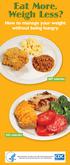 Eat More, Weigh Less? How to manage your weight without being hungry 607 calories 293 calories Department of Health and Human Services Centers for Disease Control and Prevention Can you weigh less without
DIABETES & HEALTHY EATING
 DIABETES & HEALTHY EATING Food gives you the energy you need for healthy living. Your body changes most of the food you eat into a sugar called glucose. (glucose) Insulin helps your cells get the sugar
Nutrition Guidelines for Diabetes
 Nutrition Guidelines for Diabetes Eating healthy foods and keeping a healthy body weight are very important parts of a diabetes treatment plan. A healthy diet and weight helps to keep your blood sugar
gestational diabetes my pregnancy, my baby, and me
 gestational diabetes my pregnancy, my baby, and me What is Gestational Diabetes? Gestational diabetes occurs when your body cannot make adequate use of sugar in the blood. It is first found during pregnancy.
Eating Low-Fat on a Budget. Shop Smart: Save Money at the Grocery Store
 Eating Low-Fat on a Budget Following a low-fat diet can help lower your risk of heart disease, cancer, diabetes and stroke. Eating low fat usually means eating fewer calories. High calorie intake may lead
Provider Guide Many families may find it difficult to pay for or get
 introduction Hello! Provider Guide Many families may find it difficult to pay for or get access to nutritious foods. In such situations, they may find it especially hard to make healthy choices. As a provider
Healthy Eating During Pregnancy
 Healthy Eating During Pregnancy Pregnancy is a time of great change. Your body is changing to allow your baby to grow and develop. Good nutrition will help you meet the extra demands of pregnancy while
SHOPPING FOR FOOD. Shopping For Food
 SHOPPING FOR FOOD Shopping For Food (teacher) Sample questions: If you have ever looked inside other peoples grocery carts you probably observed they don t always buy the same foods you buy. When grocery
Complete a Super Star Chef activity for knife safety.
 Ideas for Objectives and Assessment of Cooking to Save Money Cooking to save money may target participants with little or no cooking skills, who lack a vocabulary of cooking terms, are on a budget or using
Carbohydrate Counting for Patients With Diabetes. Review Date 4/08 D-0503
 Carbohydrate Counting for Patients With Diabetes Review Date 4/08 D-0503 Program Objectives At the end of the session you will know how to: Define carbohydrate counting Identify the relationship between
1. Deciding on the Food Budget and Which Foods to Spend Most Money on.
 Ideas Meal and planning tips for to fit eating your budget together Here is a plan to help you make the most of your food budget to promote health and well being for you and your family. Try working through
Just Married. PART 1 - Meet Neil and Julia. PART 2 - A tour around the kitchen
 Just Married Level: 1º E.S.O. Grammar: Demonstratives: this, that, these, those. Use of the definite and indefinite article "a", "the". Some and any, countable uncountable nouns. Irregular plurals Functions:
Ready, Set, Start Counting!
 Ready, Set, Start Counting! Carbohydrate Counting a Tool to Help Manage Your Blood Glucose When you have diabetes, keeping your blood glucose in a healthy range will help you feel your best today and in
It is important to know that some types of fats, like saturated and trans fat, can raise blood cholesterol levels.
 Healthy Eating You are what you eat! So before you even shop for food, it is important to become a well informed, smart food consumer and have a basic understanding of what a heart healthy diet looks like.
High Protein High Energy Diet
 High Protein High Energy Diet High protein and/or high energy diet is useful when: you are underweight you are losing weight without trying you are unable to eat enough due to poor appetite or nausea you
#10655 ADVENTURES IN THE GROCERY STORE WITH CHEF ANDREW
 C a p t i o n e d M e d i a P r o g r a m VOICE (800) 237-6213 TTY (800) 237-6819 FAX (800) 538-5636 E-MAIL [email protected] WEB www.cfv.org #10655 ADVENTURES IN THE GROCERY STORE WITH CHEF ANDREW LEARNING
Snacking and Gestational Diabetes
 Snacking and Gestational Diabetes Note to the Health Care Provider: Topics in this handout are discussed in Chapter 6 of the American Dietetic Association Guide to Gestational Diabetes Mellitus (1). When
Season 2013. ~ Muhammad Ali
 Season 2013 The fight is won or lost far away from witnesses - behind the lines, in the gym and out there on the road - long before I dance under those lights. ~ Muhammad Ali COACHING STAFF Senior Coach
Understanding the Carbohydrate Portions in Gluten Free Foods 1 Portion/Exchange = 15g
 Understanding the Carbohydrate Portions in luten Free Foods 1 Portion/Exchange = 15g Know your Carbohydrate Foods Dairy Fruit Starchy vegetables Breads, cereals, rice, pasta/noodles, biscuits, flour(s)
Healthy Eating for College Students on a Budget
 University of Michigan Health System s Healthy Eating Tip of the Month for August: Healthy Eating for College Students on a Budget Times are tough and money can be tight, especially for the starving college
Registered Trade Mark
 2008 High Energy, High Protein, Low Fiber Guidelines Registered Trade Mark High Energy, High Protein, Low Fibre Guidelines Eating well, even though you may not feel hungry, is an important part of taking
How to Increase Volume in Your Meals
 How to Increase Volume in Your Meals By adding certain types of food to your diet and drinking more water, you can actually increase the amount of food you eat, while staying within your fat gram and calorie
Unit 5 Tips for Saving Money
 Unit 5 Tips for Saving Money Personal Reflection In Lesson 1 you learned the keys for money management. The keys are: Plan. Spend Less. Save More. Adjust. This lesson is about spending less. In this lesson,
Fad Diets vs Healthy Weight Management: A Guide for Teens
 Center for Young Women s Health www.youngwomenshealth.org Fad Diets vs Healthy Weight Management: A Guide for Teens Fad diets are marketed as quick ways to lose weight. The most popular fads tend to change
My Diabetic Meal Plan during Pregnancy
 My Diabetic Meal Plan during Pregnancy When you have diabetes and are pregnant, you need to eat small meals and snacks throughout the day to help control your blood sugar. This also helps you get in enough
10 Week Nutrition Plan
 10 Week Nutrition Plan Welcome and thank you for your interest in taking the next step to health! We hope you find this eating plan a starting point to making healthier food choices and a tool to reach
Who is this booklet for?
 Who is this booklet for? This booklet is for anyone who would like to spend less money and eat healthy foods. Healthy eating is important for all age groups. What you eat can affect your health, energy
NIT 5: Food I like. Debbie: Do you want some chocolate, Leo?
 NIT 5: Food I like UNIT L e s s o n 1 1.vv vvlisten and read Debbie: Do you want some chocolate, Leo? Leo: No, thank you. I love chocolate but I can t eat it. I want to be a football player and sport men
MINTO PREVENTION & REHABILITATION CENTRE CENTRE DE PREVENTION ET DE READAPTATION MINTO. Counting Fat Grams. About This Kit
 MINTO PREVENTION & REHABILITATION CENTRE CENTRE DE PREVENTION ET DE READAPTATION MINTO Counting Fat Grams About This Kit In previous kits you have learned Foods to Choose and Foods to Decrease/Avoid for
21. Risk Assessment Online Surveys (computer-based session)
 HEALTH LITERACY CURRICULUM Adult Learner 21. Risk Assessment Online Surveys (computer-based session) Objectives Note: If you have not done #7, Filling Out a Health History, you may need to pre-teach some
Will the cholesterol in my diet raise my blood cholesterol?
 Healthy eating for your heart What does heart healthy eating mean to me? Heart healthy eating is an important part of a healthy lifestyle. Heart healthy eating, along with regular physical activity and
WHOLE GRAINS FOR GOOD HEALTH
 WHOLE GRAINS FOR GOOD HEALTH Section 1: What are Whole Grains? Whole grains are nutritious, delicious, and are included in the WIC program! Whole grains contain the entire grain kernel. That means whole
A Guide to Reducing Dietary Sodium Intake
 Salt and High Blood Pressure A Guide to Reducing Dietary Sodium Intake A Look at the DASH eating plan My Plate Basics Sodium is a mineral element most commonly found in salt (sodium chloride) Sodium occurs
------------------------------------------------------------------------------------------------------------
 Healthy Food Drive Toolkit Email Template From: Organizational or business manager/leader To: Employees Subject: Upcoming Healthy Food Drive ------------------------------------------------------------------------------------------------------------
How much do you spend on food in a typical month?
 How much do you spend on food in a typical month? $ How much I spend each month in Food Stamps (EBT card benefit). $ How much I spend each month in WIC vouchers. $ How much I spend each month in cash for
EMBRACE Your Journey Nutrition During Treatment
 Nutrition is an important part of your cancer treatment. As you prepare for treatment, it is important to focus on eating a well-balanced diet so that your body is as healthy as it can be. When your body
Eat Well, Live Well Lesson 9: The Lowdown on Cholesterol
 Getting Started 1. Review lesson plan before each session 2. Copy handouts. 3. Gather supplies Eat Well, Live Well Lesson 9: The Lowdown on Cholesterol Supplies Needed 1. Handouts 2. Supplies for activity:
Take Control Nutrition Tools for Diabetes. 50/50 plate Portions Servings
 Take Control Nutrition Tools for Diabetes 50/50 plate Portions Servings Eat more Vegetables Especially non starchy vegetables Choosing Foods to manage blood glucose Select a variety of colors and types
Oxford Bariatric Service Pre bariatric surgery diet Information for patients
 Oxford Bariatric Service Pre bariatric surgery diet Information for patients Why do I need to follow a pre-operative diet? Before obesity surgery, it is essential that you follow a strict calorie controlled
Nuts, Oils, Dressings, and Spreads
 Nuts, Oils, Session 1 Background Information Tips Goals Background Information Nuts, Oils, Eating Fats There are three types of fat we ll focus on in this program: Healthy fats (polyunsaturated fats),
DOWN SYNDROME PROGRAM www.massgeneral.org/downsyndrome. Living a Healthier Lifestyle
 DOWN SYNDROME PROGRAM www.massgeneral.org/downsyndrome Living a Healthier Lifestyle DOWN SYNDROME PROGRAM www.massgeneral.org/downsyndrome Living a healthier lifestyle has many benefits, which means it
Carbohydrate Counting for Pediatric Patients With Type 1 Diabetes. Review Date 4/08 K-0591
 Carbohydrate Counting for Pediatric Patients With Type 1 Diabetes Review Date 4/08 K-0591 Program Purpose To increase knowledge of carbohydrate counting and insulin management skills for those caring for
Duke Center for Metabolic and Weight Loss Surgery Pre-op Nutrition Questionnaire
 Duke Center for Metabolic and Weight Loss Surgery Pre-op Nutrition Questionnaire Name Date How long have you been considering weight loss surgery? Which procedure are you interested in having? Gastric
Healthy Eating for Diabetes
 Healthy Eating for Diabetes What is diabetes and why is it important to manage it? Diabetes occurs when there is too much glucose in the blood. Learning how to manage your diabetes will help you feel better
MEAL PLANNING FOR MECHANICAL SOFT DIET
 MEAL PLANNING FOR MECHANICAL SOFT DIET Definition of Terms Calories Protein Blenderized Pureed Units of energy. A nutrient used by your body for growth and repair. The best sources are milk, meats, fish,
Do children with diabetes need a special diet?
 Do children with diabetes need a special diet? No! The basic nutritional needs of a child or adolescent with diabetes is the same as their peers Healthy eating is important for all children Children with
Nutrition Pointers: Fruits and Veggies
 Nutrition Pointers: Fruits and Veggies Eat as many as possible try filling half your plate with fruits and veggies. Fruits and veggies are good for you whether they are fresh or frozen. Go for a wide variety
Dietary advice for people starting treatment for Hepatitis C. Information for patients Sheffield Dietetics
 Dietary advice for people starting treatment for Hepatitis C Information for patients Sheffield Dietetics Do I need to follow a special diet? You don t need to have a special diet but you should try and
Housing & Home Management
 Food Management: Grocery Shopping and Food Preparation In this section, youth will learn how to develop a weekly menu with nutritious meal options, create a grocery shopping list within a budget, save
Learning ZoneXpress P.O. Box 1022, Owatonna, MN 55060 888-455-7003 www.learningzonexpress.com
 Name Hour 1. What is a good thing to have when you go shopping? 2. Name three of the many departments in a grocery store: a. b. c. 3. "Staples" are products you use everyday. Name three staples: a. b.
Diet for Oral Surgery/Wired Jaw
 Diet for Oral Surgery/Wired Jaw After oral surgery no chewing is allowed for a period of 4-8 weeks. During this time you will need a blenderized or liquid diet. This pamphlet will help you to get adequate
Resources for Carbohydrate Counting
 Resources for Carbohydrate Counting The Diabetes Carbohydrate and Fat Gram Guide By LeaAnn Holzmeister, RD, CDE American Diabetes Association See contact information below The Doctor s Pocket Calorie,
Low Fat Diet after Cardiac Surgery With or Without Chyle Leak
 Low Fat Diet after Cardiac Surgery With or Without Chyle Leak What is chyle? Chyle (sounds like kyle) is a milky white fluid that contains protein, fat, cholesterol, lymphocytes, and electrolytes. It is
Healthy Eating for Diabetes
 Healthy Eating for Diabetes What is diabetes? Diabetes is when your blood sugar (glucose) levels are higher than normal. For some people, this is because the insulin in their body doesn t work as well
Theme: Britain Focus: Healthy Eating Context: Basic Culinary skills
 Scheme of Work KS3 Food Design Technology YEAR: 7 MODULE/UNIT TITLE: Healthy Eating DURATION: 20 hours (10 weeks) Unit Summary: students will: become familiar with (and more confident in) the cooking area;
Bariatric Surgery: Step III Diet
 Bariatric Surgery: Step III Diet This diet is blended foods with one new solid food added daily. The portions are very small to help prevent vomiting. Warning: This diet does not have enough calories,
Shopping: Week 1 of 2
 The Minnesota Literacy Council created this curriculum with funding from the MN Department of Education. We invite you to adapt it for your own classrooms. Beginning Level (CASAS reading scores of 181-200)
Following a 2 gram sodium diet What is sodium? Why should I limit the sodium in my diet? Where does sodium come from?
 Following a 2 gram sodium diet Your health care provider has asked you to follow a 2 gram sodium diet. This is a diet that moderately restricts the amount of sodium you eat. About ⅓ of the sodium in our
Glycemic Index & Diabetes
 Glycemic Index & Diabetes Carbohydrates are the sugars and starches in the foods you eat. They are broken down into glucose, which your body uses for energy. Carbohydrates are found in grains & cereals,
Help Your Child Grow Up Healthy and Strong
 Help Your Child Grow Up Healthy and Strong Department of Health and Human Services Department of Agriculture Department of Education Body Mass Index: A Useful Tool Body Mass Index, or bmi, is used to assess
MEN'S FITNESS FAT TO FIT CHALLENGE - 1800 CALORIE MEAL PLAN WEEK 2
 Day 1 1 egg + 3 egg whites scrambled 125 1.1 17.1 5.1 1/2 whole wheat english muffin, toasted 67 13.3 2.9 0.7 1 medium orange 61.6 15.4 1.2 0.2 TOTAL 253.6 29.8 21.2 6 2 Tbs dried cherries 48.8 12.8 0
LIFE-II FOOD DEMONSTRATION RECIPES Nutrition Education for Wellness Program
 FOOD DEMONSTRATION RECIPES Nutrition Education for Wellness Program encourages collaboration with the Host Agency representative. responsibilities will be to provide the worksheets, lessons, and recipes
Heart healthy diet: 8 steps to prevent heart disease
 Heart healthy diet: 8 steps to prevent heart disease Changing your eating habits can be tough. Start with these eight strategies to kick start your way toward a heart healthy diet. By Mayo Clinic Staff
Let s Talk Oils and Fats!
 Lesson Overview Lesson Participants: School Nutrition Assistants/Technicians, School Nutrition Managers, Child and Adult Care Food Program Staff, Teachers Type of Lesson: Short, face-to-face training session
Creating Healthy Menus with USDA Foods SNA ANC 2013
 Creating Healthy Menus with USDA Foods SNA ANC 2013 Overview USDA Foods Background Christina Riley, MS, RD Nutritionist, Food and Nutrition Service School Meals Recipe Resources Scott Richardson, MBA Director
simple steps give you for good bowel health
 simple steps give you for good bowel health This booklet contains simple steps you can take to help achieve good bowel health. This is important to everyone, as these small changes will help your digestive
Healthy Eating After 50
 National Institute on Aging AgePage Healthy Eating After 50 Food just doesn t taste the same anymore. I can t get out to go shopping. I m just not that hungry. Sound familiar? These are a few common reasons