
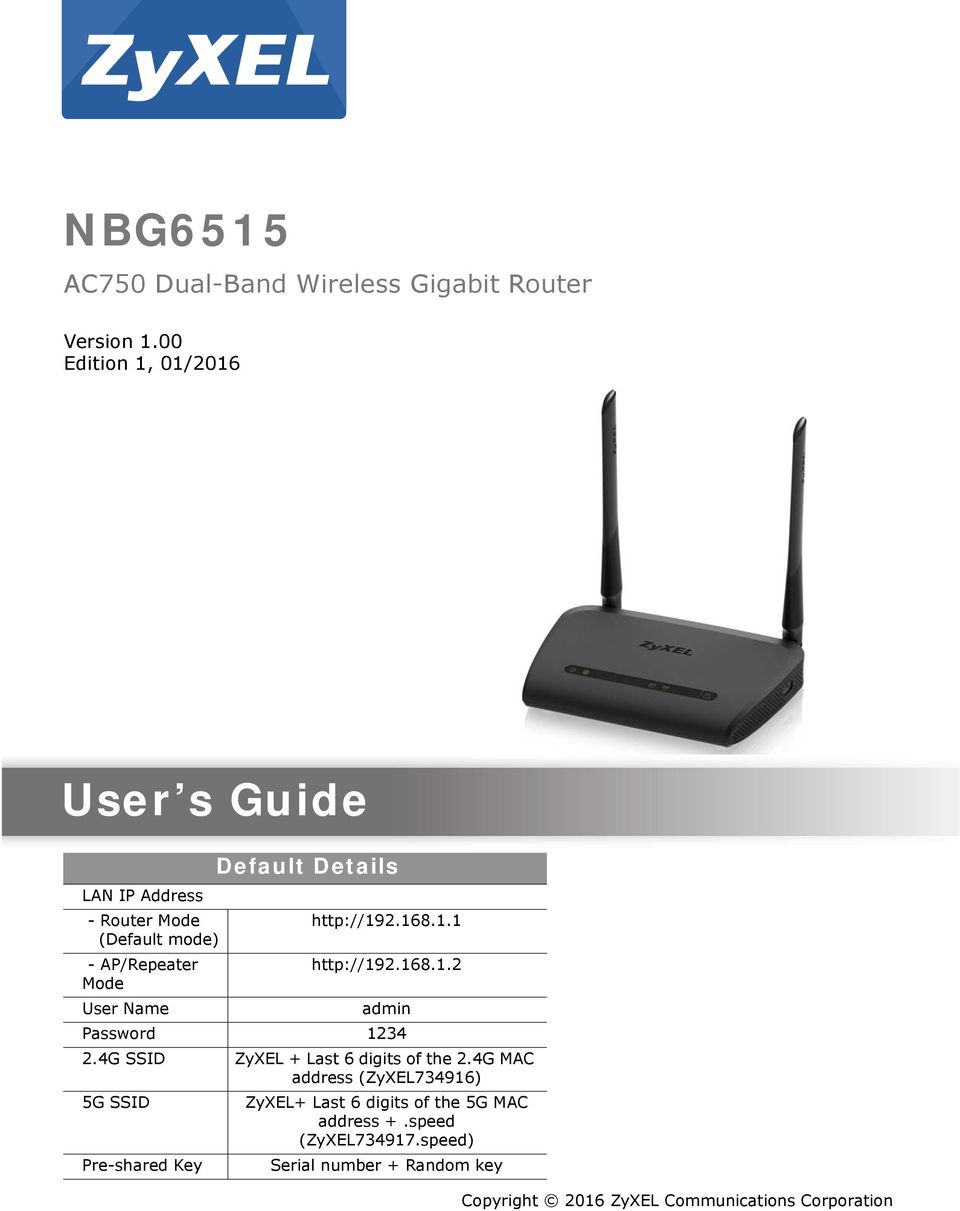
NBG6515. User s Guide. Quick Start Guide. AC750 Dual-Band Wireless Gigabit Router. Default Details. Version 1.00 Edition 1, 01/2016
|
|
|
- Hugh Lester
- 10 years ago
- Views:
Transcription
1 NBG6515 AC750 Dual-Band Wireless Gigabit Router Version 1.00 Edition 1, 01/2016 Quick Start Guide User s Guide LAN IP Address - Router Mode (Default mode) Default Details - AP/Repeater Mode User Name admin Password G SSID ZyXEL + Last 6 digits of the 2.4G MAC address (ZyXEL734916) 5G SSID ZyXEL+ Last 6 digits of the 5G MAC address +.speed (ZyXEL speed) Pre-shared Key Serial number + Random key Copyright 2016 ZyXEL Communications Corporation
2 IMPORTANT! READ CAREFULLY BEFORE USE. KEEP THIS GUIDE FOR FUTURE REFERENCE. Screenshots and graphics in this book may differ slightly from your product due to differences in your product firmware or your computer operating system. Every effort has been made to ensure that the information in this manual is accurate. Related Documentation Quick Start Guide The Quick Start Guide shows how to connect the NBG and access the Web Configurator. Note: It is recommended you use the Web Configurator to configure the NBG. More Information Go to support.zyxel.com to find other information on the NBG. 2

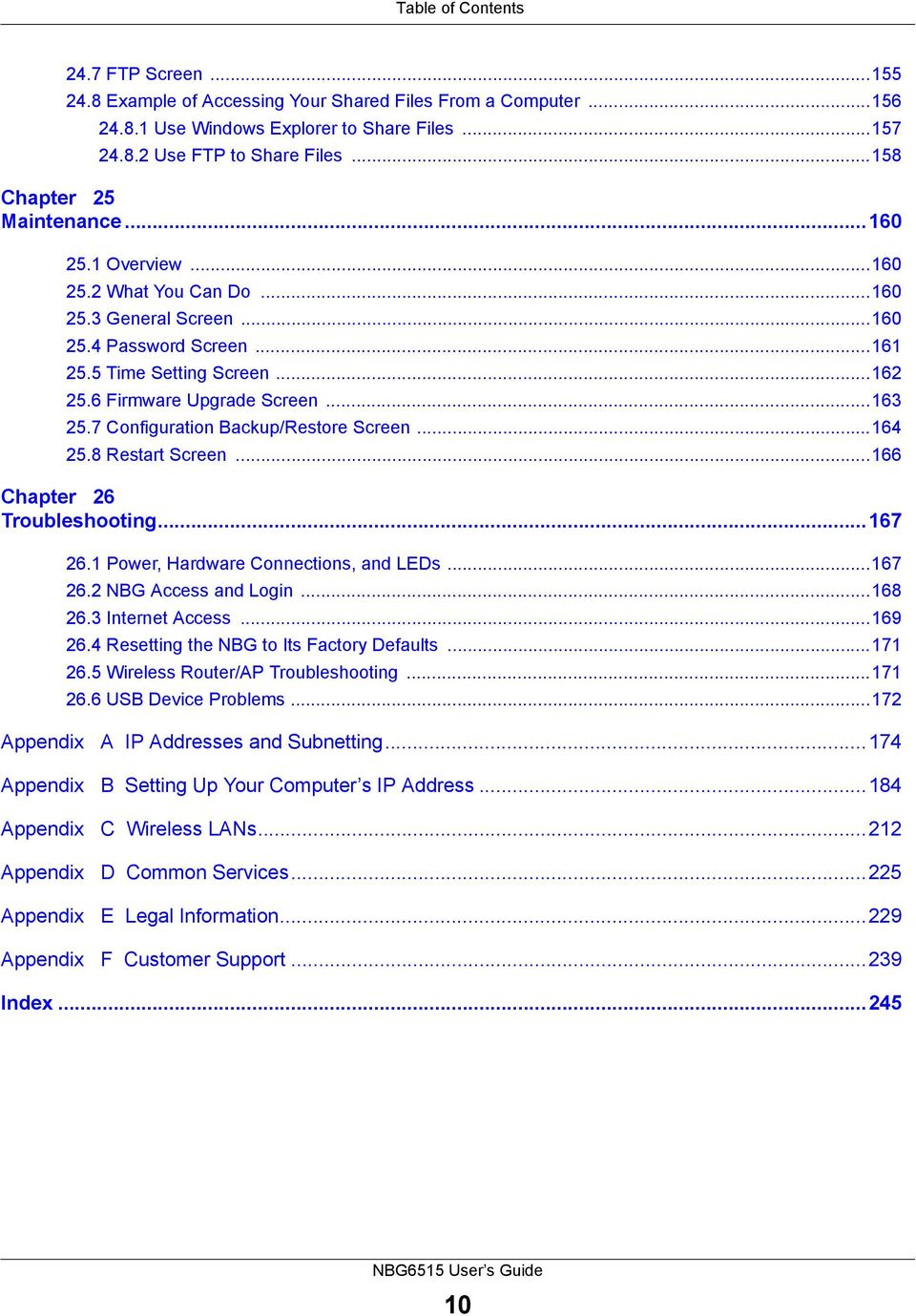
3 Contents Overview Contents Overview User s Guide Getting to Know Your NBG...12 Connection Wizard...17 Introducing the Web Configurator...26 Monitor...31 NBG Modes...36 Easy Mode...37 Router Mode...49 Access Point Mode...56 Universal Repeater Mode...63 Tutorials...72 Technical Reference...79 Wireless LAN...80 IPv WAN LAN DHCP Server Network Address Translation (NAT) Dynamic DNS Static Route Firewall Content Filter Bandwidth Management Remote Management Universal Plug-and-Play (UPnP) USB Media Sharing Maintenance Troubleshooting

4 Table of Contents Table of Contents Contents Overview...3 Table of Contents...4 Part I: User s Guide Chapter 1 Getting to Know Your NBG Overview Applications Ways to Manage the NBG Good Habits for Managing the NBG LEDs The WPS Button Wall Mounting...15 Chapter 2 Connection Wizard Overview Accessing the Wizard Connect to Internet Connection Type: DHCP Connection Type: Static IP Connection Type: PPPoE Connection Type: PPTP Router Password Wireless Security Wireless Security: No Security Wireless Security: WPA-PSK/WPA2-PSK...24 Chapter 3 Introducing the Web Configurator Overview Accessing the Web Configurator Login Screen Password Screen Home Screen Resetting the NBG
5 Table of Contents Procedure to Use the Reset Button...30 Chapter 4 Monitor Overview What You Can Do The Log Screen View Log DHCP Table Packet Statistics WLAN 2.4G Station Status WLAN 5G Station Status...35 Chapter 5 NBG Modes Overview Web Configurator Modes Device Modes...36 Chapter 6 Easy Mode Overview What You Can Do What You Need to Know Navigation Panel Network Map Control Panel Game Engine Power Saving Content Filter Bandwidth Management Firewall Wireless Security WPS Status Screen in Easy Mode...47 Chapter 7 Router Mode Overview What You Can Do Status Screen Navigation Panel
6 Table of Contents Chapter 8 Access Point Mode Overview What You Can Do What You Need to Know Setting your NBG to AP Mode Accessing the Web Configurator in Access Point Mode Configuring your WLAN, Bandwidth Management and Maintenance Settings AP Mode Status Screen LAN Screen...60 Chapter 9 Universal Repeater Mode Overview What You Can Do What You Need to Know Setting your NBG to Universal Repeater Mode Universal Repeater Mode Status Screen Navigation Panel AP Select Screen Wireless LAN 2.4G Wireless LAN 5G...69 Chapter 10 Tutorials Overview Connecting to the Internet from an Access Point Configuring Wireless Security Using WPS Push Button Configuration (PBC) PIN Configuration Enabling and Configuring Wireless Security (No WPS) Configure Your Notebook...77 Part II: Technical Reference Chapter 11 Wireless LAN Overview What You Can Do What You Should Know Wireless Security Overview
7 Table of Contents 11.4 General Wireless LAN 2.4G/5G General Screen General Wireless LAN 2.4G/5G Security Screen No Security WEP Encryption WPA-PSK/WPA2-PSK MAC Filter Wireless LAN Advanced Screen Quality of Service (QoS) Screen WPS Screen WPS Device Screen Scheduling Screen Guest WLAN Screen...94 Chapter 12 IPv IPv6 Overview What You Can Do in this Chapter What You Need to Know General Screen...98 Chapter 13 WAN Overview What You Can Do What You Need To Know Configuring Your Internet Connection Multicast Internet Connection Ethernet Encapsulation PPPoE Encapsulation PPTP Encapsulation Advanced WAN Screen Chapter 14 LAN Overview What You Can Do What You Need To Know IP Pool Setup LAN TCP/IP IP Alias LAN IP Screen

8 Table of Contents Chapter 15 DHCP Server Overview What You Can Do General Screen Advanced Screen Chapter 16 Network Address Translation (NAT) Overview What You Can Do General NAT Screen NAT Application Screen NAT Advanced Screen Trigger Port Forwarding Example Two Points To Remember About Trigger Ports Chapter 17 Dynamic DNS Overview What You Can Do What You Need To Know Dynamic DNS Screen Chapter 18 Static Route Overview What You Can Do IP Static Route Screen Chapter 19 Firewall Overview What You Can Do What You Need To Know General Firewall Screen MAC Filtering Rule Screen IP Filtering Rule Screen Chapter 20 Content Filter Overview What You Can Do

9 Table of Contents 20.3 What You Need To Know Content Filtering Profiles Content Filter Screen Chapter 21 Bandwidth Management Overview What You Can Do What You Need To Know General Screen Advanced Screen Rule Configuration: Application Rule Configuration Rule Configuration: User Defined Service Rule Configuration Chapter 22 Remote Management Overview What You Can Do What You Need to Know Remote Management and NAT System Timeout WWW Screen Chapter 23 Universal Plug-and-Play (UPnP) Overview What You Can Do What You Need to Know NAT Traversal Cautions with UPnP UPnP Screen Technical Refereance Using UPnP in Windows XP Example Web Configurator Easy Access Chapter 24 USB Media Sharing Overview What You Can Do What You Need To Know Before You Begin SMB/CIFS Screen DLNA Screen

10 Table of Contents 24.7 FTP Screen Example of Accessing Your Shared Files From a Computer Use Windows Explorer to Share Files Use FTP to Share Files Chapter 25 Maintenance Overview What You Can Do General Screen Password Screen Time Setting Screen Firmware Upgrade Screen Configuration Backup/Restore Screen Restart Screen Chapter 26 Troubleshooting Power, Hardware Connections, and LEDs NBG Access and Login Internet Access Resetting the NBG to Its Factory Defaults Wireless Router/AP Troubleshooting USB Device Problems Appendix A IP Addresses and Subnetting Appendix B Setting Up Your Computer s IP Address Appendix C Wireless LANs Appendix D Common Services Appendix E Legal Information Appendix F Customer Support Index
11 PART I User s Guide 11

12 CHAPTER 1 Getting to Know Your NBG 1.1 Overview This chapter introduces the main features and applications of the NBG. The NBG upgrades the speed of your existing wireless network, providing faster network access to mobile users. Making use of IEEE AC technology, it not only upgrades your network to the next level but also eliminates dead spots, while offering backward compatibility with other IEEE b/g/n compatible devices. A range of services such as a firewall and content filtering are also available for secure Internet computing. You can use media bandwidth management to efficiently manage traffic on your network. Bandwidth management features allow you to prioritize time-sensitive or highly important applications such as Voice over the Internet (VoIP). 1.2 Applications Your can create the following networks using the NBG: Wired. You can connect network devices via the Ethernet ports of the NBG so that they can communicate with each other and access the Internet. Wireless. Wireless clients can connect to the NBG to access network resources. WAN. Connect to a broadband modem/router for Internet access. 1.3 Ways to Manage the NBG Use any of the following methods to manage the NBG. Web Configurator. This is recommended for everyday management of the NBG using a (supported) web browser. Wireless switch. You can use the built-in switch of the NBG to turn the wireless function on and off without opening the Web Configurator. WPS (Wi-Fi Protected Setup) button. You can use the WPS button or the WPS section of the Web Configurator to set up a wireless network with your NBG. 12

13 Chapter 1 Getting to Know Your NBG 1.4 Good Habits for Managing the NBG Do the following things regularly to make the NBG more secure and to manage the NBG more effectively. Change the password. Use a password that s not easy to guess and that consists of different types of characters, such as numbers and letters. Write down the password and put it in a safe place. Back up the configuration (and make sure you know how to restore it). Restoring an earlier working configuration may be useful if the device becomes unstable or even crashes. If you forget your password, you will have to reset the NBG to its factory default settings. If you backed up an earlier configuration file, you would not have to totally re-configure the NBG. You could simply restore your last configuration. 13

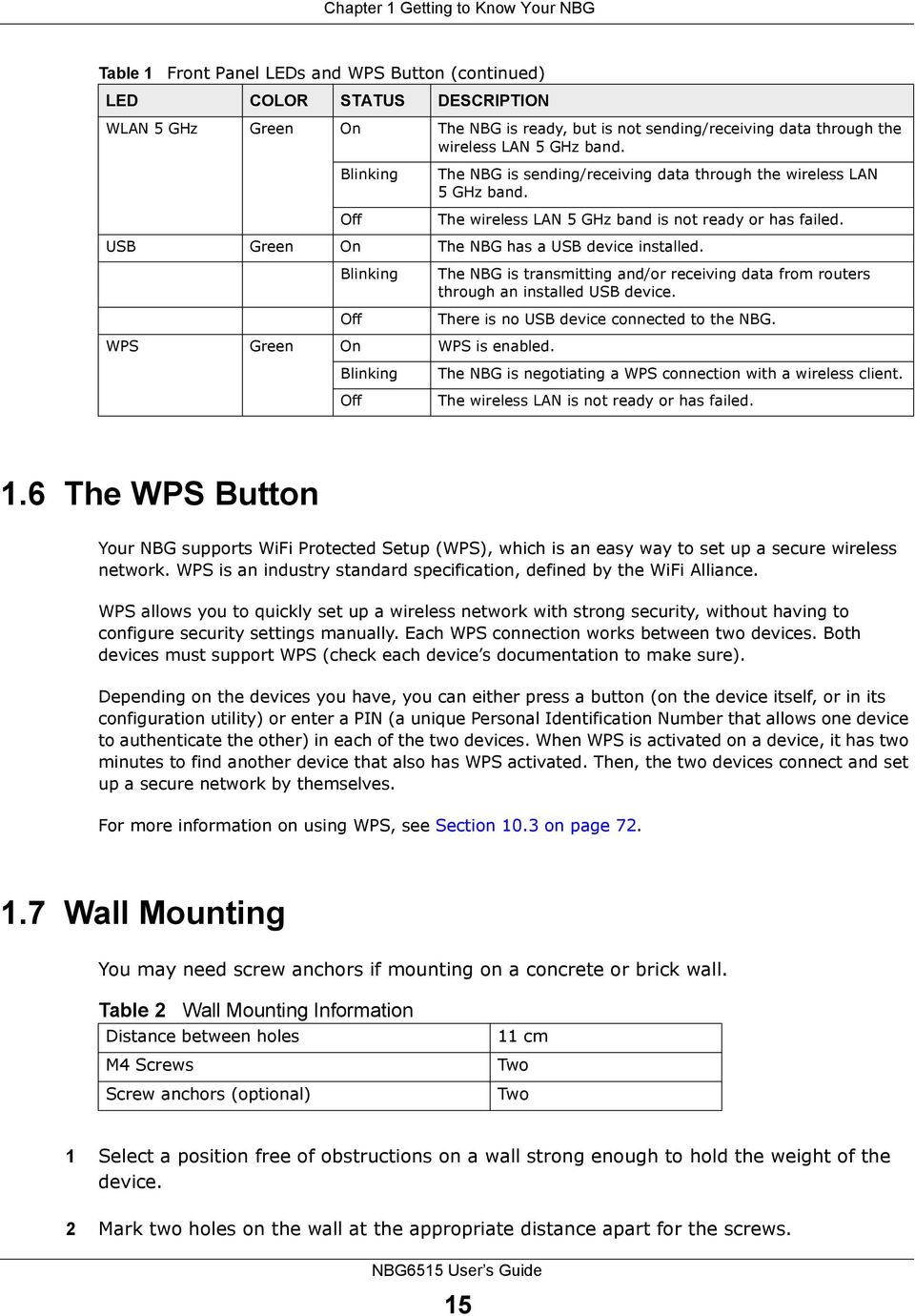
14 Chapter 1 Getting to Know Your NBG 1.5 LEDs Figure 1 Front Panel WAN WLAN 5GHz Power LAN 1-4 WLAN USB 2.4GHz WPS The following table describes the LEDs and the WPS button. Table 1 Front Panel LEDs and WPS Button LED COLOR STATUS DESCRIPTION POWER Green On The NBG is receiving power and functioning properly. Off The NBG is not receiving power. WAN Green On The NBG has a successful 10/100/1000MB WAN connection. Blinking The NBG is sending/receiving data through the WAN. Off The WAN connection is not ready, or has failed. LAN 1-4 Green On The NBG has a successful 10/100/1000MB Ethernet connection. Blinking The NBG is sending/receiving data through the LAN. Off The LAN is not connected. WLAN 2.4 GHz Green On The NBG is ready, but is not sending/receiving data through the wireless LAN 2.4 GHz band. Blinking The NBG is sending/receiving data through the wireless LAN 2.4 GHz band. Off The wireless LAN 2.4 GHz band is not ready or has failed. 14

15 Chapter 1 Getting to Know Your NBG Table 1 Front Panel LEDs and WPS Button (continued) LED COLOR STATUS DESCRIPTION WLAN 5 GHz Green On The NBG is ready, but is not sending/receiving data through the wireless LAN 5 GHz band. Blinking Off The NBG is sending/receiving data through the wireless LAN 5 GHz band. The wireless LAN 5 GHz band is not ready or has failed. USB Green On The NBG has a USB device installed. Blinking Off The NBG is transmitting and/or receiving data from routers through an installed USB device. There is no USB device connected to the NBG. WPS Green On WPS is enabled. Blinking Off The NBG is negotiating a WPS connection with a wireless client. The wireless LAN is not ready or has failed. 1.6 The WPS Button Your NBG supports WiFi Protected Setup (WPS), which is an easy way to set up a secure wireless network. WPS is an industry standard specification, defined by the WiFi Alliance. WPS allows you to quickly set up a wireless network with strong security, without having to configure security settings manually. Each WPS connection works between two devices. Both devices must support WPS (check each device s documentation to make sure). Depending on the devices you have, you can either press a button (on the device itself, or in its configuration utility) or enter a PIN (a unique Personal Identification Number that allows one device to authenticate the other) in each of the two devices. When WPS is activated on a device, it has two minutes to find another device that also has WPS activated. Then, the two devices connect and set up a secure network by themselves. For more information on using WPS, see Section 10.3 on page Wall Mounting You may need screw anchors if mounting on a concrete or brick wall. Table 2 Wall Mounting Information Distance between holes M4 Screws Screw anchors (optional) 11 cm Two Two 1 Select a position free of obstructions on a wall strong enough to hold the weight of the device. 2 Mark two holes on the wall at the appropriate distance apart for the screws. 15
16 Chapter 1 Getting to Know Your NBG Be careful to avoid damaging pipes or cables located inside the wall when drilling holes for the screws. 3 If using screw anchors, drill two holes for the screw anchors into the wall. Push the anchors into the full depth of the holes, then insert the screws into the anchors. Do not insert the screws all the way in - leave a small gap of about 0.5 cm. If not using screw anchors, use a screwdriver to insert the screws into the wall. Do not insert the screws all the way in - leave a gap of about 0.5 cm. 4 Make sure the screws are fastened well enough to hold the weight of the NBG with the connection cables. 5 Align the holes on the back of the NBG with the screws on the wall. Hang the NBG on the screws. Figure 2 Wall Mounting Example 16

17 CHAPTER 2 Connection Wizard 2.1 Overview This chapter provides information on the wizard setup screens in the Web Configurator. The Web Configurator s wizard setup helps you configure your device to access the Internet. Refer to your ISP for your Internet account information. Leave a field blank if you don t have that information. 2.2 Accessing the Wizard Launch your web browser and type " as the website address. Type "1234" (default) as the password and click Login. Note: The Wizard appears when the NBG is accessed for the first time or when you reset the NBG to its default factory settings. The Wizard screen opens. Choose your Language and click Connect to Internet. Figure 3 Welcome 2.3 Connect to Internet The NBG offers four Internet connection types. They are Static IP, DHCP, PPPoE, or PPTP (supported in the next firmware version). The wizard attempts to detect which WAN connection type you are using. 17

18 Chapter 2 Connection Wizard Figure 4 Detecting your Internet Connection Type If the wizard does not detect a connection type, you must select one from the drop-down list box. Check with your ISP to make sure you use the correct type. Note: If you get an error message, check your hardware connections. Make sure your Internet connection is up and running. The following screen depends on your Internet connection type. Enter the details provided by your Internet Service Provider (ISP) in the fields (if any). Figure 5 Internet Connection Type Your NBG detects the following Internet Connection type. Table 3 Internet Connection Type CONNECTION TYPE Static IP DHCP PPPoE PPTP DESCRIPTION Select the Static IP if an administrator assigns the IP address of your computer. Select the DHCP (Dynamic Host Configuration Protocol) option when the WAN port is used as a regular Ethernet. Select the PPPoE (Point-to-Point Protocol over Ethernet) option for a dial-up connection. Select the PPTP (Point-to-Point Tunneling Protocol) option for a dial-up connection, and your ISP gave you an IP address and/or subnet mask. Note: PPTP will be supported in the next firmware version Connection Type: DHCP Choose DHCP as the Internet Connection Type when the WAN port is used as a regular Ethernet. Click Next. 18

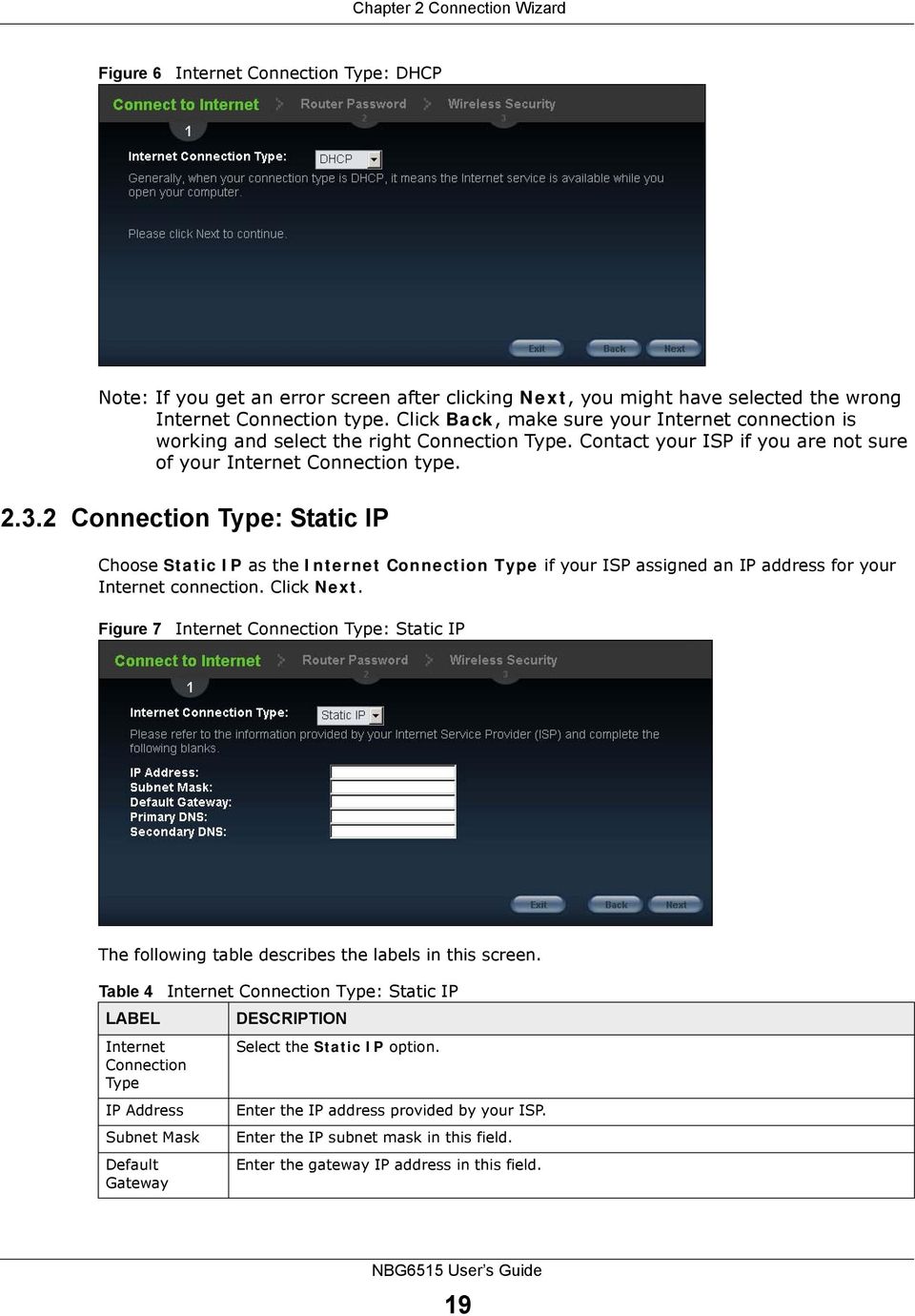
19 Chapter 2 Connection Wizard Figure 6 Internet Connection Type: DHCP Note: If you get an error screen after clicking Next, you might have selected the wrong Internet Connection type. Click Back, make sure your Internet connection is working and select the right Connection Type. Contact your ISP if you are not sure of your Internet Connection type Connection Type: Static IP Choose Static IP as the Internet Connection Type if your ISP assigned an IP address for your Internet connection. Click Next. Figure 7 Internet Connection Type: Static IP The following table describes the labels in this screen. Table 4 Internet Connection Type: Static IP LABEL Internet Connection Type IP Address Subnet Mask Default Gateway DESCRIPTION Select the Static IP option. Enter the IP address provided by your ISP. Enter the IP subnet mask in this field. Enter the gateway IP address in this field. 19
20 Chapter 2 Connection Wizard Table 4 Internet Connection Type: Static IP (continued) LABEL Primary DNS DESCRIPTION DNS (Domain Name System) is for mapping a domain name to its corresponding IP address and vice versa. The DNS server is extremely important because without it, you must know the IP address of a computer before you can access it. The NBG uses a system DNS server (in the order you specify here) to resolve domain names for DDNS and the time server. Enter the primary DNS server's IP address in the fields provided. Secondary DNS Exit Back Next Enter the secondary DNS server's IP address in the fields provided. Click this to close the wizard screen without saving. Click this to return to the previous screen. Click this to continue Connection Type: PPPoE Point-to-Point Protocol over Ethernet (PPPoE) functions as a dial-up connection. PPPoE is an IETF (Internet Engineering Task Force) standard specifying how a host personal computer interacts with a broadband modem (for example DSL, cable, wireless, etc.) to achieve access to high-speed data networks. For the service provider, PPPoE offers an access and authentication method that works with existing access control systems (for instance, RADIUS). One of the benefits of PPPoE is the ability to let end users access one of multiple network services, a function known as dynamic service selection. This enables the service provider to easily create and offer new IP services for specific users. Operationally, PPPoE saves significant effort for both the subscriber and the ISP/carrier, as it requires no specific configuration of the broadband modem at the subscriber's site. By implementing PPPoE directly on the NBG (rather than individual computers), the computers on the LAN do not need PPPoE software installed, since the NBG does that part of the task. Furthermore, with NAT, all of the LAN's computers will have Internet access. Figure 8 Internet Connection Type: PPPoE 20
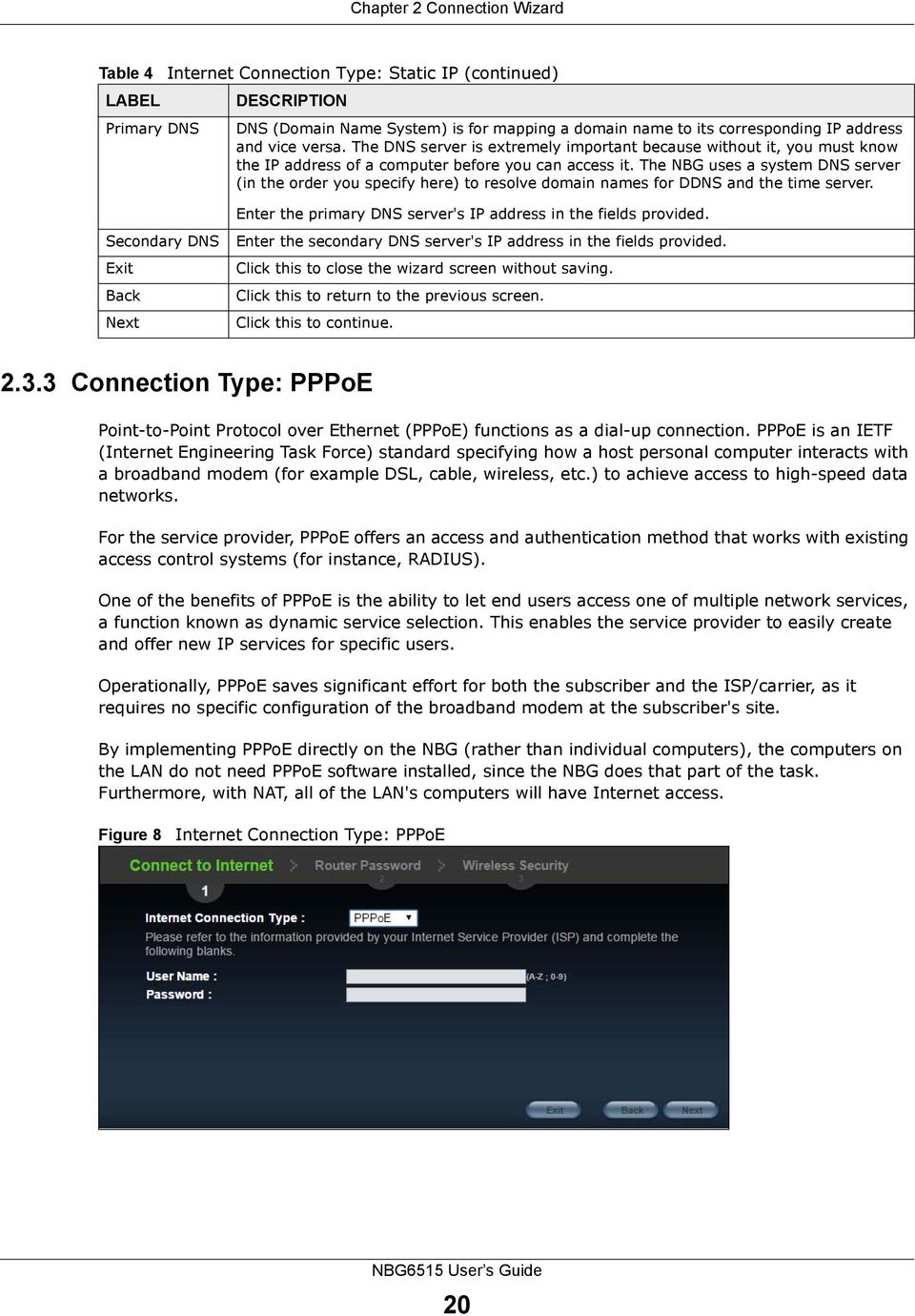
21 Chapter 2 Connection Wizard The following table describes the labels in this screen. Table 5 Internet Connection Type: PPPoE LABEL Internet Connection Type User Name Password Exit Back Next DESCRIPTION Select the PPPoE option for a dial-up connection. Type the user name given to you by your ISP. Type the password associated with the user name above. Click this to close the wizard screen without saving. Click this to return to the previous screen. Click this to continue Connection Type: PPTP Point-to-Point Tunneling Protocol (PPTP) is a network protocol that enables transfers of data from a remote client to a private server, creating a Virtual Private Network (VPN) using TCP/IP-based networks. PPTP supports on-demand, multi-protocol, and virtual private networking over public networks, such as the Internet. Refer to the appendix for more information on PPTP. The NBG supports one PPTP server connection at any given time. Note: This Internet connection type will be supported in the next firmware version. Figure 9 Internet Connection Type: PPTP The following table describes the fields in this screen Table 6 Internet Connection Type: PPTP LABEL Internet Connection Type Dynamic IP DESCRIPTION Select PPTP from the drop-down list box. To configure a PPTP client, you must configure the User Name and Password fields for a PPP connection and the PPTP parameters for a PPTP connection. Select this radio button if your ISP did not assign you a fixed IP address. 21
22 Chapter 2 Connection Wizard Table 6 Internet Connection Type: PPTP (continued) LABEL Static IP PPTP Server IP Address User Name Password PPTP Address PPTP Subnet Mask PPTP Gateway IP Address Exit Back Next DESCRIPTION Select this radio button, provided by your ISP to give the NBG a fixed, unique IP address. Type the server IP address of the PPTP server. Type the user name given to you by your ISP. Type the password associated with the User Name above. Type the (static) IP address assigned to you by your ISP. Type the subnet mask assigned to you by your ISP (if given). Type the gateway IP address of the PPTP server. Click this to close the wizard screen without saving. Click this to return to the previous screen. Click this to continue. The NBG connects to the Internet. Figure 10 Connecting to the Internet Note: If the Wizard successfully connects to the Internet, it proceeds to the next step. If you get an error message, go back to the previous screen and make sure you have entered the correct information provided by your ISP. 2.4 Router Password Change the login password in the following screen. Enter the new password and retype it to confirm. Click Next to proceed with the Wireless Security screen. 22
23 Chapter 2 Connection Wizard Figure 11 Router Password 2.5 Wireless Security Configure Wireless Settings. Configure the wireless network settings on your NBG in the following screen. The fields that show up depend on the kind of security you select Wireless Security: No Security Choose No Security in the Wireless Security screen to let wireless devices within range access your wireless network. Figure 12 Wireless Security: No Security 23
24 Chapter 2 Connection Wizard The following table describes the labels in this screen. Table 7 Wireless Security: No Security LABEL Wireless Network Name (SSID) Security mode DESCRIPTION Enter a descriptive name (up to 32 printable 7-bit ASCII characters) for the wireless LAN. If you change this field on the NBG, make sure all wireless stations use the same SSID in order to access the network. Select a Security level from the drop-down list box. Choose None to have no wireless LAN security configured. If you do not enable any wireless security on your NBG, your network is accessible to any wireless networking device that is within range. Exit Back Next Click this to close the wizard screen without saving. Click this to return to the previous screen. Click this to continue Wireless Security: WPA-PSK/WPA2-PSK Choose WPA-PSK or WPA2-PSK security in the Wireless Security screen to set up a password for your wireless network. Figure 13 Wireless Security: WPA-PSK/WPA2-PSK The following table describes the labels in this screen. Table 8 Wireless Security: WPA-PSK/WPA2-PSK LABEL Wireless Network Name (SSID) Security mode DESCRIPTION Enter a descriptive name (up to 32 printable 7-bit ASCII characters) for the wireless LAN. If you change this field on the NBG, make sure all wireless stations use the same SSID in order to access the network. Select a Security level from the drop-down list box. Choose WPA-PSK or WPA2-PSK security to configure a Pre-Shared Key. Choose this option only if your wireless clients support WPA-PSK or WPA2-PSK respectively. Wireless password Verify Password Exit Type from 8 to 63 case-sensitive ASCII characters. You can set up the most secure wireless connection by configuring WPA in the wireless LAN screens. Retype the password to confirm. Click this to close the wizard screen without saving. 24
25 Chapter 2 Connection Wizard Table 8 Wireless Security: WPA-PSK/WPA2-PSK (continued) LABEL Back Next DESCRIPTION Click this to return to the previous screen. Click this to continue. Congratulations! Open a web browser, such as Internet Explorer, to visit your favorite website. Note: If you cannot access the Internet when your computer is connected to one of the NBG s LAN ports, check your connections. Then turn the NBG off, wait for a few seconds then turn it back on. If that does not work, log in to the web configurator again and check you have typed all information correctly. See the User s Guide for more suggestions. Figure 14 Device is going to restart now You can also click GO to open the Easy Mode Web Configurator of your NBG. You have successfully set up your NBG to operate on your network and access the Internet. You are now ready to connect wirelessly to your NBG and access the Internet. 25
26 CHAPTER 3 Introducing the Web Configurator 3.1 Overview This chapter describes how to access the NBG Web Configurator and provides an overview of its screens. The Web Configurator is an HTML-based management interface that allows easy setup and management of the NBG via Internet browser. Use Internet Explorer 6.0 and later or Netscape Navigator 7.0 and later versions or Safari 2.0 or later versions. The recommended screen resolution is 1024 by 768 pixels. In order to use the Web Configurator you need to allow: Web browser pop-up windows from your device. Web pop-up blocking is enabled by default in Windows XP SP (Service Pack) 2. JavaScript (enabled by default). Java permissions (enabled by default). Refer to the Troubleshooting chapter (Chapter 26 on page 167) to see how to make sure these functions are allowed in Internet Explorer. 3.2 Accessing the Web Configurator 1 Make sure your NBG hardware is properly connected and prepare your computer or computer network to connect to the NBG (refer to the Quick Start Guide). 2 Launch your web browser. 3 Type " as the website address. Your computer must be in the same subnet in order to access this website address Login Screen Note: If this is the first time you are accessing the Web Configurator, you may be redirected to the Wizard. Refer to Chapter 2 on page 17 for the Connection Wizard screens. The Web Configurator initially displays the following login screen. 26
27 Chapter 3 Introducing the Web Configurator Figure 15 Login screen The following table describes the labels in this screen. Table 9 Login screen LABEL Password Language DESCRIPTION Type "1234" (default) as the password. Select the language you want to use to configure the Web Configurator. Click Login. This shows the current weather, either in celsius or fahrenheit, of the city you specify in Section on page 29. This shows the time (hh:mm:ss) and date (yyyy:mm:dd) of the timezone you select in Section on page 29 or Section 25.5 on page 162. The time is in 24-hour format, for example 15:00 is 3:00 PM Password Screen You should see a screen asking you to change your password (highly recommended) as shown next. Figure 16 Change Password Screen 27
28 Chapter 3 Introducing the Web Configurator The following table describes the labels in this screen. Table 10 Change Password Screen LABEL DESCRIPTION New Password Type a new password. Retype to Confirm Retype the password for confirmation. Apply Click Apply to save your changes back to the NBG. Ignore Click Ignore if you do not want to change the password this time. Note: The management session automatically times out when the time period set in the Administrator Inactivity Timer field expires (default five minutes; go to Chapter 25 on page 160 to change this). Simply log back into the NBG if this happens Home Screen If you have previously logged into the Web Configurator but did not click Logout, you may be redirected to the Home screen. You can also open this screen by clicking Home ( or ) in the Easy Mode or Expert mode screens. The Home screen displays as follows. Figure 17 Home Screen The following table describes the labels in this screen. Table 11 Home Screen LABEL DESCRIPTION Go Click this to open the Easy mode Web Configurator. Language Select a language to go to the Easy mode Web Configurator. 28
29 Chapter 3 Introducing the Web Configurator Table 11 Home Screen (continued) LABEL Weather Edit DESCRIPTION (This is just an example). This shows the current weather, either in celsius or fahrenheit, of the city you specify in Section on page 29. (This is just an example). This shows the time (hh:mm:ss) and date (yyyy:mm:dd) of the timezone you select in Section on page 29 or Section 25.5 on page 162. You can change the temperature unit and select the location for which you want to know the weather. Click the icon to change the Weather display. Figure 18 Change Weather The following table describes the labels in this screen. Table 12 Change Weather LABEL o C or o F Change Location Finish Time/Date Edit DESCRIPTION Choose which temperature unit you want the NBG to display. Select the location for which you want to know the weather. If the city you want is not listed, choose one that is closest to it. Click this to apply the settings and refresh the date and time display. One timezone can cover more than one country. You can choose a particular country in which the NBG is located and have the NBG display and use the current time and date for its logs. Click the icon to change the Weather display. Figure 19 Change Password Screen The following table describes the labels in this screen. Table 13 Change Password Screen LABEL Change time zone Finish DESCRIPTION Select the specific country whose current time and date you want the NBG to display. Click this to apply the settings and refresh the weather display. Note: You can also edit the timezone in Section 25.5 on page
30 Chapter 3 Introducing the Web Configurator 3.3 Resetting the NBG If you forget your password or IP address, or you cannot access the Web Configurator, you will need to use the RESET button at the back of the NBG to reload the factory-default configuration file. This means that you will lose all configurations that you had previously saved, the password will be reset to 1234 and the IP address will be reset to Procedure to Use the Reset Button 1 Make sure the power LED is on. 2 Press the RESET button for longer than 1 second to restart/reboot the NBG. 3 Press the RESET button for longer than five seconds to set the NBG back to its factory-default configurations. 30
31 CHAPTER 4 Monitor 4.1 Overview This chapter discusses read-only information related to the device state of the NBG. Note: To access the Monitor screens, you can also click the links in the Summary table of the Status screen to view the bandwidth consumed, packets sent/received as well as the status of clients connected to the NBG. 4.2 What You Can Do Use the Log (Section 4.3 on page 31) screen to see the logs for the activity on the NBG. Use the DHCP Table screen (Section 4.4 on page 32) to view information related to your DHCP status. Use the Packet Statistics screen (Section 4.5 on page 33) to view port status, packet specific statistics, the "system up time" and so on. Use the WLAN 2.4G Station Status screen (Section 4.6 on page 34) to view the wireless stations that are currently associated to the NBG through the wireless 2.4G network. Use the WLAN 5G Station Status screen (Section 4.7 on page 35) to view the wireless stations that are currently associated to the NBG through the wireless 5G network. 4.3 The Log Screen The Web Configurator allows you to look at all of the NBG s logs in one location View Log Use the View Log screen to see the logged messages for the NBG. The log wraps around and deletes the old entries after it fills. Select what logs you want to see from the Display drop list. Click Refresh to renew the log screen. Click Clear to delete all the logs. 31
32 Chapter 4 Monitor Figure 20 View Log You can configure which logs to display in the View Log screen. 4.4 DHCP Table DHCP (Dynamic Host Configuration Protocol, RFC 2131 and RFC 2132) allows individual clients to obtain TCP/IP configuration at start-up from a server. You can configure the NBG s LAN as a DHCP server or disable it. When configured as a server, the NBG provides the TCP/IP configuration for the clients. If DHCP service is disabled, you must have another DHCP server on that network, or else the computer must be manually configured. Click the DHCP Table (Details...) hyperlink in the Status screen. Read-only information here relates to your DHCP status. The DHCP table shows current DHCP client information (including IP Address, Host Name and MAC Address) of all network clients using the NBG s DHCP server. Figure 21 Summary: DHCP Table 32
33 Chapter 4 Monitor The following table describes the labels in this screen. Table 14 Summary: DHCP Table LABEL DESCRIPTION # This is the index number of the host computer. MAC Address This field shows the MAC address of the computer with the name in the Host Name field. Every Ethernet device has a unique MAC (Media Access Control) address which uniquely identifies a device. The MAC address is assigned at the factory and consists of six pairs of hexadecimal characters, for example, 00:A0:C5:00:00:02. IP Address Host Name Expires in Refresh This field displays the IP address relative to the # field listed above. This field displays the computer host name. This field displays the time when the IP address and MAC address association ends. Click Refresh to renew the screen. 4.5 Packet Statistics Click the Packet Statistics (Details...) hyperlink in the Status screen. Read-only information here includes port status, packet specific statistics and the "system up time". The Poll Interval(s) field is configurable and is used for refreshing the screen. Figure 22 Summary: Packet Statistics 33
34 Chapter 4 Monitor The following table describes the labels in this screen. Table 15 Summary: Packet Statistics LABEL Port Status DESCRIPTION This is the NBG s port type. For the LAN ports, this displays the port speed and duplex setting or Down when the line is disconnected. For the WAN port, it displays the port speed and duplex setting if you re using Ethernet encapsulation and Idle (line (ppp) idle), Dial (starting to trigger a call) and Drop (dropping a call) if you're using PPPoE or PPTP encapsulation. This field displays Down when the line is disconnected. For WLAN 2.4G/5G, it displays the maximum transmission rate when the WLAN 2.4G/5G is enabled and Down when the WLAN 2.4G/5G is disabled. TxPkts RxPkts Collisions Tx kb/s Rx kb/s System Up Time Poll Interval(s) Refresh Now This is the number of transmitted packets on this port. This is the number of received packets on this port. This is the number of collisions on this port. This displays the transmission speed in bytes per second on this port. This displays the reception speed in bytes per second on this port. This is the total time the NBG has been on. Enter the time interval in seconds for refreshing statistics in this field. Click Refresh Now to renew the screen. 4.6 WLAN 2.4G Station Status Click the WLAN 2.4G Station Status (Details...) hyperlink in the Status screen. View the wireless stations that are currently associated to the NBG in the Association List. Association means that a wireless client (for example, your network or computer with a wireless network card) has connected successfully to the AP (or wireless router) using the same SSID, channel and security settings. Figure 23 Summary: Wireless Association List The following table describes the labels in this screen. Table 16 Summary: Wireless Association List LABEL DESCRIPTION # This is the index number of an associated wireless station. MAC Address This field displays the MAC address of an associated wireless station. 34
35 Chapter 4 Monitor Table 16 Summary: Wireless Association List (continued) LABEL Association Time Refresh DESCRIPTION This field displays the time a wireless station first associated with the NBG s WLAN network. Click Refresh to reload the list. 4.7 WLAN 5G Station Status Click the WLAN 5G Station Status (Details...) hyperlink in the Status screen. View the wireless stations that are currently associated to the NBG in the Association List. Association means that a wireless client (for example, your network or computer with a wireless network card) has connected successfully to the AP (or wireless router) using the same SSID, channel and security settings. Figure 24 Summary: Wireless Association List The following table describes the labels in this screen. Table 17 Summary: Wireless Association List LABEL DESCRIPTION # This is the index number of an associated wireless station. MAC Address Association Time Refresh This field displays the MAC address of an associated wireless station. This field displays the time a wireless station first associated with the NBG s WLAN network. Click Refresh to reload the list. 35
36 CHAPTER 5 NBG Modes 5.1 Overview This chapter introduces the different modes available on your NBG. First, the term mode refers to two things in this User s Guide. Web Configurator mode. This refers to the Web Configurator interface you want to use for editing NBG features. Device mode. This is the operating mode of your NBG, or simply how the NBG is being used in the network Web Configurator Modes This refers to the configuration interface of the Web Configurator, which has two modes: Easy. The Web Configurator shows this mode by default. Refer to Chapter 6 on page 37 for more information on the screens in this mode. This interface may be sufficient for users who just want to use the device. Expert. Advanced users can change to this mode to customize all the functions of the NBG. Click Expert Mode after logging into the Web Configurator. The User s Guide Chapter 3 on page 26 through Chapter 25 on page 160 discusses the screens in this mode Device Modes This refers to the operating mode of the NBG, which can act as a: Router. This is the default device mode of the NBG. Use this mode to connect the local network to another network, like the Internet. Go to Section 7.3 on page 49 to view the Status screen in this mode. Access Point. Use this mode if you want to extend your network by allowing network devices to connect to the NBG wirelessly. Go to Section 8.4 on page 57 view the Status screen in this mode. Universal Repeater: In this mode, the NBG can be an access point and a wireless client at the same time. Use this mode if there is an existing wireless router or access point in your network and you also want to allow clients to connect to the NBG. Go to Section 9.5 on page 64 to view the Status screen in this mode. The menu for changing device modes is available in Expert mode only. Note: Choose your Device Mode carefully to avoid having to change it later. When changing to another mode, the IP address of the NBG changes. The running applications and services of the network devices connected to the NBG can be interrupted. 36
37 CHAPTER 6 Easy Mode 6.1 Overview The Web Configurator is set to Easy Mode by default. You can configure several key features of the NBG in this mode. This mode is useful to users who are not fully familiar with some features that are usually intended for network administrators. When you log in to the Web Configurator, the following screen opens. Figure 25 Easy Mode: Network Map Navigation Panel Network Map Go to Status Screen Control Panel Click Status to open the following screen screen. 37
38 Chapter 6 Easy Mode Figure 26 Easy Mode: Status Screen Navigation Panel Go to Network Map Screen Status Screen Control Panel Click NBG6515 to open the pop up menu. Figure 27 Easy Mode: Pop Up Menu Navigation Panel Pop Up Menu Control Panel 38
39 Chapter 6 Easy Mode 6.2 What You Can Do You can do the following in this mode: Use this Navigation Panel (Section 6.4 on page 39) to opt out of the Easy mode. Use the Network Map screen (Section 6.5 on page 39) to check if your NBG can ping the gateway and whether it is connected to the Internet. Use the Control Panel (Section 6.6 on page 40) to configure and enable NBG features, including wireless security, wireless scheduling and bandwidth management and so on. Use the Status Screen screen (Section 6.7 on page 47) to view read-only information about the NBG, including the WAN IP, MAC Address of the NBG and the firmware version. Use the Pop Up Menu to refresh the Router or run the eazy123 wizard (Section 2.2 on page 17). 6.3 What You Need to Know Between the different device modes, the Control Panel (Section 6.6 on page 40) changes depending on which features are applicable to the mode: Router Mode: All Control Panel features are available. Access Point Mode: Only Power Saving and Wireless Security are available. 6.4 Navigation Panel Use this navigation panel to opt out of the Easy mode. Figure 28 Navigation Panel The following table describes the labels in this screen. Table 18 Navigation Panel ITEM DESCRIPTION Home Click this to go to the Login page. Expert Mode Click this to change to Expert mode and customize features of the NBG. Logout Click this to end the Web Configurator session. 6.5 Network Map Note: The Network MAP is viewable by Windows XP (need to install patch), Windows Vista and Windows 7 users only. For Windows XP (Service Pack 2) users, you can see the network devices connected to the NBG by downloading the LLTD (Link Layer Topology Discovery) patch from the Microsoft Website. 39
40 Chapter 6 Easy Mode Note: Don t worry if the Network Map does not display in your web browser. This feature may not be supported by your system. You can still configure the Control Panel (Section 6.6 on page 40) in the Easy Mode and the NBG features that you want to use in the Expert Mode. When you log into the Network Configurator, the Network Map is shown as follows. Figure 29 Network Map The line connecting the NBG to the gateway becomes green when the NBG is able to ping the gateway. It becomes red when the ping initiating from the NBG does not get a response from the gateway. The same rule applies to the line connecting the gateway to the Internet. You can also view the devices (represented by icons indicating the kind of network device) connected to the NBG, including those connecting wirelessly. Right-click on the NBG icon to refresh the network map and go to the Wizard. Right click on the other icons to view information about the device. 6.6 Control Panel The features configurable in Easy Mode are shown in the Control Panel. Figure 30 Control Panel Switch ON to enable the feature. Otherwise, switch OFF. If the feature is turned on, the green light flashes. If it is turned off, the red light flashes. Additionally, click the feature to open a screen where you can edit its settings. 40
41 Chapter 6 Easy Mode The following table describes the labels in this screen. Table 19 Control Panel ITEM Game Engine DESCRIPTION Switch ON to maximize bandwidth for gaming traffic in your network. Otherwise, switch OFF. Refer to Section on page 41 to see this screen. Power Saving Click this to schedule the wireless feature of the NBG. Disabling the wireless function helps lower the energy consumption of the NBG. Switch ON to apply wireless scheduling. Otherwise, switch OFF. Refer to Section on page 42 to see this screen. Content Filter Click this to restrict access to certain websites, based on keywords contained in URLs, to which you do not want users in your network to open. Switch ON to apply website filtering. Otherwise, switch OFF. Refer to Section on page 43 to see this screen. Bandwidth Management Click this to edit bandwidth management for predefined applications. Switch ON to have the NBG management bandwidth for uplink and downlink traffic according to an application or service. Otherwise, switch OFF. Refer to Section on page 44 to see this screen. Firewall Switch ON to ensure that your network is protected from Denial of Service (DoS) attacks. Otherwise, switch OFF. Refer to Section on page 44 to see this screen. Wireless Security Click this to configure the wireless security, such as SSID, security mode and WPS key on your NBG. Refer to Section on page 45 to see this screen Game Engine When this feature is enabled, the NBG maximizes the bandwidth for gaming traffic that it forwards out through an interface. 41
42 Chapter 6 Easy Mode Figure 31 Game Engine Note: When this is switched on, the Game Console tab in the Bandwidth Management screen is automatically positioned on top. Turn this off if your network is not using gaming. Click OK to close this screen Power Saving Use this screen to set the day of the week and time of the day when your wireless LAN is turned on and off. Wireless LAN scheduling is disabled by default. Disabling the wireless capability lowers the energy consumption of the of the NBG. Figure 32 Power Saving 42
43 Chapter 6 Easy Mode The following table describes the labels in this screen. Table 20 Power Saving LABEL Wireless Radio WLAN Status Day DESCRIPTION Select the wireless radio to set its power saving settings. Select On or Off to specify whether the Wireless LAN is turned on or off (depending on what you selected in the WLAN Status field). This field works in conjunction with the Day and Except for the following times fields. Select Everyday or the specific days to turn the Wireless LAN on or off. If you select Everyday you can not select any specific days. This field works in conjunction with the Except for the following times field. For the following times (24-Hour Format) Select a begin time using the first set of hour and minute (min) drop down boxes and select an end time using the second set of hour and minute (min) drop down boxes. If you have chosen On earlier for the WLAN Status the Wireless LAN will turn on between the two times you enter in these fields. If you have chosen Off earlier for the WLAN Status the Wireless LAN will turn off between the two times you enter in these fields. In this time format, midnight is 00:00 and progresses up to 24:00. For example, 6:00 PM is 18:00. Apply Cancel Click Apply to save your changes back to the NBG. Click Cancel to close this screen Content Filter Use this screen to restrict access to certain websites, based on keywords contained in URLs, to which you do not want users in your network to open. Figure 33 Content Filter 43
44 Chapter 6 Easy Mode The following table describes the labels in this screen. Table 21 Content Filter LABEL Add DESCRIPTION Click Add after you have typed a keyword. Repeat this procedure to add other keywords. Up to 64 keywords are allowed. Note: The NBG does not recognize wildcard characters as keywords. When you try to access a web page containing a keyword, you will get a message telling you that the content filter is blocking this request. Delete Apply Cancel Highlight a keyword in the text box and click Delete to remove it. The keyword disappears from the text box after you click Apply. Click Apply to save your changes. Click Cancel to close this screen without saving any changes Bandwidth Management Use this screen to set bandwidth allocation to pre-defined services and applications for bandwidth allocation. The NBG uses bandwidth management for incoming and outgoing traffic. Rank the services and applications by dragging them accordingly from High to Low and click Apply. Click Cancel to close the screen. Figure 34 Bandwidth Management Use your mouse to drag the items according to how you want to prioritze them. Left-click and slide up or down Firewall Enable this feature to protect the network from Denial of Service (DoS) attacks. The NBG blocks repetitive pings from the WAN that can otherwise cause systems to slow down or hang. 44
45 Chapter 6 Easy Mode Figure 35 Firewall Click OK to close this screen Wireless Security Use this screen to configure security for your the Wireless LAN. You can enter the SSID and select the wireless security mode in the following screen. Note: You can enable the Wireless function of your NBG by first turning on the switch in the back panel. Figure 36 Wireless Security 45
46 Chapter 6 Easy Mode The following table describes the general wireless LAN labels in this screen. Table 22 Wireless Security LABEL Wireless Radio Wireless Network Name (SSID) Security Mode DESCRIPTION Select the wireless radio to set its security setting. (Service Set IDentity) The SSID identifies the Service Set with which a wireless station is associated. Wireless stations associating to the access point (AP) must have the same SSID. Enter a descriptive name (up to 32 keyboard characters) for the wireless LAN. Select WPA-PSK or WPA2-PSK to add security on this wireless network. The wireless clients which want to associate to this network must have same wireless security settings as this device. After you select to use a security, additional options appears in this screen. Select No Security to allow any client to connect to this network without authentication. Wireless Password Verify Password Apply Cancel WPS This field appears when you choose wither WPA-PSK or WPA2-PSK as the security mode. Type a pre-shared key from 8 to 63 case-sensitive keyboard characters. Type the password again to confirm. Click Apply to save your changes back to the NBG. Click Cancel to close this screen. Click this to configure the WPS screen. You can transfer the wireless settings configured here (Wireless Security screen) to another wireless device that supports WPS WPS Use this screen to add a wireless station to the network using WPS. Click WPS in the Wireless Security to open the following screen. Figure 37 Wireless Security: WPS 46
47 Chapter 6 Easy Mode The following table describes the labels in this screen. Table 23 Wireless Security: WPS LABEL Wireless Security WPS DESCRIPTION Click this to go back to the Wireless Security screen. Create a secure wireless network simply by pressing a button. The NBG scans for a WPS-enabled device within the range and performs wireless security information synchronization. Note: After you click the WPS button on this screen, you have to press a similar button in the wireless station utility within 2 minutes. To add the second wireless station, you have to press these buttons on both device and the wireless station again after the first 2 minutes. Register Create a secure wireless network simply by entering a wireless client's PIN (Personal Identification Number) in the NBG s interface and pushing this button. Type the same PIN number generated in the wireless station s utility. Then click Register to associate to each other and perform the wireless security information synchronization. Exit Click Exit to close this screen. 6.7 Status Screen in Easy Mode In the Network Map screen, click Status to view read-only information about the NBG. Figure 38 Status Screen in Easy Mode The following table describes the labels in this screen. Table 24 Status Screen in Easy Mode ITEM DESCRIPTION Name This is the name of the NBG in the network. You can change this in the Maintenance > General screen in Section 25.3 on page 160. Time This is the current system date and time. The date is in YYYY:MM:DD (Year-Month-Day) format. The time is in HH:MM:SS (Hour:Minutes:Seconds) format. WAN IP MAC Address Firmware Version This is the IP address of the WAN port. This is the MAC address of the NBG. This shows the firmware version of the NBG. The firmware version format shows the trunk version, model code and release number. 47
48 Chapter 6 Easy Mode Table 24 Status Screen in Easy Mode (continued) ITEM Wireless 2.4G Network Name (SSID) Security Wireless 5G Network Name (SSID) Security DESCRIPTION This shows the SSID of the wireless 2.4G network. You can configure this in the Wireless Security screen (Section on page 45; Section on page 81). This shows the wireless security used by the NBG for the 2.4G wireless radio. This shows the SSID of the wireless 5G network. You can configure this in the Wireless Security screen (Section on page 45; Section on page 81). This shows the wireless security used by the NBG for the 5G wireless radio. 48
49 CHAPTER 7 Router Mode 7.1 Overview The NBG is set to router mode by default. Routers are used to connect the local network to another network (for example, the Internet). In the figure below, the NBG connects the local network (LAN1 ~ LAN4) to the Internet. Figure 39 NBG Network Router Modem Note: The Status screen is shown after changing to the Expert mode of the Web Configurator. It varies depending on the device mode of your NBG. 7.2 What You Can Do Use the Status screen (Section 7.3 on page 49) to view read-only information about your NBG. 7.3 Status Screen Click to open the status screen. 49
50 Chapter 7 Router Mode Figure 40 Status Screen: Router Mode The following table describes the icons shown in the Status screen. Table 25 Status Screen Icon Key: Router Mode ICON DESCRIPTION Click this icon to view copyright and a link for related product information. Click this icon to go to Easy Mode. See Chapter 6 on page 37. Click this to go to the Home page. See Chapter 4 on page 31. Select a number of seconds or None from the drop-down list box to refresh all screen statistics automatically at the end of every time interval or to not refresh the screen statistics. Click this button to refresh the status screen statistics. 50
51 Chapter 7 Router Mode Table 25 Status Screen Icon Key: Router Mode (continued) ICON DESCRIPTION Click this icon to see the Status page. The information in this screen depends on the device mode you select. Click this icon to see the Monitor navigation menu. Click this icon to see the Configuration navigation menu. Click this icon to see the Maintenance navigation menu. The following table describes the labels shown in the Status screen. Table 26 Status Screen: Router Mode LABEL Logout Device Information Host Name DESCRIPTION Click this at any time to exit the Web Configurator. This is the System Name you enter in the Maintenance > General screen. It is for identification purposes. This is the firmware version and the date created. This is the device mode (Section on page 36) to which the NBG is set - Router Mode. Firmware Version Sys OP Mode WAN Information - MAC Address This shows the WAN Ethernet adapter MAC Address of your device. - IP Address This shows the WAN port s IP address. - IP Subnet Mask This shows the WAN port s subnet mask. - Default Gateway This shows the WAN port s gateway IP address. - DHCP This shows the LAN port s DHCP role - Client or Server. LAN Information - MAC Address This shows the LAN Ethernet adapter MAC Address of your device. - IP Address This shows the LAN port s IP address. - IP Subnet Mask This shows the LAN port s subnet mask. - DHCP This shows the LAN port s DHCP role - Server or None. WLAN 2.4G Information - MAC Address This shows the wireless adapter MAC Address of your device. - SSID This shows a descriptive name used to identify the NBG in the wireless LAN. The default SSID is ZyXEL and the last 6 digits of the 2.4G MAC address (for example, ZyXEL734916). - Channel This shows the channel number which the NBG is currently using over the wireless LAN. - Security This shows the level of wireless security the NBG is using. WLAN 5G Information - MAC Address This shows the wireless adapter MAC Address of your device. - SSID This shows a descriptive name used to identify the NBG in the wireless LAN. The default SSID is ZyXEL, the last 6 digits of the 5G MAC address, and.speed (for example, ZyXEL speed). - Channel This shows the channel number which the NBG is currently using over the wireless LAN. - Security This shows the level of wireless security the NBG is using. System Status 51
52 Chapter 7 Router Mode Table 26 Status Screen: Router Mode (continued) LABEL DESCRIPTION Item This column shows the type of data the NBG is recording. Data This column shows the actual data recorded by the NBG. System Up Time This is the total time the NBG has been on. Current Date/Time This field displays your NBG s present date and time. System Resource - CPU Usage This displays what percentage of the NBG s processing ability is currently used. When this percentage is close to 100%, the NBG is running at full load, and the throughput is not going to improve anymore. If you want some applications to have more throughput, you should turn off other applications (for example, using bandwidth management.) - Memory Usage This shows what percentage of the heap memory the NBG is using. System Setting - Firewall This shows whether the firewall is enabled or not. - Bandwidth This shows whether the bandwidth management is enabled or not. Management - UPnP This shows whether UPnP is enabled or not. - Configuration Mode This shows the web configurator mode you are viewing - Expert. IPv6 Status Item This column shows the type of data the IPv6 is using. Data This column shows the actual data used through the IPv6. Interface Status Interface This displays the NBG port types. The port types are: WAN, LAN and WLAN. Status For the LAN and WAN ports, this field displays Down (line is down) or Up (line is up or connected). For the WLAN, it displays Up when the WLAN is enabled or Down when the WLAN is disabled. Rate For the LAN ports, this displays the port speed and duplex setting or N/A when the line is disconnected. For the WAN port, it displays the port speed and duplex setting if you re using Ethernet encapsulation and Idle (line (ppp) idle), Dial (starting to trigger a call) and Drop (dropping a call) if you're using PPPoE or PPTP encapsulation. This field displays N/A when the line is disconnected. For the WLAN, it displays the maximum transmission rate when the WLAN is enabled and N/ A when the WLAN is disabled. Summary DHCP Table Click Details... to go to the Monitor > DHCP Table screen (Section 4.4 on page 32). Use this screen to view current DHCP client information. Packet Statistics Click Details... to go to the Monitor > Packet Statistics screen (Section 4.5 on page 33). Use this screen to view port status and packet specific statistics. WLAN Station Status Click Details... to go to the Monitor > WLAN 2.4G / 5G Station Status screen (Section 4.7 on page 35). Use this screen to view the wireless stations that are currently associated to the NBG Navigation Panel Use the sub-menus on the navigation panel to configure NBG features. 52
53 Chapter 7 Router Mode Figure 41 Navigation Panel: Router Mode The following table describes the sub-menus. Table 27 Navigation Panel: Router Mode LINK TAB FUNCTION Status MONITOR Log DHCP Table Packet Statistics WLAN 2.4G Station Status WLAN 5G Station Status CONFIGURATION Network Wireless LAN 2.4G General MAC Filter Advanced QoS WPS WPS Device Scheduling Guest WLAN This screen shows the NBG s general device, system and interface status information. Use this screen to access the wizard, and summary statistics tables. Use this screen to view the list of activities recorded by your NBG. Use this screen to view current DHCP client information. Use this screen to view port status and packet specific statistics. Use this screen to view the wireless stations that are currently associated to the NBG through the wireless 2.4G network. Use this screen to view the wireless stations that are currently associated to the NBG through the wireless 5G network. Use this screen to configure wireless 2.4G LAN. Use the MAC filter screen to configure the NBG to block access to devices or block the devices from accessing the NBG. This screen allows you to configure advanced wireless settings. Use this screen to configure Wi-Fi Multimedia Quality of Service (WMM QoS). WMM QoS allows you to prioritize wireless traffic according to the delivery requirements of individual services. Use this screen to configure WPS. Use this screen to add a wireless station using WPS. Use this screen to schedule the times the Wireless LAN is enabled. Use this screen to configure multiple BSSs on the NBG. 53
54 Chapter 7 Router Mode Table 27 Navigation Panel: Router Mode (continued) LINK TAB FUNCTION Wireless LAN 5G General MAC Filter Advanced QoS WPS WPS Device Scheduling Guest WLAN Use this screen to configure wireless 5G LAN. Use the MAC filter screen to configure the NBG to block access to devices or block the devices from accessing the NBG. This screen allows you to configure advanced wireless settings. Use this screen to configure Wi-Fi Multimedia Quality of Service (WMM QoS). WMM QoS allows you to prioritize wireless traffic according to the delivery requirements of individual services. Use this screen to configure WPS. Use this screen to add a wireless station using WPS. Use this screen to schedule the times the Wireless LAN is enabled. Use this screen to configure multiple BSSs on the NBG. IPv6 General Use this screen to configure the IPv6 connection type. WAN Internet Connection Advanced This screen allows you to configure ISP parameters, WAN IP address assignment, DNS servers and the WAN MAC address. Use this screen to configure other advanced properties. LAN IP Use this screen to configure LAN IP address and subnet mask. DHCP Server General Use this screen to enable the NBG s DHCP server. Advanced Use this screen to assign IP addresses to specific individual computers based on their MAC addresses and to have DNS servers assigned by the DHCP server. NAT General Use this screen to enable NAT. Application Advanced Use this screen to configure servers behind the NBG. Use this screen to change your NBG s port triggering settings. DDNS General Use this screen to set up dynamic DNS. Static Route Security IP Static Route Use this screen to configure IP static routes. Firewall General Use this screen to activate/deactivate the firewall. Content Filter Management Bandwidth Management Remote Management MAC Filtering Rule IP Filtering Rule General Advanced WWW Use the MAC filtering rule screen to configure the NBG to block access to devices or block the devices from accessing the NBG. Use the IP filtering rule screen to configure the NBG to block access to devices or block the devices from accessing the NBG. Use this screen to block certain web features and sites containing certain keywords in the URL. Use this screen to enable bandwidth management. Use this screen to set the upstream bandwidth and edit a bandwidth management rule. Use this screen to be able to access the NBG from the LAN, WAN or both. UPnP General Use this screen to enable UPnP on the NBG. USB SMB/CIFS Use this screen to enable file sharing through the NBG. DLNA FTP Use this screen to have the NBG function as a DLNA-compliant media server, that lets DLNA-compliant media clients play video, audio, and photo content files stored on the connected USB storage device. Use this screen to have the NBG act as a FTP server. 54
55 Chapter 7 Router Mode Table 27 Navigation Panel: Router Mode (continued) LINK TAB FUNCTION MAINTENANCE General Password Password Setup Use this screen to view and change administrative settings such as system and domain names. Use this screen to change the password of your NBG. Time Time Setting Use this screen to change your NBG s time and date. Firmware Upgrade Backup Restore Restart Use this screen to upload firmware to your NBG. Use this screen to backup and restore the configuration or reset the factory defaults to your NBG. This screen allows you to reboot the NBG without turning the power off. 55
56 CHAPTER 8 Access Point Mode 8.1 Overview Use your NBG as an access point (AP) if you already have a router or gateway on your network. In this mode your NBG bridges a wired network (LAN) and wireless LAN (WLAN) in the same subnet. See the figure below for an example. Figure 42 Wireless Internet Access in Access Point Mode Router Many screens that are available in Router mode are not available in Access Point mode, such as bandwidth management and firewall. Note: See Chapter 10 on page 72 for an example of setting up a wireless network in Access Point mode. 8.2 What You Can Do Use the Status screen (Section 8.4 on page 57) to view read-only information about your NBG. Use the LAN screen (Section 8.5 on page 60) to set the IP address for your NBG acting as an access point. 8.3 What You Need to Know See Chapter 10 on page 72 for a tutorial on setting up a network with the NBG as an access point. 56
57 Chapter 8 Access Point Mode Setting your NBG to AP Mode 1 Log into the Web Configurator if you haven t already. See the Quick start Guide for instructions on how to do this. 2 To use your NBG as an access point, switch the physical button which placed at the bottom of the NBG to the middle place. Note: You have to log in to the Web Configurator again when you change modes. As soon as you do, your NBG is already in Access Point mode. 3 The Web Configurator refreshes once the change to Access Point mode is successful Accessing the Web Configurator in Access Point Mode Log in to the Web Configurator in Access Point mode, do the following: 1 Connect your computer to the LAN port of the NBG. 2 The default IP address of the NBG is In this case, your computer must have an IP address in the range between and Click Start > Run on your computer in Windows. Type cmd in the dialog box. Enter ipconfig to show your computer s IP address. If your computer s IP address is not in the correct range then see Appendix B on page 184 for information on changing your computer s IP address. 4 After you ve set your computer s IP address, open a web browser such as Internet Explorer and type as the web address in your web browser. Note: After clicking Login, the Easy mode appears. Refer to page 37 for the Easy mode screens. Change to Expert mode to see the screens described in the sections following this Configuring your WLAN, Bandwidth Management and Maintenance Settings The configuration of wireless, bandwidth management and maintenance settings in Access Point mode is the same as for Router Mode. See Chapter 11 on page 80 for information on the configuring your wireless network. See Chapter 21 on page 136 for information on configuring your Bandwidth Management screen. See Chapter 25 on page 160 to Chapter 25 on page 160 for information on configuring your Maintenance settings. 8.4 AP Mode Status Screen Click to open the Status screen. 57
58 Chapter 8 Access Point Mode Figure 43 Status Screen: Access Point Mode The following table describes the labels shown in the Status screen. Table 28 Status Screen: Access Point Mode LABEL Logout Device Information Host Name Firmware Version Sys OP Mode DESCRIPTION Click this at any time to exit the Web Configurator. This is the System Name you enter in the Maintenance > General screen. It is for identification purposes. This is the firmware version and the date created. This is the device mode (Section on page 36) to which the NBG is set - Access Point Mode. LAN Information - MAC Address This shows the LAN Ethernet adapter MAC Address of your device. - IP Address This shows the LAN port s IP address. - IP Subnet Mask This shows the LAN port s subnet mask. - DHCP This shows the LAN port s DHCP role - Server, Client or None. WLAN 2.4G Information - MAC Address This shows the wireless adapter MAC Address of your device. - SSID This shows a descriptive name used to identify the NBG in the wireless 2.4G LAN. - Channel This shows the channel number which you select manually. 58
59 Chapter 8 Access Point Mode Table 28 Status Screen: Access Point Mode (continued) LABEL DESCRIPTION - Security This shows the level of wireless security the NBG is using. WLAN 5G Information - MAC Address This shows the wireless adapter MAC Address of your device. - SSID This shows a descriptive name used to identify the NBG in the wireless 5G LAN. - Channel This shows the channel number which you select manually. - Security This shows the level of wireless security the NBG is using. System Status Item This column shows the type of data the NBG is recording. Data This column shows the actual data recorded by the NBG. System Up Time This is the total time the NBG has been on. Current Date/Time This field displays your NBG s present date and time. System Resource - CPU Usage This displays what percentage of the NBG s processing ability is currently used. When this percentage is close to 100%, the NBG is running at full load, and the throughput is not going to improve anymore. If you want some applications to have more throughput, you should turn off other applications (for example, using bandwidth management. - Memory Usage This shows what percentage of the heap memory the NBG is using. System Setting - Configuration Mode This shows the web configurator mode you are viewing - Expert. Interface Status Interface This displays the NBG port types. The port types are: LAN, WLAN 2.4G, and WLAN 5G. Status For the LAN and WAN ports, this field displays Down (line is down) or Up (line is up or connected). For the WLAN, it displays Up when the WLAN is enabled or Down when the WLAN is disabled. Rate For the LAN ports, this displays the port speed and duplex setting or N/A when the line is disconnected. For the WAN port, it displays the port speed and duplex setting if you re using Ethernet encapsulation and Idle (line (ppp) idle), Dial (starting to trigger a call) and Drop (dropping a call) if you're using PPPoE or PPTP encapsulation. This field displays N/A when the line is disconnected. For the WLAN, it displays the maximum transmission rate when the WLAN is enabled and N/ A when the WLAN is disabled. Summary Packet Statistics Click Details... to go to the Monitor > Packet Statistics screen (Section 4.5 on page 33). Use this screen to view port status and packet specific statistics. WLAN Station Status Click Details... to go to the Monitor > WLAN 2.4G / 5G Station Status screen (Section 4.7 on page 35). Use this screen to view the wireless stations that are currently associated to the NBG Navigation Panel Use the menu in the navigation panel to configure NBG features in Access Point mode. The following screen and table show the features you can configure in Access Point mode. 59
60 Chapter 8 Access Point Mode Figure 44 Menu: Access Point Mode Refer to Table 27 on page 53 for descriptions of the labels shown in the Navigation panel. 8.5 LAN Screen Use this section to configure your LAN settings while in Access Point mode. Click Network > LAN to see the screen below. Note: If you change the IP address of the NBG in the screen below, you will need to log into the NBG again using the new IP address. Figure 45 Network > LAN > IP The table below describes the labels in the screen. 60
61 Chapter 8 Access Point Mode Table 29 Network > LAN > IP LABEL Get from DHCP Server DESCRIPTION Click this to deploy the NBG as an access point in the network. When you enable this, the NBG gets its IP address from the network s DHCP server (for example, your ISP). Users connected to the NBG can now access the network (i.e., the Internet if the IP address is given by the ISP). Use Defined LAN IP Address IP Address IP Subnet Mask Default Gateway DNS Assignment First DNS Server Second DNS Server The Web Configurator may no longer be accessible unless you know the IP address assigned by the DHCP server to the NBG. You need to reset the NBG to be able to access the Web Configurator again (see Section 25.7 on page 164 for details on how to reset the NBG). Also when you select this, you cannot enter an IP address for your NBG in the field below. Click this if you want to specify the IP address of your NBG. Or if your ISP or network administrator gave you a static IP address to access the network or the Internet. Type the IP address in dotted decimal notation. The default setting is If you change the IP address you will have to log in again with the new IP address. The subnet mask specifies the network number portion of an IP address. Your NBG will automatically calculate the subnet mask based on the IP address that you assign. Unless you are implementing subnetting, use the subnet mask computed by the NBG. Enter a Default Gateway IP Address (if your ISP or network administrator gave you one) in this field. Select From ISP if your ISP dynamically assigns DNS server information (and the NBG's WAN IP address). The field to the right displays the (read-only) DNS server IP address that the ISP assigns. Select User-Defined if you have the IP address of a DNS server. Enter the DNS server's IP address in the field to the right. If you chose User-Defined, but leave the IP address set to , User-Defined changes to None after you click Apply. If you set a second choice to User-Defined, and enter the same IP address, the second User-Defined changes to None after you click Apply. Select None if you do not want to configure DNS servers. If you do not configure a DNS server, you must know the IP address of a computer in order to access it. Apply Reset Click Apply to save your changes to the NBG. Click Reset to reload the previous configuration for this screen. 61
62 Chapter 8 Access Point Mode 62
63 CHAPTER 9 Universal Repeater Mode 9.1 Overview In universal repeater mode, your NBG can act as an access point and wireless client at the same time. The NBG can connect to an existing network through another access point and also lets wireless clients connect to the network through it. This helps you expand wireless coverage when you have an access point or wireless router already in your network. In the example below, the NBG (A) is configured as a universal repeater. It has three clients that want to connect to the Internet. The NBG wirelessly connects to the available access point (B). Figure 46 Universal Repeater Mode A B After the NBG and the access point connect, the NBG acquires its IP address from the access point. The clients of the NBG can now surf the Internet. 9.2 What You Can Do Use the Status screen to view read-only information about your NBG (Section 9.5 on page 64). Use the AP Select screen to choose an access point that you want the NBG to connect to. You should know the security settings of the target AP (Section 9.6 on page 67). Use other Wireless LAN screens to configure the wireless settings and wireless security between the wireless clients and the NBG. Use the LAN screen to set the IP address for your NBG acting as an access point (Section 8.5 on page 60). 9.3 What You Need to Know With the exception of the Network > Wireless LAN 2.4G/5G > AP Select screens, other configuration screens in Universal Repeater Mode are similar to the ones in Access Point Mode. 63
64 Chapter 9 Universal Repeater Mode See Chapter 11 on page 80 through switching the physical button which placed at the bottom of the NBG of this User s Guide. 9.4 Setting your NBG to Universal Repeater Mode 1 Connect your computer to the LAN port of the NBG. 2 The default IP address of the NBG is In this case, your computer must have an IP address in the range between and Click Start > Run on your computer in Windows. Type cmd in the dialog box. Enter ipconfig to show your computer s IP address. If your computer s IP address is not in the correct range then see Appendix B on page 184 for information on changing your computer s IP address. 4 After you ve set your computer s IP address, open a web browser such as Internet Explorer and type as the web address in your web browser. 5 Enter 1234 (default) as the password and click Login. 6 Type a new password and retype it to confirm, then click Apply. Otherwise, click Ignore. 7 The Easy mode appears. Click Expert Mode in the navigation panel. 8 To set your NBG to Universal Repeater Mode, switch the physical button which placed at the bottom of the NBG to the right side. 9 You have to log in to the Web Configurator again when you change modes. As soon as you do, your NBG is already in Universal Repeater mode. The Web Configurator refreshes once the change to Universal Repeater mode is successful. 9.5 Universal Repeater Mode Status Screen Click to open the status screen. 64
65 Chapter 9 Universal Repeater Mode Figure 47 Status: Universal Repeater Mode The following table describes the labels shown in the Status screen. Table 30 Status Screen: Universal Repeater Mode LABEL Device Information Host Name Firmware Version Sys OP Mode DESCRIPTION This is the System Name you enter in the Maintenance > General screen. It is for identification purposes. This is the firmware version and the date created. This is the device mode (Section on page 36) to which the NBG is set - Universal Repeater Mode. LAN Information - MAC Address This shows the LAN Ethernet adapter MAC Address of your device. - IP Address This shows the LAN port s IP address. - IP Subnet Mask This shows the LAN port s subnet mask. - DHCP This shows the LAN port s DHCP role - Client or None. WLAN 2.4G Information - MAC Address This shows the wireless adapter MAC Address of your device. 65
66 Chapter 9 Universal Repeater Mode Table 30 Status Screen: Universal Repeater Mode (continued) LABEL DESCRIPTION - SSID This shows a descriptive name used to identify the NBG in the wireless LAN. - Channel This shows the channel number which you select manually. - Security This shows the level of wireless security the NBG is using. - To AP Connection This shows the WLAN station status. If the NBG has successfully connected to an AP or wireless router, it displays Connected. Otherwise, it displays Disconnected. - To AP SSID This shows the SSID of the AP or wireless router. Release_Configuration This button is only available when the NBG has successfully connected to an AP or wireless router. Click this button to remove all configured wireless connections and wireless security settings on the NBG. - To AP Security This shows the security mode of the AP or wireless router is using. WLAN 5G Information - MAC Address This shows the wireless adapter MAC Address of your device. - SSID This shows a descriptive name used to identify the NBG in the wireless LAN. - Channel This shows the channel number which you select manually. - Security This shows the level of wireless security the NBG is using. - To AP Connection This shows the WLAN station status. If the NBG has successfully connected to an AP or wireless router, it displays Connected. Otherwise, it displays Disconnected. - To AP SSID This shows the SSID of the AP or wireless router. Release_Configuration This button is only available when the NBG has successfully connected to an AP or wireless router. Click this button to remove all configured wireless connections and wireless security settings on the NBG. - To AP Security This shows the security mode of the AP or wireless router is using. Summary Packet Statistics Click Details... to go to the Monitor > Packet Statistics screen (Section 4.5 on page 33). Use this screen to view port status and packet specific statistics. WLAN Station Status Click Details... to go to the Monitor > WLAN Station Status screen (Section 4.7 on page 35). Use this screen to view the wireless stations that are currently associated to the NBG. System Status Item This column shows the type of data the NBG is recording. Data This column shows the actual data recorded by the NBG. System Up Time This is the total time the NBG has been on. Current Date/Time This field displays your NBG s present date and time. System Resource - CPU Usage This displays what percentage of the NBG s processing ability is currently used. When this percentage is close to 100%, the NBG is running at full load, and the throughput is not going to improve anymore. If you want some applications to have more throughput, you should turn off other applications (for example, using bandwidth management. - Memory Usage This shows what percentage of the heap memory the NBG is using. System Setting - Configuration Mode This shows the web configurator mode you are viewing - Expert. Interface Status Interface This displays the NBG port types. The port types are: LAN and WLAN. 66
67 Chapter 9 Universal Repeater Mode Table 30 Status Screen: Universal Repeater Mode (continued) LABEL Status DESCRIPTION For the LAN ports, this field displays Down (line is down) or Up (line is up or connected). For the WLAN, it displays Up when the WLAN is enabled or Down when the WLAN is disabled. Rate For the LAN ports, this displays the port speed or N/A when the line is disconnected. For the WLAN, it displays the maximum transmission rate when the WLAN is enabled and N/ A when the WLAN is disabled Navigation Panel Use the menu in the navigation panel to configure NBG features in Universal Repeater Mode. Figure 48 Menu: Universal Repeater Mode Refer to Table 27 on page 53 for descriptions of the labels shown in the navigation panel. 9.6 AP Select Screen Wireless LAN 2.4G Use this screen to choose an access point that you want the NBG to connect to. You should know the security settings of the target AP. To open this screen, click Network > Wireless LAN 2.4G > AP Select tab. 67
68 Chapter 9 Universal Repeater Mode Figure 49 Network > Wireless LAN 2.4G > AP Select The following table describes the labels in this screen. Table 31 Network > Wireless LAN 2.4G > AP Select LABEL NO. Select SSID MAC Channel Mode Security Mode Strength RSSI Setup repeater manually SSID WPS Refresh Next DESCRIPTION This is the index number of the APs. Use the radio button to select the wireless device to which you want to connect. This displays the Service Set IDentity of the wireless device. The SSID is a unique name that identifies a wireless network. All devices in a wireless network must use the same SSID. This displays the MAC address of the wireless device. This displays the channel number used by this wireless device. This displays which IEEE b/g/n wireless networking standards the wireless device supports. This displays the type of security configured on the wireless device. When No Security is shown, no security is configured and you can connect to it without a password. This displays the strength of the wireless signal. The signal strength mainly depends on the antenna output power and the distance between your NBG and this device. This shows the received signal strength indicator (RSSI), that is, the received signal strength in dbm. Select this to setup the AP manually. If Setup repeater manually is selected, use this field to type the SSID of the AP. This is useful when the AP s SSID is hidden. Click WPS to start WPS-aware wireless station scanning and the wireless security information synchronization. Click this to search for available wireless devices within transmission range and update this table. Click this to continue. 68
69 Chapter 9 Universal Repeater Mode After you selected one of APs and click the Next button, the screen will display as below. Figure 50 Network > Wireless LAN 2.4G > AP Select: Connecting Success The following table describes the labels in this screen. Table 32 Network > Wireless LAN 2.4G > AP Select: Connecting Success LABEL DESCRIPTION Back Click this to return to the previous screen. Next Click this to continue. Figure 51 Network > Wireless LAN 2.4G > AP Select: Root AP SSID The following table describes the labels in this screen. Table 33 Network > Wireless LAN 2.4G > AP Select: Root AP SSID LABEL DESCRIPTION Root AP SSID This field displays the specific AP s SSID which you used through the NBG. Extender s SSID This field displays the SSID of the NBG as an extender. Security This field displays the specific AP s security mode which you used through the NBG. Back Click this to return to the previous screen. Apply Click Apply to save your changes to the NBG Wireless LAN 5G Use this screen to choose an access point that you want the NBG to connect to. You should know the security settings of the target AP. To open this screen, click Network > Wireless LAN 5G > AP Select tab. 69
70 Chapter 9 Universal Repeater Mode Figure 52 Network > Wireless LAN 5G > AP Select The following table describes the labels in this screen. Table 34 Network > Wireless LAN 5G > AP Select LABEL NO. Select SSID MAC Channel Mode Security Mode Strength RSSI Setup repeater manually SSID WPS Refresh Next DESCRIPTION This is the index number of the APs. Use the radio button to select the wireless device to which you want to connect. This displays the Service Set IDentity of the wireless device. The SSID is a unique name that identifies a wireless network. All devices in a wireless network must use the same SSID. This displays the MAC address of the wireless device. This displays the channel number used by this wireless device. This displays which IEEE b/g/n wireless networking standards the wireless device supports. This displays the type of security configured on the wireless device. When No Security is shown, no security is configured and you can connect to it without a password. This displays the strength of the wireless signal. The signal strength mainly depends on the antenna output power and the distance between your NBG and this device. This shows the received signal strength indicator (RSSI), that is, the received signal strength in dbm. Select this to setup the AP manually. If Setup repeater manually is selected, use this field to type the SSID of the AP. This is useful when the AP s SSID is hidden. Click WPS to start WPS-aware wireless station scanning and the wireless security information synchronization. Click this to search for available wireless devices within transmission range and update this table. Click this to continue. 70
71 Chapter 9 Universal Repeater Mode After you selected one of APs and click the Next button, the screen will display as below. Figure 53 Network > Wireless LAN 5G > AP Select: Connecting Success The following table describes the labels in this screen. Table 35 Network > Wireless LAN 5G > AP Select: Connecting Success LABEL DESCRIPTION Back Click this to return to the previous screen. Next Click this to continue. Figure 54 Network > Wireless LAN 5G > AP Select: Root AP SSID The following table describes the labels in this screen. Table 36 Network > Wireless LAN 5G > AP Select: Root AP SSID LABEL DESCRIPTION Root AP SSID This field displays the specific AP s SSID which you used through the NBG. Extender s SSID This field displays the SSID of the NBG as an extender. Security This field displays the specific AP s security mode which you used through the NBG. Back Click this to return to the previous screen. Apply Click Apply to save your changes to the NBG. 71
72 C HAPTER 10 Tutorials 10.1 Overview This chapter provides tutorials for your NBG as follows: Connecting to the Internet from an Access Point Configuring Wireless Security Using WPS Enabling and Configuring Wireless Security (No WPS) If your connection is successful, open your Internet browser and enter or the URL of any other web site in the address bar. If you are able to access the web site, your wireless connection is successfully configured Connecting to the Internet from an Access Point This section gives you an example of how to set up an access point (AP) and wireless client (a notebook (B), in this example) for wireless communication. B can access the Internet through the access point wirelessly. Figure 55 Wireless Access Point Connection to the Internet 10.3 Configuring Wireless Security Using WPS This section gives you an example of how to set up wireless network using WPS. This example uses the NBG as the AP and NWD210N as the wireless client which connects to a notebook. Note: The wireless client must be a WPS-aware device (for example, a WPS USB adapter or PCI card). There are two WPS methods for creating a secure connection. This tutorial shows you how to do both. 72
73 Chapter 10 Tutorials Push Button Configuration (PBC) - create a secure wireless network simply by pressing a button. See Section on page 73.This is the easier method. PIN Configuration - create a secure wireless network simply by entering a wireless client's PIN (Personal Identification Number) in the NBG s interface. See Section on page 74. This is the more secure method, since one device can authenticate the other Push Button Configuration (PBC) 1 Make sure that your NBG is turned on and that it is within range of your computer. 2 Make sure that you have installed the wireless client (this example uses the NWD210N) driver and utility in your notebook. 3 In the wireless client utility, find the WPS settings. Enable WPS and press the WPS button (Start or WPS button) 4 Log into NBG s Web Configurator and press the Push Button button in the Network > Wireless LAN 2.4G or Wireless LAN 5G > WPS Device screen. Note: Your NBG has a WPS button located on its panel, as well as a WPS button in its configuration utility. Both buttons have exactly the same function; you can use one or the other. Note: It doesn t matter which button is pressed first. You must press the second button within two minutes of pressing the first one. The NBG sends the proper configuration settings to the wireless client. This may take up to two minutes. Then the wireless client is able to communicate with the NBG securely. The following figure shows you an example to set up wireless network and security by pressing a button on both NBG and wireless client (the NWD210N in this example). 73
74 Chapter 10 Tutorials Figure 56 Example WPS Process: PBC Method Wireless Client Router WITHIN 2 MINUTES SECURITY INFO COMMUNICATION PIN Configuration When you use the PIN configuration method, you need to use both NBG s configuration interface and the client s utilities. 1 Launch your wireless client s configuration utility. Go to the WPS settings and select the PIN method to get a PIN number. 2 Enter the PIN number to the PIN field in the Network > Wireless LAN 2.4G or Wireless LAN 5G > WPS Device screen on the NBG. 3 Click Start button (or button next to the PIN field) on both the wireless client utility screen and the NBG s WPS Device screen within two minutes. The NBG authenticates the wireless client and sends the proper configuration settings to the wireless client. This may take up to two minutes. Then the wireless client is able to communicate with the NBG securely. The following figure shows you the example to set up wireless network and security on NBG and wireless client (ex. NWD210N in this example) by using PIN method. 74
75 Chapter 10 Tutorials Figure 57 Example WPS Process: PIN Method Wireless Client Router WITHIN 2 MINUTES Authentication by PIN SECURITY INFO COMMUNICATION 10.4 Enabling and Configuring Wireless Security (No WPS) This example shows you how to configure wireless security settings with the following parameters on your NBG. 75
76 Chapter 10 Tutorials SSID SSID_Example3 Channel 6 Security WPA-PSK (Pre-Shared Key: ThisismyWPA-PSKpre-sharedkey) Follow the steps below to configure the wireless settings on your NBG. The instructions require that your hardware is connected (see the Quick Start Guide) and you are logged into the Web Configurator through your LAN connection (see Section 3.2 on page 26). 1 Open the Wireless LAN 2.4G/5G > General screen in the AP s Web Configurator. 2 Enable Wireless LAN. 3 Enter SSID_Example3 as the SSID and select a channel. Set security mode to WPA-PSK and enter ThisismyWPA-PSKpre-sharedkey in the Pre-Shared Key field. Click Apply. Figure 58 Tutorial: Network > Wireless LAN 2.4G/5G > General 4 Open the Status screen. Verify your wireless and wireless security settings under Device Information and check if the WLAN connection is up under Interface Status. 76
77 Chapter 10 Tutorials Figure 59 Tutorial: Checking Wireless Settings Configure Your Notebook Note: We use the ZyXEL M-302 wireless adapter utility screens as an example for the wireless client. The screens may vary for different models. 1 The NBG supports IEEE b, IEEE g, IEEE n and IEEE ac wireless clients. Make sure that your notebook or computer s wireless adapter supports one of these standards. 2 Wireless adapters come with software sometimes called a utility that you install on your computer. See your wireless adapter s User s Guide for information on how to do that. 3 After you ve installed the utility, open it. If you cannot see your utility s icon on your screen, go to Start > Programs and click on your utility in the list of programs that appears. The utility displays a list of APs within range, as shown in the example screen below. 4 Select SSID_Example3 and click Connect. Figure 60 Connecting a Wireless Client to a Wireless Network t 5 Select WPA-PSK and type the security key in the following screen. Click Next. 77
78 Chapter 10 Tutorials Figure 61 Security Settings 6 The Confirm Save window appears. Check your settings and click Save to continue. Figure 62 Confirm Save 7 Check the status of your wireless connection in the screen below. If your wireless connection is weak or you have no connection, see the Troubleshooting section of this User s Guide. Figure 63 Link Status If your connection is successful, open your Internet browser and enter or the URL of any other web site in the address bar. If you are able to access the web site, your wireless connection is successfully configured. 78
79 PART II Technical Reference 79
80 C HAPTER 11 Wireless LAN 11.1 Overview This chapter discusses how to configure the wireless network settings in your NBG. See the appendices for more detailed information about wireless networks. The following figure provides an example of a wireless network. Figure 64 Example of a Wireless Network Router A B 2.4G 5G C The wireless 2.4G network is the part in the blue circle and wireless 5G network is the part in the green circle. In these wireless networks, devices A, B and C are called wireless clients. The wireless clients use the access point (AP) to interact with other devices (such as the printer) or with the Internet What You Can Do Use the General screen (Section 11.4 on page 83) to enable the Wireless LAN, enter the SSID and select the wireless security mode. Use the MAC Filter screen (Section 11.6 on page 89) to allow or deny wireless stations based on their MAC addresses from connecting to the NBG. 80
81 Chapter 11 Wireless LAN Use the Advanced screen (Section 11.7 on page 90) to allow wireless advanced features, such as intra-bss networking and set the RTS/CTS Threshold. Use the QoS screen (Section 11.8 on page 91) to set priority levels to services, such as , VoIP, chat, and so on. Use the WPS screen (Section 11.9 on page 91) to quickly set up a wireless network with strong security, without having to configure security settings manually. Use the WPS Device screen (Section on page 92) to add a wireless device using WPS. Use the Scheduling screen (Section on page 93) to set the times your wireless LAN is turned on and off. Use the Guest WLAN screen (Section on page 94) to configure multiple BSSs on the NBG What You Should Know Every wireless network must follow these basic guidelines. Every wireless client in the same wireless network must use the same SSID. The SSID is the name of the wireless network. It stands for Service Set IDentity. If two wireless networks overlap, they should use different channels. Like radio stations or television channels, each wireless network uses a specific channel, or frequency, to send and receive information. Every wireless client in the same wireless network must use security compatible with the AP. Security stops unauthorized devices from using the wireless network. It can also protect the information that is sent in the wireless network Wireless Security Overview SSID The following sections introduce different types of wireless security you can set up in the wireless network. Normally, the AP acts like a beacon and regularly broadcasts the SSID in the area. You can hide the SSID instead, in which case the AP does not broadcast the SSID. In addition, you should change the default SSID to something that is difficult to guess. This type of security is fairly weak, however, because there are ways for unauthorized devices to get the SSID. In addition, unauthorized devices can still see the information that is sent in the wireless network MAC Address Filter Every wireless client has a unique identification number, called a MAC address. 1 A MAC address is usually written using twelve hexadecimal characters 2 ; for example, 00A0C or 1. Some wireless devices, such as scanners, can detect wireless networks but cannot use wireless networks. These kinds of wireless devices might not have MAC addresses. 2. Hexadecimal characters are 0, 1, 2, 3, 4, 5, 6, 7, 8, 9, A, B, C, D, E, and F. 81
82 Chapter 11 Wireless LAN 00:A0:C5:00:00:02. To get the MAC address for each wireless client, see the appropriate User s Guide or other documentation. You can use the MAC address filter to tell the AP which wireless clients are allowed or not allowed to use the wireless network. If a wireless client is allowed to use the wireless network, it still has to have the correct settings (SSID, channel, and security). If a wireless client is not allowed to use the wireless network, it does not matter if it has the correct settings. This type of security does not protect the information that is sent in the wireless network. Furthermore, there are ways for unauthorized devices to get the MAC address of an authorized wireless client. Then, they can use that MAC address to use the wireless network Encryption Wireless networks can use encryption to protect the information that is sent in the wireless network. Encryption is like a secret code. If you do not know the secret code, you cannot understand the message. The types of encryption you can choose depend on the type of user authentication. Table 37 Types of Encryption for Each Type of Authentication Weakest NO AUTHENTICATION No Security WEP WPA-PSK Strongest WPA2-PSK WPS Usually, you should set up the strongest encryption that every wireless client in the wireless network supports. Suppose the wireless network has two wireless clients. Device A only supports WEP, and device B supports WEP and WPA-PSK. Therefore, you should set up WEP in the wireless network. Note: It is recommended that wireless networks use WPA-PSK or stronger encryption. IEEE 802.1x and WEP encryption are better than none at all, but it is still possible for unauthorized devices to figure out the original information pretty quickly. When you select WPA2-PSK in your NBG, you can also select an option (WPA Compatible) to support WPA as well. In this case, if some wireless clients support WPA and some support WPA2, you should set up WPA2-PSK (depending on the type of wireless network login) and select the WPA Compatible option in the NBG. Many types of encryption use a key to protect the information in the wireless network. The longer the key, the stronger the encryption. Every wireless client in the wireless network must have the same key. WiFi Protected Setup (WPS) is an industry standard specification, defined by the WiFi Alliance. WPS allows you to quickly set up a wireless network with strong security, without having to configure security settings manually. Depending on the devices in your network, you can either press a button (on the device itself, or in its configuration utility) or enter a PIN (Personal Identification Number) in the devices. Then, they connect and set up a secure network by themselves. See how to set up a secure wireless network using WPS in the Section 10.3 on page
83 Chapter 11 Wireless LAN WDS Wireless Distribution System or WDS security is used between bridged APs. It is independent of the security between the wired networks and their respective APs. If you do not enable WDS security, traffic between APs is not encrypted. When WDS security is enabled, both APs must use the same pre-shared key General Wireless LAN 2.4G/5G General Screen Use this screen to enable the Wireless LAN 2.4G or 5G, enter the SSID and enable Guest WLAN. Note: If you are configuring the NBG from a computer connected to the wireless LAN and you change the NBG s SSID, channel or security settings, you will lose your wireless connection when you press Apply to confirm. You must then change the wireless settings of your computer to match the NBG s new settings. This screen varies depending on whether you chose Static WEP, WPA, WPA2, WPA-PSK or WPA2-PSK to add security on the selected wireless network. The wireless clients which want to associate to this network must have same wireless security settings as the NBG. No Security allows any client to connect to this network without authentication. If you enable the WPS function, only No Security, Static WEP, WPA-PSK and WPA2-PSK are available in this field. Click Network > Wireless LAN 2.4G or Wireless LAN 5G to open the General screen. Figure 65 Network > Wireless LAN 2.4G/5G > General 83
84 Chapter 11 Wireless LAN The following table describes the general wireless LAN labels in this screen. Table 38 Network > Wireless LAN 2.4G/5G > General LABEL DESCRIPTION Wireless Setup Wireless LAN Select the radio button to Enable or Disable Wireless LAN. You can turn the wireless LAN on or off using the switch at the rear panel of the NBG. Network Name (SSID) Hide SSID Channel Selection (Service Set IDentity) The SSID identifies the Service Set with which a wireless station is associated. Wireless stations associating to the NBG must have the same SSID. Enter a descriptive name (up to 32 keyboard characters) for the wireless LAN. Select this check box to hide the SSID in the outgoing beacon frame so a station cannot obtain the SSID through scanning using a site survey tool. Set the operating frequency/channel depending on your particular region. Select a channel from the drop-down list box. The options vary depending on the frequency band and the country you are in. Refer to the Connection Wizard chapter for more information on channels. This option is only available if Auto Channel Selection is disabled. Operating Channel Network Mode (Wireless LAN 2.4G) This displays the channel the NBG is currently using. Select 11b/g mixed mode to allow IEEE802.11b and IEEE802.11g compliant WLAN devices to associate with the NBG. Select 11b only to allow only IEEE b compliant WLAN devices to associate with the NBG. Select 11g only to allow only IEEE g compliant WLAN devices to associate with the NBG. Select 11n only to allow only IEEE n compliant WLAN devices to associate with the NBG. Select 11b/g/n mixed mode to allow IEEE802.11b, IEEE802.11g and IEEE802.11n compliant WLAN devices to associate with the NBG. Network Mode (Wireless LAN 5G) Select 11a/n mixed mode to allow IEEE802.11a and IEEE802.11n compliant WLAN devices to associate with the NBG. Select 11a only to allow only IEEE a compliant WLAN devices to associate with the NBG. Select 11ac/a/n to allow only IEEE a, IEEE802.11an and IEEE802.11ac compliant WLAN devices to associate with the NBG. Channel Bandwidth Select the channel bandwidth you want to use for your wireless network. It is recommended that you select 20/40 (20, 40, 20/40 MHz). Select 20 MHz if you want to lessen radio interference with other wireless devices in your neighborhood. Extension Channel This is set to Auto by default. If you select 20/40 as your Channel Bandwidth, the extension channel enables the NBG to get higher data throughput. This also lowers radio interference and traffic. Security 84
85 Chapter 11 Wireless LAN Table 38 Network > Wireless LAN 2.4G/5G > General (continued) LABEL Security Mode DESCRIPTION Select Static WEP, WPA-PSK, WPA2-PSK to add security on this wireless network. The wireless clients which want to associate to this network must have same wireless security settings as this device. After you select to use a security, additional options appears in this screen. Section 11.5 on page 85 for detailed information on different security modes. Or you can select No Security to allow any client to associate this network without authentication. Note: If the WPS function is enabled (default), only No Security and WPA2-PSK are available in this field. Apply Reset Click Apply to save your changes back to the NBG. Click Reset to begin configuring this screen afresh. See the rest of this chapter for information on the other labels in this screen General Wireless LAN 2.4G/5G Security Screen This screen varies depending on whether you chose Static WEP, WPA-PSK or WPA2-PSK to add security on the selected wireless network. The wireless clients which want to associate to this network must have same wireless security settings as the NBG. No Security allows any client to connect to this network without authentication No Security Select No Security to allow wireless stations to communicate with the access points without any data encryption. Note: If you do not enable any wireless security on your NBG, your network is accessible to any wireless networking device that is within range. Figure 66 Network > Wireless LAN 2.4G/5G > General: No Security 85
86 Chapter 11 Wireless LAN The following table describes the labels in this screen. Table 39 Network > Wireless LAN 2.4G/5G > General: No Security LABEL DESCRIPTION Security Mode Choose No Security from the drop-down list box. Apply Click Apply to save your changes back to the NBG. Reset Click Reset to begin configuring this screen afresh. Refer to Table 38 on page 84 for descriptions of the other labels in this screen WEP Encryption WEP encryption scrambles the data transmitted between the wireless stations and the access points to keep network communications private. It encrypts unicast and multicast communications in a network. Both the wireless stations and the access points must use the same WEP key. Your NBG allows you to configure up to four 64-bit or 128-bit WEP keys but only one key can be enabled at any one time. In order to configure and enable WEP encryption, click Network > Wireless LAN 2.4G or Wireless LAN 5G to display the General screen. Select Static WEP from the Security Mode list. 86
87 Chapter 11 Wireless LAN Figure 67 Network > Wireless LAN 2.4G/5G > General: Static WEP The following table describes the wireless LAN security labels in this screen. Table 40 Network > Wireless LAN 2.4G/5G > General: Static WEP LABEL Security Mode PassPhrase DESCRIPTION Select Static WEP to enable data encryption. Enter a Passphrase (up to 26 printable characters) and click Generate. A passphrase functions like a password. In WEP security mode, it is further converted by the NBG into a complicated string that is referred to as the key. This key is requested from all devices wishing to connect to a wireless network. WEP Encryption Select 64-bit WEP or 128-bit WEP. This dictates the length of the security key that the network is going to use. Authentication Method Select Auto or Shared Key from the drop-down list box. This field specifies whether the wireless clients have to provide the WEP key to login to the wireless client. Keep this setting at Auto unless you want to force a key verification before communication between the wireless client and the NBG occurs. Select Shared Key to force the clients to provide the WEP key prior to communication. ASCII Hex Select this option in order to enter ASCII characters as WEP key. Select this option in order to enter hexadecimal characters as a WEP key. The preceding "0x", that identifies a hexadecimal key, is entered automatically. 87
88 Chapter 11 Wireless LAN Table 40 Network > Wireless LAN 2.4G/5G > General: Static WEP (continued) LABEL Key 1 to Key 4 DESCRIPTION The WEP keys are used to encrypt data. Both the NBG and the wireless stations must use the same WEP key for data transmission. If you chose 64-bit WEP, then enter any 5 ASCII characters or 10 hexadecimal characters ("0-9", "A-F"). If you chose 128-bit WEP, then enter 13 ASCII characters or 26 hexadecimal characters ("0-9", "A-F"). You must configure at least one key, only one key can be activated at any one time. Apply Reset Click Apply to save your changes back to the NBG. Click Reset to begin configuring this screen afresh. Refer to Table 38 on page 84 for descriptions of the other labels in this screen WPA-PSK/WPA2-PSK Click Network > Wireless LAN 2.4G or Wireless LAN 5G to display the General screen. Select WPA-PSK or WPA2-PSK from the Security Mode list. Figure 68 Network > Wireless LAN 2.4G/5G> General: WPA-PSK/WPA2-PSK The following table describes the labels in this screen. Table 41 Network > Wireless LAN 2.4G/5G > General: WPA-PSK/WPA2-PSK LABEL Security Mode WPA Compatible Pre-Shared Key DESCRIPTION Select WPA-PSK or WPA2-PSK to enable data encryption. This field appears when you choose WPA-PSK2 as the Security Mode. Check this field to allow wireless devices using WPA-PSK security mode to connect to your NBG. WPA-PSK/WPA2-PSK uses a simple common password for authentication. Type a pre-shared key from 8 to 63 case-sensitive keyboard characters. 88
89 Chapter 11 Wireless LAN Table 41 Network > Wireless LAN 2.4G/5G > General: WPA-PSK/WPA2-PSK (continued) LABEL Group Key Update Timer Apply Reset DESCRIPTION The Group Key Update Timer is the rate at which the AP sends a new group key out to all clients. Click Apply to save your changes back to the NBG. Click Reset to begin configuring this screen afresh. Refer to Table 38 on page 84 for descriptions of the other labels in this screen MAC Filter The MAC filter screen allows you to configure the NBG to give exclusive access to devices (Allow) or exclude devices from accessing the NBG (Deny). Every Ethernet device has a unique MAC (Media Access Control) address. The MAC address is assigned at the factory and consists of six pairs of hexadecimal characters, for example, 00:A0:C5:00:00:02. You need to know the MAC address of the devices to configure this screen. To change your NBG s MAC filter settings, click Network > Wireless LAN 2.4G or Wireless LAN 5G > MAC Filter. The screen appears as shown. Figure 69 Network > Wireless LAN 2.4G/5G > MAC Filter The following table describes the labels in this menu. Table 42 Network > Wireless LAN 2.4G/5G > MAC Filter LABEL Access Policy Policy Add a station Mac Address MAC Filter Summary Delete DESCRIPTION Define the filter action for the list of MAC addresses in the MAC Address table. Select Allow to permit access to the NBG, MAC addresses not listed will be denied access to the NBG. Select Disable to block access to the NBG, MAC addresses not listed will be allowed to access the NBG Enter the MAC addresses of the wireless station that are allowed or denied access to the NBG in these address fields. Enter the MAC addresses in a valid MAC address format, that is, six hexadecimal character pairs, for example, 12:34:56:78:9a:bc. Click Add. Click the delete icon to remove the MAC address from the list. 89
90 Chapter 11 Wireless LAN Table 42 Network > Wireless LAN 2.4G/5G > MAC Filter (continued) LABEL MAC Address Apply Reset DESCRIPTION This is the MAC address of the wireless station that are allowed or denied access to the NBG. Click Apply to save your changes back to the NBG. Click Reset to begin configuring this screen afresh Wireless LAN Advanced Screen Use this screen to allow wireless advanced features, such as intra-bss networking and set the RTS/CTS Threshold Click Network > Wireless LAN 2.4G or Wireless LAN 5G > Advanced. The screen appears as shown. Figure 70 Network > Wireless LAN 2.4G/5G > Advanced The following table describes the labels in this screen. Table 43 Network > Wireless LAN 2.4G/5G > Advanced LABEL DESCRIPTION Wireless Advanced Setup RTS/CTS Threshold Fragmentation Threshold Enable Intra- BSS Traffic Blocking Output Power Data with its frame size larger than this value will perform the RTS (Request To Send)/CTS (Clear To Send) handshake. The threshold (number of bytes) for the fragmentation boundary for directed messages. It is the maximum data fragment size that can be sent. Enter an even number. A Basic Service Set (BSS) exists when all communications between wireless clients or between a wireless client and a wired network client go through one access point (AP). Intra-BSS traffic is traffic between wireless clients in the BSS. When Intra-BSS is enabled, wireless client A and B can access the wired network and communicate with each other. When Intra-BSS is disabled, wireless client A and B can still access the wired network but cannot communicate with each other. Set the output power of the NBG in this field. If there is a high density of APs in an area, decrease the output power of the NBG to reduce interference with other APs. Select one of the following 100%, 90%, 75%, 50%, 25%, 10% or Minimum. See the product specifications for more information on your NBG s output power. HT (High Throughput) Physical Mode - Use the fields below to configure the wireless environment of your NBG. 90
91 Chapter 11 Wireless LAN Table 43 Network > Wireless LAN 2.4G/5G > Advanced (continued) LABEL Guard Interval DESCRIPTION Select Auto to increase data throughput. However, this may make data transfer more prone to errors. Select Long to prioritize data integrity. This may be because your wireless network is busy and congested or the NBG is located in an environment prone to radio interference. Apply Reset Click Apply to save your changes back to the NBG. Click Reset to begin configuring this screen afresh Quality of Service (QoS) Screen The QoS screen allows you to automatically give a service (such as VoIP and video) a priority level. Click Network > Wireless LAN 2.4G or Wireless LAN 5G > QoS. The following screen appears. Figure 71 Network > Wireless LAN 2.4G/5G > QoS The following table describes the labels in this screen. Table 44 Network > Wireless LAN 2.4G/5G > QoS LABEL Enable WMM QoS Apply Reset DESCRIPTION Check this to have the NBG automatically give a service a priority level according to the ToS value in the IP header of packets it sends. WMM QoS (Wifi MultiMedia Quality of Service) gives high priority to voice and video, which makes them run more smoothly. Click Apply to save your changes to the NBG. Click Reset to begin configuring this screen afresh WPS Screen Use this screen to enable/disable WPS, view or generate a new PIN number and check current WPS status. To open this screen, click Network > Wireless LAN 2.4G or Wireless LAN 5G > WPS tab. 91
92 Chapter 11 Wireless LAN Figure 72 Network > Wireless LAN 2.4G/5G > WPS The following table describes the labels in this screen. Table 45 Network > Wireless LAN 2.4G/5G > WPS LABEL WPS Setup Enable WPS Enable PIN PIN Number WPS Status Status Release Configuration DESCRIPTION Select this to enable the WPS feature. Select this to enable the WPS feature. This displays a PIN number last time system generated. Click Generate to generate a new PIN number. This displays Configured when the NBG has connected to a wireless network using WPS or when Enable WPS is selected and wireless or wireless security settings have been changed. The current wireless and wireless security settings also appear in the screen. This displays Unconfigured if WPS is disabled and there are no wireless or wireless security changes on the NBG or you click Release_Configuration to remove the configured wireless and wireless security settings. This button is only available when the WPS status displays Configured. Click this button to remove all configured wireless and wireless security settings for WPS connections on the NBG Mode This is the mode used. Only compliant WLAN devices can associate with the NBG. SSID Security Apply Reset This is the name of the wireless network. This is the type of wireless security employed by the network. Click Apply to save your changes back to the NBG. Click Reset to begin configuring this screen afresh WPS Device Screen Use this screen when you want to add a wireless station using WPS. To open this screen, click Network > Wireless LAN 2.4G or Wireless LAN 5G > WPS Station tab. 92
93 Chapter 11 Wireless LAN Note: Note: After you click Push Button on this screen, you have to press a similar button in the wireless station utility within 2 minutes. To add the second wireless station, you have to press these buttons on both device and the wireless station again after the first 2 minutes. Figure 73 Network > Wireless LAN 2.4G/5G > WPS Device The following table describes the labels in this screen. Table 46 Network > Wireless LAN 2.4G/5G > WPS Station LABEL WPS DESCRIPTION Use this button when you use the PBC (Push Button Configuration) method to configure wireless stations s wireless settings. See Section on page 73. Click this to start WPS-aware wireless station scanning and the wireless security information synchronization. Or input your devices PIN number Use this button when you use the PIN Configuration method to configure wireless station s wireless settings. See Section on page 74. Type the same PIN number generated in the wireless station s utility. Then click Go to associate to each other and perform the wireless security information synchronization Scheduling Screen Use this screen to set the times your wireless LAN is turned on and off. Wireless LAN scheduling is disabled by default. The wireless LAN can be scheduled to turn on or off on certain days and at certain times. To open this screen, click Network > Wireless LAN 2.4G or Wireless LAN 5G > Scheduling tab. 93
94 Chapter 11 Wireless LAN Figure 74 Network > Wireless LAN 2.4G/5G > Scheduling The following table describes the labels in this screen. Table 47 Network > Wireless LAN 2.4G/5G > Scheduling LABEL Wireless LAN Scheduling Enable Wireless LAN Scheduling Scheduling WLAN Status Day For the following times (24-Hour Format) Apply Reset DESCRIPTION Select this to enable Wireless LAN scheduling. Select On or Off to specify whether the Wireless LAN is turned on or off. This field works in conjunction with the Day and For the following times fields. Select Everyday or the specific days to turn the Wireless LAN on or off. If you select Everyday you can not select any specific days. This field works in conjunction with the For the following times field. Select a begin time using the first set of hour and minute (min) drop down boxes and select an end time using the second set of hour and minute (min) drop down boxes. If you have chosen On earlier for the WLAN Status the Wireless LAN will turn on between the two times you enter in these fields. If you have chosen Off earlier for the WLAN Status the Wireless LAN will turn off between the two times you enter in these fields. Click Apply to save your changes back to the NBG. Click Reset to begin configuring this screen afresh Guest WLAN Screen This screen allows you to enable and configure multiple wireless networks and guest wireless network settings on the NBG. You can configure up to four SSIDs to enable multiple BSSs (Basic Service Sets) on the NBG. This allows you to use one access point to provide several BSSs simultaneously. You can then assign varying security types to different SSIDs. Wireless clients can use different SSIDs to associate with the same access point. 94
95 Chapter 11 Wireless LAN Click Network > Wireless LAN 2.4G/5G > Guest WLAN. The following screen displays. Figure 75 Network > Wireless LAN 2.4G/5G > Guest WLAN The following table describes the labels in this screen. Table 48 Network > Wireless LAN 2.4G > Guest WLAN LABEL Guest WLAN Setup Guest WLAN Network Name(SSID) Hide SSID Guest IP Address Guest Subnet Mask Guest Start IP Guest End IP Security Security Mode DESCRIPTION Select Enable to activate the guest wireless LAN. Select Disable to turn it off. The SSID (Service Set IDentity) identifies the Service Set with which a wireless client is associated. Enter a descriptive name (up to 32 printable characters found on a typical English language keyboard) for the wireless LAN. Select this check box to hide the SSID in the outgoing beacon frame so a station cannot obtain the SSID through scanning using a site survey tool. Type an IP address for the devices on the Guest WLAN using this as the gateway IP address. Type the subnet mask for the guest wireless LAN. This field displays the first IP address of guest wireless LAN. This field displays the last IP address of guest wireless LAN. Select Static WEP, WPA-PSK, WPA2-PSK to add security on this wireless network. The wireless clients which want to associate to this network must have same wireless security settings as this device. After you select to use a security, additional options appears in this screen. Section 11.5 on page 85 for detailed information on different security modes. Or you can select No Security to allow any client to associate this network without authentication. Note: If the WPS function is enabled (default), only No Security and WPA2-PSK are available in this field. Apply Reset Click Apply to save your changes to NBG. Click Reset to begin configuring this screen afresh. 95
96 C HAPTER 12 IPv IPv6 Overview IPv6 (Internet Protocol version 6), is designed to enhance IP address size and features. The increase in IPv6 address size to 128 bits (from the 32-bit IPv4 address) allows up to 3.4 x IP addresses. Use the IPv6 screens to configure the IP address for your NBG on the LAN or on the WAN What You Can Do in this Chapter Use the General screen (Section 12.2 on page 98) to configure the IPv6 connection type What You Need to Know IPv6 Addressing An 128-bit IPv6 address is written as eight 16-bit hexadecimal blocks separated by colons (:). This is an example IPv6 address 2001:0db8:1a2b:0015:0000:0000:1a2f:0000. IPv6 addresses can be abbreviated in two ways: Leading zeros in a block can be omitted. So 2001:0db8:1a2b:0015:0000:0000:1a2f:0000 can be written as 2001:db8:1a2b:15:0:0:1a2f:0. Any number of consecutive blocks of zeros can be replaced by a double colon. A double colon can only appear once in an IPv6 address. So 2001:0db8:0000:0000:1a2f:0000:0000:0015 can be written as 2001:0db8::1a2f:0000:0000:0015, 2001:0db8:0000:0000:1a2f::0015, 2001:db8::1a2f:0:0:15 or 2001:db8:0:0:1a2f::15. Prefix and Prefix Length Similar to an IPv4 subnet mask, IPv6 uses an address prefix to represent the network address. An IPv6 prefix length specifies how many most significant bits (start from the left) in the address compose the network address. The prefix length is written as /x where x is a number. For example, 2001:db8:1a2b:15::1a2f:0/32 means that the first 32 bits (2001:db8) from the left is the network prefix. 96
97 Chapter 12 IPv6 Link-local Address A link-local address uniquely identifies a device on the local network (the LAN). It is similar to a private IP address in IPv4. You can have the same link-local address on multiple interfaces on a device. A link-local unicast address has a predefined prefix of fe80::/10. The link-local unicast address format is as follows. Table 49 Link-local Unicast Address Format Interface ID 10 bits 54 bits 64 bits Subnet Masking Both an IPv6 address and IPv6 subnet mask compose of 128-bit binary digits, which are divided into eight 16-bit blocks and written in hexadecimal notation. Hexadecimal uses four bits for each character (1 ~ 10, A ~ F). Each block s 16 bits are then represented by four hexadecimal characters. For example, FFFF:FFFF:FFFF:FFFF:FC00:0000:0000:0000. Stateless Autoconfiguration With stateless autoconfiguration in IPv6, addresses can be uniquely and automatically generated. Unlike DHCPv6 (Dynamic Host Configuration Protocol version six) which is used in IPv6 stateful autoconfiguration, the owner and status of addresses don t need to be maintained by a DHCP server. Every IPv6 device is able to generate its own and unique IP address automatically when IPv6 is initiated on its interface. It combines the prefix and the interface ID (generated from its own Ethernet MAC address) to form a complete IPv6 address. When IPv6 is enabled on a device, its interface automatically generates a link-local address (beginning with fe80). When the NBG s WAN interface is connected to an ISP with a router and the NBG is set to automatically obtain an IPv6 network prefix from the router for the interface, it generates another address which combines its interface ID and global and subnet information advertised from the router. (In IPv6, all network interfaces can be associated with several addresses.) This is a routable global IP address. Prefix Delegation Prefix delegation enables an IPv6 router (the NBG) to use the IPv6 prefix (network address) received from the ISP (or a connected uplink router) for its LAN. The NBG uses the received IPv6 prefix (for example, 2001:db2::/48) to generate its LAN IP address. Through sending Router Advertisements (RAs) regularly by multicast, the router passes the IPv6 prefix information to its LAN hosts. The hosts then can use the prefix to generate their IPv6 addresses. IPv6 Router Advertisement An IPv6 router sends router advertisement messages periodically to advertise its presence and other parameters to the hosts in the same network. 97
98 Chapter 12 IPv6 DHCPv6 The Dynamic Host Configuration Protocol for IPv6 (DHCPv6, RFC 3315) is a server-client protocol that allows a DHCP server to assign and pass IPv6 network addresses, prefixes and other configuration information to DHCP clients. DHCPv6 servers and clients exchange DHCP messages using UDP. Each DHCP client and server has a unique DHCP Unique IDentifier (DUID), which is used for identification when they are exchanging DHCPv6 messages. The DUID is generated from the MAC address, time, vendor assigned ID and/or the vendor's private enterprise number registered with the IANA. It should not change over time even after you reboot the device General Screen Use this screen to configure the IP address for your NBG. Click Network > IPv6 > General. Figure 76 Network > IPv6 > General 98
99 Chapter 12 IPv6 The following table describes the labels in this screen. Table 50 Network > IPv6 > General LABEL DESCRIPTION IPv6 Connection Type Setup IPv6 Connection Type Select Link Local Only to use the link-local address which uniquely identifies a device on the local network (the LAN). Select Static IPv6 if you have a fixed IPv6 address assigned by your ISP. WAN IPv6 Address Setup Select DHCPv6 if you want to obtain an IPv6 address from a DHCPv6 server. This is available only when you select Static IPv6 in the IPv6 Connection Type field. IPv6 Address Subnet Prefix Length Gateway IP Address First DNS Server Enter the IPv6 address on the WAN side in this field. Enter the address prefix length to specify how many most significant bits in an IPv6 address compose the network address. Enter the IPv6 address of the next-hop gateway. The gateway is a router or switch on the same segment as your NBG's interface(s). The gateway helps forward packets to their destinations. Specify the DNS server IPv6 address assigned by the ISP. Second DNS Server IPv6 DNS Setup This is available only when you select DHCPv6 in the IPv6 Connection Type field. DNS Setup First DNS Server Second DNS Server Select From ISP to have the NBG get the IPv6 DNS server addresses from the ISP automatically. Select User-Defined to have the NBG use the IPv6 DNS server addresses you configure manually. Enter the first IPv6 DNS server address assigned by the ISP. Enter the second IPv6 DNS server address assigned by the ISP. LAN IPv6 Address Setup Enable DHCP- PD LAN IPv6 Address LAN IPv6 Linklocal Address Select this option to use DHCPv6 prefix delegation. The NBG will obtain an IPv6 prefix from the ISP or a connected uplink router for the LAN. Enter the IPv6 address for the NBG on the LAN. This displays the IPv6 link-local address on the NBG interfaces in the LAN. Address Auto configuration Setup This is not available when you select Link Local Only in the IPv6 Connection Type field. Enable Address Auto configuration Select this option if you want the devices on your local area network to obtain network address that are not managed by a DHCPv6 server. 99
100 Chapter 12 IPv6 Table 50 Network > IPv6 > General (continued) LABEL Type DESCRIPTION Select SLAAC + RDNSS to enable IPv6 stateless auto-configuration on this interface. The interface will generate an IPv6 IP address itself from a prefix obtained from an IPv6 router in the network. Select SLAAC + Stateless DHCPv6 to enable IPv6 stateless auto-configuration on this interface. The interface will get an IPv6 address from an IPv6 router and the DHCP server. The IP address information gets through DHCPv6. Select Stateful to allow a DHCP server to assign and pass IPv6 network addresses, prefixes and other configuration information to DHCP clients. Router Advertisement Lifetime Address (start) Address (end) Apply Reset Specify how long (in minutes) the IPv6 addresses remain valid. If you select Stateful in the Type field, specify the range of IPv6 addresses from which the DHCPv6 server assigns to the clients. Enter the smallest value of the last block of the IPv6 addresses which are to be allocated. If you select Stateful in the Type field, specify the range of IPv6 addresses from which the DHCPv6 server assigns to the clients. Enter the largest value of the last block of the IPv6 addresses which are to be allocated. Click Apply to save your changes back to the NBG. Click Reset to begin configuring this screen afresh. 100
101 C HAPTER 13 WAN 13.1 Overview This chapter discusses the NBG s WAN screens. Use these screens to configure your NBG for Internet access. A WAN (Wide Area Network) connection is an outside connection to another network or the Internet. It connects your private networks such as a LAN (Local Area Network) and other networks, so that a computer in one location can communicate with computers in other locations. Figure 77 LAN and WAN Router 13.2 What You Can Do Use the Internet Connection screen (Section 13.4 on page 103) to enter your ISP information and set how the computer acquires its IP, DNS and WAN MAC addresses. Use the Advanced screen (Section 13.5 on page 109) to enable multicasting, configure Windows networking and bridge What You Need To Know The information in this section can help you configure the screens for your WAN connection, as well as enable/disable some advanced features of your NBG. 101
102 Chapter 13 WAN Configuring Your Internet Connection Encapsulation Method Encapsulation is used to include data from an upper layer protocol into a lower layer protocol. To set up a WAN connection to the Internet, you need to use the same encapsulation method used by your ISP (Internet Service Provider). If your ISP offers a dial-up Internet connection using PPPoE (PPP over Ethernet) or PPTP (Point-to-Point Tunneling Protocol), they should also provide a username and password (and service name) for user authentication. WAN IP Address The WAN IP address is an IP address for the NBG, which makes it accessible from an outside network. It is used by the NBG to communicate with other devices in other networks. It can be static (fixed) or dynamically assigned by the ISP each time the NBG tries to access the Internet. If your ISP assigns you a static WAN IP address, they should also assign you the subnet mask and DNS server IP address(es) (and a gateway IP address if you use the Ethernet or ENET ENCAP encapsulation method). DNS Server Address Assignment Use Domain Name System (DNS) to map a domain name to its corresponding IP address and vice versa, for instance, the IP address of is The DNS server is extremely important because without it, you must know the IP address of a computer before you can access it. The NBG can get the DNS server addresses in the following ways. 1 The ISP tells you the DNS server addresses, usually in the form of an information sheet, when you sign up. If your ISP gives you DNS server addresses, manually enter them in the DNS server fields. 2 If your ISP dynamically assigns the DNS server IP addresses (along with the NBG s WAN IP address), set the DNS server fields to get the DNS server address from the ISP. WAN MAC Address The MAC address screen allows users to configure the WAN port's MAC address by either using the factory default or cloning the MAC address from a computer on your LAN. Choose Factory Default to select the factory assigned default MAC Address. Otherwise, click Clone the computer's MAC address - IP Address and enter the IP address of the computer on the LAN whose MAC you are cloning. Once it is successfully configured, the address will be copied to configuration file. It is recommended that you clone the MAC address prior to hooking up the WAN Port. 102
103 Chapter 13 WAN Multicast Traditionally, IP packets are transmitted in one of either two ways - Unicast (1 sender - 1 recipient) or Broadcast (1 sender - everybody on the network). Multicast delivers IP packets to a group of hosts on the network - not everybody and not just 1. Figure 78 Multicast Example Router In the multicast example above, systems A and D comprise one multicast group. In multicasting, the server only needs to send one data stream and this is delivered to systems A and D. IGMP (Internet Group Multicast Protocol) is a network-layer protocol used to establish membership in a multicast group - it is not used to carry user data. The NBG supports both IGMP version 1 (IGMP-v1) and IGMP version 2 (IGMP-v2). At start up, the NBG queries all directly connected networks to gather group membership. After that, the NBG periodically updates this information. IP multicasting can be enabled/disabled on the NBG LAN and/or WAN interfaces in the Web Configurator (LAN; WAN). Select None to disable IP multicasting on these interfaces Internet Connection Use this screen to change your NBG s Internet access settings. Click WAN from the Configuration menu. The screen differs according to the encapsulation you choose Ethernet Encapsulation This screen displays when you select Ethernet encapsulation. 103
104 Chapter 13 WAN Figure 79 Network > WAN > Internet Connection: Ethernet Encapsulation The following table describes the labels in this screen. Table 51 Network > WAN > Internet Connection: Ethernet Encapsulation LABEL DESCRIPTION ISP Parameters for Internet Access Encapsulation WAN IP Address Assignment Get automatically from ISP (Default) Use Fixed IP Address IP Address IP Subnet Mask Gateway IP Address MTU Size WAN DNS Assignment You must choose the Ethernet option when the WAN port is used as a regular Ethernet. Select this option If your ISP did not assign you a fixed IP address. This is the default selection. Select this option If the ISP assigned a fixed IP address. Enter your WAN IP address in this field if you selected Use Fixed IP Address. Enter the IP Subnet Mask in this field. Enter a Gateway IP Address (if your ISP gave you one) in this field. Enter the Maximum Transmission Unit (MTU) or the largest packet size per frame that your NBG can receive and process. 104
105 Chapter 13 WAN Table 51 Network > WAN > Internet Connection: Ethernet Encapsulation (continued) LABEL First DNS Server Second DNS Server DESCRIPTION Select From ISP if your ISP dynamically assigns DNS server information (and the NBG's WAN IP address). The field to the right displays the (read-only) DNS server IP address that the ISP assigns. Select User-Defined if you have the IP address of a DNS server. Enter the DNS server's IP address in the field to the right. If you chose User-Defined, but leave the IP address set to , User-Defined changes to None after you click Apply. If you set a second choice to User-Defined, and enter the same IP address, the second User-Defined changes to None after you click Apply. Select None if you do not want to configure DNS servers. If you do not configure a DNS server, you must know the IP address of a computer in order to access it. WAN MAC Address Factory default Clone the computer s MAC address - IP Address Set WAN MAC Address Apply Reset The MAC address section allows users to configure the WAN port's MAC address by either using the NBG s MAC address, copying the MAC address from a computer on your LAN or manually entering a MAC address. Select Factory default to use the factory assigned default MAC Address. Select Clone the computer's MAC address - IP Address and enter the IP address of the computer on the LAN whose MAC you are cloning. Select this option and enter the MAC address you want to use. Click Apply to save your changes back to the NBG. Click Reset to begin configuring this screen afresh PPPoE Encapsulation The NBG supports PPPoE (Point-to-Point Protocol over Ethernet). PPPoE is an IETF standard (RFC 2516) specifying how a personal computer (PC) interacts with a broadband modem (DSL, cable, wireless, etc.) connection. The PPP over Ethernet option is for a dial-up connection using PPPoE. For the service provider, PPPoE offers an access and authentication method that works with existing access control systems (for example Radius). One of the benefits of PPPoE is the ability to let you access one of multiple network services, a function known as dynamic service selection. This enables the service provider to easily create and offer new IP services for individuals. Operationally, PPPoE saves significant effort for both you and the ISP or carrier, as it requires no specific configuration of the broadband modem at the customer site. By implementing PPPoE directly on the NBG (rather than individual computers), the computers on the LAN do not need PPPoE software installed, since the NBG does that part of the task. Furthermore, with NAT, all of the LANs computers will have access. 105
106 Chapter 13 WAN This screen displays when you select PPPoE encapsulation. Figure 80 Network > WAN > Internet Connection: PPPoE Encapsulation The following table describes the labels in this screen. Table 52 Network > WAN > Internet Connection: PPPoE Encapsulation LABEL DESCRIPTION ISP Parameters for Internet Access Encapsulation Service Name User Name Password Retype to Confirm MTU Size Nailed-Up Connection Idle Timeout (min) WAN DNS Assignment Select PPP over Ethernet if you connect to your Internet via dial-up. Type the user name given to you by your ISP. Type the password associated with the user name above. Type your password again to make sure that you have entered is correctly. Enter the Maximum Transmission Unit (MTU) or the largest packet size per frame that your NBG can receive and process. Select Nailed-Up Connection if you do not want the connection to time out. This value specifies the time in minutes that elapses before the router automatically disconnects from the PPPoE server. 106
107 Chapter 13 WAN Table 52 Network > WAN > Internet Connection: PPPoE Encapsulation (continued) LABEL First DNS Server Second DNS Server DESCRIPTION Select From ISP if your ISP dynamically assigns DNS server information (and the NBG's WAN IP address). The field to the right displays the (read-only) DNS server IP address that the ISP assigns. Select User-Defined if you have the IP address of a DNS server. Enter the DNS server's IP address in the field to the right. If you chose User-Defined, but leave the IP address set to , User-Defined changes to None after you click Apply. If you set a second choice to User-Defined, and enter the same IP address, the second User-Defined changes to None after you click Apply. Select None if you do not want to configure DNS servers. If you do not configure a DNS server, you must know the IP address of a computer in order to access it. WAN MAC Address Factory default Clone the computer s MAC address - IP Address Set WAN MAC Address Apply Reset The MAC address section allows users to configure the WAN port's MAC address by using the NBG s MAC address, copying the MAC address from a computer on your LAN or manually entering a MAC address. Select Factory default to use the factory assigned default MAC Address. Select Clone the computer's MAC address - IP Address and enter the IP address of the computer on the LAN whose MAC you are cloning. Select this option and enter the MAC address you want to use. Click Apply to save your changes back to the NBG. Click Reset to begin configuring this screen afresh PPTP Encapsulation Point-to-Point Tunneling Protocol (PPTP) is a network protocol that enables secure transfer of data from a remote client to a private server, creating a Virtual Private Network (VPN) using TCP/IPbased networks. PPTP supports on-demand, multi-protocol and virtual private networking over public networks, such as the Internet. Note: PPTP will be supported in the next firmware version. 107
108 Chapter 13 WAN This screen displays when you select PPTP encapsulation. Figure 81 Network > WAN > Internet Connection: PPTP Encapsulation The following table describes the labels in this screen. Table 53 Network > WAN > Internet Connection: PPTP Encapsulation LABEL DESCRIPTION ISP Parameters for Internet Access Encapsulation User Name Password Retype to Confirm Nailed-up Connection To configure a PPTP client, you must configure the User Name and Password fields for a PPP connection and the PPTP parameters for a PPTP connection. Type the user name given to you by your ISP. Type the password associated with the User Name above. Type your password again to make sure that you have entered is correctly. Select Nailed-Up Connection if you do not want the connection to time out. 108
109 Chapter 13 WAN Table 53 Network > WAN > Internet Connection: PPTP Encapsulation (continued) LABEL Idle Timeout (min) PPTP Configuration Server IP Address Get automatically from ISP Use Fixed IP Address IP Address IP Subnet Mask Gateway IP Address MTU Size WAN DNS Assignment First DNS Server Second DNS Server DESCRIPTION This value specifies the time in minutes that elapses before the NBG automatically disconnects from the PPTP server. Type the IP address of the PPTP server. Select this option If your ISP did not assign you a fixed IP address. This is the default selection. Select this option If the ISP assigned a fixed IP address. Enter your WAN IP address in this field if you selected Use Fixed IP Address. Your NBG will automatically calculate the subnet mask based on the IP address that you assign. Unless you are implementing subnetting, use the subnet mask computed by the NBG. Enter a Gateway IP Address (if your ISP gave you one) in this field. Enter the Maximum Transmission Unit (MTU) or the largest packet size per frame that your NBG can receive and process. Select From ISP if your ISP dynamically assigns DNS server information (and the NBG's WAN IP address). The field to the right displays the (read-only) DNS server IP address that the ISP assigns. Select User-Defined if you have the IP address of a DNS server. Enter the DNS server's IP address in the field to the right. If you chose User-Defined, but leave the IP address set to , User-Defined changes to None after you click Apply. If you set a second choice to User-Defined, and enter the same IP address, the second User-Defined changes to None after you click Apply. Select None if you do not want to configure DNS servers. If you do not configure a DNS server, you must know the IP address of a computer in order to access it. WAN MAC Address Factory default Clone the computer s MAC address - IP Address Set WAN MAC Address Apply Reset The MAC address section allows users to configure the WAN port's MAC address by either using the NBG s MAC address, copying the MAC address from a computer on your LAN or manually entering a MAC address. Select Factory default to use the factory assigned default MAC Address. Select Clone the computer's MAC address - IP Address and enter the IP address of the computer on the LAN whose MAC you are cloning. Select this option and enter the MAC address you want to use. Click Apply to save your changes back to the NBG. Click Reset to begin configuring this screen afresh Advanced WAN Screen Use this screen to enable Multicast. Note: The categories shown in this screen are independent of each other. 109
110 Chapter 13 WAN To change your NBG s advanced WAN settings, click Network > WAN > Advanced. The screen appears as shown. Figure 82 Network > WAN > Advanced The following table describes the labels in this screen. Table 54 Network > WAN > Advanced LABEL Multicast Setup Multicast DESCRIPTION Auto-Subnet Configuration Select IGMPv1/v2 to enable multicasting. This applies to traffic routed from the WAN to the LAN. Select None to disable this feature. This may cause incoming traffic to be dropped or sent to all connected network devices. None Enable Auto-IP- Change mode Select this option to have the NBG do nothing when it gets a WAN IP address in the range of x.y (where x and y are from zero to nine) or in the same subnet as the LAN IP address. Select this option to have the NBG change its LAN IP address to or accordingly when the NBG gets a dynamic WAN IP address in the same subnet as the LAN IP address or The NAT, DHCP server and firewall functions on the NBG are still available in thismode. Apply Reset Click Apply to save your changes back to the NBG. Click Reset to begin configuring this screen afresh. 110
111 C HAPTER 14 LAN 14.1 Overview This chapter describes how to configure LAN settings. A Local Area Network (LAN) is a shared communication system to which many computers are attached. A LAN is a computer network limited to the immediate area, usually the same building or floor of a building. The LAN screens can help you configure a LAN DHCP server, manage IP addresses, and partition your physical network into logical networks. Figure 83 LAN Example The LAN screens can help you manage IP addresses What You Can Do Use the IP screen (Section 14.4 on page 112) to change the IP address for your NBG What You Need To Know The actual physical connection determines whether the NBG ports are LAN or WAN ports. There are two separate IP networks, one inside the LAN network and the other outside the WAN network as shown next. 111
112 Chapter 14 LAN Figure 84 LAN and WAN IP Addresses The LAN parameters of the NBG are preset in the factory with the following values: IP address of with subnet mask of (24 bits) DHCP server enabled with 32 client IP addresses starting from These parameters should work for the majority of installations. If your ISP gives you explicit DNS server address(es), read the embedded Web Configurator help regarding what fields need to be configured IP Pool Setup The NBG is pre-configured with a pool of 32 IP addresses starting from to This configuration leaves 31 IP addresses (excluding the NBG itself) in the lower range ( to ) for other server computers, for instance, servers for mail, FTP, TFTP, web, etc., that you may have LAN TCP/IP The NBG has built-in DHCP server capability that assigns IP addresses and DNS servers to systems that support DHCP client capability IP Alias IP alias allows you to partition a physical network into different logical networks over the same Ethernet interface. The NBG supports three logical LAN interfaces via its single physical Ethernet interface with the NBG itself as the gateway for each LAN network LAN IP Screen Use this screen to change the IP address for your NBG. Click Network > LAN > IP. 112
113 Chapter 14 LAN Figure 85 Network > LAN > IP The following table describes the labels in this screen. Table 55 Network > LAN > IP LABEL IP Address IP Subnet Mask Apply Reset DESCRIPTION Type the IP address of your NBG in dotted decimal notation. The subnet mask specifies the network number portion of an IP address. Your NBG will automatically calculate the subnet mask based on the IP address that you assign. Unless you are implementing subnetting, use the subnet mask computed by the NBG. Click Apply to save your changes back to the NBG. Click Reset to begin configuring this screen afresh. 113
114 C HAPTER 15 DHCP Server 15.1 Overview DHCP (Dynamic Host Configuration Protocol, RFC 2131 and RFC 2132) allows individual clients to obtain TCP/IP configuration at start-up from a server. You can configure the NBG s LAN as a DHCP server or disable it. When configured as a server, the NBG provides the TCP/IP configuration for the clients. If DHCP service is disabled, you must have another DHCP server on your LAN, or else the computer must be manually configured What You Can Do Use the General (Section 15.3 on page 114) screen to enable the DHCP server. Use the Advanced (Section 15.4 on page 115) screen to assign IP addresses on the LAN to specific individual computers based on their MAC Addresses General Screen Use this screen to enable the DHCP server. Click Network > DHCP Server. The following screen displays. Figure 86 Network > DHCP Server > General The following table describes the labels in this screen. Table 56 Network > DHCP Server > General LABEL DESCRIPTION Enable DHCP Server IP Pool Starting Address End Address Select this check box to activate the DHCP for LAN. This field specifies the first of the contiguous addresses in the IP address pool for LAN. This field specifies the last of the contiguous addresses in the IP address pool for LAN. 114
115 Chapter 15 DHCP Server Table 56 Network > DHCP Server > General (continued) LABEL DESCRIPTION Apply Click Apply to save your changes back to the NBG. Reset Click Reset to begin configuring this screen afresh Advanced Screen This screen allows you to assign IP addresses on the LAN to specific individual computers based on their MAC addresses. You can also use this screen to configure the DNS server information that the NBG sends to the DHCP clients. To change your NBG s static DHCP settings, click Network > DHCP Server > Advanced. The following screen displays. Figure 87 Network > DHCP Server > Advanced The following table describes the labels in this screen. Table 57 Network > DHCP Server > Advanced LABEL DESCRIPTION Add Application Rule IP Address Type the LAN IP address based on the MAC address in dotted decimal notation. MAC Address Type the MAC address (with colons) you want to assign to your NBG LAN Static DHCP Table # This is the index number of the static IP table entry (row). IP Address Type the LAN IP address of a computer on your LAN. MAC Address Type the MAC address (with colons) of a computer on your LAN. Modify Click the Edit icon to open the edit screen where you can modify an IP address. Click the Delete icon to remove an IP address. DNS Server 115
116 Chapter 15 DHCP Server Table 57 Network > DHCP Server > Advanced (continued) LABEL DNS Servers Assigned by DHCP Server First DNS Server Second DNS Server DESCRIPTION The NBG passes a DNS (Domain Name System) server IP address (in the order you specify here) to the DHCP clients. The NBG only passes this information to the LAN DHCP clients when you select the Enable DHCP Server check box. When you clear the Enable DHCP Server check box, DHCP service is disabled and you must have another DHCP sever on your LAN, or else the computers must have their DNS server addresses manually configured. Select From ISP if your ISP dynamically assigns DNS server information (and the NBG's WAN IP address). The field to the right displays the (read-only) DNS server IP address that the ISP assigns. Select User-Defined if you have the IP address of a DNS server. Enter the DNS server's IP address in the field to the right. If you chose User-Defined, but leave the IP address set to , User-Defined changes to None after you click Apply. If you set a second choice to User-Defined, and enter the same IP address, the second User-Defined changes to None after you click Apply. Select DNS Relay to have the NBG act as a DNS proxy. The NBG's LAN IP address displays in the field to the right (read-only). The NBG tells the DHCP clients on the LAN that the NBG itself is the DNS server. When a computer on the LAN sends a DNS query to the NBG, the NBG forwards the query to the NBG's system DNS server (configured in the WAN > Internet Connection screen) and relays the response back to the computer. You can only select DNS Relay for one of the three servers; if you select DNS Relay for a second or third DNS server, that choice changes to None after you click Apply. Select None if you do not want to configure DNS servers. If you do not configure a DNS server, you must know the IP address of a computer in order to access it. Apply Reset Click Apply to save your changes back to the NBG. Click Reset to begin configuring this screen afresh. 116
117 C HAPTER 16 Network Address Translation (NAT) 16.1 Overview NAT (Network Address Translation - NAT, RFC 1631) is the translation of the IP address of a host in a packet. For example, the source address of an outgoing packet, used within one network is changed to a different IP address known within another network. Each packet has two addresses a source address and a destination address. For outgoing packets, NAT maps private (local) IP addresses to globally unique ones required for communication with hosts on other networks. It replaces the original IP source address in each packet and then forwards it to the Internet. The NBG keeps track of the original addresses and port numbers so incoming reply packets can have their original values restored. The following figure illustrates this. Figure 88 NAT Example For more information on IP address translation, refer to RFC 1631, The IP Network Address Translator (NAT) What You Can Do Use the General screen (Section 16.3 on page 118) to enable NAT and set a default server. Use the Application screen (Section 16.4 on page 118) o forward incoming service requests to the server(s) on your local network. Use the Advanced screen (Section 16.5 on page 120) to change your NBG s trigger port settings. 117
118 Chapter 16 Network Address Translation (NAT) 16.3 General NAT Screen Use this screen to enable NAT and set a default server. Click Network > NAT > General to open the following screen. Figure 89 Network > NAT > General The following table describes the labels in this screen. Table 58 Network > NAT > General LABEL NAT Setup Enable Network Address Translation DESCRIPTION Network Address Translation (NAT) allows the translation of an Internet protocol address used within one network (for example a private IP address used in a local network) to a different IP address known within another network (for example a public IP address used on the Internet). Select the check box to enable NAT. Default Server Setup Server IP Address In addition to the servers for specified services, NAT supports a default server. A default server receives packets from ports that are not specified in the Application screen. If you do not assign a Default Server IP address, the NBG discards all packets received for ports that are not specified in the Application screen or remote management. Apply Reset Click Apply to save your changes back to the NBG. Click Reset to begin configuring this screen afresh NAT Application Screen Use the Application screen to forward incoming service requests to the server(s) on your local network. You may enter a single port number or a range of port numbers to be forwarded, and the local IP address of the desired server. The port number identifies a service; for example, web service is on port 80 and FTP on port 21. In some cases, such as for unknown services or where one server can support more than one service (for example both FTP and web service), it might be better to specify a range of port numbers. In addition to the servers for specified services, NAT supports a default server. A service request that does not have a server explicitly designated for it is forwarded to the default server. If the default is not defined, the service request is simply discarded. 118
119 Chapter 16 Network Address Translation (NAT) Note: Many residential broadband ISP accounts do not allow you to run any server processes (such as a Web or FTP server) from your location. Your ISP may periodically check for servers and may suspend your account if it discovers any active services at your location. If you are unsure, refer to your ISP. Port forwarding allows you to define the local servers to which the incoming services will be forwarded. To change your NBG s port forwarding settings, click Network > NAT > Application. The screen appears as shown. Note: If you do not assign a Default Server IP address in the NAT > General screen, the NBG discards all packets received for ports that are not specified in this screen or remote management. Refer to Appendix D on page 225 for port numbers commonly used for particular services. Figure 90 Network > NAT > Application The following table describes the labels in this screen. Table 59 Network > NAT > Application LABEL Add Application Rule Active DESCRIPTION Select the check box to enable this rule and the requested service can be forwarded to the host with a specified internal IP address. Clear the checkbox to disallow forwarding of these ports to an inside server without having to delete the entry. Service Name Port Type a name (of up to 31 printable characters) to identify this rule in the first field next to Service Name. Otherwise, select a predefined service in the second field next to Service Name. The predefined service name and port number(s) will display in the Service Name and Port fields. Type a port number(s) to define the service to be forwarded to the specified server. To specify a range of ports, enter a hyphen (-) between the first port and the last port, such as To specify two or more non-consecutive port numbers, separate them by a comma without spaces, such as 123,567. Server IP Address Type the IP address of the server on your LAN that receives packets from the port(s) specified in the Port field. 119
120 Chapter 16 Network Address Translation (NAT) Table 59 Network > NAT > Application (continued) LABEL Application Rules Summary # This is the number of an individual port forwarding server entry. Active Name Port Server IP Address Modify DESCRIPTION This icon is turned on when the rule is enabled. This field displays a name to identify this rule. This field displays the port number(s). This field displays the inside IP address of the server. Click the Edit icon to display and modify an existing rule setting in the fields under Add Application Rule. Click the Remove icon to delete a rule. Apply Reset Click Apply to save your changes back to the NBG. Click Reset to begin configuring this screen afresh NAT Advanced Screen Some services use a dedicated range of ports on the client side and a dedicated range of ports on the server side. With regular port forwarding you set a forwarding port in NAT to forward a service (coming in from the server on the WAN) to the IP address of a computer on the client side (LAN). The problem is that port forwarding only forwards a service to a single LAN IP address. In order to use the same service on a different LAN computer, you have to manually replace the LAN computer's IP address in the forwarding port with another LAN computer's IP address. Trigger port forwarding solves this problem by allowing computers on the LAN to dynamically take turns using the service. The NBG records the IP address of a LAN computer that sends traffic to the WAN to request a service with a specific port number and protocol (a "trigger" port). When the NBG's WAN port receives a response with a specific port number and protocol ("incoming" port), the NBG forwards the traffic to the LAN IP address of the computer that sent the request. After that computer s connection for that service closes, another computer on the LAN can use the service in the same manner. This way you do not need to configure a new IP address each time you want a different LAN computer to use the application. To change your NBG s trigger port settings, click Network > NAT > Advanced. The screen appears as shown. Note: Only one LAN computer can use a trigger port (range) at a time. 120
121 Chapter 16 Network Address Translation (NAT) Figure 91 Network > NAT > Advanced The following table describes the labels in this screen. Table 60 Network > NAT > Advanced LABEL Add Application Rule Service Name Trigger Port DESCRIPTION Type a unique name (up to 15 characters) for identification purposes. All characters are permitted - including spaces. The trigger port is a port (or a range of ports) that causes (or triggers) the NBG to record the IP address of the LAN computer that sent the traffic to a server on the WAN. Select the transport layer protocol used for the service. Choices are TCP, UDP, or Both. Type a port number or a range of port numbers. Incoming Port Incoming is a port (or a range of ports) that a server on the WAN uses when it sends out a particular service. The NBG forwards the traffic with this port (or range of ports) to the client computer on the LAN that requested the service. Select the transport layer protocol used for the service. Choices are TCP, UDP, or Both. Type a port number or a range of port numbers. Application Rules Summary # This is the rule index number (read-only). Active Name Trigger Port Incoming Port This icon is turned on when the rule is enabled. This field displays a name to identify this rule. This field displays the protocol and the port number or a range of port numbers. This field displays the protocol and the port number or a range of port numbers. Modify Click the Edit icon to edit the port triggering rule. Click the Delete icon to delete an existing rule. Apply Reset Click Apply to save your changes back to the NBG. Click Reset to begin configuring this screen afresh Trigger Port Forwarding Example The following is an example of trigger port forwarding. 121
122 Chapter 16 Network Address Translation (NAT) Figure 92 Trigger Port Forwarding Process: Example Router Router 1 Jane requests a file from the Real Audio server (port 7070). 2 Port 7070 is a trigger port and causes the NBG to record Jane s computer IP address. The NBG associates Jane's computer IP address with the "incoming" port range of The Real Audio server responds using a port number ranging between The NBG forwards the traffic to Jane s computer IP address. 5 Only Jane can connect to the Real Audio server until the connection is closed or times out. The NBG times out in three minutes with UDP (User Datagram Protocol), or two hours with TCP/IP (Transfer Control Protocol/Internet Protocol) Two Points To Remember About Trigger Ports 1 Trigger events only happen on data that is going coming from inside the NBG and going to the outside. 2 If an application needs a continuous data stream, that port (range) will be tied up so that another computer on the LAN can t trigger it. 122
123 C HAPTER 17 Dynamic DNS 17.1 Overview Dynamic DNS (DDNS) services let you use a domain name with a dynamic IP address What You Can Do Use the Dynamic DNS screen (Section 17.4 on page 123) to enable DDNS and configure the DDNS settings on the NBG What You Need To Know Dynamic DNS allows you to update your current dynamic IP address with one or many dynamic DNS services so that anyone can contact you (in NetMeeting, CU-SeeMe, etc.). You can also access your FTP server or Web site on your own computer using a domain name (for instance myhost.dhs.org, where myhost is a name of your choice) that will never change instead of using an IP address that changes each time you reconnect. Your friends or relatives will always be able to call you even if they don't know your IP address Dynamic DNS Screen To change your NBG s DDNS, click Network > DDNS. The screen appears as shown. Figure 93 Network > DDNS 123
124 Chapter 17 Dynamic DNS The following table describes the labels in this screen. Table 61 Network > DDNS LABEL Enable Dynamic DNS Service Provider Host Name User Name Password Apply Reset DESCRIPTION Select this check box to use dynamic DNS. Select the name of your Dynamic DNS service provider. Enter a host names in the field provided. You can specify up to two host names in the field separated by a comma (","). Enter your user name. Enter the password assigned to you. Click Apply to save your changes back to the NBG. Click Reset to begin configuring this screen afresh. 124
125 C HAPTER 18 Static Route 18.1 Overview This chapter shows you how to configure static routes for your NBG. Each remote node specifies only the network to which the gateway is directly connected, and the NBG has no knowledge of the networks beyond. For instance, the NBG knows about network N2 in the following figure through remote node Router 1. However, the NBG is unable to route a packet to network N3 because it doesn't know that there is a route through the same remote node Router 1 (via gateway Router 2). The static routes are for you to tell the NBG about the networks beyond the remote nodes. Figure 94 Example of Static Routing Topology 18.2 What You Can Do Use the IP Static Route screen (Section 18.3 on page 125) to view, add and delete routes IP Static Route Screen Click Network > Static Route to open the IP Static Route screen. 125
126 Chapter 18 Static Route Figure 95 Network > Static Route The following table describes the labels in this screen. Table 62 Network > Static Route LABEL Static Routing Settings Route Name Destination IP Address IP Subnet Mask Gateway IP Address Metric Interface Add Rule DESCRIPTION Application Rules Summary Enter a the name that describes or identifies this route. Enter the IP network address of the final destination. This is the subnet to which the route s final destination belongs. Enter the the IP address of the gateway. Assign a number to identify the route. Select the NBG port types. The port types are WAN and LAN. Click this to add the IP static route. # This is the number of an individual static route. Active Route Name Destination Gateway Metric Interface Delete Reset The rules are always on and this is indicated by the icon. This is the name that describes or identifies this route. This parameter specifies the IP network address of the final destination. Routing is always based on network number. This is the IP address of the gateway. The gateway is a router or switch on the same network segment as the device's LAN or WAN port. The gateway helps forward packets to their destinations. This is the number assigned to the route. This displays the NBG port types. The port types are WAN and LAN. Click the Delete icon to remove a static route from the NBG. A window displays asking you to confirm that you want to delete the route. Click Reset to begin configuring this screen afresh. 126
127 C HAPTER 19 Firewall 19.1 Overview This chapter shows you how to enable and configure the firewall that protects your NBG and your LAN from unwanted or malicious traffic. Enable the firewall to protect your LAN computers from attacks by hackers on the Internet and control access between the LAN and WAN. By default the firewall: allows traffic that originates from your LAN computers to go to all of the networks. blocks traffic that originates on the other networks from going to the LAN. The following figure illustrates the default firewall action. User A can initiate an IM (Instant Messaging) session from the LAN to the WAN (1). Return traffic for this session is also allowed (2). However other traffic initiated from the WAN is blocked (3 and 4). Figure 96 Default Firewall Action 19.2 What You Can Do Use the General (Section 19.4 on page 128) screen to enable or disable the NBG s firewall. Use the MAC Filtering Rule screen (Section 19.5 on page 129) to configure the NBG to block access to devices or block the devices from accessing the NBG. Use the IP Filtering Rule screen (Section 19.6 on page 130) to configure the NBG to block access to devices or block the devices from accessing the NBG. 127
128 Chapter 19 Firewall 19.3 What You Need To Know The NBG s firewall feature physically separates the LAN and the WAN and acts as a secure gateway for all data passing between the networks. It is designed to protect against Denial of Service (DoS) attacks when activated (click the General tab under Firewall and then click the Enable Firewall check box). The NBG's purpose is to allow a private Local Area Network (LAN) to be securely connected to the Internet. The NBG can be used to prevent theft, destruction and modification of data, as well as log events, which may be important to the security of your network. The NBG is installed between the LAN and a broadband modem connecting to the Internet. This allows it to act as a secure gateway for all data passing between the Internet and the LAN. The NBG has one Ethernet WAN port and four Ethernet LAN ports, which are used to physically separate the network into two areas.the WAN (Wide Area Network) port attaches to the broadband (cable or DSL) modem to the Internet. The LAN (Local Area Network) port attaches to a network of computers, which needs security from the outside world. These computers will have access to Internet services such as , FTP and the World Wide Web. However, "inbound access" is not allowed (by default) unless the remote host is authorized to use a specific service General Firewall Screen Use this screen to enable or disable the NBG s firewall, and set up firewall logs. Click Security > Firewall to open the General screen. Figure 97 Security > Firewall > General The following table describes the labels in this screen. Table 63 Security > Firewall > General LABEL Firewall Setup Enable Firewall DESCRIPTION Select this check box to activate the firewall. The NBG performs access control and protects against Denial of Service (DoS) attacks when the firewall is activated. 128
129 Chapter 19 Firewall Table 63 Security > Firewall > General LABEL ICMP Enable ICMP (WAN Ping) Apply Reset DESCRIPTION Internet Control Message Protocol is a message control and error-reporting protocol between a host server and a gateway to the Internet. ICMP uses Internet Protocol (IP) datagrams, but the messages are processed by the TCP/IP software and directly apparent to the application user. Select this check box to activate the ICMP. The NBG will respond to WAN incoming Ping requests. Click Apply to save the settings. Click Reset to start configuring this screen again MAC Filtering Rule Screen If an outside user attempts to probe an unsupported port on your NBG, an ICMP response packet is automatically returned. This allows the outside user to know the NBG exists. Use this screen to prevent the ICMP response packet from being sent. This keeps outsiders from discovering your NBG when unsupported ports are probed. You can also use this screen to enable service blocking, enter/delete/modify the services you want to block and the date/time you want to block them. Click Security > Firewall > MAC Filtering Rule. The screen appears as shown next. Figure 98 Security > Firewall > MAC Filtering Rule 129
130 Chapter 19 Firewall The following table describes the labels in this screen. Table 64 Security > Firewall > MAC Filtering Rule LABEL MAC Filtering Rule Enable MAC Filtering MAC Filtering Table DESCRIPTION Select this check box to enable MAC address filtering. Define the filter action for the list of MAC addresses in the MAC Filtering Table. Select Allow to permit access to the NBG, MAC addresses not listed will be denied access to the NBG. Select Deny to block access to the NBG, MAC addresses not listed will be allowed to access the NBG. Client PC MAC Address Enter the MAC address of the computer for which the MAC filtering rule applies. Comment Add MAC Filtering Table NO. Client PC MAC Address Comment Select Delete Selected Delete All Apply Reset Enter a name that identifies or describes the firewall rule. Click this to add the MAC filtering rule. This is the number of an individual MAC filtering rule. This field displays the MAC address of the computer. This field displays the descriptions of the MAC filtering rule. Select the MAC filtering rule which you want to delete. Click the Delete Selected button to remove the MAC filtering rule which selected from the MAC Filtering Table. A window displays asking you to confirm that you want to delete the rule. Click the Delete All button to remove all MAC filtering rules from the NBG. A window displays asking you to confirm that you want to delete all rules. Click Apply to save your changes back to the NBG. Click Reset to start configuring this screen again. See Appendix D on page 225 for commonly used services and port numbers IP Filtering Rule Screen If an outside user attempts to probe an unsupported port on your NBG, an ICMP response packet is automatically returned. This allows the outside user to know the NBG exists. Use this screen to prevent the ICMP response packet from being sent. This keeps outsiders from discovering your NBG when unsupported ports are probed. You can also use this screen to enable service blocking, enter/delete/modify the services you want to block and the date/time you want to block them. Click Security > Firewall > IP Filtering Rule. The screen appears as shown next. 130
131 Chapter 19 Firewall Figure 99 Security > Firewall > IP Filtering Rule The following table describes the labels in this screen. Table 65 Security > Firewall > IP Filtering Rule LABEL IP Filtering Rule Enable IP Filtering IP Filtering Table DESCRIPTION Select this check box to enable IP filtering. Define the filter action for the list of MAC addresses in the IP Filtering Table. Select Allow to permit access to the NBG, IP addresses not listed will be denied access to the NBG. Select Deny to block access to the NBG, IP addresses not listed will be allowed to access the NBG. NO. PC Description PC IP Address Client Service Protocol Port Range Select Add Delete Selected Delete All Apply Reset This is the number of an individual IP filtering rule. This field displays a description to identify this rule. This field displays the IP address (or a range of IP addresses) of the computer. This field displays the clients services you selected. This field displays the protocol used for the service. This field displays the port number(s). Select the IP filtering rule which you want to delete. Click this to add the IP filtering rule. Click the Delete Selected button to remove the IP filtering rule which selected from the IP Filtering Table. A window displays asking you to confirm that you want to delete the rule. Click the Delete All button to remove all IP filtering rules from the NBG. A window displays asking you to confirm that you want to delete all rules. Click Apply to save your changes back to the NBG. Click Reset to start configuring this screen again. 131
132 Chapter 19 Firewall Figure 100 Security > Firewall > IP Filtering Rule: Add The following table describes the labels in this screen. Table 66 Security > Firewall > IP Filtering Rule: Add LABEL Client PC Description Client PC IP Address Client Service Service Name Detailed Description Select User Define Service Protocol Port Range DESCRIPTION Enter a name that identifies or describes the firewall rule. Enter the IP address of the computer for which the IP filtering rule applies. This field displays the services which be provided from clients. This field displays the details of Service Name. Select client services which you want to apply. Select the transport layer protocol used for the service. Choices are TCP, UDP, or Both. Type a range of port numbers. 132
133 Chapter 19 Firewall Table 66 Security > Firewall > IP Filtering Rule: Add LABEL DESCRIPTION Add Click Apply to save your changes back to the NBG. Cancel Click Cancel to exit this screen without saving. See Appendix D on page 225 for commonly used services and port numbers. 133
134 C HAPTER 20 Content Filter 20.1 Overview This chapter provides a brief overview of content filtering using the embedded web GUI. Internet content filtering allows you to create and enforce Internet access policies tailored to your needs. Content filtering is the ability to block certain web features or specific URL keywords What You Can Do Use the Content Filter (Section 20.4 on page 135) screen to restrict web features, add keywords for blocking and designate a trusted computer What You Need To Know Content filtering allows you to block certain web features, such as cookies, and/or block access to specific web sites. For example, you can configure one policy that blocks John Doe s access to arts and entertainment web pages Content Filtering Profiles A content filtering profile conveniently stores your custom settings for the following features. Restrict Web Features The NBG can disable web proxies and block web features such as ActiveX controls, Java applets and cookies. Keyword Blocking URL Checking The NBG checks the URL s domain name (or IP address) and file path separately when performing keyword blocking. The URL s domain name or IP address is the characters that come before the first slash in the URL. For example, with the URL the domain name is The file path is the characters that come after the first slash in the URL. For example, with the URL the file path is news/pressroom.php. 134
135 Chapter 20 Content Filter Since the NBG checks the URL s domain name (or IP address) and file path separately, it will not find items that go across the two. For example, with the URL pressroom.php, the NBG would find tw in the domain name ( It would also find news in the file path (news/pressroom.php) but it would not find tw/news Content Filter Screen Use this screen to restrict web features, add keywords for blocking and designate a trusted computer. Click Security > Content Filter to open the Content Filter screen. Figure 101 Security > Content Filter > Content Filter The following table describes the labels in this screen. Table 67 Security > Content Filter > Content Filter LABEL Enable URL Keyword Blocking Keyword Keyword List Add DESCRIPTION The NBG can block Web sites with URLs that contain certain keywords in the domain name or IP address. For example, if the keyword "bad" was enabled, all sites containing this keyword in the domain name or IP address will be blocked, e.g., URL would be blocked. Select this check box to enable this feature. Type a keyword in this field. You may use any character (up to 64 characters). Wildcards are not allowed. You can also enter a numerical IP address. This list displays the keywords already added. Click Add after you have typed a keyword. Repeat this procedure to add other keywords. Up to 64 keywords are allowed. When you try to access a web page containing a keyword, you will get a message telling you that the content filter is blocking this request. Delete Clear All Apply Reset Highlight a keyword in the lower box and click Delete to remove it. The keyword disappears from the text box after you click Apply. Click this button to remove all of the listed keywords. Click Apply to save your changes. Click Reset to begin configuring this screen afresh 135
136 C HAPTER 21 Bandwidth Management 21.1 Overview This chapter contains information about configuring bandwidth management and editing rules. ZyXEL s Bandwidth Management allows you to specify bandwidth management rules based on an application. In the figure below, uplink traffic goes from the LAN device (A) to the WAN device (B). Bandwidth management is applied before sending the packets out to the WAN. Downlink traffic comes back from the WAN device (B) to the LAN device (A). Bandwidth management is applied before sending the traffic out to LAN. Figure 102 Bandwidth Management Example -> VOIP -> FTP -> HTTP -> Chat, A B You can allocate specific amounts of bandwidth capacity (bandwidth budgets) to individual applications (like VoIP, Web, FTP, and for example) What You Can Do Use the General screen (Section 21.4 on page 137) to enable bandwidth management and assign bandwidth values. Use the Advanced screen (Section 21.5 on page 137) to configure bandwidth managements rule for the pre-defined services and applications. 136
137 Chapter 21 Bandwidth Management 21.3 What You Need To Know The sum of the bandwidth allotments that apply to the WAN interface (LAN to WAN, WLAN to WAN) must be less than or equal to the Upstream Bandwidth that you configure in the Bandwidth Management Advanced screen (Section 21.5 on page 137). The sum of the bandwidth allotments that apply to the LAN interface (WAN to LAN, WAN to WLAN) must be less than or equal to the Downstream Bandwidth that you configure in the Bandwidth Management Advanced screen Section 21.5 on page General Screen Use this screen to have the NBG apply bandwidth management. Click Management > Bandwidth Management to open the bandwidth management General screen. Figure 103 Management > Bandwidth Management > General The following table describes the labels in this screen. Table 68 Management > Bandwidth Management > General LABEL Enable Bandwidth Management DESCRIPTION This field allows you to have NBG apply bandwidth management. Enable bandwidth management to give traffic that matches a bandwidth rule priority over traffic that does not match a bandwidth rule. Enabling bandwidth management also allows you to control the maximum or minimum amounts of bandwidth that can be used by traffic that matches a bandwidth rule. Apply Reset Click Apply to save your customized settings. Click Reset to begin configuring this screen afresh Advanced Screen Use this screen to configure bandwidth management rules for the pre-defined services or applications. You can also use this screen to configure bandwidth management rule for other services or applications that are not on the pre-defined list of NBG. Additionally, you can define the source and destination IP addresses and port for a service or application. 137
138 Chapter 21 Bandwidth Management Note: The two tables shown in this screen can be configured and applied at the same time. Click Management > Bandwidth Management > Advanced to open the bandwidth management Advanced screen. Figure 104 Management > Bandwidth Management > Advanced The following table describes the labels in this screen. Table 69 Management > Bandwidth Management > Advanced LABEL Management Bandwidth Upstream Bandwidth DESCRIPTION Select the total amount of bandwidth (from 64 Kilobits to 50 Megabits) that you want to dedicate to uplink traffic. If you select User Defined, type the total amount of bandwidth that you want to dedicate to uplink (or outgoing) traffic in the (kbps) text box. This is traffic from LAN/WLAN to WAN. 138
139 Chapter 21 Bandwidth Management Table 69 Management > Bandwidth Management > Advanced (continued) LABEL Downstream Bandwidth Application List Select the total amount of bandwidth (from 64 Kilobits to 50 Megabits) that you want to dedicate to uplink traffic. If you select User Defined, type the total amount of bandwidth that you want to dedicate to downlink (or incoming) traffic in the (kbps) text box. This is traffic from WAN to LAN/WLAN. Use this table to allocate specific amounts of bandwidth based on a pre-defined service. # This is the number of an individual bandwidth management rule. Priority DESCRIPTION Select a priority from the drop down list box. Choose High, Mid or Low. High - Select this for voice traffic or video that is especially sensitive to jitter (jitter is the variations in delay). Mid - Select this for "excellent effort" or better than best effort and would include important business traffic that can tolerate some delay. Low - Select this for non-critical "background" traffic such as bulk transfers that are allowed but that should not affect other applications and users. Category Service This is the category where a service belongs. This is the name of the service. Select the check box to have the NBG apply this bandwidth management rule. Advanced Setting Click the Edit icon to open the Rule Configuration screen where you can modify the rule. User-defined Service Use this table to allocate specific amounts of bandwidth to specific applications or services you specify. # This is the number of an individual bandwidth management rule. Enable Direction Select this check box to have the NBG apply this bandwidth management rule. Select TO LAN/WLAN to apply bandwidth management to traffic from WAN to LAN/WLAN. Select TO WAN to apply bandwidth management to traffic from LAN/WLAN to WAN. Service Name Category Modify Enter a descriptive name for the bandwidth management rule. This is the category where a service belongs. Click the Edit icon to open the Rule Configuration screen. Modify an existing rule or create a new rule in the Rule Configuration screen. See Section on page 140 for more information. Click the Remove icon to delete a rule. Apply Reset Click Apply to save your customized settings. Click Reset to begin configuring this screen afresh Rule Configuration: Application Rule Configuration If you want to edit a bandwidth management rule for a pre-defined service or application, click the Edit icon in the Application List table of the Advanced screen. The following screen displays. 139
140 Chapter 21 Bandwidth Management Figure 105 Bandwidth Management Rule Configuration: Application List The following table describes the labels in this screen. Table 70 Bandwidth Management Rule Configuration: Application List LABEL DESCRIPTION # This is the number of an individual bandwidth management rule. Enable Direction Bandwidth Protocol OK Cancel Select an interface s check box to enable bandwidth management on that interface. These read-only labels represent the physical interfaces. Bandwidth management applies to all traffic flowing out of the router through the interface, regardless of the traffic s source. Traffic redirect or IP alias may cause LAN-to-LAN traffic to pass through the NBG and be managed by bandwidth management. Select Maximum Bandwidth or Minimum Bandwidth and specify the maximum or minimum bandwidth allowed for the rule in kilobits per second. This is the protocol (TCP, UDP or user-defined) used for the service. Click OK to save your customized settings. Click Cancel to exit this screen without saving Rule Configuration: User Defined Service Rule Configuration If you want to edit a bandwidth management rule for other applications or services, click the Edit icon in the User-defined Service table of the Advanced screen. The following screen displays. Figure 106 Bandwidth Management Rule Configuration: User-defined Service 140
141 Chapter 21 Bandwidth Management The following table describes the labels in this screen Table 71 Bandwidth Management Rule Configuration: User-defined Service LABEL BW Budget Destination Address Range Destination Port Range Source Address Range DESCRIPTION Select Maximum Bandwidth or Minimum Bandwidth and specify the maximum or minimum bandwidth allowed for the rule in kilobits per second. Enter the IP address range of the destination computer. The NBG applies bandwidth management to the service or application that is entering this computer. This is the port number of the destination that define the traffic type, for example TCP port 80 defines web traffic. Enter the IP address range of the computer that initializes traffic for the application or service. The NBG applies bandwidth management to traffic initiating from this computer. Source Port Range Protocol Apply Cancel This is the port number of the source that define the traffic type, for example TCP port 80 defines web traffic. Select the protocol (TCP, UDP) for which the bandwidth management rule applies. Click Apply to save your customized settings. Click Cancel to exit this screen without saving. See Appendix D on page 225 for commonly used services and port numbers. 141
142 C HAPTER 22 Remote Management 22.1 Overview This chapter provides information on the Remote Management screens. Remote Management allows you to manage your NBG from a remote location through the following interfaces: LAN and WAN LAN only WAN only Note: The NBG is managed using the Web Configurator What You Can Do Use the WWW screen (Section 22.4 on page 143) to define the interface/s from which the NBG can be managed remotely and specify a secure client that can manage the NBG What You Need to Know Remote management over LAN or WAN will not work when: 1 The IP address in the Secured Client IP Address field (Section 22.4 on page 143) does not match the client IP address. If it does not match, the NBG will disconnect the session immediately. 2 There is already another remote management session. You may only have one remote management session running at one time. 3 There is a firewall rule that blocks it Remote Management and NAT When NAT is enabled: Use the NBG s WAN IP address when configuring from the WAN. Use the NBG s LAN IP address when configuring from the LAN. 142
143 Chapter 22 Remote Management System Timeout There is a default system management idle timeout of five minutes (three hundred seconds). The NBG automatically logs you out if the management session remains idle for longer than this timeout period. The management session does not time out when a statistics screen is polling. You can change the timeout period in the System screen 22.4 WWW Screen To change your NBG s remote management settings, click Management > Remote Management > WWW. Figure 107 Management > Remote Management > WWW The following table describes the labels in this screen Table 72 Management > Remote Management > WWW LABEL Enable Remote WAN Access Server Port Secured Client IP Address Apply Reset DESCRIPTION Select this check box to enable Remote WAN Access. You may change the server port number for a service if needed, however you must use the same port number in order to use that service for remote management. Select All to allow all computes to access the NBG. Otherwise, check Selected and specify the IP address of the computer that can access the NBG. Click Apply to save your customized settings and exit this screen. Click Reset to begin configuring this screen afresh. 143
144 C HAPTER 23 Universal Plug-and-Play (UPnP) 23.1 Overview This chapter introduces the UPnP feature in the web configurator. Universal Plug and Play (UPnP) is a distributed, open networking standard that uses TCP/IP for simple peer-to-peer network connectivity between devices. A UPnP device can dynamically join a network, obtain an IP address, convey its capabilities and learn about other devices on the network. In turn, a device can leave a network smoothly and automatically when it is no longer in use What You Can Do Use the UPnP screen (Section 23.4 on page 145) to enable UPnP on your NBG What You Need to Know UPnP hardware is identified as an icon in the Network Connections folder (Windows XP). Each UPnP compatible device installed on your network will appear as a separate icon. Selecting the icon of a UPnP device will allow you to access the information and properties of that device NAT Traversal UPnP NAT traversal automates the process of allowing an application to operate through NAT. UPnP network devices can automatically configure network addressing, announce their presence in the network to other UPnP devices and enable exchange of simple product and service descriptions. NAT traversal allows the following: Dynamic port mapping Learning public IP addresses Assigning lease times to mappings Windows Messenger is an example of an application that supports NAT traversal and UPnP. See the NAT chapter for more information on NAT. 144
145 Chapter 23 Universal Plug-and-Play (UPnP) Cautions with UPnP The automated nature of NAT traversal applications in establishing their own services and opening firewall ports may present network security issues. Network information and configuration may also be obtained and modified by users in some network environments. When a UPnP device joins a network, it announces its presence with a multicast message. For security reasons, the NBG allows multicast messages on the LAN only. All UPnP-enabled devices may communicate freely with each other without additional configuration. Disable UPnP if this is not your intention UPnP Screen Use this screen to enable UPnP on your NBG. Click Management > UPnP to display the screen shown next. Figure 108 Management > UPnP The following table describes the fields in this screen. Table 73 Management > UPnP LABEL Enable the Universal Plug and Play (UPnP) Feature Apply Reset DESCRIPTION Select this check box to activate UPnP. Be aware that anyone could use a UPnP application to open the web configurator's login screen without entering the NBG's IP address (although you must still enter the password to access the web configurator). Click Apply to save the setting to the NBG. Click Reset to return to the previously saved settings Technical Refereance The sections show examples of using UPnP. 145
146 Chapter 23 Universal Plug-and-Play (UPnP) Using UPnP in Windows XP Example This section shows you how to use the UPnP feature in Windows XP. You must already have UPnP installed in Windows XP and UPnP activated on the NBG. Make sure the computer is connected to a LAN port of the NBG. Turn on your computer and the NBG Auto-discover Your UPnP-enabled Network Device 1 Click start and Control Panel. Double-click Network Connections. An icon displays under Internet Gateway. 2 Right-click the icon and select Properties. Figure 109 Network Connections 3 In the Internet Connection Properties window, click Settings to see the port mappings there were automatically created. Figure 110 Internet Connection Properties 4 You may edit or delete the port mappings or click Add to manually add port mappings. 146
147 Chapter 23 Universal Plug-and-Play (UPnP) Figure 111 Internet Connection Properties: Advanced Settings Figure 112 Internet Connection Properties: Advanced Settings: Add Note: When the UPnP-enabled device is disconnected from your computer, all port mappings will be deleted automatically. 5 Select Show icon in notification area when connected option and click OK. An icon displays in the system tray. Figure 113 System Tray Icon 6 Double-click on the icon to display your current Internet connection status. 147
148 Chapter 23 Universal Plug-and-Play (UPnP) Figure 114 Internet Connection Status Web Configurator Easy Access With UPnP, you can access the web-based configurator on the NBG without finding out the IP address of the NBG first. This comes helpful if you do not know the IP address of the NBG. Follow the steps below to access the web configurator. 1 Click Start and then Control Panel. 2 Double-click Network Connections. 3 Select My Network Places under Other Places. 148
149 Chapter 23 Universal Plug-and-Play (UPnP) Figure 115 Network Connections 4 An icon with the description for each UPnP-enabled device displays under Local Network. 5 Right-click on the icon for your NBG and select Invoke. The web configurator login screen displays. Figure 116 Network Connections: My Network Places 6 Right-click on the icon for your NBG and select Properties. A properties window displays with basic information about the NBG. 149
150 Chapter 23 Universal Plug-and-Play (UPnP) Figure 117 Network Connections: My Network Places: Properties: Example 150
151 C HAPTER 24 USB Media Sharing 24.1 Overview This chapter describes how to configure the media sharing settings on the NBG. Note: The read and write performance may be affected by amount of file-sharing traffic on your network, type of connected USB device and your USB version (1.1 or 2.0). Media Server You can set up your NBG to act as a media server to provide media (like video) to DLNA-compliant players, such as Windows Media Player, ZyXEL DMAs (Digital Media Adapters), Xboxes or PS3s. The media server and clients must have IP addresses in the same subnet. The NBG media server enables you to: Publish all folders for everyone to play media files in the USB storage device connected to the NBG. Use hardware-based media clients like the DMA-2500 to play the files. Note: Anyone on your network can play the media files in the published folders. No user name and password nor other form of security is required. The following figure is an overview of the NBG s media server feature. DLNA devices A and B can access and play files on a USB device (C) which is connected to the NBG (D). Figure 118 Media Server Overview A B C D 151
152 Chapter 24 USB Media Sharing File-Sharing Server You can also share files on a USB memory stick or hard drive connected to your NBG with users on your network. The following figure is an overview of the NBG s file-sharing server feature. Computers A and B can access files on a USB device (C) which is connected to the NBG (D). Figure 119 File Sharing Overview B C A D 24.2 What You Can Do Use the SMB/CIFS screen to enable file-sharing via the NBG using Windows Explorer or the workgroup name. This screen also allow you to configure the workgroup name and create user accounts (Section 24.5 on page 154). Use the DLNA screen to use the NBG as a media server and allow DLNA-compliant devices to play media files stored in the attached USB device (Section 24.6 on page 155). Use the FTP screen to allow file sharing via the NBG using FTP and create user accounts (Section 24.7 on page 155) What You Need To Know DLNA The Digital Living Network Alliance (DLNA) is a group of personal computer and electronics companies that works to make products compatible in a home network. DLNA clients play files stored on DLNA servers. The NBG can function as a DLNA-compliant media server and stream files to DLNA-compliant media clients without any configuration. 152
153 Chapter 24 USB Media Sharing Workgroup name This is the name given to a set of computers that are connected on a network and share resources such as a printer or files. Windows automatically assigns the workgroup name when you set up a network. File Systems A file system is a way of storing and organizing files on your hard drive and storage device. Often different operating systems such as Windows or Linux have different file systems. The file-sharing feature on your NBG supports New Technology File System (NTFS), File Allocation Table (FAT) and FAT32 file systems. Windows/CIFS Common Internet File System (CIFS) is a standard protocol supported by most operating systems in order to share files across the network. CIFS runs over TCP/IP but uses the SMB (Server Message Block) protocol found in Microsoft Windows for file and printer access; therefore, CIFS will allow all applications, not just Web browsers, to open and share files across the Internet. The NBG uses Common Internet File System (CIFS) protocol for its file sharing functions. CIFS compatible computers can access the USB file storage devices connected to the NBG. CIFS protocol is supported on Microsoft Windows, Linux Samba and other operating systems (refer to your systems specifications for CIFS compatibility). Samba SMB is a client-server protocol used by Microsoft Windows systems for sharing files, printers, and so on. Samba is a free SMB server that runs on most Unix and Unix-like systems. It provides an implementation of an SMB client and server for use with non-microsoft operating systems. File Transfer Protocol This is a method of transferring data from one computer to another over a network such as the Internet Before You Begin Make sure the NBG is connected to your network and turned on. 1 Connect the USB device to one of the NBG s USB ports. 2 The NBG detects the USB device and makes its contents available for browsing. If you are connecting a USB hard drive that comes with an external power supply, make sure it is connected to an appropriate power source that is on. 153
154 Chapter 24 USB Media Sharing Note: If your USB device cannot be detected by the NBG, see the troubleshooting for suggestions SMB/CIFS Screen Use this screen to set up file-sharing via the NBG using Windows Explorer or the workgroup name. You can also configure the workgroup name and create file-sharing user accounts. Click Management > USB > SMB/CIFS. Figure 120 Management > USB > SMB/CIFS The following table describes the labels in this screen. Table 74 Management > USB > SMB/CIFS LABEL Enable SAMBA Server Name Work Group User Accounts DESCRIPTION Select this to enable file sharing through the NBG using Windows Explorer or by browsing to your work group. Specify the name to identify the NBG in a work group. You can add the NBG to an existing or a new workgroup on your network. Enter the name of the workgroup which your NBG automatically joins. You can set the NBG s workgroup name to be exactly the same as the workgroup name to which your computer belongs. Note: The NBG will not be able to join the workgroup if your local area network has restrictions set up that do not allow devices to join a workgroup. In this case, contact your network administrator. Before you can share files you need a user account. Configure the following fields to set up a file-sharing account. # This is the index number of the user account. Enable This field displays whether a user account is activated or not. Select the check box to enable the account. Clear the check box to disable the account. User Name Enter a user name that will be allowed to access the shared files. You can enter up to 20 characters. Only letters and numbers allowed. 154
155 Chapter 24 USB Media Sharing Table 74 Management > USB > SMB/CIFS (continued) LABEL Password USB DESCRIPTION Enter the password used to access the shared files. You can enter up to 20 characters. Only letters and numbers are allowed. The password is case sensitive. Specify the user s access rights to the USB storage device which is connected to the NBG s USB port. Read & Write - The user has read and write rights, meaning that the user can create and edit the files on the connected USB device. Read - The user has read rights only and can not create or edit the files on the connected USB device. Apply Reset Click Apply to save your changes back to the NBG. Click Reset to return to the previously saved settings DLNA Screen Use this screen to have the NBG act as a DLNA-compliant media server that lets DLNA-compliant media clients on your network play video, music, and photos from the NBG (without having to copy them to another computer). Click Management > USB > DLNA. Figure 121 Management > USB > DLNA Click Rescan to have the NBG scan the media files on the connected USB device and do indexing of the file list again so that DLNA clients can find the new files if any FTP Screen Use this screen to set up file sharing via the NBG using FTP and create user accounts. Click Management > USB > FTP. 155
156 Chapter 24 USB Media Sharing Figure 122 Management > USB > FTP The following table describes the labels in this screen. Table 75 Management > USB > FTP LABEL Enable FTP for WAN Port User Accounts DESCRIPTION Select this to enable the FTP server on the NBG for file sharing using FTP. You may change the server port number for FTP if needed, however you must use the same port number in order to use that service for file sharing. Before you can share files you need a user account. Configure the following fields to set up a file-sharing account. # This is the index number of the user account. Enable This field displays whether a user account is activated or not. Select the check box to enable the account. Clear the check box to disable the account. User Name Enter a user name that will be allowed to access the shared files. You can enter up to 20 characters. Only letters and numbers allowed. Password USB Enter the password used to access the shared files. You can enter up to 20 characters. Only letters and numbers are allowed. The password is case sensitive. Specify the user s access rights to the USB storage device which is connected to the NBG s USB port. Read & Write - The user has read and write rights, meaning that the user can create and edit the files on the connected USB device. Read - The user has read rights only and can not create or edit the files on the connected USB device. Apply Reset Click Apply to save your changes back to the NBG. Click Reset to return to the previously saved settings Example of Accessing Your Shared Files From a Computer You can use Windows Explorer or FTP to access the USB storage devices connected to the NBG. 156
157 Chapter 24 USB Media Sharing This example shows you how to use Microsoft s Windows XP to browse your shared files. Refer to your operating system s documentation for how to browse your file structure Use Windows Explorer to Share Files You should have enabled file sharing and created a user account (Bob/1234 for example) with read and write access to USB in the USB > SMB/CIFS screen. Open Windows Explorer to access the connected USB device using either Windows Explorer browser or by browsing to your workgroup. 1 In Windows Explorer s Address bar type a double backslash \\ followed by the IP address of the NBG (the default IP address of the NBG in router mode is ) and press [ENTER]. A screen asking for password authentication appears. Type the user name and password (Bob and 1234 in this example) and click OK. Note: Once you log into the shared folder via your NBG, you do not have to relogin unless you restart your computer. 157
158 Chapter 24 USB Media Sharing 2 You can also use the workgroup name to access files by browsing to the workgroup folder using the folder tree on the left side of the screen. It is located under My Network Places. In this example the workgroup name is the default Workgroup Use FTP to Share Files You can use FTP to access the USB storage devices connected to the NBG. In this example, we use the web browser to share files via FTP from the LAN. The way or screen you log into the FTP server (on the NBG) varies depending on your FTP client. See your FTP client documentation for more information. You should have enabled file sharing and created a user account (Bob/1234 for example) with read and write access to USB in the USB > FTP screen. 1 In your web browser s address or URL bar type ftp:// followed by the IP address of the NBG (the default LAN IP address of the NBG in router mode is ) and click Go or press [ENTER]. 158
159 Chapter 24 USB Media Sharing 2 A screen asking for password authentication appears. Enter the user name and password (you configured in the USB > FTP screen) and click Log On. 3 The screen changes and shows you the folder for the USB storage device connected to your NBG. Double-click the folder to display the contents in it. 159
160 C HAPTER 25 Maintenance 25.1 Overview This chapter provides information on the Maintenance screens What You Can Do Use the General screen to configure system and domain name. You can also set the timeout period of the management session (Section 25.3 on page 160). Use the Password screen to change your NBG s system password (Section 25.4 on page 161). Use the Time screen to change your NBG s time and date (Section 25.5 on page 162). Use the Firmware Upgrade screen to upload firmware to your NBG (Section 25.6 on page 163). Use the Backup/Restore screen to view information related to factory defaults, backup configuration, and restoring configuration (Section 25.8 on page 166). Use the Restart screen to reboot the NBG without turning the power off (Section 25.8 on page 166) General Screen Use this screen to set the configure system and domain name as well as management session timeout period. Click Maintenance > General. The following screen displays. Figure 123 Maintenance > General 160
161 Chapter 25 Maintenance The following table describes the labels in this screen. Table 76 Maintenance > General LABEL System Setup System Name Domain Name Administrator Inactivity Timer Apply Reset DESCRIPTION System Name is a unique name to identify the NBG in an Ethernet network. Enter the domain name you want to give to the NBG. Type how many minutes a management session can be left idle before the session times out. The default is 5 minutes. After it times out you have to log in with your password again. Very long idle timeouts may have security risks. A value of "0" means a management session never times out, no matter how long it has been left idle (not recommended). Click Apply to save your changes back to the NBG. Click Reset to return to the previously saved settings Password Screen It is strongly recommended that you change your NBG's password. If you forget your NBG's password (or IP address), you will need to reset the device. See Section 25.8 on page 166 for details. Click Maintenance > Password. The screen appears as shown. Figure 124 Maintenance > Password The following table describes the labels in this screen. Table 77 Maintenance > Password LABEL Password Setup Old Password New Password Retype to Confirm Apply Reset DESCRIPTION Change your NBG s password (recommended) using the fields as shown. Type the default password or the existing password you use to access the system in this field. Type your new system password (up to 30 characters). Note that as you type a password, the screen displays an asterisk (*) for each character you type. Type the new password again in this field. Click Apply to save your changes back to the NBG. Click Reset to begin configuring this screen afresh. 161
162 Chapter 25 Maintenance 25.5 Time Setting Screen Use this screen to configure the NBG s time based on your local time zone. To change your NBG s time and date, click Maintenance > Time. The screen appears as shown. Figure 125 Maintenance > Time The following table describes the labels in this screen. Table 78 Maintenance > Time LABEL DESCRIPTION Current Time and Date Current Time This field displays the time of your NBG. Each time you reload this page, the NBG synchronizes the time with the time server. Current Date This field displays the date of your NBG. Current Time and Date Each time you reload this page, the NBG synchronizes the date with the time server. Manual New Time (hh:mm:ss) New Date (yyyy/mm/dd) Select this radio button to enter the time and date manually. If you configure a new time and date, Time Zone and Daylight Saving at the same time, the new time and date you entered has priority and the Time Zone and Daylight Saving settings do not affect it. This field displays the last updated time from the time server or the last time configured manually. When you select Manual, enter the new time in this field and then click Apply. This field displays the last updated date from the time server or the last date configured manually. When you select Manual, enter the new date in this field and then click Apply. 162
163 Chapter 25 Maintenance Table 78 Maintenance > Time (continued) LABEL Get from Time Server Auto User Defined Time Server Address Time Zone Setup Time Zone Daylight Savings DESCRIPTION Select this radio button to have the NBG get the time and date from the time server you specified below. Select Auto to have the NBG automatically search for an available time server and synchronize the date and time with the time server after you click Apply. Select User Defined Time Server Address and enter the IP address or URL (up to 20 extended ASCII characters in length) of your time server. Check with your ISP/network administrator if you are unsure of this information. Choose the time zone of your location. This will set the time difference between your time zone and Greenwich Mean Time (GMT). Daylight saving is a period from late spring to early fall when many countries set their clocks ahead of normal local time by one hour to give more daytime light in the evening. Select this option if you use Daylight Saving Time. Start Date (mm/ dd) Configure the day and time when Daylight Saving Time starts if you selected Daylight Savings. The o'clock field uses the 24 hour format. Here are a couple of examples: Daylight Saving Time starts in most parts of the United States on the first Sunday of April. Each time zone in the United States starts using Daylight Saving Time at 2 A.M. local time. So in the United States you would select First, Sunday, April and select 2 in the o'clock field. Daylight Saving Time starts in the European Union on the last Sunday of March. All of the time zones in the European Union start using Daylight Saving Time at the same moment (1 A.M. GMT or UTC). So in the European Union you would select Last, Sunday, March. The time you select in the o'clock field depends on your time zone. In Germany for instance, you would select 2 because Germany's time zone is one hour ahead of GMT or UTC (GMT+1). End Date Configure the day and time when Daylight Saving Time ends if you selected Daylight Savings. The o'clock field uses the 24 hour format. Here are a couple of examples: Daylight Saving Time ends in the United States on the last Sunday of October. Each time zone in the United States stops using Daylight Saving Time at 2 A.M. local time. So in the United States you would select Last, Sunday, October and select 2 in the o'clock field. Daylight Saving Time ends in the European Union on the last Sunday of October. All of the time zones in the European Union stop using Daylight Saving Time at the same moment (1 A.M. GMT or UTC). So in the European Union you would select Last, Sunday, October. The time you select in the o'clock field depends on your time zone. In Germany for instance, you would select 2 because Germany's time zone is one hour ahead of GMT or UTC (GMT+1). Apply Reset Click Apply to save your changes back to the NBG. Click Reset to begin configuring this screen afresh Firmware Upgrade Screen Find firmware at in a file that (usually) uses the system model name with a *.bin extension, e.g., NBG.bin. The upload process uses HTTP (Hypertext Transfer Protocol) and may take up to two minutes. After a successful upload, the system will reboot. Click Maintenance > Firmware Upgrade. Follow the instructions in this screen to upload firmware to your NBG. 163
164 Chapter 25 Maintenance Figure 126 Maintenance > Firmware Upgrade The following table describes the labels in this screen. Table 79 Maintenance > Firmware Upgrade LABEL File Path Select file Upload Check for Latest Firmware Now DESCRIPTION Type in the location of the file you want to upload in this field or click Select file to find it. Click Select file to find the.bin file you want to upload. Remember that you must decompress compressed (.zip) files before you can upload them. Click Upload to begin the upload process. This process may take up to two minutes. Click this to check for the latest updated firmware. Note: Do not turn off the NBG while firmware upload is in progress! After you see the Firmware Upload In Process screen, wait two minutes before logging into the NBG again. The NBG automatically restarts in this time causing a temporary network disconnect. In some operating systems, you may see the following icon on your desktop. Figure 127 Network Temporarily Disconnected After two minutes, log in again and check your new firmware version in the Status screen. If the upload was not successful, an error message appears. Click Return to go back to the Firmware Upgrade screen Configuration Backup/Restore Screen Backup configuration allows you to back up (save) the NBG s current configuration to a file on your computer. Once your NBG is configured and functioning properly, it is highly recommended that you back up your configuration file before making configuration changes. The backup configuration file will be useful in case you need to return to your previous settings. 164
165 Chapter 25 Maintenance Restore configuration allows you to upload a new or previously saved configuration file from your computer to your NBG. Click Maintenance > Backup/Restore. Information related to factory defaults, backup configuration, and restoring configuration appears as shown next. Figure 128 Maintenance > Backup/Restore The following table describes the labels in this screen. Table 80 Maintenance > Backup/Restore LABEL Backup File Path Select file Upload DESCRIPTION Click Backup to save the NBG s current configuration to your computer. Type in the location of the file you want to upload in this field or click Browse... to find it. Click Select file to find the file you want to upload. Remember that you must decompress compressed (.ZIP) files before you can upload them. Click Upload to begin the upload process. Note: Do not turn off the NBG while configuration file upload is in progress. After you see a configuration upload successful screen, you must then wait one minute before logging into the NBG again. The NBG automatically restarts in this time causing a temporary network disconnect. If you see an error screen, click Back to return to the Backup/Restore screen. Reset Pressing the Reset button in this section clears all user-entered configuration information and returns the NBG to its factory defaults. You can also press the RESET button on the rear panel to reset the factory defaults of your NBG. Refer to the chapter about introducing the Web Configurator for more information on the RESET button. Note: If you uploaded the default configuration file you may need to change the IP address of your computer to be in the same subnet as that of the default NBG IP address ( ). See Appendix B on page 184 for details on how to set up your computer s IP address. 165
166 Chapter 25 Maintenance 25.8 Restart Screen System restart allows you to reboot the NBG without turning the power off. Click Maintenance > Restart to open the following screen. Figure 129 Maintenance > Restart Click Restart to have the NBG reboot. This does not affect the NBG's configuration. 166
167 C HAPTER 26 Troubleshooting This chapter offers some suggestions to solve problems you might encounter. The potential problems are divided into the following categories. Power, Hardware Connections, and LEDs NBG Access and Login Internet Access Resetting the NBG to Its Factory Defaults Wireless Router/AP Troubleshooting USB Device Problems 26.1 Power, Hardware Connections, and LEDs The NBG does not turn on. None of the LEDs turn on. 1 Make sure you are using the power adaptor or cord included with the NBG. 2 Make sure the power adaptor or cord is connected to the NBG and plugged in to an appropriate power source. Make sure the power source is turned on. 3 Disconnect and re-connect the power adaptor or cord to the NBG. 4 If the problem continues, contact the vendor. One of the LEDs does not behave as expected. 1 Make sure you understand the normal behavior of the LED. See Section 1.5 on page Check the hardware connections. See the Quick Start Guide. 3 Inspect your cables for damage. Contact the vendor to replace any damaged cables. 4 Disconnect and re-connect the power adaptor to the NBG. 5 If the problem continues, contact the vendor. 167
168 Chapter 26 Troubleshooting 26.2 NBG Access and Login I don t know the IP address of my NBG. 1 The default IP address is If you changed the IP address and have forgotten it, you might get the IP address of the NBG by looking up the IP address of the default gateway for your computer. To do this in most Windows computers, click Start > Run, enter cmd, and then enter ipconfig. The IP address of the Default Gateway might be the IP address of the NBG (it depends on the network), so enter this IP address in your Internet browser.set your device to Router Mode, login (see the Quick Start Guide for instructions) and go to the Device Information table in the Status screen. Your NBG s IP address is available in the Device Information table. If the DHCP setting under LAN information is None, your device has a fixed IP address. If the DHCP setting under LAN information is Client, then your device receives an IP address from a DHCP server on the network. 3 If your NBG is a DHCP client, you can find your IP address from the DHCP server. This information is only available from the DHCP server which allocates IP addresses on your network. Find this information directly from the DHCP server or contact your system administrator for more information. 4 Reset your NBG to change all settings back to their default. This means your current settings are lost. See Section 26.4 on page 171 in the Troubleshooting for information on resetting your NBG. I forgot the password. 1 The default password is If this does not work, you have to reset the device to its factory defaults. See Section 26.4 on page 171. I cannot see or access the Login screen in the Web Configurator. 1 Make sure you are using the correct IP address. The default IP address is If you changed the IP address (Section 14.4 on page 112), use the new IP address. If you changed the IP address and have forgotten it, see the troubleshooting suggestions for I don t know the IP address of my NBG. 2 Check the hardware connections, and make sure the LEDs are behaving as expected. See the Quick Start Guide. 168
169 Chapter 26 Troubleshooting 3 Make sure your Internet browser does not block pop-up windows and has JavaScript and Java enabled. See Appendix A on page Make sure your computer is in the same subnet as the NBG. (If you know that there are routers between your computer and the NBG, skip this step.) If there is a DHCP server on your network, make sure your computer is using a dynamic IP address. See Appendix B on page 184. If there is no DHCP server on your network, make sure your computer s IP address is in the same subnet as the NBG. See Appendix B on page Reset the device to its factory defaults, and try to access the NBG with the default IP address. See Section 3.3 on page If the problem continues, contact the network administrator or vendor, or try one of the advanced suggestions. Advanced Suggestion If your computer is connected to the WAN port or is connected wirelessly, use a computer that is connected to a LAN/ETHERNET port. I can see the Login screen, but I cannot log in to the NBG. 1 Make sure you have entered the password correctly. The default password is This field is case-sensitive, so make sure [Caps Lock] is not on. 2 This can happen when you fail to log out properly from your last session. Try logging in again after 5 minutes. 3 Disconnect and re-connect the power adaptor or cord to the NBG. 4 If this does not work, you have to reset the device to its factory defaults. See Section 26.4 on page Internet Access I cannot access the Internet. 1 Check the hardware connections, and make sure the LEDs are behaving as expected. See the Quick Start Guide. 2 Make sure you entered your ISP account information correctly in the wizard. These fields are casesensitive, so make sure [Caps Lock] is not on. 169
170 Chapter 26 Troubleshooting 3 If you are trying to access the Internet wirelessly, make sure the wireless settings in the wireless client are the same as the settings in the AP. 4 Disconnect all the cables from your device, and follow the directions in the Quick Start Guide again. 5 Check your System Operation Mode setting. Select Router if your device routes traffic between a local network and another network such as the Internet. Select Access Point if your device bridges traffic between clients on the same network. Select Universal Repeater Mode if your device is wirelessly connected to an access point or wireless router with Internet access. Your computer should be set to obtain an dynamic IP address. 6 Disconnect all the cables from your device, and follow the directions in the Quick Start Guide again. 7 If the problem continues, contact your ISP. I cannot access the Internet anymore. I had access to the Internet (with the NBG), but my Internet connection is not available anymore. 1 Check the hardware connections, and make sure the LEDs are behaving as expected. See the Quick Start Guide and Section 1.5 on page Reboot the NBG. 3 If the problem continues, contact your ISP. The Internet connection is slow or intermittent. 1 There might be a lot of traffic on the network. Look at the LEDs, and check Section 1.5 on page 14. If the NBG is sending or receiving a lot of information, try closing some programs that use the Internet, especially peer-to-peer applications. 2 Check the signal strength. If the signal strength is low, try moving the NBG closer to the AP if possible, and look around to see if there are any devices that might be interfering with the wireless network (for example, microwaves, other wireless networks, and so on). 3 Reboot the NBG. 4 If the problem continues, contact the network administrator or vendor, or try one of the advanced suggestions. Advanced Suggestions Check the settings for bandwidth management. If it is disabled, you might consider activating it. If it is enabled, you might consider changing the allocations. 170
171 Chapter 26 Troubleshooting Check the settings for QoS. If it is disabled, you might consider activating it. If it is enabled, you might consider raising or lowering the priority for some applications. I set up URL keyword blocking, but I can still access a website that should be blocked. Make sure that you select the Enable URL Keyword Blocking check box in the Content Filtering screen. Make sure that the keywords that you type are listed in the Keyword List. If a keyword that is listed in the Keyword List is not blocked when it is found in a URL, customize the keyword blocking using commands. See the Customizing Keyword Blocking URL Checking section in the Content Filter chapter Resetting the NBG to Its Factory Defaults If you reset the NBG, you lose all of the changes you have made. The NBG re-loads its default settings, and the password resets to You have to make all of your changes again. You will lose all of your changes when you push the RESET button. To reset the NBG, 1 Make sure the power LED is on. 2 Press the RESET button for longer than 1 second to restart/reboot the NBG. 3 Press the RESET button for longer than five seconds to set the NBG back to its factory-default configurations. If the NBG restarts automatically, wait for the NBG to finish restarting, and log in to the Web Configurator. The password is If the NBG does not restart automatically, disconnect and reconnect the NBG s power. Then, follow the directions above again Wireless Router/AP Troubleshooting I cannot access the NBG or ping any computer from the WLAN (wireless AP or router). 1 Make sure the wireless LAN is enabled on the NBG 171
172 Chapter 26 Troubleshooting 2 Make sure the wireless adapter on the wireless station is working properly. 3 Make sure the wireless adapter installed on your computer is IEEE compatible and supports the same wireless standard as the NBG. 4 Make sure your computer (with a wireless adapter installed) is within the transmission range of the NBG. 5 Check that both the NBG and your wireless station are using the same wireless and wireless security settings. 6 Make sure traffic between the WLAN and the LAN is not blocked by the firewall on the NBG. 7 Make sure you allow the NBG to be remotely accessed through the WLAN interface. Check your remote management settings. See the chapter on Wireless LAN in the User s Guide for more information. I cannot access the Web Configurator after I switched to AP mode is the default IP in Router mode (the default mode). In AP mode the default IP is So, when you switch from Router mode to AP mode, you need to use the AP mode IP to log in USB Device Problems I cannot access or see a USB device that is connected to the NBG. 1 Be sure to install the ZyXEL NetUSB Share Center Utility (for NetUSB functionality) first from the included disc, or download the latest version from the zyxel.com website. 2 Disconnect the problematic USB device, then reconnect it to the NBG. 3 Ensure that the USB device has power. 4 Check your cable connections. 5 Restart the NBG by disconnecting the power and then reconnecting it. 6 If the USB device requires a special driver, install the driver from the installation disc that came with the device. After driver installation, reconnect the USB device to the NBG and try to connect to it again with your computer. 7 If the problem persists, contact your vendor. 172
173 Chapter 26 Troubleshooting What kind of USB devices do the NBG support? 1 It is strongly recommended to use version 2.0 or lower USB storage devices (such as memory sticks, USB hard drives) and/or USB devices (such as USB printers). Other USB products are not guaranteed to function properly with the NBG. 173
174 APPENDIX A IP Addresses and Subnetting This appendix introduces IP addresses and subnet masks. IP addresses identify individual devices on a network. Every networking device (including computers, servers, routers, printers, etc.) needs an IP address to communicate across the network. These networking devices are also known as hosts. Subnet masks determine the maximum number of possible hosts on a network. You can also use subnet masks to divide one network into multiple sub-networks. Introduction to IP Addresses One part of the IP address is the network number, and the other part is the host ID. In the same way that houses on a street share a common street name, the hosts on a network share a common network number. Similarly, as each house has its own house number, each host on the network has its own unique identifying number - the host ID. Routers use the network number to send packets to the correct network, while the host ID determines to which host on the network the packets are delivered. Structure An IP address is made up of four parts, written in dotted decimal notation (for example, ). Each of these four parts is known as an octet. An octet is an eight-digit binary number (for example , which is 192 in decimal notation). Therefore, each octet has a possible range of to in binary, or 0 to 255 in decimal. The following figure shows an example IP address in which the first three octets ( ) are the network number, and the fourth octet (16) is the host ID. 174
175 Appendix A IP Addresses and Subnetting Figure 130 Network Number and Host ID How much of the IP address is the network number and how much is the host ID varies according to the subnet mask. Subnet Masks A subnet mask is used to determine which bits are part of the network number, and which bits are part of the host ID (using a logical AND operation). The term subnet is short for sub-network. A subnet mask has 32 bits. If a bit in the subnet mask is a 1 then the corresponding bit in the IP address is part of the network number. If a bit in the subnet mask is 0 then the corresponding bit in the IP address is part of the host ID. The following example shows a subnet mask identifying the network number (in bold text) and host ID of an IP address ( in decimal). Table 81 IP Address Network Number and Host ID Example 1ST OCTET: 2ND OCTET: 3RD OCTET: 4TH OCTET (192) (168) (1) (2) IP Address (Binary) Subnet Mask (Binary) Network Number Host ID By convention, subnet masks always consist of a continuous sequence of ones beginning from the leftmost bit of the mask, followed by a continuous sequence of zeros, for a total number of 32 bits. Subnet masks can be referred to by the size of the network number part (the bits with a 1 value). For example, an 8-bit mask means that the first 8 bits of the mask are ones and the remaining 24 bits are zeroes. 175
176 Appendix A IP Addresses and Subnetting Subnet masks are expressed in dotted decimal notation just like IP addresses. The following examples show the binary and decimal notation for 8-bit, 16-bit, 24-bit and 29-bit subnet masks. Table 82 Subnet Masks BINARY 1ST OCTET 2ND OCTET 3RD OCTET 4TH OCTET DECIMAL 8-bit mask bit mask bit mask bit mask Network Size The size of the network number determines the maximum number of possible hosts you can have on your network. The larger the number of network number bits, the smaller the number of remaining host ID bits. An IP address with host IDs of all zeros is the IP address of the network ( with a 24-bit subnet mask, for example). An IP address with host IDs of all ones is the broadcast address for that network ( with a 24-bit subnet mask, for example). As these two IP addresses cannot be used for individual hosts, calculate the maximum number of possible hosts in a network as follows: Table 83 Maximum Host Numbers SUBNET MASK HOST ID SIZE 8 bits bits bits bits bits bits bits bits MAXIMUM NUMBER OF HOSTS Notation Since the mask is always a continuous number of ones beginning from the left, followed by a continuous number of zeros for the remainder of the 32 bit mask, you can simply specify the number of ones instead of writing the value of each octet. This is usually specified by writing a / followed by the number of bits in the mask after the address. For example, /25 is equivalent to saying with subnet mask The following table shows some possible subnet masks using both notations. Table 84 Alternative Subnet Mask Notation SUBNET MASK ALTERNATIVE NOTATION LAST OCTET (BINARY) / / / LAST OCTET (DECIMAL) 176
177 Appendix A IP Addresses and Subnetting Table 84 Alternative Subnet Mask Notation (continued) SUBNET MASK ALTERNATIVE NOTATION LAST OCTET (BINARY) / / / / LAST OCTET (DECIMAL) Subnetting You can use subnetting to divide one network into multiple sub-networks. In the following example a network administrator creates two sub-networks to isolate a group of servers from the rest of the company network for security reasons. In this example, the company network address is The first three octets of the address ( ) are the network number, and the remaining octet is the host ID, allowing a maximum of or 254 possible hosts. The following figure shows the company network before subnetting. Figure 131 Subnetting Example: Before Subnetting You can borrow one of the host ID bits to divide the network into two separate subnetworks. The subnet mask is now 25 bits ( or /25). The borrowed host ID bit can have a value of either 0 or 1, allowing two subnets; /25 and /25. The following figure shows the company network after subnetting. There are now two subnetworks, A and B. 177
178 Appendix A IP Addresses and Subnetting Figure 132 Subnetting Example: After Subnetting In a 25-bit subnet the host ID has 7 bits, so each sub-network has a maximum of or 126 possible hosts (a host ID of all zeroes is the subnet s address itself, all ones is the subnet s broadcast address) with mask is subnet A itself, and with mask is its broadcast address. Therefore, the lowest IP address that can be assigned to an actual host for subnet A is and the highest is Similarly, the host ID range for subnet B is to Example: Four Subnets The previous example illustrated using a 25-bit subnet mask to divide a 24-bit address into two subnets. Similarly, to divide a 24-bit address into four subnets, you need to borrow two host ID bits to give four possible combinations (00, 01, 10 and 11). The subnet mask is 26 bits ( ) or Each subnet contains 6 host ID bits, giving or 62 hosts for each subnet (a host ID of all zeroes is the subnet itself, all ones is the subnet s broadcast address). Table 85 Subnet 1 IP/SUBNET MASK NETWORK NUMBER IP Address (Decimal) LAST OCTET BIT VALUE IP Address (Binary) Subnet Mask (Binary) Subnet Address: Broadcast Address: Lowest Host ID: Highest Host ID:
179 Appendix A IP Addresses and Subnetting Table 86 Subnet 2 IP/SUBNET MASK NETWORK NUMBER IP Address LAST OCTET BIT VALUE IP Address (Binary) Subnet Mask (Binary) Subnet Address: Broadcast Address: Table 87 Subnet 3 IP/SUBNET MASK Lowest Host ID: Highest Host ID: NETWORK NUMBER IP Address LAST OCTET BIT VALUE IP Address (Binary) Subnet Mask (Binary) Subnet Address: Broadcast Address: Table 88 Subnet 4 IP/SUBNET MASK Lowest Host ID: Highest Host ID: NETWORK NUMBER IP Address LAST OCTET BIT VALUE IP Address (Binary) Subnet Mask (Binary) Subnet Address: Broadcast Address: Lowest Host ID: Highest Host ID: Example: Eight Subnets Similarly, use a 27-bit mask to create eight subnets (000, 001, 010, 011, 100, 101, 110 and 111). The following table shows IP address last octet values for each subnet. Table 89 Eight Subnets SUBNET SUBNET ADDRESS FIRST ADDRESS LAST ADDRESS BROADCAST ADDRESS 179
180 Appendix A IP Addresses and Subnetting Table 89 Eight Subnets (continued) SUBNET SUBNET ADDRESS FIRST ADDRESS LAST ADDRESS BROADCAST ADDRESS Subnet Planning The following table is a summary for subnet planning on a network with a 24-bit network number. Table bit Network Number Subnet Planning NO. BORROWED HOST BITS SUBNET MASK NO. SUBNETS (/25) (/26) (/27) (/28) (/29) (/30) (/31) NO. HOSTS PER SUBNET The following table is a summary for subnet planning on a network with a 16-bit network number. Table bit Network Number Subnet Planning NO. BORROWED HOST BITS SUBNET MASK NO. SUBNETS (/17) (/18) (/19) (/20) (/21) (/22) (/23) (/24) (/25) (/26) (/27) (/28) (/29) (/30) (/31) NO. HOSTS PER SUBNET 180
181 Appendix A IP Addresses and Subnetting Configuring IP Addresses Where you obtain your network number depends on your particular situation. If the ISP or your network administrator assigns you a block of registered IP addresses, follow their instructions in selecting the IP addresses and the subnet mask. If the ISP did not explicitly give you an IP network number, then most likely you have a single user account and the ISP will assign you a dynamic IP address when the connection is established. If this is the case, it is recommended that you select a network number from to The Internet Assigned Number Authority (IANA) reserved this block of addresses specifically for private use; please do not use any other number unless you are told otherwise. You must also enable Network Address Translation (NAT) on the NBG. Once you have decided on the network number, pick an IP address for your NBG that is easy to remember (for instance, ) but make sure that no other device on your network is using that IP address. The subnet mask specifies the network number portion of an IP address. Your NBG will compute the subnet mask automatically based on the IP address that you entered. You don't need to change the subnet mask computed by the NBG unless you are instructed to do otherwise. Private IP Addresses Every machine on the Internet must have a unique address. If your networks are isolated from the Internet (running only between two branch offices, for example) you can assign any IP addresses to the hosts without problems. However, the Internet Assigned Numbers Authority (IANA) has reserved the following three blocks of IP addresses specifically for private networks: You can obtain your IP address from the IANA, from an ISP, or it can be assigned from a private network. If you belong to a small organization and your Internet access is through an ISP, the ISP can provide you with the Internet addresses for your local networks. On the other hand, if you are part of a much larger organization, you should consult your network administrator for the appropriate IP addresses. Regardless of your particular situation, do not create an arbitrary IP address; always follow the guidelines above. For more information on address assignment, please refer to RFC 1597, Address Allocation for Private Internets and RFC 1466, Guidelines for Management of IP Address Space. IP Address Conflicts Each device on a network must have a unique IP address. Devices with duplicate IP addresses on the same network will not be able to access the Internet or other resources. The devices may also be unreachable through the network. Conflicting Computer IP Addresses Example More than one device can not use the same IP address. In the following example computer A has a static (or fixed) IP address that is the same as the IP address that a DHCP server assigns to 181
182 Appendix A IP Addresses and Subnetting computer B which is a DHCP client. Neither can access the Internet. This problem can be solved by assigning a different static IP address to computer A or setting computer A to obtain an IP address automatically. Figure 133 Conflicting Computer IP Addresses Example Conflicting Router IP Addresses Example Since a router connects different networks, it must have interfaces using different network numbers. For example, if a router is set between a LAN and the Internet (WAN), the router s LAN and WAN addresses must be on different subnets. In the following example, the LAN and WAN are on the same subnet. The LAN computers cannot access the Internet because the router cannot route between networks. Figure 134 Conflicting Router IP Addresses Example Conflicting Computer and Router IP Addresses Example More than one device can not use the same IP address. In the following example, the computer and the router s LAN port both use as the IP address. The computer cannot access the Internet. This problem can be solved by assigning a different IP address to the computer or the router s LAN port. 182
183 Appendix A IP Addresses and Subnetting Figure 135 Conflicting Computer and Router IP Addresses Example 183
184 APPENDIX B Setting Up Your Computer s IP Address Note: Your specific NBG may not support all of the operating systems described in this appendix. See the product specifications for more information about which operating systems are supported. This appendix shows you how to configure the IP settings on your computer in order for it to be able to communicate with the other devices on your network. Windows Vista/XP/2000, Mac OS 9/ OS X, and all versions of UNIX/LINUX include the software components you need to use TCP/IP on your computer. If you manually assign IP information instead of using a dynamic IP, make sure that your network s computers have IP addresses that place them in the same subnet. In this appendix, you can set up an IP address for: Windows XP/NT/2000 on page 184 Windows Vista on page 188 Windows 7 on page 192 Mac OS X: 10.3 and 10.4 on page 196 Mac OS X: 10.5 and 10.6 on page 199 Linux: Ubuntu 8 (GNOME) on page 202 Linux: opensuse 10.3 (KDE) on page 206 Windows XP/NT/2000 The following example uses the default Windows XP display theme but can also apply to Windows 2000 and Windows NT. 1 Click Start > Control Panel. 184
185 Appendix B Setting Up Your Computer s IP Address 2 In the Control Panel, click the Network Connections icon. 3 Right-click Local Area Connection and then select Properties. 4 On the General tab, select Internet Protocol (TCP/IP) and then click Properties. 185
186 Appendix B Setting Up Your Computer s IP Address 5 The Internet Protocol TCP/IP Properties window opens. 186
187 Appendix B Setting Up Your Computer s IP Address 6 Select Obtain an IP address automatically if your network administrator or ISP assigns your IP address dynamically. Select Use the following IP Address and fill in the IP address, Subnet mask, and Default gateway fields if you have a static IP address that was assigned to you by your network administrator or ISP. You may also have to enter a Preferred DNS server and an Alternate DNS server, if that information was provided. 7 Click OK to close the Internet Protocol (TCP/IP) Properties window. 8 Click OK to close the Local Area Connection Properties window. Verifying Settings 1 Click Start > All Programs > Accessories > Command Prompt. 2 In the Command Prompt window, type "ipconfig" and then press [ENTER]. You can also go to Start > Control Panel > Network Connections, right-click a network connection, click Status and then click the Support tab to view your IP address and connection information. 187
188 Appendix B Setting Up Your Computer s IP Address Windows Vista This section shows screens from Windows Vista Professional. 1 Click Start > Control Panel. 2 In the Control Panel, click the Network and Internet icon. 3 Click the Network and Sharing Center icon. 4 Click Manage network connections. 188
189 Appendix B Setting Up Your Computer s IP Address 5 Right-click Local Area Connection and then select Properties. Note: During this procedure, click Continue whenever Windows displays a screen saying that it needs your permission to continue. 6 Select Internet Protocol Version 4 (TCP/IPv4) and then select Properties. 189
190 Appendix B Setting Up Your Computer s IP Address 7 The Internet Protocol Version 4 (TCP/IPv4) Properties window opens. 190
191 Appendix B Setting Up Your Computer s IP Address 8 Select Obtain an IP address automatically if your network administrator or ISP assigns your IP address dynamically. Select Use the following IP Address and fill in the IP address, Subnet mask, and Default gateway fields if you have a static IP address that was assigned to you by your network administrator or ISP. You may also have to enter a Preferred DNS server and an Alternate DNS server, if that information was provided.click Advanced. 9 Click OK to close the Internet Protocol (TCP/IP) Properties window. 10 Click OK to close the Local Area Connection Properties window. Verifying Settings 1 Click Start > All Programs > Accessories > Command Prompt. 2 In the Command Prompt window, type "ipconfig" and then press [ENTER]. You can also go to Start > Control Panel > Network Connections, right-click a network connection, click Status and then click the Support tab to view your IP address and connection information. 191
192 Appendix B Setting Up Your Computer s IP Address Windows 7 This section shows screens from Windows 7 Enterprise. 1 Click Start > Control Panel. 2 In the Control Panel, click View network status and tasks under the Network and Internet category. 3 Click Change adapter settings. 4 Double click Local Area Connection and then select Properties. 192
193 Appendix B Setting Up Your Computer s IP Address Note: During this procedure, click Continue whenever Windows displays a screen saying that it needs your permission to continue. 5 Select Internet Protocol Version 4 (TCP/IPv4) and then select Properties. 193
194 Appendix B Setting Up Your Computer s IP Address 6 The Internet Protocol Version 4 (TCP/IPv4) Properties window opens. 194
195 Appendix B Setting Up Your Computer s IP Address 7 Select Obtain an IP address automatically if your network administrator or ISP assigns your IP address dynamically. Select Use the following IP Address and fill in the IP address, Subnet mask, and Default gateway fields if you have a static IP address that was assigned to you by your network administrator or ISP. You may also have to enter a Preferred DNS server and an Alternate DNS server, if that information was provided. Click Advanced if you want to configure advanced settings for IP, DNS and WINS. 8 Click OK to close the Internet Protocol (TCP/IP) Properties window. 9 Click OK to close the Local Area Connection Properties window. Verifying Settings 1 Click Start > All Programs > Accessories > Command Prompt. 2 In the Command Prompt window, type "ipconfig" and then press [ENTER]. 3 The IP settings are displayed as follows. 195
196 Appendix B Setting Up Your Computer s IP Address Mac OS X: 10.3 and 10.4 The screens in this section are from Mac OS X 10.4 but can also apply to Click Apple > System Preferences. 2 In the System Preferences window, click the Network icon. 196
197 Appendix B Setting Up Your Computer s IP Address 3 When the Network preferences pane opens, select Built-in Ethernet from the network connection type list, and then click Configure. 4 For dynamically assigned settings, select Using DHCP from the Configure IPv4 list in the TCP/IP tab. 197
198 Appendix B Setting Up Your Computer s IP Address 5 For statically assigned settings, do the following: From the Configure IPv4 list, select Manually. In the IP Address field, type your IP address. In the Subnet Mask field, type your subnet mask. In the Router field, type the IP address of your device. 6 Click Apply Now and close the window. Verifying Settings Check your TCP/IP properties by clicking Applications > Utilities > Network Utilities, and then selecting the appropriate Network Interface from the Info tab. 198
199 Appendix B Setting Up Your Computer s IP Address Figure 136 Mac OS X 10.4: Network Utility Mac OS X: 10.5 and 10.6 The screens in this section are from Mac OS X 10.5 but can also apply to Click Apple > System Preferences. 2 In System Preferences, click the Network icon. 199
200 Appendix B Setting Up Your Computer s IP Address 3 When the Network preferences pane opens, select Ethernet from the list of available connection types. 4 From the Configure list, select Using DHCP for dynamically assigned settings. 200
201 Appendix B Setting Up Your Computer s IP Address 5 For statically assigned settings, do the following: From the Configure list, select Manually. In the IP Address field, enter your IP address. In the Subnet Mask field, enter your subnet mask. In the Router field, enter the IP address of your NBG. 6 Click Apply and close the window. Verifying Settings Check your TCP/IP properties by clicking Applications > Utilities > Network Utilities, and then selecting the appropriate Network interface from the Info tab. 201
202 Appendix B Setting Up Your Computer s IP Address Figure 137 Mac OS X 10.5: Network Utility Linux: Ubuntu 8 (GNOME) This section shows you how to configure your computer s TCP/IP settings in the GNU Object Model Environment (GNOME) using the Ubuntu 8 Linux distribution. The procedure, screens and file locations may vary depending on your specific distribution, release version, and individual configuration. The following screens use the default Ubuntu 8 installation. Note: Make sure you are logged in as the root administrator. Follow the steps below to configure your computer IP address in GNOME: 1 Click System > Administration > Network. 2 When the Network Settings window opens, click Unlock to open the Authenticate window. (By default, the Unlock button is greyed out until clicked.) You cannot make changes to your configuration unless you first enter your admin password. 202
203 Appendix B Setting Up Your Computer s IP Address 3 In the Authenticate window, enter your admin account name and password then click the Authenticate button. 4 In the Network Settings window, select the connection that you want to configure, then click Properties. 203
204 Appendix B Setting Up Your Computer s IP Address 5 The Properties dialog box opens. In the Configuration list, select Automatic Configuration (DHCP) if you have a dynamic IP address. In the Configuration list, select Static IP address if you have a static IP address. Fill in the IP address, Subnet mask, and Gateway address fields. 6 Click OK to save the changes and close the Properties dialog box and return to the Network Settings screen. 7 If you know your DNS server IP address(es), click the DNS tab in the Network Settings window and then enter the DNS server information in the fields provided. 204
205 Appendix B Setting Up Your Computer s IP Address 8 Click the Close button to apply the changes. Verifying Settings Check your TCP/IP properties by clicking System > Administration > Network Tools, and then selecting the appropriate Network device from the Devices tab. The Interface Statistics column shows data if your connection is working properly. 205
206 Appendix B Setting Up Your Computer s IP Address Figure 138 Ubuntu 8: Network Tools Linux: opensuse 10.3 (KDE) This section shows you how to configure your computer s TCP/IP settings in the K Desktop Environment (KDE) using the opensuse 10.3 Linux distribution. The procedure, screens and file locations may vary depending on your specific distribution, release version, and individual configuration. The following screens use the default opensuse 10.3 installation. Note: Make sure you are logged in as the root administrator. Follow the steps below to configure your computer IP address in the KDE: 1 Click K Menu > Computer > Administrator Settings (YaST). 206
207 Appendix B Setting Up Your Computer s IP Address 2 When the Run as Root - KDE su dialog opens, enter the admin password and click OK. 3 When the YaST Control Center window opens, select Network Devices and then click the Network Card icon. 207
208 Appendix B Setting Up Your Computer s IP Address 4 When the Network Settings window opens, click the Overview tab, select the appropriate connection Name from the list, and then click the Configure button. 5 When the Network Card Setup window opens, click the Address tab 208
209 Appendix B Setting Up Your Computer s IP Address Figure 139 opensuse 10.3: Network Card Setup 6 Select Dynamic Address (DHCP) if you have a dynamic IP address. Select Statically assigned IP Address if you have a static IP address. Fill in the IP address, Subnet mask, and Hostname fields. 7 Click Next to save the changes and close the Network Card Setup window. 8 If you know your DNS server IP address(es), click the Hostname/DNS tab in Network Settings and then enter the DNS server information in the fields provided. 209
210 Appendix B Setting Up Your Computer s IP Address 9 Click Finish to save your settings and close the window. Verifying Settings Click the KNetwork Manager icon on the Task bar to check your TCP/IP properties. From the Options sub-menu, select Show Connection Information. Figure 140 opensuse 10.3: KNetwork Manager When the Connection Status - KNetwork Manager window opens, click the Statistics tab to see if your connection is working properly. 210
211 Appendix B Setting Up Your Computer s IP Address Figure 141 opensuse: Connection Status - KNetwork Manager 211
212 APPENDIX C Wireless LANs Wireless LAN Topologies This section discusses ad-hoc and infrastructure wireless LAN topologies. Ad-hoc Wireless LAN Configuration The simplest WLAN configuration is an independent (Ad-hoc) WLAN that connects a set of computers with wireless adapters (A, B, C). Any time two or more wireless adapters are within range of each other, they can set up an independent network, which is commonly referred to as an ad-hoc network or Independent Basic Service Set (IBSS). The following diagram shows an example of notebook computers using wireless adapters to form an ad-hoc wireless LAN. Figure 142 Peer-to-Peer Communication in an Ad-hoc Network BSS A Basic Service Set (BSS) exists when all communications between wireless clients or between a wireless client and a wired network client go through one access point (AP). Intra-BSS traffic is traffic between wireless clients in the BSS. When Intra-BSS is enabled, wireless client A and B can access the wired network and communicate with each other. When Intra-BSS is disabled, wireless client A and B can still access the wired network but cannot communicate with each other. 212
213 Appendix C Wireless LANs Figure 143 Basic Service Set ESS An Extended Service Set (ESS) consists of a series of overlapping BSSs, each containing an access point, with each access point connected together by a wired network. This wired connection between APs is called a Distribution System (DS). This type of wireless LAN topology is called an Infrastructure WLAN. The Access Points not only provide communication with the wired network but also mediate wireless network traffic in the immediate neighborhood. An ESSID (ESS IDentification) uniquely identifies each ESS. All access points and their associated wireless clients within the same ESS must have the same ESSID in order to communicate. 213
214 Appendix C Wireless LANs Figure 144 Infrastructure WLAN Channel A channel is the radio frequency(ies) used by wireless devices to transmit and receive data. Channels available depend on your geographical area. You may have a choice of channels (for your region) so you should use a channel different from an adjacent AP (access point) to reduce interference. Interference occurs when radio signals from different access points overlap causing interference and degrading performance. Adjacent channels partially overlap however. To avoid interference due to overlap, your AP should be on a channel at least five channels away from a channel that an adjacent AP is using. For example, if your region has 11 channels and an adjacent AP is using channel 1, then you need to select a channel between 6 or 11. RTS/CTS A hidden node occurs when two stations are within range of the same access point, but are not within range of each other. The following figure illustrates a hidden node. Both stations (STA) are within range of the access point (AP) or wireless gateway, but out-of-range of each other, so they cannot "hear" each other, that is they do not know if the channel is currently being used. Therefore, they are considered hidden from each other. 214
215 Appendix C Wireless LANs Figure 145 RTS/CTS When station A sends data to the AP, it might not know that the station B is already using the channel. If these two stations send data at the same time, collisions may occur when both sets of data arrive at the AP at the same time, resulting in a loss of messages for both stations. RTS/CTS is designed to prevent collisions due to hidden nodes. An RTS/CTS defines the biggest size data frame you can send before an RTS (Request To Send)/CTS (Clear to Send) handshake is invoked. When a data frame exceeds the RTS/CTS value you set, the station that wants to transmit this frame must first send an RTS (Request To Send) message to the AP for permission to send it. The AP then responds with a CTS (Clear to Send) message to all other stations within its range to notify them to defer their transmission. It also reserves and confirms with the requesting station the time frame for the requested transmission. Stations can send frames smaller than the specified RTS/CTS directly to the AP without the RTS (Request To Send)/CTS (Clear to Send) handshake. You should only configure RTS/CTS if the possibility of hidden nodes exists on your network and the "cost" of resending large frames is more than the extra network overhead involved in the RTS (Request To Send)/CTS (Clear to Send) handshake. If the RTS/CTS value is greater than the Fragmentation Threshold value (see next), then the RTS (Request To Send)/CTS (Clear to Send) handshake will never occur as data frames will be fragmented before they reach RTS/CTS size. Note: Enabling the RTS Threshold causes redundant network overhead that could negatively affect the throughput performance instead of providing a remedy. Fragmentation Threshold A Fragmentation Threshold is the maximum data fragment size that can be sent in the wireless network before the AP will fragment the packet into smaller data frames. A large Fragmentation Threshold is recommended for networks not prone to interference while you should set a smaller threshold for busy networks or networks that are prone to interference. If the Fragmentation Threshold value is smaller than the RTS/CTS value (see previously) you set then the RTS (Request To Send)/CTS (Clear to Send) handshake will never occur as data frames will be fragmented before they reach RTS/CTS size. 215
216 Appendix C Wireless LANs Preamble Type Preamble is used to signal that data is coming to the receiver. Short and long refer to the length of the synchronization field in a packet. Short preamble increases performance as less time sending preamble means more time for sending data. All IEEE compliant wireless adapters support long preamble, but not all support short preamble. Use long preamble if you are unsure what preamble mode other wireless devices on the network support, and to provide more reliable communications in busy wireless networks. Use short preamble if you are sure all wireless devices on the network support it, and to provide more efficient communications. Use the dynamic setting to automatically use short preamble when all wireless devices on the network support it, otherwise the NBG uses long preamble. Note: The wireless devices MUST use the same preamble mode in order to communicate. Wireless Security Overview Wireless security is vital to your network to protect wireless communication between wireless clients, access points and the wired network. Wireless security methods available on the NBG are data encryption, wireless client authentication, restricting access by device MAC address and hiding the NBG identity. The following figure shows the relative effectiveness of these wireless security methods available on your NBG. Table 92 Wireless Security Levels SECURITY LEVEL Least Secure SECURITY TYPE Unique SSID (Default) Unique SSID with Hide SSID Enabled MAC Address Filtering WEP Encryption IEEE802.1x EAP with RADIUS Server Authentication Wi-Fi Protected Access (WPA) WPA2 Most Secure Note: You must enable the same wireless security settings on the NBG and on all wireless clients that you want to associate with it. 216
217 Appendix C Wireless LANs IEEE 802.1x In June 2001, the IEEE 802.1x standard was designed to extend the features of IEEE to support extended authentication as well as providing additional accounting and control features. It is supported by Windows XP and a number of network devices. Some advantages of IEEE 802.1x are: User based identification that allows for roaming. Support for RADIUS (Remote Authentication Dial In User Service, RFC 2138, 2139) for centralized user profile and accounting management on a network RADIUS server. Support for EAP (Extensible Authentication Protocol, RFC 2486) that allows additional authentication methods to be deployed with no changes to the access point or the wireless clients. RADIUS RADIUS is based on a client-server model that supports authentication, authorization and accounting. The access point is the client and the server is the RADIUS server. The RADIUS server handles the following tasks: Authentication Determines the identity of the users. Authorization Determines the network services available to authenticated users once they are connected to the network. Accounting Keeps track of the client s network activity. RADIUS is a simple package exchange in which your AP acts as a message relay between the wireless client and the network RADIUS server. Types of RADIUS Messages The following types of RADIUS messages are exchanged between the access point and the RADIUS server for user authentication: Access-Request Sent by an access point requesting authentication. Access-Reject Sent by a RADIUS server rejecting access. Access-Accept Sent by a RADIUS server allowing access. Access-Challenge Sent by a RADIUS server requesting more information in order to allow access. The access point sends a proper response from the user and then sends another Access-Request message. The following types of RADIUS messages are exchanged between the access point and the RADIUS server for user accounting: 217
218 Appendix C Wireless LANs Accounting-Request Sent by the access point requesting accounting. Accounting-Response Sent by the RADIUS server to indicate that it has started or stopped accounting. In order to ensure network security, the access point and the RADIUS server use a shared secret key, which is a password, they both know. The key is not sent over the network. In addition to the shared key, password information exchanged is also encrypted to protect the network from unauthorized access. Types of EAP Authentication This section discusses some popular authentication types: EAP-MD5, EAP-TLS, EAP-TTLS, PEAP and LEAP. Your wireless LAN device may not support all authentication types. EAP (Extensible Authentication Protocol) is an authentication protocol that runs on top of the IEEE 802.1x transport mechanism in order to support multiple types of user authentication. By using EAP to interact with an EAP-compatible RADIUS server, an access point helps a wireless station and a RADIUS server perform authentication. The type of authentication you use depends on the RADIUS server and an intermediary AP(s) that supports IEEE 802.1x.. For EAP-TLS authentication type, you must first have a wired connection to the network and obtain the certificate(s) from a certificate authority (CA). A certificate (also called digital IDs) can be used to authenticate users and a CA issues certificates and guarantees the identity of each certificate owner. EAP-MD5 (Message-Digest Algorithm 5) MD5 authentication is the simplest one-way authentication method. The authentication server sends a challenge to the wireless client. The wireless client proves that it knows the password by encrypting the password with the challenge and sends back the information. Password is not sent in plain text. However, MD5 authentication has some weaknesses. Since the authentication server needs to get the plaintext passwords, the passwords must be stored. Thus someone other than the authentication server may access the password file. In addition, it is possible to impersonate an authentication server as MD5 authentication method does not perform mutual authentication. Finally, MD5 authentication method does not support data encryption with dynamic session key. You must configure WEP encryption keys for data encryption. EAP-TLS (Transport Layer Security) With EAP-TLS, digital certifications are needed by both the server and the wireless clients for mutual authentication. The server presents a certificate to the client. After validating the identity of the server, the client sends a different certificate to the server. The exchange of certificates is done in the open before a secured tunnel is created. This makes user identity vulnerable to passive attacks. A digital certificate is an electronic ID card that authenticates the sender s identity. However, to implement EAP-TLS, you need a Certificate Authority (CA) to handle certificates, which imposes a management overhead. 218
219 Appendix C Wireless LANs EAP-TTLS (Tunneled Transport Layer Service) EAP-TTLS is an extension of the EAP-TLS authentication that uses certificates for only the serverside authentications to establish a secure connection. Client authentication is then done by sending username and password through the secure connection, thus client identity is protected. For client authentication, EAP-TTLS supports EAP methods and legacy authentication methods such as PAP, CHAP, MS-CHAP and MS-CHAP v2. PEAP (Protected EAP) LEAP Like EAP-TTLS, server-side certificate authentication is used to establish a secure connection, then use simple username and password methods through the secured connection to authenticate the clients, thus hiding client identity. However, PEAP only supports EAP methods, such as EAP-MD5, EAP-MSCHAPv2 and EAP-GTC (EAP-Generic Token Card), for client authentication. EAP-GTC is implemented only by Cisco. LEAP (Lightweight Extensible Authentication Protocol) is a Cisco implementation of IEEE 802.1x. Dynamic WEP Key Exchange The AP maps a unique key that is generated with the RADIUS server. This key expires when the wireless connection times out, disconnects or reauthentication times out. A new WEP key is generated each time reauthentication is performed. If this feature is enabled, it is not necessary to configure a default encryption key in the wireless security configuration screen. You may still configure and store keys, but they will not be used while dynamic WEP is enabled. Note: EAP-MD5 cannot be used with Dynamic WEP Key Exchange For added security, certificate-based authentications (EAP-TLS, EAP-TTLS and PEAP) use dynamic keys for data encryption. They are often deployed in corporate environments, but for public deployment, a simple user name and password pair is more practical. The following table is a comparison of the features of authentication types. Table 93 Comparison of EAP Authentication Types EAP-MD5 EAP-TLS EAP-TTLS PEAP LEAP Mutual Authentication No Yes Yes Yes Yes Certificate Client No Yes Optional Optional No Certificate Server No Yes Yes Yes No Dynamic Key Exchange No Yes Yes Yes Yes Credential Integrity None Strong Strong Strong Moderate Deployment Difficulty Easy Hard Moderate Moderate Moderate Client Identity Protection No No Yes Yes No 219
220 Appendix C Wireless LANs WPA and WPA2 Encryption Wi-Fi Protected Access (WPA) is a subset of the IEEE i standard. WPA2 (IEEE i) is a wireless security standard that defines stronger encryption, authentication and key management than WPA. Key differences between WPA or WPA2 and WEP are improved data encryption and user authentication. If both an AP and the wireless clients support WPA2 and you have an external RADIUS server, use WPA2 for stronger data encryption. If you don't have an external RADIUS server, you should use WPA2-PSK (WPA2-Pre-Shared Key) that only requires a single (identical) password entered into each access point, wireless gateway and wireless client. As long as the passwords match, a wireless client will be granted access to a WLAN. If the AP or the wireless clients do not support WPA2, just use WPA or WPA-PSK depending on whether you have an external RADIUS server or not. Select WEP only when the AP and/or wireless clients do not support WPA or WPA2. WEP is less secure than WPA or WPA2. WPA improves data encryption by using Temporal Key Integrity Protocol (TKIP), Message Integrity Check (MIC) and IEEE 802.1x. WPA2 also uses TKIP when required for compatibility reasons, but offers stronger encryption than TKIP with Advanced Encryption Standard (AES) in the Counter mode with Cipher block chaining Message authentication code Protocol (CCMP). TKIP uses 128-bit keys that are dynamically generated and distributed by the authentication server. AES (Advanced Encryption Standard) is a block cipher that uses a 256-bit mathematical algorithm called Rijndael. They both include a per-packet key mixing function, a Message Integrity Check (MIC) named Michael, an extended initialization vector (IV) with sequencing rules, and a re-keying mechanism. WPA and WPA2 regularly change and rotate the encryption keys so that the same encryption key is never used twice. The RADIUS server distributes a Pairwise Master Key (PMK) key to the AP that then sets up a key hierarchy and management system, using the PMK to dynamically generate unique data encryption keys to encrypt every data packet that is wirelessly communicated between the AP and the wireless clients. This all happens in the background automatically. The Message Integrity Check (MIC) is designed to prevent an attacker from capturing data packets, altering them and resending them. The MIC provides a strong mathematical function in which the receiver and the transmitter each compute and then compare the MIC. If they do not match, it is assumed that the data has been tampered with and the packet is dropped. By generating unique data encryption keys for every data packet and by creating an integrity checking mechanism (MIC), with TKIP and AES it is more difficult to decrypt data on a Wi-Fi network than WEP and difficult for an intruder to break into the network. The encryption mechanisms used for WPA(2) and WPA(2)-PSK are the same. The only difference between the two is that WPA(2)-PSK uses a simple common password, instead of user-specific credentials. The common-password approach makes WPA(2)-PSK susceptible to brute-force 220
221 Appendix C Wireless LANs password-guessing attacks but it s still an improvement over WEP as it employs a consistent, single, alphanumeric password to derive a PMK which is used to generate unique temporal encryption keys. This prevent all wireless devices sharing the same encryption keys. (a weakness of WEP) User Authentication WPA and WPA2 apply IEEE 802.1x and Extensible Authentication Protocol (EAP) to authenticate wireless clients using an external RADIUS database. WPA2 reduces the number of key exchange messages from six to four (CCMP 4-way handshake) and shortens the time required to connect to a network. Other WPA2 authentication features that are different from WPA include key caching and pre-authentication. These two features are optional and may not be supported in all wireless devices. Key caching allows a wireless client to store the PMK it derived through a successful authentication with an AP. The wireless client uses the PMK when it tries to connect to the same AP and does not need to go with the authentication process again. Pre-authentication enables fast roaming by allowing the wireless client (already connecting to an AP) to perform IEEE 802.1x authentication with another AP before connecting to it. Wireless Client WPA Supplicants A wireless client supplicant is the software that runs on an operating system instructing the wireless client how to use WPA. At the time of writing, the most widely available supplicant is the WPA patch for Windows XP, Funk Software's Odyssey client. The Windows XP patch is a free download that adds WPA capability to Windows XP's built-in "Zero Configuration" wireless client. However, you must run Windows XP to use it. WPA(2) with RADIUS Application Example To set up WPA(2), you need the IP address of the RADIUS server, its port number (default is 1812), and the RADIUS shared secret. A WPA(2) application example with an external RADIUS server looks as follows. "A" is the RADIUS server. "DS" is the distribution system. 1 The AP passes the wireless client's authentication request to the RADIUS server. 2 The RADIUS server then checks the user's identification against its database and grants or denies network access accordingly. 3 A 256-bit Pairwise Master Key (PMK) is derived from the authentication process by the RADIUS server and the client. 4 The RADIUS server distributes the PMK to the AP. The AP then sets up a key hierarchy and management system, using the PMK to dynamically generate unique data encryption keys. The keys are used to encrypt every data packet that is wirelessly communicated between the AP and the wireless clients. 221
222 Appendix C Wireless LANs Figure 146 WPA(2) with RADIUS Application Example WPA(2)-PSK Application Example A WPA(2)-PSK application looks as follows. 1 First enter identical passwords into the AP and all wireless clients. The Pre-Shared Key (PSK) must consist of between 8 and 63 ASCII characters or 64 hexadecimal characters (including spaces and symbols). 2 The AP checks each wireless client's password and allows it to join the network only if the password matches. 3 The AP and wireless clients generate a common PMK (Pairwise Master Key). The key itself is not sent over the network, but is derived from the PSK and the SSID. 4 The AP and wireless clients use the TKIP or AES encryption process, the PMK and information exchanged in a handshake to create temporal encryption keys. They use these keys to encrypt data exchanged between them. 222
223 Appendix C Wireless LANs Figure 147 WPA(2)-PSK Authentication Security Parameters Summary Refer to this table to see what other security parameters you should configure for each authentication method or key management protocol type. MAC address filters are not dependent on how you configure these security features. Table 94 Wireless Security Relational Matrix AUTHENTICATION METHOD/ KEY MANAGEMENT PROTOCOL ENCRYPTIO N METHOD ENTER MANUAL KEY IEEE 802.1X Open None No Disable Enable without Dynamic WEP Key Open WEP No Enable with Dynamic WEP Key Yes Enable without Dynamic WEP Key Yes Disable Shared WEP No Enable with Dynamic WEP Key Yes Enable without Dynamic WEP Key Yes Disable WPA TKIP/AES No Enable WPA-PSK TKIP/AES Yes Disable WPA2 TKIP/AES No Enable WPA2-PSK TKIP/AES Yes Disable Antenna Overview An antenna couples RF signals onto air. A transmitter within a wireless device sends an RF signal to the antenna, which propagates the signal through the air. The antenna also operates in reverse by capturing RF signals from the air. Positioning the antennas properly increases the range and coverage area of a wireless LAN. 223
224 Appendix C Wireless LANs Antenna Characteristics Frequency Radiation Pattern Antenna Gain An antenna in the frequency of 2.4GHz or 5GHz is needed to communicate efficiently in a wireless LAN A radiation pattern is a diagram that allows you to visualize the shape of the antenna s coverage area. Antenna gain, measured in db (decibel), is the increase in coverage within the RF beam width. Higher antenna gain improves the range of the signal for better communications. For an indoor site, each 1 db increase in antenna gain results in a range increase of approximately 2.5%. For an unobstructed outdoor site, each 1dB increase in gain results in a range increase of approximately 5%. Actual results may vary depending on the network environment. Antenna gain is sometimes specified in dbi, which is how much the antenna increases the signal power compared to using an isotropic antenna. An isotropic antenna is a theoretical perfect antenna that sends out radio signals equally well in all directions. dbi represents the true gain that the antenna provides. Types of Antennas for WLAN There are two types of antennas used for wireless LAN applications. Omni-directional antennas send the RF signal out in all directions on a horizontal plane. The coverage area is torus-shaped (like a donut) which makes these antennas ideal for a room environment. With a wide coverage area, it is possible to make circular overlapping coverage areas with multiple access points. Directional antennas concentrate the RF signal in a beam, like a flashlight does with the light from its bulb. The angle of the beam determines the width of the coverage pattern. Angles typically range from 20 degrees (very directional) to 120 degrees (less directional). Directional antennas are ideal for hallways and outdoor point-to-point applications. Positioning Antennas In general, antennas should be mounted as high as practically possible and free of obstructions. In point-to point application, position both antennas at the same height and in a direct line of sight to each other to attain the best performance. For omni-directional antennas mounted on a table, desk, and so on, point the antenna up. For omni-directional antennas mounted on a wall or ceiling, point the antenna down. For a single AP application, place omni-directional antennas as close to the center of the coverage area as possible. For directional antennas, point the antenna in the direction of the desired coverage area. 224
225 APPENDIX D Common Services The following table lists some commonly-used services and their associated protocols and port numbers. For a comprehensive list of port numbers, ICMP type/code numbers and services, visit the IANA (Internet Assigned Number Authority) web site. Name: This is a short, descriptive name for the service. You can use this one or create a different one, if you like. Protocol: This is the type of IP protocol used by the service. If this is TCP/UDP, then the service uses the same port number with TCP and UDP. If this is USER-DEFINED, the Port(s) is the IP protocol number, not the port number. Port(s): This value depends on the Protocol. Please refer to RFC 1700 for further information about port numbers. If the Protocol is TCP, UDP, or TCP/UDP, this is the IP port number. If the Protocol is USER, this is the IP protocol number. Description: This is a brief explanation of the applications that use this service or the situations in which this service is used. Table 95 Commonly Used Services NAME PROTOCOL PORT(S) DESCRIPTION AH (IPSEC_TUNNEL) User-Defined 51 The IPSEC AH (Authentication Header) tunneling protocol uses this service. AIM/New-ICQ TCP 5190 AOL s Internet Messenger service. It is also used as a listening port by ICQ. AUTH TCP 113 Authentication protocol used by some servers. BGP TCP 179 Border Gateway Protocol. BOOTP_CLIENT UDP 68 DHCP Client. BOOTP_SERVER UDP 67 DHCP Server. CU-SEEME TCP UDP A popular videoconferencing solution from White Pines Software. DNS TCP/UDP 53 Domain Name Server, a service that matches web names (for example to IP numbers. ESP (IPSEC_TUNNEL) User-Defined 50 The IPSEC ESP (Encapsulation Security Protocol) tunneling protocol uses this service. FINGER TCP 79 Finger is a UNIX or Internet related command that can be used to find out if a user is logged on. FTP TCP TCP File Transfer Program, a program to enable fast transfer of files, including large files that may not be possible by . H.323 TCP 1720 NetMeeting uses this protocol. 225
226 Appendix D Common Services Table 95 Commonly Used Services (continued) NAME PROTOCOL PORT(S) DESCRIPTION HTTP TCP 80 Hyper Text Transfer Protocol - a client/ server protocol for the world wide web. HTTPS TCP 443 HTTPS is a secured http session often used in e-commerce. ICMP User-Defined 1 Internet Control Message Protocol is often used for diagnostic or routing purposes. ICQ UDP 4000 This is a popular Internet chat program. IGMP (MULTICAST) User-Defined 2 Internet Group Management Protocol is used when sending packets to a specific group of hosts. IKE UDP 500 The Internet Key Exchange algorithm is used for key distribution and management. IRC TCP/UDP 6667 This is another popular Internet chat program. MSN Messenger TCP 1863 Microsoft Networks messenger service uses this protocol. NEW-ICQ TCP 5190 An Internet chat program. NEWS TCP 144 A protocol for news groups. NFS UDP 2049 Network File System - NFS is a client/ server distributed file service that provides transparent file sharing for network environments. NNTP TCP 119 Network News Transport Protocol is the delivery mechanism for the USENET newsgroup service. PING User-Defined 1 Packet INternet Groper is a protocol that sends out ICMP echo requests to test whether or not a remote host is reachable. POP3 TCP 110 Post Office Protocol version 3 lets a client computer get from a POP3 server through a temporary connection (TCP/IP or other). PPTP TCP 1723 Point-to-Point Tunneling Protocol enables secure transfer of data over public networks. This is the control channel. PPTP_TUNNEL (GRE) User-Defined 47 PPTP (Point-to-Point Tunneling Protocol) enables secure transfer of data over public networks. This is the data channel. RCMD TCP 512 Remote Command Service. REAL_AUDIO TCP 7070 A streaming audio service that enables real time sound over the web. REXEC TCP 514 Remote Execution Daemon. RLOGIN TCP 513 Remote Login. RTELNET TCP 107 Remote Telnet. RTSP TCP/UDP 554 The Real Time Streaming (media control) Protocol (RTSP) is a remote control for multimedia on the Internet. SFTP TCP 115 Simple File Transfer Protocol. 226
227 Appendix D Common Services Table 95 Commonly Used Services (continued) NAME PROTOCOL PORT(S) DESCRIPTION SMTP TCP 25 Simple Mail Transfer Protocol is the message-exchange standard for the Internet. SMTP enables you to move messages from one server to another. SNMP TCP/UDP 161 Simple Network Management Program. SNMP-TRAPS TCP/UDP 162 Traps for use with the SNMP (RFC:1215). SQL-NET TCP 1521 Structured Query Language is an interface to access data on many different types of database systems, including mainframes, midrange systems, UNIX systems and network servers. SSH TCP/UDP 22 Secure Shell Remote Login Program. STRM WORKS UDP 1558 Stream Works Protocol. SYSLOG UDP 514 Syslog allows you to send system logs to a UNIX server. TACACS UDP 49 Login Host Protocol used for (Terminal Access Controller Access Control System). TELNET TCP 23 Telnet is the login and terminal emulation protocol common on the Internet and in UNIX environments. It operates over TCP/ IP networks. Its primary function is to allow users to log into remote host systems. TFTP UDP 69 Trivial File Transfer Protocol is an Internet file transfer protocol similar to FTP, but uses the UDP (User Datagram Protocol) rather than TCP (Transmission Control Protocol). VDOLIVE TCP 7000 Another videoconferencing solution. 227
228 Appendix D Common Services 228
229 APPENDIX E Legal Information Copyright Copyright 2016 by ZyXEL Communications Corporation. The contents of this publication may not be reproduced in any part or as a whole, transcribed, stored in a retrieval system, translated into any language, or transmitted in any form or by any means, electronic, mechanical, magnetic, optical, chemical, photocopying, manual, or otherwise, without the prior written permission of ZyXEL Communications Corporation. Published by ZyXEL Communications Corporation. All rights reserved. Disclaimer ZyXEL does not assume any liability arising out of the application or use of any products, or software described herein. Neither does it convey any license under its patent rights nor the patent rights of others. ZyXEL further reserves the right to make changes in any products described herein without notice. This publication is subject to change without notice. Regulatory Notice and Statement UNITED STATES of AMERICA The following information applies if you use the product within USA area. FCC EMC Statement The device complies with Part 15 of FCC rules. Operation is subject to the following two conditions: (1) This device may not cause harmful interference, and (2) This device must accept any interference received, including interference that may cause undesired operation. Changes or modifications not expressly approved by the party responsible for compliance could void the user s authority to operate the device. This product has been tested and complies with the specifications for a Class B digital device, pursuant to Part 15 of the FCC Rules. These limits are designed to provide reasonable protection against harmful interference in a residential installation. This device generates, uses, and can radiate radio frequency energy and, if not installed and used according to the instructions, may cause harmful interference to radio communications. However, there is no guarantee that interference will not occur in a particular installation. If this device does cause harmful interference to radio or television reception, which is found by turning the device off and on, the user is encouraged to try to correct the interference by one or more of the following measures: Reorient or relocate the receiving antenna Increase the separation between the devices Connect the equipment to an outlet other than the receiver s Consult a dealer or an experienced radio/tv technician for assistance FCC Radiation Exposure Statement This device complies with FCC RF radiation exposure limits set forth for an uncontrolled environment. This transmitter must be at least 20 cm from the user and must not be co-located or operating in conjunction with any other antenna or transmitter. CANADA The following information applies if you use the product within Canada area Industry Canada ICES statement ICAN ICES-3 (B)/NMB-3(B) 229
230 Appendix E Legal Information Industry Canada RSS-GEN & RSS-247 statement This device complies with Industry Canada license-exempt RSS standard(s). Operation is subject to the following two conditions: (1) this device may not cause interference, and (2) this device must accept any interference, including interference that may cause undesired operation of the device. This radio transmitter (2468C-NBG6515) has been approved by Industry Canada to operate with the antenna types listed below with the maximum permissible gain and required antenna impedance for each antenna type indicated. Antenna types not included in this list, having a gain greater than the maximum gain indicated for that type, are strictly prohibited for use with this device. Antenna Information TYPE MANUFACTURER GAIN CONNECTOR External Aristotle 2.4GHz 3dBi i-pex 5GHz 5dBi If the product with 5G wireless function operating in MHz and MHz, the following attention must be paid, The device for operation in the band MHz is only for indoor use to reduce the potential for harmful interference to cochannel mobile satellite systems. For devices with detachable antenna(s), the maximum antenna gain permitted for devices in the band MHz shall be such that the equipment still complies with the e.i.r.p. limits specified for point-to-point and non-point-to-point operation as appropriate; and The worst-case tilt angle(s) necessary to remain compliant with the e.i.r.p. elevation mask requirement set forth in Section 6.2.2(3) of RSS 247 shall be clearly indicated. If the product with 5G wireless function operating in MHz and MHz, the following attention must be paid. For devices with detachable antenna(s), the maximum antenna gain permitted for devices in the bands MHz and MHz shall be such that the equipment still complies with the e.i.r.p. limit Le présent appareil est conforme aux CNR d Industrie Canada applicables aux appareils radio exempts de licence. L exploitation est autorisée aux deux conditions suivantes : (1) l appareil ne doit pas produire de brouillage, et (2) l utilisateur de l appareil doit accepter tout brouillage radioélectrique subi, même si le brouillage est susceptible d en compromettre le fonctionnement. Le présent émetteur radio (2468C-NBG6515) de modèle s'il fait partie du matériel de catégoriei) a été approuvé par Industrie Canada pour fonctionner avec les types d'antenne énumérés ci-dessous et ayant un gain admissible maximal et l'impédance requise pour chaque type d'antenne. Les types d'antenne non inclus dans cette liste, ou dont le gain est supérieur au gain maximal indiqué, sont strictement interdits pour l'exploitation de l'émetteur. Informations Antenne TYPE FABRICANT GAIN CONNECTEUR External Aristotle 2.4GHz 3dBi i-pex 5GHz 5dBi Lorsque la fonction sans fil 5G fonctionnant en MHz and MHz est activée pour ce produit, il est nécessaire de porter une attention particulière aux choses suivantes Les dispositifs fonctionnant dans la bande MHz sont réservés uniquement pour une utilisation à l intérieur afin de réduire les risques de brouillage préjudiciable aux systèmes de satellites mobiles utilisant les mêmes canaux; Pour les dispositifs munis d antennes amovibles, le gain maximal d'antenne permis (pour les dispositifs utilisant la bande de à MHz) doit être conforme à la limite de la p.i.r.e. spécifiée pour l'exploitation point à point et l exploitation non point à point, selon le cas; Les pires angles d inclinaison nécessaires pour rester conforme à l exigence de la p.i.r.e. applicable au masque d élévation, et énoncée à la section ) du CNR-247, doivent être clairement indiqués. Lorsque la fonction sans fil 5G fonctionnant en MHz et MHz est activée pour ce produit, il est nécessaire de porter une attention particulière aux choses suivantes Pour les dispositifs munis d antennes amovibles, le gain maximal d'antenne permis pour les dispositifs utilisant les bandes de à MHz et de à MHz doit être conforme à la limite de la p.i.r.e. Industry Canada radiation exposure statement This device complies with IC radiation exposure limits set forth for an uncontrolled environment. This device should be installed and operated with a minimum distance of 20 cm between the radiator and your body. Déclaration d exposition aux radiations: Cet équipement est conforme aux limites d exposition aux rayonnements IC établies pour un environnement non contrôlé. Cet équipement doit être installé et utilisé avec un minimum de 20 cm de distance entre la source de rayonnement et votre corps. 230
231 Appendix E Legal Information EUROPEAN UNION The following information applies if you use the product within the European Union. Declaration of Conformity with Regard to EU Directive 1999/5/EC (R&TTE Directive) Compliance information for 2.4GHz and/or 5GHz wireless products relevant to the EU and other Countries following the EU Directive 1999/ 5/EC (R&TTE) Български (Bulgarian) Español (Spanish) Čeština (Czech) Dansk (Danish) Deutsch (German) Eesti keel (Estonian) Ελληνικά (Greek) English Français (French) Hrvatski (Croatian) Íslenska (Icelandic) Italiano (Italian) Latviešu valoda (Latvian) Lietuvių kalba (Lithuanian) Magyar (Hungarian) Malti (Maltese) Nederlands (Dutch) Polski (Polish) Português (Portuguese) Română (Romanian) Slovenčina (Slovak) Slovenščina (Slovene) Suomi (Finnish) С настоящото ZyXEL декларира, че това оборудване е в съответствие със съществените изисквания и другите приложими разпоредбите на Директива 1999/5/ЕC. Por medio de la presente ZyXEL declara que el equipo cumple con los requisitos esenciales y cualesquiera otras disposiciones aplicables o exigibles de la Directiva 1999/5/CE. ZyXEL tímto prohlašuje, že tento zařízení je ve shodě se základními požadavky a dalšími příslušnými ustanoveními směrnice 1999/5/EC. Undertegnede ZyXEL erklærer herved, at følgende udstyr udstyr overholder de væsentlige krav og øvrige relevante krav i direktiv 1999/5/EF. Hiermit erklärt ZyXEL, dass sich das Gerät Ausstattung in Übereinstimmung mit den grundlegenden Anforderungen und den übrigen einschlägigen Bestimmungen der Richtlinie 1999/5/EU befindet. Käesolevaga kinnitab ZyXEL seadme seadmed vastavust direktiivi 1999/5/EÜ põhinõuetele ja nimetatud direktiivist tulenevatele teistele asjakohastele sätetele. ΜΕ ΤΗΝ ΠΑΡΟΥΣΑ ZyXEL ΗΛΩΝΕΙ ΟΤΙ εξοπλισμός ΣΥΜΜΟΡΦΩΝΕΤΑΙ ΠΡΟΣ ΤΙΣ ΟΥΣΙΩ ΕΙΣ ΑΠΑΙΤΗΣΕΙΣ ΚΑΙ ΤΙΣ ΛΟΙΠΕΣ ΣΧΕΤΙΚΕΣ ΙΑΤΑΞΕΙΣ ΤΗΣ Ο ΗΓΙΑΣ 1999/5/ΕC. Hereby, ZyXEL declares that this device is in compliance with the essential requirements and other relevant provisions of Directive 1999/5/EC. Par la présente ZyXEL déclare que l'appareil équipements est conforme aux exigences essentielles et aux autres dispositions pertinentes de la directive 1999/5/EC. ZyXEL ovime izjavljuje da je radijska oprema tipa u skladu s Direktivom 1999/5/EC. Hér með lýsir, ZyXEL því yfir að þessi búnaður er í samræmi við grunnkröfur og önnur viðeigandi ákvæði tilskipunar 1999/5/EC. Con la presente ZyXEL dichiara che questo attrezzatura è conforme ai requisiti essenziali ed alle altre disposizioni pertinenti stabilite dalla direttiva 1999/5/CE. Ar šo ZyXEL deklarē, ka iekārtas atbilst Direktīvas 1999/5/EK būtiskajām prasībām un citiem ar to saistītajiem noteikumiem. Šiuo ZyXEL deklaruoja, kad šis įranga atitinka esminius reikalavimus ir kitas 1999/5/EB Direktyvos nuostatas. Alulírott, ZyXEL nyilatkozom, hogy a berendezés megfelel a vonatkozó alapvetõ követelményeknek és az 1999/5/EK irányelv egyéb elõírásainak. Hawnhekk, ZyXEL, jiddikjara li dan tagħmir jikkonforma mal-ħtiġijiet essenzjali u ma provvedimenti oħrajn relevanti li hemm fid-dirrettiva 1999/5/EC. Hierbij verklaart ZyXEL dat het toestel uitrusting in overeenstemming is met de essentiële eisen en de andere relevante bepalingen van richtlijn 1999/5/EC. Niniejszym ZyXEL oświadcza, że sprzęt jest zgodny z zasadniczymi wymogami oraz pozostałymi stosownymi postanowieniami Dyrektywy 1999/5/EC. ZyXEL declara que este equipamento está conforme com os requisitos essenciais e outras disposições da Directiva 1999/5/EC. Prin prezenta, ZyXEL declară că acest echipament este în conformitate cu cerinţele esenţiale şi alte prevederi relevante ale Directivei 1999/5/EC. ZyXEL týmto vyhlasuje, že zariadenia spĺňa základné požiadavky a všetky príslušné ustanovenia Smernice 1999/5/EC. ZyXEL izjavlja, da je ta oprema v skladu z bistvenimi zahtevami in ostalimi relevantnimi določili direktive 1999/5/EC. ZyXEL vakuuttaa täten että laitteet tyyppinen laite on direktiivin 1999/5/EY oleellisten vaatimusten ja sitä koskevien direktiivin muiden ehtojen mukainen. 231
232 Appendix E Legal Information Svenska (Swedish) Norsk (Norwegian) Härmed intygar ZyXEL att denna utrustning står I överensstämmelse med de väsentliga egenskapskrav och övriga relevanta bestämmelser som framgår av direktiv 1999/5/EC. Erklærer herved ZyXEL at dette utstyret er I samsvar med de grunnleggende kravene og andre relevante bestemmelser I direktiv 1999/5/EF. This device is restricted to indoor use only when operating in the 5150 to 5350 MHz frequency range. National Restrictions This product may be used in all EU countries (and other countries following the EU Directive 1999/5/EC) without any limitation except for the countries mentioned below: Ce produit peut être utilisé dans tous les pays de l UE (et dans tous les pays ayant transposés la directive 1999/5/CE) sans aucune limitation, excepté pour les pays mentionnés ci-dessous: Questo prodotto è utilizzabile in tutte i paesi EU (ed in tutti gli altri paesi che seguono le direttiva 1999/5/EC) senza nessuna limitazione, eccetto per i paesii menzionati di seguito: Das Produkt kann in allen EU Staaten ohne Einschränkungen eingesetzt werden (sowie in anderen Staaten die der Richtlinie 1999/5/CE folgen) mit Außnahme der folgenden aufgeführten Staaten: In the majority of the EU and other European countries, the 2.4GHz and 5GHz bands have been made available for the use of wireless local area networks (LANs). Later in this document you will find an overview of countries in which additional restrictions or requirements or both are applicable. The requirements for any country may evolve. ZyXEL recommends that you check with the local authorities for the latest status of their national regulations for both the 2.4GHz and 5GHz wireless LANs. The following countries have restrictions and/or requirements in addition to those given in the table labeled Overview of Regulatory Requirements for Wireless LANs :. Belgium The Belgian Institute for Postal Services and Telecommunications (BIPT) must be notified of any outdoor wireless link having a range exceeding 300 meters. Please check for more details. Draadloze verbindingen voor buitengebruik en met een reikwijdte van meer dan 300 meter dienen aangemeld te worden bij het Belgisch Instituut voor postdiensten en telecommunicatie (BIPT). Zie voor meer gegevens. Les liaisons sans fil pour une utilisation en extérieur d une distance supérieure à 300 mètres doivent être notifiées à l Institut Belge des services Postaux et des Télécommunications (IBPT). Visitez pour de plus amples détails. Denmark In Denmark, the band MHz is also allowed for outdoor usage. I Danmark må frekvensbåndet også anvendes udendørs. Italy This product meets the National Radio Interface and the requirements specified in the National Frequency Allocation Table for Italy. Unless this wireless LAN product is operating within the boundaries of the owner's property, its use requires a general authorization. Please check for more details. Questo prodotto è conforme alla specifiche di Interfaccia Radio Nazionali e rispetta il Piano Nazionale di ripartizione delle frequenze in Italia. Se non viene installato all 'interno del proprio fondo, l'utilizzo di prodotti Wireless LAN richiede una Autorizzazione Generale. Consultare per maggiori dettagli. Latvia The outdoor usage of the 2.4 GHz band requires an authorization from the Electronic Communications Office. Please check for more details. 2.4 GHz frekvenèu joslas izmantoðanai ârpus telpâm nepiecieðama atïauja no Elektronisko sakaru direkcijas. Vairâk informâcijas: Notes: 1. Although Norway, Switzerland and Liechtenstein are not EU member states, the EU Directive 1999/5/EC has also been implemented in those countries. 2. The regulatory limits for maximum output power are specified in EIRP. The EIRP level (in dbm) of a device can be calculated by adding the gain of the antenna used(specified in dbi) to the output power available at the connector (specified in dbm). 232
233 Appendix E Legal Information List of national codes COUNTRY ISO LETTER CODE COUNTRY ISO LETTER CODE Austria AT Liechtenstein LI Belgium BE Lithuania LT Bulgaria BG Luxembourg LU Croatia HR Malta MT Cyprus CY Netherlands NL Czech Republic CZ Norway NO Denmark DK Poland PL Estonia EE Portugal PT Finland FI Romania RO France FR Serbia RS Germany DE Slovakia SK Greece GR Slovenia SI Hungary HU Spain ES Iceland IS Switzerland CH Ireland IE Sweden SE Italy IT Turkey TR Latvia LV United Kingdom GB Safety Warnings Do not use this product near water, for example, in a wet basement or near a swimming pool. Do not expose your device to dampness, dust or corrosive liquids. Do not store things on the device. Do not install, use, or service this device during a thunderstorm. There is a remote risk of electric shock from lightning. Connect ONLY suitable accessories to the device. Do not open the device or unit. Opening or removing covers can expose you to dangerous high voltage points or other risks. ONLY qualified service personnel should service or disassemble this device. Please contact your vendor for further information. Make sure to connect the cables to the correct ports. Place connecting cables carefully so that no one will step on them or stumble over them. Always disconnect all cables from this device before servicing or disassembling. Do not remove the plug and connect it to a power outlet by itself; always attach the plug to the power adaptor first before connecting it to a power outlet. Do not allow anything to rest on the power adaptor or cord and do NOT place the product where anyone can walk on the power adaptor or cord. Please use the provided or designated connection cables/power cables/ adaptors. Connect it to the right supply voltage (for example, 110V AC in North America or 230V AC in Europe). If the power adaptor or cord is damaged, it might cause electrocution. Remove it from the device and the power source, repairing the power adapter or cord is prohibited. Contact your local vendor to order a new one. Do not use the device outside, and make sure all the connections are indoors. There is a remote risk of electric shock from lightning. CAUTION: Risk of explosion if battery is replaced by an incorrect type, dispose of used batteries according to the instruction. Dispose them at the applicable collection point for the recycling of electrical and electronic devices. For detailed information about recycling of this product, please contact your local city office, your household waste disposal service or the store where you purchased the product. Do not obstruct the device ventilation slots, as insufficient airflow may harm your device. The following warning statements apply, where the disconnect device is not incorporated in the device or where the plug on the power supply cord is intended to serve as the disconnect device, For permanently connected devices, a readily accessible disconnect device shall be incorporated external to the device; For pluggable devices, the socket-outlet shall be installed near the device and shall be easily accessible. Environment Statement ErP (Energy-related Products) ZyXEL products put on the EU market in compliance with the requirement of the European Parliament and the Council published Directive 2009/125/EC establishing a framework for the setting of ecodesign requirements for energy-related products (recast), so called as "ErP Directive (Energy-related Products directive) as well as ecodesign requirement laid down in applicable implementing measures, power consumption has satisfied regulation requirements which are: Network standby power consumption < 12W, and/or Off mode power consumption < 0.5W, and/or Standby mode power consumption < 0.5W. Wireless setting, please refer to "Wireless" chapter for more detail. 233
234 Appendix E Legal Information European Union - Disposal and Recycling Information The symbol below means that according to local regulations your product and/or its battery shall be disposed of separately from domestic waste. If this product is end of life, take it to a recycling station designated by local authorities. At the time of disposal, the separate collection of your product and/or its battery will help save natural resources and ensure that the environment is sustainable development. Die folgende Symbol bedeutet, dass Ihr Produkt und/oder seine Batterie gemäß den örtlichen Bestimmungen getrennt vom Hausmüll entsorgt werden muss. Wenden Sie sich an eine Recyclingstation, wenn dieses Produkt das Ende seiner Lebensdauer erreicht hat. Zum Zeitpunkt der Entsorgung wird die getrennte Sammlung von Produkt und/oder seiner Batterie dazu beitragen, natürliche Ressourcen zu sparen und die Umwelt und die menschliche Gesundheit zu schützen. El símbolo de abajo indica que según las regulaciones locales, su producto y/o su batería deberán depositarse como basura separada de la doméstica. Cuando este producto alcance el final de su vida útil, llévelo a un punto limpio. Cuando llegue el momento de desechar el producto, la recogida por separado éste y/o su batería ayudará a salvar los recursos naturales y a proteger la salud humana y medioambiental. Le symbole ci-dessous signifie que selon les réglementations locales votre produit et/ou sa batterie doivent être éliminés séparément des ordures ménagères. Lorsque ce produit atteint sa fin de vie, amenez-le à un centre de recyclage. Au moment de la mise au rebut, la collecte séparée de votre produit et/ou de sa batterie aidera à économiser les ressources naturelles et protéger l'environnement et la santé humaine. Il simbolo sotto significa che secondo i regolamenti locali il vostro prodotto e/o batteria deve essere smaltito separatamente dai rifiuti domestici. Quando questo prodotto raggiunge la fine della vita di servizio portarlo a una stazione di riciclaggio. Al momento dello smaltimento, la raccolta separata del vostro prodotto e/o della sua batteria aiuta a risparmiare risorse naturali e a proteggere l'ambiente e la salute umana. Symbolen innebär att enligt lokal lagstiftning ska produkten och/eller dess batteri kastas separat från hushållsavfallet. När den här produkten når slutet av sin livslängd ska du ta den till en återvinningsstation. Vid tiden för kasseringen bidrar du till en bättre miljö och mänsklig hälsa genom att göra dig av med den på ett återvinningsställe. 234
235 Appendix E Legal Information Environmental Product Declaration 235
236 Appendix E Legal Information 台 灣 以 下 訊 息 僅 適 用 於 產 品 具 有 無 線 功 能 且 銷 售 至 台 灣 地 區 第 十 二 條 經 型 式 認 證 合 格 之 低 功 率 射 頻 電 機, 非 經 許 可, 公 司, 商 號 或 使 用 者 均 不 得 擅 自 變 更 頻 率 加 大 功 率 或 變 更 原 設 計 之 特 性 及 功 能 第 十 四 條 低 功 率 射 頻 電 機 之 使 用 不 得 影 響 飛 航 安 全 及 干 擾 合 法 通 信 ; 經 發 現 有 干 擾 現 象 時, 應 立 即 停 用, 並 改 善 至 無 干 擾 時 方 得 繼 續 使 用 前 項 合 法 通 信, 指 依 電 信 法 規 定 作 業 之 無 線 電 通 信 低 功 率 射 頻 電 機 須 忍 受 合 法 通 信 或 工 業 科 學 及 醫 療 用 電 波 輻 射 性 電 機 設 備 之 干 擾 用 20cm 計 算 MPE 能 符 合 1 mw/cm2 電 磁 波 曝 露 量 MPE 標 準 值 1mW/cm2, 送 測 產 品 實 測 值 為 : mw/cm2 無 線 資 訊 傳 輸 設 備 忍 受 合 法 通 信 之 干 擾 且 不 得 干 擾 合 法 通 信 ; 如 造 成 干 擾, 應 立 即 停 用, 俟 無 干 擾 之 虞, 始 得 繼 續 使 用 無 線 資 訊 傳 設 備 的 製 造 廠 商 應 確 保 頻 率 穩 定 性, 如 依 製 造 廠 商 使 用 手 冊 上 所 述 正 常 操 作, 發 射 的 信 號 應 維 持 於 操 作 頻 帶 中 以 下 訊 息 僅 適 用 於 產 品 操 作 於 秭 赫 頻 帶 內 並 銷 售 至 台 灣 地 區 在 秭 赫 頻 帶 內 操 作 之 無 線 資 訊 傳 輸 設 備, 限 於 室 內 使 用 以 下 訊 息 僅 適 用 於 產 品 屬 於 專 業 安 裝 並 銷 售 至 台 灣 地 區 本 器 材 須 經 專 業 工 程 人 員 安 裝 及 設 定, 始 得 設 置 使 用, 且 不 得 直 接 販 售 給 一 般 消 費 者 安 全 警 告 為 了 您 的 安 全, 請 先 閱 讀 以 下 警 告 及 指 示 : 請 勿 將 此 產 品 接 近 水 火 焰 或 放 置 在 高 溫 的 環 境 避 免 設 備 接 觸 任 何 液 體 - 切 勿 讓 設 備 接 觸 水 雨 水 高 濕 度 污 水 腐 蝕 性 的 液 體 或 其 他 水 份 灰 塵 及 污 物 - 切 勿 接 觸 灰 塵 污 物 沙 土 食 物 或 其 他 不 合 適 的 材 料 雷 雨 天 氣 時, 不 要 安 裝, 使 用 或 維 修 此 設 備 有 遭 受 電 擊 的 風 險 切 勿 重 摔 或 撞 擊 設 備, 並 勿 使 用 不 正 確 的 電 源 變 壓 器 若 接 上 不 正 確 的 電 源 變 壓 器 會 有 爆 炸 的 風 險 請 勿 隨 意 更 換 產 品 內 的 電 池 如 果 更 換 不 正 確 之 電 池 型 式, 會 有 爆 炸 的 風 險, 請 依 製 造 商 說 明 書 處 理 使 用 過 之 電 池 請 將 廢 電 池 丟 棄 在 適 當 的 電 器 或 電 子 設 備 回 收 處 請 勿 將 設 備 解 體 請 勿 阻 礙 設 備 的 散 熱 孔, 空 氣 對 流 不 足 將 會 造 成 設 備 損 害 請 插 在 正 確 的 電 壓 供 給 插 座 ( 如 : 北 美 / 台 灣 電 壓 110V AC, 歐 洲 是 230V AC) 假 若 電 源 變 壓 器 或 電 源 變 壓 器 的 纜 線 損 壞, 請 從 插 座 拔 除, 若 您 還 繼 續 插 電 使 用, 會 有 觸 電 死 亡 的 風 險 請 勿 試 圖 修 理 電 源 變 壓 器 或 電 源 變 壓 器 的 纜 線, 若 有 毀 損, 請 直 接 聯 絡 您 購 買 的 店 家, 購 買 一 個 新 的 電 源 變 壓 器 請 勿 將 此 設 備 安 裝 於 室 外, 此 設 備 僅 適 合 放 置 於 室 內 請 勿 隨 一 般 垃 圾 丟 棄 請 參 閱 產 品 背 貼 上 的 設 備 額 定 功 率 請 參 考 產 品 型 錄 或 是 彩 盒 上 的 作 業 溫 度 產 品 沒 有 斷 電 裝 置 或 者 採 用 電 源 線 的 插 頭 視 為 斷 電 裝 置 的 一 部 分, 以 下 警 語 將 適 用 : - 對 永 久 連 接 之 設 備, 在 設 備 外 部 須 安 裝 可 觸 及 之 斷 電 裝 置 ; - 對 插 接 式 之 設 備, 插 座 必 須 接 近 安 裝 之 地 點 而 且 是 易 於 觸 及 的 Viewing Certifications Go to to view this product s documentation and certifications. ZyXEL Limited Warranty ZyXEL warrants to the original end user (purchaser) that this product is free from any defects in material or workmanship for a specific period (the Warranty Period) from the date of purchase. The Warranty Period varies by region. Check with your vendor and/or the authorized ZyXEL local distributor for details about the Warranty Period of this product. During the warranty period, and upon proof of purchase, should the product have indications of failure due to faulty workmanship and/or materials, ZyXEL will, at its discretion, repair or replace the defective products or components without charge for either parts or labor, and to whatever extent it shall deem necessary to restore the product or components to proper operating condition. Any replacement will consist of a new or re-manufactured functionally equivalent product of equal or higher value, and will be solely at the discretion of ZyXEL. This warranty shall not apply if the product has been modified, misused, tampered with, damaged by an act of God, or subjected to abnormal working conditions. Note Repair or replacement, as provided under this warranty, is the exclusive remedy of the purchaser. This warranty is in lieu of all other warranties, express or implied, including any implied warranty of merchantability or fitness for a particular use or purpose. ZyXEL shall in no event be held liable for indirect or consequential damages of any kind to the purchaser. To obtain the services of this warranty, contact your vendor. You may also refer to the warranty policy for the region in which you bought the device at 236
237 Appendix E Legal Information Registration Register your product online to receive notices of firmware upgrades and information at for global products, or at for North American products. Open Source Licenses This product contains in part some free software distributed under GPL license terms and/or GPL like licenses. Open source licenses are provided with the firmware package. You can download the latest firmware at To obtain the source code covered under those Licenses, please contact [email protected] to get it. 237
238 Appendix E Legal Information 238
239 APPENDIX F Customer Support In the event of problems that cannot be solved by using this manual, you should contact your vendor. If you cannot contact your vendor, then contact a ZyXEL office for the region in which you bought the device. See and also for the latest information. Please have the following information ready when you contact an office. Required Information Product model and serial number. Warranty Information. Date that you received your device. Brief description of the problem and the steps you took to solve it. Corporate Headquarters (Worldwide) Taiwan ZyXEL Communications Corporation Asia China ZyXEL Communications (Shanghai) Corp. ZyXEL Communications (Beijing) Corp. ZyXEL Communications (Tianjin) Corp. India ZyXEL Technology India Pvt Ltd Kazakhstan ZyXEL Kazakhstan 239
240 Appendix F Customer Support Korea ZyXEL Korea Corp. Malaysia ZyXEL Malaysia Sdn Bhd. Pakistan ZyXEL Pakistan (Pvt.) Ltd. Philippines ZyXEL Philippines Singapore ZyXEL Singapore Pte Ltd. Taiwan ZyXEL Communications Corporation Thailand ZyXEL Thailand Co., Ltd Vietnam ZyXEL Communications Corporation-Vietnam Office Europe Austria ZyXEL Deutschland GmbH 240
241 Appendix F Customer Support Belarus ZyXEL BY Belgium ZyXEL Communications B.V. Bulgaria ZyXEL България Czech Republic ZyXEL Communications Czech s.r.o Denmark ZyXEL Communications A/S Estonia ZyXEL Estonia Finland ZyXEL Communications France ZyXEL France Germany ZyXEL Deutschland GmbH Hungary ZyXEL Hungary & SEE 241
242 Appendix F Customer Support Italy ZyXEL Communications Italy Latvia ZyXEL Latvia Lithuania ZyXEL Lithuania Netherlands ZyXEL Benelux Norway ZyXEL Communications Poland ZyXEL Communications Poland Romania ZyXEL Romania Russia ZyXEL Russia Slovakia ZyXEL Communications Czech s.r.o. organizacna zlozka Spain ZyXEL Communications ES Ltd Sweden ZyXEL Communications 242
243 Appendix F Customer Support Switzerland Studerus AG Turkey ZyXEL Turkey A.S. UK ZyXEL Communications UK Ltd. Ukraine ZyXEL Ukraine Latin America Argentina ZyXEL Communication Corporation Brazil ZyXEL Communications Brasil Ltda. Ecuador ZyXEL Communication Corporation Middle East Israel ZyXEL Communication Corporation Middle East ZyXEL Communication Corporation 243
244 Appendix F Customer Support North America USA ZyXEL Communications, Inc. - North America Headquarters Oceania Australia ZyXEL Communications Corporation Africa South Africa Nology (Pty) Ltd
245 Index Index A Address Assignment 102 Advanced Encryption Standard See AES. AES 220 alternative subnet mask notation 176 antenna directional 224 gain 224 omni-directional 224 AP 12 AP (access point) 214 AP Mode menu 59, 67 status screen 57 AP+Bridge 12 B Bandwidth management overview 136 priority 138 Basic Service Set, See BSS 212 Bridge/Repeater 12 bridged APs, security 83 BSS 212 C CA 218 Certificate Authority See CA. certifications 233 viewing 236 Channel 51, 58, 59, 66 channel 81, 214 interference 214 CIFS 153 Common Internet File System, see CIFS Configuration restore 165 contact information 239 content filtering 134 by keyword (in URL) 134 by web feature 134 copyright 229 CPU usage 52, 59, 66 CTS (Clear to Send) 215 customer support 239 D Daylight saving 163 DDNS 123 see also Dynamic DNS service providers 123 DHCP 32, 114 DHCP server see also Dynamic Host Configuration Protocol DHCP server 112, 114 DHCP table 32 DHCP client information DHCP status DHCP Unique IDentifier 98 DHCPv6 DHCP Unique IDentifier 98 Digital Living Network Alliance 152 disclaimer 229 DLNA 151, 152 indexing 155 overview 151 rescan 155 DLNA-compliant client 152 DNS 116 DNS Server 102 DNS server
246 Index documentation related 2 Domain Name System 116 Domain Name System. See DNS. DUID 98 duplex setting 52, 59 Dynamic DNS 123 Dynamic Host Configuration Protocol 114 dynamic WEP key exchange 219 DynDNS 123 DynDNS see also DDNS 123 G General wireless LAN screen 83, 85 Guide Quick Start 2 H hidden node 214 E EAP Authentication 218 encryption 82, 220 key 82 WPA compatible 82 ESS 213 ESSID 171 Extended Service Set, See ESS 213 F file sharing 152 access right 155, 156 example 156 FTP 155 overview 152 Samba 154 user account 154, 156 Windows Explorer 154 work group 154 Firewall ICMP packets 129, 130 Firmware upload 163 file extension using HTTP firmware version 51, 58 fragmentation threshold 215 I IANA 181 IBSS 212 IGMP 103 see also Internet Group Multicast Protocol version IGMP version 103 Independent Basic Service Set See IBSS 212 initialization vector (IV) 220 interfaces 96 Internet Assigned Numbers Authority See IANA 181 Internet Group Multicast Protocol 103 Internet Protocol version 6, see IPv6 IP Address 113, 118, 119 IP alias 112 IP Pool 114 IPv6 96 link-local address 97 prefix 96 prefix delegation 97 prefix length 96 stateless autoconfiguration 97 L LAN 111 IP pool setup 112 LAN overview
247 Index LAN setup 111 LAN TCP/IP 112 Language 166 Link type 52, 59, 66 Local Area Network 111 O operating mode 12 other documentation 2 M MAC 89 MAC address 81, 102 cloning 102 MAC address filter 81 MAC address filtering 89 MAC filter 89 managing the device good habits 13 using the web configurator. See web configurator. using the wireless switch. using the WPS. See WPS. MBSSID 12 Media access control 89 media client 151 media file 151 media server 151 overview 151 meida file play 151 Memory usage 52, 59, 66 Message Integrity Check (MIC) 220 mode 12 Multicast 103 IGMP 103 N NAT 117, 118, 181 how it works 117 overview 117 see also Network Address Translation NAT Traversal 144 Navigation Panel 52, 59, 67 navigation panel 52, 59, 67 Network Address Translation 117, 118 P Pairwise Master Key (PMK) 220, 222 Point-to-Point Protocol over Ethernet 105 Point-to-Point Tunneling Protocol 107 Port forwarding 119 default server 118 local server 119 port speed 52, 59, 67 PPPoE 105 dial-up connection PPTP 107 preamble mode 216 prefix delegation 97 PSK 220 Q Quality of Service (QoS) 91 Quick Start Guide 2 R RADIUS 217 message types 217 messages 217 shared secret key 218 related documentation 2 Remote management and NAT 142 limitations 142 system timeout 143 Reset button 30 Reset the device 30 Restore configuration 165 Roaming
248 Index RTS (Request To Send) 215 threshold 214, 215 RTS/CTS Threshold 81, 90 S Samba 153 Scheduling 93 Server Message Block, see SMB Service and port numbers 130, 133, 141 Service Set 46, 84 Service Set IDentification 46, 84 Service Set IDentity. See SSID. SMB 153 SSID 46, 51, 58, 59, 66, 81, 84 Static DHCP 115 Static Route 125 Status 49 subnet 174 Subnet Mask 113 subnet mask 175 subnetting 177 Summary DHCP table 32 Packet statistics 33 Wireless station status 34, 35 System General Setup 160 System restart 166 T TCP/IP configuration 114 Temporal Key Integrity Protocol (TKIP) 220 Time setting 162 trigger port 120 Trigger port forwarding 120 example 121 process 121 U Universal 63 Universal Plug and Play 144 Application 144 Security issues 145 Universal Repeater 63, 67 UPnP 144 URL Keyword Blocking 135 USB media sharing 151 User Name 124 V VPN 107 W WAN (Wide Area Network) 101 WAN advanced 109 WAN MAC address 102 warranty 236 note 236 Web Configurator how to access 26 Overview 26 web configurator 12 WEP Encryption 68, 70, 87, 88 WEP encryption 86 WEP key 86 Wi-Fi Protected Access 220 windows media player 151 Wireless association list 34, 35 wireless channel 171 wireless client WPA supplicants 221 wireless LAN 171 wireless LAN scheduling 93 Wireless network basic guidelines 80 channel 81 encryption 82 example
249 Index MAC address filter 81 overview 80 security 81 SSID 81 Wireless security 81 overview 81 type 81 wireless security 171, 216 wireless switch 12 Wireless tutorial 72 WPS 72 Wizard setup 17 WLAN interference 214 security parameters 223 WLAN 2.4G 34 WLAN 5G 35 work group 153 name 153 Windows 153 WPA 220 key caching 221 pre-authentication 221 user authentication 221 vs WPA-PSK 220 wireless client supplicant 221 with RADIUS application example 221 WPA compatible 82 WPA2 220 user authentication 221 vs WPA2-PSK 220 wireless client supplicant 221 with RADIUS application example 221 WPA2-Pre-Shared Key 220 WPA2-PSK 220 application example 222 WPA-PSK 220 application example 222 WPS
NBG6503. User s Guide. Quick Start Guide. Simultaneous Dual-band Wireless AC750 Home Router. Default Details. Version 1.00 Edition 1, 03/2013
 NBG6503 Simultaneous Dual-band Wireless AC750 Home Router Version 1.00 Edition 1, 03/2013 Quick Start Guide User s Guide Default Details LAN IP Address - Router Mode http://192.168.1.1 (Default www.zyxel.com
NBG6616. User s Guide. Quick Start Guide. Simultaneous Dual-Band Wireless AC1200 Media Router. Default Login Details. Version 1.00 Edition 1, 01/2016
 NBG6616 Simultaneous Dual-Band Wireless AC1200 Media Router Version 1.00 Edition 1, 01/2016 Quick Start Guide User s Guide Default Login Details LAN IP Address http://192.168.1.1 (Router Mode) www.zyxel.comhttp://192.168.1.2
NBG-419N v2. Wireless N NetUSB Router. Default Login Details. www.zyxel.com IMPORTANT! READ CAREFULLY BEFORE USE.
 NBG-419N v2 Wireless N NetUSB Router Default Login Details LAN IP http://192.168.1.1 Address Password 1234 Version 1.00 Edition 2, 04/2012 IMPORTANT! READ CAREFULLY BEFORE USE. KEEP THIS GUIDE FOR FUTURE
NBG6815. User s Guide. AC2200 MU-MIMO Dual-Band Wireless Gigabit Router. Quick Start Guide. Default Login Details. Version 1.00 Edition 1, 02/2016
 NBG6815 AC2200 MU-MIMO Dual-Band Wireless Gigabit Router Version 1.00 Edition 1, 02/2016 Quick Start Guide User s Guide Default Login Details LAN IP http://192.168.1.1 Address (Router Mode) www.zyxel.comhttp://192.168.1.2
NBG6816. User s Guide. Quick Start Guide. Simultaneous Dual-Band Wireless AC2350 Ultra HD Media Router. Default Login Details
 NBG6816 Simultaneous Dual-Band Wireless AC2350 Ultra HD Media Router Version 1.00 Edition 1, 03/2015 Quick Start Guide User s Guide Default Login Details LAN IP http://192.168.1.1 Address (Router Mode)
WAP3205 v2. User s Guide. Quick Start Guide. Wireless N300 Access Point. Default Login Details. Version 1.00 Edition 2, 10/2015
 WAP3205 v2 Wireless N300 Access Point Version 1.00 Edition 2, 10/2015 Quick Start Guide User s Guide Default Login Details Web Address http://zyxelsetup Password www.zyxel.com 1234 Copyright 2014 ZyXEL
EMG2926-Q10A Quick Start Guide User s Guide Default Login Details www.zyxel.com
 EMG2926-Q10A Dual-Band Wireless AC/N Gigabit Ethernet Gateway Version 1.00 Edition 1, 09/2014 Quick Start Guide User s Guide Default Login Details LAN IP Address http://192.168.1.1 (Router Mode) www.zyxel.comhttp://192.168.1.2
NBG2105. User s Guide. Quick Start Guide. Wireless Mini Travel Router. Default Login Details. Version 1.00 Edition 1, 11/2012
 NBG2105 Wireless Mini Travel Router Version 1.00 Edition 1, 11/2012 Quick Start Guide User s Guide LAN IP Address Default Login Details 192.168.1.1 (Router Mode) 192.168.1.2 (Other Modes) Passwordwww.zyxel.com
WRE6505. User s Guide. Quick Start Guide. Wireless AC750 Range Extender. Default Login Details. Version 1.00 Edition 1, 4 2014
 WRE6505 Wireless AC750 Range Extender Version 1.00 Edition 1, 4 2014 2.4G 5G Quick Start Guide User s Guide Default Login Details LAN IP Address 192.168.1.2 User Name admin www.zyxel.com Password 1234
WRE2205. User s Guide. Quick Start Guide. Wireless N300 Range Extender. Default Login Details. Version 1.00 Edition 1, 06/2012
 WRE2205 Wireless N300 Range Extender Version 1.00 Edition 1, 06/2012 Quick Start Guide User s Guide Default Login Details LAN IP Address http://192.168.1.2 User Name admin Passwordwww.zyxel.com 1234 Copyright
NBG-460N. Wireless N Gigabit Router. Default Login Details. www.zyxel.com. Firmware Version 3.60 Edition 4, 10/2009 www.zyxel.com
 NBG-460N Wireless N Gigabit Router Default Login Details IP Address http://192.168.1.1 Password 1234 Firmware Version 3.60 Edition 4, 10/2009 www.zyxel.com www.zyxel.com Copyright 2009 ZyXEL Communications
PLA4231. User s Guide. Quick Start Guide. 500 Mbps Powerline Wireless N Extender. Default Login Details. Version 1.00 Edition 1, 12/2012
 PLA4231 500 Mbps Powerline Wireless N Extender Version 1.00 Edition 1, 12/2012 Quick Start Guide User s Guide Default Login Details LAN IP Address http://192.168.1.2 Password 1234 www.zyxel.com Copyright
P-2302HWUDL-P1. Quick Start Guide. 802.11g Wireless VoIP Station Gateway. with Built-in DECT Base Station
 P-2302HWUDL-P1 802.11g Wireless VoIP Station Gateway with Built-in DECT Base Station Quick Start Guide Version 3.60 Edition 1 3/2007 Overview The P-2302HWUDL-P1 model is a router with IEEE 802.11g wireless
ZyAIR G-2000 Plus 802.11g Wireless 4-port Router Quick Start Guide
 ZyAIR G-2000 Plus 802.11g Wireless 4-port Router Quick Start Guide Version 3.60 3/2005 Table of Contents 1 Introducing the ZyAIR... 3 2 Hardware Connections... 4 2.1 Side Panel and Connections... 4 2.2
ZyWALL 5. Internet Security Appliance. Quick Start Guide Version 3.62 (XD.0) May 2004
 ZyWALL 5 Internet Security Appliance Quick Start Guide Version 3.62 (XD.0) May 2004 Introducing the ZyWALL The ZyWALL 5 is the ideal secure gateway for all data passing between the Internet and the LAN.
AMG1312-T Series. User s Guide. Quick Start Guide. Wireless N ADSL2+ 4-port Gateway with USB. Default Login Details. Version 2.00 Edition 1, 8/2013
 AMG1312-T Series Wireless N ADSL2+ 4-port Gateway with USB Version 2.00 Edition 1, 8/2013 Quick Start Guide User s Guide Default Login Details LAN IP Address http://192.168.1.1 User Name admin Passwordwww.zyxel.com
AMG1302-TSeries. AMG1202-TSeries. User s Guide. Quick Start Guide. Wireless N ADSL2+ 4-port Gateway. Wireless N-lite ADSL2+ 4-port Gateway
 AMG1302-TSeries Wireless N ADSL2+ 4-port Gateway AMG1202-TSeries Wireless N-lite ADSL2+ 4-port Gateway Version 2.00(AAJC.0) Edition 2, 5/2013 Quick Start Guide User s Guide Default Login Details LAN IP
MN-700 Base Station Configuration Guide
 MN-700 Base Station Configuration Guide Contents pen the Base Station Management Tool...3 Log ff the Base Station Management Tool...3 Navigate the Base Station Management Tool...4 Current Base Station
NWA1120 Series. User s Guide. Quick Start Guide. Wireless LAN Ceiling Mountable PoE Access Point. Default Login Details
 NWA1120 Series Wireless LAN Ceiling Mountable PoE Access Point Version 1.00 Edition 1, 08/2012 Quick Start Guide User s Guide Default Login Details LAN IP Address http://192.168.1.2 User Name admin Passwordwww.zyxel.com
Prestige 202H Plus. Quick Start Guide. ISDN Internet Access Router. Version 3.40 12/2004
 Prestige 202H Plus ISDN Internet Access Router Quick Start Guide Version 3.40 12/2004 Table of Contents 1 Introducing the Prestige...3 2 Hardware Installation...4 2.1 Rear Panel...4 2.2 The Front Panel
VSG1432. User Setup Guide. 802.11n Wireless VDSL2 4-port Gateway. Default Login Details. www.zyxel.com. Firmware Version 1.10 Edition 1, 10/2011
 VSG1432 User Setup Guide 802.11n Wireless VDSL2 4-port Gateway Default Login Details IP Address http://192.168.1.254 Username admin Password telus Firmware Version 1.10 Edition 1, 10/2011 www.zyxel.com
P-660HWP-Dx. Quick Start Guide. 802.11g HomePlug AV ADSL2+ Gateway. Version 3.40 7/2007 Edition 1. Copyright 2007. All rights reserved.
 P-660HWP-Dx 802.11g HomePlug AV ADSL2+ Gateway Quick Start Guide Version 3.40 7/2007 Edition 1 Copyright 2007. All rights reserved. Overview The P-660HWP-Dx is a gateway which combines high-speed ADSL
Broadband Router ALL1294B
 Broadband Router ALL1294B Broadband Internet Access 4-Port Switching Hub User's Guide Table of Contents CHAPTER 1 INTRODUCTION... 1 Broadband Router Features... 1 Package Contents... 3 Physical Details...
TW100-BRV204 VPN Firewall Router
 TW100-BRV204 VPN Firewall Router Cable/DSL Internet Access 4-Port Switching Hub User's Guide Table of Contents CHAPTER 1 INTRODUCTION... 1 TW100-BRV204 Features... 1 Package Contents... 3 Physical Details...
Chapter 1 Configuring Internet Connectivity
 Chapter 1 Configuring Internet Connectivity This chapter describes the settings for your Internet connection and your wireless local area network (LAN) connection. When you perform the initial configuration
your Gateway Windows network installationguide 802.11b wireless series Router model WBR-100 Configuring Installing
 your Gateway Windows network installationguide 802.11b wireless series Router model WBR-100 Installing Configuring Contents 1 Introduction...................................................... 1 Features...........................................................
Prestige 324 Quick Start Guide. Prestige 324. Intelligent Broadband Sharing Gateway. Version V3.61(JF.0) May 2004 Quick Start Guide
 Prestige 324 Intelligent Broadband Sharing Gateway Version V3.61(JF.0) May 2004 Quick Start Guide 1 1 Introducing the Prestige The Prestige is a broadband sharing gateway with a built-in four-port 10/100
Prestige 324. Prestige 324. Intelligent Broadband Sharing Gateway. Version 3.60 January 2003 Quick Start Guide
 Prestige 324 Intelligent Broadband Sharing Gateway Version 3.60 January 2003 Quick Start Guide 1 Introducing the Prestige The Prestige is a broadband sharing gateway with a built-in four-port 10/100 Mbps
TW100-BRF114 Firewall Router. User's Guide. Cable/DSL Internet Access. 4-Port Switching Hub
 TW100-BRF114 Firewall Router Cable/DSL Internet Access 4-Port Switching Hub User's Guide Table of Contents CHAPTER 1 INTRODUCTION...1 TW100-BRF114 Features...1 Package Contents...3 Physical Details...
Quick Start Guide. WRV210 Wireless-G VPN Router with RangeBooster. Cisco Small Business
 Quick Start Guide Cisco Small Business WRV210 Wireless-G VPN Router with RangeBooster Package Contents WRV210 Router Ethernet Cable Power Adapter Product CD-ROM Quick Start Guide Welcome Thank you for
LevelOne. User Manual. FBR-1430 VPN Broadband Router, 1W 4L V1.0
 LevelOne FBR-1430 VPN Broadband Router, 1W 4L User Manual V1.0 Table of Contents CHAPTER 1 INTRODUCTION... 1 VPN BROADBAND ROUTER FEATURES... 1 Internet Access Features... 1 Advanced Internet Functions...
P-870HN-51b. 802.11n VDSL2 4-port Gateway DEFAULT LOGIN DETAILS. Firmware v1.00 Edition 1, 9/2009. IP Address: http://192.168.1.1.
 P-870HN-51b 802.11n VDSL2 4-port Gateway Firmware v1.00 Edition 1, 9/2009 DEFAULT LOGIN DETAILS IP Address: http://192.168.1.1 Username: admin Password: 1234 www.zyxel.com Copyright 2009 ZyXEL Communications
DSL-2600U. User Manual V 1.0
 DSL-2600U User Manual V 1.0 CONTENTS 1. OVERVIEW...3 1.1 ABOUT ADSL...3 1.2 ABOUT ADSL2/2+...3 1.3 FEATURES...3 2 SPECIFICATION...4 2.1 INDICATOR AND INTERFACE...4 2.2 HARDWARE CONNECTION...4 2.3 LED STATUS
Prestige 2602HW-C Series. Prestige 2602HWL-C Series
 Prestige 2602HW-C Series 802.11g Wireless ADSL VoIP IAD Prestige 2602HWL-C Series 802.11g Wireless ADSL VoIP IAD with Lifeline Quick Start Guide Version 3.40 3/2005 Prestige 2602HW Series Quick Start Guide
Quick Start Guide. RV 120W Wireless-N VPN Firewall. Cisco Small Business
 Quick Start Guide Cisco Small Business RV 120W Wireless-N VPN Firewall Package Contents Wireless-N VPN Firewall Ethernet Cable Power Adapter Quick Start Guide Documentation and Software on CD-ROM Welcome
Wireless-N. User Guide. Broadband Router WRT300N WIRELESS. Model No.
 2.4 GHz WIRELESS Wireless-N Broadband Router User Guide Model No. WRT300N Copyright and Trademarks Specifications are subject to change without notice. Linksys is a registered trademark or trademark of
BASIC INSTRUCTIONS TO CONFIGURE ZYXEL P8701T CPE USING THE WEB INTERFACE
 BASIC INSTRUCTIONS TO CONFIGURE ZYXEL P8701T CPE USING THE WEB INTERFACE 12/11/2012 Index 1 INTRODUCTION... 1-1 2 FACTORY DEFAULT SETTINGS... 2-1 3 CPE BASIC OPERATIONS... 3-1 3.1 PASSWORD MODIFICATION...
Initial Access and Basic IPv4 Internet Configuration
 Initial Access and Basic IPv4 Internet Configuration This quick start guide provides initial and basic Internet (WAN) configuration information for the ProSafe Wireless-N 8-Port Gigabit VPN Firewall FVS318N
CONCEPTRONIC C54BRS4A 802.11g Wireless Broadband Router
 CONCEPTRONIC C54BRS4A 802.11g Wireless Broadband Router About This Manual This manual provides descriptions of the Conceptronic C54BRS4A 802.11g Wireless Broadband Router, its hardware and software features,
Vantage RADIUS 50. Quick Start Guide Version 1.0 3/2005
 Vantage RADIUS 50 Quick Start Guide Version 1.0 3/2005 1 Introducing Vantage RADIUS 50 The Vantage RADIUS (Remote Authentication Dial-In User Service) 50 (referred to in this guide as Vantage RADIUS)
Wireless Cable Gateway CG3100Dv3
 Wireless Cable Gateway CG3100Dv3 User Manual 350 East Plumeria Drive San Jose, CA 95134 USA October 2011 202-10942-01 v1.0 2011 NETGEAR, Inc. All rights reserved No part of this publication may be reproduced,
AC750 WiFi Range Extender
 Model EX6100 User Manual April 2014 202-11307-03 350 East Plumeria Drive San Jose, CA 95134 USA Support Thank you for selecting NETGEAR products. After installing your device, locate the serial number
Chapter 6 Using Network Monitoring Tools
 Chapter 6 Using Network Monitoring Tools This chapter describes how to use the maintenance features of your Wireless-G Router Model WGR614v9. You can access these features by selecting the items under
Prestige 660HW Series. Prestige 660H Series. Compact Guide Version 3.40 September 2004
 Prestige 660HW Series ADSL 2+ 4-Port Gateway with 802.11g Wireless Prestige 660H Series ADSL 2+ 4-Port Gateway Compact Guide Version 3.40 September 2004 Table of Contents 1 Introducing the Prestige...4
Chapter 1 Configuring Basic Connectivity
 Chapter 1 Configuring Basic Connectivity This chapter describes the settings for your Internet connection and your wireless local area network (LAN) connection. When you perform the initial configuration
Chapter 4 Customizing Your Network Settings
 . Chapter 4 Customizing Your Network Settings This chapter describes how to configure advanced networking features of the Wireless-G Router Model WGR614v9, including LAN, WAN, and routing settings. It
Chapter 6 Using Network Monitoring Tools
 Chapter 6 Using Network Monitoring Tools This chapter describes how to use the maintenance features of your RangeMax Wireless-N Gigabit Router WNR3500. You can access these features by selecting the items
How To Check If Your Router Is Working Properly
 Chapter 6 Using Network Monitoring Tools This chapter describes how to use the maintenance features of your RangeMax Dual Band Wireless-N Router WNDR3300. You can access these features by selecting the
P-660R-TxC Series. ADSL2+ Access Router. Quick Start Guide
 P-660R-TxC Series ADSL2+ Access Router Quick Start Guide Version 3.40 Edition 1 2/2006 Overview The P-660R-TxC ADSL2+ access router is the ideal device for small networks connecting to the Internet via
CPEi 800/825 Series. User Manual. * Please see the Introduction Section
 CPEi 800/825 Series User Manual * Please see the Introduction Section Contents Introduction...iii Chapter 1: CPEi 800/825 User Guide Overview... 1-1 Powerful Features in a Single Unit... 1-2 Front of the
Link Link sys E3000 sys RE1000
 User Guide High Performance Extender Wireless-N Router Linksys Linksys RE1000 E3000Wireless-N Table of Contents Contents Chapter 1: Product Overview 1 Front 1 Top 1 Bottom 1 Back 2 Chapter 2: Advanced
A Division of Cisco Systems, Inc. Wireless-G. User Guide. Broadband Router WIRELESS WRT54GL (EU/LA) Model No.
 A Division of Cisco Systems, Inc. WIRELESS Wireless-G Broadband Router User Guide Model No. WRT54GL (EU/LA) Copyright and Trademarks Specifications are subject to change without notice. Linksys is a registered
N300 Wireless ADSL2+ Modem Router DGN2200M Mobile Edition
 N300 Wireless ADSL2+ Modem Router DGN2200M Mobile Edition User Manual 350 East Plumeria Drive San Jose, CA 95134 USA November 2011 202-10604-02 v1.0 2011 NETGEAR, Inc. All rights reserved No part of this
A Division of Cisco Systems, Inc. GHz 2.4 802.11g. Wireless-G. User Guide. Broadband Router WIRELESS WRT54GL. Model No.
 A Division of Cisco Systems, Inc. GHz 2.4 802.11g WIRELESS Wireless-G Broadband Router User Guide Model No. WRT54GL Copyright and Trademarks Specifications are subject to change without notice. Linksys
Static Business Class HSI Basic Installation NETGEAR 7550
 Static Business Class HSI Basic Installation Table of Contents Multiple LAN Support... 3 Full BHSI Install Summary... 7 Physical Connections... 8 Auto Configuration... 9 Auto Configuration... 9 Gateway
Wireless Router Setup Manual
 Wireless Router Setup Manual NETGEAR, Inc. 4500 Great America Parkway Santa Clara, CA 95054 USA 208-10082-02 2006-04 2006 by NETGEAR, Inc. All rights reserved. Trademarks NETGEAR is a trademark of Netgear,
NBG420N. User s Guide. Wireless N Router. www.zyxel.com DEFAULT LOGIN. Version 3.60 3/2008 Edition 1. Password 1234
 NBG420N Wireless N Router User s Guide Version 3.60 3/2008 Edition 1 DEFAULT LOGIN IP Address http://192.168.1.1 Password 1234 www.zyxel.com About This User's Guide About This User's Guide Intended Audience
Prestige 623R-T. Quick Start Guide. ADSL Dual-link Router. Version 3.40
 Prestige 623R-T ADSL Dual-link Router Quick Start Guide Version 3.40 February 2004 Introducing the Prestige The Prestige 623R-T ADSL Dual-link Router is the ideal all-in-one device for small networks connecting
ADSL 2/2+ Gateway with 802.11g Wireless Compact Guide
 Series ADSL 2/2+ Gateway with 802.11g Wireless Compact Guide Version 3.40 March 2004 Table of Contents 1 Introducing the Prestige...3 2 Hardware...4 2.1 Rear Panel Connections...4 2.2 The Front Panel LEDs...5
Wireless Broadband Router. Manual
 Wireless Broadband Router Manual 1 Introduction... 4 Features... 4 Minimum Requirements... 4 Package Content... 4 Note... 4 Get to know the Broadband Router... 5 Back Panel... 5 Front Panel... 6 Setup
UIP1868P User Interface Guide
 UIP1868P User Interface Guide (Firmware version 0.13.4 and later) V1.1 Monday, July 8, 2005 Table of Contents Opening the UIP1868P's Configuration Utility... 3 Connecting to Your Broadband Modem... 4 Setting
ENHWI-N3. 802.11n Wireless Router
 ENHWI-N3 802.11n Wireless Router Product Description Encore s ENHWI-N3 802.11n Wireless Router s 1T1R Wireless single chip can deliver up to 3x faster speed than of 802.11g devices. ENHWI-N3 supports home
Wireless-N. User Guide. Broadband Router WRT300N (EU/LA) WIRELESS. Model No.
 2,4 GHz WIRELESS Wireless-N Broadband Router User Guide Model No. WRT300N (EU/LA) Copyright and Trademarks Specifications are subject to change without notice. Linksys is a registered trademark or trademark
N600 WiFi USB Adapter
 Model WNDA3100v3 User Manual December 2014 202-11470-01 350 East Plumeria Drive San Jose, CA 95134 USA Support Thank you for selecting NETGEAR products. After installing your device, locate the serial
N150 WiFi Router (N150R)
 Easy, Reliable & Secure N150 WiFi Router (N150R) User Manual 350 East Plumeria Drive San Jose, CA 95134 USA August 2012 202-11000-01 v1.0 Trademarks Brand and product names are trademarks or registered
Wireless-G. User Guide. GHz 2.4 802.11g. A Division of Cisco Systems, Inc. WIRELESS. Model No.WRT54GP2
 Your Internet Telephone Company offering you more - connecting you for less A Division of Cisco Systems, Inc. GHz 2.4 802.11g Wireless-G WIRELESS User Guide Model No.WRT54GP2 Copyright and Trademarks Specifications
Chapter 3 Connecting the Router to the Internet
 Chapter 3 Connecting the Router to the Internet This chapter describes how to set up the router on your Local Area Network (LAN) and connect to the Internet. It describes how to configure your DG834GT
Wireless-G. GHz 2.4 802.11g. Broadband Router with 2 Phone Ports. Installation and Troubleshooting Guide WRT54GP2. VoIP
 A Division of Cisco Systems, Inc. GHz 2.4 802.11g VoIP Wireless-G Broadband Router with 2 Phone Ports Installation and Troubleshooting Guide Model No. WRT54GP2 Copyright and Trademarks Specifications are
LW310V2 Sweex Wireless 300N Router
 LW310V2 Sweex Wireless 300N Router Please notice! On the included CD-ROM you will find the Setup Wizard. This easy install procedure will show you how to setup the router step-by-step. Do not expose the
User Guide. E-Series Routers
 User Guide E-Series Routers Table of Contents Table of Contents Product overview E900/E1200/E1500/E2500/E3200 1 Back view 1 Bottom view 1 E4200 2 Top view 2 Back view 2 Setting Up Your E-Series Router
WHR-300HP2 User Manual
 AirStation WHR-300HP2 User Manual www.buffalotech.com 35020025-01 Contents Chapter 1 - Product Overview...6 Package Contents...6 Diagrams and Layout...6 Front Panel...6 Back Panel...8 Bottom...9 Chapter
P-2612HNU-Fx. 802.11n ADSL2+ VoIP IAD DEFAULT LOGIN DETAILS. Firmware V3.00 Edition 1, 1/2010. Password: 1234 User Name: admin Password: 1234
 P-2612HNU-Fx 802.11n ADSL2+ VoIP IAD Firmware V3.00 Edition 1, 1/2010 DEFAULT LOGIN DETAILS IP Address: User Login: Administrator Login: http://192.168.1.1 User Name: user Password: 1234 User Name: admin
SBG3500-N Series. User s Guide. Quick Start Guide SBG3500-N000 / SBG3500-NB00. Wireless N Fiber WAN Small Business Gateway. Default Login Details
 SBG3500-N Series SBG3500-N000 / SBG3500-NB00 Wireless N Fiber WAN Small Business Gateway Version 1.00 Edition 4, 9/2014 Quick Start Guide User s Guide Default Login Details LAN IP Address http://192.168.1.1
AMG1001-T Series. AMG1011-T Series. User s Guide. Quick Start Guide. ADSL2+ 1-port Gateway. ADSL2+ 1-port Ethernet/USB Gateway. Default Login Details
 AMG1001-T Series ADSL2+ 1-port Gateway AMG1011-T Series ADSL2+ 1-port Ethernet/USB Gateway Version 1.00 Edition 1, 07/2013 Quick Start Guide User s Guide Default Login Details IP Address http://192.168.1.1
Prestige 792H. G.SHDSL 4-port Security Gateway. Compact Guide Version 3.40(BZ.0) March 2004
 G.SHDSL 4-port Security Gateway Compact Guide Version 3.40(BZ.0) March 2004 Table of Contents 1 Introducing the Prestige... 3 1.1 Certifications... 3 2 Hardware... 4 2.1 Rear Panel Connections... 4 2.2
Cable Modem/Router with Wireless-N
 Cable Modem/Router with Wireless-N U S E R M A N U A L NOTICE This document contains proprietary information protected by copyright, and this Manual and all the accompanying hardware, software, and documentation
Prestige 2302R Series
 VoIP Station Gateway Quick Start Guide Version 3.60 6/2005 Overview This Quick Start Guide covers the Prestige (P2302R) and (P2302RL) models. It explains how to use your Prestige to make phone calls through
P-870HN-5xb. IPv6 version. 802.11n VDSL2 4-port Gateway. Default Login Details. www.zyxel.com. Firmware Version 1.12.
 P-870HN-5xb IPv6 version 802.11n VDSL2 4-port Gateway Default Login Details IP Address http://192.168.1.1 User Name admin Password 1234 Firmware Version 1.12 www.zyxel.com Edition 1, 1/2011 www.zyxel.com
P-660R-T1/T3 v2 Quick Start Guide
 P-660R-T1/T3 v2 ADSL2+ Access Router Quick Start Guide Version 3.40 Edition 1 12/2006 0 Overview P-660R-T1/T3 v2 Quick Start Guide This Quick Start Guide shows you how to: 1 Connect the Hardware 2 Set
10/2011 - English Edition 1. Quick Start Guide. NWA1100N-CE CloudEnabled Business N Wireless Access Point
 10/2011 - English Edition 1 Quick Start Guide NWA1100N-CE CloudEnabled Business N Wireless Access Point Package Contents - 1 x ZyXEL NWA1100N-CE Access Point - 2 x Detachable Antennas - 1 x Power Adapter
Nokia Siemens Networks. CPEi-lte 7212. User Manual
 Nokia Siemens Networks CPEi-lte 7212 User Manual Contents Chapter 1: CPEi-lte 7212 User Guide Overview... 1-1 Powerful Features in a Single Unit... 1-2 Front of the CPEi-lte 7212... 1-2 Back of the CPEi-lte
Broadband Phone Gateway BPG510 Technical Users Guide
 Broadband Phone Gateway BPG510 Technical Users Guide (Firmware version 0.14.1 and later) Revision 1.0 2006, 8x8 Inc. Table of Contents About your Broadband Phone Gateway (BPG510)... 4 Opening the BPG510's
Broadband ADSL2+ Modem DM111PSPv2
 Broadband ADSL2+ Modem DM111PSPv2 User Manual 350 East Plumeria Drive San Jose, CA 95134 USA August 2011 202-10913-01 v1.0 2011 NETGEAR, Inc. All rights reserved No part of this publication may be reproduced,
Chapter 2 Connecting the FVX538 to the Internet
 Chapter 2 Connecting the FVX538 to the Internet Typically, six steps are required to complete the basic connection of your firewall. Setting up VPN tunnels are covered in Chapter 5, Virtual Private Networking.
AC1900, N900, and N450 WiFi Cable Data Gateways
 AC1900, N900, and N450 WiFi Cable Data Gateways Models C6300BD, CG4500BD, and CG3000Dv2 User Manual March 2015 202-11434-03 350 East Plumeria Drive San Jose, CA 95134 USA Support Thank you for selecting
Wireless Cable Gateway CG3300CMR
 Wireless Cable Gateway CG3300CMR User Manual 350 East Plumeria Drive San Jose, CA 95134 USA September 2012 202-11068-02 v1.0 2012 NETGEAR, Inc. All rights reserved. No part of this publication may be reproduced,
User Manual DIR-632. Multifunction Wireless Router Supporting WiMAX, 3G GSM/CDMA with Built-in 8-port Switch
 DIR-632 Multifunction Wireless Router Supporting WiMAX, 3G GSM/CDMA with Built-in 8-port Switch October 2011 Contents Chapter 1. Introduction...5 Contents and Audience...5 Conventions...5 Document Structure...5
A Division of Cisco Systems, Inc. Broadband Router. with 2 Phone Ports. Voice Installation and Troubleshooting Guide RTP300. Model No.
 A Division of Cisco Systems, Inc. Broadband Router with 2 Phone Ports Voice Installation and Troubleshooting Guide Model No. RTP300 Copyright and Trademarks Specifications are subject to change without
NOTICE. All brand and product names are the trademarks of their respective owners. Copyright 2011 All rights reserved.
 X7N USER MANUAL NOTICE This document contains proprietary information protected by copyright, and this Manual and all the accompanying hardware, software, and documentation are copyrighted. No part of
N300 WiFi Range Extender
 Model EX2700 User Manual July 2014 202-11395-01 350 East Plumeria Drive San Jose, CA 95134 USA Support Thank you for selecting NETGEAR products. After installing your device, locate the serial number on
2 Setting Up the Hardware for a Wired Ethernet Network... 13. 3 Setting Up the Software for an Ethernet Network... 21
 Contents 1 Networking Basics............................................... 1 Selecting a network connection........................................ 2 Wired Ethernet network...........................................
VMG1312-B Series. Wireless N VDSL2 4-port Gateway with USB. Default Login Details. www.zyxel.com IMPORTANT! IMPORTANT! READ CAREFULLY BEFORE USE.
 VMG1312-B Series Wireless N VDSL2 4-port Gateway with USB Default Login Details LAN IP http://192.168.1.1 Address User Name admin Password 1234 Version 1.00 Edition 1, 7/2012 www.zyxel.com IMPORTANT! IMPORTANT!
Broadband Router ESG-103. User s Guide
 Broadband Router ESG-103 User s Guide FCC Warning This equipment has been tested and found to comply with the limits for Class A & Class B digital device, pursuant to Part 15 of the FCC rules. These limits
Table of Contents. Wireless Installation Considerations... 10
 Table of Contents Table of Contents Product Overview...4 Package Contents...4 System Requirements... 4 Introduction...5 Features... 6 Hardware Overview...7 Connections... 7 LEDs... 8 Wireless Installation
Quick Installation Guide of WLAN Broadband Router
 To avoid users without access right through your WLAN Broadband Router, suggest that use security mechanism like WEP, WPA or set ID/password for web configuration login IP address 192.168.1.254. Preparation
P-660R-T1 v3 QUICK START GUIDE. ADSL2+ Access Router DEFAULT LOGIN DETAILS. Firmware v3.40 Edition 1, 09/2008. IP Address: http://192.168.1.
 P-660R-T1 v3 QUICK START GUIDE ADSL2+ Access Router Firmware v3.40 Edition 1, 09/2008 DEFAULT LOGIN DETAILS IP Address: http://192.168.1.1 Username: admin Password: 1234 www.zyxel.com Copyright C 2008
A Division of Cisco Systems, Inc. GHz 2.4 802.11g. Wireless-G. USB Network Adapter with RangeBooster. User Guide WIRELESS WUSB54GR. Model No.
 A Division of Cisco Systems, Inc. GHz 2.4 802.11g WIRELESS Wireless-G USB Network Adapter with RangeBooster User Guide Model No. WUSB54GR Copyright and Trademarks Specifications are subject to change without
Building Networks For People. DIR-100 Ethernet Broadband Router User Manual
 Building Networks For People DIR-100 Ethernet Broadband Router User Manual CONTENTS About This User s Guide... iii Before You Start... iii Installation Notes... iv Installation Information... v INTRODUCTION...1
Prestige 2002 Series. VoIP Analog Telephone Adaptor. Quick Start Guide
 VoIP Analog Telephone Adaptor Quick Start Guide Version 3.60 5/2005 Overview The Prestige allows you to use an analog telephone to make phone calls over the Internet (Voice over IP or VoIP). It uses SIP
Wireless DSL Gateway GT704WG. User s Manual
 Wireless DSL Gateway GT704WG User s Manual Table of Contents 1 Introduction 1 Minimum System Requirements 1 Features 2 Getting to Know the Gateway 3 2 Performing a Quick Setup 7 Accessing Quick Setup Screens