
1. The potential sites of action for sympathomimetics and the difference between a direct and indirect acting agonist.
|
|
|
- Madeleine Garrett
- 10 years ago
- Views:
Transcription
1 1 OBI 836 The Autonomic Nervous System-Sympathomimetics M.T. Piascik August 29, 2012 Learning Objectives Lecture II The student should be able to explain or describe 1. The potential sites of action for sympathomimetics and the difference between a direct and indirect acting agonist. 2. The pharmacologic and therapeutic actions of selected sympathomimetic drugs. 3. How the presence of sympathomimetics alters the dental management of patients. Prototype Drugs Amphetamine-Adderall 16 th leading prescription drug in the US in sourcerxlist.com Albuterol 129 th leading prescription drug in the US in Cocaine Methylphenidate Ritalin, FocalinXR th leading prescription drug in the US in 2010 Pseudoephedrine Methamphetamine FYI; a more complete list of sympathomimetics and their trade names can be found on p of the Yagiela text.

2 2 SYMPATHOMIMETICS: Direct acting sympathomimetics 1) Synthetic analogs of epinephrine or norepinephrine that are agonists at alpha and/or beta adrenergic receptors. 2) The structural modifications result in drugs that are orally active have longer plasma half-lives are highly selective for a specific receptor Indirect acting sympathomimetics Drugs that can mimic activation of the sympathetic nervous system by mechanisms other than direct receptor activation..

3 3 BETA 2 AGONISTS Agents, such as albuterol, are selective beta 2 agonists. These agents have a higher affinity for and therefore selectively activate beta 2 receptors when compared to beta 1. Implications in Dental Practice 1) Albuterol and the other beta 2 agonists can be given via inhaler. Xerostomia is a common side effect when these drugs are given by this route of administration. Implications in Medical Practice and Drug Therapy 1) Selective beta 2 agonists are used to treat COPD (chronic obstructive pulmonary disease, bronchial asthma, chronic bronchitis, emphysema) - due to the ability to decrease airway resistance. A specialized use is in premature labor - due to the ability to relax uterine smooth muscle. ALPHA 1 AGONISTS These drugs activate the alpha 1 receptor resulting in vasoconstriction. Drugs such as pseudoephedrine are often found in over-the-counter cough and cold preparations. Implications in Dental Practice These drugs can; 1) Potentiate the hypertensive effects of systemically absorbed epinephrine.

4 4 Implications in Medical Practice and Drug Therapy These drugs can be: 1) Used in cough and cold preparations-for the symptomatic relief of nasal congestion by inducing constriction of nasal mucosal blood vessels and decreases resistance to air flow. 2) Used by an ophthalmologist to induce mydriasis. 3) Used by an anesthesiologist to increase blood pressure during a surgical procedure. BETA 1 AGONISTS ****FYI, not testable***** Drugs such as dopamine or dobutamine activate the myocardial beta 1 -receptor. Implications in Dental Practice 1) It is highly unlikely that a dental practitioner will treat a patient taking these drugs in an out-patient setting. Implications in Medical Therapy 1) These drugs are short acting, given by the IV route and used only in intensive care situations to treat congestive heart failure and cardiogenic shock. INDIRECT ACTING SYMPATHOMIMETICS

5 5 Drugs that can mimic activation of the sympathetic nervous system by mechanisms other than direct receptor activation. Potential mechanisms and drugs include: 1) Cause the release of norepinephrine from presynaptic nerve terminals- amphetamine and amphetamine-like drugs 2) Blockade of the norepinephrine transporters (NET) - cocaine, amphetamine, amphetamine-like drugs and tricyclic antidepressants. To varying degrees, they can also block dopamine (DAT) and serotonin (SERT) transporters. - Cocaine 1) Has multiple actions; a) blocks monoamine transporters, b) local anesthetic activity. 2) Has limited use as a local anesthetic and vasoconstrictor in surgical procedures involving the oral, laryngeal and nasal cavities. This local anesthetic action is due to its ability to block Na-channels and not to effects on monoamine transporters. 3) Has significant abuse liability. This euphoria is thought to be due to a blockade of dopamine uptake (blockade of the DAT).

6 6 4) Is extremely cardiotoxic. It can produce hypertension, ventricular arrhythmias, myocardial ischemia and infarction. This toxicity is due to: Coronary vasoconstriction (enhance alpha 1 -receptor vasoconstriction) Increased cardiac automaticity (enhance beta 1 -receptor effects on conduction) Local anesthetic activity on the heart - alters impulse propagation Central effects leading to an increase in cardiac sympathetic tone Amphetamine and Amphetamine-like Drugs 1) Amphetamine and amphetamine-like drugs available for therapeutic use include: Adderall (a combination of d- and l- amphetamine), Methylphenidate (Ritalin) and Focalin (the more potent isomer of methylphenidate) Methamphetamine-available by prescription, also produced illegally 2) CNS actions result in increase in wakefulness, cognition and a reduction in appetite. 3) Therapeutic uses include: appetite suppression narcolepsy attention deficit disorder with hyperactivity (ADHD) 4) These drugs carry a significant abuse liability 5) Toxicity similar to cocaine-elevated blood pressure, ventricular arrhythmias, myocardial ischemia and infarction and CNS manifestations. Tricyclic Antidepressants****FYI, not testable on this exam***** 1) The use of tricyclic antidepressants such as imipramine to treat depression has been supplanted by newer and safer drugs such as the Selective Serotonin Reuptake Inhibitors (SSRIs). Implications in Dental Practice 1) Cocaine, amphetamine-like agents and tricyclic antidepressants could potentiate the cardiovascular effects of systemically absorbed epinephrine on blood pressure

7 7 and heart rate. 2) In addition to the catastrophic effects on teeth, inhaled methamphetamine can produce xerostomia. Drug Abuse Prescription drugs 1) Adderall, methylphenidate and related stimulants are misused by parents seeking an academic advantage for their children or by college students seeking study aids. Illicit drugs 1) Cocaine is often vaporized and then inhaled. This can result in very high blood levels increasing the likelihood of toxicity. 2) An analog of amphetamine, methamphetamine, is produced illegally and is a widely abused substance. Methamphetamine can be produced from over-thecounter cough and cold medications such as pseudoephedrine. Lithium, muriatic acid, sulfuric acid, red phosphorus and lye are used in this preparation. When smoked, these highly corrosive agents are vaporized resulting in significant damage to teeth and gums. REVIEW OF OBJECTIVES AND LECTURE SUMMARY Objective # 1-- The potential sites of action for sympathomimetics and the difference between a direct and indirect acting agonist. Direct agonists bind to and activate alpha or beta receptors. Indirect agonists potentiate the actions of endogenous neurotransmitters by blocking the uptake of norepinephrine into nerve terminals and/or promoting its release into the synapse. Objective # 2-- The pharmacologic and therapeutic actions of selected sympathomimetic drugs. Beta 2 agonists albuterol- COPD, asthma and premature labor. Beta 1 agonists- congestive heart failure and cardiogenic shock. Alpha 1 agonists pseudoephedrine- OTC cough and cold preparations, hypotension during surgery, ophthalmic preparations.

8 8 Indirect acting agonists cocaine, amphetamine, methamphetamine, methylphenidate- ADHD, narcolepsy, appetite suppression, drugs of abuse. Objective # 3 -- patients. How sympathomimetics alters the dental management of Inhaled Beta 2 agonists albuterol - Xerostomia Beta 1 agonists- No selective agonists are available for oral use as drug products. Alpha 1 agonists- pseudoephedrine - Hypertension, potentiation of the pressor responses to epinephrine. Indirect acting agonists- cocaine, amphetamine, methamphetamine, methylphenidate Potential for abuse, hypertension, potentiation of the pressor responses to epinephrine. Methamphetamine-Xerostomia

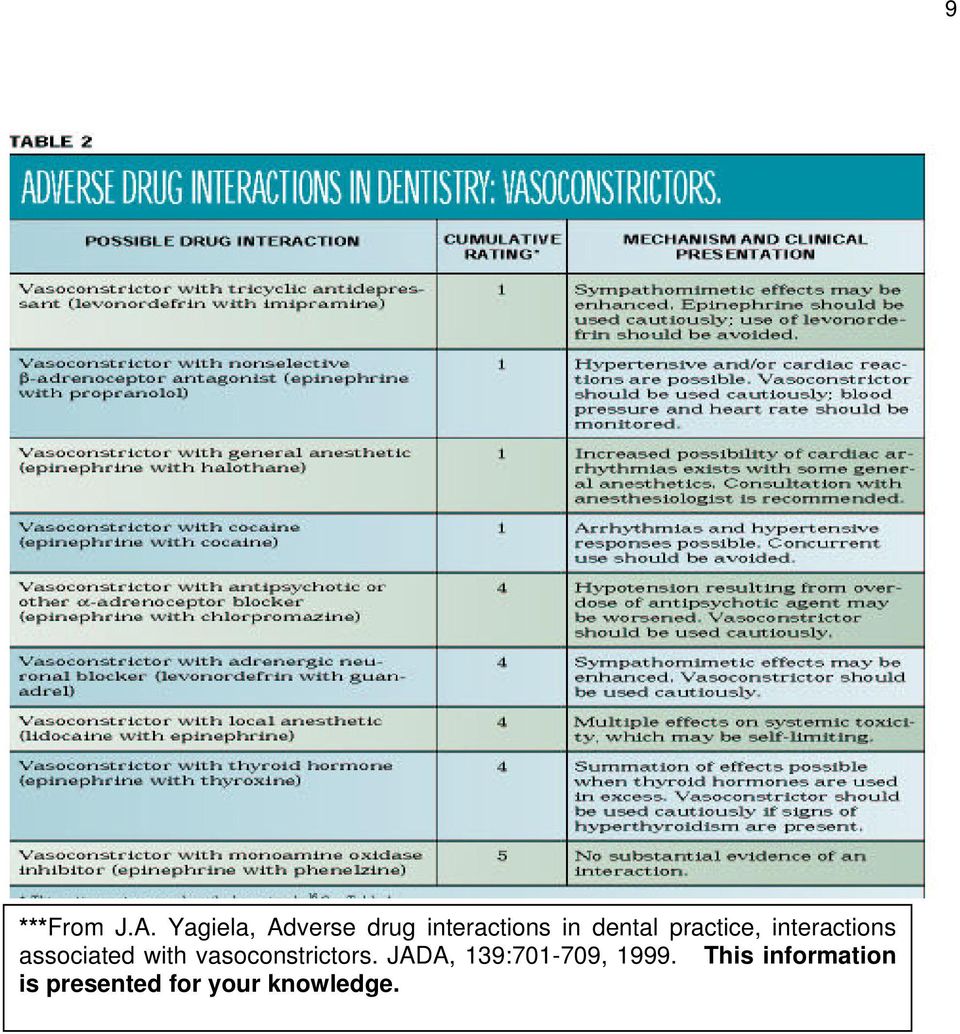
9 ***From J.A. Yagiela, Adverse drug interactions in dental practice, interactions associated with vasoconstrictors. JADA, 139: , This information is presented for your knowledge. 9
Pharmacology - Problem Drill 06: Autonomic Pharmacology - Adrenergic System
 Pharmacology - Problem Drill 06: Autonomic Pharmacology - Adrenergic System Question No. 1 of 10 Instructions: (1) Read the problem and answer choices carefully, (2) Work the problems on paper as 1. What
Adrenergic agonists. R. A. Nimmi Dilsha Department of pharmacy Faculty of Health Sciences The Open University of Sri Lanka
 Adrenergic agonists R. A. Nimmi Dilsha Department of pharmacy Faculty of Health Sciences The Open University of Sri Lanka Outline Recall Introduction to adrenergic agonists Classification of adrenergic
ADRENERGIC RECEPTOR AGONIST,CLASSIFICATION AND MECHANISM OF ACTION.
 ADRENERGIC RECEPTOR AGONIST,CLASSIFICATION AND MECHANISM OF ACTION. LEARNING OBJECTIVES At the end of lecture students should be able to know, Adrenergic receptor agonist, Classification and mechanism
Key Points. Autonomic Nervous System Drugs. Autonomic effects Sympathetic. Drugs can modify ANS activity by: Autonomic Nervous System
 Key Points Autonomic Nervous System Drugs Autonomic drugs work at the synapses, Drugs either suppress or magnify the sympathetic or parasympathetic effect, Drugs don t work on a single target organ so
Adrenergic receptors lec 9, part 2. 16/10/2014 Dr. Laila M. Matalqah Rama Kamal Ali Treany
 Adrenergic receptors lec 9, part 2 16/10/2014 Dr. Laila M. Matalqah Rama Kamal Ali Treany Pharmacology of ANS Adrenergic Agonists Adrenergic receptors:- - It is a receptor which is located in the peripheral
LESSON ASSIGNMENT. 7-4. Given a group of statements, select the best definition of the term adrenergic (sympathomimetic) drug.
 LESSON ASSIGNMENT LESSON 7 Adrenergic Agents. TEXT ASSIGNMENT Paragraphs 7-1 through 7-6. LESSON OBJECTIVES 7-1. Given a group of statements, select the mechanism(s) of action of drugs which stimulate
Pharmacology 260 Online Course Schedule Spring 2012
 Pharmacology 260 Online Course Spring 2012 The topics listed below do not necessarily correspond to a 1 - hour lecture period. You should cover the topics for each week at some time during that week. Readings
ADRENERGIC AND ANTI-ADRENERGIC DRUGS. Mr. D.Raju, M.pharm, Lecturer
 ADRENERGIC AND ANTI-ADRENERGIC DRUGS Mr. D.Raju, M.pharm, Lecturer SYMPATHETIC NERVOUS SYSTEM Fight or flight response results in: 1. Increased BP 2. Increased blood flow to brain, heart and skeletal muscles
PHC 313 The 7 th. Lecture. Adrenergic Agents
 PHC 313 The 7 th. Lecture Adrenergic Agents Introduction Introduction Adrenergic agents are a broad class of agents employed in the treatment of many disorders. They are those chemical agents that exert
Inotropes/Vasoactive Agents Hina N. Patel, Pharm.D., BCPS Cathy Lawson, Pharm.D., BCPS
 Inotropes/Vasoactive Agents Hina N. Patel, Pharm.D., BCPS Cathy Lawson, Pharm.D., BCPS 1. Definition -an agent that affects the contractility of the heart -may be positive (increases contractility) or
Adrenergic agonists:-
 Adrenergic agonists:- A.) Catecholamines They are called catecholamines because they contain a catechol group, they are water-soluble and are 50% bound to plasma proteins, so they circulate in the bloodstream.
Adrenergic, Adrenergic Blockers, Cholinergic and Cholinergic Blockers
 Adrenergic, Adrenergic Blockers, Cholinergic and Cholinergic Blockers Objective 1: Explain the difference between the sympathetic and parasympathetic nervous systems Autonomic Nervous System Sympathetic
Physiology and Pharmacology
 Pharmacokinetics Physiology and Pharmacology Pharmacokinetics of Local Anesthetics Uptake Oral Route Topical Route Injection Distribution Metabolism (Biotransformation) Excretion Uptake So what? Vasoactivity
PHENYLEPHRINE HYDROCHLORIDE INJECTION USP
 PRESCRIBING INFORMATION PHENYLEPHRINE HYDROCHLORIDE INJECTION USP 10 mg/ml Sandoz Canada Inc. Date of Preparation: September 1992 145 Jules-Léger Date of Revision : January 13, 2011 Boucherville, QC, Canada
Drugs, The Brain, and Behavior
 Drugs, The Brain, and Behavior John Nyby Department of Biological Sciences Lehigh University What is a drug? Difficult to define Know it when you see it Neuroactive vs Non-Neuroactive drugs Two major categories
PRESCRIBING INFORMATION PRODUCT MONOGRAPH ADRENALIN* Adrenalin* Chloride Solution (Epinephrine Injection U.S.P) 1:1000 (1 mg/ml)
 PRESCRIBING INFORMATION PRODUCT MONOGRAPH ADRENALIN* Adrenalin* Chloride Solution (Epinephrine Injection U.S.P) 1:1000 (1 mg/ml) Adrenalin* Chloride Injection (Epinephrine Injection U.S.P.) 1:1000, 30
Drug addiction. These factors increase the likelihood of your having an addiction to a legal or an illegal drug:
 Drug addiction You may be hooked emotionally and psychologically. You may have a physical dependence, too. If you're addicted to a drug whether it's legal or illegal you have intense cravings for it. You
ANNE ARUNDEL MEDICAL CENTER CRITICAL CARE MEDICATION MANUAL DEPARTMENT OF NURSING AND PHARMACY. Guidelines for Use of Intravenous Isoproterenol
 ANNE ARUNDEL MEDICAL CENTER CRITICAL CARE MEDICATION MANUAL DEPARTMENT OF NURSING AND PHARMACY Guidelines for Use of Intravenous Isoproterenol Major Indications Status Asthmaticus As a last resort for
Mammalian Physiology. Autonomic Nervous System UNLV. PHYSIOLOGY, Chapter 11 Berne, Levy, Koeppen, Stanton UNIVERSITY OF NEVADA LAS VEGAS
 Mammalian Physiology Autonomic Nervous System UNLV 1 UNIVERSITY OF NEVADA LAS VEGAS PHYSIOLOGY, Chapter 11 Berne, Levy, Koeppen, Stanton Objectives Describe the organization of the autonomic nervous system
ACLS PHARMACOLOGY 2011 Guidelines
 ACLS PHARMACOLOGY 2011 Guidelines ADENOSINE Narrow complex tachycardias or wide complex tachycardias that may be supraventricular in nature. It is effective in treating 90% of the reentry arrhythmias.
Milwaukee School of Engineering [email protected]. Case Study: Factors that Affect Blood Pressure Instructor Version
 Case Study: Factors that Affect Blood Pressure Instructor Version Goal This activity (case study and its associated questions) is designed to be a student-centered learning activity relating to the factors
Vasopressors. Judith Hellman, M.D. Associate Professor Anesthesia and Perioperative Care University of California, San Francisco
 Vasopressors Judith Hellman, M.D. Associate Professor Anesthesia and Perioperative Care University of California, San Francisco Overview Define shock states Review drugs commonly used to treat hypotension
Drugs affecting the autonomic nervous system. Objectives. Autonomic Nervous System (ANS) 12/23/2014
 Drugs affecting the autonomic nervous system N231 Nursing Pharmacology Objectives Analyze the implementation of the nursing process in the promotion and maintenance of system stability for individuals
Treatments for Major Depression. Drug Treatments The two (2) classes of drugs that are typical antidepressants are:
 Treatments for Major Depression Drug Treatments The two (2) classes of drugs that are typical antidepressants are: 1. 2. These 2 classes of drugs increase the amount of monoamine neurotransmitters through
Amphetamines Addiction
 Introduction Amphetamines, which are classified as stimulants, work by using the dopamine reward system of the brain. When these drugs are used, the user s central nervous system is simulated which causes
Epinephrine Administration by the EMT
 Epinephrine Administration by the EMT Pilot Project for the Administration of Epinephrine by Washington EMTs Tamara Coulter BS, FF/PM and Captain/MSO Steven Engle North Kitsap Fire & Rescue Objectives
WHAT HAPPENS TO OUR BRAIN?
 WORK DYNAMIC The final result of this session is the formulation of the questions that, within the activity of the Let s talk about drugs programme of the la Caixa Welfare Project, you will ask Dr. Rafael
Adrenoceptor -activating & other sympathomimetic drugs
 Adrenoceptor -activating & other sympathomimetic drugs Three Neurotransmitters of Sympathetic Nervous System NE, E, DA Adrenoceptor agonists Sympathomimetics : Directly acting Indirectly acting Mixed action
PHARMACOLOGY OF VNS VARIANT 1 1) Anti-ChEs: contraindications and precautions. 2) Examples of Cholinesterase reactivators. 3) Cholinoblockers-natural
 VARIANT 1 Anti-ChEs: contraindications and precautions. Examples of Cholinesterase reactivators. Cholinoblockers-natural alkaloids (examples). 4) GIT-effects of Atropine. 5) Pharmacologic characteristic
The somatic nervous system regulates conscious movements via efferent nerves exit from the CNS to skeletal muscles.
 Lecture 1 Nervous system The nervous system is divided into the central nervous system (CNS; brain and spinal cord) and peripheral nervous system (somatic and autonomic nervous systems; comprised of nerves
The Ideal Local Anesthetic. Pain and Anxiety. Percent Solution. Contents cont: Contents of a dental cartridge
 The Ideal Local Anesthetic Pain and Anxiety University of Minnesota Division of Oral and Maxillofacial Surgery Ma Ann C. Sabino, DDS PhD Water soluble/stable in solution Non-irritating to nerve Low systemic
PACKAGE LEAFLET: INFORMATION FOR THE USER. ADRENALINE (TARTRATE) STEROP 1 mg/1 ml Solution for injection. Adrenaline (Levorenine, Epinephrine)
 PACKAGE LEAFLET: INFORMATION FOR THE USER ADRENALINE (TARTRATE) STEROP 1 mg/1 ml Solution for injection Adrenaline (Levorenine, Epinephrine) Read all of this leaflet carefully before you start using this
TEENS AND PRESCRIPTION DRUGS An Analysis of Recent Trends on the Emerging Drug Threat
 TEENS AND PRESCRIPTION DRUGS An Analysis of Recent Trends on the Emerging Drug Threat OFFICE OF NATIONAL DRUG CONTROL POLICY EXECUTIVE OFFICE OF THE PRESIDENT FEBRUARY 2007 TABLE OF CONTENTS Introduction
New Developments in the Treatment of ADHD in Children: How the Pharmacist and Pharmacy Technician Can Impact Care
 New Developments in the Treatment of ADHD in Children: How the Pharmacist and Pharmacy Technician Can Impact Care Post-Test/Rationale EDUCATIONAL OBJECTIVES Upon completion of this activity, participants
Healthy Lifestyle, Tobacco Free and Recovery Lesson for Group or Individual Sessions
 Healthy Lifestyle, Tobacco Free and Recovery Lesson for Group or Individual Sessions This lesson is part of an overall curriculum based program developed by the New York State Office of Alcoholism and
Chapter 13. Sympathetic Nervous System. Basic Functions of the Nervous System. Divisions of the Peripheral Nervous System
 Chapter 13 Drugs Affecting the Autonomic Basic Functions of the Recognizing changes in Internal environment External environment Processing and integrating changes Reacting to changes Upper Saddle River,
Psychopharmacotherapy for Children and Adolescents
 TREATMENT GUIDELINES Psychopharmacotherapy for Children and Adolescents Guideline 7 Psychopharmacotherapy for Children and Adolescents Description There are few controlled trials to guide practitioners
LESSON ASSIGNMENT. Central Nervous System (CNS) Stimulants. After completing this lesson, you should be able to:
 LESSON ASSIGNMENT LESSON 10 Central Nervous System (CNS) Stimulants. TEXT ASSIGNMENT Paragraphs 10-1--10-9. LESSON OBJECTIVES After completing this lesson, you should be able to: 10-1. Given several categories,
Depression is a common biological brain disorder and occurs in 7-12% of all individuals over
 Depression is a common biological brain disorder and occurs in 7-12% of all individuals over the age of 65. Specific groups have a much higher rate of depression including the seriously medically ill (20-40%),
D.U.C. Assist. Lec. Faculty of Dentistry General Physiology Ihsan Dhari. The Autonomic Nervous System
 The Autonomic Nervous System The portion of the nervous system that controls most visceral functions of the body is called the autonomic nervous system. This system helps to control arterial pressure,
The Cranium Connection
 Your Brain! The brain is the command center of your body. It controls just about everything you do, even when you are sleeping. Weighing about 3 pounds, the brain is made up of many parts that all work
Effects of Illicit Drugs on the Heart and Brain Presented by: Jeffrey Sather, MD, FACEP Trinity Health
 2014 Stroke/Cardiac System of Care Conference Effects of Illicit Drugs on the Heart and Brain Presented by: Jeffrey Sather, MD, FACEP Trinity Health Disclosures No Financial incentives No off label use
Pulmonary Diseases. Lung Disease: Pathophysiology, Medical and Exercise Programming. Overview of Pathophysiology
 Lung Disease: Pathophysiology, Medical and Exercise Programming Overview of Pathophysiology Ventilatory Impairments Increased airway resistance Reduced compliance Increased work of breathing Ventilatory
Amino Acid Therapy to Restore Neurotransmitter Function
 Amino Acid Therapy to Restore Neurotransmitter Function Alvin Stein, MD Neurotransmitters are chemicals manufactured by our bodies that allow our nervous system to function properly. When the body requires
Atrial Fibrillation Management Across the Spectrum of Illness
 Disclosures Atrial Fibrillation Management Across the Spectrum of Illness NONE Barbara Birriel, MSN, ACNP-BC, FCCM The Pennsylvania State University Objectives AF Discuss the pathophysiology, diagnosis,
Integration and Coordination of the Human Body. Nervous System
 I. General Info Integration and Coordination of the Human Body A. Both the and system are responsible for maintaining 1. Homeostasis is the process by which organisms keep internal conditions despite changes
Factors Affecting Blood Pressure. Vessel Elasticity Blood Volume Cardiac Output
 Factors that Affect Pressure Graphics are used with permission of: Pearson Education Inc., publishing as Benjamin Cummings (http://www.aw-bc.com) Page 1. Introduction pressure is affected by several factors:
Compare the physiologic responses of the respiratory system to emphysema, chronic bronchitis, and asthma
 Chapter 31 Drugs Used to Treat Lower Respiratory Disease Learning Objectives Describe the physiology of respirations Compare the physiologic responses of the respiratory system to emphysema, chronic bronchitis,
Autonomic Nervous System Dr. Ali Ebneshahidi
 Autonomic Nervous System Dr. Ali Ebneshahidi Nervous System Divisions of the nervous system The human nervous system consists of the central nervous System (CNS) and the Peripheral Nervous System (PNS).
Clock Hours I General Concepts of Pharmacy 1-4 80. III Pharmacy Billing, Repacking and Compounding 9-12 80
 PHARMACY TECHNICIAN (PHT) 720 clock hours/ 9 months (Total time to complete the program may vary based on school holidays and breaks) 28 weeks Theory/Lab (20 hours per week) + 8 weeks externship (20 hours
CBT/OTEP 937 Street Medicine Street Drugs
 Seattle-King County EMS Seattle-King County Emergency Medical Services Division Public Health - Seattle/King County 401 5th Avenue, Suite 1200 Seattle, WA 98104 February 2009 CBT/OTEP 937 Street Medicine
Social phobia following maprotiline: The first case report. Mazandaran University of Medical Sciences, Sari, Mazandaran, Iran
 Social phobia following maprotiline: The first case report Seyed Hamzeh Hosseini (MD) 1*, Ebraheim Salehifar (PharmD) 2 1* Associate professor of Psychiatry, Department of Psychiatry, Faculty of Medicine,
Exchange solutes and water with cells of the body
 Chapter 8 Heart and Blood Vessels Three Types of Blood Vessels Transport Blood Arteries Carry blood away from the heart Transport blood under high pressure Capillaries Exchange solutes and water with cells
OTC Abuse. Dr. Eman Said Abd-Elkhalek Lecturer of Pharmacology & Toxicology Faculty of Pharmacy Mansoura University
 OTC Abuse Dr. Eman Said Abd-Elkhalek Lecturer of Pharmacology & Toxicology Faculty of Pharmacy Mansoura University Opiates Abuse Opioids are a group of natural, partially synthetic, or synthetic drugs
ACOEM Commercial Driver Medical Examiner Training Program. Module 8: Drug Abuse & Alcoholism, Medication Use
 ACOEM Commercial Driver Medical Examiner Training Program Module 8: Drug Abuse & Alcoholism, Medication Use Drug Abuse - 49 CFR 391.41(b)(12)i)(ii)(A)(B) "A person is physically qualified to drive a commercial
Chapter 16. Learning Objectives. Learning Objectives 9/11/2012. Shock. Explain difference between compensated and uncompensated shock
 Chapter 16 Shock Learning Objectives Explain difference between compensated and uncompensated shock Differentiate among 5 causes and types of shock: Hypovolemic Cardiogenic Neurogenic Septic Anaphylactic
Chapter 28. Drug Treatment of Parkinson s Disease
 Chapter 28 Drug Treatment of Parkinson s Disease 1. Introduction Parkinsonism Tremors hands and head develop involuntary movements when at rest; pin rolling sign (finger and thumb) Muscle rigidity arthritis
How To Understand The Effects Of Drugs On The Brain
 DRUGS AND THE BRAIN Most of the psychological and behavioural effects of psychoactive drugs is due the interaction they have with the nerve cells in the CNS (which includes the brain and peripheral nervous
POPULAR DEPRESSION MEDICATIONS
 Popular Depression Medications A Helpful Guide to Antidepressant Drugs POPULAR DEPRESSION MEDICATIONS A Helpful Guide to Antidepressant Drugs Popular Depression Medications A Helpful Guide to Antidepressant
PRESCRIPTION PAINKILLER OVERDOSES
 IMPACT{ POLICY PRESCRIPTION PAINKILLER OVERDOSES National Center for Injury Prevention and Control Division of Unintentional Injury Prevention What s the Issue? In a period of nine months, a tiny Kentucky
Chapter 15. The Autonomic Nervous. The Autonomic Nervous System. Autonomic Motor Pathways. ANS vs. SNS
 The Autonomic Nervous System Chapter 15 The subconscious involuntary nervous system Regulates activity of smooth muscle, cardiac muscle & certain glands The Autonomic Nervous System 1 2 ANS vs. SNS Somatic
Treating Mental Disorders. Types of Biological Treatment. Drug Treatments for Psychological Disorders
 Treating Mental Disorders Biological Treatments for Psychological Disorders Aims: Describe and Assess Biological Treatments Objectives By the end of this session you should be able to: Describe the use
Medications for chronic pain
 Medications for chronic pain When it comes to treating chronic pain with medications, there are many to choose from. Different types of pain medications are used for different pain conditions. You may
Influence of ph Most local anesthetics are weak bases.
 Local anesthetics The agent must depress nerve conduction. The agent must have both lipophilic and hydrophilic properties to be effective by parenteral injection. Structure-activity relationships The typical
Emergency Assistance: 1-800-525-5555 or Cellular *55. Sex Offender Registry: 1-888-SOR-MSHP (1-888-767-6747) 1-8 1-888-275-6636
 Emergency Assistance: E 1-800-525-5555 or Cellular *55 1-8 Road Conditions: 1-888-275-6636 Sex Offender Registry: S 1-888-SOR-MSHP (1-888-767-6747) Produced by: Public Information and Education Division
Anti-Parkinsonism Drugs
 Anti-Parkinsonism Drugs Pharma Team 429 Fahad Alrumaih Ibrahim Alshiddi Sultan Alsalem Ismail Raslan Suhail Asiri Parkinsonism - Could be: primary [idiopathic] or secondary [viral infection or drug induced
Prescription for Danger
 Prescription for Danger A Report on the Troubling Trend of Prescription and Over-the-Counter Drug Abuse Among the Nation s Teens OFFICE OF NATIONAL DRUG CONTROL POLICY EXECUTIVE OFFICE OF THE PRESIDENT
STAGES OF SHOCK. IRREVERSIBLE SHOCK Heart deteriorates until it can no longer pump and death occurs.
 STAGES OF SHOCK SHOCK : A profound disturbance of circulation and metabolism, which leads to inadequate perfusion of all organs which are needed to maintain life. COMPENSATED NONPROGRESSIVE SHOCK 30 sec
HEdis Code Quick Reference Guide Disease Management Services
 HEdis Code Quick Reference Guide Disease Management Services Respiratory Conditions Appropriate Testing for Children With Pharyngitis (ages 2-18) [Commercial, Medicaid] Appropriate Treatment (no antibiotic)
2.4 Enantiomeric Isomers
 2.4 Enantiomeric Isomers There is an additional type of isomer that can exist when we have an atom with 4 different groups attached to that atom in tetrahedral geometry. Consider a methane molecule with
Here is a drug list that you need to know before taking the NREMT-P exam!! Taken from the book EMS NOTES.com
 Here is a drug list that you need to know before taking the NREMT-P exam!! Taken from the book EMS NOTES.com Special thanks to the number #1 internet training site id44.com and also to (NOTE) Please remember
Adrenomimetic Drugs. Tony J.-F. Lee and Robert E. Stitzel MECHANISM OF ACTION CHEMISTRY
 10 Adrenomimetic Drugs Tony J.-F. Lee and Robert E. Stitzel DRUG LIST GENERIC NAME AGE GENERIC NAME AGE Albuterol 105 Amphetamine 106 Dobutamine 105 Dopamine 103 Ephedrine 105 Epinephrine 101 Isoproterenol
Adrenaline (epinephrine) 1:1000 Injection BP Summary of Product Characteristics
 Adrenaline (epinephrine) 1:1000 Injection BP Summary of Product Characteristics 1. NAME OF THE MEDICINAL PRODUCT Adrenaline (epinephrine) 1:1000 Injection BP 2. QUALITATIVE AND QUANTITATIVE COMPOSITION
Neuroscience An extra bit. Dr Sasha Gartside Institute of Neuroscience Newcastle University
 Neuroscience An extra bit Dr Sasha Gartside Institute of Neuroscience Newcastle University Drugs, receptors, and transporters Most psychoactive drugs interfere with neurotransmission The main targets are
Jeopardy Topics: THE CLOT STOPS HERE (anticoagulants) SUGAR, SUGAR, HOW D YOU GET SO HIGH (insulins)
 Jeopardy Topics: THE CLOT STOPS HERE (anticoagulants) SUGAR, SUGAR, HOW D YOU GET SO HIGH (insulins) I HEAR YA KNOCKING BUT YOU CAN T COME IN (electrolytes) TAKE MY BREATH AWAY (Opiates-morphine) OUT WITH
NEW ZEALAND DATA SHEET NAPHCON-A Naphazoline hydrochloride and pheniramine maleate.
 NEW ZEALAND DATA SHEET NAPHCON-A Naphazoline hydrochloride and pheniramine maleate. PRESENTATION Eye Drops: NAPHCON-A Eye Drops are a combination of an antihistamine (pheniramine maleate) and a decongestant
Sign up to receive ATOTW weekly - email [email protected]
 ADRENALINE (EPINEPHRINE) ANAESTHESIA TUTORIAL OF THE WEEK 226 6 TH JUNE 2011 Prof. John Kinnear Southend University Hospital NHS Foundation Trust, UK Correspondence to [email protected] QUESTIONS
A systematic review of the uses and contraindications of epinephrine in local anesthesia in the dermatologic setting
 A systematic review of the uses and contraindications of epinephrine in local anesthesia in the dermatologic setting Syril Keena Que, MD; James Whalen, MD University of Connecticut Health Center Department
EPINEPHRINE Injection, USP 1:1000 (1 mg/ml) Ampul Protect from light until ready to use.
 EPINEPHRINE Injection, USP 1:1000 (1 mg/ml) Ampul Protect from light until ready to use. R x only DESCRIPTION Epinephrine Injection, USP 1:1000 is a sterile, nonpyrogenic solution. Each ml contains epinephrine
BSc in Medical Sciences with PHARMACOLOGY
 BSc in Medical Sciences with PHARMACOLOGY Course Director Dr Christopher John Module Leaders Dr Robert Dickinson (Module 1) Dr Anabel Varela Carver (Module 2) Dr Sohag Saleh (Module 3) Course Administrator
2010 QARR QUICK REFERENCE GUIDE Adults
 2010 QARR QUICK REFERENCE GUIDE Adults ADULT MEASURES (19 through 64 years) GUIDELINE HEDIS COMPLIANT CPT/ICD9 CODES DOCUMENTATION TIPS Well Care Access to Ambulatory Care Ensure a preventive or other
Autonomic Nervous System
 MOST FREQUENTLY USED DRUG CATEGORIES FOR AUTONOMIC SYSTEM THERAPY Beta 1 Adrenergic Blockers (Anatgonists) - Work on the Heart Beta 1 Adrenergic receptors are typically found on the heart and is a means
Chapter 15. Neurotransmitters of the ANS
 Chapter 15 Neurotransmitters of the ANS Neurotransmitters and Receptors How can the same ANS neurons create different effects on different target tissue? Variety of neurotransmitters Secondly, different
Contraindications of Vasoconstrictors in Dentistry
 Biomedical & Pharmacology Journal Vol. 6(2), 409-414 (2013) Contraindications of Vasoconstrictors in Dentistry R. BALAKRISHNAN* and VIJAY EBENEZER Department of Oral & Maxillofacial Surgery, Sree Balaji
Understanding Addiction: The Intersection of Biology and Psychology
 Understanding Addiction: The Intersection of Biology and Psychology Robert Heimer, Ph.D. Yale University School of Public Health Center for Interdisciplinary Research on AIDS New Haven, CT, USA November
Drug Free Campus Plan
 Baptist University of the Américas, San Antonio, Texas, is committed to maintaining a drug free environment, free of the abuse of alcohol, tobacco and other drugs. Baptist University of the Américas is
Naloxone: Effects and Side Effects
 Gregory W. Terman M.D., Ph.D. Professor Department of Anesthesiology and Pain Medicine and the Graduate Program in Neurobiology Mayday Pain and Society Fellow University of Washington Seattle, Washington
Heroin. How is Heroin Abused? What Other Adverse Effects Does Heroin Have on Health? How Does Heroin Affect the Brain?
 Heroin Heroin is a synthetic opiate drug that is highly addictive. It is made from morphine, a naturally occurring substance extracted from the seed pod of the Asian opium poppy plant. Heroin usually appears
Drug Abuse and Addiction
 Drug Abuse and Addiction Introduction A drug is a chemical substance that can change how your body and mind work. People may abuse drugs to get high or change how they feel. Addiction is when a drug user
Depression in Older Persons
 Depression in Older Persons How common is depression in later life? Depression affects more than 6.5 million of the 35 million Americans aged 65 or older. Most people in this stage of life with depression
Protocol in depth Asthma/COPD. [email protected]
 Protocol in depth Asthma/COPD [email protected] Asthma/COPD Narrowing of airways (an H4 histamine response causing inflammation and mucous production), leading to wheezing on inspiration and exhalation.
Summary of the risk management plan (RMP) for Rasagiline ratiopharm (rasagiline)
 EMA/744222/2014 Summary of the risk management plan (RMP) for Rasagiline ratiopharm (rasagiline) This is a summary of the risk management plan (RMP) for Rasagiline ratiopharm, which details the measures
Tobacco/Marijuana. Tobacco. Short-term effects of smoking
 Tobacco/Marijuana Tobacco Nicotine, one of the more than 4,000 chemicals found in the smoke from tobacco products such as cigarettes, cigars, and pipes, is the primary component in tobacco that acts on