
Atrial Fibrillation Management Across the Spectrum of Illness
|
|
|
- Ruth Berry
- 10 years ago
- Views:
Transcription
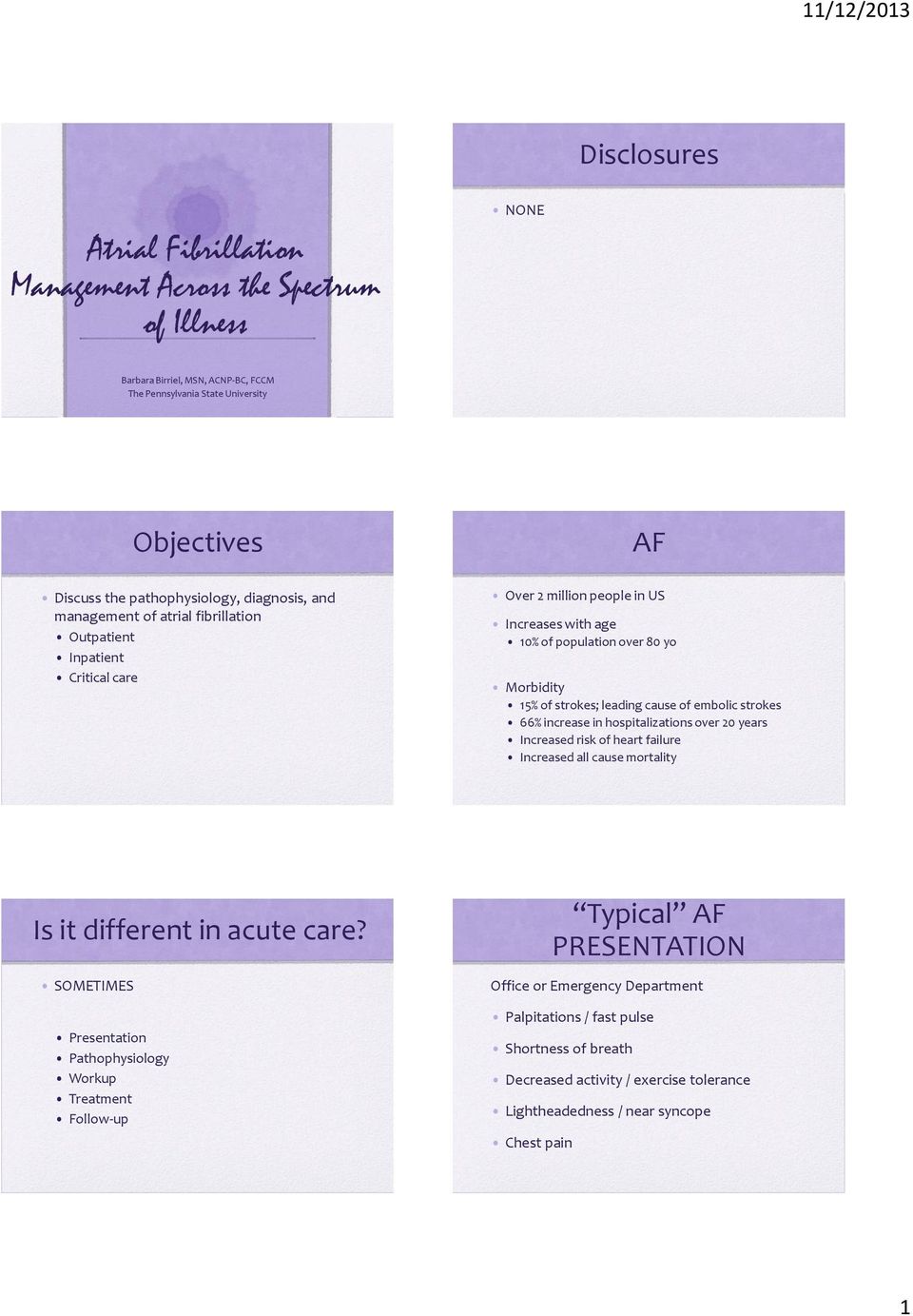
1 Disclosures Atrial Fibrillation Management Across the Spectrum of Illness NONE Barbara Birriel, MSN, ACNP-BC, FCCM The Pennsylvania State University Objectives AF Discuss the pathophysiology, diagnosis, and management of atrial fibrillation Outpatient Inpatient Critical care Over 2 million people in US Increases with age 10% of population over 80 yo Morbidity 15% of strokes; leading cause of embolic strokes 66% increase in hospitalizations over 20 years Increased risk of heart failure Increased all cause mortality Is it different in acute care? SOMETIMES Presentation Pathophysiology Workup Treatment Follow-up PRESENTATION Office or Emergency Department Palpitations / fast pulse Shortness of breath Decreased activity / exercise tolerance Lightheadedness / near syncope Chest pain 1
2 PRESENTATION Physical Exam Irregularly irregular pulse Pulse rate may not equal heart rate Variable S1 JVP PRESENTATION Narrow Complex Irregularly Irregular Rapid Ventricular Rate PATHOPHYSIOLOGY PATHOPHYSIOLOGY AF Classification Paroxysmal end <7 days Persistent last > 7 days May terminate on its own or by cardioversion Permanent - > 1 year and cardioversion has not been attempted or failed Lone AF any of the above without structural heart disease Only applies to AF unrelated to a reversible cause RISK FACTORS Age > 60 (Dramatically in age >80) Valvular heart disease Hypertension Coronary disease Post CABG surgery Long standing pulmonary disease (e.g. COPD) Hyperthyroidism Drugs: EtOH, Theophylline, Albuterol, Ephredra, Cocaine, Methamphetamine 2

3 ECG Echocardiogram WORK-UP Pharmacologic nuclear stress test Or cardiac catheterization Holter monitor or mobile telemetry If dysrhythmia is paroxysmal Thyroid panel Rate control vs. rhythm control 3


4 RATE CONTROL Beta blockers metoprolol Calcium channel blockers diltiazem Digoxin RHYTHM CONTROL 20-30% remain sinus after 1 year Amiodarone (heart failure pts) propafenone, sotalol, dronedarone, flecainide, dofetilide ANTICOAGULATION ANTICOAGULATION 4

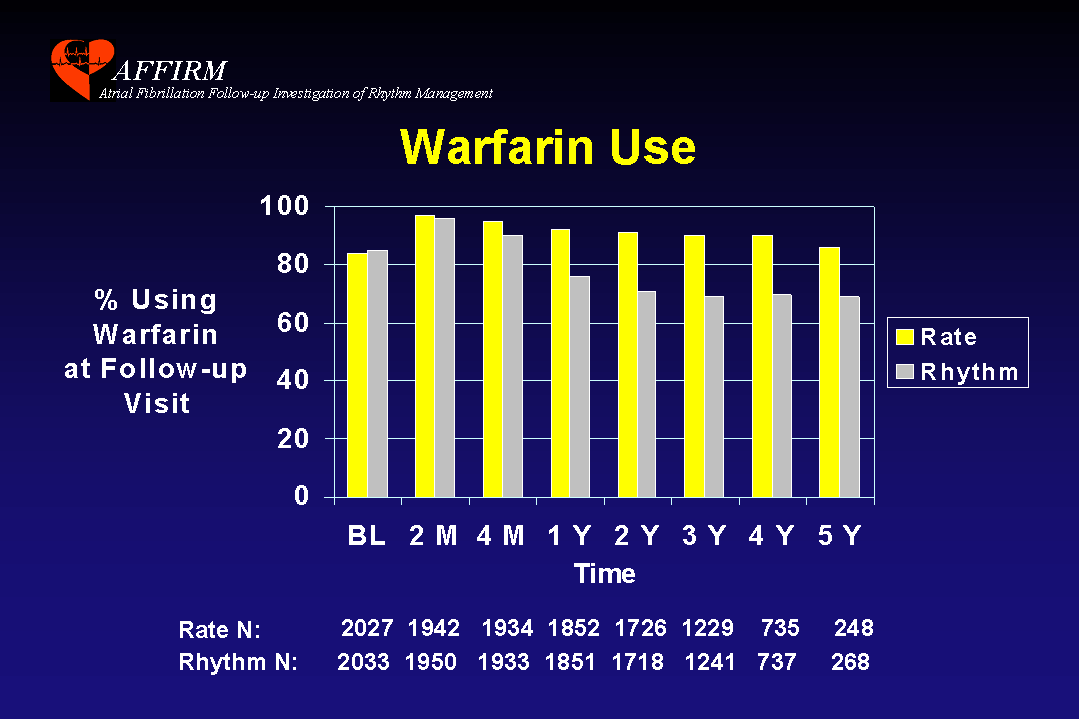
5 ANTICOAGULATION warfarin (INR ) dabigatran mg BID (DTI) Rivaroxoban mg QD (Xa inhibitor) Apixiban 2-5 mg BID (Xa inhibitor) CARDIOVERSION Afib < 48 hours: Cardioversion (CV) No anticoagulation indicated Afib > 48 hours: Anticoagulate for 3-4 weeks before CV OR get TEE Anticoagulate for 1 month after CV AF ablation MAZE procedure FOLLOWUP Medication maintenance Anticoagulation INR (warfarin), renal, hepatic Rate control Digoxin level ECG, HR Rhythm control Sotalol QTc, esp with dosage changes Amiodarone ECG? Q 3 months Pulmonary fibrosis annual PFTs;?CXR q 3 months CHF Hypo or hyperthyroidism q 6 months Corneal deposits --- retinopathy annual eye exam Liver dysfunction q 6 months Variations on Typical Variations on Typical Variations on Typical PRESENTATION Asymptomatic Even with extremely high heart rates ETIOLOGY Hyperthyroidism COPD Albuterol Stimulants Caffeine Amphetamines Methamphetamine 5

6 Variations in Acute and Critical Care Evaluate and treat as typical Patients with known PAF or chronic AF With stable dysrhythmia Patients presenting with AF New or recurrent AF during the hospitalization Evaluate and treat as typical Patients with known PAF or chronic AF With stable dysrhythmia Patients presenting with AF New or recurrent AF during the hospitalization Evaluate and treat as typical Rate control vs. rhythm control Anticoagulation Telemetry, ECGs TTE, TEE Cardiac ischemia eval Think about PE Evaluate and treat as typical Patients with known PAF or chronic AF With stable dysrhythmia Patients presenting with AF New or recurrent AF during the hospitalization Patients with known PAF or chronic AF With stable dysrhythmia Continue home rate / rhythm medications If NPO, use IV equivalent (amio OK to hold) Anticoagulants Depends on admission diagnosis and plans Heparin may be indicated if NPO or anticipating procedure / surgery 6

7 Evaluate and treat as typical Patients with known PAF or chronic AF With stable dysrhythmia New or recurrent AF during the hospitalization Hypotension Chest pain Short of breath Symptoms due to AF or something else????? PE? MI? Heart failure? Sepsis? Any other critical illness Emergent cardioversion Electrical Chemical ibutilide, procainamide If stable after cardioversion, treat like the typical patient for management and follow up If not stable. Evaluate and treat as typical Patients with known PAF or chronic AF With stable dysrhythmia Patients presenting with AF New or recurrent AF during the hospitalization 7

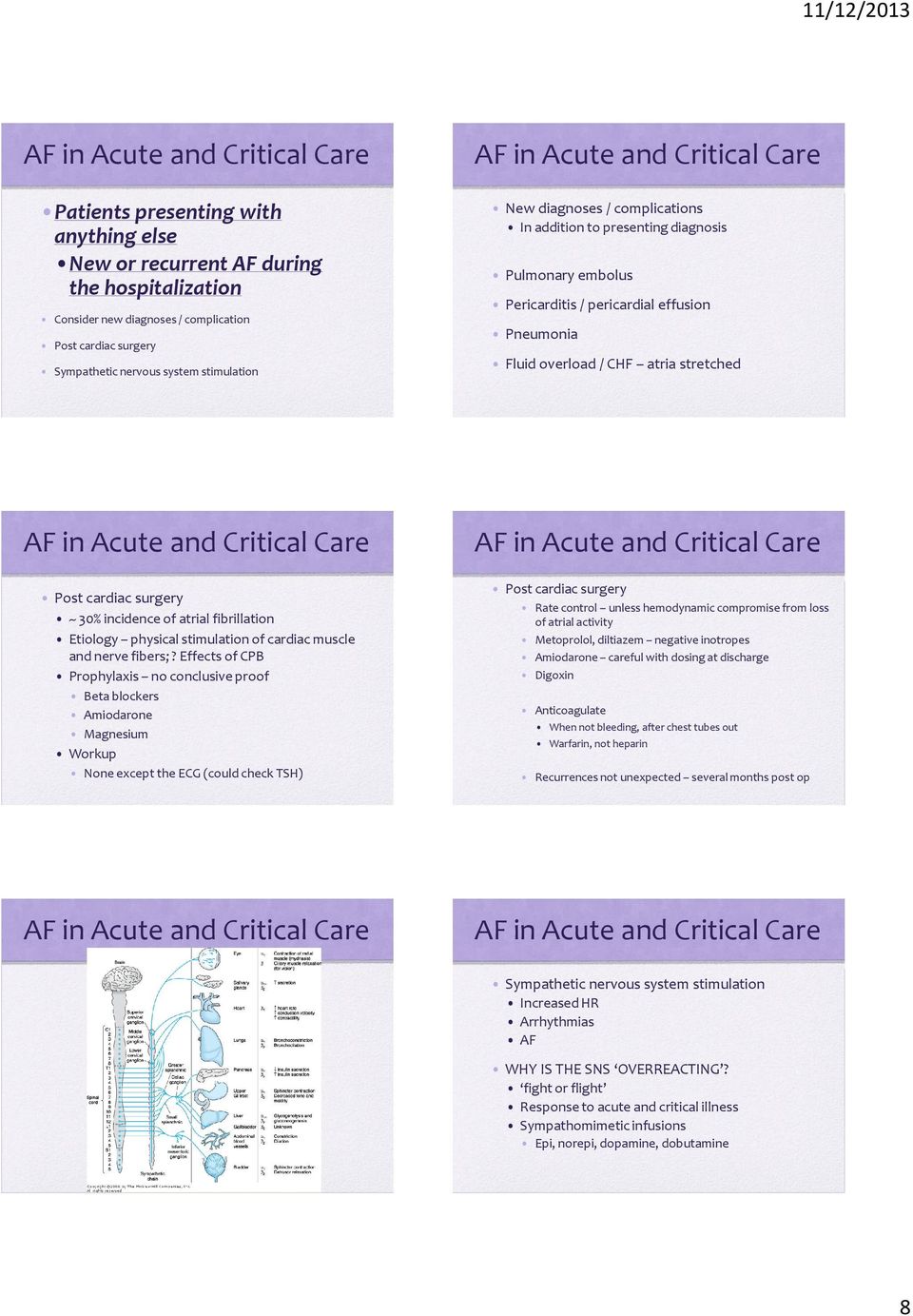
8 Patients presenting with anything else New or recurrent AF during the hospitalization Consider new diagnoses / complication Post cardiac surgery New diagnoses / complications In addition to presenting diagnosis Pulmonary embolus Pericarditis / pericardial effusion Pneumonia Fluid overload / CHF atria stretched Post cardiac surgery ~ 30% incidence of atrial fibrillation Etiology physical stimulation of cardiac muscle and nerve fibers;? Effects of CPB Prophylaxis no conclusive proof Beta blockers Amiodarone Magnesium Workup None except the ECG (could check TSH) Post cardiac surgery Rate control unless hemodynamic compromise from loss of atrial activity Metoprolol, diltiazem negative inotropes Amiodarone careful with dosing at discharge Digoxin Anticoagulate When not bleeding, after chest tubes out Warfarin, not heparin Recurrences not unexpected several months post op Increased HR Arrhythmias AF WHY IS THE SNS OVERREACTING? fight or flight Response to acute and critical illness Sympathomimetic infusions Epi, norepi, dopamine, dobutamine 8
9 May have no cardiac history or heart disease Workup ECG Thyroid panel Echocardiogram (if not already done) No ischemic workup unless otherwise indicated can be difficult Sympathomimetics wean (may not be able) Beta blockers, calcium channel blockers May not tolerate hemodynamically Amiodarone not great for rate control Digoxin not fast Cardioversion usually fast recurrence due to continued SNS stimulation can be difficult Amiodarone Magnesium Potassium Cardioversion attempt if unstable Treat the underlying condition < 15% are still in AF when discharged from ICU 9

Episode 20 Atrial fibrillation Prepared by Dr. Lucas Chartier
 Episode 20 Atrial fibrillation Prepared by Dr. Lucas Chartier Most common dysrhythmia seen in ED, and incidence increasing with ageing population Presentation Common presentations: younger patients often
Treating AF: The Newest Recommendations. CardioCase presentation. Ethel s Case. Wayne Warnica, MD, FACC, FACP, FRCPC
 Treating AF: The Newest Recommendations Wayne Warnica, MD, FACC, FACP, FRCPC CardioCase presentation Ethel s Case Ethel, 73, presents with rapid heart beating and mild chest discomfort. In the ED, ECG
Atrial Fibrillation Peter Santucci, MD Revised May, 2008
 Atrial Fibrillation Peter Santucci, MD Revised May, 2008 Atrial fibrillation (AF) is an irregular, disorganized rhythm characterized by a lack of organized mechanical atrial activity. The atrial rate is
Current Management of Atrial Fibrillation DISCLOSURES. Heart Beat Anatomy. I have no financial conflicts to disclose
 Current Management of Atrial Fibrillation Mary Macklin, MSN, APRN Concord Hospital Cardiac Associates DISCLOSURES I have no financial conflicts to disclose Book Women: Fit at Fifty. A Guide to Living Long.
Atrial Fibrillation The High Risk Obese Patient
 Atrial Fibrillation The High Risk Obese Patient Frederick Schaller, D.O.,F.A.C.O.I. Professor and Vice Dean Touro University Nevada A 56 year old male with a history of hypertension and chronic stable
Managing the Patient with Atrial Fibrillation
 Pocket Guide Managing the Patient with Atrial Fibrillation Updated April 2012 Editor Stephen R. Shorofsky, MD, Ph.D. Assistant Editors Anastasios Saliaris, MD Shawn Robinson, MD www.hrsonline.org DEFINITION
Atrial Fibrillation The Basics
 Atrial Fibrillation The Basics Family Practice Symposium Tim McAveney, M.D. 10/23/09 Objectives Review the fundamentals of managing afib Discuss the risks for stroke and the indications for anticoagulation
Atrial Fibrillation An update on diagnosis and management
 Dr Arvind Vasudeva Consultant Cardiologist Atrial Fibrillation An update on diagnosis and management Atrial fibrillation (AF) remains the commonest disturbance of cardiac rhythm seen in clinical practice.
Recurrent AF: Choosing the Right Medication.
 In the name of God Shiraz E-Medical Journal Vol. 11, No. 3, July 2010 http://semj.sums.ac.ir/vol11/jul2010/89015.htm Recurrent AF: Choosing the Right Medication. Basamad Z. * Assistant Professor, Department
Atrial fibrillation (AF) care pathways. for the primary care physicians
 Atrial fibrillation (AF) care pathways for the primary care physicians by University of Minnesota Physicians Heart, October, 2011 Evaluation by the primary care physician: 1. Comprehensive history and
Atrial Fibrillation: Drugs, Ablation, or Benign Neglect. Robert Kennedy, MD October 10, 2015
 Atrial Fibrillation: Drugs, Ablation, or Benign Neglect Robert Kennedy, MD October 10, 2015 Definitions 2014 AHA/ACC/HRS Guideline for the Management of Patients With Atrial Fibrillation: Executive Summary.
Cardioversion for. Atrial Fibrillation. Your Heart s Electrical System Cardioversion Living with Atrial Fibrillation
 Cardioversion for Atrial Fibrillation Your Heart s Electrical System Cardioversion Living with Atrial Fibrillation When You Have Atrial Fibrillation You ve been told you have a heart condition called atrial
Quiz 4 Arrhythmias summary statistics and question answers
 1 Quiz 4 Arrhythmias summary statistics and question answers The correct answers to questions are indicated by *. All students were awarded 2 points for question #2 due to no appropriate responses for
DERBYSHIRE JOINT AREA PRESCRIBING COMMITTEE (JAPC) MANAGEMENT of Atrial Fibrillation (AF)
 DERBYSHIRE JOINT AREA PRESCRIBING COMMITTEE (JAPC) MANAGEMENT of Atrial Fibrillation (AF) Key priorities Identification and diagnosis Treatment for persistent AF Treatment for permanent AF Antithrombotic
A 35 yo female presents increasing fatigue and shortness of breath for several days. She is found to be in atrial fibrillation.
 Ryan G. Aleong Cardiology Department University of Colorado A 35 yo female presents increasing fatigue and shortness of breath for several days. She is found to be in atrial fibrillation. 1. Initiation
Nursing Care and Considerations for Patients with Atrial Fibrillation. Kris Kinghorn RN, MSN, ANP-BC
 Nursing Care and Considerations for Patients with Atrial Fibrillation Kris Kinghorn RN, MSN, ANP-BC Case Study 66 y/o female (Mrs. Olus A. Blader) Admitted with c/o palpitations and lightheadedness PMH:
ATRIAL FIBRILLATION (RATE VS RHYTHM CONTROL)
 ATRIAL FIBRILLATION (RATE VS RHYTHM CONTROL) By Prof. Dr. Helmy A. Bakr Mansoura Universirty 2014 AF Classification: Mechanisms of AF : Selected Risk Factors and Biomarkers for AF: WHY AF? 1. Atrial fibrillation
Atrial Fibrillation (AF) Explained
 James Paget University Hospitals NHS Foundation Trust Atrial Fibrillation (AF) Explained Patient Information Contents What are the symptoms of atrial fibrillation (AF)? 3 Normal heartbeat 4 How common
TABLE 1 Clinical Classification of AF. New onset AF (first detected) Paroxysmal (<7 days, mostly < 24 hours)
 Clinical Practice Guidelines for the Management of Patients With Atrial Fibrillation Deborah Ritchie RN, MN, Robert S Sheldon MD, PhD Cardiovascular Research Group, University of Calgary, Alberta Partly
PRACTICAL APPROACH TO SVT. Graham C. Wong MD MPH Division of Cardiology Vancouver General Hospital University of British Columbia
 PRACTICAL APPROACH TO SVT Graham C. Wong MD MPH Division of Cardiology Vancouver General Hospital University of British Columbia CONDUCTION SYSTEM OF THE HEART SA node His bundle Left bundle AV node Right
Atrial Fibrillation in the ICU: Attempting to defend 4 controversial statements
 Atrial Fibrillation in the ICU: Attempting to defend 4 controversial statements Salmaan Kanji, Pharm.D. The Ottawa Hospital The Ottawa Hospital Research Institute Conflict of Interest No financial, proprietary
Atrial Fibrillation Centre
 About this guide We have prepared this guide to help you to: learn about atrial fibrillation manage atrial fibrillation and reduce the risk of stroke find out about medicines and other treatment options
Atrial Fibrillation. Information for you, and your family, whänau and friends. Published by the New Zealand Guidelines Group
 Atrial Fibrillation Information for you, and your family, whänau and friends Published by the New Zealand Guidelines Group CONTENTS Introduction 1 The heart 2 What is atrial fibrillation? 3 How common
INFORMATION FOR PATIENTS AND FAMILIES A Patient s Guide to Living with Atrial Fibrillation
 INFORMATION FOR PATIENTS AND FAMILIES A Patient s Guide to Living with Atrial Fibrillation 30 Bond Street, Toronto, ON M5B 1W8 Canada 416.864.6060 stmichaelshospital.com Form No. XXXXX Dev. XX/XXXX GOALS
Protocol for the management of atrial fibrillation in primary care
 Protocol for the management of atrial fibrillation in primary care Protocol for the management of atrial fibrillation in primary care Contents Page no Definition 2 Classification of AF 2 3 Identification
Presenter Disclosure Information
 2:15 3 pm Managing Arrhythmias in Primary Care Presenter Disclosure Information The following relationships exist related to this presentation: Raul Mitrani, MD, FACC, FHRS: Speakers Bureau for Medtronic.
Classification (ACC/AHA/ESC 2006)
 ATRIAL FIBRILLATION Atrial Fibrillation Atrial fibrillation is a common disorder which affects 0.4% of the general population. The risk increases sharply with age so that the lifetime prevalence of AF
Atrial Fibrillation Based on ESC Guidelines. Moshe Swissa MD Kaplan Medical Center
 Atrial Fibrillation Based on ESC Guidelines Moshe Swissa MD Kaplan Medical Center Epidemiology AF affects 1 2% of the population, and this figure is likely to increase in the next 50 years. AF may long
Atrial fibrillation. Quick reference guide. Issue date: June 2006. The management of atrial fibrillation
 Quick reference guide Issue date: June 2006 Atrial fibrillation The management of atrial fibrillation Developed by the National Collaborating Centre for Chronic Conditions Contents Contents Patient-centred
Atrial & Junctional Dysrhythmias
 Atrial & Junctional Dysrhythmias Atrial & Junctional Dysrhythmias Atrial Premature Atrial Complex Wandering Atrial Pacemaker Atrial Tachycardia (ectopic) Multifocal Atrial Tachycardia Atrial Flutter Atrial
Ngaire has Palpitations
 Ngaire has Palpitations David Heaven Cardiac Electrophysiologist/Heart Rhythm Specialist Middlemore, Auckland City and Mercy Hospitals Auckland Heart Group MCQ Ms A is 45, and a healthy marathon runner.
Management of ATRIAL FIBRILLATION. in general practice. 22 BPJ Issue 39
 Management of ATRIAL FIBRILLATION in general practice 22 BPJ Issue 39 What is atrial fibrillation? Atrial fibrillation (AF) is the most common cardiac arrhythmia encountered in primary care. It is often
Atrial Fibrillation. Management Strategies Marc D. Schrode, D.O., F.A.C.C.,F.A.C.O.I.
 Atrial Fibrillation Management Strategies Marc D. Schrode, D.O., F.A.C.C.,F.A.C.O.I. Atrial Fibrillation Estimated that 2.6 to 6.1 million people in the U.S. with Afib as of 2010 By 2050 it is expected
Management of Atrial Fibrillation in the Emergency Department
 Management of Atrial Fibrillation in the Emergency Department Ref: Emergency Medicine Clinics of North America, 2005 Introduction AfAf is most common cardiac arrhythmia Sequelae: : range from none to devastating:
Palpitations & AF. Richard Grocott Mason Consultant Cardiologist THH NHS Foundation Trust & Royal Brompton & Harefield NHS Foundation Trust
 Palpitations & AF Richard Grocott Mason Consultant Cardiologist THH NHS Foundation Trust & Royal Brompton & Harefield NHS Foundation Trust Palpitations Frequent symptom Less than 50% associated with arrhythmia
Anticoagulation: How Do I Pick From All the Choices? Jeffrey H. Neuhauser, DO, FACC BHHI Primary Care Symposium February 28, 2014
 Anticoagulation: How Do I Pick From All the Choices? Jeffrey H. Neuhauser, DO, FACC BHHI Primary Care Symposium February 28, 2014 Atrial Fibrillation 2 Atrial Fibrillation The most common arrhythmia encountered
ATRIAL FIBRILLATION. Michael Diamant and Luke Rannelli Internal Medicine PGY-3
 ATRIAL FIBRILLATION Michael Diamant and Luke Rannelli Internal Medicine PGY-3 OBJECTIVES Guidelines-based approach to the following: Initial diagnosis and work-up Management as an outpatient Rate control
ACCIDENT AND EMERGENCY DEPARTMENT/CARDIOLOGY
 Care Pathway Triage category ATRIAL FIBRILLATION PATHWAY ACCIDENT AND EMERGENCY DEPARTMENT/CARDIOLOGY AF/ FLUTTER IS PRIMARY REASON FOR PRESENTATION YES NO ONSET SYMPTOMS OF AF./../ TIME DURATION OF AF
Atrial Fibrillation 2014 How to Treat How to Anticoagulate. Allan Anderson, MD, FACC, FAHA Division of Cardiology
 Atrial Fibrillation 2014 How to Treat How to Anticoagulate Allan Anderson, MD, FACC, FAHA Division of Cardiology Projection for Prevalence of Atrial Fibrillation: 5.6 Million by 2050 Projected number of
Atrial fibrillation/flutter: When to refer, What tests, What meds
 Atrial fibrillation/flutter: When to refer, What tests, What meds Warren Smith Green Lane Cardiovascular Service Auckland City Hospital, Auckland, New Zealand Why might it not be a good idea to cardiovert
The Emerging Atrial Fibrillation Epidemic: Treat It, Leave It or Burn It?
 The Emerging Atrial Fibrillation Epidemic: Treat It, Leave It or Burn It? Indiana Chapter-ACC 17 th Annual Meeting Indianapolis, Indiana October 19, 2013 Deepak Bhakta MD FACC FACP FAHA FHRS CCDS Associate
Visited 9/14/2011. What is Atrial Fibrillation? What you need to know about Atrial Fibrillation. The Normal Heart Rhythm. 1 of 7 9/14/2011 10:50 AM
 1 of 7 9/14/2011 10:50 AM Current URL: What you need to know about Atrial Fibrillation What is atrial fibrillation? What causes atrial fibrillation? How is atrial fibrillation diagnosed? What are the dangers
NEW ONSET ATRIAL FIBRILLATION IN THE SURGICAL PATIENT
 DISCLAIMER: These guidelines were prepared by the Department of Surgical Education, Orlando Regional Medical Center. They are intended to serve as a general statement regarding appropriate patient care
ACUTE ATRIAL FIBRILLATION TREATMENT IN THE SURGICAL PATIENT
 DISCLAIMER: These guidelines were prepared by the Department of Surgical Education, Orlando Regional Medical Center. They are intended to serve as a general statement regarding appropriate patient care
New Treatments for Stroke Prevention in Atrial Fibrillation. John C. Andrefsky, MD, FAHA NEOMED Internal Medicine Review course May 5 th, 2013
 New Treatments for Stroke Prevention in Atrial Fibrillation John C. Andrefsky, MD, FAHA NEOMED Internal Medicine Review course May 5 th, 2013 Classification Paroxysmal atrial fibrillation (AF) Last < 7
Treatment Options for Atrial Fibrillation Patient Information
 Patient Information Treatment Options for Atrial Fibrillation Page 1 of 8 Treatment Options for Atrial Fibrillation Patient Information Emory University Hospital Midtown Cardiac Electrophysiology Service
Sign up to receive ATOTW weekly - email [email protected]
 ATRIAL FIBRILLATION (AF). PERI-OPERATIVE MANAGEMENT FOR NON-CARDIAC SURGERY ANAESTHESIA TUTORIAL OF THE WEEK 307 28 th APRIL 2014 Dr J Sokhi Southend University Hospital, UK Professor J Kinnear Southend
written by Harvard Medical School Atrial Fibrillation Coping With a Chaotic Heartbeat www.patientedu.org
 written by Harvard Medical School Atrial Fibrillation Coping With a Chaotic Heartbeat www.patientedu.org What Is Atrial Fibrillation? Atrial fibrillation is a fast and irregular heartbeat. It occurs in
www.irishheart.ie ATRIAL FIBRILLATION AND YOU An information booklet for people living with Atrial Fibrillation (a type of irregular heart beat).
 www.irishheart.ie ATRIAL FIBRILLATION AND YOU An information booklet for people living with Atrial Fibrillation (a type of irregular heart beat). Contents Introduction 5 Produced by the Irish Heart Foundation
New in Atrial Fibrillation
 New in Atrial Fibrillation September 2011 Stroke prevention more options Rhythm Control -drugs - alternatives to drugs; ablation Rate Control - pace + ablate A-FIB Dell Stroke Risk AFib Two Principles
Atrial Fibrillation During an Exploration Class Mission. Mark Lipsett MD, PhD Douglas Hamilton MD, PhD Jay Lemery MD James Polk DO
 Atrial Fibrillation During an Exploration Class Mission Mark Lipsett MD, PhD Douglas Hamilton MD, PhD Jay Lemery MD James Polk DO Disclosure Information 82nd Annual Scientific and Human Performance Meeting
ACLS PHARMACOLOGY 2011 Guidelines
 ACLS PHARMACOLOGY 2011 Guidelines ADENOSINE Narrow complex tachycardias or wide complex tachycardias that may be supraventricular in nature. It is effective in treating 90% of the reentry arrhythmias.
Atrial Fibrillation: Do We Have A Cure? Raymond Kawasaki, MD AMG Electrophysiology February 21, 2015
 Atrial Fibrillation: Do We Have A Cure? Raymond Kawasaki, MD AMG Electrophysiology February 21, 2015 Disclaimer I have no relationships to disclose Do we have a cure for Atrial Fibrillation? The short
What to Know About. Atrial Fibrillation
 Atrial Fibrillation What to Know About Atrial Fibrillation Understanding Afib Atrial fibrillation, or Afib, is a condition in which the heart beats irregularly speeding up or slowing down, or beating too
Clinical Guideline for the Management of Pot Operative Atrial Fibrillation
 Clinical Guideline for the Management of Pot Operative Atrial Fibrillation 1. Aim/Purpose of this Guideline 1.1. Atrial Fibrillation is the most common cardiac arrhythmia with a prevalence of around 0.5%
5 MILLION AMERICANS 1. Atrial Fibrillation (AFib) AFib affects an estimated
 A Patient s Guide To with Atrial Fibrillation (AFib) CAUSES RISK FACTORS SYMPTOMS DIAGNOSIS TREATMENTS INSIDE The Healthy Heart... 2 Your Heart In AFib... 4 How Do You Get It?... 6 How Do You Know If You
Atrial Fibrillation. Management of Patients With. ACCF/AHA Pocket Guideline
 ACCF/AHA Pocket Guideline Management of Patients With Atrial Fibrillation (Adapted from the 2006 ACC/AHA/ESC Guideline and the 2011 ACCF/AHA/HRS Focused Updates) 2011 American College of Cardiology Foundation
Atrial Fibrillation and Ablation Therapy: A Patient s Guide
 Atrial Fibrillation and Ablation Therapy: A Patient s Guide ATRIAL FIBRILLATION CENTER AT UNIVERSITY OF ROCHESTER MEDICAL CENTER www.heart.urmc.edu 585-275-4775 INTRODUCTION Our goal at the Atrial Fibrillation
Atrial Fibrillation Cardiac rate control or rhythm control could be the key to AF therapy
 Cardiac rate control or rhythm control could be the key to AF therapy Recent studies have proven that an option of pharmacologic and non-pharmacologic therapy is available to patients who suffer from AF.
Antiplatelet and Antithrombotic Therapy. Dr Curry Grant Stroke Prevention Clinic Quinte Health Care
 Antiplatelet and Antithrombotic Therapy Dr Curry Grant Stroke Prevention Clinic Quinte Health Care Disclosure of Potential for Conflict of Interest Dr. F.C. Grant Atrial Fibrillation FINANCIAL DISCLOSURE:
A randomized, controlled trial comparing the efficacy of carvedilol vs. metoprolol in the treatment of atrial fibrillation
 A randomized, controlled trial comparing the efficacy of carvedilol vs. metoprolol in the treatment of atrial fibrillation Gabriel Sayer Lay Abstract: Atrial fibrillation is a common form of irregular,
RATE VERSUS RHYTHM CONTROL OF ATRIAL FIBRILLATION: SPECIAL CONSIDERATION IN ELDERLY. Charles Jazra
 RATE VERSUS RHYTHM CONTROL OF ATRIAL FIBRILLATION: SPECIAL CONSIDERATION IN ELDERLY Charles Jazra NO CONFLICT OF INTEREST TO DECLARE Relationship Between Atrial Fibrillation and Age Prevalence, percent
RUSSELLS HALL HOSPITAL EMERGENCY DEPARTMENT
 RUSSELLS HALL HOSPITAL EMERGENCY DEPARTMENT CLINICAL GUIDELINE ATRIAL FIBRILLATION March 2011 For quick links to AF algorithms: UNSTABLE PATIENT STABLE PATIENT - 1 - Introduction Atrial fibrillation is
Radiofrequency Ablation for Atrial Fibrillation. A Guide for Adults
 Radiofrequency Ablation for Atrial Fibrillation A Guide for Adults Fast Facts n There are different ways to treat atrial fibrillation (A-fib). One kind of treatment involves putting the heart back into
New Oral Anticoagulants. How safe are they outside the trials?
 New Oral Anticoagulants How safe are they outside the trials? Objectives The need for anticoagulant therapy Indications for anticoagulation Traditional anticoagulant therapies Properties of new oral anticoagulants
Unrestricted grant Boehringer Ingelheim
 ED Management of Recent Onset tat Atrial Fibrillation and Flutter (RAFF) Canadian Cardiovascular Society Guidelines 2010 CAEP St John s 2011 Ian Stiell MD MSc FRCPC Professor and Chair, Dept of Emergency
About the British Heart Foundation
 Atrial fibrillation About the British Heart Foundation The British Heart Foundation (BHF) is the nation s heart charity, saving lives through pioneering research, patient care and vital information. What
Atrial Fibrillation and Stroke Integris Stroke Conference 2015
 Integris Cardiovascular Physicians Atrial Fibrillation and Stroke Integris Stroke Conference 2015 Sean M. Halleran, MD, FACC, FHRS Clinical Cardiac Electrophysiology Disclosures Pfizer, Bristol Myers Squibb
What Can I Do about Atrial Fibrillation (AF)?
 Additional Device Information 9529 Reveal XT Insertable Cardiac Monitor The Reveal XT Insertable Cardiac Monitor is an implantable patientactivated and automatically activated monitoring system that records
Medical management of CHF: A New Class of Medication. Al Timothy, M.D. Cardiovascular Institute of the South
 Medical management of CHF: A New Class of Medication Al Timothy, M.D. Cardiovascular Institute of the South Disclosures Speakers Bureau for Amgen Background Chronic systolic congestive heart failure remains
9/5/14. Objectives. Atrial Fibrillation (AF)
 Novel Anticoagulation for Prevention of Stroke in Patients with Atrial Fibrillation Objectives 1. Review current evidence on use of warfarin in individuals with atrial fibrillation 2. Compare the three
4/7/2015. Cardiac Rehabilitation: From the other side of the glass door. Chicago, circa 1999. Objectives. No disclosures, no conflicts
 Cardiac Rehabilitation: From the other side of the glass door No disclosures, no conflicts Charles X. Kim, MD, FACC, ABVM Objectives 1. Illustrate common CV benefits of CV rehab in real world practice.
The author has no disclosures
 Mary Bradbury, PharmD, BCPS Clinical Pharmacy Specialist, Cardiac Surgery September 18, 2012 [email protected] This presentation will discuss unlabeled and investigational use of products The author
Thrombosis and Hemostasis
 Thrombosis and Hemostasis Wendy Lim, MD, MSc, FRCPC Associate Professor, Department of Medicine McMaster University, Hamilton, ON Overview To review the important developments in venous thromboembolism
Atrial Fibrillation and Cardiac Device Therapy RAKESH LATCHAMSETTY, MD DIVISION OF ELECTROPHYSIOLOGY UNIVERSITY OF MICHIGAN HOSPITAL ANN ARBOR, MI
 Atrial Fibrillation and Cardiac Device Therapy RAKESH LATCHAMSETTY, MD DIVISION OF ELECTROPHYSIOLOGY UNIVERSITY OF MICHIGAN HOSPITAL ANN ARBOR, MI Outline Atrial Fibrillation What is it? What are the associated
Anticoagulation For Atrial Fibrillation
 Anticoagulation For Atrial Fibrillation New Agents In A New Era Arjun V Gururaj, MD Arrhythmia and Electrophysiology Nevada Heart and Vascular Center Disclosures Biotronik Speaker Clinical investigator
Traditionally, the goal of atrial fibrillation (AF)
 358 Clinical Pharmacist November 2010 Vol 2 Treatment of atrial fibrillation usually involves controlling ventricular rate or restoring sinus rhythm. Equally important is thromboembolic risk assessment
Atrial fibrillation How is treatment changing? Charles Henrikson, MD Director, Electrophysiology Service 1 February 2014
 Atrial fibrillation How is treatment changing? Charles Henrikson, MD Director, Electrophysiology Service 1 February 2014 Outline Introduction Natural history of afib and stroke Current risk stratification