
Managing the Cartridge for Foglight Experience Monitor User and Reference Guide
|
|
|
- Ashley Sims
- 10 years ago
- Views:
Transcription
1 Foglight Managing the Cartridge for Foglight Experience Monitor User and Reference Guide

2 2012 Quest Software, Inc. ALL RIGHTS RESERVED. This guide contains proprietary information protected by copyright. The software described in this guide is furnished under a software license or nondisclosure agreement. This software may be used or copied only in accordance with the terms of the applicable agreement. No part of this guide may be reproduced or transmitted in any form or by any means, electronic or mechanical, including photocopying and recording for any purpose other than the purchaser s personal use without the written permission of Quest Software, Inc. The information in this document is provided in connection with Quest products. No license, express or implied, by estoppel or otherwise, to any intellectual property right is granted by this document or in connection with the sale of Quest products. EXCEPT AS SET FORTH IN QUEST'S TERMS AND CONDITIONS AS SPECIFIED IN THE LICENSE AGREEMENT FOR THIS PRODUCT, QUEST ASSUMES NO LIABILITY WHATSOEVER AND DISCLAIMS ANY EXPRESS, IMPLIED OR STATUTORY WARRANTY RELATING TO ITS PRODUCTS INCLUDING, BUT NOT LIMITED TO, THE IMPLIED WARRANTY OF MERCHANTABILITY, FITNESS FOR A PARTICULAR PURPOSE, OR NON-INFRINGEMENT. IN NO EVENT SHALL QUEST BE LIABLE FOR ANY DIRECT, INDIRECT, CONSEQUENTIAL, PUNITIVE, SPECIAL OR INCIDENTAL DAMAGES (INCLUDING, WITHOUT LIMITATION, DAMAGES FOR LOSS OF PROFITS, BUSINESS INTERRUPTION OR LOSS OF INFORMATION) ARISING OUT OF THE USE OR INABILITY TO USE THIS DOCUMENT, EVEN IF QUEST HAS BEEN ADVISED OF THE POSSIBILITY OF SUCH DAMAGES. Quest makes no representations or warranties with respect to the accuracy or completeness of the contents of this document and reserves the right to make changes to specifications and product descriptions at any time without notice. Quest does not make any commitment to update the information contained in this document. If you have any questions regarding your potential use of this material, contact: Quest Software World Headquarters LEGAL Dept 5 Polaris Way Aliso Viejo, CA [email protected] Refer to our Web site for regional and international office information. Trademarks Quest, Quest Software, the Quest Software logo, Foglight, IntelliProfile, PerformaSure, Spotlight, StealthCollect, TOAD, Tag and Follow, Vintela Single Sign-on for Java, and vfoglight are trademarks and registered trademarks of Quest Software, Inc in the United States of America and other countries. For a complete list of Quest Software s trademarks, please see Other trademarks and registered trademarks are property of their respective owners. Third Party Contributions Foglight contains some third party components. For a complete list, see the License Credits page in Foglight online help. User and Reference Guide September 2012 Version 5.6.5

3 Managing the Cartridge for FxM: User and Reference Guide 3 Table of Contents Introduction to this Guide...4 About Quest Software, Inc Contacting Quest Software... 4 Contacting Quest Support... 5 Using the Foglight Cartridge for FxM...6 Monitoring FxM Component Health from the End User Module Dashboards... 6 All Locations Details Dashboard... 8 All Services Details Dashboard End User Explorer Dashboard End User Overview Dashboard Monitoring FxM Data on the Foglight Dashboards Viewing the FxM Messages Log Dashboard Viewing the FxM System Health Dashboard References...32 Views End User Explorer Dashboard End User Overview Dashboard FxM System Health Dashboard Rules Overview of Rules System Health Rules Application Component Rules Service Rules SOAP Transaction Rules Index...84

4 Introduction to this Guide Welcome to the Managing the Cartridge for FxM User and Reference Guide. This guide describes how you can use Foglight to monitor data and metrics coming from a Foglight Experience Monitor (FxM) appliance. You can view metrics about services, alarms, and system health, including information about appliance, agent, and database performance. Additionally, this guide provides information about the rules and views that are used to monitor the Cartridge for FxM end user infrastructure. This guide is intended for any user who wants to know more about FxM properties and the dashboards included with the cartridge. It is also meant for those users that want to learn about the rules included with the cartridge. About Quest Software, Inc. Established in 1987, Quest Software (Nasdaq: QSFT) provides simple and innovative IT management solutions that enable more than 100,000 global customers to save time and money across physical and virtual environments. Quest products solve complex IT challenges ranging from database management, data protection, identity and access management, monitoring, user workspace management to Windows management. For more information, visit Contacting Quest Software Mail Web site [email protected] Quest Software, Inc. World Headquarters 5 Polaris Way Aliso Viejo, CA USA Refer to our Web site for regional and international office information.
5 Managing the Cartridge for FxM: User and Reference Guide 5 Introduction to this Guide Contacting Quest Support Quest Support is available to customers who have a trial version of a Quest product or who have purchased a Quest product and have a valid maintenance contract. Quest Support provides unlimited 24x7 access to our Support Portal at From our Support Portal, you can do the following: Retrieve thousands of solutions from our Knowledge Base Download the latest releases and service packs Create, update, and review Support cases View the Global Support Guide for a detailed explanation of support programs, online services, contact information, policies, and procedures. The guide is available at: support.

6 1 Using the Foglight Cartridge for FxM Foglight Experience Monitor (FxM) is a network appliance that passively monitors network traffic in real-time to measure the performance of Web-based applications and reports how that performance impacts the end user experience. FxM acts as the preprocessor for the Foglight Experience Viewer (FxV) appliance. FxM reads the data it sniffs on the network, preprocesses the data, then forwards the processed data to the FxV appliance. FxM pumps portions of its data metrics to the Foglight Management Server for end user monitoring. The Cartridge for FxM is installed on the Foglight Management Server to monitor end user data. After installation, the cartridge transfers FxM appliance-based end user data to Foglight dashboards. This cartridge includes predefined views for monitoring the health of one or more appliances. The Cartridge for FxM provides the following dashboards to view end user data and metrics: End User dashboards, used to display all end user oriented services viewed in Foglight. For more information, see Monitoring FxM Component Health from the End User Module Dashboards on page 6. FxM dashboards, used to view metrics and data gathered from the FxM appliance and sent to the FxM cartridge installed on Foglight. For more information, see Monitoring FxM Data on the Foglight Dashboards on page 26. Monitoring FxM Component Health from the End User Module Dashboards When the Cartridge for FxM is installed and enabled on the Foglight Management Server, FxM appliance services and application components appear as services in the Foglight dashboards. Note If you have already installed and set up the Cartridge for FxV or Cartridge for FTR, the End User module has already been added. The Cartridge for FTR, Cartridge for FxV, and Cartridge for FxM all share the EU-Core Cartridge. The End User module contains dashboards that display all end user oriented services that Foglight monitors, and the status of those services. These dashboards help you locate end user specific services for example, services transferred to Foglight through the Cartridge for FxM by isolating them in lists.

7 Managing the Cartridge for FxM: User and Reference Guide 7 Chapter 1 Using the Foglight Cartridge for FxM To access End User module dashboards: 1 Log in to the Foglight browser interface. 2 Ensure that the navigation panel is open. To open the navigation panel, click the right-facing arrow on the left. 3 On the navigation panel, under Dashboards, click End User to view the End User and FxM dashboards. The End User module provides the following dashboards: All Locations Details Dashboard on page 8 All Services Details Dashboard on page 10 End User Explorer Dashboard on page 12 End User Overview Dashboard on page 20 FxM and FxV Communication If you are using Foglight Experience Viewer appliance (FxV), the FxM System Health dashboard also includes an FxV Statistics view that helps you verify that the Foglight Experience Monitor appliance is communicating with the Foglight Experience Viewer appliance. This view allows you to easily verify that appliance-to-appliance transmissions are occurring.

8 Managing the Cartridge for FxM: User and Reference Guide 8 Chapter 1 Using the Foglight Cartridge for FxM All Foglight Experience Monitor and Foglight Experience Viewer configurations require the appliance to act as the agent for the Foglight Experience Viewer appliance. The Foglight Experience Viewer appliance s ability to report on user session activity requires the correct transmission of data from the Foglight Experience Monitor appliance. All Locations Details Dashboard This dashboard provides an overview of the end user services (FxM and FTR) that are running at all locations. From this dashboard you drill down further to more information about individual services. To drill down from the All Locations Details Dashboard: 1 Click the Service of the location you want to view. 2 From this dashboard, you can navigate to the FxM System Health, FxM Application, or FxM Service dashboard. a If the selection is an FxM Appliance, the FxM Systems Health Dashboard displays.
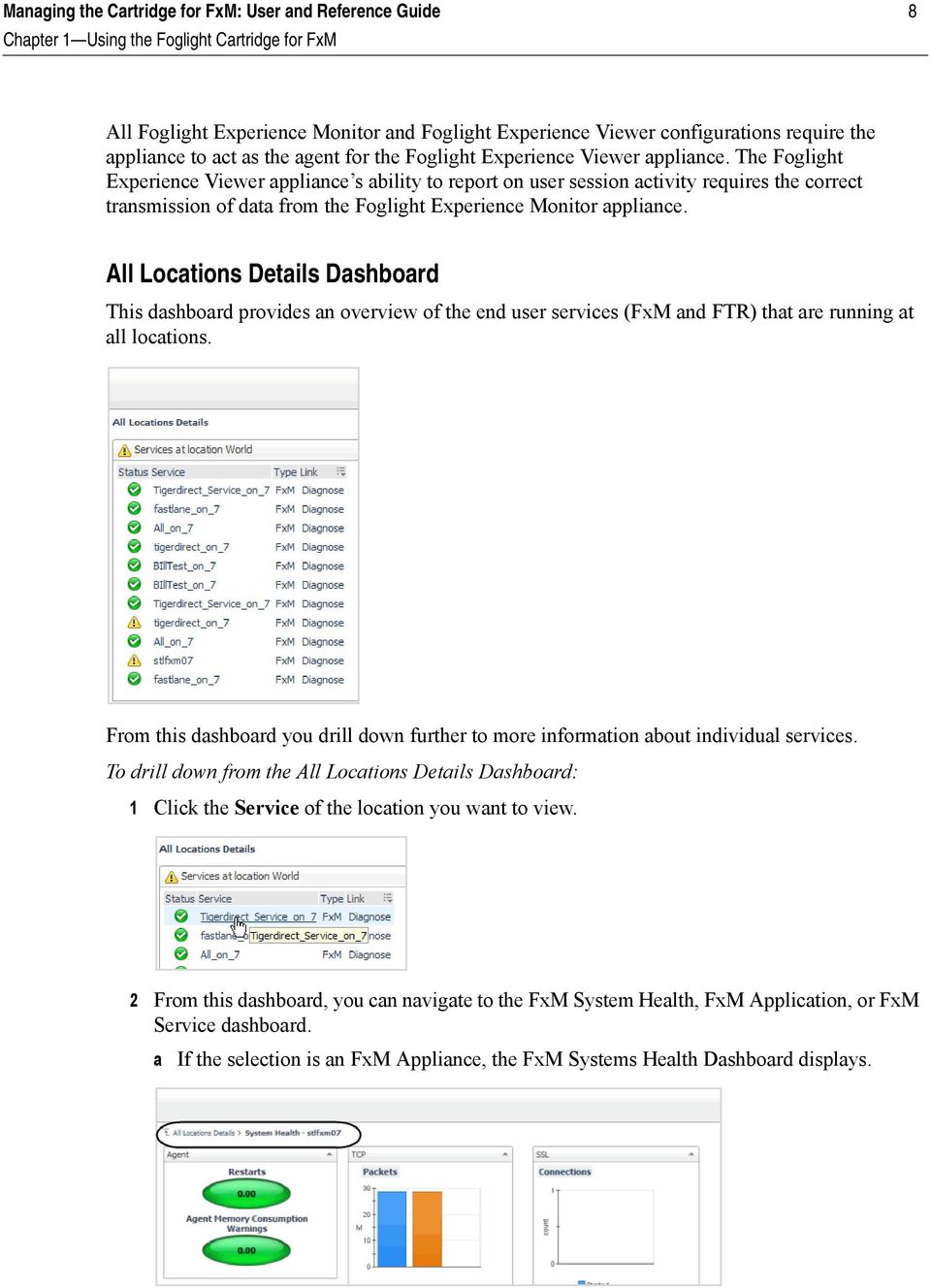
9 Managing the Cartridge for FxM: User and Reference Guide 9 Chapter 1 Using the Foglight Cartridge for FxM For more information, see Viewing the FxM System Health Dashboard on page 28. b If the selection is an FxM application, the FxM Application dashboard displays. c If the selection is a service, the FxM Service dashboard displays. 3 Click Diagnose for the service you want to view. The Foglight Experience Monitor login displays.
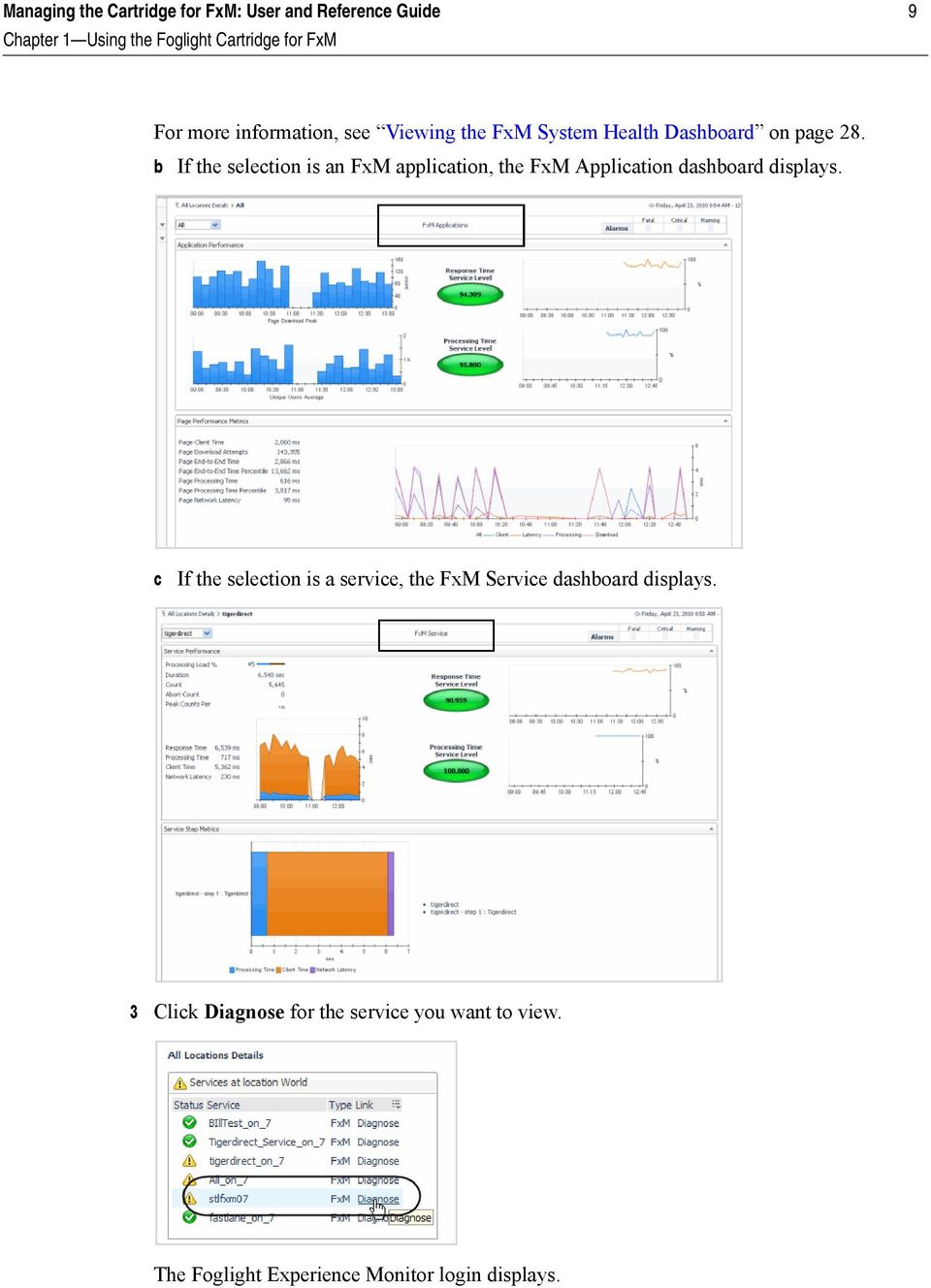
10 Managing the Cartridge for FxM: User and Reference Guide 10 Chapter 1 Using the Foglight Cartridge for FxM Note You only have to enter the login and password once unless you log out of Foglight. 4 Enter the login and password to view metrics and data on the selected location. The Foglight Experience Monitor opens to the appliance page responsible for generating the data. All Services Details Dashboard This dashboard provides an overview of the locations that are running end user services being monitored by Foglight from the Foglight Experience Monitor. From this dashboard, you can drill down further to the FxM Systems Health, FxM Service, or FxM Application dashboards. To drill down from the All Services Details Dashboard: 1 Click the Service Location of the location you want to view. a If the selection is an appliance, the FxM System Health dashboard displays.

11 Managing the Cartridge for FxM: User and Reference Guide 11 Chapter 1 Using the Foglight Cartridge for FxM For more information, see Viewing the FxM System Health Dashboard on page 28. b If the selection is an application, the FxM Applications dashboard displays. c If the selection is a service, the FxM Service dashboard displays. 2 Click Diagnose for the service you want to view.
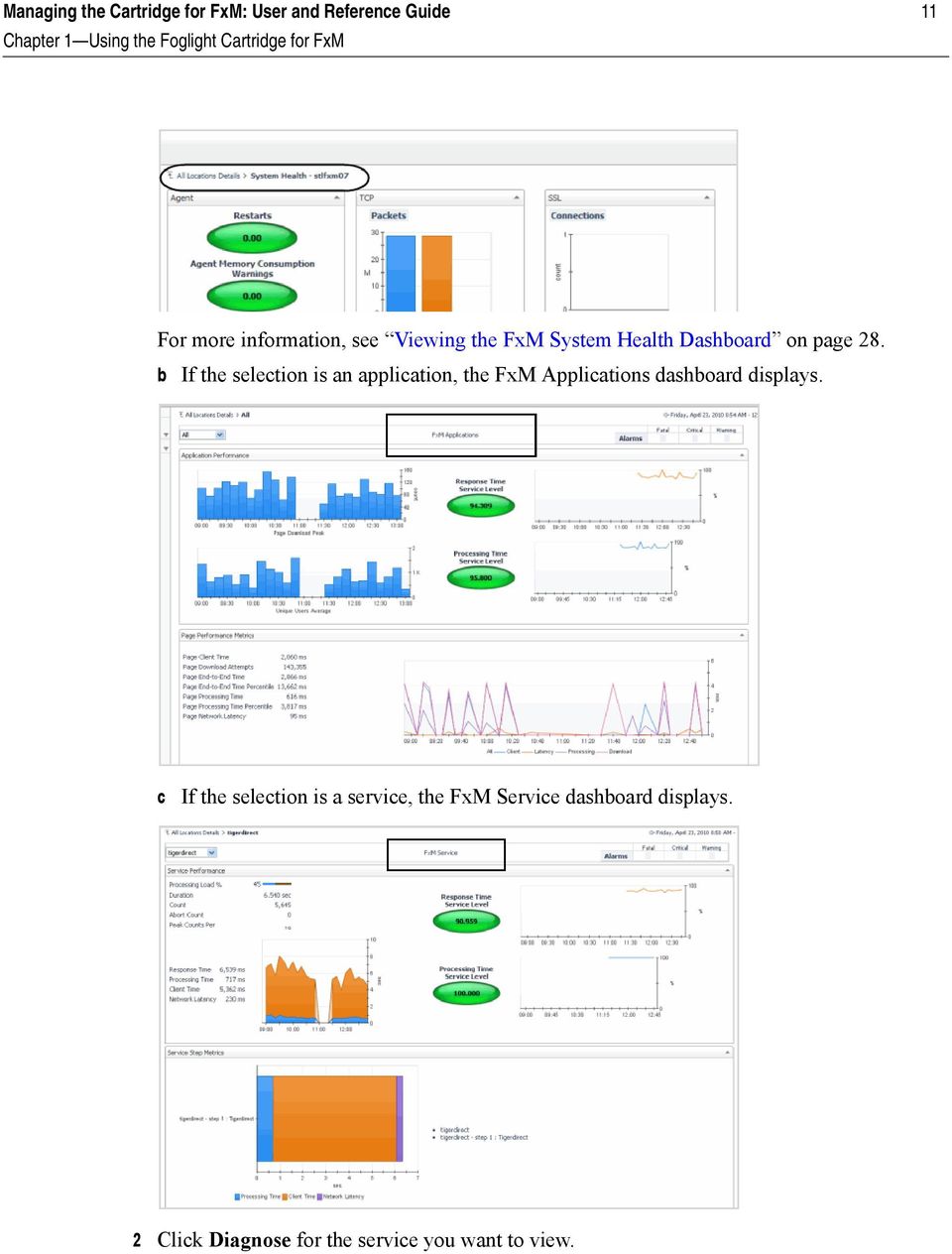
12 Managing the Cartridge for FxM: User and Reference Guide 12 Chapter 1 Using the Foglight Cartridge for FxM The Foglight Experience Monitor login displays. Note You only have to enter the login and password once unless you log out of Foglight. 3 Enter the login and password to view metrics and data on the selected location. The Foglight Experience Monitor opens to the appliance page responsible for generating the data. End User Explorer Dashboard This dashboard provides the following views: FxM Applications Dashboard on page 12 FxM Services Dashboard on page 16 FxM Applications Dashboard In the Foglight Experience View appliance, an application component is defined as a set of URLs that share the same prefix (for example, This definition allows users to identify and monitor Web-based applications, and collect performance and SLA-related metrics to view in a graphical format.

13 Managing the Cartridge for FxM: User and Reference Guide 13 Chapter 1 Using the Foglight Cartridge for FxM You view FxM application or service metrics by selecting the corresponding view under the End User Explorer section below Dashboards. Note FTR End User Sessions also display in the list. The FxM Applications dashboard provides the following views: Service Level Agreement Attainment View on page 13 Session Details View on page 15 Service Level Agreement Attainment View This view provides a graphical display of Service Level Agreement (SLA) and Operational Level Agreement (OLA) attainment from the perspective of the user session and page count, helping you to evaluate the performance of your application. Application values are generated by comparing application data against previously defined SLA thresholds. Any applications that do not meet the previously defined SLAs trigger alarms.

14 Managing the Cartridge for FxM: User and Reference Guide 14 Chapter 1 Using the Foglight Cartridge for FxM The following provides a description of the SLA and OLA metrics. Reference (in red) A B C D E F G H I Description End User represents one of the endpoints in any session or connection. Web Server receives data from the End User and Database/Application Service. Alerts display potential Web server bottlenecks. Application Service receives data from the Web Server. Alerts displays performance and availability of database and application servers. Database receives data from the Web Server. Alerts displays performance and availability of database and application servers. SLA Attainment: x% (x sec) displays the percentage of pages that satisfy the SLA as defined by the Page End-to-End Time threshold. The SLA is represented by the (x sec) value which was previously set on the FxM appliance. For more information, see Page End-to-End Time in the Foglight Experience Monitor Metric Reference Guide. Client Time (mean) displays a value (averaged) for the total time spent waiting on the client-side of the network during a page download. For more information, see Service Client Time in the Foglight Experience Monitor Metric Reference Guide. OLA Attainment: x% (x sec) displays the percentage of pages processed that satisfy the operational level agreement (OLA) as defined by the Page Processing Time threshold. The OLA is represented by the (x sec) value which was previously set on the FxM appliance. For more information, see Page Processing Time in the Foglight Experience Monitor Metric Reference Guide. Processing Time (mean) displays a value (averaged) representing the sum of the total processing time for all pages. For more information, see Page Processing Time in the Foglight Experience Monitor Metric Reference Guide. Page Count displays the total number of page download attempts, which includes both completed and partially fulfilled downloads.

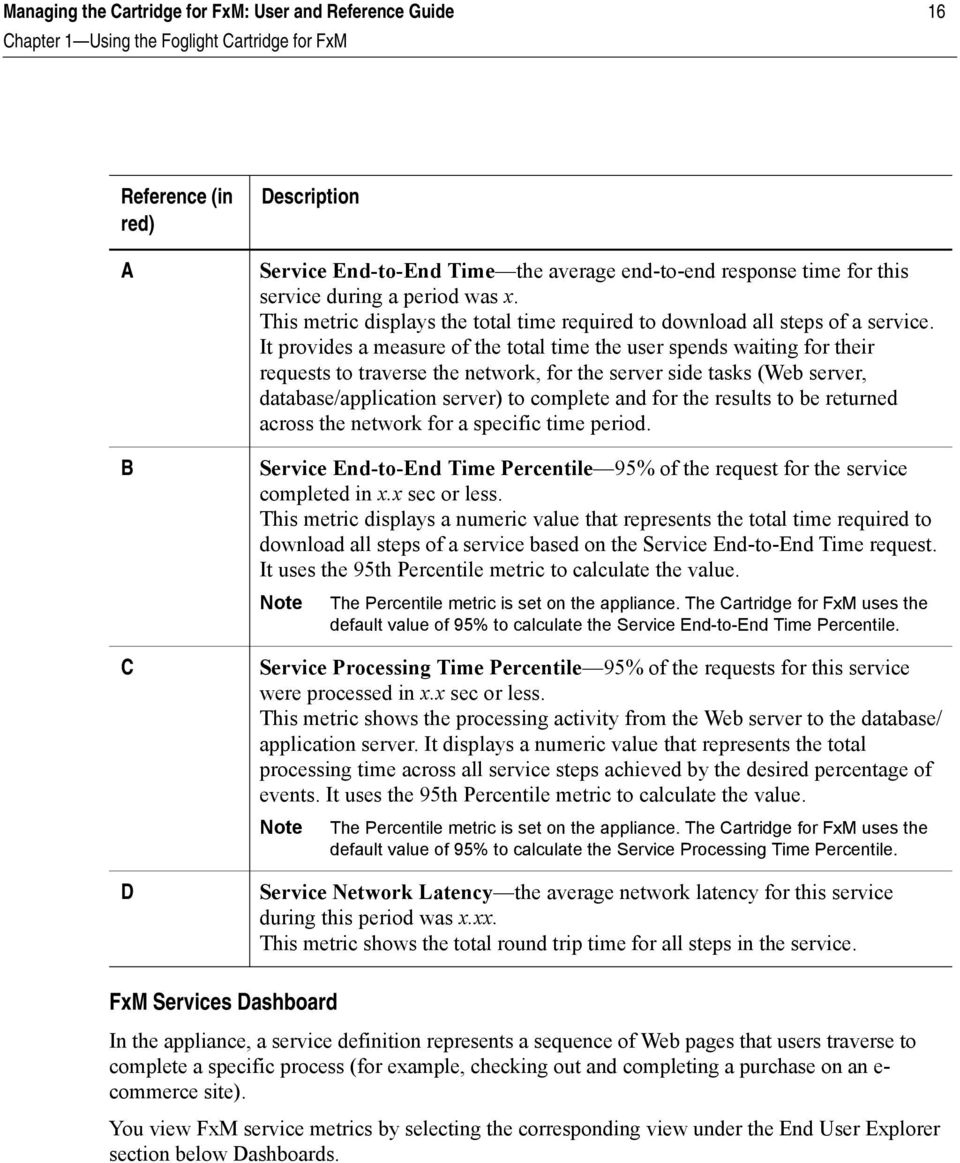
15 Managing the Cartridge for FxM: User and Reference Guide 15 Chapter 1 Using the Foglight Cartridge for FxM Reference (in red) J Description Session Count displays the number of active user sessions. Session Details View The Session Details section displays metrics which help you to evaluate the performance of your applications. Application values are generated by comparing application data against previously defined SLA thresholds. Any applications that do not meet the previously defined SLAs trigger alarms. Note All variables in the statements below are displayed as an x which acts as a value placeholder. The following provides a description of the metrics in the Sessions Details view. The red references are explained in the table following the graphic.

16 Managing the Cartridge for FxM: User and Reference Guide 16 Chapter 1 Using the Foglight Cartridge for FxM Reference (in red) A B C D Description Service End-to-End Time the average end-to-end response time for this service during a period was x. This metric displays the total time required to download all steps of a service. It provides a measure of the total time the user spends waiting for their requests to traverse the network, for the server side tasks (Web server, database/application server) to complete and for the results to be returned across the network for a specific time period. Service End-to-End Time Percentile 95% of the request for the service completed in x.x sec or less. This metric displays a numeric value that represents the total time required to download all steps of a service based on the Service End-to-End Time request. It uses the 95th Percentile metric to calculate the value. Note The Percentile metric is set on the appliance. The Cartridge for FxM uses the default value of 95% to calculate the Service End-to-End Time Percentile. Service Processing Time Percentile 95% of the requests for this service were processed in x.x sec or less. This metric shows the processing activity from the Web server to the database/ application server. It displays a numeric value that represents the total processing time across all service steps achieved by the desired percentage of events. It uses the 95th Percentile metric to calculate the value. Note The Percentile metric is set on the appliance. The Cartridge for FxM uses the default value of 95% to calculate the Service Processing Time Percentile. Service Network Latency the average network latency for this service during this period was x.xx. This metric shows the total round trip time for all steps in the service. FxM Services Dashboard In the appliance, a service definition represents a sequence of Web pages that users traverse to complete a specific process (for example, checking out and completing a purchase on an e- commerce site). You view FxM service metrics by selecting the corresponding view under the End User Explorer section below Dashboards.
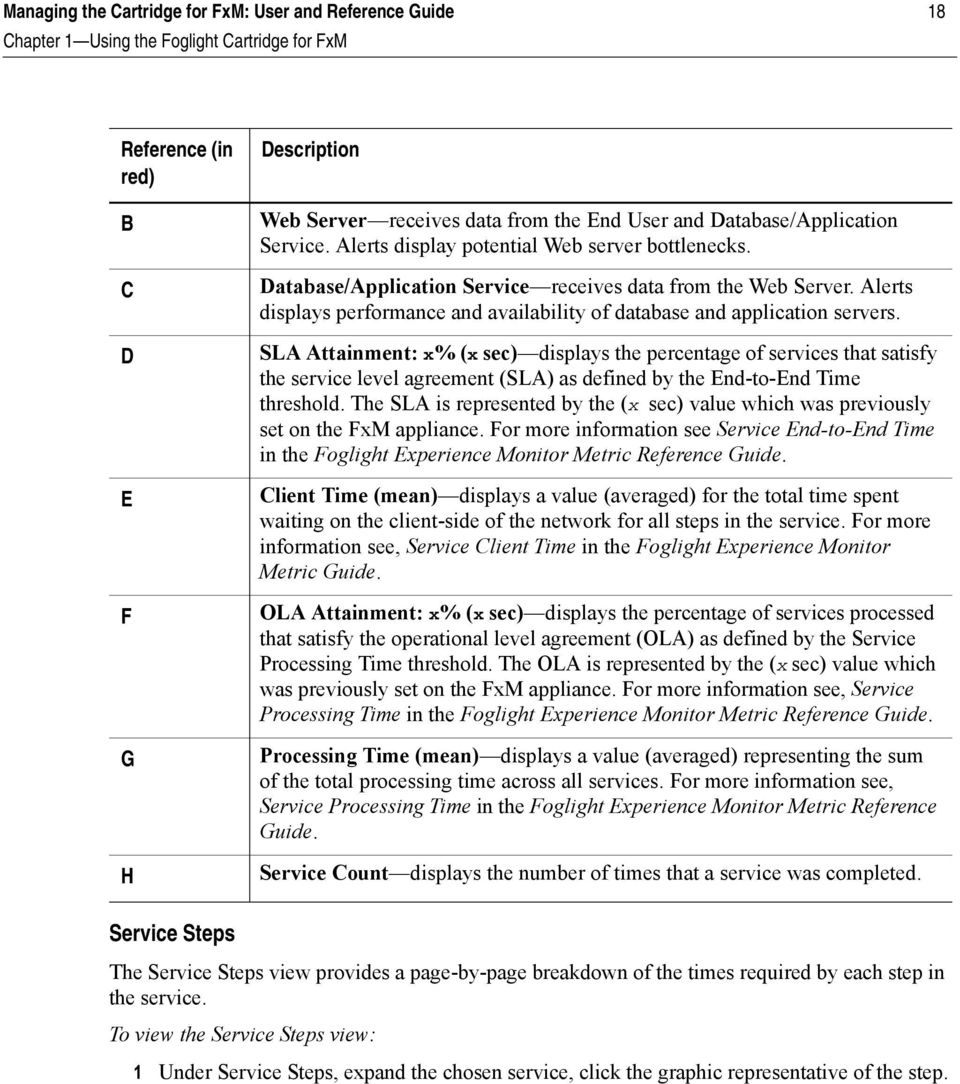
17 Managing the Cartridge for FxM: User and Reference Guide 17 Chapter 1 Using the Foglight Cartridge for FxM The FxM Applications dashboard provides the following views: Service and Operational Level Agreement on page 17 Service Steps on page 18 Session Details on page 19 Service and Operational Level Agreement This dashboard provides a graphical view of the service and operational level metrics. The red references are explained in the table following the graphic. The following provides a description of the metrics in the Sessions Details view. Reference (in red) A Description End User represents one of the endpoints in any session or connection.

18 Managing the Cartridge for FxM: User and Reference Guide 18 Chapter 1 Using the Foglight Cartridge for FxM Reference (in red) B C D E F G H Description Web Server receives data from the End User and Database/Application Service. Alerts display potential Web server bottlenecks. Database/Application Service receives data from the Web Server. Alerts displays performance and availability of database and application servers. SLA Attainment: x% (x sec) displays the percentage of services that satisfy the service level agreement (SLA) as defined by the End-to-End Time threshold. The SLA is represented by the (x sec) value which was previously set on the FxM appliance. For more information see Service End-to-End Time in the Foglight Experience Monitor Metric Reference Guide. Client Time (mean) displays a value (averaged) for the total time spent waiting on the client-side of the network for all steps in the service. For more information see, Service Client Time in the Foglight Experience Monitor Metric Guide. OLA Attainment: x% (x sec) displays the percentage of services processed that satisfy the operational level agreement (OLA) as defined by the Service Processing Time threshold. The OLA is represented by the (x sec) value which was previously set on the FxM appliance. For more information see, Service Processing Time in the Foglight Experience Monitor Metric Reference Guide. Processing Time (mean) displays a value (averaged) representing the sum of the total processing time across all services. For more information see, Service Processing Time in the Foglight Experience Monitor Metric Reference Guide. Service Count displays the number of times that a service was completed. Service Steps The Service Steps view provides a page-by-page breakdown of the times required by each step in the service. To view the Service Steps view: 1 Under Service Steps, expand the chosen service, click the graphic representative of the step.
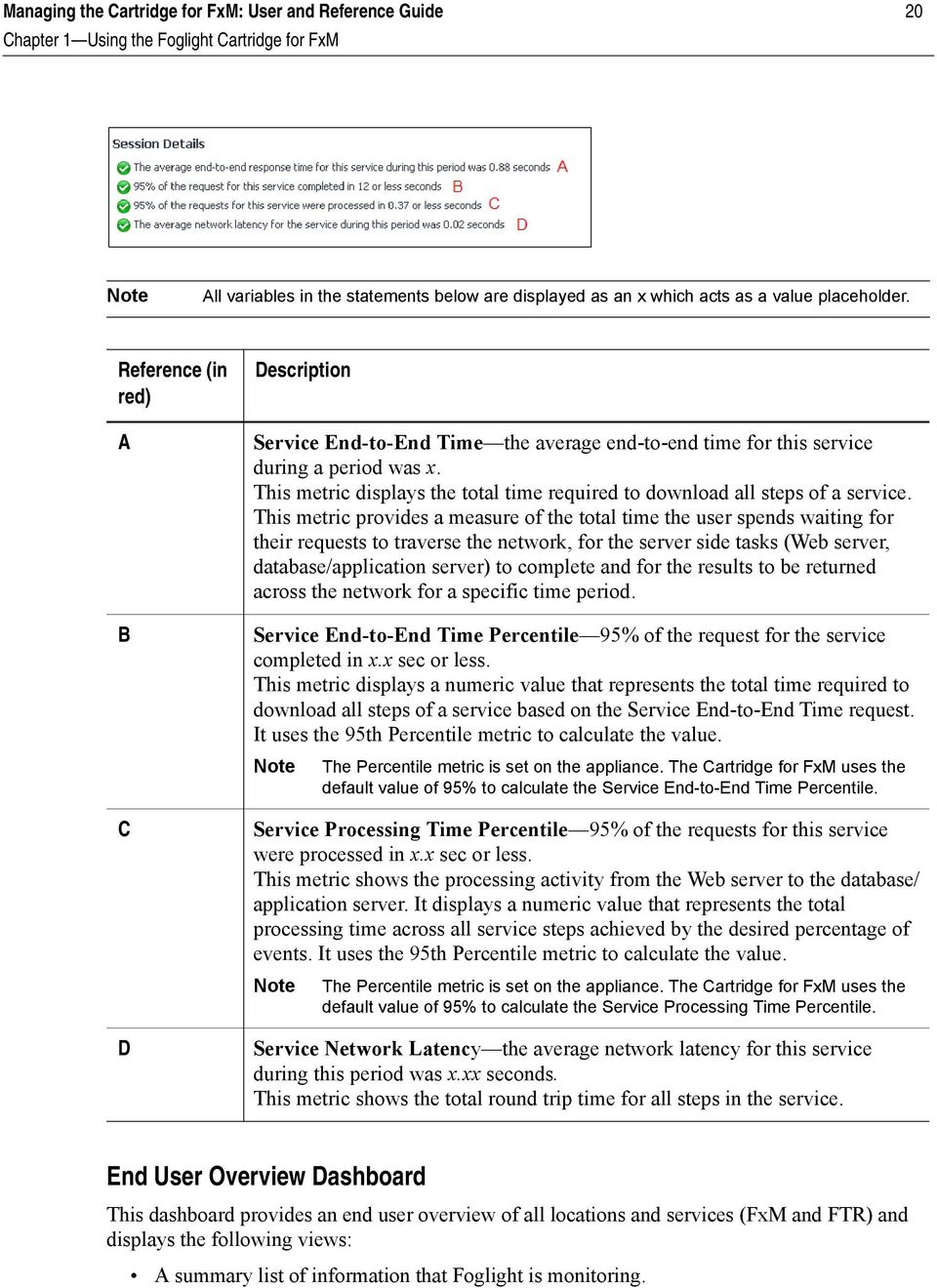
19 Managing the Cartridge for FxM: User and Reference Guide 19 Chapter 1 Using the Foglight Cartridge for FxM The Service Steps view displays. Session Details The Session Details section displays metrics which help you to evaluate the performance of your services. Service values are generated by comparing service data against previously defined SLA threshold. Any services that do not meet the previously defined SLAs trigger alarms. You can view these alarms in the section under the Service Steps section. The red references are explained in the table following the graphic.

20 Managing the Cartridge for FxM: User and Reference Guide 20 Chapter 1 Using the Foglight Cartridge for FxM Note All variables in the statements below are displayed as an x which acts as a value placeholder. Reference (in red) A B C D Description Service End-to-End Time the average end-to-end time for this service during a period was x. This metric displays the total time required to download all steps of a service. This metric provides a measure of the total time the user spends waiting for their requests to traverse the network, for the server side tasks (Web server, database/application server) to complete and for the results to be returned across the network for a specific time period. Service End-to-End Time Percentile 95% of the request for the service completed in x.x sec or less. This metric displays a numeric value that represents the total time required to download all steps of a service based on the Service End-to-End Time request. It uses the 95th Percentile metric to calculate the value. Note The Percentile metric is set on the appliance. The Cartridge for FxM uses the default value of 95% to calculate the Service End-to-End Time Percentile. Service Processing Time Percentile 95% of the requests for this service were processed in x.x sec or less. This metric shows the processing activity from the Web server to the database/ application server. It displays a numeric value that represents the total processing time across all service steps achieved by the desired percentage of events. It uses the 95th Percentile metric to calculate the value. Note The Percentile metric is set on the appliance. The Cartridge for FxM uses the default value of 95% to calculate the Service Processing Time Percentile. Service Network Latency the average network latency for this service during this period was x.xx seconds. This metric shows the total round trip time for all steps in the service. End User Overview Dashboard This dashboard provides an end user overview of all locations and services (FxM and FTR) and displays the following views: A summary list of information that Foglight is monitoring.
21 Managing the Cartridge for FxM: User and Reference Guide 21 Chapter 1 Using the Foglight Cartridge for FxM A list containing all end user oriented services that Foglight is currently monitoring. All monitored locations that host the end user services. Alarms for all locations. The this dashboard allows you to drill down from the following views: Locations on page 21 Services on page 24 Locations From the Locations view, select a location, then drill down and view service location details and the Foglight Experience Monitor appliance. To investigate a specific location: 1 Click the name of a location you want to view metrics on under Locations. The Services at location <name> displays all services and alarms at the selected location. 2 By default the Status, Service, Type, and Diagnose columns display in the views. You can change the columns that display by clicking the button which displays the Show/Hide columns dialog.
22 Managing the Cartridge for FxM: User and Reference Guide 22 Chapter 1 Using the Foglight Cartridge for FxM 3 Click a Service in the Services at location <name> view. a If the selection is an appliance, the FxM System Health dashboard displays. For more information, see Viewing the FxM System Health Dashboard on page 28. b If the selection is an application, the FxM Applications dashboard displays. c If the selection is a service, the FxM Service dashboard displays.
23 Managing the Cartridge for FxM: User and Reference Guide 23 Chapter 1 Using the Foglight Cartridge for FxM For more information, see End User Overview Dashboard on page To view the Foglight Experience Monitor appliance detail page that generated the data for the service, click Diagnose. Note For the Diagnose button to launch the Foglight Experience Monitor Appliance page that contains the data that you want to view, you must first configure the appliance. For more information see the Configuring the Appliance for Foglight Integration section in the Foglight Experience Monitor User Guide. The Foglight Experience Monitor login page displays. 5 Enter the login and password.
24 Managing the Cartridge for FxM: User and Reference Guide 24 Chapter 1 Using the Foglight Cartridge for FxM 6 Cick Submit. The Foglight Experience Monitor opens, displaying the service metrics. Services You can view service component information by clicking the required service. To investigate a specific location: 1 Click a service under Services Name. The Location utilizing service <name> opens.
25 Managing the Cartridge for FxM: User and Reference Guide 25 Chapter 1 Using the Foglight Cartridge for FxM 2 Click a Service Location name. The System Health Dashboard displays. For more information, see Viewing the FxM System Health Dashboard on page From the End User Overview dashboard, the Alarms view displays alarm severity, times, source, and the message.
26 Managing the Cartridge for FxM: User and Reference Guide 26 Chapter 1 Using the Foglight Cartridge for FxM 4 Hovering over an alarm produces a dwell with details about the alarm or change that occurred nearest to that time. 5 Click an alarm you want to investigate. An Alarm Details view displays. Monitoring FxM Data on the Foglight Dashboards These dashboards are a visual representation of the status of the Foglight Experience Monitor appliance. They allows you to look for consistent application performance and drill down for details on alarms and system health. To view Cartridge for FxM dashboards: 1 Log in to the Foglight browser interface. 2 Ensure that the navigation panel is open. To open the navigation panel, click the right-facing arrow on the left. 3 On the navigation panel, under Dashboards, choose End User > FxM.
27 Managing the Cartridge for FxM: User and Reference Guide 27 Chapter 1 Using the Foglight Cartridge for FxM The Cartridge for FxM provides the following top level dashboards: FxM Message Log, contains information about end-user alarms that have been generated by the appliance. For more information, see Viewing the FxM Messages Log Dashboard on page 27. Under FxV System Health category: FxM System Health, monitors the appliance s health, reporting system-related metrics to administrators in the appliance web console. For more information, see Viewing the FxM System Health Dashboard on page 28. Viewing the FxM Messages Log Dashboard The Cartridge for FxM logs alarms generated by the Foglight Experience Monitor appliance. FxM alarms are escalated and displayed in the main Foglight Alarms dashboard. You can also use the FxM Messages Log dashboard to view end user alarms generated by the Foglight Experience Monitor appliance. From this dashboard you can log into the Foglight Experience Monitor appliance. To log into the Foglight Experience Monitor appliance: 1 Click on the required message. The Foglight Experience Viewer Monitor welcome page displays. 2 Enter the login and password. Note You only have to enter the login and password once unless you log out of Foglight. 3 Click Submit. The Foglight Experience Viewer opens and displays with the selected message metrics.
28 Managing the Cartridge for FxM: User and Reference Guide 28 Chapter 1 Using the Foglight Cartridge for FxM Viewing the FxM System Health Dashboard The FxM System Health dashboard views that indicate if an appliance is functioning within reasonable limits. In addition to monitoring end user activity, the appliance also monitors itself, reporting system-related metrics to administrators in the appliance Web console. Foglight integration allows the appliance system health to be reported to Foglight. This centralized reporting is particularly helpful to organizations that use multiple appliances, whether they are located in the same data center, or are monitoring traffic in different geographical
29 Managing the Cartridge for FxM: User and Reference Guide 29 Chapter 1 Using the Foglight Cartridge for FxM regions. Through centralization, Foglight allows administrators to easily see if any single appliance in a cluster is experiencing problems, or if any appliance in general is overloaded. What the FxM System Health Dashboard Tells You The following is a list of metrics you can monitoring by viewing the FxM Systems Health Dashboard: Appliance Performance on page 29 Agent Performance on page 29 Database Performance on page 30 Error Detection on page 30 Error Rates on page 30 Appliance Performance Views on the FxM System Health dashboard indicate whether an appliance is overloaded and forced to monitor too much end user traffic. When views that report on appliance memory and CPU usage consistently display usage of greater than 80%, it means too much traffic is being monitored by too few appliances. Agent Performance The Foglight Experience Monitor agent is the core component, and is also represented by views in the dashboard. Events such as agent memory warnings and agent restarts hint at an overloaded appliance. You can also use the agent memory warning to verify whether general appliance memory warnings are based on the agent or on non-agent resources.
30 Managing the Cartridge for FxM: User and Reference Guide 30 Chapter 1 Using the Foglight Cartridge for FxM Database Performance The appliance database is regularly written to as monitored data is processed and stored by the system. Database records are called whenever an administrator or appliance user generates reports or views raw data using the Web console. The database-related views provided in the FxM System Health dashboard help you determine whether the database load is within acceptable limits. It is not uncommon for database load times to experience spikes. Consistently high load times point to a greater problem. Excessively heavy database activity can happen for a number of reasons, and the problem may be found either with the allocated appliance hardware, or if the current appliance configuration is not fully optimized. If the appliance has not been configured to handle enough URLs or remove unnecessary URLs, database-writing activity could be higher than desired. Outside of the appliance configurations, if there is too much traffic monitored by the appliance, the sheer amount of data can stress the database. Error Detection The FxM System Health dashboard displays various error rates the appliance is detecting during its monitoring duties with secure, non-secure, and Web service traffic. If reported error rates are not at or near zero, you should investigate and resolve the issue: TCP errors, such as dropped packets and missing segments in client-server traffic, indicate the appliance is overloaded. SSL and SOAP errors indicate configuration issues outside of the appliance configuration. Error Rates This view summarizes all transmission errors over a period of time with a default of two hours. Rates are reported for: dropped packets missing segments in client-to-server or server-to-client traffic SSL connection errors SOAP errors (for example, unrecognizable SOAP messages)
31 Managing the Cartridge for FxM: User and Reference Guide 31 Chapter 1 Using the Foglight Cartridge for FxM All of these reported rates should be zero, or at a low percentage. High rates occur for different reasons, depending on the type of error. For example, dropped packets or missing segments are signs that the appliance may be overloaded. Meanwhile, SSL errors can happen for a variety of reasons, including incorrectly configured SSL keys, security-related communication conflicts, or errors from dropped packets or missing segments. For more information, see FxM System Health Dashboard on page 54.
32 2 References Views Foglight displays monitoring data in views that group, format, and display data. The main types are described below. Dashboards are top-level views that do not receive data from other views. Dashboards usually contain a number of lower-level views. The dashboards supplied with Foglight, as well as those created by users, are available in the navigation panel. Lower-level views in Foglight can be added to dashboards or can be accessed by drilling down from a dashboard. They receive and display data directly from the Foglight Management Server or from other views. Some views filter or select data that appears in other views in the same dashboard. Some are tree views with expandable nodes for selecting servers, applications, or data. End User Explorer Dashboard The End User Explorer displays information about FxM end user services and applications. FxM Service and FxM Application pages are similar with the exception that the Application page does not contain service steps. FxM Applications The FxM Applications view provides metrics from the perspective of an application component. An application component is defined as a subset of pages that have URLs matching one or more regular expression patterns in the appliance.
33 Managing the Cartridge for FxM: User and Reference Guide 33 The following views and metrics are provided for FxM Applications: Session Count on page 33 Client Time on page 34 Page End-to-End Response Time on page 35 Page Processing Time Percentile on page 37 Page Network Latency on page 38 Session Count Displays total count of the selected session.
34 Managing the Cartridge for FxM: User and Reference Guide 34 View Description and Calculation Description Calculation A user session is considered active whenever the user opens a new TCP connection within the session. An existing user session is considered active if the user sends or receives any messages over one of its existing TCP connections during the time interval. This metric will not reflect inactive sessions that generate no traffic during a five-minute time interval. For example, assume a session is active at 8:02 and then again at 8:12. Only the 8:00-8:05 and 8:10-8:15 intervals will have that session included in the calculation for this metric. The 8:05-8:10 interval will not include the session since it was inactive during that time. For real-time, hourly, and daily time intervals, the metric is incremented the first time a session ID appears in a time interval. To ensure that the count is only incremented once for the interval, a table of all session IDs discovered in the monitored traffic during the interval is maintained. For weekly and monthly time intervals, the session count is calculated by adding together the session counts from the underlying daily intervals for that week or month. Reflects total page count for the session. View Description and Calculation Description Calculation This metric shows the number of page downloads requested by a user. A page download consists of the main component (first component requested), plus any components embedded in the first component. Pages are uniquely identified by the URL for first component in the page download. This count includes both successfully completed downloads as well as partial downloads. A partial download can occur when the user clicks on the browser s Stop button before the page has completed its download. The first component in the page must be downloaded successfully, at least once by at least one user, before the count is incremented. This prevents a hacker from generating an unlimited number of page entries in the database by creating requests for nonexistent pages. This metric is incremented with each page download after the main component for the page has been downloaded successfully by at least one user. Client Time Displays the amount of time spent on the client side of the network during a page download.
35 Managing the Cartridge for FxM: User and Reference Guide 35 View Description and Calculation Description Calculations This metric includes, network delays that occur when transmitting the response to the client, the time the client spends processing the responses it receives, and the network delay for the transmission of the final acknowledgement from the client. When responding to the request for a Web page, a server transmits packets to the client that are processed by the client, and then acknowledged. The response generated for a request is transmitted back to the client in one or more blocks. Each block of data sent to the client must be acknowledged by the client before the server sends the next block. Often, the client must do some processing of the data it received before it can send an acknowledgement back to the server. Once all of the blocks sent by the server have been acknowledged by the client, the page download is complete. Page Client Time = Page Response Departure Time Page Request Arrival Time Page. Page Request Arrival Time is considered to be the time that the first packet of the request for the page arrives at the server. Page Response Departure Time is considered to be the time that the last packet of the response for a page leaves the server. Page Processing Time is the amount of time the server spends processing the request and building the response. Page End-to-End Response Time Displays the total time it took to download a page.
36 Managing the Cartridge for FxM: User and Reference Guide 36 View Description and Calculation Description Calculation A page download consists of the main component (first component requested), plus any components embedded in the first component. When downloading a page, one or more components will be requested for download. These components may be downloaded in series across a single TCP connection or in parallel across multiple TCP connections. The page download is not considered complete until all components in the page have been successfully downloaded. This metric also includes leading and trailing network fight time providing a true measure of the end user's wait time from the moment a hyperlink is clicked, requests are sent across the network to the appropriate web servers, the servers process the requests, and all of the content is sent back across the network to be displayed in the user's web browser. Page End-To-End Time Response Time = Page Download Stop Time - Page Download Start Time + (Network Latency * 2). Page End-to-End Time Percentile Displays percentile metrics of the service being delivered to the customer.
37 Managing the Cartridge for FxM: User and Reference Guide 37 View Description and Calculation Description Calculation Percentile metrics provide a means to quantify the quality of service customers are receiving based on the end-to-end time that a fixed percentage (usually 95%) of users receive. These metrics are commonly referred to as 95th Percentile metrics. The exact percentage the system uses is configurable by the user. This metric provides a numeric value that represents the upper level of Page End-to-End Times achieved by the desired percentage of events. To calculate this metric, the system uses a statistical method involving standard deviation rather than tracking each individual event in memory. The percentile metric is calculated using this formula: Percentile = mean + (standard deviation * z) where z = standard normal variable corresponding to the desired percentile (usually 95th). Page Processing Time Percentile Percentile metrics provide a means to quantify the quality of service customers are receiving based on the response time that a fixed percentage (usually 95 percent) of users receive. These metrics are commonly referred to as 95th Percentile metrics. The exact percentage the system uses is configurable by the user. This method has the advantage over relying on the arithmetic mean in that it excludes outliers which can distort the mean.
38 Managing the Cartridge for FxM: User and Reference Guide 38 View Description and Calculation Description Calculations These metrics are referred to as 95th Percentile metrics. The exact percentage the system uses is configurable by the user. This metric provides a numeric value that represents the upper level of Page Processing Times achieved by the desired percentage. To calculate this metric, the system uses a statistical method involving standard deviation rather than tracking each individual event in memory. The percentile metric is calculated using this formula: Percentile = mean + (standard deviation * z) where z = standard normal variable corresponding to the desired percentile (usually 95th). Page Network Latency Displays a round-trip time from the perspective of a web page.
39 Managing the Cartridge for FxM: User and Reference Guide 39 View Description and Calculation Description Calculations This metric is derived from algorithms that estimate the amount of time it takes to transmit information from the server to the client (or vice versa). These algorithms analyze the timing of low-level TCP commands and acknowledgments to determine an of the metric value. Network latency is dependent on the quality of the network connections between the user and the web servers. Every user session will have a distinct network latency estimate. Whenever a page download is completed for a user, the estimate for that user session is rolled-up into the metric calculation for each page. sum of round-trip sample times Network latency = number of open connections FxM Services The FxM Services section provides metrics from the perspective of a service. A service is defined as a sequence of steps the end user must execute in order to complete a task.
40 Managing the Cartridge for FxM: User and Reference Guide 40 The following metrics are available for FxM Services: Service Count on page 40 Service Client Time on page 40 Page End-to-End Response Time on page 41 Service End-to-End Time Percentile on page 42 Service Processing Time Percentile on page 43 Service Network Latency on page 44 Service Count Displays service completion rates. View Description and Calculation Description Calculations This metric shows the number of times a given service has been completed by users of the monitored application. This metric is incremented when users successfully complete every page specified in the service definition. Service Client Time Displays the total wait time for the complete cycle of the service.
41 Managing the Cartridge for FxM: User and Reference Guide 41 View Description and Calculation Description Calculations Displays, on average, the total time spent waiting on the client-side of the network for all steps in the service. The sum of the client times for each step of the service. Page End-to-End Response Time Displays the total time it took to download a page.
42 Managing the Cartridge for FxM: User and Reference Guide 42 View Description and Calculation Description Calculation A page download consists of the main component (first component requested) plus any components embedded in the first component. When downloading a page, one or more components will be requested for download. These components may be downloaded in series across a single TCP connection or in parallel across multiple TCP connections. The page download is not considered complete until all components in the page have been successfully downloaded. This metric includes leading and trailing network time providing a true measure of the end user's wait time from the moment a hyperlink is clicked, requests are sent across the network to the appropriate web servers, the servers process the requests, and all of the content is sent back across the network to be displayed in the user's web browser. Note If the user aborts the page download before all components are downloaded, then this is considered a stopped page and is not included in this metric. This time is added into the Page Stop Time metric. Page End-To-End Time = Page Download Stop Time - Page Download Start Time + (Network Latency * 2). Service End-to-End Time Percentile Displays a metric to quantify the quality of service customers are receiving.
43 Managing the Cartridge for FxM: User and Reference Guide 43 View Description and Calculation Description Calculation Percentile metrics provide a means to quantify the quality of service customers are receiving based on the end-to-end time that a fixed percentage (usually 95%) of users receive. This metric provides a numeric value that represents the upper level of Service End-to-End Times achieved by the desired percentage of events. To calculate this metric, the system uses a statistical method involving standard deviation rather than tracking each individual event in the memory. The percentile metric is calculated using the following formula: Percentile = mean + (standard deviation * z) where z = standard normal variable corresponding to the desired percentile (usually 95th). Service Processing Time Percentile Displays the overall quality of service the users are receiving.
44 Managing the Cartridge for FxM: User and Reference Guide 44 View Description and Calculation Description Calculation Percentile metrics provide a means to quantify the quality of service customers are receiving based on the end-to-end time that a fixed percentage (usually 95%) of users receive. The exact percentage the system uses is configurable by the user. This method has the advantage over relying on the arithmetic mean in that it excludes outliers which can distort the mean. This metric provides a numeric value that represents the upper level of Service Processing Time achieved by the desired percentage of events. To calculate this metric, the system uses a statistical method involving standard deviation rather than by tracking each individual event in memory (that approach would be prohibitive in terms of processing requirements and memory consumption). The percentile metric is calculated using this formula: The percentile metric is calculated using the following formula: Percentile = mean + (standard deviation * z) where z = standard normal variable corresponding to the desired percentile (usually 95th). Service Network Latency Displays download metrics of all pages in a service.
45 Managing the Cartridge for FxM: User and Reference Guide 45 View Description and Calculation Description Calculations This metric is the sum of the round trip times for each step of the service. sum of round-trip sample times Network latency = number of open connections End User Overview Dashboard Views in this section: Service Performance Container View on page 45 Service Performance Container View The Service Performance view provides a compact summary of the selected service. This summary includes service level performance, times spent at various points along the network, and tallies on the service s usage. Use this view to gain insight into the end user experience with the service, and whether it is meeting SLAs.
46 Managing the Cartridge for FxM: User and Reference Guide 46 Description of Embedded Views This view is made up of the following embedded views: Service Performance on page 46 Service Timing on page 46 Service End-to-End and Processing Time Service Levels on page 47 Service Performance This view displays performance statistics about and usage tallies for the service. Description of View Data displayed Processing Load Percentage the processing load by the viewed service as a percentage of all services. Duration the time required for the service to complete. This is the sum of the time required for all the service pages to be downloaded and processed by the end user. Count the number of times the service has been completed by end users. Abort Count the number of times the service has not been completed by end users. Services can be aborted actively (i.e., the end users began a new service) or by a timeout. Peak Counts Per Second an estimate of the peak number of transactions per second that occur for the service. Service Timing This view displays timing data for the service over a given timeframe.
47 Managing the Cartridge for FxM: User and Reference Guide 47 Description of View Data displayed Response Time the total time required for all steps that make up the service. The end-to-end time for each step is the time required for the server to process the client-side request and begin transmitting a response. Processing Time the total processing time of all steps that make up the service. The processing time for each step is the time required for the server to assemble its page elements, which often involves the opening of more connections to other servers. Client Time the average time spent waiting on the client end for all steps in the service. This includes the time the end user spends reading and filling out step pages in the service. Network Latency the sum of the round-trip times for every step in the service. For each step, the round-trip time is the time required to transmit information from the client to the server and back to the client. Service End-to-End and Processing Time Service Levels This view indicates whether the service is meeting defined service level agreements. The service level definitions used in Foglight are based on those used with the FxM appliance, and can be defined in the appliance web console.
48 Managing the Cartridge for FxM: User and Reference Guide 48 Description of View Data displayed Response Time Service Level the cumulative percentage and historical view of the service s ability to meet the defined end-to-end time service level. The end-to-end time for the service is the total time required for all steps, for the server to process client-side requests and begin transmitting a response. Processing Time Service Level the cumulative percentage and historical view of the service s ability to meet the defined processing time service level. The processing time for the service is the total time required for all steps, for the server to assemble the page elements that comprise each step. Service Step Metrics Container View This view provides a page-by-page breakdown of the times required by each step in the service. Use this view to locate specific steps that are incurring heavier wait times by end users, and to determine whether there are issues with page design, the server, or the network. This view is made up of the following embedded views: Service Step Mean Time Distribution on page 48 Service Steps on page 49 Service Step Mean Time Distribution This view displays individual service step times from various perspectives along the service delivery chain and in relation to all other steps in the service.
49 Managing the Cartridge for FxM: User and Reference Guide 49 Description of the View Data displayed Client Time the amount of time spent on the client-side of the network, or the time spent after the server has completed its transmission for that phase of client-server activity. This can include network delays in addition to actual client processing time. Processing Time the time required for the server to assemble the step s page elements, which often involves the opening of more connections to other servers. Network Latency the sum of the round-trip times for every step in the service. Service Steps This view provides a list of all steps in the service. Data displayed The service step is considered a resource in the appliance, for which there are many recorded metrics. The service steps resource names are listed as parts of the service. Service Step Download History Container View This view provides a page-by-page breakdown of the times and tallies incurred by each step (i.e., page) in the service, as well as a historical view of end to end times. Use this view to analyze the individual steps alone and in relation to each other. This provides information in a wider context compared to other views in the End User Overview dashboard.
50 Managing the Cartridge for FxM: User and Reference Guide 50 Description of Embedded Views This view is made up of the following embedded views: Service Step End-to-End Time History Graph on page 50 Service Step End to End History Tabular View on page 50 Service Step End-to-End Time History Graph This view shows the download times of each step in the service within a given time period. Description of View Data displayed End to End Time the time required to download a complete page (for example all page elements that make up the page). Download Time the time range during which recorded page downloads occurred. Service Step End to End History Tabular View This view presents service step timing metrics in a sortable tabular view.
51 Managing the Cartridge for FxM: User and Reference Guide 51 Description of View Data displayed Download Attempts the number of page requests by the end user. This includes both successful and partial page downloads, the latter caused by the end user executing the stop command in their web browser. Download Time the time required to download a complete page (for example, all page elements that make up the page). Client Time the amount of time spent on the client-side of the network, or the time spent after the server has completed its transmission for that phase of client-server activity. This can include network delays in addition to actual client processing time. Processing Time the time required for the server to assemble the step s page elements, which often involves the opening of more connections to other servers. Network Latency Time the time required to transmit information from the client to the server and back to the client. Application Performance Container View The Application Performance view provides a compact summary of the selected application component. This summary includes service level performance and usage statistics. Use this view to gain insight into the end user experience with the application component and whether it is meeting SLAs. Description of Embedded Views This view is made up of the following embedded views: Application Components Details on page 51 Application Component Response and Processing Time Service Levels on page 52 Application Components Details This view displays page download statistics and usage tallies for the service.
52 Managing the Cartridge for FxM: User and Reference Guide 52 Description of the View Data displayed Unique Users Average the total amount of time end users spend in an application. This is tracked from the moment the end user selects a page within the application component for the first time and terminated when the user either selects a page outside of the application component or is inactive for five minutes. Processing Load Percentage the processing load by the viewed application component as a percentage of all applications. Page Download Peak an estimate of the peak number of page downloads per second for the given application component. Count the number of unique clients actively using the application component, measured by a unique IP address or a user session identifier configured in the appliance. Application Component Response and Processing Time Service Levels This view indicates whether the application component is meeting defined service level agreements. The service level definitions used in Foglight are based on those used with the appliance, and can be defined in the appliance web console.
53 Managing the Cartridge for FxM: User and Reference Guide 53 Description of View Data displayed Response Time Service Level the cumulative percentage and historical view of the application component s ability to meet the defined end-to-end time service level. The end-to-end time is the total time required for the server to process client-side requests and begin transmitting a response. Processing Time Service Level the cumulative percentage and historical view of the application component s ability to meet the defined processing time service level. The processing time is the total time required for the server to assemble the page elements that comprise the pages in the application component. Page Performance Metrics Container View This view displays information indicating client, server, and network times for application pages. Use this view to determine whether server performance issues are incurring heavier wait times by end users. Description of Embedded Views This view is made up of the following embedded views: Page Performance Metrics Tabular View on page 53 Page Performance Metrics Graph View on page 54 Page Performance Metrics Tabular View This view provides timing statistics and tallies for the application component.
54 Managing the Cartridge for FxM: User and Reference Guide 54 geatrics Graph View Description of View Description Page Client Time the amount of client-side time spent downloading an application page. This includes the client processing time and network time spent communicating with the client. Page Download Attempts the total number of page downloads requested by end users. This metric includes both completed page downloads and partial downloads caused by termination by the user. Page End-to-End Time the time spent downloading the complete page (i.e., all page elements that make up the page). Page End to End Time Percentile the longest page download time for n% of end users in the given time frame. The default value is 95% and indicates the level of service most users are experiencing with the page. This value can be configured in the appliance web console. Page Processing Time the time required for the server to assemble the application page elements, which often involves the opening of more connections to other servers. Page Processing Time Percentile the longest page processing time for n% of end users in the given time frame. The default value is 95% and indicates the level of service most users are experiencing with the application page. This value can be configured in the appliance web console. Page Network Latency the time required to transmit information from the client to the server and back to the client. Page Performance Metrics Graph View This view gives the historical performance for the application component and various metrics. The metrics used in this view are those listed in the previous view. FxM System Health Dashboard Views in this section: Agent Container View on page 55 CPU / Memory Utilization Container View on page 55 Database Container View on page 56
55 Managing the Cartridge for FxM: User and Reference Guide 55 TCP Container View on page 57 SSL Container View on page 61 SOAP Container View on page 62 FxV Statistics Container View on page 63 Agent Container View This view provides a quick snapshot of the appliance s health. Description of the View Data displayed Agent Restarts indicates the number of times the FxM agent (the core component on the appliance) has restarted. Restarts typically occur when there are memory usage issues. Memory Consumption Warnings the number of times the appliance has exceeded the designated limit of physical memory (85%) or swap space consumption (20%). CPU / Memory Utilization Container View This view indicates memory and CPU utilization. Normally, the appliance CPU(s) utilization rate is 80% or lower, depending on the amount of traffic the appliance is monitoring. Memory utilization generally should not exceed 80%. Use this view to confirm whether the appliance is overloaded.
56 Managing the Cartridge for FxM: User and Reference Guide 56 Description of the View Data displayed Memory Utilization percentage of available CPU cycles currently in use by the appliance. This is affected by the amount of network traffic that is being analyzed by the FxM appliance. Memory Consumption Warning percentage of available memory currently in use by the appliance. Database Container View This view indicates how well the appliance is managing its monitoring load from the perspective of the back end. Both views help you confirm whether long load times are a result of mass recordwriting, or if the appliance is experiencing too much load. Generally, database load times should not exceed 30 seconds. Description of Embedded Views This view is made up of the following embedded views: Database Load Time on page 56 Database Records Loaded on page 57 Database Load Time The amount of time taken to load records into the database during a five-minute cycle. The appliance writes to its database in intervals, thus large load times are indicative of an overloaded appliance.
57 Managing the Cartridge for FxM: User and Reference Guide 57 Database Records Loaded The number of database records written to the database during a five-minute interval. The appliance writes to its database in intervals, thus large numbers of loaded records are indicative of an overloaded appliance. TCP Container View Use this view to confirm the appliance is receiving error-free TCP communication as it monitors network data, and that the appliance is managing its connections.
58 Managing the Cartridge for FxM: User and Reference Guide 58 Description of Embedded Views This view is made up of the following embedded views: Packet Flow on page 58 Packet Drop Rate on page 59 TCP Checksum Errors on page 59 SSL Connections Started and Dropped on page 60 Client Segments Missing Rate on page 60 Packet Flow This comparative view shows the number of packets captured, processed, and dropped by the appliance as it monitors and analyzes network traffic.
59 Managing the Cartridge for FxM: User and Reference Guide 59 Description of the View Data displayed Captured number of packets captured through the monitoring port on the appliance. Processed number of packets that the appliance has been configured to process. Processed packets must match the server and protocol filters defined as part of the appliance configuration. Dropped number of packets dropped by the appliance. A large value indicates the appliance is overloaded, and having problems dealing with the number of incoming packets. Packet Drop Rate This view indicates the rate at which packets are being dropped. This value should be at or near zero. A large drop rate indicates the appliance is overloaded. TCP Checksum Errors This view relays the error reporting inherent in TCP communication. The appliance can determine if the checksum in the TCP transmission is correct. If the checksum error count is high, it indicates the appliance is monitoring a corrupt traffic stream.
60 Managing the Cartridge for FxM: User and Reference Guide 60 SSL Connections Started and Dropped This view shows the number of TCP connections started and dropped. Use this view to ensure SSL traffic is functioning. Description of the View Data displayed Connections Started the number of TCP connections initiated during the reporting interval. Connections Dropped the number of TCP connections the appliance has discarded. This usually happens when the appliance is overloaded and is running out of memory. This metric should always be zero. Client Segments Missing Rate The appliance assembles TCP segments before it begins analysis. If missing segments are detected, a missing segment counter is incremented. This view shows the rate at which segments are missing during transmission. The rate should be at, or near zero.
61 Managing the Cartridge for FxM: User and Reference Guide 61 Description of the View Data displayed Client Segment Missing Rate the percentage of client TCP segments missing out of the total number processed. Server Segment Missing Rate the percentage of server TCP segments missing out of the total number processed. SSL Container View Use this view to ensure SSL traffic is functioning. Description of Embedded Views This view is made up of the following embedded views: SSL Connections Started and Released on page 61 SSL Error Count and Rate on page 62 SSL Connections Started and Released
62 Managing the Cartridge for FxM: User and Reference Guide 62 Description of the View Data displayed Connections Started the number of SSL connections initiated during the reporting interval. Connections Released the number of SSL connections the appliance has discarded. This usually happens when the appliance is overloaded and is running out of memory. SSL Error Count and Rate This value represents the number of SSL connections for which the appliance has detected an error. Errors may occur for a variety of reasons, including incorrect or incompatible SSL keys, incomplete SSL transmissions, or an SSL protocol error. SOAP Container View This SOAP view indicates how well web services are functioning. The component views indicate whether SOAP messages are occurring, and whether they are accompanying high levels of SOAP traffic. Description of Embedded Views This view is made up of the following embedded views: SOAP Error Rate on page 63 SOAP Message Count on page 63
63 Managing the Cartridge for FxM: User and Reference Guide 63 SOAP Error Rate This view displays the percentage of SOAP messages that are not recognized or cannot be parsed. SOAP error causes include the use of non-standard SOAP tags, XML parsing errors, or corrupt SOAP messages. SOAP Message Count This view gives the total number of SOAP messages that have been processed during the given time frame. FxV Statistics Container View If an appliance is connected and transmitting data to a Foglight Experience Viewer appliance, you can use this view to confirm appliance-to-appliance communication is occurring successfully.
64 Managing the Cartridge for FxM: User and Reference Guide 64 Description of the View Data displayed Average Bytes Transmitted the number of bytes that Foglight Experience Monitor appliance has transmitted to Foglight Experience Viewer appliance in the last time frame. Average Hits Transmitted the number of hits transmitted to Foglight Experience Viewer appliance in the last time frame. Average Discards the number of hits that were transmitted, but are not displaying in the Foglight Experience Viewer console. The Foglight Experience Monitor appliance may discards hits for a variety of reasons, including TCP connection timeouts, dropped packets from the hit transmission, or malformed URLs. Rules The Cartridge for FxM includes built-in rules that monitor the health of your application server environment. In this guide, the descriptions of the rules are organized into logical groupings. Overview of Rules Foglight allows you to create flexible rules that can be applied to complex, interrelated data from multiple sources within your distributed system. You can associate several different actions with a rule, configure a rule so that it does not fire repeatedly, and associate a rule with schedules to define when it should and should not be evaluated. Different types of data can be used in rules, including registry variables, raw metrics, derived metrics, and topology object properties. There are two types of rules in Foglight: simple rules and multiple-severity rules. A simple rule has a single condition, and can be in one of three states: Fire, Undefined, or Normal. A multipleseverity rule can have up to five severity levels: Undefined, Fatal, Critical, Warning, and Normal. Rule conditions are regularly evaluated against monitoring data (metrics and topology object properties collected from your monitored environment and transformed into a standard format). Therefore, the state of the rule can change if the data changes. For example, if a set of monitoring data matches a simple rule s condition, the rule enters the Fire state. If the next set does not match the condition, the rule exits the Fire state and enters the Normal state. A rule condition is a type of expression that can be true or false. When it evaluates to true, the rule is said to fire, causing any actions that are associated with the rule or severity level to be performed. You can configure a rule to perform one or more actions upon entering or exiting each state. When a multiple-severity rule fires, an alarm also appears in Foglight. For more information see the Foglight Administration and Configuration Guide. The Cartridge for FxM includes built-in rules that monitor the health of your application server environment. In this guide, the description of the rules are organized into logical groupings. The Cartridge for FxM provides the following rules:
65 Managing the Cartridge for FxM: User and Reference Guide 65 System Health Rules on page 65 Application Component Rules on page 77 Service Rules on page 79 SOAP Transaction Rules on page 82 System Health Rules Rules in this section: EUResourceRetentionScript on page 65 FxM System Health Data Link on page 66 FxM Agent Memory Consumption Rule on page 66 FxM Agent Restarts Rule on page 67 FxM App Component Processing Time Service Level on page 68 FxM App Component Response Time Service Level on page 68 The Response Time Service Level is being % of the time.fxm Client Segments Missing Rate Rule on page 69 FxM CPU Utilization Rule on page 70 FxM Database Load Time Rule on page 70 FxM Memory Consumption Rule on page 71 FxM Memory Utilization Rule on page 72 FxM Message Log on page 72 FxM Rule on page 73 FxM Server Segments Missing Rate Rule on page 74 FxM Service Processing Time Service Level on page 74 FxM Service Response Time Service Level on page 75 FxM SOAP Error Rate Rule on page 76 FxM SSL Error Rate Rule on page 76 EUResourceRetentionScript This rule tracks the end user resource retention and fires if one consecutive evaluation is true.
66 Managing the Cartridge for FxM: User and Reference Guide 66 Scope FxMModel Rule Definition Conditions State Action server.get("queryservice").querytopologyobj ects("euresource").size() > registry("euminresourceretentioncount ) None Fire FxM System Health Data Link To ensure that data is being received from the FxM agent while the state of the agent is in the Data Collection mode. While FxM agents are collecting data, a new System Health record should appear every 5 minutes. Scope EndUserAgent where (type = 'FxM') Rule Message After no data received for 10 minutes a Warning message is given: FxM is running but has sent no data in the last 10 minutes. After no data received for 20 minutes a Fatal message is given: FxM is running but has sent no data in the last 20 minutes. Rule Definition Conditions State Action No System Health observations for 10 minutes No System Health observations for 20 minutes Warning Fatal FxM Agent Memory Consumption Rule This rule indicates when an FxM agent is exceeding its allowed memory consumption level. This condition will adversely affect the system s ability to monitor network traffic. The appliance will take corrective action and continue operating, but the root cause of the issue should be investigated. Typically, this condition will occur if an appliance has been configured to monitor an amount of network traffic that exceeds its capabilities.
67 Managing the Cartridge for FxM: User and Reference Guide 67 Scope EUMetricContainerCount where (name like '%(smoam)') Rule Message FxM#SystemHealth.Name# has triggered #SystemHealth.AgentMemoryConsumptionWarnings# agent memory consumption warnings. Rule Definition Conditions State Action (AgentMemoryConsumptionWarnings) = 0 Normal None (AgentMemoryConsumptionWarnings) >= 1 Fatal Registry Variable fxm.agentmemoryconsumptionwarnings.fatal Cartridge Name Type Global Default EU-FXM java.lang.integer 1 fxm.memoryconsumptionwarnings.fatal Cartridge Name Type Global Default EU-FXM java.lang.integer 1 FxM Agent Restarts Rule This rule indicates when an FxM agent has been stopped and restarted due to some internal event. Causes may be an out of memory condition, an unrecoverable error, or an invalid thread count. These conditions will adversely affect the system s ability to monitor network traffic. The appliance will take corrective action and continue operating, but the root cause of the issue should be investigated. Scope EUMetricContainerCount where (name like '%(smoar)') Rule Message FxM#SystemHealth.Name# has restarted the FxM agent #SystemHealth.AgentRestarts# times.
68 Managing the Cartridge for FxM: User and Reference Guide 68 Rule Definition Conditions State Action (AgentRestarts) = 0 Normal None (AgentRestarts)>= 1 Fatal Registry Variable fxm.agentrestarts/fatal Rule Definition Cartridge Name Type Global Default EU-FXM java.lang.integer 1 FxM App Component Processing Time Service Level This rule indicates whether the Processing Time Service Level for the Application Component is being satisfied. Scope EUMetricContainerPercent where (name like '%(apnps)') Rule Message The Processing Time Service Level is being % of the time. Rule Definition Conditions State Action #value#<=registry("fxm.processingtimese rvicelevel.critical") && (# sessioncount from $scope.parent # > 0) #value#<=registry("fxm.processingtimese rvicelevel.fatal") && (# sessioncount from $scope.parent # > 0) Critical Fatal FxM App Component Response Time Service Level This rule indicates whether the Response Time Service Level for the Application Component is being satisfied.
69 Managing the Cartridge for FxM: User and Reference Guide 69 Scope EUMetricContainerPercent where (name like '%(apnrs)')rule Message The Response Time Service Level is being % of the time.fxm Client Segments Missing Rate Rule Rule Definition Conditions State Action #value#<=registry("fxm.responsetimeserv icelevel.warning") && (# sessioncount from $scope.parent # > 0) #value#<=registry("fxm.responsetimeserv icelevel.critical") && (# sessioncount from $scope.parent # > 0) #value#<=registry("fxm.responsetimeserv icelevel.fatal") && (# sessioncount from $scope.parent # > 0) Warning Critical Fatal This rule indicates that the appliance has discovered missing client TCP segments in the monitored network traffic. This can occur due to traffic collection problem such as a malfunctioning network tap. Scope FxMSystemHealthResult Rule Message FxM#SystemHealth.Name# is not receiving #SystemHealth.ClientSegmentsMissingRate# % of the expected TCP client segments. Rule Definition Conditions State Action (ClientSegmentsMissingRate) < (#WORLD:ClientSegmentsMissingRateWarnin g#) (ClientSegmentsMissingRate) >= #WORLD:ClientSegmentsMissingRateWarning #) (ClientSegmentsMissingRate) >= #WORLD:ClientSegmentsMissingRateCritica l#) Normal Warning Critical None
70 Managing the Cartridge for FxM: User and Reference Guide 70 Rule Definition Conditions State Action (ClientSegmentsMissingRate) >= #WORLD:ClientSegmentsMissingRateFatal#) Fatal FxM CPU Utilization Rule This rule indicates when an appliance is experiencing a high level of CPU utilization that is adversely affecting its ability to monitor network traffic. Typically, CPU utilization levels exceed thresholds when an appliance has been configured to monitor an amount of network traffic that exceeds its capacity, or a runaway process is consuming significant amounts of processing time. The appliance will take corrective action and continue operating, but the root cause of the issue should be investigated. Scope FxMSystemHealthResult Rule Message FxM#SystemHealth.Name# is experiencing a CPU utilization level of #SystemHealth.CPUUtilization# % Rule Definition Conditions State Action (CPUUtilization) < (#WORLD:CPUUtilizationWarning#) (CPUUtilization) >= #WORLD:CPUUtilizationoWarning#) (CPUUtilization) >= #WORLD:CPUUtilizationCritical#) (CPUUtilization) >= #WORLD:CPUUtilizationFatal#) Normal Warning Critical Fatal None FxM Database Load Time Rule This rule indicates when database load times on the appliance are reaching levels that indicate the system is overloaded. Typically, database load times will reach critical levels if the appliance is monitoring too much system traffic or it has been improperly configured.
71 Managing the Cartridge for FxM: User and Reference Guide 71 Scope FxMSystemHealthResult Rule Message FxM#SystemHealth.Name# is experiencing database loading times of #SystemHealth.DatabaseLoadTime# msecs. Rule Definition Conditions State Action (DatabaseLoadTime) < (#WORLD:DatabaseLoadTimeWarning#) (DatabaseLoadTime) >= #WORLD:DatabaseLoadTimeWarning#) (DatabaseLoadTime) >= #WORLD:DatabaseLoadTimeCritical#) (DatabaseLoadTime) >= #WORLD:DatabaseLoadTimeFatal#) Normal Warning Critical Fatal None FxM Memory Consumption Rule This rule indicates when the processes running on an appliance are exceeding the allowed memory consumption level. This condition will adversely affect the system s ability to monitor network traffic. Typically, this condition will occur if an appliance has been configured to monitor an amount of network traffic that exceeds its capacity. The appliance will take corrective action and continue operating, but the root cause of the issue should be investigated. Scope EUMetricContainerCount where (name like '%(smomc)') Rule Message FxM#SystemHealth.Name# has triggered #SystemHealth.MemoryConsumptionWarnings# memory consumption warnings. Rule Definition Conditions State Action (MemoryConsumptionWarnings) = 0 Normal None (MemoryConsumptionWarnings) >= 1 Fatal
72 Managing the Cartridge for FxM: User and Reference Guide 72 FxM Memory Utilization Rule This rule indicates when an appliance is experiencing a high level of memory utilization that is adversely affecting its ability to monitor network traffic. Typically, memory utilization levels exceed thresholds when an appliance has been configured to monitor an amount of network traffic that exceeds its capacity. The appliance will take corrective action and continue operating, but the root cause of the issue should be investigated. Scope FxMSystemHealthResult Rule Message FxM#SystemHealth.Name# is experiencing a memory utilization level of #SystemHealth.MemoryUtilization# % Rule Definition Conditions State Action (MemoryUtilization) < (#WORLD:MemoryUtilizationWarning#) (MemoryUtilization) >= #WORLD:MemoryUtilizationoWarning#) (MemoryUtilization) >= #WORLD:MemoryUtilizationCritical#) (MemoryUtilization) >= #WORLD:MemoryUtilizationFatal#) Normal Warning Critical Fatal None FxM Message Log Provides an alarm on the status of the FxM message log. Scope EUResource
73 Managing the Cartridge for FxM: User and Reference Guide 73 Rule Rule Definition Conditions State Action try { return findobservationentries(#messages#, {entry -> entry.get("severity") == 2}).size() > 0 } catch (Exception e) {return false;} try { return findobservationentries(#messages#, {entry -> entry.get("severity") == 3}).size() > 0 } catch (Exception e) {return false;} try { return findobservationentries(#messages#, {entry -> entry.get("severity") == 4}).size() > 0 } catch (Exception e) {return false;} Warning Critical Fatal FxM Rule This rule indicates when an appliance is dropping packets. This typically occurs when an appliance is overloaded and unable to keep up with the network traffic that it is monitoring. A high will cause the metrics reported by the appliance to become inaccurate. Scope FxMSystemHealthResult Rule Message FxM#SystemHealth.Name# is dropping #SystemHealth.PacketDropRate# % of the packets that it is receiving. Rule Definition Conditions State Action (PacketDropRate) < (#WORLD:PacketDropRateWarning#) (PacketDropRate) >= #WORLD:PacketDropRateWarning#) (PacketDropRate) >= #WORLD:PacketDropRateCritical#) Normal Warning Critical None
74 Managing the Cartridge for FxM: User and Reference Guide 74 Rule Definition Conditions State Action (PacketDropRate) >= #WORLD:PacketDropRateFatal#) Fatal FxM Server Segments Missing Rate Rule This rule indicates that the appliance has discovered missing server TCP segments in the monitored network traffic. This can occur due to traffic collection problem such as a malfunctioning network tap. Rule Message FxM#SystemHealth.Name# is not receiving #SystemHealth.ServerSegmentsMissingRate# % of the expected TCP server segments. Rule Definition Conditions State Action (ServerSegmentsMissingRate) < (#WORLD:ServerSegmentsMissingRateWarnin g#) (ServerSegmentsMissingRate) >= #WORLD:ServerSegmentsMissingRateWarning #) (ServerSegmentsMissingRate) >= #WORLD:ServerSegmentsMissingRateCritica l#) (ServerSegmentsMissingRate) >= #WORLD:ServerSegmentsMissingRateFatal#) Normal Warning Critical Fatal None FxM Service Processing Time Service Level This rule indicates whether the Processing Time Service Level for the Service is being satisfied. Scope EUMetricContainerPercent where (name like '%(wtrps)') Message The Processing Time Service Level is being % of the time.
75 Managing the Cartridge for FxM: User and Reference Guide 75 Rule Definition Conditions State Action #value#<=registry("fxm.serviceprocessin gtimeservicelevel.warning") && ((# servicecount from $scope.parent # > 0) (# serviceabortcount from $scope.parent # > 0)) #value#<=registry("fxm.serviceprocessin gtimeservicelevel.critical") && ((# servicecount from $scope.parent # > 0) (# serviceabortcount from $scope.parent # > 0)) #value#<=registry("fxm.serviceprocessin gtimeservicelevel.fatal") && ((# servicecount from $scope.parent # > 0) (# serviceabortcount from $scope.parent # > 0)) Warning Critical Fatal FxM Service Response Time Service Level This rule indicates whether the Response Time Service Level for the Service is being satisfied. Scope EUMetricContainerPercent where (name like '%(wtrrs)') Message The Response Time Service Level is being % of the time. Rule Definition Conditions State Action #value#<=registry("fxm.serviceresponset imeservicelevel.warning") && ((# servicecount from $scope.parent # > 0) (# serviceabortcount from $scope.parent # > 0)) #value#<=registry("fxm.serviceresponset imeservicelevel.critical") && ((# servicecount from $scope.parent # > 0) (# serviceabortcount from $scope.parent # > 0)) Warning Critical
76 Managing the Cartridge for FxM: User and Reference Guide 76 Rule Definition Conditions State Action #value#<=registry("fxm.serviceresponset imeservicelevel.fatal") && ((# servicecount from $scope.parent # > 0) (# serviceabortcount from $scope.parent # > 0)) Fatal FxM SOAP Error Rate Rule This rule indicates when an appliance is encountering errors when monitoring SOAP traffic. This can also occur for a variety of reasons related to the nature of the SOAP traffic itself, such as corrupted SOAP payloads or malformed XML. Rule Message FxM#SystemHealth.Name# is experiencing errors in #SystemHealth.SOAPErrorRate# % of the SOAP messages it is monitoring. Rule Definition Conditions State Action (SOAPErrorRate) < (#WORLD:SOAPErrorRateWarning#) (SOAPErrorRate) >= #WORLD:SOAPErrorRateWarning#) (SOAPErrorRate) >= #WORLD:SOAPErrorRateCritical#) (SOAPErrorRate) >= #WORLD:SOAPErrorRateFatal#) Normal Warning Critical Fatal None FxM SSL Error Rate Rule This rule indicates when an appliance is encountering errors monitoring SSL traffic. This can occur if the appliance is monitoring HTTPS traffic but the web server SSL private keys have not been configured in the appliance. This can also occur for a variety of reasons related to the nature of the SSL traffic itself, such as the use of protocols not supported by the Foglight Experience Monitor. Rule Message FxM#SystemHealth.Name# is experiencing errors in #SystemHealth.SSLErrorRate# % of the SSL connections that it is monitoring.
77 Managing the Cartridge for FxM: User and Reference Guide 77 Rule Definition Conditions State Action (SSLErrorRate) < (#WORLD:SSLErrorRateWarning#) (SSLErrorRate) >= #WORLD:SSLErrorRateoWarning#) (SSLErrorRate) >= #WORLD:SSLErrorRateCritical#) (SSLErrorRate) >= #WORLD:SSLErrorRateFatal#) Normal Warning Critical Fatal None Application Component Rules Rules in this section: FxM Application Component Processing Time Service Level Rule on page 77 Application Component End-to-End Service Level Rule on page 78 FxM Application Component Processing Time Service Level Rule This rule indicates whether the application component processing time service level is being met. Targeted service levels are configured in the appliance Web console. Rule Message The Processing Time Service Level on #Application.Name# is being satisfied #Application.ProcessingTimeServiceLevel# % of the time. Rule Definition Conditions State Action (ProcessingTimeServiceLevel) > (#WORLD:ProcessingTimeServiceLevelWarning#) (ProcessingTimeServiceLevel) <= #WORLD:ProcessingTimeServiceLevelWarnin g#) (ProcessingTimeServiceLevel) <= #WORLD:ProcessingTimeServiceLevelCritic al#) (ProcessingTimeServiceLevel) <= #WORLD:ProcessingTimeServiceLevelFatal# ) Normal Warning Critical Fatal None
78 Managing the Cartridge for FxM: User and Reference Guide 78 Registry Variable fxm.processingtimeservicelevel.warning Cartridge Name Type Global Default EU-FXM java.lang.double 80 Registry Variable fxm.processingtimeservicelevel.critical Cartridge Name Type Global Default EU-FXM java.lang.double 60 Registry Variable fxm.processingtimeservicelevel.critical Cartridge Name Type Global Default EU-FXM java.lang.double 40 Application Component End-to-End Service Level Rule This rule indicates whether or not the application component end-to-end service level is being met. Targeted service levels are configured in the appliance Web console. Rule Message The End-to-End Service Level on #Application.Name# is being satisfied #Application.ResponseTimeServiceLevel# % of the time. Rule Definition Conditions State Action (ResponseTimeServiceLevel) > (#WORLD:ResponseTimeServiceLevelWarning #) (ResponseTimeServiceLevel) <= #WORLD:ResponseTimeServiceLevelWarning# ) Normal Warning None
79 Managing the Cartridge for FxM: User and Reference Guide 79 Rule Definition Conditions State Action (ResponseTimeServiceLevel) <= #WORLD:ResponseTimeServiceLevelCritical #) (ResponseTimeServiceLevel) <= #WORLD:ResponseTimeServiceLevelFatal#) Critical Fatal Registry Variable fxm.responsetimeservicelevel.warning Cartridge Name Type Global Default EU-FXM java.lang.double 80 Registry Variable fxm.processingtimeservicelevel.critical Cartridge Name Type Global Default EU-FXM java.lang.double 60 Registry Variable fxm.processingtimeservicelevel.fatal Cartridge Name Type Global Default EU-FXM java.lang.double 40 Service Rules Rules in this section: FxM Service Processing Time Service Level on page 74 Service End-to-End Service Level Rule on page 81
80 Managing the Cartridge for FxM: User and Reference Guide 80 FxM Service Processing Time Service Level Rule This rule indicates whether or not the service processing time service level is being met. Targeted service levels are configured in the appliance web console. Rule Message The Processing Time Service Level on #Service.Name# is being satisfied #Service.ProcessingTimeServiceLevel# % of the time. Rule Definition Conditions State Action (ProcessingTimeServiceLevel) > (#WORLD:ProcessingTimeServiceLevelWarni ng#) (ProcessingTimeServiceLevel) <= #WORLD:ProcessingTimeServiceLevelWarnin g#) (ProcessingTimeServiceLevel) <= #WORLD:ProcessingTimeServiceLevelCritic al#) (ProcessingTimeServiceLevel) <= #WORLD:ProcessingTimeServiceLevelFatal# ) Normal Warning Critical Fatal None Registry Variable fxm.serviceprocessingtimeservicelevel.warning Cartridge Name Type Global Default EU-FXM java.lang.double 80 Registry Variable fxm.processingtimeservicelevel.critical Cartridge Name Type Global Default EU-FXM java.lang.double 60
81 Managing the Cartridge for FxM: User and Reference Guide 81 Registry Variable fxm.processingtimeservicelevel.fatal Cartridge Name Type Global Default EU-FXM java.lang.double 40 Service End-to-End Service Level Rule This rule indicates whether or not the service end-to-end service level is being met. Targeted service levels are configured in the appliance Web console. Rule Message The End-to-End Service Level on #Service.Name# is being satisfied #Service.ResponseTimeServiceLevel# % of the time. Rule Definition Conditions State Action (ResponseTimeServiceLevel) > (#WORLD:ResponseTimeServiceLevelWarning #) (ResponseTimeServiceLevel) <= #WORLD:ResponseTimeServiceLevelWarning# ) (ResponseTimeServiceLevel) <= #WORLD:ResponseTimeServiceLevelCritical #) (ResponseTimeServiceLevel) <= #WORLD:ResponseTimeServiceLevelFatal#) Normal Warning Critical Fatal None Registry Variable fxm.serviceresponsetimeservicelevel.warning Cartridge Name Type Global Default EU-FXM java.lang.double 80
82 Managing the Cartridge for FxM: User and Reference Guide 82 Registry Variable fxm.serviceresponsetimeservicelevel.critical Cartridge Name Type Global Default EU-FXM java.lang.double 60 Registry Variable fxm.serviceresponsetimeservicelevel.fatal Cartridge Name Type Global Default EU-FXM java.lang.double 40 SOAP Transaction Rules Rule in this section: SOAP Transaction Processing Time Service Level Rule on page 82 SOAP Transaction Processing Time Service Level Rule This rule indicates whether or not the SOAP transaction processing time service level is being met. Targeted service levels are configured in the appliance Web console. Rule Message The Processing Time Service Level on #SOAPTransaction.Name# is being satisfied #SOAPTransaction.ProcessingTimeServiceLevel# % of the time. Rule Definition Conditions State Action (ProcessingTimeServiceLevel) > (#WORLD:ProcessingTimeServiceLevelWarning#) (ProcessingTimeServiceLevel) <= #WORLD:ProcessingTimeServiceLevelWarnin g#) (ProcessingTimeServiceLevel) <= #WORLD:ProcessingTimeServiceLevelCritic al#) Normal Warning Critical None
83 Managing the Cartridge for FxM: User and Reference Guide 83 Rule Definition Conditions State Action (ProcessingTimeServiceLevel) <= #WORLD:ProcessingTimeServiceLevelFatal# ) Fatal
84 Managing the Cartridge for FxM: User and Reference Guide 84 Index D dashboards adding 28 end user 6 explorer 32 included 27 viewing 54 E End User Explorer Dashboard Views Client Time 34 FxM Applications 32 Page End-to-End Response Time 35 Page End-to-End Time Percentile 36 Page Network Latency 38 Page Processing Time Percentile 37 Session Count 33 End User Overview Dashboard Views Service Network Latency 44 Service Processing Time Percentile 43 End User Overview Dashboard views Application Component Response and Processing Time Service Levels View 52 Application Components Details View 51 Application Performance Container View 51 Page Performance Metrics Container View 53 Page Performance Metrics Graph View 54 Page Performance Metrics Tabular View 53 Service End-to-End and Processing Time Service Levels 47 Service Performance 46 Service Performance Container View 45 Service Step Download History Container View 49 Service Step Mean Time Distribution View 48 Service Step Metrics Container View 48 Service Steps View 49 Service Timing 46 F Foglight Experience Monitor appliance 66 FxM agent 66 FxM and FxV Communication 7 FxM appliance health 28 FxM Dashboards Agent Performance 29 Application Performance 29 Database Performance 30 Error Detection 30 Error Rates 30 FxM System Health Dashboard 28 Message Log Dashboards 27 FxM End User Dashboards All Locations Details Dashboard 8 All Services Details Dashboards 10 End User Explorer Dashboard 12 End User Overview Dashboard 20 FxM Services views Page End-to-End Response Time 41 Service Client Time 40 Service Count 40 Service End-to-End Time Percentile 42 Service Network Latency 44 Service Processing Time Percentile 43 FxM System Health container view database 56 FxM System Health container views agent 55 application performance 51 CPU memory utilization 55 FxV statistics 63 page performance 53 service performance 45 service step 48 service step end to end history 49 SOAP 62 SSL 61 TCP 57 FxM System Health Dashboard views
85 Managing the Cartridge for FxM: User and Reference Guide 85 Index Agent Container view 55 CPU / Memory Utilization Container View 55 Database Container View 56 FxV Statistic Container View 63 SOAP Container View 62 SSL Container View 61 TCP Container View 57 difference between Foglight and the appliance 16 FxM-defined 16 support 5 T technical support 5 M memory usage 66 metric page end-to-end time 35, 41 service end-to-end time percentile 42 service processing time percentile 43 P page end-to-end time percentile 36 R rules Application Component Rules 77 Application Component End-to-End Service Level Rule 78 Service Rules FxM Service Processing Time Service Level Rule 80 SOAP Transaction Rules SOAP Transaction Processing Time Service Level Rule 82 System Health EUResourceRetentionScript 65 FxM Agent Memory Consumption Rule 66 FxM Agent Restarts Rules 67 FxM App Component Processing Time Service Level 68 FxM Client Segments Missing Rate Rule 69 FxM CPU Utilization Rule 70 FxM Database Load Time Rule 70 FxM Memory Consumption Rule 71 FxM Memory Utilization Rule 72 FxM Service Processing Time Service Level 74 FxM Service ResponseTime Service Level 75 FxM SOAP Error Rate Rule 76 FxM SSL Error Rate Rule 76 FxM System Health Data Link 66 S service
Foglight. Dashboard Support Guide
 Foglight Dashboard Support Guide 2013 Quest Software, Inc. ALL RIGHTS RESERVED. This guide contains proprietary information protected by copyright. The software described in this guide is furnished under
Foglight 5.6.4. Managing SQL Server Database Systems Getting Started Guide. for SQL Server
 Foglight for SQL Server 5.6.4 Managing SQL Server Database Systems Getting Started Guide 2012 Quest Software, Inc. ALL RIGHTS RESERVED. This guide contains proprietary information protected by copyright.
Foglight. Managing Hyper-V Systems User and Reference Guide
 Foglight Managing Hyper-V Systems User and Reference Guide 2014 Quest Software, Inc. ALL RIGHTS RESERVED. This guide contains proprietary information protected by copyright. The software described in this
Foglight 5.6.5.2. Managing SQL Server Database Systems Getting Started Guide. for SQL Server
 Foglight for SQL Server 5.6.5.2 Managing SQL Server Database Systems Getting Started Guide 2013 Quest Software, Inc. ALL RIGHTS RESERVED. This guide contains proprietary information protected by copyright.
Foglight for Oracle. Managing Oracle Database Systems Getting Started Guide
 Foglight for Oracle Managing Oracle Database Systems Getting Started Guide 2014 Quest Software, Inc. ALL RIGHTS RESERVED. This guide contains proprietary information protected by copyright. The software
Foglight. Foglight for Virtualization, Enterprise Edition 7.2. Virtual Appliance Installation and Setup Guide
 Foglight Foglight for Virtualization, Enterprise Edition 7.2 Virtual Appliance Installation and Setup Guide 2014 Quest Software, Inc. ALL RIGHTS RESERVED. This guide contains proprietary information protected
Foglight. Managing Java EE Systems Supported Platforms and Servers Guide
 Foglight Managing Java EE Systems Supported Platforms and Servers Guide 2013 Quest Software, Inc. ALL RIGHTS RESERVED. This guide contains proprietary information protected by copyright. The software described
System Requirements and Platform Support Guide
 Foglight 5.6.7 System Requirements and Platform Support Guide 2013 Quest Software, Inc. ALL RIGHTS RESERVED. This guide contains proprietary information protected by copyright. The software described in
Foglight. Foglight for Virtualization, Free Edition 6.5.2. Installation and Configuration Guide
 Foglight Foglight for Virtualization, Free Edition 6.5.2 Installation and Configuration Guide 2013 Quest Software, Inc. ALL RIGHTS RESERVED. This guide contains proprietary information protected by copyright.
formerly Help Desk Authority 9.1.2 Quest Free Network Tools User Manual
 formerly Help Desk Authority 9.1.2 Quest Free Network Tools User Manual 2 Contacting Quest Software Email: Mail: Web site: [email protected] Quest Software, Inc. World Headquarters 5 Polaris Way Aliso Viejo,
Spotlight Management Pack for SCOM
 Spotlight Management Pack for SCOM User Guide January 2015 The is used to display data from alarms raised by Spotlight on SQL Server Enterprise in SCOM (System Center Operations Manager). About System
Dell Spotlight on Active Directory 6.8.3. Server Health Wizard Configuration Guide
 Dell Spotlight on Active Directory 6.8.3 Server Health Wizard Configuration Guide 2013 Dell Software Inc. ALL RIGHTS RESERVED. This guide contains proprietary information protected by copyright. The software
formerly Help Desk Authority 9.1.3 HDAccess Administrator Guide
 formerly Help Desk Authority 9.1.3 HDAccess Administrator Guide 2 Contacting Quest Software Email: Mail: Web site: [email protected] Quest Software, Inc. World Headquarters 5 Polaris Way Aliso Viejo, CA 92656
Security Analytics Engine 1.0. Help Desk User Guide
 2015 Dell Inc. ALL RIGHTS RESERVED. This guide contains proprietary information protected by copyright. The software described in this guide is furnished under a software license or nondisclosure agreement.
Quick Connect Express for Active Directory
 Quick Connect Express for Active Directory Version 5.2 Quick Start Guide 2012 Dell Inc. ALL RIGHTS RESERVED. This guide contains proprietary information protected by copyright. The software described in
2007 Quest Software, Inc. ALL RIGHTS RESERVED. TRADEMARKS. Disclaimer
 What s New 6.7 2007 Quest Software, Inc. ALL RIGHTS RESERVED. This guide contains proprietary information protected by copyright. The software described in this guide is furnished under a software license
Enterprise Single Sign-On 8.0.3
 For Internal Use Only Enterprise Single Sign-On 8.0.3 Additional Dedicated Server Instance Copyright 1998-2009 Quest Software and/or its Licensors ALL RIGHTS RESERVED. This publication contains proprietary
Foglight 1.0.0.0. Cartridge for Active Directory Installation Guide
 Foglight 1.0.0.0 Cartridge for Active Directory Installation Guide 2010 Quest Software, Inc. ALL RIGHTS RESERVED. This guide contains proprietary information protected by copyright. The software described
7.5 7.5. Spotlight on Messaging. Evaluator s Guide
 7.5 Spotlight on Messaging 7.5 Evaluator s Guide 2010 Quest Software, Inc. ALL RIGHTS RESERVED. This guide contains proprietary information protected by copyright. The software described in this guide
Dell One Identity Cloud Access Manager 8.0 - How to Configure vworkspace Integration
 Dell One Identity Cloud Access Manager 8.0 - How to Configure vworkspace Integration February 2015 This guide describes how to configure Dell One Identity Cloud Access Manager to communicate with a Dell
Foglight 5.5.5. Managing Microsoft Active Directory Installation Guide
 Foglight 5.5.5 Managing Microsoft Active Directory 2010 Quest Software, Inc. ALL RIGHTS RESERVED. This guide contains proprietary information protected by copyright. The software described in this guide
formerly Help Desk Authority 9.1.3 Upgrade Guide
 formerly Help Desk Authority 9.1.3 Upgrade Guide 2 Contacting Quest Software Email: Mail: Web site: [email protected] Quest Software, Inc. World Headquarters 5 Polaris Way Aliso Viejo, CA 92656 USA www.quest.com
FOR WINDOWS FILE SERVERS
 Quest ChangeAuditor FOR WINDOWS FILE SERVERS 5.1 User Guide Copyright Quest Software, Inc. 2010. All rights reserved. This guide contains proprietary information protected by copyright. The software described
4.0. Offline Folder Wizard. User Guide
 4.0 Offline Folder Wizard User Guide Copyright Quest Software, Inc. 2007. All rights reserved. This guide contains proprietary information, which is protected by copyright. The software described in this
8.7. Resource Kit User Guide
 8.7 Resource Kit User Guide 2011 Quest Software, Inc. ALL RIGHTS RESERVED. This document contains proprietary information protected by copyright. The software described in this document is furnished under
Foglight for Active Directory 5.6.8. User and Reference Guide
 Foglight for Active Directory 5.6.8 2014 Dell Inc. ALL RIGHTS RESERVED. This guide contains proprietary information protected by copyright. The software described in this guide is furnished under a software
DATA GOVERNANCE EDITION
 Quest One Identity Manager DATA GOVERNANCE EDITION 6.1 What s New 2013 Quest Software, Inc. ALL RIGHTS RESERVED. This guide contains proprietary information protected by copyright. The software described
Enterprise Single Sign-On 8.0.3 Installation and Configuration Guide
 Enterprise Single Sign-On 8.0.3 Installation and Configuration Guide Dedicated Directory Replication Copyright 1998-2009 Quest Software and/or its Licensors ALL RIGHTS RESERVED. This publication contains
Dell One Identity Cloud Access Manager 8.0.1 - How to Configure Microsoft Office 365
 Dell One Identity Cloud Access Manager 8.0.1 - How to Configure Microsoft Office 365 May 2015 This guide describes how to configure Microsoft Office 365 for use with Dell One Identity Cloud Access Manager
NetVault LiteSpeed for SQL Server version 7.5.0. Integration with TSM
 NetVault LiteSpeed for SQL Server version 7.5.0 Integration with TSM 2013 Quest Software, Inc. ALL RIGHTS RESERVED. This guide contains proprietary information protected by copyright. The software described
Spotlight Management Pack for SCOM
 Spotlight Management Pack for SCOM User Guide March 2015 The Spotlight Management Pack for SCOM is used to display data from alarms raised by Spotlight on SQL Server Enterprise in SCOM (System Center Operations
Quest ChangeAuditor 5.1 FOR ACTIVE DIRECTORY. User Guide
 Quest ChangeAuditor FOR ACTIVE DIRECTORY 5.1 User Guide Copyright Quest Software, Inc. 2010. All rights reserved. This guide contains proprietary information protected by copyright. The software described
Dell Statistica Document Management System (SDMS) Installation Instructions
 Dell Statistica Document Management System (SDMS) Installation Instructions 2015 Dell Inc. ALL RIGHTS RESERVED. This guide contains proprietary information protected by copyright. The software described
Defender Delegated Administration. User Guide
 Defender Delegated Administration User Guide 2012 Quest Software, Inc. ALL RIGHTS RESERVED. This guide contains proprietary information protected by copyright. The software described in this guide is furnished
10.2. Auditing Cisco PIX Firewall with Quest InTrust
 10.2 Auditing Cisco PIX Firewall with Quest InTrust 2010 Quest Software, Inc. ALL RIGHTS RESERVED. This guide contains proprietary information protected by copyright. The software described in this guide
Quest Collaboration Services 3.5. How it Works Guide
 Quest Collaboration Services 3.5 How it Works Guide 2010 Quest Software, Inc. ALL RIGHTS RESERVED. This guide contains proprietary information protected by copyright. The software described in this guide
Foglight Experience Monitor and Foglight Experience Viewer
 Foglight Experience Monitor and Foglight Experience Viewer Quest Software, Inc. April 2008 Using the Dell Remote Access Controller Copyright Quest Software, Inc. 2008. All rights reserved. This guide contains
Quest Collaboration Services 3.6.1. How it Works Guide
 Quest Collaboration Services 3.6.1 How it Works Guide 2011 Quest Software, Inc. ALL RIGHTS RESERVED. This guide contains proprietary information protected by copyright. The software described in this guide
Dell InTrust 11.0. Preparing for Auditing Cisco PIX Firewall
 2014 Dell Inc. ALL RIGHTS RESERVED. This guide contains proprietary information protected by copyright. The software described in this guide is furnished under a software license or nondisclosure agreement.
Dell One Identity Cloud Access Manager 8.0.1- How to Configure for High Availability
 Dell One Identity Cloud Access Manager 8.0.1- How to Configure for High Availability May 2015 Cloning the database Cloning the STS host Cloning the proxy host This guide describes how to extend a typical
Quest vworkspace Virtual Desktop Extensions for Linux
 Quest vworkspace Virtual Desktop Extensions for Linux What s New Version 7.6 2012 Quest Software, Inc. ALL RIGHTS RESERVED. Patents Pending. This guide contains proprietary information protected by copyright.
2.0. Quick Start Guide
 2.0 Quick Start Guide Copyright Quest Software, Inc. 2007. All rights reserved. This guide contains proprietary information, which is protected by copyright. The software described in this guide is furnished
Dell Enterprise Reporter 2.5. Configuration Manager User Guide
 Dell Enterprise Reporter 2.5 2014 Dell Inc. ALL RIGHTS RESERVED. This guide contains proprietary information protected by copyright. The software described in this guide is furnished under a software license
Cartridge for IBM WebSphere MQ Server Installation and Configuration Guide
 Foglight 5.5.5 Cartridge for IBM WebSphere MQ Server Installation and Configuration Guide 2012 Quest Software, Inc. ALL RIGHTS RESERVED. This guide contains proprietary information protected by copyright.
Using Self Certified SSL Certificates. Paul Fisher. Quest Software. Systems Consultant. Desktop Virtualisation Group
 Using Self Certified SSL Certificates Paul Fisher Systems Consultant [email protected] Quest Software Desktop Virtualisation Group Quest Software (UK) Limited Ascot House Maidenhead Office Park Westacott
Dell Statistica 13.0. Statistica Enterprise Installation Instructions
 Dell Statistica 13.0 2015 Dell Inc. ALL RIGHTS RESERVED. This guide contains proprietary information protected by copyright. The software described in this guide is furnished under a software license or
Foglight 5.5.4.5 for SQL Server
 Foglight 5.5.4.5 for SQL Server Managing SQL Server Database Systems 2010 Quest Software, Inc. ALL RIGHTS RESERVED. This guide contains proprietary information protected by copyright. The software described
Introduction to Version Control in
 Introduction to Version Control in In you can use Version Control to work with different versions of database objects and to keep the database updated. You can review, manage, compare, and revert to any
Web Portal Installation Guide 5.0
 Web Portal Installation Guide 5.0 2011 Quest Software, Inc. ALL RIGHTS RESERVED. This guide contains proprietary information protected by copyright. The software described in this guide is furnished under
Quest ChangeAuditor 4.8
 Quest ChangeAuditor 4.8 Migration Guide Copyright Quest Software, Inc. 2009. All rights reserved. This guide contains proprietary information protected by copyright. The software described in this guide
ChangeAuditor 6.0 For Windows File Servers. Event Reference Guide
 ChangeAuditor 6.0 For Windows File Servers Event Reference Guide 2013 Quest Software, Inc. ALL RIGHTS RESERVED. This guide contains proprietary information protected by copyright. The software described
Quest SQL Optimizer 6.5. for SQL Server. Installation Guide
 Quest SQL Optimizer for SQL Server 6.5 2008 Quest Software, Inc. ALL RIGHTS RESERVED. This guide contains proprietary information protected by copyright. The software described in this guide is furnished
ChangeAuditor 5.6. For Windows File Servers Event Reference Guide
 ChangeAuditor 5.6 For Windows File Servers Event Reference Guide 2011 Quest Software, Inc. ALL RIGHTS RESERVED. This guide contains proprietary information protected by copyright. The software described
Dell Statistica. Statistica Document Management System (SDMS) Requirements
 Dell Statistica Statistica Document Management System (SDMS) Requirements 2014 Dell Inc. ALL RIGHTS RESERVED. This guide contains proprietary information protected by copyright. The software described
formerly Help Desk Authority 9.1.3 HDAccess User Manual
 formerly Help Desk Authority 9.1.3 HDAccess User Manual 2 Contacting Quest Software Email: Mail: Web site: [email protected] Quest Software, Inc. World Headquarters 5 Polaris Way Aliso Viejo, CA 92656 USA
Dell One Identity Cloud Access Manager 8.0.1 - How to Configure for SSO to SAP NetWeaver using SAML 2.0
 Dell One Identity Cloud Access Manager 8.0.1 - How to Configure for SSO to SAP NetWeaver using SAML 2.0 May 2015 About this guide Prerequisites and requirements NetWeaver configuration Legal notices About
Built-in Plug-ins User s Guide
 Quest NetVault Backup version 9.1 Built-in Plug-ins User s Guide Version: Product Number: NVG-129-9.1-EN-01 NVG-129-9.1-EN-01 05/10/13 2013 Quest Software, Inc. ALL RIGHTS RESERVED. This guide contains
Dell Unified Communications Command Suite - Diagnostics 8.0. Data Recorder User Guide
 Dell Unified Communications Command Suite - Diagnostics 8.0 2014 Dell Inc. ALL RIGHTS RESERVED. This guide contains proprietary information protected by copyright. The software described in this guide
Dell Migration Manager for Enterprise Social What Can and Cannot Be Migrated
 Dell Migration Manager for Enterprise Social What Can and Cannot Be Migrated MMES - What Can and Cannot Be Migrated First Release - April 2015 2015 Dell Inc. ALL RIGHTS RESERVED. This guide contains proprietary
How to Deploy Models using Statistica SVB Nodes
 How to Deploy Models using Statistica SVB Nodes Abstract Dell Statistica is an analytics software package that offers data preparation, statistics, data mining and predictive analytics, machine learning,
Dell InTrust 11.0. Preparing for Auditing and Monitoring Microsoft IIS
 Preparing for Auditing and Monitoring Microsoft IIS 2014 Dell Inc. ALL RIGHTS RESERVED. This guide contains proprietary information protected by copyright. The software described in this guide is furnished
10.6. Auditing and Monitoring Quest ActiveRoles Server
 10.6 Auditing and Monitoring Quest ActiveRoles Server 2013 Quest Software, Inc. ALL RIGHTS RESERVED. This guide contains proprietary information protected by copyright. The software described in this guide
Dell One Identity Manager 7.0. Help Desk Module Administration Guide
 Dell 2015 Dell Inc. ALL RIGHTS RESERVED. This guide contains proprietary information protected by copyright. The software described in this guide is furnished under a software license or nondisclosure
Quest Privilege Manager Console 1.1.1. Installation and Configuration Guide
 Quest Privilege Manager Console 1.1.1 Installation and Configuration Guide 2008 Quest Software, Inc. ALL RIGHTS RESERVED. This guide contains proprietary information protected by copyright. The software
FOR SHAREPOINT. Quick Start Guide
 Quick Apps v6.2 FOR SHAREPOINT Quick Start Guide 2013 Quest Software, Inc. ALL RIGHTS RESERVED. This guide contains proprietary information protected by copyright. The software described in this guide
Foglight. Monitoring Application Servers User and Reference Guide
 Foglight Monitoring Application Servers User and Reference Guide 2014 Quest Software, Inc. ALL RIGHTS RESERVED. This guide contains proprietary information protected by copyright. The software described
About Recovery Manager for Active
 Dell Recovery Manager for Active Directory 8.6.1 May 30, 2014 These release notes provide information about the Dell Recovery Manager for Active Directory release. About Resolved issues Known issues System
Dell InTrust 11.0. Preparing for Auditing Microsoft SQL Server
 2014 Dell Inc. ALL RIGHTS RESERVED. This guide contains proprietary information protected by copyright. The software described in this guide is furnished under a software license or nondisclosure agreement.
ActiveRoles 6.8. Web Interface User Guide
 ActiveRoles 6.8 Web Interface User Guide 2012 Quest Software, Inc. ALL RIGHTS RESERVED. This guide contains proprietary information protected by copyright. The software described in this guide is furnished
Dell One Identity Cloud Access Manager 7.0.2. Installation Guide
 Dell One Identity Cloud Access Manager 7.0.2 2014 Dell Inc. ALL RIGHTS RESERVED. This guide contains proprietary information protected by copyright. The software described in this guide is furnished under
Identifying Problematic SQL in Sybase ASE. Abstract. Introduction
 Identifying Problematic SQL in Sybase ASE Written by Darren Mallette, Senior Technical Consultant, Dell Software Abstract Database administrators (DBAs), developers, quality assurance (QA) analysts and
Monitoring Custom Applications User and Reference Guide
 Foglight 5.6.3 Monitoring Custom Applications User and Reference Guide 2012 Quest Software, Inc. ALL RIGHTS RESERVED. This guide contains proprietary information protected by copyright. The software described
Troubleshooting Guide 5.1. Quest Workspace ChangeBASE
 Troubleshooting Guide 5.1 Quest Workspace ChangeBASE [Type text] 2012 Quest Software, Inc. ALL RIGHTS RESERVED. This guide contains proprietary information protected by copyright. The software described
Dell One Identity Cloud Access Manager 8.0 - How To Deploy Cloud Access Manager in a Virtual Private Cloud
 Dell One Identity Cloud Access Manager 8.0 - How To Deploy Cloud Access Manager in a Virtual Private Cloud February 2015 This guide describes how to deploy Dell One Identity Cloud Access Manager within
Quest Management Agent for Forefront Identity Manager
 Quest Management Agent for Forefront Identity Manager Version 1.0 Administrator Guide 2010 Quest Software, Inc. ALL RIGHTS RESERVED. This guide contains proprietary information protected by copyright.
New Features and Enhancements
 Dell Migration Manager for SharePoint 4.7 Build number: 4.7.20141207 December 9, 2014 These release notes provide information about the Dell Migration Manager for SharePoint release. New Features and Enhancements
Enterprise Reporter Report Library
 Enterprise Reporter Overview v2.5.0 This document contains a list of the reports in the Enterprise Reporter. Active Directory Reports Change History Reports Computer Reports File Storage Analysis Reports
Dell Recovery Manager for Active Directory 8.6. Quick Start Guide
 Dell Recovery Manager for Active Directory 8.6 2014 Dell Inc. ALL RIGHTS RESERVED. This guide contains proprietary information protected by copyright. The software described in this guide is furnished
Dell NetVault Backup Plug-in for Advanced Encryption 2.2. User s Guide
 Dell Backup Plug-in for Advanced Encryption 2.2 2014 Dell Inc. ALL RIGHTS RESERVED. This guide contains proprietary information protected by copyright. The software described in this guide is furnished
Organized, Hybridized Network Monitoring
 Organized, Hybridized Network Monitoring Use a combination of technologies and organizational techniques to master complex network monitoring Abstract In the world of network monitoring, you re basically
Installing the Microsoft Exchange Management Capabilities Revision 1
 Foglight 5.5.8 Installing the Microsoft Exchange Management Capabilities Revision 1 2012 Quest Software, Inc. ALL RIGHTS RESERVED. This guide contains proprietary information protected by copyright. The
Installation and Setup Guide 5.6.3
 Installation and Setup Guide 5.6.3 2012 Quest Software, Inc. ALL RIGHTS RESERVED. This guide contains proprietary information protected by copyright. The software described in this guide is furnished under
Object Level Authentication
 Toad Intelligence Central Version 2.5 New in This Release Wednesday, 4 March 2015 New features in this release of Toad Intelligence Central: Object level authentication - Where authentication is required
Dell Spotlight on Active Directory 6.8.4. Deployment Guide
 Dell Spotlight on Active Directory 6.8.4 2014 Dell Inc. ALL RIGHTS RESERVED. This guide contains proprietary information protected by copyright. The software described in this guide is furnished under
An Introduction to Toad Extension for Visual Studio. Written By Thomas Klughardt Systems Consultant Quest Software, Inc.
 An Introduction to Toad Extension for Visual Studio Written By Thomas Klughardt Systems Consultant Quest Software, Inc. Contents Introduction... 2 Installation... 3 Creating Projects... 4 Working with
The Top 10 Things DBAs Should Know About Toad for IBM DB2
 The Top 10 Things DBAs Should Know About Toad for IBM DB2 Written by Jeff Podlasek, senior product architect, Dell Software Abstract Toad for IBM DB2 is a powerful tool for the database administrator.
Dell InTrust 11.0. Preparing for Auditing CheckPoint Firewall
 2014 Dell Inc. ALL RIGHTS RESERVED. This guide contains proprietary information protected by copyright. The software described in this guide is furnished under a software license or nondisclosure agreement.
formerly Help Desk Authority 9.1.2 Quick Start Guide
 formerly Help Desk Authority 9.1.2 Quick Start Guide 2 Contacting Quest Software Email: Mail: Web site: [email protected] Quest Software, Inc. World Headquarters 5 Polaris Way Aliso Viejo, CA 92656 USA www.quest.com
CA Nimsoft Monitor. Probe Guide for URL Endpoint Response Monitoring. url_response v4.1 series
 CA Nimsoft Monitor Probe Guide for URL Endpoint Response Monitoring url_response v4.1 series Legal Notices This online help system (the "System") is for your informational purposes only and is subject
Defender 5.7. Remote Access User Guide
 Defender 5.7 Remote Access User Guide 2012 Quest Software, Inc. ALL RIGHTS RESERVED. This guide contains proprietary information protected by copyright. The software described in this guide is furnished
Dell NetVault Backup Plug-in for SharePoint 1.3. User s Guide
 Dell NetVault Backup Plug-in for 1.3 2014 Dell Inc. ALL RIGHTS RESERVED. This guide contains proprietary information protected by copyright. The software described in this guide is furnished under a software
ChangeAuditor 6.0. Web Client User Guide
 ChangeAuditor 6.0 Web Client User Guide 2013 Quest Software, Inc. ALL RIGHTS RESERVED This guide contains proprietary information protected by copyright. The software described in this guide is furnished
Foglight for SQL Server 5.7.0. Getting Started Guide
 Foglight for SQL Server 5.7.0 2014 Dell Inc. ALL RIGHTS RESERVED. This guide contains proprietary information protected by copyright. The software described in this guide is furnished under a software
Desktop Authority vs. Group Policy Preferences
 Desktop Authority vs. Group Policy Preferences A Comparison of Desktop Lifecycle Management Features Introduction Group Policy Preferences In Windows Server 2008 and Windows Vista Service Pack 1, Microsoft