
GUIDE FOR PROGRAM IMPROVEMENT FOR PERKINS IV: NONTRADITIONAL CTE PROGRAM PARTICIPATION AND COMPLETION
|
|
|
- Lawrence Gardner
- 10 years ago
- Views:
Transcription
1 GUIDE FOR PROGRAM IMPROVEMENT FOR PERKINS IV: NONTRADITIONAL CTE PROGRAM PARTICIPATION AND COMPLETION For use by states and locals in responding to the accountability requirements of the Carl D. Perkins Career and Technical Education Improvement Act of 2006 Prepared by The National Alliance for Partnerships in Equity (NAPE) Prepared for The Academy of Educational Development (AED) Supported by The Office of Vocational and Adult Education U.S. Department of Education September 2006 National Alliance for Partnerships in Equity/Education Foundation

2

3 ACKNOWLEDGMENTS The basic framework for the 5-Step Model for Program Improvement in the 4th Core Accountability Measure was modeled after the Applying the 5-Step Improvement Model, found on the resources page of the Peer Collaborative Resource Network and sponsored by the Office of Vocational and Adult Education of the U.S. Department of Education (available at Many people worked on this report, including Rick Larkey, Associated Resources; Jonathan McDougald, North Carolina Community College System; Steve Klein, MPR Associates; and Jan Huss and Mimi Lufkin, the National Alliance for Partnerships in Equity (NAPE). At NAPE, Nancy Tuvesson copyedited the report and assisted with the final layout. iii

4

5 CONTENTS Introduction Section I: Steps to Collecting and Reporting Valid and Reliable Data on Nontraditional Participation and Completion Steps to Collecting and Reporting Data on the Nontraditional Indicator in Perkins...4 Section II: Promoting Equity in Career and Technical Education through Data Analysis Analyzing Data to Identify Performance Gaps in Nontraditional Career and Technical Education Programs...10 Under/Overrepresentation of Students in CTE (Civil Rights)...10 CTE Program Enrollment Analysis: Gender Comparisons...11 CTE Program Enrollment Analysis: Race/Ethnicity Comparisons...15 Nontraditional Participation and Completion Patterns...15 Analyzing Perkins Data to Identify Performance Gaps by Gender in Nontraditional CTE Programs...16 CTE Nontraditional Program Enrollment: Total and Gender Comparisons...16 CTE Nontraditional Program Enrollment: Program and Gender Comparisons17 CTE Nontraditional Program Enrollment: Course Comparisons...19 Analyzing Perkins Data to Identify Performance Gaps by Race/Ethnicity or Special Populations in Nontraditional...21 CTE Program Enrollment: Race/Ethnicity Comparisons...21 CTE Nontraditional Program Enrollment: Race/Ethnicity Comparisons.24 CTE Nontraditional Program Enrollment: Race/Ethnicity and Underrepresented Gender Comparisons...25 Section III: Using the 5 Step Model for Creating Local Improvement Plans for Nontraditional Participation and Completion Sample 5-Step Model for a Local Automotive Technology Program Step Model Worksheet...46 v

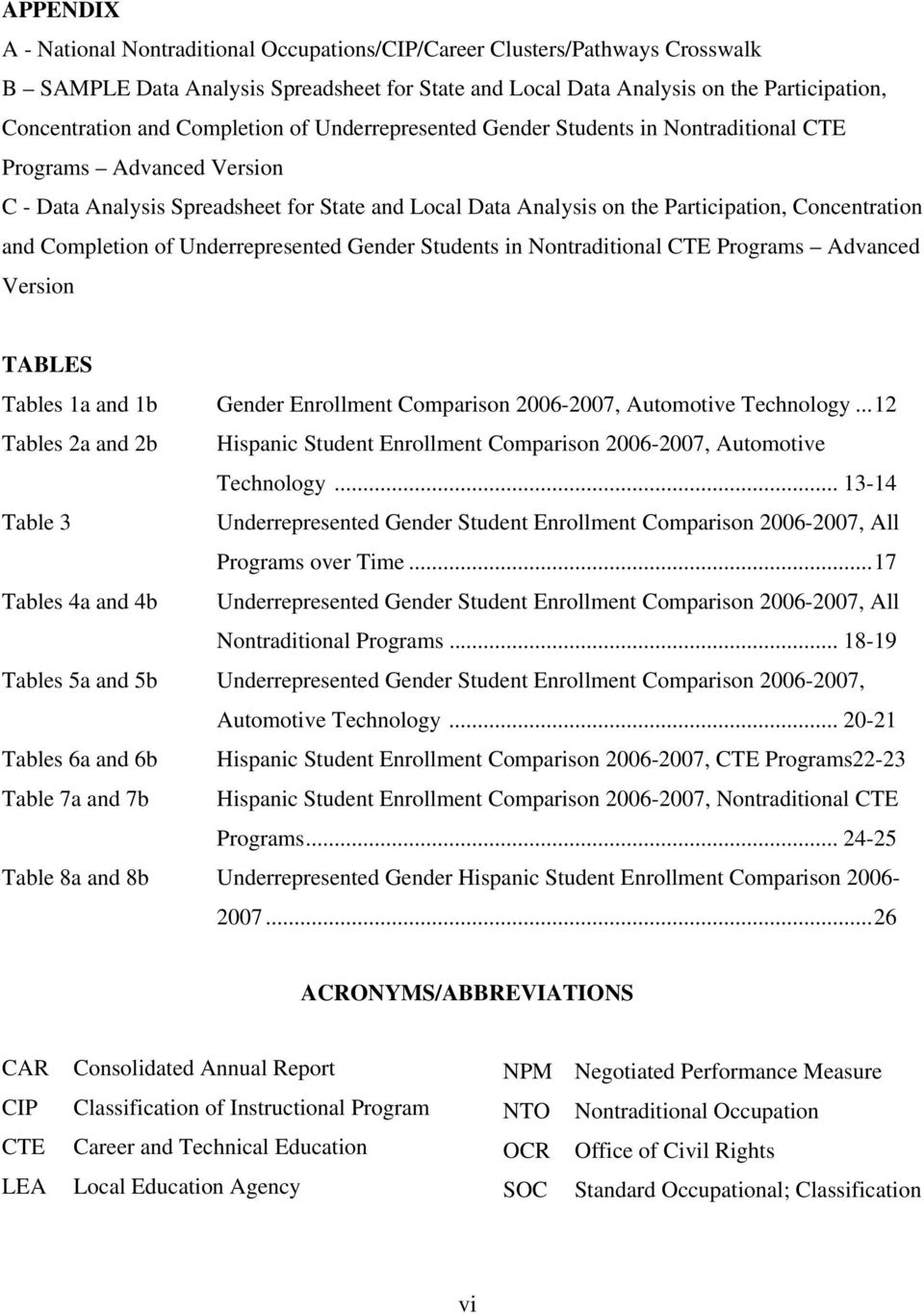
6 APPENDIX A - National Nontraditional Occupations/CIP/Career Clusters/Pathways Crosswalk B SAMPLE Data Analysis Spreadsheet for State and Local Data Analysis on the Participation, Concentration and Completion of Underrepresented Gender Students in Nontraditional CTE Programs Advanced Version C - Data Analysis Spreadsheet for State and Local Data Analysis on the Participation, Concentration and Completion of Underrepresented Gender Students in Nontraditional CTE Programs Advanced Version TABLES Tables 1a and 1b Gender Enrollment Comparison , Automotive Technology...12 Tables 2a and 2b Hispanic Student Enrollment Comparison , Automotive Technology Table 3 Underrepresented Gender Student Enrollment Comparison , All Programs over Time...17 Tables 4a and 4b Underrepresented Gender Student Enrollment Comparison , All Nontraditional Programs Tables 5a and 5b Underrepresented Gender Student Enrollment Comparison , Automotive Technology Tables 6a and 6b Hispanic Student Enrollment Comparison , CTE Programs22-23 Table 7a and 7b Hispanic Student Enrollment Comparison , Nontraditional CTE Programs Table 8a and 8b Underrepresented Gender Hispanic Student Enrollment Comparison ACRONYMS/ABBREVIATIONS CAR CIP CTE LEA Consolidated Annual Report Classification of Instructional Program Career and Technical Education Local Education Agency NPM Negotiated Performance Measure NTO Nontraditional Occupation OCR Office of Civil Rights SOC Standard Occupational; Classification vi
7 INTRODUCTION To comply with the accountability requirements of the Carl D. Perkins Career and Technical Education Improvement Act of 2006 (Perkins IV), states and locals will need to report on the participation and completion of students in nontraditional career and technical education (CTE) programs at the secondary and postsecondary level. States and locals will also need to disaggregate their data by gender, race/ethnicity and special population status. Similar data was collected under the Carl D. Perkins Vocational and Applied Technology Education of States set negotiated performance measures with the Office of Vocational and Adult Education of the U.S. Department of Education and reported annually on their performance. The Perkins IV accountability requirements now include provisions requiring states and locals to do more than just report the data. The new requirements include the implementation of improvement plans when states or locals are not meeting their negotiated performance measures and eventually sanctions, or loss of funding. In addition, states and locals are required to use the data to identify performance gaps between the disaggregated populations and all CTE students when reporting data, developing state and local plans and when developing improvement plans. This guide provides data analysis tools that states and locals may want to use when looking at the data collected for the participation and completion of students in nontraditional CTE programs and the disaggregated data elements to identify performance gaps in student performance. A suggested process for analyzing the data and developing improvement plans is also included. 1
8 2

9 SECTION I STEPS TO COLLECTING AND REPORTING VALID AND RELIABLE DATA ON NONTRADITIONAL PARTICIPATION AND COMPLETION 3

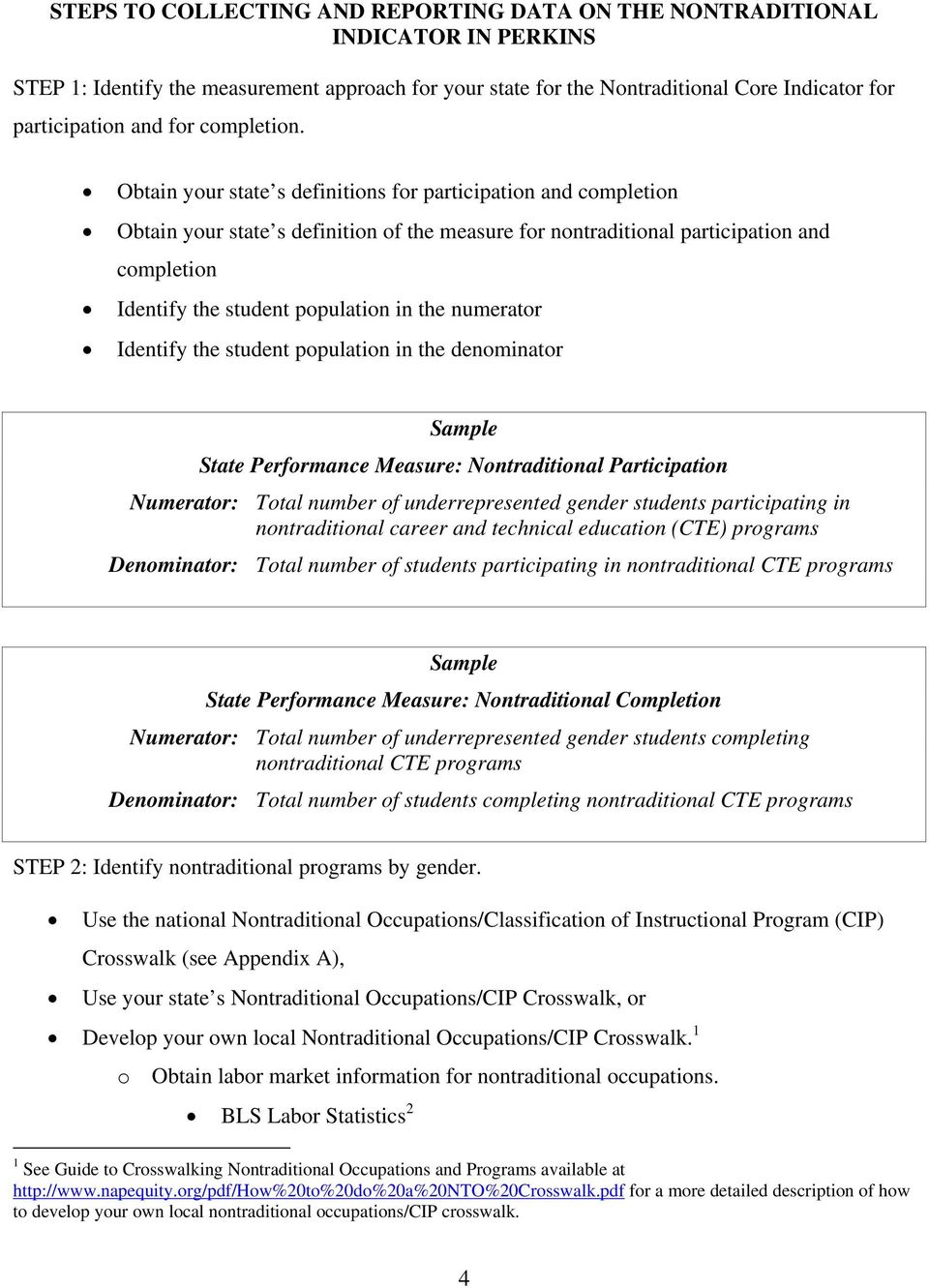
10 STEPS TO COLLECTING AND REPORTING DATA ON THE NONTRADITIONAL INDICATOR IN PERKINS STEP 1: Identify the measurement approach for your state for the Nontraditional Core Indicator for participation and for completion. Obtain your state s definitions for participation and completion Obtain your state s definition of the measure for nontraditional participation and completion Identify the student population in the numerator Identify the student population in the denominator Sample State Performance Measure: Nontraditional Participation Numerator: Total number of underrepresented gender students participating in nontraditional career and technical education (CTE) programs Denominator: Total number of students participating in nontraditional CTE programs Sample State Performance Measure: Nontraditional Completion Numerator: Total number of underrepresented gender students completing nontraditional CTE programs Denominator: Total number of students completing nontraditional CTE programs STEP 2: Identify nontraditional programs by gender. Use the national Nontraditional Occupations/Classification of Instructional Program (CIP) Crosswalk (see Appendix A), Use your state s Nontraditional Occupations/CIP Crosswalk, or Develop your own local Nontraditional Occupations/CIP Crosswalk. 1 o Obtain labor market information for nontraditional occupations. BLS Labor Statistics 2 1 See Guide to Crosswalking Nontraditional Occupations and Programs available at for a more detailed description of how to develop your own local nontraditional occupations/cip crosswalk. 4
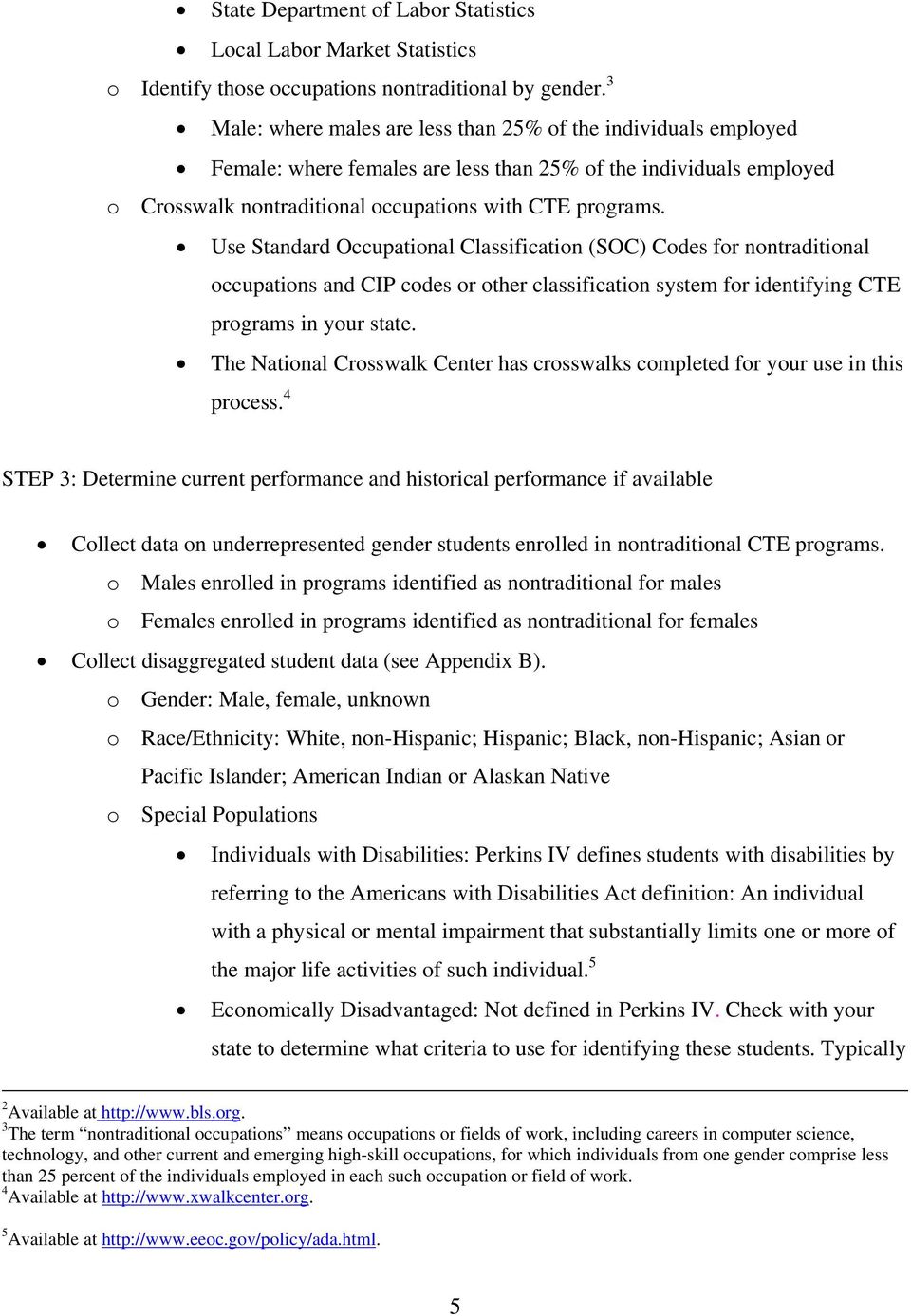
11 State Department of Labor Statistics Local Labor Market Statistics o Identify those occupations nontraditional by gender. 3 Male: where males are less than 25% of the individuals employed Female: where females are less than 25% of the individuals employed o Crosswalk nontraditional occupations with CTE programs. Use Standard Occupational Classification (SOC) Codes for nontraditional occupations and CIP codes or other classification system for identifying CTE programs in your state. The National Crosswalk Center has crosswalks completed for your use in this process. 4 STEP 3: Determine current performance and historical performance if available Collect data on underrepresented gender students enrolled in nontraditional CTE programs. o Males enrolled in programs identified as nontraditional for males o Females enrolled in programs identified as nontraditional for females Collect disaggregated student data (see Appendix B). o Gender: Male, female, unknown o Race/Ethnicity: White, non-hispanic; Hispanic; Black, non-hispanic; Asian or Pacific Islander; American Indian or Alaskan Native o Special Populations Individuals with Disabilities: Perkins IV defines students with disabilities by referring to the Americans with Disabilities Act definition: An individual with a physical or mental impairment that substantially limits one or more of the major life activities of such individual. 5 Economically Disadvantaged: Not defined in Perkins IV. Check with your state to determine what criteria to use for identifying these students. Typically 2 Available at 3 The term nontraditional occupations means occupations or fields of work, including careers in computer science, technology, and other current and emerging high-skill occupations, for which individuals from one gender comprise less than 25 percent of the individuals employed in each such occupation or field of work. 4 Available at 5 Available at 5
12 states use the same definition for economically disadvantaged students at the secondary level as is used for No Child Left Behind or that qualify students for the free and reduced lunch program in the state. At the postsecondary level the definition for economically disadvantaged students is usually related to PELL grant eligibility or other financial aid programs. Single Parent: Not defined in Perkins IV. Single parents are defined in other federal laws. For example: An individual who is unmarried or legally separated from a spouse; and has 1 or more minor children for whom the individual has custody or joint custody; or is pregnant. 6 Displaced Homemaker: An individual who has worked primarily without remuneration to care for a home and family, and for that reason has diminished marketable skills; has been dependent on the income of another family member but is no longer supported by that income; or is a parent whose youngest dependent child will become ineligible to receive assistance under part A of Title IV of the Social Security Act (42 U.S.C. 601 et seq.) not later than 2 years after the date on which the parent applies for assistance under such title; and is unemployed or underemployed and is experiencing difficulty in obtaining or upgrading employment. Limited English Proficient Student: A secondary school student, an adult, or an out-of-school youth, who has limited ability in speaking, reading, writing, or understanding the English language, and whose native language is a language other than English; or who lives in a family or community environment in which a language other than English is the dominant language. Migrant: Not defined in Perkins IV but is included due to the reference to the data collection elements in No Child Left Behind. The definition for migratory child in NCLB is: a child who is, or whose parent or spouse is, a migratory agricultural worker, including a migratory dairy worker, or a migratory fisher, and who, in the preceding 36 months, in order to obtain, or accompany such parent or spouse, in order to obtain, temporary or seasonal employment in agricultural or fishing work 6 For a definition for single parent see U.S. Code, Title 12, Chapter 13, Section 1700(d)(9) available at 6

13 (A) has moved from one school district to another; (B) in a State that is comprised of a single school district, has moved from one administrative area to another within such district; or (C) resides in a school district of more than 15,000 square miles, and migrates a distance of 20 miles or more to a temporary residence to engage in a fishing activity. 7 Student Pursuing Nontraditional Careers: The term nontraditional fields means occupations or fields of work, including careers in computer science, technology, and other current and emerging high skill occupations, for which individuals from one gender comprise less than 25 percent of the individuals employed in each such occupation or field of work. Tech Prep Student: A student participating in a Tech Prep program as described in Sec. 203 of the Perkins Act. 8 STEP 4 Set a baseline to be used as a benchmark for measuring progress and negotiating future performance measures Aggregate data for all populations and programs. o Percentage of students participating in nontraditional CTE programs o Percentage of students completing nontraditional CTE programs Average multiple years of data (see Table 3 on page 19 for an example of a multiyear analysis for setting a baseline). STEP 5: Negotiate your local performance measure using the baseline developed in STEP 4. Participation of students in nontraditional CTE programs Completion of students in nontraditional CTE programs STEP 6: Compare your current performance for participation and completion of students in nontraditional CTE programs to the negotiated performance measure (NPM) set in STEP 5. Disaggregate data and identify performance gaps by: o School: See Table 3 on page 19 for a sample. 7 From NCLB available at 8 Available at 7
14 o Program: See Tables 4a and 4b on pages 20 and 21 for a sample. o Course: See Tables 5a and 5b on pages 22 and 23 for a sample. o Student Populations Gender: See Tables 3, 4 and b, and 5a and b on pages 19 to 23 for a sample. Race/Ethnicity: See Tables 5 a and b, 6 a and b, and 7a and b on pages for a sample. Special Populations: See Tables 5 a and b, 6 a and b, and 7a and b on pages for a sample. STEP 7: Develop improvement plans for programs performing below the local negotiated performance measure for all nontraditional CTE programs. (See Section III for the 5-Step Process: Improving Performance on Nontraditional Participation and Completion.) 8

15 SECTION II PROMOTING EQUITY IN CAREER AND TECHNICAL EDUCATION THROUGH DATA ANALYSIS 9

16 ANALYZING DATA TO IDENTIFY PERFORMANCE GAPS IN NONTRADITIONAL CAREER AND TECHNICAL EDUCATION PROGRAMS Historically, there has been confusion for local program providers about the difference in looking at enrollment patterns for gender, race/ethnicity and special populations in CTE programs for civil rights purposes, such as an Office of Civil Rights (OCR) review, and looking at participation and completion patterns in nontraditional programs for Perkins accountability purposes. The goal of this paper is to clarify how to use each method of analysis to promote equity in CTE programs. A review of methodology to analyze data for under/overrepresentation for civil rights review purposes at both the secondary and postsecondary is explained. Sample data tables and narrative analysis of the samples are given to assist you in replicating the same process at your local school. A review of methodology to analyze data for Perkins accountability purposes at the secondary and postsecondary level is also explained in detail. Sample data analysis tables and narrative analysis are given to show how to review gender, race/ethnicity, and special populations disaggregated data to help you identify gaps in performance and potential areas where program improvement efforts could be focused. After reviewing the samples shown here, you will be prepared to make the same analysis of the CTE programs at your school, district, or college. UNDER/OVERREPRESENTATION OF STUDENTS IN CTE (CIVIL RIGHTS) There are several Federal civil rights laws 9, enforced by the Office for Civil Rights 10 of the U.S. Department of Education, that prohibit discrimination in programs or activities that receive federal financial assistance from the Department of Education. Discrimination on the basis of race, color, and national origin is prohibited by Title VI 11 of the Civil Rights Act of 1964; sex discrimination is prohibited by Title IX 12 of the Education Amendments of 1972; discrimination on the basis of disability is prohibited by Section of the Rehabilitation Act of 1973; and age discrimination is prohibited by the Age Discrimination Act 14 of These civil rights laws enforced by OCR extend to all state education agencies, elementary and secondary school systems, colleges and universities, 9 Available at 10 For more information about the Office for Civil Rights go to 11 Available at and 12 Available at and 13 Available at 14 Available at 10

17 vocational schools, proprietary schools, state vocational rehabilitation agencies, libraries, and museums that receive U.S. Department of Education funds. Areas covered may include, but are not limited to: admissions, recruitment, financial aid, academic programs, student treatment and services, counseling and guidance, discipline, classroom assignment, grading, vocational education, recreation, physical education, athletics, housing, and employment. OCR also has responsibilities under Title II of the Americans with Disabilities Act 15 of 1990 (prohibiting disability discrimination by public entities, whether or not they receive federal financial assistance). OCR has developed guidelines 16 that explain the civil rights responsibilities of recipients of Federal funds offering or administering career and technical education programs. When looking at enrollment patterns, the assumption is made that, if all things were equal, you should expect about the same percentage of students of a particular ethnic/racial group or disability enrolled in the school to be also enrolled in the CTE program. A recommended baseline for gender is an 80/20 test, where no more than 80% of one gender will be enrolled in a course or program. A recommended baseline for ethnicity, race, and disability is +/- 10% of the enrollment for that group. For instance, if a school has an enrollment of 26% African American students, it should expect that all CTE programs would have no less than 16% and no more than 36% of African Americans enrolled in its programs. At the local level, comparing enrollment data in an institution to the enrollment data in a local program can help program personnel ascertain whether their program s demographics indicate an overrepresentation or underrepresentation of a particular group. With this knowledge, steps can be taken to ensure that enrollment patterns showing under- or overrepresentation is not the result of program policies or practices. (For an example of how this is done, see Tables 1a and 1b, secondary and postsecondary examples of gender comparisons, and Table 2a and 2b, secondary and postsecondary examples of race/ethnicity comparisons.) 15 Available at 16 Available at 11

18 CTE Program Enrollment Analysis: Gender Comparisons The data below indicate a need to review the program policies and practices (including the counseling and scheduling process) at both the secondary and postsecondary levels to ensure there was no discrimination in the overrepresentation of males in the courses. This is true for secondary even though the program as a whole meets the gender test of more than 20% enrollment of women. The fact that females are underrepresented in the upper-level course work but not in the lower-level course work would indicate a need to study retention issues. At the postsecondary level, the overall lack of participation of females in all courses indicates a need to study program recruitment as well as program policies and practices. TABLE 1a ABC Secondary School District Enrollment Comparison Gender, Automotive Technology Secondary Total # % Males % Females Course Enrolled # Males # Females Comment 17 Automotive Technology I % 33.33% OK Automotive Technology II % 29.31% OK Automotive Technology III % 19.51% Over M Automotive Technology IV % 8.70% Over M Total Program (unduplicated) % 25.94% OK TABLE 1b ABC Community College Enrollment Comparison Gender, Automotive Technology Postsecondary Certificate of Achievement Course Total # Enrolled # Males # Females % Males % Females Comment 12 Electricity, Electronics, and Computer Controls % 7.69% Over M Transmissions and Power Trains % 0.00% Over M Engine Performance, Diagnosis, and Tune-Up % 0.00% Over M Basic Automotive Engines % 0.00% Over M Manual Transmissions and Power Trains % 7.69% Over M Technical Mathematics % 0.00% Over M Total Program (unduplicated) % 6.67% Over M 17 OK= within the 80/20 test; Over M = overrepresentation of males; Over F = overrepresentation of females. 12
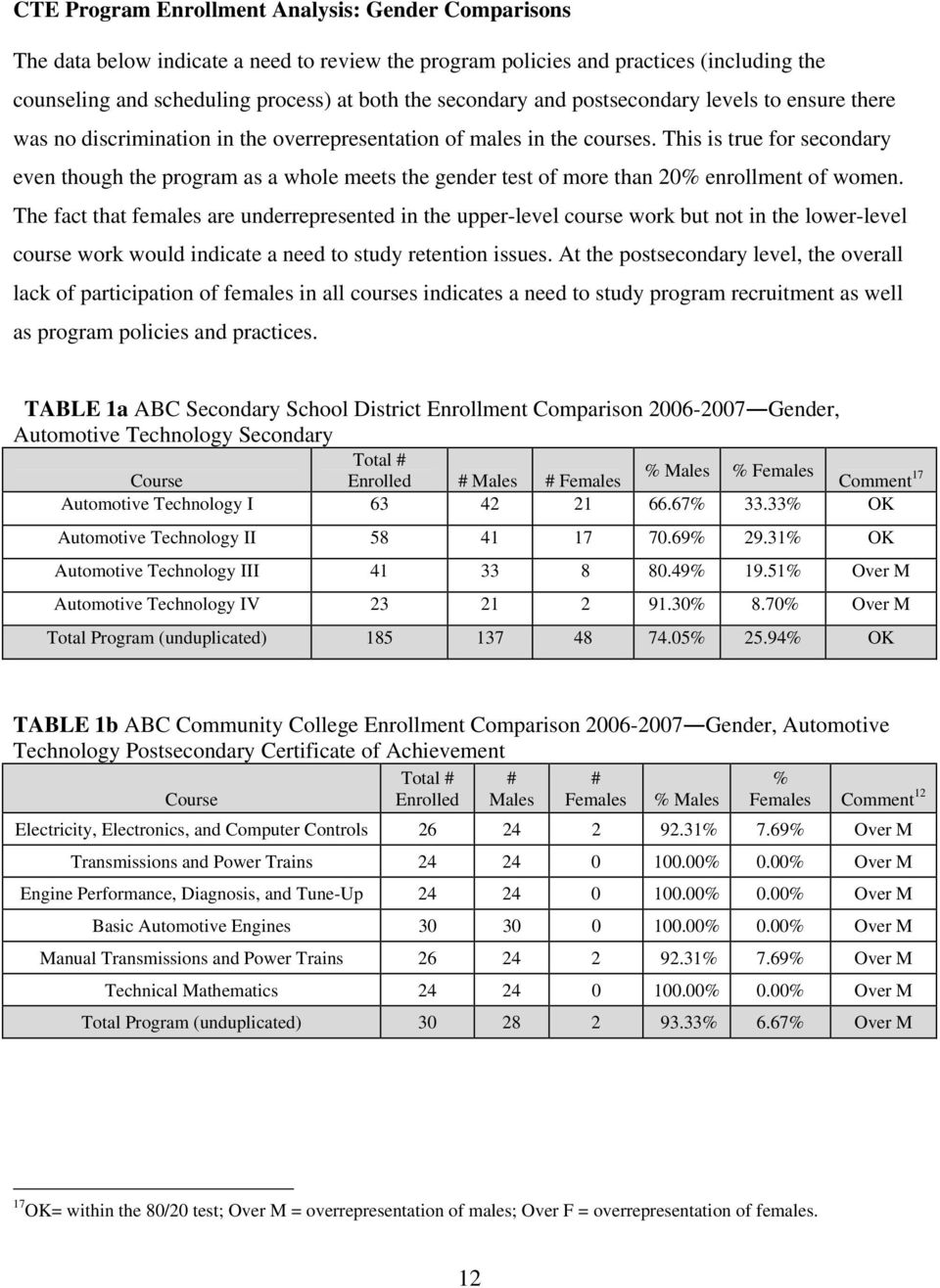
19 CTE Program Enrollment Analysis: Race/Ethnicity Comparisons Table 2a illustrates how to compare the Hispanic population enrolled in the Automotive Technology program to those enrolled in the school. In this example, the secondary program meets the test, but there is underrepresentation of Hispanic students at the upper-level course offerings. The school/district needs to ascertain why Hispanic students are not enrolling at that level and take steps to ensure that it is not a result of unsatisfactory program policies, practices, or counseling that contribute to the declining enrollment. TABLE 2a ABC Secondary School District Enrollment Comparison Hispanic Student Enrollment, Automotive Technology Secondary Course Total # Enrolled in Program # Hispanics % Hispanics % Hispanics Enrolled in School Automotive Technology I % 28.34% Yes Falls between 18.34% and 38.34%? Automotive Technology II % 28.34% Yes Automotive Technology III % 28.34% No, under Automotive Technology IV % 28.34% No, Under Total Program (unduplicated) % 28.34% Yes The data in Table 2b indicate an overrepresentation of Hispanic students for the college program overall. However, there is only one course that has an overrepresentation of Hispanic students. The college needs to further explore why there are more Hispanic students enrolled in the Basic Automotive Course and not in the other courses available in the program. The college could take this comparison a step further by analyzing how many Hispanics are eligible for enrollment in the community college compared to those that are enrolling to ascertain whether or not it provides adequate outreach in admissions to the Hispanic population in its enrollment area. Again, the analysis of courses where Hispanic students are under-enrolling or over-enrolling in a particular course could help staff determine whether any program policies or practices are contributing to this enrollment pattern and take corrective steps if needed. 13
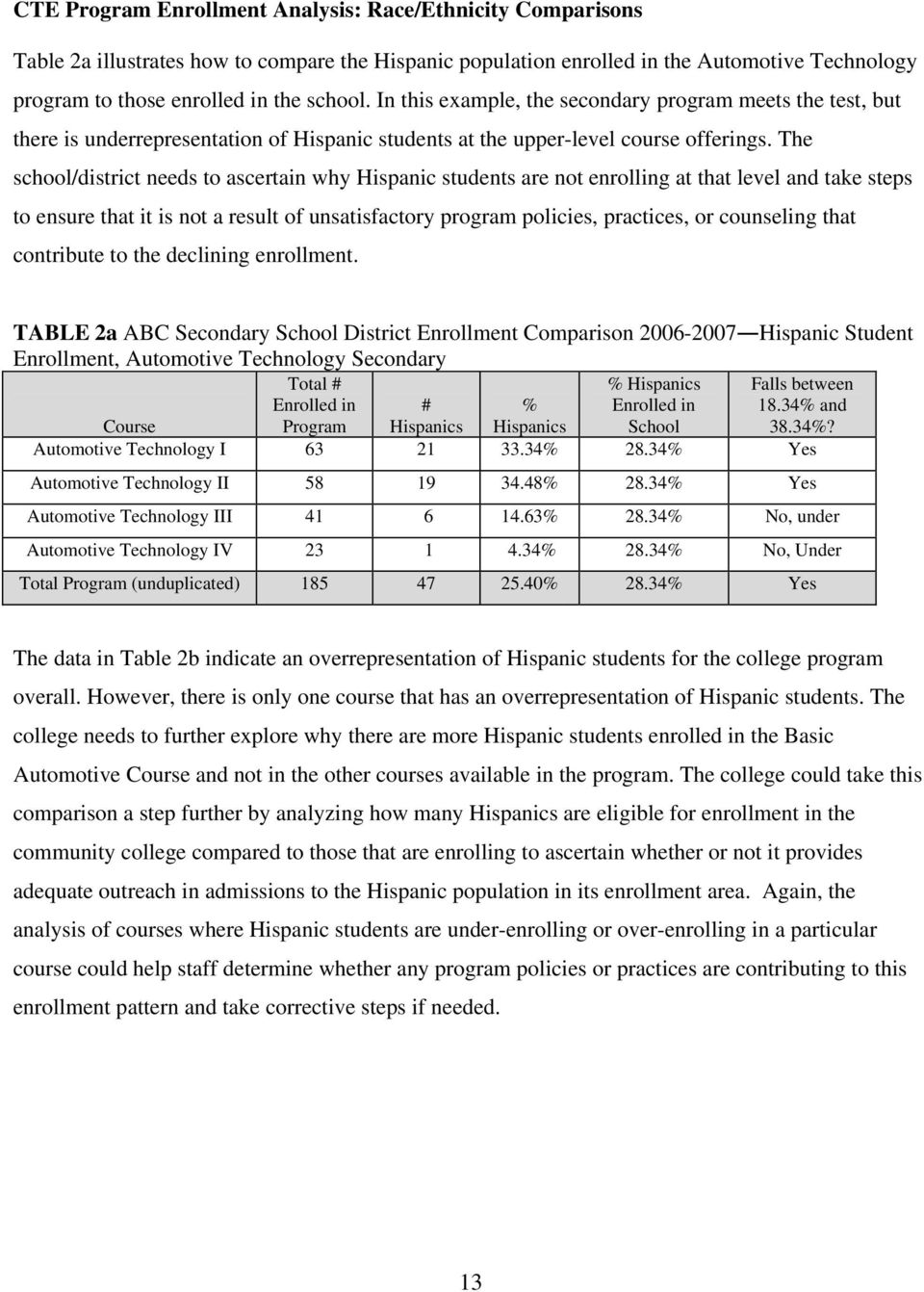
20 TABLE 2b ABC Community College Enrollment Comparison Hispanic Student Enrollment, Automotive Technology Postsecondary (Certificate of Achievement) Course Electricity, Electronics, and Computer Controls Total # Enrolled in Program # Hispanics % Hispanics % Hispanics Enrolled in School/College Falls between 11.56% and 31.56%? % 21.56% Yes Transmissions and Power Trains % 21.56% Yes Engine Performance, Diagnosis, and Tune-Up % 21.56% Yes Basic Automotive Engines % 21.56% No, over Manual Transmissions and Power Trains % 21.56% Yes Technical Mathematics % 21.56% Yes Total Program (unduplicated) % 21.56% No, over 14

21 NONTRADITIONAL PARTICIPATION AND COMPLETION PATTERNS (PERKINS ACCOUNTABILITY) In the 1998 and 2006 Perkins reauthorizations, Congress included in the federal, state, and local accountability system for CTE a Core Indicator for student participation in, and completion of, career and technical education programs that lead to employment in nontraditional fields. Nontraditional fields is defined as occupations or fields of work, including careers in computer science, technology, and other current and emerging high skill occupations, for which individuals from one gender comprise less than 25 percent of the individuals employed in each such occupation or field of work. 18 Nontraditional CTE programs are not defined by the enrollment pattern within the classes or programs, but rather the employment numbers in the workplace. Before looking at participation patterns, the program must be identified as a nontraditional program. Local schools/districts/colleges need to identify which programs they offer that meet this definition. Depending on the policy in your state this may be (1) left to the local district or college, (2) based on a state-identified list, or (3) based on a national list. The process for identifying nontraditional CTE programs by doing a crosswalk with labor statistics and Classification of Instructional Program (CIP) codes and a sample national crosswalk is available on the National Alliance for Partnerships in Equity s (NAPE) website. 19 To implement the 1998 Perkins Act, each state identified a benchmark in 1999 and negotiated annual performance measures (or a percentage to meet or exceed) for both the participation and completion of underrepresented gender 20 students in nontraditional programs. States report this information to the U.S. Department of Education in their Consolidated Annual Reports. States are required to report 18 From Public Law , available at 19 See How to Develop a NTO Crosswalk at See and for a sample national crosswalk. 20 Underrepresented gender refers to students in a nontraditional program that prepare them for an occupation where their gender is represented by less than 25% of the workforce. For example the underrepresented gender students in automotive technology programs would be females, while the underrepresented gender students in nursing programs would be males. 15
22 the data disaggregated by gender, race/ethnicity and special population 21 status. State annual report data is available at For purposes of the illustrations in this paper, participation is defined as enrollment in a CTE course that is part of a program of study leading to a nontraditional career. All examples shown analyze enrollment data. The same analysis can also be done using concentrators or completers to identify gaps in performance for students by gender, race/ethnicity, and special populations. Although data is collected at the course level, aggregated and then reported, the data is presented here first at the aggregated level first and then at the course level. Presenting the sample data tables in this order helps to illustrate the importance of disaggregating data to identify performance gaps. As the data is disaggregated, more and more can be learned about the trends in student course-taking patterns and performance. Analyzing Perkins Data to Identify Performance Gaps by Gender in Nontraditional CTE Programs CTE Nontraditional Program Enrollment: Total and Gender Comparisons Table 3 shows the institutional enrollments of underrepresented gender students in nontraditional programs over time. In looking at the percentages of enrollment over time, the postsecondary institution is able to see the enrollment patterns of all of the programs offered. The 3 years of data illustrate that nontraditional program enrollment for females has increased steadily over time while the nontraditional program enrollment for males has been more volatile. Table 3 also illustrates how a local educational agency or state agency can use multiple years of data to set appropriate baselines when negotiating performance with the state or federal government for the purposes of accountability under Perkins IV. In this example, if a state or local agency had only used the current year s data available ( ) the baseline would have been set at 10.39%, significantly higher than the 3- year average of 8.73%. It is important as states and locals prepare to negotiate performance measures under Perkins IV that multiple years of data be available so accurate and reliable baselines can be determined. While the information in Table 3 will assist in setting appropriate baselines, the data is not helpful in the identification of useful strategies for enrollment and retention. For effective program 21 Special populations are defined in Perkins IV as: (a) individuals with disabilities; (b) individuals from economically disadvantaged families, including foster children; (c) individuals preparing for nontraditional fields; (d) single parents, including single pregnant women; (e) displaced homemakers; and (f) individuals with limited English proficiency. 16
23 improvement, looking at the data in a more disaggregated fashion as illustrated in the following tables is necessary. TABLE 3 XYZ Community College Enrollment Comparison Underrepresented Gender Student Enrollment, All Nontraditional Programs, Comparison over Time Nontraditional for Females 7.73% 9.20% 10.76% Nontraditional for Males 8.65% 4.04% 9.52% Baseline (3-year average) Total 8.02% 7.78% 10.39% 8.73% CTE Nontraditional Program Enrollment: Program and Gender Comparisons Table 4a illustrates how the total for all programs may be misleading and how important it is for districts to analyze their Perkins data at the course level. In this case, the nontraditional programs for females exceed the state negotiated performance measure, but none of the nontraditional programs for males meet the state negotiated performance measure. In this example, resources and strategies would need to be developed so that males as well as females participate in these programs. It may be that the curriculum needs to be updated so that males see the relevancy of taking these courses at the secondary level. It may be that the stereotype of being female needs to be addressed. The data alone does not answer the question. Further research would be required. 17
24 TABLE 4a XYZ Secondary School District Enrollment Comparison Underrepresented Gender Student Enrollment, All Nontraditional Programs Program Total # Enrolled # Underrepresented Gender 22 % Underrepresented Gender State Negotiated Performance Measure Met = M Not Met = N Exceeded = E Agriculture (F) % 24.56% E Automotive Technology (F) % 24.56% E IT Academy (F) % 24.56% E Total in Nontraditional for Females % 24.56% E Nurses Aide (M) % 24.56% N Business and Office (M) Total in Nontraditional for Males Total for Males and Females % 24.56% N % 24.56% N % 24.56% E Table 4b shows the program aggregate for all of the nontraditional programs offered by the college. Looking at the individual program areas shows which programs are making progress in the enrollment of underrepresented gender students. By looking at the program detail, resources can be targeted to the areas that are most in need, such as Tool and Die as opposed to the Cisco Academy or Commercial Horticulture. However, it may be helpful to share the strategies used in these programs (Cisco Academy and Commercial Horticulture) with the faculty in the other CTE programs. 22 Number of students who are of the underrepresented gender for that particular program. For those with (F), it would be the number of females in the program. For those with (M), it would be the number of males in the program. 18
25 TABLE 4b XYZ Community College Enrollment Comparison Underrepresented Gender Student Enrollment, All Nontraditional Programs Program Total # Students Enrolled # Underrepresented Gender 23 % Underrepresented Gender State Negotiated Performance Measure Met = M Not Met = N Exceeded = E Auto Mechanics (F) % 11.75% N Carpentry (F) % 11.75% N Cisco Academy (F) % 11.75% E Commercial Horticulture (F) % 11.75% E Tool and Die (F) % 11.75% N Total in Nontraditional for Females % 11.75% N LPN (M) % 11.75% E Childcare (M) % 11.75% N Total in Nontraditional for Males % 11.75% N Total for Males and Females % 11.75% N CTE Nontraditional Program Enrollment: Course Comparisons Tables 5a and 5b show how a secondary or postsecondary institution can use the state negotiated performance measure to evaluate its performance on the nontraditional core indicator. The 2006 Perkins Act includes a new local accountability requirement that mandates local programs to use either the state negotiated performance measure or negotiate a local performance measure with the state. First, the local education agency must determine its current performance by ascertaining the programs enrollment pattern by gender. This should be done for as many years as the data is available to ensure that the baseline or benchmark is as accurate as possible. Using multiple-year trend data will eliminate possible 1-year anomalies that can skew the data and make baselines inaccurate, potentially making it impossible to meet the performance measure negotiated on the baseline. 23 Number of students who are of the underrepresented gender for that particular program. For those with (F), it would be the number of females in the program. For those with (M), it would be the number of males in the program. 19
26 TABLE 5a XYZ Secondary School District Enrollment Comparison Underrepresented Gender Student Enrollment, Automotive Technology Secondary State Negotiated Performance Course Total # Enrolled # Underrepresented Gender 24 % Underrepresented Gender Measure Automotive Technology I % E Met = M Not Met = N Exceeded = E Automotive Technology II % E Automotive Technology III % N Automotive Technology IV % N Total % E Table 5a illustrates how a program can exceed the state s negotiated performance measure, but course-level enrollment patterns show us there is still work to be done. The local program staff would need to explore why underrepresented gender students (in this case, females) are enrolling in Automotive Technology I and II and are not completing the program course sequence. For instance, exit interviews with underrepresented gender students might be a strategy to identify the factors that either encourage or discourage women to complete all four courses. Table 5b illustrates how the enrollment patterns for underrepresented gender students by course gives us more revealing information about enrollment patterns in this nontraditional program. This data might suggest that the college is attracting females to the automotive technology program for purposes other than obtaining a certificate or it may mean that females are risking examining the program but are choosing not to stay the course. College personnel would need to explore the reasons for the data and take steps to encourage the enrollment and retention of female students in the automotive technology program. 24 Number of students who are of the underrepresented gender for that particular program. Since Automotive Technology is nontraditional for females, the underrepresented gender students enrolled are the females in this example. 20
27 TABLE 5b XYZ Community College Enrollment Comparison Underrepresented Gender Student Enrollment, Automotive Technology Postsecondary Course Electricity, Electronics, and Computer Controls Transmissions and Power Trains Engine Performance, Diagnosis, and Tune-Up Total # Enrolled # Underrepresented Gender 25 % Underrepresented Gender State Negotiated Performance Measure Met = M Not Met = N Exceeded = E % 11.75% N % 11.75% N % 11.75% N Basic Automotive Engines % 11.75% N Manual Transmissions and Power Trains % 11.75% N Technical Mathematics % 11.75% N Total Program (unduplicated) % 11.75% N It is important to remember that the disaggregation of the data will provide the most and best information for program improvement for the participation and retention of nontraditional students. Charting the patterns to the course level will give program planners the information needed to identify strategies and resources to encourage the participation in and completion of nontraditional CTE programs. Analyzing Perkins Data to Identify Performance Gaps by Race/Ethnicity or Special Population Students in Nontraditional CTE Programs CTE Program Enrollment: Race/Ethnicity Comparisons Additional information may also be important to see the complete picture of who is and who is not enrolling in nontraditional programs. Disaggregating the participation and completion data by gender, race/ethnicity, and special populations will be helpful in deciding recruitment and retention strategies. The following tables illustrate the technique for analyzing student race/ethnicity and special population enrollment data three different ways: (1) the enrollment of Hispanic students in CTE 25 Number of students who are of the underrepresented gender for that particular program. Since Automotive Technology is nontraditional for females, the underrepresented gender students enrolled are the females in this example. 21
28 programs (Tables 6a and 6b), (2) the enrollment of Hispanic students in nontraditional CTE programs (Tables 7a and 7b), and (3) the enrollment of underrepresented gender Hispanic students in nontraditional CTE programs (Tables 8a and 8b). The three-layered approach to looking at disaggregated data for race/ethnicity and special population students can show you trends in student enrollment in CTE at each of these levels potentially assisting districts and colleges to see where the gaps start to occur. Tables 6a and 6b show the enrollment of all Hispanic students in the CTE programs. The secondary enrollments show that Automotive Technology, Nurse s Aide, and Marketing programs are recruiting what we would expect given the percentage of Hispanic students enrolled in secondary School District XYZ. Overall, the CTE programs are enrolling Hispanic students at the rate that they are enrolled in the district. TABLE 6a XYZ Secondary School District Enrollment Comparison Hispanic Student Enrollment, CTE Programs Program Total # Enrolled # Hispanics (unduplicated) Male and Female % Hispanics % Hispanics Enrolled in District Falls between 18.34% and 38.34%? Agriculture % 28.34% No, under Automotive Technology % 28.34% Yes IT Academy % 28.34% Nor, under Nurse s Aide % 28.34% Yes Business and Office % 28.34% No, under Marketing % 28.34% Yes Total % 28.34% Yes 22
29 TABLE 6b XYZ Community College Enrollment Comparison , Hispanic Student Enrollment, CTE Programs Program Auto Mechanics Total # Enrolled # Hispanics (unduplicated) Male and Female % Hispanics % Hispanics Enrolled in College Falls between 11.56% and 31.56%? % 21.56% No, over Carpentry % 21.56% Yes Cisco Academy % 21.56% Yes Commercial Horticulture % 21.56% No, over Tool and Die % 21.56% Yes Banking and Finance % 21.56% Yes LPN % 21.56% No, under Childcare % 21.56% No, under Respiratory Therapist % 21.56% Yes Total % 21.56% Yes At the postsecondary level, Auto Mechanics is attracting a higher percentage of Hispanic students than might be expected given the percent of Hispanic students enrolled in the college. All of the other programs are recruiting what is expected with the exception of the LPN and Childcare programs, where there is underrepresentation of Hispanic students. Again, the overall CTE program enrollment of Hispanic students is very close to the percentage of Hispanic students enrolled in the college. 23
30 CTE Nontraditional Program Enrollment: Race/Ethnicity Comparisons Tables 7a and 7b look only at those programs that are nontraditional or where the workforce for which these programs prepare students have 25% or less of one gender. Those marked with an (F) are nontraditional for females and those with an (M) are nontraditional for males. Again, these show us only the distribution of Hispanic students, both male and female, in these programs. At the secondary level, this shows that the number of Hispanic students enrolled in the nontraditional programs for females is considerably lower than the percentage of students enrolled in the district, while the number of Hispanic students enrolled in the nontraditional programs for males is just slightly higher than the district s enrollment of Hispanic students. At the postsecondary level, it is just the opposite. The number of Hispanic students in the nontraditional programs for females is closer to the representation of Hispanic students in the college or in CTE, while the Hispanic students tend to be underrepresented in the nontraditional programs for males. TABLE 7a XYZ Secondary School District Enrollment Comparison Hispanic Student Enrollment, Nontraditional CTE Programs Program Total # Enrolled # Hispanics (unduplicated) Male and female % Hispanics % Hispanics Enrolled in District 26 Agriculture (F) % 28.34% Automotive Technology (F) Falls between 18.34% and 38.34%? No, under % of Hispanics Enrolled in CTE 27 Falls between 10.00% and 30.00%? 20.00% No, under % 28.34% Yes 20.00% Yes IT Academy (F) % 28.34% Total for Females % 28.34% No, under No, under 20.00% No, under 20.00% Yes Nurse s Aide (M) % 28.34% Yes 20.00% Yes Business and Office (M) % 28.34% No, under 20.00% No, under Total for Males % 28.34% Yes 20.00% No, Over Totals % 28.34% Yes 20.00% Yes 26 From Table 2a. 27 From Table 5a. 24
31 TABLE 7b XYZ Community College Enrollment Comparison Hispanic Student Enrollment, Nontraditional CTE Programs Program Auto Mechanics (F) Total # Enrolled # Hispanics (unduplicated) Male and Female % Hispanics % Hispanics Enrolled in College 28 Falls between 11.56% and 31.56%? % Hispanics Enrolled in CTE 29 Falls between 12.15% and 32.15%? % 21.56% No, over 22.15% No, over Carpentry (F) % 21.56% Yes 22.15% Yes Cisco Academy (F) Commercial Horticulture (F) % 21.56% Yes 22.15% Yes % 21.56% No, over 22.15% Yes Tool and Die (F) % 21.56% Yes 22.15% Yes Total in Nontraditional for Females % 21.56% Yes 22.15% Yes LPN (M) % 21.56% No, under 22.15% No, under Childcare (M) % 21.56% No, under 22.15% No, under Total in Nontraditional for Males Total for Males and Females % 21.56% No, under 22.15% No, under % 21.56% Yes 22.15% Yes CTE Nontraditional Program Enrollment: Race/Ethnicity and Underrepresented Gender Comparisons Tables 8a and b show that all programs at both the secondary and postsecondary levels are not meeting the state negotiated performance measure. Business and Office at the secondary level comes the closest as does Cisco Academy at the postsecondary level. The distribution of students at the secondary level shows that more underrepresented males are enrolling in nontraditional programs for males than are females in nontraditional programs for females. At the postsecondary level, it is the opposite, with more females in nontraditional programs for females than males in nontraditional programs for males. 28 From Table 2b. 29 From Table 5b. 25
32 TABLE 8a XYZ Secondary School District Enrollment Comparison Underrepresented Gender, Hispanic Student Enrollment, Nontraditional Programs State Negotiated Performance Met = M Not Met = N Exceeded = E % Underrepresented Total # Hispanics # Underrepresented Program Enrolled 30 Gender Gender Measure Agriculture (F) % 24.56% N Automotive Technology (F) % 24.56% N IT Academy (F) % 24.56% N Total for Females %% 24.56% N Nurse s Aide (M) % 24.56% N Business and Office (M) % 24.56% E Total for Males % 24.56% E Total for Males and Females % 24.56% N TABLE 8b XYZ Community College Enrollment Comparison Underrepresented Gender Student Enrollment, All Nontraditional Programs Program Total # Hispanics Enrolled 31 # Underrepresented Gender 32 % Underrepresented Gender State Negotiated Performance Measure Met = M Not Met = N Exceeded = E Auto Mechanics (F) % 11.75% E Carpentry (F) % 11.75% N Cisco Academy (F) % 11.75% E Commercial Horticulture (F) % 11.75% N Tool and Die (F) % 11.75% N Total in Nontraditional for Females % 11.75% E LPN (M) % 11.75% E Childcare (M) % 11.75% N Total in Nontraditional for Males Total for Males and Females % 11.75% E % 11.75% E 30 From Table 7a. 31 From Table 7b. 32 Number of students who are of the underrepresented gender for that particular program. For those with (F), it would be the number of females in the program. For those with (M), it would be the number of males in the program. 26
33 When looking at data for subgroups, it is important to use the information required for both civil rights AND for Perkins accountability so that the appropriate questions can be raised and strategies sought for improvement in the recruitment and retention of underrepresented gender students regardless of their racial/ethnic background or special population status. All of the disaggregated data is useful in having an overall picture of participation in the nontraditional programs. Recruitment strategies, such as information sharing with students and parents, can be identified so that students from various subgroups can see the advantages of particular nontraditional programs. 27
34 SECTION III USING THE 5-STEP MODEL FOR CREATING LOCAL IMPROVEMENT PLANS FOR NONTRADITIONAL PARTICIPATION AND COMPLETION 28
35 SAMPLE 5-STEP MODEL FOR A LOCAL AUTOMOTIVE TECHNOLOGY PROGRAM The accountability measures in the Perkins CTE legislation have meaning when the data is used by local agencies for improvement purposes. This model uses the data to guide the local school/district/agency to determine root causes, select best solutions, consider pilot test approaches, and implement solutions. This section is specifically focused on assisting local program personnel assess the performance of their programs on increasing the participation and completion of underrepresented gender students in nontraditional CTE programs. Improving Performance: A Five Step Process 33, was developed in 2002 by the Office of Vocational and Adult Education of the U.S. Department of Education as part of the Program Quality Initiative. This guidebook is generic to all the Perkins performance measures and describes each of these steps in detail and is referenced throughout the worksheet. What is your state s measurement definition for participation in nontraditional CTE programs? State Performance Measure: Nontraditional Participation Numerator: Total number of underrepresented gender students participating in nontraditional CTE programs Denominator: Total number of students participating in nontraditional CTE programs State Performance Measure: Nontraditional Completion Numerator: Total number of underrepresented gender students completing nontraditional CTE programs Denominator: Total number of students completing nontraditional CTE programs This section will demonstrate the use of a continuous process for improving performance on the participation and completion of underrepresented gender students in nontraditional career and technical education (CTE) programs. A nontraditional program (or course of study) is one where more than 75% of the workers in the occupation for which the program prepares students are of one gender. The list of nationally recognized nontraditional occupations for males and females and their related Classification of Instructional Program (CIP) codes can be found in Appendix A. 33 Improving Performance: A Five Step Process is available at 29
36 For the purposes of this sample, we will focus on analyzing data and developing improvement strategies for underrepresented gender students (females) in a specific nontraditional program (Automotive Technology). We will look at data to develop a plan at the program level. This same process can be used to analyze district- or college-level data for all programs by gender, race/ethnicity, and/or special population to determine gaps in performance by population 34 just follow the same STEPS! At the end of this example, you will find a worksheet with blank charts and instructions for completing the 5-step process to use at the local level to develop a local improvement plan for your program. DISTRICT/COLLEGE PERFORMANCE DATA FOR PERKINS NONTRADITIONAL PARTICIPATION AND COMPLETION When embarking on the process of collecting Perkins data on the performance of underrepresented gender students in nontraditional CTE programs, there are some very important steps you must take to ensure the data collected is accurate, valid, and reliable. See Section I: Steps to Collecting and Reporting Valid and Reliable Data on Nontraditional Participation and Completion to ensure you are collecting the appropriate data for the analysis to follow. Each local education agency (district or college) collects and reports data to the state, which includes the data in an annual submission (Consolidated Annual Report [CAR]) to the U.S. Department of Education, Office of Vocational and Adult Education. Check with your state Director of Career and Technical Education to obtain a copy of your state s CAR. The state s CAR includes aggregate data for all programs in the state on the performance of students on each of the core indicators disaggregated by gender, race/ethnicity, and special population status. The CAR also indicates the state s negotiated performance measure (NPM) for each core indicator and whether or not the state met its NPM for that year. Information on your state s performance and narrative from the CAR is available online at 34 For more detailed information on how to analyze student data by gender, race/ethnicity, or special population see Section II Promoting Equity in Career and Technical Education Through Data Analysis 30
37 States collect data from local education agencies (LEAs) to report on the CAR in different ways. If your state s accountability systems are designed to collect individual student records from LEAs, you may be able to request that data be reported back to you by school and program to help you conduct the analysis described here. If your state collects data at the school level, you will need to obtain your school s CTE annual report from your Director of CTE or other school administrator that collects and keeps this information. No matter how data is collected in your state, you should be able to access the information used in this analysis from records available at your school. Before starting on the 5 Step Process be sure to have at a minimum the data described in the tables below. Sample Table 1: Nontraditional Participation by Program Sample Tables 1a and 1b report enrollment data for the Automotive Technology Program for the 4 years from through of the Perkins Act, as well as by course for the academic year. These tables reflect the comparison to the state negotiated performance measure. SAMPLE TABLE 1a Nontraditional Participation for Automotive Technology over Time Met = M State Negotiated # Underrepresented % Not Met = N Years Total # Enrolled Gender 35 Performance Measure Underrepresented Exceeded = E % 11.75% Not Met % 11.50% Not Met % 11.25% Not Met % 11.00% Not Met SAMPLE TABLE 1b Automotive Technology Participation, Course Electricity, Electronics, and Computer Controls Transmissions and Power Trains Engine Performance, Diagnosis, and Tune-Up Total # Enrolled # Underrepresented Gender % Underrepresented Gender State Negotiated Performance Measure Met = M Not Met = N Exceeded = E % 11.75% N % 11.75% N % 11.75% N 35 Number of students who are nontraditional for that particular program. Since Automotive Technology is nontraditional for females, the nontraditional students enrolled are the females in this example. 31
38 Basic Automotive Engines % 11.75% N Manual Transmissions and Power Trains % 11.75% N Technical Mathematics % 11.75% N Total (unduplicated) % 11.75% N Sample Tables 2a and 2b report completion data over time from through and the completion data by course for the academic year SAMPLE TABLE 2a Nontraditional Completion for Automotive Technology over Time % State Negotiated M = Met Year Total # Completing # Underrepresented Underrepresented Performance N = Not Met Gender Gender Measure E = Exceeded % 6.25% E % 6.00% N % 5.75% N % 5.50% N 32
39 SAMPLE TABLE 2b: Automotive Technology Completion, Course Electricity, Electronics, and Computer Controls Total # Completing # Underrepresented Gender 36 % Underrepresented Gender State Negotiated Performance Measure Met = M Not Met = N Exceeded = E % 6.25% E Transmissions and Power Trains % 6.25% N Engine Performance, Diagnosis, and Tune-Up % 6.25% E Basic Automotive Engines % 6.25% N Manual Transmissions and Power Trains % 6.25% E Technical Mathematics % 6.25% N Total (unduplicated) % 6.25% E STEP 1: DOCUMENT PERFORMANCE GAPS The first step in improving nontraditional CTE programs is to determine how well students are performing on state accountability measures. This is only one piece of information needed to answer the question Why are there performance gaps? However, student performance data can help educators and stakeholders to identify the areas that need further exploration to: understand the factors that contribute to students success in nontraditional CTE programs, assess the success of strategies utilized to enroll and graduate students in programs leading to nontraditional careers, and identify other improvement priorities and strategies. 36 Number of students who are of the underrepresented gender for that particular program. Since Automotive Technology is nontraditional for females, the underrepresented gender students completing are the females in this example. 33
40 1.1 First Impressions: What do the Data Appear to Say? Based on your review of the data presented above, does it appear that your institution has a performance gap that requires immediate attention? Are all student groups successful in meeting the state performance measure? Participation Data Looking at the historical data for this program we see a slow increase in the participation of women in the program. In the last 2 years, two women have enrolled each year in the program. While the program does not meet the state negotiated performance measure, there has been a steady albeit slow increase in this area. The data could indicate that there have been five women in the program over the last 3 years. Looking at the enrollment data for the year, we see that women have enrolled in three courses: Electricity, Electronic, and Computer Controls; Engine Performance, Diagnosis, and Tuneup; and Manual Transmissions and Power Trains. Women have not enrolled in Transmissions and Power Trains, Basic Automotive Engines, and Technical Mathematics. It appears from the overall data that in the two women enrolled in the program only took three of the six courses in the sequence, which is contradictory to the normal practice of enrolling in the full course sequence for this 1-year program. Completion Data Looking at the historical completion data for this program, we see that no women had completed the program until the most current year. However, the completion of these two women in the program has caused the program s performance level to exceed the state s negotiated performance measure. Looking at the completion data for , we see that women completed three courses: Electricity, Electronic, and Computer Controls; Engine Performance, Diagnosis, and Tune-up; and Manual Transmissions and Power Trains. No women have completed Transmissions and Power Trains, Basic Automotive Engines, and Technical Mathematics. We also see that two women completed the overall program sequence. Are these the same women who were enrolled in the three aforementioned courses? How did they complete when they only took three of the six courses in the sequence? Were they the same two women that were enrolled in ? We must look further to find out more! 34
41 1.2 Data Quality: How Do I Know That I Can Trust My Data? Since all data are limited in some respects, it is important to consider the accuracy of your data to ensure that what you say is happening is a true reflection of student performance and not simply a problem of limited data quality. a. Indicate any concerns that you might have regarding the data presented above. Since this is program-level data and the instructor has verified its validity there are no concerns. b. Timing of measurement refers to when outcomes are measured among students. Do programs within your institution collect data using the same timetable? Yes, all data for participation is collected at the time of enrollment, and all data for completion is collected at the end of the term based on credits earned. c. Reliability refers to the extent to which performance measurement is conducted in a consistent manner data are reliable when repeated measurements yield similar results. How reliable are reported data across programs within your institution? Data is very reliable as it is based on individual student records that are verified by instructors and the registrar s office prior to being reported. d. Coverage refers to the extent to which performance measurement includes all students who are eligible to be counted. Are all eligible students included in your measure? All eligible students are counted. e. What types of additional data could you use to assess the reliability of your data? N/A to this example. 1.3 What other data or information do I need to make an accurate assessment of what this data is reflecting? The instructor knows that these two women started the program in but had to take classes part-time due to their responsibilities for children and work. The instructor also knows that the 35
42 ability to work and go to school part-time enabled the women to complete the program. The completion data shows that two women completed the program in and the one woman enrolled in did not complete the program. In looking at the state negotiated measure, it appears that the percentage of underrepresented students completing the program was half of the negotiated measure to enroll. The program enrolled two students, but both of these students graduated, and thus the completion measure was exceeded in Other information provided by the instructor included: The female who dropped out did so because of the lack of support for her participation in the program. She reported behavior in the classroom, particularly in the labs, that made her feel very uncomfortable. All three of the female students reported that they were in the program despite the assistance they received in the career counseling office. While they were told they could do whatever interested them, they were given many reasons why they would be better off in other career areas. All students reported that the information they received about the program clearly showed that this was an occupation for males. A review of the materials supported this impression by the students. The instructor has information about the class enrollment and completion trends because the instructor knows his/her students. In this example, studying part-time meant that the women could remain in the program. What the data does not tell us is what other strategies the instructor utilized to help these women stay the course. In program planning and implementation, it is essential that the instructional staff look at the data and provide the needed information. It would have been helpful if the woman who left and the two women who completed the program had been interviewed upon exit/completion. If the college does not perform exit interviews on a regular basis, then a follow up call from the instructor with a structured questionnaire would provide further information as to what elements led to the one dropout and the two completions. 36
43 Other data that may be helpful includes: Disaggregated data on student career interest assessment inventories if they are given in the school and the results are available for analysis Student demographic data disaggregated for socioeconomic status, GPA, participation in upper-level math courses Students parents employment and industry sectors where employed. The information about parent employment and industry sectors can be very helpful as the research shows that children of parents employed in nontraditional fields are more likely to enter them as well. Student program interest as indicated by participation in program orientation events or campus open-house programs Participation of girls in feeder high school automotive technology courses Identification of women students who have automotive technology courses on their high school or transfer transcripts STEP 2: IDENTIFY ROOT CAUSES The second step in the program improvement model will assist you in identifying and evaluating the root causes of the participation and completion trends to help guide your search for solutions. Questions you will seek to answer include Why do participation and completion gaps exist? and What are the root causes that influence these patterns and how much control do we have over them? NOTE: For the purpose of this exercise, we will limit our search for root causes to two methods: (1) Brainstorming and (2) Reviewing the Research Literature. In practice, you might also consider other methods for identifying root causes, such as Analyzing Student Data or Conducting Focus Groups. See the list on page 15 of the Five Step Process Guidebook 37 for an explanation of the different methods you might use to identify root causes. 37 Available at 37
44 2.1 Identify Root Causes Using the literature review, 38 identify at least three major root causes that researchers suggest affect participation in nontraditional programs. We ll take into consideration our sample data and the information that we have from the instructor. 1. Career guidance materials and practices 2. Instructional strategies 3. Peer Influence 4. Occupational choice 5. Access to and participation in math, science, and technology 6. School climate The root causes affecting completion of nontraditional programs for our sample include: 1. Classroom climate 2. Student isolation based on gender 3. Support services 4. Instructional strategies 5. Role models 38 See pages 61-86, Tables 16 and 17 for Root Causes for Participation in Nontraditional CTE Programs and Tables 19 and 20 for Root Causes for Completion of Nontraditional CTE Programs. 38
45 2.2 Analyzing and Evaluating Potential Causes Select the three root causes that you believe are most critical to improving student performance and enter them in the space below. Review pages in your Five Step Process Guidebook 39 to clarify the steps you should follow in evaluating these causes in order to identify one upon which you will focus your efforts. Root Causes and Participation: 1. career guidance materials and practices 2. occupational choice 3. instructional strategies Given the information available to us, the three root causes that are most critical to improving the completion of female students (the underrepresented gender) in this nontraditional program include the following. These causes have been prioritized so that we can focus our improvement efforts. Root Causes and Completion 1. Student isolation based on gender 2. Support services 3. Instructional strategies These root causes were chosen because of the information from the data and from the instructor s conversations with the female students in the program over the last several years. The women in the program indicated that they were in the program despite the career guidance and counseling they had received they were not encouraged to participate in program. The two women who completed the program indicated that if they hadn t taken the course together, they would not have completed it. The instructor convinced the CTE program coordinator to let the women study on a part-time basis, allowing them to complete the program in 2 years rather than in the usual 1 year. All the women complained about the lack of support that the institution gave them for taking the nontraditional route. 39 Available at 39
46 STEP 3: SELECT BEST SOLUTIONS Once you have identified the most critical root causes to address in your improvement effort, the next step is to identify and select the solutions that seem most promising for implementation and evaluation. To focus your work, in the space below write the single most critical root cause you believe affects the outcome of the nontraditional indicators. Participation: Completion: NOTE: Since many root causes can combine to affect performance outcomes, in practice you might choose to address a number of root causes simultaneously. To simplify the process, we will focus on only one root cause for this exercise. 3.1 Arraying the Solutions Based on your own experience and review of the literature, 40 identify possible solutions to the root cause you identified. Participation: 1. Review career guidance materials and practices for gender bias and nontraditional exposure and support. 2. Conduct pre-technical training programs. 3. Conduct professional development for counselors on outreach to women in auto technology. 40 See pages 61-86, Table 18 for Improvement Strategies for Participation in Nontraditional CTE Programs and Table 21 for Improvement Strategies for Completion of Nontraditional CTE Programs. 40
47 Completion: 1. Conduct nontraditional student support groups and peer counseling. 2. Provide a continuum of support services. 3. Evaluate all school materials for gender bias and positive nontraditional images. 3.2 Narrowing the Choices Select the most promising of these potential solutions, and answer the following questions about your choice. Review pages of the Five Step Process Guidebook 41 for a list of selection criteria. Participation: Review career guidance materials and practices for gender bias and nontraditional exposure and support. a. How does your solution address the primary root cause you ve identified? If we address the career guidance program from a collegial perspective, we can increase the probability that students will be encouraged to become a part of the nontraditional programs rather than discouraged. This approach must include the guidance staff in addressing the problem because the program wishes to meet the needs of all students and break down some of the gender stereotypes that staff may not be aware are impacting the participation trends in the program. b. What evidence do you have that your solution might work? The research shows that the evaluation of materials and practices can provide the impetus for change in how program information is offered to students. c. What other types of data might you use to make your decision? We will conduct staff focus groups on the perception of the guidance program and materials, and student questionnaire about what information is available to them about nontraditional programs, such as the wage advantage for women in the nontraditional fields. 41 Available at 41
48 STEP 4: EVALUATE SOLUTIONS Now that you have identified a set of promising solutions on which to base initial improvement efforts, you ll want to create an evaluation strategy that will allow you to assess how well the improvement strategies and models are working. This section will assist you in selecting practical evaluation designs and analysis tools that you can use to gauge the success of your improvement efforts. 4.1 Select Outcome Measures To help track performance changes, develop two short- and long-term measures to provide some indication of the success of your improvement efforts. List two short-term measures that focus on immediate results that must be achieved to eventually obtain results on increasing the participation or completion of underrepresented gender students in nontraditional CTE programs. 1. Students will report more information available to them about nontraditional career options through the guidance program. 2. Counseling staff will report having access to more information and resources about nontraditional career options, which they can use with students through the guidance program. List two long-term measures to provide direct evidence of your success in improving performance on increasing the participation or completion of underrepresented gender students in nontraditional CTE programs. 1. The number of underrepresented students enrolled in the Automotive Technology program will increase by at least two students every year after The number of underrepresented students completing the Automotive Technology program will meet or exceed the state s performance target every year after
49 4.2 Identify Data Sources After selecting short- and long-term outcome measures, you will need to identify data sources and collection instruments that will allow assessment. Consult the list on page 27 of the Five Step Process Guidebook 42 and identify some methods of data collection you may wish to consider. The long-term assessment will be available through the data-collection process for Perkins. The short term measures will be assessed through questionnaires developed by the counseling and instructional staff. 4.3 Support for Implementation Since the outcomes of your improvement effort will depend upon it being successfully introduced, you will want to spend some time with program staff reviewing improvement purposes. a. Who will work with program staff to coordinate improvement efforts? The program coordinator for CTE programs will coordinate the efforts with the counseling staff and the instructional staff. b. What types of supporting materials will need to be developed? Decisions will need to be made as to what tools will be used to assess the program and materials. Many tools are available and may need to be adapted to our program, but there is no need to reinvent the wheel. c. How will implementation be assessed? Implementation will be assessed through the questionnaires from students and focus groups with staff. We may also wish to add a staff questionnaire. 42 Available at 43
50 STEP 5: IMPLEMENTING SOLUTIONS Congratulations! Now it is time to put your plan into action. Remember that collaboration is the key to successful implementation. Goal: Working with the guidance staff to identify areas needing more support of the participation and completion of females in this nontraditional program. Implementation Plan What Who When Results Meet with guidance staff Administrator Prior to Met to explain the data and need Instructor school start for action. Asked for their assistance. Received with some reservation but agreed to work together to ensure program encourages nontraditional enrollments. Set up work plan Research possible evaluation materials for guidance materials Select tool to use with printed materials Select tool to use with counseling practices Evaluation of materials completed Results summarized for guidance and instructional staff Proposed steps to increase underrepresented gender in Subgroup of counseling staff and instructional staff Program coordinator for CTE Subgroup of counseling and instructional staff Subgroup of counseling and instructional staff Individuals will be given a set number of items to evaluate (see attached grid) Program Coordinator Subgroup of counseling and September 15 October 30 November 10 November 10 January 31 February 28 April 10 44
51 What Who When Results nontraditional program based on information provided instructional staff Develop plan for changes staff wishes to make and present to all guidance and program staff Subgroup representatives April 30 Begin implementation ALL May 1 Of course, it will take time to be able to identify whether or not these changes are successful. And it is probably time to make another assessment and begin working on another strategy that might be helpful. This is an additive model one that is ongoing. It s also time to try another strategy to increase the probability of the continued participation and completion of underrepresented students in nontraditional programs. 45
52 5-STEP MODEL WORKSHEET The accountability measures in the Perkins CTE legislation have meaning when the data is used by local agencies for improvement purposes. This model uses the data to guide the local school/district/agency to determine root causes, select best solutions, consider pilot test approaches, and implement solutions. This worksheet is specifically focused on assisting local program personnel assess the performance of their programs on increasing the participation and completion of underrepresented gender students in nontraditional CTE programs. Improving Performance: A Five Step Process 43, was developed in 2002 by the Office of Vocational and Adult Education of the U.S. Department of Education as part of the Program Quality Initiative. This guidebook is generic to all the Perkins performance measures and describes each of these steps in detail and is referenced throughout the worksheet. What is your state s measurement definition for participation in nontraditional CTE programs? State Performance Measure: Nontraditional Participation Numerator: Denominator: State Performance Measure: 4th Core Nontraditional Completion Numerator: Denominator: This worksheet will lead you through the use of a continuous improvement process for the participation and completion of nontraditional programs. A nontraditional program (or course of study) is one where more than 75% of the workers in the occupation for which the program prepares students are of one gender. The list of nationally recognized nontraditional occupations for males and 43 Improving Performance: A Five Step Process is available at 46
53 females and their related Classification of Instructional Program (CIP) codes can be found in Appendix A. DISTRICT/COLLEGE PERFORMANCE DATA FOR PERKINS NONTRADITIONAL PARTICIPATION AND COMPLETION When embarking on the process of collecting Perkins data on the performance of underrepresented gender students in nontraditional CTE programs, there are some very important steps you must take to ensure the data collected is accurate, valid, and reliable. See Section I: Steps to Collecting and Reporting Valid and Reliable Data on Nontraditional Participation and Completion to ensure you are collecting the appropriate data for the analysis to follow. Each local education agency (district or college) collects and reports data to the state, which includes the data in an annual submission (Consolidated Annual Report [CAR]) to the U.S. Department of Education, Office of Vocational and Adult Education. Check with your state Director of Career and Technical Education to obtain a copy of your state s CAR. The state s CAR includes aggregate data for all programs in the state on the performance of students on each of the core indicators disaggregated by gender, race/ethnicity, and special population status. The CAR also indicates the state s negotiated performance measure (NPM) for each core indicator and whether or not the state met its NPM for that year. Information on your state s performance and narrative from the CAR is available online at States collect data from local education agencies (LEAs) to report on the CAR in different ways. If your state s accountability systems are designed to collect individual student records from LEAs, you may be able to request that data be reported back to you by school and program to help you conduct the analysis described here. If your state collects data at the school level, you will need to obtain your school s CTE annual report from your Director of CTE or other school administrator that collects and keeps this information. No matter how data is collected in your state, you should be able to access the information used in this analysis from records available at your school. Before starting on the 5 Step Process be sure to have at a minimum the data described in the tables below. 47
54 TABLES 1 Participation TABLE 1a District/College All Nontraditional Program Participation over Time TABLE 1a All Nontraditional CTE Programs District/College: Academic Year Total # Participating # Underrepresented Gender 44 % Underrepresented Gender State Negotiated Performance Measure Met = M Not Met = N Exceeded = E TABLE 1b District/College Nontraditional Program Participation by Program TABLE 1b All Nontraditional CTE Program Participation by Program - Year: Program Total # Participating # Underrepresented Gender % Underrepresented Gender State Negotiated Performance Measure Met = M Not Met = N Exceeded = E Total (unduplicated),44 Number of students who are of the underrepresented gender for that particular program. (e.g., men in nursing, women in automotive technology). 48
55 TABLE 1c Nontraditional Program Participation over Time TABLE 1c Program Academic Year Total # Participating # Underrepresented Gender 45 % Underrepresented Gender State Negotiated Performance Measure Met = M Not Met = N Exceeded = E TABLE 1d Nontraditional Participation by Program by Course TABLE 1d Program: Year: Course Total # Participating # Underrepresented Gender % Underrepresented Gender State Negotiated Performance Measure Met = M Not Met = N Exceeded = E Total (unduplicated), 45 Number of students who are of the underrepresented gender for that particular program. (e.g., men in nursing, women in automotive technology). 49
56 TABLES 2 Completion TABLE 2a District/College All Nontraditional Program Completion over Time TABLE 2a All Nontraditional CTE Programs District/College: Academic Year Total # Completing # Underrepresented Gender % Underrepresented Gender State Negotiated Performance Measure Met = M Not Met = N Exceeded = E TABLE 2b District/College Nontraditional Program Completion by Program TABLE 2b: All Nontraditional CTE Program Completion by Program - Year: Program Total # Completing # Underrepresented Gender % Underrepresented Gender State Negotiated Performance Measure Met = M Not Met = N Exceeded = E Total (unduplicated) 50
57 TABLE 2c Nontraditional Program Completion over Time TABLE 2c: Program Academic Year Total # Completing # Underrepresented Gender % Underrepresented Gender State Negotiated Performance Measure Met = M Not Met = N Exceeded = E TABLE 2d Nontraditional Completion by Program by Course TABLE 2d Program: Year: Course Total # Completing # Underrepresented Gender % Underrepresented Gender State Negotiated Performance Measure Met = M Not Met = N Exceeded = E Total (unduplicated) STEP 1: DOCUMENT PERFORMANCE GAPS The first step in improving nontraditional CTE programs is to determine how well students are performing on state accountability measures. This is only one piece of information needed to answer the question Why are there performance gaps? However, student performance data can help educators and stakeholders to identify the areas that need further exploration to: 51
58 understand the factors that contribute to students success in nontraditional CTE programs, assess the success of strategies utilized to enroll and graduate students in programs leading to nontraditional careers, and identify other improvement priorities and strategies. This section will assist you in documenting and understanding performance results, and help you to identify areas for improvement. 1.1 First Impressions: What Do the Data Appear to Say? Based on your review of the data presented above, does it appear that your institution has a performance gap that requires immediate attention? Are all student groups successful in meeting the state performance measure? 1.2 Data Quality: How Do I Know That I Can Trust My Data? Since all data are limited in some respects, it is important to consider the accuracy of your data to ensure that what you say is happening is a true reflection of student performance and not simply a problem of limited data quality. a. Indicate any concerns that you might have regarding the data presented above. b. Timing of measurement refers to when outcomes are measured among students. Do programs within your institution collect data using the same timetable? c. Reliability refers to the extent to which performance measurement is conducted in a consistent manner data are reliable when repeated measurements yield similar results. How reliable are reported data across programs within your institution? 52
59 d. Coverage refers to the extent to which performance measurement includes all students who are eligible to be counted. Are all eligible students included in your measure? e. What types of additional data could you use to assess the reliability of your data? 1.3 What other data or information do I need to make an accurate assessment of what this data is reflecting? STEP 2: IDENTIFY ROOT CAUSES The second step in the program improvement model will assist you in identifying and evaluating the root causes of the participation and completion trends to help guide your search for solutions. Questions you will seek to answer include Why do participation and completion gaps exist? and What are the root causes that influence these patterns and how much control do we have over them? NOTE: For the purpose of this exercise, we will limit our search for root causes to two methods: (1) Brainstorming and (2) Reviewing the Research Literature. In practice, you might also consider other methods for identifying root causes, such as Analyzing Student Data or Conducting Focus Groups. See the list on page 15 of the Five Step Process Guidebook 46 for an explanation of the different methods you might use to identify root causes 46 Available at 53
60 2.1 Identify Root Causes Using the literature review, 47 identify at least three major root causes that researchers suggest affect participation in nontraditional programs. We ll take into consideration our sample data and the information that we have from the instructor The root causes affecting completion of nontraditional programs include: Analyzing and Evaluating Potential Causes 47 See pages 61-86, Tables 16 and 17 for Root Causes for Participation in Nontraditional CTE Programs and Tables 19 and 20 for Root Causes for Completion of Nontraditional CTE Programs. 54
61 Select the three root causes that you believe are most critical to increasing the participation of underrepresented gender students in nontraditional CTE programs and enter them in the space below. Review pages in the Five Step Process Guidebook 48 to clarify the steps you should follow in evaluating these causes to identify one upon which you will focus your efforts. Root Causes for Participation Select the three root causes that you believe are most critical to increasing the completion of underrepresented gender students in nontraditional CTE programs and enter them in the space below. Review pages in your Five Step Process Guidebook 49 to clarify the steps you should follow in evaluating these causes to identify one upon which you will focus your efforts. Root Causes for Completion Questions to Ask Yourself a. Theory: Is there a clear and compelling theory or rationale for each of these causes? b. Evidence: Is there strong evidence that one of these is a major cause of performance problems? c. Root or Indirect Cause: Are these causes direct or do they affect outcomes through a related cause? 48 Available at 49 Available at 55
62 d. Need: Is there any evidence to suggest that one of these causes is an obvious factor to be addressed? e. Impact: Are there opportunities and resources to address each of these causes equally? f. Stakeholder Support: Will major stakeholders support one of these causes over the others? STEP 3: SELECT BEST SOLUTIONS Once you have identified the most critical root causes to address in your improvement effort, the next step is to identify and select the solutions that seem most promising for implementation and evaluation. To focus your work, in the space below write the single most critical root cause you believe affects the outcome of the nontraditional indicators. Participation: Completion: NOTE: Since many root causes can combine to affect outcomes, in practice you might choose to address a number of root causes simultaneously. 3.1 Arraying the Solutions 56
63 Based on your own experience and review of the literature, 50 identify possible solutions to the root cause you identified. Participation: Completion: Narrowing the Choices Select the most promising of these potential solutions and answer the following questions about your choice. Review page of the Five Step Process Guidebook 51 for a list of selection criteria. a. How does your solution address the primary root cause you ve identified? b. What evidence do you have that your solution might work? c. What other types of data might you use to make your decision? STEP 4: EVALUATE SOLUTIONS Now that you have identified a set of promising solutions on which to base initial improvement efforts, you ll want to create an evaluation strategy that will allow you to assess how well the 50 See pages 61-86, Table 18 for Strategies for Participation in Nontraditional CTE Programs and Table 21 for Strategies for Completion of Nontraditional CTE Programs. 51 Available at 57
64 improvement strategies and models are working. This section will assist you in selecting practical evaluation designs and analysis tools that you can use to gauge the success of your improvement efforts. 4.1 Select Outcome Measures To help track performance changes, develop two short- and long-term measures to provide some indication of the success of your improvement efforts. List two short-term measures that focus on immediate results that must be achieved to eventually obtain results on increasing the participation or completion of underrepresented gender students in nontraditional CTE programs List two long-term measures to provide direct evidence of your success in improving performance on increasing the participation or completion of underrepresented gender students in nontraditional CTE programs Identify Data Sources 58
65 After selecting short- and long-term outcome measures, you will need to identify data sources and collection instruments that will allow assessment. Consult the list on page 27 of the Five Step Process Guidebook 52 and identify some methods of data collection you may wish to consider. 4.3 Support for Implementation Since the outcomes of your improvement effort will depend upon it being successfully introduced, you will want to spend some time with program staff reviewing improvement purposes. a. Who will work with program staff to coordinate improvement efforts? b. What types of supporting materials will need to be developed? c. How will implementation be assessed? 52 Available at 59
66 STEP 5: IMPLEMENTING SOLUTIONS Congratulations! Now it is time to put your plan into action. Remember that collaboration is the key to successful implementation. Implementation Plan What Who When Results 60
67 What Who When Results 61
68 Of course, it will take time to be able to identify whether or not these changes are successful. And it is probably time to make another assessment and begin working on another strategy that might be helpful. This is an additive model one that is ongoing. It s also time to try another strategy to increase the probability of the continued participation and completion of underrepresented students in nontraditional programs. 62
69 APPENDIX A National Nontraditional Occupations/CIP/Career Clusters/Pathways
CHAPTER 120 REGULATIONS GOVERNING CAREER AND TECHNICAL EDUCATION. Part I General Provisions
 Virginia Administrative Code: 8VAC20-120 CHAPTER 120 REGULATIONS GOVERNING CAREER AND TECHNICAL EDUCATION Part I General Provisions 8VAC20-120-10. Authority to promulgate; requirements for compliance with
The Board shall review and approve all district plans and applications for the use of state and/or federal funds supporting CTE.
 BP 6178(a) Instruction CAREER TECHNICAL EDUCATION The Governing Board desires to provide a comprehensive technical education (CTE) program in the secondary grades which integrates core academic instruction
BOARD POLICY 6178 Page 1 of 5 CAREER TECHNICAL EDUCATION INSTRUCTION EFFECTIVE: OCTOBER 13, 2015 REVISED:
 Page 1 of 5 SUBJECT: ORIGINATING OFFICE: CAREER TECHNICAL EDUCATION ASSISTANT SUPERINTENDENT, CURRICULUM AND INSTRUCTION EFFECTIVE: OCTOBER 13, 2015 REVISED: The Board of Trustees desires to provide a
RENEWING CAREER AND TECHNICAL EDUCATION IN COLORADO
 RENEWING CAREER AND TECHNICAL EDUCATION IN COLORADO A summary of the Colorado State Plan for Implementation of the Carl D. Perkins Career and Technical Education Act of 2006 Prepared by the Colorado Community
Perkins Core Performance Indicator Instructions DEFINITIONS
 Perkins Core Performance Indicator Instructions DEFINITIONS Federal Definition of a CTE Concentrator: a postsecondary/adult student who: (1) completes at least 12 academic or CTE credits (excluding developmental)
One Hundred Ninth Congress of the United States of America
 S. 250 One Hundred Ninth Congress of the United States of America AT THE SECOND SESSION Begun and held at the City of Washington on Tuesday, the third day of January, two thousand and six An Act To amend
The Outcomes For CTE Students in Wisconsin
 Promoting Rigorous Career and Technical Education Programs of Study Quantitative Outcomes Study: Baseline Data Collection Report Prepared under contract to Division of Academic and Technical Education
GLOSSARY OF CHILD ACCOUNTING TERMS
 GLOSSARY OF CHILD ACCOUNTING TERMS ACT 80 (1969) EXCEPTION: An approval given by the Pennsylvania Department of Education which allows school districts, area vocational-technical schools and intermediate
P-Measure Reports and Documentation
 P-Measure Reports and Documentation STATE LEVEL REPORTS FOR CONSOLIDATED ANNUAL REPORT (C.A.R.) Numerator and Denominator Counts as follows: TOTAL Male, Female, Gender Unknown American Indian or Alaska
Reference Document #1: 2015-2016 Perkins Application. Program Improvement Required and Permissive Uses of Funds
 Reference Document #1: 2015-2016 Perkins Application Program Improvement Required and Permissive Uses of Funds SEC. 135. LOCAL USES OF FUNDS. ``(a) General Authority.--Each eligible recipient that receives
South Dakota DOE 2013-2014 Report Card
 School Classification: Focus Title I Designation: Schoolwide Performance Indicators * No bar will display at the school or district level if the subgroup does not meet minimum size for reporting purposes.
Transitioning English Language Learners in Massachusetts: An Exploratory Data Review. March 2012
 Transitioning English Language Learners in Massachusetts: An Exploratory Data Review March 2012 i This document was prepared by the Massachusetts Department of Elementary and Secondary Education Mitchell
PRIMARY AND SECONDARY EDUCATION EDUCATIONAL STANDARDS - VOCATIONAL EDUCATION ESTABLISHMENT OF ACADEMIC AND TECHNICAL STANDARDS
 TITLE 6 CHAPTER 33 PART 2 PRIMARY AND SECONDARY EDUCATION EDUCATIONAL STANDARDS - VOCATIONAL EDUCATION ESTABLISHMENT OF ACADEMIC AND TECHNICAL STANDARDS 6.33.2.1 ISSUING AGENCY: Public Education Department
74% 68% 47% 54% 33% Staying on Target. ACT Research and Policy. The Importance of Monitoring Student Progress toward College and Career Readiness
 Staying on Target ACT Research and Policy The Importance of Monitoring Student Progress toward Research Brief 74% Percentage of ACT-tested 11 high school graduates took a core curriculum in high school
Dallas Nursing Institute. 12170 N. Abrams Rd, Suite 200, Dallas, TX 75243
 Dallas Nursing Institute 12170 N. Abrams Rd, Suite 200, Dallas, TX 75243 Disclosure of Retention, Graduation and Placement Rates July 1, 2012 Revised January 2012 to include the Accrediting Bureau of Health
PROGRAM AUTHORITY; AUTHORIZATION OF APPROPRIATIONS.
 Higher Education Act of 1965, 1998 Higher Education Act Amendments Subpart 2 Federal Early Outreach and Student Services Programs CHAPTER 1 FEDERAL TRIO PROGRAMS SEC. 402A. 20 U.S.C. 1070a 11 PROGRAM AUTHORITY;
Section II Part B Perkins Career and Technical Education Act (Title IC) Final Report. Program Information by TOP Code. Retain in District Audit Files
 TOP CODE(s) [2, 4 or 6 digit] Program Title Section 135(b) Requirements Check the corresponding Section II Part A form for the Met/Unmet Requirements for Use of Funds. Note: Each TOP Code identified for
Graduate Vocational Rehabilitation Program Rehabilitation Counseling University of Wisconsin-Stout Rehabilitation Services Administration (RSA)
 Graduate Vocational Rehabilitation Program Rehabilitation Counseling University of Wisconsin-Stout Rehabilitation Services Administration (RSA) RSA SCHOLARSHIP SUMMARY The major purpose of the RSA academic
San Diego Continuing Education. Student Equity Plan 2014-2017
 Student Equity Plan 2014-2017 November 6, 2014 2 EXECUTIVE SUMMARY (SDCE) provides adult education for the San Diego Community College District. SDCE is the largest, separately accredited continuing education
bachelor s degree-granting institutions were located.
 WEB Profile of 2007 08 2007-08 First-Time Bachelor s TABLES Degree Recipients U.S. DEPARTMENT OF EDUCATION in 2009 OCTOBER 2012 NCES 2013-150 These Web Tables provide wideranging information on the demographic
Lake Sumter State College
 The Florida College System 2014-2015 Annual Equity Update Report Executive Summary Submitted by Lake Sumter State College Prepared by Christyne B. Hamilton, Equity Officer [email protected] 352-365-3592
INSTITUTIONAL REPORT FOR CONTINUING ACCREDITATION: CONTINUOUS IMPROVEMENT PATHWAY. Name of Institution Dates/Year of the Onsite Visit
 INSTITUTIONAL REPORT FOR CONTINUING ACCREDITATION: CONTINUOUS IMPROVEMENT PATHWAY Name of Institution Dates/Year of the Onsite Visit Insert Name(s) of Unit Head/Author(s) NCATE IR Template for Continuing
Workforce Training Results Report
 Report December 2008 Secondary Career and Technical Education (CTE) Secondary CTE serves high school age youth in approximately 238 school districts and 10 Skills Centers throughout the state, preparing
PIMA COUNTY EQUAL EMPLOYMENT OPPORTUNITY PLAN SHORT FORM
 PIMA COUNTY EQUAL EMPLOYMENT OPPORTUNITY PLAN SHORT FORM STEP 1: Grant Title: Address: Contact: Introductory Statement Various Federal Grants Pima County Government County Administration 130 W. Congress,
Perkins Grant Overview
 Perkins Grant Overview Introduction: The Carl D. Perkins Career and Technical Education grant is grant funding that is awarded from the US Government to the states and then allocated to various schools
Text table 4-1 Enrollment, degree attainment, and employment status of academic year 1996/97 and 1997/98 S&E bachelor s degree recipients: April 1999
 Chapter 4 Graduate Enrollment Overview Graduate enrollment in science and engineering 1 rose in after 5 consecutive years of decline. (See appendix table 4-1.) The growth was entirely attributable to increases
Diversity in the Senior Executive Service A 2009 Excel Workshop
 Diversity in the Senior Executive Service A 2009 Excel Workshop PRESENTED BY: William L. Bransford Shaw, Bransford, Veilleux & Roth, PC General Counsel Senior Executives Association 1 The Problem 2003
CAREER AND TECHNICAL EDUCATION PROGRAM STANDARDS
 CAREER AND TECHNICAL EDUCATION PROGRAM STANDARDS Introduction The Career and Technical Education (CTE) Program Standards are designed to empower students to live, learn and work as productive citizens
Gender Equity in CTE and STEM Education in Illinois Public Schools
 Gender Equity in CTE and STEM Education in Illinois Public Schools Joel R. Malin, Asia N. Fuller Hamilton, and Donald G. Hackmann PATHWAYS RESOURCE CENTER The struggle for gender equity in the U.S. workplace
Parental Educational Attainment and Higher Educational Opportunity
 Parental Educational Attainment and Higher Educational Opportunity Federal higher education policy recognizes certain student characteristics as limiting higher educational opportunity, and has created
Project STEP-UP STEM Trends in Enrollment and Persistence for Underrepresented Populations
 An Analysis of Parent Occupation and Student Choice in STEM Major Erica Harwell Introduction Efforts to increase the number of students earning science, technology, engineering, and math (STEM) degrees
Name Last First Middle Jr/Sr Maiden/Alias Last First Middle Jr/Sr Address City State Zip. Telephone - Home: - - Telephone Cell - - Business: - -
 Cosmetology and Practical Nursing Application for Admission Postsecondary Programs 3203 Oak Grove Road Poplar Bluff, MO 63901 573-785-2248 573-785-4168 (fax) 573-785-6867 School of Practical Nursing 573-785-6683
Carl Perkins Recipient On site Monitoring Preparation Documentation. FY16 Fiscal Year
 Carl Perkins Recipient On site Monitoring Preparation Documentation FY16 Fiscal Year Review Area Strategies for Improvement: Academic Achievement Recipient encourages high expectations and strong academic
Survey of Nursing Education Programs: 2005 2006 School Year
 Survey of Nursing Education Programs: 2005 2006 School Year EXECUTIVE SUMMARY In the fall of 2006, the Michigan Center for Nursing conducted a survey of nursing education programs in Michigan to collect
Transition to teaching survey
 Transition to teaching survey Part A: Your licensure and job status 1. Did you apply for a teaching license during or after completing your licensure program? Yes No If yes, go to next question. If no,
CONNECTING CAREER AND TECHNICAL EDUCATION WITH THE COLLEGE AND CAREER READINESS AGENDA
 Introduction Policymakers and educators around the nation are wrestling with an important challenge how to raise expectations for high school achievement, while increasing relevance and engagement in learning
! Of students graduating from Colorado high schools in 2000, 21.8 percent had Hispanic, Asian, Black or Native American parentage (Table 1).
 January 11, 2002 Page 1 of 19 TOPIC: STATEWIDE DIVERSITY REPORT PREPARED BY: MICHELLE DERBENWICK I. SUMMARY Under CCHE s Diversity Policy, the Commission annually monitors the state s progress toward access
Introduction: Online school report cards are not new in North Carolina. The North Carolina Department of Public Instruction (NCDPI) has been
 Introduction: Online school report cards are not new in North Carolina. The North Carolina Department of Public Instruction (NCDPI) has been reporting ABCs results since 1996-97. In 2001, the state General
On-the-Job Training (OJT) Federal Regulation
 On-the-Job Training (OJT) Federal Regulation Requirements under Workforce Investment Act (WIA) This document is a tool for WIA OJT administrators and monitoring staff to use as guidance when implementing
Survey of Nursing Education Programs: 2005 2006 School Year
 Survey of Nursing Education Programs: EXECUTIVE SUMMARY In the fall of 2006, the Michigan Center for Nursing conducted a survey of nursing education programs in Michigan to collect information on the types
Diversity Plan. College of Engineering
 Diversity Plan College of Engineering Date Original Plan Completed Here (Format: March 18, 2005) Date of Most Recent Revision Here (Format: November 1, 2011) Page 1 Table of Contents Diversity Committee
School Accountability Report Card Reported for School Year 2009-10 Published During 2010-11
 School Accountability Report Card Reported for School Year 2009-10 Published During 2010-11 I. Data and Access The School Accountability Report Card (SARC), which is required by law to be published annually,
A Survey of Needs and Services for Postsecondary Nontraditional Students
 A Survey of Needs and Services for Postsecondary Nontraditional Students Part III: A Survey of School Departments As an initiative for the Perkins Career and Technical Education Grant, this survey is designed
For Immediate Release: Thursday, July 19, 2012 Contact: Jim Polites 860.713.6525
 For Immediate Release: Thursday, July 19, 2012 Contact: Jim Polites 860.713.6525 2012 CMT, CAPT RESULTS SHOW SOME INCREASES, WHILE GAPS IN ACHIEVEMENT PERSIST The Connecticut State Department of Education
UNH Graduate Education Department. Quarterly Assessment Report
 First Quarter Assessment Report UNH Graduate Education Department Quarterly Assessment Report First Quarter i First Quarter Assessment Report Table of Contents Introduction... Section - Purpose of the
Women, Minorities, and Persons with Disabilities in Science and Engineering: 2013
 Women, Minorities, and Persons with Disabilities in Science and Engineering: 213 National Center for Science and Engineering Statistics Directorate for Social, Behavioral and Economic Sciences National
APPLICATIONS MUST BE POSTMARKED BY: FEBRUARY 23, 2015
 Thomas Jefferson National Accelerator Facility JEFFERSON LAB HIGH SCHOOL SUMMER HONORS PROGRAM Application Procedure Dear Student Applicant: To be eligible to participate in the Jefferson Lab High School
MCPS Graduates Earning College Degrees in STEM-Related Fields
 Graduates Earning College Degrees in -Related Fields September 2012 Natalie Wolanin & Julie Wade OFFICE OF SHARED ACCOUNTABILITY Adrian B. Talley, Associate Superintendent 850 Hungerford Drive Rockville,
WHITTIER COLLEGE. Application for Admission Teacher Credential Program. Department of Education & Child Development
 WHITTIER COLLEGE Department of Education & Child Development Application for Admission Teacher Credential Program 13406 E. Philadelphia Street P.O. Box 634 Whittier, CA 90608 562-907- 4248 Fax: 562-464-
ILLINOIS SCHOOL REPORT CARD
 5-6--7- Wm Fremd High Township HSD Palatine, ILLINOIS GRADES : 9 Wm Fremd High ILLINOIS SCHOOL REPORT CARD and federal laws require public school districts to release report cards to the public each year.
REPORT ON EXPANDING ACCESS TO HIGHER EDUCATION THROUGH STATE-FUNDED DISTANCE EDUCATION PROGRAMS
 REPORT ON EXPANDING ACCESS TO HIGHER EDUCATION THROUGH STATE-FUNDED DISTANCE EDUCATION PROGRAMS Submitted in response to North Carolina Session Laws 1998, chapter 212, section 11.7 of the North Carolina
FALL ENROLLMENT Report 2014
 FALL ENROLLMENT Report 2014 Community Colleges www.educateiowa.gov/ccpublications/ Helping Communities Meet the Learning Needs of All Their Children and Adults Phone: 515-281-8260 Fax: 515-242-5988 www.educateiowa.gov
Y O U T H L E A D. Summer U LEAD Program Application
 Summer U LEAD Program Application Y O U T H L E A D U LEAD is sponsoring a summer job program for Ramsey County Suburban youth ages 14 to 24. Youth must complete the summer application and complete work
ACCELERATED RECOMMENDATION FORM
 ACCELERATED RECOMMENDATION FORM Admissions Office 1900 U S Highway 31 South Bay Minette, Alabama 36507 (251) 580-2111 or (800) 231-3752 ext. 2111 Student s Name Social Security Number: - - High School
U.S. DEPARTMENT OF EDUCATION OFFICE FOR CIVIL RIGHTS ATLANTA OFFICE 61 FORSYTH ST. S.W., SUITE 19T70 ATLANTA, GA 30303-8927
 U.S. DEPARTMENT OF EDUCATION OFFICE FOR CIVIL RIGHTS ATLANTA OFFICE 61 FORSYTH ST. S.W., SUITE 19T70 ATLANTA, GA 30303-8927 ADMINISTRATIVE CLASS COMPLAINT COMPLAINANT National Women s Law Center 11 Dupont
An Equal Employment Opportunity/Affirmative Action Employer
 CAMERON PARISH SCHOOL BOARD Charles Adkins, Superintendent 510 Marshall Street Cameron, LA 70631 Phone: 337-775-5784 Fax 337-775-5097 www.camsch.org Application for School Nurse OFFICE USE ONLY Date: Application
Charter Schools Program. Title V, Part B Non-Regulatory Guidance
 Charter Schools Program Title V, Part B Non-Regulatory Guidance July, 2004 Non-Regulatory Guidance Title V, Part B Charter Schools Program The Charter Schools Program CSP) was authorized in October 1994,
New Jersey Practical Nursing Education Programs 2008
 New Jersey Practical Nursing Education Programs 2008 Results of the 2008 Survey of New Jersey Nursing Education Programs Introduction New Jersey has both public Practical Nurse Education Programs and others
CTERS USER S MANUAL 2015 2016
 CTERS USER S MANUAL 2015 2016 Career and Technical Education Reporting System Notice to the Reader In accordance with the requirements of the Civil Rights Act and other federal and state laws and regulations,
Sex, Race, and Ethnic Diversity of U.S. Health Occupations (2010-2012)
 Sex, Race, and Ethnic Diversity of U.S. Health Occupations (2010-2012) January 2015 U.S. Department of Health and Human Services Health Resources and Services Administration Bureau of Health Workforce