
New Jersey Practical Nursing Education Programs 2008
|
|
|
- Roderick Ellis
- 10 years ago
- Views:
Transcription
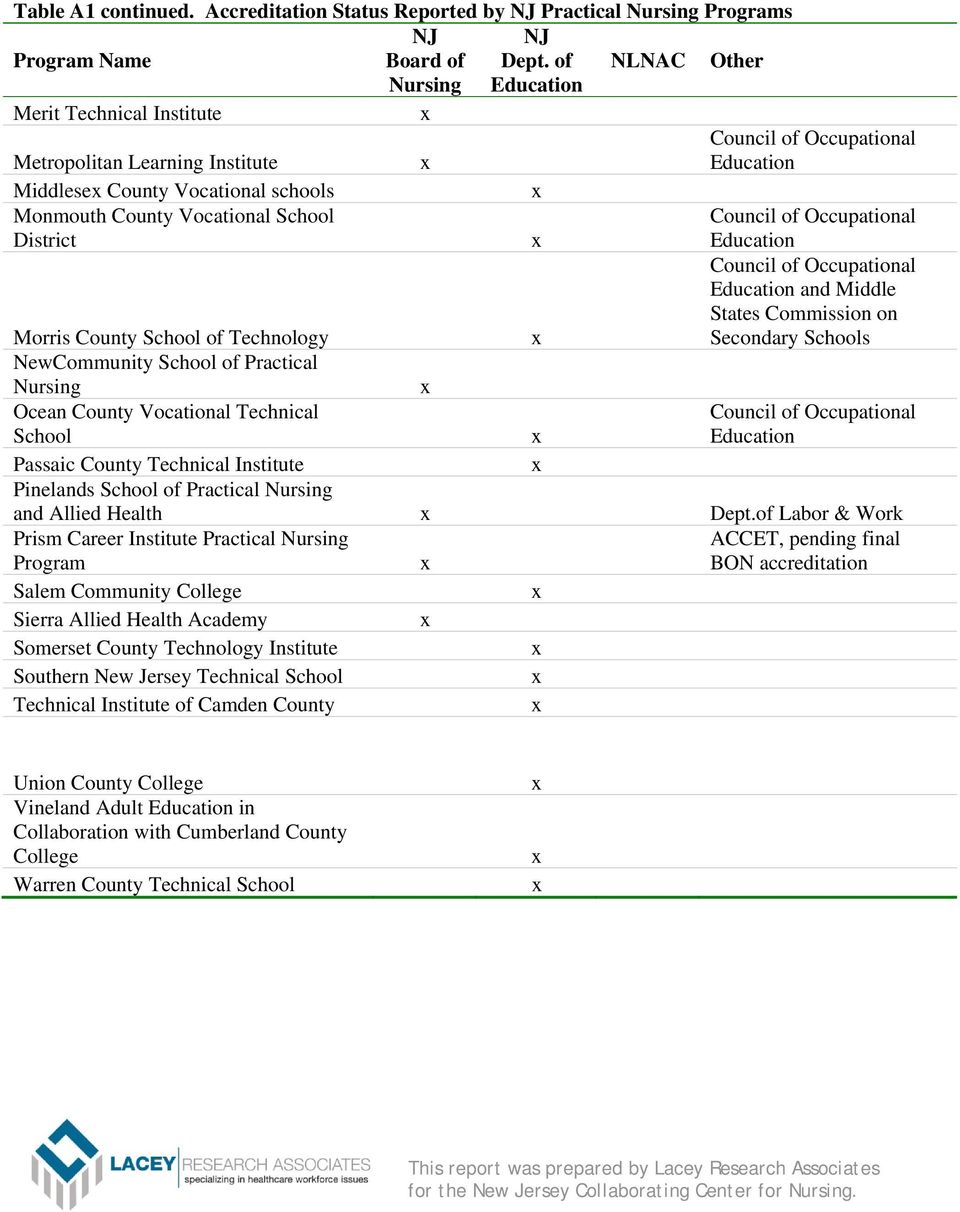
1 New Jersey Practical Nursing Education Programs 2008 Results of the 2008 Survey of New Jersey Nursing Education Programs Introduction New Jersey has both public Practical Nurse Education Programs and others in proprietary of forprofit schools. In October of 2008 an invitation was sent to each practical nursing education program then in operation (a total of 40) to participate in an on-line survey developed by the New Jersey Collaborating Center for Nursing and the New Jersey Board of Nursing. This survey was designed to measure the capacity of the Practical Nursing Schools, with such fields as interest in PN education, student enrollments and characteristics, graduations, and information about faculty resources. The questionnaire was composed and fielded using an Internet-based survey research site. Over several months, all of the practical nursing education (PNE) programs in New Jersey completed the on-line questionnaire. Answers were downloaded into Microsoft Ecel file formats. Data were reviewed and cleaned using both Ecel and SAS (v9.1.3) software. Analyses were conducted using both Ecel and SAS software. Program Structure and Accreditation All but one of the responding PNE programs in New Jersey offered a traditional daytime schedule of classes at the time of the survey. Twenty (50%) of the programs surveyed offered an evening option (three of them structured as an evening and weekend combination), and four (10%) offered weekend programs. None of the PNE programs responding to the survey offered an accelerated or an on-line program option in which all coursework can be completed via the Internet. The Practical Nurse programs in public schools (n = 22) reported being accredited by the New Jersey Department of Education. The majority of these are housed in the vo-tech but require a GED or high school diploma to enter, with a few housed in county colleges, and one in a hospital school. Additionally, one program reported accreditation by the National League for Nursing Accreditation Commission (NLNAC). See Appendi Table 1 for the reported accreditation status of each responding program. Student Applications All of the PNE programs respondents were able to provide information about the number of applications received in 2008, how many of those applications were from qualified candidates ( qualified being defined by each program), how many of those qualified candidates were admitted, and how many ultimately enrolled. Table 1 summarizes this information.
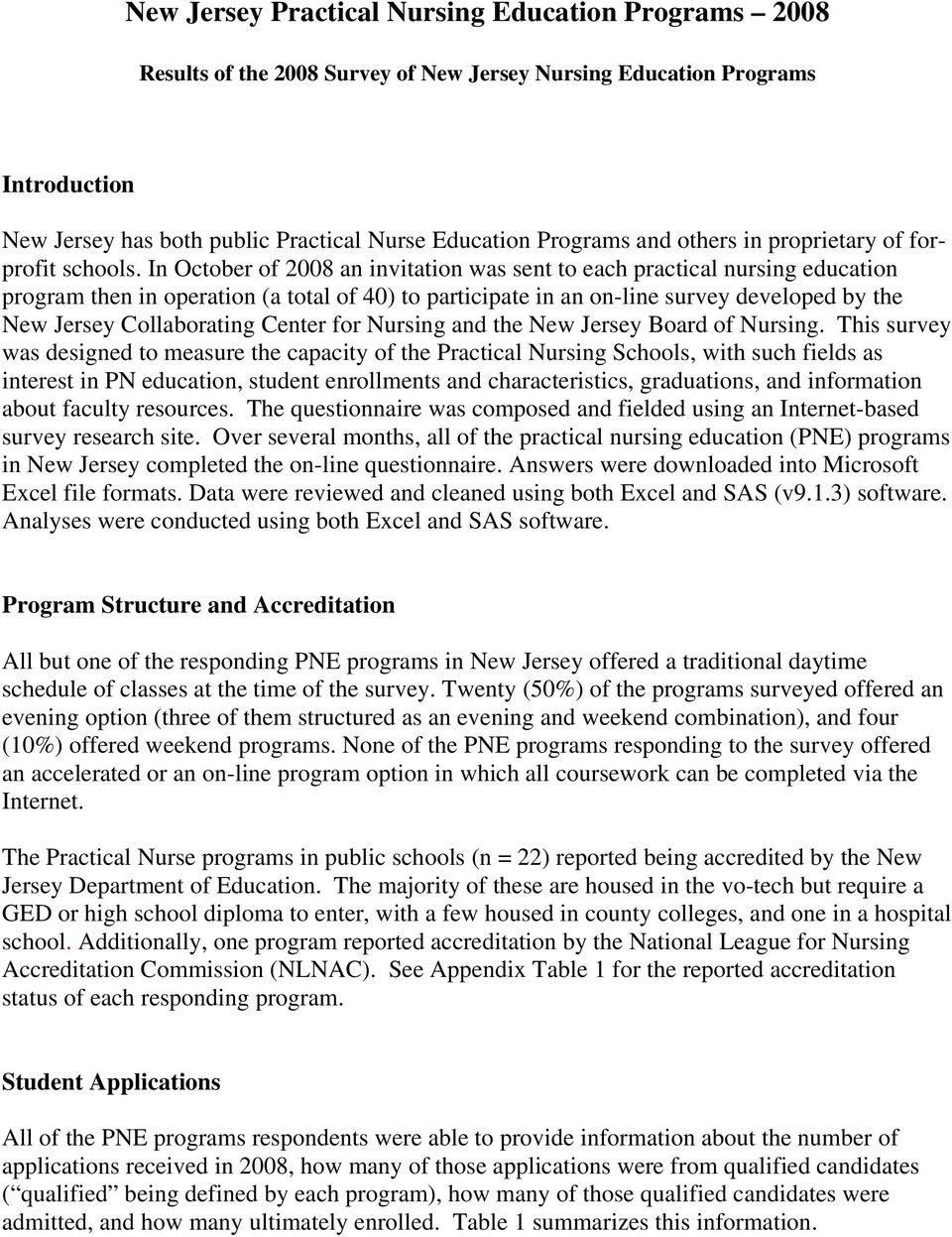
2 A total of 15,049 applications were received by the 40 PNE programs. Applications to individual programs ranged from a low of 37 to a high of 1,500. Although the total number of applications received is quite high, it should be noted that it is likely this figure contains duplicates. Students apply to more than one program in order to increase their odds of being accepted. Of this large applicant pool, only a small portion (2%) was from students who had been previously enrolled and were seeking re-entry into the program. Although many people are interested in a nursing career, not all of them are academically prepared to take on the rigors of the nursing curriculum. Only 6,028 applicants (40%) met the qualifications of the program to which they applied. Of those qualified, 4,119 (68.3%) were accepted. Of those accepted into a program, a total of 3,690 (90%) actually enrolled in classes. This high enrollment rate suggests that there is not a lot of duplication in the applicant pool for PNE programs. Table 1. Applications, Admissions and Enrollment in Practical Nursing Programs Academic Year Counts (n = 40) Total number of applications to the program 15,049 Number of applicants returning to the program after an absence 318 Number of qualified applicants * 6,028 Number of qualified applicants admitted 4,119 Number admitted who actually enrolled 3,690 * Each program determines whether applicants meet the entrance criteria for their program. Most (52.5%) PNE programs did not see a significant change defined as a change greater than 20% - in the number of applications received in the academic year as compared to the previous year. Of those that did see a difference, eight programs (20%) reported a decrease and eleven (27.5%) reported an increase. There was no statistically significant association between program size as measured by the number of applicants that actually enrolled and whether the program reported an increase or decrease in applications. Enrollments Only 35 of the 40 PNE programs were able to report the number of seats available for new enrollees, as some of the schools, particularly the proprietary school, are able to epand their enrollment to meet the demand. However, all programs did report the number of new enrollees in their programs as of October 15, 2008: a total of 1,904. Thirty programs reported the number of new enrollments as of October 15, 2007: in only one case was there a decrease in new enrollments of more than 20% between 2007 and Five programs saw an increase of more than 20% in that time period. On October 15, 2008 a total of 3,517 students were enrolled in New Jersey s practical nursing education programs. The majority (80.6%) were enrolled on a full-time basis. Table 2 reports information about these PNE students in terms of their gender, race and age: 16% were male, 40% were from minority groups, and 20% were over the age of 40.
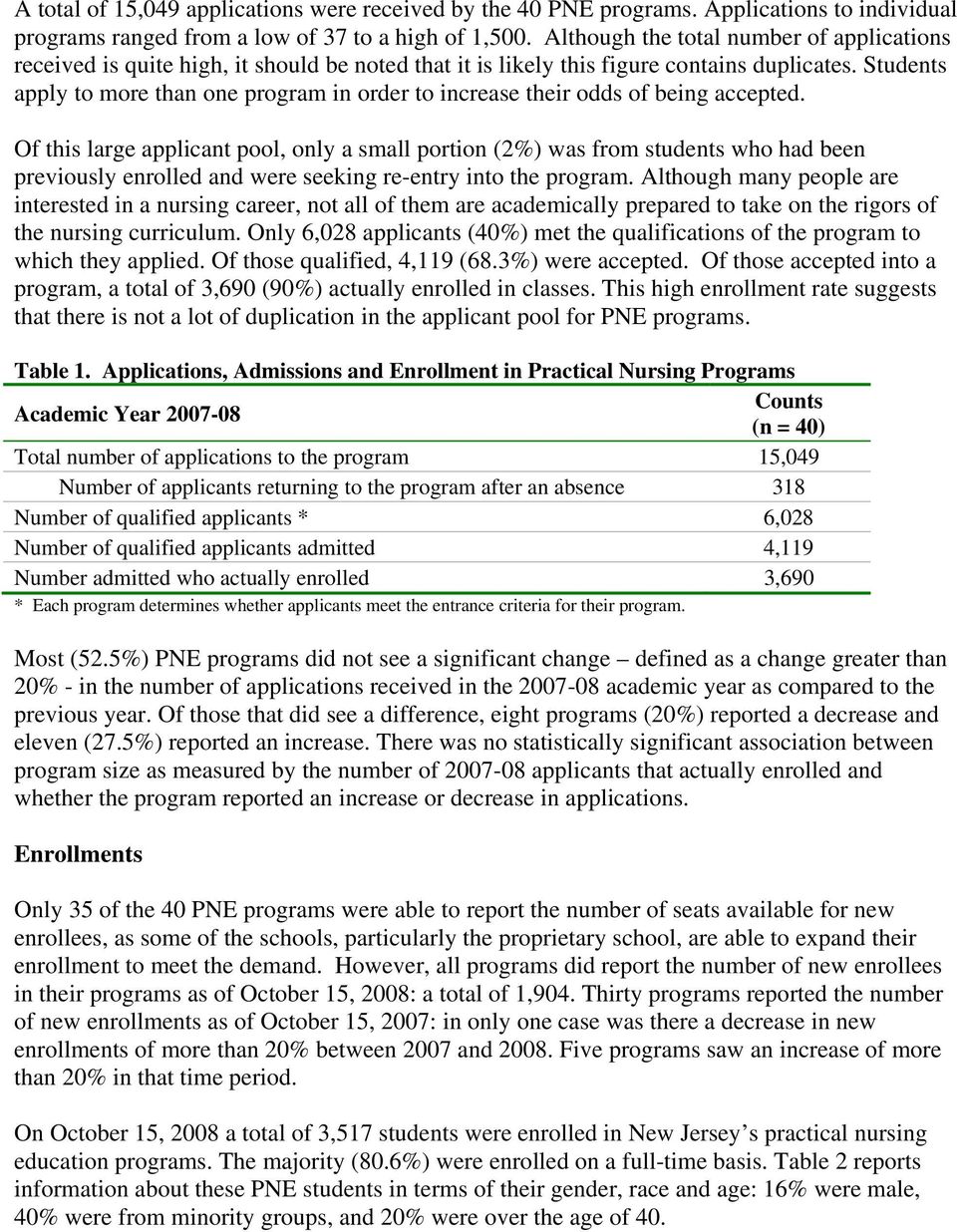
3 Table 2. Practical Nursing Education Students Enrolled on October 15, Demographics Enrolled full-time Enrolled part-time Total enrolled Total students enrolled 2, ,517 Gender: # % # % # % Female 2, , Male Gender not reported Gender Totals 2, , Race White, non-hispanic Black, non-hispanic 1, , Asian / Pacific Islander American Indian / Alaska Native Hispanic, any race More than one race Race unknown Race Totals 2, , Age Groups Under age Age 26 to Age 31 to , Age 41 to Age 51 to Age 61 or older Age unknown * Age Totals 2, , * One PNE program aggregated full-time and part-time students together when reporting student age. In that cases counts were disaggregated by imputing counts for full-time and part-time students based on the proportional distribution of all students applied to the N of all full-time or part-time students. Note: Percentage sums may not equal 100% due to rounding. Graduates Seven of the forty programs (17.5%) reported having no graduates in the academic year (defined as Fall 2007 through Summer 2008). Three of those programs indicated that they had not yet had a graduating class due to the fact that the programs were only recently started. The other four programs reporting zero graduates did not offer an eplanation. Of the 33 PNE programs that reported graduates in the year, those graduates totaled 1,719 students. Table 3 describes these recent PNE graduates in terms of their gender, race and age characteristics: 22% were male, 46% were from minority groups, and 19% were over the age of 40.
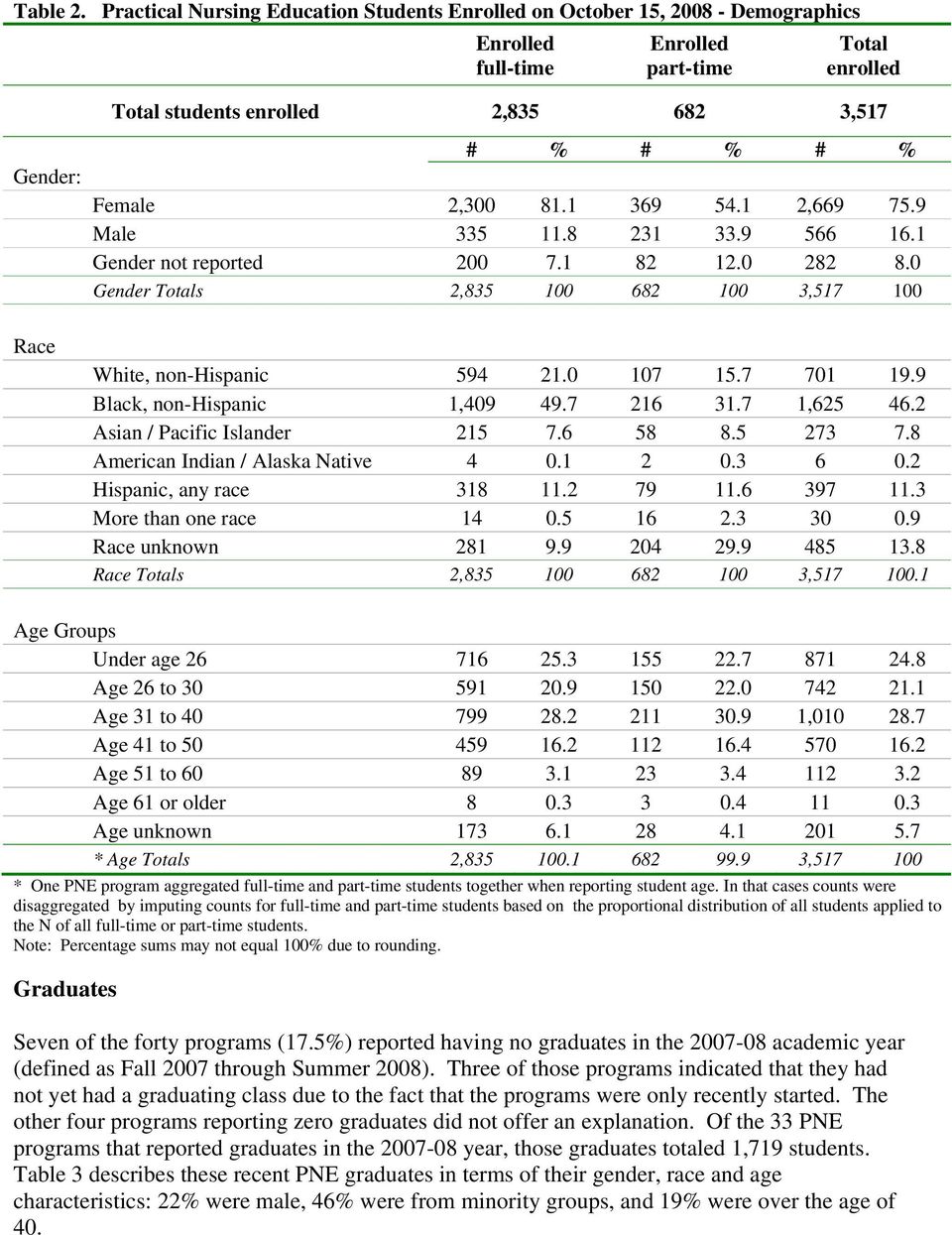
4 Table 3. Practical Nursing Education Graduates in the Academic Year - Demographics Students graduating between Fall, 2007 and Summer, 2008 Total number of graduates in the academic year 1,719 Gender: # % Female 1, Male Gender Totals 1,719 Race White Black Asian / Pacific Islander American Indian / Alaska Native Hispanic, any race More than one race Race unknown Race Totals 1, Age Groups Under age Age 26 to Age 31 to Age 41 to Age 51 to Age 61 or older Age unknown Age Totals 1, Note: Percentage sums may not equal 100% due to rounding. PNE programs were asked a question designed to assess the completion rate for their program in the previous year. The question was: Of the students who enrolled on a full-time basis for the first time between Fall semester, 2007 and Summer session, 2008, what percentage of those students were still in enrolled, had graduated, or had left the program without graduating as of October 15, 2008? The average percentages
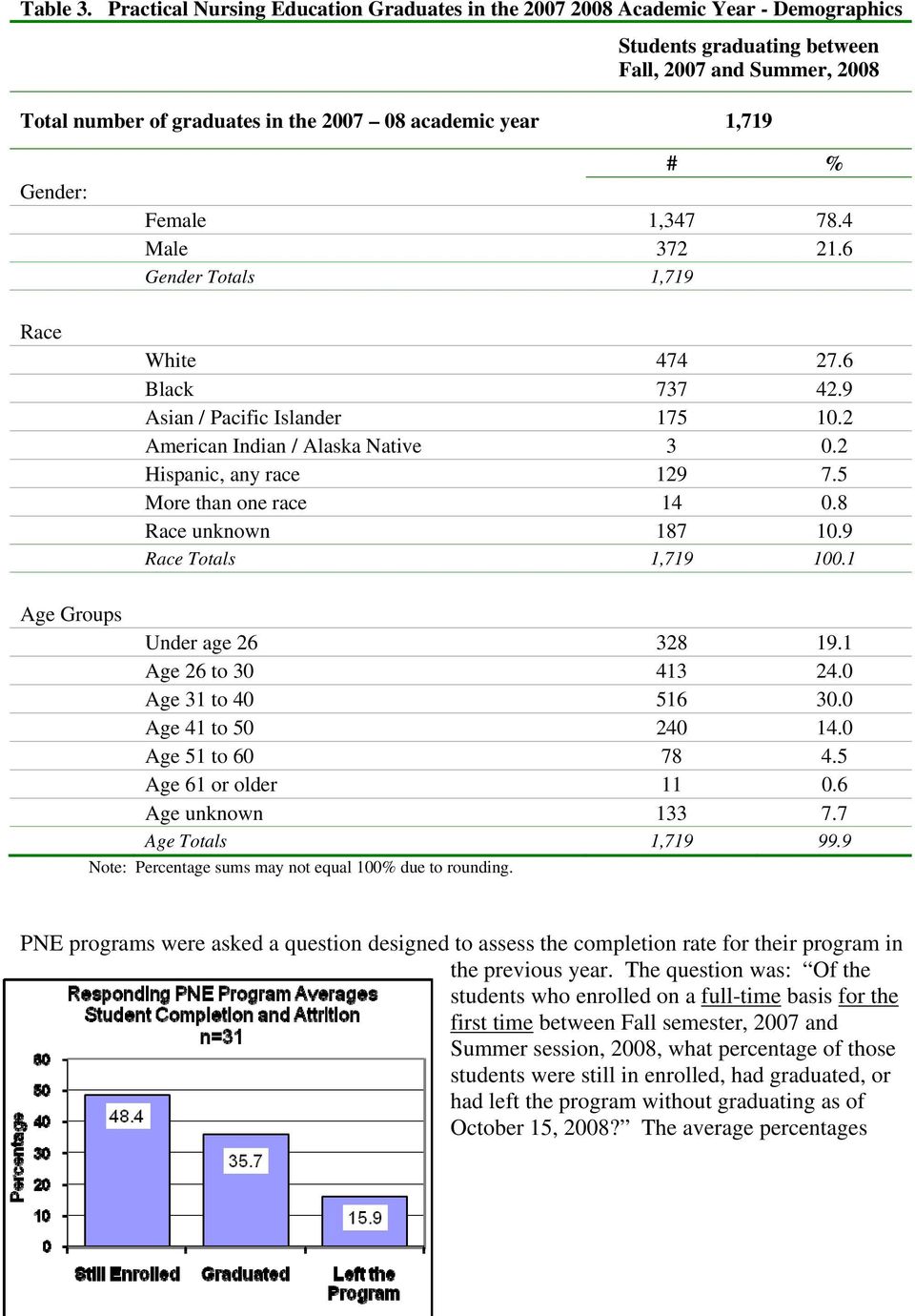
5 computed across the 31 programs that provided usable data are shown in the chart to the left. For programs that have a single entry point in the Fall semester of the academic year and a curriculum that lasts 12 months or less, this question provides a reasonable measure of student attrition and completion. However, the survey did not include a measure of the curriculum length (number of months from start to finish) nor an indicator of the number of entry points into the program and whether entry occurred in the Fall, Spring, or Summer semester. Such information would allow us to determine whether this measure of student attrition and completion is measuring the same thing in every PNE program. Since the generalizability of this question across all programs is unknown, these summary statistics should be used with caution. Nursing Education Faculty Budgeted and Vacant Positions PNE programs in New Jersey were asked to report on the size and characteristics of their full- and part-time faculty members. The chart to the right illustrates that most PNE programs are relatively small with fewer than 10 fulltime equivalents positions (FTEs) in their budget. Altogether there were FTEs budgeted on October 15, 2008 in the 38 PNE programs that provided this information. Thirty-two (80%) of those programs reported no vacant FTEs on that date. Si programs had a total of 20 FTE vacancies on that date. Across the 38 programs that provided this information on budgeted and vacant FTE positions, 7.1% of all budgeted positions were vacant on October 15, 2008 a relatively high position vacancy rate. Table 4. Faculty Positions in PNE Programs as of October 15, 2008 Sums and Rates Budgeted FTEs Vacant FTEs 20.0 Vacancy rate for FTEs 7.1% Part-Time faculty employed 248 Full-Time faculty employed 169 Full-Time faculty vacancies 12 Total full-time faculty head count when fully staffed 181 Vacancy rate for full-time faculty based on head counts 6.6% The PNE programs that responded to the survey rely heavily on adjunct and part-time faculty to teach their students. They reported a total head count of 169 full-time faculty employed on

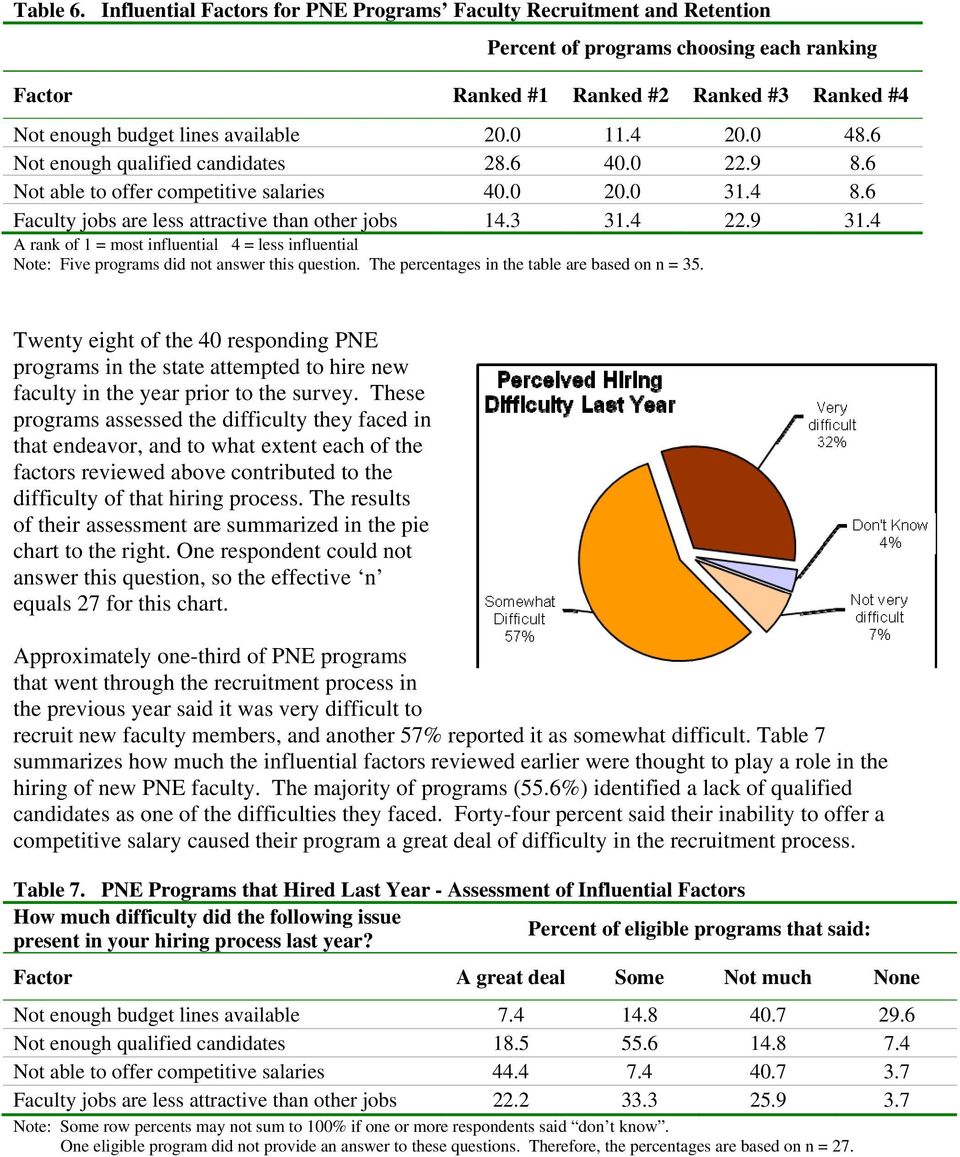
6 October 15, 2008 and a total head count of 248 adjunct or part-time faculty. They also reported a total of 12 full-time positions vacant on that date for an overall position vacancy rate of 6.6% for full-time positions in these programs (see Table 4). This difference in position vacancy rates for budgeted FTEs versus full-time positions shows that the majority of FTE vacancies were being allocated to part-time positions, which is consistent with the heavy reliance on part-time faculty. Of the si PNE programs that reported having a vacant full-time position, two of them had 1 position open, two of them had 2 positions open, and two of them had three full-time vacancies on October 15, Five of the si programs reported the type of faculty person they were seeking to fill those open positions. Table 5 summarizes those characteristics. Table 5. Full Time Faculty Being Sought by PNE Programs on October 15, 2008 Degree type desired Specialties sought BSN Pediatrics / OBGyn / Mental Health BSN Medical / Surgical BSN Generalist (2) BSN no specialty noted BSN / MSN preferred no specialty noted Faculty Recruitment, Retention and Retirements Nursing education programs were asked to rank order four factors that in general - can influence faculty recruitment and retention. A rank of 1 indicates the most influential factor for that program, while a rank of 4 indicates less influence. The percentage of PNE programs ranking each factor is presented in Table 6. Five of the forty responding programs did not complete this question. The results suggest that PNE programs differ broadly in the factors that impact their ability to add and/or recruit new faculty members. The strongest finding is that 40% of all responding PNE programs said that the most influential factor was their inability to offer competitive salaries to RNs qualified to teach. Other factors identified by our respondents include the imbalance between the workload demanded by a faculty position and the available salary; the fact that school location can make it difficult to attract qualified candidates for evening programs; and another blamed the problem on a lack of dedication, or poor work ethic among nursing educators. One program cited a contract requirement in their school that all faculty have teaching certificates, but also noted that the state is no longer issuing new teaching certificates to teachers of adult programs.

7 Table 6. Influential Factors for PNE Programs Faculty Recruitment and Retention Percent of programs choosing each ranking Factor Ranked #1 Ranked #2 Ranked #3 Ranked #4 Not enough budget lines available Not enough qualified candidates Not able to offer competitive salaries Faculty jobs are less attractive than other jobs A rank of 1 = most influential 4 = less influential Note: Five programs did not answer this question. The percentages in the table are based on n = 35. Twenty eight of the 40 responding PNE programs in the state attempted to hire new faculty in the year prior to the survey. These programs assessed the difficulty they faced in that endeavor, and to what etent each of the factors reviewed above contributed to the difficulty of that hiring process. The results of their assessment are summarized in the pie chart to the right. One respondent could not answer this question, so the effective n equals 27 for this chart. Approimately one-third of PNE programs that went through the recruitment process in the previous year said it was very difficult to recruit new faculty members, and another 57% reported it as somewhat difficult. Table 7 summarizes how much the influential factors reviewed earlier were thought to play a role in the hiring of new PNE faculty. The majority of programs (55.6%) identified a lack of qualified candidates as one of the difficulties they faced. Forty-four percent said their inability to offer a competitive salary caused their program a great deal of difficulty in the recruitment process. Table 7. PNE Programs that Hired Last Year - Assessment of Influential Factors How much difficulty did the following issue Percent of eligible programs that said: present in your hiring process last year? Factor A great deal Some Not much None Not enough budget lines available Not enough qualified candidates Not able to offer competitive salaries Faculty jobs are less attractive than other jobs Note: Some row percents may not sum to 100% if one or more respondents said don t know. One eligible program did not provide an answer to these questions. Therefore, the percentages are based on n = 27.
8 PNE program educators were also asked to estimate the number of faculty retirements epected in the near future (see Table 8). At the time of the survey, si programs epected at least one faculty member to retire by the Fall of Between 2009 and 2011, 11 programs epect to lose a total of 17 faculty to retirement. Between 2011 and 2013, 13 PNE programs epect one or two of their current faculty to retire, for an overall loss of 20 full-time faculty. Based on the total number of epected retirements reported (two of our forty responding programs did not complete this question) approimately 4% of the PNE faculty pool employed in October of 2008 will retire by the Fall of Another 10% are epected to leave by the Fall of 2011, and an additional 12% by When summed together, a total of 66 full-time faculty members are epected to be lost over the net 5 years 39.1% of the current full-time faculty pool in PNE programs. This is proportionately a much greater loss than the retirement losses epected in New Jersey RN education programs. It is also more than would normally be epected, based on the age profile of full time faculty presented in Table 10. Table 8. Number and Percent of Full-Time Faculty Epected to Retire from PNE Programs Number Percent of total epected to 2008 FT faculty retire epected to retire Based on your current full-time faculty members, how many of them do you epect will retire from nursing education within: 1 year 6 3.6% 3 years % 5 years % Note: The percentages in this table were calculated using a denominator of 169 full-time faculty employed in PNE programs as of October 15, Faculty Demographics Nursing education programs reported the race and ethnicity characteristics of the faculty members employed on October 15, 2008 by their full or part-time employment status. There are slight differences in the distribution of the faculty across racial and ethnic categories depending on whether the faculty is full-time or part-time. The summary of that information for PNE programs is presented in Table 9. The age characteristics of PNE program faculty are also summarized in Table 9. Part-time faculty in New Jersey s PNE programs tend to be slightly younger as a group than is true of the full-time faculty. Note, however, that about 12% of both part-time and full-time faculty employed in the responding PNE programs were age 60 or older as of October 15, There are considerable missing data in this table and the reliability may be questionable. Table 9. Race, Ethnicity and Age Characteristics of PNE Faculty Employed on October 15, 2008 Racial and ethnicity categories Full time faculty Part time faculty All PNE Faculty # % # % # % Faculty Race White, non-hispanic

9 Black, non-hispanic Asian or Pacific Islander American Indian or Alaska Native Hispanic, any race More than one race Race unknown / not reported Race Totals Faculty Age Age Age Age Age Age Age Age 70 or older Age unknown / not reported Age Totals Note: Percentage columns may not sum to 100% due to rounding. Two programs did not provide race or age information. Therefore, counts and percentages are based on an n of 38. One program combined their full-time and part-time faculty together when reporting age category counts. Counts were disaggregated for this program on the basis of the age distribution for the entire faculty by multiplying each category percentage against the count of full or part time faculty in that program.

10 PNE Program Appendi Table A1. Accreditation Status Reported by New Jersey Practical Nursing Programs Program Name NJ Board of Nursing NJ Dept. of Education NLNAC Other America Health Care, Inc. Atlantic County Institute of Technology AVTECH Institute of Technology Best care Training institute Burlington County Institute of Technology Camden City Board of Education Camden County College Cape May County Technical School District Center for Advance Training and Studies Center for Allied Health and Nursing Education Cumberland County Technical Center Dover Business College Eastwick College Esse County College Esse County Vocational Technical School HoHoKus Hackensack School of Business and Medical Sciences Holy Name Hospital School of Nursing Hudson County Community College Lincoln Technical Institute Lincoln Technical Institute Lincoln Technical Institute Mercer County Technical Schools Health Careers Center Table continued on net page. Council of Occupational Education and Middle States Commission on Secondary Schools New Jersey Commission on Higher Education and the Accrediting Council for Independent Colleges and Schools (ACICS) Accrediting Council for Independent Colleges and Schools (ACICS) Accrediting Council for Independent Colleges and Schools (ACICS) Accrediting Council for Independent Colleges and Schools (ACICS)

11 Table A1 continued. Accreditation Status Reported by NJ Practical Nursing Programs Program Name NJ Board of NJ Dept. of NLNAC Other Nursing Education Merit Technical Institute Metropolitan Learning Institute Council of Occupational Education Middlese County Vocational schools Monmouth County Vocational School District Council of Occupational Education Morris County School of Technology Council of Occupational Education and Middle States Commission on Secondary Schools NewCommunity School of Practical Nursing Ocean County Vocational Technical School Council of Occupational Education Passaic County Technical Institute Pinelands School of Practical Nursing and Allied Health Dept.of Labor & Work Prism Career Institute Practical Nursing Program ACCET, pending final BON accreditation Salem Community College Sierra Allied Health Academy Somerset County Technology Institute Southern New Jersey Technical School Technical Institute of Camden County Union County College Vineland Adult Education in Collaboration with Cumberland County College Warren County Technical School This report was prepared by Lacey Research Associates for the New Jersey Collaborating Center for Nursing.
ACADEMIC YEAR 2012-2013. Prepared for the New Jersey State Board of Nursing
 ACADEMIC YEAR 2012-2013 Prepared for the New Jersey State Board of Nursing November 5, 2014 NEW JERSEY ANNUAL PRACTICAL NURSING PROGRAMS EDUCATIONAL CAPACITY REPORT ACADMIC YEAR 2012 2013 Data Summary
Survey of Nursing Education Programs: 2005 2006 School Year
 Survey of Nursing Education Programs: EXECUTIVE SUMMARY In the fall of 2006, the Michigan Center for Nursing conducted a survey of nursing education programs in Michigan to collect information on the types
Survey of Nursing Education Programs: 2005 2006 School Year
 Survey of Nursing Education Programs: 2005 2006 School Year EXECUTIVE SUMMARY In the fall of 2006, the Michigan Center for Nursing conducted a survey of nursing education programs in Michigan to collect
Survey of Nursing Education Programs: 2009 2010 School Year
 Survey of Nursing Education Programs: 2009 2010 School Year Prepared for Michigan Center for Nursing Okemos, Michigan Prepared by Public Sector Consultants Lansing, Michigan www.pscinc.com Survey of Nursing
A Profile of Virginia Nursing Education Programs
 A Profile of Virginia Nursing Education Programs Results of the 2009 Survey of Virginia Nursing Education Programs July, 2010 Prepared for the Virginia Department of Health Professions Healthcare Workforce
National Nursing Workforce Minimum Datasets: Education. Rationale for Selection and Measurement of Minimum Dataset Items
 National Nursing Workforce Minimum Datasets: Education Rationale for Selection and Measurement of Minimum Dataset Items Prior to development of this draft, the National Forum of State Nursing Workforce
Survey of Publicly Funded, Accredited Nursing Colleges in New Mexico
 Survey of Publicly Funded, Accredited Nursing Colleges in New Mexico March 2014 Written By: Shanna Schultz, Program Coordinator for the Academic Progression in Nursing Grant 0 Contents Executive Summary...
Nursing Supply and Demand Study Acute Care
 2014 Nursing Supply and Demand Study Acute Care Greater Cincinnati Health Council 2100 Sherman Avenue, Suite 100 Cincinnati, OH 45212-2775 Phone: (513) 531-0200 Table of Contents I. Introduction and Executive
Virginia Nursing Education Programs: 2011-2012 Academic Year
 Virginia Nursing Education Programs: 2011-2012 Academic Year August 2013 Virginia Department of Health Professions Healthcare Workforce Data Center Perimeter Center 9960 Mayland Drive, Suite 300 Richmond,
NEW JERSEY NURSING EDUCATION PROGRAMS: 2012 REPORT
 New Jersey Collaborating Center for Nursing NEW JERSEY NURSING EDUCATION PROGRAMS: 2012 REPORT Prepared for the New Jersey Board of Nursing October 4, 2013 110 Paterson Street New Brunswick, NJ 08901 848-932-7600
How To Understand And Understand The Health Care Needs In North Dakota
 North Dakota Nursing Needs Study 2011 Licensed Nurse Supply Analysis January, 2012 Patricia L. Moulton, Ph.D. North Dakota Center for Nursing Research Publication #3 Funding for this project was provided
Demographic Profile of Wichita Unemployment Insurance Beneficiaries Q3 2015
 Demographic Profile of Wichita Unemployment Insurance Beneficiaries Q3 2015 The Bureau of Labor Statistics defines an unemployed person as one 16 years and older having no employment and having made specific
Demographic Profile of Wichita Unemployment Insurance Beneficiaries Q2 2014
 Demographic Profile of Wichita Unemployment Insurance Beneficiaries Q2 2014 The Bureau of Labor Statistics defines an unemployed person as one 16 years and older having no employment and having made specific
REPORT FALL 2003 SURVEY OF MAINE NURSING EDUCATION PROGRAMS
 REPORT FALL 003 SURVEY OF MAINE NURSING EDUCATION PROGRAMS Prepared by Jane Kirschling, Dean and Professor of Nursing College of Nursing and Health Professions University of Southern Maine [email protected]
New Jersey Kids Count 2014 The State of Our Children
 New Jersey Kids Count 2014 The State of Our Children April 24, 2014 Advocates for Children of New Jersey 35 Halsey Street Newark, NJ 07102 973.643.3876 Advocates for Children of New Jersey 2014 What is
Nursing Education Programs 2013-2014 Annual School Report
 STATE OF WASHINGTON DEPARTMENT OF HEALTH Nursing Education Programs 2013-2014 Annual School Report Statistical Summary and Trends Analysis Nursing Care Quality Assurance Commission DOH 669-269 (Revised
Cerritos College Associate Degree Nursing Program
 Cerritos College Associate Degree Nursing Program The California Board of Registered Nursing 2010-2011 Annual School Report reflected that 61% of nursing programs in California are Associate Degree programs.
North Carolina Trends in Nursing Education: 2010 2014
 North Carolina Trends in Nursing Education: 2010 2014 June 2015 This report was prepared by the North Carolina Board of Nursing North Carolina Trends in Nursing Education: 2010-2014 June 2015 Executive
MCC Academic Program Review Report
 The mission of Mohave Community College is to be a learning-centered college, serving all constituencies, inspiring excellence through innovative learning methodologies and empowering students to succeed.
Santa Ana College, School of Continuing Education, Centennial Education Center. Data collection reports. Prepared by: Jarek Janio, CEC
 Santa Ana College, School of Continuing Education, Centennial Education Center Data collection reports Prepared by: Jarek Janio, CEC Friday, December 20 th, 2013 Glossary of terms and abbreviations: ABE
Florida Licensed Practical Nurse Education: Academic Year 2012-2013
 Florida Licensed Practical Nurse Education: Academic Year 2012-2013 This report presents the key findings regarding the Licensed Practice Nursing education system in Florida. This report details information
LICENSED SOCIAL WORKERS IN THE UNITED STATES, 2004. Chapter 2 of 4. Demographics
 LICENSED SOCIAL WORKERS IN THE UNITED STATES, 2004 Chapter 2 of 4 Demographics Prepared by Center for Health Workforce Studies School of Public Health, University at Albany Rensselaer, NY and NASW Center
REPORT FALL 2004 SURVEY OF MAINE NURSING EDUCATION PROGRAMS
 REPORT FALL 2004 SURVEY OF MAINE NURSING EDUCATION PROGRAMS Prepared by Jane Kirschling, Dean and Professor of Nursing College of Nursing and Health Professions University of Southern Maine [email protected]
Intent to Plan for Master of Science in Nursing
 Shepherd University Board of Governors October 12, 2006 Agenda Item No. 6 Intent to Plan for Master of Science in Nursing Board of Governors approval is sought to plan a Master of Science in Nursing (MSN)
Nursing Supply and Demand Study 2008
 Nursing Supply and Demand Study 2008 2100 Sherman Avenue, Suite 100 Cincinnati, OH 45212-2775 Phone: (513) 531-0200 2 Table of Contents I. Introduction... 3 II. Hospital Survey (Demand)... 4 A. Registered
NJ Elder Economic Security Index 2012 Update
 NJ Elder Economic Security Index 2012 Update NJ Foundation for Aging Grace Egan, Executive Director [email protected] Melissa Chalker, Program Manager [email protected] 609-421-0206
Florida s Advanced Registered Nurse Practitioner Supply: 2014-2015 Workforce Characteristics and Trends
 Florida s Advanced Registered Nurse Practitioner Supply: 2014-2015 Workforce Characteristics and Trends Visit our site at: www.flcenterfornursing.org TABLE OF CONTENTS Key Findings...3 Introduction.4 Results
COMMUNITY COLLEGE COMPRESSED CALENDARS: RESULTS OF A STUDENT SURVEY AND A FACULTY SURVEY 1
 COMMUNITY COLLEGE COMPRESSED CALENDARS: RESULTS OF A STUDENT SURVEY AND A FACULTY SURVEY 1 Michael Carley 2 Porterville College Abstract Many community colleges are considering changes in their traditional
The College of Science & Mathematics & Division of Global Learning & Partnerships Department of Nursing Application 2015-2016
 The College of Science & Mathematics & Division of Global Learning & Partnerships Department of Nursing Application 2015-2016 Who should use this application form? This application is intended for the
INSTITUTIONAL REPORT FOR CONTINUING ACCREDITATION: CONTINUOUS IMPROVEMENT PATHWAY. Name of Institution Dates/Year of the Onsite Visit
 INSTITUTIONAL REPORT FOR CONTINUING ACCREDITATION: CONTINUOUS IMPROVEMENT PATHWAY Name of Institution Dates/Year of the Onsite Visit Insert Name(s) of Unit Head/Author(s) NCATE IR Template for Continuing
Nursing Education Programs in Pennsylvania Data from 2012 Nursing Education Program Annual Reports
 Nursing Education Programs in Pennsylvania Data from 2012 Nursing Education Program Annual Reports Bureau of Health Planning Division of Plan Development Volume 11, January 2014 TABLE OF CONTENTS List
2010 NLN NURSE EDUCATOR SHORTAGE FACT SHEET
 2010 NLN NURSE EDUCATOR SHORTAGE FACT SHEET The National League for Nursing and the Carnegie Foundation Preparation for the Professions Program conducted a study of the nation's estimated 32,000 nurse
2015 TRENDS IN THE SUPPLY OF ACCOUNTING GRADUATES AND THE DEMAND FOR PUBLIC ACCOUNTING RECRUITS
 2015 TRENDS IN THE SUPPLY OF ACCOUNTING GRADUATES AND THE DEMAND FOR PUBLIC ACCOUNTING RECRUITS By AICPA Students, Academics & Inclusion CX Act Copyright 2015 American Institute of CPAs. All right reserved.
Topic: Nursing Education Programs North Texas Region
 Number of Programs Healthcare Workforce Reports Topic: Nursing Education Programs North Texas Region Background This report was compiled with information from the Texas Center for Nursing Workforce Studies
were weighted to correct for variance in the likelihood of selection for a given case and to balance the sample to
 The following data come from two surveys. The first dataset comes from a representative survey of 656 human resources professionals (employers) from the Philadelphia, Los Angeles, Detroit and El Paso-Las
UNION COUNTY COLLEGE ACADEMIC PROGRAM REVIEW. Criminal Justice Associate in Arts Degree
 UNION COUNTY COLLEGE ACADEMIC PROGRAM REVIEW I. Program Objectives Criminal Justice Associate in Arts Degree The Criminal Justice Program is designed to develop law enforcement professionals, other criminal
SUMMARY REPORT ACADEMIC YEAR 2004-2005 STATEWIDE SURVEY OF NURSING PROGRAMS
 2915 High School Road Indianapolis, IN 46224 SUMMARY REPORT ACADEMIC YEAR 2004-2005 STATEWIDE SURVEY OF NURSING PROGRAMS Compiled fall 2005 Introduction The Indiana Nursing Workforce Development Coalition
2015 TRENDS IN THE SUPPLY OF ACCOUNTING GRADUATES AND THE DEMAND FOR PUBLIC ACCOUNTING RECRUITS
 2015 TRENDS IN THE SUPPLY OF ACCOUNTING GRADUATES AND THE DEMAND FOR PUBLIC ACCOUNTING RECRUITS By AICPA Students, Academics & Inclusion CX Act Copyright 2015 American Institute of. All right reserved.
New Jersey Substance Abuse Monitoring System (NJ-SAMS) Substance Abuse Treatment Admissions 1/1/2013-12/31/2013 Resident of Cape May County
 New Jersey Substance Abuse Monitoring System (NJ-SAMS) Substance Abuse Treatment Admissions 1/1/2013-12/31/2013 Resident of Cape May County Primary Drug Highest School Grade Completed Alcohol 733 31% Completed
WHITTIER COLLEGE. Application for Admission Teacher Credential Program. Department of Education & Child Development
 WHITTIER COLLEGE Department of Education & Child Development Application for Admission Teacher Credential Program 13406 E. Philadelphia Street P.O. Box 634 Whittier, CA 90608 562-907- 4248 Fax: 562-464-
RESULTS FROM HIGH SCHOOL EXIT SURVEYS 5/6/2015 SYSTEM PLANNING AND PERFORMANCE PORTLAND PUBLIC SCHOOLS HIGHLIGHTS
 RESULTS FROM HIGH SCHOOL EXIT SURVEYS 5/6/2015 HIGHLIGHTS The majority of PPS high school seniors plan to graduate and to enroll in some type of higher education. Historically underserved racial groups
GRADUATE AND FIRST-PROFESSIONAL STUDENTS
 NATIONAL CENTER FOR EDUCATION STATISTICS GRADUATE AND FIRST-PROFESSIONAL STUDENTS NATIONAL POSTSECONDARY STUDENT AID STUDY 1996 U.S. Department of Education Office of Educational Research and Improvement
UNSOM Health Policy Report
 Registered Nurse Workforce in Findings from the 2013 National Workforce Survey of Registered Nurses May 2014 Tabor Griswold, PhD, Laima Etchegoyhen, MPH, and John Packham, PhD Overview Registered Nurse
EXECUTIVE SUMMARY. Findings from the Annual Survey of Schools of Nursing Academic Year 2009-2010
 EXECUTIVE SUMMARY Findings from the Annual Survey of Schools of Nursing Academic Year 2009-2010 NLN Data Show Both Progress and Challenges in Meeting IOM Objectives This executive summary describes findings
South Carolina Nurse Supply and Demand Models 2008 2028 Technical Report
 South Carolina Nurse Supply and Demand Models 2008 2028 Technical Report Overview This document provides detailed information on the projection models used to estimate the supply of and demand for Registered
WHO LEAVES TEACHING AND WHERE DO THEY GO? Washington State Teachers
 www.erdc.wa.gov ERDC Research Brief 2011-01 Longitudinal Studies January 2011 WHO LEAVES TEACHING AND WHERE DO THEY GO? Washington State Teachers The Washington State Education Research & Data Center (ERDC)
Application Trends Survey
 The premier provider of market intelligence Application Trends Survey SURVEY REPORT About This Study The Application Trends Survey is a product of the Graduate Management Admission Council (GMAC ), a global
Wisconsin Nursing Education and Nurse Faculty: 2010 Survey Results. Susan Dean-Baar, PhD, RN, FAAN Ann Cook, PhD, RN Christine Laurent, MSN, RNC
 Wisconsin Nursing Education and Nurse Faculty: 2010 Survey Results Susan Dean-Baar, PhD, RN, FAAN Ann Cook, PhD, RN Christine Laurent, MSN, RNC Wisconsin Center for Nursing http://www.wicenterfornursing.org
Report on the SREB Council on Collegiate Education for Nursing South Carolina School of Nursing Data
 Office of Health Care Workforce Research for Nursing Report on the SREB Council on Collegiate Education for Nursing South Carolina School of Nursing Data Report Prepared By: Dr. Peggy O. Hewlett, Director
State of New Jersey 2012-13
 1 OVERVIEW GRADE SPAN 912 395262 SCOTCH PLAINS, NEW JERSEY 776 1. This school's academic performance is very high when compared to schools across the state. Additionally, its academic performance is very
COUNTY COLLEGE OF MORRIS WEEKEND NURSING PROGRAM. Summary of Need for the Weekend Nursing Program at CCM:
 COUNTY COLLEGE OF MORRIS WEEKEND NURSING PROGRAM Summary of Need for the Weekend Nursing Program at CCM: Severe shortages predicted in nursing and allied health fields are not a local or a shortterm concern.
Florida Pre-Licensure Registered Nurse Education: Academic Year 2012-2013
 The information below represents the key findings regarding the pre-licensure RN (Associate Degree in Nursing, ADN, and Bachelor of Science Degree in Nursing, BSN) education system in Florida. This report
NURSES NEEDED SHORT-TERM RELIEF, ONGOING SHORTAGE. Results from the 2010 Nursing Workforce Survey
 NURSES NEEDED SHORT-TERM RELIEF, ONGOING SHORTAGE Results from the 2010 Nursing Workforce Survey JUNE 2010 IN COLLABORATION WITH WNYHA Western New York Healthcare Association Demand for nurses will continue