
Life Sciences. Study Guide. Grade
|
|
|
- Lenard Phillips
- 10 years ago
- Views:
Transcription
1 Life Sciences Study Guide Grade 12

2

3 Life Sciences Study Guide Grade 12
4 This content may not be sold or used for commercial purposes. Curriculum and Assessment Policy Statement (CAPS) Mind the Gap Grade 12 Study Guide Life Sciences ISBN This publication has a Creative Commons Attribution NonCommercial Sharealike license. You can use, modify, upload, download, and share content, but you must acknowledge the Department of Basic Education, the authors and contributors. If you make any changes to the content you must send the changes to the Department of Basic Education. This content may not be sold or used for commercial purposes. For more information about the terms of the license please see: Copyright 222 Struben Street, Pretoria, South Africa Contact person: Dr Patricia Watson [email protected] Tel: (012) Call Centre: The first edition published in 2012 Revised National Curriculum Statement (RNCS) Mind the Gap Grade 12 Study Guide Life Sciences: ISBN Second edition published in 2014 Curriculum and Assessment Policy Statement (CAPS) Mind the Gap Grade 12 Study Guide Life Sciences : ISBN Mind the Gap team Series managing editor: Dr Patricia Watson Production co-ordinators for CAPS edition: Lisa Treffry-Goatley and Radha Pillay Authors: Alfie Bouwer, Sivalingam Chetty, Marlena Ford, Jean Goliath, Gayle Lombard, Nontobeko Mjali, Gonasagaren Pillay, Ronel Pretorius, Susan Wiese Expert readers: Esther Makhanywa, Kanthan Naidoo, Christina Nono Editors: Julia Grey, Herbert Opland Proofreader: Jenny de Wet Designers: Alicia Arntzen, Philisiwe Nkosi, Michele Dean, Nomalizo Ngwenya Study skills: Margarita Karnasopoulos Illustrators: Michele Dean, Kenneth Kunene, Vusi Malindi, Bié Venter Cover illustration: Alastair Findlay Onsite writers workshop support: Wayne Cussons

5 Ministerial foreword The Department of Basic Education has pleasure in releasing the second edition of Mind the Gap study guides for Grade 12 learners. These study guides continue the innovative and committed attempt by the Department of Basic Education to improve the academic performance of Grade 12 candidates in the National Senior Certificate (NSC) examination. The study guides have been written by subject expert teams comprised of teachers, examiners, moderators, subject advisors and subject co-ordinators. Research started in 2012 shows that the Mind the Gap series has, without doubt, had a positive impact in improving grades. It is my fervent wish that the Mind the Gap study guides take us all closer towards ensuring that no learner is left behind, especially as we move forward in our celebration of 20 years of democracy. The second edition of Mind the Gap is aligned to the 2014 Curriculum and Assessment Policy Statement (CAPS). This means that the writers have considered the National Policy pertaining to the programme, promotion requirements and protocol for assessment of the National Curriculum Statement for Grade 12 in The Mind the Gap CAPS study guides take their brief in part from the 2013 National Diagnostic report on learner performance and draws on the 2014 Grade 12 Examination Guidelines. Each of the Mind the Gap study guides provides explanations of key terminology, simple explanations and examples of the types of questions that learners can expect to be asked in an exam. M a r k i n g m e m o r a n d a are included to assist learners in building their understanding. Learners are also referred to specific questions in past national exam papers and examination memos that are available on the Department s website The CAPS edition include Accounting, Economics, Geography, Life Sciences, Mathematics, Mathematical Literacy and Physical Sciences. The series is produced in both English and Afrikaans. There are also nine English First Additional Language study guides. They include EFAL Paper 1 (Language); EFAL Paper 3 (Writing); and a study guide for each of the Grade 12 prescribed literature set works. The study guides have been designed to assist those learners who have been underperforming due to a lack of exposure to the content requirements of the curriculum and aims to mind-the-gap between failing and passing, by bridging the gap in learners understanding of commonly tested concepts so candidates can pass. All that is now required is for our Grade 12 learners to put in the hours preparing for the examinations. Learners make us proud study hard. We wish each and every one of you good luck for your Grade 12 examinations. Matsie Angelina Motshekga, MP Minister of Basic Education Matsie Angelina Motshekga, MP Minister of Basic Education May 2014
6

7 Table of contents Dear Grade 12 learner... vii How to use this study guide... viii Top 10 study tips... ix Study skills to boost your learning...x On the day of the exam... xiii Question words to help you answer questions...xiv Learner s checklist...xv Chapter 1: Nucleic acids The structure of DNA and RNA Differences between DNA and RNA DNA replication and its significance DNA profiling Protein synthesis...5 Chapter 2: Meiosis What is meiosis? The process of meiosis in animal cells First meiotic division Second meiotic division The significance of meiosis Abnormal meiosis Differences between meiosis I and meiosis II Chapter 3: Reproduction in vertebrates Chapter 4: Reproduction Male reproductive system Female reproductive system Puberty Menstrual cycle Hormonal control of the menstrual cycle Development of the foetus Chapter 5: Genetics Key concepts Genetic crosses Complete dominance Incomplete dominance Co-dominance Inheritance of sex Inheritance of sex-linked characteristics Dihybrid cross Mutations Pedigree diagrams Genetic engineering Genetic counselling Chapter 6: Responding to the environment humans The brain Structure and functions of the brain Neurons Reflex arc The human eye Accommodation Pupillary mechanism Visual defects The human ear Structure of the ear Hearing Balance Hearing defects Mind the Gap CAPS Grade 12 Life Sciences contents v

8 Chapter 7: Endocrine system The human endocrine system Negative feedback General sequence of events in a negative feedback mechanism Example of a negative feedback mechanism Chapter 8: Homeostasis in humans Introduction Negative feedback mechanisms The regulation of glucose levels in the internal environment The regulation of carbon dioxide levels in the internal environment The regulation of water balance in the internal environment (osmoregulation) The regulation of salt balance in the internal environment The process of temperature regulation Chapter 9: Responding to the environment - plants Growth and development in plants Role of auxins in phototropism and geotropism Plant defence mechanisms Chapter 10: Evolution Evidence for evolution Sources of variation Theories of Lamarck and Darwin Applying the theories of Lamarck and Darwin Differences between natural selection and artificial selection Punctuated equilibrium Speciation Speciation Mechanism for reproductive isolation Human evolution Similarities between humans (Homo sapiens) and African apes Differences between humans (Homo sapiens) and African apes Major phases in hominid evolution Out of Africa hypothesis Phylogenetic trees Chapter 11: Human impact on the environment Atmosphere and climate change Water quality and water availability Availability of water Quality of water Food security Loss of biodiversity Factors that reduce our biodiversity Ways in which our biodiversity can be maintained Solid waste disposal Chapter 12: Skills Drawing graphs How to draw a line graph How to draw a bar graph How to draw a histogram How to draw a pie chart Answering essay questions Line drawings Appendix 1: Blank drawings Appendix 2: Exemplar exam paper vi contents Mind the Gap CAPS Grade 12 Life Sciences
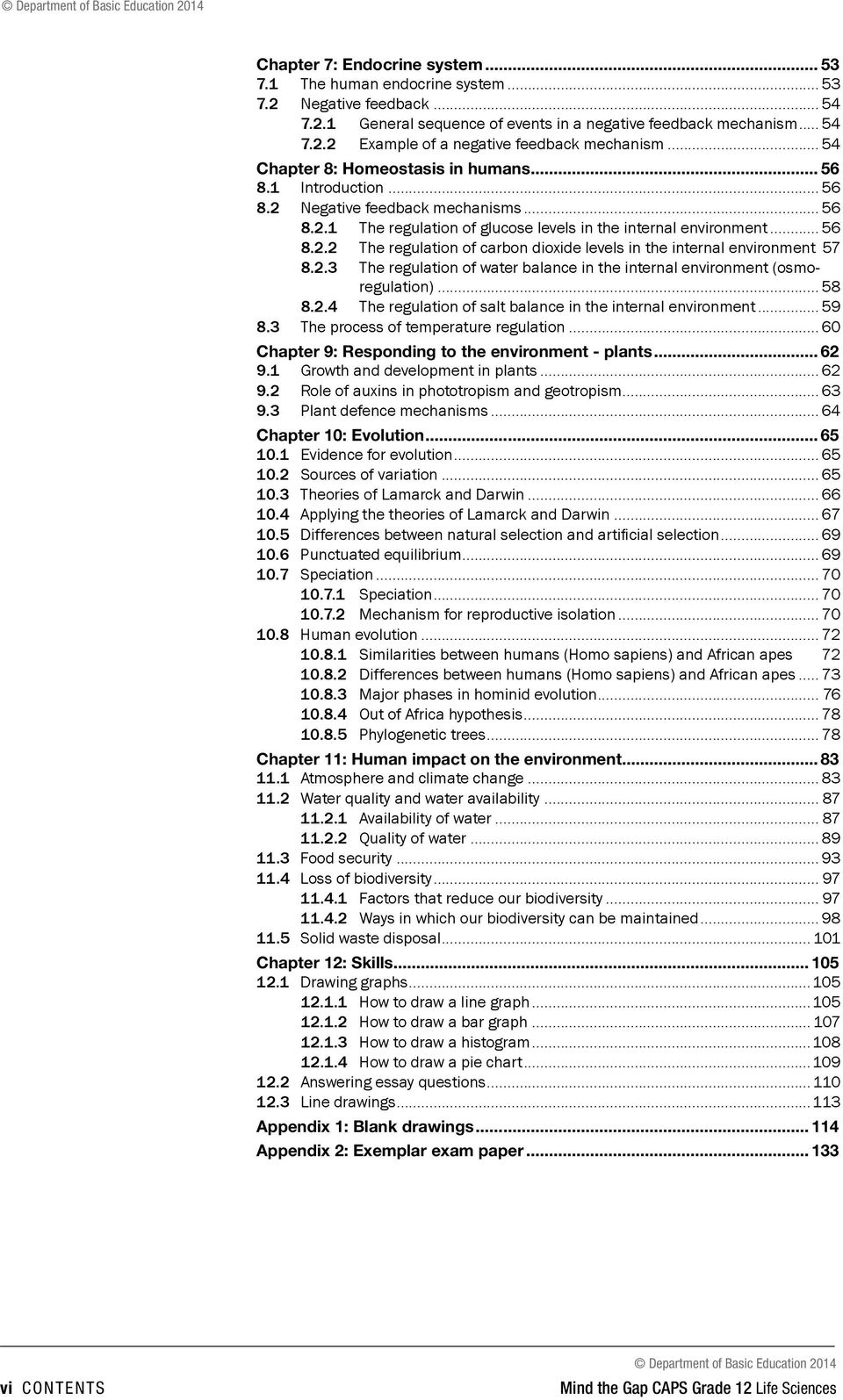
9 Dear Grade 12 learner This Mind the Gap study guide helps you to prepare for the end-of-year CAPS Life Sciences Grade 12 exam. The study guide does NOT cover the entire CAPS curriculum, but it does focus on core content of each knowledge area and points out where you can earn easy marks. We are confident that this Mind the Gap study guide can help you to prepare well so that you pass the end-of-year exams. You must work your way through this study guide to improve your understanding, identify your areas of weakness and correct your own mistakes. To ensure a good pass, you should also cover the remaining sections of the curriculum using other textbooks and your class notes. Overview of the exam for CAPS Life Sciences Grade 12 The following topics make up each of the TWO Life Sciences exam papers that you write at the end of the year: PAPER 1 WEIGHTING PAPER 2 WEIGHTING Topic % MARKS Topic % MARKS Term 1 Term 1 Meiosis 7 11 DNA: Code of Life Reproduction in Vertebrates 4 6 Meiosis 7 12 Human Reproduction Term 2 Term 2 Genetics and Inheritance Responding to the Environment (Humans) Term Terms 3/4 Evolution Human Endocrine System Homeostasis in Humans 7 11 Responding to the Environment (Plants) 7 11 Term 4 Human Impact (Grade 11) Both Paper 1 and Paper 2 will include the following types of questions: Section Type of question Marks A B Short answer, objective questions such as multiple-choice questions, terminology, columns/statement and items A variety of question types. There will be two questions of 40 marks each. Both of these questions will be divided into two to four subsections C Essay 20 Mind the Gap CAPS Grade 12 Life Sciences introduction vii
10 Look out for these icons in the study guide. NB hint e.g. exams Use this study guide as a workbook. Make notes, draw pictures and highlight important concepts. PAY SPECIAL ATTENTION Pay special attention Step-by-step HINT! instructions activity activity EG - worked examples Step by step How to use this study guide This study guide covers selected parts of the different topics of the CAPS Grade 12 Life Sciences curriculum in the order they are usually taught during the year. The selected parts of each topic are presented in the following way: NB PAY SPECIAL ATTENTION NB PAY SPECIAL ATTENTION NB An explanation of terms and concepts; Worked examples to explain and demonstrate; PAY SPECIAL ATTENTION Activities with questions for you to answer; and HINT! NB HINT! NB Answers hintfor you to use to check your own hint work. comment NB e.g. hint exams e.g. exams ACTIVITIES boy and girl-left and right of page chapter also provides Step by step guidelines commenton comment how to answer essay-type comment Hints to help you remember HINT! a concept EG - worked examples or guide you in solving problems Refers EG - worked you examples to exam questions e.g. exams EG - worked examples Worked examples Activities with questions for you to answer A checklist from the exam guidelines for Life Sciences has been provided on activity page xvii for you to keep track of your activity progress. Once you have mastered the core concepts and have confidence in your answers ACTIVITIES boy ACTIVITIES boy and girl-left and and girl-left and right of page to the questions provided, right tick of page the last column of the checklist. The activities activity are based on exam-type questions. activity Cover the answers provided and do each activity on your own. Then check your answers. ACTIVITIES boy and girl-left and Reward yourself for the things you get right. If you get any incorrect right of page answers, make sure you understand where you went wrong before activity Step by step comment Step by step comment comment moving on to the next section. In Chapter 12, you will find a section on graphing skills which you must master when preparing for both Paper 1 and Paper 2. This questions in the exam. You will be asked to draw a labelled diagram in the exam. On page 115 to 132 are a set of blank diagrams that you can use to practise your drawing and labelling skills. Filling in these blank diagrams is a good way to test yourself and work out what you know well and what you still need more practice in. Exemplar Exam papers are included in the study guide for you to do. Check your answers by looking back at your notes and the exam memoranda. Past exam papers go a long way in preparing you for what to expect and help reduce exam anxiety. Go to to download past exam papers. NB comment viii introduction Mind the Gap CAPS Grade 12 Life Sciences

11 Top 10 study tips 1. Have all your materials ready before you begin studying pencils, pens, highlighters, paper, etc. Try these study tips to make learning easier. 2. Be positive. Make sure your brain holds on to the information you are learning by reminding yourself how important it is to remember the work and get the marks. 3. Take a walk outside. A change of scenery will stimulate your learning. You ll be surprised at how much more you take in after being outside in the fresh air. 4. Break up your learning sections into manageable parts. Trying to learn too much at one time will only result in a tired, unfocused and anxious brain. 5. Keep your study sessions short but effective and reward yourself with short, constructive breaks. 6. Teach your concepts to anyone who will listen. It might feel strange at first, but it is definitely worth reading your revision notes aloud. 7. Your brain learns well with colours and pictures. Try to use them whenever you can. 8. Be confident with the learning areas you know well and focus your brain energy on the sections that you find more difficult to take in. 9. Repetition is the key to retaining information you have to learn. Keep going don t give up! 10. Sleeping at least 8 hours every night, eating properly and drinking plenty of water are all important things you need to do for your brain. Studying for exams is like strenuous exercise, so you must be physically prepared. If you can t explain it simply, you don t understand it well enough. Albert Einstein Mind the Gap CAPS Grade 12 Life Sciences introduction ix
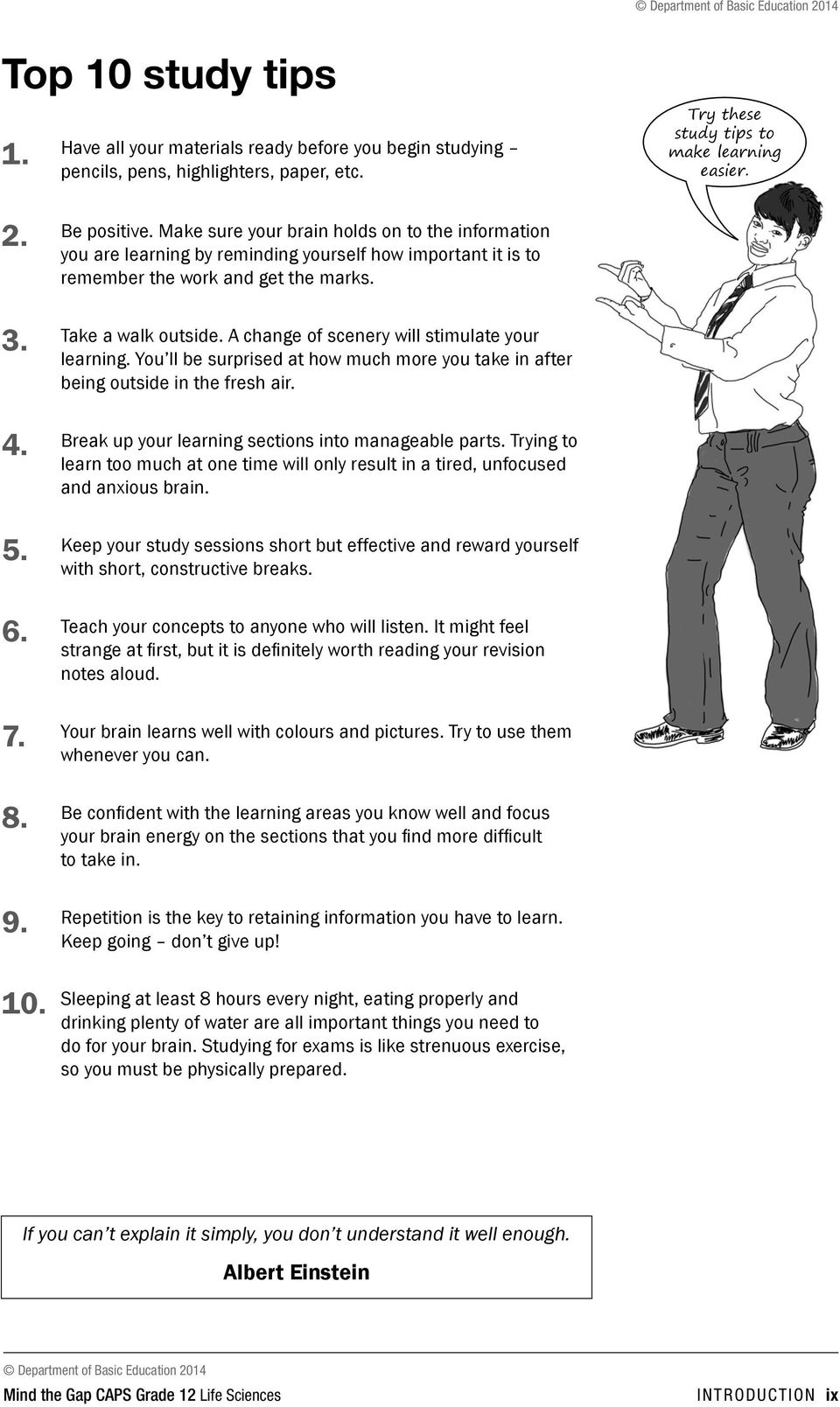
12 Study skills to boost your learning This guide includes 3 study techniques you can use to help you learn the material: 1. Mobile notes 2. Mnemonics 3. Mind maps 1. Fold an A4 paper into 8 squares. Cut or tear neatly along the folded lines. Gene 2. Write the basic concept on one side of a bit of paper. A small portion of DNA coding for a particular characteristic 3. Write the definition of the basic concept on the back of the piece of paper. Mobile notes Mobile notes are excellent tools for learning all the key concepts in the study guide. Mobile notes are easy to make and you can take them with you wherever you go: 1. Fold a blank piece of paper in half. Fold it in half again. Fold it again. 2. Open the paper. It will now be divided into 8 parts. 3. Cut or tear neatly along the folded lines. 4. On one side of each of these 8 bits of paper, write the basic concept. 5. On the other side, write the meaning or the explanation of the basic concept. 6. Use different colours and add pictures to help you remember. 7. Take these mobile notes with you wherever you go and look at them whenever you can. 8. As you learn, place the cards in 3 different piles: I know this information well. I m getting there. I need more practice. 9. The more you learn them, the better you will remember them. These techniques will help you to study smarter! x introduction Mind the Gap CAPS Grade 12 Life Sciences
13 Mnemonics A mnemonic code is a useful technique for learning information that is difficult to remember. Below are two examples of mnemonics. Here is a made-up word to help you remember the structure of a sperm cell each letter of the word stands for a part of the cell: M Mitochondria A Acrosome N Nucleus T Tail Here is a sentence to help you remember the 4 nitrogenous bases in DNA each word in the sentence begins with the same letter as one of the nitrogenous bases: All Teachers Get Chocolate Adenine Thymine Guanine Cytosine There is another example of a mnemonic on page 12. Mnemonics code information and make it easier to remember. The more creative you are and the more you link your codes to familiar things, the more helpful your mnemonics will be. This guide provides ideas for using mnemonics. Be sure to make up your own. Education helps one cease being intimidated by strange situations. Maya Angelou Mind the Gap CAPS Grade 12 Life Sciences introduction xi

14 Mind maps There are several mind maps included in this guide, summarising some of the sections. Have a look at the following pictures of a brain cell (neuron) and, below it, a mind map: Figure 1: Brain cell or neuron Figure 2: Mind map rules Mind maps work because they show information that we have to learn in the same way that our brains see information. As you study the mind maps in the guide, add pictures to each of the branches to help you remember the content. You can make your own mind maps as you finish each section. Mind mapping your notes makes them more interesting and easier to remember. How to make your own mind maps: 1. Turn your paper sideways so your brain has space to spread out in all directions. 2. Decide on a name for your mind map that summarises the information you are going to put on it. 3. Write the name in the middle and draw a circle, bubble or picture around it. 4. Write only key words on your branches, not whole sentences. Keep it short and simple. 5. Each branch should show a different idea. Use a different colour for each idea. Connect the information that belongs together. This will help build your understanding of the learning areas. 6. Have fun adding pictures wherever you can. It does not matter if you can t draw well. xii introduction Mind the Gap CAPS Grade 12 Life Sciences

15 On the day of the exam 1. Make sure you have all the necessary stationery for your exam, i.e. pens, pencils, eraser, protractor, compass, calculator (with new batteries). Make sure you bring your ID document and examination admission letter. 2. Arrive on time, at least one hour before the start of the exam. 3. Go to the toilet before entering the exam room. You don t want to waste valuable time going to the toilet during the exam. 4. Use the 10 minutes reading time to read the instructions carefully. This helps to open the information in your brain. Start with the question you think is the easiest to get the flow going. 5. Break the questions down to make sure you understand what is being asked. If you don t answer the question properly you won t get any marks for it. Look for the key words in the question to know how to answer it. A list of these words is on page xiv of this study guide. 6. Try all the questions. Each question has some easy marks in it so make sure that you do all the questions in the exam. 7. Never panic, even if the question seems difficult at first. It will be linked with something you have covered. Find the connection. 8. Manage your time properly. Don t waste time on questions you are unsure of. Move on and come back if time allows. You have 150 minutes (2½ hours) to answer each of the 150-mark Life Sciences question papers. Spend the following amounts of time on each question: Question 1: 50 marks = 45 minutes Question 2: 40 marks = 35 minutes Question 3: 40 marks = 35 minutes Question 4: 20 marks = 15 minutes The remaining 20 minutes can be used to check your answers and attempt to answer any question that you might have left out. GOOD LUCK! 9. Check weighting how many marks have been allocated for your answer? Take note of the ticks in this study guide as examples of marks allocated. Do not give more or less information than is required. 10. Write big and bold and clearly. You will get more marks if the marker can read your answer clearly. Mind the Gap CAPS Grade 12 Life Sciences introduction xiii

16 Question words to help you answer questions It is important to look for the question words (the words that tell you what to do) to correctly understand what the examiner is asking. Use the words in the table below as a guide when answering questions. Question word Analyse Calculate Classify Compare Define Describe Determine Differentiate Discuss Explain Identify LabelNB List Mention Name State Suggest hint Tabulate What is required of you Separate, examine and interpret This means a numerical answer is required in general, you should show your working, especially where two or more steps are involved Group things based on common characteristics Point out or show both similarities and differences between things, concepts or phenomena Give a clear meaning State in words (using diagrams where appropriate) the main points of a structure/process/phenomenon/investigation To calculate something, or to discover the answer by examining evidence Use differences to qualify categories Consider all information and reach a conclusion Make clear; interpret and spell out Name the essential characteristics PAY SPECIAL ATTENTION Identify on a diagram or drawingnb Write a list of items, with no additional detail Refer to relevant points Give the name (proper noun) of something Write HINT! down information without discussion Offer an explanation or a solution Draw a table and indicate the answers as direct pairs e.g. EG - worked examples Examples of question words In every exam question, put a CIRCLE around the question word and underline any other important key words. These words tell you exactly what is being asked. Questions exams 1. Figure 6.12 shows a longitudinal section through the human eye. Study the diagram and answer the questions that follow. a) Label parts 2, 3, 4 and 5 respectively. (4) b) Name and describe the process that causes part 1 to dilate (become wider). (5) 2. Figure 6.13 is a longitudinal section through the human eye. The structures activity which enable the eye to focus on objects are missing in this diagram. Study the diagram ACTIVITIES and boy answer the questions that and girl-left and follow. right of page Draw a longitudinal section through the missing parts of Figure 6.13 to activity indicate the appearance of these structures when you are... a) reading a book. (6) b) looking at an object more than 6 metres away. (6) [21] comment Step by step comment xiv introduction Mind the Gap CAPS Grade 12 Life Sciences

17 Learner s checklist Use this checklist to monitor your progress when preparing for the examination. The ticks (3) tell you which aspects of the curriculum are covered in this study guide. The stars (*) tell you to go to textbooks and class notes. TOPIC ASPECT Covered in study guide I do not understand I understand DNA: The code of life Discovery of DNA structure * Nucleic acids terminology 3 Structure of DNA and RNA 3 Differences between DNA and RNA 3 DNA replication and the importance thereof 3 DNA profiling 3 Protein synthesis 3 Meiosis The process of meiosis using diagrams 3 Significance of meiosis 3 Abnormal meiosis 3 Differences between meiosis I and meiosis II 3 Reproduction in Diversity in reproductive strategies 3 vertebrates Human reproduction Male reproductive system 3 Female reproductive system 3 Puberty 3 Menstrual cycle 3 Development of the foetus 3 Gestation 3 Role of placenta 3 Genetics and Genetic terminology 3 inheritance Complete dominance 3 Incomplete dominance 3 Co-dominance 3 Inheritance of sex 3 Sex-linked characteristics 3 Dihybrid crossing 3 Mutations 3 Pedigree diagrams 3 Genetic engineering 3 Genetic counselling 3 Paternity testing and DNA fingerprinting 3 Responding to the environment: Humans The brain 3 Neurons, reflex actions and reflex arcs 3 Peripheral nervous system * Autonomic nervous system * Brain disorders and injuries * Effects of drugs on the central nervous system * Structure and functions of parts of the eye 3 Mind the Gap CAPS Grade 12 Life Sciences introduction xv

18 Responding to the Accommodation 3 environment: Humans Pupillary mechanism 3 Visual defects 3 Structure and functions of parts of the ear 3 Hearing 3 Balance 3 Hearing defects 3 Human endocrine Glands and the hormones they secrete 3 system Negative feedback glucose 3 Negative feedback thyroxin 3 Homeostasis in humans Negative feedback glucose 3 Negative feedback carbon dioxide 3 Negative feedback water 3 Negative feedback salts 3 The role of the skin on hot and cold days 3 Responding to the Functions of auxins, gibberillins and abscisic acid 3 environment: Plants Role of auxins in phototropism and geotropism 3 Plant defence mechanisms is included 3 Evolution Evidence for evolution 3 Sources of variation 3 Lamarck and Darwin s theories 3 Natural and artificial selection 3 Punctuated equilibrium 3 Speciation 3 Mechanisms for reproductive isolation 3 Evolution in present times 3 Human evolution: similarities to African apes 3 Human evolution: differences from African apes 3 Major phases in hominid evolution 3 Out of Africa hypothesis 3 Phylogenetic trees 3 Human impact on the Atmosphere and climate change 3 environment Water availability 3 Water quality 3 Food security 3 Loss of biodiversity 3 Waste disposal 3 Skills Draw a line graph 3 Draw a bar graph 3 Draw a histogram 3 Draw a pie chart 3 Answering essay questions 3 xvi introduction Mind the Gap CAPS Grade 12 Life Sciences

19 Chapter 1 Paper 2 Nucleic acids 1.1 The structure of DNA and RNA Two kinds of nucleic acids are found in a cell, namely DNA and RNA. These two nucleic acids are made of building blocks (or monomers) called nucleotides. Figure 1.1 (right) shows what a nucleotide looks like. Table 1.1 (below) shows the nitrogenous bases of DNA and RNA. P S N DNA has four different nitrogenous bases adenine, thymine, guanine and cytosine. T A Adenine Thymine Adenine always pairs with thymine. RNA has four different nitrogenous bases adenine, uracil, guanine and cytosine. U A Adenine Uracil RNA contains uracil instead of thymine. P Phosphate group S Deoxyribose or ribose sugar N Nitrogenous base (adenine, thymine, guanine, cytosine or uracil) Figure 1.1 A nucleotide G Guanine G Guanine C Cytosine C Cytosine Guanine always pairs with cytosine. Table 1.1 Nitrogenous bases of DNA and RNA Figure 1.2 below shows the structure of DNA and RNA. Study the diagrams DNA COMPARE & CONTRAST Nucleic acids ALIKE/SIMILAR Nitrogenous bases present: Adenine, cytosine, guanine DIFFERENT RNA Nitrogenous base present: Thymine Contains sugar: Deoxyribose Double-stranded molecule Nitrogenous base present: Uracil Contains sugar: Ribose Single-stranded molecule Mind the Gap CAPS Grade 12 Life Sciences chapter 1 Nucleic acids (paper 2) 1

20 1 Chapter in Figure 1.2, and then read the information in the boxes below the diagrams to find out how to tell a DNA molecule from an RNA molecule. DNA (deoxyribonucleic acid) RNA (ribonucleic acid) Phosphate group Phosphate group A T A Nitrogenous base G C Deoxyribose G Ribose Nitrogenous base A G Weak hydrogen bonds U How to recognise a DNA molecule Double-stranded molecule Contains the nitrogenous base thymine (T) instead of uracil (U) A always joins with T G always joins with C How to recognise an RNA molecule Single-stranded molecule Contains the nitrogenous base uracil (U) instead of thymine (T) Figure 1.2 The structure of DNA and RNA 1.2 Differences between DNA and RNA Table 1.2 below summarises the differences between DNA and RNA molecules. DNA RNA 1. Double-stranded molecule 1. Single-stranded molecule 2. Contains deoxyribose (sugar) 2. Contains ribose (sugar) 3. Contains the nitrogenous base, thymine 3. Contains the nitrogenous base, uracil Table 1.2 The differences between DNA and RNA 2 chapter 1 Nucleic acids (paper 2) Mind the Gap CAPS Grade 12 Life Sciences

21 1.3 DNA replication DNA replication takes place at interphase before mitosis or meiosis begins. DNA replication is the process during which a DNA molecule makes an exact copy (replica) of itself. This is shown in Figure 1.3 below. 3. Template CG A T AT G-C G C T A G C G T G T A A T C G T A A T A T T A A T T-A C G G-C C A C A A T C G T A A T A T T A A T T-A C G G-C 5. Two identical DNA molecules Figure 1.3 DNA replication 1. Unwinds 2. Unzips Template 4. Complementary strand forms The double helix unwinds. Weak hydrogen bonds between nitrogenous bases break and two DNA strands unzip (separate). Each original DNA strand serves as a template on which its complement is built. Free nucleotides build a DNA strand onto each of the original two DNA strands by attaching to their complementary nitrogenous bases (A to T and C to G). This results in two identical DNA molecules. Each molecule consists of one original strand and one new strand. Chapter 1 Significance of DNA replication DNA replication is important because it: Doubles the genetic material so it can be shared between the resulting daughter cells during cell division. Results in the formation of identical daughter cells during mitosis. 1.4 DNA profiling Every person except identical twins has her/his own unique DNA profile. It can be described as an arrangement of black bars representing DNA fragments of the person. It is used to: Identify criminals Identify dead bodies Identify relatives Identify paternity Mind the Gap CAPS Grade 12 Life Sciences chapter 1 Nucleic acids (paper 2) 3
22 1 Chapter KEY A Adenine C Cytosine Figure 1.4 Part of a nucleic acid molecule A G T 3 C A U Molecule 1 Molecule 2 Figure 1.5 Two nucleic acid molecules C 1 2 Activity 1 1. A DNA molecule contains 600 nitrogen bases. If 20% of this is adenine, determine the number of each nitrogen base in the DNA molecule. (3) 2. Figure 1.4 (left) represents part of a nucleic acid molecule. Study the diagram and answer the questions that follow. 2.1 Identify the nucleic acid shown in Figure 1.4. (1) 2.2 Label the following: a) Part 1 (1) b) Part 2 (1) c) The nitrogenous bases 4, 5 and 6 (3) 2.3 What is the collective name for the parts numbered 1, 2 and 3? (1) 3. Questions 3.1 and 3.2 are based on Figure 1.5 (left). This is a diagrammatic representation of a part of two different nucleic acid molecules found in the cells of organisms during a stage in the process of protein synthesis. 3.1 Name the molecules 1 and 2. (2) 3.2 Give a reason for your answer in question 3.1. (2) 4. The result of profiling various DNA samples in a criminal investigation is shown below Key: 1. blood sample of victim 2. blood sample of suspect X 3. blood sample of suspect Y 4. first sample of DNA from the crime scene 5. second sample of DNA from crime scene 4.1 Was suspect X or suspect Y involved in the crime? (1) 4.2 Does the DNA of the suspect (from answer 4.1) match the first or second sample? (2) [17] Answers to activity % adenine = 20% thymine3 30% cytosine3 = 30% guanine = 120A = 120T = 180C = 180G (3) DNA3 (1) 2.2 a) Phosphate3 group (1) b) Deoxyribose3 sugar (1) c) 4 adenine (A)3 5 guanine (G)3 6 thymine3 (3) 2.3 Nucleotide3 (1) DNA 2 mrna/rna3 (2) 3.2 DNA contains the nitrogenous base thymine (T).3 RNA contains the nitrogenous base uracil (U).3 (2) 4.1 Suspect X was involved. 3 (1) 4.2 The DNA of suspect X matches with the second sample. 33 (2) [17] 4 chapter 1 Nucleic acids (paper 2) Mind the Gap CAPS Grade 12 Life Sciences
23 1.5 Protein synthesis Protein synthesis is the process by which proteins are made in each cell of an organism to form enzymes, hormones and new structures for cells. A. TRANSCRIPTION 1. DNA 3. mrna In the nucleus U C A G G C A C A Codon (triplet) 5. trna 2. Anticodon 4. Codon exams In the cytoplasm Ribosome U C A G G C A C A A G U NB Remember this order: Order Example DNA AGT HINT! mrna hint (codon) UCA trna AGU e.g. activity B. TRANSLATION activity Chapter 1 PAY SPECIAL ATTENTION EG - worked examples ACTIVITIE and girl-le right of pa Step by step comm 6. Protein Figure 1.6 The process of protein synthesis There are two main processes involved in protein synthesis, namely transcription and translation. They are labelled as A and B in Figure 1.6 above. Note that the numbers on the diagram correspond with the description below. mrna (messenger RNA) carries the message. A Transcription (takes place in the nucleus) 1. DNA unwinds and splits. 2. One DNA strand acts as a template for forming mrna. 3. Free nucleotides arrange to form mrna according to the DNA template. This process is called transcription. 4. The mrna leaves the nucleus through the nuclear pores. Stage B now takes place when mrna in the cytoplasm attaches to the ribosome. Mind the Gap CAPS Grade 12 Life Sciences chapter 1 Nucleic acids (paper 2) 5
24 G 1 Chapter trna (transfer RNA) transports the amino acids B Translation (takes place in the cytoplasm on the ribosome) 5. Each trna brings a specific amino acid to the mrna. This is called translation. 6. The amino acids are linked together to form a particular protein. The diagram shown in Figure 1.6 (on page 5) may appear in exam questions in different ways. Do not let the different representations confuse you. Just try to identify the following components by looking for the features listed here: DNA double-stranded; look for presence of thymine; found in nucleus only. Nuclear membrane has nuclear pores through which mrna moves. mrna single-stranded; look for presence of uracil; contains a triplet of bases (codon) found in nucleus and cytoplasm. Ribosome usually mrna attached to it. trna contains a triplet of bases (anticodon); look for attached amino acid. Activity 2 Question 1 Study Figure 1.7 (below), which shows the process of protein synthesis, and answer the questions. D A F G U B G U U UG U U C G For two more problems on protein synthesis refer to these National Life Sciences exam papers: Life Sciences Paper 1 March 2009 Question 2.2 on page 9. Life Sciences Paper 1 November 2010 Question 1.5 on page 7. G G U Figure 1.7 Protein synthesis E Amino acids 1.1 Label structures A, B and D. (3) 1.2 State ONE function of molecule D. (1) CYS ALA C A G C G 6 chapter 1 Nucleic acids (paper 2) Mind the Gap CAPS Grade 12 Life Sciences
25 Chapter Which stage of protein synthesis takes place at F? (1) 1.4 Identify organelle C. (1) 1.5 Name and describe the stage of protein synthesis that takes place at organelle C. (7) 1.6 Write down the codon of anticodon E from top to bottom. (1) 1.7 Name the type of bond (labelled G) between the amino acids. (1) [15] Answers to question A Nuclear membrane3 B mrna3 D DNA3 (3) 1.2 Carrying hereditary characteristics from parents to their offspring 3 OR Controls the synthesis (manufacturing) of proteins3 (1) 1.3 Transcription3 (1) 1.4 Ribosome3 (1) 1.5 Translation3 The mrna strand from the nucleus becomes attached3 to a ribosome with its codons exposed each trna molecule carrying a specific amino acid3 according to its anticodon3 matches up with/complements the codon of the mrna3 so that the amino acids are placed in the correct sequence3 adjacent amino acids are linked3 to form a protein3 (7) 1.6 CAC3 (the anticodon is GUG, so the complementary codon is CAC) (1) 1.7 Peptide Bond (1) [15] You don t have to know the names of the amino acids related to the base triplets. Question 2 Table 1.3 below shows the DNA base triplets that code for different amino acids. Amino acid Base triplet in DNA template Leu (leucine) His (histidine) Lys (lysine) Pro (proline) Ala (alanine) Trp (tryptophan) Phe (phenylalanine) Gly (glycine) GAA GTA TTT GGG CGA ACC AAA CCT Table 1.3 Different amino acids and their DNA base triplets Mind the Gap CAPS Grade 12 Life Sciences chapter 1 Nucleic acids (paper 2) 7
26 1 L ATTENTION d examples Chapter NB Remember this order: Order Example DNA CGA mrna (codon) GCU trna CGA The following is a part of a sequence of amino acids that forms a particular protein molecule: Ala His Trp Leu Lys 2.1 Name the process by which mrna is formed from a DNA template. (1) 2.2 How many mrna codons would be involved in forming the portion of protein shown above? (1) 2.3 Write down the sequence of the first three mrna codons (from left to right) for this portion of the protein. (3) [5] Answers to question Transcription3 (1) (1) 2.3 GCU3 CAU3 UGG3 (3) [5] ACTIVITIES boy and girl-left and right of page comment comment Keep going! 8 chapter 1 Nucleic acids (paper 2) Mind the Gap CAPS Grade 12 Life Sciences
27 Chapter 2 Paper 1 and 2 Meiosis 2.1 What is meiosis? Meiosis is a type of cell division whereby a diploid cell (somatic cell) undergoes two cell divisions, and divides to form four dissimilar haploid cells (sex cells). Diploid cells have two sets of chromosomes, where each chromosome has a homologous partner. Haploid cells only have one set of chromosomes. Chromosomes in haploid cells have no homologous partners. Before meiosis begins (during interphase), DNA replication takes place. The result is two sets of chromosomes consisting of two identical chromatids joined together with a centromere. This is shown in Figure 2.1 (right). 2.2 The process of meiosis in animal cells Chromosome Chromatid Centromere Homologous chromosomes one from the mother and one from the father Figure 2.1 Homologous chromosomes Meiosis is the type of cell division used to produce gametes or sex cells (sperm and egg cells). A cell undergoing meiosis will divide twice the first division is meiosis I and the second is meiosis II. In the first meiotic division, the number of cells is doubled, but the number of chromosomes is not. This results in half as many chromosomes per cell. In the second meiotic division, the number of chromosomes does not get reduced. The diagram alongside shows how meiosis starts with a diploid cell and divides twice (meiosis I and II), resulting in four haploid cells. Meiosis Meiosis I Meiosis II DNA replication and recombination Now turn the page to find out what happens during each stage of meiosis I and II. Mind the Gap CAPS Grade 12 Life Sciences chapter 2 meiosis (paper 1 and 2) 9
28 2 Chapter First meiotic division Figure 2.2 Prophase 1 Spindle fibres Homologous chromosomes Prophase 1 Chromosomes shorten and become visible as two chromatids joined by a centromere. Homologous pairs of chromosomes are now visible. The nuclear membrane and nucleolus disappear. The spindle starts to form. Chromatids from each homologous pair touch. The point where they touch is called a chiasma. DNA is crossed over (swopped) at the chiasma. The spindle continues to form. Metaphase 1 The spindle extends across the whole cell. The homologous chromosomes line up along the equator of the spindle in their homologous pairs. One chromosome of each pair lies on either side of the equator. The centromere of each chromosome attaches to the spindle fibres. Figure 2.3 Metaphase 1 Anaphase 1 The spindle fibres shorten and pull each chromosome of each chromosome pair to opposite poles of the cell. Figure 2.4 Anaphase 1 Constriction Telophase 1 The chromosomes reach the poles of the cell. Each pole has half the number of chromosomes present in the original cell. The cell membrane constricts and divides the cytoplasm in half to form two cells. Figure 2.5 Telophase 1 10 chapter 2 meiosis (paper 1 and 2) Mind the Gap CAPS Grade 12 Life Sciences
29 Chapter Second meiotic division Prophase 2 Each cell formed during meiosis I now divides again. A spindle forms in each of the new cells. Figure 2.6 Prophase 2 Metaphase 2 Individual chromosomes line up at the equator of each cell, with the centromeres attached to the spindle fibres. Figure 2.7 Metaphase 2 Anaphase 2 The spindle fibres start to contract. The centromeres split and daughter chromosomes/ chromatids are pulled to the opposite poles of each cell. Figure 2.8 Anaphase 2 nucleus Telophase 2 The daughter chromosomes/chromatids reach the poles and a new nucleus forms. The cell membrane of each cell constricts and the cytoplasm divides into two cells. Four haploid daughter cells are formed. Each daughter cell has half the number of chromosomes of the original cell. The daughter cells are genetically different from each other. Figure 2.9 Telophase 2 Mind the Gap CAPS Grade 12 Life Sciences chapter 2 meiosis (paper 1 and 2) 11
30 2 Chapter An easy way to remember the events of meiosis is to use the word mnemonic IPMAT. Letter Phase Event I Interphase I for in between: The part of the life cycle of the cell that is in between cell divisions. P Prophase P for preparation: The chromosomes prepare for meiosis by untangling and becoming clearly visible. Crossing over also takes place. M Metaphase M for middle: The chromosomes move to the middle (equator). A Anaphase A for apart: The chromosomes/chromatids move apart/move to the poles. T Telophase T for terminal: The final phase of meiosis I/ meiosis II. a) Non-disjunction in meiosis I non-disjunction 2.3 The significance of meiosis There are two reasons why meiosis is important. 1. It reduces the number of chromosomes by half, in other words from diploid to haploid. This ensures that sex cells have half the number of chromosomes of other somatic cells so that when fertilisation occurs the zygote formed has the correct number of chromosomes. It balances the doubling effect of fertilisation. 2. Crossing over introduces genetic variation. Genetic variation results in offspring that are better adapted to a particular environment and b) Non-disjunction in meiosis II non-disjunction XX XX O O XX O X X Figure 2.10 Non-disjunction meiosis I and meiosis II XX : 2 chromosomes X : 1 chromosome O : no chromosomes ensures that they will have a better chance of survival. 2.4 Abnormal meiosis Sometimes mistakes occur during the process of meiosis. This can happen in Anaphase 1 where the homologous chromosomes may not separate. Also called non-disjunction. It can also happen in Anaphase 2 when there is non-disjunction of the sister chromatids. If there is non-disjunction of chromosome pair 21 in humans it leads to the formation of an abnormal gamete with an extra copy of chromosome 21. If there is fusion between a normal gamete and an abnormal gamete (with extra copy of chromosome 21) it leads to Down Syndrome. 12 chapter 2 meiosis (paper 1 and 2) Mind the Gap CAPS Grade 12 Life Sciences
31 2.5 Differences between meiosis I and meiosis II Meiosis I Meiosis II Meiosis II is similar to mitosis. Chapter 2 The chromosomes arrange at the equator of the cell in homologous pairs. Whole chromosomes move to opposite poles of the cell. Two cells form at the end of this division. NB PAY SPECIAL ATTENTION The chromosome number is halved during meiosis I. Crossing over takes place. Chromosomes line up at the equator of the cell individually. Daughter chromosomes/chromatids move to opposite poles of the cell. Four cells are formed at the end of this division. NB The chromosome number remains the same during meiosis II. Crossing over does not take place. hint HINT! Table 2.1 The differences between meiosis I and meiosis II e.g. EG - worked examples Worked Study the diagrams below of two stages of meiosis then answer the questions that follow. exams activity A Diagram I activity Figure 2.11 Two stages of meiosis ACTIVITIES boy and girl-left and right of page Diagram II 1. State ONE visible reason in Diagram I which indicates that meiosis is taking place. (1) comment of meiosis in this cell? (1) 3. Describe what takes place in the cell after the phase shown in Diagram I. (3) 2. How many chromosomes Step by stepwould be present comment in each daughter cell at the end 4. Tabulate TWO visible differences between the phases of meiosis shown in Diagrams I and II. (5) [10] Mind the Gap CAPS Grade 12 Life Sciences chapter 2 meiosis (paper 1 and 2) 13
32 2 Chapter Answers to worked example 1. The chromosomes are lined up at the equator of the cell in their homologous pairs.3 OR The chromosomes show evidence of crossing over.3 (1) 2. Two 3 chromosomes. (1) 3. The next phase is Anaphase 1. The spindle fibres contract.3 (shorten) and pull each chromosome3 of each chromosome pair to opposite poles3 of the cell. (3) 4. 3 Diagram I (metaphase 1) Diagram II (metaphase 2) 1. Chromosomes are lined up at the equator in homologous pairs.3 1. Chromosomes are lined up at the equator individually.3 2. Four chromosomes are present.3 2. Two chromosomes are present.3 (5) [10] Activity 1 Question 1 Give the correct word or term for each of the statements or definitions provided below. 1.1 The structure that joins the two halves of a double-stranded chromosome (1) 1.2 A pair of chromosomes, one inherited from each parent, that have the same genes at the same locus (1) 1.3 A single-stranded chromosome formed during Anaphase 2 (1) 1.4 The point of contact between two chromosomes of a homologous pair during crossing over (1) 1.5 One half of a double-stranded chromosome (1) 1.6 The phase in meiosis where crossing over occurs (1) Answers to question Centromere3 (1) 1.2 Homologous chromosomes3 (1) 1.3 Daughter chromosome/chromatid3 (1) 1.4 Chiasma3/chiasmata3 (1) 1.5 Chromatid3 (1) 1.6 Prophase 13 (1) [6] [6] 14 chapter 2 meiosis (paper 1 and 2) Mind the Gap CAPS Grade 12 Life Sciences
33 Chapter 2 Question 2 Figure 2.12 (right) represents a process taking place during meiosis. Study the diagram and answer the questions that follow. 2.1 Provide labels for parts A, B, C and D. (4) 2.2 Name the process in meiosis that is illustrated in Figure (1) 2.3 State ONE importance of the process you named in question 2.2. (2) 2.4 Draw a diagram of the structure labelled A to show its appearance immediately after the process you named in question 2.2. (2) [9] Answers to question A Chromosome3 B Centromere3 C Chromatid3 D Chiasma3/chiasmata (4) 2.2 Crossing over3 (1) 2.3 It introduces genetic3 variation3 (2) 2.4 A double-stranded chromosome with the strands joined by a centromere3 There is evidence of crossing over.3 (2) D A Figure 2.12 Diagram representing a process taking place during meiosis C B [9] Question 3 Figure 2.13 (right) represents an animal cell in a phase of meiosis. Study the diagram and answer the questions that follow. 3.1 State whether the phase of meiosis shown in Figure 2.13 is meiosis I or meiosis II. (1) 3.2 Give ONE visible reason for your answer in question 3.1. (1) 3.3 Identify the parts labelled A and B. (2) 3.4 How many chromosomes: a) were present in the parent cell before meiosis began? (1) b) will be present in each cell at the end of meiosis? (1) 3.5 State ONE place in a human female where meiosis would take place. (1) 3.6 Could the cell represented in Figure 2.13 be that of a human? (1) 3.7 Explain your answer to question 3.6. (2) 3.8 Give TWO reasons why meiosis is biologically important. (2) 3.9 Give the term for the situation when some of the chromosomes do not separate correctly during the phase shown in Figure (1) [13] Figure 2.13 Diagram representing a phase of meiosis A B Mind the Gap CAPS Grade 12 Life Sciences chapter 2 meiosis (paper 1 and 2) 15
34 2 Chapter Answers to question Meiosis II3 (1) 3.2 Daughter chromosomes/chromatids are being pulled to the opposite poles3 (1) 3.3 A Spindle fibre3 B Cell membrane3 (2) 3.4 a) 83 b) 43 (2) 3.5 Ovaries3 (1) 3.6 No3 (1) 3.7 There are only 4 chromosomes present3 instead of 23.3 (2) 3.8 It introduces genetic variation.3 It balances the doubling effect of fertilisation as it halves the number of chromosomes in the sex cells.3 (2) 3.9 Non-disjunction3 (1) [13] For four further problems on meiosis refer to the following National Life Sciences exam papers: Life Sciences Paper 1 February/March 2012: Version 1 Question 2.1 on page 9. Life Sciences Paper 1 November 2010 Question 2.1 on page 10. Life Sciences Paper 1 February/March 2010 Question 1.4 on page 6. Life Sciences Paper 1 November 2009 Question 1.5 on page 7. Question 4 The diagram below shows the nuclei of the four cells that resulted from meiosis of chromosome pair 21 in a woman. M N O P Daughter chromosomes Figure 2.14: Diagram that shows the nuclei of four cells resulted from meiosis 4.1 Explain why nucleus N does NOT have a chromosome pair 21. (2) 4.2 Name and explain the disorder that will result if diagram M represents an egg cell that fuses with a normal sperm cell. (3) [5] Keep going! Answers to question During Anaphase 1 the chromosome pair 21 does not separate3/ non-disjunction. Gamete M will have an extra copy of chromosome number 21 and therefore gamete N does not have a copy of chromosome 213 (2) 4.2 Down syndrome3/trisomy 21 if gamete M fuses with normal sperm having 1 copy of chromosome 21 3 the resulting zygote will have 3 copies of chromosome 213 (3) [5] 16 chapter 2 meiosis (paper 1 and 2) Mind the Gap CAPS Grade 12 Life Sciences
35 Chapter 3 Reproduction in vertebrates Paper 1 Different groups in the animal kingdom have different strategies to maximise reproductive success in different environments. These are a few of the strategies used by vertebrates. Strategy How it works? What is its advantage? External Fertilisation Internal Fertilisation Ovipary Vivipary Ovovivipary Amniote Egg Precocial Development Altricial Development Parental Care The sperm fertilises the egg outside the body of the female, usually in water. The male deposits its sperm inside the reproductive organs of the female and fertilisation occurs inside the female s reproductive organs. Eggs are laid and hatching takes place outside the mother s body. The young develop inside the uterus of the mother after the eggs are fertilised internally. Young develop from eggs that are fertilised internally and retained within the mother's body after fertilisation until they hatch. Embryo protected by the shell of the egg; egg consists of many extraembryonic membranes that serve different functions. Hatchlings are quite well-developed when they hatch eyes open, able to move, able to feed. Brain size and intelligence remains the same throughout their lives. Hatchlings are poorly-developed when they hatch. Unable to feed on their own, cannot move. Brain size and intelligence increases a lot after hatching. Parental care offered through building of nests, protecting the eggs, protecting the young, teaching the young. Water prevents the eggs from drying out and allows the sperm to swim towards the egg. Allows terrestrial animals to reproduce in a dry environment without the need for water. Internal fertilisation is more certain than external fertilisation. Egg provides nutrition for the developing embryo and protects the embryo. A shelled egg frees these animals from the need to reproduce in water. More efficient development of the embryo as nutrients are received for a longer period from the mother s blood through a placenta. Embryo is protected in the body of the mother. Embryos obtain their nutrients from the egg yolk. The eggs are protected from predators until hatching occurs. Amniote egg protects embryo from dehydration. Yolk sac provides nutrition, Allantois for excretion, chorion for gas exchange. Hatchlings are more prepared to handle the challenges of the environment; More independent. Parental care afforded to protect the young from predators. Increases chances of survival of the young. Activity 1 Questions Indicate whether each of the statements in COLUMN I applies to A ONLY, B ONLY, BOTH A and B or NONE of the items in COLUMN II. Write A only, B only, both A and B, or none next to the question number (1 to 5). Mind the Gap CAPS Grade 12 Life Sciences chapter 3 reproduction in vertebrates (paper 1) 17
36 3 Chapter COLUMN I COLUMN II 1. Oviparous A Eggs are produced B Eggs are always incubated by the female 2. Ovoviviparous A Eggs incubated in nests B Eggs incubated in the female s body 3. Precocial A Small, helpless offspring born B Intense parental care required 4. Viviparous A Gestation period required B Live offspring born 5. Altricial A Intense parental care required B Offspring can look after themselves (5 2 ) [10] Answers to activity 1 1. A only (B is wrong, because some animals, like insects, simply lay their eggs and do not incubate them. In some birds both the male and female incubate the eggs) 2. B only (A is wrong, because the eggs are not released from the female s body) 3. None (Precocial animals are born quite well-developed, they can live independently from their parents and find their own food, so parental care is not required) 4. Both A and B 5. A only (B is wrong, because altricial animals are born small and helpless. They cannot look after themselves or find their own food. Their parents must look after them, protect them and feed them.) (5 2) [10) Keep going! 18 chapter 3 reproduction in vertebrates (paper 1) Mind the Gap CAPS Grade 12 Life Sciences
37 Chapter 4 Reproduction Paper Male reproductive system Figure 4.1 below shows the different parts of the male reproductive system and their functions. Seminal vesicle: A gland that produces a nutrientrich fluid that that provides energy for the sperm cells Cowper s gland: Produces mucus that helps with the movement of sperm cells Scrotum: Skin sac that protects the testes and holds the testes outside the body, at a temperature that is 2 C below 37 C. This is the best temperature for the production of sperm Testes: Produces sperm cells and the hormone testosterone Prostate gland: Produces an alkaline fluid that neutralises the acids produced in the vagina, which would kill sperm cells Sperm duct: Transports sperm from the epididymis to the urethra Urethra: Transports semen and urine out of the body Epididymis: Sperm cells mature and are stored here Figure 4.1 Structure of the male reproductive system Functions of testosterone The testes produce the hormone testosterone, which has the following functions: 1. Development of male secondary sexual characteristics, such as beard, pubic hair, deep voice and a muscular body. 2. Stimulates the maturation of sperm cells. Structure of a sperm cell Figure 4.2 below shows the different parts of a sperm cell and their functions. Mind the Gap CAPS Grade 12 Life Sciences chapter 4 reproduction (paper 1) 19
38 4 Chapter Head Middle section or body Acrosome: Contains enzymes to digest wall of egg cell for fertilisation Nucleus: Contains 23 chromosomes Mitochondria: Provide energy for swimming Tail: Used for swimming Tail Figure 4.2 Structure of a sperm cell Activity 1 Questions 1. Name the accessory glands of the male reproductive system and give ONE function of each. (10) 2. Name the organ where testosterone is produced. (1) 3. Give TWO functions of testosterone. (2) 4. Name all the parts of the sperm cell that are responsible for movement. State what the function of each part is. (4) 5. Explain the role of the nucleus of the sperm cell in fertilisation. (3) [20] Answers to activity 1 1. Seminal vesicle3 produces a fluid that contains nutrients3 for the sperm cells, so that they have energy to swim.3 Prostate gland3 produces an alkaline fluid3 that neutralises acids3produced in the vagina, so that sperm cells are protected.3 Cowper s gland3 produces mucus3 that helps with the movement3of sperm cells. (10) 2. Testes3 (1) 3. Testosterone is responsible for the development of male secondary sexual characteristics3 and it stimulates the maturation of sperm cells.3 (2) 4. Mitochondria3 provide energy for swimming.3 Tail3 moves in a whip-like fashion to propel the sperm cell forwards.3 (4) 5. The nucleus contains 23 chromosomes (n)3, and fuses with the nucleus of an egg cell, which also contains 23 chromosomes (n)3. The result is a zygote with 46 chromosomes (2n).3 (3) [20] 20 chapter 4 reproduction (paper 1) Mind the Gap CAPS Grade 12 Life Sciences
39 Chapter Female reproductive system Figure 4.3 below shows the different parts of the female reproductive system and their functions. Fallopian tube: Connects the ovaries to the uterus, transports egg cells from the ovary; it is the site of fertilisation Ovary: Produces egg cells, secretes progesterone and oestrogen Vagina: Receives the penis and semen during sexual intercourse; it is the passage through which the baby is born Uterus: Carries the embryo and foetus during pregnancy Endometrium: Inner lining of uterus; place where the embryo implants and the placenta forms Cervix: Lower, narrow part of uterus. It stretches to allow the baby through during childbirth Figure 4.3 Structure of the female reproductive system Activity 2 Questions Provide the correct biological term for the following definitions. 1. The inner lining of the uterus (1) 2. Tube that connects the ovaries to the uterus (1) 3. The structure that produces female hormones (1) 4. The part where development of the embryo/foetus normally takes place in humans (1) [4] Answers to activity 2 1. Endometrium3 2. Fallopian tube3 3. Ovary/placenta3 4. Uterus3 [4] 4.3 Puberty Puberty is the period in humans in which they experience physical changes in their bodies in order to be capable of sexual reproduction. Mind the Gap CAPS Grade 12 Life Sciences chapter 4 reproduction (paper 1) 21
40 4 Chapter Puberty in males Stimulated by testosterone Growth of male sex organs Start of the production of sperm cells Growth of pubic hair, facial hair and body hair Development of muscles and deepening of voice Puberty in females Stimulated by oestrogen Growth of female sex organs Start of the menstrual cycle and production of ova Growth of pubic hair Growth and development of breasts and widening of hips 4.4 Menstrual cycle The series of diagrams in Figure 4.4 below shows the events occurring in the ovary (ovarian cycle) and uterus (uterine cycle) during the menstrual cycle. The days are not exact, but are averages. Day 8 13 Ovaries: Mature Graafian follicle develops: The Graafian follicle moves to edge of the ovary It secretes oestrogen Uterus: Oestrogen stimulates the endometrium to become thicker and develop more blood vessels and glands Day 14 Ovaries: Graafian follicle bursts to release an egg cell. The process is called ovulation Start here! Day 1 7 Ovaries: New follicles develop and secrete oestrogen Uterus: Lining breaks down and is released (menstruation) Day Ovaries: If fertilisation does not take place: The corpus luteum shrinks and stops secreting progesterone If fertilisation takes place: The corpus luteum remains active in the ovary and continues to secrete progesterone No more follicles develop in the ovaries No menstruation takes place Day Ovaries: The Graafian follicle becomes a corpus luteum that secretes progesterone Uterus: Progesterone stimulates the endometrium to become even thicker and to develop more blood vessels and glands, ready to receive the embryo if an egg cell is fertilised Figure 4.4 The menstrual cycle 22 chapter 4 reproduction (paper 1) Mind the Gap CAPS Grade 12 Life Sciences
41 Chapter Hormonal control of the menstrual cycle The graph in Figure 4.5 below shows changes in the ovary, uterus and in the level of hormones during a 28-day menstrual cycle. A Pituitary/ hypophysis hormone levels FSH LH B Growth of follicle C Ovarian hormone levels Oestrogen Progesterone D Thickness of uterine lining/ endometrium Days Figure 4.5 Hormonal regulation of the female reproductive cycle The hormonal changes that take place at A, B, C and D in the graph in Figure 4.5 above are explained in Table 4.1 below. Day 0 11 Day Day A B C D Pituitary gland produces FSH which stimulates development of the follicle. FSH and LH (produced by the pituitary gland) levels are highest around day 14. LH levels decrease and then remain constant to maintain the corpus luteum. Follicle is developing to become a Graafian follicle containing an egg cell. Follicle development is completed as a result of the influence of FSH by day 14. Ovulation is stimulated by high levels of FSH and LH on day 14. LH then stimulates the development of the corpus luteum. Corpus luteum produces progesterone. Corpus luteum gradually disintegrates since fertilisation does not take place. Oestrogen levels increase as the hormone is produced by the follicle. Oestrogen levels reach a maximum towards day 14 until ovulation takes place, but then start to decrease because the Graafian follicle stops functioning. Oestrogen levels increase again and then decrease towards the end of the cycle. Progesterone levels increase towards day 21. Progesterone levels decrease when corpus luteum disintegrates and stops functioning. Thickness of endometrium increases from day 7 (after menstruation has ended) as a result of oestrogen. Endometrium thickens further. Progesterone prepares endometrium fully for pregnancy. Decreased progesterone levels from around day 21 cause endometrium to shed after day 28 by menstruation since no fertilisation took place. Table 4.1 Hormonal changes during the menstrual cycle Mind the Gap CAPS Grade 12 Life Sciences chapter 4 reproduction (paper 1) 23
42 4 Chapter Activity 3 Study Figure 4.6 below and answer the questions that follow. Hormonal regulation of the menstrual cycle Growth of follicle A B Ovarian hormone levels NB Make sure you know how to interpret the graph in HINT! Figure 4.6 before you try to answer hint the questions: All the information refers to the ovary. The information is e.g. presented in graph form. The days of the menstrual cycle are indicated examson the X-axis. The graph should be read from left to right in the same way that you read a sentence. The graph illustrates the concentrations activity of two hormones, namely oestrogen and progesterone. activity PAY SPECIAL ATTENTION EG - worked examples Days Figure 4.6 Hormonal changes during the menstrual cycle 1. Name the hormones A and B. (2) NB 2. Give reasons for your answers in question 1. (2) 3. What event occurs on day 14? (1) 4. Name the other two hormones involved in this cycle. (2) 5. Did fertilisation occur during the cycle shown in Figure 4.6? (1) 6. Explain your answer in question 5. (2) Answers to activity 3 1. A Oestrogen3 B Progesterone3 (2) 2. A: The Graafian follicle secretes oestrogen3/oestrogen reaches its maximum level before ovulation.3 B: The corpus luteum produces progesterone3/progesterone reaches its maximum level after ovulation.3 (2) 3. Ovulation3 (1) 4. LH3 and FSH3 (2) 5. No3 (1) 6. Progesterone levels decrease3 towards the end of the cycle. PAY SPECIAL ATTENTION NB ACTIVITIES The corpus boy luteum decreases3 in size. NB (2) [10] and girl-left and right of page [10] Step by step hint e.g. comment HINT! Here is a hint to help you to remember the names of the two hormones: O stands for Oestrogen and when it is high, Ovulation occurs. P stands comment for Progesterone and when it remains high, there is a Pregnancy. EG - worked examples exams 24 chapter 4 reproduction (paper 1) Mind the Gap CAPS Grade 12 Life Sciences
43 Chapter Development of the foetus Figure 4.7 below shows the stages in the development of the foetus. Fertilisation Fallopian tube Embryo Sperm cell Egg cell Ovulation Foetus Chorion Umbilical cord Ovary Amnion Placenta Figure 4.7 Stages in the development of the foetus Amniotic fluid Explanation of Figure In the ovary a mature Graafian follicle bursts (usually on day 14 of the menstrual cycle) and releases an egg cell. This process is called ovulation. 2. Fertilisation takes place high up in the fallopian tube. The egg cell (containing 23 chromosomes) and sperm cell (containing 23 chromosomes) fuse to form a zygote (containing 46 chromosomes). 3. The zygote divides by mitosis to form a morula, then a blastocyst, and finally an embryo as it moves down the Fallopian tube. 4. It takes about 5 to 7 days for the embryo to reach the uterus. 5. In the uterus the embryo settles on the endometrium and sinks into it, embedding itself in the endometrium. This process is called implantation. 6. After implantation, the embryo produces many finger-like structures called villi from the outer membrane of the embryo, which is known as the chorion. 7. The villi grow into the tissue of the uterus to form a placenta. 8. The placenta is attached to the embryo by the umbilical cord. It has 2 umbilical arteries (which carry deoxygenated blood from the embryo towards the placenta) and 1 umbilical vein (which carries oxygenated blood from the placenta to the embryo). 9. The embryo is enclosed in a fluid-filled sac called the amnion. The fluid is called the amniotic fluid. 10. After about 8 weeks, the embryo develops structures such as limbs and all the organs of the body. Now it is called a foetus. 11. Gestation is the period between fertilisation and the birth of the baby. It usually lasts for a period of 9 months (39 40 weeks). 12. The stages involved in the natural birth process are: Dilation of the cervix (labour) Expulsion of the foetus. Delivery of the afterbirth (placenta) and extra-embryonic membranes. Mind the Gap CAPS Grade 12 Life Sciences chapter 4 reproduction (paper 1) 25
44 4 Chapter Activity 4 Questions 1. On which day of the menstrual cycle does ovulation usually take place? (1) 2. What happens to the Graafian follicle after ovulation? (1) 3. Name the TWO hormones that are released by structures in the ovaries. (2) 4. Give THREE functions of the amniotic fluid. (3) 5. Give TWO substances that can move from the mother to the foetus through the placenta. (2) 6. Give TWO substances that can move from the foetus to the mother through the placenta. (2) [11] Answers to activity 4 1. Day 143 (1) 2. It changes into a corpus luteum.3 (1) 3. Oestrogen3 and progesterone.3 (2) 4. The amniotic fluid protects the foetus against shock3, drying out3 and temperature changes.3 (3) 5. Oxygen3, nutrients3 (amino acids, glucose, other sugars), viruses3 and drugs3 (2) 6. Carbon dioxide3 and waste products3 (urea). (2) [11] For more questions on the female reproductive system, refer to the following National Life Sciences exam paper: Life Sciences Paper 1 November 2010 Question 3.1 on page 12. Life Sciences Paper 1 March 2011: Version 1 Question 3.1 on page 11. Keep going! 26 chapter 4 reproduction (paper 1) Mind the Gap CAPS Grade 12 Life Sciences
45 Chapter 5 Genetics Paper Key concepts Make mobile notes (see instructions on page x) to learn these key concepts. Term Explanation Diagram/Additional notes Gene A small portion of DNA coding for a particular characteristic. Nucleus Gene Cell Chromosome DNA Alleles Genotype Phenotype Different forms of a gene which occur at the same locus (position) on homologous chromosomes. Genetic composition (makeup) of an organism. The physical appearance of an organism determined by the genotype, e.g. tall, short. Dominant allele (T) tall plant Recessive allele (t) short plant T T Alleles Homozygous dominant (both alleles are dominant) Genotype TT Phenotype tall Dominant allele Recessive allele An allele that is expressed (shown) in the phenotype when found in the heterozygous (Tt) and homozygous (TT) condition. An allele that is masked (not shown) in the phenotype when found in the heterozygous (Tt) condition. It is only expressed in the homozygous (tt) condition. t t Homozygous recessive (both alleles are recessive) Genotype tt Phenotype short Heterozygous Two different alleles for a particular characteristic, e.g. Tt. T t Heterozygous (one dominant and one recessive allele) Homozygous Two identical alleles for a particular characteristic, e.g. TT or tt. Genotype Tt Phenotype tall Mind the Gap CAPS Grade 12 Life Sciences chapter 5 genetics (paper 2) 27
46 5 Chapter Term Explanation Diagram/Additional notes Monohybrid cross Complete dominance Incomplete dominance Co-dominance Multiple alleles Sex-linked characteristics Karyotype Only one characteristic or trait is being shown in the genetic cross. A genetic cross where the dominant allele masks (blocks) the expression of a recessive allele in the heterozygous condition. A genetic cross between two phenotypically different parents produces offspring different from both parents but with an intermediate phenotype. A genetic cross in which both alleles are expressed equally in the phenotype. More than two alternative forms of a gene at the same locus. Characteristics or traits that are carried on the sex chromosomes. The number, shape and arrangement of all the chromosomes in the nucleus of a somatic cell. Example: Flower colour only, e.g. yellow flower or white flower or shape of seeds only, e.g. round seeds or wrinkled seeds. In this type of cross the allele for tall (T) is dominant over the allele for short (t). The offspring will therefore be tall because the dominant allele (T) masks the expression of the recessive allele (t). Example: If a red-flowered plant is crossed with a white-flowered plant and there is incomplete dominance the offspring will have pink flowers (intermediate colour). Example: If a red-flowered plant is crossed with a white-flowered plant and there is co-dominance the offspring has flowers with red and white patches. Tall (TT) short (tt) Tall (Tt) Red flower White flower Pink flowers Red flower White flower Flowers with red and white patches Example: Blood groups are controlled by three alleles, namely I A, I B and i. Examples: Haemophilia and colour-blindness The alleles for haemophilia (or colour-blindness) are indicated as superscripts on the sex chromosomes, e.g. X H X H (normal female), X H X h (normal female), X h X h (female with haemophilia), X H Y (normal male), X h Y (male with haemophilia). Chromosomes Cloning Genetic modification Human genome Process by which genetically identical organisms are formed using biotechnology. The manipulation of the genetic material of an organism to get desired changes. The mapping of the exact position of all the genes in all the chromosomes of a human. Example: Dolly the sheep was cloned using a diploid cell from one parent; therefore it had the identical genetic material of that parent. Example: The insertion of human insulin gene in plasmid of bacteria so that the bacteria produce human insulin. Example: Gene number 3 on chromosome number 4 is responsible for a particular characteristic. 28 chapter 5 genetics (paper 2) Mind the Gap CAPS Grade 12 Life Sciences
47 Chapter 5 Activity 1 Choose an item from COLUMN 2 that matches a description in COLUMN 1. Write only the letter (A to I) next to the question number (1 5), for example 6. J. COLUMN 1 COLUMN 2 1. The allele that is not expressed in the phenotype when found in the heterozygous condition 2. Different forms of a gene which occur at the same locus on homologous chromosomes 3. A sex-linked condition where blood fails to clot properly 4. The pair of chromosomes in a diploid organism that have the same size and shape and control the same set of characteristics 5. The physical and functional expression of a gene A. Gene B. Recessive C. Haemophilia D. Dominant E. Homologous F. Genotype G. Phenotype H. Alleles I. Karyotype [5] Answers to activity 1 1. B3 2. H3 3. C3 4. E3 5. G3 (5 1) [5] 5.2 Genetic crosses Use the following genetic problem format or template to solve all monohybrid genetic problems: By following this format you will already have earned 2 marks, namely for stating P 1 and F 1, and meiosis and fertilisation. P 1 Phenotype 3 Genotype 3 Meiosis 3 3 Gametes 3 Gametes Fertilisation OR F 1 Genotype 3 Phenotype 3 1 mark for correct gametes 1 mark for correct genotypes [6] 1. The problem on the next page shows that a cross between a heterozygous parent (Tt) and a homozygous recessive (tt) parent produces F 1 offspring that are 50% heterozygous (Tt) and 50% homozygous recessive (tt). 2. A cross between a homozygous dominant (TT) parent and a homozygous recessive (tt) parent produces F 1 offspring that are 100% heterozygous (Tt). 3. A cross between a homozygous dominant (TT) and a heterozygous (Tt) parent produces F 1 offspring that are 50% homozygous dominant (TT) and 50% heterozygous (Tt). 4. A cross between two heterozygous (Tt) parents produces F 1 offspring that are 25% homozygous dominant (TT), 50% heterozygous (Tt) and 25% homozygous recessive (tt). Mind the Gap CAPS Grade 12 Life Sciences chapter 5 genetics (paper 2) 29
48 5 Chapter PAY SPECIAL ATTENTION Complete dominance NB NB This refers to a genetic cross where the dominant allele masks (blocks) the expression of a recessive allele in the heterozygous condition. The following problem represents a genetic cross which shows complete HINT! dominance: hint e.g. EG - worked examples Genetic problem 1 In humans the ability to roll the tongue is due to a dominant allele. A man who is heterozygous exams for tongue-rolling and a woman who cannot roll her tongue have children. Use the symbols T and t for the alleles of the tongue-rolling characteristic and represent a genetic cross to determine the possible genotypes and phenotypes of the children. (6) Read the problem carefully and note the following steps: Identify the phenotypes of the man and the woman activity (parents/p 1 ), i.e. the man is a tongue-roller and the ACTIVITIES boy woman is a non-tongue-roller...step and girl-left and 1 right of page Identify the genotypes of the two parents, i.e. the man is heterozygous activity(tt) and the woman can only be a non-tongue-roller if she is homozygous recessive for this characteristic, i.e. she must have the genotype (tt)... Step 2 The next step is to show how the alleles are separated through the process of meiosis into separate gametes, i.e. in the man the Step by step comment comment gametes (sperm) will contain either the T allele or the t allele. In the woman the egg can only contain the t allele...step 3 The next step shows that fertilisation takes place. Indicate all possible combinations of how sperm cells fuse with a possible egg cell to show the possible genotypes of the F 1 generation that could arise...step 4 Interpret the phenotypes of all the possible genotypes from the cross...step 5 Solution to genetic problem 1 P 1 Phenotype Tongue-roller Non-tongue-roller3...Step 1 Genotype Tt tt3...step 2 Meiosis 3 3 Gametes T and t t 3...Step 3 Fertilisation...Step 4 F 1 Genotype Tt tt 3...Step 4 Phenotype Tongue-roller Non-tongue-roller3... Step 5 (Max 6 marks) 30 chapter 5 genetics (paper 2) Mind the Gap CAPS Grade 12 Life Sciences
49 NB PAY SPECIAL ATTENTION Incomplete dominance This refers to a genetic cross between two phenotypically different parents producing an offspring different from both parents but with an intermediate HINT! phenotype. The following problem represents a genetic cross that shows hint incomplete dominance. NB Chapter 5 e.g. EG - worked examples Genetic problem 2 A homozygous snapdragon plant with red flowers (R) was cross-pollinated with a homozygous exams snapdragon plant with white (W) flowers. All the plants that grew from the cross had pink flowers. Represent a genetic cross to show the possible genotypes and phenotypes of the F 1 generation of plants. The solution for incomplete dominance and co-dominance is exactly the same except for the interpretation of the phenotype of the F 1 generation (step 5). Solution to genetic problem 2 activity P 1 Phenotype Red White3...Step 1 Genotype RR WW3...Step 2 Meiosis activity ACTIVITIES boy and girl-left and right of page 3 3 Gametes R W3...Step 3 Fertilisation...Step 4 F 1 Genotype RW3...Step 4 PAY SPECIAL ATTENTION NB Phenotype Step by step Pink3 comment comment NB...Step Co-dominance This refers to a genetic cross in which both alleles are equally expressed HINT! in the phenotype. hint The following problem represents a genetic cross which shows co- dominance. e.g. EG - worked examples Genetic problem 3 A plant with white flowers was cross-pollinated with a plant with red flowers. All the plants exams that grew from the cross had flowers with equal distribution of red and white colour. Represent a genetic cross to show the possible genotypes and phenotypes of the F 1 generation of plants. Solution to genetic problem 3 activity P 1 Phenotype Red White3...Step 1 Genotype RR WW3...Step 2 Meiosis activity ACTIVITIES boy and girl-left and right of page 3 3 Gametes R W3...Step 3 Fertilisation...Step 4 F 1 Genotype RW3...Step 4 Phenotype Step by step Flower commentwith comment equal distribution of red and white colour3...step 5 Mind the Gap CAPS Grade 12 Life Sciences chapter 5 genetics (paper 2) 31
50 5 Chapter NB PAY SPECIAL ATTENTION NB Inheritance of sex HINT! The following problem represents a genetic cross which shows inheritance of sex. hint e.g. EG - worked examples Genetic problem 4 A couple has three sons and the woman is pregnant again. Show diagrammatically by exams means of a genetic cross what the percentage chance is of the couple having a baby girl. Solution to genetic problem 4 P 1 Phenotype Male Female3...Step 1 activity Genotype XY XX3...Step 2 Meiosis activity ACTIVITIES boy and girl-left and right of page 3 3 Gametes X and Y X3...Step 3 Fertilisation...Step 4 F 1 Genotype XX, XY3...Step 4 Phenotype Female, Step by step comment comment Male3...Step 5 50% chance Inheritance of sex-linked PAY SPECIAL ATTENTION characteristics NB NB Sex-linked characteristics are characteristics (traits) that are carried on the sex chromosomes. The following problem HINT! represents a genetic cross which shows the inheritance of sex-linked characteristics. hint e.g. EG - worked examples Genetic problem 5 Haemophilia is a sex-linked hereditary disease that occurs as a result of a recessive allele exams on the X-chromosome (X h ). A normal father and heterozygous normal mother have children. Represent a genetic cross to determine the possible genotypes and phenotypes of their children. The alleles for haemophilia are indicated as superscripts on the sex chromosomes, e.g. X H X H (normal female), X H X h (carrier/heterozygous normal female), X h X h (female with haemophilia), X H Y (normal male), X h Y (male with haemophilia). activity activity ACTIVITIES boy and girl-left and right of page Step by step comment comment 32 chapter 5 genetics (paper 2) Mind the Gap CAPS Grade 12 Life Sciences
51 Chapter 5 Solution to genetic problem 5 P 1 Phenotype normal father x heterozygous/carrier... Step 1 normal mother3 Genotype X H Y x X H X h 3... Step 2 Meiosis 3 3 Gametes X H and Y x X H and X h 3... Step 3 Fertilisation... Step 4 F 1 Genotype X H X H, X H X h, X H Y, X h Y3... Step 4 Phenotype 2 normal 1 normal 1 son with daughters son haemophilia3 Step 5 Activity 2 Question 1 Try solving this problem on your own before you look at the solution. Fur colour in mice is controlled by a gene with two alleles. A homozygous mouse with black fur was crossed with a homozygous mouse with brown fur. All offspring had black fur. Using the symbols B and b to represent the two alleles for fur colour, show diagrammatically a genetic cross between a mouse that is heterozygous for fur colour and a mouse with brown fur. Show the possible genotypes and phenotypes of the offspring. (6) The cross between a mouse with black fur and a mouse with brown fur resulted in offspring having black fur. This shows that the allele for black fur (B) is dominant over the allele for brown fur (b). Question 2 In rabbits the dominant allele (B) produces black fur and the recessive allele (b) produces white fur. Use a genetic cross to show the possible phenotypes and genotypes of the F 1 generation for fur colour if two heterozygous rabbits are crossed. (6) For two further problems on genetic crosses, refer to the following National Life Sciences exam papers: Life Sciences Paper 1 November 2010 Question 2.2 on page 11. Life Sciences Paper 1 November 2011 Version 1 Question 2.1 on page 8. Mind the Gap CAPS Grade 12 Life Sciences chapter 5 genetics (paper 2) 33
52 5 Chapter Answers to activity 2 Question 1 P 1 Phenotype Black Brown3 Genotype Bb bb3 Meiosis 3 3 Gametes B and b b3 Fertilisation F 1 Genotype Bb and bb3 Phenotype Black and brown3 (Max 6) Question 2 P 1 Phenotype Black Black 3 Genotype Bb Bb3 3 Meiosis 3 Gametes B, b B, b3 Fertilisation F 1 Genotype BB ; Bb ; Bb ; bb3 Phenotype Black ; White3 any (6) 34 chapter 5 genetics (paper 2) Mind the Gap CAPS Grade 12 Life Sciences
53 Chapter Dihybrid cross A dihybrid cross involves the inheritance of two characteristics. Mendel explained the results obtained from dihybrid crosses according to his Law of Independent Assortment. According to the Law of Independent Assortment, alleles of a gene for one characteristic segregate independently of the alleles of a gene for another characteristic. The alleles for the two genes will therefore come together randomly during gamete formation. PAY SPECIAL ATTENTION This NBmeans that the two characteristics are NB transmitted to the offspring independently of one another. The above law only applies if the genes for the two characteristics are not on the same chromosome. hint HINT! Steps you should follow in working out a dihybrid cross: e.g. Example EG - worked examples In pea plants, the allele for tallness (T) is dominant and the allele for shortness (t) is recessive. The allele for purple flowers is dominant exams (P) and the allele for white flowers is recessive (p). Two plants, heterozygous for both tallness and purple flowers, were crossed. STEP What to do generally What to do in this problem Step 1 Step 2 Identify the phenotypes of the two plants for each of the two characteristics. activity Choose letters to represent the alleles for the gene responsible for each characteristic. activity ACTIVITIES boy and girl-left and right of page According to the statement of the problem, both parents are tall and have purple flowers. Use the letters, e.g. T for tall, t for short, P for purple, and p for white as provided in the question. Step 3 Write the genotypes of each parent. According to the statement of the problem, both parents are heterozygous for each characteristic. Their genotype will therefore be TtPp. Step 4 Determine the possible gametes that each Each parent has the genotype TtPp. parent can produce. If we represent the alleles for each gene in Step by step comment comment Remember that each parent will have two the following format, then we can see how alleles for each gene. these alleles could come together randomly The gametes of each parent will have (principle of independent assortment) to form only one allele for each gene because of the four types of gametes: TP; Tp; tp and tp as segregation during meiosis. shown below. Remember that because of the principle of Alleles T t independent assortment an allele for one gene could appear in the same gamete with P TP tp any of the alleles for the other gene. p Tp tp Step 5 Enter the possible gametes at the top and side of a Punnett square. Please refer to the solution that follows. Mind the Gap CAPS Grade 12 Life Sciences chapter 5 genetics (paper 2) 35
54 5 Chapter Step 6 Step 7 Because of random fertilisation, gametes from both parents could fuse in different combinations to form the offspring. In the punnet square, write down the genotypes of the offspring that will result from each possible combination of gametes. Determine the phenotypes of the offspring from the genotypes obtained in the punnet square. Please refer to the solution that follows. Please refer to the solution that follows. Solution to the problem P 1 Phenotype Tall, Purple Tall, Purple... Step 1 Genotype TtPp TtPp...Step 2,3 Meiosis and Fertilisation gametes TP Tp tp tp TP TTPP TTPp TtPP TtPp Tp TTPp TTpp TtPp Ttpp Steps 4-6 tp TtPP TtPp ttpp ttpp tp TtPp Ttpp ttpp ttpp F 1 Genotype 9 different genotypes, as in the table above Phenotype 9 tall, purple flowered plants (T P ); 3 short, purple flowered plants (ttp ); 3 tall, white flowered plants (T pp), and 1 short, white flowered plant (ttpp).... Step 7 Activity 3 Question In hamsters, the allele for black coat colour (B) is dominant over the allele for white coat colour (b). The allele for rough coat (R) is dominant over the allele for smooth coat (r). If you cross a hamster that is heterozygous black and homozygous rough, with one that is heterozygous black and heterozygous rough, what will be the phenotypes and genotypes of the offspring? (Use the steps 1 7 to arrive at an answer). 36 chapter 5 genetics (paper 2) Mind the Gap CAPS Grade 12 Life Sciences
55 Chapter 5 Answer to activity 3 P 1 Phenotype Black, Rough coat Black, Rough coat...step 1 Genotype BbRR BbRr... Step 2,3 Meiosis and Fertilisation gametes BR BR br br BR BBRR BBRR BbRR BbRR Br BBRr BBRr BbRr BbRr Steps 4-6 br BbRR BbRR bbrr bbrr br BbRr BbRr bbrr bbrr F 1 Genotype 6 different genotypes, as in the table above Phenotype 12 with a black, rough coat and 4 with a white, rough coat...step Mutations A mutation is any sudden unexpected change in the genetic structure of a cell. Mutations occur suddenly and randomly and may be caused by many environmental agents such as X-rays and certain chemicals. Mutations may be harmful or harmless to the organism in which they occur. Harmful mutations cause changes in DNA that can cause errors in protein sequencing, that can result in partially or completely nonfunctional proteins. Harmless mutations have no effect on the structure or functioning of the organism. Useful mutations can be advantageous to the organism and they are passed on from parent to offspring. Gene mutations are mutations that affect a single or a few base pairs in just a single gene, while Chromosomal aberrations refer to changes in the normal structure or number of chromosomes. Mutations result in new genotypes as we move from one generation to the next. This leads to variation within a species. Gene mutations can cause genetic disorders: Haemophilia: Absence of the protein needed for the formation of blood clots due to a mutant gene. Colour blindness: Absence of the proteins that make up either the red or green cones/photoreceptors in the eye. Albinism: Absence of the protein that forms the pigment melanin. Chromosomal aberrations e.g. Down syndrome is where there is an extra chromosome (47 instead of 46) in the zygote. Mind the Gap CAPS Grade 12 Life Sciences chapter 5 genetics (paper 2) 37
56 5 Chapter Step 2 Step 3 Step 4 Step 5 Step Pedigree diagrams A pedigree diagram is used to study the inheritance of characteristics in a family over a number of generations. A pedigree diagram is also called a family tree. Remember the following steps when interpreting pedigree diagrams: Step 1 Study any key and opening statement/s and look for dominant and recessive characteristics and phenotypes. Write in the phenotypes of all the individuals as given in the problem. Fill in the genotype of all the individuals with the recessive condition it must have two recessive alleles (two lower case letters, e.g. ff). For every individual in the diagram that has the recessive condition, it means that each allele was obtained from each of the parents. Work backwards and fill in one recessive allele for each parent. If the parents showed the dominant characteristic, fill in the second letter which represents the dominant allele (a capital letter, e.g. F). Any other individual showing the dominant characteristic will most likely be homozygous dominant (FF) or heterozygous dominant (Ff). Activity 4 The pedigree diagram in Figure 5.1 shows inheritance of eye colour in humans over three generations of a family. Brown eye colour (B) is dominant over blue eye colour (b). Study the diagram and then answer the questions that follow. Joshua Ronel Sarah Peter Veronica Marlena Frank Jack John Gayle Male with blue eyes Female with blue eyes Male with brown eyes Female with brown eyes Figure 5.1 Pedigree diagram showing inheritance of eye colour 38 chapter 5 genetics (paper 2) Mind the Gap CAPS Grade 12 Life Sciences
57 Chapter 5 Note the following in the pedigree diagram on page 38: Squares represent males and circles represent females. The horizontal line between a square (Joshua) and a circle (Ronel) shows that they have mated. The vertical line flowing from the horizontal line represents the offspring (Sarah and Peter) of the two parents (Joshua and Ronel). Brown eye colour (B) is dominant over blue eye colour (b) stated in problem... Step 1 Joshua, Jack and John are males with blue eyes. Veronica and Marlena are females with blue eyes. Peter and Frank are males with brown eyes. Step 2 Ronel, Sarah and Gayle are females with brown eyes. Joshua, Veronica, Marlena, Jack and John will have the genotype bb. The recessive characteristic only shows up in the homozygous condition... Step 3 Example: The genotype of Peter is Bb working backwards from the offspring Marlena or Jack or John who are homozygous recessive. This means that one of the recessive alleles of Marlena, Jack and John, i.e. b, must have come from parent Peter and the other one from parent Veronica... Steps 4 and 5 Ronel could be homozygous dominant (BB) or heterozygous dominant (Bb)... Step 6 Working out the following questions will be easy if you have followed the steps explained on page 38. Questions 1. How many members of the family have blue eyes? (1) 2. Is Veronica homozygous or heterozygous for eye colour? (1) 3. Write down the genotype of: a) Joshua (2) b) Ronel (2) c) Frank (2) 4. If Frank marries a woman with the same genetic composition as Sarah, what is the percentage probability of them having a child with brown eyes? (1) [9] Answers to activity (1) 2. Homozygous3 (1) 3. a) bb33 (2) b) BB/Bb33 (2) c) Bb33 (2) 4. 75%3 (1) [9] For two more problems on pedigree diagrams refer to these National Life Sciences exam papers: Life Sciences Paper 1 March 2010 Question 1.5 on page 7. Life Sciences Paper 1 March 2012 Version 1 Question 2.4 on page 11. Mind the Gap CAPS Grade 12 Life Sciences chapter 5 genetics (paper 2) 39
58 5 Chapter 5.5 Genetic engineering Genetic engineering is the process whereby the genes on the DNA are changed, transferred or manipulated to produce a different organism. Activity 5 Question State FOUR disadvantages and FOUR advantages of genetic engineering. [8] Answer to activity 5 Four disadvantages of genetic engineering: Expensive3/research money could be used for other needs Interfering with nature3/immoral Potential health impacts3 Unsure of long-term effects3 (4) Four advantages of genetic engineering: Production of medication/resources cheaply3 Control pests with specific genes inserted into a crop3 Using specific genes to increase crop yields3/food security Selecting genes to increase shelf-life of plant products3 (4) [8] 5.6 Genetic counselling Couples with a risk of a genetic disease can undergo genetic counselling to enable them to make informed decisions on whether they want to have children or not. Activity 6 Question A young couple wants to have a child, but they are aware of a serious genetic disorder in one of their families that could be carried through to their offspring. State THREE benefits of genetic counselling in this case. [3] Keep going! Answer to activity 6 Three benefits of genetic counselling: To be given advice on the risk of transferring the defective gene3/ to find the probability of passing on the defective gene to the offspring To be given an explanation of the procedure involved in DNA testing3 To be given an explanation of the results of DNA testing3 [3] 40 chapter 5 genetics (paper 2) Mind the Gap CAPS Grade 12 Life Sciences
59 Chapter 6 Paper 1 Responding to the environment humans The human nervous system The nervous system is responsible for processing and transmitting information throughout the body: It tells the body how to react to stimuli (changes in the environment to which the body responds). For example, it regulates body temperature on a hot or cold day. It is also responsible for the reflex action, for example, when you step on a pin or touch a hot surface. The nervous system also coordinates the various activities of the body, such as walking, hearing, seeing, and so on. The central nervous system consists of the brain and the spinal cord. 6.1 The brain Structure and functions of the brain Figure 6.1 below shows the different parts of the brain and their functions. A. Cerebrum Controls voluntary actions Receives and interprets sensations from sense organs Higher thought processes Pituitary gland C. Medulla oblongata Transmits nerve impulses between the spinal cord and the brain Controls involuntary actions such as heartbeat and breathing Figure 6.1 The structure and functions of the brain E. Corpus callosum Connects the left and right hemispheres of the brain allowing communication between both hemispheres D. Hypothalamus Control centre for hunger, thirst, sleep, body temperature and emotions B. Cerebellum Coordinates all voluntary movements Controls muscle tension to maintain balance Mind the Gap CAPS Grade 12 Life Sciences chapter 6 responding to the environment humans (paper 1) 41
60 6 Chapter Activity 1 Questions Write down the name of the part which: 1. Controls heartbeat (1) 2. Contains the centres that control balance, muscle tone and equilibrium (1) 3. Has centres that interpret what you see (1) 4. Coordinates voluntary muscle movements (1) 5. Controls body temperature (1) [5] Answers to activity 1 1. Medulla oblongata3 (1) 2. Cerebellum3 (1) 3. Cerebrum3 (1) 4. Cerebellum3 (1) 5. Hypothalamus3 (1) [5] NB PAY SPECIAL ATTENTION 6.2 Neurons NB Neurons are specialised cells which connect the brain and spinal cord to all other parts of the body. HINT! About mind hint maps: Look at the information about mind maps on page xii. Information e.g. represented in a mind map resembles the way information is stored in our brains. A mind map is exams an excellent technique for studying. EG - worked examples Cell body Figure 6.2 A neuron Myelin sheath Dendrite: Transmits impulses towards the cell body of the neuron Nucleus Axon: Transmits impulses away from the cell body of the neuron activity activity ACTIVITIES boy and girl-left and right of page Step by step comment comment 42 chapter 6 responding to the environment humans (paper 1) Mind the Gap CAPS Grade 12 Life Sciences
61 Chapter 6 There are three types of neurons, namely sensory (afferent) neurons, motor (efferent) neurons and interneurons (or connectors). Table 6.1 below shows the structure and function of these neurons. Type of neuron Function Structure Sensory (afferent) neuron Senses the stimulus Transmits impulses from the sense organs or receptors to the spinal cord and brain. Direction of impulses Cell body Figure 6.3 Sensory neuron Motor (efferent) neuron Response to the stimulus Transmits impulses from the brain and spinal cord to the effectors (muscles and glands). The effectors bring about the response. Cell body Direction of impulses Interneuron (connector) Found in the brain and spinal cord Links the sensory neuron to the motor neuron. Figure 6.4 Motor neuron Cell body You must know the structure and function of the different neurons in order to understand the reflex action, which will be discussed next. Figure 6.5 Interneuron Table 6.1 Sensory, motor and interneurons A synapse is the functional connection between the axon of one neuron, and the dendrites of another neuron. Mind the Gap CAPS Grade 12 Life Sciences chapter 6 responding to the environment humans (paper 1) 43
62 6 Chapter 6.3 Reflex arc A reflex action is a quick, automatic action that involves the spinal cord and does not involve the brain. It is an important function to protect the body from harm. Examples are blinking the eye, coughing, sneezing, dilation and constriction of the pupil of the eye, and quickly withdrawing your hand when it touches a hot surface. The reflex arc is the path along which an impulse is transmitted to bring about a response to a stimulus during a reflex action. Figure 6.6 below shows what happens when you hold your finger close to a flame. The grey arrows represent the reflex arc. The path of a reflex arc: Receptor (A) Sensory neuron (B) Interneuron (C) Motor neuron (D) Effector (E) A Receptor: A structure which receives a stimulus and converts it into an impulse (the heat sensor of the finger feels burn) C Interneuron: Carries the impulse from sensory neuron to the motor neuron in the spinal cord B Sensory neuron: Carries the impulse from the receptor to the spinal cord E Effector: A structure which produces the reaction (the muscles in the finger contract and the finger is pulled away) Grey matter White matter D Motor neuron: Carries the impulse from the spinal cord to the effectors Figure 6.6 The reflex action of withdrawing a finger when placed in a flame 44 chapter 6 responding to the environment humans (paper 1) Mind the Gap CAPS Grade 12 Life Sciences
63 Chapter 6 Activity 2 Questions Use the diagram of the reflex arc in Figure 6.6 on page 44 to answer the following questions. 1. Part B indicates the A dendrite of the motor neuron. B axon of the motor neuron. C dendrite of the sensory neuron. D axon of the sensory neuron. (2) 2. The correct sequence in which impulses move from the receptor to the effector in the reflex arc in Figure 6.6 is... A A B C D E B C A B E D C C B E D A D A D E B C (2) 3. Give the correct term for the following definitions: a) A structure which receives a stimulus and converts it into a impulse b) A structure which responds to a stimulus, e.g. a muscle or gland c) A neuron that carries impulses from the central nervous system to the effectors d) A neuron that carries impulses from the receptors to the central nervous system e) A neuron that carries impulses from a sensory neuron to a motor neuron in the spinal cord f) A very quick, automatic action that involves the spinal cord and not the brain g) The pathway along which an impulse is transmitted to bring about a response to a stimulus during a reflex action 7 1 = (7) [11] Answers to activity 2 1. C33 (2) 2. A33 (2) 3. a) Receptor3 b) Effector3 c) Motor/efferent neuron3 d) Sensory/afferent neuron3 e) Interneuron3/ connector f) Reflex action3 g) Reflex arc3 7 1 = (7) [11] Mind the Gap CAPS Grade 12 Life Sciences chapter 6 responding to the environment humans (paper 1) 45
64 6 Chapter 6.4 The human eye Figure 6.7 below shows the different parts of the eye and their functions. Cornea: Responsible for the refraction (bending) of light rays from the object, to create the image on the retina Suspensory ligament: Holds the lens in position Pupil: A circular opening in the iris which allows light into the eye Aqueous humour: Watery fluid that supports the cornea and the front chamber of the eye Iris: The coloured part of the eye Retina: Contains the light-sensitive receptor cells, i.e. the rods and cones Lens: Changes shape for near and distant (far) vision Vitreous humour: A jelly-like substance which gives shape to the eye Sclera: The tough white outer coat, which protects the eye against damage Blind spot: This area has no rods and cones; therefore there is no vision at this point Choroid: A darkcoloured layer which: Reduces reflection Is rich in blood vessels which supply the cells of the eye with nutrients and oxygen Yellow spot: Has the greatest number of cones; this area offers the clearest image Optic nerve: Carries nerve impulses from the retina to the brain Figure 6.7 The structure of the eye 46 chapter 6 responding to the environment humans (paper 1) Mind the Gap CAPS Grade 12 Life Sciences
65 Chapter Accommodation Accommodation is the adjustment of the shape of the lens to see objects clearly whether they are far away or close by. This is shown in Table 6.2 and Figures 6.8 and 6.9 below. Distant vision (objects further than 6 m) Near vision (objects closer than 6 m) 1. Ciliary muscles relax 1. Ciliary muscles contract 2. Suspensory ligaments tighten (become taut) 2. Suspensory ligaments slacken 3. Tension on lens increases 3. Tension on lens decreases 4. Lens is less convex (flatter) 4. Lens becomes more convex (more rounded) 5. Light rays are refracted (bent) less 5. Light rays are refracted (bent) more 6. Light rays are focused onto the retina 6. Light rays are focused onto the retina Ciliary muscles relax Suspensory ligaments become taut Lens becomes less convex Ciliary muscles contract Suspensory ligaments slacken Lens becomes more convex Figure 6.8 Distant vision Figure 6.9 Near vision Table 6.2 Accommodation of the eye for distant and near vision Pupillary mechanism The pupillary mechanism (or pupil reflex) regulates the amount of light entering the eye by adjusting the size of the pupil. This is shown in Table 6.3 and Figures 6.10 and 6.11 below. Light is bright Light is dim 1. Radial muscles of the iris relax 1. Radial muscles of the iris contract 2. Circular muscles of the iris contract 2. Circular muscles of the iris relax 3. Pupil constricts (gets smaller) 3. Pupil widens (gets bigger) 4. Less light enters the eye 4. More light enters the eye Sclera Pupil constricts (becomes smaller) Radial muscles of iris relax Circular muscles of iris contract Sclera Pupil widens Radial muscles of iris contract Circular muscles of iris relax Figure 6.10 The pupil in bright light Figure 6.11 The pupil in dim light Table 6.3 Pupillary mechanism Mind the Gap CAPS Grade 12 Life Sciences chapter 6 responding to the environment humans (paper 1) 47
66 6 Chapter Short sightedness Visual defects Visual defect Nature of the defect Corrective measures concave lens Figure 6.12 A Shortsightedness Near objects can be seen clearly (myopia) Inability of lens to become more flat/eyeball is longer than normal Lens bends the light rays too much As a result it falls in front of the retina causing the image to be blurred Wearing glasses with converging (biconcave) lens Figure 6.12 A Long sightedness Longsightedness Objects far away can be seen clearly (hyperopia) Cannot see distant objects clearly Inability of lens to become more convex/eyeball is shorter than normal Lens does not bend light rays enough As a result it falls behind the retina Wearing glasses with converging (biconvex) lens Figure 6.12 B causing the image to be blurred convex lens Figure 6.12 B Astigmatism Cannot see near objects clearly The curvature of the lens or cornea is uneven resulting in distorted images Glasses with lenses shaped to correct the distortion Cataracts Lens becomes cloudy and opaque Surgery to replace the lens with a synthetic lens Figure 6.13 Longitudinal section through the human eye Figure 6.14 Longitudinal section through a human eye 4 5 Activity 3 Questions 1. Figure 6.13 shows a longitudinal section through the human eye. Study the diagram and answer the questions that follow. a) Label parts 2, 3, 4 and 5 respectively. (4) b) Name and describe the process that causes part 1 to dilate (become wider). (5) 2. Figure 6.14 is a longitudinal section through the human eye. The structures which enable the eye to focus on objects are missing in this diagram. Study the diagram and answer the questions that follow. Draw a longitudinal section through the missing parts of Figure 6.14 to indicate the appearance of these structures when you are... a) reading a book. (6) b) looking at an object more than 6 metres away. (6) [21] 48 chapter 6 responding to the environment humans (paper 1) Mind the Gap CAPS Grade 12 Life Sciences
67 Chapter 6 Answers to activity 3 1. a) 2 Cornea3 3 Lens3 4 Suspensory ligaments3 5 Ciliary muscles3/ body (4) b) Pupillary mechanism3/ pupil reflex The radial muscles3of the iris contract3and the circular muscles3 relax.3 The pupil dilates and more light enters the eye.3 (5) 2. a) b) Ciliary muscle3 contracts3 Ciliary muscle3 relaxes3 Lens3more convex3 Suspensory ligaments 3 slacken3 Lens3less convex/flatter3 Suspensory ligaments3 tighten/become taut3 (6) (6) [21] 6.5 The human ear Structure of the ear The human ear consists of three main parts: The outer ear The middle ear The inner ear Outer Middle Inner Mind the Gap CAPS Grade 12 Life Sciences chapter 6 responding to the environment humans (paper 1) 49
68 6 Chapter Pinna: Directs sound waves to eardrum Figure 6.15 below shows the structure and function of each part of the human ear. Ossicles Tympanum (eardrum): Transmits sound waves to the middle ear Hammer Anvil Stirrup Ossicles: Transmit vibrations from the eardrum to inner ear A. Outer ear Ear canal (auditory canal): Transmits sound waves to the eardrum B. Middle ear Eustachian tube: Equalises pressure on either side of the eardrum Oval window: Transmits sound waves to the inner ear Round window: Releases pressure from the inner ear Figure 6.15 The structure of the ear C. Inner ear Hearing Semi circular canals: Balance of the body Sacculus and utriculus: Balance of the body Auditory nerve: Transmits impulses to the brain Cochlea: Contains the organ of Corti which converts sound waves into nerve impulses Figure 6.16 below shows how the three parts of the ear work together to make it possible for us to hear. The grey arrows show the path of a sound wave. Ossicles hammer anvil stirrup Pinna Tympanum (eardrum) Ear canal Semi circular canals Sacculus and utriculus Auditory nerve Cochlea Oval window Outer ear Middle ear Inner ear Round window Eustachian tube Figure 6.16 How hearing takes place 50 chapter 6 responding to the environment humans (paper 1) Mind the Gap CAPS Grade 12 Life Sciences
69 Chapter 6 Look at Figure 6.16 above and read the information in Table 6.4 below to understand how hearing takes place. Part of ear What it does during the hearing process Pinna Tympanic membrane Ossicles Oval window Cochlea Auditory nerve Traps the sound waves and directs them into the auditory canal. Vibrates and transmits the vibrations to the ossicles in the middle ear. The ossicles amplify the vibrations and carry them via the middle ear to the membrane of the oval window. Vibrates and causes pressure waves in the inner ear. These vibrations cause the sensory cells in the organ of Corti to be stimulated in the cochlea and nerve impulses are generated. Transmits nerve impulses to the cerebrum to be interpreted. Table 6.4 The hearing process Balance The human ear is responsible for balance in this way: 1. The cristae in the semicircular canals are stimulated by changes in the direction and speed of movement 2. The maculae in the sacculus and utriculus are stimulated by changes in the position of the head When stimulated, the cristae and maculae convert the stimuli received into nerve impulses. The nerve impulses are transported along the auditory nerve to the cerebellum to be interpreted. The cerebellum then sends impulses to the muscles to restore balance Hearing defects Hearing defect Causes Treatment Middle ear infection Deafness Excess fluid in the middle ear caused by pathogen infection Injury to parts of the ear, nerves or parts of brain responsible for hearing Hardened wax Hardening of ear tissues such as ossicles Inserting grommets Antibiotics Hearing aids Cochlear implants Table 6.5 Hearing defects Mind the Gap CAPS Grade 12 Life Sciences chapter 6 responding to the environment humans (paper 1) 51
70 6 Chapter Activity 4 Questions Study Figure 6.17 below and answer the questions that follow. C D E For more questions on the human nervous system, refer to the following National Life Sciences exam papers: Life Sciences Paper 2 March 2012: Version 1 Question 2.1 on page 9 and Question 2.2 on page 10. Life Sciences Paper 2 November 2011: Version 1 Question 1.4 on page 9; Question 2.1 on page 11 and Question 2.2 on page 12. Keep going! A B G F Figure 6.17 Parts of the ear 1. Identify the parts labelled B, C and F. (3) 2. Give the function of the pinna. (2) 3. Write the letter of the part which: a) contains receptors for balance. (1) b) equalises the pressure on either side of part B. (1) c) transmits impulses to the brain. (1) 4. Describe how hearing occurs. (8) [16] Answers to activity 4 1. B Tympanic membrane3 C Malleus/hammer/an ossicle3 F Cochlea3 (3) 2. It directs sound waves3 into the auditory canal3. (2) 3. a) D3 b) G3 c) E3 (3) 4. Sound waves are directed into the auditory canal3 by the pinna3. The sound waves make the tympanic membrane vibrate3 and the vibrations are passed on to the ossicles3 in the middle ear. The ossicles make the oval window vibrate3 and this causes pressure waves to be set up in the inner ear. These vibrations also cause the organ of Corti3 to be stimulated and it generates impulses which are sent to the cerebrum3 along the auditory nerve3. The cerebrum interprets the impulses as sound3. (8) [16] 52 chapter 6 responding to the environment humans (paper 1) Mind the Gap CAPS Grade 12 Life Sciences
71 Chapter 7 Endocrine system 7.1 The human endocrine system The endocrine system is responsible for chemical coordination and regulates activities that take place inside the body. The endocrine system consists of glands that produce different hormones, which are the body s chemical messengers. Figure 7.1 below shows the glands of the endocrine system, the hormones they produce and the function of these hormones in the body. The names of the hormones are printed in bold italics. Hypothalamus: ADH (antidiuretic hormone) Target organ: Kidney Controls the concentration of water in the blood Thyroid gland: Thyroxin Controls basic metabolic rate Adrenal gland: Adrenalin Increases: heartbeat blood pressure conversion from glycogen to glucose blood supply to the cardiac and skeletal muscles skeletal muscle tone rate and depth of breathing diameter of pupils Decreases: blood flow to the digestive system and skin Aldosterone Target organ: Kidney Regulates salt concentration in the blood Ovary (only females): Reproductive hormones: Oestrogen and progesterone Oestrogen stimulates puberty in females, promotes thickening of the endometrium Progesterone promotes thickening of the endometrium, maintains pregnancy Pituitary gland (hypophysis): GH (growth hormone) Controls growth TSH (thyroid stimulating hormone) Stimulates thyroid gland to secrete thyroxin Reproductive hormones: FSH, LH and prolactin FSH stimulates the development of the follicle in the ovaries LH stimulates ovulation, and stimulates development of the corpus luteum Prolactin stimulates the mammary glands to secrete milk Pancreas: Islets of Langerhans Glucagon Stimulates conversion of glycogen to glucose (increases blood glucose levels) Insulin Stimulates conversion of glucose to glycogen (reduces the blood glucose levels) Testes (only males): Reproductive hormone: Testosterone Stimulates the maturation of sperm cells Stimulates puberty in males Figure 7.1 The human endocrine system Mind the Gap CAPS Grade 12 Life Sciences chapter 7 endocrine system (paper 1) 53
72 7 Chapter 7.2 Negative feedback Homeostasis is a process of maintaining a constant internal environment (blood and tissue fluid) within the body. This enables the body to function efficiently, despite changes in the external or internal environment. Negative feedback mechanisms operate in the human body to detect changes or imbalances in the internal environment and to restore the balance General sequence of events in a negative feedback mechanism Step 1: An imbalance is detected. Step 2: A control centre is stimulated. Step 3: Control centre responds. Step 4: Message sent to target organ/s. Step 5: The target organ responds. Step 6: It opposes/reverses the imbalance. Step 7: Balance is restored Example of a negative feedback mechanism We will look at the regulation of thyroxin in the human body. There are two glands involved in the control of thyroxin levels: Gland 1: Thyroid gland (releases thyroxin) Gland 2: Pituitary gland (releases TSH) Let us now look at the sequence of events in this feedback mechanism. When you read the flow diagrams, start with NORMAL THYROXIN LEVELS. Situation 1 Step 1: Step 2: Step 3: Thyroxin levels increase above normal limits Pituitary gland is stimulated Pituitary gland produces less TSH Pituitary gland releases less TSH Thyroid gland releases less thyroxin Step 4: Step 5: Low TSH level stimulates the thyroid gland The thyroid gland secretes less thyroxin Thyroxin level increases Thyroxin level decreases Step 6: The thyroxin level thus decreases Step 7: Thyroxin level returns to normal NORMAL THYROXIN LEVELS 54 chapter 7 endocrine system (paper 1) Mind the Gap CAPS Grade 12 Life Sciences
73 Chapter 7 Situation 2 NORMAL THYROXIN Step 1: Thyroxin levels decrease below normal limits LEVELS Step 2: Pituitary gland is stimulated Step 3: Step 4: Pituitary gland produces more TSH High TSH level stimulates the thyroid gland Thyroxin level increases Thyroxin level decreases Step 5: The thyroid gland secretes more thyroxin Step 6: Step 7: The thyroxin level thus increases Thyroxin level returns to normal Thyroid gland releases more thyroxin Pituitary gland releases more TSH Activity 1 Question The flow chart in Figure 7.2 below shows the control of glucose levels. Provide labels for 1 to 6. [6] Pancreas: Releases 1... Liver and muscles: Glucose converted to 2... Glucose level increases Glucose level 3... NORMAL GLUCOSE LEVEL Glucose level 4... Glucose level increases 5... releases glucagon Liver and muscles: Glycogen converted to 6... Figure 7.2 The negative feedback system to control glucose levels in the body Answers to activity 1 1. Insulin3 2. Glycogen 3 3. Decreases3 4. Decreases3 5. Pancreas 3 6. Glucose3 [6] Keep going! Mind the Gap CAPS Grade 12 Life Sciences chapter 7 endocrine system (paper 1) 55
74 8 Chapter Homeostasis in humans 8.1 Introduction Homeostasis is the process of maintaining a constant internal environment within the body. The internal environment refers to the blood and tissue fluid that surrounds the cells of the body. Homeostasis enables the body to function efficiently, despite changes that might occur in the external or internal environment. Changes in temperature, glucose levels, carbon dioxide levels, water levels and salt levels of the internal environment affects the homeostatic balance of the body. Negative feedback mechanisms operate in the human body to detect changes or imbalances in the internal environment and to restore the balance. 8.2 Negative feedback mechanisms General sequence of events in a negative feedback mechanism : Step 1: An imbalance is detected. Step 2: A control centre is stimulated. Step 3: Control centre responds. Step 4: Message sent to target organs/s. Step 5: The target organ responds. Step 6: It opposes/reverses the imbalance. Step 7: Balance is restored The regulation of glucose levels in the internal environment When the glucose level in the blood increases above normal levels: Step 1 Glucose levels in the blood increase above normal levels Step 2 The pancreas is stimulated Step 3 to secrete insulin into the blood Step 4 Insulin travels in the blood to the liver Step 5 where it stimulates the conversion of excess glucose to glycogen which is then stored Step 6 The glucose level in the blood now decreases Step 7 and returns to normal 56 chapter 8 homeostasis in humans (paper 1) Mind the Gap CAPS Grade 12 Life Sciences
75 Chapter 8 When the glucose level in the blood decreases below normal levels: Step 1 Step 2 Step 3 Step 4 Step 5 Step 6 Step 7 Glucose levels in the blood decrease below normal levels The pancreas is stimulated to secrete glucagon into the blood Glucagon travels in the blood to the liver where it stimulates the conversion of stored glycogen to glucose The glucose level in the blood now increases and returns to normal Pancreas secretes insulin Glucose is converted to glycogen Glucose level increases Glucose level decreases Normal glucose levels in blood Glucose level decreases Glucose level increases Pancreas secretes glucagon Glycogen is converted to glucose Figure 8.1 Negative feedback mechanism to regulate the glucose levels The regulation of carbon dioxide levels in the internal environment When the CO 2 level in the blood increases above normal levels: Step 1 Step 2 Step 3 Step 4 Step 5 Step 6 Step 7 CO 2 levels in the blood increase above normal levels Receptor cells in the carotid artery in the neck are stimulated To send impulses to the medulla oblongata in the brain Medulla oblongata stimulates breathing muscles (intercostal muscles and diaphragm) and heart Breathing muscles contract more actively increases the rate and depth of breathing. The heart beats faster. More CO 2 is taken to and exhaled from the lungs The CO 2 level in the blood returns to normal Mind the Gap CAPS Grade 12 Life Sciences chapter 8 homeostasis in humans (paper 1) 57
76 8 Chapter The regulation of water balance in the internal environment (osmoregulation) Step 1 Step 2 Step 3 Step 4 Step 5 Step 6 Step 7 Blood has less water than normal The hypothalamus is stimulated When the blood has less water than normal: and sends impulses to the pituitary gland to secrete more ADH ADH travels in the blood to the kidneys ADH increases the permeability of the collecting ducts and the distal convoluted tubules of the kidney More water is re-absorbed and passed to the surrounding blood vessels The water level in the blood returns to normal Step 1 Step 2 Step 3 Step 4 Step 5 Step 6 Step 7 When the blood has more water than normal: Blood has more water than normal The hypothalamus is stimulated and sends impulses to the pituitary gland to stop secreting ADH/to secrete less ADH No ADH/less ADH travels in the blood to the kidneys The collecting ducts and the distal convoluted tubules of the kidney become less permeable to water Less water is re-absorbed and passed to the surrounding blood vessels. More water is now lost The water level in the blood returns to normal Pituitary secretes more ADH Permeability of collecting ducts and distal convoluted tubules increases Water level decreases More water reabsorbed into blood Normal water levels in blood Water level increases Less water reabsorbed into blood More water is lost Pituitary stops secreting ADH/Less ADH secreted Permeability of collecting ducts and distal convoluted tubules decreases Figure 8.2 Negative feedback mechanism to regulate the water balance 58 chapter 8 homeostasis in humans (paper 1) Mind the Gap CAPS Grade 12 Life Sciences
77 8.2.4 The regulation of salt balance in the internal environment Chapter 8 Step 1 Step 2 Step 3 Step 4 Step 5 Step 6 Step 7 When the salt level in the blood decreases: The salt level in the blood decreases Receptor cells in the afferent and efferent arterioles of the kidney detect the low salt level The adrenal gland is stimulated into secreting more aldosterone Aldosterone increases the re-absorption of sodium ions from the renal tubules in the kidney into the surrounding blood vessels The salt level in the blood vessels increases and returns to normal Step 1 Step 2 Step 3 Step 4 Step 5 Step 6 Step 7 When the salt level in the blood increases: The salt level in the blood increases Receptor cells in the afferent and efferent arterioles of the kidney detect the high salt level The adrenal gland is stimulated to stop secreting aldosterone/to secrete less aldosterone This decreases the re-absorption of sodium ions from the renal tubules in the kidney into the surrounding blood vessels The salt level in the blood vessels decreases and returns to normal Adrenal gland secretes more aldosterone Re-absorption of sodium ions increases Salt level decreases Salt level increases Normal salt levels in blood Salt level increases Salt level decreases Adrenal gland stops secreting aldosterone/ less aldosterone secreted Reabsorption of sodium ions decreases Figure 8.3 Negative feedback mechanism to regulate the salt balance Mind the Gap CAPS Grade 12 Life Sciences chapter 8 homeostasis in humans (paper 1) 59
78 8 Chapter 8.3 The process of temperature regulation Temperature regulation is the control of body temperature to keep it as close to 37 0 C as possible to enable the body to function normally. Body temperature is regulated by the hypothalamus in the brain and the blood vessels and sweat glands in the skin. Figure 8.4 below shows how the body temperature is regulated by the hypothalamus and the skin. More sweat is released. Evaporation of the sweat cools the skin. Sweat gland becomes more active. ON A HOT DAY the hypothalamus is stimulated and sends impulses to the blood vessels Blood vessels dilate (become wider). This is called vasodilation. More blood flows to the skin. More heat is lost from the skin. More blood is sent to the sweat glands. ON A COLD DAY the hypothalamus is stimulated and sends impulses to the blood vessels Less sweat is released. There is less evaporation of sweat and less cooling of the skin. Sweat gland becomes less active. Blood vessels constrict (become narrower). This is called vasoconstriction. Less blood flows to the skin. Less heat is lost from the skin. Less blood is sent to the sweat glands. Figure 8.4 The homeostatic mechanism to regulate body temperature Activity 1 Questions 1. Name the heat regulation centre in the brain. (1) 2. What happens to the blood vessels of the skin on a cold day? (1) 3. Describe how the state of the blood vessels mentioned in question 2 decreases heat loss. (4) 4. What happens to blood vessels of the skin on a hot day? (1) 5. Describe how the state of the blood vessels mentioned in question 4 increases heat loss. (4) [11] 60 chapter 8 homeostasis in humans (paper 1) Mind the Gap CAPS Grade 12 Life Sciences
79 Chapter 8 Answers to activity 1 1. Hypothalamus3 (1) 2. Blood vessels constrict3/vasoconstriction (1) 3. Less blood flows to the surface of the skin.3 Less heat is lost from the surface of the skin.3 Less blood flows to the sweat glands.3 Sweat glands release less sweat.3 Less evaporation of sweat.3 Less cooling of the skin on a cold day.3 (any 4)(4) 4. Blood vessels dilate3/vasodilation (1) 5. More blood flows to the surface of the skin.3 More heat is lost from the surface of the skin.3 More blood flows to the sweat glands.3 Sweat glands release more sweat.3 Evaporation of sweat3 cools the skin on a hot day.3 (any 4)(4) [11] Keep going! Mind the Gap CAPS Grade 12 Life Sciences chapter 8 homeostasis in humans (paper 1) 61
80 9 Chapter Responding to the environment plants 9.1 Growth and development in plants Root Stem Phototropism: Growth of a plant stem towards light Geotropism: Growth of a plant root downwards into the soil in response to gravity Growth and development in plants are controlled by hormones. Auxin is an example of a hormone. Tropism is the growth or turning movement of a plant or part of a plant in response to an environmental stimulus. Phototropism is the growth of a plant in the direction of a light source. Geotropism is the growth of a plant in response to gravity. The growth movement of phototropism and geotropism is due to chemical messengers (hormones) called auxins in a plant. Figure 9.1 A germinating seedling Activity 1 Questions Complete the table: Term Description a) Chemical messenger in the plant b) Growth of a plant stem towards light Geotropism c) Tropism d) Answers to activity 1 a) Plant hormone3 b) Phototropism3 c) Growth of a plant root in response to gravity3 d) Growth movement of a part of a plant in response to an environmental stimulus3 [4] [4] 62 chapter 9 responding to the environment plants (paper 1) Mind the Gap CAPS Grade 12 Life Sciences
81 9.2 Role of auxins in phototropism and geotropism Chapter 9 Role of auxins in phototropism Produced at the tip of stem/shoot Auxins move downward evenly This even distribution brings about equal growth on all sides of the stem As a result the stem grows upward When the stem is exposed to unilateral light (light from one side only) The auxin concentration will be high on the dark side light destroys auxins More growth occurs on the dark side because auxins stimulate growth on the dark side As a result the stem bends towards the light Produced at the tip of roots Role of auxins in geotropism Auxins move upwards evenly This even distribution brings about equal growth on all sides of the root As a result the root grows downward When the root is placed horizontally (only one side exposed to gravity) The auxin concentration will be high on the lower side of the root - gravity attracts auxins More growth occurs on the upper side of the root because auxins on the lower side inhibit growth As a result the root bends downwards Activity 2 Questions QUESTIONS 1 to 2 are based on Diagrams I and II which illustrate the response of the tip of a young shoot to a light stimulus. light light X 3 Diagram I Diagram II Result 1. The arrow X represents the unequal distribution of A abscisic acid. B mineral salts. C gibberellins. D auxins. Mind the Gap CAPS Grade 12 Life Sciences chapter 9 responding to the environment plants (paper 1) 63
82 9 Chapter 2. The curving of the shoot in Diagram II is due to more rapid cell growth in region(s) A 1. B 2. C 1 and 4. D 3 and The diagram above represents A. geotropism. B. apical dominance. C. phototropism. D. gravity. 3 2 [6] Answers to activity 2 1. D33 2. B33 3. C [6] 9.3 Plant defence mechanisms Plants are eaten by herbivores and attacked by pathogenic organisms such as viruses, bacteria and fungi, causing them to become diseased. Plants protect themselves from these threats using chemicals and thorns. Activity 3 1. Describe TWO methods used by plants as defence mechanisms (4) Answers to activity 3 1. Plants have thorns3 on their stems and leaves. They are unable to escape from herbivores, and the thorns are used to protect themselves. 3 The chemical secretion of plants is poisinous to some organisms. 3 Sticky secretions given of by plants make it difficult for insects and animals to eat the plant 3 [4] Keep going! 64 chapter 9 responding to the environment plants (paper 1) Mind the Gap CAPS Grade 12 Life Sciences
83 Chapter 10 Evolution A theory is an explanation of something that has been observed in nature which can be supported by facts, generalisations, tested hypotheses, models and laws. A hypothesis is a possible solution to a problem Evidence for evolution Fossil evidence: The evidence that shows characteristics that make us similar to, or different from African apes comes largely from a study of fossils (thousands of fossil fragments). Genetic evidence: Scientists state that organisms are closely related and are likely to have a common ancestor if they have: Identical DNA structure Similar sequence of genes Similar portions of DNA with no functions and Similar mutations (mitochondrial DNA) Species that are closely related have a greater similarity to each other than distant species. Cultural evidence: Cultural evidence from studies of tools and weapons, as well as language is also used to show similarities and differences between humans and African apes Sources of variation The genotypes and therefore phenotypes (appearance) of individuals of the same species are different from each other because: Crossing over in Prophase I of meiosis involves an exchange of genetic material, leading to new combinations of maternal and paternal genetic material in each new cell resulting from meiosis. Random arrangement of maternal and paternal chromosomes at the equator during metaphase allows different combinations of chromosomes/chromatids to go into each new cell resulting from meiosis, making them different. Random fertilisation between different egg cells and different sperm cells formed by meiosis result in offspring that are different from each other. Random mating between organisms within a species leads to a different set of offspring from each mating pair. A mutation changes the structure of a gene or chromosome and therefore the organism s genotype. Since the genotype influences the phenotype, it creates organisms with new, different characteristics from one generation to the next. Mind the Gap CAPS Grade 12 Life Sciences chapter 10 evolution (paper 2) 65
84 10 Chapter 10.3 Theories of Lamarck and Darwin Jean-Baptiste Lamarck explained evolution using the following two laws : 1. The inheritance of acquired characteristics: Characteristics developed during the life of an individual (acquired characteristics) can be passed on to their offspring. 2. The law of use and disuse: As an organism uses a structure or organ more regularly, it becomes better developed or enlarged. If an organism does not use a structure or organ frequently, it becomes less developed or reduced in size and may disappear altogether. Charles Darwin explained evolution in terms of natural selection which states that: There is a great deal of variation among members of the same species. Organisms with favourable characteristics, which enable them to cope with challenges in the environment, survive. Organisms which do not have favourable characteristics that allow them to cope with challenges in the environment, die. punctuated equilibrium periods of gradual change periods of rapid change 66 chapter 10 evolution (paper 2) Mind the Gap CAPS Grade 12 Life Sciences
85 Chapter Applying the ideas of Lamarck and Darwin Figure 10.1 below shows a series of changes involving cacti plants over a period of time. Some notes are included on the events at A, B and C. There are many cacti plants. There is variation among the plants. Some have long roots and some have short roots. A Only cacti plants with the longer roots are present. The ones with shorter roots are absent (have died). B Only the plants with longer roots were able to reproduce to form offspring with longer roots. C Roots Time Offspring Figure 10.1 Changes in cacti plants over time We can use Figure 10.1 to describe how Darwin would have explained how modern cacti plants may have developed longer roots as compared to their ancestors with shorter roots. The second column in Table 10.1 below gives Darwin s explanation of how modern cacti plants may have developed longer roots. The first column contains questions that guide the explanation from one point to the next. You will be able to use the same questions to guide you when answering questions on Darwin s theory using any other example, for example the development of longer necks in modern giraffes. Guiding questions Describe the variation in the population. What was the challenge? What was the result of the challenge? What is this called? What happened to the favourable characteristic? What was the result of this? Darwin s explanation As a result of genetic variation3in the cacti population, some cacti plants had longer roots than others.3 As a result of drought 3, competition for water occurred. Plants with shorter roots died3 and those with longer roots survived.3 This is called natural selection.3 The allele for longer roots was passed on to subsequent generations.3 Eventually all the plants had longer roots.3 Table 10.1 Darwin s explanation for changes in cacti plants over time Mind the Gap CAPS Grade 12 Life Sciences chapter 10 evolution (paper 2) 67
86 10 Chapter The second column in Table 10.2 below states how Lamarck would have explained how modern cacti plants may have developed longer roots when compared to their ancestors with shorter roots. The first column contains guiding questions that will help you answer other questions on Lamarck s theory using any other example, for example the development of longer necks in modern giraffes. Guiding questions What was the original characteristic at the start? What did the organism do? Why did the organism do this? What was the result? What happened to this new characteristic? What was the result of this? Lamarck s explanation All cacti had short roots3 originally. Cacti frequently stretched3 their roots. They did this to reach deeper for water in the soil.3 As a result, the roots became longer.3 The characteristic of long roots acquired in this way was then passed on to the next generation.3 Eventually all the plants had longer roots.3 Table 10.2 Lamarck s explanation for changes in cacti plants over time Activity 1 L ATTENTION NB Use the guiding questions in Tables 10.1 and Questions 1. Write an account showing how Lamarck would have explained the development of longer necks in modern giraffes. (5) 2. Write an account showing how Darwin would have explained the development of longer necks in modern giraffes. (7) 3. Explain why Lamarck s theory was rejected. (2) [14] d examples Answers to activity 1 1. All giraffes had short necks3 originally. These giraffes frequently stretched3their necks. They did this to reach the leaves that were available only higher up on the trees.3 As a result, their necks became longer.3 The characteristic of long necks acquired in this way was then passed on to the next generation.3 Eventually all the giraffes had longer necks.3 (5) ACTIVITIES boy and girl-left and right of page 68 chapter 10 evolution (paper 2) Mind the Gap CAPS Grade 12 Life Sciences
87 Chapter 10 Answers to activity 1 (continued) 2. As a result of genetic variation3 in the giraffe population some giraffe had longer necks than others.3 As a result of leaves being available only higher up on trees,3 giraffes competed for these leaves. Giraffes with shorter necks died.3 Giraffes with longer necks survived.3 This is natural selection.3 The allele 3 for longer necks was passed on to subsequent generations.3 Eventually all the giraffes had longer necks.3 (7) 3. There is no evidence3 to show that acquired characteristics are inherited3/there is no evidence that structures used more frequently become more developed or vice versa (2) [14] 10.5 Differences between natural selection and artificial selection For a long time, humans have been doing breeding experiments to develop organisms with a selected set of desirable characteristics, for example increased quality and quantity of milk produced by cows, or drought resistance and increased sugar content in sugar cane. This is achieved by artificial selection, which is a similar process to natural selection. However, artificial selection differs from natural selection in the following ways: For more questions on Lamarck and Darwin, refer to the following National Life Sciences exam papers: Life Sciences Paper 2 November 2008 Question 2.3 on page 12. Life Sciences Paper 2 November 2009 Question 2.2 on page 9. Life Sciences Paper 2 March 2010 Question 2.1 and 2.2 on page 9. Life Sciences Paper 1 November 2010 Question 3.1 and 3.2 on page 11. Life Sciences Paper 1 November 2011: Version 1 Question 3.3 on page 10. Life Sciences Paper 1 March 2012: Version 1 Question 4.2 on page 14. Natural selection The environment or nature is the selective force. Selection is in response to suitability to the environment. Occurs within a species. Artificial selection Humans represent the selective force. Selection is in response to satisfying human needs. May involve one or more species (as in cross breeding). Table 10.3 The differences between natural selection and artificial selection 10.6 Punctuated Equilibrium Based on the explanations of Lamarckism and Darwinism, it is thought that evolution takes place through an accumulation of small or gradual changes that occur over a long period of time. This is supported by the many transitional fossils in the fossil record which show the progressive change over time. Mind the Gap CAPS Grade 12 Life Sciences chapter 10 evolution (paper 2) 69
88 10 Chapter a) Gradualism Time b) Punctuated equilibrium Figure 10.2 Phylogenetic trees that show a) gradualism and b) punctutated equilibrium For more questions on speciation, refer to these National Life Sciences exam papers: Life Sciences Paper 2 November 2008 Question 3.3 on page 13. Life Sciences Paper 2 November 2009 Question 2.1 on page 9. Life Sciences Paper 2 March 2010 Question 3.2 on page 13. Life Sciences Paper 2 March 2011 Question 3.1 on page 9. Life Sciences Paper 1 November 2011: Version 1 Question 3.4 on page 10. Life Sciences Paper 1 March 2012: Version 1 Question 3.4 on page 12. Punctuated equilibrium is a hypothesis that explains the speed at which evolution takes place through natural selection: According to punctuated equilibrium, evolution is not always gradual as proposed by Lamarckism and Darwinism. Evolution involves long periods of time where species do not change or change very little (known as equilibrium). This alternates with (is punctuated by) short periods of time where rapid changes occur. As a result, new species are formed in a short period of time, relative to the long periods of no/little change. This is supported by the absence of transitional fossils (usually termed missing links ) indicating the period of rapid change Speciation As a result of natural selection taking place over a period of time, the characteristics of organisms may change to such an extent that they cannot reproduce with the original members of that species to produce fertile offspring. We say that they have become a new species. This is called speciation. We can describe the process of speciation as follows: Speciation A population of a particular species may become split by a geographical barrier, e.g. a river. As a result, the two parts of the population cannot interbreed. There is no gene flow between the two populations. Natural selection occurs independently in each population. This is due to different environmental conditions. As a result, the two populations become genotypically and phenotypically different over a period of time. Even if the two populations mixed at a later time, they will not be able to interbreed again. We say that one or both parts of the population have become a new species = speciation Mechanism for reproductive isolation Geographic isolation causes speciation. Reproductive isolation isolates the gene pool of a species. Examples of reproductive isolation: Breeding at different times of the year. Species-specific courtship behaviour. Adaptation to different pollinators in plants. Infertile offspring. 70 chapter 10 evolution (paper 2) Mind the Gap CAPS Grade 12 Life Sciences
89 Chapter 10 Activity 2 1. Use the information in Figure 10.3 below to explain how a new species of rabbit has arisen because of a geographical barrier. [9] River River Landslide River Gene flow No gene flow occurs Population A Population B Species X Diagram 1 Diagram 2 Diagram 3 Figure 10.3 Speciation in a rabbit population 2. The diagram below represents the changes in a population of bacteria over time as a result of exposure to an antibiotic over time. Original population Final population Key Low High Antibiotic resistance level Diagram A Diagram B Figure Development of antibiotic resistance in a bacteria population Explain, in terms of natural selection, the shift in the resistance level of the bacteria illustrated above. [8] Answer to activity 2 1. A population of rabbits become split3 by a geographical barrier/river.3 As a result, the two parts of the population cannot interbreed.3 There is no gene flow3 between the two populations. Natural selection occurs independently3 in each population due to different environmental conditions3 on either side of the river. As a result, the two populations become genotypically and phenotypically different3over a period of time. Even if the geographical barrier is removed (ie the river returns to its normal course at some later time), the rabbits will not be able to interbreed again.3 We say that one or both parts of the rabbit population have become a new species3. [9] 2. There is a large degree of variation in the bacteria population3 When the antibiotic was first used, it killed off a large number of bacteria3 But some bacteria were resistant to the antibiotic3 and survived3 Those that survived were able to reproduce3 Increasing the population of resistant bacteria3 Continued use of the antibiotic had little effect on the resistant bacteria3 Hence the resistant bacteria increased3 And non-resistant bacteria decreased3 [8] Species Y Mind the Gap CAPS Grade 12 Life Sciences chapter 10 evolution (paper 2) 71
90 10 Chapter 10.8 Human evolution So far in this chapter you have seen that: As a result of natural selection, the characteristics of organisms can change over time due to changing environmental conditions New species can arise when a group of organisms change so much that they can no longer reproduce with the original species (this is called speciation). Natural selection and speciation can also be used to explain how humans have evolved. Scientists identify trends in human evolution by comparing humans to other primates in terms of similarities and differences. The differences point to the existence of different species, while the similarities point to a possible common ancestor Similarities between humans (Homo sapiens) and African apes Figure 10.5 below shows characteristics of humans that are similar to that of African apes. Figure 10.5 Characteristics humans and African apes have in common Large brain Eyes in front Freely rotating arms Long upper arms Rotation around elbow joints Bare fingertips or nails instead of claws Opposable thumb Upright posture Now try this: 1. Cover the labels on Figure 10.5 and try to list the common features of humans and African apes by looking at the parts that the arrows are pointing to. 2. Write down the EIGHT similarities without looking at the diagram. 72 chapter 10 evolution (paper 2) Mind the Gap CAPS Grade 12 Life Sciences
91 Chapter Differences between humans (Homo sapiens) and African apes Table 10.4 below is a comparison between the anatomical characteristics of Humans (Homo sapiens) and African apes according to the features listed in the first column. FEATURE Humans (Homo sapiens) African Apes Cranium Large cranium/brain Small cranium/brain Brow Ridges Brow ridges are not well developed Brow ridges well developed Spine More curved spine (S-shaped spine) Less curved spine (C-shaped spine) Pelvic girdle Short, wide pelvis Long, narrow pelvis Canines Small canines Large canines Palate shape Small and semi-circular Long and rectangular Jaws Small jaws Less protruding jaws/less-prognathous Large jaws More protruding jaws/more prognathous Cranial ridges No cranial ridge Cranial ridge across the top of the cranium Foramen Magnum Foramen magnum in a forward position Foramen magnum in a backward position Table 10.4: The anatomical differences between humans and African apes. Now try this: 1. Study the differences listed in Table 10.4 above by referring to the features shown in Figure 10.6 below. These are easy marks. Learn these features well. Cranium size Cranial ridge Brow ridges size Foramen magnum position Canines size Jaws protrusion Figure 10.6 Labelled diagram of an African ape skull Figure 10.7 Difference in shape of spine 2. Now write down the differences using the above diagrams but without referring to Table Mind the Gap CAPS Grade 12 Life Sciences chapter 10 evolution (paper 2) 73
92 10 Chapter Activity 3 Question 1 Study the two skulls shown in Figure 10.8 below and answer the questions that follow. Skull A Figure 10.8 Skull diagrams of two organisms Skull B 1.1 Which skull (A or B) is that of a non-human primate? (1) 1.2 List FIVE OBSERVABLE reasons (based only on features that are visible in the diagram) for your answer in question 1.1. (5) [6] Answers to question Skull B3 (1) 1.2 Pronounced brow ridge3 Protruding jaw/prognathous3 Large canine3 Small cranium3 Cranial ridge across the top of the cranium3 (5) [6] Question 2 The diagrams in Figure 10.9 below represent the skulls of three organisms: Taung child (Australopithecus africanus), a modern human (Homo sapiens) and a gorilla (Gorilla gorilla). The arrow indicates the position of the foramen magnum (the opening that allows the spinal cord to connect with the brain). Study the diagrams and answer the questions that follow: Skull A Skull B Skull C Figure 10.9 Skull diagrams showing the position of the foramen magnum 74 chapter 10 evolution (paper 2) Mind the Gap CAPS Grade 12 Life Sciences
93 Chapter Identify the organisms that are represented by each of skulls A, B and C. (3) 2.2 Assuming that the diagrams were drawn to scale, list THREE observable differences between the skulls of organisms A and B. (6) 2.3 By looking at the position of the foramen magnum (indicated by the arrows), state which TWO organisms are best adapted for walking on two legs rather than four legs. (2) 2.4 Explain, using observable features, why the organism to which skull C belongs can be regarded as a transitional species (a species that is in the process of changing). (3) [14] Answers to question A Homo sapiens/human3 B Gorilla gorilla/gorilla3 C Australopithecus africanus (Taung child)3 (3) 2.2 Skull A Brow ridge reduced/absent3 Non-prognathous/non-protruding jaw3 Poorly developed canines3 No cranial ridges3 Large cranium3 Skull B Pronounced brow ridge3 Prognathous/protruding jaw3 Large canines3 Cranial ridges present3 Small cranium3 (any 3 2) (6) 2.3 Homo sapiens/human3 AND Australopithecus africanus (Taung child)3 (2) 2.4 It has features of the skull that are intermediate3 between that of skulls A and B, e.g. jaw protrudes more than in skull A but less than in skull B3, face not flat in skull of B but flat in skull A. (3) [14] For more questions on human evolution, refer to the following National Life Sciences exam papers: Life Sciences Paper 2 November 2008 Question 3.1 on page 13. Life Sciences Paper 2 March 2009 Question 1.5 on page 8. Life Sciences Paper 2 March 2010 Question 4.2 on page 16. Life Sciences Paper 1 November 2010 Question 3.3 on page 12. Life Sciences Paper 2 March 2011 Question 3.2 on page 10. Life Sciences Paper 1 November 2011: Version 1 Question 3.1 and 3.2 on pages 9 and 10. Mind the Gap CAPS Grade 12 Life Sciences chapter 10 evolution (paper 2) 75
94 10 Chapter Major phases in hominid evolution The table below shows the characteristics of different organisms (as obtained from a study of their fossils) that are thought to be in the same line that led to the evolution of modern humans. The fossils are dealt with in the order in which they appeared on Earth (as calculated by the age of the fossil using dating techniques). Organism Ardipithecus ramidus Australopithecus afarensis Australopithecus africanus Australopithecus sediba When organism Fossil site existed 5 4 mya North-East Ethiopia 4 2,7 mya Ethiopia, Kenya, Tanzania 3 2 mya Taung; Sterkfontein 1,9 1,8 mya Malapa Cave in the cradle of humankind Discovered by Tim White Donald Johanson Raymond Dart Lee Burger Homo habilis 2,2 1,6 mya Tanzania Louis and Mary Leakey Homo erectus 2 0,4 mya Java in Indonesia and then Swartkrans Homo sapiens years ago present Makapansgat in Limpopo; Border Cave in KZN; Blombos Cave in the Western Cape Eugene Dubois Tim White Characteristics Brain size: ml Forward position of foramen magnum Very prognathous (more protruding jaws) Heavy brow ridges Pelvis structure: bipedal and tree climbing Brain size: ml Forward position of foramen magnum Very prognathous Heavy brow ridges Canines large and pointed Long arms No cranial ridge Brain size: ml Forward position of foramen magnum Prognathous Brow ridges Teeth large, canines not long Long arms No cranial ridge Brain size: 420 ml Less prognathous Brow ridges Large teeth, canines not long Long arms No cranial ridge Brain size: 650 ml Less prognathous Less pronounced brow ridges Human-like teeth smaller canines Long arms Brain size: 900 ml Prognathous Cranial ridges Short canines Longer legs and shorter arms Brain size: ml No brow ridges Small teeth Short arms 76 chapter 10 evolution (paper 2) Mind the Gap CAPS Grade 12 Life Sciences
95 Chapter 10 Activity 4 1. What general observation can you make about the characteristics as one moves from the earlier to the later organisms listed in the table? (2) 2. Use information in the table to describe the specific evolutionary trend (how each of the features changed over time) relating to each of the following characteristics: 2.1 Brain size 2.2 Position of foramen magnum 2.3 Prognathous jaws 2.4 Dentition 2.5 Development of brow ridges 5 2 (10) 3. State the significance of the changes that occurred as they apply to each of the following characteristics: 3.1 Brain size 3.2 Position of foramen magnum 3.3 Prognathous jaws 3.4 Dentition 3.5 Development of brow ridges 5 2 (10) 4. Explain how the information in the table provides evidence for the Out of Africa hypothesis. (2) [24] Answers to activity 4 1. There is a gradual change in the characteristics3 over a period of time. 3 (2) Brain size: Increase3 in brain size3 2.2 Position of foramen magnum: Movement to a more3 forward position3 2.3 Prognathous jaws: Change from more prognathous3 to less prognathous3 2.4 Dentition: Decrease in the size3 of the teeth3or decrease3 in the size3 of the canines 2.5 Development of brow ridges: Brow ridges become less3 developed3 5 2 (10) Brain size: Increased brain size allows for processing information more quickly 3and for processing a larger amount of information Position of foramen magnum: More forward position of the foramen magnum3 indicates bipedalism. 3 A decrease in the length of the arms indicates a decreased dependency on its use in locomotion and therefore shows a more advanced stage of bipedalism. This is usually accompanied by an increase in the length of the legs. 3.3 Prognathous jaws: A less prognathous jaw indicates a smaller jaw. 3 A small jaw is sufficient since there was a change from eating raw food to eating cooked food Dentition: The change from large to smaller teeth3was due to the change in diet from raw food to cooked food3 Mind the Gap CAPS Grade 12 Life Sciences chapter 10 evolution (paper 2) 77
96 10 Chapter Answers to activity 4 (continued) 3.5 Development of brow ridges: Brow ridges became less developed since the action of the smaller jaws3did not create forces great enough for the skull to have increased strength from the brow ridges3 5 2 (10) 4. The information in the table shows that fossils of the different organisms that are considered to have existed in the same line as humans3 were all found in Africa. 3 (2) [24] Out of Africa hypothesis The Out of Africa hypothesis states that modern humans originated in Africa and then migrated out of Africa to the other continents. The following lines of evidence have been used to support this hypothesis: The oldest fossils of australopithecines/homo habilis/bipedal organisms have been found in Africa. The oldest fossils of Homo erectus have been found in Africa. Analysis of mutations in mitochondrial DNA shows that the oldest female ancestors of humans are from Africa. NB PAY SPECIAL ATTENTION Phylogenetic trees A phylogenetic tree (or evolutionary tree) represents the possible evolutionary relationships among a set of organisms or groups of organisms. The tips of the tree represent descendants (often species) NB and the points where the tree branches represent the common ancestors of those descendants. Hints on HINT! interpreting phylogenetic trees Reading a phylogenetic tree is similar to understanding a family tree. The root of the tree represents the ancestor and the tips of the branches represent the descendants of that ancestor. As you move from the root of the tree to its tips, you are moving forward in time. hint e.g. Descendants EG - worked 1examples Recent exams Ancestor Past When speciation occurs, it is represented as branching on the tree. A single ancestral lineage gives rise to two or more daughter lineages. activity activity Speciation event Ancestral lineage ACTIVITIES boy and girl-left and right of page 78 chapter 10 evolution (paper 2) comment Mind the Gap CAPS Grade 12 Life Sciences Step by step comment
97 Chapter 10 Each lineage has a part of its history that is unique and parts that are shared with other lineages. A B C Unique history of B Unique history of C Shared history of B and C Similarly, each lineage has ancestors that are unique to that lineage and common ancestors that are shared with other PAY SPECIAL ATTENTION lineages. NB NB A B C hint HINT! Unique ancestor of C Shared ancestor of B and C Common ancestor of A, B and C e.g. EG - worked examples Worked example Look at the phylogenetic tree in Figure exams and read the following information: Start in the past (4,5 mya) and read towards the present. This means that the oldest common ancestor of all the hominids on this tree is A. ramidus. Each branch on the tree represents a point activity where the common ancestor split into one, two or more groups. ACTIVITIES boy and girl-left and In this case, the new species that right of page evolves is shown as a side branch while activity the original species continues its evolutionary line up the trunk of the tree. For example, A. aethiopicus forms a side branch with A. africanus evolving from the common ancestor Step by step comment that existed at point X (this took place about 3 mya). Progression up the trunk of the tree represents a movement in time from the past to the present. This shows the relationships between the hominids through time. Hominids that share a recent common ancestor are the most closely related to each other. For example, P. robustus shares a most recent common ancestor with P. boisei, namely A. africanus. comment H. neanderthalensis H. rudolfensis H. sapiens H. ergaster H. heidelbergensis H. habilis A. africanus A. afarensis A. ramidus Figure A phylogenetic tree H. erectus (China) H. erectus (S.E. Asia) P. robustus P. boisei A. aethiopicus Mind the Gap CAPS Grade 12 Life Sciences chapter 10 evolution (paper 2) 79
98 10 Chapter Questions Let us look at the type of questions that can be asked about this phylogenetic tree: 1. Give the common ancestor of H. neanderthalensis and H. sapiens. (1) 2. How long ago did H. rudolfensis split from its common ancestor? (2) 3. Name the direct ancestor of H. ergaster. (1) 4. How long has it taken H. heidelbergensis to evolve from A. afarensis? (3) 5. Give the common ancestor of all the hominids. (1) [8] Answers 1. H. heidelbergensis3 (1) 2. 2,43 million years ago3/mya (2) 3. H. habilis3 (1) 4. 3,8 million years ago 0,7 million years ago3 = 3,13million years3 (3) 5. A. ramidus3 (1) [8] Activity 5 Study the phylogenetic tree in Figure below and answer the questions based on it. Present 0 10 Lemurs Tarsiers New World monkeys Old World monkeys Gibbons Orang-utans Gorillas Chimps Humans Million years ago Ancestral primate Figure Phylogenetic tree 80 chapter 10 evolution (paper 2) Mind the Gap CAPS Grade 12 Life Sciences
99 Chapter 10 Questions 1. How long ago did the ancestral primate live on earth? (2) 2. Name the organism that shares the most distant common ancestor with humans. (1) 3. Name the organism that is most closely related to humans. (1) 4. How many years ago did the New World monkeys split from the common ancestor that gave rise to the Old World monkeys? (2) 5. For how long did the common ancestor that evolved into the gibbons exist? Show your working. (3) 6. Humans and gorillas share many common characteristics with primates. List THREE of these common characteristics. (3) [12] Answers to activity million years ago3/mya (2) 2. Lemurs3 (1) 3. Chimpanzee3 (1) million years ago3/mya (2) million years 15 million years3 = 73million years3 (3) 6. Large brain3 Eyes in front3 Freely rotating arms3 Long upper arms3 Rotation around elbow joints3 Bare fingertips or nails instead of claws3 Opposable thumb3 Upright posture3 (any 3) (3) [12] Activity 6 For more questions on phylogenetic trees, refer to these National Life Sciences examination papers: Life Sciences Paper 2 November 2009 Question 1.5 on page 7. Life Sciences Paper 2 March 2009 Question 3.4 on page 11. Life Sciences Paper 2 March 2010 Question 1.4 on page 6. Life Sciences Paper 2 March 2011 Question 1.4 on page 5. Life Sciences Paper 1 March 2012: Version 1 Question 1.4 on page 8. Try to give your own answers to the terminology questions in activity 5 before you look at the answers on the next page! If you do not know an answer, try to find it in your textbook or class notes. Question 1 Give the correct biological term for each of the following descriptions. Write only the term next to the question number (1.1 to 1.17). 1.1 The development of new species from existing species. 1.2 A study of the distribution of organisms in different parts of the world. 1.3 Similar structures in different organisms indicating common ancestry. 1.4 Having a pointed face because of projecting jaws and nose. 1.5 A group of similar organisms that can breed to produce fertile offspring. 1.6 A group of organisms of the same species that occupy a particular habitat. 1.7 Only organisms with favourable characteristics survive. Mind the Gap CAPS Grade 12 Life Sciences chapter 10 evolution (paper 2) 81
100 10 Chapter 1.8 Using parents with particular desirable characteristics to obtain a combination of these desirable characteristics in the offspring 1.9 An opening in the skull through which the spinal cord passes 1.10 Locomotion involving the use of a pair of hind limbs only 1.11 Mechanisms that prevent different species from reproducing with each other 1.12 The study of fossils which provides evidence for evolution 1.13 Sudden change to the genetic composition of an organism 1.14 Branched diagram showing evolutionary relationships among organisms 1.15 Remains of organisms that have existed in the past 1.16 Genus to which Little Foot, Mrs Ples, Karabo and the Taung Child belong 1.17 Genotypic and phenotypic differences among organisms of the same species [17] Answers to activity Speciation3 1.2 Biogeography3 1.3 Homologous3 1.4 Prognathous3 1.5 Species3 1.6 Population3 1.7 Natural selection3 1.8 Artificial selection3 1.9 Foramen magnum Bipedal Reproductive isolation Paleontology Mutation Phylogenetic tree Fossils Australopithecus Variation3 [17] Keep going! 82 chapter 10 evolution (paper 2) Mind the Gap CAPS Grade 12 Life Sciences
101 Chapter 11 Human impact on the environment Organisms interact with other organisms and with the environment. When we, as humans, interact with the environment to satisfy our needs, we may have many negative impacts on the environment through our activities. We may pollute the land, the water and the atmosphere. We also make demands on the earth to ensure our food security. In doing all of this we may impact negatively on the biodiversity of our planet The atmosphere and climate change Introduction Climate refers to the long-term weather conditions of an area. The atmosphere is made up of nitrogen, oxygen and other gases, which include the greenhouse gases such as carbon dioxide and methane. Greenhouse gases absorb infrared (long wave radiation) long wave radiation emitted from the Earth and prevent it from escaping back into the atmosphere. This is known as the greenhouse effect. The greenhouse effect is important in keeping the Earth warm so that it can sustain life. However, an increase in the concentration of greenhouse gases leads to the enhanced greenhouse effect. As a result, there may be a significant rise in the average temperature of the surface of the Earth over a period of time. This is known as global warming. Use mobile notes to help you learn the answers to the key concepts you don't know. Increased concentration of carbon dioxide in the atmosphere is due mainly to: Burning of fossil fuels (for electricity, to power vehicles and for industrial processes): Combustion of carbon-rich fuels such as coal or plants (wood) releases carbon that was stored in them, as carbon dioxide. Deforestation: Cutting down trees and removing vegetation from the land decreases the amount of carbon dioxide taken up by plants during photosynthesis. This increases the amount of carbon dioxide available in the atmosphere. Mind the Gap CAPS Grade 12 Life Sciences chapter 11 human impact on the environment (paper 1) 83
102 11 Chapter Increased concentration of the methane in the atmosphere is due mainly to: The increased number of landfills: decaying organic matter in waterlogged soils such as landfills releases methane. The increased number of livestock: ruminants such as cows release methane gas through their digestive tracts. Mining of coal. Increased temperatures may lead to: More evaporation of water which can lead to increased precipitation which eventually increases the potential for flooding. Rising sea levels caused by melting ice in the glaciers which can eventually increase the potential for flooding. Increased wildfires that increase the chances of soil erosion and eventually desertification. Increased loss of biodiversity, as species are unable to cope with rapidly rising temperatures, eventually leading to desertification. Increased droughts in some areas leading to desertification and food insecurity. Carbon footprint This is a measure of the total amount of carbon dioxide emissions of an individual, a defined population or a company per year. Strategies to reduce the carbon footprint include the following: Reuse and recycle: less fossil fuels burnt in the production of some of the material. Drive less: by using public transport, walking, bicycles. Reduce the need for heating: insulating walls and building energy efficient homes. Carbon offsetting: by using alternative energy (solar and wind) and reforestation to act as a carbon reservoir. Technological developments: decrease the amount of energy needed for production/decreasing the dependency on carbon emitting fuels. Destruction of the ozone layer Ozone is a greenhouse gas that is found at low concentrations km above the Earth s surface. It absorbs the ultraviolet rays from the sun. The ultraviolet rays damage the DNA and cause skin cancer. Measurements in certain areas have shown a significant decrease in the amount of ozone layer. The damage to the ozone layer is caused mainly by chemicals called CFCs (chlorofluorocarbons), released by refrigerators, aerosol sprays and fast-food packaging. If the measures to reduce the destruction of ozone layer fail: There will be a significant increase in the number of skin cancer cases. Ultraviolet rays reaching the Earth s surface may cause permanent damage to our eyes. 84 c h a p t e r 1 1 h u m a n i m pa c t o n t h e e n v i r o n m e n t (pa p e r 1) Mind the Gap CAPS Grade 12 Life Sciences
103 Chapter 11 Activity 1 Questions 1. Figure 11.1 below shows the averages of carbon dioxide concentration in the atmosphere since January 2009, as measured at the Mauna Loa Observatory in Hawaii. 400 Carbon dioxide (CO 2 ) concentration in parts per million (ppm) Time (Years) Figure 11.1: Average carbon dioxide concentration in the atmosphere since January 2009, at Mauna in Hawaii 1.1 Describe how deforestation could lead to an increase in the carbon dioxide concentration in the atmosphere. (2) 1.2 Mention ONE human activity that might have led to the increase in carbon dioxide concentration as seen in the graph. (1) 1.3 What was the carbon dioxide concentration in the atmosphere in July 2012? (2) 1.4 What is the dependent variable in this investigation? (1) 1.5 Explain how the excess carbon dioxide in the atmosphere could lead to climate change. (4) 1.6 Mention ONE way in which humans can reduce the amount of carbon dioxide released into the atmosphere. (1) [11] Answers to activity Cutting down of trees decreases the amount of carbon dioxide3 taken up by the plants during photosynthesis3 (2) 1.2 Burning of fossil fuels3 (1) ,53 ppm3 (2) 1.4 Carbon dioxide concentration in ppm3 (1) Mind the Gap CAPS Grade 12 Life Sciences chapter 11 human impact on the environment (paper 1) 85
104 11 Chapter Answers to activity 1 (continued) 1.5 Carbon dioxide is a greenhouse gas3 which absorbs long wave radiation emitted from the Earth3 and prevents it from escaping back into the atmosphere3. An increase in the concentration of carbon dioxide leads to an increase in the greenhouse effect3, which may result in global warming3. (any 4) 1.6 Drive less3/use public transport, walking, bicycle more Reduce the need for heating by insulating walls3 Building energy efficient homes3 Use alternative energy sources3 (solar and wind) Reforestation3to act as carbon reservoir Reuse and recycle3 (any 1) [11] Activity 2 Questions 1. An investigation to measure the ozone concentration and the chlorine levels has been done in Antarctica since 1950 and the results are shown in the graph below: 4,0 400 Chlorine levels (pppv) 3,5 3,0 2,5 2,0 1,5 1,0 0,5 ozone chlorine Ozone concentration (arbitrary units) Time (Years) 1.1 Give a caption for the graph. (2) 1.2 What is the relationship between the levels of chlorine and the concentration of ozone? (2) 1.3 Name the dependent variable(s) in the investigation. (2) 1.4 In which 10-year period was the ozone depletion the greatest? (1) 86 c h a p t e r 1 1 h u m a n i m pa c t o n t h e e n v i r o n m e n t (pa p e r 1) Mind the Gap CAPS Grade 12 Life Sciences
105 Chapter In 1987 the Montreal Protocol was signed to lay down targets to reduce the use of CFCs by countries. Give TWO reasons why, despite a reduction in the use of CFCs, there was still a decline in the ozone layer. (2) 1.6 Name ONE item that humans were using which contained CFCs. (1) 1.7 Explain why the ozone layer is important for humans. (2) [12] Answers to activity Changes in the levels of chlorine and ozone concentration3 from 1950 to (2) 1.2 An increase in the level of chlorine 3leads to a decrease in the ozone concentration3 (2) 1.3 Chlorine levels3 Ozone concentration3 (2) 1.4 Between 1970 and (1) 1.5 CFCs might persist for a long time in the atmosphere3 Other countries might have taken longer to implement the protocol3 Households were still using existing items with CFCs3 (any)(2) 1.6 Aerosols3 Refrigerators3 Food packaging3 (any)(1) 1.7 The ozone layer provides protection against ultraviolet rays3, thus reducing the chances of getting skin cancer3 (2) [12] 11.2 Water quality and water availability It is estimated that as many as 2 billion people won t have sufficient access to clean water by This figure is expected to rise to 3.2 billion by 2080 almost three times the number of people who now do without water. There are many efforts directed towards making good quality water available Availability of water The availability of water may be influenced by the following factors: Construction of Dams The construction of additional dams plays a major role in increasing the quantity of water stored and made available for later use by people and in agriculture. Mind the Gap CAPS Grade 12 Life Sciences chapter 11 human impact on the environment (paper 1) 87
106 11 Chapter Destruction of wetlands Wetlands should not be destroyed because they influence both the availability and quality of water. Water wastage A large amount of water used for irrigation is lost due to poor farming practices. Open drain irrigation leads to loss of water by evaporation. The use of water for irrigation further up a river decreases the availability of water for other users lower down the river. Availability is also affected by wastage of water through leaking taps and toilets and faulty pipelines. Wastage of water can be reduced by reducing the pressure in the pipes, by educating people to use water wisely and by maintaining all plumbing in good condition. Cost of water The cost of water is influenced by costs involved in increasing the availability and quality of water. The cost per kilolitre (kl) of water increases with the increased use of water. This is meant to discourage over-use of water, thus allowing for its sustained use. A certain amount of water is available free to all citizens to ensure that water is available to the poorest. Poor farming practices Contamination of water sources by fertilizers and pesticides has decreased the amount of clean water available, thus increasing the costs involved in purification. Over-grazing leads to soil erosion. On land that is eroded, water runs off rapidly rather than soaking into the ground, and is thus wasted. Droughts and floods During periods of drought, water availability decreases. Water used from dams during the drought periods cannot be easily replaced. Natural vegetation can hold back water from floods. If the natural vegetation is removed, flood waters are lost. Boreholes and their effect on aquifers Boreholes have been used to increase water availability in areas that do not have direct access to other sources of water. Constant use of boreholes eventually leads to the drying up of aquifers (the source of borehole water) thus decreasing water availability in the future. Water recycling The availability of water can be increased if existing water is used for more than one purpose. For example, some water used in the household can be used for the garden. Sewage water can be treated and used again. 88 c h a p t e r 1 1 h u m a n i m pa c t o n t h e e n v i r o n m e n t (pa p e r 1) Mind the Gap CAPS Grade 12 Life Sciences
107 Chapter 11 Exotic plantations and the depletion of the water table Some exotic plants use a large quantity of water from the ground. As a result, this decreases the level of the water table, making less water available to other vegetation in the area Quality of water The quality of water may be influenced by the following factors: Eutrophication and algal bloom Water used for agriculture may contain pesticides, herbicides and fertilizers which pollute the water in rivers, dams and lakes, causing eutrophication. The added nutrients lead to an increase in algal growth (algal bloom). These algae over-use and thus deplete the oxygen in the water, thus reducing the potential for life in such water. Thermal pollution Thermal pollution refers to the heating of water caused by the use of water for cooling in power-stations and industries. The quality of water is affected because heated water has a lower oxygen content, making it difficult to support life. Pollution of water through domestic, agricultural and industrial use After water is used for domestic purposes it may contain detergents (such as from washing) and pathogenic bacteria (such as in sewage). This polluted water has to be treated before it can be used again. After water is used for industrial purposes it may contain many heavy metals, oil, heat and fertilizers. This adversely affects the quality of the water and all life that depends on it. Fertilisers and pesticides may run off into rivers, ponds and dams and pollute the water. Mining Water returned to the environment from mines is generally acidic and toxic. This water is hot and thus also contributes to thermal pollution. Alien Plants Alien invasive water plants block the waterways, reducing light to other aquatic plants. These plants eventually die and decompose. Bacteria that decompose these plants eventually deplete the oxygen supply in the water. Water purification The quality of water is improved through purification methods. Undrinkable water can be made drinkable. Mind the Gap CAPS Grade 12 Life Sciences chapter 11 human impact on the environment (paper 1) 89
108 11 Chapter Activity 3 Questions 1. A group of learners conducted an investigation to determine the average amount of water used by a household for different purposes. They collected data on water-use from 5 families in their neighbourhood. The results are shown below. Purpose for which water is used Average amount of water used (%) Toilet flushing 30 Baths and showers 25 Gardening 15 Washing clothes and dishes 20 Cooking and drinking water Identify the: a) Dependent variable (1) b) Independent variable (1) 1.2 State TWO ways in which the reliability of the results can be improved. (2) 1.3 Draw a pie-chart to represent the data in the table. Show all calculations. (7) 1.4 Describe ONE advantage of making the results of the survey available to the various households that participated. (2) [13] Answers to activity a) Average amount of water used3 (1) b) Purpose for which water is used3 (1) 1.2 Repeat the investigation3 Select the households randomly3 Increase the number of households involved in the investigation3 (any 2) 90 c h a p t e r 1 1 h u m a n i m pa c t o n t h e e n v i r o n m e n t (pa p e r 1) Mind the Gap CAPS Grade 12 Life Sciences
109 Chapter 11 Answers to activity 3 (continued) 1.3 Calculations for proportions of slices in the pie-chart Purpose for which water was used Working Proportion (degrees) Toilet flushing Baths and showers Gardening Washing clothes and dishes Cooking and drinking water Average amount of water used by a household for different purposes Cooking and drinking water 10% Washing clothes and dishes 20% Gardening 15% Toilet flushing 30% Bath and showers 25% 1.4 Owners can identify the areas of greatest water use3 to allow them to then develop strategies to reduce water use in that area3 (2) [13] (7) Activity 4 Questions 1. Describe how alien plants may reduce both the availability and quality of water. (4) 2. Describe how poor farming practices may reduce both the availability and quality of water. (4) [8] Mind the Gap CAPS Grade 12 Life Sciences chapter 11 human impact on the environment (paper 1) 91
110 11 Chapter Answers to activity 4 1. Alien invasive plants may use water excessively3 and thus reduce the amount of water available for the natural vegetation3 of an area (2) Alien invasive water plants block the waterways, reducing light to other aquatic plants3. These plants eventually die and decompose3. Bacteria that decompose these plants eventually deplete the oxygen supply in the water3. (any) (2) 2. Over-grazing leads to soil erosion3. On land that is eroded, water runs off rapidly rather than soaking into the ground3, and is thus wasted. (2) The use of fertilizers and pesticides may pollute nearby dams, ponds and rivers3 thus reducing the quality of water available3 (2) [8] Activity 5 Questions 1. Read the article below entitled Durban to Recycle Sewage water into Drinking Water. Durban to Recycle Sewage water into Drinking Water Durban plans to become the first SA city to purify and recycle sewage water into drinking-quality tap water. The city is also carrying out a feasibility study on purifying seawater. Water is going astray in Durban because of leaks and theft. The city recently spent millions of rand replacing large sections of old, leaky pipes and reduced pressure levels in several areas to curb leaking. Although a large new dam, Spring Grove, was being built near Mooi River, this would not relieve the water supply risk to an acceptable level in the short term. Windhoek had been partially reliant on recycled sewage-to-tap water since Crucial to this public acceptance is Windhoek s 42-year record of no waterborne disease outbreaks and no negative health effects attributable to drinking reclaimed water. According to ethekwini s water department, there would be at least three safety barriers to ensure the quality of treated effluent. The semi-treated clear water would be pumped at high pressure through ultra-filtration membranes that removed suspended and dissolved solids, and bacteria. This water would then be filtered through tiny pores. The final stage involved ultra-violet light disinfection. As a further safeguard, all purified effluents from the two new Durban plants would be stored for at least 12 hours after treatment so that final samples could be taken for testing before the water was released into tap supplies. The Mercury 15 March c h a p t e r 1 1 h u m a n i m pa c t o n t h e e n v i r o n m e n t (pa p e r 1) Mind the Gap CAPS Grade 12 Life Sciences
111 Chapter List FIVE different strategies referred to in the article intended to increase the availability of clean drinking water. (5) 1.2 Describe THREE arguments used in the article to convince the reader about the safety of recycled sewage water. (6) 1.3 List THREE processes that will be used to ensure that the recycled sewage water will be fit for human consumption. (3) [14] Answers to activity Recycling sewage water3 Purifying sea water3 Replacing old, leaky pipes3 Reducing water pressure3 Building new dams3 (5) 1.2 No outbreak of water-borne diseases3 in Windhoek for 42 years3 3 safety barriers3 to ensure the quality3 of treated effluent Stored for at least 12 hours3 allowing sufficient time for repeated testing3 (6) 1.3 Pumped at high pressure through ultra-filtration membranes3 to remove suspended and dissolved solids and bacteria Filtration through tiny pores3 Ultra-violet disinfection3 (3) [14] 11.3 Food security Food security refers to the access, by all people at all times, to adequate, safe and nutritious food for a healthy and productive life. Food security may be influenced by the following factors: Exponential growth of the human population The world s population is growing at an exponential rate (very rapidly) and as a result some countries cannot produce enough food to feed their growing population. Food production needs to increase as rapidly as the world population; otherwise many countries will experience food insecurity. Droughts and floods Climate change has led to more frequent and severe droughts and floods. Droughts result in crop losses and livestock death which reduce the food available in an area. Floods cause extensive damage in a short period of time and decrease the amount of farmland available to grow crops. People also usually lose their homes, possessions and economic security during floods, further impacting on food security. Mind the Gap CAPS Grade 12 Life Sciences chapter 11 human impact on the environment (paper 1) 93
112 11 Chapter Poor farming practices monoculture, pest control, loss of topsoil and the need for fertilizers Monoculture is the growing of one type of crop over large areas of land year after year. Monoculture depletes nutrients and water supplies and therefore impacts negatively on the quality of the topsoil. Pest control involves the use of pesticides (chemicals) to kill pests that compete with humans for food. Pesticides may kill or get into the tissues of healthy plants. This may reduce crop production and, since pesticides are expensive, increase the cost of food and thus reduce access to poor consumers. Many farmers now use biological control, which uses a natural predator/parasite to get rid of the pest instead of using expensive pesticides. Topsoil is the top 1.5 metres of soil that contain the nutrients that plants require for growth. The tilling of the soil between plantings and heavy rainfall cause much of the topsoil to be lost, leading to the loss of valuable nutrients over time, reducing crop yields. The use of fertilizers, both inorganic (chemical) and organic (compost and manure) can increase the nutrients in the soil and keep soil fertile. This replaces nutrients in the soil that are lost when crop plants absorb them. Fertilizers can be expensive, contributing to the high cost of food, thus reducing access to poor consumers. Alien plants and reduction of agricultural land Alien plants deplete the topsoil of water and nutrients. These alien plants out-compete indigenous plants because they have no natural predators, grow rapidly and invade land that could be used to grow crops. The loss of wild varieties and the impact on gene pools Crop plants have replaced wild varieties. The preservation of wild varieties is important because, if changing environmental conditions destroy the present crop plants, then wild varieties could be used as alternative sources of food. If wild varieties are wiped out, it will reduce the genetic diversity and thus the gene pool. Genetically engineered food Genetically engineered food is produced from genetically modified organisms (GMOs). Genetic engineering involves the inserting of a gene (with a desired characteristic) from one organism into another organism to increase the yield. For example, a gene for drought resistance could be inserted into a crop plant that grows in areas where water is scarce. Food wastage Wastage could occur during the storage, production and processing of food. Wastage includes food thrown away and food not eaten. Wastage increases the prices of food to consumers and could reduce food security in a country. 94 c h a p t e r 1 1 h u m a n i m pa c t o n t h e e n v i r o n m e n t (pa p e r 1) Mind the Gap CAPS Grade 12 Life Sciences
113 Chapter 11 Activity 6 Questions 1. Study the table below and answer the questions that follow. Country/Region Total (kg) Developed/ Developing Regions Food loss and waste per person per year At the production and retail stages(kg) By consumers (kg) Europe 280 Developed North America and Oceania 295 Developed Industrialized Asia 240 Developed Sub-Saharan Africa 160 Developing North Africa, West and Central Asia South and Southeast Asia 215 Developing Developing Latin America 225 Developing Adapted from CUP Biology: Jones and Jones, For Sub-Saharan Africa, calculate the food wastage by consumers as a percentage of the total food waste. (3) 1.2 Suggest a reason for this low percentage calculated in QUESTION 1.1 above. (2) 1.3 Explain the differences in the pattern of food wastage in developed and developing regions. (4) 1.4 State TWO possible ways of preventing the high levels of food waste that are found in the developed countries. (2) [11] 2. The following questions relate to the factors that threaten food security in a country. 2.1 Give ONE reason why there has been an increase in the demand for food over the years. (1) 2.2 State one way in which the use of each of the following helps to increase food productivity: a) Pesticides (1) b) Fertilizers (1) 2.3 Describe how the use of pesticides could destroy food chains. (2) 2.4 Explain why GMOs may be considered a threat to food security. (3) [8] Mind the Gap CAPS Grade 12 Life Sciences chapter 11 human impact on the environment (paper 1) 95
114 11 Chapter Answers to activity Food Wastage in Sub-Saharan Africa 5/ = 3.1%3 (3) 1.2 Access to food is scarce and the food that is available is either provided by international aid agencies or subsistence farming3. Very little food is bought and even less is bought from supermarkets.3 There is no food left over to waste.3 (any 2) 1.3 In developed regions: buy food from markets, shops and supermarkets, often in excess of their requirements and will throw unused food away.3 The markets, shops and supermarkets will also throw away unsold food.3 In developing regions: people will depend more on small, local sources of food,3 have less food security and will not have food in excess of their needs.3 (4) 1.4 Possible ways to reduce food waste include: Prevention prevent consumers from throwing away food or stop them from producing/buying more food than they need3 Plan what you need before you shop and reduce impulse and spontaneous buying3 Understand how to store and preserve food3 Ensure that unused food is used in some way e.g. give to the poor, animal feed, compost heaps.3 Education3 (any 2) [11] There has been a rapid increase in the human population3 (1) 2.2 a) Pesticides kill the pests which destroy the crops3 (1) b) Fertilizers increase nutrient content in the soil3 (1) 2.3 Secondary consumers e.g. birds can eat the pests with the poison3, which can kill the birds3 thereby decreasing the population size of birds3 OR The pest can become extinct3, and the population size of the secondary consumer feeding on the pest will also decrease3 (any 1 2) (2) 2.4 Loss of flora and fauna biodiversity by inbreeding of GMOs3 Entire species could be wiped out3 if exposed to diseases3 (no variation in the population)/gmos will have no resistance to the diseases (3) [8] 96 c h a p t e r 1 1 h u m a n i m pa c t o n t h e e n v i r o n m e n t (pa p e r 1) Mind the Gap CAPS Grade 12 Life Sciences
115 Chapter Loss of biodiversity Biodiversity refers to the variety of plant and animal species on Earth. Biodiversity ensures that we have food, fresh water, medicines and fuel that we obtain from our environment. It also ensures that the climate is regulated, floods are controlled (wetlands), diseases are kept in check (predators eat the sick animals) and water is purified (filtering by wetlands). Biodiversity ensures that seeds are dispersed, nutrients are cycled (e.g. nitrogen and phosphorus) and oxygen and soil continue to form. It also helps improve our quality of life by providing us with forms of recreation and ecotourism. As biodiversity declines, these things do not occur as they should and the survival of humans becomes threatened Factors that reduce our biodiversity Habitat destruction through: Farming methods Monoculture: Monoculture is the growing of one type of crop over large areas of land year after year. Monoculture replaces indigenous plants and reduces biodiversity. Insects that specialise in feeding on one type of crop spread rapidly because there are no natural enemies or barriers to stop them. This means the farmer needs to use more pesticides to kill them. Intensive use of agrochemicals such as fertilisers and pesticides often end up in rivers, streams and groundwater, poisoning species in the area and causing eutrophication. This results in a large loss of biodiversity. Overgrazing: It occurs when livestock such as sheep or cattle are kept in an area for too long; the vegetation is grazed to a point where it will not grow back. It causes soil erosion by removing the plants that bind the soil together with their roots. Topsoil is lost during rainstorms. This can lead to the extensive destruction of land through desertification which results in loss of biodiversity. Sometimes overgrazed land becomes subject to alien plant invaders which destroy habitats by taking over the land. Golf Estates Developments such as golf estates are a form of monoculture that requires large amounts of water, pesticides and fertilisers which may runoff and poison aquatic ecosystems. Housing associated with golf developments replaces large areas of natural vegetation. Mining Mining alters the environment and can negatively affect the biodiversity in an area. Pollutants in the form of dust and smoke may be released into the air while vegetation is removed and replaced with rock and waste dumps. Underground water may be poisoned because of sulphates and heavy metals released into them. Urbanisation The growth of large cities (urbanisation) also negatively impacts on biodiversity. Surfaces are covered with concrete, and natural habitats are Mind the Gap CAPS Grade 12 Life Sciences chapter 11 human impact on the environment (paper 1) 97
116 11 Chapter destroyed to build houses and businesses. Habitat fragmentation causes the loss of biodiversity, as natural plants are replaced by exotic trees and plants. Deforestation Deforestation is the permanent destruction of indigenous forest and woodland areas. Deforestation is caused by human activities such as agriculture, logging, and using trees as firewood. Deforestation leads to the destruction of the habitats of other organisms, like frogs and insects, and this leads to the loss of biodiversity. Loss of wetlands and grasslands Grasslands and wetlands have unique plant and wildlife and provide many ecological services to humans. Destruction of these habitats will lead to the loss of species. Poaching Poaching refers to the illegal hunting of animals, either for food or because certain body parts can be sold for money. Poaching may also be applied to plants that are removed and sold for profit e.g. medicinal plants. Some wild animals are hunted for food ( bush meat ) and are on the verge of extinction. Elephants are poached for their tusks to make carvings and jewellery and rhinos are hunted for their horns which are used in the Far East for medicinal reasons. Alien plant invasions These plants are species that have been introduced into an area and which compete with the natural plants in the area. They can outcompete indigenous plants, thus reducing the biodiversity Ways in which our biodiversity can be maintained Control of alien plant invasions Alien invasive species may be controlled by mechanical, chemical and biological methods. Mechanical methods involve chopping down plants or physically removing them by hand and is very time consuming. Chemical control involves spraying herbicides onto the plants; this can pollute the environment and is expensive. Biological methods involve introducing a natural enemy from the alien plant s environment and allowing it to reproduce and feed on the invasive plant. Sustainable use of the environment Sustainable use of the environment means using resources without harming the ability of future generations to use that resource. Substances from indigenous plants such as the African potato, Hoodia, rooibos and Devil s claw all have economic and medicinal value. These indigenous plants can be used sustainably by encouraging traditional healers to grow their own plants and through improving education of the women who generally gather the plants in the wild. Encouraging traditional healers to 98 c h a p t e r 1 1 h u m a n i m pa c t o n t h e e n v i r o n m e n t (pa p e r 1) Mind the Gap CAPS Grade 12 Life Sciences
117 Chapter 11 be part of formal medical programmes would encourage training to be ongoing and help establish sustainable use of medicinal plants. Legislation should be passed to limit the numbers of plants that can be harvested at one time and seeds of medicinal plants could be collected and distributed to increase plant numbers. Activity 7 Questions 1. Study the following table showing a summary of the rhino poaching incidents in South Africa from Province Total Kruger National Park (part of Limpopo) Gauteng Limpopo Mpumalanga North West Eastern Cape Free State KwaZulu-Natal Northern Cape Total Illegally hunted How many rhinos were illegally hunted in 2009? (1) 1.2 Suggest THREE ways in which the poaching of rhinos can be stopped. (3) 1.3 Describe the general trend observed in the table. (2) 1.4 By what percentage did the poaching of rhino incidents increase in North West from 2008 to 2010? Show all working. (3) 1.5 Use the data in the table and draw a bar graph to show the number of rhinos poached each year from 2006 to 2010 in South Africa. (7) [16] 2. Read the following passage on Rooibos (Aspalanthus linearis) and answer the questions that follow. The Rooibos plant is used to make herbal tea. South Africa is the only commercial grower of Rooibos plants in the world. Rooibos tea is a caffeine-free beverage with health and medicinal benefits. Some of the benefits of drinking Rooibos tea are: it has a calming effect, it helps with digestion problems and it helps with infant colic. Mind the Gap CAPS Grade 12 Life Sciences chapter 11 human impact on the environment (paper 1) 99
118 11 Chapter 2.1 Describe TWO ways in which over-exploitation of plants, such as Rooibos, impacts on other life forms and the environment. (2) 2.2 Describe THREE strategies that could be used to prevent the over-exploitation of plants such as Rooibos. (3) [5] Answers to activity (1) 1.2 Rhino horns must be sawn off 3 Implant a Pro Tag Device to monitor movement of the rhino 3 Institute heavy penalties like imprisonment instead of fines 3 (3) 1.3 Rhino poaching 3 has increased 3 from 2008 to 2010 (2) = 628,53% 3 (3) Number of Rhino poaching incidents Rhino poaching incidents in South Africa from Time (Years) (7) [16] Plants can become extinct 3/leads to loss of biodiversity Food chains/webs can be destroyed 3 Could lead to degradation of the environment 3 Erosion of ground surface if too many plants are removed 3 Increase run-off of water 3 Alien plant invasion 3in the habitats from which the plants are removed Upset the balance of oxygen and carbon dioxide 3/global warming if too many plants are removed (any 2) 100 chapter 11 human impact on the environment (paper 1) Mind the Gap CAPS Grade 12 Life Sciences
119 Chapter 11 Answers to activity 7 (continued) 2.2 Sustainable harvesting 3 Impose quotas 3/limit numbers Limit area 3where plants are harvested Limit size of plants harvested 3 Limit time/seasons of collection 3 Research done to look at reproductive cycle 3/alternative source of active ingredient/cloning Legislation to control harvesting 3 Permits to control harvesting 3 Monitoring of harvest 3 Penalties 3for breaking legislation Education 3/campaign on the impact and consequences of over-exploitation Establish nurseries 3/seed banks to replace plants harvested Establish more nature reserves 3 to conserve indigenous plants (any 3) (5) 11.5 Solid-waste disposal Solid waste is any solid material that is of no use to humans and which needs to be disposed of in a safe and environmentally friendly way. Managing dumpsites for rehabilitation and prevention of soil and water pollution The simplest and most cost effective way of disposing of solid waste is to bury it in landfill sites. A landfill site is a hole where solid waste is dumped and then covered by soil. However, this way of disposing of solid waste contributes to soil and groundwater pollution because rain seeps through the waste to produce a toxic substance called leachate. To prevent the toxic leachate from reaching the groundwater, a plastic liner is placed under the dumpsite area. Rehabilitation of landfill sites occurs before they are closed down. This involves the covering of the old landfill site with clay soil, which is impermeable to water, and then it is covered with topsoil. Grass or other vegetation is then planted on the old landfill site. The growth of the plants stabilises the area and the old landfill site may be used as a recreational area such as a park or a golf course. The need for recycling Various methods may be used to manage solid waste, they include the reduction of waste, re-using waste and recycling of waste. Re-using waste products includes re-using plastic shopping bags, re-using glass and plastic containers this helps to reduce the waste produced. Recycling is a process whereby used materials/waste products are recycled to make new products, for example plastic, glass, tin and Mind the Gap CAPS Grade 12 Life Sciences c h a p t e r 1 1 h u m a n i m pa c t o n t h e e n v i r o n m e n t (pa p e r 1) 101
120 11 Chapter paper. The advantage of recycling is that it provides employment, reduces the use of raw materials and energy, and reduces air, ground and water pollution. Using methane from dumpsites for domestic use: heating and lighting Methane is a gas produced as a result of the decomposition of organic waste. The methane gas can be used as a fuel. Methane can be collected from landfill sites and used to generate electricity for domestic use heat for cooking and electricity for lighting. Safe disposal of nuclear waste South Africa also uses radioactive material such as uranium to power its nuclear power station at Koeberg in the Western Cape. Unfortunately, a by-product of using uranium is nuclear waste that is still radioactive and therefore dangerous to living organisms. The nuclear waste is stored in thick steel drums and buried in trenches at special protected sites. Activity 8 Questions 1. State FOUR strategies you would use to manage solid waste if you were appointed as the head of the waste disposal division of your town. (4) 2. The following table shows the total amount of solid waste and the amount of recyclable material dumped in a South African city landfill site over a number of years. YEAR TOTAL AMOUNT OF SOLID WASTE (MILLIONS OF TONS) AMOUNT OF RECYCLABLE MATERIAL IN SOLID WASTE (MILLIONS OF TONS) ,49 0, ,59 0, ,80 1, ,93 1, Describe the general trend in the total amount of waste produced and the amount of recyclable materials dumped from 2003 to (2) 2.2 Explain TWO advantages of recycling. (4) 102 chapter 11 human impact on the environment (paper 1) Mind the Gap CAPS Grade 12 Life Sciences
121 Chapter The graph below shows the percentages of various types of waste found on the grounds of a school Amount of waste (%) Paper Plastic Organic matter Type of waste Aluminium cans Glass bottles 3.1 Draw a table to illustrate the percentages of waste shown in the graph above. (5) 3.2 The school wants to manage the large amount of waste generated on a daily basis. They decide to recycle the waste Define recycling. (2) Give TWO reasons why the recycling of waste is advantageous. (2) [19] Answers to activity 8 1. Investigate methods to collect and utilise methane gas as a fuel 3 Encourage citizens of the city to sort their waste 3 into different waste containers Partner with recycling companies for improved collection of different wastes 3 Institute fines 3 for people that do not separate the waste into different bins Educate people to use organic waste 3 for example to make compost Encourage recycling 3of items such as papers, tins, glass Encourage citizens to reuse 3 items such as glass Penalties/charge people extra if they generate more waste 3 (any 4) Both 3 the total amount of waste produced and the amount of recyclable material increased 3 from 2003 to 2006 (2) 2.2 People collect and sell waste at buy-back centres 3 and therefore benefit economically 3/create own jobs People who collect waste and take it to recycling depots3 contribute to sustainable use of materials 3 Recycling saves energy 3 and therefore reduces the amount of energy used to make new products 3 (any 2 2) [4] Mind the Gap CAPS Grade 12 Life Sciences c h a p t e r 1 1 h u m a n i m pa c t o n t h e e n v i r o n m e n t (pa p e r 1) 103
122 11 Chapter Answers to activity 8 (continued) Percentages/amount of each type of waste on the school grounds Type of waste Percentages (%) Paper 40 Plastic 30 Organic matter 5 Aluminium cans 15 Glass bottles The process by which waste materials3 are treated in such a way that they can be used again3/ reused (2) To avoid over-exploitation of the limited natural resources3 To save/raise money3/(create jobs) To reduce the amount of waste material3/cleaner environment Less energy3used/reduce carbon footprint Fewer landfill sites3 (any 2) (2) [19] (5) Keep going! 104 chapter 11 human impact on the environment (paper 1) Mind the Gap CAPS Grade 12 Life Sciences
123 Chapter 12 Skills 12.1 Drawing graphs Graphs and charts condense large amounts of information in a format that is easier to understand, showing important points clearly and effectively. 1. Line graphs show the relationship between two types of information where the independent variable is continuous. Line graphs are useful in showing trends over time and are often used for biological data. 2. Bar graphs show different categories of data and are used when the independent variable is not a set of continuous numbers or continuous groups (discontinuous data). They are best used to compare values across categories. 3. Histograms have connected bars displaying continuous data. They are used when the values of the independent variables are continuous but fit into categories or groups that follow on after each other. 4. Pie charts are circular charts used to compare parts of the whole. They are divided into sectors that are equal in size to the quantity represented. They are used for discontinuous data. You need to know how to draw these four different graph types How to draw a line graph Step 1 Identify the dependent and the independent variables from the information you are given (usually in table format). Dependent: This is the variable or factor that is being measured, i.e. the temperature in degrees Celsius in this example. Independent: This is the variable that the investigator can change. The dependent variable changes as the independent variable changes, i.e. the time in hours in this example. The independent variable is usually given in the first column of the table. Time (hours) Temperature ( C) Table 12.1 Air temperature recorded over a 24 hour period Mind the Gap CAPS Grade 12 Life Sciences chapter 12 skills (paper 1 and 2) 105
124 12 Chapter Step 2 Draw a set of axes and label the X and Y axes. The dependent variable goes on the Y-axis and the independent variable on the X-axis. Include the unit in each label, e.g. temperature in C and time in hours. Do NOT forget to label the axes. Step 3 Choose a scale for the X and the Y axes. Make sure that the scale includes the highest numbers in the table for each of the variables. Do not use the values for the Y-axis directly from the table unless they have regular intervals. { }X wrong Time (hours) Figure 12.2 Draw the axes and choose a scale Temperature ( C) The independent variable must be plotted on the X-axis Step 4 Place a dot at the point where the two values for each result intersect (meet). In the example, the point where 5 hours and 24 C intersect on the graph is indicated by the second dot on the graph. Plot all the points using the information in the table. Step 5 Join the dots using a ruler until all the dots have been joined in sequence Time (hours) Figure 12.3 Plot the points on the graph and join them Temperature ( C) Step 6 Give the graph a heading or caption. The heading or caption should include both variables. In this case both air temperature and the time period of 24 hours must be mentioned in the heading. If the graph has two lines on it, then you should draw a key to show what the different lines represent. For example if there was another line on this graph for rainfall, then your key might look like this: KEY temperature rainfall Temperature ( C) Time (hours) Figure 12.4 Final line graph with heading 106 chapter 12 skills (paper 1 and 2) Mind the Gap CAPS Grade 12 Life Sciences
125 Chapter How to draw a bar graph Steps 1 to 3 To draw a bar graph, you follow the same first three steps that you followed to draw a line graph. Use the table to identify the dependent and independent variables. Draw the axes and choose a scale. Note that there will be no units when labelling the X- and the Y-axes in this particular graph. Point number Number of organisms Table 12.2 Number of organisms found in the water at different points along a river Number of oragnisms Point along the river Figure 12.5 Draw the axes and choose a scale Step 4 Draw a bar to show that 10 organisms were found at point number 1 on the river. Then draw bars to represent the number of organisms found at each of the points along the river. Since this is a bar graph, the bars should not touch as the points along the river have no direct relationship with each other. Number of organisms Point along the river Figure 12.6 Draw the first bar Step 5 Give the graph a heading or caption. See step 6 under the line graph for instructions how to give your graph a heading or caption. Note the following: The spaces between the bars should all be the same width. The bars themselves should all be the same width. Bar graph to show the number of organisms at different points along a river Point along the river Figure 12.7 Final bar graph with heading Number of oragnisms Mind the Gap CAPS Grade 12 Life Sciences chapter 12 skills (paper 1 and 2) 107
126 12 Chapter How to draw a histogram A histogram is drawn in exactly the same way as a bar graph. The only difference is that a histogram is used when the independent variable is groups of information along a continuous scale. Note that in a histogram, the bars are drawn without any spaces between them. Use the information in Table 12.3 below to draw a histogram. Your graph should look like the one in Figure 12.8 below. Range (%) Number of pupils Table 12.3 Number of learners with a particular percentage (%) score Number of learners in each percentage range Data range (%) Figure 12.8 Final histogram with heading Number of pupils NOTE: When the independent variable is continuous data (an infinite number of values are evenly distributed), we use a line graph or histogram. When the independent variable is discontinuous data (a fixed number of values that do not form an ordered scale), we use a bar graph or pie chart. 108 chapter 12 skills (paper 1 and 2) Mind the Gap CAPS Grade 12 Life Sciences
127 Chapter How to draw a pie chart Step 1 Add all the data in the table together. In this case, you will add all the numbers in the 'Number of women' column to find out how many women took part in the investigation = 200 When you do the calculations for the pie chart, then 200 will be the denominator (the number that you divide by). Contraceptive Number of women Sterilisation 34 Pill 38 Condom 22 Rhythm method 30 None 76 Table 12.4 Table of contraceptive use by a sample group of women Step 2 Convert your data to angles. Divide each number by 200. Then, since there are 360 in a circle, the angles are worked out by multiplying by = 61,2 (round down to 61 ) = = 68,4 (round down to 68 ) = 136,8 (round up to 137 ) = 39,6 (round up to 40 ) PAY SPECIAL ATTENTION HINT! NB Check that your calculations are correct. All the degrees should add up to 360. In our example: = 360 If the degrees don t add up to 360, you have done something wrong. Go back and check your work. EG - worked examples Step 3 Use a mathematical compass to draw a circle. Step 4 Draw in one radius on the circle. Start at the exact middle of the circle and draw a line to the edge of the circle Figure 12.9 Draw a circle and then draw a radius ity ity ACTIVITIES boy and girl-left and right of page calculated in step 2. Step 5 Use a mathematical protractor to measure out the sectors of the pie chart according to the angles you Step by step comment comment Figure Measure out the sectors Mind the Gap CAPS Grade 12 Life Sciences chapter 12 skills (paper 1 and 2) 109
128 12 Chapter Step 6 Label each of the sections of the pie chart with the correct information. In this example, each section should be labelled with the correct contraceptive method used by women (OR provide a key for the different sections). Step 7 Give the pie chart a heading or caption. Remember that both variables should be included in the heading or caption. In this example the two variables are the type of contraceptive and the number of women. Pie chart to show contraceptive use among a sample group of women Sterilised 34 Remember to take a calculator, a compass and a protractor into the exam with you. None 76 Rhythm method 30 Condom 22 Pill 38 Figure Final pie chart with heading 12.2 Answering essay questions The essay in the final examination is allocated 20 marks. Answering this question requires planning. Let us look at the planning steps using the following essay question, which appeared in the Life Sciences Paper 2 March 2012: Version 1 exam paper, as an example. Describe the role of the hypothalamus and the adrenal glands in bringing about changes to the blood vessels of the human skin and explain why these changes take place. Content (17) Synthesis (3) (20) 110 chapter 12 skills (paper 1 and 2) Mind the Gap CAPS Grade 12 Life Sciences
129 Chapter 12 Step 1 Read the essay question thoroughly to determine the topics that are being covered. Underline the key words in the essay question that provide clues to the different topics: Make sure you are answering the question. Keep referring back to the question to guide you. Nervous system since the hypothalamus (a part of the brain) is involved Endocrine system since adrenal glands are involved Temperature regulation since this involves blood vessels of the skin Step 2 Interpret and analyse the essay question. Identify the aspects or processes that are required from each of the topics identified. You may need to read the question more than once to enable you to do this. Hypothalamus What effect does it have on the blood vessels of the skin? Adrenal glands What effect do they have on the blood vessels of the skin? If you cover the above in your essay you will only be answering the describe part required by the essay question. Note that the essay also requires an explanation of why these changes take place. For the explanation, you need to elaborate on the functions of the hypothalamus and the adrenal gland that involve the blood vessels of the skin as follows: Hypothalamus controls body temperature by stimulating a change in the diameter of the blood vessels of the skin. Adrenal glands secrete adrenalin into the bloodstream, which decreases the diameter of the blood vessels of the skin so that more blood (with oxygen and glucose) can be directed to other parts of the body to prepare for an emergency. A mind map is a useful way to brainstorm your ideas. It is then easy to structure your essay in a clear and organised manner. Step 3 Write the first draft of your essay in a logical and organised manner, linking each aspect that is discussed. This will help you obtain a high mark from the 3 marks allocated for the synthesis of your essay. Your plan or draft of the essay may take the form of a flow diagram. But note that you final answer to the essay CANNOT be in the form of a flow diagram. Mind the Gap CAPS Grade 12 Life Sciences chapter 12 skills (paper 1 and 2) 111
130 12 Chapter Hypothalamus regulates body temperature Adrenal glands secrete adrenalin Sends impulses via neurons Increases diameter: more blood sent to surface of skin to increase heat loss on a hot day. More blood to sweat glands increases loss of sweat and therefore increases heat loss. Blood vessels of skin Decreases diameter: less blood sent to surface of skin so less heat is lost on a cold day. Less blood to sweat glands decreases loss of sweat and therefore reduces heat loss. Adrenalin prepares body for an emergency. Travels in bloodstream. Decreases diameter: less blood sent to skin so that more blood (with glucose and oxygen) can be directed to parts of the body that prepare for an emergency. Step 4 Write out the final version of your essay. Put a line across the plan of your essay so that the marker assesses your final answer and not your plan or draft. Step 5 Now read the question again one more time to check if your answer corresponds to the question. Proofread your essay carefully. This is your opportunity to pick out any spelling errors or incomplete words, sentences or ideas. 112 chapter 12 skills (paper 1 and 2) Mind the Gap CAPS Grade 12 Life Sciences
131 Chapter Line drawings In the exam, you may be asked to draw a labelled diagram. Keep these tips in mind if you are asked to draw a labelled diagram: Draw in pencil and use neat, strong lines. Do not use shading in your diagram. Your diagram must not be too small. It must be clear and correctly proportioned. The label lines must point directly to the structure that is being labelled. The label lines should not have arrow points. If possible, label lines should all end at the same point so that the labels are neatly aligned. Label lines should never cross. If two label lines cross, neither label will be marked. Print the labels neatly in pen. Finally, give your diagram a descriptive heading that states exactly what it illustrates. To enable you to practise your drawing and labelling skills, we have included the diagrams from this guide on the following pages. Good luck with the exam! You are there, well done! Mind the Gap CAPS Grade 12 Life Sciences chapter 12 skills (paper 1 and 2) 113
132 Appendix 1 Appendix 1: Blank drawings In this section you will find a number of key diagrams from this study guide. These blank diagrams can help you prepare for the exam in two ways: 1. You can use them to practise your drawing and labelling skills. You may be asked to draw a diagram in the exam, so make sure you follow the guidelines set out on page 113 when you redraw and label a diagram. 2. These diagrams are a valuable study aid. They summarise key information and important processes in Life Sciences. If you can label all these diagrams correctly on your own, without looking at them in the text, you'll be well prepared for the exam. Before you start writing on the diagrams, photocopy these pages so that you can use them to practise, practise, practise! The following diagrams are included: Topic 1: DNA: The code of life Nucleotide DNA RNA Replication of DNA Protein synthesis Topic 2: Meiosis Homologous chromosomes Stages in meiosis I Stages in meiosis II Topic 3: Reproduction Male reproductive system Sperm cell Female reproductive system Hormonal control of the menstrual cycle Fertilisation and gestation Topic 4: Responding to the environment: humans Brain Neuron Reflex arc Eye Accommodation Pupillary mechanism Ear Topic 5: Human endocrine system Name, position and functions of glands Topic 6: Homeostasis in humans Skin regulating temperature on a hot and cold day Topic 7: Evolution Characteristics we share with the African apes Characteristics that make us different from the African apes 114 appendix 1 Mind the Gap CAPS Grade 12 Life Sciences
133 Appendix 1 Topic 1: DNA: The code of life 1. Nucleotide 2. DNA 3. RNA Mind the Gap CAPS Grade 12 Life Sciences appendix 1 115
134 Appendix 1 4. Replication of DNA CG A T AT G-C G C T A G C G T C A C G T A A T C G T A A T A T T A T A A A T C G T A A T A T T A T A T-A C G G-C T-A C G G-C 116 appendix 1 Mind the Gap CAPS Grade 12 Life Sciences
135 Appendix 1 5. Protein synthesis Mind the Gap CAPS Grade 12 Life Sciences appendix 1 117
136 Appendix 1 Topic 2: Meiosis 1. Homologous chromosomes 2. Meiosis I 118 appendix 1 Mind the Gap CAPS Grade 12 Life Sciences
137 Appendix 1 3. Meiosis II nucleus Mind the Gap CAPS Grade 12 Life Sciences appendix 1 119
138 Appendix 1 Topic 3: Human reproduction 1. Male reproductive system 2. Sperm cell 120 appendix 1 Mind the Gap CAPS Grade 12 Life Sciences
139 Appendix 1 3. Female reproductive system Mind the Gap CAPS Grade 12 Life Sciences appendix 1 121
140 Appendix 1 4. Hormonal control of the menstrual cycle A B C D Days 122 appendix 1 Mind the Gap CAPS Grade 12 Life Sciences
141 Appendix 1 5. Fertilisation and gestation Mind the Gap CAPS Grade 12 Life Sciences appendix 1 123
142 Appendix 1 Topic 4: Responding to the environment humans 1. Brain 124 appendix 1 Mind the Gap CAPS Grade 12 Life Sciences
143 Appendix 1 2. Neuron Mind the Gap CAPS Grade 12 Life Sciences appendix 1 125
144 Appendix 1 3. Reflex arc 126 appendix 1 Mind the Gap CAPS Grade 12 Life Sciences
145 Appendix 1 4. Eye Mind the Gap CAPS Grade 12 Life Sciences appendix 1 127
146 Appendix 1 5. Accommodation 6. Pupillary mechanism 128 appendix 1 Mind the Gap CAPS Grade 12 Life Sciences
147 Appendix 1 7. Ear Mind the Gap CAPS Grade 12 Life Sciences appendix 1 129
148 Appendix 1 Topic 5: Human endocrine system 1. Name, position and functions of glands 130 appendix 1 Mind the Gap CAPS Grade 12 Life Sciences
149 Appendix 1 Topic 6: Homeostasis in humans 1. Skin regulating temperature on a hot and cold day Mind the Gap CAPS Grade 12 Life Sciences appendix 1 131
150 Appendix 1 Topic 7: Evolution 1. Characteristics we share with African apes 2. Characteristics that make us different from the African apes 132 appendix 1 Mind the Gap CAPS Grade 12 Life Sciences
151 Appendix 2 Appendix 2: Exemplar exam paper The 2014 Life Sciences exams have a new format in line with CAPS. The Department of Basic Education has offered an example of Life Sciences Paper 1 and Paper 2 with marking memoranda. Use these exam papers and memoranda to help you prepare for your exams: 1. Answer the questions in Life Sciences Paper 1. Make sure you take a break before doing the same with Paper 2. Treat them as real exams by preparing yourself as if these were real exams, so have the paper, pens, pencils, eraser and other materials that you need. Time yourself so you complete each paper within the 2 ½ hours that is allocated to them. This exercise is meant to test your own knowledge so don t cheat yourself by looking up the answers in the memo before you ve finished each exam. 2. Use the memoranda to check whether or not your answers are correct. Note where you have got answers wrong these are the sections of the curriculum that you need to do more work on. Go back to your textbooks and to the relevant sections of this study guide, and spend time learning the sections for which you got the lowest marks. Mind the Gap CAPS Grade 12 Life Sciences appendix 2 133
152 Appendix 2 Life Sciences/P1 2 DBE/2014 NSC Grade 12 Exemplar INSTRUCTIONS AND INFORMATION Read the following instructions carefully before answering the questions. 1. Answer ALL the questions. 2. Write ALL the answers in the ANSWER BOOK. 3. Start the answers to EACH question at the top of a NEW page. 4. Number the answers correctly according to the numbering system used in this question paper. 5. Present your answers according to the instructions of each question. 6. Do ALL drawings in pencil and label them in blue or black ink. 7. Draw diagrams or flow charts only when asked to do so. 8. The diagrams in this question paper are NOT necessarily drawn to scale. 9. Do NOT use graph paper. 10. You must use a non-programmable calculator, protractor and a compass, where necessary. 11. Write neatly and legibly. Copyright reserved Please turn over 134 appendix 2 Mind the Gap Life Sciences CAPS
153 Appendix 2 Life Sciences/P1 3 DBE/2014 NSC Grade 12 Exemplar SECTION A QUESTION Various options are provided as possible answers to the following questions. Choose the correct answer and write only the letter (A to D) next to the question number (1.1.1 to 1.1.9) in the ANSWER BOOK, for example D. QUESTIONS AND REFER TO THE DIAGRAM BELOW SHOWING THE STRUCTURE OF THE HUMAN EAR Which part sends vibrations to the ossicles? A B C D Which part maintains equal pressure on either side of the tympanic membrane? A B C D Copyright reserved Please turn over Life Sciences/P1 4 DBE/2014 NSC Grade 12 Exemplar Below is a set of events following fertilisation in humans. 1. The embryo is embedded in the uterine wall in humans. 2. A zygote is formed in the Fallopian tube. 3. Cell division occurs to form a ball of several hundred cells. 4. The blastocyst remains free for several days in the uterus. Which ONE of the following represents the correct order in which the above events occur? A B C D 2, 3, 4, 1 2, 1, 3, 4 3, 2, 4, 1 1, 3, 2, The following are effects of the secretion of different hormones: 1. An increase in the blood glucose level 2. An increase in the heart rate 3. An increase in the amount of digestive enzymes 4. An increase in blood flow to the skeletal muscles Which ONE of the following combinations of the above effects is due to adrenalin? A B C D 1, 3 and 4 2, 3 and 4 1, 2 and 4 1, 2, 3 and The control centre in the body that will be activated when an athlete is dehydrated is the A B C D cerebellum. cerebrum. corpus callosum. pituitary gland The following blood vessels carry blood to or from the placenta in humans: 1. Mother's artery 2. Mother's vein 3. Umbilical artery 4. Umbilical vein Which blood vessels contain blood with a larger amount of oxygen and nutrients? A B C D 1 and 3 as compared to 2 and 4 1 and 4 as compared to 2 and 3 2 and 3 as compared to 1 and 4 2 and 4 as compared to 1 and 3 Copyright reserved Please turn over Mind the Gap appendix Life Sciences CAPS
154 Appendix 2 Life Sciences/P1 5 DBE/2014 NSC Grade 12 Exemplar Which ONE of the following is an advantage of the testes being held in the scrotum, outside the body cavity? A B C D More sperm can be stored in the scrotum. Sperm formation is more efficient at temperatures below the normal body temperature. The testes are better protected in the scrotum than in the body cavity. There is more time for prostate secretions to be added to the sperm Meiosis in a diploid cell results in A B C D four identical gametes. four haploid gametes. two different diploid gametes. four gametes having the same chromosome number as the parent cell The list below gives some of the stages involved in gamete and zygote formation. 1. Prophase I 2. Prophase II 3. Metaphase I 4. Fertilisation Which ONE of the following combinations of the above stages contributes to genetic variation? A B C D 1, 2 and 3 1, 3 and 4 2 and 3 3 and 4 (9 x 2) (18) Copyright reserved Please turn over Life Sciences/P1 6 DBE/2014 NSC Grade 12 Exemplar 1.2 Give the correct biological term for each of the following descriptions. Write only the term next to the question number (1.2.1 to 1.2.9) in the ANSWER BOOK The period of development of an embryo in the uterus between fertilisation and birth Disease characterised by a lack of insulin production Tube that connects the pharynx and the middle ear A process by which nutrients become highly concentrated in a body of water, leading to increased growth of organisms such as algae A stage in the development of humans in which the embryo consists of a layer of cells surrounding a cavity The structure at the tip of a sperm cell containing enzymes and which makes contact with the egg cell during fertilisation The gland in the male reproductive system of humans that produces an alkaline fluid to counteract the acid environment of the vagina The duct leading from the testis to the urethra in human males The process by which the ovum is formed through meiosis in the ovary (9 x 1) (9) Copyright reserved Please turn over 136 appendix 2 Mind the Gap Life Sciences CAPS
155 Appendix 2 Life Sciences/P1 7 DBE/2014 NSC Grade 12 Exemplar 1.3 Indicate whether each of the statements in COLUMN I applies to A only, B only, both A and B or none of the items in COLUMN II. Write A only, B only, both A and B, or none next to the question number (1.3.1 to 1.3.6) in the ANSWER BOOK. COLUMN I COLUMN II Type of development resulting in offspring that are capable of moving around soon after hatching Converts glucose to glycogen A B Factors affecting water availability A B Provides greater chances for the fusion of sperm and egg Characteristic of vivipary A B Examples of greenhouse gases A B A B A B Precocial Altricial Glucagon Adrenalin Destruction of wetlands Poor farming practices External fertilisation Internal fertilisation Placenta is formed Live offspring is born Carbon dioxide Methane (6 x 2) (12) Copyright reserved Please turn over Life Sciences/P1 8 DBE/2014 NSC Grade 12 Exemplar 1.4 The diagram below represents a portion of the central nervous system of humans. A B C Portion of the central nervous system of a human Write down the LETTER ONLY of the part which: Regulates heartbeat and breathing rate Coordinates movement while walking Interprets what you see Has its hemispheres connected by the corpus callosum Controls balance and equilibrium Copyright reserved Please turn over (1) (1) (1) (1) (1) (5) Mind the Gap appendix Life Sciences CAPS
156 Appendix 2 Life Sciences/P1 9 DBE/2014 NSC Grade 12 Exemplar 1.5 The diagram below shows the various stages in the life cycle of a human. MALE FEMALE Stage 1 Body Cells A Stage 2 Gametes B Stage 3 C Stage 4 Body Cells D State the chromosome number of the cells represented by A, B and C Name the structure at Stage Between which two consecutive stages does meiosis occur in the life cycle? Between which two consecutive stages does mitosis occur in the life cycle? TOTAL SECTION A: Copyright reserved Please turn over (3) (1) (1) (1) (6) 50 Life Sciences/P1 10 DBE/2014 NSC Grade 12 Exemplar SECTION B QUESTION Study the diagram below, which shows a reflex arc. E A D C B Give labels for each of the following: (a) Region D (b) Neuron E Write down the LETTER of the part which: (a) Transmits impulses to the central nervous system (b) Contains cerebrospinal fluid Explain the effect on the reflex action if part B was damaged The nerve pathway in the above response is about 1,5 metres in length. A nerve impulse travels at 75 m s -1. Use this information to calculate the time taken for this reflex action to occur. Show all working Explain the significance of a reflex action. Copyright reserved Please turn over (1) (1) (1) (1) (2) (3) (2) (11) 138 appendix 2 Mind the Gap Life Sciences CAPS
157 Appendix 2 Life Sciences/P1 11 DBE/2014 NSC Grade 12 Exemplar 2.2 A learner carried out an investigation to measure the reaction time of two people (A and B). Each person had to ring a bell when a light flashed on. The time taken for each person to react was recorded and plotted on the bar graph below. The test was carried out 10 times Reaction Time of Person A and Person B What was the slowest reaction time? Describe how the reaction time of Person B changed over the 10 attempts Suggest a possible reason for the trend described in QUESTION What was the stimulus in this investigation? How would the reaction time of Person A have differed if he/she had been under the influence of drugs during the experiment? Copyright reserved Please turn over (1) (3) (2) (1) (1) (8) Reaction Time (seconds) Attempt Number KEY: Person A Person B Life Sciences/P1 12 DBE/2014 NSC Grade 12 Exemplar 2.3 The diagram shows two eyes (X and Y) focused on objects (represented by arrows) at different distances from the eye. Objects A and C were 2 metres away from the eye. Objects B and D were 7 metres away from the eye. A B X 2 m away from eye 7 m away from eye C D Y Write down the LETTER ONLY of the object that: (a) Eye X is focused on (2) (b) Eye Y is focused on (2) Name and describe the process that allows eye Y to form a clear image on the retina. (5) (9) Copyright reserved Please turn over Mind the Gap appendix Life Sciences CAPS
158 Appendix 2 Life Sciences/P1 13 DBE/2014 NSC Grade 12 Exemplar 2.4 A Grade 12 learner performed an investigation to determine the effect of light on the growth of plant shoots. The learner divided the plants that were used into three groups as follows: Group A The tip of the shoot was intact. Group B The tip of the shoot was removed. Group C The tip of the shoot was covered by a cap that does not allow light to pass through. The diagram below shows each shoot at the start of the investigation and next to each, the same shoot at the end of the investigation. The arrows indicate the direction of light in each investigation. Start End A Start End B Start End C Name the dependent variable in this investigation State TWO factors that must be kept constant in this investigation The influence of which plant hormone is being investigated? Explain the results observed in investigations A and C, as illustrated in the diagram above State TWO ways in which the learner could improve the reliability of this investigation. Copyright reserved Please turn over (1) (2) (1) (6) (2) (12) [40] Life Sciences/P1 14 DBE/2014 NSC Grade 12 Exemplar QUESTION The diagram below represents the interaction between two important endocrine glands. The gland labelled A is found at the base of the brain, while the gland labelled C is present towards the front of the neck. A B C D Give a label for gland A Name hormone B State TWO functions of hormone D Describe the negative feedback mechanism that operates when the level of hormone D is higher than normal in the blood. Copyright reserved Please turn over (1) (1) (2) (5) (9) 140 appendix 2 Mind the Gap Life Sciences CAPS
159 Appendix 2 Life Sciences/P1 15 DBE/2014 NSC Grade 12 Exemplar 3.2 The diagram below shows a section through the mammalian skin. A B C Give labels for parts A, B and C Describe how parts B and C play a role in reducing the body temperature back to normal when it increases above the normal level. Copyright reserved Please turn over (3) (6) (9) Life Sciences/P1 16 DBE/2014 NSC Grade 12 Exemplar 3.3 The Human Sciences Research Council (HSRC) conducted a survey on food security across the provinces. The results showed that the overall percentage of food-secure households in South Africa is 45,6% as opposed to 48% in The results, indicating the percentage of food-insecure households in each province according to the latest survey, are shown in the table below. PROVINCE FOOD-INSECURE HOUSEHOLDS (%) Eastern Cape 36 Limpopo 31 Mpumalanga 30 Free State 29 KwaZulu-Natal 28 Northern Cape 21 Gauteng 19 Western Cape What is meant by food security? (2) Use the data in the table to draw a bar graph for the four provinces that have the highest percentage of food-insecure households. (7) State how the use of fertilisers by farmers can: (a) Increase food security for a country (1) (b) Decrease food security for a country (1) State how the use of pesticides by farmers can: (a) Increase food security for a country (1) (b) Decrease food security for a country (1) State TWO factors, other than the use of fertilisers and pesticides, which may have led to a decrease in the percentage of food-secure households in South Africa since (2) (15) Copyright reserved Please turn over Mind the Gap appendix Life Sciences CAPS
160 Appendix 2 Life Sciences/P1 17 DBE/2014 NSC Grade 12 Exemplar 3.4 The carbon dioxide concentration in the atmosphere was recorded at 400 parts per million (ppm) in May 2013 compared to 316 parts per million (ppm) in This change is due to an increase in the use of fossil fuels as well as an increase in deforestation Describe how deforestation contributes to the high carbon dioxide concentration in the atmosphere. (2) State ONE other impact of deforestation on the environment. (1) Explain why we should be concerned about the rising carbon dioxide levels. (3) Suggest ONE way in which the government can reduce carbon emissions caused by the generation of electricity. (1) (7) [40] TOTAL SECTION B: 80 SECTION C QUESTION 4 Name the hormones produced by the testes and ovaries and describe the role of each hormone in human reproduction. Content: Synthesis: (17) (3) (20) NOTE: NO marks will be awarded for answers in the form of flow charts or diagrams. TOTAL SECTION C: GRAND TOTAL: Copyright reserved 142 appendix 2 Mind the Gap Life Sciences CAPS
161 Appendix 2 Life Sciences/P1 2 DBE/2014 NSC Grade 12 Exemplar Memorandum PRINCIPLES RELATED TO MARKING LIFE SCIENCES 1. If more information than marks allocated is given Stop marking when maximum marks is reached and put a wavy line and 'max' in the right-hand margin. 2. If, for example, three reasons are required and five are given Mark the first three irrespective of whether all or some are correct/incorrect. 3. If whole process is given when only a part of it is required Read all and credit the relevant part. 4. If comparisons are asked for but descriptions are given Accept if the differences/similarities are clear. 5. If tabulation is required but paragraphs are given Candidates will lose marks for not tabulating. 6. If diagrams are given with annotations when descriptions are required Candidates will lose marks. 7. If flow charts are given instead of descriptions Candidates will lose marks. 8. If sequence is muddled and links do not make sense Where sequence and links are correct, credit. Where sequence and links are incorrect, do not credit. If sequence and links become correct again, resume credit. 9. Non-recognised abbreviations Accept if first defined in answer. If not defined, do not credit the unrecognised abbreviation but credit the rest of the answer if correct. 10. Wrong numbering If answer fits into the correct sequence of questions but the wrong number is given, it is acceptable. 11. If language used changes the intended meaning Do not accept. 12. Spelling errors If recognisable, accept the answer, provided it does not mean something else in Life Sciences or if it is out of context. 13. If common names are given in terminology Accept, provided it was accepted at the national memo discussion meeting. 14. If only the letter is asked for but only the name is given (and vice versa) Do not credit. Copyright reserved Please turn over Mind the Gap appendix Life Sciences CAPS
162 Appendix 2 Life Sciences/P1 3 DBE/2014 NSC Grade 12 Exemplar Memorandum 15. If units are not given in measurements Candidates will lose marks. Memorandum will allocate marks for units separately. 16. Be sensitive to the sense of an answer, which may be stated in a different way. 17. Caption All illustrations (diagrams, graphs, tables, etc.) must have a caption. 18. Code-switching of official languages (terms and concepts) A single word or two that appear(s) in any official language other than the learners' assessment language used to the greatest extent in his/her answers should be credited if it is correct. A marker that is proficient in the relevant official language should be consulted. This is applicable to all official languages. 19. Changes to the memorandum No changes must be made to the memoranda without consulting the provincial internal moderator who in turn will consult with the national internal moderator (and the Umalusi moderators where necessary). 20. Official memoranda Only memoranda bearing the signatures of the national internal moderator and the Umalusi moderators and distributed by the National Department of Basic Education via the provinces must be used. Copyright reserved Please turn over Life Sciences/P1 4 DBE/2014 NSC Grade 12 Exemplar Memorandum SECTION A QUESTION D A A C D B B B B (9 x 2) (18) Gestation Diabetes mellitus Eustachian tube Eutrophication Blastocyst Acrosome Prostate Sperm duct /vas deferens Oogenesis (9 x 1) (9) A only None Both A and B B only Both A and B Both A and B (6 x 2) (12) C B A A B (1) (1) (1) (1) (1) (5) A 46 B 23 C 46 (3) Zygote (1) Stages 1 and 2 (1) Stages 3 and 4 (1) (6) TOTAL SECTION A: 50 Copyright reserved Please turn over 144 appendix 2 Mind the Gap Life Sciences CAPS
163 Appendix 2 Life Sciences/P1 5 DBE/2014 NSC Grade 12 Exemplar Memorandum SECTION B QUESTION (a) Grey matter (b) Interneuron /connector neuron (1) (1) (a) A (b) C (1) (1) Sensation would be felt but there would be no response (2) ,5 m 75 m.s -1 = 0,02 s (3) Helps to protect the body by reacting quickly (2) (11) ,42 seconds (1) It decreased first then levelled off and finally increased again. (3) Practice makes reaction time faster but later, tiredness slows down the reaction time. (2) Light (1) Reaction time would probably increase (1) (8) (a) B (2) (b) C (2) Accommodation (1) Ciliary muscles contract Suspensory ligaments slacken Tension on lens decreases Lens becomes more convex Refractive power of lens increases A clear image now forms on the retina (any 4) (5) (9) Copyright reserved Please turn over Life Sciences/P1 6 DBE/2014 NSC Grade 12 Exemplar Memorandum Growth of plant shoots (1) Same environment in which the shoots are placed Same type of shoot used (Mark first TWO only) (2) Auxins (1) In investigation A: Light from the right caused auxins to move to shaded side of the shoot leading to increased cell elongation and division There was therefore greater growth on the shaded side thus bending the shoot in the direction of the source of light (any 4) In investigation C: Light has no influence on the distribution of auxins therefore the shoot grew upright (2) (6) Repeat the investigation Use more than one plant for each treatment (Mark first TWO only) (2) (12) [40] Copyright reserved Please turn over Mind the Gap appendix Life Sciences CAPS
164 Appendix 2 Life Sciences/P1 7 DBE/2014 NSC Grade 12 Exemplar Memorandum QUESTION Pituitary gland/hypophysis (1) B TSH/thyroid-stimulating hormone (1) Controls metabolism Influences heart rate Influences functioning of central nervous system (Mark first TWO only) (any 2) (2) High levels of thyroxin is detected by the hypophysis which leads to a decrease in the secretion of TSH Activity of thyroid is slowed down /less thyroxin produced Thyroxin level drops to normal (5) (9) A Sweat pore B Sweat gland C Blood vessel (3) Impulses sent from hypothalamus to C (blood vessels) Blood vessels dilate /vasodilation occurs More blood carrying heat comes to the skin surface and therefore more heat is lost from the body (any 3) B (Sweat glands) produce more sweat When sweat evaporates from the skin surface More heat is lost from the skin leading to a drop in the body temperature (any 3) (6) (9) Copyright reserved Please turn over Life Sciences/P1 8 DBE/2014 NSC Grade 12 Exemplar Memorandum Having access to enough food on a daily basis, so as to ensure healthy living (2) Percentage of food-insecure households in 4 provinces Food-insecure households (%) Eastern Cape Limpopo Mpumalanga Free State Provinces Mark allocation for the graph Criterion Elaboration Mark Type of graph Bar graph drawn 1 Data used Graph drawn for four provinces only (EC, LIM, MPU and FS) Caption Includes both variables: 'Provinces' and 'Percentage food-insecure households' X-axis Appropriate width of bars and intervals between bars AND Correct label: Provinces Y-axis Appropriate scale AND Correct label and unit: Food-insecure households (%) Plotting of points 1 3 bars plotted correctly 1 mark All 4 bars plotted correctly 2 marks (7) Copyright reserved Please turn over 146 appendix 2 Mind the Gap Life Sciences CAPS
165 Appendix 2 Life Sciences/P1 9 DBE/2014 NSC Grade 12 Exemplar Memorandum (a) Fertilisers provide nutrients that increase crop growth (b) Fertilisers are expensive causes food prices to increase / over-use of fertilisers can cause oxygen deprivation in soil which will eventually reduce crop production (a) Pesticides ensure that pests do not cause large-scale damage to crops (b) Pesticides could kill pests as well as their predators hence more pesticides would have to be used, raising the cost of food Massive unemployment in the country Increase in the size of the human population Farms destroyed for development Decrease in subsistence farming Prolonged unfavourable environmental conditions (Mark first TWO only) (any 2 x 1) There will be less trees so less carbon dioxide will be used from the atmosphere for photosynthesis Can lead to the loss of biodiversity /habitat destruction/soil erosion (Mark first ONE only) Increased carbon dioxide levels lead to the enhanced greenhouse effect which causes an increase in the global temperatures This could lead to rise in sea levels because of melting ice / floods/change in climate which can lead to the extinction of some organisms. (any 3) Use alternate sources of energy (Mark first ONE only) TOTAL SECTION B: Copyright reserved Please turn over (1) (1) (1) (1) (2) (15) (2) (1) (3) (1) (7) [40] 80 Life Sciences/P1 10 DBE/2014 NSC Grade 12 Exemplar Memorandum SECTION C QUESTION 4 Testosterone Produced by seminiferous tubules in the testes During puberty testosterone stimulates: - The deepening of the voice as vocal cords elongate in the larynx - The development of muscles - The growth of facial, pubic and body hair - Development of the penis and testes - The production of sperm in the testes max Oestrogen Produced by the Graafian follicles in the ovaries - Causes the lining of the uterus /endometrium - to become thicker/more vascular - in preparation for a possible implantation of the embryo and development of the foetus During puberty oestrogen stimulates: - The widening of the pelvis/hips - The growth and development of the breasts - The growth of the female sex organs - The start of the menstrual cycle, ovulation and menstruation max Progesterone Produced by the corpus luteum and placenta - Progesterone causes further thickening of the endometrium - so that it is ready for implantation of the embryo should fertilisation occur - High levels of progesterone - inhibits the secretion of FSH - by the pituitary gland - which in turn prevents the further development of any new ovum in the ovary max Content Synthesis Copyright reserved Please turn over (5) (7) (5) (17) (3) (20) Mind the Gap appendix Life Sciences CAPS
166 Appendix 2 Life Sciences/P1 11 DBE/2014 NSC Grade 12 Exemplar Memorandum ASSESSING THE PRESENTATION OF THE ESSAY Criterion Elaboration Mark Relevance No other hormones except testosterone, oestrogen and progesterone are mentioned. Logical sequence Each hormone named is linked to its correct role. 1 Comprehensive All THREE correct hormones mentioned with at least THREE roles described for each hormone. 1 1 TOTAL SECTION C: 20 GRAND TOTAL: 150 Copyright reserved 148 appendix 2 Mind the Gap Life Sciences CAPS
167 Appendix 2 Life Sciences/P2 2 DBE/2014 NSC Grade 12 Exemplar INSTRUCTIONS AND INFORMATION Read the following instructions carefully before answering the questions. 1. Answer ALL the questions. 2. Write ALL the answers in the ANSWER BOOK. 3. Start the answers to EACH question at the top of a NEW page. 4. Number the answers correctly according to the numbering system used in this question paper. 5. Present your answers according to the instructions of each question. 6. Do ALL drawings in pencil and label them in blue or black ink. 7. Draw diagrams or flow charts only when asked to do so. 8. The diagrams in this question paper are NOT necessarily drawn to scale. 9. Do NOT use graph paper. 10. You must use a non-programmable calculator, protractor and a compass, where necessary. 11. Write neatly and legibly. Copyright reserved Please turn over Mind the Gap appendix Life Sciences CAPS
168 Appendix 2 Life Sciences/P2 3 DBE/2014 NSC Grade 12 Exemplar SECTION A QUESTION Various options are provided as possible answers to the following questions. Choose the correct answer and write only the letter (A to D) next to the question number (1.1.1 to ) in the ANSWER BOOK, for example D Which ONE of the following serves as evidence of cultural evolution in early Homo species? A B C D Drawings and carvings on rocks Animal remains close to a Homo skeleton Male and female skeletons in the same area More than one Homo skeleton in an area A father has blood type A. He has 4 children with the following blood types: Child 1 A Child 2 O Child 3 AB Child 4 B What is the blood type of the mother of the above children? A B C D A B O AB New alleles arise in a sexually reproducing population through... A B C D mutations in DNA sequences prior to meiosis. random fertilisation of gametes during reproduction. random assortment of homologous chromosomes during meiosis. exchange of chromatid segments between homologous chromosomes during meiosis A tall pea plant was crossed repeatedly with a short pea plant. In each of these crosses, they produced only tall offspring. It is reasonable to conclude that the A B C D tall pea plant involved in the cross is homozygous. tall pea plant involved in the cross is heterozygous. offspring are all heterozygous for height. short pea plant involved in the cross is heterozygous. Copyright reserved Please turn over Life Sciences/P2 4 DBE/2014 NSC Grade 12 Exemplar The table below shows a section of the mitochondrial DNA (mtdna) sequence for a modern human, a chimpanzee and three hominid species. The letter 'X' in the chimpanzee and the hominid sequences means that the DNA base was the same as that found in the modern human sequence. ORGANISM SECTION OF mtdna SEQUENCE Modern human AAT-TCC-CCG-ACT-GCA-ATT-CAC-CTT Chimpanzee XXX-XXX-TXA-TTX-XXX-XAC-TGA-AAA Hominid species 1 GGX-CTT-TTA-TTC-XTC-TCC-GTA-TAG Hominid species 2 GGX-XGX-XXA-TTC-XTC-CCC-TGT-AAG Hominid species 3 XTA-XXX-XXA-TTX-ATC-CXC-TGT-TCC From the data in the table above it is possible to conclude that A B C D chimpanzees are more closely related to hominid species 3 than they are to modern humans. hominid species 1 is probably the most recent common ancestor of chimpanzees and modern humans. modern humans are more closely related to hominid species 2 than to hominid species 3. modern humans are more closely related to hominid species 3 than to hominid species The following data represents a small section of a sequence of nucleic acid bases taken from an animal cell: A G C U C G U U From this data it is reasonable to conclude that A B C D this portion of nucleic acid will code for a chain of eight amino acids. the sequence given will be complementary to the sequence C T C G T G C T T. the nucleic acid shown contains the sugar ribose. the nucleic acid shown is DNA. Copyright reserved Please turn over 150 appendix 2 Mind the Gap Life Sciences CAPS
169 Appendix 2 Life Sciences/P2 5 DBE/2014 NSC Grade 12 Exemplar The list below provides information relating to the replication of DNA: 1. Complementary nucleotides bind to each of the two strands. 2. Sugar phosphate bonds form between the nucleotides. 3. The newly formed DNA molecules are identical to each other. 4. After unwinding, the DNA molecule forms two single strands. The correct order of these events as they occur in DNA replication is A B C D 1, 2, 3 and 4. 1, 2, 3 and 2. 4, 2, 1 and 3. 4, 1, 2 and Which ONE of the following accounts for gametes having a single allele only for a particular characteristic, instead of two? A B C D The chromosome number is halved during Meiosis II Mendel's principle of segregation Mendel's principle of independent assortment The 'law' of dominance In multiple alleles A B C D more than one gene controls a trait or characteristic. there are more than two different alleles for the same gene. the different alleles for the same characteristic are at different positions. there are only two alleles for a particular gene In a situation where a characteristic is expressed more frequently in males than in females in humans, we can conclude that A B C D one allele is dominant over the other. the alleles for the characteristic are located on the X chromosomes. the alleles for the characteristic are located on the autosomes. the alleles for the characteristic are located on the Y chromosomes. (10 x 2) (20) Copyright reserved Please turn over Life Sciences/P2 6 DBE/2014 NSC Grade 12 Exemplar 1.2 Give the correct biological term for each of the following descriptions. Write only the term next to the question number (1.2.1 to 1.2.6) in the ANSWER BOOK An allele that does not influence the phenotype when found in the heterozygous condition The position of a gene on a chromosome The physical and functional expression of a gene Chromosomes that are not responsible for sex determination The process of finding a desirable gene, isolating it and then moving it into the cells of another organism The two parts of a chromosome held together by a centromere (6 x 1) (6) 1.3 Indicate whether each of the statements in COLUMN I applies to A only, B only, both A and B or none of the items in COLUMN II. Write A only, B only, both A and B, or none next to the question number (1.3.1 to 1.3.8) in the ANSWER BOOK. COLUMN I COLUMN II Discovered the double helical structure A Francis Crick of DNA B James Watson Describes evolution as consisting of A punctuated equilibrium long phases of little change alternating B Darwinism with short phases of rapid change Variation within a population in which A discontinuous variation there is a range of intermediate B continuous variation phenotypes Evidence for evolution A mitochondrial DNA B cladogram Chromosome condition of a cell that A diploid has a single set of chromosomes B haploid Two alleles of a gene that are equally A codominance dominant B complete dominance The full complement of genes present A karyotype in an organism B phenotype Bonds that hold amino acids together A hydrogen bonds in a protein molecule B peptide bonds (8 x 2) (16) Copyright reserved Please turn over Mind the Gap appendix Life Sciences CAPS
170 Appendix 2 Life Sciences/P2 7 DBE/2014 NSC Grade 12 Exemplar 1.4 In pea plants the allele for round seeds (R) is dominant over the allele for wrinkled seeds (r). The allele for yellow seeds (Y) is dominant over the allele for green seeds (y). Plant A, heterozygous for both seed shape and seed colour, was crossed with plant B, which had wrinkled, green seeds Write down the genotype of: (a) Plant A (1) (b) Plant B (1) Write down ALL the possible genotypes of the gametes of plant A. (2) State the phenotype of an offspring having the genotype: (a) rryy (1) (b) RrYy (1) When plant B was crossed with plant C, all the offspring had round yellow seeds. Use this information and write down the genotype of plant C. (2) (8) TOTAL SECTION A: 50 Copyright reserved Please turn over Life Sciences/P2 8 DBE/2014 NSC Grade 12 Exemplar SECTION B QUESTION The diagram below shows the process of protein synthesis. X Process V S A U G C C A A G A Z Y A U G C C A A G A Process W Identify the following: (a) Molecule X (b) Organelle Y Identify the nitrogenous base labelled: (a) 1 (b) Describe the role of DNA during transcription Describe the part of protein synthesis shown as process W, which occurs at organelle Y. Copyright reserved Please turn over (1) (1) (1) (1) (3) (4) 152 appendix 2 Mind the Gap Life Sciences CAPS
171 Appendix 2 Life Sciences/P2 9 DBE/2014 NSC Grade 12 Exemplar The table below shows the amino acids that correspond with different DNA codes. AMINO ACID DNA CODE Arginine TCT Methionine TAC Glycine GGT Write down the correct sequence of amino acids coded for by structure S in the diagram on the previous page. (3) (14) 2.2 The phylogenetic tree below shows one interpretation of the origin of humans. The dotted lines indicate the possible evolutionary relationships, and the vertical bars show the period during which the organisms are believed to have existed on earth. Present Homo neanderthalensis Homo sapiens 1 MYA Homo erectus Homo ergaster Homo habilis Homo heidelbergensis Paranthropus robustus Paranthropus boisei 2 MYA Australopithecus africanus 3 MYA Paranthropus aethiopicus Australopithecus afarensis 4 MYA Australopithecus anamensis KEY: 5 MYA MYA = Million Years Ago Use the diagram to identify ONE organism that may have competed with Homo heidelbergensis for resources. (1) Identify the common ancestor that gave rise to both Paranthropus and Homo. (1) Copyright reserved Please turn over Life Sciences/P2 10 DBE/2014 NSC Grade 12 Exemplar (a) For what period of time did A. africanus exist on Earth? Show all working. (b) Name ONE piece of evidence that could be used to prove that A. africanus existed during the time period calculated in QUESTION 2.2.3(a) (a) Which organism, H. ergaster or H. neanderthalensis, is more closely related to modern-day humans? (b) Explain your answer to QUESTION 2.2.4(a) using information in the diagram. 2.3 The diagram below shows the result of abnormal meiosis, starting with a cell showing chromosome pair 21. Sperm R Sperm S Sperm T Sperm U Explain the number of chromosomes present in sperm R and sperm T How many copies of chromosome 21 would you expect in a normal gamete? What genetic disorder will result if sperm U fertilises a normal ovum? Describe TWO ways in which meiosis contributes to genetic variation. Copyright reserved Please turn over (3) (1) (1) (2) (9) (3) (1) (1) (7) (12) Mind the Gap appendix Life Sciences CAPS
172 Appendix 2 Life Sciences/P2 11 DBE/2014 NSC Grade 12 Exemplar 2.4 Study the diagrams below showing structures of different organisms. Diagram 1 Diagram 2 Diagram 3 Diagram 4 Butterfly wing Bat wing Whale limb Human limb Which diagram represents a structure that is analogous to the structure in Diagram 4? (1) Write down the numbers of any TWO diagrams that represent homologous structures. (2) What information do analogous and homologous structures provide about evolution? (2) (5) [40] Copyright reserved Please turn over Life Sciences/P2 12 DBE/2014 NSC Grade 12 Exemplar QUESTION Scientists investigated the resistance of mosquitos to DDT. The following steps were followed: They captured a sample of mosquitos from the environment. The mosquitos were then exposed to a standard dose of DDT (4% DDT for 1 hour) in the laboratory. The number of mosquitos that died was counted. Those that survived were left to reproduce. A sample was taken from this population every two months and the same procedure was followed for a period of 16 months. The results are shown in the table below. TIME MORTALITY OF MOSQUITOES (IN MONTHS) (%) Identify the: (a) Independent variable (b) Dependent variable Formulate a hypothesis for this investigation Draw a line graph to show how the mortality of mosquitoes changed over the period of the investigation due to the application of DDT State TWO factors, other than those mentioned, that should be controlled in this investigation State TWO ways in which the scientists could improve the reliability of their results Explain, in terms of natural selection, how mosquitoes may develop resistance to DDT. Copyright reserved Please turn over (1) (1) (3) (6) (2) (2) (8) (23) 154 appendix 2 Mind the Gap Life Sciences CAPS
173 Appendix 2 Life Sciences/P2 13 DBE/2014 NSC Grade 12 Exemplar 3.2 Study the table below, which indicates some of the hominid fossils found in different parts of the world. SPECIES AREA WHERE IT WAS FOUND PERIOD OF EXISTENCE Australopithecus afarensis Eastern Africa 3,4 2,8 mya Australopithecus africanus Southern Africa 2,1 2,8 mya Australopithecus sediba Southern Africa 2,0 1,9 mya Homo habilis Sub-Saharan (Africa) 2,3 1,4 mya Homo erectus Africa, Europe, Asia 1,5 0,2 mya Homo heidelbergensis Europe, China 0,6 0,35 mya Homo neanderthalensis Europe, Western Asia 0,35 0,03 mya Homo sapiens Worldwide 0,2 mya present [Adapted from The Evolutionary Road, Jamie Shreeve, National Geographic, July 2010] Explain why the information in the table supports the 'Out of Africa' hypothesis Describe how the analysis of mitochondrial DNA is used to support the 'Out of Africa' hypothesis. 3.3 The pedigree diagram below shows the inheritance of Daltonism in a family. Daltonism (red-green colour-blindness) is sex-linked. The allele for Daltonism is recessive to the allele for normal colour vision KEY: Normal male Colour-blind male Normal female Colour-blind female Use the symbols X D, X d and Y to state the genotype of the following: (a) Individual 2 (b) Individual How many family members not affected by Daltonism are definitely carriers? Use a genetic cross to determine the possible genotypes and phenotypes of the offspring that may be formed by individuals 5 and 6. TOTAL SECTION B: Copyright reserved Please turn over (2) (3) (5) (2) (2) (2) (6) (12) [40] 80 Life Sciences/P2 14 DBE/2014 NSC Grade 12 Exemplar SECTION C QUESTION 4 It is thought that modern humans evolved gradually from ape-like beings over millions of years through speciation. Describe how a single species can form new species, and explain how the differences in the skulls and other parts of the skeleton of primitive ape-like beings and modern humans support the idea that the general trend in human evolution has been towards bipedalism and a change in diet from raw food to cooked food. Content: Synthesis: NOTE: NO marks will be awarded for answers in the form of flow charts or diagrams. TOTAL SECTION C: GRAND TOTAL: Copyright reserved (17) (3) (20) Mind the Gap appendix Life Sciences CAPS
174 Appendix 2 Life Sciences/P2 2 DBE/2014 NSC Grade 12 Exemplar Memorandum PRINCIPLES RELATED TO MARKING LIFE SCIENCES 1. If more information than marks allocated is given Stop marking when maximum marks is reached and put a wavy line and 'max' in the right-hand margin. 2. If, for example, three reasons are required and five are given Mark the first three irrespective of whether all or some are correct/incorrect. 3. If whole process is given when only a part of it is required Read all and credit the relevant part. 4. If comparisons are asked for but descriptions are given Accept if the differences/similarities are clear. 5. If tabulation is required but paragraphs are given Candidates will lose marks for not tabulating. 6. If diagrams are given with annotations when descriptions are required Candidates will lose marks. 7. If flow charts are given instead of descriptions Candidates will lose marks. 8. If sequence is muddled and links do not make sense Where sequence and links are correct, credit. Where sequence and links are incorrect, do not credit. If sequence and links become correct again, resume credit. 9. Non-recognised abbreviations Accept if first defined in answer. If not defined, do not credit the unrecognised abbreviation but credit the rest of the answer if correct. 10. Wrong numbering If answer fits into the correct sequence of questions but the wrong number is given, it is acceptable. 11. If language used changes the intended meaning Do not accept. 12. Spelling errors If recognisable, accept the answer, provided it does not mean something else in Life Sciences or if it is out of context. 13. If common names are given in terminology Accept, provided it was accepted at the national memo discussion meeting. 14. If only the letter is asked for but only the name is given (and vice versa) Do not credit. Copyright reserved Please turn over 156 appendix 2 Mind the Gap Life Sciences CAPS
175 Appendix 2 Life Sciences/P2 3 DBE/2014 NSC Grade 12 Exemplar Memorandum 15. If units are not given in measurements Candidates will lose marks. Memorandum will allocate marks for units separately. 16. Be sensitive to the sense of an answer, which may be stated in a different way. 17. Caption All illustrations (diagrams, graphs, tables, etc.) must have a caption. 18. Code-switching of official languages (terms and concepts) A single word or two that appear(s) in any official language other than the learners' assessment language used to the greatest extent in his/her answers should be credited if it is correct. A marker that is proficient in the relevant official language should be consulted. This is applicable to all official languages. 19. Changes to the memorandum No changes must be made to the memoranda without consulting the provincial internal moderator who in turn will consult with the national internal moderator (and the Umalusi moderators where necessary). 20. Official memoranda Only memoranda bearing the signatures of the national internal moderator and the Umalusi moderators and distributed by the National Department of Basic Education via the provinces must be used. Copyright reserved Please turn over Life Sciences/P2 4 DBE/2014 NSC Grade 12 Exemplar Memorandum SECTION A QUESTION A B A A D C D B B B (10 x 2) (20) Recessive Locus Phenotype Autosomes Genetic engineering /DNA manipulation/ Biotechnology/DNA recombination Chromatids (6 x 1) (6) Both A and B A only B only A only B only A only None B only (8 x 2) (16) (a) RrYy (b) rryy (1) (1) RY, Ry, ry, ry (2) (a) Wrinkled, yellow seeds (b) Round, yellow seeds (1) (1) RRYY (2) (8) [50] Copyright reserved Please turn over Mind the Gap appendix Life Sciences CAPS
176 Appendix 2 Life Sciences/P2 5 DBE/2014 NSC Grade 12 Exemplar Memorandum QUESTION (a) DNA (b) Ribosome (a) G (b) U DNA codes for a particular protein but cannot leave nucleus One strand of DNA is used as a template to form mrna According to the codons on mrna trna molecules with matching anticodons bring the required amino acids to the ribosome This is called translation The amino acids become attached by peptide bonds to form the required protein (any 4) Methionine, Glycine, Arginine (in the correct order) H. erectus A. afarensis (a) 3 mya 2,4 mya = 0,6 my OR 3 mya 2,3 mya = 0,7 my (b) Fossils (a) H. neanderthalensis (b) H. neanderthalensis and H. sapiens share a common ancestor OR Both evolved from H heidelbergensis Copyright reserved Please turn over (1) (1) (1) (1) (3) (4) (3) (14) (1) (1) (3) (1) (1) (2) (2) (9) Life Sciences/P2 6 DBE/2014 NSC Grade 12 Exemplar Memorandum The homologous chromosome pair does not separate /non-disjunction during anaphase 1 (3) (1) Down syndrome (1) During crossing over in Prophase 1 segments of chromatids of homologous chromosomes are exchanged leading to each gamete having a mix of genetic material from both parents (any 4) During Metaphase I /II each pair of homologous chromosomes /each chromosome may line up in different ways on the equator of the spindle allowing the gametes to have different combinations of maternal and paternal chromosomes (any 3) (7) (12) Diagram 1 (1) Diagrams 2 & 3 / 2 & 4/ 3 & 4 (2) Analogous structures show that two organisms evolved independently of each other Homologous structures show that two organisms have a common ancestor. (2) (5) [40] Copyright reserved Please turn over 158 appendix 2 Mind the Gap Life Sciences CAPS
177 Appendix 2 Life Sciences/P2 7 DBE/2014 NSC Grade 12 Exemplar Memorandum QUESTION (a) Time (1) (b) Mortality of mosquitoes (1) Mosquito Mortality due to DDT /Resistance of mosquitos to DDT will decrease over time OR Mosquito Mortality due to DDT /Resistance of mosquitos to DDT will increase over time OR Mosquito Mortality due to DDT /Resistance of mosquitos to DDT will remain the same over time (3) Time (months) NOTE: If the wrong type of graph is drawn: - Marks will be lost for 'correct type of graph' If axes are transposed: - Marks will be lost for labelling of X-axis and Y-axis Copyright reserved Please turn over Life Sciences/P2 8 DBE/2014 NSC Grade 12 Exemplar Memorandum Mark allocation for the graph Criterion Elaboration Mark Type of graph Line graph drawn 1 Caption Includes both variables: 'Percentage mortality of mosquitoes' and 'Time' X-axis Appropriate scale AND Correct label and units for X-axis: Time (months) Y-axis Appropriate scale AND Correct label and units for Y-axis: Mortality of mosquitoes (%) Plotting of points 1 8 points plotted correctly 1 mark All 9 points plotted correctly 2 marks (6) Same species of mosquito Identical laboratory conditions for the full period of the investigation The same scientist must be used for the full period of the investigation Mosquitos should not be hurt for the full period of the investigation (Mark first TWO only) (any 2) (2) Use a larger sample of mosquitoes Repeat the investigation Take many samples each time and calculate the average mortality (Mark first TWO only) (any 2) (2) More mosquitoes are produced than can survive. There is genetic variation amongst the mosquitoes. Some mosquitoes may be naturally resistant to DDT. When DDT is applied those that are resistant survive and they then reproduce, passing the allele for resistance to the offspring. Those that are not resistant, die and their alleles are lost from the population. The number of DDT-resistant mosquitoes therefore increases over the generations. (any 8) (8) (23) The oldest fossils of human ancestors were only found in Africa (2) Mitochondrial DNA is passed down from mother to child mutations on the mitochondrial DNA were traced to an ancestral female that existed in Africa (3) (5) Copyright reserved Please turn over Mind the Gap appendix Life Sciences CAPS
178 Appendix 2 Life Sciences/P2 9 DBE/2014 NSC Grade 12 Exemplar Memorandum (a) X d X d (2) (b) X D Y (2) (2) P1 phenotype Normal female x Normal male genotype X D X d x X D Y Meiosis G1 X D, X d x X D, Y Fertilisation X D X D, X D X d, X D Y, X d Y F1 genotype phenotype 2 normal females 1 normal male 1 colourblind male Parents and offspring /P1 & F1 Meiosis and fertilisation (any 6) OR P1/parent phenotype Grey bodied x grey bodied genotype Gg x Gg Meiosis Fertilisation gametes X D X d X D X D X D X D X d Y X D Y X d Y 1 mark for correct gametes 1 mark for correct genotypes F1 genotype phenotype 2 normal females 1 normal male 1 colourblind male Parents and offspring /P1 & F1 Meiosis and fertilisation (any 6) (6) (12) [40] TOTAL SECTION B: 80 Copyright reserved Please turn over Life Sciences/P2 10 DBE/2014 NSC Grade 12 Exemplar Memorandum SECTION C QUESTION 4 The development of a new species If a population splits into two populations. There is now no gene flow between the two populations. Since each population may be exposed to different environmental conditions, Natural selection occurs independently in each of the two populations such that the individuals of the two populations become very different from each other genotypically and phenotypically. Even if the two populations were to mix again, they will not be able to reproduce with each other, thus becoming different species (any 5) The development of bipedalism The backward position of the foramen magnum on the skull, the narrow pelvis and the less-curved spine indicates that the ape-like beings were quadripedal (any 3) The forward position of the foramen magnum on the skull, the wider pelvis and the curved spine indicates that modern humans are bipedal (any 3) Change in the diet from raw food to cooked food The large teeth, especially the canines as well as the large and long jaws which makes the skull prognathous as well as cranial/brow ridges associated with large muscles that operate the jaws indicate that the ape-like beings ate raw food that required a great amount of processing /tearing, biting and chewing. (any 3) The smaller teeth, including the canines as well as the smaller jaw size which makes the skull less prognathous as well as the absence of cranial/brow ridges due to the presence of smaller muscles for chewing indicate that modern humans rely on a diet of cooked food that does not require the same amount of processing /tearing, biting and chewing. (any 3) Content: Synthesis: Copyright reserved Please turn over (5) (6) (6) (17) (3) (20) 160 appendix 2 Mind the Gap Life Sciences CAPS
179 Appendix 2 Life Sciences/P1 11 DBE/2014 NSC Grade 12 Exemplar Memorandum ASSESSING THE PRESENTATION OF THE ESSAY Relevance Logical sequence Comprehension Only information regarding development of a new species, the development of bipedalism and change in diet is given (no irrelevant information). Generally, the development of a new species, the development of bipedalism and change in diet are explained logically. All three aspects of the question are described correctly. TOTAL SECTION C: 20 GRAND TOTAL: 150 Copyright reserved Mind the Gap appendix Life Sciences CAPS
180
181
182
183
184 The Mind the Gap study guide series assists you to make the leap by studying hard to achieve success in the Grade 12 exam. This publication is not for sale. Copyright Department of Basic Education Call Centre
Life Sciences. Study Guide. Grade
 Study Guide Grade 12 Study Guide Grade 12 First published by the Department of Basic Education in 2012 222 Struben Street, Pretoria South Africa Enquiries Office of the Director General Mr P.B. Soobrayan
PRACTICE TEST QUESTIONS
 PART A: MULTIPLE CHOICE QUESTIONS PRACTICE TEST QUESTIONS DNA & PROTEIN SYNTHESIS B 1. One of the functions of DNA is to A. secrete vacuoles. B. make copies of itself. C. join amino acids to each other.
Name Date Period. 2. When a molecule of double-stranded DNA undergoes replication, it results in
 DNA, RNA, Protein Synthesis Keystone 1. During the process shown above, the two strands of one DNA molecule are unwound. Then, DNA polymerases add complementary nucleotides to each strand which results
Chapter 13: Meiosis and Sexual Life Cycles
 Name Period Chapter 13: Meiosis and Sexual Life Cycles Concept 13.1 Offspring acquire genes from parents by inheriting chromosomes 1. Let s begin with a review of several terms that you may already know.
Cell Division CELL DIVISION. Mitosis. Designation of Number of Chromosomes. Homologous Chromosomes. Meiosis
 Cell Division CELL DIVISION Anatomy and Physiology Text and Laboratory Workbook, Stephen G. Davenport, Copyright 2006, All Rights Reserved, no part of this publication can be used for any commercial purpose.
From DNA to Protein
 Nucleus Control center of the cell contains the genetic library encoded in the sequences of nucleotides in molecules of DNA code for the amino acid sequences of all proteins determines which specific proteins
CHROMOSOME STRUCTURE CHROMOSOME NUMBERS
 CHROMOSOME STRUCTURE 1. During nuclear division, the DNA (as chromatin) in a Eukaryotic cell's nucleus is coiled into very tight compact structures called chromosomes. These are rod-shaped structures made
Genetic information (DNA) determines structure of proteins DNA RNA proteins cell structure 3.11 3.15 enzymes control cell chemistry ( metabolism )
 Biology 1406 Exam 3 Notes Structure of DNA Ch. 10 Genetic information (DNA) determines structure of proteins DNA RNA proteins cell structure 3.11 3.15 enzymes control cell chemistry ( metabolism ) Proteins
Appendix C DNA Replication & Mitosis
 K.Muma Bio 6 Appendix C DNA Replication & Mitosis Study Objectives: Appendix C: DNA replication and Mitosis 1. Describe the structure of DNA and where it is found. 2. Explain complimentary base pairing:
Biology Behind the Crime Scene Week 4: Lab #4 Genetics Exercise (Meiosis) and RFLP Analysis of DNA
 Page 1 of 5 Biology Behind the Crime Scene Week 4: Lab #4 Genetics Exercise (Meiosis) and RFLP Analysis of DNA Genetics Exercise: Understanding how meiosis affects genetic inheritance and DNA patterns
Genetics Module B, Anchor 3
 Genetics Module B, Anchor 3 Key Concepts: - An individual s characteristics are determines by factors that are passed from one parental generation to the next. - During gamete formation, the alleles for
Chapter 13: Meiosis and Sexual Life Cycles
 Name Period Concept 13.1 Offspring acquire genes from parents by inheriting chromosomes 1. Let s begin with a review of several terms that you may already know. Define: gene locus gamete male gamete female
1. When new cells are formed through the process of mitosis, the number of chromosomes in the new cells
 Cell Growth and Reproduction 1. When new cells are formed through the process of mitosis, the number of chromosomes in the new cells A. is half of that of the parent cell. B. remains the same as in the
4.2 Meiosis. Meiosis is a reduction division. Assessment statements. The process of meiosis
 4.2 Meiosis Assessment statements State that meiosis is a reduction division of a diploid nucleus to form haploid nuclei. Define homologous chromosomes. Outline the process of meiosis, including pairing
12.1 The Role of DNA in Heredity
 12.1 The Role of DNA in Heredity Only in the last 50 years have scientists understood the role of DNA in heredity. That understanding began with the discovery of DNA s structure. In 1952, Rosalind Franklin
Biology Final Exam Study Guide: Semester 2
 Biology Final Exam Study Guide: Semester 2 Questions 1. Scientific method: What does each of these entail? Investigation and Experimentation Problem Hypothesis Methods Results/Data Discussion/Conclusion
DNA Replication & Protein Synthesis. This isn t a baaaaaaaddd chapter!!!
 DNA Replication & Protein Synthesis This isn t a baaaaaaaddd chapter!!! The Discovery of DNA s Structure Watson and Crick s discovery of DNA s structure was based on almost fifty years of research by other
Sexual Reproduction. The specialized cells that are required for sexual reproduction are known as. And come from the process of: GAMETES
 Sexual Reproduction Sexual Reproduction We know all about asexual reproduction 1. Only one parent required. 2. Offspring are identical to parents. 3. The cells that produce the offspring are not usually
Meiosis is a special form of cell division.
 Page 1 of 6 KEY CONCEPT Meiosis is a special form of cell division. BEFORE, you learned Mitosis produces two genetically identical cells In sexual reproduction, offspring inherit traits from both parents
Test Two Study Guide
 Test Two Study Guide 1. Describe what is happening inside a cell during the following phases (pictures may help but try to use words): Interphase: : Consists of G1 / S / G2. Growing stage, cell doubles
DNA, RNA, Protein synthesis, and Mutations. Chapters 12-13.3
 DNA, RNA, Protein synthesis, and Mutations Chapters 12-13.3 1A)Identify the components of DNA and explain its role in heredity. DNA s Role in heredity: Contains the genetic information of a cell that can
Transcription and Translation of DNA
 Transcription and Translation of DNA Genotype our genetic constitution ( makeup) is determined (controlled) by the sequence of bases in its genes Phenotype determined by the proteins synthesised when genes
Name Class Date. Figure 13 1. 2. Which nucleotide in Figure 13 1 indicates the nucleic acid above is RNA? a. uracil c. cytosine b. guanine d.
 13 Multiple Choice RNA and Protein Synthesis Chapter Test A Write the letter that best answers the question or completes the statement on the line provided. 1. Which of the following are found in both
Provincial Exam Questions. 9. Give one role of each of the following nucleic acids in the production of an enzyme.
 Provincial Exam Questions Unit: Cell Biology: Protein Synthesis (B7 & B8) 2010 Jan 3. Describe the process of translation. (4 marks) 2009 Sample 8. What is the role of ribosomes in protein synthesis? A.
1. Why is mitosis alone insufficient for the life cycle of sexually reproducing eukaryotes?
 Chapter 13: Meiosis and Sexual Life Cycles 1. Why is mitosis alone insufficient for the life cycle of sexually reproducing eukaryotes? 2. Define: gamete zygote meiosis homologous chromosomes diploid haploid
3120-1 - Page 1. Name:
 Name: 1) Which series is arranged in correct order according to decreasing size of structures? A) DNA, nucleus, chromosome, nucleotide, nitrogenous base B) chromosome, nucleus, nitrogenous base, nucleotide,
BioBoot Camp Genetics
 BioBoot Camp Genetics BIO.B.1.2.1 Describe how the process of DNA replication results in the transmission and/or conservation of genetic information DNA Replication is the process of DNA being copied before
Cell Growth and Reproduction Module B, Anchor 1
 Cell Growth and Reproduction Module B, Anchor 1 Key Concepts: - The larger a cell becomes, the more demands the cell places on its DNA. In addition, a larger cell is less efficient in moving nutrients
Chapter 3. Cell Division. Laboratory Activities Activity 3.1: Mock Mitosis Activity 3.2: Mitosis in Onion Cells Activity 3.
 Chapter 3 Cell Division Laboratory Activities Activity 3.1: Mock Mitosis Activity 3.2: Mitosis in Onion Cells Activity 3.3: Mock Meiosis Goals Following this exercise students should be able to Recognize
Bio EOC Topics for Cell Reproduction: Bio EOC Questions for Cell Reproduction:
 Bio EOC Topics for Cell Reproduction: Asexual vs. sexual reproduction Mitosis steps, diagrams, purpose o Interphase, Prophase, Metaphase, Anaphase, Telophase, Cytokinesis Meiosis steps, diagrams, purpose
The cell cycle, mitosis and meiosis
 The cell cycle, mitosis and meiosis Learning objective This learning material is about the life cycle of a cell and the series of stages by which genetic materials are duplicated and partitioned to produce
Coding sequence the sequence of nucleotide bases on the DNA that are transcribed into RNA which are in turn translated into protein
 Assignment 3 Michele Owens Vocabulary Gene: A sequence of DNA that instructs a cell to produce a particular protein Promoter a control sequence near the start of a gene Coding sequence the sequence of
Sample Questions for Exam 3
 Sample Questions for Exam 3 1. All of the following occur during prometaphase of mitosis in animal cells except a. the centrioles move toward opposite poles. b. the nucleolus can no longer be seen. c.
The Steps. 1. Transcription. 2. Transferal. 3. Translation
 Protein Synthesis Protein synthesis is simply the "making of proteins." Although the term itself is easy to understand, the multiple steps that a cell in a plant or animal must go through are not. In order
2. The number of different kinds of nucleotides present in any DNA molecule is A) four B) six C) two D) three
 Chem 121 Chapter 22. Nucleic Acids 1. Any given nucleotide in a nucleic acid contains A) two bases and a sugar. B) one sugar, two bases and one phosphate. C) two sugars and one phosphate. D) one sugar,
PRESTWICK ACADEMY NATIONAL 5 BIOLOGY CELL BIOLOGY SUMMARY
 Name PRESTWICK ACADEMY NATIONAL 5 BIOLOGY CELL BIOLOGY SUMMARY Cell Structure Identify animal, plant, fungal and bacterial cell ultrastructure and know the structures functions. Plant cell Animal cell
RNA and Protein Synthesis
 Name lass Date RN and Protein Synthesis Information and Heredity Q: How does information fl ow from DN to RN to direct the synthesis of proteins? 13.1 What is RN? WHT I KNOW SMPLE NSWER: RN is a nucleic
Cell Division and Mitosis DNA. Sexual Reproduction and Meiosis. 2. Meiosis occurs in the reproductive organs, producing four haploid sex cells.
 ell Division and Mitosis 1. he life cycle of a cell has two parts growth and development, and cell division. 2. In mitosis, the nucleus divides to form two identical nuclei. Mitosis occurs in four continuous
Academic Nucleic Acids and Protein Synthesis Test
 Academic Nucleic Acids and Protein Synthesis Test Multiple Choice Identify the letter of the choice that best completes the statement or answers the question. 1. Each organism has a unique combination
NATIONAL SENIOR CERTIFICATE GRADE 12
 NATIONAL SENIOR CERTIFICATE GRADE 12 LIFE SCIENCES P2 FEBRUARY/MARCH 2015 MEMORANDUM MARKS: 150 This memorandum consists of 12 pages. Life Sciences/P2 2 DBE/Feb. Mar. 2015 PRINCIPLES RELATED TO MARKING
From DNA to Protein. Proteins. Chapter 13. Prokaryotes and Eukaryotes. The Path From Genes to Proteins. All proteins consist of polypeptide chains
 Proteins From DNA to Protein Chapter 13 All proteins consist of polypeptide chains A linear sequence of amino acids Each chain corresponds to the nucleotide base sequence of a gene The Path From Genes
List, describe, diagram, and identify the stages of meiosis.
 Meiosis and Sexual Life Cycles In this topic we will examine a second type of cell division used by eukaryotic cells: meiosis. In addition, we will see how the 2 types of eukaryotic cell division, mitosis
1 Mutation and Genetic Change
 CHAPTER 14 1 Mutation and Genetic Change SECTION Genes in Action KEY IDEAS As you read this section, keep these questions in mind: What is the origin of genetic differences among organisms? What kinds
LAB 8 EUKARYOTIC CELL DIVISION: MITOSIS AND MEIOSIS
 LAB 8 EUKARYOTIC CELL DIVISION: MITOSIS AND MEIOSIS Los Angeles Mission College Biology 3 Name: Date: INTRODUCTION BINARY FISSION: Prokaryotic cells (bacteria) reproduce asexually by binary fission. Bacterial
Lecture 7 Mitosis & Meiosis
 Lecture 7 Mitosis & Meiosis Cell Division Essential for body growth and tissue repair Interphase G 1 phase Primary cell growth phase S phase DNA replication G 2 phase Microtubule synthesis Mitosis Nuclear
a. Ribosomal RNA rrna a type ofrna that combines with proteins to form Ribosomes on which polypeptide chains of proteins are assembled
 Biology 101 Chapter 14 Name: Fill-in-the-Blanks Which base follows the next in a strand of DNA is referred to. as the base (1) Sequence. The region of DNA that calls for the assembly of specific amino
Thymine = orange Adenine = dark green Guanine = purple Cytosine = yellow Uracil = brown
 1 DNA Coloring - Transcription & Translation Transcription RNA, Ribonucleic Acid is very similar to DNA. RNA normally exists as a single strand (and not the double stranded double helix of DNA). It contains
www.njctl.org PSI Biology Mitosis & Meiosis
 Mitosis and Meiosis Mitosis Classwork 1. Identify two differences between meiosis and mitosis. 2. Provide an example of a type of cell in the human body that would undergo mitosis. 3. Does cell division
Protein Synthesis. Page 41 Page 44 Page 47 Page 42 Page 45 Page 48 Page 43 Page 46 Page 49. Page 41. DNA RNA Protein. Vocabulary
 Protein Synthesis Vocabulary Transcription Translation Translocation Chromosomal mutation Deoxyribonucleic acid Frame shift mutation Gene expression Mutation Point mutation Page 41 Page 41 Page 44 Page
Ms. Campbell Protein Synthesis Practice Questions Regents L.E.
 Name Student # Ms. Campbell Protein Synthesis Practice Questions Regents L.E. 1. A sequence of three nitrogenous bases in a messenger-rna molecule is known as a 1) codon 2) gene 3) polypeptide 4) nucleotide
AS Biology Unit 2 Key Terms and Definitions. Make sure you use these terms when answering exam questions!
 AS Biology Unit 2 Key Terms and Definitions Make sure you use these terms when answering exam questions! Chapter 7 Variation 7.1 Random Sampling Sampling a population to eliminate bias e.g. grid square
Genetics Test Biology I
 Genetics Test Biology I Multiple Choice Identify the choice that best completes the statement or answers the question. 1. Avery s experiments showed that bacteria are transformed by a. RNA. c. proteins.
Answer: 2. Uracil. Answer: 2. hydrogen bonds. Adenine, Cytosine and Guanine are found in both RNA and DNA.
 Answer: 2. Uracil Adenine, Cytosine and Guanine are found in both RNA and DNA. Thymine is found only in DNA; Uracil takes its (Thymine) place in RNA molecules. Answer: 2. hydrogen bonds The complementary
DNA. Discovery of the DNA double helix
 DNA Replication DNA Discovery of the DNA double helix A. 1950 s B. Rosalind Franklin - X-ray photo of DNA. C. Watson and Crick - described the DNA molecule from Franklin s X-ray. What is DNA? Question:
5. The cells of a multicellular organism, other than gametes and the germ cells from which it develops, are known as
 1. True or false? The chi square statistical test is used to determine how well the observed genetic data agree with the expectations derived from a hypothesis. True 2. True or false? Chromosomes in prokaryotic
Structure and Function of DNA
 Structure and Function of DNA DNA and RNA Structure DNA and RNA are nucleic acids. They consist of chemical units called nucleotides. The nucleotides are joined by a sugar-phosphate backbone. The four
June examination memorandum G12 ~ Life Sciences LIFE SCIENCES GRADE 12 JUNE EXAMINATION 2014 MEMORANDUM
 LIFE SCIENCES GRADE 12 JUNE EXAMINATION 2014 MEMORANDUM LIFE SCIENCES GRADE 12 JUNE EXAMINATION 2014 MEMORANDUM TOTAL: 150 SECTION A QUESTION 1 1.1 1.1.1 A 1.1.2 C 1.1.3 C 1.1.4 D 1.1.5 D 1.1.6 B 1.1.7
Molecular Genetics. RNA, Transcription, & Protein Synthesis
 Molecular Genetics RNA, Transcription, & Protein Synthesis Section 1 RNA AND TRANSCRIPTION Objectives Describe the primary functions of RNA Identify how RNA differs from DNA Describe the structure and
Review Packet- Modern Genetics
 Review Packet- Modern Genetics Name 1. Base your answer to the following question on The type of molecule represented below is found in organisms. 3. The diagram below represents a structure found in most
Cellular Reproduction
 9 Cellular Reproduction section 1 Cellular Growth Before You Read Think about the life cycle of a human. On the lines below, write some of the stages that occur in the life cycle of a human. In this section,
CHAPTER 10 CELL CYCLE AND CELL DIVISION
 CHAPTER 10 CELL CYCLE AND CELL DIVISION Cell division is an inherent property of living organisms. It is a process in which cells reproduce their own kind. The growth, differentiation, reproduction and
Mitosis, Meiosis and Fertilization 1
 Mitosis, Meiosis and Fertilization 1 I. Introduction When you fall and scrape the skin off your hands or knees, how does your body make new skin cells to replace the skin cells that were scraped off? How
Lecture 2: Mitosis and meiosis
 Lecture 2: Mitosis and meiosis 1. Chromosomes 2. Diploid life cycle 3. Cell cycle 4. Mitosis 5. Meiosis 6. Parallel behavior of genes and chromosomes Basic morphology of chromosomes telomere short arm
Cellular Respiration Worksheet 1. 1. What are the 3 phases of the cellular respiration process? Glycolysis, Krebs Cycle, Electron Transport Chain.
 Cellular Respiration Worksheet 1 1. What are the 3 phases of the cellular respiration process? Glycolysis, Krebs Cycle, Electron Transport Chain. 2. Where in the cell does the glycolysis part of cellular
To be able to describe polypeptide synthesis including transcription and splicing
 Thursday 8th March COPY LO: To be able to describe polypeptide synthesis including transcription and splicing Starter Explain the difference between transcription and translation BATS Describe and explain
MCAS Biology. Review Packet
 MCAS Biology Review Packet 1 Name Class Date 1. Define organic. THE CHEMISTRY OF LIFE 2. All living things are made up of 6 essential elements: SPONCH. Name the six elements of life. S N P C O H 3. Elements
Biology 1406 Exam 4 Notes Cell Division and Genetics Ch. 8, 9
 Biology 1406 Exam 4 Notes Cell Division and Genetics Ch. 8, 9 Ch. 8 Cell Division Cells divide to produce new cells must pass genetic information to new cells - What process of DNA allows this? Two types
ISTEP+: Biology I End-of-Course Assessment Released Items and Scoring Notes
 ISTEP+: Biology I End-of-Course Assessment Released Items and Scoring Notes Page 1 of 22 Introduction Indiana students enrolled in Biology I participated in the ISTEP+: Biology I Graduation Examination
Respiration occurs in the mitochondria in cells.
 B3 Question Which process occurs in the mitochondria in cells? Why do the liver and muscle cells have large number of mitochondria? What is the function of the ribosomes? Answer Respiration occurs in the
Workshop: Cellular Reproduction via Mitosis & Meiosis
 Workshop: Cellular Reproduction via Mitosis & Meiosis Introduction In this workshop you will examine how cells divide, including how they partition their genetic material (DNA) between the two resulting
Proteins and Nucleic Acids
 Proteins and Nucleic Acids Chapter 5 Macromolecules: Proteins Proteins Most structurally & functionally diverse group of biomolecules. : o Involved in almost everything o Enzymes o Structure (keratin,
Nucleotides and Nucleic Acids
 Nucleotides and Nucleic Acids Brief History 1 1869 - Miescher Isolated nuclein from soiled bandages 1902 - Garrod Studied rare genetic disorder: Alkaptonuria; concluded that specific gene is associated
13.2 Ribosomes & Protein Synthesis
 13.2 Ribosomes & Protein Synthesis Introduction: *A specific sequence of bases in DNA carries the directions for forming a polypeptide, a chain of amino acids (there are 20 different types of amino acid).
Reproductive System & Development: Practice Questions #1
 Reproductive System & Development: Practice Questions #1 1. Which two glands in the diagram produce gametes? A. glands A and B B. glands B and E C. glands C and F D. glands E and F 2. Base your answer
BioSci 2200 General Genetics Problem Set 1 Answer Key Introduction and Mitosis/ Meiosis
 BioSci 2200 General Genetics Problem Set 1 Answer Key Introduction and Mitosis/ Meiosis Introduction - Fields of Genetics To answer the following question, review the three traditional subdivisions of
CHAPTER 9 CELLULAR REPRODUCTION P. 243-257
 CHAPTER 9 CELLULAR REPRODUCTION P. 243-257 SECTION 9-1 CELLULAR GROWTH Page 244 ESSENTIAL QUESTION Why is it beneficial for cells to remain small? MAIN IDEA Cells grow until they reach their size limit,
Translation Study Guide
 Translation Study Guide This study guide is a written version of the material you have seen presented in the replication unit. In translation, the cell uses the genetic information contained in mrna to
Lab # 12: DNA and RNA
 115 116 Concepts to be explored: Structure of DNA Nucleotides Amino Acids Proteins Genetic Code Mutation RNA Transcription to RNA Translation to a Protein Figure 12. 1: DNA double helix Introduction Long
The chemical reactions inside cells are controlled by enzymes. Cells may be specialised to carry out a particular function.
 12.1 What are animals and plants built from? All living things are made up of cells. The structures of different types of cells are related to their functions. to relate the structure of different types
GENE REGULATION. Teacher Packet
 AP * BIOLOGY GENE REGULATION Teacher Packet AP* is a trademark of the College Entrance Examination Board. The College Entrance Examination Board was not involved in the production of this material. Pictures
The Somatic Cell Cycle
 The Somatic Cell Cycle Maternal chromosome Diploid Zygote Diploid Zygote Paternal chromosome MITOSIS MITOSIS Maternal chromosome Diploid organism Diploid organism Paternal chromosome Int terpha ase The
Basic Concepts of DNA, Proteins, Genes and Genomes
 Basic Concepts of DNA, Proteins, Genes and Genomes Kun-Mao Chao 1,2,3 1 Graduate Institute of Biomedical Electronics and Bioinformatics 2 Department of Computer Science and Information Engineering 3 Graduate
Accounting. Study Guide. Grade
 Accounting Study Guide Grade 12 Accounting Study Guide Grade 12 This content may not be sold or used for commercial purposes. Curriculum and Assessment Policy Statement (CAPS) Mind the Gap Grade 12 Study
Given these characteristics of life, which of the following objects is considered a living organism? W. X. Y. Z.
 Cell Structure and Organization 1. All living things must possess certain characteristics. They are all composed of one or more cells. They can grow, reproduce, and pass their genes on to their offspring.
Look for these related items from Learning Resources :
 Look for these related items from Learning Resources : LER 1901 Cross Section Plant Cell LER 1902 Cross Section Heart Model LER 1903 Cross Section Brain Model LER 2437 Cross Section Earth Model For a dealer
Cell Cycle in Onion Root Tip Cells (IB)
 Cell Cycle in Onion Root Tip Cells (IB) A quick overview of cell division The genetic information of plants, animals and other eukaryotic organisms resides in several (or many) individual DNA molecules,
Lecture Series 7. From DNA to Protein. Genotype to Phenotype. Reading Assignments. A. Genes and the Synthesis of Polypeptides
 Lecture Series 7 From DNA to Protein: Genotype to Phenotype Reading Assignments Read Chapter 7 From DNA to Protein A. Genes and the Synthesis of Polypeptides Genes are made up of DNA and are expressed
Chapter 11: Molecular Structure of DNA and RNA
 Chapter 11: Molecular Structure of DNA and RNA Student Learning Objectives Upon completion of this chapter you should be able to: 1. Understand the major experiments that led to the discovery of DNA as
Science 10-Biology Activity 14 Worksheet on Sexual Reproduction
 Science 10-Biology Activity 14 Worksheet on Sexual Reproduction 10 Name Due Date Show Me NOTE: This worksheet is based on material from pages 367-372 in Science Probe. 1. Sexual reproduction requires parents,
A disaccharide is formed when a dehydration reaction joins two monosaccharides. This covalent bond is called a glycosidic linkage.
 CH 5 Structure & Function of Large Molecules: Macromolecules Molecules of Life All living things are made up of four classes of large biological molecules: carbohydrates, lipids, proteins, and nucleic
CELL DIVISION. STAGES OF MITOTIC DIVISION (Diag. C1)
 1 CELL DIVISION Cell division is the process by which cells replicate in order to replace cell loss, repair tissue damage and reproduce the organism. Two types of cell division are encountered in the Eukaryotic
RNA & Protein Synthesis
 RNA & Protein Synthesis Genes send messages to cellular machinery RNA Plays a major role in process Process has three phases (Genetic) Transcription (Genetic) Translation Protein Synthesis RNA Synthesis
Mitochondrial DNA Analysis
 Mitochondrial DNA Analysis Lineage Markers Lineage markers are passed down from generation to generation without changing Except for rare mutation events They can help determine the lineage (family tree)
Today you will extract DNA from some of your cells and learn more about DNA. Extracting DNA from Your Cells
 DNA Based on and adapted from the Genetic Science Learning Center s How to Extract DNA from Any Living Thing (http://learn.genetics.utah.edu/units/activities/extraction/) and BioRad s Genes in a bottle
somatic cell egg genotype gamete polar body phenotype homologous chromosome trait dominant autosome genetics recessive
 CHAPTER 6 MEIOSIS AND MENDEL Vocabulary Practice somatic cell egg genotype gamete polar body phenotype homologous chromosome trait dominant autosome genetics recessive CHAPTER 6 Meiosis and Mendel sex
2007 7.013 Problem Set 1 KEY
 2007 7.013 Problem Set 1 KEY Due before 5 PM on FRIDAY, February 16, 2007. Turn answers in to the box outside of 68-120. PLEASE WRITE YOUR ANSWERS ON THIS PRINTOUT. 1. Where in a eukaryotic cell do you
Forensic DNA Testing Terminology
 Forensic DNA Testing Terminology ABI 310 Genetic Analyzer a capillary electrophoresis instrument used by forensic DNA laboratories to separate short tandem repeat (STR) loci on the basis of their size.
Cell Division Mitosis and the Cell Cycle
 Cell Division Mitosis and the Cell Cycle A Chromosome and Sister Chromatids Key Points About Chromosome Structure A chromosome consists of DNA that is wrapped around proteins (histones) and condensed Each