
GRAAD 12 NATIONAL SENIOR CERTIFICATE GRADE 12
|
|
|
- Jordan Mosley
- 10 years ago
- Views:
Transcription
1 GRAAD 12 NATIONAL SENIOR CERTIFICATE GRADE 12 ACCOUNTING NOVEMBER 2010 MARKS: 300 TIME: 3 hours This question paper consists of 21 pages and an answer book of 19 pages.
2 Accounting 2 DBE/November 2010 INSTRUCTIONS AND INFORMATION Read the following instructions carefully and follow them precisely Answer ALL the questions. A special ANSWER BOOK is provided in which to answer ALL the questions. Workings must be shown in order to achieve part-marks. Non-programmable calculators may be used. You may use dark pencil or blue/black ink to answer the questions.
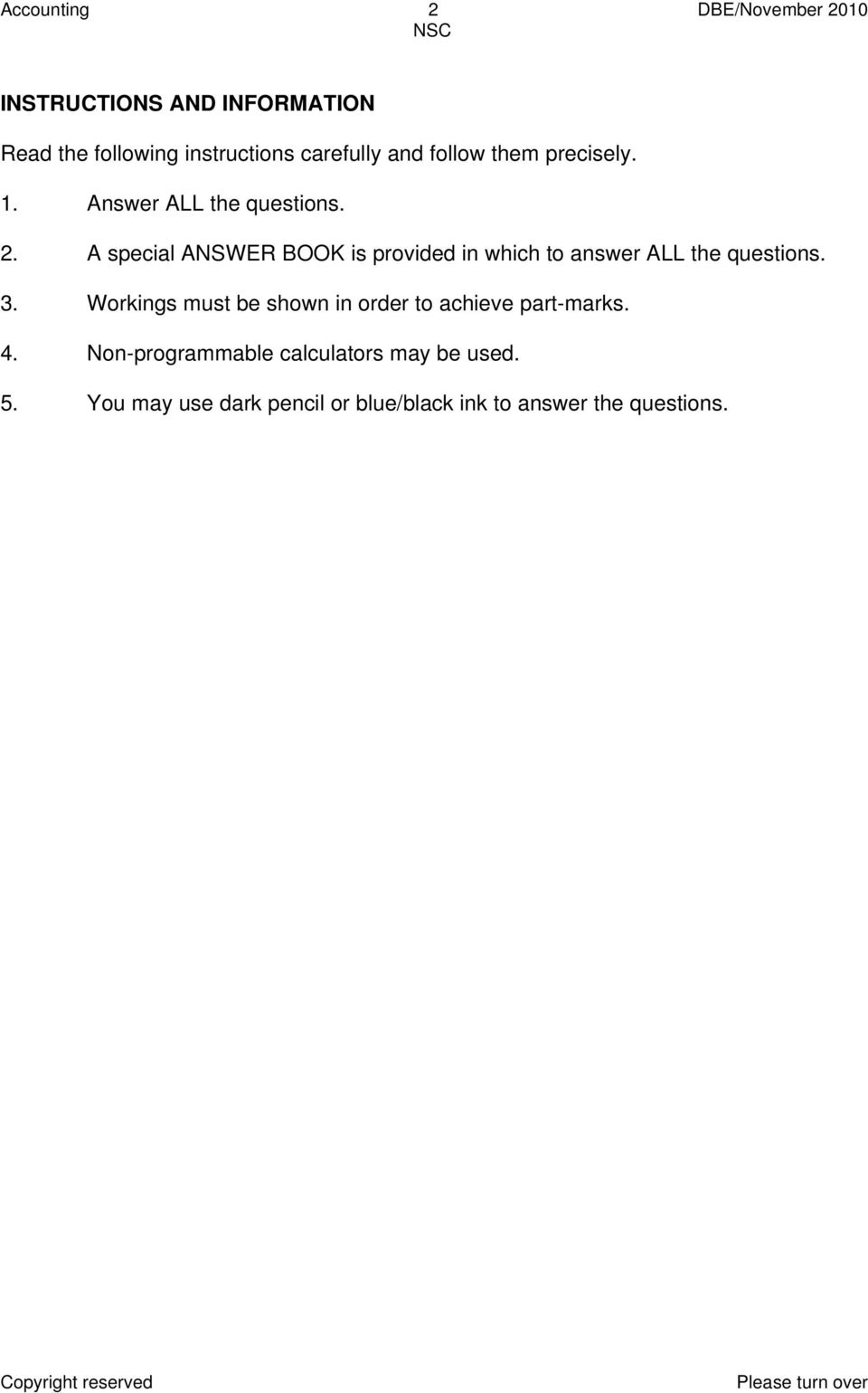
3 Accounting 3 DBE/November Use the information in the table below as a guide when answering the question paper. Try NOT to deviate from it. QUESTION 1: 40 marks; 20 minutes Topic of the question: Learning outcomes covered: LO1 Financial accounting AS3 Accounting equation Analysis of Transactions AS7 Apply VAT principles Inventory Valuation and VAT LO3 Managing resources AS4 Calculate and validate inventories QUESTION 2: 30 marks; 20 minutes Topic of the question: Learning outcomes covered: LO1 Financial accounting Bank Reconciliation and Internal AS4 Reconciliation and interpretation Control LO3 Managing resources AS6 Apply internal control and audit processes Topic of the question: Manufacturing QUESTION 3: 55 marks; 30 minutes Learning outcomes covered: LO1 Financial accounting A1 Concepts manufacturing LO2 Managerial accounting AS2 Production Cost Statement AS2 Unit costs and break even Topic of the question: Company Concepts, Financial Statements, Ratios and Audit Reports Topic of the question: Cash Flow Statement, Interpretation and Asset Disposal QUESTION 4: 65 marks; 40 minutes Learning outcomes covered: LO1 Financial accounting AS1 Concepts AS5 LO3 Final accounts, financial statements and analysis and interpretation of financial statements AS6 Audit reports Managerial accounting AS5 Professional bodies QUESTION 5: 80 marks; 50 minutes Learning outcomes covered: LO1 Financial accounting AS5 Final accounts, financial statements and analysis and interpretation of financial statements LO3 Managerial accounting AS3 Asset disposal Topic of the question: Cash Budgets QUESTION 6: 30 marks; 20 minutes Learning outcomes covered: LO1 Financial accounting AS1 Concepts LO2 Managerial accounting AS3 Analyse and interpret a cash budget LO3 Managing resources AS6 Apply internal control and audit processes
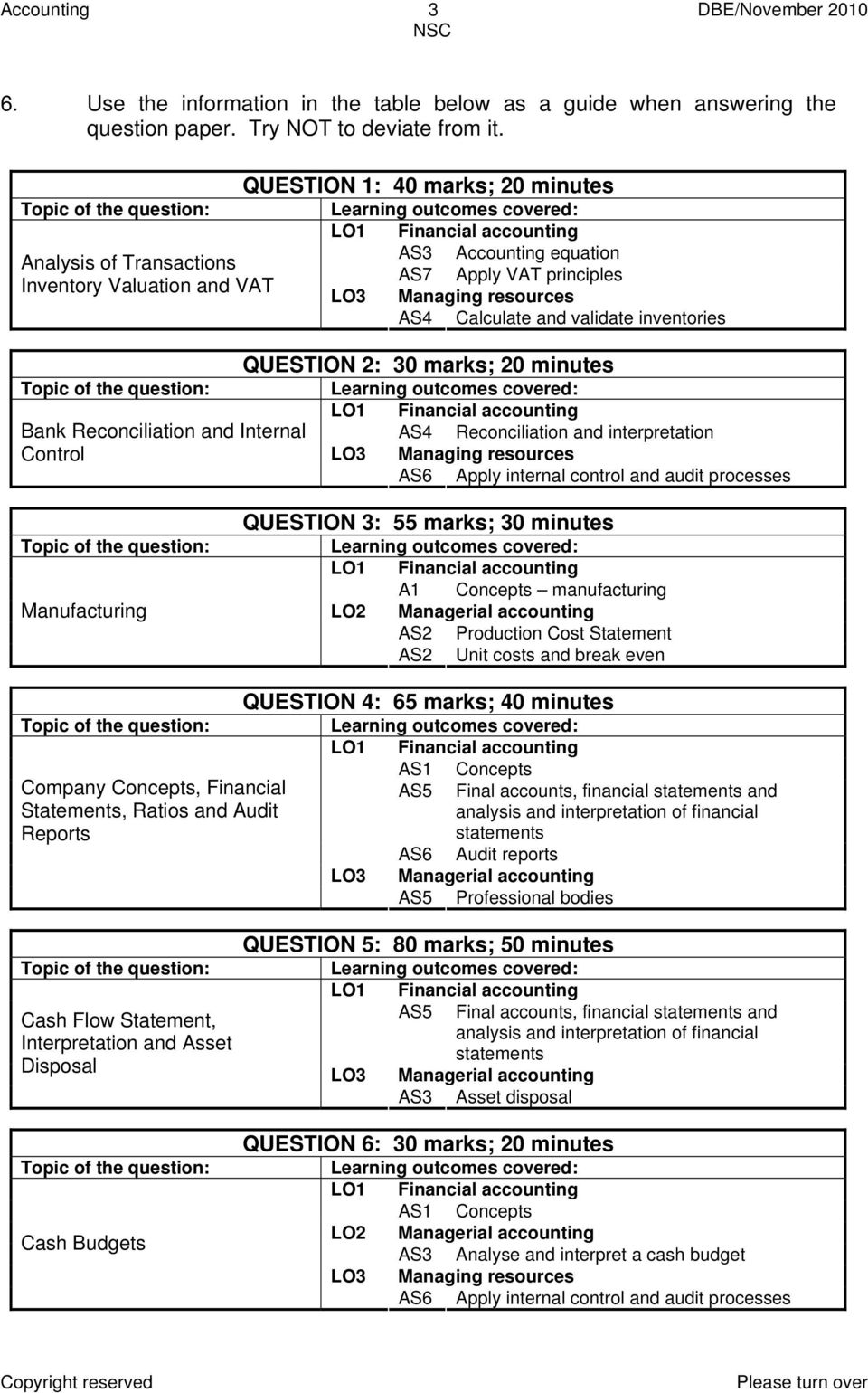
4 Accounting 4 DBE/November 2010 QUESTION 1: ANALYSIS OF TRANSACTIONS, INVENTORY VALUATION AND VAT (40 marks; 20 minutes) This question consists of THREE independent questions. 1.1 ANALYSIS OF TRANSACTIONS You are provided with information relating to Bhato Traders. REQUIRED: Show the effect of the following transactions on the accounting equation. The bank balance is favourable at all times. The first transaction has been completed as an example. Where there is no effect on A, O or L you must reflect an '0'. TRANSACTIONS: An amount owing to SARS for income tax at the end of the previous year was paid. An interim dividend was paid. A premium was charged and received on new shares issued. A final dividend was declared. Income tax for the year was brought into account (the amount exceeds the provisional tax paid). (16)
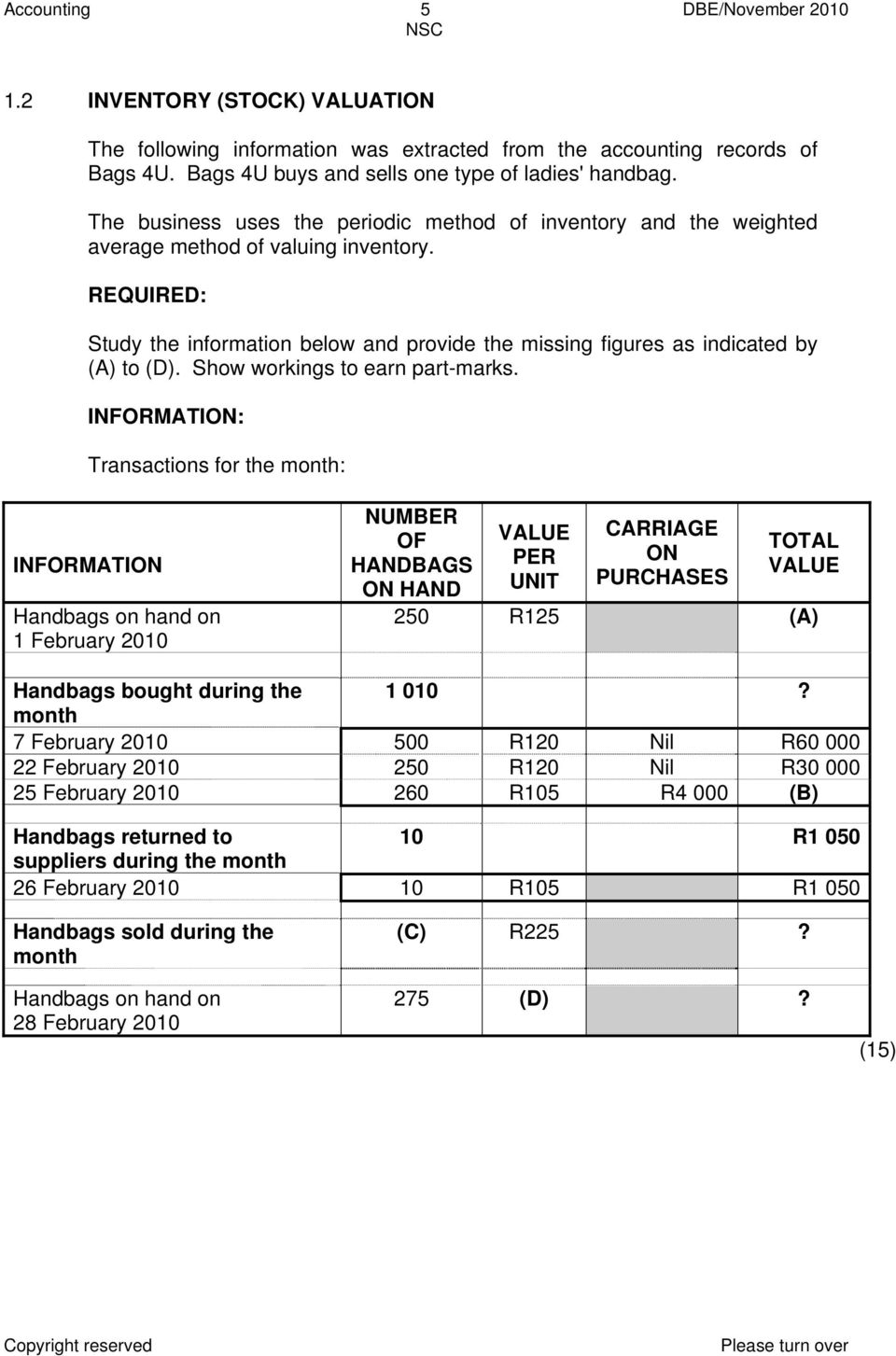
5 Accounting 5 DBE/November INVENTORY (STOCK) VALUATION The following information was extracted from the accounting records of Bags 4U. Bags 4U buys and sells one type of ladies' handbag. The business uses the periodic method of inventory and the weighted average method of valuing inventory. REQUIRED: Study the information below and provide the missing figures as indicated by (A) to (D). Show workings to earn part-marks. INFORMATION: Transactions for the month: INFORMATION Handbags on hand on 1 February 2010 NUMBER OF HANDBAGS ON HAND VALUE PER UNIT CARRIAGE ON PURCHASES TOTAL VALUE 250 R125 (A) Handbags bought during the 1 010? month 7 February R120 Nil R February R120 Nil R February R105 R4 000 (B) Handbags returned to 10 R1 050 suppliers during the month 26 February R105 R1 050 Handbags sold during the month Handbags on hand on 28 February 2010 (C) R225? 275 (D)? (15)
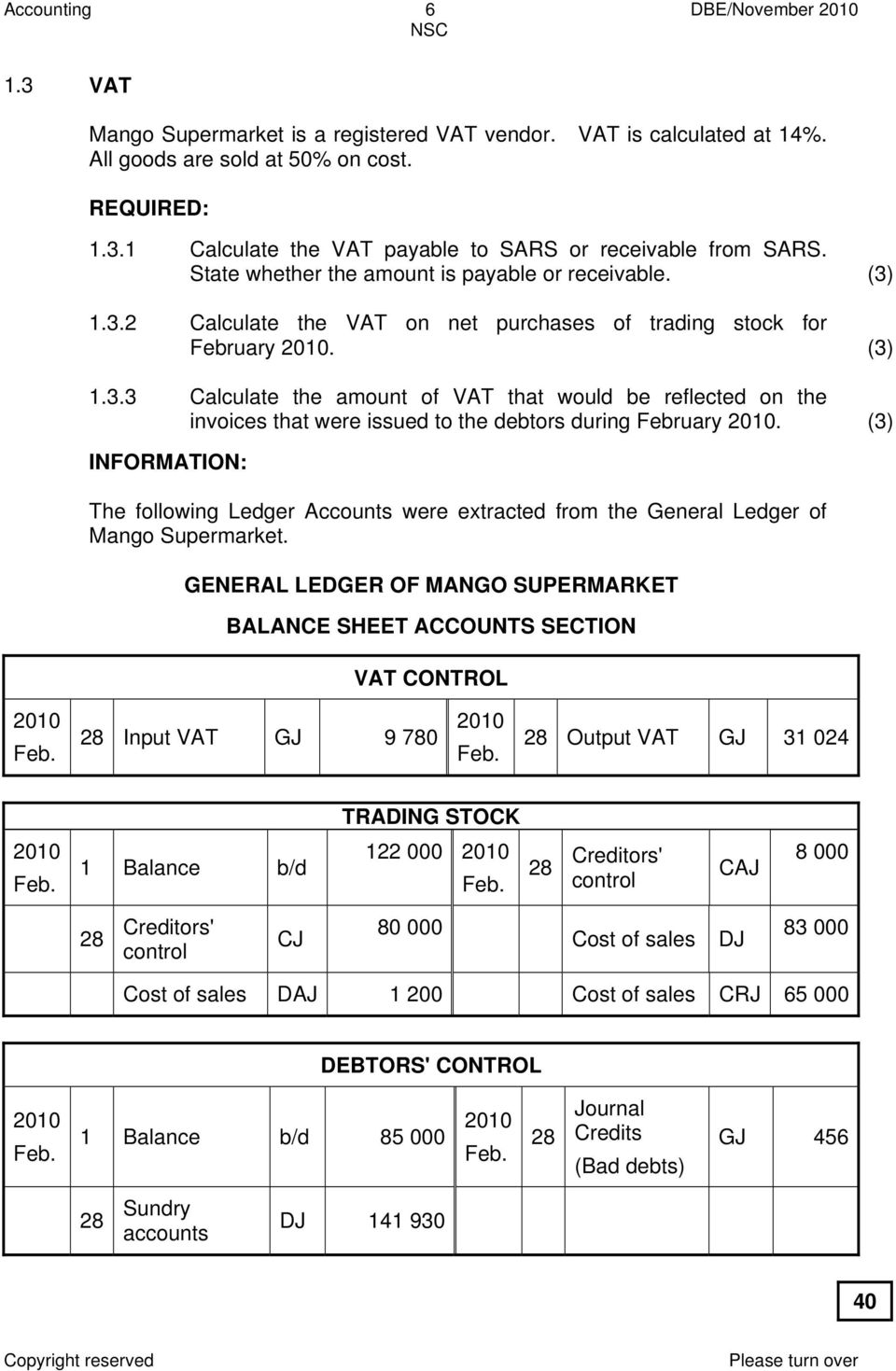
6 Accounting 6 DBE/November VAT Mango Supermarket is a registered VAT vendor. VAT is calculated at 14%. All goods are sold at 50% on cost. REQUIRED: Calculate the VAT payable to SARS or receivable from SARS. State whether the amount is payable or receivable. Calculate the VAT on net purchases of trading stock for February Calculate the amount of VAT that would be reflected on the invoices that were issued to the debtors during February INFORMATION: The following Ledger Accounts were extracted from the General Ledger of Mango Supermarket. GENERAL LEDGER OF MANGO SUPERMARKET BALANCE SHEET ACCOUNTS SECTION VAT CONTROL 2010 Feb. 28 Input VAT GJ Feb. 28 Output VAT GJ TRADING STOCK 2010 Feb. 1 Balance b/d Feb. 28 Creditors' control CAJ Creditors' control CJ Cost of sales DJ Cost of sales DAJ Cost of sales CRJ DEBTORS' CONTROL 2010 Feb. 1 Balance b/d Feb. 28 Journal Credits (Bad debts) GJ Sundry accounts DJ
7 Accounting 7 DBE/November 2010 KEEP THIS PAGE BLANK

8 Accounting 8 DBE/November 2010 QUESTION 2: BANK RECONCILIATION AND INTERNAL CONTROL (30 marks; 20 minutes) Top Dog Traders employs Joe Cryme to write up the books, do the bank deposits and issue cheques. You are required to assist as internal auditor. REQUIRED: Why does a business prepare a Bank Reconciliation Statement each month? Calculate the correct totals in the Cash Receipts Journal (CRJ) and Cash Payments Journal (CPJ) for October Prepare the Bank Reconciliation Statement on 31 October Refer to Information numbers 4 and 8 below. (2) (10) (10) INFORMATION: It appears that Top Dog Traders will not be able to recover all amounts, or part of the amounts, lost due to the fraudulent activities of Joe Cryme. If you were the owner of this business, what steps would you take against Joe Cryme? Provide TWO steps. Explain why the rule of prudence will be used in accounting for the fraudulent activities in the books and the financial statements. Explain what was wrong with the procedures in the accounting department which led to this type of fraudulent activity. (2) 1. At the end of the previous month, 30 September 2010, the following items appeared in the Bank Reconciliation Statement: Balance per Bank Statement Outstanding deposits for cash sales: Dated 28 September Dated 30 September Outstanding cheques: 502 (dated 19 April 2010) 613 (dated 24 September 2010) 614 (dated 27 September 2010) Balance per bank account The balance on the Bank Statement is R (favourable) on 31 October The provisional totals in the journals for October 2010 before reconciling to the bank statement are: CRJ R and CPJ R
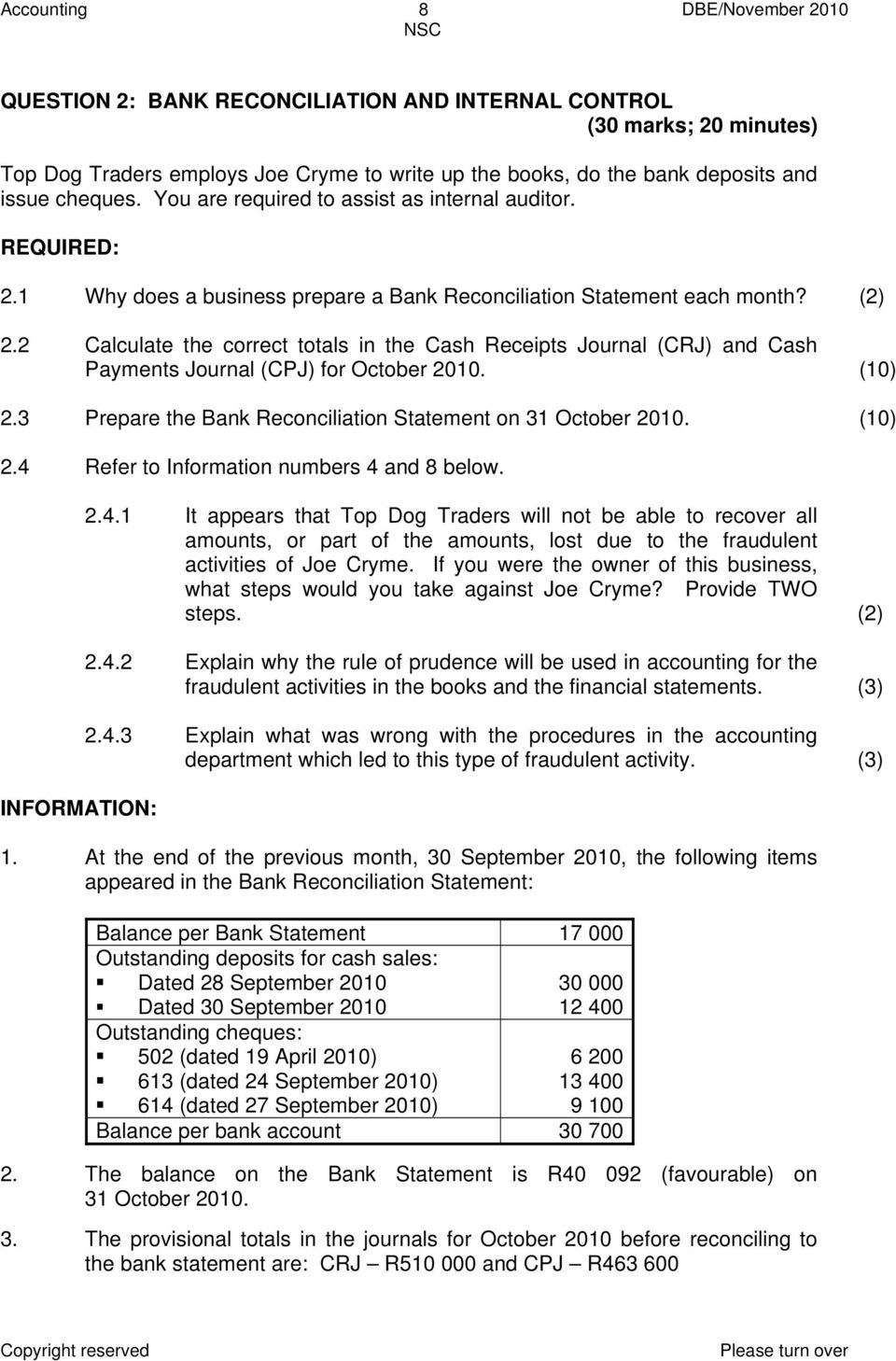
9 Accounting 9 DBE/November From the bank reconciliation for September 2010 only the outstanding deposit of R and cheque No. 614 appeared on the October Bank Statement. The R reflected on the deposit slip, dated 28 September, was never deposited into the bank account by Joe Cryme. He cannot account for the whereabouts of the cash. The October Bank Statement reflected bank charges of R1 310 and interest of R102 on the favourable bank balance. A dishonoured cheque was reflected on the Bank Statement, R This was originally received from a debtor in payment of his account. A direct deposit of R5 500 from a tenant was reflected on the Bank Statement. As internal auditor you also detected that cheque No. 642 for R appeared on the Bank Statement, but not in the CPJ. The bookkeeper, Joe Cryme, forged the signatures and used the funds for personal benefit. Cheque No. 633 was reflected in the CPJ as R2 630, but on the Bank Statement it was reflected as R The amount on the Bank Statement is correct. The following items appeared in the October CRJ and CPJ, but not on the Bank Statement: No. 652 R3 800 (dated 15 November 2010) No. 655 R1 300 A deposit of R for cash sales. 30

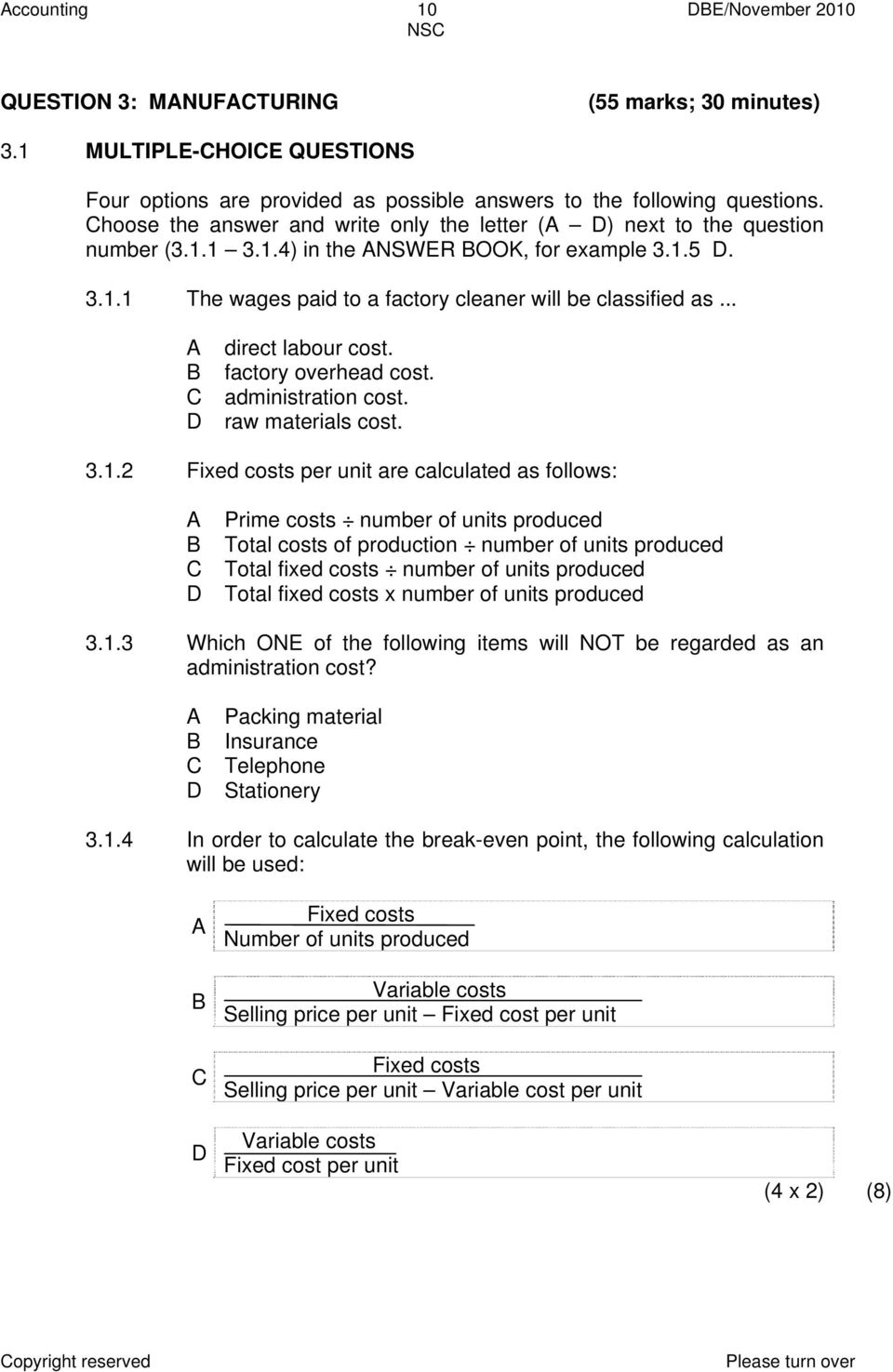
10 Accounting 10 DBE/November 2010 QUESTION 3: MANUFACTURING (55 marks; 30 minutes) 3.1 MULTIPLE-CHOICE QUESTIONS Four options are provided as possible answers to the following questions. Choose the answer and write only the letter (A D) next to the question number ( ) in the ANSWER BOOK, for example D The wages paid to a factory cleaner will be classified as... A B C D direct labour cost. factory overhead cost. administration cost. raw materials cost Fixed costs per unit are calculated as follows: A B C D Prime costs number of units produced Total costs of production number of units produced Total fixed costs number of units produced Total fixed costs x number of units produced Which ONE of the following items will NOT be regarded as an administration cost? A B C D Packing material Insurance Telephone Stationery In order to calculate the break-even point, the following calculation will be used: A B C D Fixed costs Number of units produced Variable costs Selling price per unit Fixed cost per unit Fixed costs Selling price per unit Variable cost per unit Variable costs Fixed cost per unit (4 x 2) (8)
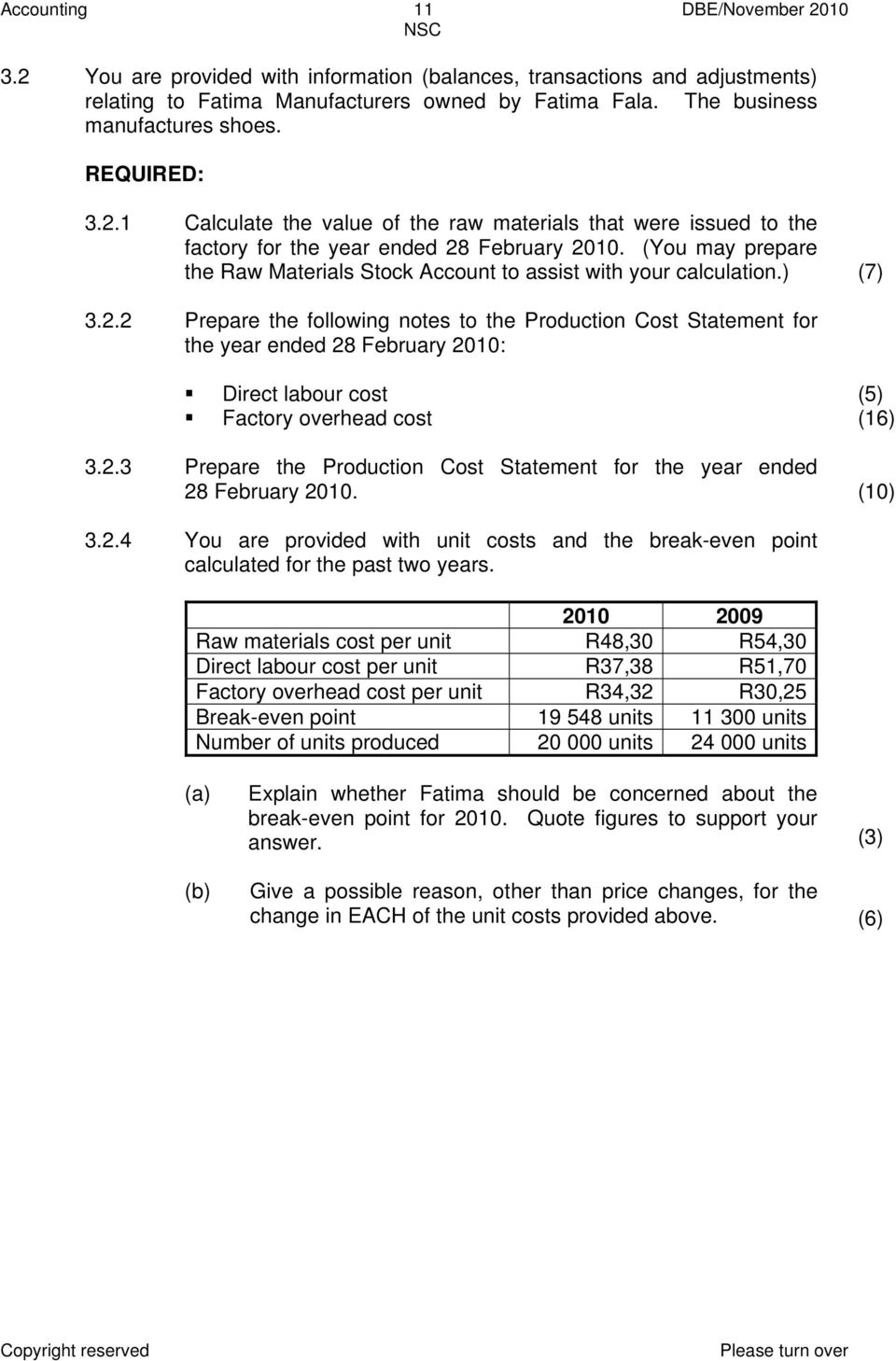
11 Accounting 11 DBE/November You are provided with information (balances, transactions and adjustments) relating to Fatima Manufacturers owned by Fatima Fala. The business manufactures shoes. REQUIRED: Calculate the value of the raw materials that were issued to the factory for the year ended 28 February (You may prepare the Raw Materials Stock Account to assist with your calculation.) Prepare the following notes to the Production Cost Statement for the year ended 28 February 2010: Direct labour cost Factory overhead cost Prepare the Production Cost Statement for the year ended 28 February You are provided with unit costs and the break-even point calculated for the past two years Raw materials cost per unit R48,30 R54,30 Direct labour cost per unit R37,38 R51,70 Factory overhead cost per unit R34,32 R30,25 Break-even point units units Number of units produced units units (7) (5) (16) (10) (a) (b) Explain whether Fatima should be concerned about the break-even point for Quote figures to support your answer. Give a possible reason, other than price changes, for the change in EACH of the unit costs provided above. (6)
12 Accounting 12 DBE/November 2010 INFORMATION: 1. OPENING BALANCES ON 1 MARCH 2009: Raw materials stock R Work-in-process stock Finished goods stock Consumable stores stock: Factory Factory plant and equipment at cost Accumulated depreciation on factory plant and equipment SUMMARY OF TRANSACTIONS FOR THE YEAR ENDED 28 FEBRUARY 2010: Purchases of raw materials on credit R Carriage on purchases of raw materials Consumable stores purchased for the factory Cleaning materials purchased for the office Factory plant and equipment purchased on 1 September Production wages UIF Contribution for factory employees? Salaries: Factory foreman Administration Sales staff Water and electricity Sundry expenses: Factory Administration Sales department CLOSING BALANCES ON 28 FEBRUARY 2010: Raw materials stock R Work-in-process stock? Finished goods stock Consumable stores stock: Factory 7 000

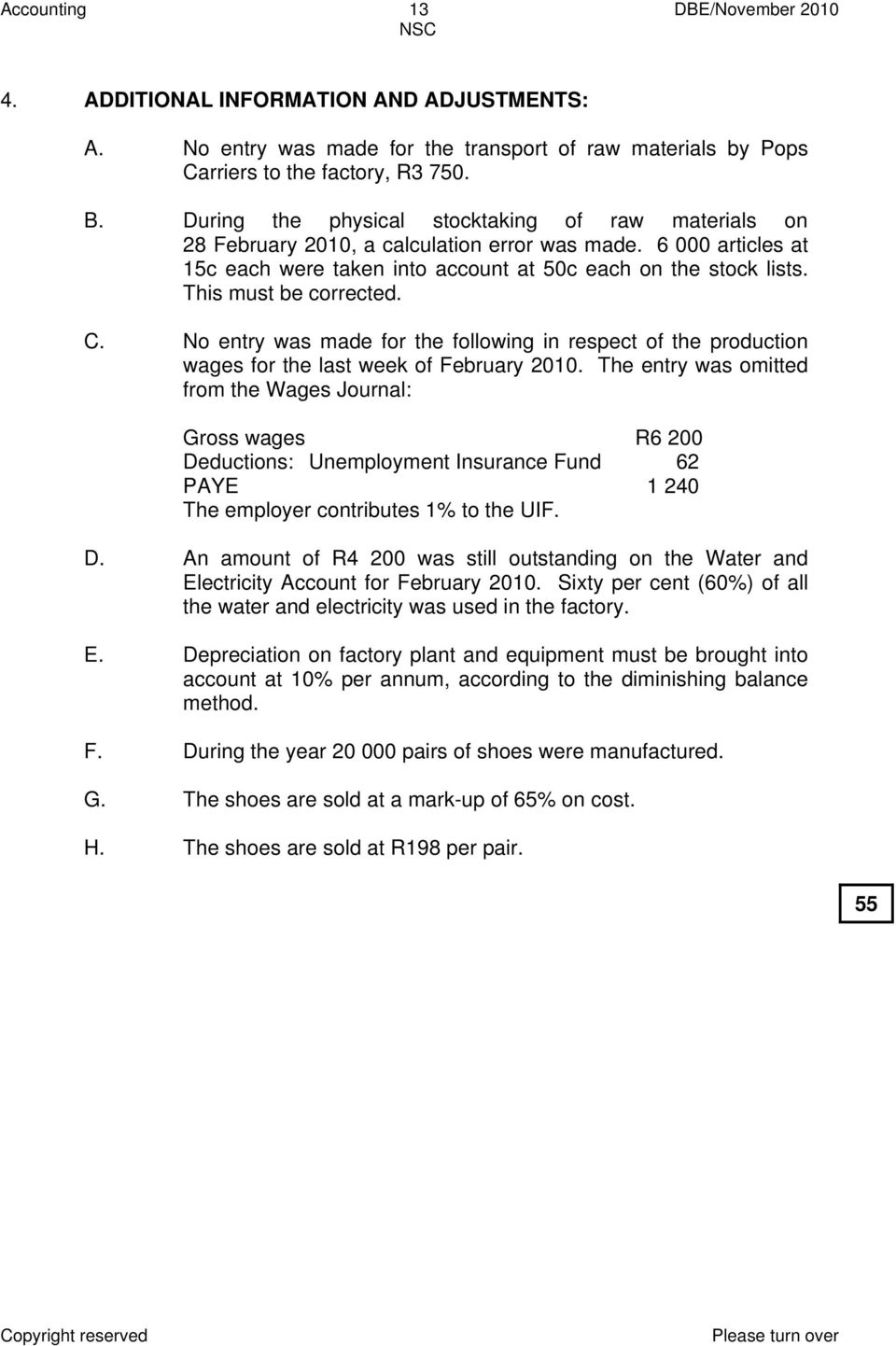
13 Accounting 13 DBE/November ADDITIONAL INFORMATION AND ADJUSTMENTS: A. B. C. No entry was made for the transport of raw materials by Pops Carriers to the factory, R During the physical stocktaking of raw materials on 28 February 2010, a calculation error was made articles at 15c each were taken into account at 50c each on the stock lists. This must be corrected. No entry was made for the following in respect of the production wages for the last week of February The entry was omitted from the Wages Journal: Gross wages R6 200 Deductions: Unemployment Insurance Fund 62 PAYE The employer contributes 1% to the UIF. D. E. F. G. H. An amount of R4 200 was still outstanding on the Water and Electricity Account for February Sixty per cent (60%) of all the water and electricity was used in the factory. Depreciation on factory plant and equipment must be brought into account at 10% per annum, according to the diminishing balance method. During the year pairs of shoes were manufactured. The shoes are sold at a mark-up of 65% on cost. The shoes are sold at R198 per pair. 55
14 Accounting 14 DBE/November 2010 KEEP THIS PAGE BLANK

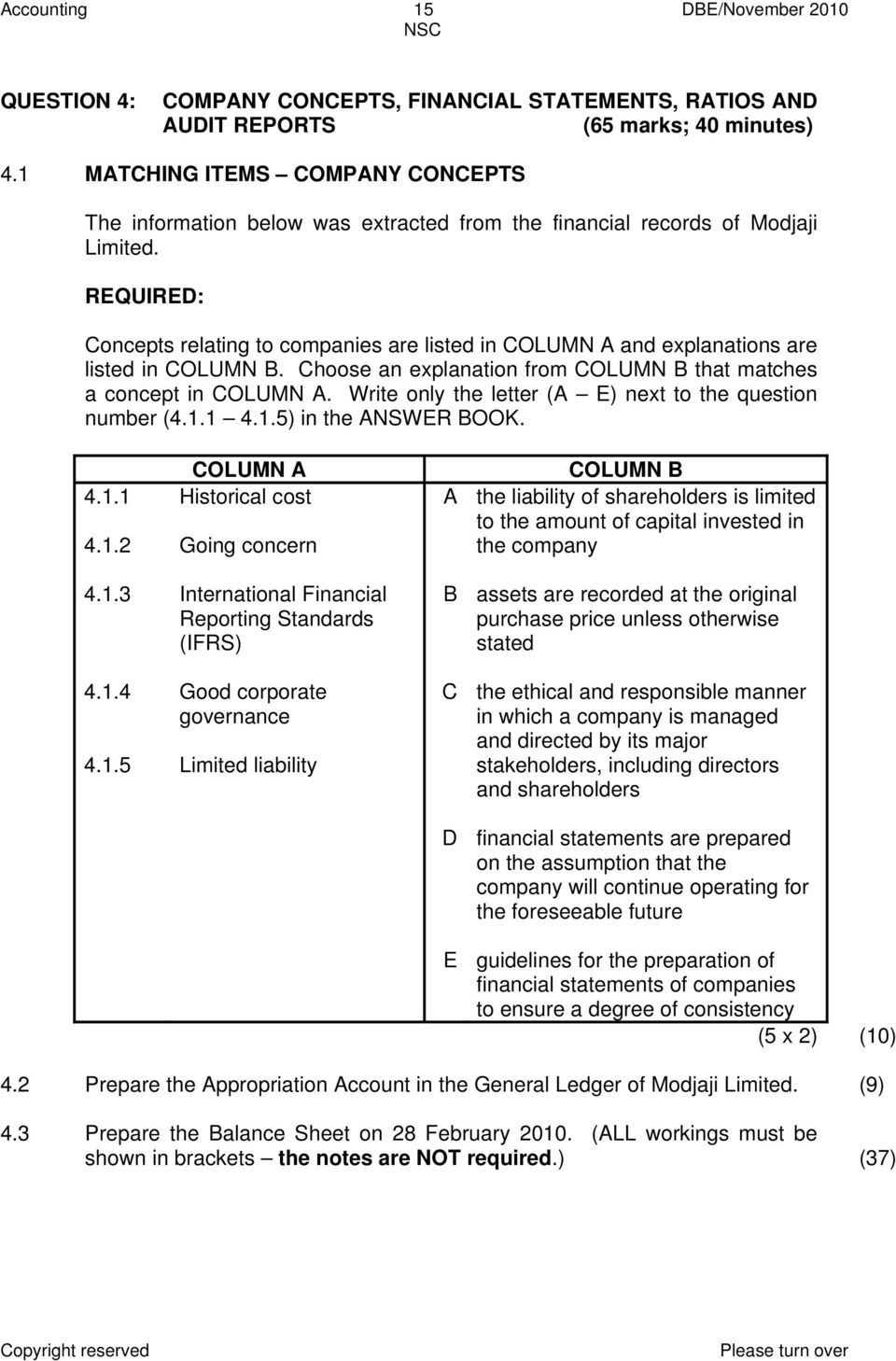
15 Accounting 15 DBE/November 2010 QUESTION 4: COMPANY CONCEPTS, FINANCIAL STATEMENTS, RATIOS AND AUDIT REPORTS (65 marks; 40 minutes) 4.1 MATCHING ITEMS COMPANY CONCEPTS The information below was extracted from the financial records of Modjaji Limited. REQUIRED: Concepts relating to companies are listed in COLUMN A and explanations are listed in COLUMN B. Choose an explanation from COLUMN B that matches a concept in COLUMN A. Write only the letter (A E) next to the question number ( ) in the ANSWER BOOK COLUMN A Historical cost Going concern A COLUMN B the liability of shareholders is limited to the amount of capital invested in the company International Financial Reporting Standards (IFRS) B assets are recorded at the original purchase price unless otherwise stated Good corporate governance Limited liability C the ethical and responsible manner in which a company is managed and directed by its major stakeholders, including directors and shareholders D financial statements are prepared on the assumption that the company will continue operating for the foreseeable future E guidelines for the preparation of financial statements of companies to ensure a degree of consistency (5 x 2) (10) Prepare the Appropriation Account in the General Ledger of Modjaji Limited. Prepare the Balance Sheet on 28 February (ALL workings must be shown in brackets the notes are NOT required.) (9) (37)
16 Accounting 16 DBE/November 2010 INFORMATION: 1. The following balances/totals appeared in the General Ledger on 28 February 2010: BALANCE SHEET ACCOUNTS SECTION Ordinary share capital R Share premium Retained income (1 March 2009) Long-term loan: Oka Lenders Fixed assets at carrying value (1 March 2009) Trading stock Debtors' control Provision for bad debts (1 March 2009) Creditors' control Bank debit Cash float Fixed deposit at Leakage Bank (matures in 2013) Deposit: Water and electricity SARS: Income tax debit ML Pension Fund NOMINAL ACCOUNTS SECTION Ordinary share dividends (interim) FINAL ACCOUNTS SECTION Trading account (gross profit) Profit and Loss Account (net profit) The company has an authorised share capital of shares with a par value of R2 each. The following adjustments must still be considered: The directors declared a final dividend of 10 cents per share on 28 February The assessment received from SARS reflects income tax of R for the financial year.

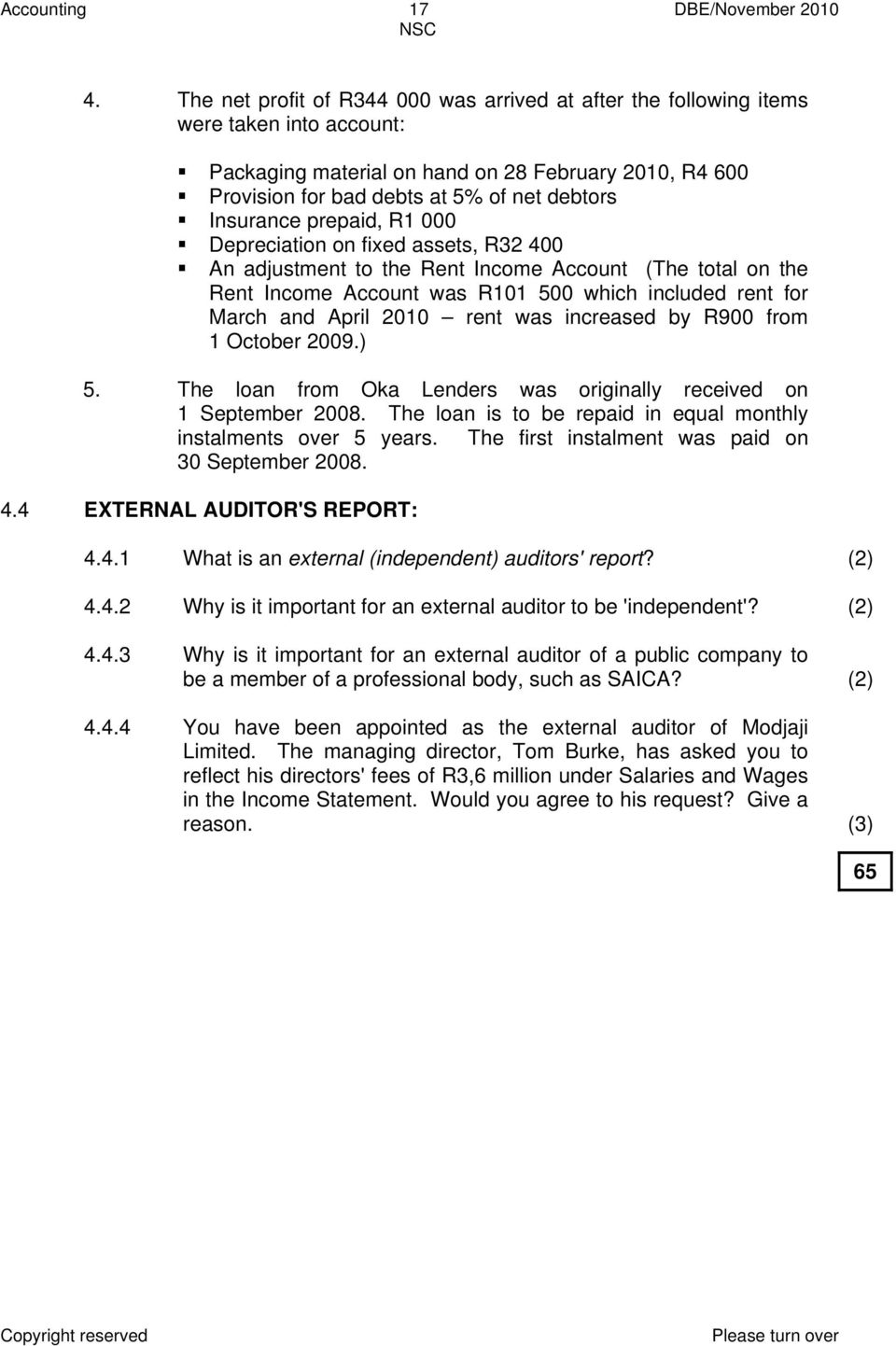
17 Accounting 17 DBE/November The net profit of R was arrived at after the following items were taken into account: Packaging material on hand on 28 February 2010, R4 600 Provision for bad debts at 5% of net debtors Insurance prepaid, R1 000 Depreciation on fixed assets, R An adjustment to the Rent Income Account (The total on the Rent Income Account was R which included rent for March and April 2010 rent was increased by R900 from 1 October 2009.) 5. The loan from Oka Lenders was originally received on 1 September The loan is to be repaid in equal monthly instalments over 5 years. The first instalment was paid on 30 September EXTERNAL AUDITOR'S REPORT: What is an external (independent) auditors' report? Why is it important for an external auditor to be 'independent'? Why is it important for an external auditor of a public company to be a member of a professional body, such as SAICA? You have been appointed as the external auditor of Modjaji Limited. The managing director, Tom Burke, has asked you to reflect his directors' fees of R3,6 million under Salaries and Wages in the Income Statement. Would you agree to his request? Give a reason. (2) (2) (2) 65
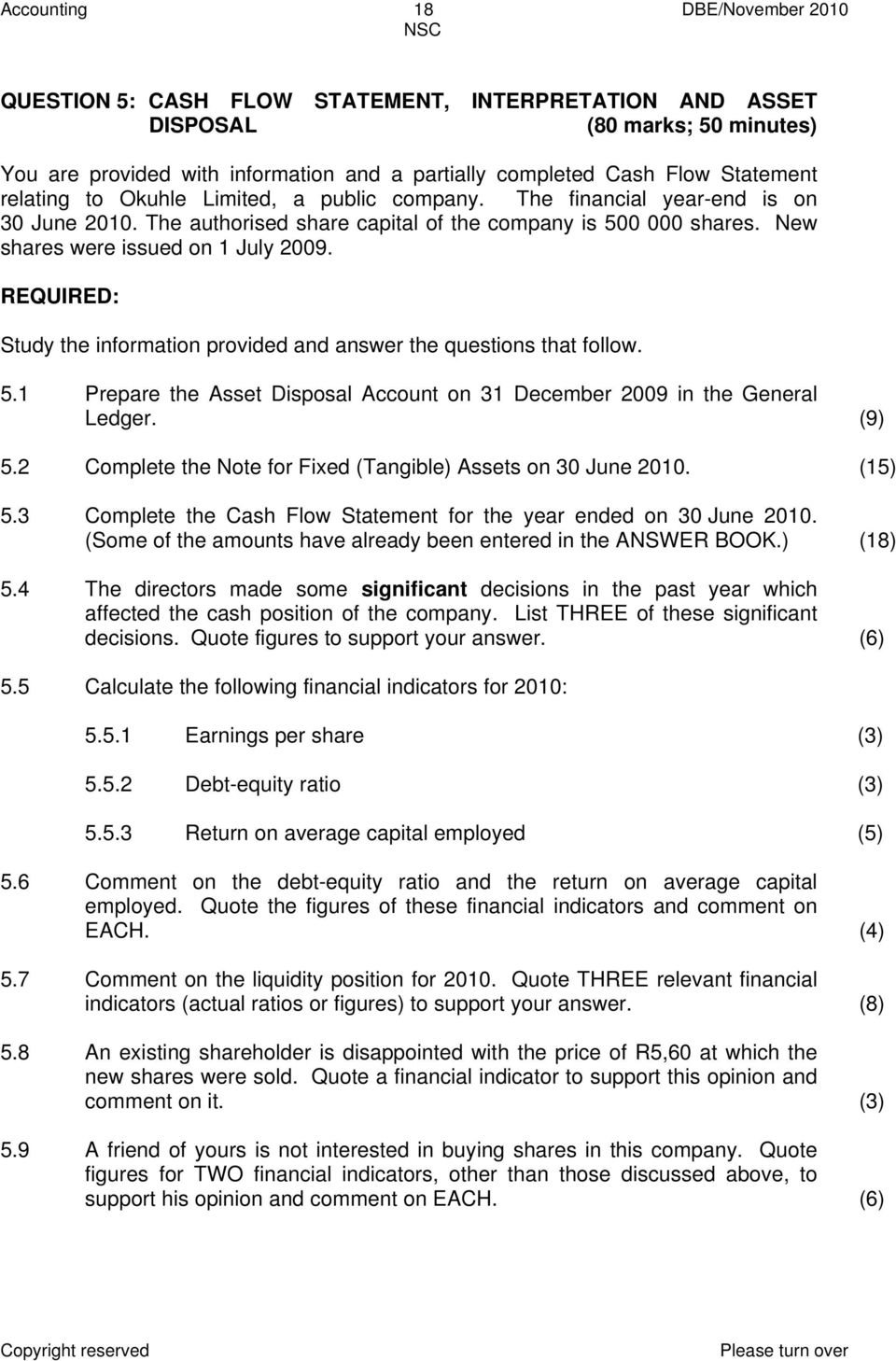
18 Accounting 18 DBE/November 2010 QUESTION 5: CASH FLOW STATEMENT, INTERPRETATION AND ASSET DISPOSAL (80 marks; 50 minutes) You are provided with information and a partially completed Cash Flow Statement relating to Okuhle Limited, a public company. The financial year-end is on 30 June The authorised share capital of the company is shares. New shares were issued on 1 July REQUIRED: Study the information provided and answer the questions that follow Prepare the Asset Disposal Account on 31 December 2009 in the General Ledger. Complete the Note for Fixed (Tangible) Assets on 30 June Complete the Cash Flow Statement for the year ended on 30 June (Some of the amounts have already been entered in the ANSWER BOOK.) The directors made some significant decisions in the past year which affected the cash position of the company. List THREE of these significant decisions. Quote figures to support your answer. Calculate the following financial indicators for 2010: (9) (15) (18) (6) Earnings per share Debt-equity ratio Return on average capital employed (5) Comment on the debt-equity ratio and the return on average capital employed. Quote the figures of these financial indicators and comment on EACH. Comment on the liquidity position for Quote THREE relevant financial indicators (actual ratios or figures) to support your answer. An existing shareholder is disappointed with the price of R5,60 at which the new shares were sold. Quote a financial indicator to support this opinion and comment on it. A friend of yours is not interested in buying shares in this company. Quote figures for TWO financial indicators, other than those discussed above, to support his opinion and comment on EACH. (4) (8) (6)
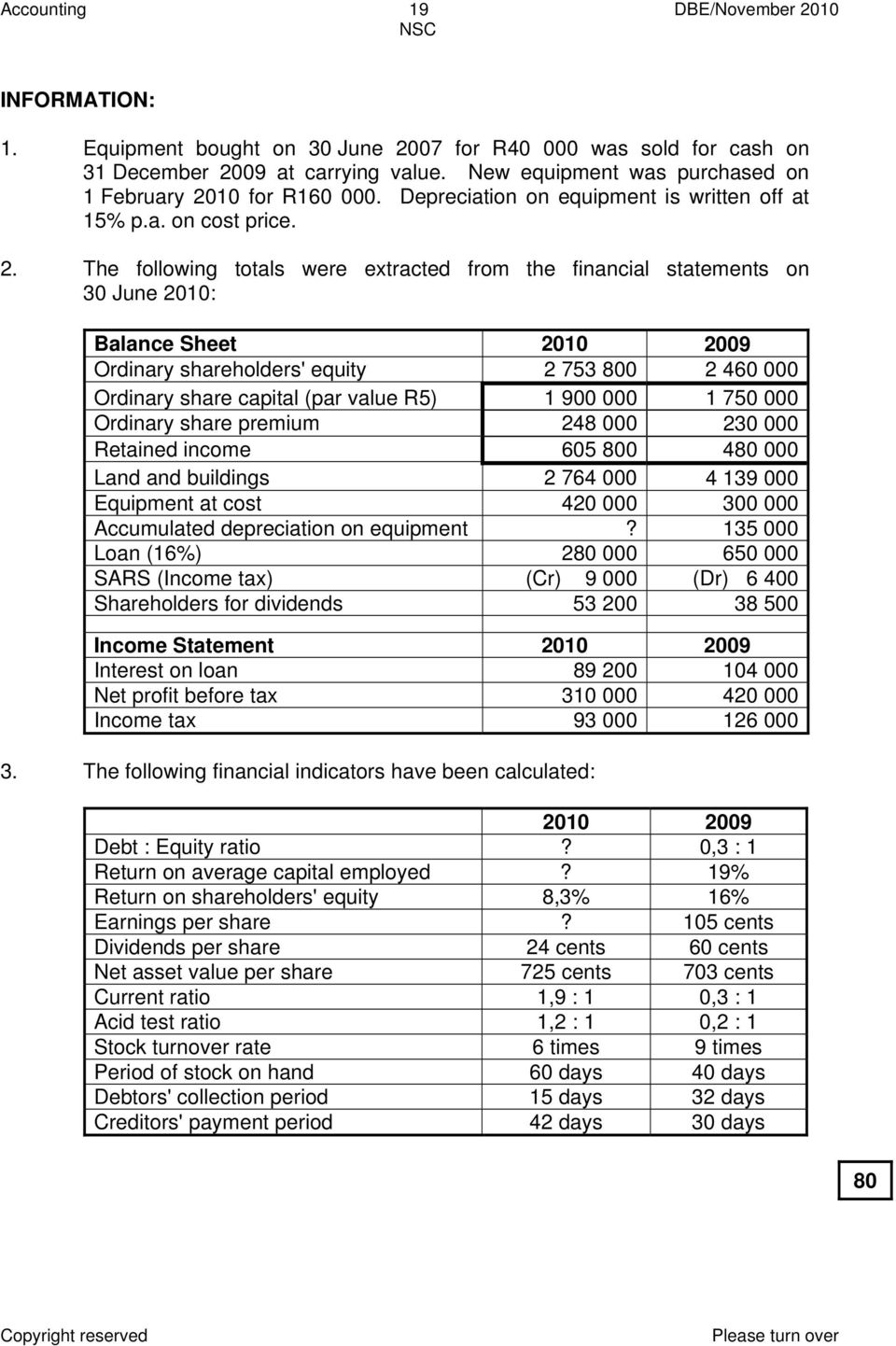
19 Accounting 19 DBE/November 2010 INFORMATION: Equipment bought on 30 June 2007 for R was sold for cash on 31 December 2009 at carrying value. New equipment was purchased on 1 February 2010 for R Depreciation on equipment is written off at 15% p.a. on cost price. The following totals were extracted from the financial statements on 30 June 2010: Balance Sheet Ordinary shareholders' equity Ordinary share capital (par value R5) Ordinary share premium Retained income Land and buildings Equipment at cost Accumulated depreciation on equipment? Loan (16%) SARS (Income tax) (Cr) (Dr) Shareholders for dividends Income Statement Interest on loan Net profit before tax Income tax The following financial indicators have been calculated: Debt : Equity ratio? 0,3 : 1 Return on average capital employed? 19% Return on shareholders' equity 8,3% 16% Earnings per share? 105 cents Dividends per share 24 cents 60 cents Net asset value per share 725 cents 703 cents Current ratio 1,9 : 1 0,3 : 1 Acid test ratio 1,2 : 1 0,2 : 1 Stock turnover rate 6 times 9 times Period of stock on hand 60 days 40 days Debtors' collection period 15 days 32 days Creditors' payment period 42 days 30 days 80
20 Accounting 20 DBE/November 2010 QUESTION 6: CASH BUDGETS (30 marks; 20 minutes) You are provided with an extract from the Cash Budget of Parys Gymnasium. The business is owned by Piet Nkosi. Each member pays a once-off admission fee of R1 000 and a subscription fee of R500 per month to belong to the gymnasium. Piet employs Steffi Smit to collect and control the fee income. REQUIRED: 6.1 Calculate the following: The insurance figure for November 2010 (Note that the insurance premium will increase by 6% on 1 November 2010.) The % increase in Steffi Smit's salary in October 2010 The mark-up % that is applied on the sale of refreshments (Note that refreshments are sold for cash only and are replaced in the month of sale.) The amount invested in the fixed deposit on 1 September 2010 (Note that the interest rate is 8% p.a. A portion of the fixed deposit matures on 31 October 2010.) Interest on the fixed deposit for November 2010 (2) (2) 6.2 As internal auditor you are required to give Piet feedback on the marketing strategy and fee collection How many new customers did Piet expect to gain from the marketing strategy in September 2010? What TWO aspects of the marketing strategy could be improved? Give figures to support your answer and make suggestions for EACH. Has Steffi Smit been successful in the collection of fee income? Explain by quoting figures to support your opinion. (4) (6) (7)

21 Accounting 21 DBE/November 2010 INFORMATION: 1. EXTRACT FROM CASH BUDGET FOR SEPT TO NOV Sept. Oct. Nov. Total RECEIPTS: R R R R Joining fee (Admission fee)? 0 0? Monthly fee collections (Subscriptions) Sale of refreshments Fixed deposit matured Interest on fixed deposit (8% p.a.) ?? PAYMENTS: Insurance ?? Commission paid Transport allowance Salary to Steffi Smit Purchases of refreshments MARKETING STRATEGY: At the end of August Piet had 450 customers. Piet developed a new marketing strategy to increase the number of customers significantly. He planned to employ three people (Chase, Jane and Dan) at the beginning of September 2010 to market the gymnasium and get new customers to sign contracts. He would pay them commission of R150 for each new customer and a travel allowance. Piet asked you, as the internal auditor, to analyse the work done by the marketing team. Your analysis is as follows: Analysis of work done by the marketing team September Chase Jane Dan Total Number of new contracts issued Commission earned R R5 250 R R Transport allowance paid R3 000 R3 000 R3 000 R9 000 Number of contracts cancelled on 1 November ACTUAL FEE INCOME COLLECTED COMPARED TO BUDGET Budgeted Actual September R R October R R November R R Total R R TOTAL: 300
GRAAD 12 NATIONAL SENIOR CERTIFICATE GRADE 12
 GRAAD 12 NATIONAL SENIOR CERTIFICATE GRADE 12 ACCOUNTING NOVEMBER 2013 MARKS: 300 TIME: 3 hours This question paper consists of 24 pages and an 18-page answer book. Accounting 2 DBE/November 2013 INSTRUCTIONS
GRADE 11 NOVEMBER 2012 ACCOUNTING
 Province of the EASTERN CAPE EDUCATION NATIONAL SENIOR CERTIFICATE GRADE 11 NOVEMBER 2012 ACCOUNTING MARKS: 300 TIME: 3 hours This question paper consists of 16 pages. 2 ACCOUNTING (NOVEMBER 2012) INSTRUCTIONS
MANUFACTURING ACCOUNTS PRODUCTION COST STATEMENTS / BREAK-EVEN ANALYSIS CALCULATION
 SESSION 12: MANUFACTURING ACCOUNTS PRODUCTION COST STATEMENTS / BREAK-EVEN ANALYSIS CALCULATION KEY CONCEPTS: In this session we will look at: - Manufacturing Accounts X-AMPLE QUESTIONS: QUESTION 1: You
NATIONAL SENIOR CERTIFICATE GRADE 12
 NATIONAL SENIOR CERTIFICATE GRADE 12 ACCOUNTING FEBRUARY/MARCH 2013 MEMORANDUM MARKS: 300 MARKING PRINCIPLES: 1. Penalties for foreign items are applied only if the candidate is not losing marks elsewhere
SECONDARY SCHOOL IMPROVEMENT PROGRAMME (SSIP) 2015
 1 SECONDARY SCHOOL IMPROVEMENT PROGRAMME (SSIP) 2015 GRADE 12 SUBJECT: ACCOUNTING LEARNER NOTES (Page 1 of 97) 2 TABLE OF CONTENTS SESSION TOPIC PAGE NO 11 Manufacturing 3-25 12 Cash Budgets 26-39 13 Projected
Grade 10 Accounting Notes SET 2: Basics Cash Retail Business Cash Transactions. Name: JCansfield Page 1 of 27
 Grade 10 Accounting Notes SET 2: Basics Cash Retail Business Cash Transactions Name: JCansfield Page 1 of 27 Accounting Cycle The Accounting cycle takes place over 12 months. We refer to this as the Financial
NATIONAL SENIOR CERTIFICATE GRADE 12
 NATIONAL SENIOR CERTIFICATE GRADE 12 ACCOUNTING NOVEMBER 2008 MARKS: 300 TIME: 3 hours This question paper consists of 21 pages and an answer book of 20 pages. Accounting 2 DoE/November 2008 INSTRUCTIONS
Coimisiún na Scrúduithe Stáit State Examinations Commission. Leaving Certificate 2014. Marking Scheme. Accounting. Higher Level
 Coimisiún na Scrúduithe Stáit State Examinations Commission Leaving Certificate 2014 Marking Scheme Accounting Higher Level Note to teachers and students on the use of published marking schemes Marking
NATIONAL SENIOR CERTIFICATE GRADE 12
 NATIONAL SENIOR CERTIFICATE GRADE 12 ACCOUNTING FEBRUARY/MARCH 2015 MEMORANDUM MARKS: 300 MARKING PRINCIPLES: 1. Penalties for foreign items are applied only if the candidate is not losing marks elsewhere
SESSION 3: COMPANIES FINANCIAL STATEMENTS (THE BALANCE SHEET)
 SESSION 3: COMPANIES FINANCIAL STATEMENTS (THE BALANCE SHEET) KEY CONCEPTS: In this session we will look at: - The Balance Sheet - Notes to the Financial Statements Trading Business X-PLANATION THE BALANCE
NATIONAL SENIOR CERTIFICATE GRADE 12
 NATIONAL SENIOR CERTIFICATE GRADE 12 ACCOUNTING EXEMPLAR 201 MEMORANDUM MARKS: 300 MARKING PRINCIPLES: 1. Penalties for foreign items are applied only if the candidate is not losing marks elsewhere in
NATIONAL SENIOR CERTIFICATE GRADE 11
 NATIONAL SENIOR CERTIFICATE GRADE 11 ACCOUNTING EXEMPLAR 2007 MARKS: 300 TIME: 3 hours This question paper consists of 20 pages and a 24-page answer book. Accounting 2 Accounting 3 INSTRUCTIONS AND INFORMATION
C02-Fundamentals of financial accounting
 Sample Exam Paper Question 1 The difference between an income statement and an income and expenditure account is that: A. An income and expenditure account is an international term for an Income statement.
MARK SCHEME for the October/November 2011 question paper for the guidance of teachers 0452 ACCOUNTING. 0452/23 Paper 2, maximum raw mark 120
 www.xtremepapers.com UNIVERSITY OF CAMBRIDGE INTERNATIONAL EXAMINATIONS International General Certificate of Secondary Education MARK SCHEME for the October/November question paper for the guidance of
(a) (i) Marking Scheme: 1 mark for definition and 1 mark for example.
 T A S M A N I A N Accounting C E R T I F I C A T E Subject Code ACC5C O F E D U C A T I O N Question 1 T A S M A N I A N Q U A L I F I C A T I O N S A U T H O R I T Y (a) (i) Marking Scheme: 1 mark for
Accounting 7 DoE/Feb. March 2009 NSC QUESTION 2
 Accounting 7 DoE/Feb. March 2009 INVENTORY VALUATION QUESTION 2 (35 marks; 20 minutes) You are provided with information in respect of Magic Soccer Balls Shop for the year ended 28 February 2009. The business
CURRICULUM AND ASSESSMENT POLICY STATEMENT (CAPS)
 CURRICULUM AND ASSESSMENT POLICY STATEMENT (CAPS) ACCOUNTING CONTENTS SECTION 1 1.1 Background 1.2 Overview 1.3 General aims of the South African Curriculum 1.4 Time allocation 1.4.1 Foundation Phase 1.4.2
INTERNATIONAL ACCOUNTING STANDARDS. CIE Guidance for teachers of. 7110 Principles of Accounts and. 0452 Accounting
 www.xtremepapers.com INTERNATIONAL ACCOUNTING STANDARDS CIE Guidance for teachers of 7110 Principles of Accounts and 0452 Accounting 1 CONTENTS Introduction...3 Use of this document... 3 Users of financial
Learner Note: Ensure that you know and understand all the adjustments completed in Grade 10.
 SOLE TRADER ACCOUNTS Learner Note: Ensure that you know and understand all the adjustments completed in Grade 10. SECTION A: TYPICAL EXAM QUESTIONS HINTS Always identify the two accounts involved Classify
ACCOUNTING SCHOOL-BASED ASSESSMENT EXEMPLARS CAPS GRADE 12 LEARNER GUIDE
 ACCOUNTING SCHOOL-BASED ASSESSMENT EXEMPLARS CAPS GRADE 12 LEARNER GUIDE ACCOUNTING SCHOOL-BASED ASSESSMENT EXEMPLARS CAPS GRADE 12 LEARNER GUIDE CONTENTS Introduction... 1 Task A First Term Report:
ACCOUNTING 1 (ACN101- M)
 1 ACCOUNTING 1 (ACN101- M) STUDY UNIT 1: THE NATURE AND FUNCTION OF ACCOUNTING DEFINITION: Accounting can be defined as the orderly & systematic recording of the monetary values of financial transactions
GRADE 11 ACCOUNTING EXEMPLAR 2007 ANSWER BOOK
 GRADE 11 ACCOUNTING EXEMPLAR 2007 NAME OF LEARNER: ANSWER BOOK QUESTION MAX FINAL MARKS 1 40 2 45 3 40 4 40 5 50 6 50 7 35 300 This answer book consists of 24 pages. Accounting 2 QUESTION 1 1.1 JAYCEE
Easter School Accounting Grade 12. Interpretation of Financial Statements 27 March 2013
 KEY CONCEPTS: In this session we will focus on: - Ratios X-PLANATION INTRODUCTION: Ratios For our curriculum in Grade 12 we are going to use ratios to analyse the information available in the Income Statement
Mustafa Khuwaja - CAT Finalist
 1 Run through the Flashcards as often as you can during your final revision period. The day before the exam, try to go through the Flashcards again. You will be well on your way to passing your exams.
6. Show all your workings. icpar
 CERTIFIED PUBLIC ACCOUNTANT FOUNDATION LEVEL 1 EXAMINATION F1.3: FINANCIAL ACCOUNTING MONDAY: 10 JUNE 2013 INSTRUCTIONS: 1. Time Allowed: 3 hours 15 minutes (15 minutes reading and 3 hours writing). 2.
CURRICULUM AND ASSESSMENT POLICY STATEMENT (CAPS) ACCOUNTING FINAL DRAFT
 CURRICULUM AND ASSESSMENT POLICY STATEMENT (CAPS) ACCOUNTING FINAL DRAFT 1 SECTION 1 NATIONAL CURRICULUM AND ASSESSMENT POLICY STATEMENT FOR ACCOUNTING 1.1 Background The National Curriculum Statement
National Curriculum Statement (NCS) Curriculum and Assessment Policy Statement ACCOUNTING. Further Education and Training Phase Grades 10-12
 National Curriculum Statement (NCS) Curriculum and Assessment Policy Statement ACCOUNTING Further Education and Training Phase Grades 10-12 Curriculum and Assessment Policy Statement Grades 10-12 Accounting
UNIVERSITY OF CAMBRIDGE INTERNATIONAL EXAMINATIONS International General Certificate of Secondary Education
 *0018636067* UNIVERSITY OF CAMBRIDGE INTERNATIONAL EXAMINATIONS International General Certificate of Secondary Education ACCOUNTING 0452/13 Paper 1 October/November 2013 Candidates answer on the Question
SAMPLE QUESTION PAPER IN ACCOUNTANCY. Time: Three Hours Maximum Marks: 100
 SAMPLE QUESTION PAPER IN ACCOUNTANCY Time: Three Hours Maximum Marks: 100 Note: The question paper is divided into two sections A and B. Attempt all questions of Section A and any one question of Section
EXAMINATION GUIDELINES
 DESIGN ACCOUNTING EXAMINATION GUIDELINES SENIOR CERTIFICATE (SC) GRADE 12 2015 These guidelines consist of 18 pages. Accounting 2 DBE/2015 TABLE OF CONTENTS Page 1. INTRODUCTION 3 2. FORMAT OF AN ACCOUNTING
INVENTORY CONTROL SYSTEMS
 INVENTORY CONTROL SYSTEMS SPECIFIC OUTCOMES ٱ ٱ ٱ ٱ Prepare the following ledger accounts in general ledger: Trading stock account Creditors allowances Purchases account Carriage on purchases Trading account
CA CPT SAMPLE PAPER FUNDAMENTAL ACCOUNTING (60MARKS)
 CA CPT SAMPLE PAPER FUNDAMENTAL ACCOUNTING (60MARKS) 1. Which of the following provide frame work and accounting policies so that the financial statements of different enterprises become comparable? (a)
Glossary of Accounting Terms Peter Baskerville
 Glossary of Accounting Terms Peter Baskerville Account for or 'bring to account': An accounting phrase used to describe the recording of a financial transaction that is required under the generally accepted
2013 Accounting. Higher - Solutions. Finalised Marking Instructions
 2013 Accounting Higher - Solutions Finalised Marking Instructions Scottish Qualifications Authority 2013 The information in this publication may be reproduced to support SQA qualifications only on a non-commercial
RATIO ANALYSIS & CASH FLOW 23 APRIL 2015 Section A: Summary Content Notes
 RATIO ANALYSIS & CASH FLOW 23 APRIL 2015 Section A: Summary Content Notes 1. Introduction The cash flow statement reflects the movement of cash within an enterprise during a specific period. The Companies
UNIVERSITY EXAMINATIONS COURSE TITLE: FINANCIAL ACCOUNTING DATE: 19/08/2010
 KABARAK UNIVERSITY UNIVERSITY EXAMINATIONS /2010 ACADEMIC YEAR FOR THE DEGREE OF MASTER OF BUSINESS ADMINISTRATION COURSE CODE: ACCT 510 COURSE TITLE: FINANCIAL ACCOUNTING STREAM: DAY: TIME: MBA THURSDAY
CASH FLOW STATEMENT. MODULE - 6A Analysis of Financial Statements. Cash Flow Statement. Notes
 MODULE - 6A Cash Flow Statement 30 CASH FLOW STATEMENT In the previous lesson, you have learnt various types of analysis of financial statements and its tools such as comparative statements, common size
Accounting. Financial Accounting: Published Final Accounts and Issues of Shares Pack [ADVANCED HIGHER] Anne Duff. abc
![Accounting. Financial Accounting: Published Final Accounts and Issues of Shares Pack [ADVANCED HIGHER] Anne Duff. abc](/thumbs/27/10928067.jpg "Accounting. Financial Accounting: Published Final Accounts and Issues of Shares Pack [ADVANCED HIGHER] Anne Duff. abc") Accounting Financial Accounting: Published Final Accounts and Issues of Shares Pack [ADVANCED HIGHER] Anne Duff abc The Scottish Qualifications Authority regularly reviews the arrangements for National
Accounting Financial Accounting: Published Final Accounts and Issues of Shares Pack [ADVANCED HIGHER] Anne Duff abc The Scottish Qualifications Authority regularly reviews the arrangements for National
NATIONAL CURRICULUM STATEMENT ACCOUNTING GUIDE GRADE 11-12
 NATIONAL CURRICULUM STATEMENT ACCOUNTING GUIDE GRADE 11-12 TABLE OF CONTENT The purpose of this self study guide... 2 How to use this document... 2 Accounting Equation... 3 How To Teach Accounting Equation...
MONDAY, 18 MAY 9.00 AM 11.00 AM
 X09/11/01 NATIONAL QUALIFICATIONS 015 MONDAY, 18 MAY 9.00 AM 11.00 AM ACCOUNTING INTERMEDIATE Candidates should attempt four questions as follows: Question 1 and one other from Section A plus Question
B. Division of Costs The purpose of a Manufacturing Account is to ascertain Cost of Production ( ).
 Manufacturing Accounts ( ) S5 Manufacturing Account/LWL A. Function of a Manufacturing Acccount For those businesses which deal with manufacturing products. It is common in today s business to act both
Accounting Skills Assessment Practice Exam Page 1 of 10
 NAU ACCOUNTING SKILLS ASSESSMENT PRACTICE EXAM & KEY 1. A company received cash and issued common stock. What was the effect on the accounting equation? Assets Liabilities Stockholders Equity A. + NE +
For our curriculum in Grade 12 we are going to use ratios to analyse the information available in the Income statement and the Balance sheet.
 SUBJECT: ACCOUNTING GRADE 12 CHAPTER: COMPANIES LESSON: ANALYSIS AND INTERPRETATION-RATIOS LESSON OVERVIEW (KNOWLEDGE AREAS) LESSON 1. Introduction 2. Analysing of financial statements and its purpose
Accounting and Book-keeping Level 3
 Accounting and Book-keeping Level 3 8991-03-003 2012 Sample paper Candidate s name (Block letters please) Centre no Date Time allowed: 2 hours 30 minutes (plus 5 minutes' reading time) Note making is not
BUSINESS ACCOUNTS. sample documents. sourced from www.osbornebooks.co.uk
 BUSINESS ACCOUNTS sample documents sourced from www.osbornebooks.co.uk Sample documents document page invoice 3 statement 4 double-entry accounts 5 cash book 6 petty cash book 7 extended trial balance
GRADE 12 ACCOUNTING LEARNER HOMEWORK SOLUTIONS
 2013 GRADE 12 ACCOUNTING LEARNER HOMEWORK SOLUTIONS The SSIP is supported by 1 ACCOUNTING GRADE 12 (HOMEWORK SOLUTIONS) TABLE OF CONTENTS LEARNER HOMEWORK SOLUTIONS SESSION TOPIC PAGE 12 Company Reporting
Trading Profit and Loss Account
 Trading Profit and Loss Account Trading Account The trading account shows the income from sales and the direct costs of making those sales. It includes the balance of stocks at the start and end of the
PREPARING FINAL ACCOUNTS. part
 15_1312MH_CH09 27/1/05 8:38 am Page 87 PREPARING part 3 FINAL ACCOUNTS 9 The final accounts of sole traders 10 Accounting principles, concepts and policies 11 Depreciation and fixed assets 12 Bad debts
IGCSE Business Studies revision notes Finance [email protected]
 IGCSE FINANCE REVISION NOTES Table of contents Table of contents... 2 SOURCES OF FINANCE... 3 CASH FLOW... 5 HOW TO CALCULATE THE CASH BALANCE... 5 HOW TO WORK OUT THE CASH AVAILABLE TO THE BUSINESS...
Ratio Analysis. A) Liquidity Ratio : - 1) Current ratio = Current asset Current Liability
 A) Liquidity Ratio : - Ratio Analysis 1) Current ratio = Current asset Current Liability 2) Quick ratio or Acid Test ratio = Quick Asset Quick liability Quick Asset = Current Asset Stock Quick Liability
Teacher Resource Bank
 Teacher Resource Bank GCE Accounting Other Guidance: ACCN2 Update on IAS ACCN3 Updates on IAS (July 2012). The Assessment and Qualifications Alliance (AQA) is a company limited by guarantee registered
(AA11) FINANCIAL ACCOUNTING BASICS
 All Rights Reserved ASSOCIATION OF ACCOUNTING TECHNICIANS OF SRI LANKA AA1 EXAMINATION - JULY 2015 (AA11) FINANCIAL ACCOUNTING BASICS Instructions to candidates (Please Read Carefully): (1) Time: 02 hours.
MARK SCHEME for the October/November 2010 question paper for the guidance of teachers 0452 ACCOUNTING. 0452/22 Paper 2, maximum raw mark 120
 www.xtremepapers.com UNIVERSITY OF CAMBRIDGE INTERNATIONAL EXAMINATIONS International General Certificate of Secondary Education MARK SCHEME for the October/November 2010 question paper for the guidance
BANK RECONCILIATION 08 MAY 2014
 BANK RECONCILIATION 08 MAY 2014 In this lesson we: Lesson Description Focus on Bank Reconciliation Summary In the business world, control of cash is facilitated by depositing cash sales and other receipts
SEC Syllabus (2015) Accounting SEC SYLLABUS (2015) ACCOUNTING SEC 01 SYLLABUS
 SEC SYLLABUS (2015) ACCOUNTING SEC 01 SYLLABUS 1 Accounting SEC 01 Syllabus (not available in September) Paper 1 (2hrs) + Paper II (2 hrs) The aims of the syllabus are to enable students: 1. To understand
Using Accounts to Interpret Performance
 Using s to Interpret Performance ing information is used by stakeholders to judge the performance and efficiency of a business Different stakeholders will look for different things: STAKEHOLDER Shareholders
BUSINESS BOOKKEEPING & ACCOUNTS Designed to produce bookkeeping and accounts personnel trained in the
 INTERNATIONAL DIPLOMA PROGRAM ON BUSINESS BOOKKEEPING & ACCOUNTS Designed to produce bookkeeping and accounts personnel trained in the MODERN PRACTICAL METHODS OF ACCOUNTING Trained and competent bookkeeping
Paper 2 Accounting (Syllabus 2008)
 Section A- FINANCIAL ACCOUNTING 1. Which of the following is not a Fixed Asset? (a) Building (b) Bank balance (c) Plant (d) Goodwill [Hints: (b) Fixed asset is an asset held with the intention of being
PROFIT PLANNING OR: MANAGEMENT ACCOUNTING (Part I)
 PROFIT PLANNING OR: MANAGEMENT ACCOUNTING (Part I) by Murray Rumack, FCA, MIMC (The following is the first of a two-part series which represents an address given by Mr. Rumack, a principal in the Toronto
Accruals and prepayments
 5 Accruals and prepayments this chapter covers... In the last chapter we have looked at the preparation of financial statements or final accounts using the extended trial balance, or spreadsheet, approach.
SECONDARY SCHOOL IMPROVEMENT PROGRAMME (SSIP) 2015
 SECONDARY SCHOOL IMPROVEMENT PROGRAMME (SSIP) 2015 GRADE 12 SUBJECT: ACCOUNTING LEARNER NOTES (Page 1 of 73) 1 TABLE OF CONTENTS SESSION TOPIC PAGE 5 Fixed Assets 3-12 6 Inventory Valuation 13-25 7 Consolidation
110 Questions(with Answers) On Accounting Basics FREE E-book from http://basiccollegeaccounting.com
 (http://basiccollegeaccounting.com) Dedicated to helping Students & Teachers NOTE: 110 Questions & Answers on True Or False on Accounting Basics ACCOUNTING CONCEPTS & DOUBLE ENTRY SYSTEM True False 1.
Paper F3. Financial Accounting. Specimen Exam applicable from June 2014. Fundamentals Level Knowledge Module
 Fundamentals Level Knowledge Module Financial Accounting Specimen Exam applicable from June 2014 Time allowed: 2 hours This paper is divided into two sections: Section A ALL 35 questions are compulsory
RAPID REVIEW Chapter Content
 RAPID REVIEW BASIC ACCOUNTING EQUATION (Chapter 2) INVENTORY (Chapters 5 and 6) Basic Equation Assets Owner s Equity Expanded Owner s Owner s Assets Equation = Liabilities Capital Drawing Revenues Debit
COMPONENTS OF THE STATEMENT OF CASH FLOWS
 ILLUSTRATION 24-1 OPERATING, INVESTING, AND FINANCING ACTIVITIES COMPONENTS OF THE STATEMENT OF CASH FLOWS CASH FLOWS FROM OPERATING ACTIVITIES + Sales and Service Revenue Received Cost of Sales Paid Selling
How To Calculate A Trial Balance For A Company
 THE BASIC MODEL The accounting information system is designed to collect and organize data into information that is useful for stakeholders. The Accounting Equation The basic accounting equation is what
MARK SCHEME for the May/June 2010 question paper for the guidance of teachers 0452 ACCOUNTING. 0452/22 Paper 22, maximum raw mark 120
 www.xtremepapers.com UNIVERSITY OF CAMBRIDGE INTERNATIONAL EXAMINATIONS International General Certificate of Secondary Education MARK SCHEME for the May/June 2010 question paper for the guidance of teachers
REPORT ON CANDIDATES WORK IN THE CARIBBEAN SECONDARY EDUCATION CERTIFICATE EXAMINATION JANUARY 2013
 CARIBBEAN EXAMINATIONS COUNCIL REPORT ON CANDIDATES WORK IN THE CARIBBEAN SECONDARY EDUCATION CERTIFICATE EXAMINATION JANUARY 2013 PRINCIPLES OF ACCOUNTS GENERAL PROFICIENCY EXAMINATION Copyright 2013
Cambridge International Examinations Cambridge International General Certificate of Secondary Education
 Cambridge International Examinations Cambridge International General Certificate of Secondary Education *0123456789* ACCOUNTING 0452/01 Paper 1 For Examination from 2014 SPECIMEN PAPER 1 hour 45 minutes
10-1. Auditing Business Process. Objectives Understand the Auditing of the Enteties Business. Process
 10-1 Auditing Business Process Auditing Business Process Objectives Understand the Auditing of the Enteties Business Process Identify the types of transactions in different Business Process Asses Control
Principles of Financial Accounting ACC-101-TE. TECEP Test Description
 Principles of Financial Accounting ACC-101-TE TECEP Test Description This TECEP is an introduction to the field of financial accounting. It covers the accounting cycle, merchandising concerns, and financial
MARK SCHEME for the October/November 2008 question paper 0452 ACCOUNTING. 0452/03 Paper 3, maximum raw mark 100
 www.xtremepapers.com UNIVERSITY OF CAMBRIDGE INTERNATIONAL EXAMINATIONS International General Certificate of Secondary Education MARK SCHEME for the October/November question paper 0452 ACCOUNTING 0452/03
Large Company Limited. Report and Accounts. 31 December 2009
 Registered number 123456 Large Company Limited Report and Accounts 31 December 2009 Report and accounts Contents Page Company information 1 Directors' report 2 Statement of directors' responsibilities
How To Balance Sheet
 Page 1 of 6 Balance Sheet Accounts The Chart of Accounts is normally arranged or grouped by the Major Types of Accounts. The Balance Sheet Accounts (Assets, Liabilities, & Equity) are presented first,
1 Money and income Currency currency notes (banknotes) coins cash bank deposits BrE: note or banknote; on paper AmE: bill
 1 A B Money and income Currency The money used in a country euros, dollars, yen, etc. is its currency. Money in notes (banknotes) and coins is called cash. Most money, however, consists of bank deposits:
MARK SCHEME for the May/June 2011 question paper for the guidance of teachers 0452 ACCOUNTING. 0452/21 Paper 2, maximum raw mark 120
 www.xtremepapers.com UNIVERSITY OF CAMBRIDGE INTERNATIONAL EXAMINATIONS International General Certificate of Secondary Education MARK SCHEME for the May/June question paper for the guidance of teachers
Financial Statements Tutorial
 Financial Statement Review: Financial Statements Tutorial There are four major financial statements used to communicate information to external users (creditors, investors, suppliers, etc.) - 1. Balance
Accounts Payable are the total amounts your business owes its suppliers for goods and services purchased.
 Accounts Payable are the total amounts your business owes its suppliers for goods and services purchased. Accounts Receivable are the total amounts customers owe your business for goods or services sold
MARK SCHEME for the May/June 2010 question paper for the guidance of teachers 0452 ACCOUNTING. 0452/21 Paper 21, maximum raw mark 120
 www.xtremepapers.com UNIVERSITY OF CAMBRIDGE INTERNATIONAL EXAMINATIONS International General Certificate of Secondary Education MARK SCHEME for the May/June 2010 question paper for the guidance of teachers
UNIVERSITY OF CAMBRIDGE INTERNATIONAL EXAMINATIONS 0452 ACCOUNTING. 0452/01 Paper 1 (Multiple Choice), maximum mark 40
 www.xtremepapers.com UNIVERSITY OF CAMBRIDGE INTERNATIONAL EXAMINATIONS International General Certificate of Secondary Education MARK SCHEME for the June 2004 question papers 0452 ACCOUNTING 0452/01 Paper
FINANCIAL ACCOUNTING
 FINANCIAL ACCOUNTING FORMATION 2 EXAMINATION - AUGUST 2012 NOTES: You are required to answer Question 1. You are also required to answer any three out of Questions 2 to 5. (If you provide answers to all
(AA11) FINANCIAL ACCOUNTING BASICS
 All Rights Reserved ASSOCIATION OF ACCOUNTING TECHNICIANS OF SRI LANKA AA1 EXAMINATION - JANUARY 2016 (AA11) FINANCIAL ACCOUNTING BASICS Instructions to candidates (Please Read Carefully): (1) Time allowed:
Learning Channel (Pty) Ltd 2nd Floor 37 Bath Ave Rosebank. 011 280-5451 www.learn.co.za. Grade 10 Accounting
 Learning Channel (Pty) Ltd 2nd Floor 37 Bath Ave Rosebank 011 280-5451 www.learn.co.za Grade 10 Accounting Grade 10 Accounting products available from Learning Channel: Discipline Transparency Independence
CENTRE FOR CONTINUING EDUCATION BBA (AVIATION OPERATION)
 CENTRE FOR CONTINUING EDUCATION BBA (AVIATION OPERATION) BATCH: SEMESTER: NAME: ROLL NO: ASSIGNMENT 1 & 2 FOR BUSINESS ACCOUNTING BBCF 131 UNIVERSITY OF PETROLEUM & ENERGY STUDIES Assignment-1 Note: All
SOLE TRADER FINAL ACCOUNTS
 6 SOLE TRADER FINAL ACCOUNTS CASE STUDY Starting out in business Olivia Boulton used to work as a buyer of kitchen and cookware goods for a large department store in central London. She was good at her
COMPANIES INTERPRETATION OF FINANCIAL STATEMENTS 13 MARCH 2014
 COMPANIES INTERPRETATION OF FINANCIAL STATEMENTS 13 MARCH 2014 In this lesson we: Introduction Lesson Description Look at analysing financial statements and its purpose Consider users of financial statements
Accounting for a Merchandising Business
 Chapter 11 Accounting for a Merchandising Business ANSWERS TO SECTION 11.1 REVIEW QUESTIONS (text p. 428) The Merchandising Business 1. 2. 3. 4. 5. 6. 7. 8. 9. 10. 11. 12. 13. 1. 2. 3. 4. 14. 15. Copyright
Century 21 Accounting, 8e General Journal Chapter Outlines
 Century 21 Accounting, 8e General Journal Chapter Outlines PART 1 Chapter 1 ACCOUNTING FOR A SERVICE BUSINESS ORGANIZED AS A PROPRIETORSHIP Starting A Proprietorship: Changes that Affect the Accounting
UNITED STATES BANKRUPTCY COURT NORTHERN & EASTERN DISTRICTS OF TEXAS REGION 6 MONTHLY OPERATING REPORT
 ACCRUAL BASIS JUDGE: UNITED STATES BANKRUPTCY COURT NORTHERN & EASTERN DISTRICTS OF TEXAS REGION 6 MONTHLY OPERATING REPORT MONTH ENDING: MONTH YEAR IN ACCORDANCE WITH TITLE 28, SECTION 1746, OF THE UNITED
1. A set of procedures for controlling cash payments by preparing and approving vouchers before payments are made is known as a voucher system.
 Accounting II True/False Indicate whether the sentence or statement is true or false. 1. A set of procedures for controlling cash payments by preparing and approving vouchers before payments are made is
8 posting to general ledger accounts Learning outcomes
 PART ONE: TRIAL BALANCES chapter 8 posting to general ledger accounts Learning outcomes The learning outcomes for this chapter are to post journal entries for a double entry system to the general ledger
Level 3 Accounting Solutions Booklet. For further information contact us: Tel. +44 (0) 8707 202909 Email. [email protected] www.lcci.org.
 Level 3 Accounting Solutions Booklet For further information contact us: Tel. +44 (0) 8707 202909 Email. [email protected] www.lcci.org.uk London Chamber of Commerce and Industry (LCCI) International
FINANCIAL STATEMENTS-II
 MODULE - 3 15 FINANCIAL STATEMENTS-II You have learnt that Income Statement i.e. Trading & Profit and Loss Account and Position Statement i.e., Balance Sheet are two financial statements, which are prepared
CHAPTER 4. Final Accounts
 CHAPTER 4 Final Accounts Meaning Preparation of final account is the last stage of the accounting cycle. The basic objective of every concern maintaining the book of accounts is to find out the profit
Introduction to Accounts
 Introduction to Accounts Copyright statement Sage (UK) Limited, 2012. All rights reserved We have written this guide to help you to use the software it relates to. We hope it will be read by and helpful
Perriam & Partners Ltd Chartered Accountants & Business Advisors
 Perriam & Partners Ltd Chartered Accountants & Business Advisors 2014 BUSINESS QUESTIONNAIRE BUSINESS NAME: E-MAIL ADDRESS: CONTACT PERSON: HOME PHONE NUMBER: CELLPHONE NUMBER: ADDRESS: AUTHORITY AND TERMS
UNIVERSITY OF WATERLOO School of Accounting and Finance
 UNIVERSITY OF WATERLOO School of Accounting and Finance AFM 101 Professor Duane Kennedy Mid-Term Examination Fall 2008 Date and Time: October 16, 2008, 7:15 8:45pm Pages: 16, including cover Name: Student
Vendors registered for VAT; are obliged to collect VAT from their customers or clients on behalf of the SARS.
 SESSION 10: VAT & STOCK VALUATION KEY CONCEPTS: In this session we will look at: - Vat & Stock Valuation X-PLANATION: INTRODUCTION: Terms Description Examples VAT Value-Added Tax (VAT) is a tax charged
0452 ACCOUNTING 0452/02 Paper 2, maximum raw mark 100
 www.xtremepapers.com UNIVERSITY OF CAMBRIDGE INTERNATIONAL EXAMINATIONS International General Certificate of Secondary Education MARK SCHEME for the October/November 2009 question paper for the guidance