
NATIONAL CURRICULUM STATEMENT ACCOUNTING GUIDE GRADE 11-12
|
|
|
- Marvin Freeman
- 10 years ago
- Views:
Transcription
1 NATIONAL CURRICULUM STATEMENT ACCOUNTING GUIDE GRADE 11-12

2 TABLE OF CONTENT The purpose of this self study guide... 2 How to use this document... 2 Accounting Equation... 3 How To Teach Accounting Equation... 3 T-Account Basics... 5 The effect of Accounting Equation... 8 Transaction analysis... 9 Activities and Solutions Bank Reconciliation Introduction Steps Activities and Solutions Control Accounts Introduction Posting Rules Activities and Solutions Disposal Of Tangible Assets Features Of Depreciation Disposal Of Non-Current Assets (Tangible Assets) Activities and Solutions Debtors Age Analysis How to prepare the debtors age analysis Activities and Solutions Age analysis of creditors Cash Flow Statement Sections of Cash Flow Statement Activity and Solution Cash Flow Analysis Value Added Tax (VAT) Vat Concepts VAT Calculation Cash Budget Variance Analysis Cash budget analysis Cash Budget Analysis and decision making Cash Budget Variances Analysis and Interpretation of Financial Statement Financial Ratios Profitability ratios Liquidity Efficiency ratios Comparisons of Financial Statements Calculations: Percentages Understanding Percentages Calculation of mark-up Simple and Compound Interest Calculation Simple Interest Compound Interest ACKNOWLEDGEMENTS

3 The purpose of this self study guide The purpose of this guide is to assist teachers and learners in Grade to manage and provide a detailed study of the Accounting processes. The self-study guide deals with the following topics: 1. Accounting Equation and Analysis of transactions 2. Bank Reconciliation 3. Control Accounts 4. Debtors Age analysis 5. Disposal of Tangible Assets 6. Cash flow 7. Analysis of Financial Statements 8. Calculations: Percentages 9. Value Added Tax (VAT) 10. Cash Budget Analysis and Variances The information contained in this document is intended to familiarise teachers and learner with topics indicated above. The document is not intended to serve as a complete manual, but as a guide to assist teachers to cope and manage the new Accounting content. The document will form part of many other strategies and resources that will assist learners to understand Accounting. How to use this document This guide should be used, as a resource for teachers and learners. Teachers should refer to the guide for clarity seeking issues in the subject. The guide should be used in conjunction with all other resources. 2

4 Accounting Equation How To Teach Accounting Equation Accounting Equation or Basic Accounting Model Assets = Liabilities + Owners Equity (A = L + O) 1. In teaching the Accounting Equation (A = L + O) learners should first know the following: What is an Asset What is a liability What is an expense What is an income What is owners equity Assets: Include everything a corporation owns or everything that is due to it. Liabilities: What your business owes creditors. Owner s equity: The amount of money the shareholders have invested in the business. Expense: an expense is an outflow of money to another person or group to pay for an item or service, or for a category of costs. Income: refers to consumption opportunity gained by an entity within a specified time frame, which is generally expressed in monetary terms. 3

5 The following are examples of items classified as assets: Cash Stock / Inventory Investments Accounts Receivable / Debtors Prepaid Expenses Vehicles Land Buildings Equipment, Furniture and Fixtures Intangible assets are goodwill, copyrights, trademark, patents and computer programs. The following are examples of items classified as liabilities: Bank overdraft Accounts Payable / Creditors Accrued expenses, e.g. insurance accrued. Prepaid income, e.g. rent (received) prepaid Bank loans Long-term liabilities (mortgage bonds) Debentures The following are examples of items classified as expenses: Insurance paid Rent paid Water and lights paid Discount allowed Stationary paid Petrol and oil paid Purchases Telephone paid Interest paid Income tax VAT 4

6 The following are examples of items classified as incomes: Rent received Discount received Sales Interest received Retained income / Net profit Owners Equity is made up of: Paid-in capital or Share capital - The original money provided by the shareholders Retained income / Net profit T-Account Basics Accounts are a summary device that record the changes that have occurred during a period. o Organizational system for businesses that allow them to analyse the cumulative effects of transactions. o Each account shows the effect of all of the increases and decreases during a period. Accounts are organized via the basic accounting equation (Assets = Liabilities + Owners Equity.) Use a separate account for each particular: o Asset o Liability o Shareholders Equity (Owners Equity) that is involved in a transaction. Each transaction will affect at least two accounts. This is reflective of the double-entry system used in accounting, which keeps the accounting equation in balance. Two notable characteristics of double entry systems are: Each transaction is recorded in two accounts and Each account has two sides, debit and credit. Two entries are made for each transaction: One entry as debit in one account, and The other entry as credit in another account The two entries keep the Accounting Equation balanced. 5

7 Assets = Liabilities + Owners Equity Therefore, the combined debit balance of all accounts always equals the combined credit balance of all accounts. Double entry system means that we record the dual effects of a business transaction. Therefore, each transaction affects at least two accounts. In accounting, accounts can be represented by the letter T and referred to as T- accounts. Accountants designate: o Left side of account = Debits o Right side of account = Credits Total Debits always equal total credits Debit: An entry affecting the left side of a T-Account. Credit: An entry affecting the right side of a T-Account Visualization of the T-Account Account Title Debit Credit Right Side Left Side Rules for Assets on the left-hand side of the accounting equation: o Assets have a normal debit balance.* o Increases in assets are recorded on the left (debit) side. o Decreases in assets are recorded on the right (credit) side. Increases in assets are recorded on the left side (debit) of the account. Decreases in assets are recorded on the right side (credit) of the account. 6

8 Rules for Liabilities and Owners Equity on the right-hand side of the accounting equation: o Liabilities and Owners Equity (L & OE) have a normal credit balance.* o Increases in L & OE are recorded on the right (credit) side. o Decreases in L & OE are recorded on the left (debit) side. Increases in liabilities and owners equity are recorded as a (credit). Decreases in liabilities and owners equity are recorded as a (debit). Rules of Debit and Credit Summarized: Assets Assets = Liabilities Liabilities + Owners Equity Debit + Credit - Debit - Credit + Debit - Owners Equity Credit + That is: Assets have Dr balance as positive (+) balances Liabilities have Cr balances as positive (+) balances Owners Equity has Cr balances as positive (+) balances Accounting Equation: Assets = Liabilities + Owners Equity Rules of Debit and Credit: Debit + Credit Debit Credit + Debit Credit + 7

9 The effect of Accounting Equation 1 When an asset is brought into the business (Dr), it affects the assets positively (+ or increases the number of assets) and when it is reduced or removed from the business it affects the Assets Account negatively (Cr)(-). 2 When a Liability is brought into the business (Cr), it affects the Liabilities positively (+ or increases the number of Liabilities) and when it is reduced or removed it affects the Liabilities negatively (Dr)(-). 3 Owners Equity is affected by drawings (taking cash or goods for personal use) negatively (-) because money or goods are withdrawn for personal. Incomes and expenses also affect Owners equity. Incomes and additional investment into the business increase owners equity (+) (Cr) and losses/expenses and drawings decreases owners equity (-) (Dr). The following types of accounts: (1) have a normal balance as a debit or credit and (2) increase with a debit or credit. Normal Balance Assets Liabilities Expenses Revenues Dividends Retained Earnings Common Shares (DEBIT) (CREDIT) Remember: Debit Expenses Assets Dividends (DEAD) All other accounts = Credit Rules of debit and credit for Shareholders Equity are slightly different, since shareholders equity is affected by different types of accounts. Common Shares Retained Earnings Dividends Debit Credit Debit Credit Debit Credit Expenses Revenues Debit Credit Debit Credit Summary Read the transaction and understand. Establish two account affected (double entry). 8

10 Establish whether those accounts are Assets, Liabilities, expenses/loss or incomes. Establish which account is debited and which one is credited. Establish the effect of the two accounts on the accounting equation. Remember that if you keep your Accounting Equation equal, your books will balance. Transaction analysis Example of lesson Activity 1. Understanding this part of accounting is critical. It helps to use as many visual cues as possible as this grounds the lesson and provides concreteness to an otherwise conceptual practice. Use the white/black or green board/overhead projector to draw relationships between the components of the accounting equation and also for solving example problems. 2. Introduce the Accounting equation talk about keeping it balanced. 3. Introduce the three main components. Assets, Liabilities and Owners equity. 4. Have learners identify different asset categories. Discuss and give your own examples. 5. Have learners identify different liability categories. Discuss and give your own examples. 6. Discuss the concept of equity it is the amount the business owes to the owners. 7. Talk about the numerical relationship between the components and how the equation can be rearranged in three ways. Have learners solve simple problems: when given two values of the equation, solve for the third. Assets = Liabilities + Owners Equity Liability = Assets - Owners Equity Owners Equity = Assets Liabilities A = L+ O L = A - O O = A - O 8. Discuss what a business transaction is. Recall the objectivity concept and the notion that transactions originate from a source document. Business Transactions are events that have a financial impact on the business (assign an amount) and can be measured reliably. 9

11 Transactions will impact the Assets, Liabilities, and Owners Equity of a firm To analyse, determine how this impacts the accounting equation (Assets = Liabilities + Owners Equity) of a firm 9. Provide many examples of business transactions and have learners identify the changes to the three main components. 10. Introduce the expanded accounting equation. 11. Talk about revenues have learners discuss different forms of revenue. 12. Talk about expenses - have learners discuss different expense categories. 13. Using office supplies as an example, discuss the difference between an expense and an asset. 14. Discuss the difference between a drawing and a dividend but emphasize that the effect on Equity is the same. 15. Provide many examples of business transactions that involve revenue, expense, and drawing/dividends. Assessment Example of the effect of Accounting Equation No. Transaction / Scenario Assets Liabilities Owners / Shareholder's Equity 1 Issue shares for cash or other assets R6 + R6, R6, Buying assets by borrowing money (taking + R10, R10, 000 a loan from a bank or simply buying on credit) 3 Selling assets for cash to pay off liabilities: both assets and liabilities are reduced - R900 - R Buying assets by paying cash: Shareholder's money (R600) and borrowed money (R400) Earning revenues + R1, R400 + R600 + R700 + R700 6 Paying expenses (e.g. rent or professional - R200 - R200 fees) or dividends 7 Recording expenses, but not paying them + R100 - R100 at the moment 8 Paying a debt that you owe - R500 - R500 10

12 Activities and Solutions ACTIVITY 1 Accounting Equations/Business Transactions For each of the following items, give an example of a business transaction that has the described effect on the accounting equation: 1. Increase an asset and increase a liability. 2. Increase one asset and decrease another asset. 3. Decrease an asset and decrease owner's equity. 4. Decrease an asset and decrease a liability. 5. Increase an asset and increase owner's equity. ACTIVITY 2 For each of the transactions indicate the accounts affected and the effects on the accounting equation. No. Transaction A/C Debited 1. The owner invests personal cash in the business. 2. The owner withdraws business assets for personal use 3. The company receives cash from a bank loan. 4. The company repays the bank that had lent money to the company. 5. The company purchases equipment with its cash. 6. The owner contributes her personal truck to the business. 7. The company purchases a significant amount of stock on credit. 8. The company purchases land by paying half in cash and signing a note payable for the other half. 9. X bills Q in May for the agreed upon amount of R5, 000 for service rendered. A/C Credited Assets Liabilities Owners/ Equity 11

13 10 Company X receives the R5, Paid cash for janitorial services 12 Purchased equipment for cash 13 Issued shares to investors in exchange for cash 14 Paid an account payable in full 15 Issued shares to investors and receive cheques 16 Paid an account payable by cheque. 17 Pay cleaning expenses by cheque 18 Purchase equipment by cheque ACTIVITY 3 Complete the following table. 2. Depreciation on equipment 3. Interest charged on debtors account 5. Provision for bad debts to be increased Adjustment General ledger Affect 6. Telephone account has not been paid at year-end 7. Interest on overdraft has been wrongly classified as bank charges 9. Packing materials on hand at the year-end per physical count 10. Interest on loan owed at year-end 11. Wages paid in advance at year-end Debit Credit A L OE SOLUTION ACTIVITY 1 1. Buy vehicle on credit from Toyota Ltd. 2. Purchase furniture by cheque 12

14 3. The owner took cash from the bank for own use. 4. Pay Toyota Ltd by cheque. 5. Receive a cheque from J. Johnson for rent. ACTIVITY 2 No. Transaction A/C Debited A/C Credited Assets Liabilities Owners/ Equity 1. The owner invests personal cash in the business. 2. The owner withdraws business assets for personal use 3. The company receives cash from a bank loan. Bank Capital + No effect + Capital Assets - No effect - Bank Loan + + No effect 4. The company repays the bank that had lent money to the company. Loan Payable Bank - - No effect 5. The company purchases equipment with its cash. Equipment Bank Equipment + Bank - No effect No effect 6. The owner contributes her personal truck to the business. Vehicle Capital + No effect + 7. The company purchases a significant amount of stock on credit. Stock Account payable + + No effect 8. The company purchases land by paying half in cash and signing a note payable for the other half. Land Bank Account payable Land + Bank - + No effect 9. X bills Q in May for the agreed upon amount of R5, 000 for service rendered. Account receivable Service revenue + No effect + 10 Company X receives the R5, 000. Bank Account receivable Bank + A/C receivable or debtors - No effect No effect 11 Paid cash for janitorial services Janitorial services Bank - No effect - 12 Purchased equipment for Equipment Bank Equipment + No effect No effect 13

15 cash Bank - 13 Issued shares to investors in exchange for cash Shares Owners Equity /Capital + No effect + 14 Paid an account payable in full Account payable Bank No effect 15 Issued shares to investors and receive cheques Shares Owners Equity /Capital + No effect + 16 Paid an account payable by cheque. 17 Pay cleaning expenses by cheque Account payable Cleaning expenses Bank - - No effect Bank - No effect - 18 Purchase equipment by cheque Equipment Bank Equipment + Bank - No effect No effect ACTIVITY 3 No Adjustment General ledger Effect Debit Credit A L OE 2 Depreciation on equipment Depreciation Accumulated depreciation on equipment Interest charged on debtors account Debtors control Interest on overdue account Provision for bad debts to be increased Provision for bad debts adjustment Provision for bad debts Telephone account has not been paid at year-end Telephone Accrued expense Interest on overdraft has been wrongly classified as bank charges 9 Packing materials on hand at the year-end per physical count Interest on bank overdraft Consumable stores on hand Bank charges Packing material Interest on loan owed at year-end Interest on loan Accrued expense Wages paid in advance at yearend Prepaid expenses Wages

16 Bank Reconciliation Introduction Bank reconciliation is the process of comparing and matching entries from the accounting records against those shown on a bank statement. The result is that any transactions in the accounting records not found on the bank statement are said to be outstanding. When you prepare bank reconciliation, you check the sum of money available in your business Cash Receipt and Payment. The amount shown on the statement will rarely be the same as your business records. The bank reconciliation will find any delayed deposits and cheques, any automatic debits or credits not in your records and any mathematical errors. By taking the balance on the bank statement adding the total of outstanding receipts less the total of the outstanding payments this new value should (match) reconcile to the balance of the accounting records. Steps 1. Make a list of any deposits still outstanding. This information can be found in your cash receipts journal. List on the bank reconciliation any deposits in your records that are not on the bank statement. Go over last month s bank reconciliation to see if there are deposits listed that have not shown up on your bank statement. 2. Make a list of every cheque still in transit. Compare the cheques listed on the bank statement with the ones you have listed in your cash payment journal. These cheques can be located in your cash payment journal. List on the bank reconciliation any cheques in your records that are not on the bank statement. Go over last month s bank reconciliation to see if there are any cheques listed that have not shown up on your bank statement. 3. Locate any bank credits or debits. Go over the bank statement to find any type of charges or credits that are not listed in your business records. If you locate any of them, be certain to add them to your records in the cash receipt and payment. 4. Make supplementary entries in the cash receipts journal and the cash payments journal using the differences from 1 to 3 above. 5. Calculate your balances. Total the sums in your cash and payment journals. This is the ending cash receipt and payment journal. Enter this figure on the bottom of the bank reconciliation. This is the sum you are trying to arrive at. 6. Prepare the bank reconciliation. Write the bank statement's ending balance on the top of the bank reconciliation. Total the deposits, and add this amount to the bank statement's ending balance. Do the same for the cheques in transit by subtracting them from the subtotal. This amount should match the balance listed in your journals. If it does not, you will have to locate the error(s) in your records. 15

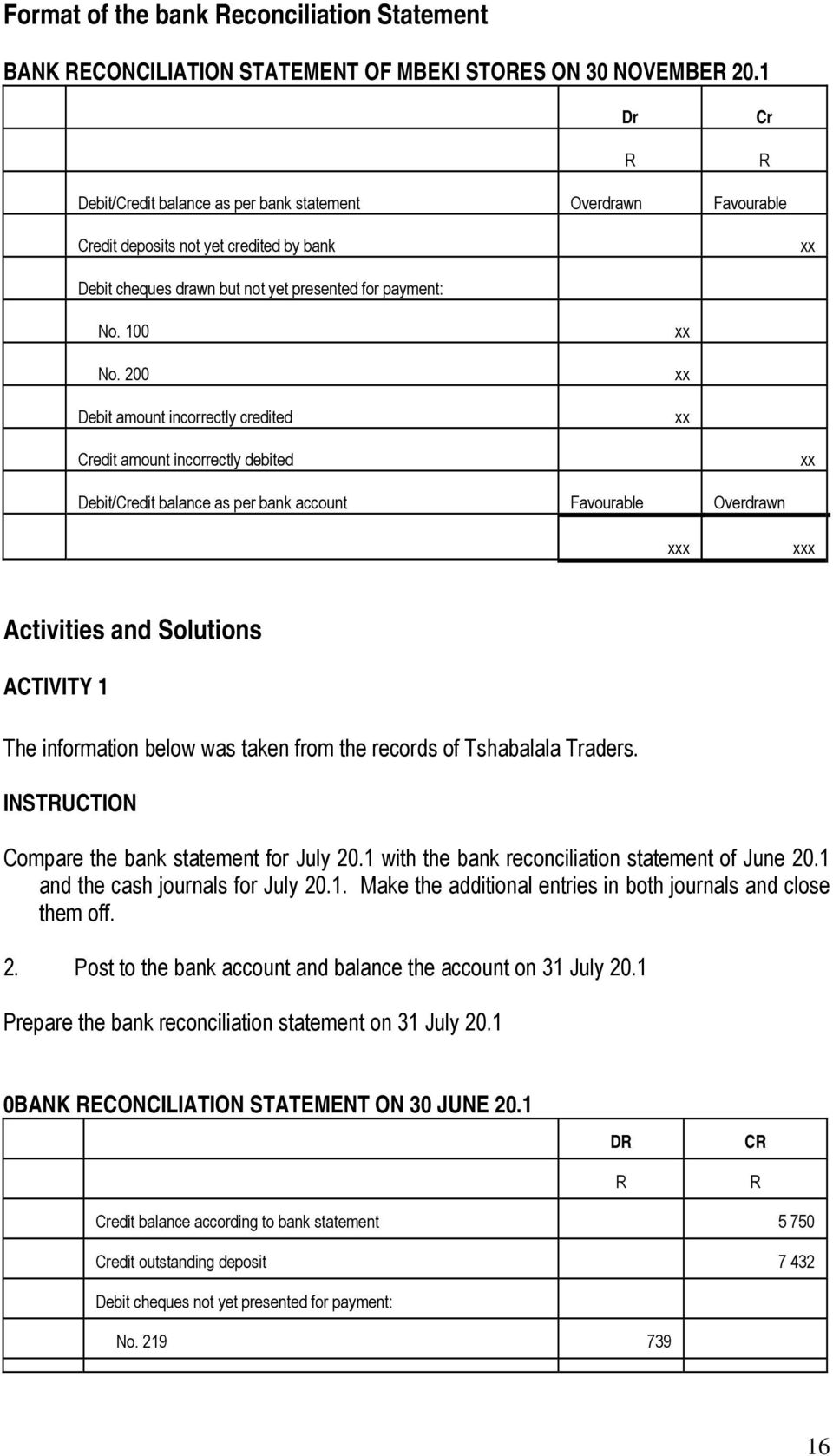
17 Format of the bank Reconciliation Statement BANK RECONCILIATION STATEMENT OF MBEKI STORES ON 30 NOVEMBER 20.1 Dr R Cr R Debit/Credit balance as per bank statement Overdrawn Favourable Credit deposits not yet credited by bank xx Debit cheques drawn but not yet presented for payment: No. 100 No. 200 Debit amount incorrectly credited xx xx xx Credit amount incorrectly debited xx Debit/Credit balance as per bank account Favourable Overdrawn xxx xxx Activities and Solutions ACTIVITY 1 The information below was taken from the records of Tshabalala Traders. INSTRUCTION Compare the bank statement for July 20.1 with the bank reconciliation statement of June 20.1 and the cash journals for July Make the additional entries in both journals and close them off. 2. Post to the bank account and balance the account on 31 July 20.1 Prepare the bank reconciliation statement on 31 July BANK RECONCILIATION STATEMENT ON 30 JUNE 20.1 DR R CR R Credit balance according to bank statement Credit outstanding deposit Debit cheques not yet presented for payment: No
18 No No Debit balance according to bank account TSHABALALA TRADERS Cash receipts journal - July 20.1 Sundry accounts Doc no Day Details Fol Analysis of Receipts Bank Debtors Control Discount Allowed Sales Amou nt Fol Details K. Kgoba M. Mokoe Sales S. Spuru A. Ayitey Sales J. Jali M. Malule Sales Sales T. Thenga Sales

19 Cash payment journal Sundry accounts Doc no Day Name of Payee Fol Bank Trading stock Creditors control Discou nt receive d Amount Fol Detials Telkom Telephone AB Traders Stationery EF Traders Cash Wages H Printers Advertising JK Traders MN Ltd W. Mandela Salaries XY Repairs Repairs STAR BANK BANK STATEMENT OF TSHABALALA - JULY 20.1 Day Description Balance R R 1 Balance brought forward Credit Cheque Credit Cheque Cheque Service fees City Treasurer Cheque Cheque Credit Credit Unpaid cheque Tax levy on debit transactions

20 11 Cheque Top Insurers Cheque Credit Cheque book Cheque Cheque Credit Cheque Interest Notes 1. The unpaid cheque was received from M. Makoe on 2 July The correct amount of cheque no. 235 is R On 8 July 20.1 Penpoint Stationers deposited their rent directly in the bank account of Tshabalala Traders. 4. The payment to the City Treasurer was a debit order for water and electricity. 5. The payment to Top Insurers was a stop order for the insurance premium. 6. The accountant neglected to enter cheque 229 drawn by the owner, N. Nkosi, to pay his sons= rent. ACTIVITY 2 The given information was taken form the books of Thabo Traders INSTRUCTION 1. Complete the cash receipts journal and the cash payments journal for March Prepare the bank reconciliation statement on 31 March

21 INFORMATION Information from the bank reconciliation statement for February 20.2, received from RSA Bank: R Favourable balance according to the bank statement Outstanding deposits Outstanding cheques No No No No Credit amount wrongly debited Favourable balance according to the bank account B. Sub-totals of the analysis cash journals on 31 March 20.2 Receipts: Payments: R R Bank Bank Sales Trading stock Cost of sales Stationery Debtors control Debtors control 450 Discount allowed 650 Creditors control Sundry accounts? Discount received Sundry accounts? A. After comparing the bank reconciliation statement of February with the cash journals and bank reconciliation statement for March 20.2, the following was noted: 1. The outstanding deposit appeared in the bank statement for March Cheque no. 240 was issued on 1 September 20.1 to Mandela Children Fund as a donation. 3. The error was corrected by the bank. 4. Cheques no. 632 and 633 appeared on the bank statement for March
22 5. Cheque no. 658 for R136 is correct according to the bank statement and was wrongly recorded in the cash payments journal as R226. It was issued to SNA Stationers for stationery bought. 6. The following entries appeared only on the bank statement: 6.1 A deposit of R2 000 by our tenant LA Jeans. 6.2 A debit order for R1 200 representing the part payment on the mortgage loan to Pepe Investments. 6.3 Service fees R73 Levy R12 Cash deposit fee R15 Interest on credit balance Commission on credit card sales R150 R20 7. An unpaid cheque, R250, was received from M. Mokoena in settlement of his account of R320, was dishonoured because of insufficient funds. 8. According to the analysis cash book the outstanding deposit amounts to R It does not appear on the bank statement for March The following entries did not appear on the bank statement for March: Cheque No. 665 R3 600 (dated 28 March 20.2) Cheque No. 666 R2 000 (dated 30 March 20.2) Cheque No. 667 R1 000 (dated 5 April 20.2) 10. Cheque no. 660, R2 100, issued to PE Promotions for advertising was lost. Payment of the cheque was stopped and the cheque was replaced with cheque no. 668 on 31 March A cheque received from C. Cele, a debtor, for R600 was post dated to 10 April The bank had incorrectly recorded a deposit made by the owner, T. Thabo, into his personal bank account, in the business= account, R A dishonoured cheque of S. Sorry, a debtor, was received together with the bank statement. This cheque, R650, was received as payment for a cash sale and was deposited on 12 March The reason for the dishonouring was that a second signature was required. 14. The bank statement for March 20.2 was received on 31 March 20.2 and showed an unfavourable balance of R
23 ACTIVITY 3 INSTRUCTION Use the given information to do the following in the books of Atlantis Stores: 1. Complete the bank account in the general ledger by making any entries that you may seem necessary directly in the bank account. Your entry must show the correct contra account. Balance the account. 2. Prepare the bank reconciliation statement on 31 August 20.1 Atlantis Stores compared their bank statement, received from GAAP Bank, for August with the cash journals for August and found the following differences: 1. The bank account in the general ledger had a favourable balance of R700 on August The bank statement had a debit balance of R5 666 on the same date. 2. The following cheques posted to the relevant creditors during July 20.1 and not posted, appear on the bank statement: a. No 497 for R420 b. 499 for R2 960 c. 503 for R M Haze's cheque for R600 which was deposited on 10 August 20.1, was returned marked R/D. No entry has been made for this returned cheque. 4. A deposit of R6 520 on 31 August 20.1 does not appear on the bank statement. 5. A deposit of R2 190 was entered in the cash receipts journal as R It had been received for sales. 6. Debtor A. Jacobs paid his cheque for R1 000 in settlement of his debt of R1 100 directly into the bank account at Atlantis Stores. 7. The annual insurance premium of R1 440 was paid by the bank by means of a debit order. 8. The following cheques have not been presented for payment to the bank: 537 No 239 R640 (dated 10 February 20.1 and issued to Judo Club as a donation) 538 R158 (dated 10 August 20.1) 539 R1 420 (dated 28 August 20.1) 9. Service fees, R48, cash handling fee, R32 and interest on overdraft, R60 appear on the bank statement. 10. Cheque no 540 issued for R60, appears on the bank statement as R A cheque in payment of purchases of R5 820 (cheque 538) was entered in the cash payments journals a R A deposit of R4 290 was cast in the deposit book as R4 190, but the bank showed the correct amount on the bank statement on 24 August
24 ACTIVITY 4 The following items appeared in the Bank reconciliation statement of Ndi-Ndo Stores at their year end, 30 June 20.4: R Debit balance as per Bank statement Deposit not credited by the bank Outstanding cheques No. 515 (dated 15 December 20.3) 500 No. 891 (dated 9 April 20.4) 240 No. 945 (dated 20 July 20.4) No. 946 (dated 30 June 20.4) 493 Incorrect credit on Bank statement Balance as per Bank account? INSTRUCTION Answer the following questions: Prepare a correct Bank reconciliation statement at 30 June One of the listed cheques not presented to the bank has been treated incorrectly. Which cheque is it, give a reason for your choice and explain the correct course of action. 2. Does Ndi-Ndu Stores have a favourable bank balance or an overdraft according to the bank s records? Give the amount and a reason for your answer. 3. A cheque received by Ndi-Ndu Stores on 25 June 20.4 but dated 14 August 20.4, does not appear in the Bank reconciliation statement. Give an explanation. 4. Explain how cheque no. 945 should be treated when preparing the financial statements. 5. What action would Ndi-Ndu Stores take if a cheque issued by another business, appears on their Bank statement? 6. Explain why cheque no. 945 is not treated in the same way as cheque no. 946 when preparing the financial statements. 7. What would the procedure be if cheque no. 891 does not appear on the Bank statement for July 20.4? 8. Give two possible reasons for a dishonoured cheque received by Ndi-Ndu Stores. 9. Give an explanation why the stop orders of a business do not appear in their Bank reconciliation statement. 23
25 Bank Reconciliation - Solution ACTIVITY 1 TSHABALALA TRADERS Cash receipts journal Sundry accounts Doc no Day Details Fol Analysis of receipts Bank Debtors control Discount allowed Sales Amount Fol Details 31 Totals B/S B/S W. Mandela (cheque 235) Penpoint Stationers Salaries Rent income B/S Star Bank Interest received on current account Cash payments journal Sundry accounts Doc no Day Name of payee Fol Bank Trading stock Payments Discount received Amount Fol Details 31 Totals B/S M. Makoe (Cheque R/D) Debtors control B/S City Treasurer Water and electricity B/S Top Insurers Insurance 229 N. Nkosi Drawings B/S Star Bank Bank charges
26 GENERAL LEDGER OF TSHABALALA TRADERS Dr Bank B Cr Jul 1 Balance b/d Jul 31 Total payments Total receipts Balance c/d Aug 1 Balance b/d BANK RECONCILIATION STATEMENT ON 31 JULY 20.1 Dr R Cr R Credit balance according to bank statement Credit outstanding deposits Debit outstanding cheques No No No Debit balance according to bank account ACTIVITY 2 Cash receipts journal of Thabo Traders for March 20.2 Sundry accounts Doc no Date Details Fol Analysis of receipts Bank Sales Cost of sales Debtor s control Discount allowed Amoun t Fol Details 29 Totals b/d Mandela Children Fund (cheque cancelled) SNA Stationers (cheque 658 corrected) Donations Stationery B/S LA Jeans Rent income B/S RSA Bank Interest on current account PE Promotions (cheque 660 cancelled) Advertising
27 Cash payments journal of Thabo Traders for March 20.2 Sundry accounts Doc no Date Details Fol Bank Tradin g stock Stationery Debtor s control Credito rs control Discount received Amount Fol Details 29 Totals b/d B/S 31 Pepe Investments Mortgage loan B/S RSA Bank Bank charges M. Mokoena (R/D insufficient funds ) 668 PE Promotions S. Sorry (R/D signature) Advertising GENERAL LEDGER OF THABO TRADERS Dr Bank Cr Mar 1 Balance b/d Mar 31 Total payments CPJ Total receipts CRJ Balance c/d Apr 1 Balance b/d BANK RECONCILIATION STATEMENT OF THABO TRADERS FOR MARCH 20.2 Dr R Cr R Debit balance according to bank statement Credit outstanding deposits Debit outstanding cheques No No No No No Debit amount wrongly credited 800 Debit balance according to bank account
28 ACTIVITY 3 GENERAL LEDGER OF ATLANTIS STORES Dr Bank Cr Aug 1 Balance b/d 700 Aug 31 Debtors control 600 Debtors control (M Haze cheque R/D) (A. Jacobs) Sales 720 Donation 640 (Correction of error) (cheque cancelled) Insurance Deposit 100 Bank charges 80 (correction of error) Interest on overdraft 60 Balance c/d Trading stock 540 (Correction of cheque 538) Sept 1 Balance b/d BANK RECONCILIATION STATEMENT OF ATLANTIS STORES ON 31 AUGUST 20.1 Debit Credit R R Debit balance according to bank statement Credit outstanding deposit Debit outstanding cheques: No Debit correction of error on cheque Credit balance according to bank account ACTIVITY 4 BANK RECONCILIATION STATEMENT OF NDI-NDU STORES ON 30 JUNE 20.4 Debit Credit R R Debit balance according to Bank statement Credit outstanding deposits Debit outstanding cheques No No No Debit incorrect entry on Bank statement Credit balance according to bank account Cheque 515. The cheque is stale (older than 6 months) and must be cancelled by means of an entry on 16 June 20.4 in the CRJ. 2. Overdraft of R A debit balance according to the bank statement means an overdraft. 27
29 3. The cheque received on 25 June 20.4 is a post-dated cheque and should be kept in a safe place. The receipt will only be issued on 14 August On that day the cheque will be receipted and thereafter recorded into the CRJ. 4. All post-dated cheques must be shown in the balance sheet as creditors. The postdated cheque amounts will be added to the bank balance (or deducted from the bank overdraft) and creditors increased accordingly. 5. Show the amount as a credit on the bank reconciliation statement in anticipation of the correction by the bank. 6. The payee of cheque 945 may not present the cheque for payment before 14 August 20.4 (the next accounting period). The payee of cheque 946 may present the cheque for payment as from 30 June 20.4 (the current accounting period). 7. The cheque has not been presented for payment yet and will have to be shown as an outstanding cheque in the bank reconciliation statement. 8. The payment of a cheque can be refused because of various reasons: - insufficient funds in the drawer's account - the signature of the drawer is queried or omitted - the amount in words and the amount in figures differ - the cheque is older than six months (stale) - the cheque is post-dated. 9. The entry in the CPJ is done after the stop order payment has appeared on the bank statement. The stop orders will not appear in the bank reconciliation statement. 28
30 Control Accounts Introduction The debtors control and creditors control accounts facilitates accounting control over the debtors and creditors accounts. The debtors control and creditors control accounts are a summary of all the entries in the debtors ledger and creditors ledger. The balance of the debtors control account in the general ledger, at the end of the month, should be the same as the list/schedule of debtors (the total of the debtors balances) in the debtors ledger. In the same way the balance of the creditors control account in the general ledger should be the same as the list/schedule of creditors in the creditors ledger. Control accounts belong to the General Ledger (GL). Individual Debtors and creditors belong in their respective subsidiary ledgers (debtors ledger/creditors ledger). Posting Rules SUBSIDIARY JOURNAL SOURCE DOCUMENT POSTING RULE CRJ Duplicate receipt Cash register roll Dr Bank Cr Contra accounts Cost of sales column Dr Cost of sales Cr Trading stock Discount allowed column Dr Discount allowed Cr Debtors control CPJ Cheque counterfoil Dr Contra accounts Cr Bank DJ Duplicate invoice Selling price: Dr Debtors control Cr Sales Discount received column Dr Creditors control Cr Discount received Cost price: Dr Cost of sales Cr Trading stock DAJ Duplicate credit note Selling price: Dr Debtors allowances Cr Debtors control Cost price: Dr Trading stock Cr Cost of sales CJ Original invoice Dr Contra accounts Cr Creditors control CAJ Duplicate debit note Dr Creditors control Cr Contra accounts GJ Journal voucher Dr Individual accounts Cr Individual accounts Debtors control totals Dr Debtors control (Journal debits) Cr Debtors control (Journal credits) Creditors control totals Dr Creditors control (Journal debits) Cr Creditors control (Journal credits) 29
31 Format Of The Debtors And Control Accounts GENERAL LEDGER Dr Debtors control B Cr Jan Balance b/d xx Jan 31 Debtors allowances 31 Sales DJ xx Bank and discount allowed DAJ CRJ xx xx Bank (R/D cheque) CPJ xx Journal credits GJ xx Petty cash * PCJ xx Balance c/d xx Bank + CPJ xx Journal debits GJ xx xxx xxx Feb Balance b/d xx * Payments made on behalf of debtors out of petty cash + Pay a debtor with a credit balance Dr Creditors control B Cr an 31 Bank and discount eceived CPJ xx Jan Balance b/d xx Creditors allowances + / Sundry accounts ++ CAJ xx 31 Sundry purchases/ sundry accounts CJ xx Journal debits GJ xx Bank* CRJ xx Balance c/d xx Journal credits GJ xx xxx xxx Feb 1 Balance b/d xx * Receive money from a creditor with a debit balance or cheque cancelled + Only when the periodic inventory system is used ++ Only when the perpetual inventory system is used Dr Trading stock B Cr Jan 1 Balance b/d xx Jan 31 Creditors control (Allowances) CAJ xx 31 Bank (Cash purchases) CPJ xx Cost of sales (Credit sales) DJ xx Creditors control (Credit purchases) CJ xx Cost of sales (Cash sales) CRJ xx 30
32 Cost of sales (Returns) DAJ xx Drawings GJ xx Expenses + GJ xx Trading stock deficit GJ xx Expenses* GJ xx Balance c/d xx xxx xxx Feb 1 Balance b/d xx + Trading stock incorrectly posted to expenses (correction) * Expenses incorrectly posted to trading stock (correction) DEBTORS LEDGER The Debtors ledger shows all the information/transactions of individual debtors Name of debtor Date Details Fol Debit (+) Credit (-) D1 Balance R R R Jan 1 Account rendered xx 5 Invoice no. xx DJ xx xx 8 Credit note no. xx DAJ xx xx 15 Receipt no. xx (payment) CRJ xx xx 15 Receipt no. xx (discount allowed) CRJ xx xx 18 Journal voucher no. xx (Interest charged) GJ xx xx 21 Cheque R/D CPJ xx xx 21 Journal voucher no. xx (Discount cancelled) 25 Journal voucher no. xx (Bad debts) 28 Cheque no. xx (Refund made to debtor) GJ xx xx GJ xx xx CPJ xx xx CREDITORS LEDGER The Creditors ledger shows all the information/transactions of individual creditors Name of creditor Date Details Fol Debit (-) Credit (+) C1 Balance R R R 31
33 Jan 1 Account rendered x x 8 Invoice no. xx CJ xx x x 12 Credit note no. xx CAJ xx x x 19 Cheque no. xx (payment) CPJ xx x x 19 Cheque no. xx (discount received) CPJ xx x x 24 Journal voucher no. xx (Interest charged) 26 Receipt no. xx (Refund made by creditor) GJ xx x x CRJ xx x x Activities and Solutions ACTIVITY 1 The general ledger of Jim Traders was destroyed in fire. Hereafter is the complete debtors= ledger for June INSTRUCTION You are required to use the information given and prepare the debtors= control account as it would have appeared in the general ledger of Jim Traders for June DEBTORS LEDGER OF JIM TRADERS D. DELOITTE D1 Date Code Details Folio Debit Credit Balance 20.1 R R R June 1 Account rendered Invoice 11 DJ Credit note 18 DAJ Receipt 24 CRJ Receipt 24 (discount allowed) CRJ Cheque dishonoured (unpaid) CPJ Journal (discount cancelled) GJ
34 E. ERNEST D2 Date Code Details Folio Debit Credit Balance 20.1 R R R June 1 Account rendered Receipt 20 CRJ Receipt 20 (discount allowed) CRJ Invoice 114 DJ Journal (interest) GJ Credit note 27 DAJ Y. YOUNG D3 Date Code Details Folio Debit Credit Balance 20.1 R R R June 1 Account rendered 80 (cr) Invoice 113 DJ (dr) Receipt 26 CRJ (cr) Journal (account transferred) GJ DEBTORS LIST ON 30 JUNE 20.1 CODES R 01 Credit sales D. Deloitte 880 (dr) 02 Payments E. Ernest (dr) 03 Discount Y. Young 0 04 Petty cash Total (dr) 05 Returns 06 Cheque dishonoured/refunds 07 Journals ACTIVITY 2 INSTRUCTION From the information taken from the complete creditors ledger given below, you are required to prepare the creditors control account in the general ledger. Balance the account. 33
35 CREDITORS LEDGER OF KPMG LTD LEVUBU WHOLESALERS C1 Date Code Details Folio Debit Credit Balance 20.1 R R R Feb 1 Account rendered (cr) 3 02 Cheque 422 CPJ Cheque 422 CPJ (cr) 8 02 Receipt 340 (refund) CRJ Invoice 277 CJ (cr) Invoice 279 CJ (cr) LONSDALE SUPPLIERS C2 Date Code Details Folio Debit Credit Balance 20.1 R R R Feb 1 Account rendered 20 (dr) 3 01 Invoice 274 CJ (cr) 6 06 Credit note 83 CAJ (cr) 7 01 Invoice 275 CJ (cr) 8 01 Invoice 276 CJ (cr) Cheque 445 CPJ (cr) 03 Cheque 445 CPJ (cr) Journal (correction of error) GJ (cr) LONGDALE WHOLESALERS C3 Date Code Details Folio Debit Credit Balance 20.1 R R R Feb 1 Account rendered (cr) 3 07 Journal (interest) GJ (cr) 7 02 Cheque 430 CPJ (cr) Credit note 84 CAJ (cr) Journal (correction of error) GJ (cr) Invoice 278 CJ ( cr) Credit note 85 CAJ (cr) 34
36 CREDITORS LIST ON 28 FEBRUARY 20.1 CODES R 01 Purchases Levubu Wholesalers (cr) 02 Payments E. Ernest 168 (cr) 03 Discount Y. Young (cr) 04 Petty cash Total (cr) 05 Returns ACTIVITY 3 INSTRUCTION 06 Cheque dishonoured/refunds 07 Journals 1. Draw up the debtors control account in the general ledger of Selai Distributors after taking the totals and information given into account. 2. From the information given below, calculate the profit margin on cost price. 3. During the month, discount was allowed on goods damaged but not returned by debtors. Determine the discount, which was allowed. Balances on 1 March 20.2 Debtors with debit balances, R2 300 Debtors with credit balances, R60 Totals for March 20.2 Cash receipts journal (CRJ 3) R Bank Sales Cost of sales Debtors control Discount allowed 820 Sundry accounts Cash payments journal (CPJ 3) R Bank Trading stock Wages
37 Creditors control Discount received 600 Debtors control 400 Sundry accounts Debtors journal (DJ 3) R Sales Cost of sales Creditors journal (CJ 3) R Trading stock Equipment Stationery 230 Sundry accounts 770 Debtors allowances journal (DAJ 3) (Including discount on damaged merchandise not returned) R Debtors allowances Cost of sales Creditors allowances journal (CAJ 3) R Trading stock 700 Equipment 380 Stationery - Sundry accounts 30 General journal (GJ 3) R General ledger: Debits Credits Debtors ledger: Debits 400 Credits 20 Creditors ledger: Debits 40 Credits
38 Additional information ACTIVITY 4 1. On 31 March 20.2 the account of Z. Tsabalala still has a credit balance of R60. The following information applies to Zwane Traders on 30 June 20.3 Debtors control GENERAL LEDGER OF ZWANE TRADERS Dr (Prepared by an inexperienced bookkeeper) Cr Jun 1 Balance b/d Jun 30 Credit sales DJ Creditors allowances CAJ Bank (R/D cheques) CPJ 160 Bank (debtors column) CRJ Bank (refund to debtor) CPJ 80 Cash sales CRJ Balance c/d Bad debts GJ 400 Jul 1 Balance b/d Creditors control Dr (Prepared by an inexperienced bookkeeper) Cr Jun 30 Purchases CJ Jun 1 Balance b/d Cash purchases CPJ Sales returns DAJ Journal debits GJ 200 Discount column CPJ 800 Balance b/d Bank (creditors column) CPJ Jul 1 Balance b/d Additional information 1. On 30 June 20.3, the total of the list of debtors was R and the total of the list of creditors R Accept that the opening balances of both the control accounts were correct. 2. In addition to the obvious errors made by the bookkeeper in the control accounts above, an investigation brought the following to light: 2.1 An amount of R172 in the creditors journal was incorrectly posted to the account of creditor Umtata Suppliers as R72. 37
39 2.2 The creditors journal was overcast by R Transfer a credit balance of R60 on the account of L. Leshaba in the debtors ledger to his account in the creditors ledger. (The bookkeeper had not done this yet.) 3. A credit note for R100 was issued to N. Ngema in respect of merchandise returned by him, but no entry had yet been made. INSTRUCTION 3.1 Debtor M. Molotsi, still had to be charged R50 interest on his overdue account. 3.2 An entry in respect of sales returns of R120 was correctly entered in the debtors allowances journal but inadvertently posted to the debit side of debtor C. Cele=s account. 3.3 The receipts from debtors, R94 000, included an amount of R40 recovered from S. Singo, a debtor, whose account had been written off in the previous financial year. The mistake did not however affect the debtors ledger. 1. Draw up the debtors control account and creditors control account for June 20.3, as they should have been prepared in the first place. 3. Show the reconciliation of the totals of the list of debtors and list of creditors with the correct closing balances of the control accounts as calculated in no. 1. ACTIVITY 5 INSTRUCTION Study the given ledger account and answer the questions that follow. Use the additional information to assist you. GENERAL LEDGER OF LESHABA STORES Dr Debtors control Cr Aug 1 Balance b/d Aug 31 (2) CRJ Sales DJ Debtors allowances Bank (1) Journal credits DAJ 120 GJ 740 Petty cash PCJ 80 Balance c/d Journal debits GJ Sept 1 Balance b/d
40 Additional information The percentage mark-up is 60 % on cost price. Questions 1. Name the missing folio number. 2. Name the missing details. 3. Why might Leshaba Stores consider giving their debtors a discount on settlements? 4. Give two possible reasons for the R740 on the credit side of the debtors control account. 5. Give one transaction that could possibly give rise to the entry of R80 on the debit side of the debtors control account. 6. Which source document would support the entry of R120 on the credit side of the debtors control account? 7. Which source document would support the entry of R1 000 on the debit side of the debtors control account? 8. Calculate the cost price of credit sales during August. 9. How will the accountant verify the balance of the debtors control account? 10. List three points for good internal control over debtors. ACTIVITY 6 On the 30 August 20.2, the accountant of Mabunda Stores compared the balances of the debtors control account and the creditors control account in the general ledger with the total of the debtors and creditors lists in the debtors ledger and creditors ledger. INSTRUCTION Rule columns as follows and indicate how the errors and omissions must be corrected in order to reconcile the control accounts with debtors and creditors lists. No Debtors control Debtors list Creditors control Creditors list Dr Cr Dr Cr Dr Cr Dr Cr 39
41 1. A credit invoice for goods sold to T. Tanli was recorded twice in the subsidiary book, and also posted twice, R The total of the debtors journal was undercast by R240 and the creditors journal was overcast by R A credit note for R544 was recorded in the creditors allowances journal as R54 and posted accordingly. 4. The amount received from C. Maduna was posted to the credit side of the account of Maduma, R An amount of R87 in the debtors allowances journal was incorrectly posted to debtor N. Zungu s account as R187. CONTROL ACCOUNTS SOLUTION ACTIVITY 1 GENERAL LEDGER OF JIM TRADERS BALANCE SHEET SECTION Dr Debtors control Cr Jun 1 Balance b/d Jun 30 Debtors allowance DAJ 105 (R660 + R R80) (R40 + R65) 30 Sales DJ Bank and discount allowed* CRJ (R260 + R R280) (R400 + R20 + R600 + R30 +R280) Bank (R/D) CPJ 400 Balance c/d Journal debits 180 (R880 + R R0) (R20 + R30 + R80) Jul 1 Balance b/d *Alternative: R Bank (R400 + R600 + R280) Discount allowed 50 (R20 + R30) 40
42 ACTIVITY 2 BALANCE SHEET SECTION GENERAL LEDGER OF KPMG LIMITED Dr Creditors control B Cr Feb 28 Bank and discount received* CPJ Feb 1 Balance b/d (R R150 + R835 + R22 + R4 450) ( R20 + R5 690) Sundry allowances CAJ Sundry purchases CJ (R65 + R65 + R230) (R R R660 + R115 + R450 + R3 760) Journal debits GJ 115 Bank CRJ 150 Balance c/d Journal credits GJ 195 (R R168 + R4 900) (R80 + R115) Mar 1 Balance b/d *Alternative: R Bank ( R835 + R4 450) Discount received 172 (R150 + R22) ACTIVITY 3 GENERAL LEDGER SELAI DISTRIBUTORS Dr Debtors control B Cr Mar 1 Balance b/d Mar 31 Bank and discount allowed CRJ Bank CPJ3 400 Debtors allowances DAJ Sales DJ Journal credits GJ3 20 Journal debits GJ3 400 Balance c/d Apr 1 Balance b/d
43 4. Profit margin on cost price: (R R11 840) x 100 Or (R R12 640) x 100 R R = R2 960 x 100 = R3 160 x 100 R R = 25 % = 25 % 5. Selling price of goods returned by debtors: R1 680 x 125 = R Allowances on goods not returned by debtors: R R2 100 = R700 ACTIVITY 4 GENERAL LEDGER OF ZWANE TRADERS Dr Debtors control B Cr Jun 1 Balance b/d Jun 30 Bank and discount allowed ( ) CRJ Bank (R/D cheques) CPJ 160 Debtors allowances ( ) DAJ Bank (refund to debtors) CPJ 80 Journal credits GJ 400 Sales DJ Balance c/d Journal debits ( ) GJ 110 Jul 1 Balance b/d List of debtors R Total on 30 June Returns - N. Ngema (100) Interest - M. Molotsi 50 Error corrected - C. Cele (240) Transfer - L. Leshaba
44 Dr Creditors control B Cr Jun 30 Sundry allowances CAJ Jun 1 Balance b/d Bank and discount received CPJ Sundry purchases ( ) CJ Journal debits GJ 200 Journal credits GJ 60 Balance c/d Jul 1 Balance b/d List of creditors R Total on 30 June Error corrected - Umtata Suppliers 100 Transfer - L. Leshaba ACTIVITY 5 1. CPJ 2. Bank and discount allowed 3. Debtors are encouraged to pay there accounts promptly by allowing discount. 4.1 Bad debts 4.2 Transfer of a debit balance on a debtors account to his account in the creditors ledger. 5. Payments made on behalf of a debtor out of petty cash for example carriage on purchases. 6. Duplicate credit note 7. Bank statement or cheque counterfoil 8. R X 100 = R Compare the balance with the debtors list. Issue invoices for all credit sales Issue credit notes for all allowances allowed Issue receipts for all amounts received Keep an account for each debtor in the debtors ledger up to date 43
45 Reconcile the accounts of the debtors ledger with the debtors control account in the general ledger every month Distribution of duties ACTIVITY 6 No Debtors control Debtors list Creditors control Creditors list Dr Cr Dr Cr Dr Cr Dr Cr R R R R R R R R
46 Disposal Of Tangible Assets WHAT TO REMEMBER! Cost price Less: Accumulated depreciation Book value of asset / Carrying value Proceeds on sale of asset Profit OR loss on sale of asset XXX (XXX) XXX (XXX) XXX Proceeds = Cash sale (Bank) = Credit sale (Debtors control) = Trade-in (Creditors control) = Taken by owner (Drawings) = Insurance company (Debtors control or Bank) 1. Features Of Depreciation 1.1 The fixed amount method / percentage on cost price /straight line method Example: A motor vehicle bought for R is expected to have a useful lifespan of 5 years. R R X OR R = R pa = 20% pa 1.2 The diminishing balance / book value / carrying value method / declining balance Example: Cost price of equipment R on 1 March 20.1 Depreciation rate on the equipment is 10% pa on the diminishing balance. Depreciation on 28 February each year: Year 1: R X 10 = R Year 2: R R9 000 = R R X 10 = R (Accumulated depreciation R R8 100 = R17 100) 45
47 Year 3: R R = R R X 10 = R (Accumulated depreciation R R R7 290 = R24 390) **REMEMBER: When an asset is bought during the course of the financial year, depreciation must be provided on that item of the asset on a pro rata basis for the period in use. E.g. Time line 1 March 20.2 Financial year (12 months) 28 February Date purchased 1 July 20.2 I (8 months) I Cost price: R Depreciation: 15 % pa. Calculation: R X 15 X = R Disposal Of Non-Current Assets (Tangible Assets) Note: The disposal of tangible assets can take place at: The beginning of the year / accounting period The end of the year / accounting period During the year / accounting period 2.1 Sale of asset at the beginning of the year Time line 1 March 20.2 (financial year) 28 February (12 months) 46
48 Find your date on the time line = 1 March 20.2 Steps to be taken: 1. Calculate depreciation (current) NO DEPRECIATION IS CALCULATED (Depreciation was provided fully at the end of last accounting period) 2. Transfer the cost price to the asset disposal Debit: Asset disposal Credit: Asset (Vehicles or equipment) 3. Transfer accumulated depreciation to asset disposal Debit: Accumulate depreciation (Vehicles or equipment) Credit: Asset disposal 4. Sell / Trade-in / Insurance claim / Drawings Debit: Bank / Debtors control / Creditors control / Insurance company / Drawings Credit: Asset disposal 5. Calculate profit / (loss) on sale of asset Debit: Loss on sale of asset Credit: Asset disposal To remember! OR Debit: Asset disposal Credit: Profit on sale of asset 6. Closing transfer at end of the financial year Debit: Profit on sale of asset Credit: Profit and loss OR Debit: Profit and loss Credit: Loss on sale of asset. 2.2 Sale of asset at the end of the year Time line 1 March 20.1 Financial year (12 months) 28 February Find your date on the time line = 28 February 20.2 Steps to be taken: 1. Calculate depreciation (Current year) Debit: Depreciation 47
49 Credit: Accumulated depreciation (Vehicle or equipment) How to calculate depreciation: Cost / Fixed installment method / Straight line method Cost of asset X Rate X Period = R Book value / Diminishing balance / Carrying value method Book value (Cost - Accumulated depreciation) X Rate X Period = R Transfer the cost price to asset disposal Debit: Asset disposal Credit: Asset (Vehicles or Equipment) 3. Transfer Accumulated depreciation to asset disposal Debit: Accumulated depreciation on asset (Vehicles or Equipment) Credit: Asset disposal 4. Selling price / Trade-In value / Insurance claim / Drawings Debit: Bank/Debtors control / Creditors control / Insurance company/ Drawings Credit: Asset disposal 5. Calculate Profit / Loss on sale of asset Debit: Loss on sale of asset Credit: Asset disposal OR Debit: Asset disposal Credit: Profit on sale of asset 6. Remember: The closing transfer Debit: Profit on sale of asset Credit: Profit and loss OR Debit: Profit and loss Credit: Loss on sale of asset 2.3 Note for tangible assets to the balance sheet 48
50 FORMAT Tangible assets Vehicles R Equipment R Total R Cost price xxx xxx xxx Accumulated depreciation (xx) (xx) (xx) Carrying value (Last day of previous year) xxx xxx xxx Movements Additions at cost xxx xxx xxx Disposals at carrying value (xx) (xx) (xx) Depreciation for the year (xx) (xx) (xx) Carrying value (Last day of current year) xxx xxx xxx Cost price xxx xxx xxx Accumulated depreciation (xx) (xx) (xx) Activities and Solutions ACTIVITY 1 The following balances appeared in the books of Rhodes Stores on 1 March 20.3: Vehicles R Accumulated Depreciation R Depreciation to be provided at 20% pa according to the diminishing balance method. On 28 February 20.4 a vehicle was sold on credit to C. Van a debtor, for R The cost price of the vehicle was R and the accumulated depreciation on 1 March 20.3 was R Instructions: 1.1 Show the following ledger accounts: Vehicles Accumulated depreciation on vehicle Depreciation Asset disposal 1.2 Show the necessary calculations for: Depreciation for the year on all vehicles Depreciation of asset sold 49
51 Note: Calculation of profit (loss) on sale of asset Cost price of vehicle sold Accumulated depreciation Carrying / Book value Selling price / Proceeds Profit on sale of asset Sale of assets during the year: Time line 1 March Aug February START SALE END APPLY THE STEPS PREVIOUSLY MENTIONED ACTIVITY 2 On 1 March 20.1 the following balances appeared, amongst others, in the books of Rhodes Stores: Vehicles (cost) R Accumulated Depreciation on vehicles R The asset register shows the following information on 1 March 20.1 VEHICLE COST ACCUMULATED DEPRECIATION CARRYING VALUE 1 R R R R R R R R8 550 R R R R Depreciation is provided at 10% pa on cost price. On 31 August 20.1 vehicle no.1 was sold on credit to A. Lotto for R Instructions: 2.1 Show the following ledger accounts: Vehicles Accumulated depreciation on vehicles 50
52 Depreciation Asset disposal 2.2 Show the calculation for: Note: Pro-rata depreciation on asset sold Depreciation for remainder of vehicles Calculation of profit (loss) on sale of asset Cost price of vehicle sold Accumulated depreciation Carrying / Book value Selling price / Proceeds Profit on sale of asset To remember! 1. Asset disposal account is shown as an intermediary account. 2. Must be closed off after the sale of asset to profit or loss on sale of asset. ACTIVITY 3 Use the following information obtained from the books of Alice Cold Storage Ltd. On 30 June 20.4, the end of their financial year, to 1. Draw up the accumulated depreciation and asset disposal account in the general ledger of Alice Cold Storage Ltd. for the financial year ending 30 June The accounts should be balanced and/or closed off. 2. Show all calculations that clearly indicates the following: a. Depreciation on the new vehicle b. Depreciation for the remainder of the vehicles after the disposal c. Accumulated depreciation for the vehicle traded in d. Profit (Loss) on trade-in of asset e. Amount owing for new vehicle f. Show the tangible asset note to the Balance sheet at 30 June 20.4 Information: 1. Pre-adjustment trial balance of Alice Cold Storage Ltd. on 30 June 20.3 Balance sheet section: Vehicles Accumulated depreciation on vehicles Debit R Credit R
53 2. Adjustments not yet entered: On 31 March 20.4 a used vehicle was traded in at Alice Motors with the purchase of a new vehicle. The purchase price of the new vehicle is R The trade-in price given by Alice Motors for the used vehicle is R The details of the cost price and depreciation of the used vehicle are recorded in the tangible asset register below: TANGIBLE ASSET REGISTER Description: Delivery vehicle Registration number: DKW 678 E Date purchased: 1 July 20.1 Cost price: R Percentage depreciation: 20 % p.a. according to the carrying value method Date Sold: 31 March 20.4 Depreciation written off: 01/07/20.1 to 30/06/20.2 R /07/20.2 to 30/06/20.3 R? 01/07/20.3 to 31/03/20.4 R? No entries have been made for this year=s depreciation, the sale of the used vehicle or the purchase price of the new vehicle. The purchase price will be paid to Alice Motors during July Depreciation must be written off at 20 % p.a. on diminishing balance on all vehicles. 3.2 Calculation of depreciation Depreciation on the new vehicle: Depreciation for the remainder of vehicles: Accumulated depreciation on vehicle traded in: Profit (Loss) on trade-in of asset: R Cost price Less: Accumulated depreciation ( ) Book value (carrying value) Trade-in value ( ) Profit (Loss) on trade-in Amount owing for new vehicle: Cost price of new vehicle Trade-in value of old vehicle Amount owing for new vehicle Note to the balance sheet at 30 June 20.4 R 52
54 Tangible assets Vehicles R Cost price Accumulated depreciation Carrying value (30 June 20.3) Movements Additions at cost Disposals at carrying value Depreciation for the year Carrying value (30 June 20.4) Cost price Accumulated depreciation ACTIVITY 4 The information relates to plant and machinery of Dickinson Ltd and was taken from the balance sheet at 31 December REQUIRED Calculate the following: 1. The accumulated depreciation on 1 January 20.1 on the plant and machinery sold on 31 March The amount received for the plant and machinery sold on 31 March The current year's depreciation on plant and machinery. 4. Show the tangible asset note to the balance sheet at 31 December TRANSACTIONS The following information relates to transactions for the period 1 January 20.1 to 31 December On 31 March 20.1 the firm sold plant and machinery for a loss of R500. The cost price of the plant and machinery was R9 000 and the depreciation for the current year amounted to R On 1 July 20.1 a new plant and machinery was bought for R from Master Plant Ltd. Depreciation is provided at 20 % p.a. on carrying value. 53
55 INFORMATION Balances taken from the balance sheet at 31 December 20.0: Tangible assets Plant and machinery R Carrying value on 31 December Cost Accumulated depreciation (18 000) ACTIVITY 4 ANSWER SHEET 1. Accumulated depreciation on plant and machinery sold on 1 January Selling price of plant and machinery 3. Current year's depreciation 4. Notes to the balance sheet at 31 December 20.1 Tangible assets Plant and machinery R 54
56 Disposal Of Tangible Asset - Solution ACTIVITY 1: 1.1 GENERAL LEDGER OF RHODES STORE Balance sheet accounts section Dr Vehicles B9 Cr 20.3 Mar. 1 Balance b/d Feb. 28 Asset disposal GJ Mar 1 Balance b/d Balance c/d Dr Accumulated depreciation on vehicles B10 Cr 20.4 Feb. 28 Asset disposal GJ Mar. 1 Balance b/d Balance c/d Feb. 28 Depreciation GJ Mar 1 Balance b/d Nominal accounts section Dr Depreciation N13 Cr 20.4 Feb 28 Accumulated depreciation on vehicles GJ Feb 28 Profit & loss GJ Dr Asset disposal N16 Cr 20.4 Feb 28 Vehicles GJ Feb 28 Accumulated depreciation on vehicles GJ Debtors control GJ Loss on sale of asset GJ
57 1.2 Calculation of depreciation: All vehicles: R R = R R X 20 = R Vehicle sold: R R = R R X 20 = R Accumulated depreciation for vehicle sold on date of sale (20 February 20.4) R R = R Calculation of profit (loss) on sale of asset: R Cost price vehicles sold Accumulated depreciation (14 640) Carrying / Book value Selling price / Proceeds (11 000) Loss on sale of asset ACTIVITY GENERAL LEDGER OF RHODES STORES Balance sheet accounts section Dr Vehicles B9 Cr 20.1 Mar. 1 Balance b/d Aug. 31 Asset disposal GJ Mar 1 Balance b/d Feb 28 Balance c/d
58 Dr Accumulated depreciation on vehicles B10 Cr 20.1 Aug 31 Asset disposal GJ Mar 1 Balance b/d Feb 28 Balance c/d Aug 31 Depreciation GJ Nominal accounts section 20.2 Feb 28 Depreciation GJ Mar 1 Balance b/d Dr Depreciation N15 Cr 20.1 Aug 31 Accumulated depreciation on vehicles GJ Feb 28 Profit & loss GJ Feb 28 Accumulated depreciation on vehicles GJ Dr Asset disposal N16 Cr 20.1 Aug 31 Vehicles GJ Profit on sale of asset GJ Aug 31 Accumulated depreciation GJ Debtors control GJ Calculation of depreciation Pro-rata depreciation on vehicle sold: R X 10 X 6 = R Calculation of depreciation on remainder of vehicles: Cost: (R R80 000) = R R X 10 X 12 = R
59 Calculation of profit (loss) on sale of asset: R Cost price of vehicle sold Accumulated depreciation (50 000) Carrying / Book value Selling price / Proceeds (33 500) Profit on sale of asset ACTIVITY 3 GENERAL LEDGER OF ALICE COLD STORAGE LTD. Balance sheet accounts section Dr Accumulated depreciation on vehicles B16 Cr 20.4 Mar 31 Asset disposal GJ Jun 30 Balance c/d Jul 1 Balance b/d Mar 31 Depreciation GJ Jun 30 Depreciation GJ Jul 1 Balance b/d Nominal accounts section Dr Asset disposal N16 Cr 20.4 Mar 31 Vehicles GJ Mar 31 Accumulated depreciation on vehicles. GJ Creditors control GJ Loss on sale of asset GJ CALCULATIONS: Depreciation on the new vehicle: R X 20 X 3 = R Depreciation for the remainder of vehicles: (R R75 000) (R R27 000) x 20 % = R
60 Depreciation at end of the year: R (R R55 900) Accumulated depreciation on vehicle traded in: 1. 1 July June 20.2 R X 20 = R July June 20.3 (R R15 000) X 20 = R July March 20.4 (R R27 000) X 20 X 9 = R R Profit/(Loss) on trade-in of asset: R Cost price of vehicle traded in Accumulated depreciation (34 200) Book value (carrying value) Trade-in (27 500) Loss on trade-in of asset (13 500) Amount owing for new vehicle: R Cost price of new vehicle Trade-in value of old vehicle (27 500) Amount owing for new vehicle Note to the balance sheet 30 June 20.4 Tangible assets Vehicles R Cost price Accumulated depreciation ( ) Carrying value (30 June 20.3) Movements Additions at cost Disposals at carrying value (40 800) Depreciation for the year (68 100) Carrying value (30 June 20.4) Cost price Accumulated depreciation ( ) 59
61 ACTIVITY 4 1. Accumulated depreciation on plant and machinery sold on 1 January 20.1 = R Selling price of plant and machinery sold = R Current year's depreciation = R Notes to the balance sheet at 31 December 20.1 Tangible assets Plant and machinery R Cost Accumulated depreciation (18 000) Carrying value on 31 December Movements Additions at cost Disposals at carrying value (4 750) Depreciation for the year (13 250) Carrying value on 31 December Cost Accumulated depreciation (27 000) CALCULATIONS 1. Accumulated depreciation Carrying value = cost price accumulated depreciation The depreciation on the plant and machinery sold for the current year, 1 January March 20.1 (date of sale), is given. It is possible to calculate the carrying value on the plant and machinery sold on 1 January Carrying value on 1 January 20.1 x _20 x 3 = R Now the carrying value on 1 January 20.1 is known, it is possible to calculate the accumulated depreciation of the plant and machinery sold on 1 January Cost price accumulated depreciation = carrying value = R Selling price of machinery sold Asset disposal Machinery (CP) Acc depreciation (R R250) Selling price 4 250* Loss * Selling price: R9 000 R4 250 R500 = R
62 3. Current year's depreciation on plant and machinery Old plant and machinery: 1 January December 20.1 The cost price of the plant and machinery not sold on 1 January 20.1: R R9 000 = R The accumulated depreciation on the plant and machinery no sold on 1 January 20.1: R R250 R = R (Cost price accumulated depreciation) x 20 % = carrying value x 20% = depreciation (R R14 000) x 20 % = R x 20 % = R8 200 New plant and machinery: 1 January December 20.1 Depreciation on new plant and machinery purchased: Cost price = R R x 20 % x 6/12 = R4 800 Current year's depreciation is equal to: Pro-rata depreciation on plant and machinery sold Depreciation on old plant and machinery Depreciation on new plant and machinery R 250 (amount given) (see calculation) (see calculation)
63 Debtors Age Analysis The Debtor Age Analysis is a useful tool to manage your outstanding debts and to see which debtors are not performing according to your credit agreements. It displays a breakdown of your debtor account balances for each of the specified periods for a selected debtor account, or a range of selected debtor accounts. You need to analyse the outstanding amounts your debtors owe you in periods such as current, 30, 60 and more than 90 days. The debtors age analysis is essential for credit control. If you allow your debtors to pay you when they wish you might develop some serious cash flow problems. If you are registered for VAT on the invoice basis large outstanding amounts that include VAT may have an impact on your cash flow as you may have to pay the VAT to SARS irrespective of whether the money has been received or not. How to prepare the debtors age analysis Balances Always commence the calculation with the closing balance of the previous month. For example: If the information provided is as from the month of May then commence the calculation with the closing balance in April instead of the opening balance in May in order to determine the age analysis accurately. Total Debits Total Debits figures for each month must be recorded horizontally in the respective columns. The figures are represented in the same row as the balance from the previous month. Total Debits for a particular month would include the following: Total credit sales for a particular month. Interest charged for a particular month. Cancellation of cheques during a particular month. 62
64 Cancellation of discounts during a particular month. Any other debits to the debtor during a particular month. [These amounts can be added to the Credit sales for that month. See examples provided]. Payments Itemise each transaction vertically in the month column ensuring that each transaction is recorded separately and independently of the other transactions. The oldest invoices / accounts are paid / offset first. The more recent invoices / accounts are paid / offset progressively. Payments received could include discounts OR Discounts could be separated. Returns Show the returns and allowances in the month in which the returns or allowances was made and NOT in the month in which the sales was done. See example 1. Reason In order to avoid showing negative balances in those months where the accounts had probably been settled already. Purpose of preparing debtors age analysis Decision Making: Note that with Credit Sales additional costs are incurred i.r.o: Administration costs in keeping records of Debtors outstanding accounts. Costs of sending monthly statements and reminders [Postage, Telephone, etc.]. Interest is forfeited on money owed to the business. The risk of bad debts. Therefore, develop a credit policy that incorporates control procedures to: 63
65 Investigate the creditworthiness of new customer. Investigate the creditworthiness of existing customers on a continuous basis. Specify credit terms. Specify settlements discounts to encourage prompt payment of accounts. Increase the odds of selling only to those who will settle their debts on time. Ensure that: That the debt collection policy is effectively managed. That debtors paying within the prescribed period [What % of debtors are overdue]. That the necessary steps are taken against delinquent debtors [Reminder, Final Notices, Summonses must be issued or even hand over debtors to debt collectors] Every receivable account is examined carefully on the basis of the available information, e.g. period outstanding, dispute in connections with the account, insolvency of the debtor and so forth. Although there is no accurate indication of which debts will be irrecoverable at year-end, a provision for bad debts should nevertheless be made. Example 1: Required: (a) Prepare the debtors age analysis statement (b) A summary of aging statement. (c) A step-by-step illustration of the month number and balance per month. Information: T Selepe has the following credit agreements with C. Selborn: Credit limit: R5 000 Credit terms 60 days Transactions: 1 May 2004: Outstanding balance of R1 800 at the beginning of the month. 5 May 2004: Receive a cheque from C. Selborn for R1 000 as payment on the amount owing for April C. Selborn received R50 discount. Issued a receipt May 2004: Issued invoice 1564 for goods sold on credit to C. Selborn, R
66 25 May 2004: C. Selborn returned merchandise for R200. Issued a credit note June 2004: Sold goods on credit to C. Selborn for R2 100 and issue invoice June 2004: Interest charged on C. Selborn s overdue account to R50 (journal voucher). 10 July 2004: Received a cheque for R1 500 from C. Selborn as payment of his debt. Issued receipt July 2004: Issued invoice to C. Selborn as payment for merchandise sold to him for R July 2004: Charge C. Selborn s overdue account with R60 interest (journal voucher). SOLUTION 1 C. SELBORN DATE RECEIPT / AMTS CLOS T O T A L D E B I T S DISCOUNTS / BAL. [Cr Sales and other Debits] RETURNS May June July Balance and Sales May Payment Received (1 050) Cr Note Returns 200 (200) July Payment Received (750) (750) Nil days 30 days Current NOTE: The figures in the first row of the entries represent the Opening balance and Credit Sales for May, June and July. Payment received in May includes a discount of R50, i.e. R R50 = R Alternatively, the discount can be separated from the payment. The goods were returned in May and these goods are subtracted from credit sales for May. 1. Credit sales for June includes Interest charged on overdue account, i.e. R R50 = R Credit sales for July includes Interest charged on overdue account, i.e. R R60 = R At the end a total is displayed for the balance and each ageing period. 65
67 Name of debtor Balance Current amount 1 month 30 days 2 month 60 days 3 month 90 days More than 3 months C. Selborn Nil Nil % of Total 41.1% 45.2% 13.7% 1. C. Selborn s account is within the credit limit of R5000 and the credit term of 60 days. 2. C. Selborn meets his credit and there is no problem about his account. 3. T Selepe does not envisage any danger of bad debts because C Selborn pays his account regularly. Example 2: INFORMATION The following information of two debtors taken from the books of Mokone and Sons. Answer the questions after completing the debtors age analysis statement. Mokone and Sons has the following credit agreements with P.K Hlophe and B Botha: Credit limit: R Credit terms 60 days Transaction with P.K Hlophe from 01 February 2009 to 31 July 2009 Date Description Debit Credit Balance 01/02/09 Balance /02/09 Sales /03/09 Payment received /03/09 Sales /03/09 Sales /03/09 Payment received /04/09 Sales /04/09 Payment received /05/09 Sales /05/09 Payment received /06/09 Sales /06/09 Sales /06/09 Payment received /07/09 Sales
68 Transaction with B Botha from 01 February 2009 to 31 July 2009 Date Description Debit Credit Balance 01/02/09 Balance /02/09 Sales /03/09 Payment received /03/09 Sales /03/09 Sales /03/09 Payment received /04/09 Sales /04/09 Payment received /05/09 Sales /05/09 Sales /05/09 Payment received /06/09 Sales /06/09 Sales /07/09 Sales Required: 1. Use the information and complete the debtors age analysis. (24) 2. Explain the following terms: Credit terms (2) Credit limit (2) Amount due (2) 3. What conclusion can you make when looking at the percentage of outstanding debtors? (2) 4. Do you think that credit arrangement policy of Mokone and Sons is effective? (6) 5. In which months did B. Botha purchase goods from Mokone and Sons and for how much? (5) 6. You have been asked to give advice to Mokone and Sons how they could handle the two accounts. What will be your recommendation? (6) 7. Which % owing needs to be paid by B. Botha end of July? (1) 67
69 Solution 2 1. P.K HLOPHE DATE RECEIPT / AMTS CLOS T O T A L D E B I T S DISCOUNTS / BAL. [Cr Sales and other Debits] RETURNS Feb. March April May June July Balance and Sales March Payment Received (3 400) (1 600) (5 000) Apr Payment Received (2 000) May Payment Received (1 600) (3 700) (700) June Payment Received (7 200) (200) Nil Nil Nil Nil Nil days Current B. BOTHA DATE RECEIPT / A CLOS T O T A L D E B I T S DISCOUNTS / MTS BAL. [Cr Sales and other Debits] RETURNS Feb. March April May June July Balance and Sales March Payment Received (2 400) (3 600) (8 700) Apr Payment Received (7 900) (4 100) May Payment Received (2 600) (9 400) Nil Nil Nil Nil days 30 days Current Name of debtor Balance Current amount 1 month 30 days 2 month 60 days 3 month 90 days More than 3 months P.K Hlophe Nil Nil Nil B Botha Nil Nil Total Nil Nil % of Total 40.2% 53.9% 5.7% 1. Explain the following terms: 68
70 Credit terms - the conditions under which credit will be extended to a customer, i.e. the length of time for which a firm s customer is granted credit. Credit limit - the maximum amount of credit granted to the debtor by supplier. Amount due - the total amount owing to date by debtor. 2. What conclusion can you make when looking at the percentage of outstanding debtors? Debtors pay their account regularly and they are within their agreed credit term, i.e. 60 days. 3. Do you think that credit arrangement policy of Mokone and Sons is effective? A credit policy is working effectively. A credit policy incorporates control procedures to: Investigate the creditworthiness of new customer. Investigate the creditworthiness of existing customers on a continuous basis. Specify credit terms. Specify settlements discounts to encourage prompt payment of accounts. Increase the odds of selling only to those who will settle their debts on time. 4. You have been asked to give advice to Mokone and Sons how they could handle the two accounts. What will be your recommendation? a. Although debtors pay their accounts well, a provision for bad debts should nevertheless be made, for in case one debtor falls behind. For instant, the last payment for B Botha was in May and there was no payment in June and July and we are not sure whether he will pay. Already his account is in 60 days credit term. 5. You have been asked to give advice to Mokone and Sons how they could handle the two accounts. What will be your recommendation? Months Amount February March April May June July Which % owing needs to be paid by B. Botha end of July? 69
71 According to the credit terms agreement 5.7% of the debts need to be paid before it is overdue. Activities and Solutions Activity 1 (a) and (b) (a) Required: (d) Prepare the debtors age analysis statement and (e) A summary of aging statement. Information: Thabo has the following credit agreements with Bongani who is a new customer: Credit limit: R Credit terms 60 days Transactions: Date Detail Amount February 17 Thabo sold goods to Bongani R February 18 Thabo sold additional goods to Bongani R March 12 Payment received R March 16 Thabo sold goods to Bongani R March 22 Balance? (b) Required: 6. Study a debtors age analysis statement given below and give your opinion. More than days 30 days Total days Current ABC R R0.00 R R XYZ R0.00 R R R Total R R R R % 29.3% 23.6% 47.1% 100% 70
72 SOLUTION 1 (a) BONGANI DATE RECEIPT / AMTS CLOS T O T A L D E B I T S DISCOUNTS / BAL. [Cr Sales and other Debits] RETURNS Feb. March Feb Sales May Payment Received (4 500) days Current Name of debtor Balance Current amount days More than 60 days Bongani Nil % of Total 100% 19.1% 80.9% (b) 1. The bottom line is that you are owed R , of which R900 is current, R450 is over a month old and R is over 2 months old. 2. Nearly 30% of all debtors are over 2 months old. (R560 of R1910 = 29.3%). Activity 2 INFORMATION The following information of five debtors are taken from the books of Robinson Ltd. Answer the questions from a given summary of the debtors age analysis statement. Robinson Ltd has the following credit agreements with debtors: Credit limit: R2 000 Credit terms 30 days 71
73 Age analysis of debtors as at 30 September 2008 Customer name Balance Up to 30 days 60 days 90 days Over 90 days Bareng Pty Magora Ltd Taylor Pty Thorpe Ltd 1, Themba Ltd Totals 3, ======= , ======= ======= ======= ======= Percentage 100% 49.6% 6% 19.4% 25% Answer the following questions: 1. What percentage of debtors is not meeting the credit terms? 2. What percentage of debtors should be a great concern to Robinson Ltd? 3. What percentage of debtors still falls within the agreed credit terms? 4. Is the credit policy in Robinson Ltd effective? 5. What will your recommendation be in this situation? Solution 2 1. What percentage of debtors is not meeting the credit terms? Debtors overdue for 60 and more than 90 days. = R1 771 of R = 50.9% 2. What percentage of debtors should be a great concern to Robinson Ltd? While the debtors of over 30 days are of concern, the greatest concern will be those debtors taking 60days and more to pay. 25% of Robinson Ltd s outstanding debtor balance is due to Thorpe Ltd and this is of great concern. 3. What percentage of debtors still falls within the agreed credit terms? 1, of 3, = 49.6% 4. Is the credit policy in Robinson Ltd effective? 72
74 Robinson Ltd s credit policy is not effective because the company collected only 49.6% in 30 days and 50.9% is still outstanding. 5. What will your recommendation be in this situation? Robinson Ltd needs to ensure that: Every receivable account is examined carefully on the basis of the available information, e.g. period outstanding, dispute in connections with the account, insolvency of the debtor, etc. The necessary steps are taken against delinquent debtors Reminders, Final Notices, Summonses must be issued or even hand over debtors to debt collectors. Age analysis of creditors As an aid to effective management, an age analysis of creditors may be produced. This is similar to the age analysis of debtors. It is simply a list of the suppliers to whom we currently owe money, showing the total amount owed and the period of time for which the money has been owed. Activity 3 INFORMATION The following information of five creditors taken from the books of Anglo-Ltd. Required: Answer the questions from a given summary of the creditors age analysis statement. Anglo Ltd has the following credit agreements with creditors: Credit limit: R2 000 Credit terms 60 days 73
75 Age analysis of creditors as at 30 September 2008 Customer name Balance Up to 30 days 60 days 90 days Over 90 days N Basetsana B Dalen B Danisa N Hlophe 1, V Khoza Totals 3, ======= , ======= ======= ======= ======= Percentage 100% 49.6% 6% 19.4% 25% Answer the following questions: 1. What are creditors age analysis? 2. Identify the amount owed for more than three months. 3. What percentage overdue to creditors is not meeting the credit terms? 4. What percentage overdue to creditors is of a great concern to Anglo Ltd? 5. What conclusion can you make when looking at the percentage of overdue accounts? Solution 3 1. What is a creditors age analysis? The age analysis of creditors highlights any supplier accounts that are overdue. It is a list of the suppliers to whom we currently owe money, showing the total amount owed and the period of time for which the money has been owed. 2. Identify the amount owed for more than three months In the table above, R owed to N Hlophe has been outstanding for more than three months. 3. What percentage overdue to creditors is not meeting the credit terms? Overdue to creditors for 60 more than 90 days. = R1 771 of R = 50.9% 74
76 4. What percentage overdue to creditors is of a great concern to Anglo Ltd? While the creditors of over 30 days are of concern, the greatest concern will be those overdue accounts taking 60days and more to pay. 25% of Anglo Ltd s outstanding creditors balance is due to N. Hlophe and this of great concern 5. What conclusion can you make when looking at the percentage of overdue accounts? The age profile shows that of the debts outstanding at 30 September 2008, nearly 45% have been outstanding for more than 60 days with the majority of those being outstanding payments due to N Hlophe. 75
77 Cash Flow Statement The financial statements of a company consists of the following: a. Income Statement b. Balance Sheet c. Cash Flow Statement CASH FLOW STATEMENT 1. Cash Flow Statement shows what the Company does with their cash 2. Reconciles cash basis to accrual basis Used to determine: - the company s ability to generate future cash flows - the company s ability to repay debt - how much cash was spent investing in assets - how much cash was received from borrowing 3. The Cash flow statement gives details of: a. cash generated by operating activities. b. cash generated from investing activities. c. cash generated from financing activities. 4. The Cash flow statement indicates the movement of cash; whether the bank balance has increased or decreased during an accounting period. 5. Information comes from the Income Statement and Balance Sheet of the current year, and together with the Balance Sheet of the previous year, the cash flow for the current year is determined. Cash Equivalents Short term, highly liquid, e.g. CDs, 3-month treasury, money market they are treated the same as cash on the cash flow statement Sections of Cash Flow Statement The cash flow statement is separated into three sections: Cash Flow from Operating Activities 76
78 Cash generated from operations Interest paid Dividends paid Interest Income Income tax paid Cash Flow from Investing Activities Purchase of fixed / tangible assets / Non-current assets Proceeds from sale (disposable) of fixed / tangible assets / non- current assets Cash Flow from Financing Activities: Proceeds from shares issued (new shares) Proceeds from long term loans / non-current liabilities Payment of long term loans / non-current liabilities Net change in cash and cash equivalents Cash and cash equivalents at beginning of year Cash and cash equivalents at end of year Format of the Cash Flow Statement Cash Flow from Operating Activities Notes R R Cash generated from operations 1 xxxxx XXXX Interest paid (xxx) Dividends paid 3 (xxx) Interest Income 4 (xxx) Income tax paid Cash Flow from Investing Activities Purchase of fixed / tangible assets / Non-current assets 5 (xxxx) Proceeds from sale (disposable) of fixed / tangible assets / non- current assets xxxx (XXX) Cash Flow from Financing Activities: Proceeds from shares issued (new shares) Proceeds from long term loans / non-current liabilities xxxx xxxx XXXX Payment of long term loans / non-current liabilities (xxx) 77
79 Net change in cash and cash equivalents 2 XXXX Cash and cash equivalents at beginning of year 2 XXX Cash and cash equivalents at end of year 2 XXXXX NOTES TO THE CASH FLOW STATEMENT 1. Cash generated by operations Profit before taxation Adjustment for: Depreciation Interest paid Interest received Operating profit before changes in working capital Changes in working capital xxxx xxxx xxxx (xxx) XXXX xxxx Decrease (increase) in inventory Decrease (increase) in Trade and other receivables xxx xxx Increase (decrease) in Trade and other payables xxx xxxx Cash Generated from operations XXXX 2. Net changes in cash and cash Current Cash and Cash Equivalent Net Change Current Previou s Bank/Bank overdraft xx xxx xxx Cash float xxx xxx Petty cash xxx xxx XX XXXX XXXX 3. Dividends paid* Amount owing at beginning of year xxx Amount in the notes to the balance sheet Amount owing at the end of the year 4. Taxation Paid** Amount owing at the beginning of the year Amount in the Income Statement Amount owing at the end of the year xxx xxx XXXX xxx xxx xxx XXXX 5. Tangible Assets Land and Building Vehicles Equipment xxxx xxxx xxxx XXXX 78
80 Activity and Solution Activity 1 Use the information provided to prepare: 1. Cash Flow Statement 2. Note for Cash generated from operations. Selaelo Company's Balance Sheet and Income Statement Comparative Balance Sheet as at 31 December /12/ /12/2008 Net Change ASSETS R R R Fixed Assets Land Buildings Accumulated depreciation on buildings (40 000) (20 000) Equipment Accumulated depreciation on equipment (20 000) (12 000) Current Assets Bank Accounts receivable Inventories (Stock on hand) Prepaid expenses TOTAL ASSETS EQUITY & LIABILITIES Shareholder Equity Ordinary share Retain Income Non-current Liabilities Loan payable Current Liabilities Accounts payable , ,200 Selaelo Company s Income Statement 31 December 2009 Revenue Cost of goods sold Operating expenses Interest expenses Loss on sale of equipment Income from operation Income Tax expenses Net Income
81 Additional information: (a) Operating expenses include depreciation expense of R and amortization of pre-paid expenses of R2 000 (b) Land was sold at its book value for cash. (c) Cash dividend of R was paid in (d) Interest expense of R8 000 was paid in cash. (e) Equipment with a cost of R was purchased for cash. Equipment with a cost of R and a book value of R was sold for R for cash. (f) Loans were redeemed at their book value for cash. (g) Ordinary shares were issued for cash. Solution Activity 1 1. Selaelo Company s Cash Flow Statement 31 December 2009 Notes R R Cash Flow from Operating Activities (8 000) Cash generated from operations Interest paid (8 000) Dividends paid (48 000) Income tax paid (38 000) Cash Flow from Investing Activities - 0 Purchase of fixed / tangible assets / Non-current assets (36 000) Proceeds from sale (disposable) of fixed / tangible assets / non- current assets Cash Flow from Financing Activities: Proceeds from shares issued (new shares) Payment of long term loans / non-current liabilities (40 000) Net change in cash and cash equivalents Cash and cash equivalents at beginning of year Cash and cash equivalents at end of year
82 2. NOTES TO THE CASH FLOW STATEMENT 1. Cash generated by operations Net Profit before taxation Adjustment for: Depreciation: is ( ) = R R R Interest paid Loss on sale of equipment Operating profit before changes in working capital Changes in working capital (53 000) Increase in inventory (60 000) Decrease in prepaid expenses Decrease in accounts receivables Increase in accounts payable Cash Generated from operations Explanation on the adjustments to net profit before tax of R95 000: a. Accounts receivable: The decrease of R2 000 should be added to net profit before tax to convert from the accrual basis to the cash basis. b. Inventories: The increase of R represents an operating use of cash for which an expense was not incurred. This amount is therefore deducted from net profit before tax to arrive at cash flow from operations. c. Pre-paid expense: The decrease of R2 000 represents a charge to the income statement for which there was no cash outflow in the current period. The decrease should be added back to profit before tax. d. Accounts payable: When it increases, cost of goods sold and expense on a cash basis are lower than they are on an accrual basis. The increase of R3 000 should be added to net profit before tax. e. Depreciation expense: The depreciation expense for the building is R Due to the sale of equipment the depreciation for equipment is ( ) = R This amount plus R should be added to net profit before tax to determine net cash flow from operating activities. f. Loss on sale of equipment: The loss of R2 000 on sale of equipment should be added to net profit before tax since the loss did not reduce cash but it did reduce profit before tax. 81
83 Cash flows from investing and financing activities a. Land: The sale of land for R is an investing cash inflow. b. Equipment: The purchase of equipment for R is an investing cash outflow, and the sale for R is an investing cash inflow. c. Loans payable: This financing activity used cash of R d. Ordinary shares: Ordinary shares of R were issued as a financing cash inflow. e. Retained earnings: The increase of R9 000 is the result of net income of R from operations and the financing activity of paying cash dividends of R Summary A cash flow is a statement, which shows the flow of cash into and out of the business. It is not the same as a profit and loss account / Income Statement. The cash flow statement only records movements of cash and, for example, does not include credit sales or purchases until such time as cash actually flows. This statement became mandatory because of some high profile business failures of the 1980s/90s - these were companies that, in terms of the Income statement, were profitable but were short of cash to pay their debts. The cash flow statement should not be confused with a Cash Flow forecast. The former is historical whereas the latter is a forecast about the future. Cash Flow Analysis How to analyze a cash flow statement Once you have constructed a cash flow statement, you will be much closer to understanding the financial position of your company. While a balance sheet and income statement are tools for management, without a cash flow statement they are limited barometers and may even be misleading. 82
84 Operating Activities The cash flow statement will tell you where money came from and how it was used. When analyzing cash flow, the first place to look is the cash flow from operating activities. It tells you whether the firm generated cash or whether it needs a cash infusion. A few periods of negative cash from operating activities is not by itself a reason for alarm if it is based on plans for company growth or due to a planned increase in receivables or inventories. However, if a negative cash flow from operating activities is a surprise to managers and owners, it may be undesirable. Over time, if uncorrected, it can foretell business failure. Managers and owners should pay particular attention to increases in accounts receivable. The cash flow statement gives the true picture of the account. A large increase in accounts receivables may warrant new billing or collection procedures. Investing Activities The cash flow statement puts investing activities into perspective. At one glance, you can see whether or not a surplus in operations is being used to grow the company. A lack of investing activities, which is few purchases of new equipment or other assets, may indicate stagnant growth or a diversion of funds away from the company. Financing Activities The financing activities section of the cash flow statement will show repayments of debt, borrowing of funds, as well as injections of capital. As a company expands, this area of the cash flow statement will become increasingly important. It will tell outsiders how the company has grown and the financial strategies of management. Together, the three sections of the cash flow statement show the net change in cash during the period being examined. A comparison between past periods will give owners and managers a good idea of the trend of their business. Positive trends in cash flow may encourage owners to consider long-term financing as an aid to growth and increase their comfort level concerning the company s ability to generate cash for repayment. 83
85 Strong cash flow will also make it easier to acquire financing and to negotiate with lenders from a position of strength. Preparation of a cash flow statement is the first step toward financial management for long-term success. Summary What is the trend in cash flow from operating activities for your company? Is there a reason for any large increase in accounts receivable? How do you expect the financing activities of your company to change in the next year and the next two years? 84
86 Value Added Tax (VAT) What is VAT? VAT stands for Value Added Tax. Value Added Tax (VAT) is levied on the supply of goods and services by vendors or it is a tax businesses charge when they supply their goods and services. This tax is collected at each stage of the production and distribution chain. We have to pay VAT on most of the things that we buy. Currently the Standard rate of VAT in South Africa is 14% and this is the rate to be used when calculating VAT. Vat Concepts Zero-rated items Zero-rated items are goods or services which are taxed at a rate of 0%, e.g. milk, brown bread, maize, fruit, etc. VAT-exempted items These items involve services that are not subject to VAT at either the standard rate or zero rate, e.g. childcare services, educational services, etc. Standard rate In South Africa Standard-rated supplies are taxed at the rate of 14%. VAT-able items These items are goods or services that are subject to VAT. VAT Output VAT paid on items purchased and can be claimed back from SARS. It is VAT, which your company would charge on items, which it, sells. Thus a company could wish to sell an item and added to the amount a standard rate tax would be charged. VAT Input VAT on Sales and income and must be paid over to SARS. It is VAT that you pay on all your business expenses and for which you have a tax invoice. It also relate to VAT that is paid on other goods and services bought or rented for the business. VAT Control Is a summary of the VAT Input and Output and shows whether the business owes SARS money or whether SARS owes the business money. 85
87 VAT Calculation How to add VAT (Value Added Tax) to a price (14%) This is the calculation you need to use when you know a PRICE BEFORE TAX (THE NET PRICE) but want to find out the PRICE AFTER TAX (THE GROSS PRICE). VAT rate of 14%. Net price Multiplied by 1.14 = Gross price Price before tax Multiplied by 1.14 = Price after tax Calculations: The VAT standard rate is rate of 14% First, get the multiplier: % = = 1.14 The multiplier is 1.14 So... Net price Multiplied by 1.14 = Gross price Price before tax (Net price) Multiplied by 1.14 = Price after tax (Gross price) E.g.: R100 Multiplied by 1.14 = R114 R100 + Tax = R114 inc Tax How to deduct VAT from a price - (14%) People can often add VAT to a figure, but when it comes to taking it off it is a problem. So here it is... 86
88 Taking-off VAT (Tax) from a price This is the calculation you need to use when you know a PRICE AFTER TAX (THE GROSS PRICE) but want to find out the PRICE BEFORE TAX (THE NET PRICE). VAT rate of 14%. Gross price (price after tax) Divided by 1.14 = Net price Price after tax Divided by 1.14 = Price before tax (Net price) Calculations: The VAT standard rate is rate of 14% First, get the divisor: % = = 1.14 The divisor is 1.14 So the back calculation for 14% VAT is... Gross price Divided by 1.14 = Net price Price after tax Divided by 1.14 = Price before tax E.g.: R Divided by 1.14 = R100 R inc Tax = R100 + Tax Three Bookkeeping Accounts For the purposes of Value Added Tax (VAT) records, three bookkeeping accounts must be kept. 1. The VAT on inputs account. 2. The VAT on output (transactions) account. 87
89 3. VAT Control (Debit and Credit) account. The VAT on Inputs Account This account will usually show a debit (the VAT SARS "owe" you money for the VAT you have paid and you are entitled to receive from them). The VAT on Output (Transactions) Account This account will usually show a credit (the VAT SARS are "entitled" to receive the VAT from you that you have collected on their behalf. The money is not yours and it is only temporarily in your possession until the due date for the payment of VAT. The VAT Control (Debit and Credit) Account. This is the account to which the 2 first accounts are posted. The account balance may show a credit, when the periodic report to the VAT is for a payment to be made, or it may show a debit when the periodic report shows that that money is to be returned. SARS Pay to SARS R14 Claim R14 Back Pay to SARS R28 WHOLESALER Sales = VAT Output Selling price = RETAILER Purchases = VAT Input = Purchases price = Sales = VAT Output = Selling price = CONSUMER Purchases = VAT = Purchase price = 1. The wholesaler sell the product to the retailer at R % VAT = R
90 2. The wholesaler collect VAT of R14.00 from the retailer and pays it over to SARS, thus taking the VAT out of the business (VAT Output) 3. The retailer claims back the VAT (R14) from SARS, thus put it back into the business (VAT Input) 4. The retailer adds a mark-up of 100% to the product and sell it to the consumer for R200 + VAT of R The retailer collects the VAT (R28) from the consumer and pays it over to SARS, thus taking the VAT out of the business (VAT Output). 6. The consumer cannot register for VAT and cannot claim back the VAT. 7. SARS collected VAT to the amount of R28 instead of only R14 due to value being added to the product in the form of a mark-up percentage. Example 1: 1) Purchase goods on credit from R. Adams, R (ISP). + INVENTORY (A) - Creditors CREDITORS (L) + Inventory Input VAT INPUT VAT (A) - Creditors x 14/114 = ) Paid R. Adams R in full settlement of our account. + BANK (A) - Creditors CREDITORS (L) + Bank Discount received & 800 Output VAT - DISCOUNT RECEIVED (I) + Creditors OUTPUT VAT (L) + Creditors
91 800 x 14/114 = ) Sold merchandise on credit to T. Tax, R (ISP). The mark- up is 20% on cost price. + DEBTORS (A) - Sales Output VAT SALES (I) + Debtors OUTPUT VAT (L) + Debtors INVENTORY (A) - Cost of Sales COST OF SALES (E) - Inventory x 14/114 = = x 100/120 = ) T. Tax paid us R in full settlement of his account. + DEBTORS (A) - Bank Discount allowed & Input VAT BANK (A) - Debtors DISCOUNT ALLOWED (E) - Debtors INPUT VAT (A) - Debtors x 14/114 = = ) A debtor S. Sunny s debt of R must be written off as irrecoverable. + DEBTORS (A) - Bad debts & Input VAT
92 + BAD DEBTS (E) - Debtors INPUT VAT (A) - Debtors X 14/114 = ) The owner takes stock for his own use, R DRAWINGS (OE) + Inventory & Input VAT INVENTORY (A) - Drawings INPUT VAT (A) - Drawings x 14/114 = 140 7) Issue a credit note to a debtor for damaged goods, R75. + DEBTORS (A) - Debtors allowance & Output VAT 75 + DEBTORS ALLOWANCE (E) - Debtors OUTPUT VAT (L) + Debtors x 14/114 = ) Receive a credit note from a creditor for damaged goods returned, R CREDITORS (L) + Inventory & Input VAT INVENTORY (A) - Creditors INPUT VAT (A) - Creditors x 14/114 = 14 NOTE Issue a credit note: debtor returned goods. 91
93 Received a credit note: business returned goods NB. Although learners are not required to draw up journals, in this example journal entries are provided for better understanding of the ledger account. Example 2: The total purchases that you made amount to R 1,000 by cheque plus R 150 VAT on inputs The total cash sales you made amount to R 4,000 plus R600 VAT on outputs You paid the balance that was owing to SARS. The bookkeeping records will look as follows: 1. Debit Credit Purchases / Inventory 1,000 VAT on Input 150 Bank 1,500 ( ) Purchases recorded for January 2. Bank 4,600 Sales 4,000 VAT on Output 600 ( ) Sales recorded for January 3. VAT on Output 600 VAT on inputs 150 VAT Control Account 450 ( ) Transfer of surplus to Control Account 4. VAT Control Account 450 Bank 450 ( ) Payment of VAT reported for January 92
94 Dr VAT Input Account Cr Aug. 31 Bank 150 Aug. 31 VAT Control 150 Dr VAT Output Account Cr Aug. 31 VAT Control 600 Aug. 31 Bank 600 Dr VAT Control Account Cr Aug. 31 VAT input 150 Aug. 31 VAT Output 600 Bank
95 Value Added Tax: Calculations The Standard rate of VAT, 14% and is the rate to be used when answering all VAT questions. QUESTION 1 On 17 March, Tilly sells goods to the four customers shown in the table. The value of the goods is also shown. VAT has not yet been included in the invoice price of the goods. Calculate the value of VAT in each case and the total value of the invoice to be sent to each customer. CUSTOMER VALUE OF GOODS SOLD Nina R Khentsane R Phuti R Bongi R VAT INVOICE TOTAL QUESTION 2 On 4 September, Harry receives invoices for goods that he purchased. The invoices show the total price of the goods including VAT. Calculate the value of goods that Harry received and the amount of VAT added to this to produce the invoice total. SELLER INVOICE TOTAL VALUE OF GOODS PURCHASED Cindi R Xolani R Tenyeko R Azwindini R NB. The most difficult calculation involving VAT is encountered when cash discount is involved. VAT QUESTION 3 Fill in the gaps. 94
96 Two types of discount are used in the business world: a. is a reduction in price when goods are supplied to other businesses (usually in the same line of business). This reduced price is not available to the general public. This type of discount is generally shown on the invoice (source document), but is not included in the double-entry records. b. is an allowance that can be deducted from the total amount charged for goods if the debt is settled within a time specified by the supplier. This type of discount is only recorded when advantage is taken of the reduction. QUESTION 4 Bernard sells goods valued at R2 760 to Aileen. Aileen is allowed a 25% trade discount. Calculate: a) The amount that Bernard will show on his sales invoice for the goods sold and the amount that he will enter in his sales journal b) The amount that Aileen will enter in her purchases journal Notes: CASH DISCOUNT One of the trickiest calculations that you will come across during your accounting studies involves the calculation of VAT on goods that are subject to both trade and cash discount. Learn it and practice it several times. VAT is always calculated after deducting cash discount. If the customer does not pay before the date stipulated on the purchase invoice, they lose the benefit of the cash discount. 95
97 Example Corinne sells goods on 3 March valued at R1, to Dolly. The terms are a trade discount of 25% and a cash discount of 5% if Dolly settles her account within 30 days. Calculate the total value of the sales invoice sent to Dolly. Answer Price of goods R1, Less trade discount Selling price to Dolly R Less cash discount VAT Total value of invoice R 1, The total value shown on the copy sales invoice (source document) is entered in the seller s (Corinne s) sales journal. The invoice will be received by the purchaser (Dolly) as a purchases invoice (source document) and will be entered in his purchases journal. All the subsidiary books must record any VAT included in the source documents. QUESTION 5 On 3 October Maleka sells goods to Pierre with a catalogue value of R7, 500. The goods are subject to a trade discount of 33% and if Pierre settles the outstanding amount before the end of the month he may deduct a 2½% cash discount (invoice no. 1234). On 4 October Maleka sells goods to Mapule with a catalogue price of R376. He allows Mapule 25% trade discount and 3% cash discount for settlement within 30 days (invoice no. 1,235). Also, on 4 October Maleka sells goods to Bongani with a catalogue price of R518. Bongani s order is subject to 50% trade discount and a cash discount of 1% if the debt is settled by the end of the month (invoice no. 1,236). Calculate: a the total of the sales invoice sent to Pierre 96
98 b the total of the sales invoice sent to Mapule c the total of the sales invoice sent to Bongani d Prepare the entries in Maleka sales journal. Maleka: sales Journal Date Particulars Invoice no. Sales Vat Invoice total 3 October Pierre R R R 4 October Mapule October Bongani SOLUTIONS QUESTION 1 Calculate the value of VAT in each case and the total value of the invoice to be sent to each customer. CUSTOMER VALUE OF GOODS VAT INVOICE TOTAL SOLD Nina R R 7.65 R Khentsane R R R Phuti R R 2.46 R Bongi R R R QUESTION 2 Calculate the value of goods that Harry received and the amount of VAT added to this to produce the invoice total. SELLER INVOICE TOTAL VALUE OF GOODS VAT PURCHASED Cindi R R R Xolani R R R 7.59 Tenyeko R R R Azwindini R R R QUESTION 3 Fill in the gaps. A. Trade discount B. Cash discount 97
99 QUESTION 4 Bernard sells goods valued at R2 760 to Aileen. Aileen is allowed a 25% trade discount. a) R2 060 b) R R2060 QUESTION 5 (a) (b) (c) A. Pierre B. Mapule C. Bongani Less Trade discount R R R Less Trade discount Less Trade discount Less discount Less Cash discount 8.46 Less Cash discount Add VAT Add VAT Add VAT Total value of invoice R Total value of invoice R Total value of invoice R (d) Prepare the entries in Maleka sales journal for 3 and 4 October. Maleka: sales Journal Date Particulars Invoice no. Sales VAT Inv. Total 3 October Pierre R R R October Mapule October Bongani
100 Cash Budget Variance Analysis Budget - Managerial Accounting What is a Cash Budget? Cash Budget is a detailed budget of cash inflows and outflows incorporating both revenue and capital items. It is thus a statement in which estimated future cash receipts and payments are tabulated in such a way as to show the forecasted cash balance of a business at defined intervals. The cash budget is one of the most important planning tools that an organization can use. It shows the cash effect of all plans made within the budgetary process and hence its preparation can lead to a modification of budgets if it shows that there are insufficient cash resources to finance the planned operations. It can also give management an indication of the potential problems that could arise and allows them the opportunity to take action to avoid such problems. Why Budget? Many potential funders will require you to provide a budget statement in addition to a business plan, particularly if you are a new business starter They help you manage your money They help you plan for the future They help meet objectives Gives you the confidence that your business will make a profit (in some cases) They can identify problems before they occur (such as the need for finance, etc) Improves decision making Increases staff motivation, as they have to meet targets Monitors performance (are you capable of meeting targets - recognized from previous budgets) A Cash Budget can show four positions. Management will need to take appropriate action depending on the financial position. 99
101 Cash Position Short term surplus Appropriate management action Pay creditors early to obtain discount. Attempt to increase sales by increasing debtors and stocks. Make short-term investments. Short term deficits Long term surplus Long term deficit Increase creditors. Reduce debtors. Arrange an overdraft. Make long-term investments. Expand operations Diversify. Replace / update fixed assets Raise long-term finance, i.e. issue shares Consider shut down or disinvestments opportunities. Note: The preparation of a cash budget is only the first step toward good financial management. The next step is to analyse to see how close the company is performing to expectations. The question is: Have any unexpected cash outflows occurred? If so, is the company s financial position seriously affected? These are the questions that need to be answered. Cash budget analysis Let us look at this example of Cash Budget James Banda has been working as a Transport Manager for GDE Ltd and has retired. He intends to start up in business on his own account, using R150, 000, which he has invested at First National Bank. James maintains an account with First National Bank with a minimal balance but intends to approach the bank for the necessary additional finance. You are asked for advice and the following additional information provided. 100
102 1. Arrangements have been made to purchase fixed assets costing R80, 000. These will be paid for at the end of September 2009 and are expected to have a five-year life, at the end of which they will possess a nil residual value. 2. Stocks costing R50, 000 will be acquired on 28 September and subsequently monthly purchases will be at a level sufficient to replace forecast sales for the month. 3. Forecast monthly sales are R30, 000 for October, R60, 000 for November and December, and R105, 000 from January 2010 on wards. 4. Selling price is fixed at the cost of stocks plus 50%. 5. Two month s credit will be allowed to customers but one month s credit will be received from suppliers of stock. 6. Running expenses, including rent but excluding depreciation of fixed assets are estimated at R16, 000 per month. 7. James intends to make monthly cash drawings of R10, 000. Prepare a cash budget for six months to 31 March SOLUTION Explanation: The opening cash balance at 1 October will consist of James initial R150, 000 less the R80, 000 expended on fixed assets purchased in September. In other words, the opening balance is R70, 000. Cash receipts from credit customers arise in two months after the relevant sales. Payments to suppliers are a little trickier. We are told that cost of sales is 100/150* sales. Thus for October cost of sales is 100/150* R30, 000 = R20, 000. These goods will be purchased in October but not paid until November. Similar calculations can be made for the later months. The initial stocks of R50, 000 is purchased in September and consequently paid for in October. * Depreciation is not a cash flow and so is not included in a cash budget. The cash budget can now be prepared as follows: 101
103 Cash budget for the six-month ending 31 March 2010 Oct Nov Dec Jan Feb Mar R 000 R 000 R 000 R 000 R 000 R 000 Payments Suppliers Expenses Drawings Receipts Debtors Surplus / (76) (46) (36) (6) (36) 9 Deficit Cash at the beginning 70 (6) (52) (88) (94) (130) Cash at the end (6) (52) (88) (94) (130) (121) As stated above Cash budget assist the managers to forecast their future cash requirements and therefore make necessary arrangements before hand. As in the above case it shows that the maximum cash deficit, which the business is going to face, is R121, 000. Cash Budget Analysis and decision making In analysing the above Cash Budget here are some of the remedies or management actions: Postponing purchase of fixed assets or use finance lease to acquire the assets thereby releasing cash. Negotiate a quicker payment period for customers or negotiate for more credit days with the suppliers. Obtain a bank short loan, or negotiate a bank overdraft. Reduce the level of monthly drawings if possible. 102
104 Cash Budget Variances When putting budgets into practice, it is more than likely that your budgeted figures will not be the same as the actual figures that you obtain. This may be due to calculation errors, changes in plan, or purely down to external factors out of your control such as interest rates and fluctuations in demand. These differences are known as VARIANCES. The cash budget will be analysed each month to see that it accumulates to what is stated on the other budgets (sales budget, staff budget, etc). The variances will be calculated and appropriate action should be taken where necessary. When following the budget it is important that you keep it in your control at all times, therefore these variances are not to be ignored but acted upon straight away, even if they are favourable. A simple method for monitoring the cash budget is to prepare a budget versus actual report of actual and budgeted expenses every month. This type of report consists of four columns. The first column shows the items, the second column shows the budgeted amounts, the third column shows actual company performance, the third and fourth columns show the difference (variance) in terms of rands and percent (sometimes only one column for rands or for percentages can be shown) and the fifth column are results (whether is favourable (FAV) or unfavourable / adverse (ADV). Example 1: Budget Versus Actual Report For May 2009 Item Budget Actual Variance Results figure figure Cash balance R5, 000 R5, % FAV actual balance as expected Cash Receipts: Cash sales 20,000 22,000 2, % FAV Received more than budgeted for. Efficient and well controlled Collection of accounts receivable 15,000 13,500 1,500 90% ADV Over budgeted, did not collect from debtors as expected. An intensive control needed Other income Total cash 40,000 40, % FAV Received more than budgeted for. Efficient and well controlled 103
105 Cash payments Raw materials (or inventory) 15,000 15, % FAV - Fully spent as expected can just assess whether this is a valid expenditure. Payroll 7,200 9,400 2, % ADV Significantly overspent, intensive Other direct expenses control needed % FAV - Fully spent as expected can just assess whether this is a valid expenditure. Advertising 500 1, % ADV Significantly overspent, intensive control needed. An intensive investigation needs to be done. Selling expense 1,500 1, % FAV spent less than budgeted for. Efficient and well controlled Administrative expense % FAV - Fully spent as expected can just assess whether this is a valid expenditure Plant and equipment expenditures 5,000 7,500 Other payments Total cash expenses 30,200 35,300 Cash surplus (or deficit) 150% ADV Significantly overspent, intensive control needed. 116% ADV Significantly overspent, intensive control needed. An intensive investigation needs to be done. 9,800 5, % ADV Significantly overspent, intensive control needed As you can see, cash expenses for payroll, advertising and plant and equipment exceeded the budgeted amounts. But because the company analyses these figures monthly, changes can be made before the increased expenses become unmanageable. The use of a budget vs. actual report allows owners to pinpoint how actual cash inflows and outflows vary from expectations and to make adjustments. NB: Do not forget- income figures will be favourable when the actual figure is HIGHER than the budgeted figure: expenditure figures are more favourable when the actual figure is LOWER than the budgeted figure. For variances that are extremely small (causing no real affect to cash flow), these issues can be overlooked: you can expect some degree of variance in most figures. For those variances that are significant, having some negative impact on cash flow, it is important that an investigation be carried out straight away. It may be too late to recover the difference but if you figure out the cause of the issue, it will help prevent the problem from occurring again in the future. 104
106 It may be that demand has fallen creating fewer sales than expected and therefore a step up in marketing could be the solution or a change in pricing strategy. You may have to re-write the budget to compensate for any immediate changes. If the variance is significantly favourable, investigate why this has happened. Is there anything you can do to make these figures even more favourable? The moral of this section is that the budget should never be put to one side once written: it will need to be closely followed and maintained. Any issues need to be acted upon as soon as possible, whether favourable or adverse (unfavourable). Example 2 Pick Up Trucks Company Budget Report For the Second Quarter 20X1 Variance Favourable / Actual Budget (Unfavourable) Sales Units Sales R R RR4 000 Cost of Goods Sold (5 625) Gross Profit (1 625) Selling Expenses (210) General and Administrative Expenses Operating Income (1 835) Interest Expense Income before (1 835) Income Taxes Income Taxes Net Income R R (R1 101) Actual net income is unfavorable compared to the budget. What is not known from looking at it is why the variances occurred. For example, were more units sold? Was the selling price different than expected? Were costs higher? Or was it all of the above? These are the kinds of questions management needs answers to. In fact, an analysis of this budget report shows sales were actually 17,500 pickup trucks instead of the pickup trucks planned; the average selling price was R14.80 per truck instead of the expected R15.00 per truck; and the cost per truck was R11.25 as budgeted. Learners should complete the following activities: 105
107 ACTIVITY 1 CASH BUDGET It is March, and you are the record keeper for Tom s Lawn Service. Tom wants to plan for the second quarter of the year. Estimations are as presented below. Complete the budget. Requirements: Complete the budget and answer the following questions about the completed cash budget. 1. Which cash payments are fixed cash payments? 2. Which cash payments are variable cash payments? 3. What are the total estimated cash receipts from interior sales for the quarter? 4. What are the total estimated cash payments for repairs for the quarter? 5. In what month (s) is there a positive cash flow? 6. In what month (s) is there a negative cash flow? 7. Is the cash flow for the entire quarter positive or negative? Tom s Lawn Service Cash Budget For Second Quarter, 20 DESCRIPTION April May June Total Receipts: Interior Sales R3, R3, R4, Exterior Sales 7, , , Total Receipt 10, , , Payments: Wages 6, , , Rent 1, , , Utilities Supplies Office Expenses Repairs Insurance Taxes 1, , , Equipment 1, Total Payment Balance 106
108 ACTIVITY 2 CASH BUDGET You are the record keeper for Bill's Computer Services, a business that installs and services computer systems for businesses and government agencies. The owner, Bill Turner, has estimated the cash receipts and cash payments for the company for the first quarter of next year. He has asked you to complete the cash budget. Requirement: Complete the cash budget below and answer the questions below: 1. Which cash payments are fixed cash payments? 2. Which cash payments are variable cash payments? 3. What are the total estimated cash receipts from business sales for the quarter? 4. What are the total estimated cash payments for taxes for the quarter? 5. In what month (s) is there a positive cash flow? 6. In what month (s) is there a negative cash flow? 7. Is the cash flow for the entire quarter positive or negative? Bill's Computer Services Cash Budget For First Quarter, 2008 DESCRIPTION Jan Feb Mar Total Receipts: Business Sales R6, R6, R6, Government Sales 3, , , Total Receipts Payments: Wages 6, , , Rent 1, , , Insurance Telephone Utilities Taxes 1, , , Equipment Supplies Other 1, Total Payments Balance 107
109 Requirements: ACTIVITY 3 -BUDGET VARIANCE Complete the budget variance report below and answer each question. Answer the questions below: 1. Which cash receipts had a positive variance? 2. Which cash payments had no variance? 3. Which cash payments had a negative variance? 4. Which cash payment had the largest positive variance? 5. Was the actual cash balance greater or less than the budgeted cash balance? Thato's Roofing Company Budget Variance Report For March 2008 DESCRIPTION Budgeted Actual Variance Receipts: Business Sales R66, R66, Home Sales 22, , Total Receipts 88, Payments: Wages 54, , Mortgage Payment 2, , Gas and Electric Roofing Supplies 12, , Office Expenses Equipment 1, , Insurance 2, , Taxes 12, , Telephone Total Payments 87, Balance
110 ACTIVITY 4 - BUDGET VARIANCE Requirement: Complete the budget variance report below and answer the questions. Questions: 1. Which cash receipts had no variance? 2. Which cash payments had no variance? 3. Which cash payments had a negative variance? 4. Which cash payment had the largest negative variance? 5. Was the actual cash balance greater or less than the budgeted cash balance? Thobile's Paper Company Budget Variance Report For November, 2008 DESCRIPTION Budgeted Actual Variance Receipts: Sales of Pulp R148, R148, Sales of Boxes 69, , Total Receipts 217, Payments: Wages 110, , Rent 15, , Gas and Electric 3, , Paper Supplies 45, , Office Expenses 4, , Equipment Repairs 2, , Insurance 5, , Taxes 23, , Telephone 1, , Total Payments 213, Balance 4,
111 Analysis and Interpretation of Financial Statement Introduction Financial information is always prepared to satisfy in some way the needs of various interested parties (the "users of accounts"). Stakeholders in the business (whether they are internal or external) seek information to find out three fundamental questions: (1) How is the business doing? (2) How is the business placed at present? (3) What are the future prospects of the business? For outsiders, published financial accounts are an important source of information to enable them to answer the above questions. The Key Questions To some degree or other, all interested parties will want to ask questions about financial information which are likely to fall into one or other of the following categories, and be about: Performance Area Key Issues Profitability Is the business making a profit? Is it enough? Efficiency Is the business making best use of its resources? Is it generating adequate sales from its investment in equipment and people? Is it managing its working capital properly? Liquidity Is the business able to meet its short-term obligations as they fall due from cash resources immediately available to it? Stability What about the long-term prospects of the business? Is the business generating sufficient resources to repay long-term liabilities and re-invest in required new technology? What is the overall structure of the businesses' finance - does it 110
112 place a burden on the business? Investment Return What return can investors or lender expect to get out of the business? How does this compare with similar, alternative investments in other businesses? The Main Tools of Review The answers to the questions above (and others) will come from a careful, analytical review of financial information: Area for Review Review of the Business; Chairman's and CEO's Review Cash flow statement Calculation of significant ratios between figures in the accounts Comments The accounts of all quoted companies (and many private companies) include some commentary from senior management on the strategy and performance of the business. This is often the most useful place to start. The statements (usually one each from the Chairman, CEO and Finance Director) will reveal many "qualitative" things about the business. These include a description of the business activities, objectives, developments and competitive environment. Political, environmental and macroeconomic issues may also be raised. The cash flow statement will reveal where the company's resources have come from and how they have been applied during the year. Ratio analysis is an important tool for understanding and comparing business performance. However, ratios and other financial calculations are rarely useful when looked at in isolation. It is important to carry out calculations of ratios and other significant financial figures with previous years (many companies publish five or ten year summaries as part of their annual reports) in order to identify positive or adverse trends). Comparison with other, relevant competitors and industry "norms" is also important. 111
113 Decision Making The objective of financial statements is to provide information about the financial position, performance and changes in financial position of an entity that is useful to a wide range of users in making economic decisions. Illustration of using financial information for decision-making: Example: Pinky started Pinky s Enterprise on January 1, 2008 with a R25, 000 cash investment into the business. Her receipts and payments show that for the first three months, she made cash sales of R26, 000, bought inventory using cash for R26, 000 (one-half was sold), paid R5, 000 for rent, R800 for power, R200 for insurance and R3, 000 for Equipment and Furniture. Pinky wants to expand this business and is exploring building her own store rather than paying rent. To identify the growth potential of this business, we need to know how Pinky s Enterprise has performed over the 3-month period? Financial statements need to be prepared to help Pinky with her decision-making. Pinky s Enterprises Income Statement For the three months ending March Sales R26, 000 Less Cost of Goods Sold 13,000 Gross Profit 13,000 Less Expenses: Rent R5, 000 Power 800 Insurance 200 Total Expenses 6,000 Net Profit R7,
114 Pinky s Enterprises Statement of Changes in Equity For the three months ending March Capital at start of period R25, Net Profit 7,000 Capital at end of period 32,000 Pinky s Enterprises Balance Sheet as at March Assets: Cash R16, 000 Inventory 13,000 Equipment & Furniture 3,000 R32, 000 Liabilities: R0 Equity: Capital at 31 March 2008 R32, 000 Total Liabilities + Equity R32, 000 Pinky s Enterprises Statement of Cash Flow For the three months ending March Operating Activities: (R6, 000) Notes: Cash generated from operation Decrease in inventory (26 000) Investing Activities: (R3, 000) Purchase of Fixed Assets (R, 3000) Financing Activities: R Proceeds from share issued R25, 000 Net Changes in cash and cash equivalents R16, 000 Cash and cash equivalents at the beginning 0 Cash and cash equivalents at the end R16,000 Decision-making Pinky has made R7, 000 in Net Profit for the three-month period. Cash has decreased from R25, 000 to R16, 000 o Initial set up cost Equipment and Furniture o Significant amount of inventory purchased. Only half was sold. o Negative operating activities shown in cash flows statement 113
115 There might be concerns about cash flows if she continues to generate negative operating cash flows. To build her own store, Pinky will probably need to borrow money, and this will increase the risk of her business. She might not achieve the profitability and solvency objectives of running the business if she expands too quickly. She might get into financial difficulties and be unable to service her debt and interest obligations. Note however that this is a very short financial period to be evaluating properly how well her business will do in the future. Possibly more information and a longer period of operation would provide a better evaluation and assessment for this expansion decision. Financial Ratios What are financial ratios? Financial ratios are one of the most common tools of managerial decision-making. A ratio is a mathematical comparison of one number to another. Financial ratios involve the comparison of various figures from the financial statements in order to gain information about a company's performance. It is the interpretation, rather than the calculation, that makes financial ratios a useful tool for business managers. Ratios may serve as indicators, clues, or red flags regarding noteworthy relationships between variables used to measure the firm's performance in terms of profitability, asset utilization, liquidity, leverage, or market valuation. What are the uses of financial ratio analysis? There are basically two uses of financial ratio analysis: to track individual firm performance over time, and to make comparative judgments regarding firm performance. 114
116 Firm performance is evaluated using trend analysis, calculating individual ratios on a per-period basis, and tracking their values over time. This analysis can be used to spot trends that may be cause for concern, such as an increasing average collection period for outstanding receivables or a decline in the firm's liquidity status. In this role, ratios serve as red flags for troublesome issues, or as benchmarks for performance measurement. Another common usage of ratios is to make relative performance comparisons. For example, comparing a firm's profitability to that of a major competitor or observing how the firm stacks up versus industry averages enables the user to form judgments concerning key areas such as profitability or management effectiveness. Who are the users of financial ratio analysis? Users of financial ratios include parties both internal and external to the firm. External users include security analysts, current and potential investors, creditors, competitors, and other industry observers. Internally, managers use ratio analysis to monitor performance and pinpoint strengths and weaknesses from which specific goals, objectives, and policy initiatives may be formed. How to teach financial ratio analysis? At the end of this session you will understand some basic principles of ratio analysis and know how to analyse business performance using simple profitability, liquidity and efficiency ratios. Introduction It is often necessary for decisions to be made based on the perceived performance of a business. For instance we are often required to comment on a business's profitability: How does it look? Is it looking good? Is it looking bad? Is it getting better or worse? Is it better than expected under the circumstances? 115
117 We might be tempted to answer these questions by selecting the figure for net profit. But then what? If one business has a net profit of R 10,000 (let s call this A) and another has a net profit of R 5,000 (let s call this B) we can say that A is reporting a higher net profit than B. But can we say A is more profitable than B? What if A made sales of R 50,000 and B's sales were R 12,000. Clearly B is making 42c profit for every R1 of sales. Whereas A is only making 20c in every R1 of sales. This comparing of one figure with another (in this case we have compared the net profit of R 5,000 with the sales figure of R12, 000 in business B) is known as ratio analysis. To improve our decision-making we need to use ratio analysis to compare business performance rather than using the absolute figures. There are many ratios e.g. profitability, liquidity, efficiently, investors and stability ratios, etc. which can be used to help us to compare business performance. Moreover for each one there can be many ways of calculating it. However for the purposes of this module you need only focus on a few of them. It is often useful to think in terms of comparing businesses in three ways: Profitability ratio Liquidity ratio Efficiency ratio 1. Profitability ratios There are three useful ratios, which help us to compare business profitability: GP ratio = Gross profit x 100 % Sales NP ratio = Net profit x 100 % Sales ROCE = return on capital employed = NP x 100 % Capital employed 116
118 For our purposes we will consider capital employed to be equal to capital + profits - drawings. Branch A Branch B Total Sales 12,000 50,000 62,000 Less cost of sales (6,000) (25,000) (31,000) Gross profit 6,000 25,000 31,000 Expenses (1,000) (15,000) (16,000) Net profit 5,000 10,000 15,000 Capital 50, , ,000 GP ratio 50% 50% 50% NP ratio 42% 20% 24% ROCE 10% 5% 6% Which branch is the most profitable? The gross profit ratios are the same, which tells us that the two branches of the business are achieving the same gross profit of 50c in every R1 of sales. The net profit ratios are very different. On the face of it appears that Branch A is controlling expenses to a greater extent. Expenses for the year in Branch B were R15, 000 for achieving R50, 000 of sales. In other words for every R1 of sales made, 30c is spent on expenses. Whereas for Branch A only R1000 of expenses were incurred or in other words 8c in every R1 of sales. If the owners had to decide on where to plan for expansion, either in Branch A or B, Branch A would return a much higher net profit on the extra sales made. ROCE shows us that Branch A is returning a much higher return on capital invested in the business than B and would therefore confirm that further investment should be in Branch A and not B. Branch A is said to be more profitable than B. 117
119 Ratio analysis has therefore allowed a decision on further investment to be made which will maximize profits. A decision based solely on the comparative net profits of R5, 000 for A and R 10,000 for B would have been a mistake. 2. Liquidity The liquidity of a business tells us something about its ability to pay its debts as they fall due. If a business is not in a position to do this then it can fail, even if it is achieving excellent sales and huge profits. This is because, every month, it must be able to find enough cash to pay it's employees, any bank interest, the VAT and the PAYE and its suppliers or else it becomes insolvent and has to cease trading. Even the most successful businesses can become insolvent when they fail to manage their cash floe situation appropriately. To be able to understand this concept we need to refresh our understanding of net current assets. Net current assets is the difference between total current assets and total current liabilities. Total current assets reflects the amount of cash the business might confidently expect to realize in a relatively short period of time. It is composed of: Stocks - which are some way away from being turned into cash Debtors - amounts due from credit customers which are expected soon Cash - already in the bank! Total current liabilities represents the amounts the business has to pay out within a short period of time. The Liquidity ratio compares total current assets and total liabilities. A ratio of 2 to 1 tells us that the business should be able to pay its debts as they fall due. i.e. the business can cover its short term debts. There is one component of current assets which it is recognized can commonly not be relied upon to realize cash quickly and that is stocks. This is because it takes time for sales representatives to persuade customers to buy the stock. It then takes time for the customers to pay up. There is therefore another ratio which is used which takes out stocks. This is called the quick ratio or acid test and is found by comparing: Current assets less stocks to current liabilities 118
120 A ratio of 1 to 1 is said to be respectable and indicates that the business should be able to pay its short-term debts as they fall due. Whereas a ratio of say 0.5 to 1 indicates a weak liquidity position. 3. Efficiency ratios Efficiency can be determined by establishing: how quickly stocks turnover which means how quickly stocks move through the warehouse from being received into stores and out again to customers how long debtors take to pay the business how long the business takes to pay its creditors (i) Stock turnover There are two ways of calculating this ratio. One gives an answer of the type 6 times. The other gives the answer of the type 2 months. You need to be able to convert one type to the other quickly. The following should help you: A turnover of 12 times a year is the same as saying that stocks sit in the stores for one month. A turnover of 4 times a year = 3 months A turnover of 3 times a year = 4 months A turnover of twice a times a year = 6 months A turnover of once a year = 12 months A business with a stock turnover of twice a year is said to be less efficient than one of 4 months. (ii) Debtors payment/collection period This tells us how long debtors take to pay up and the answer can be in days, weeks or months. It is found by using the following equations: Average debtors x 365 for number of days Sales 119
121 Average debtors x 52 for number of weeks Sales Average debtors x 12 for number of months Sales Average debtors = debtors for year one + debtors for year two divided by 2. If you do not have the balance sheet figures for two successive years then you must use the debtors figure given to you without averaging it out. It is necessary to compare the debtors payment period over a number of years. If it is getting longer then drastic action might be needed to encourage customers to pay more quickly such as: offering them a settlement discount to be deducted if they pay up quickly phoning them and sending out reminder letters. This is only possible if the accounting system produces a monthly age analysis which analyses the age of each customers debt setting up a credit control system where each customer is vetted and a credit limit is set and monitored It is also necessary to compare this period to the length of time the business takes to pay its suppliers. It is important that the customers pay up before the suppliers are paid. This is called the suppliers or creditors payment period. (3) Creditors payment / collection period This tells us how long the business takes to pay its suppliers and the answer can be in days, weeks or months. It is found by using the following equations: Average trade creditors x 365 for number of days Purchases/cost of sales Average trade creditors x 52 for number of weeks Purchases/cost of sales 120
122 Average trade creditors x 12 for number of months Purchases/cost of sales Average creditors = creditors for year one + creditors for year two divided by 2. If you do not have the balance sheet figures for two successive years then you must use the creditors figure given to you without averaging it out. Often the key to success is to delay paying creditors for as long as possible. This is because this delay is a very valuable source of finance for businesses. It is also necessary to compare trends over time. If the debtor period gets longer and the creditors period gets shorter then urgent action might be required to redress the balance. Without this corrective action the business is in danger of going into "liquidation which means it will cease trading because it is short of cash. Comparisons of Financial Statements Ratios make no sense to us unless we use them to compare: a business with itself over a number of years a business with it's industry standard or a world class business in the same sector a business with it's budgets i.e. with what was expected A net profit ratio of 10% tells us much more when we know that for the last five years it has been 15%. A stock turnover of 3 months looks not very impressive if the industry standard is 14 days. A debtor payment period of 40 days might indicate urgent action is required, if over the last five years it has increased gradually from 20 days. Assumptions All interpretation of accounts, which is based on ratio analysis, benefits from a number of points being explicitly made: If the information provided is only for one year and one business, it is often necessary to make the point that more information is often required to be able to compare results 121
123 either over a number of years, to world class businesses or to budgets. This is required in order lend credibility to any decisions made. More information is often required about the accounting treatments adopted in the production of the accounts. Two companies reporting different net profits may do so not because one is more profitable than the other but because they have adopted different accounting treatments for valuing closing stock or depreciation Test Your Understanding ACTIVITY 1 Company A Company B Profitability ratios GP ratio (Gross Profit ratio) NP ratio ROCE (Return on Capital Employed) 10 5 Liquidity ratios Liquidity ratio 1 to 1 2 to 1 Quick ratio 0.5 to 1 1 to 1 Efficiency ratios Stock turnover 6 months 6 times Debtors payment 63 days 30 days Creditors payment 96 days 33 days Comment on the comparative profitability, liquidity and efficiency of companies A and B. SOLUTION Profitability Although company B is making a higher gross profit on sales than A, it is not controlling expenses as well as company A (it has a lower net profit ratio). Moreover company A is providing owners with a higher return on capital employed (ROCE). 122
124 Liquidity The liquidity and quick ratios of company A are cause for concern. Although current assets cover short term liabilities, if you remove the figure for stocks which can not always be relied upon to realize cash quickly, then the rest of the current assets only cover half of the short term debt. On the face of it would seem that this company is in danger of being unable to pay it's debts as they fall due. Urgent credit control action is required. Efficiency The stock turnover ratios are 6 months for A and 2 months for B (6 times a year is the same as 2 months). Company B is therefore more efficient in the way it turns around it's stock. However even though company B's customers pay up more quickly than A's there is cause for concern because the customer payment period is so close to the length of time the business takes to pay it's suppliers - 30 days and 33 days. There only needs to be a slight shift in pattern for the business to be in danger of closing down due to a shortage of cash. ACTIVITY 2 Year 1 Year 2 Year 3 GP ratio NP ratio ROCE Liquidity ratio 1.6 to to to 1 Quick ratio 1.1 to to to 1 Debtors payment / collection period 93 days 99 days 119 days Creditors payment/ collection period 126 days 126 days 126 days Stock turnover 9 months 12 months 15 months Comment on the profitability, liquidity and efficiency of the above business making specific reference to implications and recommendations for any corrective action that might be required. 123
125 SOLUTION Profitability Net Profit is steady over the years, which tells us that there has been continued control over expenses. ROCE shows a temporary dip in year 2. However the position has returned to normal in year 3. The Gross Profit ratio has declined in the third year and therefore needs investigating. The reasons for this decline might include any of the following: More of the less profitable goods have been sold. Action required depends on whether this was expected. A legitimate cause for the decline might be a change in marketing strategy which has involved a promotions campaign where lots of goods have been given away free of charge. Some sales invoices have not been processed. Action required is to update the accounting records for the missing invoices. Some cash from sales has been misappropriated and therefore not accounted for. Action required is to investigate the theft and to improve the systems of internal control operating within the sales system. Closing stock has been reduced in value because it is damaged or obsolete. Stock has been misappropriated. The purchase price has increased and it has not been possible to pass this increase on to the customer. Some purchase invoices have been incorrectly posted twice. Action required is to amend the accounting records. ACTIVITY 3 This is dedicated to those of you who like to play about with numbers. It is a real brainteaser. The accounts for the year ended 31/12/99 for a business are incomplete because of system failure. You are required to reconstruct the trading, profit and loss account and the balance sheet at that date and then to calculate the ROCE ratio. 124
126 You do have some information to go on: GP R100, 000 GP ratio 40% Stock as at 1/1/99 R30, 000 Creditors R27, 000 The business takes 2 months to pay its creditors Expenses excluding depreciation are 20% of sales Fixed assets at R120, 000 with accumulated depreciation at that date of R80, 000 Depreciation of 25% reducing balance is required Debtors take 50 days to pay Profits and capital brought forward from R31, 200 Additional capital introduced this year R12,800 liquidity ratio = 3 to 1 SOLUTION Trading, profit and loss account for the y/e 31/12/99 R R Sales 250,000 less cost of sales opening stock 30,000 purchases 162,000 less closing stock (42,000) (150,000) Gross profit 100,000 expenses 50,000 depreciation 10,000 (60,000) Net profit for the year 40,000 Balance sheet as at 31/12/99 125
127 Cost Accumulated Net book value Depreciation R R R Fixed assets 120,000 90,000 30,000 Current Assets Stocks 42,000 debtors 34,000 bank 5,000 81,000 Current liabilities creditors (27,000) Net current assets 54,000 84,000 Represented by: additional capital introduced 12,800 capital and profits as at ,200 profit for the year 40,000 84,000 ROCE = 40,000 / 84,000 x 100% = 47% Workings 1. GP ratio is given as 40%. This means that 40 / 100 x sales = GP which is given as R100, 000. Sales is therefore = 100,000 x 100 / 40 = 250,000 2.Cost of sales is found by deducting the gross profit from sales i.e. = 250, ,000 = 150, Expenses is given as 20% of sales i.e. = 250,000 x 20 / 100 = 50, Depreciation is 25% reducing balance. This means we have to calculate 25% of the net book value which is given as 120,000-80,000 = 25% of 40,000 = 10,000. Accumulated depreciation in the balance sheet needs therefore to be 80,000 as given plus the 10,000 for the current year. 5.Debtors are found by using the debtors payment ratio. We are told that the debtors period = 50 days. The calculation for the debtors period in days = [Debtors / sales] x 365. This means 50 = [debtors / sales of 250,000] x 365 This means debtors = 50 x 250,000 / 365 = R 34,246 say R 34,
128 6. Purchases is found by using the creditors payment period which = creditors / purchases x 12 months. This means 2 = [27,000 / purchases] x 12. This means purchases = 27,000 x 12 / 2 = R162, Now that we have the purchases figure of R 162,000 and we also have the opening stock figure of R30, 000 and the cost of sales figure of 150,000 we can work out the closing stock figure by using the following equation: Cost of sales = opening stock + purchases - closing stock 150,000 = 30, ,000 - closing stock. 30, , ,000 = closing stock = R 42,000 8.The bank figure is calculated by using the fact that the liquidity ratio is 3 to 1. This means that total current assets are three times the current liabilities figure. The liabilities figure is creditors of 27,000 as given in the question. This means that the total of current assets = 3 x 27,000 = 81,000 which can be said to be made up of: stock R 42,000 debtors R 34,000 bank R 5,000 total current assets R 81,000 The bank figure is found by deducting the stock and debtors figure from the total of R81,000 which gives R5, ROCE = NP / capital employed x 100 % = 40,000 / 84,000 x 100 % = 47 % ACTIVITY 4 Case Study: Kariba Ltd Interpretation of Financial Statements Situation: 127
129 Prior to the March senior management meeting to review the performance of KARIBAs for the quarter ended March 2009, Steve Ambrose, the MD and John Thisile the recently appointed management accountant were discussing ways in which they could not only improve the management financial reporting system but also aid the other members of the team in interpreting the information. Steve and John had recently been reviewing the previous two years performance and had discussed some aspects of the forecast for the current year. The following summaries show the profit statement for the two years ended 31 December 07 and 08 and the forecast for 09; together with the Balance Sheets for the same periods. Kariba Ltd Summary Income Statements Years Ended 31 December 07, 08 and Forecast 09 Forecast Rm Rm Rm Turnover Cost of Sales Gross Profit Admin and Distribution Costs Profit before Taxation Taxation Profit after Taxation Dividends Retained Profit Balance Sheet As at 31 December 07, 08 and Forecast 09 Rm Rm Rm Fixed Assets Current Assets Stock Debtors Cash at Bank Less Current Liabilities falling due within one year Creditors
130 Dividends Taxation Net Current Assets Total Assets less Current Liabilities Capital and Reserves NB: Capital and Reserves Year 00 R2.2m Rm Debtors 0.23 Stocks 0.16 Creditors 0.17 They decide to arrange a day s training for the other members of the management team on interpretation of financial information and Steve requests that John prepares an analysis of the 07, 08 accounts and forecast performance for 09. After much discussion John presents Steve with a list of accounting ratios that he intends to use in the analysis and these could be the basis for benchmarking performance in the future. John mentions that it may also be possible to access comparative performance indicators for a number of businesses in the same sector at a later date. Ratios for Analysis Purposes Return on Capital Employed Asset Turnover Gross Profit as % of Sales Net Profit as % of Sales Current Ratio Acid Test Stock Turnover Debtors Collection Period 129
131 Creditors Payment Period Value Added per R of Employee Costs These ratios cover concepts as: profitability liquidity utilisation He states that comparisons may include: The current year s results with those of the previous year or years to establish whether performance is more favourable or adverse than before. The current year s results with those of comparable companies in the same line of business, to establish whether the company is performing better or worse than its competitors. Current performance against a standard or benchmark of performance. The following is a summary of John s notes prepared in advance of the training day: Return on Capital Employed This is often referred to as ROI, Return on Investment. This is the main measure of profitability and considered the primary ratio. Capital employed is defined as Total Assets less Current Liabilities or Share Capital and Reserves. The return is expressed as: Profit before Tax x 100 / 1 Capital Employed 130
132 It represents the percentage of profit being earned on the total capital employed; and relates profit to capital invested in the business. Capital invested in a corporate entity is only available at a cost corporate bonds or loan stock finance generates interest payments and finance from shareholders requires payment of dividend in the short and longer term. It is therefore good business strategy to maximise the profit per R of investment. From the Kariba accounts we find: * NB: Average capital employed is used here Year 07 Year 08 Forecast x 100 / x 100 / x 100 / 1 * = 16.01% 19.03% 20.58% It is difficult to set a benchmark for our type of business because of the lack of inter-firm comparative information but it is interesting to note, for example, that the top 5 supermarkets in the SA have averaged returns of approximately 19% over the past five years. Further comment on the three-year analysis will be given in a summary at the end of the report. The primary ratio measuring overall return is analysed in more detail by using secondary ratios: Asset Turnover Profit margin net profit before tax as a percentage of sales These two factors, or a combination of both, influence the return achieved by the business entity. The asset turnover is a measure of utilisation and management efficiency. It indicates how well the assets of the business are being used to generate sales or how effectively management have utilised the total investment in generating income. 131
133 As many business overheads are fixed costs, high production and sales volumes are needed to maximise overhead recovery and ultimately profit. Asset Turnover It is expressed as: Turnover Capital Employed Year 07 Year 08 Forecast * * Average capital employed Net Profit % of Sales The profit margin indicates how much of the total revenue remains to provide for taxation and to pay the providers of capital, both interest and dividends. This return to sales can be directly affected by the management s ability to control costs and determine the most profitable sales mix. It is expressed as: Profit before tax Turnover 132
134 Year 07 Year 08 Forecast x 100 / x 100 / x 100 / = 14.8% 17.82% 18.75% Gross Profit % to Sales Expressed as: Gross Profit x 100 / 1 Turnover Year Forecast x 100 / x 100 / x 100 / = 22% 24.72% 25% It is interesting to note for example that: Asset Turnover x Profit Margin = ROCE For year 03 we find: 1.10 x = (does not reconcile to return shown for 03, because of rounding) Management s objective is to increase return on capital. Therefore they may focus on one or a combination of these two factors, which influence and drive performance. 133
135 Measures of liquidity include: Current Ratio Acid Test (Liquidity Ratio) The current ratio is expressed as: Current Assets: Current Liabilities If current assets exceed current liabilities then the ratio will be greater than 1 and indicates that a business has sufficient current assets to cover demands from creditors. However, the speed at which stock can be converted into cash flow is such that it is not prudent to regard stock as available to cover creditors (although this is not the case with all businesses). Thus a second ratio in terms of liquidity is considered the quick ratio or acid test. This is expressed as Current Assets Stocks: Current Liabilities. If this ratio is 1:1 or more, then clearly the company is unlikely to have liquidity problems. If the ratio is less than 1:1 we would need to analyse the structure of the current liabilities, to those falling due immediately and those due at a later date. The level of the current ratio and acid test vary considerably between business sectors. Current Ratio Forecast 0.59 : : : : : : 1 Acid Test 0.42 : : : : : : 1 Stock Turnover 134
136 This is a further measure of working capital management and relates to the control of inventories; both raw materials and finished stocks. It measures the stockholding in days. It is expressed as: Stocks x 365 days Cost of Sales Forecast * x x x * Based on average stocks = days days days Debtors Collection Period This is a measure of management s efficiency from a credit control perspective. It is expressed as: Debtors x 365 days Turnover based on average debtors Forecast x x x days days days 135
137 Creditors Payment Period The balance between debtor and creditor days is influenced by the working capital cycle. The creditor days is a measure of how much credit, on average is taken from suppliers. It is expressed as: Creditors (Trade) Cost of Sales The ratio is an aid to assessing company liquidity, as an increase in creditor days is often a sign of inadequate working capital control Forecast * average creditors * x x x = days days days The following is a breakdown of the cost of sales figures for the three-year period: Forecast Rm Rm Rm Cost of Sales Admin and Distribution Bought Out Items Employee Costs Depreciation Value added a measure of productivity 136
138 Value added per R of employee costs is a true measure of employee productivity. It can also be perceived as a measure of the way in which management have utilised the human capital resource. It considers the company s ability to mobilise its human assets. Value added is defined as turnover less all bought in materials and services. Value added: Forecast Rm Rm Rm Turnover Bought in materials and services Value added per R of employee costs: = Kariba Ltd Summary of Ratios 07, 08 and 09 Year Year Forecast Return on Capital Employed 16.01% 19.03% 20.58% Asset Turnover Net Profit as % of Sales 14.8% 17.82% 18.75% Gross Profit % of Sales 22% 24.72% 25% Current Ratio 1.79 : : : 1 Acid Test 1.27 : : : 1 137
139 Stock Turnover 31 days 31 days 30 days Debtors Collection Period 36 days 37 days 34 days Creditors Payment Period 33 days 33 days 31 days Value Added per R of Employee Costs The return on capital increased between years 07 and 08 and is forecast to increase in year 09. The asset turnover has remained fairly constant, whereas both the gross and net profit margins show an encouraging upward trend. The main factor which influences this is that the increased volume of sales, approximately 30% over the three year period, results in a greater recovery of fixed costs and hence increased profitability. Both the current ratio and the acid test show a sound level of liquidity although the liquidity in the forecast year 09 is set to fall marginally. The stock in terms of days suggests a strict control of inventories and both the debtor and creditor days are most favourable and indicate good sound working capital policies. Value added per R of employee costs shows an upward trend in productivity between years 07 and 08 and this set to be maintained in the forecasted period 138
140 Calculations: Percentages Understanding Percentages In mathematics, a percentage is a way of expressing a number as a fraction of 100 (per cent meaning "per hundred"). It is often denoted using the percent sign, "%". For example, 45% 45 (read as "forty-five percent") is equal to 100, or In order to master these techniques explained here it is vital that you undertake plenty of practice exercises so that they become second nature. After reading this text, you should be able to: Calculate a percentage of a given quantity; Increase or decrease a quantity by a given percentage; Find the original value of a quantity when it has been increased or decreased by a given percentage; Express one quantity as a percentage of another. Calculate mark-up. Calculate a simple and compound interest 1. What is a percentage? The word percentage is very familiar to us as it is used regularly in the media to describe anything from changes in the interest rate, to the number of people taking holidays abroad, to the success rate of the latest medical procedures or exam results. Percentages are a useful way of making comparisons, apart from being used to calculate the many taxes that we pay such as VAT, income tax, etc. Financial ratios involve the comparison of various figures from the financial statements in order to gain information about a company's performance are expressed in terms of percentages. For this reasons, it is important to understand how percentages are calculated. 139
141 Percentages are used to express how large one quantity is, relative to another quantity. The first quantity usually represents a part of, or a change in, the second quantity, which should be greater than zero. For example, an increase of R 0.15 on a price of R 2.50 is an increase by a R0.15 fraction of R2. 50 = Expressed as a percentage, this is therefore a 6% increase. Although percentages are usually used to express numbers between zero and one, any dimensionless proportionality can be expressed as a percentage. For instance, 111% is 1.11 and 0.35% is So percentages are very much part of our lives. But what does percentage actually mean? Now per cent means out of 100 ; and out of, in mathematical language, means divide by. So if you score 85% (using the symbol % for percentage) on a test then, if there were a possible 100 marks altogether, you would have achieved 85 marks. So 85 85% = 100 Let us look at some other common percentage amounts, and their fraction and decimal equivalents. 75% 50% 25% 10% 5% = 50 = = = = = 0.75 = 4 1 = 0.5 = 2 1 = 0.25 = 4 1 = 0.1 = 10 1 = 0.05 =
142 It is worth noting that 50% can be found be dividing by 2, and that 10% is easily found by dividing by 10. Now let us look at writing fractions as percentages. For example, say you get 18 marks out of 20 in a test. What percentage is this? 18 First, write the information as a fraction. You gained 18 out of 20 marks, so the fraction is 20. Since a percentage requires a denominator of 100, we can turn 20 into a fraction out of 100 by multiplying both numerator and denominator by 5: = = 100 = 90%. Since we are multiplying both the numerator and the denominator by 5, we are not changing the value of the fraction, merely finding an equivalent fraction. In that example it was easy to see that, in order to make the denominator 100, we needed to multiply 20 by 5. But if it is not easy to see this, such as with a score of, say, 53 out of 68, then 100 we simply write the amount as a fraction and then multiply by 100 : = % = 77.94% which is 78% to the nearest whole number. Although it is easier to use a calculator for this type of calculation, it is advisable not to use the % button at this stage. We shall look at using the percentage button on a calculator at the end of this unit. Percentage means out of 100, which means divide by 100? To change a fraction to a percentage, divide the numerator by the denominator and multiply by 100%. 141
143 Exercises 1 (a) 7 out of every 10 people questioned who expressed a preference liked a certain brand of cereal. What is this as a percentage? (b) In a test you gained 24 marks out of 40. What percentage is this? (c) 30 out of 37 gambling sites on the Internet failed to recognize the debit card of a child. What is this as a percentage? (Refer to solution on page 147) 2. Finding percentage amounts For many calculations, we need to find a certain percentage of a quantity. For example, it is common in some countries to leave a tip of 10% of the cost of your meal for the waiter. Say a meal costs R25.40: 10 10% of R25.40 = 100 R25.40 = R2.54. As mentioned before, an easy way to find 10% is simply to divide by 10. However the written method shown above is useful for more complicated calculations, such as the commission a salesman earns if he receives 2% of the value of orders he secures. In one month he secures R250, 000 worth of orders. How much commission does he receive? 2 2% of R250, 000 = 100 R250, 000 = R5, 000. Many things that we buy have VAT added to the price, and to calculate the purchase price we have to pay we need to find 14% and add it on to the price. This can be done in two ways. For example, the cost of a computer is R6 340 plus VAT. Find the total cost. VAT = 14% of R = 100 R6 340 = R
144 so total cost = R R = R Or, instead of thinking of the total cost as 100% of the price plus 14% of the price, we can think 114 of it as 100 of the price, so that % of R6 340 = 100 R6 340 = R In a similar way to a percentage increase, there is a percentage decrease. For example, shops often offer discounts on certain goods. A pair of trainers normally costs R75, but they are offered for 10% off in the sale. Find the amount you will pay. Now 10% of R75 is R7.50, so the sale price is R75 R7.50 = R What you are paying is the 100% of the cost, minus 10% of the cost, so in effect you are paying 90% of the cost. So we could calculate this directly by finding 90% of the cost % of R75 = 100 R75 = R Finding the original amount before a percentage change Let us look at an example where the price includes VAT, and we need the price excluding VAT. Example The cost of a computer is R699 including VAT. Calculate the cost before VAT. Solution Now a common mistake here is to take 14% of the cost including VAT, and then subtract. But this is wrong, because the VAT is not 14% of the cost including the VAT, which is what we have been given. Instead, the VAT is 14% of the cost before the VAT, and this is what we are trying to find. So we have to use a different method. Now we have been told that R699 represents the cost including VAT, so that must equal the cost before VAT, plus the VAT itself, which is 14% of the cost before VAT. So the total must be 100% + 14% = 114 of the cost before VAT. Thus, to find 1% we divide by 144. So 114% of the price excluding VAT = R699, 699 1% of the price excluding VAT =
145 To find the cost before VAT we want 100%, so now we need to multiply by 100. Then the price 699 excluding VAT = = R Let us look at another situation where we need to find an original amount before a percentage increase has taken place. Example An insurance company charges a customer R320 for his car insurance. The price includes government insurance premium tax at 5%. What is the cost before tax was added? Solution Here, the R320 represents 105% of the cost, so to calculate the original cost, 100%, we need 320 to calculate = R Here is one more similar calculation, but this time there has been a reduction in cost. Example A shop has reduced the cost of a coat by 15% in a sale, so that the sale price is R What was the original cost of the coat? Solution In this case, R represents 85% (that is, 100% 15%) of the original price. So if we write this as a fraction, we divide by 85 to find 1% and then multiply by 100 to find the original price = R150. If you are given a percentage change and the final amount, write the final amount as 100% plus (or minus) the percentage change, multiplied by the original amount. 144
146 4. Expressing a change as a percentage We might wish to calculate the percentage by which something has increased or decreased. To do this we use the rule Actual increase or decrease 100%. Original cost So you write the amount of change as a fraction of the original amount, and then turn it into a percentage. Example Four years ago, a couple paid R180, 000 for their house. It is now valued at R350, 000. Calculate the percentage increase in the value of the house. Solution Percentage increase = actual increase or decrease 100%. original cost R350,000 R180,000 = R180, % R170,000 = R180, % = 94% to the nearest 1%. Let us look at an example where the change has been a decrease. Example A car cost R12, 000. After 3 years it is worth R8, 000. What is the percentage decrease? 145
147 Solution Percentage decrease = actual decrease 100% Original cost R12,000 R8,000 = R12, % R4,000 = R12, % = 33% to the nearest 1%. To write an increase or decrease as a percentage, use the formula: Actual increase or decrease 100%. Original cost 5. Calculating percentages using a calculator Here is a warning about using the percentage button on a calculator: the result depends on when you press the % button in your calculation. Sometimes it has no effect, sometimes it seems to divide by 100, and at other times it multiplies by 100. Here are some examples Pressing % gives an answer of 12. Now = 0.12, so pressing the % button has had the effect of multiplying by 100. This has found 48 as a percentage of 400. Pressing % gives the answer 1.5. Now = 150, so pressing the % button here has divided by 100. This has found 300% of a half. Pressing % gives an answer of 200. Now = 20, 000, so pressing % here has divided by 100. This has found 50% of 400. Pressing 50% 400 results in 400 on the display, requiring = to be pressed to display an answer of 20,000. So pressing the % button here has had no effect. 146
148 We recommended that you use the % button on a calculator only when you understand what affect it is having on your calculation. Exercises 2 (a)what is the amount of VAT (at a rate of 14%), which must be paid, on an imported computer game costing R16.00? (b) A visitor buys a bus ticket costing R27.50 including VAT at 14%. How much VAT can be reclaimed? (c) At the end of 2007 you bought shares in a company for R100. During 2000 the shares increased in value by 10%. During 2008 the shares decreased in value by 10%. How much were the shares worth at the end of 2007? (Give your answers to the nearest cents.) Answers Exercise 1 A B C 70% 60% 81% Exercise 2 A B C R2.24 R4.14 R
149 Calculation of mark-up Step 1 Before you can calculate mark-up, you first need to understand what mark-up is. Mark-up is simply the difference between what you sell something for and what it costs you. In other words, it's your "profit per item." So if it costs me R10 to get something and I sell it for R15, my mark-up is R5. Step 2 Mark-up can be expressed as an amount figure, as we did above. Or it can be a percentage. For example, I can say my mark-up was 5%. Some business professionals think in terms of figures, while other think in terms of percentages. So that's why mark-ups can be stated either way. Step 3 **Calculating dollar mark-up** Let's focus on how to calculate the amount we are marking something up. This is very easy! All you do is take your selling price--what you'll actually sell it for or the amount you think you'll sell it for--and subtract your cost. Now cost will include everything necessary to get the item ready for sell. In other words, all your "selling costs" will be included! If this is too difficult to calculate, you can use just the actual cost to get the item for simplicity sake. 148
150 Step 4 **Percent mark-up methods** The harder one is calculating your percentage mark-up. That's because you can mark-up using one of two methods. The first is to mark-up based on your cost. And the second is to mark-up based on your selling price. Depending upon which method you use, your percentages will be different! Step 5 **Marking up based on cost** Let's start with how to calculate your percent mark-up based on your cost. Many businesses do it this way because they know how much it costs them to get their items. So it's easier or makes more sense to mark-up this way. To calculate your percent mark-up, you simply take your amount mark-up and divide that by your cost. In other words, if it costs you R10 to get the item and you sell it for R15, your mark-up is R5. Your percentage mark-up based on cost would be calculated by taking the R5 mark-up and dividing it by your R10 cost x100%. That would give you a mark-up of 50%. Step 6 **Marking up based on selling price** Now let's turn our attention to calculating our percent mark-up based on our selling price. The reason many businesses will do it this way is because they know how much they want to sell things at. So it's just easier or makes more sense to do it this way. To calculate your percent mark-up based on sales, you simply take your mark-up amount 149
151 and divide by your selling price. Going back to my earlier example--r10 cost and R15 selling price--your mark-up would be R5. To calculate your percent mark-up based on selling price, you'd take the R5 mark-up and divide by your R15 selling price x 100%. This would give you a percentage mark-up of 33%. Step 7 **Comparison: mark-up based on cost vs. mark-up based on selling price** The important thing to realize here is that your mark-up amount will always be the same! That's because it's calculated by taking your selling price and subtracting cost. What will differ is your percentage mark-up! And your percent mark-up based on selling price will be lower than your percent mark-up based on cost. That's because you're dividing by the higher selling price figure. In other words, good business means selling items above cost to generate a profit. So dividing by a larger figure lowers your percentage. This is why manufacturing mark-ups tend to be higher than retail ones. Because manufacturers know and control their costs and will tend to mark-up based on cost. So they're dividing by a lower figure, which raises the percentage mark-up. But retail stores tend to know their selling prices and monitor those more. So they're generally using mark-up based on selling price. This means they're dividing by the higher figure, which lowers the percentage mark-up. 150
152 Simple and Compound Interest Calculation What is Interest Interest is the cost of borrowing money. Interest is a fee paid on borrowed assets. It is the price paid for the use of borrowed money, or, money earned by deposited funds. When you take a loan out from a bank, or wherever, they will expect you to pay interest. it is a percentage charged on the principle amount for a period of a year - usually. This means that you pay back what you took out on a loan, plus extra money. So for example, if you took a loan out for R500, and let's say you have to pay it back with 15% interest, you would pay back R575, that is: R500 x 15 divide by 100% = R75 R500 + R75 = R575 An interest rate is the cost stated as a percent of the amount borrowed per period of time, usually one year, e.g. 15% interest rate above.. Simple Interest Simple interest is calculated on the original principal only. Accumulated interest from prior periods is not used in calculations for the following periods. It is the money charged on the fixed amount by the lender for lending the money to the borrower for the certain period of time. The interest charged in case of simple interest remains fixed for all the year. The formulae for simple interest is = p * i * n Where: p = principal (original amount borrowed or loaned) i = interest rate for one period n = number of periods Compound Interest 151
153 Compound interest is calculated each period on the original principal and all interest accumulated during past periods. Compound interest is the concept of adding accumulated interest back to the principal, so that interest is earned on interest from that moment on. The act of declaring interest to be principal is called compounding (i.e., interest is compounded). How to teach the Difference Between Simple Interest and Compound Interest Example: Find the Difference Between the Simple Interest and the Compound Interest on an Investment of R1000, (Called Principal or Capital), for 3 years, (Time), at 5% annually, (Rate). Go through the process of finding the Amount of Interest at the end of each year, and then we will take the Total of these Interests. At The end of the First Year, The Simple Interest on the rate of 5% is: R1000 x 5% = R1000 x 0.05 =R50. At the end of the Second Year, the Interest is: R1000 x 0.05 = R50. At the end of the Third Year, the Interest is: R1000 x 0.05 = R50. The total Simple Interest for the 3 years is R150. This Process is OK for 3,4,or 5 years but will be tedious for 30,40,50 years or more, so a Simple Formula will be welcomed at this time. The Formula is: Simple Interest = Principal x Time x Rate/100% = R1000 x 3 x 5%/100% = R1000 x 3 x 0.05 = R150. We now turn our attention to finding the Compound Interest for the same Given Problem. At the end of the First Year, the Compound Interest on the rate of 5% is: R1000 x 5% = R1000 x 0.05 =R50. We now Add this Interest of R50 to the Principal of R1000, giving us The Total of R1050 to be invested for the Second Year. At the end of the Second Year the Compound Interest on R1050 at the rate of 5% is: R1050 x 5% = 1050 x 0.05 = R52.50, we Add This Interest of R52.50 to the Principal of R1050, giving us the Total of R to be invested for the Third Year. 152
154 At the end of the Third Year the Compound Interest on R at the rate of 5% is: R x 5% = x 0.05 = R55.125, we Now Add all the Compound Interests for the 3 years, giving us the Total of R50 + R R = R , rounding off this Amount to the nearest hundredth, we get R as the total Compound Interest. Again we can see that this process would be very Tedious and Time consuming, so a Formula that would make it much easier to calculate the Compound Interest will be greatly appreciated at this time. The Formula for the Compound Interest is: Compound Interest = Principal x (1 + Rate/N)^ (N x Time) - Principal, where N is the Number of times within one year that the Principal should be reinvested. Using The Compound Interest Formula with the above Given Problem we get the following: Compound Interest = R1000 x ( /1)^(1x3)-R1000 = R1000 x ( )^3-R1000 = R1000 x 1.05^3-R1000 = R1000 x R1000 = R R1000 = R , which is approximately R The Difference Between The Compound Interest and Simple Interest of the Given Problem above is, R R150 = R7.63 the Compound interest is more than the simple interest by R7.63. ACKNOWLEDGEMENTS We are grateful to the following for permission to include in this Study Guide the copyright material listed below. 153
155 Accounting Internet Library: Accounting Cycle by Walter Antoniotti (Debit and Credit Approach) for Accounting Equation, Recording of Transactions and Accounting Cycle. Basic College Accounting (BCA) for the Accounting Concepts Regulatory Framework and the questions on Accounting Principles. Department of Basic Education: National Curriculum Statement, Accounting Orientation Module. Thuthuka Education Upliftment Fund, The Department of Labour and PMG Education for the Questions on Accounting Equation, Analysis of Financial Statements, General Ledger and Ratio 154
Grade 10 Accounting Notes SET 2: Basics Cash Retail Business Cash Transactions. Name: JCansfield Page 1 of 27
 Grade 10 Accounting Notes SET 2: Basics Cash Retail Business Cash Transactions Name: JCansfield Page 1 of 27 Accounting Cycle The Accounting cycle takes place over 12 months. We refer to this as the Financial
ACCOUNTING 1 (ACN101- M)
 1 ACCOUNTING 1 (ACN101- M) STUDY UNIT 1: THE NATURE AND FUNCTION OF ACCOUNTING DEFINITION: Accounting can be defined as the orderly & systematic recording of the monetary values of financial transactions
GRAAD 12 NATIONAL SENIOR CERTIFICATE GRADE 12
 GRAAD 12 NATIONAL SENIOR CERTIFICATE GRADE 12 ACCOUNTING NOVEMBER 2010 MARKS: 300 TIME: 3 hours This question paper consists of 21 pages and an answer book of 19 pages. Accounting 2 DBE/November 2010 INSTRUCTIONS
BANK RECONCILIATION 08 MAY 2014
 BANK RECONCILIATION 08 MAY 2014 In this lesson we: Lesson Description Focus on Bank Reconciliation Summary In the business world, control of cash is facilitated by depositing cash sales and other receipts
(a) (i) Marking Scheme: 1 mark for definition and 1 mark for example.
 T A S M A N I A N Accounting C E R T I F I C A T E Subject Code ACC5C O F E D U C A T I O N Question 1 T A S M A N I A N Q U A L I F I C A T I O N S A U T H O R I T Y (a) (i) Marking Scheme: 1 mark for
INVENTORY CONTROL SYSTEMS
 INVENTORY CONTROL SYSTEMS SPECIFIC OUTCOMES ٱ ٱ ٱ ٱ Prepare the following ledger accounts in general ledger: Trading stock account Creditors allowances Purchases account Carriage on purchases Trading account
Glossary of Accounting Terms Peter Baskerville
 Glossary of Accounting Terms Peter Baskerville Account for or 'bring to account': An accounting phrase used to describe the recording of a financial transaction that is required under the generally accepted
Paper 2 Accounting (Syllabus 2008)
 Section A- FINANCIAL ACCOUNTING 1. Which of the following is not a Fixed Asset? (a) Building (b) Bank balance (c) Plant (d) Goodwill [Hints: (b) Fixed asset is an asset held with the intention of being
8 posting to general ledger accounts Learning outcomes
 PART ONE: TRIAL BALANCES chapter 8 posting to general ledger accounts Learning outcomes The learning outcomes for this chapter are to post journal entries for a double entry system to the general ledger
The Journal Correcting errors, posting wages & dealing with bad debts
 The Journal Correcting errors, posting wages & dealing with bad debts Sales Returns for the month of September of 1,500 have been entered into the accounts as Sales Return Account Date Details p Date Details
CASH FLOW STATEMENT. MODULE - 6A Analysis of Financial Statements. Cash Flow Statement. Notes
 MODULE - 6A Cash Flow Statement 30 CASH FLOW STATEMENT In the previous lesson, you have learnt various types of analysis of financial statements and its tools such as comparative statements, common size
PREPARING FINAL ACCOUNTS. part
 15_1312MH_CH09 27/1/05 8:38 am Page 87 PREPARING part 3 FINAL ACCOUNTS 9 The final accounts of sole traders 10 Accounting principles, concepts and policies 11 Depreciation and fixed assets 12 Bad debts
SAMPLE QUESTION PAPER IN ACCOUNTANCY. Time: Three Hours Maximum Marks: 100
 SAMPLE QUESTION PAPER IN ACCOUNTANCY Time: Three Hours Maximum Marks: 100 Note: The question paper is divided into two sections A and B. Attempt all questions of Section A and any one question of Section
Mustafa Khuwaja - CAT Finalist
 1 Run through the Flashcards as often as you can during your final revision period. The day before the exam, try to go through the Flashcards again. You will be well on your way to passing your exams.
FINANCIAL ACCOUNTING
 FINANCIAL ACCOUNTING FORMATION 2 EXAMINATION - AUGUST 2012 NOTES: You are required to answer Question 1. You are also required to answer any three out of Questions 2 to 5. (If you provide answers to all
Coimisiún na Scrúduithe Stáit State Examinations Commission. Leaving Certificate 2014. Marking Scheme. Accounting. Higher Level
 Coimisiún na Scrúduithe Stáit State Examinations Commission Leaving Certificate 2014 Marking Scheme Accounting Higher Level Note to teachers and students on the use of published marking schemes Marking
BUSINESS ACCOUNTS. sample documents. sourced from www.osbornebooks.co.uk
 BUSINESS ACCOUNTS sample documents sourced from www.osbornebooks.co.uk Sample documents document page invoice 3 statement 4 double-entry accounts 5 cash book 6 petty cash book 7 extended trial balance
Pastel Grade 12 Accounting Study Guide
 Pastel Grade 12 Accounting Study Guide Table of Contents [ Lesson 1-An Introduction ]... 3 A. Types of Companies... 3 B. The Double Entry System... 5 C. Bookkeeping Cycle... 8 [ Lesson 2-Introduction to
MARK SCHEME for the October/November 2008 question paper 0452 ACCOUNTING. 0452/03 Paper 3, maximum raw mark 100
 www.xtremepapers.com UNIVERSITY OF CAMBRIDGE INTERNATIONAL EXAMINATIONS International General Certificate of Secondary Education MARK SCHEME for the October/November question paper 0452 ACCOUNTING 0452/03
Learner Note: Ensure that you know and understand all the adjustments completed in Grade 10.
 SOLE TRADER ACCOUNTS Learner Note: Ensure that you know and understand all the adjustments completed in Grade 10. SECTION A: TYPICAL EXAM QUESTIONS HINTS Always identify the two accounts involved Classify
Process Accounts Payable and Receivable
 Process Accounts Payable and Receivable UNIT PURPOSE On successful completion of this unit the learner will be able to maintain financial records of a business using both manual accounting processes and
NATIONAL SENIOR CERTIFICATE GRADE 12
 NATIONAL SENIOR CERTIFICATE GRADE 12 ACCOUNTING FEBRUARY/MARCH 2013 MEMORANDUM MARKS: 300 MARKING PRINCIPLES: 1. Penalties for foreign items are applied only if the candidate is not losing marks elsewhere
GRADE 11 NOVEMBER 2012 ACCOUNTING
 Province of the EASTERN CAPE EDUCATION NATIONAL SENIOR CERTIFICATE GRADE 11 NOVEMBER 2012 ACCOUNTING MARKS: 300 TIME: 3 hours This question paper consists of 16 pages. 2 ACCOUNTING (NOVEMBER 2012) INSTRUCTIONS
Financial Statements
 Financial Statements The financial information forms the basis of financial planning, analysis & decision making for an organization or an individual. Financial information is needed to predict, compare
MARK SCHEME for the October/November 2011 question paper for the guidance of teachers 0452 ACCOUNTING. 0452/23 Paper 2, maximum raw mark 120
 www.xtremepapers.com UNIVERSITY OF CAMBRIDGE INTERNATIONAL EXAMINATIONS International General Certificate of Secondary Education MARK SCHEME for the October/November question paper for the guidance of
Introduction to Accounts
 Introduction to Accounts Copyright statement Sage (UK) Limited, 2012. All rights reserved We have written this guide to help you to use the software it relates to. We hope it will be read by and helpful
ACCOUNTING FOR BUSINESS TRANSACTIONS
 MODULE - 1 4 ACCOUNTING FOR BUSINESS TRANSACTIONS You visit the shop of a person known to you and observe the activities he/ she is doing. He/she is selling goods for cash and on credit, collecting payments,
NATIONAL CURRICULUM STATEMENT ACCOUNTING GUIDE GRADE 10
 NATIONAL CURRICULUM STATEMENT ACCOUNTING GUIDE GRADE 10 2008 TABLE OF CONTENTS Purpose of Study Guide How to use this Guide UNIT 1: FINANCIAL INFORMATION INTRODUCTION DEFINITION AND EXPLANATION OF ACCOUNTING
GRAAD 12 NATIONAL SENIOR CERTIFICATE GRADE 12
 GRAAD 12 NATIONAL SENIOR CERTIFICATE GRADE 12 ACCOUNTING NOVEMBER 2013 MARKS: 300 TIME: 3 hours This question paper consists of 24 pages and an 18-page answer book. Accounting 2 DBE/November 2013 INSTRUCTIONS
SESSION 3: COMPANIES FINANCIAL STATEMENTS (THE BALANCE SHEET)
 SESSION 3: COMPANIES FINANCIAL STATEMENTS (THE BALANCE SHEET) KEY CONCEPTS: In this session we will look at: - The Balance Sheet - Notes to the Financial Statements Trading Business X-PLANATION THE BALANCE
CHAPTER 2 REVIEW OF THE ACCOUNTING PROCESS. Lecture Outline
 CHAPTER 2 REVIEW OF THE ACCOUNTING PROCESS Overview Chapter 1 explained that the primary means of conveying financial information to investors, creditors, and other external users is through financial
CONTENTS. Kevin O Riordan 2000 ISBN 1841 31 3750. Folens Publishers, Hibernian Industrial Estate, Greenhills Road. Tallaght, Dublin 24.
 CONTENTS Chapter 2: Double-Entry Book-keeping and the Trial Balance... 1 Chapter 3: Profit Measurement and Balance Sheet Preparation... 5 Chapter 4: Value Added Tax and Statutory Deductions... 8 Chapter
Chapter 4. Completing the accounting cycle
 1 Chapter 4 Completing the accounting cycle 2 Learning objectives 1. Prepare an accounting worksheet and describe its purpose 2. Prepare a classified balance sheet and explain the major headings 3. Explain
(AA11) FINANCIAL ACCOUNTING BASICS
 All Rights Reserved ASSOCIATION OF ACCOUNTING TECHNICIANS OF SRI LANKA AA1 EXAMINATION - JANUARY 2016 (AA11) FINANCIAL ACCOUNTING BASICS Instructions to candidates (Please Read Carefully): (1) Time allowed:
RECORDING OF TRANSACTIONS (JOURNAL ENTRIES, LEDGER AND TRIAL BALANCE)
 Source Document : RECORDING OF TRANSACTIONS (JOURNAL ENTRIES, LEDGER AND TRIAL BALANCE) A document which provides evidence of the transactions is called the Source Document such as Cash memo, Invoice etc.
CHAPTER 10 Financial Statements NOTE
 NOTE In practice, accruals accounts and prepayments accounts are implied rather than drawn up. It is common for expense accounts to show simply a balance c/d and a balance b/d. The accrual or prepayment
Paper 5- Financial Accounting
 Paper 5- Financial Accounting Academics Department, The Institute of Cost Accountants of India (Statutory Body under an Act of Parliament) Page 1 Paper 5- Financial Accounting Full Marks:100 Time allowed:
CENTRE FOR CONTINUING EDUCATION BBA (AVIATION OPERATION)
 CENTRE FOR CONTINUING EDUCATION BBA (AVIATION OPERATION) BATCH: SEMESTER: NAME: ROLL NO: ASSIGNMENT 1 & 2 FOR BUSINESS ACCOUNTING BBCF 131 UNIVERSITY OF PETROLEUM & ENERGY STUDIES Assignment-1 Note: All
MARK SCHEME for the May/June 2011 question paper for the guidance of teachers 0452 ACCOUNTING. 0452/21 Paper 2, maximum raw mark 120
 www.xtremepapers.com UNIVERSITY OF CAMBRIDGE INTERNATIONAL EXAMINATIONS International General Certificate of Secondary Education MARK SCHEME for the May/June question paper for the guidance of teachers
Accounting, CPT Chapter 6 CA PRATHAP SS
 Accounting, CPT Chapter 6 CA PRATHAP SS INTRODUCTION Preparation of Final Accounts is the last phase of the Accounting Process. INTRODUCTION The process of accounting starts from Transaction then entered
Accounts Payable are the total amounts your business owes its suppliers for goods and services purchased.
 Accounts Payable are the total amounts your business owes its suppliers for goods and services purchased. Accounts Receivable are the total amounts customers owe your business for goods or services sold
NATIONAL SENIOR CERTIFICATE GRADE 12
 NATIONAL SENIOR CERTIFICATE GRADE 12 ACCOUNTING FEBRUARY/MARCH 2015 MEMORANDUM MARKS: 300 MARKING PRINCIPLES: 1. Penalties for foreign items are applied only if the candidate is not losing marks elsewhere
MARK SCHEME for the October/November 2014 series 0452 ACCOUNTING. 0452/23 Paper 2, maximum raw mark 120
 CAMBRIDGE INTERNATIONAL EXAMINATIONS Cambridge International General Certificate of Secondary Education MARK SCHEME for the October/November series 0452 ACCOUNTING 0452/23 Paper 2, maximum raw mark 120
How To Calculate A Trial Balance For A Company
 THE BASIC MODEL The accounting information system is designed to collect and organize data into information that is useful for stakeholders. The Accounting Equation The basic accounting equation is what
MARK SCHEME for the May/June 2012 question paper for the guidance of teachers 0452 ACCOUNTING. 0452/22 Paper 2, maximum raw mark 120
 www.xtremepapers.com UNIVERSITY OF CAMBRIDGE INTERNATIONAL EXAMINATIONS International General Certificate of Secondary Education MARK SCHEME for the May/June question paper for the guidance of teachers
Chapter 4: Transactions to General Ledger Chapter Review Solutions
 Introductory Accounting - Accounting to Trial Balance Chapter 4: Transactions to General Ledger Chapter Review Solutions 2. Invoice: A bill charging a customer for goods supplied or service provided on
The Profit & Loss Account Accounting for Revenue & Expenses
 The Profit & Loss Account Accounting for Revenue & Expenses Chapter 3 Luby & O Donoghue (2005) Profit & Loss Account The main reason why people set up in business is to make a profit. The profit and loss
Accg100 Accounting 1A. Lecture Notes
 Accg100 Accounting 1A Lecture Notes Semester 2, 2012 1 Table of Contents Lecture Notes Page Week 1: Introduction to Accounting, Ethics, 3 Business Entities, Financial Statements Week 2: Accounting for
Chapter 2. Analyzing transactions
 1 Chapter 2 Analyzing transactions 2 Learning objectives 1. Explain the steps in the accounting cycle and each step s supporting documentation 2. Explain the purpose of source documents 3. Describe an
Trading Profit and Loss Account
 Trading Profit and Loss Account Trading Account The trading account shows the income from sales and the direct costs of making those sales. It includes the balance of stocks at the start and end of the
The following facts are discussed in this chapter.
 9 The following facts are discussed in this chapter. 9.1 Bank Account Recording of cash deposits in the bank account Recording of cheque deposits in the bank account Issuing of cheques for payments Dishonouring
tutor2u Cash Management How and Why Businesses Need to Manage their Cash AS & A2 Business Studies PowerPoint Presentations 2005
 Cash Management How and Why Businesses Need to Manage their Cash AS & A2 Business Studies PowerPoint Presentations 2005 Importance of Cash (1) A business can exist for a while without making profits but
CHAPTER 4. Final Accounts
 CHAPTER 4 Final Accounts Meaning Preparation of final account is the last stage of the accounting cycle. The basic objective of every concern maintaining the book of accounts is to find out the profit
AAT LEVEL 2 LESSON 2. Association of Accounting Technicians (AAT) Example Course Materials
 LESSON 2 Double Entry Processing On completing this lesson you should be able to: Identify and explain the accounting concepts which underpin the double entry system of processing business transactions
PART 1. BASIC CONCEPTS AND ACCOUNTING MODEL
 CHAPTER 1 PART 1. BASIC CONCEPTS AND ACCOUNTING MODEL OBJECTIVES The objectives of this part are: To introduce a definition of accounting, the need for accounting information, and the various accounting
Statement of Cash Flows
 THE CONTENT AND VALUE OF THE STATEMENT OF CASH FLOWS The cash flow statement reconciles beginning and ending cash by presenting the cash receipts and cash disbursements of an enterprise for an accounting
STATEMENT OF CASH FLOWS AND WORKING CAPITAL ANALYSIS
 C H A P T E R 1 0 STATEMENT OF CASH FLOWS AND WORKING CAPITAL ANALYSIS I N T R O D U C T I O N Historically, profit-oriented businesses have used the accrual basis of accounting in which the income statement,
Double entry bookkeeping
 ACCOUNTS PREPARATION I Double entry bookkeeping Introduction A sound knowledge of double entry underpins many of the learning outcomes and skills required for Accounts Preparation I. A sound understanding
Accounting Norms and Principles January 7, 2003
 1 Accounting Norms and Principles January 7, 2003 The purpose of an accounting system is to provide credit union management with complete and accurate financial information that can be used to operate
IGCSE Business Studies revision notes Finance [email protected]
 IGCSE FINANCE REVISION NOTES Table of contents Table of contents... 2 SOURCES OF FINANCE... 3 CASH FLOW... 5 HOW TO CALCULATE THE CASH BALANCE... 5 HOW TO WORK OUT THE CASH AVAILABLE TO THE BUSINESS...
MARK SCHEME for the October/November 2010 question paper for the guidance of teachers 0452 ACCOUNTING. 0452/22 Paper 2, maximum raw mark 120
 www.xtremepapers.com UNIVERSITY OF CAMBRIDGE INTERNATIONAL EXAMINATIONS International General Certificate of Secondary Education MARK SCHEME for the October/November 2010 question paper for the guidance
FINAL ACCOUNTS FINAL ACCOUNTS AND THE TRIAL BALANCE
 12 FINAL ACCOUNTS For most businesses, the final accounts, which are produced at the end of each financial year, comprise: trading account profit and loss account balance sheet Final accounts can be presented
Ratios and interpretation
 Unit Ratios and interpretation As we learnt in our earlier studies, accounting information is used to answer two key questions about a business: Is it making a profit? Are its assets sufficient to meet
COUNCIL FOR THE INDIAN SCHOOL CERTIFICATE EXAMINATIONS P-35,36, Sector VI, Pushp Vihar, New Delhi-110017 NEW DELHI ISC ACCOUNTS
 COUNCIL FOR THE INDIAN SCHOOL CERTIFICATE EXAMINATIONS P-35,36, Sector VI, Pushp Vihar, New Delhi-110017 NEW DELHI ISC ACCOUNTS Guidelines pertaining to Revised Schedule VI of Part I & II of Companies
Accounts from Incomplete Records
 CHAPTER 9 Accounts from Incomplete Records LEARNING OBJECTIVES After studying the chapter, you will be able to: state the meaning of incomplete records; distinguish between Balance Sheet and Statement
THE ACCOUNTING INFORMATION SYSTEM
 CHAPTER 3 THE ACCOUNTING INFORMATION SYSTEM OVERVIEW Accounting information must be accumulated and summarized before it can be communicated and analysed. In this chapter, we will discuss the steps involved
Reporting and Analyzing Cash Flows QUESTIONS
 Chapter 12 Reporting and Analyzing Cash Flows QUESTIONS 1. The purpose of the cash flow statement is to report all major cash receipts (inflows) and cash payments (outflows) during a period. It helps users
International Examinations. IGCSE Accounting Catherine Coucom
 International Examinations IGCSE Accounting Catherine Coucom PUBLISHED BY THE PRESS SYNDICATE OF THE UNIVERSITY OF CAMBRIDGE The Pitt Building, Trumpington Street, Cambridge, United Kingdom CAMBRIDGE UNIVERSITY
EasyPC Training. Accounting Basics
 EasyPC Training Accounting Basics Contents Accounting Basics... 3 The Accounting Equation... 3 Assets... 3 Liabilities... 3 Owner s Equity... 3 The Balance Sheet... 5 Double Entry Bookkeeping... 6 Ledger
Definition of Accounting
 SOLUTIONS TO EXERCISES Lesson 1: Definition of Accounting 1. What is accounting? What are its main functions? Accounting is the process of financially measuring, recording, summarizing and communicating
Introduction. What is a business?
 1 Introduction to accounting By the end of this chapter you should be able to: define and classify businesses define accounting as a business activity state the main purpose of accounting list the qualities
For our curriculum in Grade 12 we are going to use ratios to analyse the information available in the Income statement and the Balance sheet.
 SUBJECT: ACCOUNTING GRADE 12 CHAPTER: COMPANIES LESSON: ANALYSIS AND INTERPRETATION-RATIOS LESSON OVERVIEW (KNOWLEDGE AREAS) LESSON 1. Introduction 2. Analysing of financial statements and its purpose
Statement of Cash Flows
 PREPARING THE STATEMENT OF CASH FLOWS: THE INDIRECT METHOD OF REPORTING CASH FLOWS FROM OPERATING ACTIVITIES The work sheet method described in the text book is not the recommended approach. We will provide
Paper F3. Financial Accounting. Specimen Exam applicable from June 2014. Fundamentals Level Knowledge Module
 Fundamentals Level Knowledge Module Financial Accounting Specimen Exam applicable from June 2014 Time allowed: 2 hours This paper is divided into two sections: Section A ALL 35 questions are compulsory
FINANCIAL STATEMENTS-II
 MODULE - 3 15 FINANCIAL STATEMENTS-II You have learnt that Income Statement i.e. Trading & Profit and Loss Account and Position Statement i.e., Balance Sheet are two financial statements, which are prepared
2 Transaction Analysis
 29366_06_ch2_p053-110 12/12/07 5:50 PM Page 53 2 Transaction Analysis SPOTLIGHT A P P L E C O M P U T E R, I N C. How do you manage your music library? You may use Apple Computer s itunes, which along
How To Balance Sheet
 Page 1 of 6 Balance Sheet Accounts The Chart of Accounts is normally arranged or grouped by the Major Types of Accounts. The Balance Sheet Accounts (Assets, Liabilities, & Equity) are presented first,
Book of prime entry C H A P T E R. Chapter Introduction. Fundamentals of Financial Accounting
 Fundamentals of Financial Accounting C H A P T E R 2 Books of Prime Entry Chapter Introduction The ledger accounts of a business are the main source of information used to prepare the financial statements.
Cash budget Predict the movements of cash received and paid for over a period of time. Financial statements
 Achievement Standard 90976 Demonstrate understanding of accounting concepts for small entities ACCOUNTING. Externally assessed 3 credits Accounting 90976 (Accounting.) involves the recognition, definition
CHAPTER 4. Adjusting the accounts and preparing financial statements CONTENTS
 CHAPTER 4 Adjusting the accounts and preparing financial statements CONTENTS Demonstration problem 4.1 Adjusting entries and corrections 4.2 Adjusting centries and effect on financial statements 4.3 Adjusting
Financial Statements Tutorial
 Financial Statement Review: Financial Statements Tutorial There are four major financial statements used to communicate information to external users (creditors, investors, suppliers, etc.) - 1. Balance
Accruals and prepayments
 5 Accruals and prepayments this chapter covers... In the last chapter we have looked at the preparation of financial statements or final accounts using the extended trial balance, or spreadsheet, approach.
Learning Objectives: Quick answer key: Question # Multiple Choice True/False. 14.1 Describe the important of accounting and financial information.
 0 Learning Objectives: 14.1 Describe the important of accounting and financial information. 14.2 Differentiate between managerial and financial accounting. 14.3 Identify the six steps of the accounting
1. A set of procedures for controlling cash payments by preparing and approving vouchers before payments are made is known as a voucher system.
 Accounting II True/False Indicate whether the sentence or statement is true or false. 1. A set of procedures for controlling cash payments by preparing and approving vouchers before payments are made is
Assessment Schedule 2013 Accounting: Prepare financial information for an entity that operates accounting subsystems (91176)
 NCEA Level 2 Accounting (91176) 2013 Page 1 of 7 Assessment Schedule 2013 Accounting: Prepare financial information for an entity that operates accounting subsystems (91176) Evidence Part A Question One
ACCOUNTING 105 CONCEPTS REVIEW
 ACCOUNTING 105 CONCEPTS REVIEW A note from the tutors: This handout is designed to help you review important information as you study for your cumulative final exam. While it does cover many important
Basic Accounting. Supplement for Using Simply Accounting Version 8.0 for Windows by. M. Purbhoo and D. Purbhoo
 Basic Accounting Supplement for Using Simply Accounting Version 8.0 for Windows by M. Purbhoo and D. Purbhoo Basic Accounting Contents: Accounting Theory 3 Basic Accounting 3 Balance Sheet 3 Income Statement
CHAPTER XII DOUBLE ENTRY ACCOUNTING SYSTEM
 12-1 CHAPTER XII DOUBLE ENTRY ACCOUNTING SYSTEM SECTION A - ACCOUNTING BASIS The accounting basis for recording transactions will vary according to the purpose for which each fund is established. Generally,
We have so far studied accounting records of
 Accounts from Incomplete Records 11 LEARNING OBJECTIVES After studying this chapter, you will be able to : state the meaning and features of incomplete records; calculate profit or loss using the statement
110 Questions(with Answers) On Accounting Basics FREE E-book from http://basiccollegeaccounting.com
 (http://basiccollegeaccounting.com) Dedicated to helping Students & Teachers NOTE: 110 Questions & Answers on True Or False on Accounting Basics ACCOUNTING CONCEPTS & DOUBLE ENTRY SYSTEM True False 1.
C02-Fundamentals of financial accounting
 Sample Exam Paper Question 1 The difference between an income statement and an income and expenditure account is that: A. An income and expenditure account is an international term for an Income statement.
Self-test Comprehensive Problems II 综 合 自 测 题 II
 Self-test Comprehensive Problems II 综 合 自 测 题 II Part One (30%) 1. Give the Chinese/English of the following terms: (5%) subsidiary ledger 统 制 账 户 purchase requisition 现 金 溢 缺 petty cash fund 永 续 盘 存 制
Financial Accounting. (Exam)
 Financial Accounting (Exam) Your AccountingCoach PRO membership includes lifetime access to all of our materials Take a quick tour by visiting wwwaccountingcoachcom/quicktour Table of Contents (click to
Exam 1 chapters 1-4 Needles 10ed
 Exam 1 chapters 1-4 Needles 10ed Multiple Choice Identify the choice that best completes the statement or answers the question. 1. Which of the following is the most appropriate definition of accounting?
ACCOUNTING SCHOOL-BASED ASSESSMENT EXEMPLARS CAPS GRADE 12 LEARNER GUIDE
 ACCOUNTING SCHOOL-BASED ASSESSMENT EXEMPLARS CAPS GRADE 12 LEARNER GUIDE ACCOUNTING SCHOOL-BASED ASSESSMENT EXEMPLARS CAPS GRADE 12 LEARNER GUIDE CONTENTS Introduction... 1 Task A First Term Report:
Accounting Self Study Guide for Staff of Micro Finance Institutions
 Accounting Self Study Guide for Staff of Micro Finance Institutions LESSON 5 Summarizing Changes in Financial Position OBJECTIVES The purpose of this lesson is to show how to summarize the transactions
Level 2 Book-keeping & Accounts Solutions Booklet
 Level 2 Book-keeping & Accounts Solutions Booklet For further information contact us: Tel. +44 (0) 8707 202909 Email. [email protected] www.lcci.org.uk London Chamber of Commerce and Industry (LCCI)
Basic Accounting Principles
 Basic Accounting Principles Basic Accounting Model The basic accounting model represents the relationship between assets (what the company owns), liabilities (what the company owes), and owner s equity