
National Curriculum Statement (NCS) Curriculum and Assessment Policy Statement ACCOUNTING. Further Education and Training Phase Grades 10-12
|
|
|
- Bruno Atkins
- 10 years ago
- Views:
Transcription
1 National Curriculum Statement (NCS) Curriculum and Assessment Policy Statement ACCOUNTING Further Education and Training Phase Grades 10-12

2 Curriculum and Assessment Policy Statement Grades Accounting CAPS
3 Department of Basic Education 222 Struben Street Private Bag X895 Pretoria 0001 South Africa Tel: Fax: Plein Street Private Bag X9023 Cape Town 8000 South Africa Tel: Fax: Website: Department of Basic Education Isbn: Design and Layout by: Ndabase Printing Solution Printed by: Government Printing Works CURRICULUM AND ASSESSMENT POLICY STATEMENT (CAPS)
4 AGRICULTURAL MANAGEMENT ACCOUNTING PRACTICES GRADES FOREWORD by the minister Our national curriculum is the culmination of our efforts over a period of seventeen years to transform the curriculum bequeathed to us by apartheid. From the start of democracy we have built our curriculum on the values that inspired our Constitution (Act 108 of 1996). the Preamble to the Constitution states that the aims of the Constitution are to: heal the divisions of the past and establish a society based on democratic values, social justice and fundamental human rights; improve the quality of life of all citizens and free the potential of each person; lay the foundations for a democratic and open society in which government is based on the will of the people and every citizen is equally protected by law; and build a united and democratic South Africa able to take its rightful place as a sovereign state in the family of nations. Education and the curriculum have an important role to play in realising these aims. in 1997 we introduced outcomes-based education to overcome the curricular divisions of the past, but the experience of implementation prompted a review in This led to the first curriculum revision: the Revised National Curriculum Statement Grades R-9 and the National Curriculum Statement Grades (2002). Ongoing implementation challenges resulted in another review in 2009 and we revised the Revised National Curriculum Statement (2002) to produce this document. From 2012 the two 2002 curricula, for Grades R-9 and Grades respectively, are combined in a single document and will simply be known as the National Curriculum Statement Grades R-12. the National Curriculum Statement for Grades R-12 builds on the previous curriculum but also updates it and aims to provide clearer specification of what is to be taught and learnt on a term-by-term basis. the National Curriculum Statement Grades R-12 accordingly replaces the subject statements, Learning Programme Guidelines and subject Assessment Guidelines with the (a) (b) (c) Curriculum and Assessment Policy statements (CAPs) for all approved subjects listed in this document; National policy pertaining to the programme and promotion requirements of the National Curriculum Statement Grades R-12; and National Protocol for Assessment Grades R-12. MRS ANGIE MOTSHEKGA, MP MINISTER OF BASIC EDUCATION CAPS

5 CURRICULUM AND ASSESSMENT POLICY STATEMENT (CAPS)
6 CONTENTS ACCOUNTING GRADES Section 1: INTRODUCTION TO THE CURRICULUM AND ASSESSMENT POLICY STATEMENTS Background Overview General aims of the South African Curriculum Time allocation Foundation Phase Intermediate Phase Senior Phase Grades SECTION 2: INTRODUCTION TO ACCOUNTING What is Accounting? The purpose of Accounting Time allocation for Accounting in the curriculum Requirements to offer Accounting as a subject...9 SECTION 3: OVERVIEW OF TOPICS PER TERM AND ANNUAL TEACHING PLANS Overview of topics per grade per term Teaching plans Summary of Annual Teaching Plan Grade Annual Teaching Plan Grade Summary of Annual Teaching Plan Grade Annual Teaching Plan Grade Summary of Annual Teaching Plan Grade Annual Teaching Plan Grade CAPS 1

7 SECTION 4: ASSESSMENT IN ACCOUNTING What is Assessment? Informal or Daily Assessment Formal Assessment Programme of Assessment Grades Other Forms of Assessment Examinations Recording and Reporting Moderation of Assessment Annexure: format of financial statements General CURRICULUM AND ASSESSMENT POLICY STATEMENT (CAPS)

8 section 1 INTRODUCTION TO THE Curriculum and Assessment Policy StatementS for ACCOUNTING grades Background The National Curriculum Statement Grades R-12 (NCS) stipulates policy on curriculum and assessment in the schooling sector. To improve implementation, the National Curriculum Statement was amended, with the amendments coming into effect in January A single comprehensive Curriculum and Assessment Policy document was developed for each subject to replace Subject Statements, Learning Programme Guidelines and Subject Assessment Guidelines in Grades R Overview (a) The National Curriculum Statement Grades R-12 (January 2012) represents a policy statement for learning and teaching in South African schools and comprises the following: (i) Curriculum and Assessment Policy Statements for each approved school subject; (ii) The policy document, National policy pertaining to the programme and promotion requirements of the National Curriculum Statement Grades R-12; and (iii) The policy document, National Protocol for Assessment Grades R-12 (January 2012). (b) The National Curriculum Statement Grades R-12 (January 2012) replaces the two current national curricula statements, namely the (i) Revised National Curriculum Statement Grades R-9, Government Gazette No of 31 May 2002, and (ii) National Curriculum Statement Grades Government Gazettes, No of 6 October 2003 and No of 17 May (c) The national curriculum statements contemplated in subparagraphs b(i) and (ii) comprise the following policy documents which will be incrementally repealed by the National Curriculum Statement Grades R-12 (January 2012) during the period : (i) The Learning Area/Subject Statements, Learning Programme Guidelines and Subject Assessment Guidelines for Grades R-9 and Grades 10-12; (ii) The policy document, National Policy on assessment and qualifications for schools in the General Education and Training Band d, promulgated in Government Notice No. 124 in Government Gazette No of 12 February 2007; (iii) The policy document, the National Senior Certificate: A qualification at Level 4 on the National Qualifications Framework (NQF), promulgated in Government Gazette No of 20 July 2005; CAPS 3
9 (iv) (v) The policy document, An addendum to the policy document, the National Senior Certificate: A qualification at Level 4 on the National Qualifications Framework (NQF), regarding learners with special needs, published in Government Gazette, No of 11 December 2006, is incorporated in the policy document, National policy pertaining to the programme and promotion requirements of the National Curriculum Statement Grades R-12; and The policy document, An addendum to the policy document, the National Senior Certificate: A qualification at Level 4 on the National Qualifications Framework (NQF), regarding the National Protocol for Assessment (Grades R-12), promulgated in Government Notice No.1267 in Government Gazette No of 11 December 2006.= (d) The policy document, National policy pertaining to the programme and promotion requirements of the National Curriculum Statement Grades R-12, and the sections on the Curriculum and Assessment Policy as contemplated in Chapters 2, 3 and 4 of this document constitute the norms and standards of the National Curriculum Statement Grades R-12. It will therefore, in terms of section 6A of the South African Schools Act, 1996 (Act No. 84 of 1996,) form the basis for the Minister of Basic Education to determine minimum outcomes and standards, as well as the processes and procedures for the assessment of learner achievement to be applicable to public and independent schools. 1.3 General aims of the South African Curriculum (a) (b) The National Curriculum Statement Grades R-12 gives expression to the knowledge, skills and values worth learning in South African schools. This curriculum aims to ensure that children acquire and apply knowledge and skills in ways that are meaningful to their own lives. In this regard, the curriculum promotes knowledge in local contexts, while being sensitive to global imperatives. The National Curriculum Statement Grades R-12 serves the purposes of: equipping learners, irrespective of their socio-economic background, race, gender, physical ability or intellectual ability, with the knowledge, skills and values necessary for self-fulfilment, and meaningful participation in society as citizens of a free country; providing access to higher education; facilitating the transition of learners from education institutions to the workplace; and providing employers with a sufficient profile of a learner s competences. (c) The National Curriculum Statement Grades R-12 is based on the following principles: Social transformation: ensuring that the educational imbalances of the past are redressed, and that equal educational opportunities are provided for all sections of the population; Active and critical learning: encouraging an active and critical approach to learning, rather than rote and uncritical learning of given truths; High knowledge and high skills: the minimum standards of knowledge and skills to be achieved at each grade are specified and set high, achievable standards in all subjects; Progression: content and context of each grade shows progression from simple to complex; 4 CURRICULUM AND ASSESSMENT POLICY STATEMENT (CAPS)

10 Human rights, inclusivity, environmental and social justice: infusing the principles and practices of social and environmental justice and human rights as defined in the Constitution of the Republic of South Africa. The National Curriculum Statement Grades R-12 is sensitive to issues of diversity such as poverty, inequality, race, gender, language, age, disability and other factors; Valuing indigenous knowledge systems: acknowledging the rich history and heritage of this country as important contributors to nurturing the values contained in the Constitution; and Credibility, quality and efficiency: providing an education that is comparable in quality, breadth and depth to those of other countries. (d) The National Curriculum Statement Grades R-12 aims to produce learners that are able to: identify and solve problems and make decisions using critical and creative thinking; work effectively as individuals and with others as members of a team; organise and manage themselves and their activities responsibly and effectively; collect, analyse, organise and critically evaluate information; communicate effectively using visual, symbolic and/or language skills in various modes; use science and technology effectively and critically showing responsibility towards the environment and the health of others; and demonstrate an understanding of the world as a set of related systems by recognising that problem solving contexts do not exist in isolation. (e) Inclusivity should become a central part of the organisation, planning and teaching at each school. This can only happen if all teachers have a sound understanding of how to recognise and address barriers to learning, and how to plan for diversity. The key to managing inclusivity is ensuring that barriers are identified and addressed by all the relevant support structures within the school community, including teachers, District-Based Support Teams, Institutional-Level Support Teams, parents and Special Schools as Resource Centres. To address barriers in the classroom, teachers should use various curriculum differentiation strategies such as those included in the Department of Basic Education s Guidelines for Inclusive Teaching and Learning (2010). CAPS 5

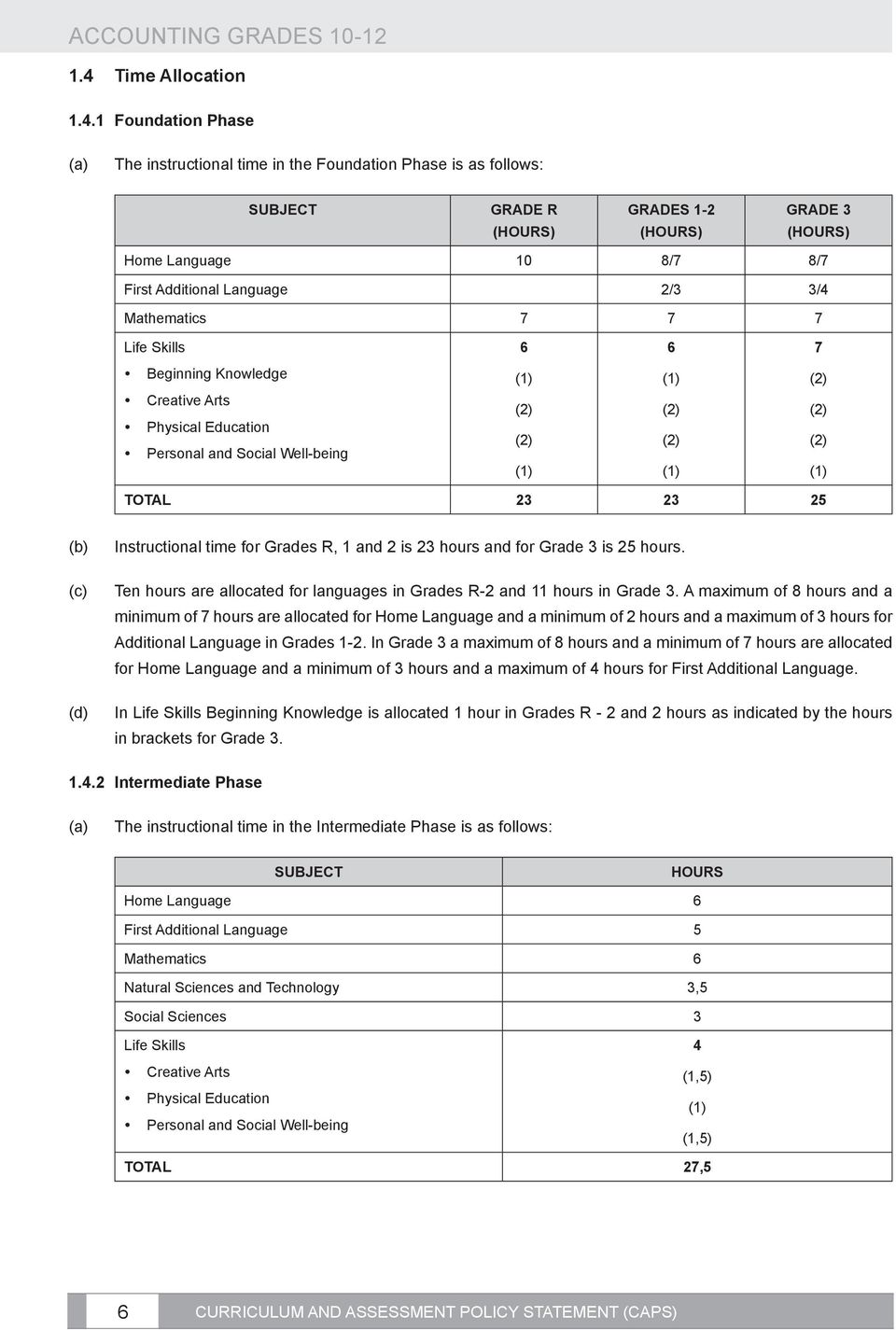
11 1.4 Time Allocation Foundation Phase (a) The instructional time in the Foundation Phase is as follows: SUBJECT GRADE R GRADES 1-2 GRADE 3 (HOURS) (HOURS) (HOURS) Home Language 10 8/7 8/7 First Additional Language 2/3 3/4 Mathematics Life Skills Beginning Knowledge (1) (1) (2) Creative Arts Physical Education Personal and Social Well-being (2) (2) (1) (2) (2) (1) (2) (2) (1) TOTAL (b) (c) (d) Instructional time for Grades R, 1 and 2 is 23 hours and for Grade 3 is 25 hours. Ten hours are allocated for languages in Grades R-2 and 11 hours in Grade 3. A maximum of 8 hours and a minimum of 7 hours are allocated for Home Language and a minimum of 2 hours and a maximum of 3 hours for Additional Language in Grades 1-2. In Grade 3 a maximum of 8 hours and a minimum of 7 hours are allocated for Home Language and a minimum of 3 hours and a maximum of 4 hours for First Additional Language. In Life Skills Beginning Knowledge is allocated 1 hour in Grades R - 2 and 2 hours as indicated by the hours in brackets for Grade Intermediate Phase (a) The instructional time in the Intermediate Phase is as follows: SUBJECT HOURS Home Language 6 First Additional Language 5 Mathematics 6 Natural Sciences and Technology 3,5 Social Sciences 3 Life Skills Creative Arts Physical Education Personal and Social Well-being 4 (1,5) (1) (1,5) TOTAL 27,5 6 CURRICULUM AND ASSESSMENT POLICY STATEMENT (CAPS)
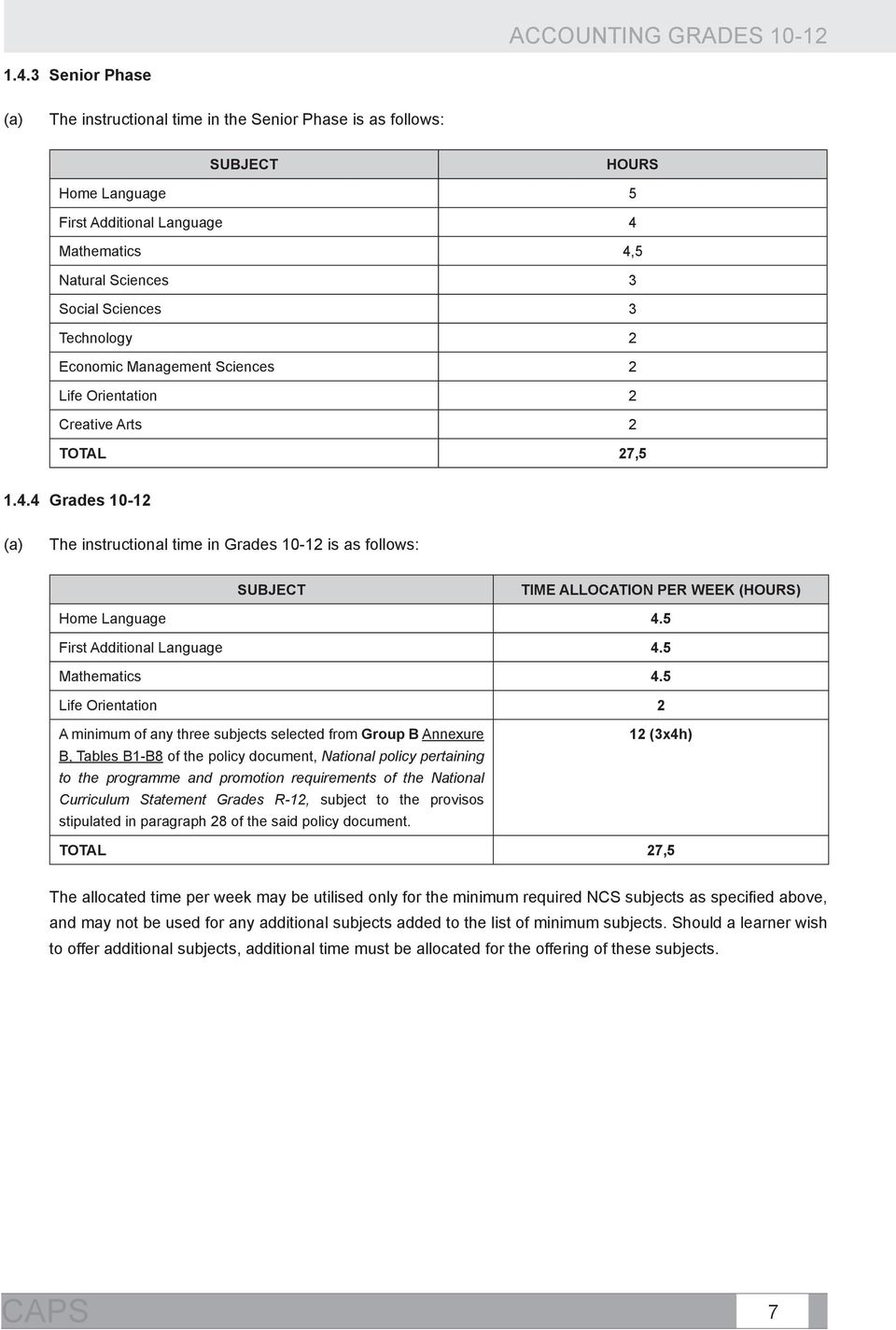
12 1.4.3 Senior Phase (a) The instructional time in the Senior Phase is as follows: SUBJECT HOURS Home Language 5 First Additional Language 4 Mathematics 4,5 Natural Sciences 3 Social Sciences 3 Technology 2 Economic Management Sciences 2 Life Orientation 2 Creative Arts 2 TOTAL 27, Grades (a) The instructional time in Grades is as follows: Subject Time allocation per week (hours) Home Language 4.5 First Additional Language 4.5 Mathematics 4.5 Life Orientation 2 A minimum of any three subjects selected from Group B Annexure B, Tables B1-B8 of the policy document, National policy pertaining to the programme and promotion requirements of the National Curriculum Statement Grades R-12, subject to the provisos stipulated in paragraph 28 of the said policy document. 12 (3x4h) TOTAL 27,5 The allocated time per week may be utilised only for the minimum required NCS subjects as specified above, and may not be used for any additional subjects added to the list of minimum subjects. Should a learner wish to offer additional subjects, additional time must be allocated for the offering of these subjects. CAPS 7
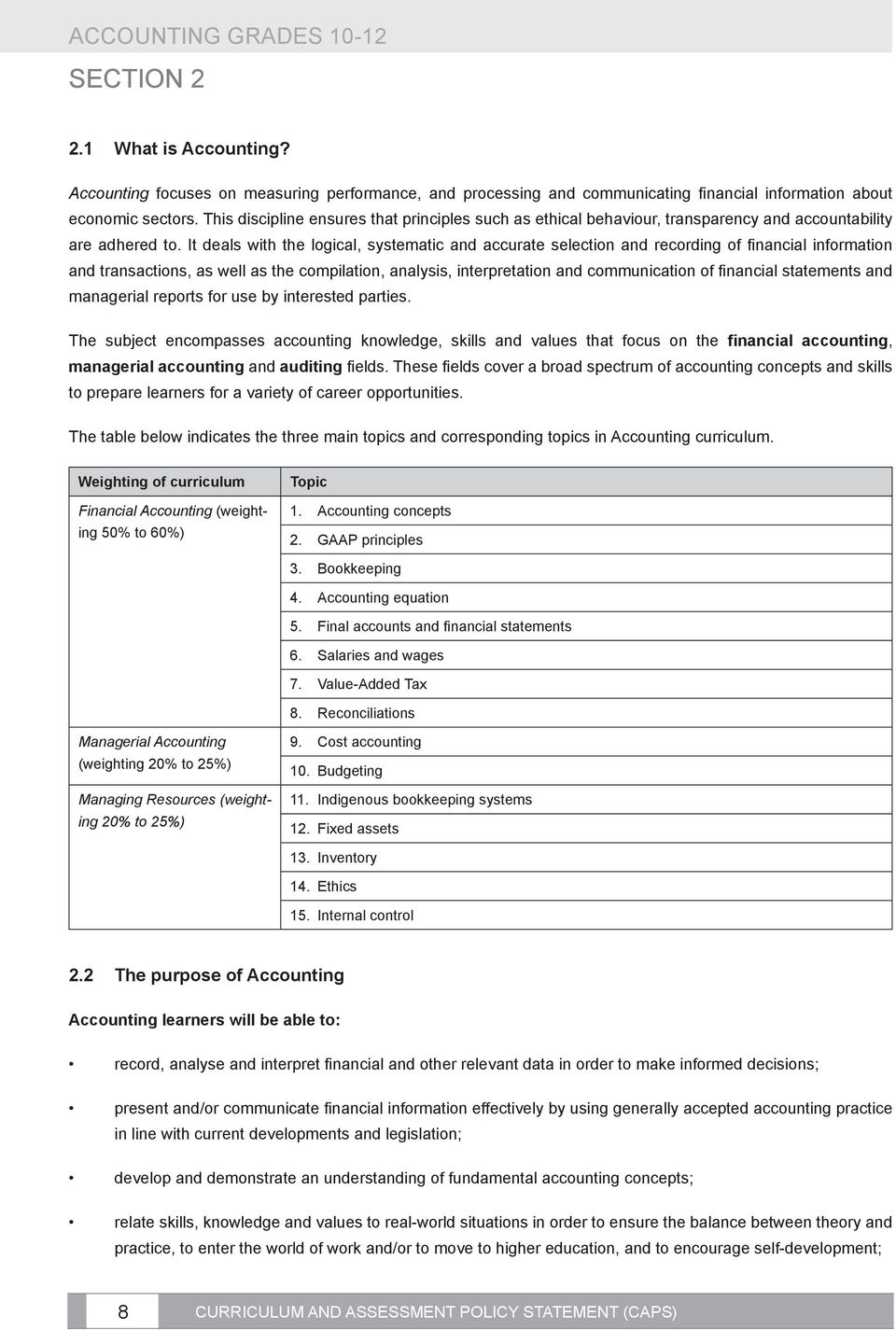
13 section What is Accounting? Accounting focuses on measuring performance, and processing and communicating financial information about economic sectors. This discipline ensures that principles such as ethical behaviour, transparency and accountability are adhered to. It deals with the logical, systematic and accurate selection and recording of financial information and transactions, as well as the compilation, analysis, interpretation and communication of financial statements and managerial reports for use by interested parties. The subject encompasses accounting knowledge, skills and values that focus on the financial accounting, managerial accounting and auditing fields. These fields cover a broad spectrum of accounting concepts and skills to prepare learners for a variety of career opportunities. The table below indicates the three main topics and corresponding topics in Accounting curriculum. Weighting of curriculum Financial Accounting (weighting 50% to 60%) Topic 1. Accounting concepts 2. GAAP principles 3. Bookkeeping 4. Accounting equation 5. Final accounts and financial statements 6. Salaries and wages 7. Value-Added Tax 8. Reconciliations Managerial Accounting (weighting 20% to 25%) Managing Resources (weighting 20% to 25%) 9. Cost accounting 10. Budgeting 11. Indigenous bookkeeping systems 12. Fixed assets 13. Inventory 14. Ethics 15. Internal control 2.2 The purpose of Accounting Accounting learners will be able to: record, analyse and interpret financial and other relevant data in order to make informed decisions; present and/or communicate financial information effectively by using generally accepted accounting practice in line with current developments and legislation; develop and demonstrate an understanding of fundamental accounting concepts; relate skills, knowledge and values to real-world situations in order to ensure the balance between theory and practice, to enter the world of work and/or to move to higher education, and to encourage self-development; 8 CURRICULUM AND ASSESSMENT POLICY STATEMENT (CAPS)
14 organise and manage own finances and activities responsibly and effectively; apply principles to solve problems in a judicious and systematic manner in familiar and unfamiliar situations, thus developing the ability to identify and solve problems in the context of the various fields of Accounting; develop critical, logical, and analytical abilities and thought processes to enable learners to apply skills to current and new situations; develop the following characteristics: - ethical behaviour - sound judgement - thoroughness - orderliness - accuracy - neatness; deal confidently with the demands of an accounting occupation manually and/or electronically. 2.3 Time allocation for Accounting in the curriculum The teaching time for Accounting is 4 hours per week, per grade on the timetable, that is, for Grades 10, 11 and Requirements to offer Accounting as a subject It is the responsibility of the school to provide the resources to offer Accounting as a subject. (a) Each learner should have: - a textbook - Accounting stationery or workbook - a calculator. (b) The teacher should have: - a variety of textbooks for reference - policies, e.g. summary of King Code III - partnership agreement - legislation, e.g. Companies Act 71 of codes of professional bodies, e.g. SAICA and SAIPA Codes - SARS brochures - bank brochures - access to a computer and the internet. CAPS 9

15 section Overview of topics GRADE 10 Term Topic 1 Indigenous bookkeeping Ethics (introduction) GAAP principles Internal control (introduction) Bookkeeping of sole trader: recording of cash transactions (CRJ, CPJ, PCJ); General Ledger, Trial Balance; Accounting equation Bookkeeping of sole trader: recording of credit: transactions (DJ, DAJ, CJ, CAJ, GJ); Ledgers, Debtors and Creditors lists, Trial Balance; Accounting equation Bookkeeping of sole trader: recording of cash and credit transactions (combined) 2 VAT Salaries and wages Final Accounts - sole trader: year-end adjustments, General Ledger including Final Accounts Section, Trial Balances 3 Financial statements - sole trader Adjustments, closing transfers, General Ledger, Income Statement, Balance Sheet, Notes to financial statements Analysis and interpretation of financial statements and notes 4 Cost accounting: manufacturing concepts Budgeting GRADE 11 Term Topic 1. Reconciliations Fixed assets Partnerships: adjustments, General Ledger, Accounting equation, final accounts, financial statements 2. Partnerships: analysis and interpretation Clubs: concepts, Ledger, Statement of Receipts and Payments 3. Cost Accounting: calculations, General Ledger Budgeting: Projected Income Statement, debtors collection, creditors payments, Cash Budget Inventory systems 4. Value Added Tax (VAT) 10 CURRICULUM AND ASSESSMENT POLICY STATEMENT (CAPS)

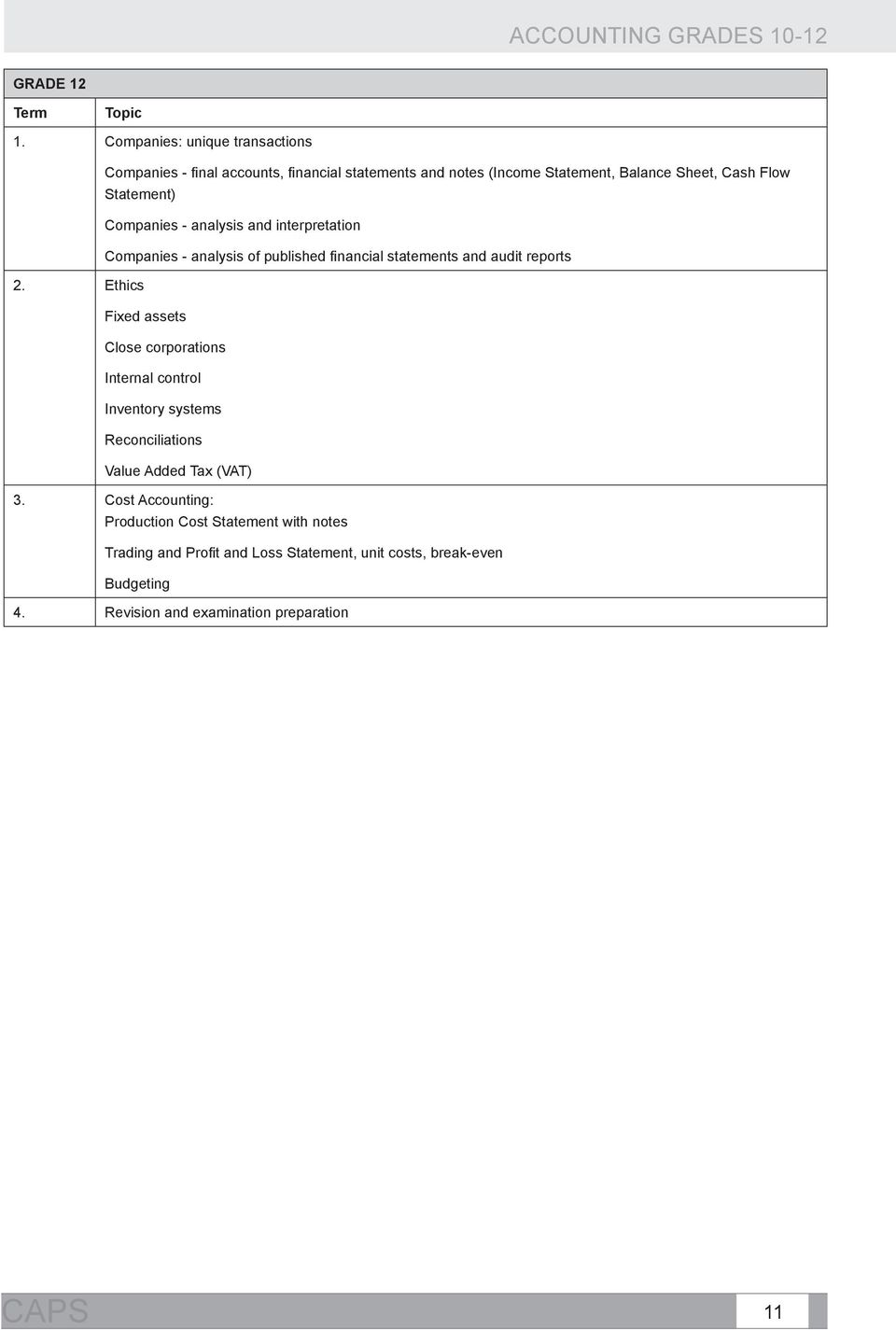
16 GRADE 12 Term Topic 1. Companies: unique transactions Companies - final accounts, financial statements and notes (Income Statement, Balance Sheet, Cash Flow Statement) Companies - analysis and interpretation Companies - analysis of published financial statements and audit reports 2. Ethics Fixed assets Close corporations Internal control Inventory systems Reconciliations Value Added Tax (VAT) 3. Cost Accounting: Production Cost Statement with notes Trading and Profit and Loss Statement, unit costs, break-even Budgeting 4. Revision and examination preparation CAPS 11
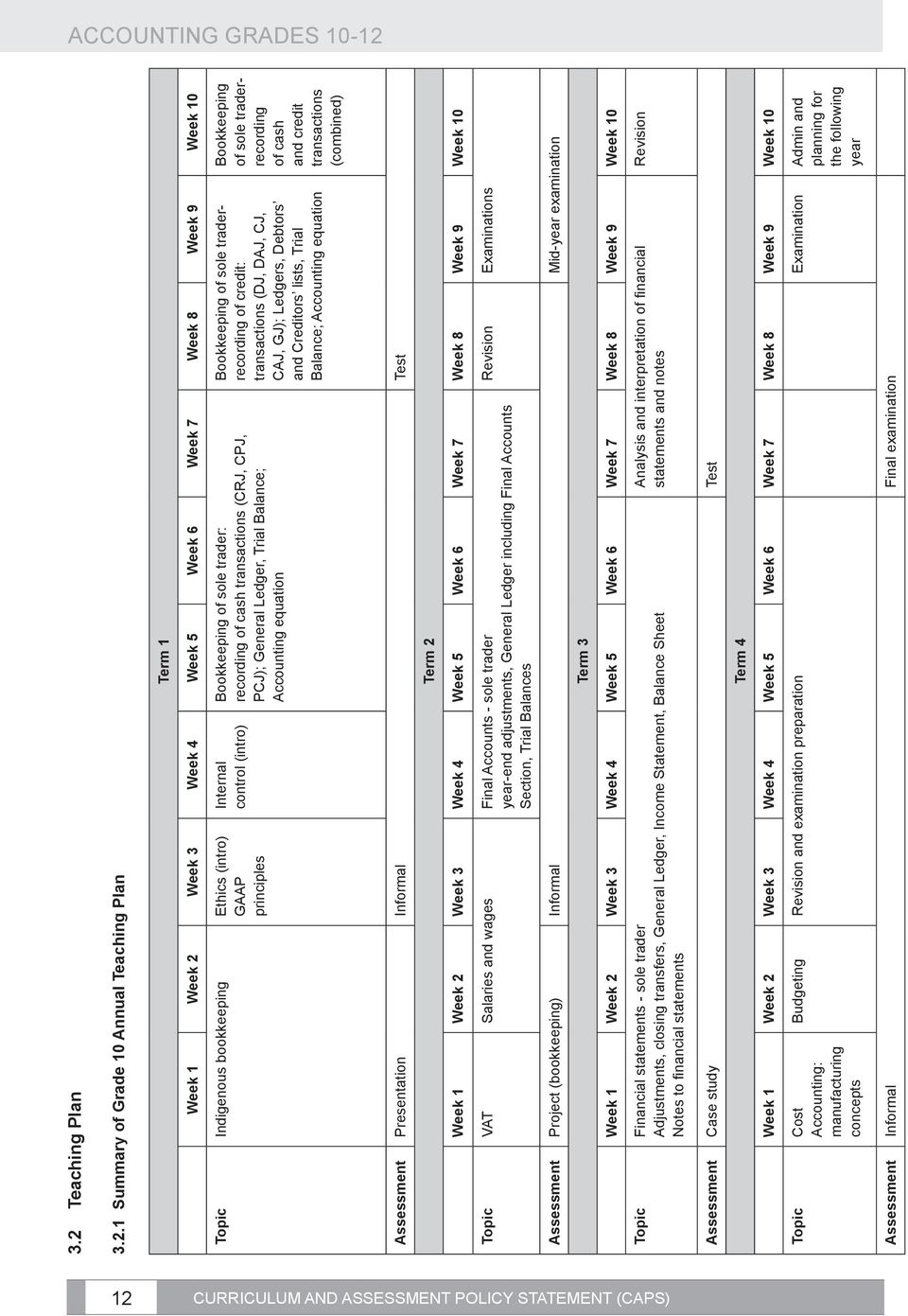
17 3.2 Teaching Plan Summary of Grade 10 Annual Teaching Plan Term 1 Week 1 Week 2 Week 3 Week 4 Week 5 Week 6 Week 7 Week 8 Week 9 Week 10 Topic Indigenous bookkeeping Ethics (intro) GAAP principles Internal control (intro) Bookkeeping of sole trader: recording of cash transactions (CRJ, CPJ, PCJ); General Ledger, Trial Balance; Accounting equation Bookkeeping of sole traderrecording of credit: transactions (DJ, DAJ, CJ, CAJ, GJ); Ledgers, Debtors and Creditors lists, Trial Balance; Accounting equation Bookkeeping of sole traderrecording of cash and credit transactions (combined) Assessment Presentation Informal Test Term 2 Week 1 Week 2 Week 3 Week 4 Week 5 Week 6 Week 7 Week 8 Week 9 Week 10 Topic VAT Salaries and wages Final Accounts - sole trader year-end adjustments, General Ledger including Final Accounts Section, Trial Balances Revision Examinations Assessment Project (bookkeeping) Informal Mid-year examination Term 3 Week 1 Week 2 Week 3 Week 4 Week 5 Week 6 Week 7 Week 8 Week 9 Week 10 Topic Financial statements - sole trader Adjustments, closing transfers, General Ledger, Income Statement, Balance Sheet Notes to financial statements Analysis and interpretation of financial statements and notes Revision Assessment Case study Test Term 4 Week 1 Week 2 Week 3 Week 4 Week 5 Week 6 Week 7 Week 8 Week 9 Week 10 Topic Cost Accounting: manufacturing concepts Budgeting Revision and examination preparation Examination Admin and planning for the following year Assessment Informal Final examination 12 CURRICULUM AND ASSESSMENT POLICY STATEMENT (CAPS)
18 3.2.2 annual Teaching Plan Grade 10 GRADE 10 TERM 1 Week/hour Topic Content Recommended resources 2 weeks 1. Informal or Comparison of the bookkeeping systems of the informal and formal Access to an owner (Weeks 1-2) indigenous bookkeeping systems sectors: concepts: capital; fixed assets; stock; cost price; labour cost; selling price; income; expenses and profit. of an informal business Questionnaire management of resources (capital, fixed assets, stock, etc.) Process of determining selling prices, cost of sales, labour costs, income and expenses 1 week (Week 3) 2. Ethics Explanation of the code of ethics applicable to all parties in the financial environment: code of ethics basic principles of ethics (leadership, discipline, transparency, accountability, fairness, sustainability, responsible management) Ethics should be integrated with other topics. Worksheet Case studies/ scenarios Newspaper articles Introduce during 3. GAAP Definition and explanation of Generally Accepted Accounting Worksheet weeks principles Practice (GAAP) principles: Textbook 2-3 historical cost prudence - materiality - business entity rule - going concern - matching Apply to all the relevant topics and link to topic 1 and 2. 1 week (Week 4) 4. Internal control Definition and explanation of what is meant by internal control Identification and explanation of basic internal control processes: Control environment; risk assessment; control activity supported by policy and procedures; information system and communication methods and monitoring performance. Internal control should be integrated with other topics. Worksheet Case studies Newspaper articles CAPS 13

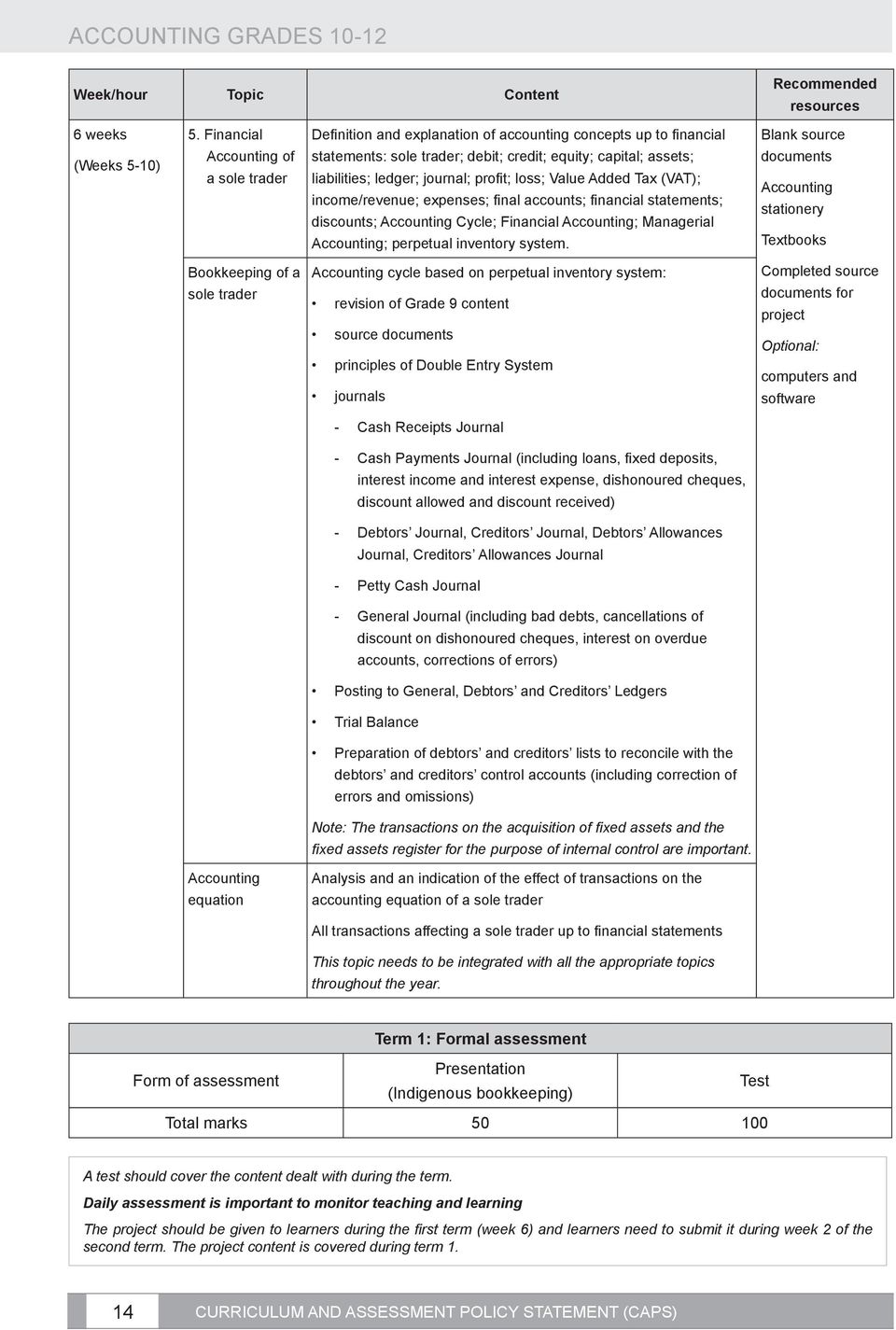
19 Week/hour Topic Content Recommended resources 6 weeks 5. Financial Definition and explanation of accounting concepts up to financial Blank source (Weeks 5-10) Accounting of a sole trader statements: sole trader; debit; credit; equity; capital; assets; liabilities; ledger; journal; profit; loss; Value Added Tax (VAT); income/revenue; expenses; final accounts; financial statements; discounts; Accounting Cycle; Financial Accounting; Managerial Accounting; perpetual inventory system. documents Accounting stationery Textbooks Bookkeeping of a sole trader Accounting cycle based on perpetual inventory system: revision of Grade 9 content source documents principles of Double Entry System journals Completed source documents for project Optional: computers and software - Cash Receipts Journal - Cash Payments Journal (including loans, fixed deposits, interest income and interest expense, dishonoured cheques, discount allowed and discount received) - Debtors Journal, Creditors Journal, Debtors Allowances Journal, Creditors Allowances Journal - Petty Cash Journal - General Journal (including bad debts, cancellations of discount on dishonoured cheques, interest on overdue accounts, corrections of errors) Posting to General, Debtors and Creditors Ledgers Trial Balance Preparation of debtors and creditors lists to reconcile with the debtors and creditors control accounts (including correction of errors and omissions) Note: The transactions on the acquisition of fixed assets and the fixed assets register for the purpose of internal control are important. Accounting Analysis and an indication of the effect of transactions on the equation accounting equation of a sole trader All transactions affecting a sole trader up to financial statements This topic needs to be integrated with all the appropriate topics throughout the year. Term 1: Formal assessment Form of assessment Presentation (Indigenous bookkeeping) Test Total marks A test should cover the content dealt with during the term. Daily assessment is important to monitor teaching and learning The project should be given to learners during the first term (week 6) and learners need to submit it during week 2 of the second term. The project content is covered during term CURRICULUM AND ASSESSMENT POLICY STATEMENT (CAPS)
20 GRADE 10 TERM 2 Week/hour Topic Content Recommended resources 1 week 1. Value Added Explanation of the basic concepts of VAT: Textbook (Week 1) Tax (VAT) need for VAT purpose of VAT principles of VAT zero-rated items VAT-exempted items VAT-able items current VAT rate 2 weeks 2. Salaries and Explanation, calculation and recording of salary and/or wage scales Textbook (Weeks 2-3) Wages Journal and payments in the journals and post to the ledger; this can be done manually or on a computerised spreadsheet. Accounting stationery Normal time Newspaper articles Overtime (current and Deductions - PAYE - Pension fund relevant ethical issues) Optional: computers - Unemployment Insurance Fund - Medical aid and software (spreadsheet) - Union membership Employer contributions - Pension fund - Unemployment Insurance Fund - Medical aid - Skills development levy Accounting equation Ethical conduct related to salaries and wages, e.g. contracts, payment in line with responsibilities, role of unions CAPS 15

21 Week/hour Topic Content Recommended resources 4 weeks 3. Financial Preparation of final accounts of a sole trader taking into account Textbook (Weeks 4-7) Accounting of a sole trader year-end adjustments Related concepts Accounting Application of GAAP principles stationery Accounting equation Pre-adjustment Trial Balance Year-end adjustments: trading stock deficit/surplus consumable stores on hand depreciation (on cost price/straight line, on diminishing balance methods) bad debts bad debts recovered (Including reciepts from solvent estates) correction of errors/omissions accrued income (receivable) income received in advance (deferred) expenses prepaid accrued expenses (payable). Interest on mortgage bond (capitalised) Post-adjustment Trial Balance Closing transfers Final accounts: Trading Account Profit and Loss Account Post-closing Trial Balance Reversal of certain yearend adjustments at beginning of next financial period, i.e. accruals, income received in advance and prepayments. 1 week Revision Revision of all topics covered during the first two terms Textbook exercises (Week 8) exercises 2 weeks Midyear (Weeks 9-10) examination Term 2: Formal assessment Form of assessment Project (bookkeeping) Mid-year examination Marks The content dealt with during terms 1 and 2 should be revised for the mid-year examination. 16 CURRICULUM AND ASSESSMENT POLICY STATEMENT (CAPS)
22 GRADE 10 TERM 3 Week/hour Topic Content Recommended resources 6 weeks 1. Financial Preparation of financial statements of a sole trader taking into account Textbook (Weeks 1-6) accounting of a sole trader - preparation of financial statements yearend adjustments Related concepts Application of GAAP principles Accounting equation Year-end adjustments: Accounting stationery trading stock deficit/surplus consumable stores on hand depreciation (on cost price/straightline, on diminishing balance. methods) bad debts bad debts recovered (Including receipt from insolvent estate) correction of errors/omissions accrued income (receivable) income received in advance (deferred) expenses prepaid accrued expenses (payable). Financial statements and notes: Income Statement Balance Sheet 2 weeks 2. Financial Analysis and interpretation of financial statements and notes: Textbook (Weeks 7-9) Accounting of a sole trader - analysis and interpretation of financial gross profit on sales gross profit on cost of sales net profit on sales operating expenses on sales Accounting stationery statements operating profit on sales current ratio acid test ratio solvency ratio return on equity 1 week Revision Revise topics covered during the term. Textbook exercises (Week 10) exercises Term 3: Formal assessment Form of assessment Case study Test Total marks A test should cover the content dealt with during the term. Daily assessment is important to monitor teaching and learning. CAPS 17
23 GRADE 10 TERM 4 Week/hour Topic Content Recommended resources 1 week 1. Cost Definition and explanation of basic cost concepts: Textbook (Week 1) Accounting direct labour indirect labour Accounting direct materials (raw materials) stationery indirect materials factory overhead costs Prime cost variable costs fixed costs workinprocess. Application of principles of internal control Ethical behaviour related to a manufacturing business 1 week (Week 2) 2. Budgeting Define and explain basic budgeting concepts: cash budget zerobased budget capital budget longterm budget mediumterm budget. Textbook Accounting stationery 4 weeks Revision Revise all topics in preparation for final examinations. Textbook exercises (Weeks 3-6) exercises Accounting stationery 2 weeks Endofyear examination Term 4 Year-mark End-of-year examination Total CURRICULUM AND ASSESSMENT POLICY STATEMENT (CAPS)
24 3.2.3 Summary of Annual Teaching Plan Grade 11 GRADE 11 Term 1 Week 1 Week 2 Week 3 Week 4 Week 5 Week 6 Week 7 Week 8 Week 9 Week 10 Topic Reconciliations Fixed assets Partnerships: adjustments, General Ledger, accounting equation, final accounts, financial statements Assessment Informal Written report Test Term 2 Week 1 Week 2 Week 3 Week 4 Week 5 Week 6 Week 7 Week 8 Week 9 Week 10 Topic Partnerships: analysis and interpretation Clubs: Revision Examinations concepts, Ledger, Statement of Receipts and Payments Assessment Informal Project Informal Mid-year examination Term 3 Week 1 Week 2 Week 3 Week 4 Week 5 Week 6 Week 7 Week 8 Week 9 Week 10 Topic Cost accounting: Calculations, General Ledger Budgeting: Projected Income Statement, debtors collection, creditors payments, Cash Budget Assessment Informal Presentation Test Term 4 Inventory Revision systems Week 1 Week 2 Week 3 Week 4 Week 5 Week 6 Week 7 Week 8 Week 9 Week 10 Topic Value Added Tax (VAT) Revision and examination preparation Examination Admin and planning for the following year Assessment Informal Final examination CAPS 19
25 3.2.4 Annual Teaching Plan Grade 11 GRADE 11 TERM 1 Week/hour Topic Content Recommended resources Continuously throughout the year Continuously throughout the year 1. Ethics Identification and analysis of ethical behaviour applicable to financial environments with reference to accountability, transparency and sustainability This topic should be integrated with other topics using appropriate scenarios. 2. Internal control Demonstration of the knowledge of internal audit processes: definition and explanation of what is meant by an internal audit knowledge of the difference between internal control and an internal audit, the role of the internal auditor, division of duties, documentation and physical controls identification of internal audit procedures relating to: - handling of cash - buying and selling on credit - stock - debtors - creditors. This topic should be integrated with other topics. Case studies Newspaper articles Textbook Case studies Newspaper articles Textbook 20 CURRICULUM AND ASSESSMENT POLICY STATEMENT (CAPS)
26 Week/hour Topic Content Recommended resources 3 weeks (Weeks 1-3) 3. Reconciliations Reconciliation of bank statements with cash journals in order to prepare bank reconciliation statements: outstanding deposits cheques not yet presented for payment stop/debit orders direct transfers bank charges interest received or charged correction of errors or omissions cheques R/D or cancelled post-dated cheques received/issued. Reconciliation of statements received from creditors with accounts in Creditors Ledger of a business in order to prepare creditors reconciliation statements: outstanding invoices or credit notes outstanding payments discounts not recorded correction of errors or omissions. Integration of issues of internal control Integration of ethical issues Textbooks Bank statements Bank brochures 3 weeks 4. Tangible/ fixed Understanding the concept of a tangible/fixed asset register Textbooks (Weeks 4-6) assets Recording the acquisition of tangible/fixed assets Newspaper adverts Calculation and recording of depreciation and articles on cost price (straightline method) diminishing balance method. Understanding how tangible/fixed assets are recorded when they are fully depreciated Recording the disposal of tangible/fixed assets (cash, credit, trade-in): at the beginning of a financial year during a financial year at the end of a financial year. Integration of issues of internal control - control measures over fixed assets Integration of ethical issues relating to fixed assets - responsible use of fixed assets CAPS 21
27 Week/hour Topic Content Recommended resources 4 weeks 5. Financial Definition and explanation of accounting concepts unique to Textbooks (Weeks 7-10) Accounting of partnerships - preparation partnerships: Partnership capital accounts Examples of partnership agreements current accounts interest on capital Accounting stationery salaries to partners bonus to partners division of profits/losses. GAAP Definition and explanation of Generally Accepted Accounting principles Practice (GAAP) principles: historical cost prudence materiality business entity rule going concern matching Bookkeeping of a Accounting cycle of partnerships: partnership documents and journals Post to the Ledger Trial Balance Preparation of final accounts and financial statements of a partnership taking into account yearend adjustments Accounting equation Year-end adjustments: trading stock deficit/surplus consumable stores on hand depreciation (on cost price/ straightline, on diminishing balance methods) bad debts bad debts recovered (Including reciepts from solvent estates) correction of errors/omissions accrued income (receivable) income received in advance (deferred) expenses prepaid accrued expenses (payable) provision for bad debts salaries to partners bonus to partners interest on capital Interest on loan (Capitalized) appropriation of profit/loss. 22 CURRICULUM AND ASSESSMENT POLICY STATEMENT (CAPS)
28 Week/hour Topic Content Recommended resources Final accounts: Trading account Profit and Loss account Appropriation account Reversal of certain yearend adjustments at beginning of next financial period, i.e. accruals, income received in advance and prepayments Financial statements and notes: Income Statement Balance Sheet Term 1: Formal assessment Form of Assessment Written report Test Total marks Note: A test should cover the content dealt with during the term. Daily assessment is important to monitor teaching and learning. Teachers should give the project to learners in term 1 (week 5) and instruct learners to submit it in term 2. This will give learners ample time to complete the project. Part of the project content is covered in term 1 and another part in term 2. CAPS 23
29 GRADE 11 TERM 2 Week/hour Topic Content Recommended resources 3 weeks 1. Financial Analysis and interpretation of financial statements and notes Textbook (Weeks 1-3) accounting of partnerships - analysis and interpretation Revision of the following: gross profit on sales gross profit on cost of sales net profit on sales operating expenses on sales operating profit on sales solvency ratio current ratio acid test ratio Introduction to and covering of the following: stock turnover rate stock holding period average debtors collection period average creditors payment period debt-equity ratio (gearing) partners earnings return on partners equity 4 weeks 2. Financial Definition and explanation of accounting concepts unique to Textbook (Weeks 4-7) accounting of nonprofit organisations (clubs) nonprofit organisations (clubs): nonprofit organisations constitution accumulated fund Constitutions of clubs Accounting stationery membership fees entrance fees affiliation fees honorarium surplus deficit Accounting cycle for non-profit organisations (clubs): preparation of Analysis Cash Book posting to the Ledger (particularly accounts unique to nonprofit organisations, viz. Accumulated Fund, membership fees, entrance fees, stock accounts, e.g. refreshments, ties, rugby jerseys) drafting of a Trial Balance preparation of Statement of Receipts and Payments understanding of differences between receipts & income and; payments & expenses 24 CURRICULUM AND ASSESSMENT POLICY STATEMENT (CAPS)
30 Week/hour Topic Content Recommended resources 1 week Revision Revise topics covered during first two terms. Textbook exercises (Week 8) exercises 2 Weeks Midyear examination (Weeks 9-10) Term 2: Formal assessment Form of assessment Project Midyear examinations Marks Daily assessment is important to monitor teaching and learning The content dealt with for term 1 and 2 should be revised for the mid-year examination. CAPS 25
31 GRADE 11 TERM 3 Week/hour Topic Content Recommended resources 4 weeks 1. Cost Calculation of the following costs in a manufacturing environment: Textbook (Weeks 1-4) Accounting variable and fixed costs the cost of a product using variable and fixed costs unit cost contribution per unit Breakeven point. Preparation of ledger accounts of a manufacturing business Balance Sheet Section: raw material stock workinprogress stock finished goods stock consumable stores stock (indirect materials). Nominal Accounts Section: sales cost of sales raw materials issued factory wages factory electricity factory rent depreciation on factory equipment, etc. Cost Accounts Section: direct (raw) materials cost direct labour cost factory overhead cost administration cost selling and distribution cost. Integration of ethical issues related to a manufacturing environment Integration of internal audit and internal control issues related to a manufacturing environment 26 CURRICULUM AND ASSESSMENT POLICY STATEMENT (CAPS)
32 Week/hour Topic Content Recommended resources 3 weeks (Weeks 5-7) 2. Budgeting Preparation and presentation of a cash budget for sole traders: projected receipts and payments projected debtors collection projected creditors payments Cash Budget. Preparation and presentation of Projected Income Statement projected revenue and expenditure. Integration of ethical issues Integration of internal audit and internal control issues Textbook Accounting stationery 2 weeks 3. Inventory Definition and explanation of the following stock systems: Textbook (Weeks 8-9) systems Perpetual stock system Accounting Periodic stock system stationery Knowledge of the advantages and disadvantages of the periodic and perpetual stock systems Recording of transactions using the periodic stock system in the journals and ledgers, comparing it with the perpetual stock system: purchases account as opposed to Trading Stock account Opening Stock and Closing Stock accounts Trading account carriage on purchases custom and import duties. 1 week Revision Revision of term s work Textbook exercises Week 10 exercises Term 3: Formal assessment Form of assessment Presentation Test Total marks A test should cover the content covered during the term. Daily assessment is important to monitor teaching and learning. CAPS 27
33 GRADE 11 TERM 4 Week/hour Topic Content Recommended resources 2 weeks 1. Value Added Perform VAT calculations: Textbook (Week 1-2) Tax (VAT) use current rate Accounting add VAT to cost price plus markup amount stationery calculate VAT from VAT-inclusive amount Newspaper articles invoice or receipt base. Understand the effect of bad debts, discounts and goods returned on VAT Integrate ethics relating to VAT - VAT fraud, etc. Integrate internal audit and internal control processes over collection of VAT from customers and payment of VAT to SARS. 4 weeks Revision Revision of all topics in preparation for final examination Textbook exercises (Weeks 3-6) exercises Endofyear examination Term 4 Yearmark Endofyear examination Total CURRICULUM AND ASSESSMENT POLICY STATEMENT (CAPS)
34 3.2.5 Summary of Annual Teaching Plan Grade 12 GRADE 12 Term 1 Week 1 Week 2 Week 3 Week 4 Week 5 Week 6 Week 7 Week 8 Week 9 Week 10 Topic Companies: unique transactions Companies - final accounts, financial statements and notes (Income Statement, Balance Sheet, Cash Flow Statement) Companies - analysis and interpretation Assessment Written report Informal Test Term 2 Week 1 Week 2 Week 3 Week 4 Week 5 Week 6 Week 7 Week 8 Week 9 Week 10 Companies - analysis of published financial statements and audit reports Topic Ethics Fixed assets Close Inventory systems Reconciliations Value Added Tax Examinations corporations Internal control Assessment Project Informal Midyear examination Term 3 Week 1 Week 2 Week 3 Week 4 Week 5 Week 6 Week 7 Week 8 Week 9 Week 10 Topic Cost Accounting: Budgeting Revision Examinations Production Cost Statement with notes, Trading and Profit and Loss Statement, unit costs, breakeven Assessment Test Case study Trial examinations Term 4 Week 1 Week 2 Week 3 Week 4 Week 5 Week 6 Week 7 Week 8 Week 9 Week 10 Topic Revision and examination preparation Examination Admin and planning for the following year Assessment Informal Final examination CAPS 29
35 3.2.6 Grade 12 Annual Teaching Plan GRADE 12 TERM 1 Week/Hour Topic Content Recommended Resources 2 weeks 1. Financial Definition and explanation of accounting concepts unique to Textbook (Weeks 1-2) accounting of companies - concepts and unique ledger companies: companies - public and private Companies Act Accounting stationery accounts Registrar of Companies - Registration certificate Memorandum of Incorporation income tax/provisional income tax dividends shares issue price earnings shareholders directors auditors limited liability separation of ownership from control retained income authorised share capital issued share capital Johannesburg Securities Exchange (JSE) GAAP principles Definition and explanation of International Financial Reporting Standards (IFRS) and Generally Accepted Accounting Practice (GAAP) Definition and explanation of the following specific GAAP principles: historical cost prudence materiality business entity rule going concern matching 30 CURRICULUM AND ASSESSMENT POLICY STATEMENT (CAPS)
36 Week/Hour Topic Content Recommended Resources Bookkeeping of companies Accounting cycle for a company: journals ledger accounts Trial Balance Transactions include: issuing of shares at issue price (note that par value and share premium no longer exist in terms of the Companies Act) buying back of shares loans and interest (note: interest on a mortgage loan is capitalised) income tax dividends directors fees audit fees. 5 weeks 2. Financial Preparation of final accounts and detailed financial statements of a Textbook (Weeks 3-7) accounting of companies - preparation of final accounts company taking into account yearend adjustments. Year end adjustments: trading stock deficit/surplus Accounting stationery and financial statements consumable stores on hand depreciation (on cost price/straight line, on diminishing balance methods) bad debts bad debts recovered (Including reciepts from solvent estates) correction of errors/omissions accrued income (receivable) income received in advance (deferred) expenses prepaid accrued expenses (payable) provision for bad debts adjustments related to income tax adjustments related to the payment and declaration of dividends. Final accounts: Trading account Profit and Loss account Appropriation account Reversal of certain adjustments, i.e. accruals, income received in advance, and prepayments CAPS 31
37 Week/Hour Topic Content Recommended Resources Financial statements and notes: Income Statement Balance Sheet Cash Flow Statement Analysis and indication of the effect of transactions on the accounting equation of a company; all transactions affecting a company up to financial statements Integration of reporting and control of fixed assets Integration of ethical considerations relating to companies - roles of shareholders and directors, manipulation of share prices, corporate governance, etc. Integration of internal audit and control processes relating to companies Application of GAAP principles and IFRS 2 weeks 3. Financial Analysis and interpretation of Income Statement, Balance Sheet Textbook (Weeks 8-9) accounting of companies - analysis and interpretation and Notes Revision of the following financial indicators: gross profit on sales Accounting stationery of financial statements gross profit on cost of sales net profit on sales operating expenses on sales operating profit on sales current ratio acid test ratio stock turnover rate stock holding period average debtors collection period average creditors payment period solvency ratio. Introduction and coverage of the following financial indicators: debt-equity ratio (gearing) return on shareholders equity return on total capital employed net asset value per share dividends per share earnings per share 32 CURRICULUM AND ASSESSMENT POLICY STATEMENT (CAPS)
38 Week/Hour Topic Content Recommended Resources 1 week 4. Financial Analysis of a company s published financial statements and Textbook (Week 10) accounting of companies - analysis of published financial statements annual reports comprising Directors Report, Independent Auditors Report, Abridged Income Statement, Balance Sheet and Cash Flow Statement, together with additional information relating to governance and the company s activities. Accounting stationery Published annual report (or extracts) of a public company Term 1: Formal assessment Form of assessment Written report Test Total marks A project that will allow learners to analyse and interpret financial information or to answer problem-solving questions using critical and creative thinking is recommended. This task must be given to learners towards the end of term 1 and be submitted in term 2. Aspects of the task may be covered during class activities. Daily assessment is important to monitor teaching and learning. CAPS 33
39 GRADE 12 TERM 2 Week/hour Topic Content Recommended resources ½ week (Week 1) 1. Ethics Understanding the role of professional bodies, e.g. South African Institute of Chartered accountants (SAICA) and South African Institute of Professional Accountants (SAIPA) Discussion of disciplinary and punitive measures that are applied for non-compliance with the Code of Professional Conduct Understanding the policies governing ethical behaviour in the financial environment, viz. King Code III Understanding the legislation governing companies: - Basic principles in Companies Act, i.e. directors performance evaluation, remuneration policies, dispute resolution, business rescue, conflict of interests, responsibilities of directors This topic should be consolidated, having been integrated with other topics. Textbook Case studies/ scenarios Companies Act SAICA and SAIPA Codes King Code III (overview only) ½ week 2. Tangible/fixed Interpretation and reporting on the movements of fixed assets: Textbook (Week 1) assets age of assets Accounting replacement rate stationery life span of assets. Integration of GAAP principles relating to fixed assets Newspaper adverts and articles Integration of ethical issues relating to fixed assets Integration of internal audit and control processes relating to fixed assets ½ week 3. Financial Definition and explanation of accounting concepts unique to Textbook (Week 2) accounting of close corporations close corporations: close corporation founding statement members loans to members loans from members distribution to members. Identify differences in the financial statements of companies and close corporations, particularly with regard to terminology. 34 CURRICULUM AND ASSESSMENT POLICY STATEMENT (CAPS)
40 Week/hour Topic Content Recommended resources ½ week (Week 2) 4. Internal control Application of internal control and internal audit processes in a business environment: means of gathering audit evidence basis for gathering audit samples basic sampling techniques internal audit reports accountable management of resources. Understanding the difference between the roles of internal and external auditors This topic should be consolidated, having been integrated with other topics. Textbook Case studies 2 weeks 5. Inventory Validation, valuation and calculation of inventories of businesses Textbook (Weeks 3-4) systems using the perpetual and periodic inventory systems: Accounting specific identification (of cost price per unit) stationery first in, first out (FIFO) weighted average Integration of GAAP principles relating to inventories Integration of ethical issues relating to inventories Integration of internal audit and control processes relating to inventories 2 weeks (Weeks 5-6) 6. Reconciliations Analysis and interpretation of bank, debtors and creditors reconciliations: reconcile creditors statements with their personal accounts reconcile debtors lists and creditors lists with control accounts analyze and interpret debtors age analysis analyze and interpret bank statements and bank reconciliation statements. Integration of ethical issues relating to cash, debtors and creditors: payment periods, interest, credit ratings, fraud, etc. Integrate internal audit and internal control issues relating to cash, debtors and creditors Textbook Accounting stationery Newspaper articles Examples of bank statements and debtors & creditors statements 1 week 7. Value Added Tax Calculate the amount payable to or receivable from the South Textbook (Week 7) (VAT) African Revenue Services (SARS) Accounting Completion of the VAT control ledger account from given stationery information SARS brochures & Integration of ethical issues relating to VAT VAT return forms Integration of internal audit and control processes Newspaper articles CAPS 35
41 Week/hour Topic Content Recommended resources 1 week Revision exercises Revision of topics covered during first two terms. Textbook exercises (Week 8) 2 weeks Midyear examination (Weeks 9-10) Term 2: Formal assessment Form of assessment Project Midyear examination Marks Note: Term 2 formal task was given in term 1. Learners should complete the task for term 2 and submit it. The content dealt with for term 1 and term 2 should be revised for the mid-year examination. At the end of the 2 nd term, learners must be able to analyse and interpret financial information and answer any problemsolving questions using critical and creative thinking. These include solving real-life problems within the context of the accounting curriculum. Daily assessment is important for monitoring teaching and learning. 36 CURRICULUM AND ASSESSMENT POLICY STATEMENT (CAPS)
42 GRADE 12 TERM 3 Week/hour Topic Content Recommended resources 3 weeks 1. Cost Definition and explanation of accounting concepts unique to a Textbook (Weeks 1-3) Accounting manufacturing business Accounting Preparation, presentation, analysis, interpretation and reporting on stationery cost information for manufacturing enterprises: preparation of a production cost statement with notes for manufacturing costs preparation of a short-form Income Statement with notes for administration cost and selling & distribution cost calculation of gross profit on finished goods sold calculation of variable and fixed costs calculation of the cost of a product using variable and fixed costs calculation of cost per unit calculation of contribution per unit calculation of breakeven point calculation of total cost of production. Integration of ethical issues relating to manufacturing: product quality, product age, raw materials, support for local products, pricefixing, theft, fraud, etc. Integration of internal audit and control processes relating to manufacturing 3 weeks (Weeks 4-6) 2. Budgeting Analysis, interpretation and comparison of projected income statements for sole traders or companies. Projected Income Statement sales cost of sales expenses income profits Analysis, interpretation and comparison of cash budgets for sole traders or companies. Cash Budget receipts payments debtors collection creditors payment cash balances Integration of ethical issues relating to budgeting and projections Integration of internal audit and control processes relating to budgets and projections by comparing budget to actual figures Textbook Accounting stationery CAPS 37
43 Week/hour Topic Content Recommended resources 2 weeks Revision Revision activities Textbook exercises (Weeks 7-8) 2 weeks Preliminary examination (Weeks 9-10) Term 3: Formal assessment Form of assessment Test Case study Preliminary examination Total marks A trial examination should cover the entire curriculum and the structure of the question paper should resemble the final examination question paper. Daily assessment is important for monitoring teaching and learning. 38 CURRICULUM AND ASSESSMENT POLICY STATEMENT (CAPS)
44 GRADE 12 TERM 4 Week/hour Topic Content Recommended resources 4 weeks Revision Revision of all topics in preparation for final examinations Previous question (Weeks 1-4) exercises papers Textbook exercises Exemplar papers Examination Guidelines 6 weeks Final examination (Weeks 5-10) Term 4 Year mark Endofyear examination Total CAPS 39
45 SECTION What is assessment? Assessment is a continuous, planned process of identifying, gathering and interpreting information about the performance of learners, using various forms of assessment. It involves four steps: generating and collecting evidence of achievement; evaluating this evidence; recording the findings and using this information to understand and thereby assist the learner s development in order to improve the process of learning and teaching. Assessment should be both informal (Assessment for Learning) and formal (Assessment of Learning). In both cases regular feedback should be provided to learners to enhance the learning experience. Assessment in Accounting gathers valid information about the learners knowledge, skills, values, attitudes and ability to make meaningful and informed, personal, collaborative financial decisions in economic and social environments. The study and assessment of Accounting must not only cover the recording, reporting and interpreting of financial information but should also promote critical reflection on diverse Accounting issues. Accounting covers valuable skills that prepare learners for success in a variety of careers. Teachers must take all these skills into account when planning teaching, learning and assessment activities. For example, the ability to make appropriate financial decisions in consultation with other stakeholders in a business context is crucial for learners to achieve success or exploit opportunities in the business environment. 4.2 Informal or daily assessment Assessment for learning has the purpose of continuously collecting information on a learner s achievement that can be used to improve their learning. Informal assessment is a daily monitoring of learners progress. This is done through observations, discussions, practical demonstrations, learner-teacher conferences, informal classroom interactions, etc. Informal assessment may be as simple as stopping during the lesson to observe learners or to discuss with learners how learning is progressing. Informal assessment should be used to provide feedback to the learners and to inform planning for teaching, but need not be recorded. It should not be seen as separate from learning activities taking place in the classroom. Learners or teachers can mark these assessment tasks. Self-assessment and peer assessment actively involve learners in assessment. This is important as it allows learners to learn from and reflect on their own performance. The results of the informal daily assessment tasks are not formally recorded unless the teacher wishes to do so. The results of daily assessment tasks are not taken into account for promotion and certification purposes. 4.3 Formal assessment All assessment tasks that make up a formal programme of assessment for the year are regarded as Formal Assessment. Formal assessment tasks are marked and formally recorded by the teacher for progression and certification purposes. All Formal Assessment tasks are subject to moderation for the purpose of quality assurance and to ensure that appropriate standards are maintained. Formal assessment provides teachers with a systematic way of evaluating how well learners are progressing in a grade and in a particular subject. Examples of formal assessments include tests, examinations, practical tasks, 40 CURRICULUM AND ASSESSMENT POLICY STATEMENT (CAPS)
46 projects, oral presentations, demonstrations, performances, etc. Formal assessment tasks form part of a year-long formal Programme of Assessment in each grade and subject. The Programme of Assessment for Accounting in Grades 10 and 11 consists of seven tasks which are internally assessed. Of the seven tasks, the six tasks which are completed during the school year make up 25% of the total mark for Accounting, while the endofyear examination is the seventh task and makes up the remaining 75%. In Grade 12, assessment consists of two components: a Programme of Assessment which makes up 25% of the total mark for Accounting and an external examination which makes up the remaining 75%. The Programme of Assessment for Accounting consists of seven tasks which are internally assessed. The external examination is externally set and moderated. Formal assessment tasks form part of a yearlong formal Programme of Assessment in each grade and subject, are school-based and are weighted as follows for the different grades: Grades Tasks undertaken during the year Endofyear examination R % n/a % 25% % 60% 10 and 11 25% 75% 12 25% External examination: 75% The forms of assessment used should be age and developmental level appropriate. The design of these tasks should cover the content of the subject and include a variety of tasks designed to achieve the objectives of the subject. Formal assessments must cater for a range of cognitive levels and abilities of learners, as shown below: Table 1 Cognitive levels Activity Percentage of task Knowledge and comprehension Levels 1 and 2 Application and analysis Levels 3 and 4 Synthesis and evaluation Levels 5 and 6 Basic thinking skills (e.g. factual recall, lowlevel comprehension and lowlevel application) Moderately high thinking skills (e.g. more advanced application, interpretation and lowlevel analysis) Higherorder thinking skills (e.g. advanced analytical skills, evaluation and creative problem-solving) 30% 40% 30% CAPS 41
47 4.4 Programme of Assessment Grades The Programme of Assessment is designed to spread formal assessment tasks in all subjects in a school throughout a term. The requirements (number and nature of tasks) for Accounting are indicated below: Grade 10 Programme of Assessment Term 1 Term 2 Term 3 Term 4 Assessment Presentation Test Project Midyear examination Case study Test Yearmark Endofyear examination Total Total marks Convert to a mark out of: (50 5) (100 5) (50 2.5) (200 10) (50 5) (100 5) Grade 11 Programme of Assessment Term 1 Term 2 Term 3 Term 4 Assessment Written report Test Project Midyear examination Presentation Test Yearmark Endofyear examination Total Total marks Convert to a mark out of: (50 5) (100 5) (50 2.5) (300 15) (50 5) (100 5) Grade 12 Programme of Assessment Term 1 Term 2 Term 3 Term 4 Assessment Written report Test Project Midyear examination Test Case study Trial examination Yearmark Endofyear examination Total Total marks Convert to a mark out of: (50 5) (100 (50 (300 (100 (50 5) (300 10) 2.5) 15) 10) 15) Other forms of assessment Project A project in each of the grades in the FET band is mandatory. Only one project per annum is recommended per grade. When preparing a project, consider the following minimum requirements: Learners should be given the necessary guidance prior to commencement of the project and their progress must be monitored. 42 CURRICULUM AND ASSESSMENT POLICY STATEMENT (CAPS)
48 Aspects of the project should be completed in class to enable teachers to monitor progress; All criteria used to assess the project must be discussed with the learners. Generally, projects are given a longer period of time to complete as they involve some form of research, consolidating and choosing relevant information and preparing a written document as evidence. Often projects can pertain to some form of problem; and Research may form part of the project - the project is the evidence of the research conducted. However, this is not always the case, e.g. the computerised accounting programme will not involve research but develop skills. A suggestion is that projects are dealt with towards the end of a particular term (e.g. first term) for submission during the next term. Presentation Presentations can be written or oral, but there must be evidence of the presentation. All criteria used to assess the presentation must be discussed with the learners prior to the commencement of the presentation. Where resources are available, the use of electronic presentations should be encouraged. Case Study Learners are presented with a real-life situation, a problem or an incident related to the topic. They are expected to assume a particular role in articulating the position. They would draw on their own experience, the experience of peers or prior learning to interpret, analyse and solve a problem or problems. Newspaper articles, magazine articles, and TV or radio presentations form excellent case studies. Learners have to read and/or listen, digest the information and then make informed decisions. Questions can range from lower order - direct quotes from the article - to higher order when they are asked to analyse comments and possibly make suggestions. Case studies are a very good way of keeping the subject up to date and relevant. Report A report is generally the written evidence of a survey, analysis or investigation. Generally, this will be shorter than a project and it is specific to the topic, e.g. a business has come to you for advice on whether the business is experiencing liquidity problems. Often it implies consulting with an expert for advice on some problem - therefore it links very well with problem-solving. Tests Two tests, written under controlled conditions, are prescribed for Grades These tests should adhere to the following: they must be completed by all classes in the same grade on the same day; all learners write the same test, which is completed under examination conditions; questions must comply with yearend examination standards; CAPS 43
49 where there is more than one teacher, agreement must be reached on the scope, as well as the date and time of the test; duration of each of these tests should be at least one hour for 100 marks; tests should cover the different cognitive levels as in examinations. See table on cognitive levels in section Examinations The following guidelines should be considered when constructing examinations: Content Content stipulated specifically for the grade 80% Content stipulated in previous grades which have an impact on assessment in subsequent grades 20% Cognitive levels: Refer to Bloom s revised taxonomy: Remembering, Understanding, Applying, Analysing, Evaluating and Creating Basic thinking skills (e.g. factual recall, lowlevel comprehension and low-level application) 30% Moderately high thinking skills (e.g. more advanced application, interpretation and lowlevel analysis) 40% Higherorder thinking skills (e.g. advanced analytical skills, evaluation and creative problem-solving) 30% Problem solving Approximately 10% of all examinations should address problem-solving questions using critical and creative thinking. These include the solving of real-life problems within the context of the Accounting curriculum. These problem-solving questions must also cover a range of cognitive skills (lower, middle and higher order) to cater for all learners but within the context of the learners. For example, surface problem-solving questions might involve recall or comprehension skills on familiar information while deep problem-solving questions will generally involve creative solutions in new and unfamiliar scenarios falling within the ambit of the Accounting curriculum. While ratio and analysis can form very interesting problem-solving questions, the topic of problem solving goes a lot further and should be integrated into all aspects of the curriculum so that the learners develop the skills to apply the knowledge acquired. Guidelines for deep problem-solving questions: - Learners identify problems from Accounting information provided. - Learners quote the relevant information to support their opinions on the problems. - Learners provide valid and appropriate solutions. 44 CURRICULUM AND ASSESSMENT POLICY STATEMENT (CAPS)
50 Midyear examinations Below is an outline of the structure of the mid-year examinations in each of the grades. Paper Time Marks Topics Grade hours 200 In proportion to time Grade hours 300 devoted to each topic Grade hours 300 (as indicated in work schedule) Trial examination (Grade 12 only) A trial examination is one of the seven tasks of the Programme of Assessment for Grade 12. Ideally, the trial examination should cover the full scope of the Grade 12 curriculum and should model the final Grade 12 examination. Below is an outline of the structure of the trial examination: Paper Time Marks Content Grade hours 300 Full scope End of year examinations Grades should write a 3hour examination of 300 marks as a final examination. Paper Time Marks Financial Accounting Managerial Accounting Managing resources Grade hours % - 70% 5% - 10% 25% - 30% Grade hours % - 60% 20% - 25% 20% - 25% Grade hours % - 60% 20% - 25% 20% - 25% 4.5 Recording and reporting Recording is a process in which the teacher documents the level of a learner s performance in a specific assessment task. It indicates learner progress towards the achievement of the knowledge as prescribed in the Curriculum and Assessment Policy Statements. Records of learner performance should provide evidence of the learner s conceptual progression within a grade and her/his readiness to progress or promote to the next grade. Records of learner performance should also be used to verify the progress made by teachers and learners in the teaching and learning process. Reporting is a process of communicating learner performance to learners, parents, schools, and other stakeholders. Learner performance can be reported in a number of ways. These include report cards, parents meetings, school visitation days, parentteacher conferences, phone calls, letters, class or school newsletters, etc. Teachers in all grades report in percentages against the subject. Seven levels of competence have been described for each subject listed for Grades R The various achievement levels and their corresponding percentage bands are as shown in the Table below. CAPS 45
51 Codes and Percentages for Recording and Reporting Rating code Description of competence Percentage 7 Outstanding achievement Meritorious achievement Substantial achievement Adequate achievement Moderate achievement Elementary achievement Not achieved 0-29 Note: The seven-point scale should have clear descriptors that give detailed information for each level. Teachers will record actual marks against the task by using a record sheet; and report percentages against the subject on the learners report cards. 4.6 Moderation of assessment Moderation refers to the process that ensures that the assessment tasks are fair, valid and reliable. Moderation should be implemented at school, district, provincial and national levels. Comprehensive and appropriate moderation practices must be in place for the quality assurance of all subject assessments. Formal assessment (SBA) Moderation at the school will be carried out at least once each school term by the Head of Department responsible for the subject. This moderation needs to take place before cluster, district, regional or provincial moderation. Teachers portfolios and evidence of learner performance must be moderated to ensure that a variety of assessment tasks have been used to address various topics and that assessment covered a range of cognitive levels. 46 CURRICULUM AND ASSESSMENT POLICY STATEMENT (CAPS)
52 4. 7 Annexure: format of financial statements SOLE PROPRIETOR INCOME STATEMENT - SERVICE BUSINESS Name of sole proprietor Name of business INCOME STATEMENT FOR THE YEAR ENDED. Note R Income from services rendered Other operating income Discount received Rent income Profit on sale of assets Commission income etc. Gross operating income Operating expenses Salaries and wages Advertising Depreciation Bad debts Sundry expenses etc. Operating profit (loss) Interest income 1 Profit (loss) before interest expense Interest expense 2 Net profit (loss) for the year CAPS 47
53 SOLE TRADER INCOME STATEMENT - TRADING BUSINESS Name of sole trader Name of business INCOME STATEMENT FOR THE YEAR ENDED. Note R Sales Cost of sales Gross profit Other operating income Discount received Rent income Profit on sale of assets Bad debts recovered etc. Gross operating income Operating expenses Salaries and wages Advertising Depreciation Bad debts Sundry expenses etc. Operating profit (loss) Interest income 1 Profit (loss) before interest expense Interest expense 2 Net profit (loss) for the year 48 CURRICULUM AND ASSESSMENT POLICY STATEMENT (CAPS)
54 SOLE TRADER BALANCE SHEET - TRADING BUSINESS Name of sole trader Name of business BALANCE SHEET AT Note R ASSETS NON-CURRENT ASSETS Fixed / Tangible assets 3 Financial assets CURRENT ASSETS Inventories 4 Trade & other receivables 5 Cash & cash equivalents 6 TOTAL ASSETS EQUITY & LIABILITIES OWNERS EQUITY Capital 7 NON-CURRENT LIABILITIES Loan from Loan from CURRENT LIABILITIES Trade & other payables 8 Bank overdraft Current portion of loan (NB: could be placed in Note 8) TOTAL EQUITY & LIABILITIES CAPS 49
55 SOLE TRADER NOTES TO FINANCIAL STATEMENTS - TRADING BUSINESS Name of sole trader Name of business NOTES TO THE FINANCIAL STATEMENTS AT.. 1 INTEREST INCOME On fixed deposit On savings account On current bank account On overdue debtors 2 INTEREST EXPENSE On loan from On overdraft 3 FIXED/TANGIBLE ASSETS Land & buildings Vehicles Equipment Total Carrying value at beginning of year Cost Accumulated depreciation Movements Additions Disposals at carrying value Depreciation Carrying value at end of year Cost Accumulated depreciation 4 INVENTORIES Trading stock Consumable stores on hand 50 CURRICULUM AND ASSESSMENT POLICY STATEMENT (CAPS)
56 5 TRADE & OTHER RECEIVABLES Trade debtors Provision for bad debts Net trade debtors Expenses prepaid Income accrued (receivable) 6 CASH & CASH EQUIVALENTS Fixed deposit (maturing within 12 months) Savings account Bank Cash float Petty cash 7 OWNER S EQUITY Balance at beginning of year Additional capital contributed Net profit (loss) for the year Drawings Balance at end of year 8 TRADE & OTHER PAYABLES Trade creditors Expenses accrued (payable) Income received in advance (deferred) CAPS 51
57 PARTNERSHIP INCOME STATEMENT - TRADING BUSINESS Names of partners Name of business INCOME STATEMENT FOR THE YEAR ENDED. Note R Sales Cost of sales Gross profit Other operating income Discount received Rent income Profit on sale of assets Bad debts recovered etc. Gross operating income Operating expenses Salaries and wages Advertising Depreciation Bad debts Sundry expenses etc. Operating profit (loss) Interest income 1 Profit (loss) before interest expense Interest expense 2 Net profit (loss) for the year 52 CURRICULUM AND ASSESSMENT POLICY STATEMENT (CAPS)
58 PARTNERSHIP BALANCE SHEET - TRADING BUSINESS Names of partners Name of business BALANCE SHEET AT Note R ASSETS NON-CURRENT ASSETS Fixed / Tangible assets 3 Financial assets CURRENT ASSETS Inventories 4 Trade & other receivables 5 Cash & cash equivalents 6 TOTAL ASSETS EQUITY & LIABILITIES OWNER S EQUITY Capital 7 Current accounts 8 NON-CURRENT LIABILITIES Loan from Loan from CURRENT LIABILITIES Trade & other payables 8 Bank overdraft Current portion of loan (NB could be placed in Note 8) TOTAL EQUITY & LIABILITIES CAPS 53
59 PARTNERSHIP NOTES TO FINANCIAL STATEMENTS - TRADING BUSINESS Names of partners Name of business NOTES TO THE FINANCIAL STATEMENTS AT.. 1 INTEREST INCOME On fixed deposit On savings account On current bank account On overdue debtors 2 INTEREST EXPENSE On loan from On overdraft On overdue creditors 3 FIXED/TANGIBLE ASSETS Land & buildings Carrying value at beginning of year Cost Accumulated depreciation Vehicles Equipment Total Movements Additions Disposals at carrying value Depreciation Carrying value at end of year Cost Accumulated depreciation 4 INVENTORIES Trading stock Consumable stores on hand 5 TRADE & OTHER RECEIVABLES Trade debtors Provision for bad debts Net trade debtors Expenses prepaid 54 CURRICULUM AND ASSESSMENT POLICY STATEMENT (CAPS)
60 Income accrued (receivable) Deposit for water and electricity 6 CASH & CASH EQUIVALENTS Fixed deposit (maturing within 12 months) Savings account Bank Cash float Petty cash 7 CAPITAL Balance at beginning of year Net profit (loss) for the year Additional capital contributed Decreasing of capital Balance at end of year 8 CURRENT ACCOUNTS Partner A Partner B Total Net profit as per Income Statement Partners salaries Interest on capital Partners bonuses Primary distribution of profit Final distribution of profit Drawings for the year Undrawn profits (retained income) for the year Balance at beginning of year (may be used as the starting figure at the top of this note) Balance at end of year 9 TRADE & OTHER PAYABLES Trade creditors Expenses accrued (payable) Income received in advance (deferred) Creditors for salaries Pension Fund Medical Fund South African Revenue Services (PAYE) etc. CAPS 55
61 CLUB STATEMENT OF RECEIPTS AND PAYMENTS Name of club STATEMENT OF RECEIPTS AND PAYMENTS FOR THE YEAR ENDED Note R RECEIPTS Membership fees Entrance fees Donations Sale of refreshments Fixed deposit matured Interest on fixed deposit Interest on savings account etc. PAYMENTS Salaries and wages Purchase of refreshments Investment in fixed deposit Repairs Equipment Bank charges Creditors etc. Surplus (Deficit) for the year Opening balances Bank Savings account Closing balances Bank Savings account INVESTMENT IN FIXED DEPOSIT Balance at beginning of year Changes during the year Interest capitalised Balance at end of year 56 CURRICULUM AND ASSESSMENT POLICY STATEMENT (CAPS)
62 COMPANY INCOME STATEMENT.. LIMITED INCOME STATEMENT FOR THE YEAR ENDED. Note R Sales Cost of sales Gross profit Other operating income Fee income (from services rendered) Rent income etc. Operating expenses Salaries & wages Directors fees Audit fees Depreciation etc. Operating profit (loss) Interest income 1 Interest expense 2 Profit (loss) before tax Income tax Net profit (loss) after tax 8 CAPS 57
63 COMPANY BALANCE SHEET.. LIMITED BALANCE SHEET AT Note R ASSETS NONCURRENT ASSETS Fixed/Tangible assets 3 Financial assets CURRENT ASSETS Inventories 4 Trade & other receivables 5 Cash & cash equivalents 6 TOTAL ASSETS EQUITY & LIABILITIES SHAREHOLDERS EQUITY Share capital 7 Retained income 8 NONCURRENT LIABILITIES Loan from Loan from CURRENT LIABILITIES Trade & other payables 9 Bank overdraft Current portion of loan (NB: could be placed in Note 10) TOTAL EQUITY & LIABILITIES 58 CURRICULUM AND ASSESSMENT POLICY STATEMENT (CAPS)
64 LIMITED NOTES TO THE FINANCIAL STATEMENTS AT.. 1 INTEREST INCOME On fixed deposit On savings account On current bank account On overdue debtors 2 INTEREST EXPENSE On loan from 3 FIXED ASSETS Land & buildings Vehicles Equipment Total Carrying value at beginning of year Cost Accumulated depreciation Movements Additions Disposals at carrying value Depreciation Carrying value at end of year Cost Accumulated depreciation 4 INVENTORIES Trading stock Consumable stores on hand 5 TRADE & OTHER RECEIVABLES Trade debtors Provision for bad debts Net trade debtors SARS (Income tax) Expenses prepaid Income accrued (receivable) CAPS 59
65 6 CASH & CASH EQUIVALENTS Fixed deposit (maturing within 12 months) Savings account Bank Cash float Petty cash 7 ORDINARY SHARE CAPITAL AUTHORISED Number of authorised ordinary shares: shares ISSUED ordinary shares in issue at beginning of the year additional shares issued during the financial year at issue price R each ordinary shares in issue at end of the year 8 RETAINED INCOME Balance at beginning of year Net profit (loss) after tax for the year Dividends on ordinary shares Paid Recommended Balance at end of year 9 TRADE & OTHER PAYABLES Trade creditors Expenses accrued (payable) Income received in advance (deferred) Shareholders for dividends SA Revenue Services (income tax) Creditors for salaries Unemployment Insurance Fund Pension Fund Medical Aid Fund 60 CURRICULUM AND ASSESSMENT POLICY STATEMENT (CAPS)
66 COMPANY CASH FLOW STATEMENT. LIMITED CASH FLOW STATEMENT FOR THE YEAR ENDED Note R Cash effects of operating activities Cash generated (utilised) from operations 1 Interest paid Dividends paid 3 Income tax paid 4 Cash effects of investing activities Purchase of fixed assets 5 Proceeds from sale of fixed assets Investments matured/placed Cash effects of financing activities Proceeds of shares issued Long-term loans received/repaid Net change in cash & cash equivalents 2 Cash & cash equivalents at beginning of year 2 Cash & cash equivalents at end of year 2 NOTES TO THE CASH FLOW STATEMENT FOR YEAR ENDED. 1 RECONCILIATION BETWEEN NET PROFIT BEFORE TAX AND CASH GENERATED FROM OPERATIONS Net profit before taxation Adjustments in respect of: Depreciation Interest expense Operating profit before changes in working capital Cash effects of changes in working capital Change in inventory CAPS 61
67 Change in receivables Change in payables Cash generated from operations 2 CASH & CASH EQUIVALENTS Net change Year 2 Year 1 Bank Cash float Petty cash 3 DIVIDENDS PAID Dividends for year as reflected in financial statements Balance at beginning of year Balance at end of year Dividends paid 4 INCOME TAX PAID Income tax for year as reflected in financial statements Balance at beginning of year Balance at end of year Income tax paid 5 FIXED ASSETS PURCHASED Land & buildings Vehicles Equipment WORKINGS Start Add: Buy Less: Sell Less: Depreciation = End FA at Net Book Value 62 CURRICULUM AND ASSESSMENT POLICY STATEMENT (CAPS)
68 MANUFACTURING BUSINESS PRODUCTION COST STATEMENT Name of manufacturer... PRODUCTION COST STATEMENT FOR THE YEAR ENDED... Note R Direct materials cost 1 Direct labour cost 2 Prime cost Factory overheads cost 3 Total cost of production Add: Workinprocess at beginning of year Less: Workinprocess at end of year Cost of production of finished goods CAPS 63
69 MANUFACTURING BUSINESS INCOME STATEMENT INCOME STATEMENT FOR THE YEAR ENDED... Sales Note R Less: Cost of sales Gross profit Selling & distribution cost 4 Administration cost 5 Net profit This is the short-form Income Statement (with notes for cost accounts) advised for Manufacturing businesses. NOTES TO THE PRODUCTION COST STATEMENT & INCOME STATEMENT 1 DIRECT (RAW) MATERIALS COST R Balance at beginning of year Purchases Carriage inwards Less: Balance at end of year 2 DIRECT LABOUR COST R Direct wages Pension, medical & UIF benefits 64 CURRICULUM AND ASSESSMENT POLICY STATEMENT (CAPS)
70 3 FACTORY OVERHEADS COST R Factory indirect wages Pension, medical & UIF benefits Factory rent Depreciation on factory equipment 4 SELLING & DISTRIBUTION COST R Commission on sales Advertising Bad debts 5 ADMINISTRATION COST R Office salaries CAPS 65
71 Pension, medical & UIF benefits Depreciation on office equipment 66 CURRICULUM AND ASSESSMENT POLICY STATEMENT (CAPS)
72 MANUFACTURING BUSINESS CASH BUDGET Name of business... CASH BUDGET FOR THE PERIOD... TO... ** Actual & variance columns optional ** Could also be shown monthly Month 1 Month 2 Month 3 Total budget ** Actual ** Variance RECEIPTS Cash sales Collections from debtors TOTAL RECEIPTS PAYMENTS Cash purchases of stock Payments to creditors CAPS 67
73 Month 1 Month 2 Month 3 Total budget ** Actual ** Variance TOTAL PAYMENTS CASH SURPLUS/DEFICIT BALANCE AT BEGINNING OF MONTH CASH ON HAND AT END OF MONTH MANUFACTURING BUSINESS DEBTORS COLLECTION SCHEDULE DEBTORS COLLECTION SCHEDULE FOR THE PERIOD... TO... Credit sales Collections Month 1 Collections Month 2 Collections Month 3 Month -2 Month -1 Month 1 Month 2 Month 3 68 CURRICULUM AND ASSESSMENT POLICY STATEMENT (CAPS)
74 MANUFACTURING BUSINESS CREDITORS PAYMENT SCHEDULE Note: Format of Creditors Payment Schedule may change depending on nature of information given CREDITORS PAYMENT SCHEDULE FOR THE PERIOD...TO... Month 1 Month 2 Month 3 Cost of sales Add: Closing stock Less: Opening stock = Purchases Cash purchases Credit purchases Credit Payments Payments Payments purchases Month 1 Month 2 Month 3 Month -2 Month -1 Month 1 Month 2 Month 3 CAPS 69
75 PROJECTED INCOME STATEMENT Name of business... PROJECTED INCOME STATEMENT FOR THE PERIOD... TO... ** Actual & variance columns optional ** Could also be shown monthly Month 1 Month 2 Month 3 Total projection ** Actual ** Variance Sales Less: Cost of sales Gross profit Add: Other income Rent income Commission income Less: Operating expenses Salaries & wages Depreciation 70 CURRICULUM AND ASSESSMENT POLICY STATEMENT (CAPS)
76 Month 1 Month 2 Month 3 Total projection ** Actual ** Variance Operating profit Add: Interest income Less: Interest expense Net profit 4.8 General This document should be read in conjunction with: National policy pertaining to the programme and promotion requirements of the National Curriculum Statement Grades R-12; and The policy document, National Protocol for Assessment Grades R-12. CAPS 71
77 72 CURRICULUM AND ASSESSMENT POLICY STATEMENT (CAPS)
78
CURRICULUM AND ASSESSMENT POLICY STATEMENT (CAPS)
 CURRICULUM AND ASSESSMENT POLICY STATEMENT (CAPS) ACCOUNTING CONTENTS SECTION 1 1.1 Background 1.2 Overview 1.3 General aims of the South African Curriculum 1.4 Time allocation 1.4.1 Foundation Phase 1.4.2
CURRICULUM AND ASSESSMENT POLICY STATEMENT (CAPS) ACCOUNTING FINAL DRAFT
 CURRICULUM AND ASSESSMENT POLICY STATEMENT (CAPS) ACCOUNTING FINAL DRAFT 1 SECTION 1 NATIONAL CURRICULUM AND ASSESSMENT POLICY STATEMENT FOR ACCOUNTING 1.1 Background The National Curriculum Statement
GRAAD 12 NATIONAL SENIOR CERTIFICATE GRADE 12
 GRAAD 12 NATIONAL SENIOR CERTIFICATE GRADE 12 ACCOUNTING NOVEMBER 2010 MARKS: 300 TIME: 3 hours This question paper consists of 21 pages and an answer book of 19 pages. Accounting 2 DBE/November 2010 INSTRUCTIONS
ACCOUNTING (Updated October 2014)
 1/1 ACCOUNTING (Updated October 2014) This document must be read in conjunction with the IEB Manual for the Moderation of School Based Assessment (Updated in February 2014). A. MEANS OF ASSESSMENT Paper
LEAVING CERTIFICATE ACCOUNTING SYLLABUS
 LEAVING CERTIFICATE ACCOUNTING SYLLABUS Ordinary and Higher Levels 1 LEAVING CERTIFICATE ACCOUNTING SYLLABUS Higher and Ordinary Levels 1. Introduction 1.1 Accounting is a business studies option within
Accounting (4305) IGCSE London Examinations IGCSE Accounting (4305) For examination in May and November 2006, 2007, 2008 November 2004, Issue 1
 IGCSE London Examinations IGCSE Accounting (4305) For examination in May and November 2006, 2007, 2008 November 2004, Issue 1 delivered locally, recognised globally Specification London Examinations IGCSE
NATIONAL CURRICULUM STATEMENT GRADES 10-12 (GENERAL) LEARNING PROGRAMME GUIDELINES
 NATIONAL CURRICULUM STATEMENT GRADES 10-12 (GENERAL) LEARNING PROGRAMME GUIDELINES ACCOUNTING JANUARY 2008 CONTENTS SECTION 1: INTRODUCTION 2 SECTION 2: INTRODUCING ACCOUNTING 7 2.1 WHAT IS ACCOUNTING?
LEAVING CERTIFICATE A CCOUNTING SYLLABUS. Ordinary and Higher Levels
 LEAVING CERTIFICATE A CCOUNTING SYLLABUS Ordinary and Higher Levels LEA VING CERTIFICATE ACCOUNTING SYLLABUS Higher and Ordinary Levels 1. Introduction 1.1 Accounting is a business studies option within
GRADE 11 NOVEMBER 2012 ACCOUNTING
 Province of the EASTERN CAPE EDUCATION NATIONAL SENIOR CERTIFICATE GRADE 11 NOVEMBER 2012 ACCOUNTING MARKS: 300 TIME: 3 hours This question paper consists of 16 pages. 2 ACCOUNTING (NOVEMBER 2012) INSTRUCTIONS
EXAMINATION GUIDELINES
 DESIGN ACCOUNTING EXAMINATION GUIDELINES SENIOR CERTIFICATE (SC) GRADE 12 2015 These guidelines consist of 18 pages. Accounting 2 DBE/2015 TABLE OF CONTENTS Page 1. INTRODUCTION 3 2. FORMAT OF AN ACCOUNTING
GRAAD 12 NATIONAL SENIOR CERTIFICATE GRADE 12
 GRAAD 12 NATIONAL SENIOR CERTIFICATE GRADE 12 ACCOUNTING NOVEMBER 2013 MARKS: 300 TIME: 3 hours This question paper consists of 24 pages and an 18-page answer book. Accounting 2 DBE/November 2013 INSTRUCTIONS
SEC Syllabus (2015) Accounting SEC SYLLABUS (2015) ACCOUNTING SEC 01 SYLLABUS
 SEC SYLLABUS (2015) ACCOUNTING SEC 01 SYLLABUS 1 Accounting SEC 01 Syllabus (not available in September) Paper 1 (2hrs) + Paper II (2 hrs) The aims of the syllabus are to enable students: 1. To understand
National Curriculum Statement Grades 10-12 (General) ACCOUNTING
 National Curriculum Statement Grades 10-12 (General) ACCOUNTING Department of Education Sol Plaatje House 123 Schoeman Street Private Bag X895 Pretoria 0001 South Africa Tel: +27 12 312-5911 Fax: +27 12
INTERNATIONAL ACCOUNTING STANDARDS. CIE Guidance for teachers of. 7110 Principles of Accounts and. 0452 Accounting
 www.xtremepapers.com INTERNATIONAL ACCOUNTING STANDARDS CIE Guidance for teachers of 7110 Principles of Accounts and 0452 Accounting 1 CONTENTS Introduction...3 Use of this document... 3 Users of financial
ACCOUNTING SCHOOL-BASED ASSESSMENT EXEMPLARS CAPS GRADE 12 LEARNER GUIDE
 ACCOUNTING SCHOOL-BASED ASSESSMENT EXEMPLARS CAPS GRADE 12 LEARNER GUIDE ACCOUNTING SCHOOL-BASED ASSESSMENT EXEMPLARS CAPS GRADE 12 LEARNER GUIDE CONTENTS Introduction... 1 Task A First Term Report:
Learner Note: Ensure that you know and understand all the adjustments completed in Grade 10.
 SOLE TRADER ACCOUNTS Learner Note: Ensure that you know and understand all the adjustments completed in Grade 10. SECTION A: TYPICAL EXAM QUESTIONS HINTS Always identify the two accounts involved Classify
MINISTRY OF EDUCATION
 MINISTRY OF EDUCATION JUNIOR SECONDARY PHASE ACCOUNTING SYLLABUS GRADES 8-10 FOR IMPLEMENTATION IN: GRADE 8-2007 GRADE 9-2008 GRADE 10-2009 Ministry of Education National Institute for Educational Development
AM01 Syllabus (2017): Accounting AM SYLLABUS (2017) SYLLABUS
 ACCOUNTING AM SYLLABUS (2017) AM01 SYLLABUS 1 Accounting AM01 Syllabus (Available in September) Paper I (3 hrs) + Paper II (3 hrs) Introduction The syllabus builds on the topics set for the SEC Examination
SYLLABUS. Cambridge O Level Principles of Accounts. Cambridge Secondary 2
 SYLLABUS Cambridge O Level Principles of Accounts 7110 For examination in June and November 2015 Cambridge Secondary 2 Changes to syllabus for 2015 This syllabus has been updated, but there are no significant
National Occupational Standards in Accounting
 National Occupational Standards in Accounting 2 ACCOUNTANCY OCCUPATIONALS STANDARDS GROUP (AOSG) Contents Introduction to the Accounting Standards...4 Accounting Qualification Framework...6 Accounting
NATIONAL 5 Accounting
 MADRAS COLLEGE FACULTY OF TECHNOLOGIES DEPARTMENT OF BUSINESS AND COMPUTING NATIONAL 5 Accounting Course Information ACCOUNTING NATIONAL 5 COURSE AIMS AND STRUCTURE The course aims to enable learners to:
Coimisiún na Scrúduithe Stáit State Examinations Commission. Leaving Certificate 2014. Marking Scheme. Accounting. Higher Level
 Coimisiún na Scrúduithe Stáit State Examinations Commission Leaving Certificate 2014 Marking Scheme Accounting Higher Level Note to teachers and students on the use of published marking schemes Marking
NATIONAL SENIOR CERTIFICATE GRADE 12
 NATIONAL SENIOR CERTIFICATE GRADE 12 ACCOUNTING FEBRUARY/MARCH 2013 MEMORANDUM MARKS: 300 MARKING PRINCIPLES: 1. Penalties for foreign items are applied only if the candidate is not losing marks elsewhere
ACCOUNTING 1 (ACN101- M)
 1 ACCOUNTING 1 (ACN101- M) STUDY UNIT 1: THE NATURE AND FUNCTION OF ACCOUNTING DEFINITION: Accounting can be defined as the orderly & systematic recording of the monetary values of financial transactions
In accordance with regulation 24(c) of the National Standards Bodies Regulations of 1998, the Standards Generating Body (SGB) for
 32 No. 26122: GOVERNMENT GAZETTE, 5 MARCH 2004 No. 291 5 March 2004 SOUTH AFRICAN QUALIFICATIONS AUTHORIN (SAQA) In accordance with regulation 24(c) of the National Standards Bodies Regulations of 1998,
Scottish Certificate of Education. Standard Grade Arrangements in Accounting and Finance
 Scottish Certificate of Education Standard Grade Arrangements in Accounting and Finance At Foundation, General and Credit Levels in and after 1992 1990 Contents Page Introduction 3 1 Rationale 4 2 Course
IM SYLLABUS (2015) ACCOUNTING IM 01 SYLLABUS
 IM SYLLABUS (2015) ACCOUNTING IM 01 SYLLABUS 1 Accounting IM01 Syllabus (Available in September) 1 Paper (3 hrs) Introduction The syllabus seeks to develop sound financial literacy, and the presentation
NATIONAL SENIOR CERTIFICATE GRADE 12
 NATIONAL SENIOR CERTIFICATE GRADE 12 ACCOUNTING EXEMPLAR 201 MEMORANDUM MARKS: 300 MARKING PRINCIPLES: 1. Penalties for foreign items are applied only if the candidate is not losing marks elsewhere in
GRADE 12 ACCOUNTING LEARNER HOMEWORK SOLUTIONS
 2013 GRADE 12 ACCOUNTING LEARNER HOMEWORK SOLUTIONS The SSIP is supported by 1 ACCOUNTING GRADE 12 (HOMEWORK SOLUTIONS) TABLE OF CONTENTS LEARNER HOMEWORK SOLUTIONS SESSION TOPIC PAGE 12 Company Reporting
RAPID REVIEW Chapter Content
 RAPID REVIEW BASIC ACCOUNTING EQUATION (Chapter 2) INVENTORY (Chapters 5 and 6) Basic Equation Assets Owner s Equity Expanded Owner s Owner s Assets Equation = Liabilities Capital Drawing Revenues Debit
Prerequisite: No specialized equipment or facilities.
 COURSE FIN1010: Level: Prerequisite: Description: Parameters: Outcomes: PERSONAL FINANCIAL INFORMATION Introductory None Students explore concepts that affect the finances of an individual, including a
MONDAY, 18 MAY 9.00 AM 11.00 AM
 X09/11/01 NATIONAL QUALIFICATIONS 015 MONDAY, 18 MAY 9.00 AM 11.00 AM ACCOUNTING INTERMEDIATE Candidates should attempt four questions as follows: Question 1 and one other from Section A plus Question
Grade 10 Accounting Notes SET 2: Basics Cash Retail Business Cash Transactions. Name: JCansfield Page 1 of 27
 Grade 10 Accounting Notes SET 2: Basics Cash Retail Business Cash Transactions Name: JCansfield Page 1 of 27 Accounting Cycle The Accounting cycle takes place over 12 months. We refer to this as the Financial
Accounting. Financial Accounting: Published Final Accounts and Issues of Shares Pack [ADVANCED HIGHER] Anne Duff. abc
![Accounting. Financial Accounting: Published Final Accounts and Issues of Shares Pack [ADVANCED HIGHER] Anne Duff. abc](/thumbs/27/10928067.jpg "Accounting. Financial Accounting: Published Final Accounts and Issues of Shares Pack [ADVANCED HIGHER] Anne Duff. abc") Accounting Financial Accounting: Published Final Accounts and Issues of Shares Pack [ADVANCED HIGHER] Anne Duff abc The Scottish Qualifications Authority regularly reviews the arrangements for National
Accounting Financial Accounting: Published Final Accounts and Issues of Shares Pack [ADVANCED HIGHER] Anne Duff abc The Scottish Qualifications Authority regularly reviews the arrangements for National
Accounting Upper Secondary Syllabus
 Accounting Upper Secondary Syllabus Papua New Guinea Department of Education Issued free to schools by the Department of Education Published in 2008 by the Department of Education, Papua New Guinea Copyright
CA CPT SAMPLE PAPER FUNDAMENTAL ACCOUNTING (60MARKS)
 CA CPT SAMPLE PAPER FUNDAMENTAL ACCOUNTING (60MARKS) 1. Which of the following provide frame work and accounting policies so that the financial statements of different enterprises become comparable? (a)
SYLLABUS. Cambridge IGCSE Accounting. Cambridge Secondary 2
 SYLLABUS Cambridge IGCSE Accounting 0452 For examination in June and November 2015 Cambridge Secondary 2 Changes to syllabus for 2015 This syllabus has been updated, but there are no significant changes.
(a) (i) Marking Scheme: 1 mark for definition and 1 mark for example.
 T A S M A N I A N Accounting C E R T I F I C A T E Subject Code ACC5C O F E D U C A T I O N Question 1 T A S M A N I A N Q U A L I F I C A T I O N S A U T H O R I T Y (a) (i) Marking Scheme: 1 mark for
Mustafa Khuwaja - CAT Finalist
 1 Run through the Flashcards as often as you can during your final revision period. The day before the exam, try to go through the Flashcards again. You will be well on your way to passing your exams.
Glossary of Accounting Terms Peter Baskerville
 Glossary of Accounting Terms Peter Baskerville Account for or 'bring to account': An accounting phrase used to describe the recording of a financial transaction that is required under the generally accepted
Teacher Resource Bank
 Teacher Resource Bank GCE Accounting Other Guidance: ACCN2 Update on IAS ACCN3 Updates on IAS (July 2012). The Assessment and Qualifications Alliance (AQA) is a company limited by guarantee registered
Easter School Accounting Grade 12. Interpretation of Financial Statements 27 March 2013
 KEY CONCEPTS: In this session we will focus on: - Ratios X-PLANATION INTRODUCTION: Ratios For our curriculum in Grade 12 we are going to use ratios to analyse the information available in the Income Statement
GRADE 11 ACCOUNTING EXEMPLAR 2007 ANSWER BOOK
 GRADE 11 ACCOUNTING EXEMPLAR 2007 NAME OF LEARNER: ANSWER BOOK QUESTION MAX FINAL MARKS 1 40 2 45 3 40 4 40 5 50 6 50 7 35 300 This answer book consists of 24 pages. Accounting 2 QUESTION 1 1.1 JAYCEE
C02-Fundamentals of financial accounting
 Sample Exam Paper Question 1 The difference between an income statement and an income and expenditure account is that: A. An income and expenditure account is an international term for an Income statement.
Financial Accounting (F3/FFA) February 2014 to August 2015
 Financial Accounting (F3/FFA) February 2014 to August 2015 This syllabus and study guide are designed to help with teaching and learning and is intended to provide detailed information on what could be
Jones Sample Accounts Limited. Company Registration Number: 04544332 (England and Wales) Report of the Directors and Unaudited Financial Statements
 Company Registration Number: 04544332 (England and Wales) Report of the Directors and Unaudited Financial Statements Period of accounts Start date: 1st June 2008 End date: 31st May 2009 Contents of the
NATIONAL SENIOR CERTIFICATE GRADE 12
 NATIONAL SENIOR CERTIFICATE GRADE 12 ACCOUNTING NOVEMBER 2008 MARKS: 300 TIME: 3 hours This question paper consists of 21 pages and an answer book of 20 pages. Accounting 2 DoE/November 2008 INSTRUCTIONS
For our curriculum in Grade 12 we are going to use ratios to analyse the information available in the Income statement and the Balance sheet.
 SUBJECT: ACCOUNTING GRADE 12 CHAPTER: COMPANIES LESSON: ANALYSIS AND INTERPRETATION-RATIOS LESSON OVERVIEW (KNOWLEDGE AREAS) LESSON 1. Introduction 2. Analysing of financial statements and its purpose
Large Company Limited. Report and Accounts. 31 December 2009
 Registered number 123456 Large Company Limited Report and Accounts 31 December 2009 Report and accounts Contents Page Company information 1 Directors' report 2 Statement of directors' responsibilities
Accounting. Draft GCE AS and A level subject content
 Accounting Draft GCE AS and A level subject content September 2015 Contents The content for AS and A level accounting 3 Introduction 3 Aims and objectives 3 Subject content 4 Knowledge and understanding
Paper F3. Financial Accounting. Specimen Exam applicable from June 2014. Fundamentals Level Knowledge Module
 Fundamentals Level Knowledge Module Financial Accounting Specimen Exam applicable from June 2014 Time allowed: 2 hours This paper is divided into two sections: Section A ALL 35 questions are compulsory
Financial Statements for Manufacturing Businesses
 Management Accounting 31 Financial Statements for Manufacturing Businesses Importance of Financial Statements Accounting plays a critical role in decision-making. Accounting provides the financial framework
INVENTORY CONTROL SYSTEMS
 INVENTORY CONTROL SYSTEMS SPECIFIC OUTCOMES ٱ ٱ ٱ ٱ Prepare the following ledger accounts in general ledger: Trading stock account Creditors allowances Purchases account Carriage on purchases Trading account
National Curriculum Statement (NCS) Curriculum and Assessment Policy Statement LIFE ORIENTATION. Senior Phase Grades 7-9
 National Curriculum Statement (NCS) LIFE ORIENTATION Curriculum and Assessment Policy Statement Senior Phase Grades 7-9 Curriculum and Assessment Policy Statement GRADES 7-9 LIFE ORIENTATION CAPS DISCLAIMER
NATIONAL SENIOR CERTIFICATE GRADE 12
 NATIONAL SENIOR CERTIFICATE GRADE 12 ACCOUNTING FEBRUARY/MARCH 2015 MEMORANDUM MARKS: 300 MARKING PRINCIPLES: 1. Penalties for foreign items are applied only if the candidate is not losing marks elsewhere
SESSION 3: COMPANIES FINANCIAL STATEMENTS (THE BALANCE SHEET)
 SESSION 3: COMPANIES FINANCIAL STATEMENTS (THE BALANCE SHEET) KEY CONCEPTS: In this session we will look at: - The Balance Sheet - Notes to the Financial Statements Trading Business X-PLANATION THE BALANCE
BUSINESS BOOKKEEPING & ACCOUNTS Designed to produce bookkeeping and accounts personnel trained in the
 INTERNATIONAL DIPLOMA PROGRAM ON BUSINESS BOOKKEEPING & ACCOUNTS Designed to produce bookkeeping and accounts personnel trained in the MODERN PRACTICAL METHODS OF ACCOUNTING Trained and competent bookkeeping
10-1. Auditing Business Process. Objectives Understand the Auditing of the Enteties Business. Process
 10-1 Auditing Business Process Auditing Business Process Objectives Understand the Auditing of the Enteties Business Process Identify the types of transactions in different Business Process Asses Control
Detailed competency map: Knowledge requirements. (AAT examination)
 Detailed competency map: Knowledge requirements (AAT examination) Fields of competency The items listed are shown with an indicator of the minimum acceptable level of competency, based on a three-point
6. Show all your workings. icpar
 CERTIFIED PUBLIC ACCOUNTANT FOUNDATION LEVEL 1 EXAMINATION F1.3: FINANCIAL ACCOUNTING MONDAY: 10 JUNE 2013 INSTRUCTIONS: 1. Time Allowed: 3 hours 15 minutes (15 minutes reading and 3 hours writing). 2.
Financial Accounting (F3/FFA) September 2015 (for CBE exams from 23 September 2015) to August 2016
 Financial Accounting (F3/FFA) September 2015 (for CBE exams from 23 September 2015) to August 2016 This syllabus and study guide are designed to help with teaching and learning and is intended to provide
NATIONAL SENIOR CERTIFICATE GRADE 11
 NATIONAL SENIOR CERTIFICATE GRADE 11 ACCOUNTING EXEMPLAR 2007 MARKS: 300 TIME: 3 hours This question paper consists of 20 pages and a 24-page answer book. Accounting 2 Accounting 3 INSTRUCTIONS AND INFORMATION
Ratio Analysis. A) Liquidity Ratio : - 1) Current ratio = Current asset Current Liability
 A) Liquidity Ratio : - Ratio Analysis 1) Current ratio = Current asset Current Liability 2) Quick ratio or Acid Test ratio = Quick Asset Quick liability Quick Asset = Current Asset Stock Quick Liability
BUSINESS SCHOOL. Finance & Accounting. Build your future the INTEC way
 BUSINESS SCHOOL Finance & Build your future the INTEC way CONTENTS INTEC Business School INTEC Business School INTEC COURSES INTEC Introduction to Financial Certificate INTEC Financial Certificate and
Diploma in Accounting & Finance
 Brentwood Open Learning College Diploma in Accounting & Finance (Level 4) Course Structure & Contents Diploma in Accounting & Finance Course Structure Contents Page 1 Unit 1 to Accounting & Finance The
Teaching the Accounting Study Design 2012 2016
 Teaching the Accounting Study Design 2012 2016 This document will address the key changes to the key knowledge and key skills in the 2012 2016 VCE Accounting Study Design. There has been re-wording for
specification AS/A Level GCE GCE Accounting version 3 September 2013
 AS/A Level GCE GCE Accounting OCR Advanced Subsidiary GCE in Accounting H011 OCR Advanced GCE in Accounting H411 version 3 September 2013 specification OCR 2013 QAN 500/2302/0 QAN 500/2187/4 Contents 1
PRINCIPLES OF ACCOUNTS
 PRINCIPLES OF ACCOUNTS OBJECTIVE The objective of the examination is to test candidates understanding of the basic principles and methods of accounting and their application to practical situations. THE
Annual Qualification Review
 LCCI International Qualifications Level 2 Certificate in Book Keeping and Accounts Annual Qualification Review 2009 For further information contact us: Tel. +44 (0) 8707 202909 Email. [email protected]
BUSINESS ACCOUNTS. sample documents. sourced from www.osbornebooks.co.uk
 BUSINESS ACCOUNTS sample documents sourced from www.osbornebooks.co.uk Sample documents document page invoice 3 statement 4 double-entry accounts 5 cash book 6 petty cash book 7 extended trial balance
Diploma in Business Competence. Learning outcomes for the Diploma in Business Competence (EBCL)
 Diploma in Business Competence Learning outcomes for the Diploma in Business Competence (EBCL) Section 1: Understanding Business Accounts Overall Learning Objectives Upon completing this section you will
Accounting Skills Assessment Practice Exam Page 1 of 10
 NAU ACCOUNTING SKILLS ASSESSMENT PRACTICE EXAM & KEY 1. A company received cash and issued common stock. What was the effect on the accounting equation? Assets Liabilities Stockholders Equity A. + NE +
How To Account For A Corporation
 Competency: Financial Statements 1. Describe the different types of financial statements; explain their purpose and compare the difference. 2. Prepare a trial balance, a worksheet (8 and 10 columns), and
Teacher Resource Bank
 Teacher Resource Bank GCE Accounting Other Guidance: Layouts and Formulae ACCN1: Layouts ACCN2: Layouts and Formulae ACCN4: Layouts and Formulae (Updated July 2012) The Assessment and Qualifications Alliance
Why Do Farmers / Clubs / Firms / Anyone Prepare Accounts? To calculate profit. To assess the effectiveness of different parts of the organisation.
 Accounting Theory. In recent years the amount of theory being asked on the Leaving Certificate paper has steadily increased. This is a trend that is likely to continue. Below is an outline of the likely
National Curriculum Statement (NCS) Curriculum and Assessment Policy Statement BUSINESS STUDIES. Further Education and Training Phase Grades 10-12
 National Curriculum Statement (NCS) BUSINESS STUDIES Curriculum and Assessment Policy Statement Further Education and Training Phase Grades 10-12 Curriculum and Assessment Policy Statement GRADES 10-12
Level 1 Certificate in Book-Keeping
 LCCI International Qualifications Level 1 Certificate in Book-Keeping Syllabus Effective for examinations to be held after 1 Jan 2008 For further information contact us: Tel. +44 (0) 8707 202909 Email.
Perriam & Partners Ltd Chartered Accountants & Business Advisors
 Perriam & Partners Ltd Chartered Accountants & Business Advisors 2014 BUSINESS QUESTIONNAIRE BUSINESS NAME: E-MAIL ADDRESS: CONTACT PERSON: HOME PHONE NUMBER: CELLPHONE NUMBER: ADDRESS: AUTHORITY AND TERMS
AAT Level 2 Diploma in Accounting and Business
 AAT Diploma in Accounting and Business Qualification specification Version date: July 2014 Ofqual qualification number: 60100229 1 Purpose statement Who is this qualification for? The purpose of this qualification
SECONDARY SCHOOL IMPROVEMENT PROGRAMME (SSIP) 2015
 SECONDARY SCHOOL IMPROVEMENT PROGRAMME (SSIP) 2015 GRADE 12 SUBJECT: ACCOUNTING LEARNER NOTES (Page 1 of 73) 1 TABLE OF CONTENTS SESSION TOPIC PAGE 5 Fixed Assets 3-12 6 Inventory Valuation 13-25 7 Consolidation
INDICE Preface Part 1 the accounting cycle 1 Accounting, the language of business What is accounting?
 INDICE Preface XV Part 1 the accounting cycle 1 Accounting, the language of business 2 What is accounting? The purpose and nature and accounting information, creating accounting information. Communicating
2013 Accounting. Higher - Solutions. Finalised Marking Instructions
 2013 Accounting Higher - Solutions Finalised Marking Instructions Scottish Qualifications Authority 2013 The information in this publication may be reproduced to support SQA qualifications only on a non-commercial
Studyguide.PK Accounts Revision Notes Page 1
 BOOKS OF ORIGINAL ENTRIES These are the books of first entry. The transactions are first recorded in these books before being entered in the ledger books. These books are also called as books of Prime
PRACTICE NOTE 22 THE AUDITORS CONSIDERATION OF FRS 17 RETIREMENT BENEFITS DEFINED BENEFIT SCHEMES
 PRACTICE NOTE 22 THE AUDITORS CONSIDERATION OF FRS 17 RETIREMENT BENEFITS DEFINED BENEFIT SCHEMES Contents Introduction Background The audit approach Ethical issues Planning considerations Communication
GCE. Accounting. AS and A Level Specification. For exams from June 2014 onwards For certification from June 2014 onwards
 GCE AS and A Level Specification Accounting For exams from June 2014 onwards For certification from June 2014 onwards Contents GCE Accounting for exams from June 2014 onwards (version 1.3) 1 Introduction
AUDIT PLAN: RECEIVABLES
 Audit procedures for receivables AUDIT PLAN: RECEIVABLES Completeness Agree the balance from the individual sales ledger accounts to the aged receivables listing and vice versa. Match the total of the
Financial Accounting by Michael P. Licata, Ph.D. Course Syllabus and Learning Objectives by Chapter
 Financial Accounting by Michael P. Licata, Ph.D. Course Syllabus and Learning Objectives by Chapter Basic Course Description Financial Accounting by Michael P. Licata, Ph.D. is a first accounting course
CHAPTER 2 REVIEW OF THE ACCOUNTING PROCESS. Lecture Outline
 CHAPTER 2 REVIEW OF THE ACCOUNTING PROCESS Overview Chapter 1 explained that the primary means of conveying financial information to investors, creditors, and other external users is through financial
AAT Level 2 Certificate in Accounting
 AAT Level 2 Certificate in Accounting Qualification specification Version date: July 2014 Ofqual qualification number: 60069090 1 Purpose statement Who is this qualification for? The AAT Level 2 Certificate
MARK SCHEME for the October/November 2011 question paper for the guidance of teachers 0452 ACCOUNTING. 0452/23 Paper 2, maximum raw mark 120
 www.xtremepapers.com UNIVERSITY OF CAMBRIDGE INTERNATIONAL EXAMINATIONS International General Certificate of Secondary Education MARK SCHEME for the October/November question paper for the guidance of
Jones Sample Accounts Limited. Company Registration Number: 04544332 (England and Wales) Report of the Directors and Unaudited Financial Statements
 Company Registration Number: 04544332 (England and Wales) Report of the Directors and Unaudited Financial Statements Period of accounts Start date: 1st June 2009 End date: 31st May 2010 Contents of the
Income statements. Introduction. Calculating profit
 Income statements 02 Introduction Generating as much profit as possible (known as profit maximization) is often seen as the main objective for many businesses. It is possible that a business has other
How To Calculate A Trial Balance For A Company
 THE BASIC MODEL The accounting information system is designed to collect and organize data into information that is useful for stakeholders. The Accounting Equation The basic accounting equation is what
Process Accounts Payable and Receivable
 Process Accounts Payable and Receivable UNIT PURPOSE On successful completion of this unit the learner will be able to maintain financial records of a business using both manual accounting processes and
Higher National Unit specification. General information for centres. Unit title: Using Financial Accounting Software. Unit code: F7JP 34
 Higher National Unit specification General information for centres Unit title: Using Financial Accounting Software Unit code: F7JP 34 Unit purpose: This Unit is designed to enable candidates to use a commercial
NATIONAL CURRICULUM STATEMENT ACCOUNTING GUIDE GRADE 10
 NATIONAL CURRICULUM STATEMENT ACCOUNTING GUIDE GRADE 10 2008 TABLE OF CONTENTS Purpose of Study Guide How to use this Guide UNIT 1: FINANCIAL INFORMATION INTRODUCTION DEFINITION AND EXPLANATION OF ACCOUNTING
AFRICA PRUDENTIAL REGISTRARS PLC UNAUDITED FINANCIAL STATEMENTS PERIOD ENDED 30 SEPTEMBER 2015
 UNAUDITED FINANCIAL STATEMENTS Contents Page Consolidated Statement of Profit or Loss and other comprehensive income 1 Consolidated Statement of Financial Position 2 Consolidated Statement of Cash Flows
Ratios and interpretation
 Unit Ratios and interpretation As we learnt in our earlier studies, accounting information is used to answer two key questions about a business: Is it making a profit? Are its assets sufficient to meet