
Crosslinked polyethylene
|
|
|
- Paulina King
- 10 years ago
- Views:
Transcription
1 Indian Journal of Chemical Technology Vol. 11, November 2004, pp Crosslinked polyethylene S M Tamboli, S T Mhaske & D D Kale* Institute of Chemical Technology, University of Mumbai, Matunga, Mumbai , India Received 12 June 2003: revised received 22 July 2004; accepted 4 August 2004 Properties of polyolefins can be modified by crosslinking process. Different methods of crosslinking and effect of process parameters, selection of crosslinking agents and applications are briefly discussed. IPC Code: C 08 F 2/00 Keywords: Crosslinking, polyethylene, crosslinking agents. Polyethylenes are commodity plastics. They account for more than 70% of total plastics market. Polyethylene is easily available, at relatively low cost and easily processable. It finds applications in household items, packaging, insulation, net ropes, fishing rods or medical applications, etc. Polyethylene is processed at temperature in the range C 1-3. Most polyethylene compounds contain reasonably good amount of fillers. Polyethylenes are thermoplastic in nature and therefore they can be reprocessed repeatedly. Polyethylene, however, will soften and flow, and lose critical physical properties at elevated temperature thereby limiting its applications 4,5. Therefore, crosslinking of polyethylene is carried out to retain desirable properties at high temperature. Crosslinking will change the nature of polymer from thermoplastic to thermoset to yield a non melting, more durable polymer matrix. All types of important polyethylenes are crosslinked, like Linear low density polyethylene (LLDPE), Low density polyethylene (LDPE), High density polyethylene (HDPE) and Ethyl vinyl acetate copolymer (EVA) and Polyolefinic elastomer (POE). Branched structure is more suitable for crosslinking. Therefore, crosslinking of LLDPE and HDPE requires more attention. Crosslinking leads to the formation of insoluble and infusible polymers in which polymer chains are joined together to form three-dimensional network structure 6-8. In thermoset, crosslinking (curing) takes place through reaction between polymer chains with *For correspondence ( [email protected]) several functional groups. These functional groups are capable of forming chemical bonds to convert thermoplastics into thermosets 9,10. McGrins 11 has described various commercially important crosslinked thermoset materials and their curing reactions. These are not of much relevance in the present study. For thermoplastics, crosslinking is a process in which high molecular weight thermoplastics are converted into thermosets. Crosslinked polyethylenes are either extruded or injection moulded. When degree of crosslinking is deliberately maintained very low, the resulting compound is termed as crosslinkable polymer. Crosslinking can be combined with foaming also. Crosslinking of biopolymers and foaming is very common in food industry. Crosslinking for partially crosslinked extruded profile is commonly employed in furniture. Although crosslinking of thermoplastics such as nylon, polypropylene and styrenics has received attention in literature. Present review is directed to the crosslinking of polyethylenes only. Crosslinked polyethylene forms a dense network of high molecular weight, which improves impact strength, environmental stress crack resistance (ESCR), creep and abrasion resistance without influencing tensile strength and density to any appreciable extent. Crosslinked polyethylene finds wide applications in packaging and electrical insulation applications and rotomoulding applications 12,13. The degree of crosslinking can change considerably from applications to applications. Some aspects of crosslinking are reviewed here.
2 854 INDIAN J. CHEM. TECHNOL., NOVEMBER 2004 Crosslinking process Crosslinking is a process in which carbon atoms of same or different polyethylene chains are joined together to form the three-dimensional network structure The crosslinking process essentially forms bonds between the polymer chains, which could be directly between carbon to carbon or a chemical bridge linking two or more carbon atoms 18. The main difference between thermoplastic and crosslinked polymer is that, at temperature above the crystalline melting point crosslinked polymer behaves as a soft rubber while thermoplastic has no significant strength above melting temperature. The changes in the properties of polyethylene due to crosslinking have been compared and documented in literature 16,17. Thus, crosslinking reduces the melt index and elongation at break, while improves the impact strength, creep resistance, resistance to slow crack growth and also environmental stress crack resistance (ESCR). The density and tensile strength of polyethylene are not influenced by crosslinking. The crosslinking of polyethylene takes place in four stages: initiation, propagation, branching and termination. The principal reaction involved in each step is discussed below. Initiation The first step in crosslinking process is generation of free radicals, which can be through a chemical reaction or radiation energy. Decomposition of initiators which are normally peroxides, or highenergy radiations abstracts hydrogen atom from the backbone of polymer chain to produce free radicals. a) Peroxide decomposition ROOR 2 RO* RO* + PH ROH + P* b) High energy radiation hv PH H* + P* Propagation and branching The free radicals react with atmospheric oxygen to generate peroxide radicals and through series of reaction crosslinking takes place, these are described by Peacock 19. Crosslinking causes a dense network of different polymer chains through chemical bonding. O 2 P* POO* POO*+PH POOH + P* Fig.1 Schematic view of crosslinked and uncrosslinked polyethylene Branching POOH PO* + OH* PO* + PH POH + P* When P* on two sites join, it leads to branching or network formation. Termination Termination takes place by quenching of free radicals due to presence of additives, impurities etc. P* + P* P P POO* + POO* POOP + O 2 PO* + H* POH Presence of side branches in a polyethylene chain is a reason for variation in number of important physical properties such as density, hardness, flexibility and melt viscosity. Presence of branches is the point in the molecular network where oxidation may take place. Crosslinking takes place between carbon atom in neighboring chains or chain branches joined together with other branches of chain or with the same chain of polymer. This is depicted schematically in Fig. 1. The polyethylenes have different structures depending upon manufacturing process. Low density polyethylene is highly branched, while high density polyethylene and linear low density polyethylene are linear polymers. In general, branched polymers are easy to crosslink as compared to linear polymers, since formation of network is more probable for branched polymers 20.

3 TAMBOLI et al.: CROSSLINKED POLYETHYLENE 855 Table 2 Types of radiation sources Particulate α - particles β - particles High energy electron Protons Deuterons Neutron Non particulate Microwave Infrared X-ray γ-ray Light energies (UV) The relative scission to crosslinking ratio is given by 22 Fig. 2 Schematic representation of radiation crosslinking Table 1 G(X) and G(S) values of some polymers β = α Where, 1 2 G(S) G(X) (1) Polymers G(X) G(S) LDPE HDPE Atactic PP Isotactic PP Polyvinyl chloride Polypropylene oxide Nylon (6 & 6,6) Polyvinyl acetate Polybutadiene Polystyrene < Polymethyl acrylate Polymethyl methacrylate Crosslinking process is carried out by using (i) Physical or (ii) Chemical crosslinking methods. Physical crosslinking In this method, crosslinking is obtained by free radical mechanism. The free radical is generated in polymer chain by using high energy radiations 21. This process is shown schematically in Fig. 2. Thus, a free radical is generated by the high energy. Two or more chains, then, join together where the free radical is generated. High energy radiation on polymeric material gives chain scission or crosslinking. The changes in physical and chemical properties depend upon the efficiency of crosslinking reaction and its relative ratio with degradation. Table 1 shows the number of crosslinking and chain scission per 100eV radiant energy absorption for different polymers. α = probability of crosslinking of chains after one electron volt of energy absorbed. β = probability of chain scission after one electron volt of energy absorbed. G(X) = number of crosslinking per 100eV radiant energy absorbed. G(S) = number of scission per 100eV of energy absorbed. It is known that bond energy for cleavage of C-H bond is 364 kj/mol. The electron beam having energy sufficient to break C-H bond is suitable for crosslinking 23. Crosslinking of polymers by radiation and their technology involve four main variables. (i) Type of radiation and its sources. (ii) The nature of polymer structure to be irradiated. (iii) Mechanism and theories of reactions. (iv) Physical, chemical and mechanical properties of network formation. Some of these radiation crosslinking are described briefly. Radiation induced crosslinking of thermoplastics can be carried out using particulate or non-particulate radiations. These are listed in Table 2. Particulate radiation sources are not commercially used. Only non-particulate radiation sources are used for commercial crosslinking of thermoplastics by radiation. Crosslinking by radiation mainly depends upon photon energy of radiation sources. The higher the photon energy, the more the penetration taking place and higher crosslinking is obtained. The photon

4 856 INDIAN J. CHEM. TECHNOL., NOVEMBER 2004 Type of radiation Table 3 Wavelength and photon energy of some radiations Wavelength (nm) Photon [MeV] Infrared UV Soft X - ray X - ray γ - rays energy energy of radiation is relatively dependent on wavelength. Table 3 depicts the relationship between radiation sources, wavelength and photon energies. Selection of radiation sources mainly depends upon availability, the radiation penetration rate required, the dose rate and impact on manufacturing process (product handling, shielding, safety, equipment cost and maintenance). The depth of high energy penetration is given by 21, r = k c 1/2 e 1.151εcx (2) Where, r: rate of crosslinking reaction, c: concentration of photoinitiator, ε: extinction coefficient of photoinitiator, x: thickness of reactive polymer layer. Thermoplastic crosslinking by UV radiation is a very slow process. Thermoplastic is mixed with photo-initiators, which makes it suitable to use UV light for crosslinking. UV radiation penetrates the polymer up to a depth of only a few millimeters 24,25. Therefore UV light is used for crosslinking of thin parts only 26. Ketones such as benzophone, and benzil dimethyl ketal are suitable photo initiator for crosslinking of mainly polyethylene 27,28. Electron beams will penetrate up to few centimeters of thermoplastic polymers. The crosslinking of moulded parts having thick wall results in variable crosslink density. Therefore, this process is mainly used for thin wall products such as films, shrinkable insulating parts and crosslinking of insulating cables and foams 29,30. A microwave represents very high electromagnetic spectrum [10 9 to Hz]. Therefore, it is called as ultra high frequency (UHF) radiation source. Microwave crosslinking is independent on the part thickness. It is applicable to parts of any size. The energy gained by polymer in UHF field is given by the following equation 31, Where, N = E 2. 2 f ε t tan ζ (3) N = loss or gain of energy. E = field intensity. f = frequency (Hz) of the alternating field. ε t = dielectric coefficient. tan ζ = dielectric loss factor. The drawback of microwave field is that, only components with polar group are excitable in this field. Thermoplastic such as polyethylene or polypropylene is non polar compound with very low tan ζ value. Therefore, crosslinking of polyethylene in UHF field becomes very difficult. Crosslinking of polyethylene in microwave field is possible only by using intensely polar additives such as carbon black, peroxide, metallic powders and triallyl oxy-s-triazine 32,33. Most of the applications of radiation crosslinked polymers are in electrical insulation and packaging films. These are briefly described in Table 4. Advantages of radiation induced crosslinking Advantages of radiation induced crosslinking are briefed below: (i) crosslinking reaction takes place at room temperature, (ii) reaction is completed in fraction of seconds, hence high output is obtained, (iii) reaction can take place without any additives, (iv) highly suitable for relatively thin insulating layers, (v) crosslinking takes place in only one step. Disadvantages of radiation induced crosslinking Some of the disadvantages of radiation induced crosslinking are given below: (i) high capital cost, (ii) difficult to cross-link article with irregular shapes, (iii) Safety precautions are needed to protect operators from radiation.

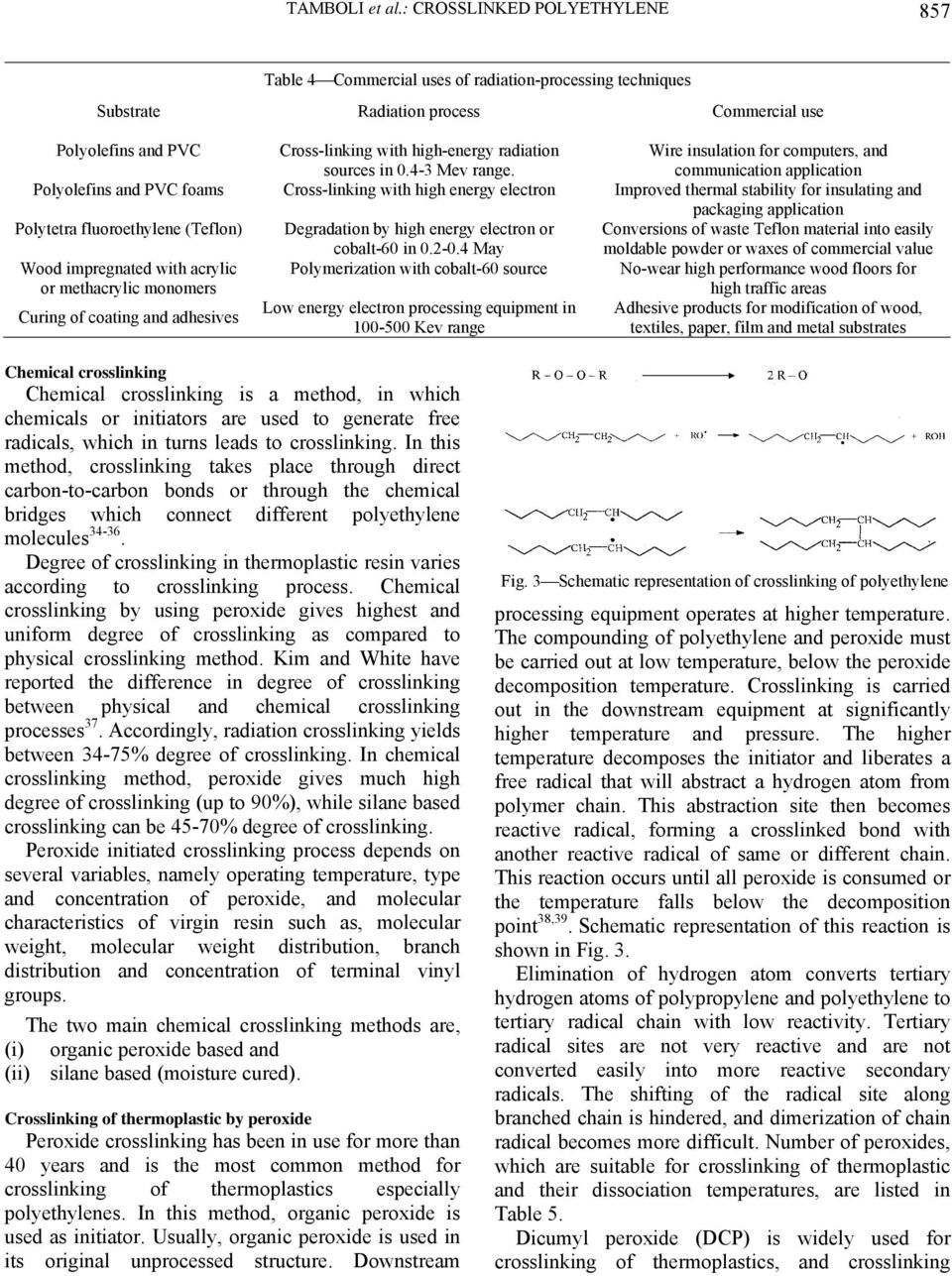
5 TAMBOLI et al.: CROSSLINKED POLYETHYLENE 857 Table 4 Commercial uses of radiation-processing techniques Substrate Radiation process Commercial use Polyolefins and PVC Cross-linking with high-energy radiation sources in Mev range. Wire insulation for computers, and communication application Polyolefins and PVC foams Cross-linking with high energy electron Improved thermal stability for insulating and packaging application Polytetra fluoroethylene (Teflon) Degradation by high energy electron or cobalt-60 in May Conversions of waste Teflon material into easily moldable powder or waxes of commercial value Wood impregnated with acrylic or methacrylic monomers Polymerization with cobalt-60 source No-wear high performance wood floors for high traffic areas Curing of coating and adhesives Low energy electron processing equipment in Adhesive products for modification of wood, Kev range textiles, paper, film and metal substrates Chemical crosslinking Chemical crosslinking is a method, in which chemicals or initiators are used to generate free radicals, which in turns leads to crosslinking. In this method, crosslinking takes place through direct carbon-to-carbon bonds or through the chemical bridges which connect different polyethylene molecules Degree of crosslinking in thermoplastic resin varies according to crosslinking process. Chemical crosslinking by using peroxide gives highest and uniform degree of crosslinking as compared to physical crosslinking method. Kim and White have reported the difference in degree of crosslinking between physical and chemical crosslinking processes 37. Accordingly, radiation crosslinking yields between 34-75% degree of crosslinking. In chemical crosslinking method, peroxide gives much high degree of crosslinking (up to 90%), while silane based crosslinking can be 45-70% degree of crosslinking. Peroxide initiated crosslinking process depends on several variables, namely operating temperature, type and concentration of peroxide, and molecular characteristics of virgin resin such as, molecular weight, molecular weight distribution, branch distribution and concentration of terminal vinyl groups. The two main chemical crosslinking methods are, (i) organic peroxide based and (ii) silane based (moisture cured). Crosslinking of thermoplastic by peroxide Peroxide crosslinking has been in use for more than 40 years and is the most common method for crosslinking of thermoplastics especially polyethylenes. In this method, organic peroxide is used as initiator. Usually, organic peroxide is used in its original unprocessed structure. Downstream Fig. 3 Schematic representation of crosslinking of polyethylene processing equipment operates at higher temperature. The compounding of polyethylene and peroxide must be carried out at low temperature, below the peroxide decomposition temperature. Crosslinking is carried out in the downstream equipment at significantly higher temperature and pressure. The higher temperature decomposes the initiator and liberates a free radical that will abstract a hydrogen atom from polymer chain. This abstraction site then becomes reactive radical, forming a crosslinked bond with another reactive radical of same or different chain. This reaction occurs until all peroxide is consumed or the temperature falls below the decomposition point 38,39. Schematic representation of this reaction is shown in Fig. 3. Elimination of hydrogen atom converts tertiary hydrogen atoms of polypropylene and polyethylene to tertiary radical chain with low reactivity. Tertiary radical sites are not very reactive and are not converted easily into more reactive secondary radicals. The shifting of the radical site along branched chain is hindered, and dimerization of chain radical becomes more difficult. Number of peroxides, which are suitable for crosslinking of thermoplastic and their dissociation temperatures, are listed in Table 5. Dicumyl peroxide (DCP) is widely used for crosslinking of thermoplastics, and crosslinking
6 858 INDIAN J. CHEM. TECHNOL., NOVEMBER 2004 Table 5 Peroxide decomposition rates [k d ] and curing temperatures Initiator Solvent Temperature ( C) k d ( S -1 ) Curing temperature ( C) Dicumyl peroxide Benzene Chlorobenzene Dodecane Cumene Di t butyl peroxide Benzene 100 Di-t-amyl peroxide 2,5-Dimethyl-2, 5-di (t-butyl-peroxy) hexane 2,5-Dimethyl-2,5-di (t-butyl peroxy) hexynes n-butyl-4,4-bis (t-butyl peroxy) valerate 1,1-Bis (t-butyl peroxy)-3,3,5- tri methylcyclohexane Benzoyl peroxide Chlorobenzene Decalin benzene Chlorobenzene Benzene Chlorobenzene Dodecane Benzene Benzene Chlorobenzene Decane Dioxane * * * * * * * * * * * * * * * * * * * * * * * * * * * * * * * * * * * * * * * * * * * * 10-4 efficiency of DCP is more than the other peroxides. During reaction of dicumyl peroxide with polyethylene, gas generated in reaction contains 98% methane. Kinetics of crosslinking by peroxide Decomposition of peroxide, that is, generation of free radical is slowest reaction and it is the ratedetermining step of crosslinking reaction of PE. Thermal decomposition of peroxide proceeds according to the following equation 20,40,41, Where, r = k d.[c] with k d = k o. e -E/RT (4) r = rate of decomposition k d = rate constant k o = rate constant at base temp.[0 C]

7 TAMBOLI et al.: CROSSLINKED POLYETHYLENE 859 Table 6 Various peroxides used for crosslinking Name Group Half Life Data 10H 1H % Active O 2 Description Dicumyl peroxide Dialkyl peroxide Powder or flake 2,5-Dimethyl-2,5-di- 120 Solid or liquid (t-butylperoxy) hexane ,5-Dimethyl-2, 5-Di-(t-buytlperoxy) hexyane % liquid 45% solid on inert filler Di-t-amyl peroxide % liquid Di-t-butyl peroxide % liquid 1,1-Di(t-butyl peroxy) 3,3,5 - trimethyl cyclohexane n-butyl 4, 4-bis (t-butylperoxy) valerate Peroxy ketals % liquid 40% solid on inert filler 40% solid on inert filler E = activation energy [c] = concentration of peroxide T= absolute temperature R = universal gas constant. Table 6 lists the curing parameter for various peroxides used for crosslinking alongwith their half life periods and active oxygen content. The crosslinking of PE depends upon the type of peroxide and the temperature. The reactions are of first order and depend also on the chemical nature of the polymer to be cross-linked. For LDPE, the value for the order of reaction is , for HDPE, 1.06 and for copolymer of ethylene between 0.88 and The decomposition of peroxide is a rate-determining step. The cross-linking reaction is exothermic. The value of activation energy for various crosslinking reaction of different polymers such as LDPE, HDPE or copolymer is practically same if same peroxide is used. It has been shown that the order of reaction depends on the temperature and it increases at high temperatures. Number of bonds between PE chains as a function of peroxide content may be stoichiometrically calculated by assuming that one peroxide molecule independently is responsible only for one bond between two PE chains. The calculation is based on the following equation 42, X. M pe A = (5) M pr Where, A = number of peroxide molecules per two PE chains, M pe, M pr = molecular weight of PE and peroxide respectively, X= thickness of reactive polymer layer OR the mass concentration of peroxide per one gram of PE. The decrease of XLPE density is due to additional branching introduced by peroxide and the maximum density can be obtained at 0.5% peroxide concentration. The drop in crystallinity as a function of peroxide concentration and increase in crosslinking impose some restraint on mobility of polymer chains in molten state preventing them from arranging into lamellae fold 43. Relative degree of crosslinking and degradation of polymers is discussed by Kwei 42 with the help of following equation, Where, S + S 0.5 = {P 0 / Q 0 } + {1 / Q 0 Y n D} (6) P 0 /Q 0 = ratio of degradation to crosslinking D = radiation dose (Mrad) S = percent of soluble molecule in network Y n = initial number average molecular weight of polymer. Crosslinking of copolymers Crosslinking of PE-PP has been studied by Braun 44. They observed that PP did not crosslink and grafting

8 860 INDIAN J. CHEM. TECHNOL., NOVEMBER 2004 of PP onto PE could take place 45. They have reported that as PP content increased, the heat resistance of crosslinked compound decreased. Ethylene vinyl acetate (EVA) is blended with polyethylene quite widely. Ethylene vinyl acetate copolymer is more rapidly crosslinked and accepts high filler loading, without significant loss of physical properties, making them well suited for lower voltage applications and in automobile etc. Peroxide coagent crosslinking method Coagents are low molecular weight molecules with two or more reactive double bonds. Coagents work in a free radical cure system. Free radicals are generated by using peroxide or high energy radiation sources, coagent reacts with these free radicals to increase the efficiency of cure i.e. to give more crosslinks. The presence or addition of a coagent in crosslinking provides more reactive sites where the crosslinking reaction can occur 46. Addition of coagents reduces cure time, improves resistance to oils and fuels, improves heat aging, improves peroxide efficiency, improves flexibility and gives higher tensile strength and hardness 47,48. Advantages of peroxide-coagent system The advantages of peroxide-coagent system are: (i) excellent heat stability (ii) simple compounding (iii) better hot tear (iv) good shelf life stability. when exposed to excessive heat or light. Therefore, polyethylene compounds used for coating wire and cable application may contain anti-oxidants. Cables exposed to ultraviolet rays in sunlight must also contain carbon black or other UV inhibitors. Such additives also assure that the electrical and mechanical properties of the resin are preserved under the high temperatures prevailing in the extruder 50,51. Carbon black of fine particle size can be used as a thermal antioxidant. Carbon black is used as a conducting filler for elastomer and plastics. Incorporation of carbon black increases brittle point and yields stress with concentration, without affecting tensile strength 52. Crosslinking by silane There are two types of processes for crosslinking of polyethylene by silane grafting: two-step process and one-step process. In two-step process, silane molecule such as vinyl trimethoxysilane (VTO) is grafted on polyethylene chain. For grafting, the peroxide such as dicumyl peroxide is mixed with the polyethylene in small percentage. The peroxide initially generates free radical on polyethylene chain. Grafting of silane takes Disadvantages of peroxide-coagent system The disadvantages of peroxide-coagent system are: (i) higher cost (ii) surface tackiness in presence of oxygen. Applications Peroxide-coagent systems are widely used in automotive seals, automotive hoses, oil well packers, swab cups, golf balls, butterfly valves, belts, mats, shock absorber, cable, coating and foam packing. Some of the coagents used in crosslinking Some of the coagents used in crosslinking are 49, ethylene glycol dimethylacrylate, 1,3 butylene glycol dimethylacrylate, poly (ethylene glycol) dimethylacrylate and trially cyanurate dimethylacrylate. Effect of anti-oxidants and carbon black fillers The power factor of polyethylene may be unfavorably affected by oxidation of the insulator Fig. 4 Schematic representation of two-step crosslinking process of polyethylene by using silane

9 TAMBOLI et al.: CROSSLINKED POLYETHYLENE 861 place at the site where free radical is generated. The grafted polyethylene is mixed with silanol condensation catalyst such as dibutyltin dilauarate, and extruded or injection moulded profile is produced. Up to this stage the polyethylene retains the thermoplastic nature. Extruded or injection moulded article is crosslinked with the help of water or at elevated temperature or at room temperature 53,54. The two-step silane crosslinking process is schematically represented in Fig. 4. In one-step process, a copolymer of silane and polyethylene may be formed or free radical generating and grafting take place in single step only. The chemical reaction of silane crosslinking is shown in Fig. 5. The reaction continues until all grafted copolymer is converted into crosslink chains. In the peroxide and irradiation cross-linking processes, the links between macromolecule consist of carboncarbon bond. The silane process gives -Si-O-Sicrosslinks. These siloxane bridges are weaker than carbon-carbon bond, and this will have effect on the attainable strength and long term chemical stability 55,56. Silane grafting of polyethylene The most common silane used for cross-linking of polyethylene is vinyl trimethoxysilane (VTO). The silane is introduced into polyethylene by melt grafting using peroxide as an initiator. The silane-grafted polyethylene is then crosslinked through hydrolyzation of the methoxysilane group with water followed by condensation of the hydroxyl group 57,58. Various types of silanes used in crosslinking are listed in Table 7. Crosslinking of grafted polyethylene is completed only in presence of moisture. A catalyst is used to activate and speed up the crosslinking process. The crosslinking is also enhanced by high temperature, but silane crosslinking is usually performed at 50 to 80 o C and at atmospheric pressure. Polypropylene is degraded due to peroxide and therefore, it cannot be crosslinked similar to Table 7 Various types of silane used for crosslinking polyethylene. The degradation is mainly due to β- chain scission. Crosslinking of polypropylene is possible only by silane grafting method. Advantages of silane-grafted crosslinking Various advantages of silane-grafted crosslinking are: (i) crosslinking can be done at room temperature (ii) low cost (iii) higher gel percentage obtained as compared to physical crosslinking. Disadvantage of silane-grafted crosslinking Some disadvantages of silane-grafted crosslinking are given below: (i) curing time is very high as compared to peroxide crosslinking (ii) extra downstream equipments are required (for condensation) (iii) bond strength of crosslinking is weaker than bond strength in peroxide crosslinking system. Effects of crosslinking Polyethylene is crosslinked to improve its dimensional stability at elevated temperature, to Fig. 5 Silane grafted polyethylene crosslinking reaction Silane MolecularWeight Colour Boiling Point ( C) Flash Point ( C) Tetramethoxysilane Colourless Tetraethoxysilane Colourless Methyltriethoxysilane Colourless Methyl tris methyltrie- Yellowish thoxysilane liquid

10 862 INDIAN J. CHEM. TECHNOL., NOVEMBER 2004 Table 8 Comparison between crosslinking processes Crosslinking process Peroxide Silane Radiation No. of steps One step Two step One step Crosslinking mechanism Free radical Grafting Free radical Gel % > 75 > 65 >60 Curing mechanism Homolysis temperature of Condensation reaction peroxide Curing temperature C C Room temperature Curing time Less Very high Very low Additives No Peroxide for grafting Peroxide for initiating Equipment cost Medium Low High Bond strength Strong Weak as compared to Strong peroxide Degree of crosslinking Constant throughout the article Varies with residence time in water bath and temperature of bath Varies with thickness of article improve its impact resistance or to reduce its propensity to stress crack. Due to crosslinking polyethylene changes from ductile semi-crystalline solid to a non-crystalline elastomer 59. As crosslinked density increases, a degree of crystallinity and crystallite thickness decreases. This was studied by Badar 60. Reduction in crystallinity occurs because of crosslinking taking place in amorphous phase. There is also some breakdown of crystallinity. Decrease in degree of crystallinity and crystalline thickness, decreases Young s modulus, yield stress, elongation at break and peak melting temperature of polyethylene 61. Harper 62 studied the effect of crosslinking on melt index and concluded that the melt flow index decreases uniformly with increase in degree of crosslinking. Crosslinking increases the impact strength, environmental stress crack resistance, creep resistance without affecting tensile strength and flexural modulus. Comparison of different crosslinking methods is presented in Table 8. Disadvantages of crosslinking As mentioned earlier, crosslinking of polyethylene changes its nature from thermoplastic to thermoset. This enhances the viscosity to a very high value. To control the degree of crosslinking in a continuous process is very tricky. During extrusion of a profile, if excessive crosslinking takes place stresses are developed and, these do not get relaxed due to dense network of polyethylene. Selection of proper crosslinking agent is very critical. Blending uniformly crosslinking agents with polyethylene beds can lead to uneven distribution of crosslinking agent. Melting of polyethylene prior to crosslinking is therefore, key function in processing. Due to its thermoset nature recycling of crosslinked polyethylene cannot carried out by melting it with virgin polyethylene, since crosslinked polyethylene does not melt. The crosslinking process decreased the crystallinity. Application of crosslinked polymers 63,64 Cable insulation The most advanced area of application for crosslinked polyethylene is in the electrical cable industry. Crosslinking, whilst not interfering with the dielectric properties of polyethylene, introduces resistance to flow and permanent deformation above the softening point. This permits higher conductor operating temperature and reduces the level of short circuit and overload protection required. Flame retardant properties of pipe are also improved by irradiation (60% gel) by introducing double layer structure to the jacket, in which inner layer is adjacent to polyethylene insulation which is crosslinked more densely than the outer layer. The wire exhibits markedly improved resistance to flame and heat deformation. Crosslinked polyethylene pipes The main applications for crosslinked polyethylene hot water pipe are: a) under floor or central heating b) domestic or portable water piping system. The benefits of crosslinking become obvious above ambient temperatures where a reduction in the rate of creep for the corresponding hoop stress is observed.

11 TAMBOLI et al.: CROSSLINKED POLYETHYLENE 863 Injection and blow moulded articles Specially moulded articles such as containers with significant improvement in ESCR and chemical resistance characteristics can be made using crosslinked polyethylene. Increasing the molecular weight by crosslinking increases its solvent and creep resistance. The increased dimensional stability at evaluated temperatures allows the article to come in contact with heated fluids. Crosslinked film Crosslinked polyethylene in packaging applications is confined to multi-layer film constructions, in which the cross linked layer provides a number of specific effects including: increased temperature resistance especially for hot filled or heat sterilization applications; increased heat seal strength where a thermoplastic seal is subsequently crosslinked; increased impact, tear and abuse resistance capability especially for packing irregular shaped items to impart heat shrinking properties to the film. Crosslinked polyethylene foam Crosslinked polyethylene (XLPE) foams have various kinds of applications, such as thermal insulation, floatation, automotive trim, and sports goods. The advantages of crosslinking, prior to foaming are that high quality closed cell structure can be achieved which gives the following benefits a) increased mechanical properties, b) increased resistance and recovery from deformation, c) increased thermal resistivity, d) reduced vapour and liquid transport, e) to improve elevated temperature and load bearing characteristics of the foam, f) to permit secondary moulding and foaming without collapse of the cell structure. Special application High pressure crosslinked polyethylene tube shows water clear transparency on high heat, while lower heat produces translucency, but this effect of temperature is not obtained with untreated PE. High pressure crosslinked PE makes it feasible to use the material for applications such as automobile muffler tail pipe. Crosslinked polyethylene fibre used as a filler in denture base resin poly [methyl methacrylates], improves impact strength without adverse aesthetic effects. Conclusions Crosslinking of polyethylene and polypropylene is practiced industrially for very interesting applications. Polyethylene can be crosslinked by radiation energy as well as by organic peroxide. Polypropylene can be crosslinked by silane method. Very little information exists on crosslinking of PVC. Various aspects of crosslinking process have been studied earlier and are reviewed in this article. References 1 Krupa & Luyt A S, Polymer Degradation and Stability, 70, 111 (2000). 2 Engel T, Modern Plastic, 44 (1967) Narkis M, Modern Plastic, 10 (1980) Samburski G & Narkis M, J Macromol Sci Phys B35(5) (1996) Dakin Y I, J Appl Poly Sci, 59 (1996) Narkis M, Modern Plastic, 47, Sawatari Chie & Mastuo M, Polym J, 19 (12) (1987) Houde M & Schreiber H P, J Appl Polym Sci, 46 (1992) Stepto R F T, in Crosslinked Polymers, edited by Dickie Ray A & Baver R S (ACS, Washington), Shultz Allen R, Encyclopedia of Polymer Science, Vol.4, edited by Mark H F & Gaylord N G (John Wiley & Sons, NY), 1986, McGinnis V D, Encyclopedia, Vol. 4 (1972) Miltz J & Narkis M, Polymer, 9 (1968) Narkis M & Mitz J, J Appl Polym Sci,12 (1968) Ghosh P, Polymer Science and Technology of Plastic and Rubber (Tata McGraw Hill), 1993, Labana S S, Encyclopedia of Polymer Science and Engineering,Vol.4, edited by Mark Herman (John Wiley & Sons, New York), 1986, Syncure, Technical Service Report, Polyone Corp., No Stepto R F T, in Crosslinked Polymers, edited by Dickie Ray A, Labana S S & Baver R S (ACS, Washington), Tal Horng-Jer, Polym Eng Sci, 39(9) (1999) Peacock Andrew J, Handbook of Polyethylene (Marcel- Dekker Inc., New York), Kresser O J, Polyethylene (Reinhold Corp., New York), Pedernera N, Sarmoria C & Brandolin A, Polym Eng Sci, 39(10) (1999) Nabio S V & Rangwalla I J, Radiation Curing of Polymeric Materials, edited by Hole Charles E & Kinstie J F (ACS, Washington), 1990, Sangester D F, The Effect of Radiation on High-Technology Polymers, edited by Reichnanis E & O Donnell J H (ACS, Washington), 1989, Chapiro A, Radiation Chemistry of Polymeric Systems (John Wiley & Sons), 1962, US-PS, , Dow Chemical Co. 26 US-PS, , DuPont. 27 Wu Quianghua & Qu Baogun, Polym Eng Sci, 41 (2001) Mitsui H F & Ushairokawa Hosoi M, J Appl Polym Sci, 19 (1975) 361.

12 864 INDIAN J. CHEM. TECHNOL., NOVEMBER Ali Zl & Zahran Ah, Polym International, 49 (2000) Amrhein E & Kolloid Z, J Polym Sci, (1967) Thomas Engel, Modern Plastics, (1967) Narkis M & Miltz J, J Appl Polym Sci, 13 (1969) Salyer I O & Davsion J E, J Appl Polym Sci, 28 (1983) Sperling L H, Introduction to Physical Polymer Science (John Wiley, New York), 2001, Bueche F, J Appl Phys, 44 (1973) Narkis M, Raiter I & Eyerer P, J Macromol Sci Phys, B26(1), 37 (1987). 37 Kim B & White J L, Polym Eng Sci, 37 (1997) Narkis M & Toboisky A V, J Appl Polym Sci, 14 (1970) Kumar Sen, De P P & Bhowmick A K, J Appl Polym Sci, 44 (1992) Berzin F & Veanes B, Polym Eng Sci, 40 (2) (2000) Kunert K A, Soszynska H & Pislewski N, Polymer, 22 (1981) Wei K, J Appl Polym Sci, 42 (1991) Stoyanov O V & Deberdeev R Ya, International Polym Sci Technol, 14(7) (1987) Braun D, Ricter S & Hellmann G P, J Appl Polym Sci, 68 (1998) Sherman R D & Jacobs S M, Polym Eng Sci, 23 (1983) Smoluk G, Mod Plast Int,12 (9) (1982) Bonotto Sergio, J Appl Polym Sci, 9 (1965). 48 U S Patent, (2001). 49 Biggs B S & Hawkins W L, Modern Plastics, 31 (1953) Brandrup J & Immergut E H, in Polymer Handbook, 2 nd edn (John Wiley & Sons, New York), II-12 (1975). 51 Mayer J, Polym Eng Sci, 14 (1974) Hawkins W L, Hansen R H, Mareyek W & Winsow F H, J Appl Polym Sci, I (1959) Narkis M, J Appl Polym Sci, 25 (1980) Dennberg E M, Jordan M E & Cole H M, J Appl Polym Sci, 31 (1958) Befran M & Mijangos C, Polym Engg Sci, 40 (2000) Yeong-tarang sheigh & Tsai T H, J Appl Polym Sci, 1 (1998) Hjerterberge T T, Palmof M M & Swatan A, J Appl Polym Sci, 42 (1991) Shieh Y T & Hsiao Kuo, J Appl Polym Sci, 70 (1998) Marin J & Paul B, J Appl Polym Sci, 7 (1968) Badar Y & Ali Zl, Polym Int, 49 (2000) Brody H, J Appl Polym Sci, 15 (1971) Harper B G, J Appl Polym Sci, 2 (1959) Hagiwara M, J Appl Polym Sci, 25 (1980) Kumar Suresh & Pandya M V, J Appl Polym Sci, 64 (1997).

Effect of Sterilization Techniques on Polymers
 Effect of Sterilization Techniques on Polymers Contents of Presentation Introduction to Polymers Properties and Stability of Polymers Affect of Ionising Radiation and Ethylene Oxide on Polymers The need
Session Five: Modern XLPE Materials for Extruded Energy Cable Systems
 Session Five: Modern XLPE Materials for Extruded Energy Cable Systems Abstract Hakan Lennartsson Senior Technical Service Manager, Borouge Hong Kong Pte. Ltd. The first medium voltage cables using extruded
Polymers: Introduction
 Chapter Outline: Polymer Structures Hydrocarbon and Polymer Molecules Chemistry of Polymer Molecules Molecular Weight and Shape Molecular Structure and Configurations Copolymers Polymer Crystals Optional
Tiangang TM BW-10LD (622)
 Tiangang TM BW-10LD Oligomeric Hindered Amine Light Stabilizer (HALS) Poly-(N-β-hydroxyethyl-2,2,6,6-tetramethyl-4-hydroxy-piperidyl-succinate) CAS number 65447-77-0 BW-10LD BW-10LD is a highly effective
Resistance of Plastics to Gamma Irradiation
 Elastomers 1 MATERIAL TOLERANCE LEVEL (kgy) COMMENTS Butyl 50 Sheds particulate after irradiation. Ethylene Propylene 100 200 Crosslinks, yellows slightly. Diene Monomer (EPDM) Fluoro Elastomer 50 Avoid
Elements of Addition Polymerization. Branching and Tacticity. The Effect of Crystallinity on Properties
 Topics to be Covered Elements of Addition Polymerization Branching and Tacticity The Effect of Crystallinity on Properties Chapters 1 & 2 in CD (Polymer Science and Engineering) What Are Polyolefins? The
Welding of Plastics. Amit Mukund Joshi. (B.E Mechanical, A.M.I.Prod.E)
 Welding of Plastics Amit Mukund Joshi (B.E Mechanical, A.M.I.Prod.E) Introduction Mechanical fasteners, adhesives, and welding processes can all be employed to form joints between engineering plastics.
KALPANA INDUSTRIES LTD. TECHNICAL DATA SHEET
 1 KALPANA INDUSTRIES LTD. TECHNICAL DATA SHEET KI XL - 03 / KI-SC 10 TWO COMPONENT AMBIENT CURABLE POLYETHYLENE COMPOUND FOR INSULATION OF LOW VOLTAGE POWER CABLE DESCRIPTION : KI polyethylene compound
HW 10. = 3.3 GPa (483,000 psi)
 HW 10 Problem 15.1 Elastic modulus and tensile strength of poly(methyl methacrylate) at room temperature [20 C (68 F)]. Compare these with the corresponding values in Table 15.1. Figure 15.3 is accurate;
MICRO PLASTICS MOLDED NYLON 6/6 FASTENERS MECHANICAL TEST DATA - UNC - UNF SECTION
 MICRO PLASTICS MOLDED NYLON 6/6 FASTENERS MECHANICAL TEST DATA - UNC - UNF Nylon 6/6 meets MIL-M20693B "A" Type 1, LP410A, and ASTM D789-66 Type 1, GDE 2 All test performed per ASTM specifications. Parts
VULCOFAC TAIC-70 O N O . N CAS : 1025 15 6. N EINECS : 213 834 7. . Main function :. Crosslinking agent for peroxide cure elastomers
 - Composition :. Active ingredient :. Triallyl isocyanurate. Formula : ( C12 H15 N3 O3 ) O N O N N O. N CAS : 1025 15 6. N EINECS : 213 834 7 - Supplier :. Origin : Safic-Alcan UK. Availability : regularly
M n = (DP)m = (25,000)(104.14 g/mol) = 2.60! 10 6 g/mol
 14.4 (a) Compute the repeat unit molecular weight of polystyrene. (b) Compute the number-average molecular weight for a polystyrene for which the degree of polymerization is 25,000. (a) The repeat unit
Characterization of Polymers Using TGA
 application note Characterization of Polymers Using TGA W.J. Sichina, Marketing Manager Introduction Thermogravimetric analysis (TGA) is one of the members of the family of thermal analysis techniques
Plastics and Polymer Business. Properties enhancement for Plastics
 News Letter Vol. 18, issue October-December, 2012 Hyperdispersants and Coupling Agents for Thermoplastics and Thermosets Solplus, Ircolplus and Solsperse hyperdispersants and coupling agents have been
Introduction: Background of the OIT Test:
 The Effect of Hindered Phenol Stabilizers on Oxygen Induction Time (OIT) Measurements, and The Use of OIT Measurements to Predict Long Term Thermal Stability Philip Jacoby, Vice President of Technology,
Back to Basics Fundamentals of Polymer Analysis
 Back to Basics Fundamentals of Polymer Analysis Using Infrared & Raman Spectroscopy Molecular Spectroscopy in the Polymer Manufacturing Process Process NIR NIR Production Receiving Shipping QC R&D Routine
Polyolefin Heat Shrink Tubing for Tight-Tolerance Medical Applications
 Polyolefin Heat Shrink Tubing for Tight-Tolerance Medical Applications Understanding the Advantages and Development Process By Apur Lathiya Vice President and General Manager, Vesta Thermoplastics Division
This presentation is courtesy of
 This presentation is courtesy of Advances in Flexible Packaging Adhesives CPP Expo Presentation September, 2005 Nancy Smith Agenda Basic types/ functions of adhesives used in flexible packaging Laminating
Chlorinated polyethylene ELASLEN TM. Application for Wire and Cable
 Chlorinated polyethylene ELASLEN TM Application for Wire and Cable 1 About the company Company Name : SHOWA DENKO K.K. Type of Industry : Diversified Chemical Company Formed : June 1, 1939 Employee : 10,577
PROCESSING OF VARIOUS MATERIALS
 4 PROCESSING OF VARIOUS MATERIALS CHAPTER CONTENTS 4.1 Shaping Processes for Polymers Polymers Manufacturing Processes for Polymers 4.2 Rubber Processing Technology Processing of rubber into finished good
Resin based materials in prosthetic dentistry. Mercedes Linninger DDS Department of prosthodontics
 Resin based materials in prosthetic dentistry Mercedes Linninger DDS Department of prosthodontics Resins in dentistry Denture base Crown and bridge Artificial teeth Special tray Modelling Filling materials
Electron Beam Technology for Pressure Sensitive Adhesive Applications
 Electron Beam Technology for Pressure Sensitive Adhesive Applications Introduction Stephen C. Lapin, Ph.D. PCT Engineered Systems LLC Davenport, IA, USA Initial reports on the use of ultraviolet (UV) and
Basic Properties and Application of Auto Enamels
 Basic Properties and Application of Auto Enamels Composition of Ceramic Automotive Glass Enamels Ceramic automotive glass colours are glass enamels that fire on to the glass during the bending process
The optimum material solution for Low Voltage energy cables
 The optimum material solution for Low Voltage energy cables About Borealis and Borouge Borealis is a leading provider of innovative solutions in the fields of polyolefins, base chemicals and fertilizers.
Thermoplastic composites
 Thermoplastic composites Definition By definition, a thermoplastic is a material based on polymer (macromolecular compound) which can be shaped, in a liquid (viscous) state at a temperature either higher
Determining the impact of electrical loss in coaxial cable
 Determining the impact of electrical loss in coaxial cable Here's a discussion on cable attenuation based on the differences in dielectric loss of low density polyethylene resins and quantify the consequent
Foam Injection Molding:
 Foam Injection Molding: Unique Process Solutions for Light Weighting Automotive Plastic Parts Steve Braig President & CEO Trexel, Inc. AGENDA Technology Overview > Chemical Foaming > Physical Foaming Foamed
1. Injection Molding (Thermoplastics)
 1. Injection Molding (Thermoplastics) l Molding: Injection (thermoplastics) INJECTION MOLDING of thermoplastics is the equivalent of pressure die casting of metals. Molten polymer is injected under high
Adhesive Bonding of Natural Stone
 Adhesive Bonding of Natural Stone Section I: Basics of Stone Adhesion Adhesive Theory There are many theories concerning the forces that are at work in forming an adhesive bond between two (2) different
INTERNATIONAL STANDARD
 INTERNATIONAL STANDARD IEC 60502-1 Second edition 2004-04 Power cables with extruded insulation and their accessories for rated voltages from 1 kv (U m = 1,2 kv) up to 30 kv (U m = 36 kv) Part 1: Cables
Surface activation of plastics by plasma for adhesion promotion
 Surface activation of plastics by plasma for adhesion promotion Uwe Stöhr, Ph. D. 1 Introduction In many fields a good adhesion between two materials is necessary. The adhesion should exist at the whole
Unit X: Polymers Test 1.1
 ame: Unit X: Polymers Test 1.1 Multiple hoice Questions 1 through 9 pertain to the reactions on the last two pages of this test. Where multiple answers exist only one need be reported. 1. Which process
What is a mold? Casting. Die casting. Injection Molding Machine. Injection Molding. 2.008 Design & Manufacturing II. Spring 2004
 2.008 Design & Manufacturing II What is a mold? From Webster: a cavity in which a substance is shaped: as (1) : a matrix for casting metal (2) : a form in which food is given a decorative shape Spring
EVA Modification, Wire Coating
 TAFMER TM DF & M Ethylene based α-olefin copolymers TAFMER DF & M is used as a modifier of Ethylene Vinyl Acetate (EVA), Polyethylene (PE) and other thermoplastics to improve its properties. It is suitable
Science Standard Articulated by Grade Level Strand 5: Physical Science
 Concept 1: Properties of Objects and Materials Classify objects and materials by their observable properties. Kindergarten Grade 1 Grade 2 Grade 3 Grade 4 PO 1. Identify the following observable properties
Radiation Curable Components and Their use in Hard, Scratch Resistant Coating Applications
 Radiation Curable Components and Their use in Hard, Scratch Resistant Coating Applications William Schaeffer Steven Tyson Indu Vappala Robert Kensicki Sartomer USA, LLC 502 Thomas Jones Way Exton, PA 19343
Sterilization methods and equipment Lab 1-2
 Sterilization methods and equipment Lab 1-2 PHT 434 Sterilization Sterilization a process that by which all viable M.O are removed or destroyed, based on a probability function. Sterilization concept Sterilization
A comparative study of gamma irradiation of poly(ethylene-co-vinyl acetate) and poly(ethylene-co-vinyl acetate)/carbon black mixture
 Materials Chemistry and Physics 93 (2005) 154 158 A comparative study of gamma irradiation of poly(ethylene-co-vinyl acetate) and poly(ethylene-co-vinyl acetate)/carbon black mixture Murat Şen, Mehmet
Unit 12 Practice Test
 Name: Class: Date: ID: A Unit 12 Practice Test Multiple Choice Identify the choice that best completes the statement or answers the question. 1) A solid has a very high melting point, great hardness, and
2. The mold is closed up and held under hydraulic pressure while the rubber material or compound cures.
 Designing with Rubber Molding Processes Compression Molding Compression molding is the process of placing a pre-load of a rubber material or compound directly in the mold cavity and compressed to the shape
Current Staff Course Unit/ Length. Basic Outline/ Structure. Unit Objectives/ Big Ideas. Properties of Waves A simple wave has a PH: Sound and Light
 Current Staff Course Unit/ Length August August September September October Unit Objectives/ Big Ideas Basic Outline/ Structure PS4- Types of Waves Because light can travel through space, it cannot be
Benefits of Thermax N990 in EPDM Compounds
 TECHNICAL BULLETIN EPDM Compounds Thermax medium thermal carbon black N990 is manufactured by the thermal decomposition of natural gas. The thermal process provides a unique carbon black characterized
Glassy polymers and the nature of the glass transition. The factors that affect Tg
 Thermal Transitions: Crystallization, Melting and the Glass Transition Today: Glassy polymers and the nature of the glass transition The factors that affect Tg Plasticizers Chapter 8 in CD (Polymer Science
Characterization of Electronic Materials Using Thermal Analysis
 application Note Thermal Analysis Characterization of Electronic Materials Using Thermal Analysis Thermal analysis comprises a series of powerful techniques for the characterization of the thermal, physical,
MaxCell Technical Manual Design Parameters
 MaxCell Technical Manual Design Parameters Breaking Strength by Product Style, lbs Product Style Standard MaxCell Fire Resistant MaxCell Test Method 4 Cell 2,750 2,200 ASTM D 5 Bellcore 5 5.. Cell 2,50
Injection Molding. Materials. Plastics 2.008. Outline. Polymer. Equipment and process steps. Considerations for process parameters
 Outline 2.008 Polymer Equipment and process steps Injection Molding Considerations for process parameters Design for manufacturing, tooling and defects 1 2.008 spring 2004 S. Kim 2 Materials Solid materials
Technical Bulletin 1301. Talc in Plastics
 Technical Bulletin 131 Talc in Plastics Contents Introduction Benefits of Talc in Polypropylene Compounds 1. Stiffness (E-Modulus) 2. Thermal Conductivity 3. Nucleation 4. Impact Strength 5. Deflection
WATERPROOFING OF REINFORCED CONCRETE FLAT ROOF 12
 WATERPROOFING OF REINFORCED CONCRETE FLAT ROOF 12 87 88 GOOD INDUSTRY PRACTICES 12 WATERPROOFING OF REINFORCED CONCRETE FLAT ROOF 12.1 BACKGROUND Most roofs in Singapore are constructed using reinforced
polymer additive General Overview
 DuPont Fluoroguard polymer additive General Overview DuPont Fluoroguard is a range of colorless, odorless, and chemically inert polymer additives based on fluorinated synthetic oil. Fluoroguard is designed
A Look at Accelerated Photostability Testing for Packaged Food and Drinks
 A Look at Accelerated Photostability Testing for Packaged Food and Drinks By Dr. Oliver Rahäuser and Dr. Artur Schönlein Atlas Material Testing Technology GmbH Vogelsbergstr. 22, 63589 Linsengericht-Altenhaßlau,
Worldwide tank building applications using PP-Sheets: The effect of Foaming on properties
 Worldwide tank building applications using PP-Sheets: The effect of Foaming on properties Marcus Hoffmann 1, Dominic Müller 1, Marco Stallmann 1, Matt Curtis 2 1 Simona AG Teichweg 16, 55606 Kirn, Germany
Poly Processing Company
 Poly Processing Company Team Innovation Understanding Environmental Stress Crack Resistance (ESCR) in Rotomolded Polyethylene Tanks Raed Al-Zubi, Ph.D. National Innovation Specialist, Poly Processing Company
Solid shape molding is not desired in injection molding due to following reasons.
 PLASTICS PART DESIGN and MOULDABILITY Injection molding is popular manufacturing method because of its high-speed production capability. Performance of plastics part is limited by its properties which
Prentice Hall. Chemistry (Wilbraham) 2008, National Student Edition - South Carolina Teacher s Edition. High School. High School
 Prentice Hall Chemistry (Wilbraham) 2008, National Student Edition - South Carolina Teacher s Edition High School C O R R E L A T E D T O High School C-1.1 Apply established rules for significant digits,
CHARACTERIZATION OF POLYMERS BY TMA. W.J. Sichina, National Marketing Manager
 PERKIN ELMER Polymers technical note CHARACTERIZATION OF POLYMERS BY W.J. Sichina, National Marketing Manager Thermomechanical analysis () is one of the important characterization techniques in the field
SORTING PLASTICS FOR RECYCLING INTRODUCTION
 SORTING PLASTICS FOR RECYCLING INTRODUCTION Description Students use the difference in densities of polymers and flame tests as a basis for the development of a scheme to separate plastics. Goals for This
Wire and Cable Product Guide
 Wire and Cable Product Guide Applications Elvax resins with low vinyl acetate content, typically 9 to 15%, are well suited for compounding into primary insulation of UL listed, type XHHW building wire,
CHEMISTRY STANDARDS BASED RUBRIC ATOMIC STRUCTURE AND BONDING
 CHEMISTRY STANDARDS BASED RUBRIC ATOMIC STRUCTURE AND BONDING Essential Standard: STUDENTS WILL UNDERSTAND THAT THE PROPERTIES OF MATTER AND THEIR INTERACTIONS ARE A CONSEQUENCE OF THE STRUCTURE OF MATTER,
CABLE 101. The Basics of Wire & Cable. Copyright 2007, Belden Inc.
 CABLE 101 The Basics of Wire & Cable Copyright 2007, Belden Inc. KEY TERMS Insulations Jacket Capacitance Attenuation Velocity of propagation Dielectric strength Dielectric constant Working voltage Elongation
int. ci.3. C 08 L 77/00 C 08 L 63/02
 (19 Europaisches Patentamt European Patent Office Office europeen des brevets Publication number: 0 100 582 "*~ A1 1 EUROPEAN PATENT APPLICATION Application number: 83302578.6 @ Date of filing: 06.05.83
#3 The Study of Molecular Orientation by Linear Dimension Change of Polymeric Films
 #3 The Study of Molecular Orientation by Linear Change of Polymeric Films I. INTRODUCTION To close the yellow note, click once to select it and then click the box in the upper left corner. To open the
15. Silicones in the Plastics Industry G. Shearer, Multibase, a Dow Corning Company, Copley OH (USA)
 15. Silicones in the Plastics Industry G. Shearer, Multibase, a Dow Corning Company, Copley OH (USA) Silicones are used in the plastics industry as additives for improving the processing and surface properties
New Developments in Adhesive Resins for Oriented Barrier // PP Film Applications. Development Center Materials Lab.
 New Developments in Adhesive Resins for Oriented Barrier // PP Film Applications Development Center Materials Lab. HIROTAKA UOSAKI Contents 1. Characteristics of Adhesive Resins 2. New Developments in
IEEE POWER ENGINEERING SOCIETY CHICAGO CHAPTER THE OKONITE COMPANY WEDNESDAY JANUARY 11, 2006 JIM FITZGERALD ENGINEERING LINGO
 IEEE POWER ENGINEERING SOCIETY CHICAGO CHAPTER THE OKONITE COMPANY WEDNESDAY JANUARY 11, 2006 JIM FITZGERALD ENGINEERING LINGO WHEN YOU HEAR AN ENGINEER SAY A NUMBER OF DIFFERENT APPROACHES ARE BEING IMPLEMENTED
GLOBAL MARKETS FOR NON-POLYOLEFIN COMMODITY RESINS
 GLOBAL MARKETS FOR NON-POLYOLEFIN COMMODITY RESINS PLS067A January 2013 Jason Chen Project Analyst ISBN: 0-89336-303-0 BCC Research 49 Walnut Park, Building 2 Wellesley, MA 02481 866-285-7215, 781-489-7301
MCQ - ENERGY and CLIMATE
 1 MCQ - ENERGY and CLIMATE 1. The volume of a given mass of water at a temperature of T 1 is V 1. The volume increases to V 2 at temperature T 2. The coefficient of volume expansion of water may be calculated
Effects of Tg and CTE on Semiconductor Encapsulants
 Effects of Tg and CTE on Semiconductor Encapsulants Dr. Mark M. Konarski Loctite Corporation www.loctite.com Abstract As the role of direct-chip-attachment increases in the electronics industry, the reliability
ACRYLICS. The properties of the resulting acrylics vary depending on the nature of the alkyl groups both on the alcohol and the acrylic acid.
 AYLIS Acrylics are polyesters based on acrylic acid (propenoic acid - H 2 =H 2 H) formed from the polymerisation of an alkyl acrylate ester. They are widely used in the surface coatings industry (e.g.
Closing the loop: Rubber Recycling. Joint seminar Kumi-instituutti instituutti & MOL
 Closing the loop: 1 Rubber Recycling Joint seminar Kumi-instituutti instituutti & MOL Contents 2 - Introduction - Present: Rubber crumb Surface activated rubber crumb Reclaim / devulcanizate - Future Introduction
The soot and scale problems
 Dr. Albrecht Kaupp Page 1 The soot and scale problems Issue Soot and scale do not only increase energy consumption but are as well a major cause of tube failure. Learning Objectives Understanding the implications
How To Make A Hot Melt Adhesive
 Types of Bonding Physically hardening adhesives 2 2 Drying Adhesives They are made of polymers dissolved in solvent (Polychloroprene, Polyurethane) or dispersed in water (white glue based on PVA (Polyvinyl
W-2. Stranding Comparison
 Wire Knowledge W-1 W-2 Stranding Comparison Conductor Coatings/Coverings PURPOSE To facilitate stripping of components applied over the conductor To prevent compound fall-in Improve solderability Prevent
Common Defects in Digital Printing. Paul Geldenhuys & Amir Shapira January, 2009
 Common Defects in Digital Printing Paul Geldenhuys & Amir Shapira January, 2009 Overview Ambient Influences Humidity Temperature Sunlight & UV Abrasion Chemical Resistance Common Defects in Digital Printing
Science and Technology of Polymers Prof. Basudam Adhikari Department of Materials Science Centre Indian Institute of Technology, Kharagpur
 Science and Technology of Polymers Prof. Basudam Adhikari Department of Materials Science Centre Indian Institute of Technology, Kharagpur Lecture - 18 Polymer Products (Refer Slide Time: 00:28) So, good
Visico /Ambicat for cost efficient production of high performance Low Voltage cables
 Visico /Ambicat for cost efficient production of high performance Low Voltage cables About Borealis and Borouge Borealis is a leading provider of innovative solutions in the fields of polyolefins, base
DOW ECOLIBRIUM Bio-Based Plasticizers - Greening of PVC with Renewably Sourced Plasticizers
 DOW ECOLIBRIUM Bio-Based Plasticizers - Greening of PVC with Renewably Sourced Plasticizers Bharat I. Chaudhary R. Eaton, B. Sczekalla, C. Laufer, B. Neese, A. Ghosh-Dastidar The Dow Chemical Company Outline
Page 1. 6. Which hydrocarbon is a member of the alkane series? (1) 1. Which is the structural formula of methane? (1) (2) (2) (3) (3) (4) (4)
 1. Which is the structural formula of methane? 6. Which hydrocarbon is a member of the alkane series? 7. How many carbon atoms are contained in an ethyl group? 1 3 2 4 2. In the alkane series, each molecule
Personal Protective Equipment Guidelines
 Personal Protective Equipment Guidelines Purpose To establish guidelines for use and care of personal protective equipment, which is to be used by employees and /or students when a hazard is found to exist
1 Material Properties of Plastics
 j3 1 Material Properties of Plastics 1.1 Formation and Structure The basic structure of plastics (or polymers) is given by macromolecule chains, formulated from monomer units by chemical reactions. Typical
Product Information. Thermal Properties of Elvax Measured by Differential Scanning Calorimeter (DSC) Summary
 Product Information Thermal Properties of Elvax Measured by Differential Scanning Calorimeter (DSC) Summary The melting and freezing points of various Elvax ethylene vinyl acetate (EVA) polymers were measured
ATOMS AND BONDS. Bonds
 ATOMS AND BONDS Atoms of elements are the simplest units of organization in the natural world. Atoms consist of protons (positive charge), neutrons (neutral charge) and electrons (negative charge). The
Pulsed laser deposition of organic materials
 Pulsed laser deposition of organic materials PhD theses Gabriella Kecskeméti Department of Optics and Quantum Electronics University of Szeged Supervisor: Dr. Béla Hopp senior research fellow Department
Contact Hueson Corporation for additional information or details. http://www.huesonwire.com 38 Sutton Street Northbridge, MA 01534 508-234-6372
 Hueson Corporation of Northbridge MA, a specialty wire and cable manufacturer has recently introduced a solution to a long term industry challenge in the Trailer Cable Industry. Their solution involves
A Guide to Thermoform Processing of Polypropylene. Introduction
 A Guide to Thermoform Processing of Polypropylene Introduction Thermoforming is the process of heating plastic sheet to a pliable state and forming it into shape. Thermoforming offers processing advantages
# 12 Condensation Polymerization: Preparation of Two Types of Polyesters
 # 12 Condensation Polymerization: Preparation of Two Types of Polyesters Submitted by: Arturo Contreras, Visiting Scholar, Center for Chemical Education, Miami University, Middletown, OH; 1996 1997. I.
Alcohols. Characterized by OH group Name: add ol. to name of hydrocarbon. Methanol. Butanol. Sterno. Alcohols burn in air. A mixture of ethanol +
 1 2 3 Functional Groups Alcohols Structures of Alcohols haracterized by group Name: add ol to name of hydrocarbon 3 5 : how many structural isomers? See D-RM Screens 11.5 & 11.6 Methanol Butanol 1-propanol
Total System Reliability - Extending the Life of Electrical Cable Systems
 Total System Reliability - Extending the Life of Electrical Cable Systems Wayne J. Chatterton, Ph.D. Technical Applications Manager UtilX Corporation 2 Cable Installation History Medium Voltage Underground
Nylon 612: Viable Alternative Tubing Constructions in Fuel Systems
 Nylon 612: Viable Alternative Tubing Constructions in Fuel Systems ITB Automotive Energy Storage Systems 2013 Novi, MI March 6-7, 2013 FAST FORWARD YOUR INNOVATION TM A. Schulman A Global Solutions Provider
The Investigation of Adhesion of Resins Used as Tissue Creping Adhesives for Yankee Dryer Surface Coating ABSTRACT
 J. Agr. Sci. Tech. (2013) Vol. 15: 793-799 The Investigation of Adhesion of Resins Used as Tissue Creping Adhesives for Yankee Dryer Surface Coating F. Rezaei-Arjomand 1, A. A. Enayati 1, A. H. Lohrasebi
EPDM Membrane Production: Materials and Manufacturing Processes
 EPDM Membrane Production: Materials and Manufacturing Processes Summary This paper will review the raw materials used in the production of EPDM based compounds used to manufacture single ply membranes
Terminal Cleaning and Protection
 Terminal Cleaning and Protection East Penn offers the most complete line of terminal cleaning and protection products. Boots Heat Shrink Tubing Cleaner and Protection Sprays Terminal Protectors 33 PAGES
Copyright 2010 Pearson Education, Inc. Chapter Fourteen 1
 An alcohol has an OH bonded to an alkyl group; a phenol has an OH bonded directly to an aromatic ring; and an ether has an O bonded to two organic groups. Chapter Fourteen 1 Ethyl alcohol, dimethyl ether,
#2 Investigation of Crystallinity in Polymeric Materials
 I. INTRODUCTION To close the yellow note, click once to select it and then click the box in the upper left corner. To open the note, double click (Mac OS) or right click (Windows) on the note icon. #2
Environmental Stress Crack Resistance Of Polyethylene
 Introduction to Environmental Stress Cracking and ESCR Over the past decade, high-density polyethylene (HDPE) materials have improved significantly and now meet more stringent performance standards; some
Chapter 2 Chemical and Physical Properties of Sulphur Dioxide and Sulphur Trioxide
 Chapter 2 Chemical and Physical Properties of Sulphur Dioxide and Sulphur Trioxide 2.1 Introduction In order to appreciate the impact of the properties of liquid sulphur dioxide and liquid sulphur trioxide
RTV159. RTV157 and RTV159 High Strength Silicone Adhesive Sealants
 RTV159 RTV157 and RTV159 High Strength Silicone Adhesive Sealants Product Description RTV157 and RTV159 are one-component, ready-to-use, high strength silicone rubber adhesive sealants. They cure to tough
Naue GmbH&Co.KG. Quality Control and. Quality Assurance. Manual. For Geomembranes
 Naue GmbH&Co.KG Quality Control and Quality Assurance Manual For Geomembranes July 2004 V.O TABLE OF CONTENTS 1. Introduction 2. Quality Assurance and Control 2.1 General 2.2 Quality management acc. to
PRODUCT / APPLICATION INFORMATION
 Abstract This paper will discuss performance life testing and stability testing used for self-regulating heating cables. It will show how the techniques were developed and evolved from the 970 s to the
Science Tutorial TEK 6.9C: Energy Forms & Conversions
 Name: Teacher: Pd. Date: Science Tutorial TEK 6.9C: Energy Forms & Conversions TEK 6.9C: Demonstrate energy transformations such as energy in a flashlight battery changes from chemical energy to electrical