
Section 3: Septic Tanks. 3. Septic Tanks
|
|
|
- Dayna Blankenship
- 10 years ago
- Views:
Transcription
1 Section 3: Septic Tanks 3. Septic Tanks

2 3. Septic Tanks 3.1 Design Installation Testing Inspection Operation Common technical issues Case study...41 A septic tank provides the primary treatment of wastewater from a dwelling. It is often used together with other treatment measures such as in an aerated wastewater treatment system or with a pump well that pumps the clarified primary treated effluent for disposal. Primary treatment in a septic tank involves the following mainly physical (but also some chemical and biological) processes, which are further described below: sedimentation (solids) flotation (scum) clarification anaerobic digestion (organic material). A septic tank must be able to retain the maximum 24 hour design flow to optimise settling and moderate peak flows. A correctly sized septic tank can remove approximately 25 to 35% of the Biochemical Oxygen Demand (BOD 5 ) load and more than 60% of the suspended solids load from raw wastewater. Solids are stored in the base of the primary tank and liquids are discharged for further treatment and/or disposal. Floating material (scum) typically accumulates on the surface providing an airtight seal creating anaerobic conditions. Figure 3.1 shows a typical cross section of a septic tank. Figure 3.1 Cross section of a typical septic tank 27 27

3 Sedimentation Sedimentation is achieved by settling in the still tank conditions, and is helped by the flocculation of suspended particles into larger aggregates. Sludge collects at the base of the tank. Whilst a long flow path in the tank from inlet to outlet helps with sedimentation, tanks with shorter flow paths may be baffled. The baffles will help keep the settled solids upstream of the baffle and create a still zone downstream to further help with settling before discharge. It is better for inflow to the tank to be gentle to avoid disturbing already settled solids. This is achieved by avoiding surge flows, having steep gradients from the source to the tank, and by fitting an inlet tee to moderate flow at the entry to the tank. Flotation Residues (oils and grease, surfactants, other low density materials) rise to the surface of tank and form a scum layer. Scum is kept in the tank by the inverted outlet pipe or baffle. The scum layer helps create an anaerobic environment for organic solids to breakdown. Clarification Settled wastewater is kept in the middle layer of the tank. Tanks are appropriately sized to allow for maximum solids settling. Effluent is drawn from the clarified liquid between the sludge and scum layers for further treatment and/or disposal. Anaerobic digestion Anaerobic microbes break down the organic material kept at the base of the tank. Organic material is converted to stable compounds and gases (eg carbon dioxide, methane and hydrogen sulphide). The retained sludge is mainly ligneous (woody) material that is difficult to decompose and will continue to accumulate. It will need to be removed every three to five years. 3.1 Design Septic tanks must be designed according to AS/NZS :2008 On-site Domestic Wastewater Treatment Units Septic Tanks. In NSW any proprietary septic tank under 10,000 litres must be accredited by NSW Health. Larger tanks may be designed and produced on location but they must comply with AS/NZS :2008. NSW Health requires all tanks more than 2,500 litres to be baffled. All septic tanks must include an outlet filter. Accredited tanks are listed on the NSW Health website /water/waste_water.asp. Sizing A septic tank must be able to deal with the peak daily hydraulic load for at least 24 hours plus an allowance for accumulated sludge. A tank that is too small could allow solids to pass on to the next treatment phase. The Sydney Catchment Authority requires at least a 3,000 litre tank in almost all circumstances. This may be increased according to the number of bedrooms in a proposed dwelling or where the dwelling includes a spa bath. For sizing, refer to AS/NZS 1547:2012. Site considerations When choosing the tank location you must consider the various site constraints such as slope, grade and stability. A septic tank must be positioned on a stable, level base. A septic tank on a sloping site may need a stormwater diversion drain to prevent 28 28

4 stormwater inundation. It may also need a pump well to pump effluent from the tank to an upslope effluent management area. Tank location The location of a tank should be decided in consultation with the licensed plumber. It will depend on the fall and drainage outlets needed from the dwelling. Some constrained sites may need to locate tanks under driveways and other structures, such as decks and patios. In these cases, the manufacturer can provide a maximum load rating for the tank and a structural engineer must be consulted to ensure the tank has the structural capacity to handle the anticipated vertical load. Designer accountability The designer must provide a Design Producer Statement, where the design is warranted by the designer, to ensure a high level of accountability. Appendix 2 includes an example of a Design Producer Statement. 3.2 Installation Septic tank installation must comply with the manufacturer s recommendations, AS/NZS :2003 Plumbing and Drainage Part 2 Sanitary Plumbing and Drainage and Council requirements. Checklist 3.1 helps system installers and council inspectors ensure the septic tank has been correctly installed. The following extra steps provide details not included in the checklist. Step 1 Transporting tanks All proprietary tanks should be manufactured and transported to the installation site as one complete unit to preserve their structural integrity. Tank manufacturers can recommend suitable transport methods based on the tank type. Tanks should be kept upright and not laid on their side. Step 2 Lifting and moving tanks All tanks should only be lifted or moved using the lifting points shown on the outside of the tank. Tanks should not be lifted by the rim or lid/inspection holes. Do not use a forklift unless the lift arms reach completely underneath the tank to support the base. Step 3 Excavating and preparing the hole for tanks The depth of the hole for the tank depends on the fall of the pipe to the tank and the distance from the installed tank to the wastewater source. The tank should be installed so that the lid remains at least 100 millimetres above final ground level to stop stormwater entering the tank. The hole must be clear of roots and foreign matter. The excavation must allow space to fix tank anchors as per the manufacturer s recommendations, if required. The base of the hole must have a clean bed of compacted sand at least 50 millimetres deep. The sand surface must be flat and level. Step 4 Installing tanks Tanks should be carefully lowered into the hole and not dropped. Use lifting equipment to adjust the position of the tank. The tank inlet should be in line with the inlet pipes. Step 5 Connecting pipes and fittings Connect the tank inlet to the inlet pipe using a 100 millimetre rubber sleeve and secure it according to plumbing practices detailed in AS/NZS 3500:2003 and the 29 29

5 manufacturer s recommendations. Methods to secure pipe work into inlets and outlets vary with the different tanks, which may include concrete, fibreglass or polyethylene. Step 6 Sealing pipes and lids Tank lids and inlet and outlet connections should be sealed with an appropriate durable and flexible sealant to avoid stormwater entering the tank. Step 7 Drainage If stormwater or groundwater cannot adequately drain away from the tank hole, then the tank could move resulting in failed or broken pipes and connections and/or the tank lifting completely out of the ground. Infiltrated stormwater and/or groundwater should be drained from around the tank using agricultural (Ag) pipe (Figure 3.2) and a free draining backfill. If this is not possible because there is not enough fall for the water to exit the pipes, the tank may need to be anchored (Step 8). Figure 3.2 Ag pipes around base of septic tank for drainage On sloping sites and sites with high surface water flows, stormwater diversion devices may be needed to prevent ponding and pooling around the top of the installed tank. A surface drainage berm to divert surface water runoff from pooling around the tank can be built using mounded soil before vegetating (see Figure 3.3). Figure 3.3 Tank stormwater drainage design 30 30

6 Step 8 Attaching ground anchors (if required) If groundwater levels are high and/or drainage cannot be installed, ground anchors may be needed (Figure 3.4). The size and installation of ground anchors must comply with AS/NZS 1546: Anchorage. Loops connecting the anchors to the tank must be fitted when the tank is installed. Each side of the tank must be anchored using a piece of filled pipe attached to the tank by durable ties made from stainless steel cable. These ties are fitted to the anchor points on the tank and have a loop in the other end at excavation base level. Backfilling covers the anchors securing the tank in the ground. To prepare ground anchors you must: fill the ground anchors (100 millimetre upvc sewer pipe) with sand and cap the ends. Attach at least two anchors to a tank, parallel to each other, on opposite sides of the tank. Use more anchors if the soil is prone to saturation. The anchors should be at least as long as the diameter of the tank secure the free end loops of cable around the ends of each ground anchor, with two cables to each anchor fit a stainless steel shackle in each cable through pre-drilled holes in vertical ribs of each tank and secure hang all ground anchors level beside the tank approximately 150 millimetres from the bottom of the excavation, with cables fully secured and all fastenings securely tightened. Sand filled anchors help tighten the cables and ensure maximum effect. Never run cables through the anchor pipes as they will cut when under loads. Figure 3.4 Ground anchors Alternatively, a hydrostatic flange and anchor collar may be fitted. An L shaped anchor collar section at least 65 millimetres wide and 6 millimetres thick should be built and fixed to the outside circumference of the tank with durable material protected from corrosion. The collar can be continuous around the circumference or in at least two sections each at least 600 millimetres long and fixed on opposite sides of the tank. For a vertical cylindrical tank, the flange is fixed less than 300 millimetres from the base. For a horizontal cylindrical tank the flange is situated along the line of the greatest horizontal perimeter

7 Step 9 Backfill Do not start backfilling until connections and anchoring are all complete. Some regulatory authorities require an inspection before backfilling. Step 10 Vegetation The area around the tanks should be suitably vegetated with non invasive plant species. Some plants can penetrate even a sealed tank and pipe work. Planting suitable species around a tank, particularly on sloping sites, is important to minimise soil erosion from the excavated area around the tanks. Checklist 3.1 outlines a comprehensive range of items to inspect for new septic tank installations. Councils and installers can use the checklist as part of their installation report. Installation checklists for land application systems are in Sections 8 (Amended soil mounds), 9 (Sand mounds), 10 (Absorption trenches and beds), 11 (Evapotranspiration absorption beds), 12 (Surface irrigation) and 13 (Subsurface irrigation). System Design Better communication between the designer and installer is achieved by the designer preparing a System Design that explains critical details of the design to the installer. It describes and quantifies the design and shows the appropriate layout and configuration of the system with appropriate plans and sketches. Appendix 3 includes an example of a System Design. Finally, the installer must provide an Installation Certificate that certifies that the installation is as described in the relevant sections of the System Design. Appendix 4 includes an example of an Installation Certificate

8 Checklist Septic tank tank installation inspection for for installers and and Council inspectors (Based (Based on on Consortium of of Institutes for for Decentralised Wastewater Treatment Installation Checklists, Iowa Checklists, State University, Iowa State Midwest University, PlanMidwest Service. Plan Ames, Service. IA) Ames, IA) Owners name: Address: Installation date: date: Type of of tank tank (tick (tick all all applicable eg eg septic septic tank tank plus plus pump pump well. well. NB: NB: where where the the system involves aa septic septic tank tank and and aa pump pump well, well, the the minimum NSW NSW Health requirement is is for for the the pump pump well well to to have have aa capacity of of 2,000 2,000 L). L). Septic tank tank Pump well well Collection // Other holding well Tank No. No. Tank No. No. Tank No. Manufacturer (Tank 1): 1): Model #: #: Material Plastic/poly Concrete Fibreglass Other Manufacturer (Tank 2): 2): Model #: #: Plastic/poly Concrete Fibreglass Other Comment: Comment: Specified or or calculated tank tank capacity of of each tank tank (1) (1) L L (2) (2) L Tank Tank dimensions (as (as provided on on manufacturer s design specification sheet) Tank (1) Tank (2) Exterior dimensions (diameter& & height) mm mm Interior dimensions mm mm Exterior height of of inlet inlet invert mm mm Exterior height of of outlet outlet invert invert mm mm Effective depth mm mm Tank seam Location N/A N/A Mid Mid Top Top Has Has the the tank tank been been appropriately sealed? Comment: Butylmastic Butyl tape tape wrap Two-part epoxy Two-part epoxy and stainless fasteners Other Tank Tank structural integrity verified before setting Yes No No N/A 33 33

9 Excavation / setting tanks Location of tanks: Verify required inlet / outlet elevations Yes No N/A Groundwater present in excavation Yes No N/A Dewatering performed Yes No N/A Bottom of excavation Level Yes No N/A Free of rock and debris Yes No N/A Bedding material Description: Depth cm Free of large rocks, debris Yes No N/A Compacted Yes No N/A Structural integrity of tanks verified Tank installed level Yes No N/A Tank oriented correctly Yes No N/A Free standing above ground Flat bed Yes No N/A Compacted Yes No N/A Verify required inlet and outlet elevations Yes No N/A Flotation prevention Buoyancy calculations provided on design Yes No N/A Anti-flotation implemented Tank collar Yes No N/A Anchor weight Yes No N/A Other / Comment Backfill Backfill material: Compacted Yes No N/A Free of debris and large rocks Yes No N/A 34 34

10 Piping Piping in appropriate sequence (inlet/outlet) Yes No N/A Inlet mm Outlet / supply line mm Pipe specifications (material and nominal diameter) Return line mm Electrical conduit mm Joints in excavated area Yes No N/A Pipe sealing Pipes appropriately sealed (including electrical conduit for pump well) Yes No N/A Type of sealant Inlet Outlet / supply line Return line (if installed) Electrical conduit Recirculation device Yes No N/A Type of device Baffles / compartments Inlet baffle type Outlet baffle type Effluent screen model # and manufacturer: Types of baffles: Poly/Plastic Concrete Fibreglass Installation by: Manufacturer Contractor Verify air passage Yes No N/A Tank access & venting Access location and size Inlet mm Outlet Centre mm mm Access risers required Yes No Sealant used in tank / riser connections Yes No Venting Yes No N/A Through plumbing stack Yes No N/A Tank vent (describe): 35 35

11 Proprietary filter Yes No N/A Filter manufacturer and model #: Tank water tightness testing Yes No N/A Comments, actions or repairs required: (Where a response in the above Checklist needs extra information or action, specify the action plan and/or the process to fix the problem, or specify an alternative that is being offered) Service provider: Title: Contact number: Signature: Date: 36 36

12 3.3 Testing Pumps Where pumps are used in a separate external pump well or an internal pump chamber, they should be clean water tested before commissioning to ensure they achieve the desired head for the proposed operation. Water tightness All joints should be sealed with flexible sealant according to the manufacturer s instructions to ensure water tightness. Secure the septic tank lid and inspection openings to provide a watertight seal. 3.4 Inspection Council should inspect the tank and all associated pipe and drainage work before backfilling to ensure all components are correctly positioned and installed according to PCA 2004 Plumbing Code of Australia. Council should make a final installation inspection to ensure the system complies with all consent conditions before issuing an approval to operate the system. Checklist 3.2 provides a list of items to inspect for operating septic systems that council inspectors and system owners can use to ensure their system continually operates as required. 3.5 Operation Pumps Different system designs can use different types of pumps. The most common are surface mounted pumps with an inlet in a separate pump well. These systems pump the clarified primary effluent, with minimal solids, to an effluent management area. Where a collection well is used with a pump-to-sewer system, there will be a grinder or macerator pump in the septic chamber of the tank. These pumps are designed to pump both liquid and solids to a secondary treatment system. Do not use a macerator or grinder pump to transfer effluent directly from a septic tank to an effluent management area, as the latter will block and fail due to the solid content in the effluent. Outlet filter The outlet filter should be inspected every three months and cleaned when necessary. Clean the outlet filter by hosing it off (Figure 3.5), ideally, into a bucket or directly into the septic tank. It is important to only hose off gross solids and not the biofilm that accumulates on filter surfaces. The filter does not need to be completely clean

13 Figure 3.5 Cleaning the outlet filter Desludging Sludge levels in septic tanks should be inspected regularly as part of the maintenance schedule and the sludge depth measured with an appropriate device (eg Sludge Judge (Figure 3.6) or Sonic Sludge Stick (Figure 3.7)). AS/NZS 1547:2012 provides guidance about how often to remove sludge (roughly once every three to five years). A licensed contractor should remove the sludge. When sludge is removed from a septic tank, about 10% of the original contents should be kept in the tank to help an appropriate bacterial population regenerate for ongoing treatment. Once pumped out, the tank should be refilled with water to its normal operating level to protect against undue upward pressure from high groundwater. If the groundwater level near the tank is known to be high, solids should be pumped from the tank at the same time as refilling it with clean water. Once pumped out, replace all inspection openings and seal the tank lid with flexible sealant. Figure 3.6 Sludge Judge Figure 3.7 Sonic Sludge Stick 38 38

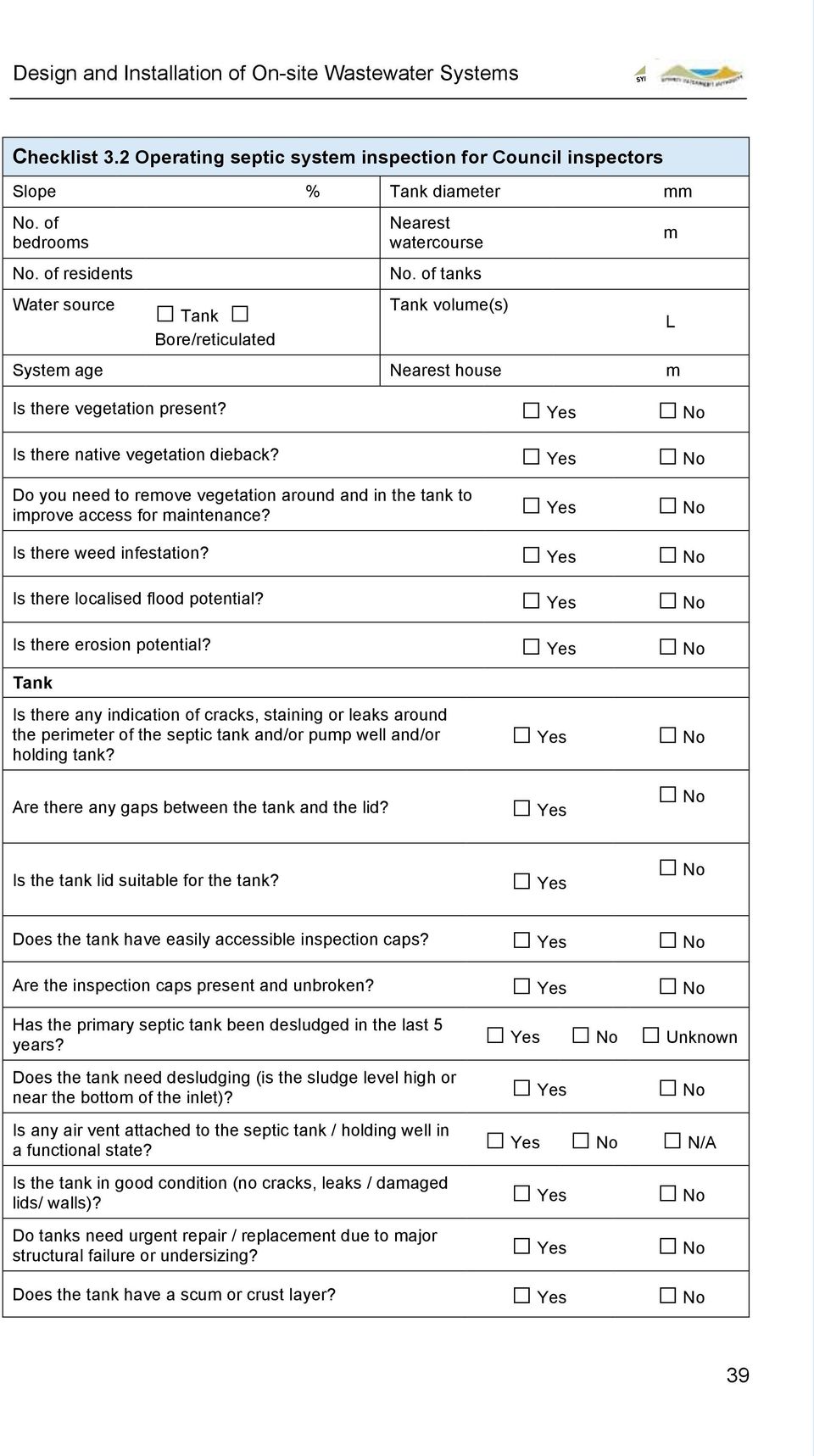
14 Checklist 3.2 Operating septic system inspection for Council inspectors Slope % Tank diameter mm No. of Nearest bedrooms watercourse m No. of residents Water source Tank Bore/reticulated No. of tanks Tank volume(s) L System age Nearest house m Is there vegetation present? Yes No Is there native vegetation dieback? Yes No Do you need to remove vegetation around and in the tank to improve access for maintenance? Yes No Is there weed infestation? Yes No Is there localised flood potential? Yes No Is there erosion potential? Yes No Tank Is there any indication of cracks, staining or leaks around the perimeter of the septic tank and/or pump well and/or holding tank? Yes No Are there any gaps between the tank and the lid? Yes No Is the tank lid suitable for the tank? Yes No Does the tank have easily accessible inspection caps? Yes No Are the inspection caps present and unbroken? Yes No Has the primary septic tank been desludged in the last 5 years? Yes No Unknown Does the tank need desludging (is the sludge level high or near the bottom of the inlet)? Yes No Is any air vent attached to the septic tank / holding well in a functional state? Yes No N/A Is the tank in good condition (no cracks, leaks / damaged lids/ walls)? Yes No Do tanks need urgent repair / replacement due to major structural failure or undersizing? Yes No Does the tank have a scum or crust layer? Yes No 39 39
15 Has the outlet filter been cleaned recently? Yes No N/A Pumps Does the pump operate when needed? (trigger the float switches to check operation) Yes No N/A Does the alarm work? Yes No N/A Has the pump been serviced in the last 12 months? Yes No N/A Pipes Are the pipes connecting the septic tank, pump well and/or holding well, or septic tank and trench, functioning and installed correctly? Yes No Unknown Are there any unsealed pipes that allow untreated wastewater to escape? Yes No Unknown Comments, actions or repairs required: (Where a response in the above Checklist needs extra information or action, specify the action plan and/or the process to fix the problem, or specify an alternative that is being offered) Service provider: Title: Contact number: Signature: Date: 40 40

16 3.6 Common technical issues There are a number of common problems with septic tank installations including: tanks rising out of the ground after rainfall - this is most common for unanchored plastic or fibreglass tanks baffles and inlet and outlet junctions removed, not installed (Figure 3.8), broken, or not connected to an effluent disposal system pumping from the septic tank rather a separate pump well high levels of sludge accumulating from inadequate maintenance (lack of desludging) undersized tanks relative to the hydraulic loads poor drainage around the tank due to run-on, or because it is installed too low into the ground. Figure 3.8 Outlet pipe discharging directly onto open ground 3.7 Case study A septic tank and pump well were installed on a site prone to high groundwater levels. After significant rain the property owner noticed that the pump well was sitting higher out of the ground than when installed. The owner put some fill around the tank and thought it would be alright. A month later a council officer inspected the tanks and noticed the same tank sitting high out of the ground with ponded effluent and soggy ground around it (Figure 3.9)

17 Figure 3.9 Tank that has lifted due to high water table Problem The tanks were installed without adequate drainage or ground anchors. During wet weather the pump well, which was almost empty, became buoyant and started to float. With the surrounding groundwater pressure the tank lifted from its original position in the hole. The tank movement caused the inlet and outlet pipes to crack and break resulting in continual discharge of effluent around the tanks. When the tanks were installed the installer did not follow the manufacturer s recommendation to install ground anchors and the tanks were not adequately secured in the ground. The tanks were also backfilled with clay material that did not allow enough drainage around the tank, and installed in a slight depression in the land that directed stormwater to the area around the tanks. Solution Dig out around the tank and install the ground anchors as recommended by the tank manufacturer. Repair the connections. Backfill around the tank with free draining soil or sand to ensure sufficient drainage. Install stormwater surface diversion drains around the top of the tanks. Alternatively, remove the tanks from the drainage depression and relocate them to a more suitable location on the property, again using ground anchors and free draining soil for backfilling

City of Shelbyville Site Inspection Checklist
 City of Shelbyville Site Inspection Checklist General Information Project Name: KYR10 Permit Number: Date: Project Location: Contractor: Conractor Representative: Inspector's Name: Title: Signature : Weather
A HOMEOWNERS GUIDE ON-SITE SEWAGE MANAGEMENT SYSTEMS
 GEORGIA DEPARTMENT OF HUMAN RESOURCES ENVIRONMENTAL HEALTH SECTION A HOMEOWNERS GUIDE TO ON-SITE SEWAGE MANAGEMENT SYSTEMS March 12, 2002 WHAT IS AN ON-SITE SEWAGE MANAGEMENT SYSTEM An on-site sewage management
31. ECO-INFO -- SEPTIC SAFE PROTECT YOUR HEALTH AND ENVIRONMENT YOUR SEPTIC PUMP-OUT SYSTEM with SELF ASSESSMENT TROUBLE SHOOTING GUIDE
 31. ECO-INFO -- SEPTIC SAFE PROTECT YOUR HEALTH AND ENVIRONMENT YOUR SEPTIC PUMP-OUT SYSTEM with SELF ASSESSMENT TROUBLE SHOOTING GUIDE Edited 21/12/01 Wyong Shire Council has many non sewered areas that
Indiana State Department of Health Construction Guidelines for Gravity and Flood-Dose Trench Onsite Systems
 Indiana State Department of Health Construction Guidelines for Gravity and Flood-Dose Trench Onsite Systems The septic tank-absorption field sewage treatment system is composed of two major elements; the
SEPTIC TANK SYSTEMS. Single purpose septic tank receives toilet wastes (blackwater) or sullage (greywater) only.
 SEPTIC TANK SYSTEMS There are three common types of septic tank systems in Tasmania Single purpose septic tank receives toilet wastes (blackwater) or sullage (greywater) only. Dual purpose (or all-waste)
SEPTIC SYSTEMS. 1. Building sewer connects the building plumbing to the septic tank.
 SEPTIC SYSTEMS Who Has A Septic System? Approximately 30 percent of Connecticut s population is served by on-site subsurface sewage disposal systems (a.k.a. septic systems). This means a large percentage
Specifications for Residential Property Owners Connection to New Public Sewer
 Specifications for Residential Property Owners Connection to New Public Sewer Spalding Tract property owners are required to connect to the community sewer system when construction is complete and the
SEPTIC SYSTEM CONSTRUCTION REQUIREMENTS ST. MARY S COUNTY HEALTH DEPARTMENT
 SEPTIC SYSTEM CONSTRUCTION REQUIREMENTS ST. MARY S COUNTY HEALTH DEPARTMENT The following are minimum requirements for installation of conventional trench sewage disposal systems in St. Mary s County,
Louisiana Administrative Code Title 51 Part XIII. Sewage Disposal
 Louisiana Administrative Code Title 51 Part XIII. Sewage Disposal Regulations Regarding Septic Tank Installations with Field Beds/Absorption Trenches For Individual Residential Installations Chapter 3.
ONSITE WASTEWATER TREATMENT SYSTEM Property Transfer Certification Instructions and Inspection Report
 ONSITE WASTEWATER TREATMENT SYSTEM Property Transfer Certification Instructions and Inspection Report These instructions are for homeowners and inspectors completing the onsite wastewater treatment system
SEPTIC TANKS FOR THE COLLECTION & SETTLEMENT OF DOMESTIC SEWAGE
 SEPTIC TANKS FOR THE COLLECTION & SETTLEMENT OF DOMESTIC SEWAGE Let us help! Free professional site visit with friendly support and advice. [email protected] to make the right decision or call
Chapter 3 CULVERTS. Description. Importance to Maintenance & Water Quality. Culvert Profile
 Chapter 3 CULVERTS Description A culvert is a closed conduit used to convey water from one area to another, usually from one side of a road to the other side. Importance to Maintenance & Water Quality
Homeowner s Guide to Maintaining a Sewage Treatment System
 Homeowner s Guide to Maintaining a Sewage Treatment System Warren County Combined Health District 416 South East Street Lebanon, OH 45036 513-695-1220 Sewage Treatment Systems Septic Tank and Soil Absorption
Type of Sewer Systems. Solomon Seyoum
 Type of Sewer Systems Solomon Seyoum 0 Learning objectives Upon completion of this lecture, the participants will be able to differentiate between types of sewer systems and discuss different aspects of
Stormwater/Wetland Pond Construction Inspection Checklist
 : Construction Inspection ChecklistsTools Stormwater/Wetland Pond Construction Inspection Checklist Project: Location: Site Status: Date: Time: Inspector: SATISFACTORY/ UNSATISFACTORY COMMENTS Pre-Construction/Materials
Understanding Septic Tank Systems
 Understanding Septic Tank Systems Sewage and effluent can contain a variety of human disease-causing microorganisms and parasites. Disease can be spread to humans from this material by direct contact or
Construction Site Inspection Checklist for OHC000004 By making use of some simple Best Management Practices (BMPs) a construction site operator can
 Construction Site Inspection Checklist for OHC000004 By making use of some simple Best Management Practices (BMPs) a construction site operator can do his or her share to protect Ohio's water resources
Emergency Spillways (Sediment basins)
 Emergency Spillways (Sediment basins) DRAINAGE CONTROL TECHNIQUE Low Gradient Velocity Control Short-Term Steep Gradient Channel Lining Medium-Long Term Outlet Control Soil Treatment Permanent [1] [1]
PRODUCT SELECTOR Pollution Control, Pumping and Rainwater Harvesting Systems
 PRODUCT SELECTOR Pollution Control, Pumping and Rainwater Harvesting Systems PACKAGE SEWAGE TREATMENT SYSTEM Clearwater treatment plants are ideal for single houses and employ the well proven aerobic biological
Frequently Asked Questions about Septic Systems
 What is a septic tank? Where is my septic tank located? Do septic tanks last forever? What should and should not go into my septic tank? How can I tell if my septic tank is working properly? Why should
Homeowners and Home Buyers Guide to Wells and Private Sewage Systems
 Homeowners and Home Buyers Guide to Wells and Private Sewage Systems What every homeowner should know about living with a well and a private sewage system. YOUR ENVIRONMENTAL SYSTEMS Out of sight out of
DESCRIPTION OF STORMWATER STRUCTURAL CONTROLS IN MS4 PERMITS
 DESCRIPTION OF STORMWATER STRUCTURAL CONTROLS IN MS4 PERMITS Phase I MS4 permits require continuous updating of the stormwater system inventory owned and operated by the MS4. They also include inspection
PART 5 : WASTEWATER DRAINAGE
 Authorised by : City Waters Unit Manager Page 1 of 15 PART 5 : WASTEWATER DRAINAGE 5.1 INTRODUCTION This Manual sets out the basic design principles for drainage of wastewater. While some construction
Storm Drain Inlet Protection
 Objectives EC Erosion Control SE Sediment Control TR Tracking Control WE Wind Erosion Control Non-Stormwater NS Management Control Waste Management and WM Materials Pollution Control Legend: Primary Objective
RECOMMENDED PROGRAM FOR WELL AND SEPTIC SYSTEM REAL ESTATE TRANSACTION INSPECTIONS
 Contra Costa Environmental Health 2120 Diamond Blvd., Suite 200 Concord, CA 94520 Phone: (925) 692-2500 Fax: (925) 692-2504 www.cchealth.org/eh/ RECOMMENDED PROGRAM FOR WELL AND SEPTIC SYSTEM REAL ESTATE
Index. protection. excavated drop inlet protection (Temporary) 6.50.1 6.51.1. Block and gravel inlet Protection (Temporary) 6.52.1
 6 Index inlet protection excavated drop inlet protection (Temporary) 6.50.1 HARDWARE CLOTH AND GRAVEL INLET PROTECTION Block and gravel inlet Protection (Temporary) sod drop inlet protection ROCK DOUGHNUT
CERTIFIED SEPTIC EVALUATION PREPARED FOR MATT HASHEM 1673 MT. MAJOR HWY, ALTON, NH 03810
 DATE: May 31, 2013 N.H. LICENSED DESIGNER OF SUBSURFACE DISPOSAL SYSTEMS 216 Hill Road Phone & Fax: 934-6206 Franklin, NH 03235 Cell: 393-3085 CERTIFIED SEPTIC EVALUATION PREPARED FOR MATT HASHEM 1673
16. Storm water drainage
 16. Storm water drainage There are three principal ways to dispose of rainwater from roofs, courtyards and paved areas: storm water sewers, soakaways and collection in storage tanks. Storm water sewers,
Looking after your Septic Tank System
 Looking after your Septic Tank System Name: Bought to you by Address: File this in your property file. 0800 TO FLUSH Call 0800 TO FLUSH 1 What do you know about your septic tank system? Just like your
State of Illinois Department Of Transportation CONSTRUCTION INSPECTOR S CHECKLIST FOR STORM SEWERS
 State of Illinois Department Of Transportation CONSTRUCTION INSPECTOR S CHECKLIST FOR STORM SEWERS While its use is not required, this checklist has been prepared to provide the field inspector a summary
Guidance on applying for approval of installation of a commercial onsite wastewater system
 Guidance on applying for approval of installation of a commercial onsite wastewater system This factsheet is designed to assist you to complete an Application to construct or install an apparatus for the
On Site Sewage System Maintenance Inspections. March 2011. Building and Development Branch Ministry of Municipal Affairs and Housing
 On Site Sewage System Maintenance Inspections March 2011 Building and Development Branch Ministry of Municipal Affairs and Housing Introduction The Building Code Act, 1992 and Building Code (Ontario Regulation
ON-LOT SEWA G E S Y S T E M S
 ON-LOT SEWA G E S Y S T E M S An Owner s Manual Chester County Health Department Bureau of Environmental Health Protection TABLE OF CONTENTS Page What is an on-lot sewage system 1 Types of on-lot systems
SUMMIT COUNTY COMBINED GENERAL HEALTH DISTRICT
 Slide 1 Point of Sale Inspections for Property Transfers SUMMIT COUNTY COMBINED GENERAL HEALTH DISTRICT Slide 2 What does the rule say? Effective September 1, 2008, prior to a property transfer, any property
 Septic System Report On:
 Experts Review of Aerobic Treatment Unit Operation and Maintenance. Bruce Lesikar Texas AgriLife Extension Service
 Experts Review of Aerobic Treatment Unit Operation and Maintenance Bruce Lesikar Texas AgriLife Extension Service Overview Overview of Aerobic Treatment Units Installing for accessibility to system components
Storm Drain Inlet Protection
 Categories EC Erosion Control SE Sediment Control TC Tracking Control WE Wind Erosion Control Non-Stormwater NS Management Control Waste Management and WM Materials Pollution Control Legend: Primary Category
SE-10 STORM DRAIN INLET PROTECTION. Objectives
 STORM DRAIN INLET PROTECTION SE-10 Objectives Erosion Control - EC Sediment Control - SE Tracking Control - TC Wind Erosion Control - WE Non-Storm Water Management - NS Waste and Materials Management -
Septic Records and Maintenance Guidelines
 1 Septic Records and Maintenance Guidelines Proper design, installation, and maintenance of your septic system will maximize your system's life. It will prevent failures that can be unsightly, foul-smelling,
Land Disturbance, Erosion Control and Stormwater Management Checklist. Walworth County Land Conservation Department
 Land Disturbance, Erosion Control and Stormwater Management Checklist Walworth County Land Conservation Department The following checklist is designed to assist the applicant in complying with the Walworth
PRIVATE TREATMENT CONTROL BMP OPERATION AND MAINTENANCE VERIFICATION FORM BIORETENTION FACILITIES, VEGETATED SWALES & HIGHER RATE BIOFILTERS
 BIORETENTION FACILITIES, VEGETATED SWALES & HIGHER RATE BIOFILTERS Check here for Address or phone number change the fiscal year (July 1 June 30), and date(s) maintenance was performed. Under Inspection,
LS 2540 SEWER LATERALS AND INSPECTION TEES
 LS 2540 SEWER LATERALS AND INSPECTION TEES A. Summary B. Submittals C. Site Information D. Sewer Pipe and Fittings E. Lateral Locations F. Lateral Installation G. Inspection Tee Installation H. Removal
4.3 Cisterns and Rain Barrels
 4.3 Cisterns and Rain Barrels Rain barrels, cisterns, and tanks are structures designed to intercept and store runoff from rooftops. Rain barrels are used on a small scale while cisterns and tanks may
Understanding and Caring for Your Septic System
 Understanding and Caring for Your Septic System Summit County Public Health 1867 W. Market Street Akron, Ohio 44313 330-926-5600 www.scphoh.org The purpose of a home's subsurface septic system is to dispose
Outlet stabilization structure
 Overview of Sedimentation and Erosion Control Practices Practice no. 6.41 Outlet stabilization structure Erosion at the outlet of channels, culverts, and other structures is common, and can cause structural
STANDARD AND SPECIFICATIONS FOR STORM DRAIN INLET PROTECTION
 STANDARD AND SPECIFICATIONS FOR STORM DRAIN INLET PROTECTION Design Criteria Drainage Area The drainage area for storm drain inlets shall not exceed one acre. The crest elevations of these practices shall
SIDE SEWER CONDITION ASSESSMENT AND REPAIR RECOMMENDATIONS
 SIDE SEWER CONDITION ASSESSMENT AND REPAIR RECOMMENDATIONS Introduction City of Tacoma property owners are responsible for the construction, maintenance and repair of private side sewers, which connect
WASTEWATER MANAGEMENT SYSTEM
 WASTEWATER MANAGEMENT SYSTEM PROTECT WHAT S MOST IMPORTANT TO YOU... Choosing to live in a suburban or rural area without a municipal sewer no longer means having to live with the problems associated with
16. ECO-INFO SEPTIC SAFE PROTECT YOUR HEALTH AND ENVIRONMENT YOUR SEPTIC SYSTEM with SELF ASSESSMENT TROUBLE SHOOTING GUIDE
 16. ECO-INFO SEPTIC SAFE PROTECT YOUR HEALTH AND ENVIRONMENT YOUR SEPTIC SYSTEM with SELF ASSESSMENT TROUBLE SHOOTING GUIDE Edited 19/12/01 Wyong Shire Council has many non- sewered areas that are serviced
Septic Tank Maintenance Information
 Septic Tank Maintenance Information This section has been adapted from materials developed by the Rouge RAP Advisory Council On-site Septic Subcommittee, which included representatives from Oakland, Wayne
TECHNICAL BULLETIN. Location of the system. Percolation tests for drainage fields. Cesspool sizing. Suggested Information notices
 TECHNICAL BULLETIN Issue 1 Market leaders Whichever product is most suitable for your needs you can be assured of Klargester s quality. Klargester is an accredited company under BS EN ISO 9001 2000 quality
HOW A SEPTIC SYSTEM FUNCTIONS
 New Milford Septic Services Old Fashioned Service Modern Technology Since 1940 Licensed Septic Installers and Cleaners 226 Pumpkin Hill Road New Milford, CT 06776 860-354-5492 HOW A SEPTIC SYSTEM FUNCTIONS
Protect Your Home From Flooding. A guide for Lethbridge Residents
 Protect Your Home From Flooding A guide for Lethbridge Residents Every year, millions of litres of water flow into the City of Lethbridge s stormwater and wastewater collection systems from residential
SPECIFICATION FOR PIPE SUBSOIL DRAIN CONSTRUCTION
 SPECIFICATION FOR PIPE SUBSOIL DRAIN CONSTRUCTION 1. SCOPE Pipe subsoil drains shall be constructed in accordance with this specification and in conformity with the lines, grades and cross-sections shown
9.00 THE USE OF HUNTER LAND DRAINAGE PERFORATED PIPES. Hunter Underground Systems
 9.00 THE USE OF HUNTER LAND DRAINAGE PERFORATED PIPES Hunter Underground Systems 9.01 General 9.02 Surface water Drainage 9.03 Groundwater Drainage 9.04 Dispersal of Septic Tank Effluent 9.01 The use of
RULE 8-8 - ORGANIC COMPOUNDS - WASTEWATER COLLECTION AND SEPARATION SYSTEMS
 BAY AREA AIR QUALITY MANAGEMENT DISTRICT RULE 8-8 - ORGANIC COMPOUNDS - WASTEWATER COLLECTION AND SEPARATION SYSTEMS (ADOPTED: January 17, 1979) (AMENDED: November 1, 1989; October 6, 1993; June 15, 1994;
Maintenance Guidelines For Homeowners
 ON-SITE WASTEWATER SYSTEMS Maintenance Guidelines For Homeowners PROTECTING YOUR HEALTH, YOUR ENVIRONMENT, YOUR INVESTMENT PRODUCED BY: SWANS-SIG The Small Wastewater And Natural Systems Special Interest
National Precast Concrete Association
 National Precast Concrete Association NOTES 1. This manual does not claim or imply that it addresses any safety-related issues associated with its use. Operation and maintenance of precast concrete grease
Septic System Owner s Manual
 Septic System Owner s Manual Sponsored by: copyright 2013 No part of this publication may be reproduced without our consent. www.callbrownies.com Brownie s Septic and Plumbing has provided quality service
Northeast Tri County Health District
 Northeast Tri County Health District Standards and Guidance for Performance, Application, Design, and Operation & Maintenance Holding Tank Sewage System Based on the Washington State DOH of Health Recommended
Improving on-site domestic wastewater treatment systems - West Coast Lagoons Project
 Improving on-site domestic wastewater treatment systems - West Coast Lagoons Project West Coast Lagoons Project- Improving Karekare, Piha, North Piha and Te Henga stream water quality Council is offering
On Site Treatment Systems
 On Site Treatment Systems Introduction In cases where houses require to be located in the countryside,(i.e. where no sewerage is available),it is necessary to provide a specific on-site treatment system
CERTIFYING DRAINLAYER
 No. 9198 REGISTRATION EXAMINATION, NOVEMBER 2013 CERTIFYING DRAINLAYER ANSWER SCHEDULE Plumbers, Gasfitters and Drainlayers Board, 2013. All rights reserved. No part of this publication may be reproduced
WASTEWATER TREATMENT OBJECTIVES
 WASTEWATER TREATMENT OBJECTIVES The student will do the following: 1. Define wastewater and list components of wastewater. 2. Describe the function of a wastewater treatment plant. 3. Create a wastewater
EXCAVATION AND PILING NEAR SEWERS, STORMWATER DRAINS AND WATER MAINS
 NMP 1.4 EXCAVATION AND PILING NEAR SEWERS, STORMWATER DRAINS AND WATER MAINS Index Purpose... 2 Application... 2 Referral Agency... 2 Associated Requirements... 2 Referenced Standards...2 Definitions...
[L] If the top of the tank is level with or above ground level, finding it should not be a problem.
![[L] If the top of the tank is level with or above ground level, finding it should not be a problem.](/thumbs/36/17389557.jpg "[L] If the top of the tank is level with or above ground level, finding it should not be a problem.") [L] Operating and Maintaining Septic Tanks A septic tank is a self-operating unit for sewage treatment. The tank receives raw sewage from a building, allows solids to settle out, and discharges effluent
[L] Operating and Maintaining Septic Tanks A septic tank is a self-operating unit for sewage treatment. The tank receives raw sewage from a building, allows solids to settle out, and discharges effluent
Septic System Design Manual
 Septic System Design Manual Prince George s County Health Department Largo Government Center 9201 Basil Court, Suite 318 Largo, Maryland 20774 (Office) 301-883-7681 (Fax) 301-883-7266 (January 2007) Table
SECTION 6 EXISTING WASTEWATER MANAGEMENT SYSTEMS
 SECTION 6 EXISTING WASTEWATER MANAGEMENT SYSTEMS This section will describe the Town s existing wastewater management systems. This includes on-site disposal systems and private collection systems. The
Onsite Wastewater Concepts, Materials, Regulations & The Application Process Part I
 Onsite Wastewater Concepts, Materials, Regulations & The Application Process Part I B Onsite Sewage System Materials Instructors: Bart Harriss, RS, Environmental Manager Florida Department of Health Division
50AI01oe 02/15. Labko GRP cesspools. Instructions for installation, operation and maintenance
 02/15 Labko GRP cesspools Instructions for installation, operation and maintenance Reliable solutions Wastewater treatment systems Contents 1 LABKO CESSPOOLS... 3 1.1 GENERAL... 3 1.2 IMPORTANT TO KNOW
San Antonio Water System Standard Specifications for Construction ITEM NO. 1103 POINT REPAIRS AND OBSTRUCTION REMOVALS
 ITEM NO. 1103 POINT REPAIRS AND OBSTRUCTION REMOVALS 1103.1 DESCRIPTION: 1. Repair of sanitary sewer lines by replacing short lengths of failed pipe with new pipe. 2. Repair of service laterals located
Scheduling Maintenance for Infiltration Basins and Trenches
 Visual Inspection for Infiltration Practices Visual inspection is a rapid assessment procedure for qualitatively evaluating the functionality of a stormwater best management practice (BMP). Visual inspections
Oasis Clearwater ENVIRONMENTAL SYSTEMS WASTEWATER TREATMENT ENGINEERS
 Oasis Clearwater ENVIRONMENTAL SYSTEMS WASTEWATER TREATMENT ENGINEERS The evolution continues in decentralised wastewater technology... The Process Decentralised wastewater treatment systems are defined
MARICOPA COUNTY ENVIRONMENTAL HEALTH CODE CHAPTER II SEWAGE AND WASTES SECTION 8
 MARICOPA COUNTY ENVIRONMENTAL HEALTH CODE CHAPTER II SEWAGE AND WASTES SECTION 8 ONSITE WASTEWATER TREATMENT FACILITIES REGULATION 1. Definitions a. Aggregate means a clean graded hard rock, volcanic rock,
CHAPTER 11 STORM DRAINAGE
 CHAPTER 11 STORM DRAINAGE SECTION 11 GENERAL 11.1 Scope. The provisions of this chapter shall govern the materials, design, construction and installation of storm drainage. 11.2 Where required. All roofs,
SECTION 6 SANITARY SEWER MAIN 6.01 SCOPE
 6.01 SCOPE The work covered by this section of the specifications consists of the furnishing of all plant, labor, materials, equipment and supervision and performing all operations involved in the construction
ALL YOU NEED TO KNOW...
 ALL YOU NEED TO KNOW... What do you know about your septic tank system? For the purposes of this booklet, a septic tank system refers to any kind of on-site sewage management system including traditional
Designing Septic Systems
 COURSE DESCRIPTION Practically speaking, much of the new construction is taking place in urban service areas which provide a public sewer system. However, how do you provide sewer service in rural areas
Table 4.9 Storm Drain Inlet Protetion Applicable for
 BMP C220: Storm Drain Inlet Protection Purpose To prevent coarse sediment from entering drainage systems prior to permanent stabilization of the disturbed area. Conditions of Use Type of Inlet Protection
EFFECTIVE FEBRUARY 2014. note: drainage permit required to call for a dampproof inspection
 EFFECTIVE FEBRUARY 2014 note: drainage permit required to call for a dampproof inspection 1. ROOF DRAINS/DECK DRAINS (INTERIOR ) All roof and deck drains within the perimeter of the building shall be APPROVED
Checklist for plans to Construct, Alter or Repair An Individual Subsurface Sewage Disposal System
 Checklist for plans to Construct, Alter or Repair An Individual Subsurface Sewage Disposal System An application for the construction or alteration of an individual subsurface sewage disposal system shall
Waste Handling & Disposal
 Objectives Cover Contain Educate Reduce/Minimize Product Substitution Description Improper storage and handling of solid wastes can allow toxic compounds, oils and greases, heavy metals, nutrients, suspended
SANITARY SEWER SPECIFICATIONS
 SANITARY SEWER SPECIFICATIONS OCTOBER 2003 HARVEST-MONROVIA WATER, SEWER, AND FIRE PROTECTION AUTHORITY SECTION 1.00 1.10 Purpose The purpose of this document is to assemble the sewer specifications, policies,
INDEX. Introduction 3. The Septic System 3. What Does The Septic Tank Do? 4. Where It All Goes 5. Problems 7. Some Dontʼs 8
 1 INDEX Introduction 3 The Septic System 3 What Does The Septic Tank Do? 4 Where It All Goes 5 Problems 7 Some Dontʼs 8 Management of Your On-Site System 9 Tank Maintenance 9 Disposal Field Area 10 Appendix
Town House 11265 Center Highway North Huntingdon, PA 15642
 APPENDIX C SPECIFICATIONS FOR THE CONSTRUCTION OF BUILDING LATERAL SANITARY SEWERS DECEMBER 2004, INCLUDING AMENDMENTS ADOPTED ON FEBRUARY 6, 2008 AND APRIL 2, 2008; EFFECTIVE ON MAY 1, 2008 Town House
CHAPTER 11 STORM DRAINAGE
 CHAPTER STORM DRAINAGE SECTION PC 0 GENERAL 0. Scope. The provisions of this chapter shall govern the materials, design, construction and installation of storm drainage. Storm water discharge shall be
A perforated conduit such as pipe, tubing or tile installed beneath the ground to intercept and convey ground water. or structures.
 BMP: SUBSURFACE DRAIN Definition A perforated conduit such as pipe, tubing or tile installed beneath the ground to intercept and convey ground water. PurRoses 1. To prevent sloping soils from becoming
Properly maintaining your septic system will help reduce the. It s Your Septic System. Homeowner s Guide. Here s How to Take Care of It
 Homeowner s Guide for Maintenance and Care of On-Site Sewage Systems It s Your Septic System Here s How to Take Care of It Properly maintaining your septic system will help reduce the possibility of health
40 ltr Domestic Grease Trap GTO1. 200 ltr Commercial Grease Trap GTO2. Rotational Moulders providing State of the Art Product Design and Developement.
 Rotational Moulders providing State of the Art Product Design and Developement. The JFC Grease Trap system is designed: GREASE TRAPS A major problem in the drainage systems of dwelling houses, restaurants,
On-site Sewage Disposal Systems A HOMEOWNER S GUIDE
 On-site Sewage Disposal Systems A HOMEOWNER S GUIDE May 2013 Table of Contents Introduction page 3 Private Sewage Disposal Systems.page 3 Background Check of your System..page 3 Maintaining your System.
Building over or close to a public sewer
 Building over or close to a public sewer thameswater.co.uk/developerservices thameswater.co.uk/developerservices 1 Questions and answers Did you know Thames Water is legally responsible for more than 100,000
minimum deductible may be increased significantly.
 ABOUT YOUR HOUSE CE 50 Basement flooding is unfortunately a common occurrence in many parts of Canada. But the good news is that many types of basement flooding may be avoided. This publication explains
GREEN ROOFS. Location. Design SMALL COMMERCIAL GUIDE CITY OF ATLANTA, GEORGIA DEPARTMENT OF WATERSHED MANAGEMENT
 SMALL COMMERCIAL GUIDE CITY OF ATLANTA, GEORGIA DEPARTMENT OF WATERSHED MANAGEMENT GREEN ROOFS A green roof is a system consisting of waterproofing material, growing medium, and vegetation, and is used
Alberta Onsite Wastewater Management Association Installer Training Program
 Alberta Onsite Wastewater Management Association Installer Training Program OWTS 100 Overview and Principles of Wastewater Treatment Systems Brief Review of All Types of Systems 1. Know the general principles
OPERATION OF KLARGESTER SEPTIC TANKS
 OPERATION OF KLARGESTER SEPTIC TANKS Introduction A septic tank is a retention vessel designed to receive sewage, hold it for a period and then release a clarified effluent Sewage is a mixture of toilet
RIPRAP From Massachusetts Erosion and Sediment Control Guidelines for Urban and Suburban Areas http://www.mass.gov/dep/water/laws/policies.
 RIPRAP From Massachusetts Erosion and Sediment Control Guidelines for Urban and Suburban Areas http://www.mass.gov/dep/water/laws/policies.htm#storm Definition: A permanent, erosion-resistant ground cover
Minimizes sediment and debris from entering storm drains that lead to waterways and watercourses.
 4.5-p DRAIN INLET PROTECTION Alternative Names: DI protection, Drop Inlet Protection DESCRIPTION Storm drain inlet (DI) protection slows and ponds stormwater, and filters sediment and debris before it
SEPTIC SYSTEM. Taking care of your. ... what you need to know
 Taking care of your SEPTIC SYSTEM... what you need to know For more information, please call: WATER & WASTE MANAGEMENT PROGRAM (909) 387-4666 Visit our web site: www.sbcounty.gov/dehs A:\Septic System
SECTION LS 2530 SANITARY SEWERS. A. General: Submit the following in accordance with The General Conditions.
 SECTION LS 2530 SANITARY SEWERS PART 1 GENERAL 1.1 SUBMITTALS A. General: Submit the following in accordance with The General Conditions. 1. Product data for drainage piping specialties. 2. Shop drawings
Watershed Works Manual
 National Rural Employment Guarantee Act Watershed Works Manual DRAINAGE LINE TREATMENT: GABION STRUCTURE Baba Amte Centre for People s Empowerment Samaj Pragati Sahayog September 2006 Drainage Line Treatment: