
OPERATION OF KLARGESTER SEPTIC TANKS
|
|
|
- Barry Harvey
- 9 years ago
- Views:
Transcription
1 OPERATION OF KLARGESTER SEPTIC TANKS Introduction A septic tank is a retention vessel designed to receive sewage, hold it for a period and then release a clarified effluent Sewage is a mixture of toilet wastes, kitchen wastes and so called grey wastes ie liquids which include washing, bath and washing machine wastes A septic tank is primarily a liquid/solid separation system, although there may be some limited biological activity within the sludge and the liquid interface As the name septic implies, the sewage entering the tank becomes septic If you look this up in a dictionary or thesaurus, you will see the alternative words, - putrid, toxic, noxious, unsanitary, rotten, decaying It is possible that at sometime, smells will be detected from somewhere in the drainage system These can be minimised by correct installation location and by controlling the sewage inputs into the septic tank Septic Tank Operation The septic tank is always full Clarified effluent is displaced from the tank outlet into the irrigation, soakaway/distribution system, by the incoming sewage flow Within the tank, there are complex internal baffles which are arranged to assist the solids to separate from the liquid Some solids float, but most settle Little by little, sludge builds up within the main chamber of the tank Floatables, ie, oils, grease and some faecal constituents, undergo some microbial decomposition and form a floating layer of white brownish scum In some tank designs this is exposed to the air, and after a period, hardens to form a crust Settleable solids sink to the bottom of the tank where they may also undergo some bacterial decomposition acquiring a black colour Some of the sewage constituents have the same density as the clarified effluent Other particles or constituents may be denser but tiny gas bubbles attach to them, thus they become lighter and they stay in the clarified effluent forming a suspension Septic Tank Design Klargester septic tanks are designed to maximise the separation of solids and liquids, minimise turbulence and provide a zone from where discharge is made at a low flow The purpose of the design is to produce the best quality of effluent and to extend the life of the soakaway or irrigation system This is very important considering the huge cost of laying a new distribution system Process performance is paramount A septic tank that does not separate the liquid and solids is not doing its job Klargester septic tanks have been tested for their sludge retention performance by the British Board of Agrément (BBA) who independently assess construction products Klargester are proud of their reputation as suppliers of The Tanks That Outperform The Rest" Klargester have progressively improved their septic tank internal design over the 35 years they have been manufacturing septic tanks Most of the spherical septic tanks we supply have one of three different internal baffle designs, all of which include a three stage upward flow route a) Submerged Ball The inlet arrangement directs sewage into the main body of the tank, zone 1 This zone is very large allowing both settleable and floating solids to be retained Some floating solids may rise out of the zone, but most are retained within the zone by the baffle arrangement and the submerged floating ball The ball seals zone 1 from zone 3 Clarified effluent rises through slots in the baffle, from zone 1 into zone 2 Small particles may rise with the clarified effluent and a further scum layer may accumulate at the top of zone 2 Another baffle positioned higher within the tank, separates zone 2 from zone 3 This baffle has slots positioned at a different orientation to provide a long flow path Clarified effluent is discharged from zone 3 into the outlet pipe connected to the irrigation system b) Raised/(Red or cream coloured) Neck The sewage enters the tank via the inlet pipework and is directed into the base of the primary zone 1 where most of the solids settle Some floating particles rise and a scum develops at the surface The raised neck of the upper cone is above the normal liquid level and this ensures that scum is retained The lower conical baffle arrangement allows liquid to rise at the outside of the tank Heavy particles sink within the rising liquid As the liquid ascends, the rate of liquid rise slows, allowing additional time for the smaller and lighter particles to settle TDS0006 Issue 6 August

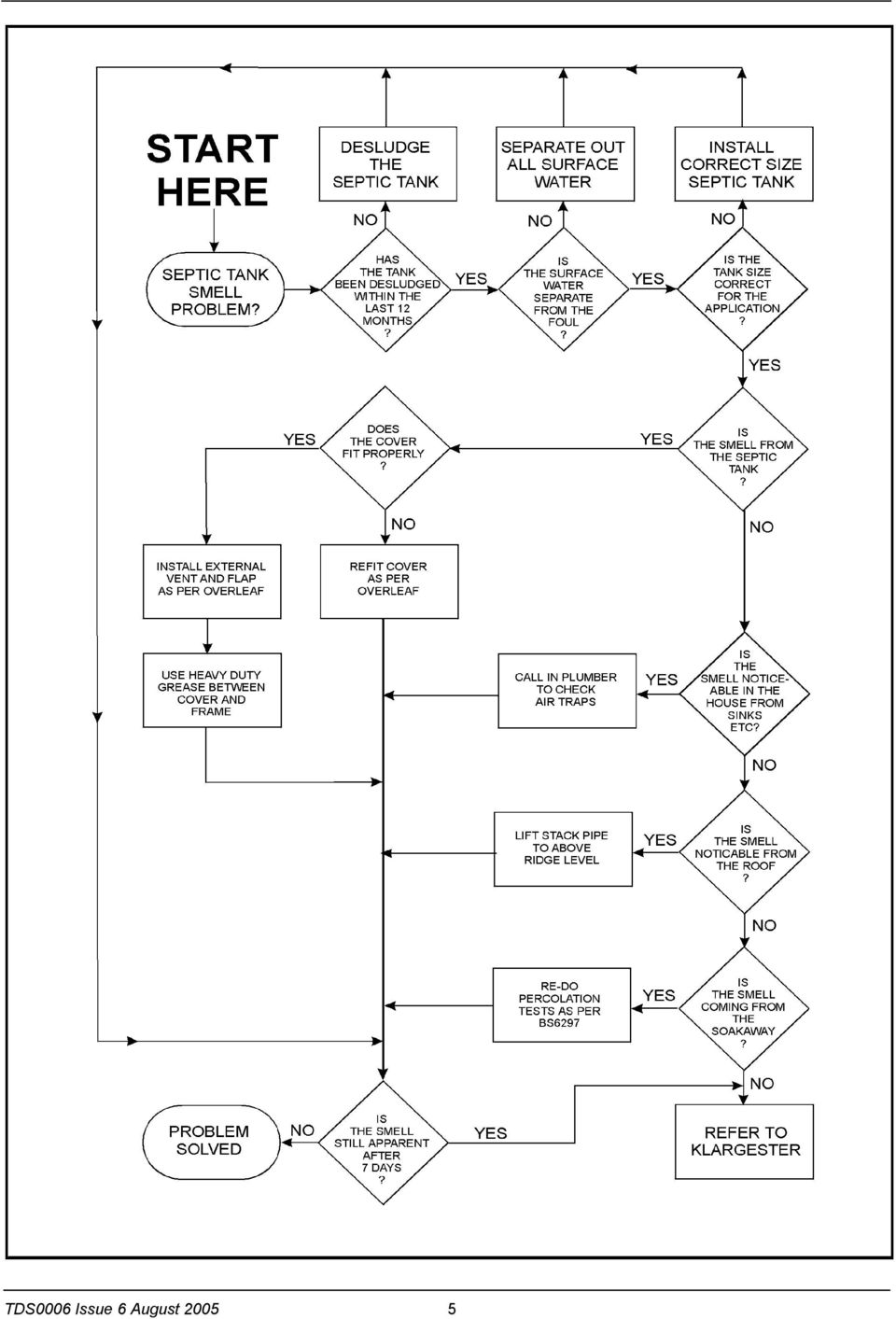
2 The baffle design of the second zone allows floating fine particles to be retained against the tank wall, eventually allowing a submerged scum layer to develop Once formed, smaller fine particles may be collected by this layer, hence a more mature unit will work better than one recently installed or just emptied There are slots positioned towards the inside of the upper baffle Liquid rises through these slots into the final zone The upper baffle is in the form of an inverted cone, the design of which aids consolidation and coagulation of particles Settleable particles can fall through the same slots and be returned to the primary zone c) Plug and Handle These tanks were provided by Klargester in the 1970 s and use a flat plug, held in place with a handle, instead of the submerged ball to retain the floating solids within the main chamber Their baffle orientation and chamber design is very similar to that described in a) above Smells and Odours Gases can develop when bacteria decompose some of the sewage constituents There is usually very limited bacterial activity within the sludge as there is little oxygen available to allow the bacteria to grow Any bacterial activity that does occur may obtain its oxygen from bound up chemical compounds such as sulphates (SO 4) Hydrogen sulphide gas may be produced, by anaerobic bacterial activity, its smell is particularly distinctive, often described as a sweet rotting cabbage smell Gases travel from the top of the liquid level in the septic tank into the vent or to the house s sewer pipe or soil stack, up to the roof terminal where they are vented to atmosphere Sometimes the smells detected derive from the irrigation system, or from other sources within the drainage system The chart on page 5 offers guidance to help you identify the origin of a smell and suggests ways of eliminating the cause(s) Installation of Septic Tank & Associated Pipework It is very important that you have correct venting and connections relating to your particular tank location and site situation Klargester provide guidance in their Technical Data Sheet, TDS0004 Points to consider before siting your Septic Tank" a summary of which follows Building Regulations require the system to be adequately ventilated A Klargester septic tank needs fitting with an appropriate cover and frame and connection to a correctly designed and installed soil stack system which ensures adequate ventilation An additional local air inlet can be fitted to the tank where circumstances and conditions require it The direction of the prevailing wind in relation to the property(ies) should be considered when selecting the tank site If an air admittance valve has been installed inside the property, perhaps within the roof cavity, then the septic tank must be independently vented For dimensions of septic tanks and independent venting arrangements see Klargester drawing No DS0521 (27m 3 to 45m 3 ) & DS0008 (6m 3 to 9m 3 ) or PD0213 (28 3 to 46m 3 ) A fall of about 1 in 40 is recommended for the drain from the house to the tank (Although newer plastic products may allow a fall of up to 1 in 80) A fall of about 1 in 200 is required for the land irrigation drain These drains should end a minimum of 10m distance from any water course A suitable cover and frame must be fitted relative to the neck size Klargester covers and frames allow venting when connected to a soil stack system Any other suitable covers and frames may be used Covers & frames, any other access or inspection points, may need sealing with a mixture of grease and sand to prevent gases escaping at ground level Your plumber or installer should be consulted to check the drains to ensure that the installation and pipework conform to building regulations, and septic tank installation guidelines The pipe layout must not allow the water to be drawn from water traps or U bends which normally prevent gases rising into the house It is good practice to install inspection chambers before and after the septic tank so as to enable inspection of the effluent quality being passed into the irrigation system Soakaways/Subsurface Drainage & Irrigation Systems Klargester provides information concerning their design and installation in Technical Data Sheet TDS0005 This follows the guidelines provided in the British Standard, BS 6297 The function of drainage systems is to receive the clarified sewage from the septic tank and discharge it underground in the soil The soil environment purifies the liquid further providing a separate biological stage for additional breakdown The purified liquid moves away by percolation, evaporation, plant uptake and transpiration The type of soil and its ability to drain, is of paramount importance when deciding if an irrigation system is acceptable It is very important to ensure that the drainage system has been correctly designed and installed If the effluent is not absorbed by the soil, ponding occurs, allowing untreated effluent to surface If the effluent passes through the ground too quickly, (without treatment by a subsurface biological mat) then untreated effluent can enter a water supply, and cause other problems if the water is later abstracted for potable use Corrugated pipework, because of its intrinsic design is generally not advised (even by the manufacturers) for use in a septic tank irrigation system as;- TDS0006 Issue 6 August

3 It is difficult to lay evenly, allowing low points where effluent can collect This can cause over saturation of a local area The corrugations can retain sediments which may over time, cause blockages Problems experienced with the irrigation/soakaway system should be referred to your original installer or local drainage contractor Incorrectly designed, or old soakaway systems exhibit their problems Systems that are too short may allow untreated liquid to surface If the soil is insufficiently porous, the liquid will stagnate and pond to the surface As soakaway systems age, the biomat may thicken and as a result progressive blockages can occur Blocked areas may relate to how level the system is laid and the flow pattern through the pipes Systems that have been installed where the water table is too high, or where the water table moves upwards, during wet or winter periods exhibit problems The soakaway system may allow the ground water to drain back into the tank, and sewage may back up in the incoming drains as effluent cannot flow out of the tank You should establish the cause of the problem in your particular circumstance and if necessary consider renewing the soakaway system Occasionally the use of pumps after a septic tank may assist The use of a BioDisc should be considered BioDiscs are package treatment plants which contain an aerobic biological culture and produce a fully treated effluent with low amounts of BOD and suspended solids (Generally <20 mg/l BOD and <30 mg/l SS) The low levels of pollutants discharged within the fully treated effluent means that a BioDisc can be used where a soakaway cannot be renewed or in place of a septic tank feeding an inadequate soakaway With EA consent, a BioDisc effluent may be discharged into open watercourses or ditches Please contact us Smells in the irrigation system may be caused by;- Ponding, caused when effluent surfaces out of the top of the ground As the effluent "decays" smells are produced A chemical within the effluent that damages or kills the biological treatment mat within the soil, which then rots and decays Excess bacterial activity, caused by increased nutrient release possibly as a result of a need to desludge the tank Good Housekeeping & Liquid Disposal Practises You should review the wastes that enter into the system Avoid using waste disposal units to chop up and dispose of vegetable peelings and wastes such as coffee grounds As you know these take a very long time to compost and take even longer to decompose in water Vegetable materials are unlikely to degrade within a septic tank They add to the bulk and increase the emptying frequency Avoid excess use of chemicals such as bleaches, Milton nappy disinfectant and other strong cleaning chemicals If the products purpose is to kill bacteria in your house, they may also affect bacteria in your tank Do not use your system to dispose of any chemicals, eg medicines, paint brush cleaners, white spirit, turpentine, creosote, paint products, photographic chemicals, motor oil, anti-freeze, brake fluid, weedkillers, insecticides, fungicides and other gardening chemicals, etc Do not use caustic or proprietary drain cleaners These all adversely affect the system and can cause noxious smells Eventually they will be released from the tank into the soakaway causing damage to the bacteria in the soil These chemicals may also damage the submerged ball within some tank designs, allowing the release of solids and smells Do not allow excessive amounts of grease, cooking oils and fats to enter the system These do not readily degrade, and partial degradation may produce nasty smells Do not allow nappies, sanitary towels, rags, soft toys, etc into the drainage system Disposable nappies and sanitary towels (which do not cause problems in municipal systems) do not degrade in the septic tank and add to the sludge volume They cause problems if they block the drains Do not allow excess water to enter the system In periods of heavy rainfall, the volume of water shed from a roof or sealed surface can totally overwhelm the capacity of the tank and flush out solids and unclarified effluent Disconnect all surface water sources Bacterial Additives These may sometimes be of benefit and may reduce some smell conditions, however before using them, we do suggest that you review your installation and the wastes that enter Ensure that any manhole covers or tank covers are sealed and that ventilation arrangements are correct The compounds contain facultative bacteria which reinoculate your tank helping to biodegrade and break down the accumulated sludge But, if your system also receives lots of chemicals, adding bacteria may not provide any benefit The use of bacterial additives, in addition to reducing smells, may also decrease the volume of sludge which becomes consolidated However, as a result of the increased bacterial activity, more and different gases may be released There are cost savings to be made should you be able to desludge your system less frequently Should you wish to use a bacterial additive, please contact us for their supply Routine Maintenance Very little activity is required on your part especially if you avoid disposing the items which cause blockages, such as rags, cloths and grease We suggest a routine inspection of your manholes and inspection chambers to ensure that there are no blockages and that the effluents are running freely Desludging Klargester recommends emptying the septic tank at least once a year This assumes that you have the correct size of tank installed in relation to your water use and household size The table below provides guidance as to the most appropriate tank selection for your domestic TDS0006 Issue 6 August

4 household, but for advice on other situations such as office developments please contact us Septic Tank Volume (litres) Number of people in the household assuming each person uses a volume of 180l/ person/day 250l/ person/day (NORMAL) (HIGH) 2720/ / / The decision on how frequently to empty the tank is yours to take, considering your addition of solids, bacterial compound and household size Where you have extended the emptying frequency, you should regularly check the condition of the effluent passed to the soakaway in the inspection chamber for the absence of visible solids Do not over extend the desludge period as this may allow sludge to accumulate to such an extent that damage can result within the septic tank It may be difficult for the waste disposal contractors to empty tanks with very high solid contents Always check the appearance of the septic tank effluent and never allow the septic tank to become blocked If the sludge is allowed to accumulate in the tank for too long, there will be a smell More importantly, excess sludge in the tank allows excess release of solids into the soakaway drains which may become blocked Once the soil around the drains has blocked, it is very expensive to repair or replace We do not recommend extending the desludge frequency at the expense of your irrigation system You may know of neighbours who say that they have never emptied their septic tank This may be because they have an old tank which was built of brick, or perhaps a pit with a very large capacity As these systems age, they tend to leak both liquids and solids through the old cement joints rather than through the designated irrigation drains The result is often contaminated areas and ponding local to the tank Desludging Instructions Always employ a licensed waste disposal contractor who holds the relevant permits to carry and dispose of wastes You should be provided with a disposal note We suggest the use of a maximum suction hose diameter of 4 or 110 mm a) Spherical septic tanks with submerged floating balls Lower the tank hose down through the access shaft close to the wall of the neck and draw off sufficient effluent to cause the ball to drop away from its seating giving access to the main sludge holding chamber Remove sludge from the main chamber Care should be taken to avoid unnecessary striking of the ball seating by the suction hose When the tank refills, the ball will automatically re-locate in its seating to seal off the main sludge holding chamber b) Spherical septic tanks with raised necks Lower the tank hose down through the centre access shaft and remove the sludge from the main chamber Care should be taken to avoid unnecessary striking of centre baffles by the suction hose c) Spherical septic tanks with plug and handle Lift out the plug using the handle Lower the tank hose down through the centre access shaft and remove the sludge from the main chamber Care should be taken to avoid unnecessary striking of centre baffles by the suction hose Replace the handle and allow the tank to refill Non Domestic Sewage Sewage from a commercial source, ie catering establishments, pubs and restaurants usually requires the installation of a suitably sized separate grease trap which is installed on a separate drain from toilet and other wastes Other issues should also be considered, please contact us for guidance Large Cylindrical Septic Tanks These tanks are generally supplied for multiple housing systems or for commercial applications Please contact us should you have any queries about their operation or application α Alpha Tank TDS0006 Issue 6 August

5 TDS0006 Issue 6 August
6 Fitting Cover & Frame Ensure the inlet pipe and the tank access shaft are set at the correct height Trial fit moulded frame onto shaft ensuring that there is no interference with the surrounding earth Lift off the frame and place concrete around the vent and neck Set the moulded frame into position allowing the concrete to fill the underside of the moulding Fix the moulding to the shaft as shown Fit access cover into frame Venting Additional pipework is necessary to install a local vent which may be required in addition to your roof soil stack Please contact your installer Please note the supply of the additional pipework is the responsibility of customer installing CFL460 E SELF TAPPING SCREW (NOT SUPPLIED) TITAN C30 GRADE CONCRETE SAFETY FRAME & COVER TO PEDESTRIAN DUTY 75 SEPTIC TANK INLET VENT PIPE GRADED SHINGLE OR SELECTED NON-COHESIVE MATERIAL SEPTIC TANK NECK Klargester Environmental College Road North, Aston Clinton, Aylesbury, Bucks, HP22 5EW Tel: +44 (0) Fax: +44 (0) wwwklargestercouk uksales@klargestercouk Manufacturing and distribution units also at: Klargester Scotland: +44 (0) Klargester Ireland: NI +44 (0) ROI +353 (0) In keeping with the Company policy of continuing research and development in order to offer our clients the most advanced products, Klargester reserve the right to alter specifications and dimensions without notice TDS0006 Issue 6 August

SEPTIC TANKS FOR THE COLLECTION & SETTLEMENT OF DOMESTIC SEWAGE
 SEPTIC TANKS FOR THE COLLECTION & SETTLEMENT OF DOMESTIC SEWAGE Let us help! Free professional site visit with friendly support and advice. [email protected] to make the right decision or call
31. ECO-INFO -- SEPTIC SAFE PROTECT YOUR HEALTH AND ENVIRONMENT YOUR SEPTIC PUMP-OUT SYSTEM with SELF ASSESSMENT TROUBLE SHOOTING GUIDE
 31. ECO-INFO -- SEPTIC SAFE PROTECT YOUR HEALTH AND ENVIRONMENT YOUR SEPTIC PUMP-OUT SYSTEM with SELF ASSESSMENT TROUBLE SHOOTING GUIDE Edited 21/12/01 Wyong Shire Council has many non sewered areas that
SEPTIC TANK SYSTEMS. Single purpose septic tank receives toilet wastes (blackwater) or sullage (greywater) only.
 SEPTIC TANK SYSTEMS There are three common types of septic tank systems in Tasmania Single purpose septic tank receives toilet wastes (blackwater) or sullage (greywater) only. Dual purpose (or all-waste)
Looking after your Septic Tank System
 Looking after your Septic Tank System Name: Bought to you by Address: File this in your property file. 0800 TO FLUSH Call 0800 TO FLUSH 1 What do you know about your septic tank system? Just like your
ALL YOU NEED TO KNOW...
 ALL YOU NEED TO KNOW... What do you know about your septic tank system? For the purposes of this booklet, a septic tank system refers to any kind of on-site sewage management system including traditional
PRODUCT SELECTOR Pollution Control, Pumping and Rainwater Harvesting Systems
 PRODUCT SELECTOR Pollution Control, Pumping and Rainwater Harvesting Systems PACKAGE SEWAGE TREATMENT SYSTEM Clearwater treatment plants are ideal for single houses and employ the well proven aerobic biological
A HOMEOWNERS GUIDE ON-SITE SEWAGE MANAGEMENT SYSTEMS
 GEORGIA DEPARTMENT OF HUMAN RESOURCES ENVIRONMENTAL HEALTH SECTION A HOMEOWNERS GUIDE TO ON-SITE SEWAGE MANAGEMENT SYSTEMS March 12, 2002 WHAT IS AN ON-SITE SEWAGE MANAGEMENT SYSTEM An on-site sewage management
CERTIFIED SEPTIC EVALUATION PREPARED FOR MATT HASHEM 1673 MT. MAJOR HWY, ALTON, NH 03810
 DATE: May 31, 2013 N.H. LICENSED DESIGNER OF SUBSURFACE DISPOSAL SYSTEMS 216 Hill Road Phone & Fax: 934-6206 Franklin, NH 03235 Cell: 393-3085 CERTIFIED SEPTIC EVALUATION PREPARED FOR MATT HASHEM 1673
Septic System Owner s Manual
 Septic System Owner s Manual Sponsored by: copyright 2013 No part of this publication may be reproduced without our consent. www.callbrownies.com Brownie s Septic and Plumbing has provided quality service
WASTEWATER TREATMENT OBJECTIVES
 WASTEWATER TREATMENT OBJECTIVES The student will do the following: 1. Define wastewater and list components of wastewater. 2. Describe the function of a wastewater treatment plant. 3. Create a wastewater
Septic Records and Maintenance Guidelines
 1 Septic Records and Maintenance Guidelines Proper design, installation, and maintenance of your septic system will maximize your system's life. It will prevent failures that can be unsightly, foul-smelling,
What Is An On-Lot Sewage Disposal System?
 What Is An On-Lot Sewage Disposal System? Most rural homes and communities in Monroe County are not served by a public sewer system. In order to dispose of the wastewater (sewage) generated by homes and
Septic Tank Maintenance Information
 Septic Tank Maintenance Information This section has been adapted from materials developed by the Rouge RAP Advisory Council On-site Septic Subcommittee, which included representatives from Oakland, Wayne
septic systems What is a Septic System? How does a Septic System Work?
 septic systems What is a Septic System? A septic system is a private sewage treatment system. They are common in rural areas where there are no municipal sewage pipes for homes, farms, businesses or other
Help protect our special places by maintaining your septic tank
 Help protect our special places by maintaining your septic tank BC3136 A septic tank guide Help protect our special places Rural Auckland is a special place, but the remoteness also means that many homes
Homeowners and Home Buyers Guide to Wells and Private Sewage Systems
 Homeowners and Home Buyers Guide to Wells and Private Sewage Systems What every homeowner should know about living with a well and a private sewage system. YOUR ENVIRONMENTAL SYSTEMS Out of sight out of
Understanding Septic Tank Systems
 Understanding Septic Tank Systems Sewage and effluent can contain a variety of human disease-causing microorganisms and parasites. Disease can be spread to humans from this material by direct contact or
National Precast Concrete Association
 National Precast Concrete Association NOTES 1. This manual does not claim or imply that it addresses any safety-related issues associated with its use. Operation and maintenance of precast concrete grease
Frequently Asked Questions about Septic Systems
 What is a septic tank? Where is my septic tank located? Do septic tanks last forever? What should and should not go into my septic tank? How can I tell if my septic tank is working properly? Why should
Septic Systems Maintenance:
 Septic Systems Maintenance: A typical septic system consists of two basic components: a septic tank and an underground disposal field. Wastewater flows from the house to the septic tank. Effluent, after
YOUR SEPTIC SYSTEM UNCOVERED
 YOUR SEPTIC SYSTEM UNCOVERED By Raymond King District Director of Environmental Health It s underground where you can t see it. You don t really understand how it works. When it doesn t work your toilets
ON-LOT SEWA G E S Y S T E M S
 ON-LOT SEWA G E S Y S T E M S An Owner s Manual Chester County Health Department Bureau of Environmental Health Protection TABLE OF CONTENTS Page What is an on-lot sewage system 1 Types of on-lot systems
Understanding and Caring for Your Septic System
 Understanding and Caring for Your Septic System Summit County Public Health 1867 W. Market Street Akron, Ohio 44313 330-926-5600 www.scphoh.org The purpose of a home's subsurface septic system is to dispose
Foul Drainage, systems and responsibility. Environmental Protection
 Foul Drainage, systems and responsibility Environmental Protection The Building Act 1984 The Building Act 1984 can be used to deal with unsatisfactory provision for drainage and appliances which are harmful
SEPTIC SYSTEM. Taking care of your. ... what you need to know
 Taking care of your SEPTIC SYSTEM... what you need to know For more information, please call: WATER & WASTE MANAGEMENT PROGRAM (909) 387-4666 Visit our web site: www.sbcounty.gov/dehs A:\Septic System
Pollution Control NEW! NEW! Stormwater Attenuation Systems Sustainable Urban Drainage Solutions for Domestic & Commercial Applications. klargester.
 Pollution Control NEW! NEW! Stormwater Attenuation Systems Sustainable Urban Drainage Solutions for Domestic & Commercial Applications klargester.com Stormwater Attenuation Systems Sustainable Urban Drainage
SEPTIC SYSTEMS. 1. Building sewer connects the building plumbing to the septic tank.
 SEPTIC SYSTEMS Who Has A Septic System? Approximately 30 percent of Connecticut s population is served by on-site subsurface sewage disposal systems (a.k.a. septic systems). This means a large percentage
On-site Sewage Disposal Systems A HOMEOWNER S GUIDE
 On-site Sewage Disposal Systems A HOMEOWNER S GUIDE May 2013 Table of Contents Introduction page 3 Private Sewage Disposal Systems.page 3 Background Check of your System..page 3 Maintaining your System.
TECHNICAL BULLETIN. Location of the system. Percolation tests for drainage fields. Cesspool sizing. Suggested Information notices
 TECHNICAL BULLETIN Issue 1 Market leaders Whichever product is most suitable for your needs you can be assured of Klargester s quality. Klargester is an accredited company under BS EN ISO 9001 2000 quality
INDEX. Introduction 3. The Septic System 3. What Does The Septic Tank Do? 4. Where It All Goes 5. Problems 7. Some Dontʼs 8
 1 INDEX Introduction 3 The Septic System 3 What Does The Septic Tank Do? 4 Where It All Goes 5 Problems 7 Some Dontʼs 8 Management of Your On-Site System 9 Tank Maintenance 9 Disposal Field Area 10 Appendix
Plumbing for retail food businesses
 Plumbing for retail food businesses Every day, thousands of food outlets in Sydney produce waste, such as cooking oil, grease and food solids. If that waste is discharged directly into our sewers, it can
BIODISC HIGH PERFORMANCE SEWAGE TREATMENT PLANT FOR DOMESTIC APPLICATIONS
 BIODISC HIGH PERFORMANCE SEWAGE TREATMENT PLANT FOR DOMESTIC APPLICATIONS Let us help! Free professional site visit with friendly support and advice. [email protected] to make the right decision
E nv i ro n m e nta l. Biotec 5-7. Sustainable, Reliable, Affordable
 E nv i ro n m e nta l Biotec 5-7 Package Sewage Treatment for Residential, Business & Leisure Applications Sustainable, Reliable, Affordable ENTEC BIOTEC 5-7 FROM KINGSPAN ENVIRONMENTAL Package Sewage
MAINTAINING YOUR SEPTIC SYSTEM by Wrentham Board of Health Ravi Nadkarni, Chairman William R. Domey, Agent
 INTRODUCTION MAINTAINING YOUR SEPTIC SYSTEM by Wrentham Board of Health Ravi Nadkarni, Chairman William R. Domey, Agent To most people, a septic system (or a cesspool) is out of sight and out of mind.
Septic System. Responsibility! Is Your. You should know that:
 Southwest Florida Water Management District Septic System Your Is Your Responsibility! PIPE SEPTIC TANK DRAIN FIELD SOIL You should know that: As a homeowner you re responsible for maintaining your septic
Septic Systems and Their Maintenance
 Septic Systems and Their Maintenance Why Use a Septic System? Septic systems are used when sewage treatment plants are not accessible. They safely treat and dispose of wastewaters produced in the bathroom,
OFFALY COUNTY COUNCIL Comhairle Chontae Uibh Fhailí
 OFFALY COUNTY COUNCIL Comhairle Chontae Uibh Fhailí HOMEOWNER S GUIDE AND MAINTENANCE RECORD FILE FOR WASTEWATER TREATMENT SYSEMS Houses located in rural areas, not served by public sewers, depend on either
Homeowner s Guide to Maintaining a Sewage Treatment System
 Homeowner s Guide to Maintaining a Sewage Treatment System Warren County Combined Health District 416 South East Street Lebanon, OH 45036 513-695-1220 Sewage Treatment Systems Septic Tank and Soil Absorption
CITY OF GOLDEN DEPARTMENT OF PUBLIC WORKS, ENVIRONMENTAL SERVICES DIVISION
 CITY OF GOLDEN DEPARTMENT OF PUBLIC WORKS, ENVIRONMENTAL SERVICES DIVISION Grease, So What's the Problem? Does your facility produce grease? All commercial cooking facilities generate Fats, Oil, and Grease
Guidelines for Precast Concrete Grease Interceptors
 Guidelines for Precast Concrete Grease Interceptors Purpose Provide an overview of the basic design principals that govern why gravity grease interceptors work Provide a forum for discussion of common
Properly maintaining your septic system will help reduce the. It s Your Septic System. Homeowner s Guide. Here s How to Take Care of It
 Homeowner s Guide for Maintenance and Care of On-Site Sewage Systems It s Your Septic System Here s How to Take Care of It Properly maintaining your septic system will help reduce the possibility of health
Septic Tank Use & Maintenance Tips
 Yellowhead County Hamlet of Cadomin Septic Tank Use & Maintenance Tips This guide gives an overview of the responsibilities for property owners in Cadomin. For Seasonal, Permanent & Vacationing Cadomin
BASEMENT FLOODING. Prevention Guide for. Homeowners
 BASEMENT FLOODING Prevention Guide for Homeowners 1 Did You Know? Floods are the most common hazards in Canada. Water damage is a common cause of loss for homeowner insurance. A heavy rainfall can result
On Site Treatment Systems
 On Site Treatment Systems Introduction In cases where houses require to be located in the countryside,(i.e. where no sewerage is available),it is necessary to provide a specific on-site treatment system
Drainage. Information for those with problem drains
 Drainage Information for those with problem drains Contents 1 Purpose 2 Introduction 2 Explanations: what is a drain and what is a sewer 3 Explanation of the responsibilities for public and private sewers
A Property Owner s Guide
 The Operation and Maintenance of Domestic and Commercial Sewers A Property Owner s Guide KILDARE LOCAL AUTHORITIES WATER SERVICES DEPARTMENT TABLE OF CONTENTS Introduction 1. Why should I care? 2. What
Nature's Cleaning Process
 Nature's Cleaning Process Students learn how a septic system cleans wastewater by performing an experiment. Level(s): 6-8 Subject(s): Physical Science, Chemistry, Life Science Virginia SOLs: 6.5 f, g;
Operation and Maintenance Guide for Homeowners
 LAGOON SEWAGE TREATMENT SYSTEMS It s Your On-Site System Operation and Maintenance Guide for Homeowners OKLAHOMA DEPARTMENT OF ENVIRONMENTAL QUALITY ENVIRONMENTAL COMPLAINTS AND LOCAL SERVICES P.O. Box
16. ECO-INFO SEPTIC SAFE PROTECT YOUR HEALTH AND ENVIRONMENT YOUR SEPTIC SYSTEM with SELF ASSESSMENT TROUBLE SHOOTING GUIDE
 16. ECO-INFO SEPTIC SAFE PROTECT YOUR HEALTH AND ENVIRONMENT YOUR SEPTIC SYSTEM with SELF ASSESSMENT TROUBLE SHOOTING GUIDE Edited 19/12/01 Wyong Shire Council has many non- sewered areas that are serviced
Maintenance Guidelines For Homeowners
 ON-SITE WASTEWATER SYSTEMS Maintenance Guidelines For Homeowners PROTECTING YOUR HEALTH, YOUR ENVIRONMENT, YOUR INVESTMENT PRODUCED BY: SWANS-SIG The Small Wastewater And Natural Systems Special Interest
MAP KEYS GLOSSARY FOR THE DRAINAGE AND WATER REPORT
 Record MAP KEYS GLOSSARY FOR THE DRAINAGE AND WATER REPORT Abandoned Gravity Private Combined Gravity Private Foul Gravity Private Surface Water Gravity Public Combined Gravity Public Foul Gravity Public
You and Your Septic Tank
 You and Your Septic Tank A Guide to the Proper Operation and Maintenance of a Septic Tank System INTRODUCTION In South Florida, our sole source of drinking water is just a few feet beneath the surface
MAGB HEALTH, SAFETY AND ENVIRONMENT GROUP POLLUTION INCIDENT RESPONSE PLAN
 MAGB HEALTH, SAFETY AND ENVIRONMENT GROUP POLLUTION INCIDENT RESPONSE PLAN SCOPE: This guidance sets out best practice for producing a Pollution Incident Response Plan to deal with an environmental incident
CERTIFYING DRAINLAYER
 No. 9198 REGISTRATION EXAMINATION, NOVEMBER 2013 CERTIFYING DRAINLAYER ANSWER SCHEDULE Plumbers, Gasfitters and Drainlayers Board, 2013. All rights reserved. No part of this publication may be reproduced
If you have a Septic tank with pump out, this guide is for you.
 If you have a Septic tank with pump out, this guide is for you. Acknowledgments Cartoons by Fran Lowe NSW Department of Local Government 2000 As a septic system owner you are responsible for ensuring that
Affordable and Reliable. Wastewater. &Rainwater Solutions for Domestic & Commercial Applications FREE. Delivery. On-site advice.
 Affordable and Reliable Wastewater &Rainwater Solutions for Domestic & Commercial Applications On-site advice available FREE Delivery Wastewater &Rainwater When budget matters - Count on Clearwater Solutions
Type of Sewer Systems. Solomon Seyoum
 Type of Sewer Systems Solomon Seyoum 0 Learning objectives Upon completion of this lecture, the participants will be able to differentiate between types of sewer systems and discuss different aspects of
Fats, Oil and Grease. Best Management Practices Manual. Information, Pollution Prevention, and Compliance Information For Food Service Facilities
 Fats, Oil and Grease Best Management Practices Manual Information, Pollution Prevention, and Compliance Information For Food Service Facilities Pinellas County Utilities Water Quality Management Division
Grease Trap Maintenance, Procedures and Cleaning Logs
 SAWS Grease Reduction Program Grease Trap Maintenance, Procedures and Cleaning Logs Don t Feed the Grease Monster Best Management Practices for Commercial Food and Restaurant Facilities Train kitchen staff
6. Principles of effective plumbing systems
 6. Principles of effective plumbing systems This chapter summarizes the aims and objectives of a good local plumbing system that is, the drinking-water supply that serves a building and the system for
Household customer. Wastewater flooding guidelines. www.thameswateruk.co.uk
 Household customer Wastewater flooding guidelines www.thameswateruk.co.uk We are very sorry that you have recently suffered wastewater flooding to your property. This leaflet has been designed to answer
 Septic System Report On:
 16. Storm water drainage
 16. Storm water drainage There are three principal ways to dispose of rainwater from roofs, courtyards and paved areas: storm water sewers, soakaways and collection in storage tanks. Storm water sewers,
DESCRIPTION OF STORMWATER STRUCTURAL CONTROLS IN MS4 PERMITS
 DESCRIPTION OF STORMWATER STRUCTURAL CONTROLS IN MS4 PERMITS Phase I MS4 permits require continuous updating of the stormwater system inventory owned and operated by the MS4. They also include inspection
Best Management Practices Fats, Oils, & Grease
 Best Management Practices Fats, Oils, & Grease for Food Service Facilities Public Works Department Environmental Division Table of Contents A. Introduction B. Purpose of the Manual 1 C. Frequently Asked
MAINTENANCE OF SMALL WATER SUPPLY, SANITATION AND IRRIGATION SCHEMES
 MAINTENANCE OF SMALL WATER SUPPLY, SANITATION AND IRRIGATION SCHEMES John van Rijn INDEVELOPMENT MAINTENANCE OF SMALL WATER SUPPLY, SANITATION AND IRRIGATION SCHEMES Any part of this publication may be
Prepare a drainage system layout and specification notes for a low- rise building.
 STUDENT MATERIALS Prepare a drainage system layout and specification notes for a low- Outcome 1 - rise building. In this outcome you will study the technology of below and above ground drainage systems.
Guidance on applying for approval of installation of a commercial onsite wastewater system
 Guidance on applying for approval of installation of a commercial onsite wastewater system This factsheet is designed to assist you to complete an Application to construct or install an apparatus for the
This unit is a pump that will clear the waste from a domestic shower and washbasin, bath, washing machine, glass washer and a sink.
 1. Description This unit is a pump that will clear the waste from a domestic shower and washbasin, bath, washing machine, glass washer and a sink. The unit will start automatically. Please pay particular
Water Storage Tanks. (Cisterns) Drinking water and your health. Water Hauling. Rainwater Collection. Construction Material
 Drinking water and your health Water Storage Tanks (Cisterns) This fact sheet is intended to be a general reference for cistern users. For detailed information on cistern construction and material standards,
Source Water Protection Practices Bulletin Managing Sanitary Sewer Overflows and Combined Sewer Overflows to Prevent Contamination of Drinking Water
 United States Office of Water EPA 916-F-01-032 Environmental Protection (4606) July 2001 Agency Source Water Protection Practices Bulletin Managing Sanitary Sewer Overflows and Combined Sewer Overflows
Planning and Installing an Onsite Wastewater Management System
 Replaces pages 27 to 32 of "The Cottager's Handbook for Manitoba Provincial Parks", Third Edition, distributed by Manitoba Conservation Planning and Installing an Onsite Wastewater Management System All
9.00 THE USE OF HUNTER LAND DRAINAGE PERFORATED PIPES. Hunter Underground Systems
 9.00 THE USE OF HUNTER LAND DRAINAGE PERFORATED PIPES Hunter Underground Systems 9.01 General 9.02 Surface water Drainage 9.03 Groundwater Drainage 9.04 Dispersal of Septic Tank Effluent 9.01 The use of
Lance DeClue, REHS Environmental Health Specialist II County of San Diego Department of Environmental Health
 Lance DeClue, REHS Environmental Health Specialist II County of San Diego Department of Environmental Health Basic OWTS system design and function OWTS maintenance OWTS failures & repairs OWTS-STS (Supplemental
MARICOPA COUNTY ENVIRONMENTAL HEALTH CODE CHAPTER II SEWAGE AND WASTES SECTION 8
 MARICOPA COUNTY ENVIRONMENTAL HEALTH CODE CHAPTER II SEWAGE AND WASTES SECTION 8 ONSITE WASTEWATER TREATMENT FACILITIES REGULATION 1. Definitions a. Aggregate means a clean graded hard rock, volcanic rock,
ENVIRONMENTAL CODE OF PRACTICE FOR CONCRETE BATCH PLANT & ROCK WASHING OPERATIONS
 ENVIRONMENTAL CODE OF PRACTICE FOR CONCRETE BATCH PLANT & ROCK WASHING OPERATIONS PREPARED BY: DEPARTMENT OF ENVIRONMENT AND LANDS INDUSTRIAL ENVIRONMENTAL ENGINEERING DIVISION APRIL 16, 1992 - TABLE OF
Biological Drain Maintenance Systems
 Biological Drain Maintenance Systems 2007 NCH Corporation HISTORY OF DRAINS MODERN SEWAGE SYSTEM Septic tanks were introduced; effluent water was largely untreated causing pollution of streams and rivers.
Waste Handling & Disposal
 Objectives Cover Contain Educate Reduce/Minimize Product Substitution Description Improper storage and handling of solid wastes can allow toxic compounds, oils and greases, heavy metals, nutrients, suspended
City of Green Bay Department of Public Works Engineering Department
 City of Green Bay Department of Public Works Engineering Department The Difference Between Sanitary & Storm Sewers Contact Information: Department of Public Works City Hall 100 North Jefferson Street,
Drainage and Grease Management for the Commercial Kitchen
 Drainage and Grease Management for the Commercial Kitchen ACO. The future of drainage. The ACO system chain provides drainage solutions to meet the needs of tomorrow s food service facilities. Hostile
On Site Sewage System Maintenance Inspections. March 2011. Building and Development Branch Ministry of Municipal Affairs and Housing
 On Site Sewage System Maintenance Inspections March 2011 Building and Development Branch Ministry of Municipal Affairs and Housing Introduction The Building Code Act, 1992 and Building Code (Ontario Regulation
Louisiana Administrative Code Title 51 Part XIII. Sewage Disposal
 Louisiana Administrative Code Title 51 Part XIII. Sewage Disposal Regulations Regarding Septic Tank Installations with Field Beds/Absorption Trenches For Individual Residential Installations Chapter 3.
GUIDELINES FOR LEACHATE CONTROL
 GUIDELINES FOR LEACHATE CONTROL The term leachate refers to liquids that migrate from the waste carrying dissolved or suspended contaminants. Leachate results from precipitation entering the landfill and
860-7668 KNOWING AND MAINTAINING YOUR SEPTIC SYSTEM. Carleton Pumping Services We look forward to hearing from you! DON T PANIC!
 DON T PANIC! WE LL SAVE YOU FROM YOUR PROBLEMS... Drain Cleaning Pipe Locating Water Jetting Maintenance Camera Inspect ion Plumbing KNOWING AND MAINTAINING YOUR SEPTIC SYSTEM 860-7668 Carleton Pumping
Indiana State Department of Health Construction Guidelines for Gravity and Flood-Dose Trench Onsite Systems
 Indiana State Department of Health Construction Guidelines for Gravity and Flood-Dose Trench Onsite Systems The septic tank-absorption field sewage treatment system is composed of two major elements; the
DOMESTIC WASTEWATER SYSTEMS
 Environmental PROTECTION Systems DOMESTIC WASTEWATER SYSTEMS Highest quality sewage treatment systems from the name you can trust Hynds Aerated Wastewater Systems Hynds Lifestyle Systems are an elite range
Septic System Owner s Manual
 Septic System Owner s Manual How your septic system works and how to keep it working for you and the environment CORPORATION Innovative Environmental Products and Solutions Since 1970 Table of Contents
20. ECO-INFO SEPTIC SAFE PROTECT YOUR HEALTH AND ENVIRONMENT OPTIONS for ON-SITE SEWAGE MANAGEMENT
 20. ECO-INFO SEPTICSAFE PROTECT YOUR HEALTH AND ENVIRONMENT OPTIONS for ON-SITE SEWAGE MANAGEMENT Edited 20/12/01 This document is a summary of information on system options with methods to improve the
Domestic heating Fuel storage tanks
 Domestic heating Fuel storage tanks Oil leaks Prevention and action www.west-norfolk.gov.uk Environmental Health and Housing Borough Council of King s Lynn & West Norfolk, King s Court, Chapel Street,
'A GREASE TRAP TREATMENT PERFECT FOR RESTAURANT GREASE TRAPS. RESTAURANTS WILL SAVE BIG MONEY ON GREASE TRAP MAINTENANCE.'
 1 of 6 3/7/2013 9:41 AM AUTO DOSE SYSTEM SEPTIC TANK TREATMENT SEPTIC BLOG BIO-FLO MOBILE VERSION SEPTIC TANK CARE GREASE TRAP PRODUCTS SEPTIC TANK ENZYMES GREASE TRAP CLEANER ABOUT US CLASSIC VERSION
Septic System Care & Maintenance
 Septic System Care & Maintenance A User s Guide for Home/Cottage Owners Spring 2003 Preventing Septic Failure & Malfunction How many of us know how our septic system works, or think we know? We expect
Experts Review of Aerobic Treatment Unit Operation and Maintenance. Bruce Lesikar Texas AgriLife Extension Service
 Experts Review of Aerobic Treatment Unit Operation and Maintenance Bruce Lesikar Texas AgriLife Extension Service Overview Overview of Aerobic Treatment Units Installing for accessibility to system components
CARE AND FEEDING OF...
 CARE AND FEEDING OF... YOUR SEPTIC SYSTEM Do you have septic system? There are approximately one million systems in Ontario. They treat wastewater on properties that are not serviced by a municipal sewer
Section 3: Septic Tanks. 3. Septic Tanks
 Section 3: Septic Tanks 3. Septic Tanks 3. Septic Tanks 3.1 Design...28 3.2 Installation...29 3.3 Testing...37 3.4 Inspection...37 3.5 Operation...37 3.6 Common technical issues...41 3.7 Case study...41
WHAT YOU NEED TO KNOW...
 A GUIDE TO OPERATING & MAINTAINING YOUR SEPTIC SYSTEM WHAT YOU NEED TO KNOW... The way you treat your septic system will influence how long the system lasts and how well it functions. If you own or rent
Septic System Owner s Manual
 CORPORATION Innovative Environmental Products and Solutions Since 1970 Septic System Owner s Manual How your septic system works and how to keep it working for you and the environment Table of Contents