
European Economic Area
|
|
|
- Justin Potter
- 10 years ago
- Views:
Transcription
1 SA29 from February 2003 Your social security insurance, benefits and healthcare rights in the European Economic Area Your social security insurance, benefits and healthcare rights in the European Economic Area A guide to National Insurance contributions Benefits Medical services

2

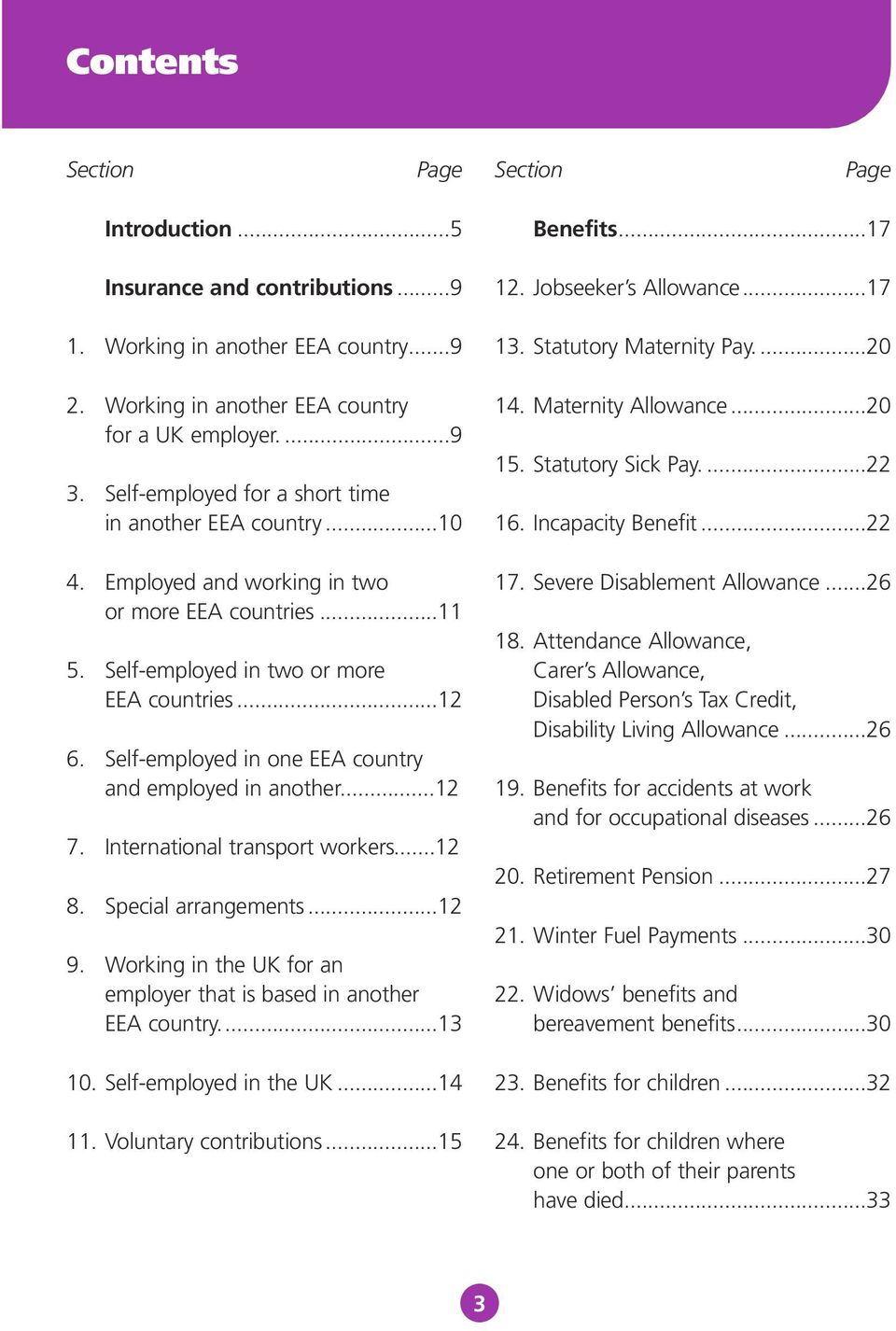
3 Contents Section Page Section Page Introduction...5 Insurance and contributions Working in another EEA country Working in another EEA country for a UK employer Self-employed for a short time in another EEA country Employed and working in two or more EEA countries Self-employed in two or more EEA countries Self-employed in one EEA country and employed in another International transport workers Special arrangements Working in the UK for an employer that is based in another EEA country Self-employed in the UK Voluntary contributions...15 Benefits Jobseeker s Allowance Statutory Maternity Pay Maternity Allowance Statutory Sick Pay Incapacity Benefit Severe Disablement Allowance Attendance Allowance, Carer s Allowance, Disabled Person s Tax Credit, Disability Living Allowance Benefits for accidents at work and for occupational diseases Retirement Pension Winter Fuel Payments Widows benefits and bereavement benefits Benefits for children Benefits for children where one or both of their parents have died
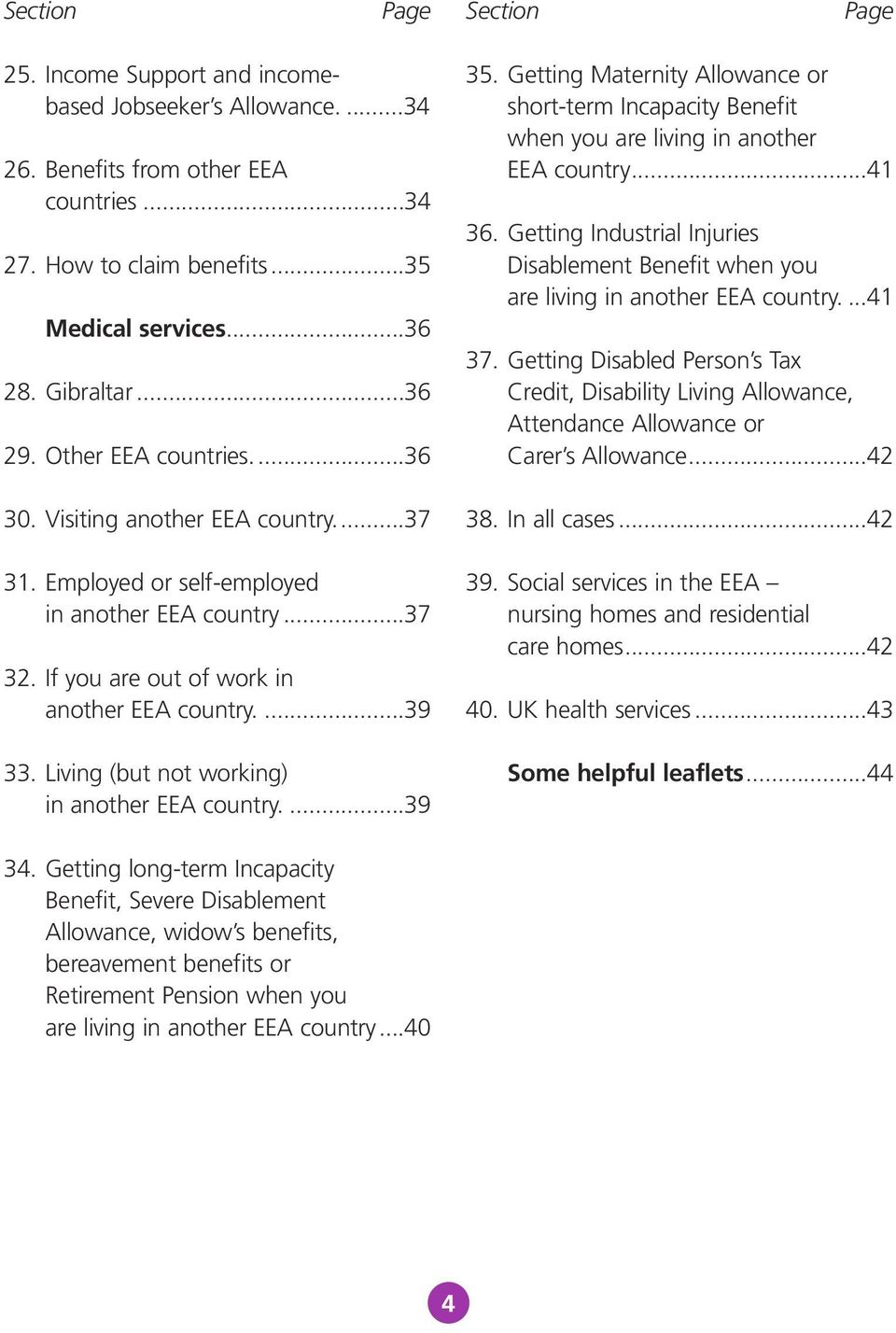
4 Section Page Section Page 25. Income Support and incomebased Jobseeker s Allowance Benefits from other EEA countries How to claim benefits...35 Medical services Gibraltar Other EEA countries Visiting another EEA country Employed or self-employed in another EEA country If you are out of work in another EEA country Living (but not working) in another EEA country Getting Maternity Allowance or short-term Incapacity Benefit when you are living in another EEA country Getting Industrial Injuries Disablement Benefit when you are living in another EEA country Getting Disabled Person s Tax Credit, Disability Living Allowance, Attendance Allowance or Carer s Allowance In all cases Social services in the EEA nursing homes and residential care homes UK health services...43 Some helpful leaflets Getting long-term Incapacity Benefit, Severe Disablement Allowance, widow s benefits, bereavement benefits or Retirement Pension when you are living in another EEA country
5 Introduction This leaflet tells you about the European Community (EC) Regulations on social security. It also tells you: about National Insurance and other contributions; how and when to pay your contributions; what benefits, including healthcare, you may get; and how and when to claim your benefits. The EC Regulations mean people from every country in the European Economic Area (EEA) are treated the same and have their benefit rights protected for as long as they are: employed or self-employed; or or have been employed or self-employed and are getting benefit; a student who is studying or receiving vocational training leading to an officially recognised qualification in this case, only limited rights arise. EEA countries are: Austria Belgium Denmark Finland France Germany Greece Iceland Ireland Italy Liechtenstein Luxembourg Netherlands Norway Portugal Spain Sweden United Kingdom (UK) 5

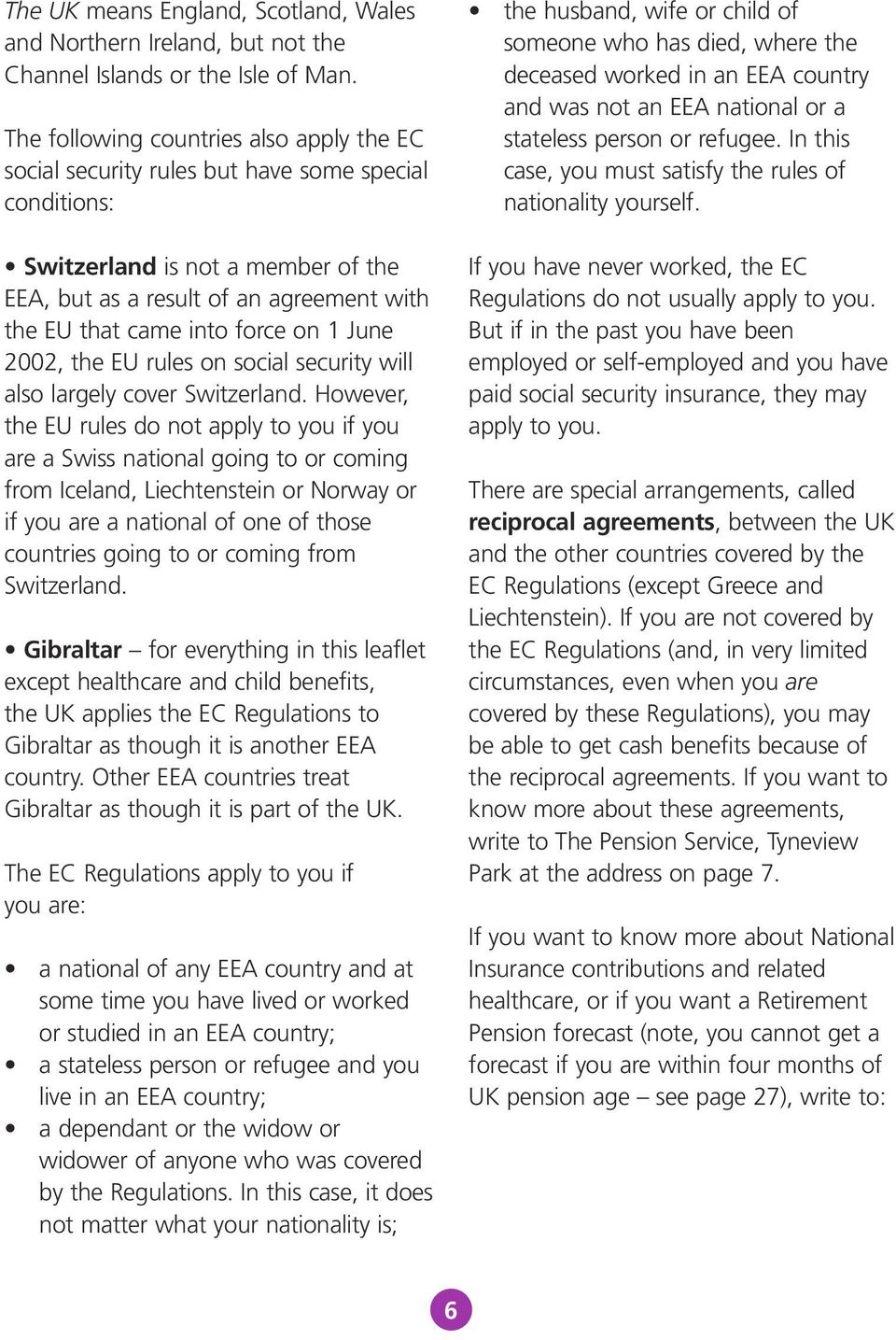
6 The UK means England, Scotland, Wales and Northern Ireland, but not the Channel Islands or the Isle of Man. The following countries also apply the EC social security rules but have some special conditions: Switzerland is not a member of the EEA, but as a result of an agreement with the EU that came into force on 1 June 2002, the EU rules on social security will also largely cover Switzerland. However, the EU rules do not apply to you if you are a Swiss national going to or coming from Iceland, Liechtenstein or Norway or if you are a national of one of those countries going to or coming from Switzerland. Gibraltar for everything in this leaflet except healthcare and child benefits, the UK applies the EC Regulations to Gibraltar as though it is another EEA country. Other EEA countries treat Gibraltar as though it is part of the UK. The EC Regulations apply to you if you are: a national of any EEA country and at some time you have lived or worked or studied in an EEA country; a stateless person or refugee and you live in an EEA country; a dependant or the widow or widower of anyone who was covered by the Regulations. In this case, it does not matter what your nationality is; the husband, wife or child of someone who has died, where the deceased worked in an EEA country and was not an EEA national or a stateless person or refugee. In this case, you must satisfy the rules of nationality yourself. If you have never worked, the EC Regulations do not usually apply to you. But if in the past you have been employed or self-employed and you have paid social security insurance, they may apply to you. There are special arrangements, called reciprocal agreements, between the UK and the other countries covered by the EC Regulations (except Greece and Liechtenstein). If you are not covered by the EC Regulations (and, in very limited circumstances, even when you are covered by these Regulations), you may be able to get cash benefits because of the reciprocal agreements. If you want to know more about these agreements, write to The Pension Service, Tyneview Park at the address on page 7. If you want to know more about National Insurance contributions and related healthcare, or if you want a Retirement Pension forecast (note, you cannot get a forecast if you are within four months of UK pension age see page 27), write to: 6
7 Inland Revenue National Insurance Contributions Office International Services Benton Park View Newcastle-upon-Tyne NE98 1ZZ You can also phone or fax the International Services Helpline on: tel: fax: (UK calls and faxes will be charged at local rates except for some mobile phones.) If you are phoning or sending a fax from outside the UK, dial the international code, then: tel: fax: [email protected] For details of UK Income Tax while you are abroad: Inland Revenue Centre for Non Residents St John s House Merton Road Bootle Merseyside L69 9BB tel: If you are phoning from outside the UK, dial the international code, then: tel: If you want to know more about benefits and related healthcare cover write to: Department for Work and Pensions The Pension Service International Pension Centre Tyneview Park Newcastle-upon-Tyne NE98 1BA When you write, please tell us: your full name; your date of birth; and your National Insurance number (if you know it). You can phone or fax The Pension Service, Tyneview Park, on: tel: fax: If you are phoning or sending a fax from outside the UK, dial the international code, then: tel: fax: [email protected] If you are on holiday or you are visiting another EEA country for a short time, read leaflet T6, Health advice for travellers, instead. You can get a copy from any UK post office. 7

8 Guides Two guides published by the EC explain your rights when moving within the EU. One, Your social security rights when moving within the European Union, tells you more about the EC social security regulations and social security schemes in each of the other EEA countries. The other, The Community provisions on social security, tells you about the EC social security regulations only. You can get the guides from either of the addresses on page 7. You can also get them from the social security authorities in any other EEA country. Important note In this leaflet we can only give you general information. You must not treat it as a complete and authoritative statement of the law. If you want to know about how the EC social security regulations work in any other country, you must ask the authorities who run the social security system in that country. 8

9 Insurance and contributions 1. Working in another EEA country If you work in another EEA country for an EEA employer (this includes a UK employer), or as someone who is self-employed, you are usually insured under the social security laws of the country you work in. You will not usually have to pay UK National Insurance (NI) contributions. But this is not always the case. Sections 2 11 tell you when UK NI contributions will still be due. Note In some EEA countries there is no compulsory state insurance or benefits scheme for self-employed people. 2. Working in another EEA country for a UK employer If you are taken on by a UK employer when you are abroad, you will not have to pay UK NI contributions. You will be insured under the social security scheme of the country you work in. Your UK employer may send you to work in another EEA country. If you are not expected to be there for more than 12 months, you will usually carry on paying UK NI contributions. But you may be sent to take the place of someone else who works for the same employer and who has come to the end of their time working there. In this case, you cannot carry on paying UK contributions. But see also sections 4 and 6. Similarily, if you are taken on by an employer or by an agency in the UK so that you can go straightaway to work for them in another EEA country, you can only carry on paying UK NI contributions if the employer or the agency normally carries out significant business activities in the UK. For you to continue paying UK NI contributions, your UK employer must apply for form E101 in your name. If it can be issued, this form tells the social security authority in the other EEA country that you will carry on being insured under the UK scheme. To do so, your UK employer must get an application form from the Inland Revenue at the address on page 6. It should be completed and returned to the address shown on the form. As well as this, new employers, and employers who have not been in touch with the Inland Revenue before, must complete and return a form giving the company s details. You can also get this form from the Inland Revenue at the address on page 7. 9

10 If your employer hires you out to another client, you will not have to pay UK NI contributions. In this case, you will be insured under the social security scheme of the country you are working in. You can find out more by writing to the Inland Revenue. Their address is on page 7. If all the rules are met, you and your employer will have to pay Class 1 NI contributions as if you were still in the UK. You will not have to pay into the scheme of the other EEA country. But see also sections 4, 6 and 8. If your job in another EEA country lasts longer than 12 months, although you did not expect it to, you can carry on being insured under the UK scheme for not more than another 12 months. But this is only if the insurance authorities of the EEA country you are working in agree to this extra time. Make sure your UK employer asks for this extra time. They must ask before the end of the first 12 months you are working in the other EEA country. They need to apply on form E102. They can get a copy of the form from the Inland Revenue at the address on page Self-employed for a short time in another EEA country You may be normally self-employed in the UK and go to work in another EEA country. As long as you do not expect to be there for more than 12 months, you will carry on being insured under the UK NI scheme. You will have to pay Class 2 and possibly Class 4 NI contributions as if you were still in the UK. You will not have to pay into the scheme of the other EEA country. You must apply for form E101 from the Inland Revenue at the address on page 7. If it can be issued, it shows that you will carry on being insured under the UK scheme. To apply for form E101, you must get an application form from the Inland Revenue at the address on page 7. When you ask for the form, you must tell us: your full name and address in the UK; your maiden name (if applicable); your date of birth; your nationality; your National Insurance number; your business name and address; how long you have been in business; how you are paying your Class 2 contributions; the address or addresses you will be working at abroad; 10
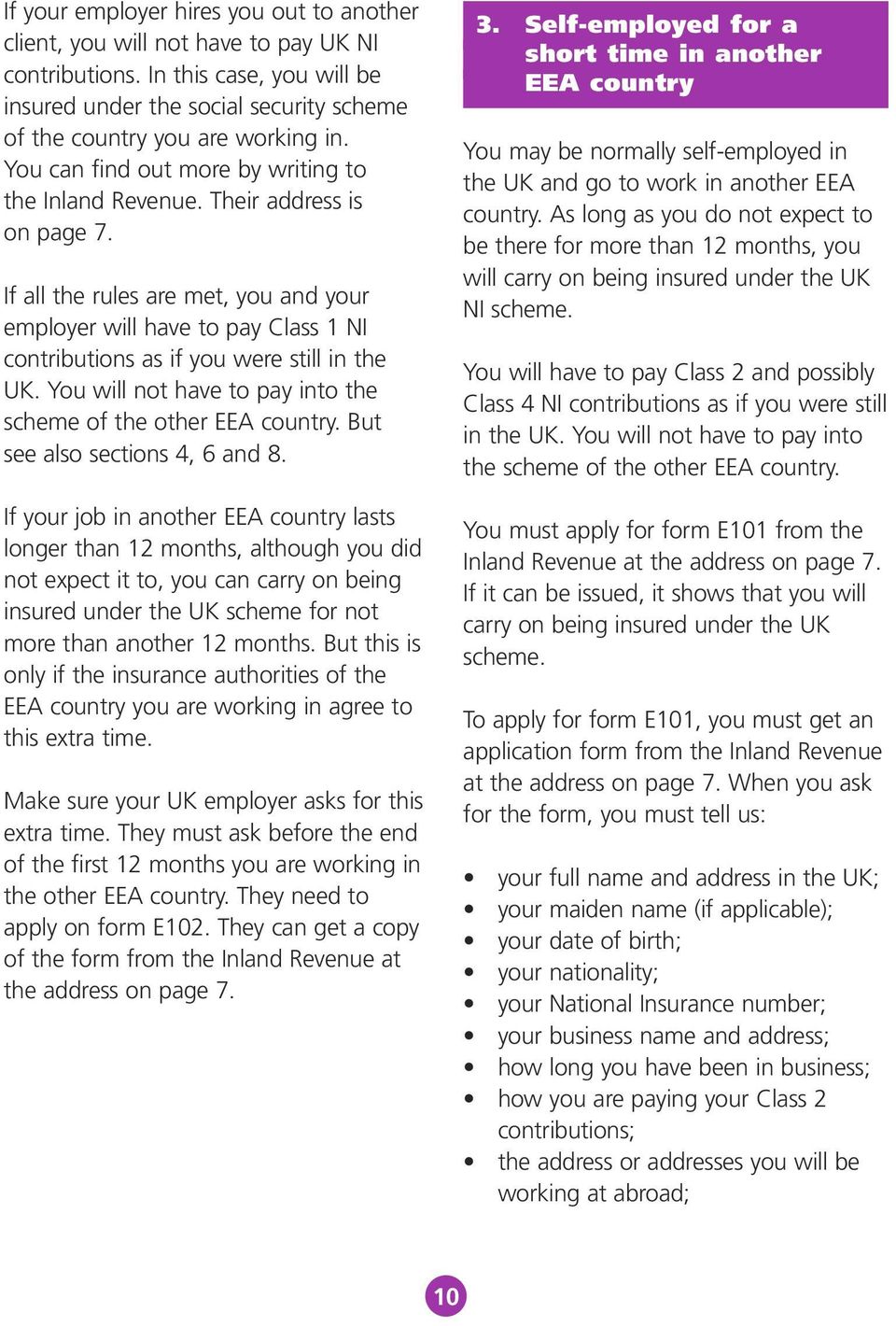
11 the date when you start work in the other EEA country; how long your work in the other EEA country is likely to last; what your job is; the address of the Jobcentre Plus/ social security office where you are registered self-employed; for each member of your family who is going with you their full name (including maiden name if applicable) their date of birth; and Child Benefit number (if you have one). Self-employed construction workers in Germany If you go to Germany to work in the construction industry, you must register at the local office of the Chamber of Handicrafts (Handwerkskammer). Take your form E101 with you. To register with the Handwerkskammer, you have to prove that you are properly trained and qualified in your trade. You will be asked to provide a Certificate of Experience from the: Certification Unit British Chamber of Commerce Westwood House Westwood Business Park Coventry CV4 8HS You should apply for this before you leave. There is a non-refundable charge. Note If you do not register at the Handwerkskammer, you are not allowed to be self-employed in Germany. Self-employment that unexpectedly lasts for more than 12 months If your job in another EEA country lasts longer than 12 months, although you did not expect it to, you can carry on being insured under the UK scheme for not more than another 12 months. But this is only if the insurance authorities of the EEA country you are working in agree to this extra time. You must ask to carry on being insured under the UK scheme before the end of the first 12 months of your work. You will need to fill in form E102, which you can get from the Inland Revenue at the address on page 7. See also section 8, Special arrangements. 4. Employed and working in two or more EEA countries If you are employed in two or more EEA countries, but not as an International Transport Worker (see section 7), you are insured under the UK scheme if you: either normally live in the UK, and the UK is one of the EEA countries you work in, or you work for several companies that are based in different EEA countries; 11

12 or do not normally live in any EEA country you work in, but the employer you work for is based in the UK. 5. Self-employed in two or more EEA countries If you are normally self-employed in two or more EEA countries, you will be liable to pay social security contributions to the insurance scheme of the country you live in. But you must do some of your work there. If you do not do any of your work in the country you live in, you will be liable to pay social security contributions to the scheme of the country where you do most of your work. But if this means you are not covered for a social security pension, then you will be liable to pay social security contributions to the insurance scheme of one of the other countries in which you are self-employed. 6. Self-employed in one EEA country and employed in another You will pay contributions in the country where you are employed. You may also have to pay self-employed contributions in the country where you are selfemployed. To find out what it means for you, write to the Inland Revenue. The address is on page 7. Get in touch with the insurance authorities in the EEA country you are going to, as well. 7. International transport workers You may work as part of the travelling or flying staff of an employer that carries goods or passengers by road, rail, air or inland waterways. If you work in two or more EEA countries, you are insured under the UK scheme if: or or the employer you work for has its registered office or place of business in the UK; the employer you work for has its registered office or place of business in another EEA country, and you work for a branch office in the UK; you live in the UK and you work mainly in the UK, even if your employer does not have a registered office or place of business in the UK. If none of these apply to you, you are insured under the scheme of the EEA country where your employer has its main office. 8. Special arrangements Although you will usually be insured under the social security scheme of the country you work in, there are some instances when this will not apply. Two or more countries in the EEA may agree to 12
13 treat you in a different way, as long as it is in your interests. For example, an agreement may be reached so that you stay insured under the UK social security scheme if: members of Her Majesty s (HM) Forces; and civilians who work for an organisation that serves HM Forces, or for HM Forces in Germany. or you have special knowledge or skills in the job you are doing; your employer has a special job that it needs you to do, in the other EEA country. If you are in any of these groups and you are not sure what NI contributions you should pay, write to the Inland Revenue. The address is on page 7. Agreements can be reached for other employees and self-employed people to be treated differently, but it must be in their interests. To find out more, write to the Inland Revenue. The address is on page 7. See also section 2 of this leaflet. Note The Inland Revenue needs to get the foreign social security authority to agree that you can remain UK-insured. This means it may take some time to decide. The following groups of people are treated in a special way: mariners; civil servants; members of the staff of diplomatic or consular posts; people who work for a member of the staff of a diplomatic or consular post; members of the staff of the European Community; 9. Working in the UK for an employer that is based in another EEA country If you usually work for an employer in another EEA country and who sends you to work in the UK for not more than 12 months; you are not sent to take the place of someone else who works for the employer and who has come to the end of the time they have to spend here, you will still be insured with the other EEA country. You will not have to pay UK contributions. Your employer in the other EEA country must obtain form E101 in your name from the insurance authorities of the other EEA country. Form E101 tells us that you will continue to be insured under the other country s social security scheme. 13

14 If you do not have a form E101, there may be a demand for you to pay UK contributions. It may happen that your job in the UK lasts longer than 12 months, although you did not expect it to. You can carry on being insured under the other EEA country s scheme for not more than another 12 months. However, the Inland Revenue must agree to this extra time. Before the end of the first 12 months your employer in the other EEA country should obtain form E102 from the insurance authorities of the country where your contributions are being paid. They can then use form E102 to ask for you to carry on being insured in the other EEA country. They should send the form to the Inland Revenue at the address on page 7. Your work in the UK may still not be finished when the second 12 months is over. Or you may not be allowed to stay insured under the scheme of the other EEA country after the end of the first 12 months. If so, you must start paying contributions to the UK scheme. If you are not covered by the rules described in this section and you work for an employer in the UK, you will usually have to pay UK contributions as soon as you start work. To do so, you must have a UK NI number. If you do not have a UK NI number, you must apply for one in person, as soon as 14 possible, at a Jobcentre Plus/social security office. You can obtain the address of your nearest office from the telephone directory. They can tell you more about paying contributions in the UK. 10. Self-employed in the UK If you are normally self-employed in another EEA country and you come to do self-employed work in the UK, as long as you do not expect to be working in the UK for more than 12 months, you will stay insured with the other EEA country. You will not have to pay UK contributions. You must have form E101, to tell us that you are still insured under the other EEA country s scheme. You must apply for and obtain form E101 from the insurance authorities of the country you usually work in. If you do not have form E101, you will be asked to pay UK NI contributions. It may happen that your work lasts longer than 12 months, although you did not expect it to. You can carry on being insured under the other EEA country s scheme for not more than another 12 months. But the Inland Revenue must agree to this extra time. Before the end of the first 12 months you should ask for form E102. You can get it from the insurance authorities of the country where your contributions are being paid. Use form E102 to ask if you can carry on
15 being insured in the other EEA country. Send the form to the Inland Revenue at the address on page 7. Your work may still not be finished when the second 12 months are over. Or you may not be allowed to stay insured under the scheme of the other EEA country after the end of the first 12 months. If so, you must start paying contributions to the UK scheme. If you are not included in the rules in this section and you work in the UK, you will usually have to pay UK contributions as soon as you start work. To do so, you must have a UK NI number. If you do not have a UK NI number, you must apply for one in person as soon as possible at a Jobcentre Plus/social security office. You can obtain the address of your nearest office from the telephone directory. They can tell you more about paying contributions in the UK. 11. Voluntary contributions If you are working in another EEA country, you will normally have to be insured under that country s scheme. But the EEA rules mean that if you move from one EEA country to another, you will not lose your social security rights, provided you follow the rules in this leaflet. Whether or not you are working in another EEA country, you can usually decide if you want to pay into the UK NI scheme. These are called voluntary contributions because you do not have to pay them if you do not want to. If you do pay voluntary contributions, they may help you get a UK pension and some other UK benefits. You need to decide if it would be in your interests to pay UK voluntary contributions. To help you, you should note that: if you are sent to work in another EEA country by your UK employer, and you are insured under that other country s scheme, you can get UK Incapacity Benefit, contribution-based Jobseeker s Allowance or Maternity Allowance when you come back to the UK. But you must have kept your normal home in the UK; and you must not be able to get the other country s benefit; for all the weeks that you are doing work for which you are paid while you are abroad, you can usually pay voluntary contributions at either the Class 2 rate; or the Class 3 rate; for any other weeks you can pay at the Class 3 rate only; Class 2 contributions count for Retirement Pension, bereavement benefits, Maternity Allowance and short-term Incapacity Benefit; Class 3 contributions count for Retirement Pension and bereavement benefits; and 15

16 you cannot use voluntary UK contributions to help you get UK contribution-based Jobseeker s Allowance, nor do they give you cover for healthcare (see section 38). If you want to pay voluntary contributions to the UK NI scheme while you are in another EEA country, write to the Inland Revenue as soon as possible. The address is on page 7. You must pay your voluntary contributions within certain time limits for them to count for benefit. Note You will not be able to pay voluntary contributions to the UK scheme if you are already paying voluntary contributions in another EEA country. 16
17 Benefits 12. Jobseeker s Allowance Jobseeker s Allowance (JSA) has both a contribution-based and an income-based element. If you have paid enough Class 1 National Insurance (NI) contributions, you will get a personal rate of contributionbased JSA as long as you are both available for and actively seeking work. Contribution-based JSA may be paid to jobseekers in EEA countries. See the rules in this section. If you do not qualify for contributionbased JSA, or it does not fully meet your needs, you may qualify for income-based JSA. Income-based JSA is normally only payable to jobseekers in the UK and is not covered by the rules in this section. UK contribution-based JSA in another EEA country If you are getting UK contribution-based JSA, and you have been registered as available for work, usually for four weeks, at a UK Jobcentre Plus office or Jobcentre, you may be able to carry on getting UK contribution-based JSA for up to three months while you look for work elsewhere in the EEA. But you must have been getting contribution-based JSA before you go abroad. UK contribution-based JSA is paid by the employment services in the EEA country in which you register for work. Payment is made in local currency at the rate of contribution-based JSA you were paid in the UK, and is authorised on form E303. This form is issued by The Pension Service, Tyneview Park, at the address on page 7. If you can get UK contribution-based JSA in another EEA country, you can get a letter from your Jobcentre Plus office or Jobcentre to help you in registering for work in that country. Give it to the authorities who run the employment services in the other country. If you can get UK contribution-based JSA in another EEA country and you are going to look for work in any of the following countries, you will also be given form E303: Austria Belgium Finland France Germany Greece Iceland Italy Norway Portugal Spain Sweden Switzerland. 17

18 But you must tell the Jobcentre Plus office or Jobcentre in good time before you go that you need it. If you do not, it will be sent to your address in the country you have moved to. If you are going to look for work in any other EEA country, then form E303 will be sent to a liaison office in that country. In each country in which you are looking for work you must: and register for work; follow the rules of that country about being available for work. You can only get benefit while you are registered at the employment office in the other EEA country. Normally, as long as you register before the end of seven days after you left the UK, you may carry on getting your UK contribution-based JSA without a break in your entitlement. But you should note there may be a delay before the other EEA country pays you, so try to make sure that you have enough money to last. Once you have been paid UK contribution-based JSA for a time spent in another EEA country, you cannot get it again for another length of time when you are seeking work abroad, unless you have done more work and you have paid into the UK NI scheme. get UK short-term Incapacity Benefit (see section 16), instead of UK contribution-based JSA. But you will only get it for as long as you can get UK contribution-based JSA. Claiming benefit for unemployment after working in another EEA country You may have become unemployed after working in another EEA country. If so, and you were last insured in that country s unemployment insurance scheme, the authorities there may be able to use your UK insurance as an employed person to help you get their unemployment benefit. The authorities who run the unemployment insurance scheme in the other EEA country will ask the Inland Revenue for details of your UK insurance record. The Inland Revenue will send on to them form E301. They will usually need to get in touch with the employer you used to work for in the UK before they can send form E301. When the authorities in the other country get form E301, they will look at your UK insurance record and decide if they can use it for your claim. But note that form E301 does not give you any automatic right to receive unemployment benefit in another EEA country. If you fall sick while you are looking for work in another EEA country If you fall sick while you are looking for work in another EEA country, you may 18 When deciding your claim, the foreign authorities will use their own rules.

19 If you have been working in another EEA country and have paid UK Class 1 contributions as set out in section 2, and and the time you were sent there for has come to an end, you stay in the EEA country where you were working, you may still be able to get unemployment benefit from that country in certain circumstances. But note that you will not be able to get UK contribution-based JSA until you come back to the UK. form E301 to the Jobcentre Plus office or Jobcentre dealing with your claim. But note that form E301 does not give you any automatic right to UK contribution-based JSA. For further information, contact The Pension Service, Tyneview Park, at the address on page 7. If you are coming to the UK, or coming back here to look for work, you may be able to carry on getting the other EEA country s unemployment benefit in the UK for up to three months. To get it, you must: Looking for work in the UK If you paid unemployment insurance while you were employed in another EEA country, this may enable you to get UK contribution-based JSA following your return to this country. But you must have: either worked as an employed person and paid Class 1 contributions since the last time you arrived in the UK; and and and normally have been getting that country s unemployment benefit just before you came to the UK; have been registered as available for work for at least four weeks, or for any shorter time that the other EEA country allows; register for work in the UK; claim benefit. or remained habitually resident in the UK during the time you were working in another EEA country. If either of these apply to you, you may need a record of your unemployment insurance from the authorities who run the unemployment insurance scheme in the other country. If you can, ask them for form E301 before you return to the UK and keep it in case you need it. If you do claim contribution-based JSA, give 19 You can only be paid the other country s unemployment benefit for the time that you are registered, unless you fall sick (see section 16). As long as you register before the end of seven days after you were last registered with the employment services of the other country, you may normally carry on getting your unemployment benefit without a break in your entitlement. But there may be a delay before you are paid in the UK.

20 To get another EEA country s unemployment benefit in the UK, you will need form E303. Ask for it in the country you are about to leave. Make sure that you do everything that you need to do to follow the rules before you leave. If you do not, you may lose benefit. Give form E303 to the office at which you claim benefit in the UK. But note that some countries will not give you form E303. Instead they will send it direct to The Pension Service, Tyneview Park, at the address on page 7. Leaflet JSAL 22 tells you more about contribution-based JSA for people going abroad or coming from abroad. You can get a copy from Jobcentre Plus offices or Jobcentres in the UK. 14. Maternity Allowance Maternity Allowance is paid to help women take time off work when they are expecting a baby. It can be paid for up to 18 weeks, or for up to 26 weeks for babies due on or after 6 April To qualify, you must have been employed or self-employed in at least 26 of the 66 weeks before your baby is expected. The rate of benefit depends on your average weekly earnings. UK Maternity Allowance in another EEA country If, for any reason, you cannot get SMP in another EEA country, but you were last insured under the UK scheme, you may be able get UK Maternity Allowance instead. You can get UK Maternity Allowance if: you are living or working there; 13. Statutory Maternity Pay If you work for a UK employer and your earnings are on average at least equal to the lower earnings limit in the appropriate reference period, you can get Statutory Maternity Pay (SMP) while you are in another EEA country. Also, a woman who is absent from Great Britain in an EEA country during her SMP pay period, but who is normally in employed earner s employment in the UK, may continue to receive SMP. You do not need to be a national of any EEA country to get SMP in another EEA country. or or or you are looking for work there and you are getting UK contributionbased Jobseeker s Allowance; you are already getting Maternity Allowance in the UK and you go back to the country where you usually live or you go to live in another EEA country. But you must get your Jobcentre Plus/social security office to agree that you can carry on getting your benefit; if the Department of Health tells you that you can go to another EEA country to get medical treatment. Leaflet T6, Health 20
21 advice for travellers, tells you more about this. You can get a copy from any UK post office. If these do not apply to you, and you are going to another EEA country for a short visit, you may still be able to get Maternity Allowance. But you must be going abroad to get medical treatment for a medical condition which started before you left the UK, or you must have been unable to work for at least six months, with no gaps, before you go. If you have your baby in any other EEA country, the rules for deciding if you may get UK Maternity Allowance are just the same as if you were living in the UK, unless you can get the same sort of Maternity Allowance from the EEA country you are living in. If you are getting Maternity Allowance and you are going to another EEA country, check with your Jobcentre Plus/ social security office well before you leave. Read the parts of this leaflet (sections 28 39) that tell you about healthcare, so that you can sort things out in good time. Maternity benefit from another EEA country If you have been working in another EEA country, you may have become insured for sickness since the last time you arrived there. If you have, and you claim maternity benefit under that country s scheme, your UK insurance may help you get it. The authorities there will ask the Inland Revenue NI Contributions Office for details of your UK insurance record. The Inland Revenue NI Contributions Office will send on to them form E104. They will usually need to get in touch with the employer you used to work for in the UK before they can send form E104. The authorities who run the foreign maternity scheme will decide your claim using their own rules. UK Maternity Allowance in the UK If you are insured under the UK scheme while you are working for your employer, you can usually get SMP (see section 13). If for any reason you cannot get SMP in the UK, you may be able to get UK Maternity Allowance instead. If you claim UK Maternity Allowance in this country, the sickness insurance paid in another EEA country may be used to help you get UK benefit. But this is only if, since coming to the UK, you have worked and earned at least a certain amount a week or, if you are self-employed, you have paid insurance contributions or hold a Small Earnings Exception. Before you return to the UK, get a record of your sickness insurance from the authorities in the other EEA country. Ask them for form E104 and keep it in case you need it. If you do claim UK Maternity Allowance, give the form to the Jobcentre Plus/social security office dealing with your claim. 21
22 If you have not paid any UK NI contributions or have not earned a certain amount since you last arrived in the UK, you may still get UK Maternity Allowance if you: or and worked in another EEA country for a UK employer and for the first 52 weeks of your employment abroad you either paid, or were deemed to have paid, employed-rate UK contributions; paid contributions to the country where you were working; you were ordinarily resident in the UK for the whole time you were abroad and immediately before the start of your employment. For further information, contact The Pension Service, Tyneview Park, at the address on page 7. Benefits from two or more EEA countries If you could claim maternity benefit from more than one EEA country, you can usually get it only from the country your baby is born in. If you cannot get benefit in that country, you can claim it from the country where you were insured last. Sick Pay (SSP) while you are in another EEA country. Such entitlement may continue even if your employer ceases to be liable to pay Class 1 contributions during your period of entitlement to SSP. You do not need to be a national of any EEA country to get SSP in another EEA country. 16. Incapacity Benefit UK Incapacity Benefit can be paid to people who cannot work because they are sick or disabled and are too young to get a UK Retirement Pension under 60 for women and under 65 for men. The rules for UK Incapacity Benefit and the amount you get depend on whether your incapacity is short-term or long-term. Benefit is usually paid at three basic rates: short-term (lower rate) for the first 28 weeks; short-term (higher rate) from the 29th to 52nd week; and long-term rate from the 53rd week. If you want to know more about the rules, read leaflet IB1, A guide to Incapacity Benefit. 15. Statutory Sick Pay If you work for a UK employer and your earnings are on average at least equal to the lower earnings limit in the appropriate reference period, you can get Statutory 22 UK short-term Incapacity Benefit in another EEA country If, for any reason, you cannot get SSP in another EEA country, but you were last insured under the UK scheme, you may be able to get UK short-term Incapacity Benefit instead if:
23 or or or you fall sick while visiting another EEA country (for example, on holiday), but only if you need urgent medical treatment there; you fall sick while you are living or working there; you fall sick while you are looking for work there and while you are getting UK contribution-based JSA; you are already getting short-term Incapacity Benefit in the UK and you go back to the country where you usually live or you go to live in another EEA country. But you must get your Jobcentre Plus/social security office to agree that you can carry on getting your benefit; If you are getting UK short-term Incapacity Benefit in the UK and you are going to another EEA country, you should check with your Jobcentre Plus/social security office well before you leave. They will be able to tell you if going abroad will affect your benefit. Make sure you read the parts of this leaflet (sections 28 39) that tell you about health care, so that you can sort things out in good time. When your period of UK short-term Incapacity Benefit runs out, you may then be able to get UK long-term Incapacity Benefit. For more information, read the paragraphs on long-term Incapacity Benefit later in this section. or the Department of Health tells you that you can go there to get medical treatment. Look at leaflet T6, Health advice for travellers. You can get a copy from any UK post office. If these do not apply to you, and you are going to another EEA country for a short visit, you may still be able to get short-term Incapacity Benefit for up to 26 weeks. But you must be going abroad to get medical treatment for an illness which started before you left the UK; or to get treatment for an industrial injury; or you must have been unable to work for at least six months, with no gaps, before you go. Benefit for short-term sickness from another EEA country If you have been working in another EEA country, you may have become insured for sickness since the last time you went there. If you have, and you claim benefit under that country s scheme, your UK insurance may help you to get it. The authorities there will ask the Inland Revenue for details of your UK insurance record. The Inland Revenue NI Contributions Office will send on to them form E104. They will usually need to get in touch with the employer you used to work for in the UK before they can send form E104. The authorities who run the foreign sickness scheme will decide your claim using their own rules. 23
24 If you have worked and become insured in another EEA country, and you then fall sick, you may wish to come back to the UK. If this happens, you may get the other country s sickness benefit in the UK. But you should claim the benefit before you come back to the UK. UK short-term Incapacity Benefit when you come to the UK If you are insured under the UK scheme and you fall sick while you are working for your employer, you can usually get SSP. But if, for any reason, you cannot get SSP in the UK, you may get UK shortterm Incapacity Benefit instead. If you claim UK short-term Incapacity Benefit in this country, the sickness insurance you paid in another EEA country may be used to help you get UK benefit. But only if you have worked and paid insurance contributions under the UK scheme as an employed or self-employed person since the last time you arrived in the UK. Before you return to the UK, get a record of your sickness insurance from the authorities in the other EEA country. Ask them for form E104 and keep it in case you need it. If you do claim UK short-term Incapacity Benefit, give the form to the Jobcentre Plus/social security office dealing with your claim. Note that you cannot usually get benefit from more than one country for one lot of sickness. If you have not paid any UK NI contributions since you last arrived in the UK, you may still get short-term Incapacity Benefit, but only if you: and worked in another EEA country for a UK employer and paid contributions for the first 52 weeks of your employment abroad; you were ordinarily resident in the UK for the whole time you were abroad and immediately before the start of your employment. For further information, contact The Pension Service, Tyneview Park, at the address on page 7. UK long-term Incapacity Benefit If you have been insured for sickness in the UK only, you may be able to get UK long-term Incapacity Benefit anywhere you live or stay in the EEA as long as you satisfy the rules and continue to be unfit for work. If you have been insured in the UK and in another EEA country, the benefit you can get depends on which other country or countries you have been insured in. This is because there are different rules for working out your benefit (see below for more information). Benefit for long-term sickness from another EEA country If you have been insured in the UK and also in any of the following countries: 24
25 Belgium France (except if you were employed as a miner or you were self-employed but not as an agricultural worker) Greece (in the agricultural scheme only) Ireland Netherlands Spain, only one of them will pay you benefit. This is usually the country in which you were last insured when your sickness began. If you were last insured in the UK, you will get full rate long-term Incapacity Benefit and you may also get an increase for your dependants, if you satisfy the rules. If you were last insured in one of the above countries, you will get that country s invalidity benefit. Previous periods of UK insurance may help you to satisfy the rules of the country from which you claim your benefit. The country that pays your benefit may also pay you extra for an adult who depends on you. It does not matter if they live in another EEA country. As long as your husband or your wife does not work, you may also be paid extra for any children who depend on you. Benefit for long-term sickness from more than one EEA country If you have been insured at any time in the UK and also in any of the following countries: Austria Denmark Finland France (but only if you worked as a miner; or if you were self-employed but not as an agricultural worker) Germany Greece (but not if you were insured under the agricultural insurance scheme) Iceland Italy Liechtenstein Luxembourg Norway Portugal Sweden Switzerland, you may be able to get UK long-term Incapacity Benefit and also an invalidity benefit from each of the other countries where you were insured. Each country where you have been insured will work out how much of their benefit they can pay you. Different rules apply to any extra you may get for an adult and child(ren) who depend on you. See also How your claim is worked out on page 28 and Getting extra for your dependants on page 30. If you are getting benefit from only one of the countries where you were insured, ask the authorities that pay your benefit to send your claim to the other country or countries where you were insured. They will then consider whether they can pay you their benefit. 25
26 17. Severe Disablement Allowance From 6 April 2001 Severe Disablement Allowance (SDA) is no longer available to new claimants, but anyone who was in receipt of SDA at the point of change can continue to get it in the future as long as they satisfy the entitlement conditions. If this applies to you and you want to go to another EEA country and take your SDA with you, get in touch with The Pension Service, Tyneview Park. The address is on page Attendance Allowance, Carer s Allowance, Disabled Person s Tax Credit, Disability Living Allowance If you get any of these allowances and you go to live in another EEA country, you will usually not be able to go on getting them. Going to visit another EEA country may also affect your UK allowance. If you are planning to go to another EEA country, either to live or to visit, you should write to the office that pays your allowance to find out more. Look at the back of your order book to find the address. See also leaflet GL29 Going abroad and social security benefits. If the EEA country you go to live in has a benefit like one of the UK allowances, any time you spent working as a selfemployed person or for an employer in 26 the UK, or any time you lived here, may help you to be able to claim the foreign benefit. You should also note that similar rules apply if you claim a UK allowance in the UK. Any periods spent working in another EEA country as a self-employed person or for an employer, or any time you lived there, may help you to satisfy the rules in this country for getting a UK allowance. Note From April 2003 two new tax credits, a Child Tax Credit and a Working Tax Credit, will be introduced to replace the existing credits: Working Families Tax Credit, Disabled Person s Tax Credit and Children s Tax Credit. Both of these new credits will be administered by and claimed from the Inland Revenue. 19. Benefits for accidents at work and for occupational diseases If you are bereaved and your spouse died because of an accident at work or from one of the industrial diseases on the official list, you may be able to get bereavement benefits. This applies even if you don t meet the insurance rules for bereavement benefits. If you are disabled or cannot work because of an accident at work or because you have one of the industrial diseases on the official list, you may be able to get Industrial Injuries Disablement Benefit. The Pension Service, Tyneview Park, will tell you more. Their address is on page 7.
27 If you worked in two or more EEA countries in a job which gave you one of the industrial diseases on the official list, you will only get benefit from the country where you were working last in the job that gave you the disease. Note This does not apply if you have pneumoconiosis. There are special rules for this. If your disease gets worse and you are getting, or if you used to get, benefit from an EEA country, that country will usually pay you any extra benefit that you may be able to have. You will need to have a further medical assessment. If you are getting benefit from one EEA country and you are now doing the same job that gave you the same disease, but in a different EEA country, the first country will not pay you any extra benefit. Instead, the second country will pay you benefit, and they will use their own rules to decide how much you should get. They will look at how much worse your disease has become. 20. Retirement Pension If you want to ask about your own pension rights in another EEA country, you must ask the authorities who run the pension scheme in that country. UK state pension age UK state pension age is 65 for men and 60 for women. But over a 10-year period starting on 6 April 2010, UK state pension age for women will change from age 60 to age 65. This means: women born before 6 April 1950 will reach pension age at age 60; women born on or after 6 April 1955 will reach pension age at age 65; women born on or after 6 April 1950 and before 6 April 1955 will reach pension age at 60 plus 1 month for every month or part month their date of birth is after 5 April For these women, Retirement Pension will always be awarded from the 6th of the same month. See the following example. Example A woman is born on 21 November Number of months from 6 April 1950 to 21 November 1950 = 8 (November counts as one month). UK state pension age = July 2011 (age 60 is November 2010 plus 8 months = July 2011). Pension will be paid from 6 July UK pension forecast If you are not within four months of UK pension age (see above for UK pension age), you can ask for a forecast of what UK pension you can expect to get. It will tell you what your pension is now and whether or not you can get more by the time you reach UK pension age. But it will not include any insurance you have paid in another EEA country. 27
28 If you are living in another EEA country or you are going abroad soon, write to the Inland Revenue and ask for an application form. The address is on page 6. If you are living in the UK and you are not going to live in another EEA country for some time, you should get application form BR19 from your Jobcentre Plus/social security office. How to claim your pension Every EEA country has its own rules. You must follow these rules before a pension can be paid to you. The age that you can start to get your Retirement Pension may also be different in other countries. You can claim your pension directly from any EEA country in which you have been insured. Or you can claim from the EEA country you live in when you are getting near pensionable age. If you have been insured in the UK, we will usually send you a claim form about four months before you reach UK pensionable age. The form will ask you if you want to claim a UK Retirement Pension. It asks you to tell us about any insurance and residence you may have in other countries. Remember to tell The Pension Service, Tyneview Park, when you change your address, or the form may not get to you. The address is on page 7. If you claim Retirement Pension in the EEA country where you live, that country will pass details of your claim to any other EEA country where you have been insured. How your claim is worked out Each EEA country where you have paid insurance towards a pension will look at your insurance under its own scheme and will work out how much pension you can have. As long as you meet the rules, you will get a pension from each country. Each country will also look at any insurance you have in another EEA country. This can help you to get a pension, or a higher pension, under its own scheme. To do this, each country sends details of your insurance record to the others. Each country then works out how much to pay you. They do it in two ways: Method A Each country works out how much pension you can get, just from what you have paid into its own social security scheme. Method B Each country adds together your insurance in all countries. Then each one sees how much pension you would get if your insurance had all been paid into its own social security scheme. But each country only has to pay you part of this. How much it pays you depends on how much you have paid into its scheme. 28
29 For example, if one-third of the insurance you have paid was from the UK, then the UK would pay one-third of the total pension it has worked out you could get. All the other countries usually work out how much they are going to pay in the same way. If a country has worked out your pension using Method A, it will usually pay it to you while you wait for Method B to be calculated. If your pension is higher under Method B, you will get the higher one without having to ask. Any UK graduated contributions you have paid are not used in working out Methods A and B. But you can get a pension from these contributions whether or not you get a pension using Methods A or B above. How your pension will be paid Each EEA country decides how it will pay your pension. If you have any questions about this, get in touch with the authorities who run the pension scheme in that country. If you are in the UK, you can be paid a pension from any other EEA country. But if you are, any UK Income Support that you have been getting may be reduced or stop. You can be paid a UK Retirement Pension (with an extra amount if you are aged 80 or more), in any other EEA country. You will get the same as you would get in the UK. You will usually be paid straight into your bank or building society account in the UK or your bank account abroad, if you have one. Or, if you wish, you can choose to have payment by payable orders sent straight to you by post. Whichever you choose, payment is made every four or 13 weeks in arrears. Any arrears of pension which may be due from before you started being paid your pension will usually be paid straight to you. But: and if you are in the UK and the arrears of pension are from another EEA country, you have been getting Income Support for the time that the arrears cover, we can take back all, or part, of what we paid you in Income Support out of the money the other country owes you. If you are in another EEA country, the authorities there may have been helping you by paying you benefit while you have been waiting for your pension to be paid from the UK. When your UK pension is paid, the other country can then take off the amount they paid you from your UK pension. If there is anything left over, it will be paid to you. 29
30 Getting extra for your dependants If you get a pension from any EEA country, you may also be paid extra for certain adults who depend on you. You may get this extra pension even if the person who depends on you is in another EEA country. The extra pension will be worked out in the same way as the rest of your pension. Look at How your pension will be paid on page 29 to find out more details. There are special rules for children who depend on you. If the EEA country you live in pays you a pension, it should pay the benefits for your children too. It will base them on its own scheme. If you do not get a pension in the country where you live, and you and your husband or your wife are not working, the benefits for your children will be paid by either: or the country that you get a pension from; if you get a pension from two countries, the country where you were insured for the longest time. The insurance you have paid in the UK may be used by other EEA countries when they decide what benefit you can get. 21. Winter Fuel Payments Winter Fuel Payments can in certain circumstances be paid to people living in the EEA, Switzerland or Gibraltar. To qualify, you must have been entitled to a Winter Fuel Payment whilst normally living in the UK before moving to another EEA country, Switzerland or Gibraltar. You must be at least aged 60 during the qualifying week for the winter you are claiming for. There are also nationality rules and some exceptions. For more information about Winter Fuel Payments, get leaflet WFPL1, Your guide to Winter Fuel Payments 2002, from your Jobcentre Plus/social security office, or ring the Winter Fuel Payment helpline on If you use a textphone, the number is Calls to these numbers are charged at local rate. 22. Widows benefits and bereavement benefits Bereavement benefits were introduced from 9 April 2001 to replace UK widows benefits for those bereaved after that date. Widowed fathers with qualifying children who were bereaved before 9 April 2001 can now make a claim for Widowed Parent s Allowance after that date. Women who were already receiving Widow s Benefit before that date will continue to do so for as long as they satisfy the current entitlement conditions. 30
31 If your spouse dies when you are in one EEA country but he or she was insured in another EEA country, you may claim widows benefits or bereavement benefits in either of the countries. If you claim in the EEA country where you live, that country will pass details of your claim to any other EEA country where you or your late spouse have been insured. UK widows benefits or bereavement benefits are payable in another EEA country at the same rate as if you were living in the UK. In the same way, if you can get benefits from another EEA country, you will get the same rate in the UK as you would if you were in that country. If your late spouse did not pay enough insurance contributions in the UK for you to get UK Widow s Benefit or Bereavement Benefit, we may use their foreign insurance contributions in a similar way as a person s insurance contributions may be used for Retirement Pension. The section How your claim is worked out under Retirement Pension tells you about this. In the same way, if your late spouse did not have enough insurance contributions in another EEA country for that country to pay you their Widow s Benefit or Bereavement Benefit, the authorities there may use your late spouse s UK insurance contributions to work out if you can get their benefits. Benefits for children of workers who have died There are special rules about benefits for children of someone who has died. If you have been bereaved and your late spouse was insured only in one EEA country, that country pays the benefits for a child. It will work out what the benefits are using its own rules under its own scheme. They may be child benefits, orphan s pension or extra widow s pension, or some of each. If your late spouse was insured in more than one EEA country, it will usually be the country where the child lives that pays the benefits. But your late spouse must have been insured in that country, and there must be some benefit to be paid for the child. If your late spouse was not insured in the country where the child usually lives, or that country cannot pay any child benefits, the EEA country where your spouse was insured for the longest period has to pay the child s benefits. Other EEA countries may use your late spouse s insurance when they work out if you can get benefit for the child. 31
32 23. Benefits for children UK Child Benefit and Working Families Tax Credit If you are in the UK or another EEA country: and and or you are employed or selfemployed; you are insured under that country s insurance scheme; you are getting one of the following foreign benefits: and or you are employed or self-employed in a job in which you must pay contributions under the UK scheme, you are getting one of the following UK benefits: contribution-based Jobseeker s Allowance Guardian s Allowance Incapacity Benefit Retirement Pension Widow s Benefit/Bereavement Benefit Industrial Injuries Disablement Benefit, you can usually get UK Child Benefit for your children, even if they are living in another EEA country. You may also be able to get UK Working Families Tax Credit. But see the note on page 26 on the changes affecting tax credits. Children s allowance from another EEA country If you are in another EEA country: unemployment benefit benefit for orphans benefit for sickness old age pension benefit for an accident that happened when you were at work benefit because you have an industrial disease on the official list, you can usually get the children s allowance paid by that country. You can get it even if your child stays, or your children stay, in the UK. Any UK insurance you have paid may help the other country decide if they can pay you their children s allowance. Getting benefit from two different countries It may be that you and your husband or wife could both get benefit from two different EEA countries for the same child. If so, both countries will not have to pay all the benefit. The country where one of you works and pays into the social security scheme will usually pay. 32
33 If you or your husband or wife are working in different countries and you are both paying into the social security scheme in each country, the country the child lives in will usually pay benefit. The other country may pay something too. They may do this if you would get more for the child in their country. They may pay the extra you would have got there. If you want to know more about the Child Benefit you might get, write to: Department for Work and Pensions Child Benefit Directorate (Washington) BPO Box 1 Newcastle-upon-Tyne NE88 1AA UK If you are in the UK, you can phone the Child Benefit Directorate on: tel: If you are phoning from outside the UK, dial the international code, then: tel: [email protected] To find out more about Working Families Tax Credit, write to: Tax Credit Office Inland Revenue PO Box 145 Preston PR1 0GP 24. Benefits for children where one or both of their parents have died You may want to claim benefit for a child or children where one or both parents have died. Any insurance paid by the parent(s) in another EEA country may sometimes help you with your claim. To find out more about this, write to: Department for Work and Pensions Guardians Allowance Unit Child Benefit Directorate (Washington) BPO Box 1 Newcastle-upon-Tyne NE88 1AA UK If you are in the UK, you can phone or fax the Child Benefit Directorate on: tel: (Guardian s Allowance) fax: (Guardian s Allowance) If you are phoning from outside the UK, dial the international code, then: tel: (Guardian s Allowance) fax: (Guardian s Allowance) [email protected] 33
34 Having UK benefits paid in another EEA country If you are getting UK Guardian s Allowance or Child s Special Allowance, you can usually get it when you, or the child or children you are getting it for, are in any other EEA country. Benefit from another EEA country Another EEA country may pay you benefit for a child which has lost either one or both its parents. If so, you can usually carry on getting it in the UK. 25. Income Support and income-based Jobseeker s Allowance If you have come to the UK from another EEA country, you may be able to get some help from Income Support or income-based JSA. This will depend on your immigration status and whether you are habitually resident in the UK, the Channel Islands, the Isle of Man or the Republic of Ireland. If you are: or an EEA national who has the right to live in the UK because you are or have been employed or selfemployed here, a refugee or a person with exceptional leave to stay in the UK, Otherwise, the overall circumstances of your case will be considered when a decision is made as to whether you are habitually resident. You will be asked, among other things, why you have come to the UK and how long you are going to stay here. 26. Benefits from other EEA countries The benefits you can get in most other countries depend on: or how much insurance you have; how much, or how little money you have got. In some EEA countries, social security is based on residence. If you go to live in another EEA country, you will not get any benefits that are based on insurance unless you have paid into the social security scheme there. But if you are bereaved, you may get benefits if your husband or wife has paid into the scheme. If you cannot get any benefits that are based on insurance and you need help with money, ask the welfare authorities in the country where you live about any other benefits that you can get. They will be able to tell you if you have lived in that country long enough to qualify. you may be treated as habitually resident here. 34
35 27. How to claim benefits Claiming if you are in the UK You have to claim within a certain time. Do not delay in making your claim or you may lose benefit. Contribution-based Jobseeker s Allowance Go to your Jobcentre Plus office or Jobcentre. It is listed in the business numbers section of the phone book, under Jobcentre Plus, Employment Service or Benefits Agency. Statutory Sick Pay and Statutory Maternity Pay Contact your employer. Other benefits Go to your Jobcentre Plus/social security office. For your nearest office, look for the display advert under Jobcentre Plus or social security office in the business numbers section of the phone book. Claiming UK or other countries benefits when in another EEA country Claim in the country you are in. Go to the authorities who run the insurance scheme there. 35
36 Medical services 28. Gibraltar Medical Scheme. To find out more about the Gibraltar healthcare system, write to: The UK does not treat Gibraltar as though it is another EEA country for healthcare (see under Introduction on page 5). Gibraltar has its own healthcare system based on contributions, which is quite different from the UK National Health Service. If you are moving between the UK and Gibraltar, then sections do not generally apply to you. Special arrangements on healthcare exist between the UK and Gibraltar. Any medical treatment that is needed by UK pensioners who live or go to live in Gibraltar is provided by the Gibraltar authorities without payment of insurance contributions. You will have to pay prescription charges. A UK pensioner is someone who gets long-term Incapacity Benefit, Severe Disablement Allowance, Retirement Pension, widow s benefits or bereavement benefits. Urgent medical treatment is also covered and applies only to visitors to Gibraltar for stays up to 30 days. See leaflet T6, Health advice for travellers. If you are sent to Gibraltar to work for more than 30 days, you should get in touch with the Gibraltar Health Authority. They will tell you if you can stay covered by the agreement or if you will need to pay into the Gibraltar Group Practice 36 Gibraltar Health Authority 17 Johnstone s Passage Gibraltar If you go to live in Gibraltar and you are not a UK pensioner, you are not covered by the special arrangements and you must: either join the Gibraltar Group Practice Medical Scheme, or take out private medical insurance cover, otherwise you will have to pay your own healthcare costs. 29. Other EEA countries You usually have to pay into a state sickness insurance fund or a private healthcare scheme to be covered for healthcare in most other EEA countries. This depends on the law of the country you go to. The contributions you pay usually cover you for both cash sickness benefits and healthcare. To help you meet the rules of the other EEA country, the times when you paid into the UK national insurance scheme when you were self-employed or working for an employer may be used. You may need form E104. This tells the other
37 country about times when you were insured in the UK. You can get it from the Inland Revenue. The address is on page 6. The UK can only cover you for healthcare in another EEA country if sections apply to you. If you remain insured in the UK, you will be able to get healthcare under the other country s scheme as though you were insured there. But you may have to pay part or all of the costs of some services which are free of charge under the NHS. 30. Visiting another EEA country If you go to another EEA country for a short visit (for example, on holiday), you will only be covered for medical treatment that is urgently needed. Usually, you will need form E111 which you can get from any post office in the UK. Ask for leaflet T6, Health advice for travellers, at any UK post office. A blank E111 is in the back. You will need to complete the form and get it signed and stamped by the post office before you travel. or as someone who is self-employed, you are usually insured under the social security laws of the country you work in. You usually have to pay contributions into a state sickness insurance scheme in that country. If so, you and any members of your family who depend on you, and who are living with you, will be able to get full benefits from that country s health services. If you are insured under a state sickness insurance scheme in another EEA country and members of your family who depend on you live in the UK, ask your sickness insurance authorities to send form E109 to The Pension Service, Tyneview Park. You will find the address on page 7. If you or any members of your family who depend on you and live with you leave the other EEA country where you are insured, to visit another EEA country, ask your sickness insurance authorities for form E111. This will cover you for urgently needed treatment. Members of your family who depend on you and live in the UK must get their E111 from a UK post office as explained in section Employed or selfemployed in another EEA country Paying insurance in another EEA country If you work in another EEA country either for an EEA employer (this includes a UK employer), 37 Not paying insurance in another EEA country In some EEA countries, you may not have to pay into a state sickness insurance scheme if you work for an employer but earn more or less than a certain amount, or if you are self-employed. Check with the state sickness insurance scheme of the other EEA country to see if this
38 applies to you. If it does, you may be able to pay voluntary contributions to their scheme. If you cannot, you should think about taking out private medical insurance. It is your responsibility to see that you have healthcare cover. If you are not insured in a country that has a healthcare scheme based on insurance, and the section Paying UK National Insurance contributions below does not apply to you, then you will not be covered. You will have to pay all your healthcare costs in full on a private basis. This also applies to any members of your family who depend on you and who are living with you. The UK cannot pay these costs for you. Paying UK National Insurance contributions Sections 2 7 tell you when you may carry on being insured under the UK NI scheme if you are employed or self-employed in another EEA country. If you do, the sickness insurance scheme of that country will give you, and any members of your family who depend on you and who live with you, full healthcare cover. But you will only get this in the country where you work, and you must normally take the right E form with you. If you are working in another EEA country for a UK employer, or you are self-employed there for a short time, you will need form E128. This covers you, and any family members who depend on you and move with you, for full healthcare for as long as you remain under the UK scheme. You can get it from the Inland Revenue at the address on page 7. If you or any members of your family who depend on you and live with you then visit another EEA country, you will need form E111 to cover you for urgently needed treatment. You can get it from a UK post office before you leave the UK. Section 8 tells you about special arrangements that may apply to you. If they do, you will normally need form E106 to cover you for full healthcare in the country where you work. The form will also cover any members of your family who depend on you and move with you. You can get it from the Inland Revenue at the address on page 6. When you get form E106, give it to the local state sickness insurance office in the other EEA country you are working in. If you or any members of your family who depend on you and live with you visit another EEA country, you will need form E111 to cover you for urgently needed treatment. You can get it from the Inland Revenue at the address on page 7. But if you are working in the Netherlands a different rule applies. You must get your form E111 from the local state sickness insurance office where you have registered your form E
39 32. If you are out of work in another EEA country If you go to another EEA country to look for work and you can get UK contribution-based Jobseeker s Allowance (JSA) in that country, you will be able to get full healthcare for yourself under that country s state sickness insurance scheme, but only for the time you can get contribution-based JSA. When The Pension Service, Tyneview Park, issue you with form 303, they will normally also give you form E119 to take with you. This form covers you for healthcare. If you get contribution-based JSA while looking for work in another EEA country, form E119 will not cover any members of your family who depend on you and live with you there. They will normally need to have form E106. You can get this form for them from The Pension Service, Tyneview Park, at the address on page Living (but not working) in another EEA country If you are going to live, but not work, in another EEA country, you may get healthcare cover from the UK for yourself, and for any members of your family who depend on you and who go with you, under the state scheme of the other country. But this cover will only be for a limited time. How long it lasts will depend on whether you could still get UK shortterm Incapacity Benefit if you claimed it. When this period ends, the UK cannot give you any more healthcare cover unless anything in sections applies to you. Before you move abroad, ask The Pension Service, Tyneview Park, whether you meet the rules for form E106. The address is on page 7. Give the following information about yourself and include the same details for your wife or your husband if they also wish to apply for a form in their own right: your full name and address in the UK; your maiden name (if applicable); your date of birth; your nationality; your UK National Insurance number; the full name and postal address of everyone you have worked for in the last two years; the date on which you finished, or will finish, work; the date when you leave the UK; and whether you are going to find work abroad. If you meet the rules for form E106 in your own right, but your wife or husband does not and they depend on you, they may be covered as a family member on your form E106. Tell The Pension Service, Tyneview Park, if you think this applies in your case. The address is on page 7. When you get forms E106, give them to the authorities who run the sickness insurance scheme in the country where you live. If you visit a third EEA country and need form E111 for urgent medical 39
40 cover while you are there, get one by writing to The Pension Service, Tyneview Park. The address is on page 7. Note Any medical treatment you need will be given by the health services in the country where you live. If you begin work again, you will need to pay into a sickness insurance scheme so that you can get benefits in the country where you are living. If you do not meet the rules for form E106 yourself, and cannot be covered as a member of the family of someone who you depend on and live with, you may be able to pay voluntary contributions to the state sickness insurance scheme of the country you move to. This depends on the law of that country. If not, you will have to take out private medical insurance. In most other EEA countries, you must prove that you have adequate healthcare cover before you will get a right of residence. 34. Getting long-term Incapacity Benefit, Severe Disablement Allowance, widow s benefits, bereavement benefits or Retirement Pension when you are living in another EEA country You may be able to get one of the above benefits from the UK when living in another EEA country. If so, you may also get healthcare cover from the UK for yourself and for any members of your family who depend on you and who live with you. 40 Write to The Pension Service, Tyneview Park, to ask for form E121 as soon as possible before you go. The address is on page 7. You will need a separate E121 form for yourself and each member of your family. When you get them, give them to the authorities who run the sickness insurance scheme in the country where you live. If you visit a third EEA country and need form E111 for urgent medical cover while you are there, get one from the sickness insurance authorities in the country in which you live. If your UK benefit stops for any reason, you will no longer get healthcare cover from the UK. Also, the UK might not give you healthcare cover if: and you get a pension from the country where you live or go to live; you can get healthcare cover under that country s rules. It is possible that you may have to pay into a sickness insurance scheme in the other country. The sickness insurance authorities there will be able to tell you if you have to do this. If you can, ask them about this before you go to live there.
41 Note If you are going to live in Spain, you will be charged for treatment if you do not have form E121. If this happens, you may be able to get a refund. But only if you tell the local Spanish sickness office before treatment that you wish to be treated under the EEA rules and that you have applied for form E121. To get a refund, you must make a claim to the Instituto Nacional de Seguridad Social (INSS) when you have your form E121. Until your form E121 has been registered at the local sickness insurance office, you are not covered for healthcare. There is sometimes a delay before you are issued with a residence permit in Spain. The sickness insurance authorities may refuse to register your E121 until you have the permit. Even then, they may not backdate the registration. You may wish to take out private medical insurance to cover you during this period. 35. Getting Maternity Allowance or short-term Incapacity Benefit when you are living in another EEA country If you are getting Maternity Allowance or short-term Incapacity Benefit from the UK and you go to live in another EEA country, you may get healthcare cover from the UK for yourself and for any members of your family who depend on you and who go with you. Any medical treatment you need will be given by the health services in the country where you live. You will be covered for as long as you can get Maternity Allowance or short-term Incapacity Benefit. But if you are in the UK, you must first get the Jobcentre Plus/social security office to agree that you can carry on getting your benefit in the other country. 36. Getting Industrial Injuries Disablement Benefit when you are living in another EEA country If you are getting UK Industrial Injuries Disablement Benefit and you go to live in another EEA country, you can get healthcare cover from the UK. Any medical treatment you need will be given by the health services in the country where you live. But this only covers the disability you get your benefit for and it does not cover any members of your family who depend on you and who go with you. You will be covered for as long as you can get Industrial Injuries Disablement Benefit. But before you leave the UK, you should contact your social security office to make sure you can carry on getting your benefit in the other country. If you can, you will normally be given healthcare cover on form E123, which is issued by The Pension Service, Tyneview Park, at the address on page 7. 41
42 Note Form E123 is not needed in all EEA countries. For example, in Ireland all you need is proof that you are getting UK Industrial Injuries Disablement Benefit. The Pension Service, Tyneview Park, will tell you more. 37. Getting Disabled Person s Tax Credit, Disability Living Allowance, Attendance Allowance or Carer s Allowance You may be getting one of these allowances and you go to live in another EEA country. The allowances cannot usually be paid to you abroad, but if you can get one of them, you and any members of your family who depend on you and who go with you, may be able to have your healthcare cover from the UK. Write to the authority that pays you your allowance to find out more. Look at the back of your order book to find the address. See also the note on page 26 about the future of tax credits. 38. In all cases The healthcare you get in the other EEA country is exactly the same as the healthcare given to people who are insured there. The guide (see page 8) which tells you about other EEA countries schemes will give you more information. Or you can ask the authorities who run the local sickness insurance scheme in the other country. You should note that if you pay voluntary insurance contributions to the UK scheme, this does not mean that the UK will pay for your healthcare while you are abroad. 39. Social services in the EEA care homes Important note When you are thinking about going to live in another EEA country, you should also think about how you would cope when you become older or if you became ill, or if you were left on your own. There may be very few care homes that are paid for by the state or local authority and places in them may be rare. It costs a lot for a place in a home that is run privately and the UK government cannot help you with the cost. 42
43 40. UK health services If you come to the UK to work, or to look for work, or to live here without working, you and the members of your family who are with you, will be able to have healthcare under the National Health Service. You can find out more from the Primary Care Trust in the area where you come to live. If you are in Scotland, get in touch with the Health Board. You can get their address from your local UK post office or the business numbers section of the phone book. If you are self-employed or working for an employer and your family is in another EEA country, they will be able to use the healthcare services in that country and may need forms E109. But you must be paying UK National Insurance contributions. Ask the Inland Revenue for these forms. The address is on page 7. If you have forms E109 you can send them to your family and tell them to give the forms to the authorities who run the sickness insurance scheme there. When you ask for forms E109, tell the Inland Revenue: your full name; your maiden name (if applicable); your address in the UK; your date of birth; your UK National Insurance number; your nationality; the date when your work began and, if it is work that is only for a certain time of the year, the date you expect your work to end; and for each member of your family who depends on you their full name their maiden name (if applicable) their address in the other EEA country their date of birth. 43
44 Some helpful leaflets You can get information about UK benefits from other leaflets. You can also get more information from the Department for Work and Pensions website: You can get the following leaflets from your local Jobcentre Plus/social security office or, if you are abroad, from The Pension Service at Tyneview Park. You can find their address on page 7. Babies and children A guide to Child Benefit and Guardian s Allowance Widowed? Social security benefit rates If you think our decision is wrong Coming from abroad and social security benefits Going abroad and social security benefits A guide to Incapacity Benefit A guide to Income Support Jobseeker s Allowance Helping you back to work A guide to maternity benefits Social security abroad A guide to Retirement Pensions Sick or disabled? Ill or diseased because of a disease or deafness caused at work? Disabled because of an accident at work? Financial help if you work or are looking for work Your guide to Winter Fuel Payments BC1 CB1 GL14 GL23 GL24 GL28 GL29 IB1 IS20 JSAL5 NI17A NI38 NP46 SD1 SD6 SD7 WK1 WFPL1 44
45 This leaflet is only a general guide to benefit and is not a full and authoritative statement of the law. We have made every effort to ensure that the information in this leaflet is correct at the date shown on the cover. However, changes in the law may make the leaflet become gradually less accurate. Leaflet SA29 from February Replaces October 2002 edition. Produced by DWP Communications (Leeds). Printed by Belmont Press Ltd. Issue 1
IB1 from April 2005. A guide to. Incapacity Benefit Information for new customers
 IB1 from April 2005 A guide to Incapacity Benefit Information for new customers Contents Contents Terminology 5 About this guide 8 This guide and the law 8 Great Britain and the United Kingdom 8 Introduction
Child Benefit if you are coming from abroad or going abroad
 Child Benefit if you are coming from abroad or going abroad Please keep these notes for future reference CH5 Notes Contents Introduction 3 Definitions 3 How to contact us for help 4 Coming to the United
Can I take my Benefits abroad?
 Can I take my Benefits abroad? Sean Rivers, the solicitor who wrote this factsheet, will be running the 2014 London Marathon to raise money for the Disability Law Service. If you found the information
Funeral Benefit from the DSS
 Funeral Benefit from the DSS The state offers a specific benefit towards the cost of a funeral, for those people that it deems most need it. The qualification is strict but a successful application can
PORTABILITY OF SOCIAL SECURITY AND HEALTH CARE BENEFITS IN THE UNITED KINGDOM
 PORTABILITY OF SOCIAL SECURITY AND HEALTH CARE BENEFITS IN THE UNITED KINGDOM Johanna Avato Human Development Network Social Protection and Labor The World Bank Background study March 2008 The UK Social
Social Security abroad
 NI38 Contents Introduction 1 Information about European Economic Area (EEA) and reciprocal agreement countries 2 EEA 2 The EEA countries 2 Reciprocal agreement countries 3 National Insurance contributions
Moving to and returning from abroad - benefits and services
 Guide Guide 5 Moving to and returning from abroad - benefits and services This guide explains how a temporary or permanent move abroad could affect your entitlement to benefits and health care, and what
A detailed guide to State Pensions for advisers and others
 A detailed guide to State Pensions for advisers and others August 2008 Part of the Department for Work and Pensions Contents About this guide..................................................... 3 This
Introduction. Information on transferring payments to the UK 37. National Insurance Number 46. Jobseekers allowance 52.
 Introduction XX Information on transferring payments to the UK 37 National Insurance Number 46 Jobseekers allowance 52 Crisis loans 60 Income support 65 Working Tax Credit 73 Statutory Sick Pay 78 Incapacity
Moving to and returning from abroad - benefits and services
 Factsheet Moving to and returning from abroad - benefits and services This factsheet explains how a temporary or permanent move abroad could affect your entitlement to benefits and health care, and what
Your social security rights in
 Your social security rights in Ireland A guide for EU Citizens from the Department of Social and Family Affairs Introduction This guide gives information on the social welfare payments available in Ireland
Carer s Allowance and Carer s Credit
 Carer s Allowance and Carer s Credit Benefit and support you may get if you are caring for someone 2 Introduction This leaflet: explains what Carer s Allowance and Carer s Credit are asks some questions
CASH BENEFITS IN RESPECT OF SICKNESS AND MATERNITY SUBJECT TO EU COORDINATION
 CASH BENEFITS IN RESPECT OF SICKNESS AND MATERNITY SUBJECT TO EU COORDINATION Z a k ł a d U b e z p i e c z e ń S p o ł e c z n y c h The scope and purpose of benefits coordination The EU coordination
Health care in Scotland for UK passport holders living abroad
 Health care in Scotland for UK passport holders living abroad If you have a UK passport and you live abroad, this factsheet tells you how you can get health care from the NHS when you are in Scotland.
Planned Healthcare in Europe for Lothian residents
 Planned Healthcare in Europe for Lothian residents Introduction This leaflet explains what funding you may be entitled to if you normally live in Lothian (Edinburgh, West Lothian, Midlothian and East Lothian
Who is eligible for the State Pension, a contribution based benefit for people of State Pension age
 Factsheet 19 April 2015 Inside this factsheet Who is eligible for the, a contribution based benefit for people of age Information about the current ages 65 for men and 62 ½ for women How to claim Information
PORTABILITY OF SOCIAL SECURITY AND HEALTH CARE BENEFITS IN ITALY
 PORTABILITY OF SOCIAL SECURITY AND HEALTH CARE BENEFITS IN ITALY Johanna Avato Human Development Network Social Protection and Labor The World Bank Background study March 2008 The Italian Social Security
effective action to end homlessness GUIDANCE ON THE WELFARE ENTITLEMENTS OF EEA NATIONALS
 effective action to end homlessness GUIDANCE ON THE WELFARE ENTITLEMENTS OF EEA NATIONALS 1. INTRODUCTION This guidance is to support Local authorities and their partners to respond to the needs of non-uk
Carer s Allowance. May 2009
 Carer s Allowance May 2009 Important information about this leaflet This leaflet is only a guide and does not cover every circumstance. We have done our best to make sure the leaflet is correct as of May
Maternity Allowance. Notes sheet. Please keep these notes for your information, do not return them with your MA1 claim form.
 Maternity Allowance Please keep these notes for your information, do not return them with your MA1 claim form. Notes sheet l Help if you are expecting a baby and you are or have been employed but cannot
Incapacity Benefit. Help if you re too ill or disabled to work. Part of the Department for Work and Pensions
 Incapacity Benefit Help if you re too ill or disabled to work Part of the Department for Work and Pensions Are you too sick or disabled to work? If the answer is yes, you should read this leaflet. It will
How To Pay Out Of Pocket On A Friendsprovident Policy
 Executive Income Protection Policy conditions Reference PN37 02.09 Contents Page 1 Introduction 2 2 Premiums 5 3 Insured benefit 6 4 Proportionate benefit 7 5 Rehabilitation benefit 8 6 Hospitalisation
Notes to help nursing and midwifery students apply for support 2015-2016
 Notes to help nursing and midwifery students apply for support 2015-2016 You should use these notes if you are applying for funding under the Nursing and Midwifery Student Bursary (NMSB) Scheme and you
about our Income Protection Plan
 about our Income Protection Plan Reference XIP1/A 12.11 The Financial Services Authority is the independent financial services regulator. It requires us, Friends Life, to give you important information
United Kingdom. Old Age, Disability, and Survivors. United Kingdom. Exchange rate: US$1.00 = 0.64 pounds ( ). Qualifying Conditions
 United Kingdom Exchange rate: US$1.00 = 0.64 pounds ( ). Old Age, Disability, and Survivors First laws: 1908 (old-age pension), 1911 (disability insurance), and 1925 (old-age and survivors insurance).
Contents. Illness Benefit
 Contents 1. What is Illness Benefit? 3 2. How do I qualify? 3 3. What are the PRSI conditions for Illness Benefit? 3 4. Does social insurance outside Ireland count? 5 5. Can I still receive Illness Benefit
Factsheet 56 Benefits for people under Pension Credit age
 Factsheet 56 Benefits for people under Pension Credit age April 2016 About this factsheet This factsheet gives information about benefits for people under Pension Credit age (this is 63 years as of April
Carer s Allowance Claim form
 Carer s Allowance Claim form l Use this form to claim Carer s Allowance. l Please read the tes that came with the claim pack before you fill in the form. l The form must be filled in by you, the carer,
Contents. Injury Benefit
 Injury Benefit Contents 1 What is Injury Benefit? 3 2 How do I qualify? 4 3 How much can I get? 5 4 How do I get my payment? 8 5 How long does payment last? 9 6 When and how do I apply? 9 7 Can I get Injury
Approaching retirement
 A guide to tax and National Insurance contributions IR121 Contents Introduction Retiring early National Insurance contributions 1 Get a state pension forecast 2 Income tax 2 Claiming your State Pension
Social Security. A Guide to Child Benefit. The Treasury Yn Tashtey
 Social Security A Guide to Child Benefit The Treasury Yn Tashtey CH2 Notes May 2015 About this leaflet This leaflet gives customers information about Child Benefit. It is for general guidance only and
Employment and Support Allowance
 Employment and Support Allowance Help if you are ill or disabled Contents 3 About Employment and Support Allowance 4 Who can get Employment and Support Allowance 6 What happens when I claim? 7 Helping
www.fco.gov.uk Going to live abroad
 www.fco.gov.uk Going to live abroad Essential information Going to live abroad is a major decision and you should obtain a wide range of information and advice before you go. The following tips and sources
Working Tax Credit Help with the costs of childcare WTC5
 Working Tax Credit Help with the costs of childcare Find out how tax credits can help with the costs of childcare WTC5 Help If you need any help please: go to www.hmrc.gov.uk/taxcredits or phone our Helpline
Income Support and Jobseeker s Allowance
 Information sheet Income Support and Jobseeker s Allowance Living together as husband and wife or as civil partners Please read these notes carefully. They contain information about living together as
Industrial Injuries Disablement Benefit
 Industrial Injuries Disablement Benefit and other compensation schemes Part of the Department for Work and Pensions Introduction If you have had an accident or have a disease because of your work, you
Crystal Clear Contract Services Limited Application Form CIS/Sole Trader
 CIS/Sole Trader Please sign and complete this form as soon as possible. Until we have processed your application, we cannot pay you. Complete the whole form if you can, BUT YOU MUST COMPLETE ALL AREAS
Income Protection Plan from Standard Life
 Key features of the Income Protection Plan from Standard Life This Key Features Document gives you the main points about the Income Protection Plan you re considering. It is for a UK Plan and for use by
For more information, please visit our website or call us today.
 The National Insurance Employment Injury Benefits are payable to an insured person who is unable to work because of personal injury caused by an accident, which arises out of and in the course of employment,
Conditions for entitlement to disability benefits, 2013
 Austria Belgium Bulgaria Croatia Cyprus Reduction in capacity for work of 50%. Reduction of capacity for work of at least 66%. 50% reduction in working capacity/degree of disability. More than 50% reduction
Help using this PDF claim form
 Help using this PDF claim form You can save data typed into this PDF form if you use Adobe Reader XI or a newer version. This means that you do not have to fill in the form in one session. This form will
Disabled because of an accident at work?
 SD7 October 2003 Disabled because of an accident at work? Disabled because of an accident at work? A basic guide to Industrial Injuries Disablement Benefit Reduced Earnings Allowance Income Support Pension
CABINET OFFICE THE CIVIL SERVICE NATIONALITY RULES
 ANNEX A CABINET OFFICE THE CIVIL SERVICE NATIONALITY RULES Introduction The Civil Service Nationality Rules concern eligibility for employment in the Civil Service on the grounds of nationality and must
Claim form for Housing Benefit and Council Tax Reduction
 Claim form for Housing Benefit and Council Tax Reduction If you are just claiming Second Adult Rebate, only fill in Parts 1, 3 and 15 of this form and tick this box. Part 1 About you and your partner Do
KEY FEATURES OF THE ST. JAMES S PLACE INCOME REPLACEMENT PLAN
 KEY FEATURES OF THE ST. JAMES S PLACE INCOME REPLACEMENT PLAN CONTENTS PAGE Its aims 1 Your commitment 1 Risk factors 1 Questions and answers What is the St. James s Place Income Replacement Plan? 2 How
State Pension. Your notes booklet. Remember The easy way to claim your State Pension is online or by phone. Important.
 State Pension Your notes booklet These notes tell you more about the State Pension, and help you fill in your claim form. Remember The easy way to claim your State Pension is online or by phone Visit www.gov.uk/state-pension
Contract Work in Switzerland. A Brief Guide
 Contract Work in Switzerland. A Brief Guide Introduction to Swissroll There are approximately 1,000,000 foreign employees in Switzerland, 25% of which commute from outside the country. Swissroll are registered
CIVIL SERVICE NATIONALITY RULES GUIDANCE ON CHECKING ELIGIBILITY
 CIVIL SERVICE NATIONALITY RULES GUIDANCE ON CHECKING ELIGIBILITY Employment Practice Division Civil Service Capability Group Cabinet Office November 2007 1 CIVIL SERVICE NATIONALITY RULES GUIDANCE ON CHECKING
Relate. Contributory State pensions. May 2012. Contents. The journal of developments in social services, policy and legislation in Ireland
 May 2012 Volume 39: Issue 5 ISSN 0790-4290 Contents Relate The journal of developments in social services, policy and legislation in Ireland Page No. 2 Who qualifies for a State Pension? 2 Social insurance
Qualifying for State pension (contributory) Frequently Asked Questions
 Qualifying for State pension (contributory) Frequently Asked Questions 1. At what age can I qualify for State pension contributory? From January 2014, pension age in Ireland became 66. This, means that
Friends Life Protection Account Key features of Income Protection Cover
 Protection Friends Life Protection Account Key features of Income Protection Cover Why is this document important? The Financial Services Authority is the independent financial services regulator. It requires
How to complete your tax credits claim form for 2008
 How to complete your tax credits claim form for 2008 Form TC600 Tax credits claim is supplied with these Notes Please keep these Notes for future reference TC600 NOTES Contents Introduction 3 Child Tax
Child Tax Credit and Working Tax Credit
 Child Tax Credit and Working Tax Credit A guide CHILD TAX CREDIT AND WORKING TAX CREDIT WTC2 Contents Introduction 1 Child Tax Credit 4 Working Tax Credit 7 Income and capital 21 How is my award worked
Employment Injuries and Occupational Diseases: Benefits (Permanent Incapacity) a), 2005
 Austria Belgium 20% (50% for pupils and students). Accident insurance fund. Review at any time possible in the first two years; thereafter at intervals of at least 1 year. No minimum level. Employment
Sheffield Benefits Service
 Sheffield Benefits Service April 2013 Housing Benefit & Council Tax Support for people of working age Housing Benefit and Council Tax Support Housing Benefit is a national welfare benefit, administered
Friends Life Protection Account Key features of Mortgage Income Protection Cover
 Protection Friends Life Protection Account Key features of Mortgage Income Protection Cover Why is this document important? The Financial Services Authority is the independent financial services regulator.
Help if you re ill or disabled. Benefits and support you may get if you are ill or disabled
 Help if you re ill or disabled Benefits and support you may get if you are ill or disabled Contents 3 Introduction 3 Benefits you may get if you re ill 4 Statutory Sick Pay 6 Employment and Support Allowance
Going to live abroad
 www.gov.uk/fco Going to live abroad Essential information Going to live abroad is a major decision and you should obtain a wide range of information and advice before you go. The following tips and sources
Getting your tax credits claim form right. Use these Notes to help you
 Getting your tax credits claim form right Use these Notes to help you TC600 Notes for use from 6 April 2012 You must claim as a couple if you are married, or in a civil partnership. If you are legally
Deferring your State Pension
 Deferring your State Pension October 2014 2 Contents 4 Introduction 5 When can I get my State Pension? 6 Putting off claiming your State Pension 8 What are my choices? 9 How much more money could I get?
Social Welfare Benefits and Entitlements
 Social Welfare Benefits and Entitlements 104 LIVING IN IRELAND 1 Introduction This section outlines benefits and entitlements that you may be eligible for under the Social Welfare system in Ireland. It
HigHer education Student Finance. How You re assessed and Paid 2014/15. www.gov.uk/studentfinance
 HigHer education Student Finance How You re assessed and Paid 2014/15 what is Student Finance england? contents Student Finance England (SFE) is a Student Loans Company service, providing financial support
Family benefits Information about health insurance country. Udbetaling Danmark Kongens Vænge 8 3400 Hillerød. A. Personal data
 Mail to Udbetaling Danmark Kongens Vænge 8 3400 Hillerød Family benefits Information about health insurance country A. Personal data Name Danish civil registration (CPR) number Address Telephone number
INTERNATIONAL. Helping your money travel around the world. International payments travel money and CHAPS. Talk to us today
 INTERNATIONAL Helping your money travel around the world International payments travel money and CHAPS Talk to us today Access your money, at home and away Maybe you have family overseas and want to send
in Scotland for holidaymakers from overseas
 in Scotland for holidaymakers from overseas In Scotland, most health care is provided by the National Health Service (NHS). If you are coming to Scotland on holiday or to visit friends or relatives, you
CONVENTION ON SOCIAL SECURITY BETWEEN THE GOVERNMENT OF THE REPUBLIC OF MALTA AND THE
 CONVENTION ON SOCIAL SECURITY BETWEEN THE GOVERNMENT OF THE REPUBLIC OF MALTA AND THE Government OF THE UNITED KINGDOM OF GREAT BRITAIN AND NORTHERN IRELAND (In force as from 1 st September 1996) The Government
How we work out child maintenance. A step-by-step guide
 How we work out child maintenance A step-by-step guide About this leaflet This leaflet explains how the Child Maintenance Service works out child maintenance. It tells you the information we use and the
In May and July 2014 UK Visas and Immigration (UKVI) introduced changes to the right to work checks employers are required to carry out.
 Summary of changes - August 2014 In May and July 2014 UK Visas and Immigration (UKVI) introduced changes to the right to work checks employers are required to carry out. In light of the recent changes,
MS Essentials. Benefits and MS. This publication is available in large print Call 020 8438 0999 or email [email protected]
 Ninth edition December 2013 09 MS Essentials For people living with MS Benefits and MS Contents see page 2 03 What is happening to the benefits system in the UK? 06 Disability benefits 14 Unable to work
Your rights and entitlements How to get the support you need if you have a hearing loss CONFUSED BY BENEFITS
 Your rights and entitlements How to get the support you need if you have a hearing loss CONFUSED BY BENEFITS In this leaflet we tell you how to get the benefits, equipment and services you re entitled
If you have Parkinson s, or care for someone who does, you may have
 Work, Symptoms money and and practical lifestyle matters General information about benefits If you have Parkinson s, or care for someone who does, you may have some concerns about how you will manage financially.
The coordination of healthcare in Europe
 The coordination of healthcare in Europe Rights of insured persons and their family members under Regulations (EC) No 883/2004 and (EC) No 987/2009 Social Europe European Commission The coordination of
Benefit and Pension Rates
 Benefit and Pension Rates April 2014 2 How much money you could get If you are claiming or are thinking of claiming a benefit, you may want to know how much money you could get. If you are already getting
Benefit and Pension Rates
 Benefit and Pension Rates This leaflet is only a copy of selected information taken from www.gov.uk on 6 April 2016. The latest information is always available online. This leaflet is for guidance only
A guide to Child Tax Credit and Working Tax Credit
 A guide to Child Tax Credit and Working Tax Credit WTC2 Contents 1 Introduction Page 3 2 Child Tax Credit Page 5 3 Working Tax Credit Page 8 4 Income and capital Page 22 5 How your award is worked out
You can find up to date information on GOV.UK. This leaflet is no longer current. Having a baby. April 2014
 Having a baby April 2014 Introduction This leaflet is for parents who are expecting or have recently had a baby, or who are adopting a baby or young child. You should find it useful if this is your first
(Only available if you have applied for a Decreasing Mortgage Cover Plan or a Level Protection Plan).
 Mortgage protection Free cover (Only available if you have applied for a Decreasing Mortgage Cover Plan or a Level Protection Plan). At Zurich, we understand the importance of financial protection when
Employee eligibility to work in the UK
 Employee eligibility to work in the UK This document details legal requirements that apply to ALL new members of staff All employers in the UK are legally bound to comply with the Asylum and Immigration
Benefits you can claim 1
 1 If you have arthritis, you may find that you need help with getting about or caring for yourself; these needs may lead to extra expenses. You may not be able to work, or you may need support to stay
DEMOGRAPHICS AND MACROECONOMICS
 1 UNITED KINGDOM DEMOGRAPHICS AND MACROECONOMICS Data from 2008 or latest available year. 1. Ratio of over 65-year-olds the labour force. Source: OECD, various sources. COUNTRY PENSION DESIGN STRUCTURE
IR20 - Residents and non-residents Liability to tax in the United Kingdom Part I Meaning of residence, ordinary residence and domicile
 available for those people who need to make reference to for their tax affairs before - Residents and non-residents Liability to tax in the United Kingdom Contents Preface Introduction General Definitions
Claiming as a couple. If you don t know what to put for an answer
 Getting your tax credits claim form right Use these Notes to help you TC600 Notes for use from 6 April 2015 Claiming as a couple You must claim as a couple if you are married, living with someone as if
FREQUENTLY ASKED QUESTIONS ABOUT THE RIGHTS OF EEA NATIONALS TO ACCESS BENEFITS AND THE CHANGES FOR A2 NATIONALS FROM 1 JANUARY 2014
 FREQUENTLY ASKED QUESTIONS ABOUT THE RIGHTS OF EEA NATIONALS TO ACCESS BENEFITS AND THE CHANGES FOR A2 NATIONALS FROM 1 JANUARY 2014 1. Who are A2 nationals? These are citizens of the two countries that
2015-2016. Funding Guide. Page i
 2015-2016 Funding Guide Page i Contents 1. Eligibility 2. Tuition fees 3. Course information 4. Young Students Bursary (YSB) and student loan for living costs 5. Independent Students Bursary (ISB) and
Redundancy, finishing work and benefits
 Redundancy, finishing work and benefits If your job finishes due to redundancy or a voluntary severance scheme you may need to claim social security benefits. Payments you get from your employer in these
Student finance - how you're assessed and paid 2015/16. www.gov.uk/studentfinance
 Student finance - how you're assessed and paid 2015/16 www.gov.uk/studentfinance GOV.UK What is Student Finance England? Student Finance England (SFE) is a Student Loans Company service, providing financial
Protect. Policy Summary. Long Term and Short Term. ...the feeling s mutual
 Protect Long Term and Short Term Policy Summary If you want to know you re getting good value, fair and reliable Income Protection that does what it says on the tin...the feeling s mutual This document
If you are a hospital in-patient detained under s45a or s47 of the Mental Health Act, you are not entitled to receive benefits.
 Going into hospital This leaflet tells you what happens to your benefits when you go into hospital. If you are getting any benefits it is your responsibility to tell whoever pays these benefits when you
The Social Fund. Part of the Department for Work and Pensions
 The Social Fund Part of the Department for Work and Pensions What is the Social Fund? If you are on a low income and faced with costs that are difficult to pay for out of your normal income, the Social