
A guide to Child Tax Credit and Working Tax Credit
|
|
|
- Derek Webster
- 9 years ago
- Views:
Transcription
1 A guide to Child Tax Credit and Working Tax Credit WTC2

2 Contents 1 Introduction Page 3 2 Child Tax Credit Page 5 3 Working Tax Credit Page 8 4 Income and capital Page 22 5 How your award is worked out Page 26 6 Help and advice Page 33 7 Examples of tax credits calculations Page 36 8 Universal Credit and tax credits Back page 9 Your rights and obligations Back page We have a range of services for disabled people. These include guidance in Braille, audio and large print. Most of our forms are also available in large print. Please contact our helplines for more information. Ffoniwch i dderbyn fersiynau Cymraeg o ffurflenni a chanllawiau. Page 2

3 1 Introduction More information about Child Tax Credit is on page 5 and Working Tax Credit on page 8. There are 2 tax credits, Child Tax Credit and Working Tax Credit. This guide explains in detail what they are, who is eligible and how to claim. If you are responsible for children or are working as an employee or a self-employed person, you should find out more about them. The claim form includes comprehensive guidance notes. Child Tax Credit and Working Tax Credit do not affect Child Benefit payments, which we pay separately. Child Tax Credit supports families with children. This can include children until their 16th birthday and young persons aged from 16 but under 20 years old. You can claim whether or not you are in work. The amount you get is based on your income. As a rough guide, you may get an award of Child Tax Credit if you have: one child and a household income of up to about 26,200 2 children and a household income of up to about 32,900 It s important to know that these figures are a guide only. Depending on your circumstances you may still qualify if your household income is higher. For example, if you are claiming for more than 2 children or have a child with a disability read the information in the table on page 7. Working Tax Credit is for working people on a low income and is based on the hours you work and get paid for, or expect to get paid for. You can claim whether you re an employee or a self-employed person. Unpaid work doesn t count for Working Tax Credit. You may also be able to get help with childcare costs. Phone the Tax Credit Helpline on if you need any more help. For more information for people arriving to live or work in the UK and the exceptions, go to Or, phone the Tax Credit Helpline on if you need any more help. Who is eligible To qualify for tax credits, you must be aged 16 or over and usually live in the UK, that is, England, Scotland, Wales and Northern Ireland. The UK does not include the Channel Islands or the Isle of Man. Short absences of up to 8 weeks, or in some cases 12 weeks, will not affect your eligibility. For Child Tax Credit you must have a right to reside in the UK. For more information about these rules, go to Some people may be eligible even if they don t live in the UK. Go to our website or phone our helpline for more information if you live outside the UK but you, or your partner if you have one, are a national of another country in the European Economic Area (EEA) (read the next page for a list of countries in the EEA), or of Switzerland and you: work in the UK are a Crown servant posted overseas or their accompanying partner live in the EEA or Switzerland, and get: UK State Pension contribution-based Employment and Support Allowance Industrial Injuries Disablement Benefit Widow s Benefit or Bereavement Benefit Incapacity Benefit Severe Disablement Allowance Page 3

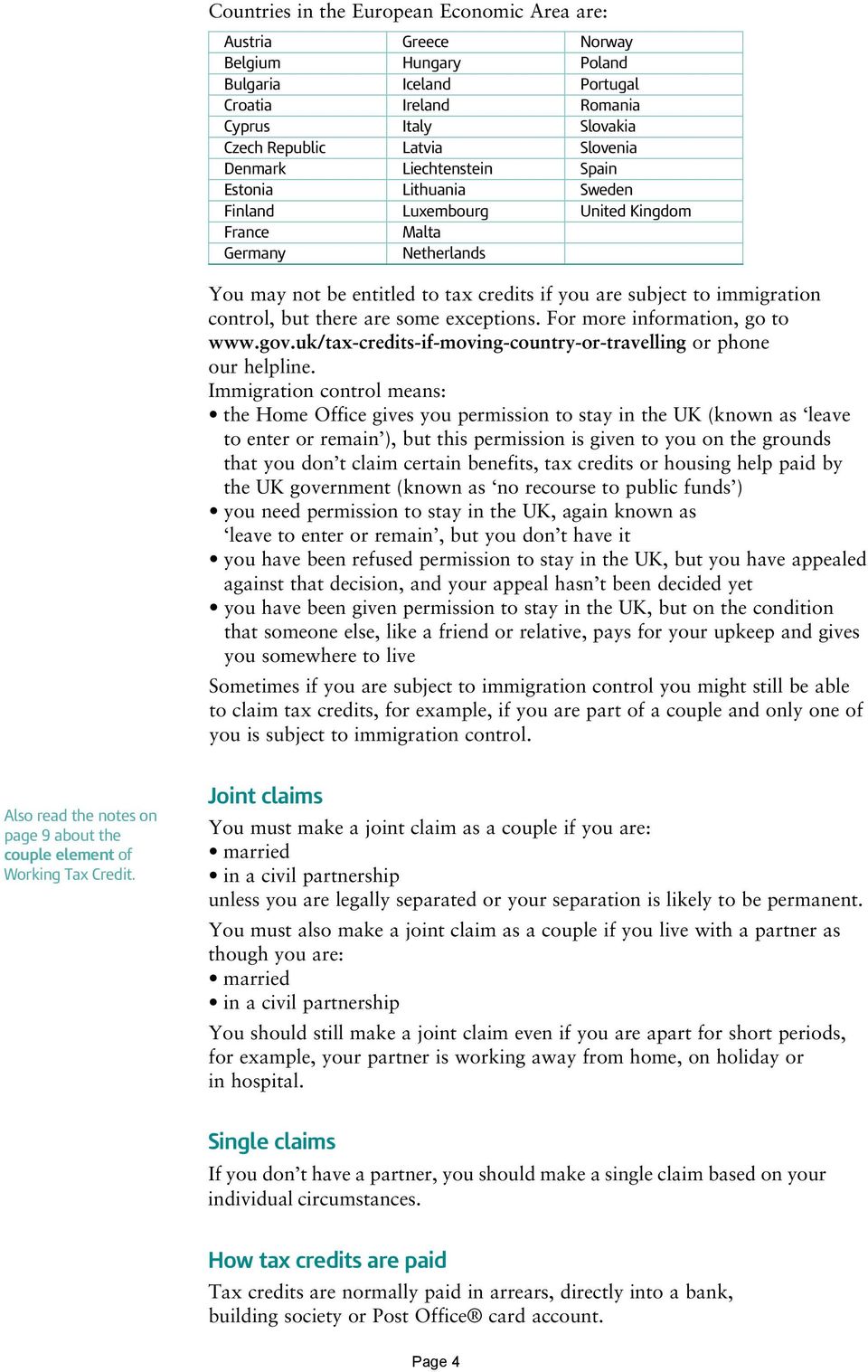
4 Countries in the European Economic Area are: Austria Greece Norway Belgium Hungary Poland Bulgaria Iceland Portugal Croatia Ireland Romania Cyprus Italy Slovakia Czech Republic Latvia Slovenia Denmark Liechtenstein Spain Estonia Lithuania Sweden Finland Luxembourg United Kingdom France Malta Germany Netherlands You may not be entitled to tax credits if you are subject to immigration control, but there are some exceptions. For more information, go to or phone our helpline. Immigration control means: the Home Office gives you permission to stay in the UK (known as leave to enter or remain ), but this permission is given to you on the grounds that you don t claim certain benefits, tax credits or housing help paid by the UK government (known as no recourse to public funds ) you need permission to stay in the UK, again known as leave to enter or remain, but you don t have it you have been refused permission to stay in the UK, but you have appealed against that decision, and your appeal hasn t been decided yet you have been given permission to stay in the UK, but on the condition that someone else, like a friend or relative, pays for your upkeep and gives you somewhere to live Sometimes if you are subject to immigration control you might still be able to claim tax credits, for example, if you are part of a couple and only one of you is subject to immigration control. Also read the notes on page 9 about the couple element of Working Tax Credit. Joint claims You must make a joint claim as a couple if you are: married in a civil partnership unless you are legally separated or your separation is likely to be permanent. You must also make a joint claim as a couple if you live with a partner as though you are: married in a civil partnership You should still make a joint claim even if you are apart for short periods, for example, your partner is working away from home, on holiday or in hospital. Single claims If you don t have a partner, you should make a single claim based on your individual circumstances. How tax credits are paid Tax credits are normally paid in arrears, directly into a bank, building society or Post Office card account. Page 4
5 If you already have an account, give the details on the claim form. If you don t have an account, any bank, building society or the Post Office can advise you on the accounts they offer. You can still apply for tax credits but you will need to give us the details of an account as soon as you have opened one. 2 Child Tax Credit You can be entitled to Child Tax Credit for a young person aged 16, 17, 18 or 19 who is in full-time, non-advanced education. Full-time, non-advanced education will usually be in a school or college but may also include education provided at home, if the child was receiving this education before their 16th birthday and the home schooling had previously been approved. By full-time, in this situation, we mean an average of more than 12 hours supervised study a week, during term time, not counting breaks for meals and homework. In England fulltime, non-advanced education could also take place other than at a school. Here fulltime would include a study programme that is delivered to a person in at least 540 hours in any 12 month period. It could also include traineeship, a condensed study programme in England which could last between 6 weeks and 6 months. We do not mean courses or education provided by an employer or as part of a job contract. Child Tax Credit Child Tax Credit is a payment to support families with children. You can claim it if you, or your partner, are responsible for at least one child or qualifying young person who usually lives with you. You don t have to be working to claim. If they also live with another family for part of the time, you and that other family should decide jointly who wants to claim for that child or qualifying young person. If you have both made a claim for Child Tax Credit for the same child or qualifying young person but cannot agree who should get tax credits for them we will have to decide which of you has the main responsibility. We will then pay the tax credits to the person who has the main responsibility. Deciding who has the main responsibility depends on the facts. The number of days the child or qualifying young person lives with you is important, but this is not the only factor to consider. If you are unsure what to look at, you should phone our helpline. If another family makes a claim for the same child or qualifying young person, you may be asked to provide details of why you think you have the main responsibility for them. We will consider these, together with the details provided by the other person. If you cannot agree between yourselves who should claim for that child or qualifying young person, we will decide who has the main responsibility for them. If you do not agree with our decision, you can ask us to look at it again. We call this mandatory reconsideration. Our leaflet WTC/AP, What to do if you think your Child Tax Credit or Working Tax Credit is wrong contains more information on this. For a copy of this leaflet, go to and search for WTC/AP. If you do not have access to the internet, phone the Tax Credit Helpline on for more information. You do not have to be working to claim Child Tax Credit. You can usually get Child Tax Credit for a child who lives with you until 31 August after their 16th birthday. After this you can still claim for a qualifying young person as long as they are under 20. This is providing they enrolled, accepted or started full-time non-advanced education or approved training before age 19. If the qualifying young person is aged 16 or 17, and has left full-time non-advanced education or approved training, you may be able to get Child Tax Credit for them for up to 20 weeks after they left. To qualify for these extra weeks, they need to have registered for work or training with: a careers service, Connexions, local authority support service or similar organisation (in Northern Ireland, the Department for Employment and Learning or an Education and Library Board) the Ministry of Defence, if they re waiting to join the armed forces any corresponding body in another member state Page 5

6 Examples of non-advanced education are: GCSEs, A levels and other general academic qualifications of a similar standard, for example, igcses, Pre-U and the International Baccalaureate NVQ level 1, 2 or 3 BTEC National Diploma, National Certificate and 1st Diploma Traineeships (England) National 4 and 5 (Scotland) SVQ level 1, 2 or 3 Scottish Group Awards This is not a complete list. About approved training You can be entitled to Child Tax Credit for a young person aged 16, 17, 18 or 19 who is in approved training which is not provided by a contract of employment. Training is approved if it is provided under one of the following programmes. In Scotland The Employability Fund In Wales Foundation Apprenticeships or Traineeships In Northern Ireland: United Youth Pilot Training for Success, including Programme Led Apprenticeships Pathways for Success (Pathways for Young People element) or The Collaboration and Innovation Programme To get these extra weeks, you must claim within 3 months of your child leaving education or training. You can t get Child Tax Credit for a child or qualifying young person if: they are aged 16 or over and are getting Income Support, Incapacity Benefit, income-based Jobseeker s Allowance, Employment and Support Allowance, tax credits or Universal Credit in their own right they are aged 16 or over, have left full-time non-advanced education or approved training, registered with a qualifying body, but then started paid work for 24 hours or more a week during the 20 week extension period they are serving a custodial sentence of more than 4 months imposed by a court Special rules apply where children are placed with you by the local authority and you are getting public funds for looking after them. For more information, phone the Tax Credit Helpline on You should also phone our helpline if a child or qualifying young person has come from abroad and is staying with you for educational purposes. How Child Tax Credit is made up Child Tax Credit contains several elements. The maximum value of each is listed below but the amount you get depends on your income. Element Annual amount for 2016 to 2017 ( ) Family element (one per family) 545 Child element (paid for each child or qualifying young person) 2,780 Disabled child element (paid in addition to the child element) 3,140 Severely disabled child element (paid in addition to the child and disability elements) 1,275 You may get a disabled child element for each child or qualifying young person you are responsible for if: Disability Living Allowance (DLA) or Personal Independence Payment is being paid for him or her the child or qualifying young person is certified as severely sight impaired or blind by a consultant ophthalmologist the child ceased to be certified as severely sight impaired or blind by a consultant ophthalmologist in the 28 weeks before the date of claim You may get a severely disabled child element for each child or qualifying young person you are responsible for if they are paid either: DLA (highest rate care component) enhanced daily living component of Personal Independence Payment Armed Forces Independence Payment Page 6

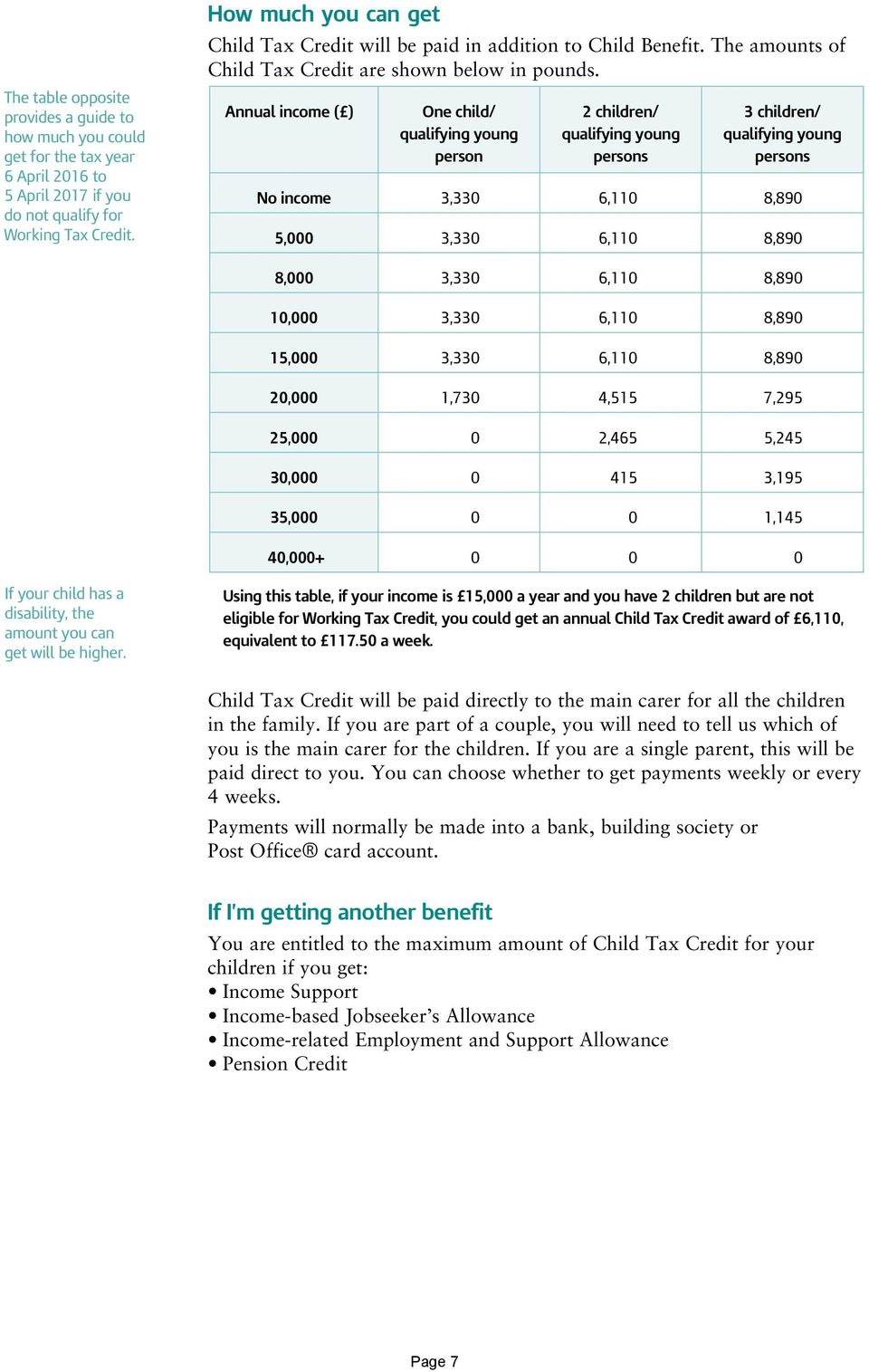
7 The table opposite provides a guide to how much you could get for the tax year 6 April 2016 to 5 April 2017 if you do not qualify for Working Tax Credit. How much you can get Child Tax Credit will be paid in addition to Child Benefit. The amounts of Child Tax Credit are shown below in pounds. Annual income ( ) One child/ qualifying young person 2 children/ qualifying young persons 3 children/ qualifying young persons No income 3,330 6,110 8,890 5,000 3,330 6,110 8,890 8,000 3,330 6,110 8,890 10,000 3,330 6,110 8,890 15,000 3,330 6,110 8,890 20,000 1,730 4,515 7,295 25, ,465 5,245 30, ,195 35, ,145 40, If your child has a disability, the amount you can get will be higher. Using this table, if your income is 15,000 a year and you have 2 children but are not eligible for Working Tax Credit, you could get an annual Child Tax Credit award of 6,110, equivalent to a week. Child Tax Credit will be paid directly to the main carer for all the children in the family. If you are part of a couple, you will need to tell us which of you is the main carer for the children. If you are a single parent, this will be paid direct to you. You can choose whether to get payments weekly or every 4 weeks. Payments will normally be made into a bank, building society or Post Office card account. If I m getting another benefit You are entitled to the maximum amount of Child Tax Credit for your children if you get: Income Support Income-based Jobseeker s Allowance Income-related Employment and Support Allowance Pension Credit Page 7
8 3 Working Tax Credit Working Tax Credit Working Tax Credit is for working people on a low income. You can be employed or self-employed, and you don t have to have children to claim. In all cases you have to be either: working (whether in employment or self-employment) when you make your claim starting paid work within 7 days of making your claim You may get more if you have a disability or are responsible for children and have childcare costs. Working Tax Credit is paid directly to the person who is working. The childcare element of Working Tax Credit is paid directly to the main carer of the child or children along with Child Tax Credit. How Working Tax Credit is made up Working Tax Credit contains several elements, including additional amounts for: working people with a disability people with a severe disability the costs of registered or approved childcare The maximum value of each element is listed below, but the amount you get depends on your income. Element Annual amount for 2016 to 2017 ( ) Basic element (one per single person or couple) 1,960 Couple element# (paid in addition to basic element but only one couple element allowed per couple) 2,010 Lone parent element (paid in addition to basic element for single customers who are responsible for a child or qualifying young person) 30-hour element** (paid in addition to other elements but only one 30-hour element allowed per couple) 2, Disability element* (paid in addition to other elements) 2,970 Severe disability element* (paid in addition to other elements) 1,275 Childcare element, maximum eligible cost for families with childcare for one child 175 a week Childcare element, maximum eligible cost for families with childcare for 2 or more children 300 a week Percentage of eligible childcare costs covered 70% */**/# read Notes on the following page Page 8

9 Notes * If the claim is a joint claim and you are both entitled to any of these elements, the award will include 2 elements per couple. # If you are in a couple and one of you is subject to immigration control, and you re not claiming for any children, you won t normally be able to get the couple element. But you still need to make a joint claim. ** The 30-hour element is available to those working 30 hours or more per week. Also see pages 12 to 15 about the disability elements. Working hours You usually need to be working a minimum number of hours a week to claim Working Tax Credit. If you are responsible for a child or qualifying young person and you are not part of a couple, you can claim Working Tax Credit if you: are aged 16 or over work at least 16 hours a week If you are responsible for a child or qualifying young person and you are part of a couple, you can claim Working Tax Credit if you are both aged 16 or over and: you work at least 24 hours a week between you, with one partner working at least 16 hours a week one partner works at least 16 hours a week and qualifies for the disability element of Working Tax Credit one partner works at least 16 hours a week and is aged 60 or over one partner works at least 16 hours a week and the other partner can t work because they are incapacitated (getting certain benefits because of a disability or ill health) an in-patient in hospital in prison either on remand or serving a custodial sentence entitled to Carer s Allowance If you are not responsible for a child or qualifying young person you can claim Working Tax Credit if you or your partner, if you have one, are: aged 25 or over and work at least 30 hours a week aged 16 or over, work at least 16 hours a week and qualify for the disability element of Working Tax Credit aged over 60 and work at least 16 hours a week If you are part of a couple with children, you are eligible for the 30-hour element if you jointly work at least 30 hours a week. This is providing one of you works at least 16 hours. Couples without children cannot add their hours together to qualify for the 30-hour element. You must expect the work to: continue for at least 4 weeks after you have made the claim be paid, so for example, working as a volunteer where you are not paid does not normally count You can still claim Working Tax Credit if you work at a school or college and don t work during school or college holidays. For more information on how to work out your hours, go to or for self-employed customers, go to and search the HMRC manuals for the claimant compliance manual, section CCM6755. If you are a foster carer the hours you work as a foster carer may count for tax credits if you are paid by your local authority. If foster caring is your main source of income or your main job you may get Working Tax Credit. Page 9

10 Limitations to entitlement Entitlement to Working Tax Credit is deliberately wide ranging but some restrictions do apply. Working Tax Credit may not be available to those who are: engaged by a charitable organisation, or are volunteers, and get only expenses payments working for a local authority, health authority, charitable or voluntary organisation caring for someone who is not a member of their household and where the only payment they get is covered by the Rent-a-Room scheme engaged on a scheme for which a training allowance is being paid unless the training allowance is taxable as part of their employed or self-employed income participating in the Intensive Activity Period or Preparation for Employment Programme, unless the payments they get are taxable as part of their employed or self-employed income engaged in an activity where a sports award has been made participating in an Employment Zone programme unless they only get disregarded discretionary payments or a training premium serving a custodial sentence or remanded in custody and are engaged in work while serving the sentence or remanded in custody students only doing work as part of their course, as any grant or loan that is received is for maintenance and does not count as payment for work student nurses, as the NHS Bursary and other grants or loans received do not count as payment for work Maternity leave Most women get Statutory Maternity Pay (SMP) or Maternity Allowance (MA) for the first: 26 weeks of ordinary maternity leave 13 weeks of any additional maternity leave This can be followed by up to 13 weeks of unpaid leave. For the 26 weeks of ordinary maternity leave, and for the first 13 weeks of additional maternity leave, that is, for a total of 39 weeks, whether or not you are getting SMP or MA, you are still treated as being in work and able to claim Working Tax Credit. This is providing you and your partner, if you have one, worked the required number of hours applicable to your circumstances immediately before going on maternity leave. This also applies if you are self-employed. If you are a first-time mother, you can claim Working Tax Credit from the date of birth of your first child. This is providing you and your partner, if you have one, usually worked the required number of hours applicable to your circumstances, as a person responsible for a child, immediately before going on maternity leave (read Working hours on page 9). When the 39 weeks (this includes 26 weeks of ordinary maternity leave and 13 weeks additional maternity leave) are over, you continue to be eligible for Working Tax Credit if you begin work again at that point. Any further additional maternity leave does not count as being in work. You must tell us within one month if you do not go back to work after the 39 weeks. Page 10
11 Adoption leave or paternity leave If you adopt a child you may be eligible for Statutory Adoption Pay (SAP) for: the first 26 weeks of ordinary adoption leave the first 13 weeks of any additional adoption leave New parents may be eligible for 2 weeks ordinary paternity leave and be paid Ordinary Statutory Paternity Pay (OSPP) for those 2 weeks. From April 2011 new parents may be eligible for up to 26 weeks additional paternity leave and be paid Additional Statutory Paternity Pay (ASPP) if your partner has returned to work. If you are on ordinary adoption leave, ordinary or additional paternity leave, or on the first 13 weeks of any additional adoption leave, whether or not you are getting SAP, OSPP or ASPP, you will still count as being in work and able to claim Working Tax Credit. This is providing you and your partner, if you have one, worked the required number of hours applicable to your circumstances immediately before going on adoption or paternity leave. This also applies if you are self-employed (read Working hours on page 9). If you are a first-time parent, you can claim Working Tax Credit from the date of placement for adoption or birth of your first child. This is providing you and your partner, if you have one, worked the required number of hours applicable to your circumstances as a person responsible for a child immediately before your adoption or paternity leave began. When your time on: ordinary adoption leave ordinary or additional paternity leave the first 13 weeks of additional adoption leave is over, you continue to be eligible for Working Tax Credit if you begin working again at that point. Any further leave does not count as being in work. You must tell us within one month if you do not go back to work after this time. Shared Parental Leave You may be entitled to Shared Parental Leave (SPL) and Statutory Shared Parental Pay (ShPP) if: your baby is due on or after 5 April 2015 you adopt a child on or after 5 April 2015 You can start SPL if you re eligible and you or your partner end their maternity or adoption leave or pay early. The remaining leave will be available as SPL. The remaining pay may be available as ShPP. You can take SPL in up to 3 separate blocks. You can also share the leave with your partner if they re also eligible. Parents can choose how much of the SPL each of them will take. SPL and ShPP must be taken between the baby s birth and first birthday (or within one year of adoption). SPL and ShPP are only available in England, Scotland and Wales. If you re eligible and you or your partner end maternity or adoption leave and pay (or Maternity Allowance) early, then you can: take the rest of the 52 weeks of leave (up to a maximum of 50 weeks) as Shared Parental Leave (SPL) take the rest of the 39 weeks of pay (up to a maximum of 37 weeks) as Statutory Shared Parental Pay (ShPP) Page 11
12 A mother must take a minimum of 2 weeks maternity leave following the birth (4 if she works in a factory). For any period you or your partner are receiving Statutory Shared Parental Pay you are still treated as being in work and able to claim Working Tax Credit. This is providing you and your partner, if you have one, worked the required number of hours applicable to your circumstances immediately before going on Shared Parental Leave (SPL). This also applies if you are self-employed. When your time on SPL is over, you continue to be eligible for Working Tax Credit if you begin working again at that point. Any further leave does not count as being in work. You must tell us within one month if you do not go back to work after this time. Sick leave If you are off work for up to 28 weeks because of illness and are getting either: Statutory Sick Pay (SSP) short-term Incapacity Benefit at the lower rate Employment and Support Allowance Income Support paid on the grounds of incapacity for work National Insurance credits on the grounds of incapacity for work or limited capability for work then you will still count as being in work and be able to claim Working Tax Credit. This is providing you and your partner, if you have one, worked the required number of hours applicable to your circumstances immediately before you started getting any of these benefits. This also applies if you are self-employed (read Working hours on page 9). When the 28 weeks of sick leave are over you continue to be eligible for Working Tax Credit if you begin work again at that point. Any further sick leave does not count as being in work. You must tell us within one month if you do not go back to work after the 28 weeks. The disability element If you meet all of the following 3 conditions, you may be able to get the disability element of Working Tax Credit. If you are claiming as a couple and your partner also meets all 3 conditions, you may be able to get 2 disability elements. Condition 1: You usually work for 16 hours or more a week. Condition 2: You have a disability which puts you at a disadvantage in getting a job. Details of the disabilities which count to meet this condition are set out in the notes that go with the tax credits claim form. They relate to a wide range of things, for example: seeing hearing communicating with people getting around using your hands reaching with your arms mental disabilities exhaustion and pain Page 12

13 We may ask you to give us the name of a healthcare professional who can confirm how your disability affects you. For example, a doctor, a district or community nurse, or an occupational therapist. Condition 3: You currently get, or have been getting, a qualifying sickness or disability benefit. You will meet this condition if at least one of the following 4 descriptions applies to you, or if: you were entitled to the disability element of Working Tax Credit within the last 8 weeks you had this entitlement because you satisfied one of the descriptions in 2, 3 or 4 on the following pages 1 You are getting one of the following qualifying benefits: Attendance Allowance Disability Living Allowance, Personal Independence Payment or Armed Forces Independence Payment Industrial Injuries Disablement Benefit (with Constant Attendance Allowance for you) a vehicle provided under the Invalid Vehicle Scheme War Disablement Pension (with Constant Attendance Allowance or Mobility Supplement for you) 2 You have received a sickness or disability benefit for at least one day in the last 6 months. The benefits that count are: Employment and Support Allowance (ESA), where you have received this allowance for 28 weeks or more or you received Statutory Sick Pay (SSP) followed by ESA for a combined period of 28 weeks or more (see Note 1 below) Incapacity Benefit at the short-term higher rate or the long-term rate income-based Jobseeker s Allowance* Income Support* Housing Benefit* Severe Disablement Allowance * This must include a Disability Premium or a Higher Pensioner Premium for you. Note 1: The 28 weeks does not need to be a single continuous period. You can add together: any periods that you got Employment and Support Allowance (ESA), as long as they were no more than 12 weeks apart any periods that you got Statutory Sick Pay (SSP), as long as they were no more than 8 weeks apart any periods that you got SSP with periods that you got ESA, as long as they were no more than 12 weeks apart 3 You have been training for work for at least one day in the last 8 weeks. Training for work means attending government-run training such as that provided by the Work Programme in the UK, Work Based Learning for Adults in Wales, Training for Work in Scotland or a course that you attended for 16 hours or more a week to learn an occupational or vocational skill. Page 13
14 In the 8 weeks before you started training for work you must have been getting: Incapacity Benefit paid at the short-term higher rate or long-term rate Severe Disablement Allowance contribution-based ESA for 28 weeks or more Statutory Sick Pay (SSP) followed by contribution-based ESA for a combined period of 28 weeks or more (see Note 2) Note 2: The 28 weeks does not need to be a single continuous period. You can add together: any periods that you got contribution-based ESA, as long as they were no more than 12 weeks apart any periods that you got SSP, as long as they were no more than 8 weeks apart any periods that you got SSP with periods that you got contribution-based ESA, this is providing they were no more than 12 weeks apart and you met the contribution conditions for contribution-based ESA on the days that you got SSP 4 All of the following 4 points (4.1 to 4.4) apply to you. 4.1 You have been getting at least one of the benefits in box A or box B for 20 weeks or more (read Note 3 below), and you got this benefit within the last 8 weeks. A Statutory Sick Pay Occupational Sick Pay Incapacity Benefit at the short-term lower rate Income Support paid because of incapacity for work National Insurance credits awarded because of incapacity for work B Employment and Support Allowance National Insurance credits awarded on the grounds of limited capability for work Note 3: The 20 weeks does not need to be a single continuous period. You can add together: any separate periods that you got the benefits or credits in box A, as long as they were no longer than 8 weeks apart any separate periods that you got the benefits or credits in box B, as long as they were no longer than 12 weeks apart 4.2 Your disability is likely to last for at least 6 months or the rest of your life. 4.3 Your gross earnings (before tax and National Insurance contributions are taken off) are at least 20% less than they were before you had the disability. Page 14
15 4.4 Your gross earnings (before tax and National Insurance contributions are taken off) are at least 15 a week less than they were before you had the disability. For more information, go to and search for TC956. If you do not have access to the internet you can also get a copy by phoning the Tax Credit Helpline on The severe disability element If you or your partner (if you are claiming as a couple) get Disability Living Allowance (highest rate care component), enhanced daily living component of Personal Independence Payment, Armed Forces Independence Payment or Attendance Allowance (higher rate), you can get the severe disability element. You do not have to be working to qualify for the severe disability element as long as your partner does. If you both qualify, you will get 2 severe disability elements. Help with the costs of childcare You may be able to get more Working Tax Credit to help with the cost of registered or approved childcare. This is the childcare element of Working Tax Credit. The childcare element can help with up to 70% of your childcare costs, up to a maximum cost of 175 a week for one child and 300 a week for 2 or more children. This means that the childcare element is worth up to: a week (70% of 175) for families with one child a week (70% of 300) for families with 2 or more children The amount you get will depend on your income and will be paid directly to the main carer along with Child Tax Credit. To claim the childcare element you must be 16 or over. If you are a lone parent, you must work 16 hours a week or more. If you are in a couple, both of you must work 16 hours a week or more. Only one partner needs to work 16 hours a week or more if the other is: incapacitated an in-patient in hospital in prison either on remand or serving a custodial sentence entitled to Carer s Allowance Page 15

16 You will be treated as incapacitated if you get one of the following: Disability Living Allowance, Personal Independence Payment or Armed Forces Independence payment Attendance Allowance Severe Disablement Allowance Incapacity Benefit at the short-term higher rate or long-term rate Industrial Injuries Disablement Benefit (with Constant Attendance Allowance for you) War Disablement Pension (with Constant Attendance Allowance or mobility supplement for you) Housing Benefit with a disability premium or higher pensioner premium Council Tax Benefit with a disability premium or higher pensioner premium that has been in payment since 1 March 2013 and Working Tax Credit has been in continuous payment since 1 March 2013 a vehicle under the Invalid Vehicle Scheme contribution-based Employment and Support Allowance (ESA) if you got this allowance for 28 weeks or more Statutory Sick Pay (SSP) followed by contribution-based ESA for a combined period of 28 weeks or more The 28 weeks doesn t need to be a single continuous period. You can add together any periods that you got: contribution-based ESA as long as they were no more than 12 weeks apart SSP as long as they were no more than 8 weeks apart SSP with periods that you got contribution-based ESA, as long as they were no more than 12 weeks apart and you met the contribution conditions for contribution-based ESA on the days that you got SSP You can claim the childcare element for any child up to: the Saturday following 1 September after their 15th birthday the Saturday following 1 September after their 16th birthday if the child is certified as severely sight impaired or blind by a consultant ophthalmologist the child ceased to be certified as severely sight impaired or blind by a consultant ophthalmologist in the 28 weeks before the date of claim you get Disability Living Allowance or Personal Independence Payment for that child If you are on paid maternity, adoption or paternity leave and are still treated as being in work, you can claim the costs for registered or approved childcare you pay for: the child you have taken leave to look after any other children you are responsible for This will enable you to settle a new baby or child into childcare before returning to work. You can claim Working Tax Credit, including the childcare element from the birth or adoption of the child, as long as you (and your partner, if you have one) usually worked at least 16 or 24 hours a week, depending on your circumstances, before the maternity, adoption or paternity leave began (read Working hours on page 9). Please read page 29 about changes to your childcare. You must tell us about these changes as they may affect how much tax credits we pay you. Page 16
17 What we mean by registered or approved childcare In England To get help with childcare costs in England, the childcare you use must be provided by: a childcare provider, such as a childminder, playscheme, childcare club or nursery and they need to be registered in one of the following ways registered on the Ofsted Early Years Register (EYR) with either Ofsted or an Ofsted registered childminder agency if your child is under 5 years of age registered on the Ofsted compulsory part of General Childcare Register (GCR) with either Ofsted or an Ofsted registered childminder agency if your child is aged 5 to 7 registered on the Ofsted voluntary part of the GCR with either Ofsted or an Ofsted registered childminder agency if your child is aged 8 or over a nanny who provides care in the child s own home as long as they are registered with Ofsted an activity-based care, such as a sports club as long as the provider is registered with Ofsted a school, to a child aged 2, 3 or 4 years old, as long as both of the following apply it is provided under the direction of the school s proprietor (either the governing body or the person responsible for managing the school) it takes place on the school premises or other premises that may be inspected as part of an inspection of a school by Ofsted or by the equivalent inspection body appointed by the Secretary of State to inspect certain independent schools (for example, the Independent Schools Inspectorate, Bridge Schools Inspectorate or the Schools Inspection Service) a school, to a child aged between 5 and 15 years old (or 16 if disabled), if all of the following apply it is provided out of school hours it is provided under the direction of the school s proprietor (either the governing body or the person responsible for managing the school) the care is provided on the school premises or on other premises that may be inspected as part of an inspection of a school by Ofsted, or by the equivalent inspection body appointed by the Secretary of State to inspect certain independent schools an example of other premises could be a village hall used by the school for its childcare activities outside of school hours an approved foster carer registered with Ofsted but the childcare must be for a child who is not the carer s foster child a care worker or a nurse from a registered domiciliary care agency, looking after your child in your own home For more information about childcare in England, go to In Wales To get help with childcare costs in Wales, your childcare provider must be: registered with the Care and Social Services Inspectorate Wales a school that provides childcare outside of school hours and on the school premises Page 17

18 a local authority that provides childcare outside of school hours a care worker or nurse from an agency registered for providing care in the home under the Domiciliary Care Agencies (Wales) Regulations 2004, for example, a domiciliary care worker someone approved by the Approval of Childcare Providers (Wales) Scheme 2007 who provides childcare in the child s home, or if several children are being looked after, in one of the children s homes an approved foster carer but the childcare must be for a child who is not the carer s foster child and the foster carer must be registered with the Care and Social Services Inspectorate Wales if your child is under age 8 approved under the Approval of Child Care Providers (Wales) Scheme if the care is in your child s home and your child is under age 16 For more information about childcare in Wales, go to and under Topics select Children and young people then Childcare. In Scotland To get help with childcare costs in Scotland, your childcare provider must be: registered with Social Care and Social Work Improvement Scotland a childcare club registered with Social Care and Social Work Improvement Scotland to provide childcare outside of school hours a person from a registered childcare agency, sitter service or nanny agency providing childcare in your child s home You can also claim help with your childcare costs in Scotland if you use: an approved foster carer a kinship carer but the childcare must be for a child who is not the carer s foster or kinship child. The foster carer or kinship carer must be registered with Social Care and Social Work Improvement Scotland as a childminder or a day care provider. For more information about childcare in Scotland, go to In Northern Ireland To get help with childcare costs in Northern Ireland, your childcare provider must be: registered with a Health and Social Services Trust a school that provides childcare outside of school hours, on the school premises a person approved under the Approval of Home Child Care Providers (Northern Ireland) 2006 Scheme providing childcare in the child s home an Education and Library Board that provides childcare outside of school hours an approved foster carer, but the childcare must be for a child who is not the carer s foster child, and the foster carer must be registered with a Health and Social Services Trust if your child is under age 12 approved under the Approval of Home Child Care Providers (Northern Ireland) 2006 Scheme if the care is in your child s home and your child is under age 16 For more information about childcare in Northern Ireland contact the Early Years Team in your local Health and Social Care Trust. Go to Page 18

19 Crown servants working abroad If you are a civil servant or a member of the armed forces posted overseas, and your child has gone with you, you may get help with childcare costs if your childcare provider is approved by a Ministry of Defence accreditation scheme abroad. A relative could be your child s: parent grandparent aunt or uncle brother or sister step-parent A person who has entered into a civil partnership is recognised as being able to provide childcare as a parent, grandparent, aunt or uncle, or step-parent. If you have any questions about the meaning of relative, please phone the Tax Credit Helpline. Childcare provided by a relative You can t get the childcare element of Working Tax Credit if your childcare is provided by a relative even if they are registered or approved. The exception to this is when your child is cared for by a relative who is: a registered childminder who cares for your child, away from your child s own home a childcare provider approved under a Home Child Care Providers Scheme in Wales or Northern Ireland, who cares for your child away from your child s own home. They must also care for at least one other child who is not related to them The relationship can be by blood, half-blood, marriage, civil partnership or affinity. Affinity means a person with a strong relationship to the child, for example, someone in a parental position regarding their partner s children, and includes step-parents. You cannot claim the costs of childcare if it is not registered or approved. Your provider should be able to tell you whether or not they are registered or approved. Some providers have to renew their registration each year. Ask to see their registration or approval certificate to check that it is still valid. In order to claim the childcare element you must work out your average weekly childcare costs. For more information about how to do this, read our leaflet WTC5, Help with the costs of childcare. Go to and search for WTC5. If you do not have access to the internet you can also get a copy by phoning the Tax Credit Helpline on Page 19

20 How much Working Tax Credit you can get Working Tax Credit is paid in addition to any Child Tax Credit you may be entitled to. Some people will be paid both Child Tax Credit and Working Tax Credit. The amount of your Working Tax Credit award is based on your circumstances (for example, how many hours you work or whether you are disabled) and your income. The table below provides a guide to how much (in pounds) you could get for the tax year 2016 to Annual income ( ) Single person aged 25 or over, working 30 hours or more a week Couple (working adults aged 25 or over) working 30 hours or more a week 11,232* 795 2,810 12, ,495 13, ,085 14, ,675 15, ,265 16, , , , * Someone aged 25 or over, working 30 hours a week on National Living Wage (based on April 2016 rates) would earn 11,232 a year. Page 20

21 The table below shows how much tax credits (in pounds) you could get for the tax year 2016 to 2017 if you are in work and responsible for at least one child or qualifying young person. Annual income ( ) One child/ qualifying young person 2 children/ qualifying young persons 3 children/ qualifying young persons 5,990* 7,300 10,080 12,864 11,232** 6,135 8,920 11,700 15,000 4,595 7,375 10,155 20,000 2,545 5,325 8,105 25, ,275 6,055 30, ,225 4,005 35, ,955 40, *Those with incomes of 5,990 a year are assumed to work part-time (working between 16 and 29 hours a week). **In families with an income of 11,232 a year or more, at least one adult is assumed to be working 30 or more hours a week (consistent with a minimum adult living wage of 7.20 based on April 2016 rates for those aged 25 and over). Note: If you have a child with a disability you may be entitled to more. Using these tables, for example, if you are claiming as a lone parent or a couple with 2 children and working 30 hours or more a week, with an income of 11,230 a year, you could get an annual tax credits award of 8,920. The maximum amounts may be higher if you are entitled to the disability or childcare elements of Working Tax Credit. Page 21
22 4 Income and capital The amount of tax credits you will get depends on your circumstances, for example: how many children or qualifying young persons you have how many hours you work each week whether you are disabled how much you pay for registered childcare It also depends on the level of your income. If you are part of a couple, it depends on your joint income. As Child Tax Credit and Working Tax Credit are annual tax credits, we will look at your income for a tax year to work out your award, usually the last complete tax year before the year of the tax credits claim. What income you will have to report in your claim For tax credits, we generally take into account your earnings figure that is submitted for Income Tax purposes (this is your income figure before Income Tax and National Insurance contributions have been deducted). However, there are important exceptions to this rule, some of which are outlined below. For help on how to work out your income if you are employed or self-employed, go to If you make contributions from your earnings to buy shares in your employers company under Share Incentive Plan, then those contributions must be added back to your gross pay. However, contributions to any HM Revenue and Customs registered pension scheme (such as a personal pension plan or retirement annuity) and payments under the Gift Aid scheme should be deducted when you work out your income for a tax credits claim. If you made personal pension or retirement annuity contributions, Gift Aid payments or a trading loss, please read TC825, Working sheet for tax credits relief for Gift Aid donations, pension contributions and trading losses. Go to and search for TC825. If you do not have access to the internet you can also get a copy by phoning the Tax Credit Helpline on This will help you to work out the income to enter in your tax credits claim. You should not normally deduct any contributions to an occupational pension scheme or payments under a payroll giving or Give As You Earn scheme. This is because your employer will have already deducted these payments from your gross pay. We take the full amount of: salary and wages, which include commission bonuses tips gratuities profit-related pay holiday pay statutory Sick Pay (SSP) some benefits in kind which may be provided by your employer (for example, car and car fuel, allowances for the use of your own car on business, vouchers and credit tokens) into account when we work out how much tax credits to pay. Page 22
23 For more information about what types of income count for tax credits purposes, phone the Tax Credit Helpline on Although Statutory Maternity Pay (SMP), Statutory Paternity Pay (SPP) and Statutory Adoption Pay (SAP) are taxable, you should take off up to 100 for each week of payment from your income for tax credits purposes. For example, if you only got 80 Statutory Maternity Pay in any week, you should only deduct 80 for each week, from your income. You should include any earnings from employment outside the UK, for example: taxable profits from self-employment, including any from outside the UK the following taxable social security benefits Carer s Allowance Bereavement Allowance contribution-based Jobseeker s Allowance contribution-based Employment and Support Allowance Income Support paid to a couple and the person getting it was on strike Incapacity Benefit paid after the first 28 weeks of incapacity (at the short-term higher and long-term rates, including any child dependency increases paid with these benefits) But not benefits which are not taxable, such as Child Benefit Attendance Allowance Disability Living Allowance or Personal Independence Payment Council Tax Benefit or Housing Benefit income-related Employment and Support Allowance income-based Jobseeker s Allowance is taxable but is not included as income for tax credits an Adult Dependants Grant paid to students with a spouse, unmarried partner or a dependent adult and in Scotland, any Childs Dependant s Grant miscellaneous income that is taxable such as copyright royalties paid to someone who is not a professional author or composer, which is taxable under Part 5 of the Income Tax (Trading and Other Income) Act 2005 We also take into account: State Retirement Pensions (including Widowed Parent s Allowance, Widowed Mother s Allowance, Widow s Pension and Industrial Death Benefit) and occupational or personal pensions but not war pensions, whether paid on grounds of wounds or disability or paid to widows most income from savings and investments (for instance, interest from bank and building society accounts, dividends from UK companies, payments from trusts or the estate of a deceased person in administration) but not income from certain tax exempt investments, such as, Individual Savings Accounts (ISAs), Personal Equity Plans (PEPs) or non-taxable National Savings products rental income from property but not income which is exempt from Income Tax under the Rent a Room scheme (briefly, if you let furnished accommodation in your own home for up to 7,500 a year) foreign income, for example, from investments or property overseas and social security payments from overseas governments, before any overseas tax was taken off but deducting any bank charges or commission when converting foreign currency to pounds we want to know about all foreign income, whether or not it was received and taxed in the UK, unless you were unable to send the income to the UK because of exchange controls in the country of origin but you should deduct the first 300 from the combined total (read Note 1 on page 24). Page 23
24 Note 1: Apart from income from employment, self-employment, taxable social security benefits, student dependant s grant and miscellaneous income, you only need to report other income if it is more than 300 a year in total. If it is, you only need to enter the amount over 300 in the tax credits claim form. If you make a claim as a couple, the 300 limit applies to your joint income, not to each of you separately. About capital We will not normally take capital (that is, deposits in current and savings accounts at banks and building societies, most lump sum payments and the value of property, shares and other investments) into account when we work out your entitlement to tax credits. However, in some cases where the Income Tax rules treat capital as income, and tax it as such, you will be expected to include the taxable amount as income in your tax credits claim. This can happen if, for example, you hold shares in a UK company and the company gives you a stock dividend (new shares) instead of a cash dividend. This is part of what we call notional income. What notional income means Besides capital that is treated as income under the Income Tax rules, notional income also includes income that you can be treated as having which you may not in fact have, such as: trust income payable to one person but which the Income Tax rules treat as the income of another person the tax credits rules also treat the income as belonging to that other person (for example, investment income of a minor child where trust funds have been provided by a parent and the amount exceeds 100) income you may have deprived yourself of for the purpose of getting a tax credit or more tax credits income that would be available to you if you applied for it, for example, a social security benefit. There are some exceptions, for example, a deferred state or personal pension or retirement annuity compensation for personal injury if you work or provide a service for free or less than the going rate, you are treated as getting the going rate for the job if the person you are working for or to whom you are providing the service has the means to pay this does not apply if you are working as a volunteer (for example, helping out in a charity shop or a Citizens Advice Bureau) or you are on an employment or training programme Tax credits and maintenance payments We don t take maintenance payments, such as child support or payments under a divorce settlement into account. You will be able to have full use of any maintenance that you get in addition to your tax credits. Child Tax Credit and student loans or grants We don t take student loans or grants to meet the cost of tuition fees, childcare or the Parent s Learning Allowance into account. But you should tell us if you get an Adult Dependant s Grant for a spouse, unmarried partner or a dependant adult and in Scotland, any Childs Dependant s Grant. Page 24
25 If you are a student nurse or a health profession trainee and you get a bursary under the NHS Bursary Scheme, you do not need to tell us about these payments in your claim. When you have finished your studies and start work, repayments of student loans are not deductible from income in tax credits claims. Where you can find details of your income If you were employed in the tax year 2015 to 2016, details of your earnings will be shown on: the P60 tax certificate given to you by your employer after the end of that tax year, or a P45 if you left before 5 April 2016 your monthly pay slips the P9D or P11D certificates (if you got relevant benefits in kind) given to you by your employer If you were self-employed in the tax year 2015 to 2016, details of your earnings will be shown on your Self Assessment tax return. If your tax credits award is renewed automatically and you are in PAYE employment, we will have used income figures provided to us by your employer. It is important that you check that these figures are the correct figures for tax credits. Your renewal notes will help. Please contact us if you think they are not and tell us why. For more information, or if you have not sent us a tax return, please see the notes that come with the claim form. Benefits in kind from your employer Your employer will give you the details you need on a form P9D or P11D. The notes with the tax credits claim form will tell you exactly which benefits to tell us about. If your employer has payrolled these benefits you will need to deduct the total cash equivalent from the total of your P60 and P45 income. If you are self-employed, you should tell us the taxable profit calculated in your Self Assessment tax return for 2015 to However, if you are a farmer, market gardener or a creator of literary or artistic works, averaging relief for fluctuating profits is not allowed in tax credits claims; further details are provided in the notes (page 15) that go with the tax credits claim form (TC600). If you have not yet sent us your Self Assessment tax return for 2015 to 2016, you must estimate your profits for that year. If your business made a loss in that tax year, for tax credits purposes you can set that loss against: other income you may have for that year any income of your spouse or civil partner for that year any income of your personal partner (but not your business partner) for that year If this does not use up the entire loss, the balance (that is, the unused part of the loss after deducting the amounts set against other income of that year) may be carried forward to set against the profits of the same business in a future tax year. For example, if your business made a loss in 2014 to 2015 and there is some loss remaining after the deduction from other income of 2014 to 2015, the unused part of the 2014 to 2015 loss may be brought forward and deducted from the profits of the same business in the tax year 2015 to Page 25
26 If you made a trading loss, please read TC825, Working sheet for tax credits relief for Gift Aid donations, pension contributions and trading losses. Go to and search for TC825. If you do not have access to the internet you can also get a copy by phoning the Tax Credit Helpline on This will help you to work out the income to enter in your tax credits claim. If you got taxable social security benefits in 2015 to 2016, the Department for Work and Pensions (in Northern Ireland, the Department for Social Development) should have sent you a record of the taxable amount of benefit. If you got other types of income, you should refer to the statements, passbooks or to tax deduction certificates provided by the payer of the income and which you should be keeping for tax purposes. 5 How your award is worked out You can see some examples of how we calculate tax credits awards on pages 36 to 43. The amount of tax credits which you and your partner, if you have one, will get is worked out by dividing (separately) each of the elements of Child Tax Credit and Working Tax Credit which your family is entitled to by the number of days in the tax year and rounding up to the nearest penny to give a daily rate. These daily rates are then multiplied by the number of days in the relevant period and added together to give your family s maximum entitlement. We then look at your income, and your partner s if you have one, to work out whether you will get tax credits in full or at a reduced rate. We will send you an award notice which tells you how much tax credits you will get and when payments will start. If you or your partner, if you have one, get Income Support, income-based Jobseeker s Allowance, income-related Employment and Support Allowance or Pension Credit you will automatically get the full amount of tax credits that you qualify for. If you are entitled to Child Tax Credit only, you will get the full amount of that tax credit until your annual income reaches 16,105. If you are entitled to Working Tax Credit, whether on its own or in addition to Child Tax Credit, and your family s annual income is below 6,420, you will get the maximum amount of all the elements that you qualify for. If your income is over that threshold, the maximum amount is reduced by 41 pence for every pound of income (41%) over the threshold (rounded down to the nearest penny). If you have income over the threshold of 6,420, your maximum amount will be reduced in the following order: Working Tax Credit apart from the childcare element the childcare element of Working Tax Credit the child elements of Child Tax Credit the family element of Child Tax Credit Page 26
27 What happens once you are getting tax credits Tax credits awards will initially be based on your current circumstances and your income for the previous tax year. If your circumstances do not change and there are no significant changes in your income during the year, the initial award will run until the end of the tax year (5 April). At the end of the tax year, we will send you a further notice that tells you the information we hold about your claim, in particular the circumstances and income upon which we based the award and the amount of tax credits paid over the year. You should check this notice carefully. You must then: confirm that the details are correct correct the details if there are changes that you haven t previously told us about You also need to tell us about your income for the year just ended. You can do this by: going online at phoning the Tax Credit Helpline on completing the notice and returning it in the envelope provided When we have all the details, we will: check whether the award we paid you for the year just ended was right work out your award for the following year, as the notice will also act as your claim for the next award If your circumstances and income stayed the same throughout the year which has just ended, or if your income in that year was not more than 2,500 higher than the year before that, you should have got the right amount of tax credits for that year. If your income goes down by 2,500 or less throughout the year, the amounts of tax credits you get will not be affected. Note: As your current year payments are provisional and based on your previous years income, you should let us know of any changes to your income as they happen. Waiting until you make your renewal declaration at the end of the year will lead to an overpayment in some cases which you may be asked to repay. If you only get the family element of Child Tax Credit, or have been getting the full amount of Child Tax Credit you qualify for because you have been getting Income Support, income-based Jobseeker s Allowance, income-related Employment and Support Allowance or Pension Credit for the whole of the period of your award, you don t have to do anything if your income remains within a certain range specified in the end-of-year notice, provided your circumstances have not changed. The end-of-year notice will tell you whether you need to return it or not. If you do not have to return the notice, you will be treated as having automatically made a new claim for the next award. Page 27
28 You can tell us about any of these changes by: going online at managetaxcredits or if you do not have internet acress by: phoning the Tax Credit Helpline on writing to us at Tax Credit Office (Change of Circumstances) PRESTON PR1 4AT What happens if your circumstances or income change There are some changes that could affect the level of your tax credits award. They include: changes in the adults in the household, for example, if you and your partner stop living together or if you have been living on your own and you begin living with someone as a couple changes affecting the elements of tax credits for which you are eligible, such as the birth or death of a child a child or qualifying young person leaving the household or stopping full-time non-advanced education or approved training stopping using registered or approved childcare changing your usual weekly working hours moving abroad you or your partner begin to qualify for a disability element of Working Tax Credit you or your partner no longer have a disability which puts you at a disadvantage in getting a job a child you are responsible for is certified as severely sight impaired or blind by a consultant ophthalmologist Disability Living Allowance or Personal Independence Payment starts or stops being paid for a child you are responsible for the highest rate care component of Disability Living Allowance or the enhanced daily living component of Personal Independence Payment starts or stops being paid for you, your partner, or a child you are responsible for the higher rate of Attendance Allowance starts or stops being paid for you or your partner changes in income between the previous year and the current year You should keep: a record of any changes in circumstances your new award notice after you have told us about a change of circumstances Changes in circumstances You need to tell us about any changes in your circumstances. If you don t, you may be overpaid tax credits or you may not get the full amount you are entitled to. You may also have to pay a penalty of up to 300. If a change increases your tax credits, the increase can only be backdated by up to one month. For example, if you had a baby on 12 June but you didn t report this until 12 October, your tax credits would only increase from 12 September. The child element for a young person aged 16, 18 or 19 will automatically stop each year unless you tell us that they are staying in full-time non-advanced education or approved training. The child element for a young person aged 17 staying in full-time non-advanced education or approved training will automatically continue. You must tell us within one month if you made a: single claim but you are now married, in a civil partnership, or living with someone as if you are married or in a civil partnership joint claim (as part of a couple) but are now separated, or one of you dies If any of these changes happen you will need to make a new claim. Page 28
29 You must also tell us about the following within one month if: you or your partner leave the UK permanently or go abroad for more than 8 weeks (12 weeks if you go or remain abroad because you are ill or because a member of your family is ill or has died) you and your partner lose your right to reside in the UK for more information, go to you or your partner stop working you or your partner stop working more than the relevant minimum of 16 or 30 hours a week (for couples with children 24 hours a week is the combined minimum and one of you must work at least 16 hours a week) you are laid off you have been on strike for more than 10 days You must also tell us about the following within one month if: a child or qualifying young person leaves the family and moves to live with someone else this includes a child or qualifying young person who has been taken into care or fostered to another family sentenced to custody or detention for a period of more than 4 months a child or qualifying young person dies a qualifying young person leaves full-time non-advanced education or approved training before age 20 years or stops being registered with a careers service, Connexions, local authority support service, Ministry of Defence or similar organisation a qualifying young person starts to have their training provided under a contract of employment a qualifying young person starts to get Income Support, Incapacity Benefit, income-based Jobseeker s Allowance, Employment and Support Allowance, Child Tax Credit, Working Tax Credit or Universal Credit in their own right you told us that your child was continuing in full-time non-advanced education or approved training after 31 August following their 16th birthday, but then they did not do so If you claimed childcare costs you must tell us if: your average weekly costs go down by 10 or more (phone the helpline to find out how to calculate your new average weekly costs) your costs go down to zero your childcare provider stops being registered or approved you start getting help with your childcare from a local authority or any government department such as early years education grant for 3 to 4 year olds you start getting help with your childcare costs through your employer, such as childcare vouchers or childcare vouchers in return for a reduction in your salary (known as salary sacrifice) you no longer qualify for childcare costs as a couple because one of you is now working less than 16 hours a week your child has reached age 15 (or 16 if disabled) and you can no longer qualify for childcare support in tax credits for that child You should tell us if you change to a different registered or approved childcare provider. We ll need to know your new provider s registration or approval number. The amount of tax credits you get won t usually be affected if all your other circumstances stay the same. We may need to contact your childcare provider from time to time to make checks. If we are unable to contact your provider, we may stop paying you the extra Working Tax Credit for your childcare. Page 29
30 Changes to your working hours You must tell us within one month if: you stop working the relevant minimum of 16 or 30 hours a week (for couples with children, 24 hours a week is the combined minimum, with at least one of you working 16 hours a week) you work at least 30 hours a week and your hours drop to less than 30 (for couples with children, your joint working hours count towards the 30 hours) you stop work your employer lays you off You may get Working Tax Credit for 4 weeks from the change if: your working hours drop to less than the relevant minimum of 16 or 30 hours a week (for couples with children 24 hours is the combined minimum and one of you must work at least 16 hours a week) you stop work completely If your employer lays you off and tells you it is temporary, you are treated as though you are still working for up to 4 weeks from the date your employer lays you off. If there is no work for you after that, you are treated as not working. You will be entitled to a run on payment of Working Tax Credit for a further 4 weeks before your Working Tax Credit stops. You can only get Working Tax Credit for up to 8 weeks after your employer lays you off. Example 1 John Smith is laid off for 4 weeks on 8 January. His employer tells him that he can expect to go back to work on 5 February. John phones the Tax Credit Helpline to tell them about this. He also tells them when he expects to go back to work. On 5 February he goes into work. His employer has no work for John and doesn t know if he will in the future. John phones the Tax Credit Helpline to tell them the layoff is now indefinite. He will continue to get Working Tax Credit up to 5 March. If your employer lays you off but cannot tell you if you will go back to work or you will lose your job If during the first 4 weeks you are laid off your employer says: you are now laid off indefinitely you have lost your job you will be treated as if you have stopped work from the day they tell you. You will still get Working Tax Credit for 4 more weeks from that date. Example 2 Anne Jones is laid off on 8 January. Her employer tells her she can expect to go back to work on 1 February. Anne phones the Tax Credit Helpline and tells them the layoff is temporary. On 26 January her employer tells her that they do not know if she will be able to go back to work at all. Anne phones the Tax Credit Helpline to tell them the layoff is now indefinite. Anne is treated as though she has stopped work. She will get Working Tax Credit up to 23 February (4 weeks from 26 January). Example 3 On 8 January Anita Roberts is told that her employer has to lay her off indefinitely. Her employer does not know if she will be able to go back to work at all. Anita phones the Tax Credit Helpline to tell them she has been laid off indefinitely. Anita will get Working Tax Credit up to 5 February. Page 30
31 You need to tell us as soon as possible about any changes that may increase your tax credits award such as: a new child in the family starting to use registered or approved childcare your average weekly childcare costs increase by 10 a week or more (phone the helpline to find out how to calculate your new average weekly costs) an increase in your working hours (or those of your partner) so you can meet the working hours conditions for Working Tax Credit, read page 9 To get any increase backdated from the date your circumstances change, you must tell us within one month. Changes in income Your award will initially be based on your income for the previous tax year. If your income throughout the current tax year rises by less than 2,500, it will not affect your award and we will still base it on your income for the previous year. So for the current year, you will get the benefit of a rise in income up to that amount without it reducing your tax credits award. The increased level of income is not taken into account until the next year, but you should tell us about the increase on or before 6 April to avoid an overpayment of your provisional payments. If your income goes down by 2,500 or less throughout the year, the amount of tax credits you get will not be affected. If your income in the current year is lower than last year s income by more than 2,500, we will ignore the first 2,500 drop. For example, if your income last year was 20,000 and this year you expect it to be 15,000 we will base your tax credits award on an income of 17,500. In this case, you may be due more tax credits. You can: tell us about this drop during the year we will then adjust your payments to make sure you get the right amount in-year wait until we finalise your award at the end of the year and we will pay you any extra tax credits you are due in a lump sum We will check at the end of the year what your income was. If you tell us during the year about a fall in your income and it falls by less than you expected, you will have to pay back any tax credits we have overpaid. If your income increases by more than 2,500, then we will base your final award on your current year s income after ignoring the first 2,500 of the increase. We will, however, use the full amount of income when setting your award for the following year. What happens if there are changes in your tax credits award You should tell us immediately if you think that your income will rise by more than 2,500 in the current tax year. This will help you to avoid building up an overpayment of tax credits which you would have to pay back after we finalise the award at the end of the year. If your tax credits award goes up because of a change in circumstances which increases your entitlement, and if you have told us about this during the year, we will: pay any extra tax credits for up to one month before the adjustment was made in a lump sum increase your award for the rest of the year Page 31
32 If your income has fallen by more than 2,500 and you tell us about it during the year, we will pay you any extra tax credits due from the date you tell us about it. If, at the end of the tax year, we find that you were due more tax credits than you were in fact paid because of a change in circumstances or income, we will pay the extra amount as a lump sum. You should tell us immediately if you think that your income will go down in the current tax year. Your award may not go up this year, but you may get more next year. If your tax credits award goes down because of a change in circumstances which reduces your entitlement, or an increase of more than 2,500 in your income that you have told us about during the year, we will reduce your tax credits award for the whole period so that we pay you the right amount for the year overall. Alternatively, if we have paid you too much in this tax year (or a previous one) we will automatically reduce your ongoing payments until you pay back the overpaid money. The amount we reduce your payments by depends on whether you get tax credits in full, or at a reduced rate. We make our decision based on the information you gave us about your income. The higher your income, the more your tax credits payments are reduced. Check your award notice to find out if you get tax credits at a reduced rate. If you do, it s shown as reduction due to your income in part 2 How we work out your tax credits. For those entitled to the maximum tax credits with no reduction due to income, the most we ll take back is 10% of your ongoing payments. If you are getting Child Tax Benefit or Working Tax Credit below the maximum and your total household income is 20,000 or less, the most we ll take back is 25% of your ongoing payments. If your total household income exceeds 20,000, the most we ll take back is 50% of your ongoing payments. If you re only getting the family element of Child Tax Credit, we ll take back up to 100% of your ongoing payments. If you disagree with the level of your tax credits award or with having to pay a penalty If you think that something on your notice is wrong or missing then contact us straightaway and we will try to put it right without the need for a mandatory reconsideration process. If we cannot resolve your tax credits or penalty problem and you are not satisfied, you can ask us to look at the decision again. We call this mandatory reconsideration. Normally you have to do this within 30 days of the date of the award notice. To find out more, see our leaflet WTC/AP, What to do if you think your Child Tax Benefit or Working Tax Credit is wrong go to and search for WTC/AP, if you do not have access to the internet you can also get a copy by phoning the Tax Credit Helpline on When we have looked at the decision again we will send you a Mandatory Reconsideration Notice to tell you what we have done. If you are still unhappy with the decision, the Mandatory Reconsideration Notice will include all the information you need to make an appeal to HM Courts and Tribunals Service (HMCTS) in England, Scotland and Wales or The Appeals Service in Northern Ireland. For more information, go to Page 32
33 6 Help and advice How to claim or get more information about tax credits You can make a claim by filling in and returning the claim form TC600. To get a claim form or for more advice about Child Tax Credit or Working Tax Credit you can: phone the Tax Credit Helpline on textphone the Tax Credit Helpline on For our opening hours, go to Backdating your claim This usually happens automatically and we can normally only backdate your tax credits for up to one month from the date we get your claim. To avoid losing money, make sure you claim straightaway. You will need to ask for backdating if: you re only claiming Working Tax Credit (you re not claiming for any children) you ve been getting Income Support, income-based Jobseeker s Allowance, income-related Employment and Support Allowance or Pension Credit To ask for backdating please attach a separate sheet of paper to your claim form telling us: your name, address and National Insurance number the date you started work the start date of your Income Support, income-based Jobseeker s Allowance,income-related Employment and Support Allowance or Pension Credit If you are disabled, working, and more than one month ago you were awarded: a qualifying sickness benefit a qualifying disability benefit we may be able to backdate your claim more than one month. If you think this applies to you, please tell us in your letter the date the benefit was awarded from. Read pages 12 to 15 for a list of qualifying sickness and disability benefits. There are also separate conditions that apply if you are claiming asylum in the UK. For more information on backdating your claim, go to Leaving the tax credits system There are 2 ways that you can withdraw from tax credits. You: can phone the Tax Credit Helpline on or write to us to tell us that you don t want to claim if you do this before 31 July, your claim for the current year will not be renewed you may have already got provisional payments for the current year which we will ask you to pay back if you contact us after 31 July, your claim will continue until the end of the tax year but will not be renewed for the next tax year Page 33
34 may get a letter from us telling you that we will not renew your claim for the next year because the level of your income means that you do not currently get or will not get tax credits payments for the next year if you want to renew your claim, you should contact us by the date shown in the letter even though you may not get any payments, you can still renew and continue your claim if you do, this will protect your claim if your income later falls as you will not need to make a new claim, or if you currently qualify for the disability element of Working Tax Credit you may continue to qualify Whether you have asked us to stop your claim or we have written to you to tell you that we will not renew your claim, we will still send you an end of year notice. You should still provide us with any information requested on the notice so that we can finalise your claim for the year just ended. If your claim is not renewed for the next tax year and your circumstances change, you will need to make a new claim. If you do make a new claim: we will only usually backdate your new claim up to one month you may not qualify for the disability element of Working Tax Credit (if claimed previously) In some cases we may have paid you too much tax credits, this is called an overpayment. This may happen if you tell us that you no longer want to claim tax credits for the new tax year. How we deal with tax credits overpayments is set out in our Code of Practice 26. Go to and search for COP26. For more information on other help that might be available, go to benefits/families For help with health costs go to and select Help with Health Costs. What other help you can get If your income is below a certain level you may be entitled to benefits and services, such as help with the costs of health services, provided by other government departments, agencies or local authorities. You may need to use your tax credits award notice as proof of your income for these benefits and services. For information about these benefits and services, you will need to contact the organisation that provides them. If you get Housing Benefit, Council Tax Benefit or Council Tax Reduction Scheme, your tax credits award may affect the amount of benefits you are entitled to. When you get your award or renewal notice, you should contact your local authority s Housing Benefit, Council Tax Benefit or Council Tax Reduction Scheme office so that they can reassess your case. Child Benefit If you are claiming Child Tax Credit because you are responsible for a child or qualifying young person, you may also be entitled to Child Benefit. If you have not already done so, you should make a claim for Child Benefit. About Child Benefit Child Benefit can be claimed by anyone bringing up a child or qualifying young person. It is paid for each child or young person that qualifies. You do not need to be the parent of the child or young person to qualify, but you must be responsible for them. Page 34
35 The child or young person does not need to live with you, but if they live with someone else you can only get Child Benefit if: you pay money to bring up the child the amount you pay is the same as, or more than, the weekly rate of Child Benefit you get for them the person the child lives with is not getting Child Benefit for them Additional qualifying conditions apply once a child reaches age 16. Write to us at: Child Benefit Office PO Box 1 NEWCASTLE UPON TYNE NE88 1AA When and how to claim Child Benefit Child Benefit can only be backdated for up to 3 months from the date your claim is received in the Child Benefit Office, so it s best to make your claim straightaway to avoid losing money. You should claim Child Benefit as soon as: your child is born a child or young person that you are responsible for comes to live with you you adopt a child who is living with you you start to contribute to the cost of looking after a child that you are responsible for, unless the person the child lives with is already getting Child Benefit for them and the amount you contribute must be the same as, or more than, the weekly amount of Child Benefit you get for that child You can get a claim form from the Bounty Pack that s given to new mothers in hospital or: go to phone the Child Benefit Helpline on or if your preferred language is Welsh, phone textphone the Child Benefit Helpline on National Insurance credits for social security benefits For advice on National Insurance, including National Insurance credits and Small Earnings Exception, go to Page 35
36 7 Examples of tax credits calculations The following examples explain how tax credits will help people in differing circumstances. Other than example 10, for easy reference, these calculations do not take account of the rounding procedures and the weekly amounts are calculated assuming a 52-week year. Example 1 Patricia Taylor is a single parent with one child aged 12 and works less than 30 hours a week. Patricia s gross earnings last tax year were 8,000 (rising to 8,400 in the current year) and apart from Child Benefit (which is disregarded for tax credits purposes) she has no other income. She does not use registered or approved childcare. Patricia s maximum tax credits entitlement will be a combination of: Child Tax Credit family element ( 545) and child element ( 2,780), giving 3,325 a year Working Tax Credit basic element ( 1,960) and lone parent s element ( 2,010), giving 3,970 a year A total of 7,295. As her income in the current year is expected to rise by less than 2,500, her tax credits award for the year will be based on last year s income. The income threshold is 6,420. Patricia s award is worked out as follows: Annual income 8, Less threshold 6, Excess income 1, Maximum tax credits 7, Less 41% of excess income Award 6, ( a week) Page 36
37 Example 2 Rebecca Dobson is a single parent with one child aged 4 and works more than 30 hours a week. She uses a registered childminder, which costs her 100 a week. Her gross earnings last tax year were 15,000 (rising to 15,750 in the current year). She gets Child Benefit and maintenance from the child s father of 1,200 each year. She also has 5,000 in her building society account which in the previous tax year paid gross interest (that is, before tax) of 150 and she expects the same amount this current year. Her total gross income last tax year was therefore 16,350 (not including Child Benefit, which is disregarded). For the purposes of tax credits we also disregard: the maintenance payments the gross interest, because it is below the 300 limit for reporting in the tax credits claim form Therefore, her income for tax credits purposes is only her earnings of 15,000 last year and 15,750 this year. Rebecca s maximum tax credits entitlement will be a combination of: Child Tax Credit family element ( 545) and a child element ( 2,780), giving 3,325 Working Tax Credit basic element ( 1,960), a lone parent element ( 2,010), a 30-hour element ( 810) and 70% of the eligible childcare costs of 100 a week ( 5,200 a year), which is 3,640 a year, giving 8,420 A total of 11,745. As her income in the current year is expected to rise by less than 2,500, her tax credits award for the year will be based on last year s income. The income threshold is 6,420. Rebecca s award is worked out as follows: Annual income 15, Less threshold 6, Excess income 8, Maximum tax credits 11, Less 41% of excess income 3, Award 8, ( a week) Page 37
38 Example 3 Jenny and Mike Smith have one child aged 5. Mike works 16 hours a week while Jenny works 8 hours a week. Mike had gross earnings last tax year of 15,000. Jenny s gross earnings were 5,000 and apart from Child Benefit (which is disregarded for tax credits purposes) they have no other income. They do not use registered or approved childcare. Mike and Jenny s maximum tax credits entitlement will be a combination of: Child Tax Credit family element ( 545) and a child element ( 2,780), giving 3,325 Working Tax Credit basic element ( 1,960) and couple element ( 2,010) giving 3,970 A total of 7,295. As Mike and Jenny s income in the current year is expected to rise by less than 2,500, their tax credits award for the year will be based on last year s income. The income threshold is 6,420. Mike and Jenny s award is worked out as follows: Annual income 20, Less threshold 6, Excess income 13, Maximum tax credits 7, Less 41% of excess income 5, Award 1, ( a week) However, if Mike s hours dropped to below 16 hours a week, Mike and Jenny would not be entitled to Working Tax Credit because as a couple with children they have to work 24 hours a week between them with at least one of them working 16 hours a week. Page 38
39 Example 4 Mike and Claire Jones have one child, aged 10, who is disabled. Mike works more than 30 hours a week while Claire stays at home to look after their child. Mike had gross earnings last tax year of 20,000 (rising to 21,000 in the current year). Claire gets Child Benefit and Disability Living Allowance (DLA) on behalf of the child, both of which are disregarded for tax credits purposes. The couple also have 12,000 in their joint building society account, which last tax year paid gross interest of 360 and they expect the same amount this current year. Their total gross income last tax year was therefore 20,360 (not including Child Benefit and DLA or PIP). Their maximum tax credits entitlement will be a combination of: Child Tax Credit family element ( 545), a child element ( 2,780) and a disabled child element ( 3,140), giving 6,465 Working Tax Credit basic element ( 1,960), couple element ( 2,010) and a 30-hour element ( 810), giving 4,780 A total of 11,245. As Mike and Claire s income in the current year is expected to rise by less than 2,500, their tax credits award for the year will be based on last year s income, with 300 of the gross interest being disregarded. This gives last year s income of 20,060. The income threshold is 6,420. Their award is worked out as follows: Annual income 20, Less threshold 6, Excess income 13, Maximum tax credits 11, Less 41% of excess income 5, Award 5, ( a week) Page 39
40 Example 5 Rashid and Yasmin Ali both work more than 30 hours a week and have 3 children, all of school age. They do not use registered or approved childcare. Last tax year, Rashid earned 15,000 (rising to 15,750 in the current year) and Yasmin earned 11,232 (rising to 11,500 in the current year). She also got Child Benefit for the children. The couple also have 12,000 in a joint building society account, which last tax year paid gross interest of 360 and they expect the same amount this current year. Their total gross income last tax year was therefore 26,592 (not including Child Benefit). Their maximum tax credits entitlement will be a combination of: Child Tax Credit family element ( 545) and a child element ( 2,780 per child), giving 8,885 Working Tax Credit basic element ( 1,960), couple element ( 2,010) and a 30-hour element ( 810), giving 4,780 A total of 13,665. As Rashid and Yasmin s income in the current year is expected to rise by less than 2,500, their tax credits award for the year will be based on last year s income, with 300 of the gross interest being disregarded. This gives last year s income of 26,292. The income threshold is 6,420. Their award is worked out as follows: Annual income 26, Less threshold 6, Excess income 19, Maximum tax credits 13, Less 41% of excess income 8, Award 5, ( a week) Example 6 Nick Sinclair is single, aged 25, works more than 30 hours a week and has no children. His gross earnings last tax year were 11,232 (rising to 11,500 in the current year) and he has no other income. Nick s maximum tax credits entitlement will be a combination of Working Tax Credit basic element ( 1,960) and a 30-hour element ( 810), giving 2,770. As his income in the current year is expected to rise by less than 2,500, his tax credits award for the year will be based on last year s income. The income threshold is 6,420. Nick s award is worked out as follows: Annual income 11, Less threshold 6, Excess income 4, Maximum tax credits 2, Less 41% of excess income 1, Award ( a week) Page 40
41 Example 7 Vicky and Simon Graham have one child aged 12. Vicky works more than 30 hours a week and Simon is unemployed. They do not use registered or approved childcare. Last tax year their gross earnings were 11,500. They have no other income (apart from Child Benefit, which is disregarded). Their maximum tax credits entitlement will be a combination of: Child Tax Credit family element ( 545) and a child element ( 2,780), giving 3,325 Working Tax Credit basic element ( 1,960), couple element ( 2,010) and a 30-hour element ( 810), giving 4,780 A total of 8,105. The income threshold is 6,420. Based on last year s income, Vicky and Simon s tax credits award would be as follows: Annual income 11, Less threshold 6, Excess income 5, Maximum tax credits 8, Less 41% of excess income 2, Award 6, ( a week) However, at the start of the new tax year, Vicky takes a better paid job and expects to earn 13,500 gross a year. Simon also gets a new job and expects to earn 21,000. This joint rise in income of 23,000 ( 2,000 plus 21,000) is 20,500 higher than the 2,500 limit for reporting increases in income. They contact us immediately to have their tax credits award reassessed on the basis of their current year s income. Their maximum tax credits entitlement based on their circumstances remains the same but the increase in income will reduce their tax credits award. The first 2,500 of the increase in earnings is disregarded, so the revised award will be based on income of 32,000 (that is, 34,500 less 2,500). We will therefore amend Vicky and Simon s award as follows: Annual income 32, Less threshold 6, Excess income 25, Maximum tax credits 8, Less 41% of excess income 10, Award 0 Page 41
42 Example 8 Mark Joyce is single, aged 30, works more than 30 hours a week and has no children. He is deaf and gets Disability Living Allowance (DLA) or Personal Independence Payment (PIP). Mark s gross earnings last tax year were 11,232 (rising to 11,500 in the current year) and, apart from DLA or PIP (which is disregarded for tax credits purposes), he has no other income. His maximum tax credits entitlement will be a combination of Working Tax Credit - basic element ( 1,960), a 30-hour element ( 810) and disability element ( 2,970), giving 5,740. As his income in the current year is expected to rise by less than 2,500, his tax credits award for the year will be based on last year s income. The income threshold is 6,420. Mark s award is worked out as follows: Annual income 11, Less threshold 6, Excess income 4, Maximum tax credits 5, Less 41% of excess income 1, Award 3, ( a week) Example 9 John Smith, aged 51, starts work at the beginning of the new tax year, having spent the previous year on contribution-based Jobseeker s Allowance (JSA). His new job means that he works more than 30 hours a week and he expects to earn 29,000 gross a year. He and his wife Margaret, have 5,000 in their joint building society account, which currently pays 150 a year gross interest (this is disregarded as it is below the 300 limit for reporting on the tax credits claim form). Margaret stays at home and the couple have no children or qualifying young persons living with them. John and Margaret s maximum tax credits entitlement will be a combination of Working Tax Credit basic element ( 1,960), couple element ( 2,010) and a 30-hour element ( 810), giving 4,780. Their tax credits award will initially be based on their previous years income and then revised when they tell us their current year s income. The first 2,500 of the increased income is disregarded. So the award will be based on income of 26,500 (that is 29,000 less 2,500). The income threshold is 6,420. John and Margaret s award is worked out as follows: Annual income 26, Less threshold 6, Excess income 20, Maximum tax credits 4, Less 41% of excess income 8, Award 0 Page 42
43 The following example takes account of the rounding process, and uses an example award from the tax year 2016 to Example 10 Colin and Mary Owen are in their early twenties. They both work more than 30 hours a week and each get a salary of 12,000 a year. On 8 October 2016, their first child is born and Mary gives up work permanently to look after the child. Colin continues to work at the same level of salary. Mary gets Child Benefit but this is disregarded for tax credits purposes. Their tax credits entitlement for the tax year 2016 to 2017 will be based on Colin s salary of 12,000 and Mary s salary for the first 6 months of the tax year of 6,000, giving a total gross income of 18,000. Colin and Mary cannot claim tax credits for the first 6 months of 2016 to 2017 because they are both under 25 and have, at that stage, no children. For the next 6 months, 8 October 2016 to 5 April 2017, they can claim both Child Tax Credit and Working Tax Credit. Their maximum tax credits entitlement will be a combination of: Child Tax Credit family element ( 545), and the child element ( 2,780) each are divided by the number of days in the tax year (365 days in 2016 to 2017) and rounded up to the nearest penny to give a daily rate. These daily rates are then multiplied by the number of days in the relevant period (in this example 180 days) and added together, giving 1, Working Tax Credit basic element ( 1,960), the couple element ( 2,010) and the 30-hour element ( 810) each are divided by the number of days in the tax year and rounded up to the nearest penny to give a daily rate. These daily rates are then multiplied by the number of days in the relevant period and added together, giving 2, A total of 3, Due to the fall in their income their tax credits award will be based on the current year s income with the first 2,500 of the income decrease disregarded that is, 20,500 divided by 365 (the number of days in the tax year) and multiplied by 180 (the number of days in the relevant period). This gives income of 10, The income threshold is 6,420 divided by 365 and multiplied by 180 giving 3, Colin and Mary s award is worked out as follows: Annual income 10, Less threshold 3, Excess income 6, Maximum tax credits 3, Less 41% of excess income 2, Award 1, ( a week from 8 October 2016 to 5 April 2017) Page 43
44 8 Universal Credit and tax credits Universal Credit is a new single monthly benefit for people who are on a low income or are out of work. It is being introduced in stages and will eventually be claimed instead of Working Tax Credit and Child Tax Credit. It will affect people at different times depending on where they live, their circumstances and what benefits they claim. If you are already getting tax credits, you do not need to do anything yet. You should continue to report changes in your circumstances that could affect your tax credits as soon as possible. If your change of circumstances means you become entitled to Universal Credit, for example, if you lose your job or start living with a partner who already gets Universal Credit, your tax credits payments will stop and you will make a Universal Credit claim instead. You can t claim Universal Credit and tax credits at the same time. For more information about Universal Credit, go to 9 Your rights and obligations Your Charter explains what you can expect from us and what we expect from you. For more information, go to If you give us incorrect information, we may charge you a penalty up to 3,000 or we may prosecute you. Our leaflet WTC7, Tax Credit Penalties gives more information about penalties. For a copy: go to and search for WTC7 phone the Tax Credit Helpline on if you do not have access to the internet These notes are for guidance only and reflect the position at the time of writing. They do not affect any right of appeal. HMRC Digital Services April 2016 Crown copyright 2016 HMRC 02/16
A guide to Child Tax Credit and Working Tax Credit
 A guide to Child Tax Credit and Working Tax Credit WTC2 Contents 1 Introduction Page 3 2 Child Tax Credit Page 5 3 Working Tax Credit Page 8 4 Income and Capital Page 21 5 How is my award worked out? Page
Child Tax Credit and Working Tax Credit
 Child Tax Credit and Working Tax Credit A guide CHILD TAX CREDIT AND WORKING TAX CREDIT WTC2 Contents Introduction 1 Child Tax Credit 4 Working Tax Credit 7 Income and capital 21 How is my award worked
Working Tax Credit Help with the costs of childcare WTC5
 Working Tax Credit Help with the costs of childcare Find out how tax credits can help with the costs of childcare WTC5 Help If you need any help please: go to www.hmrc.gov.uk/taxcredits or phone our Helpline
An introduction WTC1
 Child Tax Credit and Working Tax Credit An introduction WTC1 Contents Introduction Who can claim 1 Child Tax Credit Who can claim 3 Full-time, non-advanced education 4 Approved training 4 How much you
Claiming as a couple. If you don t know what to put for an answer
 Getting your tax credits claim form right Use these Notes to help you TC600 Notes for use from 6 April 2015 Claiming as a couple You must claim as a couple if you are married, living with someone as if
Getting your tax credits claim form right. Use these Notes to help you
 Getting your tax credits claim form right Use these Notes to help you TC600 Notes for use from 6 April 2012 You must claim as a couple if you are married, or in a civil partnership. If you are legally
It s time to renew your tax credits
 MR & MRS A N OTHER ADDRESS LINE 1 ADDRESS LINE 2 ADDRESS LINE 3 ADDRESS LINE 4 ADDRESS LINE 5 POSTCODE As Appointee for the claimants named below MR A N OTHER National Insurance number AB 12 34 56 C MRS
How to complete your tax credits claim form for 2008
 How to complete your tax credits claim form for 2008 Form TC600 Tax credits claim is supplied with these Notes Please keep these Notes for future reference TC600 NOTES Contents Introduction 3 Child Tax
Child Benefit if you are coming from abroad or going abroad
 Child Benefit if you are coming from abroad or going abroad Please keep these notes for future reference CH5 Notes Contents Introduction 3 Definitions 3 How to contact us for help 4 Coming to the United
IB1 from April 2005. A guide to. Incapacity Benefit Information for new customers
 IB1 from April 2005 A guide to Incapacity Benefit Information for new customers Contents Contents Terminology 5 About this guide 8 This guide and the law 8 Great Britain and the United Kingdom 8 Introduction
Step. Step. Step. to help you fill in your claim form
 Getting your tax credits claim form right Step 1 Documents you may need Make sure you ve got all the documents you need to fill in the claim form. to help you fill in your claim form Step 2 Fill in all
European Economic Area
 SA29 from February 2003 Your social security insurance, benefits and healthcare rights in the European Economic Area Your social security insurance, benefits and healthcare rights in the European Economic
Carer s Allowance and Carer s Credit
 Carer s Allowance and Carer s Credit Benefit and support you may get if you are caring for someone 2 Introduction This leaflet: explains what Carer s Allowance and Carer s Credit are asks some questions
CONTENTS. Introduction 4 What is Student Finance England? 4 What is student finance? 4 What is this guide about? 4 Who is this guide for?
 Childcare Grant and other support for full-time student parents in higher education 2010/2011 CONTENTS Introduction 4 What is Student Finance England? 4 What is student finance? 4 What is this guide about?
Paying for childcare Getting help from your employer
 Getting help from your employer IR115 Contents Introduction 1 Employer supported childcare and Statutory Maternity Pay/ Childcare vouchers Statutory Sick Pay 2 7 Information your childcare provider will
Claim form for Housing Benefit and Council Tax Reduction
 Claim form for Housing Benefit and Council Tax Reduction If you are just claiming Second Adult Rebate, only fill in Parts 1, 3 and 15 of this form and tick this box. Part 1 About you and your partner Do
Funeral Benefit from the DSS
 Funeral Benefit from the DSS The state offers a specific benefit towards the cost of a funeral, for those people that it deems most need it. The qualification is strict but a successful application can
Approaching retirement
 A guide to tax and National Insurance contributions IR121 Contents Introduction Retiring early National Insurance contributions 1 Get a state pension forecast 2 Income tax 2 Claiming your State Pension
How we work out child maintenance. A step-by-step guide
 How we work out child maintenance A step-by-step guide About this leaflet This leaflet explains how the Child Maintenance Service works out child maintenance. It tells you the information we use and the
Can I take my Benefits abroad?
 Can I take my Benefits abroad? Sean Rivers, the solicitor who wrote this factsheet, will be running the 2014 London Marathon to raise money for the Disability Law Service. If you found the information
Introduction. Information on transferring payments to the UK 37. National Insurance Number 46. Jobseekers allowance 52.
 Introduction XX Information on transferring payments to the UK 37 National Insurance Number 46 Jobseekers allowance 52 Crisis loans 60 Income support 65 Working Tax Credit 73 Statutory Sick Pay 78 Incapacity
Employment and Support Allowance
 Employment and Support Allowance Help if you are ill or disabled Contents 3 About Employment and Support Allowance 4 Who can get Employment and Support Allowance 6 What happens when I claim? 7 Helping
Moving to and returning from abroad - benefits and services
 Factsheet Moving to and returning from abroad - benefits and services This factsheet explains how a temporary or permanent move abroad could affect your entitlement to benefits and health care, and what
Carer s Allowance. May 2009
 Carer s Allowance May 2009 Important information about this leaflet This leaflet is only a guide and does not cover every circumstance. We have done our best to make sure the leaflet is correct as of May
PORTABILITY OF SOCIAL SECURITY AND HEALTH CARE BENEFITS IN THE UNITED KINGDOM
 PORTABILITY OF SOCIAL SECURITY AND HEALTH CARE BENEFITS IN THE UNITED KINGDOM Johanna Avato Human Development Network Social Protection and Labor The World Bank Background study March 2008 The UK Social
Social Security. A Guide to Child Benefit. The Treasury Yn Tashtey
 Social Security A Guide to Child Benefit The Treasury Yn Tashtey CH2 Notes May 2015 About this leaflet This leaflet gives customers information about Child Benefit. It is for general guidance only and
Factsheet 56 Benefits for people under Pension Credit age
 Factsheet 56 Benefits for people under Pension Credit age April 2016 About this factsheet This factsheet gives information about benefits for people under Pension Credit age (this is 63 years as of April
Friends Life Protection Account Key features of Income Protection Cover
 Protection Friends Life Protection Account Key features of Income Protection Cover Why is this document important? The Financial Services Authority is the independent financial services regulator. It requires
Contents. Illness Benefit
 Contents 1. What is Illness Benefit? 3 2. How do I qualify? 3 3. What are the PRSI conditions for Illness Benefit? 3 4. Does social insurance outside Ireland count? 5 5. Can I still receive Illness Benefit
Friends Life Protection Account Key features of Mortgage Income Protection Cover
 Protection Friends Life Protection Account Key features of Mortgage Income Protection Cover Why is this document important? The Financial Services Authority is the independent financial services regulator.
Moving to and returning from abroad - benefits and services
 Guide Guide 5 Moving to and returning from abroad - benefits and services This guide explains how a temporary or permanent move abroad could affect your entitlement to benefits and health care, and what
HELP WITH RATES HOUSING BENEFIT AND RATE RELIEF CLAIM FORM FOR OWNER OCCUPIERS
 Date requested Date issued Ratepayer ID Occupancy ID THIS BOX FOR OFFICIAL USE (Find these details on your rate bill) START THE FORM HERE Claim number r name and address FOR OFFICIAL USE HELP WITH RATES
Social Security abroad
 NI38 Contents Introduction 1 Information about European Economic Area (EEA) and reciprocal agreement countries 2 EEA 2 The EEA countries 2 Reciprocal agreement countries 3 National Insurance contributions
Sheffield Benefits Service
 Sheffield Benefits Service April 2013 Housing Benefit & Council Tax Support for people of working age Housing Benefit and Council Tax Support Housing Benefit is a national welfare benefit, administered
Contents. Injury Benefit
 Injury Benefit Contents 1 What is Injury Benefit? 3 2 How do I qualify? 4 3 How much can I get? 5 4 How do I get my payment? 8 5 How long does payment last? 9 6 When and how do I apply? 9 7 Can I get Injury
Benefits and tax credits if you work 16 or more hours a week
 Formed from the merger of the National Council for One Parent Families and Gingerbread Factsheet For single parents in England and Wales July 2011 Freephone 0808 802 0925 Gingerbread Single Parent Helpline
Conditions for entitlement to disability benefits, 2013
 Austria Belgium Bulgaria Croatia Cyprus Reduction in capacity for work of 50%. Reduction of capacity for work of at least 66%. 50% reduction in working capacity/degree of disability. More than 50% reduction
Notes to help nursing and midwifery students apply for support 2015-2016
 Notes to help nursing and midwifery students apply for support 2015-2016 You should use these notes if you are applying for funding under the Nursing and Midwifery Student Bursary (NMSB) Scheme and you
Carer s Allowance Claim form
 Carer s Allowance Claim form l Use this form to claim Carer s Allowance. l Please read the tes that came with the claim pack before you fill in the form. l The form must be filled in by you, the carer,
How To Pay Out Of Pocket On A Friendsprovident Policy
 Executive Income Protection Policy conditions Reference PN37 02.09 Contents Page 1 Introduction 2 2 Premiums 5 3 Insured benefit 6 4 Proportionate benefit 7 5 Rehabilitation benefit 8 6 Hospitalisation
CABINET OFFICE THE CIVIL SERVICE NATIONALITY RULES
 ANNEX A CABINET OFFICE THE CIVIL SERVICE NATIONALITY RULES Introduction The Civil Service Nationality Rules concern eligibility for employment in the Civil Service on the grounds of nationality and must
You can find up to date information on GOV.UK. This leaflet is no longer current. Having a baby. April 2014
 Having a baby April 2014 Introduction This leaflet is for parents who are expecting or have recently had a baby, or who are adopting a baby or young child. You should find it useful if this is your first
Planned Healthcare in Europe for Lothian residents
 Planned Healthcare in Europe for Lothian residents Introduction This leaflet explains what funding you may be entitled to if you normally live in Lothian (Edinburgh, West Lothian, Midlothian and East Lothian
A If you need any supplementary pages and notes to
 What makes up your tax return We have sent you a tax return that we think matches your personal circumstances. But you need to make sure the form has all the relevant supplementary pages. Please read the
Benefit and Pension Rates
 Benefit and Pension Rates This leaflet is only a copy of selected information taken from www.gov.uk on 6 April 2016. The latest information is always available online. This leaflet is for guidance only
Benefit and Pension Rates
 Benefit and Pension Rates April 2014 2 How much money you could get If you are claiming or are thinking of claiming a benefit, you may want to know how much money you could get. If you are already getting
A detailed guide to State Pensions for advisers and others
 A detailed guide to State Pensions for advisers and others August 2008 Part of the Department for Work and Pensions Contents About this guide..................................................... 3 This
about our Income Protection Plan
 about our Income Protection Plan Reference XIP1/A 12.11 The Financial Services Authority is the independent financial services regulator. It requires us, Friends Life, to give you important information
Health care in Scotland for UK passport holders living abroad
 Health care in Scotland for UK passport holders living abroad If you have a UK passport and you live abroad, this factsheet tells you how you can get health care from the NHS when you are in Scotland.
Claim for help with health costs
 HC1 Claim for help with health costs Do you find it difficult to pay for health costs? You may be entitled to help through the NHS Low Income Scheme Use this form if you need help with paying for: NHS
Student finance - how you're assessed and paid 2015/16. www.gov.uk/studentfinance
 Student finance - how you're assessed and paid 2015/16 www.gov.uk/studentfinance GOV.UK What is Student Finance England? Student Finance England (SFE) is a Student Loans Company service, providing financial
Family benefits Information about health insurance country. Udbetaling Danmark Kongens Vænge 8 3400 Hillerød. A. Personal data
 Mail to Udbetaling Danmark Kongens Vænge 8 3400 Hillerød Family benefits Information about health insurance country A. Personal data Name Danish civil registration (CPR) number Address Telephone number
(Only available if you have applied for a Decreasing Mortgage Cover Plan or a Level Protection Plan).
 Mortgage protection Free cover (Only available if you have applied for a Decreasing Mortgage Cover Plan or a Level Protection Plan). At Zurich, we understand the importance of financial protection when
MS Essentials. Benefits and MS. This publication is available in large print Call 020 8438 0999 or email [email protected]
 Ninth edition December 2013 09 MS Essentials For people living with MS Benefits and MS Contents see page 2 03 What is happening to the benefits system in the UK? 06 Disability benefits 14 Unable to work
Incapacity Benefit. Help if you re too ill or disabled to work. Part of the Department for Work and Pensions
 Incapacity Benefit Help if you re too ill or disabled to work Part of the Department for Work and Pensions Are you too sick or disabled to work? If the answer is yes, you should read this leaflet. It will
Student finance - how you're assessed and paid 2016/17. www.gov.uk/studentfinance
 Student finance - how you're assessed and paid www.gov.uk/studentfinance 2016/17 What is Student Finance England? Contents Student Finance England (SFE) is a Student Loans Company service, providing financial
Employee eligibility to work in the UK
 Employee eligibility to work in the UK This document details legal requirements that apply to ALL new members of staff All employers in the UK are legally bound to comply with the Asylum and Immigration
Do you qualify for the disability element of Working Tax Credit?
 Disabilty Help Sheet Helpline Do you qualify for the disability element of Working Tax Credit? If you meet all of the following three conditions you may qualify for more Working Tax Credit. Condition 1
Irish benefits under the agreement on social security between Ireland and New Zealand
 Application form for Social Welfare Services IRL/NZ1 Irish benefits under the agreement on social security between Ireland and New Zealand How to complete application form for Irish benefits under the
Australia. Old Age, Disability, and Survivors. Australia. Exchange rate: US$1.00 equals 1.32 Australian dollars (A$). Qualifying Conditions
 Australia Exchange rate: US$1.00 equals 1.32 Australian dollars (A$). Old Age, Disability, and Survivors First laws: 1908 (old-age and disability) and 1942 (widows). Current laws: 1991 (social security),
Information for employees
 Information for Employees Your Childcare Voucher Scheme Rules Childcare Vouchers - the easy way for parents to save over 900* a year. Page 1 0800 612 9015 Welcome to Introducing childcare vouchers Childcare
Please tell us your full name and address. Your title (Mr, Mrs, Miss and so on) Your last name. Your first names. Your address and postcode
 Please tell us your full name and address. r title (Mr, Mrs, Miss and so on) r last name A claim form for Housing Benefit and Council Tax Benefit Ashfield District Council, PO Box 5752, Kirkby in Ashfield,
CASH BENEFITS IN RESPECT OF SICKNESS AND MATERNITY SUBJECT TO EU COORDINATION
 CASH BENEFITS IN RESPECT OF SICKNESS AND MATERNITY SUBJECT TO EU COORDINATION Z a k ł a d U b e z p i e c z e ń S p o ł e c z n y c h The scope and purpose of benefits coordination The EU coordination
Maternity Allowance. Notes sheet. Please keep these notes for your information, do not return them with your MA1 claim form.
 Maternity Allowance Please keep these notes for your information, do not return them with your MA1 claim form. Notes sheet l Help if you are expecting a baby and you are or have been employed but cannot
Income Protection Plan from Standard Life
 Key features of the Income Protection Plan from Standard Life This Key Features Document gives you the main points about the Income Protection Plan you re considering. It is for a UK Plan and for use by
effective action to end homlessness GUIDANCE ON THE WELFARE ENTITLEMENTS OF EEA NATIONALS
 effective action to end homlessness GUIDANCE ON THE WELFARE ENTITLEMENTS OF EEA NATIONALS 1. INTRODUCTION This guidance is to support Local authorities and their partners to respond to the needs of non-uk
Qualifying for State pension (contributory) Frequently Asked Questions
 Qualifying for State pension (contributory) Frequently Asked Questions 1. At what age can I qualify for State pension contributory? From January 2014, pension age in Ireland became 66. This, means that
Universal Credit. In this factsheet you can find out what benefits are being replaced by UC, who can get it and how much you could get.
 Universal Credit Universal Credit (UC) is a new benefit for people of working age. You can get it if you have a low income or do not work. Some people started getting it in April 2013. In this factsheet
H o u s i n g B e n e f i t a n d C o uncil Ta x R e d u c t i o n a p p l i c a t i o n form
 HB&CTB-20ppForm-11Dec09-PM:Layout 1 11/12/2009 16:49 Page 1 H o u s i n g B e n e f i t a n d C o uncil Ta x R e d u c t i o n a p p l i c a t i o n form Section 1 Please use a black pen to fill in this
What happens if we ve paid you too much tax credits
 What happens if we ve paid you too much tax credits Code of Practice COP26 Contents Introduction 1 Mandatory reconsideration 1 When you should dispute an overpayment 2 How we work out the amount of your
Work Injury: Benefits, 2010
 Austria Belgium Temporary disability The insured receives the cash sickness benefit until a decision on permanent disability is made. The employer pays 100% of earnings for up to 12 weeks (plus additional
Migrants and benefits an advisers guide
 Migrants and benefits an advisers guide Law Centre (NI) for Belfast Integration and Participation Project Page 2 Migrants and benefits Migrants and Benefits - An Adviser s Guide Patricia Carty Published
Benefits you can claim 1
 1 If you have arthritis, you may find that you need help with getting about or caring for yourself; these needs may lead to extra expenses. You may not be able to work, or you may need support to stay
SOCIAL SECURITY BENEFIT RATES. Common rules capital limits. Common rules deductions
 SOCIAL SECURITY BENEFIT RATES APRIL 2016 (All weekly rates unless otherwise stated) T = taxable benefits M = means tested, i.e. the level of income/capital will determine benefits. Common rules capital
PORTABILITY OF SOCIAL SECURITY AND HEALTH CARE BENEFITS IN ITALY
 PORTABILITY OF SOCIAL SECURITY AND HEALTH CARE BENEFITS IN ITALY Johanna Avato Human Development Network Social Protection and Labor The World Bank Background study March 2008 The Italian Social Security
INTERNATIONAL. Helping your money travel around the world. International payments travel money and CHAPS. Talk to us today
 INTERNATIONAL Helping your money travel around the world International payments travel money and CHAPS Talk to us today Access your money, at home and away Maybe you have family overseas and want to send
Your social security rights in
 Your social security rights in Ireland A guide for EU Citizens from the Department of Social and Family Affairs Introduction This guide gives information on the social welfare payments available in Ireland
In May and July 2014 UK Visas and Immigration (UKVI) introduced changes to the right to work checks employers are required to carry out.
 Summary of changes - August 2014 In May and July 2014 UK Visas and Immigration (UKVI) introduced changes to the right to work checks employers are required to carry out. In light of the recent changes,
United Kingdom. Old Age, Disability, and Survivors. United Kingdom. Exchange rate: US$1.00 = 0.64 pounds ( ). Qualifying Conditions
 United Kingdom Exchange rate: US$1.00 = 0.64 pounds ( ). Old Age, Disability, and Survivors First laws: 1908 (old-age pension), 1911 (disability insurance), and 1925 (old-age and survivors insurance).
IMPORTANT DOCUMENT - PLEASE READ KEY FEATURES OF THE PERSONAL INCOME PROTECTION PLAN
 IMPORTANT DOCUMENT - PLEASE READ KEY FEATURES OF THE PERSONAL INCOME PROTECTION PLAN 02 Personal Income Protection Plan KEY FEATURES OF THE PERSONAL INCOME PROTECTION PLAN The Financial Conduct Authority
Social Welfare Benefits and Entitlements
 Social Welfare Benefits and Entitlements 104 LIVING IN IRELAND 1 Introduction This section outlines benefits and entitlements that you may be eligible for under the Social Welfare system in Ireland. It