
Who is eligible for the State Pension, a contribution based benefit for people of State Pension age
|
|
|
- Esther Watts
- 10 years ago
- Views:
Transcription
1 Factsheet 19 April 2015 Inside this factsheet Who is eligible for the, a contribution based benefit for people of age Information about the current ages 65 for men and 62 ½ for women How to claim Information about the new which starts in April 2016 What to do about changes of circumstances The information in this factsheet is correct for the period April 2015 April Benefit rates and other figures are expected to increase again in April 2016 but rules and figures sometimes change during the year. The information given in this factsheet is applicable throughout the UK. Section 20 has details of how to order other Age UK factsheets and information materials and the telephone numbers for Age UK Advice. If you need more detailed advice or representation, it is often best to find a local service. This is sometimes suggested in the text. Age UK Advice can give you contact details for a local Age UK, or you could contact one of the independent organisations listed in section 19. Factsheet 19 April of 47

2 Inside this factsheet 1 Current rates 4 2 Recent developments 4 3 Future changes 5 4 What is the? 5 5 age 6 6 Couples 6 7 Basic s Category A on your own contributions Category B on spouses or civil partner s contributions Divorce, dissolved civil partnerships and separation Widows, widowers and surviving civil partners Category D over Other payments Age addition Christmas bonus Invalidity addition Increases for dependants 12 9 National Insurance NI contributions in work NI credits Home Responsibilities Protection Late and voluntary NI contributions top up Qualifying years Getting a statement Additional SERPS State Second Pension Contracting out of the Additional Inheriting SERPS and S2P Graduated Retirement Benefit How to claim your 29 Factsheet 19 April of 47

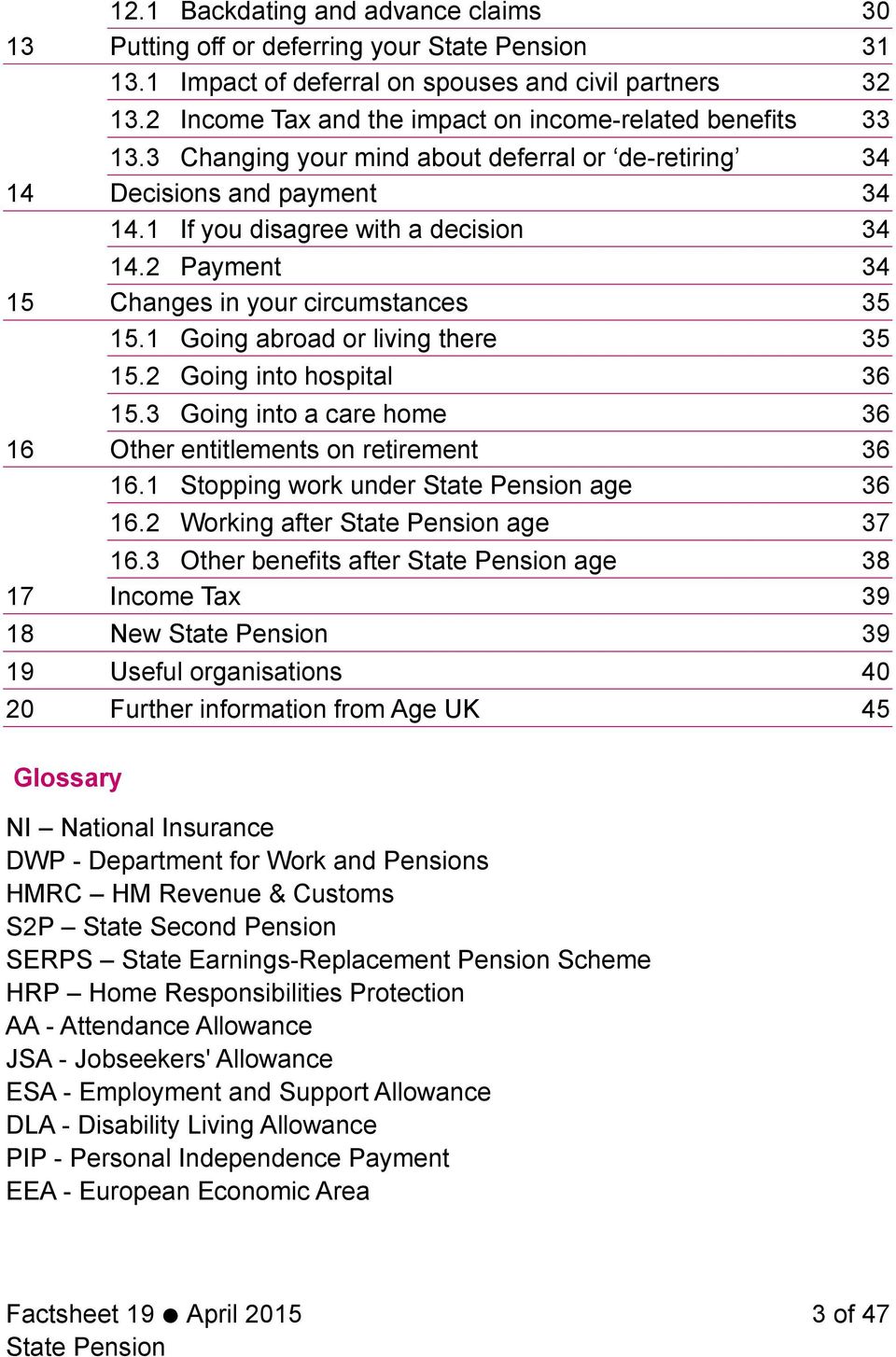
3 12.1 Backdating and advance claims Putting off or deferring your Impact of deferral on spouses and civil partners Income Tax and the impact on income-related benefits Changing your mind about deferral or de-retiring Decisions and payment If you disagree with a decision Payment Changes in your circumstances Going abroad or living there Going into hospital Going into a care home Other entitlements on retirement Stopping work under age Working after age Other benefits after age Income Tax New Useful organisations Further information from Age UK 45 Glossary NI National Insurance DWP - Department for Work and Pensions HMRC HM Revenue & Customs S2P State Second Pension SERPS State Earnings-Replacement Pension Scheme HRP Home Responsibilities Protection AA - Attendance Allowance JSA - Jobseekers' Allowance ESA - Employment and Support Allowance DLA - Disability Living Allowance PIP - Personal Independence Payment EEA - European Economic Area Factsheet 19 April of 47
4 1 Current rates The full weekly rates of basic for 2015/2016 are: Category A pension Category B pension based on late spouse s or civil partner s National Insurance contributions Category B pension based on spouse s or civil partner s National Insurance contributions Category D pension Graduated Retirement Benefit: increased by 1.2% Additional Pension (SERPS and S2P): increased by 1.2% The extra 25p payable when you reach the age of 80 has not increased. 2 Recent developments The age at which people can claim their s is changing. In April 2010 age for women started to increase from 60 to 65 to equalise it with the age of men. This equalisation process will be complete by November age, for both men and women, will then increase to 66 by October 2020 and 67 by April The government also intends to make provisions for five yearly reviews of the age and has proposed to increase it beyond the age of 67. In April 2015 Categories A, B and D basic s were increased by 2.5%, in line with the government s guarantee to base annual increases in the basic on a triple guarantee of earnings, prices (judged by the Consumer Prices Index) or 2.5%, whichever is highest. Those reaching age from 6 April 2016 onwards will claim the new instead. This is described in section 18. Factsheet 19 April of 47

5 3 Future changes Changes to the timetable for increasing ages are dealt with in section 5. The new will apply to people who reach age from 6 April People who reach age before this date will receive a in line with existing rules. 4 What is the? The is paid to people who have reached age, fulfil the National Insurance (NI) contribution conditions and have made a claim. The amount you get is not affected by your income and capital but all parts of the are taxable. Some major changes to s began to take effect on 6 April They include a process to equalise age for men and women, and other changes that apply only to people who reach age on or after 6 April This factsheet includes relevant information about the whether you reach age before or after 6 April 2010 (if you reach age on or after 6 April 2016, only section 18 of this factsheet will apply to you). You can claim and get your even if you decide to continue working past age. Alternatively, you can choose not to claim at age and get extra or a one-off taxable lump-sum payment at a later date. Your may consist of a basic Category A or B plus Additional (based on NI contributions after April 1978) and Graduated Retirement Benefit (based on your NI contributions between April 1961 and April 1975). You will get an extra 25p each week when you reach the age of 80. The Category D is a non-contributory pension for people over the age of 80. The DWP is the Government department responsible for s and other benefits. Older people deal mainly with the Pension Service. HMRC deal with NI contributions. Factsheet 19 April of 47

6 5 age You can claim your when you reach age. Before April 2010 age was 65 for men and 60 for women. Since 6 April 2010 women s age has been increasing for those born on or after 6 April As at April 2015, women s age is 62 ½ and it will be 63 by April age is due to be equalised at 65 for both men and women by November It is then scheduled to increase again to 66 by October 2020 and 67 by April The government also intends to make provisions for five yearly reviews of the age and has proposed to increase it beyond the age of 67. The first five-yearly review will take place in late Some other benefits, such as Pension Credit and Winter Fuel Payment, which used to be paid from the age of 60, are now linked to women s State Pension age. Following the implementation of the Gender Recognition Act in April 2005, if you are granted a full Gender Recognition Certificate your age depends on your acquired gender. Action: You can find out your age by using the calculator at or by phoning the Future Pension Centre on Couples Since 6 April 2010 provisions have been equalised so that they apply to husbands and wives and to people in registered civil partnerships. In the past some pension rights such as the married woman s pension did not apply to husbands and civil partners. Pension changes are generally not retrospective, which means that if your wife or civil partner was born before 6 April 1950 (and so reached age before 6 May 2010, in the case of a woman, or 6 April 2015, in the case of a man) these new rules do not apply to you. Factsheet 19 April of 47

7 7 Basic s The weekly rates of basic are set out in section 1. The categories of pension are described below. Category A s are generally based on an individual s own NI record, while Category B State Pensions are based on a spouse s or civil partner s record. Category A and B pensions may consist of a basic and/or Additional. 7.1 Category A on your own contributions You will get the full basic Category A if you have paid, or been treated as having paid, NI contributions at the appropriate rate for enough qualifying years in your working life, or if any gaps in your record are covered by NI credits or Home Responsibilities Protection (HRP). More information about the NI contribution conditions is given in section 9. If you do not have sufficient qualifying years for the full Category A, you may get a reduced amount. Normally you need to have satisfied the NI contribution conditions in your own right. However, divorcees, widowed people and those whose civil partnership has ended through bereavement or dissolution may be able to use the NI contributions record of their former or deceased spouse/civil partner to help them qualify for a Category A. 7.2 Category B on spouses or civil partner s contributions Married women If you are a married woman and you are not entitled to a basic based on your own NI contributions record, or it is less than a week, you may be able to get a pension based on your husband s NI contributions once he reaches age. This is sometimes referred to as the married woman s pension. If you have no basic Category A you may get the Category B of a week. If your Category A is less than a week it can be made up to that amount. If your husband does not have a full contributions record, you will receive a proportionally reduced pension. Factsheet 19 April of 47

8 If you are already receiving a Category A on your own NI contributions record and your husband claims his, the Pension Service will normally pay you any extra Category B that you are entitled to so you will not need to make a new claim. You will need to make a claim if you are not already getting a at the time your husband reaches age or if your husband decides to put off claiming his. Until 6 April 2010 your husband had to be getting his before you could make a claim but now it is possible to do this even if he is putting off claiming ( deferring ) his State Pension. See section 13 for more about deferring the. If he is deferring his you should contact the Pension Service to claim the Category B pension even if you are already getting some Category A pension, as it will not be awarded automatically. On top of any basic you get, you may also be entitled to Graduated Retirement Benefit and/or Additional based on any NI contributions you have made, as explained in sections 10 and 11. Sometimes married women who have paid NI contributions in the past but who are not working when they reach age do not realise that they may be entitled to some based on their earlier NI contributions. The is not awarded automatically except in the circumstances described above you have to make a claim. See section 12 for information on claiming. Married men and civil partners If your wife or your civil partner was born before 6 April 1950, then as a married man or civil partner you are not able to claim a based on your wife or civil partner s NI contributions record. If your wife or your civil partner was born after 6 April 1950, has reached age and you reach age after 6 April 2010 (and you are not entitled to a basic of at least a week based on your own NI contributions record) you can claim a Category B State Pension based on their NI contributions record. This means that husbands and female civil partners started to qualify from May 2010 and male civil partners will start to qualify from April If you qualify for a Category B as a husband or civil partner, the rules are now in line with those set out above for married women. Factsheet 19 April of 47

9 7.3 Divorce, dissolved civil partnerships and separation Divorced people If you are divorced but do not qualify for a full Category A based on your own NI contributions record, you may be able to use your former spouse s contributions to increase the amount of basic you get to the maximum of a week. You are not entitled to your former spouse s Graduated Retirement Benefit or Additional, although it is possible for Additional to be divided as part of a divorce settlement. Your former spouse s NI contributions record is substituted for your own from the start of your working life up to your divorce or just for the period of your marriage. If you get divorced before age, you may need to pay further NI contributions after your divorce to qualify for a full Category A. If you remarry or form a civil partnership before age, you cannot claim a on your former spouse s NI contributions record. However, if you remarry or form a civil partnership after age, you will not lose any based on your previous spouse s NI contributions record. Dissolved civil partnerships The term dissolution is used if civil partners legally separate; it is the equivalent of divorce for married couples. rules are the same as those described above for divorced people. Separation If you are separated from your husband, wife or civil partner and you do not qualify for a basic Category A when you reach age, or you are entitled to less than a week, you may be able to claim a Category B of up to a week when your spouse or civil partner reaches age see section 7.2. As explained there, before 6 April 2010 this only applied to married women, and for husbands and civil partners it depends on the date of birth of their wife or civil partner. Factsheet 19 April of 47

10 7.4 Widows, widowers and surviving civil partners Widows, widowers and surviving civil partners can sometimes inherit State Pension at age. Once you are getting a on this basis, you can remarry, form a civil partnership or live with a partner without losing a based on your previous spouse/civil partner s NI contributions record. As well as inheriting basic, you may also inherit Additional and/or Graduated Retirement Benefit (see sections 10.4 and 11). Some aspects of the rules are different for widowers and civil partners who reached age before April These are covered briefly in this section but contact the Pension Service or a local advice agency if you need further information. Note: See Age UK s Factsheet 56, Benefits for People under Pension Credit age, for information about bereavement benefits for people under State Pension age. Widows If you were under age when your husband died and you have not remarried or formed a civil partnership, you may be entitled to a basic Category A of up to a week, based on your late husband s NI contributions record, once you reach age. The amount you get will depend upon your own, and your late husband s, NI contributions record and the age at which you were widowed. If you had reached age when your husband died, and were not getting the full Category A, you may be able to use his NI contributions record to bring your up to a maximum of a week. Factsheet 19 April of 47

11 Widowers and surviving civil partners If you reached age on or after 6 April 2010, the inheritance rules are the same as those described above for widows. If you reached age before 6 April 2010 and were bereaved on or after 6 April 1979 and do not have enough NI contributions of your own, you may be entitled to a Category B of up to a week based on your wife or civil partner s NI contributions record, provided you were both over age when your wife/civil partner died. If you were bereaved under age on or after 9 April 2001, the rules are the same as those described above for widows. If you do not fulfil the above conditions, perhaps because your late wife or civil partner died before age when you had already reached that age before 6 April 2010, you may in some circumstances be able to use your wife/civil partner s NI contributions record to increase your basic State Pension up to a maximum of a week. 7.5 Category D over-80 This is a non-contributory taxable of a week for people aged 80 or over. You can claim it if you have no basic. If you already get a small, Category D pension can top it up to a week. To qualify for a Category D you have to be living in the UK on your 80 th birthday or the date of your claim if this is later, and to have been living in the UK for 10 years or more in any 20-year period after your 60th birthday. In some circumstances you may be eligible if you are living in another EEA country on your 80 th birthday or the date of claim. 8 Other payments 8.1 Age addition An extra 25p a week is paid on Category A and B pensions if you are 80 or over. Factsheet 19 April of 47

12 8.2 Christmas bonus If you receive a and you are living in the UK or any other EU country during the qualifying week (normally the first full week of December) you will receive a Christmas bonus of 10. The bonus is tax-free and has no effect on other benefits. In some circumstances, you may get an additional bonus for a dependant partner who is not entitled to one in their own right. There is usually no need to claim, as the bonus is paid automatically with your. If you think you are entitled to the bonus but do not receive it, contact the Pension Service or a local advice agency. 8.3 Invalidity addition You may receive an invalidity addition on your Category A or B if you were receiving any of the following payments before reaching State Pension age: an invalidity allowance with Invalidity Benefit transitional invalidity allowance with Incapacity Benefit an age addition with long-term Incapacity Benefit. The invalidity addition is paid at the same rate as your invalidity allowance or age addition but is offset against your Additional or contractedout deduction. 8.4 Increases for dependants Adult dependants In the past you could claim an increase for a dependant spouse who was under age. Since 6 April 2010 it has not been possible to claim an increase. This also applies if you deferred claiming your until that date or later. If you were already receiving an increase for a dependant spouse at the time the new rules came into effect, you can continue to get the increase as long as you continue to meet the conditions until the dependant reaches age or 5 April 2020, whichever is sooner. The increase is a maximum of a week. Factsheet 19 April of 47
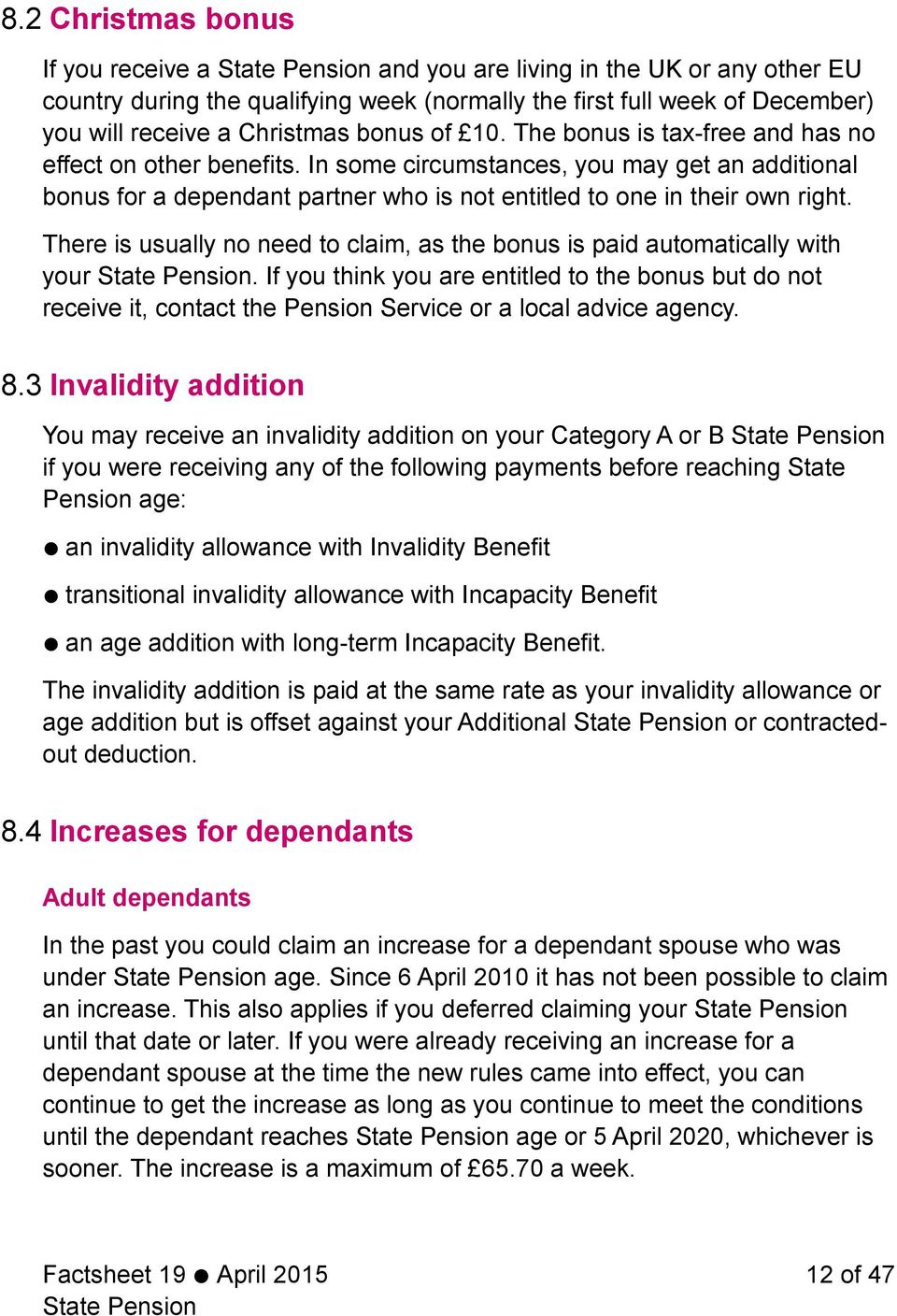
13 Child dependants Increases for dependent children have not been payable on new claims for since 6 April Check if you can claim Child Tax Credit instead. If you were already receiving an increase for a child dependant at the time the new rules came into effect, you can continue to qualify for the increase, which is 8.00 for the first child and for each other dependent child. Increases for dependent children are not taxable. 9 National Insurance Whether you will get a full depends on your NI contributions record. Your record might be made up of a combination of: NI contributions paid while you were working; NI contributions you have paid voluntarily; NI credits awarded while you were receiving certain benefits; NI credits and/or HRP awarded while you had caring responsibilities. Changes to the contribution conditions were introduced in April Different rules apply depending on whether you reached age before or after 6 April If you reached age on or before 5 April 2010 If you reached age before 6 April 2010, there are two conditions that you must meet to get a Category A. The first condition is that you have paid sufficient NI contributions to make at least one year in your working life since 6 April 1975 a qualifying year or paid at least 50 flat-rate contributions at any time before 6 April Credited contributions cannot count towards this first condition. The second condition is that you must normally have paid or been credited with NI contributions for about 90% of the years of your working life. Your working life normally starts in the tax year (i.e. 6 April to 5 April) when you were 16 and ends with the last full tax year before you reached age. Factsheet 19 April of 47
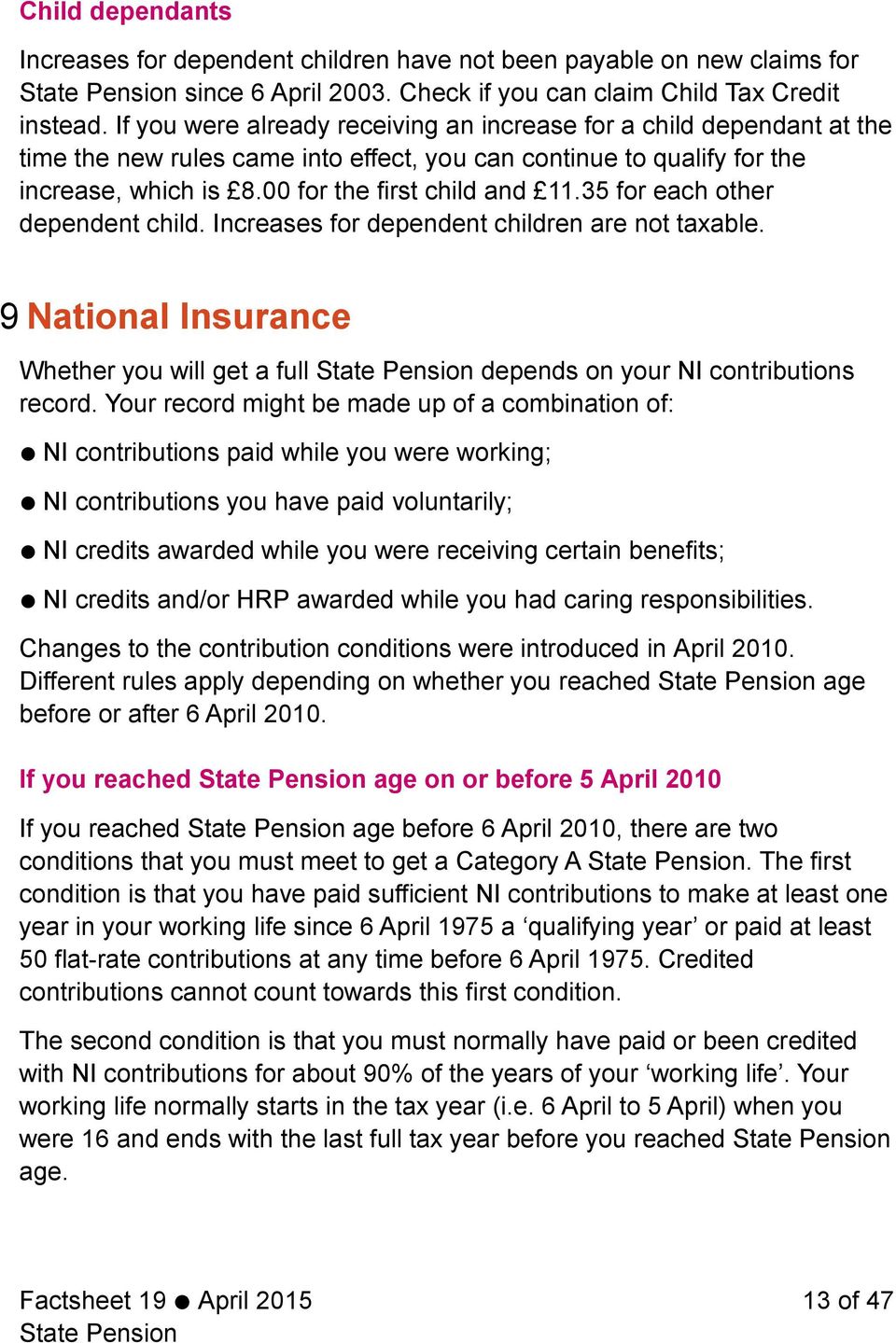
14 Each year in your working life that you have paid or been credited with sufficient contributions is called a qualifying year. HRP can reduce the number of qualifying years you need. A woman who reached age before 6 April 2010 and had a working life of 44 years, will get a full basic Category A if 39 of the years were qualifying years. A man who reached age before 6 April 2010 and had a working life of 49 years will get a full basic Category A if he has 44 qualifying years. If you are not entitled to a full Category A, you may get a reduced one based on the number of qualifying years you have. So, for example, if you have half the number of years needed, your pension will be half the normal rate. However, you get no Category A at all if the number of qualifying years you have is less than 25% of the number needed for a full. Note: If you are over 80 and you have not paid enough contributions for a basic worth at least 69.50, you might qualify for the noncontributory Category D described in section 7.5. If you reach age on or after 6 April 2010 Both men and women who reach age on or after 6 April 2010 receive the full Category A Basic if they have 30 or more qualifying years. If you have fewer than 30 qualifying years, you get a reduced pension as long as you have at least one qualifying year. Each qualifying year entitles you to one-thirtieth of the full amount. There is no minimum number of qualifying years and there is no longer a requirement that at least one of your qualifying years be based on paid NI contributions (rather than NI credits). Action: If you don t have enough contributions for a full, see section 9.4 about paying voluntary contributions to cover missing years. Also check if you might be entitled to Pension Credit to top up your income see Age UK s Factsheet 48, Pension Credit, or contact Age UK Advice or a local advice agency. If you are over 80 and you have not paid enough contributions for a basic worth at least 69.50, you might qualify for the noncontributory Category D described in section 7.5. Factsheet 19 April of 47
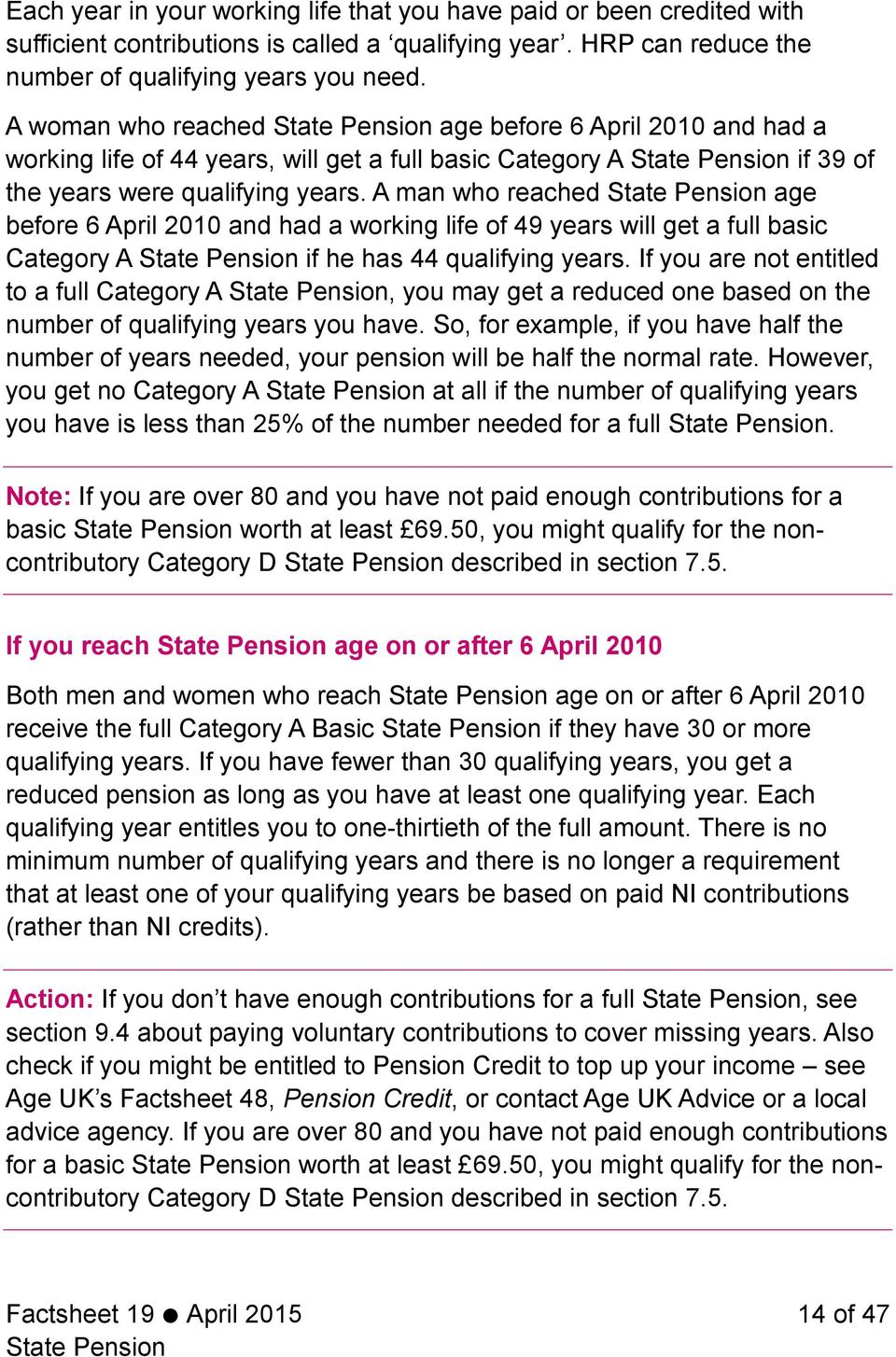
15 9.1 NI contributions in work Since April 1975, employees aged 16 or over and under age have paid NI contributions depending on the level of their earnings. If you are an employee with earnings of 112 a week or more (the level of the Lower Earnings Limit in 2015/16), you are building up entitlement to a basic Category A. However, you do not start to pay NI contributions until your earnings reach 155 a week. If you earn between 112 and 155, you are treated as though you are paying NI contributions and are still building up entitlement to the basic and other contributory benefits. So, when this factsheet refers to people who have paid NI contributions, this includes people with earnings between 112 and 155 a week who are not actually paying NI but are still treated as having paid NI contributions. Since April 1975 employed people have paid Class 1 NI contributions as a percentage of earnings, and these are collected with Income Tax. Employers also pay NI contributions. If you are self-employed you have to pay a flat-rate Class 2 contribution each week, which counts towards a basic but not an Additional Pension. If your taxable income is over a certain amount, extra Class 4 contributions are collected with your Income Tax. If your earnings are low, you may be able to get a small earnings exception which exempts you from paying NI contributions, but you may wish to pay Class 2 contributions anyway to protect your rights. Reduced-rate married woman s contributions When the present scheme was introduced in 1948, married women could choose to pay reduced-rate Class 1 or not to pay Class 2 contributions. These contributions do not count towards a basic. The right to choose to pay reduced contributions was abolished from 6 April 1977 although women already paying these lower rates could continue to do so under certain circumstances. It is not possible to pay voluntary contributions or get HRP to make up any gaps in your contribution record for years when you were paying or had the right to pay reduced-rate contributions. Married women in this position will not usually be eligible for NI credits either. Factsheet 19 April of 47

16 There are certain circumstances where you lose the right to pay these reduced rate contributions, including if you do not work for two tax years or your marriage ends in divorce. You may also choose to give up the right to pay the reduced-rate contributions, but seek advice first as it may not always be in your best interests. Working abroad NI contributions paid abroad may help you qualify for the basic if you worked in another EEA country or one that has a reciprocal agreement with the UK. 9.2 NI credits If you are under age there are various circumstances in which you are entitled to a credit in place of a NI contribution. These include each week that you are: unemployed and claiming Jobseeker s Allowance or available for and actively searching for work, or unable to work due to sickness or disability and claiming certain benefits such as Employment and Support Allowance; looking after someone who is disabled and you are receiving Income Support as a carer, or Carer s Allowance, or would be receiving Carer s Allowance if you were not receiving certain benefits instead; not getting Carer s Allowance or Income Support as a carer but providing care for at least 20 hours a week for one or more sick or disabled persons who get Attendance Allowance, Constant Attendance Allowance, Disability Living Allowance (middle or higher rate care component), Personal Independence Payment (daily living component) or whose need for care has been certified by a health or social care professional (these are called Carer's Credits); receiving Child Benefit for a child under 12 years of age. This applies even if you decide to stop getting Child Benefit payments because of the introduction of the new tax charge provided you have claimed the Child Benefit; an approved foster carer; Factsheet 19 April of 47
17 a grandparent or other adult family member providing childcare for a child aged under 12, usually because the parents are in work; receiving Working Tax Credit; receiving Universal Credit; a man in the tax year in which you would have reached age had you been a woman, or any subsequent tax year up to, but not including, the one in which you reach the age of 65, and not paying contributions, even if you are not ill or signing on as unemployed. This does not apply to any tax year in which you are abroad for more than six months. This is being phased out from April 2010 in line with the increase in women s age and will not apply to men born after 5 October 1954; over 18 years old and in full-time training approved by the government and not lasting longer than a year. The credits for men approaching age and the credits associated with particular benefits are awarded automatically. You need to make an application to get Carer's Credits, credits as a foster parent and credits for grandparents. Credits for grandparents and other family members were introduced from April You should apply for all these credits before the end of the tax year following the one in which you are entitled to the credits. Late applications may sometimes be accepted if there is a good reason for not applying earlier. Different types of credits and paid contributions can be combined to make a full qualifying year. Details of other credits available can be found on Action: Apply for Carer s Credits using application form CC1 which you can get online from Use form CF411A from HMRC for foster parent credits. Factsheet 19 April of 47
18 9.3 Home Responsibilities Protection From 1978 to April 2010, HRP protected the NI contribution record of people caring for a child or a sick or disabled person. It helped protect your basic and bereavement benefits for your spouse or civil partner. Between April 2002 and April 2010 it could also help build up Additional State Pension through the State Second Pension (see section 10.2). In April 2010 HRP was replaced by the new credits for parents and carers, described in section 9.2. You cannot get HRP for the years before April 1978 when you were looking after someone. A married woman or widow cannot get HRP for any tax year in which she would only be liable to pay reduced-rate NI contributions, if she had been working. You are entitled to HRP if you meet any of the following conditions, or in some situations a combination of them, for a whole tax year between April 1978 and 2010: you received Child Benefit for a child under 16; you received Income Support and you did not need to register for work because you were caring for a sick or disabled person; you were regularly spending at least 35 hours a week looking after someone getting Attendance Allowance, Constant Attendance Allowance or DLA (middle or higher rate care component). You need to have been caring for 48 weeks in any tax year, this rose to 52 weeks after 6 April you were a registered foster parent (from 2003/04 onwards). If you got Carer s Allowance, you would normally have received NI credits towards your so you would not need HRP, although you could not get credits or HRP if you retained the right to pay the reduced-rate married woman s contributions. Whether you have done any work is irrelevant. You will get HRP if you qualify for it and haven t paid or been credited with enough NI contributions for the tax year to count as a qualifying year. Factsheet 19 April of 47

19 How to work it out If you reach age on 6 April 2010 or later, any years of HRP you have been awarded will be converted into NI credits (up to a maximum of 22 years). If you reached age before 6 April 2010, each year of HRP was taken away from the number of qualifying years needed to get a full Category A. However, HRP could not be used to reduce the number of qualifying years to below 20. Example Maeve worked and paid full contributions from 1960 when she was 16 to 1990 when she gave up work to look after her mother. She was still caring for her mother in 2004, when she became 60. As Maeve worked and paid contributions for 30 years she is entitled to a full pension as HRP reduced the number of qualifying years she needed to 25. It works like this: Working life Qualifying years needed for full pension Number of years of HRP Qualifying years needed after taking away years of HRP 44 years 39 years 14 years 25 years When to apply HRP should be given automatically if you qualified because you were getting Child Benefit or Income Support as a carer. You need to apply for HRP if you qualified because you were looking after someone who was getting DLA, AA, or Constant AA, because you were a foster parent, or if you qualified under one condition for part of a tax year and under another for the rest of the year. Applications for HRP for years spent caring for a sick or disabled person before 2002/03 can be made at any time up to age. You can also apply after age but you will not normally be paid any increase of that may have been due for previous years. Action: Apply for HRP on form CF411 which you can get from your local Jobcentre Plus office, by phoning HMRC, or downloading from their website. Factsheet 19 April of 47
20 9.4 Late and voluntary NI contributions If you are not paying NI contributions, and are not entitled to credits or HRP, you can pay Class 3 voluntary contributions to protect your. Class 3A contributions will be introduced after 12 October They will allow you to buy additional pension. See section 9.5 for more information. If you have paid or been credited with some contributions in a year but not enough to count towards your pension you should be contacted and told how much you would need to pay to make up that year s contributions. If you don t hear anything by March of the next year, make enquiries with HMRC. There are time limits for paying voluntary contributions. They must normally be paid by the end of the sixth tax year after the one in which they were due. In 2008 the government made provision for some people to pay up to a further six years of Class 3 voluntary NI contributions on top of the normal provisions to fill gaps going back to 1975/76. This applies to people who reach age between 6 April 2008 and 5 April 2015 who already have at least 20 qualifying years, which can include full years of HRP. If your age is on or after 6 April 2016 you will have to claim the new (see section 18) and you will have more time to pay voluntary Class 2 or Class 3 NI contributions for the years from 2006/07 to 2015/16. For people in this category the payment should be made by 5 April You cannot pay voluntary contributions for any year in which you were only liable to pay the reduced-rate married woman s contributions. Action: If you do not have enough NI contributions for a full basic State Pension, you need to decide whether to make additional voluntary contributions by weighing up the cost of the voluntary contributions against the potential gains in entitlement. There may also be potential losses in means-tested benefits like Pension Credit to consider. You can find more information on the HMRC website and on application form CA5603. Contact the National Insurance Contributions Office general helpline or the Deficiency Notice helpline, for more information. See section 19 for contact details. Factsheet 19 April of 47
21 If you made voluntary contributions to cover gaps in your record between 25 May 2006 and 26 July 2007 you may be able to claim a refund if you now have more than the 30 years of contributions needed for a full basic State Pension since the April 2010 pension changes. 9.5 top up These are Class 3A voluntary NI contributions and are designed to allow you to boost your ; they are referred to as top ups. Each unit purchased will increase your by 1 a week up to a maximum of 25 a week. The only conditions are that you have an entitlement to a and you reach stage pension age before 6 April Class 3A contributions will only be available for 18 months from the 12 October The cost of purchasing the contributions varies with your age and a calculator is available at Qualifying years A qualifying year is a tax year in which you have paid or been credited with enough NI contributions to count towards a Category A. Since 1978 a qualifying year is one in which your earnings are the same as, or more than, 52 times the weekly Lower Earnings Limit if you are an employee. Between April 1975 and April 1978 the qualifying earnings were 50 times the Lower Earnings Limit. This tax year, 2015/16, the Lower Earnings Limit is 112 a week. Before 1975 working people paid NI contributions by flat-rate weekly stamp. To work out your qualifying years before 1975, all your stamps (paid and credited) are added up and divided by 50, rounding up any that are left over but you cannot have more qualifying years worked out in this way than the number of years in your working life up to April If you are self-employed or have paid voluntary contributions you need to make 52 flat-rate contributions in each qualifying year. A qualifying year can be made up of a combination of credits and contributions. Factsheet 19 April of 47
22 9.7 Getting a statement A statement provides personalised information about your position, based on your NI record when the statement is produced. It includes: the earliest date you can get your an estimate of (including any Additional and Graduated Retirement Benefit) and the number of qualifying years you currently have. Action: You can obtain a statement at any time between the age of 55 until four months before reaching age online or until 30 days before by post or telephone. See section 19 for details of the Future Pension Centre. If your statement shows that you currently do not have the 30 qualifying years needed to get a full basic, you need to consider whether you have enough time to make up the shortfall before you reach age. If not, you may want to ask the NI Contributions Office for a copy of your NI record. You can check it against your own records and query any missing contributions, credits or HRP. You may also want to consider paying voluntary NI contributions to make up for gaps in your record (see section 9.4). You may want to get help from an independent advice agency. 10 Additional When you get your Category A or B you may also get Additional, or you may qualify for Additional even if you do not get any basic. The Additional scheme started on 6 April From 1978 to April 2002, Additional was built up under the State Earnings- Related Pension Scheme (SERPS). Since April 2002 the Additional State Pension has been built up under the State Second Pension (S2P). Factsheet 19 April of 47
23 Additional is based on earnings above the Lower Earnings Limit, which is 112 a week in 2015/16. Since April 2002 some carers and long-term sick or disabled people have been credited with S2P as if they have earnings at the required level. You do not build up any Additional State Pension based on your earnings if you are self-employed, paying the reduced-rate married woman s contributions, earning less than the Lower Earnings Limit or contracted out of the state scheme (see section 10.3). Additional is related to your weekly earnings between the weekly Lower Earnings Limit and Upper Accrual Point ( 112 and 770 respectively in 2015/16), or credited earnings under the S2P, from April 1978 (or the tax year in which you reached the age of 16) until 5 April before you reach age. These earnings are re-valued in line with increases in average earnings until you reach age SERPS If you reached age before 6 April 1999, your Additional State Pension was based on 25% of earnings between the specified levels (if you had a history of 20 continuous years from 1978). However, between 1999 and 2009, changes were introduced to phase in reductions to the amount of Additional. The main aim of these changes was to reduce the maximum level of SERPS from 25% of earnings to 20% for people reaching age from 2009 onwards State Second Pension Since 6 April 2002 the Additional has been built up under the S2P. If you have entitlement under SERPS, this will be protected, so if you reached age on or after 6 April 2003, you may get an Additional built up partly under SERPS and partly under the S2P. The S2P is calculated in a way that is more beneficial than SERPS to those with low or modest earnings. Since April 2002 employees with annual earnings of at least the Lower Earnings Limit ( 5,824 in 2015/16) but less than the Low Earnings Threshold ( 15,100 in 2014/15) are treated as though they have earnings equal to the Low Earnings Threshold. From 6 April 2012 a flat rate amount is accrued - for 2014 this is Factsheet 19 April of 47
24 People with earnings above the Low Earnings Threshold are also entitled to an extra earnings-related payment but this is being gradually withdrawn so that the S2P will be completely flat-rate by about You can also be treated as though you have earnings equal to the Low Earnings Threshold (from 2012/13 a flat rate) if, throughout the year, you are: entitled to Carer s Allowance entitled to the long-term rate of Incapacity Benefit (or you would have been entitled if you had satisfied the contribution conditions) paid Severe Disablement Allowance in some circumstances, paid contribution-based Employment and Support Allowance awarded HRP (only up to April 2010 see section 9.3) receiving Carer s Credits, credits as a foster carer or credits because you are receiving Child Benefit for a child under the age of 12 (only since April 2010 see section 9.2). To qualify for a year of the S2P for years before April 2010 you had to fulfil one of the criteria for a whole tax year for example, you could not qualify if you provided care for part of the year and met the disability conditions for the rest of the year, or if you paid NI contributions for part of the year and were entitled to HRP for the rest of it. Since 6 April 2010, a qualifying year for S2P can be built up using any combination of credits or paid contributions Contracting out of the Additional Contracting out means leaving the Additional scheme. Only employees earning more than the Lower Earnings Limit and paying standardrate Class 1 NI contributions can contract out. You cannot contract out of the basic. You can only contract out if you join a defined benefit pension scheme, such as a final salary scheme but this option will end from April Before 6 April 2012 you could contract out via a defined contribution scheme, which met certain conditions. Factsheet 19 April of 47
25 Occupational pension schemes The information below only applies to defined contribution schemes before 6 April If you belong to an employer's contracted-out occupational pension scheme, you pay lower NI contributions. The NI contributions your employer has to make are paid partly to HMRC and partly into the pension scheme. You and/or your employer usually make additional contributions to the scheme, and you receive tax relief on any contributions you make. Occupational pensions are either defined benefit (salary-related) or defined contribution (money purchase) schemes. In a defined benefit salary-related scheme the calculation of your pension on retirement is related in some way to your salary while you were contributing to the scheme. In a defined contribution money purchase scheme, your pension on retirement depends on a number of factors, including the amount paid into the scheme and how it has been invested. When you claim your you do not usually get any Additional for the years you were in the contracted-out occupational scheme. Your employer should tell you if your occupational pension scheme is contracted-out. Personal and stakeholder pensions (prior to 6 April 2012) Personal and stakeholder pensions are always defined contribution schemes and the amount of pension you get on retirement is related to the amount you have paid in, how it has been invested and how those investments have performed. If you were a member of a personal or stakeholder pension before 6 April 2012 that allowed contracting out, and you were contracted out, you would not have paid lower NI contributions. Instead HMRC pays a refund of NI contributions, together with tax relief at the basic rate, into the pension once a year to compensate you for the Additional you have given up. These payments are known as 'minimum contributions'. The paperwork you have from your pension provider should say whether you are contracted out. Factsheet 19 April of 47
26 Changes to contracting out from 6 April 2012 Apart from defined benefit occupational pension schemes, the 2011/2012 tax year was the last year that you could contract out of the Additional State Pension scheme. If you are already contracted out through a money purchase/defined contribution occupational pension, a personal pension or a stakeholder pension you will have been automatically brought back into the Additional from 6 April 2012 and, depending on your earnings, started to build up S2P. You and your employer will have to pay the full standard rate of NI contributions to HMRC. In relation to your money purchase occupational, personal or stakeholder pension: you will still be able to contribute to the scheme yourself; and you will still be able to benefit from any contributions made to the scheme by your employer; but no further contributions will be due into the scheme from your NI contributions (whether through an annual rebate from HMRC or by your employer paying part of their NI contributions into the scheme), relating to a tax year from 6 April 2012 onwards. Any NI rebates and other payments into the money purchase occupational pension, personal pension or stakeholder pension that have already been made will remain in the scheme to provide benefits in place of the Additional for the time you were contracted out. Defined benefit occupational pension schemes that contract out can still do so up to April Rebate only schemes You may belong to what was termed a 'rebate only' occupational or personal pension. This means that the only contribution to the pension was the annual NI rebate from HMRC. These types of scheme may provide a pension worth more or less than the Additional you have given up by contracting out. Rebates will no longer be paid in to the scheme relating to tax years from 6 April 2012 onwards. Rebates already paid in will remain in the scheme to provide benefits in place of the Additional for the time you were contracted out. Factsheet 19 April of 47
27 Contracted-out deductions From April 1978 to April 1997, if you were contracted out in a salary-related occupational pension scheme, your occupational pension includes a guaranteed minimum pension (GMP). If your GMP is less than the SERPS you would have received if you had remained contracted in, your State Pension will include an increase. If you are contracted out in any other type of pension scheme, your Additional is reduced by an amount that may be more or less than the pension provided by the scheme. The written breakdown of your entitlement will show how much Additional you have built up. If you were contracted out of SERPS at any time between 1978 and 1997 the statement will show a contracted-out deduction, which takes into account the period you were contracted out. The amount of Additional before the deduction minus the contracted-out deduction shows how much Additional will actually be paid on top of your Basic State Pension. Between 1997 and 2002 there was no link between the Additional State Pension and contracted-out pension schemes. For contributions made since April 1997 you either receive an Additional or, if you are contracted out, an occupational, personal or stakeholder pension based on the scheme's rules. Since 2002, it has been possible, subject to earnings, to be contracted-out and earn an Additional. The amount of Additional you earn will however be reduced to reflect your contracted-out status Inheriting SERPS and S2P When you start to get your, or if you are already receiving your when your spouse or civil partner dies, you may be able to inherit some or all of their Additional (adjusted for periods when they were contracted out). The amount you are entitled to inherit is added to any Additional on your own contributions up to the maximum amount a single person can get which is per week in 2015/16. To find out how much you could get for 2015/16, you should use the calculator at Factsheet 19 April of 47
28 The amount of SERPS pension that you can inherit depends on the date of birth of the person who has died. Use the following tables to see how this might affect you. You may also inherit 100% of your late spouse s or civil partner s SERPS if they died before 6 October 2002, regardless of their date of birth. Maximum SERPS that a man s wife or civil partner can inherit Man s date of birth Maximum percentage of SERPS 5 October 1937 or before 100% 6 October 1937 to 5 October % 6 October 1939 to 5 October % 6 October 1941 to 5 October % 6 October 1943 to 5 October % 6 October 1945 and after 50% Maximum SERPS that a woman s husband or civil partner can inherit Woman s date of birth Maximum percentage of SERPS 5 October 1942 or before 100% 6 October 1942 to 5 October % 6 October 1944 to 5 October % 6 October 1946 to 5 October % 6 October 1948 to 6 July % 6 July 1950 and after 50% State Second Pension S2P has replaced SERPS for contributions made since April The maximum amount of the S2P that a widow, widower or surviving civil partner can inherit is 50%, regardless of when they are widowed. Factsheet 19 April of 47
29 11 Graduated Retirement Benefit This taxable pension scheme, sometimes called Graduated Pension, existed from April 1961 to April 1975 and was based on graduated contributions paid from earnings. If you were over 18 during this period and paying graduated contributions, your weekly Graduated Retirement Benefit for the year 2015/16 will be for every 7.50 of contributions paid as long as you reached age on or after 6 April 2010, or you are a man. Women who reached age before 6 April 2010 get for every 9.00 of contributions. Graduated Retirement Benefit is paid when you claim your, normally with the basic. However, you can get it even if you do not qualify for a basic. Inheriting Graduated Retirement Benefit As a widow you can inherit half of your late husband s Graduated Retirement Benefit whether you are under or over age at the time of bereavement provided you have not remarried before your age. The rules are now the same for a widower or surviving civil partner who reaches age on or after 6 April If you are a widower or surviving civil partner who reached age before 6 April 2010 and your wife or civil partner died after 5 April 1979, you can inherit half of your spouse or civil partner s Graduated Retirement Benefit, provided you were both over age at the time of their death. 12 How to claim your You need to claim as it is not normally awarded automatically. You need to make a claim. About four months before you reach State Pension age you should be sent an 'Invitation to Claim ' pack. If you have not been contacted about claiming your three months before your birthday, contact the Pension Service or ring You can ask for a claim form or make a telephone claim by ringing the same number. You can also claim online or download a claim form on the Gov.uk website. Factsheet 19 April of 47
30 You will need to provide your NI number when you make a claim and you may need to provide evidence of your date of birth. Action: if you have lost your NI number, contact the National Insurance Registrations Helpline on If you are receiving other benefits like Pension Credit when you reach State Pension age, you may not need to make a claim for your as it will be awarded automatically. The Pension Service will advise you if this applies. You may decide to put off claiming your in order to get extra or a lump sum payment. This is known as deferring your State Pension and is explained in section 13. If you do not make a claim for your when you reach age you are treated as having deferred it. If you do defer your, contact the Pension Service well in advance to allow time for the claim to be processed. You should not need to make a claim for a Category D over-80 to top up your pension to if you already have another and are resident in the UK on your 80 th birthday. Otherwise, contact the Pension Service or a local Jobcentre Plus office for a BR2488 claim form Backdating and advance claims You may claim your up to, but no more than, four months in advance. It is a good idea to claim in advance as it may take a while for your claim to be processed. The maximum period for backdating is 12 months, but your claim cannot be backdated to a date before you reached age. You will not be paid interest on any backdated pension. If you claim more than 12 months after you became entitled to your pension, you will be treated as having deferred your retirement. This may be advantageous anyway as the lump sum paid after deferral is paid with interest (see section 13). Factsheet 19 April of 47
31 13 Putting off or deferring your Once you reach age you can get your if you satisfy the contribution conditions even if you are still working. Alternatively, you can choose to put off or defer claiming your, in which case you can get extra or a one-off taxable lump-sum payment at a later date. In the past most people chose to claim their at age but more generous rules introduced from 2005 may encourage more people to defer. This may not be right for everyone, and whether you gain overall will depend on your circumstances. Deferring the new offers less generous returns, see section 18 for more information about this. Action: If you are thinking about deferring your, it is important to consider the full implications. Seek advice if you are not sure whether deferral is right for you. There are no time limits for how long you can defer. Under the current rules, for every five weeks you defer your your weekly entitlement is increased by 1% this works out at around 10.4% for each full year of deferral, so if you defer your for five years, it is increased by just over half. Alternatively, instead of extra you can get a taxable lump-sum payment plus your weekly paid at the normal rate. The lump sum is calculated based on the amount of you have foregone and a compounded interest rate of 2% above the Bank of England base rate. You have to defer your for at least 12 consecutive months to have the choice of a lump-sum payment with interest. Consider asking for backdating if you have deferred for less than 12 months and would like a lump sum (see section 12.1). Additional and Graduated Retirement Benefit If you defer your, your Additional and Graduated Retirement Benefit will be increased in the same way as the basic State Pension; or if you opt for a lump-sum payment under the current rules, they will be included in the calculation of this. Factsheet 19 April of 47
32 Claiming other benefits during a period of deferral You do not have to be working to defer your but you cannot be counted as deferring your if you (or, in some circumstances, your partner) are receiving certain other benefits during the deferral period. For example, if you are over age and you are claiming Carer s Allowance and have not claimed your, you will not gain any extra. If you (or your partner) are receiving Pension Credit, any you could claim will be taken into account as notional income when calculating your entitlement and from April 2011 you will not qualify for deferment increases on your pension. See Age UK s Factsheet 48, Pension Credit, for more information about this benefit. If you claim Housing Benefit or Council Tax Support while you are deferring your, it will not count as notional income and will not affect the amount of those benefits you can get. See Age UK s Factsheet 17, Housing Benefit and Factsheet 21, Council Tax for more information. In Wales, see Age Cymru s Factsheet 21w, Council Tax in Wales. Dependants and deferral If you were entitled to an increase for a dependant (for example, as a married man with a wife under age) and you deferred your State Pension, you would not get any extra or lump sum for that part of your. Adult dependant additions are no longer payable on new claims for (see section 8.4) Impact of deferral on spouses and civil partners Category B pensions If you are a married woman entitled to a Category B (or an increase to your ) based on your husband s contributions, you can choose to claim this even if he is deferring his. Alternatively, you can defer your and get extra or a lump sum when you do claim. Factsheet 19 April of 47
33 In general, you will not get extra or a lump-sum payment for deferring a Category B if, while your husband is deferring his, you claim a Category A on your own contributions, or certain other benefits. It may be better not to claim your own (for example, if this is a small amount) if your husband is deferring his. However, if you claim Graduated Retirement Benefit only, it will not stop you getting extra or a lump-sum payment from your husband s contributions. Husbands and civil partners who reach age on or after 6 April 2010 may now also be able to get a Category B based on their wife/civil partner s contributions (see section 7.2). The rules set out here for married women also apply to husbands and civil partners in this position. Inheritance If you die while you are deferring your, your surviving spouse or civil partner may be entitled to extra or a lump-sum payment when they claim their own. If you are unmarried and not in a civil partnership at the time of your death, the extra or lump sum cannot be passed on to anyone else. Divorce and dissolved civil partnerships If you are entitled to a shared Additional (resulting from the sharing of a former spouse s or civil partner s Additional following divorce or dissolution of a civil partnership), you can also defer this Income Tax and the impact on income-related benefits The is taxable and is taken into account for income-related benefits such as Pension Credit, Housing Benefit and Council Tax Support. If you get extra following deferral, this will count as part of your taxable income and may reduce the amount of any income-related benefits you get. However, the lump-sum payment will be ignored. The lump sum will be taxed at the highest rate you are currently paying Income Tax on other income (so it will not put you into a higher tax band). You can choose to delay receiving it until the tax year after you start receiving your, which may be advantageous if your income is lower then. Factsheet 19 April of 47
34 13.3 Changing your mind about deferral or de-retiring If you do claim your, it is possible to change your mind, deretire and defer it again for a period. However, this can only be done once, and you must be living in the UK (there are exemptions to this rule for people living in EEA countries). So, for example, if you are claiming your State Pension (and have not de-retired before), you could choose to stop receiving it and defer claiming it again for a time in order to receive a lump sum or increased later. Note: For more information on deferral, see the Pension Service guide SPD1 Deferral your guide. 14 Decisions and payment Once your claim has been processed, the Pension Service will send you a decision notice including details of how much your will be, how and when it will be paid, your duty to report relevant changes in your circumstances and your appeal rights If you disagree with a decision If you think that you have been awarded the wrong amount of, or disagree with any decision to do with your, you can ask for the decision to be reconsidered and then appeal against it if necessary. There are time limits for submitting revision requests and appeals so it is important to act quickly. See Age UK s Factsheet 74, Challenging welfare benefit decisions Payment Most people now get their paid directly into an account. When you apply for your you will be given information about the different types of bank, building society and Post Office accounts you can use. People who reached age before 6 April 2010 had the option to get their paid weekly in advance or four-weekly or quarterly in arrears. Factsheet 19 April of 47
35 The position has changed for people who reach age on or after 6 April Pensions are usually paid weekly in arrears. Your can be paid to an appointee who acts on your behalf if you are not able to act for yourself. It can sometimes be paid by a new system called simple payments, which can be collected from PayPoint outlets that are often located in local shops, if you are unable to open or manage an account. Simple payments are gradually replacing cheques which are being phased out. There are also ways of authorising someone else to collect your money from a Post Office, or a bank or building society account. When you are deciding how to have your paid, consider the different options if you are unsure, a local advice agency may be able to help. Pay day for anyone who started to get their before 28 September 1984 is normally Thursday. For people who retired after that date and before April 2010, pay day is usually Monday, although if your spouse was already receiving a on Thursday, you could choose to have yours on the same day. From April 2010 the pay day is based on your NI number and can be any week day. Payments are normally made only for full weeks and your starts from your first pay day after you are entitled to payment. 15 Changes in your circumstances You must report changes in your circumstances that might affect your State Pension to the Pension Service Going abroad or living there Your is payable without time limit if you go abroad. If you are going abroad for some time, you can arrange to get your in the country where you are staying. If you remain abroad, the annual State Pension increase will be paid only if you are living in an EEA country or in a country with which the UK has special arrangements. Note: For more information about receiving your while living abroad, contact the International Pension Centre. Factsheet 19 April of 47
36 15.2 Going into hospital Your continues to be paid however long you are in hospital. If you are also receiving a benefit such as Attendance Allowance, payment of which may be combined with your, this may be affected by a hospital stay Going into a care home Your will not be affected if you go into a care home, on a temporary or permanent basis will be taken into account as income if you apply to your local authority s social services department for help with the care home fees. Note: For information about the social services financial assessment for care services, see Age UK s Factsheet 10, Paying for permanent residential care, and other related factsheets on residential care. In Scotland see Factsheet 10s, Council charging procedures for care homes. In Wales, Age Cymru also has versions of these factsheets available. 16 Other entitlements on retirement The earliest age at which someone can get their is not necessarily the age at which they retire from work. Some people will stop work before age and some will work longer, while others may want to retire gradually for example, by reducing their hours rather than leaving work completely Stopping work under age You cannot get your until you reach age. Before then, you may be entitled to other financial support. See Age UK s Factsheet 56, Benefits for people under Pension Credit age, for more information. If you are a man and you have not reached your age but you are over the age at which a woman with the same birthday could get their, you may be entitled to Pension Credit and Winter Fuel Payment. Factsheet 19 April of 47
37 If you are under age and not paying NI contributions, check whether you will have enough contributions to be eligible for a full State Pension. See section 9 to find out how to do this and to check whether you can get NI credits or pay voluntary contributions to increase your State Pension. Occupational and personal pensions You may qualify for some occupational pension before age if you retire early check with your employer or the scheme administrator for details. You may also be able to claim your personal pension or stakeholder pension at any time after you reach the age of Working after age Once you reach age you can choose to claim your State Pension or to put off claiming it in order to gain later (see section 13). If you work and get your, it will not be affected by the amount you earn or the number of hours you work. You should note, however, that if you are claiming an increase in your for a dependent spouse, this increase could be affected by their earnings (see section 8.4). Although your will not be reduced because you are working, it is counted as part of your taxable income. Your tax code will be adjusted to take into account the amount of any you get (including Additional and Graduated Retirement Benefit). If your earnings are relatively low, you may be entitled to Working Tax Credit, a benefit administered by HMRC. If you carry on working for an employer after age, you will not have to pay NI contributions. You should get an Age Exception Certificate to give to your employer, who will still have to pay contributions for you. If you are self-employed you have to continue paying class 4 contributions until the end of the tax year in which you reach age. Action: Contact the HMRC National Insurance contributions office on for an Age Exception Certificate, CA4140. Factsheet 19 April of 47
38 Unemployment and sickness If you become sick or unemployed after age, you cannot claim Employment and Support Allowance, Income Support or Jobseeker s Allowance and you may not be able to claim Universal Credit. Occupational and personal pensions If you have a private pension, you may be able to get it while you are working contact your pension scheme for more information Other benefits after age In addition to their, many people are entitled to other benefits, like Pension Credit, Housing Benefit and Council Tax Support. You might be entitled to these even if you are working, but whether you qualify will depend on your income and capital. Some people may also be entitled to Attendance Allowance or Personal Independence Payment, which are not means-tested and are intended to help with the costs of illness or disability. Some benefits overlap with, including Carer s Allowance which is a benefit for people who are looking after someone who is disabled. If you are receiving Carer s Allowance, this will no longer be paid if you start to claim a that is worth more than Carer s Allowance, although you may retain an underlying entitlement to it. If you claim Pension Credit, an underlying entitlement means that a carer s addition will still be paid in your Pension Credit. See Age UK s Factsheet 48, Pension Credit, for more information about this. Note: Age UK has a range of information guides and factsheets on state benefits and other financial issues. See section 20 for details of how to order them. Factsheet 19 April of 47
39 17 Income Tax All parts of the are taxable. Whether you have to pay Income Tax, and if so how much, depends on your total income and your tax allowance(s). See Age UK s Factsheet 15, Income Tax, for more information. 18 New If you reach age on or after 6 April 2016 you will be subject to the new. Anyone reaching age before this date will continue on the current system. Flat rate pension The New will be flat rate and not have additional amounts like the current system. The flat rate will be based on your NI contribution record during your working life. NI contributions To receive the full amount you must have 35 years of NI contributions or credits. Anything less than this will be pro-rated to determine your entitlement. If you have less than 10 years of contributions you will not be eligible for any pension amount, subject to some exceptions. The new also abolishes the ability to rely on your current or former spouse or civil partner s NI contributions record. If you do not have enough NI contributions to be eligible for the new State Pension you should think about paying voluntary NI contributions (see Section 9.4). You must usually do so within six years after the tax year ends but the government has extended the time limits for paying voluntary contributions up until April 2023 for the tax years 2006/7 to 2015/16. Contributions are usually paid at a higher rate after two years from the year in which they are due; this rule has been suspended until 6 April Note: There will be some transitional protection for some groups of people, such as women who opted to pay reduced rate contributions. Contact the Pensions Advisory Service for more information about this. Factsheet 19 April of 47
40 Deferring If you decide to defer claiming the new when you reach State Pension age it will increase by 5.8%. You will not be able to take the amount as a lump sum payment as you can under the current system. 19 Useful organisations The DWP and HMRC publish information on the and National Insurance. This can be obtained online on the Gov.uk or HMRC website, or by telephoning HMRC or the Pension Service. Citizens Advice National network of advice centres offering free, confidential, independent advice, face to face or by telephone. In Wales there is a national phone advice service on It is available in some parts of England on In Scotland, there is a national phone advice service on To find details of your nearest CAB check your phone book, or in: England or Wales, go to Northern Ireland, go to Scotland, go to Visit for online information Civil Legal Advice People living on a low income or benefits, who are eligible for legal aid can get specialist legal advice on benefits appeals, debt, education, housing, discrimination and family problems. Tel: Website: Factsheet 19 April of 47
41 Disability Benefits Helpline DWP helpline providing advice or information about any claim for Disability Living Allowance, Personal Independence Payment or Attendance Allowance that you have already made. Attendance Allowance (AA) Attendance Allowance Service Centre, Warbreck House, Warbreck Hill, Blackpool, Lancashire, FY2 0YE Tel: Textphone: Disability Living Allowance (DLA) Disability Benefits Centre, Warbreck House, Warbreck Hill, Blackpool Lancashire, FY2 0YE If you were born on or before 8 April 1948 Tel: Textphone: If you were born after 8 April 1948 Tel: Textphone: Personal Independence Payment helpline Tel: Text phone: Website: Future Pension Centre Part of the Pension Service, responsible for statements. Future Pension Centre, Tyneview Park, Whitley Road, Newcastle upon Tyne NE98 1BA Tel: Textphone: Factsheet 19 April of 47
42 Gov.uk Official website for government information and services. Includes information about pensions planning, the, workplace pensions, and personal and stakeholder pensions. Website: HM Revenue and Customs Contact HMRC for more information about taxes and National Insurance contributions. You should find your local Tax Enquiry Centre in your local phone book. The National Insurance contributions office is also listed below. Website: HM Revenue and Customs Tax Credits Office HMRC office responsible for administering Child Tax Credit and Working Tax Credit. Tel: Textphone: Website: International Pension Centre Part of the Pension Service, deals with all enquiries about the payment of and other benefits for those living abroad. International Pension Centre, Tyneview Park, Whitley Road, Benton, Newcastle upon Tyne NE98 1BA. Tel: Textphone: Factsheet 19 April of 47
43 Money Advice Service Free money advice covering life events, such as pensions and retirement or divorce and separation, as well as everyday money advice on basic banking, insurance, and offering a range of financial planning tools. Service is available online, over the phone, or in some areas face to face. Tel: (English) Tel: (Welsh) Website: National Insurance Contributions Office Part of HMRC, responsible for maintaining National Insurance records. National Insurance Contributions Office, Benton Park View, Newcastle upon Tyne NE98 1ZZ Tel: Website: National Insurance Notice Deficiency Helpline HMRC service to deal with enquiries from people who have been notified of a shortfall in their NI contributions. Tel: Textphone: Pensions Advisory Service (The) (TPAS) An independent organisation providing information and guidance on different types of pensions. They can also help you if you have a complaint about your workplace or private pension plan. Pensions Advisory Service, 11 Belgrave Road, London, SW1V 1RB Tel: Website: Factsheet 19 April of 47
44 Pensions Ombudsman The Office of the Pensions Ombudsman is a free, statutory service investigating complaints about how pension schemes are run. 11 Belgrave Road, London, SW1V 1RB Tel: Website: Pension Service (The) For details of state pensions including forecasts and how to claim your pension. Tel: Textphone: Forecasting Team: Website: Pension Tracing Service A free service provided by the DWP that can help to trace an old pension scheme if the details are unclear or have been lost. The Pension Service 9, Mail Handling Site A, Wolverhampton, WV98 1LU Tel: Website: Factsheet 19 April of 47
45 20 Further information from Age UK Age UK Information Materials Age UK publishes a large number of free Information Guides and Factsheets on a range of subjects including money and benefits, health, social care, consumer issues, end of life, legal, employment and equality issues. Whether you need information for yourself, a relative or a client our information guides will help you find the answers you are looking for and useful organisations who may be able to help. You can order as many copies of guides as you need and organisations can place bulk orders. Our factsheets provide detailed information if you are an adviser or you have a specific problem. Age UK Advice Visit the Age UK website, or call Age UK Advice free on if you would like: further information about our full range of information products to order copies of any of our information materials to request information in large print and audio expert advice if you cannot find the information you need in this factsheet contact details for your nearest local Age UK Factsheet 19 April of 47
46 Age UK Age UK is the new force combining Age Concern and Help the Aged. We provide advice and information for people in later life through our, publications, online or by calling Age UK Advice. Age UK Advice: Website: In Wales, contact: Age Cymru: Website: In Scotland, contact Age Scotland by calling Silver Line Scotland: (This line is provided jointly by Silver Line Scotland and Age Scotland.) Website: In Northern Ireland, contact: Age NI: Website: Support our work Age UK is the largest provider of services to older people in the UK after the NHS. We make a difference to the lives of thousands of older people through local resources such as our befriending schemes, day centres and lunch clubs; by distributing free information materials; and taking calls at Age UK Advice on If you would like to support our work by making a donation please call Supporter Services on (8.30 am 5.30 pm) or visit Legal statement Age UK is a charitable company limited by guarantee and registered in England and Wales (registered charity number and registered company number ). The registered address is Tavis House, 1-6 Tavistock Square, London, WD1H 9NA. Age UK and its subsidiary companies and charities form the Age UK Group, dedicated to improving later life. Factsheet 19 April of 47
47 Disclaimer and copyright information This factsheet has been prepared by Age UK and contains general advice only which we hope will be of use to you. Nothing in this factsheet should be construed as the giving of specific advice and it should not be relied on as a basis for any decision or action. Neither Age UK nor any of its subsidiary companies or charities accepts any liability arising from its use. We aim to ensure the information is as up to date and accurate as possible, but please be warned that certain areas are subject to change from time to time. Please note that the inclusion of named agencies, websites, companies, products, services or publications in this factsheet does not constitute a recommendation or endorsement by Age UK or any of its subsidiary companies or charities. Every effort has been made to ensure that the information contained in this factsheet is correct. However, things do change, so it is always a good idea to seek expert advice on your personal situation. Age UK. All rights reserved. This factsheet may be reproduced in whole or in part in unaltered form by local Age UK s with due acknowledgement to Age UK. No other reproduction in any form is permitted without written permission from Age UK. Factsheet 19 April of 47
The information given in this factsheet is applicable throughout the UK.
 Factsheet 19 April 2014 About this factsheet The gives people of age a regular income to live on. The current age for men is 65 and the age for women is increasing from 60 so that it will be equalised
Deferring your State Pension
 Deferring your State Pension October 2014 2 Contents 4 Introduction 5 When can I get my State Pension? 6 Putting off claiming your State Pension 8 What are my choices? 9 How much more money could I get?
Your State Pension statement explained
 Your State Pension statement explained DWP042 04/16 2 Your State Pension statement explained Contents 4 Section 1 Overview of the State Pension 4 Introduction 4 What is the State Pension? 6 How do I get
National Insurance credits and the single-tier pension
 National Insurance credits and the single-tier pension Summary 1. The National Insurance (NI) crediting system in the UK is comprehensive. It is a contributing factor in the progress towards having an
Factsheet 56 Benefits for people under Pension Credit age
 Factsheet 56 Benefits for people under Pension Credit age April 2016 About this factsheet This factsheet gives information about benefits for people under Pension Credit age (this is 63 years as of April
Introduction...4 How to contact West Yorkshire Pension Fund...4
 1 The Index Page Introduction...4 How to contact West Yorkshire Pension Fund...4 The Choice Your Pensions Choice... 5 State Second Pension Scheme (S2P)... 5 Personal Pension Plans and Stakeholder Pension
United Kingdom. Old Age, Disability, and Survivors. United Kingdom. Exchange rate: US$1.00 = 0.64 pounds ( ). Qualifying Conditions
 United Kingdom Exchange rate: US$1.00 = 0.64 pounds ( ). Old Age, Disability, and Survivors First laws: 1908 (old-age pension), 1911 (disability insurance), and 1925 (old-age and survivors insurance).
classic retirement benefits A brief guide to the benefits available
 classic retirement benefits A brief guide to the benefits available Who should read this booklet? This booklet provides a guide to pension benefits for anyone leaving and taking their classic pension.
A detailed guide to State Pensions for advisers and others
 A detailed guide to State Pensions for advisers and others August 2008 Part of the Department for Work and Pensions Contents About this guide..................................................... 3 This
Approaching retirement
 A guide to tax and National Insurance contributions IR121 Contents Introduction Retiring early National Insurance contributions 1 Get a state pension forecast 2 Income tax 2 Claiming your State Pension
Dover Harbour Board Pension and Life Assurance Scheme (1973) Your Guide
 Dover Harbour Board Pension and Life Assurance Scheme (1973) Your Guide April 2014 Definitions Definitions The guide uses certain words that may need further explanation. These are shown below to help
Benefit and Pension Rates
 Benefit and Pension Rates April 2014 2 How much money you could get If you are claiming or are thinking of claiming a benefit, you may want to know how much money you could get. If you are already getting
The figures in this factsheet are correct for the 2015/16 tax year, which runs from 6 April 2015 to 5 April 2016.
 Factsheet 15 April 2015 Inside this factsheet basic information about for older people tax rates types of taxable income types of non-taxable income tax allowances examples of how tax bills are worked
PENSIONS POLICY INSTITUTE. Case studies for the Runnymede Trust
 Case studies for the Runnymede Trust Case studies for the Runnymede Trust Introduction 1 Case studies 4 Appendix 16 Acknowledgements and contact details 17 A PPI Technical Paper Published by the Pensions
A clear guide to your retirement options. We ll help you get there
 A clear guide to your retirement options investments pensions PROTECTION We ll help you get there Contents If you are retiring soon 3 Things to consider 4 Your options at a glance 6 Tax-free lump sums
LIFE COVER AND DEPENDANTS BENEFITS
 LIFE COVER AND DEPENDANTS BENEFITS Part A... 2 Death of an active member... 2 Lump Sum Death Grant... 2 A survivor's pension.... 2 Children's pensions... 3 If additional contributions were being paid...
Relate. Contributory State pensions. May 2012. Contents. The journal of developments in social services, policy and legislation in Ireland
 May 2012 Volume 39: Issue 5 ISSN 0790-4290 Contents Relate The journal of developments in social services, policy and legislation in Ireland Page No. 2 Who qualifies for a State Pension? 2 Social insurance
Benefits. for Carers
 2 Benefits for Carers EXTRA Money for Carers Carer s allowance What is carer s allowance? This is the main benefit for carers. It can be paid if you regularly look after someone who is disabled or has
LIFE COVER - PROTECTION FOR YOUR FAMILY
 LIFE COVER - PROTECTION FOR YOUR FAMILY The LGPS provides valuable life cover and financial protection for your family. Where pension terms are used, they appear in bold italic type. These terms are defined
IB1 from April 2005. A guide to. Incapacity Benefit Information for new customers
 IB1 from April 2005 A guide to Incapacity Benefit Information for new customers Contents Contents Terminology 5 About this guide 8 This guide and the law 8 Great Britain and the United Kingdom 8 Introduction
THE XYZ Pension and Life Assurance Scheme. Members Booklet January 2014 Edition. For Employees of the XYZ Company
 THE XYZ Pension and Life Assurance Scheme Members Booklet January 2014 Edition For Employees of the XYZ Company Reviewed January 2014 CONTENTS Page 3 INTRODUCTION 4 TERMS USED IN THIS BOOKLET 7 GENERAL
European Economic Area
 SA29 from February 2003 Your social security insurance, benefits and healthcare rights in the European Economic Area Your social security insurance, benefits and healthcare rights in the European Economic
Superannuation and Life Assurance Scheme. Members booklet 2008
 Superannuation and Life Assurance Scheme Members booklet 2008 Contents Member Booklet 2008 Contents Introduction 3 Definitions 4-5 Leaving pensionable service If you are a qualifying member 12 If you are
State Pension. Your notes booklet. Remember The easy way to claim your State Pension is online or by phone. Important.
 State Pension Your notes booklet These notes tell you more about the State Pension, and help you fill in your claim form. Remember The easy way to claim your State Pension is online or by phone Visit www.gov.uk/state-pension
FSA Factsheet Retiring soon what you need to do about your pensions
 October 2005 FSA Factsheet Retiring soon what you need to do about your pensions Financial Services Authority This factsheet is for you if: you re planning to retire soon, or you want to plan ahead; and
Factsheet 55 Carer's Allowance. April 2016
 Factsheet 55 Carer's Allowance April 2016 About this factsheet This factsheet explains what Carer s Allowance is, the eligibility criteria, and how to make a claim. It also explains how Carer s Allowance
Your guide to the Universities Superannuation Scheme
 Your guide to the Universities Superannuation Scheme February 2016 02 Contents The document contains the following sections: Contents 02 About this guide 03 Your USS at a glance 04 Joining the scheme 05
MS Essentials. Benefits and MS. This publication is available in large print Call 020 8438 0999 or email [email protected]
 Ninth edition December 2013 09 MS Essentials For people living with MS Benefits and MS Contents see page 2 03 What is happening to the benefits system in the UK? 06 Disability benefits 14 Unable to work
Benefit and Pension Rates
 Benefit and Pension Rates This leaflet is only a copy of selected information taken from www.gov.uk on 6 April 2016. The latest information is always available online. This leaflet is for guidance only
Welcome to the NHS Pension Scheme
 Welcome to the NHS Pension Scheme From 1 April 2008 the NHS Pension Scheme was updated with additional provisions. If you are a member of the NHS Pension Scheme on and before 1 April 2008, you will continue
SCHEME GUIDE NHS Pension Scheme. Pensions
 SCHEME GUIDE NHS Pension Scheme Pensions Introduction Welcome to the member guide to the NHS Pension Scheme (the Scheme), the pension scheme for NHS workers. The term NHS worker includes people directly
CAMBRIDGE COLLEGES FEDERATED PENSION SCHEME A GUIDE FOR MEMBERS AT ST JOHN S COLLEGE
 CAMBRIDGE COLLEGES FEDERATED PENSION SCHEME A GUIDE FOR MEMBERS AT ST JOHN S COLLEGE How the Scheme is run Why you should join State pensions Auto-enrolment Membership Cost Who can become a member? What
Introduction. Information on transferring payments to the UK 37. National Insurance Number 46. Jobseekers allowance 52.
 Introduction XX Information on transferring payments to the UK 37 National Insurance Number 46 Jobseekers allowance 52 Crisis loans 60 Income support 65 Working Tax Credit 73 Statutory Sick Pay 78 Incapacity
Pay, benefits and time off. Nationwide Pension Fund
 Pay, benefits and time off Nationwide Pension Fund Your CARE terms explained from 1 April 2011 Contents Page How to contact us 3 Introduction and key features 4 Terms you need to know 5 Contributing to
Benefits you can claim 1
 1 If you have arthritis, you may find that you need help with getting about or caring for yourself; these needs may lead to extra expenses. You may not be able to work, or you may need support to stay
A brief guide to The Local Government Pension Scheme. Employees in England and Wales April 2011
 A brief guide to The Local Government Pension Scheme Employees in England and Wales April 2011 Highlights of the Local Government Pension Scheme (LGPS) The LGPS gives you: Secure benefits the scheme provides
THE XYZ Pension and Life Assurance Scheme. Members Booklet April 2015 Edition. For Employees of the XYZ Company
 THE XYZ Pension and Life Assurance Scheme Members Booklet April 2015 Edition For Employees of the XYZ Company Reviewed May 2015 1 CONTENTS Page 3 INTRODUCTION 4 TERMS USED IN THIS BOOKLET 8 GENERAL 9 CONTRIBUTIONS
Limits to tax relief and tax-free benefits
 TAX LIMITS FINAL SALARY AND CAREER REVALUED BENEFITS SECTIONS Limits to tax relief and tax-free benefits Introduction Pension benefits earned by individuals in the UK, which qualify to receive tax relief,
Employment and Support Allowance
 Employment and Support Allowance Help if you are ill or disabled Contents 3 About Employment and Support Allowance 4 Who can get Employment and Support Allowance 6 What happens when I claim? 7 Helping
THE UNIVERSITY OF DUNDEE SUPERANNUATION & LIFE ASSURANCE SCHEME
 THE UNIVERSITY OF DUNDEE SUPERANNUATION & LIFE ASSURANCE SCHEME MEMBERS BOOKLET 2011 EDITION Applicable to former members of the University of Dundee (Former CNM Staff) Pension Scheme THE UNIVERSITY OF
Planning your retirement: money and tax
 Factsheet 12 April 2015 Inside this factsheet Common money and tax issues connected with retirement Dealing with pensions Tax allowances Paperwork The information in this factsheet is correct for the period
FAMILIES AND SOCIAL CARE SPECIALIST CHILDREN S SERVICES GUIDE TO TAX AND BENEFITS WHEN YOU FOSTER A CHILD
 Version 1.0 FAMILIES AND SOCIAL CARE SPECIALIST CHILDREN S SERVICES GUIDE TO TAX AND BENEFITS WHEN YOU FOSTER A CHILD Document Owner: Performance and QA Manager (CiC) Authorised: February 2013 Review Date:
You can find up to date information on GOV.UK. This leaflet is no longer current. Having a baby. April 2014
 Having a baby April 2014 Introduction This leaflet is for parents who are expecting or have recently had a baby, or who are adopting a baby or young child. You should find it useful if this is your first
FOSTER CARERS SOCIAL SECURITY BENEFITS & TAX CREDITS
 Pb30 FOSTER CARERS SOCIAL SECURITY BENEFITS & TAX CREDITS CONTENTS Page Introduction 2 Foster Payments 2 Key Benefit Issues 3 Are you treated as working 3 National Insurance Contributions 4 Section A Contributory
PAYE (Pay as you Earn) Income Tax
 Income Tax and National Insurance There are two types of tax on the income you receive as an employee in the United Kingdom Income Tax and National Insurance. They are calculated using different methods
SOCIAL SECURITY BENEFIT RATES. Common rules capital limits. Common rules deductions
 SOCIAL SECURITY BENEFIT RATES APRIL 2016 (All weekly rates unless otherwise stated) T = taxable benefits M = means tested, i.e. the level of income/capital will determine benefits. Common rules capital
Section 12 also has details of how to order other Age UK factsheets and information materials and the telephone numbers for Age UK Advice.
 Factsheet 55 April 2011 Carer s Allowance About this factsheet This factsheet covers Carer s Allowance, a benefit paid to people who care for someone receiving Attendance Allowance, Disability Living Allowance
Your classic pension benefits explained A guide to available benefits
 Your classic pension benefits explained A guide to available benefits Contents Introduction 3 Membership 4 Paying for your benefits 6 Boosting your pension 7 Leaving early 9 Leaving or opting out 9 Actuarially
Membership and Contributions: Factsheet Increasing Your Benefits
 Increasing your Benefits Factsheet Tax-free limits Limit on contributions Contributions paid to the HSC Pension Scheme and its Money Purchase providers to increase your pension benefits qualify for full
Incapacity Benefit. Help if you re too ill or disabled to work. Part of the Department for Work and Pensions
 Incapacity Benefit Help if you re too ill or disabled to work Part of the Department for Work and Pensions Are you too sick or disabled to work? If the answer is yes, you should read this leaflet. It will
CAMBRIDGE COLLEGES FEDERATED PENSION SCHEME A GUIDE FOR MEMBERS AT WOLFSON COLLEGE
 CAMBRIDGE COLLEGES FEDERATED PENSION SCHEME A GUIDE FOR MEMBERS AT WOLFSON COLLEGE How the Scheme is run Why you should join State pensions Auto-enrolment Membership Cost Who can become a member? What
Section 11 also has details of how to order other Age UK factsheets and information materials and the telephone number for Age UK Advice.
 Factsheet 55 April 2014 About this factsheet This factsheet covers, a benefit paid to people who care for someone receiving Attendance Allowance, Disability Living Allowance care component (at the highest
Police Pensions Scheme FAQ s. Q. What is the level of my contribution each month?
 Police Pensions Scheme FAQ s Q. What is the level of my contribution each month? A. The current contribution rates at 12.25% with parity of contributions for both men and women. It is possible that the
Social Security abroad
 NI38 Contents Introduction 1 Information about European Economic Area (EEA) and reciprocal agreement countries 2 EEA 2 The EEA countries 2 Reciprocal agreement countries 3 National Insurance contributions
EXPLANATORY MEMORANDUM TO THE SOCIAL SECURITY BENEFITS UP-RATING ORDER 2010. No.793
 EXPLANATORY MEMORANDUM TO THE SOCIAL SECURITY BENEFITS UP-RATING ORDER 2010 No.793 1. This explanatory memorandum has been prepared by the Department for Work and Pensions and is laid before Parliament
Australia. Old Age, Disability, and Survivors. Australia. Exchange rate: US$1.00 equals 1.32 Australian dollars (A$). Qualifying Conditions
 Australia Exchange rate: US$1.00 equals 1.32 Australian dollars (A$). Old Age, Disability, and Survivors First laws: 1908 (old-age and disability) and 1942 (widows). Current laws: 1991 (social security),
A guide to pension tax
 A guide to pension tax Footer info Zurich Blue 2 or White Contents About this guide 3 Tax treatment of payments 4 Eligibility to receive tax relief on payments Tax relief on payments made to pension schemes
Help using this PDF claim form
 Help using this PDF claim form You can save data typed into this PDF form if you use Adobe Reader XI or a newer version. This means that you do not have to fill in the form in one session. This form will
Income Support and Jobseeker s Allowance
 Information sheet Income Support and Jobseeker s Allowance Living together as husband and wife or as civil partners Please read these notes carefully. They contain information about living together as
www.civilservice.gov.uk/pensions
 www.civilservice.gov.uk/pensions This booklet is published by Civil Service Pensions. Crown Copyright May 2009 Printed by St Ives Direct YCPBE-1 Your classic pension benefits explained A guide to available
How To Get A Pension In The Uk
 Factsheet 48 April 2015 Inside this factsheet Eligibility for, a means-tested benefit paid to people who are 62 ½ years old or over in addition to their State Pension This age is gradually increasing in
WHAT CAN YOU CLAIM? A basic guide to benefits which people with learning disabilities may be able to claim.
 WHAT CAN YOU CLAIM? A basic guide to benefits which people with learning disabilities may be able to claim. The Down's Syndrome Association April 2012 (amended Dec 2012) This information is updated every
Life cover - protection for your family
 AVON PENSION FUND Life cover - protection for your family Guidance notes for active members May 2015 Life cover protection for your family The LGPS provides valuable life cover and financial protection
Benefits and Rheumatoid Arthritis. Benefits and Rheumatoid Arthritis
 Benefits and Rheumatoid Arthritis Benefits and Rheumatoid Arthritis A simple guide to the main benefits that could be available to people with rheumatoid arthritis May 2015 Foreword By Ailsa Bosworth Chief
Your pension and tax. How the tax rules affect you
 Your pension and tax How the tax rules affect you Occupational pension schemes and personal pension arrangements which benefit from tax relief are subject to tax rules. The rules limit the amount of tax
Your rights and entitlements How to get the support you need if you have a hearing loss CONFUSED BY BENEFITS
 Your rights and entitlements How to get the support you need if you have a hearing loss CONFUSED BY BENEFITS In this leaflet we tell you how to get the benefits, equipment and services you re entitled
pension benefits for new employees
 February 2013 pension benefits for new employees University of Newcastle upon Tyne Retirement Benefits Plan Saving for your future with help from the University At Newcastle University, we are committed
CIVIL SERVICE PENSIONS IMPORTANT UPDATES. Index linking. Pensions tax relief
 CIVIL SERVICE PENSIONS IMPORTANT UPDATES Index linking Please note that Civil Service pensions will be index linked according to the Consumer Prices Index (CPI) from April 2011. Instead of the Retail Prices
Income Protection Options Policy summary
 Income Protection Options Policy summary This summary tells you the key things you need to know about our Income Protection Options policy. It doesn t give you the full terms of the policy. You can find
The Police Pension Scheme 1987. Members Guide
 The Police Pension Scheme 1987 Members Guide Crown Copyright 2006 The text in this document (excluding department logos) may be reproduced free of charge in any format or medium providing that it is reproduced
Local Government Pension Scheme. Summary Guide - April 2010. Hertfordshire Pension Fund
 Local Government Pension Scheme Summary Guide - April 2010 Hertfordshire Pension Fund Local Government Pension Scheme Contents Page Number The Scheme 2 What do I pay? 4 Retirement 7 The Benefits 9 Protection
A Guide to the Local Government Pension Scheme for Employees in England and Wales. Hampshire Pension Fund
 A Guide to the Local Government Pension Scheme for Employees in England and Wales Hampshire Pension Fund Employees in England and Wales April 2014 Index 1. About this Booklet 2. About the Local Government
SCHEME GUIDE NHS Pension Scheme
 SCHEME GUIDE NHS Pension Scheme www.nhsbsa.nhs.uk/pensions Supporting the NHS, supplying the NHS, protecting the NHS NHS Pensions is a service provided by the NHS Business Services Authority V10 - April
An Explanation of Pension Terms
 abcdef An Explanation of Pension Terms Pension Term / Name Annual allowance Annuitant Annuity Bonuses Commutation Commutation for Smaller Pension Funds 10,000 or less Also Known or Previously Known As
Additional Voluntary Contributions (AVCs)
 AVCs FINAL SALARY SECTION Important Note: With effect from 1st November 2015, no new Added Years AVC arrangements will be permitted. Existing contracts will not be affected by this change. Additional Voluntary
www.civilservice-pensions.gov.uk
 www.civilservice-pensions.gov.uk This booklet is published by Civil Service Pensions. Crown Copyright June 2008 Printed by St Ives Direct PPA-1 partnership pension account Contents partnership pension
A Short Guide to the LGPS The Local Government Pension Scheme (LGPS)
 AVON PENSION FUND A Short Guide to the LGPS The Local Government Pension Scheme (LGPS) Highlights of the Local Government Pension Scheme (LGPS) The LGPS gives you: Secure benefits the scheme provides you
The Retained Firefighters Pension Settlement Introduction of the new modified pension arrangements
 Employee Information Leaflet The Retained Firefighters Pension Settlement Introduction of the new modified pension arrangements APRIL 2014 This information leaflet sets out the pension benefits on offer
No selling. No jargon.
 January 2008 Our guides here to help you About the Financial Services Authority. Everyday money. Saving and investing. Pensions and retirement. If things go wrong. Buying a home. Available from our Consumer
Group Flexible Retirement Plan Key features
 Group Flexible Retirement Plan Key features This is an important document. Please read it and keep it for future reference. Key features document: Pages 1 21 Terms and conditions for joining: Pages 22
scheme All about your Local Government Pension Scheme (LGPS)
 scheme All about your Local Government Pension Scheme (LGPS) Contents About the Local Government Pension Scheme (LGPS) Who runs the LGPS? LGPS rules and responsibilities Your Pensions Choice Joining the
Lump sum nominations & pensions for dependants
 GREATER MANCHESTER PENSION FUND Lump sum nominations & pensions for dependants SEPT 2014 online factsheet P13 version14 Introduction From the moment you join, right up to the time you retire, and even
Retirement. This factsheet sets out the circumstances under which you may retire and receive a pension from USS.
 RETIREMENT FINAL SALARY SECTION Retirement This factsheet sets out the circumstances under which you may retire and receive a pension from USS. From what age can I receive my retirement benefits from USS?
Conventional Lifetime Annuity Options Your Questions Answered
 Conventional Lifetime Annuity Options Your Questions Answered 0800 014 7470 0333 014 6267 am-5.30pm weekdays. Calls may be recorded for training and monitoring purposes. www.425fs.co.uk Contents 1. Introduction
MINEWORKERS PENSION SCHEME
 MINEWORKERS PENSION SCHEME Handbook for Members Index Foreword Background to the Scheme as it is today Benefits on Retirement The pension calculation - Guaranteed Benefits The pension calculation - Bonuses
Understanding tax. A guide to putting your tax matters in order 2015-16
 A guide to putting your tax matters in order 2015-16 Introduction If you re ill or caring for someone who is, you may need to put your financial matters in order. This booklet explains how to handle your
Conventional Lifetime Annuity Options Your Questions Answered
 Conventional Lifetime Annuity Options Your Questions Answered 0845 077 7077 (8.30am-6pm weekdays) Calls may be recorded for training and monitoring purposes. www.425fs.co.uk Contents 1. Introduction to
Contents. State Pension (Non-Contributory)
 State Pension (Non-Contributory) Contents 1. What is the State Pension (Non-Contributory)? 3 2. How do I qualify? 3 3. What is the means test? 4 4. How much can I get? 8 5. What other increases may I get?
Your guide to Annuities
 Your guide to Annuities From Standard Life It s good to know what s around the next corner 1 of 24 If you would like a secure source of income and have a built up pension fund or a lump sum to invest,
10817 Carers Allowance 24/2/06 19:50 Page 2 Carer s Allowance
 Carer s Allowance Are you a carer? Do you look after someone who has an illness or severe disability that makes their daily life difficult? This person could have a physical or mental illness or disability.
2014 No. PENSIONS. The Occupational Pension Schemes (Schemes that were Contracted-out) Regulations 2014
 Consultation draft STATUTORY INSTRUMENTS 2014 No. PENSIONS The Occupational Pension Schemes (Schemes that were Contracted-out) Regulations 2014 Made - - - - *** Laid before Parliament *** Coming into force
What information does an employer need to provide to HMRC?
 Salary Sacrifice What is a salary sacrifice? A salary sacrifice happens when an employee gives up the right to receive part of the cash pay due under his or her contract of employment. Usually the sacrifice
TD Direct Investing A Guide to SIPPs
 TD Direct Investing A Guide to SIPPs Introduction If you are considering investing for retirement, there are a number of ways to approach it. One way is to embark on the do it yourself (DIY) self investment
Thinking about retirement. A brief guide to the benefits available
 Thinking about retirement A brief guide to the benefits available This booklet covers the classic, classic plus, premium and nuvos pension schemes. If you are a member of the partnership pension arrangements