
Child Tax Credit and Working Tax Credit
|
|
|
- Imogene Dixon
- 10 years ago
- Views:
Transcription
1 Child Tax Credit and Working Tax Credit A guide CHILD TAX CREDIT AND WORKING TAX CREDIT WTC2

2 Contents Introduction 1 Child Tax Credit 4 Working Tax Credit 7 Income and capital 21 How is my award worked out? 26 Help and advice 33 Examples of tax credit calculations 36 Customer Service Inside back cover

3 There are two tax credits: Child Tax Credit and Working Tax Credit. This leaflet explains in detail what they are, who is eligible and how to claim. Introduction If you have children or are working as an employee or a self-employed person (whether or not you also have children), you should find out more about them. Comprehensive guidance notes are available with the claim form. Child Tax Credit is the main way that families get money for their children, and for year olds in education. The amount you get is based on your income. You can claim whether or not you are in work. It has replaced the old tax credits and benefits with a single system so all families with children, with an income up to 58,000 a year (or up to 66,000 a year if there is a child under one year old), can claim in the same way. Working Tax Credit supports working people, helping to top up earnings. More information about Child Tax Credit is on pages 4-7 and about Working Tax Credit on pages Child Benefit is not affected by Child Tax Credit and Working Tax Credit. 1

4 Who is eligible? To qualify for tax credits, you must be aged 16 or over and usually live in the United Kingdom (that is, England, Scotland, Wales and Northern Ireland). Short absences abroad for holidays or on business will not affect your eligibility. For new claims to Child Tax Credit, made on or after 1 May 2004, you must also have a right to reside in the UK, either under UK law or EC law. More information about these rules can be found online at Phone the Helpline if you need any more help. Some people may be eligible even if they do not live in the UK. Phone the Helpline for more information if you live outside the UK, but you, or your partner if you have one, work in the UK are a Crown Servant posted overseas, or are a citizen of a country in the European Economic Area (EEA), including the UK, and you receive a UK state pension or contributions-based Jobseeker s Allowance. The EEA consists of the following countries. Austria Latvia Belgium Liechtenstein Cyprus Lithuania Czech Republic Luxembourg Denmark Malta Estonia Netherlands Finland Norway France Poland Germany Portugal Greece Slovakia Hungary Slovenia Iceland Spain Ireland Sweden, and Italy United Kingdom If you are a single (or separated) person, you should make a claim based on your individual circumstances. 2
5 If you are part of a married couple living together and not permanently separated, or a man and woman living together as if you are married you must claim together, based on your joint circumstances and income. Currently, if you and your partner are of the same sex, you are not entitled to claim tax credits jointly but instead need to make separate claims, based on your individual circumstances and income. However, with effect from 5 December 2005, the Civil Partnership Act 2004 will be brought into force. This will allow same-sex couples to form a civil partnership and thus have their relationship legally recognised, if they so wish. When the Civil Partnership Act is brought into force, same-sex couples both those who form a civil partnership and those who do not, but live together as if they were civil partners will also be required to make joint tax credit claims, based on their joint circumstances and income. More information about the effect of the Civil Partnership Act on tax credits will be published later this year. How are tax credits paid? Child Tax Credit is paid direct into a bank or building society account. Working Tax Credit is also paid direct to self-employed claimants. If you are employed, your employer will normally pay any Working Tax Credit (apart from the childcare element ) with your pay. From autumn 2005 to April 2006 payment through employers will be phased out and replaced by direct payments into a bank or building society account. So from April 2006 all tax credit payments will be made direct. If you do not have an account, any bank or building society will be able to advise you about the most appropriate type of account for you. Alternatively, you may open a Post Office Card Account to receive your tax credit payments. In exceptional circumstances, perhaps because you have no fixed address, if you are unable to open an account but are still entitled to tax credits because you work or have children, we may pay you by giro. 3

6 Child Tax Credit What is Child Tax Credit? Child Tax Credit is a payment to support families with children. You can claim it if you, or your partner, are responsible for at least one child or young person who usually lives with you. If they also live with another family for part of the time, you and that other family must decide jointly which of you has the main responsibility for that child or young person and let us know. Only the family with the main responsibility can claim Child Tax Credit. Deciding who has the main responsibility depends on the facts: the number of days the child or young person lives with you is important, but this is not the only factor to consider. If you are unsure what to look at, you should ring the Helpline for assistance. If you cannot agree who has the main responsibility for the child or young person, we will make our own decision. If another family makes a claim for the same child or young person, you may be asked to provide details of why you think you have the main responsibility for him or her. We will consider these, together with the details provided by the other claimant, and decide who is entitled to the tax credit for that child or young person. If you do not agree with our decision, you have the right to appeal. Our leaflet WTC/AP How to appeal against a tax credit decision or award contains more information on this. You can obtain a copy by phoning the Tax Credit Helpline. You do not have to be working to claim Child Tax Credit. If you get Income Support or income-based Jobseeker s Allowance, you do not need to make a claim for Child Tax Credit now. The Department for Work and Pensions (in Northern Ireland, the Department for Social Development) will contact you directly to let you know how the tax credits will affect you and your benefit. 4

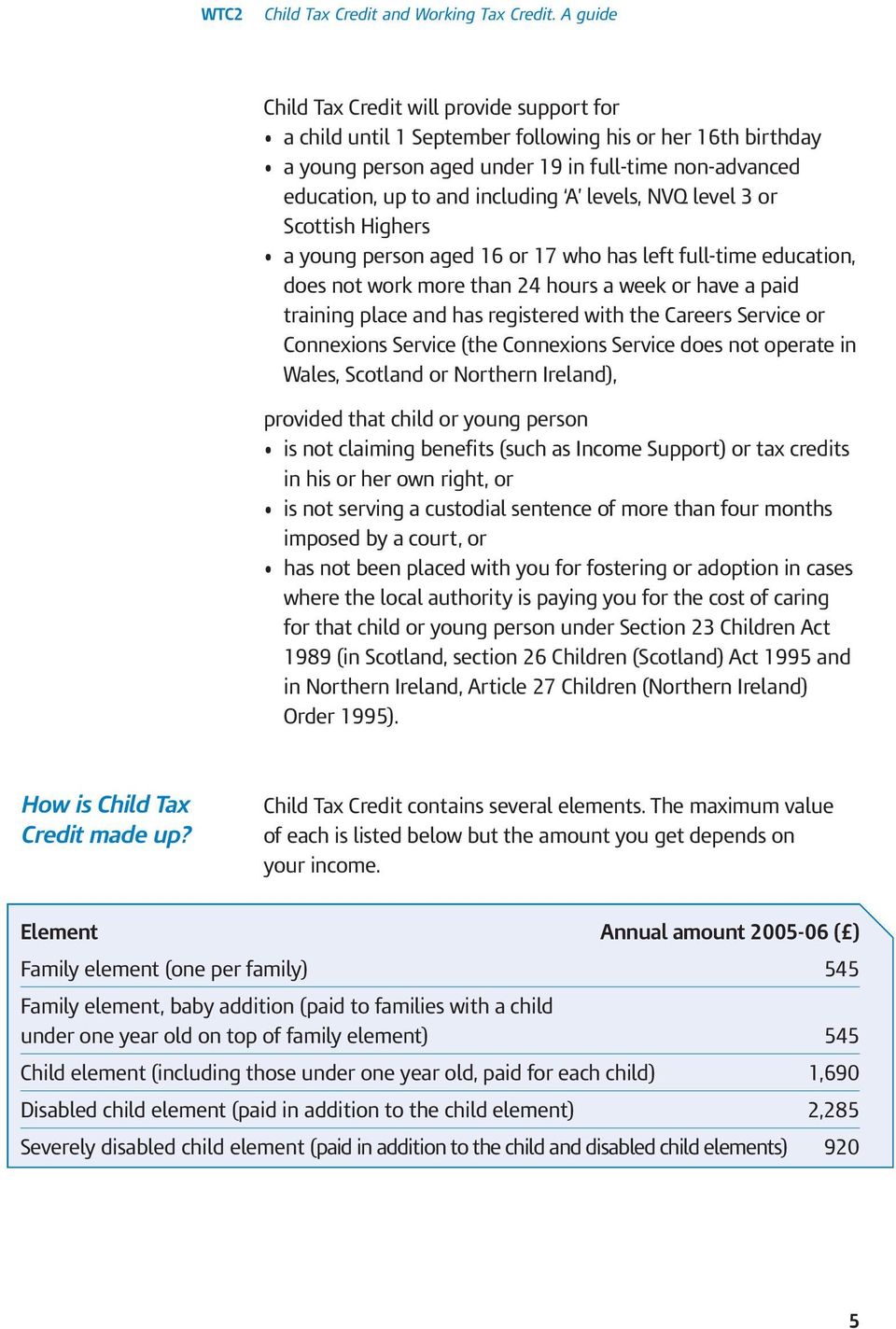
7 Child Tax Credit will provide support for a child until 1 September following his or her 16th birthday a young person aged under 19 in full-time non-advanced education, up to and including A levels, NVQ level 3 or Scottish Highers a young person aged 16 or 17 who has left full-time education, does not work more than 24 hours a week or have a paid training place and has registered with the Careers Service or Connexions Service (the Connexions Service does not operate in Wales, Scotland or Northern Ireland), provided that child or young person is not claiming benefits (such as Income Support) or tax credits in his or her own right, or is not serving a custodial sentence of more than four months imposed by a court, or has not been placed with you for fostering or adoption in cases where the local authority is paying you for the cost of caring for that child or young person under Section 23 Children Act 1989 (in Scotland, section 26 Children (Scotland) Act 1995 and in Northern Ireland, Article 27 Children (Northern Ireland) Order 1995). How is Child Tax Credit made up? Child Tax Credit contains several elements. The maximum value of each is listed below but the amount you get depends on your income. Element Annual amount ( ) Family element (one per family) 545 Family element, baby addition (paid to families with a child under one year old on top of family element) 545 Child element (including those under one year old, paid for each child) 1,690 Disabled child element (paid in addition to the child element) 2,285 Severely disabled child element (paid in addition to the child and disabled child elements) 920 5
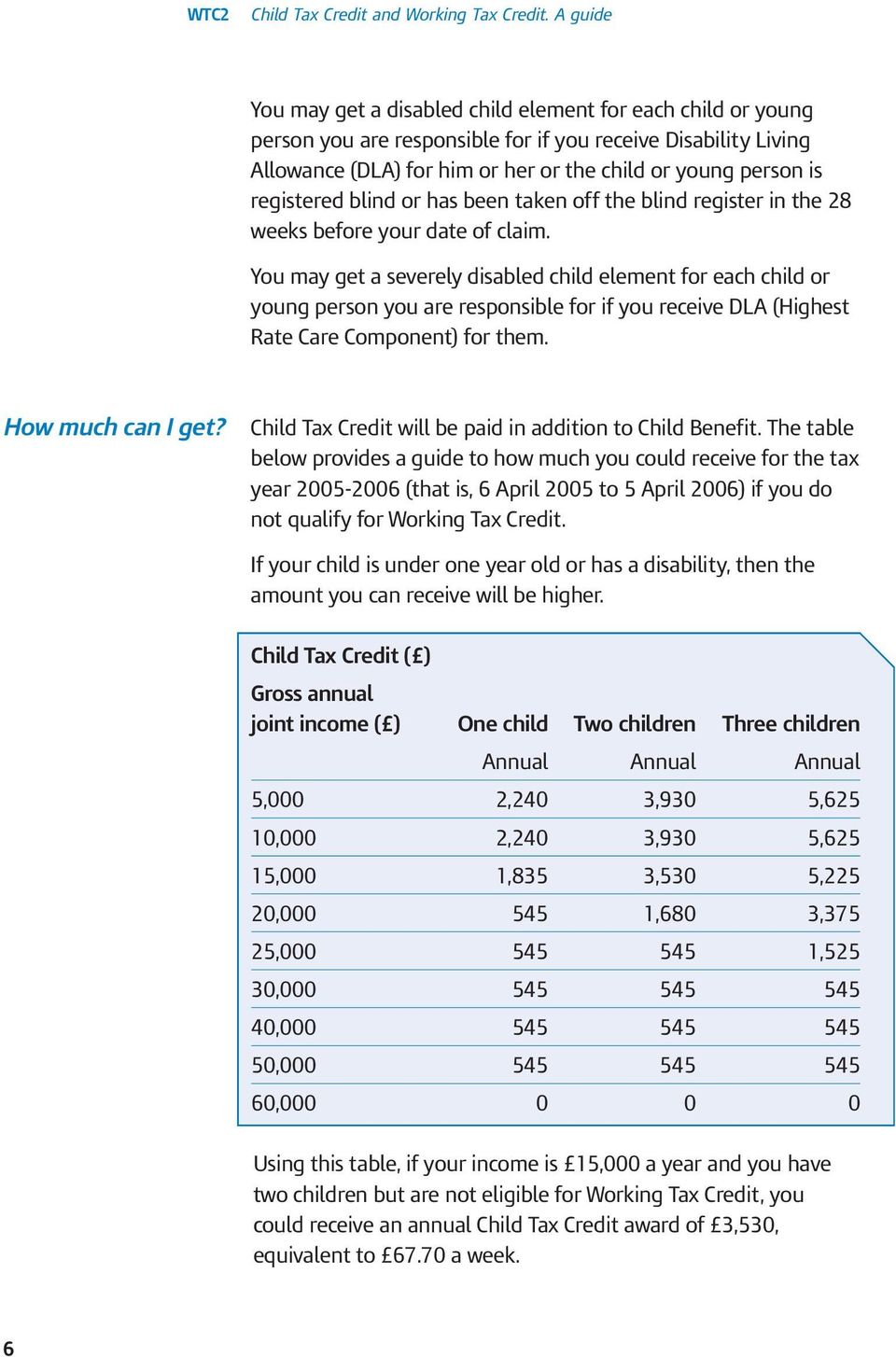
8 You may get a disabled child element for each child or young person you are responsible for if you receive Disability Living Allowance (DLA) for him or her or the child or young person is registered blind or has been taken off the blind register in the 28 weeks before your date of claim. You may get a severely disabled child element for each child or young person you are responsible for if you receive DLA (Highest Rate Care Component) for them. How much can I get? Child Tax Credit will be paid in addition to Child Benefit. The table below provides a guide to how much you could receive for the tax year (that is, 6 April 2005 to 5 April 2006) if you do not qualify for Working Tax Credit. If your child is under one year old or has a disability, then the amount you can receive will be higher. Child Tax Credit ( ) Gross annual joint income ( ) One child Two children Three children Annual Annual Annual 5,000 2,240 3,930 5,625 10,000 2,240 3,930 5,625 15,000 1,835 3,530 5,225 20, ,680 3,375 25, ,525 30, , , , Using this table, if your income is 15,000 a year and you have two children but are not eligible for Working Tax Credit, you could receive an annual Child Tax Credit award of 3,530, equivalent to a week. 6
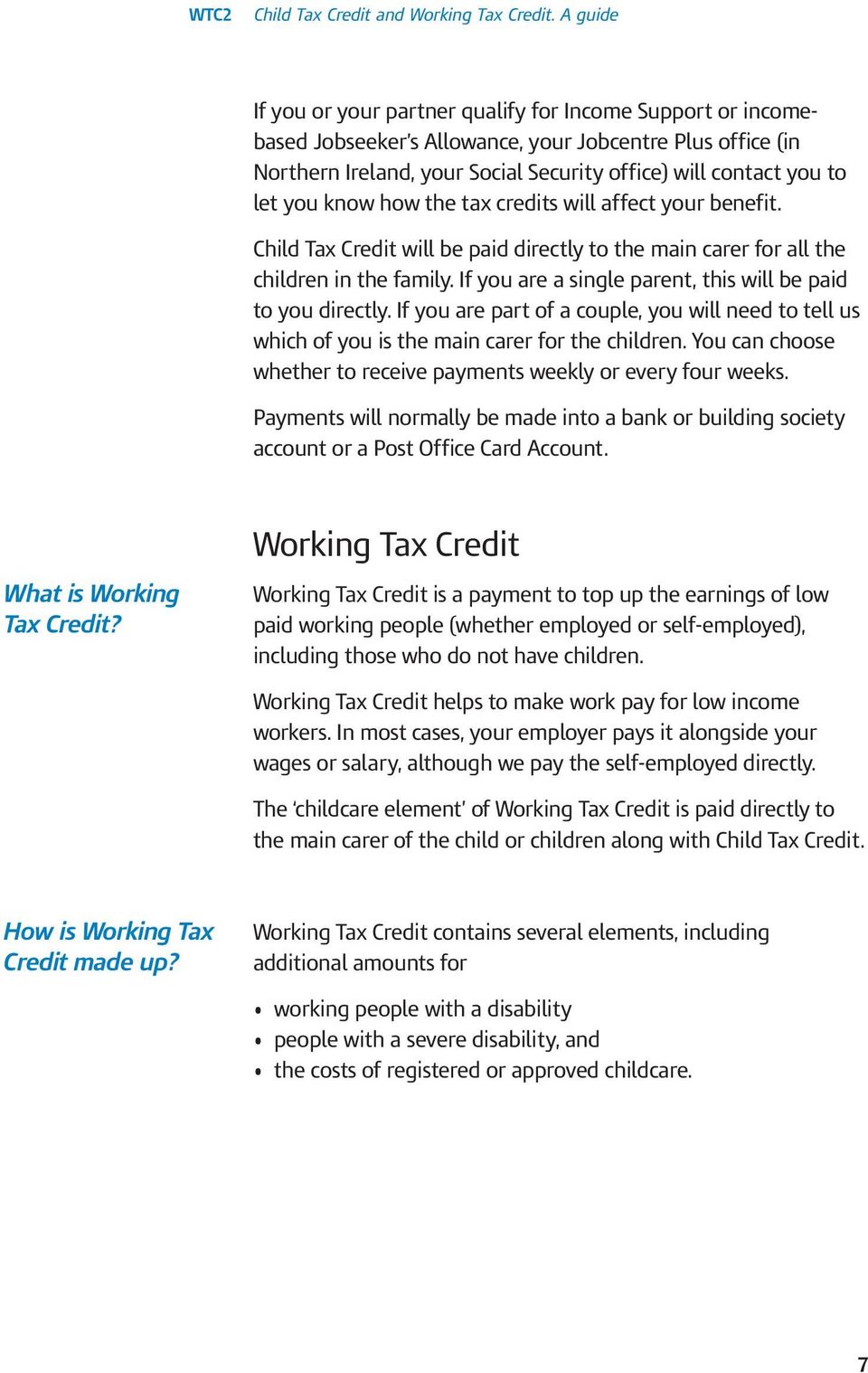
9 If you or your partner qualify for Income Support or incomebased Jobseeker s Allowance, your Jobcentre Plus office (in Northern Ireland, your Social Security office) will contact you to let you know how the tax credits will affect your benefit. Child Tax Credit will be paid directly to the main carer for all the children in the family. If you are a single parent, this will be paid to you directly. If you are part of a couple, you will need to tell us which of you is the main carer for the children. You can choose whether to receive payments weekly or every four weeks. Payments will normally be made into a bank or building society account or a Post Office Card Account. Working Tax Credit What is Working Tax Credit? Working Tax Credit is a payment to top up the earnings of low paid working people (whether employed or self-employed), including those who do not have children. Working Tax Credit helps to make work pay for low income workers. In most cases, your employer pays it alongside your wages or salary, although we pay the self-employed directly. The childcare element of Working Tax Credit is paid directly to the main carer of the child or children along with Child Tax Credit. How is Working Tax Credit made up? Working Tax Credit contains several elements, including additional amounts for working people with a disability people with a severe disability, and the costs of registered or approved childcare. 7
10 The maximum value of each element is listed below, but the amount you get depends on your income. Element Annual amount ( ) Basic element (one per single claimant or couple) 1,620 Couple s** and lone parent elements (paid in addition to basic element but only one couple s element allowed per couple) 1, hour element (paid in addition to other elements but only one 30 hour element allowed per couple) 660 Disabled worker element (paid in addition to other elements)* 2,165 Severe disability element (paid in addition to other elements)* return to work element (16-29 hours per week) ** (paid in addition to other elements)* ** 1, return to work element (30 or more hours per week) (paid in addition to other elements)* 1,660 Childcare element, maximum eligible cost for families with childcare for one child 175 per week Childcare element, maximum eligible cost for families with childcare for two or more children 300 per week Percentage of eligible childcare costs covered 70% *If the claim is a joint claim and you are both entitled to any of these elements, the award will include two elements per couple. However, the 50+ return to work elements are mutually exclusive. Where an individual works enough hours to qualify for the hour element, he or she cannot also receive the hours element. **If you qualify for the hours element, you will not get the couple s element unless you have responsibility for a child or you qualify for the disability element of Working Tax Credit. 8

11 Working hours You need usually to be working a minimum number of hours a week to claim Working Tax Credit. If you are aged 16 or over and either you or your partner are responsible for a child or young person, or you have a disability which puts you at a disadvantage in getting a job and you satisfy either the qualifying benefit test or the special fast-track rules to qualify for a disability element See pages then you must work at least 16 hours a week. If you are part of a couple with children, you are eligible for the 30 hour element if you jointly work at least 30 hours a week, provided one of you works at least 16 hours. Childless couples cannot add their hours together to qualify for the 30 hour element. If you or your partner are aged 50 or over and are returning to work on or after 6 April 2003 after claiming one or more of the qualifying out-of-work benefits listed below for at least the previous six months, you must work at least 16 hours a week. The qualifying out-of-work benefits are Income Support Jobseeker s Allowance Incapacity Benefit Severe Disablement Allowance State Pension Credit A training allowance paid while you were undertaking government-run training such as Work-based Learning for Adults or Training for Work. You can also claim Working Tax Credit if you have been receiving a combination of these benefits for six months or more, or you have been awarded National Insurance credits for six months or more. If you received Carer s Allowance, Bereavement Allowance or Widowed Parent s Allowance before making a successful claim for one of the benefits listed above, the time that you received any of these allowances will count towards the six month period. 9

12 If you do not have children and you do not have a disability which puts you at a disadvantage in getting a job, you must be aged 25 or over and work at least 30 hours a week to qualify for Working Tax Credit. In all cases, you have to be working (whether in employment or self-employment) when you make your claim, or starting paid work within seven days of making your claim. You should expect the work to continue for at least four weeks after you have made the claim, and to be paid, so, for example, working as a volunteer does not normally count. You can still claim Working Tax Credit if you work at a school or college and don t work during school or college holidays. If you are moving between jobs, you will remain eligible for Working Tax Credit provided that the gap between jobs is not more than seven days. Where the gap is more than seven days, you may still be eligible for Working Tax Credit but you will have to make a new claim based on the circumstances of your new job. Maternity leave Most women receive Statutory Maternity Pay (SMP) or Maternity Allowance (MA) for the first 26 weeks of maternity leave (known as ordinary maternity leave). This can be followed by up to 26 weeks of unpaid leave, known as additional maternity leave. For the 26 weeks of ordinary maternity leave, whether or not you are receiving SMP or MA, you are still treated as being in work and able to claim Working Tax Credit, provided you usually worked at least 16 or 30 hours a week (whichever applied) immediately before going on maternity leave. This also applies if you are self-employed. If you are a first-time mother, you can claim Working Tax Credit from the date of birth of your first child, provided you usually worked at least 16 hours a week immediately before your maternity leave began. 10

13 When the 26 weeks of ordinary maternity leave are over, you continue to be eligible for Working Tax Credit if you begin work again at that point. Any further additional (unpaid) maternity leave does not count as being in work and you are not eligible for Working Tax Credit for this period. Adoption or paternity leave If you adopt a child, you may be eligible for 26 weeks ordinary adoption leave, for which you may get Statutory Adoption Pay (SAP), followed by 26 weeks additional (unpaid) adoption leave. New fathers may be eligible for two weeks paternity leave and be paid Statutory Paternity Pay (SPP) for those two weeks. If you are on ordinary adoption leave or paternity leave, whether or not you are receiving SAP or SPP, you will still count as being in work and able to claim Working Tax Credit, provided you usually worked at least 16 or 30 hours a week (whichever applied) immediately before going on leave. This also applies if you are self-employed. If you are a first-time parent, you can claim Working Tax Credit from the date of placement for adoption or birth of your first child, provided you usually worked at least 16 hours a week immediately before your adoption or paternity leave began. Sick Leave If you are off work for up to 28 weeks because of illness and are receiving Statutory Sick Pay (SSP) short-term Incapacity Benefit at the lower rate Income Support paid on the grounds of incapacity for work, or National Insurance credits on the grounds of incapacity for work then you will still be able to claim Working Tax Credit, provided you worked at least 16 or 30 hours a week (whichever applied) immediately before you started to receive any of these benefits. This applies to both employees and the self-employed. 11

14 The disabled worker element You may receive the disabled worker element of Working Tax Credit if you usually work at least 16 hours a week and you have a physical or mental disability which puts you at a disadvantage in getting a job and you satisfy either the qualifying benefit test or the special fast-track rules. If you are claiming as a couple and your partner is also working for 16 hours or more a week, and is entitled to the disability element, you may receive two disability elements. What is a disability which puts someone at a disadvantage in getting a job? Details of the disabilities which put someone at a disadvantage in getting a job are set out in the notes that accompany the claim form. They include a wide range of things, for example seeing hearing communicating with people getting around using your hands reaching with your arms mental disabilities, and exhaustion and pain. We may ask you to give us the name of a healthcare professional who can confirm the extent to which your disability affects you, for example, a doctor, a district or community nurse, or an occupational therapist. What is the qualifying benefit test? (A) To satisfy the qualifying benefit test, you must be receiving one of the following benefits Disability Living Allowance Attendance Allowance Industrial Injuries Disablement Benefit (with Constant Attendance Allowance for you) War Disablement Pension (with Constant Attendance Allowance or Mobility Supplement for you), or a vehicle provided under the Invalid Vehicle Scheme. 12
15 (B) Alternatively, you must have received one of the following benefits in the last six months Incapacity Benefit at the short-term higher rate or the longterm rate income-based Jobseeker s Allowance* Income Support* Severe Disablement Allowance Council Tax Benefit* Housing Benefit*. *This must include a Disability Premium or a Higher Pensioner Premium for you. If you give up Incapacity Benefit paid at the short-term higher rate or the long-term rate or Severe Disablement Allowance to go to work and you qualify for a disability element of Working Tax Credit, you can return to the same rate of Incapacity Benefit or Severe Disablement Allowance if you give up your job while qualifying for a disability element of Working Tax Credit, and your first day of incapacity immediately follows your last day of work, and this falls within two years of when you last received Incapacity Benefit or Severe Disablement Allowance. (C) You can also satisfy the qualifying benefit test if you have been training for work in the last eight weeks and you started training for work within eight weeks of receiving either Incapacity Benefit at the short-term higher rate or the long-term rate or Severe Disablement Allowance. Training for work means attending government-run training such as that provided by the New Deal, Work Based Learning for Adults (Training for Work in Scotland) or a course that you attended for 16 hours or more a week to learn an occupational or vocational skill. 13

16 If you are making a second, or further, claim for the disability element of Working Tax Credit and you were entitled to the disability element of Working Tax Credit for at least one day in the last eight weeks on the basis of satisfying the qualifying benefit test by meeting (B) or (C) above, you are treated as still satisfying the qualifying benefit test. What are the fast-track rules? The fast-track rules help you if you are finding it hard to stay in work because of a disability. If your disability means that, after a period of sickness, you have to change to work with lower pay or reduce your hours in your current job, the fast-track allows you to qualify for the disability element earlier than under the qualifying benefit test. The same applies if you are self-employed. To qualify for the disability element of Working Tax Credit via the fast-track rules, you must have been getting one or more of the following for 20 weeks or more, provided that the last day of receipt was in the last eight weeks. Statutory Sick Pay. Occupational Sick Pay. Incapacity Benefit at the short-term lower rate Income Support paid because of incapacity for work. National Insurance credits awarded because of incapacity for work. The 20 weeks does not need to be a single continuous period. It can be made up of any time that you received the benefits or National Insurance credits which are separated by eight weeks or less. These times may be linked, that is, added together to see whether you satisfy the 20 week condition. You must have a disability that puts you at a disadvantage in getting a job and is likely to last for at least six months or for the rest of your life. In addition, your gross earnings (before tax and National Insurance contributions are deducted) must be at least 20% less than they were before you had the disability, with a minimum reduction of 15 a week. 14

17 If you are making a second, or further, claim for the disability element of Working Tax Credit and you were entitled to the disability element of Working Tax Credit for at least one day in the last eight weeks on the basis of satisfying the fast-track rules, you are treated as still satisfying the fast-track rules. The severe disability element If you or your partner (if you are claiming as a couple) get Disability Living Allowance (Highest Rate Care Component) or Attendance Allowance (Higher Rate), you can get the severe disability element. You do not have to be working to qualify for the severe disability element as long as your partner does. If you both qualify, you will get two severe disability elements. Help with the costs of childcare You may be able to get more Working Tax Credit to help with the cost of registered or approved childcare. This is the childcare element of Working Tax Credit. The childcare element can help with up to 70% of your childcare costs up to a maximum cost of 175 a week for one child and 300 a week for two or more children. This means that the childcare element is worth up to an extra a week ( 175 x 70%) for families with one child, and 210 a week ( 300 x 70%) for families with two or more children. The amount you receive will depend on your income and will be paid directly to the main carer. To claim the childcare element you must be over 16 and if you are a lone parent, you must work 16 hours a week or more, or if you are in a couple - both of you must work 16 hours a week or more, or - one partner must work 16 hours a week or more and the other partner must be incapacitated, or an in-patient in hospital, or in prison (whether serving a custodial sentence or remanded in custody awaiting trial or sentence). 15

18 You will be treated as incapacitated if you receive Disability Living Allowance Attendance Allowance Severe Disablement Allowance Incapacity Benefit at the short-term higher rate or long-term rate Industrial Injuries Disablement Benefit (with Constant Attendance Allowance for you) War Disablement Pension (with Constant Attendance Allowance or Mobility Supplement for you) Council Tax Benefit or Housing Benefit with a Disability Premium or Higher Pensioner Premium for you, or a vehicle under the Invalid Vehicle Scheme. You can claim the childcare element for any child up to 1 September following his or her 15th birthday, or 1 September following their 16th birthday if the child is registered blind or has been taken off the blind register in the 28 weeks before your claim, or you receive Disability Living Allowance for the child. If you are on ordinary maternity, ordinary adoption or paternity leave and are still treated as being in work, you can claim the costs of childcare for the child you have taken leave to look after, as well as claim the costs of childcare for any other children in the family. This will enable you to settle a new baby or child into childcare before returning to work. If you are becoming a parent for the first time, Working Tax Credit is available before the baby or child arrives if you were aged 25 or over and worked at least 30 hours a week before the maternity, adoption or paternity leave began. You can claim Working Tax Credit, including the childcare element from the birth or adoption of the child, as long as you usually worked at least 16 hours a week before the maternity, adoption or paternity leave began. 16

19 What do you mean by registered or approved childcare? The childcare must be provided by one of the following. Registered childminders, nurseries and playschemes. Out-of-hours clubs run by a school on the school premises or by a local authority. Childcare schemes run by approved providers, for example, an out-of-school-hours scheme. A provider approved under a Ministry of Defence accreditation scheme abroad. An approved foster carer. (The care must be for a child who is not a foster carer s foster child.) In England only, a childcarer who is approved by Ofsted to care for your child or children in your own home.* In England only, a childcarer approved under the Childcare Approval Scheme. (If you use a sitter service, then give us the details of the sitter you use most frequently. You do not have to notify us of all the sitters you use, as long as they are approved. However, you should keep details of all the sitters you use for your own records.) In England and Wales only, childcare provided in your own home* by a domiciliary worker or nurse from a registered agency. In Scotland only, childcare provided in your own home* by (or introduced through) childcare agencies, including sitter services and nanny agencies, which are required to be registered. *Childcare will not be eligible care for help within the Working Tax Credit childcare element if it is provided by a relative of a child caring for that child in the child s home even if the relative is registered or approved, or a childcarer approved under the Childcare Approval Scheme, who is caring for a child, or children, away from the child, or children s, home and who is only caring for a child, or children, to whom he or she is related. A relative of the child means a parent, grandparent, aunt, uncle, brother or sister whether by blood, half-blood, marriage or affinity. If you have any questions about the meaning of relative, please telephone the Tax Credits Helpline. Your scheme or childminder will be able to tell you whether or not they are approved or registered. You cannot claim the costs of childcare if it is not registered or approved. 17
20 What happens if I change or stop my childcare arrangements? If you change your childcare provider, you may still be eligible for the childcare element, but the amount due may need to be adjusted to take account of any changes in the costs. You should tell us as soon as you change your provider. We may check the details of your childcare costs with your provider. If the details you have given us are out-of-date, we might contact the wrong provider and could stop paying the childcare element if we cannot check the details of your claim. If the average weekly costs of your childcare change, you may be due more or less childcare element. If your average weekly costs go up by 10 a week or more for at least four weeks in a row, you should tell us so that we can increase your childcare element. You must tell us within three months of the change to get the increase from the date it started. If your average weekly costs go down by 10 a week or more for at least four weeks in a row, we will reduce your childcare element. You must tell us as soon as possible if your average weekly costs go down by 10 a week or more. If you don t, you might be overpaid tax credits and have to pay some back. If you do not tell us within three months, you might also have to pay a penalty. For more information about how to calculate these costs, you should read our leaflet WTC5 Help with the costs of childcare. Information for parents and childcare providers. If you stop using childcare, you cannot continue to receive the childcare element. If your average weekly costs are zero for at least four weeks in a row, you should tell us as soon as possible to prevent being overpaid. You must tell us within three months or you might have to pay a penalty. 18

21 How much Working Tax Credit can I get? Working Tax Credit is paid in addition to any Child Tax Credit you may be entitled to. Some people will be paid both Child Tax Credit and Working Tax Credit. The amount of your Working Tax Credit award is based on your circumstances (for example, how many hours you work or whether you are disabled) and your income. The tables below provide a guide to how much you could receive for the tax year Working Tax Credit ( ) If you are not responsible for at least one child or qualifying young person Gross annual Single person Couple (working Joint income( ) aged 25 or over adult aged 25 or working 30 or more over) working 30 or hours a week more hours a week Annual Annual 7, , ,000 1,250 2,845 10, ,105 12, ,365 14, , Someone aged 25 or over, working 30 hours a week on National Minimum Wage would earn 7,566 a year. 19
22 The table below shows how much money you could get for the tax year if you are in work and responsible for at least one child or young person. Child Tax Credit and Working Tax Credit Gross annual joint amount ( ) One child Two children Three children 5, ,455 7,150 8,840 8, ,085 6,780 8,475 10,500 4,160 5,855 7,550 15,000 2,495 4,190 5,885 20, ,340 4,035 25, ,185 30, , , , , , , Those with incomes of 5,000 a year are assumed to work parttime (working between 16 and 30 hours a week). 2 In families with an income of 8,000 a year or more, at least one adult is assumed to be working 30 or more hours a week. Note: If you have a child under one year old, you may be entitled to more. Using these tables, for example, if you are claiming as a lone parent or a couple with two children and working 30 hours or more a week, with an income of 10,500 a year, you could receive an annual Tax Credit award of 5,855. The maximum amounts may be higher if you are entitled to the disability elements of Working Tax Credit. 20
23 Income and capital The amount of tax credits you will receive depends on your circumstances, for example the number and ages of your children the number of hours you work each week whether you are disabled, and how much you pay for registered childcare. It also depends on the level of your income. If you are part of a couple, it depends on your joint income. As Child Tax Credit and Working Tax Credit are annual tax credits, we will look at your income for a tax year to work out your award, usually the last complete tax year before the year of the tax credits claim. What income will I have to report in my claim? Broadly, you will have to report in the tax credits claim form income which is taken into account for income tax purposes. But there are important exceptions to this general rule and some are outlined below. The Tax Credits Helpline will be able to give you more information about what types of income count for tax credit purposes. We take into account the gross amount of your income, that is, your income before tax and National Insurance contributions have been taken off. Similarly, if you make contributions from your earnings to buy shares in your employer s company under a Share Incentive Plan (SIP), then those contributions must be added back to your gross pay. However, contributions to any Inland Revenue approved pension scheme (such as an occupational pension scheme, a personal pension plan or retirement annuity) and payments under the Gift Aid or Payroll Giving schemes should be deducted when you work out your income for a tax credit claim. If you made personal pension or retirement annuity contributions, Gift Aid payments or a trading loss (see page 25), please phone the Helpline for a working sheet (TC825) to help you to work out the income to enter in your tax credits claim. 21
24 22 We take the following types of income into account when we work out how much tax credits to pay. Salary and wages, including commission, bonuses, tips, gratuities, profit-related pay, holiday pay, SSP and some benefits in kind which may be provided by your employer (for example, car and car fuel, allowances for the use of your own car on business, vouchers and credit tokens). Although SMP, SPP and SAP are taxable, we will take off 100 a week from your income for tax credit purposes. Taxable profits from self-employment. Taxable social security benefits, for example, Carer s Allowance (previously called Invalid Care Allowance) and Incapacity Benefit paid at the short-term higher and long-term rates, including any Child Dependency Increases paid with these benefits but not benefits which are not taxable, such as, Child Benefit, Attendance Allowance, Disability Living Allowance, Housing Benefit or Council Tax Benefit. State retirement pensions (including Widowed Parent s Allowance, Widowed Mother s Allowance, Widow s Pension and Industrial Death Benefit) and occupational or personal pensions but not war pensions, whether paid on grounds of wounds or disability or paid to widows. Most income from savings and investments (for instance, interest from bank and building society accounts, dividends from UK companies, payments from trusts or the estate of a deceased person in administration) but not income from certain tax-exempt investments, such as, Individual Savings Accounts (ISAs), Personal Equity Plans (PEPs) or non-taxable National Savings products. Rental income from property but not income which is exempt from income tax under the rent-a-room scheme (briefly, if you let furnished accommodation in your own home for up to 4,250 a year). Foreign income, for example, from investments or property overseas and social security payments from overseas governments, before any overseas tax was taken off but deducting any bank charges or commission when converting foreign currency to pounds. We want to know about all foreign income, whether or not it was received and taxed in the UK, unless you were unable to send the income to the UK because of exchange controls in the country of origin.
25 The dependant s grant paid to students with a spouse or unmarried partner or a dependant adult. Miscellaneous income such as Business Start-Up Allowances for unemployed people starting their own business or copyright royalties paid to someone who is not a professional author or composer, which is taxable under Case VI of Schedule D of the Taxes Act Apart from income from employment, self-employment, taxable social security benefits, student dependant s grant and miscellaneous income, you only need to report other income if it is more than 300 a year in total. If it is, you only need to enter the amount over 300 in the tax credits claim form. If you make a claim as a couple, the 300 limit applies to your joint income, not to each of you separately. What about capital? We will not normally take capital (that is, deposits in current and savings accounts at banks and building societies, most lump sum payments and the value of property, shares and other investments) into account when we work out your entitlement to tax credits. However, in some cases where the income tax rules treat capital as income and tax it as such, you will be expected to include the taxable amount as income in your tax credit claim. This can happen if, for example, you hold shares in a UK company and the company gives you a stock dividend (new shares) instead of a cash dividend. This is part of what we call notional income. What does notional income mean? Besides capital that is treated as income under the income tax rules, notional income also includes income that you can be treated as having which you may not in fact have. This includes trust income payable to one person but which the income tax rules tax as the income of another person the tax credit rules also treat the income as belonging to that other person (for example, investment income of a minor child where trust funds have been provided by a parent and the amount exceeds 100) income you may have deprived yourself of for the purpose of getting a tax credit or more tax credit 23
26 income that would be available to you if you applied for it, for example a social security benefit. There are some exceptions, for example - a deferred state or personal pension or retirement annuity, or - compensation for personal injury, and if you work or provide a service for free or less than the going rate, in which case you are treated as getting the going rate for the job if the person you are working for or to whom you are providing the service has the means to pay. This does not apply if you are working as a volunteer or on an employment or training programme. Are maintenance payments taken into account when calculating tax credit entitlement? No. We don t take maintenance payments, such as child support or payments under a divorce settlement into account. You will be able to have full use of any maintenance that you receive in addition to your tax credits. I am a student. Will my loan or grant be taken into account if I claim Child Tax Credit? We don t take student loans or grants to meet the cost of tuition fees, childcare, or the Parent s Learning Allowance into account. But you should tell us if you receive a Dependant s Grant for a spouse or unmarried partner or a dependent adult. If you are a student nurse or a health profession trainee and you receive a bursary under the NHS Bursary Scheme, you do not need to tell us about these payments in your claim. After you have finished your studies and start work, repayments of student loans are not deductible from income in tax credit claims. Where can I find details of my income? If you were employed on 5 April 2005, details of your earnings during the tax year will be shown in the P60 tax certificate given to you by your employer after the end of that tax year in your monthly payslips, and in the P9D or P11D certificates (if you received relevant benefits in kind) given to you by your employer. 24
27 The guidance to the tax credits claim form will tell you exactly which benefits in kind to tell us about. If you are self-employed, you should tell us the taxable profit calculated in your Self Assessment tax return for However, if you are a farmer, market gardener or a creative artist, averaging relief for fluctuating profits is not allowed in tax credit claims, further details are provided in the notes accompanying the tax credit claim form (TC600). If you have not yet sent the Inland Revenue your Self Assessment return for , you must estimate your profits for that year. If your business made a loss in that tax year, for tax credit purposes you can set that loss against other income you may have for that year any income of your spouse for that year, or any income of your personal partner for that year. For more information, or if you have not sent us a tax return, please see the guidance to the claim form. If this does not use up the entire loss, the balance (that is, the unused part of the loss after deducting the amounts set against other income of that year) may be carried forward to set against the profits of the same business in a future tax year. For example, if your business made a loss in and there is some loss remaining after the deduction from other income of , the unused part of the loss may be brought forward and deducted from the profits of the same business in the tax year If you received taxable social security benefits in , the Department for Work and Pensions (in Northern Ireland, the Department for Social Development) should have sent you a record of the taxable amount of benefit. If you received other types of income, you should refer to the statements, passbooks or to tax deduction certificates provided by the payer of the income and which you should be keeping for tax purposes. 25
28 How is my award worked out? The amount of tax credits which you (and your partner, if you have one) will receive is calculated by dividing (separately) each of the elements of Child Tax Credit and Working Tax Credit which your family is entitled to by the number of days in the tax year and rounding up to the nearest penny to give a daily rate. These daily rates are then multiplied by the number of days in the relevant period and added together to give your family s maximum entitlement. We then look at your income (and your partner s, if you have one) to work out whether you will get tax credits in full or at a reduced rate. We will send you an award notice which tells you how much tax credit you will receive and when payments will start. If your family receives Income Support or income-based Jobseeker s Allowance you will automatically receive the full amount of Child Tax Credit that you qualify for. If you receive Child Tax Credit only, you will be entitled to the full amount of that tax credit until your annual income reaches 13,910. If you receive Working Tax Credit, whether on its own or in addition to Child Tax Credit, and your annual income (or you and your partner s income) is below 5,220, you will receive the maximum amount of all the elements that you qualify for. If your income is over that threshold, the maximum amount is reduced by 37 pence for every pound of income over the threshold (rounded down to the nearest penny). If you have income over the threshold of 5,220, your maximum amount will be reduced in the following order Working Tax Credit apart from the childcare element the childcare element of Working Tax Credit the child elements of Child Tax Credit, and finally the family element of Child Tax Credit. See page 36 for some examples of how tax credit awards are calculated. We will not start to reduce the family element of Child Tax Credit (including, where relevant, the baby addition) until your annual income is over 50,000 and entitlement to tax credits over and above the family element has been withdrawn. We will then reduce that element by 1 for every 15 of income over that second threshold. 26
29 What happens once I am getting tax credits? Tax credit awards will initially be based on your current circumstances and your income for the previous tax year. If your circumstances do not change and there are no significant changes in your income during the year, the initial award will run until the end of the tax year (5 April). At the end of the tax year, we will send you a further notice that tells you the information we hold about your claim, in particular the circumstances and income upon which we based the award and the amount of tax credit paid over the year. You should check this notice carefully. You must then either confirm that the details are correct, or correct them if there are changes that you have not previously told us about. You also need to tell us about your income for the year just ended. When you send the notice back and we have all the details, we will check whether the award we paid you for the year just gone was right, and work out your award for the following year, as the notice will also act as the claim for the next award. If your circumstances and income stayed the same throughout the year which has just ended, or if your income in that year was not more than 2,500 higher than the year before that, you should have received the right amount of tax credits. If you only get the family element of Child Tax Credit, you don t have to return the notice if your income remains within a certain range specified in the end-of-year notice, provided your circumstances have not changed. If you do not have to return the notice, you will be treated as having automatically made a new claim for the next award. 27
30 What happens if my circumstances or income change? There are some changes that could affect the level of the tax credit award. They include changes in the adults in the household, for example if you and your partner stop living together or if, having been living on your own, you begin living with someone as a couple changes in circumstances affecting the elements of tax credits for which you are eligible, such as - the birth or death of a child - if a child leaves the household or stops full-time education - if you stop using registered or approved childcare, or - a change in your usual weekly working hours you or your partner begin to qualify for a disability element of Working Tax Credit you or your partner no longer have a disability which puts you at a disadvantage in getting a job a child you are responsible for is registered as blind or is taken off the blind register you are claiming Disability Living Allowance (DLA) for a child you are responsible for, or you are claiming for an existing DLA award for them to be increased to include the Highest Care Component and the decision on the claim has not yet been made (this may affect the date that any disability element may be backdated to) (DLA) starts or stops being paid for a child you are responsible for the Highest Rate Care Component of DLA starts or stops being paid for you, your partner, or a child you are responsible for the Higher Rate of Attendance Allowance starts or stops being paid for you or your partner, and changes in income between the previous year and the current year. You should keep a record of any changes in circumstances to help you complete the end of year notice, and your new award notice after you have told us about a change of circumstances. 28
31 Changes in circumstances You must tell us within three months about a change in the number of adults in your household or if your partner changes. You must also tell us if you or your partner leave the UK permanently or go abroad for more than eight weeks (12 weeks if you go or remain abroad because you are ill or because a member of your family is ill or has died), and if you and your partner lose your right to reside in the UK (for example, if you are a national of one of the countries that joined the European Economic Area (EEA) on 1 May 2004 other than Cyprus and Malta you must tell us if you and your partner lose your job before you have worked in the UK lawfully and uninterruptedly for 12 months). More information about these rules can be found at This is because you will either need to make a new claim, taking account of your new circumstances and the level of your new household income, or because you will lose entitlement to tax credits. If you don t, you may be overpaid tax credits. You will be asked to pay these back and may also be liable to a penalty of up to 300. You should tell us immediately about changes that may reduce your award, for example if a young person leaves your family or stops full-time education if you change your childcare provider, or if you or your partner stops working more than the relevant minimum of 16 or 30 hours a week and this is not part of your normal annual cycle of employment. If your childcare costs go down by 10 a week or more for at least four weeks in a row, you must tell us as soon as possible (at the latest within three months) otherwise you may be liable to a penalty. These changes can affect your award from the date of the change. If you delay telling us, you may be paid too much tax credit and have to pay it back. 29
32 You need to tell us within three months about changes that may increase your tax credit award, such as a new child in the family starting to use registered or approved childcare if your childcare costs increase by 10 a week or more for at least four weeks in a row, or an increase in your working hours (or those of your partner) from under 16 to 16 hours or more a week or from under 30 to 30 hours or more a week. We will then increase your award from the date of the change. You can tell us about any of these changes by phoning the Tax Credits Helpline visiting an Inland Revenue Enquiry Centre or a Jobcentre Plus office (in Northern Ireland, a Social Security office), or writing to us at The Tax Credit Office (Change of Circumstances), Preston, PR1 0SB. Changes in income Your award will initially be based on your income for the previous tax year. If your income in the current tax year rises by less than 2,500, it will not affect your award and we will still base it on your income for the previous year. So for the current year, you will get the benefit of a rise in income up to that amount without it reducing your tax credit award. The increased level of income is not taken into account until the next year. If your income in the current year is lower than last year s income, we will base your tax credit award on your current year s income. In this case, you may be due more tax credit. You can either tell us during the year that you expect to receive less income than last year we will then adjust your payments to make sure you receive the right amount in-year, or wait until we finalise your award at the end of the year and we can pay you any extra tax credit you are due in a lump sum. We will check at the end of the year what your income was. If you tell us during the year about a fall in your income and it falls by less than you expected, you will have to pay back any tax credits we have overpaid. 30
33 If your income increases by more than 2,500, then we will base your final award on your current year s income. We will only take that part of the increase over 2,500 into account when working out your tax credit award for the current year. We will, however, use the full amount of income when setting your award for the following year. You should tell us immediately if you think that your income will rise by more than 2,500 in the current tax year. This will help you to avoid an overpayment of tax credits which you would have to pay back after we finalise the award at the end of the year. What happens if there are changes in my tax credit award? If your tax credit award goes up because of a change in circumstances which increases your entitlement, and if you have told us about this during the year, we will pay any extra tax credit for up to three months before the adjustment was made in a lump sum, and increase your award for the rest of the year. If your income has fallen and you tell us about it during the year, we will pay you any extra tax credits due from the start of the year or when you first became entitled to tax credits. If, at the end of the tax year, we find that you were due more tax credit than you were in fact paid because of a change in circumstances or income, we will pay the extra amount as a lump sum. If your tax credit award goes down because of a change in circumstances which reduces your entitlement or because of an increase of more than 2,500 in your income, that you have told us about during the year, we will reduce your tax credit award from the date of the change so that we pay you the right amount for the year overall. Alternatively, if we have already paid you as much as or more than you are entitled to for that year, we will not pay out any more tax credits for the rest of that year. If, during the year, we find that you were not entitled to any tax credits, at any time in the year, we will ask you to pay back all the tax credits we have paid you. 31
34 If, at the end of the tax year, we find that we have paid you too much tax credit during the past year, you will have to pay it back by either having it deducted from a continuing tax credit award, or direct payment. More information about the tax credit overpayments can be found in our Code of Practice 26 What happens if we have paid you too much tax credit?. Code of Practice 26 is available online or can be obtained from Inland Revenue Enquiry Centres. What if I disagree with the level of my tax credit award or with having to pay a penalty? If you disagree with our decision on your tax credit award or with any penalty, you have the right to appeal against it. You will have 30 days from the date of our decision in which to appeal and you will have to tell us the grounds for appealing. Our leaflet WTC/AP How to appeal against a tax credit decision or award contains more information on how to appeal. For a transitional period, appeals against decisions on tax credits will be administered and heard by appeal tribunals within the Appeals Service, but in due course, responsibility for hearing tax credit appeals is expected to be transferred to the General and Special Commissioners of Income Tax. 32
35 Help and advice How do I claim or get more information? You can make a claim by going online at or by filling in and returning the paper claim form TC600. To obtain a claim form or for further advice about Child Tax Credit or Working Tax Credit you can phone our Helpline on (England, Scotland and Wales) or (Northern Ireland) textphone the Helpline on (England, Scotland and Wales) or (Northern Ireland) visit any Inland Revenue Enquiry Centre or a Jobcentre Plus office (in Northern Ireland, a Social Security office). Our Helplines are open between 8.00am and 8.00pm, seven days a week (except Christmas Day, Boxing Day, New Year s Day and Easter Sunday). If you get Income Support or income-based Jobseeker s Allowance, you do not need to make a claim now. The Department for Work and Pensions (in Northern Ireland, the Department for Social Development) will contact you directly to let you know how the new tax credits will affect you and your benefit. What other help can I get? If your income is below a certain level you may be entitled to benefits and services, such as help with the costs of health services, provided by other government departments, agencies or local authorities. You may need to use your tax credits award notice as proof of your income for these benefits and services. For information about these benefits and services, you will need to contact the organisation that provides them. A list of these benefits and the relevant organisations, with initial contact numbers, can be found in our booklet WTC6 Child Tax Credit and Working Tax Credit. Other types of help you may be able to get, available on the internet at and in paper form at Inland Revenue Enquiry Centres. 33
36 If you receive Housing Benefit or Council Tax Benefit, your tax credit award may affect the amount of benefits you are entitled to. When you get your award notice, you should contact your local authority s Housing Benefit or Council Tax Benefit office so that they can reassess your case. Child Benefit and Home Responsibilities Protection If you are claiming Child Tax Credit because you are responsible for a child, you may also be entitled to Child Benefit. If you have not already done so, you should consider making a claim for Child Benefit. If you are the person awarded Child Benefit, this will give you access to Home Responsibilities Protection (HRP). HRP can help to protect your rights to the basic Retirement Pension and the State Second Pension. To help you build up entitlement to the basic Retirement Pension, HRP reduces the number of years you need to pay National Insurance contributions on your earnings, or receive National Insurance credits because you were unable to work provided you received Child Benefit for the whole of the tax year. If you are part of a couple who share caring responsibilities for a child, you should consider carefully who should receive Child Benefit, to make sure that the person who most needs to protect their pension will receive HRP. If you want the Child Benefit to be paid to your partner to protect their pension rights, you can apply on Child Benefit claim form CH2, which you can get from the Child Benefit Centre (in Northern Ireland, the Child Benefit Office) or any local social security office. To find out more about protecting your basic Retirement Pension, you can get leaflets CF411 Home Responsibilities Protection or PM9 State Pension for Carers from your local social security office. 34
37 National Insurance credits for social security benefits If you receive Working Tax Credit and are earning below the Lower Earnings Limit for liability to National Insurance contributions ( 82 a week in the tax year ), you may be awarded National Insurance credits to help to safeguard your entitlement to some social security benefits, such as the basic Retirement Pension. You can get more advice from the Helpline, any Inland Revenue Enquiry Centre or your local Jobcentre Plus office (in Northern Ireland, a Social Security office). 35
38 Examples of tax credit calculations The following examples explain how tax credits will help people in differing circumstances. Other than example 10, for easy reference, these calculations do not take account of the rounding procedures and the weekly amounts are calculated assuming a 52-week year. Example 1 Patricia Taylor is a single parent with one child aged 12 and works less than 30 hours a week. Patricia s gross earnings last tax year were 8,000 (rising to 8,400 in the current year) and apart from Child Benefit (which is disregarded for tax credit purposes) she has no other income. She does not use registered childcare. Patricia s maximum tax credit entitlement will be a combination of Child Tax Credit family element ( 545) and child element ( 1,690), giving 2,235 a year, and Working Tax Credit basic element ( 1,620) and lone parent s element ( 1,595), giving 3,215 a year. A total of 5,450. As her income in the current year is expected to rise by less than 2,500, her tax credit award for the year will be based on last year s income. The income threshold is 5,220. Patricia s award is worked out as follows Annual income 8, Less threshold -5, Excess income 2, Maximum tax credit 5, Less 37% of excess income -1, Award 4, ( a week) 36
39 Example 2 Rebecca Dobson is a single parent with one child aged 4 and works more than 30 hours a week. She uses a registered childminder, which costs her 100 a week. Her gross earnings last tax year were 15,000 (rising to 15,750 in the current year). She receives Child Benefit and maintenance from the child s father of 1,200 each year. She also has 5,000 in her building society account which in the previous tax year paid gross interest (that is, before tax) of 150 and she expects the same amount this current year. Her total gross income last tax year was therefore 16,350 (not including Child Benefit, which is disregarded). For the purposes of tax credit we also disregard the maintenance payments, and the gross interest, because it is below the 300 limit for reporting in the tax credit claim form. Therefore, her income for tax credits purposes is only her earnings of 15,000 last year and 15,750 this year. Rebecca s maximum tax credit entitlement will be a combination of Child Tax Credit family element ( 545) and a child element ( 1,690), giving 2,235, and Working Tax Credit basic element ( 1,620), a lone parent element ( 1,595), a 30 hour element ( 660) and 70% of the eligible childcare costs of 100 a week ( 5,200 a year), which is 3,640 a year, giving 7,515. A total of 9,750. As her income in the current year is expected to rise by less than 2,500, her tax credit award for the year will be based on last year s income. The income threshold is 5,220. Rebecca s award is worked out as follows. Annual income 15, Less threshold - 5, Excess income 9, Maximum tax credit 9, Less 37% of excess income - 3, Award 6, ( a week) 37
40 Example 3 Mike and Claire Jones have one child, aged 10, who is disabled. Mike works more than 30 hours a week while Claire stays at home to look after their child. Mike had gross earnings last tax year of 20,000 (rising to 21,000 in the current year). Claire receives Child Benefit and Disability Living Allowance on behalf of the child, both of which are disregarded for tax credit purposes. The couple also have 12,000 in their joint building society account, which last tax year paid gross interest of 360 and they expect the same amount this current year. Their total gross income last tax year was therefore 20,360 (not including DLA and Child Benefit). Their maximum tax credit entitlement will be a combination of Child Tax Credit family element ( 545), a child element ( 1,690) and a disabled child element ( 2,285), giving 4,520, and Working Tax Credit basic element ( 1,620), couple s element ( 1,595) and a 30 hour element ( 660), giving 3,875. A total of 8,395. As Mike and Claire s income in the current year is expected to rise by less than 2,500, their tax credit award for the year will be based on last year s income, with 300 of the gross interest being disregarded. This gives last year s income of 20,060. The income threshold is 5,220. Their award is worked out as follows Annual income 20, Less threshold - 5, Excess income 14, Maximum tax credit 8, Less 37% of excess income -5, Award 2, ( a week) 38
41 Example 4 Rashid and Yasmin Ali both work more than 30 hours a week and have three children, all of school age. They do not use registered childcare. Last tax year, Rashid earned 15,000 (rising to 15,750 in the current year) and Yasmin earned 10,000 (rising to 10,500 in the current year). She also received Child Benefit for the children. The couple also have 12,000 in a joint building society account, which last tax year paid gross interest of 360 and they expect the same amount this current year. Their total gross income last tax year was therefore 25,360 (not including Child Benefit). Their maximum tax credit entitlement will be a combination of Child Tax Credit family element ( 545) and a child element ( 1,690 per child), giving 5,615, and Working Tax Credit basic element ( 1,620), couple s element ( 1,595) and a 30 hour element ( 660), giving 3,875. A total of 9,490. As Rashid and Yasmin s income in the current year is expected to rise by less than 2,500, their tax credit award for the year will be based on last year s income, with 300 of the gross interest being disregarded. This gives last year s income of 25,060. The income threshold is 5,220. Their award is worked out as follows Annual income 25, Less threshold - 5, Excess income 19, Maximum tax credit 9, Less 37% of excess income - 7, Award 2, ( a week) 39
42 Example 5 Nick Sinclair is single, aged 25, works more than 30 hours a week and has no children. His gross earnings last tax year were 10,000 (rising to 10,500 in the current year) and he has no other income. Nick s maximum tax credit entitlement will be a combination of Working Tax Credit basic element ( 1,620) and a 30 hour element ( 660), giving 2,280. As his income in the current year is expected to rise by less than 2,500, his tax credit award for the year will be based on last year s income. The income threshold is 5,060. Nick s award is worked out as follows Annual income 10, Less threshold - 5, Excess income 4, Maximum tax credit 2, Less 37% of excess income - 1, Award ( 9.83 a week) 40
43 Example 6 Vicky Graham is a single parent with one child aged 12 and works more than 30 hours a week. She does not use registered childcare. Last tax year her gross earnings were 8,000. She has no other income (apart from Child Benefit, which is disregarded). Vicky s maximum tax credit entitlement will be a combination of Child Tax Credit family element ( 545) and a child element ( 1,690), giving 2,235, and Working Tax Credit basic element ( 1,620), a lone parent element ( 1,595) and a 30 hour element ( 660), giving 3,875. A total of 6,110. The income threshold is 5,220. Based on last year s income, Vicky s tax credit award would be as follows Annual income 8, Less threshold - 5, Excess income 2, Maximum tax credit 6, Less 37% of excess income - 1, Award 5, ( a week) However, at the start of the new tax year, Vicky takes a better paid job and expects to earn 11,500 gross a year. This is a rise in income of 3,500, that is 1,000 higher than the 2,500 limit for reporting increases in income. She contacts us immediately to have her tax credit award reassessed on the basis of her current year s income. Continued overleaf 41
44 Her maximum tax credit entitlement based on her circumstances remains the same but the increase in income will reduce the tax credit award. The first 2,500 of the increase in earnings is disregarded, so the revised award will be based on income of 9,000 (that is, 11,500 less 2,500). We will therefore amend Vicky s award as follows Annual income 9, Less threshold - 5, Excess income 3, Maximum tax credit 6, Less 37% of excess income - 1, Revised award 4, ( a week) Example 7 Mark Joyce is single, aged 30, works more than 30 hours a week and has no children. He is deaf and receives Disability Living Allowance (DLA). Mark s gross earnings last tax year were 10,000 (rising to 10,500 in the current year) and, apart from DLA (which is disregarded for tax credit purposes), he has no other income. His maximum tax credit entitlement will be a combination of Working Tax Credit basic element ( 1,620), a 30 hour element ( 660) and disability element ( 2,165), giving 4,445. As his income in the current year is expected to rise by less than 2,500, his tax credit award for the year will be based on last year s income. The income threshold is 5,220. Mark s award is worked out as follows. Annual income 10, Less threshold - 5, Excess income 4, Maximum tax credit 4, Less 37% of excess income- 1, Award 2, ( a week) 42
45 Example 8 John Smith, aged 51, starts work at the beginning of the new tax year, having spent the previous year on Jobseeker s Allowance (JSA). His new job means that he works more than 30 hours a week and he expects to earn 12,000 gross a year. He and his wife, Margaret, have 5,000 in their joint building society account, which currently pays 150 a year gross interest (this is disregarded as it is below the 300 limit for reporting on the tax credit form). Margaret stays at home and the couple have no children or young people living with them. John and Margaret s maximum tax credit entitlement will be a combination of the basic ( 1,620), couple s ( 1,595), 30 hour ( 660) and 50+ return to work (30 hours, 1,660) elements of Working Tax Credit, together worth 5,535. Their tax credit award will be based on the current year s income. The first 2,500 of the increased income is disregarded. So the award will be based on income of 9,500 (that is, 12,000 less 2,500). The income threshold is 5,220. John and Margaret s award is worked out as follows Annual income 9, Less threshold - 5, Excess income 4, Maximum tax credit 5, Less 37% of excess income - 1, Award 3, ( a week) 43
46 Example 9 James and Sarah McAllister have three children, including a baby under the age of one. Sarah stays at home to look after the children while James works more than 30 hours a week. Last tax year, James earned 52,000 (rising to 54,000 in the current year). The couple have 15,000 in a joint building society account, which last tax year paid gross interest of 450 and is expected to pay the same amount in the current year. Sarah also receives Child Benefit for the children but this is disregarded for tax credit purposes. As a result, James and Sarah s total gross income last tax year was 52,450. Their maximum tax credit entitlement will be a combination of Child Tax Credit family element ( 545), family element s baby addition ( 545) and a child element ( 1,690 per child), giving 6,160, and Working Tax Credit basic element ( 1,620), couple s element ( 1,595) and a 30 hour element ( 660), giving 3,875. A total of 10,035. As James and Sarah s income in the current year is expected to rise by less than 2,500, their tax credit award for the year will be based on last year s income, with 300 of the gross interest being disregarded. This gives last year s income of 52,150. At an income level of 50,000, their entitlement over and above the family element (and baby addition) of Child Tax Credit would already have been withdrawn. As James and Sarah s income exceeds the second income threshold of 50,000 by 2,150, their award will be worked out as follows Family element and baby addition 1, Less 2,150 x 1/ Award ( a week) 44
47 Example 10 The following example takes account of the rounding process. Colin and Mary Owen are in their early twenties. They both work more than 30 hours a week and each receive a salary of 12,000 a year. On 6 October 2005, their first child is born and Mary gives up work permanently to look after the child. Colin continues to work at the same level of salary. Mary receives Child Benefit but this is disregarded for tax credit purposes. Their tax credit entitlement for the tax year will be based on Colin s salary of 12,000 and Mary s salary for the first six months of the tax year of 6,000, giving a total gross income of 18,000. Colin and Mary cannot claim tax credits for the first six months of because they are both under 25 and have, at that stage, no children. For the next six months, 6 October 2005 to 5 April 2006, they can claim both Child Tax Credit and Working Tax Credit. Their maximum tax credit entitlement will be a combination of Child Tax Credit family element ( 545), the family element s baby addition ( 545) and the child element ( 1,690) are each divided by the number of days in the tax year (365 days in ) and rounded up to the nearest penny to give a daily rate. These daily rates are then multiplied by the number of days in the relevant period and added together, giving 1,390.48, and Working Tax Credit basic element ( 1,620), the couple s element ( 1,595) and the 30 hour element ( 660) are each divided by the number of days in the tax year and rounded up to the nearest penny to give a daily rate. These daily rates are then multiplied by the number of days in the relevant period and added together, giving 1, A total of 3, Continued overleaf 45
48 Their tax credit award will be based on the current year s income, that is, 18,000 divided by 365 (the number of days in the tax year) and multiplied by 182 (the number of days in the relevant period). This gives income of 8, The income threshold is 5,220 divided by 365 and multiplied by 182, giving 2, Colin and Mary s award is worked out as follows Income 8, Less threshold - 2, Excess income 6, Maximum tax credit 3, Less 37% of excess income - 2, Award ( a week) 46
49 Customer Service Our commitment to you We are here to ensure that everyone understands and receives what they are entitled to and understands and pays what they owe, so that everyone contributes to the UK s needs. We will listen carefully answer accurately and respond promptly keep your personal and business details confidential treat you fairly and with respect. Putting things right If you are not satisfied with our service, please let the person dealing with your affairs know what is wrong. We will work as quickly as possible to put things right and settle your complaint. If you are still unhappy, ask for your complaint to be referred to the Complaints Manager. Customers with particular needs We offer a range of facilities for customers with particular needs, including wheelchair access to nearly all Inland Revenue Enquiry Centres home visits, if you have limited mobility or caring responsibilities and cannot get to one of our Enquiry Centres services of an interpreter help with filling in forms for people with hearing difficulties BT Typetalk induction loops sign language interpretation leaflets in large print, Braille and audio.
50 These notes are for guidance only and reflect the position at the time of writing. They do not affect any right of appeal. Issued by HM Revenue & Customs Better Guidance Programme May 2005 Crown Copyright 2005 Printed in the U.K. by The Astron Group. 04/05 NSV Code T2P 0426
A guide to Child Tax Credit and Working Tax Credit
 A guide to Child Tax Credit and Working Tax Credit WTC2 Contents 1 Introduction Page 3 2 Child Tax Credit Page 5 3 Working Tax Credit Page 8 4 Income and capital Page 22 5 How your award is worked out
A guide to Child Tax Credit and Working Tax Credit
 A guide to Child Tax Credit and Working Tax Credit WTC2 Contents 1 Introduction Page 3 2 Child Tax Credit Page 5 3 Working Tax Credit Page 8 4 Income and Capital Page 21 5 How is my award worked out? Page
Working Tax Credit Help with the costs of childcare WTC5
 Working Tax Credit Help with the costs of childcare Find out how tax credits can help with the costs of childcare WTC5 Help If you need any help please: go to www.hmrc.gov.uk/taxcredits or phone our Helpline
How to complete your tax credits claim form for 2008
 How to complete your tax credits claim form for 2008 Form TC600 Tax credits claim is supplied with these Notes Please keep these Notes for future reference TC600 NOTES Contents Introduction 3 Child Tax
IB1 from April 2005. A guide to. Incapacity Benefit Information for new customers
 IB1 from April 2005 A guide to Incapacity Benefit Information for new customers Contents Contents Terminology 5 About this guide 8 This guide and the law 8 Great Britain and the United Kingdom 8 Introduction
Getting your tax credits claim form right. Use these Notes to help you
 Getting your tax credits claim form right Use these Notes to help you TC600 Notes for use from 6 April 2012 You must claim as a couple if you are married, or in a civil partnership. If you are legally
Claiming as a couple. If you don t know what to put for an answer
 Getting your tax credits claim form right Use these Notes to help you TC600 Notes for use from 6 April 2015 Claiming as a couple You must claim as a couple if you are married, living with someone as if
European Economic Area
 SA29 from February 2003 Your social security insurance, benefits and healthcare rights in the European Economic Area Your social security insurance, benefits and healthcare rights in the European Economic
Funeral Benefit from the DSS
 Funeral Benefit from the DSS The state offers a specific benefit towards the cost of a funeral, for those people that it deems most need it. The qualification is strict but a successful application can
It s time to renew your tax credits
 MR & MRS A N OTHER ADDRESS LINE 1 ADDRESS LINE 2 ADDRESS LINE 3 ADDRESS LINE 4 ADDRESS LINE 5 POSTCODE As Appointee for the claimants named below MR A N OTHER National Insurance number AB 12 34 56 C MRS
Claim form for Housing Benefit and Council Tax Reduction
 Claim form for Housing Benefit and Council Tax Reduction If you are just claiming Second Adult Rebate, only fill in Parts 1, 3 and 15 of this form and tick this box. Part 1 About you and your partner Do
An introduction WTC1
 Child Tax Credit and Working Tax Credit An introduction WTC1 Contents Introduction Who can claim 1 Child Tax Credit Who can claim 3 Full-time, non-advanced education 4 Approved training 4 How much you
Child Benefit if you are coming from abroad or going abroad
 Child Benefit if you are coming from abroad or going abroad Please keep these notes for future reference CH5 Notes Contents Introduction 3 Definitions 3 How to contact us for help 4 Coming to the United
You can find up to date information on GOV.UK. This leaflet is no longer current. Having a baby. April 2014
 Having a baby April 2014 Introduction This leaflet is for parents who are expecting or have recently had a baby, or who are adopting a baby or young child. You should find it useful if this is your first
How we work out child maintenance. A step-by-step guide
 How we work out child maintenance A step-by-step guide About this leaflet This leaflet explains how the Child Maintenance Service works out child maintenance. It tells you the information we use and the
Contents. Injury Benefit
 Injury Benefit Contents 1 What is Injury Benefit? 3 2 How do I qualify? 4 3 How much can I get? 5 4 How do I get my payment? 8 5 How long does payment last? 9 6 When and how do I apply? 9 7 Can I get Injury
Benefits and tax credits if you work 16 or more hours a week
 Formed from the merger of the National Council for One Parent Families and Gingerbread Factsheet For single parents in England and Wales July 2011 Freephone 0808 802 0925 Gingerbread Single Parent Helpline
Contents. Illness Benefit
 Contents 1. What is Illness Benefit? 3 2. How do I qualify? 3 3. What are the PRSI conditions for Illness Benefit? 3 4. Does social insurance outside Ireland count? 5 5. Can I still receive Illness Benefit
Step. Step. Step. to help you fill in your claim form
 Getting your tax credits claim form right Step 1 Documents you may need Make sure you ve got all the documents you need to fill in the claim form. to help you fill in your claim form Step 2 Fill in all
Approaching retirement
 A guide to tax and National Insurance contributions IR121 Contents Introduction Retiring early National Insurance contributions 1 Get a state pension forecast 2 Income tax 2 Claiming your State Pension
Introduction. Information on transferring payments to the UK 37. National Insurance Number 46. Jobseekers allowance 52.
 Introduction XX Information on transferring payments to the UK 37 National Insurance Number 46 Jobseekers allowance 52 Crisis loans 60 Income support 65 Working Tax Credit 73 Statutory Sick Pay 78 Incapacity
Sheffield Benefits Service
 Sheffield Benefits Service April 2013 Housing Benefit & Council Tax Support for people of working age Housing Benefit and Council Tax Support Housing Benefit is a national welfare benefit, administered
Can I take my Benefits abroad?
 Can I take my Benefits abroad? Sean Rivers, the solicitor who wrote this factsheet, will be running the 2014 London Marathon to raise money for the Disability Law Service. If you found the information
Carer s Allowance and Carer s Credit
 Carer s Allowance and Carer s Credit Benefit and support you may get if you are caring for someone 2 Introduction This leaflet: explains what Carer s Allowance and Carer s Credit are asks some questions
Who is eligible for the State Pension, a contribution based benefit for people of State Pension age
 Factsheet 19 April 2015 Inside this factsheet Who is eligible for the, a contribution based benefit for people of age Information about the current ages 65 for men and 62 ½ for women How to claim Information
Employment and Support Allowance
 Employment and Support Allowance Help if you are ill or disabled Contents 3 About Employment and Support Allowance 4 Who can get Employment and Support Allowance 6 What happens when I claim? 7 Helping
Deferring your State Pension
 Deferring your State Pension October 2014 2 Contents 4 Introduction 5 When can I get my State Pension? 6 Putting off claiming your State Pension 8 What are my choices? 9 How much more money could I get?
Carer s Allowance. May 2009
 Carer s Allowance May 2009 Important information about this leaflet This leaflet is only a guide and does not cover every circumstance. We have done our best to make sure the leaflet is correct as of May
CONTENTS. Introduction 4 What is Student Finance England? 4 What is student finance? 4 What is this guide about? 4 Who is this guide for?
 Childcare Grant and other support for full-time student parents in higher education 2010/2011 CONTENTS Introduction 4 What is Student Finance England? 4 What is student finance? 4 What is this guide about?
Work Injury: Benefits, 2010
 Austria Belgium Temporary disability The insured receives the cash sickness benefit until a decision on permanent disability is made. The employer pays 100% of earnings for up to 12 weeks (plus additional
How To Pay Out Of Pocket On A Friendsprovident Policy
 Executive Income Protection Policy conditions Reference PN37 02.09 Contents Page 1 Introduction 2 2 Premiums 5 3 Insured benefit 6 4 Proportionate benefit 7 5 Rehabilitation benefit 8 6 Hospitalisation
Benefit and Pension Rates
 Benefit and Pension Rates April 2014 2 How much money you could get If you are claiming or are thinking of claiming a benefit, you may want to know how much money you could get. If you are already getting
Planned Healthcare in Europe for Lothian residents
 Planned Healthcare in Europe for Lothian residents Introduction This leaflet explains what funding you may be entitled to if you normally live in Lothian (Edinburgh, West Lothian, Midlothian and East Lothian
HELP WITH RATES HOUSING BENEFIT AND RATE RELIEF CLAIM FORM FOR OWNER OCCUPIERS
 Date requested Date issued Ratepayer ID Occupancy ID THIS BOX FOR OFFICIAL USE (Find these details on your rate bill) START THE FORM HERE Claim number r name and address FOR OFFICIAL USE HELP WITH RATES
Carer s Allowance Claim form
 Carer s Allowance Claim form l Use this form to claim Carer s Allowance. l Please read the tes that came with the claim pack before you fill in the form. l The form must be filled in by you, the carer,
Paying for childcare Getting help from your employer
 Getting help from your employer IR115 Contents Introduction 1 Employer supported childcare and Statutory Maternity Pay/ Childcare vouchers Statutory Sick Pay 2 7 Information your childcare provider will
Notes to help nursing and midwifery students apply for support 2015-2016
 Notes to help nursing and midwifery students apply for support 2015-2016 You should use these notes if you are applying for funding under the Nursing and Midwifery Student Bursary (NMSB) Scheme and you
A detailed guide to State Pensions for advisers and others
 A detailed guide to State Pensions for advisers and others August 2008 Part of the Department for Work and Pensions Contents About this guide..................................................... 3 This
A If you need any supplementary pages and notes to
 What makes up your tax return We have sent you a tax return that we think matches your personal circumstances. But you need to make sure the form has all the relevant supplementary pages. Please read the
Social Security. A Guide to Child Benefit. The Treasury Yn Tashtey
 Social Security A Guide to Child Benefit The Treasury Yn Tashtey CH2 Notes May 2015 About this leaflet This leaflet gives customers information about Child Benefit. It is for general guidance only and
Factsheet 56 Benefits for people under Pension Credit age
 Factsheet 56 Benefits for people under Pension Credit age April 2016 About this factsheet This factsheet gives information about benefits for people under Pension Credit age (this is 63 years as of April
Benefit and Pension Rates
 Benefit and Pension Rates This leaflet is only a copy of selected information taken from www.gov.uk on 6 April 2016. The latest information is always available online. This leaflet is for guidance only
United Kingdom. Old Age, Disability, and Survivors. United Kingdom. Exchange rate: US$1.00 = 0.64 pounds ( ). Qualifying Conditions
 United Kingdom Exchange rate: US$1.00 = 0.64 pounds ( ). Old Age, Disability, and Survivors First laws: 1908 (old-age pension), 1911 (disability insurance), and 1925 (old-age and survivors insurance).
Health care in Scotland for UK passport holders living abroad
 Health care in Scotland for UK passport holders living abroad If you have a UK passport and you live abroad, this factsheet tells you how you can get health care from the NHS when you are in Scotland.
CASH BENEFITS IN RESPECT OF SICKNESS AND MATERNITY SUBJECT TO EU COORDINATION
 CASH BENEFITS IN RESPECT OF SICKNESS AND MATERNITY SUBJECT TO EU COORDINATION Z a k ł a d U b e z p i e c z e ń S p o ł e c z n y c h The scope and purpose of benefits coordination The EU coordination
Australia. Old Age, Disability, and Survivors. Australia. Exchange rate: US$1.00 equals 1.32 Australian dollars (A$). Qualifying Conditions
 Australia Exchange rate: US$1.00 equals 1.32 Australian dollars (A$). Old Age, Disability, and Survivors First laws: 1908 (old-age and disability) and 1942 (widows). Current laws: 1991 (social security),
Friends Life Protection Account Key features of Income Protection Cover
 Protection Friends Life Protection Account Key features of Income Protection Cover Why is this document important? The Financial Services Authority is the independent financial services regulator. It requires
Income Protection Plan from Standard Life
 Key features of the Income Protection Plan from Standard Life This Key Features Document gives you the main points about the Income Protection Plan you re considering. It is for a UK Plan and for use by
Incapacity Benefit. Help if you re too ill or disabled to work. Part of the Department for Work and Pensions
 Incapacity Benefit Help if you re too ill or disabled to work Part of the Department for Work and Pensions Are you too sick or disabled to work? If the answer is yes, you should read this leaflet. It will
about our Income Protection Plan
 about our Income Protection Plan Reference XIP1/A 12.11 The Financial Services Authority is the independent financial services regulator. It requires us, Friends Life, to give you important information
Glasgow City Council. Housing Benefit and Council Tax Reduction Application Information
 Glasgow City Council Housing Benefit and Council Tax Reduction Application Information Section 1 Personal Details To help us process your application and allow us to contact you if we need more information,
Employment Injuries and Occupational Diseases: Benefits (Permanent Incapacity) a), 2005
 Austria Belgium 20% (50% for pupils and students). Accident insurance fund. Review at any time possible in the first two years; thereafter at intervals of at least 1 year. No minimum level. Employment
LIFE COVER - PROTECTION FOR YOUR FAMILY
 LIFE COVER - PROTECTION FOR YOUR FAMILY The LGPS provides valuable life cover and financial protection for your family. Where pension terms are used, they appear in bold italic type. These terms are defined
Small pension taken as a lump sum: repayment claim
 Small pension taken as a lump sum: repayment claim About this form Use this form to claim back any tax we owe you on a small pension lump sum payment that you recently received. If you are not a UK resident
Irish benefits under the agreement on social security between Ireland and New Zealand
 Application form for Social Welfare Services IRL/NZ1 Irish benefits under the agreement on social security between Ireland and New Zealand How to complete application form for Irish benefits under the
1 General facts on postings abroad and social security 2 Posting to EU or EEA countries or other agreement countries
 Posting abroad 2010 Introduction This booklet is intended as a guide for employers and employees when planning a posting abroad. The booklet answers the following questions: Which country are the social
Direct Earnings Attachments: An Employer s Guide
 Direct Earnings Attachments: An Employer s Guide Correct As At 01/04/15 1 1: Contact Details If you have any queries regarding the Direct Earnings Attachment please telephone Accounts Receivable on 01723
classic retirement benefits A brief guide to the benefits available
 classic retirement benefits A brief guide to the benefits available Who should read this booklet? This booklet provides a guide to pension benefits for anyone leaving and taking their classic pension.
Qualifying for State pension (contributory) Frequently Asked Questions
 Qualifying for State pension (contributory) Frequently Asked Questions 1. At what age can I qualify for State pension contributory? From January 2014, pension age in Ireland became 66. This, means that
DEMOGRAPHICS AND MACROECONOMICS
 1 UNITED KINGDOM DEMOGRAPHICS AND MACROECONOMICS Data from 2008 or latest available year. 1. Ratio of over 65-year-olds the labour force. Source: OECD, various sources. COUNTRY PENSION DESIGN STRUCTURE
Friends Life Protection Account Key features of Mortgage Income Protection Cover
 Protection Friends Life Protection Account Key features of Mortgage Income Protection Cover Why is this document important? The Financial Services Authority is the independent financial services regulator.
Help with Council Tax
 WR4 April 2011 Welfare rights information sheet Help with Council Tax About this information sheet... 1 Who is liable to pay Council Tax?... 1 Council Tax bills and payment... 1 Help with reducing the
Conditions for entitlement to disability benefits, 2013
 Austria Belgium Bulgaria Croatia Cyprus Reduction in capacity for work of 50%. Reduction of capacity for work of at least 66%. 50% reduction in working capacity/degree of disability. More than 50% reduction
Moving to and returning from abroad - benefits and services
 Factsheet Moving to and returning from abroad - benefits and services This factsheet explains how a temporary or permanent move abroad could affect your entitlement to benefits and health care, and what
PORTABILITY OF SOCIAL SECURITY AND HEALTH CARE BENEFITS IN THE UNITED KINGDOM
 PORTABILITY OF SOCIAL SECURITY AND HEALTH CARE BENEFITS IN THE UNITED KINGDOM Johanna Avato Human Development Network Social Protection and Labor The World Bank Background study March 2008 The UK Social
Claim for help with health costs
 HC1 Claim for help with health costs Do you find it difficult to pay for health costs? You may be entitled to help through the NHS Low Income Scheme Use this form if you need help with paying for: NHS
For customers. Friends Life Protect+ Income Protection Cover. Income Protection Cover. It s income protection. And more.
 For customers Friends Life Protect+ Income Protection Cover Income Protection Cover It s income protection. And more. It s income protection. And... 2 it addresses a vital need it provides a regular income
Social Welfare Benefits and Entitlements
 Social Welfare Benefits and Entitlements 104 LIVING IN IRELAND 1 Introduction This section outlines benefits and entitlements that you may be eligible for under the Social Welfare system in Ireland. It
Maternity Allowance. Notes sheet. Please keep these notes for your information, do not return them with your MA1 claim form.
 Maternity Allowance Please keep these notes for your information, do not return them with your MA1 claim form. Notes sheet l Help if you are expecting a baby and you are or have been employed but cannot
Social Security abroad
 NI38 Contents Introduction 1 Information about European Economic Area (EEA) and reciprocal agreement countries 2 EEA 2 The EEA countries 2 Reciprocal agreement countries 3 National Insurance contributions
H o u s i n g B e n e f i t a n d C o uncil Ta x R e d u c t i o n a p p l i c a t i o n form
 HB&CTB-20ppForm-11Dec09-PM:Layout 1 11/12/2009 16:49 Page 1 H o u s i n g B e n e f i t a n d C o uncil Ta x R e d u c t i o n a p p l i c a t i o n form Section 1 Please use a black pen to fill in this
Use these notes to help you fill in your tax return
 Tax Return notes Tax year 6 April 2014 to 5 April 2015 (2014 15) Use these notes to help you fill in your tax return These notes will help you to fill in your paper tax return. Alternatively, why not complete
If you are a hospital in-patient detained under s45a or s47 of the Mental Health Act, you are not entitled to receive benefits.
 Going into hospital This leaflet tells you what happens to your benefits when you go into hospital. If you are getting any benefits it is your responsibility to tell whoever pays these benefits when you
Current Year Income Assessment Form Academic Year 2015/16
 urrent Year Income Assessment Form Academic Year 2015/16 Personal details Your ustomer Reference Number Your ustomer Reference Number Name Name Date of birth Date of birth Address Address Postcode Postcode
How to Guide (Getting your Deferment Application Form right)
 How to Guide (Getting your Deferment Application Form right) Use these notes to help you complete your student loan Deferment Application Form If you need any help, please go to www.erudiostudentloans.co.uk
CABINET OFFICE THE CIVIL SERVICE NATIONALITY RULES
 ANNEX A CABINET OFFICE THE CIVIL SERVICE NATIONALITY RULES Introduction The Civil Service Nationality Rules concern eligibility for employment in the Civil Service on the grounds of nationality and must
Income Protection Options Policy summary
 Income Protection Options Policy summary This summary tells you the key things you need to know about our Income Protection Options policy. It doesn t give you the full terms of the policy. You can find
In May and July 2014 UK Visas and Immigration (UKVI) introduced changes to the right to work checks employers are required to carry out.
 Summary of changes - August 2014 In May and July 2014 UK Visas and Immigration (UKVI) introduced changes to the right to work checks employers are required to carry out. In light of the recent changes,
Contents. State Pension (Non-Contributory)
 State Pension (Non-Contributory) Contents 1. What is the State Pension (Non-Contributory)? 3 2. How do I qualify? 3 3. What is the means test? 4 4. How much can I get? 8 5. What other increases may I get?
HOUSING BENEFIT AND COUNCIL TAX SUPPORT 2015-16. www.havering.gov.uk
 HOUSING BENEFIT AND COUNCIL TAX SUPPORT 2015-16 www.havering.gov.uk What are Council Tax Support and Housing Benefit? Council Tax Support helps people pay their Council Tax. The Government decided to replace
SCHEME GUIDE NHS Pension Scheme. Pensions
 SCHEME GUIDE NHS Pension Scheme Pensions Introduction Welcome to the member guide to the NHS Pension Scheme (the Scheme), the pension scheme for NHS workers. The term NHS worker includes people directly
PC10S A detailed guide to Pension Credit for advisers and others (April 2015)
 PC10S A detailed guide to Pension Credit for advisers and others (April 2015) Contents ABOUT PENSION CREDIT... 7 WHAT IS PENSION CREDIT?... 7 Guarantee Credit... 7 Savings Credit... 7 Changes to Savings