
Your social security rights in
|
|
|
- Hortense Wilkinson
- 10 years ago
- Views:
Transcription
1 Your social security rights in Ireland A guide for EU Citizens from the Department of Social and Family Affairs

2

3 Introduction This guide gives information on the social welfare payments available in Ireland and how these payments are classified for the purposes of EU Regulations. It also gives information about entitlements under the Irish healthcare system. The EU Regulations on social security (Regulations 1408/71 and 574/72) co-ordinate the rights of migrant workers moving within the European Union. This means that they are protected against the risks covered by the Regulations, such as sickness, unemployment and old age, and that any social security rights acquired in one country are maintained when they move to another country. It also means that they must be treated the same as other nationals when applying the provisions of the Regulations. Our website has a full range of information booklets and fact sheets. These booklets give more detail on how to qualify for the different social welfare payments and benefits. You can also get copies of the Department s publications free of charge from your local Social Welfare Office or from: Information Services Department of Social and Family Affairs Social Welfare Services Office College Road Sligo [email protected] LoCall Leaflet Line: You can find useful information about healthcare in Ireland at or This book is intended as a guide only and is not intended to be a legal interpretation. 1

4 Contents Chapter 1 Outline of the Irish social welfare system 7 Who is insured? 9 How to register in Ireland for public services including social welfare 9 PRSI contributions for employees 10 PRSI contributions for self-employed people 11 Credited contributions (PRSI credits) 12 Voluntary Insurance 12 PRSI contribution conditions 12 Benefit Year 13 Relevant Tax or Contribution Year 13 Habitual Residence 13 Chapter 2 Outline of the Irish healthcare system 15 Category 1 medical cardholders 16 Category 2 non-medical cardholders 17 Drugs Payment Scheme 17 GP Visit Cards 17 Long-Term Illness Scheme 17 Dental, ophthalmic and aural services 17 Services available free to everyone 18 - Maternity and Infant Care Scheme 18 - Other Services 18 Eligibility for health services by category 18 2
5 Chapter 3 General Principles of EC Regulations and other Social Security Agreements 19 EC Regulations 20 Who is covered by the Regulations? 20 In which countries can you rely on these rules? 21 Which matters are covered? 21 General rules for deciding which country s laws apply 22 Special categories of workers 22 Citizens of a third country 25 EU Agreement with Switzerland 25 Social security agreements with other countries 26 Chapter 4 Sickness and Maternity Benefits 27 Benefits in cash 28 Benefits in kind 28 Cash sickness payments in Ireland 28 Payments based on Social Insurance 29 Maternity Benefit 29 Health and Safety Benefit 29 Adoptive Benefit 30 Illness Benefit 30 Carer s Benefit 31 Treatment Benefit 32 Payments not based on Social Insurance 34 Infectious Diseases Maintenance Allowance 34 Blind Welfare Allowance 34 Rehabilitation Training Bonus 34 Which country pays benefits in cash? 34 Health services for temporary visitors to Ireland 35 Health services for those resident in Ireland but insured with another Member State 36 Frontier workers special rules 36 3
6 Chapter 5 Accidents at work and occupational diseases 37 Benefits in kind 38 Benefits in cash 38 Injury Benefit 38 Disablement Benefit and Incapacity Supplement 39 Medical Care 39 Death Benefit 39 Which country pays for benefit? 40 Chapter 6 Invalidity Pension 41 Which country pays for benefit? 42 How your payment is worked out 46 Chapter 7 Unemployment Benefits 47 Unemployed in Ireland after work in the EU/EEA Area 48 Looking for work in another Member State 49 What do you do before you leave 49 On arrival in the country where you are looking for work 50 Going home 51 Unemployment Benefit for frontier workers 52 Chapter 8 Family Benefits 53 Child Benefit 54 Early Childcare Supplement 54 Family Income Supplement 54 One-Parent Family Payment 56 Guardian's Payment (Non-Contributory) 56 Domiciliary Care Allowance 56 Which country pays for benefit? 57 Some Practical Examples 57 4

7 Chapter 9 Old Age Pensions 59 State Pension (Transition) 60 State Pension (Contributory) 61 Reduced rates of pension Special half-rate pension for people with pre 1953 contributions 62 Which country pays for benefit? 63 Chapter 10 Survivors' Benefits and Death Grants 65 Widow s or Widower s Contributory Pension 66 Which country pays for benefit? 67 Guardian's Payment (Contributory) 68 Which country pays for benefit? 68 Bereavement Grant 69 Which country pays for benefit? 70 Chapter 11 Non-Contributory payments 71 Chapter 12 Other Provisions 73 Payments for dependants 74 Who is a qualified adult? 74 Who is a qualified child? 75 Payments of benefits and pensions after death 76 Relevant Payments 77 Free Travel 77 Household Benefits Package 77 Other Allowances 78 Decisions on claims and appeals 78 Further Information and Support 79 5

8 Appendices 83 Appendix 1: Head Offices of the Department of Social & Family Affairs 84 Appendix 2: Other Social Welfare Offices 88 Appendix 3: Offices administering health services 96 Glossary 99 6

9 CHAPTER 1 Outline of the Irish social welfare system 7
10 Irish social welfare payments are divided into three types: > social insurance payments (also known as contributory payments), which are based on the number of PRSI (pay-related social insurance) contributions you have in a specific time; > social assistance payments (also known as non-contributory payments), intended for those who do not qualify for social insurance and based on a person passing a means test; and > other payments, such as Child Benefit, which are provided regardless of a person s means or their PRSI contributions. Applicants must meet the conditions of a payment to be able to claim it. Some payments have other conditions aside from having enough PRSI contributions or satisfying a means test. For example, if you are claiming an unemployment payment, you must be available for and looking for work. Note: Unlike some other EU States, there are no special social security schemes under Irish law for particular types of workers, such as farmers, civil servants or other professions. Here is a list of the social insurance (contributory) payments that are available to insured people and their dependants. > Jobseeker's Benefit (JB); > Illness Benefit (IB); > Occupational Injuries Benefits (OIB); > Maternity Benefit; > Adoptive Benefit; > Health and Safety Benefit; > Invalidity Pension; > State Pension (Transition); > State Pension (Contributory); > Widow s or Widower s Contributory Pension; > Treatment Benefit; > Bereavement Grant; > Guardian's Payment (Contributory); > Carer s Benefit. 8

11 Those who do not qualify for a payment from this list may qualify for a similar, non-contributory, payment from the list of social assistance payments below. These are based on satisfying a means test. > Jobseeker's Allowance (JA); > One Parent Family Payment (OPFP); > Disability Allowance (DA); > Carer s Allowance; > State Pension (Non-Contributory); > Widow s or Widower s Non-Contributory Pension; > Guardian's Payment (Non-Contributory); > Blind Pension; > Farm Assist; > Supplementary Welfare Allowance (SWA). The following cash allowances are provided by the Health Service Executive (See Appendix 3 for details of offices administering health services): > Infectious Diseases Maintenance Allowance; > Blind Welfare Allowance; > Rehabilitation Training Bonus; > Domiciliary Care Allowance. Who is insured? Generally speaking, all employees and self-employed people over 16 years of age and under pension age (66 years) are insured. Employees earning less than a week (from all types of employment) or who are over 66 years are only insured for payments for occupational injuries. How to register in Ireland for public services including social welfare When starting work in Ireland, you should immediately apply to your local Social Welfare Office for a Personal Public Service (PPS) Number. This is a reference number for all dealings with the public service, including social welfare, tax and health services. When you receive your unique PPS Number, contact the local tax office to arrange your tax affairs. Always quote your PPS Number when applying for payments and in other correspondence with the Department of Social and Family Affairs. Doing this will help us identify your record quickly and avoid delays in making your social welfare payment. 9
12 Make sure you are registered and that your employer knows your PPS number. If not, your PRSI contributions may not be correctly recorded. PRSI contributions for employees PRSI (pay-related social insurance) contributions are based on a percentage of an employee s gross earnings in a week. Both employers and employees usually pay a share of the contribution. Where an employee s weekly earnings are below a certain level s/he does not pay any PRSI for that week. Employers are responsible, by law, for paying the entire PRSI contribution. However, employers deduct the employee s share of the contribution from the employee s wages every time they are paid. There are various contribution classes depending on the type of occupation involved. For example, Class A contributions, which cover all benefits, are paid by people working in industrial, commercial or service employments. 10

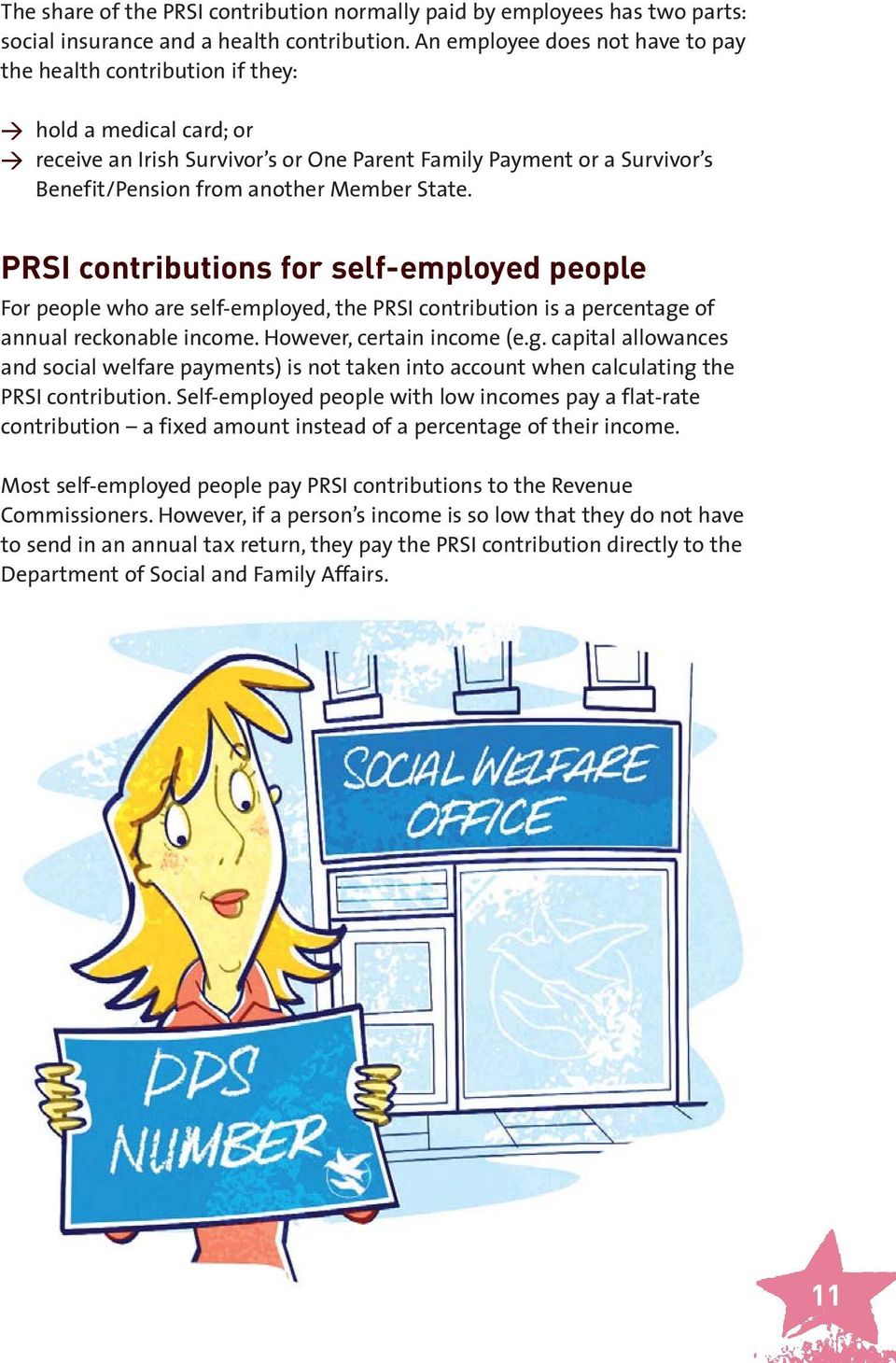
13 The share of the PRSI contribution normally paid by employees has two parts: social insurance and a health contribution. An employee does not have to pay the health contribution if they: > hold a medical card; or > receive an Irish Survivor s or One Parent Family Payment or a Survivor s Benefit/Pension from another Member State. PRSI contributions for self-employed people For people who are self-employed, the PRSI contribution is a percentage of annual reckonable income. However, certain income (e.g. capital allowances and social welfare payments) is not taken into account when calculating the PRSI contribution. Self-employed people with low incomes pay a flat-rate contribution a fixed amount instead of a percentage of their income. Most self-employed people pay PRSI contributions to the Revenue Commissioners. However, if a person s income is so low that they do not have to send in an annual tax return, they pay the PRSI contribution directly to the Department of Social and Family Affairs. 11
14 Credited contributions (PRSI credits) To qualify for a contributory payment, you must have worked and paid PRSI contributions previously. In certain situations, however, the Department of Social and Family Affairs will award you credited PRSI contributions. These PRSI credits may help you qualify for payments and pensions in the future. Credited contributions are generally awarded in the following situations: > if you receive a social welfare payment for unemployment, illness or retirement; > if you are attending a training course with FÁS (the national training authority); > if you are starting work for the first time (in which case people receive special pre-entry credits); and > if you are a student, credits may be given for periods in full-time education. If, at any stage in your working life, you have no paid or credited PRSI contributions for 2 full tax years, you will need to work and pay PRSI contributions for at least 26 weeks before you are eligible for credits. Voluntary insurance If you are no longer covered by compulsory PRSI in Ireland and are not covered by an insurance scheme on a compulsory or voluntary basis in any other EU country and are under age 66, you may be able to pay voluntary contributions which could help you to qualify for certain payments such as pensions. This option is possible if you: > have already worked and paid 260 PRSI contributions; and > apply within a certain period of no longer being insured. PRSI contribution conditions You do not need to pay PRSI contributions to receive health services or Child Benefit. In general, to qualify for short-term payments (such as Illness Benefit, Maternity Benefit or Jobseeker's Benefit) you must have: > at least 52 paid PRSI contributions since becoming insured, and > at least 39 paid or credited PRSI contributions in the relevant tax or contribution year. 12
15 For most long-term benefits (such as Widow s or Widower s Contributory Pension, State Pension (Transition) and State Pension (Contributory)), you must have at least 156 paid PRSI contributions, including a minimum yearly average of paid or credited contributions. For Invalidity Pension and mixed insurance pro-rata old-age pension, you need 260 paid contributions as well as the minimum yearly average. Benefit year This is the calendar year in which you apply for your payment. It runs from January to December, starting on the first Monday in January. Relevant tax or contribution year This is the second last complete tax year before the benefit year. See the table below for examples. If you are applying in: The relevant tax year is: Habitual Residence In order to qualify for certain non-contributory payments (See Chapter 11) and Child Benefit you must satisfy a habitual residence condition. Habitual residence means you have a proven link to Ireland or other parts of the Common Travel Area. 1 When deciding if you are habitually resident the Department will look at: > How long have you been living here? > Whether you have lived here continuously? > Why you are living here? > Your future plans and whether you have family here and any other relevant factors. Each case is decided on its merits. 1 The Common Travel Area is Ireland, Great Britain, Northern Ireland, the Channel Islands and the Isle of Man. 13

16 14 You do not need to pay PRSI contributions to receive health services or Child Benefit in Ireland.

17 CHAPTER 2 Outline of the Irish Healthcare System 15

18 Outline of the Irish healthcare system Entitlement to health services in Ireland is primarily based on residency and means. Any person, regardless of nationality, who is accepted by the Health Service Executive as being ordinarily resident in Ireland is entitled to either full eligibility (Category 1) or limited eligibility (Category 2) for health services. The Health Service Executive normally regards you as ordinarily resident in Ireland if you satisfy the Executive that it is your intention to remain in Ireland for a minimum period of one year. Category 1 medical cardholders Medical cards are issued to people in Category 1 to establish their entitlement to health services. People in this category are entitled to a full range of services, free of charge, including: > general practitioner (GP) services; > prescribed drugs, medicines, medical and surgical appliances; > all in-patient public hospital services in public wards including consultants services; > all out-patient public hospital services including consultants' services; > no charge for attendance at an accident and emergency department; > dental, ophthalmic and aural services and appliances; > maternity and infant care service; > maternity cash grant for each newborn child. All those over the age of 70 are automatically entitled to a medical card. With the exception of these, your entitlement to a medical card is determined mainly by your income and you will qualify if you meet certain income guidelines. Determination of eligibility for medical cards is the responsibility of the Health Service Executive, which has discretion, in cases of exceptional need, to grant a card to individuals who do not meet the income guidelines where undue hardship would otherwise be caused. If you are entitled to a medical card, you will also be able to avail of some other benefits. These include exemption from the payment of health contributions, exemptions from exam fees in second-level schools, assistance with schoolbooks and free school transport for children who live more than 3 miles from the nearest school. 16
19 Category 2 non-medical cardholders All those ordinarily resident and eligible for health services who do not qualify for inclusion in Category 1 are included in Category 2. People in Category 2 (non-medical card holders) are entitled: > subject to certain charges, to all in-patient public hospital services in public wards including consultants services; > specialist services (excluding dental and most routine ophthalmic and aural services) in out-patient clinics; > a maternity and infant care service; > subsidised prescribed drugs and medicines (see Drugs Payment Scheme and Long-Term Illness Scheme below); > in some cases, a GP Visit Card (see below); > subject to a charge, to attend at accident and emergency clinics (free where the patient has a GP referral note). Drugs Payment Scheme Under this Scheme, an individual or family in Ireland need only pay a maximum of 85 in any one month for approved prescribed drugs, medicines and certain appliances, for use by that person or his or her family in that month. GP Visit Cards Persons in Category 2 may also qualify for a GP Visit Card which allows individuals and families to visit their family doctor for free. You must meet specific income guidelines in order to qualify for a GP Visit Card. Where you have an ongoing medical condition that requires exceptional and regular medical treatment or visits to the doctor, the Health Service Executive (HSE) may grant a Card even if your income is greater than these guidelines. Long-term Illness Scheme People suffering from certain long-term illnesses are entitled to get the drugs and medicines for the treatment of that illness free of charge. Dental, ophthalmic and aural services Dental and routine ophthalmic and aural services are excluded from outpatient services, but this treatment is provided to children who have been referred from a child health clinic or a school health examination. 17

20 Services available free to everyone Maternity and Infant Care Scheme The Maternity and Infant Care Scheme provides an agreed programme of care to all expectant mothers who are ordinarily resident in Ireland. This service is provided by a family doctor (GP) of your choice and a hospital obstetrician. The GP who attends the mother also provides care for the new-born baby. This entails two developmental exams during the first 6 weeks following the birth. Other services > Hospital services for children suffering from specified long-term illnesses; > Drugs and medicines for persons suffering from certain disabilities; > Hospital, diagnostic and preventive services for infectious diseases. Eligibility for health services by category This table outlines which types of health services people qualify for according to their eligibility. Full eligibility (medical card holders) Limited eligibility (with GP visit card) Limited eligibility > Free hospital and GP care > Free dental, eye and ear care > Maternity services > Drugs and appliances under General Medical Services > Free GP visits > All hospital services (though subject to charges) > Maternity services > Refunds of or contributions to medicine costs under Drug Payment Scheme and Long-Term Illness Scheme > All hospital services (though subject to charges) > Maternity services > Refunds of or contributions to medicine costs under Drug Payment Scheme and Long-Term Illness Scheme For more information on health services in Ireland, contact the local health office of the Health Service Executive (see Appendix 3). You can also get more information on and 18

21 CHAPTER 3 General Principles of EC Regulations and other Social Security Agreements 19
22 EC Regulations The EC rules on social security are contained in Regulations (EEC) Nos. 1408/71, 574/72 and 859/2003. These Regulations are intended to make sure that people moving within the European Union or European Economic Area are protected in matters of social security. They provide solutions to problems that people may face when they move to another Member State to live or work. Examples include: > Who pays the hospital bill in the case of an accident or sickness during a stay abroad? > Which country is responsible for family benefits? > How is pension entitlement worked out when a person has worked for several years in another country? > Which country pays unemployment benefit to frontier workers? Who is covered by the Regulations? At present, the EC Regulations on social security only apply to the following people moving or staying within the European Union (EU) and the European Economic Area (EEA): > employed and self-employed people who are or have been insured under the law of one or more EU or EEA Member States; > stateless people or refugees; > civil servants; > students; > pensioners; > third country nationals, i.e. nationals of states not belonging to the European Union or the European Economic Area 2 ; and > members of the families and survivors of the above people, regardless of their nationality For more information see the section 'Citizens of a third country' in this chapter.
23 In which countries can you rely on these rules? A person can rely on the EC Regulations on social security in all of the countries belonging to the European Union or the European Economic Area. Below is a list of the countries of the European Union: Austria Germany Netherlands Belgium Greece Poland Bulgaria Hungary Portugal Cyprus Ireland Romania Czech Republic Italy Slovenia Denmark Latvia Slovakia Estonia Lithuania Spain Finland Luxembourg Sweden France Malta United Kingdom The European Economic Area consists of the 27 Member States and Norway, Iceland and Liechtenstein. Note: Except where it is otherwise clear from the context, references throughout this guide to 'Country', 'State' or 'Member State' means one of these countries. Which matters are covered? The EU Regulations on social security apply to all national laws on: > sickness and maternity; > occupational accidents and diseases; > invalidity benefits; > unemployment payments; > family payments; > old-age pensions; > survivors benefits; and > death grants. 21
24 General rules for deciding which country s laws apply Before you take up employment, you should know which Member State s social security law will apply to you. This is most important not only for paying social insurance contributions, but also for receiving social security payments and qualifying for pensions in the future. The rules exist to prevent the possibility of either no law applying say if you move across borders regularly or having more than one law apply at the same time. The rules are binding and do not allow you to choose the social security law that applies. In general, you will be insured (whether employed or self-employed) under the social security system of only one Member State at any particular time. This State is generally the one in which you are working, regardless of where you live or where your employer s business is based. There are certain exceptions to this rule, however. (See the special categories below). If you do not live in any of the Member States in which you work, you are covered by the social security system of the Member State where your employer is located. However, a worker who is employed in one Member State and, at the same time, self-employed in another Member State may, in exceptional cases, be insured in both States. Special categories of workers 1 Posted workers Sometimes the company or organisation for which you work may temporarily send you to work in another country. This is called posting. If you are posted for 12 months or less and you are not sent to replace another employee whose period of posting has ended, you will be covered by the social security system of the sending country even while posted in another country. Before going to the country to which you are posted, you should get Form E101, which certifies that you remain covered by the law of the sending State. You or your employer may obtain the form from the institution of the country whose social security system will cover you while you are posted. 22
25 If your employment abroad lasts more than 12 months because of unexpected circumstances, you can apply for an extension of up to 12 months of the posting period. If you get this extension, you must obtain Form E102. The rules on posting apply both to employed and self-employed people who work temporarily in another country. For further information, you can access a practical guide on posting from the European Commission s website at: 2 Mariners If you are a mariner and you work on board a vessel flying the flag of a Member State, you will be insured in that State, even if you live in another country. Exceptions apply if you are employed on board a vessel and paid by a company that has a registered office in the country in which you live. Also, if you work at a port, you are covered by the law of the country in which you work. 23
26 3 Workers in international transport If you are employed by a company operating international transport services by rail, road, air or inland waterway, you are insured in the Member State in which this company is based. Exceptions apply if you are employed in a branch office or agency of that company in another Member State or if you are employed mainly in the country where you live. 4 Civil servants If you are a civil servant, you are insured in the country of the government that employs you. 5 People called for service in the armed forces If you are called up for service in the armed forces or for civilian service, you will be covered by the social security system of the country in whose force you are serving. 6 People employed by diplomatic missions or holding consular posts As a general rule, you will be insured in the State where the diplomatic mission or consular post is situated. However, if you are a national of the sending State you may choose to be insured there instead. 7 Frontier workers A frontier worker is an employed or self-employed person who: works in a different Member State from the one in which s/he lives; and returns to the State in which s/he lives at least once a week. As a frontier worker you are protected by the EC rules on social security in the same way as all other categories of people to whom the rules apply. For example you: > are insured in the country where you work; > are entitled to family benefits from the State in which you work for members of your family who live in another Member State; > will receive a separate pension from each country where you were insured for at least one year. 24
27 However, there are some special rules on sickness and unemployment payments. Citizens of a third country The EC rules on social security have been extended 3 to nationals of third countries who are not already covered by those rules solely because of their nationality, and to members of their families and their survivors. For the extended rules to apply, the person must: > be legally resident in the Member State in question, and > have lived or worked in at least two Member States. Legal residence is determined in accordance with the national laws of the Member States in question. The extended rules do not give entitlement to enter, stay in or live in a Member State or take up work and do not apply to Denmark, Norway, Iceland, Liechtenstein or Switzerland. EU Agreement with Switzerland Switzerland is not a member of the EC or the EEA, but an Agreement that came into force on 1 June 2002 means that the EC rules on social security also largely cover Switzerland. The Agreement covers EU countries and their citizens, stateless people and refugees (under the Geneva Convention) and citizens of Switzerland. The Agreement does not cover Norway, Iceland or Liechtenstein. A residence permit is required to be able to work in Switzerland and, under the EU/Swiss Agreement, Switzerland has a right to place a limit on residence permits. The Agreement applies to employees who have residence permits that are valid for one year or more. Separate rules apply for employees who have residence permits valid for less than a year. 3 Council Regulation (EC) 859/2003, which came into operation on 1 June
28 Social security agreements with other countries Ireland has special social security agreements with the following countries: > Austria (largely superseded by EU Regulations); > Canada; > Australia; > United States of America; > New Zealand; > Quebec; > Switzerland (largely superseded by EU Regulations). These agreements protect pension entitlements of people who work in Ireland and one of these countries. They do this by allowing authorities to take into account periods of Irish social insurance and, where provided for, periods of residence or social security contributions in the second country when deciding if a worker qualifies for a pension. Ireland also has an agreement with the United Kingdom. This agreement provides social security protection to workers and their families moving between Ireland and the Isle of Man and the Channel Islands 4. This Agreement not only protects pension entitlements, but also protects entitlements to certain short-term payments, for example for unemployment and sickness. So if you work in Ireland and any of the countries with which Ireland has a social security agreement, you may be able to get cash benefits under these arrangements The islands covered by the Agreement are: Jersey, Guernsey, Alderney, Herm and Jethou.
29 CHAPTER 4 Sickness and maternity benefits 27
30 Under the EC rules, there are two categories of sickness and maternity benefits: > benefits in cash and benefits in kind. Benefits in cash These benefits are normally intended to replace income that is suspended because of sickness. As a general rule, sickness benefits in cash are paid according to the law of the State where the person is insured, regardless of the State in which the person is living or staying. Benefits in kind These benefits are usually made up of medical and dental care, medicines and hospital treatment, as well as direct payments intended to cover the costs of these. As a general rule, benefits in kind are provided according to the law of the Member State where the person lives or stays, as if the person was insured in that State. Cash sickness payments in Ireland In Ireland, the following payments are classified as sickness and maternity benefits for the purposes of EC Regulations: Payments based on Social Insurance: > Maternity Benefit; > Health and Safety Benefit; > Adoptive Benefit; > Illness Benefit; > Carer s Benefit; > Treatment Benefit. Payments which are not based on Social Insurance: > Infectious Diseases Maintenance Allowance; > Blind Welfare Allowance; > Rehabilitation Training Bonus. 28
31 Payments based on Social Insurance Maternity Benefit Maternity Benefit is a payment for employed and self-employed people who satisfy certain PRSI conditions. If you are an employee, you must be in employment that is covered by the Maternity Protection of Employees Act 1994 immediately before the 1st day of your maternity leave. If you are selfemployed, you must be in insurable self-employment. You should apply for Maternity Benefit at least 6 weeks (12 weeks if selfemployed) before the date on which your baby is due. Maternity Benefit is payable for 26 weeks 5 including at least 2 weeks before and 4 weeks after the date on which your baby is due (in line with the rules of taking maternity leave). Payment is made every week into your bank account or by cheque through the post. The amount paid is 80% of your earnings in the relevant income tax year, subject to a fixed minimum and maximum weekly payment. The start date of your maternity leave determines the relevant income tax year. You may also be entitled to maternity care services provided by the Health Service Executive. Health and Safety Benefit Health and Safety Benefit is a payment for employed women who have been granted health and safety leave by their employer because they are pregnant, have recently had a baby or are breast-feeding and cannot continue at their employment because of a risk to their health and safety. The employer grants health and safety leave to an employee when they cannot remove a risk to the employee s health or safety while she is pregnant or breast-feeding, or cannot give her other, risk-free, duties. Your employer must pay you for the first 21 days of the health and safety leave. You will then get Health and Safety Benefit from the Department of Social and Family Affairs. Payment is made every week into your bank account or by cheque through the post. Your payment is made up of a personal rate for yourself with extra amounts for a qualified adult or any qualified children (See Chapter 12) weeks where maternity leave commences before 1 March
32 Adoptive Benefit Adoptive Benefit is a payment for a parent who adopts a child. You may get Adoptive Benefit if you are an employee or self-employed person and you satisfy certain PRSI contribution conditions on your own insurance record. If you are an employee, you must be in insurable employment that is covered by the Adoptive Leave Act You should apply for Adoptive Benefit 5 weeks before you intend to go on adoptive leave. You may get Adoptive Benefit for a continuous period of 24 weeks 6 from the date your child is placed with you. Payment is made every week into your bank account or by cheque through the post. The amount paid is 80% of your earnings in the relevant income tax year, subject to a fixed minimum and maximum weekly payment. Illness Benefit Illness Benefit is paid weekly to insured people during times when they are unable to work due to incapacity (usually caused by an illness or an injury). Injury Benefit may be paid instead if the incapacity results from an occupational accident or disease. In addition to being unfit for work, you must also satisfy certain PRSI contribution conditions. Illness Benefit is not paid for the first 3 days of incapacity, known as waiting days. Once you receive Illness Benefit, you will continue to get it for as long as you are unfit for work and until you reach pension age (66 years), as long as you have at least 260 paid PRSI contributions. If you have less than 260 paid contributions, the payment stops after 52 weeks of incapacity. You should apply for Illness Benefit within 7 days of becoming unfit for work. You must send a certificate of incapacity for work from your doctor to the Department. A certificate is usually required for each week you are unfit for work. Illness Benefit, with extra amounts for a qualified adult and any qualified children (see Chapter 12), is paid weekly by cheque through the post or directly into your bank account weeks where the adoptive leave commences before 1 March 2007.
33 Carer s Benefit Carer s Benefit is a payment for insured people who have recently left the workforce to look after certain people in need of full-time care and attention. It includes a personal payment for you and extra amounts for any qualified children. It is paid for up to 2 years. You may claim it for an unbroken period of 65 weeks or for separate periods adding up to 65 weeks. If you are caring for more than one person, you may be entitled to an extra 50% of the personal payment. Carer s Benefit is paid weekly directly into your bank account. You will only qualify if you, the carer, and the person you are caring for meet certain conditions. These are listed below. You, the carer, must: > be age 16 or over; > have been employed for 8 weeks during the previous 26 weeks; > satisfy the PRSI contribution conditions; > give up employment (that was for at least 16 hours a week or 32 hours a fortnight) to care for a person full time; > not be employed or self-employed outside the home for more than 15 hours a week; > not live in a hospital, convalescent home or similar institution. The person(s) you are caring for must: > be so disabled as to need full-time care and attention (medical certification is needed); and > not normally live in a hospital, home or similar institution. If you leave the workforce to care for a person in need of full-time care and attention, you may be entitled to unpaid temporary leave from your employment, known as carer s leave. To ask about this, contact the Employment Rights Information Unit at the Department of Enterprise, Trade and Employment on (01) or, if you live outside the 01 area, on LoCall You can get more information on the law on carer s leave from the Department of Enterprise, Trade and Employment website, entemp.ie, or by ing [email protected]. 31
34 Treatment Benefit Treatment benefit consists of both benefits in cash and benefits in kind and therefore the country responsible for paying benefit will vary depending on the type of benefit you receive. Dental, optical and aural (hearing) benefits are provided by the Department of Social and Family Affairs under the Treatment Benefit Scheme. Medical Card holders including those aged 70 or over are entitled to dental and optical treatment and hearing aids from the Health Service Executive. Pre-school children and children attending primary school are entitled to dental, optical and aural treatment which is considered necessary following examinations. Children under the age of 16 who have attended a national school are entitled to dental services. Under the Treatment Benefit Scheme you may receive a contribution towards the cost of the following treatments or appliances: > dental treatment, including dental examination and diagnosis, scaling and polishing, severe gum treatment, fillings, extractions, dentures and root canal therapy; > optical treatment, including eye examination, glasses, replacement lenses to existing frames; > hearing aids up to half the cost of a hearing aid or repairs to a hearing aid up to a fixed maximum contribution; and > contact lenses up to a fixed amount or half the cost where you need lenses on medical grounds. You must satisfy certain PRSI contribution conditions to entitle you and your dependant spouse (if relevant) to the benefits. The payment is just a contribution towards the cost of treatment you will still have to pay part of the cost of treatment or appliances. If you satisfy the PRSI conditions when you reach age 60 or 66, you will remain qualified for life. 32
35 You may receive: > Dental Benefit for dental treatment carried out in another EU/EEA Member State; > Optical Benefit for eye examinations carried out and/or glasses or lenses bought in another EU/EEA Member State; > Benefit for hearing aid(s) supplied in another EU/EEA Member State. Example 1 You are working in Ireland and decide to go the Czech Republic for dental treatment. You should pay the dentist in the Czech Republic for all services or appliances you receive and afterwards send your application, which must also be completed by the practitioner in the Czech Republic, to the address below. Because you have already paid for the services and/or appliances, the Department of Social and Family Affairs will pay the benefit to you instead of the dentist. If you do not have enough PRSI contributions on your Irish record alone to qualify, you may combine your insurance record completed in any other Member State to qualify. Example 2 You have been working in Ireland for a number of months. Before coming to Ireland you worked for a number of years in Austria. On a visit home to Austria, you have an eye test that results in you needing glasses or contact lenses. You should pay the optician (or other professional) in Austria for all services or appliances you received and afterwards send your application, which must also be completed by the practitioner in Austria, to the address below. Because you have already paid for the eye test and glasses or contact lenses, the Department of Social and Family Affairs will pay the benefit to you instead of the optician. If you do not have enough PRSI contributions on your Irish record alone to qualify, you may combine your insurance record in Austria or another Member State to qualify. 33
36 You should contact Treatment Benefit Section before you travel for an application form and details of the amounts the Department will pay: Treatment Benefit Section Department of Social and Family Affairs St. Oliver Plunkett Road Letterkenny Co. Donegal. LoCall Payments not based on Social Insurance Infectious Diseases Maintenance Allowance Infectious Diseases Maintenance Allowance is a payment for people over 16 years of age receiving treatment for tuberculosis (TB) and certain other infectious diseases. This allowance is a means-tested payment provided by the Health Service Executive. Blind Welfare Allowance Blind Welfare Allowance is a payment for people who are blind and getting a Blind Pension or Disability Allowance. This allowance is a means-tested payment provided by the Health Service Executive. Rehabilitation Training Bonus The Rehabilitation Training Bonus is for people attending a Rehabilitation Training Programme approved by the Department of Health and Children. This bonus is provided by the Health Service Executive and is not means-tested. Which country pays benefits in cash? As a general rule, you are entitled to sickness and maternity benefits in cash from the country where you are insured, in line with that country s law on those benefits. 34 For payments based on social insurance, if you work in Ireland and pay PRSI contributions, you may qualify for these benefits from this country based on your Irish PRSI record. If you do not satisfy the PRSI contributions based
37 on your Irish record alone and you worked in another Member State before coming to Ireland, you may combine your insurance record in that other country with your Irish record to qualify. When you make a claim for these benefits, you should provide details of any employment outside Ireland. The Department of Social and Family Affairs will then request the necessary information directly from those countries for you. If your last employment was in another Member State and you now live in Ireland but have not worked here, these benefits will be paid by the country in which you last worked. You should send your application for these benefits to the Department of Social and Family Affairs and we will then make arrangements with the country concerned. If you are entitled to sickness and maternity benefits in cash from Ireland and you wish to move to live in another EU or EEA Member State, you should contact the Department of Social and Family Affairs for authorization. This authorization may only be refused if it is established that your health would be aversely affected by such movement. Example You have been living and working in Ireland for the past two years, but you normally live in Germany. You receive Illness Benefit from Ireland and you decide to return to Germany. You will continue to receive Illness Benefit from Ireland for as long as entitlement under Irish law lasts. You should contact the HSE (See Appendix 3) for information on whether you qualify for those payments not based on social insurance. Health services for temporary visitors to Ireland If you are staying temporarily in Ireland and insured under the healthcare system of another Member State, you may obtain necessary healthcare in the Irish public system free of charge on presentation of your European Health Insurance Card or Provisional Replacement Certificate. Necessary healthcare means care that is intended to enable you to continue your stay under safe medical conditions, taking account of the planned length of stay, so that you are not obliged to return home earlier than planned to obtain treatment. It does not cover you where the aim of your temporary stay is to obtain treatment. 35
38 Health services for those resident in Ireland but insured with another Member State If you are resident in Ireland but insured with the healthcare system of another Member State, you are entitled to receive free of charge all healthcare provided for under Irish legislation and would normally receive a medical card as evidence of your entitlement. This is likely to be the case if you are: > Employed or self-employed in another Member State but residing in Ireland; > A pensioner of another Member State residing in Ireland who is not an Irish pensioner and who is not employed in Ireland; > A dependant of either of the above categories. Frontier workers special rules A frontier worker is someone who works in one Member State and resides in another, and returns to the country of residence at least once a week. As a frontier worker, you are entitled to access health services in both the country where you work and the country where you live. Your dependants are entitled to healthcare in the State where they live. As a frontier worker residing in Ireland, you and your dependants would normally receive a medical card, as long as your spouse / partner is not employed or self-employed in Ireland. Contact the HSE (see Appendix 3) for more information on how to access these entitlements. Further information on the rules for meeting the costs of healthcare abroad is available from the European Commission s website at: en.htm 36
39 CHAPTER 5 Accidents at work and occupational diseases 37
40 Occupational Injuries Benefits may be paid to insured people who are injured during their employment or who contract certain occupational diseases. Under the EC rules, benefits for accidents at work or occupational diseases are, like sickness and maternity benefits, made up of benefits in kind and benefits in cash. Benefits in kind If you suffer an accident at work or from an occupational disease, you are entitled to benefits in kind according to the law of the country in which you live. This is the case even if you pay social insurance contributions in a different country than the one you live in. Benefits in cash For the purposes of the EC rules, the following cash benefits in Ireland are classified as benefits for accidents at work and occupational diseases: > Injury Benefit; > Disablement Benefit and Incapacity Supplement; > Medical Care; > Death Benefits. Injury Benefit Injury Benefit is paid while you remain unfit for work for up to 26 weeks starting on the date of the accident or the onset of the occupational disease. If you are still incapable of work after 26 weeks, you may be entitled to Illness Benefit (see Chapter 4). If you have an accident at work, your employer must be informed. You must send a certificate of incapacity for work to the Department of Social and Family Affairs on a special form, which is available from most doctors. You must continue to send this in for each week that you remain unfit for work. Your payment, which is made up of a personal rate for yourself with extra amounts for a qualified adult or any qualified children (see Chapter 12), is normally made from the 4th day of incapacity and is made weekly by cheque through the post. 38
41 Disablement Benefit and Incapacity Supplement Disablement Benefit may be paid when, because of an occupational accident or disease, you are suffering a loss of physical or mental ability, even if you are not unfit for work. You should apply for this benefit within 3 months of the accident or contracting the disease. If you don t, you risk losing part of the benefit. Your payment depends on the degree of your disablement, which is medically assessed. For assessments of 20%, Disablement Benefit will normally be a lump sum (called a gratuity). The size of the lump sum will vary depending on the degree of disablement and how long you are expected to be disabled. A pension is payable for assessments of 20% and upwards. Incapacity Supplement may be paid to people who are getting Disablement Benefit if they are considered to be permanently unfit for work as a result of an occupational accident or disease and they do not qualify for Illness Benefit (see Chapter 4). Medical Care The Occupational Injuries Scheme covers the cost of medical care over and above the expenses already paid by the Health Service Executive or by way of Treatment Benefit. If you are receiving medical care because of an occupational accident or disease, you must tell the Department of Social and Family Affairs within 6 weeks of starting to receive it. Death Benefit Death Benefit may be paid when an insured person dies because of an occupational accident or disease. It may also be paid to the dependant(s) of a person who, at the time of death, was receiving Disablement Pension assessed at 50% or more. Death Benefit consists of: > Widow s and Widower s Contributory Pension; > Orphan s Pension; > Dependent Parent s Pension; > Funeral Grant. 39
42 Death Benefit should be applied for on a form from the Department of Social and Family Affairs within 3 months of the death. If this does not happen, benefit may be lost. Which country pays for the benefit? Cash benefits for occupational accidents or diseases are paid by the country where you are insured at the time the accident or the occupational disease occurred, regardless of where you live or stay. If you go to another Member State (for example if you decide to return home to recover), you should contact the office from which you receive benefit well before you leave so that you will be able to receive payment in the other State. Special rules exist for the granting of benefits if you have contracted an occupational disease because of employment in more than one Member State and if the disease has got worse or recovery has taken longer than expected. If you think you might be affected by these rules, you should talk to staff at your local Social Welfare Office. Example You have worked in Bulgaria for a number of years before coming to Ireland where you have been working for a number of months. Unfortunately, you suffer an accident at work resulting in incapacity for work. You should notify your employer immediately that you have had an accident and apply for Injury Benefit within 21 days of becoming unfit for work. If you are still unfit for work after 26 weeks you can get Illness Benefit from Ireland if you satisfy the PRSI conditions. Periods of insurance completed in Bulgaria will be added to your Irish record if this is necessary in order to help you meet the PRSI conditions. If as a result of the accident at work you suffer a loss of physical or mental ability you may be entitled to Disablement Benefit. You may also be entitled to the cost of medical care in certain circumstances. 40
43 CHAPTER 6 Invalidity Pension 41
44 Invalidity Pension may be paid each week instead of Illness Benefit (see Chapter 4) to insured people who are certified to be permanently unfit for work and who satisfy certain PRSI contribution conditions. Generally, before qualifying for Invalidity Pension, you must have received Illness Benefit for at least 12 months. In certain circumstances, however, you may be able to qualify earlier. If you are living in Ireland, Invalidity Pension, including any increases for a qualified adult and qualified children (see Chapter 12), is paid direct into your bank account or by a book of payable orders that can be cashed each week at a post office of choice. If you live outside Ireland, it is normally paid monthly by cheque. Which country pays for benefit? People who have been insured only in Ireland If you have been insured only in Ireland during your working life, your Invalidity Pension will be paid from Ireland and calculated in line with the rules above. People who have been insured in more than one country Two different types of invalidity schemes exist in the countries belonging to the EU and the EEA. > In some countries, including Ireland, you will be entitled to the same amount of pension no matter how long you were insured before you became permanently unfit for work. Countries with this rule operate a Type A scheme; > In other countries, invalidity payments are calculated in a similar way to old age pensions: the amount of the pension depends on the length of time you were insured before applying. Countries with this rule operate a Type B scheme. 42
45 This table outlines the countries that have Type A and Type B schemes. Countries with Type A schemes Belgium Finland (only for national pensions for people born disabled or who become disabled at an early age) France (except for those employed as a miner or self-employed but not as an agricultural worker) Greece (in the agricultural scheme only) Ireland Netherlands Spain (except for the special schemes for civil servants, the armed forces and the judicial system.) UK Estonia (only for certain special schemes) Latvia (except for certain invalidity benefits) Countries with Type B schemes Austria Bulgaria Denmark Finland (except for national pensions for people born disabled or who become disabled at an early age) France (only for miners) Germany Greece (other than the agricultural insurance scheme) Iceland Italy Liechtenstein Luxembourg Norway Portugal Romania Spain (only for civil servants, the armed forces and the judicial system) Sweden Switzerland Cyprus Czech Republic Estonia (except certain special schemes) Hungary Latvia (only invalidity benefits granted under Group I & Group II Invalidity) Lithuania Malta 43
46 The question of which country will pay your pension depends on what type of scheme is operated by the countries where you were insured. There are a number of possibilities: > If you were insured only in countries that operate a Type A scheme, you will get a pension from the State where you were insured at the time you became permanently unfit for work. Example 1 You are working in Ireland and you suffer an incapacity for work leading to invalidity. Before you worked here, you worked for a number of years in the Netherlands, where you were insured for invalidity. You can apply for Invalidity Pension from Ireland, but you are not entitled to an Invalidity Pension from the Netherlands. If you do not have enough PRSI contributions to qualify for the pension based on your Irish record, contributions paid in the Netherlands can be added to your Irish contributions. > If you were insured only in countries that operated a Type B scheme, you will get separate pensions from each of these States. Example 2 You are living in Ireland, where you suffer an incapacity for work leading to invalidity. Before moving to Ireland, you worked for a number of years in Germany and in Poland. If you meet the conditions of the German and Polish schemes, you will get separate pensions from each country. The amount of pension depends on the length of your employment in each of these countries. > If you were first insured in a country that operates a Type B scheme and then in a country with a Type A there are two possibilities: In general you will get two pensions one from the first State, related to the insurance periods completed under its law, and one from the State where you were insured when you became permanently unfit for work. However, in certain cases it may be more beneficial to receive only one pension paid by the last State in which you were insured. 44
47 Example 3 You are working in Ireland, where you suffer an incapacity for work leading to invalidity. Before your employment in Ireland, you worked for a short period in Poland. You can get Invalidity Pension from Ireland if you satisfy the PRSI conditions on your Irish social insurance record without the need to include contributions paid in Poland and you do not qualify for an invalidity payment from Poland or make a claim for old-age benefits. If you do not have enough PRSI contributions to qualify for Invalidity Pension based on your Irish record alone or if you make a claim for old-age benefits, you will get separate payments from Ireland and Poland. The amount depends on the length of your employment in each country. > If you were first insured in a country that operates a Type A scheme and then in a country that operates a Type B, you will get two pensions, each related to the length of your insurance in the particular country. Example 4 You are working in Poland, where you become permanently unfit for work. Before your employment in Poland you worked for a number of years in Ireland. If you meet the conditions of the Polish and Irish invalidity schemes, you will get separate payments from each of these countries. The amount depends on the length of your employment in each country. 45
48 How your payment is worked out Each State where you have paid insurance will look at your insurance record under its own scheme and work out how much pension you may get. As long as you meet the conditions, you will get a pension from each State. Each State will also look at any insurance you have in another Member State. This can help you get a pension, or a higher pension, under its own scheme. To do this, each country sends details of your insurance records to the others. When a pension is being paid, each country works out how much to pay you. There are two methods used to work out your pension entitlement. You will benefit from the method that gives you the highest amount of pension. Example You were insured for: > 10 years in Member State A; and > 5 years in Member State B. This means you were insured for 15 years in total before you suffered an incapacity for work leading to invalidity. Method 1: Each Member State first works out how much pension you can get based on the insurance paid into its social security scheme. Method 2: Each Member State works out how much pension you would get if you had paid all your insurance contributions into its own social security scheme. In the example above, Member State A works out the amount of pension you would get after 15 years of insurance in that State. It will then pay you the amount in proportion to your total period of insurance 10/15 (or 2/3) of this amount if this is higher than you would get using Method 1. Similarly, State B will pay you 5/15 (or 1/3) of the amount you would be entitled to in that State after 15 years of insurance. When you receive your payment this way, it is on a pro-rata basis a proportion of the total period of insurance. 46
49 CHAPTER 7 Unemployment Benefits 47
50 For the purpose of EC rules, Jobseeker's Benefit is classified as an unemployment benefit: Jobseeker's Benefit may be paid each week to insured people during periods of unemployment. To be eligible for Jobseeker's Benefit, you must: > satisfy the PRSI contribution conditions; > be capable of and available for work; and > be genuinely seeking work. In certain circumstances, you may be disqualified for certain periods, for example, if you lost your job through your own misconduct or if you refuse an offer of suitable employment. Jobseeker's Benefit is usually paid from the 4th day of unemployment. However, if you have applied for sickness or unemployment benefits in the 13 weeks immediately before applying for Jobseeker's Benefit, payment may be made from the 1st day of unemployment. Jobseeker's Benefit is normally paid for up to 390 days. You should apply for Jobseeker's Benefit on the 1st day of unemployment at your local Social Welfare Office. You may need to provide income tax forms, such as your P45 (statement of your income tax and PRSI contributions from the start of the tax year to the date you left employment) and P60 (end of year statement of your income tax and PRSI contributions), to work out your entitlement to benefit. Jobseeker's Benefit is paid each week in arrears by cheque, by postal draft to be collected at a post office - or direct into your bank account. Your payment is made up of a personal rate for yourself with extra amounts for a qualified adult and qualified children (see Chapter 12). Unemployed in Ireland after work in the EU/EEA Area If you become unemployed in Ireland, periods of insurance or equivalent periods completed in another Member State may be taken into account when working out your entitlement to Jobseeker's Benefit. This only happens if you have paid Class A, H or P 7 PRSI contributions since you came or returned to this country Class A is paid by employees in industrial, commercial and service employment with gross earnings in excess of 38 or more a week from all jobs; Class H is paid by NCOs and enlisted members of the Defence Forces; Class P is an optional contribution payable by self-employed people who rely on share fishing for their main income.
51 Example You apply for Jobseeker's Benefit in Ireland but do not meet the contribution conditions because you have only worked here for 3 months. However, before your employment in this country, you worked for two years in Lithuania. To help you satisfy the contribution conditions, the periods of insurance completed in Lithuania will be added to your Irish record. Looking for work in another Member State When unemployed, you may make a 3 month visit to another Member State to search for work and still keep Jobseeker's Benefit. Jobseeker's Benefit is paid only while you are looking for work in another Member State and for a limited period of time. Strict conditions apply, as follows. > You must have remained available to the employment services of the State that pays your benefit for at least 4 weeks after becoming unemployed. The employment services have the discretion to make this period shorter; > You must register with the employment services of the country in which you are looking for work within 7 days after departing; > You must obey the rules of the employment services of that country. If you meet these conditions, you will then keep your benefit for up to 3 months. What to do before you leave > Apply on a special form Application for certificate E303, which is available at your local social security or employment office. Make sure that the application is complete; > Make sure you have your European Health Insurance Card (EHIC) or Provisional Replacement Certificate (PRC). The EHIC or PRC entitles you to receive necessary health care in the public system of the country of stay while on your job-seeking visit. This care is provided at the cost of the country paying your unemployment benefit. Once you take up employment in the other country, or when you cease to be covered by the original country s law, your EHIC or PRC issued by that country is no longer valid. See Chapter 4 to find out more about the EHIC or PRC; 49
52 > Read carefully all the information provided with the E303 certificate. You must show this certificate to the social security or employment office in the country where you are searching for work to receive your unemployment benefit in that country. On arrival in the country where you are looking for work > Report without delay, or at most within 7 days, to the employment services in the country where you are looking for work; > The employment services in that country decide on the conditions for seeking employment. They also pay benefit in the currency of the country in which you are looking for work; > If you find work, you should inform both the foreign employment office and the local employment office in the country which is paying unemployment benefit. Example You have been working in the Czech Republic for 5 years when you become unemployed. You receive Unemployment Benefit from the Czech Republic for 6 weeks and you decide to come to Ireland to look for work. You should make your application for transfer of your Unemployment Benefit to Ireland on the special form Application for certificate E303. When you arrive in Ireland, you should register immediately, but at most within 7 days, at the social welfare employment office nearest the place where you are living or staying in Ireland. You will be required to apply for a PPS Number, so you will need proof of your identity (for example a passport) and proof of your place of residence (for example a letter from your landlord). While receiving Unemployment Benefit in Ireland, you will have to show that you are genuinely seeking work and may have to register with the national training and employment agency (known as FÁS) If you find work in Ireland, you should notify the employment office in this country and the social security or employment office in the Czech Republic. 50
53 Going home > To keep your right to benefit in your country of origin, you must return there within 3 months of the date of departure stated on the certificate E303. The final date for arrival home is also stated on the certificate; > Before returning home you should make sure that the social security or employment office abroad fills in the last page of certificate E303; > When you arrive home, you should report immediately to your local social security or employment office and give in the last page of certificate E303; > You are entitled to the 3 month payment only once between 2 periods of employment. Example You came to Ireland from the Czech Republic to look for work and were receiving Unemployment Benefit from the Czech Republic for 3 months. As you have not been successful in getting work in Ireland, you decide to return home. To keep your right to Unemployment Benefit in the Czech Republic, you must return there within 3 months of the date of departure shown on certificate E303. The final date for arrival home will also be shown on this certificate. When you arrive in the Czech Republic, you should report immediately to your local social security or employment office. 51
54 Unemployment Benefit for frontier workers If you are a frontier worker and you become partially or temporarily unemployed, you must apply for benefits in the country where you worked. If you become fully unemployed, you must register with and apply for benefit from the employment services in the country where you live. The only exception to this is if you can show that you have closer ties with the country where you were last employed. Example 1 You are living in Northern Ireland and you commute to work in the Republic of Ireland every day. Your employer reduces your working hours to a 3-day week. You will be entitled to Jobseeker's Benefit, if you meet all other conditions, from the Republic of Ireland for the days you are unemployed. Example 2 You are living in the Republic of Ireland and working in Northern Ireland. You return to the Republic of Ireland at least once a week. Unfortunately, your employer has no further work and you become fully unemployed. In this case, you will be entitled to Jobseeker's Benefit, if you meet all other conditions, from the Republic of Ireland your State of residence. However, if you can show that you have closer ties with Northern Ireland, and, if you meet all other conditions, you may be entitled to Jobseeker's Benefit from there. 52
55 CHAPTER 8 Family Benefits 53
56 For the purposes of EC rules, the following benefits are classified as family benefits: > Child Benefit; > Early Childcare Supplement; > Family Income Supplement; > One-Parent Family Payment; > Guardian's Payment (Non-Contributory); > Domiciliary Care Allowance. Child Benefit Child Benefit is paid for each child under the age of 16. This limit is extended to age 19 if the child is receiving full-time education or is incapacitated. If you are in insurable employment in Ireland or receiving a benefit or pension under Irish law in Ireland you may qualify for Child Benefit from the Department of Social and Family Affairs even if the children are living in another Member State. Child Benefit is paid every month from the 1st of the month following that in which the child is born or comes to live in Ireland. For example, if the child is born in May, Child Benefit is paid from 1 June. Claims are normally paid to the mother of the child and you should apply within 3 months of the child s birth or arrival in Ireland on an application form available from all local Social Welfare Offices. In the case of multiple births, special lump-sum grants are made to the parent or guardian when the children are born and again when they are 4 and 12 years of age. Early Childcare Supplement Early Childcare Supplement (ECS) is a payment to assist parents meet their childcare costs. The payment is made on a quarterly basis in respect of children under 6 years of age. Family Income Supplement Family Income Supplement (FIS) is a regular weekly tax-free payment for families, including lone-parent families, at work on low pay. 54
57 To qualify for the payment, you must: > be an employee in paid full-time employment, working for 19 hours or more a week or 38 hours or more a fortnight; > have at least one qualified child who is normally living with you and being supported by you; > have net income below a certain level (e.g. in for a family with one child). Full-time employment means that your employment must be expected to last for at least 3 months. Casual work, such as seasonal work and Government sponsored schemes, do not count as full-time employment. 55
58 One-Parent Family Payment One-Parent Family Payment is a payment for men and women under pension age (66 years) who are bringing up a child or children without the support of a partner. You may apply for this payment if: > you are unmarried, widowed, a prisoner s spouse, separated or divorced, or > your marriage has been annulled and you are no longer living with your spouse. You will qualify for this payment if you: > are the main carer of at least one child and that child is living with you; > are not cohabiting (living with someone as husband and wife); > have earnings of 375 or less a week; > satisfy a means test, and > satisfy the habitual residence condition. Payment is made by a direct payment into a bank account or by a book of payable orders that can be cashed weekly at a post office of your choice. Guardian's Payment (Non-Contributory) Guardian's Payment (Non-Contributory) is a means-tested payment that is normally paid to the guardian of an orphan. It continues up to age 18, or age 22 if the orphan is in full-time education by day at a recognised school or college. For the purposes of this payment a child is regarded as an orphan when both parents are dead or one parent is dead or unknown or has abandoned and failed to provide for them and the other parent is unknown or has abandoned and failed to provide for them. Payment is made by direct payment into a bank account or by a book of payable orders that can be cashed weekly at a post office of your choice. Domiciliary Care Allowance Domiciliary Care Allowance is a payment for children up to the age of 16 years who live at home and need considerably more care and attention than normally required by children of the same age. This allowance is a meanstested payment provided by the Health Service Executive, based on the child s means. The allowance is paid monthly to the parent or carer of the child. 56
59 Which country pays for benefit? Because entitlement to family benefits can often arise in more than one Member State, the EU Regulations set out the following general rules to work out which country pays family benefits. > If the right to benefit depends on satisfying social insurance contribution conditions, periods of insurance completed in another Member State must be taken into account if necessary to help a person qualify; > Any residency requirements under national law are overridden; > Entitlement to family benefits in the State where you work has priority over the entitlement in the State where you live. If there is employment in two States, the entitlement in the State where the children live has priority; > If the entitlement to family benefits in the State in which you live is higher than that in the State in which you work, the State where you live must pay a supplement to make up the difference between the two amounts. Some practical examples The following examples may help to understand the above rules. Example 1 Your family (parents and children) is living in the Republic of Ireland, and one parent is working and the other is not. In this case, the family is entitled to family benefits from the Republic of Ireland. If the parent who is not working takes up employment in another Member State for example UK (Northern Ireland), you will still be entitled to family benefits from the Republic of Ireland, but you may also be entitled to a supplement from the Northern Ireland authorities, if the amount of family benefits from the UK is higher than it is in the Republic of Ireland. Example 2 You have been living with your family in the Netherlands but you come to Ireland and take up employment. The other parent of your children remains in the Netherlands with your children and is not working. You will be entitled to family benefits from Ireland for your children living in the Netherlands. If the family benefits paid by the Dutch authorities are higher than the Irish family benefits, a supplement will be payable by the Dutch authorities. 57
60 Example 3 If in Example 2 the parent in the Netherlands takes up employment and you remain in Ireland where you are working, the Dutch authorities will pay you family benefits and Ireland will pay a supplement if the amount of family benefits paid by Ireland is higher than the Dutch rate. The rules in Examples 2 and 3 will continue to apply if the worker in Ireland becomes unemployed and receives Jobseeker's Benefit from Ireland. If you are in employment and your earnings are below a certain amount, you may also be entitled to Family Income Supplement. Example 4 You have come to Ireland but your wife, who is not working, and your 2 children have remained in Lithuania. If your earnings from employment are below a certain amount (with reference to the number of children), you may qualify for a supplement that is a percentage of the difference between your weekly income and the income limit fixed for your family size. You will also be entitled to Child Benefit. If you are a lone parent, you may also be entitled to One-Parent Family Payment. Example 5 You are a single parent living in Ireland with your child. You may be entitled to One-Parent Family Payment and Child Benefit from Ireland. If you are in employment and the earnings from employment are below a certain amount for the size of your family you may also be entitled to Family Income Supplement. 58
61 CHAPTER 9 Old Age Pensions 59
62 For the purposes of EC rules, the following benefits are classified as old age benefits: > State Pension (Transition); > State Pension (Contributory). State Pension (Transition) State Pension (Transition) may be paid at age 65 to people who have retired from full-time employment and who satisfy certain PRSI contribution conditions. In general, a person aged between 65 and 66 is regarded as retired as long as they earn less than a week as an employee or have income of 3, or less a year from self-employment. The retirement condition does not apply to people age 66 (pension age) and over. You should apply for State Pension (Transition) at most 3 months before reaching age 65 or within 3 months of retiring from insurable employment if this occurs after age 65. The application form is available from all local Social Welfare Offices and post offices. The pension is paid each week by a book of payable orders that can be cashed at a post office (if you are living in Ireland) or into a bank account. Your payment is made up of a personal rate for yourself with extra amounts for a qualified adult and any qualified children (see Chapter 12). State Pension (Transition) can be paid abroad. If you intend going abroad to live, contact the Department of Social and Family Affairs beforehand at: Social Welfare Services Office College Road Sligo Telephone: LoCall from the Republic of Ireland or (071)
63 State Pension (Contributory) This may be paid from pension age (66 years) onwards to an insured person who satisfies certain PRSI contribution conditions. You can receive State Pension (Contributory) even if you continue working. However, you cannot get it with State Pension (Transition). You should apply for State Pension (Contributory) at most 3 months before you reach pension age. The pension is paid each week by a book of payable orders that can be cashed at a post office (if you are living in Ireland) or into a bank account. Your payment is made up of a personal rate for yourself with extra amounts for a qualified adult and any qualified children (see Chapter 12). State Pension (Contributory) can be paid abroad. If you intend going abroad to live, contact the Department of Social and Family Affairs beforehand at: Social Welfare Services Office College Road Sligo Telephone LoCall from the Republic of Ireland or (071) In certain cases, people who paid PRSI contributions in Ireland at both full and modified rates 8 may also qualify for a reduced rate pension at age 66 (or before 66 in the case of Widow s or Widower s Contributory Pension for those who become widowed before reaching 66). State Pension (Transition) may be paid at age 65 to people who have retired from full-time employment. State Pension (Contributory) may be paid from age 66 onwards...even if you continue working. 8 Some workers in the public sector do not have cover for all benefits and pensions and they pay a modified PRSI contribution. 61
64 Reduced rates of pension special half-rate pension for people with pre-1953 contributions If you paid full social insurance contributions before 1953, you may qualify for a special half-rate State Pension (Contributory). To qualify for this pension, you must have 260 full-rate paid employment contributions. These contributions can consist of: > only contributions paid before 1953, or > a mixture of contributions paid before and after When working out the number of contributions, every two contributions paid before 1953 count as three. 62
65 Which country pays for benefit? If you do not satisfy the PRSI contribution conditions for State Pension (Transition) or State Pension (Contributory) on your Irish social insurance record, you may still be entitled to a reduced rate of pension if you have worked in another Member State. This is possible by combining your social insurance record in that country with your Irish insurance record. You may also be eligible for a pension from the other country or countries in which you worked. You are entitled to a separate pension from each country where you were insured for at least one year, provided you satisfy the conditions laid down in national law (for example reaching pension age). Periods of insurance or equivalent periods completed in another Member State may be taken into account to fulfil the conditions required by national law. Each State in which you have paid insurance towards a social security pension will look at your insurance record under its own scheme and work out how much pension you may get. As long as you meet the conditions, you will get a pension from each State. Each State will also look at any insurance you have in another Member State. This can help you get a pension, or a higher pension, under its own scheme. To do this, each country sends details of your insurance records to the others. When a pension is being paid, each country works out how much to pay you. There are two methods to work out your pension entitlement. You will benefit from the method that gives you the highest amount of pension. Example You were insured for: > 10 years in Member State A, > 25 years in Member State B, and > 5 years in Member State C. This means you were insured for 40 years in total before you reached pension age. 63
66 Method 1: Each Member State first works out how much pension you can get based on the insurance paid into its social security scheme. Method 2: Each Member State works out how much pension you would get if you had paid all your insurance contributions into its own social security scheme. In the example above, Member State A works out the amount of pension you would get after 40 years of insurance in that State. It will then pay you an amount in proportion to your total period of insurance 10/40 (1/4) of this amount if this is higher than the amount you would get using Method 1. Similarly, State B will pay you 25/40 (or 5/8) of the amount you would be entitled to in that State after 40 years of insurance. Member State C will pay you 5/40 (or 1/8) of the amount you would be entitled to in that State after 40 years of insurance. When you receive your payment this way, it is on a pro-rata basis a proportion of the total period of insurance. You may be entitled to a separate pension from each country where you were insured for at least one year. 64
67 CHAPTER 10 Survivors Benefits and Death Grants 65
68 For the purposes of EC rules, the following benefits are classified as survivors benefits and death grants: > Widow s or Widower s Contributory Pension; > Guardian's Payment (Contributory); > Bereavement Grant. Widow s or Widower s Contributory Pension You will qualify for Widow s or Widower s Contributory Pension if you: > are widowed or are divorced from your late spouse and have not remarried; > are not cohabiting (that is, living with someone as husband and wife); > and satisfy the PRSI contribution conditions; or your late spouse got a standard rate State Pension (Transition) or a standard rate State Pension (Contributory) which included an increase for you as a qualified adult or would have included this increase but for the fact that you were getting a State Pension (Non-Contributory), Blind Pension or a Carer s Allowance in your own right. This pension is paid regardless of your age and is not affected by any other income you may have such as earnings, an occupational pension or a pension from your late spouse s employment. The pension may be based on the social insurance record of either the widow (or widower) or the late spouse but the two records cannot be combined. The pension is paid weekly and includes increases for any qualified children (see Chapter 12), and can be paid directly into your bank, building society or post office account or by a book of payable orders, which you can cash at a chosen post office. Widow s or Widower s Contributory Pension can be paid abroad. If you receive this pension and intend going abroad to live, contact the Department of Social and Family Affairs at least 4 weeks before you leave at: Social Welfare Services Office College Road Sligo 66 Telephone LoCall from the Republic of Ireland or (071)
69 Which country pays for benefit? You are entitled to a separate pension from each country in which you were insured for at least one year, provided you meet the conditions laid down in national law. Periods of insurance or equivalent periods completed in another Member State may be taken into account to fulfil the conditions required by national law. If you or your late spouse worked in another Member State, you may combine your or your late spouse s periods of insurance completed in that country with your or your late spouse s Irish record to help you qualify for Widow s or Widower s Contributory Pension. Each Member State in which you have paid insurance will look at your insurance record under its own scheme and work out how much pension you are entitled to. As long as you meet the conditions, you will get a pension from each country. To do this each country sends details of your insurance record to the others. When a pension is being paid, each country works out how much to pay you. There are two methods to work out your pension entitlement. You will benefit from the method that gives you the highest amount of pension. Example: You were insured for: > 10 years in Member State A, > 10 years in Member State B, and > 5 years in Member State C. This means you were insured for 25 years in total before you became widowed. Method 1: Each Member State first works out how much pension you can get based on the insurance paid into its social security scheme. Method 2: Each Member State works out how much pension you would get if you had paid all your insurance contributions into its own social security scheme. 67
70 In the example above, Member State A works out the amount of pension you would get after 25 years of insurance in that State. It will then pay you an amount in proportion to your total period of insurance 10/25 (or 2/5) of this amount if this is higher than the amount you would get using Method 1. Similarly, State B will pay you 10/25 (or 2/5) of the amount you would be entitled to in that State after 25 years of insurance. Member State C will pay you 5/25 (or 1/5) of the amount you would be entitled to in that State after 25 years of insurance. When you receive your payment this way, it is on a pro-rata basis a proportion of the total period of insurance. Guardian's Payment (Contributory) Guardian's Payment (Contributory) may be paid for an orphan if either a parent or step-parent meets certain PRSI contribution conditions. The allowance is normally paid to the guardian of an orphan and continues up to age 18, or until age 22 if the orphan is in full-time education by day at a recognised school or college. For the purposes of this payment a child is an orphan when both parents are dead or one parent is dead or unknown or has abandoned and failed to provide for them and the other parent is unknown or has abandoned and failed to provide for them. The allowance is paid by direct payment into a bank or building society account or a book of payable orders that can be cashed weekly at a post office of your choice. Which country pays for benefit? If you are an orphan of a person who was insured under the law of a single Member State, you will be entitled to orphan s benefits according to the law of that State, no matter where you live within the European Union or the European Economic Area. If you are an orphan of a person who did not have enough PRSI contributions to qualify for Guardian's Payment (Contributory), periods of insurance or equivalent periods completed in another Member State may be combined with the Irish record. 68
71 If you qualify for Guardian's Payment (Contributory) and you move to live in another Member State, you will continue to receive the allowance if you do not qualify for an equivalent payment in that country. If you do qualify for a payment in the new country, but it is lower than the Irish allowance, Ireland will pay a supplement to make up the difference between the two amounts. Bereavement Grant Bereavement Grant may be paid on the death of: > an insured person; > the spouse of an insured person; > the widow or widower of an insured person; > a qualified child or a child under age 18, or under age 22 if in full-time education (if either parent or the person the child normally lives with meets the PRSI contribution conditions); > a contributory pensioner; > the wife or husband of a contributory pensioner; > the qualified adult of a contributory pensioner, including those who would be a qualified adult but are getting another social welfare payment, such as Carer s Allowance; > an orphan receiving Guardian's Payment (Contributory). When an adult dies, Bereavement Grant may be based on their PRSI contribution record or that of their spouse. When a child dies, Bereavement Grant is based on the insurance record of either parent or of the person the child normally lived with. You should apply for Bereavement Grant within 12 months of the date of the death. You can get an application form for the grant from any local Social Welfare Office. 69
72 Which country pays for benefit? As a general rule, a person will receive a grant from one country only usually the country in which the deceased person was insured. Periods of insurance or equivalent periods completed in other Member States will be taken into account where necessary. The country responsible for paying the grant will make the payment (as long as the conditions are met) regardless of whether the person died in its own territory or that of another Member State. Equally, the grant will be paid regardless of where the person receiving the grant lives. Example A person who has worked all his life in Ireland and receives State Pension (Contributory) from Ireland moves to Spain. On his death in Spain, his wife (or family) is entitled to Bereavement Grant under Irish law, regardless of where she (or they) live(s) within the European Union or the European Economic Area. 70
73 CHAPTER 11 Non-contributory payments 71
74 If you are living in Ireland and you do not have enough contributions to qualify for a social insurance payment, or if you have used up your entitlement, you may be entitled to a non-contributory payment instead. To qualify for payment, you must satisfy a means test. In general, you will satisfy it if your means are below a certain amount. The non-contributory payments include: > Jobseeker's Allowance (for people who do not qualify for Jobseeker's Benefit); > State Pension (Non-Contributory) (for people who do not qualify for a State Pension (Contributory)); > Disability Allowance (for people with a disability aged 16 years and under pension age (66 years)); > Blind Pension (for blind people aged 18 years and under pension age (66 years)); > Widow s or Widower s (Non-Contributory) Pension (for widowed people under pension age (66 years) who do not qualify for a Widow s or Widower s (Contributory) Pension); > Guardian's Payment (Non-Contributory) (for orphans for whom Guardian's Payment (Contributory) is not payable); > One-Parent Family Payment (for lone parents under pension age (66 years)); > Carer s Allowance (for people who look after people in need of full-time care and attention). You must also satisfy a habitual residence condition. The habitual residence condition means that in order to get any of these payments you have to show that you have been habitually resident in Ireland or the Common Travel Area of the UK, Northern Ireland, the Channel Islands and the Isle of Man for a substantial continuous period. For the purposes of the EC rules, One-Parent Family Payment and Guardian's Payment (Non-Contributory) are categorised as family benefits (see Chapter 8). If you qualify for one of these payments under the EC rules, the requirement to be habitually resident is overruled. 72
75 CHAPTER 12 Other provisions 73
76 Payments for dependants Men and women have equal rights to claim for a husband or wife who is a qualified adult and for qualified children. Different increases exist for qualified adults and for qualified children. In some cases, the payments for the children are split between the parents. Who is a qualified adult? A qualified adult is your husband or wife or someone you are living with as husband and wife. If you have children living with you and you are single, widowed or separated, a qualified adult is the person who is caring for your child(ren), provided the person is aged 16 or over, living with and being supported by you. You will not get an increase for a qualified adult if s/he: > Has a weekly income above a certain limit; > Is receiving a social welfare payment (except Disablement Benefit, Supplementary Welfare Allowance, Guardian's Payment or Pension, Child Benefit or Family Income Supplement) in his/her own right; > Is disqualified from receiving Jobseeker's Benefit/Allowance while taking part in a trade dispute; Or > Is taking part in a full-time FÁS non-craft training course. 74
77 Who is a qualified child? > In general, a child aged up to age 18, who is living with you, and being supported by you is your dependant; > If you are getting a pension or long-term Jobseeker's Allowance, a child aged between age 18 and age 22 continues to be your dependant if they are in full-time education by day. You get an allowance for each qualified child you have. In certain circumstances, you may get an allowance for children aged 18 and over for 3 months after they complete second level education. 75
78 Payments of benefits and pensions after death If a person dies while receiving a social welfare payment, in certain circumstances, the payment will continue to be paid to the qualified adult for 6 weeks. Entitlement to a continuation of a social welfare payment after death is as follows: If the deceased was: And you are: You will get: getting an increase for a qualified adult with any of the payments listed getting any of the payments listed a qualified child a qualified adult a person receiving fulltime care and attention a qualified adult getting one of the payments listed getting an increase for a qualified child with one of the payments listed getting one of the payments listed getting Carer s Allowance or Carer s Benefit in respect of that person 6 weeks of the deceased person s payment including the increase for a qualified adult 6 weeks of the deceased person s payment plus your own payment 6 weeks of your own payment including the increase for a qualified child 6 weeks of your own payment including the increase for a qualified adult 6 weeks Carer s Allowance or Carer s Benefit, as appropriate 76
79 Relevant Payments > Blind Pension; > Carer s Allowance; > Carer s Benefit; > Death Benefit under the Injury Benefit Scheme; > Disability Allowance; > Illness Benefit; > Farm Assist; > Injury Benefit; > Invalidity Pension; > State Pension (Contributory) and State Pension (Non-Contributory); > One-Parent Family Payment; > State Pension (Transition); > Supplementary Welfare Allowance; > Jobseeker's Allowance; > Jobseeker's Benefit; > Incapacity Supplement; > Widow s or Widower s (Contributory) Pension. To apply for a continued payment after death you should send notice about the date of death as soon as possible to the section of the Department dealing with the social welfare payment. Free Travel Free Travel is available to people aged 66 or over and to certain incapacitated people under age 66. It allows you to use public transport, and a large number of private bus and ferry services, free of charge. Your spouse or partner may in certain circumstances travel with you. Household Benefits Package The Household Benefits Package is made up of three allowances: the Electricity or Gas Allowance, the Telephone Allowance and Free Television Licence. All people aged 70 or over qualify regardless of income. People under age 70 may qualify subject to being in receipt of specified payments and/or satisfying a means test. 77
80 Other Allowances An island allowance is available to people aged 66 or over and to certain incapacitated people under age 66 who are living on certain islands off the coast of Ireland. You may qualify for this allowance if you are in receipt of an equivalent qualifying payment from another Member State. You will not get the Living Alone Allowance or the Aged 80 Allowance unless you have an Irish social welfare pension as these are simply increases in the rate of Irish pension. Decisions on claims and appeals Deciding Officers of the Department decide on people s applications for social welfare payments managed by the Department of Social and Family Affairs and on questions of insurability of employment. You may appeal against a decision of the Deciding Officer by notifying the Department of Social and Family Affairs within 21 days of receiving the decision that you wish to appeal. The case will then be referred to the Social Welfare Appeals Office, which operates independently of the Department of Social and Family Affairs. An Appeals Officer may hold an oral hearing of the case, if suitable. You may attend and give evidence at this or you may be represented if you prefer. The Deciding Officer that made the decision must give the reasons for the refusal of your application. You will be given a full opportunity to comment on their reasons and to put your case for the appeal to be allowed. Where appeals relate to Jobseeker's Benefit or Jobseeker's Allowance, assessors may also be present at the hearing. Assessors are nominated by trade unions and employers organisations to assist the Appeals Officer. 78
81 Further information and Support Throughout, we have given addresses where further information on various services can be found. In addition, you will find a complete list of the Head Offices of the Department of Social and Family Affairs in Appendix 1 and details of other Social Welfare Offices in Appendix 2. A list of the Offices administering Health Services is contained in Appendix 3. You can get more detailed information on the schemes run by the Department of Social and Family Affairs in a booklet Guide to Social Welfare Services (SW 4), which is available free of charge from any local Social Welfare Office. This guide also contains a list of local information centres, the addresses of Social Welfare Offices, a list of offices managing health services and a list of information booklets that explain the social welfare payments and benefits in more detail. PRSI contribution rates and levels of benefits, pensions and allowances can often change. The current rates of payment are contained in the rates booklet SW 19. You can get these information booklets free of charge from any local Social Welfare Office or from: Information Services Department of Social and Family Affairs Social Welfare Services Office College Road, Sligo Tel LoCall: (from Republic of Ireland only) [email protected] You can also access a full range of information on the Department's website at The Guide to Social Welfare Services (SW4) is also available on this website in Irish, English, French, Polish, Spanish, Romanian, Portuguese, Russian, Arabic and Chinese. Further information on social security in Europe can be accessed on the European Commission's Website: The Citizens Information Board (formerly Comhairle) which operates under the aegis of the Department of Social and Family Affairs, also provides information and advice on a broad range of social services. Information on public services can be accessed at 79
82 The Citizens Information Board Hume House, Ballsbridge, Dublin 4 Tel (01) [email protected] Website: Employment support services and agencies If you are coming to Ireland to work, or look for work, it is very important to obtain information on jobs, employment rights and living and working conditions before you come to Ireland. The following addresses may be useful: EURES European Employment Services The EURES system has been established by the European Commission to facilitate the free movement of persons. The services provided by EURES include: > a European Job Placement service for jobseekers; > information on living and working conditions in each of the EU/EEA Member States; > advice and guidance on how to look for a job and the possibilities that exist for finding work in another country. You can access EURES on the internet at europa.eu.int/eures. In Ireland, the EURES system is based within FÁS Ireland s Training and Employment Authority. FÁS - Training and Employment Authority FÁS is the Irish Government s Training and Employment Authority, which provides training and employment programmes, and a recruitment service for those seeking employment. FÁS has a network of offices and training centres throughout the country. Contact details and locations are available on www. fas.ie. You can also access information on jobs on this website. FÁS Training and Employment Authority Head Office Upper Baggot Street Dublin 4 Tel: (01) [email protected] Website: The Department of Social and Family Affairs operate a number of schemes providing employment support as well as training and educational options. You can get further information on these schemes from: 80
83 Employment Support Services, Department of Social & Family Affairs P.O. Box 3840, Dublin 2 Tel: (01) Website: Employment rights The Department of Enterprise, Trade and Employment has responsibility for the implementation and development of policy in the area of enterprise, employment promotion, trade development, the regulation of business and the protection of employees. Their responsibilities also include industrial relations and various matters affecting the conditions of employment of workers including occupational safety, health and welfare. Contact details are: Department of Enterprise, Trade and Employment Davitt House, 65A Adelaide Rd., Dublin 2 Tel: (01) Lo-Call [email protected] Website: The Department of Justice, Equality and Law Reform s responsibilities include immigration and asylum issues, the elimination of discrimination and promotion of equality of treatment for disadvantaged groups. Contact details are: Department of Justice, Equality & Law Reform 94 St Stephen s Green, Dublin 2 Tel: (01) Lo-Call [email protected] Website: The Equality Authority s responsibilities include the promotion of equality in the workplace and the elimination of discrimination. Contact details are: Equality Authority 2 Clonmel St., Dublin 2 Tel: (01) Lo-Call [email protected] Website: 81
84 Health services The Department of Health and Children is responsible for the formulation and evaluation of policies for the health services. It also has a role in the strategic planning of health services. This is carried out in conjunction with the Health Service Executive, voluntary service providers, Government Departments and other interests. Department of Health and Children Hawkins House, Dublin 2 Tel (01) or LoCall s can be sent via our website using one of the contact forms provided (preferred option) or to [email protected] Website: The Health Service Executive is responsible for providing health and personal social services to all eligible persons in Ireland. If you have a query relating to the delivery of health services, you should contact the Health Service Executive. Head Offices Oak House, Millennium Park, Naas, Co. Kildare Phone: (045) Fax: Parkgate St. Business Centre, Dublin 8 Phone: (01) Fax: [email protected] Website: 82
85 APPENDICES 83
86 Appendix 1 Head Offices of the Department of Social and Family Affairs Áras Mhic Dhiarmada Store Street Dublin 1 Telephone: (01) Illness Benefit Enquiries Telephone: (01) Press Office EU International Planning Facilities Management Family Affairs Unit Personnel Townsend Street Townsend Street Dublin 2 Telephone: (01) Information on Jobseeker's Allowance and Benefit Corporate Development Occupational Injuries Benefits Medical Referee Section Medical Care HRC Section Dundalk St. Alphonsus Road Dundalk Co. Louth Telephone: (042) Accounts Branch 84
87 Gandon House Amiens Street Dublin 1 Telephone: (01) Office for Social Inclusion Central Records Section Homemaker's Section Social and Family Support Services (SFSS) Department of Social and Family Affairs P.O. Box 3840 Dublin 1 Back to Work Allowance (01) Employer's PRSI Exemption Scheme (01) Back to Education (01) / Department of Social and Family Affairs P.O. Box 3988 Dublin 1 Oisin House Pearse Street Dublin 2 Telephone: (01) EU Records International Operations Staff Development Unit (SDU) Scope Section PRSI Refunds Waterford Department of Social and Family Affairs Government Offices Cork Road Waterford Telephone: Waterford (051) / Dublin (01) Self-Employment Section Special Collection System for non-paye employees Voluntary Contributions Section 85
88 Letterkenny Social Welfare Services Office St. Oliver Plunkett Road Letterkenny Co. Donegal Telephone: LoCall: / Dublin (01) Child Benefit Treatment Benefit Dental and Optical Benefits Maternity Benefit Adoptive Benefit Health and Safety Benefit Longford Social Welfare Services Office Government Buildings, Ballinalee Road Longford Telephone: Longford (043) / Dublin (01) Invalidity Pension Disablement Benefit Carer's Allowance or Carer's Benefit Bereavement Grant Family Income Supplement (FIS) Rent Allowance (De-Control of Rents) Disability Allowance 86
89 Sligo Social Welfare Services Office College Road, Sligo LoCall: from the Republic of Ireland or Telephone: (071) Information Services Blind Pension State Pension (Non-Contributory) State Pension (Transition) and State Pension (Contributory) Deserted Wife's Benefit or Deserted Wife's Allowance Guardian's Payment (Contributory) & Guardian's Payment (Non-Contributory) Prisoner's Wife's Allowance Widow's or Widower's Pensions One-Parent Family Payment* Household Benefit Package Free Travel Supplementary Welfare Allowance *OPFP or your local Social Welfare Office Carrick-on-Shannon Social Welfare Services Offices Shannon Lodge, Carrick-on-Shannon, Co. Leitrim Client Identity Services (01) Freedom Of Information (FOI) Unit (071) or (071)
90 Appendix 2 Other Social Welfare Offices Key to Code: SWLO Social Welfare Local Office; SWBO Social Welfare Branch Office; SWI Social Welfare Inspector You can contact a Jobs Facilitator at your SWLO. 88 County Town Address Telephone CARLOW SWLO Carlow Kennedy Avenue, Carlow (059) SWBO Muine Bheag Regent Street, Muine Bheag (059) SWBO Tullow Abbey Street, Tullow (059) SWI Carlow Kennedy Avenue, Carlow (059) CAVAN SWLO Cavan Dublin Road, Cavan (049) /61 SWBO Bailieboro Barrack Street, Bailieboro (042) SWBO Belturbet Main Street, Belturbet (049) SWI Bailieboro Barrack Street, Bailieboro (042) SWI Cavan New Court, Church Street (049) CLARE SWLO Ennis Kilrush Road, Ennis (065) SWBO Ennistymon Parliament Street, Ennistymon (065) SWBO Kilrush Vandeleur Street, Kilrush (065) SWBO Tulla Main Street, Tulla (065) SWI Ennis Kilrush Road, Ennis (065) SWI Kilrush 45 Moore Street, Kilrush (065) CORK SWLO Bantry 7 Main Street, Bantry (027) SWLO Cobh Harbour Row, Cobh (021) SWLO Cork Hanover Quay, Cork (021) SWLO Mallow 72 Rear Main Street, Mallow (022) SWBO Bandon 96 North Main Street, Bandon (023) SWBO Bantry Bridge Street, Bantry (027) SWBO Castletownbere Blackrock Terrace, Castletownbere (Wednesday) (027) SWBO Clonakilty 1 Astna Street, Clonakilty (023) SWBO Dunmanway Unit 3, Riverside Commercial Park, Park Road, Dunmanway (023) SWBO Fermoy O Rahilly Row, Fermoy (025) SWBO Kinsale Market Lane, Kinsale (021)
91 SWBO Macroom 3 The Terrace, Masseytown, Macroom (026) SWBO Mallow 72 Rear Main Street, Mallow (022) SWBO Midleton Enterprise Park, Dwyer Road, Midleton (021) SWBO Newmarket New Street, Newmarket (029) SWBO Passage West Strand Street, Pasage West (021) SWBO Skibbereen Mardyke Street, Skibbereen (028) SWBO Youghal Store Street, Youghal (024) SWI Bandon Weir Street, Bandon (023) SWI Bantry 6 Main Street, Bantry (027) SWI Clonakilty 9 Wolfe Tone Way, Clonakilty (023) SWI Cobh Harbour Row, Cobh (021) SWI Cork Hanover Street, Cork (021) SWI Dunmanway Church Street, Dunmanway (023) SWI Fermoy Connolly Street, Fermoy (025) 49000/49001 SWI Macroom Bowl Road, Macroom (026) SWI Mallow 72 Rear Main Street, Mallow (022) SWI Newmarket Main Street, Newmarket (029) SWI Youghal 14a North Main St., Youghal (024) DONEGAL SWLO Buncrana Castle Avenue, Buncrana (074) SWLO Donegal Public Service Centre, Donegal Town (074) SWLO Dunfanaghy Main Street, Dunfanaghy (074) SWLO Dungloe Public Service Centre, Gweedore Road, Dungloe (074) / SWLO Letterkenny High Road, Letterkenny (074) SWBO Ballybofey Unit 1, Garvan Court, Main Street, Ballybofey (074) SWBO Ballyshannon East Port, Ballyshannon (071) SWBO Donegal Town Shopping Centre, The Glebe, Donegal Town (074) SWBO Killybegs Bridge Street, Killybegs (074) SWI Ballybofey Units 14/15, Shopping Centre, Chestnut Road, Ballybofey (074) SWI Ballyshannon Beleek Road, Ballyshannon (071) SWI Buncrana Park House, St Marys Road, Buncrana (074) / SWI Donegal Public Service Centre, Drumlonagher, Donegal Town (074) SWI Dungloe Public Services Centre, Gweedore Road, Dungloe (074) SWI Falcarragh Main Street, Falcarragh (074) SWI Killybegs Donegal Road, Killybegs (074) SWI Letterkenny Social Welfare Services Office, Oliver Plunkett Road, Letterkenny (074) SWI Moville Greencastle Road, Moville (074)
92 DUBLIN SWLO Apollo House Tara Street, Dublin 2 (01) SWLO Ballyfermot Rossmore Ave, Ballyfermot, Dublin 10 (01) SWLO Ballymun Ballymun Shopping Centre, Dublin 11 (01) SWLO Bishop Square Redmond s Hill, Dublin 2 (01) SWLO Blanchardstown Westend House, Snugborough Road Extension, Dublin 15 (01) SWLO Clondalkin 9th Lock Road, Clondalkin, Dublin 22 (01) SWLO Cooklock Northside Civic Centre, Bunratty road, Coolock, Dublin 17 (01) SWLO Dun Cumberland Street, Dun Laoghaire, Co Laoghaire Dublin (01) SWLO Finglas Mellowes Road, Dublin 11 (01) SWLO Kilbarrack Greendale Shopping Centre, Greendale Road, Kilbarrack, Dublin 5 (01) SWLO Navan Road Navan Road, Dublin 7 (01) SWLO Nth Cumberland Nth Cumberland Street, Dublin 1 (01) Street SWLO Nutgrove Nutgrove Shopping Centre, Rathfarnham, Dublin 14 (01) SWLO Tallaght The Square, Tallaght, Dublin 24 (01) SWLO Thomas Street Thomas Street, Dublin 8 (01) SWBO Balbriggan Railway Street, Balbriggan, Co. Dublin (01) SWI Ballyfermot Rossmore Ave, Ballyfermot, Dublin 10 (01) SWI Bishop Square Redmond s Hill, Dublin 2 (01) SWI Blanchardstown Westend House, Snugborough Road Extension, Dublin 15 (01) SWI Clondalkin 9th Lock Road, Clondalkin, Dublin 22 (01) SWI Dun Cumberland Street, Dun Laoghaire, Co. Laoghaire Dublin (01) SWI Finglas Mellowes Road, Dublin 11 (01) SWI Coolock Northside Civic Centre, Bunratty Road, Coolock, Dublin 17 (01) SWI Kilbarrack Greendale Shopping Centre, Dublin 5 (01) SWI Lucan Chapel Hill, Lucan, Co. Dublin (01) SWI Malahide Main Street, Malahide (01) SWI Navan Road Navan Road, Dublin 7 (01) SWI Nutgrove Nutgrove Shopping Centre, Rathfarnham, Dublin 1 (01)
93 SWI Nth Cumberland Nth Cumberland Street, Dublin 1 (01) Street SWI Tallaght The Square, Tallaght, Dublin 24 (01) SWI Thomas Street Thomas Street, Dublin 8 (01) GALWAY SWLO Clifden Galway Road, Clifden, Co. Galway (095) SWLO Galway Hynes Buildings, St Augustine Street, Galway (091) SWBO Ballinasloe Unit 1-2, Riverview, Main Street, Ballinasloe (090) SWBO Gort Loughrea Road, Gort (091) SWBO Loughrea Kings Street, Loughrea (091) SWBO Tuam Church View, Tuam (093) SWI Ballinasloe The Old Bank Chambers, Society Street, Ballinasloe (090) SWI Galway 8 Claddagh Quay, Galway (091) SWI Loughrea Bride Street, Loughrea (091) SWI Clifden Galway Road, Clifden (095) SWI Gort Station Road, Gort (091) SWI Portumna Castle Avenue, Portumna (0509) SWI Tuam The Mall, Tuam (093) 70930/ KERRY SWLO Caherciveen St. Brendans Terrace, Caherciveen (066) SWLO Listowel The Square, Listowel (068) SWLO Kenmare Bridge Street, Kenmare (064) SWLO Tralee Godfrey Place, Tralee (066) SWBO Dingle Goat Street, Dingle (066) SWBO Killarney St. Anthony s Place, Killarney (064) SWBO Killorglin The Square, Killorglin (066) SWI Caherciveen St. Brendan s Terrace, Caherciveen (066) SWI Kenmare Bridge Street, Kenmare (064) SWI Killarney Beech Road, Killarney (064) SWI Listowel The Square, Listowel (068) SWI Tralee Godfrey Place, Tralee (066) KILDARE SWLO Newbridge Eyre Street, Newbridge (045) SWBO Athy Leinster Street, Athy (059) SWBO Maynooth Town Centre Mall, Main Street, Maynooth (01) SWI Athy Hibernian House, Leinster Street, Athy (059) SWI Naas Unit 2, Rathesker Square, Naas (045) SWI Newbridge Henry Street, Newbridge (045) /1 91
94 92 KILKENNY SWLO Kilkenny Government Buildings, Hebron Road, Kilkenny (056) SWBO Thomastown Lowe Street, Thomastown (056) SWI Kilkenny Government Buildings, Hebron Road, Kilkenny (056) * Signing and Information Office LAOIS SWBO Portarlington Main Street, Portarlington (0502) SWBO Portlaoise 3 Railway Street, Portlaoise (0502) SWBO Rathdowney Main Street, Rathdowney (0505) SWI Portlaoise Government Buildings, Abbeyleix Road, Portlaoise (0502) LEITRIM SWLO Carrick-on- (071) / Leitrim Road, Carrick-on-Shannon Shannon SWLO Manorhamilton Sligo Road, Manorhamilton (071) SWI Ballinamore High Street, Ballinamore (071) SWI Carrick-on- Shannon Leitrim Road, Carrick-on-Shannon (071) SWI Manorhamilton Sligo Road, Manorhamilton (071) LIMERICK SWLO Limerick Dominick Street, Limerick (061) SWLO Newcastlewest Gortboy, Newcastlewest (069) SWBO Kilmallock Charleville Road, Kilmallock (063) SWI Kilmallock Charleville Road, Kilmallock (063) SWI Limerick Dominick Street, Limerick (061) SWI Newcastlewest Gortboy, Newcastlewest (069) LONGFORD SWLO Longford Government Buildings, Balinalee Road, Longford (043) SWI Granard 1 Moxham Street, Granard (043) 87560/87561 SWI Longford Government Buildings, Ballinalee Road, Longford (043) LOUTH SWLO Drogheda Custom House Quay, Drogheda (041) SWLO Dundalk Government Buildings, St. Alphonsus Road, Dundalk (042) SWBO Ardee Moore Hall, Ardee (041) SWI Ardee 1A William Street, Ardee (041) SWI Dundalk Government Buildings, St. Alphonsus Road, Dundalk (042) SWI Drogheda Fitzwilliam Business Centre, Singleton House, St. Lawrence s Street, Drogheda (041)
95 MAYO SWLO Achill Achill Sound, Achill (098) SWLO Ballina Bohernasup, Ballina (096) SWLO Belmullet American Street, Belmullet (097) SWLO Castlebar Michael Davitt House, Castlebar (094) SWLO Westport Prospect Avenue, Westport (098) SWBO Ballinrobe Main St., Ballinrobe (092) SWBO Claremorris Ballyhaunis Road, Claremorris (094) SWBO Swinford Dublin Road, Swinford (094) SWI Ballina Government Buildings, Ballina (096) SWI Ballyhaunis Upper Main Street, Ballyhaunis (094) SWI Belmullet American Street, Belmullet (097) SWI Castlebar Humbert Hall, Castlebar (094) SWI Claremorris James Street, Claremorris (094) SWI Swinford Main Street, Swinford (094) SWI Westport Prospect Avenue, Westport (098) MEATH SWLO Navan Kennedy House, Kennedy Road, Navan (046) SWBO Kells Bective Square, Kells (046) SWBO Trim Haggard Street, Trim (046) SWI Kells Headford Place, Kells (046) SWI Navan Kennedy House, Kennedy Road, Navan (046) /1 SWI Trim Town Hall, Trim (046) MONAGHAN SWBO Ardee Road, Carrickmacross (042) SWBO Castleblaney Monaghan Road, Castleblaney (042) SWBO Clones 2 McCurtain Street, Clones (047) SWBO Monaghan Rooskey, Monaghan Town (047) SWI Ardee Road, Carrickmacross (042) SWI Castleblaney Monaghan Road, Castleblaney (042) SWI Clones Fitzpatrick Square, Clones (047) SWI Monaghan The Plantation (047) OFFALY SWBO Birr Castle Street, Birr (0509) SWBO Edenderry Unit 1, St. Francis Street, Edenderry (046) SWLO Tullamore Government Buildings, Clonminch Road, Tullamore (057) SWI Edenderry St. Mary s Road, Edenderry (046) SWI Birr Emmet Street, Birr (0509) SWI Tullamore Government Buildings, Clonminch Road, Tullamore (057)
96 ROSCOMMON SWBO Boyle Elphin Street, Boyle (071) SWBO Castlerea St. Patrick s Street, Castlerea (094) SWBO Roscommon Abbey Street, Roscommon (090) SWI Castlerea St. Patrick s Street, Castlerea (094) SWI Roscommon Government Offices, Convent Road, Roscommon (090) SLIGO SWLO Sligo Government Offices, Cranmore Road, Sligo (071) / SWBO Tubercurry Teeling St., Tubbercurry (071) SWI Tubbercurry Teach Haighne, Humbert Street. (071) SWI Sligo Government Offices, Cranmore Road, Sligo (071) / TIPPERARY SWLO Clonmel Harbour House, New Quay, Clonmel (052) SWLO Thurles Stradavoher, Thurles (0504) SWBO Cahir Market Yard, The Square, Cahir (052) SWBO Cashel Bohermore, Cashel (062) SWBO Nenagh Church View, Nenagh (067) SWBO Roscrea Lwr. Limerick Street, Roscrea (0505) SWBO Tipperary 8 Church Street, Tipperary (062) SWBO Carrick-on- Suir 55 New Street, Carrick-on-Suir (051) SWI Carrick-on- Suir 55 New Street, Carrick-on-Suir (051) SWI Clonmel Harbour House, New Quay, Clonmel (052) SWI Templemore Mary Street, Templemore (0504) SWI Nenagh Government Buildings, St. Conlan s Road, Nenagh (067) SWI Tipperary Government Buildings, Davis Street, Tipperary (062) SWI Thurles Stradavoher, Thurles (0504) WATERFORD SWLO Waterford Cork Road, Waterford (051) SWBO Dungarvan 3 Friary Street, Dungarvan (058) SWI Dungarvan Civic Offices, Davitt s Quay, Dungarvan (058) SWI Waterford Cork Road, Waterford (051)
97 WESTMEATH SWLO Athlone Government Buildings, Pearse Street Athlone (090) SWLO Mullingar Blackhall Street, Mullingar (044) SWBO Castlepollard The Square, Castlepollard (044) SWI Athlone Government buildings, Pearse Street, Athlone (090) SWI Mullingar Blackhall Street, Mullingar (044) WEXFORD SWLO Wexford Anne Street, Wexford (053) SWBO Enniscorthy Mernagh Street, Enniscorthy (054) SWBO Gorey Thomas Street, Gorey (055) SWBO New Ross Cross Street, New Ross (051) SWI Gorey Thomas Street, Gorey (055) SWI Enniscorthy Slaney Place, Enniscorthy (054) SWI Wexford Anne Street, Wexford (053) WICKLOW SWLO Arklow Castle Park, Arklow (0402) SWLO Bray The Esplanade, Bray (01) SWBO Baltinglass Lathaleere, Baltinglass (059) SWBO Wicklow Unit E6, The Enterprise Centre, The Murraigh, (0404) Wicklow SWI Arklow Castle Park, Arklow (0402) SWI Bray Main Street, Bray (01) SWI Wicklow Government Buildings, The Murragh, Wicklow (0404)
98 Appendix 3 Offices Administering Health Services Contact the HSE information line from 8am to 8pm, Monday to Saturday. Callsave for enquiries regarding health services, entitlements, or how to access HSE health or social services HSE Local Health Offices Your Local Health Office is your entry point to community health and personal social services. The wide range of services that are provided through Local Health Offices and from Health Centres include general practitioner services, public health nursing, child health services, community welfare, chiropody, ophthalmic, speech therapy, social work, addiction counselling and treatment, physiotherapy, occupational therapy, psychiatric services and home help. 96 Dublin North East Local Health Offices North West Dublin Local Health Office, Rathdown Road, Dublin 7 Tel: North Central Dublin Local Health Office, 193 Richmond Road, Dublin 3 Tel: North Dublin Local Health Office,Cromcastle Road, Coolock, Dublin 5 Tel: Cavan: Community Care Offices, Lisdaran, Cavan Tel: Monaghan: Community Care Offices, Rooskey, Monaghan Tel: Louth Local Health Office, Community Care Offices, Dublin Road, Dundalk Tel: Meath Local Health Office,Community Care Offices, Co. Clinic, Navan Tel: Dublin Mid Leinster Local Health Offices Dun Laoghaire Local Health Office, Tivoli Road, Dun Laoghaire, Co. Dublin Tel: Dublin South East Local Health Office, Vergemount Hall, Clonskeagh, Dublin 6 Tel: Dublin South City Local Health Office, Carnegie Centre, Lord Edward Street, Dublin 2 Tel:
99 Dublin South West Local Health Office, Old County Road, Crumlin, Dublin 12 Tel: Dublin West Local Health Office, Cherry Orchard Hospital, Ballyfermot, Dublin 10 Tel: Kildare / West Wicklow Local Health Office, Poplar House, Poplar Square, Naas, Co Kildare Tel: Wicklow Local Health Office, Glenside Road, Co. Wicklow Tel: Laois/Offaly Local Health Office Laois: Health Centre,Dublin Road,Portlaoise Tel: Offaly: Health Centre, Arden Road, Tullamore Tel: Longford/ Westmeath Local Health Office Longford: Health Centre, Dublin Road, Longford Tel: Westmeath: Health Centre, Longford Road, Mullingar Tel: West Local Health Offices Donegal Local Health Office, Ballybofey, Co. Donegal Tel: : Sligo/Leitrim/West Cavan Local Health Office Community Services, Markievicz House, Sligo Tel: Roscommon Local Health Office, Community Services, Roscommon, Co Roscommon Tel: Mayo Local Health Office, County Clinic, Castlebar, Co. Mayo Tel: Galway Local Health Office, Community Services, 25 Newcastle Road, Galway Tel: Clare Local Health Office, 16 Carmody Street Business Park, Ennis Co. Clare Tel: North Tipperary / East Limerick Local Health Office, Holland Rd., Plassey, Limerick. Tel: Limerick Local Health Office, Catherine Street, Limerick Tel:
100 South Local Health Offices Cork: South Lee Local Health Office, Abbeycourt House, George s Quay, Cork Tel: Cork: North Lee Local Health Office, Abbeycourt House, George s Quay, Cork Tel: West Cork Local Health Office, Coolnagarrane, Skibbereen, Co. Cork Tel: North Cork Local Health Office, Gouldshill House, Mallow, Co. Cork Tel: Carlow/Kilkenny Local Health Office Carlow Community Care, Athy Road, Carlow. Tel: Kilkenny Community Care Headquarters, James s Green, Kilkenny. Tel: South Tipperary Local Health Office, Western Road, Clonmel Tel: Waterford Local Health Office, Cork Road, Waterford\ Tel: Wexford Local Health Office,Grogan s Road, Wexford Tel: Kerry Local Health Office, Denny Street,Tralee, Co. Kerry Tel:
101 Glossary Means Means are the items taken into account when you apply for a social assistance payment. The main items that count as means are cash income, income from employment, the value of any property you have, excluding your home, the value of any investments and capital you have. Qualified Adult In general this is a person who is wholly or mainly maintained by the claimant, and is either a spouse or a person over 16 years of age who is caring for a child dependant of the claimant. Qualified Child In general this is a child up to the age of 18 who normally lives with you or a child over 18 and in full-time education. Gross Earnings A person s taxable income before any appropriate adjustments/deductions are made. Member States of the EU Are the countries which have joined the European Union. There are currently 27 Member States. European Economic Area (EEA) Consists of the 27 Member States of the European Union and Iceland, Liechtenstein and Norway. Nationals of these states enjoy rights that are similar to those of nationals of the EU Member States and include those set out in Regulations (EEC) Nos. 1408/71 and 574/72 on the coordination of social security. Bilateral Arrangements/Agreements Are Agreements between Ireland and another country. Benefit Year This is the calendar year in which you make your claim. It starts on the first Monday in January and runs from January to December Contribution Year This is the second last contribution year before the year in which you make your claim. 99
102 Pro-rata Pension Is a pension paid in proportion to the periods of insurance/employment completed in a particular country. Frontier worker A frontier worker is a person who works in a different Member State to the one in which he resides and to which he returns at least once a week. Incapacity Being unable to work due to illness PPS Number Personal Public Service Number. This is a person s unique reference number for all dealings with the public service, including social security, tax deduction and health services eligibility. Third Country National Term used to refer to any person who is not a national of an EU/EEA Member State Claimant A person who has made a claim for a social welfare payment. Form P45 When employment finishes, employers in Ireland give their employees a P45. It is a form on which details of weeks of employment and deductions made from the start of the tax year until the date the employment ends are recorded. Form P60 At the end of each tax year, employers in Ireland give their employees a P60. It is a form on which details of gross pay and all deductions made during the year for an employee are recorded. Capital Allowances Tax write-off in respect of certain capital outlay in the course of trade e.g. plant & machinery/motor vehicles used in the course of trade. 100
103
104 design by
Contents. Injury Benefit
 Injury Benefit Contents 1 What is Injury Benefit? 3 2 How do I qualify? 4 3 How much can I get? 5 4 How do I get my payment? 8 5 How long does payment last? 9 6 When and how do I apply? 9 7 Can I get Injury
Contents. Illness Benefit
 Contents 1. What is Illness Benefit? 3 2. How do I qualify? 3 3. What are the PRSI conditions for Illness Benefit? 3 4. Does social insurance outside Ireland count? 5 5. Can I still receive Illness Benefit
European Economic Area
 SA29 from February 2003 Your social security insurance, benefits and healthcare rights in the European Economic Area Your social security insurance, benefits and healthcare rights in the European Economic
Social Welfare Benefits and Entitlements
 Social Welfare Benefits and Entitlements 104 LIVING IN IRELAND 1 Introduction This section outlines benefits and entitlements that you may be eligible for under the Social Welfare system in Ireland. It
CASH BENEFITS IN RESPECT OF SICKNESS AND MATERNITY SUBJECT TO EU COORDINATION
 CASH BENEFITS IN RESPECT OF SICKNESS AND MATERNITY SUBJECT TO EU COORDINATION Z a k ł a d U b e z p i e c z e ń S p o ł e c z n y c h The scope and purpose of benefits coordination The EU coordination
Child Benefit if you are coming from abroad or going abroad
 Child Benefit if you are coming from abroad or going abroad Please keep these notes for future reference CH5 Notes Contents Introduction 3 Definitions 3 How to contact us for help 4 Coming to the United
Can I take my Benefits abroad?
 Can I take my Benefits abroad? Sean Rivers, the solicitor who wrote this factsheet, will be running the 2014 London Marathon to raise money for the Disability Law Service. If you found the information
Qualifying for State pension (contributory) Frequently Asked Questions
 Qualifying for State pension (contributory) Frequently Asked Questions 1. At what age can I qualify for State pension contributory? From January 2014, pension age in Ireland became 66. This, means that
IB1 from April 2005. A guide to. Incapacity Benefit Information for new customers
 IB1 from April 2005 A guide to Incapacity Benefit Information for new customers Contents Contents Terminology 5 About this guide 8 This guide and the law 8 Great Britain and the United Kingdom 8 Introduction
Funeral Benefit from the DSS
 Funeral Benefit from the DSS The state offers a specific benefit towards the cost of a funeral, for those people that it deems most need it. The qualification is strict but a successful application can
Irish benefits under the agreement on social security between Ireland and New Zealand
 Application form for Social Welfare Services IRL/NZ1 Irish benefits under the agreement on social security between Ireland and New Zealand How to complete application form for Irish benefits under the
Work Injury: Benefits, 2010
 Austria Belgium Temporary disability The insured receives the cash sickness benefit until a decision on permanent disability is made. The employer pays 100% of earnings for up to 12 weeks (plus additional
PORTABILITY OF SOCIAL SECURITY AND HEALTH CARE BENEFITS IN THE UNITED KINGDOM
 PORTABILITY OF SOCIAL SECURITY AND HEALTH CARE BENEFITS IN THE UNITED KINGDOM Johanna Avato Human Development Network Social Protection and Labor The World Bank Background study March 2008 The UK Social
United Kingdom. Old Age, Disability, and Survivors. United Kingdom. Exchange rate: US$1.00 = 0.64 pounds ( ). Qualifying Conditions
 United Kingdom Exchange rate: US$1.00 = 0.64 pounds ( ). Old Age, Disability, and Survivors First laws: 1908 (old-age pension), 1911 (disability insurance), and 1925 (old-age and survivors insurance).
1 General facts on postings abroad and social security 2 Posting to EU or EEA countries or other agreement countries
 Posting abroad 2010 Introduction This booklet is intended as a guide for employers and employees when planning a posting abroad. The booklet answers the following questions: Which country are the social
Conditions for entitlement to disability benefits, 2013
 Austria Belgium Bulgaria Croatia Cyprus Reduction in capacity for work of 50%. Reduction of capacity for work of at least 66%. 50% reduction in working capacity/degree of disability. More than 50% reduction
Health care in Scotland for UK passport holders living abroad
 Health care in Scotland for UK passport holders living abroad If you have a UK passport and you live abroad, this factsheet tells you how you can get health care from the NHS when you are in Scotland.
Friends Life Protection Account Key features of Mortgage Income Protection Cover
 Protection Friends Life Protection Account Key features of Mortgage Income Protection Cover Why is this document important? The Financial Services Authority is the independent financial services regulator.
Employment Injuries and Occupational Diseases: Benefits (Permanent Incapacity) a), 2005
 Austria Belgium 20% (50% for pupils and students). Accident insurance fund. Review at any time possible in the first two years; thereafter at intervals of at least 1 year. No minimum level. Employment
Family benefits Information about health insurance country. Udbetaling Danmark Kongens Vænge 8 3400 Hillerød. A. Personal data
 Mail to Udbetaling Danmark Kongens Vænge 8 3400 Hillerød Family benefits Information about health insurance country A. Personal data Name Danish civil registration (CPR) number Address Telephone number
Employment Injuries and Occupational Diseases: Benefits (Temporary Incapacity) a), 2009
 Austria Belgium In principle free choice. Persons insured in sickness insurance receive the benefits primarily from sickness insurance; the accident insurance fund, however, can assume the treatment at
PORTABILITY OF SOCIAL SECURITY AND HEALTH CARE BENEFITS IN ITALY
 PORTABILITY OF SOCIAL SECURITY AND HEALTH CARE BENEFITS IN ITALY Johanna Avato Human Development Network Social Protection and Labor The World Bank Background study March 2008 The Italian Social Security
Friends Life Protection Account Key features of Income Protection Cover
 Protection Friends Life Protection Account Key features of Income Protection Cover Why is this document important? The Financial Services Authority is the independent financial services regulator. It requires
Relate. Contributory State pensions. May 2012. Contents. The journal of developments in social services, policy and legislation in Ireland
 May 2012 Volume 39: Issue 5 ISSN 0790-4290 Contents Relate The journal of developments in social services, policy and legislation in Ireland Page No. 2 Who qualifies for a State Pension? 2 Social insurance
Employee eligibility to work in the UK
 Employee eligibility to work in the UK This document details legal requirements that apply to ALL new members of staff All employers in the UK are legally bound to comply with the Asylum and Immigration
in Scotland for holidaymakers from overseas
 in Scotland for holidaymakers from overseas In Scotland, most health care is provided by the National Health Service (NHS). If you are coming to Scotland on holiday or to visit friends or relatives, you
Planned Healthcare in Europe for Lothian residents
 Planned Healthcare in Europe for Lothian residents Introduction This leaflet explains what funding you may be entitled to if you normally live in Lothian (Edinburgh, West Lothian, Midlothian and East Lothian
2. What types of social insurance contributions are there? 3. 3. How do I qualify for Widow s or Widower s Contributory Pension? 4
 Working It Out - A Guide to Widow s or Widower s Contributory Pension Contents 1. What is this guide about? 3 2. What types of social insurance contributions are there? 3 3. How do I qualify for Widow
Moving to and returning from abroad - benefits and services
 Guide Guide 5 Moving to and returning from abroad - benefits and services This guide explains how a temporary or permanent move abroad could affect your entitlement to benefits and health care, and what
Carer s Allowance and Carer s Credit
 Carer s Allowance and Carer s Credit Benefit and support you may get if you are caring for someone 2 Introduction This leaflet: explains what Carer s Allowance and Carer s Credit are asks some questions
Contents. State Pension (Non-Contributory)
 State Pension (Non-Contributory) Contents 1. What is the State Pension (Non-Contributory)? 3 2. How do I qualify? 3 3. What is the means test? 4 4. How much can I get? 8 5. What other increases may I get?
Moving to and returning from abroad - benefits and services
 Factsheet Moving to and returning from abroad - benefits and services This factsheet explains how a temporary or permanent move abroad could affect your entitlement to benefits and health care, and what
(Only available if you have applied for a Decreasing Mortgage Cover Plan or a Level Protection Plan).
 Mortgage protection Free cover (Only available if you have applied for a Decreasing Mortgage Cover Plan or a Level Protection Plan). At Zurich, we understand the importance of financial protection when
Australia. Old Age, Disability, and Survivors. Australia. Exchange rate: US$1.00 equals 1.32 Australian dollars (A$). Qualifying Conditions
 Australia Exchange rate: US$1.00 equals 1.32 Australian dollars (A$). Old Age, Disability, and Survivors First laws: 1908 (old-age and disability) and 1942 (widows). Current laws: 1991 (social security),
Medical Card/GP Visit Card National Assessment Guidelines for People aged 70 years and over
 Medical Card/GP Visit Card National Assessment Guidelines for People aged 70 years and over February 2015 1 Contents 1 PREFACE 3 2 INTRODUCTION 5 2.1 MEDICAL CARD ENTITLEMENT 5 2.1.1 GP VISIT CARD ENTITLEMENT
Introduction. Information on transferring payments to the UK 37. National Insurance Number 46. Jobseekers allowance 52.
 Introduction XX Information on transferring payments to the UK 37 National Insurance Number 46 Jobseekers allowance 52 Crisis loans 60 Income support 65 Working Tax Credit 73 Statutory Sick Pay 78 Incapacity
Working in the Netherlands
 Working in the Netherlands Working in the Netherlands Contents Working in the Netherlands 3 Part 1: Working in the Netherlands for a Dutch employer 5 Before you start working 6 After you start work 9 What
All persons gainfully employed under age 60. Self-employed are covered also.
 Prepared by First Life Financial Company. I SUMMARY Social Security Eligibility Retirement Contributions All persons gainfully employed under age 60. Self-employed are covered also. 60M/F To Social Security:
The European Union Savings Tax Directive. An historic guide
 The European Union Savings Tax Directive An historic guide Do you have any questions? This guide will tell you more If you are resident in an EU Member State and earn interest on deposits or investments
Carer s Allowance. May 2009
 Carer s Allowance May 2009 Important information about this leaflet This leaflet is only a guide and does not cover every circumstance. We have done our best to make sure the leaflet is correct as of May
The coordination of healthcare in Europe
 The coordination of healthcare in Europe Rights of insured persons and their family members under Regulations (EC) No 883/2004 and (EC) No 987/2009 Social Europe European Commission The coordination of
Contract Work in Switzerland. A Brief Guide
 Contract Work in Switzerland. A Brief Guide Introduction to Swissroll There are approximately 1,000,000 foreign employees in Switzerland, 25% of which commute from outside the country. Swissroll are registered
April 2006 GPC. General Practitioners Committee. Overseas visitors - who is eligible for NHS treatment? Guidance for GPs
 April 2006 GPC General Practitioners Committee Overseas visitors - who is eligible for NHS treatment? Guidance for GPs Overseas visitors who is eligible for NHS treatment? There is considerable confusion
CABINET OFFICE THE CIVIL SERVICE NATIONALITY RULES
 ANNEX A CABINET OFFICE THE CIVIL SERVICE NATIONALITY RULES Introduction The Civil Service Nationality Rules concern eligibility for employment in the Civil Service on the grounds of nationality and must
CONVENTION ON SOCIAL SECURITY BETWEEN THE GOVERNMENT OF THE REPUBLIC OF MALTA AND THE
 CONVENTION ON SOCIAL SECURITY BETWEEN THE GOVERNMENT OF THE REPUBLIC OF MALTA AND THE Government OF THE UNITED KINGDOM OF GREAT BRITAIN AND NORTHERN IRELAND (In force as from 1 st September 1996) The Government
Moving to or from Finland. How to get covered by the Finnish social security system and what happens when you move from Finland to another country
 Moving to or from Finland How to get covered by the Finnish social security system and what happens when you move from Finland to another country Contents When you move to Finland and from Finland 1 When
Free Travel. Contents
 Free Travel Contents 1. What is the Free Travel Scheme? 3 2. How do I qualify for free travel? 4 3. How do I get a Free Travel Pass? 7 4. Can anybody join me when travelling? 8 5. When can I use my Free
10. Driving in Ireland
 There are a variety of issues you will need to be aware of if you plan to drive in Ireland on your return. Driver s Licence Can I use my driver s licence if I am returning from a country covered by EC
What do I do to see a doctor in Ireland? Produced by Health Information and Advocacy Centre in partnership with Ethnic Minority Health Forum
 What do I do to see a doctor in Ireland? Produced by Health Information and Advocacy Centre in partnership with Ethnic Minority Health Forum Researched and written by: Sarah Duku: Resource and Information
A detailed guide to State Pensions for advisers and others
 A detailed guide to State Pensions for advisers and others August 2008 Part of the Department for Work and Pensions Contents About this guide..................................................... 3 This
Working It Out - A Guide to State Pension (Contributory)
 Working It Out - A Guide to State Pension (Contributory) Contents 1. What is this guide about? 3 2. What types of social insurance contributions are there? 3 2. What if I was a Homemaker? 3 2. How do I
Income Protection Plan from Standard Life
 Key features of the Income Protection Plan from Standard Life This Key Features Document gives you the main points about the Income Protection Plan you re considering. It is for a UK Plan and for use by
effective action to end homlessness GUIDANCE ON THE WELFARE ENTITLEMENTS OF EEA NATIONALS
 effective action to end homlessness GUIDANCE ON THE WELFARE ENTITLEMENTS OF EEA NATIONALS 1. INTRODUCTION This guidance is to support Local authorities and their partners to respond to the needs of non-uk
Health Services in the UK
 Health Services in the UK For general health advice, there are many resources available, both on and offline. A vast amount of information, including a 'Health A-Z', 'Medical Dictionary' and 'Symptom Checker'
This booklet answers the questions you may have about registering with your local GP. Why you should register with your local GP NHS GRAMPIAN
 This booklet answers the questions you may have about registering with your local GP Why you should register with your local GP NHS GRAMPIAN Do you have difficulty understanding the English language? If
The social security system is organized and implemented at national level by state bodies/ public institutions.
 1 March 2009 PRESENTATION OF THE CROATIAN PENSION SYSTEM Croatian social security system is mostly the insurance based, with exception of family benefits (children allowance- doplatak za djecu) and the
1. What is Maternity Benefit? 3. 2. How do I qualify? 3. 3. What are the PRSI contribution conditions? 4
 Maternity Benefit Contents 1. What is Maternity Benefit? 3 2. How do I qualify? 3 3. What are the PRSI contribution conditions? 4 4. Does social insurance outside Ireland count? 6 5. How do you wk out
Driving in Great Britain (GB) as a visitor or a new resident
 INF38 Driving in Great Britain (GB) as a visitor or a new resident For more information go to www.direct.gov.uk/driving 11/08 Contents 1 European Community/European Economic Area (EC/EEA licences) 3 2
In May and July 2014 UK Visas and Immigration (UKVI) introduced changes to the right to work checks employers are required to carry out.
 Summary of changes - August 2014 In May and July 2014 UK Visas and Immigration (UKVI) introduced changes to the right to work checks employers are required to carry out. In light of the recent changes,
How To Pay Out Of Pocket On A Friendsprovident Policy
 Executive Income Protection Policy conditions Reference PN37 02.09 Contents Page 1 Introduction 2 2 Premiums 5 3 Insured benefit 6 4 Proportionate benefit 7 5 Rehabilitation benefit 8 6 Hospitalisation
Social Security. A Guide to Child Benefit. The Treasury Yn Tashtey
 Social Security A Guide to Child Benefit The Treasury Yn Tashtey CH2 Notes May 2015 About this leaflet This leaflet gives customers information about Child Benefit. It is for general guidance only and
Crystal Clear Contract Services Limited Application Form CIS/Sole Trader
 CIS/Sole Trader Please sign and complete this form as soon as possible. Until we have processed your application, we cannot pay you. Complete the whole form if you can, BUT YOU MUST COMPLETE ALL AREAS
Status Declaration for Examination of Social Insurance and Supplementary Pension
 Name, forename Postcode Town Street (Address of employer) Date of birth Contact telephone number: ( ) Reference: LBV personnel number: Status Declaration for Examination of Social Insurance and Supplementary
Applying for Pension from Abroad. Did you know that you can apply for a pension even for work you did abroad in the 1960s?
 Applying for Pension from Abroad Did you know that you can apply for a pension even for work you did abroad in the 1960s? The Finnish Centre for Pensions is at your service when you apply for a pension
ANNEX VI { 1 } SOCIAL SECURITY
 12.12.2015 - EEA AGREEMENT - ANNEX VI p. 1 ANNEX VI { 1 } SOCIAL SECURITY INTRODUCTION When the acts referred to in this Annex contain notions or refer to procedures which are specific to the Community
Visa Information 2012
 Visa Information This document is intended to provide you with information on obtaining the correct visa to enter Australia to attend the Global Eco Asia-Pacific Tourism Conference however it is a guideline
Health care in Sweden for foreign students [Sjukvård i Sverige för utländska studenter]
![Health care in Sweden for foreign students [Sjukvård i Sverige för utländska studenter]](/thumbs/24/2280751.jpg "Health care in Sweden for foreign students [Sjukvård i Sverige för utländska studenter]") Health care in Sweden for foreign students [Sjukvård i Sverige för utländska studenter] This fact sheet is intended for people from abroad who travel to Sweden to study. It describes the rules that apply
Health care in Sweden for foreign students [Sjukvård i Sverige för utländska studenter] This fact sheet is intended for people from abroad who travel to Sweden to study. It describes the rules that apply
Disablement Benefit and/or Incapacity Supplement under the Occupational Injuries Scheme
 Social Welfare Services OB21 Application form for Disablement Benefit and/or Incapacity Supplement under the Occupational Injuries Scheme How to complete application form for Disablement Benefit and/or
KEY FEATURES OF THE ST. JAMES S PLACE INCOME REPLACEMENT PLAN
 KEY FEATURES OF THE ST. JAMES S PLACE INCOME REPLACEMENT PLAN CONTENTS PAGE Its aims 1 Your commitment 1 Risk factors 1 Questions and answers What is the St. James s Place Income Replacement Plan? 2 How
Social security and health insurance in Slovakia - your rights and duties
 Social security and health insurance in Slovakia - your rights and duties for foreigners coming to Slovakia to study, teach or carry out research. (Based on the legislation and information valid in March
Health and Safety Benefit Forms
 Application form for Health and Safety Benefit SOCIAL WELFARE SERVICES OFFICE HSB 1 Complete this application form as follows: You must complete Parts 1 to 3 and 5 to 8. Your employer must complete and
THE ORGANISATION AND FINANCING OF HEALTH CARE SYSTEM IN LATVIA
 THE ORGANISATION AND FINANCING OF HEALTH CARE SYSTEM IN LATVIA Eriks Mikitis Ministry of Health of the Republic of Latvia Department of Health Care Director General facts, financial resources Ministry
Social insurance and the self-employed
 Social insurance and the self-employed 1 Who pays self-employed Pay Related Social Insurance (PRSI)? All self-employed people aged 16 or over, and under pensionable age (currently 66) with reckonable income
SWECARE FOUNDATION. Uniting the Swedish health care sector for increased international competitiveness
 SWECARE FOUNDATION Uniting the Swedish health care sector for increased international competitiveness SWEDEN IN BRIEF Population: approx. 9 800 000 (2015) GDP/capita: approx. EUR 43 300 (2015) Unemployment
PRSI contribution rates and user guide from 1 January 2015. PRSI changes from 1 January 2015 SW 14
 SW 14 PRSI changes from 1 January 2015 There were no PRSI changes announced in the October 2014 Budget. PRSI contribution rates and user guide from 1 January 2015 This booklet is intended as a guide only,
193/2014-15 December 2014. Hourly labour costs in the EU28 Member States, 2012 (in )
 193/2014-15 December 2014 Labour Cost Survey 2012 in the EU28 Labour costs highest in the financial and insurance sector Three times higher than in the accommodation and food sector In 2012, average hourly
Working in Ireland Healthcare 33 a 04 Employment Rights
 Working in Ireland a 04 Healthcare Employment Rights 33 04 34 LIVING IN IRELAND While the vast majority of employers are fair, some employers are not. If you have an employment rights complaint you should
Medical Card/G.P. Visit Card National Assessment Guidelines
 Medical Card/G.P. Visit Card National Assessment Guidelines February 2015 1 Contents 1 PREFACE 4 2 INTRODUCTION 5 2.1 MEDICAL CARD ENTITLEMENT 5 2.2 GP VISIT CARD ENTITLEMENT 6 2.3 WHO IS ENTITLED TO A
CIVIL SERVICE NATIONALITY RULES GUIDANCE ON CHECKING ELIGIBILITY
 CIVIL SERVICE NATIONALITY RULES GUIDANCE ON CHECKING ELIGIBILITY Employment Practice Division Civil Service Capability Group Cabinet Office November 2007 1 CIVIL SERVICE NATIONALITY RULES GUIDANCE ON CHECKING
PF2.3: Additional leave entitlements for working parents
 OECD Social Policy Division Directorate of Employment, Labour and Social Affairs Definitions and methodology PF2.3: Additional leave entitlements for working parents In addition to leave entitlements around
Social assistance: 2% of covered payroll. Government. Social insurance: None; contributes as an employer. Social assistance: Any deficit.
 Barbados Exchange rate: US$1.00 = 2.02 Barbadian dollars (B$). Old Age, Disability, and Survivors First law: 1937 (social assistance). Current law: 1966 (social insurance). Type of program: Social insurance
Do you want to work in another EU Member State? Find out about your rights! Update 2007
 Do you want to work in another EU Member State? Find out about your rights! Update 2007 European Commission Do you want to work in another EU Member State? Find out about your rights! Update 2007 European
Contents. Carer s Allowance
 Carer s Allowance Contents 1. What is Carer s Allowance? 3 2. Can I get Carer s Allowance if I am getting another payment from this Department? 3 3. How do I qualify? 4 4. What does full-time care and
1 What is the purpose of the Agreement? 3. 2 Who does this Agreement cover? 3. 3 Which payments are covered by the Agreement? 4
 Contents 1 What is the purpose of the Agreement? 3 2 Who does this Agreement cover? 3 3 Which payments are covered by the Agreement? 4 4 Which country s Social Security laws apply? 5 5 How does the Agreement
GUIDE TO STUDENTSHIP ELIGIBILITY
 BBSRC GUIDE TO STUDENTSHIP ELIGIBILITY 1. General Information 2. Residence Criteria 3. Qualifications Criteria 4. Enquiries Issued February 2005 (revised October 2015) BBSRC GUIDE TO STUDENTSHIP ELIGIBILITY
Colombia. Old Age, Disability, and Survivors. Regulatory Framework. Qualifying Conditions. Coverage. Source of Funds. Colombia
 Colombia Exchange rate: US$1.00 equals 2,338.14 pesos. Old Age, Disability, and Survivors First law: 1946, implemented in 1965. Current law: 1993 (social insurance), implemented in 1994, with 2003 amendments.