
Chapter 3. Alternatives
|
|
|
- Abigayle Hoover
- 10 years ago
- Views:
Transcription
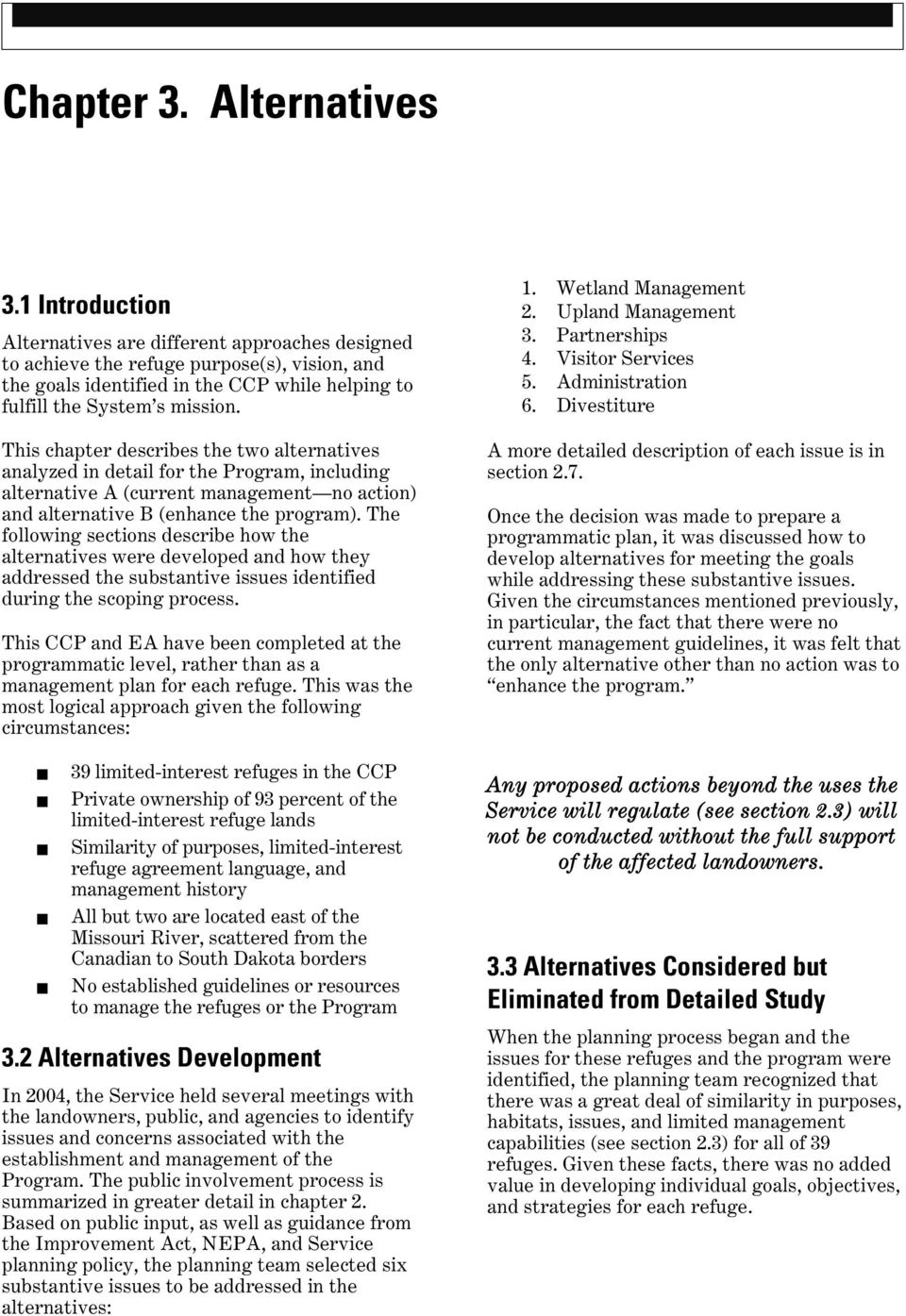
1 Chapter 3. Alternatives 3.1 Introduction Alternatives are different approaches designed to achieve the refuge purpose(s), vision, and the goals identified in the CCP while helping to fulfill the System s mission. This chapter describes the two alternatives analyzed in detail for the Program, including alternative A (current management no action) and alternative B (enhance the program). The following sections describe how the alternatives were developed and how they addressed the substantive issues identified during the scoping process. This CCP and EA have been completed at the programmatic level, rather than as a management plan for each refuge. This was the most logical approach given the following circumstances: 39 limited-interest refuges in the CCP Private ownership of 93 percent of the limited-interest refuge lands Similarity of purposes, limited-interest refuge agreement language, and management history All but two are located east of the Missouri River, scattered from the Canadian to South Dakota borders No established guidelines or resources to manage the refuges or the Program 3.2 Alternatives Development In 2004, the Service held several meetings with the landowners, public, and agencies to identify issues and concerns associated with the establishment and management of the Program. The public involvement process is summarized in greater detail in chapter 2. Based on public input, as well as guidance from the Improvement Act, NEPA, and Service planning policy, the planning team selected six substantive issues to be addressed in the alternatives: 1. Wetland Management 2. Upland Management 3. Partnerships 4. Visitor Services 5. Administration 6. Divestiture A more detailed description of each issue is in section 2.7. Once the decision was made to prepare a programmatic plan, it was discussed how to develop alternatives for meeting the goals while addressing these substantive issues. Given the circumstances mentioned previously, in particular, the fact that there were no current management guidelines, it was felt that the only alternative other than no action was to enhance the program. Any proposed actions beyond the uses the Service will regulate (see section 2.3) will not be conducted without the full support of the affected landowners. 3.3 Alternatives Considered but Eliminated from Detailed Study When the planning process began and the issues for these refuges and the program were identified, the planning team recognized that there was a great deal of similarity in purposes, habitats, issues, and limited management capabilities (see section 2.3) for all of 39 refuges. Given these facts, there was no added value in developing individual goals, objectives, and strategies for each refuge.
2 26 Comprehensive Conservation Plan, North Dakota Limited-interest National Wildlife Refuges 3.4 Elements Common to All Alternatives This section identifies key elements included in the CCP regardless of which alternative was selected. Both alternatives would incorporate the following: No alternative would infringe on any landowner rights or commercial uses, beyond the uses the Service would regulate under the authority of the limited-interest refuge agreement (as described in section 2.3), without permission from willing landowners. Landowners would have the right to refuse receiving any additional compensation for added protections. Activities outside the authority of the limited-interest refuge agreement would not be conducted unless permission is granted from affected, willing landowners. Landowners would be provided with information on the Program annually. The Service would minimize negative impacts to migratory birds and other wildlife by regulating uses that occur on water. The Service would ensure that refuge management complies with all other federal laws and regulations that provide direction for managing units of the System. Chapter 6 outlines the Service s plan for implementing the Enhancing the Program alternative in the form of goals, objectives, and strategies. 3.5 Description of Alternatives The theme and general management direction for each alternative are described below. Alternative A Current Management (No Action) Alternative A, the no-action alternative, describes current and future management of the Program. It provides the baseline against which to compare the preferred alternative. It is also a requirement of NEPA that the noaction alternative be addressed. General Management Direction Management would continue to be incidental to other refuge programs. Visitor services would see few changes due to a lack of funding and staffing to manage additional uses. Upland and wetland habitat, in particular native prairie, would continue to be lost and landowners would not receive any further compensation for habitat protections. Water management structures would continue to deteriorate. Any repairs to water management structures would be funded through the maintenance and management program. Current hunting and trapping programs would continue if they are determined to be compatible with the refuge purposes. Only a few refuges are open to hunting while each refuge has been opened to permit-only trapping since they were established. The trapping program is limited, less than one trapper per refuge; however, this program is vital to increasing ground nesting bird survival by reducing unnaturally high populations of small predators (including raccoons and skunks). This permit-only trapping would continue. Contact with landowners and other partners would be incidental to issues and common interests. No limited-interest refuges would be divested, further straining limited resources and affecting the integrity of the System due to the retention of refuges that do not support the mission or goals of the System. Activities outside the authority of the limitedinterest refuge agreement would not be conducted unless permission is granted from willing landowners. Alternative B Preferred Alternative (Enhance the Program) Alternative B, the preferred alternative, would address these refuges and their identified issues at a programmatic level while assisting the refuges to reach their full potential though greater cooperation and support. General Management Direction Highest priority would be given to ensuring that landowners become true partners in this Program and are involved in future management. A full-time Program manager would be recruited to oversee the Program and

3 3 Alternatives 27 implement this CCP. Landowners would be contacted at least annually through an informational newsletter providing updates on Program changes, opportunities, and limitedinterest refuge news. Partnerships with state agencies and other organizations would be actively pursued to achieve common goals that may support and enhance the Program. Using available habitat data, each managing station would work with the Habitat and Population Evaluation Team to develop a protection priority list for each refuge. Native prairie habitat would be given highest priority as areas are ranked, followed by natural wetlands. This would be the first critical evaluation of the value of each refuge and would assist managers in prioritizing the use of limited funding and staffing. With assistance from the Regional Engineering Office, existing impoundments would be evaluated to determine needed repairs or replacement of water management structures such as spillways, dams, and water control structures. Following evaluation, repairs, or replacement, impoundments would be managed for wetland-dependent migratory birds under the guidelines of an established water level management plan. Existing public use programs would continue if they remain compatible and there is a continued demand. Trapping would continue on a permit-only basis focusing efforts on maximizing waterfowl and other grassland nesting bird success through predator control. Public ice fishing would be permitted, where compatible. The Service would work with willing landowners to determine their interest in providing access to the public for additional hunting, fishing, wildlife observation and photography, environmental education and interpretation programs. As new opportunities arise, each manager would determine the compatibility of such activities based on the refuge purposes and available resources to manage the proposed use. All programs must be made available to the public, but no public uses will occur unless the landowners grant access. Even though these refuges are primarily on private lands, any public programs are governed under the Code of Federal Regulations; therefore, public participation may not be restricted beyond such restrictions as limiting the number of users and seasons. Under this alternative, six refuges would be proposed for divestiture: Camp Lake, Lake Patricia, Sheyenne Lake, School Section Lake, Bone Hill, and Cottonwood Lake. These refuges are being considered for divestiture due to extensive loss of habitat and ownership patterns. In particular, the state currently owns and/or manages three of these refuges (Lake Patricia, Sheyenne Lake, and School Section Lake) and are willing to continue if they are divested. The state has also expressed an interest in the fisheries resources of the remaining three refuges although these refuges uplands have little value to wildlife due to extensive development and commercial operations. The Service does not control these upland uses under the limited-interest refuge agreement; therefore, the uses have expanded over the 70 years. These proposals would ensure that future resources are expended on the remaining refuges that still have the potential to support the mission and goals of the System. In all cases, activities outside the authority of the limited-interest refuge agreement would not be conducted unless permission is granted from the affected and willing landowners including, but not limited to: additional compensation for added protections of wildlife habitat; fee-title acquisitions; visitor services programs where access is needed from the landowner. 3.6 Comparison of Alternatives The two alternatives evaluated are no action and enhance the program (the preferred alternative). A comparison of these alternatives is shown in table 5. Blue-winged Teal Tom Kelley/USFWS

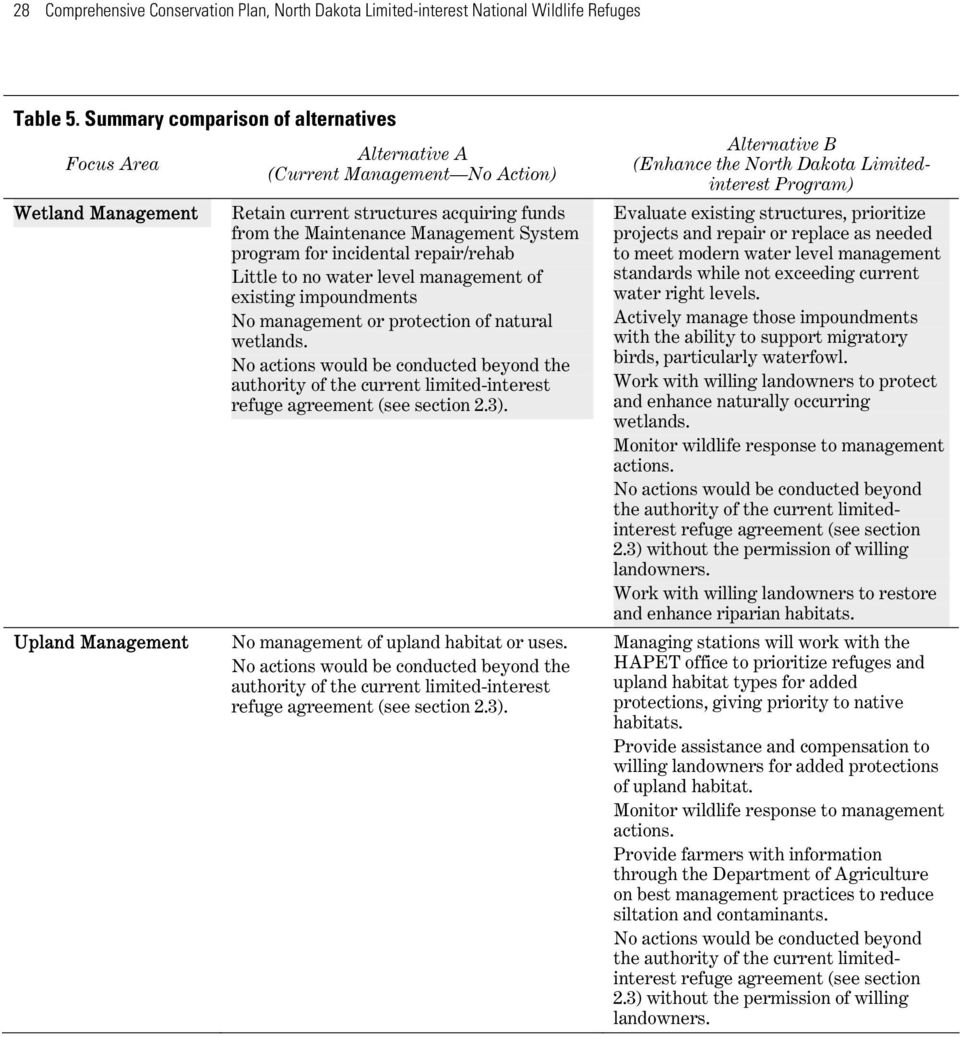
4 28 Comprehensive Conservation Plan, North Dakota Limited-interest National Wildlife Refuges Table 5. Summary comparison of alternatives Focus Area Wetland Management Upland Management Alternative A (Current Management No Action) Retain current structures acquiring funds from the Maintenance Management System program for incidental repair/rehab Little to no water level management of existing impoundments No management or protection of natural wetlands. No actions would be conducted beyond the authority of the current limited-interest refuge agreement (see section 2.3). No management of upland habitat or uses. No actions would be conducted beyond the authority of the current limited-interest refuge agreement (see section 2.3). Alternative B (Enhance the North Dakota Limitedinterest Program) Evaluate existing structures, prioritize projects and repair or replace as needed to meet modern water level management standards while not exceeding current water right levels. Actively manage those impoundments with the ability to support migratory birds, particularly waterfowl. Work with willing landowners to protect and enhance naturally occurring wetlands. Monitor wildlife response to management actions. No actions would be conducted beyond the authority of the current limitedinterest refuge agreement (see section 2.3) without the permission of willing landowners. Work with willing landowners to restore and enhance riparian habitats. Managing stations will work with the HAPET office to prioritize refuges and upland habitat types for added protections, giving priority to native habitats. Provide assistance and compensation to willing landowners for added protections of upland habitat. Monitor wildlife response to management actions. Provide farmers with information through the Department of Agriculture on best management practices to reduce siltation and contaminants. No actions would be conducted beyond the authority of the current limitedinterest refuge agreement (see section 2.3) without the permission of willing landowners.
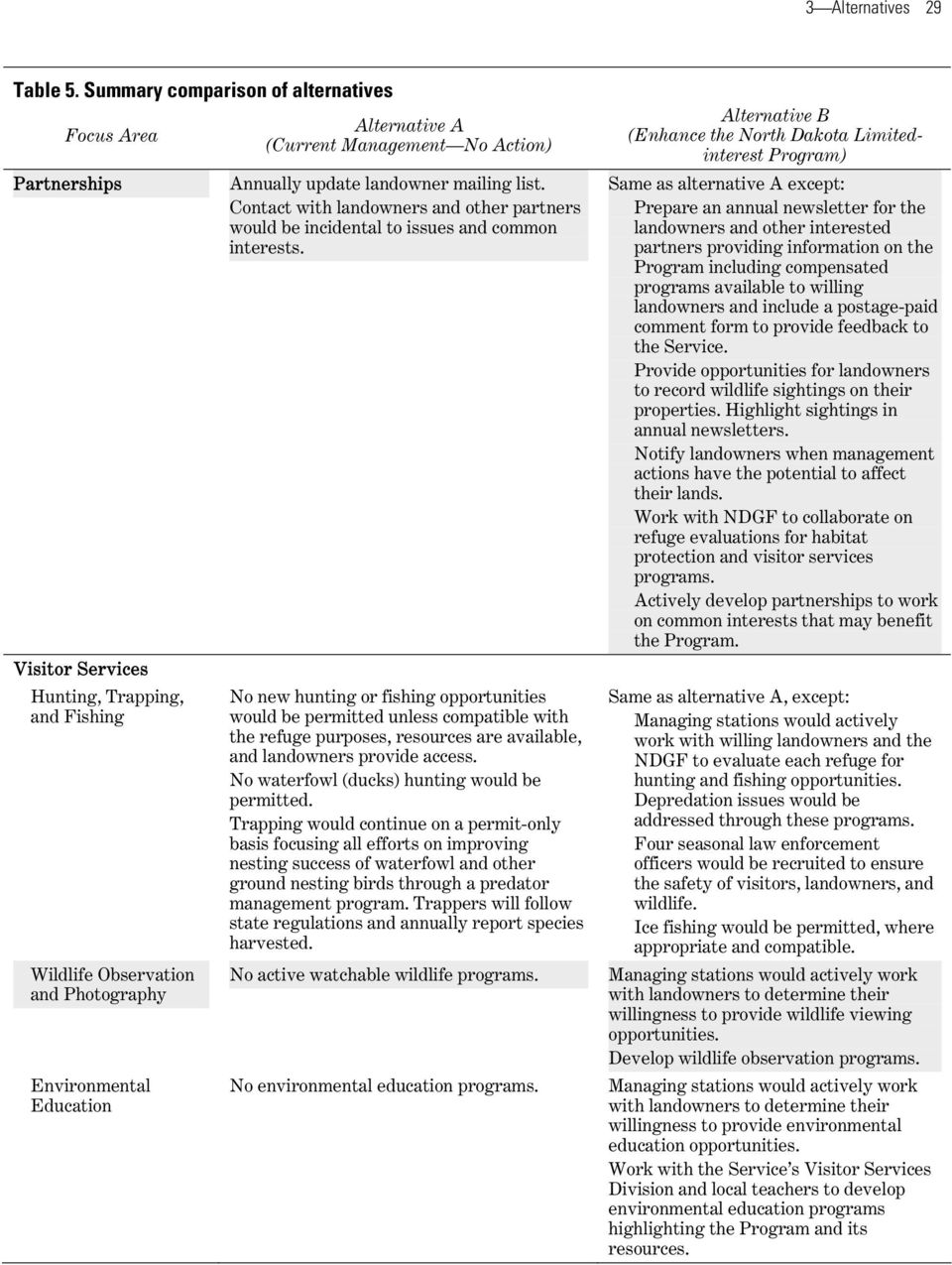
5 3 Alternatives 29 Table 5. Summary comparison of alternatives Focus Area Alternative A (Current Management No Action) Alternative B (Enhance the North Dakota Limitedinterest Program) Partnerships Annually update landowner mailing list. Same as alternative A except: Contact with landowners and other partners Prepare an annual newsletter for the would be incidental to issues and common landowners and other interested interests. partners providing information on the Program including compensated programs available to willing landowners and include a postage-paid comment form to provide feedback to the Service. Provide opportunities for landowners to record wildlife sightings on their properties. Highlight sightings in annual newsletters. Notify landowners when management actions have the potential to affect their lands. Work with NDGF to collaborate on refuge evaluations for habitat protection and visitor services programs. Actively develop partnerships to work on common interests that may benefit the Program. Visitor Services Hunting, Trapping, No new hunting or fishing opportunities Same as alternative A, except: and Fishing would be permitted unless compatible with Managing stations would actively the refuge purposes, resources are available, work with willing landowners and the and landowners provide access. NDGF to evaluate each refuge for No waterfowl (ducks) hunting would be hunting and fishing opportunities. permitted. Depredation issues would be Trapping would continue on a permit-only addressed through these programs. basis focusing all efforts on improving Four seasonal law enforcement nesting success of waterfowl and other officers would be recruited to ensure ground nesting birds through a predator the safety of visitors, landowners, and management program. Trappers will follow state regulations and annually report species harvested. wildlife. Ice fishing would be permitted, where appropriate and compatible. Wildlife Observation No active watchable wildlife programs. Managing stations would actively work and Photography with landowners to determine their willingness to provide wildlife viewing opportunities. Develop wildlife observation programs. Environmental No environmental education programs. Managing stations would actively work Education with landowners to determine their willingness to provide environmental education opportunities. Work with the Service s Visitor Services Division and local teachers to develop environmental education programs highlighting the Program and its resources.
6 30 Comprehensive Conservation Plan, North Dakota Limited-interest National Wildlife Refuges Table 5. Summary comparison of alternatives Focus Area Alternative A (Current Management No Action) Alternative B (Enhance the North Dakota Limitedinterest Program) Administration No dedicated resources would be available Recruit one statewide Program manager. for the Program. Develop Maintenance Management System projects to repair or replace water management structures. Develop project proposals for compensating willing landowners for added protections. Divestiture No refuges would be divested. Six refuges would be divested due to habitat loss and opportunities for state management. Future resources available for the Program would be used on those refuges that have the ability and qualities needed to support the goals of the National Wildlife Refuge System.

7

Use: Cooperative farming as a habitat management tool to enhance and restore refuge grasslands
 Compatibility Determination Use: Cooperative farming as a habitat management tool to enhance and restore refuge grasslands District Name: Minnesota Valley Wetland Management District Establishing and Acquisition
Appendix A: Land Protection Plan
 Appendix A: Land Protection Plan In this appendix A.1 Introduction and Purpose A.2 Project Description A.3 Refuge Purposes A.4 Land Acquisition Policy for Urban Refuges A.5 Status of Resources to be Protected
Land Protection Planning for the National Wildlife Refuge System
 March 2012 Planning Information Brochure 1 Land Protection Planning for the National Wildlife Refuge System The following questions are often asked when the U.S. Fish and Wildlife Service (Service) begins
U.S. Fish & Wildlife Service. Getting HIP Your Role In Conserving Migratory Birds Through the Harvest Information Program
 U.S. Fish & Wildlife Service Getting HIP Your Role In Conserving Migratory Birds Through the Harvest Information Program USFWS/F. Eugene Hester If you re planning on hunting any kind of migratory bird
The Colorado River Delta
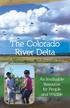 The Colorado River Delta An Invaluable Resource for People and Wildlife the colorado river delta The Colorado River Delta and its waters support a rich and diverse treasure of plants and animals in an
Integration of Forestry & Wildlife Management
 Integration of Forestry & Wildlife Management By Ken Negray Regional Certification Manager, NewPage Corp & member of the KY SIC Committee Abstract: Kentucky SIC (Sustainable Forestry Initiative Implementation
Wildlife Habitat Conservation and Management Program
 Wildlife Habitat Conservation and Management Program Manual for Counties and Cities Oregon Department of Fish and Wildlife 2015 Table of Contents 1. Introduction Purpose of the habitat program Objective
Minnesota Department of Natural Resources. Long Range Duck Recovery Plan
 Minnesota Department of Natural Resources Long Range Duck Recovery Plan Approved April 21, 2006 Minnesota Duck Plan Table of Contents Preface Executive Summary Duck Recovery Plan Strategic Vision Importance
Appendix A. Lists of Accomplishments and Project Costs. UMRWD 10 Year Plan Update. Appendix A UPPER MINNESOTA RIVER WATERSHED DISTRICT
 UPPER MINNESOTA RIVER WATERSHED DISTRICT Lists of Accomplishments and Project Costs 10 Year Plan Update UMRWD 10 Year Plan Update Page A 1 UMRWD LIST OF ACCOMPLISHMENTS Since its inception in 1967, the
U.S. Fish and Wildlife Service will invest $15 million for post-sandy cleanup and marsh restoration on Long Island
 For Immediate Release: Wednesday, November 6, 2013 For further information: Michelle Potter, refuge manager, 631/286-0485 ext. 2112, [email protected] Tom Sturm, public affairs specialist, 413/253-8339,
I. U.S. Fish and Wildlife Service Environmental Action Statement
 Appendix I: Environmental Action Statement I. U.S. Fish and Wildlife Service Environmental Action Statement Laguna Atascosa National Wildlife Refuge Comprehensive Conservation Plan I-1 Appendix J: Finding
U.S. Fish and Wildlife Service CHARLES M. RUSSELL NWR Outreach Notice
 U.S. Fish and Wildlife Service CHARLES M. RUSSELL NWR Outreach Notice Supervisory Range Technician (Fire) GS-0455-06/07 Firefighter Location JORDAN, MONTANA The U.S. Fish & Wildlife Region 6 Charles M.
Logistic Paradigm. Logistic Paradigm. Paradigms. How should we consider them?
 Harvesting Paradigms Sustained Yield Harvesting Paradigms Net-Annual Increment Paradigm The Myth of MSY How should we consider them? The logistic paradigm obviously arises from logistic model. Says that
Environmental Law Primer. Adapted from Vermont Law School s Environmental Law Primer for Journalists
 Environmental Law Primer Adapted from Vermont Law School s Environmental Law Primer for Journalists General Categories Command and Control Liability Disclosure Ecosystem and Place-based Programs Marketable
Multiple Species Conservation Program County of San Diego. A Case Study in Environmental Planning & The Economic Value of Open Space
 Multiple Species Conservation Program County of San Diego A Case Study in Environmental Planning & The Economic Value of Open Space Amy M. Fox Land Use Law Case Study Autumn Semester, 1999 Multiple Species
POLICY ON THE RELOCATION OF WILDLIFE
 State of New Jersey Department of Environmental Protection Mail Code 501-03 Division of Fish and Wildlife PO Box 420 / 501 East State Street Trenton, NJ 08625-0420 POLICY ON THE RELOCATION OF WILDLIFE
Markets for Ecosystem Services on Agricultural Lands: Experience and Outlook in the United States
 Markets for Ecosystem Services on Agricultural Lands: Experience and Outlook in the United States Frank Casey Conservation Economics and Finance Program Defenders of Wildlife Presented at the Biodiversity
Recommended Land Use Guidelines for Protection of Selected Wildlife Species and Habitat within Grassland and Parkland Natural Regions of Alberta
 Fish and Wildlife Division Sustainable Resource Development Recommended Land Use Guidelines for Protection of Selected Wildlife Species and Habitat within Grassland and Parkland Natural Regions of Alberta
Arkansas River Corridor Vision & Master Plan
 A r k a n s a s R I v e r C o r r I d o r P l a n Arkansas River Corridor Vision & Master Plan July 2005 Indian Nations Council of Governments A r k a n s a s R I v e r C o r r I d o r P l a n Partnership
Resources, Publications, Tools, Input from AWCC
 A comprehensive review of Farm Bill contributions to wildlife conservation A comprehensive review was made of scientific literature to determine wildlife responses to conservation programs undertake as
The Conservation Reserve Program: 45th Signup Results
 Farm Service Agency The Conservation Reserve Program: 45th Signup Results U.S Department of Agriculture Farm Service Agency Conservation and Environmental Program Division 1400 Independence Ave., SW, Room
How To Fish In Arkansas
 Licensing and Permits Fishing Licenses Fishing Licenses Which license do I need to fish for game fish in Arkansas? If you are 16 or older, you must carry a valid fishing license to take or attempt to take
The 25 Year Saskatchewan Water Security Plan. February 2013
 The 25 Year Saskatchewan Water Security Plan February 2013 OUTLINE Challenges The Plan The Agency Implications for Agriculture Water Security Plan Development Consultation in 2011 with 174 individuals
Department of the Interior. Departmental Manual
 Page 1 of 10 Department of the Interior Departmental Manual Effective Date: 10/23/2015 Series: Public Lands Part 600: Public Land Policy Chapter 6: Implementing Mitigation at the Landscape-scale Originating
III. Vision and Goals
 III. Vision and Goals In 1998, OPRHP acquired over 3,200 acres of land that more than tripled the size of Moreau Lake State Park. Now, Moreau Lake State Park is the largest park in the Saratoga- Capital
First Annual Centennial Strategy for. Yucca House National Monument
 First Annual Centennial Strategy for Yucca House National Monument August 2007 Year: 2007 Vision Statement Yucca House National Monument was set aside in 1919 to preserve an unexcavated Ancestral Puebloan
Green Infrastructure Case Study Template
 Green Infrastructure Case Study Template The aim of the exercise is to provide information on how the elements of the Green Infrastructure Strategy are implemented at national level and to provide case
Restoring Anadromous Fish Habitat in Big Canyon Creek Watershed. Summary Report 2002
 Restoring Anadromous Fish Habitat in Big Canyon Creek Watershed Summary Report 2002 DOE/BP-00005268-5 November 2002 This Document should be cited as follows: "Restoring Anadromous Fish Habitat in Big Canyon
Michigan Wetlands. Department of Environmental Quality
 Department of Environmental Quality Wetlands are a significant component of Michigan s landscape, covering roughly 5.5 million acres, or 15 percent of the land area of the state. This represents about
Lower Crooked Creek Watershed Conservation Plan EXECUTIVE SUMMARY
 EXECUTIVE SUMMARY Project Background Located in southwestern Pennsylvania, Crooked Creek is a major tributary of the Allegheny River, entering near Ford City in Armstrong County. It is rich in natural
U.S. Fish & Wildlife Service West Virginia Ecological Services Field Office
 Slide 1 West Virginia Ecological Services Field Office Liz Stout Fish and Wildlife Biologist 694 Beverly Pike Elkins, West Virginia 26241 [email protected] 304-636-6586 x 15 Slide 2 Today s Goals
A Report on. Customer Service. for Texas Parks and Wildlife Department
 A Report on Customer Service for Texas Parks and Wildlife Department Submitted June 1, 2014 WHAT IS A CUSTOMER? Customers are the most important people in this office. Customers are not dependent on us...
PHOTO: Jon Waterman THE COLORADO RIVER DELTA, CIRCA NOW OPEN BOOKLET TO SEE CHANGE
 PHOTO: Jon Waterman THE COLORADO RIVER DELTA, CIRCA NOW OPEN BOOKLET TO SEE CHANGE 1 OUR VISION RAISE THE RIVER IS AN ENGAGEMENT CAMPAIGN LED BY LIKE-MINDED VISIONARIES Raisetheriver.org sees a day when
Using Aerial Photography to Measure Habitat Changes. Method
 Then and Now Using Aerial Photography to Measure Habitat Changes Method Subject Areas: environmental education, science, social studies Conceptual Framework Topic References: HIIIB, HIIIB1, HIIIB2, HIIIB3,
AN INITIATIVE TO IMPROVE
 L OW E R C A R M E L R I V E R A N D L AG O O N F L O O D P L A I N R E S TO R AT I O N A N D E N H A N C E M E N T P R O J E C T AN INITIATIVE TO IMPROVE FLOOD PROTECTION RESTORE AND PROTECT RIPARIAN
Conservation Tax Credit Regulations Chapter 391-1-6 A-1 RULES OF GEORGIA DEPARTMENT OF NATURAL RESOURCES CHAPTER 391-1-6
 Conservation Tax Credit Regulations Chapter 391-1-6 A-1 RULES OF GEORGIA DEPARTMENT OF NATURAL RESOURCES CHAPTER 391-1-6 GEORGIA CONSERVATION TAX CREDIT PROGRAM TABLE OF CONTENTS 391-1-6-.01 Purpose and
North Branch Chicago River Watershed-Based Plan
 North Branch Chicago River Watershed-Based Plan EXECUTIVE SUMMARY In Lake County, the Lake County Stormwater Management Commission (SMC) is responsible for managing Lake County s water resources. The North
- POLICY - Disaster Recovery Assistance Program
 August 29, 2013 - POLICY - Disaster Recovery Assistance Program Overview Disasters and emergency legislative funding occur frequently and usually unpredictably. These characteristics require a standard
ON THE RELOCATIO Division of
 New Jersey Department off Environmental Protection Division of Fish and Wildlife Mail l Code 501-03 PO Box 4200 / 501 East State St Trenton, NJ 08625-0420 POLICY ON THE RELOCATIO ON OF WILDLIFE As the
LAW ENFORCEMENT PROGRAM ACCREDITATION MANAGER (PROGRAM SPECIALIST 4)
 From: To: Subject: Date: Galvan, Jodie Galvan, Jodie Emailing: Job Bulletin Tuesday, June 30, 2015 10:15:40 AM State of Washington Dept. of Fish and Wildlife invites applications for the position of: Accreditation
Gold Ray Dam Interagency Technical Team Meeting
 Gold Ray Dam Interagency Technical Team Meeting Agenda Public Outreach, Funding, Monitoring EA/BA/Permit Updates Deconstruction Plans Fish Passage & Salvage Plan Hydraulic Modeling Next Steps Public Outreach,
Chehalis River Basin Flood Damage Reduction 2013-2015 Capital Budget Approved by Legislature in June 2013
 Chehalis River Basin Flood Damage Reduction 2013-2015 Capital Budget Approved by Legislature in June 2013 1. Design alternatives for large capital flood projects (basinlevel water retention and Interstate
Fishing, Hunting & Gathering The Rights and Responsibilities of First Nations People in Manitoba
 Fishing, Hunting & Gathering The Rights and Responsibilities of First Nations People in Manitoba First Nations people have always had a special relationship with the natural life forms that the land provides
Fish and Wildlife. Service. FWS Funding
 Fish and Wildlife Service Mission The mission of the Fish and Wildlife Service is to work with others to conserve, protect, and enhance fish, wildlife, plants, and their habitats for the continuing benefit
BI-POLE III - KEEWATINOOW CONVERTER STATION PROJECT Construction Access Management Plan
 2013 BI-POLE III - KEEWATINOOW CONVERTER STATION PROJECT Construction Access Management Plan Manitoba Hydro Manitoba Hydro 9/9/2013 BI-POLE III KEEWATINOOW CONVERTER STATION PROJECT Construction Access
Non-consumptive use of wildlife. Non-consumptive Use. Non-consumptive Use
 Non-consumptive use of wildlife Non-consumptive Use Any non-hunting or non-extractive use Examples: wildlife feeding & photography, bird watching, whale watching Non-consumptive Use Sources of information
PROGRAMMATIC ENVIRONMENTAL ASSESSMENT
 U.S. Fish and Wildlife Service, Region 1 Wildlife and Sport Fish Restoration Program FINAL PROGRAMMATIC ENVIRONMENTAL ASSESSMENT for a Streamlined Method for Approving Small Land Disposals of State Lands
Written Submission to Federal Review Panel for New Prosperity Gold-Copper Mine Project
 August 20, 2012 Livain Michaud Panel Manager New Prosperity Review Panel Secretariat Canadian Environmental Assessment Agency 160 Elgin Street, 22nd Floor Ottawa ON K1A 0H3 [email protected]
Strategic Land Conservation in the Gulf of Mexico Region
 Strategic Land Conservation in the Gulf of Mexico Region : Elizabeth Barber and Julia Weaver, Coordinators, Partnership for Gulf Coast Land Conservation Bob Stokes, Galveston Bay Foundation President and
MAINTENANCE MANAGEMENT SYSTEM HANDBOOK (372 FW2) May 2002 U.S. FISH AND WILDLIFE SERVICE DEPARTMENT OF THE INTERIOR
 MAINTENANCE MANAGEMENT SYSTEM HANDBOOK (372 FW2) May 2002 U.S. FISH AND WILDLIFE SERVICE DEPARTMENT OF THE INTERIOR CHAPTER MAINTENANCE MANAGEMENT SYSTEM HANDBOOK TABLE OF CONTENTS Page INTRODUCTION...
Okaloosa RESTORE Advisory Committee
 Data Collection Form Part A: Project Information (To be completed by all Proposers) Okaloosa RESTORE Advisory Committee Approved by the Okaloosa RESTORE Advisory Committee: December 4, 2014 Okaloosa County,
Oxbow Restoration for Fish Habitat and Water Quality
 Oxbow Restoration for Fish Habitat and Water Quality Chris Jones and Aleshia Kenney Iowa Soybean Association U.S. Fish and Wildlife Service ENVIRONMENTAL Programs and Services Partners for Fish and Wildlife
Leveraging Ohio s Clean Water SRF Program to Fund Stream and Wetland Restoration and Protection Projects
 Leveraging Ohio s Clean Water SRF Program to Fund Stream and Wetland Restoration and Protection Projects Association of State Wetland Managers 2014 State/Tribal/Federal Coordination Meeting Shepherdstown,
Horseshoe Ranch Management Planning Process
 Horseshoe Ranch Management Planning Process Community-Based Process and Results Prepared By: Region VI 2 Table of Contents Announcement... 3 Background... 4 Description planning area... 5 Scoping... 6
USDA CROSS TRAINING PROGRAM ONLINE AGLEARN TRAINING
 U SDA s mission is to provide leadership on food, agriculture, natural resources, and related issues based on sound public policy and the best available science and efficient management. Accomplishing
NATURAL RESOURCE CHALLENGE. The National Park Service s Action Plan for Preserving Natural Resources
 NATURAL RESOURCE CHALLENGE The National Park Service s Action Plan for Preserving Natural Resources Natural Resource Challenge The National Park ServiceÕs Action Plan for Preserving Natural Resources http://www.nature.nps.gov/challengedoc
USDA Forest Service Proposed Soil and Water Restoration Categorical Exclusions Frequently Asked Questions 2013-09-05 Table of Contents
 USDA Forest Service Proposed Soil and Water Restoration Categorical Exclusions Frequently Asked Questions 2013-09-05 Table of Contents What is the Final Rule implemented by the Forest Service?... 2 Why
Wildlifer 2013 Managing Wildlife on Private Lands
 Master Wildlifer 2013 Managing Wildlife on Private Lands Greg Yarrow, Chair and Professor Natural Resources School of Agricultural, Forest, & Environmental Sciences Clemson University Clemson, South Carolina,
Subactivity: Habitat Conservation Program Element: National Wetlands Inventory
 HABITAT CONSERVATION FY 29 BUDGET JUSTIFICATION Subactivity: Habitat Conservation Program Element: National Wetlands Inventory National Wetlands Inventory ($) FTE 27 4,7 2 28 Enacted 5,255 2 Fixed Costs
Town of Richmond Hill Beaver Management Policy Summary
 Town of Richmond Hill Beaver Management Policy Summary Above Left: Tree damage from beaver. Above Right: Beaver dam in stream - notice the water level above and below the dam! Below: Beaver swimming. Town
STREAMFLOW RESTORATION PRIORITY AREAS
 STREAMFLOW RESTORATION PRIORITY AREAS Synopsis The Water Resources Department and the Department of Fish and Wildlife jointly identified priority areas for streamflow restoration in basins throughout the
DECISION DOCUMENT NATIONWIDE PERMIT 27
 DECISION DOCUMENT NATIONWIDE PERMIT 27 This document discusses the factors considered by the Corps of Engineers (Corps) during the issuance process for this Nationwide Permit (NWP). This document contains:
Ecosystem Services in the Greater Houston Region. A case study analysis and recommendations for policy initiatives
 Ecosystem Services in the Greater Houston Region A case study analysis and recommendations for policy initiatives Ecosystem Services Ecosystems provide services through their natural processes that we
Resource Management Accomplishments FY 2014
 Resource Management Accomplishments FY 2014 Sea turtle nest protection - Over 3,700 sea turtle nests were covered with wire mesh screens to protect them from being predated. Data on each sea turtle activity
Watershed Program: A Little Known but Powerful Solution for Integrated Estuarine Restoration
 Watershed Program: A Little Known but Powerful Solution for Integrated Estuarine Restoration Cape Cod Water Resources Restoration Project (CCWRRP) Initial farmer, landowner, and municipal official discussions
Penticton Creek May 4, 2015 Council Meeting
 Penticton Creek May 4, 2015 Council Meeting Penticton Creek Council Meeting May 4, 2015 Penticton Creek in the Early Years Penticton Creek Council Meeting May 4, 2015 Penticton Creek Today Penticton Creek
Prepared By: Eric Chamberlain
 Prepared By: Eric Chamberlain Drainage 101 So, What s a Municipal Drain??? It is a Drainage System either open ditch or enclosed pipe system or any other water control structure Petitioned for by landowners
Nova Scotia Department of Natural Resources BUSINESS PLAN 2001-2002
 Nova Scotia Department of Natural Resources BUSINESS PLAN 2001-2002 Posted April 3 rd, 2001. For further information contact: Peter Woolaver, Planning Secretariat, NSDNR [email protected] Table of Contents
PUBLIC NOTICE Application for Permit
 PUBLIC NOTICE Application for Permit 30-Day Notice Issue Date: June 20, 2016 Expiration Date: July 20, 2016 US Army Corps of Engineers No: NWP-2010-535 Oregon Department of State Lands No: 58311-RF Interested
STANDARD OPERATING PROCEDURES
 STANDARD OPERATING PROCEDURES Written by Terry Messmer, Todd Black, and Sarah Lupis Community-Based Conservation Extension Specialists Utah State University Extension Services 5230 Old Main Hill Logan,
DWFP-CONSERVATION RESOURCES COORDINATOR
 Page 1 DWFP-CONSERVATION RESOURCES COORDINATOR CHARACTERISTICS OF WORK: This is professional administrative and managerial work in the fields of wildlife, fisheries, ecology and natural resources conservation
John M. Austin Vermont Dept. of Fish & Wildlife 5 Perry Street, Suite 40 Barre, Vermont 05641 (802) 476-0199 email: [email protected].
 John M. Austin Vermont Dept. of Fish & Wildlife 5 Perry Street, Suite 40 Barre, Vermont 05641 (802) 476-0199 email: [email protected] Education: M.S.L., Environmental Law & Policy, Vermont Law School,
CHAD R. GOURLEY SPECIALTY EMPLOYMENT
 CHAD R. GOURLEY P.O. Box 919 Verdi, Nevada 89439 phone 775.345.9960 cell 775.250.8140 chad_gourley at att.net SPECIALTY Restoration of riverine, spring, and wetland ecosystems, specializing in a process