
Fewer net errors and omissions, that is a new format of the balance of payments
|
|
|
- Nathaniel Morrison
- 10 years ago
- Views:
Transcription
1 Fewer net errors and omissions, that is a new format of the balance of payments The size of net errors and omissions in the balance of payments decreased from 4.4% to 2.3% of GDP. This resulted from data revision by the NBP, which covered, among other things, the volume of imports of used cars from the EU, as well as other items of the balance of payments. The present balance no longer differs from figures recorded by other countries, explains Józef Sobota, Head of the NBP Department of Statistics. This paper presents several explanations why markets, while analysing the macroeconomic situation in emerging markets, pay close attention to the current account deficit and sources of its financing. In their article for Obserwator Finansowy, Józef Sobota, Head of NBP Department of Statistics, Grzegorz Dobroczek and Jacek Kocerka argue that such an approach results from the fact that the current account deficit reflects the scale of external imbalance, which, in turn, determines the country s macroeconomic stability. Countries whose development characteristics are similar to Poland, i.e. countries at a phase of a relatively rapid growth, should use external savings to finance their investments. These benefits will be sustainable provided the current trade deficit is at a safe level. In order to maintain a safe level of deficit, it is necessary to constantly monitor changes in the items of the balance of payments, not only in the current account, but also as regards mirrored changes in the financial account. Thus, these figures must be monitored constantly. The net errors and omissions In the balance of payments statistics, special attention is paid to the net errors and omissions. In the ideal world, the principle of double entry of transactions with foreign countries should enable to fully settle the deficit or the surplus in the current account through relevant changes in the financial account. For example, in the current account, the inflow of foreign currencies constituting export payments should correspond to the export of cars. In the real world, it is,however, unnecessary to collect such complete information on all operations with foreign countries given the cost of the approach. The accuracy with which the current account balance is calculated should suffice to assess its impact on macroeconomic stability. The consequence is incomplete offsetting of transactions. The difference is recognised under the net errors and omissions. In recent years, that component grew and reached 4.4% of GDP, which increasingly worried analysts and economists because of its potential consequences not only for the balance of payments, but also for the assessment of the country s external position, PLN exchange rate, etc. The International Monetary Fund, in its Balance of Payments and International Investment Position Manual (IMF, 2009) describes the size of the phenomenon as 1

2 follows: While it is not possible to give guidelines on an acceptable size of net errors and omissions, it should be assessed by compilers in relation to other items, such as GDP, positions data, and gross flows. Thus, the net errors and omissions is an important criterion in the evaluation of statistic data quality. It should also be mentioned that the net errors and omissions exists in all countries, but its size and divergence directions differ. This shows how complicated is the process of the development of the balance of payments statistics, which attempts to describe the status of mutual economic relations between the country and the rest of the world. It is not possible to fully eliminate the balance of errors. However, it may be minimised. To achieve this, data quality must be monitored constantly and further potential reasons for the significant growth of the net errors and omissions must be eliminated. Revisions of the balance of payments As a result of eliminating the reasons for data divergence, the existing statistics has been revised. This is nothing extraordinary in the global practice. Recently, the De Nederlandsche Bank, the European Central Bank and the Czech National Bank have revised data connected, among others, to problems reflected in the negative net errors and omissions. In the first two cases, the negative net errors and omissions resulted mainly from the financial account and rather than from the current account. The National Bank of Poland has also decided to revise the existing data. As a result of months-long analyses, four areas were identified where data of the balance of payments were verified. The NBP s work was supported by the special technical mission of the IMF charged with defining methodological foundations for the collection and compilation of the balance of payments statistics worldwide. The joint work of the IMF and the NBP was carried out in July 2009 and in June The IMF assessed positively the Polish reporting system and the amendments thereto. As a result of the conducted works, the net errors and omissions decreased substantially, from 4.4% of GDP to 2.3% of GDP in 2009, when the highest balance before correction was recorded. 2
3 Chart 1: Published and revised net errors and omissions (data in PLN million) PUBLISHED ERRORS AND OMISSIONS REVISED ERRORS AND OMISSIONS Legend: blue line the published net errors and omissions red line the revised net errors and omissions The revisions of data relating to the net errors and omissions are predominant in the current account of the balance of payments. Total current account corrections, depending on the year, varied from 1.1 to 1.8% of GDP. In 2010, the current account balance increased from 3.4 to 4.5%. After the correction, the size of Polish net errors and omissions is at the level comparable to other countries. It is necessary, however, to add that currently Sweden, (as well as Finland, which is not included in the chart) records one of the highest size of net errors and omissions in Europe. In Hungary, the size of net errors and omissions is similar to the Polish one, while in Slovakia it is even higher, taking into account its relation to GDP. 3

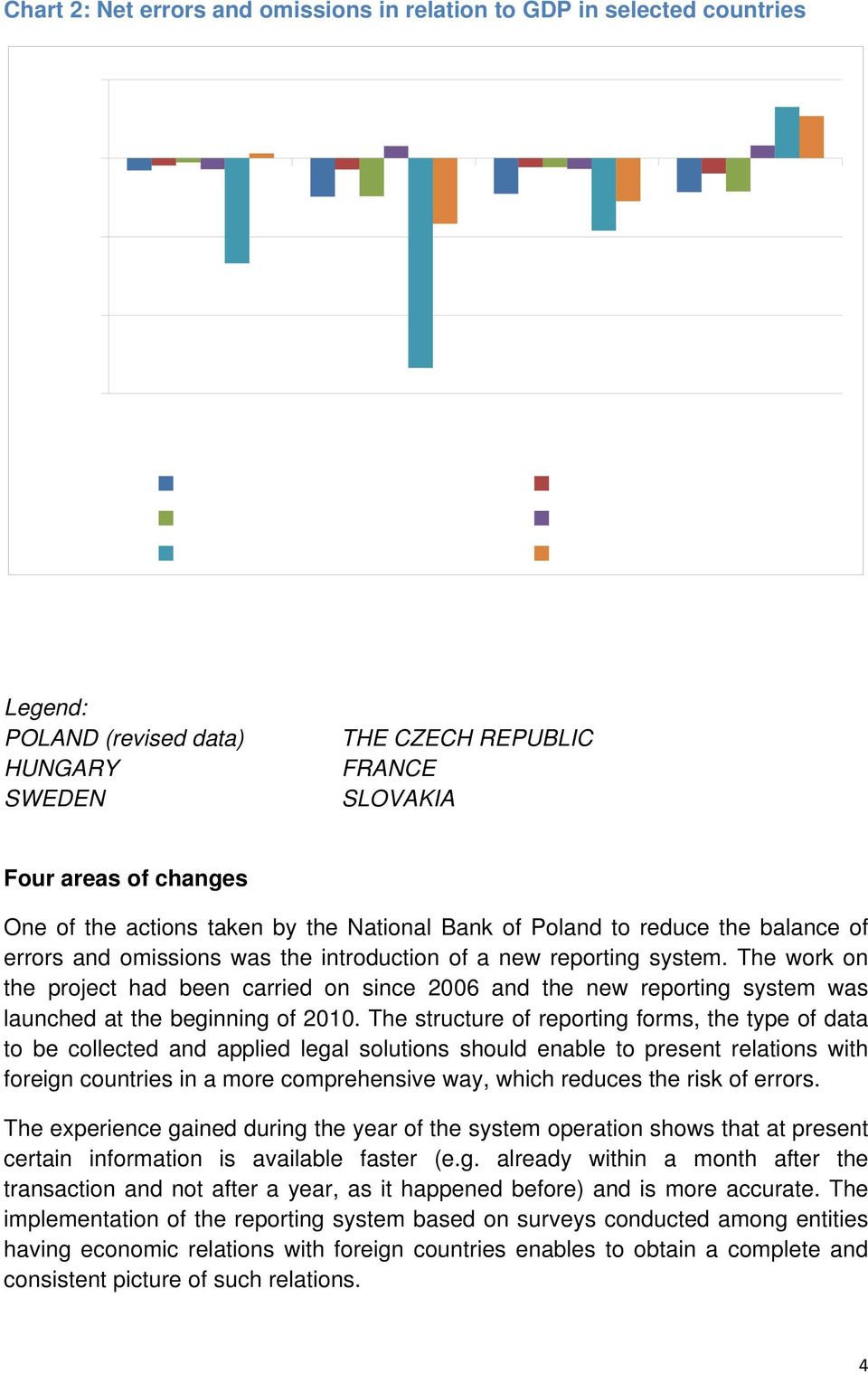
4 Chart 2: Net errors and omissions in relation to GDP in selected countries Legend: POLAND (revised data) HUNGARY SWEDEN THE CZECH REPUBLIC FRANCE SLOVAKIA Four areas of changes One of the actions taken by the National Bank of Poland to reduce the balance of errors and omissions was the introduction of a new reporting system. The work on the project had been carried on since 2006 and the new reporting system was launched at the beginning of The structure of reporting forms, the type of data to be collected and applied legal solutions should enable to present relations with foreign countries in a more comprehensive way, which reduces the risk of errors. The experience gained during the year of the system operation shows that at present certain information is available faster (e.g. already within a month after the transaction and not after a year, as it happened before) and is more accurate. The implementation of the reporting system based on surveys conducted among entities having economic relations with foreign countries enables to obtain a complete and consistent picture of such relations. 4
5 Hereunder is the detailed presentation of data revisions made in four areas of the balance of payments. Imports of used cars from the EU As of the accession of Poland to the European Union in May 2004, regulations defining taxes on imports of used cars from the EU changed. As a result of the significant tax reduction, imports increased rapidly. At the same time, regulations determining rules for the compilation of statistic data on trade in goods within the EU were amended. In Intrastat, which is used to collect information on international trade in goods within the European Union, there are no data on imports of used cars. There are two system-related reasons behind it. First, most cars are imported by private persons, who are not obliged to provide information to the Intrastat system. Second, the system imposes high reporting thresholds, which are not exceeded by most of small enterprises importing used cars. Under these circumstances, the value of imports of used cars may only be estimated, which was made by the NBP, on the basis of administrative data obtained from the Ministry of Finance, which collects them for tax purposes. According to the data of the Ministry of Finance, 730,000 cars for the total amount of PLN 11.0 billion were imported to Poland in The resulting correction of the balance of payments ranges from PLN 1.2 billion in 2004 to over PLN 11.2 billion in 2008, i.e. from 0.1 to 0.9% of GDP. Chart 3: Imports of goods comparison of data before and after corrections IMPORTS REVISED IMPORTS REVISION 5
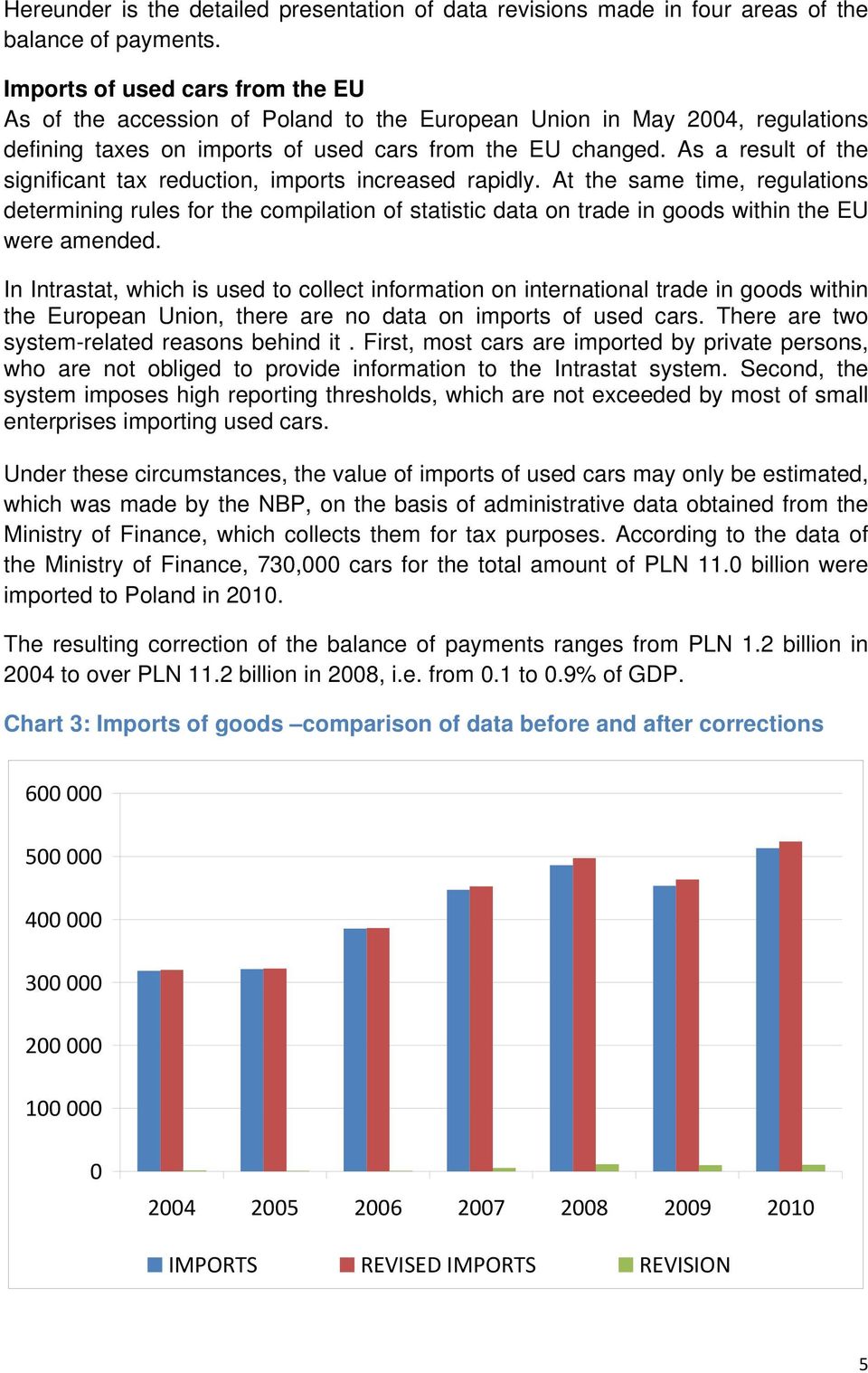
6 Legend: Imports. Imports (revised data). Correction Other revisions of the current account Other important corrections of the current account focus on the item Other current transfers of other sectors. This category recorded a significant net inflow of funds to Poland. It should comprise transfers to Poland other than transfers of income from employment or the inflow of EU funds. This item comprises, among other things, indemnities, penalties, alimonies, old-age pensions, lottery prizes, humanitarian aid, etc. received by Polish households and enterprises. Previously, statistics in this area had been, for the most part, based on the information on payments settled by Polish banks. In 2010, it was replaced with the system based on information gathered directly from entities involved in relations with foreign countries. Such a change urges to search for new sources of information on transfers of other sectors. Data on other transfers received by Polish households were estimated by the NBP on the basis of the Household Budget Survey carried on by the Polish Statistical Office (GUS). This is a panel study based on the sample of almost 40,000 households, which systematically analyses, among other things, households cash income, including disability and old-age pension benefits from abroad, as well as other income classified in this item of the balance of payments, like, for example, family pensions, unemployment benefits from abroad, family benefits received from abroad, alimonies and other donations from abroad. As a result of the incorporation of a new source of data on income of Polish households from abroad the item Other transfers of other sectors was significantly revised downwards. The results of the Household Budget Survey, confirmed by the analysis of other information from the Ministry of Finance and Social Security Institution (ZUS), show that this item should be revised downwards by over PLN 10 billion every year. The detailed analysis of the payment data used so far showed that there was a large number of errors in coding assigned by banks in this area, which significantly overestimated transfers of other sectors. Information on transfers received (and sent) by enterprises comes from GUS studies. As part of its study on international trade in services, the Polish Statistical Office collects information both on transfers received from abroad and transfers sent abroad directly by enterprises and other reporting entities (e.g. foundations). This source has been used in the balance of payments only since the first quarter of 2010 as the study was launched by GUS at the beginning of
7 Similarly to income, information about on use of other private transfers was also revised. And these data, similarly to income, turned out to be overestimated. The NBP decided to take into account the new source of data on disability and old - age pension benefits (as well as other transfers, like funeral payments and veteran s benefits) sent by the Polish social insurance system abroad. Such funds are paid to Polish residents living abroad or foreign residents who have become eligible for such allowances in Poland. After the implementation of the direct reporting system, data on such transactions were not included in the balance of payments statistics. Starting from the first quarter of 2011, the data will be collected directly from ZUS, on a regular basis, and classified as expenditure relating to other government transfers. In 2010, such expenditure amounted to PLN 300 million. In addition, data on compensations of non-resident employees working in Poland and compensations transferred abroad have been revised. As a result of the introduction of the new direct reporting system where such transactions are not measured, the estimation method of such figures has been developed. The new estimation method is mainly based on administrative data on the number of foreign residents working in Poland (ZUS, Ministry of Labour and Social Policy) and the amount of their wages and salaries. In the case of compensation of employees (shown in the balance of payments as employment income), the corrections are not permanent and fluctuate from minus PLN 146 million in 2007 to plus PLN 716 million in In the case of the current transfers of wages, corrections increased systematically from PLN 13 million in 204 to PLN 143 million in Chart 4: Balance of current transfers comparison of data before and after corrections Data in PLN million 7

8 CURRENT TRANSFERS BALANCE CURRENT TRANSFERS BALANCE (REVISED DATA) REVISION Legend: blue: current transfers balance red: current transfers balance (revised data) green: correction Total transfers corrections range from PLN 7 billion to PLN 13.4 billion, depending on the year, i.e. between 0.5 and 1.0% of GDP. Repo transactions As a result of the analysis of potential errors and omissions, the double entry of repo transactions was identified. According to the balance of payments methodology, data on FX transactions (repo, sell/buy back, buy/sell back) should not be shown as the inflow or outflow of portfolio investments as the ownership of securities does not change from the economic point of view. Data on contingent transactions are collected from entities involved in trading with foreign countries and are presented separately under other investments as a type of securities-backed loans. The NBP found that data on foreign residents exposure to the Polish Treasury bonds market (in reports submitted to the National Depository for Securities, which constitute the data source for the balance of payments) cover both ordinary purchase/sales transactions, as well as contingent transactions. It managed to determine the volume of contingent transactions and correct the data in the balance of payments, respectively. As a result, the inflow of foreign residents investments to the Polish securities market decreased and the errors and omissions dropped accordingly. 8

9 It should be noted that at the end of 2010 and at the beginning of 2011, contingent transactions between residents and non-residents increased significantly as a result of intensified exposure of foreign entities to the Treasury securities market, possibility of opening individual accounts with the National Depository, and development of certain banks systems. The annual data were revised by PLN 49 million in 2005 to over PLN 2.1 billion in Foreign assets of the non-financial sector entities As a part of its work, the NBP also carefully analysed available sources of transactions conducted by the non-financial sector entities. The central bank focused mainly on transactions involving special-purpose vehicles. These are legal entities, usually not conducting any economic activity, employing a small number of persons, established merely for asset management. The analyses carried out by the NBP explicitly showed that in the previous years certain investments of Polish entities that were carried out abroad were not reported. Thus, the outflow of Polish investments to foreign countries was revised to decrease the net errors and omissions accordingly. Since the correction concerned single transactions, the amount of correction differed considerably in particular years. In some years, the data were not revised and in other years, the correction amounted to almost PLN 5 billion. Financing the current account deficit In order to assess the current account deficit, it is necessary to analyse not only its scale, but also sources of financing. This is important in order to evaluate the country s macroeconomic stability. Data on errors and omissions have been revised, but, at the same time, the increased current account deficit has already been financed in a safe manner. The inflow of investments from abroad has already been recorded in the balance of payments statistics. It was also reflected in the previously published reports on foreign debt and international investment position. 9

10 Chart 5: Financing the revised current account deficit INFLOW of DIRECT INVESTMENT to POLAND CAPITAL ACCOUNT CURRENT ACCOUNT DEFICIT Legend: red: the inflow of direct investment to Poland blue: capital account green: current account deficit (revised data) In the previous years, the revised current account deficit was financed in a safe manner from the point of view of the country s external stability. The inflow of foreign direct investments (FDIs), constituting a relatively reliable method of importing savings from abroad, ranged between PLN 27 and 65 billion, depending on the year. The decline in the inflow of direct investments in the years was connected with the crisis in the global financial markets and, in 2010, was additionally supported by withdrawal of one of direct investors from investing in Poland. If one excluded this single transaction, the inflow would largely exceed the one recorded in the previous year. The available forecasts concerning the inflow of direct investments show that the inflow of such capital will rise in the coming years, which is consistent with the global trends. This is also confirmed by the preliminary data of the balance of payments for the first four months of 2011, which show that the inflow of direct investments to Poland has already exceeded PLN 23 billion and accounts for almost 80% of the 2010 direct investments. 10
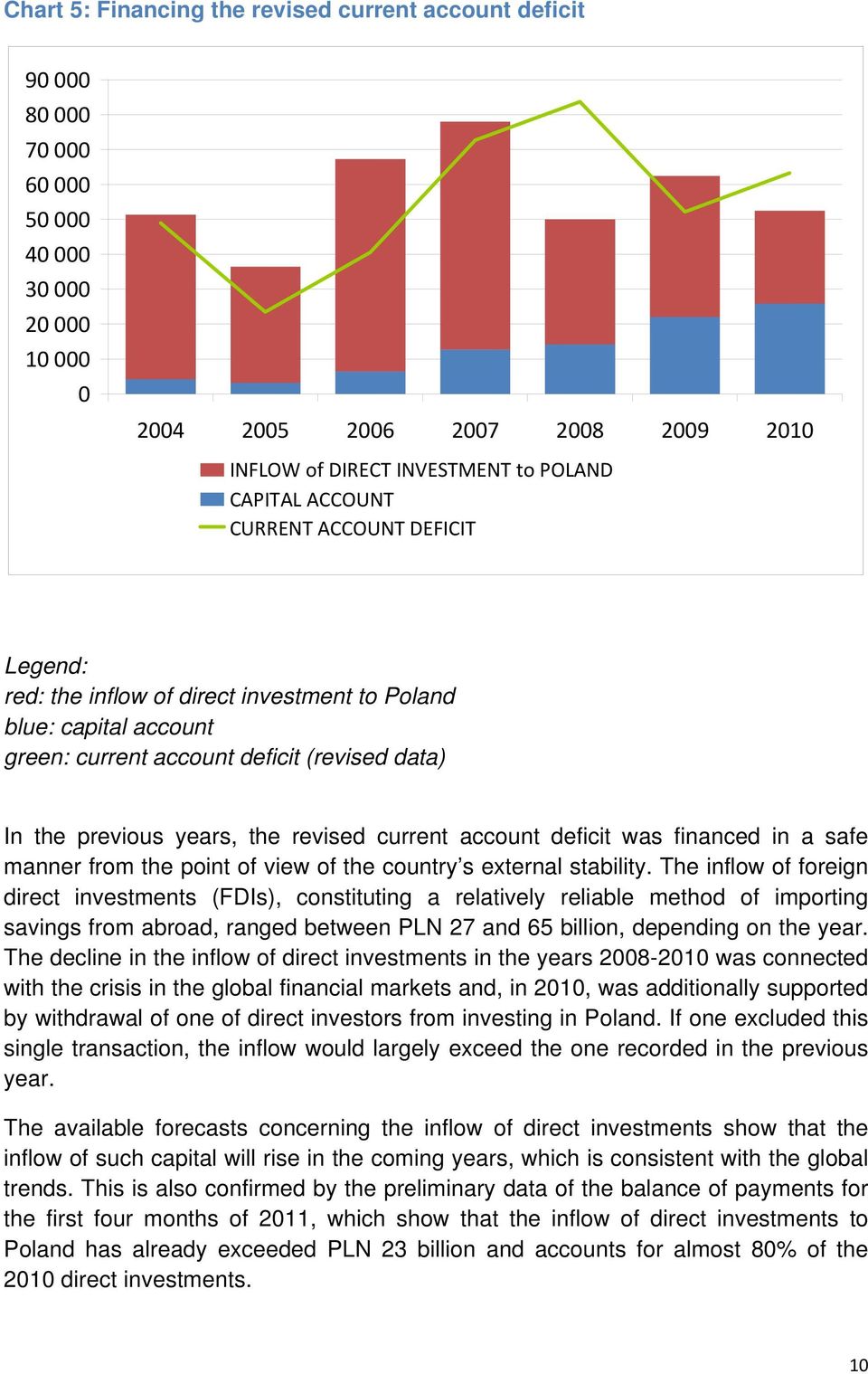
11 The year-by-year increasing amounts presented in the capital account reflect mainly the inflow of EU funds earmarked to finance investments. Its scale is expected to increase in the coming years in accordance with the EU budget perspective. For Poland, the high inflow of capital transfers from the EU budget, which will continue to be positive in the coming years, is an extremely important factor largely changing the traditional method of assessing the impact of the current trade deficit on macroeconomic imbalance. From the economic point of view, such funds have a positive impact on the reduction of the negative balance of current account, similarly to current transfers. They are distinguished and broken down into different items of the balance mainly for statistical, and not economic, reasons. In such a situation, a measure that better reflects relations with foreign countries is the current and capital account balance to GDP ratio. It is much lower than the current account balance to GDP ratio. This also shows that strict adherence to traditionally recognised measures used for external stability assessment does not always give a true picture of the economy. Polish entities have not faced any problems with the acquisition of other forms of capital, considered theoretically as somewhat less safe. Contrary to concerns, banks which lacked liquidity at the end of 2008 were provided with loans by their foreign shareholders. The Polish government efficiently conducts bond issues, both in the international and domestic markets, achieving yields which largely exceed the ones obtained by certain euro area countries. Polish enterprises have access to foreign sources of financing and utilize this capital. High safety level is also guaranteed by adequately maintained foreign currency reserves, which almost doubled (from USD 37 billion to nearly USD 94 billion) between January 2004 and December The amount of such reserves is adequate to the generally applied measures. Safety is also ensured by the appropriate structure of foreign debt, which comprises mainly long-term instruments (almost 80%). In the case of short-term forms of financing, however, commercial loans, which reflect normal business activity, prevail. At the same time, a significant part of such loans are granted within international capital groups. Finally, it should be mentioned that corrections of historical data of the balance of payments close a certain stage of work, which enabled, on the one hand, to identify some sources of the growing net errors and omissions, and, on the other hand, show how to obtain more complete data in the future. It should also be noted however, that corrections of the balance of payments are not likely to influence GDP. Yet, the distribution of GDP will be revised. Incorporation of imports of used cars will decrease net exports and, is likely to boost private consumption. The knowledge gained and the experience of other countries show that phenomena accompanying economic relations with foreign countries must be constantly 11

12 monitored and reporting systems must be accordingly modified to register, on a current basis, new types of operations for statistical purposes, and adjust, on the basis of representative studies, parameters of the models used to estimate the value of transactions connected with the balance of payment which are not directly observed, e.g. income from employment of Polish residents abroad and foreign residents in Poland. The on-going globalisation leads to growing number and higher level of complications in international transactions that are recorded in the balance of payments. This makes it necessary to constantly monitor the sources of excessive rise in errors and omissions. The work up to date has also enabled to initially identify other factors behind the previously recorded high net errors and omissions than those described in this paper. Their detailed analysis and quantification will be possible after conducting comprehensive studies and acquiring reliable source data confirming the study hypotheses. Given the exceptional complexity of the balance of payments statistics and the need to integrate them with other macroeconomic statistics, this requires a certain amount of time. Józef Sobota is the Head of the Department of Statistics of the National Bank of Poland. Grzegorz Dobroczek and Jacek Kocerka work in the same department. 12

BALANCE OF PAYMENTS AND FOREIGN DEBT
 BALANCE OF PAYMENTS AND FOREIGN DEBT V 1. BALANCE OF PAYMENTS In 1997, the external current account deficit was 8.1 billion krónur, corresponding to 1. percent of GDP. It declined from 8.9 b.kr., or 1.8
Errors and omissions in the balance of payments statistics a problem?
 Errors and omissions in the balance of payments statistics a problem? BY GUNNAR BLOMBERG, LARS FORSS AND INGVAR KARLSSON The authors work in the Monetary Policy Department. The balance of payments statistics
The EMU and the debt crisis
 The EMU and the debt crisis MONETARY POLICY REPORT FEBRUARY 212 43 The debt crisis in Europe is not only of concern to the individual debt-ridden countries; it has also developed into a crisis for the
Tax planning may have contributed to high indebtedness among Swedish companies
 Tax planning may have contributed to high indebtedness among Swedish companies Gunnar Blomberg, Jyry Hokkanen and Sofia Kåhre The European Commission has identified in a survey of potential imbalances
INTERIM FINANCIAL STATEMENTS OF THE POWSZECHNA KASA OSZCZĘDNOŚCI BANK POLSKI SA GROUP FOR THE FIRST QUARTER OF 2009
 PKO BANK POLSKI SPÓŁKA AKCYJNA INTERIM FINANCIAL STATEMENTS OF THE POWSZECHNA KASA OSZCZĘDNOŚCI BANK POLSKI SA GROUP FOR THE FIRST QUARTER OF 2009 Prepared in accordance with International Financial Reporting
5 Comparison with the Previous Convergence Programme and Sensitivity Analysis
 5 Comparison with the Previous Convergence Programme and Sensitivity Analysis 5.1 Comparison with the Previous Macroeconomic Scenario The differences between the macroeconomic scenarios of the current
The CAO s Experience in Auditing Public Debt
 The CAO s Experience in Auditing Public Debt Introduction :- The state general budget comprises of : administrative body budget, public service entity budget and local administration units budget. This
Statistics Netherlands. Macroeconomic Imbalances Factsheet
 Macroeconomic Imbalances Factsheet Introduction Since the outbreak of the credit crunch crisis in 2008, and the subsequent European debt crisis, it has become clear that there are large macroeconomic imbalances
Economic Commentaries
 n Economic Commentaries Sweden has had a substantial surplus on its current account, and thereby also a corresponding financial surplus, for a long time. Nevertheless, Sweden's international wealth has
State budget borrowing requirements financing plan and its background
 Public Debt Department State budget borrowing requirements financing plan and its background September 2014 THE MOST IMPORTANT INFORMATION Monthly issuance calendar... 2 MoF comment... 8 Rating agencies
THE CURRENT ACCOUNT OF ROMANIA EVOLUTION, FACTORS OF INFLUENCE, FINANCING
 THE CURRENT ACCOUNT OF ROMANIA EVOLUTION, FACTORS OF INFLUENCE, FINANCING Abstract Camelia MILEA, PhD The balance of the current account is a tool used to establish the level of economic development of
Swiss Balance of Payments and International Investment Position 2014
 Swiss Balance of Payments and International Investment Position 214 Swiss Balance of Payments and International Investment Position 214 Volume 1 Contents Page 1 Overview 4 Innovations 4 Changes in the
In 2012, GNP in constant prices increased by 1.8% compared with 2011.
 8 Economy In 2012, GNP in constant prices increased by 1.8% compared with 2011. The building and construction sector fell by 7.7% in value added terms in 2012 compared to 2011. Manufacturing industry decreased
Why Treasury Yields Are Projected to Remain Low in 2015 March 2015
 Why Treasury Yields Are Projected to Remain Low in 5 March 5 PERSPECTIVES Key Insights Monica Defend Head of Global Asset Allocation Research Gabriele Oriolo Analyst Global Asset Allocation Research While
Outstanding Loans Received From Abroad by Private Sector. Definitions and Explanations. Statistics Department Balance of Payments Division
 Outstanding Loans Received From Abroad by Private Sector Definitions and Explanations Statistics Department Balance of Payments Division Contents I- Definitions... 3 II- Compilation Of The External Debt
Balance of Payments Accounting. (guidelines recommended by the IMF International Monetary Fund )
 Balance of Payments Accounting (guidelines recommended by the IMF International Monetary Fund ) To understand the factors that affect international trade and lending first requires basic knowledge of Balance
Tables. Standard symbols:. Category not applicable.. Data not available... Data not yet available Nil 0 Less than half the 0.0 final digit shown
 Tables 1. Norges Bank. Balance sheet. In millions of NOK 2. Norges Bank. Investments for Government Pension Fund - Global. In millions of NOK 3. Banks. Balance sheet. In millions of NOK 4. Banks. Loans
Net lending of households and non-profit institutions serving households: an analysis of discrepancies between financial and non-financial accounts*
 Net lending of households and non-profit institutions serving households: an analysis of discrepancies between financial and non-financial accounts* Jon Ivar Røstadsand, senior economist in the Statistics
Balance of payments and international investment position
 National Accounts 2015 Balance of payments and international investment position Current account in deficit in the second quarter, net capital outflow from Finland Current account deficit in the second
EDICT OF THE PRESIDENT OF THE REPUBLIC OF BELARUS. August 29, 2008 No. 460 Minsk
 EDICT OF THE PRESIDENT OF THE REPUBLIC OF BELARUS August 29, 2008 No. 460 Minsk On Approval of the Republic of Belarus Monetary Policy Guidelines for 2009 1. To approve the Republic of Belarus Monetary
Savings, Investment Spending, and the Financial System
 Savings, Investment Spending, and the Financial System 1. Given the following information about the closed economy of Brittania, what is the level of investment spending and private savings, and what is
FROM GOVERNMENT DEFICIT TO DEBT: BRIDGING THE GAP
 FROM GOVERNMENT DEFICIT TO DEBT: BRIDGING THE GAP Government deficit and debt are the primary focus of fiscal surveillance in the euro area, and reliable data for these key indicators are essential for
Chart I.1. Difference between Primary Surplus (PS) and Bond Yield Spreads in Selected EU 1 Countries
 LIST OF CHARTS Chart I.1. Difference between Primary Surplus (PS) and Bond Yield Spreads in Selected EU 1 Countries Chart I.2. Gross Debt Stock and Budget Deficits of Selected Countries as of 2010 1 Chart
PROJECTION OF THE FISCAL BALANCE AND PUBLIC DEBT (2012 2027) - SUMMARY
 PROJECTION OF THE FISCAL BALANCE AND PUBLIC DEBT (2012 2027) - SUMMARY PUBLIC FINANCE REVIEW February 2013 SUMMARY Key messages The purpose of our analysis is to highlight the risks that fiscal policy
Project LINK Meeting New York, 20-22 October 2010. Country Report: Australia
 Project LINK Meeting New York, - October 1 Country Report: Australia Prepared by Peter Brain: National Institute of Economic and Industry Research, and Duncan Ironmonger: Department of Economics, University
7. CURRENCY AND BALANCE OF PAYMENTS
 The source of the data presented in this chapter is the Czech National Bank. All tables where the titles of reports are given are exhaustive investigations. Otherwise, qualified estimates and calculations
The IMF believes that Latvia will be able to pay back the loan
 The IMF believes that Latvia will be able to pay back the loan The International Monetary Fund (IMF) has not started any particular talks with Latvia about the repayment of the international loan, which
Privatization in Central and Eastern Europewe
 Privatization in Central and Eastern Europewe ŁukaszZalicki, Partner at Ernst & Young Privatization - what s next Warsaw May 13th, 13 Central and Eastern European Countries - CEECs Czech Rep., Estonia,
Health Insurance Companies Tab. Monthly cash inflows and outflows of public health insurance companies
 Health Insurance Companies Tab. Monthly cash inflows and outflows of public health insurance companies Coverage: Health insurance companies operating in the field of public health insurance, which are
The investment fund statistics
 The investment fund statistics Narodowy Bank Polski (NBP) publishes data reported by investment funds which have been defined in Art. 3 section 1 of the Act of 27 May 2004 on investment funds (Journal
Economic Commentaries
 n Economic Commentaries In this commentary, we analyse how Swedish banks, insurance companies and investment funds are affected by the current low interest rates, and the impact this can have on financial
Economic Outlook for Europe and Finland
 Economic Outlook for Europe and Finland Finnish-British Chamber of Commerce 15 March 213 Seppo Honkapohja Member of the Board Bank of Finland 1 World economy: World industrial output improved, but international
Main trends in industry in 2014 and thoughts on future developments. (April 2015)
 Main trends in industry in 2014 and thoughts on future developments (April 2015) Development of the industrial sector in 2014 After two years of recession, industrial production returned to growth in 2014.
2.5 Monetary policy: Interest rates
 2.5 Monetary policy: Interest rates Learning Outcomes Describe the role of central banks as regulators of commercial banks and bankers to governments. Explain that central banks are usually made responsible
Central Bank Survey. General Provisions
 Summary Methodology Central Bank Survey, Credit Institutions Survey, Banking System Survey, Other Financial Institutions Survey, Financial Sector Survey Central Bank Survey, Credit Institutions Survey,
The Macroeconomic Situation and Monetary Policy in Russia. Ladies and Gentlemen,
 The Money and Banking Conference Monetary Policy under Uncertainty Dr. Sergey Ignatiev Chairman of the Bank of Russia (The 4 th of June 2007, Central Bank of Argentina, Buenos Aires) The Macroeconomic
4 Distribution of Income, Earnings and Wealth
 4 Distribution of Income, Earnings and Wealth Indicator 4.1 Indicator 4.2a Indicator 4.2b Indicator 4.3a Indicator 4.3b Indicator 4.4 Indicator 4.5a Indicator 4.5b Indicator 4.6 Indicator 4.7 Income per
IFRS IN PRACTICE. IAS 7 Statement of Cash Flows
 IFRS IN PRACTICE IAS 7 Statement of Cash Flows 2 IFRS IN PRACTICE - IAS 7 STATEMENT OF CASH FLOWS TABLE OF CONTENTS 1. Introduction 3 2. Definition of cash and cash equivalents 4 2.1. Demand deposits 4
Croatian Balance of Payments: Implications of Net Errors and Omissions for Economic Policy 1
 No. 41 May 2009 Institute of Public Finance HR-10000 Zagreb, Smičiklasova 21, Croatia Goran Vukšić Croatian Balance of Payments: Implications of Net Errors and Omissions for Economic Policy 1 In Croatia,
CESEE DELEVERAGING AND CREDIT MONITOR 1
 DELEVERAGING AND CREDIT MONITOR 1 February 1, 1 BIS reporting banks continued to scale back their funding to Central, Eastern and South Eastern Europe () in Q3 13, at broadly the same pace as in Q 13,
EU-10 AND THE CAP CONTENTS
 Agricultural Policy Perspectives Brief April 2014 EU-10 AND THE CAP 10 YEARS OF SUCCESS Thinkstockphotos.com CONTENTS 1. Structural Adjustment 2. Income 3. CAP expenditure 4. Land Tenure 5. Prices and
FINANCIALISATION AND EXCHANGE RATE DYNAMICS IN SMALL OPEN ECONOMIES. Hamid Raza PhD Student, Economics University of Limerick Ireland
 FINANCIALISATION AND EXCHANGE RATE DYNAMICS IN SMALL OPEN ECONOMIES Hamid Raza PhD Student, Economics University of Limerick Ireland Financialisation Financialisation as a broad concept refers to: a) an
Specifics of national debt management and its consequences for the Ukrainian economy
 Anatoliy Yepifanov (Ukraine), Vyacheslav Plastun (Ukraine) Specifics of national debt management and its consequences for the Ukrainian economy Abstract This article is about the specifics of the national
Main Indicators for the Finnish Economy
 BANK OF FINLAND Monetary Policy and Research - Financial Markets and Statistics Main Indicators for the Finnish Economy 1/11 January 1 January 11 Monetary Policy and Research - Financial Markets and Statistics
MGE#12 The Balance of Payments
 MGE#12 The Balance of Payments The Current Account, the Capital Account and the Balance of Payments Introduction to the Foreign Exchange Market Savings, Investment and the Current Account 1 From last session
Chapter 7. Financial Account
 Chapter 7. Financial Account A. Concept and Coverage 7.1 The financial account will be defined, and its structure and purpose outlined along the lines of BPM5 paras. 313 342, BPT paras. 446 447, and the
Main Indicators for the Finnish Economy
 BANK OF FINLAND Monetary Policy and Research - Financial Markets and Statistics Main Indicators for the Finnish Economy 3/11 17 March 11 Main Indicators for the Finnish Economy is produced jointly by the
The Public Finance Sector DEBT MANAGEMENT STRATEGY. In the years 2006-2008
 The Public Finance Sector DEBT MANAGEMENT STRATEGY In the years 2006-2008 Ministry of Finance Warsaw, September 2005 The Public Finance Sector DEBT MANAGEMENT STRATEGY in the years 2006-08 I. INTRODUCTION
Big Concepts. Balance of Payments Accounts. Financing International Trade. Economics 202 Principles Of Macroeconomics. Lecture 12
 Economics 202 Principles Of Macroeconomics Professor Yamin Ahmad Big Concepts Balance of Payments Equilibrium The relationship between the current account, capital account and official settlements balance
Chart 9.1 Non-performing loans ratio and structure of non-performing loans (right) 25% 80 06/08 03/11 03/09 12/07 12/08 06/09 09/09 12/09 09/08 06/11
 Financial Stability Report 21 H1 9. MONITORING BANKING SECTOR RISKS 9.1 CREDIT RISK (88) Loan portfolio quality improved and banks were more active in writingoff the loss loans from their balance sheets.
44 ECB STOCK MARKET DEVELOPMENTS IN THE LIGHT OF THE CURRENT LOW-YIELD ENVIRONMENT
 Box STOCK MARKET DEVELOPMENTS IN THE LIGHT OF THE CURRENT LOW-YIELD ENVIRONMENT Stock market developments are important for the formulation of monetary policy for several reasons. First, changes in stock
Main Indicators for the Finnish Economy
 BANK OF FINLAND Monetary Policy and Research - Financial Markets and Statistics Main Indicators for the Finnish Economy /1 13 April 1 13 April 1 Monetary Policy and Research - Financial Markets and Statistics
Reading the balance of payments accounts
 Reading the balance of payments accounts The balance of payments refers to both: All the various payments between a country and the rest of the world The particular system of accounting we use to keep
Presentation of the Gross External Debt Position
 4 Presentation of the Gross External Debt Position Introduction 4. This chapter provides a table for the presentation of the gross external debt position and related memorandum tables. Data compiled using
LAW ON FOREIGN CURRENCY TRANSACTIONS. ( Official Herald of the Republic of Serbia, Nos. 62/2006 and 31/2011) I GENERAL PROVISIONS
 LAW ON FOREIGN CURRENCY TRANSACTIONS ( Official Herald of the Republic of Serbia, Nos. 62/2006 and 31/2011) The present Law shall govern: I GENERAL PROVISIONS Article 1 1) payments, collections and transfers
The Legal Protection Insurance Market in Europe. October 2013
 The Legal Protection Insurance Market in Europe October 2013 The Legal Protection Insurance Market in Europe October 2013 In its latest publication RIAD, the International Association of Legal Protection
DEBT MANAGEMENT OFFICE NIGERIA
 DEBT MANAGEMENT OFFICE NIGERIA MANAGING NIGERIA S DEBT STOCK Presentation at the Investor/Issuer Education Outreach Programme Organised by Securities and Exchange Commission on July 27, 2011 By Patience
Board of Executives Report on Fortis Bank Polska S.A. Activity in 2006
 Board of Executives Report on Fortis Bank Polska S.A. Activity in 2006 Fortis Bank Polska SA Head Office Postępu Street, 15 02-676 Warszawa Poland Telephone +48 (22) 566 90 00 Faks +48 (22) 566 90 10 [email protected]
Statistical Bulletin. Balance of Payments, Quarter 2 (April to June) 2015. Main points
 Statistical Bulletin Balance of Payments, Quarter 2 (April to June) 2015 Coverage: UK Date: 30 September 2015 Geographical Area: UK Theme: Economy Main points The United Kingdom s (UK) current account
Commerzbank: Strategy successful net profit of over 1 billion euros and dividend
 IR release 12 February 2016 Commerzbank: Strategy successful net profit of over 1 billion euros and dividend Operating profit in 2015 more than doubled to EUR 1,909 m (2014: EUR 689 m) Operating profit
WHY IS THE FISCAL POLICY IMPOSED BY IMF PRO-CYCLIC?
 WHY IS THE FISCAL POLICY IMPOSED BY IMF PRO-CYCLIC? Marinaş Marius-Corneliu Academy of Economic Studies, Department of Economics, Bucharest [email protected] Telephone: 0721/32.62.97 The economies
Eighteenth Meeting of the IMF Committee on Balance of Payments Statistics Washington, D.C., June 27 July 1, 2005
 BOPCOM-05/9 Eighteenth Meeting of the IMF Committee on Balance of Payments Statistics Washington, D.C., June 27 July 1, 2005 Definition of Personal Remittances in the Balance of Payments Context Prepared
! "#$#% &' )*+,-##.! / 01 2,+!-3#$+*$
 ! "#$#% &' ()*+,-##. )*+,-##.! / 01 ''' 01 2,+!-3#$+*$ TABLE OF CONTENTS I. Summary of the Bank s activity in 2005...3 A. Introduction... 3 B. Key factors that affected the Bank s financial performance
Evolution of informal employment in the Dominican Republic
 NOTES O N FORMALIZATION Evolution of informal employment in the Dominican Republic According to official estimates, between 2005 and 2010, informal employment fell from 58,6% to 47,9% as a proportion of
Introduction to mbank Group The most successful organic growth story in Poland
 Introduction to mbank Group The most successful organic growth story in Poland August 2015 mbank Group in a snapshot General description Key financial data (PLN M) Set up in 1986, mbank (originally BRE
28.10.2013. The recovery of the Spanish economy XVI Congreso Nacional de la Empresa Familiar/Instituto de la Empresa Familiar Luis M.
 28.10.2013 The recovery of the Spanish economy XVI Congreso Nacional de la Empresa Familiar/Instituto de la Empresa Familiar Luis M. Linde Governor Let me begin by thanking you for inviting me to take
Annual Report 2007 COMMERCIAL FINANCE WWW.INGCOMFIN.PL
 2007 Annual Report 2007 COMMERCIAL FINANCE WWW.INGCOMFIN.PL It is with pleasure that I present to you the Annual Report of 2007 which describes the activity of ING Commercial Finance Polska S.A. Last year
Chapter 12. Aggregate Expenditure and Output in the Short Run
 Chapter 12. Aggregate Expenditure and Output in the Short Run Instructor: JINKOOK LEE Department of Economics / Texas A&M University ECON 203 502 Principles of Macroeconomics Aggregate Expenditure (AE)
Netherlands. Croatia. Malta. Slovenia. Greece. Czech Republic. Portugal. Compulsory. households actual. social contributions.
 Structure and development of tax revenues Table EL.: Revenue (% of GDP) 2004 2005 2006 2007 2008 2009 200 20 202 203 I. Indirect taxes : : 2.3 2.7 2.7.8 2.6 3.5 3. 3.4 VAT : : 6.8 7. 7.0 6.3 7. 7.2 7.
Press release. Communications. P.O. Box, CH-8022 Zurich Telephone +41 44 631 31 11 [email protected]. Zurich, 23 June 2014
 Communications P.O. Box, CH-8022 Zurich Telephone +41 44 631 31 11 [email protected] Zurich, 23 June 2014 Balance of payments and international investment position in Q1 2014 Change to new IMF standard
SURVEY OF INVESTMENT REGULATION OF PENSION FUNDS. OECD Secretariat
 SURVEY OF INVESTMENT REGULATION OF PENSION FUNDS OECD Secretariat Methodological issues The information collected concerns all forms of quantitative portfolio restrictions applied to pension funds in OECD
LAW ON FOREIGN EXCHANGE OPERATIONS
 LAW ON FOREIGN EXCHANGE OPERATIONS This Law shall govern: (Consolidated) 1 I. BASIC PROVISIONS Article 1 1) payments, collections and transfers between residents and non-residents in foreign means of payment
Inflation. Credit. Coincident indicator (Ita-coin) and Italian GDP (1) (percentage changes)
 NUMBER 16 FEBRUARY 216 Economic activity and employment Foreign trade and competitiveness Inflation Credit The Public Finances Macroeconomic projections 1 7 8 11 12 Directorate general for economics, statistics
Monetary Policy in the Post-Crisis Period
 Monetary Policy in the Post-Crisis Period A. Hakan Kara Research and Monetary Policy Department EAF Conference October 10, 2011 Contents I. Changing View of Central Banking II. Capital Flows to Emerging
HOLLY SPRINGS INVESTMENTS LIMITED HALF YEAR REPORT FOR THE SIX MONTHS ENDED 30 SEPTEMBER 2008 CONTENTS STATEMENT OF FINANCIAL PERFORMANCE 1
 HALF YEAR REPORT FOR THE SIX MONTHS ENDED 30 SEPTEMBER 2008 CONTENTS PAGES STATEMENT OF FINANCIAL PERFORMANCE 1 STATEMENT OF MOVEMENTS IN EQUITY 2 STATEMENT OF FINANCIAL POSITION 4-4 STATEMENT OF CASH
Why is inflation low?
 Why is inflation low? MONETARY POLICY REPORT 5 Inflation has been low in Sweden in recent years and fell further in the latter part of, mainly because the rate of price increase for services slowed down.
Medium-term Debt Management Strategy 2014 2017
 Medium-term Debt Management Strategy 2014 2017 The Ministry of Finance and Economic Affairs July 2014 Medium-term Debt Management Strategy 2014 2017 Medium-term Debt Management Strategy 2014-2017 ISSN
MEASURING GDP AND ECONOMIC GROWTH CHAPTER
 MEASURING GDP AND ECONOMIC GROWTH CHAPTER Objectives After studying this chapter, you will able to Define GDP and use the circular flow model to explain why GDP equals aggregate expenditure and aggregate
Summary of Significant Accounting Policies FOR THE FINANCIAL YEAR ENDED 31 MARCH 2014
 46 Unless otherwise stated, the following accounting policies have been applied consistently in dealing with items which are considered material in relation to the financial statements. The Company and
What three main functions do they have? Reducing transaction costs, reducing financial risk, providing liquidity
 Unit 4 Test Review KEY Savings, Investment and the Financial System 1. What is a financial intermediary? Explain how each of the following fulfills that role: Financial Intermediary: Transforms funds into
The Mexican Economy: Facts and Opportunities
 Manuel Sánchez Santander Global Fixed Income Summit London, England, September 20, 2012 Contents 1 Structural features 2 Recent developments and outlook 3 Inflation and monetary policy 4 Economic challenges
Latvia during the global economic and financial crisis
 Latvia during the global economic and financial crisis Second Japan Baltic Seminar 1 December 2009, Tokyo 1 Different experience behind, challenges ahead 15 10 5 Transition -56% in 1991-1993 GDP 1991-2012
ASSIGNMENT 1 ST SEMESTER : MACROECONOMICS (MAC) ECONOMICS 1 (ECO101) STUDY UNITS COVERED : STUDY UNITS 1 AND 2. DUE DATE : 3:00 p.m.
 Page 1 of 13 ASSIGNMENT 1 ST SEMESTER : MACROECONOMICS (MAC) ECONOMICS 1 (ECO101) STUDY UNITS COVERED : STUDY UNITS 1 AND 2 DUE DATE : 3:00 p.m. 19 MARCH 2013 TOTAL MARKS : 100 INSTRUCTIONS TO CANDIDATES
5 Remittances. A. Economic Concept of Remittances and Why They Are Important
 APPENDIX 5 Remittances A. Economic Concept of Remittances and Why They Are Important A5.1 Remittances represent household income from foreign economies arising mainly from the temporary or permanent movement
ECONOMIC ACTIVITY AND EMPLOYMENT FOREIGN TRADE AND COMPETITIVENESS INFLATION CREDIT THE PUBLIC FINANCES
 NUMBER 99 JULY 21 ECONOMIC ACTIVITY AND EMPLOYMENT FOREIGN TRADE AND COMPETITIVENESS INFLATION CREDIT THE PUBLIC FINANCES MACROECONOMIC PROJECTIONS 1 7 8 11 12 Directorate general for economics, statistics
NN Group N.V. 30 June 2015 Condensed consolidated interim financial information
 Interim financial information 5 August NN Group N.V. Condensed consolidated interim financial information Condensed consolidated interim financial information contents Condensed consolidated interim
economic development in Central and Eastern Europe and its effects on Austria
 economic development in Central and Eastern Europe and its effects on Austria Brief Analysis June 2010 Austria s highest Triple-A sovereign rating is not at risk even in the face of the exposure of its
The National Accounts and the Public Sector by Casey B. Mulligan Fall 2010
 The National Accounts and the Public Sector by Casey B. Mulligan Fall 2010 Factors of production help interpret the national accounts. The factors are broadly classified as labor or (real) capital. The
Section 2 Evaluation of current account balance fluctuations
 Section 2 Evaluation of current account balance fluctuations Key points 1. The Japanese economy and IS balance trends From a macroeconomic perspective, the current account balance weighs the Japanese economy
nstitutional (economic) units, industries and sectors are the main components of economy.
 2. Sectors of Economy I nstitutional (economic) units, industries and sectors are the main components of economy. The economy is divided into domestic economy and the rest of the world. The domestic economy