
Tivoli Common Reporting Version 3.1 Beta. User Guide
|
|
|
- Chastity Johnston
- 10 years ago
- Views:
Transcription
1 Tivoli Common Reporting Version 3.1 Beta User Guide
2

3 Tivoli Common Reporting Version 3.1 Beta User Guide

4 Note Before using this information and the product it supports, read the information in Notices. Second edition This edition applies to Tivoli Common Reporting and to all subsequent releases and modifications until otherwise indicated in new editions. Copyright IBM Corporation 2007, US Government Users Restricted Rights Use, duplication or disclosure restricted by GSA ADP Schedule Contract with IBM Corp.
5 Contents Chapter 1. Overview Technical overview Web resources Getting started with reports Logging on to the reporting interface Single sign-on (SSO) Chapter 2. Installing Hardware and software requirements Installation scenarios and installation modes Tivoli Common Reporting installation paths Preparing to install Verify the environment Preparing installation media Validation of additional disk space required for the installation process Installing Tivoli Common Reporting Beta Installing Tivoli Common Reporting mobile application Installing the mobile application for a single-computer Tivoli Common Reporting Installing the mobile application for distributed Tivoli Common Reporting Installing Framework Manager Verifying the installation Post-installation tasks Starting the Tivoli Common Reporting server.. 21 Stopping Tivoli Common Reporting server Configuring Tivoli Common Reporting content store for an enterprise database Enabling Cognos Application Firewall Uninstalling Uninstalling using the silent mode Uninstalling Tivoli Common Reporting for mobile devices Uninstalling manually Verifying the uninstallation Chapter 3. Configuring Configuring LDAP or Microsoft Active Directory.. 29 Configuring Tivoli Common Reporting Server.. 31 Configuring Cognos-based Tivoli Common Reporting engine with LDAP Configuring Cognos-based Tivoli Common Reporting engine with Active Directory Configuring Framework Manager connection Configuring database connection Connecting to a DB2 database Connecting to an MS SQL database Connecting to an Oracle database Setting up the dynamic query mode Configuring security permissions Authentication and authorization in Tivoli Common Reporting Constraining access to reports Configuring Tivoli Integrated Portal portlet functions Chapter 4. Common Reporting BIRT reports in Cognos BIRT reports in Cognos - overview Running BIRT reports Saving a BIRT report Creating a Report View of a BIRT report Scheduling reports Importing BIRT reports Retrieving the user name from within a BIRT Report Converting BIRT reports to Cognos reports Known limitations Setting up JDBC for BIRT reports Configuring JDBC data sources using JNDI.. 51 Configuring JDBC data sources for direct access Working with reports Running the sample overview report Sample overview report Importing Cognos report packages Exporting Cognos report packages Copying report images to the Tivoli Common Reporting server ing reports Scheduling reports Performing ad hoc reporting Web-based report authoring Using Tivoli Common Reporting template.. 58 Using parametrized URLs to perform tasks outside Tivoli Common Reporting Search path Checking the search path of a report Chapter 5. Troubleshooting and support Using log files for troubleshooting Enabling detailed log and trace information.. 65 Troubleshooting the installation Installation fails because the Deployment Engine fails to initialize Non-root installation fails Installation using the install.sh script fails.. 68 Installation fails on a system with Turkish locale 68 The Work with reports panel displays an error 69 Cognos Business Intelligence does not install on Linux UDA-SQL-0031 Unable to access database: QE-DEF-0285 Logon failure User interface does not work after installing in distributed scenario Deployment Engine does not support libstdc++.so.6 on Linux Copyright IBM Corp. 2007, 2012 iii
6 Error cannot Permission denied when installing Tivoli Common Reporting 70 Installation on Solaris fails During Cognos Mobile installation, the installation script fails with an exception Troubleshooting Common Reporting Browsing images does not work in Report Studio 73 Your login session expires while working with the Common Reporting portlet ODBC System DSN connections fail to test from the Tivoli Common Reporting server When starting Framework Manager you are prompted to supply your login details twice.. 74 Drill-through definitions in BIRT reports do not work The Work with reports window is blank An error UDA-SQL-0569 appears while starting Cognos server An error occurs when starting Framework Manager Logon fails in Turkish locale Error QE-DEF-0368: Unable to decrypt user name and password credentials from the content store. 77 Unable to locate libcoguador on Linux with Oracle Oracle environment variables for non-oracle default user The Common Reporting portlet does not work properly in Internet Explorer No content displayed in Common Reporting portlet in Internet Explorer Charts in reports do not appear Cognos Configuration does not open Cannot open the sample overview report Error after running a sample overview report.. 80 When trying to find users in user repository, an error appears Connection with the datasource fails Cannot save IBM Cognos Configuration settings 81 The reporting engine fails to start with the SQLCODE=286 and SQLSTATE= Report Studio does not work with Internet Explorer Reports do not run with SELinux Security enabled BIRT drill-through definitions do not work in Cognos Scheduled reports do not run after changing user password Chapter 6. Reference Commands Command-line authentication trcmd -access trcmd -checkstatus trcmd -convert trcmd -datasource trcmd -delete trcmd -distribute trcmd -import trcmd -list trcmd -modify trcmd -run trcmd -version stoptcrserver starttcrserver Notices Trademarks Index iv User Guide

7 Chapter 1. Overview Tivoli Common Reporting provides an integrated reporting solution for the products in the Tivoli portfolio. You can link multiple reports across various Tivoli products to simplify the report navigation and accelerate access to key reporting information. Technical overview Tivoli Common Reporting provides the following advantages for the users: Simplified interaction Simplified interfaces and interactions for report writers with which you can create, customize, and publish reports faster and easier. Cross-product report linking Extend the capability of cross-product report linkage for seamless flow between related reports of various Tivoli products. On-demand reporting Enable report users to create and save ad hoc reports, without the need for professional report writer's involvement. Tivoli Common Reporting 3.1 is based on Cognos Business Intelligence Reporting version The following Cognos components are available with Tivoli Common Reporting: v Framework Manager - a modeling tool that allows you to create data models. v Query Studio -areporting tool for creating simple queries and reports. v v Report Studio - a web-based tool for creating sophisticated reports against multiple databases. Connection - an application where you can view and manage all your reports. Tivoli Common Reporting 3.1 is based on Tivoli Integrated Portal 2.2. IBM Tivoli Common Reporting consists of data stores, reporting engines, their corresponding web user interfaces displayed in Tivoli Integrated Portal, and a command-line interface. Tivoli Common Reporting provides a flexible structure that can be adapted for load balancing. The following diagrams illustrate the possible distributions of the product components: Single computer: Copyright IBM Corp. 2007,

8 System A Tivoli Common Reporting server Tivoli Common Reporting console Cognos-based Tivoli Common Reporting engine Cognos-based reporting portlet Tivoli Common Reporting console (closeup) Tivoli Integrated Portal - Common Reporting Distributed environment: 2 User Guide

9 System A Tivoli Common Reporting server System B Tivoli Common Reporting Cognos Application Tier server Tivoli Common Reporting console Cognos-based Tivoli Common Reporting engine Cognos gateway Cognos Content Store Cognos-based reporting portlet Tivoli Common Reporting console (closeup) Tivoli Integrated Portal - Common Reporting Integration with an existing Cognos instance: System A System B Tivoli Common Reporting server Tivoli Common Reporting console Cognos Cognos-based reporting portlet Tivoli Common Reporting console (closeup) Tivoli Integrated Portal - Common Reporting Chapter 1. Overview 3

10 Note: Tivoli Common Reporting version 3.1 is based on Cognos Business Intelligence Server version Table 1. Software components Core components Tivoli Common Reporting Server The application server is a J2EE lightweight implementation of the embedded WebSphere Application Server. It provides a single sign-on service based on the WebSphere security module and Lightweight Third-Party Authentication (LTPA). Optional components Tivoli Common Reporting Cognos Application Tier Server Cognos An existing instance of IBM Cognos BI Server or IBM Cognos Business Intelligence Reporting. Cognos-based Tivoli Common Reporting engine The dispatcher is the entry point for IBM Cognos service requests sent by a web server gateway or other software. The dispatcher handles the routing requests and balances the load of user requests to the various IBM Cognos services. Cognos gateway A portal enabling communication between Tivoli Common Reporting Server and the Cognos-based Tivoli Common Reporting engine. Cognos Content Store A database that contains data which IBM Cognos needs to operate. These data include report specifications, published models, and the packages that contain them; connection information for data sources; information about the external namespace, and the Cognos namespace itself; and information about scheduling and bursting reports. Tivoli Integrated Portal web user interface Based on Tivoli Integrated Portal, the following web user interface is available for the reporting solution: v Common Reporting - a web portal for IBM Cognos and a component which interacts with the Cognos Content Store. It is a frontend to publish, find, manage, organize, and view the reports for your organization. Web resources Check out other useful web resources for Tivoli Common Reporting. 4 User Guide

11 Common Reporting Getting started with reports For more information about using the product or for technical assistance, visit the IBM Cognos Resource Center at Cognos support site. This site provides information about support, professional services, and education. Take a look at the Cognos information center at publib.boulder.ibm.com/infocenter/cbi/v10r1m1/index.jsp. You can also visit Tivoli Common Reporting developer Works at For Beta information, forum, and code download, visit: tivolibeta.lotus.com/tcr31. Perform the necessary actions to use the reporting options in Tivoli Integrated Portal as the common integrated reporting platform for products across the Tivoli portfolio. With the portfolio, you can link multiple reports across various Tivoli products to simplify the report navigation and accelerate access to key reporting information. Before you begin 1. Install Tivoli Common Reporting. 2. Install Framework Manager to be able to create your own data models. 3. Configure the Framework Manager connection to Tivoli Common Reporting. About this task After you install Tivoli Common Reporting, prepare your report packages to be able to generate, publish, and edit your reports. Procedure 1. If you have the report packages ready, import the report packages: v Import Cognos report packages. v Import BIRT report packages. a. Create or update your data sources: v For Cognos report packages, configure the database connection. v For BIRT report packages, ensure that the report package data sources point to the existing data sources. Use the trcmd -list on page 95 command to see your data source settings, and the trcmd -modify on page 97 command to modify them, if necessary. Tip: BIRT reports are separate from Cognos, predefined reports to which you can make simple changes. You can also create or modify report designs with the use of an open source BIRT report designer. The designer is not shipped with Tivoli Common Reporting but is available for downloading. 2. To create a report package: a. Configure the database connection. b. Create a data model in Framework Manager. Chapter 1. Overview 5

12 Tip: For more instructions, see the Framework Manager User Guide in Cognos information center. c. Import the metadata from your data sources. When you import the metadata, you can start modeling in Framework Manager. You can define the relations between objects such as tables, views, and queries, you can select the layers to define which objects you want to make visible, you can define what you want to publish, and finally, you can create and publish a package containing the model and reports. For more information, see Framework Manager User Guide. When you configure the connection between Framework Manager and Tivoli Common Reporting, the published package is automatically pushed to Tivoli Common Reporting and you can see it in its respective folder inside Tivoli Common Reporting. d. Log on to the reporting interface and select Launch Query Studio to test your model and create simple ad hoc reports, or select Launch Report Studio to create more complex reports. e. Create a final package. Logging on to the reporting interface Use your web browser to access the reporting interface based on the Tivoli Integrated Portal. About this task With the reporting interface, you can perform simple lightweight tasks as well as more advanced scalable reporting. Common Reporting Scalable, enterprise reporting option provided by IBM Cognos Business Intelligence Reporting. Using this feature you can access, among others, the following reporting options: v Create on-demand reports. v Use the Web-based report authoring. v reports. Tip: To access Tivoli Common Reporting or Tivoli Integrated Portal documentation from the user interface, click Help in the upper right corner. To access Cognos Administration and Security guide, click in the console. For more Cognos guides, click. Procedure 1. Browse to the following URL: The default URL is: v Replace hostname with the TCP/IP host name of the system wheretivoli Common Reporting is installed, or localhost if you are running the web browser on the same system. v Replace port with the port number that you specified during installation. 6 User Guide

13 2. On the Tivoli Integrated Portal login page, log in with a user ID that has access to Tivoli Common Reporting. Access is determined by user roles associated with user IDs. The role that you need to access Tivoli Common Reporting is tcrportaloperator. It might be the user ID and password you specified during the installation process, or a user ID and password provided to you by an administrator. The Tivoli Integrated Portal navigation window opens. Tip: To eliminate the security warnings when logging on to the user interface, install a certificate on the Tivoli Common Reporting server. To install the certificate, follow the instructions in WebSphere information center. 3. In the navigation pane on the left side of the window, click the plus sign + beside Reporting to expand the tree. 4. Choose Common Reporting to work with the enterprise reporting options. Single sign-on (SSO) Single sign-on (SSO) is the ability of a user to log on once and access multiple applications without having to log on to each application separately. Multi-server session-based authentication allows web application users to log on to WebSphere Application Server, and then access WebSphere Application Server of another application (in the same DNS domain) that is enabled for single signon without having to log in again. The server is configured to use the Lightweight Third-Party Authentication (LTPA) authentication. When logging in, the user is prompted for a name and password which can later be reused. When the user is authenticated, the browser receives a token which is stored for a specific session. When the LTPA token is received and the user tries to access the server in the same security domain, the authentication is automatic. This means that the user is not prompted for a name and password, if the browsing session was not terminated. IBM Tivoli Common Reporting is available from the enhanced WebSphere Application Server. This is why a client requesting that application can be required to perform multiple logons when accessing other secure applications, such as advanced reporting. Each logon might require different logon identities. Chapter 1. Overview 7

14 8 User Guide

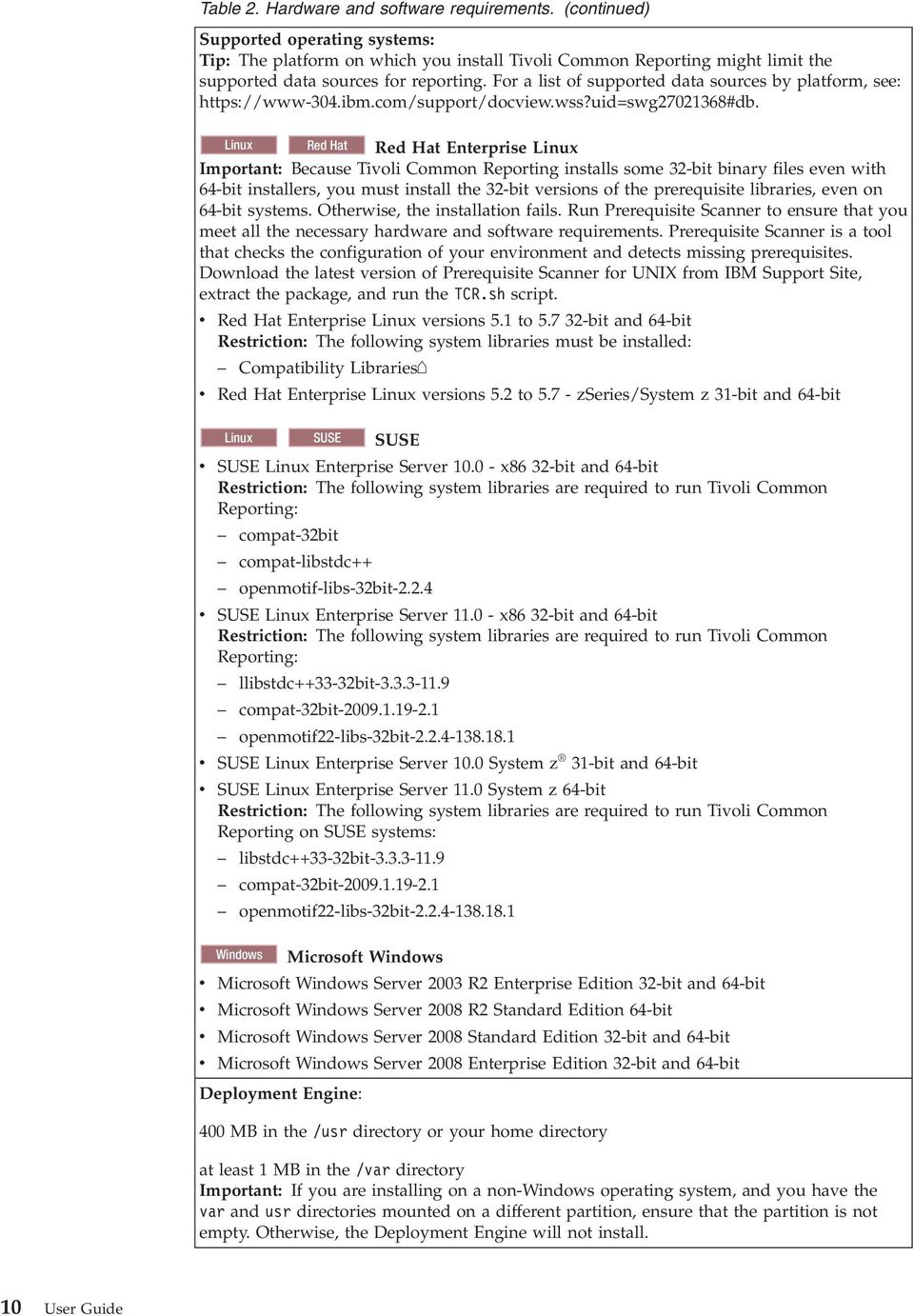
15 Chapter 2. Installing A complete Tivoli Common Reporting installation comprises multiple components. Before installing one or more of these components, you must understand them and the installation process. Hardware and software requirements Tivoli Common Reporting is available on a range of operating systems and supports several browser types. CAUTION: Before you install Tivoli Common Reporting, run Prerequisite Scanner to ensure that you meet all the necessary hardware and software requirements. Prerequisite Scanner is a tool that checks the configuration of your environment and detects missing prerequisites. Extract the package, and run the TCR.sh script. Table 2. Hardware and software requirements. Hardware requirements: v Main memory -3GB v Processor speed - for best performance, processor speeds must be at least 2 GHz for Intel architectures. Choosing faster processors results in improved response time, greater throughput, and lower processor utilization. v Disk storage: For single-computer installation - up to 4.5 GB, depending on installation options selected. Temporary directory - 2 GB. Note: The optional, separately installed IBM Cognos 10 Business Intelligence Framework Manager component requires additional disk space of 700 MB. Copyright IBM Corp. 2007,
16 Table 2. Hardware and software requirements. (continued) Supported operating systems: Tip: The platform on which you install Tivoli Common Reporting might limit the supported data sources for reporting. For a list of supported data sources by platform, see: Linux Red Hat Red Hat Enterprise Linux Important: Because Tivoli Common Reporting installs some 32-bit binary files even with 64-bit installers, you must install the 32-bit versions of the prerequisite libraries, even on 64-bit systems. Otherwise, the installation fails. Run Prerequisite Scanner to ensure that you meet all the necessary hardware and software requirements. Prerequisite Scanner is a tool that checks the configuration of your environment and detects missing prerequisites. Download the latest version of Prerequisite Scanner for UNIX from IBM Support Site, extract the package, and run the TCR.sh script. v Red Hat Enterprise Linux versions 5.1 to bit and 64-bit Restriction: The following system libraries must be installed: Compatibility Libraries v Red Hat Enterprise Linux versions 5.2 to zseries/system z 31-bit and 64-bit Linux SUSE SUSE v v v v SUSE Linux Enterprise Server x86 32-bit and 64-bit Restriction: The following system libraries are required to run Tivoli Common Reporting: compat-32bit compat-libstdc++ openmotif-libs-32bit SUSE Linux Enterprise Server x86 32-bit and 64-bit Restriction: The following system libraries are required to run Tivoli Common Reporting: llibstdc bit compat-32bit openmotif22-libs-32bit SUSE Linux Enterprise Server 10.0 System z 31-bit and 64-bit SUSE Linux Enterprise Server 11.0 System z 64-bit Restriction: The following system libraries are required to run Tivoli Common Reporting on SUSE systems: libstdc bit compat-32bit openmotif22-libs-32bit Windows Microsoft Windows v Microsoft Windows Server 2003 R2 Enterprise Edition 32-bit and 64-bit v Microsoft Windows Server 2008 R2 Standard Edition 64-bit v Microsoft Windows Server 2008 Standard Edition 32-bit and 64-bit v Microsoft Windows Server 2008 Enterprise Edition 32-bit and 64-bit Deployment Engine: 400 MB in the /usr directory or your home directory at least 1 MB in the /var directory Important: If you are installing on a non-windows operating system, and you have the var and usr directories mounted on a different partition, ensure that the partition is not empty. Otherwise, the Deployment Engine will not install. 10 User Guide
17 Table 2. Hardware and software requirements. (continued) Supported web browsers: v Windows Internet Explorer version 7 or 8 on Microsoft Windows Tip: For some operations, the browser security settings are too restrictive. See the Troubleshooting Internet Explorer 7 section of the information center for additional security configuration of the Internet Explorer browser. v Mozilla Firefox version 3.6 Installation scenarios and installation modes You can choose from the following installation modes: v Install new instance of Tivoli Common Reporting You can install Tivoli Common Reporting version 3.1 using either a 64-bit installer or a 32-bit installer. Important: The 64-bit installer can only be used for a stand-alone Tivoli Common Reporting installation The following installation scenarios are available: v Single-computer installation When you install Tivoli Common Reporting, you must use the Federated Repository to authenticate users. The authentication mechanism can be the built-in default repository, LDAP, Active Directory, or other repository supported by the WebSphere Federated Repository. For more information about adding a repository, see Configuring LDAP or Microsoft Active Directory on page 29. Scenario A: Single-computer installation System A Tivoli Common Reporting server Tivoli Common Reporting console Cognos-based Tivoli Common Reporting engine Cognos-based reporting portlet Tivoli Common Reporting console (closeup) Tivoli Integrated Portal - Common Reporting Chapter 2. Installing 11

18 Use this scenario for non-scalable, lightweight reporting with all the components installed on a single system. By default a file-based user registry from embedded WebSphere Application Server is used as a user repository and the communication takes place using Anonymous access. After installing Tivoli Common Reporting, you can configure a different user repository and disable anonymous access. Tivoli Common Reporting installation paths Learn about the location of the Tivoli Common Reporting installation directories that depends on the installation scenario. The installation paths in version 3.1 remain the same as the installation paths in version 2.1 and Changes in Tivoli Common Reporting version 3.1 The structure of the directories into which Tivoli Common Reporting 3.1 is installed is the same as in version and results from Tivoli Integrated Portal on which Tivoli Common Reporting is based. The installation directory is divided into two catalogs - one containing Tivoli Integrated Portal only, and the other containing Tivoli Integrated Portal-based components and products. This solution makes upgrading to a higher version of Tivoli Integrated Portal easier. During the installation of the reporting engine, only one directory is created, as the reporting engine is not a Tivoli Integrated Portal-based component. Installation directories The following installation directories are created for default Tivoli Common Reporting stand-alone installation: v The directory that contains the uninstaller and the installation log files. In documentation, it is referred to as TCR_install_dir. Windows operating systems: C:\IBM\tivoli\tcr Non-Windows operating systems: /opt/ibm/tivoli/tcr v Tivoli Integrated Portal installation directory, referred to as TIP_install_dir: Windows operating systems: C:\IBM\tivoli\tipv2 Non-Windows operating systems: /opt/ibm/tivoli/tipv2 v TIP_components_dir directory containing Tivoli Integrated Portal components. Tivoli Common Reporting is one of Tivoli Integrated Portal components but there might be others installed as well: Windows operating systems: C:\IBM\tivoli\tipv2Components Non-Windows operating systems: /opt/ibm/tivoli/tipv2components v Tivoli Common Reporting is in the TCRComponent directory, in the documentation referred to as TCR_component_dir: Windows operating systems: C:\IBM\tivoli\tipv2Components\TCRComponent Non-Windows operating systems: /opt/ibm/tivoli/tipv2components/ TCRComponent Cognos installation directory The directory that Cognos is installed into is called c10_locations and can be found in the following locations: 12 User Guide

19 v Preparing to install v For a single-computer installation and for the user interface of the distributed installation: TCR_component_dir\cognos. For the reporting engine of a distributed installation: TCR_install_dir\cognos Verify that your environment meets basic requirements for an IBM Tivoli Common Reporting installation. The installation program automatically verifies most requirements but you must check some prerequisites manually. Verify the environment Tivoli Common Reporting comprises a collection of components and applications that work together to form a powerful reporting system. You must ensure that you meet the requirements for all the product components. About this task These steps help you prepare for Tivoli Common Reporting installation. Procedure v Make sure that you meet the prerequisites before you start to install the product. Run Prerequisite Scanner available in the Tivoli Common Reporting package to verify if your configuration meets hardware and software requirements. Prerequisite Scanner is a tool that checks you environment and detects missing prerequisites before you start installing Tivoli Common Reporting. To run the Prerequisite Scanner, extract the package and run the TCR.sh script. v Verify the Hardware and software requirements. v Choose your installation scenario. v To install Tivoli Common Reporting into an existing Cognos BI infrastructure, you will require the URL to the existing Cognos engine that you want to integrate. v On UNIX operating systems, ensure that your localhost network address resolves to during the installation. To do this, edit the /etc/hosts file to contain localhost. v Make sure that you have a range of 14 port numbers free, starting with the port number you enter during an interactive installation wizard (GUI or console mode). The default port number for the installation program which starts the sequence is However, in the silent installation mode, you can manually assign ports for each application server component. Therefore, the server installed in silent mode might not use 14 subsequent port numbers. In that case, make sure all the ports selected during silent installation are free. Additionally, by default, port 1527 is used by the embedded Content Store database of the IBM Cognos application, and port 9300 is used during a distributed installation on the reporting engine system. Also the 9362 port is used for reporting component logging. v If you are installing on a non-windows operating system, it is recommended to have the following settings applied to the system where you want to install Tivoli Common Reporting: Ulimit Stack set to 2048 Max user processes limit set to Open files limit set to Chapter 2. Installing 13

20 For Linux, HP-UX, and Solaris operating systems, you can set these values with the ulimit command: ulimit -n The maximum number of open file descriptors. ulimit -s The maximum stack size. ulimit-u The maximum number of processes available to a single user. Tip: On Linux operating system, you can configure the open file limits globally. To do this, open the /etc/security/limits.conf file and add the following line: * hard unfile For AIX operating systems: Change or add the nofiles=xxxxx parameter in the /etc/security/limits file, or use the chuser nofiles= XXXXX user_id command. Change the stack option in the /etc/security/limits file. Set the AIX maxuproc device attribute by running the following command: chdev -1 sys0 -a maxuproc='256000'. Preparing installation media IBM Tivoli Common Reporting includes installation media for the Cognos-based Tivoli Common Reporting engine version and prerequisite software. There are two forms of installation media: v Product disks. v Installation images which licensed customers can download from the IBM Passport Advantage website. Tivoli Common Reporting installation media for Windows operating systems also contain Framework Manager installer. Tivoli Common Reporting 3.1 installation media contain a 32-bit and a 64-bit installer. Procedure 1. Linux and UNIX Log on as the same user used to install the full Tivoli Common Reporting product. 2. Place all the downloaded installation images in a single directory on the computer where you are installing. For example Windows C:\install_images Linux and UNIX /install_images 3. Extract the contents of all installation images to the directory that you created. 14 User Guide

21 Attention: UNIX On UNIX platforms, it is best to extract the installation files using the Gnu tar command. The standard tar command cannot handle long path names in the download package and a tar expansion error might occur. To avoid this, install the GNU tar package for your platform. You can download it from the Tar download page. AIX : Download the GNU tar from the IBM AIX Toolbox website. Verify that the system path variable contains both native UNIX tar and GNU tar paths, and that the GNU tar path is defined before the native UNIX tar path. For example, the native tar utility is installed in /usr/bin and the GNU tar utility is installed in /opt/freeware/bin/tar. If you set a symbolic link to overwrite the native UNIX tar command with the GNU tar command, you will encounter an error. What to do next The installation images are now ready. Validation of additional disk space required for the installation process Installing Tivoli Common Reporting involves the validation of additional disk space required for both temporary directory (TEMP) and the target installation directory in which Deployment Engine is installed. Important: This topic describes additional disk space required to successfully finish the installation process. The main disk space required for the installation of Tivoli Common Reporting is described in the Hardware and software requirements section of the Installation Guide. Procedure 1. UNIX : a. Disk space required for the TEMP folder is checked - the space required is 800 MB. Note: Additional disk space in the TEMP folder is required only for the time of the installation. b. Disk space required for the installation of Deployment Engine is checked: Note: Deployment Engine drives the installation process and stores information about the installed components after the process is finished. Note: Deployment Engine might already exist on your hard disk drive. v If you are installing as root and /var and /usr are on the same partition, the disk space required is 255 MB. v If you are installing as root and /var and /usr are on different partitions, the disk space required is 5 MB on the /var partition and 250 MB on the /usr partition. v If you are installing as non-root, the disk space required is 255 MB on the home partition (for example, /home). 2. Windows : a. Additional disk space required for the installation of Deployment Engine in the target installation location is 255 MB. Chapter 2. Installing 15
22 b. If the TEMP folder is on the same partition as the target installation directory, the installation requires additional 800 MB on this partition. c. If the TEMP folder is on a different partition than the installation directory, the installation requires 800 MB on that partition. Installing Tivoli Common Reporting Beta Install the reporting component to start working with your reports. The installation is a silent process that uses a response file. Once you edit the file with the required parameters, no interaction on your part is required. Before you begin 1. Install open service delivery platform WebSphere Application Server bit. 2. Install Tivoli Integrated Portal bit in a WebSphere Application Server profile with the following parameters: v Profile location: /opt/ibm/websphere/appserver/profiles/tipprofile for Linux or C:\Program Files\WebSphere\AppServer\profiles\TIPProfile for Windows. v Profile name: TIPProfile v Node name: TIPNode v Server name: server1 Procedure 1. Download a Tivoli Common Reporting Beta installation image specific to your operating system from the FTP server. The following images are available: v For Linux platforms: IBM-TCR-3.1-beta-linux64.tar.gz v For Windows platforms: IBM-TCR-3.1-beta-windows64.zip v Framework Manager: IBM-TCR-3.1-frameworkmanager-beta-windows.zip v IBM Cognos Mobile: IBM-CognosMobile-multiplatform64.tar.gz containing the mobile application for both Linux and Windows platforms. 2. Extract the installation image to a temporary directory on your computer. 3. Run Prerequisite Scanner to ensure that you meet all the hardware and software requirements: a. Go to the PrerequisiteScanner directory of the installation image. b. Run TCR.sh (Linux) or TCR.bat (Windows). 4. Edit the TCR_sample_response_osdp.txt response file from the TCRInstaller directory of the extracted image using a text editor. Set the following parameters: v LICENSE_ACCEPTED=true to accept the software license. v v v v TCR_INSTALLATION_DIRECTORY=. The default directory is /opt/ibm/tcr for Linux and C:\Program Files\IBM\TCR for Windows. WAS_INSTALLATION_DIRECTORY=, which must point to the actual WebSphere Application Server home directory. The default location is /opt/ibm/websphere/appserver for Linux and C:\Program Files\WebSphere\AppServer for Windows. OSDP_HOME_DIRECTORY=. The default open service deliver platform installation directory is /opt/ibm/iosdp for Linux and C:\Program Files\IBM\IOSDP. WAS_USER_NAME= and WAS_PASSWORD= 16 User Guide
23 Do not change the port numbers. 5. Issue the following command to start the installation: v Windows install.bat -f full_path_to_response_file -i silent v UNIX install.sh -f full_path_to_response_file -i silent Results After the installation, the following directories are created: v Tivoli Common Reporting installation directory (by default, /opt/ibm/tcr for Linux and C:\Program Files\IBM\TCR for Windows. v Tivoli Common Reporting component directory (by default, /opt/ibm/webspher/appservercomponents/tcrcomponent for Linux and C:\Program Files\WebSphere\AppServerComponents\TCRComponent for Windows. What to do next If you do not see the Reporting Common Reporting menu in the Tivoli Integrated Portal navigation bar, configure the tcrportaloperator role so that it is mapped on to the administrative user: 1. Log on to the Tivoli Integrated Portal. 2. From the navigation on the left, select Console Settings Roles Roles. 3. Select the tcrportaloperator role and click the Add icon. 4. Search for the administrative user. 5. Select the user and click the Add icon. 6. Save your settings. To verify if the role was assigned correctly: 1. Log out of Tivoli Integrated Portal and then log in again. 2. Go to Console Settings Roles User Roles. 3. Search for the administrative user. The tcrportaloperator role shows as one of the roles assigned to the administrative user. 4. Check if you can see the Reporting Common Reporting menu. Installing Tivoli Common Reporting mobile application Work with your reports on your mobile device such as a smartphone or a tablet computer. Install Tivoli Common Reporting together with IBMCognos Mobile and take the reports with you anywhere you go. About this task With the mobile application, you can view your reports and interact with them on your mobile device. Install Cognos Mobile on the same computer where you installed Tivoli Common Reporting 3.1. Then, access your reports from a web browser on your mobile device. The installation is a silent process that does not require your interaction. You can install Cognos Mobile for Tivoli Common Reporting installed on a single-computer or in distributed environment. Chapter 2. Installing 17
24 Installing the mobile application for a single-computer Tivoli Common Reporting Install the mobile application for Tivoli Common Reporting installed on a single-computer and work with your reports anywhere and any time you want. You can keep your mobile application up to date by installing available fix packs. Before you begin v Install Tivoli Common Reporting 3.1 on a single computer and ensure that it is working properly. v Buy a license for Cognos Mobile. v Download the installation images. v Extract the installation images on the same computer on which your Tivoli Common Reporting 3.1 instance is installed. Procedure 1. Open the TCR_component_dir\mobile\response.ats file and accept the license by entering I Agree=y in the IBM License Agreement and Non IBM License Agreement fields. v Run the following command to install the Cognos Mobile application: Windows installmobile.bat Cognos_mobile_install_dir tipusername tippassword v UNIX Linux installmobile.sh Cognos_mobile_install_dir tipusername tippassword Run the following command to install a Cognos Mobile fix pack: Windows installmobilefp.bat Cognos_mobile_fixpack_dir tipusername tippassword UNIX Linux installmobilefp.sh Cognos_mobile_fixpack_dir tipusername tippassword Cognos_mobile_install_dir is the path to the Cognos Mobile installation image that you downloaded. The path must contain the name of the operating system on which you are installing, for example: C:\Cognos \CognosMobile-32bit\cogmobmp_10.1.1_ml\win32. Cognos_mobile_fixpack_dir is the path to the Cognos Mobile fix pack installation image. The directory must contain the name of the operating system on which you are installing. Tip: To see the usage and syntax information for the command, run it with -help as the only parameter, for example: installmobile.bat -help 2. Verify if you can access the Cognos Mobile documentation: v Windows : Check whether IBM Cognos Mobile is visible in Start All Programs Tivoli Common Reporting Documentation IBM Cognos Mobile. v UNIX Linux Check whether the mob_mtoc.html documentation file exists in the following location: TCR_component_dir/cognos/webcontent/ documentation. 3. Go to using a web browser on your mobile device to access Cognos Mobile. 18 User Guide
25 Tip: You can find the log files in: TCR_component_dir\mobile\logs and TCR_component_dir\cognos\logs\mob.log. Installing the mobile application for distributed Tivoli Common Reporting Use these instructions to install the mobile application for Tivoli Common Reporting 3.1 installed on separate computers or systems. You can also update the mobile application that you already installed with available fix packs. Before you begin v Install Tivoli Common Reporting 3.1 in distributed installation and ensure that it is working properly. v Buy a license for Cognos Mobile. v Download the installation images. v Extract the installation images on each of the computers were Tivoli Common Reporting components are installed. Procedure 1. On the computer where the Tivoli Common Reporting server is installed, open the TCR_component_dir\mobile\response.ats. Accept the license by entering I Agree=y in the IBM License Agreement and Non IBM License Agreement fields. v Run the following command to install the Cognos Mobile application: Windows installmobile.bat Cognos_mobile_install_dir v UNIX Linux installmobile.sh Cognos_mobile_install_dir Run the following command to install a Cognos Mobile fix pack: Windows installmobilefp.bat Cognos_mobile_fixpack_dir UNIX Linux installmobilefp.sh Cognos_mobile_fixpack_dir Cognos_mobile_install_dir is the path to the Cognos Mobile installation image that you downloaded. The path must contain the name of the operating system on which you are installing, fox example: C:\Cognos \CognosMobile-32bit\cogmobmp_10.1.1_ml\win32. Cognos_mobile_fixpack_dir is the path to the Cognos Mobile fix pack installation image. The directory must contain the name of the operating system on which you are installing. 2. Repeat the procedure from Step 1 on the computer where the Tivoli Common Reporting user interface is installed. Attention: Specify the tipusername and tippassword when running the command to install Cognos Mobile. 3. Verify if you can access the Cognos Mobile documentation: v Windows : Check whether IBM Cognos Mobile is visible in Start All Programs Tivoli Common Reporting Documentation IBM Cognos Mobile. Chapter 2. Installing 19
26 v UNIX Linux Check whether the mob_mtoc.html documentation file exists in the following location: TCR_component_dir/cognos/webcontent/ documentation. 4. Go to using a web browser on your mobile device to access Cognos Mobile. Installing Framework Manager Tip: You can find the log files in: TCR_component_dir\mobile\logs and TCR_component_dir\cognos\logs\mob.log. Framework Manager is a modeling tool available for Windows operating systems for creating and modifying business views of data. The output of the Framework Manager is a package used for creating reports in Tivoli Common Reporting. About this task Verifying the installation Post-installation tasks Framework Manager is a Windows-based utility included in the Cognos Modeling product. The installation image for Cognos Modeling is on a separate installation media in the following location: \CognosModeling\win32\issetup.exe. Beginning with Tivoli Common Reporting 2.1.1, you can install Framework Manager on a 64-bit computer but it must be installed in a separate directory from the 64-bit components. Procedure 1. Run the installation image: \CognosModeling\win32\issetup.exe 2. Provide all the necessary parameters. Note: If you are installing the 64-bit Framework Manager, create a Framework Manager directory in the TCR_component_dir directory and select it as the Framework Manager installation path. After you install the reporting solution, access it in a web browser to verify its installation. Procedure 1. Log on to the Tivoli Integrated Portal, and verify that the reporting section is present in the navigation bar under Reporting. For instructions on logging in to the reporting interface, see the information center. Tip: You are prompted for user ID and password when accessing the console from the Tivoli Integrated Portal. 2. Expand the Reporting section, click the Common Reporting section, and verify that the view in the right window opens up a new portlet. 3. Run the sample overview report that is provided with the reporting tool, and verify that it displays only information about this particular report. See this section to find out how you can modify your existing Tivoli Common Reporting installation. 20 User Guide
27 Starting the Tivoli Common Reporting server Start the Tivoli Common Reporting server to begin working with reports. About this task Note: To start the server, log in as the same user that you used to install Tivoli Common Reporting. Procedure 1. Open the command-line interface. 2. Go to the following directories: v Windows TCR_component_dir\bin and run starttcrserver.cmd v UNIX Linux TCR_component_dir/bin and run starttcrserver.sh It might happen that after starting Tivoli Common Reporting, the reporting engine is still initializing. For this reason, you can optionally specify the time to wait until the reporting engine initializes completely by providing the maximum timeout that you want to wait. To specify the waiting time use the wait number of minutes flag, for example: starttcrserver.sh wait 5 to wait 5 minutes until the reporting engine initializes. If the reporting engine does not initialize in the specified number of minutes, the script stops monitoring the engine and exits. If the reporting engine initializes before the timeout, the script exists when it detects that the reporting engine has initialized. Tip: The starttcrserver.cmd and starttcrserver.sh scripts start both the Tivoli Common Reporting server and the Cognos Content Store. You can start the server using Tivoli Integrated Portal scripts or other scripts, however those scripts do not start the Content Store. To start the server using a script other than the starttcrserver script, before you start the server, you must run additional commands to start the Content Store. For details, see the content of the starttcrserver.cmd and starttcrserver.sh scripts. Stopping Tivoli Common Reporting server Stop the Tivoli Common Reporting server using the command-line interface. About this task Note: To stop the server, log in as the same user that you used to install Tivoli Common Reporting. Procedure 1. Open the command-line interface. 2. Go to the following directories: v Windows TCR_component_dir\bin and run stoptcrserver.cmd user_name password v UNIX Linux TCR_component_dir/bin and run stoptcrserver.sh user_name password Chapter 2. Installing 21
28 Tip: The stoptcrserver.cmd and stoptcrserver.sh scripts stop both the Tivoli Common Reporting server and the Cognos content store. You can stop the server using Tivoli Integrated Portal scripts or other scripts, however those scripts do not stop the content store. If you want to stop the server using a script other than the stoptcrserver script, before you stop the server, you must run additional commands. For details, see the content of stoptcrserver.cmd and stoptcrserver.sh scripts. Configuring Tivoli Common Reporting content store for an enterprise database Tivoli Common Reporting installs an embedded lightweight database to house reporting artifacts. However, it is recommended to use an enterprise database, such as DB2 instead. After Tivoli Common Reporting installation, configure the content store for an enterprise database. Procedure 1. Select a database that you want to use for the content store. See IBM Support website for supported databases. 2. Create the database. 3. Configure the database connectivity for the content store database. Note: The directories for JDBC drivers are: v For single-computer Tivoli Common Reporting installation: TIP_install_dir\profiles\TIPProfile\installedApps\TIPCell\IBM Cognos.ear\p2pd.war\WEB-INF\lib and TCR_component_dir\cognos\webapps\ p2pd\web-inf\lib v For distributed installation, on the reporting engine systems: TCR_install_dir\cognos\webapps\p2pd\WEB-INF\lib 4. Set the flag in the web user interface to allow inclusion of user configuration in content store exports. 5. Export the entire content store. CAUTION: Select the Include user settings box. 6. Stop Tivoli Common Reporting server. 7. Open IBM Cognos Configuration by: v Windows Going to Start All Programs Tivoli Common Reporting 3.1 IBM Cognos Configuration. v UNIX Linux Running the following command on a 32-bit installer:: TCR_component_dir/cognos/bin/tcr_cogconfig.sh, and the following command on a 64-bit installer: TCR_component_dir/cognos/bin64/ tcr_cogconfig.sh For distributed installation, open IBM Cognos Configuration on each of the reporting engines. 8. Remove the existing content store in Cognos Configuration by right-clicking IBM Cognos Content Store in the left navigation area and selecting Delete. 9. Add the new content store into the Tivoli Common Reporting configuration. 10. Save your settings and exit Configuration. 11. Start the Tivoli Common Reporting server. 22 User Guide
29 Uninstalling Tip: Wait around 15 minutes for the new tables to be created. If you do not see any new tables created in the database, check for errors in the TCR_component_dir\cognos\logs\cogserver.log. 12. Import the content store that you added in step 9. CAUTION: Ensure that you selected to Include user settings. 13. Edit the default user profile and set Tivoli as the default style. 14. Restart Tivoli Common Reporting. If it is a distributed installation, restart the reporting engine systems. a. Stop the server. b. Start the server. Related information IBM Cognos Information Center - Guidelines for creating the content store. Enabling Cognos Application Firewall After installing Tivoli Common Reporting, you can optionally enable the Cognos Application Firewall. About this task After installing Tivoli Common Reporting, the Cognos Application Firewall is by default disabled. You can enable and configure the firewall. To find out more about the firewall and how to enable it, visit Cognos information center. You can uninstall the report components using the graphical user interface, command-line interface, or in silent mode. It is also possible to remove components manually, for example if the uninstallation program was accidentally deleted or not completely installed. Remember: Run the uninstallation procedure on each computer on which you installed the program components. Uninstalling using the silent mode Use the silent uninstallation procedure for unattended uninstallation. It can be performed with the use of a response file. You can choose the silent mode of uninstallation by using silent argument for the -i parameter. Procedure 1. From the following location TCR_install_dir/_uninst/TIPInstall22, open, and edit the TCR_sample_response_uninstall.txt file with the user ID and password: Tip: If WebSphere Application Server was stopped, you will not be asked for your password. If you forgot your password, you can stop Tivoli Common Reporting processes first, and then run the uninstallation. Your password will not be required. ############################################################### {COPYRIGHT-TOP} ### # OCO Source Materials # 5724-T69 # # Copyright IBM Corp Chapter 2. Installing 23
30 # # The source code for this program is not published or otherwise # divested of its trade secrets, irrespective of what has been # deposited with the U.S. Copyright Office. ############################################################### {COPYRIGHT-END} ### ############################################################### ## ## InstallAnywhere variables to configure the installation of Tivoli ## Common Reporting for Asset and Performance Management ## ## Usage: uninstall[.sh.exe] -f<full path to this file> -i<installation mode> ## available modes: silent ## console ## gui ## ## On Windows, uninstall.exe will return immediately. To avoid ## this, you should wrap the uninstall.exe command in a batch ## file. ## ## # sign is used here to comment out the lines that follow it ## ############################################################### #---- #---- Enter a WebSphere Application Server password. #---- If the password is not provided, the uninstaller will fail. IAGLOBAL_WASUserID=tipadmin IAGLOBAL_WASPassword= Save the file. 2. Evoke the silent uninstallation from a command-line interface by: v Windows Navigating to TCR_install_dir\_uninst\TIPInstall22, and running the uninstall.exe -i silent -f TCR_install_dir\_uninst\ TIPInstall22\TCR_sample_response_uninstall.txt command. v Linux and UNIX Navigating to /TCR_install_dir/_uninst/ TIPInstall22, and running the uninstall -i silent -f TCR_install_dir/_uninst/TIPInstall22/TCR_sample_response_uninstall.txt command. Important: Provide the full path to the response file in your command. Results You have now uninstalled Tivoli Common Reporting without any user interaction. You can verify the uninstallation procedure by going through the verification steps. Uninstalling Tivoli Common Reporting for mobile devices Uninstall the Cognos Mobile application from your environment. The uninstallation is a silent process that does not require your interaction. Procedure 1. Go to the TCR_component_dir\mobile directory. 2. Run the following script: v Windows uninstallmobile.bat tipusername tippassword v UNIX Linux uninstallmobile.sh tipusername tippassword 3. Restart your computer to complete the uninstallation. Tip: You can find the log files in: TCR_component_dir\mobile\logs. 24 User Guide
31 Uninstalling manually In most cases, it is best to follow one of the other choices for uninstalling Tivoli Common Reporting. However, if the uninstallation program is not present or if an cancelled installation did not create a complete and functional uninstallation program, you can manually uninstall the product. Follow this procedure only on the computer where Tivoli Common Reporting Server was installed. About this task Perform the manual uninstallation only when none of the standard uninstallation methods are possible. Procedure 1. Stop the Tivoli Common Reporting Server by navigating to the following directory in the command-line interface: v Windows cd TCR_component_dir\bin, and running the stoptcrserver.cmd user_name password command. v Linux and UNIX TCR_component_dir/bin, and running the stoptcrserver.sh user_name password. Note: v If the server does not stop, terminate Tivoli Common Reporting processes. v To stop the server, you must log in with the same user that you used to install Tivoli Common Reporting. 2. Remove the Deployment Engine by navigating to the following directory in the command-line interface: CAUTION: Removing this component if you have other Tivoli Common Reporting or Tivoli Integrated Portal instances installed on your computer will prevent you from performing upgrades or reusing the programs. If you have other programs that use the Deployment Engine, they might not work properly after removing it. In this case, see: Uninstalling the Deployment Engine. Windows a. Open the command-line interface, and source the DE environment by evoking C:\%Program Files%\IBM\Common\acsi\setenv.cmd. b. Uninstall DE - C:\%Program Files%\IBM\Common\acsi\bin\si_inst.bat -r -f. Note: If a DE operation ends abnormally, the command might fail. In such case, go to DE_install_dir\asci\logs and delete all files whose file names begin with.lock then repeat the uninstallation of DE: /usr/ibm/common/ acsi/bin/si_inst.sh -r -f. c. Remove database backup - rmdir /s C:\%Program Files%\IBM\Common\acsi. Linux and UNIX Note: For a non-root user Deployment Engine is at <USER_HOME_DIR>/.acsi*. Follow the same steps modifying your file paths. a. Source the DE environment by evoking the following command:. /var/ibm/common/acsi/setenv.sh. Chapter 2. Installing 25
32 Important: Make sure that you include the. (dot and space) characters when running the command. b. Uninstall DE - /usr/ibm/common/acsi/bin/si_inst.sh -r -f. Note: If a DE operation ends abnormally, the -r -f command might fail. In such case, go to DE_install_dir\asci\logs and delete all files whose file names begin with.lock, then repeat the uninstallation of DE: /usr/ibm/common/acsi/ bin/si_inst.sh -r -f. 3. Windows Remove the registered services by following the steps: a. Open Control Panel Administrative Tools Services, and find the following services: v Tivoli Integrated Portal - TIPProfile_Port_XXX service v Any IBM Cognos Content Database service. b. Right-click on the service, and choose Properties. c. Copy the property name enclosed in parentheses, for example "IBMWAS70Service - TIPProfile_Port_16310", and "IBM Cognos Content Database", and "IBM Cognos 8". d. Open the command-line interface, and run the following command: sc delete "IBMWAS70Service - TIPProfile_Port_16310", and sc delete "IBM Cognos Content Database", and sc delete "IBM Cognos 8". 4. In the file system, depending on the components that you want to remove, delete the following files: v To remove Tivoli Integrated Portal and Tivoli Common Reporting, delete: TCR_install_dir TIP_install_dir TIP_components_dir v To remove Tivoli Common Reporting and leave Tivoli Integrated Portal, delete: TCR_install_dir TCR_component_dir 5. Windows Remove the shortcuts from menu Start. Right-click the Tivoli Common Reporting 3.1 in the menu, and select to delete it. 6. Windows (Recommended) Restart your computer. Results You have now finished performing manual cleanup of your environment. Verifying the uninstallation Verify the uninstallation after you uninstalled using the graphical user interface, console, or silent mode. Procedure 1. Check that the Tivoli Common Reporting installation directories contain log files only, and the size of the remaining content does not exceed 30 MB. 2. Windows Check if there are any services registered for the program by opening Control Panel Administrative Tools Services, and searching for Tivoli Integrated Portal - TIPProfile_Port_XXX service. 26 User Guide
33 3. If your Tivoli Common Reporting instance was the only component in Deployment Engine registry, verify if the Deployment Engine was removed completely. 4. If the Deployment Engine registry contained other components than Tivoli Common Reporting, verify that there are no entries related to Tivoli Common Reporting in the Deployment Engine registry, by listing the existing components: v Windows C:\%Program Files%\IBM\Common\acsi\bin\listIU.cmd v Linux and UNIX /usr/ibm/common/acsi/bin/listiu.sh 5. Windows Verify that there is no Tivoli Common Reporting entry in menu Start. What to do next If any of the items were not removed correctly by the uninstallation procedure, remove them manually. Chapter 2. Installing 27
34 28 User Guide
35 Chapter 3. Configuring Configure the IBM Tivoli Common Reporting that you installed to optimize its usage. Use the configuring section to learn how to set up data sources, and configure for high availability. Configuring LDAP or Microsoft Active Directory After installation, you can configure a Lightweight Directory Access Protocol (LDAP) server or Microsoft Active Directory as a user registry. Perform the following configuration steps depending on the installation scenario you selected: Installation scenario Configuration path Single-computer installation v See the "Configuring Tivoli Common Reporting server" topic to configure the server to communicate with an external repository. If you choose to configure the Lightweight Directory Access Protocol (LDAP) user repository, gather the following LDAP server information: v Server host name v Server port number v Bind distinguished name v Bind password v Distinguished name of a base entry v PersonAccount entity type v Base entity for PersonAccount v Group entity type v Base entry for group v OrgContainer entity type v Base entry for OrgContainer Copyright IBM Corp. 2007,
36 Installation scenario Configuration path Distributed installation v On the computer with Tivoli Common Reporting user interface installed, configure the reporting server. See "Configuring Tivoli Common Reporting server". v On the computer with Cognos-based Tivoli Common Reporting engine installed, configure the reporting engine. See "Configuring the Tivoli Common Reporting engine. If you choose to configure the Lightweight Directory Access Protocol (LDAP) user repository, gather the following LDAP server information: v Server host name v Server port number v Bind distinguished name v Bind password v Distinguished name of a base entry v PersonAccount entity type v Base entity for PersonAccount v Group entity type v Base entry for group v OrgContainer entity type v Base entry for OrgContainer 30 User Guide
37 Installation scenario Configuration path Integrating existing Cognos BI infrastructure v On the computer with Tivoli Common Reporting user interface installed, configure the reporting server. See "Configuring Tivoli Common Reporting server".. v On the computer with IBM Cognos installed, configure the reporting engine. See "Configuring the Tivoli Common Reporting engine. Important: The configuration of the existing IBM Cognos might already be set to a specified user repository. By performing these instructions you can modify it. If you choose to configure the Lightweight Directory Access Protocol (LDAP) user repository, gather the following LDAP server information: v Server host name v Server port number v Bind distinguished name v Bind password v Distinguished name of a base entry v PersonAccount entity type v Base entity for PersonAccount v Group entity type v Base entry for group v OrgContainer entity type v Base entry for OrgContainer You must use the Federated Repository to authenticate users. You can use the built-in default repository, LDAP, Active Directory, or other repository supported by the WebSphere Federated Repository as the authentication mechanism. Configuring Tivoli Common Reporting Server Configure the Tivoli Common Reporting Server to communicate with an external repository such as Lightweight Directory Access Protocol (LDAP) or Microsoft Active Directory. Before you begin If you want all LDAP communications to be encrypted, you can specify SSL communications. If so, be sure to import the LDAP signer's certificate into the truststore of the Tivoli Common Reporting Server before starting this task: 1. Issue the following command: wsadmin -profilename server_profile_name -username tipadmin -password password 2. Run the following command to retrieve the certificate: wsadmin> $AdminTask retrievesignerfromport -host ldap_server_host_name -port ldap_secure_port -keystorename trust_key_store_name -certificatealias alias Chapter 3. Configuring 31
38 where v ldap_server_host_name is the host name of your LDAP server v ldap_secure_port is the secure port of your LDAP server v trust_key_store_name is the name of the trust keystore in your WebSphere trust keystore. 3. Issue the following command to save the changes that you made to the configuration: wsadmin> $AdminConfig save 4. Run wsadmin>exit to quit. Procedure 1. Log in as an administrative user. 2. To add an LDAP repository, open the Tivoli Integrated Portal administrative console by direct link: securelogon.do (the default port number is 16316) or from Tivoli Common Reporting user interface: (the default port number is 16311), from the navigation tree on the left, select Settings WebSphere Administrative Console, and Launch WebSphere Administrative Console. When the console opens in a new window, perform the following steps: a. Go to Security > Global security. b. Select Federated repositories from the available realm definitions, then click Configure. c. Click Manage repositories under Related Items. Then click Add to add an LDAP Repository. d. Enter LDAP security setting information. The primary host name and the distinguished name must contain no spaces. e. Select Require SSL communications for all LDAP communications to be encrypted. f. Select Centrally managed. g. Click OK 3. Return to Global security > Federated repositories and add an entry to the base realm: a. Click Add Base entry to Realm. b. Enter the distinguished name (DN) of a base entry that uniquely identifies this set of entries in the realm. This base entry must uniquely identify the external repository in the realm. c. Click OK. If multiple repositories are included in the realm, use the DN field to define an additional distinguished name that uniquely identifies this set of entries within the realm. For example, repositories LDAP1 and LDAP2 might both use o=ibm,c=us as the base entry in the repository. So o=ibm,c=us is used for LDAP1 and o=ibm2,c=us for LDAP2. The specified DN in this field maps to the LDAP DN of the base entry within the repository (such as o=ibm,c=us b). The base entry indicates the starting point for searches in this LDAP directory server (such as o=ibm,c=us). 4. Click Global security, and then click Set as current to mark the federated repository as the current realm. The Mark Federated repository must be set as current. 5. Apply and save the changes. 32 User Guide
39 6. Restart the server to enable the configuration. a. Stop the server. b. Start the server. 7. Verify that the federated repository is correctly configured: a. Go to the Tivoli Common Reporting user interface ( hostname:port_number/ibm/console, expand the navigation tree, and click Users and Groups > Manage Users. b. Select User ID from the Search by list. c. Click Search to search Users in federated repository. This list includes users from both LDAP and the local file registry. On the Tivoli Common Reporting Server, LDAP users are queried only by the userid attribute. When users are imported into LDAP using an LDIF file, an auxiliary class of type eperson and uid attribute is added to the LDAP user ID. 8. If you want to create a user in LDAP, click Users and Groups > Manage Users, then click Create and continue as for the previous step: Enter user ID, given name, family name, , and password. What to do next If you intend to enable single sign-on (SSO) so that users can log in one time and then traverse to other applications without having to reauthenticate, see the Tivoli Integrated Portal information about how to configure SSO. Configuring Cognos-based Tivoli Common Reporting engine with LDAP Configure the engine to use the same user repository as the Tivoli Common Reporting Server with the user interface. This procedure is recommended for large user repositories. About this task If you installed your Tivoli Common Reporting on a single computer, the Tivoli Common Reporting VMMProvider is used for LDAP by default, and no additional LDAP configuration is required. In the case of distributed installation, you must configure LDAP on both computers. Procedure 1. Open the IBM Cognos Configuration by running: v Windows Start All Programs Tivoli Common Reporting 3.1 IBM Cognos Configuration v Linux and UNIX TCR_component_dir/cognos/bin/tcr_cogconfig.sh for 32-bit installations, and TCR_component_dir/cognos/bin64/ tcr_cogconfig.sh for 64-bit installations. 2. In the Explorer navigation on the left, go to Security, and right-click the Authentication section. 3. Select New resource Namespace Type in a name, select the registry type from the expandable list, and click OK. New user registry is added to the list. 5. Select the entry that you created, and edit the fields required for configuration. You must provide different values depending on the type of user registry Chapter 3. Configuring 33
40 selected. For details on how to configure the user registry, see Configuring IBM Cognos Components to Use an Authentication Provider of IBMCognos information center. a. Set Use external identity? to True to enable single sign-on from the console to the reporting engine systems. b. Set External identity mapping to (uid=${environment("remote_user")}). If you use your address instead of a user ID to log on to the console, set the value to: (mail=${environment("remote_user")}). c. Select Environment in the navigation tree and ensure that host names are set to be fully qualified. 6. Right-click the entry that you created, and select Test to verify it before saving. 7. Select Cognos entry, and edit the Allow anonymous access? field, changing it to False. 8. Save the new configuration. Results Important: When you configure LDAP, the reporting portlet can no longer be used by users that are not contained in the configured LDAP and do not have the tcrportaloperator role assigned. Configuring Cognos-based Tivoli Common Reporting engine with Active Directory Configure the reporting engine to use the same user repository as the user interface. This procedure is recommended for large user repositories. About this task If you installed Tivoli Common Reporting on a single-computer, no additional configuration is required. However, if you chose distributed installation, you must configure Active Directory on both computers. Important: When you configure the user repository, the reporting portlet can no longer be used by users not contained in the configured user repository. Procedure 1. Open the IBM Cognos Configuration by running: v Windows Start All Programs Tivoli Common Reporting 3.1 IBM Cognos Configuration v Linux and UNIX TCR_component_dir/cognos/bin/tcr_cogconfig.sh 2. In the Explorer navigation on the left, go to Security, and right-click the Authentication section. 3. Select New resource Namespace... v Windows If you are using a Windows operating system: a. Enter a name, select Active Directory as the Type, and click OK. The new user registry is displayed in the Explorer window, under the Authentication component. b. Select the entry that you created, go to the Properties window and in the NamespaceID field, specify a unique identifier for the namespace. Tip: Do not use colons (:) in the Namespace ID property. 34 User Guide
41 c. Specify the Host and port. The host and port values must point to Active Directory Domain Controller host. d. Specify the Binding credentials. v Linux UNIX If you are using a non-windows operating system: a. Enter a name, select LDAP as the Type, and click OK. The new user registry is displayed in the Explorer window, under the Authentication component. b. Select the entry that you created, go to the Properties window and in the NamespaceID field, specify a unique identifier for the namespace. Tip: Do not use colons (:) in the Namespace ID property. c. Specify the values for all other required properties to ensure that IBM Cognos components can locate and use your existing authentication provider. The following settings are examples: For User lookup, specify (samaccountname=${userid}). If you use a single sign-on, set the Use external identity value to True and specify (samaccountname=${environment("remote_user")}) for External identity mapping. To remove the domain name from the REMOTE_USER variable, specify (samaccountname=${replace(${environment("remote_user")}, "domain\\","")}). Enter user@domain for Bind user DN and password. Specify objectguid for Unique identifier. d. If you want the LDAP authentication provider to bind to the directory server using a specific Bind user DN and password when performing searches, then specify these values. If no values are specified, the LDAP authentication provider binds as anonymous. e. If you do not use external identity mapping, use bind credentials for searching the LDAP directory server: Ensure that Use external identity is set to False. Set Use bind credentials for search to True. Specify the user ID and password for Bind user DN and password. f. To configure the LDAP advanced mapping properties for use with the Active Directory Server objects, use the values specified in the following table: Table 3. Values for advanced mapping properties Mappings LDAP Property LDAP Value Folder Object class organizationalunit, organization, container Description description Name ou, o, cn Group Object class group Description description Member member Name cn Chapter 3. Configuring 35
42 Table 3. Values for advanced mapping properties (continued) Mappings LDAP Property LDAP Value Account Object class user Business phone Content locale Description Fax/Phone Given name Home phone Mobile phone Name Page phone Password Postal address Product locale Surname User name telephonenumber Leave this field blank description address facsimiletelephonenumber givenname hometelephonenumber mobiletelephonenumber displayname pagernumber unicodepassword postaladdress Leave this field blank surname samaccountname These mapping properties represent changes based on a default Active Directory Server installation. If you modified the schema, you might need to make additional mapping changes. Note: LDAP attributes that are mapped to the Name property in Folder mappings, Group mappings, and Account mappings must be accessible to all authenticated users. In addition, the Name property must not be blank. g. From the File menu, click Save. 4. Go to the Explorer window, right-click the new authentication resource under Authentication, and click Test to test the connection to a new namespace. 5. Select the Cognos entry and edit the Allow anonymous access? field changing it to False. Configuring Framework Manager connection Framework Manager is a separately installable application used to model reports. If you installed it in a location different from the default one, you need to configure it to run with the Cognos-based Tivoli Common Reporting engine and user interface. This step is especially important if you installed Framework Manager on a separate computer. Before you begin Make sure that you extracted and installed the Framework Manager component available from the installation media on the computer where you want to model reports. Before you install Framework Manager, ensure that the JAVA_HOME environment variable is not set. Framework Manager is delivered together with its own version of Java, so if you have JAVA_HOME set to Java version already installed on your computer, Framework Manager configuration might fail to start. 36 User Guide
43 If you installed Framework Manager on a system other than the system where Tivoli Common Reporting engine is installed, the data source must exist on this Framework Manager system and on the Tivoli Common Reporting engine system. Procedure 1. Open the Framework Manager configuration program by running Framework_Manager_install_dir\bin\cogconfigw.exe Tip: The default Framework Manager installation directory is c:\%program Files%\cognos\bin\cogconfigw.exe 2. In the Explorer navigation on the left, go to Environment section. Group Properties panel opens on the right. 3. Go to Gateway Settings, and locate Gateway URI. Click the value field, and update it with the URI to your Tivoli Common Reporting server. Tip: The default value for a single-computer installation is The URIs in Step 3 and Step 4 must match the values in the Tivoli Common Reporting, IBM Cognos Configuration manager. You can check those values by running tcr_cogconfig.bat (Windows) or tcr_cogconfig.sh (UNIX) on the Tivoli Common Reporting server in the TCR_component_dir\cognos\bin. 4. In the Other URI Settings, edit the value for Dispatcher URI for external applications to match the location of your Tivoli Common Reporting engine. Tip: The default value for Dispatcher URI for external applications is for a single-computer installation, and for the distributed installation. 5. Save the new configuration. What to do next You can now start modeling your reports with the use of Framework Manager. You will need to log in twice because Framework Manager does not support single sign-on. Configuring database connection Configure the connection to a database to access your data. Tivoli Common Reporting supports several database types. The instructions presented in these sections refer to the most commonly used databases. Chapter 3. Configuring 37
44 Related information IBM Cognos Administration and Security Guide Data Sources and Connections Cognos Business Intelligence Software Environments - Relational Databases Cognos Business Intelligence Software Environments - Dynamic Query Mode Cognos Business Intelligence Software Environments - ODBC Connecting to a DB2 database Connect Tivoli Common Reporting to a DB2 database. Before you begin Perform this task with the support of a database administrator. Make sure that you installed the DB2 database client on the computer where Cognos-based Tivoli Common Reporting engine is installed. You can use either the 32-bit or 64-bit client, however, if you decide to use the 64-bit DB2 client, you must use the 32-bit versions of the library files from the directory sqlib/lib32. The version of the client must match the version of your database. About this task To configure the database, connect it to a client, and activate the optional cross-database functionality. Procedure 1. Windows Linux Connect the DB2 database client to the database server by running the Configuration Assistant and configuring the local net service name configuration. For other operating systems, see Configuring client-to-server connections in the DB2 information center. Important: Note the name of the connection you have created as it is used in one of the following steps. Additionally, for non-windows platforms, the Tivoli Common Reporting must be able to find the local DB2 libraries. To ensure this, check if the DB2 directory containing libraries exists before starting the Tivoli Common Reporting server. Then, configure the system library path to point to the database client library directory by modifying the following environment variable: v AIX LIBPATH v HP-UX SHLIB_PATH v Linux Solaris LD_LIBRARY_PATH For example, you can modify the starttcrserver.sh script by inserting the following line before starting WebSphere Application Server: export LD_LIBRARY_PATH=/opt/ibm/db2/V9.5/lib32:$LD_LIBRARY_PATH For non-windows systems, you might also need to source the DB2 profile in the Tivoli Common Reporting environment before starting the server, for example. /home/db2 user/sqllib/db2profile. You can modify the 38 User Guide
45 starttcrserver.sh script by inserting the following line before starting WebSphere Application Server:. /home/db2 user/sqllib/db2profile, where db2 user is your local DB2 user ID. 2. Create new database connection for Cognos by following the steps: a. From the Common Reporting portlet, go to Launch expandable list, and choose the Administration. b. On the Configuration tab, add a data source by clicking. c. Follow the New Data Source wizard as required noting the following steps: v On the second panel, choose an DB2 database as Type. v On the third panel, specify the name of the connection you noted before as the DB2 database name, and in the Signon section specify a new User ID and Password. Results You have now connected your Tivoli Common Reporting to a DB2 database instance. Connecting to an MS SQL database Connect the Tivoli Common Reporting to an MS SQL database. Before you begin Perform this task with the support of a database administrator. Make sure that you installed an MS SQL database client on the computer where Cognos-based Tivoli Common Reporting engine is installed. About this task To configure the database, connect the database to a client, and activate the optional cross-database functionality. Procedure 1. Connect the MS SQL client to the database server by running the MS SQL Management Studio Express, configuring the local net service name configuration, and restarting your system. Important: Note the name of the connection you have created as it is used in one of the following steps. 2. Create new database connection for Cognos by following the steps: a. From the Common Reporting portlet, go to Launch expandable list, and choose the Administration. b. On the Configuration tab, add a data source by clicking. c. Follow the New Data Source wizard as required noting the following steps: v On the second panel, choose an Microsoft SQL Server database as Type. v On the third panel, specify the name of the connection that you noted before as the Server name, and in the Signon section specify a new User ID and Password. Chapter 3. Configuring 39
46 Results You have now connected your Tivoli Common Reporting to an MS SQL database. Connecting to an Oracle database Connect the Tivoli Common Reporting to an Oracle database. Before you begin Perform this task with the support of a database administrator. Make sure that you installed the 32-bit Oracle database client on the computer where Cognos-based Tivoli Common Reporting engine is installed. Important: You might need to export the TNS_ADMIN environment variable before starting the Tivoli Common Reporting server. The TNS_ADMIN variable in the starttcrserver.sh script must be set to point to the location of Oracle tnsnames.ora file. See the Oracle documentation for details. About this task To configure the database, connect it to a client, configure calculations for Oracle functions, and activate theoptional cross-database functionality. Procedure 1. Connect the Oracle database client to the database server by running the Oracle Net Configuration Assistant, configuring the local net service name configuration, and restarting your system. Important: Note the name of the connection you have created as it is used in one of the following steps. 2. Create new database connection for Cognos by following the steps: a. From the Common Reporting portlet, go to Launch expandable list, and choose the Administration. b. On the Configuration tab, add a data source by clicking. c. Follow the New Data Source wizard as required noting the following steps: v On the second panel, choose an Oracle database as Type. v On the third panel, specify the name of the connection that you noted before as the SQL*Net connect string, and in the Signon section specify a new User ID and Password. Results You have now connected your Tivoli Common Reporting to an Oracle database. Setting up the dynamic query mode Configure JDBC connectivity, create data source connections, and enable Framework Manager models and packages to use the dynamic query mode. 40 User Guide
47 Before you begin For a list of databases supported by the dynamic query mode, see Dynamic query mode. About this task The dynamic query mode is an enhanced Java-based query execution mode that optimizes your queries to address their complexity. To find out more about the dynamic query mode, visit IBM Cognos information center. Attention: Existing report packages will not use the dynamic query mode. To use the dynamic query mode, enable the report packages in Framework Manager to allow it. You can also allow the dynamic query mode when publishing from Framework Manager. Procedure 1. Configure JDBC connectivity: a. Ensure that JDBC drivers are in the following locations: v TCR_component_dir\cognos\webapps\p2pd\WEB-INF\lib v TIP_install_dir\profiles\TIPProfile\installedApps\TIPCell\IBM Cognos.ear\p2pd.war\WEB-INF\lib b. Restart Tivoli Common Reporting. 2. Create a data source connection. 3. Enable Framework Manager models and packages to use the dynamic query mode. Configuring security permissions Increase the security settings for the Common Reporting user permissions. By default, all the users created, including the one specified during the installation process, have full administrative privileges. You can modify them in Administration. Before you begin If you installed Tivoli Common Reporting in distributed scenario, by default, anonymous access to the reporting engine is enabled. Before you configure security permissions, you must configure a user repository such as LDAP and disable the anonymous access. To disable the anonymous access, open Configuration by running: v Windows Start All Programs Tivoli Common Reporting IBM Cognos Configuration v Linux UNIX on the computer with user interface installed: TCR_component_dir/cognos/bin/tcr_cogconfig.sh, on the computer with the reporting engine installed: TCR_component_dir/cognos/bin/tcr_cogconfig.sh About this task To learn more about Tivoli Common Reporting, version 3.1, security settings for authorizations, see Authentication and authorization in Tivoli Common Reporting on page 43, and Cognos Administration and Security Guide. Chapter 3. Configuring 41
48 From the Tivoli Integrated Portal level, you can hide the Tivoli Common Reporting portal from certain users or groups by not assigning to them the tcrportaloperator role. If users are assigned to this role, by default inside Cognos, they have full administrative privileges. You can change these settings in Tivoli Common Reporting Administration. All new users created for the Common Reporting portlet are assigned to Everyone user group, which, by default, is a member of the System Administrators role. To increase the security of your reporting solution, edit the members of the System Administrators role. Procedure 1. Log on to Tivoli Integrated Portal: a. Go to the following URL: The default URL is Replace hostname with the TCP/IP host name of the system where Tivoli Common Reporting is installed, or localhost if you are running the web browser on the same system. Replace port with the port number that you specified during installation. Tip: On a Windows system where Tivoli Common Reporting is installed locally, you can click Start Tivoli Common Reporting Launch Reporting Browser to open the default browser with the correct URL. b. On the Tivoli Integrated Portal login page, log in with a user ID that has access to Tivoli Common Reporting. Access is determined by user roles associated with user IDs. This might be the user ID and password you specified during the installation process, or a user ID and password provided to you by an administrator. The Tivoli Integrated Portal navigation window opens. Tip: Only one logon is required when accessing the reporting interface. The single sign-on option is enabled between the two reporting options. 2. Go to Reporting Common Reporting. 3. Open the Launch expandable list, and choose Administration. 4. On the Security tab, go to Users, Groups, and Roles, and click the Cognos user namespace. 5. Locate the System Administrators, and set properties for the role by clicking More Set properties. Tip: You might need to go to the last page to be able to see the System Administrators role. 6. On the Members tab, click Add to add an individual administrative user. 7. Add the administrative user of your choice from the VMMProvider namespace, and click OK to save the settings. Tip: Select to Show users in the list to be able to see the users. Beginning with Tivoli Common Reporting 2.1.1, the default is not to return all groups and users that require the administrator to use the search function. 8. Remove the Everyone user group from the System Administrators role by checking the check box, and clicking Remove. 9. Click OK to save the new settings. 42 User Guide
49 Authentication and authorization in Tivoli Common Reporting Security in Tivoli Common Reporting is based on Tivoli Integrated Portal and Cognos. Learn about how they work together and how to authorize specific users or groups to reporting items. Authentication During installation, Tivoli Common Reporting is configured to use the Federated Repository, which is required for authentication to work successfully in Tivoli Common Reporting. You must use the Federated Repository to authenticate users. The authentication mechanism can be the build-in default repository, LDAP, Active Directory, or other repository supported by the WebSphere Federated Repository. For more information about adding a repository, see Configuring LDAP or Microsoft Active Directory on page 29. When installing Tivoli Common Reporting, the Federated Repository is configured to use Internal File Repository. This repository contains users and groups and is built into Tivoli Common Reporting. It does not require the users or groups to exist anywhere outside Tivoli Common Reporting. Users and groups in the File Repository are managed under the Users and Groups navigation item in the console. After the installation, you can add an LDAP or Active Directory into Tivoli Common Reporting Federated Repository as an additional source. This step is required for distributed installation. Authorization Authorization to common reporting navigation items in the console is controlled with the tcrportaloperator role. You can manage this role by accessing Users and Groups User Roles or Users and Groups Group Roles in the navigation. Any assignments that you make in this area have no effect on the reporting artifacts. Authorization to the reporting artifacts is performed completely within the Common Reporting pane. This reporting portlet contains reporting-related roles to which users or groups can be mapped. In this portlet, you can also directly assign access to users and groups. Additionally, by default, all users are reporting system administrators and have full access. You must remove everyone from the system administrator role to limit authorization access. For more information, see Configuring security permissions on page 41. For more details on authorization, click authorization. to open Help and search the Help for Constraining access to reports Manage permissions granted to users or user groups for reports and capabilities for reports, report sets, or folders. By default, permissions and capabilities that user groups or reports are assigned are inherited from the parent entry. Chapter 3. Configuring 43
50 About this task You can change the default permissions that specific groups or users have to reports or report packages. You can also change capabilities for reports, report sets, and folders. Procedure 1. Log on to Tivoli Integrated Portal. 2. Go to Reporting Common Reporting. 3. Navigate to the report for which you want to change user permissions and select it. 4. Click Actions Set properties. 5. Go to the Permissions tab. The table shows default permissions set for user groups. 6. Select Override the access permissions acquired from the parent entry and choose the types of permissions that you want to grant to specific user groups. 7. Go to the Capabilities tab. In the table you can see what capabilities are assigned to reports, report sets or folders. 8. Select Override the capabilities acquired from the parent entry to grant and deny capabilities. What to do next To find out more about permissions and capabilities, see IBM Cognos Administration and Security Guide - Permissions and Capabilities. Configuring Tivoli Integrated Portal portlet functions You can perform further Tivoli Integrated Portal configuration, such as security or user registry configuration. About this task To access the advanced Tivoli Integrated Portal configuration, read the Tivoli Integrated Portal information center. 44 User Guide
51 Chapter 4. Common Reporting The Common Reporting component provided by IBM Cognos Business Intelligence Reporting application embedded in Tivoli Integrated Portal interface contains several additional advanced reporting functions. BIRT reports in Cognos Common Reporting functions See the top tasks you can perform with the embedded Cognos Business Intelligence Reporting application. v ing reports on page 56 v Performing ad hoc reporting on page 57 v Web-based report authoring on page 58 Using the Common Reporting within the Tivoli Integrated Portal interface Signing in to the interface You can now use one login and password to access Common Reporting application while keeping the security options. For details, see Single sign-on (SSO) on page 7. Viewing the advanced reports in the interface context Launch the Cognos reports within the context of Tivoli Integrated Portal framework. They can now be displayed with the use of launch in context logic, which generates the appropriate report URLs. Tip: To view reports in PDF or Microsoft Excel format, ensure that you have a PDF or Excel Viewer installed. Mapping the advanced reporting interface to the original Cognos Business Intelligence Reporting application The original Cognos interface is modified to match the Tivoli Integrated Portal look and feel. IBM Cognos supports BIRT reports. BIRT reports in Cognos - overview IBM Tivoli Common Reporting supports BIRT reports known from the previous version. You can generate BIRT reports in the same way as Cognos reports: Copyright IBM Corp. 2007,
52 You can identify BIRT reports by the BIRT icon:. Import BIRT reports into Cognos with the trcmd -import on page 94 command. You can use the report packages created for Tivoli Common Reporting, version 1.1.1, 1.2, and 1.3. The operations you can perform on BIRT reports are the same as the ones for Cognos reports. You can run, copy, cut, paste, and rename the reports. You can also schedule them and send them via . You can create report views and save your reports. Restriction: Reports cannot be edited using the Report Studio. Important: IBM Tivoli Common Reporting supports BIRT versions and only. Running BIRT reports BIRT reports are generated in the same way as Cognos reports. Run a report and check your infrastructure status. Before you begin You can set file location to save copy of report output to use it again later or for archive purposes. If you decide to use a post-processing script, it must include two parameters: v Parameter 1 specifies the name of the file that is the report v Parameter 2 specifies the name of the file that is the XML descriptor file. About this task Note: Drill Through is supported. Procedure 1. Log on to Tivoli Common Reporting and select Reporting Common Reporting 2. Click the icon. 3. The options window is displayed. Choose the options you prefer and click Run. 46 User Guide
53 4. Set the parameters and click Finish. The report is generated. You can now save the report to be able to view it at a later time. Saving a BIRT report You can save a report that you previously generated to instantly view it at a later time with the data from the time of the report creation. Before you begin Generate a report that you want to save. About this task Procedure 1. Select Run. 2. In the Run with options - Reporting Overview select Save the report option. The following formats are supported for BIRT reports: v HTML v PDF v DOC v XLS 3. Specify the report parameters and click Finish to confirm your choice. The report was saved and you can now view it. 4. To view the saved report: a. Select View the output versions for this report icon. b. Choose the version of the report that you want to view and open the report. Report overview opens. Note: You can also save the report by selecting Keep this version Save report in the Reporting Overview pane. Creating a Report View of a BIRT report A Report View is a saved version of a report using data from a particular time. The Report View has the same specification as the source report, but has different properties, such as schedules or output formats. About this task To create a Report View: Procedure 1. Log on to Connection. 2. Go to Reporting Common Reporting. 3. Locate the report you want to run using the Navigation or Search tab and select the report. 4. Click Keep this version and select Save as a Report View from the expandable list. 5. Specify the name and the location for the Report View. Chapter 4. Common Reporting 47
54 Results The new Report View is immediately displayed in the table under the source report. What to do next For other ways of creating Report Views, visit IBM Cognos Connection User Guide - Create a Report View. Scheduling reports A report schedule is a schedule for running a report at some time in the future. You can create a schedule to run a report one time or repeatedly. About this task To learn how to schedule reports, go to IBM Cognos Connection User Guide - Schedule Management. Importing BIRT reports Import single reports or report packages from previous versions of Tivoli Common Reporting. About this task You can import reports and report packages only by using the trcmd -import command. The package is installed in a directory that you choose within the Cognos Content Manager. For more information and examples, see the import command. Retrieving the user name from within a BIRT Report You can retrieve the user name from the context of a BIRT report. About this task Similarly to previous versions, Tivoli Common Reporting 3.1 allows you to retrieve the user name from a BIRT report. Using the following command: reportcontext.getappcontext(), you can use the application context to obtain the property com.ibm.tivoli.reporting.api.reportengine.iuserinfo, which contains an object that has a method getuserprincipal(). This object returns a security.principal object containing the user name. Restriction: This method works only if information about the current user is available. Example Below you can find a sample code fragment used to retrieve the user name: TCR_IUSER = "com.ibm.tivoli.reporting.api.reportengine.iuserinfo"; userinfo = reportcontext.getappcontext().get(tcr_iuser); username = "unknown"; if (userinfo!= null) { username = userinfo.getuserprincipal(); } 48 User Guide
55 Converting BIRT reports to Cognos reports Use Conversion Assistant to help you convert your BIRT reports into Cognos. This action is necessary because of the change from BIRT technology to Cognos technology in Tivoli Common Reporting, 3.1. Before you begin Ensure that the report you want to convert is working properly. Important: The BIRT report that you want to convert must be a valid Tivoli Common Reporting BIRT report, otherwise the conversion tool will not work. About this task Conversion Assistant converts a BIRT report output to Cognos report specification. It transfers the report layout, images, and data, however there are certain actions that you must perform manually to finish the conversion. Conversion Assistant facilitates the manual part of the process by placing annotations and tips in the report which instruct you what actions you should take. To convert your BIRT report into Cognos report: Procedure 1. Run the trcmd -convert on page 88 command. Note: A report that was recently converted might not run properly. Open it in Report Studio and finish the conversion process manually. 2. Create a data source in Cognos. BIRT data sources are incompatible with Cognos data sources. Cognos data source must connect to the same database as BIRT reports. It is recommended for a Cognos data source to have the same name as a BIRT data source. 3. Associate a model provided by Tivoli for the intended product or create a data model in the Framework Manager, add the data source that you created to the data model, and publish it on a server. Then, configure the report using the Set Properties icon to be able to use it. 4. Open the converted report in Report Studio: a. Log on to the Tivoli Common Reporting interface and go to Common Reporting. b. In the Work with reports window on the right, choose Report Studio from the Launch expandable list. c. Open the report that you converted. 5. Complete the report layout with missing elements from the data model: a. Header and Footer are blank after the conversion. Add any items that you want to be displayed in these sections. b. If you want to display static text, delete the HTML item and replace it with a text item from the toolbox. Do not delete the block item with the text item because it contains the CSS style of the text item. c. If you want to display a script, delete the HTML item and replace it with a text item from the toolbox by changing the Source Type from Text to Report Expression in the properties editor. Then, you can copy and paste your script into the expression editor by double-clicking the item. If you want to display JavaScript, ensure that you placed your script between the following tags: <SCRIPT TYPE= text/javastcript > </SCRIPT>. Chapter 4. Common Reporting 49
56 d. To display HTML, edit the HTML text within the editor by double-clicking it. e. Create a query for each dynamic parameter in your report. During the conversion, a stylized parameter prompt page is created containing all the BIRT parameters grouped by parameter group. The grouping is for aesthetics only. Static parameters are converted completely, dynamic parameters must be linked to a query. Use the parameter query annotation to create a query for each dynamic parameter. If you want to apply parameters to the data generated for the report, add filters to the appropriate queries. If your report contains Report Period and Start/End Date parameters, replace the parameter prompts with the TCR Date Range Prompt that you can find in the toolbox. To keep the same style, copy and paste the Date Filter into the old Report Period prompt cell and the Date Range prompt into the old Start Date prompt cell. Delete the End Date parameter row and follow the instructions for applying the query filter. f. If you want to display the parameter values dynamically, change the Source Type property of the static text item in the properties from Text to Report Expression. Double-click the text item and select the Parameters tab in the editor, then drag the appropriate parameter and drop it into the editor. g. Organize your data into charts by creating or editing a query that references the data set annotations. To do this, select the Query tab, then drag the data items and drop them into the series, categories, and measures where applicable. Ensure that the Query property value matches the name of the query that you want to use. You can use the image beside each chart as a reference. Stylize the chart using the properties editor. h. Create tables by creating or editing a query referencing the data set annotations. Select the Query tab in the report editor, then drag the data items into the columns of the Cognos list. Ensure that the Query property value matches the name of the query that you want to use. Stylize the chart using the properties editor. i. Create heat charts and cross tabs for your report by creating or editing a query referencing the data cube annotations. To do this, select the Query tab in the report editor, then drag the data items into the columns, rows, and corner of the cross tab. Ensure that the Query property value matches the name of the query that you want to use. For heat charts, you must delete the list that was generated during report conversion and add a cross tab item in its place. Note any styles applied to the list so you can add them to the new cross tab. Add conditional styling to the cross tab by right clicking the cross tab intersection and selecting Style Conditional styles to use different styles for different values. Use advanced conditional styling when using expressions to define the styles for each value; otherwise use a regular conditional style. j. Create queries for your reports. Charts, tables, and parameters require a query to retrieve and display data. Each chart and table contains an annotation that states which data set it used in the BIRT report. You can find the detailed annotations for each data set at the bottom of the report. These annotations contain the data set SQL query before and after the data set open script was run, and all filters and computer columns. To create a query go to the Query explorer page and drag a query item from the toolbox into the editor. Double-click a query to edit it and drag data items from the model into the Data Items editor. 50 User Guide
57 To add a filter to a query, go to the Query explorer page and select a query. Select Data Filters from the menu or click Filters. k. If your Tivoli Common Reporting is installed in distributed environment, copy the report images to all computers with user interface installed to the following location: TCR_install_dir\profiles\TIPProfile\installedApps\ TIPCell\IBM Cognos 10.ear\p2pd.war\tivoli and to all computers with the reporting engine installed to the following location: CR_install_dir\cognos\ webcontent\tivoli. 6. Test if the converted reports work properly. For more information, see trcmd -run on page 99 and trcmd -distribute on page 93. What to do next To find out more, go to IBM Cognos Business Intelligence information center. Known limitations This section describes Conversion Assistant limitations caused by technology changes in Tivoli Common Reporting, 3.1 At the present moment, the following limitations are known to exist: v Because of the incompatibility issues, BIRT data source script and data sources are not transferred to Cognos reports. Additionally, transferring items such as inserting SQL directly into Cognos report would lose the added benefit this technology brings. v The new Cognos format does not support JavaScript during report generation. v Web services data sources are not automatically moved from BIRT to Cognos reports. v Globalization is not supported. The converted report is in the language in which it was generated. However, you can globalize the new report in the Report Studio after the conversion. v oda data cube is not supported in Cognos reports. Setting up JDBC for BIRT reports Some reports might require that you configure JDBC data sources to provide report data. You can use either of two methods to configure JDBC data sources for these reports. BIRT and Cognos reports have separate data sources that are created and managed differently. Configuring JDBC data sources using JNDI You can use WebSphere Application Server scripting to configure JDBC providers and data sources for your reports, and to configure JNDI names for reports to use when accessing data sources. If you use this method, the data source properties for reports can access the data source using JNDI without directly specifying the JDBC information. Before you begin Data sources are configured in the embedded WebSphere Application Server environment. To use scripting, you must start the WebSphere wsadmin tool. For more information, see the WebSphere Application Server documentation at com.ibm.websphere.nd.iseries.doc/info/iseriesnd/ae/txml_script.html?. Chapter 4. Common Reporting 51
58 Any JDBC driver properties required by your database vendor must also be set as data source properties in the WebSphere Application Server configuration. For more information, see the WebSphere Application Server documentation and the documentation for your database software. If you have Tivoli Common Reporting installed in distributed environment, the reporting engine runs on a Tomcat web server. In such case, the JNDI data sources must be configured on that server. For more details, see Tomcat documentation. Procedure 1. Configure a JDBC provider. 2. Configure a JDBC data source and its JNDI name. Configuring JDBC data sources for direct access You can configure JDBC drivers for direct access by reports without using JNDI. About this task To set up direct JDBC access: Procedure Working with reports 1. Copy the required JDBC driver files to the following directory: TCR_component_dir\lib \birt-runtime-2_2_2\reportengine\plugins\ org.eclipse.birt.report.data.oda.jdbc_2.2.2.r22x_v \drivers (Replace tcr_install_dir with the name of the Tivoli Common Reporting installation directory.) 2. For a DB2 data source, copy the DB2 JDBC drivers and the license JAR file to the same location. You can copy db2jcc.jar and db2jcc_licence_cu.jar file on the DB2 server system from location: C:\%Program Files%\IBM\SQLLIB\java or download it from the website. 3. Use the trcmd -modify on page 97 command to specify the required JDBC information (including the URL, driver, user ID, and password). This section contains topics that provide instructions on how to work with reports using IBM Cognos Business Intelligence Reporting. Use the Common Reporting user interface to navigate the reports. About this task This is a simple reference instruction for creating, publishing, importing, and running your reports. Note: The report server component is provided in both 32-bit and 64-bit versions. The default option is 32-bit. The 64-bit version of report server is for use only with 52 User Guide
59 dynamic query mode reports. If you are using non-dynamic query mode reports, then you must also have a server installed with the report server running in 32-bit mode. Procedure 1. Create a data source for your reports with IBM Cognos Framework Manager and publish your report package. Note: Creating data sources and publishing report packages requires report modeling experience. Use IBM Cognos Framework Manager to model reports. This is a separately installed component of Tivoli Common Reporting available from your installation media. For information about how to create data sources and publish packages, see IBM Cognos Framework Manager User Guide. 2. Import your report package. 3. Run and distribute your reports. Running the sample overview report After you installed Tivoli Common Reporting 3.1, you can run a check on the reporting functionality by running your first sample report. The report can also be run for an overall reporting overview. Before you begin You can set file location to save copy of report output to use it again later or for archive purposes. If you decide to use a post-processing script, it must include two parameters: v Parameter 1 specifies the name of the file that is the report v Parameter 2 specifies the name of the file that is the XML descriptor file. About this task Tip: To improve the performance when running a report, upgrade your reports. You can upgrade your reports by selecting to Upgrade all report specifications to the latest version when importing the reports in the report wizard. Procedure 1. Log on to your reporting interface by following the login instructions. 2. Navigate to the Common Reporting. A new tab opens on the right. 3. Open the Common Reporting package in your Public Folders view. 4. Click Reporting Overview report to run it. 5. Specify the date parameters to limit the time frame of the report. See the description of the parameters. Date Range You can select a date range for your report from the expandable list. You can choose from the following values: All Select this value to run a report with as the start date and the day when you run the report as the end date. Date Range (below) Select this option to enter the start and end date for the report manually in the fields below the expandable list. Chapter 4. Common Reporting 53
60 Today Runs a report for data collected today. Yesterday Select this option to run the report for data collected the day before. Last 7 days, Last 30 days, Last 90 days, Last 365 days Select one of these options to run the report for data collected during the last 7, 30, 90, or 365 days from the day when you ran the report. Current week Runs a report with Monday of the current week as the start date and the day when you run the report as the end date. For example, if you run the report on Wednesday, the date range for the report is Monday to Wednesday. Current month Runs a report with the first day of the current month as the start date and the day when you run the report as the end date. Current year to date Runs a report with the first day of the year as the start date and the day when you run the report as the end date. Last week, Last month, Last year Select one of these values to run a report for last week, month, or year. Start Date Select this field to choose a specific day from the calendar and hour as the start date for the report. Ensure that you selected Date Range (below) from the expandable list for this parameter to work. Earliest date Runs the report with the earliest date for which data is available as the start date of the report. End Date Select a specific day and hour as the start date for the report. Ensure that you selected Date Range (below) from the expandable list to ensure that this parameter is taken into account when generating the report. Latest Date Runs the report for the latest date for which data is available as the end date of the report. Filters Filters allow you to limit the scope of data of the report to a specific package or folder, a specific report, or a report owner. Specify the name of a package, folder, report, or a report owner to which you want to limit the scope of the report. % is the wildcard. 6. Click Finish. The report is now generated. Sample overview report Tivoli Common Reporting comes with a sample report to allow you to monitor your reporting activity. Tivoli Common Reporting: Reporting Overview The report available from the Common Reporting panel shows an inventory of report packages and reports created in the time period specified with date 54 User Guide
61 parameters. The parameters are visible at the top of the report. The pie chart shows the percentage value of reports from one package in the overall number of all the reports and the table below gives the number of reports per given package. Importing Cognos report packages Import report packages to your workspace using the user interface and start using an existing report model and reports. This importing method can be used for Cognos reports only. Before you begin You must obtain a report package that you want to work with. You can download packages from ISML library, or you can create one using the Content Administrator interface. All the packages that you want to import must be stored in the deployment folder in TCR_component_dir\cognos\deployment for single-computer installation, and TCR_install_dir\cognos\deployment on the computer with the reporting engine installed for distributed installation. Procedure 1. Log on to the Tivoli Common Reporting interface, and go to Common Reporting. 2. In the Work with reports window, choose the Administration from the Launch expandable list. 3. Go to Configuration tab, and open the Content Administration section. Chapter 4. Common Reporting 55
62 4. Create new package import by clicking. The New Import wizard opens. 5. Follow the wizard to import a new package. Tip: It is recommended that you select to Upgrade all report specifications to the latest version when importing your reports. This way you can improve the performance when running a report. Exporting Cognos report packages Export your report package to be able to use it for example, on a different Tivoli Common Reporting instance. You can use this method for Cognos reports only. Procedure 1. Log on to the Tivoli Common Reporting user interface, and go to Common Reporting. 2. In the Work with reports window on the right, choose the Administration from the Launch expandable list. 3. Go to the Configuration tab, and open the Content Administration section. 4. Export a new package by clicking. 5. Follow the wizard to export a package. Copying report images to the Tivoli Common Reporting server Cognos report packages do not contain images. After you imported a Cognos report package, copy the static images to a folder on your computer for the images to be displayed. Before you begin Import a report package. About this task Cognos report packages do not contain images. You must copy the images manually. The image location depends on the installation scenario that you chose. Procedure 1. For single-computer installation: Copy the images to the following location: TIP_install_dir\profiles\TIPProfile\installedApps\TIPCell\IBM Cognos.ear\p2pd.war\tivoli\ 2. For distributed installation: a. Copy the images to all computers with user interface installed to the following location: TIP_install_dir\profiles\TIPProfile\installedApps\ TIPCell\IBM Cognos Servlet Gateway.ear\ServletGateway.war\tivoli b. Copy the images to all computers with Tivoli Common Reporting engine, to the following location: TCR_install_dir\cognos\webcontent\tivoli ing reports your reports to share them with the group of people who do not have access to the reporting portal. 56 User Guide
63 Before you begin Set the SMTP information for ing to work: 1. Open IBM Cognos Configuration by: v Windows Going to Start All Programs Tivoli Common Reporting 3.1 IBM Cognos Configuration v Linux and UNIX running the following command TCR_component_dir/cognos/bin/tcr_cogconfig.sh for 32-bit installations, and TCR_component_dir/Cognos/bin64/tcr_cogconfig.sh for 64-bit installations. 2. Go to Notification in the navigation tree on the left and provide the SMTP information such as the mail server, credentials, and default sender. 3. Save the configuration and restart Tivoli Common Reporting: a. Start the server. b. Stop the server. Procedure 1. After you ran your report, you can distribute it by clicking Keep this version, and choosing report from the expandable list. 2. Set the options, and checking off whether you want to include a link to the report or attach it. 3. Click OK to distribute the report. What to do next Learn about other ways to distribute reports, by looking at Connection User Guide. Scheduling reports A report schedule is a schedule for running a report at some time in the future. You can create a schedule to run a report one time or repeatedly. About this task To learn how to schedule reports, go to IBM Cognos Connection User Guide - Schedule Management. Performing ad hoc reporting Create reports ad hoc by using simple queries and formatting. Before you begin To perform ad hoc reporting you must have some report packages imported. Procedure 1. Log on to the Tivoli Common Reporting interface, and go to Common Reporting. 2. In the Work with reports window, choose the Query Studio from the Launch expandable list. 3. Select a package to work with. ANew window where you can create a report opens. 4. Select and insert items from the navigation tree to complete the report. Chapter 4. Common Reporting 57
64 Tip: Change the appearance of the data by using the menu icons at the top. 5. When the report data and appearance is edited, save the report by specifying a Name, and optionally a Description, and a Screen tip. Results You have created your ad hoc report. What to do next Learn more about authoring the reports in the IBM Cognos Query Studio User Guide. Web-based report authoring Create reports in a Web-based tool that professional report authors use to build sophisticated, multiple-page, multiple-query reports against multiple databases. You can create any reports that your company requires, such as invoices, statements, and weekly sales and inventory reports. Procedure 1. Log on to the Tivoli Common Reporting interface, and go to Reporting Common Reporting. 2. In the Work with reports window, choose the Report Studio from the Launch expandable list. After you select a report package that you want to use, the Report Studio opens. 3. Use the menu controls to create a report or edit existing ones by formatting the layout and manipulating the data in the report. Tip: Use Tivoli Common Reporting template to ensure consistency among your reports. 4. Save your report, and run it anytime you need to present its underlying data. What to do next Learn more about Web-based report authoring in Report Studio Professional Authoring User Guide available on clicking F1 from the Report Studio. Using Tivoli Common Reporting template Tivoli Common Reporting report template contains a standard layout pattern that you can use to create your reports. Use the template to ensure consistency among your reports and give them a common look and feel. About this task The Tivoli Common Reporting template contains a prompt page and a proper report page. You can manage the pages in the Page Explorer pane on the left side. You can use the prompt page to add filters to your reports. By default, it allows you to specify the date range of the report but you can also customize the filters according to your needs. The proper report page contains an IBM Tivoli header, page number, and date and time when the report was created. Procedure 1. Log on to the Tivoli Common Reporting interface. 58 User Guide
65 2. Go to Reporting Common Reporting and select Launch Report Studio. After you select the package that you want to use, Report Studio opens. 3. Select Create new and then TCR Template. 4. Customize the parameters to suit your needs. Open the Toolbox by clicking and drag items onto the report pages. 5. Save your report to be able to run it anytime you need. Using parametrized URLs to perform tasks outside Tivoli Common Reporting Build a parametrized URL to perform various tasks from a web application without opening Tivoli Common Reporting. You can place a customized URL in your web application to create a shortcut to a specific task. Authentication with Tivoli Integrated Portal user name and password is required. Before you begin To build a parametrized URL, you must know what your IBM Cognos Gateway URI is. You can check it in one of the following ways: v Run IBM Cognos Configuration by going to Windows Start All Programs Tivoli Common Reporting IBM Cognos Configuration or Linux UNIX running the TCR_component_dir/cognos/bin/tcr_cogconfig.sh. GotoLocal Configuration Environment Gateway Settings Gateway URI. v v Select a report in Tivoli Common Reporting, and click the Set properties icon. The General tab opens. Click View the search path, ID and URL. The Cognos Gateway URI is the first part of the Default action URL, for example To perform a task on a specific report with the use of a parametrized URL, check the search path of the report. To do this, select the report, click the Set properties icon and then View the search path, ID and URL in the General tab. The search path is displayed in the Search path field. About this task You can use parametrized URLs to: v Create a custom start page with links to reports, folders, and other areas v Provide quick links within an application to launch IBM Cognos studios or reports v Provide a list of related reports to quickly move between them. With parametrized URLs, you can perform tasks such as viewing a previously saved report, running a report, or opening Query Studio and Report Studio. Procedure v To view a previously saved report, place the following URL in your application: IBM Cognos Gateway URI?b_action=xts.run&m=portal/launch.xts &ui.tool=cognosviewer&ui.action=view&ui.object=defaultoutput (Report Search Path). For example: &m=portal/launch.xts&ui.tool=cognosviewer&ui.action=view &ui.object=defaultoutput Chapter 4. Common Reporting 59
66 v v v v v v v (/content/package[@name='ibm Tivoli Monitoring OS Agents Reports']/reportView[@name='Report View of Enterprise Resources List']). To run a report without passing in any prompt values, use the following URL: IBM Cognos Gateway URI?b_action=xts.run&m=portal/launch.xts &ui.tool=cognosviewer&ui.action=run&ui.object= Report Search Path. For example: &m=portal/launch.xts&ui.tool=cognosviewer&ui.action=run&ui.object =/content/package\[@name='ibm Tivoli Monitoring OS Agents Reports']/report[@name='Top Resources Utilization'] To run a report whose output format is different from the default HTML output format, use the following URL: IBM Cognos Gateway URI?b_action=xts.run &m=portal/launch.xts&ui.tool=cognosviewer&ui.action=run&ui.object= Report Search Path&run.outputFormat=desired format, for example: component?b_action=xts.run&m=portal/launch.xts&ui.tool=cognosviewer &ui.action=run&ui.object= /content/package\[@name='ibm Tivoli Monitoring OS Agents Reports']/report[@name='Top Resources Utilization']&run.outputFormat=PDF Note: Supported output formats are: CSV, HTML, HTMLFragment, MHT, PDF, singlexls, XHTML, layoutdataxml, spreadsheetml, rawxml, XLWA, and XML. To run a report with additional parameters, for each parameter that you want to include, append &p_parameter name=parameter value to the URL, for example: component?b_action=xts.run&m=portal/launch.xts&ui.tool=cognosviewer &ui.action=run&ui.object= /content/package\[@name='ibm Tivoli Monitoring OS Agents Reports']/report [@name='top Resources Utilization']&p_OS Type=Unix Note: Passing in prompt values changes the default values displayed on the prompt page. You can suppress the prompt page by appending &run.prompt=false to the URL. To open Query Studio, use the following URL: IBM Cognos Gateway URI?b_action=xts.run&m=portal/launch.xts&ui.tool=QueryStudio&ui.object= /content&ui.action=new, for example: &m=portal/launch.xts&ui.tool=querystudio&ui.object=/content&ui.action=new To open Query Studio with a specific package, place the following URI in your application: IBM Cognos Gateway URI?b_action=xts.run&m=portal/launch.xts &ui.tool=querystudio&ui.object= Package Search Path&ui.action=new To open Report Studio, use the following URL: IBM Cognos Gateway URI?b_action=xts.run&m=portal/launch.xts&ui.gateway=IBM Cognos Gateway URI&ui.tool=ReportStudio&ui.object= /content&ui.action=new. For example: &m=portal/launch.xts&ui.gateway= &ui.tool=reportstudio&ui.object =/content&ui.action=new To open Report Studio with a specific report, place the following URL in your application: IBM Cognos Gateway URI?b_action=xts.run&m=portal/launch.xts 60 User Guide
67 v v v &ui.gateway=ibm Cognos Gateway URI&ui.tool=ReportStudio&ui.object= Report Search Path&ui.action=edit, for example: &m=portal/launch.xts&ui.gateway= &ui.tool=reportstudio&ui.object= /content/package\[@name='ibm Tivoli Monitoring OS Agents Reports']/report[@name='Top Resources Utilization']&ui.action=edit To open Report Studio with a specific report inside the same web browser or frame, append &launch.openjsstudioinframe=true, as in the example: component?b_action=xts.run&m=portal/launch.xts&ui.gateway= &ui.tool=reportstudio&ui.object= /content/package\[@name='ibm Tivoli Monitoring OS Agents Reports']/report[@name='Top Resources Utilization']&ui.action=edit &launch.openjsstudioinframe=true To hide the report viewer header, append &cv.header=false to the URL. For example: component?b_action=xts.run&m=portal/launch.xts&ui.tool=cognosviewer &ui.action=view &ui.object=defaultoutput(/content/package[@name='ibm Tivoli Monitoring OS Agents Reports'] /reportview[@name='report View of Enterprise Resources List']) &cv.header=false To hide the toolbar at the top of the report, append &cv.toolbar=false to the URL as in the example: servlet/component?b_action=xts.run&m=portal/launch.xts &ui.tool=cognosviewer&ui.action=view&ui.object=defaultoutput (/content/package[@name='ibm Tivoli Monitoring OS Agents Reports']/reportView [@name='report View of Enterprise Resources List'])&cv.toolbar=false Search path A search path is a basic expression in IBM Cognos that allows you to find objects. It is one of the parameters that you need for performing operations on reports using commands. You can use the search path to find one particular object or a set of objects within a folder using an asterisk * as a wildcard character. If you want to search for a report or a report package whose full name you do not know, you can use the contains function to search for all reports or report packages that contain the specified expression. The basic parameters of a search path are location steps that reflect the structure of catalogs on your computer. Location steps are separated by a slash / and can be followed by one or more predicate. A predicate is an expression that filters an object set. It is enclosed in square brackets: []. All predicates within a location step must be true for an object to be found. You can use logical or comparison operators and searchable properties as a predicate expression. to specify the property name. The following list contains examples and descriptions of search path parameters that you can use to construct your search path: ~ Selects the account object associated with the current user. Chapter 4. Common Reporting 61
68 ~~ Selects the session object associated with the current user. / Selects the root. /* Selects the child objects of the root. The asterisk (*) is a wildcard character. //folder Selects all folder objects in the content store. When a path starts with two slashes (//), all objects in the content store that fulfill the specified criteria are selected. In this case, the selected objects must be instances of the class folder. //folder //report Selects all folder objects and all report objects in the content store. The vertical bar ( ) means that the results of two search paths will be combined. //* Selects all objects in the content store. The asterisk (*) is a wildcard character. /configuration//* Selects the configuration object and all its descendants. The two slashes specify all descendant objects of the current object (configuration), and the current object itself. The text between the slashes is called a location step. The asterisk (*) is a wildcard character. /content//folder/report/ parent::folder Selects every descendant of the content object that is a folder object and that has at least one child report object. In the parent::folder expression, parent is an axis and folder is a node test. /content/package/folder [@name=' Documentation Report Samples']/* Selects all child objects in the Documentation Report Samples folder. Expressions enclosed in square brackets are predicates used to filter a set of objects. /content/package/folder [@name=' Documentation Report Samples']/* The at sign (@) specifies a property name. The asterisk (*) is a wildcard character. /content/package/folder/ report[contains (@name, 'Product List')] Selects all report objects in the path /content/package/folder with names that contain the string Product List. The predicate contains a call to the function contains. The at sign (@) specifies a property name. storeid ("1e08b01ef26b496aac06a14f5ae9a572")/ /report Selects all report objects that are descendants of the object that has the storeid with the value "1e08b01ef26b496aac06a14f5ae9a572". CAMID(":")/*[@routingHints] Selects all objects in the Cognos namespace where the routinghints property is not nil. Expressions enclosed in square brackets are predicates used to filter a set of objects. CAMID(":") specifies the Cognos namespace. The at sign (@) specifies a property name. The asterisk (*) is a wildcard character. CAMID(":")/*[not(@routingHints)] Selects all objects in the Cognos namespace where the routinghints property is nil. Expressions enclosed in square brackets are predicates used to filter a set of objects. CAMID(":") specifies the Cognos namespace. The at sign (@) specifies a property name. The asterisk (*) is a wildcard character. Example The following search path can be used to find a report named Order Product List Report: 62 User Guide
69 Sales and Retailers']/ Product List Report'] The following search path finds all reports whose name contains the Product List expression: Sales and Retailers']/ 'Product List')] If you replace the report name with a wildcard character, you can use the search path to select all objects in the Documentation Reports folder: /content/package[@name='go Sales and Retailers']/ folder[@name='documentation Reports']/* Checking the search path of a report If you do not know the search path of a particular report, you can check it using Cognos Connection. Procedure 1. Log on to Tivoli Common Reporting console. 2. Select the report whose search path you want to check and click the Set properties icon. The General tab opens. 3. Click View the search path, ID and URL. The search path is displayed in the Search path field. Chapter 4. Common Reporting 63
70 64 User Guide
71 Chapter 5. Troubleshooting and support This section provides information to help you identify and resolve problems that might occur when using Tivoli Common Reporting. Learn how to use log files to determine the problem. Using log files for troubleshooting You can troubleshoot problems by enabling the collection of detailed log and trace information also within WebSphere Application Server. About this task By default, only Cognos 10 Business Intelligence Reporting errors are logged in the logs folder in the Cognos installation directory. To enable more detailed tracing: Procedure 1. Open the PogoLogkitConfig.FullDebug.xml file from the following location: v For the distributed environment - the machine with the Cognos-based Tivoli Common Reporting engine installed: <Cognos_install_dir>\webapps\p2pd\ WEB-INF v For the single-computer installation - TIP_install_dir\profiles\ TIPProfile\installedApps\TIPCell\IBM Cognos.ear\p2pd.war\WEB-INF 2. Change the name of the file to PogoLogkitConfig.xml, and save it. 3. Restart the Cognos to apply the changes. Enabling detailed log and trace information You can troubleshoot problems by enabling the collection of detailed log and trace information. About this task To enable detailed tracing: Procedure 1. In the Tivoli Integrated Portal navigation panel, click Settings WebSphere Administrative Console. 2. Click the WebSphere Administrative Console button and select Troubleshooting Logs and trace in the newly open window.. 3. In the Logging and Tracing console module, click servername Change Log Detail Levels. The default server name is server1. 4. Click either the Configuration or Runtime tab: v Click the Configuration tab if you want to make persistent changes to the log and trace levels. These changes will take effect after the next server restart. Copyright IBM Corp. 2007,
72 v Click the Runtime tab if you want to make changes to the log and trace levels for the current session. These changes take effect immediately and do not require a server restart. If you use the Runtime tab, you can select the Save runtime changes to configuration as well check box to make the changes persistent as well as applying to the current session. 5. Expand the list of installed packages and click com.ibm.tivoli* com.ibm.tivoli.reporting*. 6. From an expandable list, select Message and Trace Levels finest and confirm your choice. 7. If you are making persistent configuration changes, click Save when prompted to save the changes to the master configuration. 8. If you changed any settings in the Configuration tab, stop and restart the Tivoli Common Reporting server. Results Log and trace files are located in the TIP_install_dir/profiles/TIPProfile/logs/ servername subdirectory of the Tivoli Common Reporting installation directory. Standard informational log messages are written to the SystemOut.log file; detailed trace messages are written to the trace.log file. Troubleshooting the installation Identify and resolve problems that might occur when you are installing, upgrading or uninstalling the product. Installation fails because the Deployment Engine fails to initialize Symptoms Installation or upgrade fails with the following error: Deployment Engine failed to initialize. Resolving the problem 1. Go to DE_install_dir/logs and remove all.lock_* files. 2. Ensure that all installer processes are closed. To do this run the following commands: v Linux UNIX ps -ef grep java grep -v grep v Windows tskmgr, look for Java processes pointing to the tmp parameter and kill the processes. 3. Remove the temporary files from previous unfinished installations. 4. Ensure that the Java process connected with Deployment Engine derby is closed by running the following command: v Linux UNIX ps -ef grep derby grep -v grep v Windows tskmgr, and look for Java process with a parameter pointing to the derby database and Deployment Engine installation directory and kill the processes. 66 User Guide
73 Non-root installation fails Symptoms When running the Tivoli Common Reporting installer on a RedHat Linux operating system, the following link error is reported: java.lang.unsatisfiedlinkerror: java/awt/component.initids()v at java.awt.component.<clinit>(component.java:595) at java.lang.j9vminternals.initializeimpl(native Method) at java.lang.j9vminternals.initialize(j9vminternals.java:192) at java.lang.j9vminternals.initialize(j9vminternals.java:157) at java.lang.j9vminternals.initialize(j9vminternals.java:157) at com.zerog.ia.installer.util.bidiutilimpl.setdefaultlocale(dashoa10*..) at ZeroGay.a(DashoA10*..) at com.zerog.ia.installer.lifecyclemanager.j(dashoa10*..) at com.zerog.ia.installer.lifecyclemanager.e(dashoa10*..) at com.zerog.ia.installer.lifecyclemanager.a(dashoa10*..) at com.zerog.ia.installer.lifecyclemanager.a(dashoa10*..) at com.zerog.ia.installer.main.main(dashoa10*..) at sun.reflect.nativemethodaccessorimpl.invoke0(native Method) at sun.reflect.nativemethodaccessorimpl.invoke(nativemethodaccessorimpl.java:64) at sun.reflect.delegatingmethodaccessorimpl.invoke(delegatingmethodaccessorimpl.java:43) at java.lang.reflect.method.invoke(method.java:615) at com.zerog.lax.lax.launch(dashoa10*..) at com.zerog.lax.lax.main(dashoa10*..) Causes The problem is in the InstallAnywhere code that requires extra libraries to be installed into the system. Resolving the problem Run the installer in debug mode to discover what kind of library is missing: 1. Set the installer for DEBUG mode by running the export LAX_DEBUG=1 command. 2. Run the installer. 3. Collect the output. Below is an exemplary system output: Exception in thread "main" java.lang.unsatisfiedlinkerror: /tmp/install.dir.20635/linux/resource/jre/jre/bin/xawt/libmawt.so (libxft.so.2: cannot open shared object file: No such file or directory) at java.lang.classloader.loadlibrarywithpath(classloader.java:957) at java.lang.system.load(system.java:441) at java.lang.classloader.loadlibrarywithpath(native Method) at java.lang.classloader.loadlibrarywithpath(classloader.java:949) at java.lang.classloader.loadlibrarywithclassloader(classloader.java:926) at java.lang.system.loadlibrary(system.java:453) at sun.security.action.loadlibraryaction.run(loadlibraryaction.java:77) at java.security.accesscontroller.doprivileged(accesscontroller.java:193) at sun.awt.nativelibloader.loadlibraries(nativelibloader.java:75) at sun.awt.debughelper.<clinit>(debughelper.java:57) at java.lang.j9vminternals.initializeimpl(native Method) at java.lang.j9vminternals.initialize(j9vminternals.java:192) at java.awt.component.<clinit>(component.java:582) at java.lang.j9vminternals.initializeimpl(native Method) at java.lang.j9vminternals.initialize(j9vminternals.java:192) at java.lang.j9vminternals.initialize(j9vminternals.java:157) at java.lang.j9vminternals.initialize(j9vminternals.java:157) at com.zerog.ia.installer.util.bidiutilimpl.setdefaultlocale(dashoa10*..) at ZeroGay.a(DashoA10*..) at com.zerog.ia.installer.lifecyclemanager.j(dashoa10*..) Chapter 5. Troubleshooting and support 67
74 at com.zerog.ia.installer.lifecyclemanager.e(dashoa10*..) at com.zerog.ia.installer.lifecyclemanager.a(dashoa10*..) at com.zerog.ia.installer.lifecyclemanager.a(dashoa10*..) at com.zerog.ia.installer.main.main(dashoa10*..) at sun.reflect.nativemethodaccessorimpl.invoke0(native Method) at sun.reflect.nativemethodaccessorimpl.invoke(nativemethodaccessorimpl.java:64) at sun.reflect.delegatingmethodaccessorimpl.invoke(delegatingmethodaccessorimpl.java:43) at java.lang.reflect.method.invoke(method.java:615) at com.zerog.lax.lax.launch(dashoa10*..) at com.zerog.lax.lax.main(dashoa10*..) java.lang.unsatisfiedlinkerror: java/awt/component.initids()v at java.awt.component.<clinit>(component.java:595) at java.lang.j9vminternals.initializeimpl(native Method) at java.lang.j9vminternals.initialize(j9vminternals.java:192) at java.lang.j9vminternals.initialize(j9vminternals.java:157) at java.lang.j9vminternals.initialize(j9vminternals.java:157) at com.zerog.ia.installer.util.bidiutilimpl.setdefaultlocale(dashoa10*..) at ZeroGay.a(DashoA10*..) at com.zerog.ia.installer.lifecyclemanager.j(dashoa10*..) at com.zerog.ia.installer.lifecyclemanager.e(dashoa10*..) at com.zerog.ia.installer.lifecyclemanager.a(dashoa10*..) at com.zerog.ia.installer.lifecyclemanager.a(dashoa10*..) at com.zerog.ia.installer.main.main(dashoa10*..) at sun.reflect.nativemethodaccessorimpl.invoke0(native Method) at sun.reflect.nativemethodaccessorimpl.invoke(nativemethodaccessorimpl.java:64) at sun.reflect.delegatingmethodaccessorimpl.invoke(delegatingmethodaccessorimpl.java:43) at java.lang.reflect.method.invoke(method.java:615) at com.zerog.lax.lax.launch(dashoa10*..) at com.zerog.lax.lax.main(dashoa10*..) Invocation of this Java Application has caused an InvocationTargetException. This application will now exit. (LAX) In this example, the missing library is the following: libxft.so.2: cannot open shared object file: No such file or directory Install the rpm related to this library. Installation using the install.sh script fails Symptoms When running the install.sh script using the relative path, the installation fails and the following error occurs: Deployment Engine failed to initialize. Resolving the problem Run the installation command again specifying the absolute path to the install.sh script. Installation fails on a system with Turkish locale Symptoms The installation of Tivoli Common Reporting fails on a system with Turkish locale. Resolving the problem Change your system locale to English for the time of the installation. When the installation has finished, change the locale back to Turkish. 68 User Guide
75 The Work with reports panel displays an error Symptoms This problem occurs if you have installed Tivoli Common Reporting, logged into the reporting console and then uninstalled Tivoli Common Reporting without logging out of the console. If, after performing these steps, you install Tivoli Common Reporting again and try to open the Work with reports panel, you get the following error: PRS-CSE-1258 Problem encountered during verification of session capability information. Resolving the problem To resolve the problem, restart the web browser or delete the cookie files. Cognos Business Intelligence does not install on Linux Symptoms Cognos does not install and the following error appears: Error while loading shared libraries: libxm.so.3: cannot open shared object file: No such file or directory. Resolving the problem Cognos is linked to the openmotif library 2.2.X that contains a symbolic link to libxm.so.3. When libxm.so.3 library is upgraded, the openmotif library is upgraded as well. Newer versions of openmotif do not have the symbolic link to libxm.so.3 but rather to libxm.so.4, while Cognos requires libxm.so.3. Create a new symbolic link: ln -s libxm.so.4 libxm.so.3 and return to the installer. UDA-SQL-0031 Unable to access database: QE-DEF-0285 Logon failure Symptoms Testing a database signon returns an error saying that the password is invalid, despite the fact that the credentials used are correct. Resolving the problem After you have installed Tivoli Common Reporting and the remote database, add the following lines to the starttcrserver.sh script located in TCR_component_dir: # # Setup Cognos and DB2 Environment # LIBPATH=/opt/IBM/tivoli/tipv2Components/TCRComponent/cognos/bin; export LIBPATH PATH=$PATH:/opt/IBM/tivoli/tipv2Components/TCRComponent/cognos/bin; export PATH. /home/db2inst1/sqllib/db2profile User interface does not work after installing in distributed scenario Symptoms Chapter 5. Troubleshooting and support 69
76 After installing in distributed scenario, Tivoli Common Reporting user interface does not work and the following error displays: Error 500: javax.servlet.servletexception: CAM-CRP-1114 Unable to find the Certificate Authority self-signed certificate with alias ca in the keystore /opt/ibm/tivoli/tipcomponents/tcrcomponent/cognos/configuration/signkeypair/jcakeystore Causes The Tivoli Common Reporting engine is of different bitness than the user interface. All Tivoli Common Reporting components must be installed either in 32-bit mode or 64-bit mode. Resolving the problem Install Tivoli Common Reporting user interface with the same bitness as the reporting engine. For example, if the reporting engine is 32-bit, the user interface must be 32-bit as well. You can also install the whole infrastructure again with an installer of the same bitness. Deployment Engine does not support libstdc++.so.6 on Linux Symptoms When installing on Red Hat Enterprise Linux 5 whose standard C++ library is /usr/lib/libstdc++.so.6 or higher, the installation process fails with the following error message: ACUOSI0050E External command action failed with return code 1. Invocation string: [/usr/ibm/common/acsi/bin/wscanhw, -o,/tmp/collector tmp, -c/usr/ibm/common/acsi/dat/config/scanconfig/xml] Causes The problem occurs because libstdc+.so.6 or higher is not supported and libstdc+.so.5 is missing from your system. Resolving the problem Install the compat-libstdc+-33 packages: v On 32-bit and 64-bit systems, run: $yum install compat-libstdc++-33.i686. v On 64-bit systems, additionally run: $yum install compat-libstdc++-33.x86_64. Error cannot create././@longlink: Permission denied when installing Tivoli Common Reporting Symptoms When installing Tivoli Common Reporting on UNIX operating systems, a tar expansion error may occur. Causes on UNIX platforms, the WebSphere Service Registry and Repository download package must be extracted using the Gnu tar command. The standard tar 70 User Guide
77 command, for example on AIX, cannot handle long path names in the download package and an error similar to the following is displayed: tar: Cannot The file access permissions do not allow the specified action. x JDK/jre.pak/repository/package.java.jre/ java/docs/launchpad/skins/expresslaunchpadmodernskin/images tar: A directory checksum error on media; not equal to Resolving the problem Install the Gnu tar package for your platform. It is available in the optional software supplied together with your UNIX operating systems or you can download it from the Tar download page. AIX : You can download the Gnu tar from the IBM AIX Toolbox web site. Replace /usr/bin/tar with the Gnu tar. After installing the tar package, use the gtar binary file to extract the WebSphere Service Registry and Repository download image. Uninstalling the Deployment Engine to complete Tivoli Common Reporting manual uninstallation Uninstalling the Deployment Engine if there are other products using it is risky and may cause the products to work improperly. To avoid this situation, uninstall the Deployment Engine using Tivoli Common Reporting scripts. Symptoms Manual uninstallation of Tivoli Common Reporting involves removing the Deployment Engine, and therefore cannot be completed if there are other products using the Deployment Engine. Resolving the problem Create the following scripts to uninstall the Deployment Engine: off setlocal SET TCR_HOME=%1% SET COMMON_SETENV1="%ProgramFiles%\IBM\Common\acsi\setenv.cmd" SET COMMON_SETENV2="%ProgramFiles(x86)%\IBM\Common\acsi\setenv.cmd" IF EXIST %COMMON_SETENV1% GOTO COMMONSET1 IF EXIST %COMMON_SETENV2% GOTO COMMONSET2 GOTO EMPTYSET :COMMONSET1 CALL %COMMON_SETENV1% GOTO FOUND :COMMONSET2 CALL %COMMON_SETENV2% :FOUND call listiu -v findstr -v SoftwareIUTypeID findstr RootIUTypeID findstr /i %TCR_HOME% > %TEMP%\tempDE.file for /F "tokens=4 delims=[,]" %%j IN (%TEMP%\tempDE.file) do call deleterootiu %%j %TCR_HOME% GOTO endlocal Chapter 5. Troubleshooting and support 71
78 :EMPTYSET echo Deployment Engine not installed on the system exit /b 1 :endlocal exit /b 0 endlocal Linux UNIX #!/bin/sh TCR_HOME=$1 arch=`uname -s` if [ `echo $arch grep SunOS` ]; then USERNAME=`/usr/ucb/whoami` else USERNAME=`whoami` if setenvcmd="$home/.acsi_$username/setenv.sh" # First look in the users location if [ -f $setenvcmd ]; then. "$setenvcmd" else # Then try the common location setenvcmd= /var/ibm/common/acsi/setenv.sh export setenvcmd if [ -f $setenvcmd ]; then. "$setenvcmd" else echo Deployment Engine not installed on the system exit 3 if if tmptcrfile="/tmp/$$.out" listiu.sh -v grep TCR grep -v SoftwareIUTypeID grep RootIUTypeID grep $TCR_HOME awk -F[ {print $3} awk -F, {print $1} > $tmptcrfile while read line do deleterootiu.sh $line $TCR_HOME done<$tmptcrfile rm $tmptcrfile echo Operation completed successfully exit 0 Run the script twice, for the first time specifying TCR_install_dir as path, and for the second tme specifying TCR_component_dir as path. Installation on Solaris fails Symptoms When installing Tivoli Common Reporting on Solaris operating system, the installation fails because of too low physical memory or not enough swap space. The following error is displayed: Execute failed: java.io.ioexception: Cannot run program "chmod" (in directory "/opt/ibm/tivoli/tipv2/profiletemplates/default/actions"): error=12, Not enough space 72 User Guide
79 Resolving the problem Add swap space: 1. Run the following command: mkfile 3072m /var/newswap tocreatea3gbfile which will be used as swap. 2. Add the swap by running the swap -a /var/newswap command. 3. Clean the environment and run thetivoli Common Reporting installer again. During Cognos Mobile installation, the installation script fails with an exception Symptoms When installing Cognos Mobile, the script fails with the following exception: Exception in thread "main" java.lang.noclassdeffounderror: org.apache.tools.ant. Main Caused by: java.lang.classnotfoundexception: org.apache.tools.ant.main at java.net.urlclassloader.findclass(urlclassloader.java:434) at java.lang.classloader.loadclass(classloader.java:653) at sun.misc.launcher$appclassloader.loadclass(launcher.java:358) at java.lang.classloader.loadclass(classloader.java:619) Could not find the main class: org.apache.tools.ant.main. Program will exit. Causes The mobile installation scripts use ANT libraries from the Deployment Engine libraries location. The installmobile.bat script uses the libraries located in ANT_LIB=C:\Progra~1\IBM\common\asci\lib, and the installmobile.sh script uses libraries from ANT_LIB=/usr/ibm/common/acsi/lib. These scripts will not run if Deployment Engine has been removed from the system. Resolving the problem If you have removed Deployment Engine from your system, download and install any ANT or later and point to its libraries from the mobile installation scripts. Troubleshooting Common Reporting Identify and resolve problems that might occur when you are using the product. This section contains problems that might occur when working with your reports, as well as Cognos-related problems. Browsing images does not work in Report Studio Symptoms When adding image to a report in Report Studio, you cannot browse images. The image directory is displayed as empty. Causes WebSphere Application Server does not support WebDav. Resolving the problem Type the image URL as a relative path. For example:../tivoli/tcr_common/ images/tivoli.gif Chapter 5. Troubleshooting and support 73
80 Your login session expires while working with the Common Reporting portlet Symptoms While working with Common Reporting portlet, your session expires and a Cognos authentication window appears asking you to provide your user name and password. Resolving the problem Click Cancel, return to Tivoli Integrated Portal login screen, provide your credentials, and open the Common Reporting portlet again. ODBC System DSN connections fail to test from the Tivoli Common Reporting server Symptoms On 64-bit Windows operating systems, ODBC System DSN connections test successfully from the Windows ODBC utility, but fail to test successfully from the Tivoli Common Reporting server when creating a data source. The following error message is displayed: UDA-SQL-0532 Data Source is not accessible. Causes 64-bit Windows contains both a 32 and 64-bit version of the ODBC utility: v The 32-bit version of the Odbcad32.exe file located in the system_drive\windows\ SysWoW32 folder. v The 64-bit version of the Odbcad32.exe file located in the system_drive\windows\ SysWoW64 folder. 64-bit applications only see the data sources defined from the 64-bit Windows ODBC utility. The same happens for 32-bit. The ODBC utility launched from Administrative Tools is the 64-bit version. Tivoli Common Reporting is a 32-bit application so it does not see the 64-bit ODBC data sources. Resolving the problem Use the 32-bit version of the Windows ODBC utility to define the data sources. The 32-bit version of the Odbcad32.exe file is located in the system_drive\windows\ SysWoW32 folder. For more information, see When starting Framework Manager you are prompted to supply your login details twice Symptoms When you initiate Framework Manager, you are required to provide your login credentials. When you have done that, a Framework Manager login panel is displayed with the following text: Provide valid credentials. The user or password your provided is not valid. Causes 74 User Guide
81 Framework Manager requires you to login twice because it does not support single sign-on. Resolving the problem Ignore the message about invalid user or password and provide your login credentials again. Drill-through definitions in BIRT reports do not work Symptoms From time to time, drill-throughs in BIRT might not be working. Resolving the problem Restart the Tivoli Common Reporting server: 1. Stop the server by navigating to the following directory in the command-line interface: v Windows TCR_component_dir\bin, and running the stoptcrserver.bat command. v UNIX Linux TCR_component_dir/bin,, and running the stoptcrserver.sh 2. Start the server from the command-line interface by navigating to: v Windows TCR_component_dir\bin, and running the starttcrserver.bat command. v UNIX Linux TCR_component_dir/bin,, and running the starttcrserver.sh The Work with reports window is blank Symptoms After restarting Tivoli Integrated Portal server and navigating to Common Reporting, the Work with reports window on the right is blank. Causes This happens because when Tivoli Integrated Portal server is starting, all the applications installed in embedded WebSphere Application Server start as well, which takes some time. Resolving the problem Wait for all the applications to load. An error UDA-SQL-0569 appears while starting Cognos server Symptoms When starting Cognos server, the error: UDA-SQL Unable to load the driver manager library (db2cli.dll) occurs. The server does not start. Causes Chapter 5. Troubleshooting and support 75
82 Cygwin is installed on Windows Server and the bin directory is added to the PATH variable. Diagnosing the problem You can find the error in the log file or directly in the details of Cognos startup dialog, which is displayed by the Configuration tool (cogconfigw). Resolving the problem Remove the Cygwin/bin entry from your system PATH and restart the system. An error occurs when starting Framework Manager Symptoms An error BME-EX-0047 Unable to read preferences for the requested.. appears when opening or creating a project in Framework Manager and Framework Manager no longer works properly. Resolving the problem Overwrite the bmt.ini file that you can find in the configuration directory. You can find a working copy of this file on other computer or from the backup. Logon fails in Turkish locale Symptoms When installing Tivoli Common Reporting on an unsupported locale, errors related to database connection may appear. Causes This problem occurs if you have the following configuration: v You have DB2 installed, and when testing the connection from DB2 client, the connection test succeeds. v You have created a native connection to Cognos Business Intelligence. v The locale settings for your server machine is Turkish. You can verify this from shell by typing: enx grep LANG. The system output for Turkish is: LANG=tr_TR.UTF-8. v When testing the connection to Cognos, you get the error: UDA-SQL-0031 Unable to access the "testdatasourceconnection" database. UDA-SQL-0040 A syntax error was detected while parsing "{0}" in the file "{1}" UDA-SQL-0038 S syntax error was detected while parsing the line number "574" near "insert" in the file "opt/ibm/tivoli/tip21components/tcrcomponent/cognos/c8/./bin/./ cogdmd2.ini In this case, Cognos uses a meta SQL code, independent from the vendor, and the problem is in the conversion process from Cognos SQL to native SQL. At line 574 of the cogdmd2.ini file that maps each Cognos SQL command to native DB2 SQL the statement: Insert="insert" is wrongly translated because of the tolowercase() and touppercase() functions of String class for the letters I and i that in Turkish have special meaning. 76 User Guide
83 Resolving the problem Change the environment language to en_us.utf-8. Error QE-DEF-0368: Unable to decrypt user name and password credentials from the content store Symptoms User name and password cannot be decrypted from the Cognos Content Store. If you point Framework Manager to a new Tivoli Common Reporting installation, you may get the following error: QE-DEF-0368 Unable to decrypt user name and password credentials from the content store Causes This happens when old credential keys are cached in Framework Manager Resolving the problem 1. Close Framework Manager together with its configuration user interface. 2. Navigate to the FM_install_dir\Configuration directory. 3. Back up the following directories: csk, encryptkeypair, signkeypair and delete them. 4. Open Configuration, click Save, and Apply. Unable to locate libcoguador on Linux with Oracle Symptoms If you are using Cognos on Linux with Oracle data source, and you try to test the Cognos connection from the user interface, you may get an error that Cognos is unable to locate the libcoguador gateway. Resolving the problem Cognos does not support 64-bit systems so if you are using a 64-bit system, and the Oracle client is a 64-bit version, install a 32-bit version of the Oracle client and see the following instructions to configure it Cognos Oracle connection problems. Fast path: 1. Install 32-bit Oracle client. 2. Restart your computer. 3. Set the variable COGNOS_HOME to point to the base directory of the Oracle client installation. 4. Configure the system library path to point to the Oracle client libraries (32-bit version). You must modify the following variables: v Solaris LD_LIBRARY_PATH v Linux LD_LIBRARY_PATH v HP-UX SHLIB_PATH v AIX LIBPATH v Windows PATH Chapter 5. Troubleshooting and support 77
84 Oracle environment variables for non-oracle default user Symptoms The variables ORACLE_HOME and LD_LIBRARY_PATH necessary to correctly connect to an Oracle data source are set automatically by the /etc/profile.d/ oracle.sh script. This happens only for an Oracle user. Resolving the problem If you are using non-oracle user, set the ORACLE_HOME and LD_LIBRARY_PATH manually or modify the oracle.sh script to set them for all users. The Common Reporting portlet does not work properly in Internet Explorer 8 Symptoms When opening Tivoli Common Reporting in Internet Explorer 8, the Common Reporting portlet does not display properly. Some of the windows do not open or are not editable. Causes This problem occurs if you access Tivoli Common Reporting from the Local intranet zone of Internet Explorer and the security settings for Local intranet and Internet zones differ. Resolving the problem Change Internet Explorer security configuration: 1. In the Internet Explorer 8 window, go to Tools Internet Options and select the Security tab. 2. Select the Local intranet zone and change the security level for this zone to Medium-high. 3. Click Sites, then Advanced and add the Tivoli Integrated Portal site. 4. Select the Internet zone and change the security level for this zone to High. 5. On the same tab, click Custom level, find Scripting Active scripting in the tree, and select Enable. 6. Save your settings. No content displayed in Common Reporting portlet in Internet Explorer 7 Symptoms The Common Reporting portlet is blank when opened in Internet Explorer 7 with default security settings. Resolving the problem Customize the browser security settings to match the portlet demands. To change the settings: 78 User Guide
85 v v v In Internet Explorer 7 window, go to Tools Internet Options, and on the Security tab in the Security level for this zone section, click Custom level... On the list, find the Miscellaneous category, and disable the Access data sources across domains option. Click OK to apply the changes. Charts in reports do not appear Symptoms When rendering a report, charts do not appear and an error appears in the log files. The log file is in the directory TCR_install_dir/profiles/TIPProfile/logs in the form YYYY MM DD hh mm ss.log, where YYYY is the year, MM is the month, DD is the day, hh is the hour, mm is the minute, and ss is the second. The file reports the following error: May 19, :09:43 PM org.eclipse.birt.chart.exception.chartexception logthis WARNING: Exception org.eclipse.birt.chart.exception.chartexception: CREATE_EXTENSION_FAIL at org.eclipse.birt.chart.util.pluginsettings.getpluginxmlobject(pluginsettings.java:987) at org.eclipse.birt.chart.util.pluginsettings.getdisplayserver (PluginSettings.java:545)at org.eclipse.birt.chart.device.swing.swingrendererimpl.init (SwingRendererImpl.java:130)at org.eclipse.birt.chart.device.swing.swingrendererimpl.<init> (SwingRendererImpl.java:122)at org.eclipse.birt.chart.device.image.javaximageiowriter.<init> (javaximageiowriter.java:123)at org.eclipse.birt.chart.device.image.pngrendererimpl.<init> (PngRendererImpl.java:18). The error appears on UNIX operating system. Causes BIRT requires a graphical user interface API to render charts. This error appears only on UNIX-like systems, where a graphical user interface is an optional component. It does not appear on Windows, where the Win32 API always contains the graphical user interface API. Resolving the problem Install the X system. Below is a list of packages that help for SUSE Linux (for other distributions, similar packages are available: Linux SLES ( ) [10:44] root /usr/lib # rpm -qa grep xorg v xorg-x11-server v xorg-x11-fonts-75dpi v xorg-x v xorg-x11-fonts-100dpi v xorg-x11-xvnc v xorg-x11-driver-video-radeon v xorg-x11-server-glx v xorg-x11-libs v xorg-x11-driver-video-nvidia Chapter 5. Troubleshooting and support 79
86 v v v v xorg-x11-fonts-scalable xorg-x11-libs-32bit xorg-x11-xnest xorg-x11-driver-video Cognos Configuration does not open Symptoms Launching Cognos Configuration fails. Causes This happens when the JAVA_HOME environment variable points to a different Java than the Cognos Java. Resolving the problem To resolve the problem, you can: v Follow the steps in IBM Cognos information center to update your Java environment. v Open the IBM Cognos Configuration by running: Windows TCR_component_dir\cognos\bin\tcr_cogconfig.bat Linux UNIX TCR_component_dir/cognos/bin/tcr_cogconfig.sh The script sets the correct Java. Cannot open the sample overview report Symptoms After installing Tivoli Common Reporting, when opening the sample overview report, an error message appears and the report does not open. Resolving the problem To resolve the problem: 1. Locate the file \WEB-INF\services\reportservice.xml. 2. In the file, locate the section that refers to async_wait_timeout_ms. 3. Modify the setting to increase the timeout from the default (30 seconds) to a larger setting, for example 90 seconds (90000 ms). 4. Save the file. 5. Restart the IBM Cognos service. Error after running a sample overview report Symptoms After running a sample overview report, an error with the ID UDA-SQL-0114 is displayed. Causes This error is caused by a memory issue. 80 User Guide
87 Resolving the problem See the IBM web page for most common solutions to this problem. When trying to find users in user repository, an error appears Symptoms If you have configured a large user repository, and then you are trying to find users in this user repository, a NullPointerException appears as a result. Resolving the problem To resolve the problem: 1. In the Tivoli Integrated Portal console, select Launch Cognos Administration Configuration Dispatchers and Services. 2. Click the link to the dispatcher. 3. Click Set Properties to the Content Manger Service. 4. Select Settings. 5. In Advanced Settings, select Edit to Environment. 6. Enter CM.CMREQUEST_PERFALARM_THRESHOLD as the parameter. 7. Enter as the value is an hour, you can increase this value if necessary. 8. Confirm your settings and restart the service. Connection with the datasource fails Symptoms When testing the connection with the datasource, the DPR-ERR-2002 error message is displayed. The connection with the data source cannot be established. Resolving the problem Remove the hard_drive\work\tools\windk\bin directory from the PATH environment variable. Cannot save IBM Cognos Configuration settings Symptoms When trying to save IBM Cognos Configuration settings, the following error message appears: The cryptographic infromation cannot be encrypted. Do you want to save the configuration in plain text?. Resolving the problem Go to the Environment section and specify servlet/dispatch for the Gateway URI and Dispatcher URI for external applications. The reporting engine fails to start with the SQLCODE=286 and SQLSTATE=42727 Symptoms Chapter 5. Troubleshooting and support 81
88 After you have installed Tivoli Common Reporting and configured it to use DB2 as the content store database, the reporting engine does not start with SQLCODE=286 and SQLSTATE= Causes The DB2 user that was used for connecting to DB2 and creating all the databases is the only user that can access this table space. An error occurs when a different used is used to connect to DB2. Resolving the problem Use the DB2 user name and password that you previously used to create the database. If you do not know this user name or password: 1. Run the following command to check if the user has access to the temporary user table space: db2 connect to database_name user_id using password db2 declare global temporary table t1 (c1 char(1)) with replace on commit preserver rows not logged db2 disconnect database_name If this command fails, it means that the user cannot access the temporary user table space in the database, In such case, move on to Step Run the following command to create a new temporary table space for the user: db2 connect to database_name user_id using password db2 create user temporary tablespace usertmp2 managed by system using ( usertmp2 ) db2 disconnect database_name For more information, consult DB2 information center. Report Studio does not work with Internet Explorer 8 Symptoms When trying to open Cognos reports in Internet Explorer 8, the following error message appears: CM-REQ-4158 The search path "/content/folder[@na#e= folder ]/report[@name= report ] is invalid Causes The Internet Explorer 8 XSS filter scrambles the Cognos search path rendering it invalid. Environment All Windows operating systems. Resolving the problem Apply the following changes to Internet Explorer 8: 1. Add Cognos URL to Trusted Sites list. 2. Modify the options of the Trusted Sites zone and set the "Enable XSS Filter" property to "Disable". 3. Restart the web browser. 82 User Guide
89 Note: Turning off the browser's XSS filter has little or no risk when done only on the Trusted Sites zone. The IBM Cognos BI application has an internal firewall which protects it from XSS attacks, so the browser's filter is redundant. Reports do not run with SELinux Security enabled Symptoms On Red Hat Enterprise Linux, reports do not run when SELinux Security is enabled. When running a report, the following error is displayed: DPR-ERR-2056: The Report Server is not responding You can view the details of the error in the TCR_Component_dir/Cogserver.log file:./mfwlibxpathparser.so: cannot restore segment prot after reloc: Permission denied Resolving the problem On Red Hat Enterprise Linux operating systems, SELinux is an extra layer of security which blocks many ports causing problems in server communication. Disable the SELinux security setting the SELINUX parameter in /etc/selinux/config to SELINUX=disabled. BIRT drill-through definitions do not work in Cognos Symptoms When importing BIRT reports with drill-through definitions referencing a report located in another directory to Cognos, the import operation is successful but the drill-through definitions do not work Resolving the problem In a drill-through definition, when referencing a report from another folder, the definition includes the folder name, as in the following example: <report_dir>/target_birt_report.rptdesign Modify the definition by removing the <report_dir> so that it points directly to the referenced report, such as target_birt_report.rptdesign. For example, if your definition contained the following path: <data id= "> <property name="resultsetcolumn">modifieddate</property> <structure name="action"> <property name="linktype">drill-through</property> <property name="reportname">device Configuration/itncm_device_config.rptdesign</property> <property name="targetwindow">_blank</property> <property name="targetfiletype">report-design</property> <list-property name="parambindings"> remove the Device Configuration folder to obtain: <data id= "> <property name="resultsetcolumn">modifieddate</property> <structure name="action"> <property name="linktype">drill-through</property> <property name="reportname">itncm_device_config.rptdesign</property> <property name="targetwindow">_blank</property> <property name="targetfiletype">report-design</property> <list-property name="parambindings"> Chapter 5. Troubleshooting and support 83
90 Scheduled reports do not run after changing user password Symptoms After changing user password for Tivoli Integrated Portal, reports scheduled for that user do not work unless run manually. Causes There are two permission systems - Tivoli Integrated Portal and Tivoli Common Reporting. When you change your user password in one of them, you must refresh the settings in the other one as well. Resolving the problem Change your user password for Tivoli Common Reporting: 1. Log in to Tivoli Integrated Portal with the user whose password changed. 2. Go to Tivoli Common Reporting. 3. Select My Area Preferences and then go to the Personal tab. 4. Scroll down to the Credential section and click the Renew the credentials link. 5. Provide the new password. 84 User Guide
91 Chapter 6. Reference Reference information supports the tasks that you want to complete. It includes system messages. Commands C:\> This section contains topics that provide information about command-line interface in IBM Tivoli Common Reporting. The trcmd command provides access to the Tivoli Common Reporting command-line interface. Use this command to perform administrative tasks related to reports, report sets, and report designs. The command-line interface is available only on the system where Tivoli Common Reporting is installed. To use the trcmd command, go to the tipv2components/ TCRComponent/bin subdirectory of thetivoli Integrated Portal installation directory. Each command function is accessed using a command flag, which must be the first command-line argument following trcmd (trcmd.sh on Linux and UNIX systems). Each command flag might have multiple flag sets; a flag set is a set of command-line arguments used together to perform a specific task. For example, different flag sets for trcmd -import are used to import reports. To see syntax and usage information for any trcmd command flag, use the -help flag. For example, to see information about the -list command flag, use this command: trcmd -list -help The command reference topics in this section use special characters to define command syntax: [ ] Identifies an optional argument. Arguments not enclosed in brackets are required.... Indicates that you can specify multiple values for an argument. Indicates mutually exclusive arguments. Specify either the argument to the left of the separator or the argument to the right of the separator, but not both. {} Encloses a set of mutually exclusive arguments separated by. Copyright IBM Corp. 2007,
92 86 User Guide Tip: The documentation in this section shows the command usage for a Windows system. On a Linux or UNIX system, use trcmd.sh. Command-line authentication You must supply a valid user ID and password to use the Tivoli Common Reporting command-line interface. For some operations, your user ID must have sufficient permissions to access the specified objects; for example, you might need access to a particular report or report set. For more information about authorization, see Constraining access to BIRT reports. You can specify the user ID and password in the following way: On the command line, use the -user userid -password password arguments, as in the following example: trcmd -list -reports -user tipadmin -password adminpassword For distributed installation with LDAP configured you must use the -namespace parameter, which is optional for other installation scenarios. If you do not provide it, default value will be used. Its default value depends on the installation scenario that you chose. For installation on a single computer, it is VMMProvider, and for distributed installation, it is LDAP. trcmd -access The -access command flag for the trcmd command grants, removes or denies access for a particular user, group, or role to access a specified resource. Syntax Use this syntax to change access to a resource: trcmd -access {-grant -remove -deny} -permissions permission1 permission 2.. {-entity cognossearchpath -reportset cognossearchpath} {-accessidentity cognossearchpath -accessuser cognossearchpath -accessgroup cognossearchpath}[-help] Use this syntax to cause a resource to inherit all its permissions from a parent object: trcmd -access -inheritpermissions -entity cognossearchpath Note: 1. Authentication with -user userid and -password password is required in all cases. 2. If you have installed Tivoli Common Reporting in distributed installation, you must use the -namespace parameter. 3. If you have configured more than one user repository, specify the -namespace value. By default, the -namespace parameter points to VMMProvider. Parameters -accessidentity identityname The name of entity for which authorization is to be changed. It can be a user, group, or role.
93 -accessgroup groupname The function of this flag is identical to the -accessidentity flag. Its presence ensures compatibility with earlier versions of Tivoli Common Reporting. -accessuser username The function of this flag is identical to the -accessidentity flag. Its presence ensures compatibility with earlier versions of Tivoli Common Reporting. -deny Prevents a user or group from accessing the specified resource. If a user belongs to more than one group, and any of these groups has been denied access to a resource, the user will not be able to access this resource. -entity cognossearchpath Specifies the Cognos search path to a resource. -grant Adds an authorization permission for the specified user, role, or group to access the specified resources. If a user has multiple roles and belongs to multiple groups, it is enough to grant permission to any of these objects. -help Displays syntax and usage information of a command flag. -permissions permission1 permission 2.. Specifies the type of permission that you want to grant to a user or group. You can grant multiple permissions at the same time. They must be separated by space. Possible values are: v read v write v execute v setpolicy v traverse -remove Removes deny on a permission, as well as an authorization role for the specified user or group to access the specified resources. However, if a user belongs to more than one group, and any of these groups has access to a specified resource, the user will still be able to access this resource. Examples v This example grants user CAMID('VMMProvider:tester') setpolicy and write permissions to the object /content/package[@name='common Reporting']/report[@name='Reporting Overview']: v trcmd.bat -user tipadmin -password tipadmin -access -grant -permissions write setpolicy -entity "/content/package[@name= Common Reporting ]/ report[@name= Reporting Overview ]" -accessidentity "CAMID( VMMProvider:tester )" This example lists authorizations that the user tipadmin has to the object /content/package[@name='package1']: trcmd.bat -list -authorizations -entity "/content/package[@name= Package1 ]" -user tipadmin -password tipadmin trcmd -checkstatus Use the -checkstatus command flag for the trcmd command to check the status of a specific Tivoli Common Reporting component. Chapter 6. Reference 87
94 Syntax Use this syntax to check the status of a component: trcmd -checkstatus-reportingengine [minutestowait minutes] Note: 1. If you have installed Tivoli Common Reporting in distributed installation, you must use the -namespace parameter. 2. If you have configured more than one user repository, specify -namespace value. By default, -namespace points to VMMProvider. Arguments -reportingengine Checks the status of the reporting engine. -minutestowait minutes Specifies the maximum component response time in minutes. 0 is the default value used if no other value is specified and it means that an instant response is expected. Sample This example checks the status of the reporting engine. The expected response time should be 2 minutes. trcmd.bat -checkstatus -reportingengine -minutestowait 2 trcmd -convert The -convert command flag for the trcmd command allows you to convert existing BIRT reports into Cognos draft reports. A draft report includes some elements of BIRT reports, such as layout and style, and is used as a basis for the creation of a fully-fledged Cognos report. It cannot be used for Cognos reports. Syntax trcmd -user userid -password password -namespace authentication namespace -convert -report cognossearchpath [-parameters p1 p2 p3..] imagesdir images_directory [-help] Note: 1. Authentication with -user userid and -password password is required. 2. If you have installed Tivoli Common Reporting in distributed installation, you must use the -namespace parameter. 3. If you have configured more than one user repository, specify -namespace value. By default, -namespace points to VMMProvider. 4. Before converting a BIRT report, ensure that it has properly configured data sources and that it can be run without errors. Restriction: After the conversion, a report may not run properly. This is a normal situation. In such case, complete the report conversion in Report Studio to be able to run it. 88 User Guide
95 Arguments -imagesdir images_directory Specifies the location where the images generated by a BIRT report will be copied during the conversion. After the conversion. you will need to copy the images to the right folders. This parameter is optional for single-box installation and when you run this command on the computer where the user interface is installed. If you run this command on the computer where the reporting engine is installed, this parameter is obligatory. Important: If you are running this command on the computer with the user interface, you must copy the images to the computer where the reporting engine is installed if you want them to display in PDF reports. -parameters p1 p2 p3.. A list of parameter values used for running the report, separated by spaces. These values override any default values specified in the report or report design. Each parameter value must be specified using the following format: param=value If the value contains spaces, enclose the parameter in double quotation marks: "param=spaced value" Each parameter must correspond to a valid parameter specified in the report design. Note that the multivalued parameters are supported, for example: -parameters color=blue color=red There are two optional parameters available. These are the following: -locale Specifies the language of the report, for example -locale en for English. To see the list of ISO codes for languages, or to search by code or language, go to Find the 2-character ISO code for your language. -validateparams true When set to its default value true, enables checking of default report parameters. When set to false, requires you to specify the parameters that a report will use in detail, for example date format. -report cognossearchpath The unique search path of the report you want to run. Restriction: The report chosen for conversion has to be a BIRT report. If you choose a Cognos report, the conversion will be aborted and you will receive an error message. -help Displays syntax and usage information of a command flag. There is an optional parameter available. This is the following: -package cognossearchpath This parameter allows you to choose the location where the converted report is saved, different from the original one. The package name specified must exist in Cognos. Examples v This example converts a BIRT report named "IT Finances": Chapter 6. Reference 89
96 v trcmd -user tipadmin -password your password -namespace VMMProvider -convert -report Sales and Retailers IT Finances ] This example converts a BIRT report named "IT Finances" and places it in a package named "Business Plan": trcmd -user tipadmin -password your password -namespace VMMProvider -convert -report content/package[@name= Sales and Retailers ]/ report[@name= IT Finances ] -package /content/package[@name= Business Plan ] trcmd -datasource Use the -datasource command flag for the trcmd command to add a data source or test data source connectivity. Important: This command can be used for Cognos data sources only. Syntax Use this syntax to add a new data source: trcmd -datasource -add data_source_name [-connectionname connection_name] [-connectionstring connection_string] [-dbtype DB2 ORACLE ODBC XML -dbname database_name[-collation collation_sequence]] [-signonname signon_name] [-dblogin database_login -dbpassword database_password] [-users namespace1:username1 namespace2:username2] [-groups namespace1:groupname1 namespace2:groupname2] [-roles namespace1:rolename1 namespace2:rolename2] [-force] [-hidden] [-help] Use this syntax to test the data source connection with the database: trcmd -datasource -test data_source_name [-connectionname connection_name] [-signonname signon_name] [-dblogin database_login -dbpassword database_password] Tip: The -datasource command is used for creating a new data source connection. If you want to modify and existing data source connection, you can do this with the -force flag using the existing connection's name. To modify the data source: 1. Obtain the name of the data source that you want to change. 2. Run the -datasource as if you were creating a new data source and use the -force flag. The flag modifies the data source by overwriting the existing data source. Note: 1. Authentication with -user userid and -password password is required. 2. If you have installed Tivoli Common Reporting in distributed scenario, you must use the -namespace parameter. 3. If you have configured more than one user repository, specify the -namespace value. By default, -namespace points to VMMProvider. Restriction: Testing XML data sources is not supported by the command line. Arguments -add data_source_name Adds a new data source. When used with -force, overrides the existing data source. 90 User Guide
97 -connectionname connection_name The name of the connection between the data source and the database. If you do not specify it when adding a new data source, the data source name will be used as connection name. If you do not specify it when testing the database connection with the data source, the first found connection will be used. -connection string connection_string Specifies the parameters of the database connection. If you specify -dbtype, -connectionstring must contain database specific connection string. If you do not specify -dbtype, -connectionstring must contain fully qualified Cognos connection string. -collation collation_sequence Specifies the collation sequence. -dbtype Specifies the type of the database such as DB2, Oracle, ODBC, or XML. If you specify a database other than one of these, you must provide the exact Cognos connection string. -dbname database_name Specifies the name of the database. -dblogin database_login The database login needed to access the database. -dbpassword database_password Specifies the password needed to access the database. -force Overrides the data source, connection or sign-on if it already exists. -groups namespace1:groupname1 namespace2:groupname2 Specifies the names of groups that can access the sign-on. If you omit namespace, the default Cognos namespace will be used. -hidden Hides the data source from other users. -help Displays syntax and usage information of a command flag. -roles namespace1:rolename1 namespace2:rolename2 Specifies the names of roles that can access the sign-on. If you omit namespace, the default Cognos namespace will be used. -signonname signon_name When used with the -add parameter, it specifies the sign-on name needed to access the database. If you do not use -signonname, database_login name will be used as the sign-on name. When used with the -test parameter, it specifies the sign-on name needed to access the tested database. If you do not specify it, the -dblogin and -dbpassword parameters will be used as the sign-on name. If you omit -signonname, -dblogin, and -dbpassword, the first sign-on on the list will be used to test the data source. -test data_source_name Tests the connection between the data source and the database. -users namespace1:username1 namespace2:username2 Specifies users that can access the sign-on. If you omit namespace, the default Cognos namespace will be used. Chapter 6. Reference 91
98 Example This example adds a DB2 data source named "ITM" that can be accessed by "tipadmin" users belonging to a group named "Everyone": trcmd.bat -user tipadmin -password XXX -datasource -add ITM -dbtype DB2 -connectionname TDW -dbname ITM -dblogin db2inst1 -dbpassword XXX -groups Everyone -users VMMProvider:tipadmin This example tests the database connection of a data source named "ITM": trcmd.bat -user tipadmin -password XXX -datasource -test ITM -dblogin otherdbuser -dbpassword XXXX trcmd -delete The -delete command flag for the trcmd command deletes an arbitrary object in Content Store based on its search path. You can use this command for both Cognos and BIRT objects. Syntax Use this syntax to delete an object from Content Store: trcmd -delete -searchpath cognossearchpath [-recursive] [-force] [-help] Note: 1. Authentication with -user userid and -password password is required in all cases. 2. If you have installed Tivoli Common Reporting in distributed scenario, you must use the -namespace parameter. 3. If you have configured more than one user repository, specify the -namespace value. By default, the -namespace parameter points to VMMProvider. Arguments -force Forces deletion of an object in case of problems by specifying whether Content Manager can consider the setpolicy permissions of a user when deciding if the user can delete a selected object. If used, the selected object will be deleted if the current user has either write or setpolicy permission for the selected object, the parent of the selected object, and every descendant of the selected object. If not used, the selected object will be deleted if the current user has write permission for the selected object, the parent of the selected object, and every descendant of the selected object. -help Displays syntax and usage information of a command flag. -recursive Deletes an object together with its child objects. -searchpath cognossearchpath The search path to the object that you want to delete. Examples This example deletes the "Test Reports" folder and all its subfolders and reports. 92 User Guide
99 tcrmd.bat -user tipadmin -password tipadmin -delete -searchpath Tivoli Products Test Reports ]" -recursive trcmd -distribute The -distribute command flag for the trcmd command distributes a formatted report to a specified location on the server file system. You can use this command for both BIRT and Cognos reports. Syntax trcmd -distribute -report cognossearchpath -location publishlocation [-parameters p1 p2 p3...] [-format format] [-locale locale] [-imagedir imagepath] [-baseimageurl URL] [-help] Note: 1. Authentication with -user userid and -password password is required. 2. If you have installed Tivoli Common Reporting in distributed scenario, you must use the -namespace parameter. 3. If you have configured more than one user repository, specify the -namespace value. By default, -namespace points to VMMProvider Arguments -location publishlocation The fully qualified path to the directory where the formatted report is to be saved. -help Displays syntax and usage information of a command flag. -report report The unique name of the report you want to distribute. Only the specified report is distributed (drill-through reports are not included). The following optional parameters are available: -baseimageurl The base URL to use in references to images in an HTML formatted report. This URL should reflect the location of the image files at the time the report is viewed. The default value is./ (images are read from the same directory as the HTML file). - format format Specifies output format, for example: -format HTML. It is possible to specify multiple formats at one time, for example -format PDF HTML. If this parameter is not used, the output format of the report is PDF. The supported formats are: PDF, HTML, CSV, XML, XLS. -imagedir imagepath The location to use when saving image files used by an HTML formatted report. If you do not specify an image directory, images are saved in the same location as the distributed report. Note: Each time a report is distributed to the file system, new image files are generated with unique file names. Existing image files in the target location are not overwritten. You must manually delete files generated by previous report runs when they are no longer needed. Chapter 6. Reference 93
100 94 User Guide -locale locale Specifies the language of the report, for example -locale en for English. To see the list of ISO codes for languages, or to search by code or language, go to and find the two-character ISO code for your language. -parameters p1 p2 p3... A list of parameter values used for producing the distributed report, separated by spaces. These values override any default values specified in the report or report design. Each parameter value must be specified using the following format: param=value If the value contains spaces, enclose the parameter in double quotation marks: "param=spaced value" Each parameter must correspond to a valid parameter specified in the report design. Examples v This example distributes a formatted PDF version of the DBAvail report, specifying several parameter values and the output location for the PDF file. trcmd distribute report DBAvail -format PDF location C:\tmp\reports\Q3Avail.pdf parameters quarter=3 type=ntservers trcmd -import The -import command flag for the trcmd command imports BIRT and Cognos report packages and report designs. The type of a package is recognized automatically. This command can be used for single-box installation and on the reporting engine. It is not supported for other scenarios. Syntax Use this syntax to import a report package: trcmd -import -bulk pkgfile [-reportsetbase rsbase] [-resourcebase resourcebase] [-designbase designbase] [-help] Use this syntax to import a report design and also create a new report associated with the design: trcmd -import -design designpath [-resourcedir resourcepath] -reportsetbase rsbase During Cognos reports import, the -resourcebase, -designbase, and -resourcedir parameters are ignored. You can import a single Cognos report from an.xml file using the -design parameter. Note: 1. Authentication by -user userid and -password password is required in all cases. 2. If you have installed Tivoli Common Reporting in distributed scenario, you must use the -namespace parameter. 3. If you have configured more than one user repository, specify the -namespace value. By default, -namespace points to VMMProvider.
101 Arguments -bulk pkgfile The local path and file name (including.zip extension) of the report package file to be imported. -design designpath The local path of the design file to be imported. -help Displays syntax and usage information of a command flag. The following parameters are optional: -reportsetbase rsbase A search path to the package where a report is to be imported. -resourcebase resourcebase An optional base name for any resource directories imported from a report package. The base name for a resource directory is used as the name of the top-level parent directory for the resources in the package. Use this option to avoid naming conflicts when importing resources in a package that have the same names and locations as existing resources in the data store. -designbase designbase An optional base name for any report designs imported from a report package. The base name for a report design is used as the top-level location for the designs in the package. Use this option to avoid naming conflicts when importing report designs in a package that have the same names and locations as existing designs in the data store. -resourcedir resourcepath The path in the data store for imported resources. Examples v This example imports a BIRT package named avail_skills.zip with its resource directory imported from C:\download\sth\report. trcmd -import -bulk C:\download\sth\report\avail_skills.zip -reportsetbase "/content/package[@name= myreportsetbase ]" -resourcebase "/content/package[@name= myresourcebase ]" -designbase "/content/package[@name= mydesignbase ]" -user tipadmin -password admin trcmd -list The -list command flag for the trcmd command lists available items in the data store or shows detailed information about a specific item. You can use it for both BIRT and Cognos reports. Syntax Use this syntax to list all available folders and packages, also the hidden ones: trcmd -list {-reportsets [-showhidden} [-help] Use this syntax to list reports, folders, or packages associated with a specific folder or a package: trcmd -list -reportset congnossearchpath {-reportsets -reports} [-help] Chapter 6. Reference 95
102 Use this syntax to list all available reports: trcmd -list -reports [-help] Use this syntax to display detailed information about a specific report: trcmd -list -report cognossearchpath [-help] Use this syntax to display authorizations to reports or packages for specified users. trcmd -list -authorizations -entity cognossearchpath [-help] Use this syntax to list the data sources defined in Content Store: trcmd -list -datasources [-help] Use this syntax to list the connections defined in the specified data source: trcmd -list -connections cognossearchpathordatasourcename [-help] Note: 1. Authentication with -user userid and -password password is required in all cases. 2. If you have installed Tivoli Common Reporting in distributed scenario, you must use the -namespace parameter. 3. If you have configured more than one user repository, specify the -namespace value. By default, -namespace points to VMMProvider. Arguments -authorizations Lists authorizations to reports, packages, and folders for specified users. -connections cognossearchpathordatasourcename Lists connections defined for the specified data source. You can use the Cognos search path or data source name. -datasources Lists data sources defined in Content Store. -entity cognossearchpath The search path of an object in the Cognos Content Store. -help Displays syntax and usage information of a command flag. -report cognossearchpath The Cognos search path of an existing report. The search path of each report can be found in the web interface in Properties view. -reports Lists available reports. When used with the -reportset command flag, this argument displays the reports associated with the specified folder or package. -reportset cognossearchpath The search path of an existing folder or package. 96 User Guide
103 -reportsets Lists available folders and packages. When used with the -reportset flag, this argument displays the folders and packages that are children of the specified folder or package. -showhidden Use this flag to see hidden reports and report sets, which by default are not shown in command line. Examples v This example lists all available reports. v v v trcmd.sh -username tipadmin -password tipadmin list -reports This example lists all child folders or packages of the Monitoring folder. trcmd.sh -username tipadmin -password tipadmin list reportset "/content/package[@name= Sales and Retailers ]/ folder[@name= Monitoring ]" -reportsets This example displays detailed information about the IT Finances report. trcmd.sh -username tipadmin -password tipadmin list report "/content/package[@name= Sales and Retailers ]/folder [@name= Documentation Reports ]/report[@name= IT Finances ]" This example lists authorization to the Reporting Overview report for user tipadmin. trcmd.sh -user tipadmin -password tipadmin -list -authorizations -entity "/content/package[@name= Common Reporting ]/report[@name= Reporting Overview ]" trcmd -modify The -modify command flag for the trcmd command allows you to configure Tivoli Common Reporting with your data source information, so that the reports can use external data sources. Use this command for BIRT reports only. Syntax Use this syntax to modify data sources associated with one or more reports: trcmd -modify -datasources -reports [-reportname cognossearchpath] [-displayname displaynamequery] [-datasource p1 p2 p3] [-casesensitive] -setdatasource p1 p2 p3 [-help] Tip: To get the unique report name used in this command, run the trcmd -list on page 95 command. If reports from packages use a common library for the data source definition, you need to only run the command against one report. Note: 1. Authentication with -user userid and -password password is required. 2. If you have installed Tivoli Common Reporting in distributed scenario, you must use the -namespace parameter. 3. If you have configured more than one user repository, specify the -namespace value. By default, -namespace points to VMMProvider. Arguments -casesensitive Specifies that case is respected when matching the search query. Chapter 6. Reference 97
104 -datasource p1 p2 p3... A list of data source properties separated by spaces. Use this argument to restrict the search results to include only data sources whose properties match any of the specified values. Each property value must be specified using the following format: property=value If the value contains spaces, use double quotation marks: "property=spaced value" Each property must be one of the following: v name v displayname v comments v odadriverclass v odaurl v odauser v odapassword v odajndiname -datasources Modifies the properties of data sources matching the specified search criteria. -displayname Specifies the report or report set display name query to use when searching for matching reports or report sets. -help Displays syntax and usage information of a command flag. -reportname cognossearchpath Specifies the search path to use when searching for matching report sets. -reports Specifies that you want to modify the properties of the data sources associated with reports that match the specified search criteria. -setdatasource p1 p2 p3... A list of new data source property values separated by spaces. Each property value must be specified using the following format: property=value If the value contains spaces, enclose the property in double quotation marks: "property=spaced value" Each property must be one of the following: v name v displayname v comments v odadriverclass v odaurl v odauser v odapassword v odajndiname 98 User Guide
105 Examples This example changes the odadriverclass, odaurl, odauser, and odapassword properties of the data source in the ITM: Top Resources by Utilization Summary report:./trcmd.sh -user tipadmin -password tipadmin -modify -datasources -reports -reportname Tivoli Products ITM 6.2 Reports ]/ Utilization ]/ ITM: Top Resources by Utilization Summary ]" -setdatasource odadriverclass=com.ibm.db2.jcc.db2driver "odaurl=jdbc:db2:// :60000/warehous:currentschema=itmuser;" odauser=db2inst1 odapassword=tcr123test 6.2 Top Resources by Utilization Summary']" is the report that will be used as the base for changing the JDBC information. The report name is enclosed in double quotation marks because it contains spaces. -setdatasource is the keyword specifying which parameters are to be changed in the JDBC datasource. All the parameters are in the NAME=VALUE format. Specify your own parameters. What to do next You can now verify if the JDBC datasource was changed correctly using the list command. The example below lists the properties of the ITM: Top Resources by Memory Utilization report::./trcmd.sh -user tipadmin -password tipadmin -list -report Tivoli Products ITM 6.2 Reports ] /folder[@name= Utilization ]/report[@name= ITM: Top Resources by Memory Utilization ]" Report information is displayed including the properties that you changed. trcmd -run The -run command flag for the trcmd command runs a report and saves the result as an output version. You can use this command for BIRT and Cognos reports. Syntax trcmd -run -report cognossearchpath [-format format] [-locale locale] [-parameters p1 p2 p3...] [-validateparams true] [-help] Note: 1. Authentication with -user userid and -password password is required. 2. If you have installed Tivoli Common Reporting in distributed scenario, you must use the -namespace parameter. 3. If you have configured more than one user repository, specify the -namespace value. By default, -namespace points to VMMProvider. 4. To run BIRT reports, use Cognos search path as a report name. Arguments -report cognossearchpath The unique search path of the report you want to run. Chapter 6. Reference 99
106 Note that the search path for every Cognos report can be found in Cognos UI. For more information, see Checking the search path of a report on page 63. -parameters p1 p2 p3... A list of parameter values used for running the report, separated by spaces. These values override any default values specified in the report or report design. Each parameter value must be specified using the following format: param=value If the value contains spaces, enclose the parameter in double quotation marks: "param=spaced value" Each parameter must correspond to a valid parameter specified in the report design. Note that multivalued parameters are supported, for example: -parameters color=blue color=red There are four optional parameters available. These are the following: -format format Specifies output format, for example: -format HTML. It is possible to specify multiple formats at one time, for example: -format PDF HTML. If-format is not used, the output format is PDF. The supported formats are: PDF, HTML, CSV, XML, XLS -locale Specifies the language of the report, for example: -locale en for English. To see the list of ISO codes for languages, or to search by code or language, go to Find the 2-character ISO code for your language. -help Displays syntax and usage information of a command flag. -validateparams true When set to its default value true, enables checking of default report parameters. When set to false, requires you to specify the parameters that a report will use in detail, for example date format. Examples v This example creates a snapshot of the DBAvail report, specifying several parameter values. trcmd run report "/content/package[@name= package.zip ]/ report[@name= DBAvail ]" parameters "quarter=3" "type=ntservers" Note: On UNIX-like operating systems, it is essential that you add double quotation marks for the parameters, even thought there is no space in them. trcmd -version The -version command flag for the trcmd command shows current version and build information for Tivoli Common Reporting. Syntax trcmd -version 100 User Guide
107 Arguments This command flag has no arguments. stoptcrserver The stoptcrserver command stops the Tivoli Common Reporting server. Syntax Use this syntax to stop the server: Windows stoptcrserver.cmd. UNIX Linux starttcrserver.sh. Note: 1. Run this command from the TCR_component_dir\bin directory. 2. Authentication with -user userid and -password password is required. Use the same user that you used to install Tivoli Common Reporting. 3. If you have installed Tivoli Common Reporting in distributed installation, you must use the -namespace parameter Tip: The starttcrserver.cmd and starttcrserver.sh scripts start both the Tivoli Common Reporting server and the Cognos Content Store. You can start the server using the Tivoli Integrated Portal scripts or other scripts, however those scripts do not start the Content Store. To start the server using a script other than the starttcrserver script, before you start the server, you must run additional commands to start the Content Store. For details, see the content of the starttcrserver.cmd and starttcrserver.sh scripts. starttcrserver The starttcrserver command starts the Tivoli Common Reporting server. Syntax Use this syntax to start the server: Windows starttcrserver.cmd [wait number of minutes] UNIX Linux starttcrserver.sh [wait number of minutes] Note: 1. Run this command from the TCR_component_dir\bin directory. 2. Authentication with -user userid and -password password is required. Use the same user that you used to install Tivoli Common Reporting. 3. If you have installed Tivoli Common Reporting in distributed installation, you must use the -namespace parameter Tip: The starttcrserver.cmd and starttcrserver.sh scripts start both the Tivoli Common Reporting server and the Cognos Content Store. You can start the server Chapter 6. Reference 101
108 using the Tivoli Integrated Portal scripts or other scripts, however those scripts do not start the Content Store. To start the server using a script other than the starttcrserver script, before you start the server, you must run additional commands to start the Content Store. For details, see the content of the starttcrserver.cmd and starttcrserver.sh scripts. Parameters wait number of minutes Specifies the time to wait until the reporting engine initializes completely. If the reporting engine does not initialize in the specified number of minutes, the script stops monitoring the engine and exits. If the reporting engine initializes before the timeout, the script exists when it detects that the reporting engine has initialized. Examples v This example starts the Tivoli Common Reporting server and waits 5 minutes until the reporting engine initializes: starttcrserver.sh wait User Guide
109 Notices This information was developed for products and services offered in the U.S.A. IBM may not offer the products, services, or features discussed in this document in other countries. Consult your local IBM representative for information on the products and services currently available in your area. Any reference to an IBM product, program, or service is not intended to state or imply that only that IBM product, program, or service may be used. Any functionally equivalent product, program, or service that does not infringe any IBM intellectual property right may be used instead. However, it is the user's responsibility to evaluate and verify the operation of any non-ibm product, program, or service. IBM may have patents or pending patent applications covering subject matter described in this document. The furnishing of this document does not grant you any license to these patents. You can send license inquiries, in writing, to: IBM Director of Licensing IBM Corporation North Castle Drive Armonk, NY U.S.A. For license inquiries regarding double-byte character set (DBCS) information, contact the IBM Intellectual Property Department in your country or send inquiries, in writing, to: Intellectual Property Licensing Legal and Intellectual Property Law IBM Japan, Ltd , Roppongi, Minato-ku, Tokyo Japan The following paragraph does not apply to the United Kingdom or any other country where such provisions are inconsistent with local law: INTERNATIONAL BUSINESS MACHINES CORPORATION PROVIDES THIS PUBLICATION AS IS WITHOUT WARRANTY OF ANY KIND, EITHER EXPRESS OR IMPLIED, INCLUDING, BUT NOT LIMITED TO, THE IMPLIED WARRANTIES OF NON-INFRINGEMENT, MERCHANTABILITY OR FITNESS FOR A PARTICULAR PURPOSE. Some states do not allow disclaimer of express or implied warranties in certain transactions, therefore, this statement may not apply to you. This information could include technical inaccuracies or typographical errors. Changes are periodically made to the information herein; these changes will be incorporated in new editions of the publication. IBM may make improvements and/or changes in the product(s) and/or the program(s) described in this publication at any time without notice. Any references in this information to non-ibm Web sites are provided for convenience only and do not in any manner serve as an endorsement of those Web sites. The materials at those Web sites are not part of the materials for this IBM product and use of those Web sites is at your own risk. Copyright IBM Corp. 2007,
110 IBM may use or distribute any of the information you supply in any way it believes appropriate without incurring any obligation to you. Licensees of this program who wish to have information about it for the purpose of enabling: (i) the exchange of information between independently created programs and other programs (including this one) and (ii) the mutual use of the information which has been exchanged, should contact: IBM Corporation 2Z4A/ Burnet Road Austin, TX U.S.A Such information may be available, subject to appropriate terms and conditions, including in some cases, payment of a fee. The licensed program described in this information and all licensed material available for it are provided by IBM under terms of the IBM Customer Agreement, IBM International Program License Agreement, or any equivalent agreement between us. Information concerning non-ibm products was obtained from the suppliers of those products, their published announcements or other publicly available sources. IBM has not tested those products and cannot confirm the accuracy of performance, compatibility or any other claims related to non-ibm products. Questions on the capabilities of non-ibm products should be addressed to the suppliers of those products. This information contains examples of data and reports used in daily business operations. To illustrate them as completely as possible, the examples include the names of individuals, companies, brands, and products. All of these names are fictitious and any similarity to the names and addresses used by an actual business enterprise is entirely coincidental. IBM Corp Trademarks IBM, the IBM logo, and ibm.com are trademarks or registered trademarks of International Business Machines Corp., registered in many jurisdictions worldwide. Other product and service names might be trademarks of IBM or other companies. A current list of IBM trademarks is available on the Web at copytrade.shtml. 104 User Guide
111 Index A access to reports 44 Active Directory 34 architecture overview 1 authenticating to command-line interface 86 authentication 43 authorization 43 B BIRT reports 45 commands 85 configuration JDBC for BIRT 51 converting BIRT to Cognos known limitations 51 converting to Cognos 49 known limitations 51 importing 48 JDBC 51 report view 47 retrieving user name 48 running 46 saving 47 BIRT reports in Cognos 45 BIRT to Cognos conversion 49 C capabilities 44 checking report search path 63 Cognos support for BIRT 45 command-line authentication 86 commands 85 command-line authentication 86 starttcrserver 101 stoptcrserver 101 Common Reporting ad-hoc reports performing 57 commands 85 copying report images 56 ing reports 57 exporting report packages 56 overview 45 report packages importing 55 report template 58 reports scheduling 48, 57 Web-based authoring 58 working 52 sample report 54 running 53 troubleshooting 73 configuration database 38 DB2 38 configuration (continued) database (continued) MS SQL 39 Oracle 40 datasources 51 direct access configuration 52 Framework Manager connection 36 JDBC 51 JDBC for direct access 52 JNDI 51 LDAP 31 Cognos-based Tivoli Common Reporting engine 33 Tivoli Common Reporting Server 31 overview 29 portlet functions 44 reporting engine Active Directory 34 security 44 access to reports 44 security permissions 41 configuring content store 22 enterprise database 22 converting BIRT to Cognos 49 copying report images 56 creating parametrized URLs 59 creating report view 47 D database configuring 38 database configuration 38 datasource configuration 51 DB2 database configuring 38 DB2 database configuration 38 E ing reports 57 enabling firewall 23 exporting report packages 56 F Framework Manager connection configuration 36 Framework Manager installation 20 G Gateway URI 59 I IBM Tivoli Common Reporting description 1 importing BIRT reports 48 installation hardware requirements 9 installation paths 12 preparing 13 installation media 14 verifying the environment 13 prerequisites 9 hardware requirements 9 software requirements 10 supported browsers 11 required disk space 15 scenarios 11 installing Framework Manager 20 mobile application 17 overview 9 single-computer mobile application 18 troubleshooting 66 verifying 20 J JDBC 51 JDBC configuration 51, 52 JNDI 51 L LDAP configuring 31 Cognos-based Tivoli Common Reporting engine 33 Tivoli Common Reporting Server 31 LDAP configuration 31 Cognos-based Tivoli Common Reporting engine 33 Tivoli Common Reporting Server 31 log files 65 M managing permissions and capabilities 44 manual uninstallation 25 mobile application uninstallation 24 MS SQL database configuring 39 MS SQL database configuration 39 O on-line resources 5 Copyright IBM Corp. 2007,
112 Oracle database configuring 40 Oracle database configuration 40 P parametrized URLs 59 performing tasks with parametrized URLs 59 permissions 41 portlet functions 44 post-installation tasks 21 preparing to installation 13 R report images 56 report search path 63 report template 58 report view 47 reporting getting started 5 reporting interface logging in 6 Tivoli Integrated Portal logging on 6 reports direct access configuration 52 restarting Tivoli Common Reporting 21 retrieving user name from reports 48 running BIRT reports 46 Tivoli Common Reporting components 4 troubleshooting overview 65 using log files 65 troubleshooting Common Reporting 73 troubleshooting installation 66 U uninstallation installmobile.bat 24 installmobile.sh 24 manual 25 mobile application 24 overview 23 silent mode 23 verifying 26 URLs 59 user name in report 48 V verifying installation 20 verifying uninstallation 26 W Web resources 5 what to do after installation 21 S saving BIRT reports 47 scheduling reports 48, 57 search path 61 checking 63 security authentication 43 authorization 43 configuring 44 configuring permissions 41 enabling firewall 23 security configuration 44 security permissions configuration 41 server starting 101 stopping 101 silent mode uninstallation 23 single sign-on 7 software requirements 10 SSO 7 starting server 21 starting the server 101 stopping server 21 stopping the server 101 supported browsers 11 supported operating systems 10 T technical overview 1 template for reports User Guide
113
114 Printed in USA
IBM WebSphere Application Server Version 7.0
 IBM WebSphere Application Server Version 7.0 Centralized Installation Manager for IBM WebSphere Application Server Network Deployment Version 7.0 Note: Before using this information, be sure to read the
Tivoli Endpoint Manager for Remote Control Version 8 Release 2. User s Guide
 Tivoli Endpoint Manager for Remote Control Version 8 Release 2 User s Guide Tivoli Endpoint Manager for Remote Control Version 8 Release 2 User s Guide Note Before using this information and the product
IBM License Metric Tool Version 7.2.2. Installing with embedded WebSphere Application Server
 IBM License Metric Tool Version 7.2.2 Installing with embedded WebSphere Application Server IBM License Metric Tool Version 7.2.2 Installing with embedded WebSphere Application Server Installation Guide
User's Guide - Beta 1 Draft
 IBM Tivoli Composite Application Manager for Microsoft Applications: Microsoft Hyper-V Server Agent vnext User's Guide - Beta 1 Draft SC27-2319-05 IBM Tivoli Composite Application Manager for Microsoft
Integrating WebSphere Portal V8.0 with Business Process Manager V8.0
 2012 Integrating WebSphere Portal V8.0 with Business Process Manager V8.0 WebSphere Portal & BPM Services [Page 2 of 51] CONTENTS CONTENTS... 2 1. DOCUMENT INFORMATION... 4 1.1 1.2 2. INTRODUCTION... 5
HYPERION SYSTEM 9 N-TIER INSTALLATION GUIDE MASTER DATA MANAGEMENT RELEASE 9.2
 HYPERION SYSTEM 9 MASTER DATA MANAGEMENT RELEASE 9.2 N-TIER INSTALLATION GUIDE P/N: DM90192000 Copyright 2005-2006 Hyperion Solutions Corporation. All rights reserved. Hyperion, the Hyperion logo, and
IBM Business Process Manager Version 7.5.0. IBM Business Process Manager for Microsoft SharePoint Add-On Installation Guide
 IBM Business Process Manager Version 7.5.0 IBM Business Process Manager for Microsoft SharePoint Add-On Installation Guide ii Installing PDF books and the information center PDF books are provided as a
IBM Cloud Manager with OpenStack
 IBM Cloud Manager with OpenStack Download Trial Guide Cloud Solutions Team: Cloud Solutions Beta [email protected] Page 1 Table of Contents Chapter 1: Introduction...3 Development cycle release scope...3
VERITAS Backup Exec TM 10.0 for Windows Servers
 VERITAS Backup Exec TM 10.0 for Windows Servers Quick Installation Guide N134418 July 2004 Disclaimer The information contained in this publication is subject to change without notice. VERITAS Software
User's Guide - Beta 1 Draft
 IBM Tivoli Composite Application Manager for Microsoft Applications: Microsoft Cluster Server Agent vnext User's Guide - Beta 1 Draft SC27-2316-05 IBM Tivoli Composite Application Manager for Microsoft
Sage Intelligence Financial Reporting for Sage ERP X3 Version 6.5 Installation Guide
 Sage Intelligence Financial Reporting for Sage ERP X3 Version 6.5 Installation Guide Table of Contents TABLE OF CONTENTS... 3 1.0 INTRODUCTION... 1 1.1 HOW TO USE THIS GUIDE... 1 1.2 TOPIC SUMMARY...
Enabling Kerberos SSO in IBM Cognos Express on Windows Server 2008
 Enabling Kerberos SSO in IBM Cognos Express on Windows Server 2008 Nature of Document: Guideline Product(s): IBM Cognos Express Area of Interest: Infrastructure 2 Copyright and Trademarks Licensed Materials
DocuShare Installation Guide
 DocuShare Installation Guide Publication date: February 2011 This document supports DocuShare Release 6.6.1 Prepared by: Xerox Corporation DocuShare Business Unit 3400 Hillview Avenue Palo Alto, California
SC-T35/SC-T45/SC-T46/SC-T47 ViewSonic Device Manager User Guide
 SC-T35/SC-T45/SC-T46/SC-T47 ViewSonic Device Manager User Guide Copyright and Trademark Statements 2014 ViewSonic Computer Corp. All rights reserved. This document contains proprietary information that
Tivoli Monitoring for Databases: Microsoft SQL Server Agent
 Tivoli Monitoring for Databases: Microsoft SQL Server Agent Version 6.2.0 User s Guide SC32-9452-01 Tivoli Monitoring for Databases: Microsoft SQL Server Agent Version 6.2.0 User s Guide SC32-9452-01
System Administration Training Guide. S100 Installation and Site Management
 System Administration Training Guide S100 Installation and Site Management Table of contents System Requirements for Acumatica ERP 4.2... 5 Learning Objects:... 5 Web Browser... 5 Server Software... 5
Prerequisites and Configuration Guide
 Prerequisites and Configuration Guide Informatica Support Console (Version 2.0) Table of Contents Chapter 1: Overview.................................................... 2 Chapter 2: Minimum System Requirements.................................
WebSphere Business Monitor V7.0: Clustering Single cluster deployment environment pattern
 Copyright IBM Corporation 2010 All rights reserved WebSphere Business Monitor V7.0: Clustering Single cluster deployment environment pattern What this exercise is about... 2 Exercise requirements... 2
Installation Guide for Pulse on Windows Server 2008R2
 MadCap Software Installation Guide for Pulse on Windows Server 2008R2 Pulse Copyright 2014 MadCap Software. All rights reserved. Information in this document is subject to change without notice. The software
Metalogix SharePoint Backup. Advanced Installation Guide. Publication Date: August 24, 2015
 Metalogix SharePoint Backup Publication Date: August 24, 2015 All Rights Reserved. This software is protected by copyright law and international treaties. Unauthorized reproduction or distribution of this
EVALUATION ONLY. WA2088 WebSphere Application Server 8.5 Administration on Windows. Student Labs. Web Age Solutions Inc.
 WA2088 WebSphere Application Server 8.5 Administration on Windows Student Labs Web Age Solutions Inc. Copyright 2013 Web Age Solutions Inc. 1 Table of Contents Directory Paths Used in Labs...3 Lab Notes...4
Cognos (R) 8 Analytic Applications
 Cognos(R) 8 Analytic Applications Installation and Configuration Guide INSTALLATION AND CONFIGURATION GUIDE Cognos (R) 8 Analytic Applications INSTALLATION AND CONFIGURATION GUIDE Product Information This
TIBCO Fulfillment Provisioning Session Layer for FTP Installation
 TIBCO Fulfillment Provisioning Session Layer for FTP Installation Software Release 3.8.1 August 2015 Important Information SOME TIBCO SOFTWARE EMBEDS OR BUNDLES OTHER TIBCO SOFTWARE. USE OF SUCH EMBEDDED
NSi Mobile Installation Guide. Version 6.2
 NSi Mobile Installation Guide Version 6.2 Revision History Version Date 1.0 October 2, 2012 2.0 September 18, 2013 2 CONTENTS TABLE OF CONTENTS PREFACE... 5 Purpose of this Document... 5 Version Compatibility...
Silect Software s MP Author
 Silect MP Author for Microsoft System Center Operations Manager Silect Software s MP Author User Guide September 2, 2015 Disclaimer The information in this document is furnished for informational use only,
Installing and configuring Tivoli Endpoint Manager for Software Use Analysis
 Tivoli Endpoint Manager for Software Use Analysis Installing and configuring Tivoli Endpoint Manager for Software Use Analysis Version 2.0 SC22-5473-00 Tivoli Endpoint Manager for Software Use Analysis
Quick Start Guide for VMware and Windows 7
 PROPALMS VDI Version 2.1 Quick Start Guide for VMware and Windows 7 Rev. 1.1 Published: JULY-2011 1999-2011 Propalms Ltd. All rights reserved. The information contained in this document represents the
IBM Tivoli Monitoring for Virtual Environments: Dashboard, Reporting, and Capacity Planning Version 7.2 Fix Pack 2. User s Guide SC14-7493-03
 IBM Tivoli Monitoring for Virtual Environments: Dashboard, Reporting, and Capacity Planning Version 7.2 Fix Pack 2 User s Guide SC14-7493-03 IBM Tivoli Monitoring for Virtual Environments: Dashboard,
IBM Campaign and IBM Silverpop Engage Version 1 Release 2 August 31, 2015. Integration Guide IBM
 IBM Campaign and IBM Silverpop Engage Version 1 Release 2 August 31, 2015 Integration Guide IBM Note Before using this information and the product it supports, read the information in Notices on page 93.
TIBCO Spotfire Automation Services 6.5. Installation and Deployment Manual
 TIBCO Spotfire Automation Services 6.5 Installation and Deployment Manual Revision date: 17 April 2014 Important Information SOME TIBCO SOFTWARE EMBEDS OR BUNDLES OTHER TIBCO SOFTWARE. USE OF SUCH EMBEDDED
Simba XMLA Provider for Oracle OLAP 2.0. Linux Administration Guide. Simba Technologies Inc. April 23, 2013
 Simba XMLA Provider for Oracle OLAP 2.0 April 23, 2013 Simba Technologies Inc. Copyright 2013 Simba Technologies Inc. All Rights Reserved. Information in this document is subject to change without notice.
Installation Guide for Pulse on Windows Server 2012
 MadCap Software Installation Guide for Pulse on Windows Server 2012 Pulse Copyright 2014 MadCap Software. All rights reserved. Information in this document is subject to change without notice. The software
Sage 100 ERP. Installation and System Administrator s Guide
 Sage 100 ERP Installation and System Administrator s Guide This is a publication of Sage Software, Inc. Version 2014 Copyright 2013 Sage Software, Inc. All rights reserved. Sage, the Sage logos, and the
Installation and Configuration Guide
 IBM Security Key Lifecycle Manager Version 2.5 Installation and Configuration Guide SC27-5335-01 IBM Security Key Lifecycle Manager Version 2.5 Installation and Configuration Guide SC27-5335-01 Note Before
RSA Authentication Manager 8.1 Virtual Appliance Getting Started
 RSA Authentication Manager 8.1 Virtual Appliance Getting Started Thank you for purchasing RSA Authentication Manager 8.1, the world s leading two-factor authentication solution. This document provides
IBM Maximo Asset Management Version 7 Release 6. Installation Guide. (WebSphere Application Server, Microsoft SQL Server, Microsoft Active Directory)
 IBM Maximo Asset Management Version 7 Release 6 Installation Guide (WebSphere Application Server, Microsoft SQL Server, Microsoft Active Directory) Note Before using this information and the product it
Enterprise Manager. Version 6.2. Installation Guide
 Enterprise Manager Version 6.2 Installation Guide Enterprise Manager 6.2 Installation Guide Document Number 680-028-014 Revision Date Description A August 2012 Initial release to support version 6.2.1
Sametime Gateway Version 9. Deploying DMZ Secure Proxy Server
 Sametime Gateway Version 9 Deploying DMZ Secure Proxy Server November 2013 Edition Notice Note: Before using this information and the product it supports, read the information in "Notices." This edition
WhatsUp Gold v16.3 Installation and Configuration Guide
 WhatsUp Gold v16.3 Installation and Configuration Guide Contents Installing and Configuring WhatsUp Gold using WhatsUp Setup Installation Overview... 1 Overview... 1 Security considerations... 2 Standard
TANDBERG MANAGEMENT SUITE 10.0
 TANDBERG MANAGEMENT SUITE 10.0 Installation Manual Getting Started D12786 Rev.16 This document is not to be reproduced in whole or in part without permission in writing from: Contents INTRODUCTION 3 REQUIREMENTS
Automated Process Center Installation and Configuration Guide for UNIX
 Automated Process Center Installation and Configuration Guide for UNIX Table of Contents Introduction... 1 Lombardi product components... 1 Lombardi architecture... 1 Lombardi installation options... 4
Active Directory Adapter with 64-bit Support Installation and Configuration Guide
 IBM Security Identity Manager Version 6.0 Active Directory Adapter with 64-bit Support Installation and Configuration Guide SC27-4384-02 IBM Security Identity Manager Version 6.0 Active Directory Adapter
Table of Contents. Introduction...9. Installation...17. Program Tour...31. The Program Components...10 Main Program Features...11
 2011 AdRem Software, Inc. This document is written by AdRem Software and represents the views and opinions of AdRem Software regarding its content, as of the date the document was issued. The information
Tivoli Access Manager Agent for Windows Installation Guide
 IBM Tivoli Identity Manager Tivoli Access Manager Agent for Windows Installation Guide Version 4.5.0 SC32-1165-03 IBM Tivoli Identity Manager Tivoli Access Manager Agent for Windows Installation Guide
ez Agent Administrator s Guide
 ez Agent Administrator s Guide Copyright This document is protected by the United States copyright laws, and is proprietary to Zscaler Inc. Copying, reproducing, integrating, translating, modifying, enhancing,
Tenrox. Single Sign-On (SSO) Setup Guide. January, 2012. 2012 Tenrox. All rights reserved.
 Tenrox Single Sign-On (SSO) Setup Guide January, 2012 2012 Tenrox. All rights reserved. About this Guide This guide provides a high-level technical overview of the Tenrox Single Sign-On (SSO) architecture,
Remote Control 5.1.2. Tivoli Endpoint Manager - TRC User's Guide
 Tivoli Remote Control 5.1.2 Tivoli Endpoint Manager - TRC User's Guide Tivoli Remote Control 5.1.2 Tivoli Endpoint Manager - TRC User's Guide Note Before using this information and the product it supports,
Quick Start Guide for Parallels Virtuozzo
 PROPALMS VDI Version 2.1 Quick Start Guide for Parallels Virtuozzo Rev. 1.1 Published: JULY-2011 1999-2011 Propalms Ltd. All rights reserved. The information contained in this document represents the current
Attix5 Pro Server Edition
 Attix5 Pro Server Edition V7.0.3 User Manual for Linux and Unix operating systems Your guide to protecting data with Attix5 Pro Server Edition. Copyright notice and proprietary information All rights reserved.
Siebel Installation Guide for UNIX. Siebel Innovation Pack 2013 Version 8.1/8.2, Rev. A April 2014
 Siebel Installation Guide for UNIX Siebel Innovation Pack 2013 Version 8.1/8.2, Rev. A April 2014 Copyright 2005, 2014 Oracle and/or its affiliates. All rights reserved. This software and related documentation
Siebel Installation Guide for Microsoft Windows. Siebel Innovation Pack 2013 Version 8.1/8.2, Rev. A April 2014
 Siebel Installation Guide for Microsoft Windows Siebel Innovation Pack 2013 Version 8.1/8.2, Rev. A April 2014 Copyright 2005, 2014 Oracle and/or its affiliates. All rights reserved. This software and
IBM Information Server
 IBM Information Server Version 8 Release 1 IBM Information Server Administration Guide SC18-9929-01 IBM Information Server Version 8 Release 1 IBM Information Server Administration Guide SC18-9929-01
VERSION 9.02 INSTALLATION GUIDE. www.pacifictimesheet.com
 VERSION 9.02 INSTALLATION GUIDE www.pacifictimesheet.com PACIFIC TIMESHEET INSTALLATION GUIDE INTRODUCTION... 4 BUNDLED SOFTWARE... 4 LICENSE KEY... 4 SYSTEM REQUIREMENTS... 5 INSTALLING PACIFIC TIMESHEET
WhatsUp Gold v16.2 Installation and Configuration Guide
 WhatsUp Gold v16.2 Installation and Configuration Guide Contents Installing and Configuring Ipswitch WhatsUp Gold v16.2 using WhatsUp Setup Installing WhatsUp Gold using WhatsUp Setup... 1 Security guidelines
Symantec Backup Exec 12.5 for Windows Servers. Quick Installation Guide
 Symantec Backup Exec 12.5 for Windows Servers Quick Installation Guide 13897290 Installing Backup Exec This document includes the following topics: System requirements Before you install About the Backup
Version 3.8. Installation Guide
 Version 3.8 Installation Guide Copyright 2007 Jetro Platforms, Ltd. All rights reserved. This document is being furnished by Jetro Platforms for information purposes only to licensed users of the Jetro
Kony MobileFabric. Sync Windows Installation Manual - WebSphere. On-Premises. Release 6.5. Document Relevance and Accuracy
 Kony MobileFabric Sync Windows Installation Manual - WebSphere On-Premises Release 6.5 Document Relevance and Accuracy This document is considered relevant to the Release stated on this title page and
Telelogic DASHBOARD Installation Guide Release 3.6
 Telelogic DASHBOARD Installation Guide Release 3.6 1 This edition applies to 3.6.0, Telelogic Dashboard and to all subsequent releases and modifications until otherwise indicated in new editions. Copyright
WhatsUp Gold v16.1 Installation and Configuration Guide
 WhatsUp Gold v16.1 Installation and Configuration Guide Contents Installing and Configuring Ipswitch WhatsUp Gold v16.1 using WhatsUp Setup Installing WhatsUp Gold using WhatsUp Setup... 1 Security guidelines
Deploying IBM Lotus Domino on Red Hat Enterprise Linux 5. Version 1.0
 Deploying IBM Lotus Domino on Red Hat Enterprise Linux 5 Version 1.0 November 2008 Deploying IBM Lotus Domino on Red Hat Enterprise Linux 5 1801 Varsity Drive Raleigh NC 27606-2072 USA Phone: +1 919 754
Application. 1.1 About This Tutorial. 1.1.1 Tutorial Requirements. 1.1.2 Provided Files
 About This Tutorial 1Creating an End-to-End HL7 Over MLLP Application 1.1 About This Tutorial 1.1.1 Tutorial Requirements 1.1.2 Provided Files This tutorial takes you through the steps of creating an end-to-end
DocuShare Installation Guide
 DocuShare Installation Guide Publication date: May 2009 This document supports DocuShare Release 6.5/DocuShare CPX Release 6.5 Prepared by: Xerox Corporation DocuShare Business Unit 3400 Hillview Avenue
4cast Client Specification and Installation
 4cast Client Specification and Installation Version 2015.00 10 November 2014 Innovative Solutions for Education Management www.drakelane.co.uk System requirements The client requires Administrative rights
TIBCO Spotfire Web Player 6.0. Installation and Configuration Manual
 TIBCO Spotfire Web Player 6.0 Installation and Configuration Manual Revision date: 12 November 2013 Important Information SOME TIBCO SOFTWARE EMBEDS OR BUNDLES OTHER TIBCO SOFTWARE. USE OF SUCH EMBEDDED
Symantec Backup Exec TM 11d for Windows Servers. Quick Installation Guide
 Symantec Backup Exec TM 11d for Windows Servers Quick Installation Guide September 2006 Symantec Legal Notice Copyright 2006 Symantec Corporation. All rights reserved. Symantec, Backup Exec, and the Symantec
Reconfiguring VMware vsphere Update Manager
 Reconfiguring VMware vsphere Update Manager vsphere Update Manager 6.0 This document supports the version of each product listed and supports all subsequent versions until the document is replaced by a
IBM Endpoint Manager Version 9.2. Patch Management for SUSE Linux Enterprise User's Guide
 IBM Endpoint Manager Version 9.2 Patch Management for SUSE Linux Enterprise User's Guide IBM Endpoint Manager Version 9.2 Patch Management for SUSE Linux Enterprise User's Guide Note Before using this
Configuration Guide. BES12 Cloud
 Configuration Guide BES12 Cloud Published: 2016-04-08 SWD-20160408113328879 Contents About this guide... 6 Getting started... 7 Configuring BES12 for the first time...7 Administrator permissions you need
IBM Endpoint Manager Version 9.1. Patch Management for Red Hat Enterprise Linux User's Guide
 IBM Endpoint Manager Version 9.1 Patch Management for Red Hat Enterprise Linux User's Guide IBM Endpoint Manager Version 9.1 Patch Management for Red Hat Enterprise Linux User's Guide Note Before using
AvePoint Meetings 3.2.2 for SharePoint On-Premises. Installation and Configuration Guide
 AvePoint Meetings 3.2.2 for SharePoint On-Premises Installation and Configuration Guide Issued August 2015 Table of Contents About AvePoint Meetings for SharePoint... 4 System Requirements... 5 2 System
TIBCO ActiveMatrix BusinessWorks Plug-in for TIBCO Managed File Transfer Software Installation
 TIBCO ActiveMatrix BusinessWorks Plug-in for TIBCO Managed File Transfer Software Installation Software Release 6.0 November 2015 Two-Second Advantage 2 Important Information SOME TIBCO SOFTWARE EMBEDS
Jetico Central Manager. Administrator Guide
 Jetico Central Manager Administrator Guide Introduction Deployment, updating and control of client software can be a time consuming and expensive task for companies and organizations because of the number
Installing and Configuring DB2 10, WebSphere Application Server v8 & Maximo Asset Management
 IBM Tivoli Software Maximo Asset Management Installing and Configuring DB2 10, WebSphere Application Server v8 & Maximo Asset Management Document version 1.0 Rick McGovern Staff Software Engineer IBM Maximo
IBM Maximo Asset Management Version 7 Release 6. Installation Guide. (WebSphere Application Server, DB2, Tivoli Directory Server)
 IBM Maximo Asset Management Version 7 Release 6 Installation Guide (WebSphere Application Server, DB2, Tivoli Directory Server) Note Before using this information and the product it supports, read the
How To Test Your Web Site On Wapt On A Pc Or Mac Or Mac (Or Mac) On A Mac Or Ipad Or Ipa (Or Ipa) On Pc Or Ipam (Or Pc Or Pc) On An Ip
 Load testing with WAPT: Quick Start Guide This document describes step by step how to create a simple typical test for a web application, execute it and interpret the results. A brief insight is provided
WebSphere Business Monitor V7.0 Installation and stand-alone server profile creation
 Copyright IBM Corporation 2010 All rights reserved WebSphere Business Monitor V7.0 Installation and stand-alone server profile creation What this exercise is about... 2 Exercise requirements... 2 What
Quick Install Guide. Lumension Endpoint Management and Security Suite 7.1
 Quick Install Guide Lumension Endpoint Management and Security Suite 7.1 Lumension Endpoint Management and Security Suite - 2 - Notices Version Information Lumension Endpoint Management and Security Suite
Installing OneStop Reporting Products
 Installing OneStop Reporting Products Contents 1 Introduction 2 Product Overview 3 System Requirements 4 Deployment 5 Installation 6 Appendix 2010 OneStop Reporting http://www.onestopreporting.com [email protected]
Scheduling in SAS 9.3
 Scheduling in SAS 9.3 SAS Documentation The correct bibliographic citation for this manual is as follows: SAS Institute Inc 2011. Scheduling in SAS 9.3. Cary, NC: SAS Institute Inc. Scheduling in SAS 9.3
NETWRIX FILE SERVER CHANGE REPORTER
 NETWRIX FILE SERVER CHANGE REPORTER ADMINISTRATOR S GUIDE Product Version: 3.3 April/2012. Legal Notice The information in this publication is furnished for information use only, and does not constitute
Getting Started with ESXi Embedded
 ESXi 4.1 Embedded vcenter Server 4.1 This document supports the version of each product listed and supports all subsequent versions until the document is replaced by a new edition. To check for more recent
Embarcadero Performance Center 2.7 Installation Guide
 Embarcadero Performance Center 2.7 Installation Guide Copyright 1994-2009 Embarcadero Technologies, Inc. Embarcadero Technologies, Inc. 100 California Street, 12th Floor San Francisco, CA 94111 U.S.A.
NetIQ Identity Manager Setup Guide
 NetIQ Identity Manager Setup Guide July 2015 www.netiq.com/documentation Legal Notice THIS DOCUMENT AND THE SOFTWARE DESCRIBED IN THIS DOCUMENT ARE FURNISHED UNDER AND ARE SUBJECT TO THE TERMS OF A LICENSE
WebSphere Business Monitor V7.0 Configuring a remote CEI server
 Copyright IBM Corporation 2010 All rights reserved WebSphere Business Monitor V7.0 What this exercise is about... 2 Lab requirements... 2 What you should be able to do... 2 Introduction... 3 Part 1: Install
http://docs.trendmicro.com
 Trend Micro Incorporated reserves the right to make changes to this document and to the products described herein without notice. Before installing and using the product, please review the readme files,
Installation and Configuration Guide
 Installation and Configuration Guide BlackBerry Resource Kit for BlackBerry Enterprise Service 10 Version 10.2 Published: 2015-11-12 SWD-20151112124827386 Contents Overview: BlackBerry Enterprise Service
Installing and Configuring Adobe LiveCycle 9.5 Connector for Microsoft SharePoint
 What s new Installing and Configuring Adobe LiveCycle 9.5 Connector for Microsoft SharePoint Contents Introduction What s new on page 1 Introduction on page 1 Installation Overview on page 2 System requirements
PUBLIC Password Manager for SAP Single Sign-On Implementation Guide
 SAP Single Sign-On 2.0 SP1 Document Version: 1.0 2015-10-02 PUBLIC Password Manager for SAP Single Sign-On Implementation Guide Content 1 Password Manager....4 2 Password Manager Installation Guide....5
Support Document: Microsoft SQL Server - LiveVault 7.6X
 Contents Preparing to create a Microsoft SQL backup policy... 2 Adjusting the SQL max worker threads option... 2 Preparing for Log truncation... 3 Best Practices... 3 Microsoft SQL Server 2005, 2008, or
ilaw Installation Procedure
 ilaw Installation Procedure This guide will provide a reference for a full installation of ilaw Case Management Software. Contents ilaw Overview How ilaw works Installing ilaw Server on a PC Installing
Novell Access Manager
 J2EE Agent Guide AUTHORIZED DOCUMENTATION Novell Access Manager 3.1 SP3 February 02, 2011 www.novell.com Novell Access Manager 3.1 SP3 J2EE Agent Guide Legal Notices Novell, Inc., makes no representations
Oracle Fusion Middleware 11gR2: Forms, and Reports (11.1.2.0.0) Certification with SUSE Linux Enterprise Server 11 SP2 (GM) x86_64
 Oracle Fusion Middleware 11gR2: Forms, and Reports (11.1.2.0.0) Certification with SUSE Linux Enterprise Server 11 SP2 (GM) x86_64 http://www.suse.com 1 Table of Contents Introduction...3 Hardware and
VMware Horizon FLEX User Guide
 Horizon FLEX 1.1 This document supports the version of each product listed and supports all subsequent versions until the document is replaced by a new edition. To check for more recent editions of this
IBM Campaign Version-independent Integration with IBM Engage Version 1 Release 3 April 8, 2016. Integration Guide IBM
 IBM Campaign Version-independent Integration with IBM Engage Version 1 Release 3 April 8, 2016 Integration Guide IBM Note Before using this information and the product it supports, read the information
Desktop Surveillance Help
 Desktop Surveillance Help Table of Contents About... 9 What s New... 10 System Requirements... 11 Updating from Desktop Surveillance 2.6 to Desktop Surveillance 3.2... 13 Program Structure... 14 Getting
IBM Maximo Asset Management Version 7 Release 5. Installation Guide. (WebLogic Server, Oracle, Active Directory)
 IBM Maximo Asset Management Version 7 Release 5 Installation Guide (WebLogic Server, Oracle, Active Directory) Note Before using this information and the product it supports, read the information in Notices
DS License Server V6R2013x
 DS License Server V6R2013x DS License Server V6R2013x Installation and Configuration Guide Contains JAVA SE RUNTIME ENVIRONMENT (JRE) VERSION 7 Contains IBM(R) 64-bit SDK for AIX(TM), Java(TM) Technology
User s Guide: Beta 1 Draft
 IBM Tivoli Composite Application Manager for Microsoft Applications: Microsoft Exchange Server Agent vnext User s Guide: Beta 1 Draft SC23-6593-06 IBM Tivoli Composite Application Manager for Microsoft
Veritas Cluster Server Database Agent for Microsoft SQL Configuration Guide
 Veritas Cluster Server Database Agent for Microsoft SQL Configuration Guide Windows 2000, Windows Server 2003 5.0 11293743 Veritas Cluster Server Database Agent for Microsoft SQL Configuration Guide Copyright